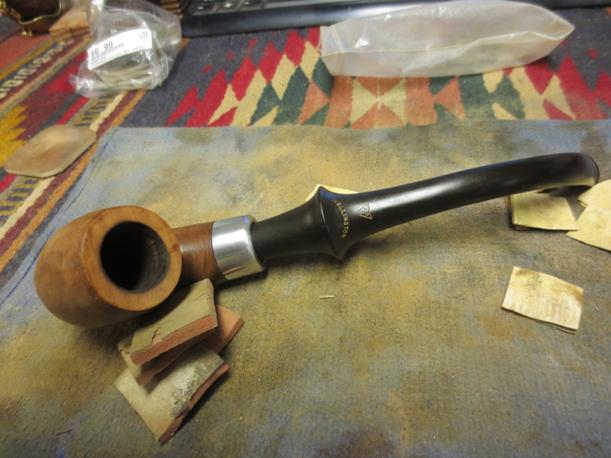
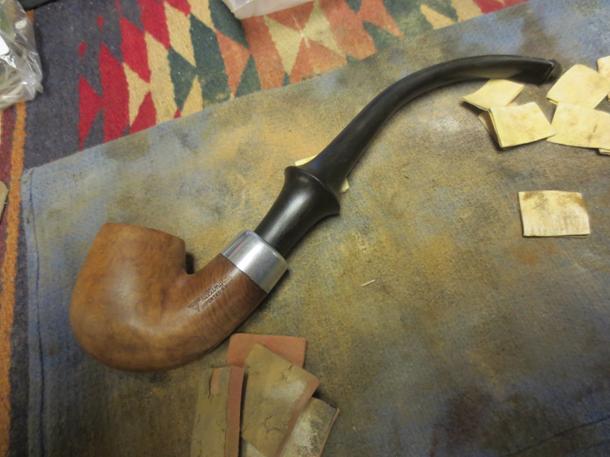
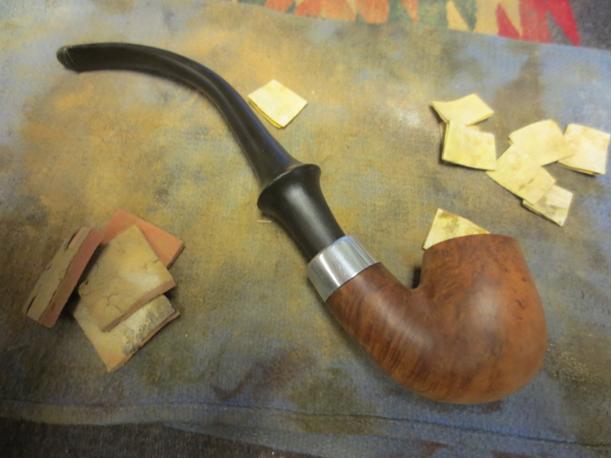
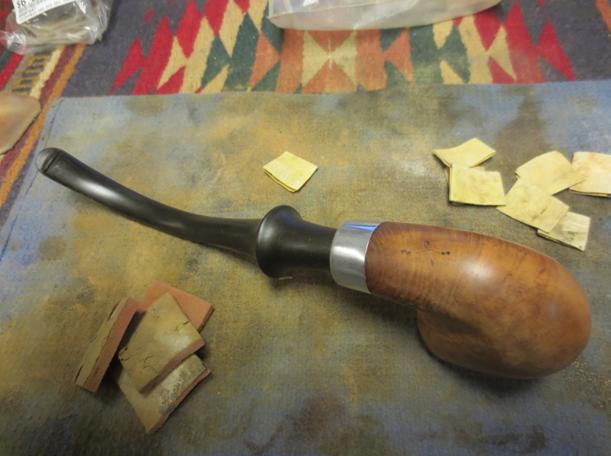
Tag Archives: Bowl – refinishing

A Rescue Dog – Restoring a Chadwick “Supreme” Rhodesian


Blog by Steve Laug

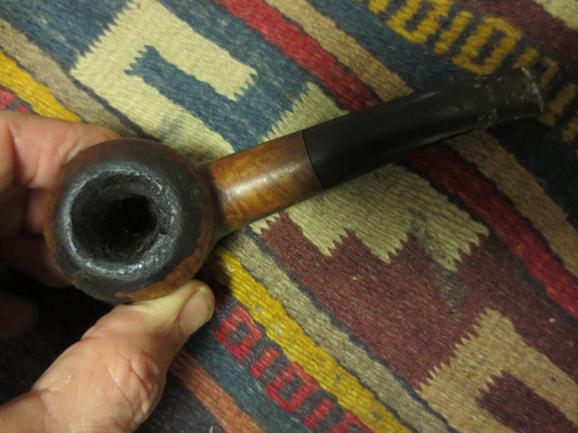
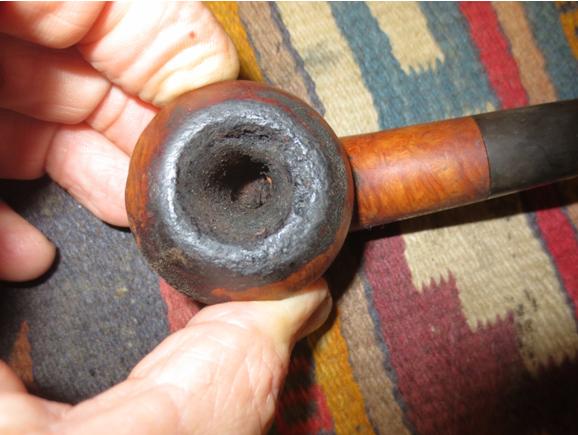
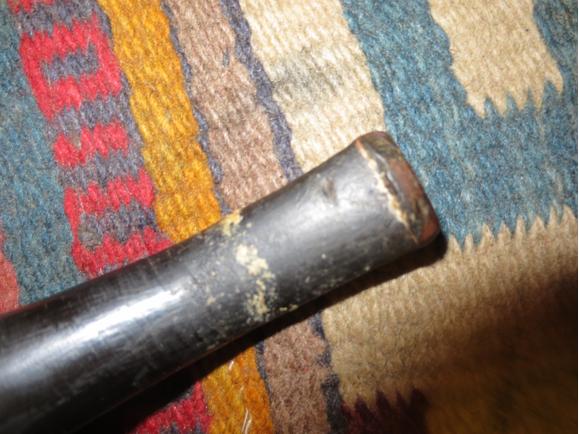
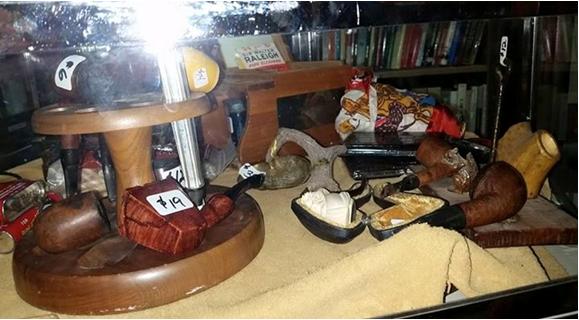
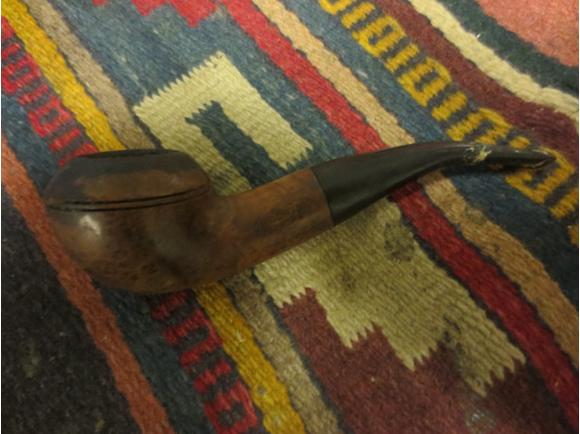
The third pipe my brother Jeff picked up in the lot from the Montana was one of my favourite shapes. In the photo below of the pipes at the seller’s antique shop it is the pipe on the far right of the picture. Looking at it in the photos I wondered if it was a Peterson 999 or a GBD 9438 two of my all time favourite pipe shapes. I was pretty excited to see what it was once he got the pipes. Everything about that pipe shape made me think that my guess was not far off. When the pipes arrived in Idaho my brother called and read me the stamping. The pipe was stamped on the left side of the shank Chadwick over “Supreme”. On the right side it was stamped Imported Briar. At that point I was scratching my head. It still looked like an English-made pipe to me but I had not heard of the Chadwick brand.Chadwick1 When the pipe arrived in Canada I looked it over and was still convinced it looked English-made. I looked in Who Made that Pipe and it was listed there as made by Wally Frank in the US and England. The next photos show what the pipe looked like when it arrived here. There is a lot of promise underneath all the grime. There was a thick cake in the bowl and the rim was covered with the overflow of tars and oils down the sides to the double ring. The finish was dirty and almost gone. I am not sure if the pipe had a natural finish or was stained but it was no longer clear what the original had been like. The double ring had a large chunk missing on the front of the bowl. There were two fills on the bowl front that were shrunken and looked like dents. The shank was dirty. The stem was chewed and gnawed on to the point that the button was virtually gone on the top side. There was a chunk missing from it on the top middle of the button. There were deep tooth marks on the top and bottom of the stem near the button. The stem was oxidized and scratched and had a build-up of calcification about an inch up the stem toward the shank. Inside the stem and shank was very dirty. The airway to the bowl was clogged and I was not able to blow air through it. It looked to me that there had originally been a stinger in the tenon but it was no longer present.Chadwick2
Chadwick3

Chadwick4

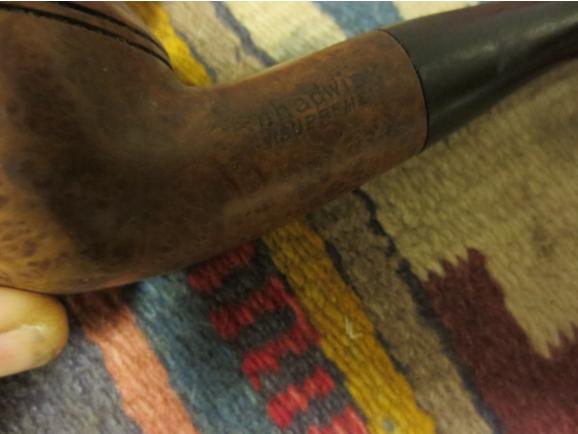
Chadwick5 I took some close up photos of the stamping and the condition of the bowl, rim and stem before I went to work on restoring it. You can clearly see the stamping on the left side of the shank – Chadwick Supreme. The rim is in nasty condition. I am not sure how the last pipe man had ever fit much tobacco in the bowl. All I know is that it must have smoked really well because it looked as if he had never laid it down. The stem condition is also clearly shown with tooth marks and gnawing on the button top and bottom.Chadwick6
Chadwick7

Chadwick8

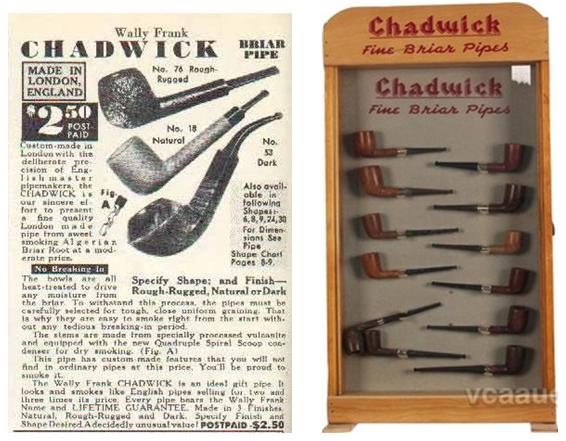
Chadwick8a Before I started cleaning it up I wanted to learn a bit more about the brand. I have cleaned and used quite a few Wally Frank pipes over the years and knew that other companies in Europe often made their pipes for them. It was highly likely that this was a British made pipe. I checked on Chris Keene’s Pipe Pages and found the Chadwick name in the Wally Frank Catalogue for 1939. None of the other catalogues would open but at least I had the information that I needed. The first photo below is of the whole page. The second is of the right top corner where the Chadwick line is mentioned. The third is of a Chadwick Display Cabinet that was provided to tobacconists and stores that sold the line.Chadwick9
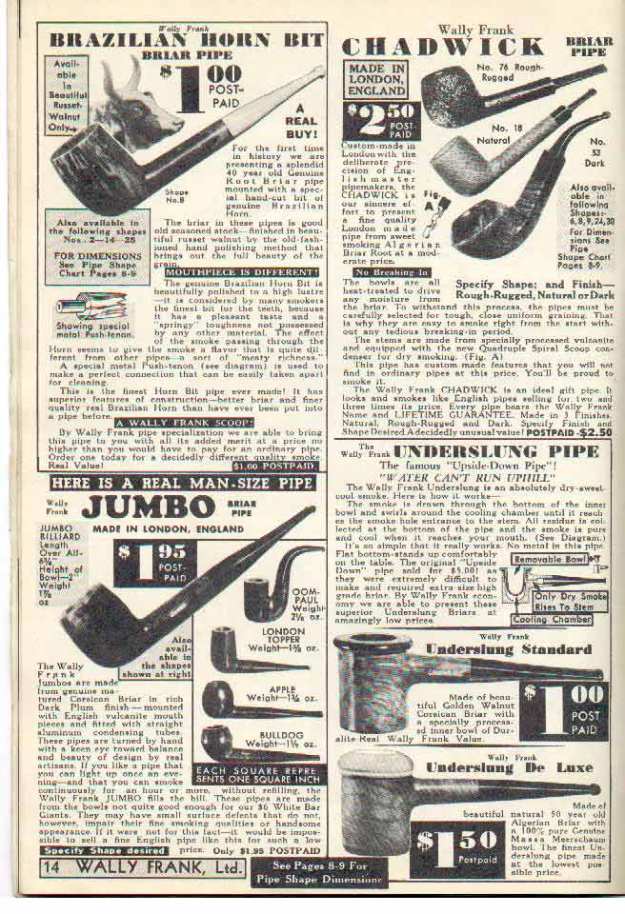
Chadwick10 Now I knew that the Chadwick line was indeed made in England. My guess was correct and I would go one step further and guess that they were made by Comoy’s or GBD. The advertisement says that the pipe was “custom-made in London with the deliberate precision of English master pipemakers. The Chadwick is our sincere effort to present a fine quality London made pipe from sweet smoking Algerian Briar Root at a modest price.”

What interested me was that the pipe came in three different finishes – Rough-Rugged, Natural and Dark. I am pretty sure that the one I had was originally dark finished as the dark finish would hide the fills on the bowl and they would be blended into the briar. That gave me the direction that I would go in restaining the pipe once I got to that point in the restoration process.

I love reading these old catalogues and seeing the life time warrantee on the pipes and the fact that the pipe originally cost $2.50 with postage paid from the Wally Frank factory.

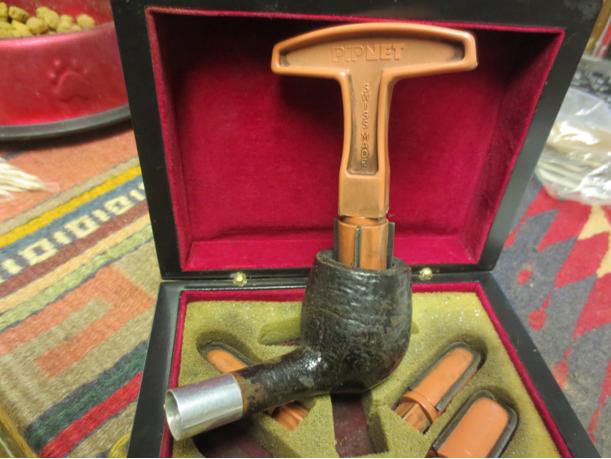
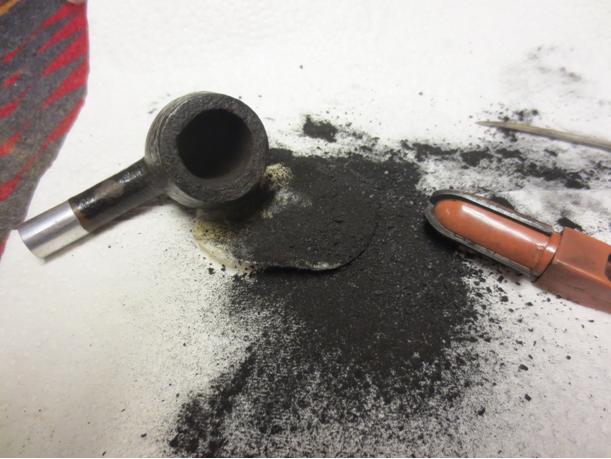
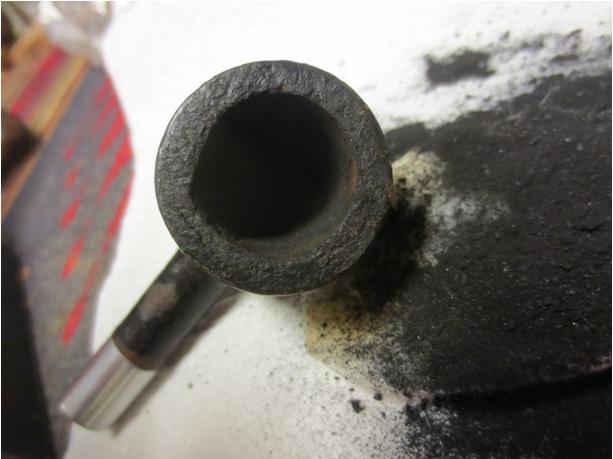
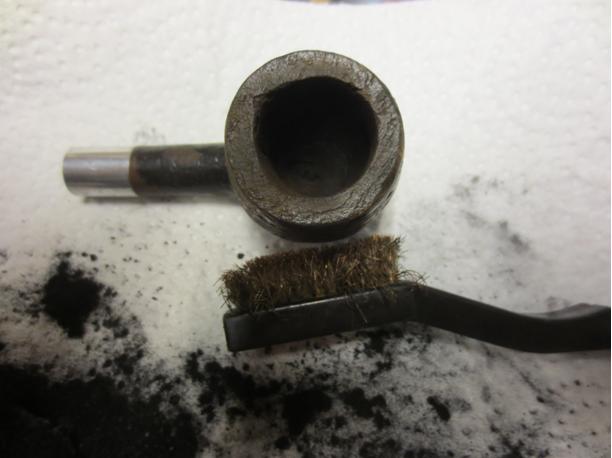
Armed with that confirmation of British origin for this old pipe I went to work to restore it to its former glory. I worked on the bowl first. I wanted to ream back the cake to bare wood to see what I was dealing with in the bowl. I set up the PipNet reamer with the smallest head first and found that the cake was incredibly hard. The cutting head barely made a dent in the cake. I took the largest sized cutting head – same diameter as the bowl and work on it and with a lot of force was able to begin to make a dent on the cake. It was just too hard to go too deep with the tool. I used a pen knife to try to cut back the lower portion of the cake but could not even cut into it because it was so hard.Chadwick11
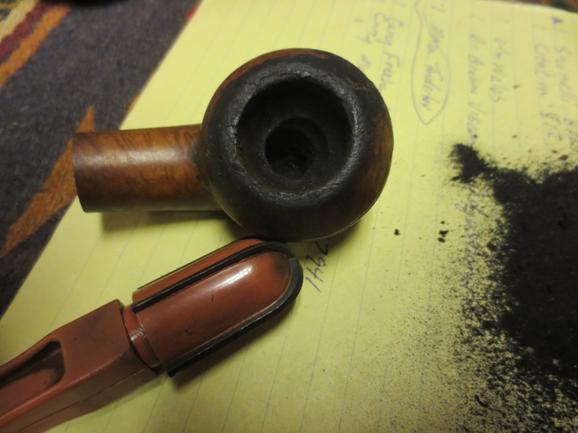
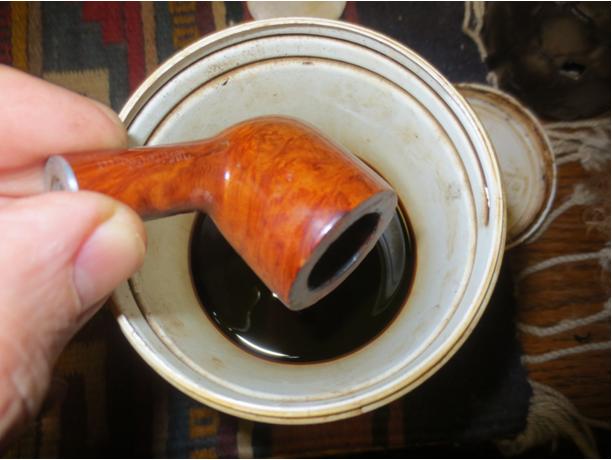
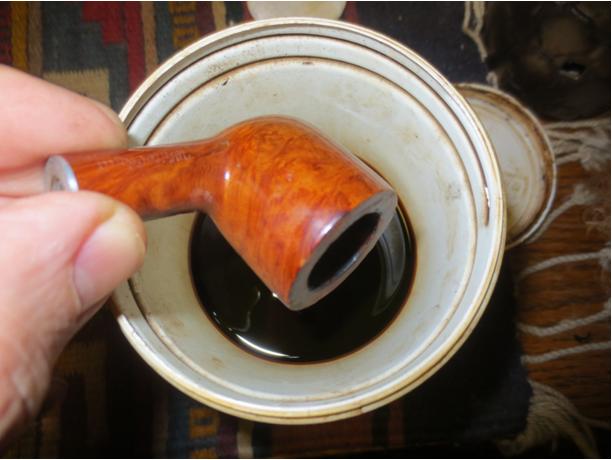
Chadwick12 I decided to soak the bowl and soften the cake in an alcohol bath. I dropped the bowl into the bath and left it overnight to soak and soften the cake.Chadwick13 In the morning I took it out of the bath and dried it off with a coarse cotton towel. The soak also had the effect of softening the lava on the rim and cap so that when I dried the bowl most of it came off in the process. I was able to ream it back to bare wood with the use of a PipNet reamer and a KLEENREEM reamer. I used the drill bit part of the KLEENREEM tool to open the airway into the bowl and remove the clog. With that gone I could freely blow air through the bowl. The final photo in this set shows the conical bowl on the reamed pipe.Chadwick14
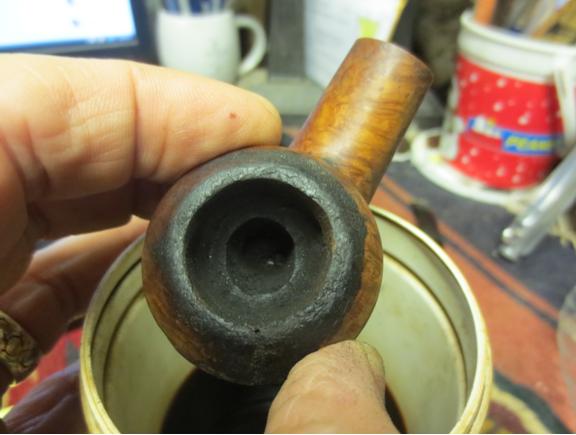
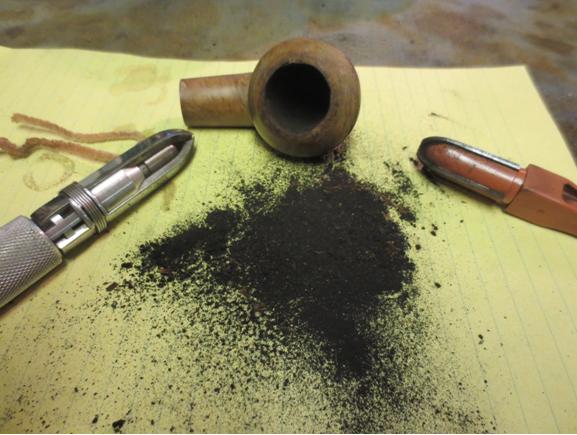
Chadwick15

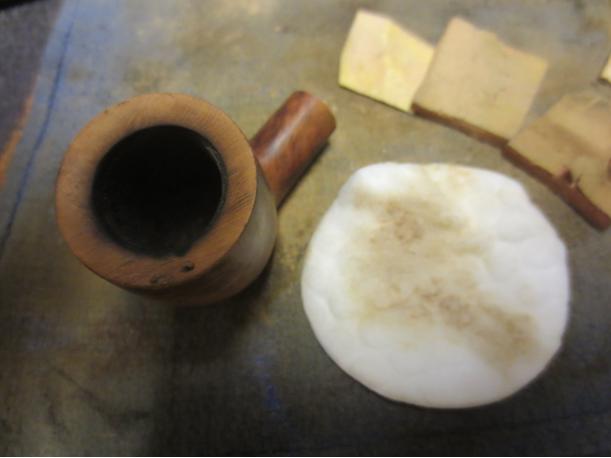
Chadwick16 I wiped the bowl down with acetone on a cotton pad to clean off the remaining finish and the grime left behind after the soak and the reaming process. The damaged rings on the front of the bowl are visible in the photos as is the damage to the rim top.Chadwick17
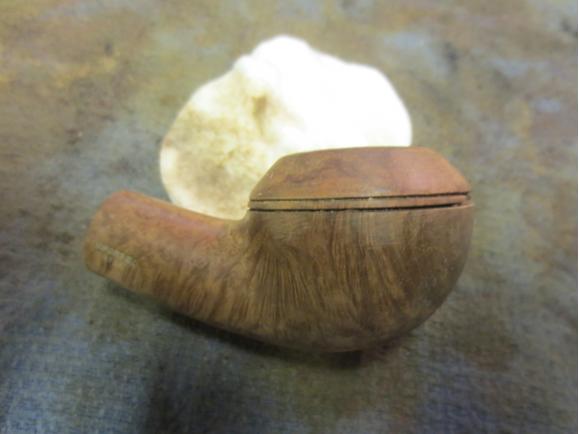
Chadwick18

Chadwick19

Chadwick20

Chadwick21 I lightly topped the bowl on a topping board using 220 grit sandpaper to flatten the rim top and to remove some of the rounding to the outer edge of the bowl.Chadwick22 I used a dental pick to remove the fills that had shrunk on the bottom front of the bowl in preparation for replacing them.Chadwick23 I packed briar dust into the holes and then dripped super glue onto the packed briar dust.Chadwick24 I packed briar dust into the missing section of the double rings on the front of the bowl. I put super glue on top of the briar dust fill to build up the repair. I added more briar dust on top of the fills on the bowl front and on the repair to the rings.Chadwick25 I sanded the patches on the bowl front with 220 grit sandpaper and smooth it out to match the surrounding briar.Chadwick26 I sanded the patch on the ring repair with 220 grit sandpaper to smooth it out. There were still some low spots on that repair so I refilled the area with some more super glue.Chadwick27
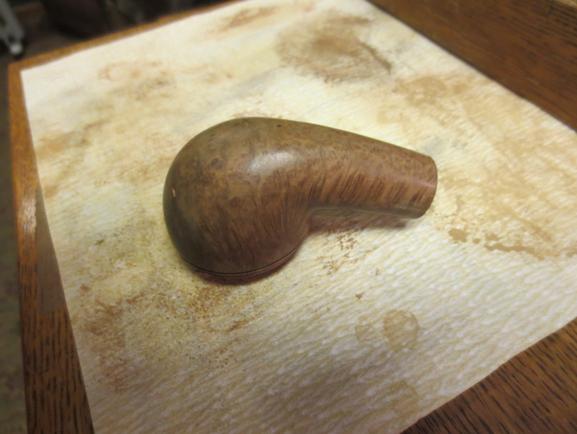
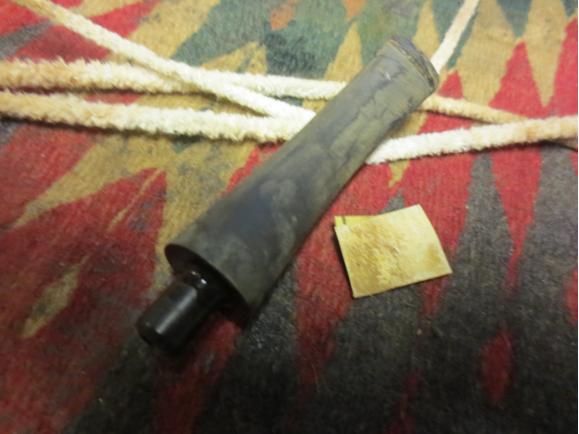
Chadwick28 I set the bowl aside to let the repair on the rings cure before I cut the new rings into the bowl front. While it was sitting I sanded the stem with 220 grit sandpaper to remove the oxidation and the calcification. I wanted to clean up the stem before I worked on repairing the tooth marks and gnawed button. I cleaned the stem with alcohol and pipe cleaners.Chadwick29
Chadwick30

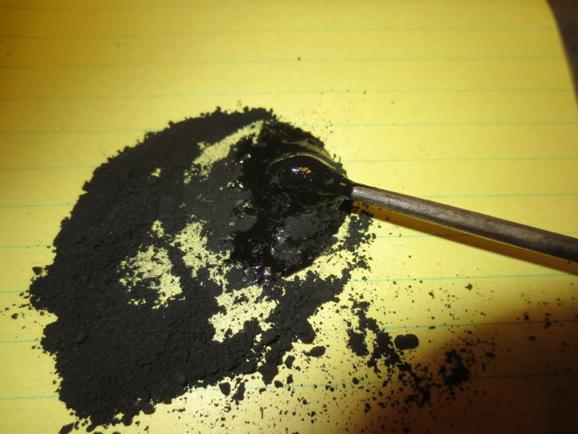
Chadwick31 I scrubbed out the tooth marks on the stem and the button with a cotton swab and alcohol in preparation for the repair I would do there. I mixed the patching material using finely crushed charcoal capsules and black super glue. I mixed the two to blend the materials. I use super glue that gives me 45 seconds of time before it hardens so I have to work quickly.Chadwick32
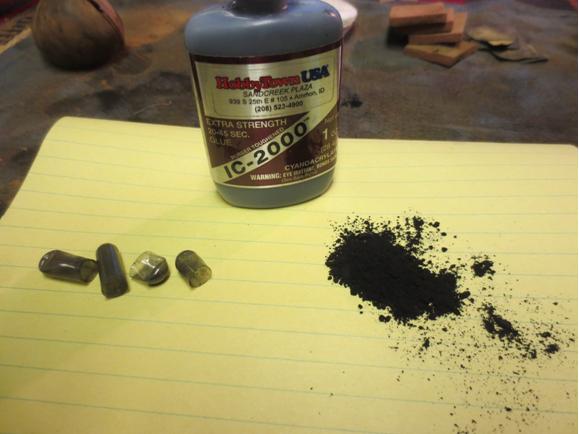
Chadwick33 When I had the paste mixed well I applied it to the tooth marks and built up the button with a dental pick and dental spatula. The repair is anything but beautiful at this point but the mixture adds strength to the repair that the glue by itself does not give with tooth marks and damage of this magnitude.Chadwick34

Chadwick35

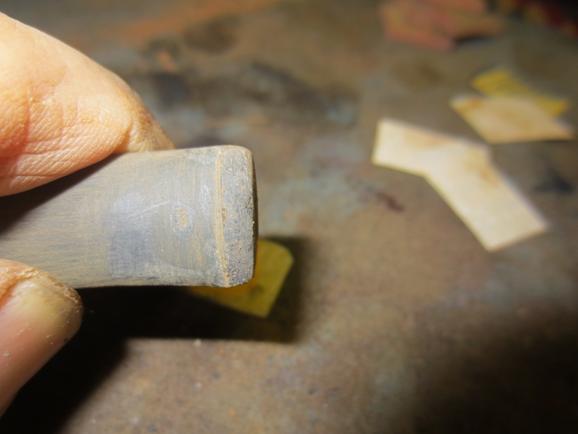
Chadwick36 I set the stem aside to cure and went back to the bowl. I used a Buck Knife, a pen knife and a sharp-edged needle file to cut the lines in the patch on the bowl front. I wanted the new lines to connect seamlessly to the lines on either side of the repair. These three blades always have worked for me to get a good straight line match.Chadwick37 When I had finished cleaning up the lines on the bowl the stem repair had cured enough to begin to shape the button and clean up the tooth repairs. I sanded them with 220 grit sandpaper to begin to shape and smooth out the repairs.Chadwick38
Chadwick39

Chadwick40

Chadwick41

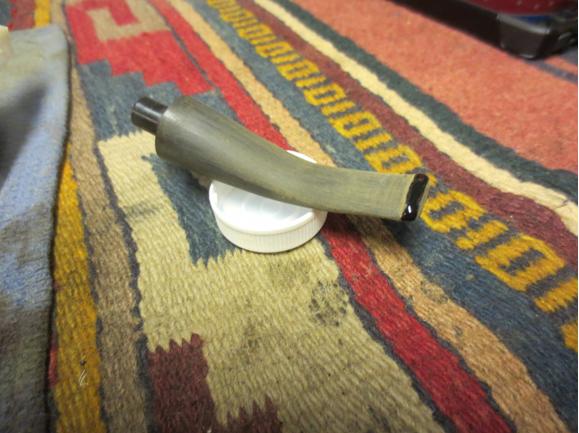
Chadwick42 When I had the basic shape of the button set up the surface was quite porous on the button surface and in one spot on the tooth repair on top of the stem so I gave them a top coat of clear super glue to fill in the pores left behind by the super glue/charcoal mixture. I set that aside to dry.Chadwick43
Chadwick44 I cleaned the bowl and shank with pipe cleaners, cotton swabs and alcohol. It was one dirty shank. It took a lot of scrubbing to clean out the grime. I scrubbed until the cleaners came out clean and white.Chadwick45 I wiped the bowl down with alcohol to remove any last dust or grime in preparation for staining the briar.Chadwick46
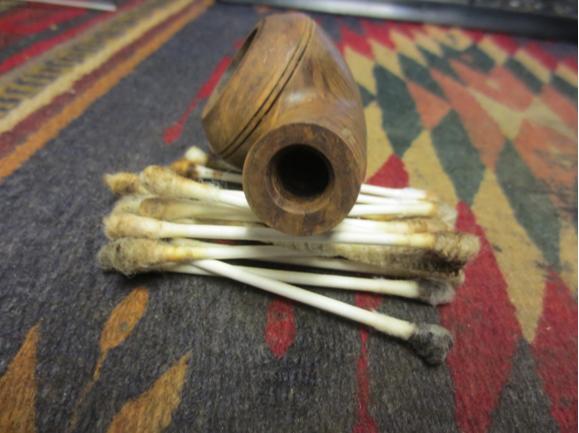
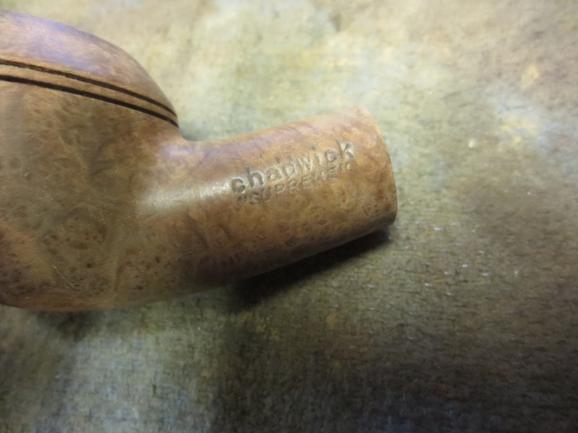
Chadwick47

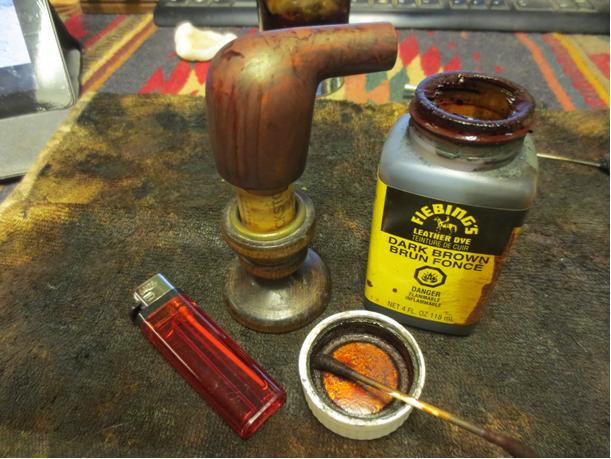
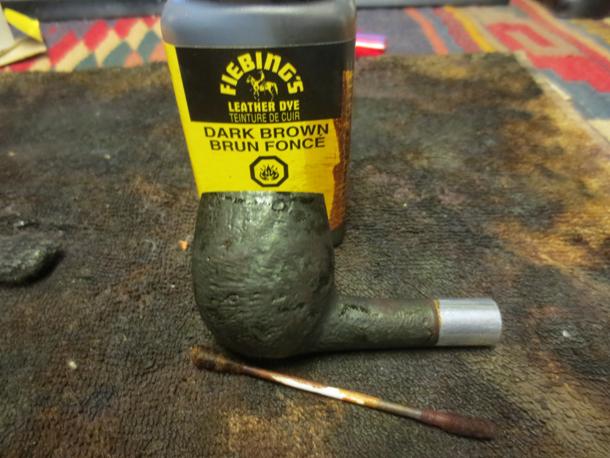
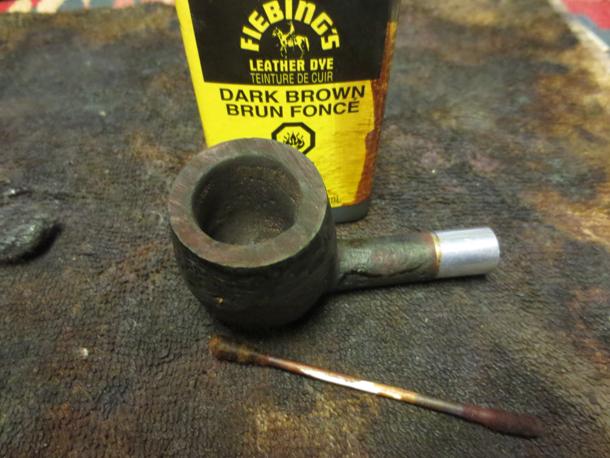
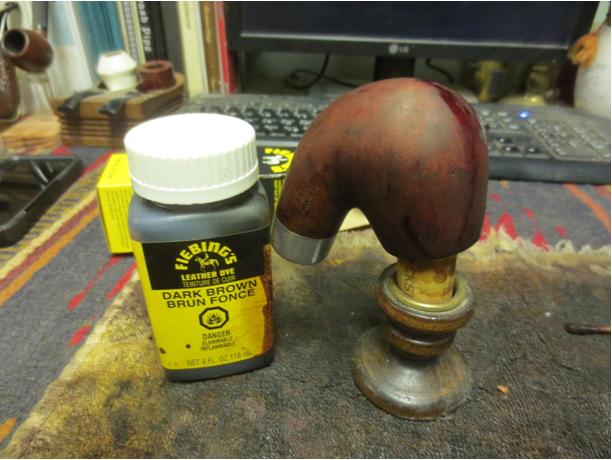
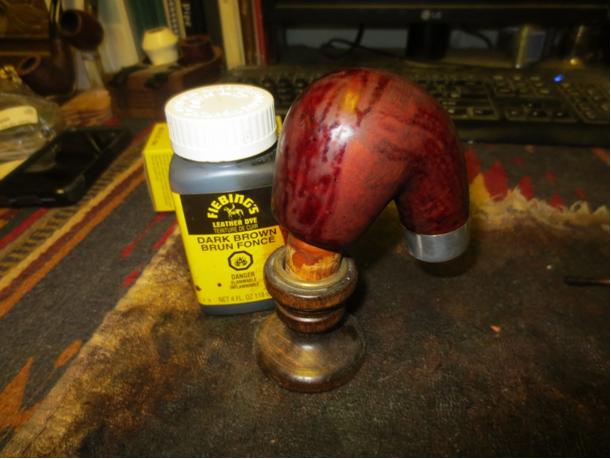
Chadwick48 I decided to stain the bowl with a dark brown aniline stain that I had thinned by half to give it a medium brown colour. I wanted to aim for the dark stain that was noted in the Wally Frank Catalogue above. I figured it would give me good coverage on the fills and the repair to the rings.Chadwick49 I applied the stain with a cotton swab and then flamed it with a lighter to set the colour in the grain.Chadwick50 I wiped down the freshly stained bowl with alcohol on cotton pads to even out the stain and to give it more transparency so that the grain shows through. When I was through I was happy with the colour and with the way it hid the fills on the bowl and the repair to the ring on the front of the bowl.Chadwick51
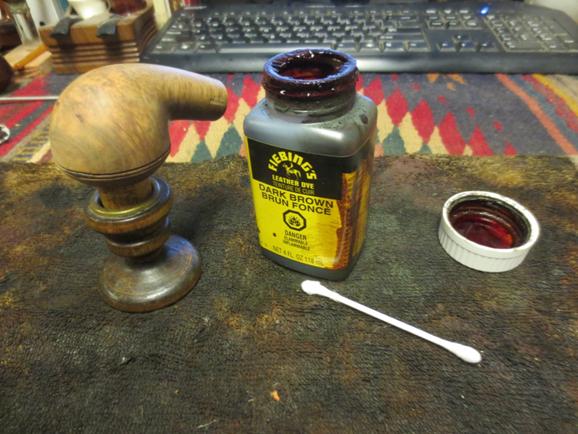
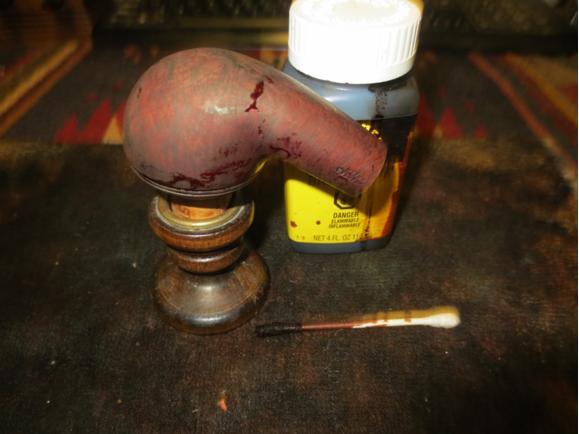
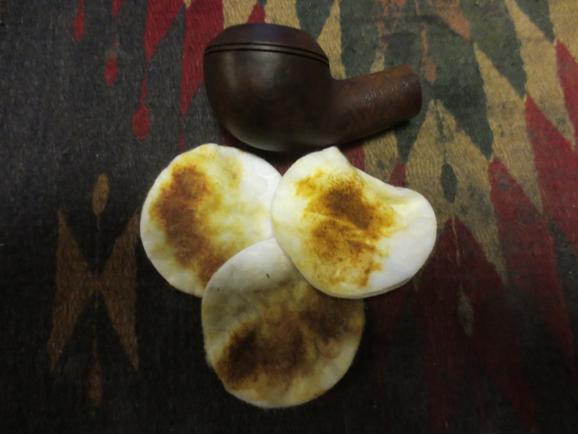
Chadwick52

Chadwick53

Chadwick54

Chadwick55 By that time the stem repair had dried and I sanded it with 220 grit sandpaper to smooth out the stem patch and do more shaping on the button.Chadwick56
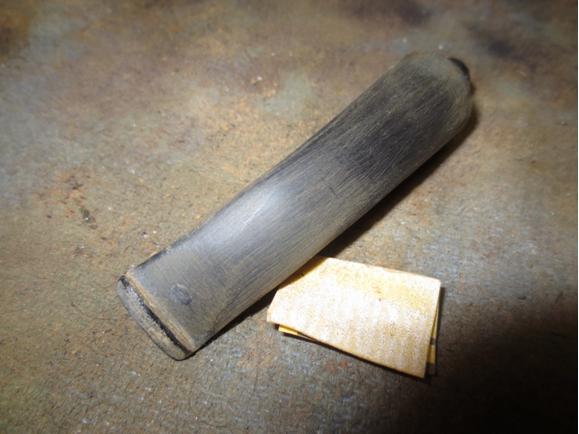
Chadwick57

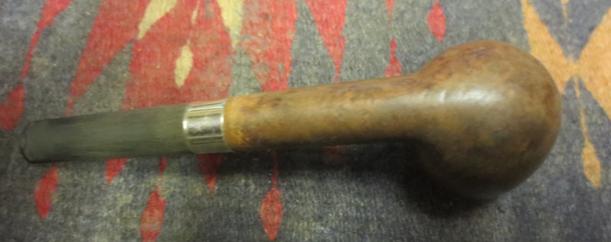
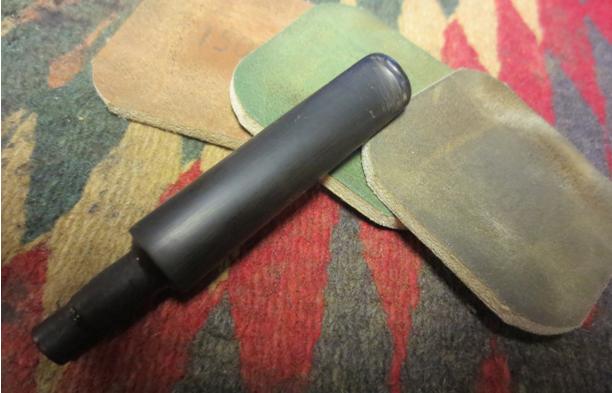
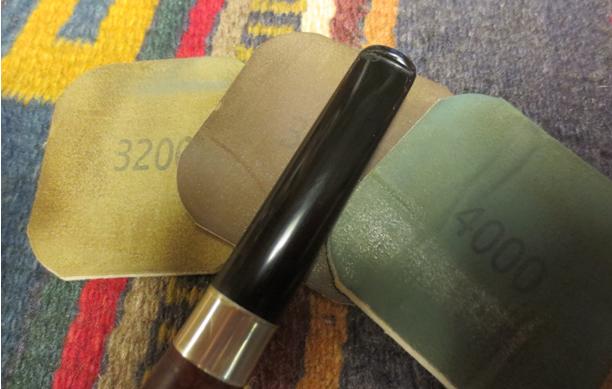
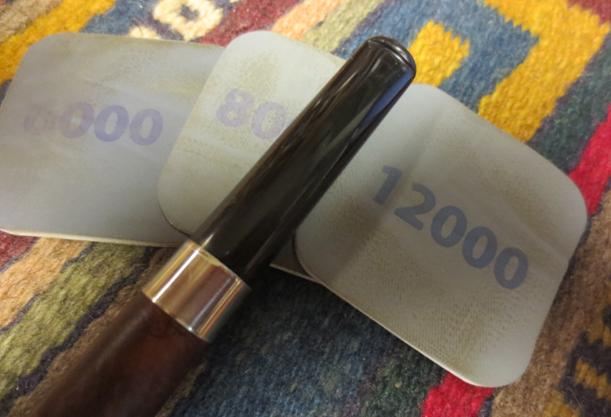
Chadwick58 I filed the slot in the stem to smooth it out and shape it. I also sanded the stem with a medium and a fine grit sanding sponge to further shape the button. I wet sanded the stem and button with 1500-2400 grit micromesh sanding pads and rubbed the stem down with Obsidian Oil. I dry sanded with 3200-4000 grit micromesh pads and gave it another coat of oil. I finished by sanding it with 6000-12000 grit pads and gave it a final coat of Obsidian Oil. I set it aside for the oil to dry.Chadwick59
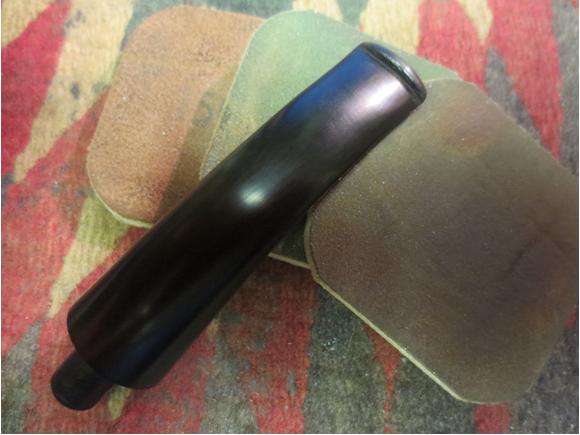
Chadwick60

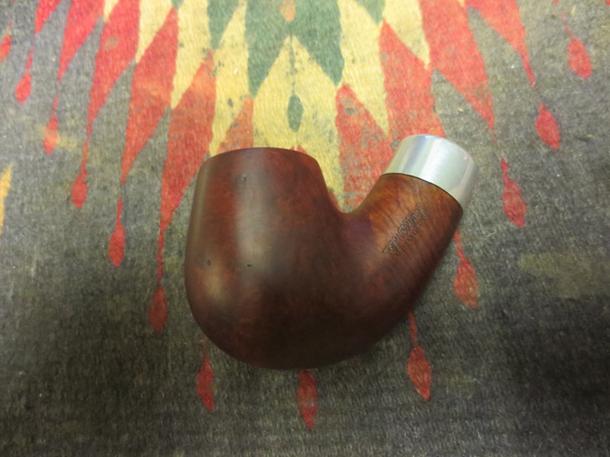
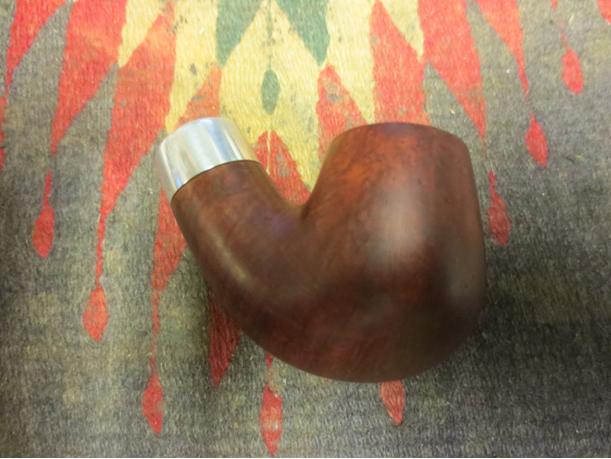
Chadwick61 I sanded the bowl with the micromesh sanding pads – 1500-12000 grit to polish the briar – bowl, shank and rim, to bring out the grain. When the grain began to pop I buffed the bowl and the stem with Blue Diamond on the wheel and then gave both multiple coats of carnauba wax. I buffed it with a clean flannel buff and then with a microfibre cloth. The finished pipe is shown in the photos below. It is a far cry better looking than when I started. This one is a keeper. Thanks for looking.Chadwick62
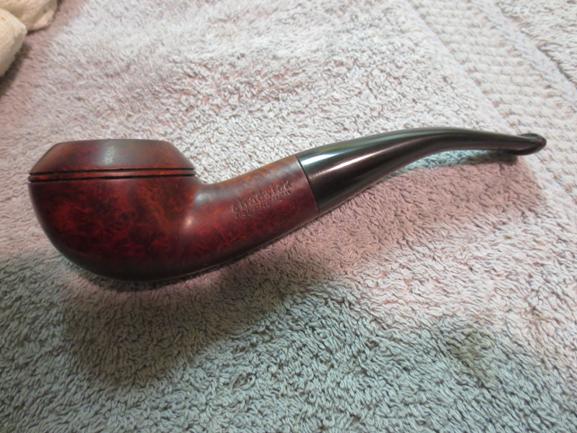
Chadwick63

Chadwick64

Chadwick65

Chadwick66

Chadwick67

Chadwick68

My Courtship of a Comoy’s Pebble Grain Panel Brandy


Guest Blog by Robert M. Boughton
Member, International Society of Codgers
Member, North American Society of Pipe Collectors
http://www.naspc.org
http://www.roadrunnerpipes.biz (Coming soon)
http://about.me/boughtonrobert
Photos © the Author

For there are moments in life, when the heart is so full of emotion,
That if by chance it be shaken, or into its depths like a pebble
Drops some careless word, it overflows, and its secret,
Spilt on the ground like water, can never be gathered together.

― From “Priscilla” in The Courtship of Miles Standish (1858), by Henry Wadsworth Longfellow (1807-1882), U.S. poet and author

INTRODUCTION
I suppose I should consider myself fortunate to have had many such moments in life as Longfellow described, and can only hope to be blessed with frequent more, yet when each occurs, the awareness never fails to strike like a suffering pleasure. Call me a sentimentalist, or a romanticist as were the poets who influenced Longfellow, or make of it what you will.

Several years ago, when I first began buying up numerous fine examples of restored pipes by my friend and mentor, Chuck Richards, I fell in love with the beautiful Comoy’s Pebble Grain Panel featured in this exercise in refurbishing. As I might as well admit at this point, my reaction to the coloring and fine pebbles adorning the panels and the unusual shapeliness of the pipe itself was as the great American poet described. Many other works of art created for the enjoyment of pipe tobacco, some of which I have had the pleasure of acquiring and quite a few more remaining on my wish list, affected my sensibilities (in the philosophical sense) in a similar manner.

Still, the persistence of my attraction to this singular pipe has never lessened. Perhaps this reaction was a result of the fact that, in a moment of largess, I promised the special pipe to a friend who prefers cigars but was interested in taking up the fairer form of smoking – and on frequent occasions since then, I have been able to appreciate its allure, albeit in the hands of another man.

With that chemistry in mind, I have on a few occasions, with permission from my friend of course, again held the full-figured darling in my own appreciative embrace to ensure that she has been given the care and respect deserved. I am happy to report that the lovely creature has received excellent if frequent attention.

That said, and recognizing that when I first cleaned the Comoy’s a few years back for my friend, Mike Brasel, I knew even less about restoration and refurbishing than I do now, I knew I could make the lovely pipe better than when I gave it away. If anyone detects a touch of regret in those last words, it is only because… well, it’s the truth! There. I got that confession out of the way. I also had taken no photos of the pebble grain before I turned it over to the care of Mike, and concluded that one easy way to correct that mistake was to get it back in my hands long enough to give the pipe a little needed cleaning. Machiavellian? Somewhat. Sneaky? Definitely. Regrets? None.

My primary solace for the loss of the pebble grain is two-fold: other than getting to see it on a regular basis, I can observe its regular upkeep. I knew Mike was in the good habit of running bristly cleaners through it but had no idea he must do so after every smoke until I at last was able to convince Mike to entrust me with the Comoy’s a few days ago. He actually paid me for a sweet, vintage Kaywoodie Signet bent smooth billiard I restored about a year ago (my first experience cleaning a pipe properly with a retort). I believe it dates to the 1960s if not a little earlier. Mike therefore had a substitute to use in the other pipe’s absence.

The reason I chose the Comoy’s for Mike in the first place was his comment that he had been unable to find a big, thick, sturdy enough pipe that would never overheat at a price he could afford. I knew the pebble grain would be perfect for his needs and fit his personality at the same time. But based on his standards for appreciating the thick-skinned Comoy’s, I was surprised and more than a little concerned when he picked the Kaywoodie from my restores available for sale. Nevertheless, while enjoying his first bowl of McClellands 2015 Christmas Cheer in his new Signet, Mike told me it smokes great and is easier to control without holding. The photo below was snapped just as he was about to remove it from his mouth.

Mike trying out his Kaywoodie the first time

Mike trying out his Kaywoodie the first time

Mike’s new pipe

Mike’s new pipe


REFURBISH
Comoys3

Comoys4

Comoys5

Comoys6

Comoys7

Comoys8

Comoys9 AN ASIDE
I see Mike at our local tobacconist almost every time I’m there, and for the most part he smokes the cigars he still loves. On occasion, I’ll even buy one and light it up myself. It’s true, I enjoy a good candela on special occasions, in particular when I can get my hands on a genuine Havana, which is a treat I have savored only five times: twice on trips to visit my mother when she lived in Cozumel, Mexico; once with another onto which I slipped a Nicaraguan band and smuggled back to the States (although the Customs agents at the border picked it right out from the little humidor box I handed them, which otherwise had legal varieties, and smiled at each other before letting me get away with my attempt at subterfuge); again with a gift from a former co-worker in grocery store deli merchandising, this one being, I was certain, a fake – until I held it and noted the unique paleness and skin-like suppleness of the green wrapper, and the last that I bought from a friend in England who was a true gentleman to mail to me along with three more I purchased for Mike and a couple of other cigar aficionados I know. All of the Cubans I’ve smoked required hours to finish and left me with an almost illicitly pleasant, light-headed giddiness.

BACK TO THE REFURBISH
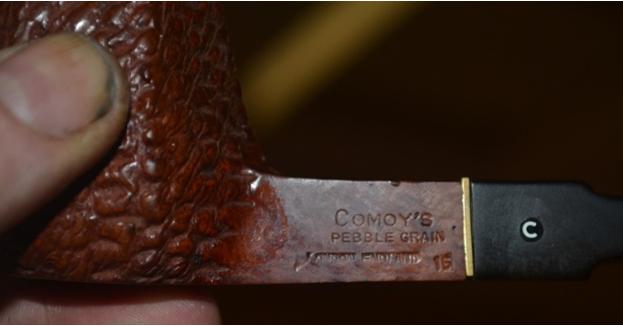
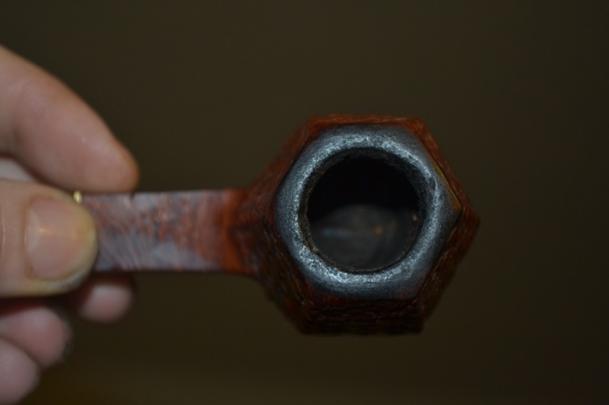
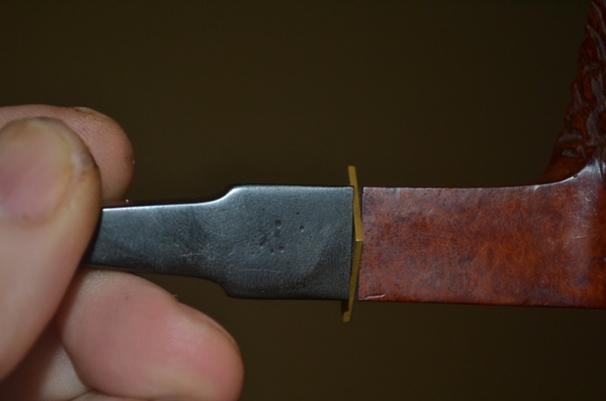
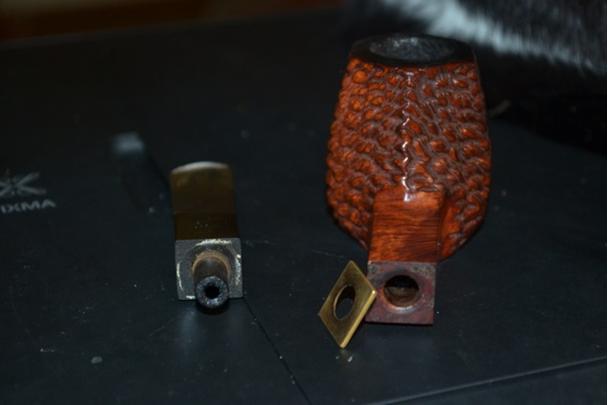
And so I was somewhat amazed to see from tell-tale signs on the Comoy’s that it had been used far more often than I suspected. The rim, of course, was the first hint, blackened as it was. Then there were the slight dents on both sides of the top of the shank, visible in the third photo above, and some minor scratches on the rest of the wood. However, the most revealing symptoms of frequent use were the general grime on the outer briar and the lip end of the bit. I also discovered, without even removing the bit from the shank, that the thin brass band that had been connected to the bit had come loose.Comoys10

Comoys11

Comoys12 That was a repair I never had to ponder before. Tossing the bit into an OxiClean solution for a nice long soak, I decided to tackle the rim first. I was able to remove the majority of the charring safely with superfine steel wool before shifting to micromesh, using 1800, 2400 and 3200. The rim as shown in the last shot below, I knew, was not finished, but more about that later, in its order.Comoys13

Comoys14

Comoys15 Removing the bit from the OxiClean wash, I rinsed it and with haste, while it was still wet, started micro-meshing, from 1500-12000. There was no need for sandpaper, other than the narrow edge around the tenon where the thin brass band still needed to be replaced. To eliminate the residue of the original adhesive, I made fast work of it with 150-grit paper followed by 320, then micro-meshed all the way through my pack of pads. Not having to sand any of the regular surface of the bit was such an extremely rare event that I was truly struck by Mike’s high degree of care for the Comoy’s. Here is the band before I cleaned it up easily with my steel wool, and after I reattached it with a small amount of Super Glue.Comoys16

Comoys17 Less than a minute’s more work with the steel wool made the tenon opening like new.

I considered the bowl and shank and how to clean them. Six small, thin cotton squares, used two-ply and wetted with purified water, took off much of the dirt with serious scrubbing both vertically and horizontally to get around the pebbles as thoroughly as possible, but that was not enough. With the wood wet, I returned to the three micromesh pads and made more progress, but the task called for something else. After serious consideration, I opted to go all-out with a couple more two-plies using Everclear, again rubbing both directions. At last I found the exact lighter shade I sought.

At this point, I finished the rim, using 320-grit paper with two of the gentlest swipes possible, one around the top and the other covering the rounded inside where it borders with the beginning of the actual chamber. I finished that step with the same micromesh progression as before.

While I still had the 320-grit paper and micromesh pads out, I saw no reason not to tackle the two dings in the shank and the sundry scratches. Again, most of these blemishes were mended with the micromesh. Almost all of the very slight imperfections remaining came off with light, focused application of the 320-grit followed by – you probably guessed – the same three micromesh pads. With an uncommon sense of caution, given that this pipe already belonged to my friend Mike – someone I had reason to suspect I never want to see really mad – I settled for the results I had achieved, except for a quick turn or two of 150-grit paper followed by 320-grit on some excess cake buildup in the chamber, and to clean out the loose soot from the sanding, a wipe with another cotton cloth piece wet with purified water.Comoys18

Comoys19

Comoys20

Comoys21

Comoys22

Comoys23 I only needed a few seconds to consider a retort and dismiss the notion, realizing it would remove too much of the cake that I had promised Mike I would not ruin. But I did dip a bristly cleaner in Everclear and ran it through the shank, turning it briskly as I did so, and saw it came out filthy. After using a dry cleaner that brought out more grime, I repeated the process, still finding some unnecessary old smoke, tobacco and other accreted matter. The third cleaner soaked with Everclear was almost white.

I left the shank as it then was and proceeded to the bit’s air hole, at which point I was amazed to find that one alcohol-soaked cleaner came back with minimal blackness. One more dry cleaner paved the way for another dipped in Everclear, which was clean, ending that step.

The hard parts of the job complete, the time came to open my jar of Halcyon II wax and dip a finger in for a dab of the stuff. The single dab was enough to coat the bowl and shank until they shone with a wet brightness and set it aside for about 15 minutes while it soaked into the smooth rim, bottom of the bowl and shank, and every crevice of the pebbled area.

When I could stand the wait no longer, I carried the two pieces of the pipe into the spare bedroom of my new apartment that I will use as an office/shop when it is furnished. Of course, I had already set up my buffers on their sturdy stand and had only to plug them in for the first time in that setting. I buffed the bit with red Tripoli, white Tripoli and White Diamond, using the clean cloth wheel after each, and wiped it down with a big soft cotton cloth. Setting it aside and taking a deep breath, exhaling slowly, I stuck my left index finger in the chamber and, with complete calm and a firm grip on the precious briar, buffed the Halcyon II on the clean wheel. Rubbing it down with the cotton cloth, I concluded a final run with the carnauba wheel and then the clean buffer was in order.

Studying every angle of the briar while I rubbed it with the cloth, I was a tad disappointed that the waxing and buffing process had made it almost as dark as it started. I had wanted to finish with a lighter shade of wood and a high sheen of wax, but decided against another coat of Halcyon II.Comoys24

Comoys25

Comoys26

Comoys27

Comoys28

Comoys29

Comoys30 CONCLUSION
A few words about why the first three photos of the finished Comoy’s Pebble Grain have a different background: when I went to the tobacconist to see if Mike was there, he wasn’t, and I sat down to enjoy a bowl while I took the pipe out for what I thought would be a final quick exam. I was horrified to see what appeared to be bad blemishes on the right side of the bit and shank, and on the top and bottom of the bit. Fortunately, I had my cotton cloth with me and discovered that the problems were only smudges of excess wax. And so I wrapped the rag around the entire pipe and gently turned it round and round for five minutes or so, while I puffed away at one of the tobacco samples on hand.

When I at last stopped rubbing the pipe, I handled the pipe as I would if I were checking out a new purchase, and found no more smudges. Relieved, I wiped it quickly one last time before taking the pictures of the first three angles again.

Knowing I couldn’t take it home with me, I put it back in the leather pouch I included for Mike, so that he could carry it with him with added protection, and left the Comoy’s of which I remain so fond with Chuck at the counter.Comoys31 Cheers, then, old gal.

Restoring An Eagle Cool-Dry Billiard


Blog by Steve Laug

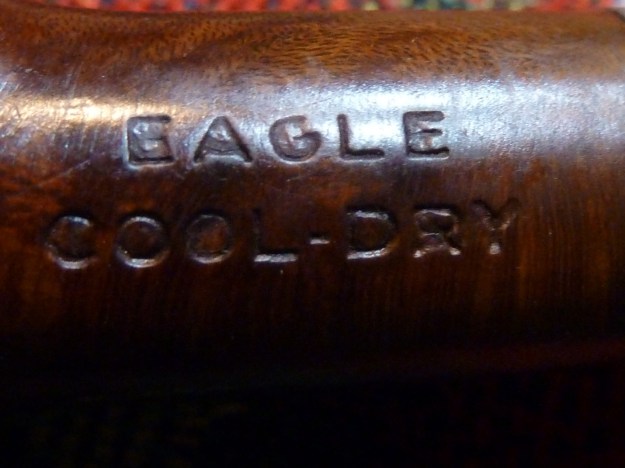
The pipe was another gift pipe sent to me by Pam. It is in decent shape. The stem is oxidized and has some tooth marks on the top and bottom side of the stem near the button. The tooth mark is like a vertical slit on the top and bottom side about ½ inch up the stem from the button. There is also a small tooth dent near the button. The metal part of the stem and tenon were integrated into the stem rather than in the shank of the pipe. The finish on the pipe was shiny and showed that the lacquer or varnish that had been used was peeling in spots on the front of the bowl. The stamping was deep and readable. There were quite a few fills on the bottom of the bowl. The largest was on the bottom front edge of the bowl. It had shrunken and was a large pit that ran across the front of the bowl. The bowl was heavily caked and the buildup on the beveled rim was hard and chipped looking. There were some nicks on the outer edges of the rim from when the bowl had been tapped out. The shank was not too dirty and the mortise appeared to be lined with a white tube of some sort.Eagle1 The Eagle Cool-Dry has some unique plumbing in terms of system pipes. It is different from any of the other pipes like this in my collection. The rest of the ones that externally look like this one, the Keyser Hygienic and the Millard Perfect Pipe are actually very different in terms of design. They have a metal insert at the end of the shank that acts as a condenser area with a tube extending from the airway into the condensation chamber. The stem also has a metal tube insert and no tenon but is a military mount stem that inserts into the chamber. The two tubes either meet in the chamber or sit in the chamber. The Eagle is very different in terms of design from the other two mentioned above. The shank is lined with either clay or meerschaum – hard to tell by just looking. My tendency is to assume it is clay. The porous tube is inserted into the shank forming the mortise of the pipe and extending to the end of the shank (see photo below). The metal tenon integrated into the vulcanite stem sits snuggly into the lined mortise. Once I clean it up I may be more certain what the material that makes up the mortise lining.Eagle3 As I worked on cleaning up the pipe I took a little time to see if I could ferret out any information on the brand and the manufacturer of the pipe. I looked for Cool-Dry pipes and found a metal Falcon like pipe that uses the same threaded bowls as Dr. Grabow Vikings. I looked for Eagle Pipes and found a clay pipe manufacturer in Montreal, Quebec in the late 1890s but nothing on a briar pipe maker of that name. I searched for patent information on the internals of the pipe under both the Eagle and the Cool-Dry name and found nothing specific on the system in this pipe. The one thing I did find was that the pipe was made by the Hudson Universal Pipe Co. who also made the brands Excelsior, Harrington Park, and Hilex. This information came out through some notes I found while Googling the brand.

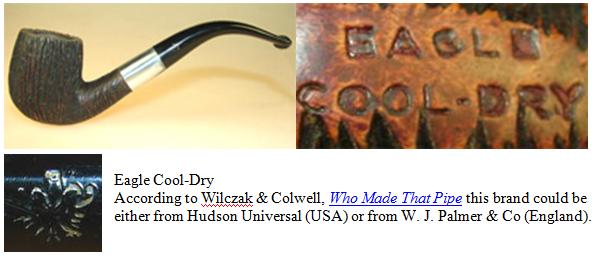
Having that information in hand I looked for the pipe on the Pipephil Stampings and Logos website and interestingly found the following picture and short information. The brief notes under the picture confirm that Hudson Universal Pipe Co. was one of the makers of the pipe. The pipe I received has the same stamping as the one pictured below. The one I have does not have the stem logo but rather is stamped ITALIA on the underside of the stem next to the metal portion of the stem.Eagle2a

Eagle2 When I brought the pipe to my work table I took the following photos to give an idea of the condition it was in when I started. I have spoken of the finish and the general worn condition of the bowl. The rim and cake issues have also been mentioned. The photos show the oxidized stem and aluminum. The bowl has an attractive shape and there is something about the old pipe that drew me to it.Eagle4

Eagle5

Eagle6

Eagle7 The next two photos are close up shots. The first shows the large shrunken fill on the bottom front part of the bowl. The second shows the thickness of the build up on the rim and the cake in the bowl.Eagle8

Eagle9 I took the pipe apart to show the nature of the tenon and stem apparatus.Eagle10 I sanded the stem with 220 grit sandpaper to remove the oxidation on the stem and to prepare it for the repairs that needed to be done to the tooth marks on both sides of the stem. I sanded it and removed much of the oxidation and minimized the tooth chatter. I then scrubbed the stem with alcohol to remove the dust and debris in the tooth marks. I filled them with a bubble of clear super glue – both the two spots next to the button (1 on top and 1 on the underside) and the two vertical cuts or marks (one on each side). I set the stem aside to let the glue cure.Eagle11

Eagle12 While the glue dried I worked on the bowl. I sanded the top of the rim with 220 grit sandpaper to remove the cake that had built up on that surface. I would need to continue to reshape the rim. I reamed it back to bare wood with a PipNet reamer.Eagle13

Eagle14 I continued to sand the rim and also sanded the inside edge of the rim with the 220 grit sandpaper.Eagle15 I scrubbed the bowl with acetone on a cotton pad to remove the varnish coat and the grime that collected on the briar through the years.Eagle16

Eagle17

Eagle18

Eagle19 The next photo shows the clay/meerschaum insert in the shank that lined the mortise on the pipe. I cleaned it with cotton swabs, pipe cleaners and alcohol.Eagle20 I picked out the large fill on the front of the bowl with a dental pick until the sandpit was clear of the white putty. I wiped the bowl down with alcohol on a cotton swab to clean out any remaining debris. I used the dental pick to press briar dust into the sandpit and packed it in. I dripped a couple of drops of glue into the dust. Unfortunately the glue ran down the face of the bowl. I am using a new kind of glue and it is very thin and dries slowly. I sanded the surface of the bowl to remove the heavy overdone patch until it was smooth with the surface of the bowl. I then added a little more briar dust to the patch and used the tip of the pick to put some more glue on the repair.Eagle21

Eagle22

Eagle23 When the glue dried I sanded the patch until it was smooth. I sanded the entire bowl with a medium and fine grit sanding sponge to remove the scratches. I wet sanded the bowl with 400 grit wet dry sandpaper and then with 1500-2400 grit micromesh sanding pads. I wiped the bowl down with alcohol and cotton pads to remove the sanding dust in preparation for restaining the pipe.Eagle24

Eagle25

Eagle26

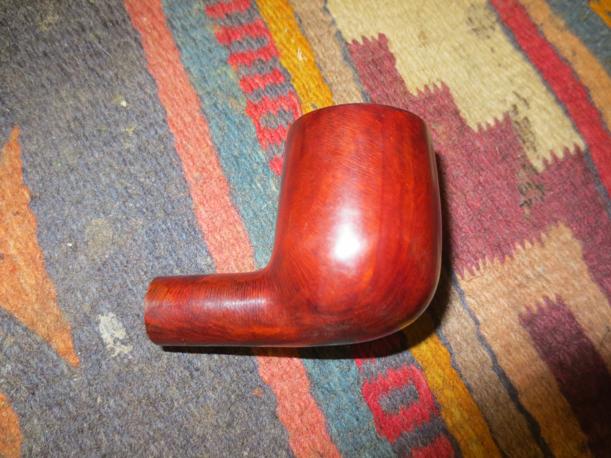
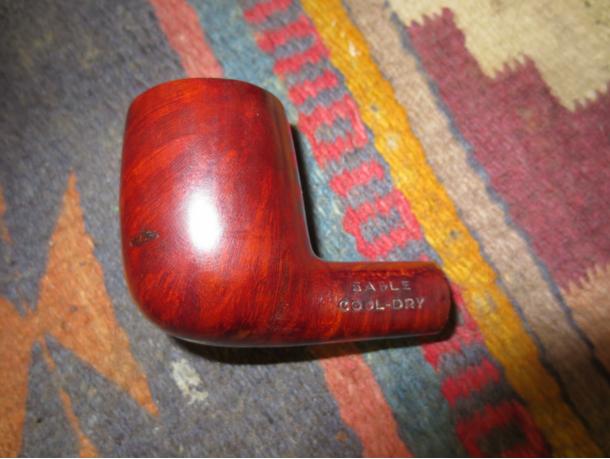
Eagle27 I gave the bowl a coat of dark brown aniline stain and flamed it with a lighter. I gave the pipe several more coats of stain and flamed each one.Eagle28 When the stain had dried I hand buffed it with a cloth and then gave it a light buff on the wheel with White Diamond. The first two side view photos of the bowl show it with a red tint that really is not as prevalent as it appears. The photo of the bottom of the bowl is more accurate in terms of the colour of the pipe.Eagle29

Eagle30

Eagle31

Eagle32 I sanded the repaired stem with 220 grit sandpaper to blend the repair into the surface of the stem. I sanded it with a medium and a fine grit sanding sponge to remove the scratches in the surface of the stem.Eagle33

Eagle34

Eagle35

Eagle36 The stem was quite clean on the inside so it took only one pipe cleaner to take out the sanding dust that had collected inside.Eagle37 I wet sanded the stem with 1500-2400 grit micromesh sanding pads and then rubbed it down with Obsidian Oil. I dry sanded with 3200-4000 grit pads and then gave it another coat of oil. I finished sanding it with 6000-12000 grit pads. I gave it a final coat of Obsidian Oil and let it dry.Eagle38

Eagle39

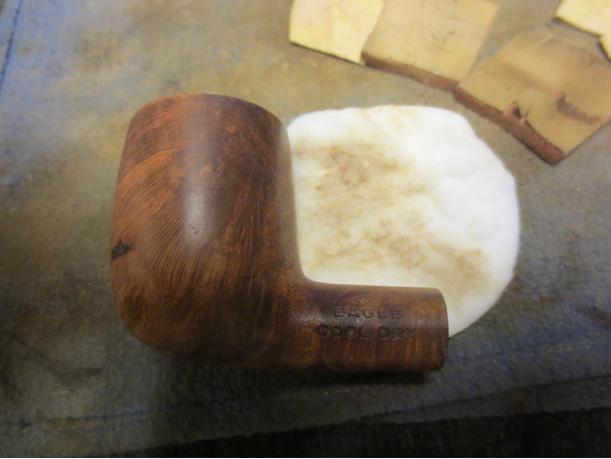
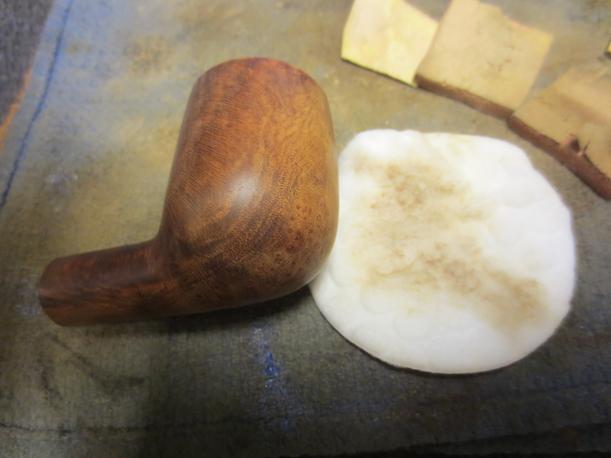
Eagle40 I buffed the pipe and stem on the wheel with Blue Diamond. I gave the aluminum a light buff so as not to darken the buffing pad and carry the metallic colour onto the vulcanite or the briar. I gave the bowl and stem multiple coats of carnauba wax and then buffed the pipe with a clean flannel buff. I finished by buffing it by hand with a microfibre cloth. The finished pipe is shown in the photos below. The glow of the briar and the vulcanite are really set off by the burnished aluminum portion of the stem. It is truly a beautiful pipe. Thanks for the pipe Pam it is a keeper. Thanks also to each of you who are reading this blog.Eagle41

Eagle42

Eagle43

Eagle44

Eagle45

Eagle46

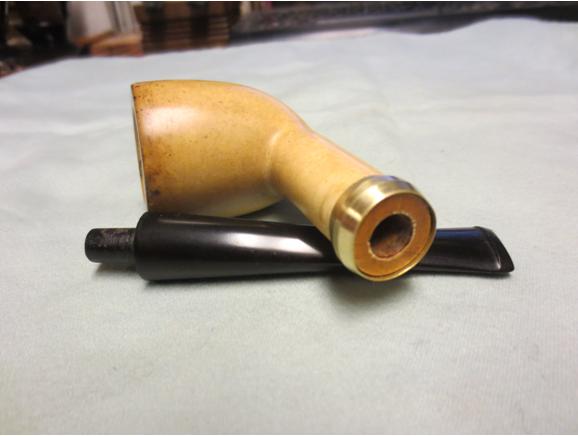
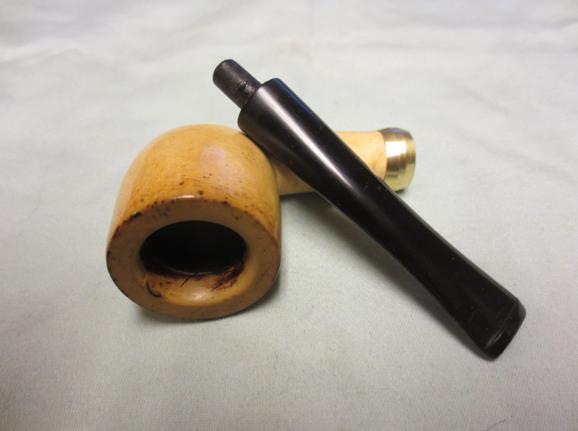
A Simple Mistake Forced a Restem on a Meerschaum Billiard


Blog by Steve Laug

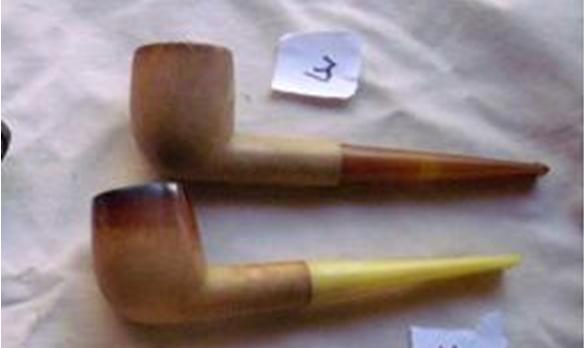
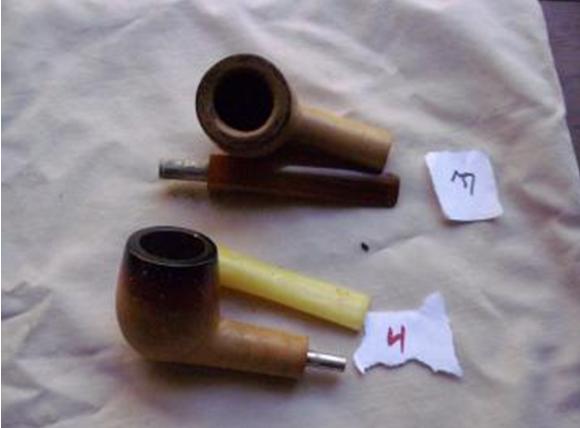
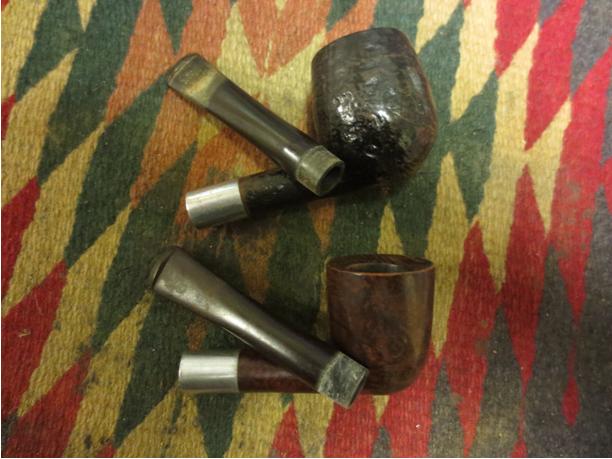
I found these two no name meerschaum billiards on one of the web forums that I frequent. The seller gave me a decent price on the two. The top pipe was older than the bottom one and I chose to work on it first. The stem was Bakelite and had a metal tenon. It did not fit in the shank either in terms of the diameter of the tenon or the diameter of the stem. It fit very loosely and wobbled in the mortise. The stem itself was about 1/8 inch in some places and 1/16 inches in others smaller than the shank of the pipe. The pipe was dirty and in need of some effort to clean it up and restore it. The next three photos show the pipe from different vantage points.Meer1

Meer2

Meer3 Once the pipe arrived I was able to have a clear look at it. The rim on the bowl was tarred and the outer edge was chipped. The bowl surface itself was dirty and spotty looking. It had a light brown patina under the dirt. The tars on the rim ran down the outside of the bowl. The shank also was dirty on the outside. The inside of the bowl had been reamed and cleaned. There was some wax in the bottom of the bowl. The airway entering the bowl was damaged and had been worn upward about ½ an inch to form a trough along the back wall of the bowl. The inside of the shank was clean and still undarkened by smoke. There were no threads or marks on the inside of the shank so I was pretty sure that the original stem had been a push stem. It may even have been a Bakelite stem like the one that had been substituted on this pipe. But I was pretty certain that I was working with a replacement stem and poorly fitting one at that.Meer4

Meer5

Meer6

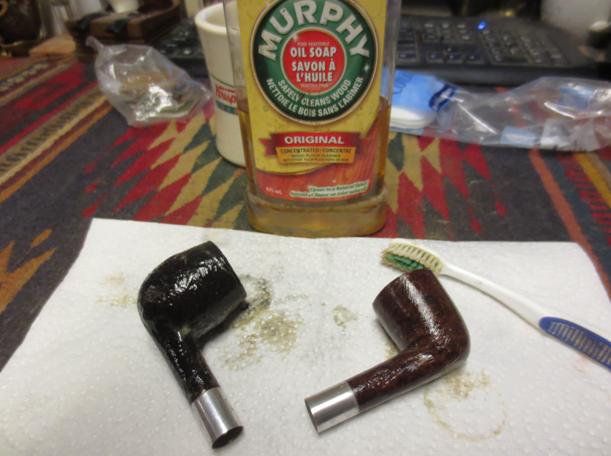
Meer7 The close up photo of the rim shows the rim damage and the damaged airway in the bottom of the bowl.Meer8 The next photo shows the oxidized aluminum tenon on the stem. I thought about adding a coating of superglue to the tenon to tighten the fit but that would not do anything for the diameter issue. I was pretty sure that I would have to restem this pipe to get a good fit on the stem and shank union. In the mean time I cleaned up the bowl. I should have paid attention to my initial thoughts here and just set the stem aside but I did not and would regret it soon enough.Meer9 In the mean time I cleaned up the bowl. I used a medium grit and a fine grit sanding block to remove the tars and deposits on the rim. I scrubbed the bowl with Murphy’s Oil Soap to remove the grime on the surface and leave as much of the patina intact as possible.Meer10

Meer11

Meer12

Meer13

Meer14 I decided to put a coat of superglue on the tenon and see if I could build it up for a snug fit. I should have left well enough alone. Needless to say my “quick fix” did not work. I got the fit correct or what I thought was correct and when I removed it from the shank I heard a popping sound and noticed that I a small chunk of meerschaum had cracked and come out of the shank. I was sick with having broken a chunk out of the shank because I had not gone with my first instinct of cutting a new stem. Now I had made work for myself. I glued the chunk back in place on the shank with some epoxy and then cleaned up the repair so I could band it. I had used some brass pressure fittings on some meerschaum pipes I had restemmed earlier and like the look of them so I found one that was the right diameter for this shank as well. I heated it with a heat gun and pressed it in place on the shank. I covered the majority of the repaired shank and protected it from breaking further.Meer18

Meer15

Meer16

Meer17 I found a stem that was the right diameter for the shank of the pipe in my can of stems. I sanded the tenon to get a snug fit in the shank and put it in place. The photos below show the stem before I had put the finishing touches on it and cleaned it up. They do give a good idea of how the new stem will look with the band.Meer19

Meer20

Meer21

Meer22 The stem style is wide at the button and more tapered than the one that had probably graced the pipe originally but I liked the new look of it. I sanded it with 220 grit sandpaper to remove the tooth chatter and tooth marks at the button. I also sanded to remove the oxidation. I sanded it with a medium and a fine grit sanding sponge. I sanded the bowl with micromesh sanding pads- 1500-12000 grit and polished it by hand.Meer23

Meer24

Meer25

Meer26 I sanded the stem with micromesh sanding pads – wet sanding with 1500-2400 grit sanding pads and dry sanding with 3200-12000 grit pads. I rubbed the stem down after each set of three pads with Obsidian Oil and then kept sanding. When I finished with the 12000 grit pad I gave it a final coat of oil and let it dry.Meer27

Meer28

Meer29 When it was dry I buffed the stem with Blue Diamond on the buffing wheel until it shone. Then I gave it multiple coats of carnauba wax and buffed it by hand with a microfibre cloth. I gave the bowl several coats of white beeswax paste that I have here and then buffed it as well. The finished pipe is shown in the photos below. I am actually happy how the finished pipe turned out. The issues that arose during the clean up worked out better than I had expected. For that I am thankful.

The meer polished up nicely and the spotty brown colouring was a nice contrast with the brass and the black vulcanite. I like the look of the band on the shank and only wish that I had not cracked the shank and made it necessary and not just cosmetic. Ah well it is nearly invisible and it will still give a good smoke. I need to figure out some way to repair the airway on the inside of the bowl. I am still puzzling over several options but will probably use a natural plaster of Paris to build up the groove on the back wall of the bowl. Time will tell. I will add that repair to the end of this blog once I decide how to do it. Thanks for looking.Meer30

Meer31

Meer32

Meer33

Meer34

Meer35

A Pair of Millard Perfect Pipes – A Sandblast Apple and Dublin


Blog by Steve Laug

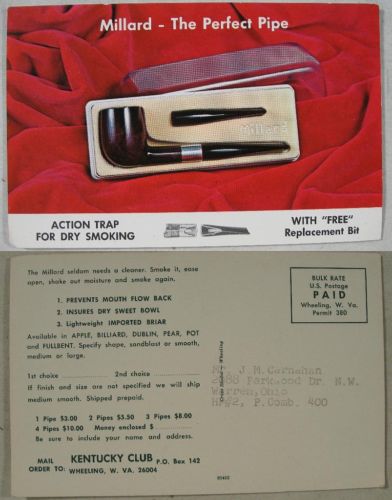
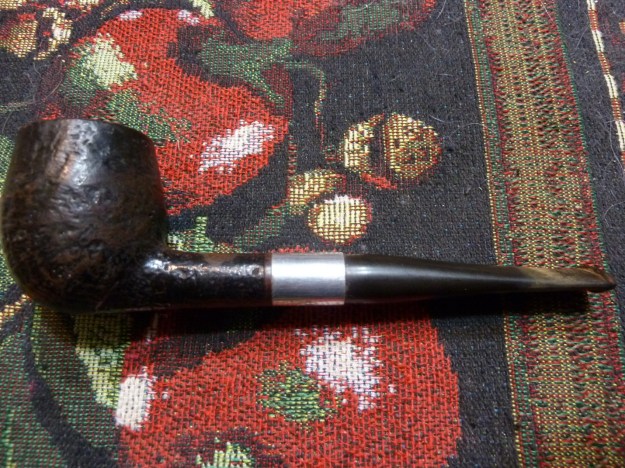
When I came across the Millard – the Perfect Pipe coupon in the two boxes of Kentucky Club that I found I was fascinated with the look of the pipe. It reminded me of the Keyser Hygienic pipes that I had restored over the years. The stem that fit into the metal mortise shank insert and the tubes on the inside of the stem and the shank were similar. While the Keyser tubing in the shank looked identical the one in the stem was different. Keyser was directed downward while the Millard was two straight tubes that met in the mortise. They did not touch but the metal chamber became a condensing chamber, or as they call it an Action Trap, for the smoke and collected the moisture before it continued through the tube in the stem. I looked up the brand online and found the following advertisement postcard that shows the way the system works. I found that the stems were interchangeable between the shapes that the pipe came in. The straight stems could be easily transferred from pipe to pipe. In fact the pipe originally came with an extra or replacement stem. The pipe came in a sandblast and a smooth finish in six shapes – apple, Dublin, billiard, pear, pot and bent. It came in two sizes: medium or large. In the advertisement below you can see that the pipe cost $3. I also found that Mastercraft supplied the pipes through the coupon sales. Knowing a bit of history about the company I know that they did not make pips so they were sourced from the original manufacturer.Millard1I mentioned in the Kentucky Club Blog that I would love to get my hands on one of these. I received a comment from one of the readers, Pam who offered to send me one. She had picked one up in a lot of pipes she was working on restoring. I could have it. I thanked her and she sent me the following photos of the pipe. It is a little (or what Kentucky Club called Medium in the advertisement above). It was a sandblast apple. It was in decent shape and would clean up quite nicely. The finish was spotty and the stain was lightened and missing in some spots. The rim had some buildup of tars. The cake was quite thick. The inner rim edge was out of round. The stem was oxidized and had some calcification in front of the button.Millard2

Millard3

Millard4 While I awaited the arrival of Pam’s gift I took a look on eBay and found that the pipe that I had pictured in the Kentucky Club Blog was for sale. The seller wanted $12 for the pipe. It was a Dublin shaped pipe with a smooth finish. It looked to be a Medium sized Millard as well. On a whim I put a bid on it and won. The seller said that it was restored but my past experience with these kinds of sales made me pretty certain that all that it meant was that it was polished. Now I went from no Millard pipes to two in a matter of days. The photos that follow were from the seller. The pipe looked sound. The finish was pretty decent though there were ripples and dents on the bowl sides. The beveled rim was not clean and there were still spots where the tars had been left and polished. The inside of the Action Trap was dirty with tars and oils. The stem had some tooth chatter and dents. Once the pipe arrived I would have a better idea of what I had to work with on this one.Millard5

Millard6

Millard7

Millard8

Millard9

Millard10 Pam’s gift pipe arrived first. It was a beautiful smaller sized apple (even though the advertising from Millard called it a Medium). The length was 6 inches. My original assessment from the photos proved to be pretty accurate. The finish was worn but the sandblast was quite nice – shallow but still tactile. The light spots on the top of the shank were spots where the finish was gone but the blast was still present. The cake was thicker than I thought it would be, particularly in the bottom of the bowl. The bowl was more out of round than I had guessed and had a burn spot on the back middle inner edge that contributed to the misshapen inner edge. The tar build up was deep and there appeared to be a burn spot on the top of the rim at the front right side. The inside of the shank, the Action Trap, was dirty and had tar, oil and tobacco shellac. The airway was tight and constricted when I blew air through it. The stem was oxidized and under the calcification there were some deep tooth marks and cuts that would need to be addressed. The inside of the stem has a chamber with the tube in the middle and that area was dirty with tars and oils. The airway was constricted even more than the one in the shank. I was pretty sure that something was clogging it and causing the constriction. The slot had been reduced by half with the buildup of grime.

The second pipe arrived at my home a short time after Pam’s. It too proved my original conjecture about the concept that some people have of what “restored” means. This pipe had been given a light polish on the briar and the stem. The polish had merely wiped over the dents, dings and scratches on the briar. There were ripples along the top of the shank. The rim still had spots of tarry buildup that had been polished and there were scratches from what looked like a quick scrub with a coarse scrubber. The bowl had a slight ridge around the inside just below the rim from an incomplete reaming. The inside of the Action Trap was dirty and the oils and tars had hardened. The airway was constricted and dirty and the opening in the bowl bottom was plugged with grit. The aluminum mortise insert was oxidized and dull. The stem was oxidized and there were ripples in the surface from where someone had either buffed hard or tried to remove tooth chatter or tooth marks. The inside of the stem chamber was dirty with tars and oils and the inside of the stem looked as if it had never seen a pipe cleaner. So much for the term “restored”.

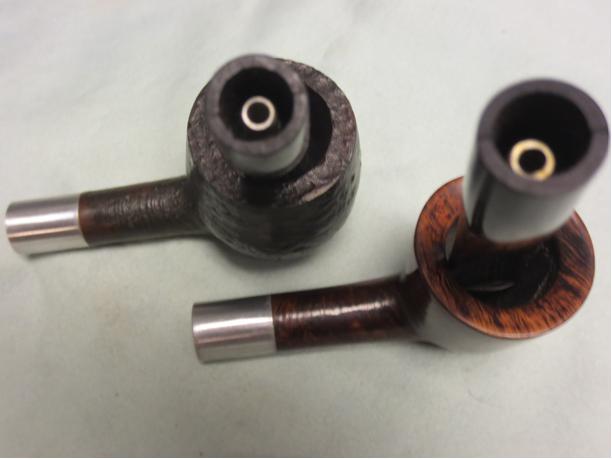
I decided to work on both pipes at the same time so that I could compare the internals and the briar on them. It would be a fun project to do them both together and watch the truly restored pipes emerge from the tired pipes that had arrived at my work table. The next four photos show the pair together.Millard11

Millard12

Millard13

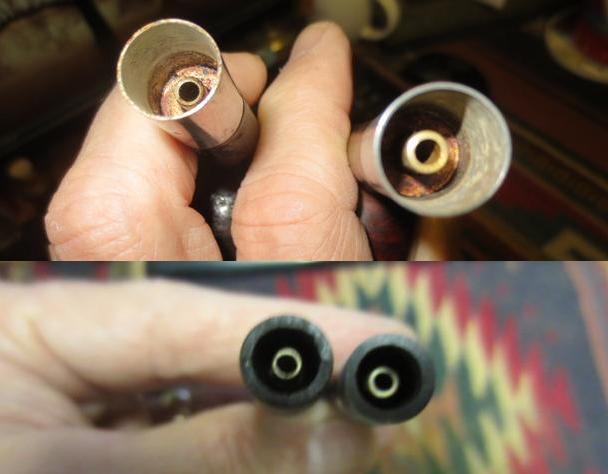
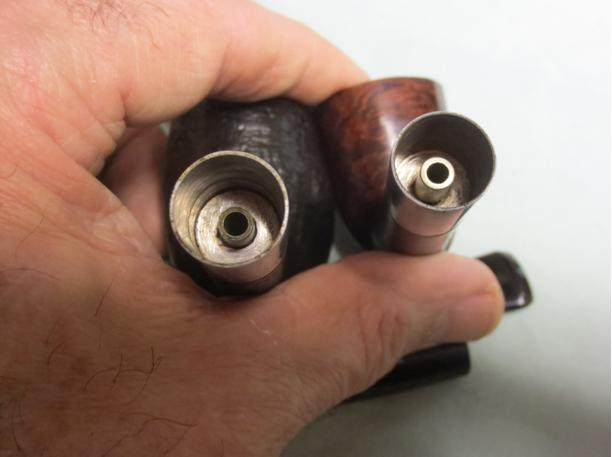
Millard14 I took some close up photos of the two bowls to show what I would be working on. The first photo shows the bowl of the apple shaped pipe. You can see the cake and the damage to the top of the rim. The bowl is out of round. The second photo shows the rim of the Dublin and you can see the scratches and the incomplete cleaning of the rim tars.Millard15 The next photo shows the stems removed from the shanks. The stems are interchangeable so as I had expected from the advertisement shown above one stem size and shape could be used interchangeably on any of the straight pipes.Millard16 I took a photo of the internals of the mortise insert to show the tube inset in the middle of the aluminum chamber. This is the Action Trap that the adverts spoke of. The “restored” Dublin was just as dirty inside as the untouched apple sent by Pam. While both look the same the tube in the Dublin extends further into the Trap than the one in the apple. The second photo shows the end view of the two stems. You can see the tube inset in the middle of the stem. Again the tube in the Dublin stem is shorter than the one in the apple. I am not sure the reason for this as when both are interchangeably inserted in the bowl the draw and fit is identical so it may well be just inconsistency in the manufacture.Millard17 I cleaned up the inside of the Dublin bowl with a PipNet reamer to remove the ridge along the top portion of the bowl just below the beveled rim. I scrubbed the rim with saliva and cotton pads to work on the tars left behind. I found that they were hard so I used a 1500 grit micromesh pad to sand and work on the deposits until they were gone and the rim was smooth. It also worked to remove the scratching on the rim that had been left behind by the previous “restoration”.Millard18 I reamed the bowl on the apple with the PipNet reamer and took the cake back to bare briar. The second photo shows the large amount of carbon that I removed from the bowl.Millard19

Millard20 With the bowl reamed you can see the damage to the inner edge that left the bowl out of round. There was a burned area on the rim at that point that did not go too deeply into the bowl but it was present. I scrubbed the rim with a brass bristle tire brush to remove the overflow of cake on the rim.Millard21

Millard22 I scrubbed both bowls with a tooth brush and Murphy’s Oil Soap to remove the spotty finish on the apple and the grime on both bowls. I also removed the polish that had been applied to the Dublin so I could work on the scratches and dings. After scrubbing them I rinsed them under warm water in the sink to remove the soap and the grime that had been loosened.Millard23

Millard24

Millard25

Millard26 I scrubbed both bowls with acetone on a cotton pad to remove the remaining finish and clean up the briar. The finish on the Dublin was pretty clean. The one on the apple came off with the scrubbing and the remaining finish was removed.Millard27

Millard28 With the bowls and finish cleaned up it was time to address the internals. I used pipe cleaners, cotton swabs and alcohol to clean out the debris in the shank and the mortise of both pipes. I used a folded pipe cleaner and a cotton swab that I thinned the cotton on to get inside of the mortise to clear out the build up there.Millard29 To address the damaged rim on the apple I decided to top the bowl. I set up the topping board and a piece of 220 grit sandpaper and worked on the rim to flatten it and remove the damaged areas. In doing this I found another burned spot on the front right top of the rim. I worked on the inner edge of the rim with a folded piece of sandpaper to correct the out of round condition. When I was finished the rim looked far better. Now I needed to work on rusticating the rim to match the sandblast on the finish of the pipe.Millard30

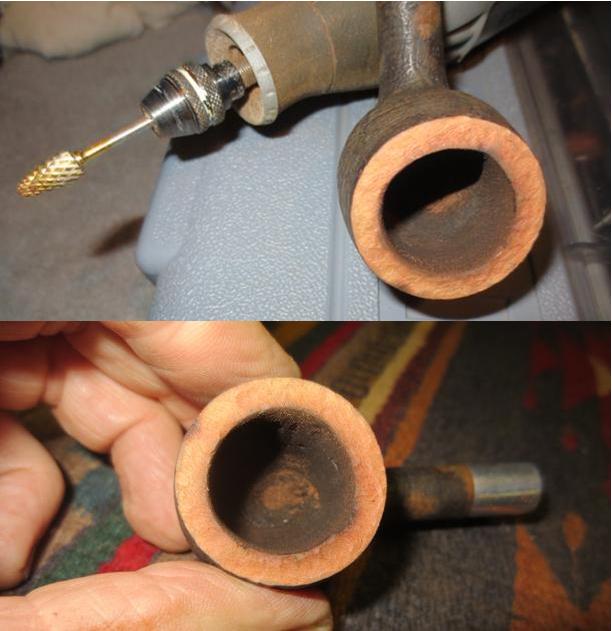
Millard31 To rusticate the rim I used a dental burr in my Dremel and carefully worked it over the surface of the bowl rim. It had to be deep enough to show, tight enough to look like a sandblast and somehow blend into the bowl finish. I carefully worked the Dremel over the surface being careful to keep it on the flat rim and not damage the edges of the inside or outside of the bowl. The next two photos show both the burr and the work done on the rim. Though it is a little hard to see the rustication came out really well. It will become clear in later photos.Millard32 I stained the bowl and rim with a dark brown aniline stain. I applied the stain and flamed it. I reapplied it and reflamed it.Millard33

Millard34

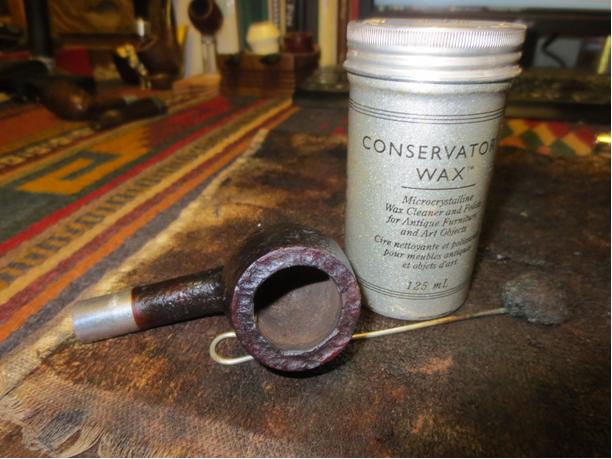
Millard35 The next photo shows the rustication very clearly. I touched it up with a dark brown stain pen and then waxed the bowl and rim with a microcrystalline Conservators Wax. The bowl was looking far better.Millard36

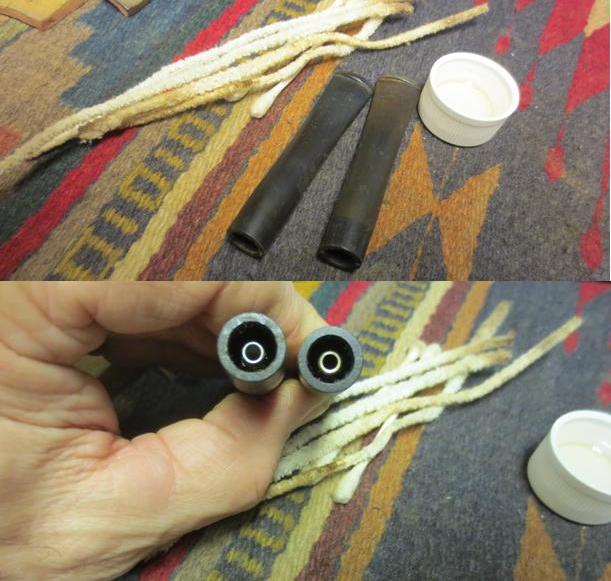
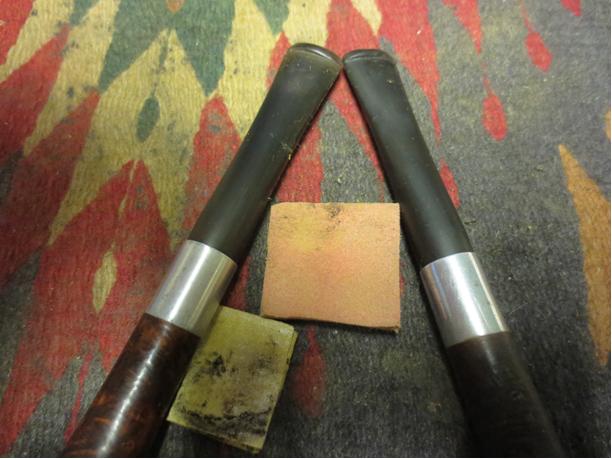
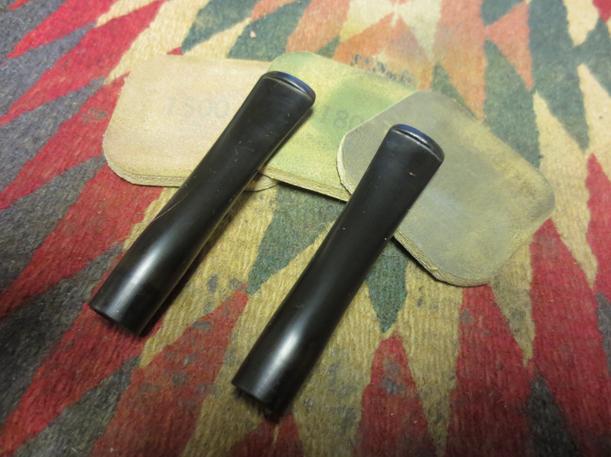
Millard37 With the basic work done on the bowls and rims I turned my attention to the stems. I cleaned both stems with pipe cleaners, alcohol and cotton swabs until they were clean. I picked out the slots on both stems with a dental pick to make sure they were wide open. The stem on the Dublin had a very tight draw. I ran a straightened paper clip through the stem and a large chunk of tar and cotton from pipe cleaners dropped out of the end. The draw was unconstricted and the airflow was clear in both stems.Millard38 I sanded both stems with 220 grit sandpaper to remove the oxidation and also clean up the tooth marks and ripples in the surface of the vulcanite. I sanded them with a medium and fine grit sanding sponge to remove the scratches left behind by the sandpaper. I repaired the tooth damage and the cuts in the surface of the stem for the apple with black super glue. After the repair had dried I sanded it with 220 grit sandpaper and the sanding sponges once again.Millard39 I wet sanded the stems with 1500-2400 grit micromesh sanding pads. I rubbed the stems down with Obisidian Oil and then dry sanded with 3200-4000 grit pads. I gave the stems another coat of oil and dry sanded with 6000-12000 grit pads. I buffed the stems with Blue Diamond on the buffing wheel and then gave them several coats of carnauba wax. I buffed them with a clean flannel buffing pad and then a microfibre cloth.Millard40

Millard41

Millard42 I polished the aluminum ferrule/mortise inserts on the shanks with the last three grits of micromesh sanding pads and then rubbed them down with a jeweler’s cloth. I lightly buffed the stems and bowls with Blue Diamond and then gave the entire smooth pipe several coats of carnauba wax. I buffed the two pipes with a clean flannel buff and then with a microfibre cloth to raise the shine. The inside of the Active Trap is stained but it is clean. These are a couple of great looking pipes now. The rusticated rim worked really well with the finish on the bowl and gives the apple a clean look. The clean beveled rim on the Dublin has a rich shine that shows the grain off very well. The finished pipes are shown in the photos below. Thanks for looking.Millard43

Millard44

Millard45

Millard46

Millard47

Millard48

Millard49

Millard50

Millard51

Repairing Cracks in a Large WDC Wellington Bent


Blog by Steve Laug

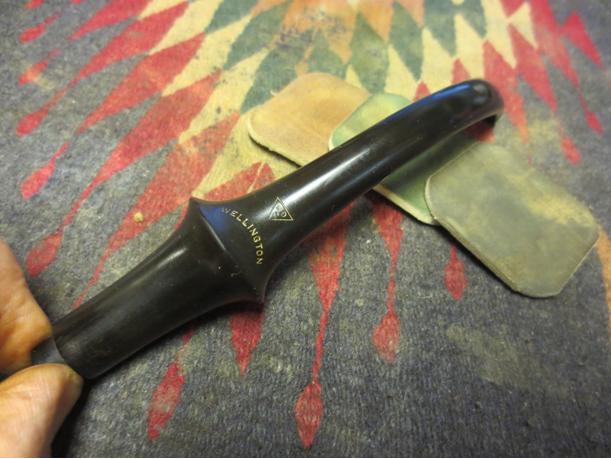
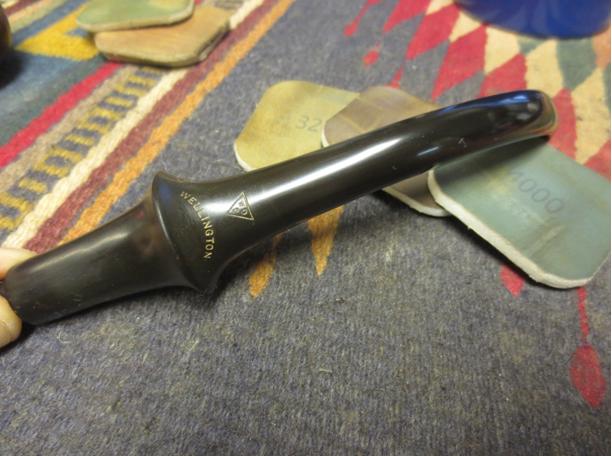
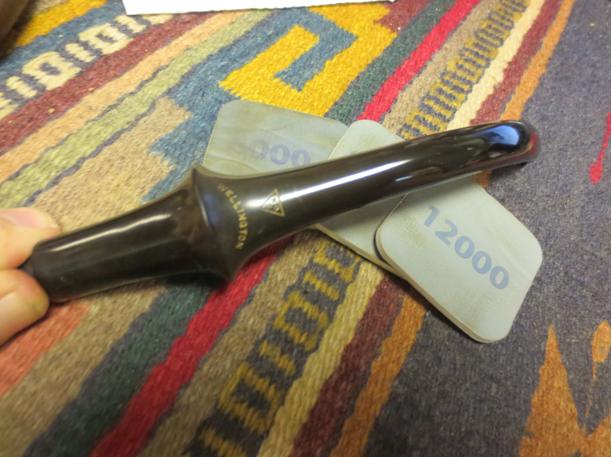
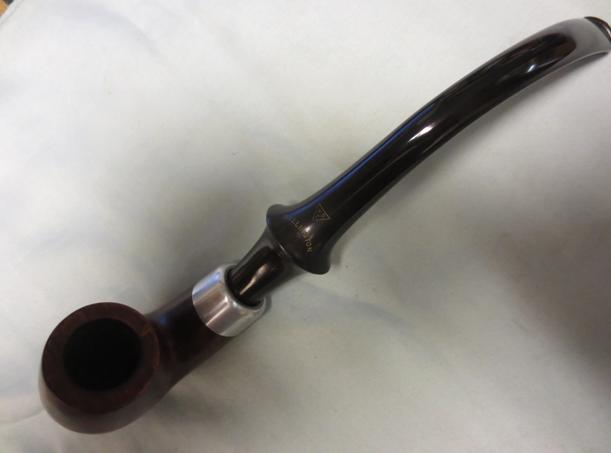
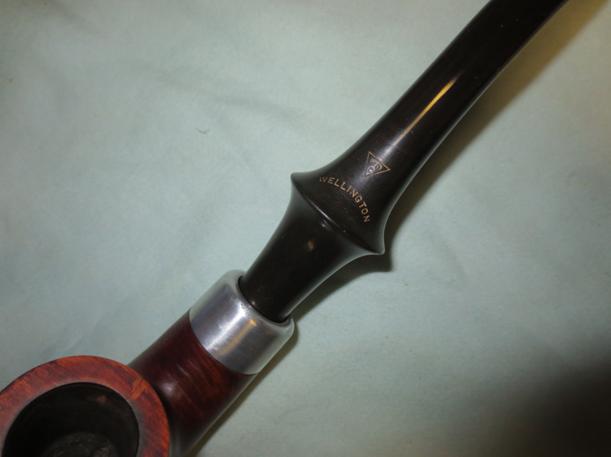
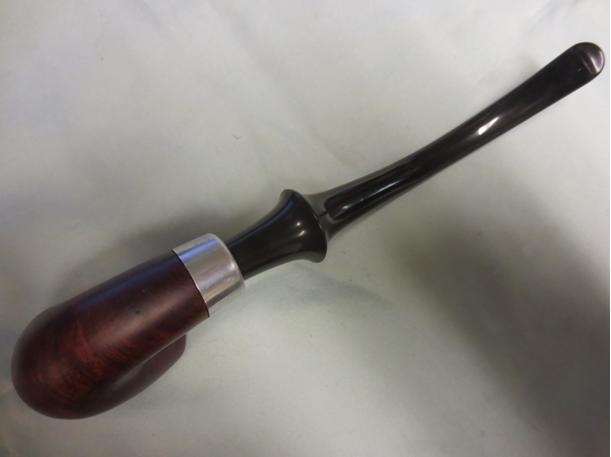
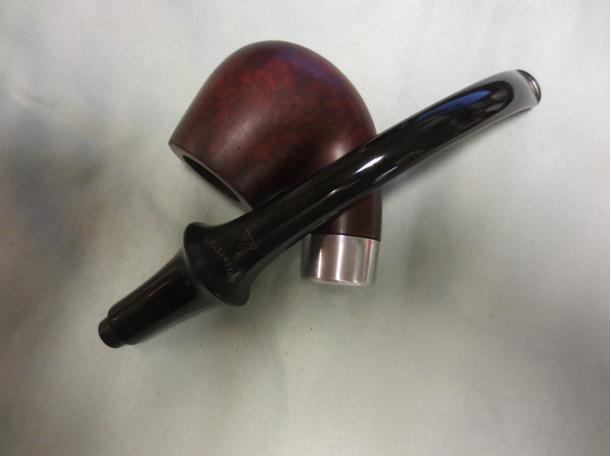
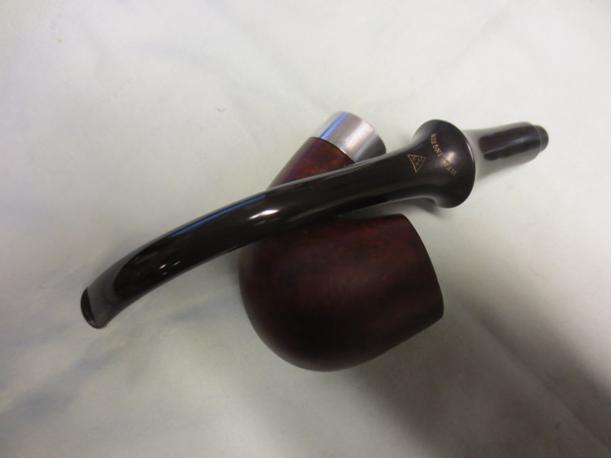
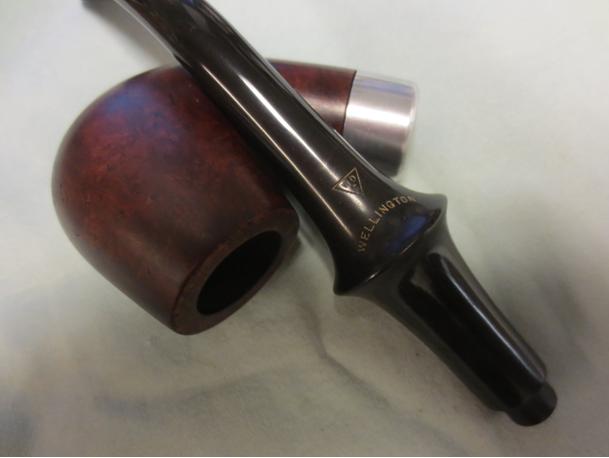
Through Facebook I connected with a new friend Warren. He wrote me about how to repair a crack in a pipe that he was reworking for a friend of his. As I described the process he asked if he could send it to me to work on. At that point my refurbishing box was getting low as I had repaired and moved out a lot of the pipes that had been there. So I agreed. Last week it arrived here. A funny side note is that I have a stem for the same pipe and have been looking for a bowl for the stem for a while now. Now I get the opportunity to work on a pipe with the same stem. It is stamped WDC in a triangle on the stem with Wellington arced below the triangle. It is also stamped on the left side of the shank with the WDC triangle and Wellington in script to the right of the triangle. Underneath the script it reads Imported Briar. There is no other stamping on the pipe. It is a large pipe with a length of over 10 inches and a bowl height of 2 inches. The diameter of the bowl is 7/8 inches. The third picture below shows a comparison of a 5 ½ inch long pipe and average bowl so you can see how big this pipe truly is.Wellington1

Wellington2

Wellington3 The briar had some attractive grain in it but there were some issues as well. It had a lot of fills on the front left, front right and bowl front. There was some damage to the surface of the rim that looked as if the pipe had been dropped on concrete. The outer edge of the rim on the front had some damage and was rounded over and the inner back edge of the rim had burn damage that made that portion out of round. Fortunately it was not a deep burn and would be relatively easy to address. There was also a ¾ inch crack on the underside of the shank that had one ¼ inch branch going toward the left side of the shank.Wellington4

Wellington5 I took a series of close up photos to show the damaged areas of the pipe. The first shows the damage to the rim surface and edges. The second shows the crack in the shank. The third photo shows the missing fills and divots in the bowl sides.Wellington6

Wellington7

Wellington8 I decided to address the crack in the bottom of the shank first. I used a micro drill bit on my Dremel to drill some small holes at the end of the crack and the branches of the crack to stop the damage from spreading further. The bit is very tiny as can be seen from the holes that are left behind after drilling. I drill two holes on each end because after the first hole I examined it with a lens and could see that extended slightly beyond my first hole. I picked out the damaged putty fills with a dental pick and wiped the bowl down so that I could repair the crack and the fills. I used a clear super glue and fine briar dust to replace the fills and to fill in the drill holes on the shank bottom. In each case I over filled the holes so that as the glue and dust were sanded I would not need to repeat the process due to shrinkage.Wellington9

Wellington10

Wellington11

Wellington12 My intention was to restain the entire bowl so I sanded the bowl and the repairs with 220 grit sandpaper to smooth out the repairs. I followed that by sanding the bowl and repairs with a medium and a fine grit sanding sponge.Wellington13

Wellington14

Wellington15 I reamed the bowl with a PipNet reamer starting with the head that would fit and working up a head that took the cake back to bare briar. In looking at the back side of the bowl I could see a small hairline crack and I wanted to know if it went all the way through.wellington16

Wellington17 I topped the bowl with the topping board and took off all of the damage to the inside and outside rim as well as the rim surface. I sanded it with the medium and fine grit sanding sponge as well to smooth out the scratches.Wellington18

Wellington19 After sanding and topping the bowl I could see that indeed there was a hairline crack that went across the rim at 5 o’clock and went down the back side of the bowl about ¾ of an inch. It was small and did not separate. It looked like it went all the way through to the inside of the bowl but upon examination appeared to only extend about 1/16th of an inch into the bowl. I topped it a little bit more to take care of the internal crack. I drilled the back side of the bowl at the bottom of the crack to stop it from going further down the bowl.Wellington20 I wiped down the bowl side and then picked out the crack with a dental pick. I filled it with super glue and briar dust and sanded it down with 220 grit sandpaper and the medium and fine grit sanding sponges until it blended into the surface of the bowl. I picked out the rim crack as well and filled it with the same mix. I sanded it with the topping board once again and then with the medium and fine grit sanding sponge.Wellington21

Wellington22 I scrubbed the bowl with acetone on cotton pads to remove the remaining finish on the briar and to clean up the dust from all of the sanding of the fills. There was some beautiful grain that was showing through. The patches and fills actually looked much better.Wellington23

Wellington24

Wellington25

Wellington26

Wellington27 I cleaned out the shank, bowl and airway in the shank and stem with alcohol, cotton swabs and pipe cleaners.Wellington28

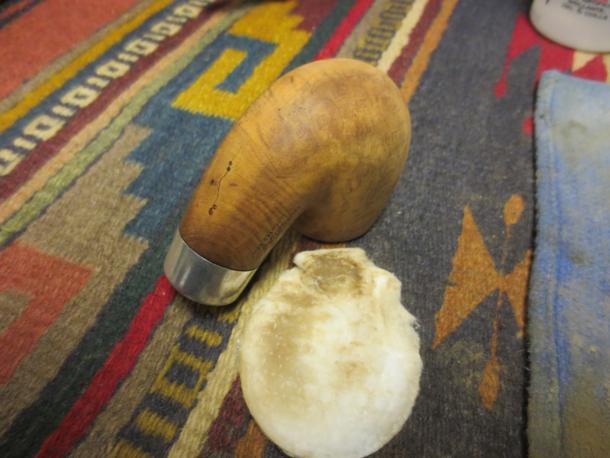
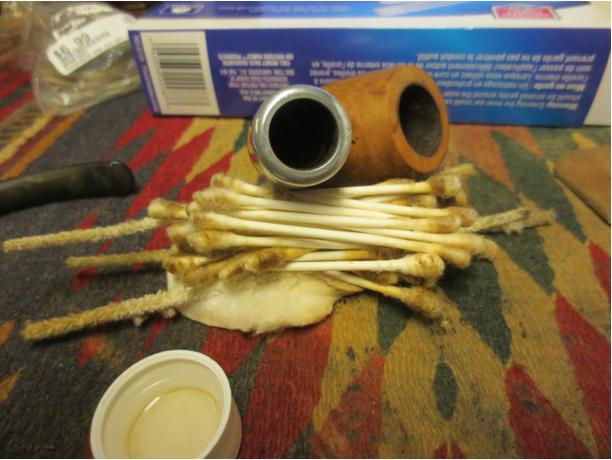
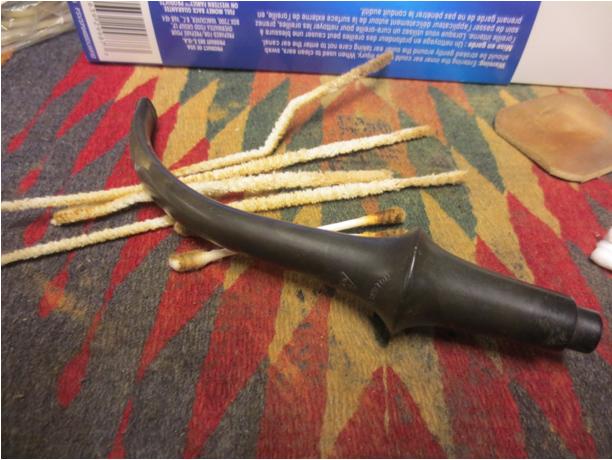
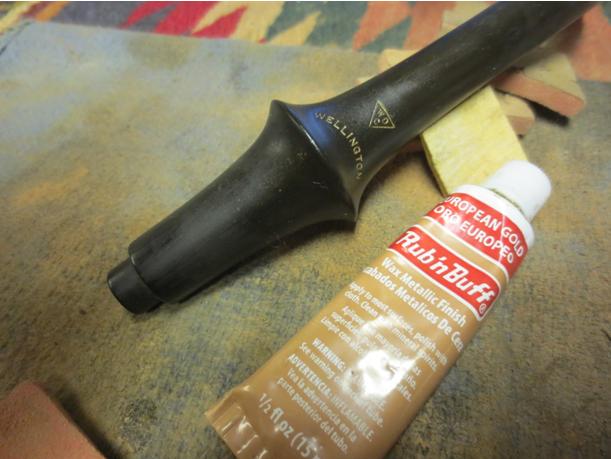
Wellington29 I sanded the stem with 220 grit sandpaper and a medium and fine grit sanding sponge being careful not to damage the stamping. I went over that area with a 1500 grit micromesh pad. I then use an antique gold oil based product called Rub and Buff to fill in the stamping. The next photo shows the finished rework of the gold in the stem stamp.Wellington30 I put the stem in place on the bowl to get an idea of the improvement that the repairs, fills and stem work had done. I wanted to see what the pipe would look like as I finished.Wellington31

Wellington32

Wellington33

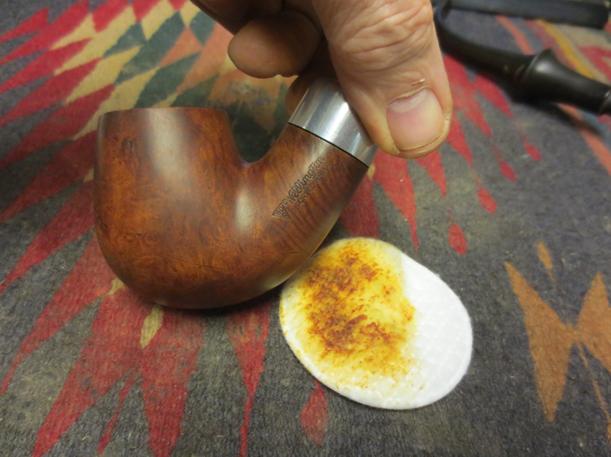
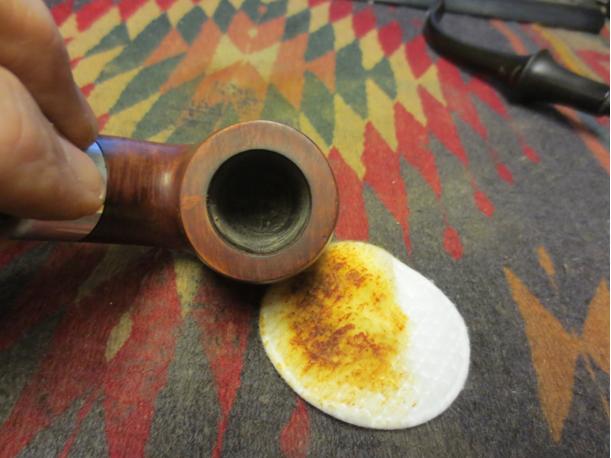
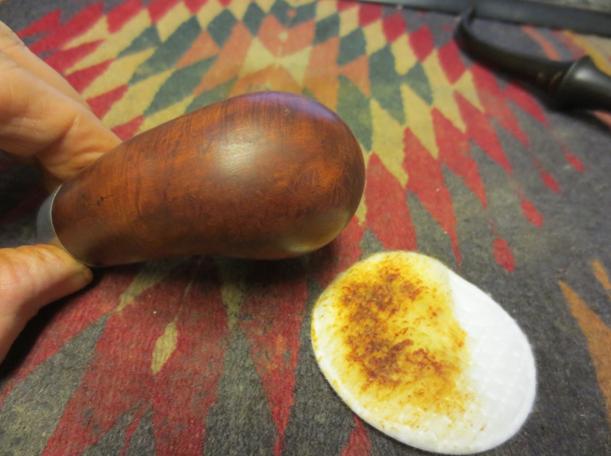
Wellington34 I wiped the bowl down with a final wash of isopropyl alcohol and then heated it so that I could give it a stain coat. I stained it with a dark brown aniline stain thinned by 50% with isopropyl alcohol. I applied it and flamed it. I reapplied the stain and flamed it again and then set it aside to dry.Wellington35

Wellington36 When it had dried I gave it a light buff with a microfibre cloth to see what the colour looked like. It was still a bit dark to my liking but the coverage was good. The repairs and fills while visible looked far better than when I started.Wellington37

Wellington38

Wellington39

Wellington40

Wellington41 I wiped the bowl down with alcohol on a cotton pad to make it a bit more transparent and make the grain shine through. It did not take much to coax the grain to the surface and highlight the beauty of the pipe.Wellington42

Wellington43

Wellington44

Wellington45 I worked on the long stem. To clean it thoroughly I had to wrap pipe cleaners together to extend the length of the stem. I wet sanded it with 1500-2400 grit micromesh sanding pads to clean up the oxidation and scratches in the stem. I rubbed it down with Obsidian Oil afterwards and then dry sanded with 3200-4000 grit micromesh pads. I gave it another coat of oil and then finished sanding it with 6000-12000 grit pads. I gave it a final coat of the wax and set aside to dry.Wellington46

Wellington47

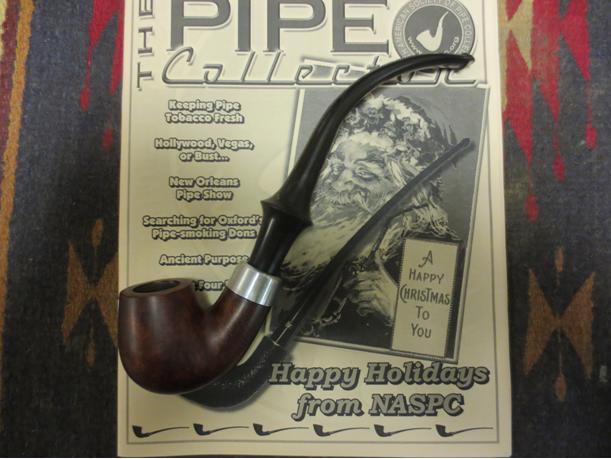
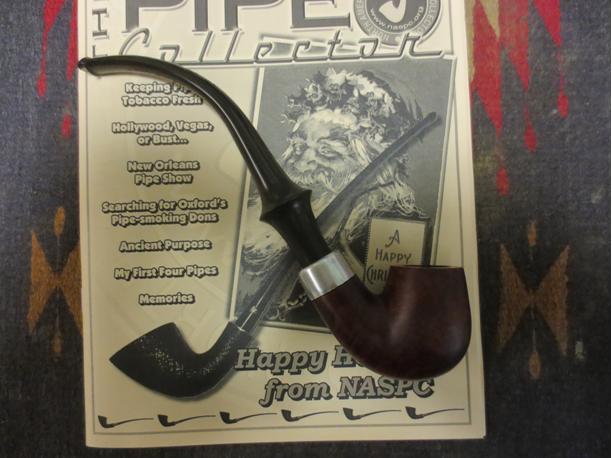
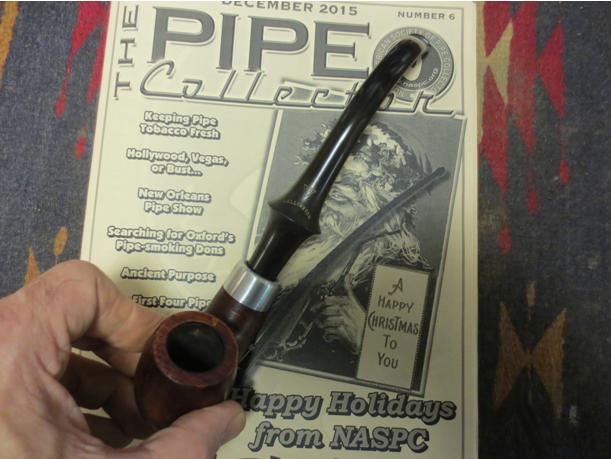
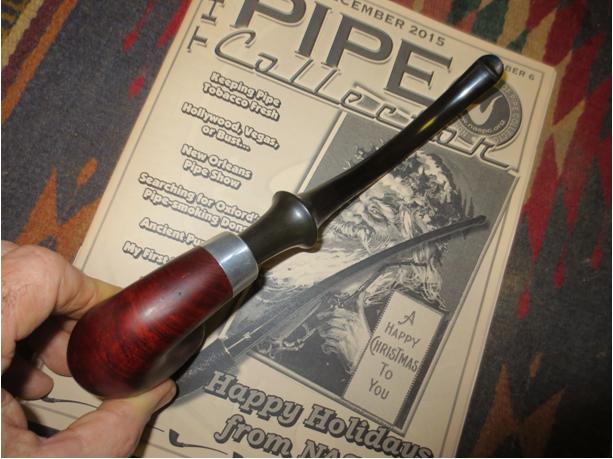
Wellington48 At this point I laid the pipe on top of the current issue of the Pipe Collector and took a series of photos to show it before I buffed it.Wellington49

Wellington50

Wellington51

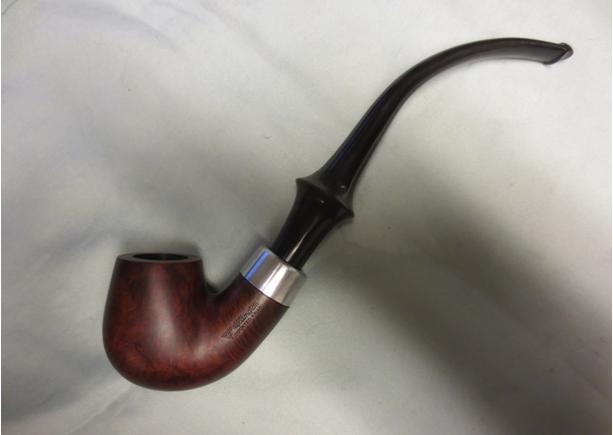
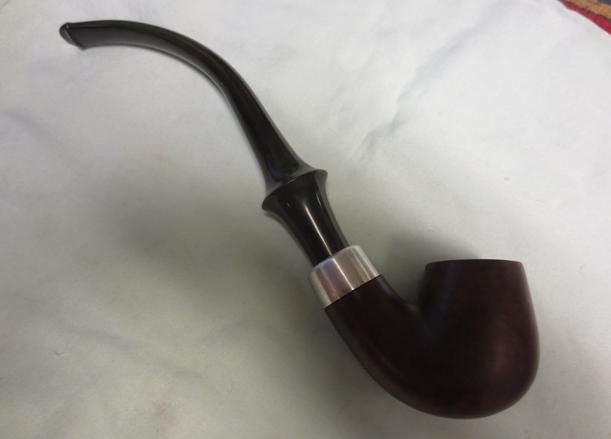
Wellington52 I polished the nickel ferrule with a silver polishing cloth and gave it and the bowl several coats of carnauba wax. A light touch is imperative on the nickel as it will darken the buffing pad and then transfer to the bowl. I hand buffed the bowl and ferrule with a microfibre cloth. I buffed the stem with Blue Diamond polish on the wheel and then gave it several coats of carnauba as well. I buffed the stem with a clean flannel buff and then with the cloth as well. The finished pipe is shown below. It is repaired and serviceable for many years to come. Thanks for looking. Thanks for the challenge Warren.Wellington53
Wellington54

Wellington55

Wellington56

Wellington57

Wellington58

Wellington59

Wellington60

What a Mess – A Vanguard Reg’d. Lumberman with a Bit of History


Blog by Steve Laug

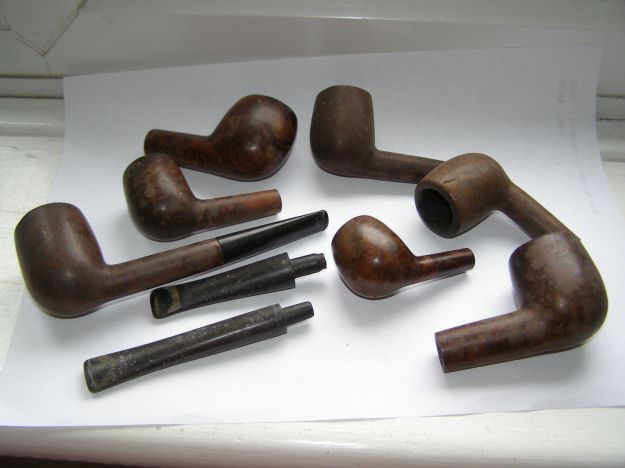
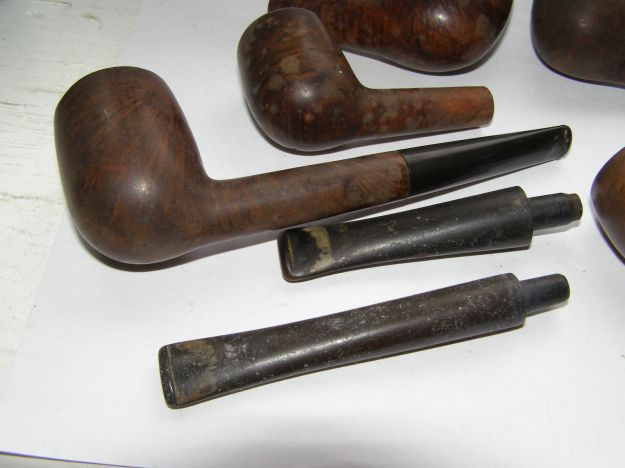
I recently came across an EBay lot of bowls without stems and broken tenons still in the shanks. In the lot was one that intrigued me. It was the only one with a stem. The stem was short and tapered. It was very narrow and the button and slot made me think that it was old. The lot had the look of older English pipes but there was no information on the stamping. When the lot arrived in Vancouver, the stemmed pipe was stamped Vanguard over Reg’d on the left side of the shank. All other stamping, if there had been any, was lost.lot1 The bowls finish was gone. The colour was almost grey and there were spots all over this bowl and the others as can be seen in the photo below.lot3 From the third and fourth photo provided by the seller I could see that the shank was cracked and would need to be addressed. The rim appeared to be very thickly covered with lava and the outer edge had been damaged and rounded.Lot5 The next photo shows the large crack that was present in the shank of the pipe. It had started to open and the edge of the shank where it met the stem had some nicks.lot8 When the box arrived the pipe was actually in worse shape than the photos had shown. The bowl rim was not all that was caked with tars. The bowl itself was almost 1/3 full of half burned tobacco, dottle that was rock hard and filled the bottom of the bowl. The cake on the rest of the bowl was not thick but was very hard. The finish was not only grey and spotty but was dented and rough to the touch. I could feel the ridge where the sides of the crack in the shank had separated. The rim edges were not only damaged and rounded but were also rough from banging out the burnt tobacco against something hard. The stem had tooth marks and chatter on both sides of the stem at the button. The button and slot were intact. The stem appeared to be as old as or older than I first thought. This was going to be a challenge to bring back to life but the age of it made it something I could not wait to tackle.Van5
Van6

Van7

Van8 I took some close up photos of the state of the rim and cracked shank once the pipe arrived. It was a mess that is for sure. The rim and bowl were in bad shape and smelled awful. The shank crack was worse than I had imagined. The first photo of the cracked shank is from the top and the second photo is from the side.Van9

Van10 I looked up the Vanguard name in Who Made That Pipe and found that there were two makers. There was a French maker and an English maker. The French pipe was made by Marchal, Rouchon 1907 and the English one was made by A. Oppenheimer/Bernhardt & Meyers. Given that I cannot be definitive as to which maker crafted this pipe. But the interesting thing is that the Marchal & Rouchon Cie which later became GBD France came under control of Oppenheimer in Great Britain. So you can see that though I may not know which one ultimately made the pipe the fact is that the two brands came together in 1902 when Marchal & Rouchon Cie sold out to Oppenheimer. I now have in my collection a pipe which may well have bridged the union of the two companies. The Vanguard thus could easily bear both the French and the English stamping. The lack of a “Made in…” stamp may well signify the years that the companies joined. That in itself made cleaning up and restoring this old-timer interesting for me.
I decided to start the clean up by reaming back the cake and cleaning out the dottle from the bowl. I used a PipNet reamer and started with the smallest head and worked up to the one that fit the bowl. I took the cake back to bare wood to check for damage to the inside walls of the bowl. With a pipe this worn I find that this is extremely necessary. I do not want any surprises after I have cleaned it up.Van11

Van12 To repair the damaged shank I opened the crack as much as possible without making it worse and used a dental pick to push super glue into the crack. I pressed it together until it dried. I then used the sanding drum on the Dremel to take down the shank slightly so that a band would fit snugly on the shank and hold the crack tightly together. I pressed the band onto the end of the shank and took the picture below before I heated the band and pressed it into place.Van13 I heated the band with a heat gun and then pressed it against a flat surface until the band was in place on the shank. I pressed it onto the shank and then used a folded piece of sandpaper to clean up the edge of the band and shank. I left about 1/8th of an inch of the band extending past the shank to deal with the chipped and damage shank end. The stem would not have had a clean fit against the shank because of the damage. When the stem was in place it fit inside of the band against he shank and looked great.Van14

Van15

Van16 With the band in place the shank was repaired and the tenon would no longer fit in the mortise. The contraction of the briar by the band cleaned up the crack and tightened up the loose fitting stem. I lightly sanded the tenon with a sanding drum on the Dremel and then by hand to get a snug fit in the shank.Van17

Van18

VaN19

Van20

Van21 I scrubbed the surface of the briar with acetone and cotton pads to remove the grime, spotting and remaining finish. There was some interesting grain under the grime.Van22

Van23

Van24

Van25 The damaged rim surface and outer edge required that the bowl be topped. I used the topping board and 220 grit sandpaper to remove the damaged surface and sharpen the edge of the bowl.Van26

Van27 I scrubbed the surface of the bowl down again with acetone and cotton pads to remove the dust and grime from topping.Van28

Van29

Van30 I cleaned the inside of the shank and the stem with alcohol, cotton swabs and pipe cleaners. I used the drill bit from the Kleen Reem pipe reamer to clean out the airway from the mortise to the bowl. When I was finished I swabbed out the bowl with cotton swabs and alcohol and was pleased to find that the rank smell was gone.Van31 I sanded the bowl and stem with 220 grit sandpaper and a medium and fine grit sanding sponge to remove the tooth marks on the stem and scratches in the briar. I steamed the dents in the briar with a knife blade and wet cloth.Van32

Van33

Van34

Van35 I sanded the stem with micromesh sanding pads – wet sanding with 1500-2400 grit pads and dry sanding with 3200-12000 grit pads. I rubbed the stem down with Obsidian Oil between each grit and then continued sanding until I had worked through the lot of pads.Van36

Van37

Van38 I wiped the bowl down with a light coat of olive oil and then sanded it with 1500-2400 grit micromesh pads and then continued through the rest of the grits of pads. I continued to polish the bowl with the remaining grits of micromesh.Van39

Van40

Van41

Van42 I buffed the pipe with Blue Diamond polish on the wheel and then gave it several coats of carnauba wax. I buffed it with a clean flannel buff and then hand buffed it with a microfibre cloth. The finished pipe is shown in the photos below. It came out well for a pipe that potentially was made 108 years ago. Thanks for looking.Van43

Van44

Van45

Van46

Van47

Van48

Van49

Van50

Procrastination & Restoration


Blog by James Gilliam of JSEC Pipes

What can I say, I really enjoy making pipes. The time I’m afforded for sitting in front of a sanding wheel, at the lathe and sitting at my desk doing detailed work are some of my most relaxing moments. The creative juices are flowing and at times I feel as if I’m breaking new ground with Shape X or Following Line Y, all the while the end goal is just to create a pipe that will become a cherished object of relaxation by its owner.

And here we are, writing up a little story for Steve’s Blog. It isn’t often that I venture down the restoration path, and when I get stumped I end up asking Steve a question or two. So, on to my story……. Our neighbor’s husband recently passed away and soon after the funeral she come over and gave me his pipes. I was elated that she even considered that and wanted to do them justice by addressing some minor cosmetic issues the pipes had.
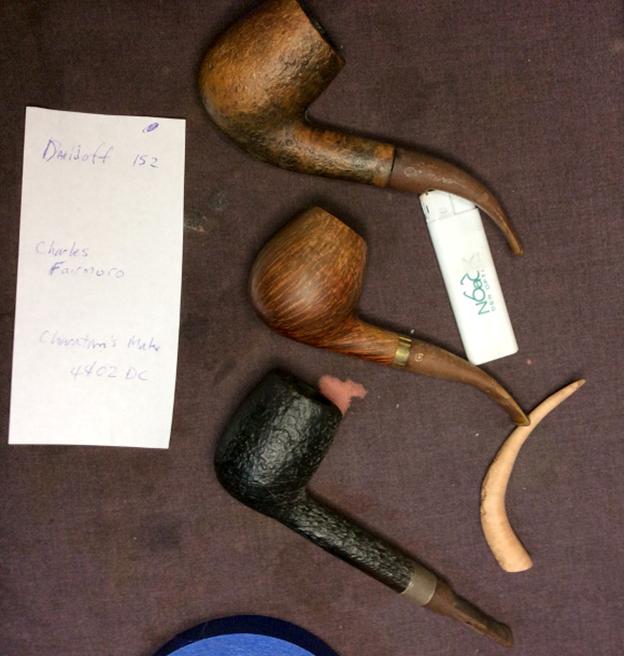
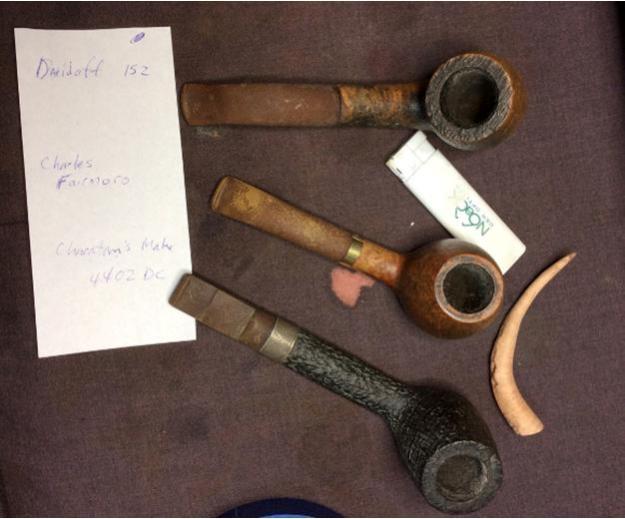
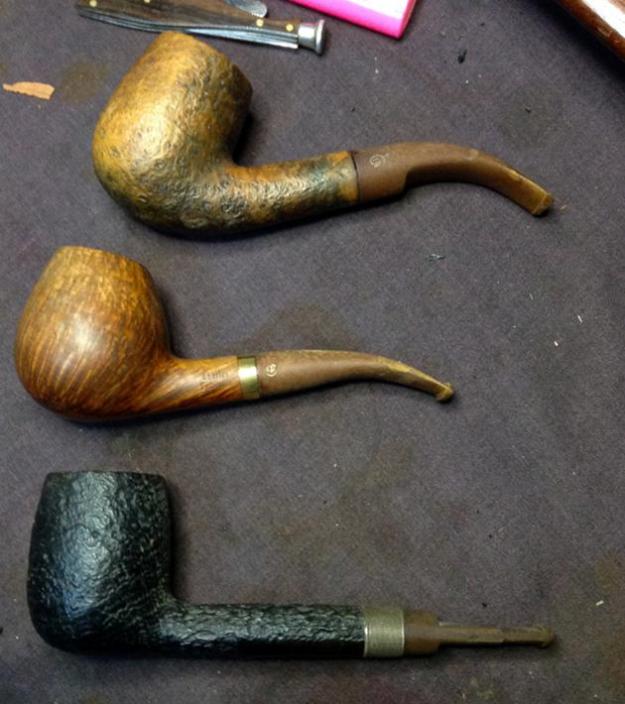
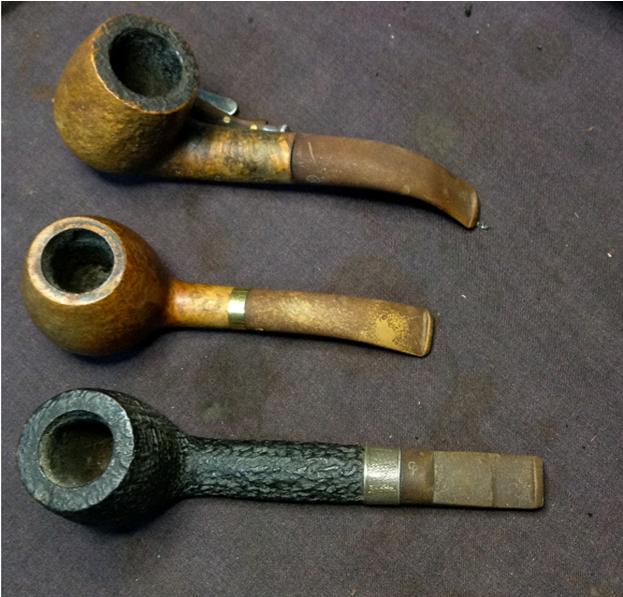
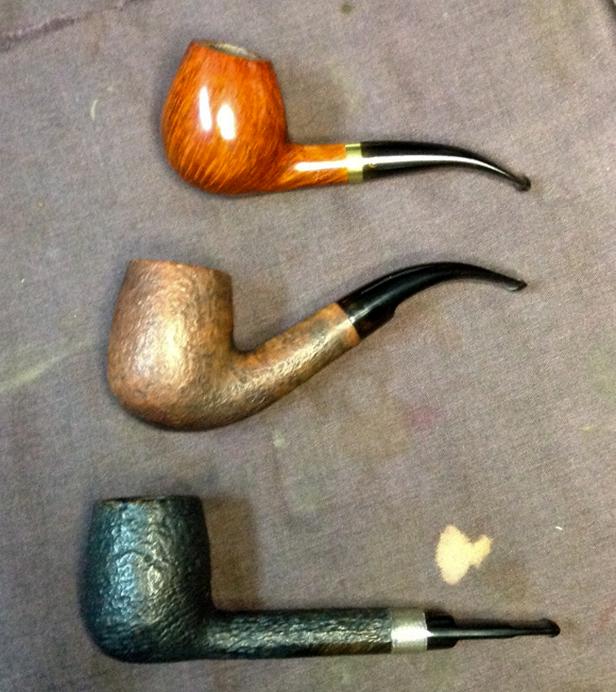
The trio consisted of (from top to bottom): a Davidoff 152 Sandblasted Bent Billiard, a Charles Fairmorn – Made in Denmark Bent Egg, and a Charatans Make 4402DC Silver Banded Lovat. And as you can see by the first picture, they were enjoyed by their previous owner. They all had been taken care of but It had been a few years since they had been smoked. They were lovingly displayed in his corner of the living room. A remembrance, I guess, for those days when he did smoke his pipes. He still enjoyed them, just didn’t smoke them anymore.James1

James2 The first order of business was addressing the oxidation on the stems. And I was stumped, as I’ve never seen oxidation this bad before. So after reading through the rebornpipes blog posts and contacting Steve I found what I needed to give the stems a little bath. I’m glad I sent Steve the email, as the bath that was enjoyed by all the stems made my efforts for oxidation removal rather easy. The best part is “most” of the stamping on the stems was savable, albeit on some a little fainter and not so pronounced as before. Had I just sanded the oxidation off, as I was inclined, there would be nothing else there. The oxidation really took its toll on the Davidoff stem, and about 1mm of diameter was no longer there after it was removed with a light sanding….. and I personally don’t find the new stem-shank junction off putting even though it was no longer flush.James3

James4

James5

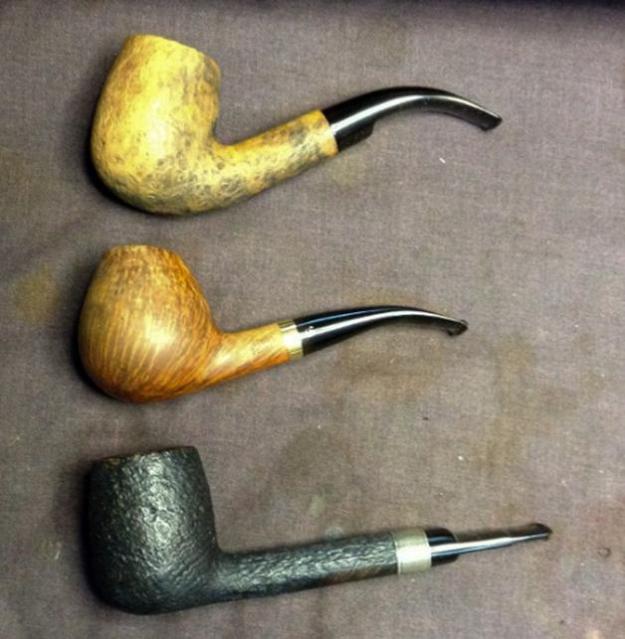
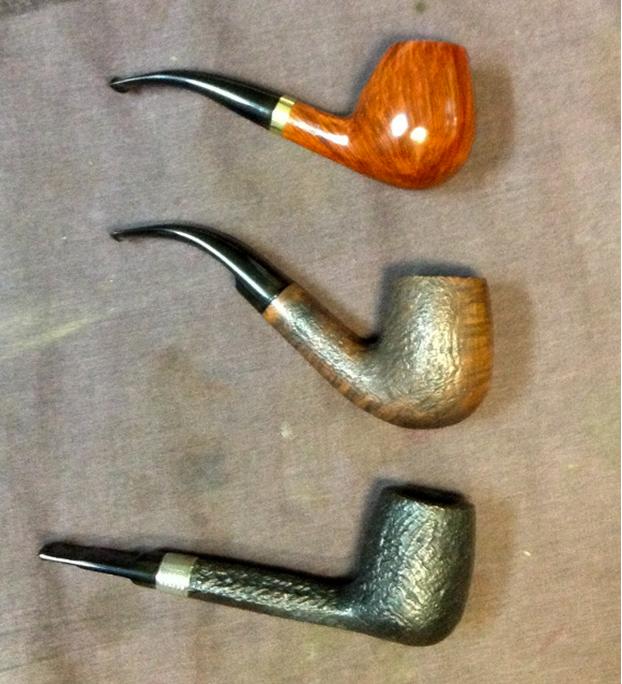
James6 The next issue to tackle was outer appearance. The Fairmorn Egg and the Charatan Lovat were the easiest to address as they simply needed an alcohol bath and scrubbing to remove some dirt and grime. A light sanding was in order for the Fairmorn Egg and that was followed by restaining. The best part was the Charaton retained it’s original color. A buffing with various pastes made them shine.
The Davidoff Bent Billard was a different story. Color wise It is, in my opinion, one of the ugliest pipes I’d seen. I scrubbed and scrubbed and scrubbed with alcohol to remove the underlying stain as best I could, to no avail. So I just decided to restain it a light brown….. and am glad that I did as the result came out rather nice…. At least I think so.James7

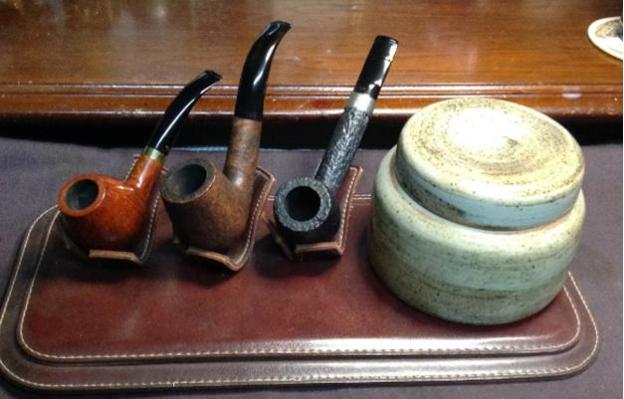
James8 All in all, I’d say the pipes cleaned up rather well. Below is a picture of the complete set that I was gifted. My neighbor was more than elated to see them returned to their previous luster, and I was pleased that I could restore something from someone who meant so much to her.

The leather pipe stand still needs a foot/let on the rear left side, as the original fell off at some time in the past and the tobacco jar needs cork reapplied inside the top of the lid. It’ll get done, as the tobacco jar is the cat’s meow…..

Sorry it took so long to write up the story Steve and may you all have a joyful Christmas Season. Surround yourself with those you love, enjoy the time you are able to spend with them, and smoke a bowl in remembrance of those that were close to you and your family. Oh yea, and overlook Uncle Rufus this year… just chuckle and relight.

Merry Christmas and Happy New Year
JamesJames9

Restoring a White Cloud Imported Briar Pot


Blog by Steve Laug

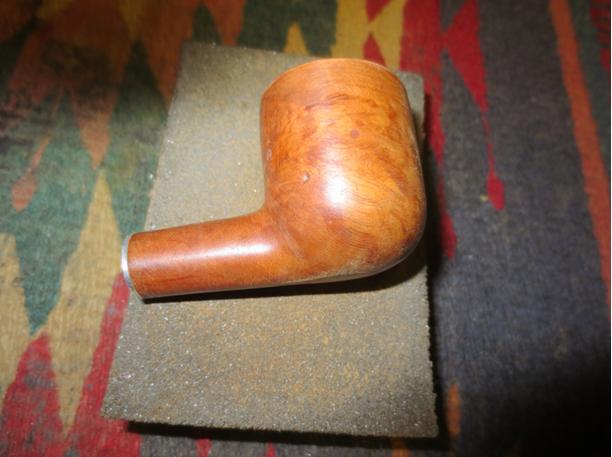
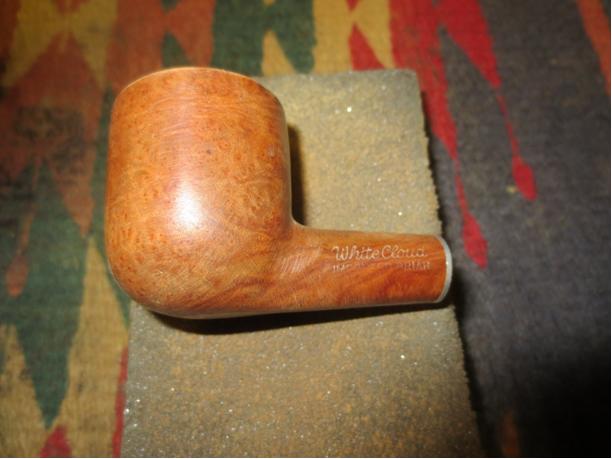
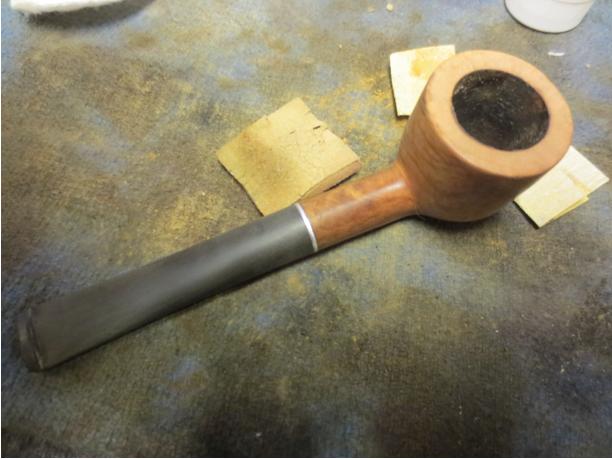
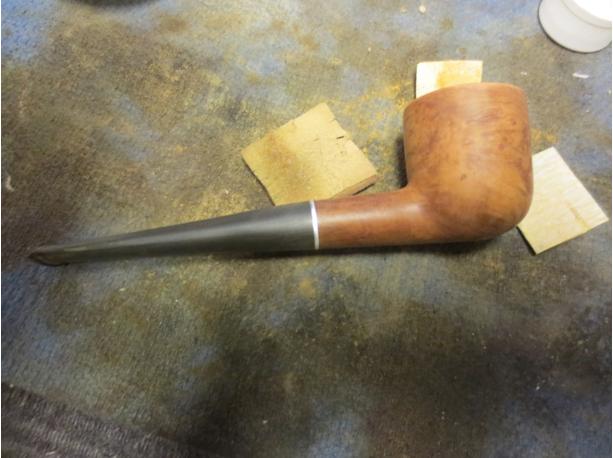
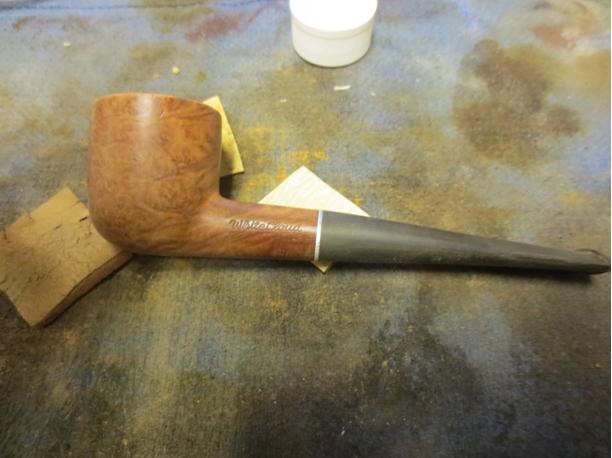
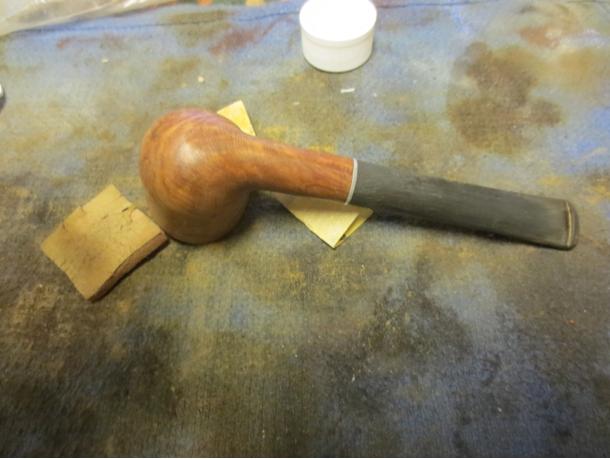
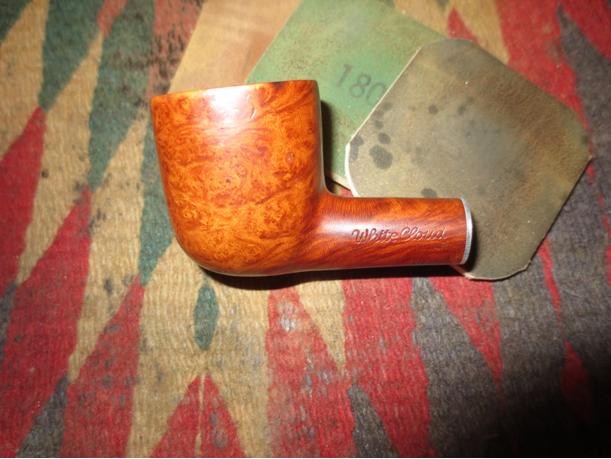
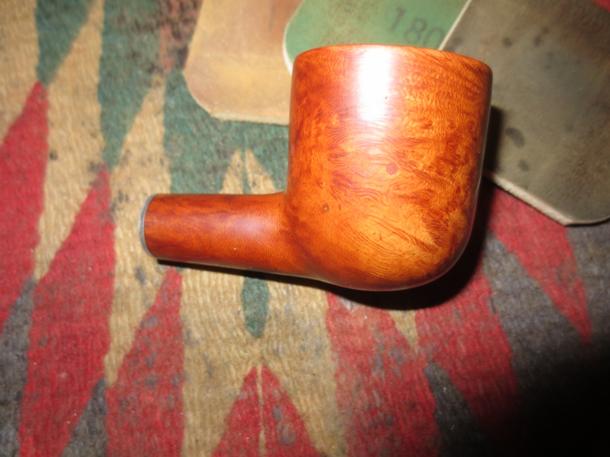
The next pipe up for refurbishing is a small pot shaped pipe. It is stamped on the left side of the shank with the words White Cloud over Imported Briar. There are no other stampings on the right side and underside of the shank. I have looked for the brand in WMTP and found the name but that it is an unknown maker from the US. I also on PipePhil’s site and found no additional information. I also did some searching on the web for information and found absolutely no information on the brand. Do any of you know anything about it? Any information would be greatly appreciated. Thank you.

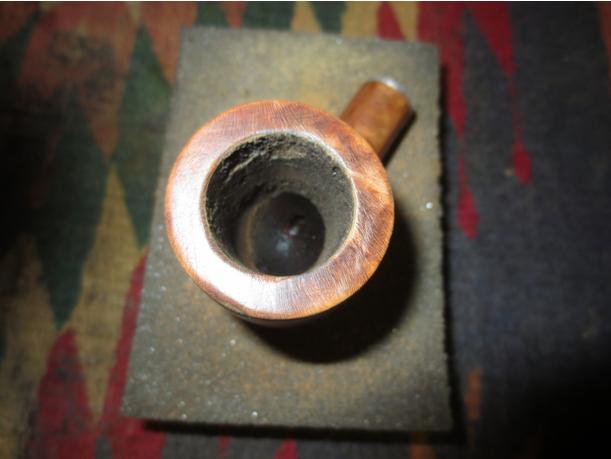
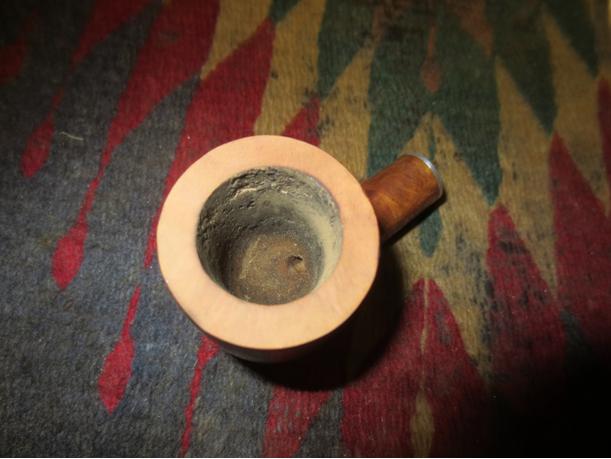
The pipe was in good shape underneath the thick coat of varnish. The stem was oxidized and dirty. The varnish on the rim was peeling and bubbling. There was damage to the rim in terms of darkening and potential burn. The bowl had some cake but it was bare wood at the bottom third of the bowl. The stamping was very clean and readable. There were some dings and fills on the bowl sides but nothing huge. They would clean up adequately. The metal tenon and stinger were a very interesting looking piece of plumbing. They were dirty and tarred. The inside of the shank and stem also had a lot of grime. The stinger was stuck in the tenon so it would need to be heated to be able to clean the airway in the stem thoroughly.Cloud1
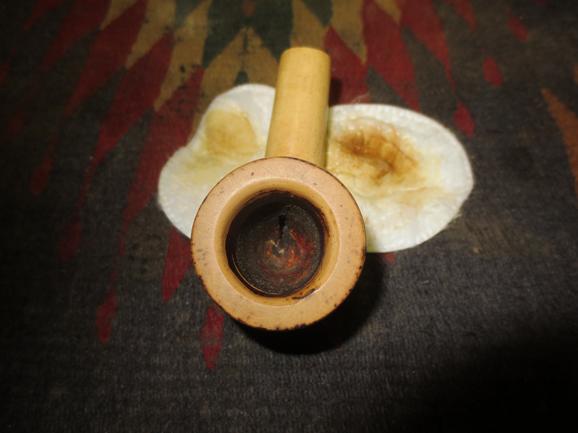
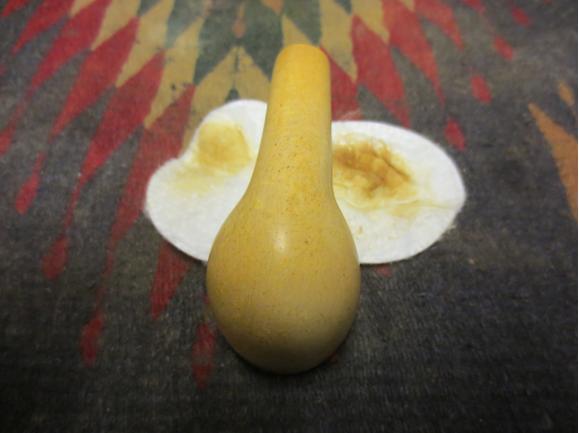
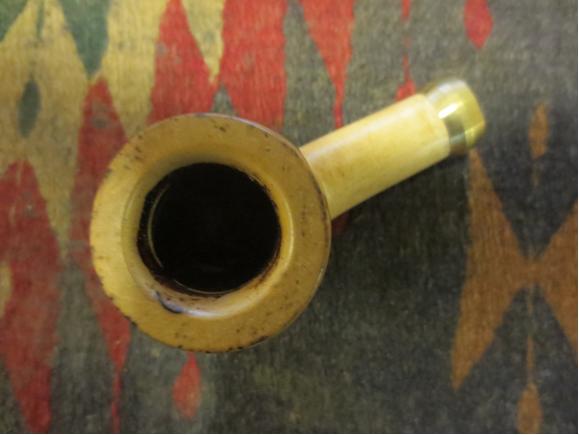
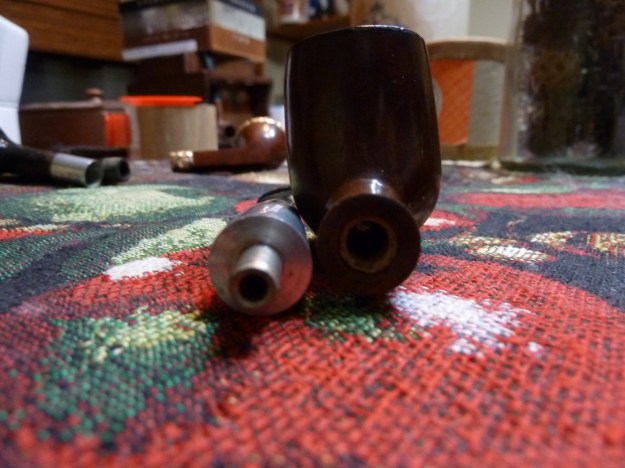
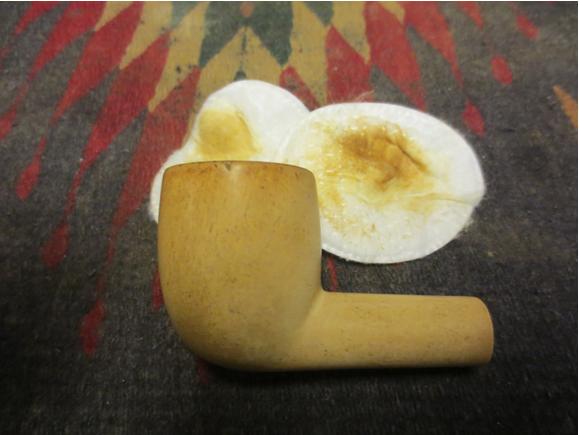
Cloud2

cloud3 I took the close up photo of the rim and bowl to show the damage to the rim surface and the cake that was present.cloud4 The next photo shows the stinger apparatus. It is a unique set up that is different from the collection of other stingers that I have here.cloud5 The stem was slightly underclocked so I heated the tenon with a lighter and corrected the fit of the stem in the shank.Cloud6 I removed the stem and dropped the bowl in an alcohol bath to soak overnight. I wanted to loosen the varnish on the bowl and knew that while the alcohol would not remove it, it would soften it and make it easier to sand off.cloud7 In the morning I removed the bowl from the bath and dried it off. The shiny coat of varnish was unscathed by the alcohol but I knew that it would be easier to remove. You can see the interesting grain on the bowl sides in the photos that follow. You can also see the nicks and fills that would need to be dealt with in the restoration.cloud7

cloud8

cloud9

cloud10

cloud11 I sanded the rim and the bowl with a medium grit sanding sponge to begin the process of removing the varnish. It worked well to break the seal on the varnish coat. Once that is done it comes off quite easily with acetone.cloud12

cloud13

cloud14

cloud15 I needed to lightly top the rim to remove the burn mark and rounding on the front outer edge of the rim. It did not take much to clean up the rounded edge and give the rim a crisp profile.cloud16

cloud17 I wiped the bowl down with acetone on a cotton pad and was able to completely remove the varnish coat. The alcohol had softened it and it came off very easily.cloud18

cloud19

cloud20

cloud21 I heated the stinger in the tenon until I was able to wiggle it free of the airway. One side of the two prongs that held in place in the tenon was cracked so I repaired it and set it aside to dry. I cleaned out the shank and the stem with pipe cleaners, cotton swabs and alcohol.cloud22 I sanded the stem with 220 grit sandpaper to remove some of the wavy marks from previous repairs to tooth damage. I sanded until the stem was smooth and then sanded it with a medium and a fine grit sanding sponge. I also sanded the bowl with the same sanding papers and sponges to minimize the dents and scratches in the finish.cloud23

cloud24

cloud25

cloud26

cloud27 I reamed the bowl with a PipNet reamer to remove the cake on the upper portion of the bowl.cloud28

cloud29 I sanded the bowl and rim with micromesh sanding pads- wet sanding with 1500-2400 grit pads. I wiped the bowl down with a light coat of olive oil before proceeding to sand with 3200-4000 grit pads. I rubbed it down a second time and then sanded it with 6000-12000 grit pads. I buffed it by hand to see what the finish looked like at this point.cloud30

cloud31

cloud32

cloud33

cloud34

cloud35

cloud36

cloud37 I sanded the stem with micromesh sanding pads – wet sanding with 1500-2400 grit pads and then rubbed it down with Obsidian Oil. I dry sanded with 3200-4000 grit pads and gave it another coat of the oil. I checked the stinger and for some reason there was some dark grime that appeared in the slot in the stinger. I cleaned it again with pipe cleaners before sanding some more with 6000-12000 grit pads. I gave the stem a final coat of Obsidian Oil and set the pipe aside to dry.cloud38

cloud39

cloud40 I buffed the pipe with Blue Diamond on the buffing wheel and then gave the bowl and stem multiple coats of carnauba wax. I buffed it to a shine with a clean flannel buffing wheel. When I finished buffing it on the wheel I took it back to the work table and buffed it by hand with a microfibre cloth. The finished pipe is shown in the photos below. It should deliver a good smoke to whoever adds it to their rack. The briar is certainly interesting to look at now that the finish has been stripped and the bowl polished. Thanks for looking.cloud41cloud42cloud43cloud44


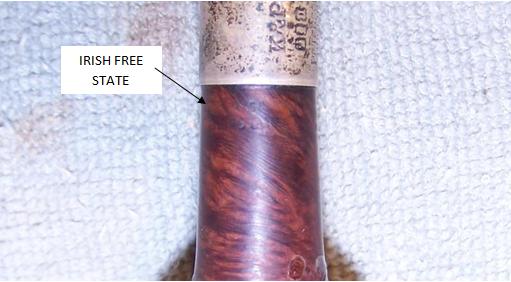
Repairing and Restoring a1929 Irish Free State Billiard


Blog by Aaron Henson – 11/29/15

I think the thrill of the hunt is part of what makes this hobby so enjoyable. Going into a new store or happening upon a pipe in an unlikely place, never knowing just exactly what you are going to find and always keeping a lookout for that forgotten gem.

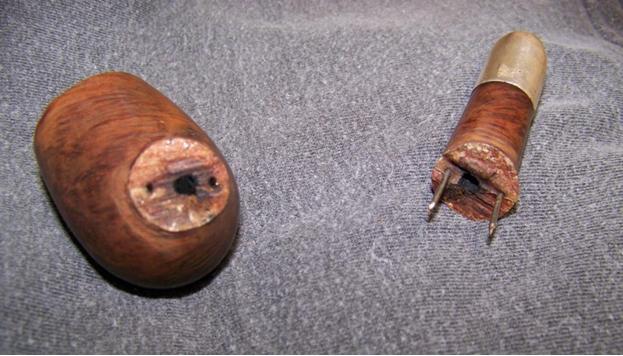
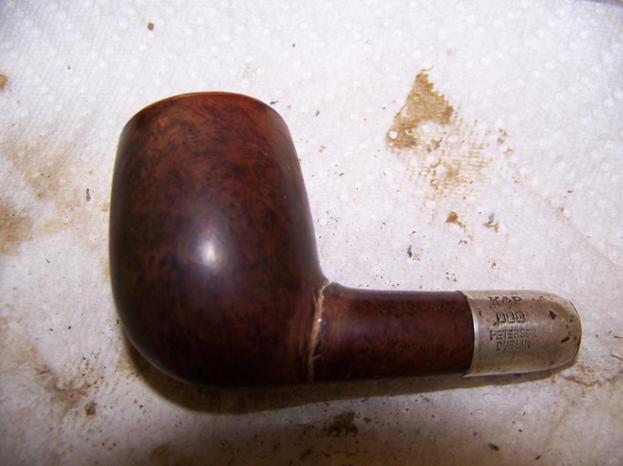
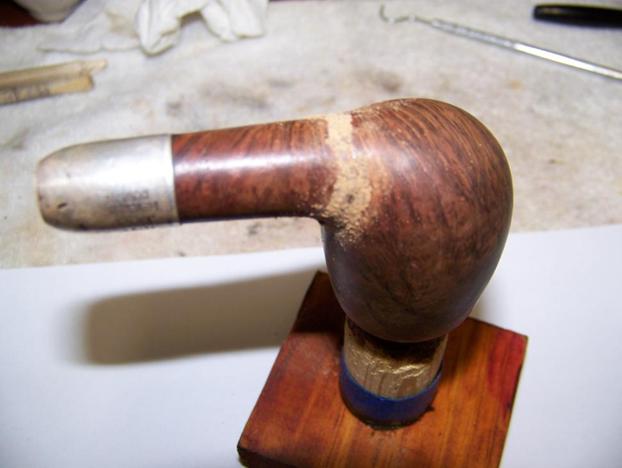
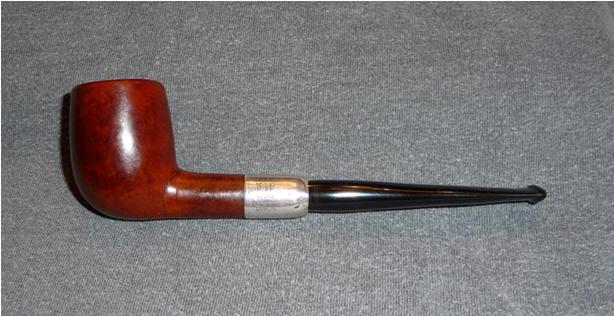
This past summer I was on vacation with my family in Seaside, Oregon. Between Seaside and Astoria I visited 14 different antique stores and only two had any pipes at all. And of those, they were all on the pricy side; too rich for me.

Partly on a whim and partly out of desperation, I went into a second-hand store that I had passed by several times. It was more “junk” than “antique” and of course that is where I made my score although I didn’t think so at first. Three pipes: the first was a non-briar volcano with “Italy” stamped on the bottom, the second was a Medico that was in such bad shape it could only be used for parts but the third was intriguing with a silver band. I could not read the markings for all the filth on the pipe. I negotiated with guy behind the counter and walked out will all three for $15.Aaron1 It was clear that this had been a very nice pipe in its day. The wood grain that could be seen through the grime was beautiful and the Army Style push stem I thought gave the pipe a classy feel. When I got it back to the house and looked it over in better light, I noticed that the band had been rotated on the shank so the writing was upside down and in the dim light of the store I could not read it. Now I could see that it clearly said “Peterson” and “Dublin” stamped in the silver band.

A Peterson, my heart skipped a beat. I was well aware of Peterson’s long history of making quality pipes and now I had picked up an early model for 5-bucks!Aaron2

Aaron3 The bowl had a good build up of cake and a fair amount of unburned tobacco in the bottom. Some build up of tars on the rim but otherwise seemed to be in good condition. The shank had clearly been broken, however and the glue used for the repair was spread all over one side of the bowl. The stamping on the band, as stated before, were worn and not very readable. The stem was oxidized and had a hole in the top near the button. This must have been a favorite pipe of the previous owner.

When I got home from vacation, I tried to understand the symbolic hallmarks on the band. Not being familiar with Peterson marking I sent a picture to Steve Laug to ask his opinion. Steve very graciously referred me to his Peterson expert, Mark Irwin. With Mark’s help I was able to understand Peterson’s hallmarking and dated the pipe as 1929 – placing it in the Irish Free State era: 1922 – 1937. At least, that was my interpretation of the third hallmark, an “O”.Aaron4

Aaron5 I began by reaming out the cake with a Castleford reamer and took the interior back to bare wood. There were some burn marks under the tar on the rim so I elected to top the bowl with some 220 grit paper laid on the flat work bench.Aaron6 Next I heated the band with a flame and then using leather jawed pliers and carefully rotated the band back into correct alignment.Aaron7 The outside of the bowl I wiped down with a cotton pad soaked in acetone. This removed the grime and the glue. I had been worried that the glue was covering a crack in the bowl but it turned out that the person doing the shank repair had just been sloppy. The glue came away and revealed pristine briar underneath. In just the right light, I also could see a very faint IRISH FREE STATE stamped into the bottom side of the shank – Confirmation!Aaron8 The break between the bowl and the shank had been complete. I could see the seam all the way around the shank but it had been a clean break. There were no gaps, rounded edges nor missing pieces; so far, so good.

At this point I turned my attention to the stem. I put the stem to soak in a mild chlorine bath to raise the oxidation. A light sanding with some worn 400 grit paper removed the oxidation completely. I picked the loose material out of the hole, made backing plug out of toothpicks and slipped it into the airway. This would hold my patching material in place. Next I mixed up some StewMac black super glue with some activated charcoal powder and worked it into the hole with another tooth pick. I set the stem aside to cure over night.Aaron9

Aaron10 When I came back to the stem I sanded down the fill with 220 grit paper. The plug blended nicely and I proceeded to polish the stem with 1500 – 12000 micromesh pads. Cleaning the inside of the stem was quite simple, four of alcohol soaked pipe cleaners (2 bristled and 2 soft) took care of the insides and the stem was done.Aaron11 Returning to the stummel, I began to work the bowl-shank joint back and forth with ever increasing force. I caught myself holding my breath, afraid of breaking the pipe beyond repair but dismissed that thought as fear of the unknown and pushed on. Eventually the crack began to open up and the shank and bowl were separated. I was surprised to see that the original repair had included two small brads – or pins – set on either side of the air hole to strengthen the break. Since the brads were already in proper alignment I decided to reuse them in my repair.Aaron12 After some research, I settled on the J-B Kwik Weld as my epoxy of choice. Its resistant temperature is less than that of original J-B Weld (300 vs 550 degrees); however, I do not think the shank should reach 300 degrees during a smoke. But the real advantage in my minds was that the set time is only 6 minutes compared to 4-6 hours. I didn’t want to have to come up with a way to hold the two parts together for several hours and risk the parts slipping.

In order to keep the airway clear during the repair, I pushed a pipe cleaner through the airway before smearing the epoxy on the both surfaces with a tooth pick. With the clock running on the set time, I pushed to the two parts together using the old brads as alignment pins. Looking back I think it would have been better if I had only used one of the pins. The fit was tight and I was fighting against the pins to get the two parts tight together when the time ran out on the epoxy. I was left with a larger gap between the pieces than I thought was right; I had been hoping for a flush fit. Before setting the pipe aside to cure I wiped off the excess epoxy and removed the pipe cleaner.Aaron13 I let the pipe sit overnight and the next day I used a dental pick to remove some of the epoxy from the gap between the stummel and bowl. The gap was very small, less than a 1/32 of an inch on top and near flush on the bottom. When the crack was as clean as I could get it, I filled it with briar dust and placed drops of clear super glue on top to hold the dust in place. When the super glue dried I smoothed out the repair with 220 grit sand paper.Aaron14 There were some minor dents in the bowl and I decided to steam them out by wrapping the bowl with a damp terry cloth rag and going over the rag with a clothes iron set on high. If you used this method I would advise keeping your figures well clear of the iron. Speaking from personal experience, you don’t have to be very close to the iron get burned by the steam. Fortunately, I did not drop bowl!

I sanded the entire bowl with 400 – 2000 grit paper to remove all the dents and scratches but being sure to stay clear of the marking on the shank. The markings were faint but I wanted to preserve as much of them as I could.

The bowl had beautiful grain and I wanted to use a light brown stain to highlight it. I used one part Fiebing’s light brown mixed with 2 parts isopropyl alcohol applied with a cotton swab in layers until the color looked just right. I flaming each layer and wiped off the excess with a cotton pad moistened with alcohol.

The next to last step was to polish the sterling silver band. For this I tried a new technique that I had recently learned on this blog using a small amount of cigar ash and saliva. I was careful not to polish too much – or at all – around the hallmarks. The final step was a trip to the buffer for three coats of carnauba wax on the briar and stem. I hand applied a light coat of Walker Briar Works carnauba wax sealer on the silver band and I buffed the pipe with a micro fiber cloth to bring up the shine.Aaron15

Aaron16

Aaron17

Aaron18