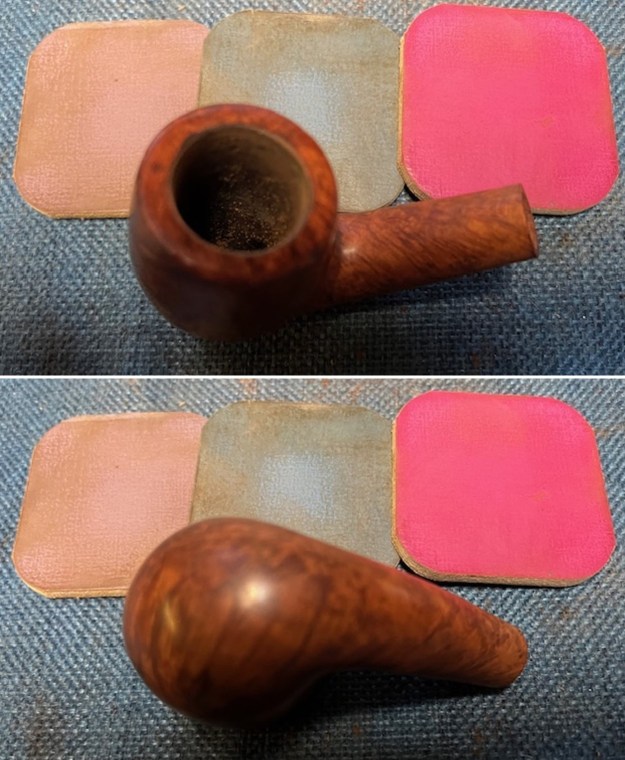
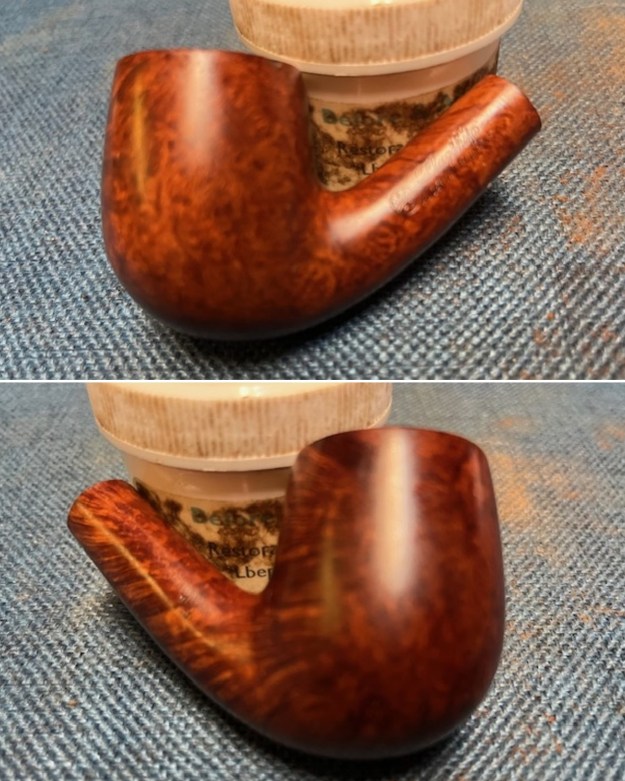
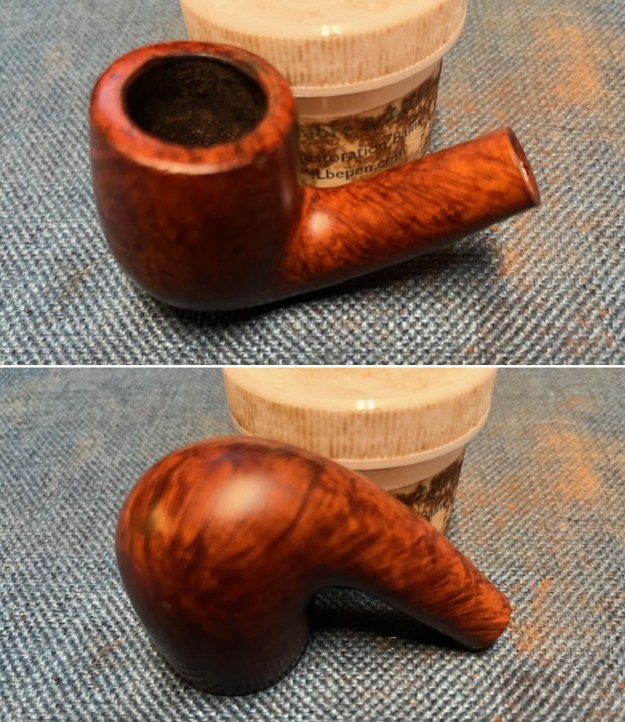
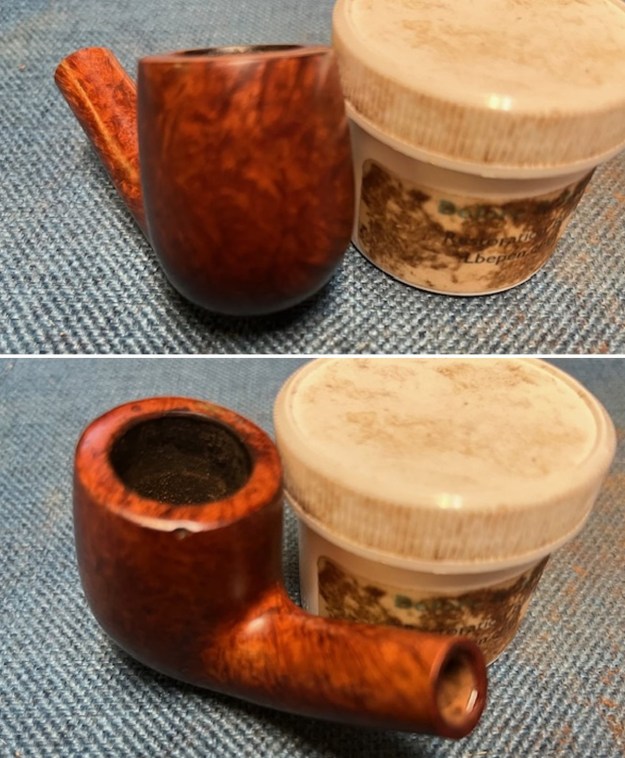
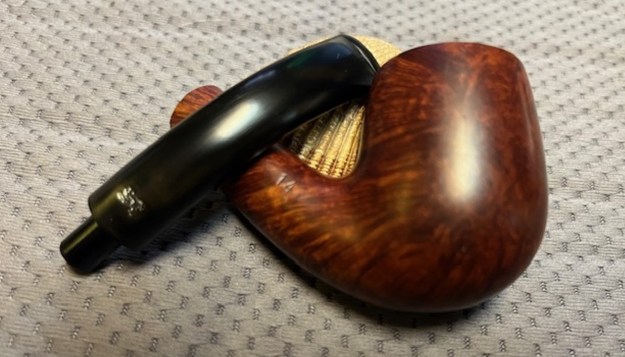
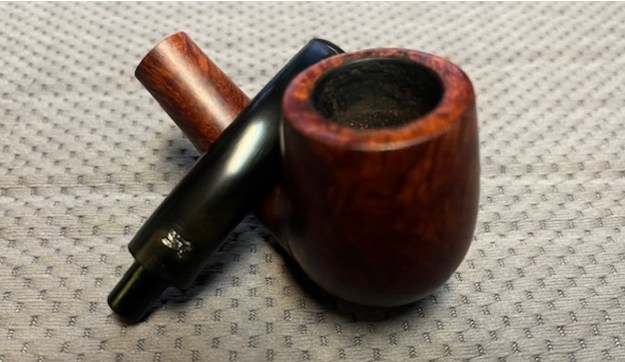
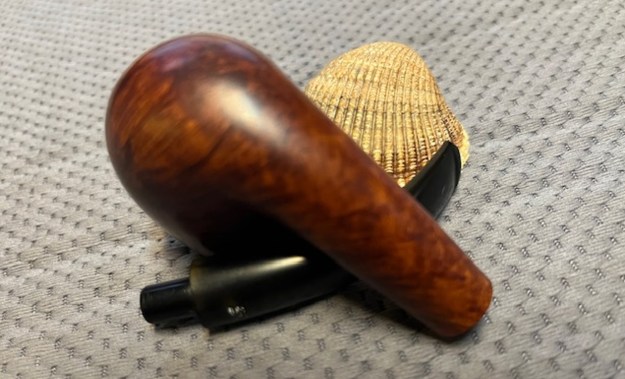
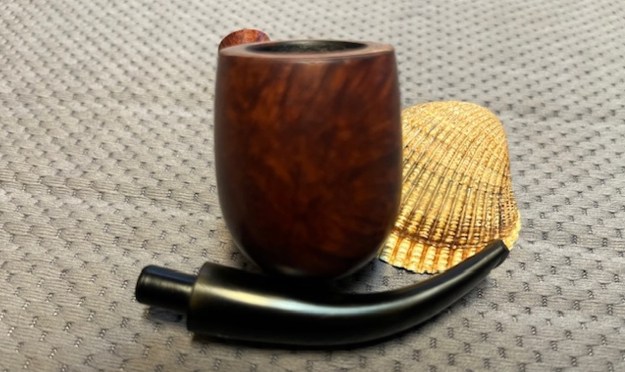
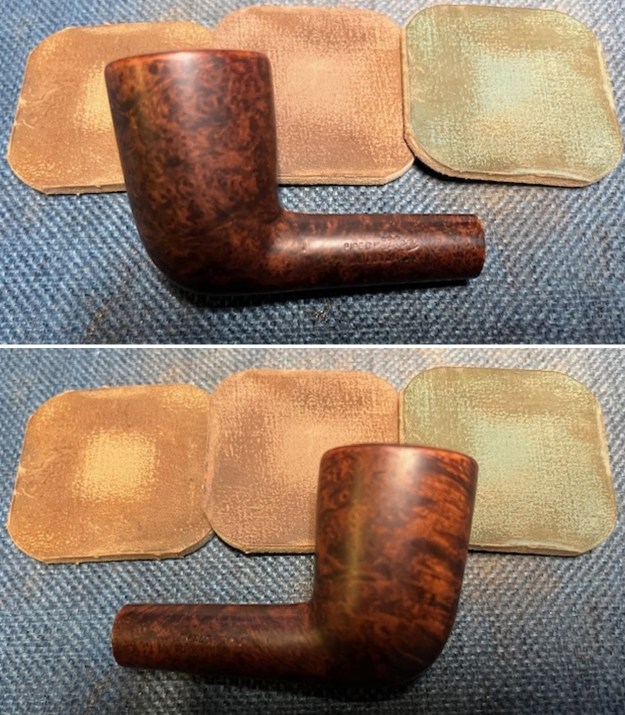
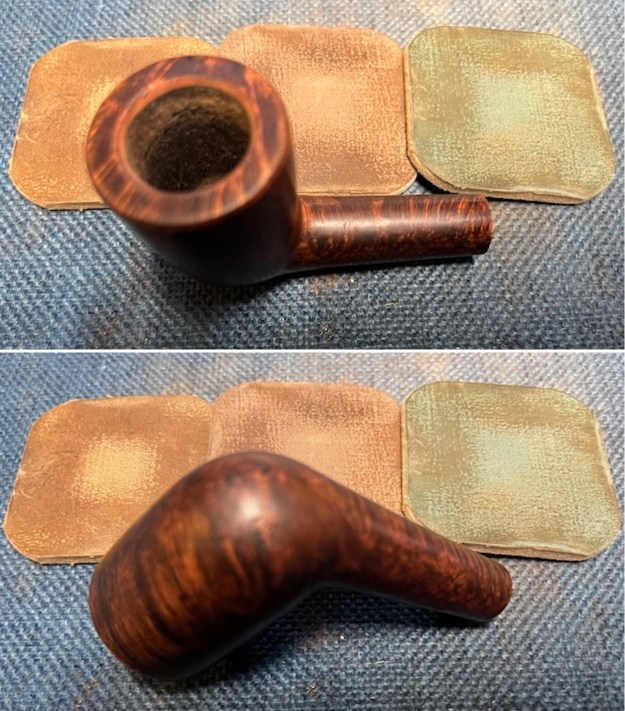
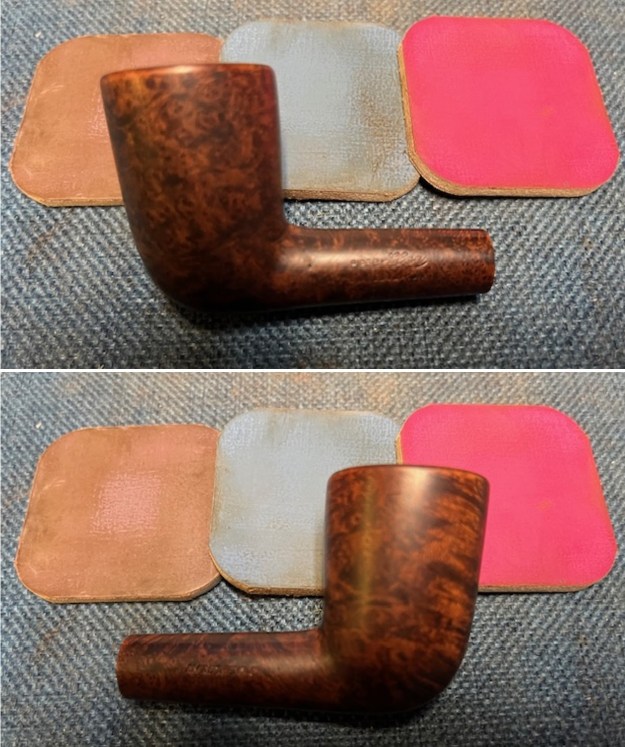
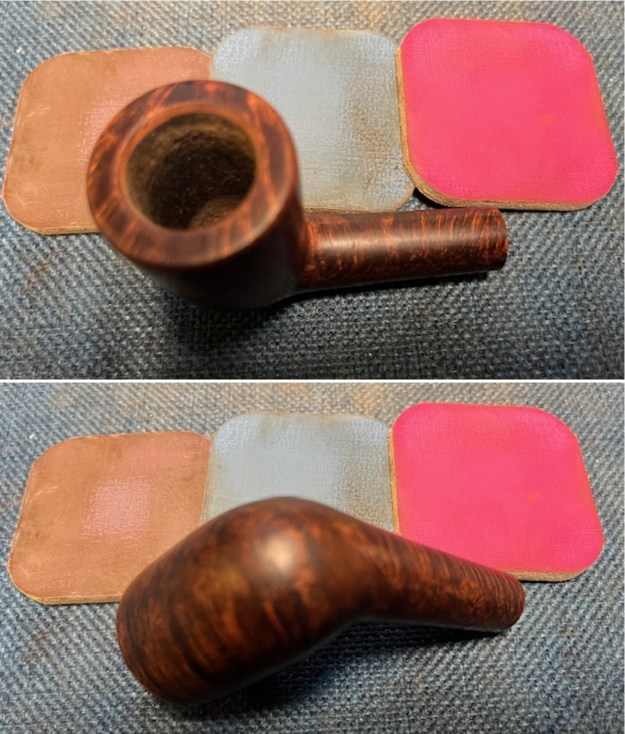
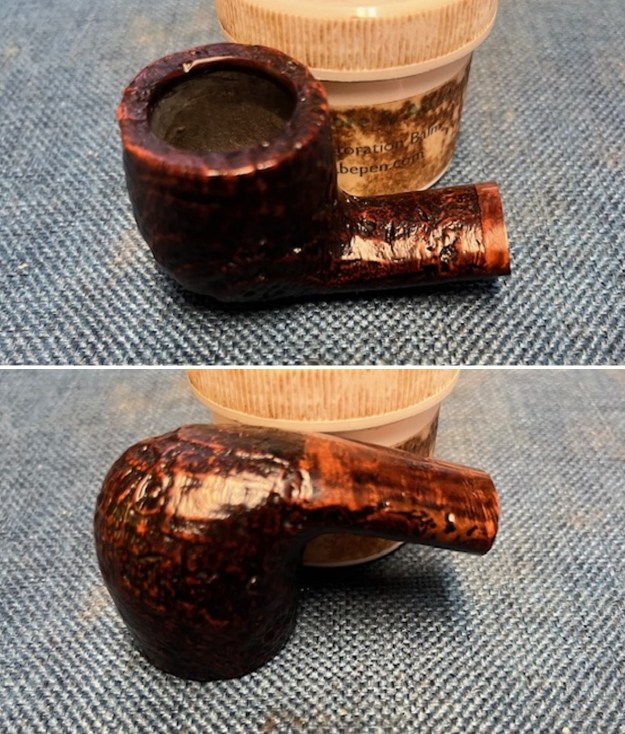
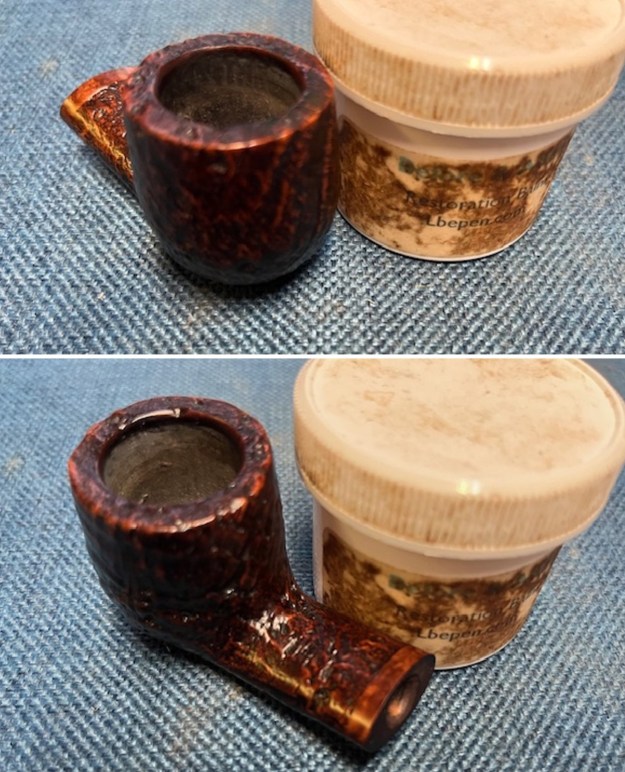
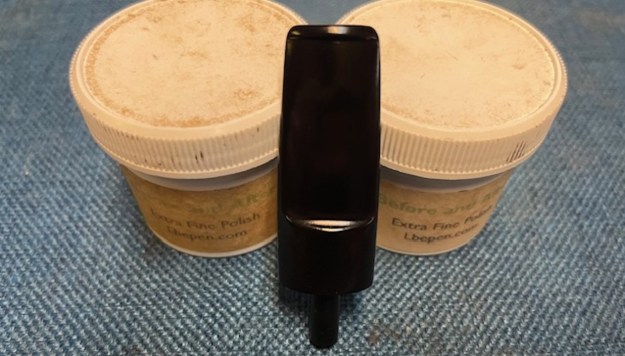
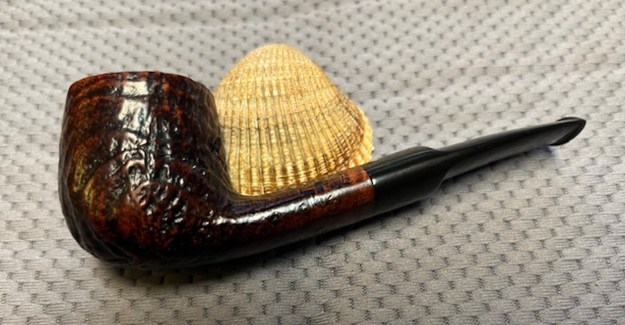
Tag Archives: Bowl – finishing

Resurrecting a Stanwell Royal Silver #214 Following A Duped Deal


Blog by Paresh Deshpande

Stanwell pipes have always been one of my favourites and I seldom miss an opportunity to lay my hands on one whenever I come across a good deal, especially the older early era ones. These are some of the best factory-made pipes coming out of Denmark. Most of the Readers are more than aware of the history of these pipes; however, I feel it is prudent to reintroduce a brief history of this brand to refresh the memory. Pipedia.org (https://pipedia.org/wiki/Stanwell) has an excellent compilation of the brand’s history, picture gallery, various lines etc and a few important pieces of information has been produced from this site.

When pipe smokers talk about pipes that are consistently great smokers, exhibit the creative and beautiful designs that exemplify Danish pipemaking and offer the best value in factory produced pipes, they are talking about Stanwell. We hear time and time again, from customers and top pipe makers from around the world, that Stanwell is the best factory produced pipe in the world. During WWII, Danish pipe smokers could no longer buy the English made briar pipes they preferred to smoke. In 1942, because of the unavailability of English pipes and raw briar, Poul Nielsen began making pipes from beech wood for Danish customers. At the time, Poul was managing a company called Kyringe, which made various wood products.

At the end of the war, briar became available again, so Nielsen began importing his own briar and started making briar pipes to compete with the English manufacturers. It must be remembered that in 1948, England was the single great center for pipe making. Therefore, Nielsen changed the name of his pipes to “Stanwell”, which sounded much more like a proper English name than “Nielsen”. He also created the horse drawn carriage logo for its English connotations. He later changed his own last name from Nielsen to Stanwell, a testament to his devotion to the pipes he made. Stanwell’s relationships with Danish pipe makers goes back to Sixten Ivarsson, who is considered the originator of modern Danish pipe making. Ivarsson was commissioned to design Stanwell shapes. In 1969, the factory was moved a town called Borup, just outside of Copenhagen to be closer to Ivarsson.

Stanwell relies on designs from the great Danish pipe makers, from Sixten Ivarsson to Jess Chonowitsch from which they create their hundreds of shapes. Since most sandblasting for Danish pipemakers is done at the Stanwell factory (Stanwell has a reputation for excellence in sandblasting that is used by many, many Danish carvers from Poul Winslow to Jess Chonowitsch), many of the pipes that they sandblast are then observed and used as starting points for Stanwell shapes with the consent of the original carvers. This interesting and unusual symbiotic relationship gives Stanwell the opportunity to offer hundreds of unusual and interesting shapes at an affordable price. Once a new shape is established and hand carved, it is then reproduced using a lathe. Following the initial carving of the pipe which is done by machine, all other processes are done by hand, from the final sanding and staining to the application of the wax finish. There are approximately 120 manual steps to Stanwell’s pipe making process. The Stanwell factory is arguably the most efficient pipe operation in the world. It is this efficiency that has made Stanwell so remarkably price competitive and able to offer pieces of superior quality to those created by other large factories.

Essentially the goal of Stanwell is, and always has been, to produce high quality pipes at a price that is truly within the reach of the common man. In this they have succeeded admirably, offering perhaps more pipe for the money than any other pipe manufacturer in their price range. Stanwell pipe offers exceptional quality at a remarkably affordable price.

Stanwell pipes are a must for any pipe collection. The Stanwell name is a cornerstone of Danish pipe making. In owning a Stanwell, you will not only enjoy beautifully styled, great smoking pipe at a great price, you will own a piece of pipe making history.

Pricing on top models – mid to late 1980s

  • Golden Contrast 600 DKK.
  • Silver S 600 DKK.
  • Hand Cut, sandblasted 1200 DKK.
  • Hand Cut, smooth 1500 DKK.

Another important aspect of Stanwell pipes is the determination of designers of a particular pipe that is well documented with the help of shape numbers. This pipe has the shape number #214 and from a visit to the under mentioned site it is determined that this pipe is classified as a freehand but without any designer specified.

https://pipedia.org/wiki/Stanwell_Shape_Numbers_and_Designers

  • 210 Sixtus, with hexagon stem and mouthpiece, brass ring, Pot by Tom Eltang.
  • 211 Sixtus, with hexagon stem and mouthpiece, brass ring, Freehand by Tom Eltang.
  • 212 Sixtus, with hexagon stem and mouthpiece, brass ring, Freehand by Tom Eltang.
  • 213Sixtus, with hexagon stem and mouthpiece, brass ring, Freehand by Tom Eltang.
  • 214 Freehand, slightly bent, square stem and mouthpiece.
  • 215 Freehand, slightly bent, triangular stem, saddle mouthpiece by Poul Ilsted.
  • 216 Zulu with tapered stem, by Tom Eltang.

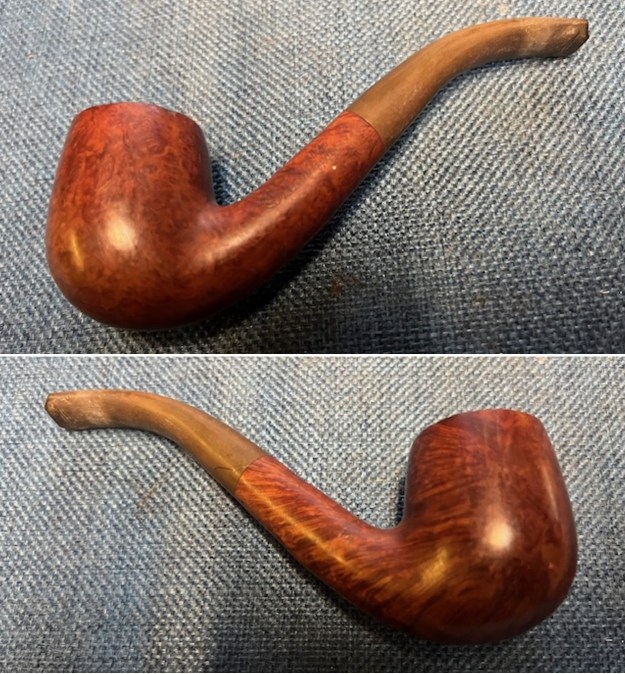
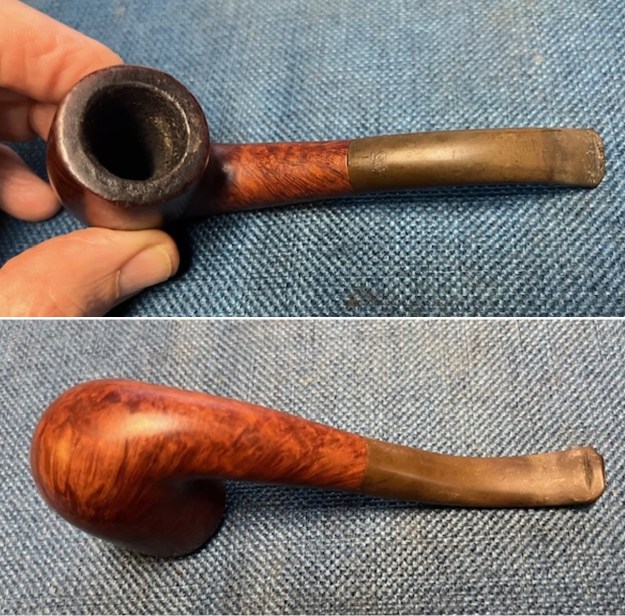
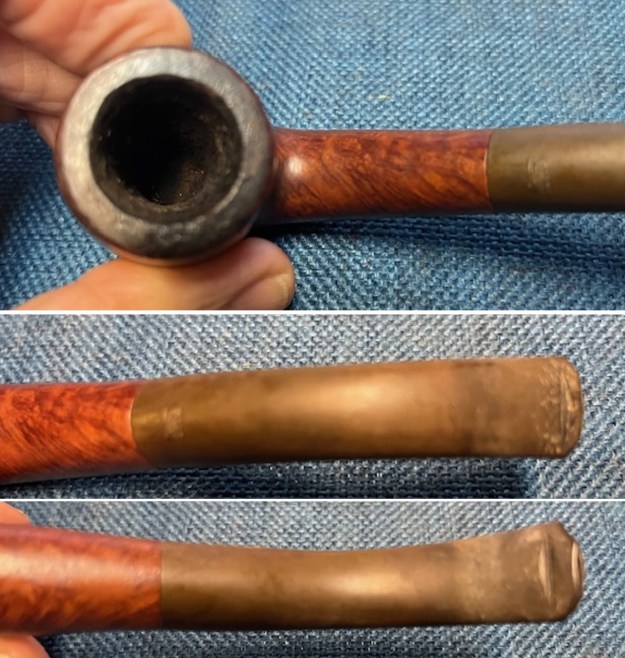
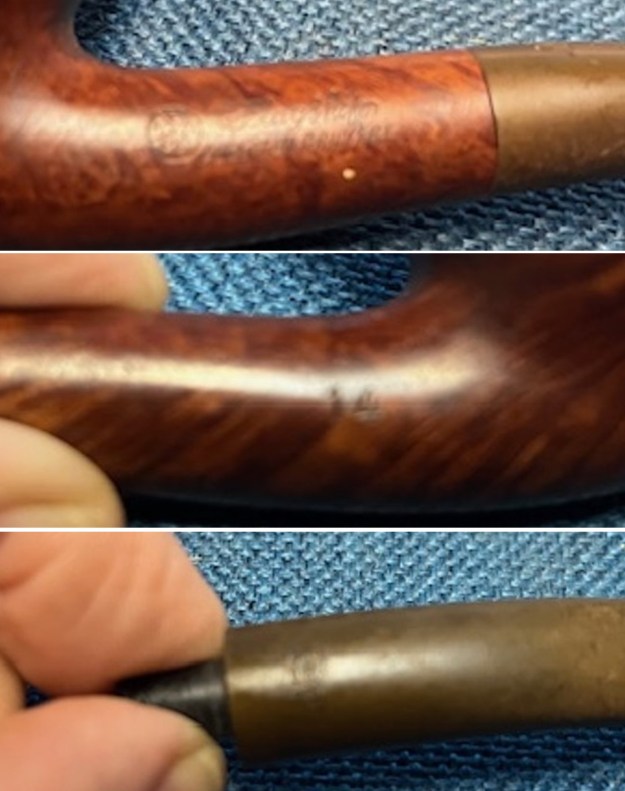
This pipe came to me from eBay.com as one of the lot of four pipes, three Stanwells and one Vauen pipe in a pipe bag, from a Germany based Seller. The following pictures were uploaded by the seller with no description at all and based on which I had made my decision to purchase it.Once these pipes reached me here in India, I was aghast to note that each of the pipes had one or the other serious major damage which will be brought out as I work on each of these pipes. This was another sour deal on eBay!!

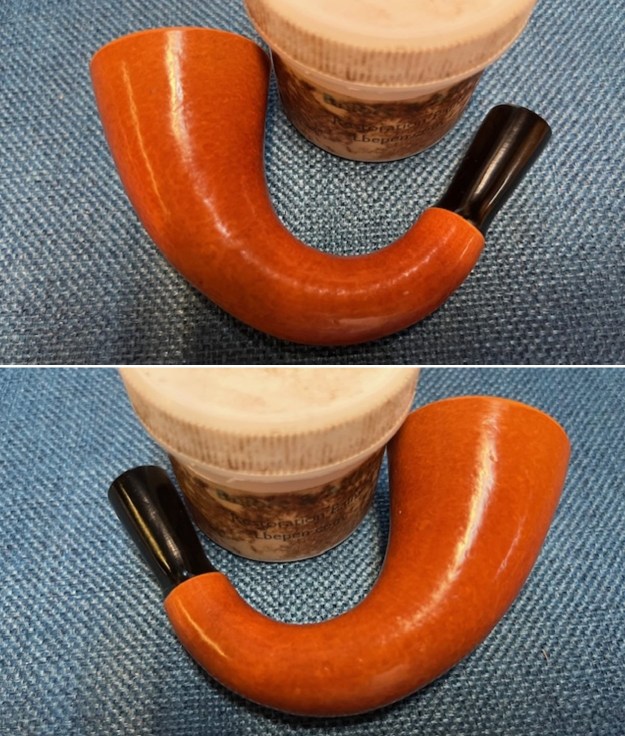
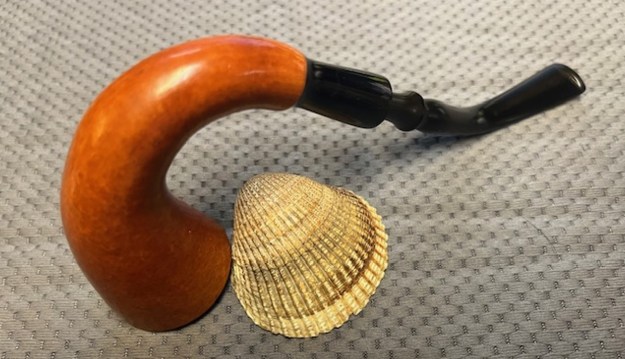
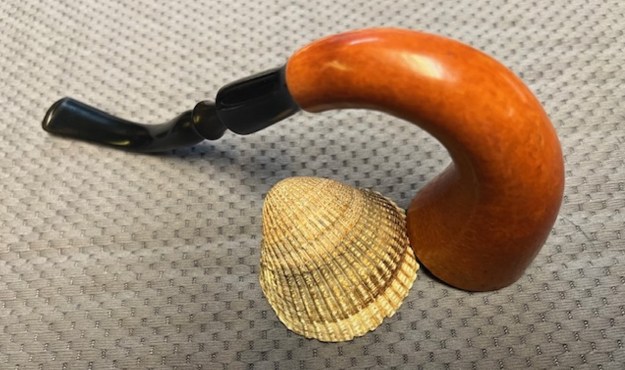
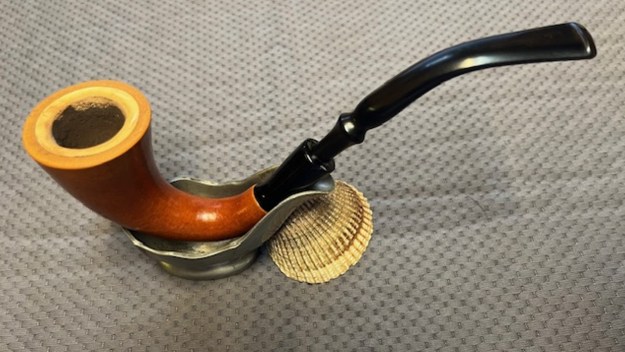
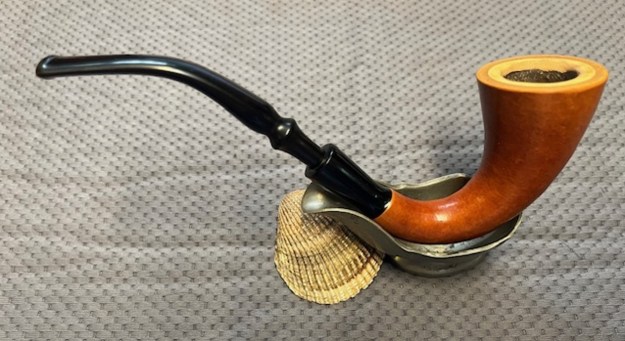
The first pipe from this lot that I decided to work on is what I consider being a variation of the horn shape but described as a freehand in Stanwell’s shape charts as brought out before and is from the late 1980s. It is stamped as “STANWELL” over “MADE IN DENMARK” over “ROYAL SILVER” on the left panel of the square shank while the right panel is stamped with the shape number “#214”. The stem bears the trademark “S” with a crown in silver. Initial Visual Inspection
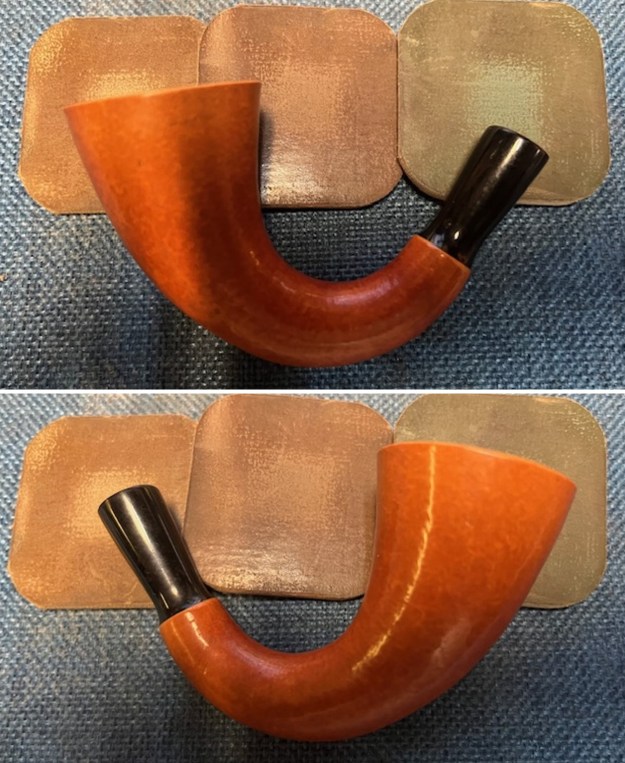
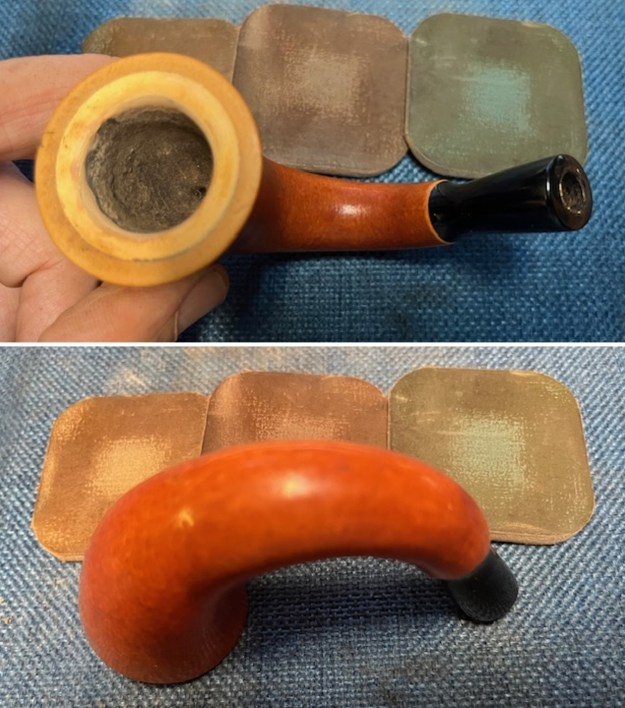
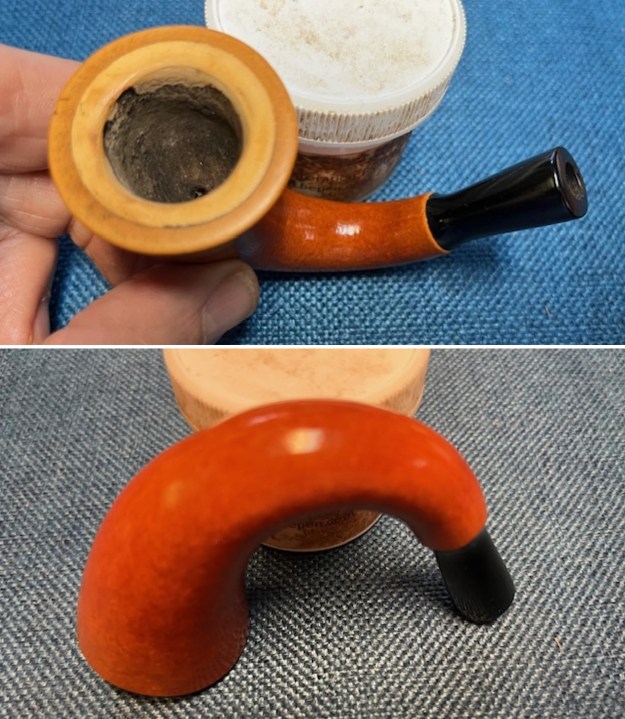
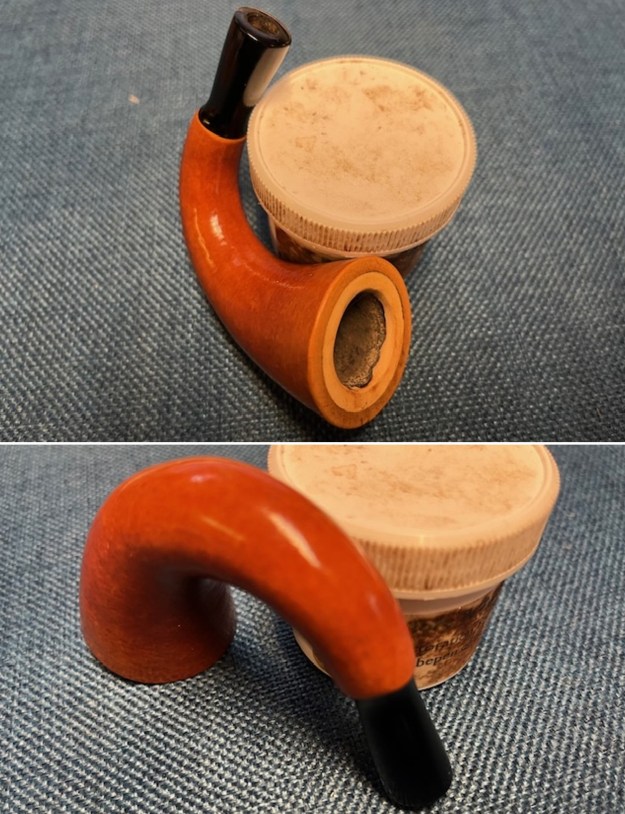
This horn shaped Stanwell has many things going in its favor; be it the shape that is eye-catching with paneled surfaces, a size that feels perfect to hold, light weight, quality acrylic stem and capable of housing a 9 mm filter for those who prefer them. A thick layer of cake is seen in the chamber. The rim top and edges are clean with no lava overflow or evident signs of charring. The four paneled stummel is clean and the reddish hued stain makes it a looker! However, I have noticed a darkened spot (encircled in yellow) over the front panel towards the foot and that could potentially be bad news (read a burnout). The mortise has minute traces of old oils and tars, but the airflow is smooth and open. The thin white metallic band (or is it silver?) at the shank end lends the pipe a classy bling. The acrylic black stem is in good condition. The tenon housing for 9 mm filter is clean and so it the horizontal slot. Overall, save for the dark spot over the stummel surface, the condition of the pipe is good. Detailed Visual Inspection
The chamber has a thick, hard and uneven layer of cake. The upper portion of the cake is slightly thicker than at the heel. I am curious to know the condition of the chamber walls, more so the area corresponding to the dark area observed over the stummel surface but that will have to wait till the cake is removed and the walls are exposed. The inner edge is uneven (encircled in green) but not charred. This could be a result of reaming using a sharp knife edge. The rim top surface is clean with no damage or crud accumulation.The stummel has been carved out of a beautiful piece of briar and in true quality assurance that Stanwell is so well known for. The four panelled stummel with square shank has cross grains on either side with mixed grain to the front and aft of the surface. The surface is clean and sans any dents or dings and grime. The red stain with a shank end band contrasts beautifully with the black acrylic stem. The only cause of concern is the dark area seen to the front of the stummel and is highlighted by an encircled yellow. The spot within this darkened area (encircled in orange), so to speak, is the eye of the damaged area. Now, this could just be a darkening of the surface due to a burning cigarette placed in proximity of the pipe or it could be the beginning of through burnout and the clue for the exact reason lies within the chamber walls. However, the dark area feels no different from the rest of the surface…or not? The mortise is clean with just minor traces of old dried oils and tars over the mortise walls. The square silver (?) band at the shank end is dull and would benefit from a nice polish. The square faced acrylic stem contrasts with the red stained stummel surface adding an attractive eye candy affect to the overall appearance of the pipe. The buttons in particular and the bite zone in general, is sans any tooth indentations or scratches. The tenon houses a 9 mm filter and shows minor accumulation of oils and grime, ditto for the horizontal slot. The stem logo of silver letter S with a crown atop is slightly oxidized, but otherwise in pristine condition.The Process
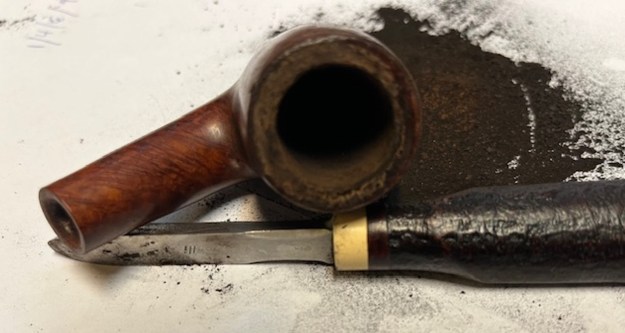
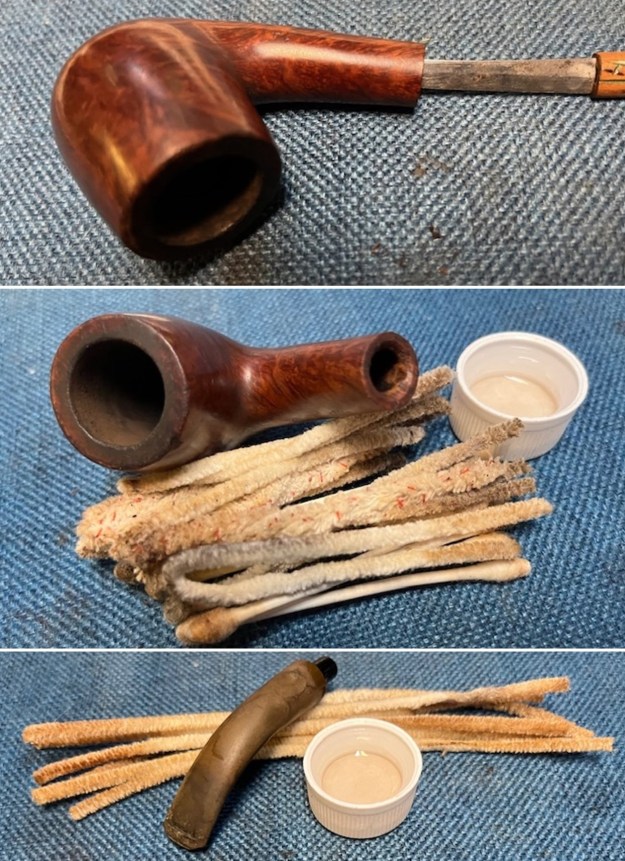
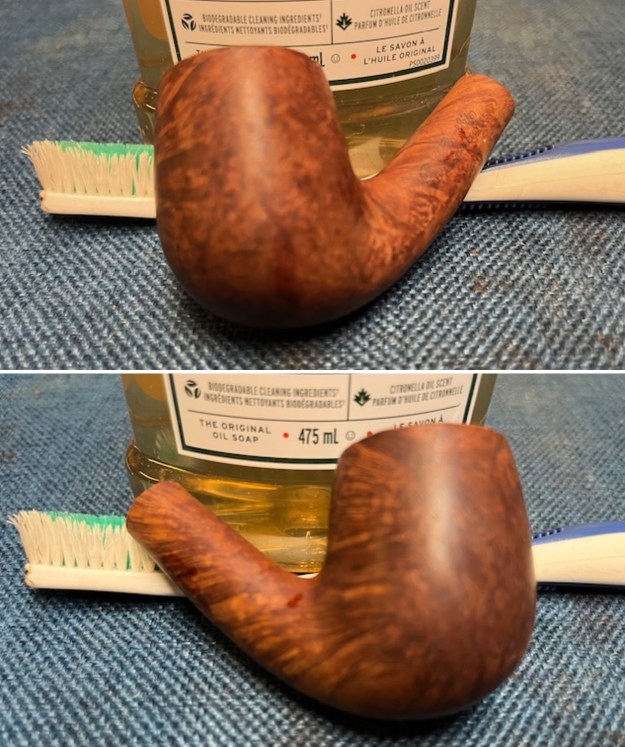
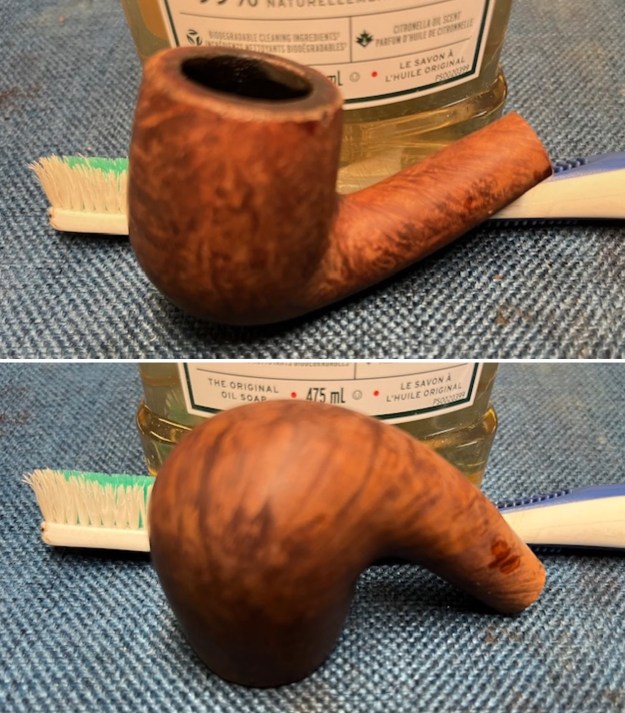
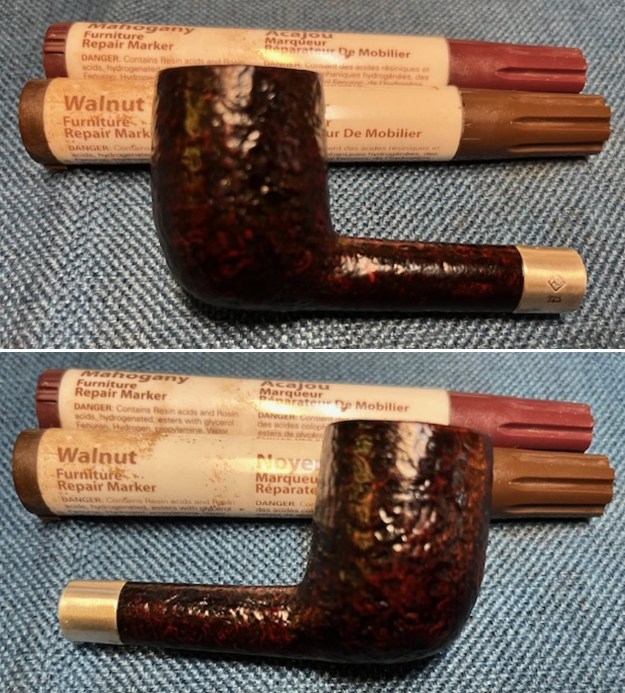
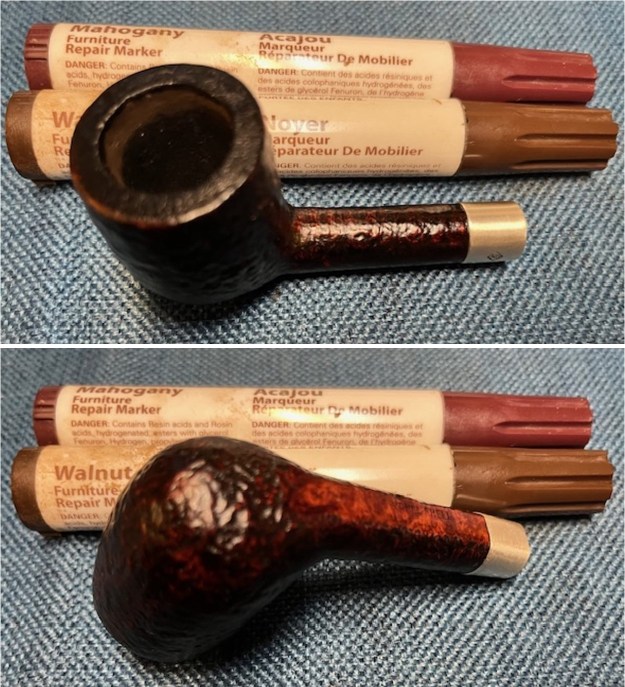
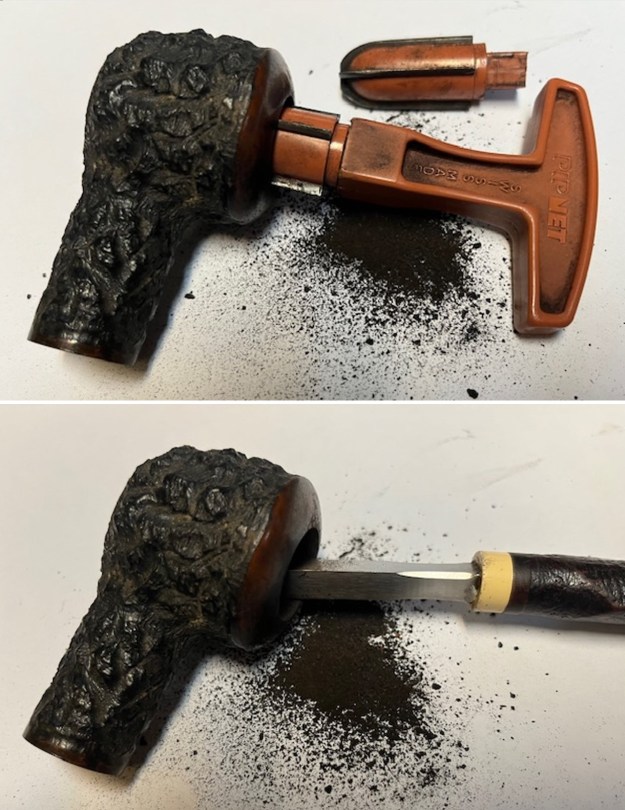
The first step in restoring this particular pipe was the cleaning of the chamber. I began the process of refurbishing this pipe by reaming the chamber with a PipNet reamer tool, using the first and second head. Using my fabricated knife; I further took the cake down to the bare briar. That the cake was thick and hard made this cleaning a lot difficult and a long drawn affair. With a folded piece of 180 grit sandpaper, I took the cake down to the bare briar and also smoothened the chamber walls. A final wipe with a cotton swab moistened with isopropyl alcohol removed the carbon dust from the chamber. I had expected that any damage to walls of the chamber would reveal itself at this stage. However, I could not decipher any prominent damage corresponding with the dark area seen on the outer surface. I decided to subject the chamber to a cotton and alcohol bath in the hope that the damage, if any, would reveal itself in the form of seepage of the alcohol or deep heat lines/ fissures.Moving on to deeper cleaning of the chamber and the mortise in an attempt to highlight any damage to the chamber walls… I subjected the chamber to a cotton and alcohol bath. I draw out a wick from the cotton and along with a folded regular pipe cleaner; insert it in to the mortise and through the draught hole in to the chamber. Thereafter, I pack the chamber with cotton balls to about quarter of an inch below the rim inner edge and soak the cotton balls with isopropyl alcohol up to the brim. About half an hour later, the level of alcohol had gone down, having being absorbed by the cotton. It was here that I anticipated seeing seepage to the front of the stummel through what I have assumed to be a burnout. However, this did not happen. Also even at this stage I did not feel any give in the briar in the darkened area as compared to the rest of the stummel surface.  I topped it up once again with alcohol and set it aside overnight. By next afternoon, the cotton and alcohol had drawn out all the remaining oils and tars from the chamber and mortise, fulfilling its intended task. I removed the cotton balls and ran pipe cleaners through the mortise to clean out all the loosened tars and gunk. I set it aside to dry out naturally.Next, I decided to clean the exterior surface of the stummel. I had also hoped that further cleaning of the stummel would reveal the extent of damage or otherwise lurking beneath the darkened area. I used a hard bristled tooth brush and Murphy’s oil Soap, to scrub the stummel, chamber walls and rim top. I washed the stummel under running warm water with anti oil dish washing detergent till the stummel surface was clean. I simultaneously cleaned the shank internals with the detergent and hard bristled shank brush and dried it using paper towels and soft cotton cloth. At this stage in restoration, I still could not fathom the nature and cause of the dark area. I was still not clear if the dark spot was an indicator of the beginning of a burnout or was it just a superficial darkening of the surface. I turned to Steve to seek his advice and sent him pictures of the suspected damaged area. He enquired if the spot was a little soft to the feel or did it sound any different when tapped with finger nail as compared to the rest of the surface. I tried and couldn’t notice any change. Here Steve suggested that I thoroughly clean the darkened spot with oxalic acid. If it is just a superficial burn, oxalic acid would lighten it and reveal the exact condition and that is exactly what I did. When I was done with this step, I shared pictures of the result with Steve. He pointed out that it appeared that the center of the dark spot (encircled in red) maybe damaged and to confirm the same by tapping the area with a screw driver or some such hard tool.As discussed with Steve, I tapped the suspected damaged area, lightly at first and then a bit more firmly and the briar gave way leaving behind a gaping hole. I used a needle file to remove the charred briar from around the burned out spot. I continued to remove the charred briar around using rounded needle file till I reached solid intact hard wood. Now that all the charred briar wood was removed, it was necessary to smooth out the edges of the burned out area to ensure an even round hole for a snug fitting briar plug. I fine tuned the rounded hole at the foot of the stummel using 180 grit sandpaper wound around a thin bamboo dowel. Next, I cut a suitably sized block of briar to be shaped into a plug using a small hacksaw blade.Using a sanding drum mounted on a rotary tool, I roughly shaped the plug that would fit into the foot of the stummel. I deliberately left the top of the plug duly flanged (indicated with blue arrows). The general idea was to push the plug from inside the chamber to the outside so that the plug flanges will sit over the remaining intact heel of the chamber forming a new heel with the rest of the plug protruding outwards of the foot of the stummel. With the rough shape of the plug completed, I began the process of fine tuning the fit of the plug to seat snugly in to the hole at the foot of the stummel. Using a flat head needle file and a folded piece of 180 grit sandpaper, I sand down the plug and its flanges checking frequently for the fit in to the hole. I avoided further sanding of the plug once I reached the stage where with a tap of a small hammer, the plug sat firmly in to the hole with no gaps. The plug flanges are also covering the hole at the heel of the chamber (indicated by yellow arrows). To fix the briar plug in to the heel of the chamber, I decided to apply a layer of JB Weld to the bottom of the entire heel. J B Weld is a two-part epoxy Cold Weld that consists of two parts; hardener and steel which are mixed in equal parts in a ratio of 1:1 with hardening time of 5-6 minutes and complete curing time of 6-8 hours. I poured the contents of the two tubes and mixed it well. With a flat bamboo frond, I applied this mix over the heel of the chamber from inside. I turned the bowl over and filled the minor gaps between the briar plug and the adjoining stummel surface with the J B Weld mix and set the stummel aside for the epoxy to cure overnight.  By evening when I continued my work on this pipe, the J B Weld had cured completely. Using my hand held rotary tool mounted with a 150 grit sanding drum, I sand down the plug from the foot (outside) and heel (inside) of the stummel and achieved a rough match with the surrounding surface. I further matched the plug with the rest of the stummel foot with a flat head needle file. I perfectly matched the plug with the rest of the surrounding surface, both inside and out, by sanding with a folded piece of 180 grit sandpaper. The plug is now flush with the foot of the stummel while the flanges of the plug provide additional support to the plug from within the chamber. I had reached that stage in restoration where an important decision was required to be taken which would affect the aesthetics of the pipe. To blend in the repair, I had an option of staining the entire pipe red or to rusticate only the front panel of the stummel right up to the shank end and further stain this rusticated panel in contrasting black/ dark brown. I discussed this step with Abha and she was of the opinion that a perfect geometrical pattern does go with the flow of the shape and recommended a complete rustication of only the front panel followed by the contrasting stain.

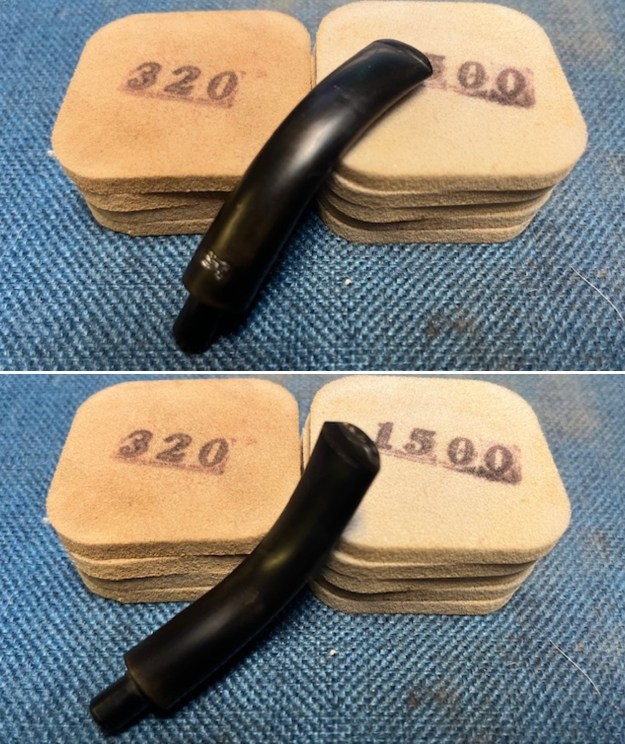
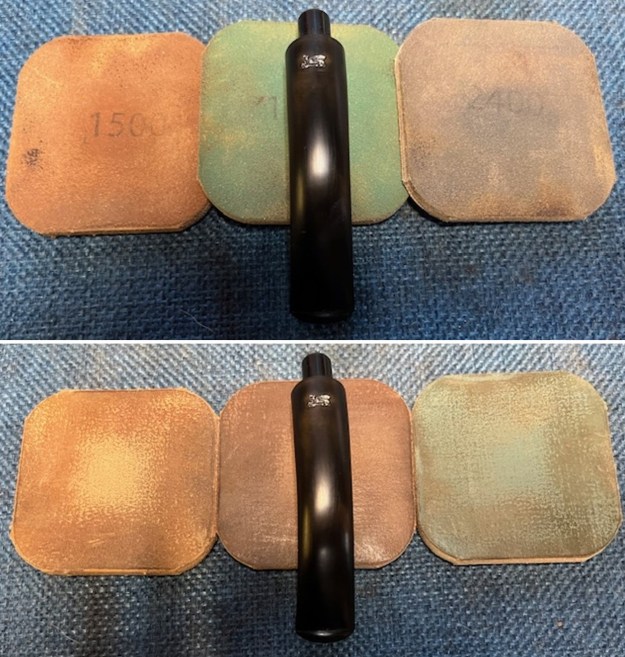
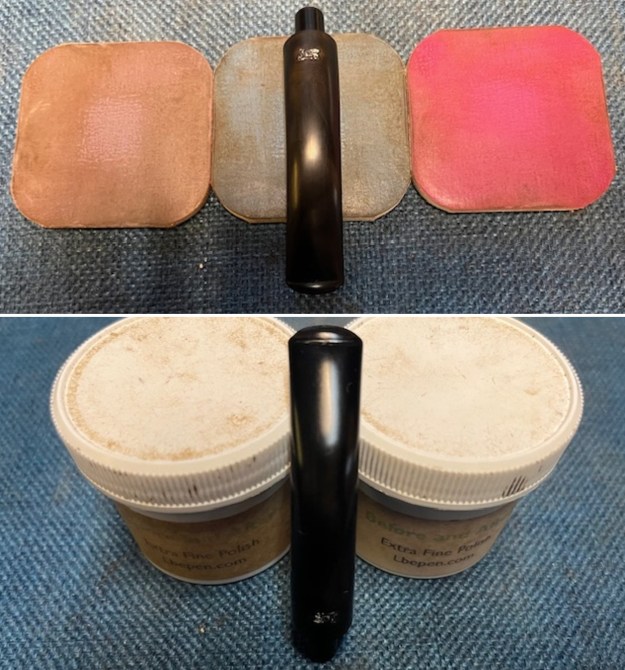
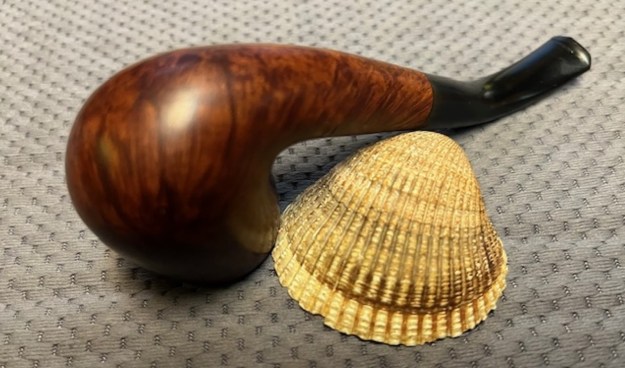
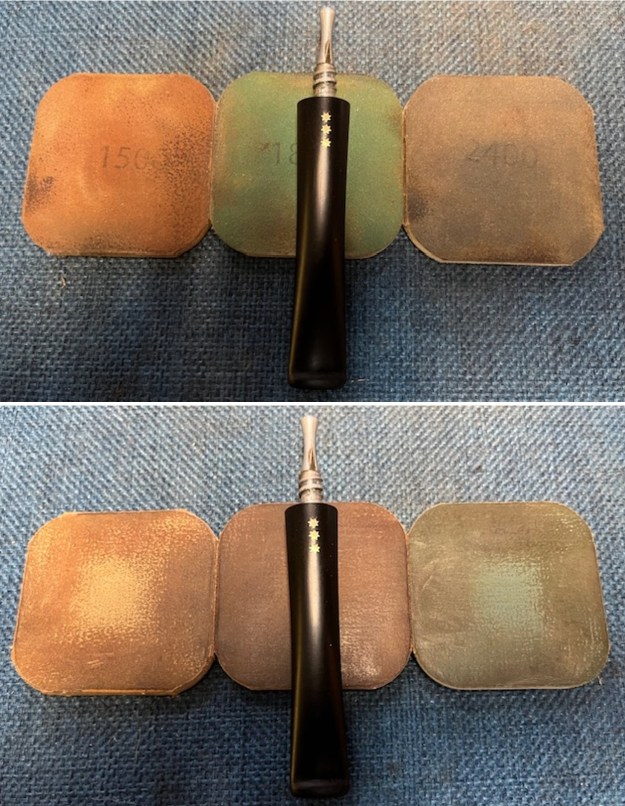
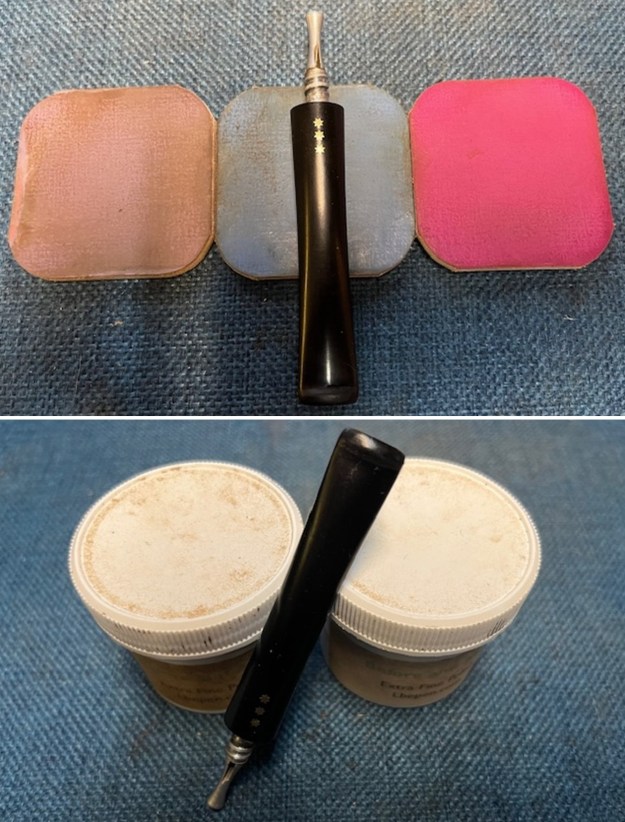
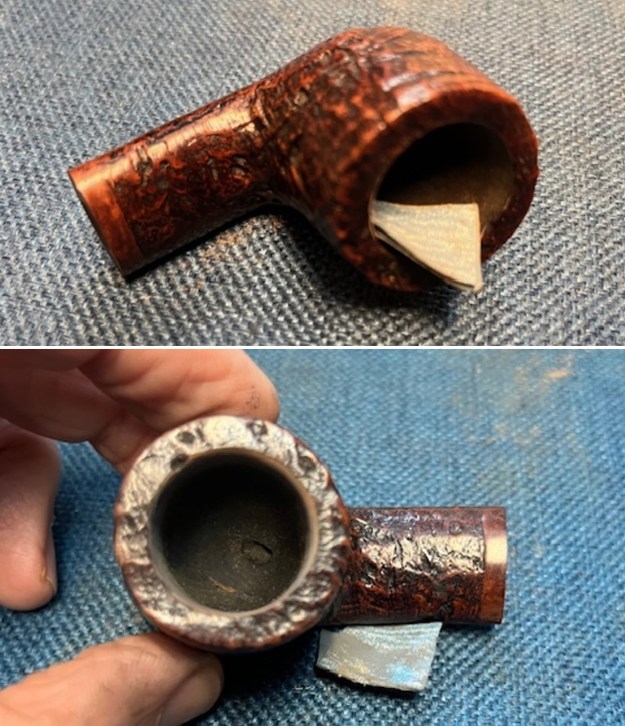
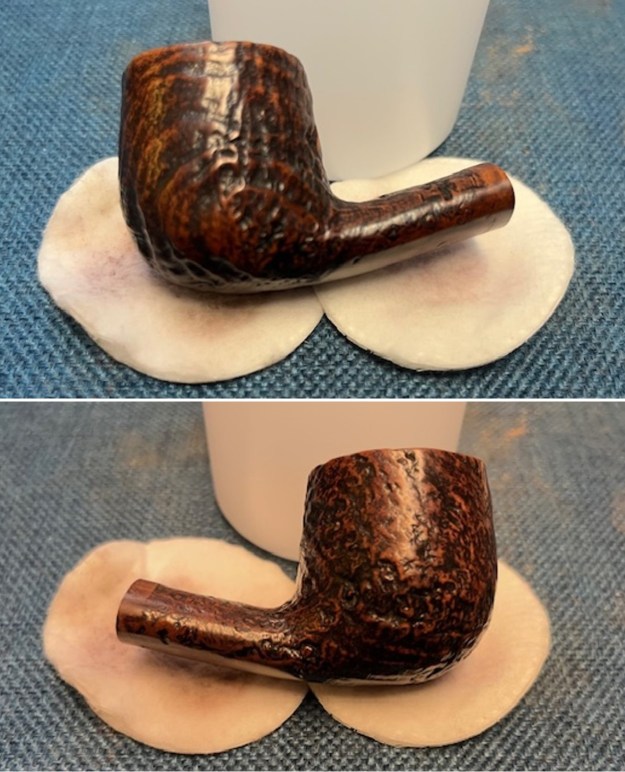
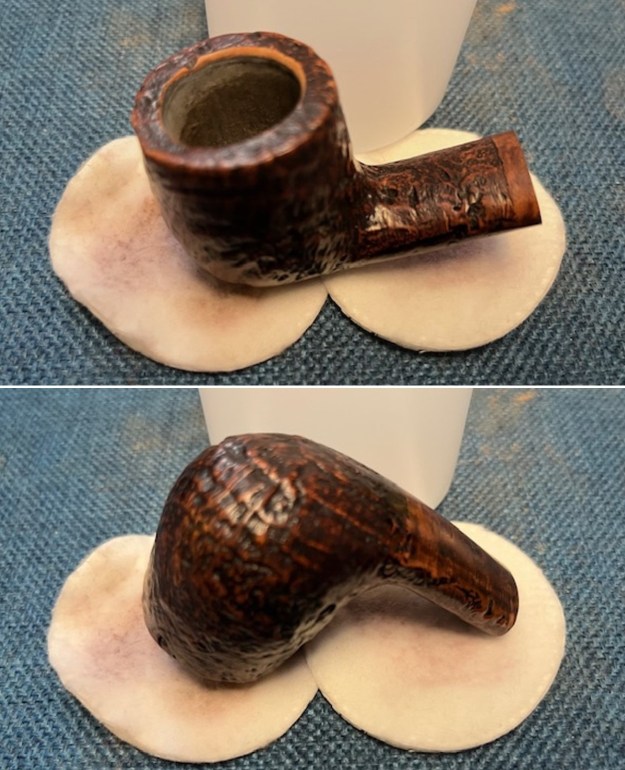
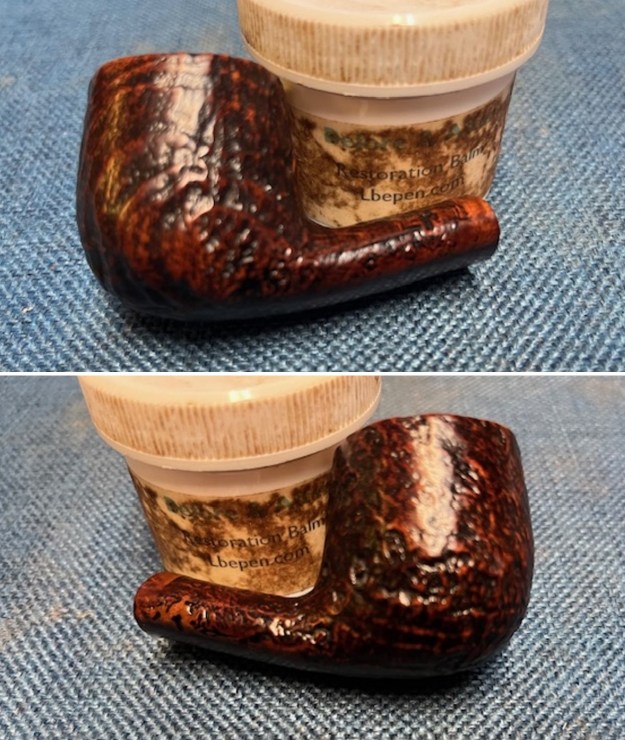
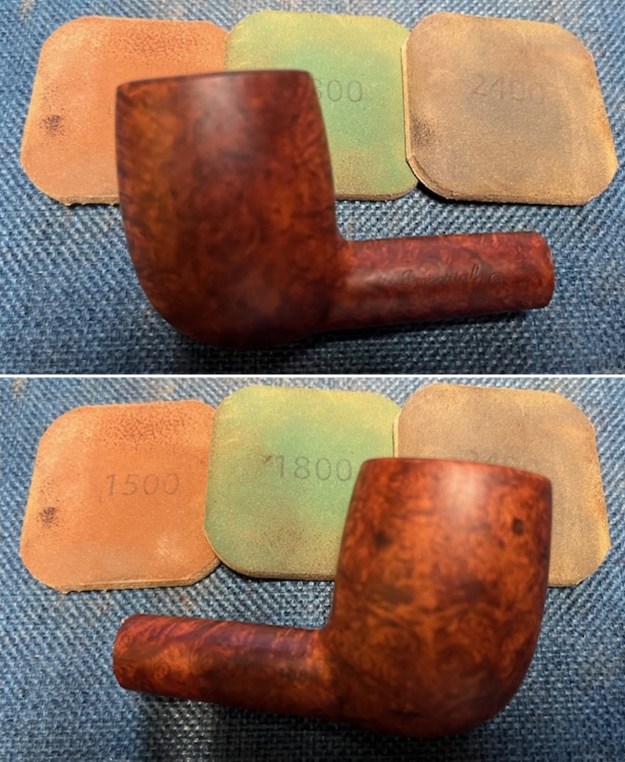
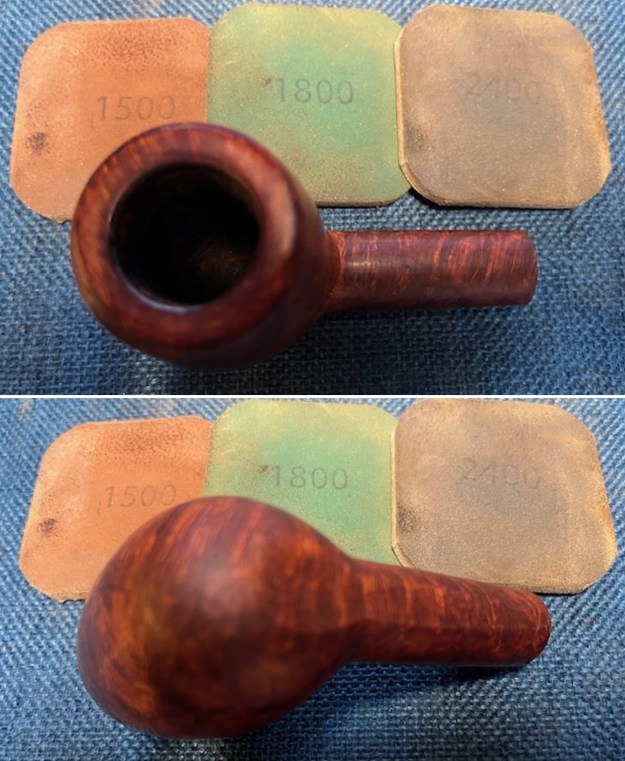
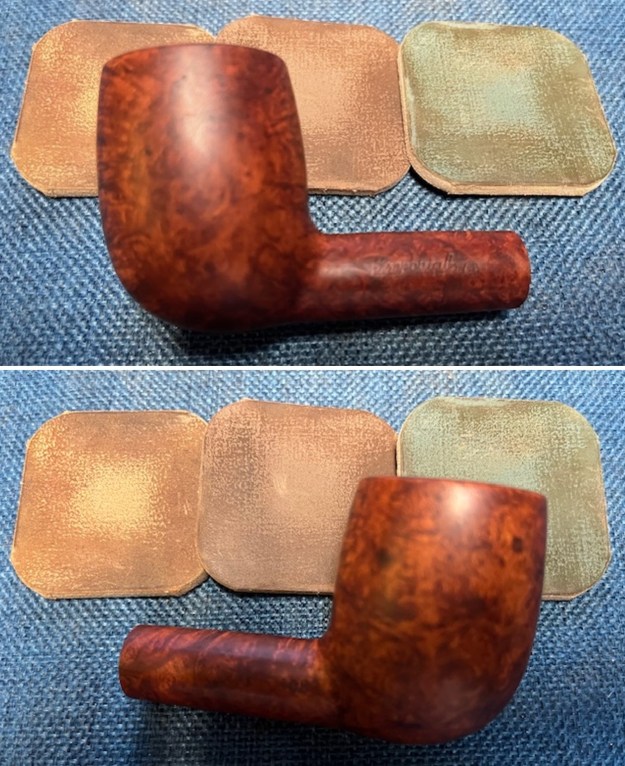
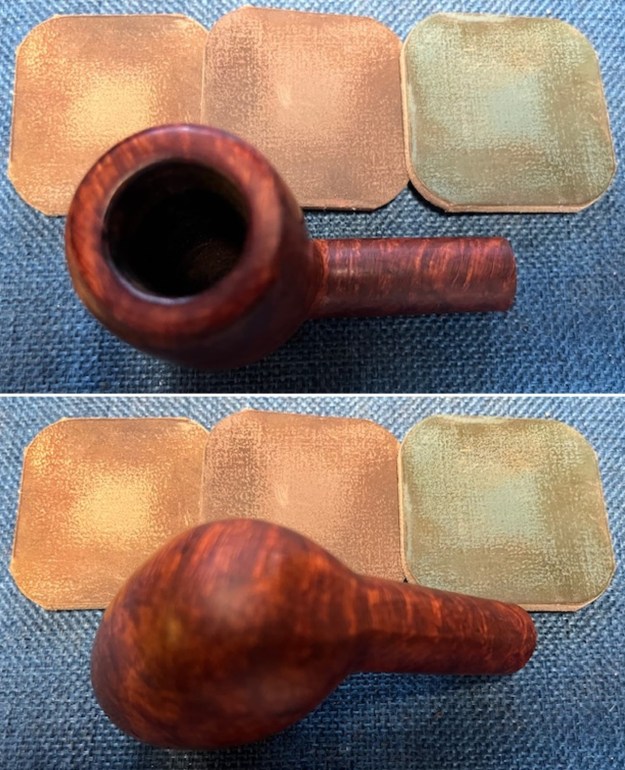
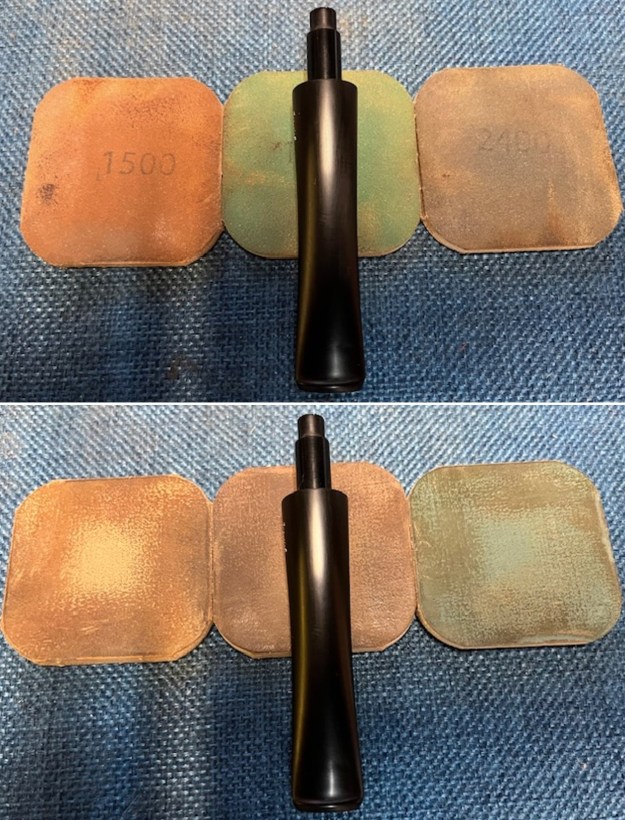
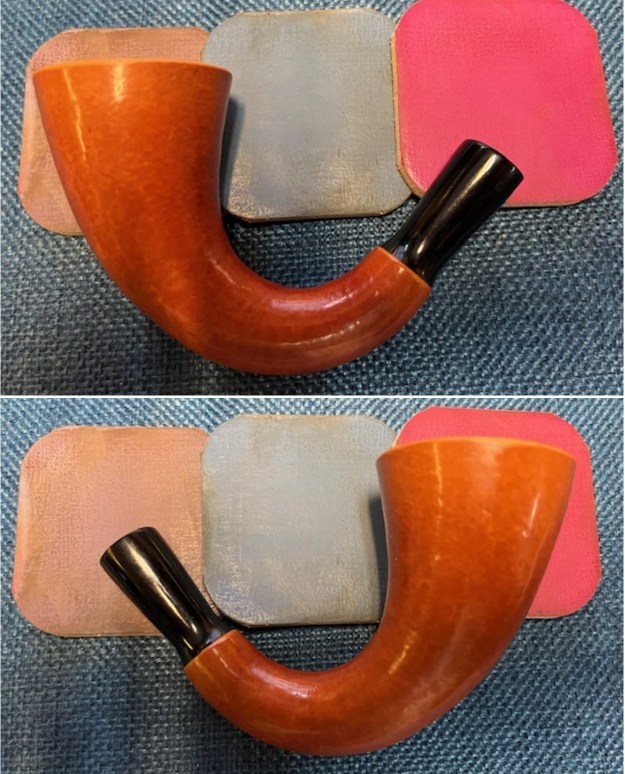
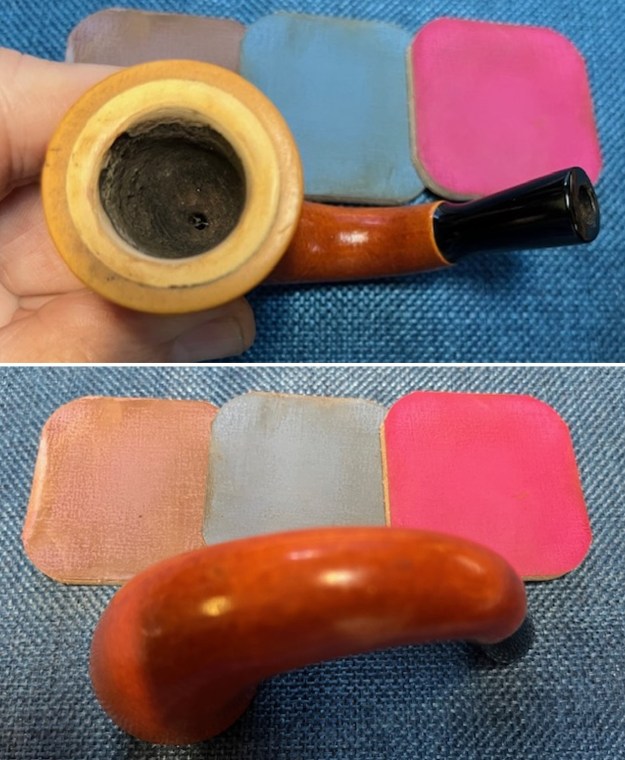
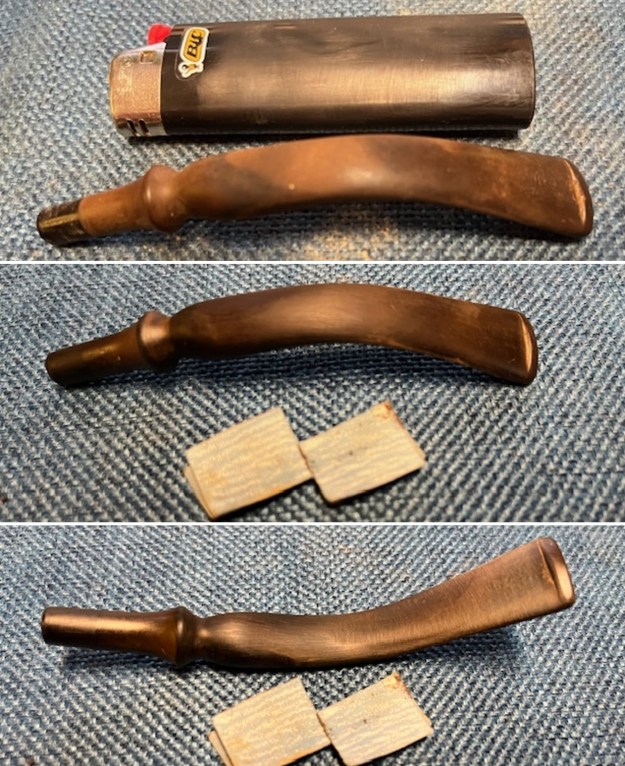
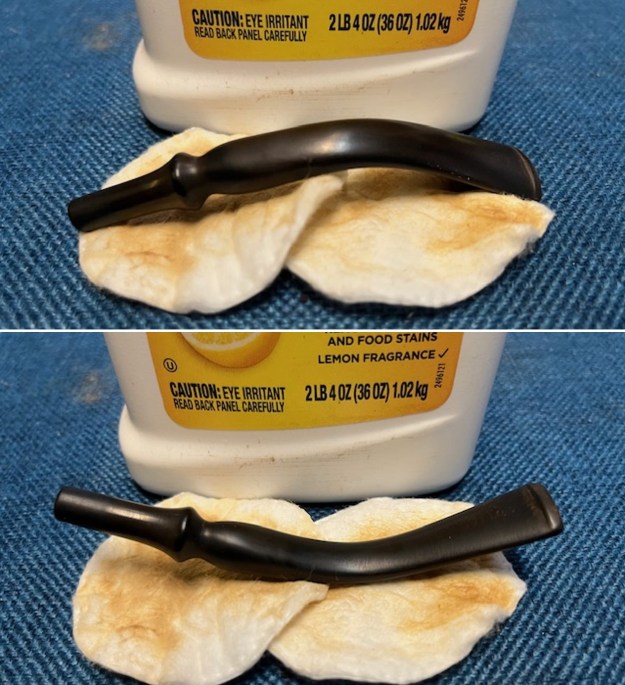
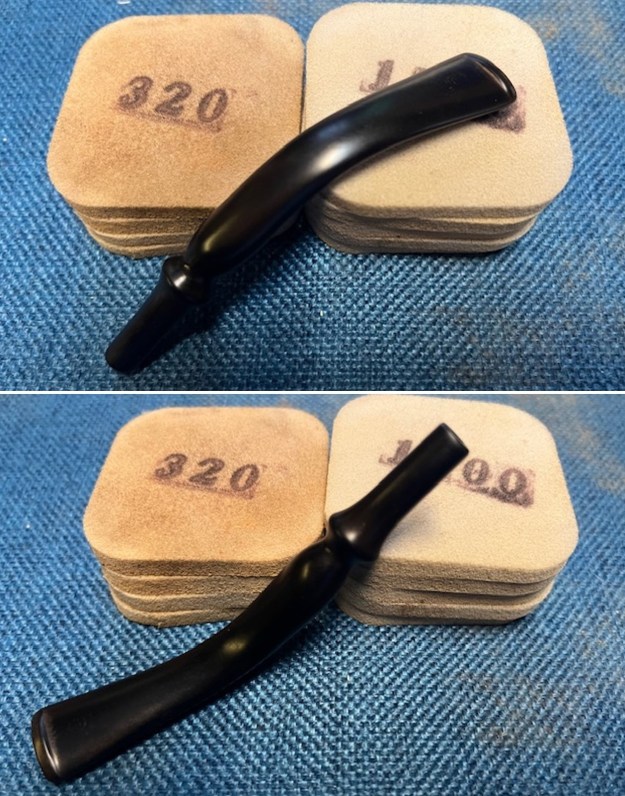
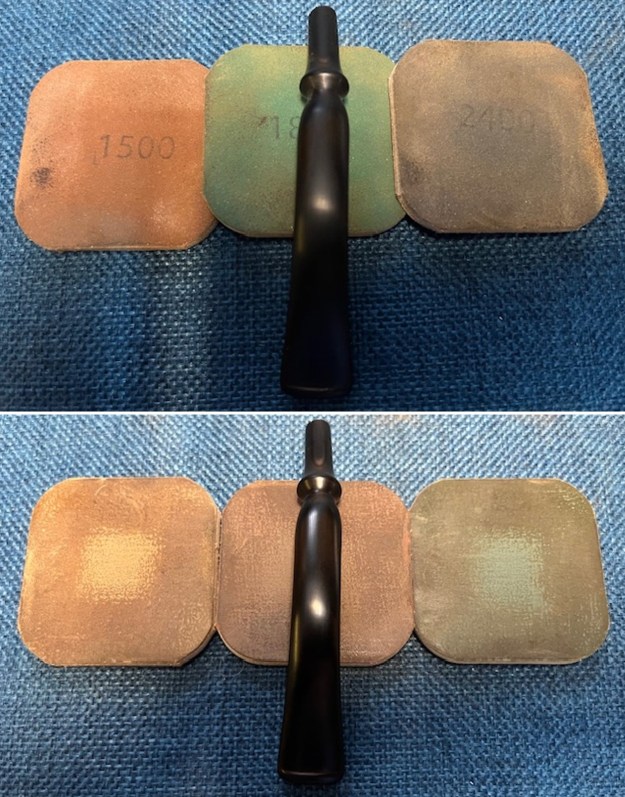
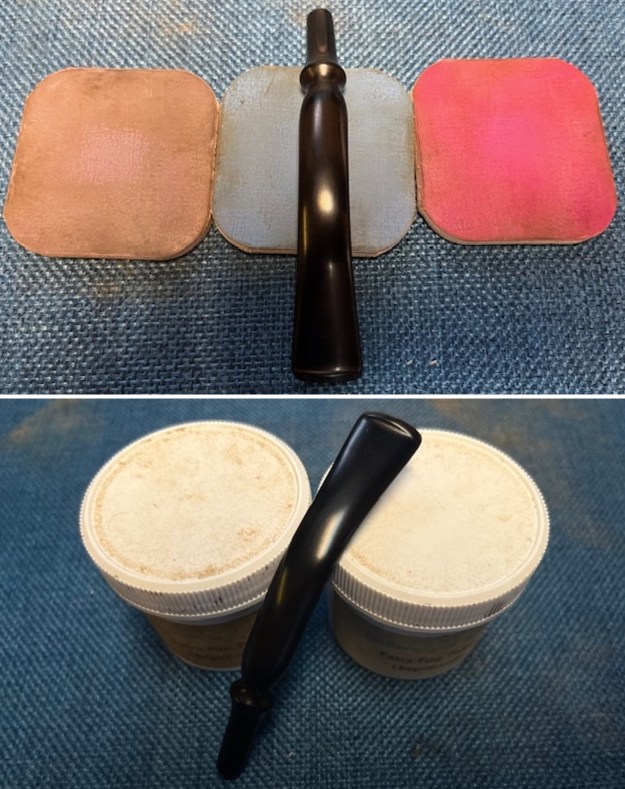
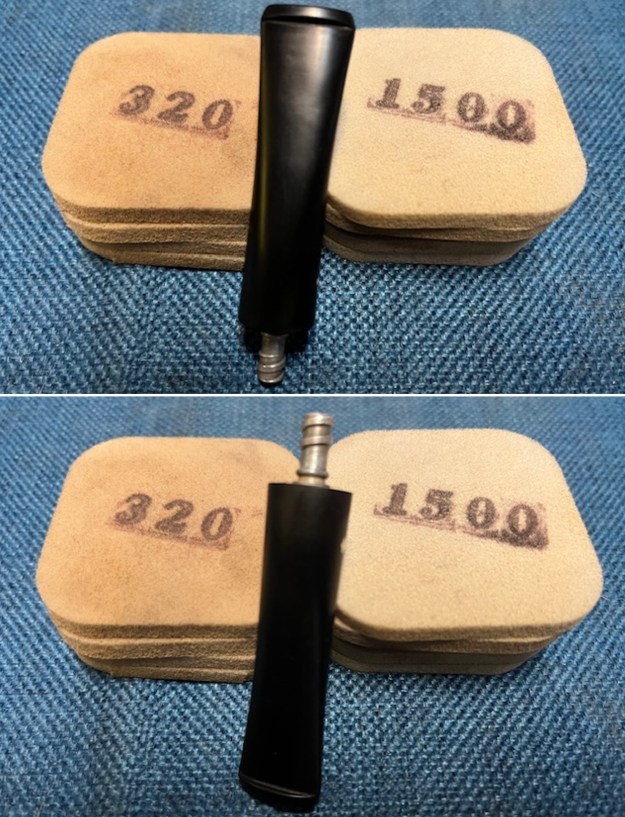
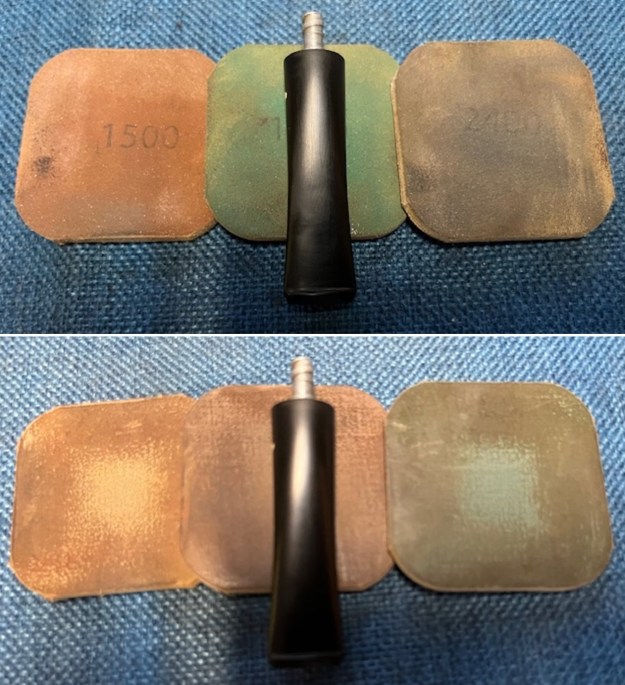
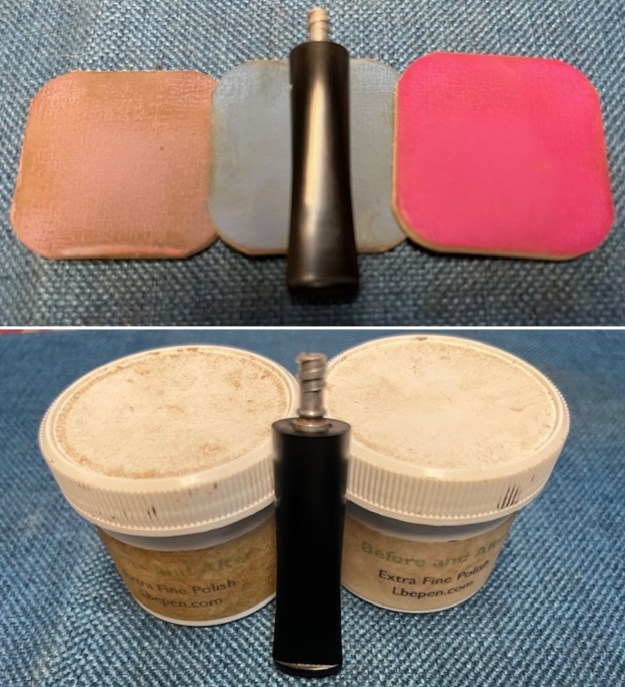
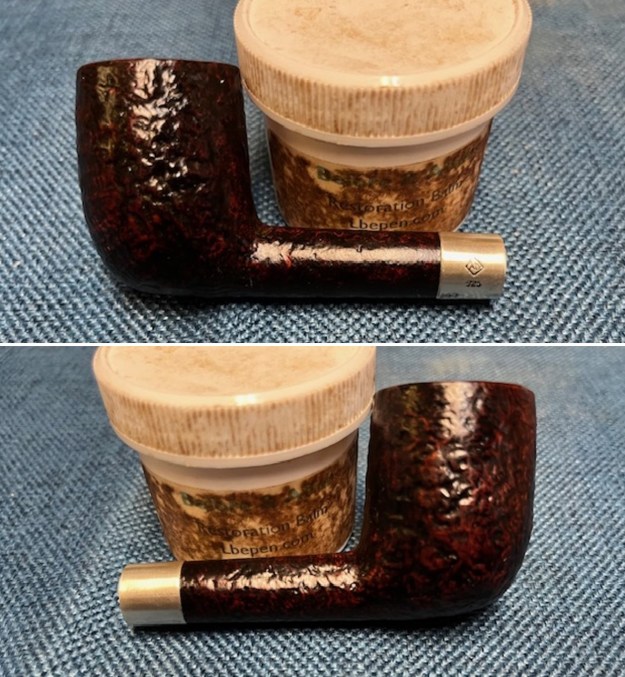
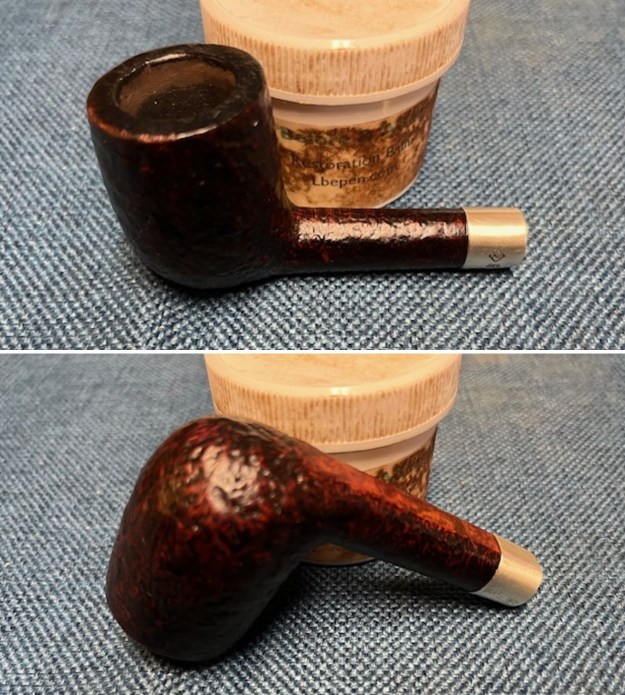
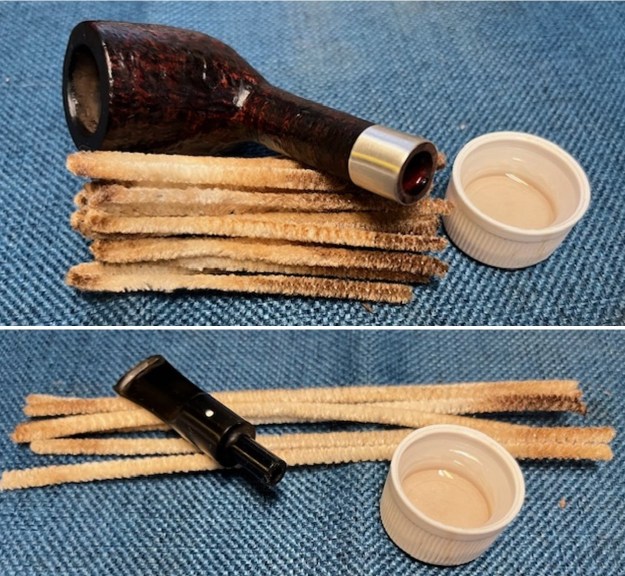
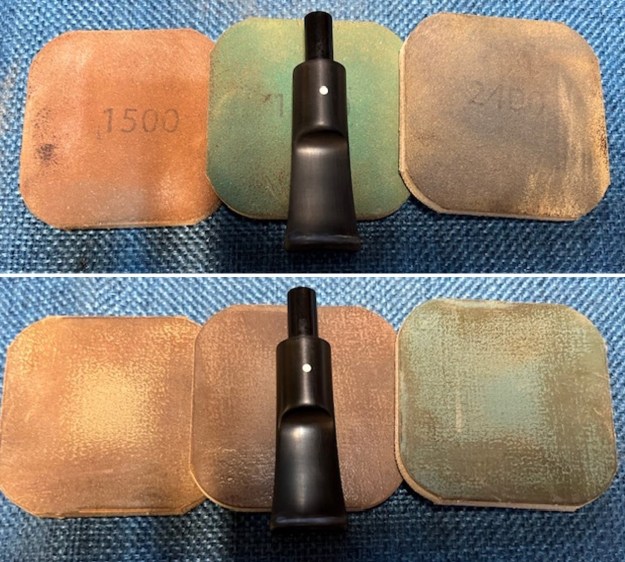
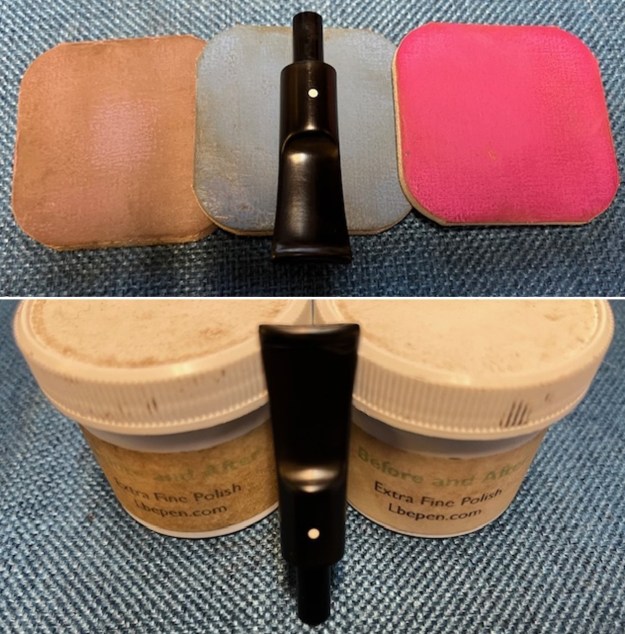
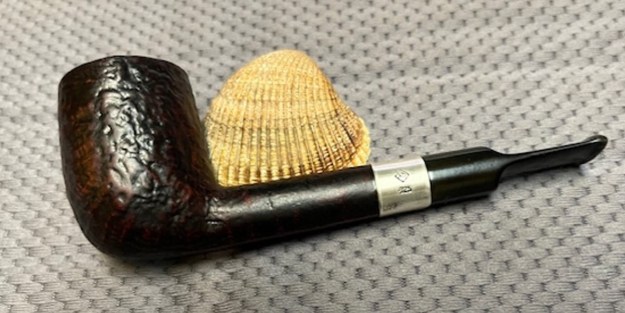
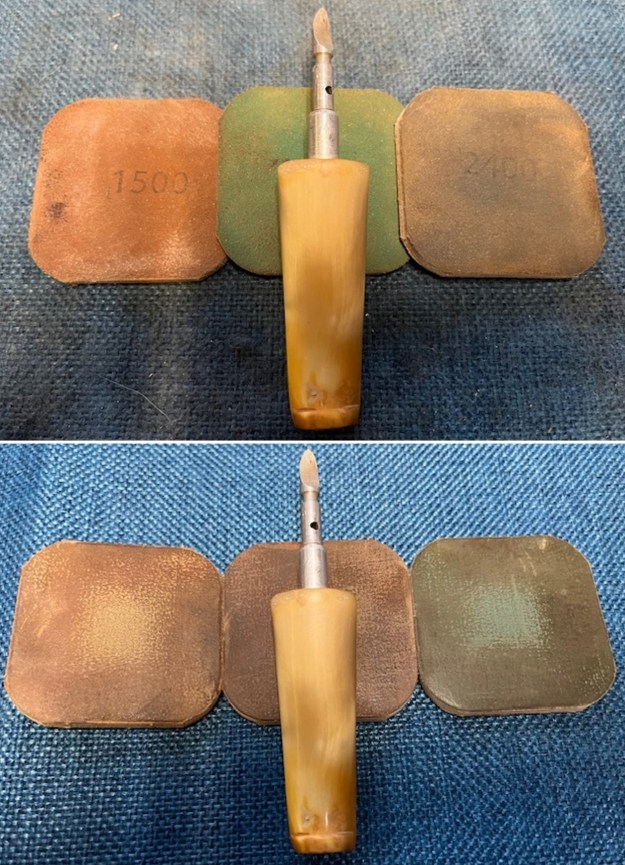
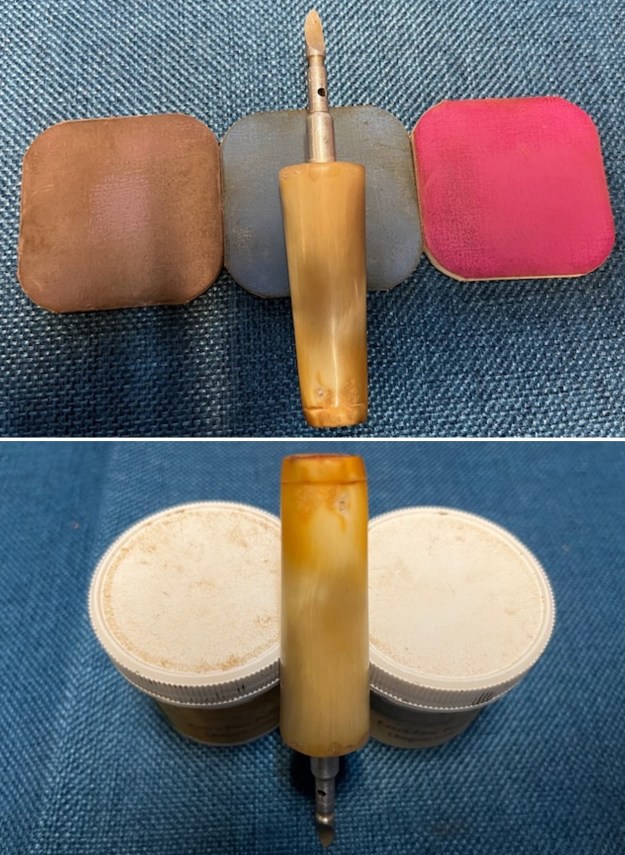
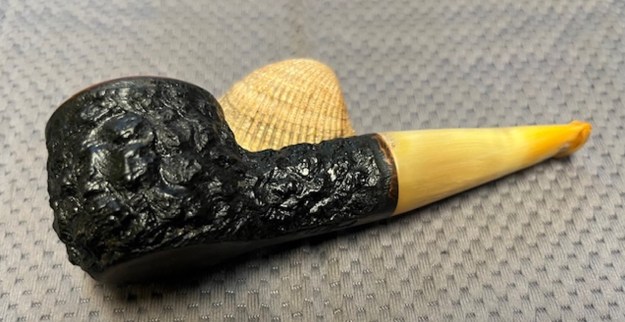
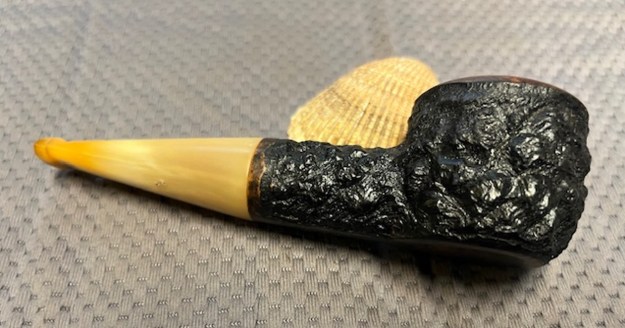
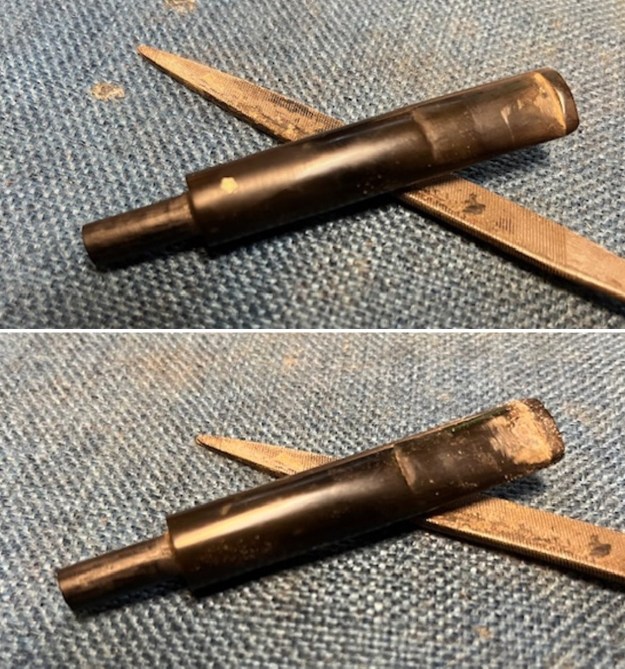
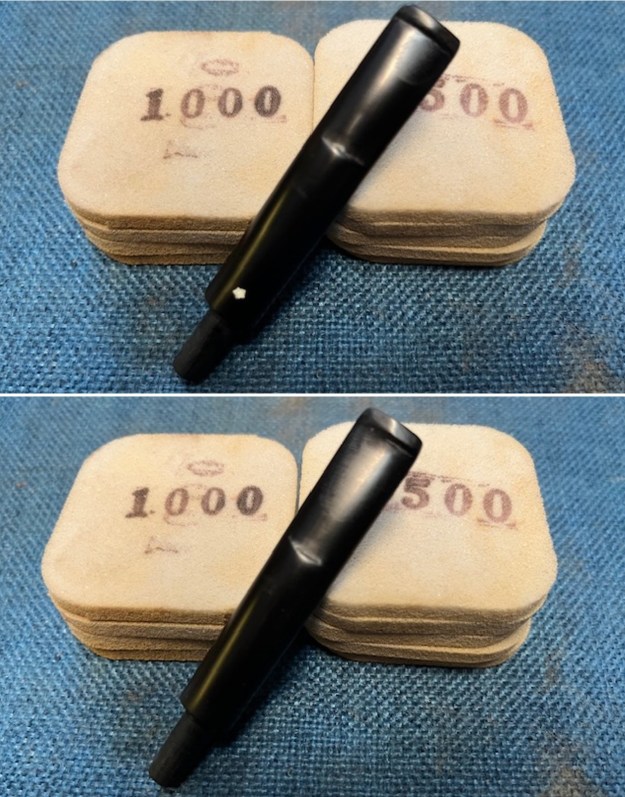
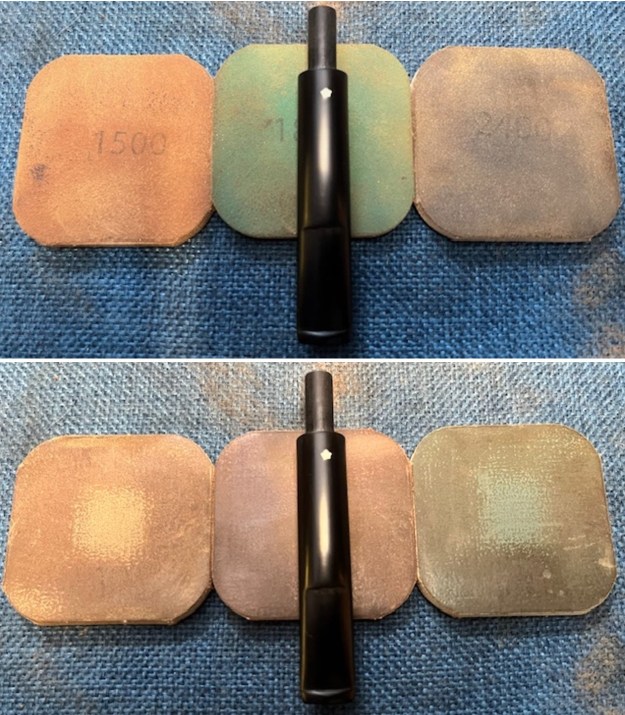
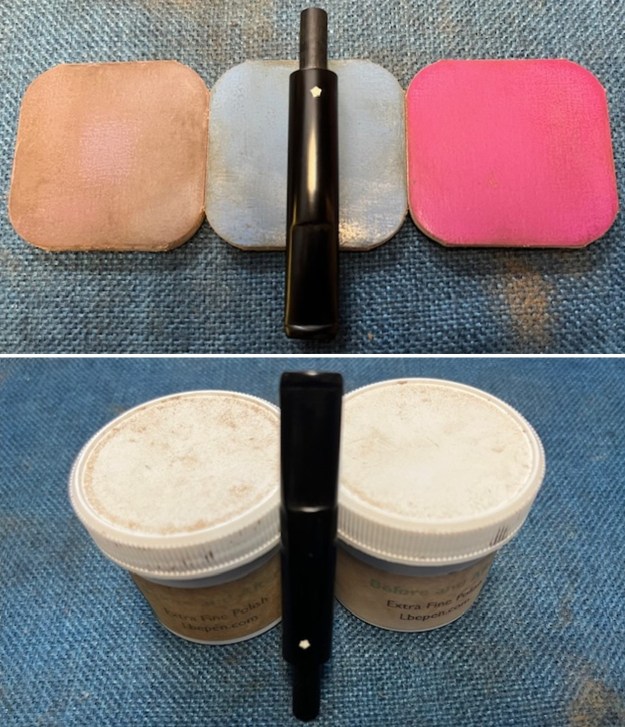
To rusticate, I firmly held the stummel in my left hand and with my right hand and began gouging out the briar. The technique is to firmly press the pointed four prongs of the modified Philips screwdriver into the surface, rotate and gouge out the removed chunk of briar. I worked diligently till I was satisfied with the rustications and the appearance of the stummel. I cleaned the debris off the rusticated surface with a brass wired brush. The high points in the rustications were lightly sanded down using a piece of 220 grit sandpaper.Next, I polished the stummel using micromesh pads, wet sanding with 1500 to 12000 grit pads. I also polished the high spots in the rustication with the micromesh pads. I wiped the bowl with a moist cloth after each pad to clean the surface. I rubbed a small quantity of “Before and After Restoration Balm” into the briar with my finger tips but not in to the rusticated surface. The balm almost immediately works its magic and the briar now has a nice vibrant appearance over the smooth surface with the beautiful grain patterns on full display on the smooth surface of the stummel. I further buffed it with a horse hair shoe brush. The rusticated part of the stummel is now ready for a fresh coat of stain. I had decided to stain the rusticated surface with a black dye which would contrast beautifully with the red of the rest of the smooth surface. I heated the rusticated portion with my heat gun to open up the pores on the stummel so that the stain is well absorbed. I used Fiebing’s aniline black leather dye and liberally applied it over the heated surface, flaming it with the flame of a lighter. This helps in the setting of the stain in the grain of the briar. I ensured that every inch of the rusticated surface was coated with the dye while the smooth surfaces are not stained. I set the stummel aside for a day to set the dye into the briar surface.Once the stain had set, to highlight the contrast of the high points in the rustication, I lightly sanded the high points with a worn out piece of 180 grit sandpaper followed by dry sanding with 1500 to 12000 grit micromesh pads to polish the high points. I rubbed a small quantity of “Before and After Restoration Balm” with my finger tips deep into the nooks and crannies of the rustications as well as the smooth surface and let it rest for a few minutes. With this, save for the final polish, the stummel repairs and refurbishing are now complete.It was now time for me to work on the stem. Using thin shank brushes and anti-oil dish washing soap, I cleaned the stem airway. I have modified this process of cleaning the stem airway by doing away with pipe cleaners and alcohol as it saves me a ton of pipe cleaners, which is a precious commodity for me here in India. I continued this cleaning till only white clean foam came out of the stem airway, indicating that the airway was nice and clean. I ran a couple of pipe cleaners dipped in alcohol through the airway to dry it out and make sure that there are no traces of soap and gunk hidden in the airway.Next, I progressed to wet sanding the entire stem surface with 800, 1000, 1500 and 2000 grit sand papers. I rubbed a small quantity of EVO into the stem surface and set it aside for the vulcanite to absorb and hydrate.To complete the restoration, I mounted a cotton cloth buffing wheel on to my hand-held rotary tool and polished the stem with Blue Diamond compound. This compound helps to remove the minor scratch marks that remain from the sanding. I followed the Blue Diamond polish by applying several coats of Carnauba Wax with a cotton cloth buffing wheel dedicated to Carnauba Wax. I finished the restoration by giving the entire pipe a rigorous hand buffing using a microfiber cloth to deepen the shine further. The finished pipe looks amazingly beautiful and has been transformed from being a write off to being one that is now ready to provide years of happy smokes to one of my club member who had commissioned this beauty! The Pipe Gods are being very kind to me now-a-days and pray that they continue to be so. Following are the pictures of the restored pipe. P.S. The last functional aspect which I addressed was to protect the repairs to the heel of the chamber. I mixed activated charcoal and yogourt to a consistency which allows for an easy and even spread and evenly applied it on the inner walls and heel of the chamber. This coating helps in preventing the epoxy at the heel of the chamber from coming into direct contact with the burning tobacco, a sort of insulation and assists in quicker formation of a cake. I set it aside to dry out naturally for a week before it makes its way to my friend. This was an interesting project that was labor intensive involving long man hours but equally satisfying one. I appreciate all esteemed readers who have dedicated their time in reading this article and thus joining me along on this journey of bring back pipes that are deemed to be lost case!

The Last of the Dominik Sandblasts – A Ring Grain Sandblasted Dublin with a Pencil Shank


Blog by Steve Laug

The pipes that I will be posting over the next few days from this lot that Jeff and I purchased are fascinating pipes. They were quite stunning but altogether unknown to me. I did not recognize the name of the maker. All the pipes were unsmoked other than the Stanwell Pipe of the Year. We purchased them from a fellow in Kalundborg, Denmark on 02/03/2024. He said that they were all unsmoked and when they arrived they were. They were relatively clean and merely dusty with a little light debris on the stem surfaces. The shapes, sandblasts, shank extensions, and stems were all unique and very well done. The pipes were very beautiful and I could not wait for Jeff to refresh them a bit and get them up to me to do my part. Here are some of the photos of the pipes that we purchased provided by the seller.Here is a photo of the pipe that was sent to us by the seller. It is the one that I chose to work on next. It is a beautiful sandblast Dublin with a smooth, crowned rim top. The blast is very well done. The stem is also well cut and other than dusty and lightly oxidized is in great condition. The bowl is unsmoked. The bowls all have a carbon bowl coating that is well done on the walls of the bowl. The pipe is stamped around the shank end with the etched name of Dominik. I am looking forward to working on it as it will take very little work and will be a fun break.I am including what I learned when I worked on the first pipe of this brand. When I started I knew nothing about the carver other than he did beautiful work so I turned to Pipedia to see what I could find (https://pipedia.org/wiki/Dominik_Pipes). There was a listing for Dominik Pipes. He is a Polish Carver and I have included the short article in its entirety below.

Dominik pipes are made by Dominik Kobryń. His journey with pipes began in 1993 at a flea market, where he bought his first pipe. From that time his collection has grown a lot. He made his first pipe in December 2016. Dominik credits Wojtek Pastuch as his mentor, and is very grateful for that!

Dominik uses briar from Mimmo Romeo. He makes his stems by hand, mainly from Ebonite and Cumberland rods, but occasionally acrylic. He focuses on unique pipes that are well done technically.

From there I clicked on a link at the bottom of the page that took me to his Pipe sales website (http://www.dominikpipes.com/). Interestingly the site contained almost word for word the information that I had found on Pipedia.

My name is Dominik Kobryń. My journey with pipes began in 1993 on a flea market, where I bought my first pipe. From that time my collection has grown a lot.

I made my first pipe in December 2016. Wojtek Pastuch has taught me a lot about pipemaking and I am very grateful for that!

I use briar from Domenico Romero (Mimmo). I make stems by hand, mainly from ebonite rods and cumberland, sporadically acrylic. I pay much attention to create unique pipes, well done technically.

If you are interested in my work do not hesitate to contact me.

I have been following Wojtek Pastuch for some time now and really like what he is doing. It is fascinating that Dominik considers him his mentor. In chatting with Jeff, he sent me a link to Dominik’s Facebook page (https://www.facebook.com/dominikpipes). It is worth a look to see his current pipes.

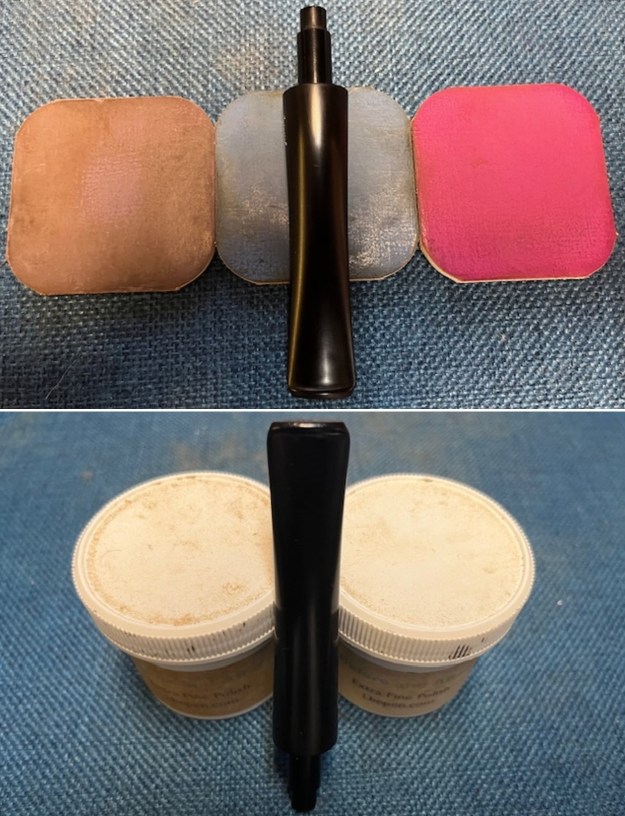
Now it was time to “work” on the pipe. For his part, Jeff had simply rinsed the pipe off with warm water and dried it. He soaked the stem in deoxidizer to remove the grime and the light oxidation near the shank joint. This pipe is perhaps one of my favourites in the lot. It is a Canted Stack or Dublin Poker that has a stunning ring blast around bowl, a regular light blast on the heel and the shank and a smooth crowned rim top. It has a pencil shank and a flared vulcanite taper stem. There is a mix of colour in the blast that shows depth and when it arrived here it was very clean. I saved it for last because I have just left it sitting so I could enjoy the artisanry of the pipe. It is one that I believe that I will hang on to for my own collection. I finally took photos of it before I started my work. It is a beauty! I took photos of the smooth crowned top and bowl along with both sides of the vulcanite stem to show the condition of the pipe. It is clearly unsmoked and new.I took a photo to try to capture the etching of Dominik on the underside of the shank. It is very readable in person but is curved around the shank bottom and it hard to capture in a photo. I also removed the stem from the shank and took a photo of the parts of the pipe. The bowl was in excellent condition so skipped ahead to applying the Balm to the briar. I rubbed the briar down with Before & After Restoration Balm. I worked it into the briar with my fingertips and a horsehair shoe brush to work it into the nooks and crannies of the sandblast finish. The product works to clean, enliven and preserve the briar. I let it sit for 10 minutes then I buffed it with a cotton cloth to deepen the shine. The pipe really comes alive with the balm. I polished the vulcanite taper stem with micromesh sanding pads – 1500-12000 grit pads. I wiped it down with Obsidian Oil after each sanding pad. I used Before & After Pipe Polish – both Fine and Extra Fine to further polish the stem. This Sandblast Dominik Crowned Rim, Pencil Shank, Canted Dublin and a vulcanite taper stem has a beautiful, unique ring blast finish that is deep and craggy. The rich dark finish highlights some great grain around the bowl and shank. It has the same great rugged sandblast that I am enjoying looking at on the Dominik pipes I have picked up. The polished smooth, crowned rim is richly grained. The sand blast and the vulcanite taper stem add to the mix. I put the stem back on the bowl and lightly buffed the pipe with Blue Diamond on the buffing wheel being careful to not buff the stamping and have a lighter touch on the briar. I gave the bowl multiple coats of Conservator’s Wax and the stem multiple coats of carnauba wax on the buffing wheel and followed that by buffing it with a clean buffing pad. I hand buffed the pipe with a microfiber cloth to deepen the shine. The finished Sandblast Dominik Crowned Rim Dublin is stunning and feels great in my hand. Give the finished pipe a look in the photos below. The dimensions of the pipe are Length: 5 inches, Height: 2 inches, Outside diameter of the bowl: 1 ½ inches, Chamber diameter: ¾ of an inch. The weight of the pipe is .95 ounces/27 grams. Thanks for walking through the restoration with me as I worked over another beautiful pipe. I am going to hold on to this one – at least for awhile and enjoying Dominik’s fine work. I hope to fire it up the first time this weekend. Thanks for your time.

A Rather Sad, Well Used Peterson March 17, 2009 B2 Bulldog


Blog by Steve Laug

In January Jeff found out about an estate sale in Pocatello, Idaho, USA. It turned out that the sale was for a fellow Jeff and I had purchased pipes from in the past, Gene. He had been the owner of Outwest Tobacco in Pocatello (long closed now) and I bought tobacco and other smoking items from him in the past. As I think about it now, it seems that I had known Gene for over 30 years Jeff and I had been to his home and enjoyed coffee and a few pipes together. I have no idea how many pipes we bought on those visits as well as to the antique shop of his daughter. I know that there were many pipes. When we heard that it was Gene’s personal collection that was for sale and that he had passed away we decided for Jeff to go to the house and have a look. He went on January 25, 2024 to scope it out as we had seen his personal collection of pipes and there were definitely some among those well smoked old warriors that would be great to pick up. Perhaps there would even be one that could join my own collection in memory of Gene.

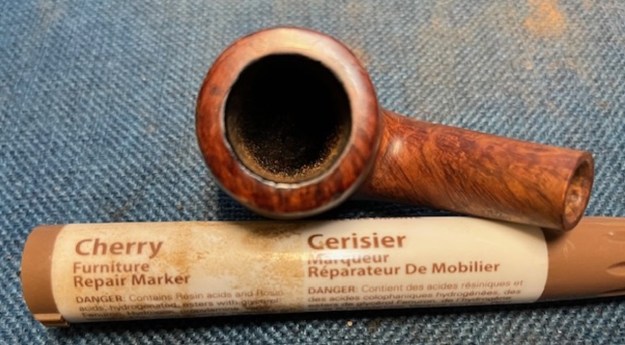
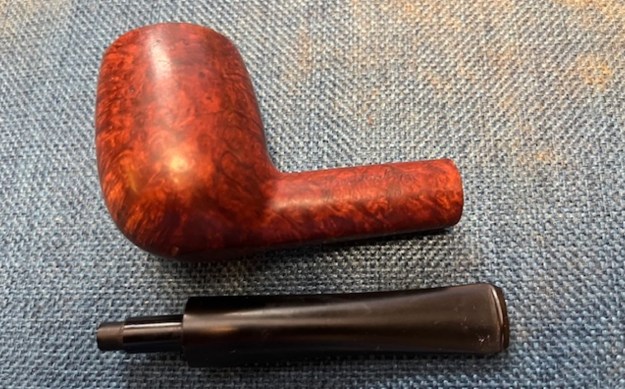
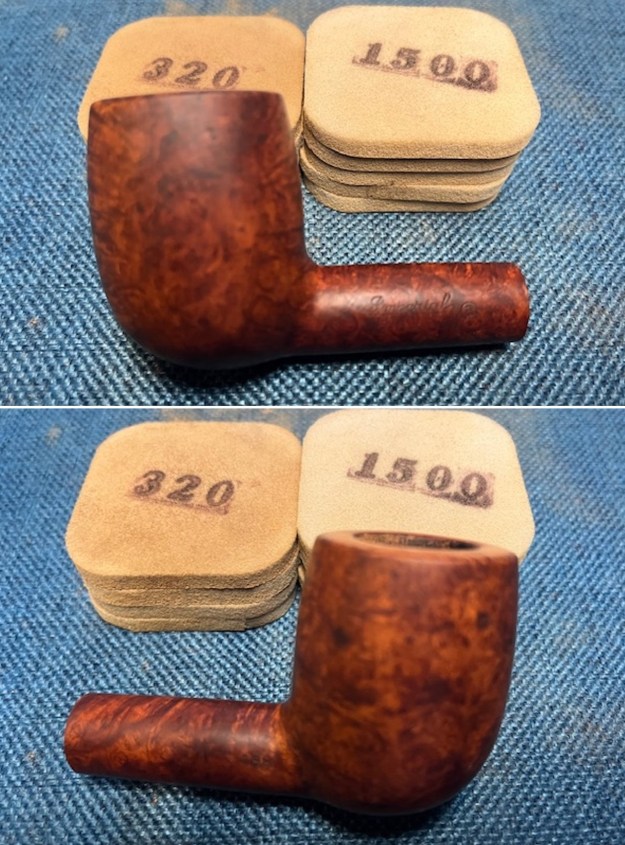
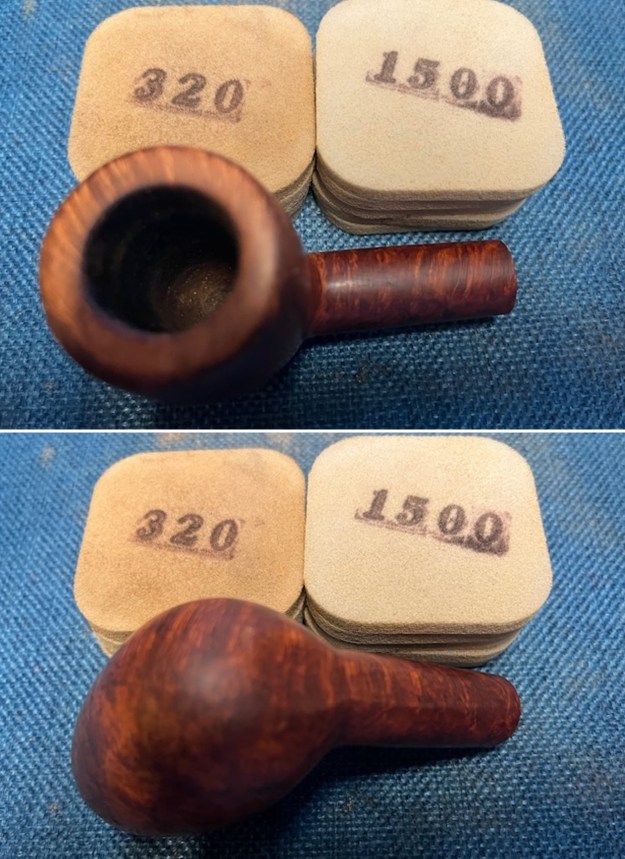
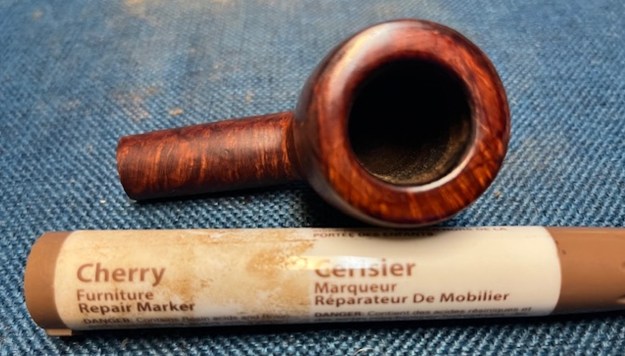
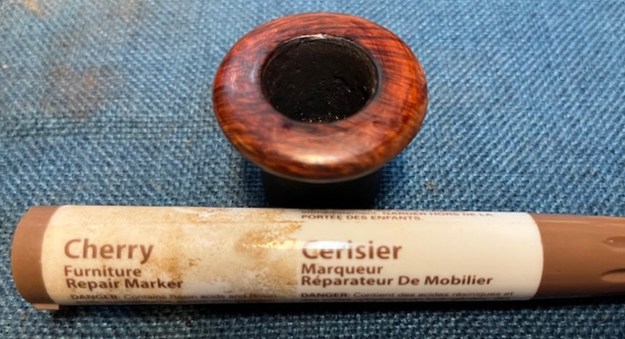
Jeff went to the house and looked through the racks, pipe bags, tobacco – both bulk and tinned as well as a variety of pipes. All the pipes were well smoked and needed serious cleaning. Another one of the pipes that he picked up was this Peterson March 17 2009 with a black vulcanite taper fish tail stem. It was very dirty and was a reddish, brown coloured pipe when it started. The smooth finish around the bowl was dirty and had hand oils ground into the grooves. The bowl had a thick cake that overflowed in lava onto the rim edge and top of the bowl. The bottom of the bowl was flattened so the pipe could be set on a desktop. The stem was vulcanite that was very dirty and had the marks of a rubber Softee Bit on the end. It had become discoloured and there was a line where the debris from smoking had accumulated along the edge and under the bit protector. The good news was that there were only light tooth marks or chatter. The rest of the stem was dirty and had lost the characteristic shine. The pipe was stamped on the polished nickel band on the shank and read Peterson [arched over] a Shamrock with March 17 2009 arched underneath. On the right side of the shank it was stamped with the shape number B2. Jeff took photos of the pipe so I could have a sense of what it looked like before he started his work on it.Jeff took photos of the stem surfaces and the bowl and rim to give a sense of condition of the pipe. You can see the thick cake in bowl and the lava overflow on the edges and rim top of the bowl. It is had to know if there is any damage as the cake and lava is quite thick. The stem surface is very dirty and you can see the area on the end of the stem where the Softee Bit had protected it from chewing but had left it dirty and discoloured. The stem no longer fit in the shank correctly. He also took photos of the sides of the bowl and the heel to show the interesting grain that went around the bowl. There were a few spots on the right side of the bowl that seemed to have a flaw or a shrunken fill. The grain is beautiful and you can see the oils and debris in the grooves of the rim cap.  He took photos of the stamping on the nickel band on the left side of the shank. He did not capture shape number on the right side. The stamping on the band is clear and readable as noted above.I did a bit of searching on the internet to see what I could find. Interestingly turning to Peterson’s Pipe Notes I found the pipe I have in my hand (https://petersonpipenotes.org/tag/st-patricks-day-pipe-2009/). Note that in Mark Irwin’s information below the date he gives for the shape I have is 2010 but the band on mine is definitely marked 2009. Ah well another Peterson anomaly. Either way it is a nicely shape Irish Bulldog.Now it was my turn to work on the pipe. Jeff had done an amazing cleanup of the pipe. He reamed the light cake with a PipNet reamer and cleaned up that with a Savinelli Fitsall Pipe Knife. He scrubbed the internals of the bowl and stem with alcohol, cotton swabs and pipe cleaners. He scrubbed the externals with undiluted Murphy’s Oil Soap and rinsed the bowl off with running water. He soaked the stem in Briarville’s Pipe stem Deoxidizer and once it had soaked rinsed it off with warm water to remove the residual solution. He dried it off and rubbed it down to remove any oxidation that was still on the stem. The pipe looked very good when I received it. I took a photo of the rim top to show the condition. You can see the clean bowl. The bowl is in excellent condition and is clean. The rim top has a small burn mark on the front inner edge and darkening on the back of the rim top and edges. The stem came out looking good. There were definitely light tooth marks and chatter on both sides. I took a photo of the stamping on the shank. The first photo shows that there is no stamping on the briar but the nickel band stamp is very clear. The shape number, B2 on the right side of the shank is also very clear. There was a faint remnant of the P stamp on the left side of the stem.  I removed the stem from the shank and took a photo of the pipe parts to show what I was working with. I also took photos of the pipe with the longer Churchwarden stem in place. It is a nice looking pipe. I started my work on the pipe by addressing the damage on the inner edge of the rim. I used a folded piece of 220 grit sandpaper to smooth out the roughness. I then used 220 grit sandpaper and a wooden ball to give the inner edge of the bowl a slight bevel. It looked much better at this point in the process. I touched up the stain on the rim top with a Cherry Stain Pen and the match to the rest of the bowl is perfect. Once the bowl is finished it will blend very well.I sanded the briar rim top and the sides of the bowl with 320-3500 grit sanding pads. I wiped the bowl down with a damp cloth after each pad. By the time I finished with the 3500 grit pad the briar had taken on a rich glow. The pipe had cleaned up so well that I turned to polish the briar with micromesh sanding pads. I dry sanded it with 1500-12000 grit sanding pads and wiped the bowl down after each pad with a damp cloth. By the final pads the briar really had a shine. I rubbed the briar down with Before & After Restoration Balm. I worked it into the briar with my fingertips and a horsehair shoe brush to work it into the nooks and crannies of the sandblast finish. The product works to clean, enliven and preserve the briar. I let it sit for 10 minutes then I buffed it with a cotton cloth to deepen the shine. The pipe really comes alive with the balm. I set aside the bowl and turned my attention to the stem. I “painted” the stem surface with the flame of a lighter. I was able to lift the tooth marks significantly. Those that remained were more like waves in the stem surface. I filled them in with a coat of clear CA glue and spread it across the surface with a dental spatula. Once the repairs cured I sanded it with a folded piece of 220 grit sandpaper to flatten it further. I sanded it with 320-3500 grit sanding pads to further blend them in and smooth out the surface of the stem.The P stamp on the left side of the stem was faint but I thought I would give it a shot and see how it work. I painted the stamp with white acrylic fingernail polish and let it dry. Once it had dried I scraped off the excess and polished it with a worn 1500 grit micromesh sanding pad. It was faint though it is still readable.I polished the vulcanite with micromesh sanding pads – 1500-12000 grit pads. I wiped it down with Obsidian Oil after each sanding pad. I used Before & After Pipe Polish – both Fine and Extra Fine to further polish the stem. I put the stem back on the Peterson March 17 2009 B2 Bulldog and took it to the buffer. I worked it over with Blue Diamond to polish out the remaining small scratches. I gave the bowl and the stem several coats of carnauba wax and buffed the pipe with a clean buffing pad to raise the shine. I hand buffed it with a microfiber cloth to deepen the shine. The pipe polished up really well and the rim top looked good. I was happy with the look of the finished pipe. The photos below show what the pipe looks like after the restoration. The Peterson St. Patrick’s Day March 17, 2009 Irish Bulldog is a beautiful and unique take on a classic shape. The polished vulcanite taper stem looks really good with the browns of the briar. The dimensions of the pipe are Length: 5 ½ inches, Height: 2 inches, Outside diameter of the bowl: 1 ¼ inches, Chamber diameter: ¾ of an inch. The weight of the pipe is 2.08 ounces/60 grams. This is another pipe that I will be putting it on the rebornpipes store in the Irish Pipe Makers Section shortly, if you are interested in adding it to your collection. The long shank and tall bowl look and feel great in the hand. This one should be a great smoker. Thanks for walking through the restoration with me on this beauty!

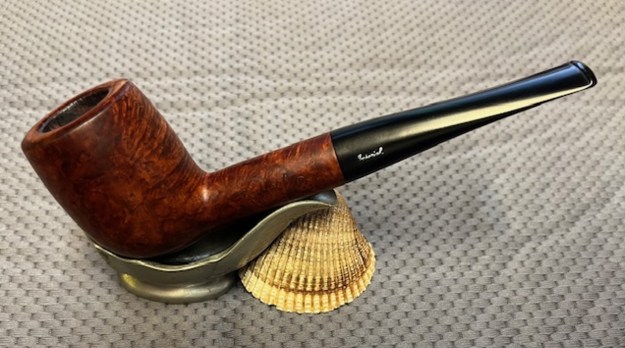
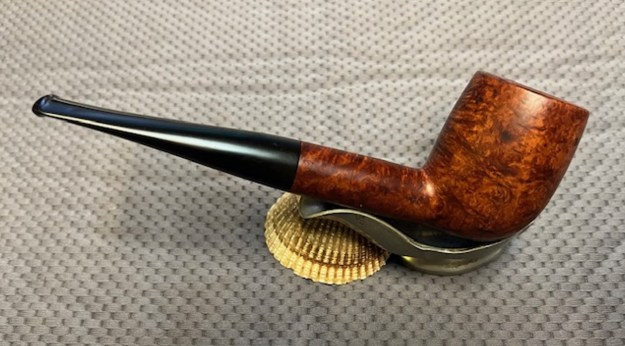
New Life for a Fischer Imperial Long shank Canadian Stack


Blog by Steve Laug

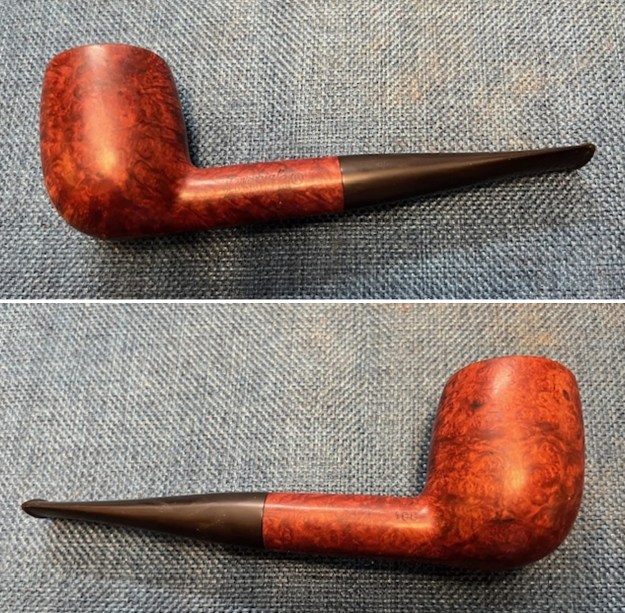
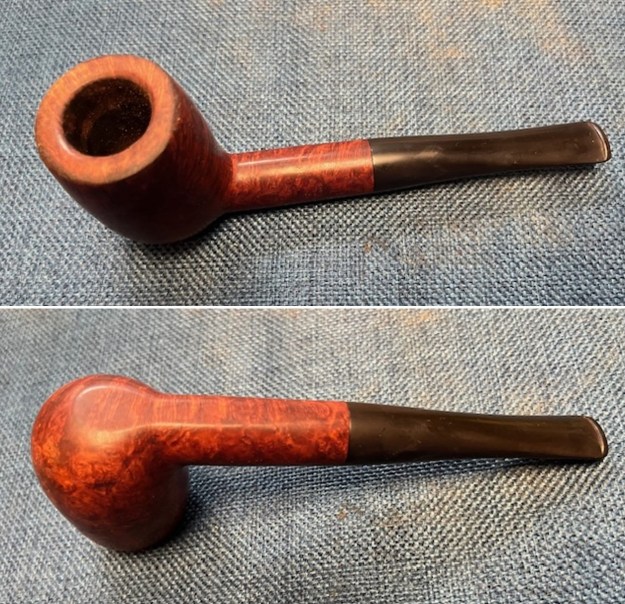
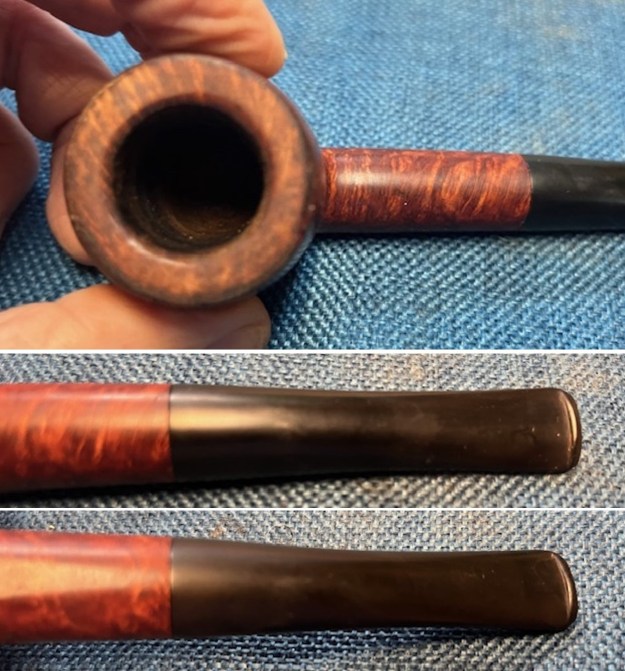
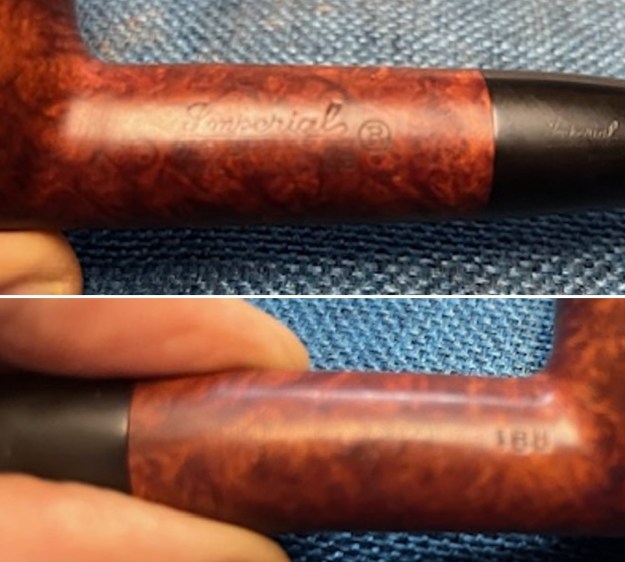
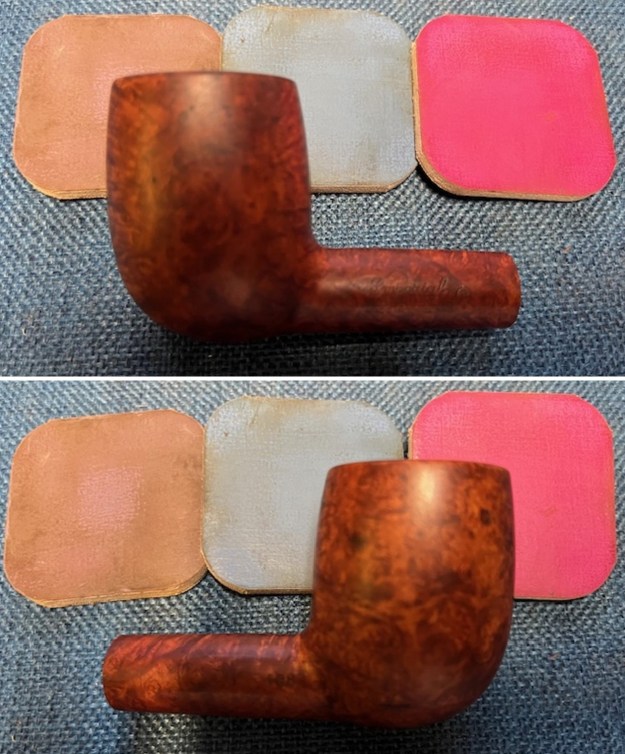
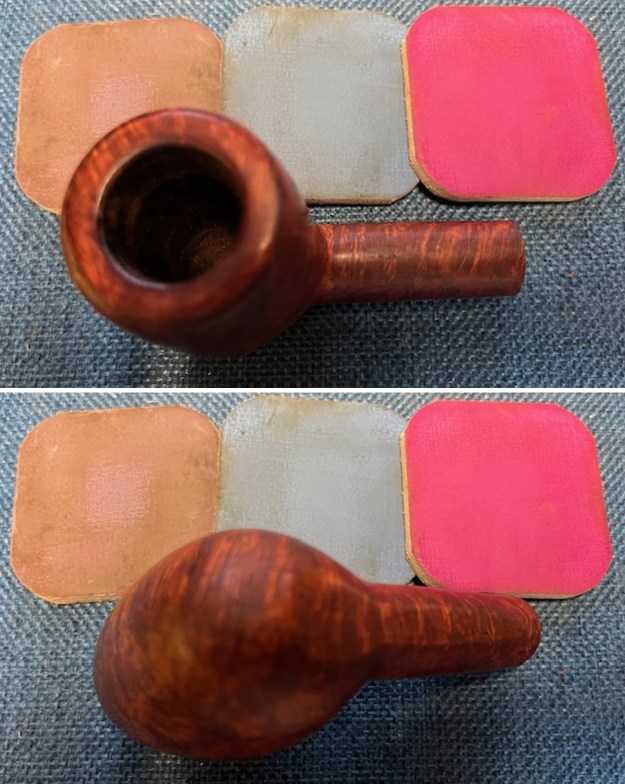
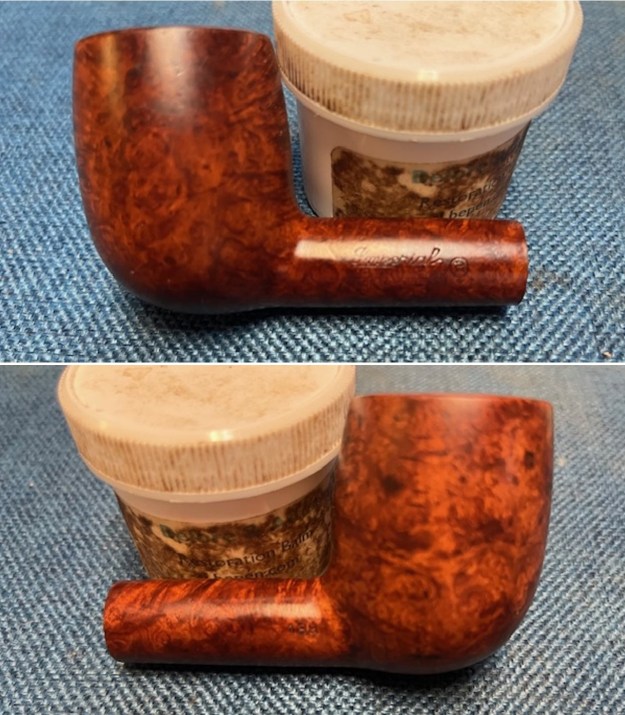
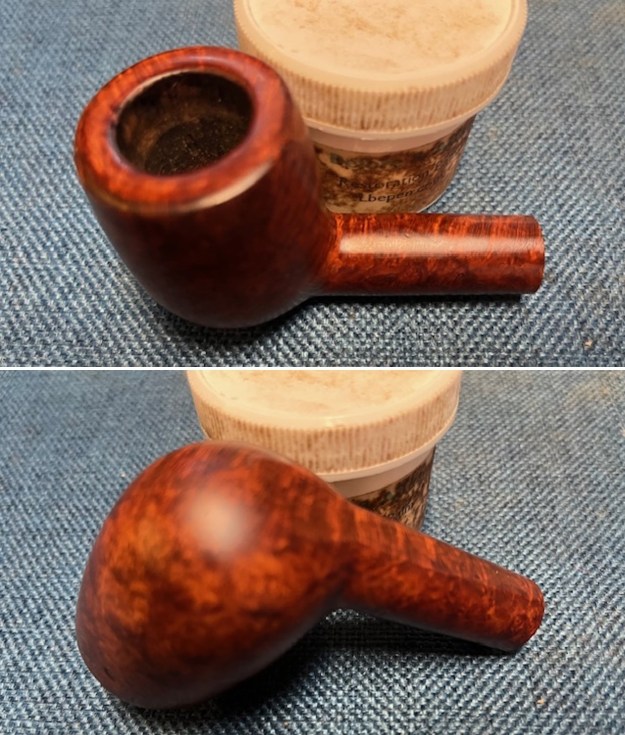
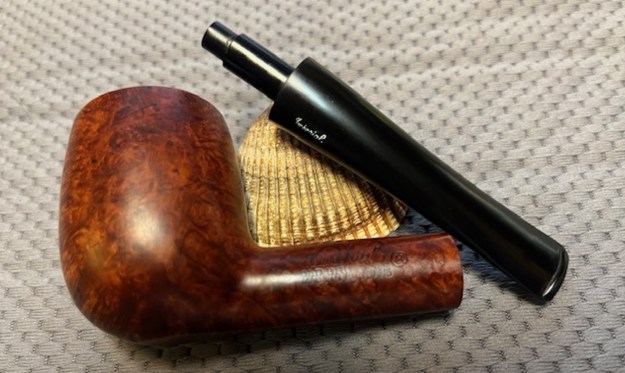
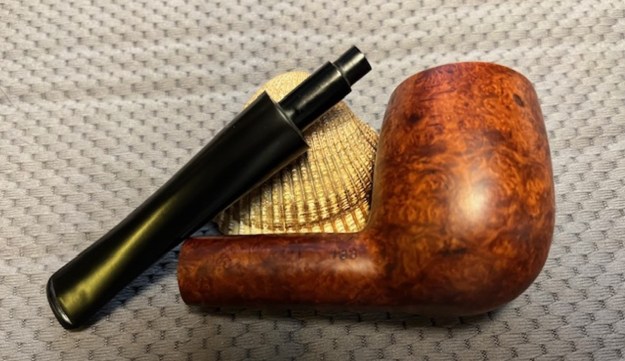
The next pipe on the table is a smooth finished long shank Canadian with a tall bowl and a vulcanite stem. We purchased it from a seller on eBay from Jordan, Minnesota, USA on 01/22/2024. The pipe is stamped on the topside of the shank and reads Fischer. On the underside of the shank it is stamped Imperial. The rim was in good condition other than a lot of lava overflowing from the thick cake in the bowl onto the smooth rim top It is hard to assess the condition of the inner edge of the rim due to the cake and lava overflow. There may be some darkening or damage at the back of the bowl but I cannot be sure. There were oils and grime ground into the bowl sides gives the finish a flat look. The short taper stem is a dirty stem with grime and grit on the surface. There were also tooth marks on both the top and underside of the stem just ahead of the button. It appears that there may be some small pin hole bite through marks on the underside ahead of the button. Jeff took photos of the pipe before he started his clean up work. I have included them below. He took photos of the pipe’s bowl and rim top to show the cake in the bowl and the lava coat overflowing onto the top. It is another dirty pipe. He also took photos to capture the tooth marks on the top and underside of the stem near the button. You can also see the pinhole tooth punctures on the underside. He took photos of the sides and heel of the bowl to show the grain around the bowl and the amount of grime ground into the surface of the briar. He took photos of the stamping on the top and undersides of the shank. It is clear and quite readable.I turned to Pipephil’s site (http://www.pipephil.eu/logos/en/logo-f2.html) and looked up the Fischer brand. I found the listing below and have included both a screen capture and the side bar notes. The stamping is the same as the one on the pipe I am working on.
Store closed in 1978. Former address: House of Fischer, 1722 Boston Ridge Road, Orchard Park, NY.

I then turned to the listed for US pipe makers/manufacturers (https://pipedia.org/wiki/Fischer) to see if I could find out more information. I have included the article below.

Gustave Fischer was pipe maker for “The House of Fischer’, which was located in Orchard Park, NY, near Buffalo.  The Fischer family apparently made pipes for six generations, starting in Germany and continuing in the United States until the 1970s. Their literature from 1956 said that all their briars were bench made. They also made meerschaums, but some confusion is caused by the fact that there was also Gustav Fischer, who made meerschaum pipes in Boston during roughly the same period.

The article went on to give information on the Fischer from Orchard Park, NY. I quote from that below.

The following information is gleaned from a thread on PipesMagazine.com

PIPES BY THE HOUSE OF FISCHER, ORCHARD PARK NY
Fischer pipes were made in USA through the 1950’s up to late 1978 when the owner, Paul Fischer retired, sold the store and moved to Florida in 1978. Unfortunately, The House of Fischer did not use a date stamp on their pipes, and therefore it is not possible to determine the exact date of manufacture.

Lee Pattison writes the following:

The Fischer shop in Buffalo closed in the late 1950’s last run by Arthur Fischer who moved shop to his home in Orchard Park. Arthur was the last of the family and retired 1978. Early pipes made in shop in Buffalo were stamped Buffalo in loop below name. Art deleted this from the stamp in early on 1960’s which helps in partial dating. Art did only pipe repair and sales. An unconfirmed report from a pipe maker Milton Kalnitz from the same era stated that the later pipe may have been made by Weber. Paul Fisher was part of the unrelated family in Boston Mass. The Buffalo shop started about 1890’s. Source of info was personal contact with family.

FISCHER PIPE QUALITY GRADE STAMPS
This is a list of various Fischer pipe stampings from my personal collection of over sixty Fischer pipes accumulated over the past forty plus years. It is by no means meant to be all-inclusive, however, if you find more Fischer pipe stampings please email me so I can update my list.

  1. Fischer Supreme
  2. Fischer Royal
  3. Fischer Imperial
  4. Fischer Golden 15
  5. Fischer 15 Grand
  6. Fischer 25 Grand
  7. Fischer Ramsgate
  8. Fischer Deluxe
  9. Fischer Special
  10. Fischer Texan (for which they applied for a patent)
  11. Fischer Seconds

The list of Quality Grade Stamps is very helpful. The pipe I am working on is noted in number 3 above. It is a Fischer Imperial and has some great grain on the bowl and shank. I also learned that is was made after the removal of the Buffalo stamp on the shank in the early 1960s.

Armed with that information I turned to work on the pipe itself. Jeff had done a great job cleaning up the pipe as usual. He cleaned up the inside of the bowl with a PipNet reamer and a Savinelli Fitsall Pipe Knife. The bowl walls looked very good. He scrubbed the interior of the bowl and shank with pipe cleaners, cotton swabs and alcohol to remove the tars and oils. He scrubbed the exterior of the pipe with Murphy’s Oil Soap and a tooth brush to remove the grime from the finish. He worked on the rim top lava and darkening with the soap and tooth brush. He scrubbed the inside of the stem with alcohol and pipe cleaners. He scrubbed the exterior with Soft Scrub and then soaked it in Briarville’s Pipe Stem Deoxidizer. He washed it off with warm water to remove the deoxidizer. The pipe looked far better. I took photos of the pipe when I received it before I started working on it. I took photos of the bowl and rim top to show how clean it was. The top and the inner edge of the rim show some darkening, nicks and scratches. The stem looks clean of debris and grime. There are tooth marks and chatter on both sides. There are also tooth marks on the underside of the stem.I took photos of the stamping on the top and undersides of the shank. The stamping is clear and readable (though fainter on the underside). I took a photo of the pipe with the stem removed to show the overall look of stem, tenon and profile of the pipe. I started my work on the pipe by addressing the damage on the inner edge of the rim. I used a folded piece of 220 grit sandpaper to smooth out the roughness. I then used 220 grit sandpaper and a wooden ball to give the inner edge of the bowl a slight bevel. It looked much better at this point in the process. I sanded the briar rim top and the sides of the bowl with 320-3500 grit sanding pads. I wiped the bowl down with a damp cloth after each pad. By the time I finished with the 3500 grit pad the briar had taken on a rich glow. I polished the briar bowl and shank with micromesh sanding pads – dry sanding with 1500-12000 grit sanding pads. I wiped it down with a damp cloth after each pad to remove the debris. The bowl took on a rich glow. I rubbed the bowl down with Before & After Restoration Balm. I worked it into the surface of the briar with my fingertips and a horsehair shoe brush to clean, enliven and protect it. I let the balm sit for 10 minutes and then buffed with a cotton cloth and shoe brush to raise the shine. Mark Hoover’s Balm is a product that I have come to appreciate and one I use on every pipe I have been working on. I set aside the bowl and turned my attention to the stem issues. I took photos of the stem surface to show the deep tooth marks on the top and the small holes on the underside of the stem just ahead of the button.I greased a pipe cleaner with Vaseline and inserted it below the bite throughs on the underside of the stem surface to keep the repair out of the airway in the stem. I filled in the deep tooth marks on the topside of the stem and the bite throughs on the underside with Black rubberized CA glue. I set it aside to let the glue cure. Once the repairs cured I used a file to flatten out the repairs and start blending them into the stem. surface. I sanded it with a folded piece of 220 grit sandpaper to flatten it further. I sanded it with 320-3500 grit sanding pads to further blend them in and smooth out the surface of the stem.I polished the vulcanite with micromesh sanding pads – 1500-12000 grit pads. I wiped it down with a damp cloth after each sanding pad. I used Before & After Pipe Polish – both Fine and Extra Fine to further polish the stem. I put the stem back on the Fischer Imperial Long Canadian and took it to the buffer. I worked it over with Blue Diamond to polish out the remaining small scratches. I gave the bowl and the stem several coats of carnauba wax and buffed the pipe with a clean buffing pad to raise the shine. I hand buffed it with a microfiber cloth to deepen the shine. The pipe polished up really well and the bevelled rim top looked good. I was happy with the look of the finished pipe. The photos below show what the pipe looks like after the restoration. The long shank tall Canadian is a beautiful and unique take on a classic shape. The polished vulcanite taper stem looks really good with the browns of the briar. The dimensions of the pipe are Length: 7 inches, Height: 2 ¼ inches, Outside diameter of the bowl: 1 ¼ inches, Chamber diameter: 7/8 of an inch. The weight of the pipe is 1.90 ounces/54 grams. This is another pipe that I will be putting it on the rebornpipes store in the American Pipe Makers Section shortly, if you are interested in adding it to your collection. The long shank and tall bowl look and feel great in the hand. This one should be a great smoker. Thanks for walking through the restoration with me on this beauty!

A Dominik Sandblast Plateau Rim Stack with wooden shank band and taper stem


Blog by Steve Laug

The pipes that I will be posting over the next few days from this lot that Jeff and I purchased are fascinating pipes. They were quite stunning but altogether unknown to me. I did not recognize the name of the maker. All the pipes were unsmoked other than the Stanwell Pipe of the Year. We purchased them from a fellow in Kalundborg, Denmark on 02/03/2024. He said that they were all unsmoked and when they arrived they were. They were relatively clean and merely dusty with a little light debris on the stem surfaces. The shapes, sandblasts, shank extensions, and stems were all unique and very well done. The pipes were very beautiful and I could not wait for Jeff to refresh them a bit and get them up to me to do my part. Here are some of the photos of the pipes that we purchased provided by the seller.Here is a photo of the pipe that was sent to us by the seller. It is the one that I chose to work on next. It is a beautiful sandblast stack with a plateau rugged plateau rim top. It has a thin round wooden band on the shank end. It was lightweight with a vulcanite taper stem. The blast is very well done. The stem is also well cut and other than dusty and lightly oxidized is in great condition. The bowl is unsmoked. The bowls all have a carbon bowl coating that is well done on the walls of the bowl. The pipe is stamped the shank end with the etched name of Dominik. I am looking forward to working on it as it will take very little work and will be a fun break.I am including what I learned when I worked on the first pipe of this brand. When I started I knew nothing about the carver other than he did beautiful work so I turned to Pipedia to see what I could find (https://pipedia.org/wiki/Dominik_Pipes). There was a listing for Dominik Pipes. He is a Polish Carver and I have included the short article in its entirety below.

Dominik pipes are made by Dominik Kobryń. His journey with pipes began in 1993 at a flea market, where he bought his first pipe. From that time his collection has grown a lot. He made his first pipe in December 2016. Dominik credits Wojtek Pastuch as his mentor, and is very grateful for that!

Dominik uses briar from Mimmo Romeo. He makes his stems by hand, mainly from Ebonite and Cumberland rods, but occasionally acrylic. He focuses on unique pipes that are well done technically.

From there I clicked on a link at the bottom of the page that took me to his Pipe sales website (http://www.dominikpipes.com/). Interestingly the site contained almost word for word the information that I had found on Pipedia.

My name is Dominik Kobryń. My journey with pipes began in 1993 on a flea market, where I bought my first pipe. From that time my collection has grown a lot.

I made my first pipe in December 2016. Wojtek Pastuch has taught me a lot about pipemaking and I am very grateful for that!

I use briar from Domenico Romero (Mimmo). I make stems by hand, mainly from ebonite rods and cumberland, sporadically acrylic. I pay much attention to create unique pipes, well done technically.

If you are interested in my work do not hesitate to contact me.

I have been following Wojtek Pastuch for some time now and really like what he is doing. It is fascinating that Dominik considers him his mentor. In chatting with Jeff, he sent me a link to Dominik’s Facebook page (https://www.facebook.com/dominikpipes). It is worth a look to see his current pipes.

Now it was time to “work” on the pipe. For his part, Jeff had simply rinsed the pipe off with warm water and dried it. He soaked the stem in deoxidizer to remove the grime and the light oxidation near the shank joint. When the group of pipes arrived they were beautiful. This pipe was a tall stack that shows the blast on mixed grain, while the plateau rim top is rugged. The shank end has a wooden ring/band on the end of the shank. The tapered vulcanite stem is very well done adn the fit is perfect. I tried to capture the beauty in the photos that follow. I took photos of the plateau rim top and bowl along with both sides of the vulcanite stem to show the condition of the pipe. It is clearly unsmoked and new.I took a photo to try to capture the etching of Dominik on the underside of the shank. It is very readable in person but is curved around the shank bottom and it hard to capture in a photo. I also removed the stem from the shank and took a photo of the parts of the pipe. The bowl was in excellent condition so skipped ahead to applying the Balm to the briar. I rubbed the briar down with Before & After Restoration Balm. I worked it into the briar with my fingertips and a horsehair shoe brush to work it into the nooks and crannies of the sandblast finish. The product works to clean, enliven and preserve the briar. I let it sit for 10 minutes then I buffed it with a cotton cloth to deepen the shine. The briar really comes alive with the balm. I polished the vulcanite taper stem with micromesh sanding pads – 1500-12000 grit pads. I wiped it down with Obsidian Oil after each sanding pad. I used Before & After Pipe Polish – both Fine and Extra Fine to further polish the stem. This Sandblast Dominik Stack with a Plateau Rim Top and a vulcanite taper stem has a beautiful, unique Sandblast finish that is deep and craggy. The rich dark finish highlights some great grain around the bowl and the light colour of the ring on the shank end. It has some great rugged sandblast that I am enjoying looking at on the Dominik pipes I have picked up. The rim top is rugged plateau. The sandblast and the vulcanite taper stem add to the mix. I put the stem back on the bowl and lightly buffed the pipe with Blue Diamond on the buffing wheel being careful to not buff the stamping and have a lighter touch on the briar. I gave the bowl multiple coats of Conservator’s Wax and the stem multiple coats of carnauba wax on the buffing wheel and followed that by buffing it with a clean buffing pad. I hand buffed the pipe with a microfiber cloth to deepen the shine. The finished Sandblast Dominik Stack with a Plateau Rim Top is quite stunning and feels great in my hand. Give the finished pipe a look in the photos below. The dimensions of the pipe are Length: 5 ½ inches, Height: 2 inches, Outside diameter of the bowl: 1 inch, Chamber diameter: ¾ of an inch. The weight of the pipe is .85 ounces/24 grams. Thanks for walking through the restoration with me as I worked over another beautiful pipe. I will be adding to the rebornpipes store in a new section for Polish Pipe Makers. If you wish to add it to your collection let me know. Thanks for your time.

Restoring a Late 90’s Alpha Kappa Imported Briar 11 Long Shank Bulldog


Blog by Steve Laug

The next pipe on the table is a smooth finished long shank Bulldog with an acrylic stem. We purchased it from a seller on eBay from Jordan, Minnesota, USA on 01/22/2024. The pipe is stamped on the left side of the shank and reads Alpha [over] Kappa. On the right side of the shank it is stamped Imported Briar followed by the shape number 11. The rim was in good condition other than a lot of lava overflowing from the thick cake in the bowl onto the smooth rim top. There were oils and grime ground into the bowl sides gives the finish a flat look. The shank is a modified diamond shank. On the top it is shaped like a diamond. The underside of the shank is rounded. The shape of the saddle stem also matches the shank shape. It is a dirty stem with grime and grit on the surface. There were also light tooth marks on both the top and underside of the stem just ahead of the button. Jeff took photos of the pipe before he started his clean up work. I have included them below.He took photos of the pipe’s bowl and rim top to show the cake in the bowl and the lava coat overflowing onto the top. It is another dirty pipe. He also took photos to capture the light tooth marks on the top and underside of the stem near the button. He took photos of the sides and heel of the bowl to show the grain around the bowl and the amount of grime ground into the surface of the briar.   He took photos of the stamping on the sides of the shank. It is clear and quite readable. The inserted A logo for Alpha on the upper left side of the diamond stem looks very good. I turned first to Pipephil’s site (http://www.pipephil.eu/logos/en/logo-a4.html) to see what I could learn. I skipped over the section on the Israeli made Alphas as the stamping on the stem and the briar is very different. I turned instead to the Alpha Kappa Omega section and did a screen capture of the section. I have included it below as well as the side bar information following the capture.Alpha pipes with a cursive A on the stem and a Greek letter name are made at the Dr. Grabow/Lane Ltd. factory in North Carolina (USA).

  • Kappa: a smooth light brown finish
  • Beta: dark reddish brown
  • Epsilon: black sandblast with reddish highlights
  • Sigma: smooth finish, medium brown

From that information I saw the connection between Grabow/Lane Ltd and the Israeli company. I also learned that the Kappa pipe was finished in a smooth light brown finish.

With that information in hand, I turned to Pipedia (https://pipedia.org/wiki/Alpha) specifically to the page on the brand. I quote what was written there in full. It is quite interesting to read.

Alpha was originally a brand of the Shalom Pipe Factory in Israel, owned by Bernard Hochstein, former CEO of Mastercraft.

The Alpha line was made exclusively for export to the United States. They were made in Israel from the 1970s into the 1980s, at which point the name was sold to Mastercraft, and later to Lane, Ltd., who produced very few Lane Alpha pipes at the end of the 1990’s. Lane Alphas were sold in five finishes, each denoted with a Greek letter. After Lane, Mastercraft again marketed the Alpha, under the name Alpha USA, with finishes named Sierra, Delta, Mark V, Blue Ridge, Sabre, and Big Boy, some of which were not stamped with the Alpha name. Among others, the Israeli made Alpha pipes were available in a line marketed as “Citation”.

The item of interest to me is highlighted in red above. It made it clear to me that the pipe was one of the Lane Alpha pipes at the end of the 1990s. Lane Alphas were sold in five finishes each denoted with a Greek letter. In this case the pipe that I am working on is a KAPPA. I am including a photo of the Alpha Kappa and photos of the nomenclature on the left and right side of the shank and stem that was on Pipedia.

Alpha, Lane Ltd. Late 1990s, Kappa Finish (one of 5 designated by a Greek letter)Now I knew that pipe I was working on was one made by Lane Ltd for sale in the US as part of a series of pipes with five finishes. I also leared that the pipes were made at the end of the 1990s and that the Alpha KAPPA pipe was finished in a smooth light brown finish. That matched the pipe I had perfectly.

Armed with that information I turned to work on the pipe itself. Jeff had done a great job cleaning up the pipe as usual. He cleaned up the inside of the bowl with a PipNet reamer and a Savinelli Fitsall Pipe Knife. The bowl walls looked very good. He scrubbed the interior of the bowl and shank with pipe cleaners, cotton swabs and alcohol to remove the tars and oils. He scrubbed the exterior of the pipe with Murphy’s Oil Soap and a tooth brush to remove the grime from the finish. He worked on the rim top lava and darkening with the soap and tooth brush. He scrubbed the inside of the stem with alcohol and pipe cleaners. He scrubbed the exterior with Soft Scrub and then soaked it in Briarville’s Pipe Stem Deoxidizer. He washed it off with warm water to remove the deoxidizer. The pipe looked far better. I took photos of the pipe when I received it before I started working on it. I took photos of the bowl and rim top to show how clean it was. The top and the bevelled inner edge of the rim show some nicks and scratches. The stem looks clean of debris and grime. There are light tooth marks and chatter on both sides.I took photos of the stamping on the left and right sides of the shank. The stamping is clear and readable. I took a photo of the pipe with the stem removed to show the overall look of stem, tenon and profile of the pipe. The briar was in great condition so I started working on the bowl by polishing the briar bowl and shank with micromesh sanding pads – dry sanding with 1500-12000 grit sanding pads. I wiped it down with a damp cloth after each pad to remove the debris. The bowl took on a rich glow. I rubbed the bowl down with Before & After Restoration Balm. I worked it into the surface of the briar with my fingertips and a horsehair shoe brush to clean, enliven and protect it. I let the balm sit for 10 minutes and then buffed with a cotton cloth and shoe brush to raise the shine. Mark Hoover’s Balm is a product that I have come to appreciate and one I use on every pipe I have been working on. I set the bowl aside and polished the vulcanite with micromesh sanding pads – 1500-12000 grit pads. I wiped it down with a damp cloth after each sanding pad. I used Before & After Pipe Polish – both Fine and Extra Fine to further polish the stem. I put the stem back on the Alpha Kappa Imported Briar Long Shank 11 Bulldog and took it to the buffer. I worked it over with Blue Diamond to polish out the remaining small scratches. I gave the bowl and the stem several coats of carnauba wax and buffed the pipe with a clean buffing pad to raise the shine. I hand buffed it with a microfiber cloth to deepen the shine. The pipe polished up really well and the beveled rim top looked good. I was happy with the look of the finished pipe. The photos below show what the pipe looks like after the restoration. The long shank Bulldog is a beautiful and unique take on a classic shape. It was a bit of a blast from the past for me to pick up an Alpha again and work on it – taking me back to one of my first pipes a little Alpha author. The polished Black Acrylic stem looks really good with the browns of the briar. The dimensions of the Alpha Kappa 11 Bulldog are Length: 7 inches, Height: 2 inches, Outside diameter of the bowl: 1 ¼ inches, Chamber diameter: 7/8 of an inch. The weight of the pipe is 2.05 ounces/58 grams. This is another pipe that I will be putting it on the rebornpipes store in the American Pipe Makers Section shortly, if you are interested in adding it to your collection. The long shank and tall bowl look and feel great in the hand. This one should be a great smoker. Thanks for walking through the restoration with me on this beauty!

Restoring a Beautiful Savinelli Punto Oro 811 Military Bit Billiard


Blog by Steve Laug

The next pipe on the table is a sandblast finished Billiard with a vulcanite shank extension and military bit stem. We purchased it from a seller on eBay from Jordan, Minnesota, USA on 01/22/2024.The pipe is stamped on the underside of the shank and reads Savinelli [over] Punto Oro. That is followed by the Savinelli “S” Shield logo followed by the shape number 811 [over] Italy. On the top of the stem there is an inserted brass dot. The rim was in good condition other than a lot of lava in the sandblast finish overflowing from the thick cake in the bowl. There were oils and grime ground into the bowl sides gives the finish a flat look. The stem is oxidized and calcified. It had light tooth marks on both the top and underside of the stem just ahead of the button. Jeff took photos of the pipe before he started his clean up work. I have included them below. He took photos of the rim top to show the cake and the dust on the top. It is another dirty pipe. He also captured the light tooth marks on the top and underside of the stem near the button. He took photos of the sides and heel of the bowl to show the grain around the bowl and the amount of grime ground into the surface of the briar.   He took photos of the stamping on the heel of the bowl and the underside of the shank. It is clear and quite readable. The single brass dot logo on the top of the military style stem looks very good.  I turned to Pipephil’s site to get a feel for the Punto Oro line. All of the previous Punto Oro pipes that I have worked on were smooth finish with great grain. This was a sandblast one and I do not recall working on one before. Here is the link (http://www.pipephil.eu/logos/en/logo-savinelli3.html). I have included a screen capture of the pertinent information on the line below. It appears the line came out in both smooth and sandblast finishes. I turned to Pipedia to look at what information they had on the brand. I found a catalogue page on the Punto Oro which confirmed what I had surmised about the line having both smooth and sandblast finished pipe (https://pipedia.org/images/d/db/Sav_Punto_Oro.jpg). I have included a screen capture of the page below. It says that the line was available in 2 distinct finishes – a rich Mahogany smooth finish and a genuine sandblast. The Savinelli shape number was 811 so I turned to the Savinelli Shape Chart on Pipedia and included a screen capture (https://pipedia.org/images/4/41/Sav_Shape_Chart_2017.jpg). I have drawn a red box around the 811KS shape in the photo below. Armed with that information I turned to work on the pipe itself. Jeff had done a great job cleaning up the pipe as usual. He cleaned up the inside of the bowl with a PipNet reamer and a Savinelli Fitsall Pipe Knife. The bowl walls looked very good. He scrubbed the interior of the bowl and shank with pipe cleaners, cotton swabs and alcohol to remove the tars and oils. He scrubbed the exterior of the pipe with Murphy’s Oil Soap and a tooth brush to remove the grime from the finish. He worked on the rim top lava and darkening with the soap and tooth brush. He scrubbed the inside of the stem with alcohol and pipe cleaners. He scrubbed the exterior with Soft Scrub and then soaked it in Briarville’s Pipe Stem Deoxidizer. He washed it off with warm water to remove the deoxidizer. The pipe looked far better. I took photos of the pipe when I received it before I started working on it. I took photos of the bowl and rim top to show how clean it was. You can see the places on the rim top and the inner edge where the stain had faded or washed out.  The stem looks clean of oxidation and there are light tooth marks and chatter on both sides.I took photos of the stamping on the top and the underside of the shank. The stamping is faint in spots but it is still readable. I took a photo of the pipe with the stem removed to show the overall look of stem, tenon and profile of the pipe.I started my work on this pipe by addressing the oxidation that remained on the vulcanite shank extension. I scrubbed it with Soft Scrub and cotton pads and was able to remove a large majority of the oxidation.I touched up the faded stain on the rim top and edges with a Walnut stain pen. It matched the rest of the stain on the bowl very well. I touched up the area where the briar met the vulcanite shank extension. There were areas around the extension were faded on the briar. I touched them up with a black Sharpie pen. It blended the faded briar into the surrounding briar very well. It looked much better.  I polished the vulcanite shank extension with 320-3500 grit sanding pads. I wiped the vulcanite down after each pad with Obsidian Oil on a cloth to remove the sanding dust and debris from the shank extension. It really began to take on a rich glow. I polished the vulcanite shank extension with micromesh sanding pads – dry sanding with 1500-12000 grit sanding pads. I wiped it down with a damp cloth after each pad to remove the debris. The bowl took on a rich glow. I rubbed the bowl down with Before & After Restoration Balm. I worked it into the surface of the briar with my fingertips and a horsehair shoe brush to clean, enliven and protect it. I let the balm sit for 10 minutes and then buffed with a cotton cloth and shoe brush to raise the shine. Mark Hoover’s Balm is a product that I have come to appreciate and one I use on every pipe I have been working on. I set the bowl aside and “painted” the stem surface with the flame of a lighter. I was able to lift the majority of the tooth marks in the stem surface. Those that remained should be able to be removed by sanding the stem.I worked over the tooth marks with 320-3500 grit sanding pads. After each pad I wiped the stem down with a damp cloth to remove the sanding dust. At this point the stem is starting to look much better.I polished the vulcanite with micromesh sanding pads – 1500-12000 grit pads. I wiped it down with a damp cloth after each sanding pad. I used Before & After Pipe Polish – both Fine and Extra Fine to further polish the stem. This Savinelli Sandblast Punto Oro 811 Oval Shank Billiard with a Military Bit turned out to be a great looking pipe. The mix of dark stains highlights the sandblasted grain around the bowl sides, top and bottom. The vulcanite shank extension works very well with the dark finish on the bowl and the polished vulcanite military style bit. I put the stem back on the bowl and carefully buffed the pipe with Blue Diamond on the buffing wheel using a light touch on the briar. I gave the bowl multiple coats of Conservator’s Wax and the stem multiple coats of carnauba wax on the buffing wheel. I buffed the entire pipe with a clean buffing pad followed by hand buffing with a microfiber cloth to deepen the shine. The finished beautiful sandblast Savinelli Punto Oro 811 Billiard fits nicely in the hand and feels great. Give the finished pipe a look in the photos below. The dimensions of the pipe are Length: 6 inches, Height: 2 inches, Outside diameter of the bowl: 1 ¼ inches, Chamber diameter: 7/8 of an inch. The weight of the pipe is 1.48 ounces/42 grams. If you are interested in carrying on the pipeman’s legacy with this pipe send me a message or an email. Thanks for reading this blog and my reflections on the pipe while I worked on it.

As always, I encourage your questions and comments as you read the blog. Thanks to each of you who are reading this blog. Remember we are not pipe owners; we are pipe men and women who hold our pipes in trust until they pass on into the trust of those who follow us.
Spiffing Up a NOS Kriswill Bulldog


Blog by Kenneth Lieblich

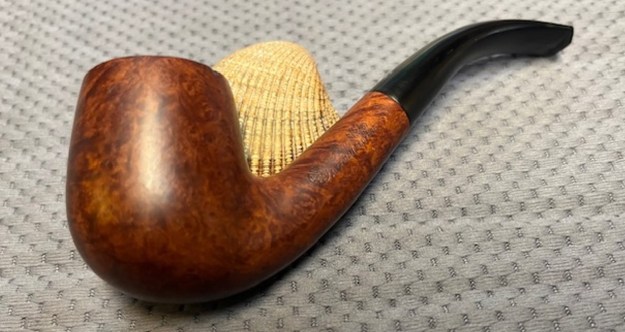
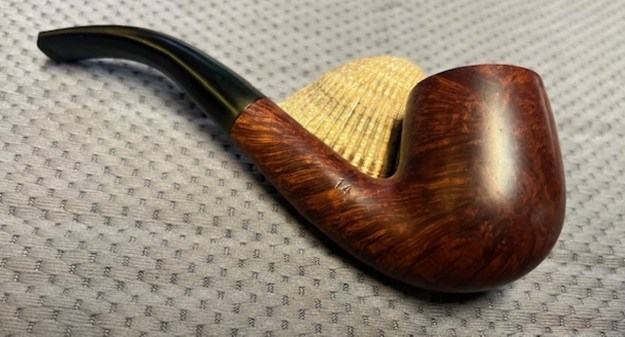
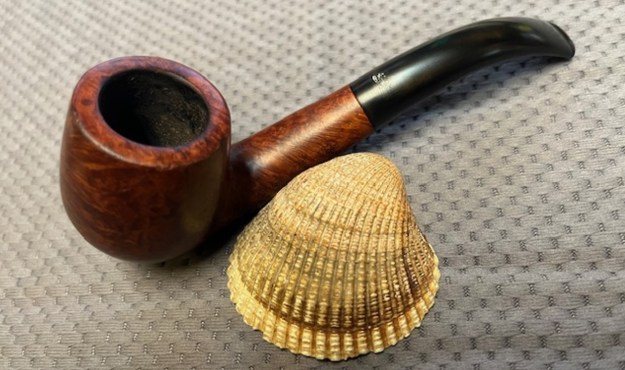
I have a pipe that came my way recently and I decided to clean it up and get it ready. Not much of a restoration story on this one – just a beautiful pipe. I gave it a quick (but thorough) once over and now it’s time to turn it over to you. The pipe is a Kriswill Danish Clipper 530 Bulldog – it has never been smoked and is very handsome. The only work of note that I did on this pipe was to the stem. It was kind of dingy from sitting around for ages and had acquired some oxidation. I wiped the outside down with Murphy’s Oil Soap on some cotton pads. After that, I wiped down the stem with SoftScrub cleaner to remove surface oxidation. Once this process was done, the stem went for an overnight soak in the Pipe Stem Oxidation Remover. This allows me to clean the oxidation off in a couple of ways: by applying a mild cleaner to the surface and sanding the stem. The next day, I used SoftScrub again with some cotton rounds and more oxidation came off. I used some nail polish to restore the logo on the stem. I painted the area carefully and let it set before proceeding. I then used my Micromesh pads, but, since the stem was new, I only used the last five to bring out the lovely black lustre on the stem. I also used Obsidian Pipe Stem Oil in between each pad scrubbing. After that, a light application of Before & After Restoration Balm brought out the best in the stummel’s grain. This is a very nice pipe. A dose of White Diamond and a few coats of carnauba wax were applied with my bench polisher and – wow – we have a real looker! This Kriswill Danish Clipper 530 Bulldog is a really handsome pipe. If you are interested in acquiring it for your collection, please have a look in the “Danish” pipe section of the store here on Steve’s website. You can also email me directly at kenneth@knightsofthepipe.com. The approximate dimensions of the pipe are as follows: length 5½ in. (141 mm); height 1⅝ in. (43 mm); bowl diameter 1⅛ in. (39 mm); chamber diameter ¾ in. (19 mm). The weight of the pipe is 1¼ oz. (35 g). If you are interested in more of my work, please follow me here on Steve’s website or send me an email. Thank you very much for reading and, as always, I welcome and encourage your comments.

Restoring a Beautiful Sandblast Stanwell Pipe of the Year 2005 Liverpool


Blog by Steve Laug

The pipes that I will be posting over the next month from this lot that Jeff and I purchased are fascinating pipes. They were quite stunning but altogether unknown to me. I did not recognize the name of the maker. All the pipes were unsmoked other than the Stanwell Pipe of the Year. We purchased them from a fellow in Kalundborg, Denmark on 02/03/2024. He said that they were all unsmoked and when they arrived they were. They were relatively clean and merely dusty with a little light debris on the stem surfaces. The shapes, sandblasts, shank extensions, and stems were all unique and very well done. The pipes were very beautiful and I could not wait for Jeff to refresh them a bit and get them up to me to do my part. Here are some of the photos of the pipes that we purchased provided by the seller.Here is a photo of the pipe that was sent to us by the seller. It is the one that I chose to work on next. It is a beautiful sandblast Stanwell Liverpool with a black taper acrylic stem. The blast is very well done. The acrylic stem is also well cut and other than dirty is in great condition. The pipe has a silver plaque with the year 2005 engraved on it. There was also silver Crown S on the left side of the stem. The pipe was lightly smoked and there was a light cake and darkening on the bowl walls. I look forward to working on it as it will take very little work and will be a fun break. I turned to the internet to find out information about the Stanwell Pipe of the Year. I came across this interesting article and shape chart on the Blue Room Briars site where they listed a collection of the POYs (https://www.blueroombriars.com/blogs/news/the-stanwell-pipe-of-the-year-collection). I have included the shape chart and part of the article below for the information that it contains..…Recently, Blue Room Briars acquired a complete Stanwell Pipe of the Year (POY) collection spanning from 1980 – 2017. Looking at these pipes in detail reveals some interesting insights into Stanwell’s production, although it should be noted that these findings are not the final say on when a particular pipe was made, but we hope you can use it as a guide when trying to determine the era of manufacture for Stanwell pipes made after 1980. 

The first pipe of note is the 1980 POY. This pipe does not come with the engraved silver plaquette. The pipe also sports a traditional vulcanite mouthpiece.

Between 1981 and 1998, the Stanwell pipes from the POY collection have the addition of silver plaquettes denoting the year, a traditional vulcanite mouthpiece, and also have a Teflon lined mortise. This is an interesting feature that creates a very stable connection between the mortise and tenon, as well as allowing the mortise to be swabbed out easily for maintenance. It wouldn’t be unwarranted to believe that other Stanwell pipes with a Teflon sleeved mortise were probably made between the 1980s to late 1990s. This additional, and costly, feature demonstrates Stanwell’s commitment to quality manufacturing even into the last portion of the 20th century.

The pipe I am working on now is later, after the company moved to Italy. It is not lined with the Teflon sleeve in the mortise. I believe the stem is acrylic.

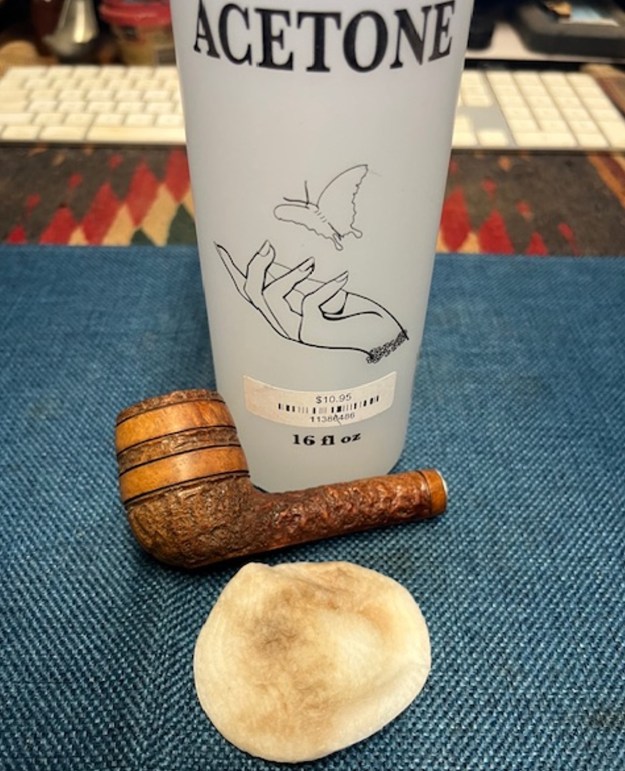
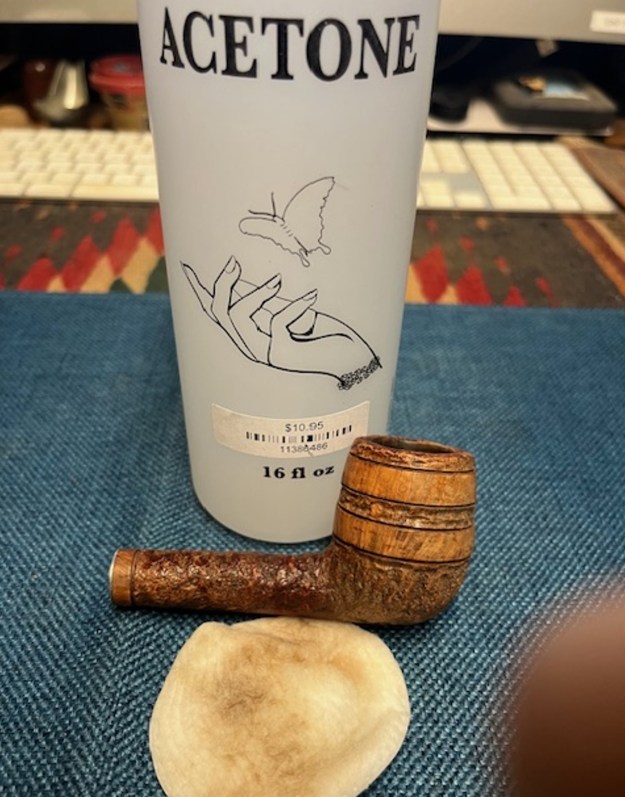
Jeff cleaned up the pipe for me. He reamed the bowl with a PipNet pipe reamer and cleaned it up with a Savinelli Fitsall Pipe Knife. He scrubbed the exterior with Murphy’s Oil Soap and a tooth brush to clean off the grime off the finish and the overflow of lava on the rim top. The cleaning had removed the grime on the rim top. He cleaned up the internals of the shank, mortise and stem with pipe cleaners, cotton swabs and alcohol to remove all of the oils and tars in the pipe. He soaked the stem in Briarville’s Pipe Stem Deoxidizer and was able to remove much of the oxidation, calcification. When it arrived here in Vancouver it was a clean pipe and I knew what I had to work with. I took photos of it before I started my part of the restoration. I took photos of the smooth rim top and bowl along with both sides of the vulcanite stem to show the condition of the pipe. It is clearly lightly smoked. The rim top shows some spots of varnish on the surface that gives it a spotty look.I took a photo to try to capture the silver plaque on the side of the shank giving the 2005 date. There is also a silver Crown S on the left side of the taper stem.I started working on the rim top by removing the spotty varnish coat with some acetone on a cotton pad. It was easily removed and certainly looked better afterwards.I polished the rim top with micromesh sanding pads – dry sanding with 1500-12000 grit pads. I wiped down the rim top with a damp cloth after each sanding pad. The bowl was in excellent condition so skipped ahead to applying the Balm to the briar. I rubbed the briar down with Before & After Restoration Balm. I worked it into the briar with my fingertips and a horsehair shoe brush to work it into the nooks and crannies of the sandblast finish. The product works to clean, enliven and preserve the briar. I let it sit for 10 minutes then I buffed it with a cotton cloth to deepen the shine. The briar really comes alive with the balm. I polished the short acrylic taper stem with micromesh sanding pads – 1500-12000 grit pads. I wiped it down with Obsidian Oil after each sanding pad. I used Before & After Pipe Polish – both Fine and Extra Fine to further polish the stem. I put the stem back on the Stanwell Pipe of the Year 2005 Danish Style Liverpool and took it to the buffer. I buffed the bowl and stem with Blue Diamond to polish the briar and the acrylic. Blue Diamond does a great job on the smaller scratches that remain in both. I gave the bowl multiple coats of Conservator’s Wax and the stem several coats of carnauba wax and buffed the pipe with a clean buffing pad to raise the shine. I hand buffed it with a microfiber cloth to deepen the shine. I am amazed at how well it turned out. The finished pipe is shown in the photos below. This is a beautiful Stanwell POY 2005 – the acrylic taper stem and smooth rim top and sandblast finish combine to give the pipe a great look. The polished black stem looks really good with the rich browns standing out in the sandblast. The dimensions of the pipe are Length: 5 ¾ inches, Height: 1 ¾ inch, Outside diameter of the bowl: 1 ¼ inch, Chamber diameter: ¾ of an inch. The weight of the pipe is 1.34 ounces/38 grams. This is another pipe that I will be putting on the rebornpipes online store in the Danish Pipe Pipemaking Companies Section shortly, if you are interested in adding it to your collection. Thanks for walking through the restoration with me on this beauty!

As always, I encourage your questions and comments as you read the blog. Thanks to each of you who are reading this blog. Remember we are not pipe owners; we are pipe men and women who hold our pipes in trust until they pass on into the trust of those who follow us.
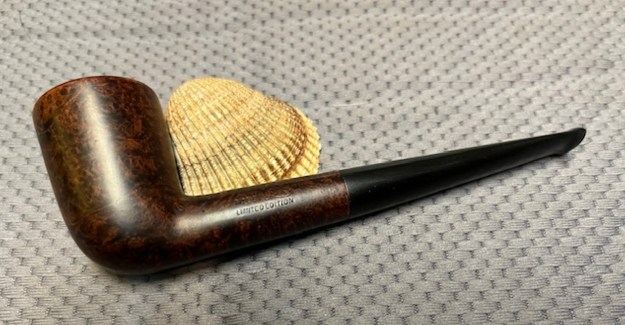
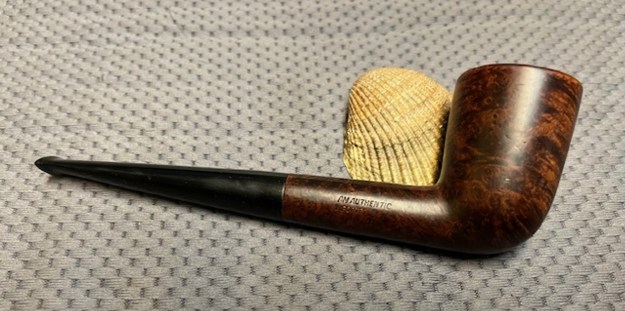
Londoner London England Bent Cherrywood BB&S 6969


Blog by Steve Laug

The next pipe on the table is large smooth finished Bent Poker/Cherrywood. We purchased it from an Antique Store in Missoula, Montana, USA on 07/25/2023. The pipe is stamped on the left side of the shank and reads Londoner [over] London England. On the right side of the shank it is stamped BB&S 6969. On the left side of the saddle stem it is stamped BB&S which stands for Bill Barling & Sons. The rim was in good condition other than a lot of lava in the finish overflowing from the thick cake in the bowl. There were oils and grime ground into the bowl sides gives the finish a flat look. The stem is oxidized and calcified. It had light tooth marks on both the top and underside of the stem just ahead of the button. Jeff took photos of the pipe before he started his clean up work. I have included them below. He took photos of the rim top to show the cake and the dust on the top. It is another dirty pipe. He also captured the light tooth marks on the top and underside of the stem near the button. He took photos of the sides and heel of the bowl to show the grain around the bowl and the amount of grime ground into the surface of the briar.   He took photos of the stamping on the sides of the shank. It is clear and quite readable. The BB&S stamp on the left side of the saddle stem was also readable. I remembered that Dal had written about a BB&S Challenger he had restored on the Pipesteward blog so I looked it up to see what he had learned about the  brand when he had worked on it and written his blog. Here is the link (https://thepipesteward.com/2022/07/13/renewing-a-barling-bbs-challenger-london-england-5589-billiard/). Here is a photo of the BB&S Challenger that he worked on finished and looking good. I am using his research on the brand and the stamping and have included it below. Thank you Dal for your work and the time it saved me in redoing it! He wrote:

BB&S is noted in Pipedia with this brief entry (https://pipedia.org/wiki/BB%26S).

BB&S, which stood for Bill Barling & Sons, was a transition era Barling sub-brand. Among their lines were the Challenger, Rallye and Londoner. For more information see Barling.

He then turned to the section on Barling:

The history of the Barling name goes back to the 1700s when the Barling name was associated with silversmiths in England.  Benjamin Barling, according to the Pipedia Barling article, applied the silversmith trade to “outfitting meerschaum bowls with exquisite silver mountings.”  The founding of the B. Barling and Sons followed in 1812.  The Barling history is full as it developed and grew through the 1800s and into the 1900s.  The family-owned business continued until October 3, 1960, when the business was sold to the largest client of the Barlings, Finley.  The Pipedia article drills in more detail describing and defining the ‘eras’ of the Barling name.  Here is what is said about the eras, but the author makes the disclaimer that it’s not as straightforward as it appears:

Pre-Transition: 1812 (or 1815) thru October 3rd, 1960.
On that date, the Barling family sold their business to Finlay, their largest client.

Transition: Late 1960 thru February 1963.
Finlay was 40% owned by Imperial Tobacco. Imperial Tobacco had an option to purchase the remaining shares of Finlay, which it did in February of 1963. When Finlay was absorbed, Barling came under direct control of Imperial Tobacco.

Post-Transition Era: Early 1963 and later.
Imperial ran the business; some say into the ground. They closed the Barling factories in 1970 and outsourced the production of pipes, first to several English makers, and then later to Nording, etc. In 1980 Bucktrout purchases the rights to the Barling name and Barlings have shown up as relatively cheap pipes made by Peterson.

Though we now have Eras whose duration is linked to the *public record, it’s still not simple and here’s why.

The author of the Pipedia Barling article goes on to describe how when the Barlings sold the business to Finlay in 1960 ushering in the beginning of the ‘Transition Era’, the Barlings continued to operate the business for Finlay.  During this period of 20 months, pipes continued to be produced with no changes to the nomenclature.  The result of this was having no way of determining which pipes were produced under the Barling ownership before the transition period and those pipes produced during the transition, under new ownership.

For this reason, the Pipedia author proposes an alternative method of dating Barling pipes:

  • Family Era 1912 – 1962: Pipes made by the Barling family while it either owned or managed B. Barling & Sons.
  • Corporate Era 1962 – the Present: Pipes made after the family left off managing the company, beginning with the revised product grades and revised nomenclature that were introduced in the 1962 Dealers’ Catalog.

It is interesting also to note that the Pipephil.eu Barling entry identifies the transition period from the Barling family era to the later corporate era as dated from 1961 to 1967. There are differences in era dating from different sources, but with the B.B&S Challenger on the table now, which is not a Barling stamped pipe but a second brand line most likely put out by Barling during the early transition period dating this pipe somewhere from 1960 to 1962. In the Pipedia entry quoted above for BB&S, there are 3 lines put out during this time: Challenger, Rallye, and Londoner.

Pipephil has a helpful entry on BB&S with the panel.The ‘Challenger London England’ pictured on the top of the panel, matches the Challenger on the table.  The nomenclature on the panel is crisp showing what cannot be seen clearly on the Challenger on the table.

The author of the Pipedia Barling article makes one additional observation that helps to corroborate the sense that the BB&S Challenger on the table was indeed in the transition period, but more likely in the earlier part of the transition era – under the Finlay ownership commencing in 1960:

Initially, Finlay’s management used the remaining stock of bowls that were turned by the original family run company, and then proceeded to turn more bowls with old wood remaining in inventory, and at least initially, this work was performed by many of the same craftsman. Under Finlay’s management the factory continued to turn out a quality product. Production was expanded to produce a greater number of own name brands for Finlay and Bewlay, as well as the production of pipes for other pipe firms such as Colibri, Falcon, and Ronson. Also, several lines of “seconds” were developed, amongst them Portland, BB & S, Cragmoor, and London Brand.

Here, the ‘seconds’ are described during the Finlay ownership included ‘BB&S’. It would seem, therefore, that ‘Challenger’ is a line of the second, BB&S.

One last additional piece of information that is of interest. The Barling 4-digit numbering system was introduced in the June 1962, publication of the 150th Year Anniversary Catalogue which was still under Barling management, but owned by Finlay.

Here the number system is explained:

It is in the 150th Anniversary catalog that the new numbering system first appears. The new numbering system was introduced while the Barling family managed the business. The price list explains that the new number designates size.

The BB&S Challenger ‘shape number’ reflects this new Barling system. The first digit represents the size followed by a shape designation. The ‘Barling Pipe Reference Number Chart’ (https://pipedia.org/wiki/File:1962_Barling_Retailers%27_Cat_size_chart.jpg) below was taken from the ‘Retailers Catalogue’ which was also published in 1962, but later in the year. Note in the chart below, going horizontally, the sizes are from 1 to 6 representing an increasing size designation (‘1’ was introduced in this later catalogue)…The BB&S pipe I am working on is a 6969 which is not listed in the chart above. However, from the chart I learned that the pipe was a Size 6/King size. The Cherrywood/Poker is not listed as a shape however. Thanks Dal for the help on this! Now it was time to work on the pipe!

Jeff had cleaned up the pipe following his normal cleaning process. In short, he reamed the bowl with a PipNet pipe reamer and cleaned up the reaming with a Savinelli Fitsall Pipe Knife.  He scrubbed the smooth bowl with undiluted Murphy’s Oil Soap with a tooth brush. He worked over the lava and debris on the rim top and was able to remove it. He rinsed it under running warm water to remove the soap and grime. He cleaned out the inside of the shank and the airway in the stem with alcohol, cotton swabs and pipe cleaners. He scrubbed the stem with Soft Scrub and cotton pads to remove the debris and oils on the stem. He soaked it in a bath of Briarville’s Pipe Stem Deoxidizer to remove the oxidation. He rinsed it with warm water and dried it off. I took photos of the pipe once I received it. It really looked good. I took a photo of the rim top and stem to show the condition. They cleaned up really well and the top of the rim and inner looked very good. There were some scratches and some spots of varnish on the rim top. The inner edge of the bowl looked quite good. The vulcanite saddle stem had light tooth chatter and marks on both sides ahead of the button and on the button edges.I took a photo of the stamping on the sides of the shank. It read as noted above. I removed the stem and took a photo of the pipe to give a sense of the whole. It is a well shaped Cherrrywood. I polished the smooth rim top, the inner edge and the sides of the bowl with micromesh sanding pads – dry sanding with 1500-12000 grit sanding pads. I wiped it down with a damp cloth after each pad to remove the debris. The bowl took on a rich glow. I worked some Before & After Restoration Balm into the briar with my finger tips and into the rustication with a shoe brush. The product works to clean, revive and protect the briar. I let it sit on the pipe for 10 minutes then buffed it off with a soft cloth. I set the bowl aside and turned my attention to the stem. I sanded the stem with the 2 inch square 320-3500 grit sanding pads. I wiped down the stem after each sanding pad. I was able blend in the repairs on both sides with the pads. The stem looked very good.I touched up the BB&S stamp on the left side of the saddle stem with white acrylic fingernail polish. Once it cured I used a worn 1500 grit micromesh sanding pad to remove the excess. It is faint on both ends of the stamp but is still readable. I polished the vulcanite stem with micromesh sanding pads – 1500-12000 grit pads. I wiped it down with a damp cloth after each sanding pad. I used Before & After Pipe Polish – both Fine and Extra Fine to further polish the stem.   This is another pipe that I am really happy about the look of the finished restoration. This reborn BB&S Londoner 6969 Bent Cherrywood turned out really well. I think that it is a great looking pipe with a great shape and grain. The unique grain pattern and the vulcanite saddle stem goes well together. The polished black of the stem works well with the briar. The rich reddish brown stains of the finish make the grain really pop with the polishing and waxing. I put the stem back on the bowl and buffed the pipe with Blue Diamond on the buffing wheel. I gave the bowl and the stem multiple coats of carnauba wax on the buffing wheel. I buffed the pipe with a clean buffing pad to raise the shine. I hand buffed the pipe with a microfiber cloth to deepen the shine. The finished BB&S Londoner 6969 Bent Cherrywood really feels great in the hand and it looks very good. Give the finished pipe a look in the photos below. The dimensions of the pipe are Length: 5 inches, Height: 2 inches, Outside diameter of the bowl: 1 ½ inches, Chamber diameter: ¾ of an inch. The weight of the pipe is 44 grams/1.55 oz. The pipe will be going on the rebornpipes store soon. It will be in the British Pipe Makers Section if you would like to add it to your collection. Thanks for reading this blog and my reflections on the pipe while I worked on it. It was a fun one to work on!