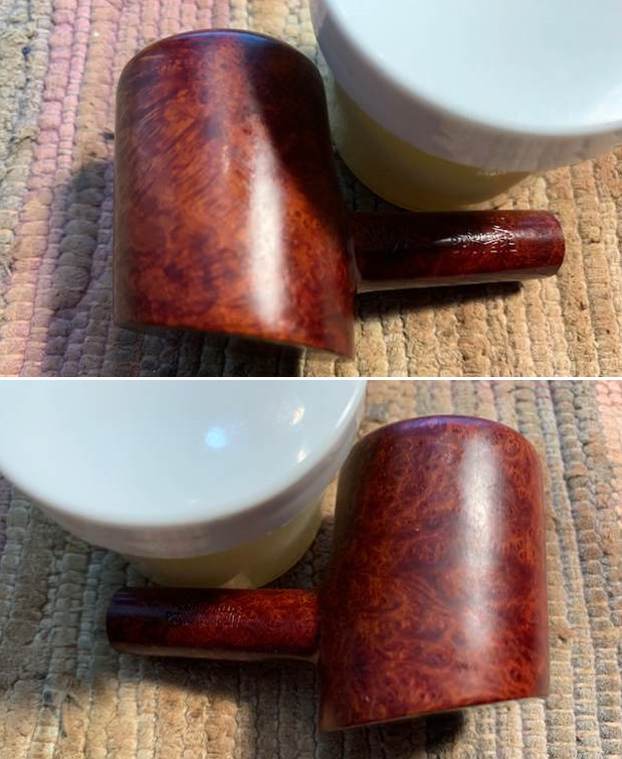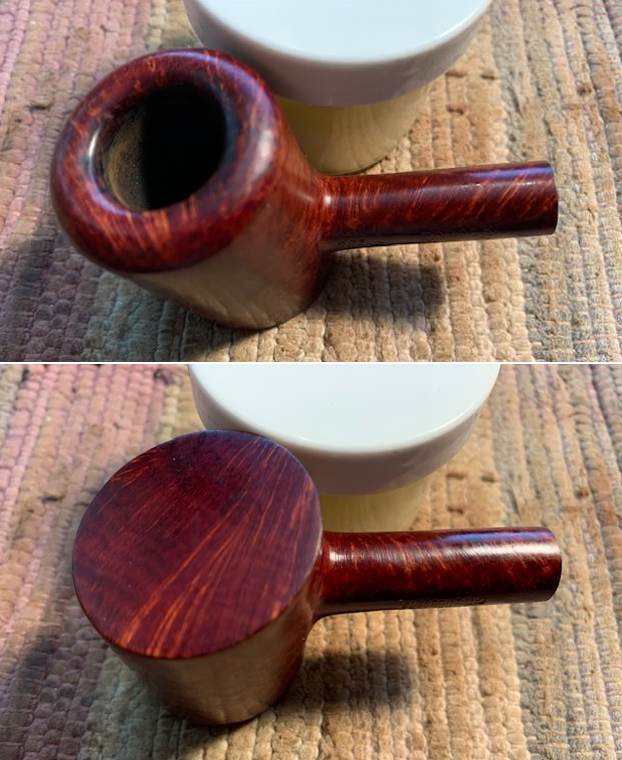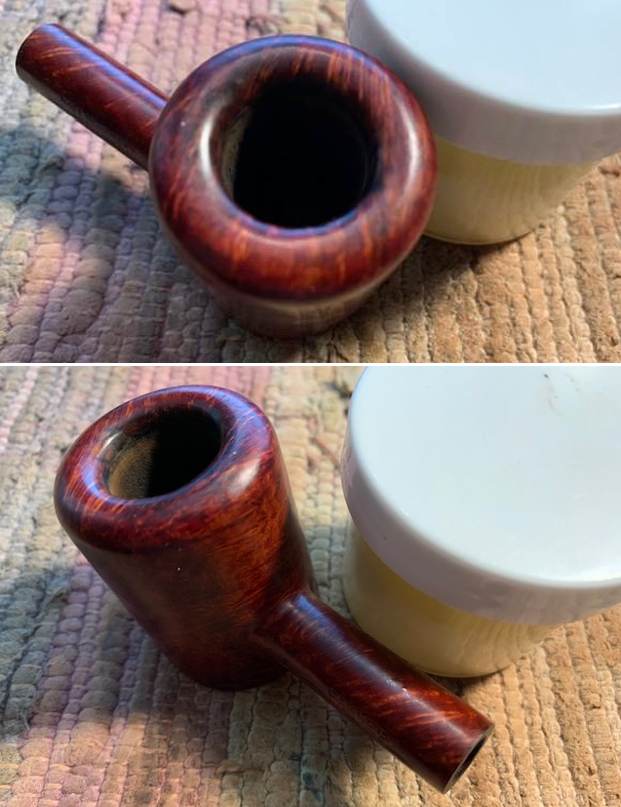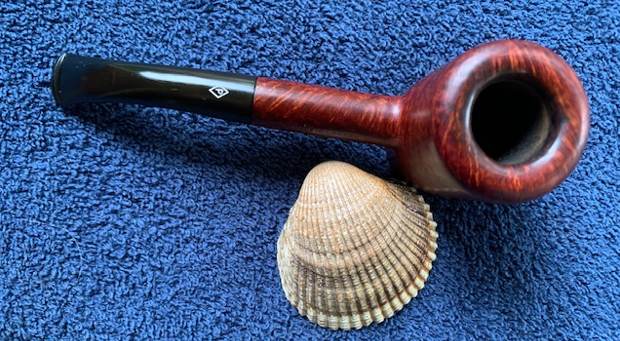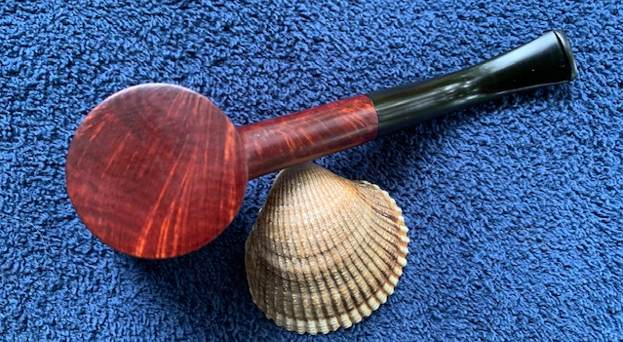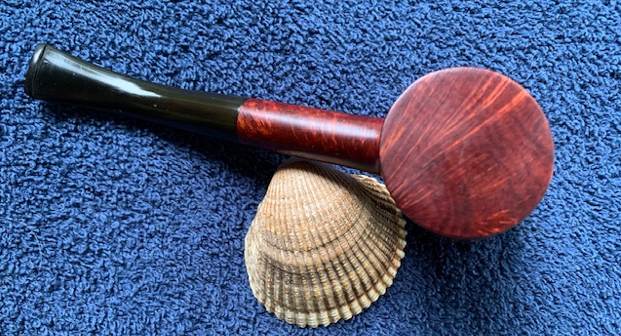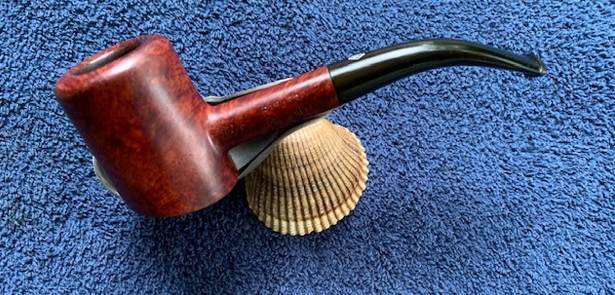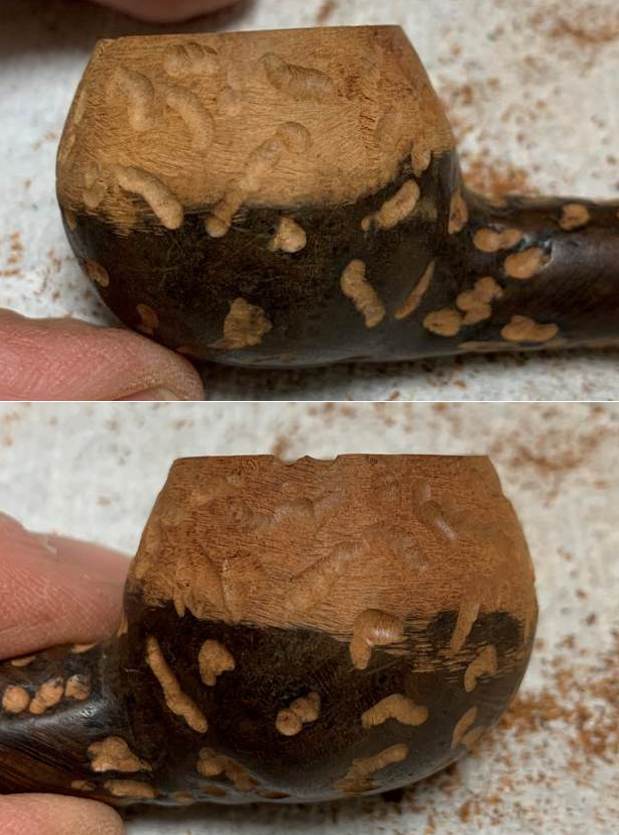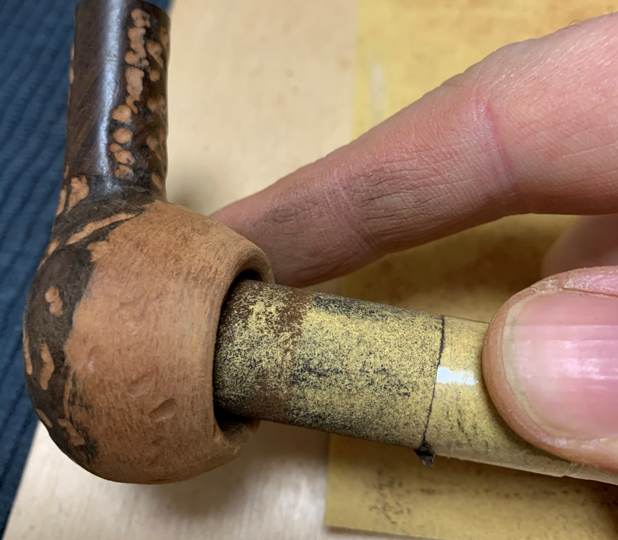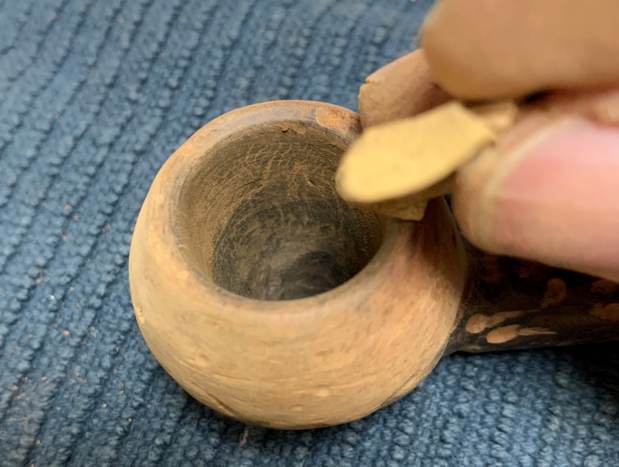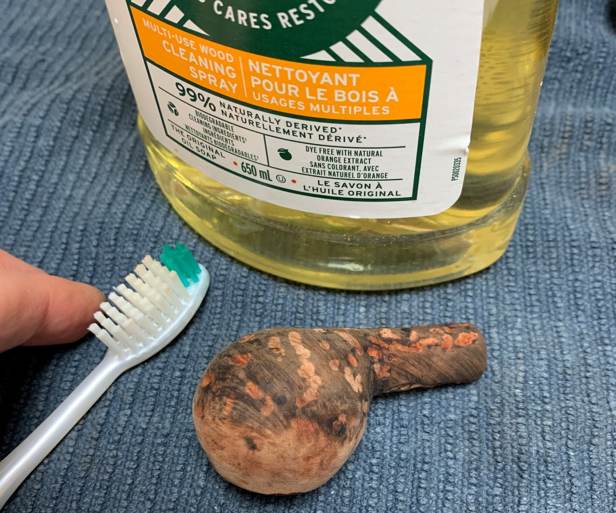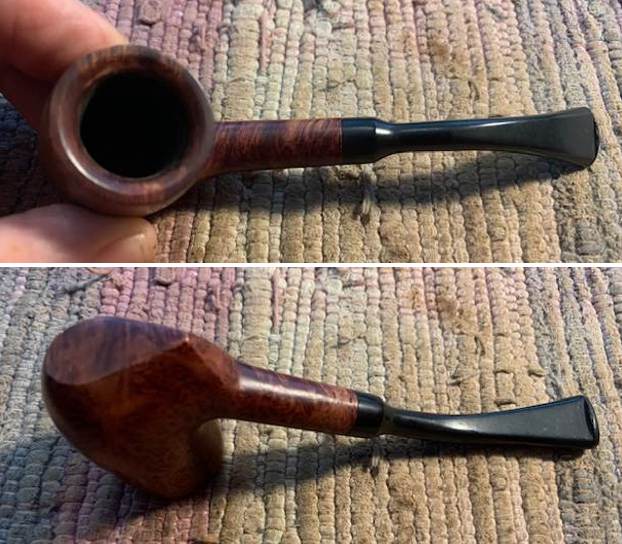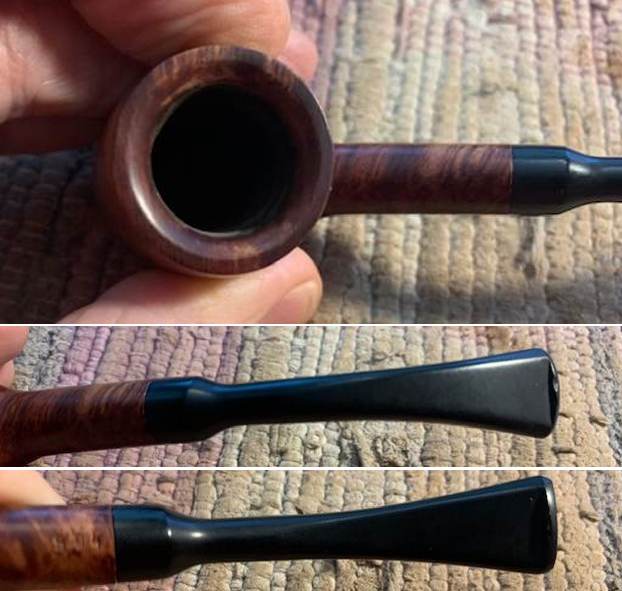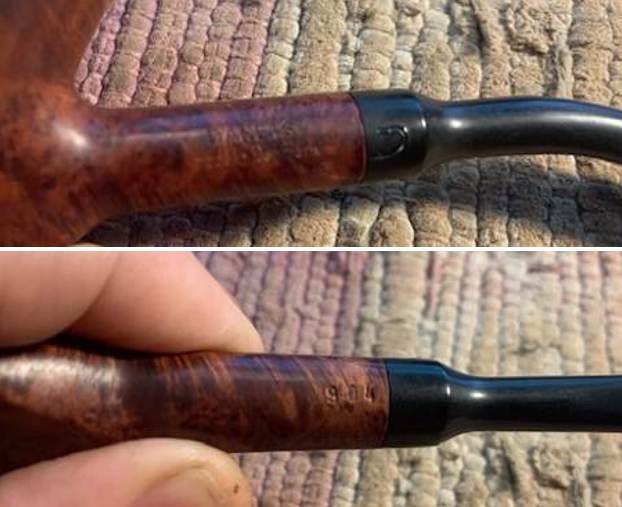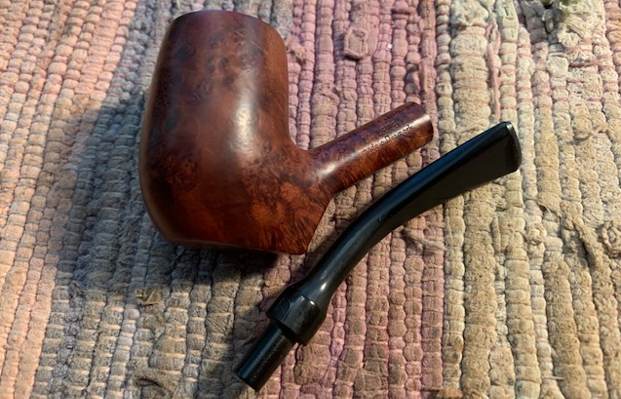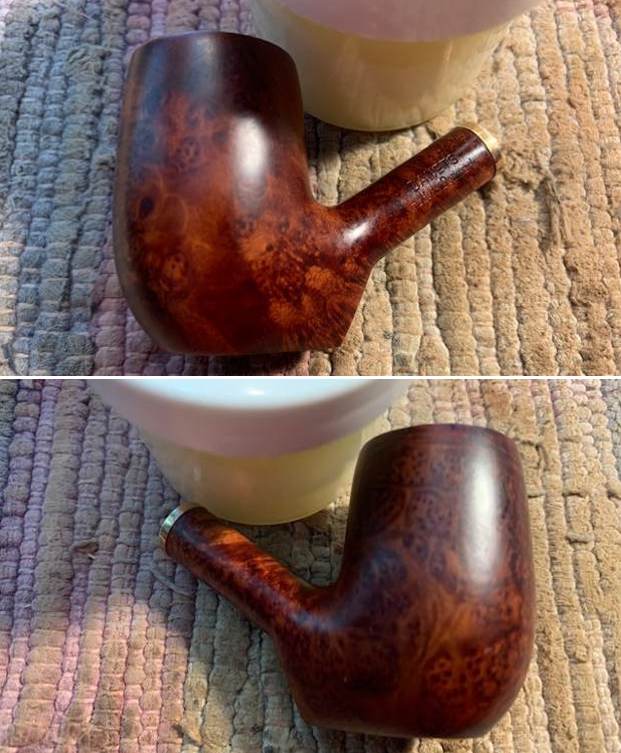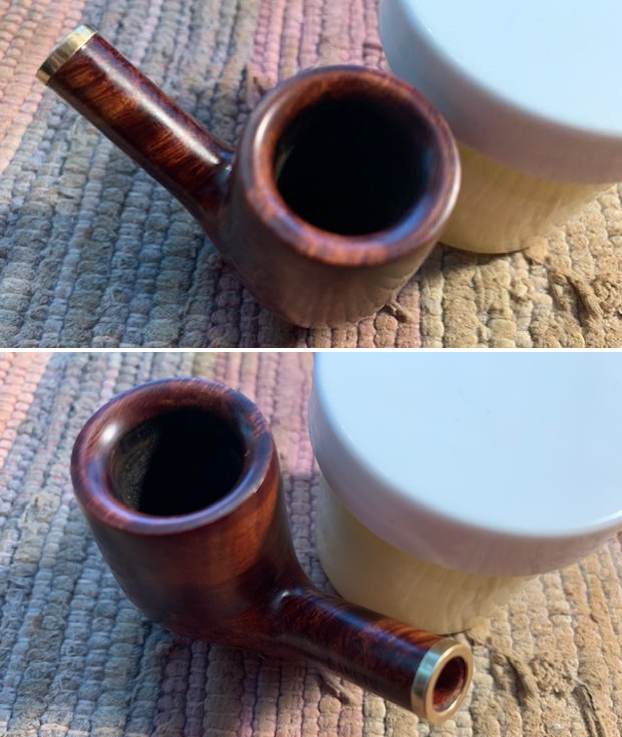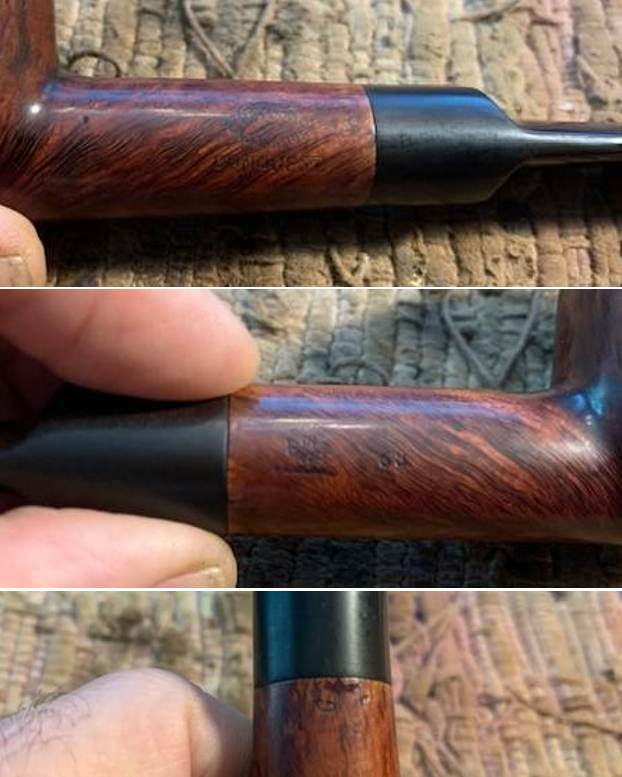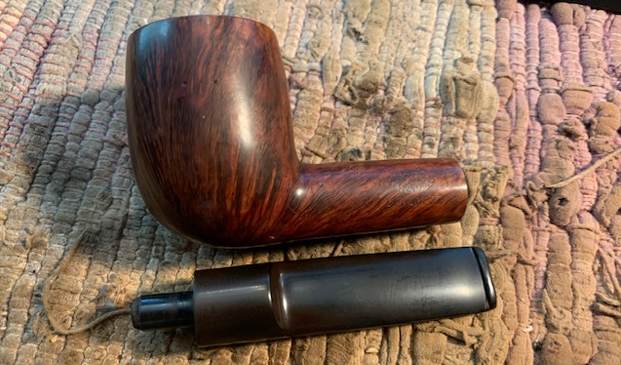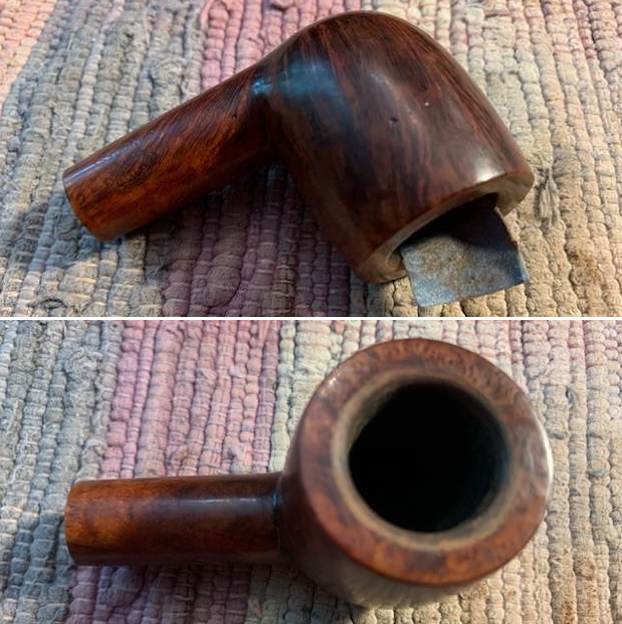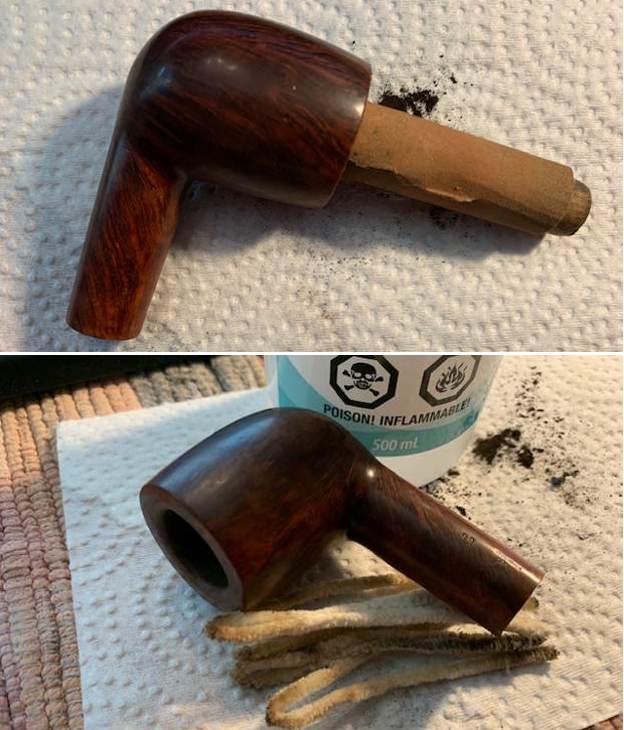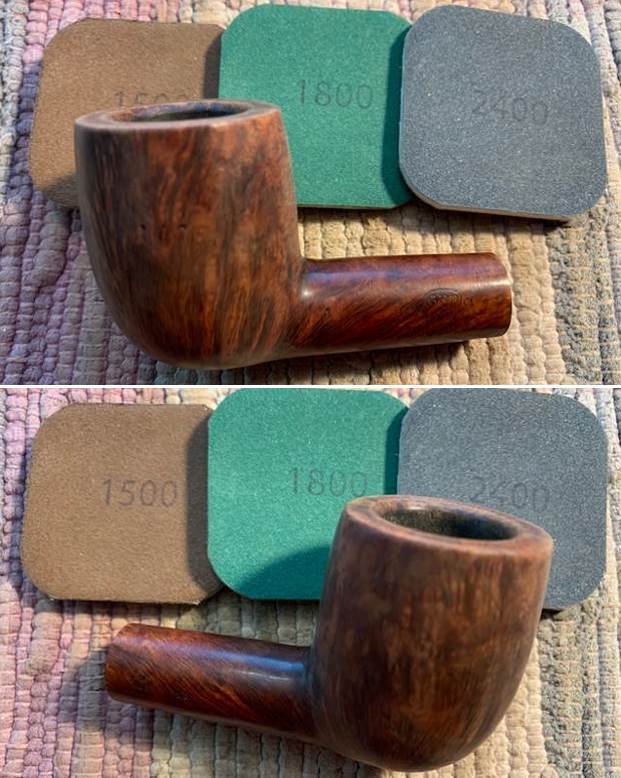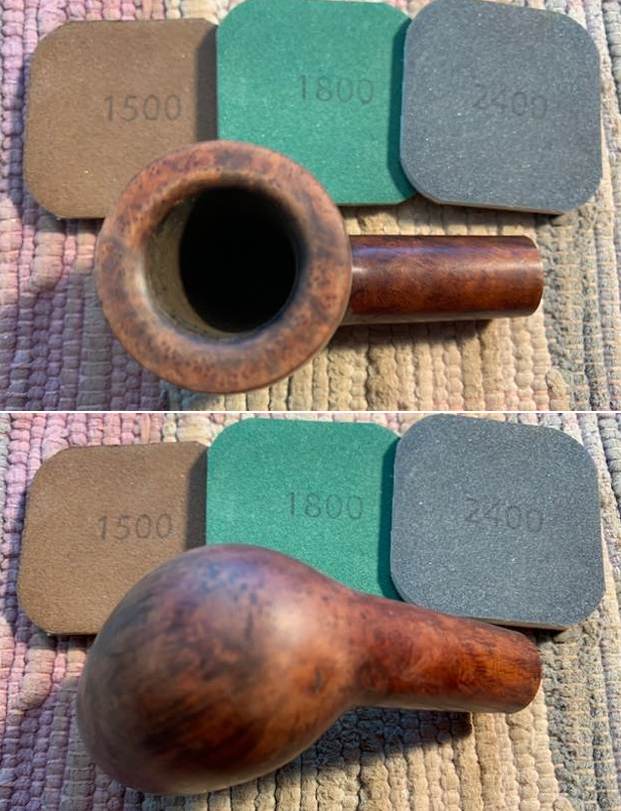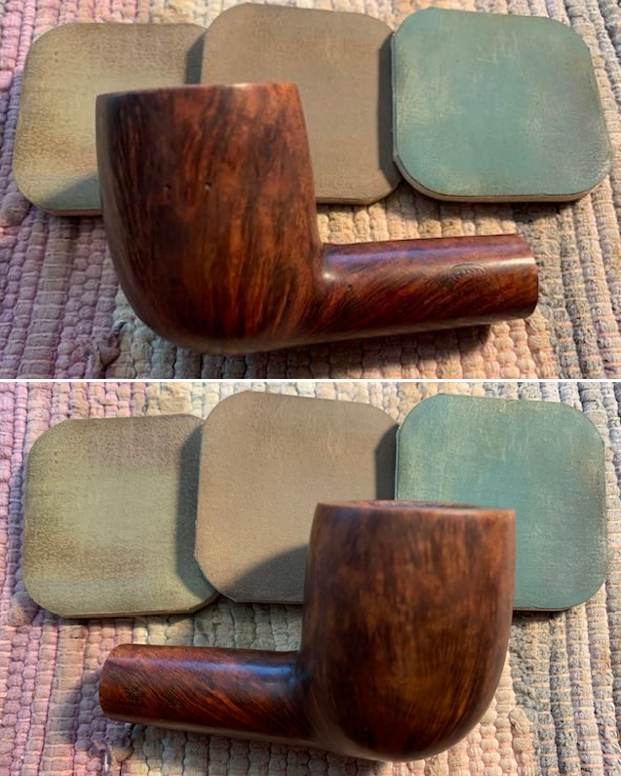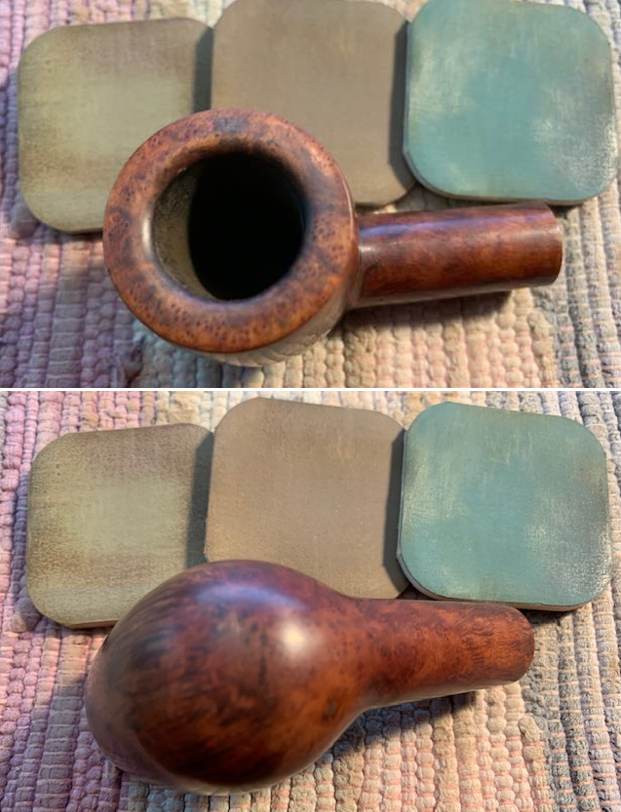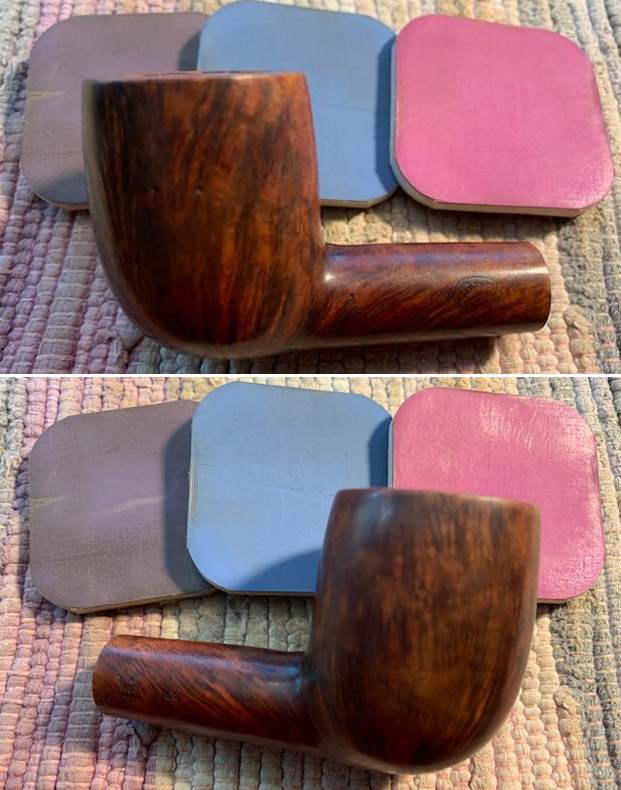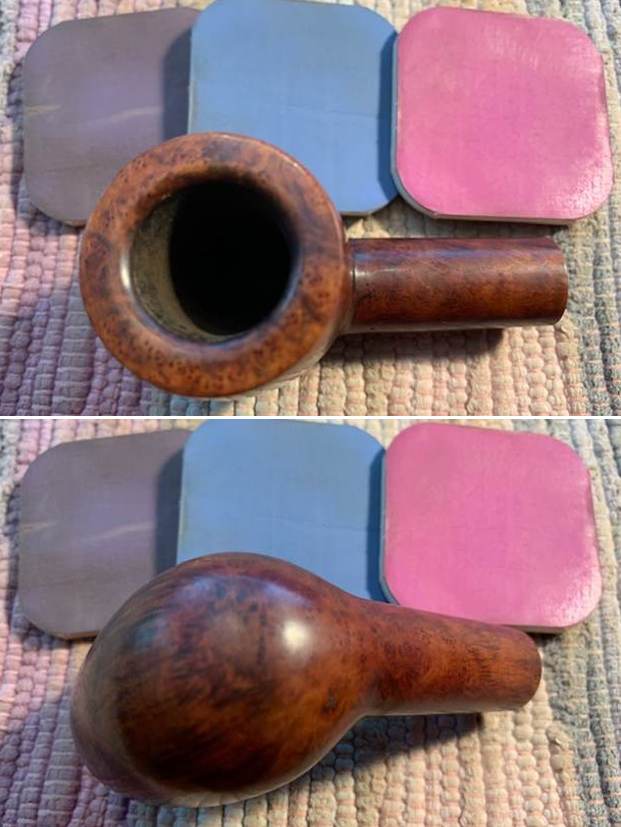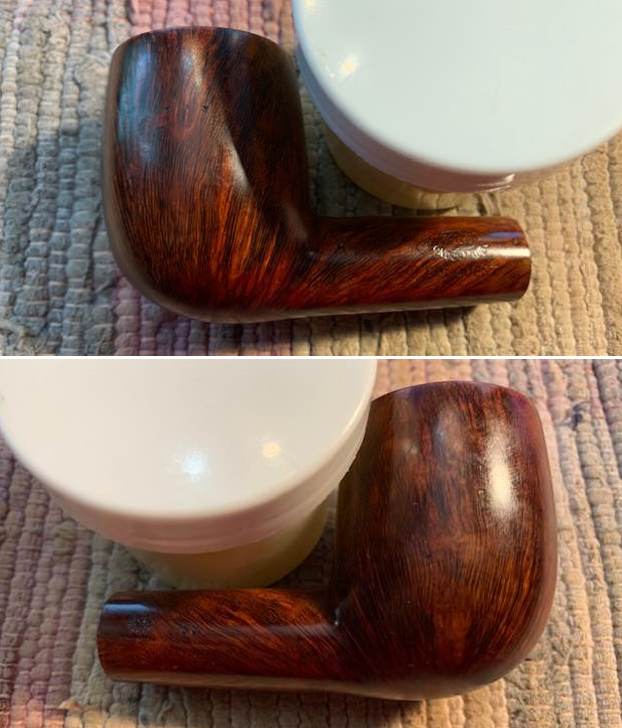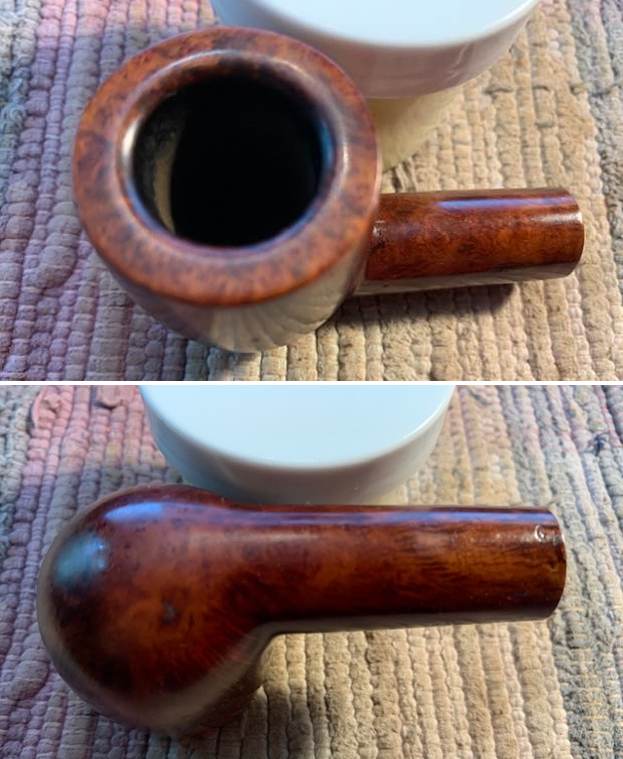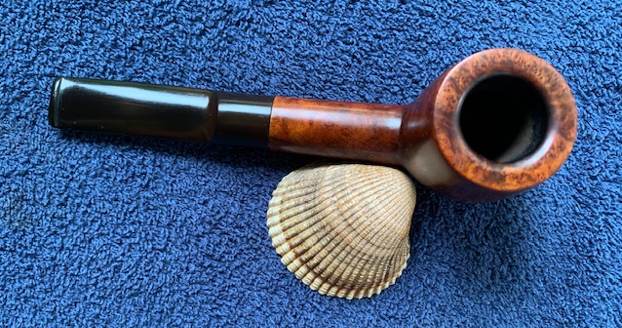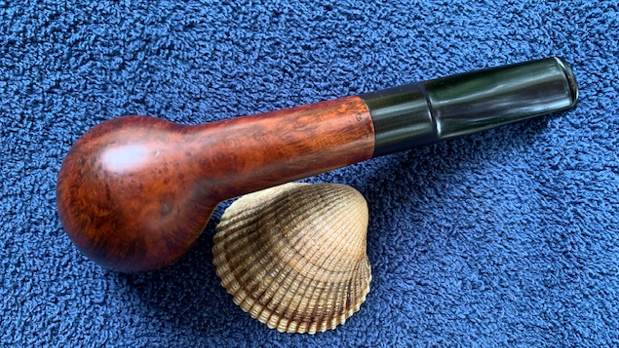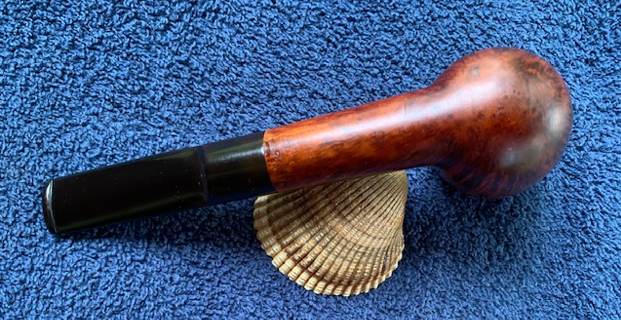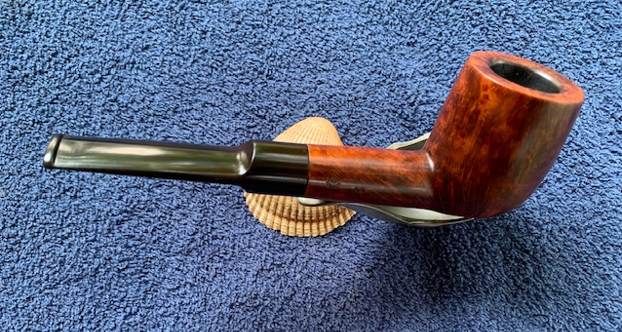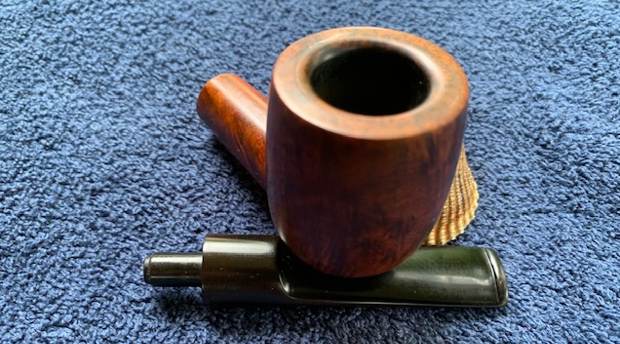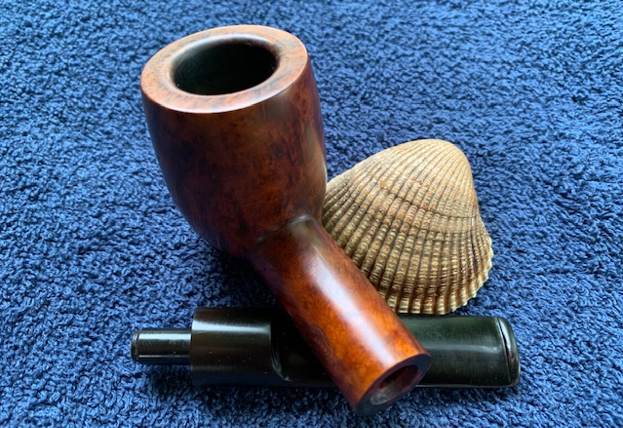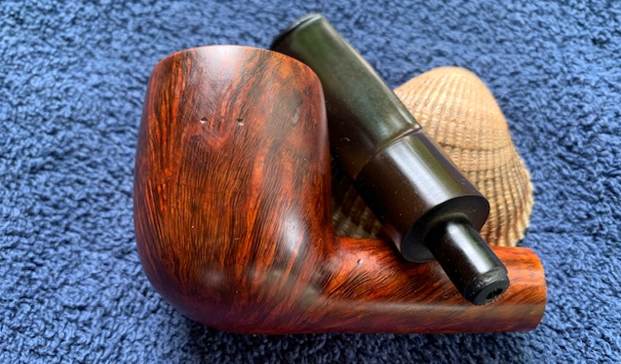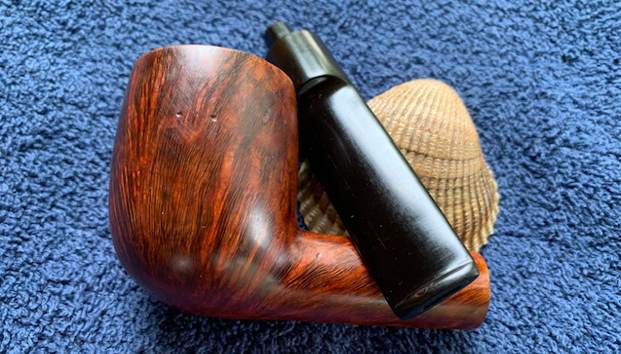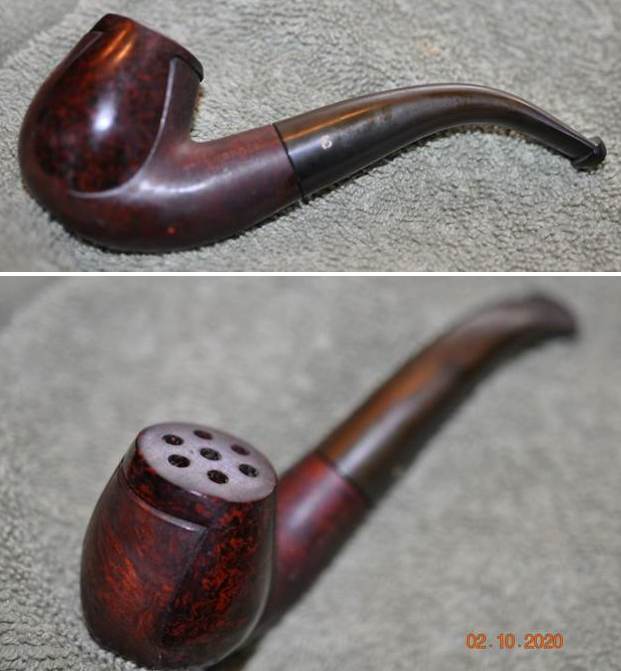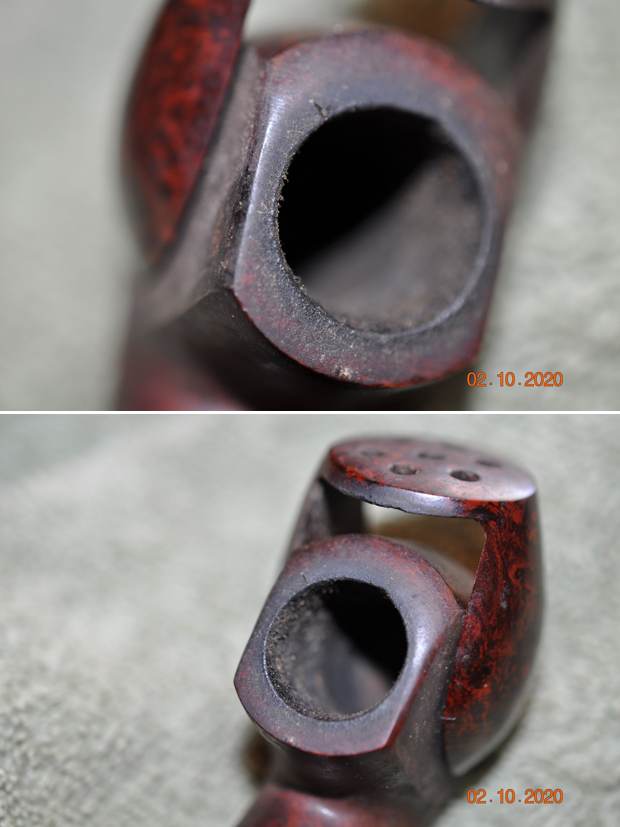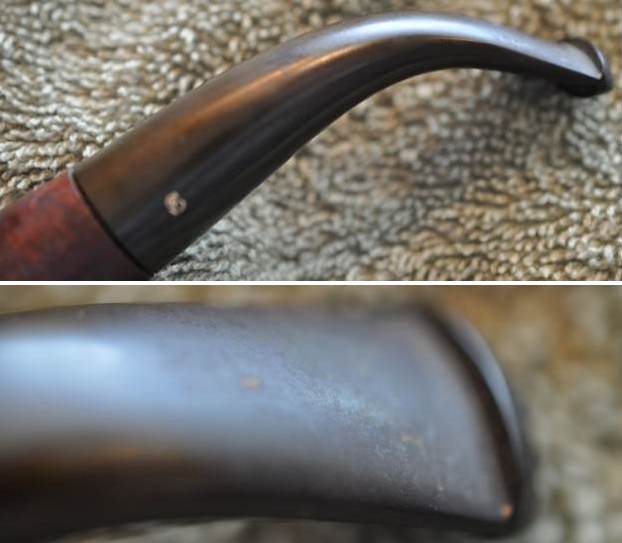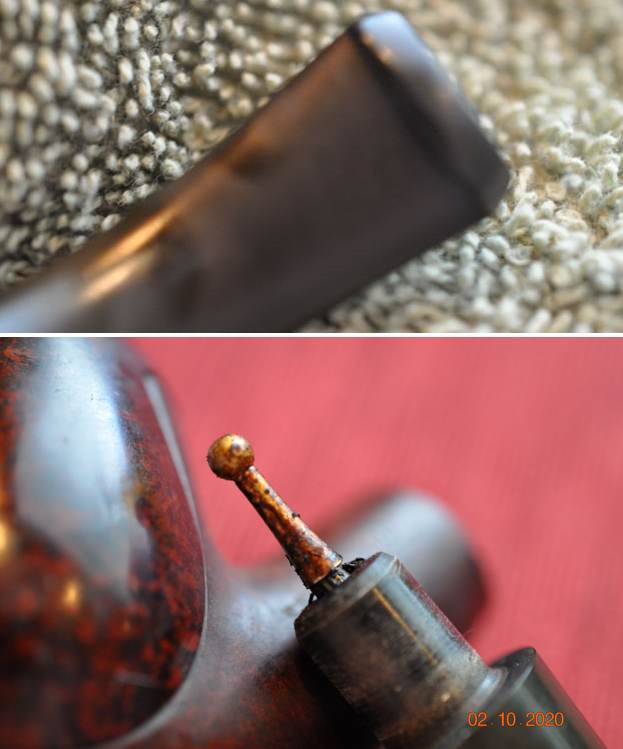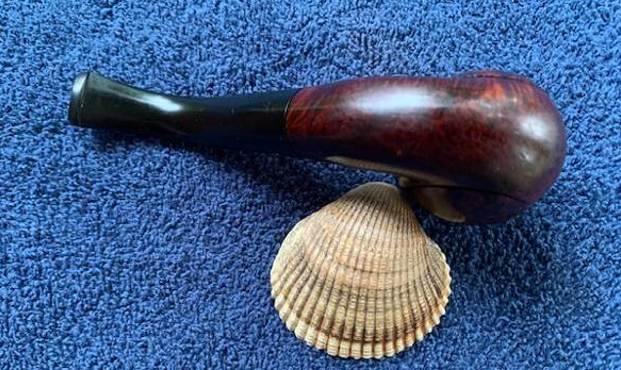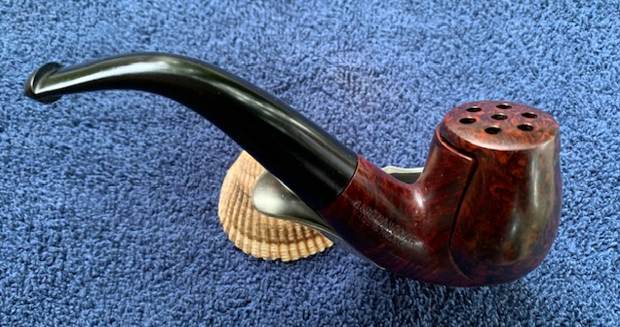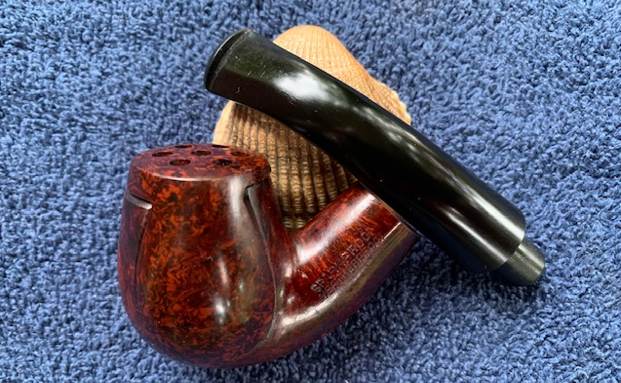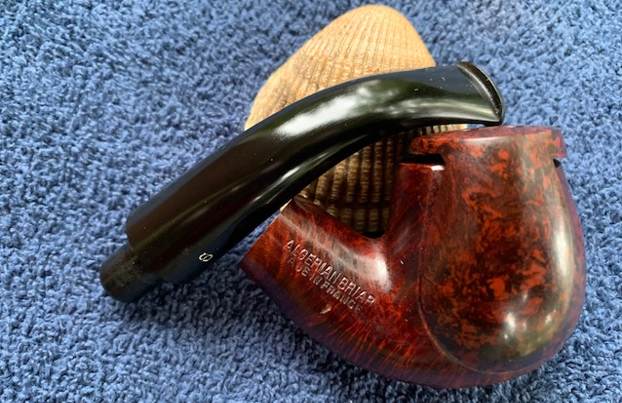
Tag Archives: Bowl – finishing

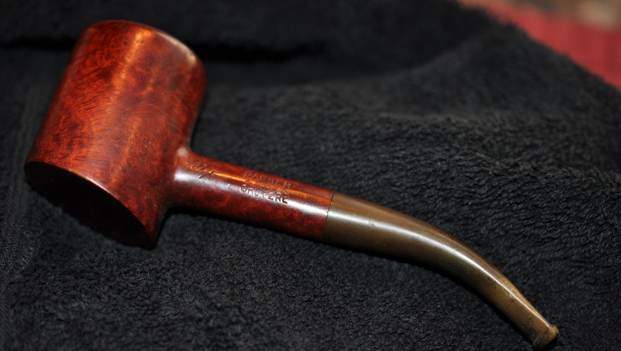
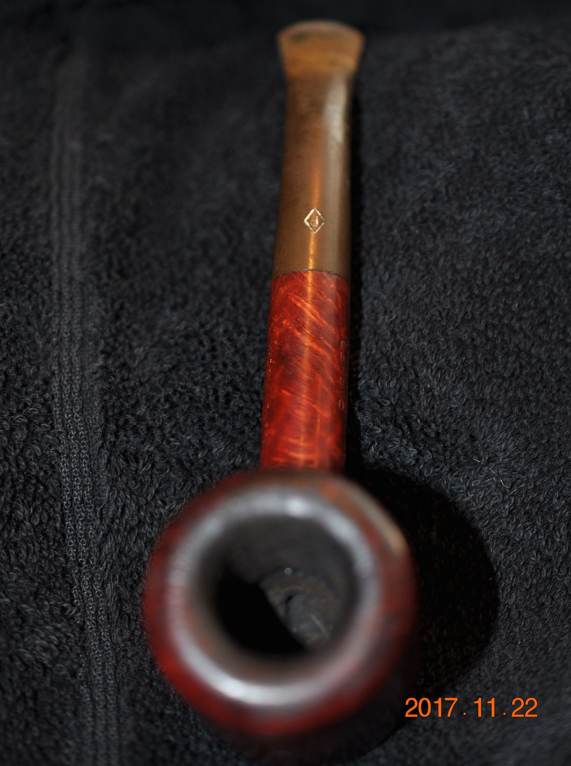
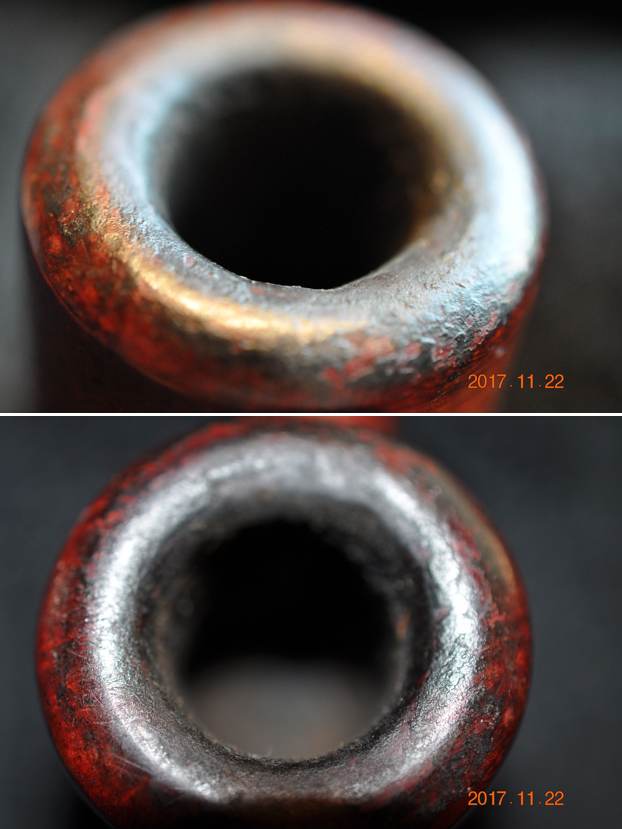
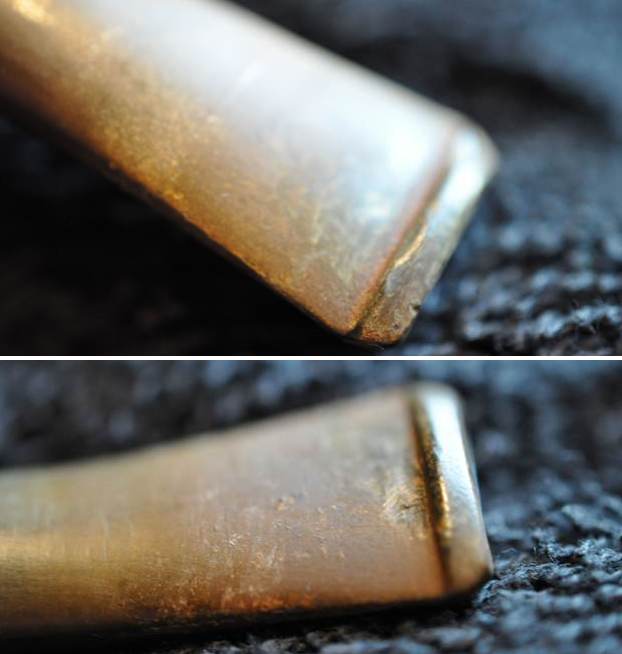
Refreshing a Late Canadian Era Brigham Canada Rusticated 2 Dot Bent Billiard


Blog by Steve Laug

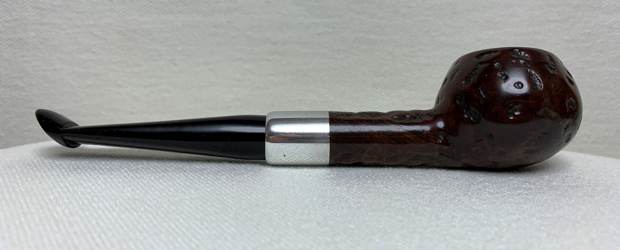
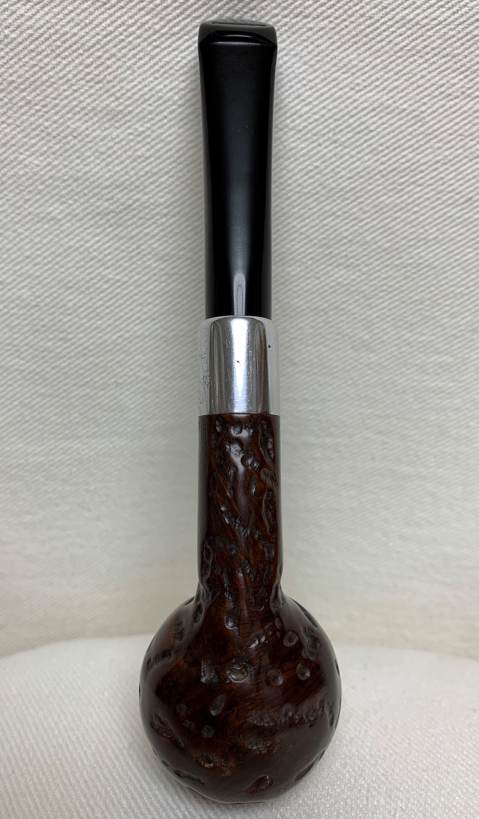
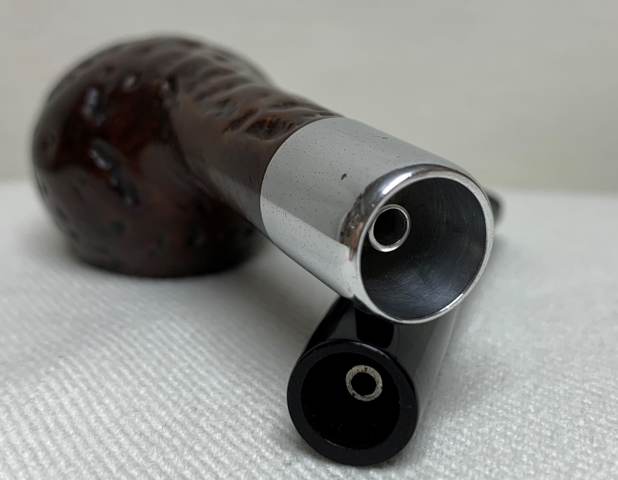
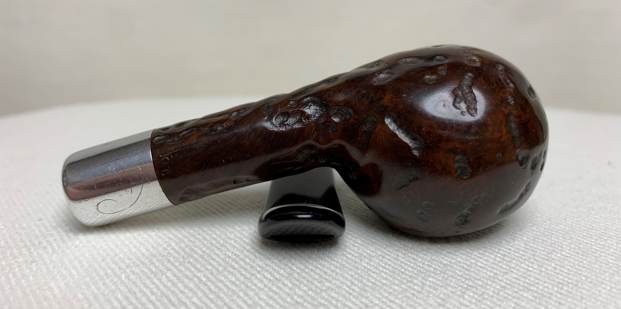
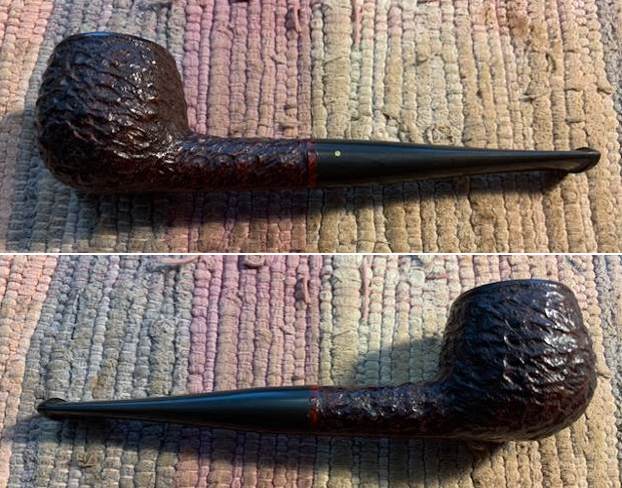
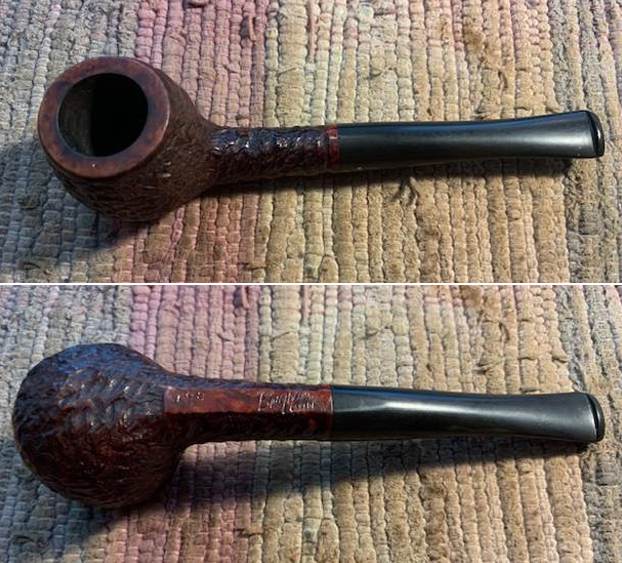
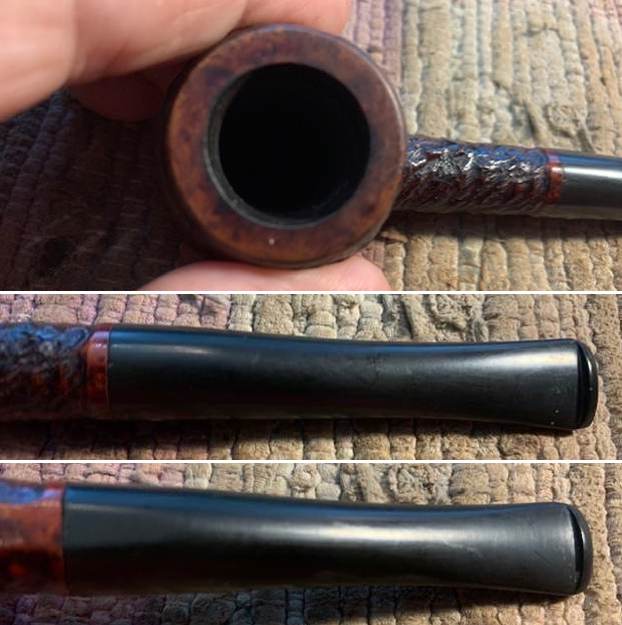
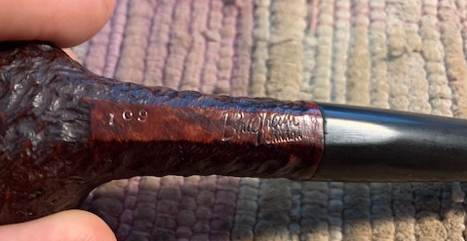
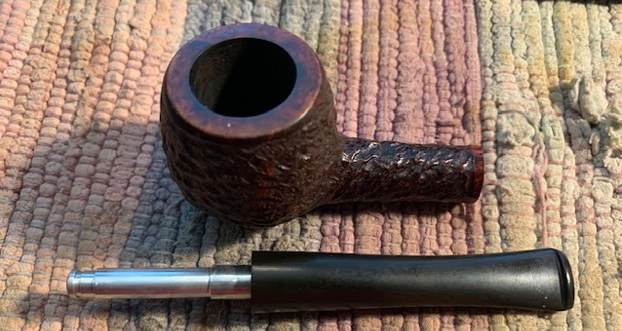
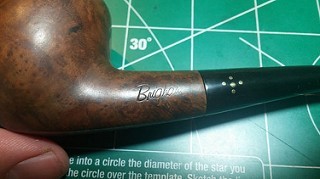
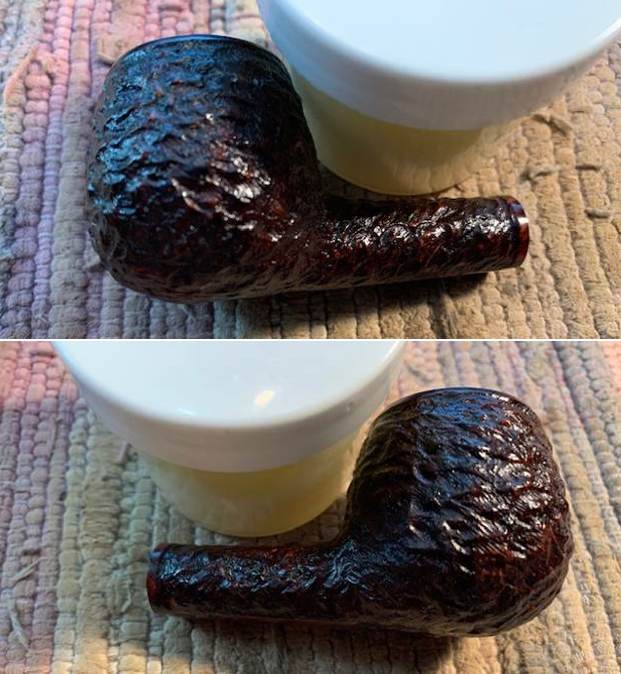
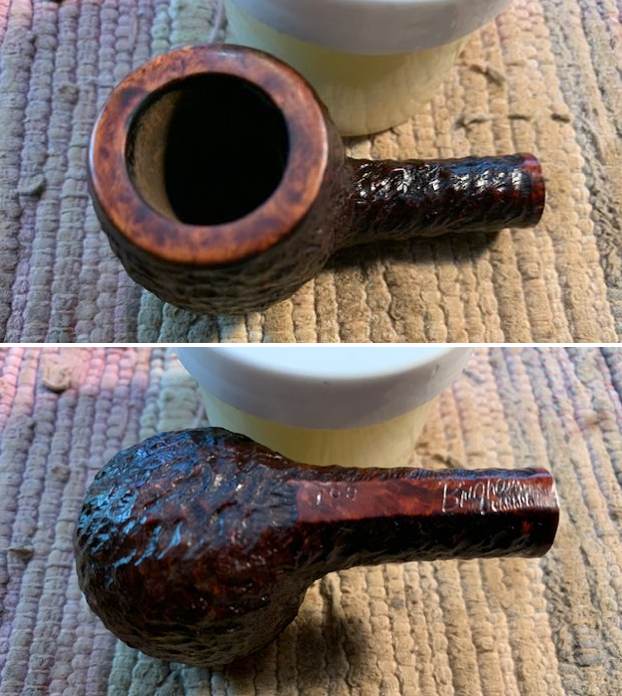
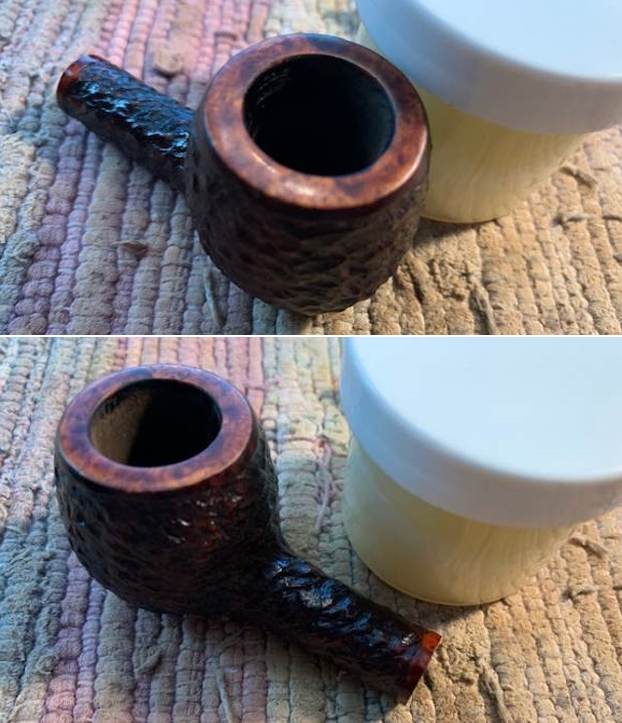
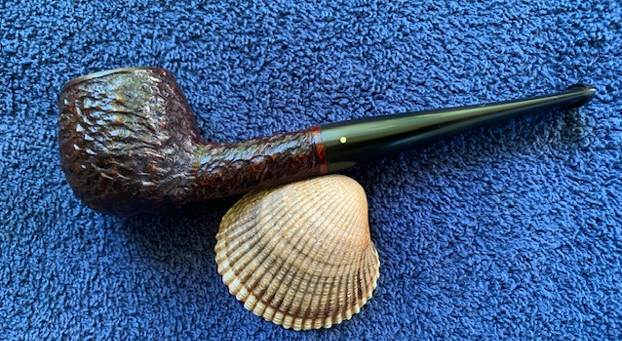
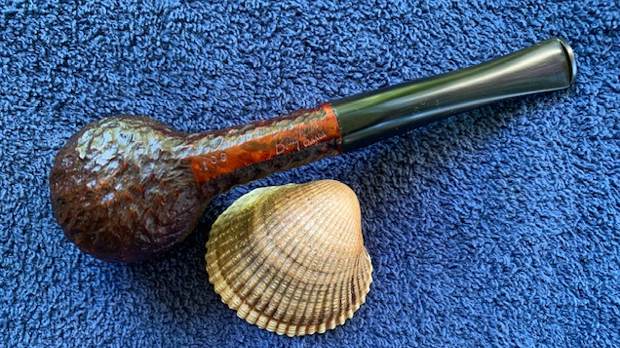
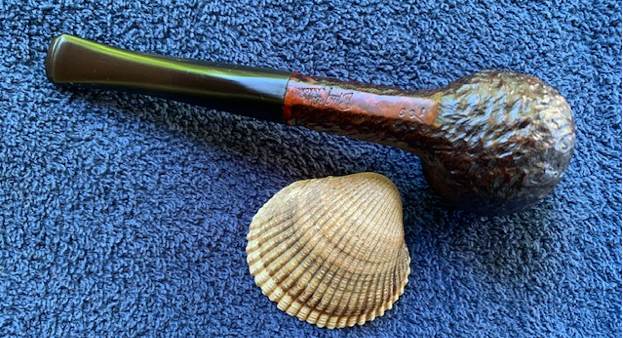
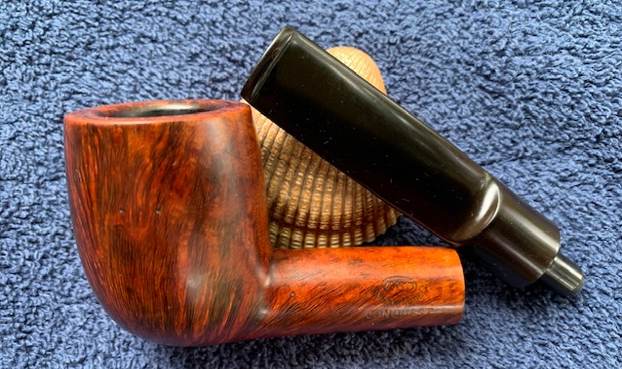
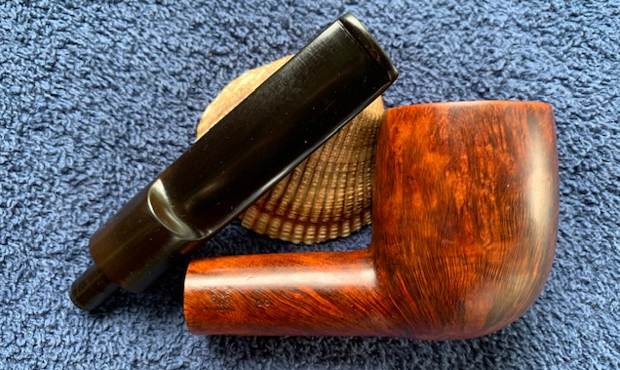
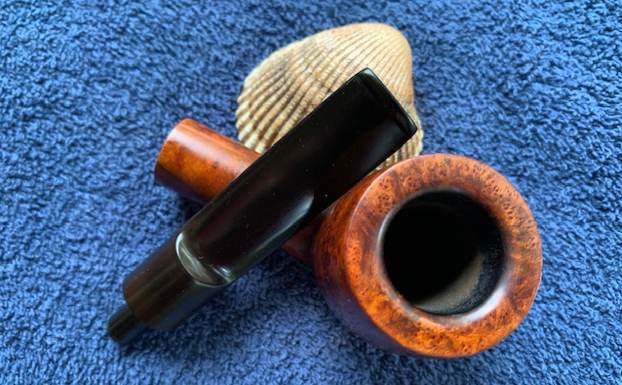
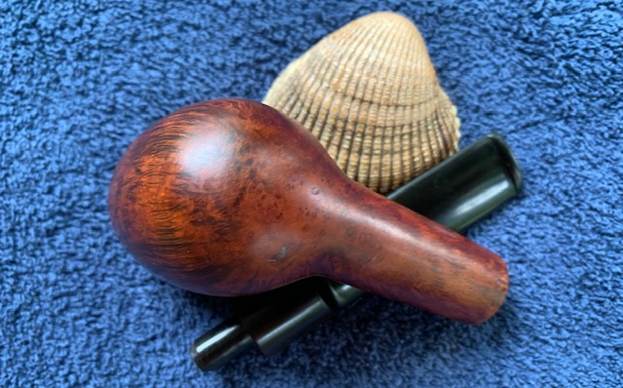
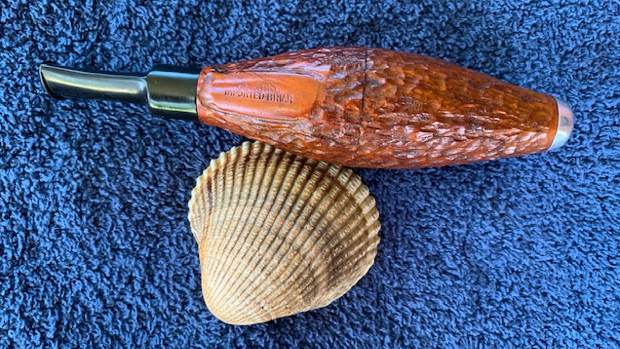
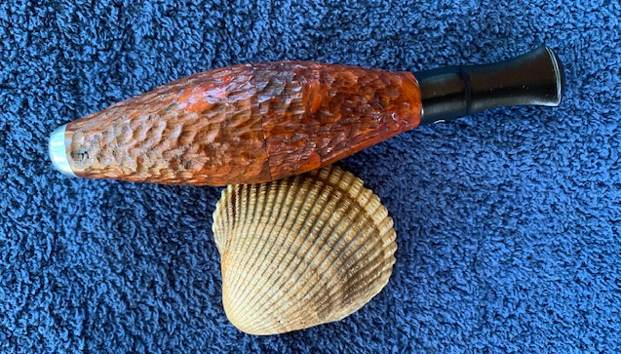
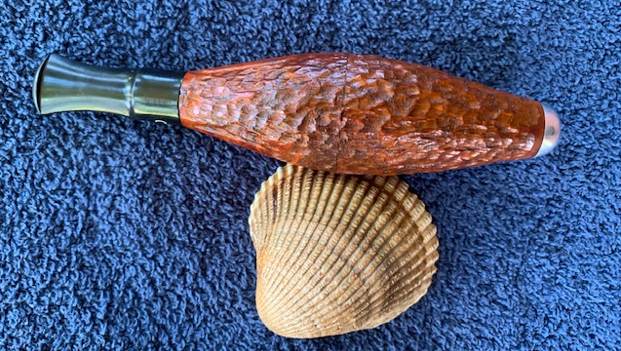
Not too long ago a fellow in Eastern Canada was selling a foursome of Brigham rusticated pipes on Facebook. Jeff contacted him and we became the new owners of the pipes. It did not take long for them to arrive here in Vancouver. When they did I was amazed at how good they looked. Two of them were relatively clean and two were used. The top two pipes in the photo were clean and the bottom two were still dirty with cake and debris in the bowls. I decided I would work on them next. I started with the Bent Billiard – the second one down in the photos below as marked by the red box outlining it. Stamped on the underside with the number 2 on the heel of the bowl followed further down the shank by Brigham [over] Canada. He sent us photos of the pipes we bought. I took photos of the pipe when it arrived. It was clean other than some ash in the bowl and in the airway. The finish was quite clean and the aluminum tenon also is clean. It did not have the Hard Rock Maple filter in the shank but it appeared to be very clean. The stem was very clean and shiny with no tooth marks on the top or underside of the stem. The button was very clean as well with no damage. Overall the pipe looked very good. I took photos of the rim top and the bowl to show the condition. I also took photos of both sides of the stem to show how clean it looked. Over all the pipe was in good condition. I would need to run pipe cleaners through to remove the carbon in the bowl.I took a photo of the stamping on the underside of the shank. It is faint but it reads as noted above in the photos.I took a photo of the pipe with the stem removed to give an overall picture of the pipe. It really is quite beautiful.For historical background for those unfamiliar with the brand I am including the information from Pipedia on Brigham pipes. It is a great read in terms of the history and background on the pipes (https://pipedia.org/wiki/Brigham_Pipes). Charles Lemon (Dadspipes) is currently working on a book on the history of the brand. Until that is complete this article is a good summary. I have included it below.

Roy Brigham, after serving an apprenticeship under an Austrian pipesmith, started his own pipe repair shop in Toronto, in 1906. By 1918 the business had grown to include five other craftsmen and had developed a reputation across Canada for the high quality of workmanship. After repairing many different brands of pipes over the years, Roy noted certain recurring complaints by pipe smokers, the most common referred to as “tongue bite”. Tongue bite is a burning sensation on the smoker’s tongue, previously thought to be due to the heat of the smoke (i.e. a “hot smoking pipe”).

He soon began manufacturing his own pipes, which were lightweight, yet featured a more rugged construction, strengthening the weak points observed in other pipes. The problem of tongue bite intrigued him, and he decided to make overcoming it a future goal.

About 1938, Roy’s son Herb joined him to assist in the business. The business barely survived the great depression because pipes were considered to be a luxury, not a necessity, and selling pipes was difficult indeed. In approximately 1937 [1], after some experimentation, Roy and Herb discovered that tongue bite was in fact a form of mild chemical burn to the tongue, caused by tars and acids in the smoke. They found that by filtering the smoke, it was possible to retain the flavour of the tobacco and yet remove these impurities and thereby stop the tongue bite.

Just as Thomas Edison had searched far and wide for the perfect material from which to make the first electric light bulb filaments, Roy & Herb began experimenting with many materials, both common and exotic, in the quest for the perfect pipe filter. Results varied wildly. Most of the materials didn’t work at all and some actually imparted their own flavour into the smoke. They eventually found just two materials that were satisfactory in pipes: bamboo and rock maple. As bamboo was obviously not as readily available, rock maple then became the logical choice.

They were able to manufacture a replaceable hollow wooden tube made from rock maple dowelling, which when inserted into a specially made pipe, caused absolutely no restriction to the draw of the pipe, yet extracted many of the impurities which had caused tongue bite. The result was indeed a truly better smoking pipe…

Charles Lemon has also written a great article on the stampings and marking on the Brigham pipes that fit into a time line that he has drafted. It is well worth a read and is fascinating. (https://pipedia.org/wiki/Brigham_Pipes_%E2%80%93_A_Closer_Look_at_Dots,_Dates_and_Markings). I quote from the pertinent section on the time frame for this pipe.

I have dubbed the decades between 1980 and 2000 the Late Canadian Era, a period that saw several changes at Brigham that are of note to the collector. First, the traditional 8-grade pinning system (the famous Brigham “Dots” which denoted the quality of the pipe) was changed to a 7-grade system to simplify pinning (more on this below), and the Norsemen and Valhalla series were merged to form the President Series, which represented the very finest pipes coming out of the Toronto factory. Early pipes from this era (left, below) are stamped with a shape number and “Brigham” over “Canada”; later pipes (late 1980s+, on right below) are stamped simply with a shape number and the Brigham logo.

This solidly places the pipe I am working on in the period of Brigham production that Charles calls the Late Canadian Era (1980-2000). It is a great looking pipe with a slightly different rustication pattern than some of the early Brighams I have worked on.

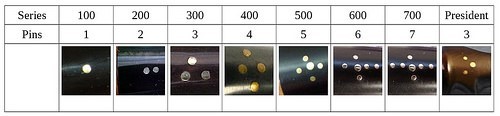
Charles also put together a chart that helps the restorer to understand the Brigham dot system. I quote from the same link on Pipedia as noted above.

The Original Brigham Dot System 1938 – 1980

Brigham pipes are renown in the pipe world for their famous “Brigham Dots”, a system of brass pins inset in the stem to denote the grade of each pipe. The original 8-grade pinning system, used for 42 years between 1938 and 1978 (spanning the Patent, Post-Patent and Canadian Eras) looked like this:

Revised Dot System 1980 Brigham changed the Dot system in 1980, adding a 7 Dot at the top of the line, dropping the names of each series and eliminating the confusing vertical and horizontal 3 Dot configurations. The Norsemen and Valhalla series were combined to form the President series of freehand pipes, which adopted a 3 Dot pattern with a larger dot on the right as shown below. The 7- grade pinning system stayed in place from 1980 to 2001. I knew that I was dealing with a pipe made between 1980 and 2000 from the Late Canadian Era. It sports 2 dots making it a Series 200 pipe. Now to do a bit of spiffing with the pipe itself.

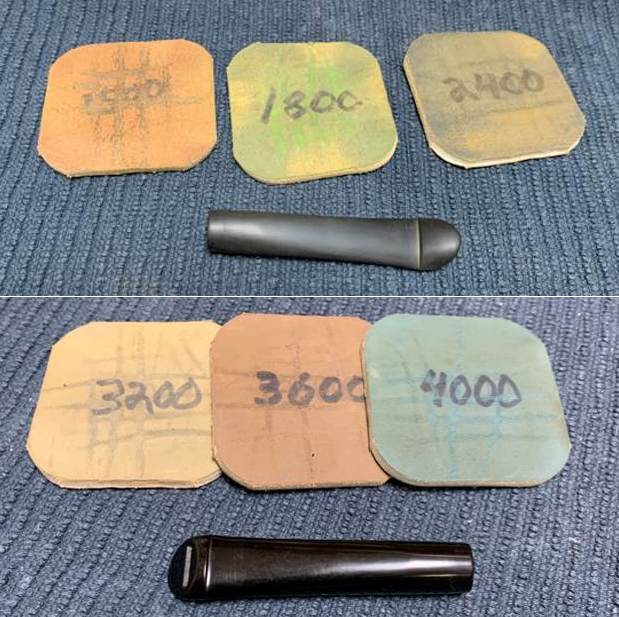
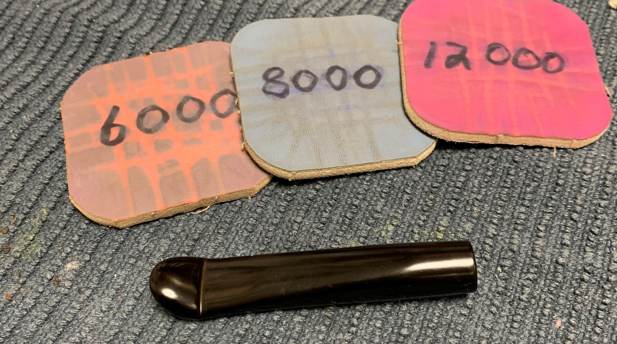
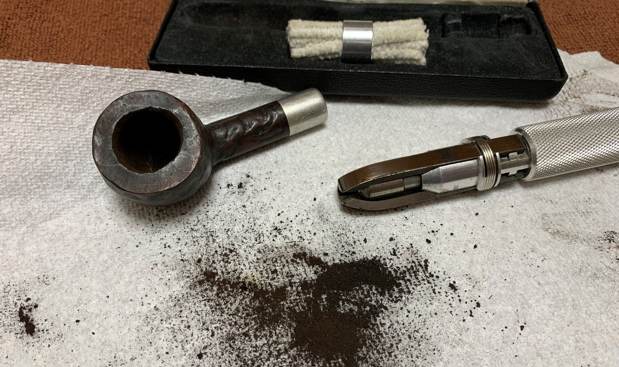
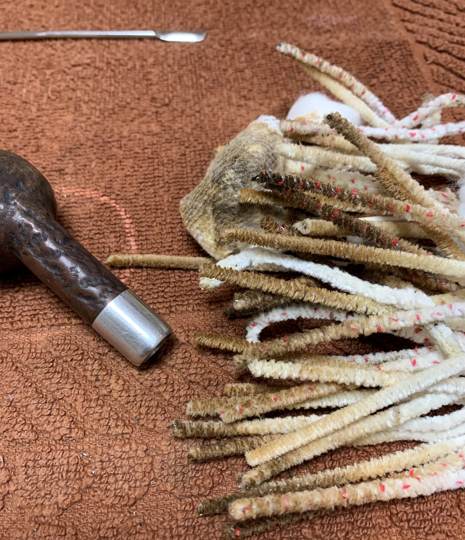
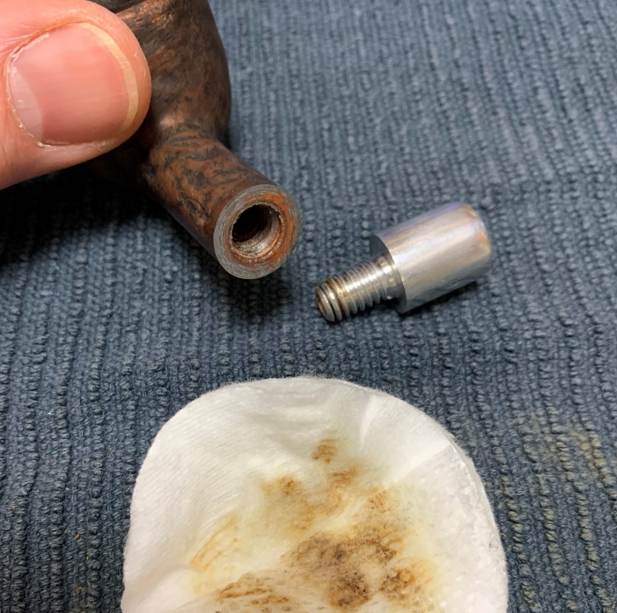
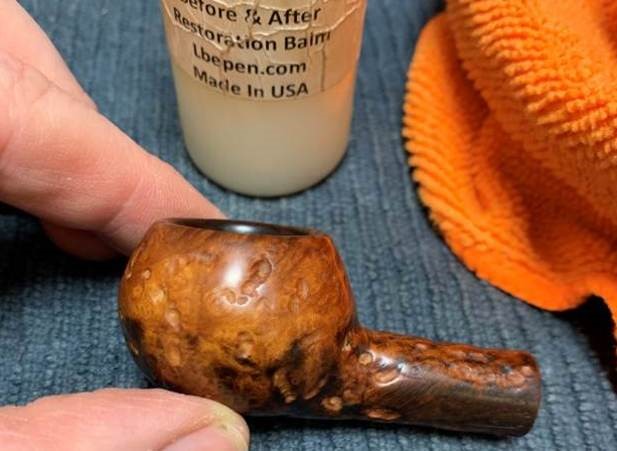
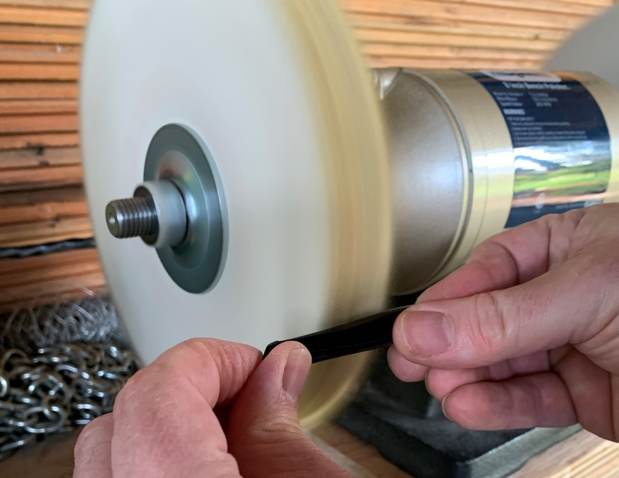
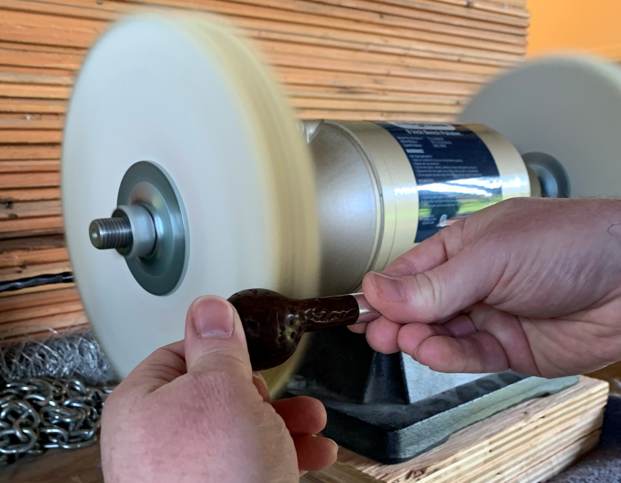
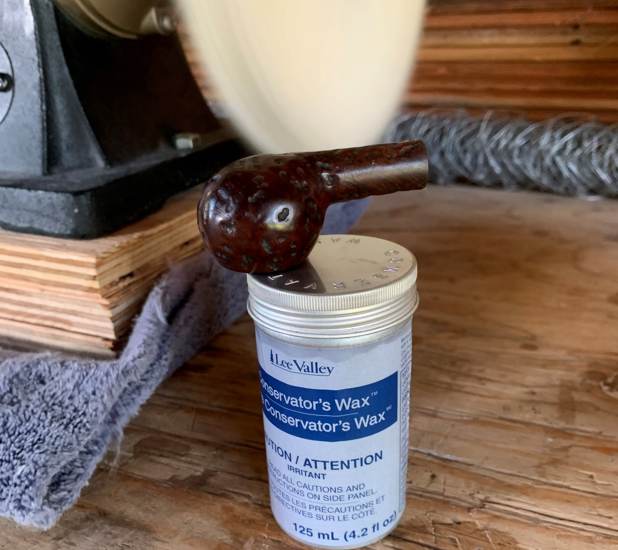
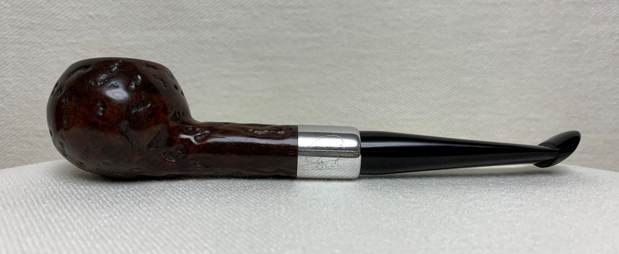
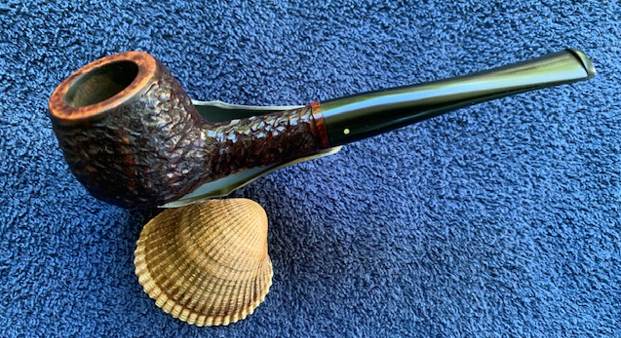
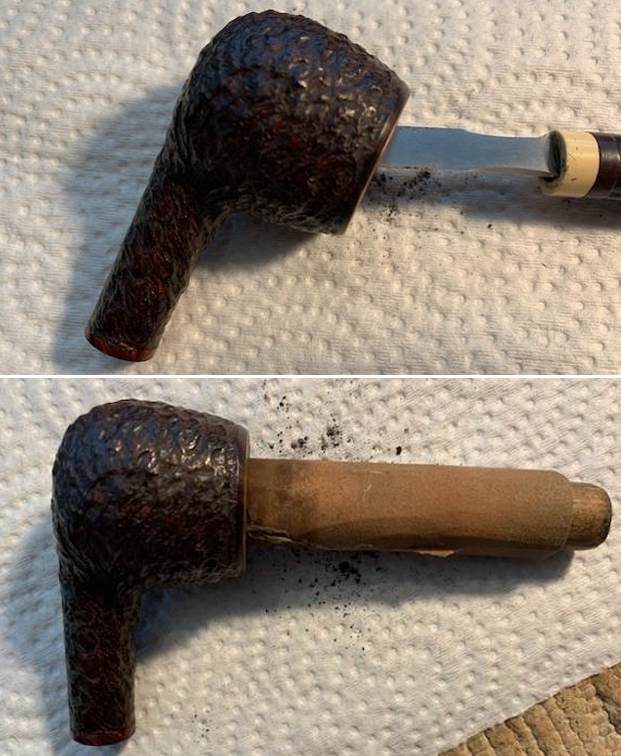
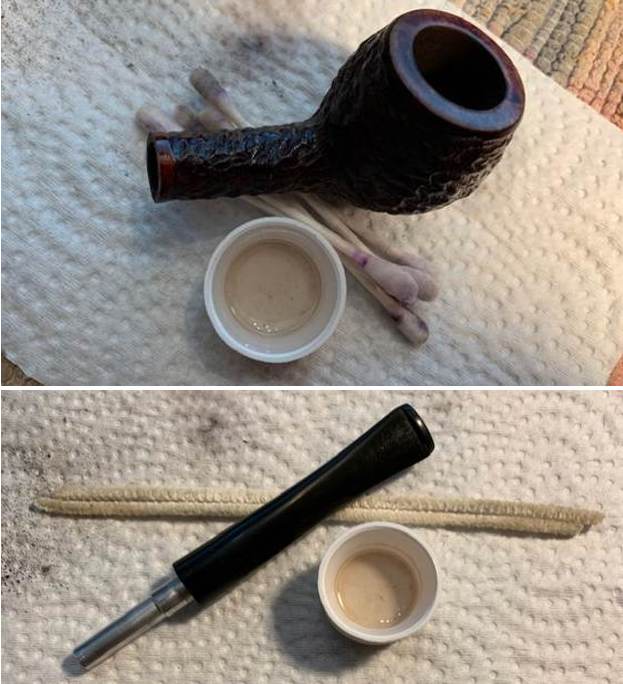
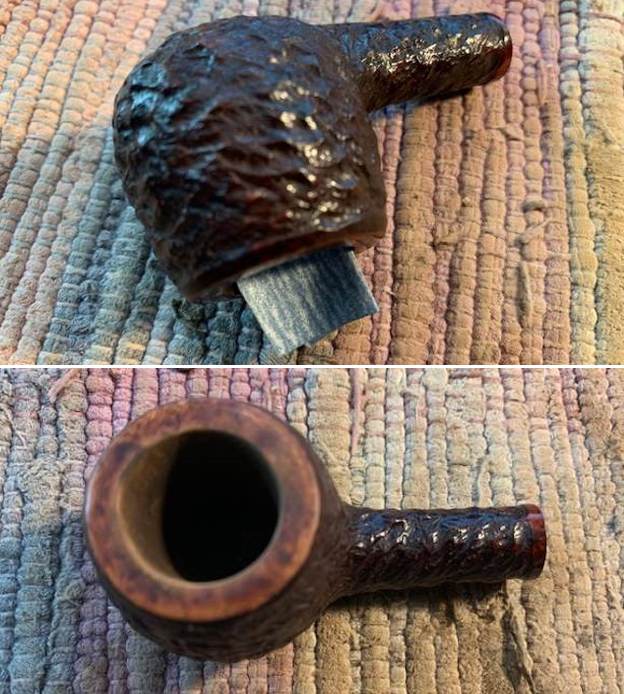
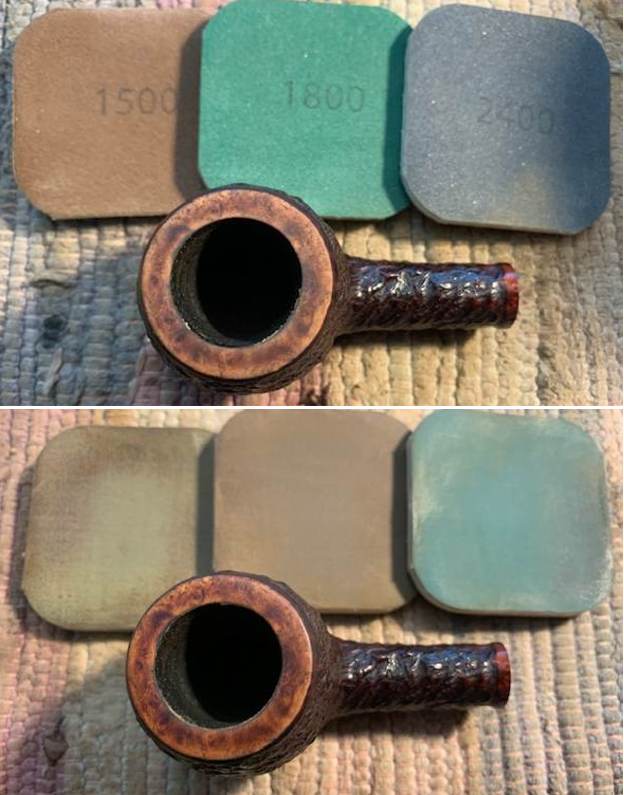
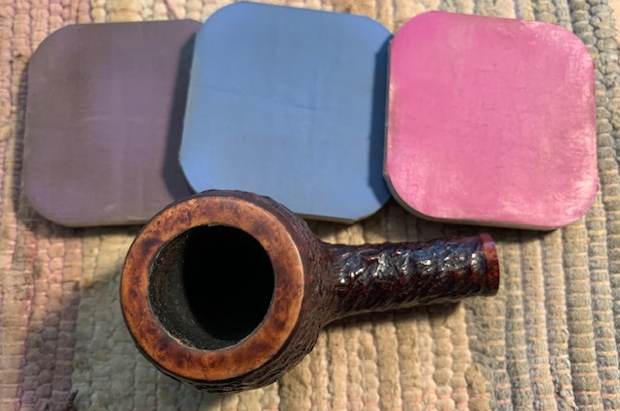
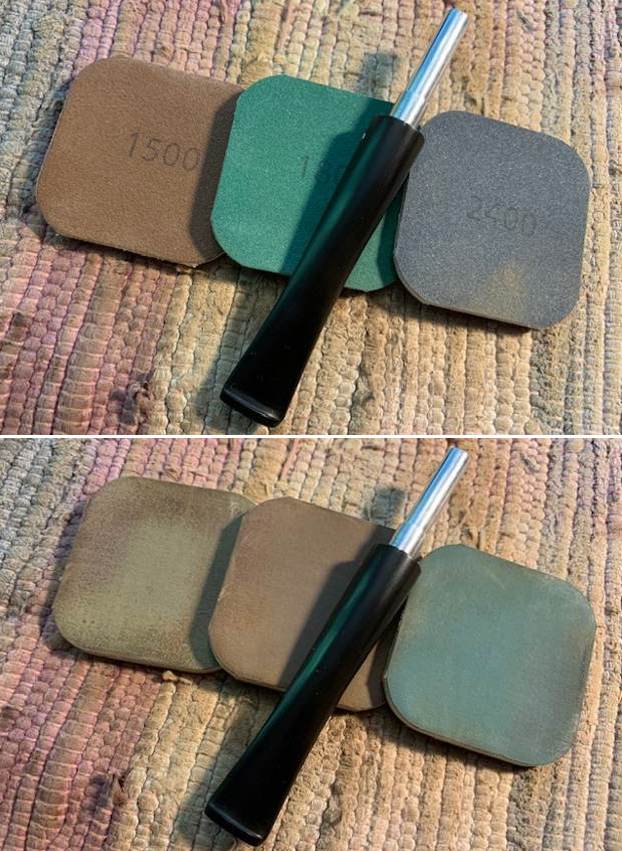
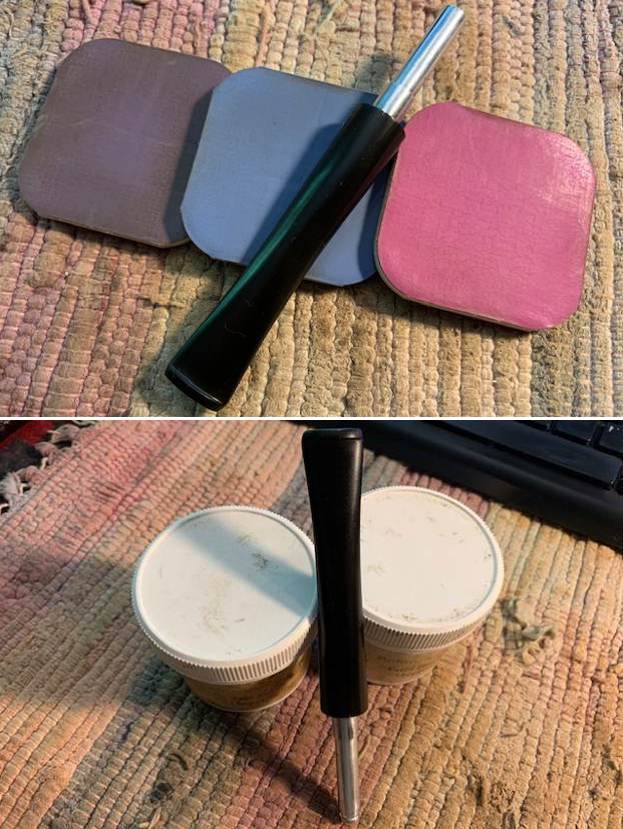
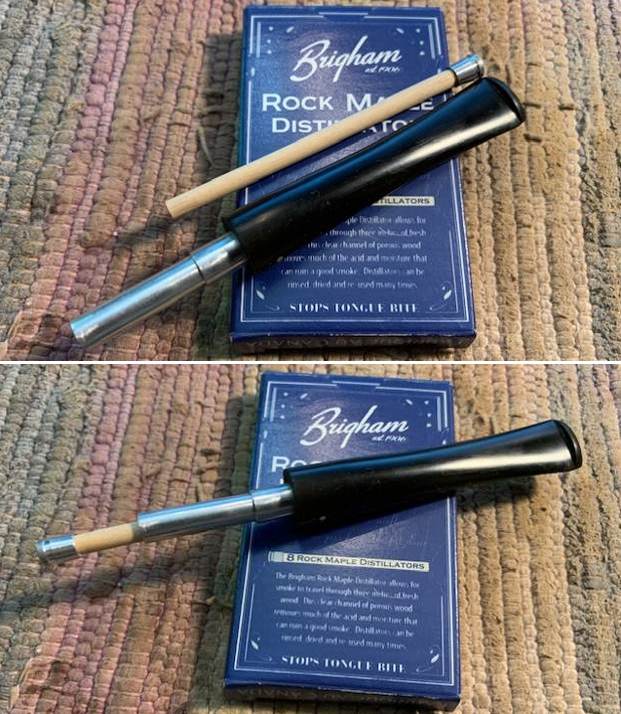
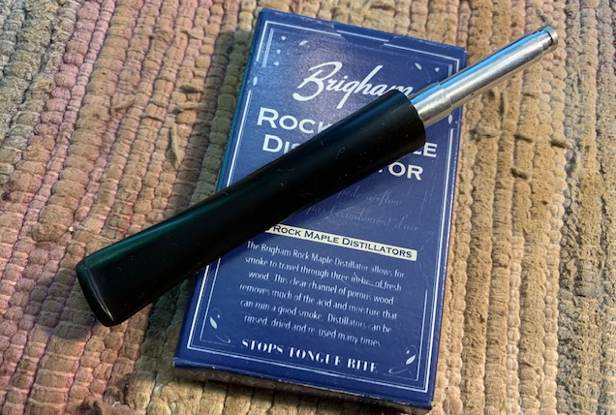
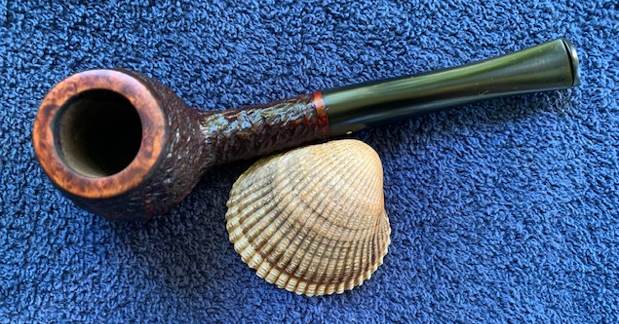
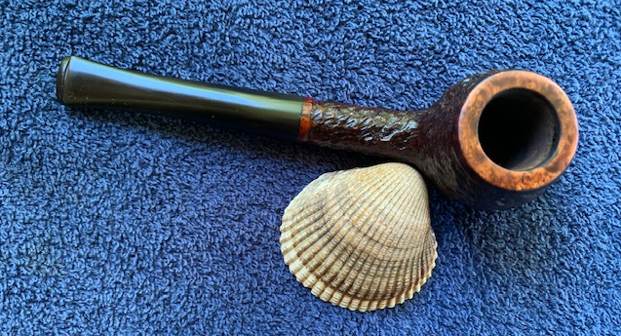
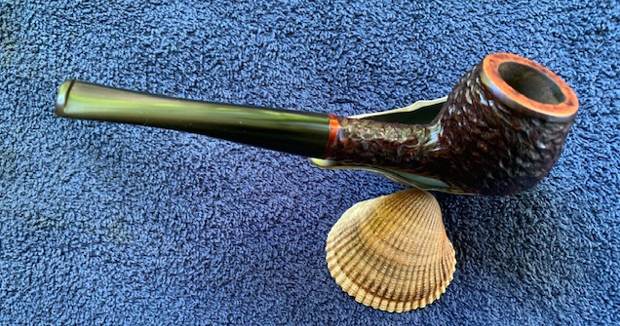
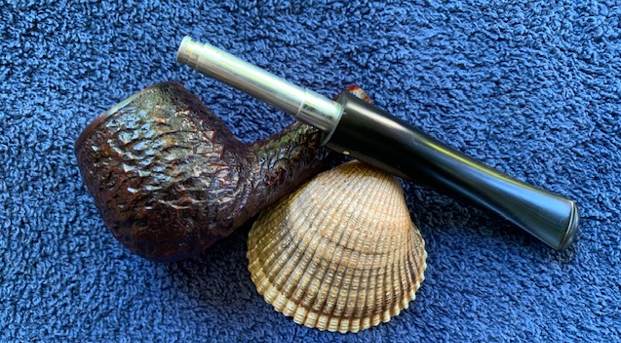
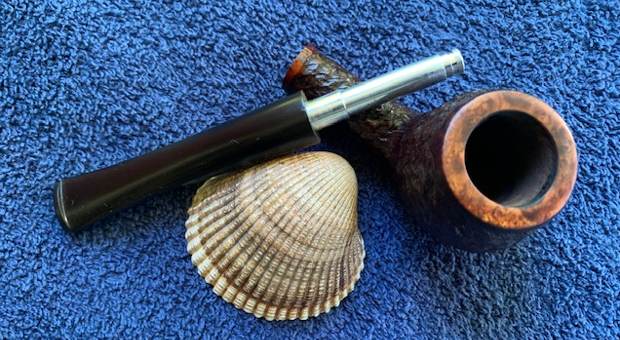
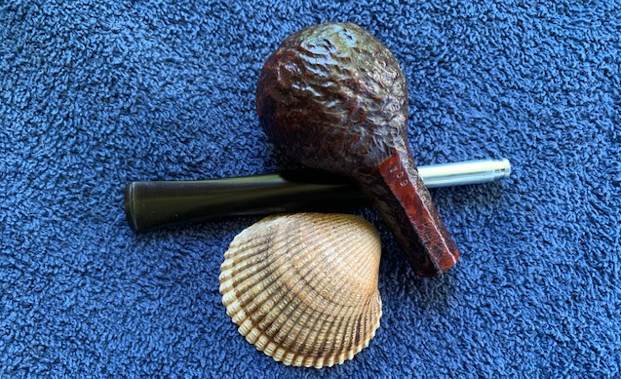
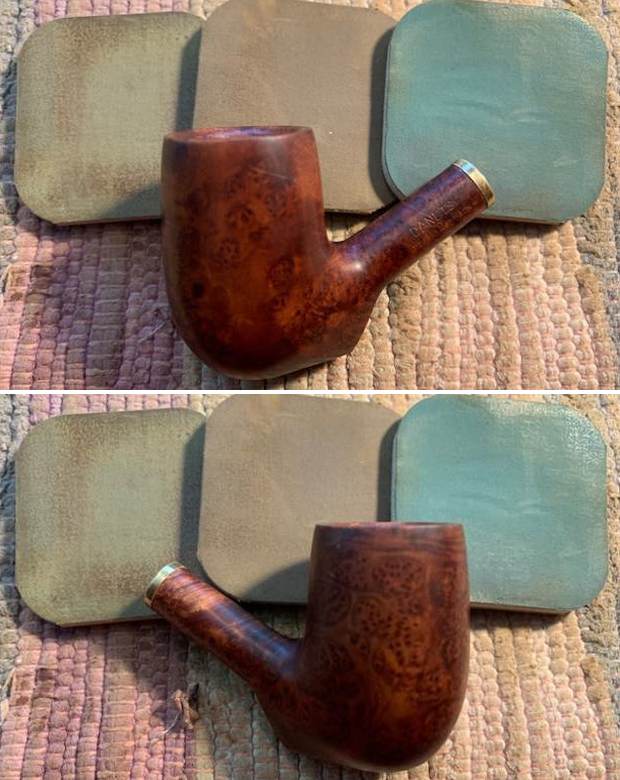
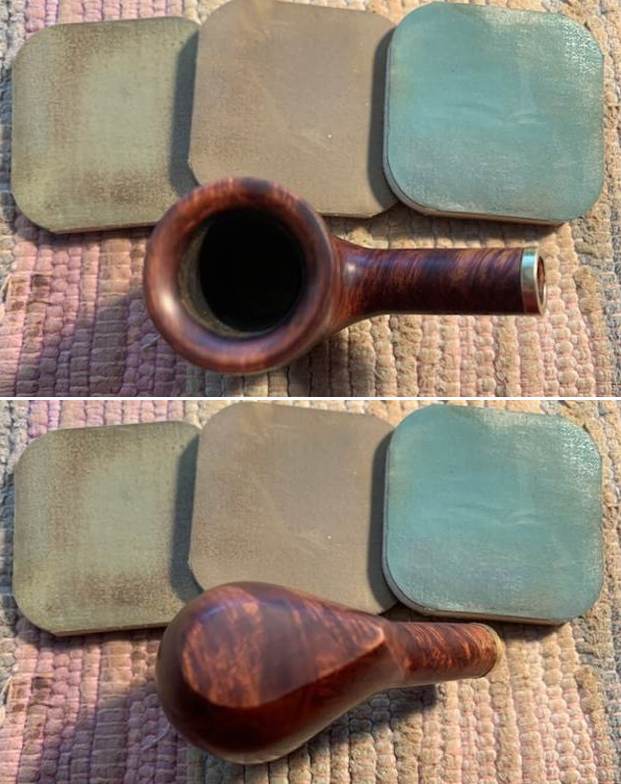
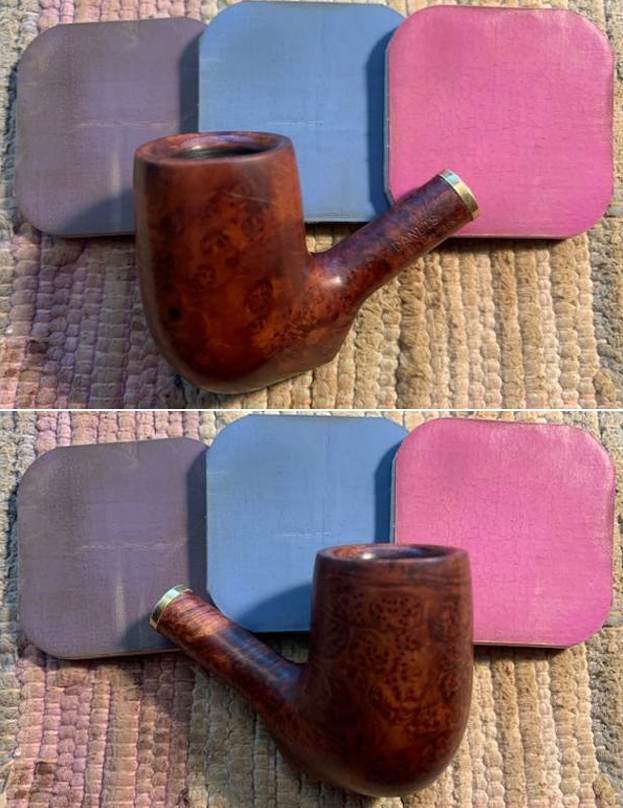
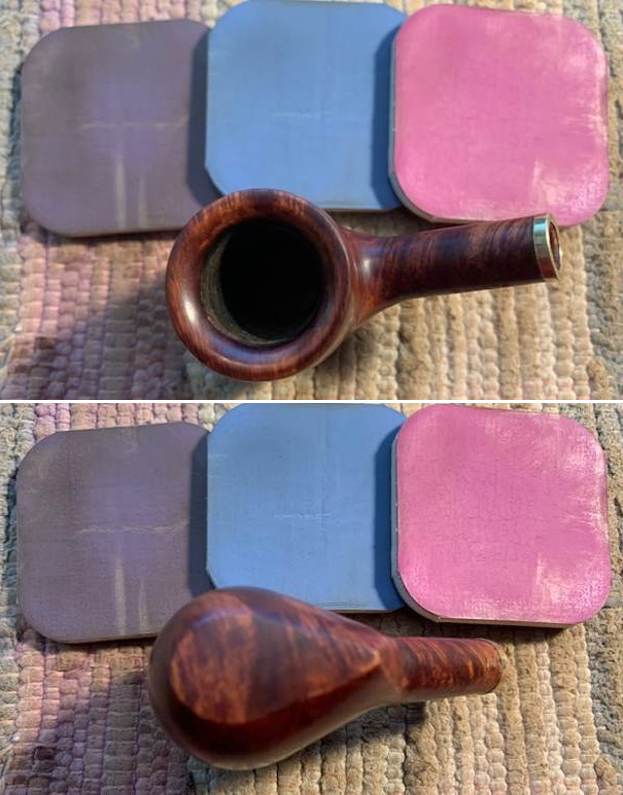
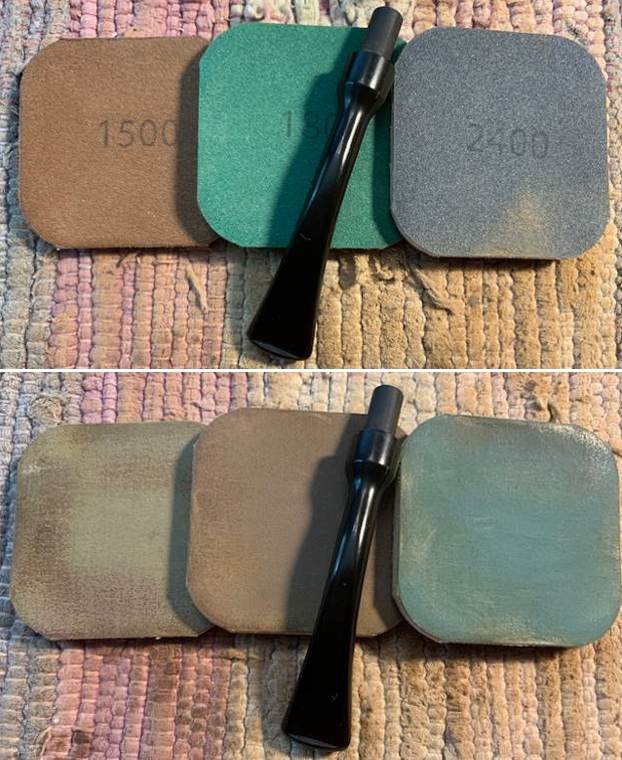
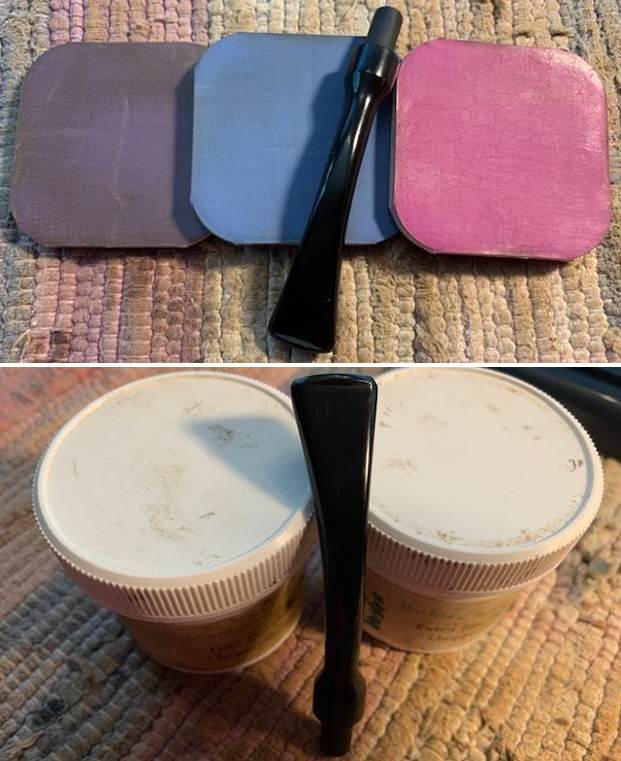
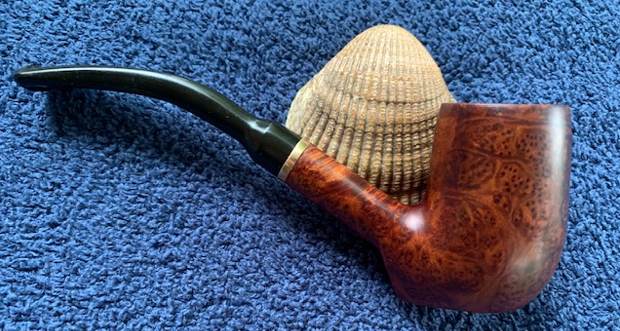
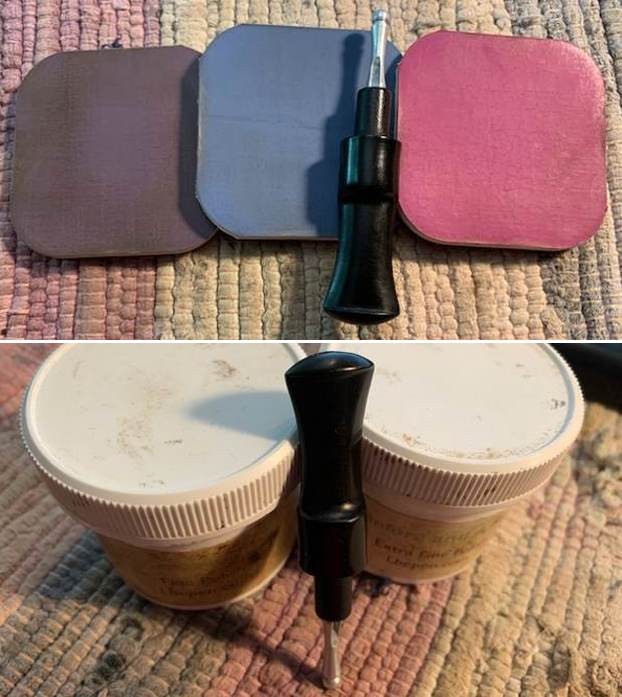
I cleaned out the internals with alcohol, cotton swabs and pipe cleaners to remove the debris and the oils from the shank and tenon as well as the airway into the stem and bowl. I also wiped down the inside of the bowl with a paper towel. to remove the carbon dust that was there.I rubbed the bowl down with some Before & After Restoration Balm. I worked it into the briar with my fingertips and a horse hair shoe brush. The product works to clean, renew and protect briar. I let it do its work for 15 minutes then buffed it off with a soft cloth. The pipe is really quite a beauty. I polished out the light tooth scratches in the surface of the stem ahead of the button on both sides using micromesh sanding pads. I dry sanded the stem and them wiped it down with a cloth impregnated with Obsidian Oil. I finished polishing it with Before & After stem polish – both Fine and Extra Fine. I gave it a final coat of Obsidian Oil and set it aside to dry. I fit the clean and polished stem with the Brigham Rock Maple Distillator and took photos to show what it looked like. This is in essence a hollow Maple wood tube that serves to filter out the moisture and deliver a clean and flavourful smoke. I am excited to finish this Brigham 2 Bent Billiard. I put the pipe back together and buffed it with Blue Diamond on the buffing wheel. I gave the bowl multiple coats of Conservator’s Wax and the stem multiple coats of carnauba wax. I buffed the pipe with a clean buffing pad to raise the shine and hand buffed it with microfiber cloth to deepen the shine. It is fun to see what the polished bowl looks like with the rusticated finish. Added to that the polished black vulcanite stem with the shining brass pins was beautiful. This mixed grain on the rusticated Brigham 2 Dot Bent Billiard is nice looking and the pipe feels great in my hand. It is light and well balanced. Have a look at it with the photos below. The dimensions are Length: 5 ½ inches, Height: 2 inches, Outside diameter of the bowl: 1 ½ inches, Chamber diameter: ¾ of an inch. The weight of the pipe is 1.66 ounces/47 grams. It is a beautiful pipe and one that will be on the rebornpipes store soon. If you are interested in adding it to your collection let me know. Thanks for walking through the cleanup with me as I worked over this pipe. Thanks to each of you who are reading this blog. Remember we are not pipe owners; we are pipemen and women who hold our pipes in trust until they pass on into the trust of those who follow us.

Cleaning up a Crown Duke, Dr. Grabow Bent Billiard for a Memory Box of Dad


Blog by Steve Laug

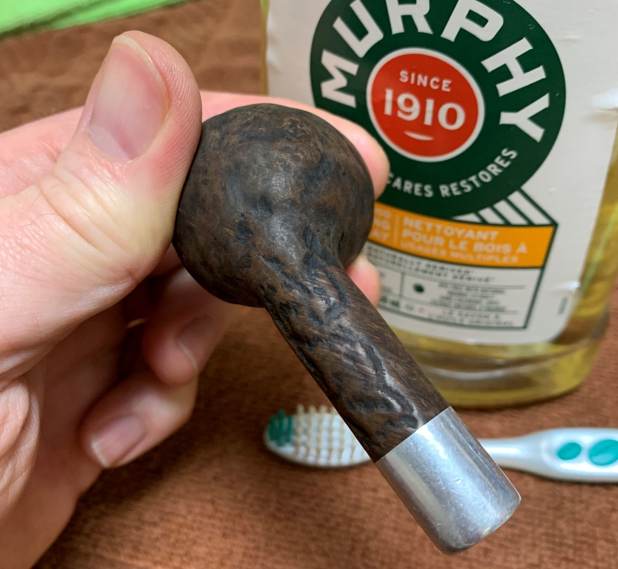
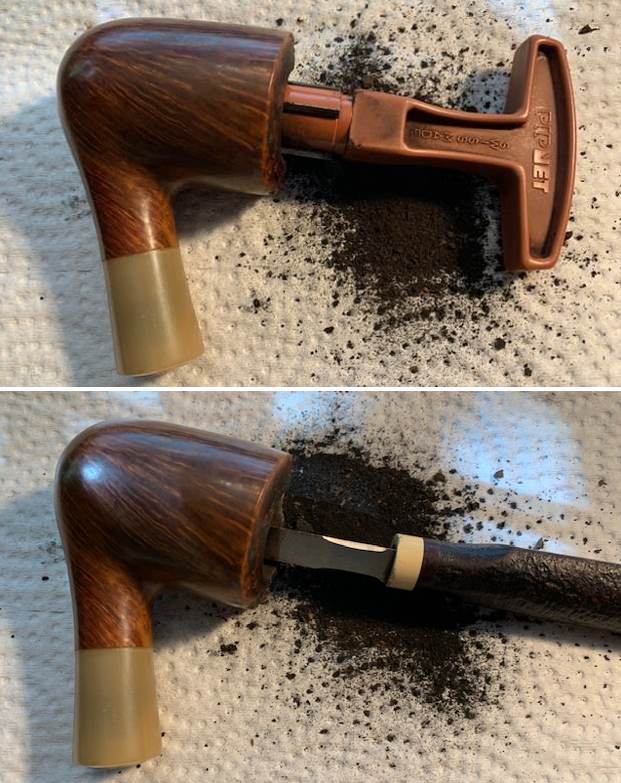
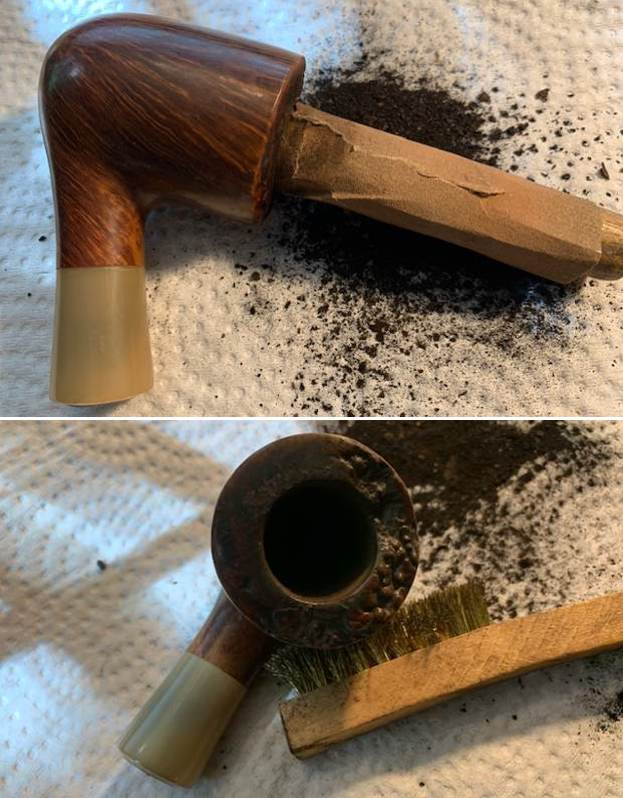
I received an email a while ago from a lady who wanted to have one of her Dad’s pipe cleaned and restored. As we emailed back and forth it was clear that it was one of those pieces that was filled with memories. I pressed to see if she was sure that she wanted it cleaned as it would remove the remnants of debris and tobacco from her Dad’s use of the pipe. She was clear that she wanted it cleaned up to look as good as possible because she was going to make a shadow box to hold the pipe and a photo and other memorabilia of her late Dad. When it finally arrived here in Vancouver I could see why she wanted it clean. The pipe was very dirty and there was a crack in the shank. The pipe had not been smoked for a long time and there was no tobacco smell in it at all. There was a hard thin cake in the bowl and lava on the rim top. The stem was oxidized and had calcification on the button end. It was a filter pipe that had been smoked without a filter so the insides were dirty. The pipe was stamped on the left side and read Crown Duke [over] Dr. Grabow. On the right side it read Imported Briar. There was a blue Grabow Spade on the left side of the taper stem. It was dirty and worn looking with some obvious fills around the bowl. I took some photos of the pipe before I started to work on it.    I took a photo of the rim top and bowl to give a clear picture of what I was dealing with. I also captured the crack in the top of the shank in the photo (I have outlined it in a red box). Other than being incredibly dirty the stem was in decent condition with light tooth chatter and light marks near the button edge.The stamping on the shank sides was faint but readable and reads as noted above.I took a better photo of the crack in the top of the shank and have included it below. It was quite wide open but came to an end in the squiggle at the end toward the bowl. I would need to glue and band it to make it solid again.I took a photo of the pipe with the stem removed to get a sense of the look of the Bent Billiard.I picked a band out of my box of bands. It is far too deep so I will need to take it down for a proper fit on the shank. I started the process by using a topping board. I then used my Dremel and sanding drum to remove the full amount I wanted gone. I finished the shaping of the band on the topping board.Once I had the fit correct, I removed it from the shank and cleaned up the area around the crack with alcohol and cotton swabs. I filled in the crack with clear super glue and clamped the crack shut. Once the glue cured I heated the band and pressed it onto the shank. I took some photos of the repaired shank and band. Now it was time to clean the bowl. I have often done the process in reverse but I really wanted to stabilize the crack before I worked on cleaning the exterior and interior of the bowl and shank. I did not want to chance making the crack worse. I reamed the cake out of the bowl with a Pipnet pipe reamer and took the cake back to bare briar. I cleaned up the reaming with a Savinelli Fitsall pipe knife and sanded the bowl walls smooth with a piece of dowel wrapped with 220 grit sandpaper. I wanted the bowl to be smooth for the display. I scrubbed the exterior of the bowl with undiluted Murphy’s Oil Soap and a tooth brush. I was able to remove the debris and grime around the bowl and clear off the lava on the rim top. I dried the bowl off with a cloth and took these photos. You can see the dark fills and spots around the bowl sides. The largest was a rough fill on the front of the bowl that was pink putty. I repaired the pink, rough fill on the front of the bowl with clear super glue. Once the repair cured I sanded it smooth with 220 grit sandpaper. It was now smooth to the touch. It would be interesting to try to blend it into the surrounding briar once I was staining it. I sanded the entire bowl with 1500 grit micromesh at the same time.I cleaned out the airway in the shank and the stem with cotton swabs, pipe cleaners and isopropyl alcohol. It took quite a few to get the tars and oils out of the airways.I buffed the pipe on the buffer with Blue Diamond and then stained it with a light brown stain. I applied the stain and then flamed it to set it. I used a black and brown Sharpie pen to stain the pinkish fill on the front of the bowl.I set the bowl aside for the stain to cure and turned my attention to the stem. I sanded out the tooth chatter and marks on the stem with 220 grit sandpaper and started the polishing with 400 grit wet dry sandpaper. It is actually beginning to look much better. I polished the stem with micromesh sanding pads – dry sanding with 1500-12000 grit pads. I wiped the stem down after each pad with an Obsidian Oil impregnated cloth to give the pads a little more bite. I polished it with Before & After Stem Polish both Fine and Extra Fine and gave it a final rub down with Obsidian Oil. I set the stem aside to dry and worked on the bowl again. By this time the stain was dry and I was able to tackle the bowl again. I wiped it down with alcohol on paper towels to make the stain more transparent. Because of the fills in the bowl I decided to leave it dark as it did a good job masking them. I buffed the bowl on the wheel with Blue Diamond to further aid the transparency. It is hard to see in the photos but in person the grain is there and not terribly hidden. The fills are hidden and other than the large one on the front of the bowl they look good. I put the stem on the bowl and buffed the pipe with Blue Diamond on the buffing wheel. I was careful when buffing around the stamping and the logo on the stem. I had decided to leave some of the nicks and marks in the briar as they were a part of the story of the pipe and its owner. I wanted it to still bear his definitive marks so that when it was in the shadow box those who knew him would remember the story of the pipe.  I did not want the pipe to look brand new as that would remove the story from it. The nickel band worked well to bind together the crack in the shank. The aluminum spacer on the stem sits up against it and looks quite nice as a joint with the band. It almost gives the band the look of a ferrule. The pipe came out quite well. The darker stain is very similar to what was originally on the pipe when it was new. It also did a good job of masking the fills around the bowl. I will soon be packing it up and sending it back to the pipeman’s daughter so she can build her tribute to her Dad. Thanks for reading the blog.

Sometimes the “pipe gods” smile on you – Finding an UNSMOKED/NOS Kaywoodie Connoisseur All Briar 13 Dublin


Blog by Steve Laug

It has not happened to often to me but it has happened more than once! I am not looking for a particular pipe and low and behold in a lot of pipes Jeff and I purchase we come on one that is absolutely a pipe that is not often seen. In this case it was an All Briar Kaywoodie. I have worked on several older Kaywoodie All Briar pipes over the years and always been intrigued with them. There was just something about the idea of a briar stem and a briar bowl. I think that everyone of them has had issues with chewed off and broken off pieces of briar from the stem. They have taken a lot of work to rebuild and reshape. The briar stems just did not handle chompers and biters well so that when they arrived at my desktop the bowls were ok and the stems were all but destroyed. Then Jeff and I were given the opportunity to pick up a rare example of one of these All Briar Kaywoodies and if you can believe it – the pipe was brand new and unsmoked. We swooped for it and paid the price. I don’t even recall when it arrived. It was in a nondescript brown paper box so we looked it over and were pleased with the find. But I have to be hones and tell you that at least I promptly lost track of it in the sheer volume of pipes that I have here in need of restoration. I put it in a drawer with other unsmoked pipes that would one day get my attention and totally forgot about it.

Last evening I opened the drawer where I had put it. I have worked through all of the pipes in the drawer and posted them or put them on the rebornpipes store. This was the last box in the drawer. You can see that nothing about the plain paper box announced what was inside of it. It was literally a worn paper box with no stamping or marks. I brought it to my desk and took a photo of it. I have learned that when I have something like this that I have held onto I generally have a reason for it. Here is what I saw.I carefully opened the lid of the hinged box and this is what I saw on the inside. The lid of the box is covered with a gold foil and reads in nice script – Kaywoodie – Connoisseur. Under that to the right it reads Kaywoodie Company over New York – London. The bottom of the box also had the gold foil lining. Sitting on top of that was a light blue Kaywoodie Pipe Sock that read KAYWOODIE [over] Reg. U.S. Pat. Off. No. 154986 (It is very hard to read as the ink has blurred on the fabric. I cannot find anything listed with anything near this number on the US Patent Search site). [over] Connoisseur [over] The World’s Best Smoking Pipe. Underneath is a Cloverleaf logo. Inside the pipe sock was the pipe pictured below – a beautiful All Briar Dublin.I took the pipe out of the box and took photos of it to try and capture what I saw while I looked at it. It is really a beautiful pipe. It was made between 1952-1955 which appears to the only time frame that these pipes were produced – so it is amazing that it remains unsmoked and in flawless condition some 70+/- years later (https://pipedia.org/images/3/3d/Kaywoodie_Pipe_Names.pdf). I took photos of the rim top, bowl and the stem surfaces to show the condition of this beautiful unsmoked pipe.I took photos of the clear stamping on the shank sides. On the left it read ALL BRIAR [over] Kaywoodie. On the right it read  ALL-IMPORTED BRIAR [over] the shape number 13. On the top of the briar stem is an inlaid black cloverleaf in a white circle.  I unscrewed the stem from the shank and took a photo of the pipe. The aluminum is lightly oxidized but will polish up and look great. It is a stunning looking pipe.I have read a lot of information in the past on other Kaywoodie pipes I have worked on and spent time on the Kaywoodie Collectors Forum to help educate myself on the various lines and historical periods of Kaywoodie production. On Pipedia.org there is a helpful summary of the history of the brand that has been condensed in one place. It is called the Collectors Guide to Kaywoodie Pipes (https://pipedia.org/wiki/Collector%27s_Guide_to_Kaywoodie_Pipes). I found the All Briar line of pipes included in the section of the Guide for 1955. I quote here the pertinent sections with the references to the All Briar pipe underlined and highlighted in bold.

The line-up of pipes in the 1955 catalog (Table 3 below) was more extensive than in previous years. The catalog presented an expanded line of meerschaum pipes and introduced a 4-pipe set of Matched Grain Pipes, as well as several pipes with “special features”. The number of shapes available… was not substantially different from the number offered in the 1947 catalog…

The Twin-Bowl Kaywoodies were available in an all-meerschaum model (two removable inner bowls of meerschaum) and a meerschaum and Flame Grain model (outer bowl of flame grain briar and removable inner bowl of meerschaum). Other meerschaum pipes presented in the 1955 catalog included the Gourd Calabash; the Coral (“dimpled”) Meerschaum; the All Briar (briar bit) and Flame Grain pipes with inlaid meerschaum bowls; and the “Doctor’s” pipe…

Included in the guide was a helpful list of pipe grades and prices. I have included the list below and noted the pipe I am working on by highlighting it in bold print and underlining the reference. It is in this list that I found confirmation that Kaywoodie made an All Briar with a meerschaum bowl insert and an All Briar without the meerschaum insert. The All Briar I am working on is not meerschaum lined. It is fascinating for me to see that the addition of a meerschaum bowl was only $2.50 in 1955. The pipe I have is marked as Connoisseur which I have highlighted in red below in the list and as an All Briar Stembiter (also highlighted).

Table 3. 1955 Kaywoodie Pipe Grades and Prices

    Meerschaum Character Pipes: $100.00

    Block: 15.00-50 (According to size)

    Meerschaum Twin Bowl: $35.00

    Meerschaum/Flame Grain Twin Bowl: $25.00

    Sandblasted “Doctor’s” Pipe: $25.00

    Centennial: $25.00

    Coral Meerschaum: $20.00-25 (According to size)

    Gourd Calabash: $15.00-25 (According to size)

    Ninety-Fiver: $20.00

    Oversize: $10.00-25(According to style and finish)

    Connoisseur: $15.00

All Briar w/Meerschaum Inlaid Bowl: $12.50

    Flame Grain (Meerschaum Inlaid) $12.50

    Export Pipes: $5.00-15 (According to grade)

All Briar (Briar Bit): $10.00

    Flame Grain: $10.00

    Fit Rite: $10.00

    Silhouette: $10.00

    Carburetor: $7.50

    Relief Grain: $7.50

    Chesterfield: $5.00-15 (According to grade)

    Chinrester: $5.00-10 (According to grade)

    Stembiter: $5.00-10 (According to grade)

    Streamliner: $4.00-10 (According to grade)

    Super Grain: $5.00

    Carved Super Grain: $5.00

    White Briar: $5.00

    Standard: $4.00

    Filter Plus: $4.00

    Drinkless pup: $3.50

    Drinkless Tuckaway: $3.50

    Drinkless In-Between: $3.50

    Two-Pipe Companion Setsb: $10.00-25 (According to grade)

    Matched Grain Set (4-Pipes): $50.00

    Matched Grain Set (7-Pipes): $125.00

Further reading on Pipedia under the general listing for Kaywoodie Pipes provided me with a magazine advertisement that included the All Briar pipes. It is a great Father’s Day Ad and the bottom items in the ad show the All Briar line. I have included both the link and a copy of the ad for your reading pleasure (https://pipedia.org/wiki/Kaywoodie)
The finish on the briar was clean and good but was a bit rough to touch from the time spent in storage. I polished it with micromesh sanding pads and wiped it down with a damp cloth after each pad. It really is a nice piece of wood. I decided to look on my other go to site – PipePhil (http://www.pipephil.eu/logos/en/logo-kaywoodie-1.html) to see what added information I might garner from his site. Under the Kaywoodie All Briar listing it said that the pipe had a twin-bore stem, meaning that instead of a slot in the button there were twin holes that formed a Y with the airway in the stem itself. The pipes were made between 1952 – 1955. It included a series of pictures of a typical briar Kaywoodie stem that showed a vertical hole near the button that was an innovation that they called Stembiter to prevent a stem biter from gnawing through the stem. The Stembiter innovation came out in the early 1950s as well so now I had confirmation of the period when the pipe was made. I have included an advertisement for the Stembiter innovation following the photo below. I know that at present I will not be able to reproduce this feature on the stem when I rework it.Now that I had a clear picture of the drilling and the function of the set up of the All Briar stem I polished it with micromesh as well. I dry sanded it with 1500-12000 grit pads and wiped it down after each sanding pad with a cloth impregnated with Obsidian Oil. After each pad the pipe stem took on new shine and depth. I also polished the oxidized aluminum four hole stinger at the same time. I polished the entirety with Before & After Pipe Stem polish – Fine and Extra Fine. I gave it a final rubdown of Obsidian Oil and let it sit to dry. I rubbed some Before & After Restoration Balm into the briar of the bowl and stem. I worked it into the surface with my fingertips. It works to clean, protect and preserve the briar and I figured this was a piece worthy of doing that! I let the Balm sit for 15 minutes and then buffed it off with a soft cotton cloth. The Balm seems to work magic with dry briar.  With the polishing work done on the All Briar Kaywoodie Connoisseur Dublin, I put the pipe back together again and gave it a quick buff with Blue Diamond on the wheel and then gave the entire pipe multiple coats of Carnauba Wax. I buffed it with a clean buffing pad on the wheel and then a hand buff with a microfiber cloth to deepen the shine. It is a beautiful pipe. The grain and the lines of the pipe are eye catching. The dimensions of the pipe are Length: 6 inches, Height: 2 inches, Outer Bowl Diameter: 1 3/8 inches, Chamber Diameter: ¾ of an inch. The weight of the pipe is 34 grams/1.16 ounces. This is one that I plan on adding to my own collection as it is a great addition. I am still undecided if I will fire it up and enjoy a smoke in it. We shall see. Thanks for walking through my meanderings as I worked on this old timer. Much appreciated!

Cleaning up a Lightly Smoked Italian Made C.B. Perkins Normandy 256 Dublin


Blog by Steve Laug

The next pipe I chose to work on is another C.B. Perkins pipe, different from the English Skater I just finished not only in the fact that it was lightly smoked and had an acrylic stem but also in that it was Italian Made. This one was an interesting shape that I call a Dublin with a taper variegated rose coloured acrylic stem. It came in the original box that is in great condition. It had a light cake and some tobacco remnants in the bowl and rim top that showed that some darkening on the inner edge. The finish very good and the pipe had some nice grain around the bowl and shank. There were no visible flaws or fills on the bowl sides or shank. It was stamped on the left side of the shank and read C.B. Perkins. [over] Normandy. Underneath that toward the stem is stamped the shape number 256. On the shank/stem union it is stamped Italy. It has an acrylic taper stem with no logo or marking. The stem has light scratching and tooth chatter on both sides. I took photos of the pipe when I brought it to the work table.  I took photos of the bowl and rim top and the stem surfaces to show the condition of both. The bowl has a thin cake and the rim top and edges have some darkening and lava. The stem is also in great condition other than light tooth chatter on the surface ahead of the button. I took photos of the stamping on the left side of the shank. It took two photos to capture the stamping. It is clear and readable as noted above. On the underside of the shank it is stamped Italy.I took the stem off the shank to show the overall look of this interesting pipe. I just finished a Perkins earlier so I have included the information on the brand that I found for that blog. I checked first on Pipephil site (http://pipephil.eu/logos/en/logo-c1.html#c_bperkins) and found photos of various pipes. None of the photos include the Normandy or the Made in Italy stamp. I am including a screen capture of the pertinent information. There was no other information in the sidebars.Then I turned to Pipedia and was more successful with background information on the company (https://pipedia.org/wiki/C.B._Perkins). I quote a portion of that article below that gives a bit of history and more importantly cleared up where the pipes came from for me.

The first C.B. Perkins store opened in Boston in the early 1900’s. Perkins quickly became the leading retail tobacconist in New England, a position it held for over 75 years. In 1986 Perkins management sold their Pennsylvania and New Jersey stores to DES Tobacco Corporation.

DES is a wholly owned subsidiary of the S. Frieder and Sons Company. S. Frieder and Sons had been a cigar manufacturer since 1920. In 1978 S. Frieder sold its manufacturing business to United States Tobacco so it could focus all its assets and energy on the retail tobacco business under the name of DES Tobacco. Thus, the merger of C.B. Perkins and DES represented four generations of tobacco experience.

 I started my work on this pipe by reaming the bowl. I reamed it with a PipNet Pipe Reamer and took the thin cake back to bare briar. I cleaned up the reaming with a Savinelli Fitsall Pipe Knife. I sanded the walls of the bowl smooth with a piece of dowel and 220 grit sandpaper. I scrubbed the exterior of the bowl with a tooth brush and undiluted Murphy’s Oil Soap. I rinsed it under warm running water to remove the grime and the soap. It is beginning to look good! I scrubbed out the internals of the shank and the stem with pipe cleaners, cotton swabs and isopropyl alcohol. It did not take much to remove the tars and oils. I believe that there was also some stain on the inside of the shank that came out in the process. Both are clean now. I polished the briar with micromesh sanding pads – dry sanding with  1500-12000 grit pads and wiping the bowl down after each pad with a damp cloth. It really is a nice looking piece of briar. I rubbed some Before & After Restoration Balm into the finish of the pipe. I worked it into the briar because the product cleans, enlivens and protects the briar. I let the pipe sit with the Balm for 10 minutes then buffed it off with a soft towel. The Balm did its magic and the pipe looked really good. I set the bowl aside and turned my attention to the stem. I turned my attention to the stem. I polished the stem with micromesh sanding pads – dry sanding with 1500-12000 grit pads. Even though I know that Obsidian Oil is not necessary for acrylic I use it anyway as it gives some bite to the micromesh pads and also removes the dust. I wiped the stem down after each pad with a cloth impregnated with Obsidian Oil. I polished it with Before & After Stem Polish – both Fine and Extra Fine then gave it a final coat of Obsidian Oil and set it aside to dry. This lightly smoked C.B. Perkins Normandy 256 Dublin with a Rose coloured acrylic taper stem looks really good. The grain around the bowl and shank stands out with the contrasting brown stains. I put the pipe back together and buffed the pipe with Blue Diamond on the wheel (being careful of the stamping on the stem so as not to damage that). I gave the bowl and stem multiple coats of carnauba wax and buffed the pipe with a clean buffing pad to raise the shine. I hand buffed it with a microfiber cloth to deepen the shine. The dimensions of this pipe are – Length: 5 ¾ inches, Height: 2 inches, Outside diameter of the bowl: 1 ½ inches, Chamber diameter: ¾ of an inch. The weight of the pipe is 1.45 ounces/41 grams. It is a great looking pipe and one that will be going on the rebornpipes store in the American Pipe Makers section. If you want to add it to your collection let me know via email to slaug@uniserve.com or by message. Thanks for walking through the cleanup with me.

Cleaning up an UNSMOKED/NOS Comoy’s Made C.B.P. Supreme 600 Skater


Blog by Steve Laug

The next pipe I chose to work on is another UNSMOKED/NEW OLD STOCK pipe. This one was an interesting shape that I tend to call a skater with a taper vulcanite stem. I remembered working on a Comoy’s pipe with this shape in the past so I wondered if it was not somehow connected. It came in the original box that is in great condition. It had a perfectly clean and debris free bowl and rim top that showed that it had never been smoked. The finish very good and the pipe had some nice grain around the bowl and shank. There were no visible flaws or fills on the bowl sides or shank. It was stamped on the left side of the shank and read C.B.P. [over] Supreme. The right side is stamped a circular COM stamp MADE IN LONDON in a circle over ENGLAND followed by the shape number 600. The COM stamp is like the one on Comoy’s pipes from the 1950s onward. This is another lead that the pipe may well be made by Comoy’s but research will tell. It has a vulcanite taper stem with a Perkins logo decal on the left side. The stem is heavily oxidized on the top and right side with light oxidation on the remaining sides. I took photos of the pipe when I brought it to the work table. I took photos of the bowl and rim top and the stem surfaces to show the condition of both. The bowl, crowned rim top and edges look very good. The stem is also in great condition other than the oxidation on the surface ahead of the button. The stamp on the left side of the stem appeared to be a decal and was peeling.I took photos of the stamping on the sides of the shank. It is clear and readable as noted above. The C.B. Perkins smoking pipe decal is on the left side of the stem is slightly peeling and I am not sure it will survive the cleanup.I took the stem off the shank to show the overall look of this interesting pipe.I rubbed some Before & After Restoration Balm into the finish of the pipe. I worked it into the briar because the product cleans, enlivens and protects the briar. I let the pipe sit with the Balm for 10 minutes then buffed it off with a soft towel. The Balm did its magic and the pipe looked really good. I set the bowl aside to do a bit more work on the Comoy’s connection on this pipe. I started by reading on the history of the brand as it has been a while since I have worked on C.B. Perkins pipes. I wanted to refresh my memory of the back story of the brand. I checked first on Pipephil site (http://pipephil.eu/logos/en/logo-c1.html#c_bperkins) and found photos of various pipes. The picture of the first pipe is stamped similarly on the stem to the one I am working on but not the bowl. The third pipe has the same COM stamp as the one I am dealing with. There are no photos of the Supreme. I am including a screen capture of the pertinent information. There was no other information in the sidebars.Then I turned to Pipedia and was more successful with background information on the company (https://pipedia.org/wiki/C.B._Perkins). I quote a portion of that article below that gives a bit of history and more importantly cleared up where the pipes came from for me.

The first C.B. Perkins store opened in Boston in the early 1900’s. Perkins quickly became the leading retail tobacconist in New England, a position it held for over 75 years. In 1986 Perkins management sold their Pennsylvania and New Jersey stores to DES Tobacco Corporation.

Store Front and Contact Info Courtesy of Doug Valitchka

DES is a wholly owned subsidiary of the S. Frieder and Sons Company. S. Frieder and Sons had been a cigar manufacturer since 1920. In 1978 S. Frieder sold its manufacturing business to United States Tobacco so it could focus all its assets and energy on the retail tobacco business under the name of DES Tobacco. Thus, the merger of C.B. Perkins and DES represented four generations of tobacco experience.

So far there was no connection to Comoy’s as the maker. The Made in London England circular COM stamp was the same in the Pipephil photos but there as no mention of a connection with Comoy’s so now I moved on to work another angle.

I decided to see where the combination of the shape number and COM stamp took me. Both of them made a connection for me to Comoy’s pipes. I did a quick search for a Comoy’s shape 600 (https://pipedia.org/wiki/Comoy%27s_Shape_Number_Char). I have copied the section of the chart that lists the 600 shape and calls it a SKATER – the very shape that I thought of when I saw it. It notes that it has a ¼ bent stem and is a Modern design (whatever that designation means). The COM stamp was definitely COMOY’S so now I knew. I knew that I was working on a pipe made for C.B. Perkins by Comoy’s of London. The read on the background history of C.B. Perkins was interesting.

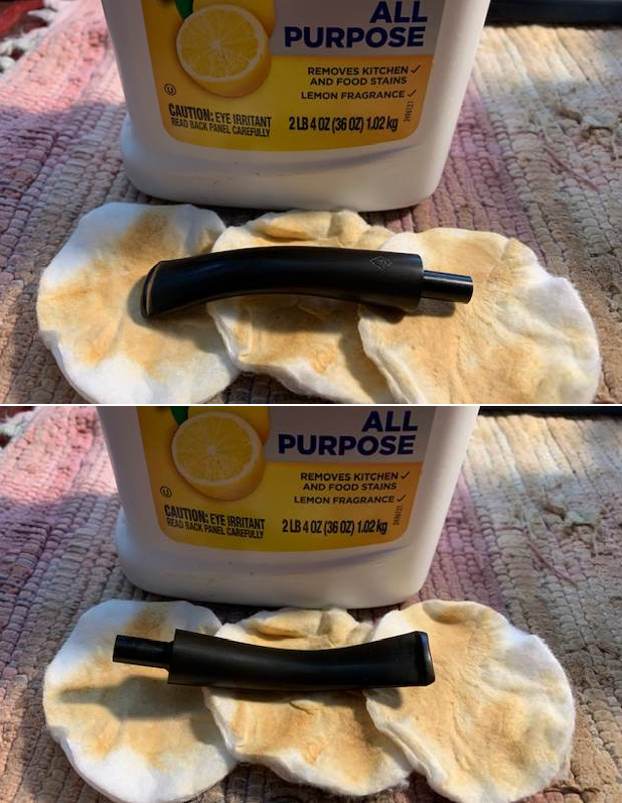
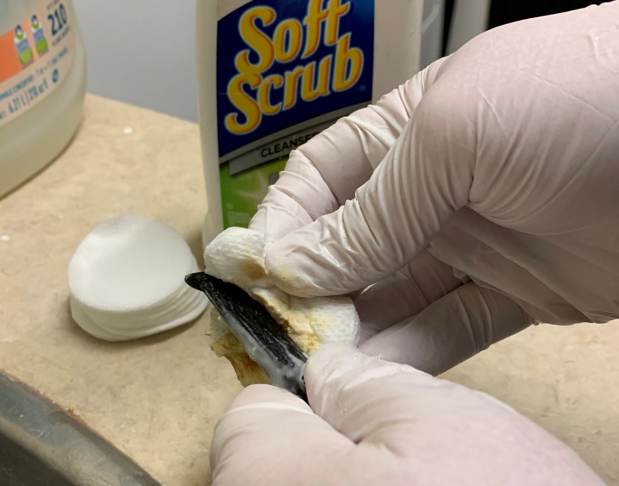
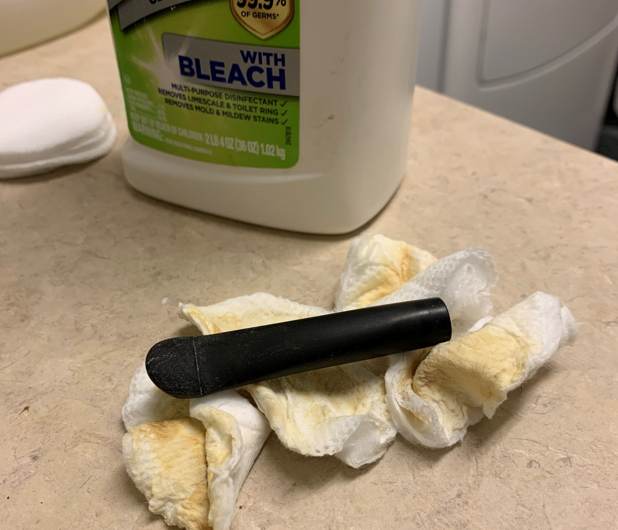
I turned my attention to the stem. It was oxidized from sitting around in the store who had stocked it. The one side more oxidized than the other pointed to a display case that exposed the top and right side to the sunlight. I scrubbed it with cotton pads and Soft Scrub all purpose cleanser. I worked on it until the stem surface was clean and ready polish. I had worried about the decal coming off in the cleaning process and it did leaving nothing behind.I polished the stem with micromesh sanding pads – dry sanding with 1500-12000 grit pads. I wiped the stem down after each pad with a cloth impregnated with Obsidian Oil. I polished it with Before & After Stem Polish – both Fine and Extra Fine then gave it a final coat of Obsidian Oil and set it aside to dry.This UNSMOKED/NEW OLD STOCK Comoy’s Made C.B. Perkins Supreme 600 Skater with a vulcanite taper stem looks really good. The grain around the bowl and shank stands out with the contrasting brown stains. I put the pipe back together and buffed the pipe with Blue Diamond on the wheel (being careful of the stamping on the stem so as not to damage that). I gave the bowl and stem multiple coats of carnauba wax and buffed the pipe with a clean buffing pad to raise the shine. I hand buffed it with a microfiber cloth to deepen the shine. The dimensions of this pipe are – Length: 5 ¼ inches, Height: 1 ¾ inches, Outside diameter of the bowl: 1 ¼ inches, Chamber diameter: ¾ of an inch. The weight of the pipe is 1.13 ounces/32 grams. It is a great looking pipe and one that will be going on the rebornpipes store in the American Pipe Makers section. If you want to add it to your collection let me know via email to slaug@uniserve.com or by message. Thanks for walking through the cleanup with me.

Restoring a Petite Ehrlich Sandblast Poker


Blog by Steve Laug

The next pipe I chose to work on is an Ehrlich pipe. This one was petite Poker/Cherrywood with a bit of a Dublin flair and saddle stem. It had a perfectly clean and debris free bowl and rim top and showed that it had been lightly smoked. The sandblast finish was quite clean and the blast revealed some nice grain around the bowl and shank. The pipe reminded me in style and size of the Savinelli Bent Bob line of pipes. It was stamped on the left side of the shank on top of the sandblast and with a lens I could read Ehrlich. The right side of the bowl is stamped in the blast as well and is hard to read but I believe it reads Imported Briar. It has a thin vulcanite saddle stem that is lightly oxidized. The stem bears Ehrlich “E” logo on the left side of the saddle. I took photos of the pipe when I brought it to the work table.  I took photos of the bowl and rim top and the stem surfaces to show the condition of both. The bowl, rim top and edges look very good. The stem is also in great condition other than the light oxidation on the surface of the stem.I took photos of the stamping on the sides of the shank. It is clear and readable with a lens and a light as noted above. The stamping is on top of the sandblast which makes it less legible.The Ehrlich logo of circle E is on the left side of the saddle portion of the stem is also in good condition. The stamping on the underside of the stem reads FRANCE.I took the stem off the shank to show the look of the overall look of this interesting petite pipe. The briar was in great condition and was quite clean so I rubbed some Before & After Restoration Balm into the finish of the pipe. I worked it into the briar with my fingertips and a horsehair shoe brush because the product cleans, enlivens and protects the briar. I let the pipe sit with the Balm for 10 minutes then buffed it off with a soft towel. The Balm did its magic and the pipe looked really good. I set the bowl aside and did a bit of reading on the history. I have worked on quite a few Ehrlich pipes in the past and wanted to refresh my memory of the back story of the brand. I checked first on Pipephil (http://pipephil.eu/logos/en/logo-e1.html) and found photos of various pipes. The picture of the first pipe is stamped similarly to the one I am working on. The EHRLICH is stamped the same way. There are no photos of the SELECT. I am including a screen capture of the pertinent information. There was no other information in the sidebars.Then I turned to Pipedia and was more successful (https://pipedia.org/wiki/Ehrlich%27s). I quote a portion of that article below that gives a bit of history and more importantly cleared up where the pipes came from for me.

The David P. Ehrlich story – Pipemakers and Tobacconists for a Hundred Years, 1868-1968.

The David P. Ehrlich Company has remained solely in the hands of one family during its century of business, yet it has had several firm names and locations. David P. Ehrlich went to work in 1881 at the age of twenty for Ferdinand Abraham, who dealt in cigars and tobacco and who had begun business in 1868 at 1188 Washington Street in the South End, but in 1880 moved to the center of the city, where the firm has been ever since. David Ehrlich married the boss’s daughter. In 1916 the name became the David P. Ehrlich Company and Mr. Ehrlich devoted the rest of his life to this business. Since David’s death in 1912 it has been owned by – his nieces and nephews including Richard A. and William Ehrlich.

Ehrlich shop has since 1880 had a predilection for historic sites. 25 Court Street was close to the spot where from 1721-1726 James Franklin had, with the assistance of his brother Benjamin, published The New-England Courant. In 1908 the firm moved a few doors up Court Street to number 37, on the opposite corner of the alley that is grandiloquently named Franklin Avenue. This new location was on the site of the one-time printing office of Edes and Gill, publishers of the Boston Gazette, in whose back room some of the “Indians” of the Boston Tea Party assumed their disguises. Soon after the end of World War II at which time the store was located at 33 Court Street a move around the corner to 207 Washington Street brought the shop diagonally across from the Old State House and onto the site occupied from 1610-1808 by the First Church of Boston. The demolition of 207 Washington Street in 1967 caused still another move to 32 Tremont Street, adjoining King’s Chapel burying Ground, which is the oldest cemetery in Boston.

The David P. Ehrlich Co. has not just occupied sites intimately associated with Boston history and institutions; it has in the past century become a Boston institution in its own right. It has specialized in fine cigars, pipes, and pipe tobacco. In addition to the retail business, the firm has long specialized in the manufacture of pipes, both from Algerian briar root…

That gave the history of the brand and was written in a way that fascinated me. I included a lot of it because of that. I knew that the pipe I was working on was stamped Imported Briar which generally points to a pipe made elsewhere for Ehrlich and brought to the US.

I polished the stem with micromesh sanding pads – dry sanding with 1500-12000 grit pads. I wiped the stem down after each pad with a cloth impregnated with Obsidian Oil. I polished it with Before & After Stem Polish – both Fine and Extra Fine then gave it a final coat of Obsidian Oil and set it aside to dry. This lightly smoked, petite Ehrlich Imported Briar Sandblast Poker/Cherrywood with a Saddle Vulcanite stem looks really good. The sandblasted grain around the bowl and shank stands out with the contrasting brown stains. I put the pipe back together and buffed the pipe with Blue Diamond on the wheel (being careful of the stamping on the stem so as not to damage that). I gave the bowl multiple coats of Conservator’s Wax and the stem multiple coats of carnauba wax and buffed the pipe with a clean buffing pad to raise the shine. I hand buffed it with a microfiber cloth to deepen the shine. The dimensions of this pipe are – Length: 5 inches, Height: 1 ¾ inches, Outside diameter of the bowl: 1 ¼ inches, Chamber diameter: ¾ of an inch. The weight of the pipe is .74 ounces/21 grams. It is a great looking pipe and one that will be going on the rebornpipes store in the American Pipe Makers section. If you want to add it to your collection let me know via email to slaug@uniserve.com or by message. Thanks for walking through the cleanup with me.

Cleaning up an UNSMOKED/NOS Ehrlich Select Panel Billiard


Blog by Steve Laug

The next pipe I chose to work on is another UNSMOKED/NEW OLD STOCK pipe. This one was Panel Billiard with a square shank and saddle stem. It had a perfectly clean and debris free bowl and rim top that showed that it had never been smoked. The finish was shop worn an dirty but had some nice grain around the bowl and shank. There was a peeling varnish coat on the outside of the bowl and shank. There were some small flaws and fills around the bowl. It was stamped on the left side of the shank and read Ehrlich Select [over] Imported Briar. The inside of the bowl appears to have some stain that has permeated the briar but it is clean. It has a vulcanite square saddle stem that is lightly oxidized. The stem bears Ehrlich “E” logo on the left side of the saddle. I took photos of the pipe when I brought it to the work table. I took photos of the bowl and rim top and the stem surfaces to show the condition of both. The bowl, rim top and edges look very good. The stem is also in great condition other than the light oxidation and speckles of grime stuck to the surface of the stem – on the saddle and on the blade.I took photos of the stamping on the left side of the shank. It is clear and readable as noted above. The Ehrlich logo of circle E is on the left side of the saddle portion of the stem is also in good condition. The stamp is filled in and very dirty.I took the stem off the shank to show the look of the white spacer on the stem and overall look of this interesting panel pipe.I polished the briar with micromesh sanding pads – dry sanding with 1500-12000 grit sanding pads. I was able to remove the varnish coat on the bowl and shank with the pads. I wiped the briar down with a damp cloth between each sanding pad. The briar took on a rich shine and there was some nice grain around the bowl and shank sides. I rubbed some Before & After Restoration Balm into the finish of the pipe. I worked it into the briar because the product cleans, enlivens and protects the briar. I let the pipe sit with the Balm for 10 minutes then buffed it off with a soft towel. The Balm did its magic and the pipe looked really good. I set the bowl aside and did a bit of reading on the history. I have worked on quite a few Ehrlich pipes in the past and wanted to refresh my memory of the back story of the brand. I checked first on Pipephil (http://pipephil.eu/logos/en/logo-e1.html) and found photos of various pipes. The picture of the first pipe is stamped similarly to the one I am working on. The EHRLICH is stamped the same way. There are no photos of the SELECT. I am including a screen capture of the pertinent information. There was no other information in the sidebars.Then I turned to Pipedia and was more successful (https://pipedia.org/wiki/Ehrlich%27s). I quote a portion of that article below that gives a bit of history and more importantly cleared up where the pipes came from for me.

The David P. Ehrlich story – Pipemakers and Tobacconists for a Hundred Years, 1868-1968.

The David P. Ehrlich Company has remained solely in the hands of one family during its century of business, yet it has had several firm names and locations. David P. Ehrlich went to work in 1881 at the age of twenty for Ferdinand Abraham, who dealt in cigars and tobacco and who had begun business in 1868 at 1188 Washington Street in the South End, but in 1880 moved to the center of the city, where the firm has been ever since. David Ehrlich married the boss’s daughter. In 1916 the name became the David P. Ehrlich Company and Mr. Ehrlich devoted the rest of his life to this business. Since David’s death in 1912 it has been owned by – his nieces and nephews including Richard A. and William Ehrlich.

Ehrlich shop has since 1880 had a predilection for historic sites. 25 Court Street was close to the spot where from 1721-1726 James Franklin had, with the assistance of his brother Benjamin, published The New-England Courant. In 1908 the firm moved a few doors up Court Street to number 37, on the opposite corner of the alley that is grandiloquently named Franklin Avenue. This new location was on the site of the one-time printing office of Edes and Gill, publishers of the Boston Gazette, in whose back room some of the “Indians” of the Boston Tea Party assumed their disguises. Soon after the end of World War II at which time the store was located at 33 Court Street a move around the corner to 207 Washington Street brought the shop diagonally across from the Old State House and onto the site occupied from 1610-1808 by the First Church of Boston. The demolition of 207 Washington Street in 1967 caused still another move to 32 Tremont Street, adjoining King’s Chapel burying Ground, which is the oldest cemetery in Boston.

The David P. Ehrlich Co. has not just occupied sites intimately associated with Boston history and institutions; it has in the past century become a Boston institution in its own right. It has specialized in fine cigars, pipes, and pipe tobacco. In addition to the retail business, the firm has long specialized in the manufacture of pipes, both from Algerian briar root…

That gave the history of the brand and was written in a way that fascinated me. I included a lot of because of that. I knew that the pipe I was working on was stamped Imported Briar which generally points to a pipe made elsewhere for Ehrlich and brought to the US.

I turned my attention to the stem. It was lightly oxidized from sitting around in the store who had stocked it. I scrubbed it with cotton pads and Soft Scrub all purpose cleanser. I worked on it until the stem surface was clean and ready polish.I touched up the Circle E stamp on the side of the stem with Rub’n Buff Antique gold. The stamp was not deep so while it worked there are spots on the circle where it is light.I polished the stem with micromesh sanding pads – dry sanding with 1500-12000 grit pads. I wiped the stem down after each pad with a cloth impregnated with Obsidian Oil. I polished it with Before & After Stem Polish – both Fine and Extra Fine then gave it a final coat of Obsidian Oil and set it aside to dry. This UNSMOKED/NEW OLD STOCK Ehrlich Select Imported Briar Panel Billiard with a Saddle Vulcanite stem looks really good. The grain around the bowl and shank stands out with the contrasting brown stains. I put the pipe back together and buffed the pipe with Blue Diamond on the wheel (being careful of the stamping on the stem so as not to damage that). I gave the bowl and stem multiple coats of carnauba wax and buffed the pipe with a clean buffing pad to raise the shine. I hand buffed it with a microfiber cloth to deepen the shine. The dimensions of this pipe are – Length: 5 inches, Height: 1 ¾ inches, Outside diameter of the bowl: 1 ¼ inches, Chamber diameter: ¾ of an inch. The weight of the pipe is 1.20 ounces/34 grams. It is a great looking pipe and one that will be going on the rebornpipes store in the American Pipe Makers section. If you want to add it to your collection let me know via email to slaug@uniserve.com or by message. Thanks for walking through the cleanup with me.

Cleaning up an UNSMOKED/NOS Meerlined La Strada Maximus 139


Blog by Steve Laug

The next pipe I chose to work on is another UNSMOKED/NEW OLD STOCK pipe. This one was a Briar bowl coated with a grey finish and having a meerschaum lined bowl. It had a perfectly clean and debris free bowl and rim top that showed that it had never been smoked. The grey and was dirty from time and had some marks on the finish and a some wear on the edges from being shop worn. It was stamped on the topside of the shank and read La Strada [over] Maximus. On the underside of the shank it was stamped with the shape number 139 and Italy. If it had been smoked I would have abandoned it to the grab bags but the unsmoked and quite flawless looking Meer lining of the rim and in the bowl made me pause. If the stains were not present on the shank I would have just listed it as it is but I will need to do some work on it. It has an oval shank and saddle vulcanite stem that is lightly oxidized. The stem has a white acrylic ring between the stem and shank. It bears the La Strata smoking pipe logo on the top of the saddle. I took photos of the pipe when I brought it to the work table. I took photos of the bowl and rim top and the stem surfaces to show the condition of both. The bowl and rim look very good. The meerschaum lining has a nice beveled edge on the rim top. The stem is also in great condition other than the light oxidation.I took photos of the stamping on the top and underside of the shank. They are readable. You can also see scratches in the grey finish on the shank. They are not deep but they are present. The logo of the smoking pipe on top of the stem is also in good condition.I took some photos of the bowl sides to show the shop wear on the grey finish. I believe this finish is a paint but I am not sure. I took the stem off the shank to show the look of the white spacer on the stem and overall look of this interesting Italian pipe.I scrubbed the bowl and the shank with a soft tooth brush and gentle dish soap and was able to lighten the marks and scuffs on the pipe but they did not come all the way out. I took photos to show the bowl after the cleaning. I decided to experiment with rubbing some Before & After Restoration Balm into the finish of the pipe. I tested it on the underside and liked the results so I rubbed down the entire bowl and shank. I let the pipe sit with the Balm for 10 minutes then buffed it off with a soft towel. It actually looks a lot better. I set the bowl aside and before working on the stem I tried to look up information on the brand and line on Pipephil and Pipedia. Both had the same information so I am including the link from Pipedia (https://pipedia.org/wiki/La_Strada). I quote the brief information from there below.

La Strada was an Italian export brand. Its large formats had some success in the USA, and were included in the 1970 Tinder Box catalog.

With that being all that I could learn I turned my attention to the stem. It was lightly oxidized from sitting around in the store who had stocked it. I scrubbed it with cotton pads and Soft Scrub all purpose cleanser. I worked on it until the stem surface was clean and ready polish. I polished the stem with micromesh sanding pads – dry sanding with 1500-12000 grit pads. I wiped the stem down after each pad with a cloth impregnated with Obsidian Oil. I polished it with Before & After Stem Polish – both Fine and Extra Fine then gave it a final coat of Obsidian Oil and set it aside to dry. This tactile painted grey surface on the bowl and the new meerschaum lined bowl are really quite nice. This UNSMOKED/NEW OLD STOCK La Strada Maximus 139 actually came out looking really good. The grey coat on the bowl looks good – the dark spots on the finish and some of the wear marks do not distract. I put the stem on the shank and buffed the stem with Blue Diamond on the wheel (being careful of the stamping on the stem so as not to damage that). I gave the stem multiple coats of carnauba wax and buffed the pipe with a clean buffing pad to raise the shine. I hand buffed it with a microfiber cloth to deepen the shine. The dimensions of this pipe are – Length: 6 inches, Height: 2 inches, Outside diameter of the bowl: 1 3/8 inches, Chamber diameter: ¾ of an inch. The weight of the pipe is 1.98 ounces/56 grams. It is a great looking pipe and one that will be going on the rebornpipes store in the Italian Pipe Makers section. If you want to add it to your collection let me know via email to slaug@uniserve.com or by message. Thanks for walking through the cleanup with me.

Restaining a Leather Clad Unsmoked Jean Lacroix Bent Billiard


Blog by Steve Laug

The next pipe I chose to work on is another UNSMOKED/NEW OLD STOCK pipe. This one was a leather clad Bent Billiard. It had a perfectly clean and debris free bowl and rim top that showed that it had never been smoked. The leather was light grey and was dirty from time and had water stains near the shank/stem union. It was stamped a signature Jean Lacroix stamp on the left side of the shank.  At the best of times I don’t like leather clad pipe but this was a clearly awful looking addition. If it had been smoked I would have abandoned it to the grab bags but the unsmoked and quite flawless looking Briar on the rim and in the bowl made me pause. The stitching on the leather was also clean and the edges on the bowl and the shank end were clean. If the stains were not present on the shank I would have just listed it as it is but I will need to do some work on it. I am kicking myself at this point as I forgot to take pictures of the pipe before I started my work on it. Jeff found two photos of a lot of pipes we purchased that included the Jean Lacroix pipe. I have circled it in blue in the first photo and in red in the second one. The stem has the Lacroix signature on the left side of the saddle and it is also on the left side of the shank. I blew up the photo of the pipe from the photos above to try to capture the look and staining to the leather on the shank. The photos are a little blurry but you can see the stains on the shank. The went all the way around and extended inward toward the stamping for about ½ inch.

Once again I am kicking myself as I forgot to take photos of my work to try and remove the stains. I scrubbed the shank with a gentle dish soap and was able to lighten them slightly but they did not come all the way out. I set the pipe aside overnight to think about my next steps. I went through some possible cleaning options and came to the conclusion that all would still leave behind the stain marks. That left only one option – to stain the leather a darker colour and see what that would do.

In the afternoon yesterday I made a decision to restain the leather. I figured I had nothing to lose. If it worked it would be great and I would finish restoring the pipe. If it did not work it could be scrapped for parts. I went through my stains to see what colour to use. I knew that the stains darkened considerably on leather so I chose a light brown Feibing’s stain. I applied it with the dauber all around the bowl to make sure the coverage was even. I carefully avoided staining the rim top and edges as I wanted them to remain a contrast to the leather. I set the bowl aside to let the stain cure on the leather. This morning I waxed and buffed the leather on the buffing wheel and the shine came alive. The newly stained leather came out looking quite amazing. The bowl has a rich brown finish that is warm and clean. The stain marks on the shank end have disappeared under the new colour. I think that it is a vast improvement. I took a photo of the stamping on the left side of the shank to show how the stamping had effected that part of the shank. Remember the stains on the shank end extended almost ½ inch up the shank all the way around. The stamp is clear and readable – Jean Lacroix.I turned to Pipephil (http://pipephil.eu/logos/en/logo-l2.html) to confirm the brand stamping. You can see how the stamp on the leather matches the stamp on the briar in the screen capture below.I set the bowl aside and turned my attention to the stem. It was lightly oxidized from sitting around in the store who had stocked it. The logo was faded and once I had removed it from the shank you can see the finned stinger apparatus in the tenon. It is friction fit and easily removable. I took photos of the stem before I started my work.I touched up the stamping on the stem with some Rub’n Buff Antique Gold. I worked it into the stamp with a tooth pick. I let it sit a few minutes then buffed it off with a soft cloth to remove the excess. It looks better in person than it does in the photo but you can get the idea.I polished the stem with micromesh sanding pads – dry sanding with 1500-12000 grit pads. I wiped the stem down after each pad with a cloth impregnated with Obsidian Oil. I polished it with Before & After Stem Polish – both Fine and Extra Fine then gave it a final coat of Obsidian Oil and set it aside to dry. I generally do not like leather clad pipe no matter who the maker is. I always wonder about what is under the leather. This UNSMOKED/NEW OLD STOCK Jean Lacroix Leather Clad Bent Billiard actually came out looking really good. The light brown stain on the leather brought the leather alive and the polished rim top and clean bowl look good. I put the stem on the shank and buffed the pipe with Blue Diamond on the wheel (being careful of the stamping on the stem so as not to damage that). I gave the bowl and the stem multiple coats of carnauba wax and buffed the pipe with a clean buffing pad to raise the shine. I hand buffed it with a microfiber cloth to deepen the shine. The dimensions of this pipe are – Length: 5 inches, Height: 2 inches, Outside diameter of the bowl: 1 ¼ inches, Chamber diameter: ¾ of an inch. The weight of the pipe is 1.62 ounces/46 grams. It is a great looking pipe and one that will be going on the rebornpipes store in the French Pipe Makers section. If you want to add it to your collection let me know via email to slaug@uniserve.com or by message. Thanks for walking through the cleanup with me.

Restoring a Pre-Cadogan Orlik 90S Rhodesian with a Saddle Stem


Blog by Steve Laug

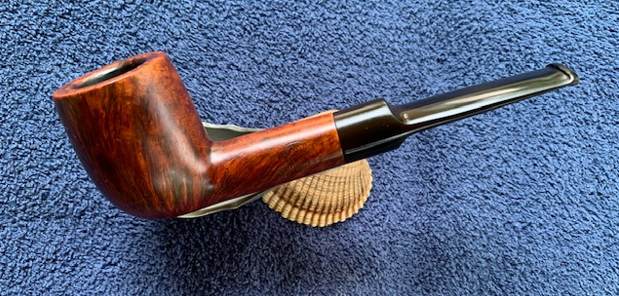
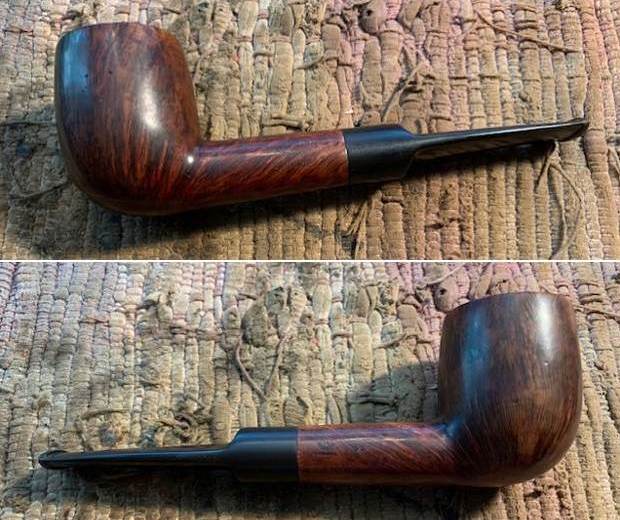
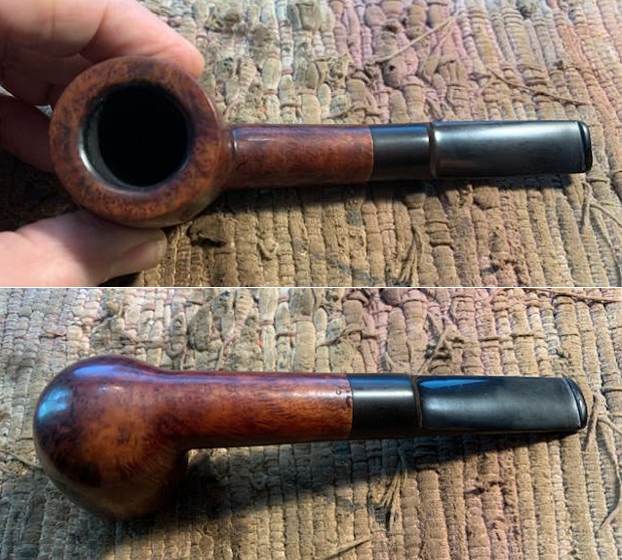
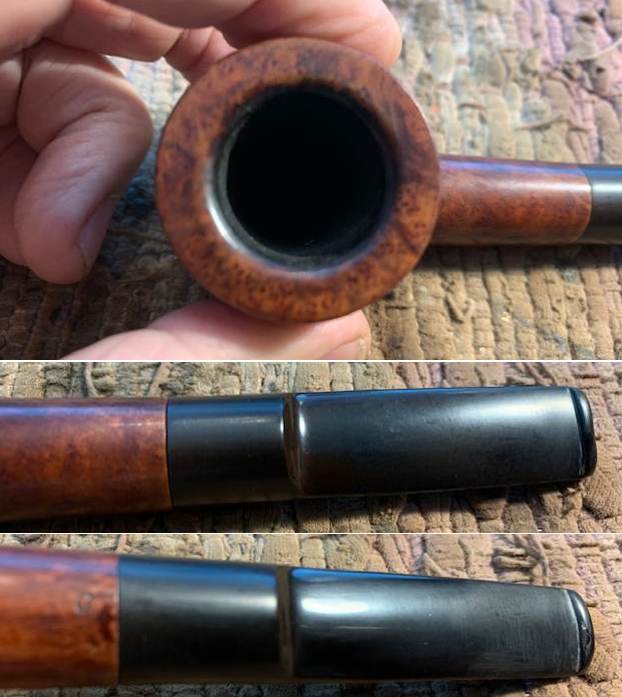
The next pipe on my work table is a shape I would call a Bulldog but Orlik called a Rhodesian. It is stamped on the left side of the shank and reads ORLIK [over] Straight Grain. On the right side it is stamped MADE IN ENGLAND [over] the shape number 90S near the shank/bowl junction. The bent saddle vulcanite stem is inlaid with a brass “O” on the top left side of the stem. The briar has great looking straight grain around the bowl and shank. This pipe was purchased in October of 2018 from an antique store in Brookings, Oregon, USA. The finish was dirty and but the briar was good looking. The rim top was caked with lava more heavily on the top back and inner edge of the bowl. There was a thick cake in the bowl and some tobacco debris. The shank and stem airway was very dirty. The stem was very oxidized, calcified and had some tooth marks and chatter on both sides ahead of the button. Jeff took photos of the pipe before he started his clean up. He took photos of the rim top and bowl to show the cake in the bowl, and the lava on the top and inner edge. The stem photos show the oxidation, calcification and tooth chatter and marks very well. Jeff took a photo of the heel and side of the bowl to highlight the condition and the grain around the bowl sides and base.He captured the stamping on the sides of the shank in the next photos. They are clean and readable as noted above. The stem also had a faint crown stamped on the left side. I turned to Pipephil (http://www.pipephil.eu/logos/en/logo-o2.html) to get a quick view of the Orlik Brand and see if there was a Straight Grain line. There was not a specific listing for the Straight Grain but I did a screen capture of the site’s information and have included that below.I turned to Pipedia (https://pipedia.org/wiki/Orlik) for a quick read. The site is worth reading the history of the Orlik brand and some information on dating the brand. I quote below.

Dating guide – In the Pre-Cadogan era of the Orlik, the name is ORLIK in a straight line, capital block letters. Also the MADE IN ENGLAND is in a straight line, capital block letters. However, there are a known model (ORLIK NATURAL T 1155) stamped with MADE IN ENGLAND in a straight line, capital serif letters. Date is unknown. The mouth piece have the Orlik logo, a circular O as a brass inlay.

After joining Cadogan the same origin stamp as other Cadogan brands like Comoy´s etc. was used, MADE IN LONDON in circular an below ENGLAND in straight.

In the margins on the Pipedia site there was a link to a catalogue scanned as a PDF. I have included the link here (https://pipedia.org/images/0/00/Orlik_Pipe_Shapes.pdf). I did a screen capture of the cover of catalogue and the page that had the 90S shape number. Orlik called it a Bent Rhodesian with the S signifying a saddle stem (I have drawn a red box around the shape). Jeff cleaned up the pipes with his usual thoroughness – reaming the bowl with a PipNet pipe reamer and cleaning up the reaming with a Savinelli Fitsall Pipe Knife. He scrubbed the internals of the shank and the stem with alcohol, cotton swabs and pipe cleaners. He scrubbed the exterior with Murphy’s Oil Soap to clean off the dust and grime on the finish. When he sent it the pipe was ready to restore. I could not believe how good the rim top looked in comparison to what it was when he started. I took photos of the pipe when I unpacked it. The briar was clean and the grain quite stunning. The finish looked dull and lifeless. I took a close up photo of the bowl and rim top after Jeff had cleaned it up. The look of the rim top and edges is very good. There were some spots where the stain was worn away. He had been able to remove the cake and the lava very well. The bowl was spotless. The stem is also shown and was very clean. He had scrubbed it with Soft Scrub and then soaked it in Mark’s Before & After Deoxidizer. There was tooth chatter and deep marks still remaining.I took a photo of the stamping on the sides of the shank. It is clear and readable as noted above.I removed the stem from the shank and took a photo of the pipe to show the look of the pipe. It is a real beauty.The bowl was very clean and the briar looked good. I polished the briar with micromesh sanding pads – dry sanding with 1500-12000 grit sanding pads. I wiped it down with a damp cloth after each sanding pad. I rubbed the briar down with Before & After Restoration Balm. I worked it into the briar with my fingertips. The product cleans, enlivens and preserves the briar. I let it do its magic. It sat for 10 minutes and then I buffed it off with a cotton cloth. The bowl really is looking good at this point. I “painted” the tooth marks with the flame of a Bic Lighter. I was able to raise all of them except for one on the topside. I filled it in with a spot of black superglue. Once it cured I flattened the repairs with a small file to blend them into the surface. I sanded the stem with a folded piece of 220 grit sandpaper. I started polishing it with 400 grit wet dry sandpaper. I set the bowl aside and turned my attention to the stem. I scrubbed the stem down with Soft Scrub to remove the deep oxidation on the stem surface. I was able to remove much of what was present.I polished the stem with micromesh sanding pads – dry sanding with 1500-12000 grit pads. I wiped the stem down after each pad with a cloth impregnated with Obsidian Oil. I polished it with Before & After Stem Polish – both Fine and Extra Fine then gave it a final coat of Obsidian Oil and set it aside to dry. There is something about the amazing straight grain on this beautiful pipe. This Orlik Straight Grain 90S Bent Rhodesian looks great. The straight grain really stands out on the bent pipe. I put the stem on the shank and buffed the pipe with Blue Diamond on the wheel (being careful of the stamping so as not to damage that). I gave the bowl and the stem multiple coats of carnauba wax and buffed the pipe with a clean buffing pad to raise the shine. I hand buffed it with a microfiber cloth to deepen the shine. The dimensions of this pipe are – Length: 5 ½ inches, Height: 1 ¾ inches, Outside diameter of the bowl: 1 ¾ inches, Chamber diameter: ¾ of an inch. The weight of the pipe is 1.48 ounces/ 42 grams. It is a great looking pipe and one that will be going on the rebornpipes store in the British Pipe Makers section. If you want to add it to your collection let me know via email to slaug@uniserve.com or by message. Thanks for walking through the restoration with me.