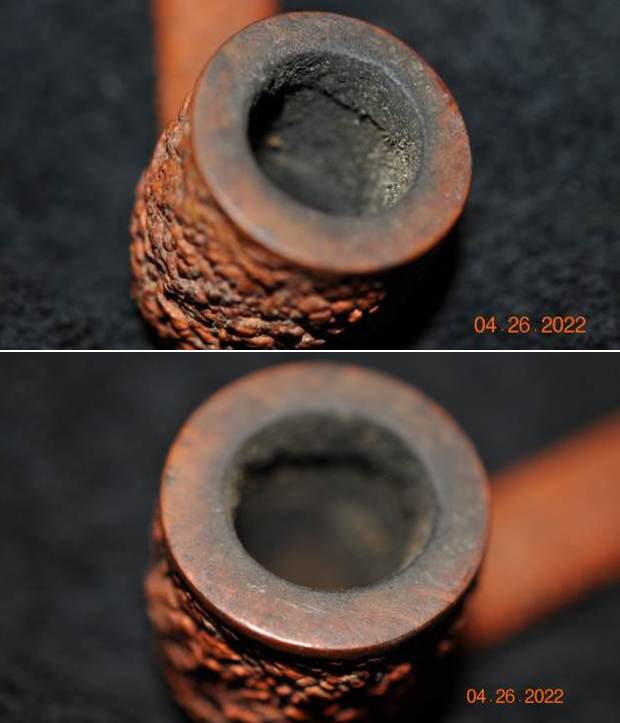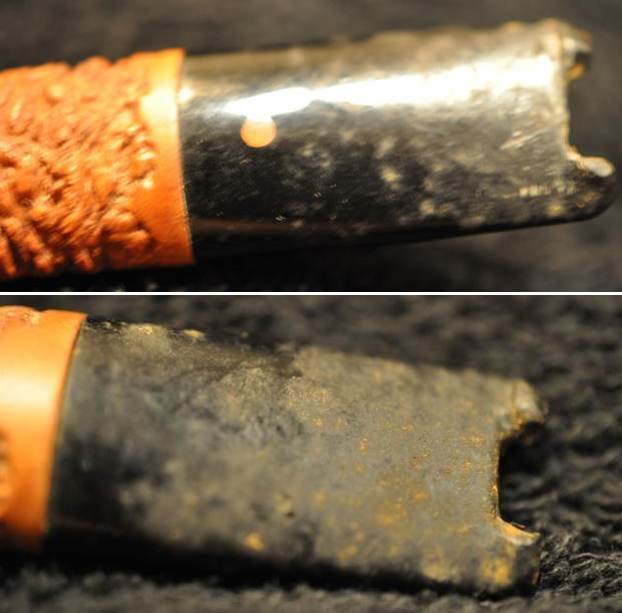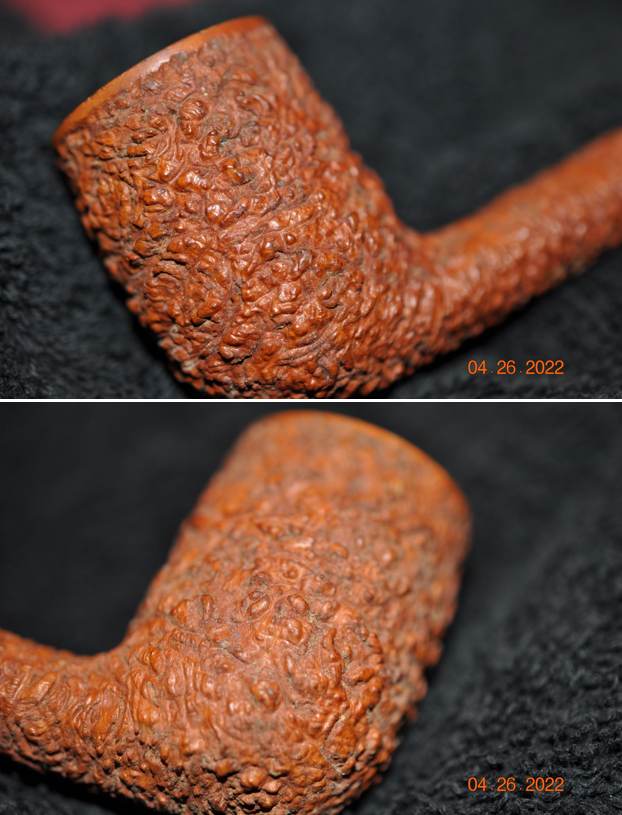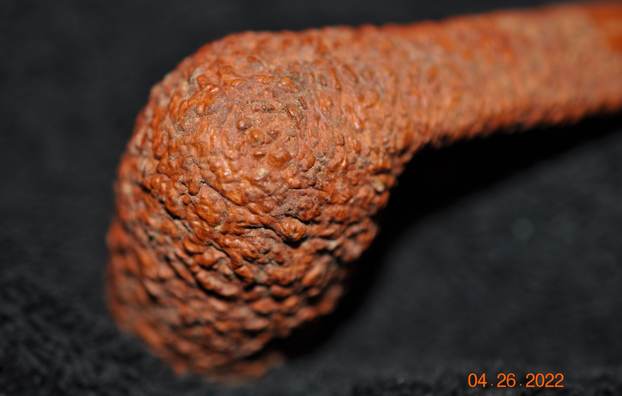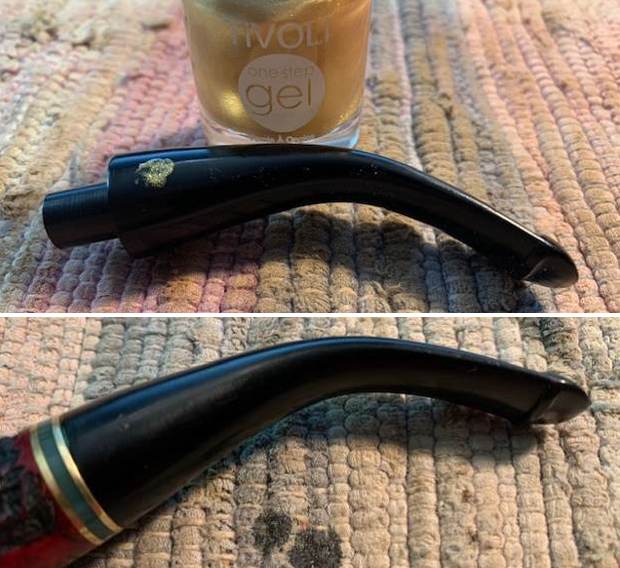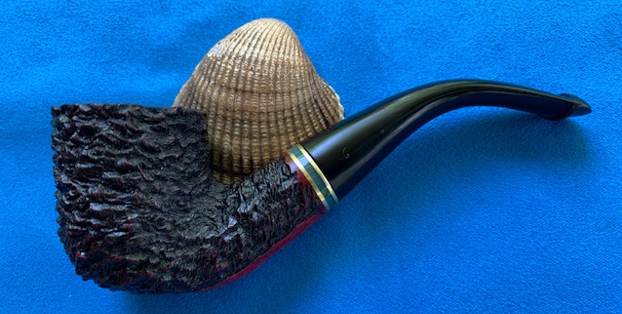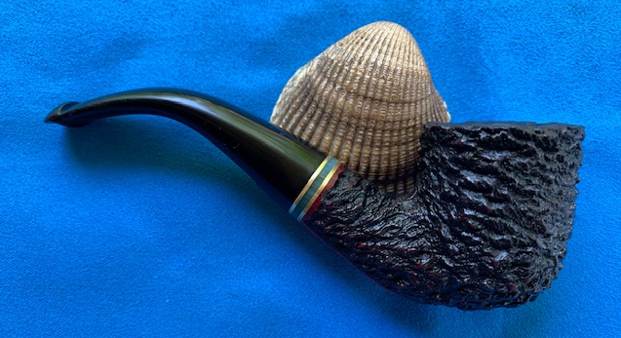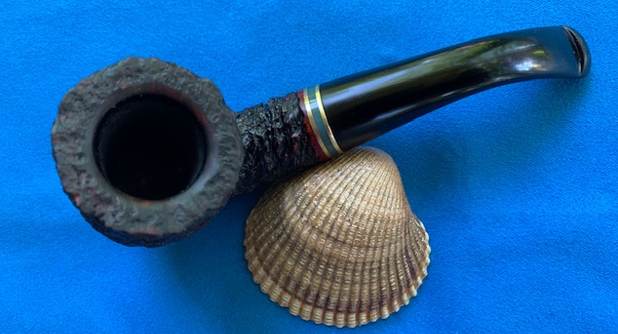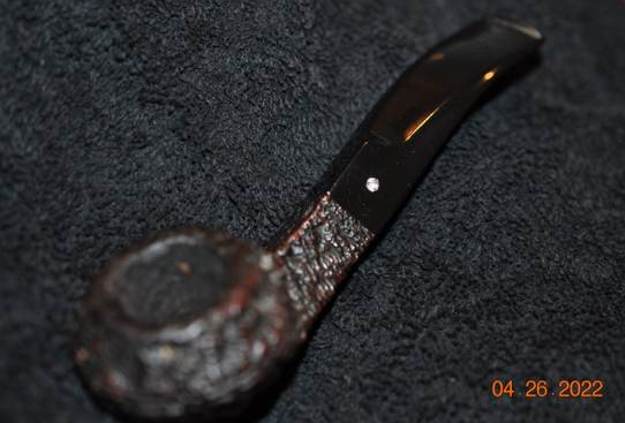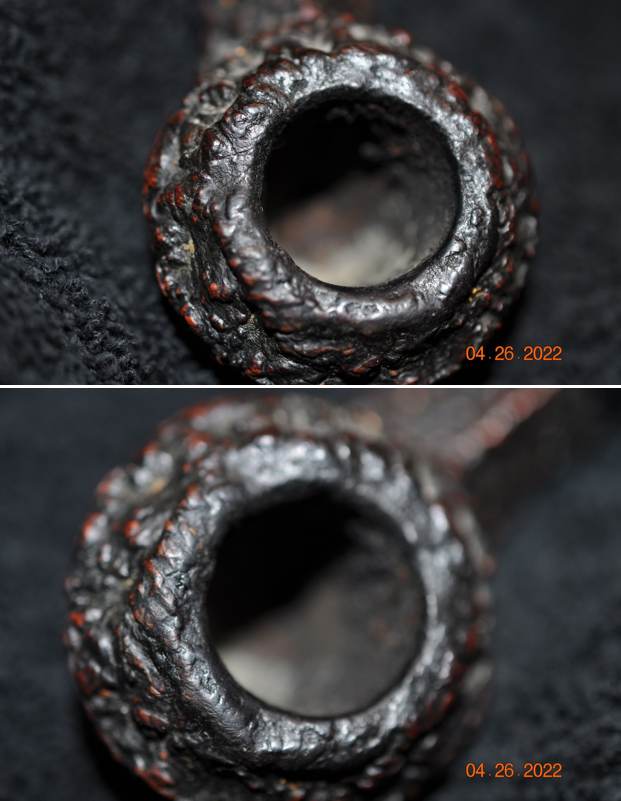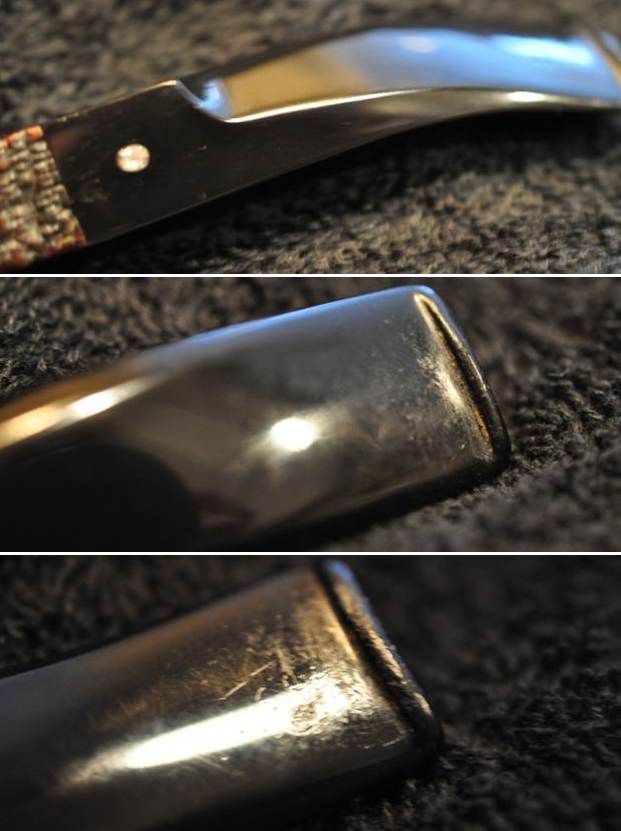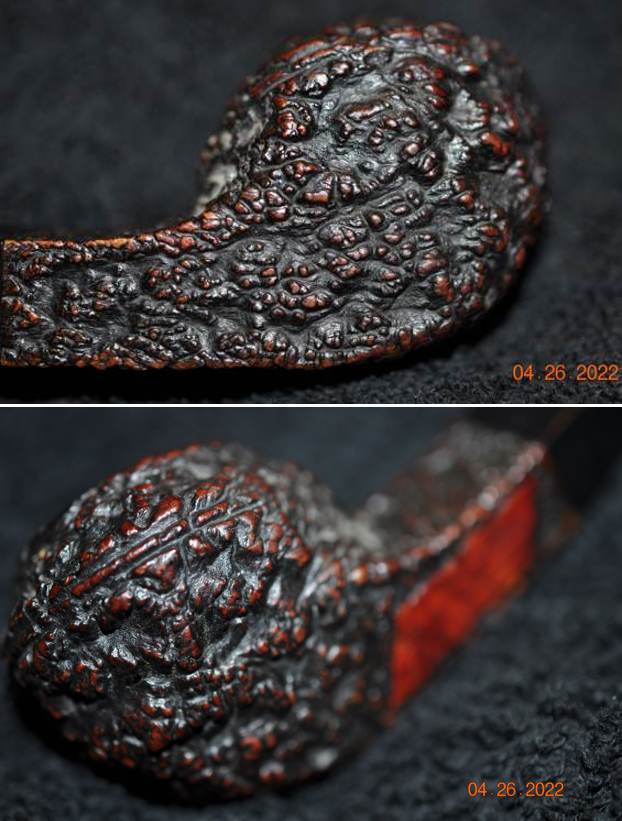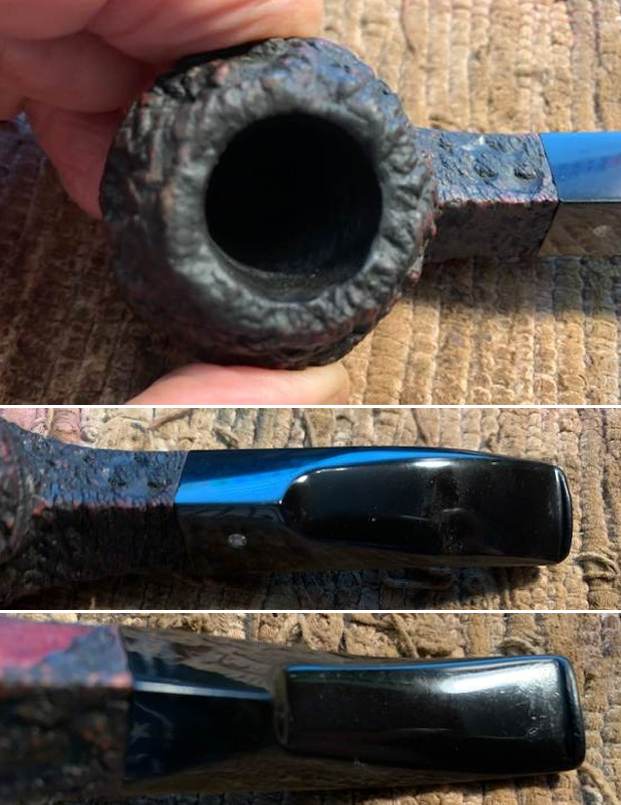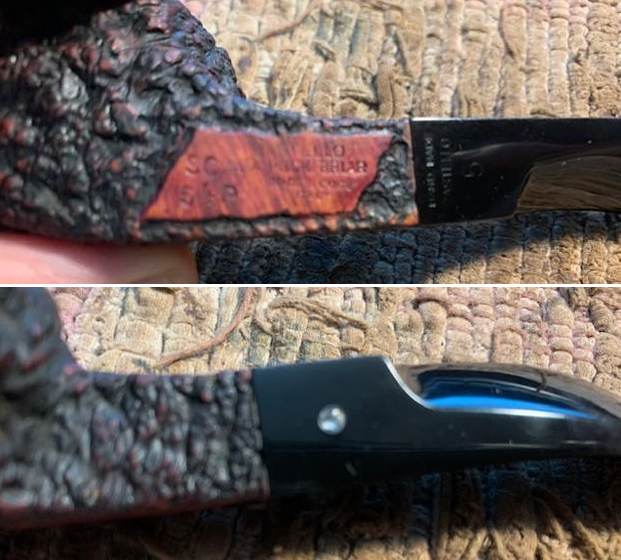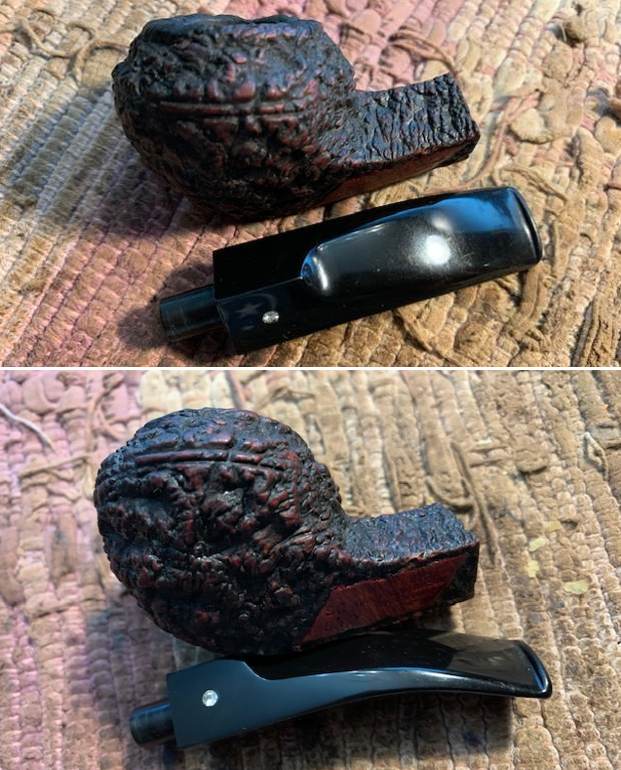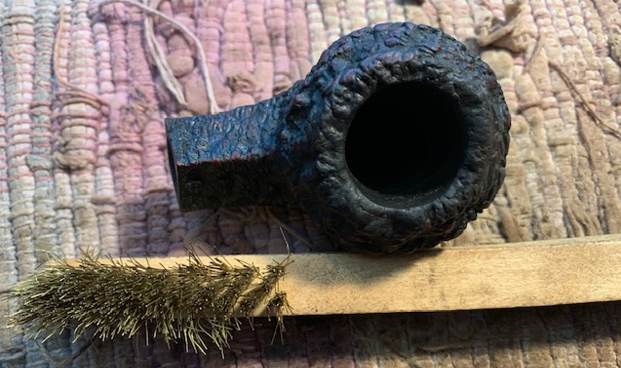
Tag Archives: bite marks

A Pipe of Distinction


Blog by Kenneth Lieblich

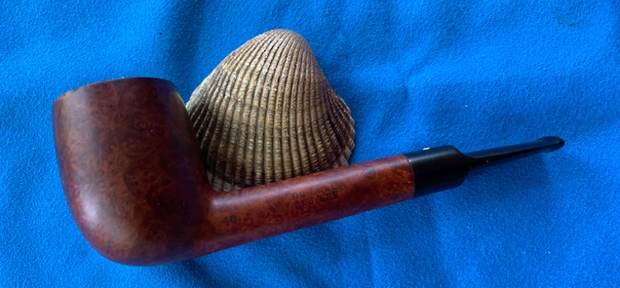
Next on the chopping block is a very personal pipe – and one that is staying in my collection. The photo you see below is of my late grandfather, in the early 1970s, smoking a charming Bewlay Canadian pipe. It is this pipe’s restoration that I am recounting today. I do not know where my grandfather acquired it (or under what circumstances), but I suppose it does not ultimately matter. My grandfather was an enthusiastic pipe smoker and he clearly enjoyed this one. I am definitely looking forward to cleaning this one up. It has a value well beyond dollars.The pipe is from The House of Bewlay and is a Canadian shape. What a charming and elegant pipe! In order to read the markings correctly, I used my old trick of rubbing chalk over them (like a gravestone) and that helped a lot. The pipe’s markings read Bewlay [over] Twenty. The other side of the pipe shows the shape number, 003 [over] London Made. This sort-of corresponds with a Bewlay catalogue from the late 60s, as you can see in the photos. I say, “sort-of”, because the brochure shows shape numbers 001 and 002. I do not know the exact date of the pipe, but it is likely from the late-1960s or early-1970s. Let us read a bit more about Bewlay from the Pipedia article:

The English brand of Bewlay & Co. Ltd. (formerly Salmon & Gluckstein Ltd.), was in business from the early 20th century until the 1950s. The brand ended up being sold and taken over by Imperial Tobacco Co. The shop chain closed in the 1980s but there seems to be one shop still in business on Carr Lane in the city of Hull. Bewlay pipes were made by prestigious firms. Notably Barling, Charatan, Loewe & Co., Sasieni, Huybrecht, and Orlik. So understandably, the English considered a Bewlay pipe a quality pipe.

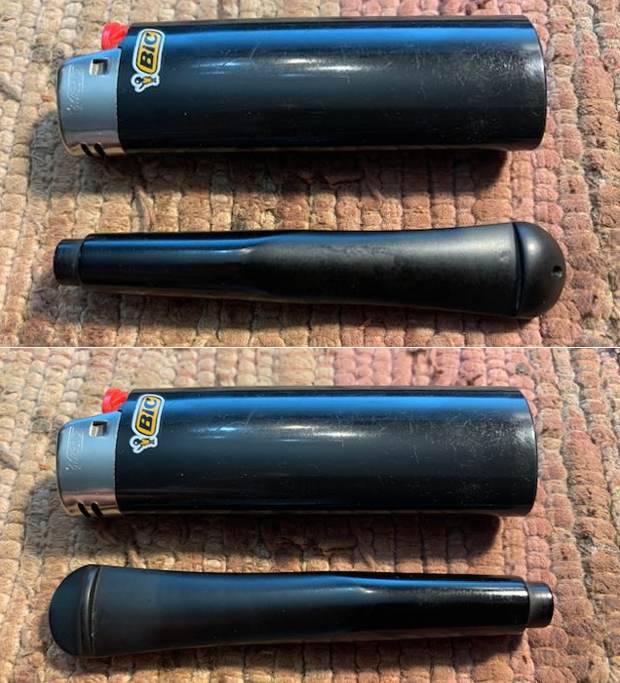
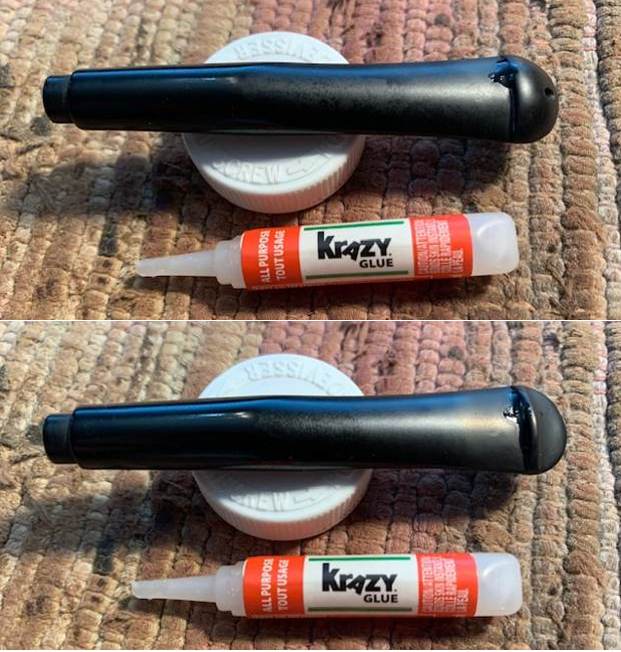
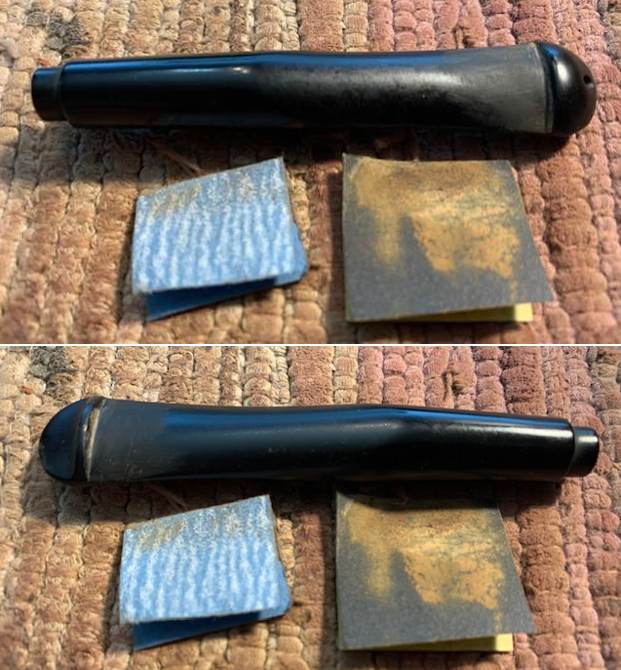
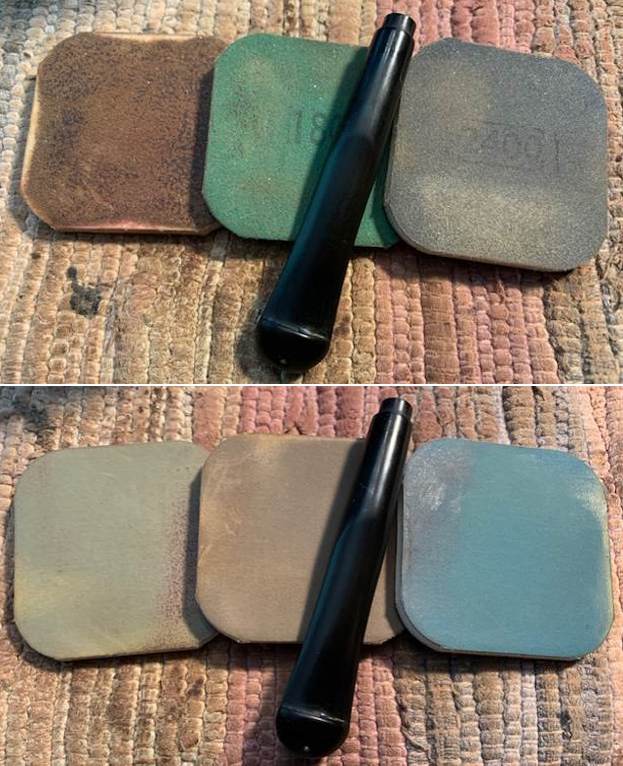
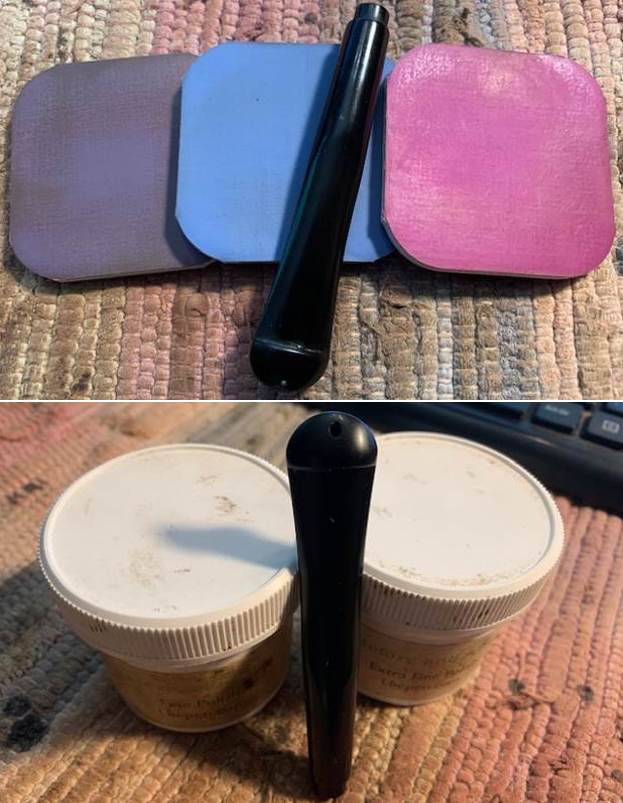
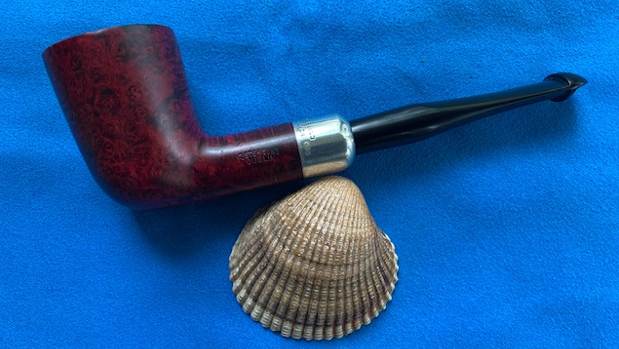
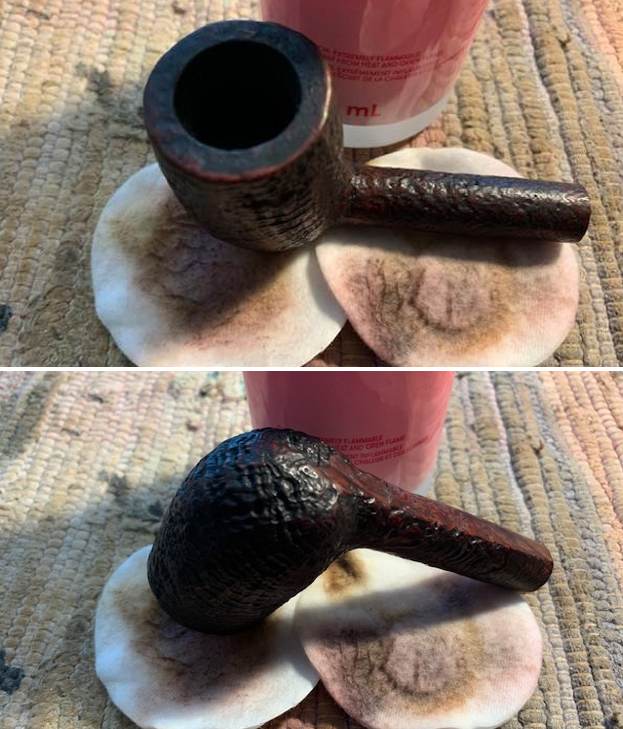
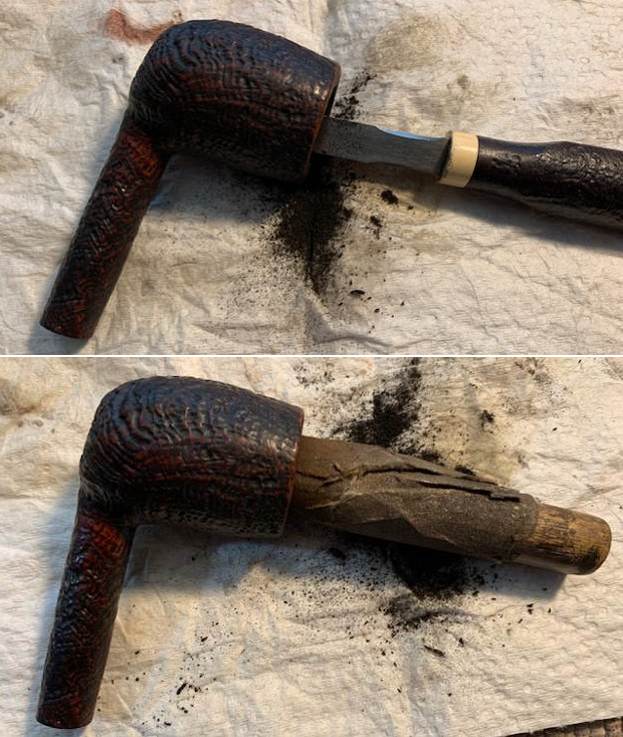
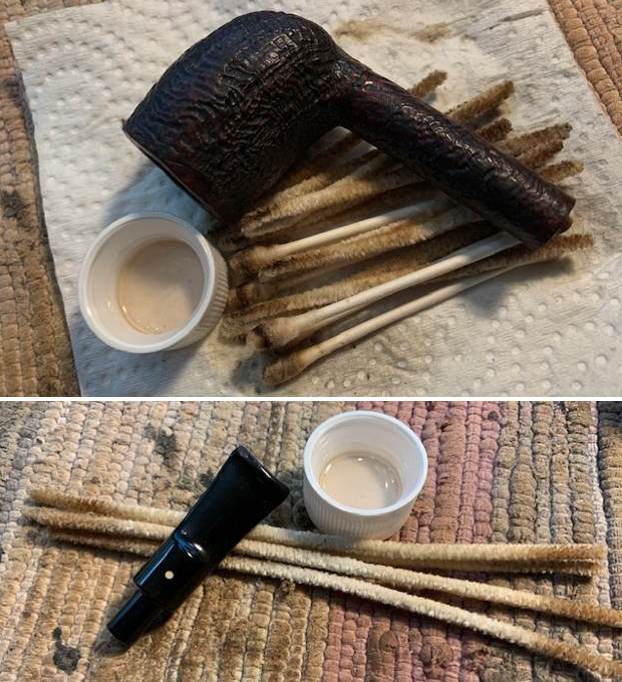
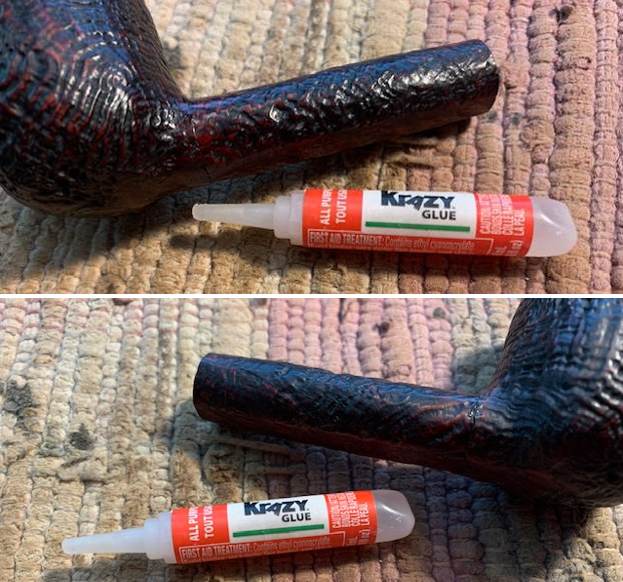
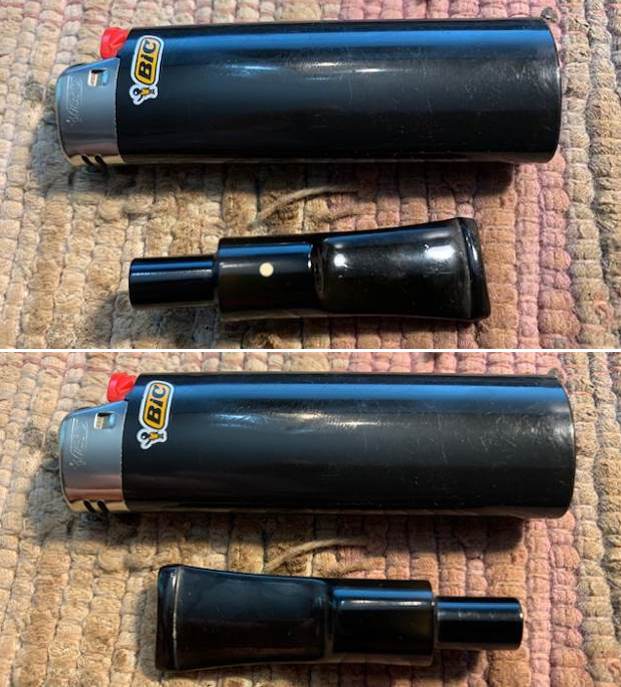
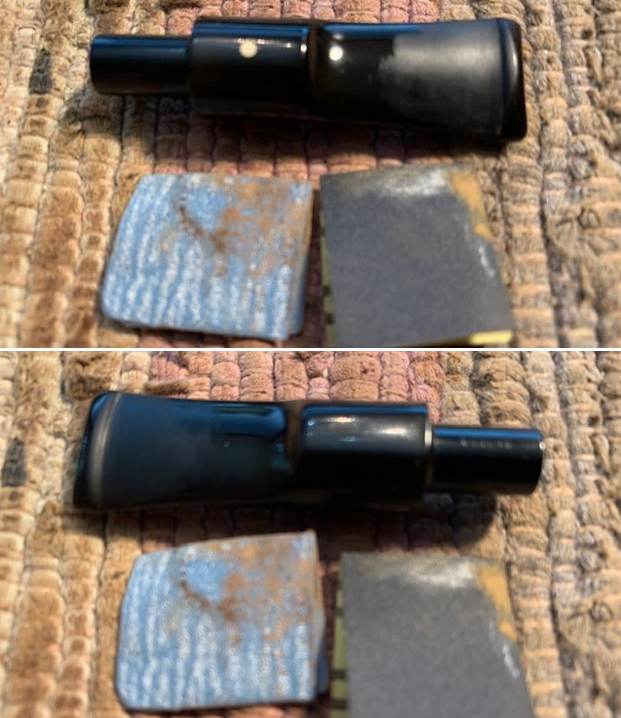
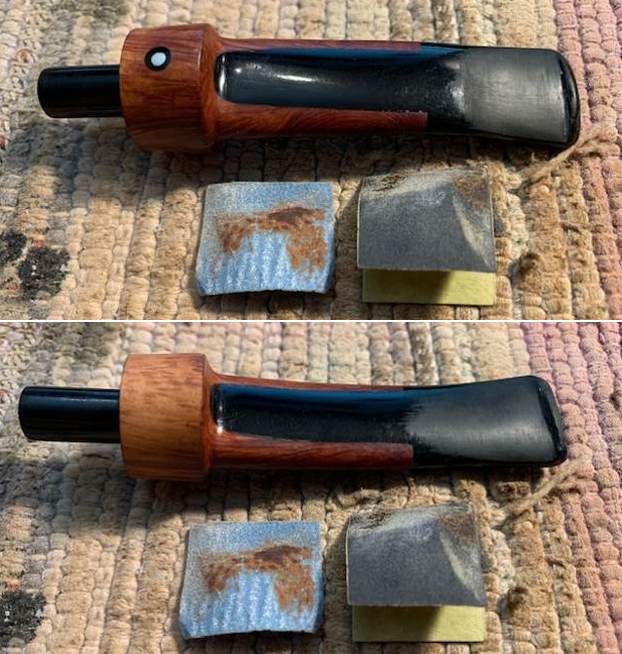
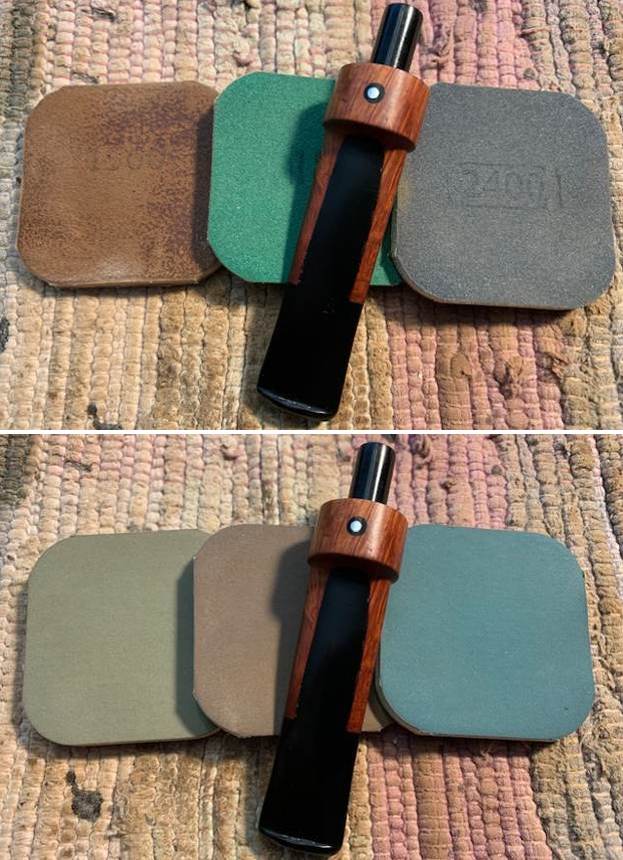
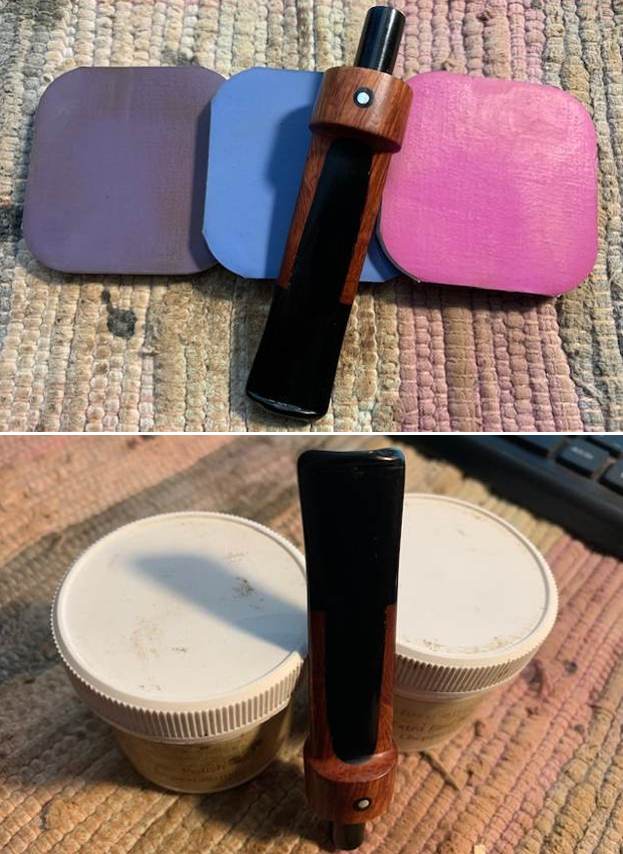
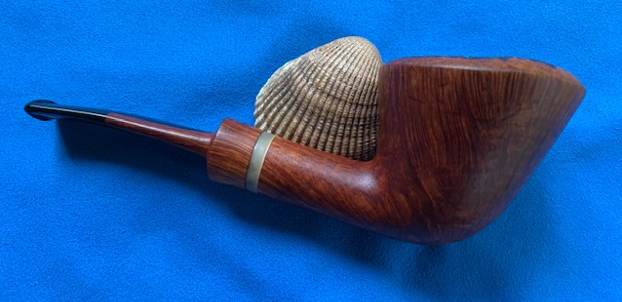
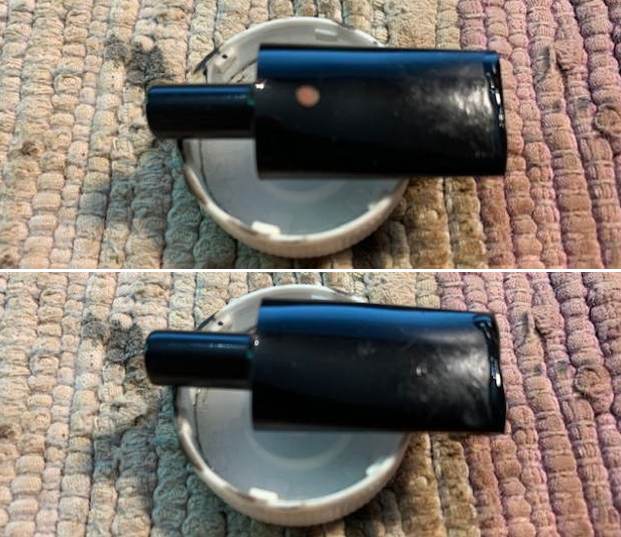
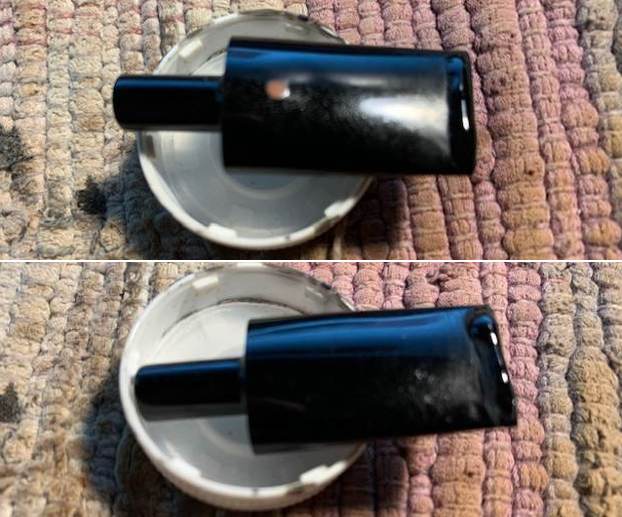
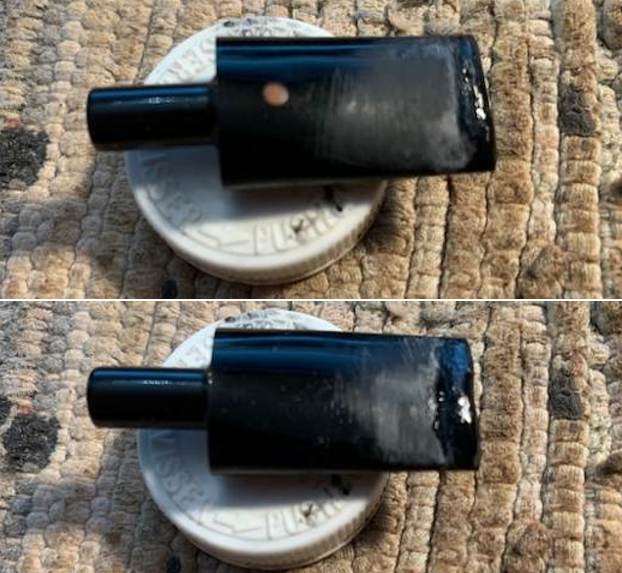
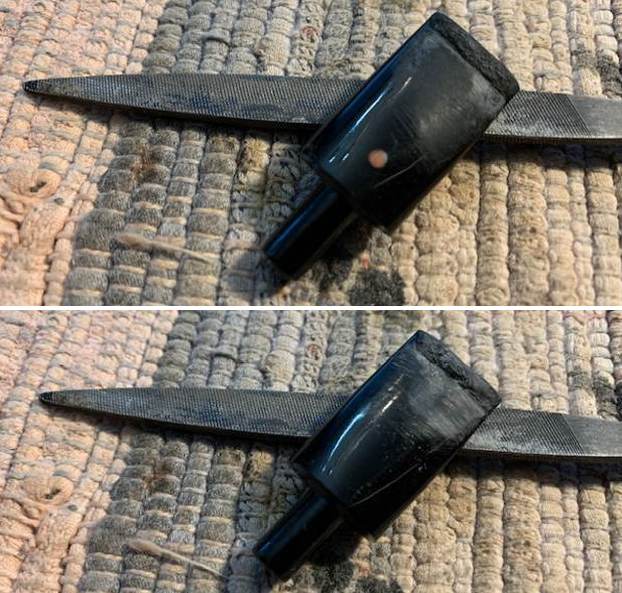
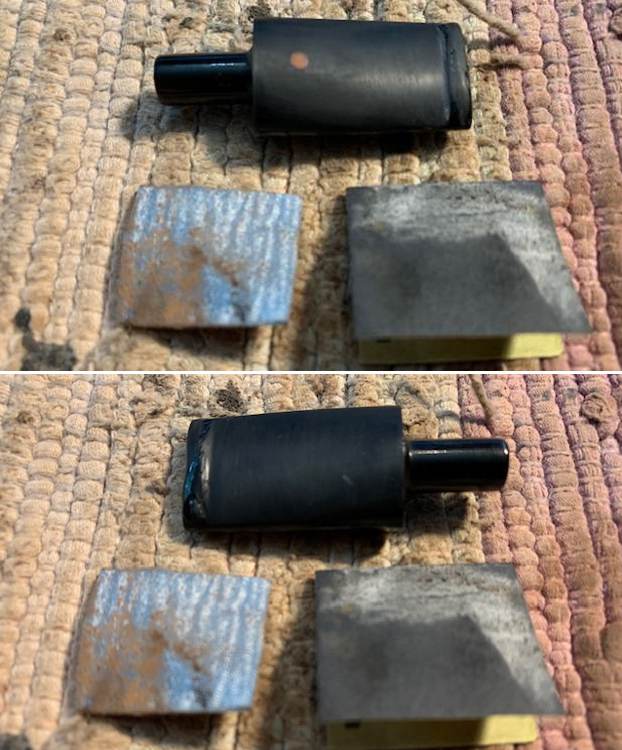
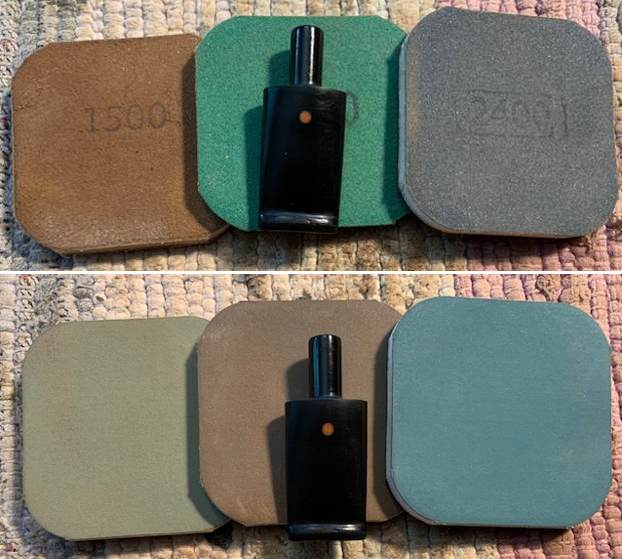
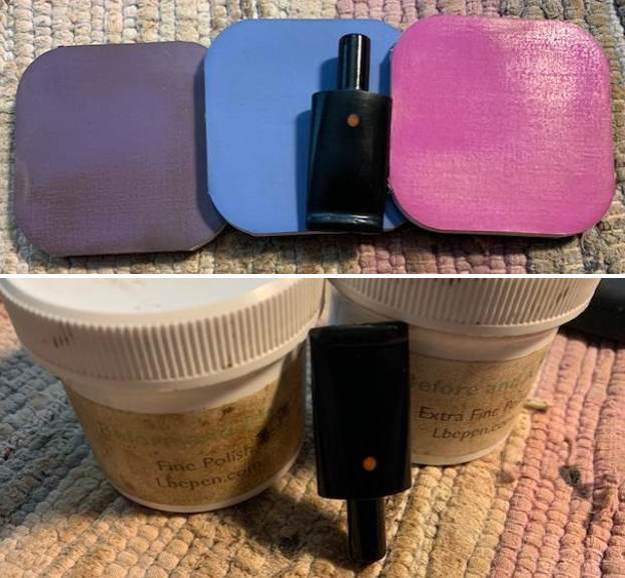
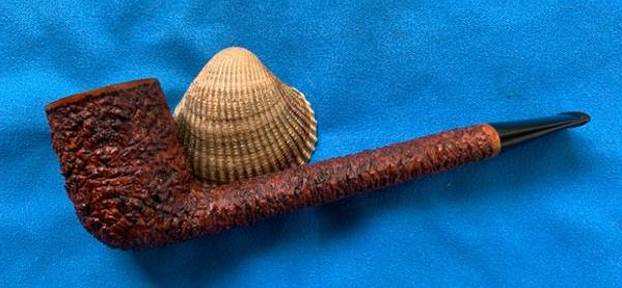
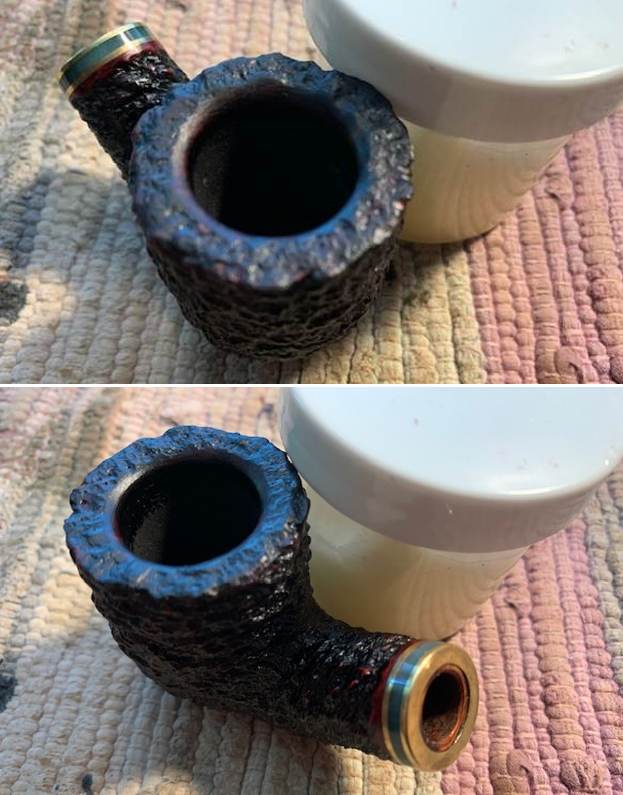
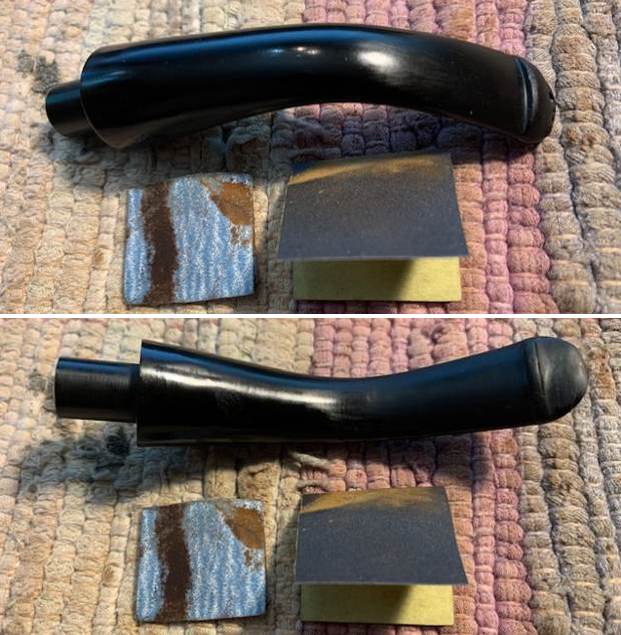
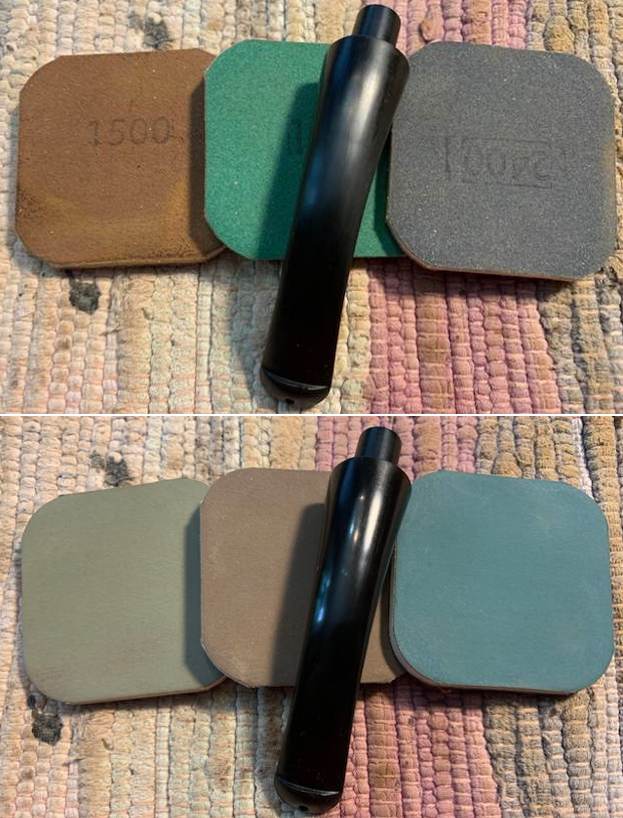
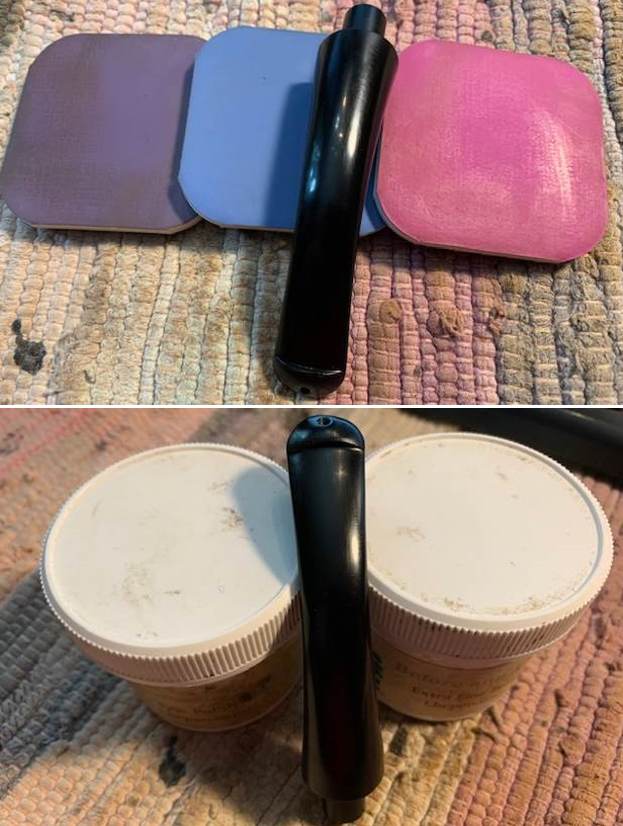
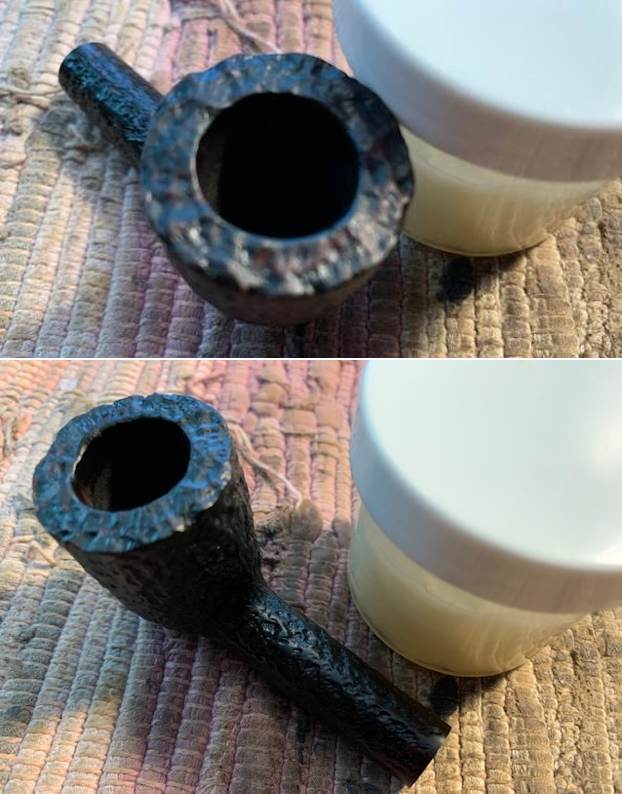
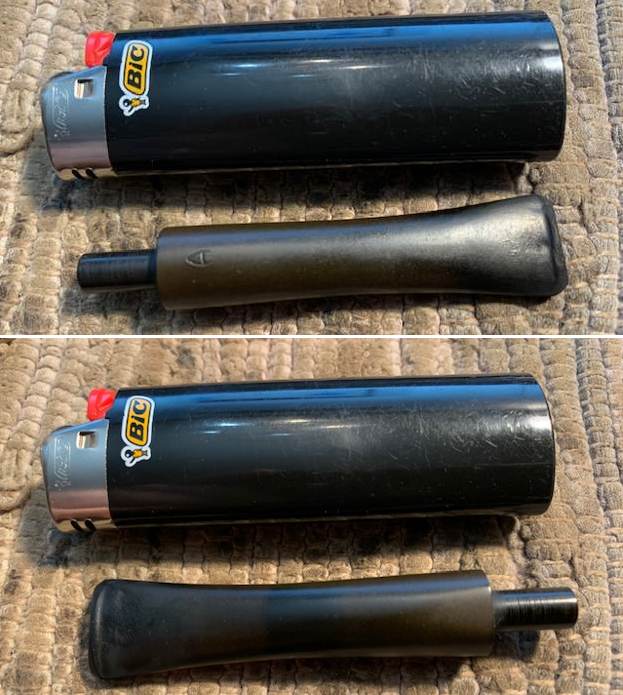
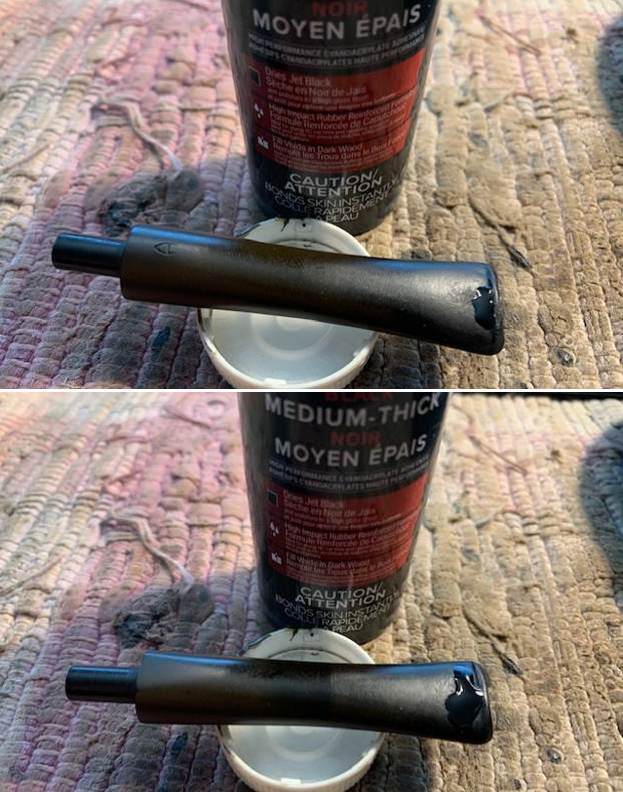
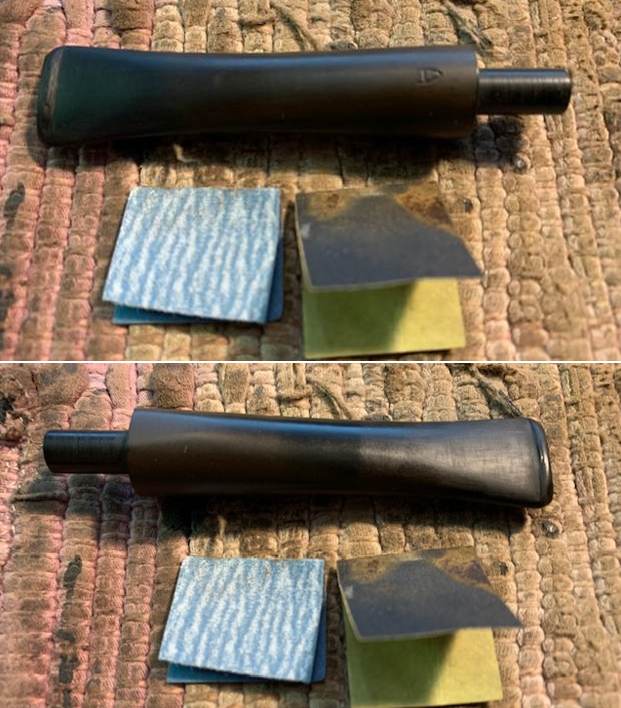
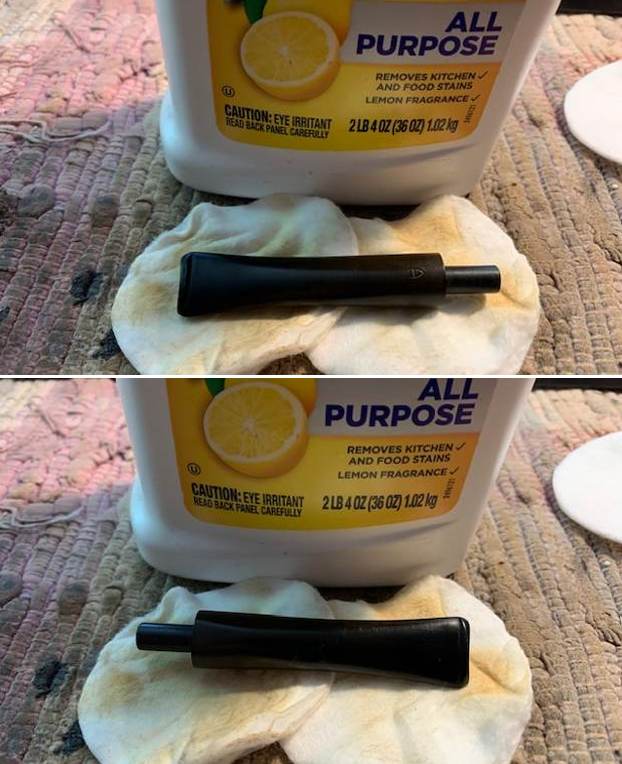
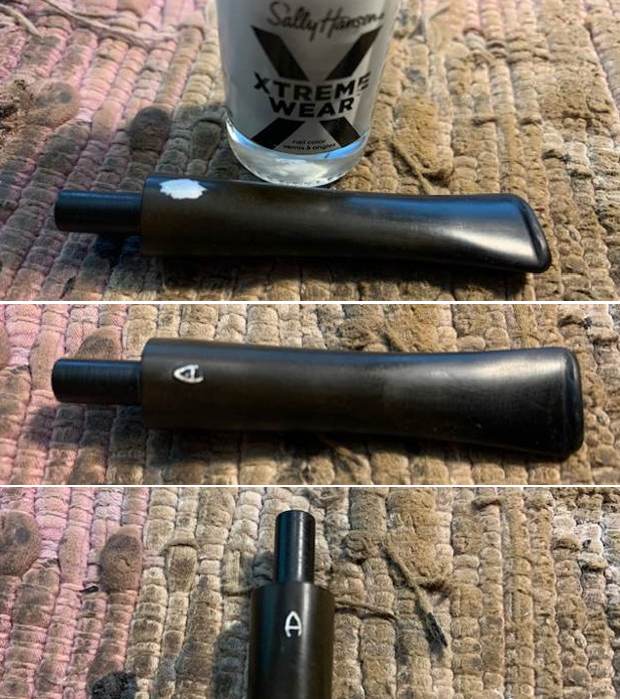
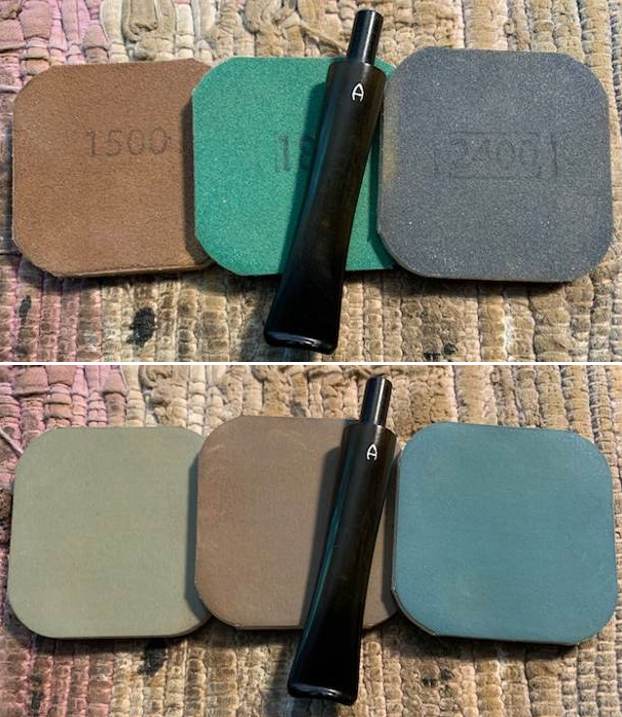
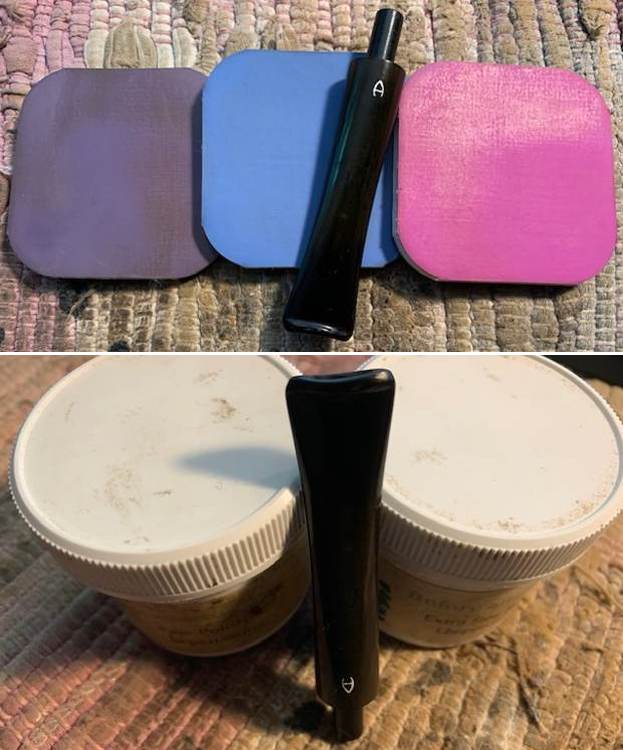
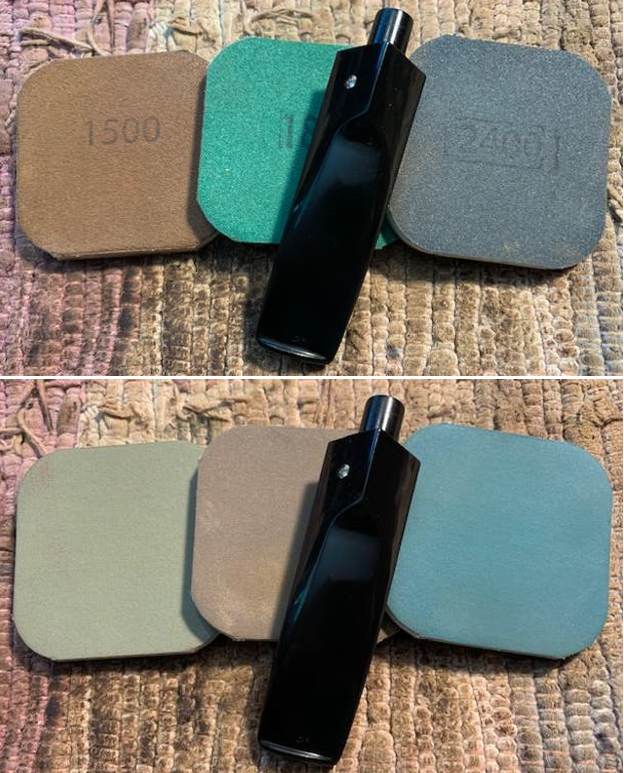
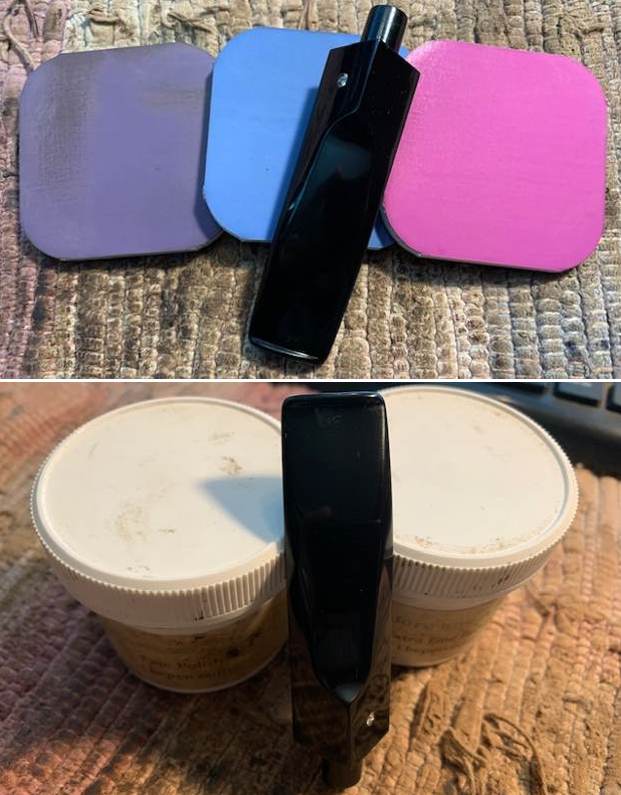
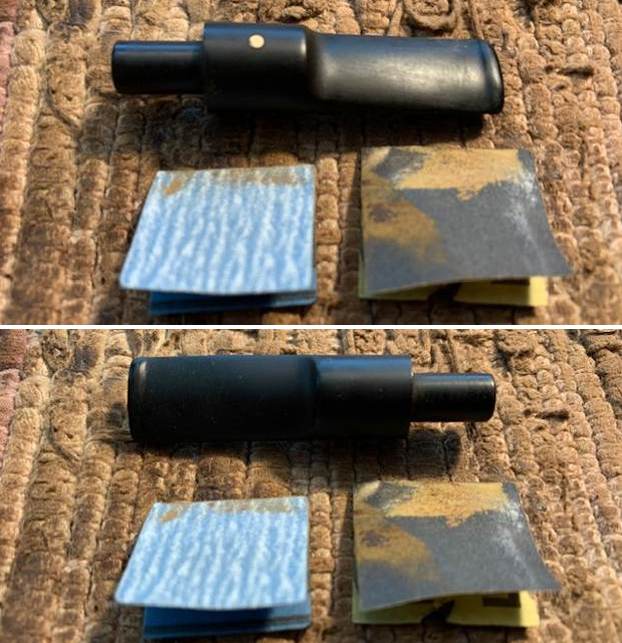
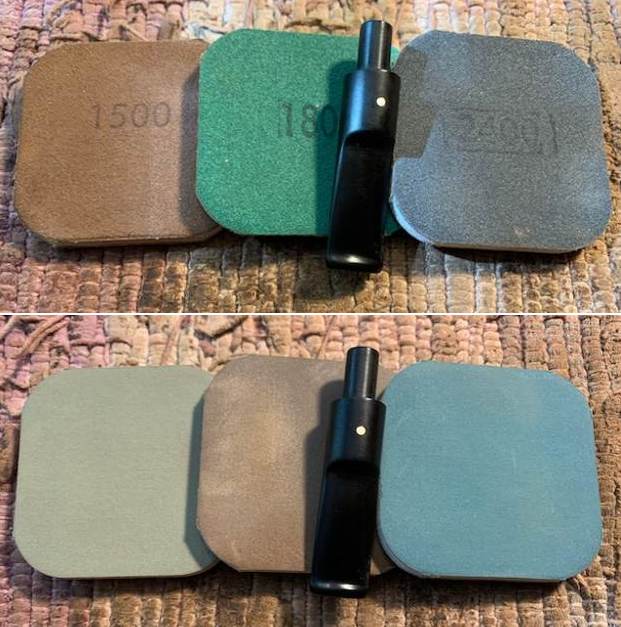
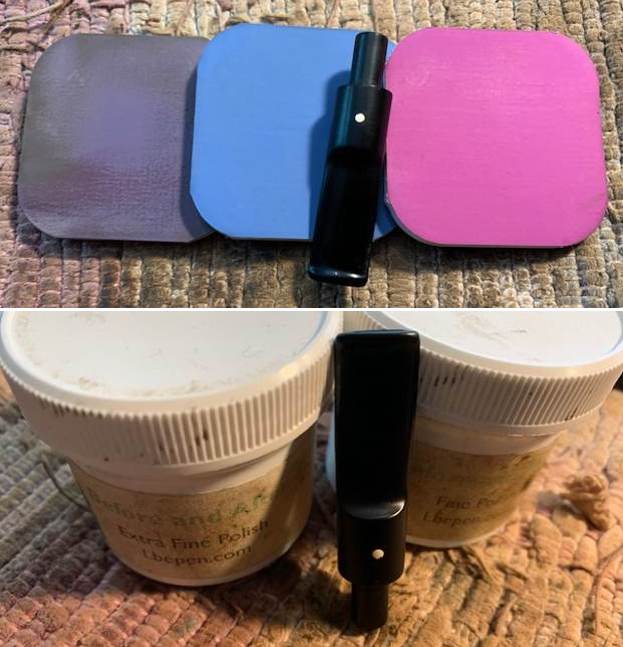
Anyway, on to the pipe – and what a beauty it was. However, it was not without its issues. The stummel had the following problems: lava on the rim, a notable burn to the rim, plenty of cake in the bowl, a couple of nicks to the bowl, and a tired, worn-out colour of wood. By the way, the strange “stains” to the bowl are, in fact, old bits of newspaper. After my grandfather died, the pipes were wrapped in newspaper and stuck in a box. The newspaper got wet at some point in the intervening years. Meanwhile, the stem had its own set of problems: some oxidation and calcification, minor tooth marks and dents, a filthy stinger, the ‘B’ logo was a bit worn, and (worst of all) a large chunk of vulcanite missing from the bit! This pipe was going to be a bit tricky, and I needed to be especially careful to ensure the missing vulcanite would be repaired properly – so it could be used for many years to come. The stem was first on my list. This stem has a stinger in it – and it was being quite stubborn about coming out of the tenon! I opted to warm the stem and stinger with a hair dryer and this provided just enough softening of the internal goo to allow me to pull it out. The stinger then went for a soak in some lemon-infused isopropyl alcohol. I let it set for several hours and then cleaned it off and it looked much improved. I then finished it with some metal polish and moved on. I wiped down the outside of the stem with Murphy’s Oil Soap on some cotton pads. I also took a BIC lighter and ‘painted’ the stem with its flame in order to lift the bite marks and dents. This was fairly successful in raising the damage. Then, I cleaned out the insides with pipe cleaners and isopropyl alcohol. Once this process was done, the stem went for an overnight soak in the Before & After Hard Rubber Deoxidizer. The following day, I cleaned all of the de-oxidizing sludge off with alcohol, pipe cleaners, et cetera. The oxidation had migrated to the surface and would be fairly straightforward to remove. I scrubbed vigorously with SoftScrub on cotton pads to remove the leftover oxidation. I also built up some tiny dents on the stem with cyanoacrylate adhesive and let it fully cure.Now it was time to make a patch for the missing chunk of vulcanite. This patch was made with a mixture of cyanoacrylate glue and activated charcoal powder. This created a black, resilient mush that would be very hard-wearing when cured and would work perfectly for this repair. Thanks to Steve’s instruction, I first plugged up the stem’s draught hole with a pipe cleaners coated in petroleum jelly. This ensured that any of the cyanoacrylate and charcoal mush would not accidentally plug up the air passage in the stem. This was a tricky business and it took some real patience and effort to make it work. As the photos show, after I applied the cyanoacrylate and charcoal mush, it looked pretty darn ugly, but I was expecting that. I also managed to get some of the bits of pipe cleaner bristles into the repair! No big deal – those were quickly excised. After the curing, I pulled out the Dremel rotary tool and began to remove the excess material. This was also the preliminary step in shaping the button. To carry this process on, after the Dremel, I used a miniature file to further shape the button and make it suitable for sanding. I used another file on the inside to ensure there were no rough edges in the bore. I then sanded the stem down with 220-, 400-, and 600-grit sandpapers to meld seamlessly into the stem. This ensures that it keeps its shape and looks like it should. I then used all nine Micromesh pads (1,500 through 12,000 grit) to bring out the lovely black lustre on the stem. I also used Obsidian Pipe Stem Oil in between each pad scrubbing. It is worth noting that a repair this big on a stem will never be completely invisible, but I was very pleased with how I managed to make the stem of my grandfather’s pipe look so good. Just before finishing with the Micromesh pads, I took the opportunity to repair the “B” logo on the stem. It had faded – both by loss of paint and also by fingers inadvertently smoothing out the “B” over time. So, I added some acrylic paint with a paint brush, let it dry, and buffed it to make it look good. The “B” is back, but, as later photos reveal, a little bit has disappeared into history.On to the stummel, and the usual cleaning procedures were in order for this pipe. I used both the PipNet Reamer and the KleenReem to remove the built-up cake, and followed that with 220-grit sandpaper to remove as much as I could. I wanted to take the bowl down to bare briar to ensure there were no hidden flaws in the walls of the bowl. Fortunately, there were none. I then proceeded to clean out the insides of the shank with cotton swabs, pipe cleaners, and isopropyl alcohol. There was quite a bit of filth inside this stummel – it took many pipe cleaners et cetera to clean it out.I followed that up by cleaning the insides with some dish soap and tube brushes. I then moved on to cleaning the outside of the stummel with Murphy’s Oil Soap and some cotton pads. That removed the bits of aforementioned newspaper and any remaining dirt. I also soaked the rim in Murphy’s for a while just to loosen up the lava. In order to remove the lingering bits of lava and fix any nicks on the rim, I “topped” the pipe – that is to say, I gently and evenly sanded down the rim on a piece of 220-grit sandpaper. This effectively removed the lava, without altering the look of the pipe. After that, a light application of Before & After Restoration Balm brought out the best in the stummel’s grain. What a difference that made! There is some beautiful wood under the grime! Having completed that, I was able to address the small nicks on the stummel. I dug out my iron and a damp cloth to try and raise the nicks. The hot and moist steam can often cause the wood to swell slightly and return to shape. There was some movement – not a lot, but it was better than doing nothing. I filled the remaining divots with cyanoacrylate adhesive and let it cure. Now, with the nicks filled, it was time to sand down the stummel. I used all nine Micromesh pads (1,500 through 12,000 grit) to wet/dry sand everything smooth. Then I added a bit more Before & After Restoration Balm. Then it was off for a trip to the buffer. A dose of White Diamond and a few coats of carnauba wax were just what this pipe needed. The lovely shine made the wood look absolutely beautiful. This is a wonderfully crafted pipe and has a very elegant feel to it. It took a lot of work, but I am proud of it and the final product is (hopefully) worthy of my beloved grandfather’s memory. Obviously, this is one pipe that I am keeping for myself and adding to my collection. I am sure that I will be enjoying this one for many years to come. I hope you enjoyed reading the story of this pipe as much I as I did restoring it. If you are interested in more of my work, please follow me here on Steve’s website or email me directly at kenneth@knightsofthepipe.com. Thank you very much for reading and, as always, I welcome and encourage your comments.

Restoring a Unique Bakelite Dublin with a Removable Bowl


Blog by Steve Laug

This next pipe on the table is a really unique looking piece. It is like a Bakelite version of a Falcon Metal pipe but I think it is older than them. The pipe had a yellow Bakelite single unit base and stem with a metal decorative ring and a brown Bakelite bowl. There is no mark or stamp any where on the base or on the bowl to identify the maker of the pipe. Jeff bought it from an antique store on September 09, 2017 in Salt Lake City, Utah, USA. The pipe had been well smoked. There was a light cake in the bowl and a bit of lava on the rim top. The base was dirty inside and there were light tooth marks on the top and underside of the mouthpiece. Jeff took some photos of the pipe before he started his clean up work. Jeff took some closer photos of the bowl and the sides of the stem. The rim top looks to be in good condition. The inside of the bowl has a thin cake in the bottom half of the bowl. The rim top is dirty. The stem/base is clean but has some light tooth marks on both sides. He took a picture of the base of the bowl and sides of the bowl. It is a very nice looking Bakelite bowl and base. There was some buildup and sludge on the bottom of the bowl and the base. The brass ring was loose and worn looking. It is not clear to me if the brass ring is meant to be on the base or on the bowl.Jeff unscrewed the bowl from the base and what a collection of tars and oils had collected in hollow of the base and on the surface where the bowl sat when screwed in. He also took photos of the ring. The threaded base of the bowl was filthy with tars, oils and shards of tobacco on the surface. This unique Bakelite base and bowl is an incredibly light and almost indestructible pipe. It is the kind of pipe that can be put in the pocket and carried along. The filthy pipe had cleaned up well. Jeff had reamed the bowl with a Savinelli Fitsall Pipe Knife to remove the light cake. He then scrubbed the outside of the bowl and base with undiluted Murphy’s Oil Soap and rinsed it off. He cleaned the inside of the shank and the airway in the shank and stem with alcohol, cotton swabs, and pipe cleaners. The Bakelite cleaned up remarkably well. The grain in the bowl portion was very nice. The gold base ring was thin and clean and looked very good. The base and stem is Bakelite as is the bowl. There are some faint tooth marks and chatter. It has an orific button (round air hole) on the end of the button. I took some photos of the pipe to show the condition when I received it. It was an interesting piece of pipe history from someone’s collection and it had been well smoked. I took close up photos of the bowl and rim top and the stem to show their condition. You can see the clean bowl. There were some light nicks and scratches on the Bakelite rim top that would need to be polished out but it was nice looking. The stem and base looks really good. There was some darkening on the end of the stem and the bottom of the base but it was very clean. There was some light tooth chatter on both sides.I took the pipe apart and took photos of the parts to show how it all worked. The base had tobacco stains and tars but was very clean. Have a look at the parts. I polished the yellow Bakelite base and mouthpiece with micromesh sanding pads – dry sanding it with 1500-12000 grit sanding pads. I wiped it down after each pad with a cloth impregnated with Obsidian Oil. I worked some Before & After Restoration Balm into the surface of the base and stem. I find that it works well to clean, preserve and protect Bakelite as much as it does briar. I like the way it works and the way the base looks when it is polished. I spread some white all purpose glue on the ledge on the base to anchor the brass band on the top. I used a dental spatula to spread the glue around the surface of the Bakelite. I pressed the band in place on the base and screwed the bowl on top to press it down into the glue until the band cured.I polished out the scratches and nicks on the rim top with micromesh sanding pads. I worked my way through 1500-12000 grit pads and wiped the top and bowl down with Obsidian Oil on a cloth to protect the surface after each pad. I worked some Before & After Restoration Balm into the surface of the Bakelite bowl. I find that it works well to clean, preserve and protect Bakelite as much as it does briar. I like the way it works and the way the base looks when it is polished.I really enjoyed refurbishing this unique Bakelite Base and removable Bowl because I love the final touches that make it sing. I put the bowl and stem back together to have a look at the whole with all it of it polished. I carefully buffed the bowl and stem with Blue Diamond on the wheel. I gave it several coats of carnauba wax and buffed the pipe with a clean buffing pad to raise the shine. I hand buffed it with a microfiber cloth to deepen the shine. It is fun to see what the polished bowl looks like with the silver plated band and the polished yellow Bakelite base and stem. This unique Bakelite Dublin System is light weight and it is clean and ready load up with a favourite tobacco. Have a look at it in the photos below. As noted above, Its measurements are Length: 4 ½ inches, Height: 1 ¾ inches, Outside diameter of the bowl: 1 ¼ inch, Diameter of the chamber: 1 inch. The weight of the pipe is 26 grams/.92 oz. I will be putting it on the rebornpipes store in the American (USA) Pipemakers section. If you would like to add it to your collection let me know by message or email. Thanks to each of you who are reading this blog. Remember we are not pipe owners; we are pipemen and women who hold our pipes in trust until they pass on into the trust of the next generation. 

A Rare Find – a CPF (Colossus Pipe Factory) Panel Dublin


Blog by Steve Laug

The next pipe on the worktable is another interesting piece of pipe history that comes from the bag of old pipes that I have been working on intermittently. This one is an interesting panel Dublin with a round shank. The bowl was a mess both inside and out. It must have been a great smoking pipe. The bowl had a thick cake with a thick overflow of lava on the rim top and edges. The finish on the briar was a mess. The front of the bowl had a lot of flaws that ran along the cross grain on the bowl. The fills in the flaws had fallen out and the grain was open. The band was stamped in gold and read Genuine French Briar in an oval with French in the centre of the stamp. The shank was banded with a silver plated band that was stamped C.P.F. in an oval with three false hallmarks above that stamp. The stem was vulcanite that had oxidized and had tooth marks on the top and underside near the button. It has a push tenon and an orific button on the end. The fit in the shank was very tight and it did not fit tightly against the band face. Jeff took photos of the pipe before he started his clean up. He took photos of the rim top and the stem to show the condition of both. The rim top and bowl had a thick cake and overflowing lava coat. The stem showed the oxidation that was deep in the vulcanite and the tooth marks and chatter on both sides ahead of the button.Jeff took some photos of the flaws in the front panel of the bowl. You can see that they follow the grain across the bowl. They go across the bowl and evenly spaced down the bowl front. There are also some paint spots on the front of the bowl.He took photos of the stamping on the left side of the shank and the band on the shank end. It is clear and readable on both of them.A short description would be that it is a heavily smoked Panel Dublin with a silver plated band and vulcanite push stem. It is stamped on the left side of the shank and reads Genuine [arched over] French [arched over] Briar all in an ovals shape. The band on the shank end is stamped with three faux hallmarks that I have seen on many C.P.F. pipes [over] C.P.F. in an oval. I have a collection of C.P.F. pipes here that I have worked to build up over the years in all different sizes and shapes as well as a variety of materials. This old Panel pipe will fit well into that collection. I wrote a blog a few years ago on the brand that gives a clear history and defines the meaning of the C.P.F. stamp. Here is the link to the blog and a pertinent quote that I am including below.
(https://rebornpipes.com/2013/04/14/some-reflection-on-the-historical-background-on-cpf-pipes/).

From my research I believe that we can definitively assert that the C.P.F. logo stands for Colossus Pipe Factory. The brand was purchased by KB & B sometime between 1884 and 1898 and that it continued until 1915. That time frame gives help in dating some of the older CPF pipes you or I might find. It can be said that prior to the dual stamping it is fairly certain that the pipe is pre-1884 to 1898. After the dual stamping it can be placed post 1898 until the closure of the brand line in 1915. CPF made beautiful pipes. I believe Sam Goldberger was correct in his assertion of the potential carvers that made the pipes being of European training and the classic shapes and well aged briar. That coincides with all the CPF pipes that I have come across.

This well shaped hard smoked C.P.F. is a real beauty. The rim top is worn but clean now that Jeff has done his magic clean up. He reamed the bowl with a PipNet pipe reamer and cleaned up the reaming with a Savinelli Fitsall Pipe Knife. He scrubbed the outside of the bowl with undiluted Murphy’s Oil Soap and rinsed it off. He scrubbed out the inside of the shank and the airway in the shank and stem with alcohol, cotton swabs, and pipe cleaners. The finish is dull and lifeless but there is some great grain poking through the dry briar. The gold stamping is faint but readable. The silver plated band is lightly corroded on the left side near the stem. The marking on the band is readable. The stem is vulcanite. There are some faint tooth marks and chatter. It has an orific button (round airhole) on the end of the button. I took some photos of the pipe to show the condition when we received it. It was dusty, dirty and had some grime worked into the surface of the briar from sitting unused in someone’s collection. I took close up photos of the bowl and rim top and the stem to show their condition. You can see the clean bowl and the heavily damaged inner edge of the rim. The rim top has a lot of scratches and marks in it. The stem has some oxidation remaining as well as a misfit of the tenon against shank band.I took a photo of the stamping on the left side of the shank. You can see that it is faint but still was readable.I removed the stem from the shank and took a photo of the parts to give a sense of the beautiful proportions of this nice little pipe. I think it will be quite stunning once it is restored.I took a photo of the flaws in the surface of the bowl front. I filled them in with clear CA glue to smooth out the surface. Once the repairs cured I sanded them smooth with a folded piece of 220 grit sandpaper. The surface looked much better once the repair was blended in. With the flaws repaired I addressed the faded stamping on the shank side. I worked in some Rub’n Buff Antique Gold into the stamping with a tooth pick. I buffed off the excess gold with a soft cloth.I polished the briar with micromesh sanding pads and dry sanded with 1500-12000 grit pads. I wiped the bowl down with a damp cloth after each pad to remove the sanding debris and dust. By the end the bowl was taking on a natural shine and the grain really stood out. I rubbed the bowl and shank down with Before & After Restoration Balm. I worked it into the surface of the bowl sides and shank with my fingertips to clean, enliven and protect the briar. I let the balm sit for 10 minutes, then buffed with a cotton cloth to raise the shine. The Balm did its magic and the grain stood out on the briar. I set the bowl aside and turned to deal with the stem. I scrubbed it with Soft Scrub to break down the oxidation that was deep in the vulcanite. I was able to remove a large portion of it that way. I then sanded it with 220 grit sandpaper to remove more. I started polishing it with 400 grit wet dry sandpaper. I polished out the scratches and more of the oxidation in the surface of the vulcanite with micromesh sanding pads – 1500-12000 grit pads. I wiped it down with Obsidian Oil after each pad. I used Before & After Pipe Polish – both Fine and Extra Fine to further polish the stem. I gave it a final coat of Obsidian Oil and set it aside to dry. I really enjoyed refurbishing this old C.P.F. French Briar Panel Dublin because I love the final touches that make it sing. I put the bowl and stem back together to have a look at the whole with all it of it polished. I carefully buffed the bowl and stem with Blue Diamond on the wheel. I gave it several coats of carnauba wax and buffed the pipe with a clean buffing pad to raise the shine. I hand buffed it with a microfiber cloth to deepen the shine. It is fun to see what the polished bowl looks like with the silver plated band and the polished black vulcanite stem. This richly finished C.P.F. Dublin is light weight and it is clean and ready load up with my favourite tobacco. Have a look at it in the photos below. As noted above, Its measurements are Length: 5 ½ inches, Height: 1 ¾ inches, Outside diameter of the bowl: 1 ¼ inch x 1 ¼ inch, Diameter of the chamber: ¾ of an inch. The weight of the pipe is 36 grams/1.27 oz. This is one will be joining other C.P.F. pipes in my personal collection of the brand as it is a unique addition. Thanks to each of you who are reading this blog. Remember we are not pipe owners; we are pipemen and women who hold our pipes in trust until they pass on into the trust of the next generation.

Breath of Life for a Republic Era Peterson’s System Standard 314 Bent Billiard


Blog by Steve Laug

The next pipe I have chosen is another Peterson’s System Standard pipe. This one is a nice smaller size It has a saddle style Peterson’s stem on the shank end. It came to us from the estate of Anglican minister that was a great friend of mine here in Canada. I was in the airport in Hong Kong when his daughter contacted me to tell me of his death and asked if I wanted to take on his pipes. I told her that I was sad to hear of his death but would gladly take on his pipes to restore and sell. This pipe was obviously a favourite of his. It had been well smoked and there was a thick cake in the bowl and lava overflowing onto the rim top. The briar was dirty with grime and dirt ground into the finish and some of the lava flowing down the bowl sides. The nickel ferrule was oxidized but undamaged. There were oils oozing out under the ferrule and also out of the top of the ferrule onto the stem. The pipe was stamped on the left side and read Peterson’s System Standard. On the right side it had the three line Republic of Ireland stamp [over] the shape number 314. The ferrule was stamped K& P over Peterson’s on the left side. The stem was oxidized, calcified and had tooth marks on both sides ahead of the button. The P logo stamp on the left side was also filled with grime. Jeff took photos of the pipe before he started his clean up work on it. Jeff captured the thick cake in the bowl and the heavy lava overflow onto the rim top in his photos. There really was no way of knowing what the edges looked like under the thick cake. You can also see the lava flowing down the sides of the bowl in the photos. The stem surface had a lot of tooth chatter and marks and was heavily oxidized and calcified. He took photos of the sides and the heel of the bowl to show the interesting grain patterns in the briar. It was quite beautiful.He took photos of the stamping on the sides of the shank and on the ferrule and stem. It is readable but faint in places.I remembered that Paresh had restored a Peterson’s System Standard 314 earlier this year and as usual had done good work on the research. I turned to his blog and read through his work on the pipe (https://rebornpipes.com/2021/07/24/helping-a-fellow-piper-with-his-dream-pipea-petersons-system-pipe/). I quote below from the section on his blog regarding the dating of the pipe.

While dating a Peterson’s pipe, I always fall back to my under mentioned favorite site; http://thepetersonpipeproject.blogspot.com/2007/07/dating-peterons-pipes.html

I quote from the above site.

Stamping of Bowl:

During the years of Kapp and Peterson’s business operations, the country of Ireland has undergone several name changes and K&P’s stamping on their pipes reflects these changes. Knowing these changes, a Peterson pipe can be roughly dated and placed in “eras.”

  • The Republic Era is from 1949 until the present. The Republic of Ireland was formed on 17 April 1949. From 1949 to present the stamp for this era is “Made in the Republic of Ireland” in a block format generally in three lines but two lines have been used with or without Republic being abbreviated.

With that information at hand I turned to work on the pipe itself. Jeff had thoroughly cleaned up the pipe. He reamed the pipe with a PipNet Pipe Reamer and cleaned up the remnants with a Savinelli Fitsall Pipe Knife.  He scrubbed the bowl with undiluted Murphy’s Oil Soap with a tooth brush. He rinsed it under running warm water to remove the soap and grime. He cleaned out the inside of the shank and the airway in the stem with alcohol, cotton swabs and pipe cleaners. He scrubbed the exterior of the stem with Soft Scrubb to remove as much of the oxidation as possible. He soaked the stem in Before & After Deoxidizer and rinsed it off with warm water. I took photos of the pipe once I received it. I took photos of the rim top and bowl as well as the stem to give a sense of the condition of both. The rim top looked had some scratching on the top and some damage to the inner edge but over all it was in much better condition than I thought. The stem cleaned up well and the tooth marks on the top and underside ahead of the button are visible in the photos.I took photos of the stamping on the shank sides. The are clear and readable as noted above. There is some faintness on parts of the stamping but it is still readable.I took the stem out of the shank and took a photo of the overall look of the pipe.I decided to start my work on the pipe by addressing the damage on the inside edge of the bowl and the rim top. I used a folded piece of 220 grit sandpaper to smooth out the edge. I topped the bowl with 220 grit sandpaper on a topping board. I wiped it down with a damp cloth and the rim top damage and burn marks on the outer edges were gone. I polished the briar with micromesh sanding pads – dry sanding with 1500-12000 grit pads. I wiped the bowl down after each pad with a damp cloth. I restained the rim top and inner edges with a Walnut Stain Pen to blend it into the rest of the surrounding briar. The match was good.I rubbed the bowl down with Before & After Restoration Balm. I worked it into the surface of the bowl sides and shank with my fingertips. The product works to clean, enliven and protect the briar. I let the balm sit for a little while and then buffed with a cotton cloth to raise the shine. I set the bowl aside and turned my attention to the stem. I “painted” the tooth marks on the surface with the flame of a lighter to lift them as much as possible. I was able to lift many of them but a few still remained. I filled in the remaining tooth marks with clear CA glue and set it aside to cure. I sanded the repairs smooth with a folded piece of 220 grit sandpaper to begin blending them into the stem surface. I started the polishing with some 400 grit wet dry sandpaper.I touched up the “P” logo on the stem with white acrylic fingernail polish. I worked it into the tails on the “P” with a tooth pick and scraped off the excess with my fingernail and then buffed it with a soft cloth.I set the bowl aside and turned to work on the stem. I polished the stem with micromesh sanding pads – 1500-12000 grit pads. I wiped it down with Obsidian Oil after each sanding pad. I used Before & After Pipe Polish – both Fine and Extra Fine to further polish the stem. This Republic Era Peterson’s System Standard 314 Bent Billiard with a vulcanite stem is a great looking pipe now that it has been restored. The beautiful grain that shines through the polished finish is stunning. As the pipe is smoked the patina should develop and look even better. I put the stem back on the bowl and carefully buffed the pipe with Blue Diamond on the buffing wheel. I gave the bowl and the stem multiple coats of carnauba wax on the buffing wheel and followed that by buffing the entire pipe with a clean buffing pad. I hand buffed the pipe with a microfiber cloth to deepen the shine. The finished Peterson’s System Standard 314 fits nicely in the hand and feels great. Give the finished pipe a look in the photos below. The dimensions of the pipe are Length: 5 inches, Height: 1 ½ inches, Outside diameter of the bowl: 1 1/8 inches, Chamber diameter: ¾ of an inch. The weight of the pipe is 45grams/1.59oz. This one has been reserved for first refusal. If you are interested in being in the queue for this pipe send me a message or an email. Thanks for reading this blog and my reflections on the pipe while I worked on it. There are many more to come!

Replacing a Broken Tenon on an Italian Made Capri Gozzo Billiard


Blog by Steve Laug

Yesterday I received an unexpected package from a fellow living in Port Clements, British Columbia. I say unexpected because I had not spoken to anyone from there about a repair. But here it was so I opened it to find a pipe with a broken tenon and a cheque for the work. There was a note in the package with a return address but no phone number or email. The pipe had the tenon broken off cleanly and stuck in the shank.The edges of the shank had some nicks in the edges and face on the left side. The stem face had some remnants but otherwise the break had been clean. The pipe was stamped on the left side of the shank and read Capri [over] Gozzo. On the right side of the shank it was stamped and read Made in Italy. The finish was dirty and there was a moderate cake in the bowl and lava overflowing on the rim top. It looked like he had dropped it somewhere along the way and snapped the stem off. The stem was lightly oxidized and had some chatter and tooth marks on both side ahead of the button but nothing to deep. I took some photos of the bowl and stem when I received it to show what it looked like when I received it here in Vancouver. I took photos of the rim top to show the condition of the bowl and the damage to the inner edge and the top of the rim. I also took photos of the stem to show the oxidation and tooth chatter on both sides at the button.I took a photo of the stamping on the left side of the shank. It was clear and readable as noted above.I took some photos of the shank end and stem end to show the broken tenon and the remnant on the face of the stem.I decided to start my work on the pipe by pulling the tenon from the shank. Usually I use a dry wall screw and twisted it into the airway. On this pipe it was stuck tight. I put it in the freezer for about 30 minutes and it was still stuck. I decided to drill it out and move on. I went through my tenons and found that I was missing the black Delrin one that I needed for the size of the shank. I did find a threaded white Delrin one that would fit the shank with a few minor adjustments. I used a Dremel and sanding drum to remove the shoulder ahead of the threads and it fit perfectly in the shank. I am hoping that the fellow will return my calls so I can chat with him about the tenon. No luck on many phone calls so the tenon was glued in place this morning.Now it was time to work on replacing the broken tenon. I drilled out the face of the stem with a cordless drill and a bit roughly the size of the airway in the stem. I find that this helps to center the drilling. I worked my way through drill bits up to 15/64s which is approximately the size of the threaded portion of the tenon.I turned the threaded portion of the tenon into the drilled airway and the fit was perfect. I used a dental pick to spread some black CA glue on the threads of the tenon and turned it in place in the stem. I set it aside to wait for the glue to cure.While the glue cured on the new tenon I turned my attention to the bowl. I reamed the bowl with a Savinelli Fitsall Pipe Knife and then sanded it with 220 grit sandpaper wrapped around a piece of dowel.I used a piece of folded 220 grit sandpaper to clean up the inner edge of the bowl and smooth out the nicks there. I also sanded the rim top at the same time to remove the lava and darkening there. I stained the rim top with an oak stain pen to blend it into the surrounding briar.I polished the briar with micromesh sanding pads – dry sanding with 1500-12000 grit pads and wiping the briar down with a damp cloth after each pad. The briar began to take on a shine as the pads progressed. I worked some Before & After Restoration Balm into the surface of the briar with my fingertips to clean, enliven and protect the briar. I let the balm sit for 15 minutes and then buffed with a cotton cloth to raise the shine. The photos show the bowl at this point in the restoration process. I pressed a thin brass band on the shank end to take care of the nicks and chips there. It also gave a smooth surface for the face of the stem to sit. I like the addition of the bling. I set the bowl aside and turned my attention to the stem. It was in such great condition that I polished it with micromesh sanding pads – wet sanding with 1500-12000 grit sanding pads. I wiped it down after each sanding pad with Obsidian Oil. I polished it with Before & After Pipe Stem Polish – both Fine and Extra Fine. This Capri Gozzo Fancy Saddle Stem Billiard turned out to be a more beautiful pipe than I had expected when I took it out of the package. The finish on the briar is nice and the grain really stands out. I put the pipe back together and buffed it lightly with Blue Diamond on the buffing wheel. I gave the bowl and the stem multiple coats of carnauba wax. I hand buffed the pipe with a clean buffing pad to raise the shine and hand buffed it with a microfibre cloth to deepen the shine. It is fun to see what the polished bowl looks like with the polished black vulcanite stem. This classic looking Capri Gozzo Billiard feels great in my hand. It is light and well balanced. Have a look at it with the photos below. The dimensions are Length: 6 inches, Height: 1 ½ inches, Outside diameter of the bowl: 1 ½ inches, Chamber diameter: 7/8 of an inch. The weight of the pipe is 63 grams/2.22 oz. The pipe definitely looks better than when it arrived. It will be heading back to pipeman who sent it to me later this week. Thanks for walking through the repair and restoration with me as I worked over this pipe. Thanks to each of you who are reading this blog.

A Lot of Work…But it is a Beautiful Republic Era Peterson’s System Standard 312


Blog by Steve Laug

The next pipe on the table was purchased on eBay on October 3, 2016 from Des Moines, Iowa, USA. It was a very dirty Peterson’s System Standard 312. The finish is quite nice with a classic Peterson’s shape and smooth finish. The pipe had a lot of grime ground into the smooth finish with oils and tars in the grain. The bowl had a thick cake with a lot of lava overflow on the rim top and edges. The pipe is stamped on the left side of the shank and reads Peterson’s [over] System [over] Standard. On the right side is stamped Made in the Republic of Ireland [three lines] with the shape number 312 under that. On the oxidized nickel shank cap (ferrule) it is stamped K&P [over] Peterson. The stamping is clear and readable on the pipe and band. The ferrule has a lot of tars and oils oozing out of the end where the stem fits. The stem was dirty, oxidized and calcified with tooth marks and chatter on the stem near the button on both sides and some on the surface of the button as well. There was no Peterson’s “P” on the left side of the P-lip stem. Jeff took photos of the pipe before he worked on it. He took photos of the rim top to show the thick cake in the bowl and the thick overflow of lava on rim top and edge. It is very hard to know what the inner and outer edges look like under the lava. The stem looked rough – there was oxidation, calcification and some deep tooth marks on both sides. He took a photo of the side and heel of the bowl to show the amazing grain that was shining through the grime and oils there. It would definitely look really good once it was cleaned up.The stamping on the sides of the shank read as noted above. The photos show that they are very clear and readable. The stamping on the nickel ferrule is also readable. I am including the information from Pipedia’s article on Peterson pipes. It is a great read in terms of the history of the brand (https://pipedia.org/wiki/Peterson). I have included a bit of the pertinent history here.
1950 – 1989 The Republic Era – From 1950 to the present time, the stamp for this era is “Made in the Republic of Ireland” in a block format generally in three lines but two lines have been used with or without Republic being abbreviated.

I knew that I was dealing with a Republic Era pipe made between 1950-1989. It was a smooth Peterson’s System Standard 312 Billiard with nice grain. The finish was stained with a combination of brown stains. Now it was time to work on the pipe.

Jeff had cleaned it thoroughly. He had reamed it with a PipNet reamer and cleaned that up with a Savinelli Fitsall Pipe Knife. He had scrubbed the exterior of the briar with undiluted Murphy’s Oil Soap. He cleaned out the interior of the shank, sump and airway in the shank and stem with alcohol, pipe cleaners and cotton swabs. He scrubbed the stem with Soft Scrub to remove the oxidation and calcification on the surface. He soaked it in Before & After Deoxidizer to remove the oxidation. He removed it from the Deoxidizer and rinsed it off with warm water. I took some photos of the pipe before I started my part of the work. The rim top had some scratches and darkening on the surface. The outer and inner edges of the rim was okay but there was some burn damage on the front outer edge and on the back inner edge. The stem surface looked better with some tooth marks and chatter on both sides near the button. There was still some light oxidation that would need to be dealt with on the shank end and around the P-lip. I took photos of the stamping on the shank sides. It is clear and readable as noted above.   I removed the stem and took a photo of the pipe to give a sense of the whole. The stem is a typical Peterson’s System stem.I started my work on the pipe by working over the rim top and the inner edge of the bowl to clean up the damage. I topped the bowl lightly on a topping board with 220 grit sandpaper. I used a folded piece of 220 grit sandpaper to rework the inner bevel on the bowl. It worked well and the finished rim top looked significantly better. I polished the briar with micomesh sanding pads – dry sanding with 1500-12000 grit pads. I wiped the bowl down after each pad with a damp cloth. I rubbed the bowl down with Before & After Restoration Balm. I worked it into the surface of the bowl sides and shank with my fingertips. The product works to clean, enliven and protect the briar. I let the balm sit for 15 minutes and then buffed with a cotton cloth to raise the shine. I set the bowl aside and turned to work on the stem. I polished the stem with micromesh sanding pads – 1500-12000 grit pads. I wiped it down with Obsidian Oil after each sanding pad. I used Before & After Pipe Polish – both Fine and Extra Fine to further polish the stem. This Peterson’s System Standard 312 Bent Billiard with a vulcanite stem is a great looking pipe now that it has been restored. The beautiful grain that shines through the polished finish is stunning. As the pipe is smoked the patina should develop and look even better. I put the stem back on the bowl and carefully buffed the pipe with Blue Diamond on the buffing wheel. I gave the bowl and the stem multiple coats of carnauba wax on the buffing wheel and followed that by buffing the entire pipe with a clean buffing pad. I hand buffed the pipe with a microfiber cloth to deepen the shine. The finished Peterson’s System Standard 312 fits nicely in the hand and feels great. Give the finished pipe a look in the photos below. The dimensions of the pipe are Length: 6 inches, Height: 1 ¾ inches, Outside diameter of the bowl: 1 ¼ inches, Chamber diameter: ¾ of an inch. The weight of the pipe is 61grams/2.15oz. This one has been reserved for first refusal. If you are interested in being in the queue for this pipe send me a message or an email. Thanks for reading this blog and my reflections on the pipe while I worked on it. There are many more to come!

Another interesting old timer – a L.G.B. Bent Bulldog


Blog by Steve Laug

This morning I decided to work on another of the older cased pipes that I have here. This one is a cased Bent Bulldog. It has the brass (rolled gold?) filigreed rim cap and ferrule from the late 1800s and early 1900s of many of the other ones I have worked on previously. We bought this pipe from an online auction on July 30, 2019 from Oceanside, New York, USA. The pipe had no stamping on the shank or bowl but the case had a gold L.G.B. oval logo stamped inside the cover. The leather cover on the case was in was worn and in rough condition but still solid. There was heavy wear on the edges of the case but the hinges and lock still worked very well. Don’t you want to know what is inside of this case? It really is another beauty though it has the marks of a hard journey. Well… I will get there. Jeff opened the case to show us what the pipe looked like inside. The lining of the case was far more worn and had a orange colour to it. It had L.G.B. stamped on the inside of the cover. The rolled gold (brass) cap and ferrule were ornate and filigreed. The finish on the bowl was quite dark and opaque but I am pretty certain that the bowl is made of meerschaum. The amber stem was cracked on three sides with a deep crack but it had been repaired sometime in its life from the look of it. It was a pretty pipe.It was another beautiful looking older pipe. The meerschaum is dark – almost cherry coloured and goes very well with the amber stem. The gold coloured rim cap and shank ferrule were dirty but in good condition. The cap was smooth and not dented which was quite surprising to me for an older smoked pipe. The stem was amber had a large repaired crack on the top and underside of the diamond shape. It was chipped and dirty as well. It still looked all right but definitely had the tooth marks and chatter of its previous trustee! Once again this was an old timer – a pipe from the late 1890 or early 1900s. The case has a gold stamped L.G.B. in an oval logo on the inside of the green fabric lid. The shank of the pipe bears no stamping on either side. Have a look at the photos of the case lid below.Jeff took the pipe out of the case and took photos of the pipe to show the look and the condition it was in when we received it. The bowl and the “gold” was in excellent condition. There was a cake in the bowl and the rim top had some spots of lava on it. The stem is beautiful but under the bright light of the flash appears to have a lot of crazing that is often in these old amber stems. He took close up photos of the bowl, rim and stem surfaces to show their condition. You can see the light cake in the meerschaum bowl and tars/oils on the rim top that tell the story of how the pipe was used by its previous caretaker. The bright flash of the camera shows the crazing in the amber on both sides of the stem. You can also see the tooth marks in the stem surface. He took photos of the metal tenon in the shank to show the tars and debris that had collected on the screws of the tenon. It was well used and filthy. It was anchored in the shank and the stem was threaded and screwed on to it. The end of the shank confirms that the pipe is meerschaum to me. You can also see the chips/cracks in the stem.He also captured the look of the bowl. When I first took it out of the case I thought it was briar but I don’t think it is. I am pretty sure that it is meerschaum. It actually looks quite amazing. The twin rings below the rim cap have dirt and grime in them but otherwise the bowl is in good condition.He also took some photos of the crack in the stem. The first photo shows the stem from the top left side of the diamond stem. The second one shows the left underside of the stem. You can see that it is actually missing some chips in the second photo. Someone did a repair on the stem as you can see the glue marks on the first photo. It was a solid repair but would need to be revamped and cleaned up.I turned to the internet to see if I could find information on the L.G.B. brand and was not able to find anything about it. The only thing that came up was a link on Worthpoint  for a carved figural meerschaum (https://www.worthpoint.com/worthopedia/large-meerschaum-smoking-pipe-bent-1799326507). I have included a screen capture of the pipe below.The seller described the pipe with the words below. It was the most information that I could find on the brand. I am not sure how applicable the information is but it is a possible link.

Beautifully hand carved! Length is about 7 inches. Real amber stem. Gold center ring. I have not cleaned this meerschaum. Leaving that to the new owner to do as he/she wishes. The original case has inscribed ‘Made In Austria’ and ‘L.G.B. Real Meerschaum Amber’.

Jeff had cleaned it thoroughly. He had reamed it with a PipNet reamer and cleaned that up with a Savinelli Fitsall Pipe Knife. He had scrubbed the exterior of the briar with undiluted Murphy’s Oil Soap. He cleaned out the interior of the shank and airway with alcohol, pipe cleaners and cotton swabs. He carefully cleaned out the amber stem with clean water and pipe cleaners to remove the debris and oils in the airway and the threads of the tenon. I took photos of the pipe when it arrived here. The first two photos show the worn case. The third one shows the pipe in the fitted case and the L.G.B. logo stamped on the lid of the case. While worn it is clear and readable. The overall look of the pipe after cleaning shows the beauty of the meerschaum bowl. It looks amazing with the genuine amber stem. The crack in the stem is visible in the photos and it is solid and usable. I took a close up photo of the bowl and rim top to show the condition of the cleaned bowl and rim cap. You can see the clean bowl and the smooth and undamaged rim cap. I also took some photos of the amber stem to show how it looked. The crazing in the surface of the stem is visible deep in the photos. The crack in the stem surface is not visible in the photos but it is very present.I took a photo of the left side of the shank. There was no stamping on either side of the shank to identify the brand. You can also see the rolled Gold Plated Ferrule on the shank end in the photo. The photo also shows a crack in the amber stem on the left side. Even in its worn condition it still is a beautiful looking piece of pipe history. I worked some Before & After Restoration Balm into the surface of the bowl and amber stem with my fingertips to clean, enliven and protect the briar and amber. I let the balm sit for 15 minutes and then buffed with a cotton cloth to raise the shine. The photos show the bowl at this point in the restoration process. It is definitely looking much better and more full of life. I put the bowl in the case for awhile and turned my attention to the stem. I started the process by filling in the cracks on the sides of the stem and tooth marks on the stem surface with clear CA glue. I set the stem aside to let the repairs cure. I sanded the stem with 220 grit sandpaper and followed that by polishing it with some 400 grit wet dry sandpaper. It really began to take on a shine. I polished the stem with micromesh sanding pads – dry sanding with 1500-12000 grit pads. I wiped the stem down after each pad with a cloth impregnated with Obsidian Oil. I finished polishing it with Before & After Pipe Stem Polish – both Fine and Extra Fine and gave it a final coat of Obsidian Oil. When the bowl and the stem were finished this L.G.B. Bent Diamond Shank Meerschaum Bulldog looked much better. I carefully hand buffed it with a microfiber cloth to raise and deepen the shine. It another beautiful pipe that is well over 100 years old. The dimensions of the pipe are – Length: 4 inches, Height: 1 ½ inches, Outside diameter of the bowl: 1 inch, Chamber diameter: 5/8 of an inch. The weight of this large pipe is .95 ounces/28 grams. This L.G.B. Meerschaum Bent Bulldog was another great find that goes with other older pipes from various brands that I have restored in the past. This is a pipe that will hold another special place in my collection. It is also one that will likely be smoked sometime along the way. It is another pipe that has the capability of transporting the pipe man or woman back to a slower paced time in history where you can enjoy a respite. Thanks for walking through my restoration of this great find.
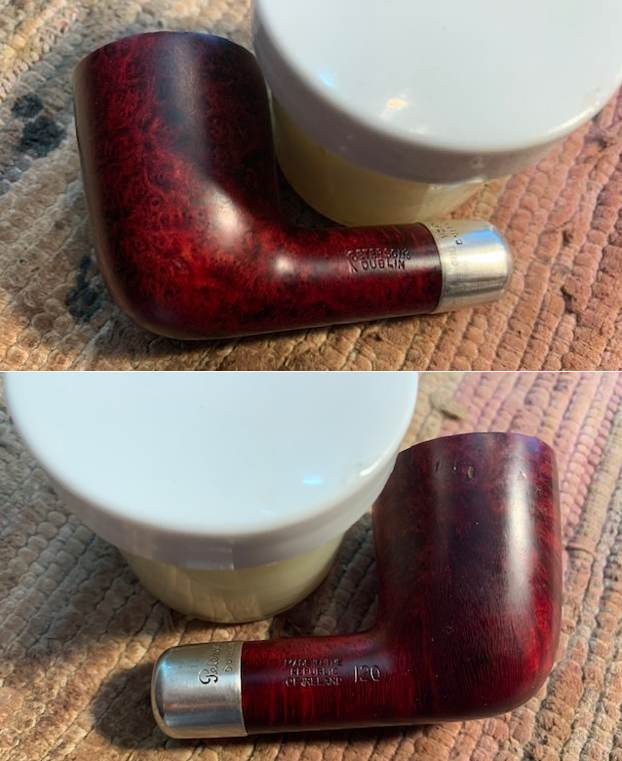
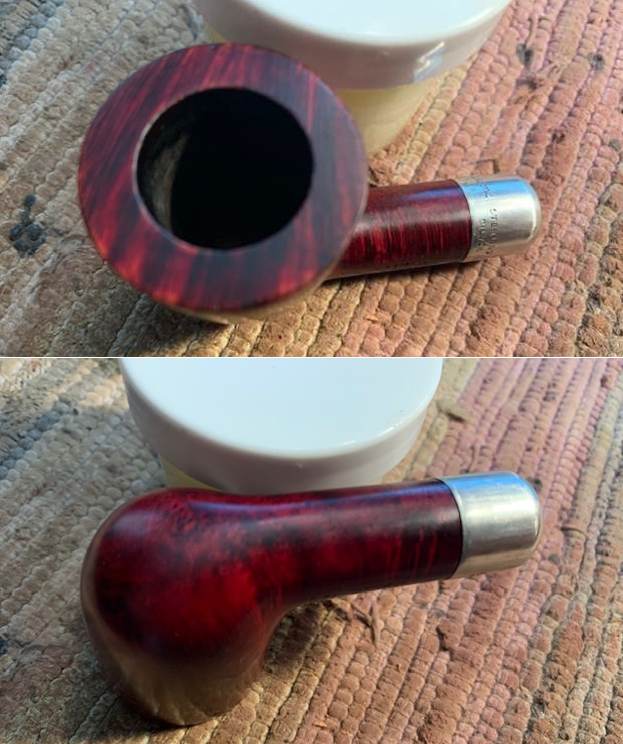
What a Contrast to the unsmoked G.F.B. Manhattan – a Smaller Three Star G.F.B.


Blog by Steve Laug

This morning I decided to work on the “little brother” of the G.F.B. unsmoked cased bent billiard I posted yesterday (https://rebornpipes.com/2021/12/18/look-at-this-a-beautiful-unsmoked-pipe-in-my-bag-of-older-pipes-yet-to-be-restored/). We bought this pipe on Ebay back on October 25, 2017 from Minneapolis, Minnesota, USA. The pipe was also a G.F.B. with a diamond shank, rolled gold rim cap and ferrule and amber stem. However this one was heavily smoked and in nowhere near the condition of its “big brother”. The leather cover on the case was in was worn but still in decent condition. There was some wear on the edges of the case but the hinges and lock worked very well. Don’t you want to know what is inside of this case? Do you want to compare it with the other unsmoked on I called its “Big Brother”? Well… I will get there. Jeff opened the case to show us what the pipe looked like inside. The lining of the case was far more worn and had a orange colour to it. It also had the G.F.B. stamp on the inside of the cover. The rolled gold cap and ferrule were not ornate or filigreed like the previous one. It was definitely a lower grade model. It was another beautiful looking older pipe. The briar was worn and tired looking with nicks in the finish and a dull, lifeless look to it. The gold coloured rim cap and shank ferrule were also worn. The cap looked like it had been knocked around on hard surfaces to remove the dottle from the bowl. The stem was amber and was chipped and dirty as well. It still looked good but definitely had the tooth marks and chatter of a previous set of chompers! Once again this was an old timer – a pipe from the late 1890 or early 1900s. The case has a gold stamped Three Stars [over] G.F.B. in a logo on the inside of the orange fabric lid. The shank of the pipe is stamped with Three Stars [over] G.F.B. in and oval in gold. Have a look at the photo of the case lid and pipe below.Jeff took the pipe out of the case and took photos of the pipe to show the look and the condition it was in when we received it. It was nowhere near the pristine beauty of its “Big Brother”. It was well used and tired looking. He took close up photos of the bowl, rim and stem surfaces to show their condition. You can see the thick cake in the bowl and the many dents in the rim top that tell the story of how the pipe was used by its previous caretaker. The stem was worn as well. It had chips out of it at the shank connection and bite marks and chatter on both sides near the button. The button itself was also worn and chipped. He took photos of the bone tenon to show the tars and debris that had collected on the screws of the tenon. It was well used and filthy. He also captured the look of the tired briar. You can see the water damage on the bowl base and heel. There is a large chip on the lower right side of the bowl. It is worn looking but still shows some amazing rain around the bowls ides and shank.I am including the material on the brand and the tie to Manhattan Pipe Company that I dug up on the previous pipe. I am including it in full so you can either read it or skip it if you already read it. It is interesting and pertinent to this pipe as well so that is why it is here for ease of reference.

I turned to first to a couple of the blogs that I have written on the restoration of G.F.B. pipes in the past. I reread them and have included a link to one of them below. I was able to identify that the G.F.B. stamp stood for Genuine French Briar (https://rebornpipes.com/2013/11/21/restoring-an-older-gfb-three-star-horn-stem-bent-bulldog/). I have included a catalogue page on the brand below for you to see. The description fits the rim cap and ferrule of mine. It says “Beautiful Rolled Gold Plate Mountings and Real Amber Bits.”So far I had found and read several blogs on the G.F.B. stamp that was on the inside of the case. Now it was time to do a bit of reading on the Manhattan stamping on the pipe. I again turned to a blog I have written on the brand below (https://rebornpipes.com/2017/07/24/another-interesting-piece-of-pipe-history-manhattan-canted-dublin-with-a-horn-stem/). I quote from that blog what I found on the brand.

I thought it would be interesting to see if there was any new information online regarding the brand. Of course, I checked on the Pipes, Logos and Stampings – PipePhil’s site. There was a listing for Manhattan pipes but there was not any new information and what was there was inconclusive. I turned to Pipedia to see if there was a new article. I was surprised to find that there was one, I do not know if it was new or not, but I do not recall seeing it before. The article was called The Manhattan Briar Pipe Company. It is an interesting read so I have included the article in its entirety as well as the advertisement from 1913 that showed a Manhattan pipe…

The Manhattan Briar Pipe Co. was organized in October, 1902 by the American Tobacco Company, under an agreement with the owners of the Brunswick Briar Pipe Company, as a New York corporation. Its initial address was 111 5th Avenue, New York City, and the value of its stock in 1902 was $350,000.00. American Tobacco Company had itself been founded in 1890 by J. B. Duke through a merger between a number of U.S. tobacco companies, and was one of the original twelve members of the Dow Jones Industrial Average in 1896. It was commonly called the “Tobacco Trust”.

The majority of the stock in Manhattan Briar Pipe Company was immediately acquired by the American Tobacco Company after the company was organized, but the prior owners retained a controlling minority interest for some years. In October, 1906, however, the American Tobacco Company acquired the remaining shares of stock, and from that point on Manhattan Briar was the pipe making branch of American Tobacco. By 1911, however, American Tobacco had been dissolved in anti-trust litigation, and Manhattan Briar Pipe Co. became a separate concern.

Manhattan Briar Pipe Co. had started operations in 1905 in Jersey City, New Jersey, having taken on a lease for a ten year period in 1905, and maintained a factory at Marion, New Jersey, where the pipes were made. By 1913, former American Tobacco pipe department chair John Glossinger was the president of Manhattan Briar Pipe Company, and began a significant advertising push for high grade pipes, using the slogan “Don’t spoil good tobacco by using a poor pipe”. It appears from cases having appeared on the estate market that Manhattan also sold meerschaum pipes, most likely rebranded articles originally made by European craftsmen.

After the expiration of the Jersey City lease the Manhattan Briar Pipe Company maintained offices and a factory at 415-425 Greenpoint Avenue, Brooklyn, New York beginning in 1915, evidently under the direction of W. C. Bastian, who had been granted a patent for a chambered pipe stem otherwise seemingly identical to a Peterson P-Lip in 1910. An employee of the company, one J. Gianninoto, was granted a patent for a device meant to permit the emptying of a cuspidor without the mess in early 1918, and the company continues to be listed in local directories through 1921. In 1922 Manhattan Briar was purchased by S.M. Frank and merged into that company. https://pipedia.org/wiki/Manhattan_Briar_Pipe_Co.

Further digging led me to a link on the S.M. Frank Co. & Inc. history page. Reading through the history of the company I found that S.M. Frank not only purchased the Manhattan Briar Pipe Company but also purchased WDC or William DeMuth & Company – two of the older brands that I enjoy working on. Here is the relevant section from the link: In the year 1900 Sam Frank Sr. started his own business, selling pipes and other tobacco items. His original office was located at 20 W. 17th Street, NYC. He was also closely associated with the sales staff of Wm. DeMuth & Co., selling their line of pipes. It was at this time that Mr. Frank first met Ferdinand Feuerbach and formed what would be a lifelong friendship. Mr. Feuerbach started working for the DeMuth Company in 1897 and by 1903 had become the production manager. In 1919, when Mr. Frank needed an experienced pipe man to run his pipe factory, located at 168 Southern Blvd., in the Bronx, he persuaded his old friend Ferdinand to join him. Mr. Feuerbach is credited with developing DeMuth’s popular Royal DeMuth and Hesson Guard Milano pipelines. In 1922, when S. M. Frank purchased the Manhattan Briar Pipe Co. the company incorporated.  http://www.smfrankcoinc.com/home/?page_id=2

That link led me to me to some further information including an advertisement and a shape chart on Chris Keene’s Pipe Pages http://pipepages.com/mbpc2.htm. I have included them here with acknowledgement to Chris Keene. I always enjoy reading the old copy of these advertisements as they take me back to place where the pipe was an acceptable part of the life.

This pipe enjoyed the same link as the previous one between the G.F.B. Brand (Genuine French Briar) with the Manhattan Pipe Company. I took the pipe out of the case and turned it over in my hands. It was now time to work on it.

Jeff had cleaned it thoroughly. He had reamed it with a PipNet reamer and cleaned that up with a Savinelli Fitsall Pipe Knife. He had scrubbed the exterior of the briar with undiluted Murphy’s Oil Soap. He cleaned out the interior of the shank and airway with alcohol, pipe cleaners and cotton swabs. He carefully cleaned out the amber stem with clean water and pipe cleaners to remove the debris and oils in the airway and the threads of the bone tenon. I took photos of the pipe when it arrived here. The first two photos show the pipe in the fitted case and the G.F.B. logo stamped on the shank and the lid of the case. While worn it is clear and readable. The overall look of the pipe after cleaning shows the tiredness and worn look of the briar and the stem. It is a beauty in the rough and definitely needs some TLC. I took a close up photo of the bowl and rim top to show the condition of the cleaned bowl and rim cap. You can see the clean bowl and the many dents in the top of the rim cap. I also took some photos of the amber stem to show how it looked. There were a lot of nicks, chips and tooth damage to be seen on the surfaces of the stem.I took a photo of the Three Stars stamped over the G.F.B. oval logo on the left side of the shank. You can also see the rolled Gold Plated Ferrule on the shank end in the photo. Even in its worn condition it still is a beautiful looking piece of pipe history.I unscrewed the stem from the shank to see an tar and oil darkened well used, threaded bone tenon. Amazingly it was free of damage and had not been over or under-turned in the shank.I decided to try out something I read somewhere about lifting the dents in the rolled gold rim cap. I “painted” the surface of the cap with the flame of a lighter. I was careful to keep the flame moving. While it is not perfect the heat lifted some of the dents in the surface leaving an improvement. I repaired the chip out of the right underside of the bowl with briar dust and clear CA glue. I filled in the chip with the clear glue and pressed briar dust into it. Once it cured I sanded it smooth to blend it into the surface. I polished the briar with micromesh sanding pads – dry sanding with 1500-12000 grit pads and wiping the bowl down with a damp cloth after each pad. The briar is beginning to look very good. I touched up the G.F.B. Oval and three stars with Rub’n Buff Antique Gold – working it into the stamp with a toothpick. I buffed it off with a soft cloth. It looks better.I worked some Before & After Restoration Balm into the surface of the bowl and amber stem with my fingertips to clean, enliven and protect the briar and amber. I let the balm sit for 15 minutes and then buffed with a cotton cloth to raise the shine. The photos show the bowl at this point in the restoration process. It is definitely looking much better and more full of life. I put the bowl in the case for awhile and turned my attention to the stem. I started the process by filling in the chipped areas and tooth marks on the stem surface with clear CA glue. Once the repairs cured I smoothed them out with a small file. I sanded the surface with 220 grit sandpaper to blend it in. I started the polishing with 400 grit wet dry sandpaper. I polished the stem with micromesh sanding pads – dry sanding with 1500-12000 grit pads. I wiped the stem down after each pad with a cloth impregnated with Obsidian Oil. I finished polishing it with Before & After Pipe Stem Polish – both Fine and Extra Fine and gave it a final coat of Obsidian Oil.When the bowl and the stem were finished this G.F.B. Bent Diamond Shank Billiard looked much better. I carefully hand buffed it with a microfiber cloth to raise and deepen the shine. It another beautiful pipe that is over 100 years old. The dimensions of the pipe are – Length: 3 ½ inches, Height: 1 ½ inches, Outside diameter of the bowl: 1 inches, Chamber diameter: 5/8 of an inch. The weight of this large pipe is .71 ounces/20 grams. This G.F.B. Bent Billiard was another great find that goes with the pipes from both brands that I have restored in the past. This is a pipe that will hold another special place in my collection. It is also one that will likely be smoked before its “Big Brother”. It is another pipe that has the capability of transporting the pipe man or woman back to a slower paced time in history where you can enjoy a respite. Thanks for walking through my restoration of this great find.
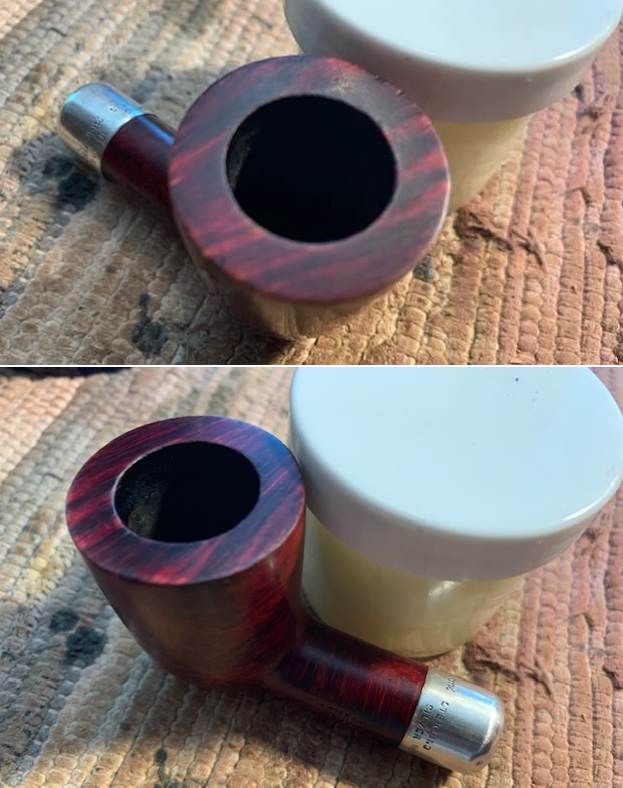
A Labour of Love


Blog by Kenneth Lieblich

Next on the chopping block is the very first GBD I have had the pleasure of restoring. I titled this story A Labour of Love because the work involved was far more than I could have imagined for such a beautiful pipe. The pipe is a GBD Colossus and I acquired it in a group of pipes I purchased from a fellow in the Eastern US. It was definitely a mixed bag of very good and very bad. Some pipes were destroyed beyond repair, some pipes were filthy but repairable, some stems were missing their stummels, and some stummels were missing their stems. This was one of those – a stummel without a stem. Makes it a bit tricky to smoke, methinks. This pipe is a calabash-shaped GBD Colossus. As the photos show, it is stamped on the left side of the shank with GBD [over] International [over] London Made [over] Colossus. On the right side it is stamped Made in London [over] England [next to] 9552 – this, of course, is the shape number. There is quite a bit of information on GBD on the Internet – they have a long and storied history in pipemaking. In this case, I was curious about International and Colossus. The main Pipepedia article on GBD tells us about their origins:
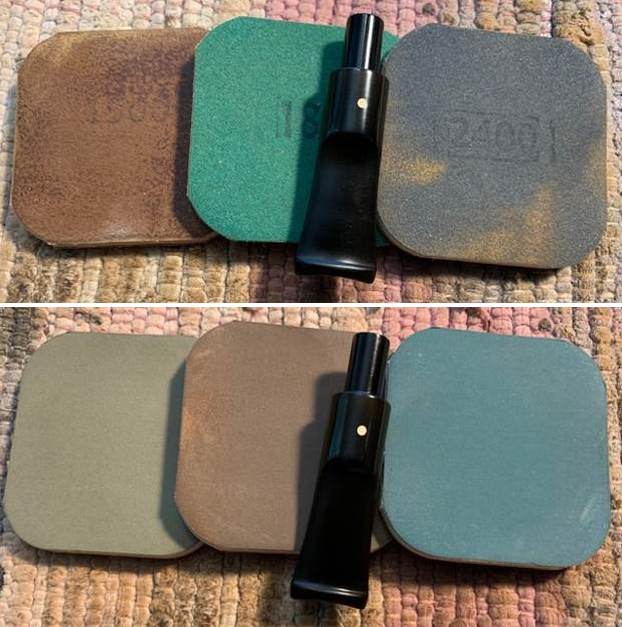
In 1850 three gentlemen got together in Paris to establish a firm dedicated to the fabrication of Meerschaum pipes – a courageous step in politically restless times. Ganneval probably came from the area of Saint-Claude where he had learned making wooden pipes. Bondier’s family obviously came from Paris and had emigrated in 1789 to Geneva. He himself had worked as a wood turner in the clay and china pipe industry in and around Saint-Claude making stem extensions etc. Donninger was an Austrian or Swiss and had worked in Vienna, the world’s center of the Meerschaum pipe. They agreed on the acronym GBD selecting the initials of their surnames.

The Pipedia article provides a lot more information on their interesting history. I would encourage you to read on here. The shape number 9552 corresponds correctly with GBD’s identification of this pipe as a calabash. The page on GBD models states the following concerning the International line and the Colossus size:

International – France and England made: medium brown smooth, carved top rim, rim stained black. In addition to the pipe line and shape information stamped on the pipe, GBD also had codes for plus sized pipes. These codes in ascending order of size were Conquest, Collector, Colossus.

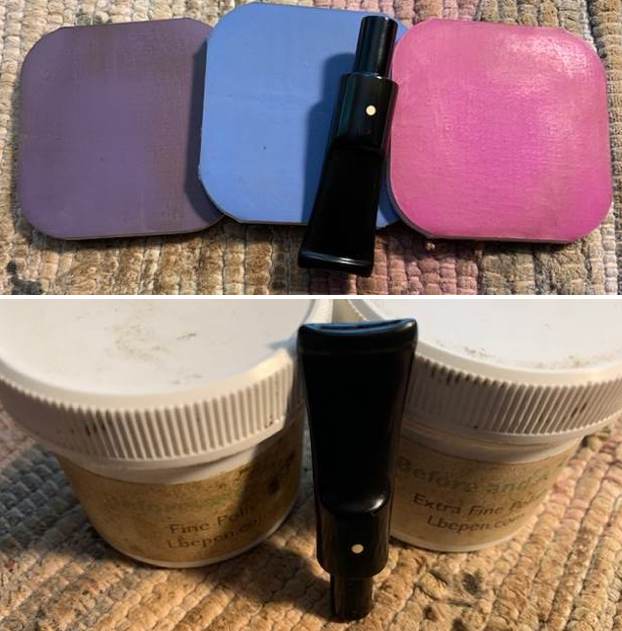
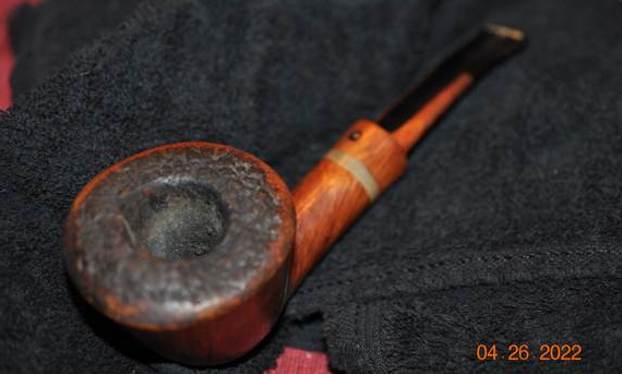
I also took this screenshot from Pipephil:Anyway, on to the pipe – and what a gorgeous pipe it was (and such a big bowl)! However, it was absolutely filthy and had a few issues. The stummel had the following problems: tons of lava on the rim, notable greasy/sticky stains to the bowl and shank, plenty of cake in the bowl, a few scratches here-and-there, and a few small burns on the rim. Meanwhile, the stem had a few problems of its own. Oh wait. No stem. Umm, yeah, that is going to be an issue. This pipe was going to require some considerable work, but I was really looking forward to restoring this one. Well, suffice it to say that first on my list of tasks was to find a stem for this beauty. However, GBD stems are not just lying around, sad to say. In this case, Superman Steve came to my rescue. He had a spare GBD stem that suited my pipe very well. I was (and still am) deeply grateful to him for getting that stem for me. I will come back to the story of how I fit the stem a bit later. By the way, here is a photo of Superman Steve:This stummel was quite a mess. I first decided to ream out the bowl. I used both the PipNet Reamer (which I broke in the process) and the KleenReem to remove the built-up cake and followed that with 220-grit sandpaper to eliminate as much as I could. I took it down to bare briar, as I wanted to ensure there were no hidden flaws in the walls of the bowl. Fortunately, there were none. I then proceeded to clean out the insides of the shank with cotton swabs, pipe cleaners, and lemon isopropyl alcohol. There was a lot of nastiness inside this stummel and – boy-oh-boy – it took a lot of cotton to get this thing clean! As I mentioned earlier, the rim of the stummel was pretty ugly and also needed to be addressed. A combination of techniques was used to sort this out. In order to remove the lingering bits of lava and fix the nicks, I “topped” the pipe – that is to say, I gently and evenly sanded down the rim on a piece of 220-grit sandpaper. This effectively removed the lava and the damage, without altering the look of the pipe. I then took a solid wooden sphere, wrapped sandpaper around it, and sanded the inner bevel thoroughly. This was to achieve on the inner part of the rim the same thing that I achieved by “topping” the rim on sandpaper. A de-ghosting session seemed in order, so I thrust cotton balls in the bowl and the shank, and saturated them with 99% isopropyl alcohol. I let the stummel sit for 24 hours. This caused the oils, tars and smells to leech out into the cotton. Finally, a relatively clean and fresh-smelling bowl emerged. I followed that up by cleaning the insides with some dish soap and tube brushes. I then moved on to cleaning the outside of the stummel with Murphy’s Oil Soap and some cotton pads. Some stains were pretty stubborn and I had to scrub hard, but this did eventually remove the remaining dirt. After that, a light application of Before & After Restoration Balm brought out the best in the stummel’s grain. Having completed that, I was able to address a small nick on the shank. I dug out my iron and a damp cloth to try and raise the nicks. The hot and moist steam created can often cause the wood to swell slightly and return to shape. There was some movement – not a lot, but it was better than doing nothing. I filled the remaining divot with cyanoacrylate adhesive and let it cure. Now, with the nick filled, it was time to sand down the stummel. I used all nine Micromesh pads (1,500 through 12,000 grit) to wet/dry sand everything smooth. Then I added a bit more Before & After Restoration Balm. On to the stem, and what a trial it was. As mentioned, Superman Steve got me a GBD stem and that was terrific: the stem was clean and in nice shape. So what is the problem? Well, its width did not quite match the width of the shank. The stem was slightly wider. So, with 200-grit sandpaper in hand, I began removing the excess vulcanite. As silly as it sounds, this took a couple of hours of work to get this right. The photos below detail the lengthy process to both remove the excess and ensure evenness all around the stem face. At long last, I managed to get the size and shape just right, but the faces of both the shank and stem were not matching in the way that one would want. I took the decision that this pipe would benefit from a thin – emphasis on thin – band around the end of the shank. My jar of bands proffered a lovely, thin band that perfectly suited this pipe. With a quick application of glue, the band was on and things were looking much improved. I used some of my Micromesh pads to give that extra shine. In order to finish up the stem, I took a BIC lighter and ‘painted’ it with its flame in order to lift the slight tooth marks. This was reasonably successful in raising the dents. Before I moved on to the Micromesh pads, I built up the small dents on the stem with cyanoacrylate adhesive and let them fully cure. I then sanded it down with 220-, 400-, and 600-grit sandpapers to meld the repair seamlessly into the stem. This ensures that it keeps its shape and looks like it should. I then used all nine Micromesh pads (1,500 through 12,000 grit) to bring out the lovely black lustre on the stem. I also used Obsidian Pipe Stem Oil in between each pad scrubbing. Of course, since the stem was straight, it did not suit the pipe and needed to be bent. The end of the stem needed to be parallel with the rim of the bowl. I did not have a heat gun at the time, so I brought out a hair drier and heated the vulcanite stem in order to make it malleable. After heating it for 90 minutes (yes, you read that correctly), it became obvious that the hair drier just did not generate enough heat to bend the stem. I then realized that I was going to have to use the nuclear option: dipping the stem in boiling hot water. This is a nuclear option because the water added an horrific oxidation to the stem – the worst I have ever seen. When it was finally soft, I gently curved the stem over a wooden dowel. The dowel provided a firm surface and a proper curve. Once I had the bend I wanted, I left the stem to cool and set itself in place. I then had to go back and use all nine Micromesh pads (and the Obsidian Pipe Stem Oil) again to restore the black lustre. A few four-letter words might have been silently uttered in the process, but I digress… Then it was off for a trip to the buffer. A dose of White Diamond and a few coats of carnauba wax were just what this pipe needed. The lovely shine made the wood look absolutely beautiful.

This is a wonderfully crafted pipe and has a very elegant feel to it. Steve told me from the beginning that this was a pipe I should keep for myself. So, this one is being added to my collection – and I am pleased to say that it smokes beautifully. I am sure that I will be enjoying this one for many years to come. I hope you enjoyed reading the story of these pipes as much I as I did restoring them. If you are interested in more of my work, please follow me here on Steve’s website or email me directly at kenneth@knightsofthepipe.com. Thank you very much for reading and, as always, I welcome and encourage your comments.

Restoring a Mysterious Bent Egg with some stunning grain


Blog by Steve Laug

Neither Jeff nor I remember where we picked up this egg shaped pipe. We have no idea where it came from – whether the US or Canada. We have no idea when we purchased it or who we purchased it from. We have no idea what we paid for it. To top off all the unknowns about this pipe it is also not stamped with any identifying marks on the briar or on the stem surface. So the pipe is a mystery – no known maker, no location where it was found and no sense of time when we picked it up. But all of that does not deal with the fact that it is a stunning piece of briar underneath all of the nicks, scratches and ground in grime that covered it. Jeff took these photos of the pipe back in 2019 before he started his clean up work on it. Have a look at the photos he took and you will hopefully see through the debris and grime on the briar and gouges in the vulcanite stem. There is something remarkably graceful about the pipe. The next photo gives a glimpse of the overall condition of the pipe. You can see the thick cake in the bowl and tobacco shards in the cake. You can see the thick lava build up on the rim top and even some grain poking through. The stem is calcified, oxidized and had a lot of bite marks and tooth chatter on both sides that made the stem surfaces pitted and awful looking. But…He took close up photos of the bowl, rim top and the sides of the stem to help us see the mess even more clearly. Look at the thickness of the cake in the bowl and the fuzz and tobacco debris in the bowl sides. The rim top is buried under a thick lava coat and it is impossible to know what the inner or outer edges looked like. One can only hope they were protected but the armor coat. The stem was in brutal shape. You can see the deep tooth marks – gouges really in the surface on both sides almost halfway up the stem from the button. You can see the thick calcification and oxidation as well. Either you can say that the pipe was well loved or it was abused. The choice is yours. But I think we can all agree that it is a mess.Jeff captured the filth that was ground into the briar around the bowl sides and heel well but do not miss the grain that pokes through or you will miss something spectacular.  The next photos show the pipe after Jeff worked a miracle in getting all of the cake, lava and grime of the exterior of the pipe. You can only imagine what it looked like on the inside once he opened it up. It really was a disgusting pipe and one that truly only a pipe restorer could love. He reamed it with a PipNet reamer and cleaned that up with a Savinelli Fitsall Pipe Knife. He scraped the lava with a knife and then scrubbed the exterior with a tooth brush and undiluted Murphy’s Oil Soap. He scrubbed the stem with Soft Scrub to remove the debris. He scoured out the internals with isopropyl alcohol, cotton swabs and pipe cleaners. He soaked the stem in Before & After Pipe Stem Deoxidizer and then rinsed it with warm water. He left the pipe looking surprisingly good. Here is what I saw when I received it. I took a photo of the rim top and bowl to show the condition more closely. Amazingly, considering its condition on arrival, it looked very good. The walls of the bowl were smooth and the edges looked good. There was some darkening on the rim top but otherwise it was in good condition. The photos of the stem show that it was very clean but the tooth marks and grooves/gouges in the stem surface were deep on both sides quite a way up the stem. It was a mess on both sides. I took some photos of the shank to show their unstamped condition. It is truly a nameless pipe by an unknown maker.I removed the stem from the shank and took a photo of the parts. I wanted to give a idea of the delicate feel of the stem and the shank to the size of the bowl. It really does remind me of some of the Nachwalter pipes that I have worked on in the past.I decided to start my work on the pipe by addressing the gouges in the briar on the left and right sides of the bowl. I tried steaming them and it was a useless effort as the nicks and gouges had sharp edges and did not lift at all. I filled them in with clear CA glue. Once the repairs cured I sanded them smooth with 220 grit sandpaper to begin to blend them into the surrounding surface area. To clean up the rim top I lightly topped it on a topping board with 220 grit sandpaper. My goal was not to take off much of the top but merely to reduce the darkening on the top and edges.I sanded the entire bowl and shank (with the stem in place for the shank portion) with  a medium and fine grit sanding sponge. I wanted to remove as much of the scratching on the surface of the pipe as possible and further blend in the repaired areas. Keeping the stem on during the sanding of the shank guaranteed that the transition would remain smooth. The grain began to really stand out as I sanded it. I continued to polish the briar with micromesh sanding pads – dry sanding with 1500-12000 grit pads. I wiped the bowl down after each pad with a damp cloth to remove the sanding debris. The bowl and shank really began to take on shine and the grain is stellar. I rubbed the bowl down with Before & After Restoration Balm and worked it into the briar with my finger tips. I let it sit and work its magic for 10 minutes then buffed it off with a soft cloth. The grain really came alive with the Balm. This is a really beautiful looking pipe. I set the bowl aside and turned to work on the stem issues. I “painted” it with the flame of a lighter and was able to lift the tooth marks and grooves some. I filled in the remaining marks and gouges with clear CA glue and set them aside to cure.Once the repairs had cured I flattened them out with a small file. I sanded them and the rest of the stem with 220 grit sandpaper to further smooth them out and remove damage on the stem and button. I started polishing the stem with 400 grit wet dry sandpaper. I polished the stem with micromesh sanding pads – dry sanding with 1500-12000 grit pads. I wiped the stem down after each pad with a cloth impregnated with Obsidian Oil. I finished polishing the stem with Before & After Stem Polish – both Fine and Extra Fine and then wiped the stem down a final time with the cloth and Obsidian Oil. I set it aside to dry. This Mystery Maker Bent Egg is a really nice looking pipe. The finish is smooth and the flow of the cut of the briar follows the grain. I put it back together and buffed it with Blue Diamond on the buffing wheel. I gave the bowl and the stem multiple coats of carnauba wax. I buffed the pipe with a clean buffing pad on the wheel to raise the shine and hand buffed it with a microfiber cloth to deepen the shine. It is fun to see what the stunning grain looked like with the polished black vulcanite stem. The pipe really is beautiful. This egg shaped No Name Pipe is nice looking and the pipe feels great in my hand. It is light and well balanced. Have a look at it with the photos below. The dimensions are Length: 5 ½ inches, Height: 2 inches, Outside diameter of the bowl: 1 1/8 inches, Chamber diameter: ¾ of an inch. The weight of the pipe is 65 grams/ 2.29 ounces. It is a beautiful pipe and one that will soon be on the rebornpipes store in the American Pipe Makers section (though I am not sure where it was made). If you are interested in adding it to your collection let me know. Thanks for walking through the restoration with me as I worked over this pipe. Please we are not pipe owners; we hold our pipes in trust until they pass on into the trust of the next in line.