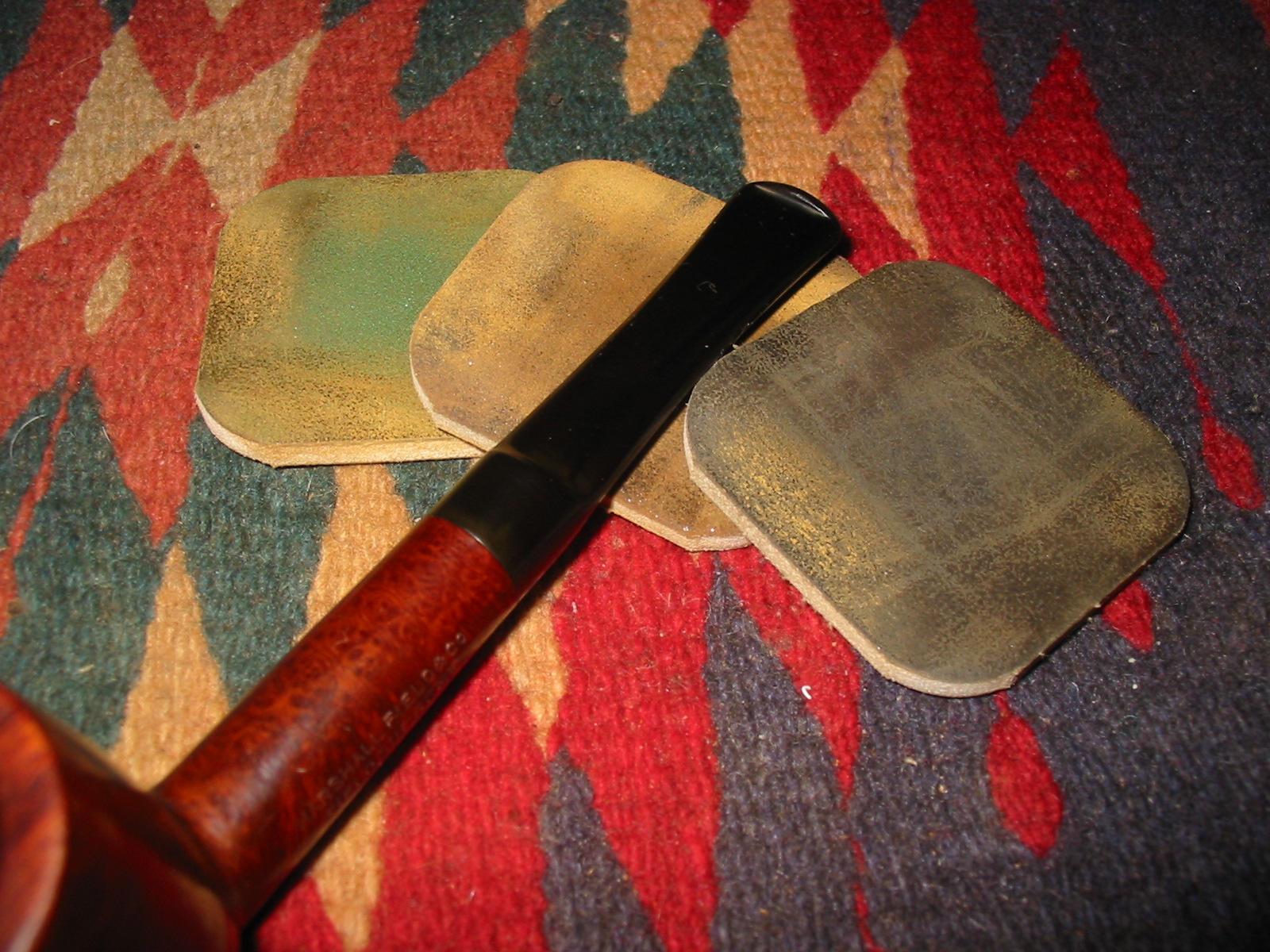
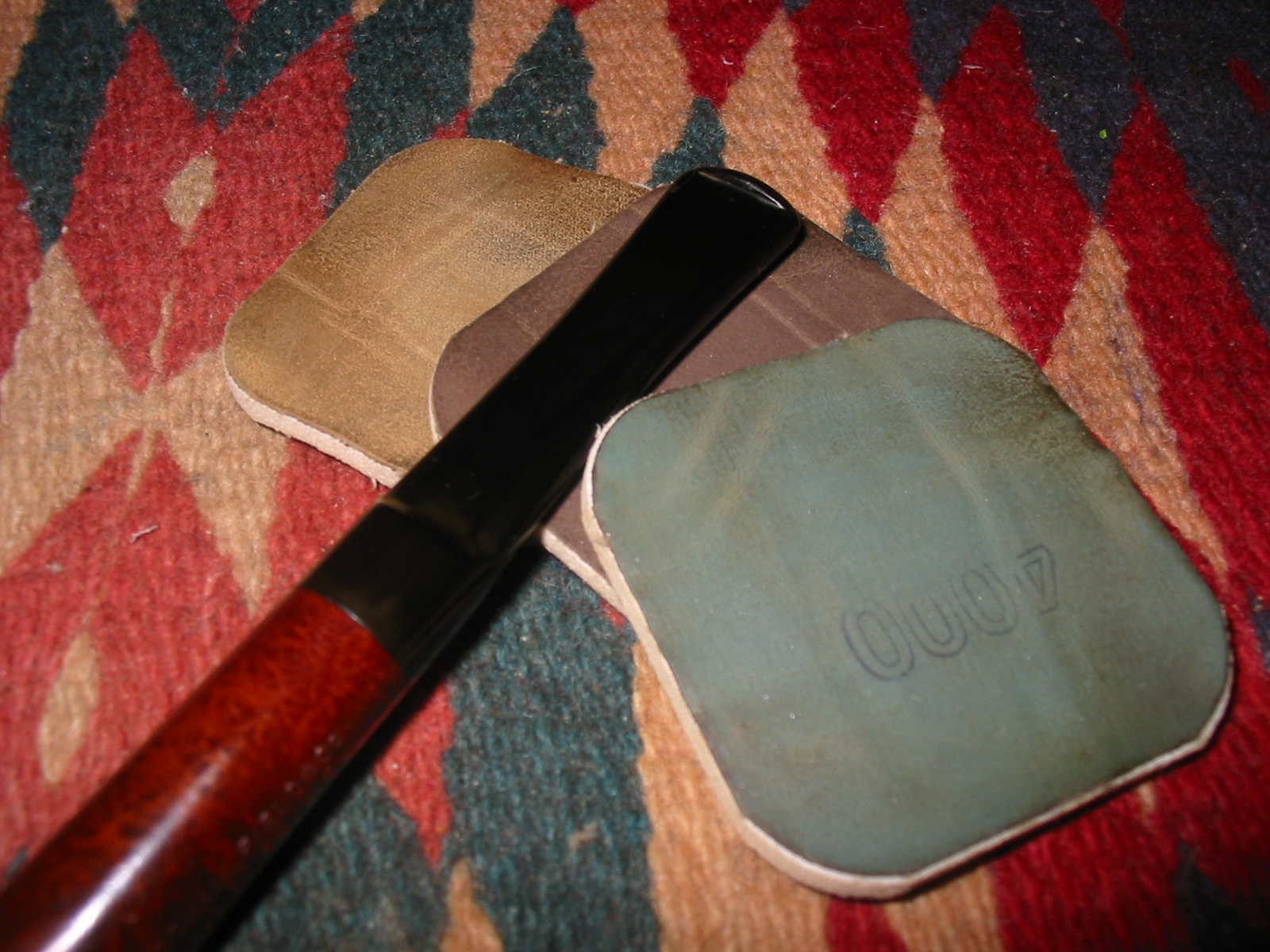
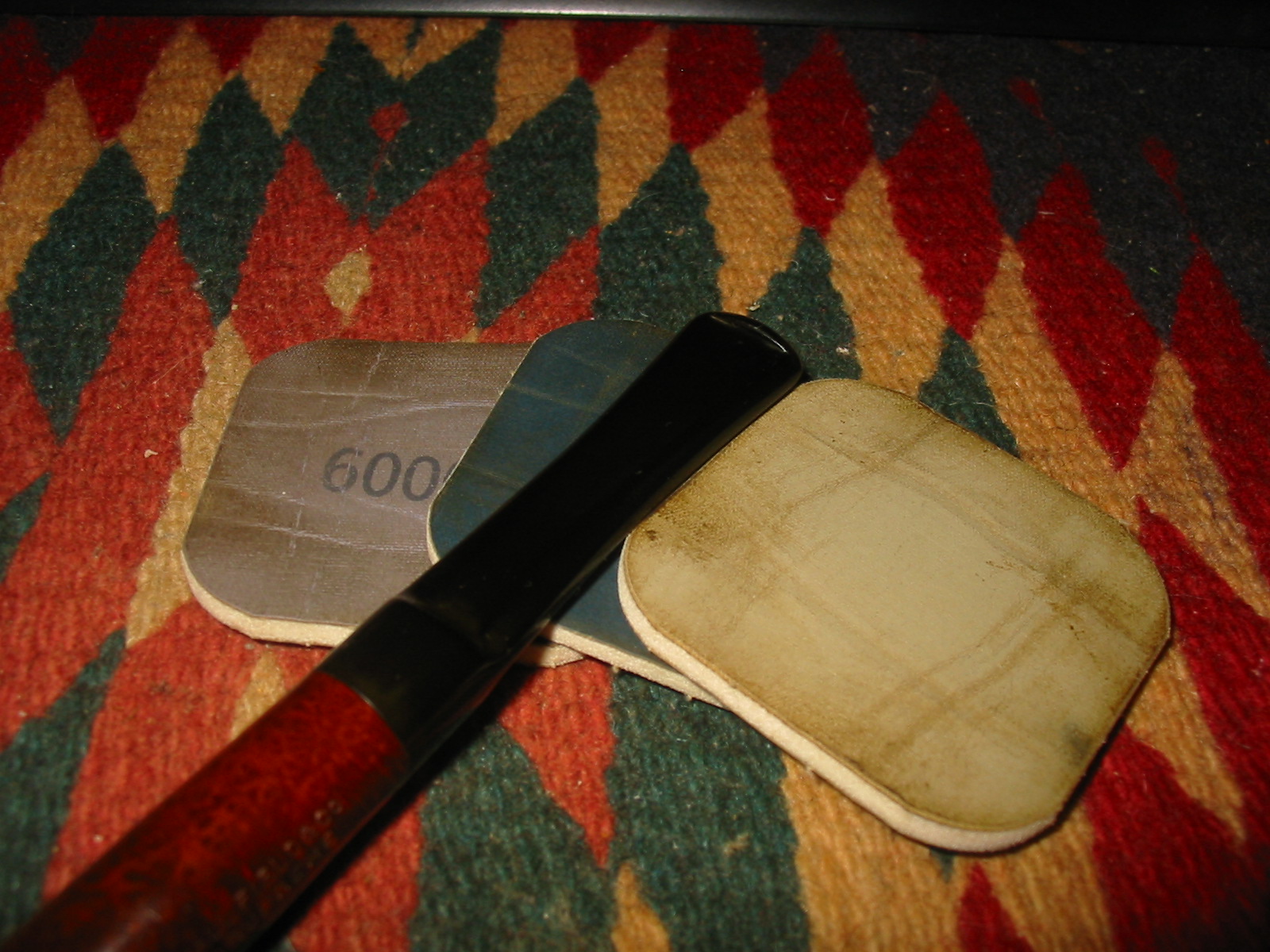
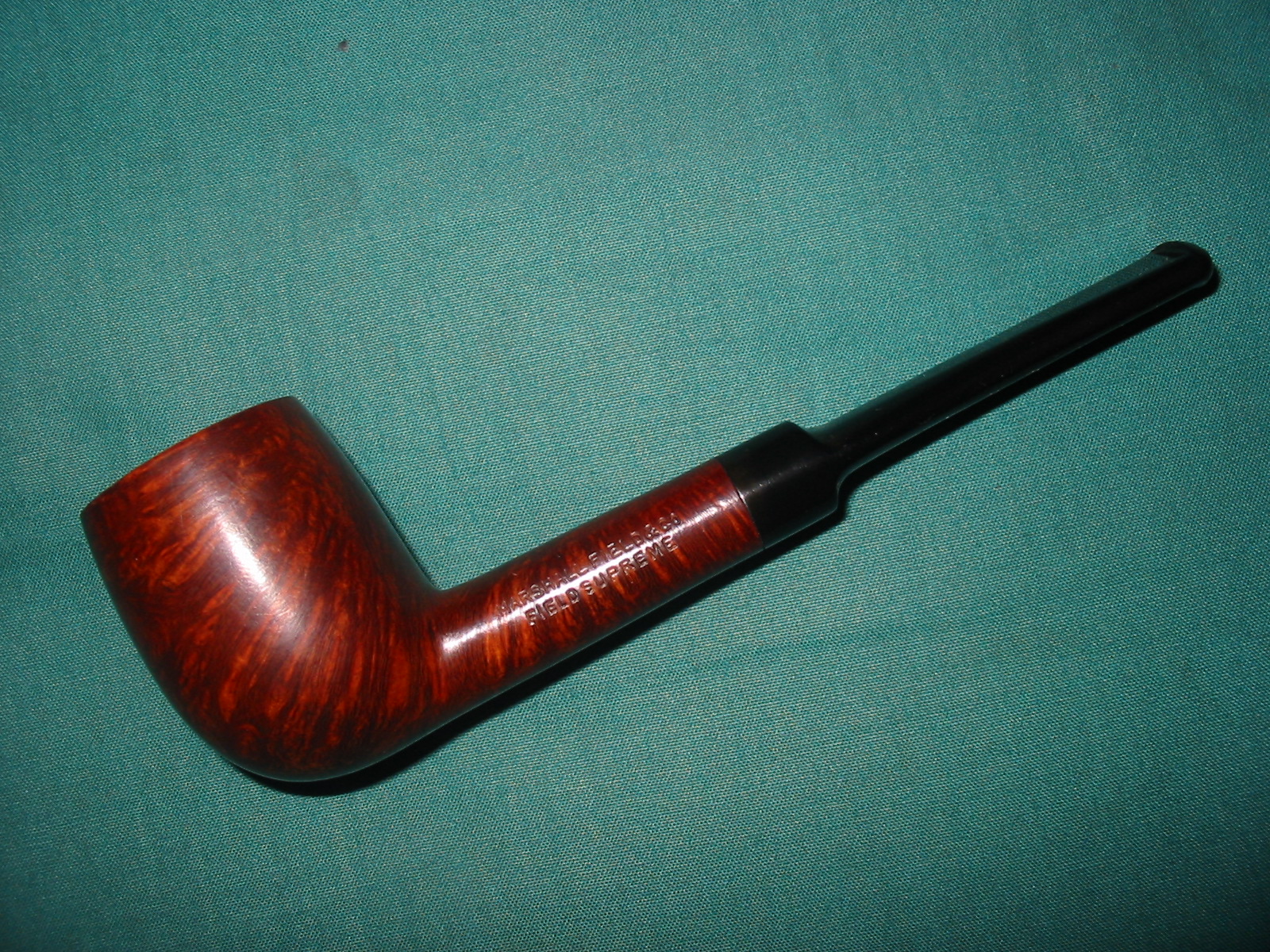
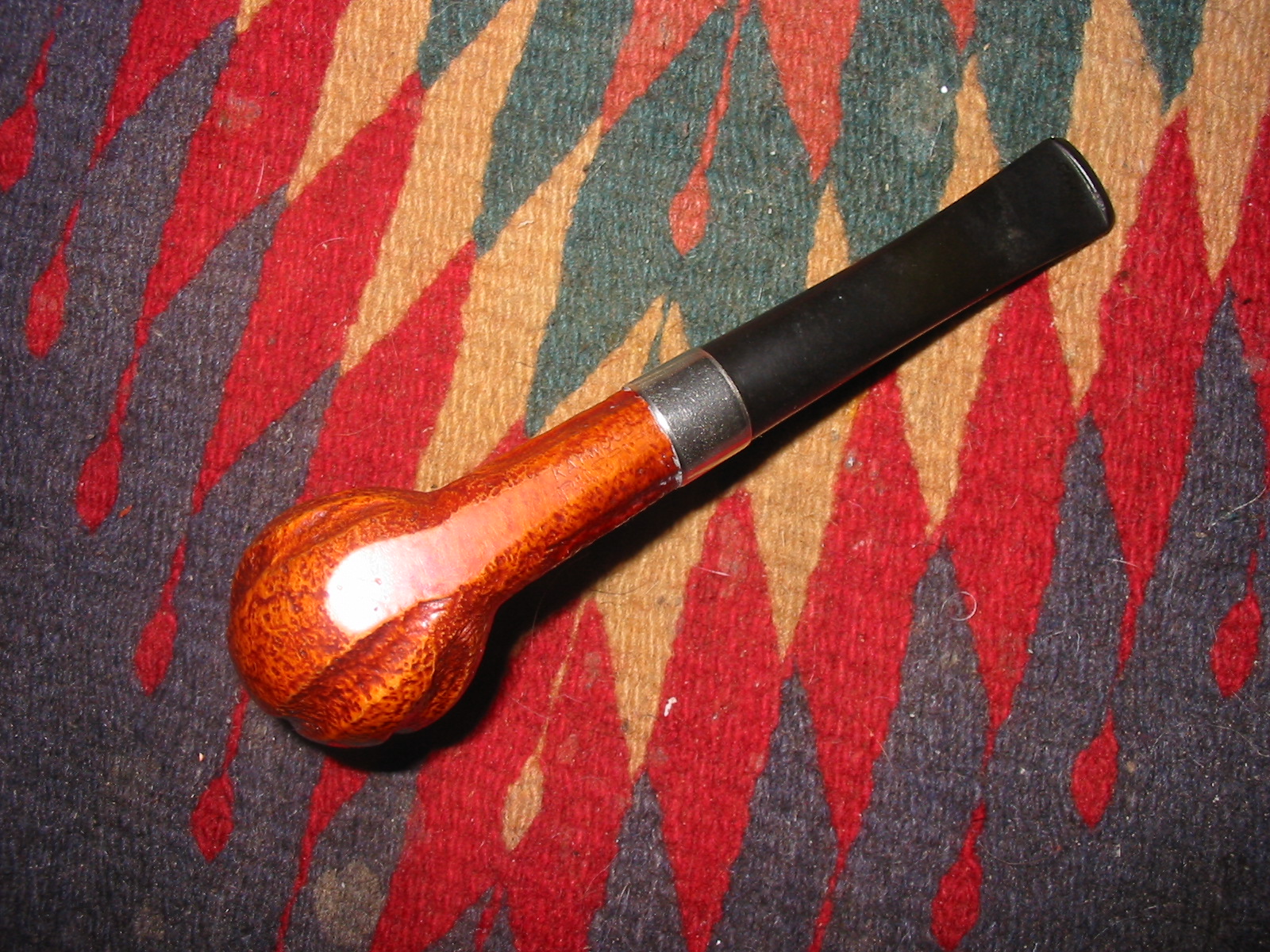
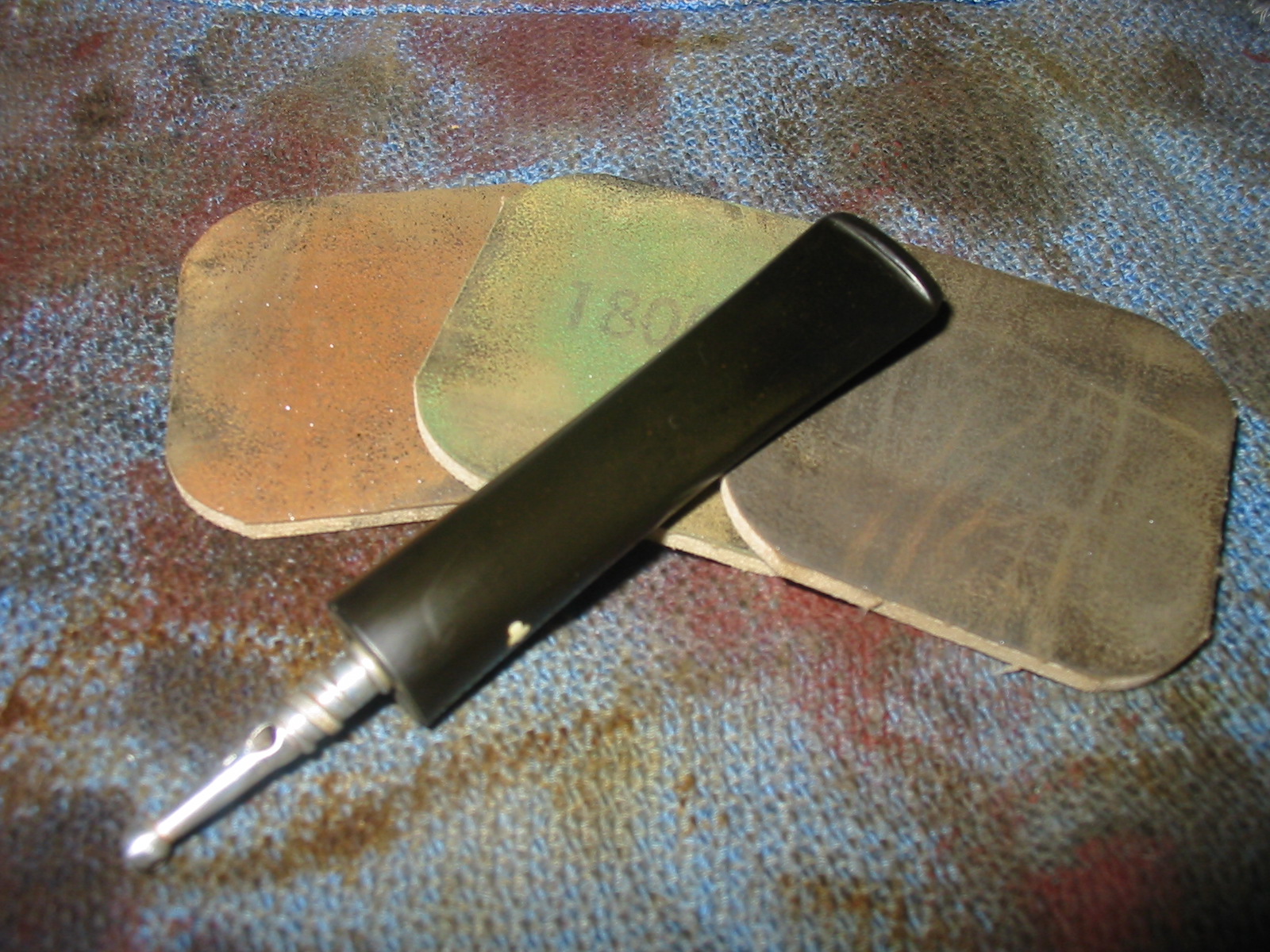
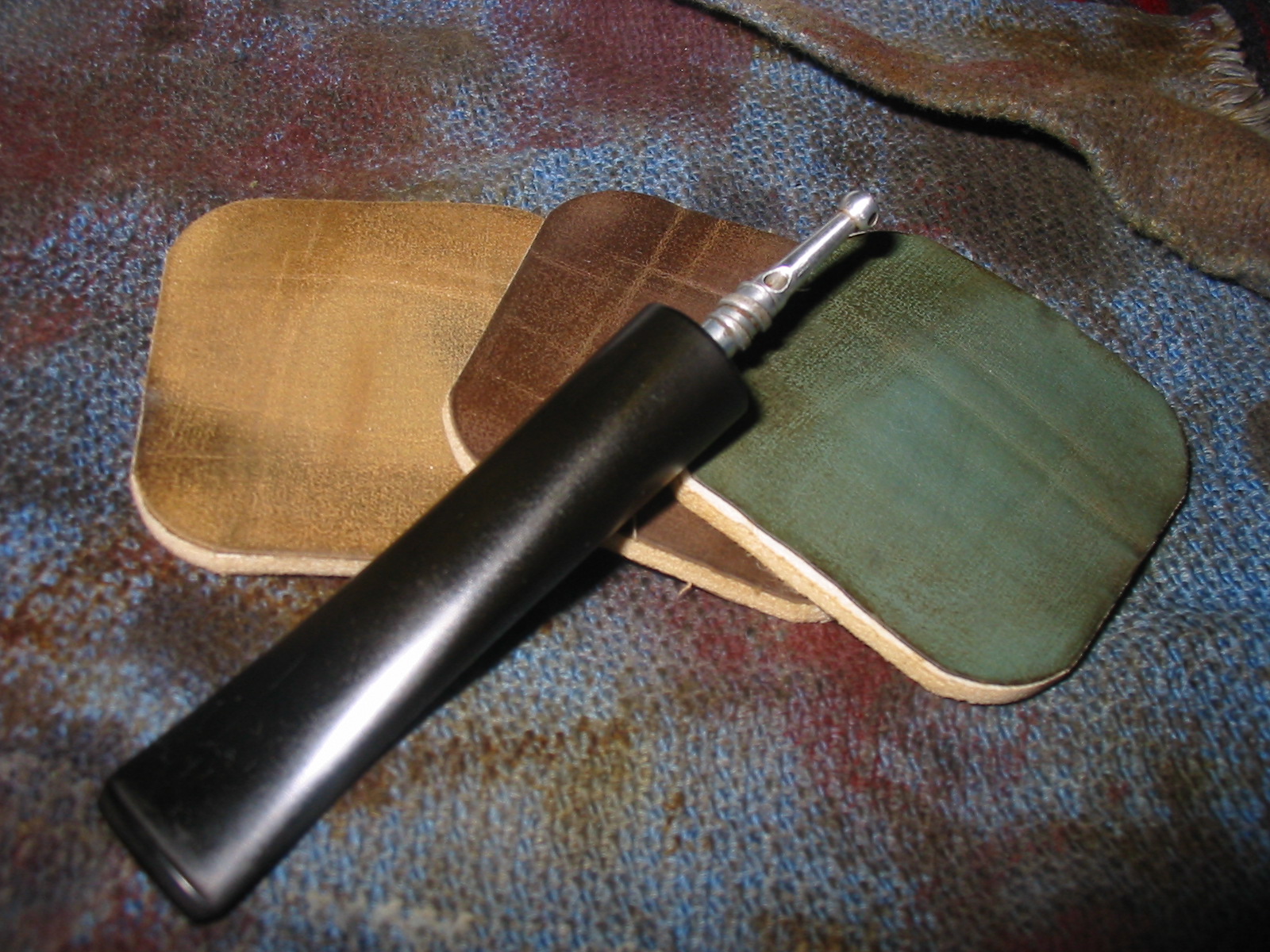
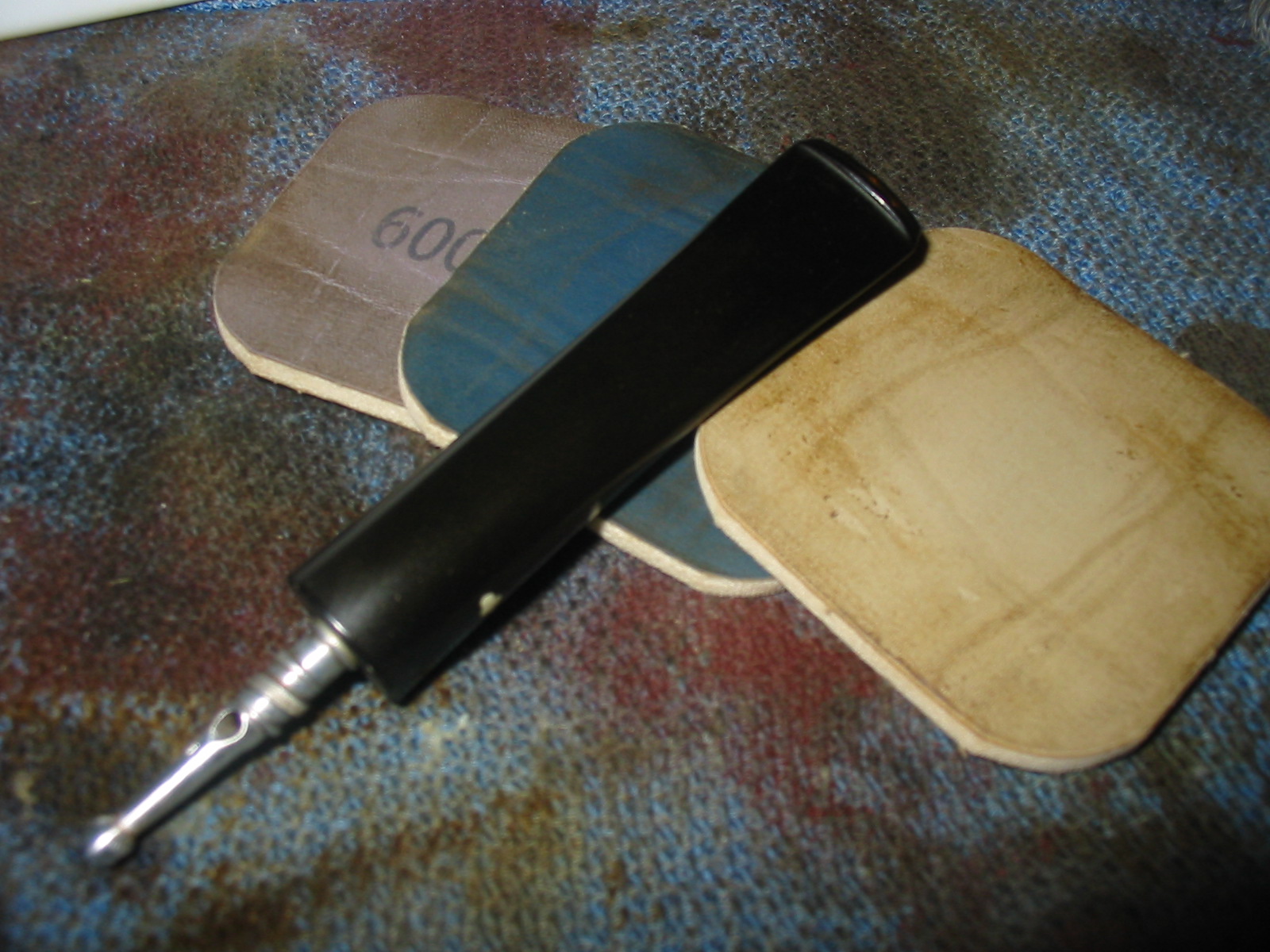
Author Archives: rebornpipes

Oxidation – Warning. You’ll Wish You Hadn’t Seen This – by Joyal Taylor (aka holymolar)


Blog by Joyal Taylor

This is the second article by Joyal (known online as holymolar). It is with pleasure that I put this on the blog. Joyal does some great work in restoration and in his own words “You’ve probably realized already that I particularly like restoring stems”. Thanks Joyal for your take on the process of cleaning up deeply oxidized stems. I look forward to more articles on your work. Without further introduction here is Joyal.

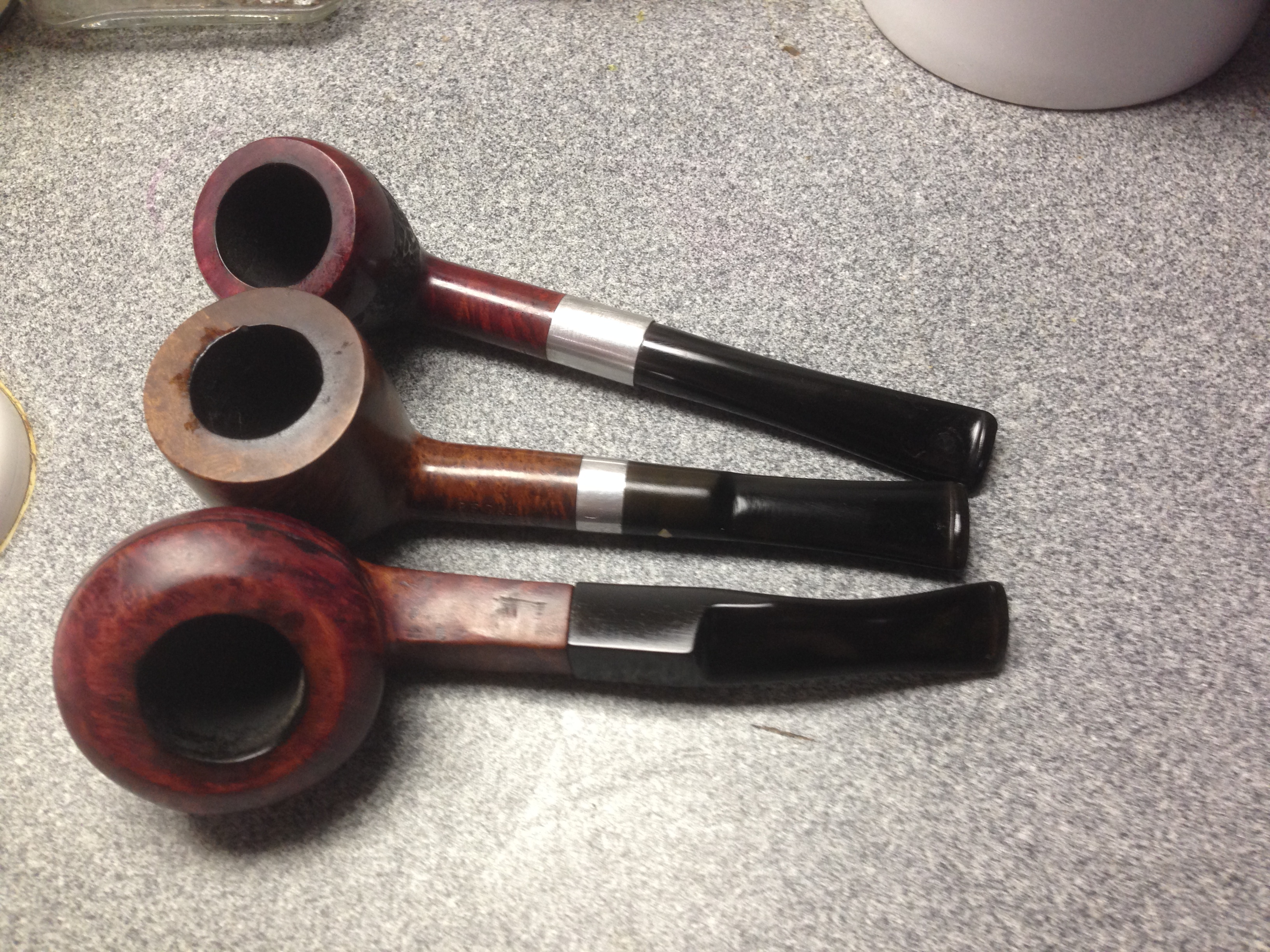
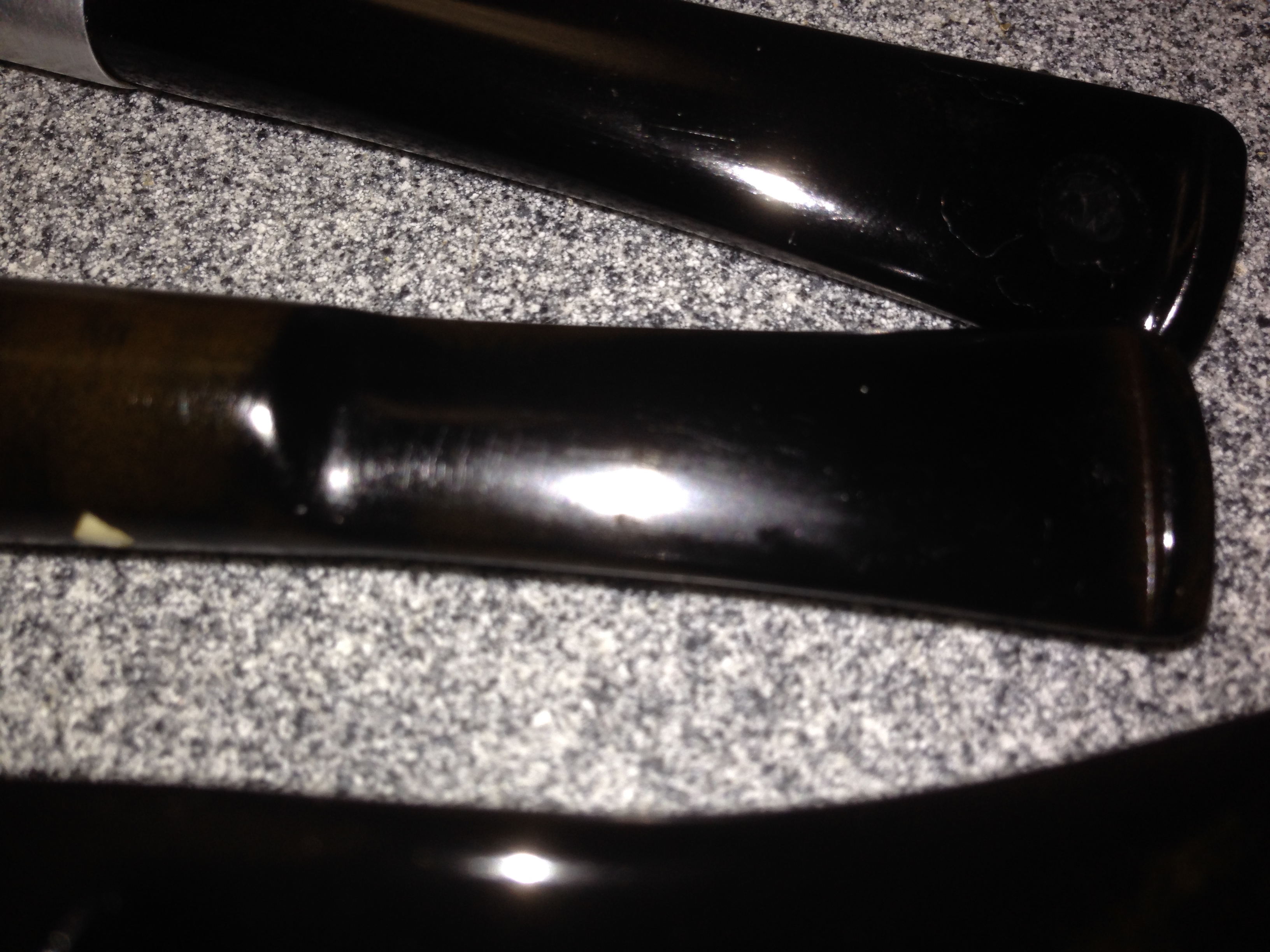
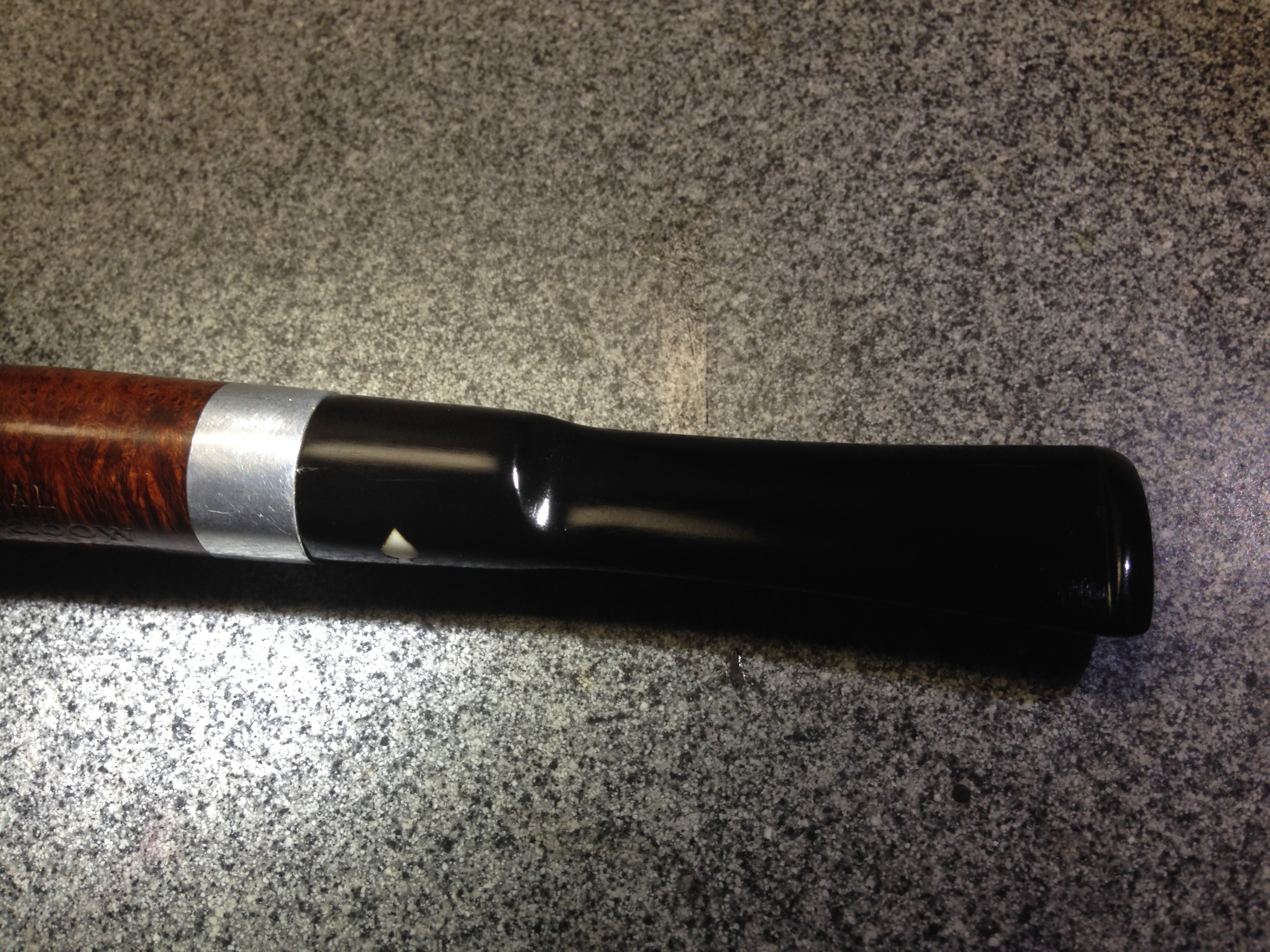
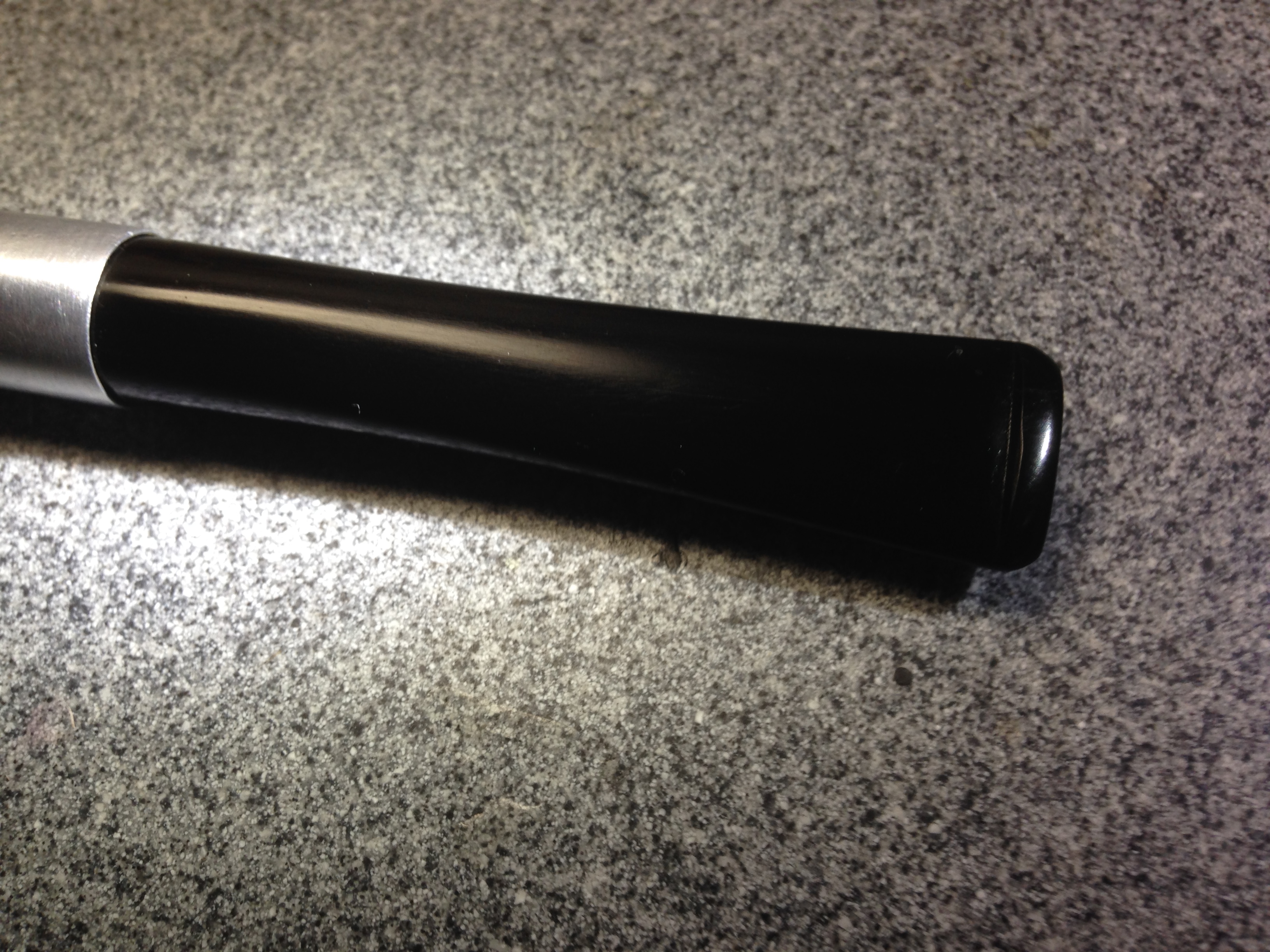
Check out the stems on these 3 restored estate pipes. They look OK, don’t they? Polished, shiny, no obvious oxidation.
001
Let’s look closer.

The upper stem seems OK.
002
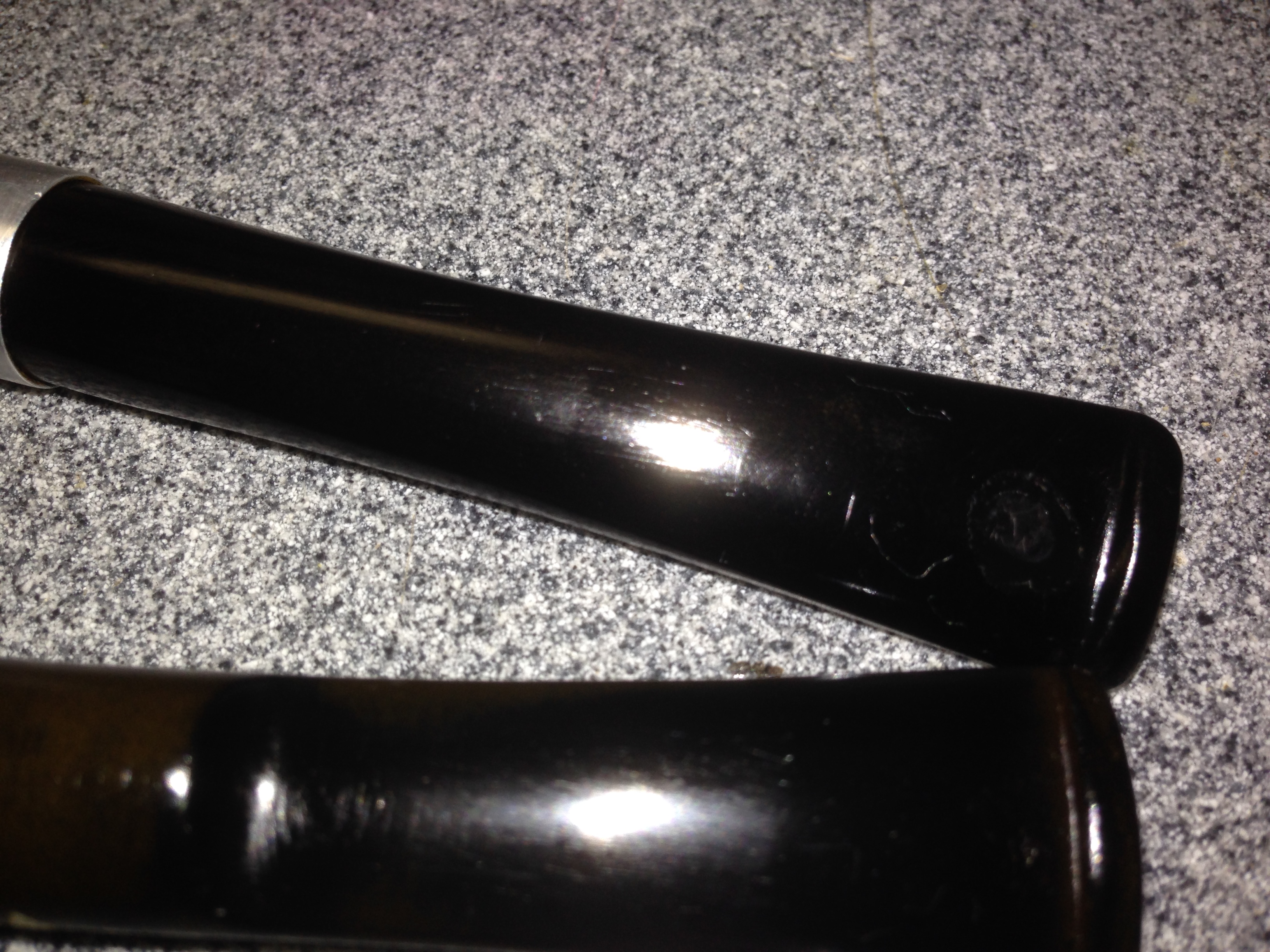
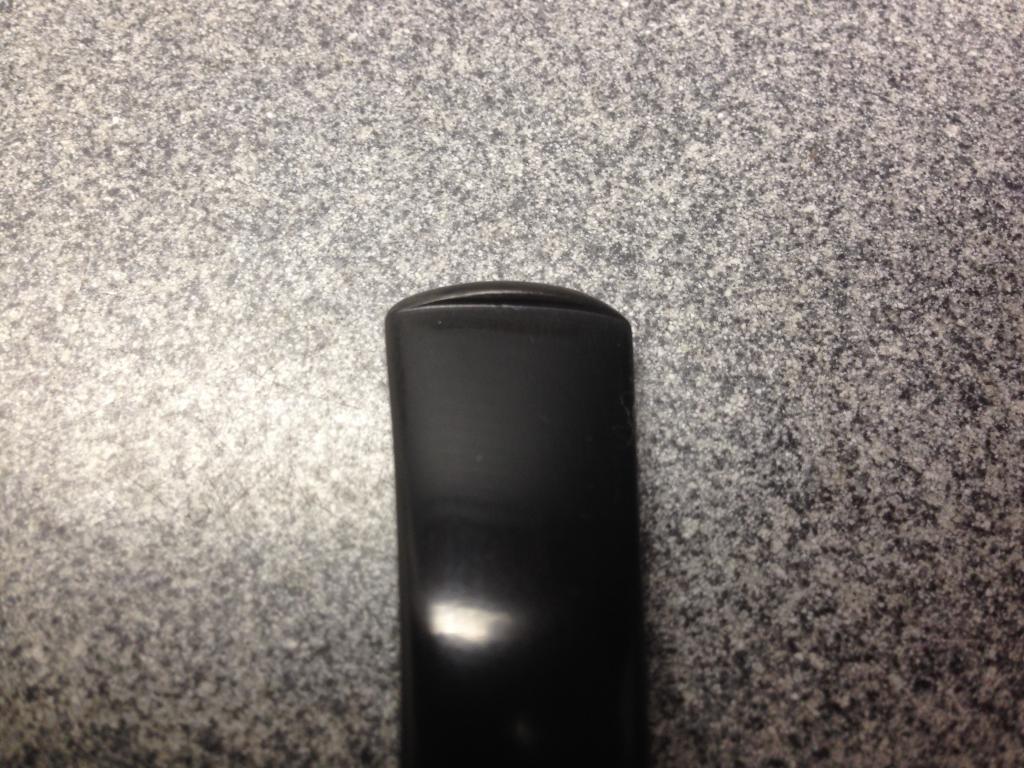
On the middle stem, is that oxidation near the shank end and also in the bit crease?
003
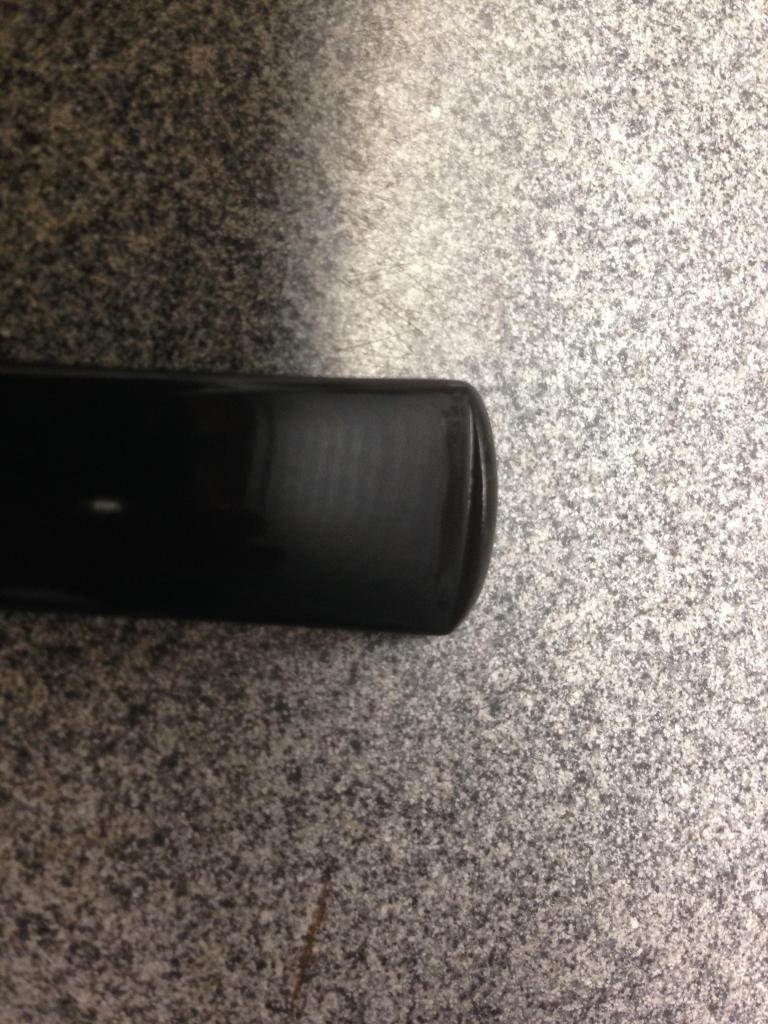
On the lower stem, how did I miss that oxidation toward the bit end?
004
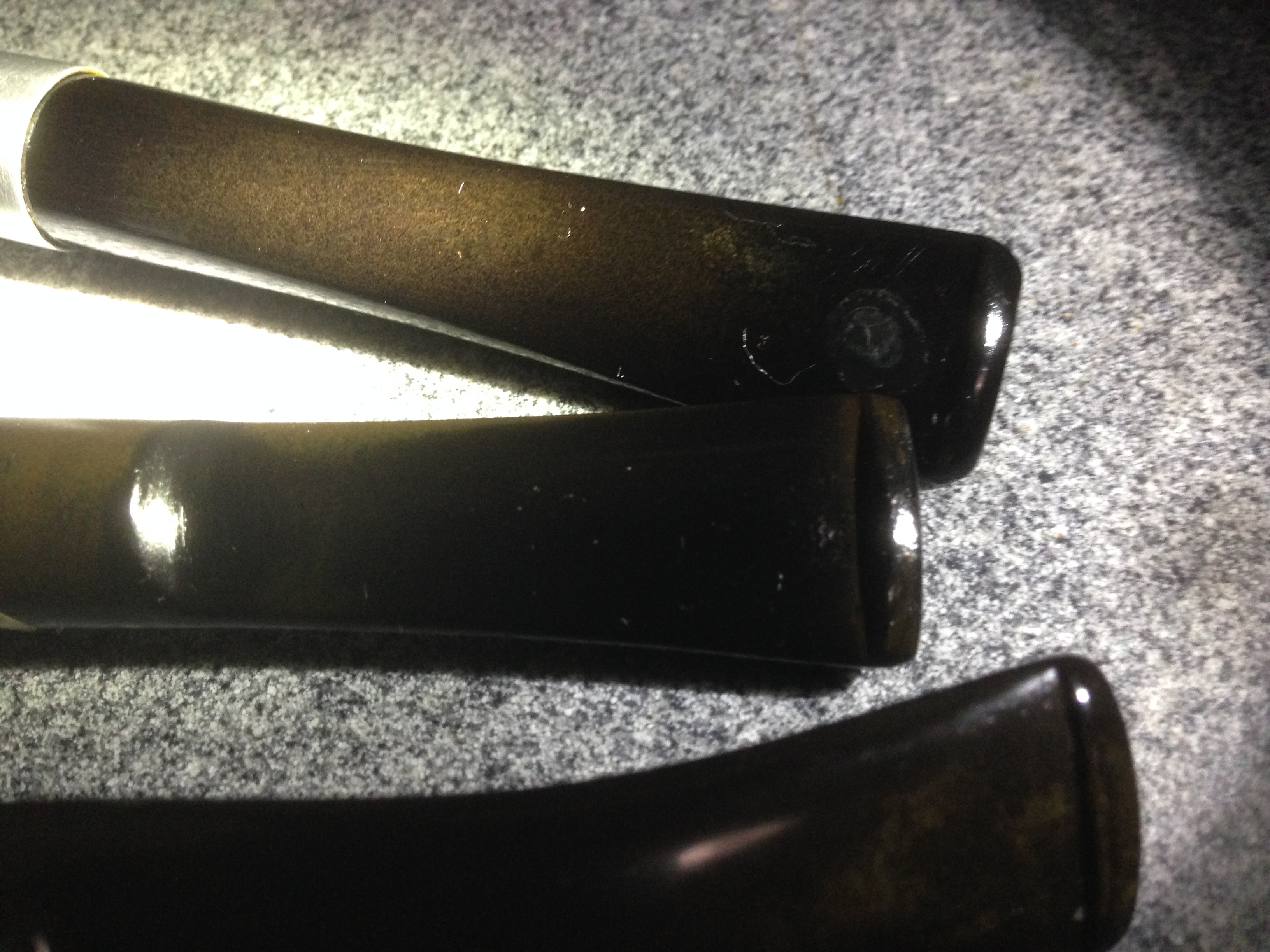
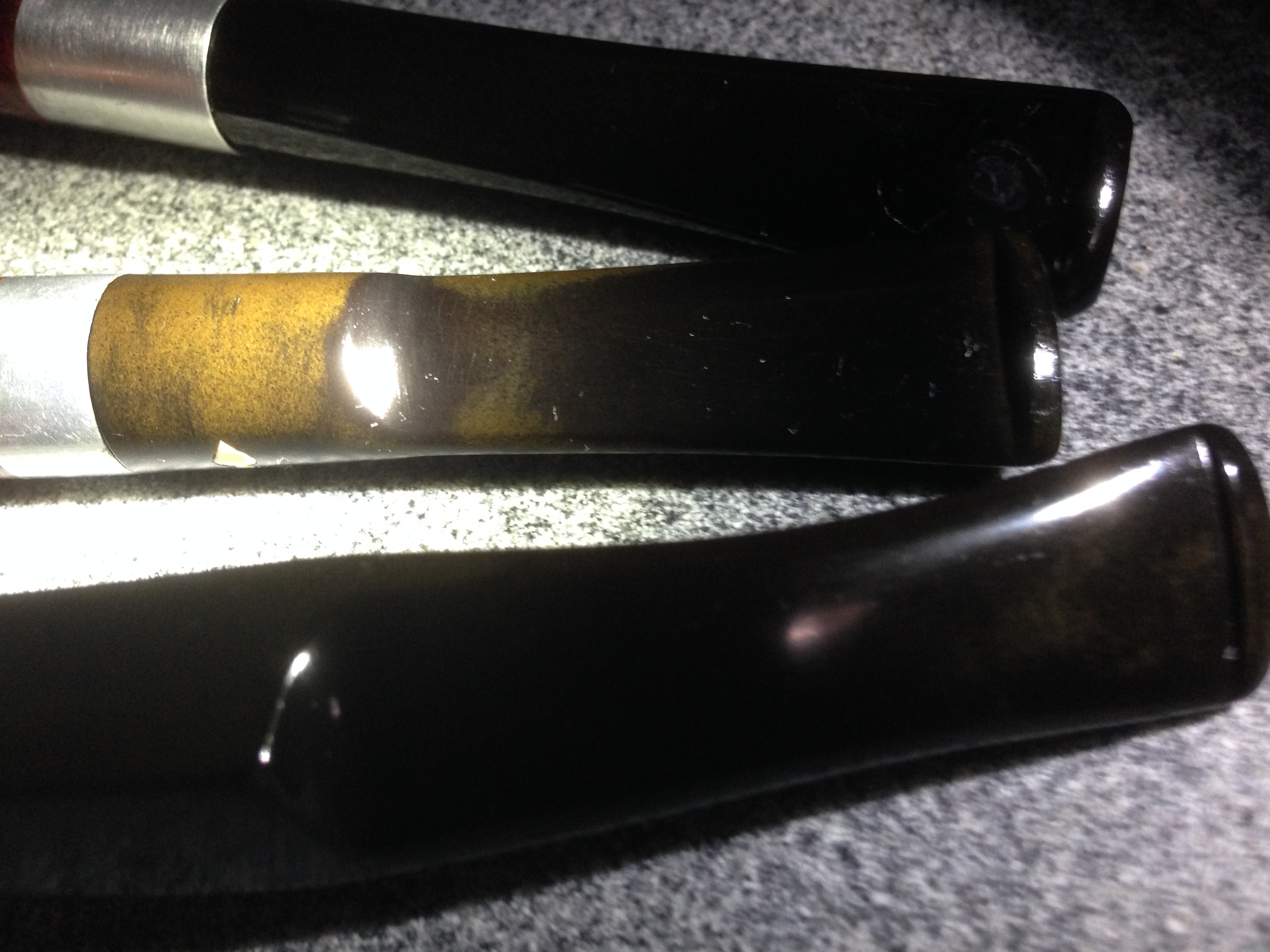
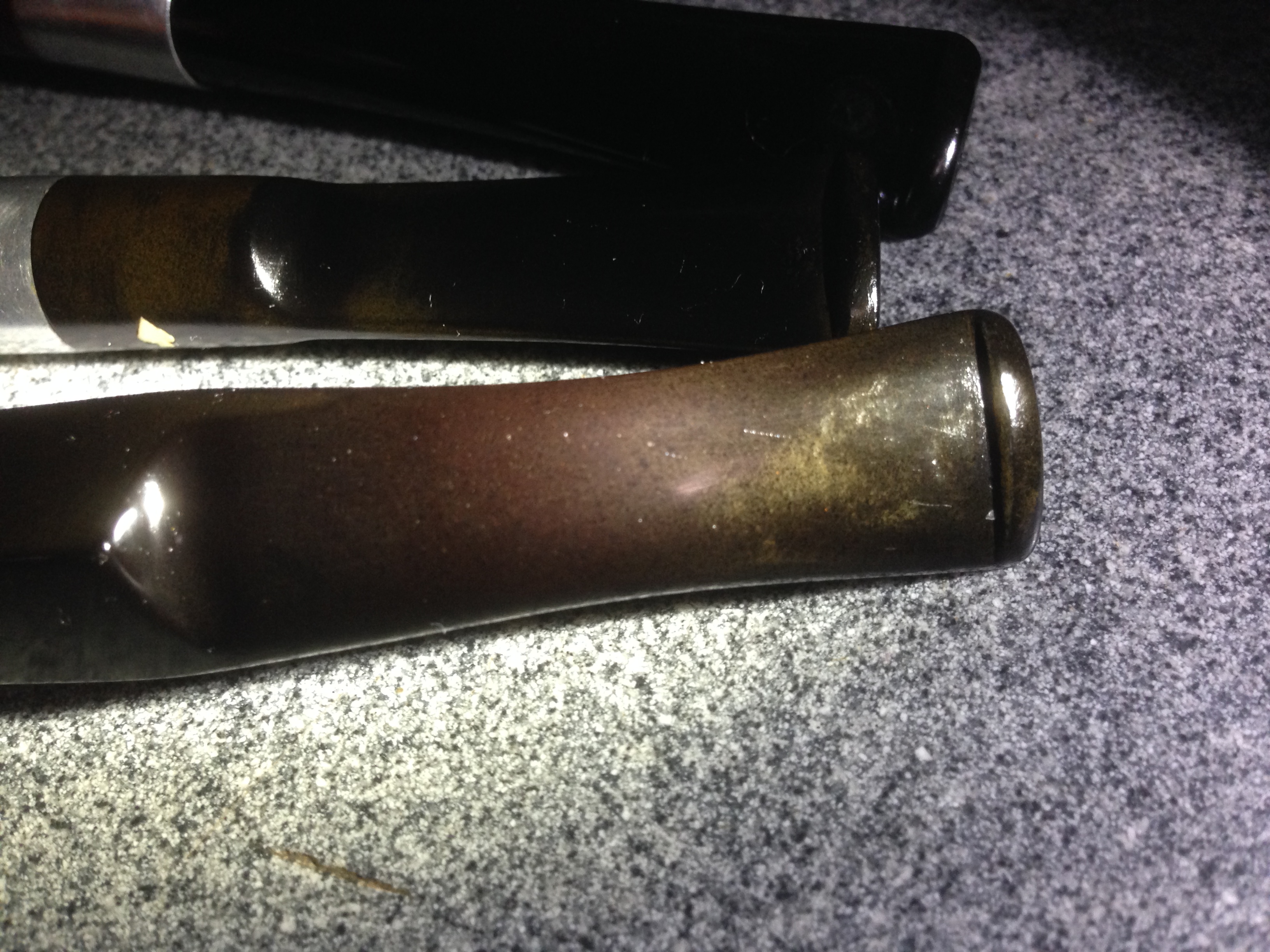
Let’s turn out the lights and shine a flashlight (at an angle) onto the stems.
005

006

007
HOLEY MOLEY, BATMAN!

Where did all of that oxidation come from?

I’ve got to start all over on these stems.

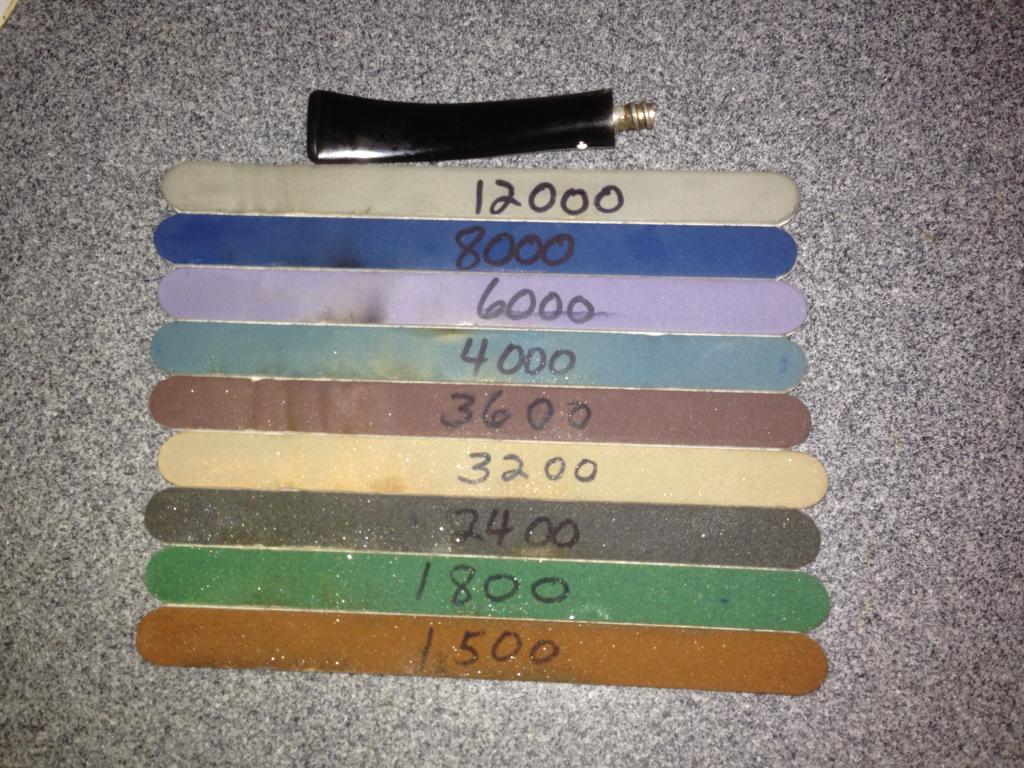
That deep oxidation can be removed – if you’re willing to spend a lot of time sanding, especially with the coarser grits. Start with a 2 hour Oxyclean bath to soften the oxidation. Then 220 grit wet/dry sandpaper with water. Then follow with 400, 600, maybe 800 and 1000 grit. Finally micro mesh pads (1500-12000), then final polish and buff.

Is it worth it to go after that deep oxidation? Maybe, maybe not. That’s up to you.

Followup on removing the oxidation on the stems.
Since I had already used Oxyclean on these stems, I got more aggressive the second time around. I put the stems in a bleach bath (50% diluted with water) for 1 hour. One of the stems wasn’t done so it went back in the bleach (at full strength) for 2 additional hours. Then I soaked the stems in an alcohol bath for 1 hour to neutralize the bleach smell and taste. Then I spent about 1 hour, on each stem, wet sanding (220, 400, 600, 800 grit) and micromesh (1500-12000). The following photos were taken before carnauba wax polishing/buffing. It was a lot of work but time well spent because the stems feel as smooth as satin to my lips and tongue.
Photo #1

Photo #2

Photo #3

rebornpipes Celebrates Two Years


Two years ago in May when I started this blog I literally had no idea how it would go or what its life expectancy might be. The only thing I dreamed of was to provide a spot online to gather the refurbishing posts and experiments that I was doing in a central place to lessen the number of “Look at this refurb” posts that I was putting on Smokers Forums and Pipe Smokers Unlimited Forums at that time. I know that there are only so many ways that folks can say nice job. My purpose in posting was not to hear the kudos but to disseminate information on an aspect of our hobby that I had come to love. I also wanted to build a community of amateur refurbishers that could share experience, hope and joy with each other in the midst of a common hobby. I remember how hard it was to find the information I sought on how to do some aspect of the restoration of an estate pipe. I would post on the forums, send emails to repair people and generally make a nuisance of myself to find out how to do things.

I truly wanted to have a web spot that provided helpful experiential and experimental information for the people seeking to do their own restoration work. I wanted it to become a place that people turned to for help and ideas but more importantly I wanted it to be a place where more people than just me wrote about my work. I wanted to see a broad range of writers from around the globe share what they were learning and new methods that they had tweaked or developed in the work of refurbishing pipes. I had little or no idea on how to achieve that. One of my daughters had set up blog on WordPress so I had a look and just started posting some of my earlier work. It was pretty much a one note trumpet the day I started it – just me posting what I had learned.

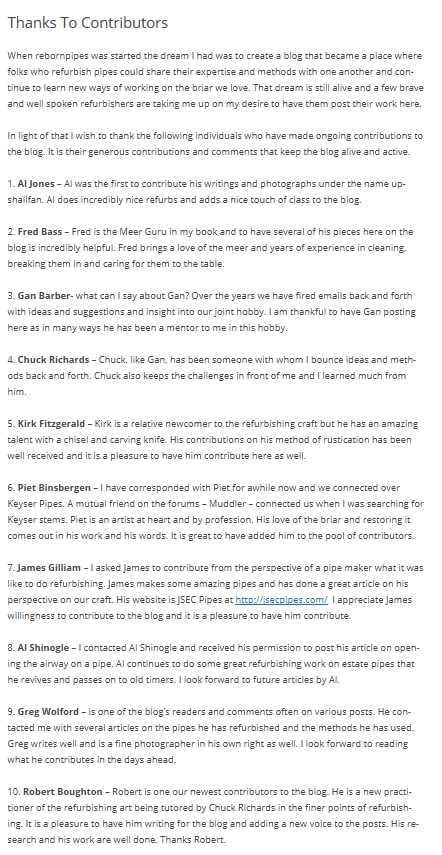
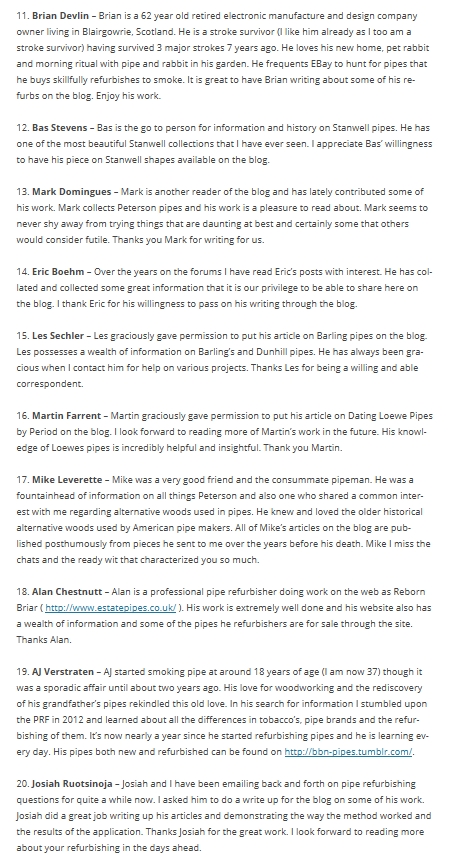
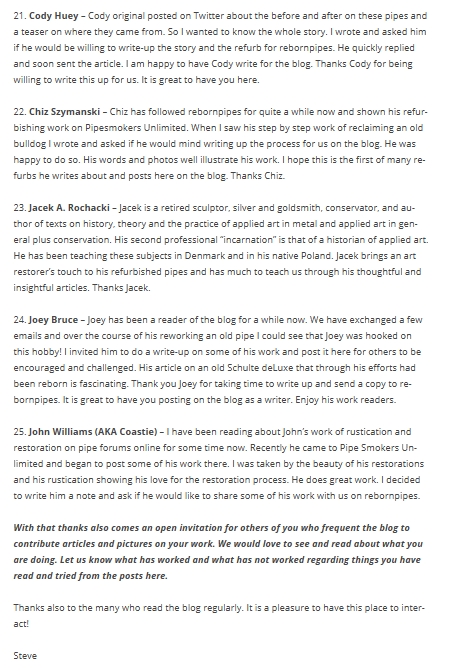
Over the two years I have invited others to post their work as well. Some of them were individuals I had met online or in person and enjoyed reading about their work. Others were readers of the blog who wrote to thank me for what I had posted. I always appreciate the thanks but also am fairly quick to invite submissions for posts. From its early days on the blog has added contributors to the list of writers. I think some of the earliest were Al Jones and Fred Bass. I so appreciate their willingness to step out “where no one had walked before” and submit articles to the blog. Over the years others have joined them on the list. The list of thanks to contributors has grown and continues to grow even today. I have included a screen capture of the list below just to give you an idea of the growth. What originally started with me grew to Al and Fred and I and now the list includes 25 individuals from a broad representation of countries. There are writers from Canada, the US, England, Ireland, Scotland, Netherlands, Germany, South Africa and Poland. The age of the writers is also broad from younger pipemen to old timers who have been pipemen for many years. They represent many walks of life and levels of skill in the practice of refurbishing but they share a common love for the pipe and hobby.
Contrib1

contrib2

contrib3
Since I last updated this list several other contributors have been joined. Sometime very soon I need to update this list and show the new additions. But even with the growing list of contributors there is still room for more practitioners of our art to write up their work and share their processes with the community at large. I hope that in the coming year many more of you will consider sharing what you have learned as you practice our hobby.

While hearing from other refurbishers and reading about their work is something that I have enjoyed through the blog it is not the only aspect that has been a great pleasure for me. I have found that many more people read the posts than contribute either through comments or articles. In the statistical part of the WordPress interface it has been fun to watch the growing readership and see where they come from. The readership of the blog is growing globally. People from nearly every continent are reading and responding to the articles. That has been exciting to see. It is amazing to me to see articles from the blog translated into many languages and see people in the national forums interacting with the methods and tips. It only makes me wish I could spend the time to interact on each of the online communities and enjoy the fellowship of the pipe more broadly.
stats1
The numerical growth in readers that rebornpipes has experienced has been something that I truly never imagined the day in May 2012 when I started it with a few of my articles on refurbishing. I am glad that we seem to have reached a niche that was not tapped before. To show some of that growth, I have included the screen capture below showing the growth in readership/visits over the past two years. In summary, the first year (starting in May 2012) there were 39,646 readers/viewers of the blog. In 2013 there were 131,441 readers and this year, 2014, in the first sixth months the number of readers/viewers is 84,633. It is mind-boggling to me to try to comprehend the extent of the readership of the blog.
stats
It has been great to hear from quite a few of the readers over the years. I am thankful that many of you have taken time to send me an email and let me know what you enjoy and what you would like to see covered. I appreciate the notes of thanks and encouragement that continue to come to me. It has been a pleasure to work on rebornpipes. I am thankful to the readers and all of the ongoing and one time contributors for their willingness to take the time to write about what they have learned and to be willing to pass it on. I only ask that you continue to do so.

In terms of my own work, I don’t think that I will ever stop hunting for and finding estate pipes to refurbish. I am continually on the lookout for pipes needing the attention. Even when my box of pipes for refurbishing is almost empty it seems to almost magically fill up again. Lately even friends in the city drop by for a visit with pipes for me to have a look at or repair. It is something that is now a part of my leisure life, one in which I find rest and pleasure.

Once again, I thank you all for your support. The past two years have flown by so quickly that I can hardly believe they have passed. It seems like only yesterday I was sitting with my daughters dreaming up a name for a blog that they encouraged me to write and now we celebrate two years. Wow. I raise my pipe today and say to you all, “Here’s to yet another great year ahead as we work on the pipes that come our way. Take time to read about, write about and smoke the pipes you are reworking”.

Trying to Remedy a Hot Smoking Peterson Killarney 999


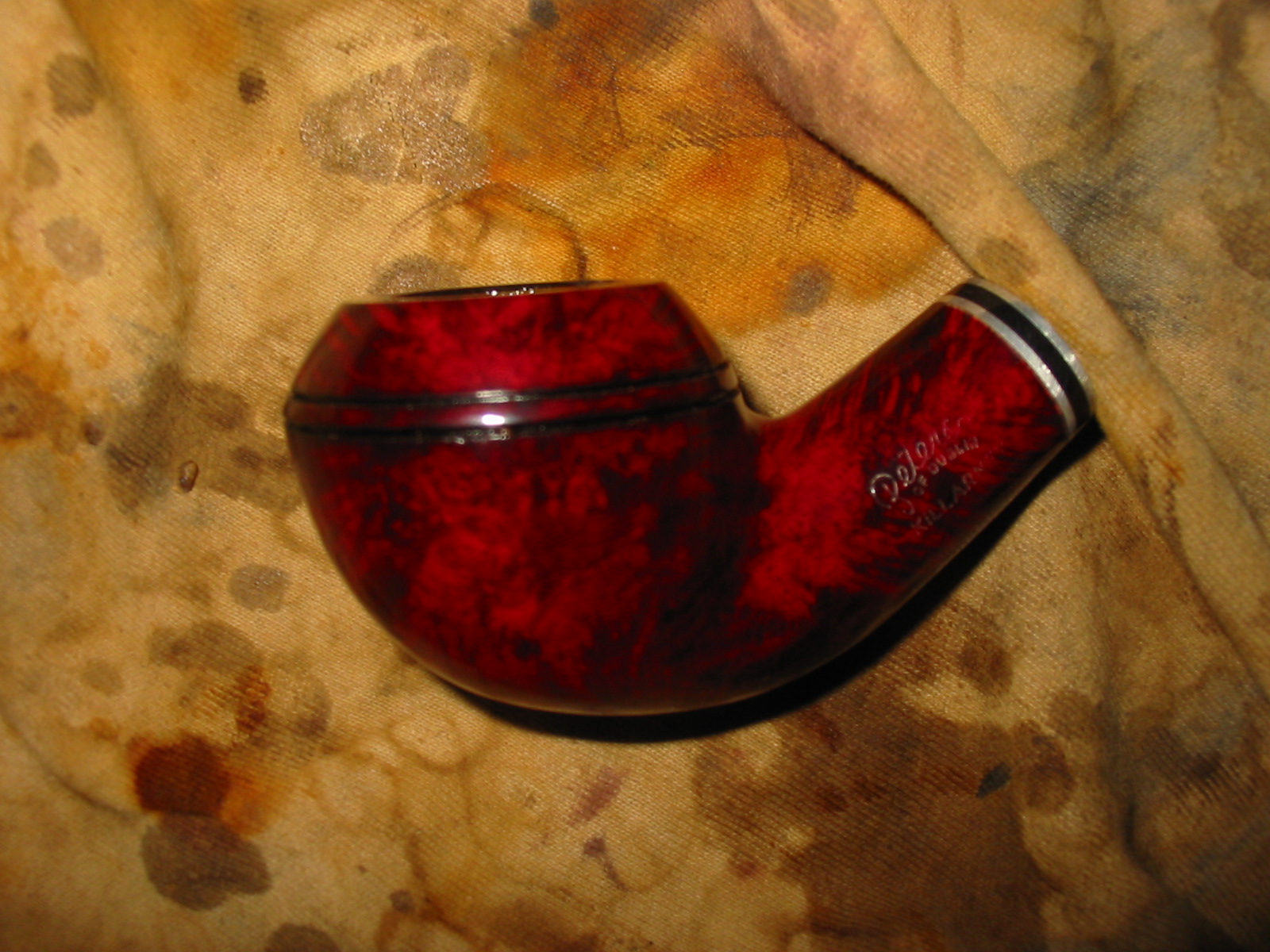
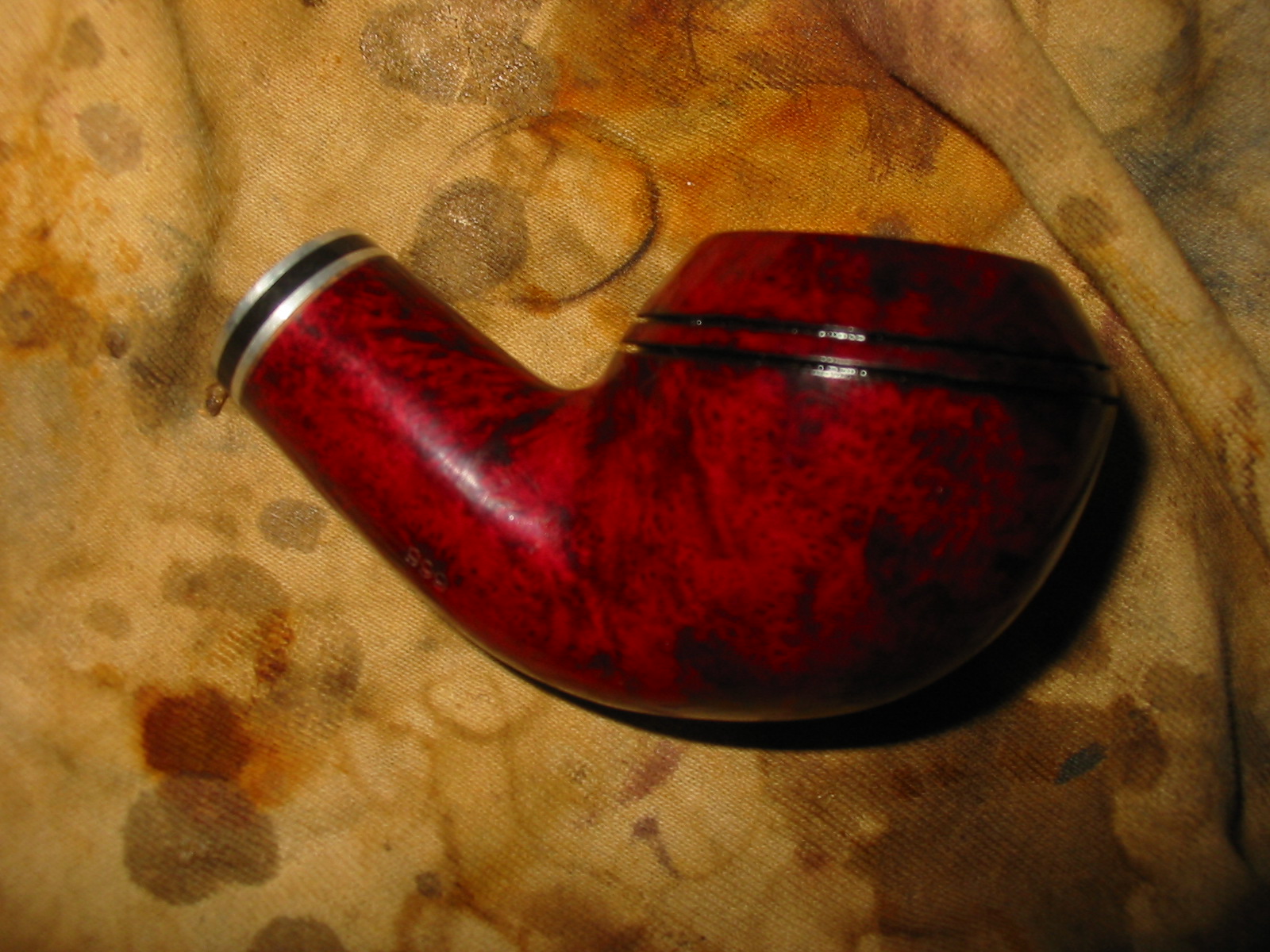
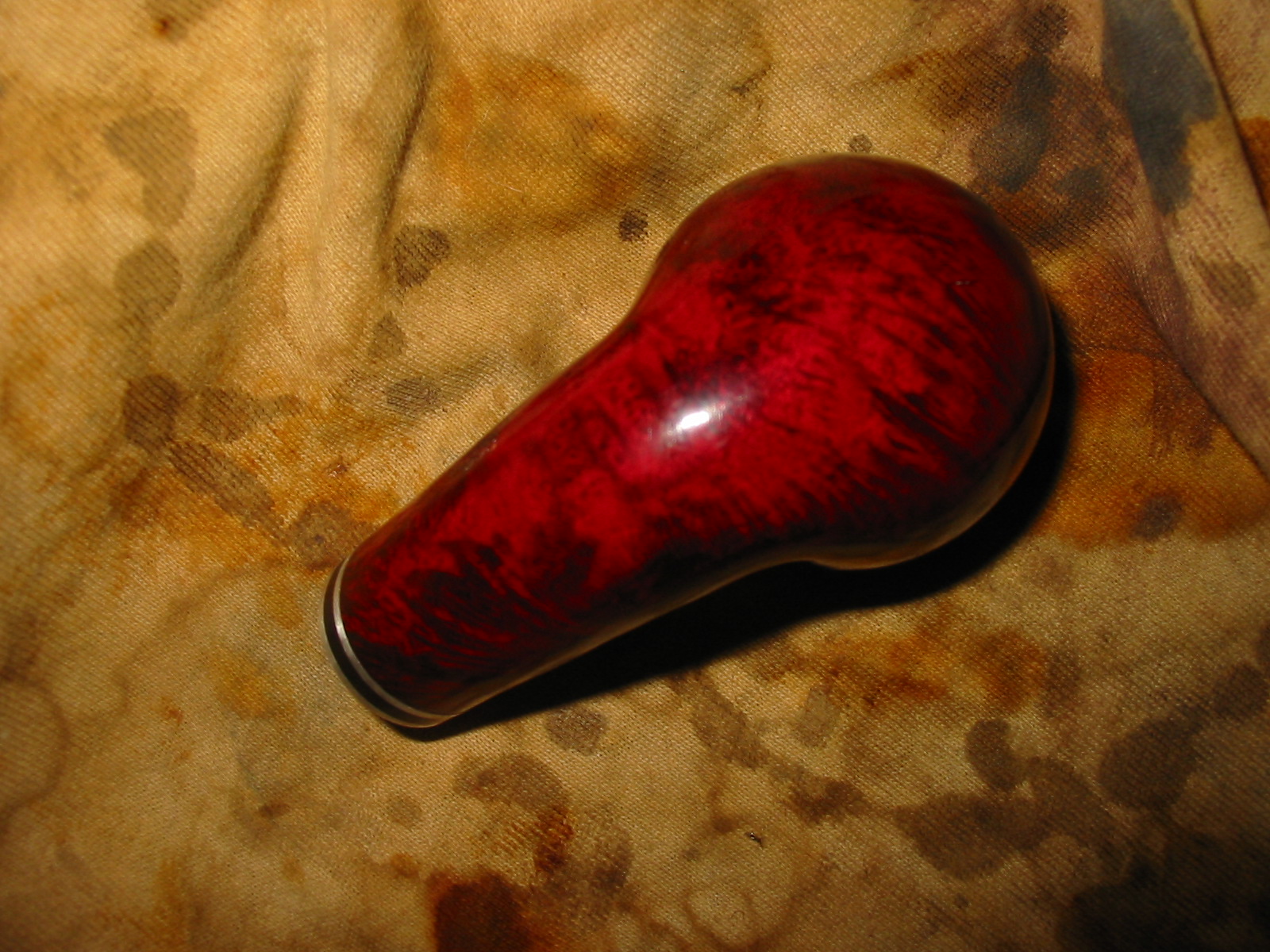
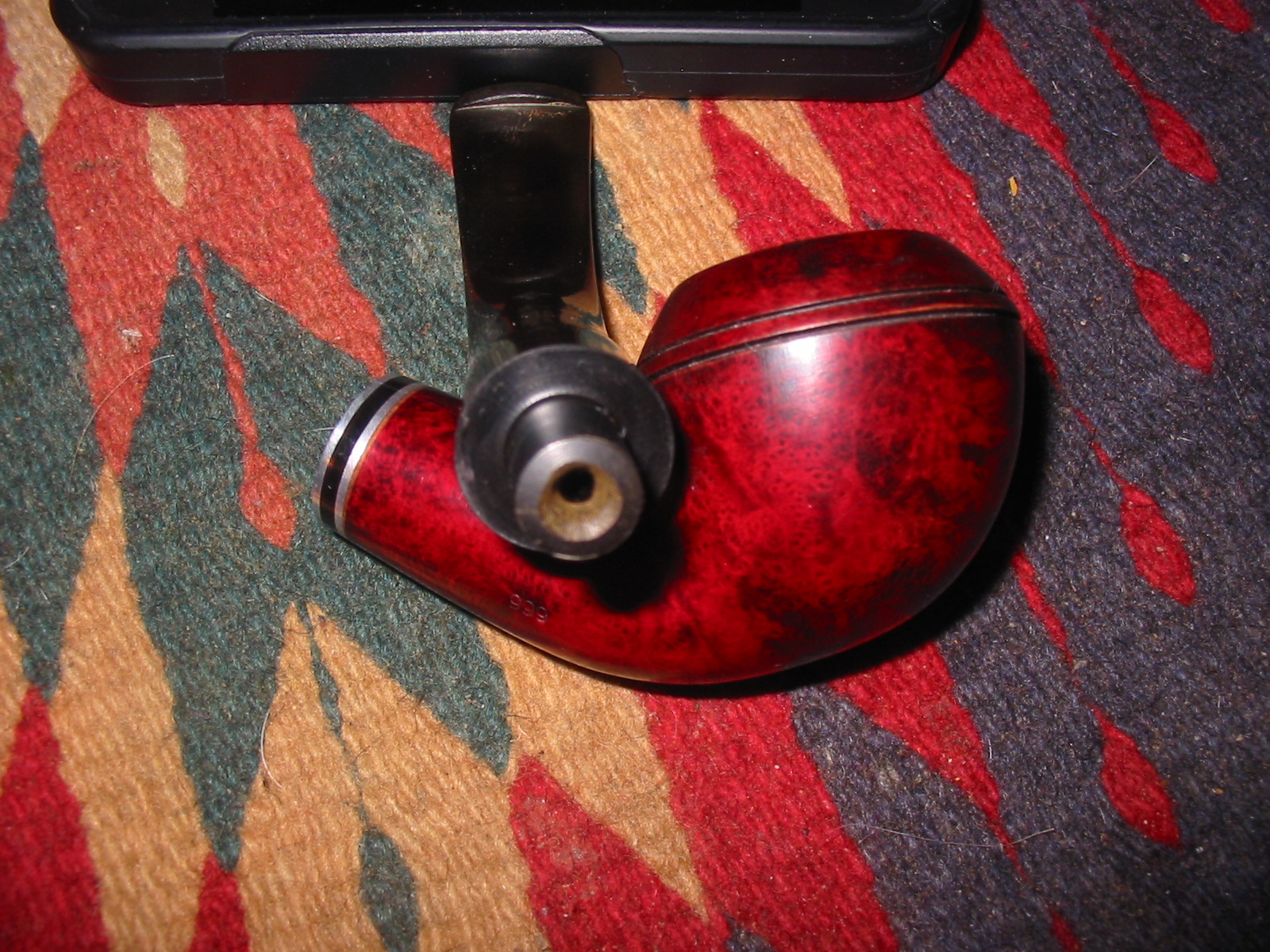
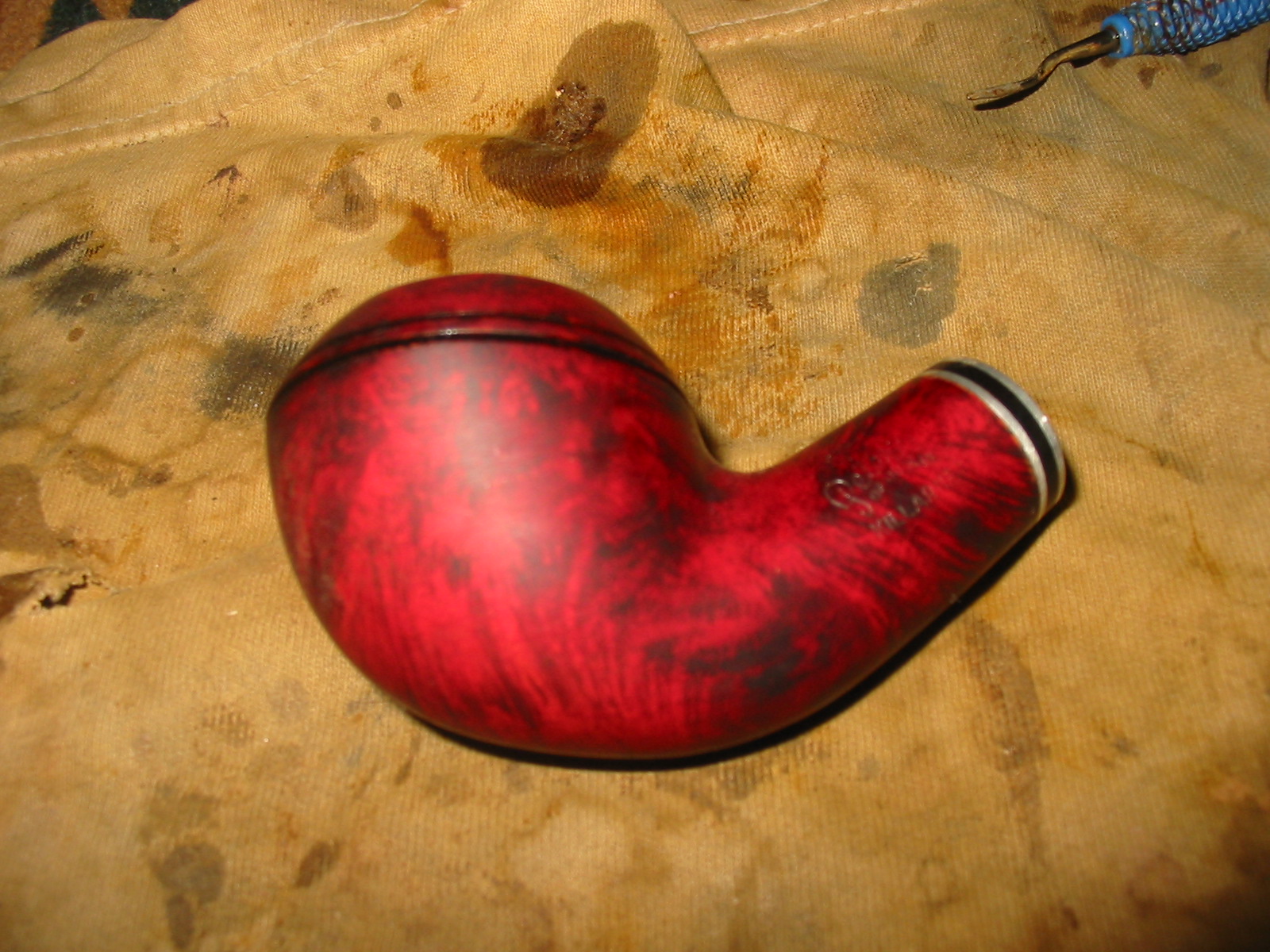
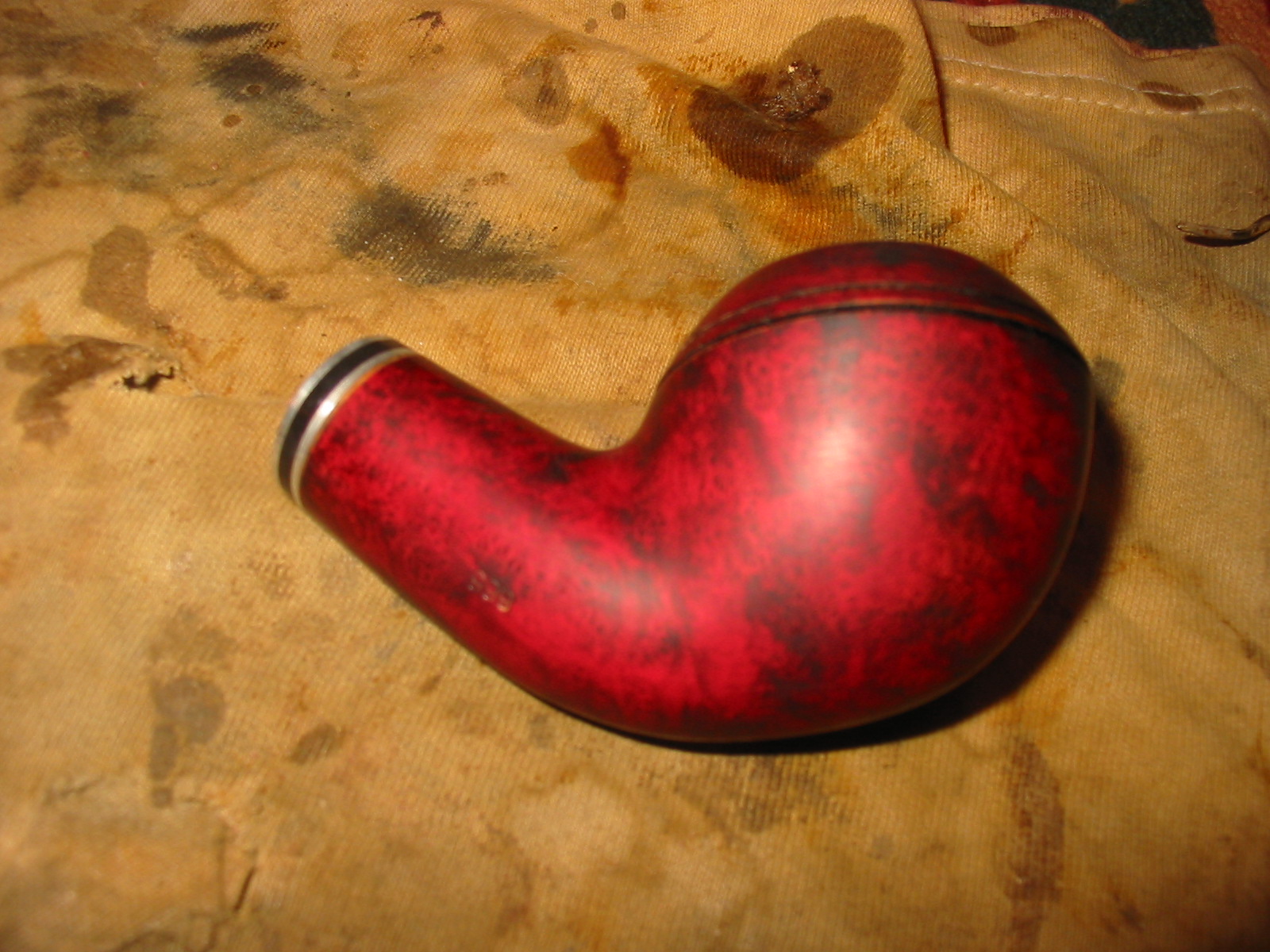
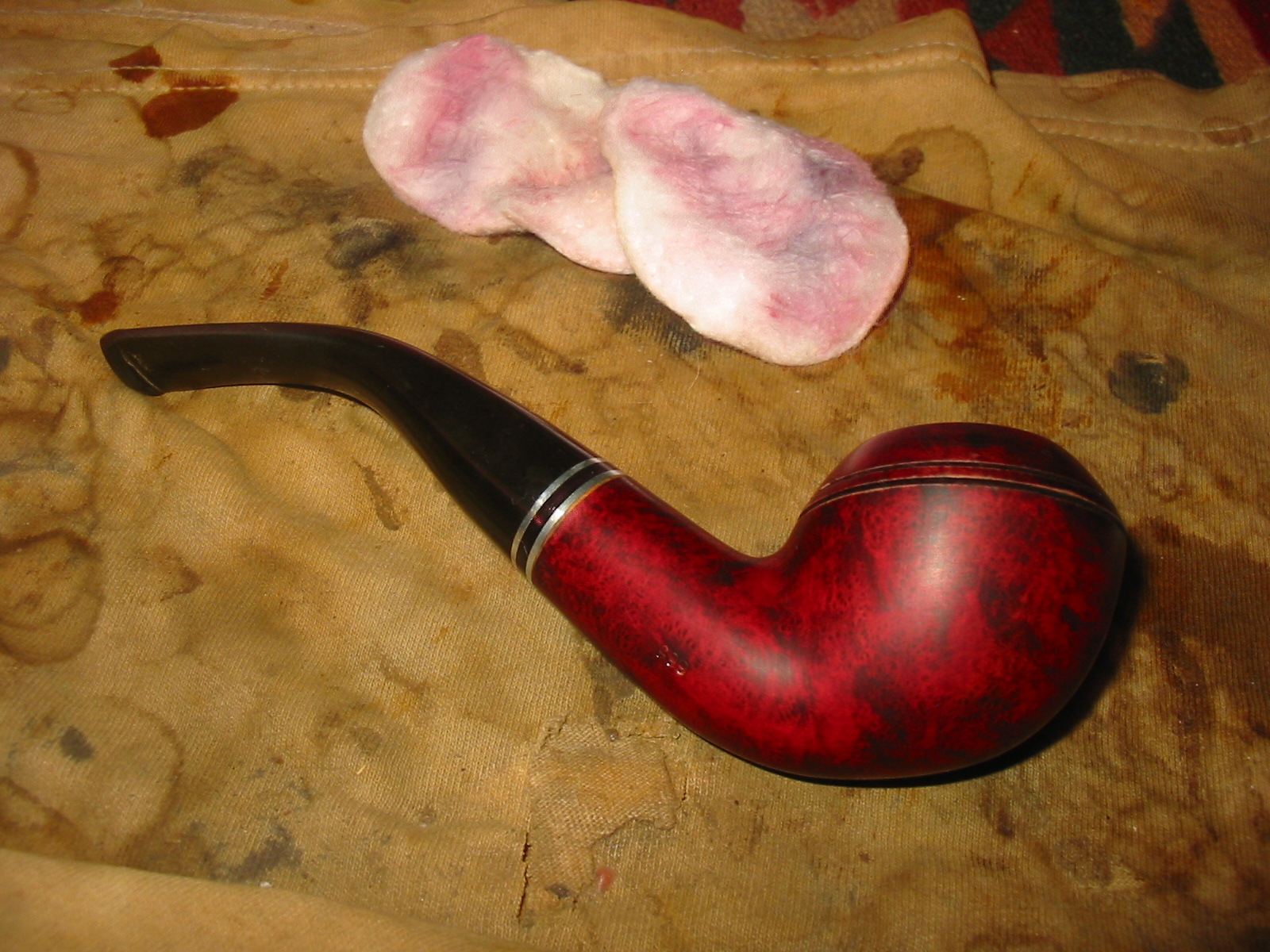
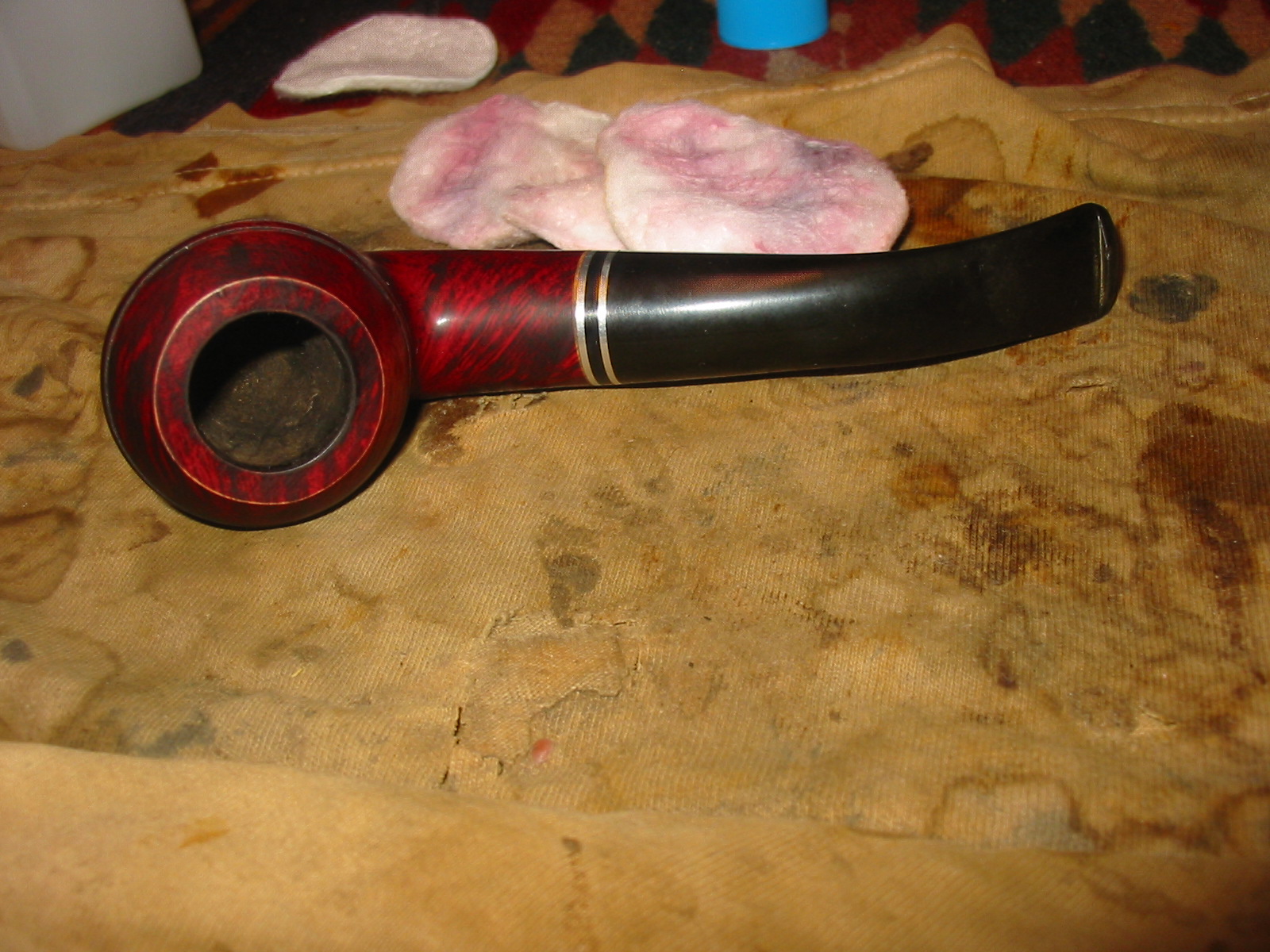
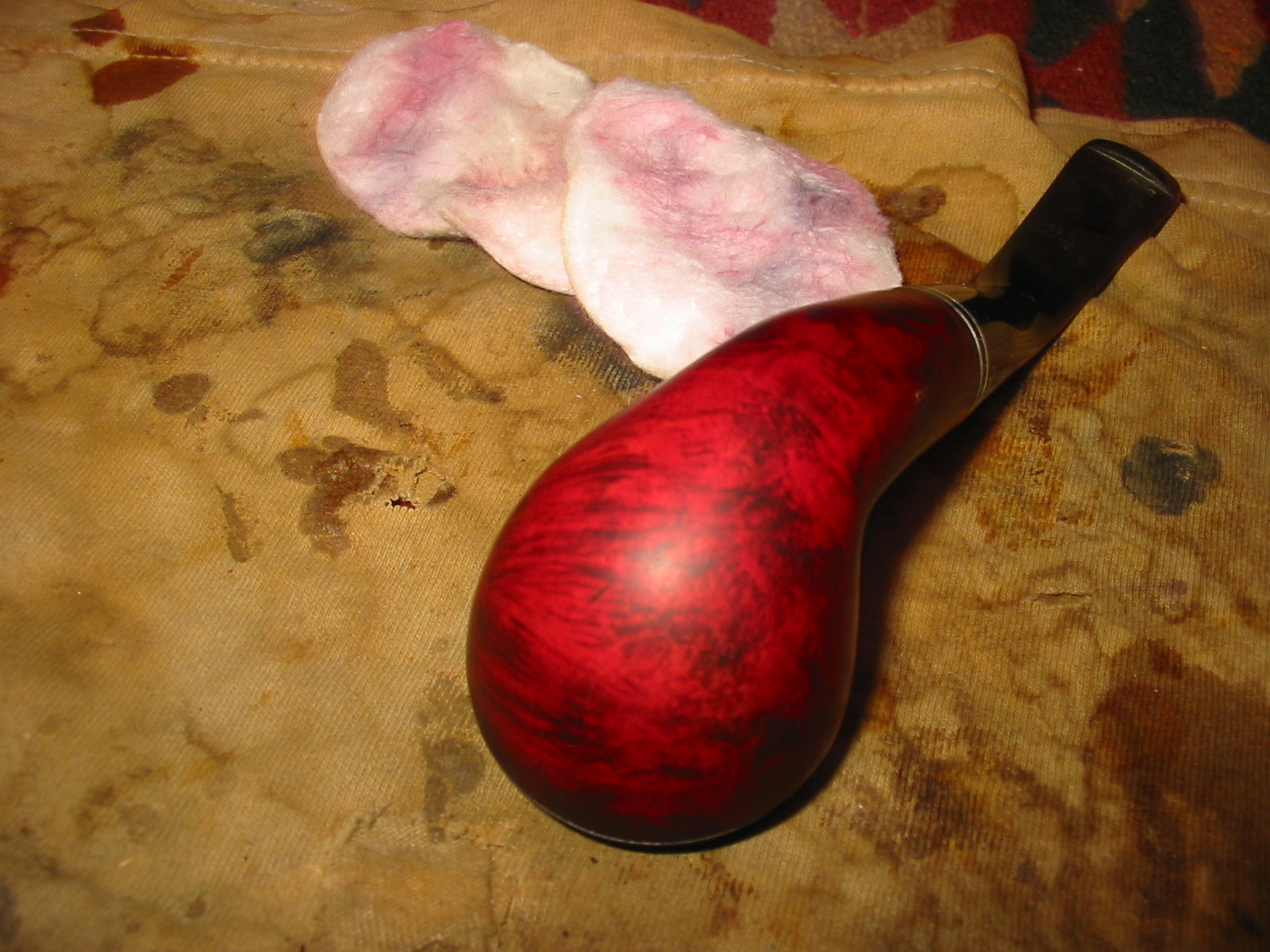
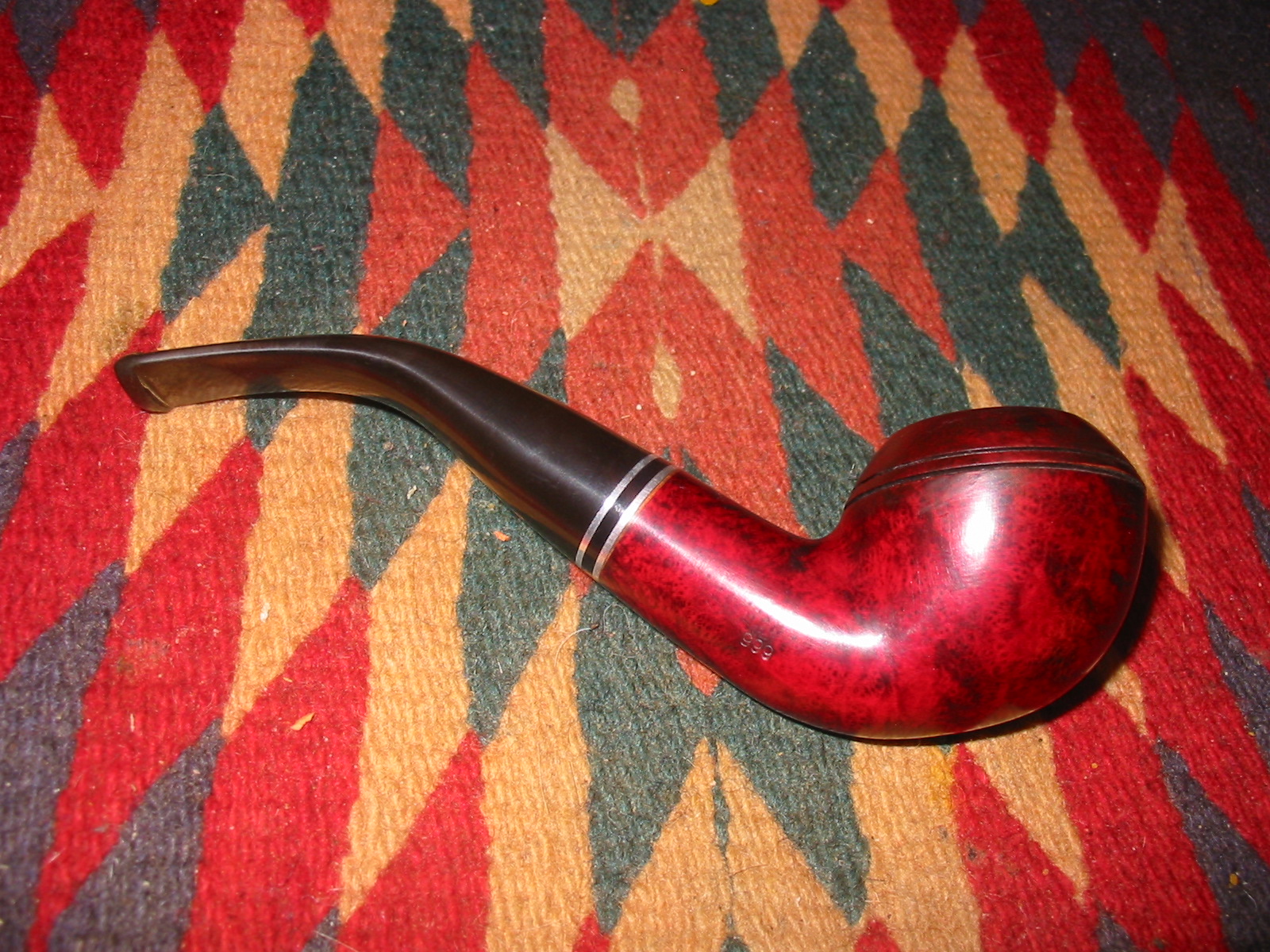
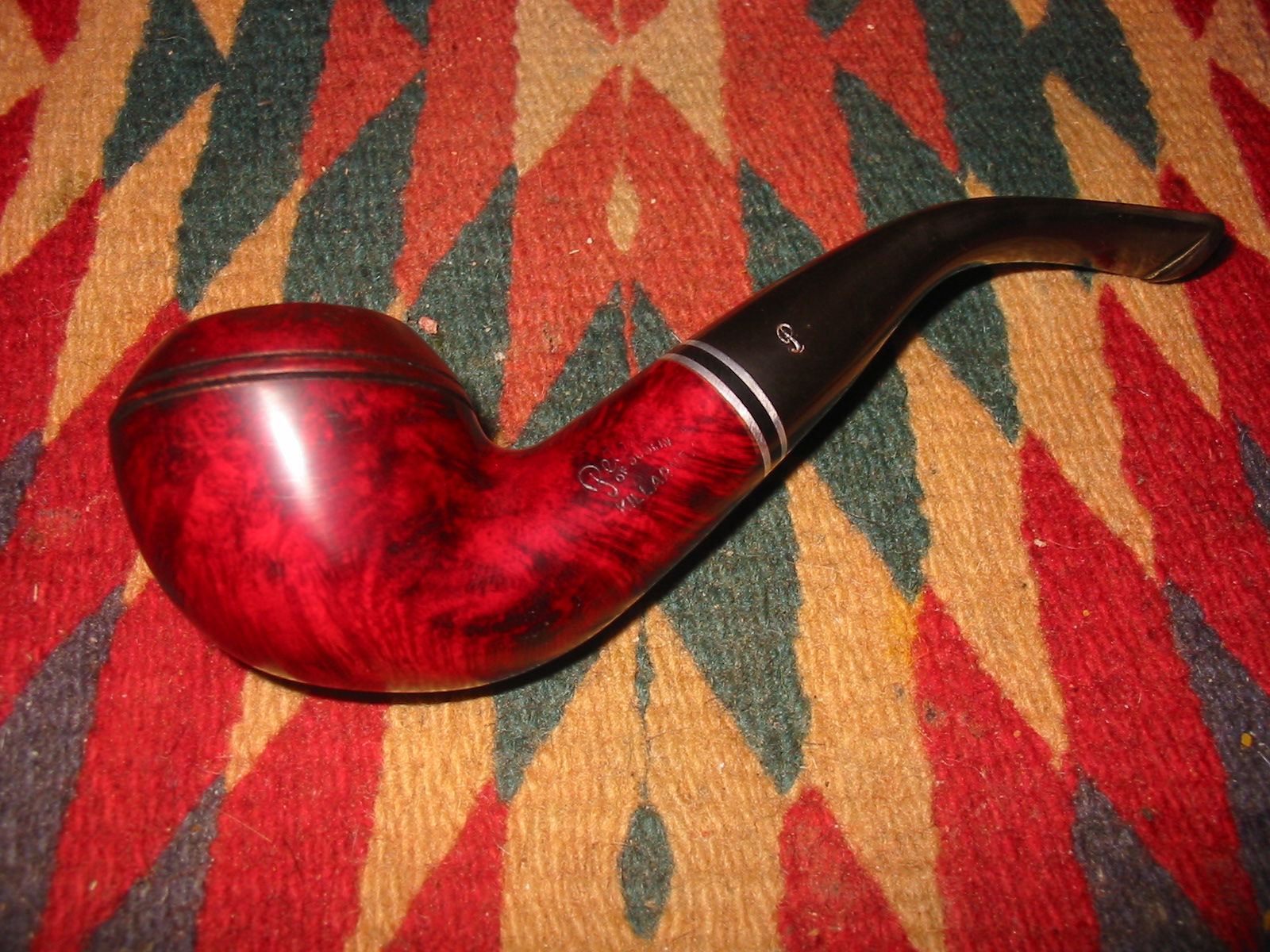
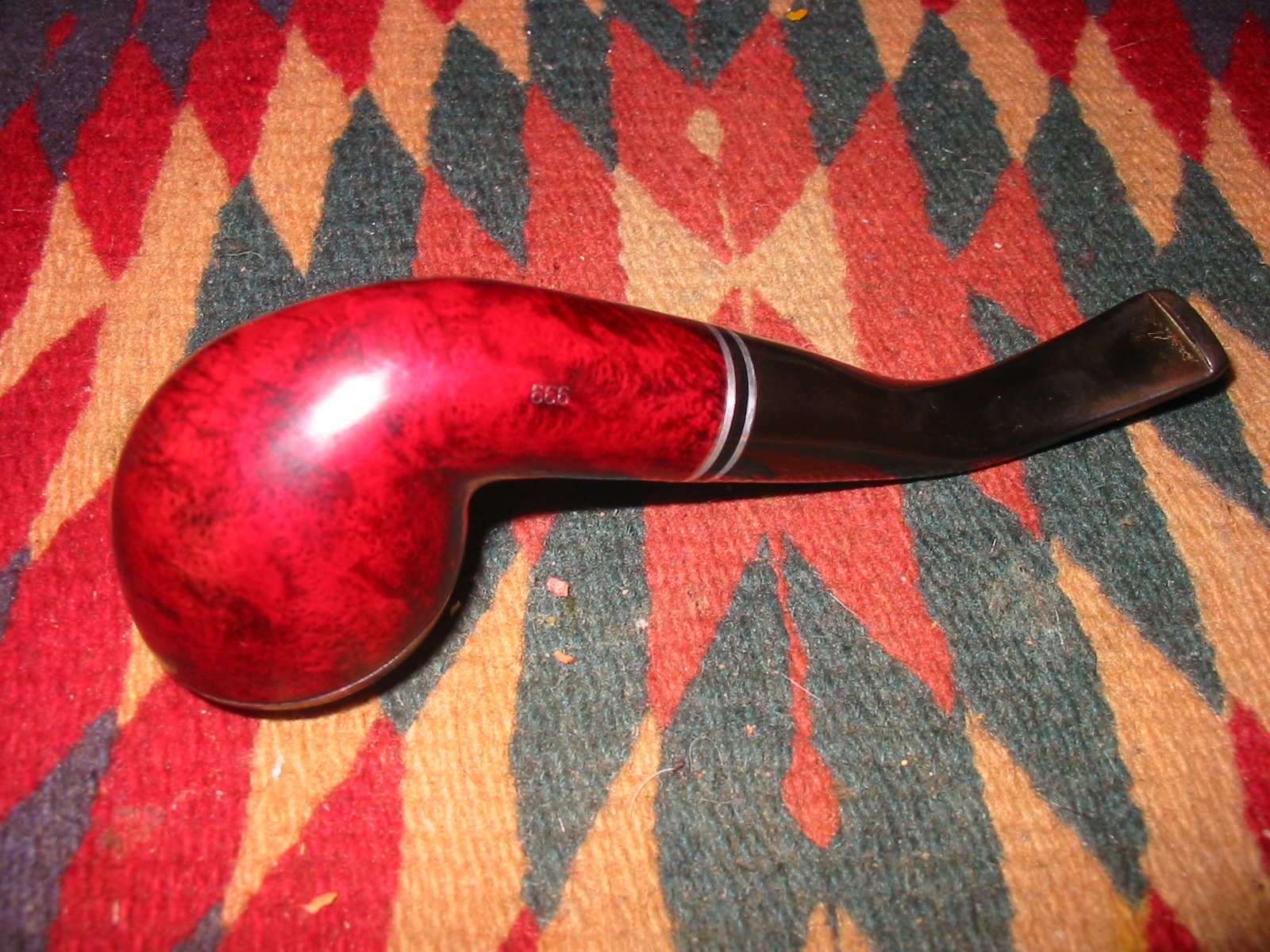
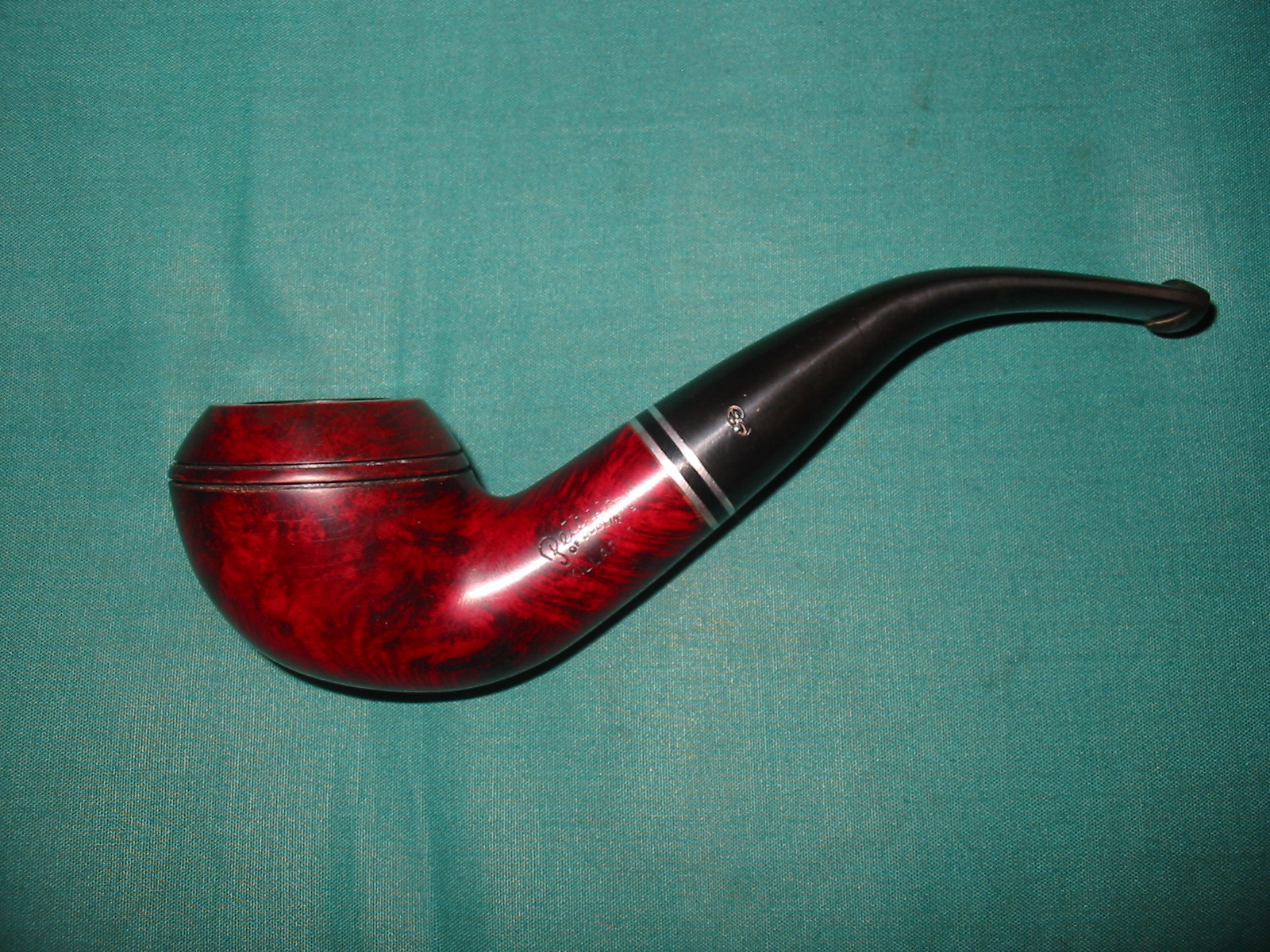
I recently received an email from a friend here in Vancouver about a new Peterson Killarney 999 that he had purchased. He said that though it was a beauty and was quite a good smoking pipe it smoked so hot that he did not enjoy smoking it. He explained to me that when he smoked it the pipe became too hot to hold. He has been a pipeman for many years and never has this issue with his pipes so I knew it was not a technique issue. He explained to me that he had posted about it online seeking advice and everyone told him that it had to be the finish on the pipe. Many suggested that he needed to strip the finish off the bowl, restain it and it would be better. I have learned that there are other causes for a pipe smoking hot. All of them can conspire against a cool smoke. A thick coat of varnish or sealer could possibly be one of those contributing causes but I was just not sure if removing that would cure the issue. We emailed back and forth with questions that I had on the drilling of the pipe, the depth of the bowl, the thickness of the walls etc. He patiently responded to them and finally dropped the pipe by for me to look over. When I got it on the work table and took it apart to have a look I could see that there were multiple issues that would need to be dealt with. Hopefully as each part was addressed the end result would be a cooler smoking pipe.
IMG_6810

IMG_6811

IMG_6812

IMG_6813
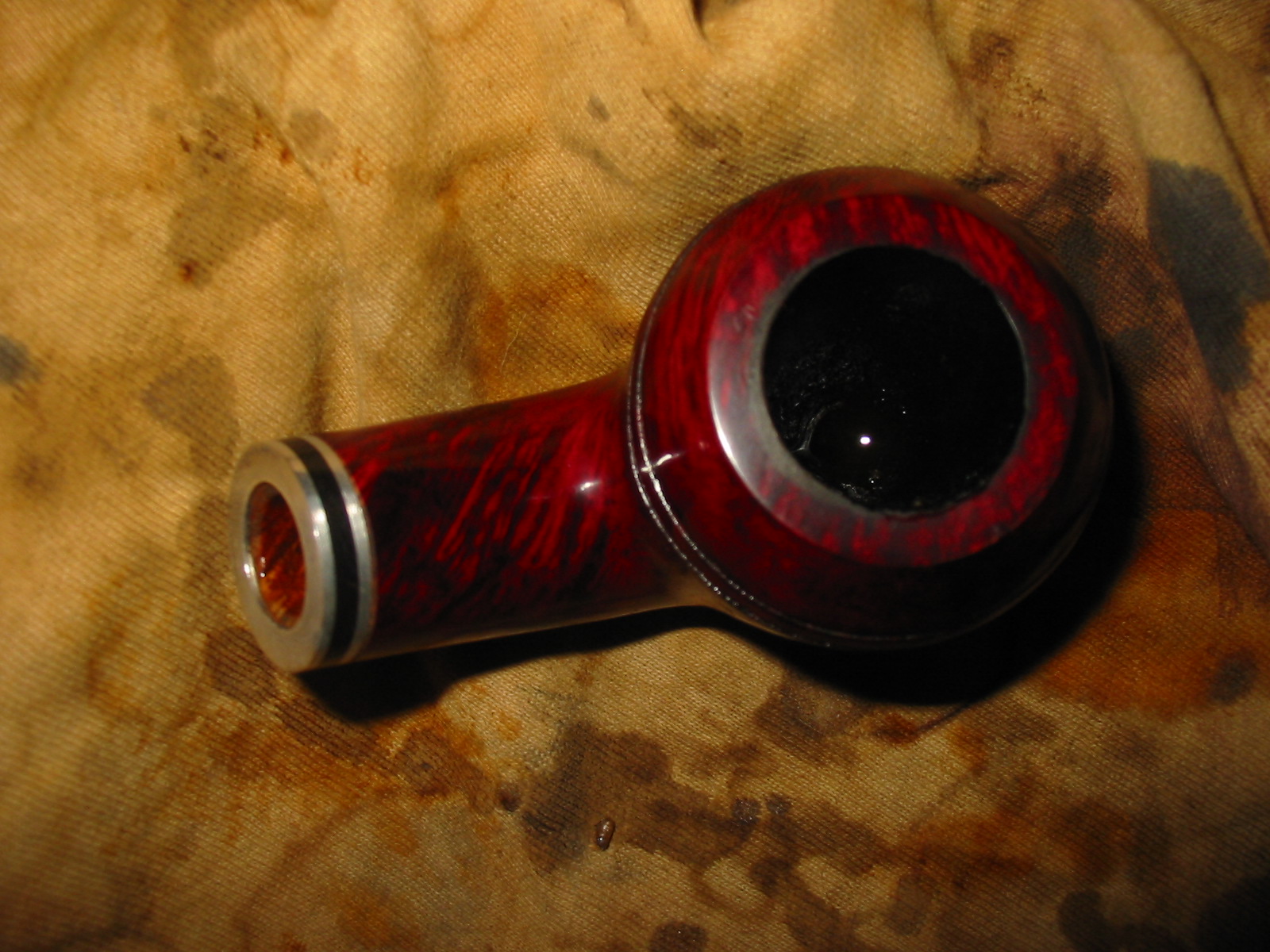
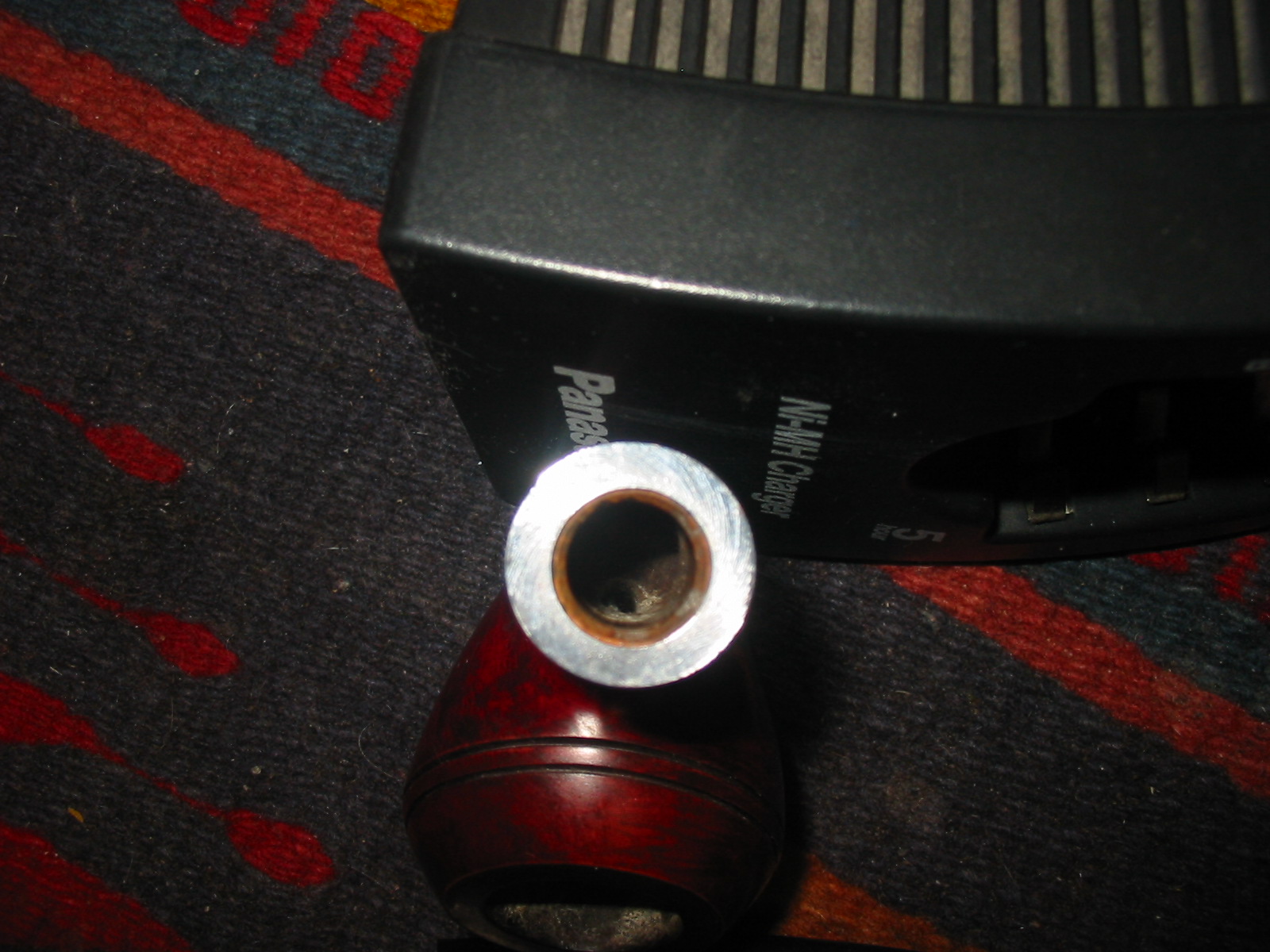
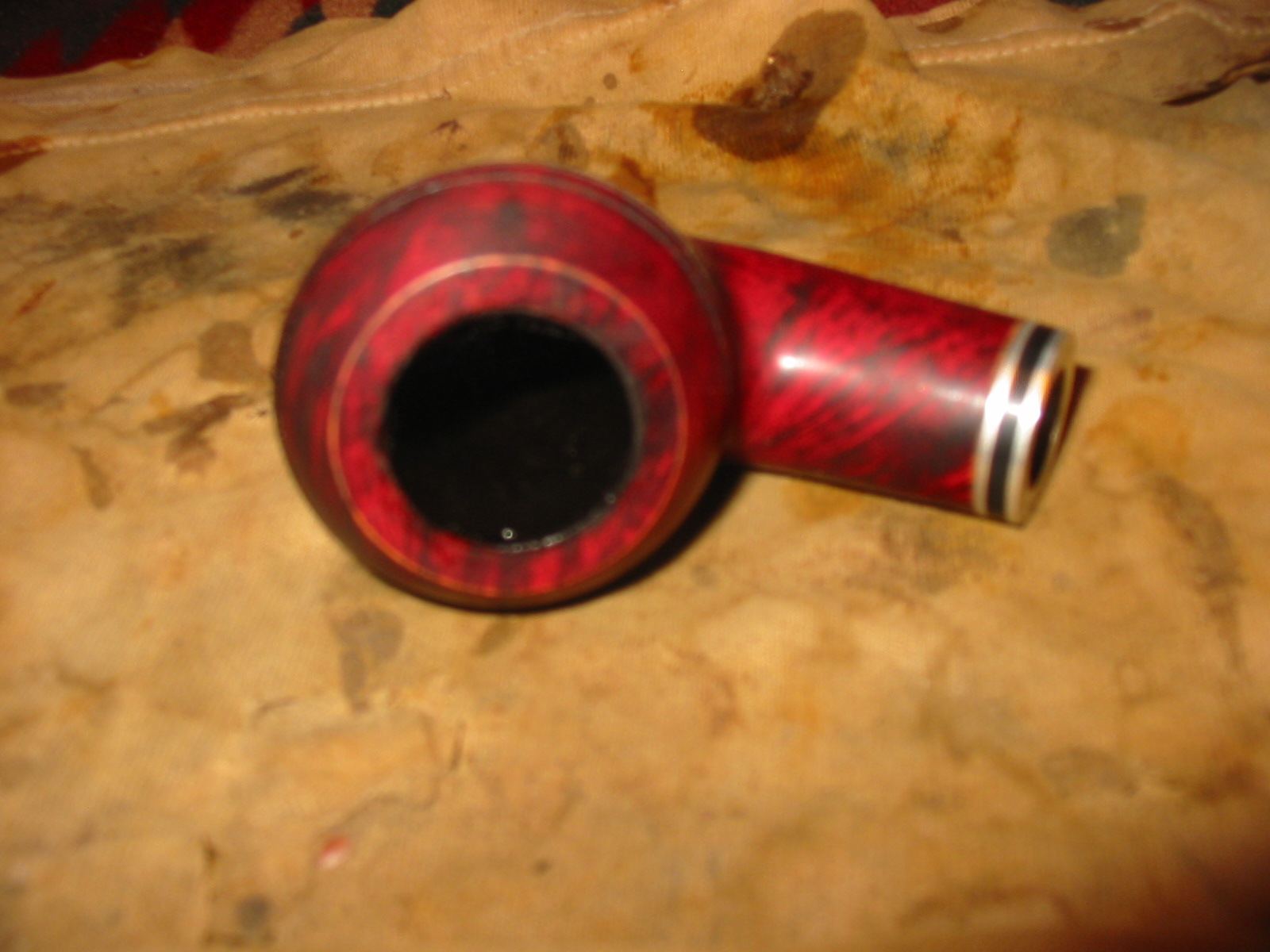
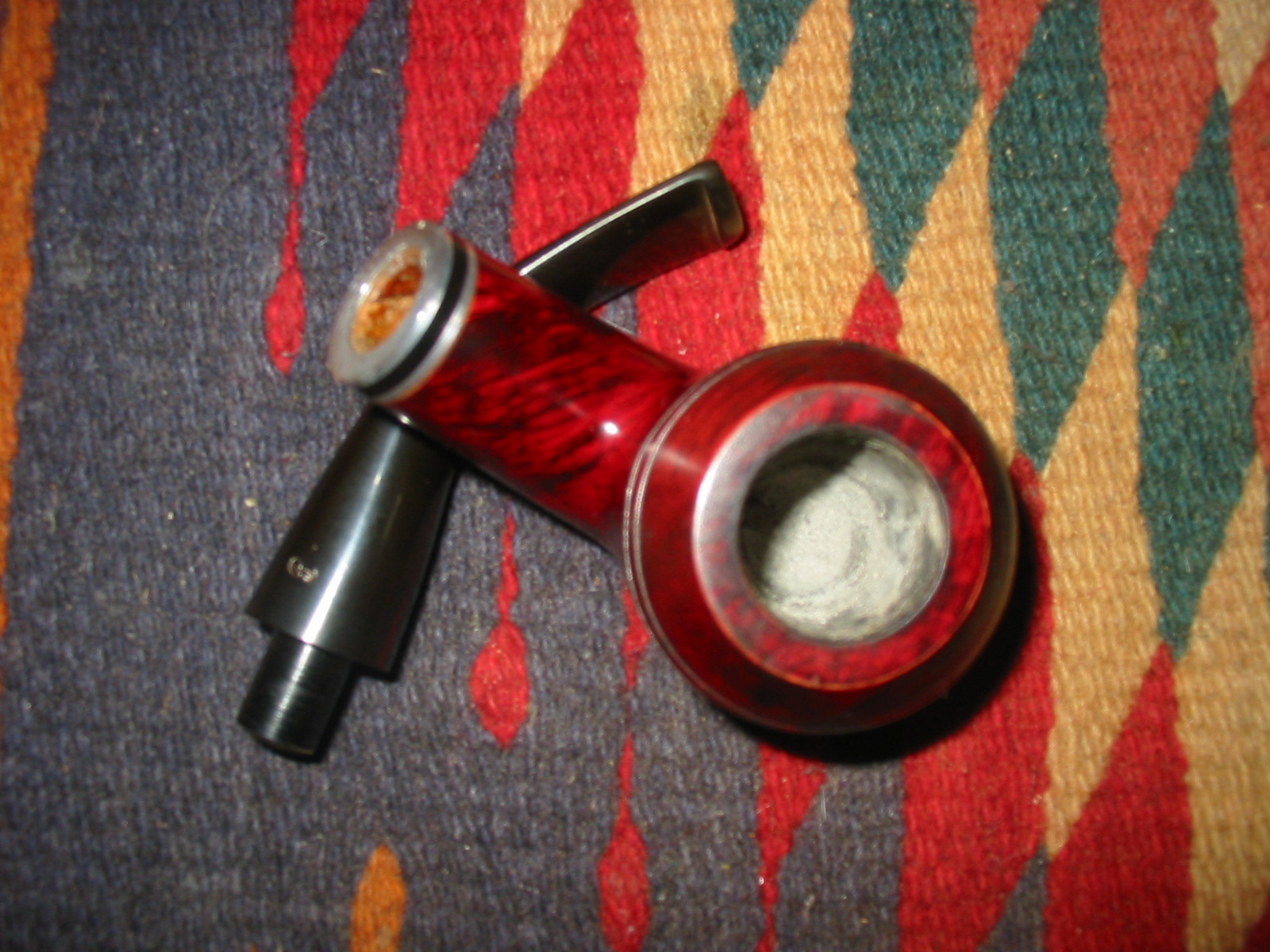
The first thing I saw was that the bowl had been over drilled and the entrance of the airway was high on the side of the bowl. This left the bottom of the bowl and bottom sides quite thin. This would need to be addressed. Then I removed the stem and shone a light down the shank. It too had been drilled very high in the shank and the briar on the top of the shank was also quite thin. I know that on the Peterson pipes there is often a reservoir left for collecting moisture but this was not for that. The end of the mortise was smooth and drilling was very high. I had taken a draw on the pipe and found that it was quite restricted so I was not surprised to see the high drilling. The airway in the tenon was significantly below the airway in the mortise. The way the tenon sat in the shank very little of the airway in the stem contacted the airway in the mortise. Finally I looked at the finish on the pipe. The stain was a dark cherry red. The bowl seemed to have a coat of varnish or something on it. Examining it carefully it became clear that it was more of a plastic coat than just varnish – possibly a urethane finish. To my thinking each of these contributed toward making it a very hot smoking pipe. I was not certain that I could do a lot to change that but I could address each of the issues and see if combined the reworking would make the pipe smoke cooler.
IMG_6826
I started with the stem and beveled or chamfered the end of the tenon with a wide funnel. I used a knife to do this rather than a countersink. I wanted to control the angle of the funnel and widen the opening without thinning down the walls of the tenon. I have found in the past that when the airway is high in the mortise, that a funneled end on the tenon can open up the air flow. I believed that in this case the restricted draw could be relieved. Once it was finished I sanded the newly opened funnel to smooth things out and then pushed the stem back in place on the shank. The draw was significantly improved. By opening the airway the flow of air from the bowl would not require as much puffing and pulling by the smoker. The first step in the process was complete.
IMG_6827
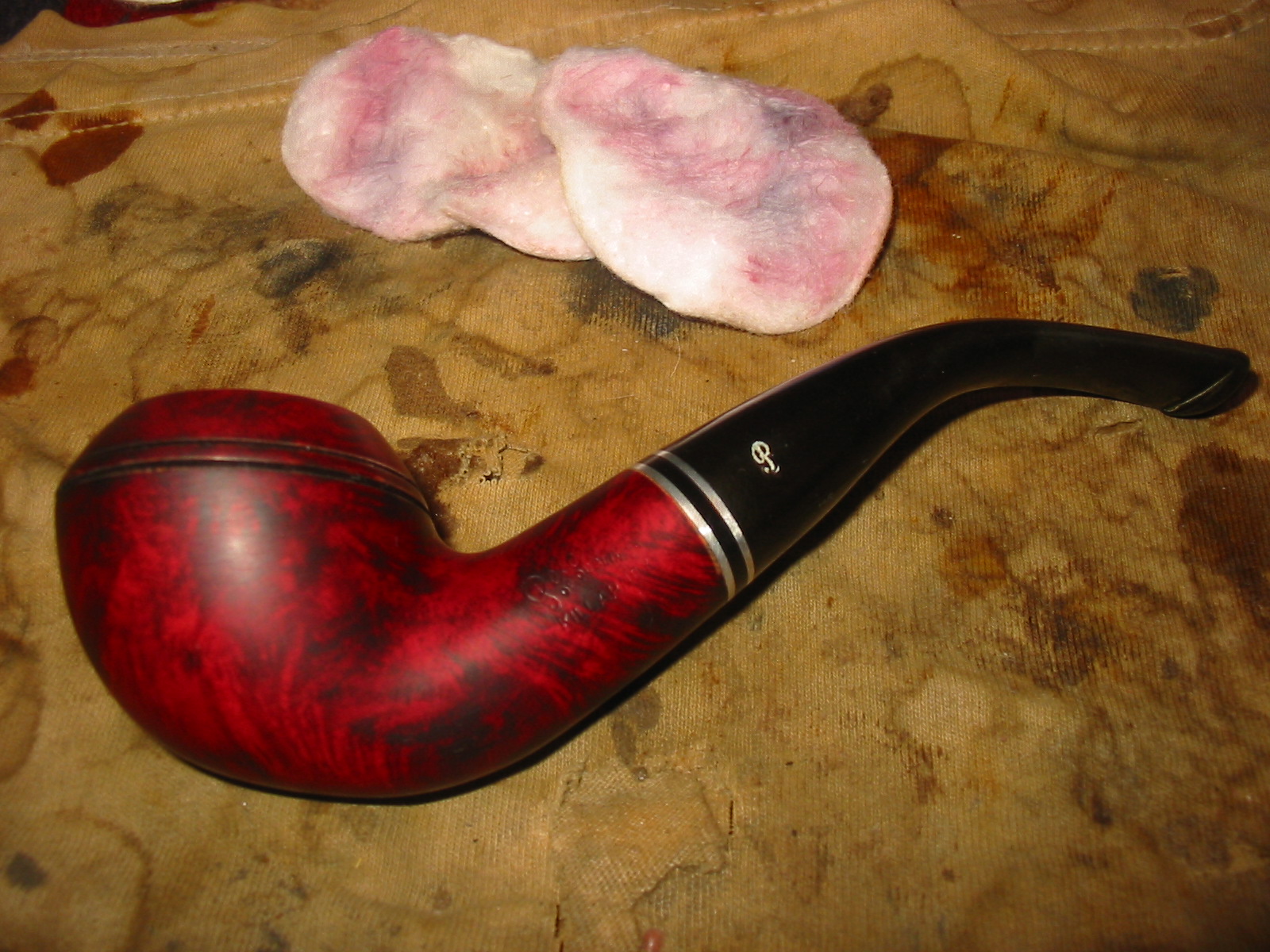
I then worked on removing the plastic finish on the pipe. This turned out to be far more difficult than I had expected. I wiped the bowl down with alcohol on cotton pads to see if I could break through the top coat. That did absolutely nothing to break the finish. In fact the cotton pad came away clean other than removing the slight oil build up on the bowl. Once the alcohol evaporated the shiny surface still gleamed unscathed. I wiped it down with acetone to see if that would break through. This time I expected the surface to yield to the acetone. If you guessed that this would do nothing in breaking the surface you guessed correctly. The pads came away white –the finish was not even marred by the acetone. It continued to gleam brightly!

With neither of my previously proven ways of removing the finish working I resorted to a more intrusive measure. I sanded the surface with a fine grit sanding sponge to try to break through the shiny surface of the finish. This took time and care, particularly around the stamping on the shank. The sanding dust that came off was a fine white powder – plastic powder not unlike what I get when I sand a Perspex or Lucite stem. I did not want to sand the briar just the topcoat. I sanded until the whole surface was covered with a fine white dust. I wiped it down with the acetone once again. This time the cotton pad came back with a pink wash. Yes! I had finally broken through the finish. I washed the bowl down and then sanded it again and washed it again – repeating the process until the shine was gone. The acetone worked well after that to remove the remaining topcoat. At this point I dropped the bowl in an alcohol bath and left it for the day while I went to work. In the past when I had done this I would return in the evening and find the finish gone and the briar had a nice clean patina to it so I was hoping for the best.

When I got home I took it out of the alcohol bath and dried it off. The finish was gone! The shiny coat had finally given up. The stain had lightened slightly but the grain was nicely visible. I was surprised to find that there were not any highly visible fills under the plastic coat.
IMG_6814

IMG_6815

IMG_6816

IMG_6817
I sanded the bowl with micromesh sanding pads to remove the minute scratches in the briar left behind by the fine grit sanding pads. I had been fairly careful in my sanding to only break through the top coat of plastic so these were not significant. I wiped the bowl down with acetone on cotton pads after sanding to remove the sanding dust and see where the finish was now. I put the stem back in place and took the following photos to get a look at the pipe at this point in the process.
IMG_6818

IMG_6819

IMG_6821

IMG_6822
I like the way the grain was beginning to poke through the stain. I wiped it down several more time with the acetone and then buffed the pipe with Tripoli and White Diamond to polish and further remove some of the finish. The pipe was looking very good. I touched up the finish with a dark cherry stain to even out some of the light spots on the finish. I lightly buffed it with White Diamond when the stain was dry. I liked the look of things at this point.
IMG_6823

IMG_6824

IMG_6825
I mixed a batch of pipe mud and packed it into the bottom of the bowl to raise the bottom to meet the entrance of the airway in the bowl. I painted the mud around the bottom portion of the bowl to protect it where it was the thinnest. I set the bowl aside to cure overnight. This morning I took the following photo to show the new look of the inside of the bowl.
IMG_6828
With all of the renovations complete the pipe was ready for a final buff and polish with carnauba wax. I took it to the wheel and put multiple coats of wax on it. I wanted it to shine but not have the high gloss shine that it had previously. I finished by buffing it with a soft flannel buffing pad. The new look was good in my eyes – the grain shone through nicely and the stain was more transparent than before. The contrast between the black that had been used to highlight the grain and the red topcoat was nice. The wax gave it just the right glow. Now I am hoping that when my friend fires it up that it will smoke cooler than it did before. Here are some photos of the finished pipe.
IMG_6829

IMG_6830

IMG_6832

IMG_6833

UPDATE:
I returned the Pete to its owner at lunch today. He took it with him to smoke a bit later. I was curious to know if the problem had been solved. I asked that he email me once he had smoked it. I just received and email from him. He reports as follows: “The revision is a HUGE improvement!! It smokes much better — not super cool, but quite acceptable. The draw is definitely better and I think once it breaks in it will be a good smoke! Many thanks again for your work!” So while it is not super cool is not as hot as it was before. Enjoy your “new” pipe.

Cleaning/Polishing the Stem Crease Area by Joyal Taylor


Blog by Joyal Taylor

It is a pleasure to be able to introduce this first blog post by Joyal here on rebornpipes. I read with interest several of Joyal’s posts on Pipe Smokers Unlimited online forum. His love of refurbishing and his abilities were something that I immediately resonated with. When I read the post he made about the use of the sanding sticks and micromesh sanding sticks to clean up the crease on a stem I was hooked. I thanked him for the research and creativity that lead to these new to me tools of the trade. I asked if he would mind writing this up for the blog and this afternoon I received the post. Thanks Joyal. I look forward to reading many more of your posts here and on the forums. Without further introduction here is Joyal’s post.
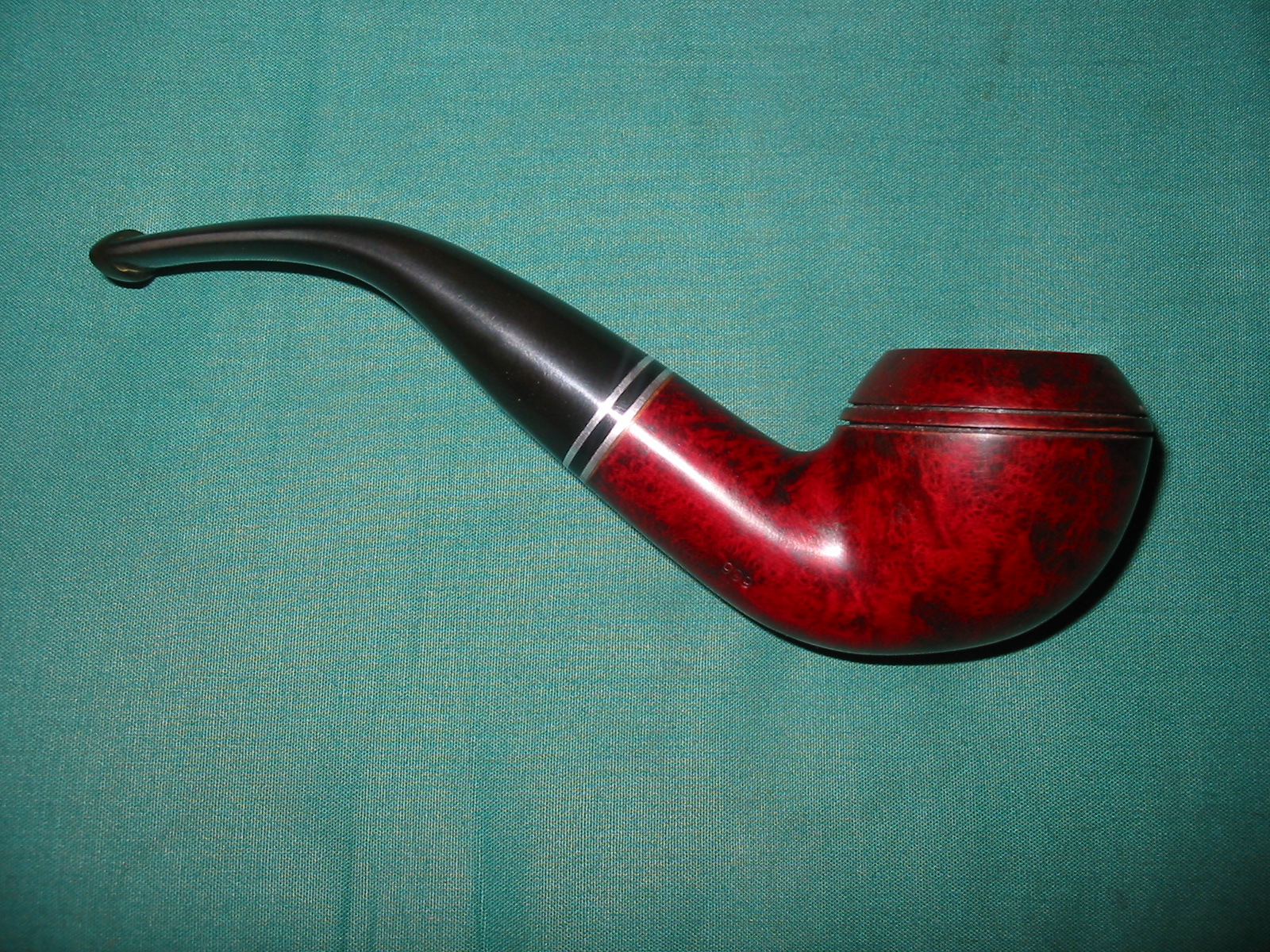
I’ve smoked pipes for about 30 years. A few years ago, I semi-retired and started looking for hobbies. Fishing is great but not for an everyday activity, at least for me. One day I looked at some of my pipes and realized that they were looking beat up and abused. I tried restoring one but quickly realized that I didn’t know what I was doing. So I began researching pipe restoration and tried again and again. Soon I was fully into it with various tools and dyes. It has become an everyday activity that gives me things to do with all of my semi-retired free time.

I find that the most frustrating area to clean up, on an oxidized stem, is the 1-2 mm in front of the bit. Sometimes oxidation and dirt gets in that area and it’s difficult to get it out. I’m always trying to find better, quicker, and easier ways to do various aspects of pipe restorations. If you don’t need to use needle files and dead edge files to reshape the bit, here’s an alternative to cleaning up the crease area in front of the stem bit, without really altering it.

Before photo of a stem that needs a little cleaning/polishing in front of the bit. There are more dramatic examples but this is the only one I had at this time.
Photo #1
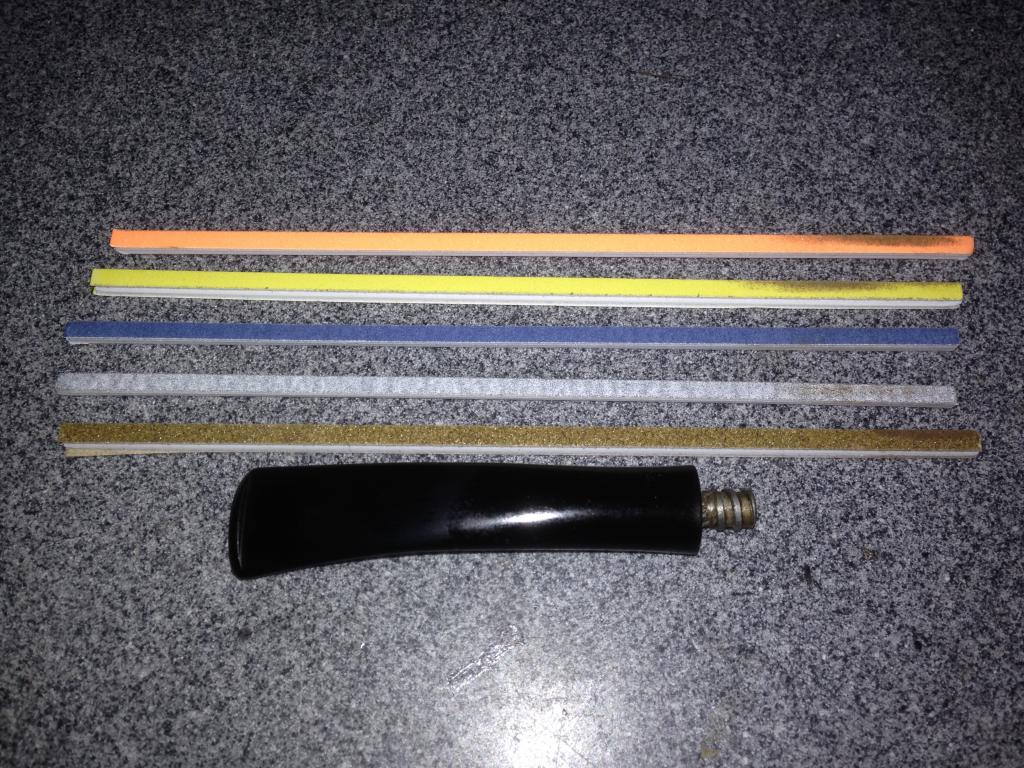
I found some small thin sanding sticks that fit nicely into the area (100,180,240,320,400 grit) http://www.billingboatsusa.com/803-flx0101-mini-hobby-and-craft-sanding-sticks.html
Photo #2
Here’s what the area looks like after using all of the sticks – gently.
Photo #3
Next I polished the area with micro mesh sticks (1,500-12,000). I find that these are easier to use in this small area than the micro mesh pads. http://www.woodcraft.com/Product/2080764/29708/Micro-Mesh-12-x-5-34-Colored-Sanding-Sticks.aspx
Photo #4
These final two photos were taken before wheel polishing/buffing because the shine doesn’t allow for a good photo.
Photo #5

Photo #6
This entire cleaning/polishing doesn’t take as long as it may seem – probably less than 10 minutes.

Refurbishing a Piece of History – A Marshall Field Co. Supreme – English Made


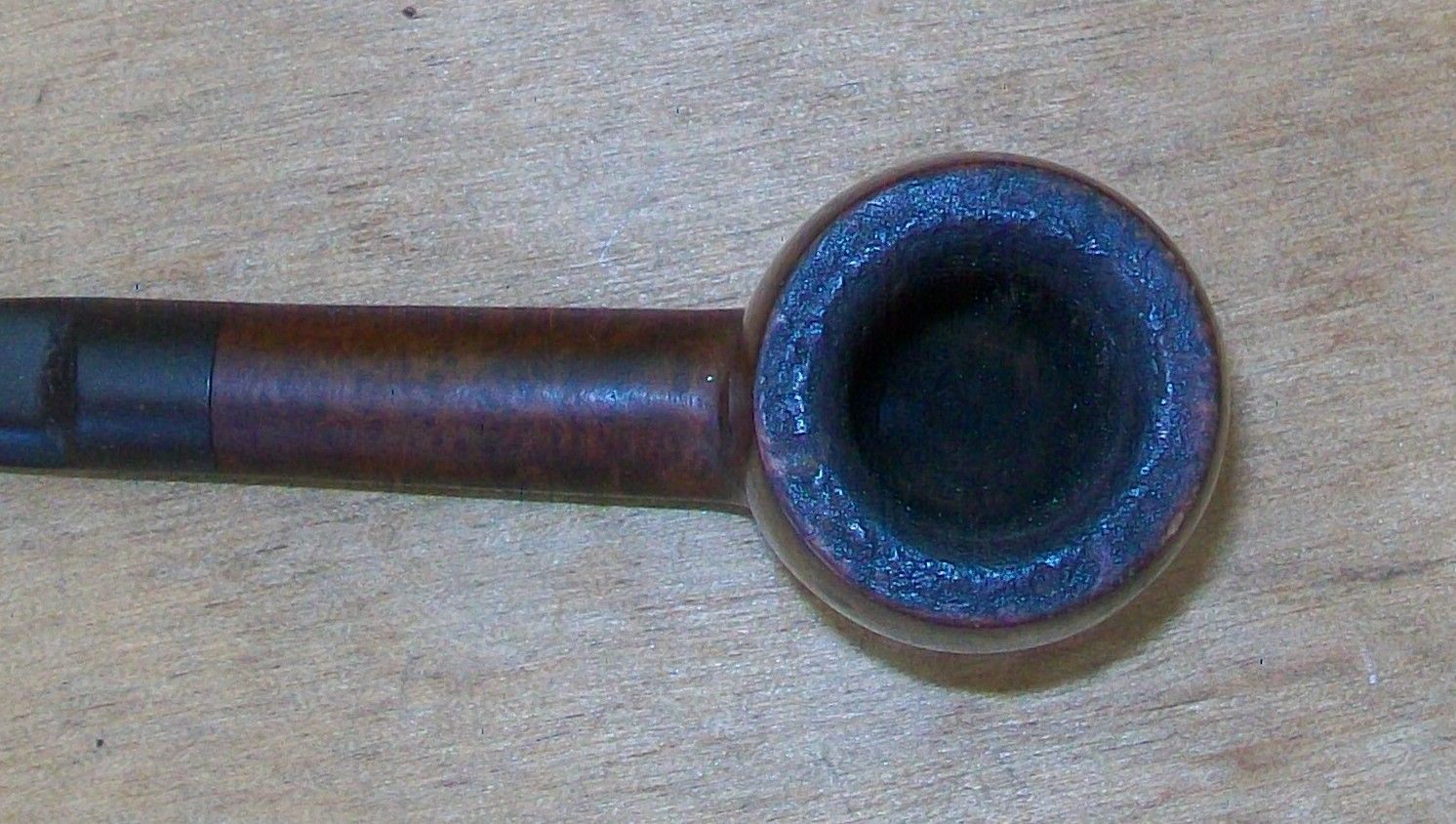
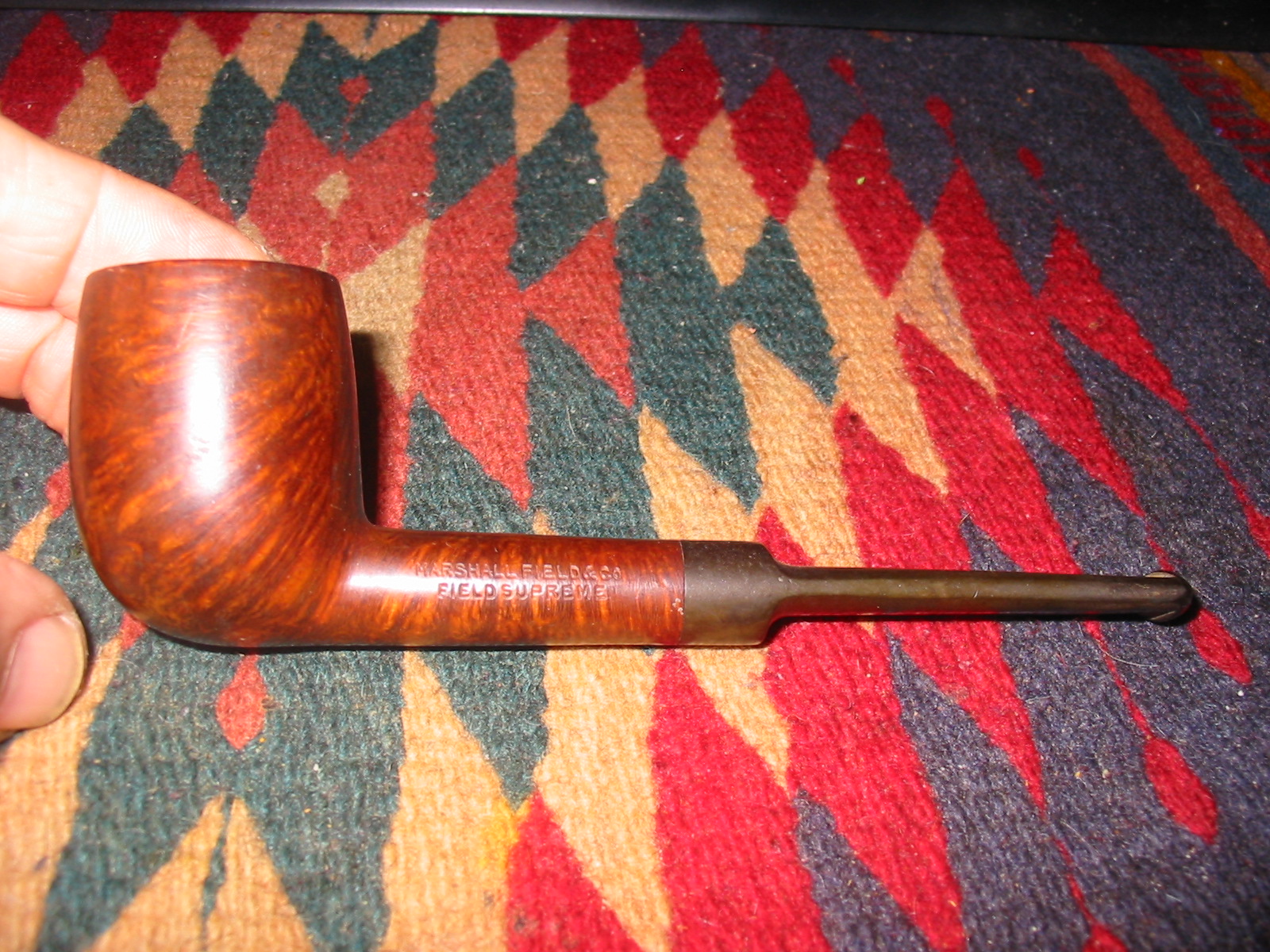
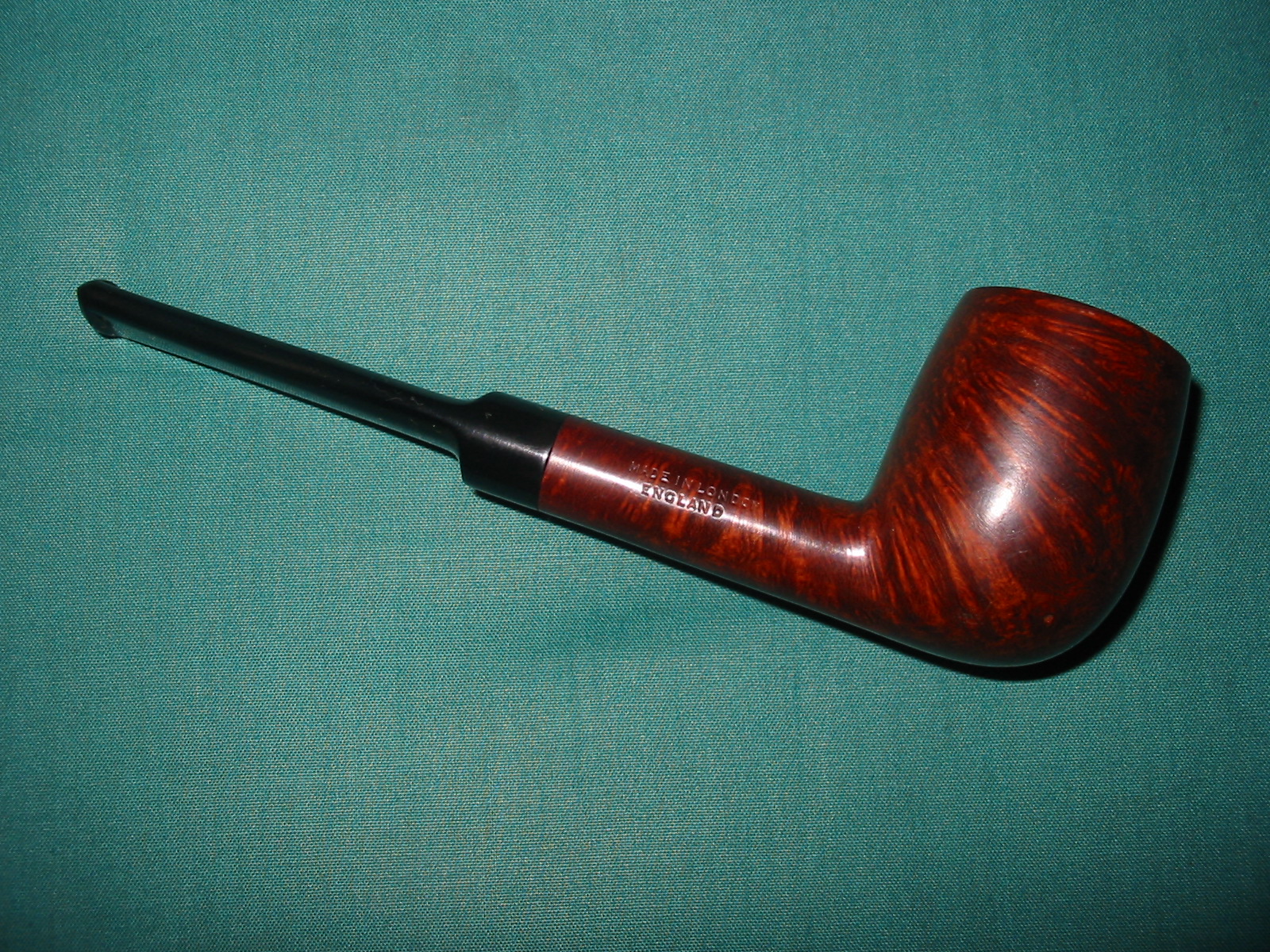
The grain on this one really caught my attention before I even noticed the name on the pipe. It has some amazing grain on the bowl and shank. The sides of the bowl and shank some stunning cross grain that has been highlighted with a contrast stain to make it stand out. The front and back has some quality birdseye grain. The carver did a great job laying out the shape of the pipe to highlight the grain, though I suppose it may merely be a fluke as blocks were turned and cut in the factory. After admiring the grain I turned to look at the stamping on the pipe. It looked like and English made pipe and my mind thought immediately of Comoys both by the shape and the contrast stain on it.
MF1

MF2

MF5
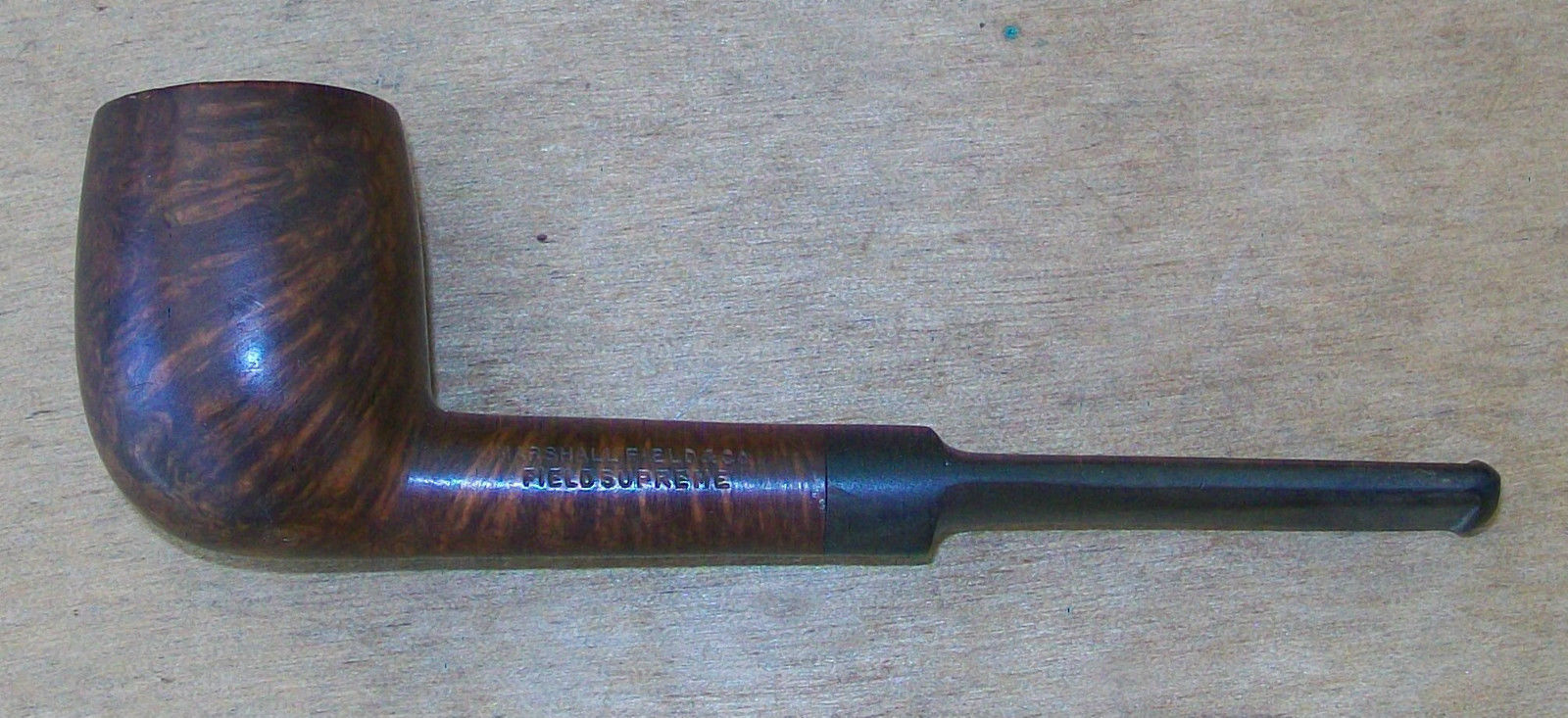
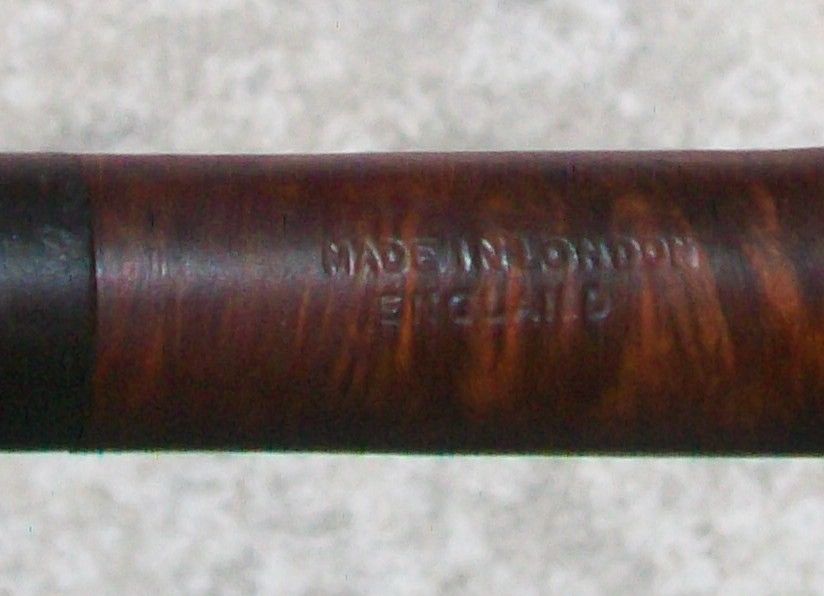
The pipe is stamped Marshall Field & Co. over Field Supreme on the left side of the shank and on the right side it is stamped Made in London England. There is no shape number stamped on the pipe. Since I paid $16 and change + $8 to ship it to Canada, I think I did well on it! The pictures below were included by the EBay seller and caught my eye.
MF3

MF4
Once I won the bid on EBay, I posted a question on Smokers Forums and Pipe Smokers Unlimited, two online pipe forums that I frequent, to see if anyone knew who made the pipe. I had hunches about who I thought were possible makers. But I wanted to see what others thought. I got several responses that confirmed my thinking.

Bill, a reader of the blog and an online friend sent this reply: “Not saying this will help but go to this page and click where it is highlighted”click here” and you can go through the Comoy’s pages and see the shapes. http://search.getitnext.com/beta/mar…arshall+fields Edit: My link didn’t work. It’s funny I clicked on it the first time and there was a write up about a guy who wrote an article about a Made in London Marshall Field pipe. He wrote to the Marshall Field Co. historian and was sent a link to a Comoy’s catalogue with shapes that were very similar. Now when I go back in my search history to click the link it won’t come up.”

Several others commented that Who Made that Pipe should a French Company name Marshal that made pipes. However, this was one made for the department store so I am pretty certain that the French company was not the manufacturer.

Dave, another reader of the blog and an online friend also replied: “I’m going to tack away from Comoy’s and go in a different direction. Here is my thinking, most of the off label pipes I’ve seen by Comoy’s still have the Comoy’s style COM stamp, be they pre-war or post war, and also retain a shape number in the very distinctive Comoy’s font. I’m going to focus on the word Supreme.

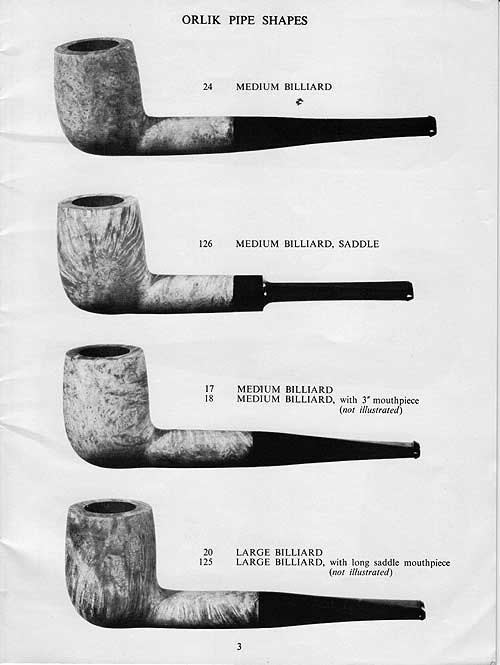
Charatan’s, no, Orlik, maybe. Here is a catalog image of the Medium Billiard, Saddle. The “Medium” works out to a grp 3 size pipe. Also the sans serif type font is the type Orlik used. Is this definite, of course not, it’s what makes trying to figure out English pipes a challenge!”
orlmedbill
In searching the web for information I came across an interesting post by the late Mike Leverette who wrote on the Grabow Forum in response to a post on L.L. Bean pipes as follows: “… By the way, all of the big chains carried pipes at one point in time, such as Sears, Marshall Fields, M. Ward, etc. Did any of these carry pipes made by the different Grabow owners? …The only Marshall Fields I have was made by Comoy and takes a paper filter.”

Either Comoy’s or Orlik. That was the overarching thought of others as they looked at this pipe. It also concurred with my thinking. If I put the Comoy’s shape chart up on the screen and compare it to the pipe it could well be a Comoy’s and when I look at the chart Dave shows it could well be an Orlik. Dave’s comments about stamping are interesting to me as I think about the maker. The typeface used in the stamp is certainly very similar to that used by Orlik while the Comoy’s stamping is a typical Serif font. Some of the pipes I have found on EBay have shape numbers that fall in the range of shape numbers for Orlik pipes. None of them fall in the Comoy’s shape numbers that I can find. A definitive answer may be a long time coming but for now I am leaning toward Orlik as the maker of these pipes.

While I may not be 100% certain of the English maker of the pipe it is indeed a Marshall Field pipe. These were sold by the Chicago based department store and chain at least through the 60’s if not longer. Field’s was a huge department store chain that in its Chicago location had reading, writing and rest lounges, restaurants, men’s departments and a broad range of the features of the good life. I still remember my mother taking me there when I was little.
Noname
The pipes seemed to have been graded in a variety of ranges or lines. I am still trying to hunt down information on the various lines of pipes that they sold. I have found several pipes on EBay that bear different line stampings. All have the same style stamping and all have the MADE IN LONDON ENGLAND stamping. I have included the list below to show what I have found so far. I have arranged them in what appears to be in the order from highest to lowest grade as I can determine. I have also found two leather covered pipes that were stamped Marshall Field Smoke Shop and appear to have been made by Ropp. They were identical to the Ropp leather clad pipes that have seen.

1. SUPREME (I have seen both a billiard and a pot with this stamping. Both have a smooth finish and exhibit beautiful straight, flame or cross grain.)
2. SPECIAL GRAIN (The first one I saw on EBay and was a bent billiard shaped pipe, stamped 85. The second on EBay was a straight apple shaped pipe. Gary, an online friend responded on Smokers Forum and posted a picture of a bent billiard that was stamped Special Grain. All were smooth finishes but did not have the same density and grain consistency as the Supreme.)
3. FIELD DELUXE (This was also seen on EBay and was a Zulu or yachtsman shaped pipe, stamped 87. The Marshal Field stamping was in a script which was different than any of the other pipes that I found. The grain was a mixed pattern.)
4. FIELD GRAIN (These were seen on EBay was as well. The first was a smooth billiard with a saddle stem (bearing the shield logo) and stamped with the #6. The second was a sand blast billiard version. On the smooth one the grain was mixed and on the blast it was a deep craggy blast.)
5. STORE FOR MEN 3 GROUP 2 (There was one of these on EBay for sale as well. It was a smooth finish, square shank pot. The grain was mixed and clean.)

All of the smooth pipes were decent briar with no visible fills or sand pits. All the English made pipes that I have seen online were well made and all had the same style of saddle stem. The French made ones all had taper stems and were leather clad.

I will continue to hunt down these pipes to build a picture of the various lines. Any information you may have will be greatly appreciated.

I took the billiard that I purchased to my work table this morning. Before I worked on it I examined it for what needed to be addressed. The bowl had an uneven cake on the inside and did not extend to the bottom of the bowl. The bottom was still clean briar and it went up the sides about ¼ inches. The rim was clean but had a tarry buildup. The inner bevel on the rim was undamaged and showed no sign of over reaming or damage. The finish on the outside of the bowl was clean and undamaged. There were no dings or dents in the surface of the briar. There was an oily buildup on the surface of the pipe. The stamping was crisp and distinct. There were two slight marks on the left and the right side of the shank next to the stem. The stem itself was clean but oxidized. There was tooth chatter on the top and bottom of the stem next to the button. The inside of the stem and the shank were very clean.
IMG_6796

IMG_6797

IMG_6798

IMG_6799
I reamed the bowl with a PipNet reamer and took it back to bare briar. I wanted to remove the buildup on the upper portion of the bowl and provide a clean surface to rebuild the cake. I scrubbed the rim of the bowl with spit on a soft cotton pad to remove the tarry buildup. I also had to wipe it down with alcohol until the tars were gone and the rim and bevel were clean.
IMG_6800

IMG_6801

IMG_6802
I sanded the stem with a medium and fine grit sanding sponge to remove the tooth marks and chatter and to remove the oxidation on the surface. I followed that up with my usual habit of sanding with micromesh sanding pads. I wet sanded with 1500-2400 grit sanding pads and then dry sanded with 3200-12,000 grit pads. I polished the stem with Meguiar’sScratch X2.0 polish and then buffed with Tripoli and White Diamond. I rubbed the stem down with Obsidian Oil and when dry gave it a final buff with White Diamond.
IMG_6803

IMG_6804

IMG_6805
I gave the pipe and stem multiple coats of carnauba wax and then buffed it with a soft flannel buffing pad. The pipe is finished and ready to break in. The grain stands out because of the contrast finish on the pipe and the stem is like glass with the buffing and polishing. To me it looks like it must have the day its previous owner purchased it at Marshall Field’s. If only I had the box and the pamphlets that must have come with it when it was new, it would be an even more amazing pipe.
IMG_6806

IMG_6807

IMG_6808

IMG_6809

A Tale of Two Cigar Holders


Blog by Steve Laug

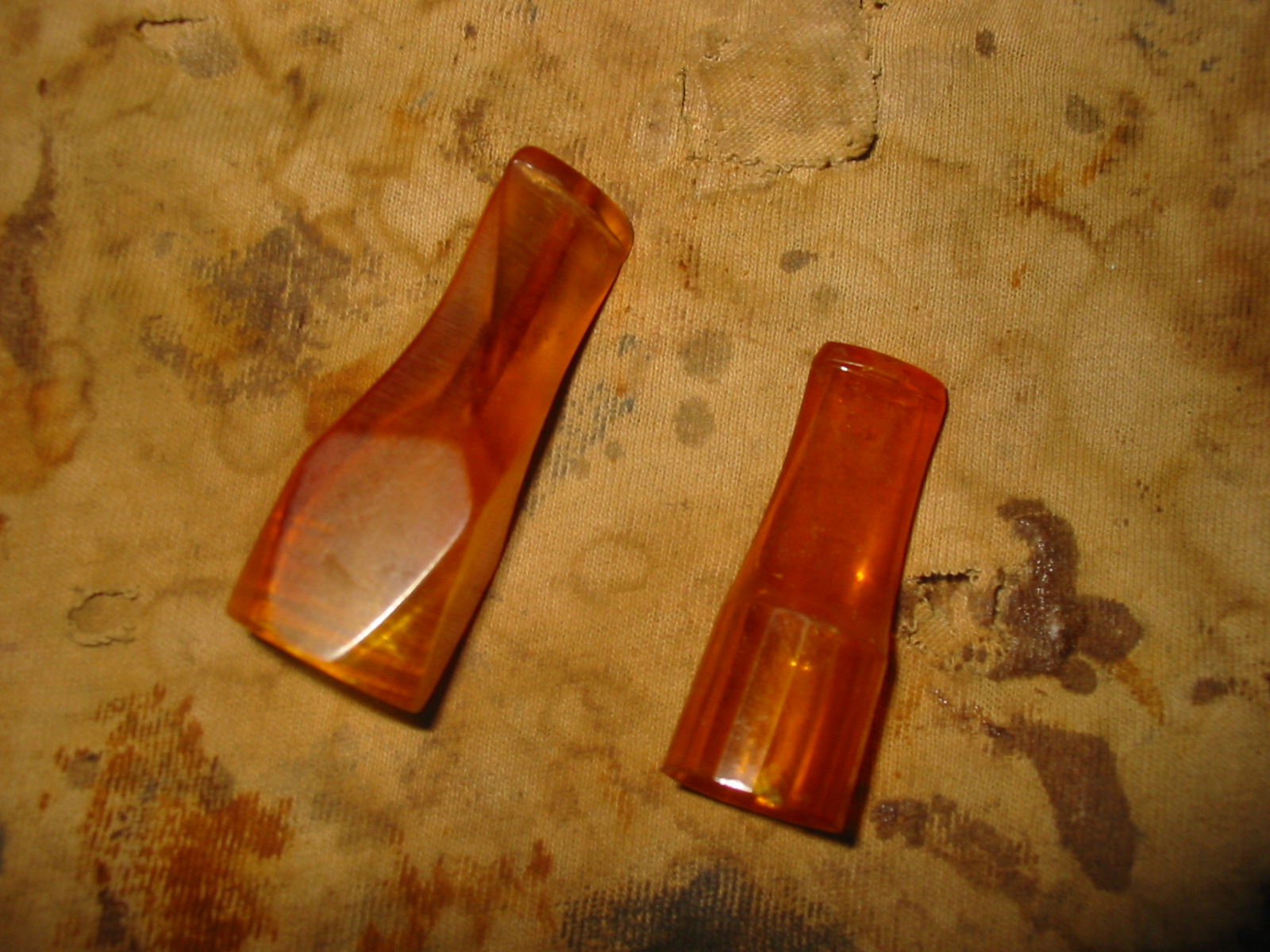
It was the best of times and the worst of times. I apologize for the literary reference but I could not help myself as I typed the title to this post. It took me to one of my favourite novels. Ah well, my post is nowhere near as interesting a read as that. It involves two of the finds in my recent antique mall grab bag – two very different cigar holders. Upon first glance, looking through the walls of the plastic bag they could have been easily confused as being similar in age and style. They both were amber coloured and mixed among the pipe bowls and stems they look similar.

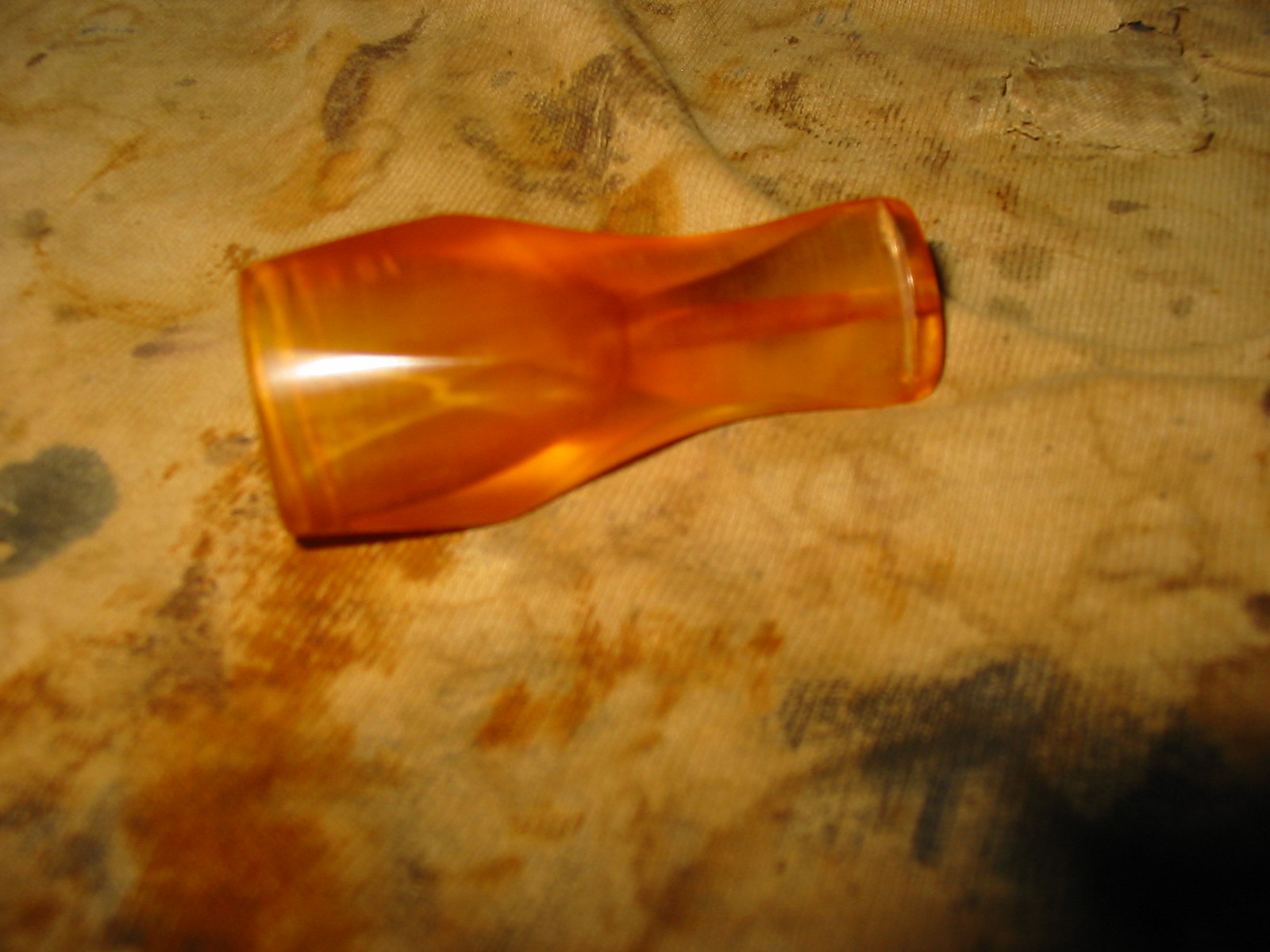
But once I had taken them out of the bag it became very clear that they were two very different cigar holders from two widely separated times in history. The amber colour was all that they had in common. One was thick and heavy – probably made of Bakelite and showed the signs of age and antiquity while the other was a lightweight plastic obviously from a more recent time in history.
IMG_6562
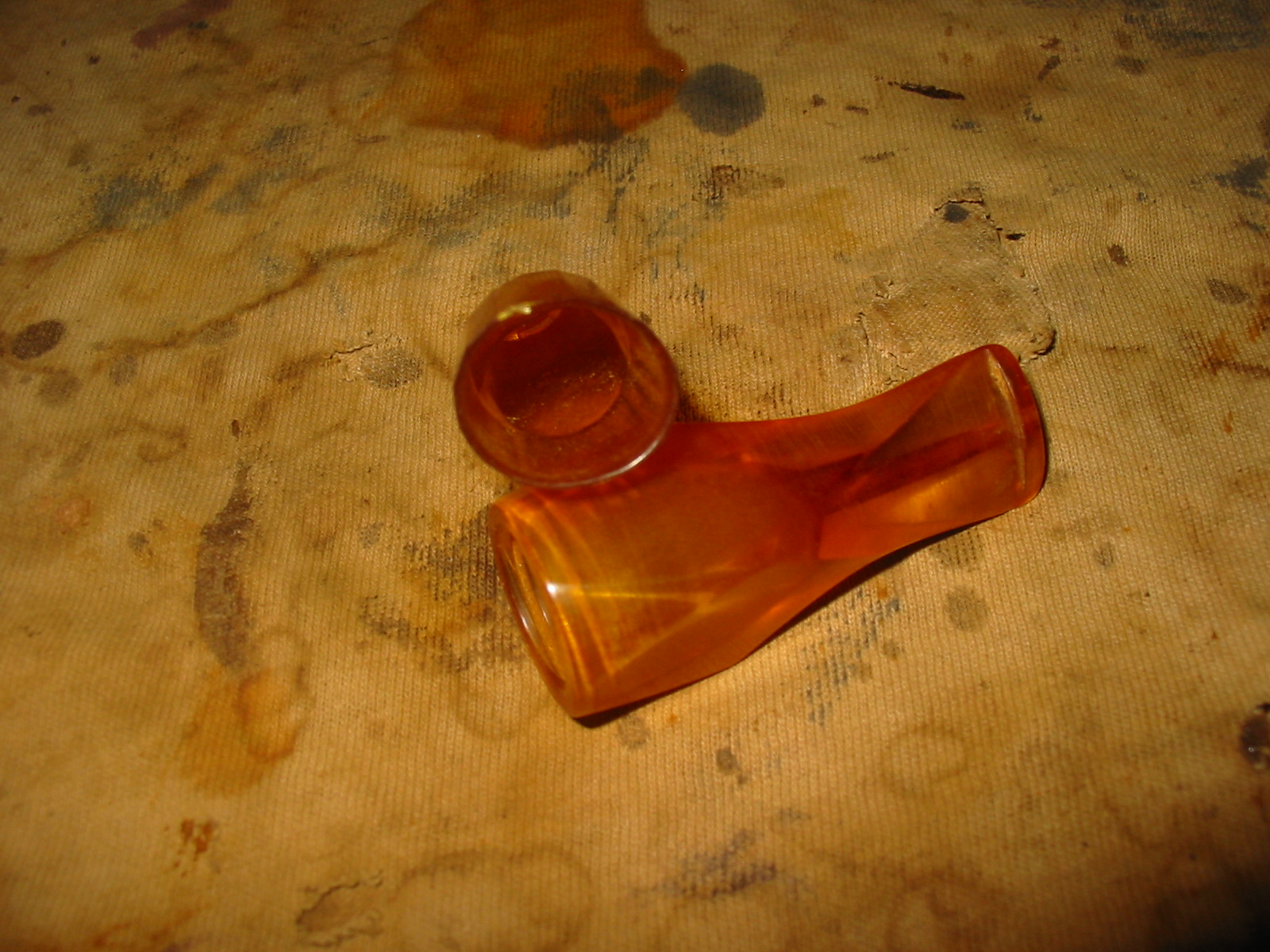
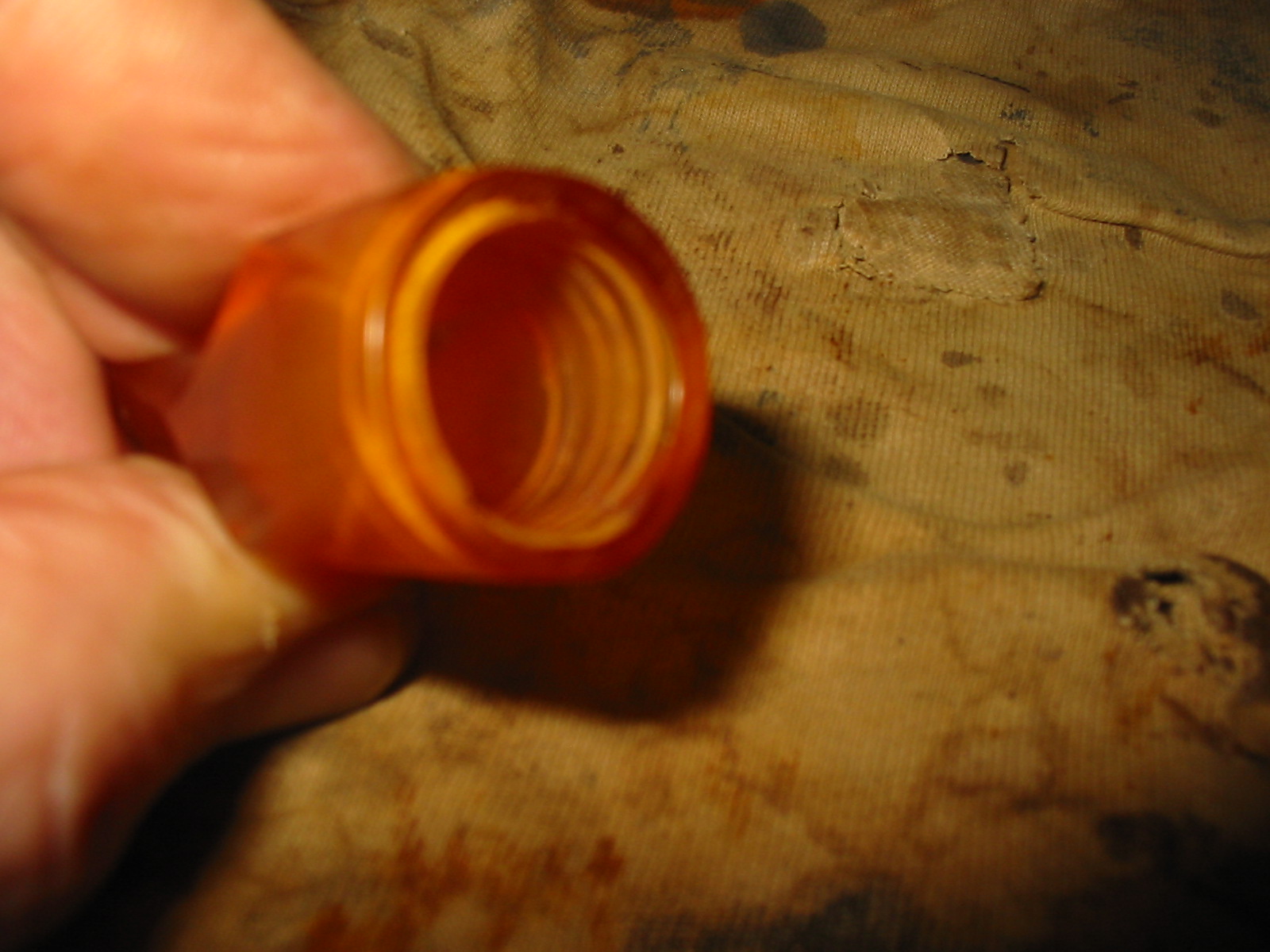
The differences will become clearer as I enumerate them in the next lines. On the inside they are different. The thick walls of the older one, shown clearly below, show a threaded look and feel for gripping the end of the cigar. They hold the cigar tightly in place and as the cigar is smoked the leaf swells and holds tightly to the holder.
IMG_6564
The second, newer holder pictured below, has much thinner walls on the sides and tip. It is a pressure fit that is not that different from the plastic tips found on inexpensive cigars. It does not have the heft and feel of the first holder. I think it was probably designed as a cheap throw away tip.
IMG_6565
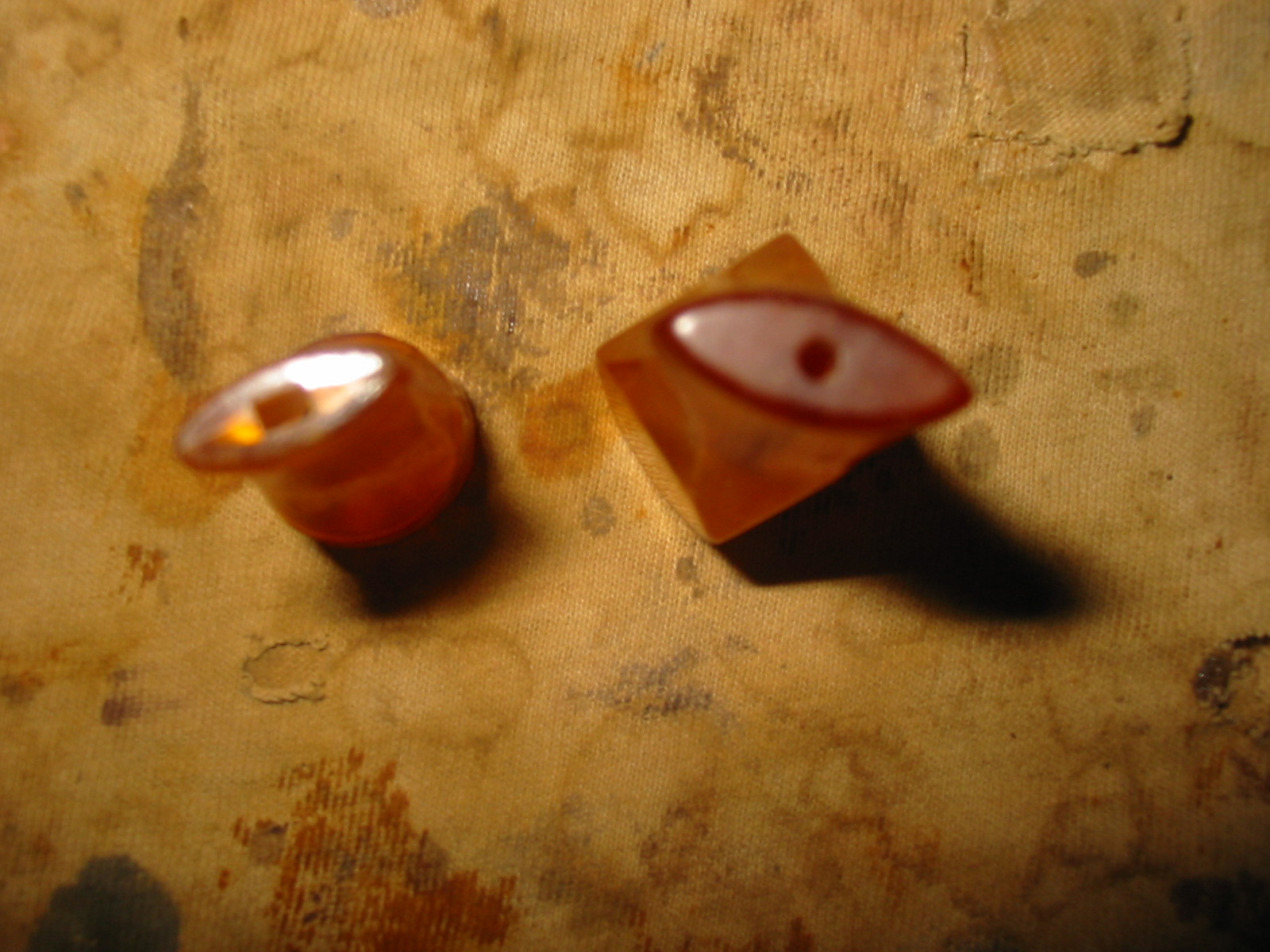
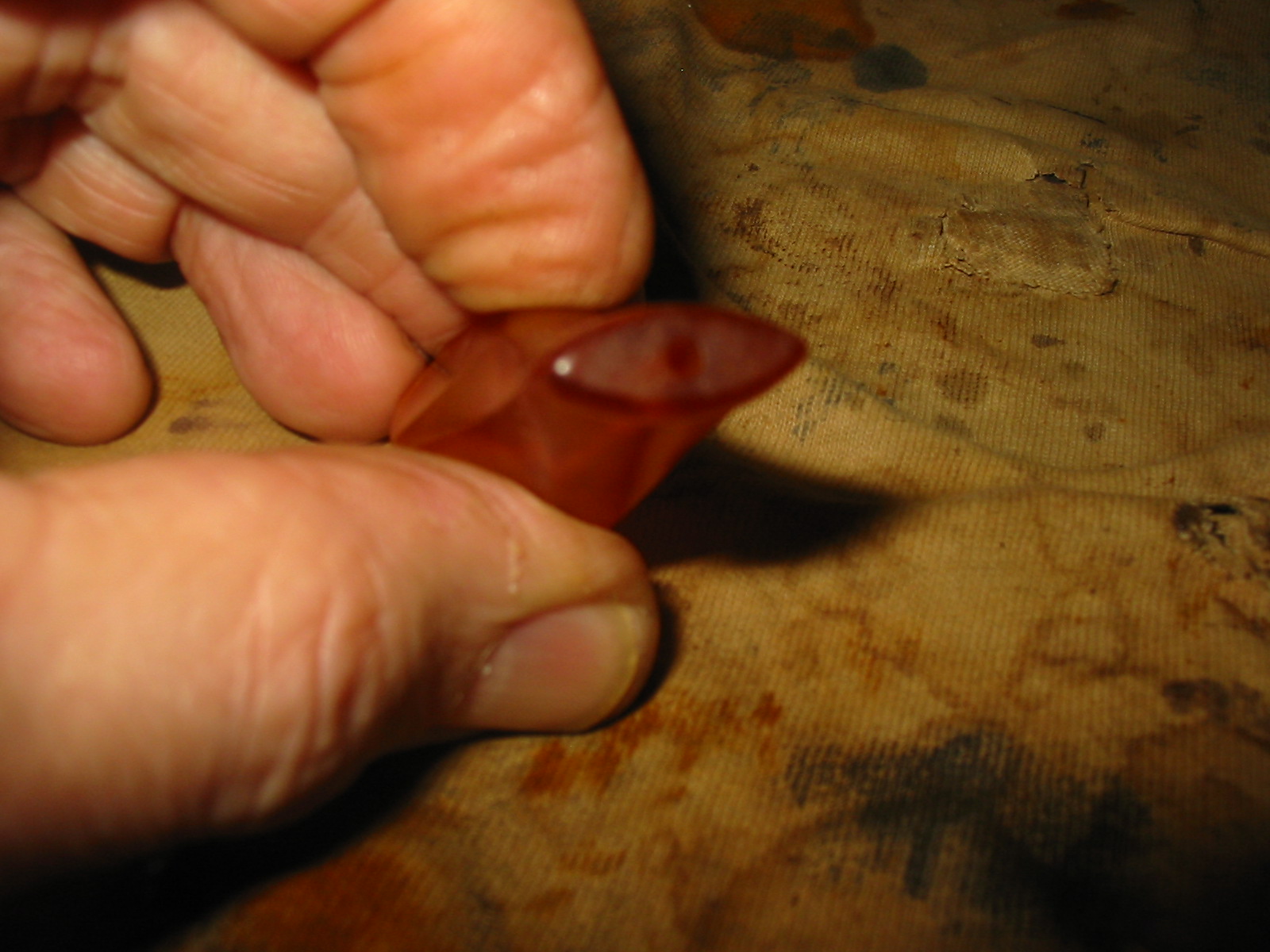
Looking at the two holders from the end the difference is also clear. The tip on the left is the newer one and has a straight slot cut in the plastic. The seams of the pressed plastic cut straight across the sides of the slot. They are rough to the touch and no care was taken to sand them down and smooth them out. The exterior is also thinner and more squashed in shape. The older one, on the left has an orific slot – a round hole in the button that is smooth and does not show signs of the casting. The shape of the oval is fuller and the walls are thicker. The other obvious difference is in the shape of the holder itself. The newer one is round while the older is diamond shaped. The overall effect of the shape is one of substance. The round one can be seen as an extension of the cigar while the diamond shaped one makes a statement – the old holder is not just an extension of the cigar it is an elegant holder of the cigar and will last beyond the cigar it holds.
IMG_6563
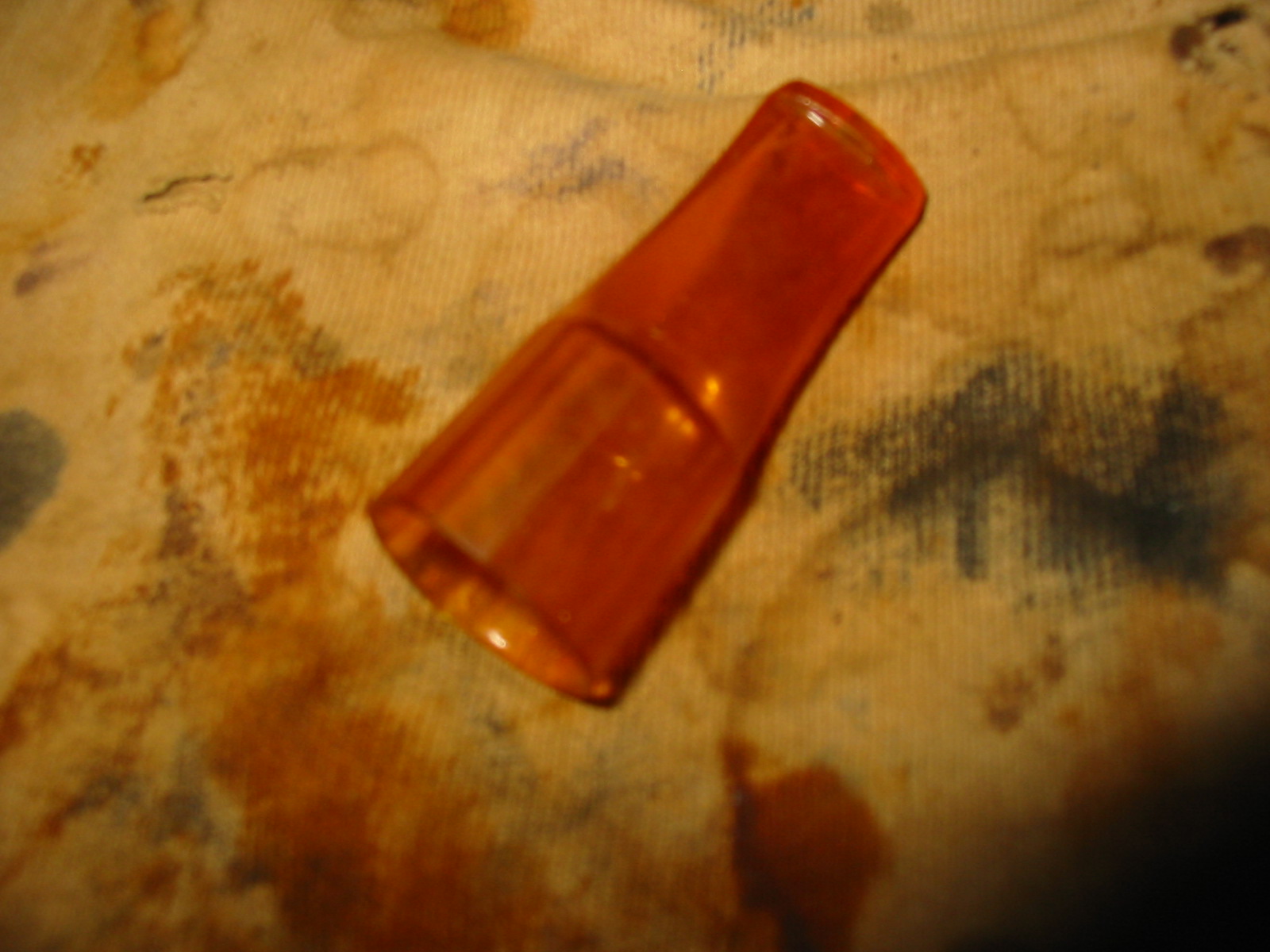
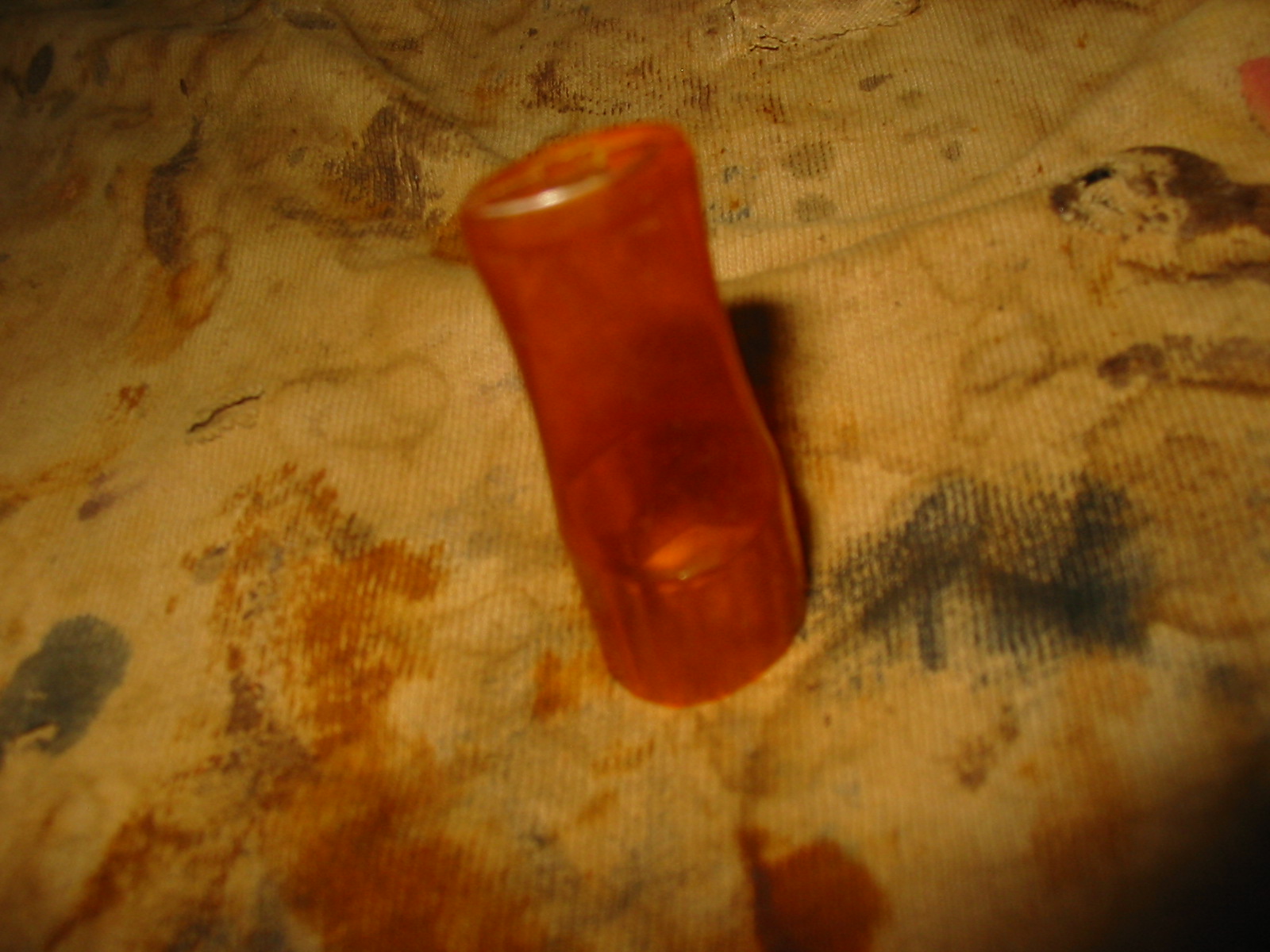
In the next paragraphs let’s examine each holder in more detail and measure what each has to offer. The newer holder is made of a thin plastic and is quite flimsy. It is easily squeezed between the fingers and the material is quite flexible. It reminds me of the plastic tips that come on Panatelas or Colt Cigars. It makes me wonder if it was some novelty that came with a box of cigars as a gift to provide them with a tip that kept the end of the cigar from getting soggy in mouth. On the interior of the holder that slips over the cigar there are vertical ridges that run from the saddle on the bit to the opening where the stick sits when it is inserted. These grip the cigar and keep it from turning in the holder. Because of the design the cigar is pressed into place and the ridges cut into the outer wrapper. The diameter of the hole is 5/8 of an inch so it will not hold big stogies. In the mouth it has a very plastic feel – similar to plastic cutlery that is made to be used and thrown away. To my thinking this is a disposable tip meant to be replaced often and lends credence to the idea that it came in a box of cigars. A new tip would be included in each new box.
IMG_6567

IMG_6568

IMG_6570
The second holder is more substantial. It is heavy and seems to be made of Bakelite or some kind of older amberoid substance. It has the look of amber but not the fragility or weight. It too is a saddle stem but instead of being at the end of a round saddle it is diamond shape flattening out to a taper on the bottom and the top portions. It cannot be squeezed between the fingers and the material solid and inflexible. On the interior of the holder that slips over the cigar there are threads, like the inside was tapped. They run around from the saddle for the first ½ inch of the holder. These grip the cigar and keep it from turning in the holder. Because of the design the cigar is turned or twisted into place and the threads turn into the outer wrapper. The diameter of the hole is 3/4 of an inch so it will not hold big stogies. In the mouth it has a very different feel from the other one. It is similar to some of the older pipes in my collection that have Bakelite stems. It is hard like newer Lucite stems and is cool to touch. It is substantial between the fingers and has the feel of a fine holder like some of the older smooth meerschaum cheroot holders. It is meant to be kept in the humidor and reached for again and again.
IMG_6571

IMG_6572

IMG_6574
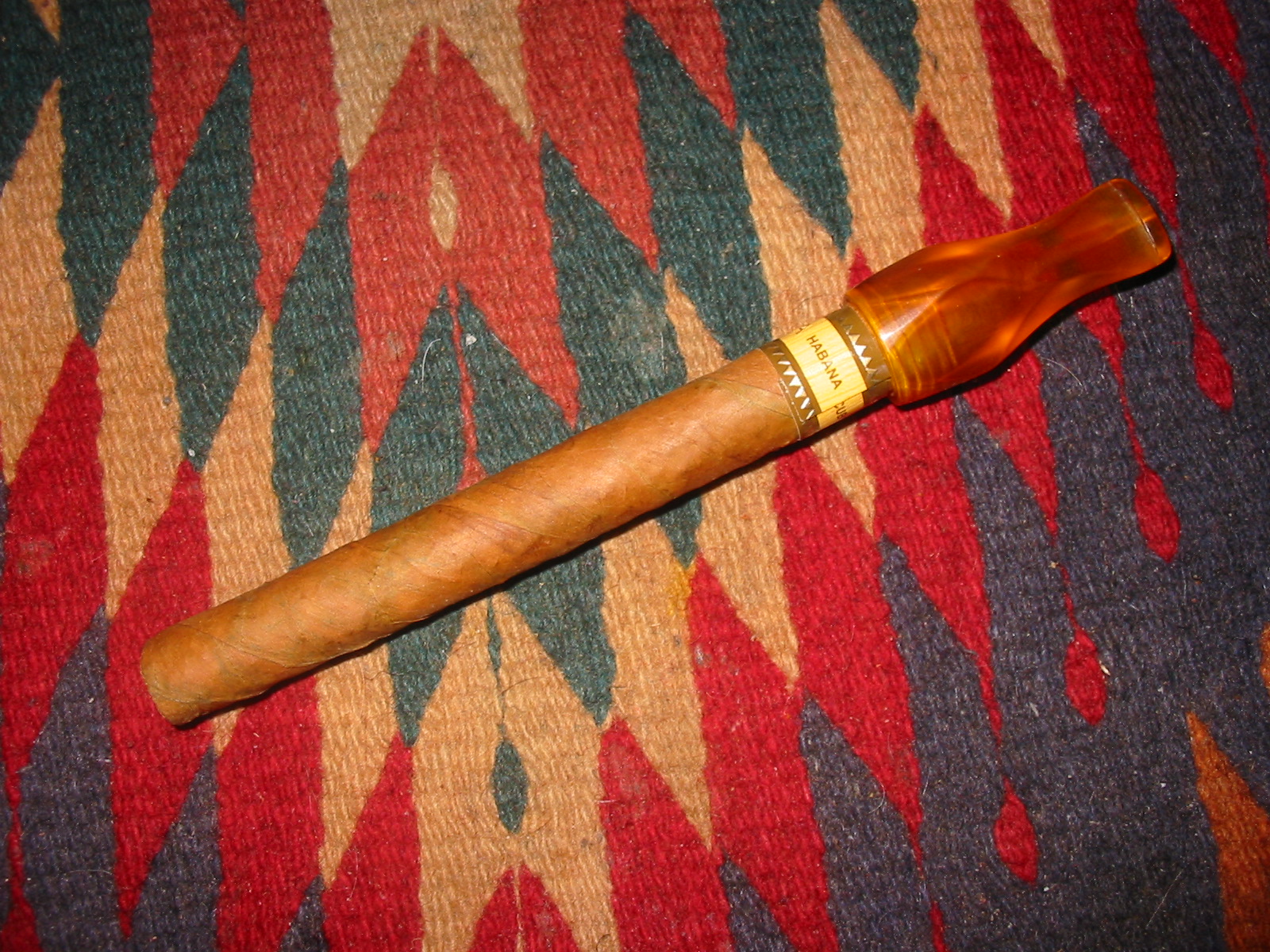
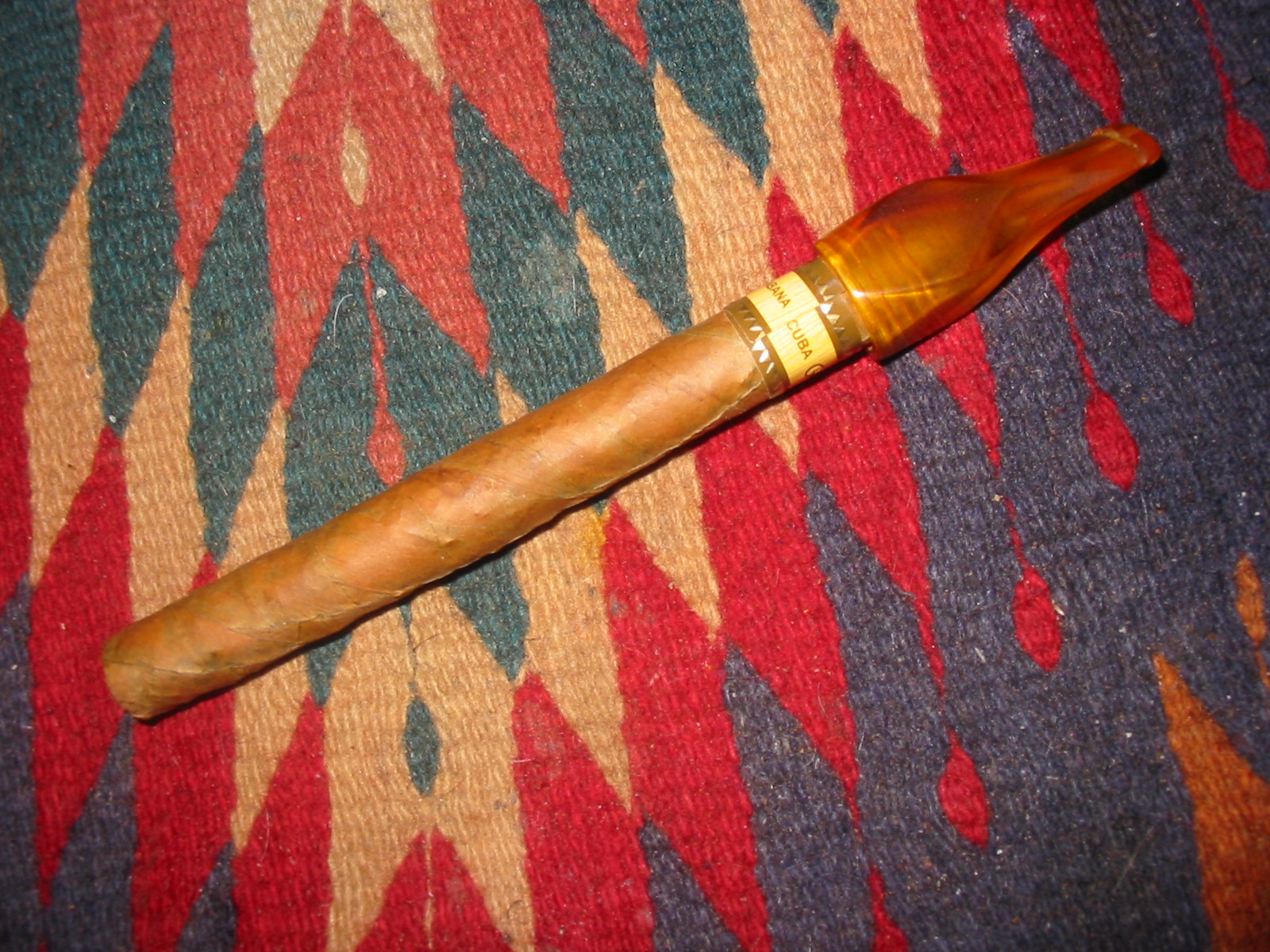
This afternoon I opened the humidor and took out a cigar that would fit in the holder. It was a Guantanamera Habana. The stick was a perfect fit in the holder. I moistened the end of the cigar, cut off the end cap and then turned the holder on to the cigar. It was a perfect fit.
IMG_6794

IMG_6795
I had just finished the yard work for the weekend and set up a set of chairs on my front porch. I went out and sat down. I toasted the cigar with the lighter and drew the flame into the centre of the cigar. Once I had a good burn going I sat back to relax and enjoy the smoke. I find that a cigar that size can last me up to an hour so I was in for the duration. The tip certainly is older than me though today it may not look like it. It feels good in the mouth, a lot like a Bakelite pipe stem. It keeps the end of the cigar intact and the smoke that drifts into the mouth seems to be slightly cooler than that drawn directly through the stick. It is comfortable to hold and to clench. This one will be a keeper for me.
image2

image (2)

image (5)
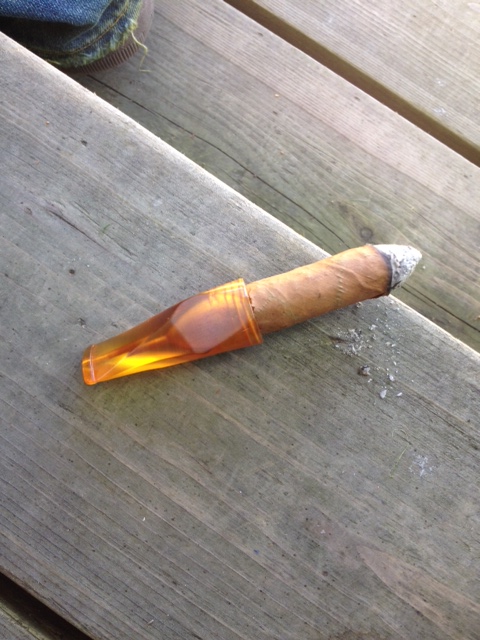
I set the cigar down for a moment on the steps of the porch while I moved the chair out of the sun. It was getting to the end of the smoke. It still was cool and tasteful; it had none of the residual moisture that collects in the end of a cigar normally when I smoke it. I smoked it to within a ½ inch of the holder and then took it out and stubbed it out. I was impressed with the dry cool smoke that the mouth piece delivered. I am first and foremost a pipe smoker so the occasional cigar that I have is not something that I really enjoy. I tend to smoke one when I am in need of pipe mud so I collect the ash for that purpose. I don’t often reach for a cigar even though I have a humidor with quite a few good Cuban cigars in it. But I can see that with the holder I may well reach for one more often. Smoking it was more like smoking a pipe. I am sure I will give it some more tries in the future. As for the other holder- I think I will probably end up throwing it away. There is no need to keep the cheap imitation around when I have this good old timer.
image (6)

A Handmade Rustication Tool – Gifted by a Friend and Reader of rebornpipes


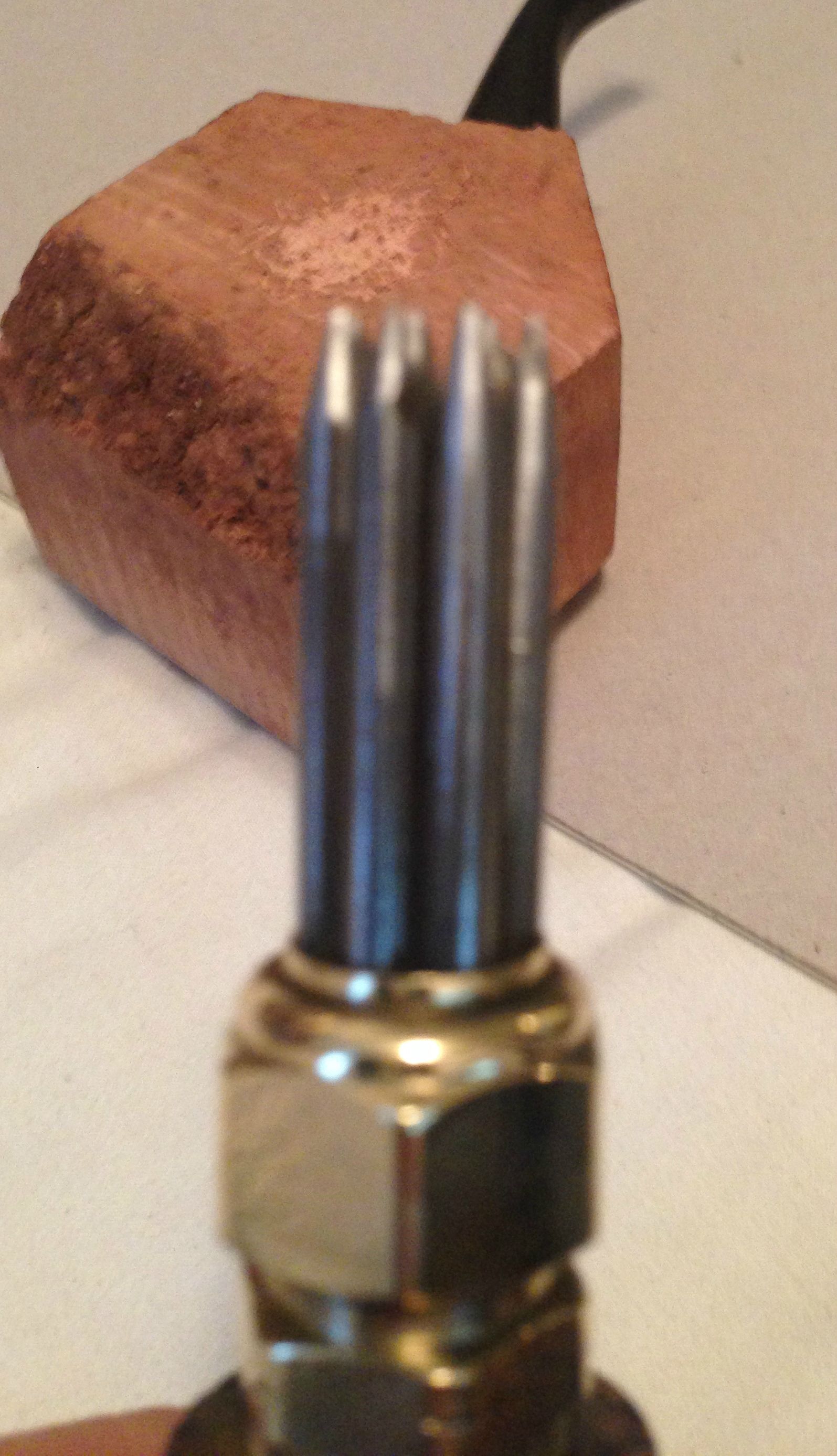
Several weeks ago now I was in correspondence with Chris, a reader of the blog and an online friend, regarding the design and crafting of a rustication tool. I had sent him pictures of the one I was currently using. I had made it using a piece of pipe. I enumerated some of the issues that I had found with the tool as I used it. These mainly concerned comfort and ease of use. The pipe worked well to stabilize the nails and keep them in place. There was no flex in the nails as I pressed them into the briar. The configuration and number of nails was fine in terms of coverage on the briar. Adding more or fewer nails did not seem to be a relevant concern as doing so would either broaden or reduce the area covered per twist of the tool. The comfort issue predominantly revolved around the end cap that I used to hold the nails in place and form the handle on the tool. When pressed into the briar the cap pressed into the palm and was uncomfortable. The pressure on the palm of the hand made it necessary to pause frequently to give the palm rest. I had modified the tool with a “T” handle and found that though it was better but still did not give comfortable hand feel when pressing into the briar.
rusticator 5

rusticator 4
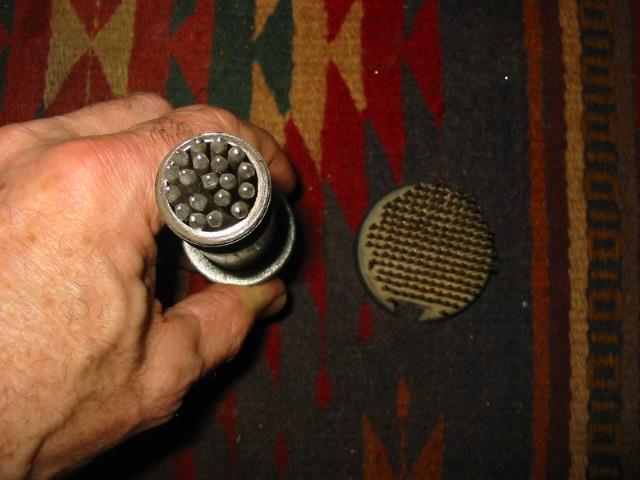
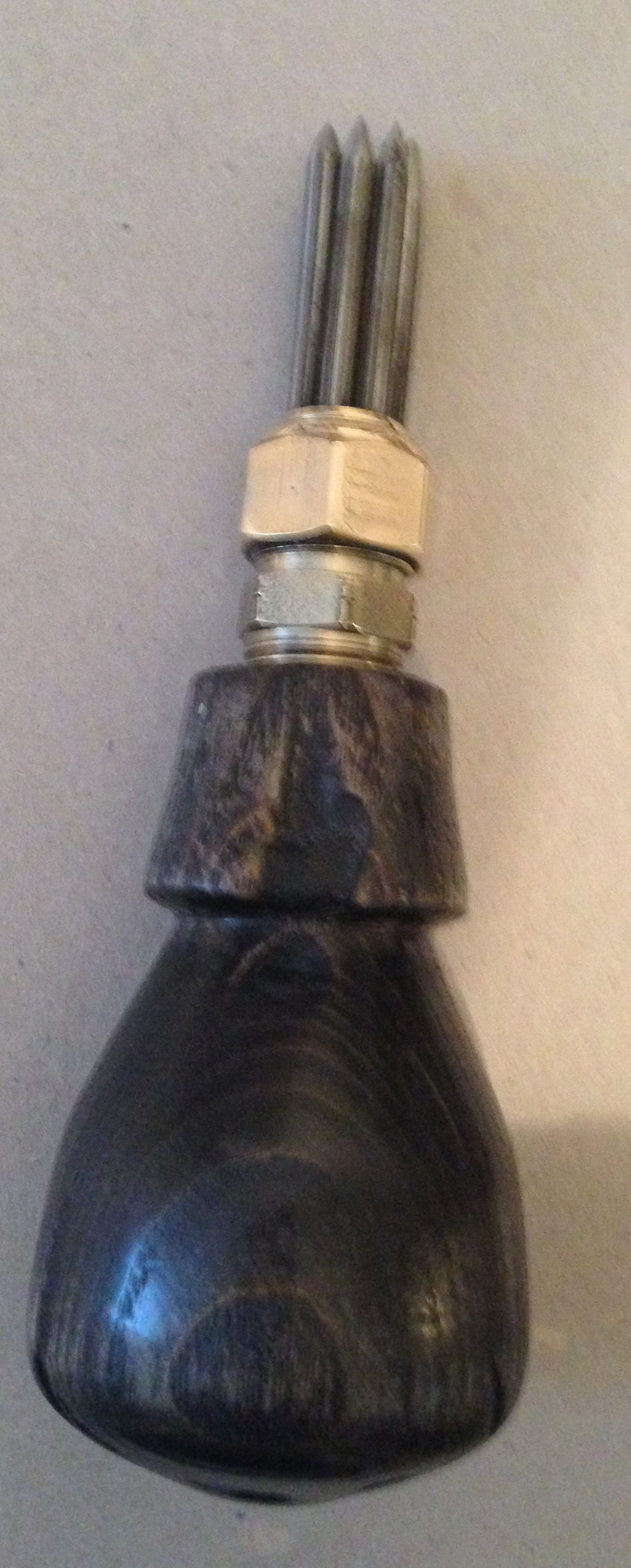
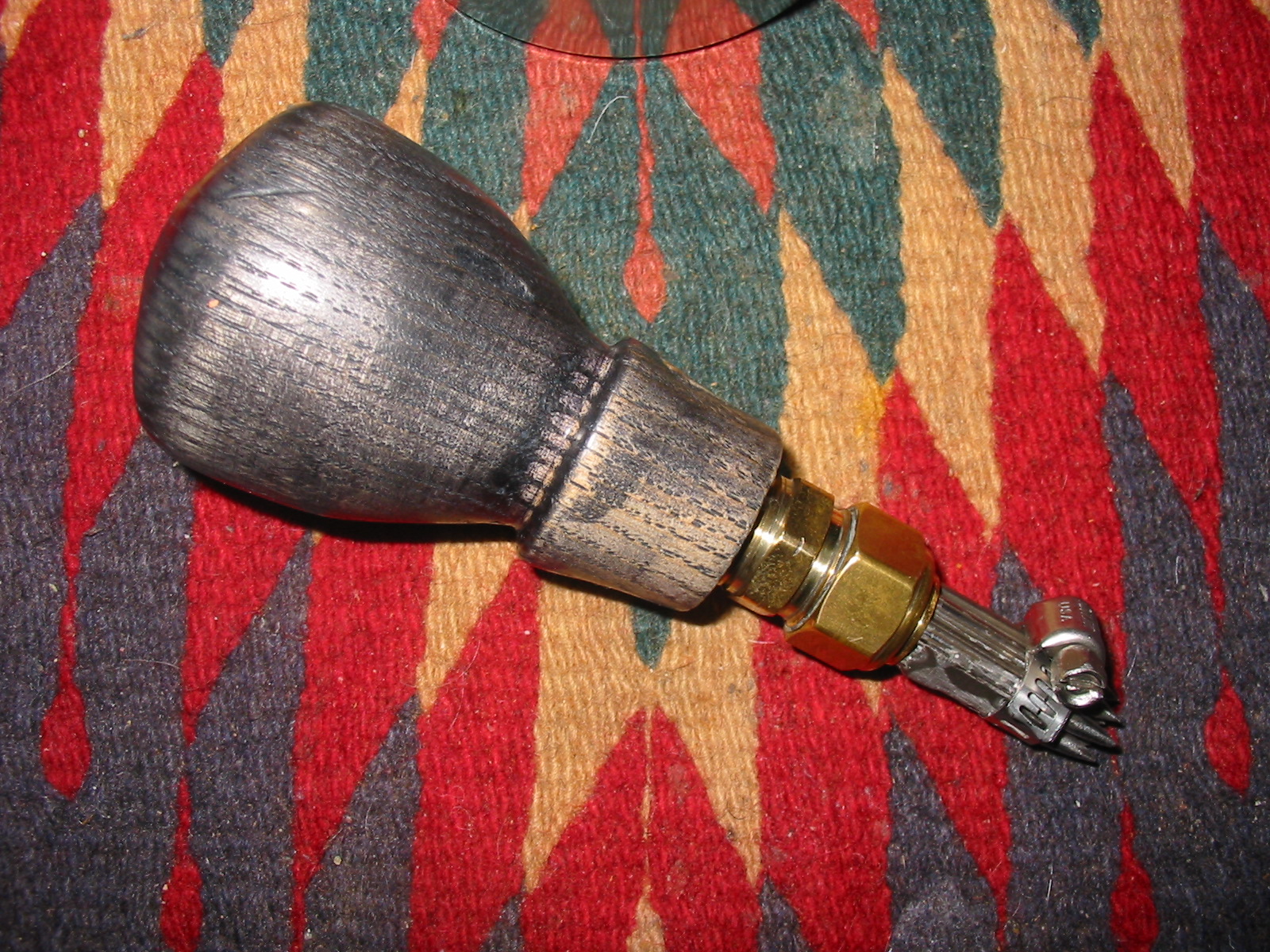
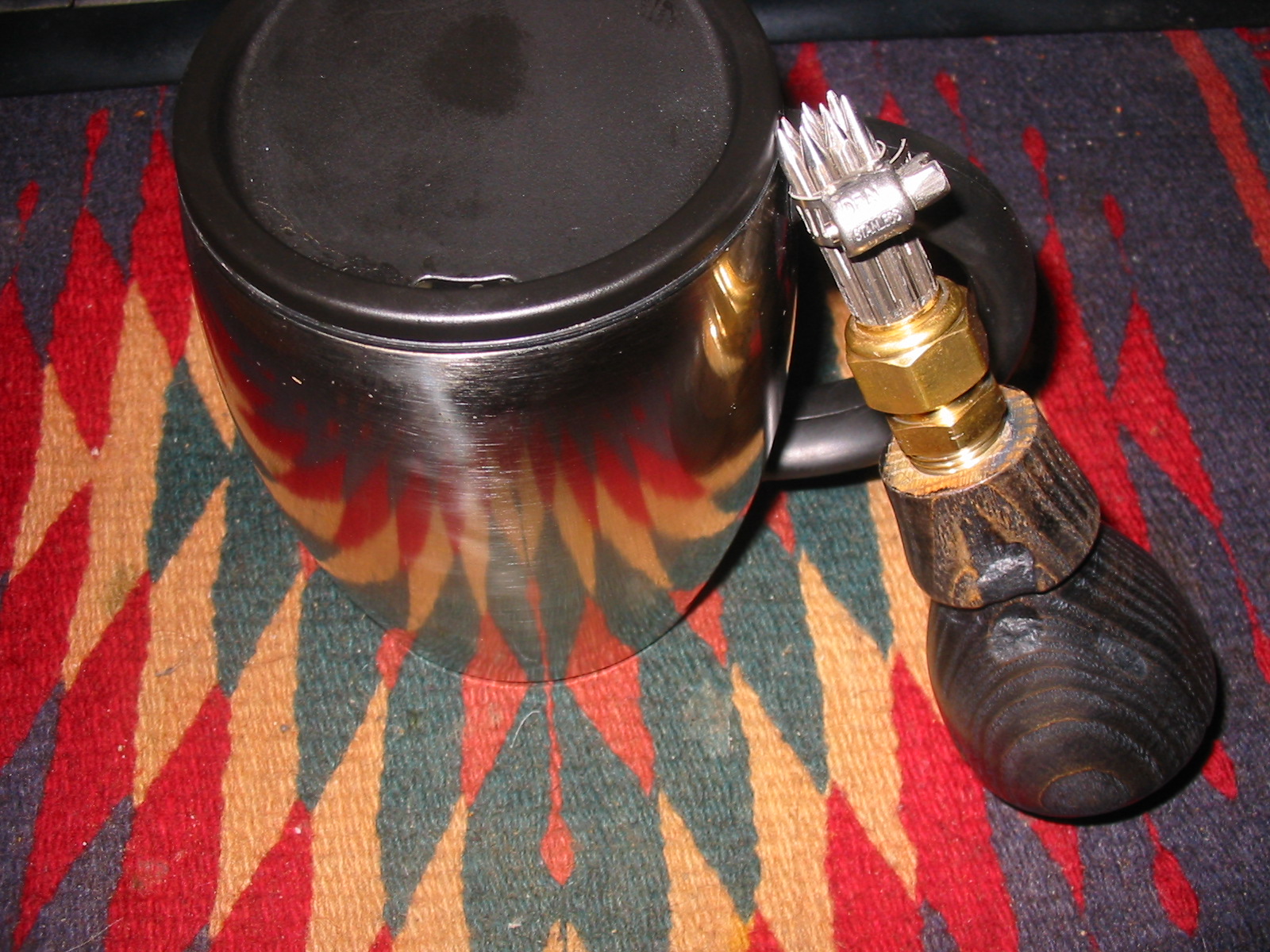
Chris decided to improve on the design and come up with a far more functional and beautiful edition of the tool. It certainly would not be hard to improve on the looks and functionality of hte tool. He wrote and asked me questions regarding the tool I had and as he worked on the rusticator we exchanged a series of back and forth emails. It saw several iterations before he arrived at this version of the rustication tool. He turned the handle on his lathe to try and address the comfort issues that I had raised in our discussions. He tapped and fitted the threaded brass coupling on the handle to hold the nails. He cut back the nails with a grinder and inserted them in the brass coupling. To hold them in place he screwed on an end cap. At this point the tool looked great and was certainly easier to hold and press into the block of briar. We wondered about the length of the nails and the effect on them when the tool was pressed and twisted into the briar.
rusticator 2Before getting into the trial of the tool on the block of briar I want to point out one of the best features of the tool in my opinion. That is the method Chris used to install the nails in the brass coupling makes the nail head changeable. The coupling can be unscrewed and a new head replaced. That alone fascinates me as it will make it possible for me to do some experimenting with a variety of nail configurations and sizes in the future.

I have always wondered if the size and configuration of the nails affects the pattern of the rustication. It seems logical to me that smaller nails will make a finer rustication and approximate a sandblasted look if done properly. Larger nails will give it a more pebbled look. One of my next steps with the tool will be to craft a series of nail heads that I can experiment with.
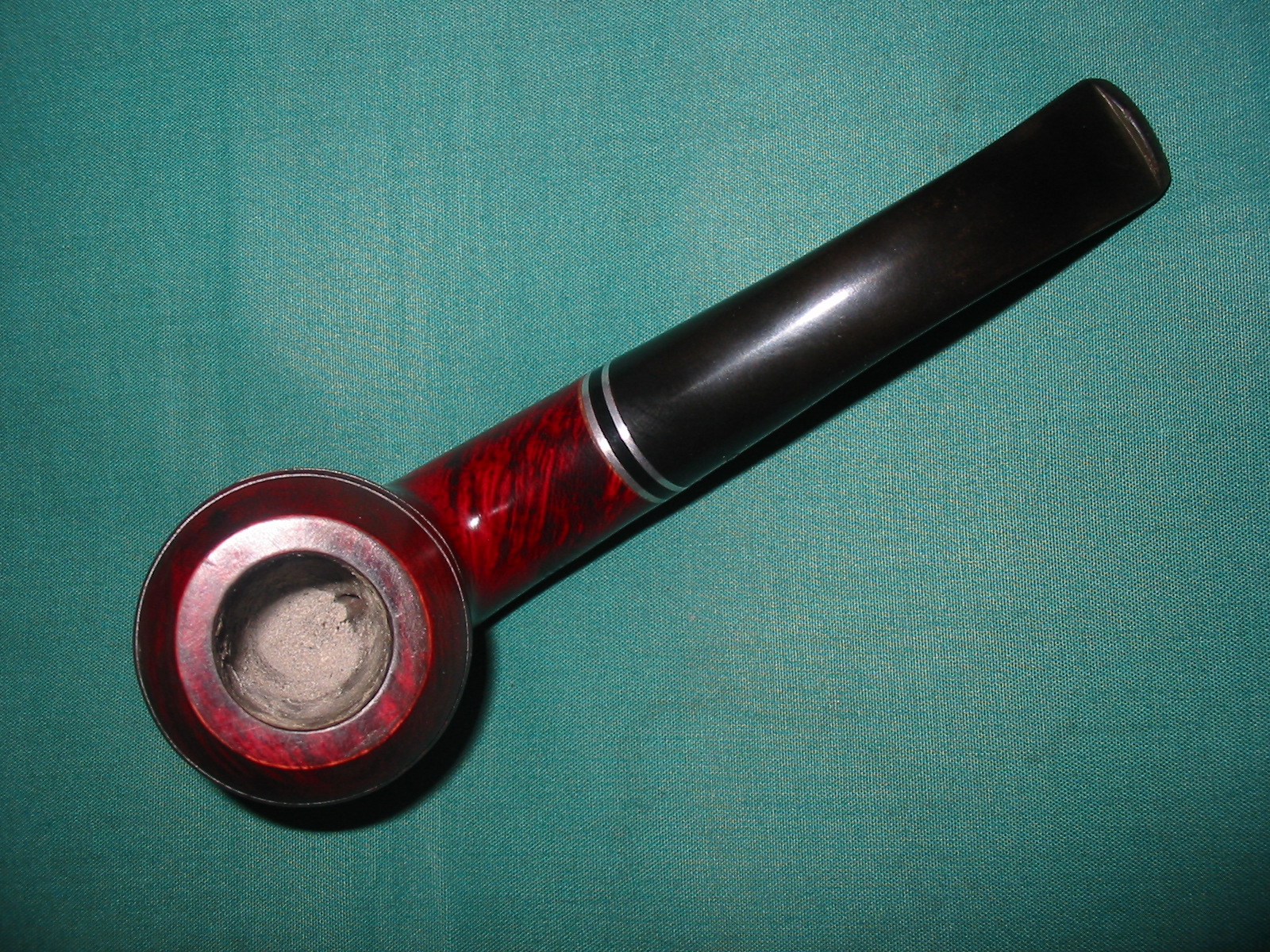
Chris tried it out on a block he had present. He found that the nails wobbled and splayed with the pressure into the block. The major difference in this model in comparison to my pipe model is that the nails extended from the brass cap further. This length made them less solid and accounted for the play in them when used on the briar. Chris and I discussed how to stabilize them. He sent me photos of the tool with an adjustable hose clamp applied to the nails about 1 inch from the tip. This worked well but took away some of the natural beauty of the tool.

I suggested that he bind the nails together using JB Weld and see what that would do. He did and once the Weld had dried and cured he tried the tool. He found that the nails still flexed and the JB Weld broke loose.
rusticator 1

rusticator 3
After the test runs he put the hose clamp back in place for this version of the tool and sent it to me. He wrote that in future versions of the tool he will shorten the length of the nails. That should give the tool stability when pressing and turning it into the briar.

The tool arrived here in Canada while I was travelling and was waiting for me when I got home. I opened the box and took the tool out to look at it. Chris did an amazing job in crafting this rusticator. I want to thank him for sending it to me. I appreciate his willingness to pass it on to me. It will certainly get some use from me. I look forward to using it and making further recommendations for future versions. One thing I can say with certainty at this point is that it fits more comfortably in my hand than the pipe version that I was previously using. I will keep you posted on how it works. Thanks again Chris.

Here are some photos of the tool when it arrived here in Canada.
IMG_6790

IMG_6792

IMG_6793

Restoring an old CPF Gourd Calabash Pipe


Blog by Steve Laug

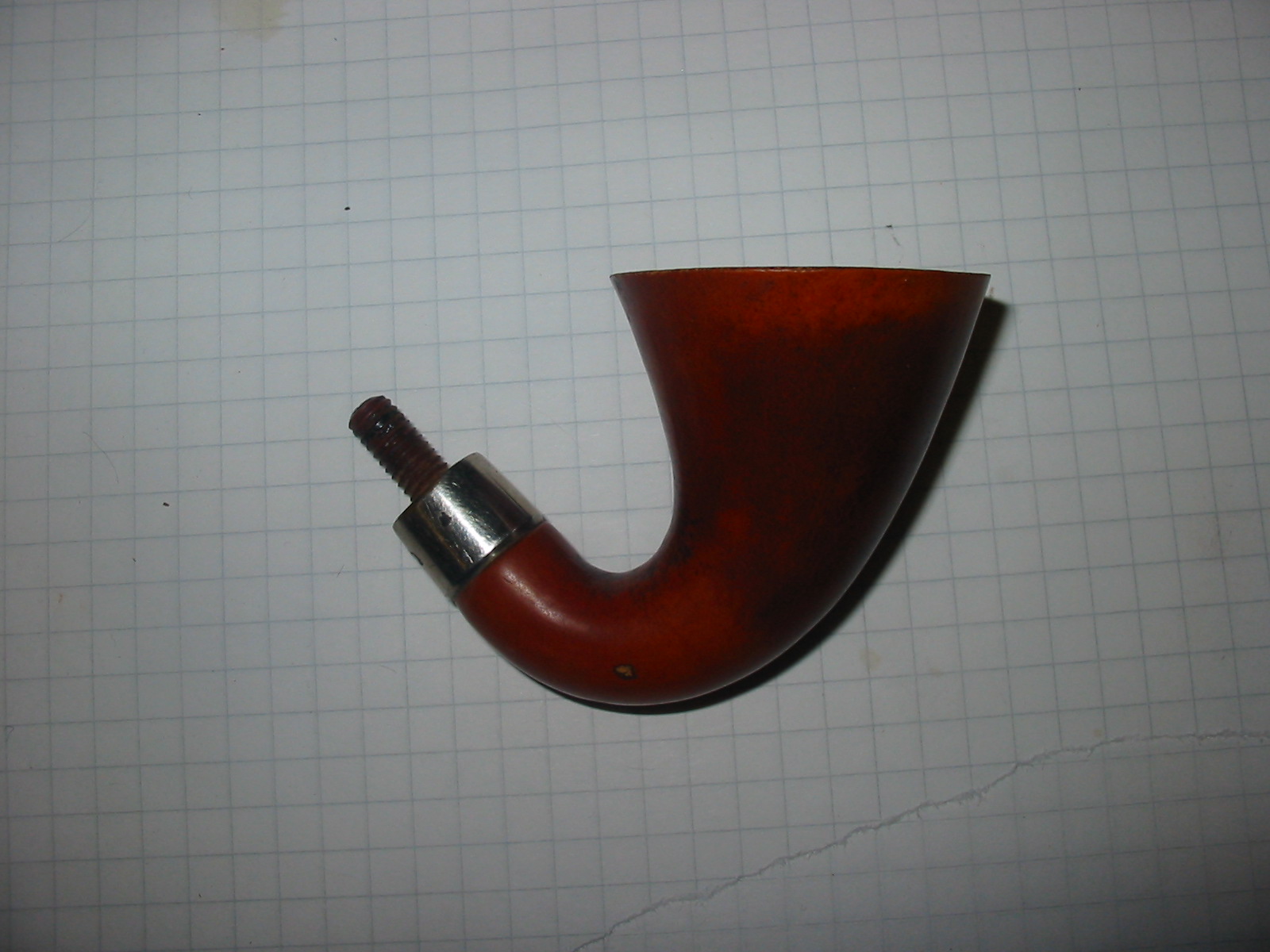
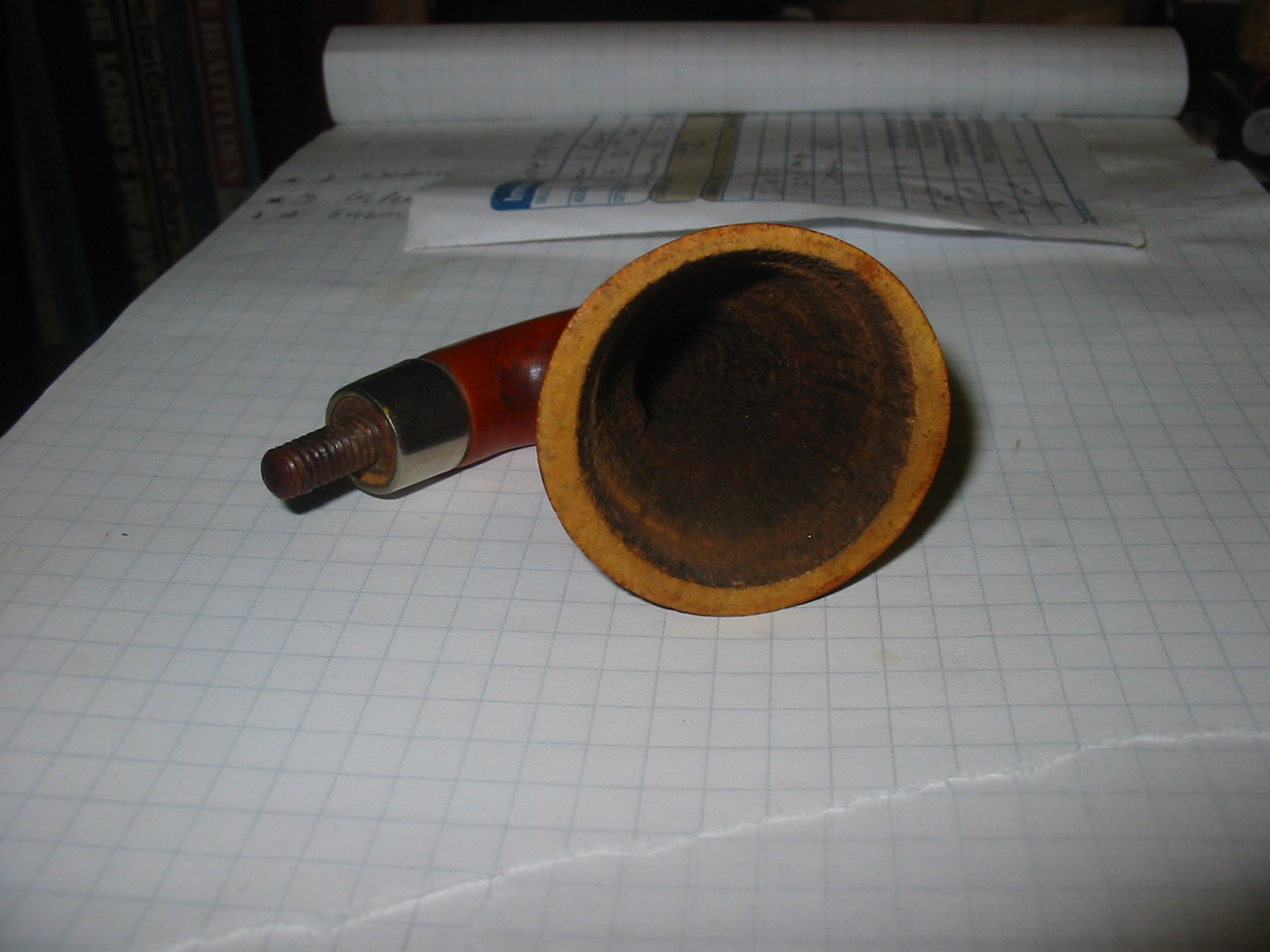
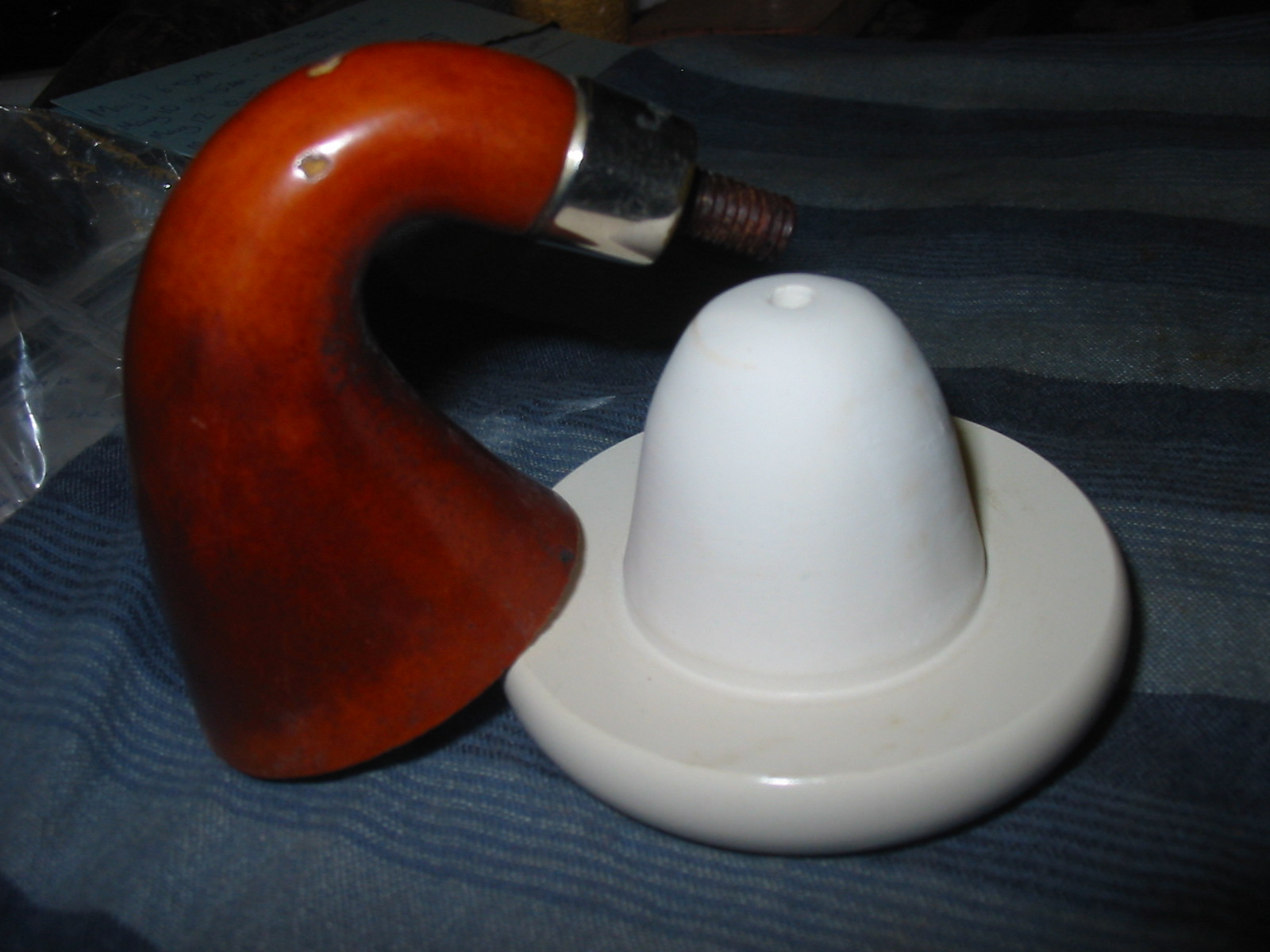
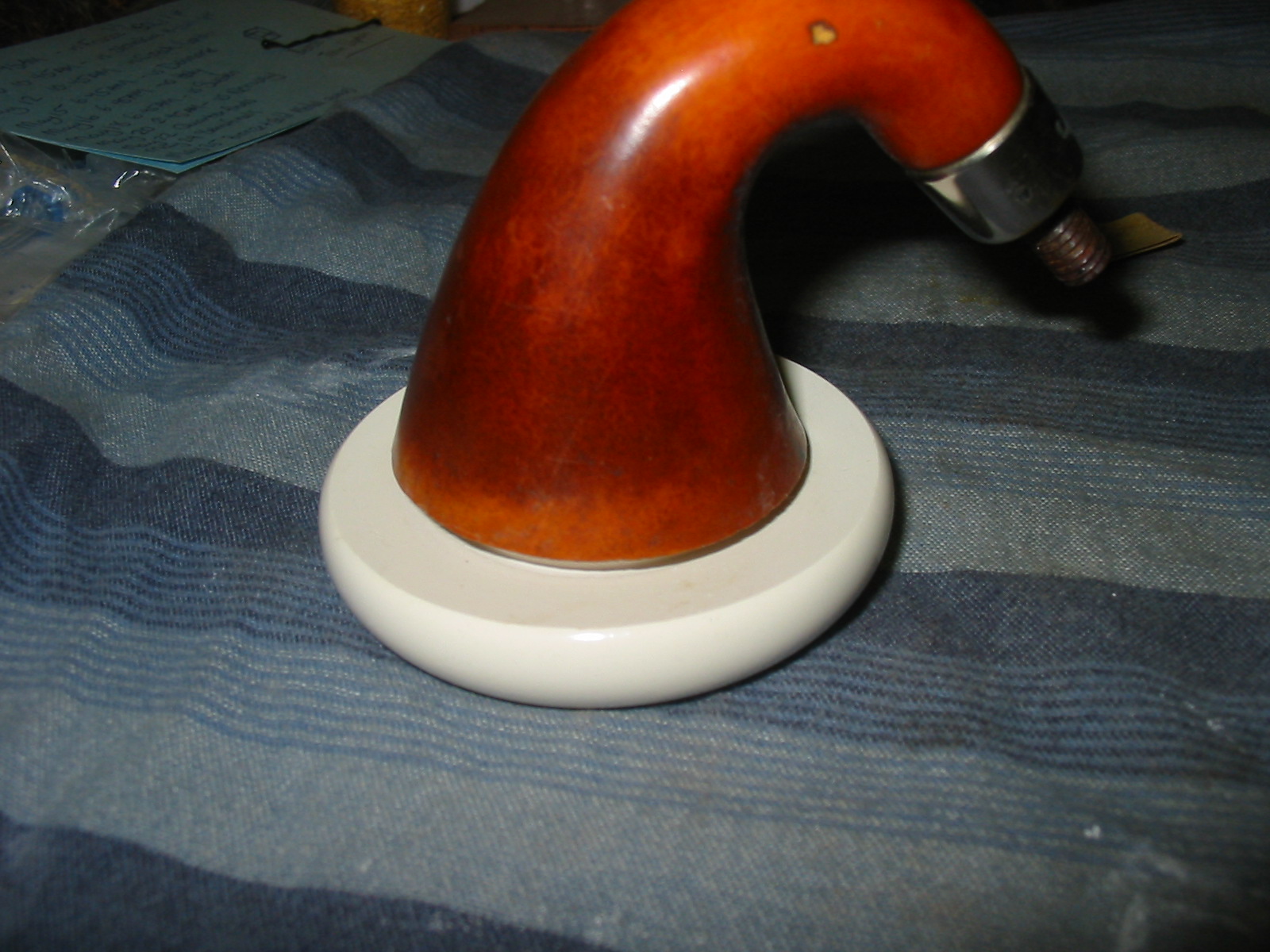
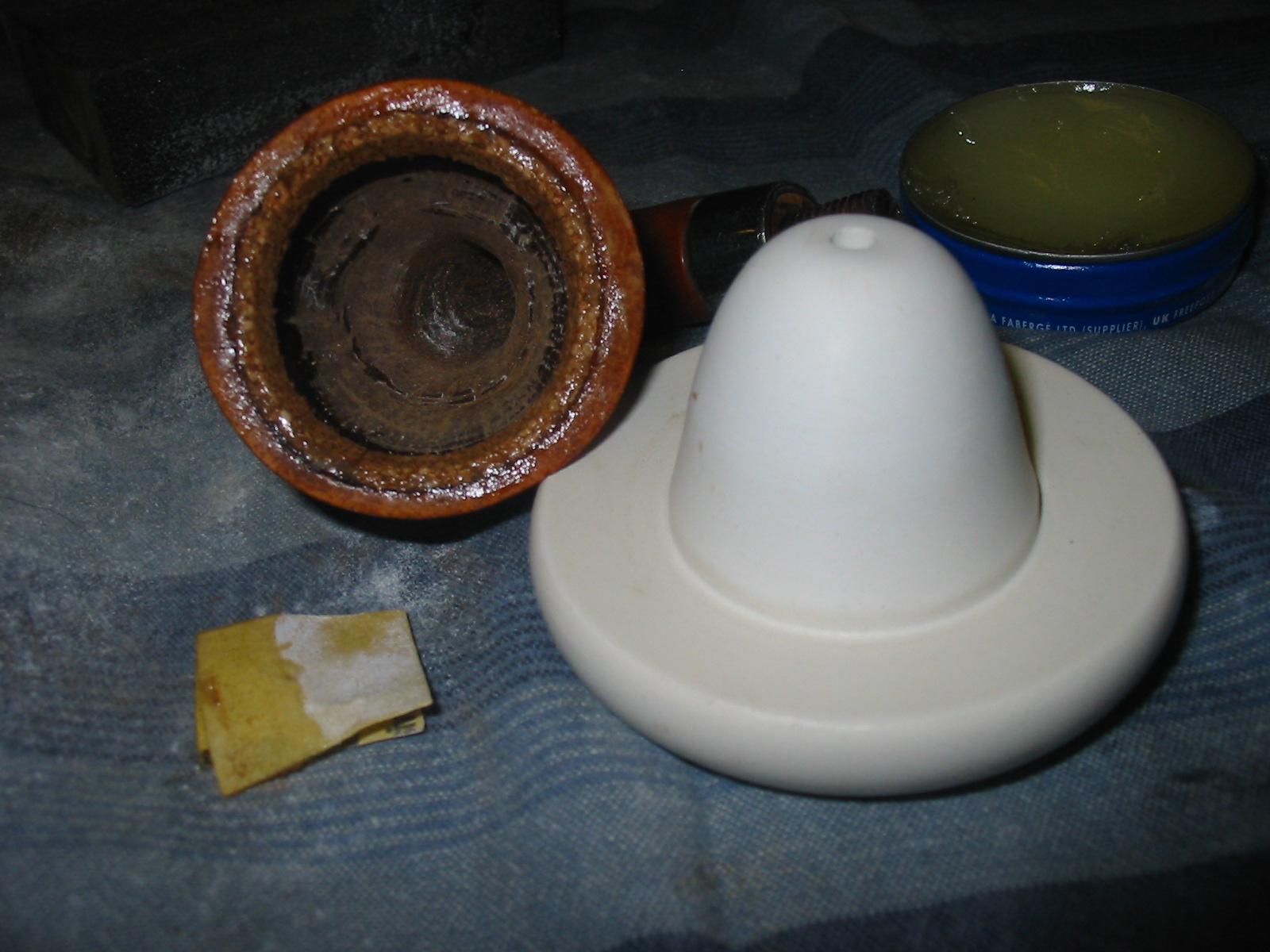
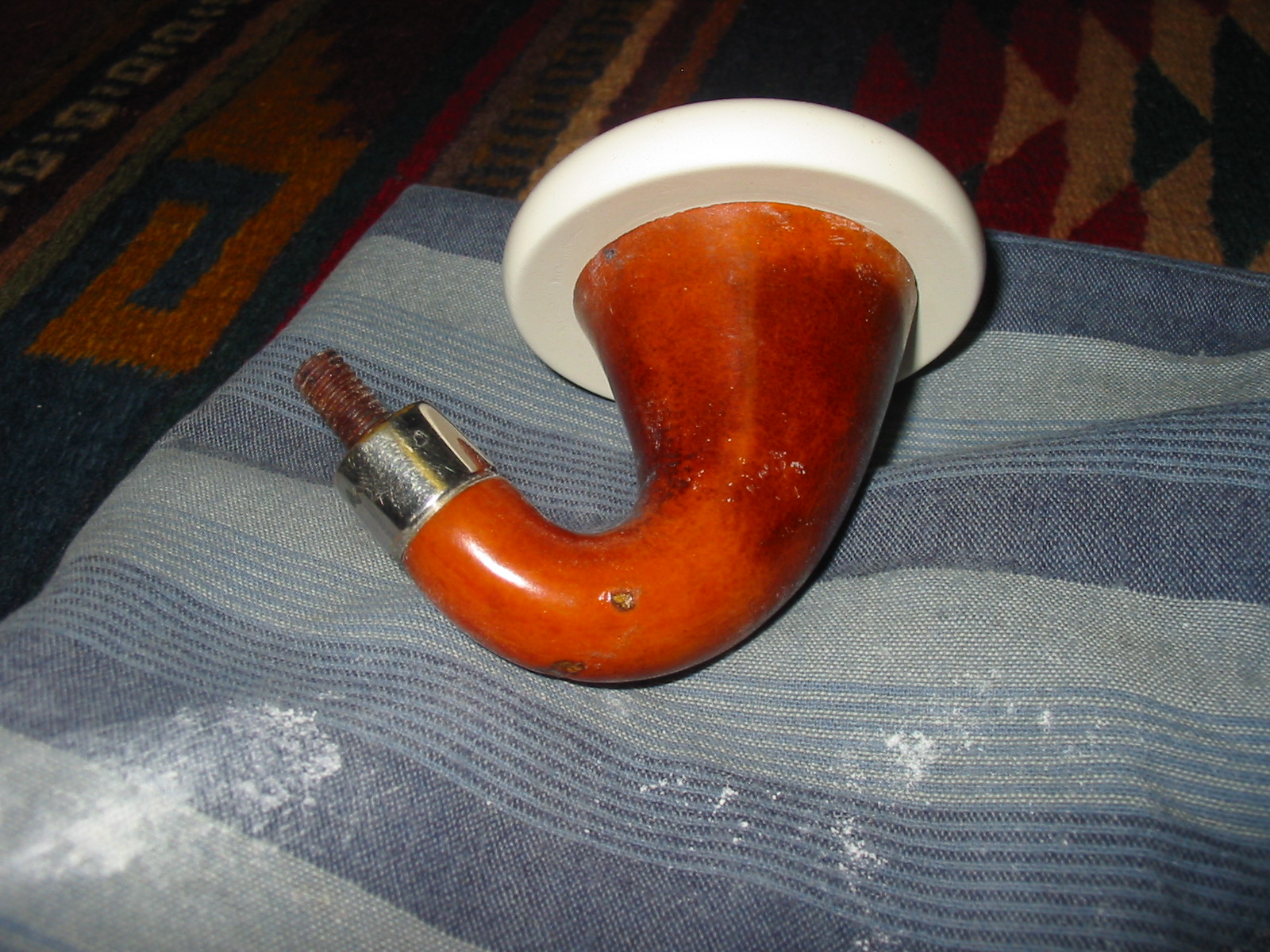
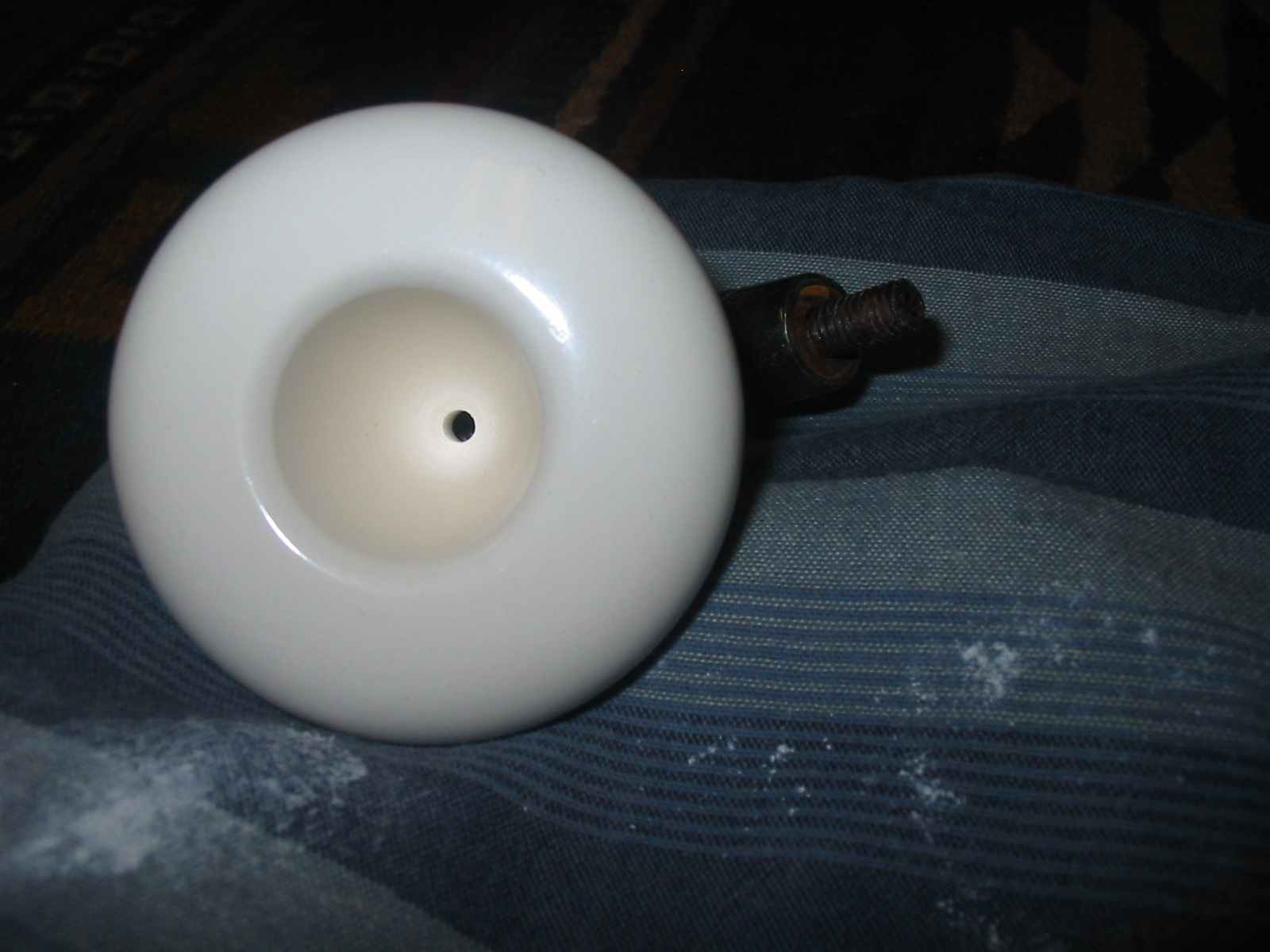
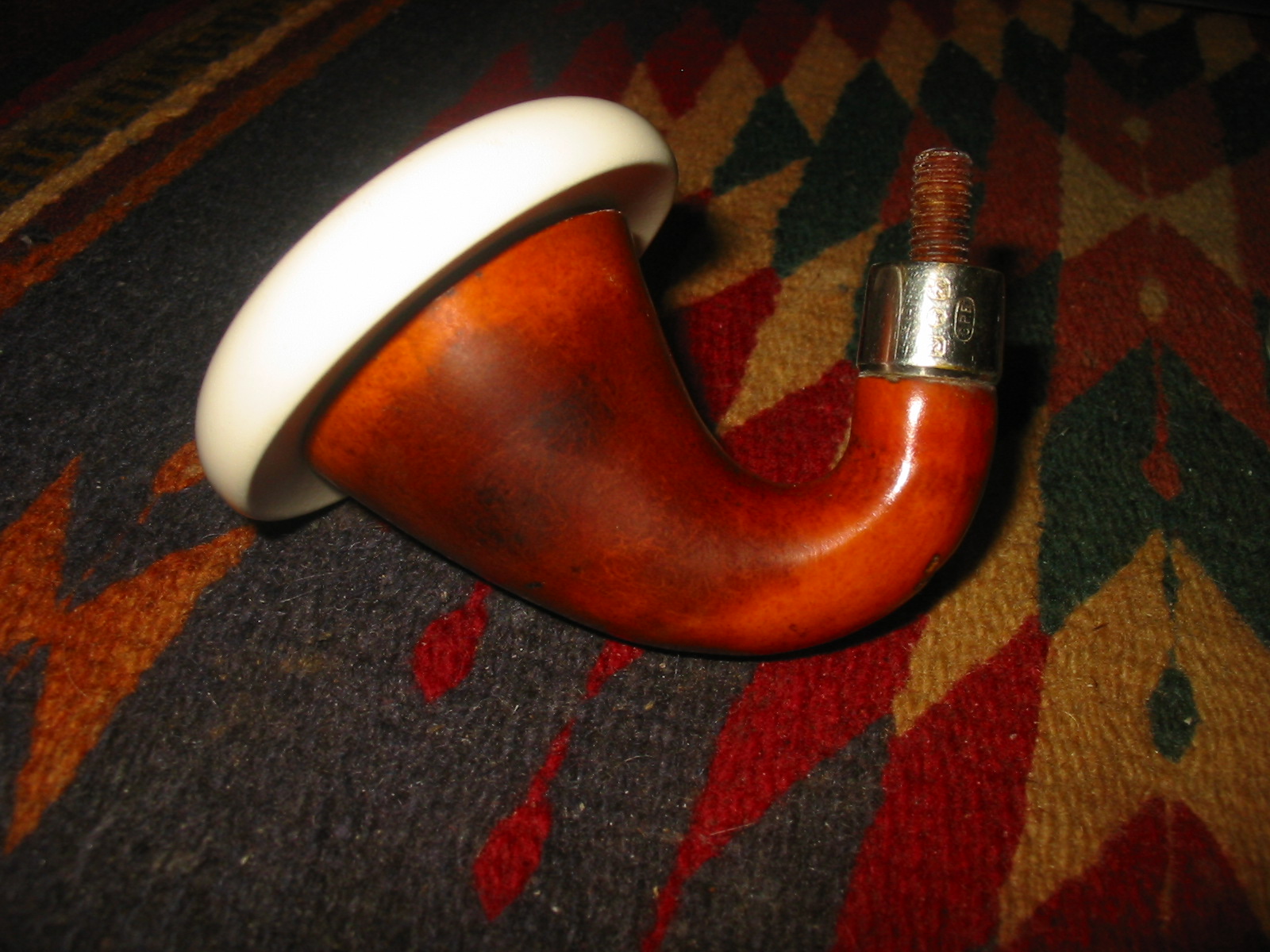
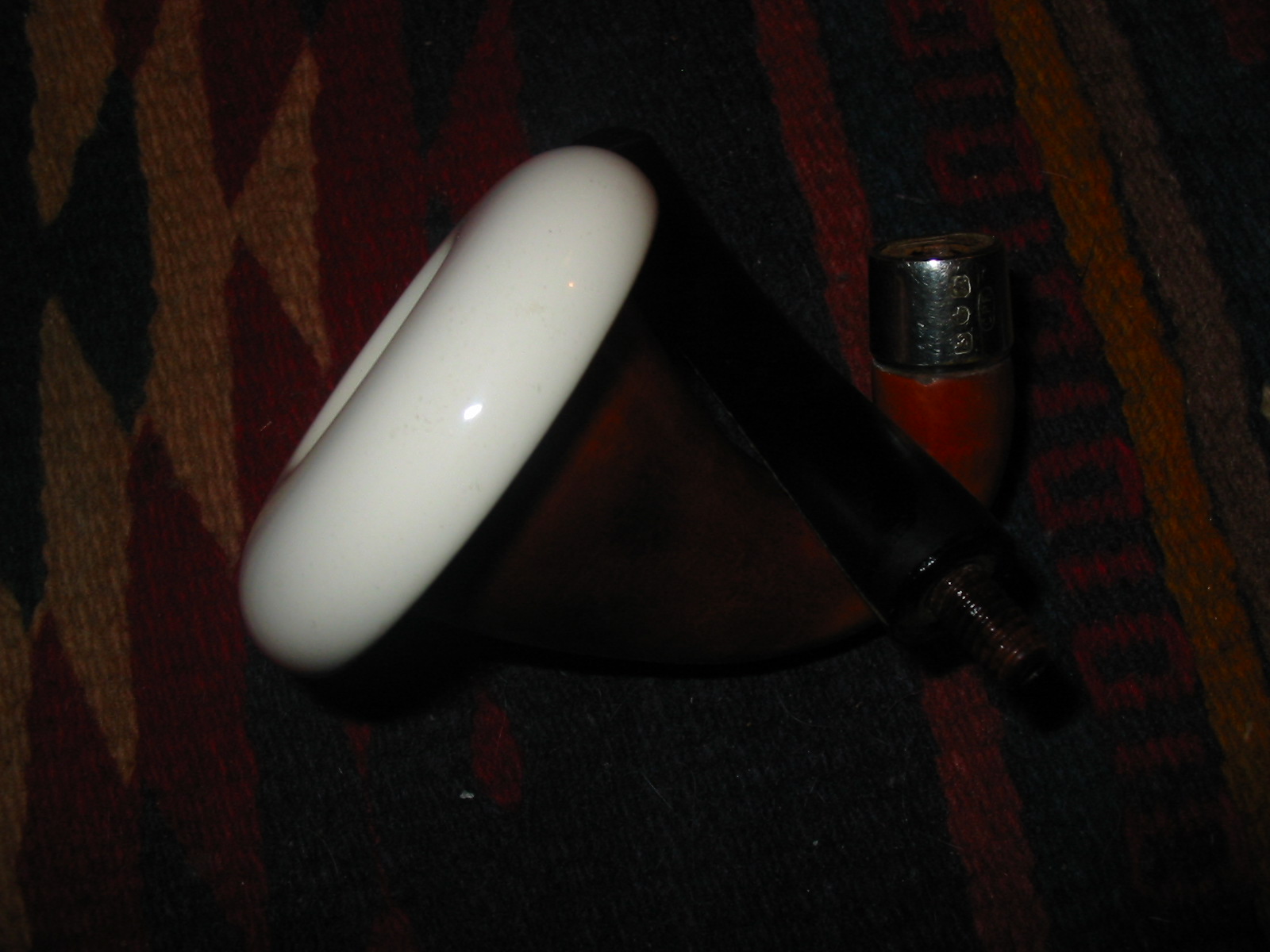
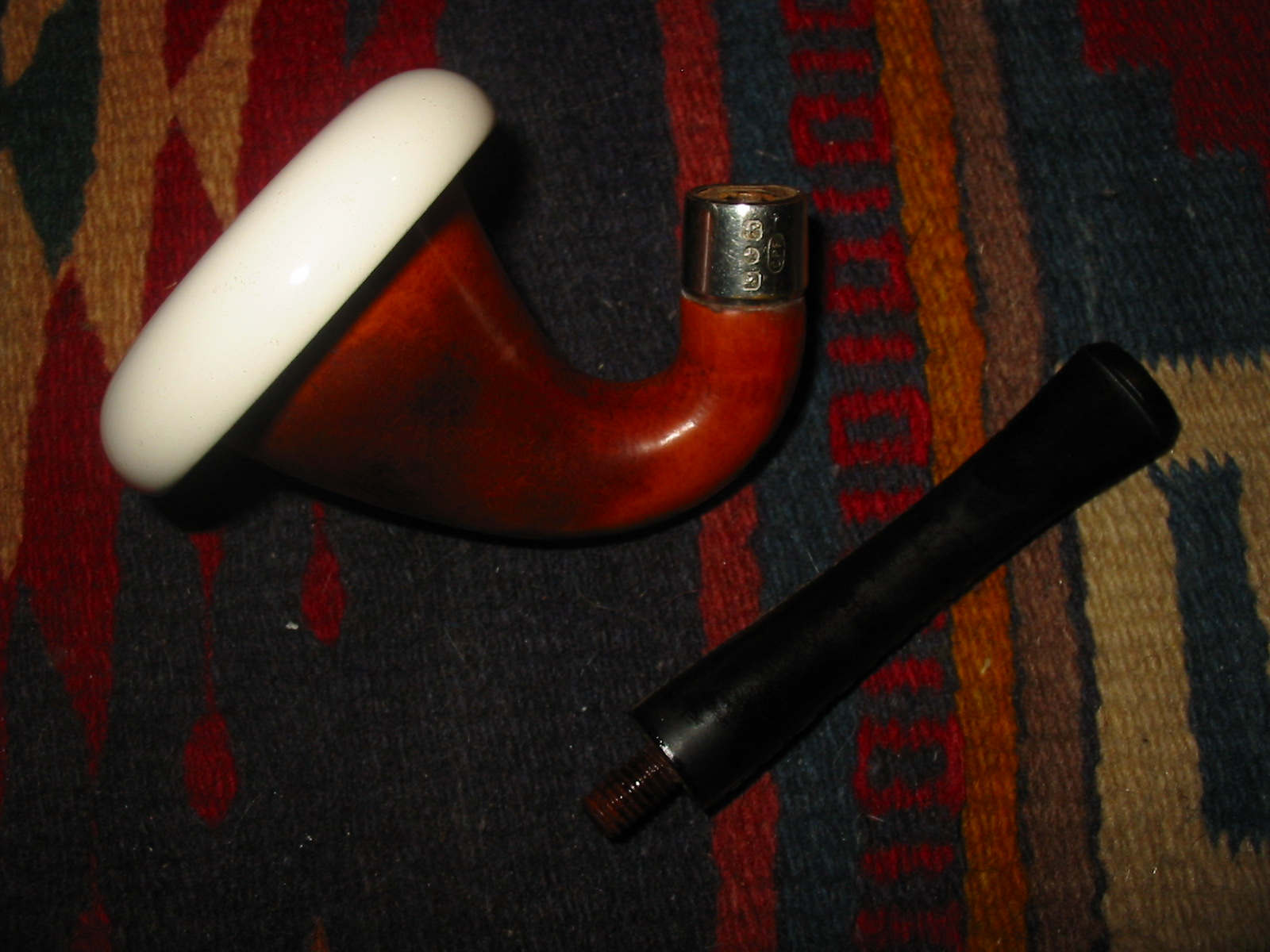
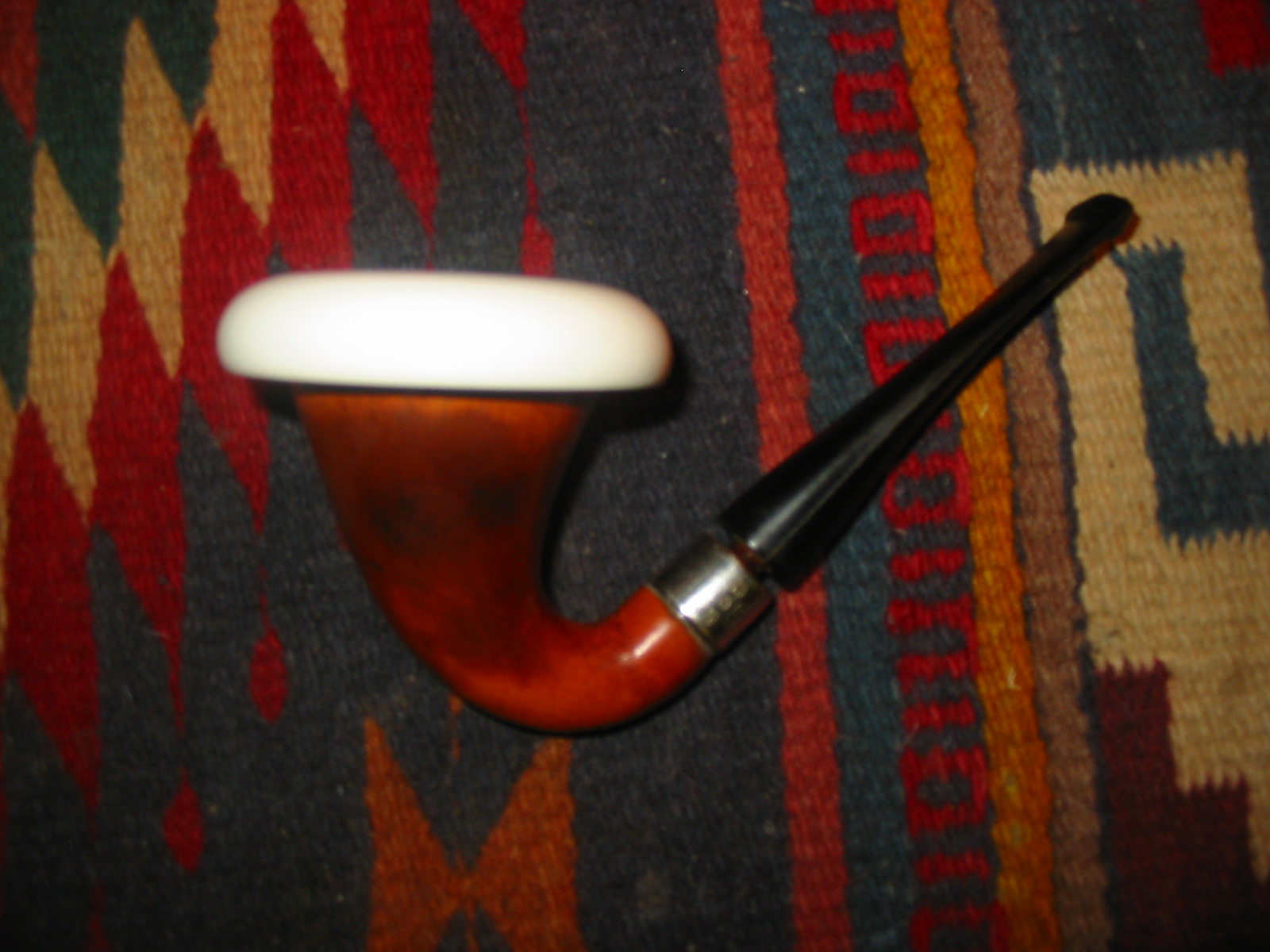
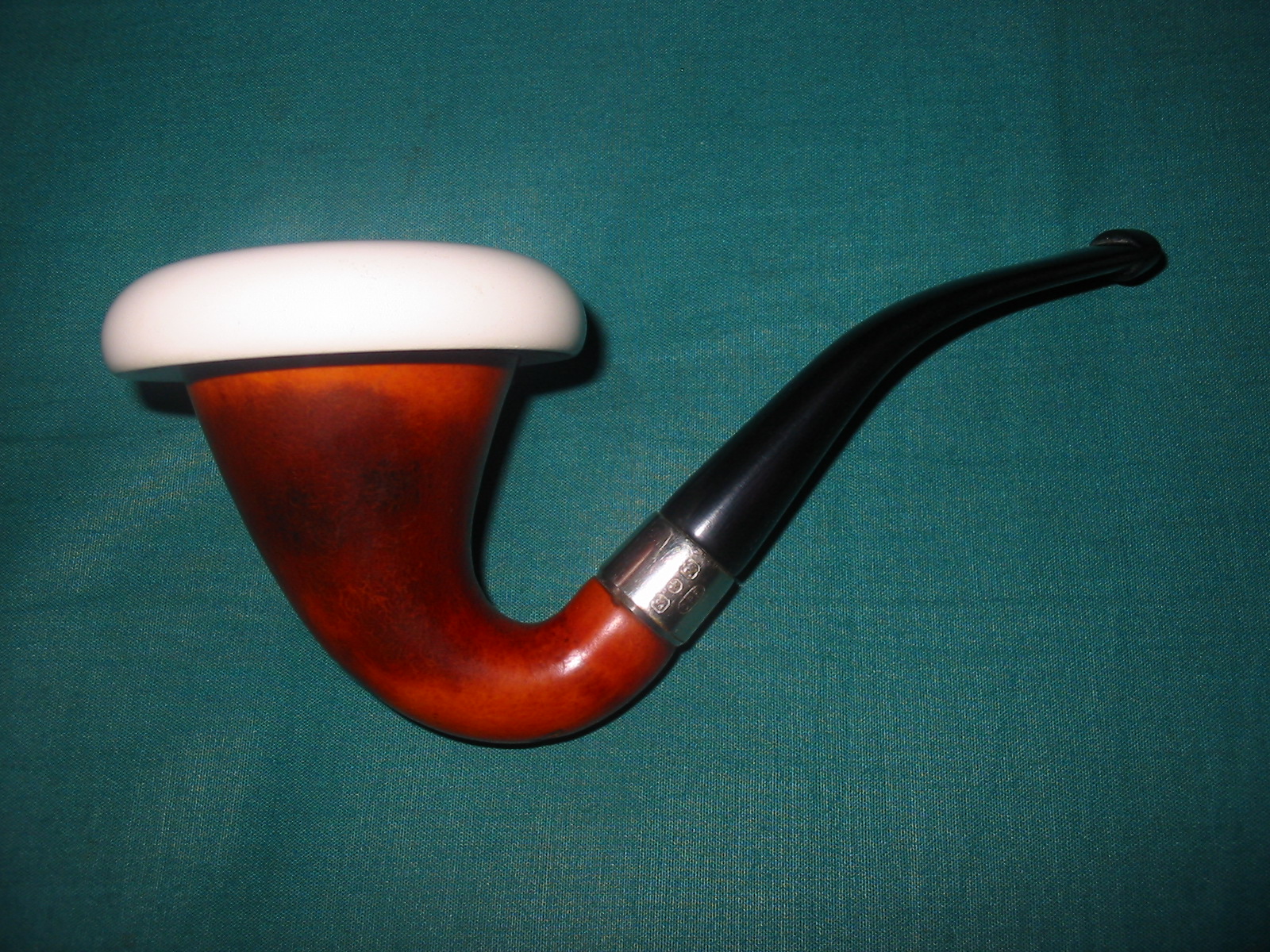
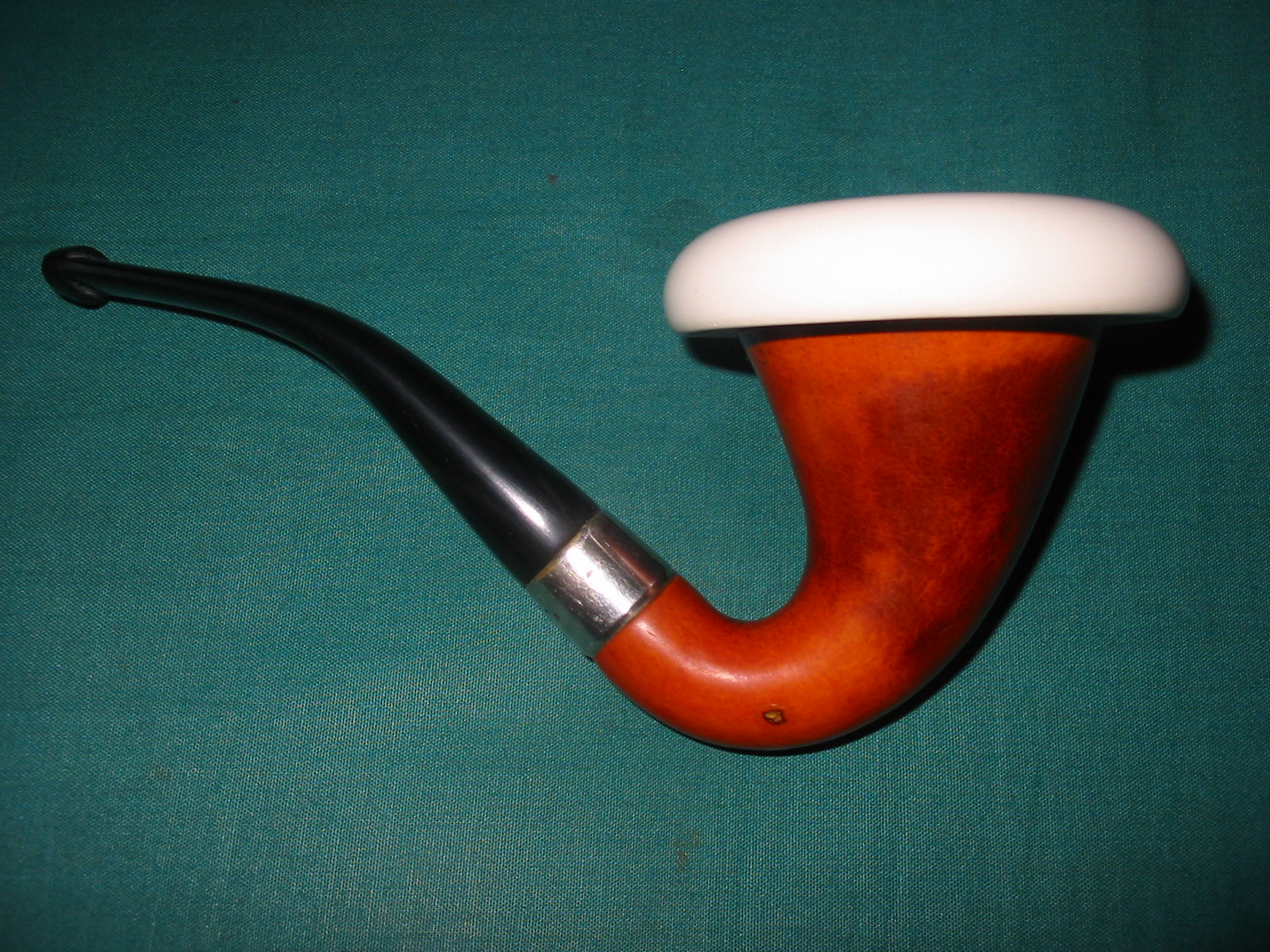
In my grab bag from the antique mall was a gourd calabash bowl. It has the original silver band with the CPF logo stamped on it and some faux hallmarks – an anchor, star and a figure. The CPF stands for Colossus Pipe Factory – a brand I researched and wrote about previously on the blog – https://rebornpipes.com/2013/04/14/so…-on-cpf-pipes/. The hallmarks on the band are an anchor with chain, a star and a figure of a man. From my research these are faux hallmarks. CPF pipes were made in New York and later became linked with KB&B pipes. Here is a link to an old catalogue linking the brand to KB&B that I posted previously on the blog https://rebornpipes.com/2014/03/05/an…cpf-catalogue/. Sadly there are no meerschaum pipes in the catalogue so I cannot ascertain the date for sure. I am fairly confident from comparing the band with others that I have which have similar bands that the pipe can conservatively be dated to the early 1900s or late 1890s. So it is a gourd bowl that has some age on it.
IMG_6432
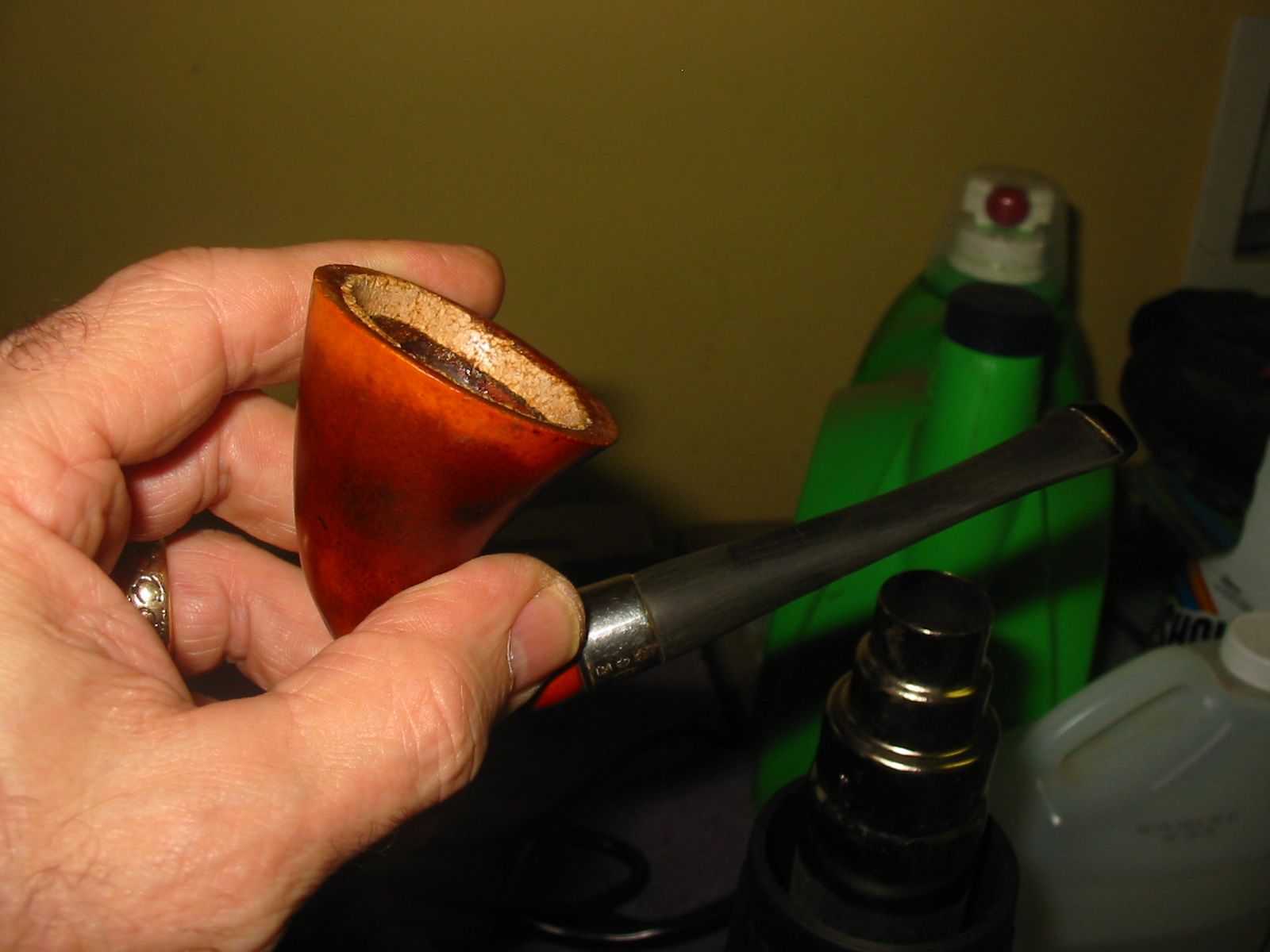
The bowl came with the band and a threaded bone tenon that was easily removed from the mortise. The gourd had darkened areas around the exterior of the bowl from the hand of the previous owners. There were several nicks in the gourd on the bottom of the shank next to the band and on the right side next o the band. The band had been pressed onto the gourd and it was obvious from the fit and the way it pressed into the shank ahead of it that it was original. The inside of the gourd had hard tars and tobacco oils on the walls down into the shank itself. There was nothing soft or sticky in either the shank or bowl. A pipe cleaner came out clean regardless of whether it was dry or wet. The top edge of the rim was pristine with no dents or nicks. There was a slight crack that ran down about ½ inch on the front of the bowl. I liked the shape of the gourd from the moment I took it out of the bag. It was not oddly shaped but was elegant in both the flare of the bowl and the curve of the shank. It would be well worth bringing back to life.
IMG_6430

IMG_6431
I measured the diameter of the bowl and the diameter of the bone tenon and made a call to Tim West at J.H. Lowe (http://www.jhlowe.com/) with the dimensions to see what he had in terms of a meerschaum bowl and a potential stem for the pipe. He asked for a photo of the bowl so he could have a look before recommending sizes of the stem or bowl. I told him that I was thinking about an amber acrylic a Bakelite stem. Once he saw the pictures Tim talked me out of that and said a vulcanite stem would be perfect for it. I asked if he would tap the stem for me before he shipped it. He said he would do it, no problem. He did a bang up job and sent it along with the meerschaum cup. Both of them arrived here in Vancouver quite quickly. I unpacked the bowl and stem from the box that Tim sent and that was the beginning of the issues that I faced with restoring this pipe. I will spell them out in detail as I write about the restoration of the pipe.
IMG_6747

IMG_6748
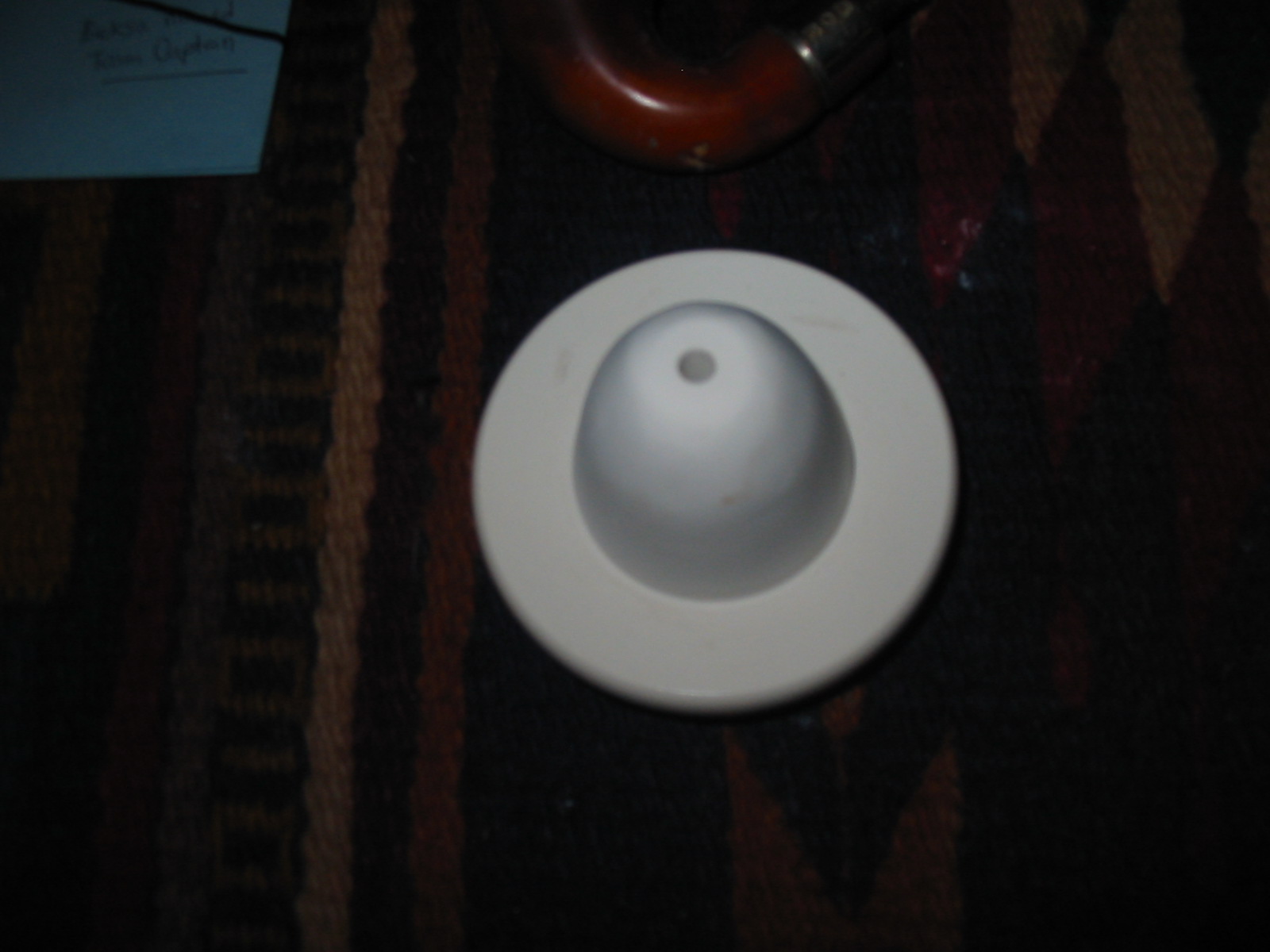
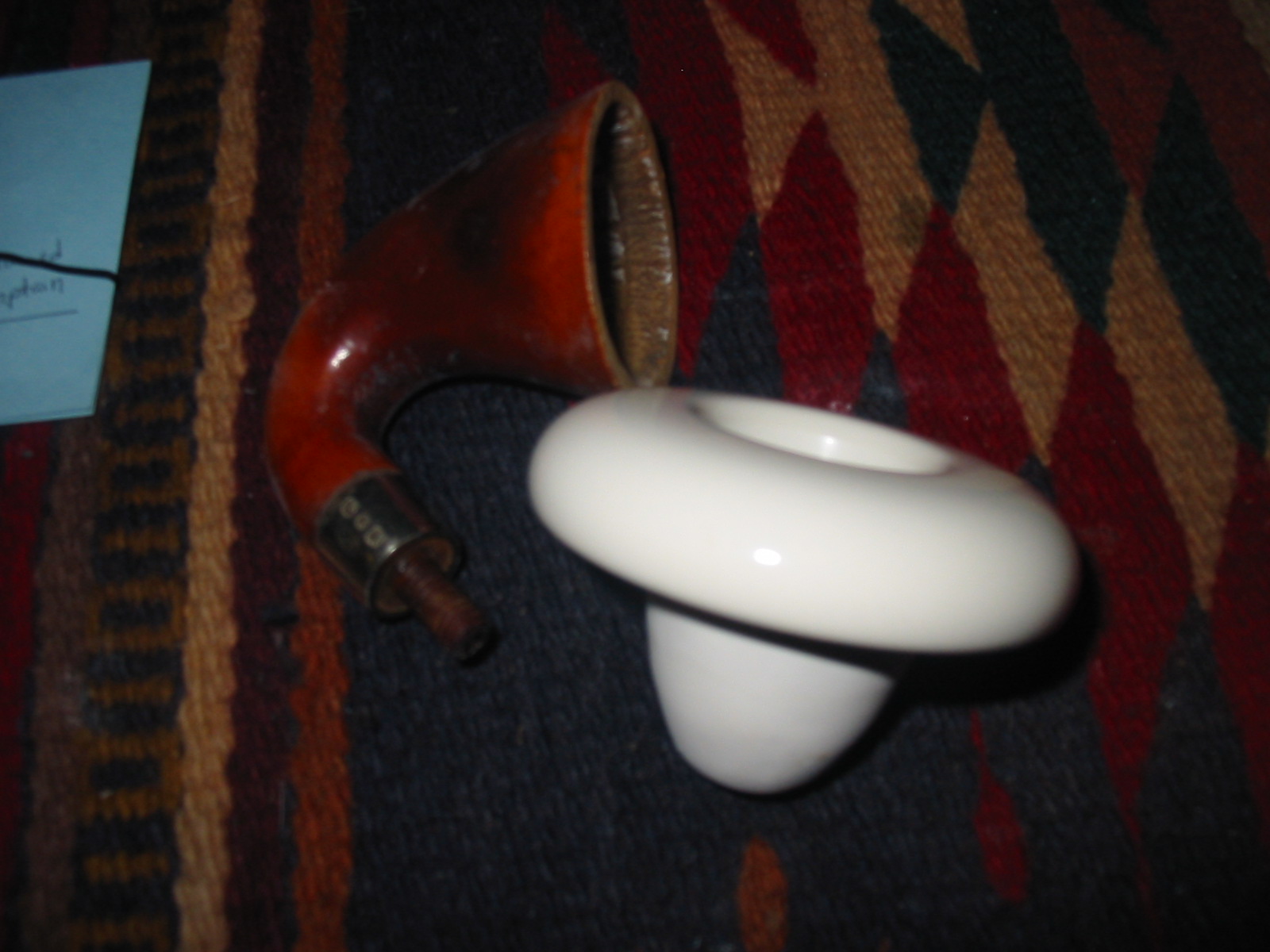
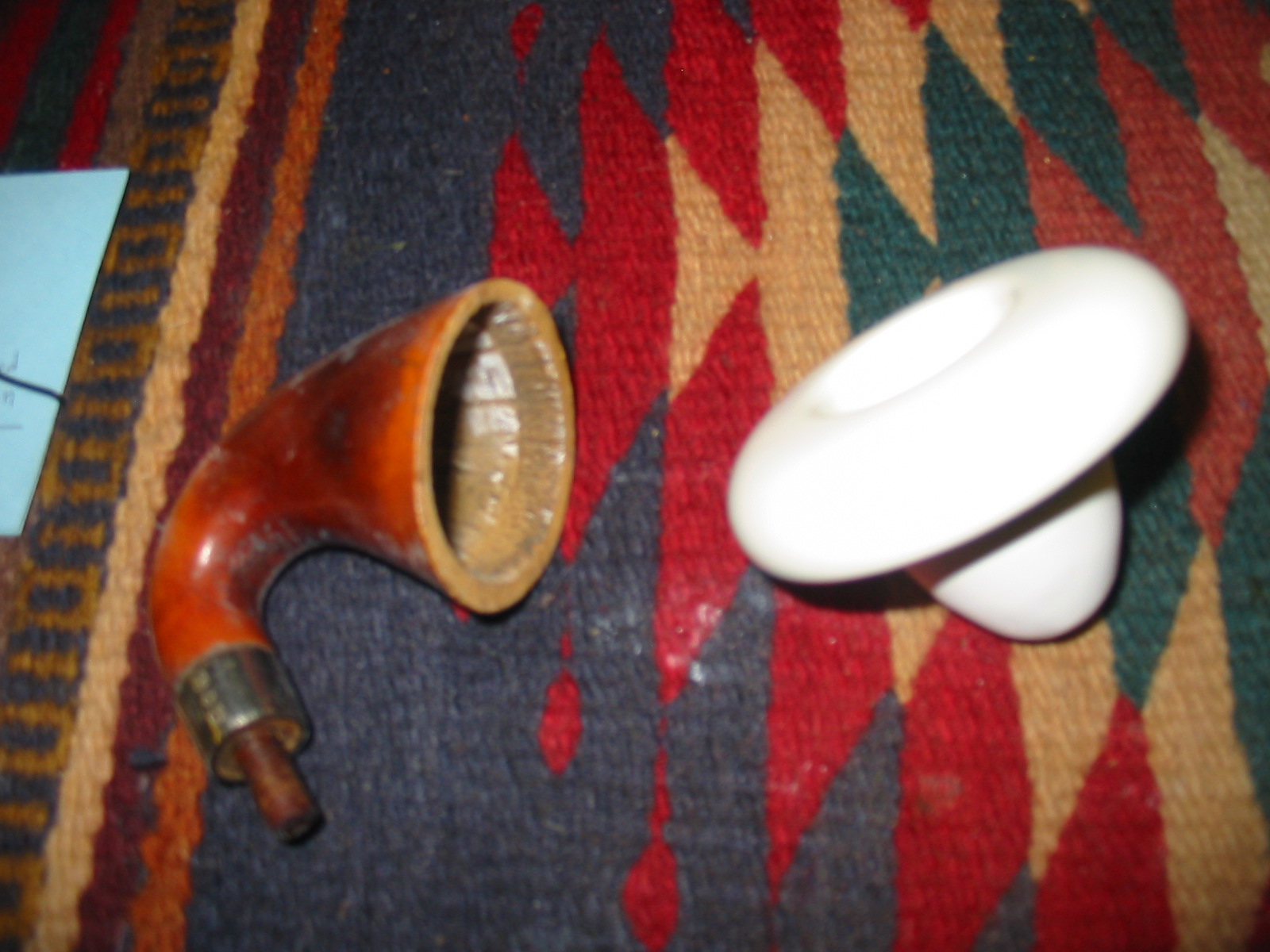
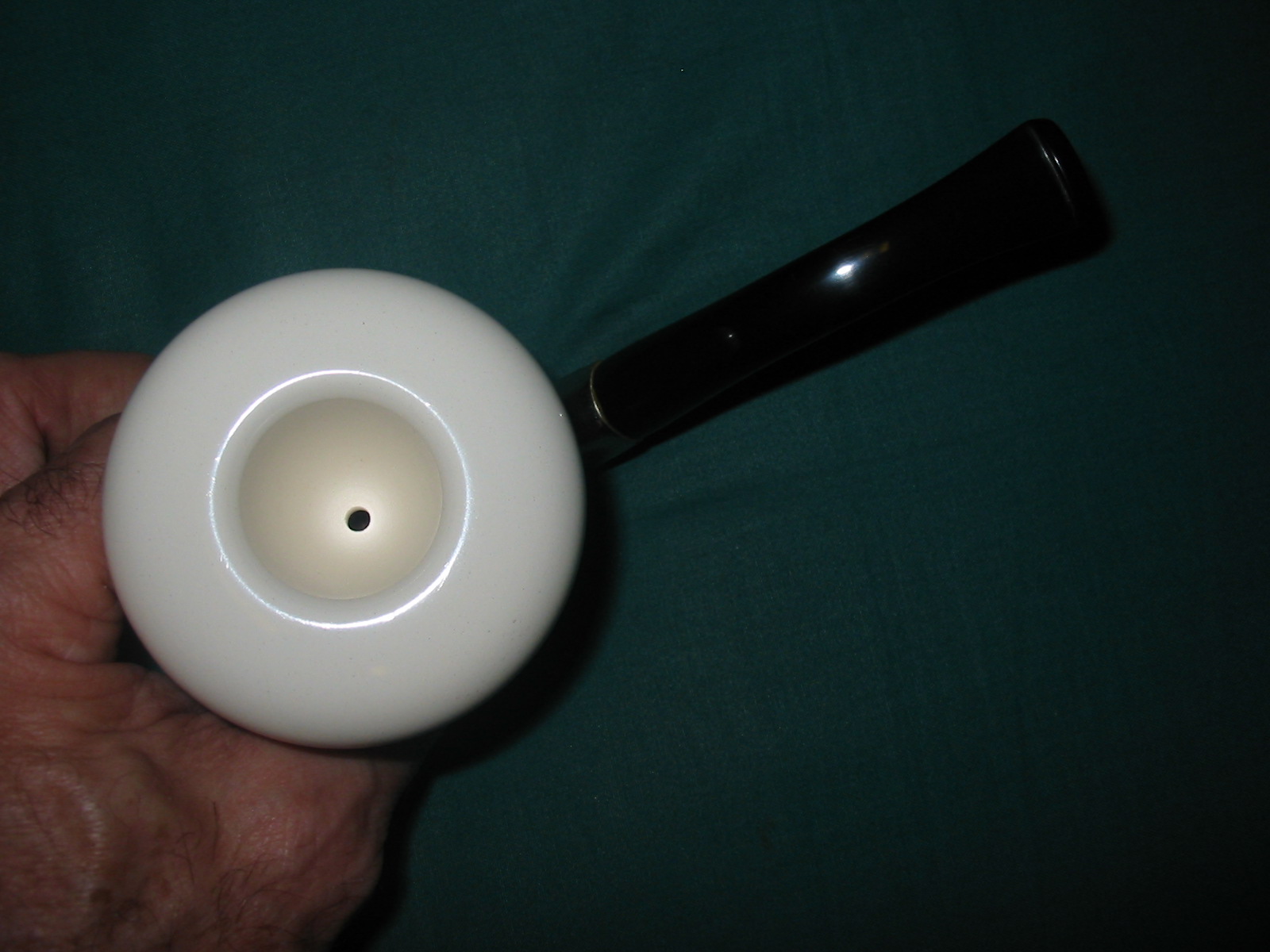
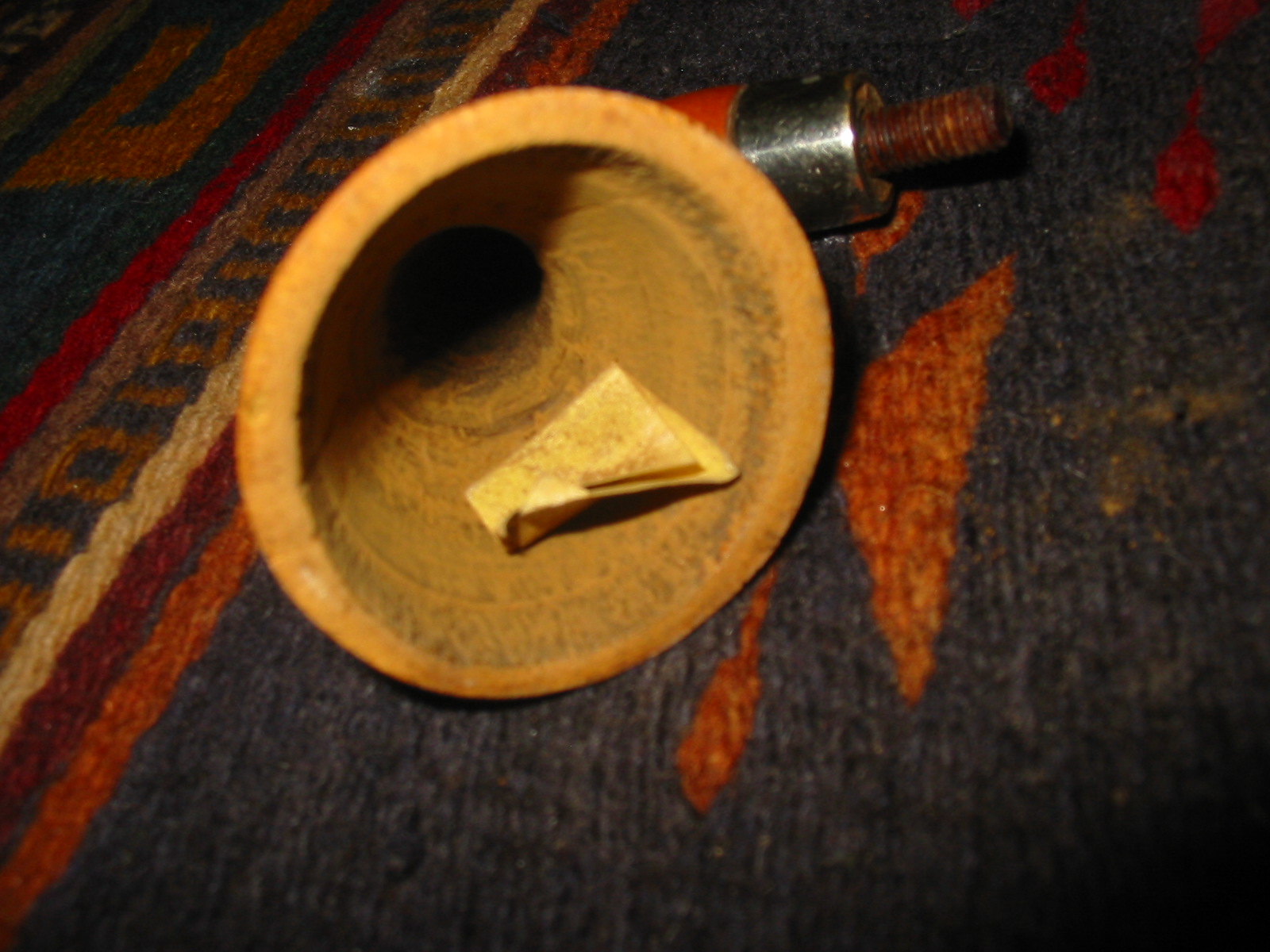
I tried fitting the meer cup into the gourd and found that there were several issues that I would have to deal with before it would fit well. The diameter of the bowl was perfect. The mushroom cap was big and draped over the top of the gourd and looked passable to me. The first problem was that the bowl had a lip around the top edge under the cap that was shaped the wrong direction – absolutely the opposite of the angle of the bowl. Because of that ridge the bowl would not sit in the gourd bowl correctly. Secondly I found that even without the ridge the cup was too deep to fit the depth of the gourd. The gourd tapered much more sharply than the meer cup so the bottom of the cup sat high in the gourd bowl. I would need to change the taper on the cup and shorten it so that it would sit in the gourd correctly and I would need to remove the lip around the top under the cap.

I measured the thickness of the bottom of the bowl and the thickness of the walls of the bowl around the cup to make sure I could remove the ridge and shorten the bowl without ruining the meer cup. I was happy to see that I had a lot of room to work with and could easily remove what was needed for a proper fit in the bowl. I used the Dremel to remove the ridge from under the cap edge. It was big enough that hand sanding would have taken a very long time. I took it down to match the rest of the bowl. I also used the Dremel to shorten the bowl. I flattened it out and took off approximately ½ inch. I then hand sanded the bowl with 220 grit sandpaper to reshape it and smooth out the Dremel work. I reshaped the taper of the cup to match the taper of the gourd. I sanded the flat edges of the bottom and reshaped it into a gentle curve. The photo below shows the newly reworked bowl. It fit well in the gourd after all of this work.
IMG_6749

IMG_6752

IMG_6751
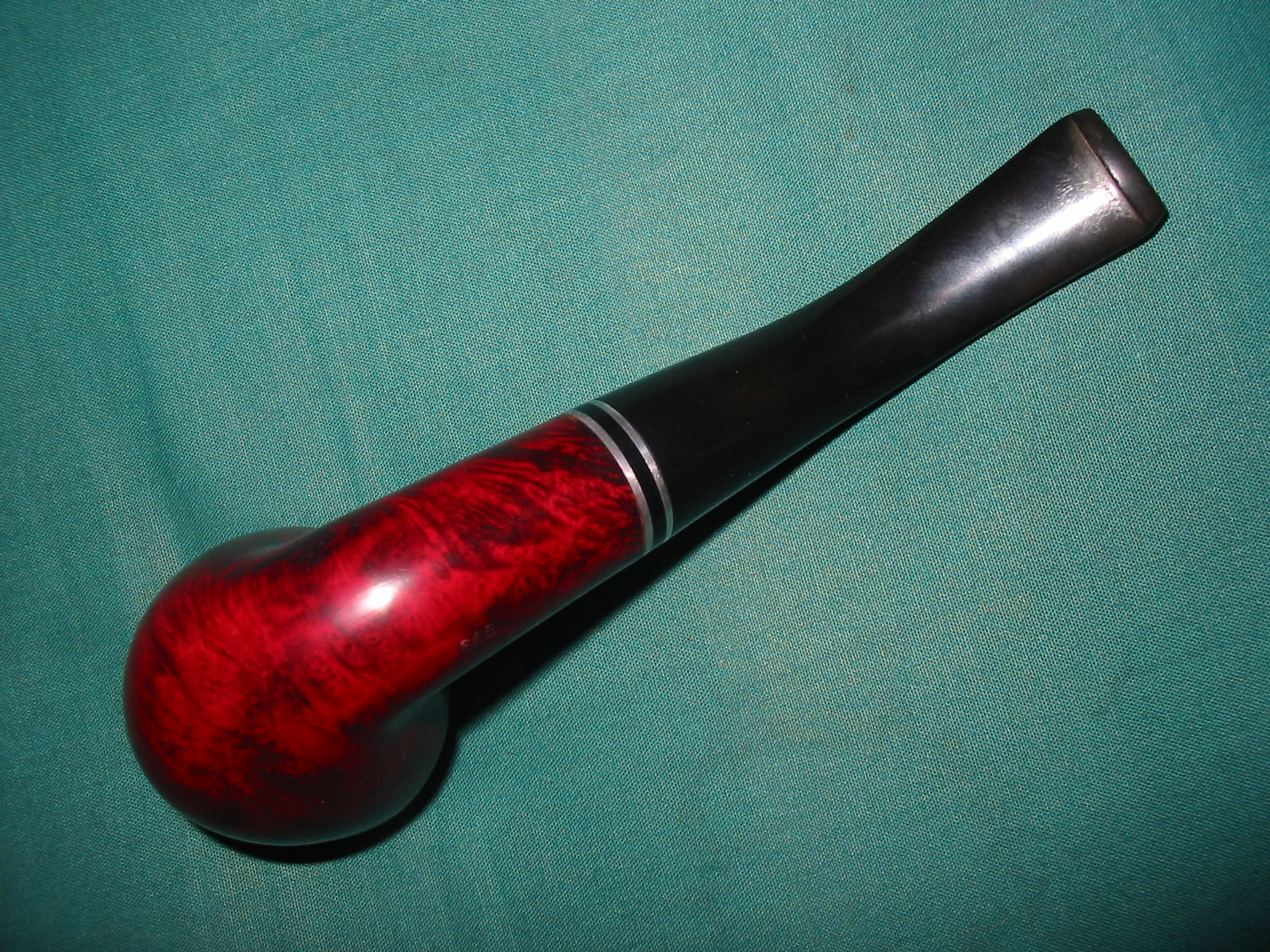
I set aside the meer cup and cleaned out the inside of the gourd removing the tars and build up. I washed down the outside with undiluted Murphy’s Oil Soap to remove the grease and buildup on the gourd. I did not want the soap wet as I did not want to wet the gourd. I rubbed the soap on with a cotton pad and scrubbed and removed it the same way. Once it was clean I noticed that the small hairline crack along the front of the bowl was slightly open. I opened it slightly and dripped some super glue in it to bind the crack and clamped it until the glue cured. Fortunately for this impatient man the super glue dries very quickly and I could move on to the inside of the gourd. I sanded it out with a folded piece of 220 grit sandpaper. I was able to reach quite far down into the shank and sanded the ridges of tars and oils out of the bowl. There was a thick ridge at the bottom where the original cup had rested against the walls of the gourd. I used a dental pick to loosen that area and then sanded it smooth. All of this cleaning work served to renew the inside of the gourd but also made a smooth base for the new meer cup.
IMG_6750
I cut a piece of cork to fit the inner edge of the gourd. It had to be trimmed in both height and length to fit properly. I glued it into place with white all-purpose glue. I pressed on it to make sure that it sat tightly against the gourd. This cork would serve as a gasket for the cup and also it fit perfectly against the small crack that I had repaired on the exterior. Together they would bind together the crack and provide a functional repair to that surface.
IMG_6753
Once the glue dried I sanded the cork with 220 grit sandpaper (my go to sandpaper for much of the initial work I do on the pipe). I wanted it to be a smooth pressure fit that would hold the bowl in place. I rubbed down the cork gasket with Vaseline to soften it after the sanding. I find that cork left unused gets dry and brittle and the Vaseline brings it back to life. I pressed the bowl in place to check the fit and found that it still needed some adjustment to sit properly in the bowl. The top edge under the cap needed to be sanded some more to reduce the diameter of the cup.
IMG_6755
I took it out of the gourd and sanded it with the 220 grit sandpaper until it fit correctly. I polished the cup exterior with a fine grit sanding sponge and 1500 grit micromesh sanding pads before pressing it back into the gourd.
IMG_6754
This time it fit was far better. The cup sat in the gourd like they were made for each other. The two photos that follow show the fit and look of the new bowl. At this point the calabash is showing great promise.
IMG_6757

IMG_6756
I cleaned up the mess of the meerschaum sanding dust that was everywhere on my work table. It is a messy fine powder that gets into everything if left to its own devices. Once I had done that I wiped down the exterior of the bowl and cup one more time and took a couple of photos to get a good look at the pipe.
IMG_6758

IMG_6760
With the work on the bowl and cup finished I turned my attention to the stem. Tim’s drilling was spot on. The diameter was exactly what I had sent him – ¼ inch. The second problem I faced with this old calabash was that the bone tenon was not quite the 1/4 inch measurement I gave him. It would not fit in the tapped hole in the stem. I measured it again and found that is was closer to 3/8 inches than a ¼ inch. I re-tapped the stem to 3/8 and was able to thread the tenon into the stem. It looked great and it fit well in the mortise. I glued the tenon in place in the stem with all-purpose white glue and set it aside to cure over night.
IMG_6762

IMG_6763
In the morning I slowly and carefully turned it into the bowl. Things were going really well. It looked like I would need to reduce the diameter of the stem slightly on one side and the top to match the diameter of the shank band. As I was turning it I heard a noise that is dreadful to me and to anyone who has heard it. It generally is not a good sound when you are this far along in a repair and signifies more work. The bone tenon broke in half. It obviously had been cracked and I had not seen that when I examined it. When I had turned it into the shank it had shattered. I was left with the broken half glued into the stem and the threaded half stuck in the shank of the pipe. Talk about frustration. I set the pipe aside and took a deep breath. Now I would have to go back to the drawing board in terms of how to attach a stem. I would have to drill out both the stem and the shank in order to move forward.
IMG_6764
I pulled out a can from my drawer where I keep replacement tenons – threaded Delrin, straight Delrin rods cut to fit as tenons and some push stem conversion kits that had a mortise insert and tenon for converting threaded shanks in old meers to accommodate a push tenon. The conversion kit would work nicely in this situation. I would have to modify the shank of the calabash as the diameter of the mortise insert was too big for the 3/8 inch opening. I had to drill out the end of the gourd and then re-tap it to be able to put the insert in place. The thickness of the shank did not give me much wiggle room so I would only have one chance at this. I was able to drill it and tap it. I mixed the two part epoxy and inserted the mortise in place in the shank.

The tenon was a much simpler to repair. I carefully drilled out the broken bone tenon in the stem and was able to salvage the threads. Once I had blown out the dust from the stem the push tenon screwed neatly into the 3/8 inch tapped end of the stem. I removed it a final time and epoxied it in place. However, it too was not trouble-free. The tenon had a 1/16th inch lip that would not sit in the end of the drilling on the stem. I ended up having to carve it with a sharp knife to remove the lip. In the photo below you can see the epoxied insert in the shank and the tenon in the stem. The insert still needed to be countersunk and cleaned up and the tenon needed to have the lip trimmed away.
IMG_6768
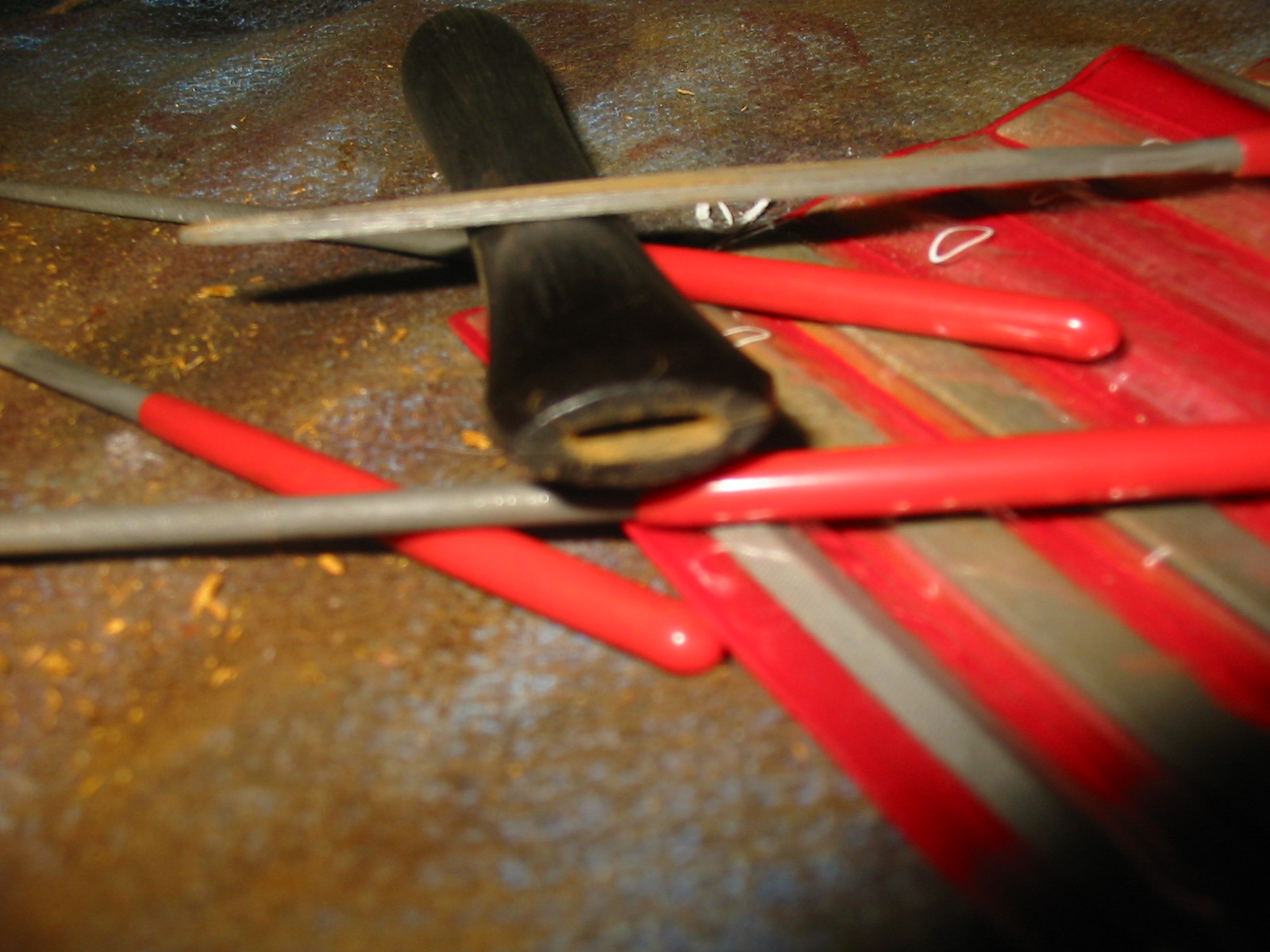
I set aside the calabash until the epoxy set. Once the stem was set I decided to work on the other end of the mouthpiece. It had a very tight slot on the end that was hard to push a pipe cleaner through so I opened that up with needle files. I used a flat oval file, an oval and a round file to do the majority of the work. I finished opening it with a flat angle file to open the top and bottom of the slot.
IMG_6770
When the epoxy had cured I carefully pushed the stem into the shank to check out the fit. The next two photos show the look of the pipe at this point. I removed the stem and countersunk the mortise slightly. I did not want to use a drill and countersink to do the work so I used a very sharp knife and did it by hand. Once it was completed I replaced the stem in the shank and the fit against the band was clean and snug. My initial mission was accomplished. I had not only broken the bone tenon, I had removed it from the shank and stem and converted the pipe to a push stem. There was still work to do but at least I had salvaged the pipe from the damage I had done in my initial repair. Whew…
IMG_6775

IMG_6776
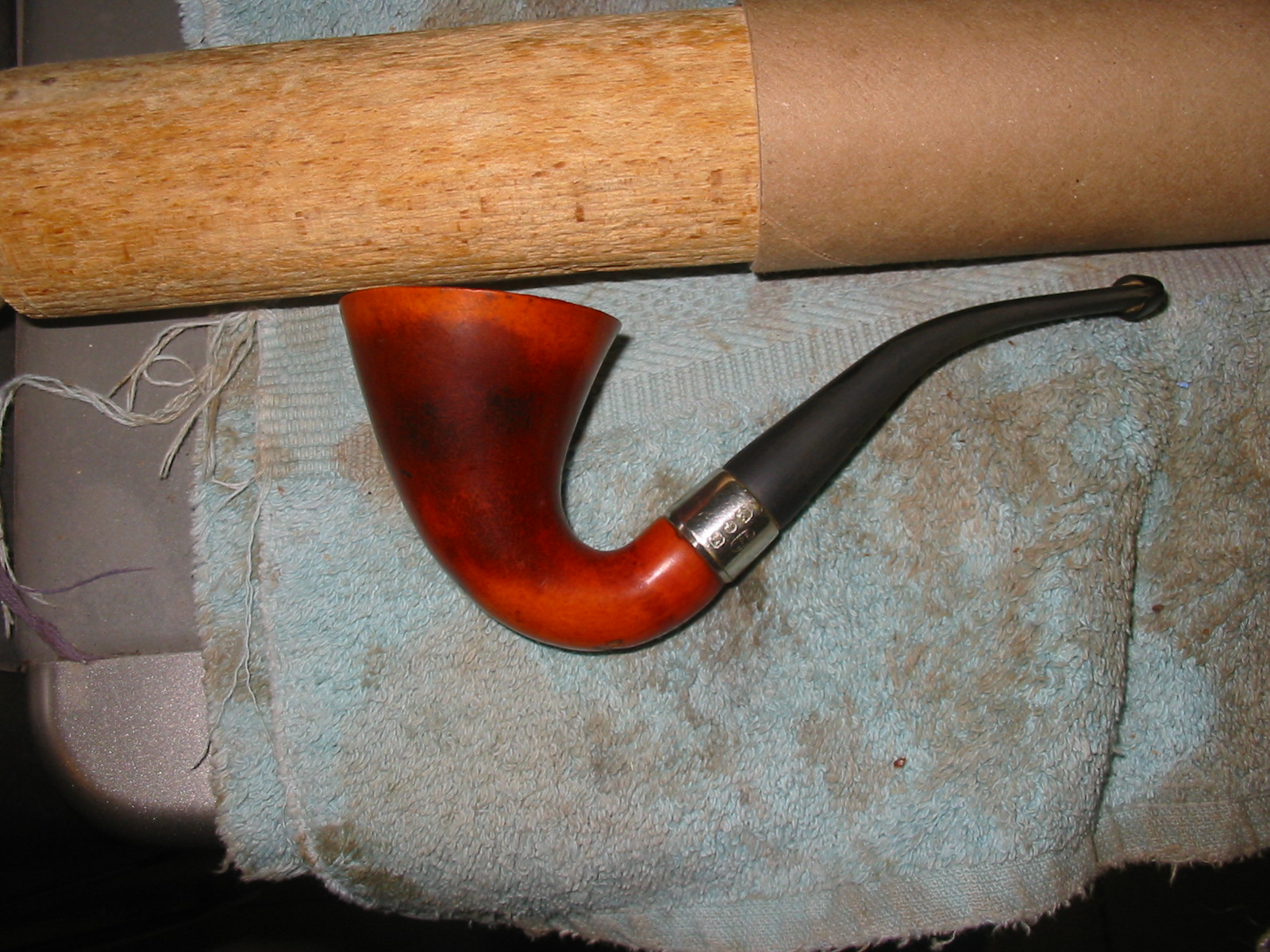
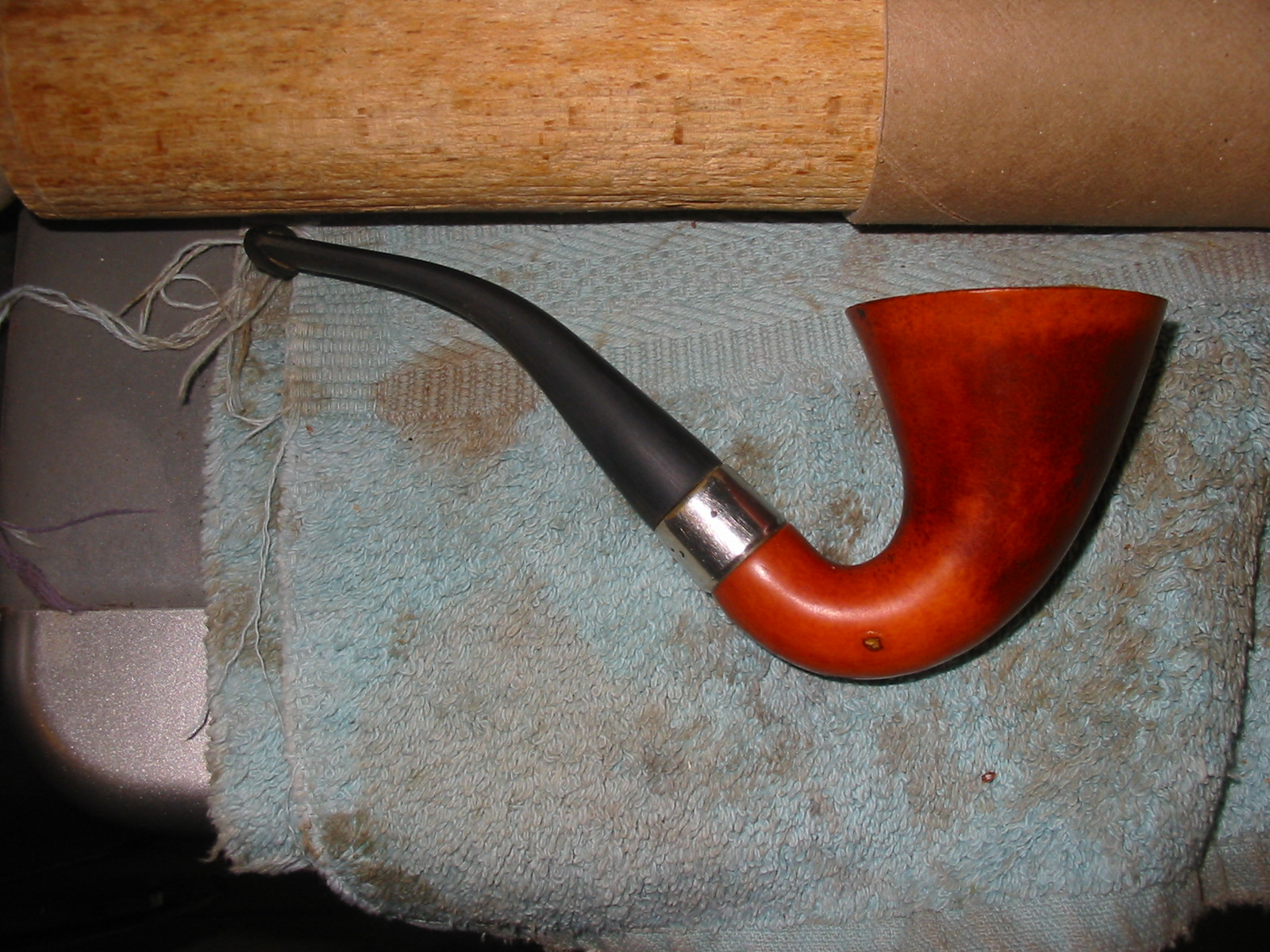
I sanded the stem with a medium and fine grit sanding sponge to remove the scratches left behind by the 220 grit sandpaper. I gave it a light buff with Tripoli on the wheel and then set up a heat gun to bend the stem. I held the stem about three inches above the heat and moved it around as it heated. I have learned that to leave it in one place as you heat it can damage the vulcanite and create more work. Once the stem was pliable I bent it over a wooden rolling pin that I use for that purpose. Lately I slid a cardboard tube over the pin to give a softer, smoother surface to bend the stem over. I had to do it twice to get the bend correct. It takes a bit longer to heat the thicker portion of the stem that needed to be bent so the repeated step made that possible.
IMG_6777

IMG_6778
The finished bend is shown in the next two photos. I still needed to polish the stem before it was finished but the finished look is beginning to appear. The calabash is just about reborn.
IMG_6779

IMG_6780
I removed the stem and worked on it with the sanding sponges and the micromesh sanding pads. I wet sanded with the 1500-2400 grit pads and dry sanded with the 3200-12000 grit pads. Between the wet and dry sanding I rubbed the stem down with Meguiar’s Scratch x2.0 and then buffed it with White Diamond. I finished the sanding and then rubbed the stem with Obsidian Oil. Once it was dry I gave it a quick buff with White Diamond and then gave it multiple coats of carnauba wax and buffed it with a soft flannel buff.
IMG_6782

IMG_6783

IMG_6784
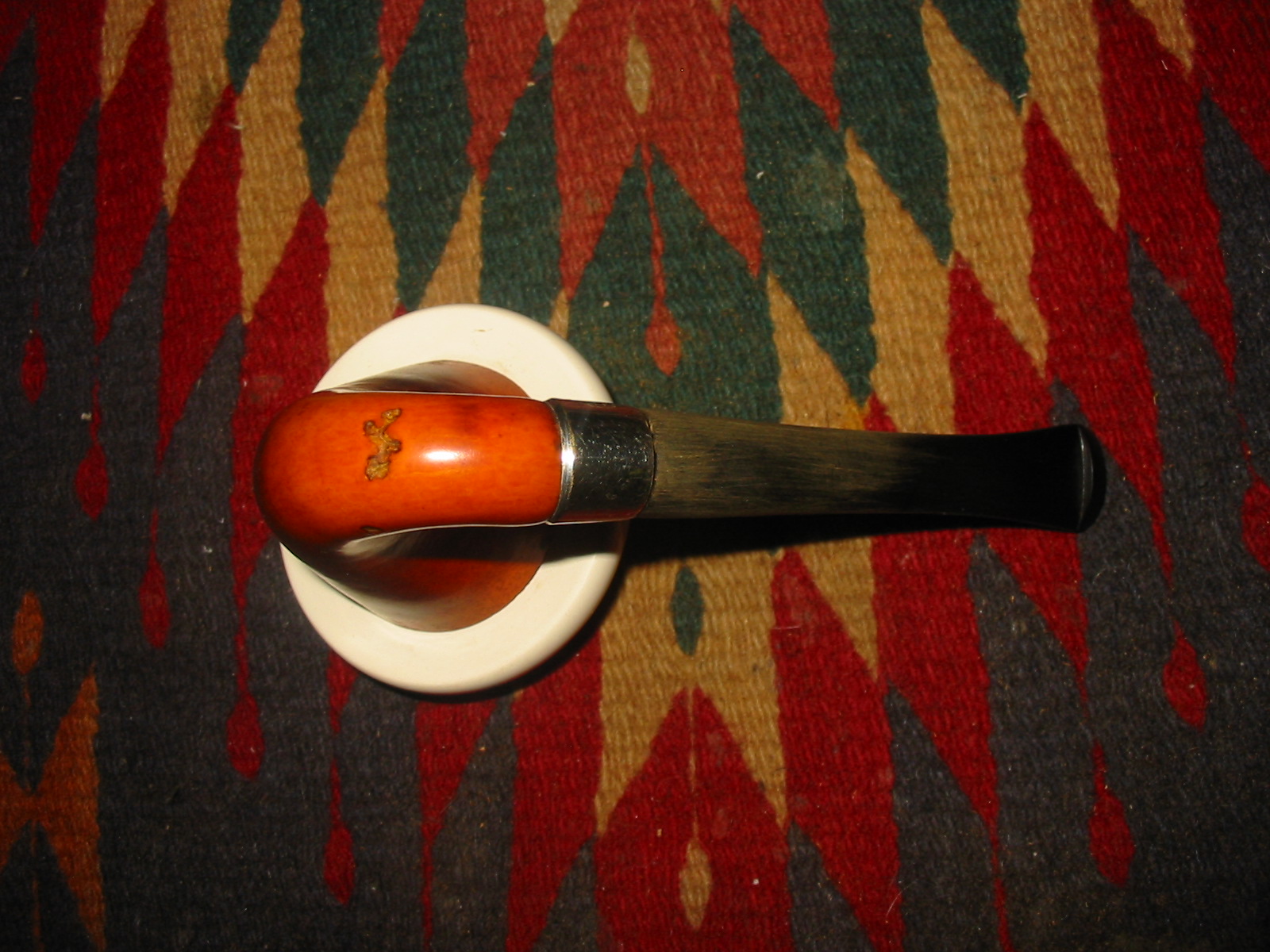
I scrubbed the surface of the gourd with Oil Soap and a light sanding with the fine grit sanding sponge to remove some of the deeper grime and oils in the gourd. I then applied several coats of Paragon Wax and hand buffed the gourd with a shoe brush to raise a shine. I polished the silver band with some silver polish and then reinserted the stem. I gave the whole pipe a final buff with the brush before setting the meerschaum cup in place. The finished pipe is shown in the photos below. It is a deep bowl and should hold a good pack of tobacco. The broad mushroom cap of the meerschaum cup looks good to me. The pipe is ready for its inaugural smoke. Now the only problem remaining is what tobacco to use to christen this restored calabash. Ah well that will sort itself out soon enough. Time to post this on the blog.
IMG_6785

IMG_6786

IMG_6787

IMG_6788

Kaywoodie Rustica Repaired and Refurbished


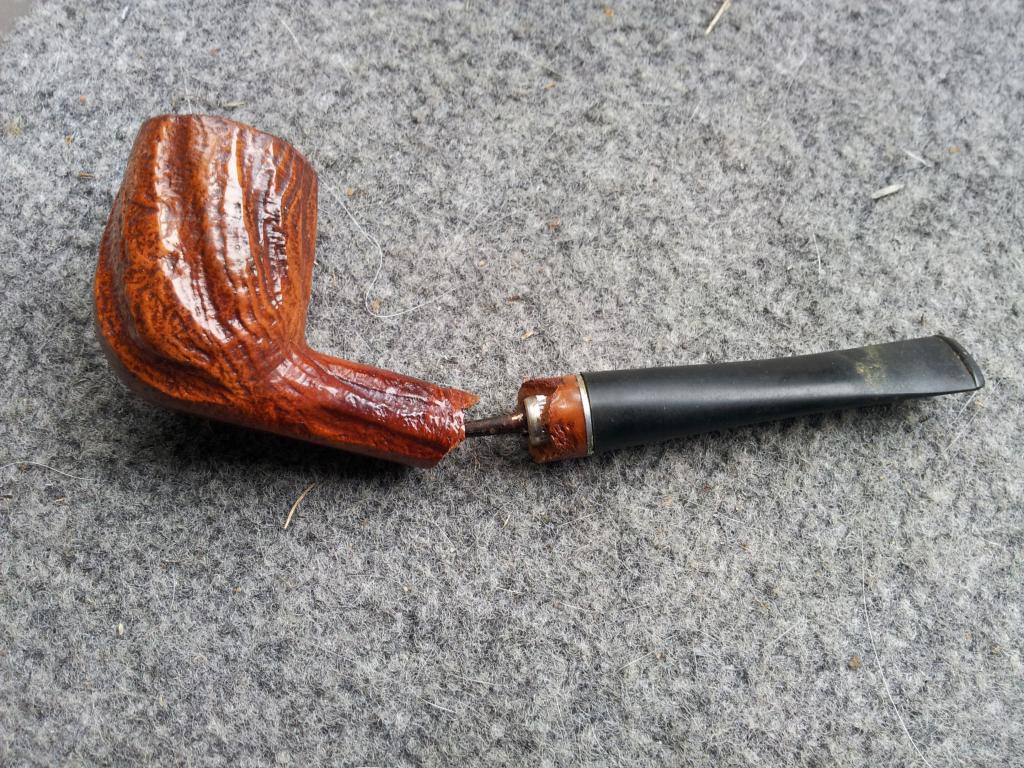
When I first saw this pipe it was on Pipe Smokers Unlimited online forum and Bill was lamenting the fact that when he was trying to unscrew the stem the shank had broken. The stinger was welded in place in the aluminum mortise insert and in twisting the stem it broke. What was odd was that the stem freely spun around on the stinger so evidently the glue had loosened enough to allow it to turn without it coming off. Bill posted these two photos on-line and asked for help.

It looked to me that there was darkening around the area of the break which suggest from the photos that a potential burn through was happening. The break was clean and the two pieces lent themselves to a potential repair. The metal shank insert would serve to strengthen the repair from the inside so I suggested that Bill put a silver band on the pipe and the combination of the internal metal tube and the band would provide stability to the repaired shank.
20140430_114107

20140430_114121
Bill thanked me for the suggestion and then shortly sent a message that the pipe was on its way to me and it was now mine.

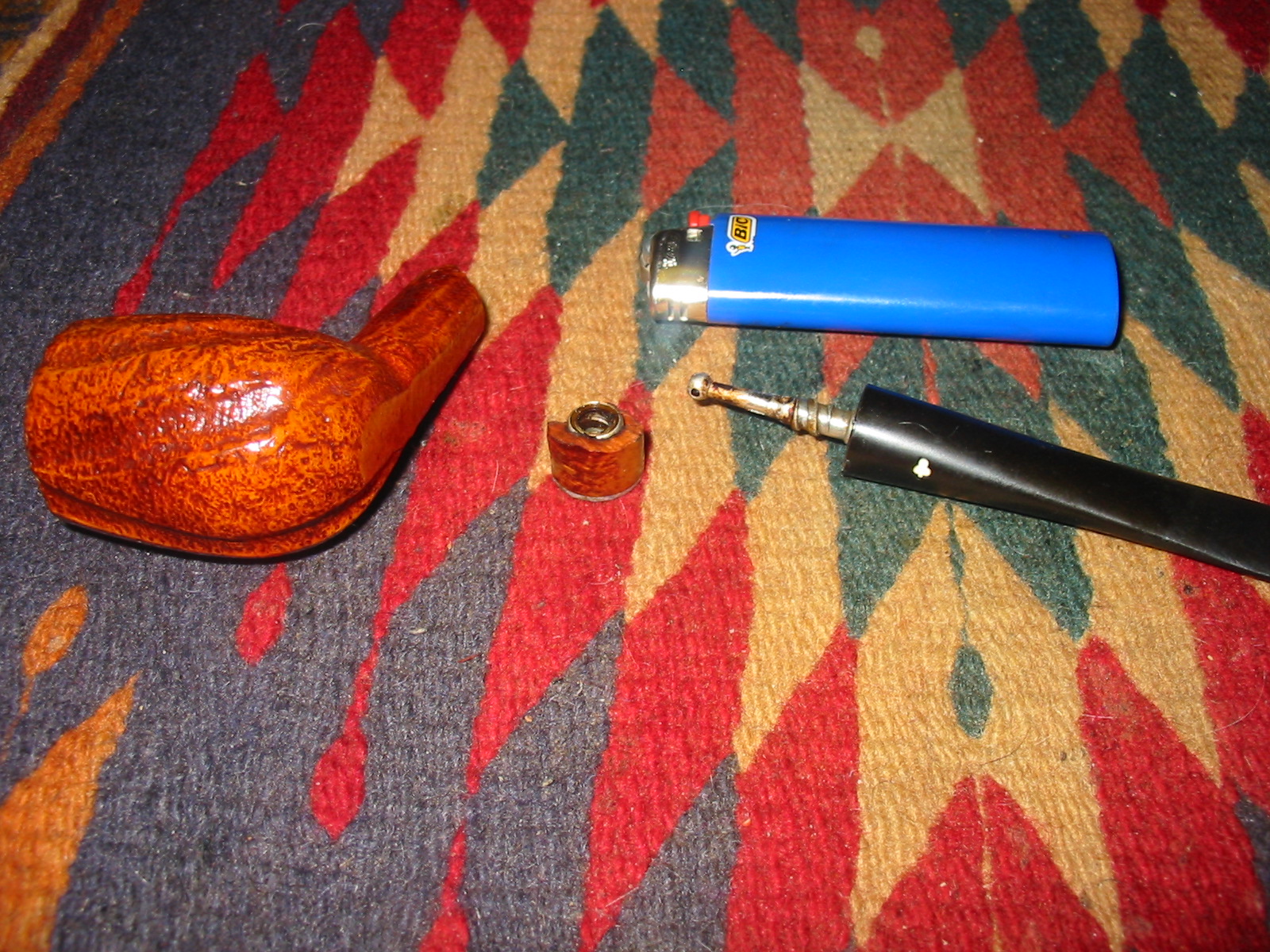
When the pipe arrived it was indeed a clean break. The darkening on the shank near the break was not a burn through waiting to happening it was merely darkening. There were other spots on the pipe that makes me think that it was part of the finish. I took the pipe to the work table and tried to remove the stem from the piece of the shank. It did indeed freely twist in the mortise but the stem would not turn. The stinger stayed stationary while the stem turned. I used some WD40 to try to loosen the tarry build up on the stinger and penetrate into the joint. I let it sit and it still did not move. I thought about what to do next so I cleaned up the stinger and then used a Bic lighter to heat up the end of the stinger. My thinking was that the heat on the metal would also warm the tars that bound the stinger to the mortise. It worked better than I expected and in short order the stem was free. The bonus was that the glue that held the stinger in place in the stem also heated and when it cooled the stem no longer spun on the stinger.
IMG_6729
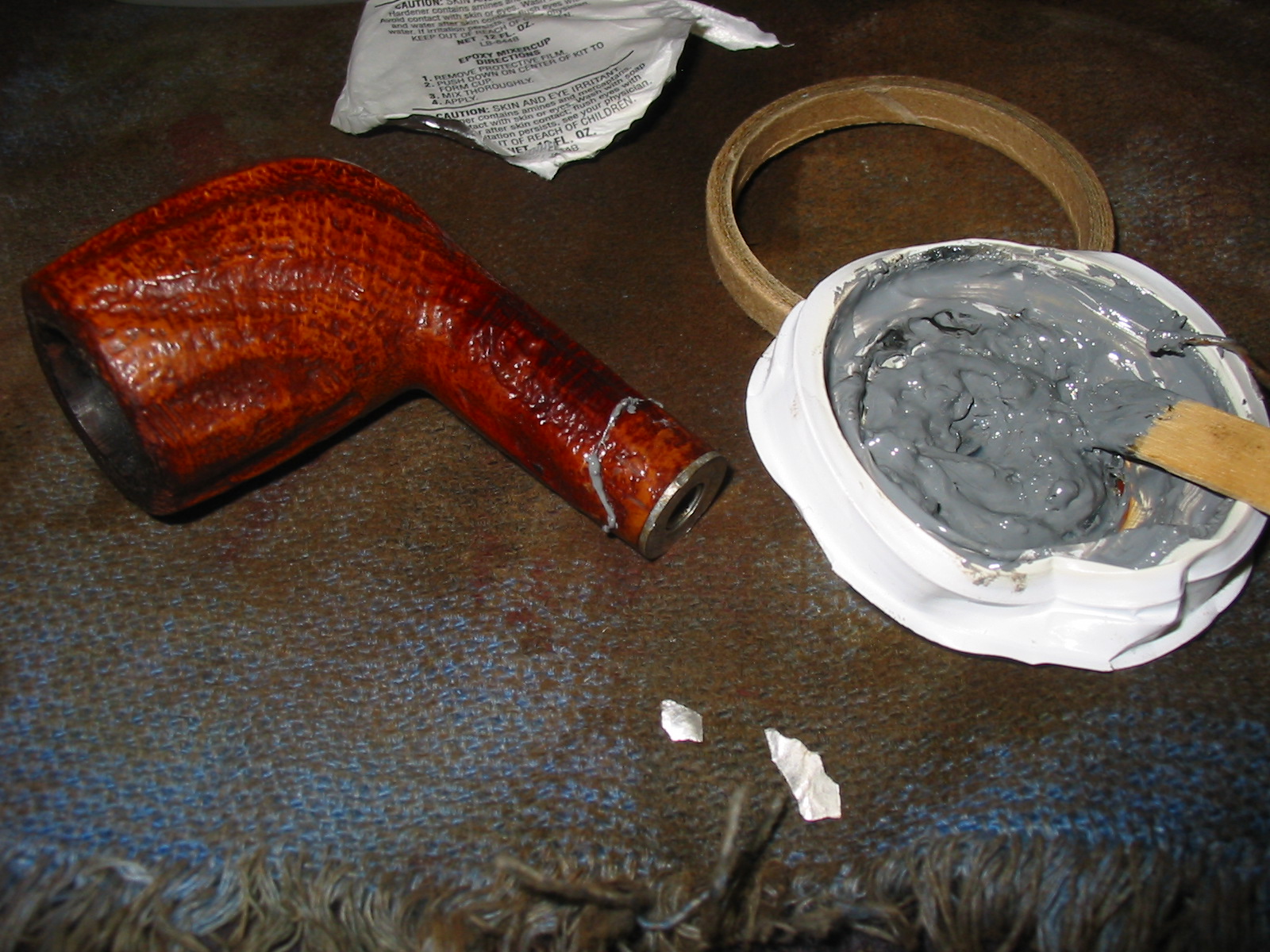
I cleaned up the broken ends of the shank and the visible end of the metal insert with acetone and qtips (cotton swabs) and then dried it and cleaned it again with isopropyl alcohol. I mixed up a two part epoxy and applied it to both sides of the broken shank and around the end of the inserted mortise. When the glue was tacky I pressed the two parts into place and held them tightly until the epoxy was initially set. That usually takes 3-5 minutes with the brand of epoxy that I am using so it is not a terribly long wait. I keep the pressure firm so that there is no give in the bond. I need to pick up some clamps that allow me the freedom to press it together and set it aside but I do not have them at the present. Before the epoxy dried hard I cleaned up the slight seepage at the joint with a soft cloth.
IMG_6730
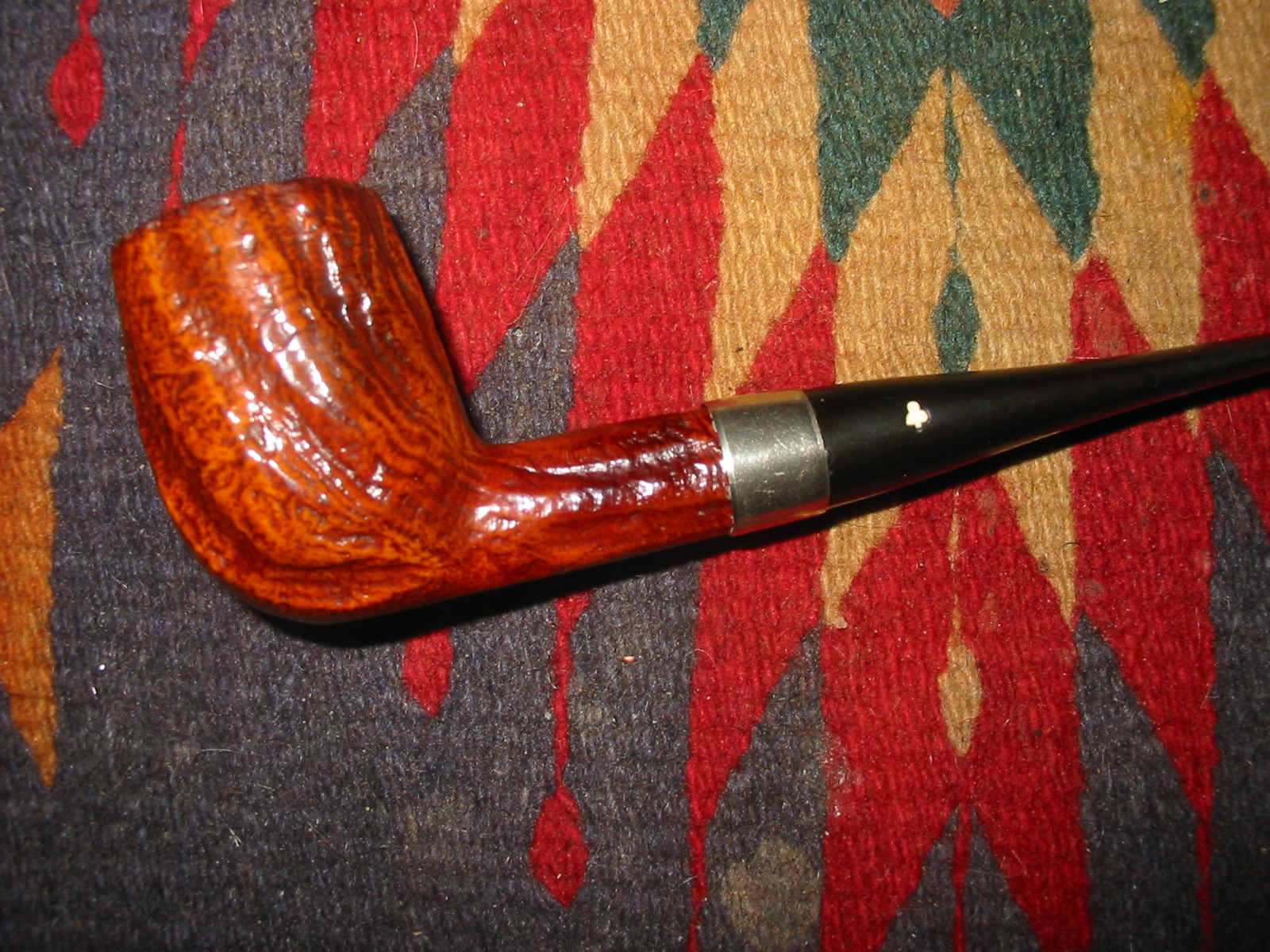
After the epoxy had cured several hours I put wood glue on the outside of the shank and pressure fit a nickel band in place on the shank. The band was not overly deep so it did not obscure the stamping on the underside of the shank and also did not go too deeply into the rustication on the shank. It extended just beyond the deepest point of the break. The combination of the band and the internal mortise would strengthen the repair. The next series of photos show the repaired shank with the band in place.
IMG_6731

IMG_6733

IMG_6734

IMG_6736

IMG_6737
With the shank repair finished it was time to clean up the rest of the pipe. I reamed the bowl with a PipNet pipe reamer to take the cake back to the briar. I wanted to examine the walls of the bowl for potential damage so this was my means of doing so. There was a slight burned area on the inside edge of the rim at the back of the bowl that would need some attention. I used a brass tire brush to scrub the top of the rim as well as the inner edge to clean off the tars and carbon buildup. The soft brass bristles work very well with a rusticated finish. I was able to clean up the rim quite nicely with the brush.
IMG_6738

IMG_6739
The exterior of the bowl had a thick coat of urethane on it that gave it a permanent shine. I tried to remove it with acetone but it did not even scratch the surface of the finish. I used several solvents and was not able to remove any of the finish so I decided to leave it alone. I used a lighter to brush flame over the rest of the bowl to further darken the crevices and grooves in the finish to highlight them. This seemed to work very well. I restained the rim with a dark brown aniline stain and repeated it until the surface was well covered. I wiped it down with alcohol on a cotton pad to thin it to match the colour of the bowl and then flamed the surface to darken it slightly. I finished by taking the bowl to the buffer and buffing it lightly with red Tripoli and White Diamond to polish and give the rim the same shine as the bowl.
IMG_6740

IMG_6741

IMG_6742
With the work on the bowl finished it was time to address some of the issues with the stem. There was light tooth chatter on the top and bottom of the stem next to the button and there was a slight oxidation to the overall stem. I cleaned out the internals of the stem and the stinger with isopropyl alcohol and pipe cleaners until I had removed all of the buildup inside. Then I sanded the stem with 220 grit sandpaper and a medium and fine grit sanding sponge to remove the tooth chatter and then followed that with my usual regimen of micromesh sanding pads. I wet sanded with the 1500-2400 grit sanding pads and dry sanded with the 3200-12,000 grit pads. I rubbed the stem down with Obsidian Oil.
IMG_6743

IMG_6744

IMG_6745
When the stem was dry I buffed it with White Diamond. I polished the nickel band with the higher grades of micromesh sanding pads and then silver polish. I put the pipe back together and gave it a light buff with White Diamond. I applied carnauba to the bowl and stem to protect and preserve the stem and rim. I was pretty certain that the hard finish on the bowl would last longer than I would so it did not need a lot of wax. The finished pipe is shown below. The shank repair is very stable and solid so I think the pipe will provide many more years of service. Thanks Bill for the challenge and the gift you sent my way. It is greatly appreciated.
IMG_6771

IMG_6772

IMG_6773

IMG_6774

Civic Company 1921 Trade List


Blog by Steve Laug

In the course of refurbishing some Imperial Pipes and some French Briar pipes my research unearthed this document. It is a 1921 Trade List or catalogue of Civic Pipes. The introductory page from the scan says the following:

The 1921 Price List is owned by John Adler.
All of these pages, including both sides of the cover and the flyer have been scanned as JPEG and
PDF files and lodged in the National Pipe Archive in Liverpool.
P J Davey/21 April 2010

I found the scanned document on the Academie Internationale de la Pipe website. http://pipeacademy.org/ They have a large repository of old pipe materials that I have found invaluable. I saved the document to my hard drive as a pdf and have included the pages here for others to use.
Civic 1

Civic 2

Civic 3

Civic 4

Civic 5

Civic 6

Civic 7

Civic 8

Civic 9

Civic 10

Civic 11

Civic 12

Civic 13

Civic 14

Civic 15

Civic 16

Civic 17

Civic 18

Civic 19

Civic 20

Civic 21

Civic 22