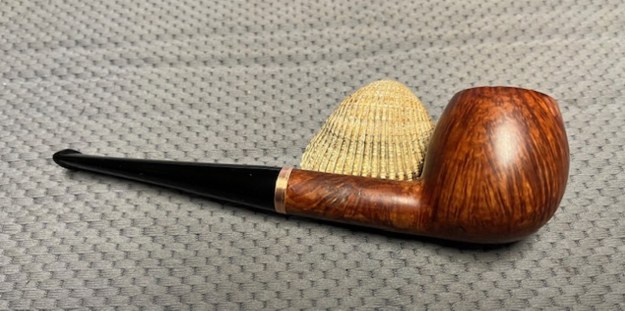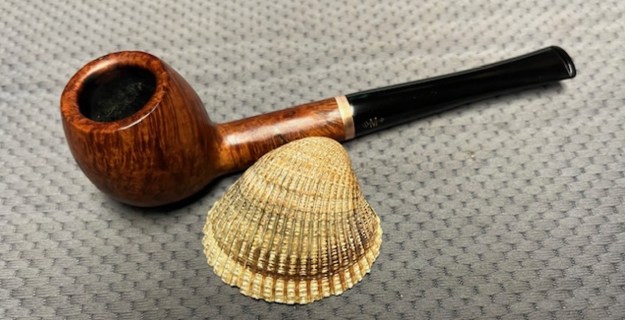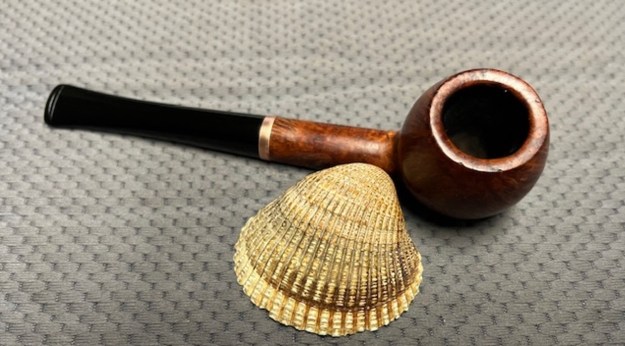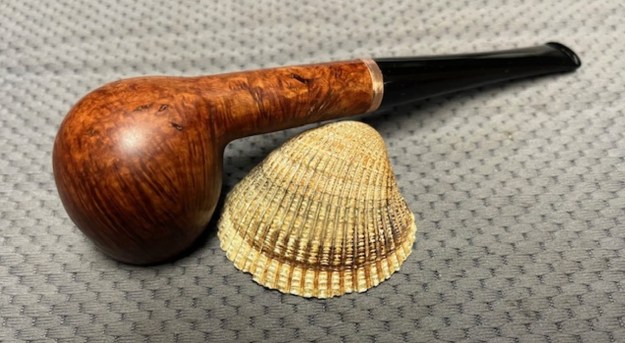
Monthly Archives: January 2026

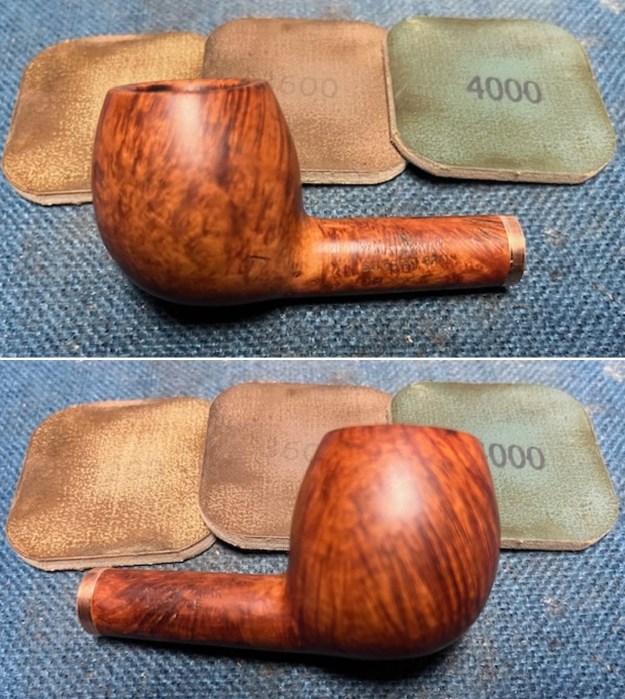
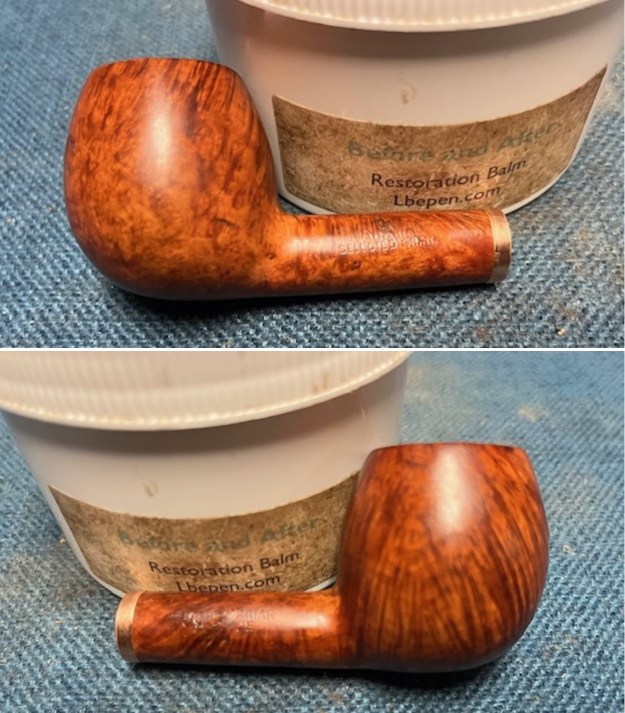
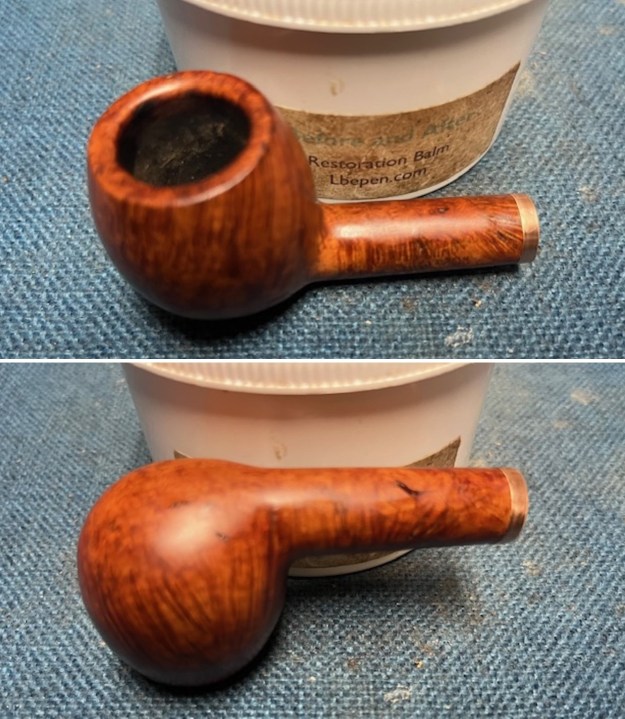
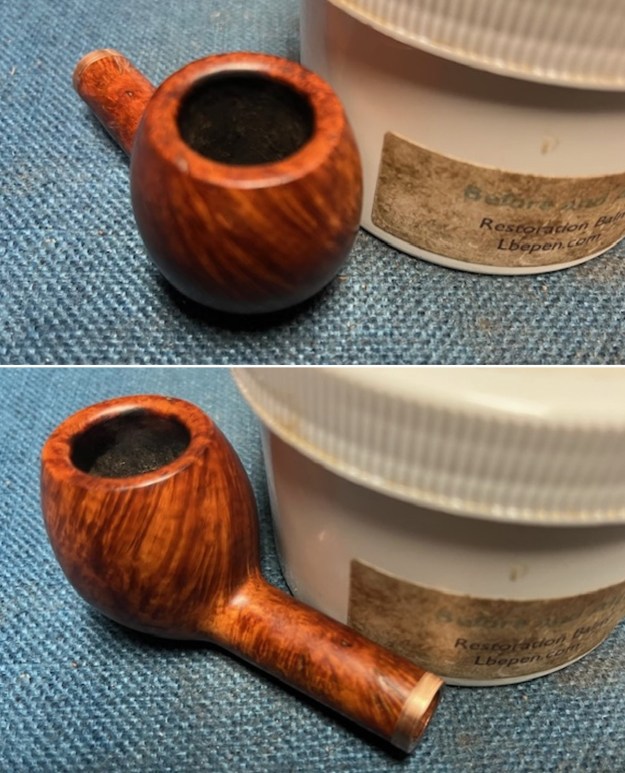
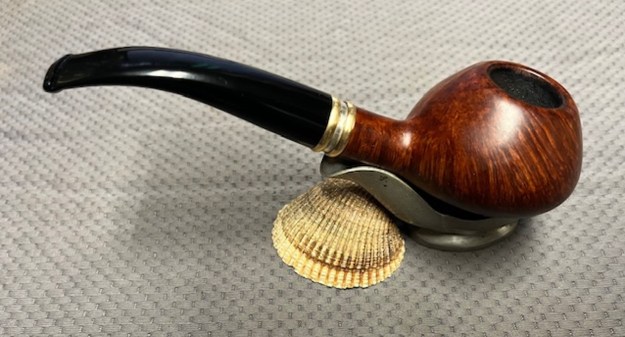
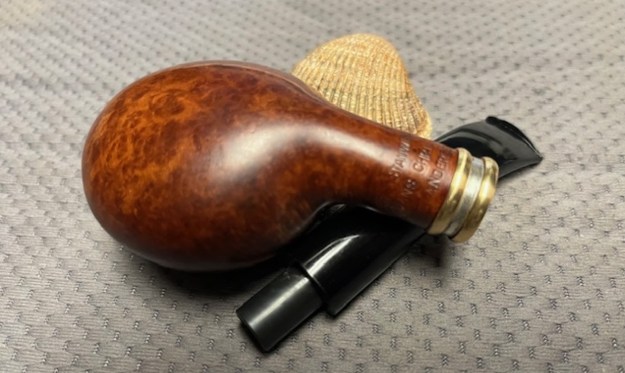
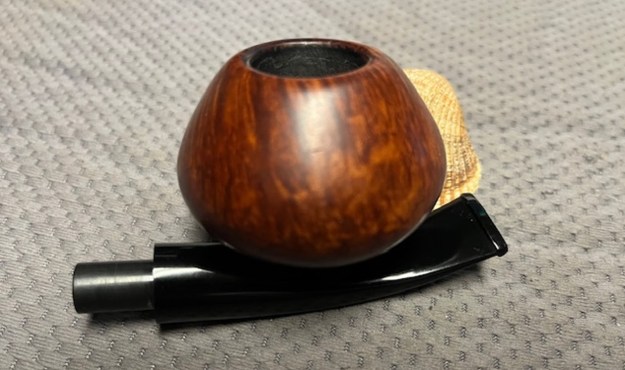
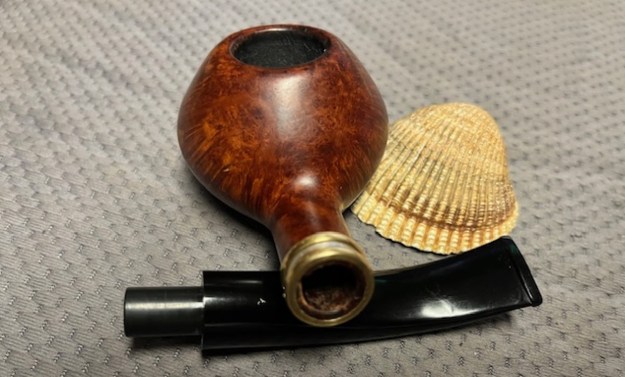
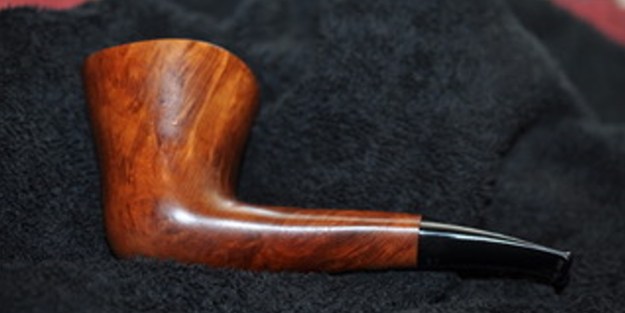
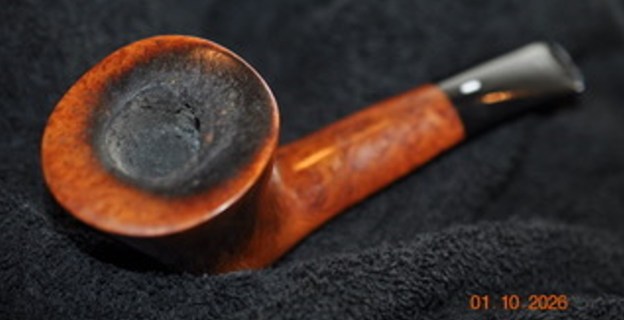
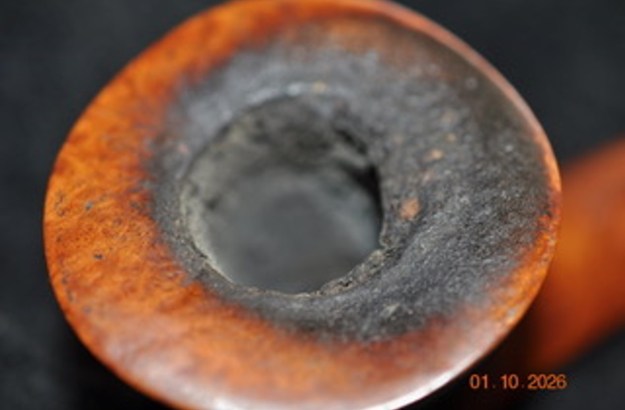
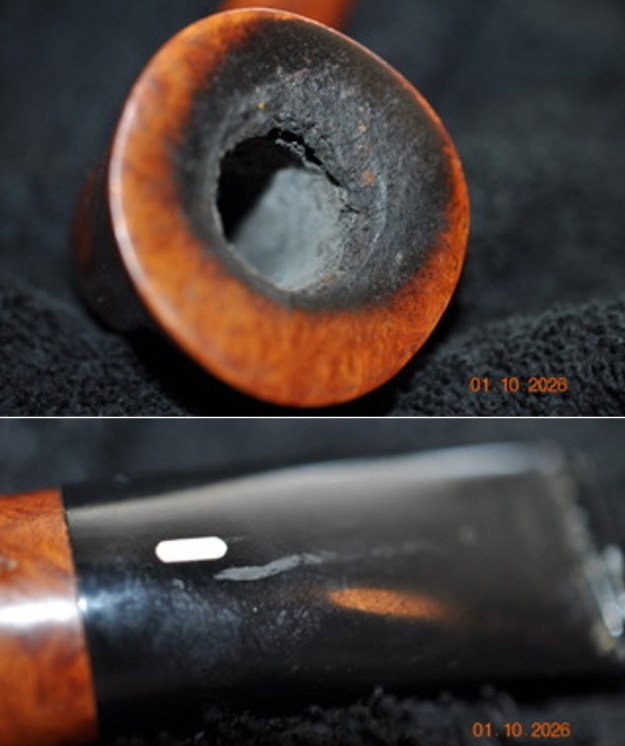
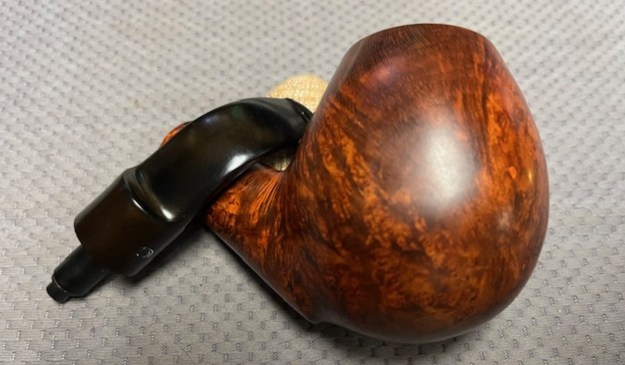
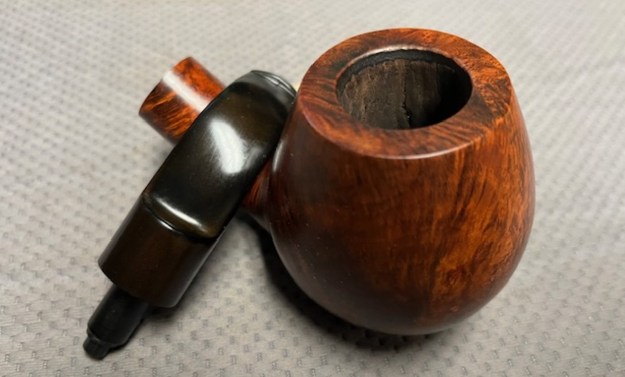
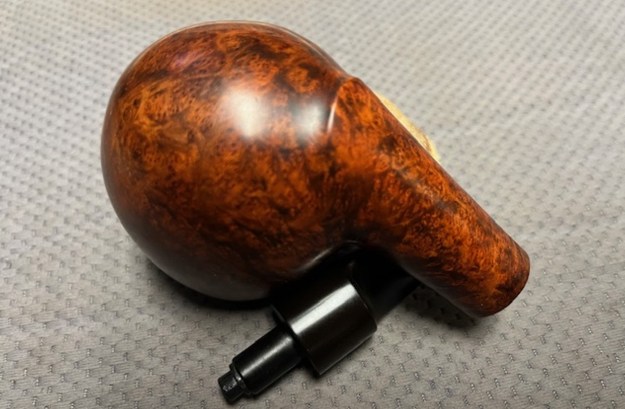
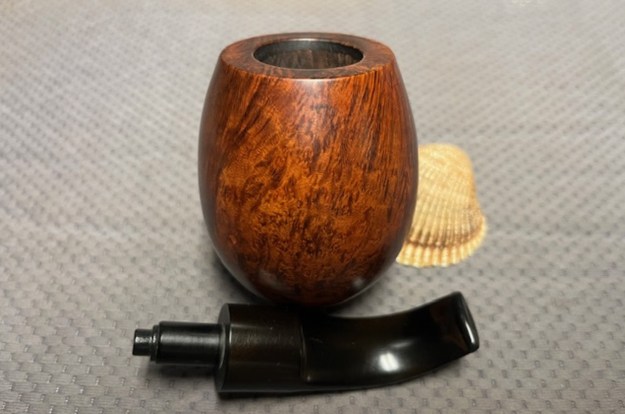
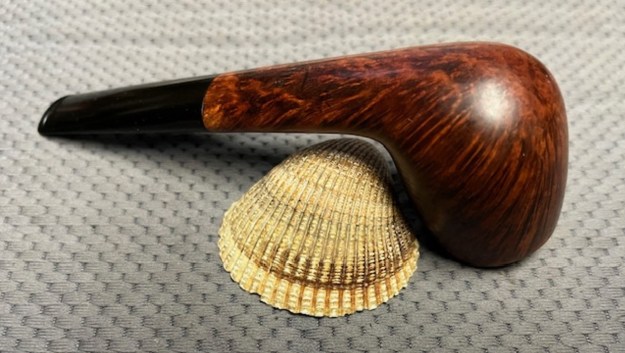
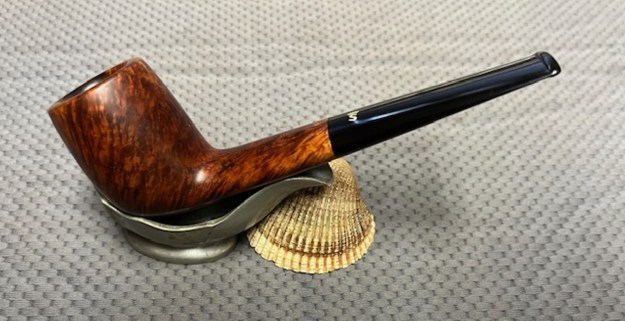
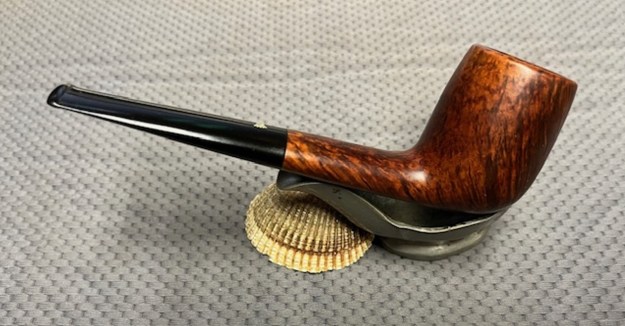
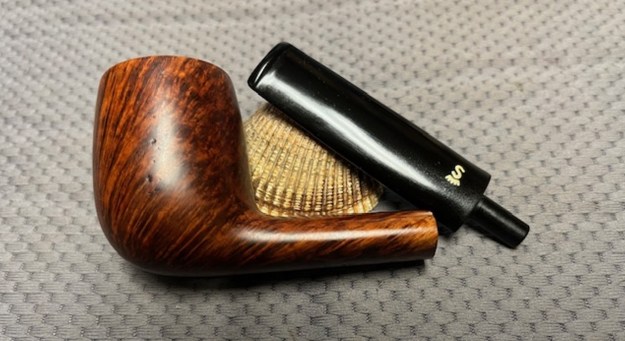
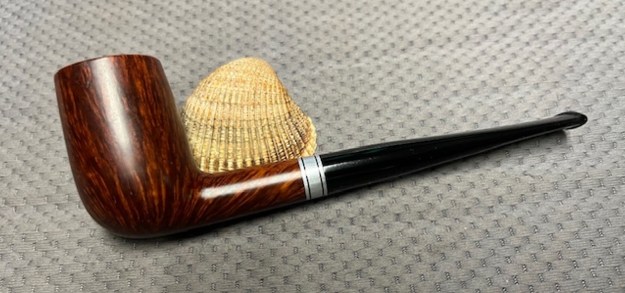
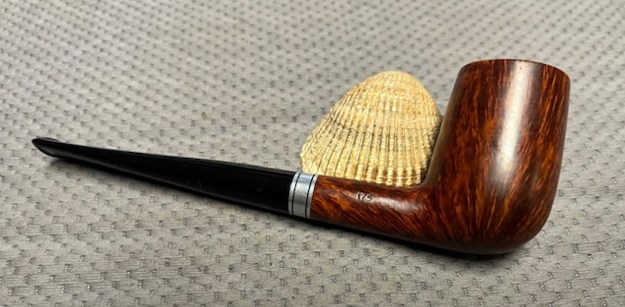
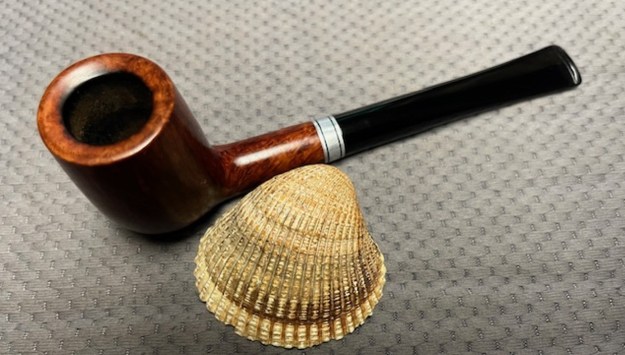
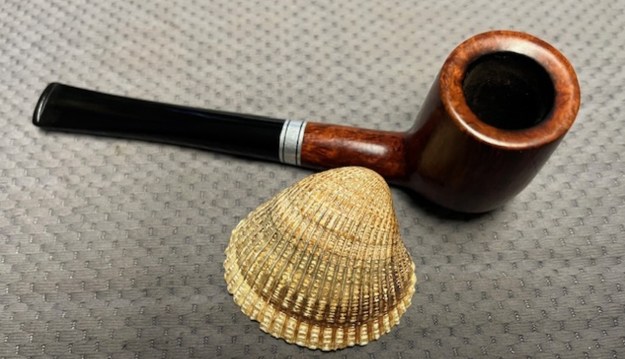
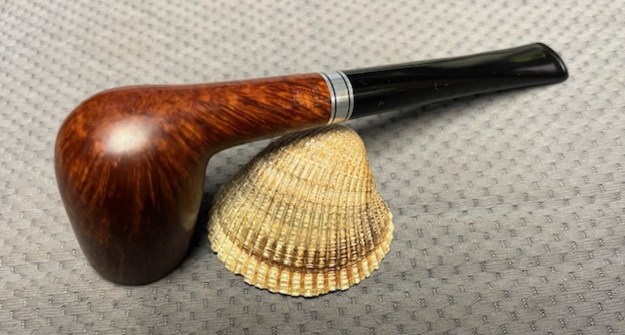
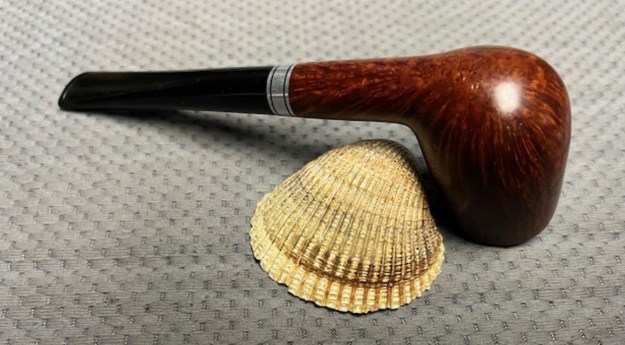
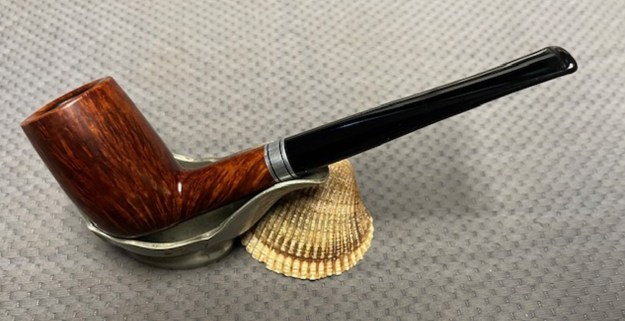
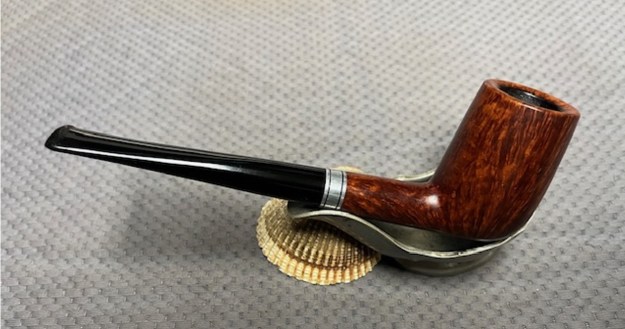
New Life for a 1975 Dunhill Root Briar147 Diamond Shank Bulldog with a Taper Stem


by Steve Laug

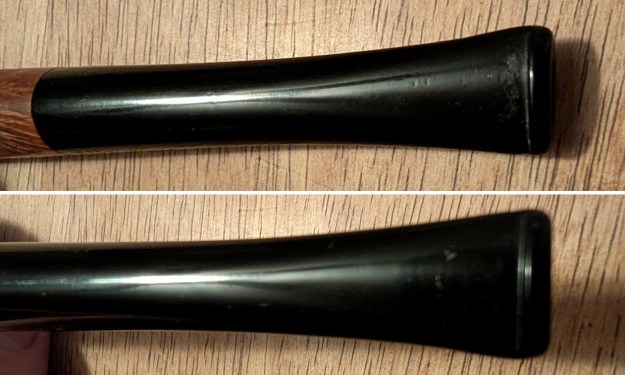
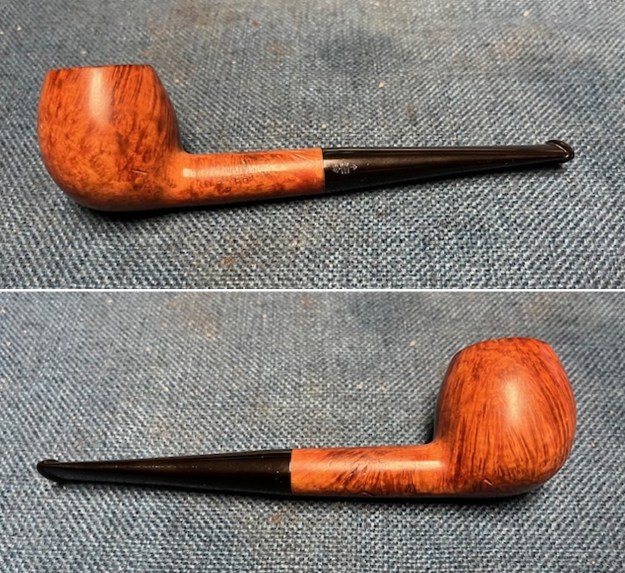
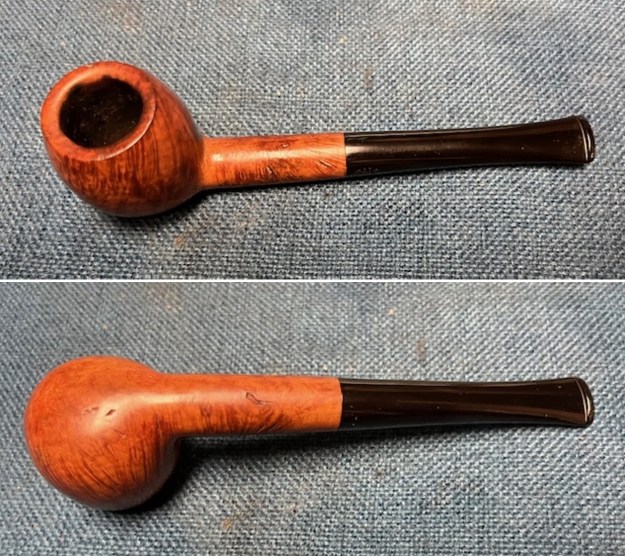
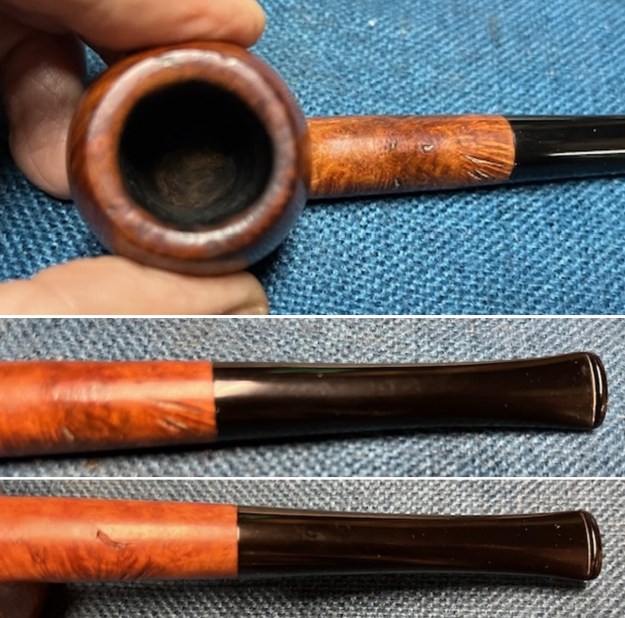
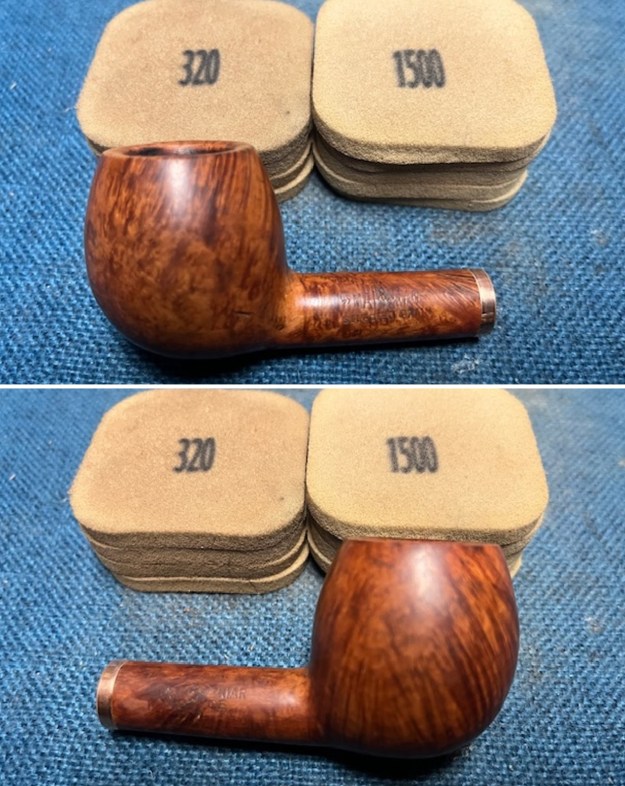
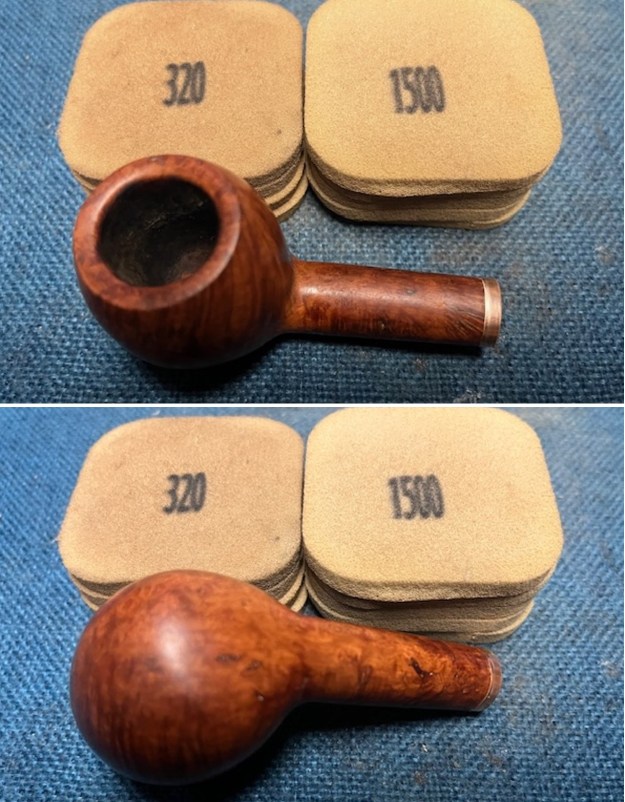
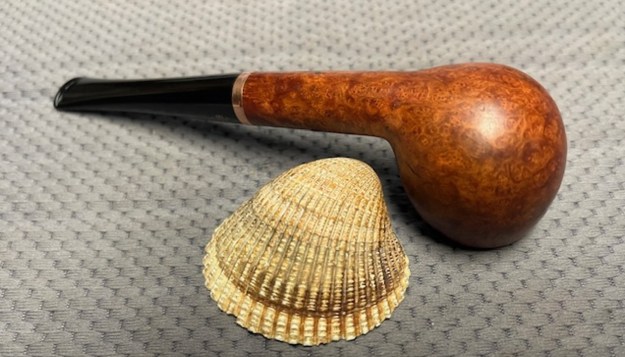
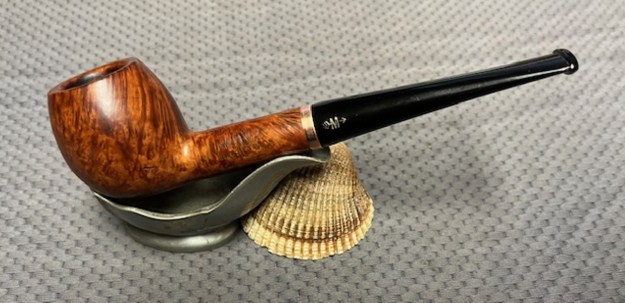
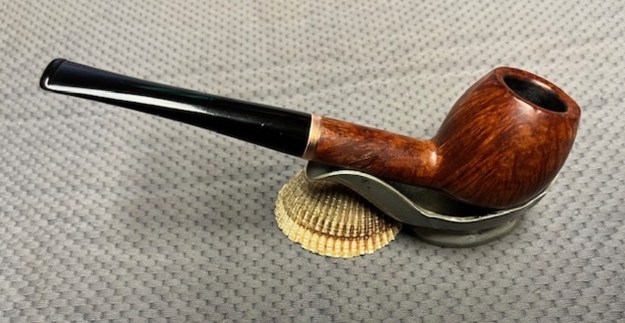
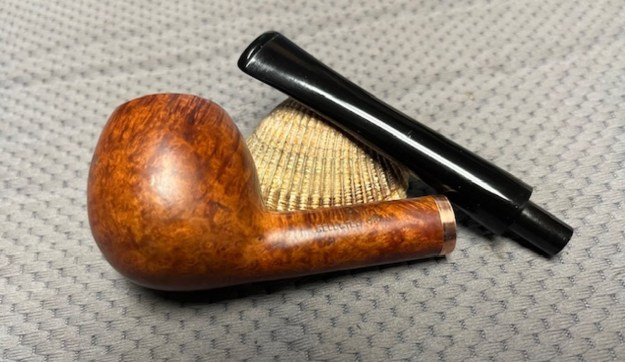
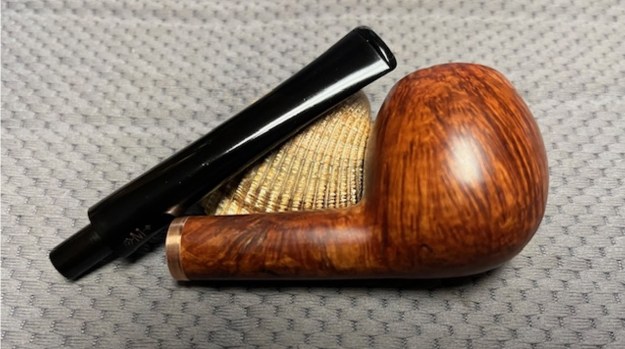
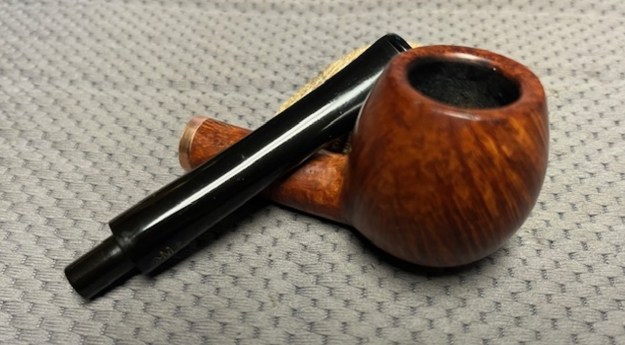
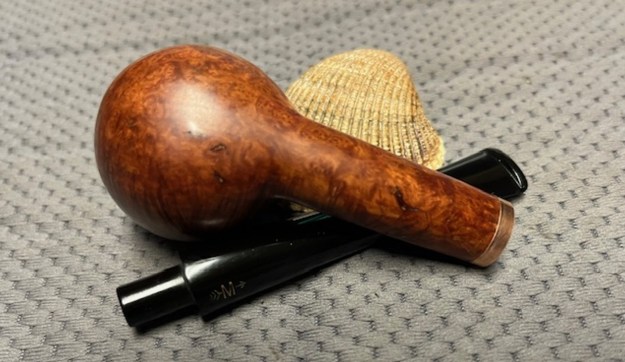
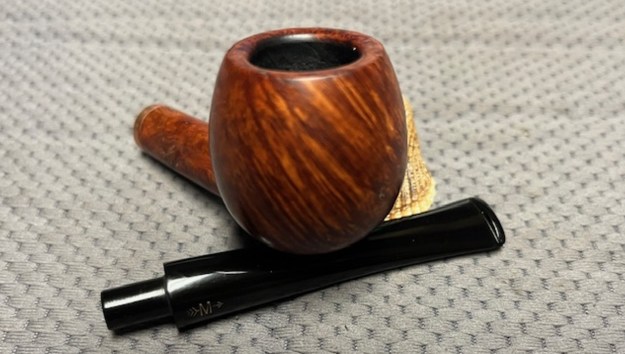
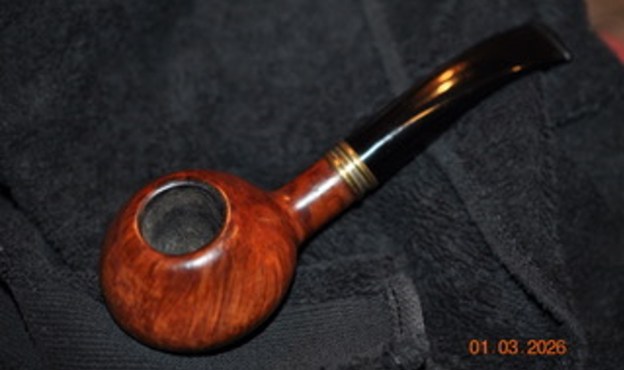
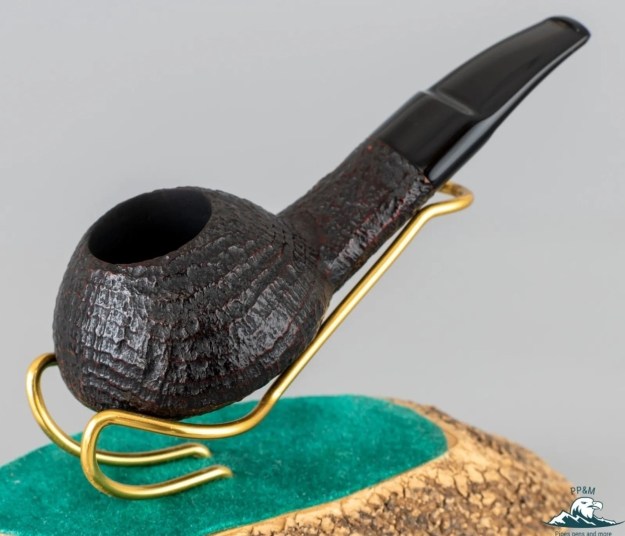
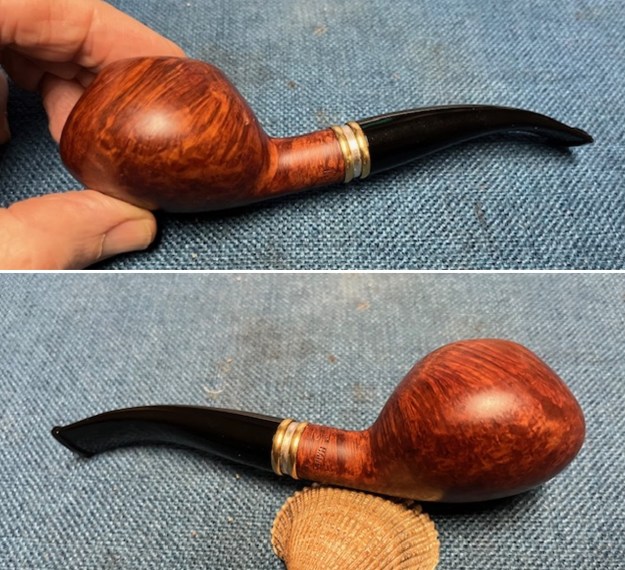
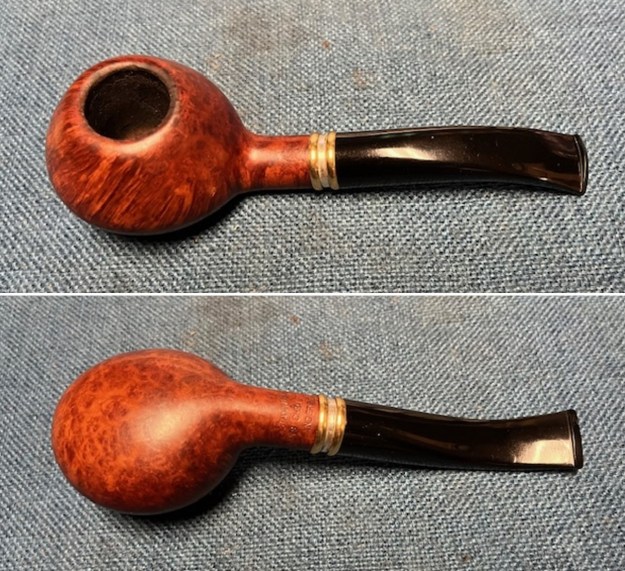
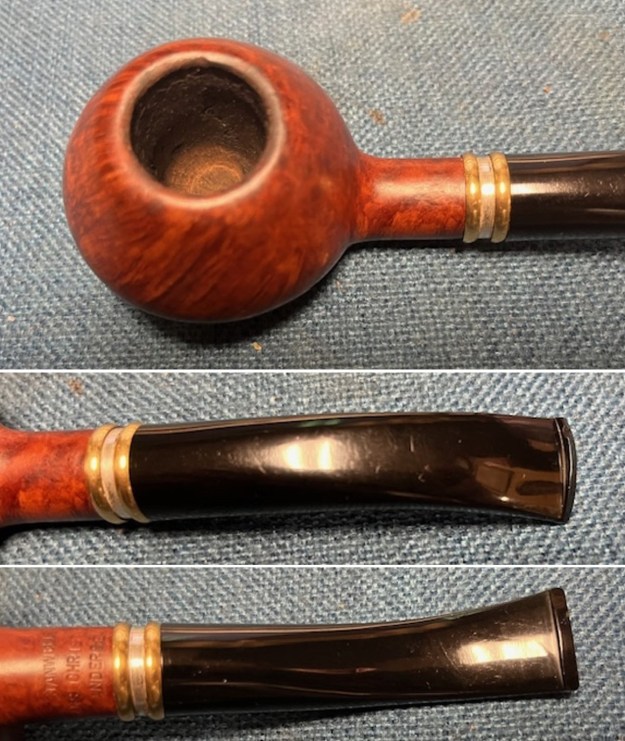
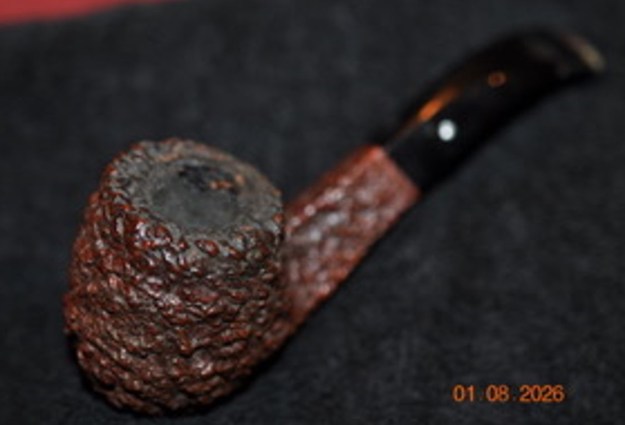
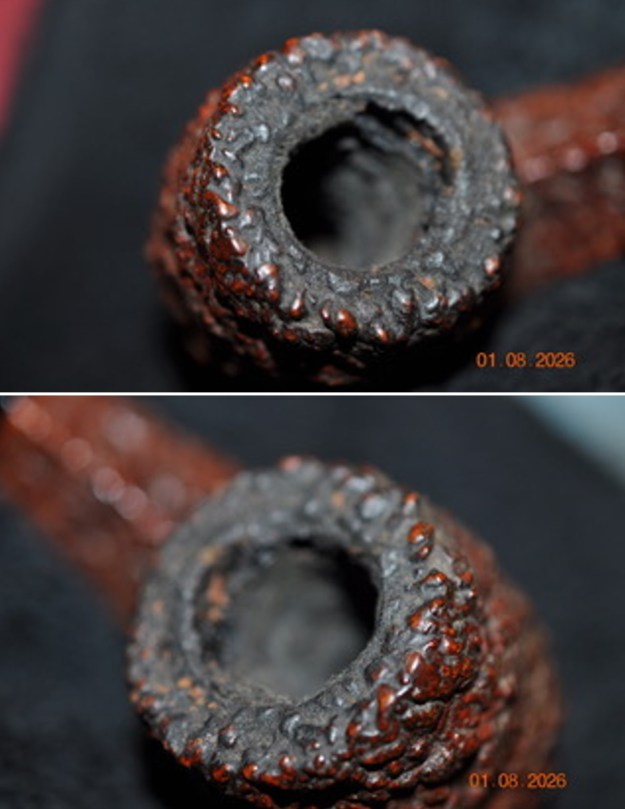
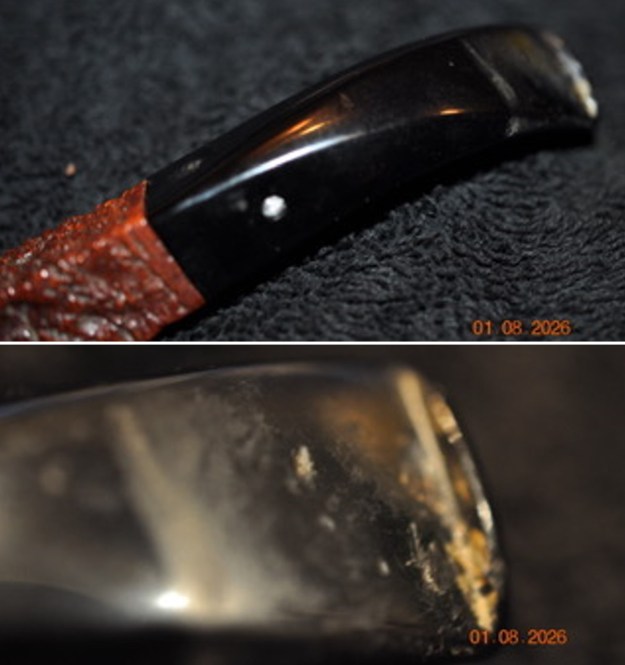
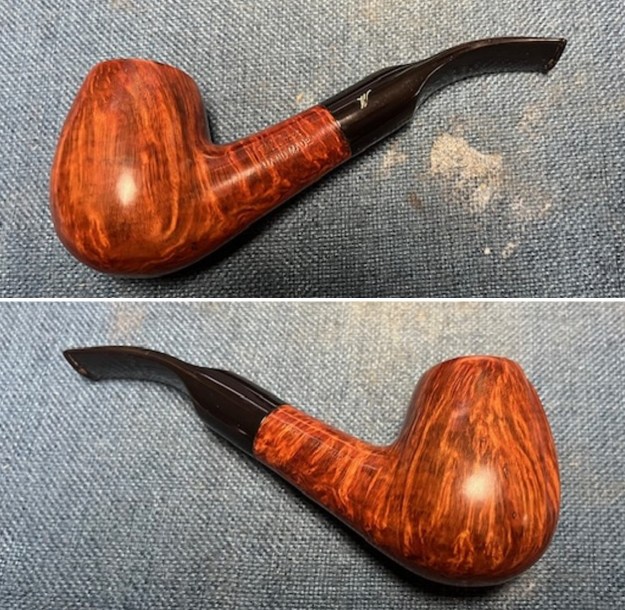
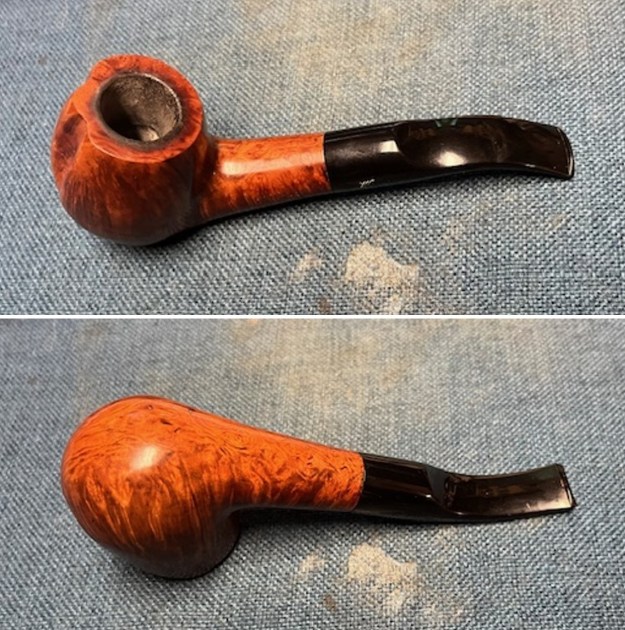
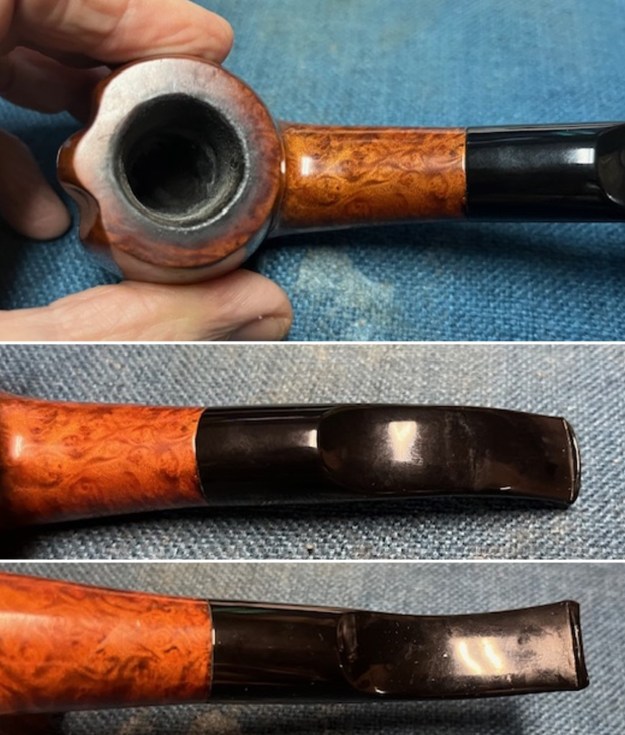
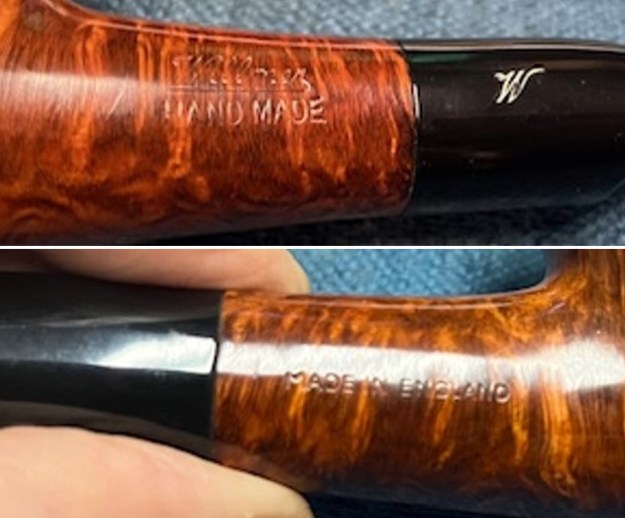
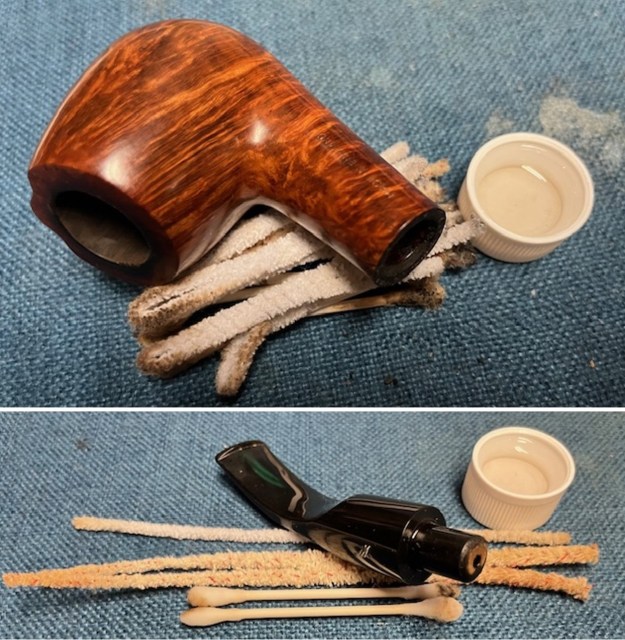
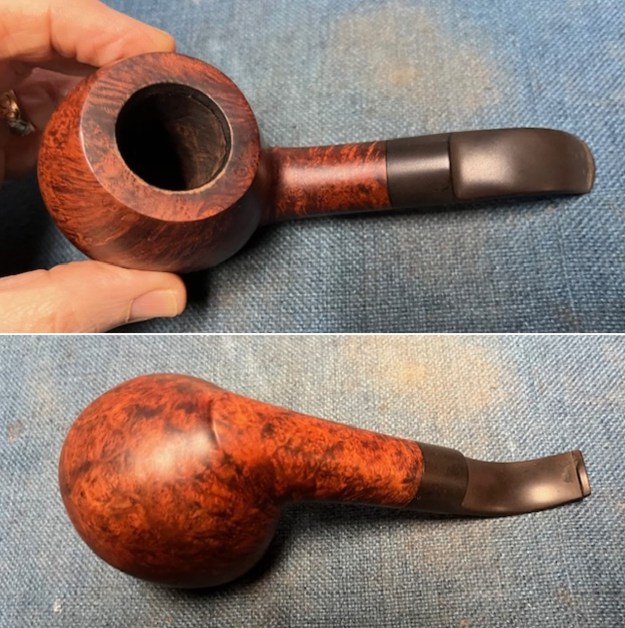
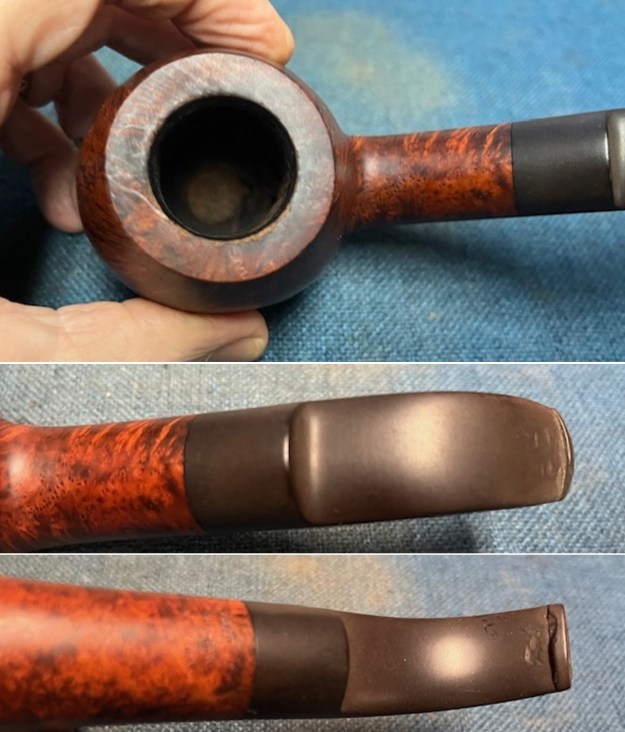
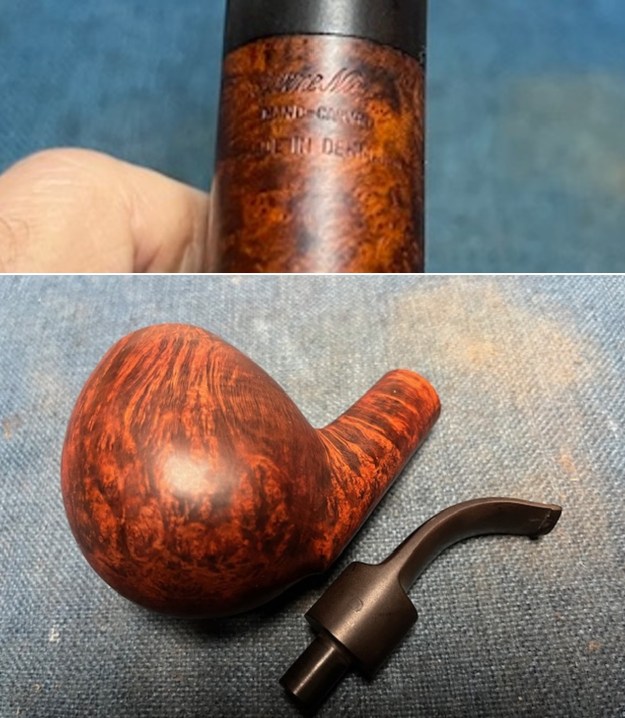
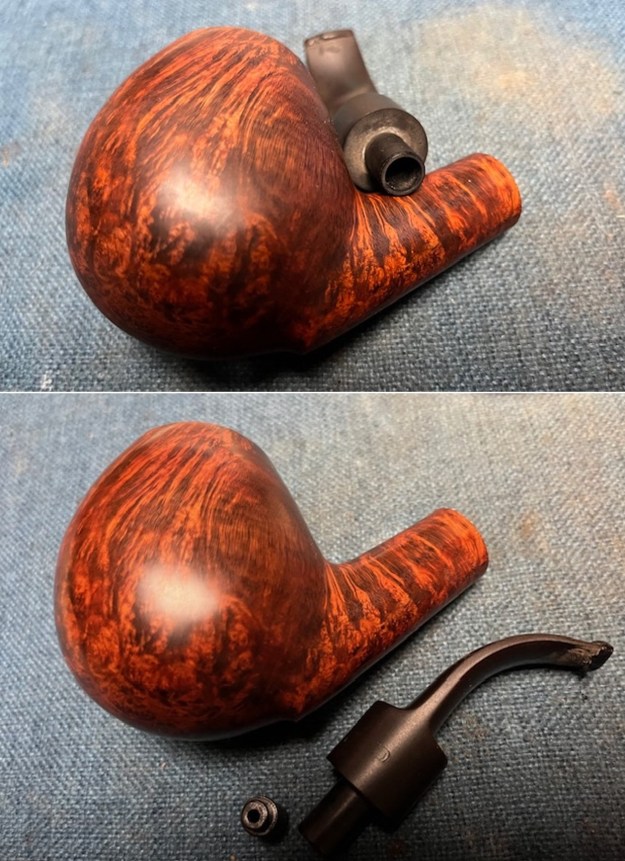
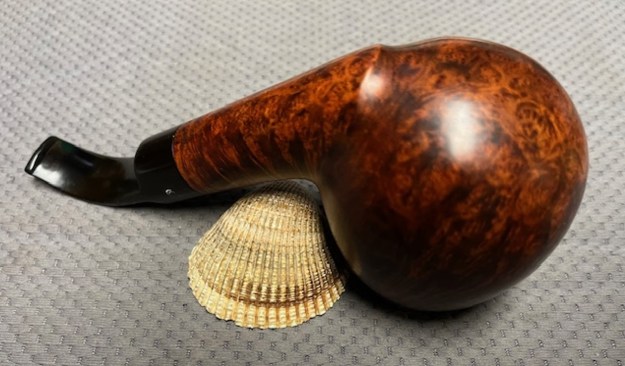
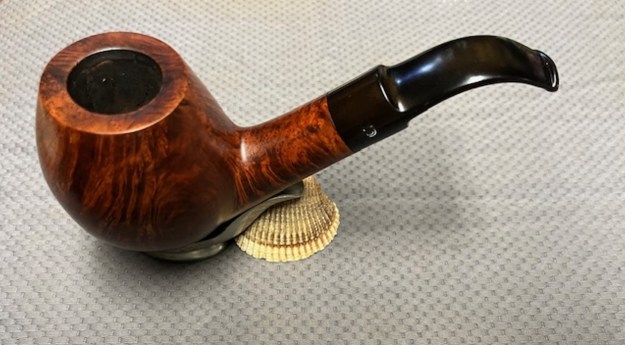
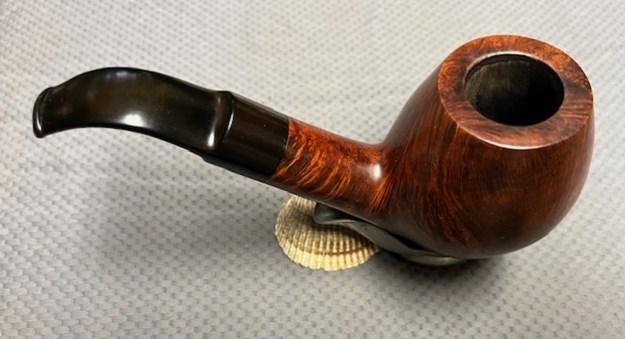
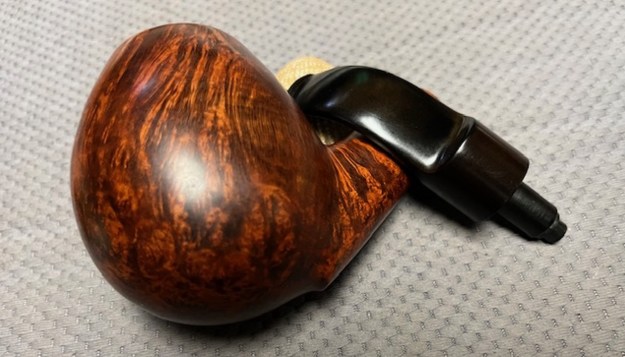
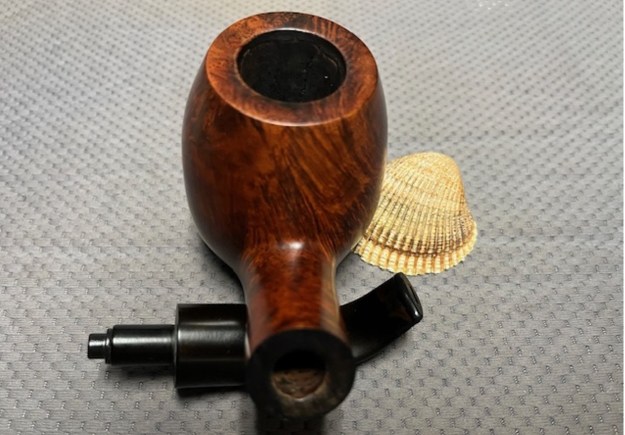
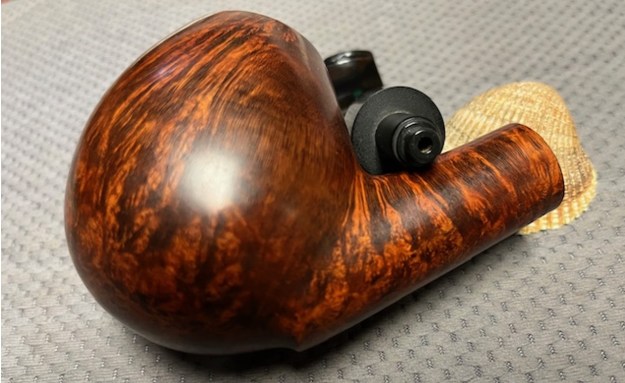
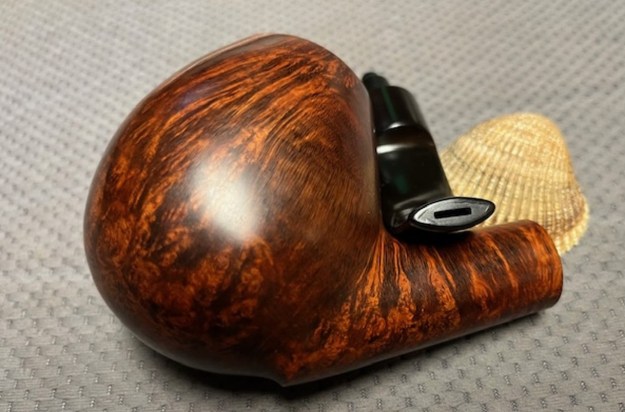
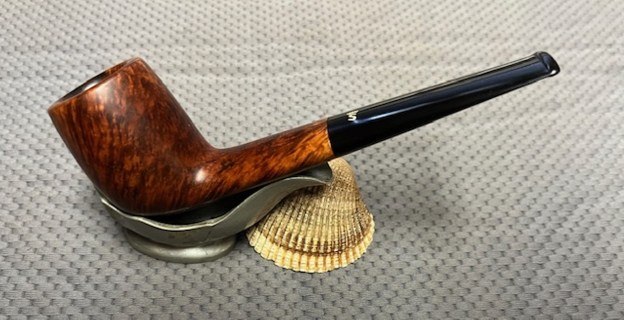
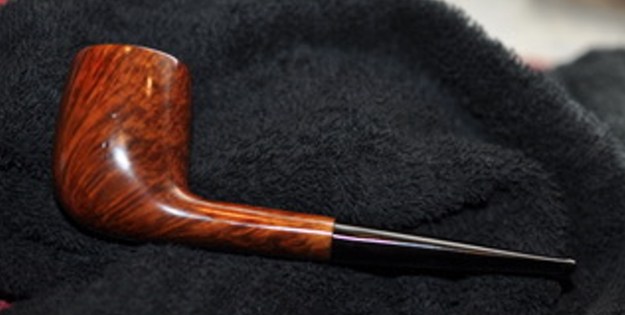
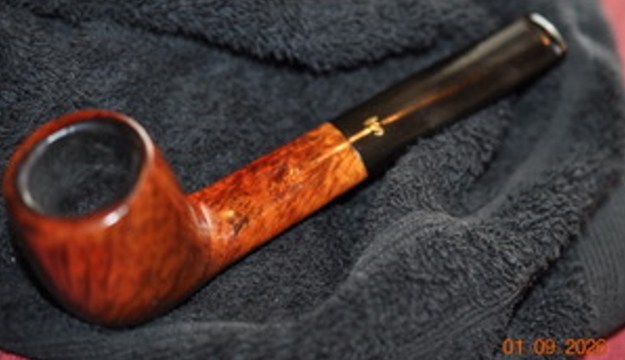
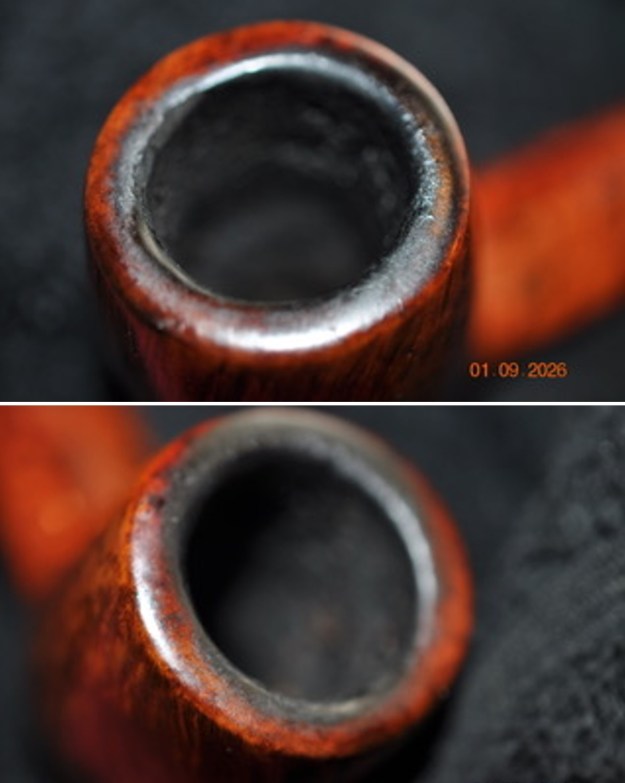
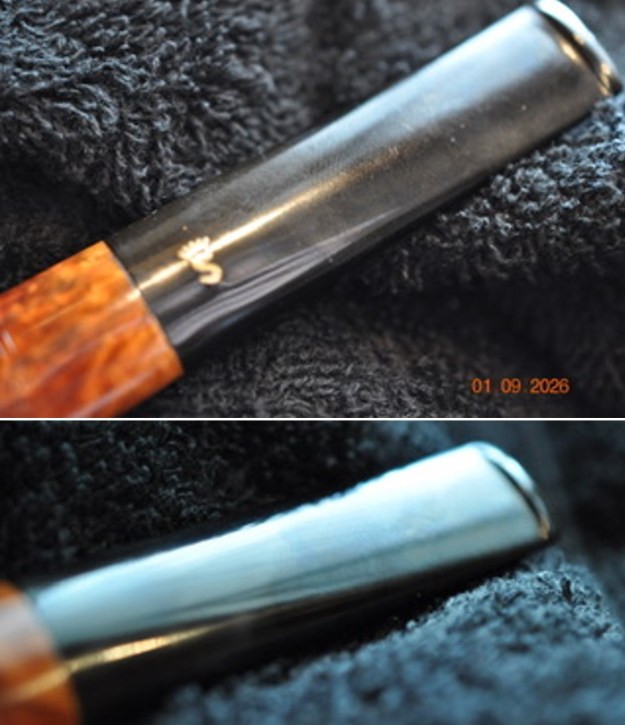
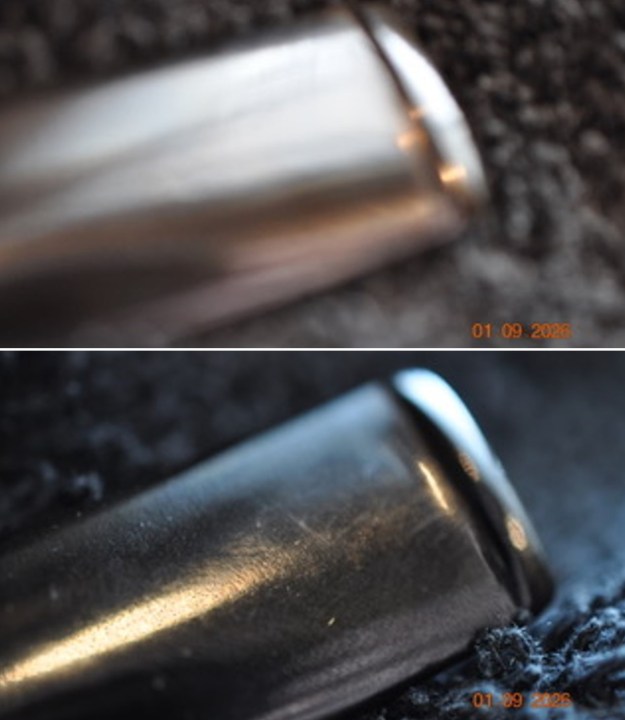
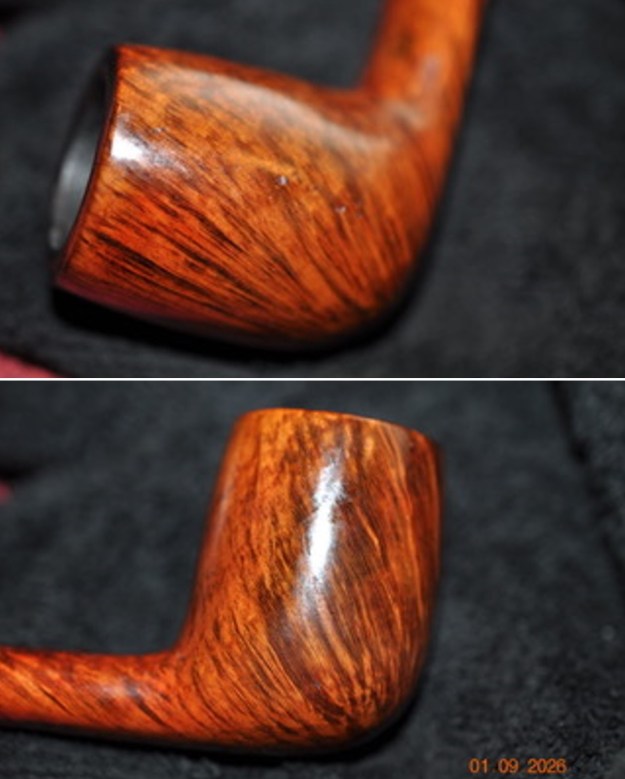
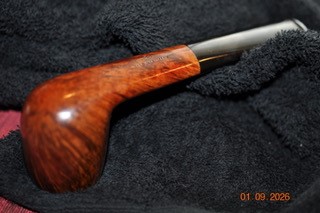
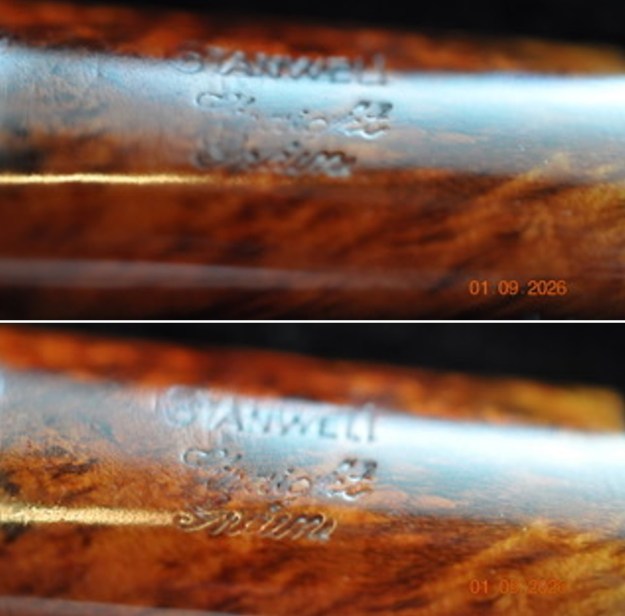
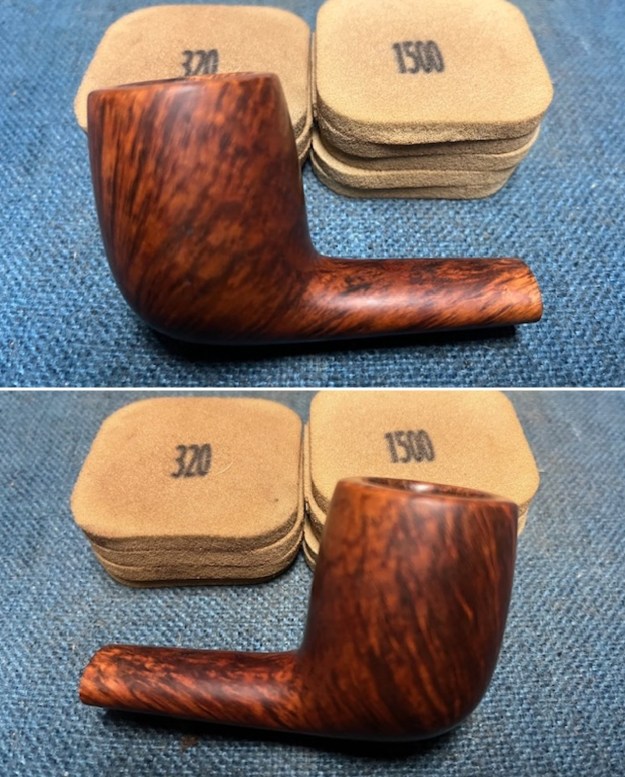
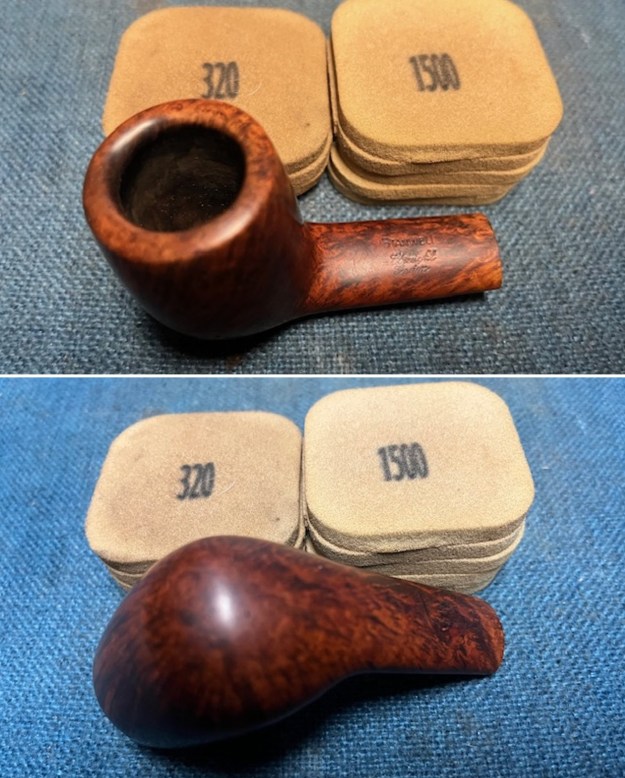
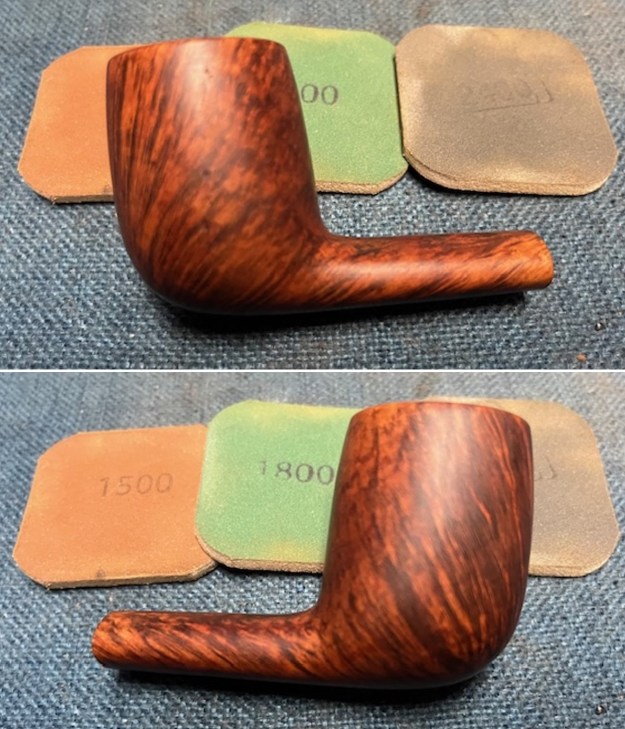
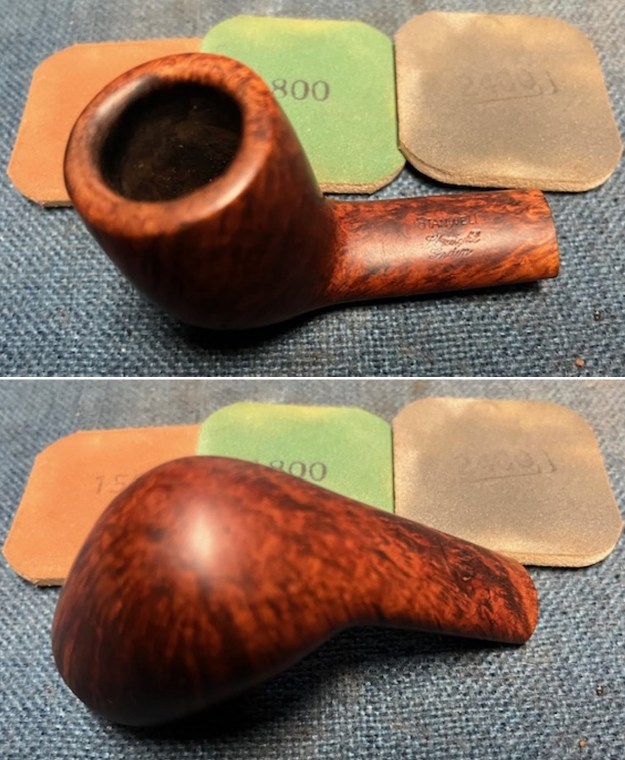
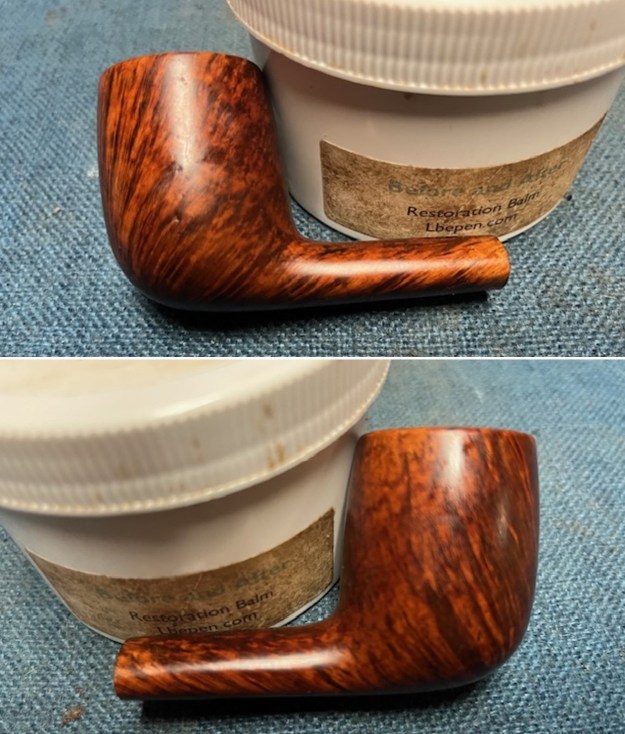
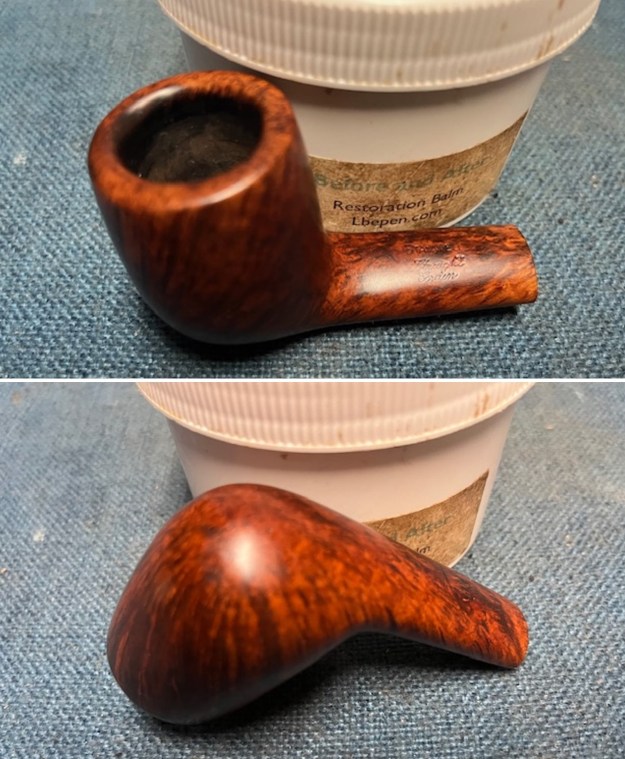
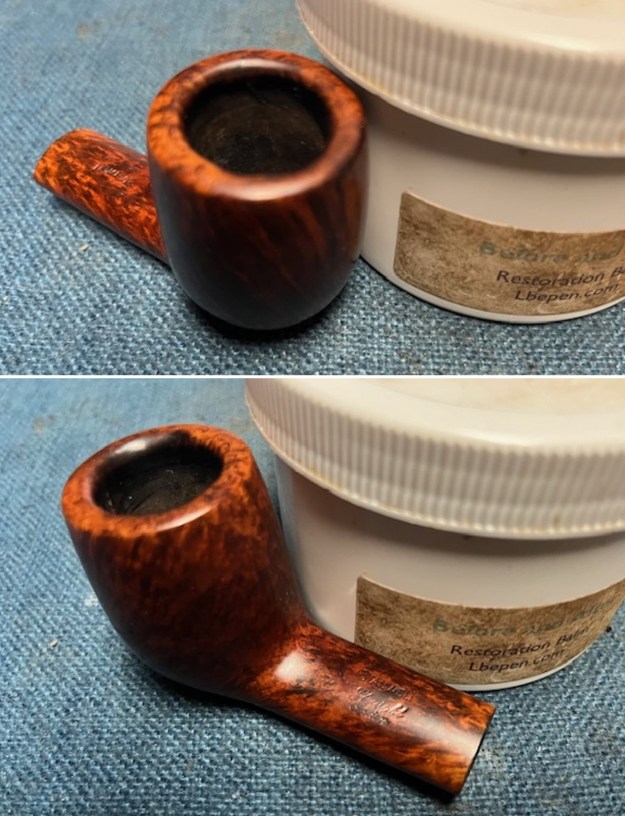
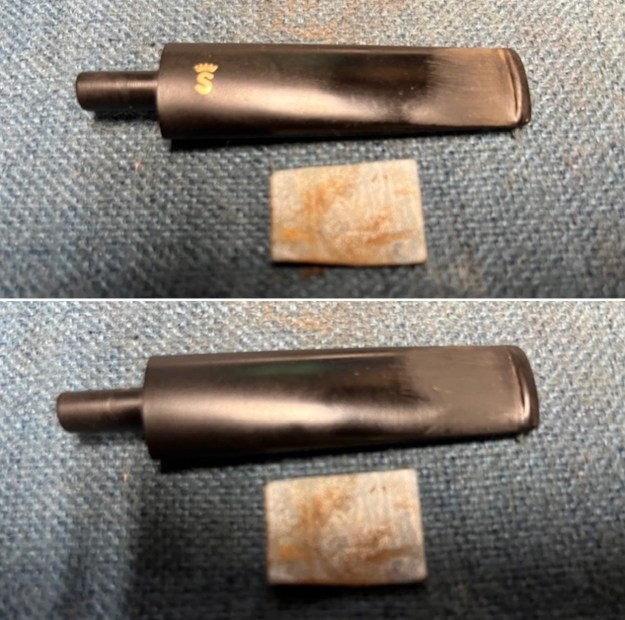
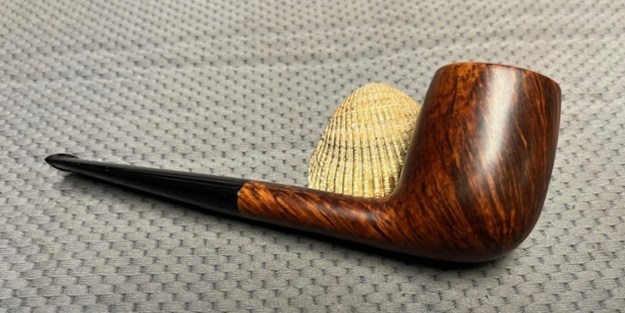
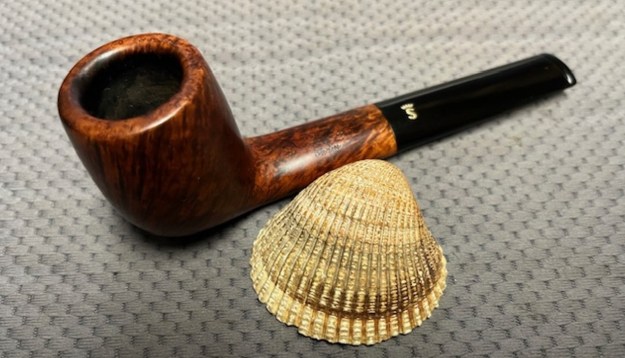
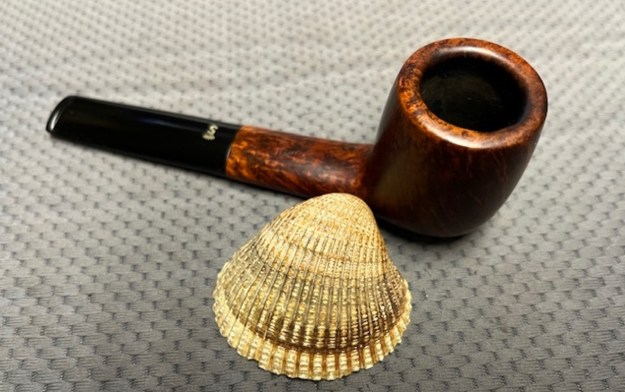
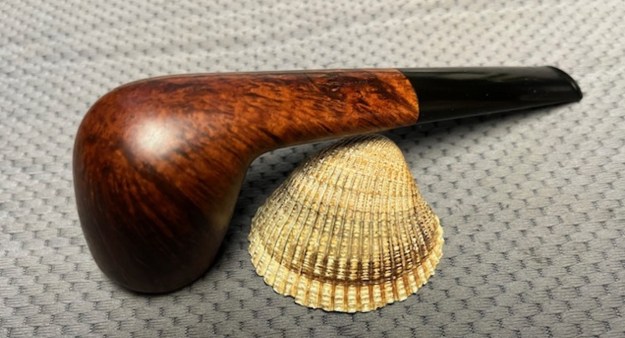
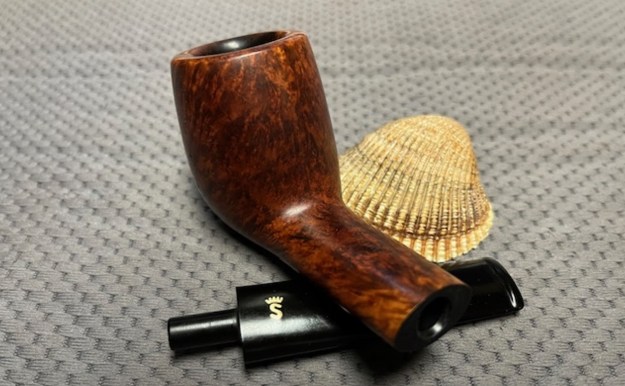
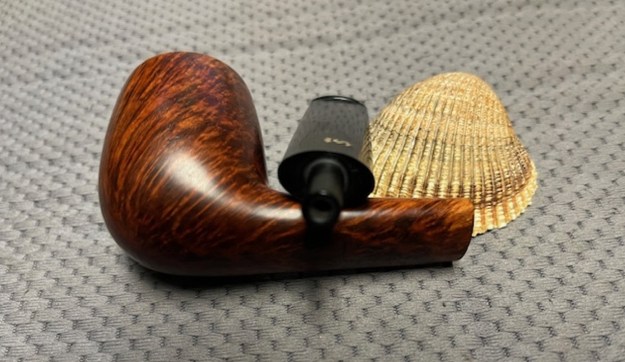
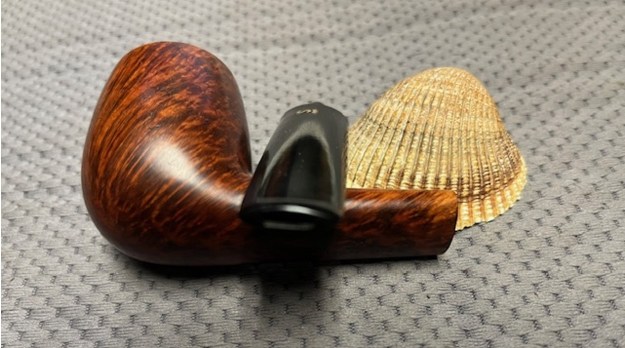
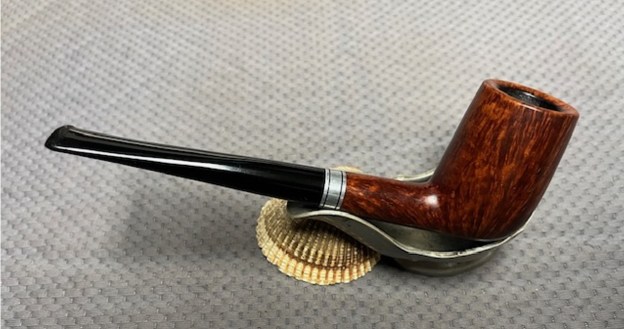
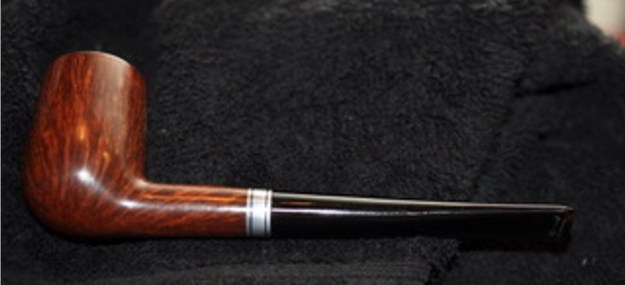
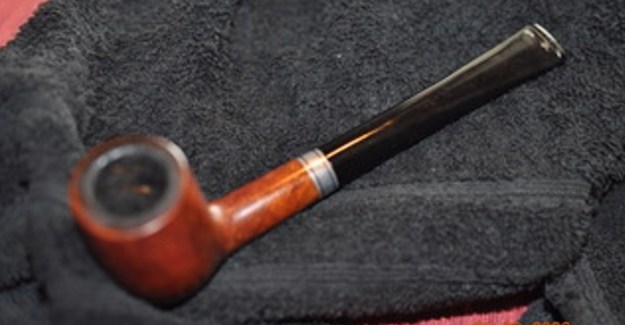
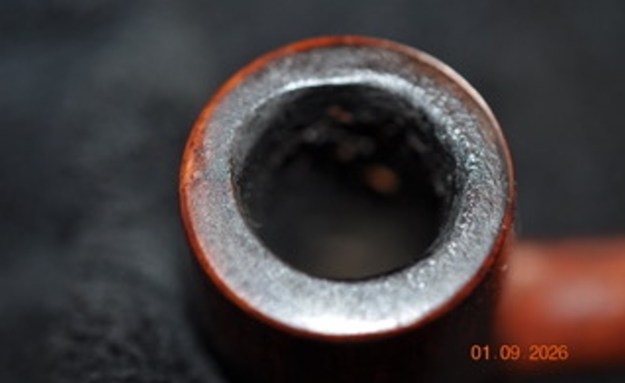
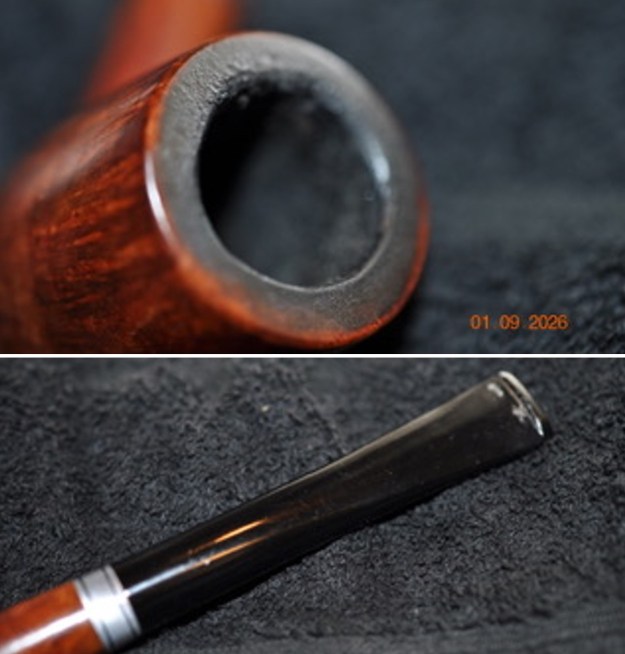
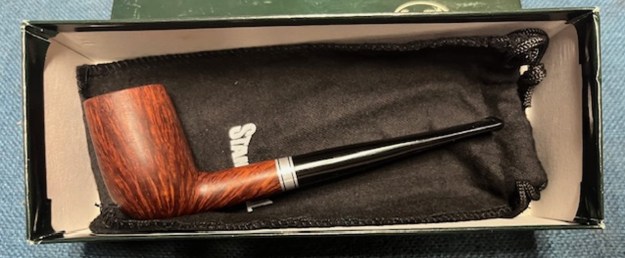
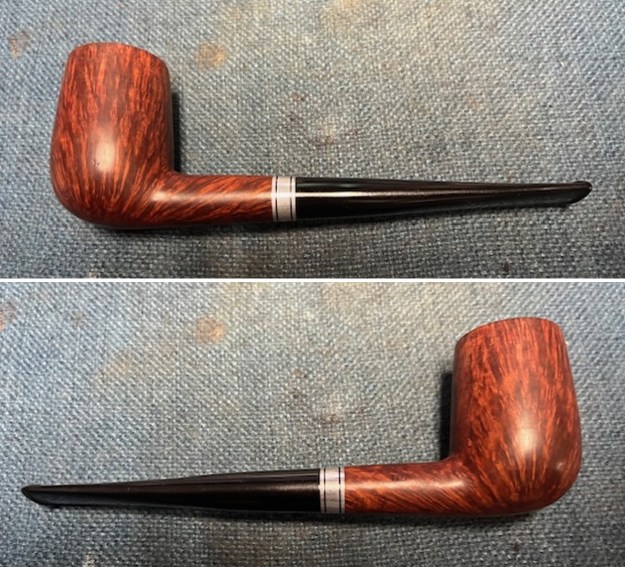
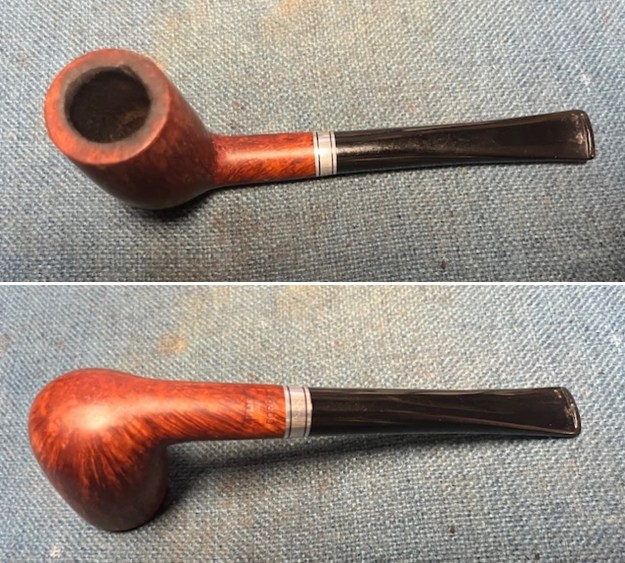
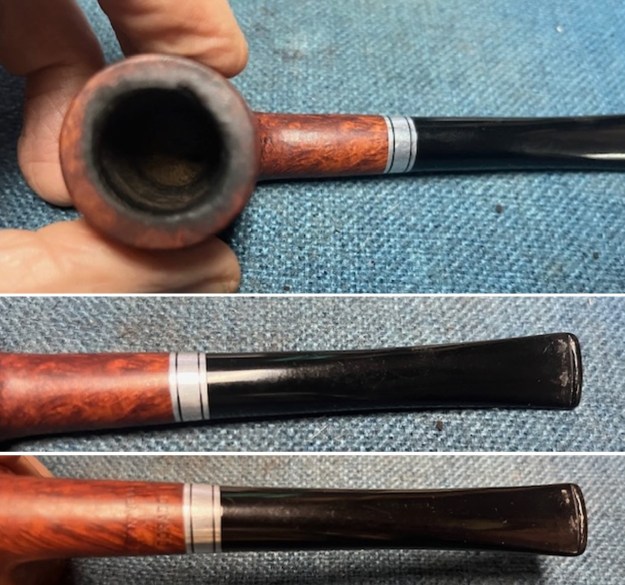
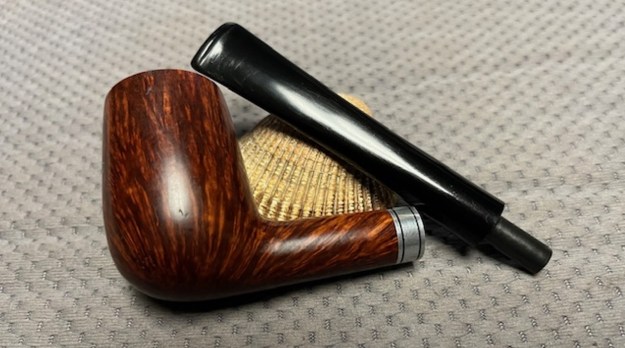
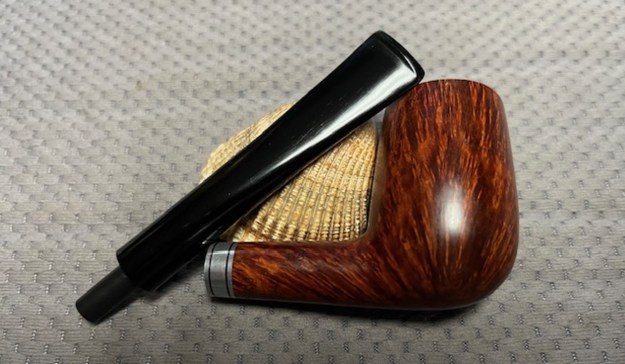
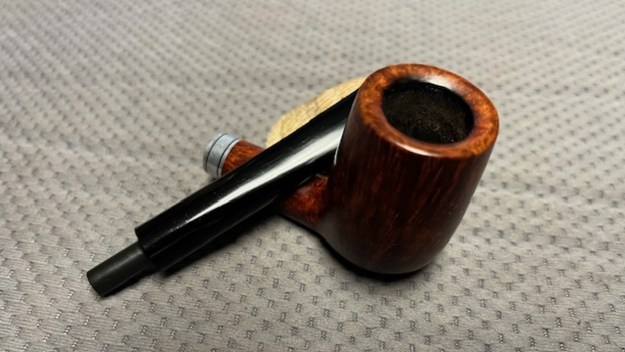
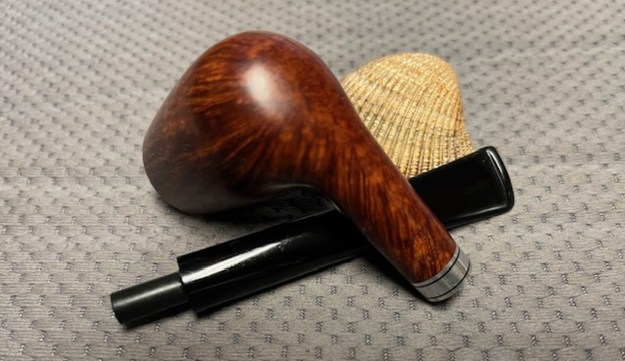
The next pipe on the table is another one that came to us from the seller in Caldwell, Idaho, USA on 07/12/2025. It is a Dunhill Root Briar Small Straight Bulldog with a vulcanite taper stem. It is in dirty but in good condition as can be seen in the photos below. It is stamped on the left side of the shank and reads 147 [followed by] Dunhill [over] Root Briar. On the right side it is stamped Made in [over] England15. That is followed by a stamping Circle 4R. The stamping is clear and readable. The pipe has rich Root Briar Finish with a blend of brown stains on a richly grained smooth finish that the shape follows well. The finish was dusty and lightly dirty with grime ground into the finish. The bowl had a moderate cake and there was tobacco debris in the bowl. The rim top had a thick lava coat on the rim top and edges. The original white spot taper stem is dirty and oxidized with light tooth marks and chatter on both sides. I took photos of the pipe to show what it looked like before I started working on it. I took photos of the bowl and rim top to show the thickness of the cake and the lava coat on the rim top. There was some tobacco debris in the bottom of the bowl. The stem photos show the condition of the saddle stem ahead of the button.The stamping on the sides of the shank are clear and readable as noted above. I took a photo of the pipe with the stem removed to give a sense of the proportions of the pipe. It is a real beauty. One of the first things I like to do is to unpack the stamping and understand each element in it. I turned to Pipephil’s helpful site (http://pipephil.eu/logos/en/dunhill/shell-briar1.html). The stamping is interpreted as follows: The 147 is the shape of the pipe which I assume is a Bulldog. The Dunhill Root Briar is the finish. Following the Made In England15 gives the year that the pipe was made.  The circle 4R is the stamp for a Group 4 in a Root Briar finish.

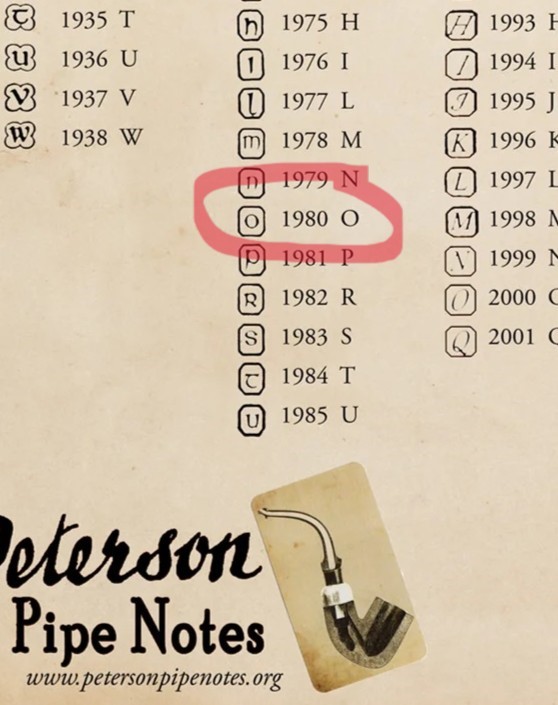
From there I wanted to pin down the date stamp 15. I have included Page 2 of the Dunhill Dating Key (http://www.pipephil.eu/logos/en/dunhill/cledat-en1a.html). Following that it takes me to the box with 1960+suffix. That tells me that the pipe is a 1975 pipe.    I wanted to know more about the Root Briar finish and when it was introduced by Dunhill. I turned to a listing on Pipedia that gave me the information I was looking for (https://pipedia.org/wiki/Dunhill).

Root Briar

Dunhill introduced its third major pipe finish, the Root Briar, in 1931. The new line was developed specifically to showcase briar with a particularly beautiful and pronounced grain. To this end, it was made exclusively from Corsican mountain briar, a wood characteristically prized for its fine grain, a practice that continued into the 1960s.

The pipe was finished with a light, natural stain to allow the beauty of the wood to show through. A particularly distinctive feature of the early Root Briar was its unique mouthpiece — a marble-grained, brown vulcanite bit — that became known to collectors as the ‘bowling ball’ bit. This style, however, was discontinued with the onset of the Second World War.

Because the Root Briar finish requires a perfectly clean bowl with exceptional graining, it has always been one of Dunhill’s rarer and more expensive lines, typically available only at the company’s own stores or through its principal dealers. Its nomenclature was identical to that of the Bruyère, except for the use of an ‘R’ stamp instead of an ‘A’. Straight-grained versions were graded on various scales over the years, evolving into the modern ‘DR’ one-to-six-star system.[122][123]

Now I knew that I was working on a Dunhill Root Briar 147 Bulldog with a Taper Stem that was made in 1975.

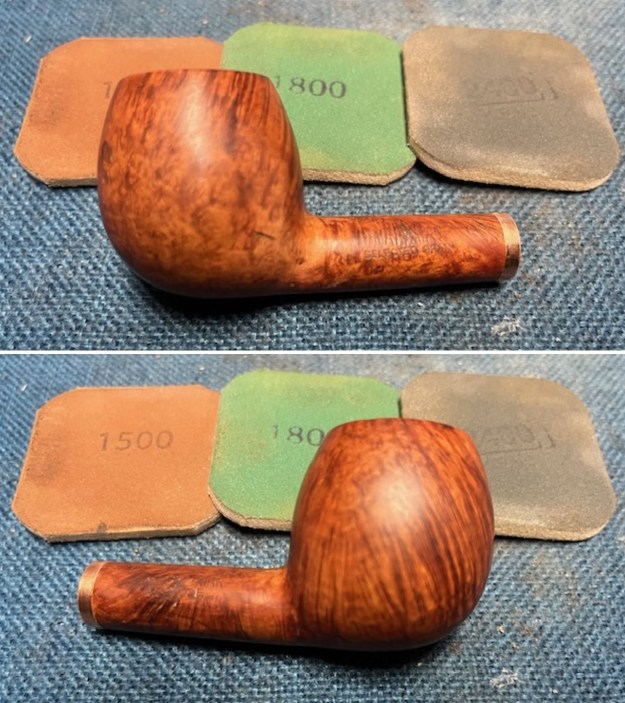
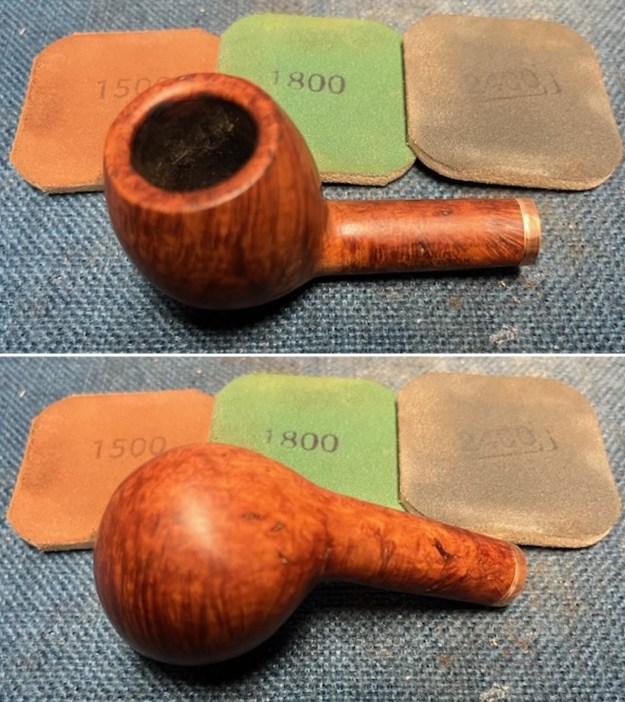
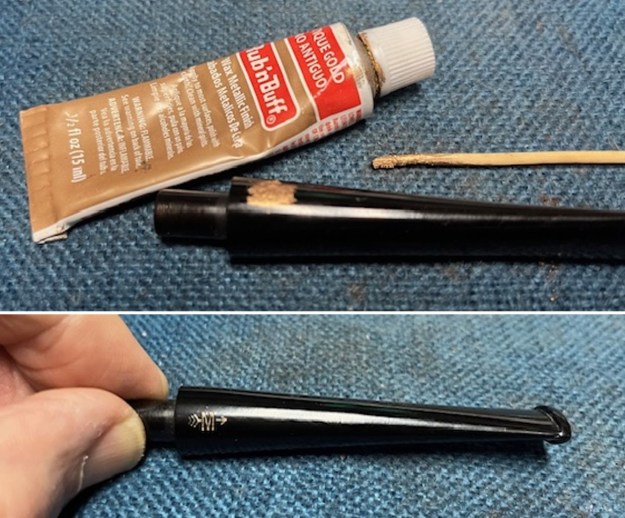
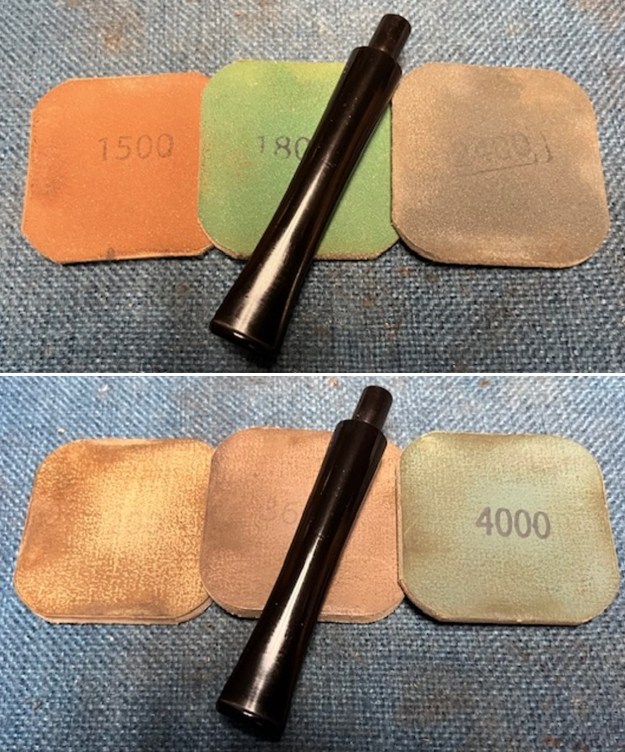
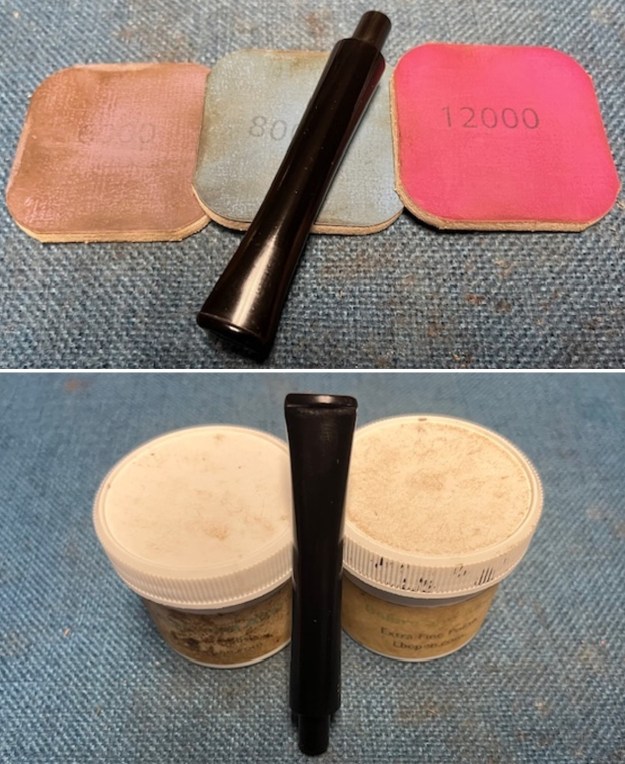
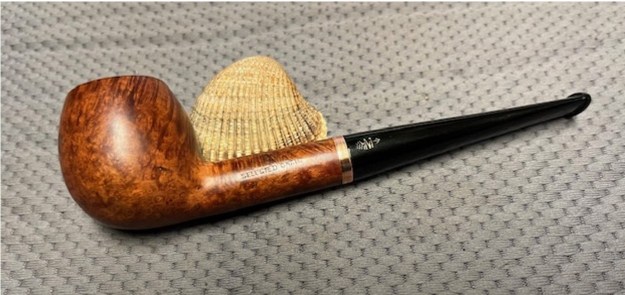
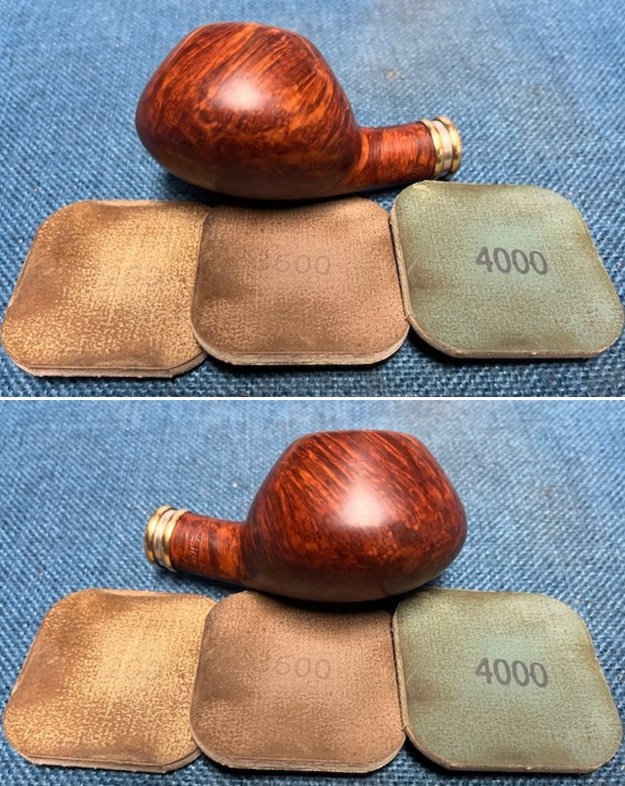
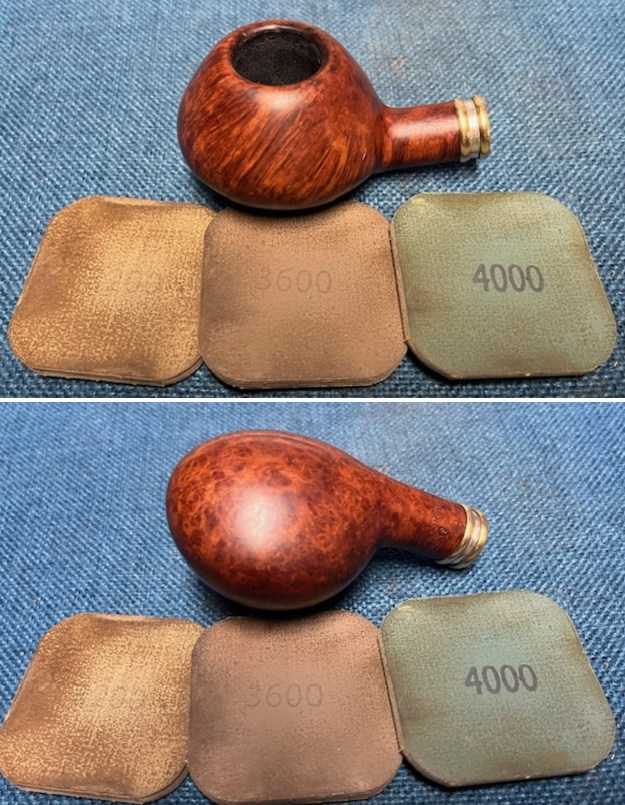
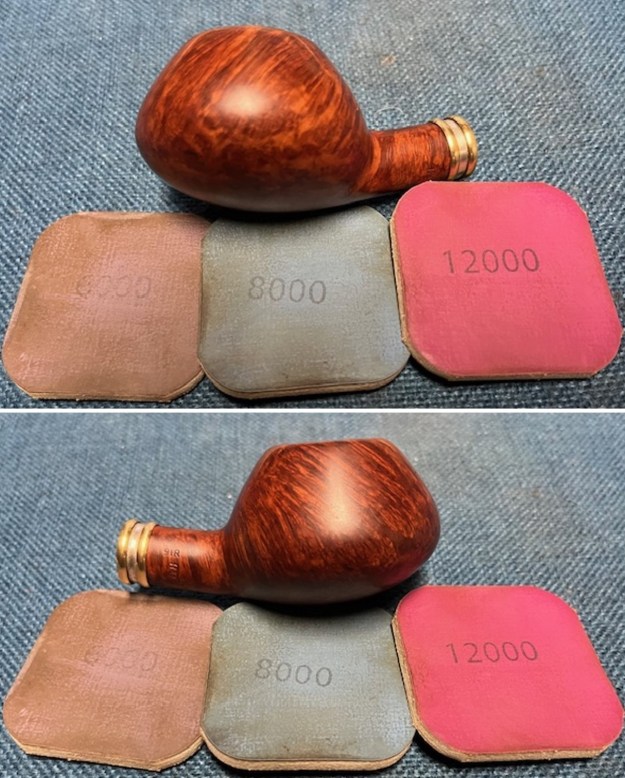
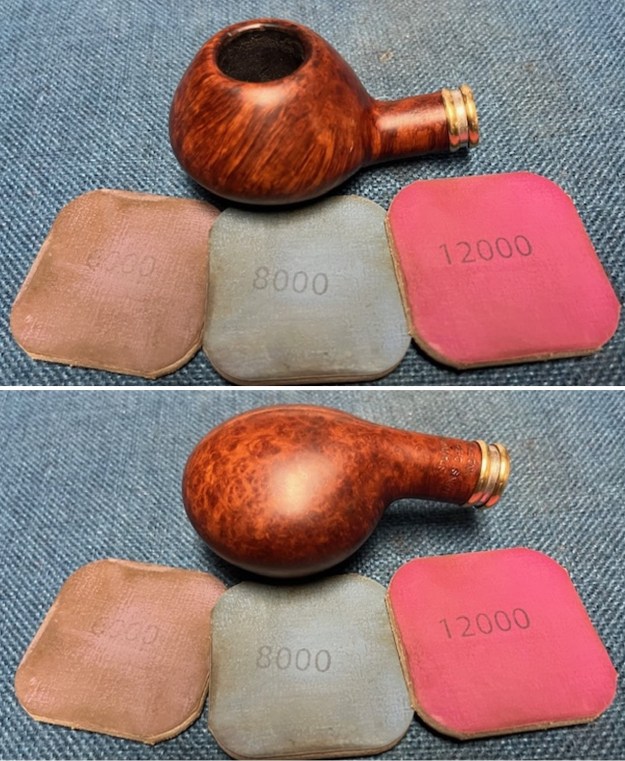
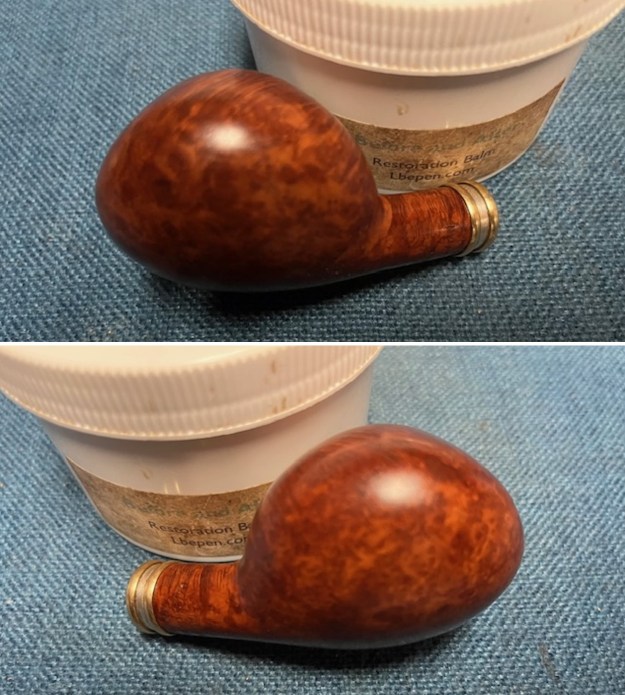
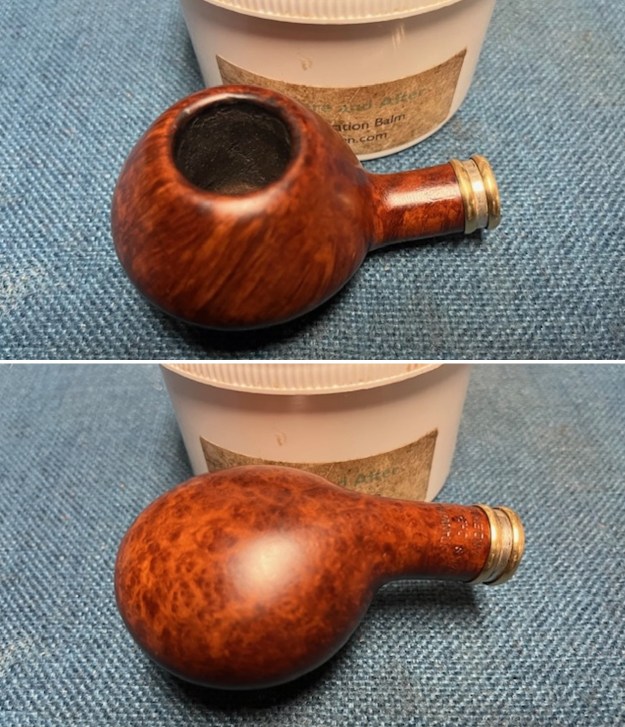
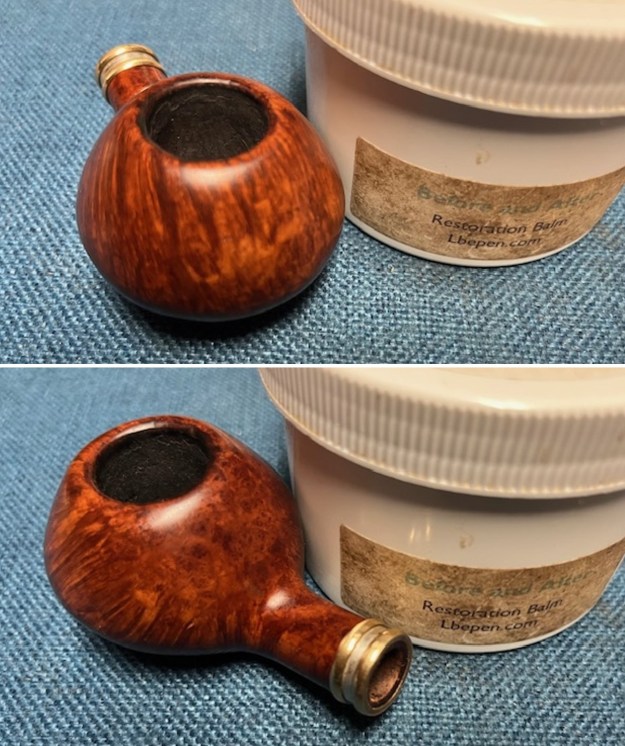
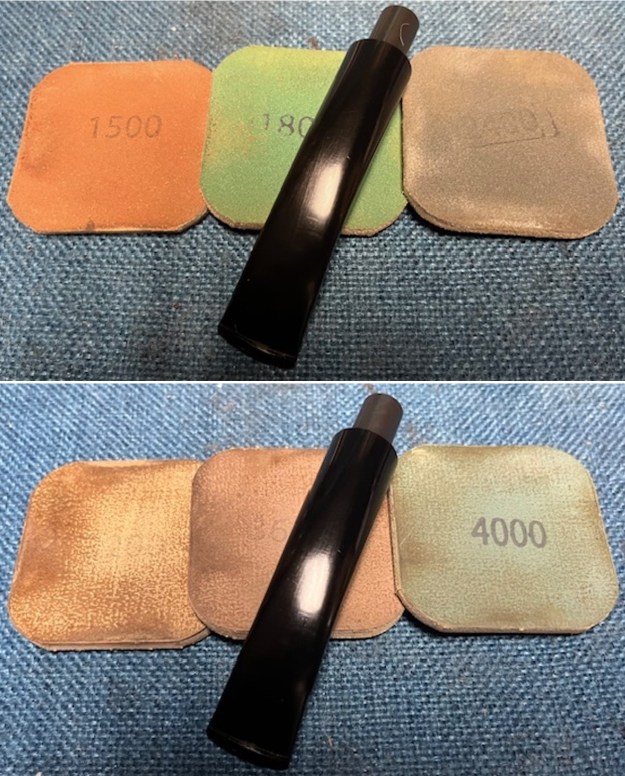
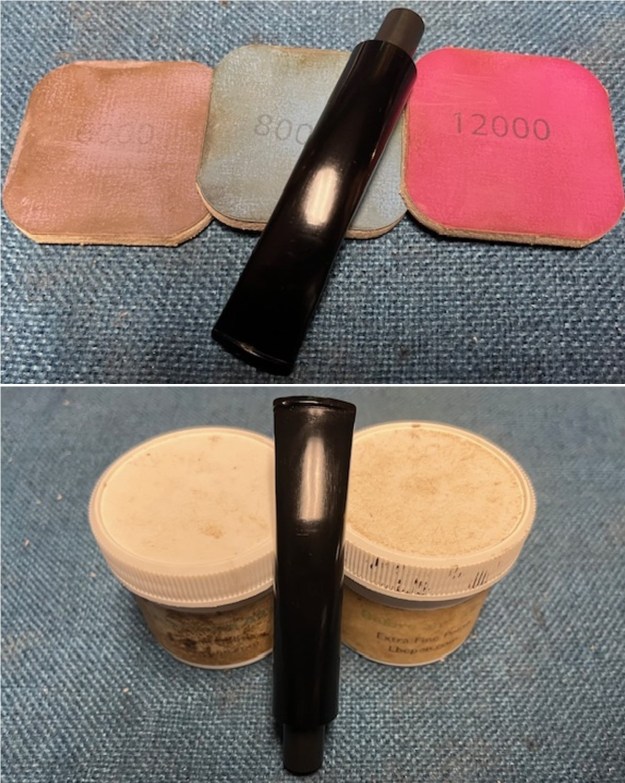
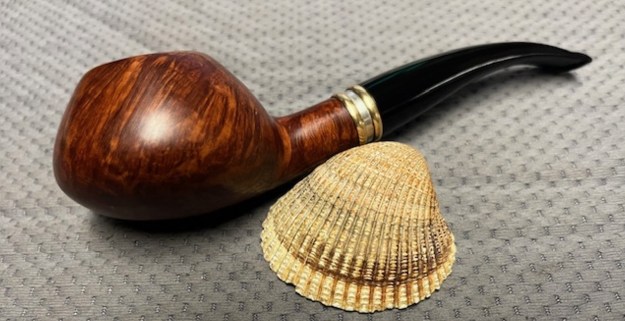
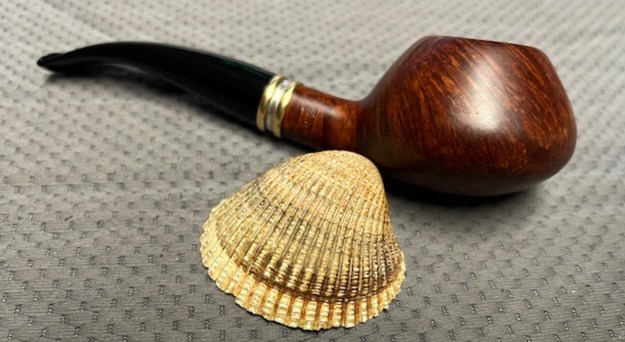
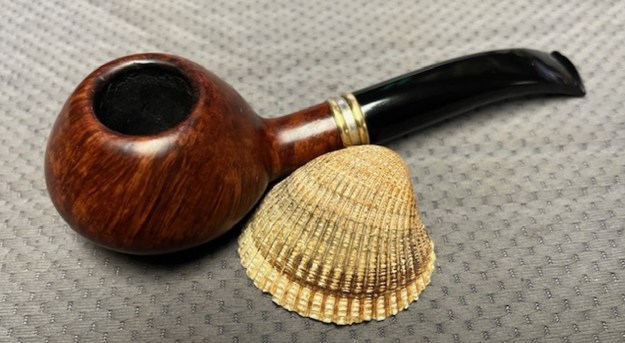
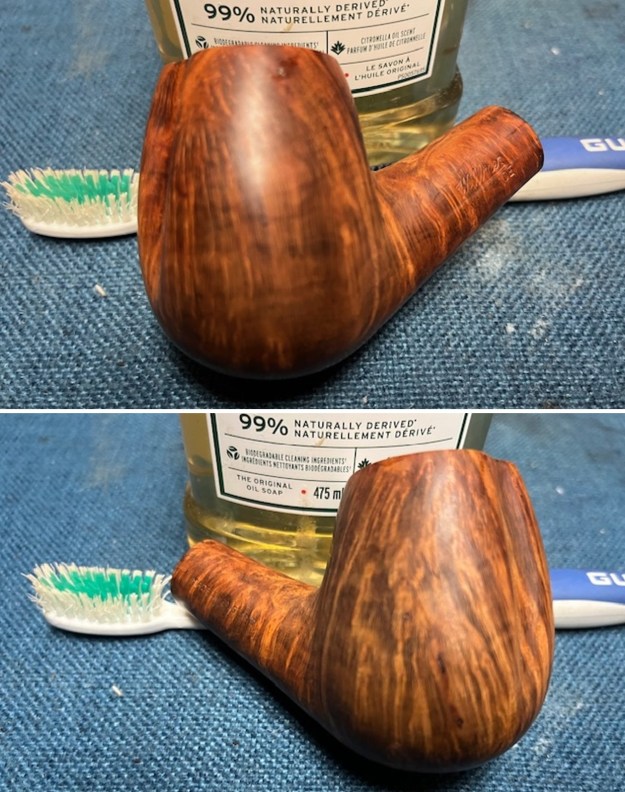
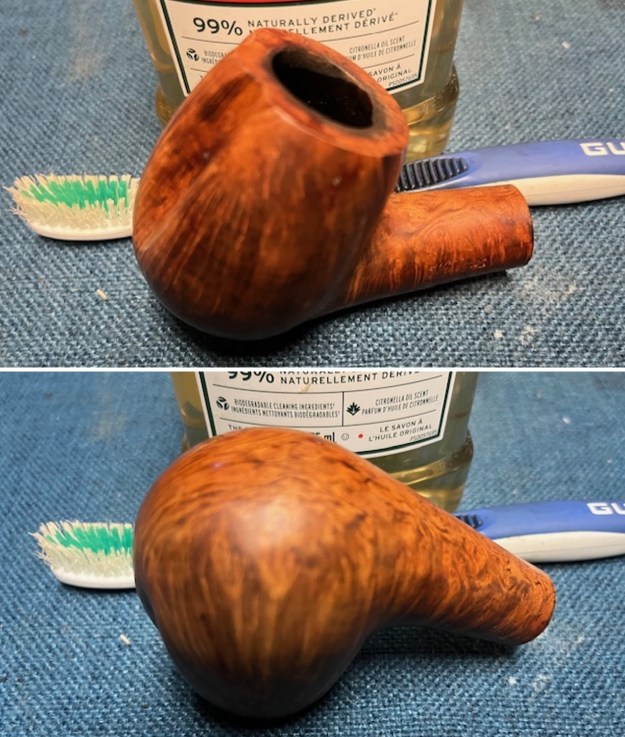
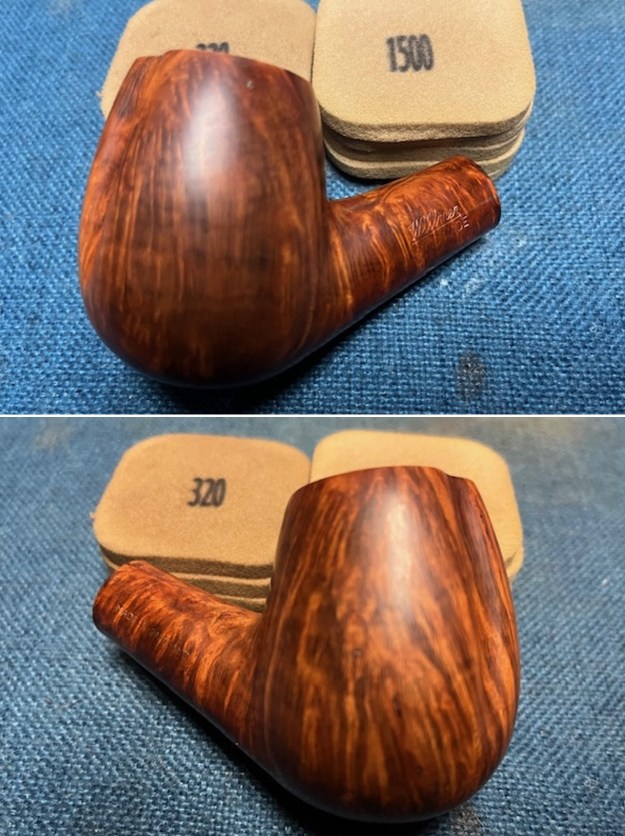
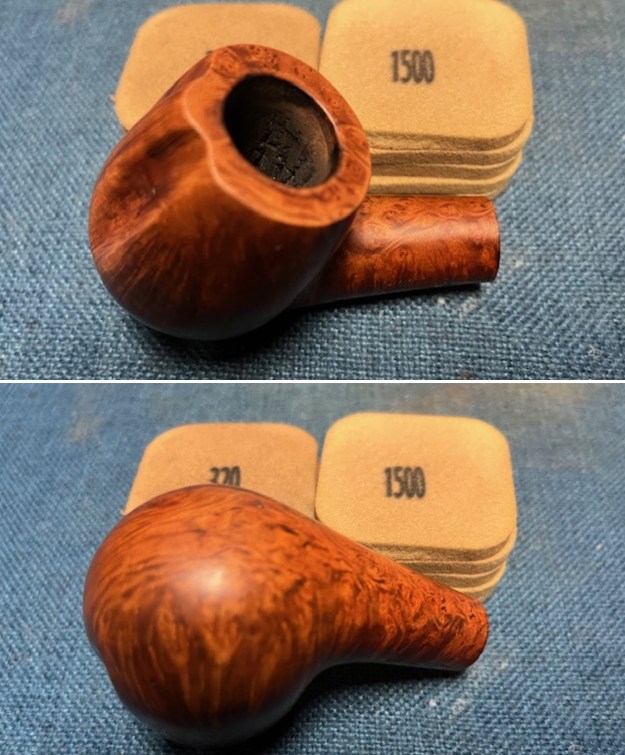
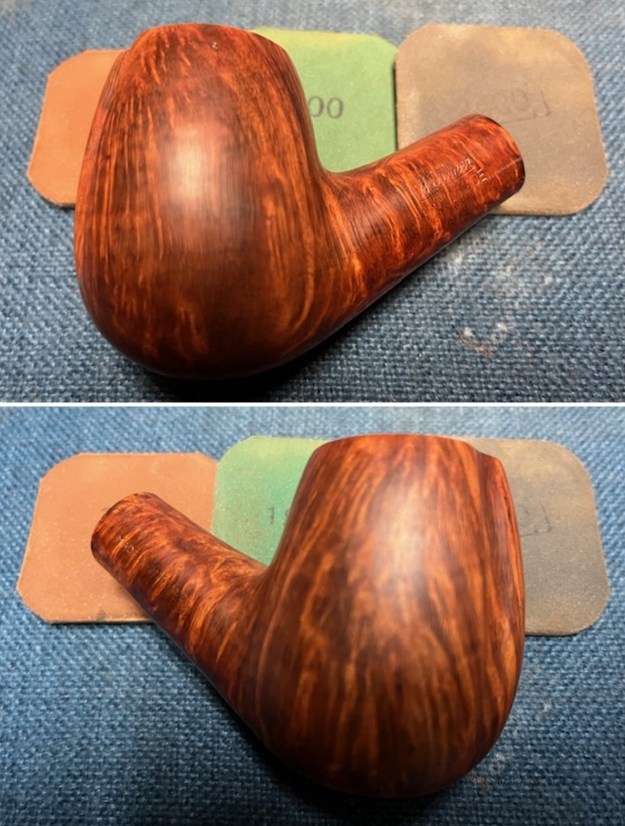
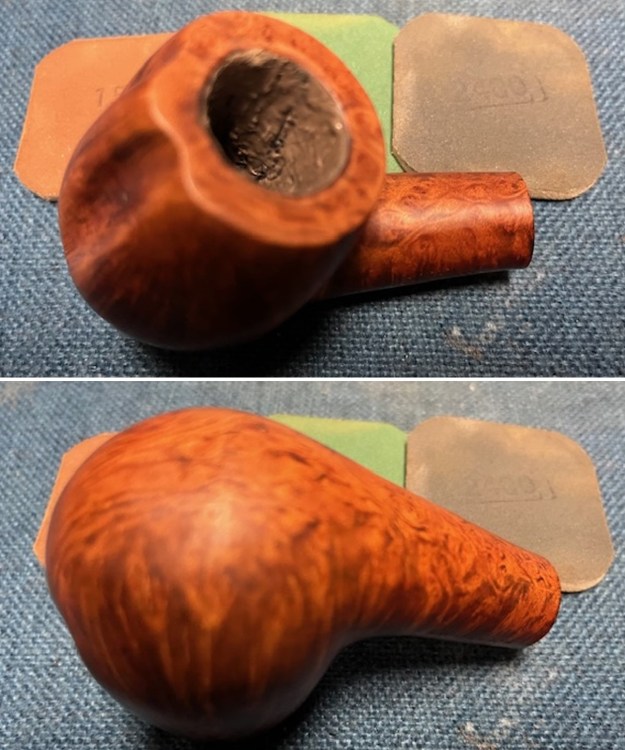
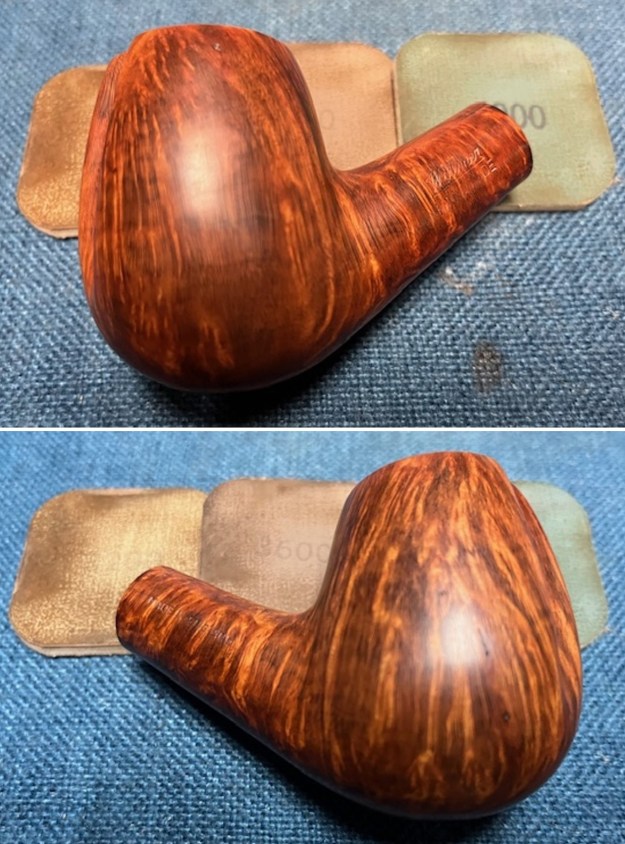
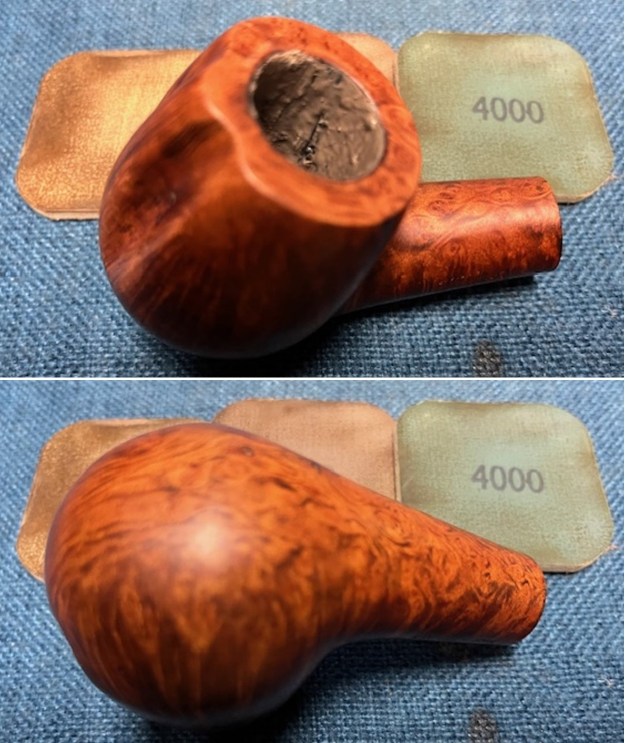
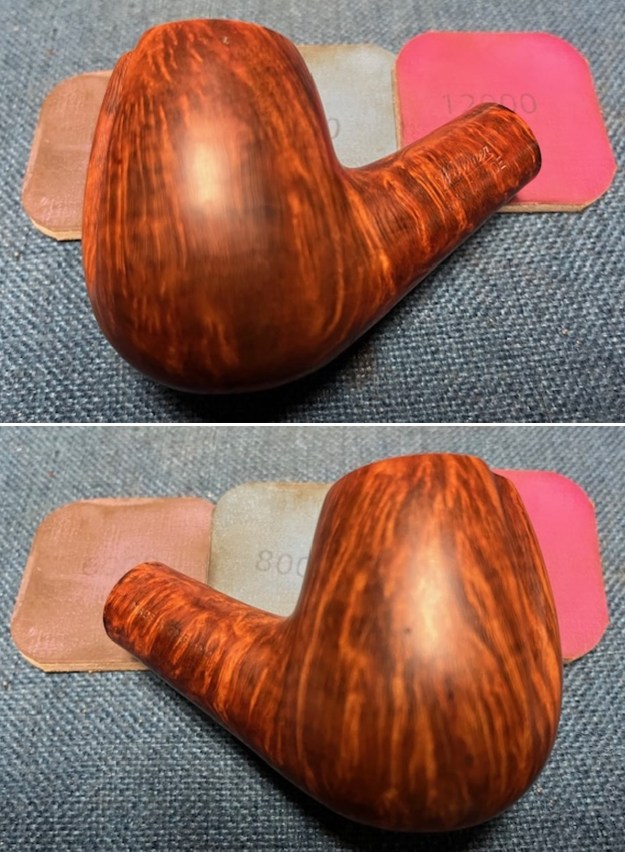
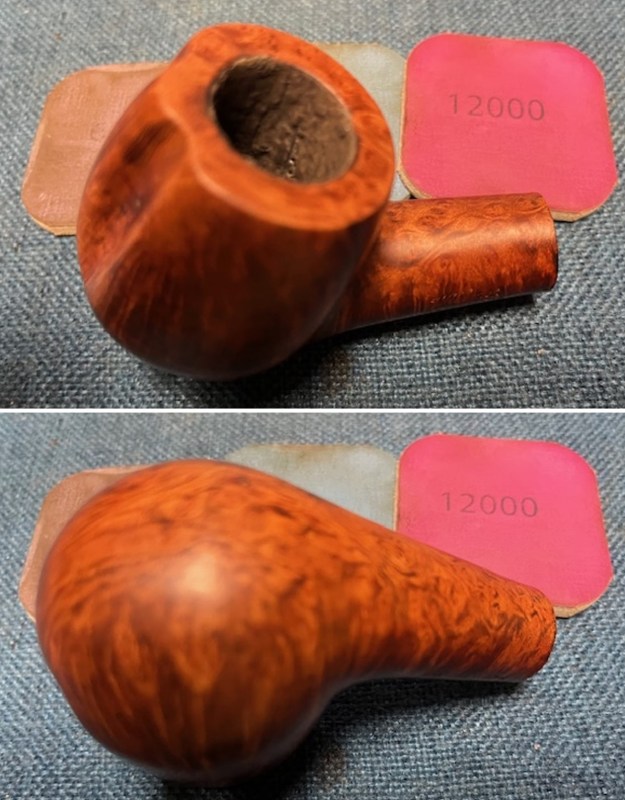
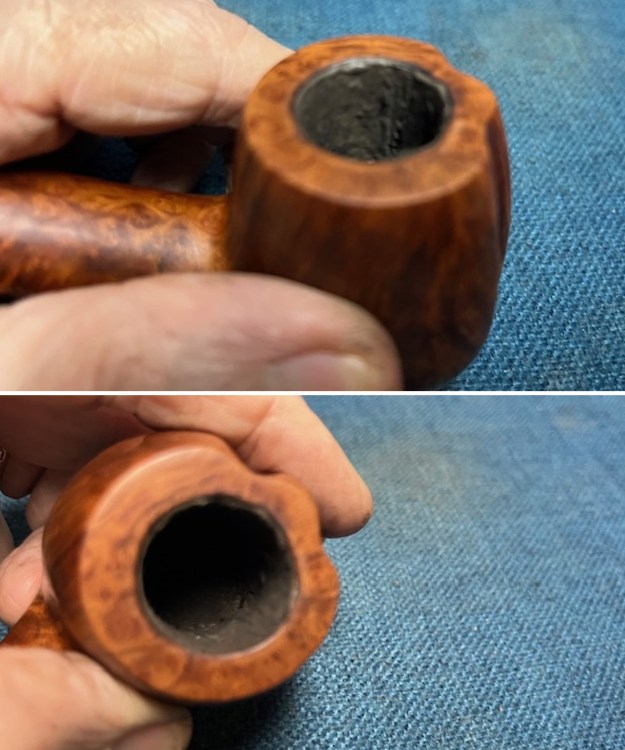
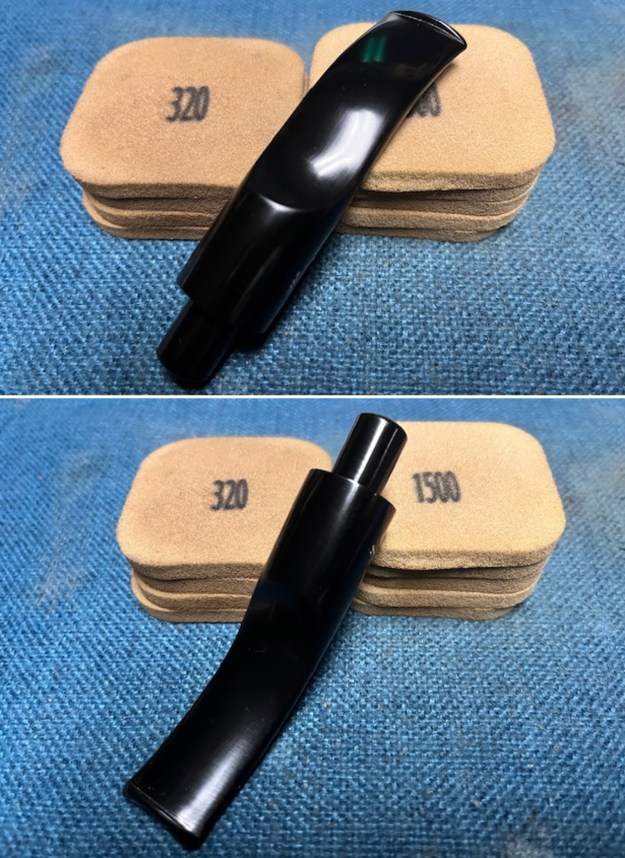
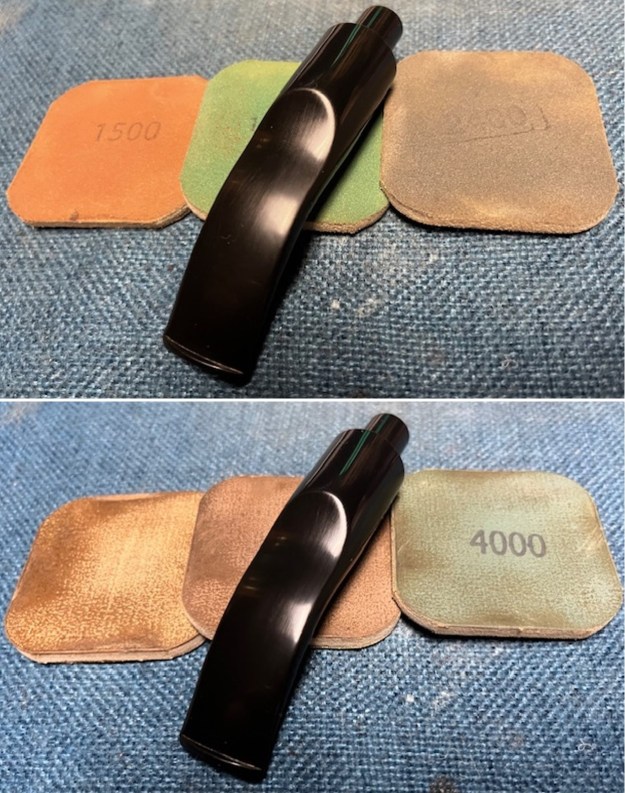
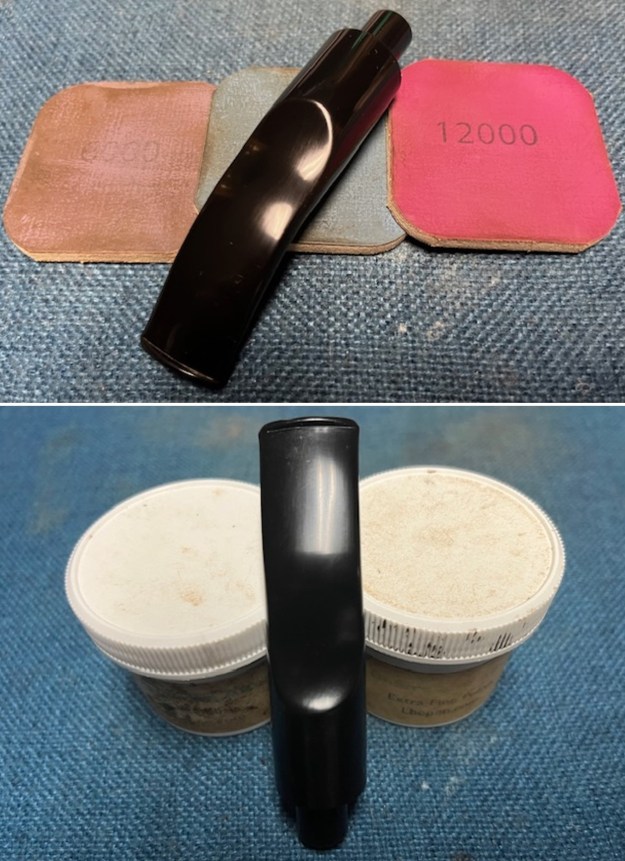
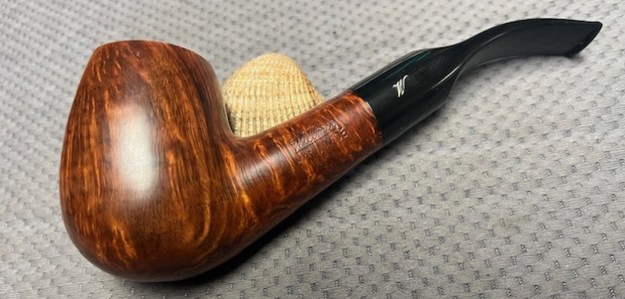
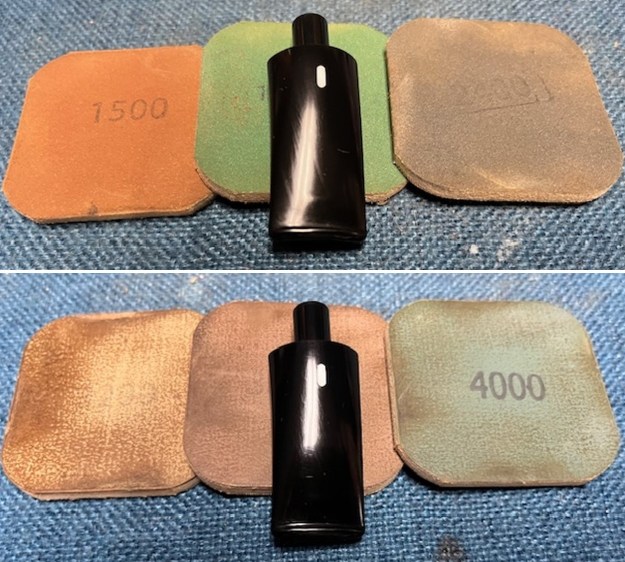
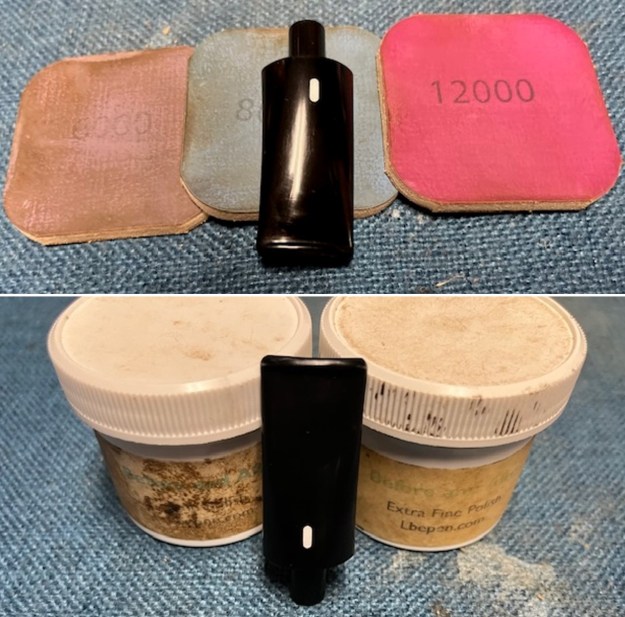
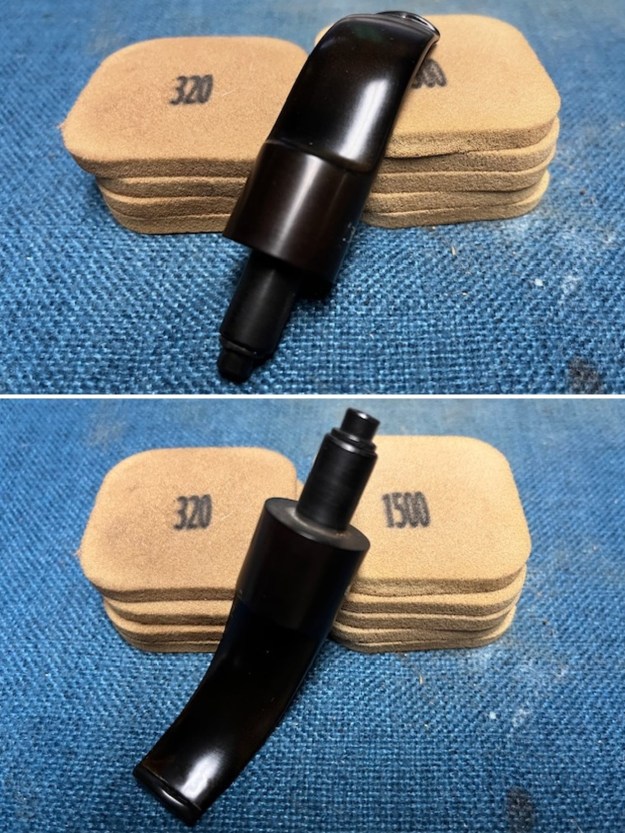
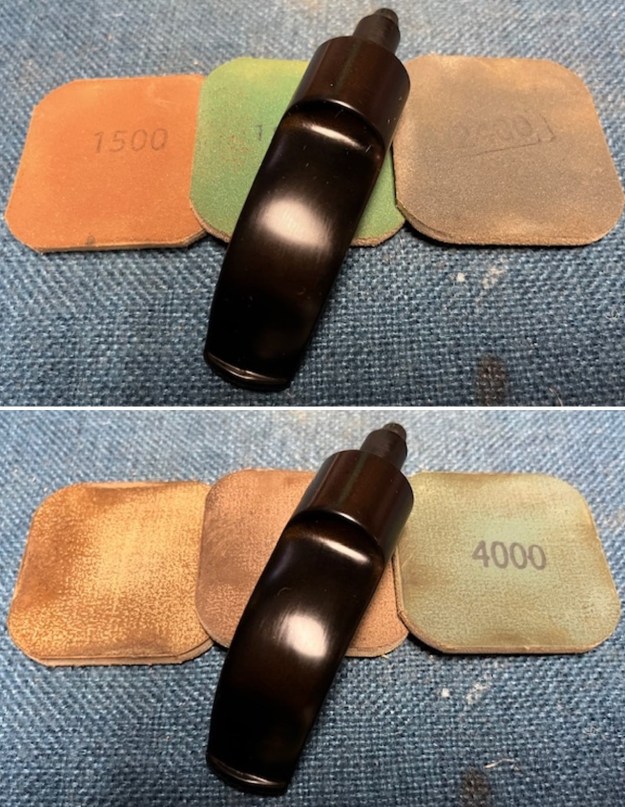
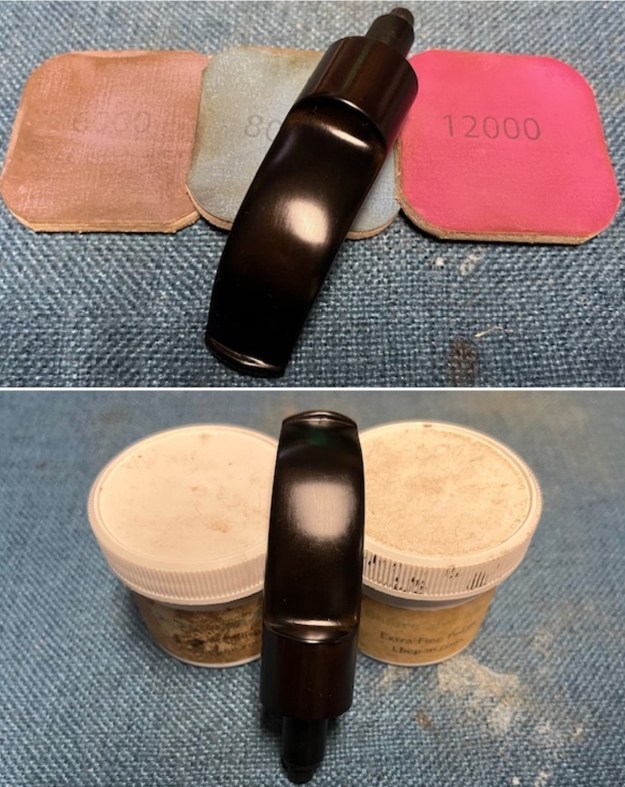
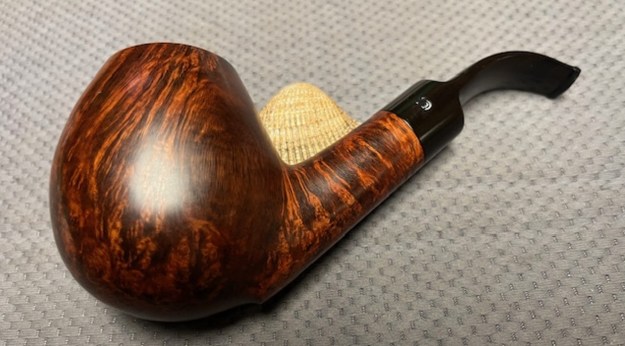
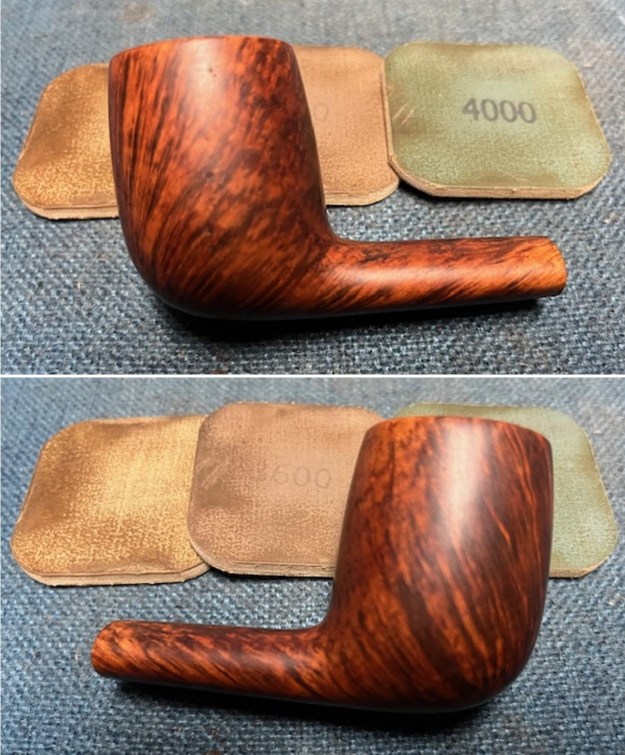
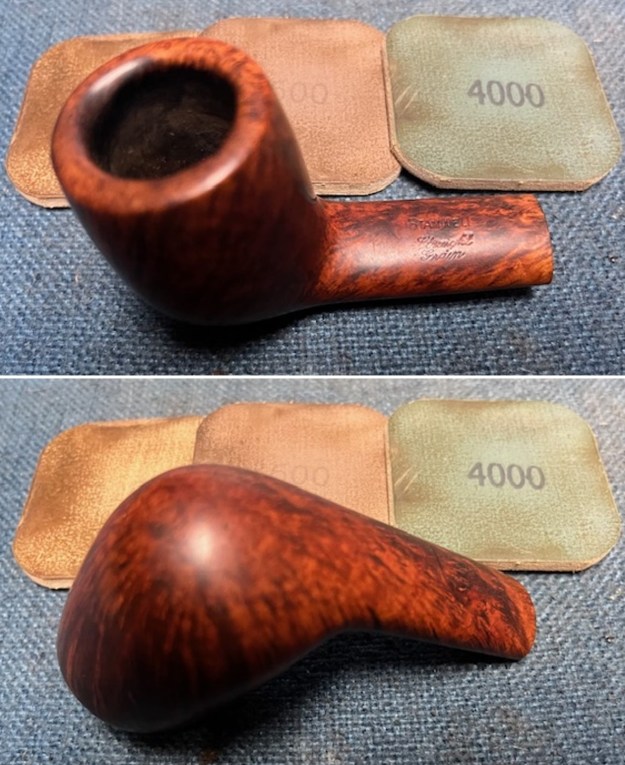
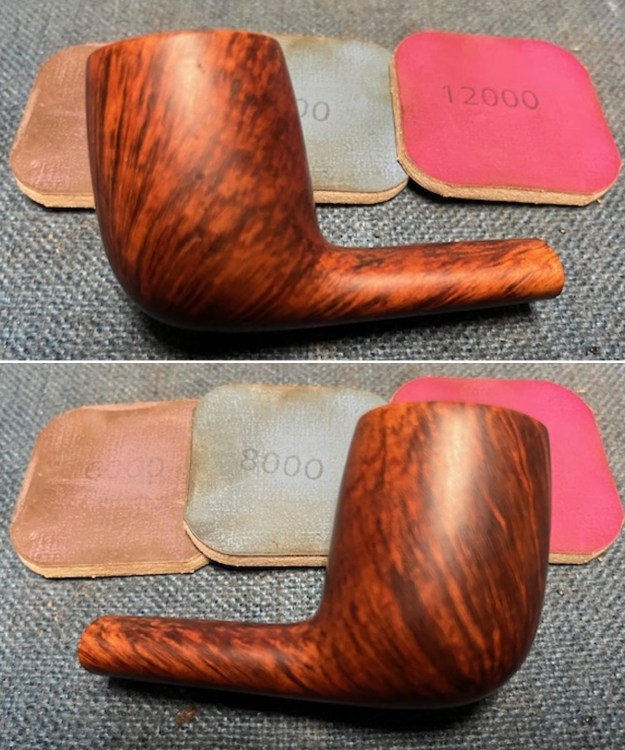
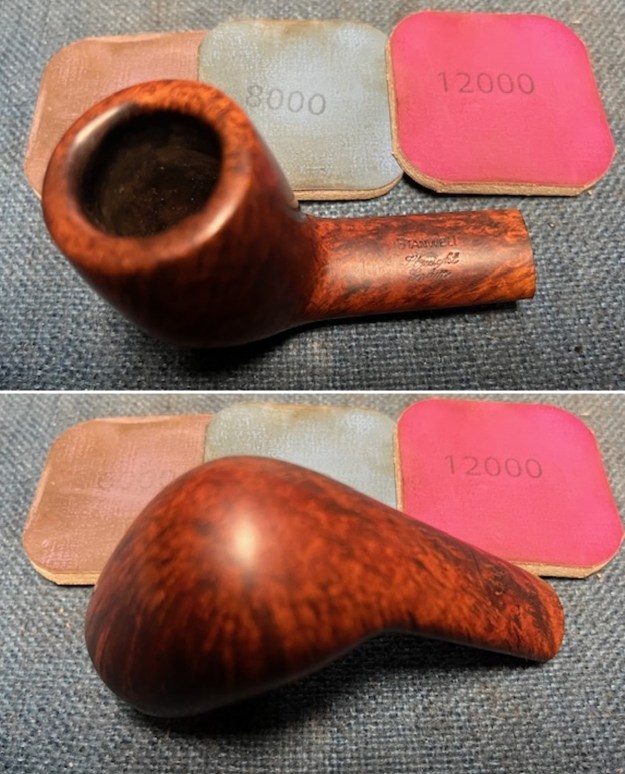
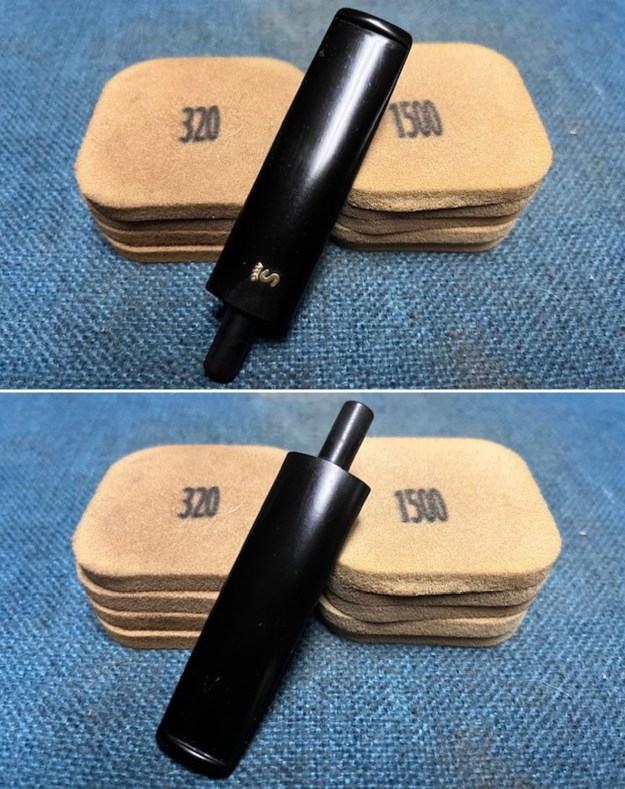
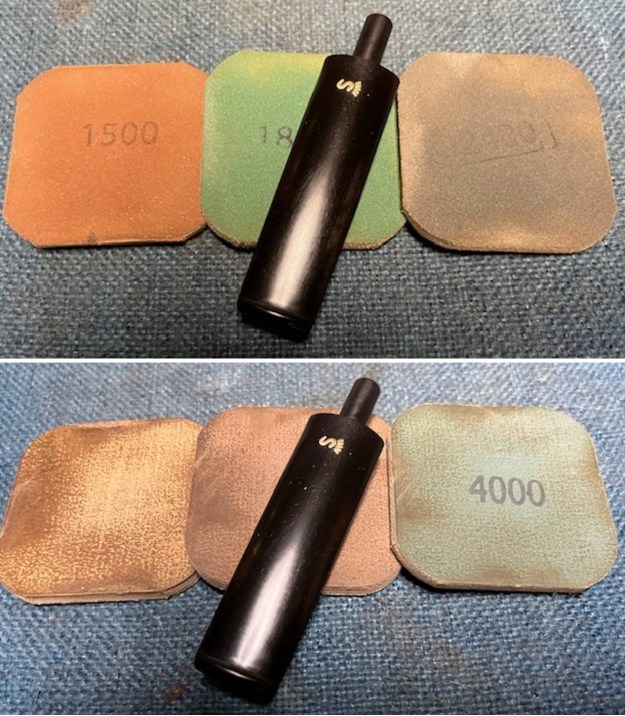
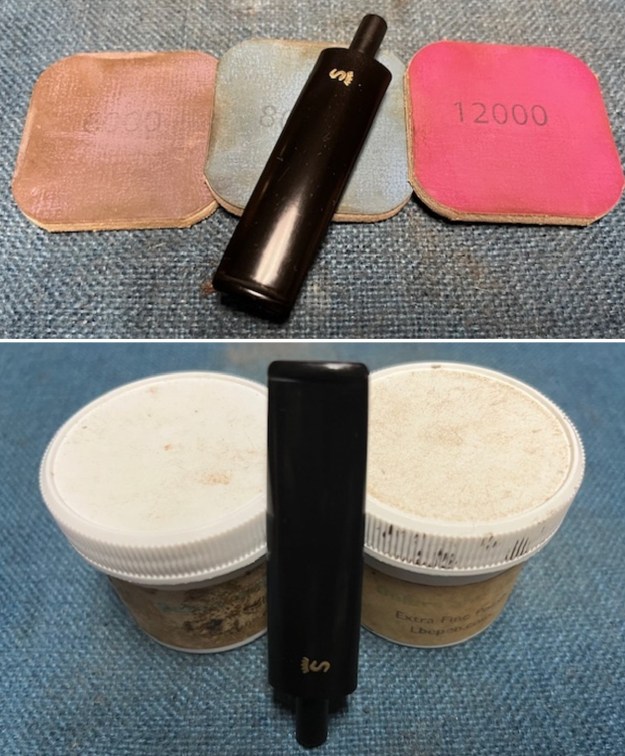
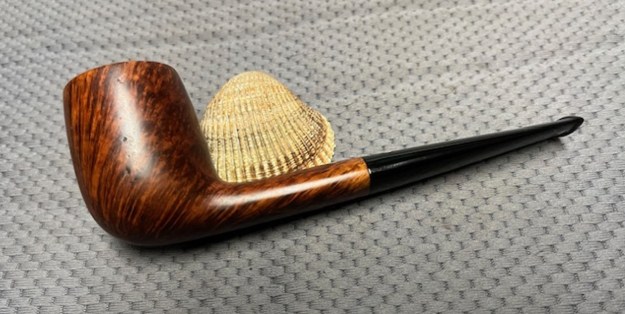
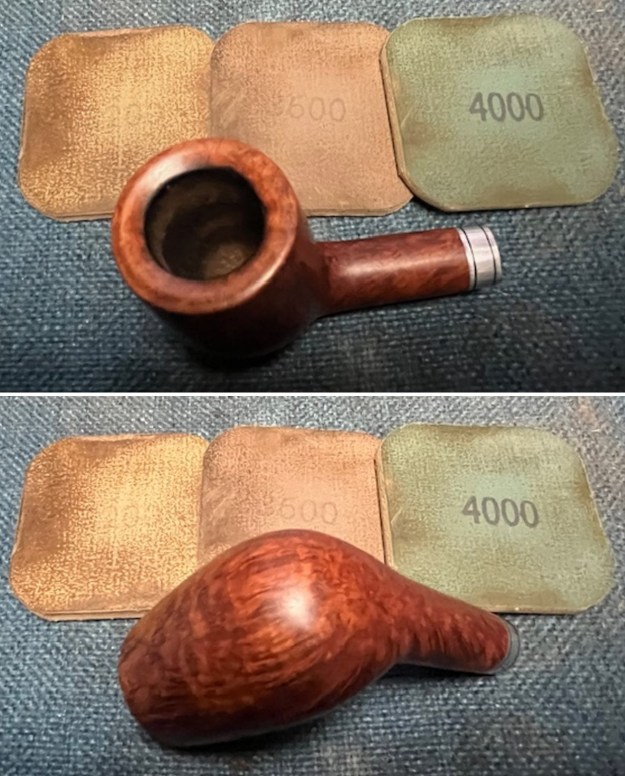
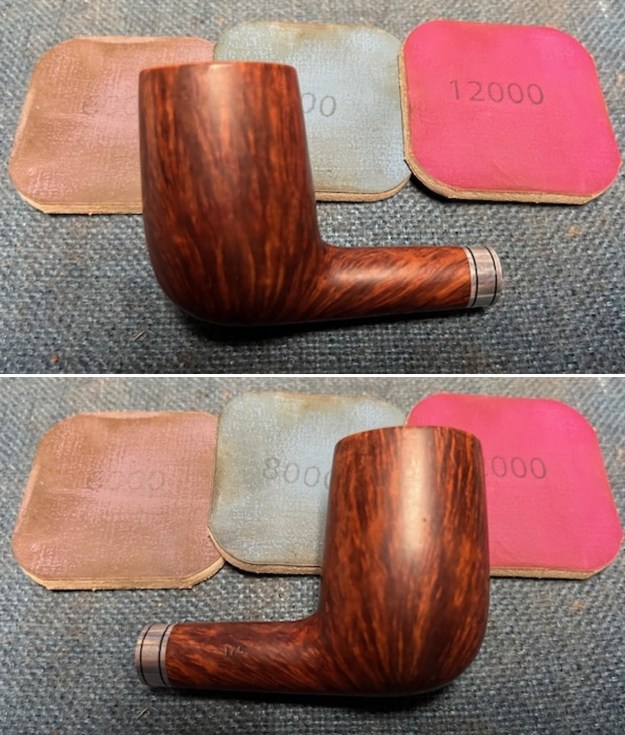
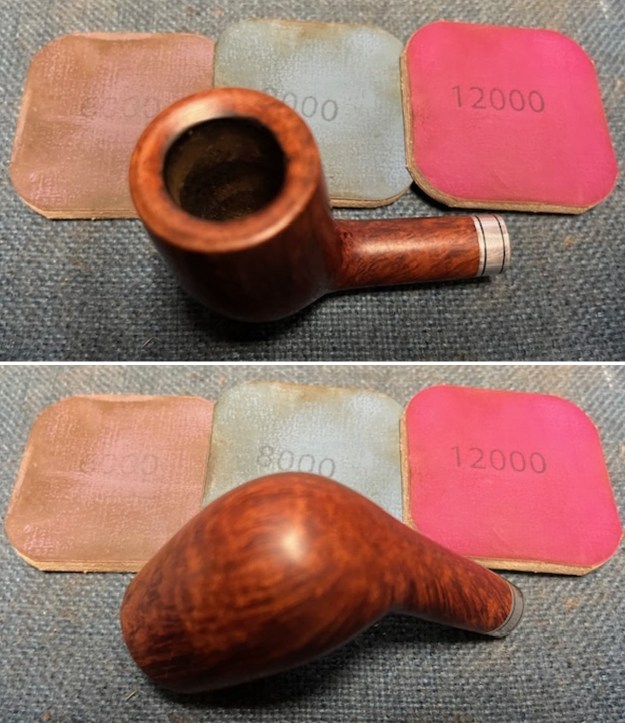
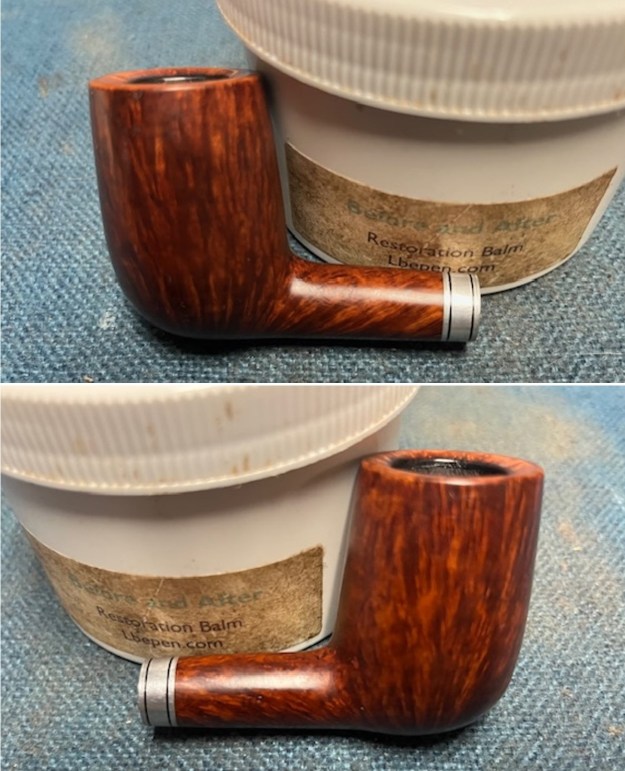
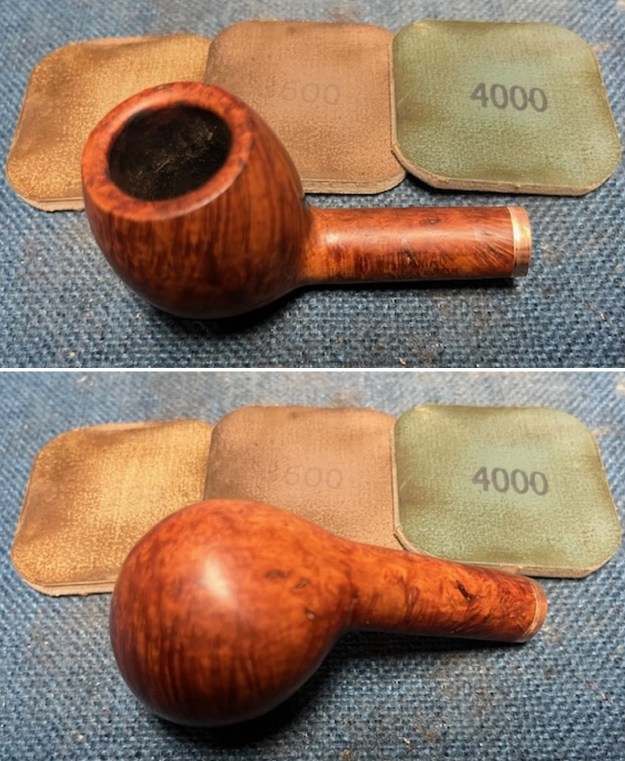
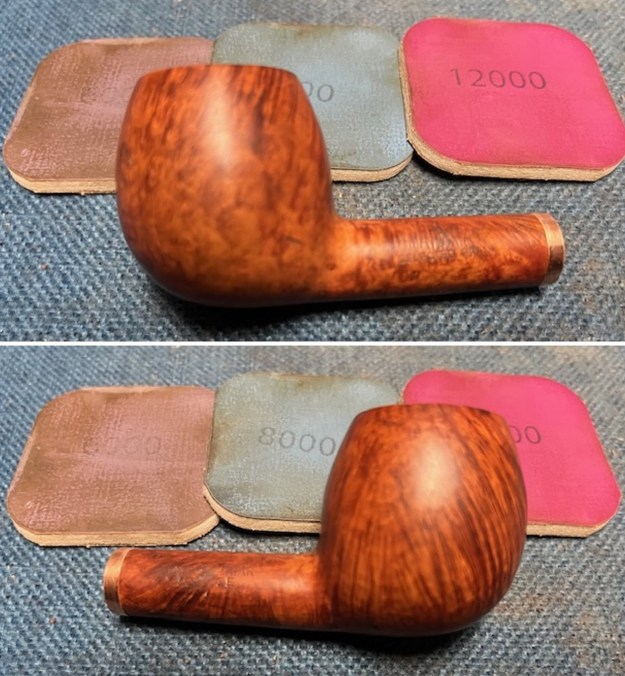
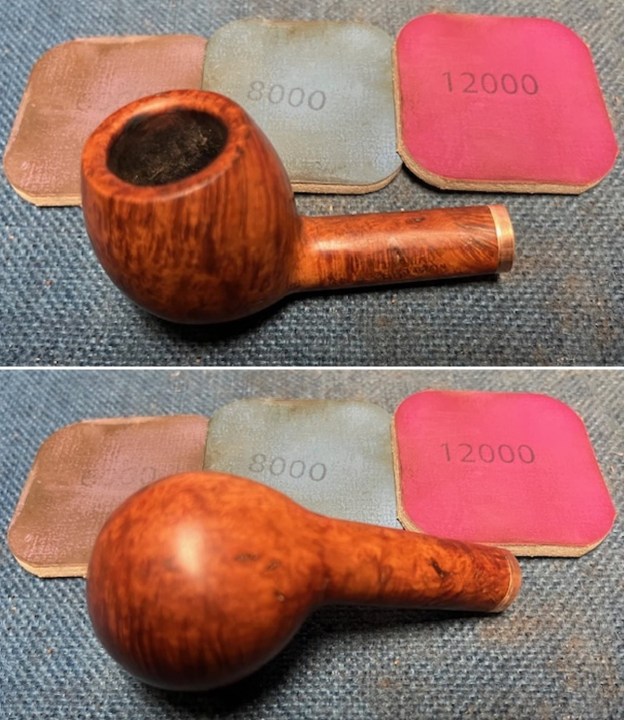
I turned to work on the pipe itself. I reamed the bowl with a PipNet pipe reamer using the cutting heads 2 and 3. I finished the reaming with a Savinelli Fitsall Pipe Knife. I sanded the walls of the bowl with 220 grit sandpaper wrapped around a piece of dowel. I scraped the rim top with the Fitsall Pipe Knife to remove as much of the lava coat as I could. I followed that up with a 320 grit sanding pad. It was beginning to look much better.I cleaned out the inside of the shank and the airway in the stem with alcohol, cotton swabs and both bristle and regular pipe cleaners. I scrubbed the bowl and shank with a tooth brush and some undiluted Murphy’s Oil Soap. I rinsed it off with warm water to remove the dust and soap from the finish. I dried it off with a soft cloth and it looked much better. I sanded the exterior of the bowl with 320-3500 grit 2×2 inch sanding pads to remove the scratching in the finish. I wiped the bowl down with a damp cloth after each sanding pad. It really began to look much better. I polished the briar with 1500-12000 grit micromesh sanding pads to develop the shine. It began to look very good. It had a rich shine in the finish. I rubbed the briar down with Before & After Restoration Balm. I worked it into the briar with my fingertips to work it into the finish. The product works to clean, enliven and preserve the briar. I let it sit for 10 minutes then I buffed it with a cotton cloth to deepen the shine. The briar really comes alive with the balm. I set the bowl aside and worked on the stem. I sanded the surface of the stem with a folded piece of 220 grit sandpaper to remove the oxidation and clean up the tooth marks and chatter on both sides of the stem ahead of the button. I sanded the stem with 320-3500 grit 2×2 inch pads. I wiped the stem down with an Obsidian Oil cloth after each sanding pad.I polished the vulcanite with micromesh sanding pads – 1500-12000 grit pads. I wiped it down with Obsidian Oil after each sanding pad. I used Before & After Pipe Polish – both Fine and Extra Fine to further polish the stem. I the polished vulcanite saddle stem and the 1975 Dunhill Root Briar 147 Taper Stem Bulldog bowl with Blue Diamond to polish out the remaining small scratches and raise the shine. I gave the bowl and the stem several coats of carnauba wax then buffed the pipe with a clean buffing pad to raise the shine. I hand buffed it with a microfiber cloth to deepen the shine. The pipe polished up pretty nicely. This turned out to be a beautiful Dunhill Root Briar147 Bulldog with a Taper Stem. The finished pipe is shown in the photos below. The dimensions are Length: 5 ½ inches, Height: 1 ¾ inches, Outside diameter of the bowl: 1 ¼ inches, Chamber diameter: ¾ of an inch. The weight of the pipe is 1.16 ounces/33 grams. Thanks for walking through the restoration with me as I worked this beautiful little Dunhill Root Briar. I will be adding it to the rebornpipes store in the British Pipe Makers Section if you would like to add it to your collection. Thanks for looking.

New Life and a New Stem for a 1973 Dunhill Red Bark N792 F/T Canadian


by Steve Laug

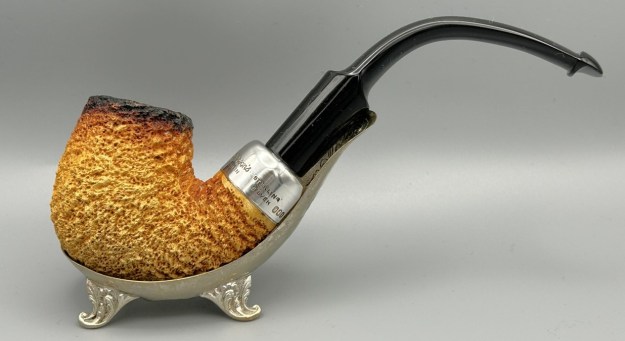
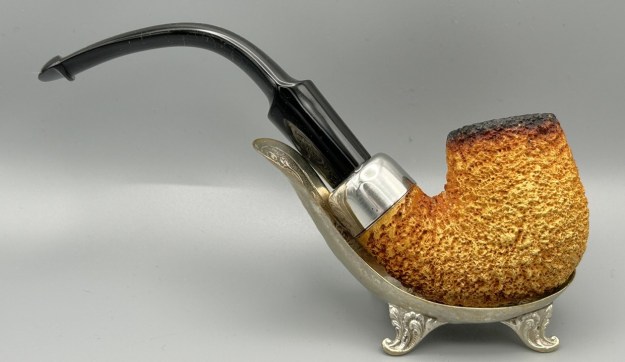
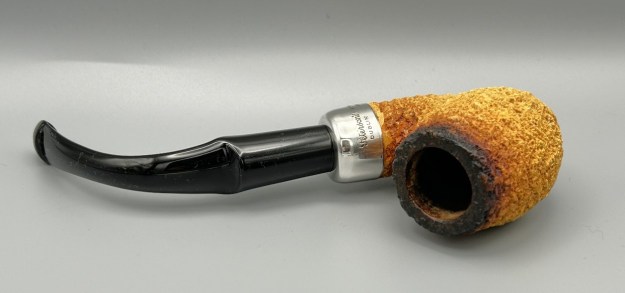
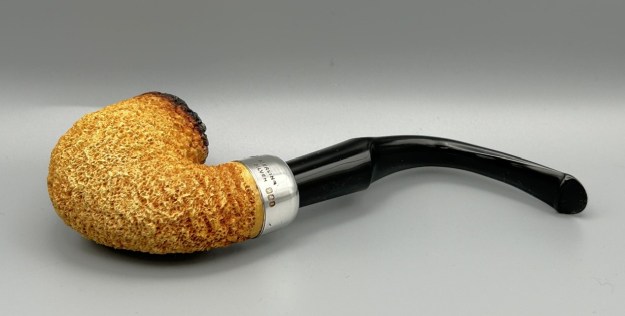
The next pipe on the table is another one that came to us from the seller in Caldwell, Idaho, USA on 07/12/2025. It is a Dunhill Red Bark Canadian missing the original stem. It is in dirty but in good condition as can be seen in the photos below. It is stamped on the underside of the shank and reads N792 F/T [followed by] Dunhill [over] Red Bark. That is followed by Made in [over] England13. That is followed by a stamping Circle 4R/B. The stamping is clear and readable. The pipe has rich Red Bark Sandblast Finish with a blend of red/oxblood stains on a richly grained sandblast finish that the shape follows well. The finish was dusty and dirty with grime ground into the finish. It appeared to have a crack in the shank on the topside that extended into the shank about ½ inch. The bowl had a moderate cake and there was tobacco debris in the bowl. The rim top had a thick lava coat on the top and edges. I was excited to work on the pipe and forgot to take photos before I started working on it. I had a tarnished Sterling Silver Band that would fit the shank well so I heated it and pressed it in place. Then I remembered that I had not taken photos before the band. I took photos of the pipe with the banded shank to show what it looked like before I started working on it. The stamping on the underside of the shank is readable as noted above. I took a photo of the stamping.One of the first things I like to do is to unpack the stamping and understand each element in it. I turned to Pipephil’s helpful site (http://pipephil.eu/logos/en/dunhill/shell-briar1.html). The stamping is interpreted as follows: The N792 is the shape of the pipe which is a Canadian. The F/T designates a Fishtail stem. The Dunhill Red Bark is a red stained sandblast finish. Following the Made In England13 gives the year that the pipe was made.  The circle 4R/B is the stamp for a Group 4 in a Red Bark finish.

From the above information I could see that I was working on a Red Bark Canadian shaped pipe.

From there I wanted to pin down the date stamp 1. I have included Page 2 of the Dunhill Dating Key (http://www.pipephil.eu/logos/en/dunhill/cledat-en1a.html). Following that it takes me to the box with 1960+suffix. That tells me that the pipe is a 1973 pipe.I wanted to know more about the Red Bark finish and when it was introduced by Dunhill. I turned to a listing on Pipedia that gave me the information I was looking for (https://pipedia.org/wiki/Dunhill).

Red Bark:

Red Bark: Introduced in 1972, the Redbark was a sandblasted finish characterized by a reddish stain and is arguably the most famous of Dunhill’s discontinued lines. Initially, the stain was a medium red, but a few years after its introduction, it was changed to a significantly brighter, almost pinkish hue. This new colour proved unpopular, causing sales to plummet. In response, the company reverted to the original, darker red stain in 1976. The Redbark finish was officially discontinued in 1987.[122][123]

Now I knew that I was working on a Dunhill Red Bark N792 which original would have had a Taper Stem that was made in 1973 and was only made until 1987 before it was discontinued.

I turned to work on the pipe itself. I reamed the bowl with a PipNet pipe reamer using the cutting heads 2 and 3. I finished the reaming with a Savinelli Fitsall Pipe Knife. I sanded the walls of the bowl with 220 grit sandpaper wrapped around a piece of dowel. I cleaned out the inside of the shank and the airway in the stem with alcohol, cotton swabs and both bristle and regular pipe cleaners. I scrubbed the bowl and shank with a tooth brush and some undiluted Murphy’s Oil Soap. I rinsed it off with warm water to remove the dust and soap from the finish. I dried it off with a soft cloth and it looked much better. I worked on the darkening on the rim top with a brass bristle wire brush and some Before & After Briar Cleaner. I worked it into the grooves on rim top sandblast and let it sit for 5 minutes. I repeated the process four times and when finished I wiped it off. I was able to remove the majority of the darkening with this method. I polished the band with micromesh sanding pads. I wiped it down after each sanding pad with an Obsidian Oil Cloth to clean it up and add to the shine. I cleaned the Sterling Band with a jeweller’s cloth to remove the tarnish and protect the silver from further tarnishing. I rubbed the briar down with Before & After Restoration Balm. I worked it into the briar with my fingertips to work it into the finish. The product works to clean, enliven and preserve the briar. I let it sit for 10 minutes then I buffed it with a cotton cloth to deepen the shine. The briar really comes alive with the balm. I set the bowl aside and turned to deal with the stem. I had a stem in my can of stems that would work on this pipe. I fitted the stem to the shank. It did not take any adjustments to the tenon or the stem. It is a perfect fit to the shank.I sanded the surface of the stem with a folded piece of 220 grit sandpaper to remove the oxidation and clean up the tooth marks and chatter on both sides of the stem ahead of the button. I sanded the stem with 320-3500 grit 2×2 inch pads. I wiped the stem down with an Obsidian Oil cloth after each sanding pad.I polished the vulcanite with micromesh sanding pads – 1500-12000 grit pads. I wiped it down with Obsidian Oil after each sanding pad. I used Before & After Pipe Polish – both Fine and Extra Fine to further polish the stem. I the polished newly fit Sterling Silver Band and the new vulcanite taper stem and the 1973 Dunhill Red Bark N792 F/T Canadian bowl with Blue Diamond to polish out the remaining small scratches and raise the shine. I gave the bowl and the stem several coats of carnauba wax then buffed the pipe with a clean buffing pad to raise the shine. I hand buffed it with a microfiber cloth to deepen the shine. The pipe polished up pretty nicely. This turned out to be a beautiful Dunhill Red Bark N792 F/T Canadian with a Taper Stem. The finished pipe is shown in the photos below. The dimensions are Length: 5 ½ inches, Height: 1 ¾ inches, Outside diameter of the bowl: 1 ¼ inches, Chamber diameter: ¾ of an inch. The weight of the pipe is 1.38 ounces/38 grams. Thanks for walking through the restoration and restemming with me as I worked this beautiful little Dunhill Red Bark. I will be adding it to the rebornpipes store in the British Pipe Makers Section if you would like to add it to your collection. Thanks for looking.

The fourth of a foursome of Beautiful pipes sent to me with Potential Burn Out Issues


by Steve Laug

On November 29 I received an email from a fellow regarding a Moretti that came to him from a dear friend. He stated that it had a burnout and that he had someone ream it for him. I have included his first email below.

Steve, I have a Moretti pipe that belonged to a dear friend. It had a burnout and I had the bowl reamed, but I’m afraid to smoke it. Can you offer a suggestion of how the inside of the bowl can be treated against possible future burnout, or can you fit the bowl with either a meerschaum or graphite liner? – Michael

We talked back and forth regarding the pipe and various options for repair. I agreed to work on them and told him to mail it to me. Once he packed it he added another three pipes to the box that he was sure had the same issues. He mailed them to me on December 8 and sent me another email.

You have convinced me that you’re the person who can help restore my pipes! I shipped 4 pipes to you today by USPS, and declared their value at $5 each for a total of $20 as you requested. I’m embarrassed to admit it, but all four have had burnout issues and I’m hoping that you can clean them out and coat the inside of the bowls as you described. If you feel that more effort is needed, please let me know.

On December 28th I received the package from Michael. I opened the box and inside there were four beautiful Italian Made pipes. I have listed them below and included photos of the pipes.

Savinelli Autograph Sandblast Bent Cherrywood
2008 Ardor DR bent Dublin
Mastro Beraldi 2 Bent Dublin
2005 Moretti 1 Bent Rhodesian

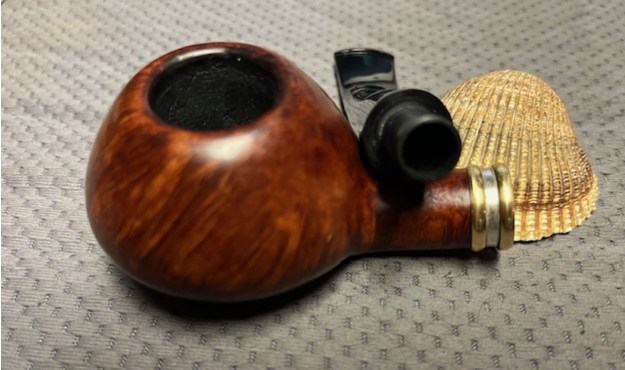
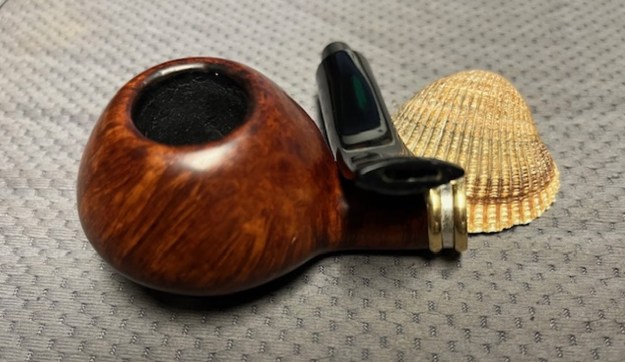
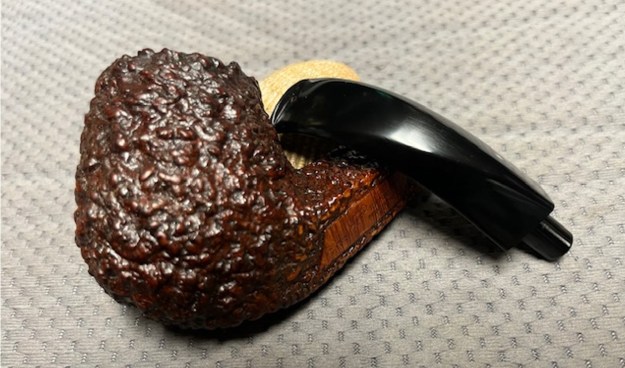
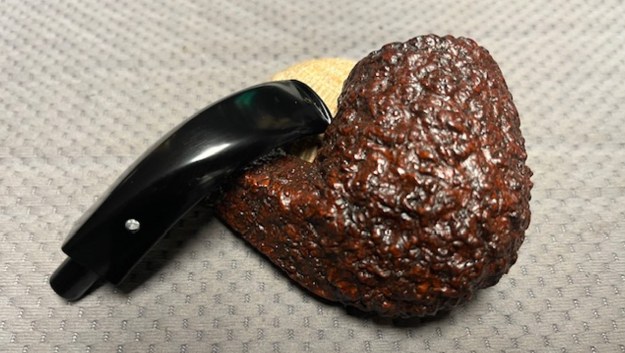
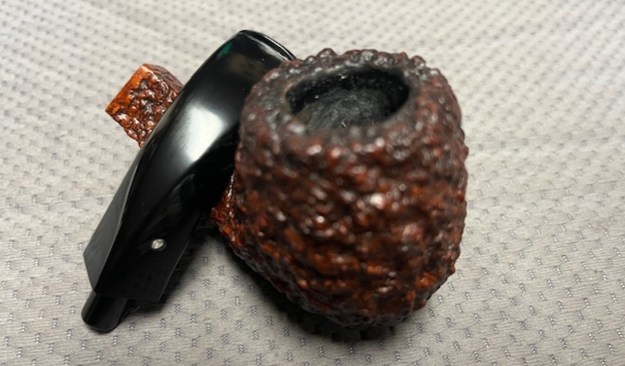
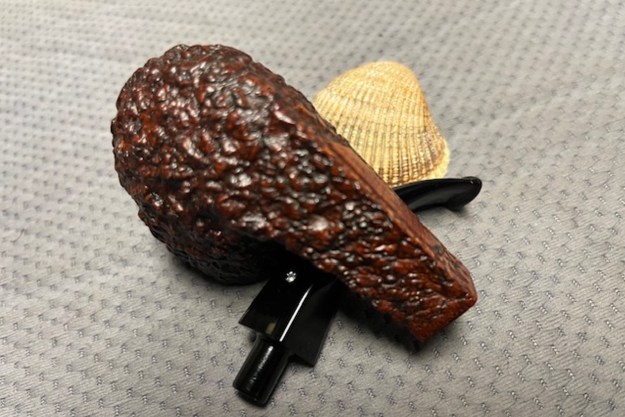
The fourth and final pipe I brought to the table is an Ardor Scoop. Overall it looks very good. It is stamped on underside of the shank and reads DR [over] Ardor [over] Marte [over] Italy [over] Fatta a Mano [over] 2008. The stamping is clear and very readable. The pipe has a mix of black and brown stains on a smooth finish and amazing grain that the shape follows well. The oval rim cap is smooth and there is some darkening around the inner edge of the bowl. The rest of the finish was very clean and the bowl had a light cake on the walls but the rim top was clean other than the edge darkening. I inspected the walls of the bowl and could not find any issues or divots in the walls. I spoke with Michael and he mentioned that it looked like it had some small checking/cracking on the walls of the bowl. Initial inspection reveals that the light cracking in the cake on the bowl walls. The other issue Michael spoke of is that the front wall of the bowl was particularly thin and when smoked was very hot. I would need to examine it further once it had been reamed and cleaned. The acrylic black original taper stem had a white saddle portion on the end of the stem ahead of the tenon. There was a blue dot encircled in a silver circle on the top of the white saddle portion. The stem showed light tooth marks or chatter on both sides. I took photos of the pipe to show what it looked like before I started working on it. I took photos of the bowl and rim top to show the clean finish on the bowl. The photos show a moderate cake in the bowl and a very clean rim top. The stem photos show the condition of the taper stem ahead of the button. I took photos of the stamping on the left and underside of the shank. It is clear and readable as noted above. I removed the stem and took a photo of the pipe to give a sense of the proportions of the pipe.I did a quick review of the history of the brand by turning to Pipedia. The link there led to an article that came from Italian Pipemakers.com. Here is the link – https://pipedia.org/wiki/Ardor. I quote part of the article that gives a quick view of the brands

Ardor Courtesy of italianpipemakers.com

In 1974 Dorelio Rovera, with his father Angelo, established the Ardor Pipe, name which comes from the “AR” (Angelo Rovera) and “DOR” (Dorelio Rovera), changing a medium quality level production into a completely handcrafted product, with a very high level of design and finishing.

[Editor’s Note: Angelo Rovera is the son of Francesco Rovera, who along with his brothers comprised Sociedade Rovera, a pipe company they founded in 1911.]

Dorelio personally chooses the briar which is left seasoning for at least 4 to 5 years before it is worked. It is stocked in particular baskets which leave the wood always visible and airy. The pieces chosen to become a pipe are cut with a circular saw to identify the model. Then each piece is rough hewn by hand with special files, definitely “dangerous” but very efficacious to give the shape to the wood.

Like most artisans, Ardor couples a classical style and a very original style with definite but free and fanciful lines, to offer and meet the largest number of requests, from the simple to the most complex. Ardor is a pipe company which is always looking for innovations, indispensable to collectors, but trying to offer a very high level product in the smoking aspect and performance of the briar, always dried and light for a higher comfort of the smoker.

With Damiano, Dorelio’s son, Ardor introduced the coloured methacrylate (acrylic) stems, really appreciated in the international markets. Damiano has been able to condition the Ardor style with new shapes and with a new mouthpieces style, having a modern point of view. His target is to keep up the interest of new generations, surely more variable in a shorter period.
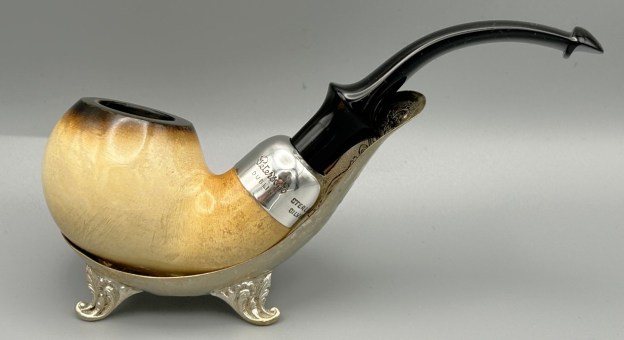
The Ardor Marte that I have was marked DR which told me it was made by Dorelio Rovera. The stem on this Scoop adds a definite flair to the pipe that is unique.

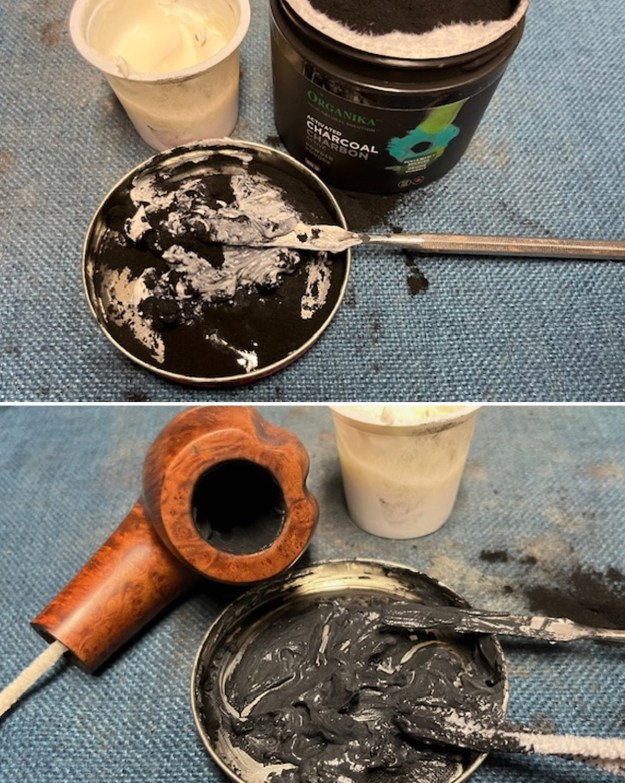
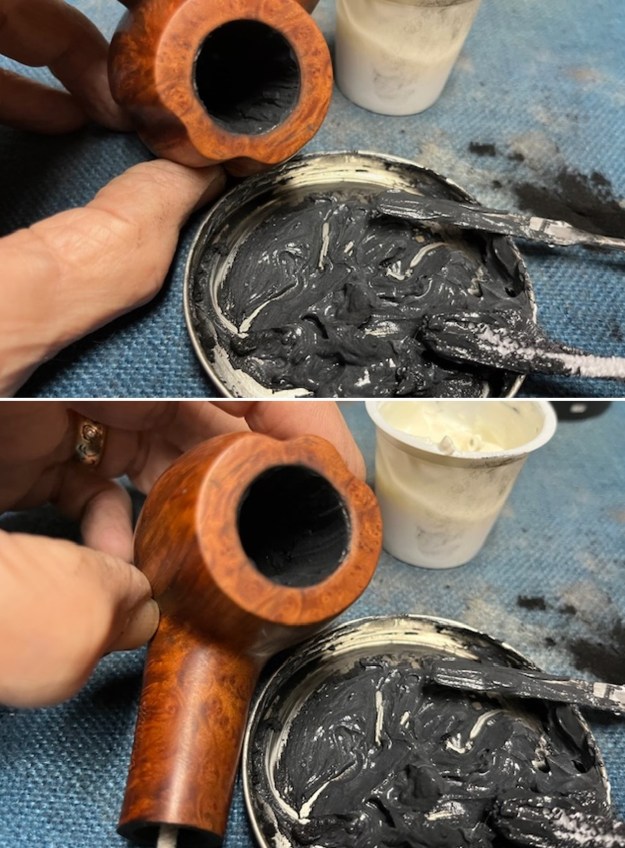
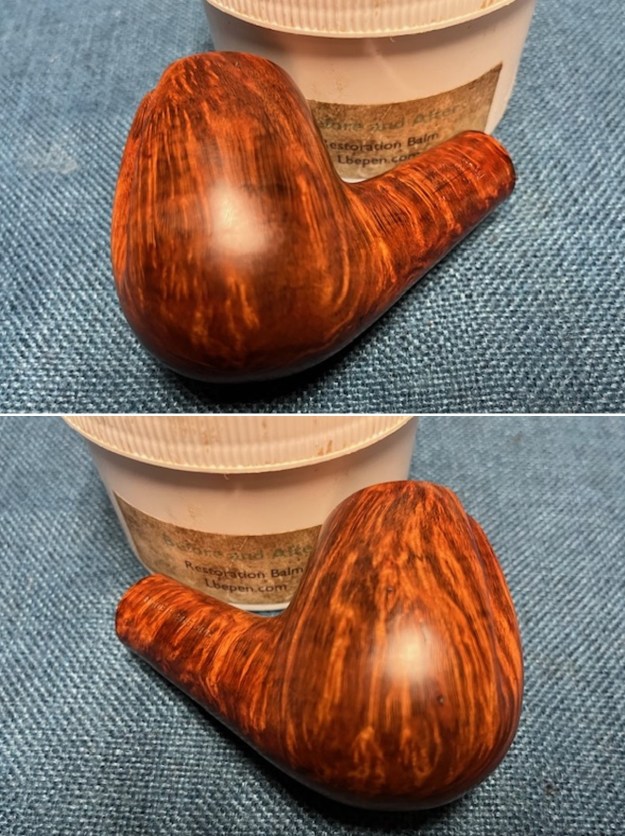
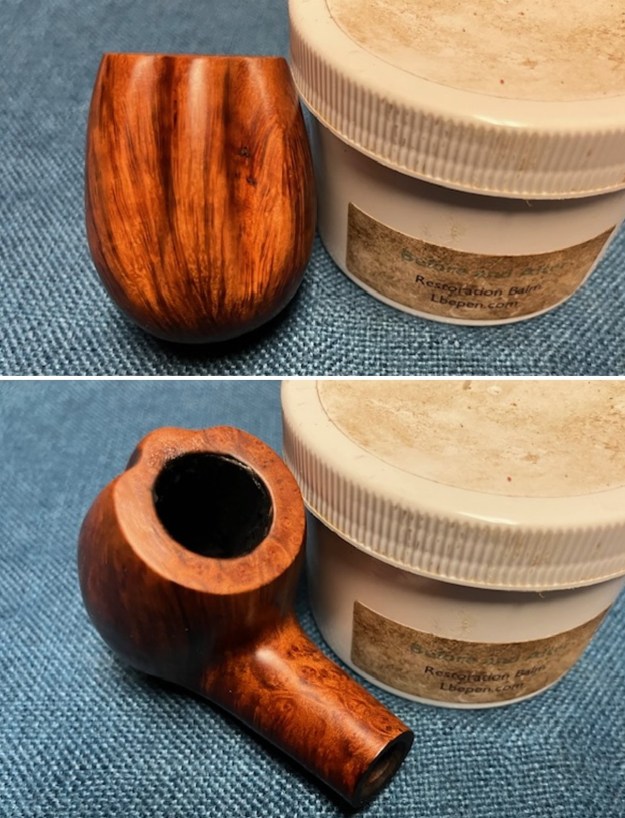
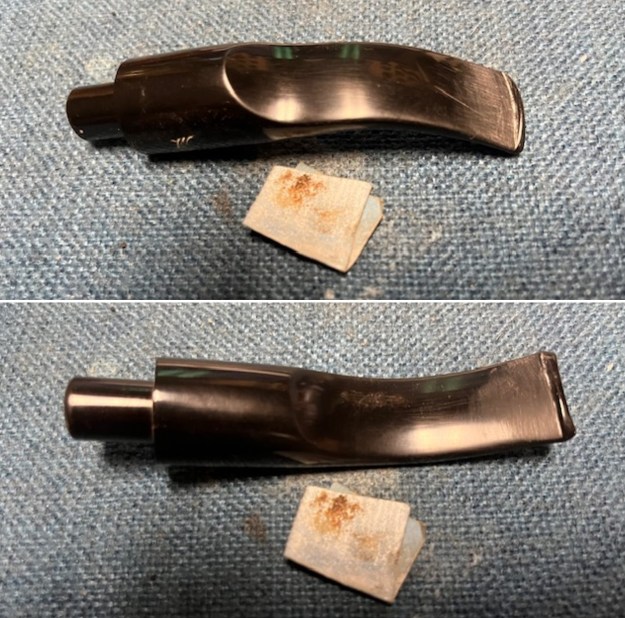
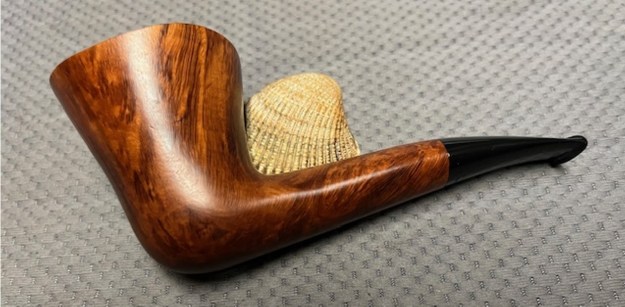
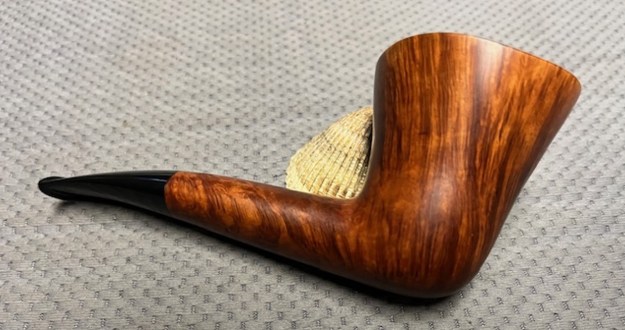
I turned to work on the pipe itself. I reamed the bowl with a PipNet pipe reamer using the cutting heads 2 and 3. I finished the reaming with a Savinelli Fitsall Pipe Knife. I sanded the walls of the bowl with 220 grit sandpaper wrapped around a piece of dowel. I turned to work on the pipe itself. I reamed the bowl with a PipNet pipe reamer using the cutting heads 2 and 3. I finished the reaming with a Savinelli Fitsall Pipe Knife. I sanded the walls of the bowl with 220 grit sandpaper wrapped around a piece of dowel. I thoroughly cleaned the bowl walls, shank and the airway in the stem. I used cotton swabs, pipe cleaners (both bristle and regular) and Isopropyl alcohol.I used a worn 320-400 grit sanding pad to work on the rim top and inner edge and remove the darkening in those areas before I scrubbed the briar.I scrubbed the bowl and shank with a tooth brush and some undiluted Murphy’s Oil Soap. I rinsed it off with warm water to remove the dust and soap from the finish. I dried it off with a soft cloth and it looked much better. I examined the cleaned walls of the bowl and found some small divots around the sides of the bowl half way down across the sides. I could feel it with my fingers. I wiped the bowl clean with a cotton pad and alcohol to remove any debris on the surface. I mixed a batch of JB Weld to repair the divots around the bowl wall. I pressed it into the damaged areas with a dental spatula. I set the bowl aside for the repair to cure. Once it cured I sanded it smooth with a piece of 220 grit sandpaper wrapped around a piece of dowel to smooth out the repair. I wiped it down with a damp pad to remove the sanding debris. I mixed a bowl coating of sour cream and activated charcoal powder. I inserted a pipe cleaner in the airway entrance to the bowl to keep it open. I applied it to the walls of the pipe with a folded pipe cleaner and repeated it until I had the walls thoroughly covered. I rubbed the briar down with Before & After Restoration Balm. I worked it into the briar with my fingertips to work it into the finish. The product works to clean, enliven and preserve the briar. I let it sit for 10 minutes then I buffed it with a cotton cloth to deepen the shine. The briar really comes alive with the balm. I set the bowl aside and worked on the stem. I sanded the stem with 320-3500 grit 2×2 inch pads. I wiped the stem down with an Obsidian Oil cloth after each sanding pad. I polished the acrylic with micromesh sanding pads – 1500-12000 grit pads. I wiped it down with Obsidian Oil after each sanding pad. I used Before & After Pipe Polish – both Fine and Extra Fine to further polish the stem. I the polished black acrylic taper stem with a white ring and the DR Ardor Marte 2008 Scoop bowl with Blue Diamond to polish out the remaining small scratches and raise the shine. I gave the stem and the bowl several coats of Carnauba Wax then buffed the pipe with a clean buffing pad to raise the shine. I hand buffed it with a microfiber cloth to deepen the shine. The pipe polished up pretty nicely. This turned out to be a beautiful DR Ardor Marte 2008 Scoop and black acrylic stem with white ring. The finished pipe is shown in the photos below. The dimensions are Length: ?? inches, Height: 1 ¾ inches, Outside diameter of the bowl: 1 ½ inches wide x 1 ¾ inches long, Chamber diameter: ¾ of an inch. The weight of the pipe is 2.08 ounces/58 grams. Thanks for walking through the restoration with me as I worked this beautiful Bent Dublin. This one will join the first one I restored both will await my completion of the work on the other two pipes Michael sent me. Thanks for looking.
The third of a foursome of Beautiful pipes sent to me with Potential Burn Out Issues


by Steve Laug

On November 29 I received an email from a fellow regarding a Moretti that came to him from a dear friend. He stated that it had a burnout and that he had someone ream it for him. I have included his first email below.

Steve, I have a Moretti pipe that belonged to a dear friend. It had a burnout and I had the bowl reamed, but I’m afraid to smoke it. Can you offer a suggestion of how the inside of the bowl can be treated against possible future burnout, or can you fit the bowl with either a meerschaum or graphite liner? – Michael

We talked back and forth regarding the pipe and various options for repair. I agreed to work on them and told him to mail it to me. Once he packed it he added another three pipes to the box that he was sure had the same issues. He mailed them to me on December 8 and sent me another email.

You have convinced me that you’re the person who can help restore my pipes! I shipped 4 pipes to you today by USPS, and declared their value at $5 each for a total of $20 as you requested. I’m embarrassed to admit it, but all four have had burnout issues and I’m hoping that you can clean them out and coat the inside of the bowls as you described. If you feel that more effort is needed, please let me know.

On December 28th I received the package from Michael. I opened the box and inside there were four beautiful Italian Made pipes. I have listed them below and included photos of the pipes.

Savinelli Autograph Sandblast Bent Cherrywood
2008 Ardor DR bent Dublin
Mastro Beraldi 2 Bent Dublin
2005 Moretti 1 Bent Rhodesian

The third pipe I brought to the table is a Savinelli Autograph Sandblast Bent Cherrywood. Overall it looks very good. It is stamped on smooth heel of the bowl and reads Savinelli [over] Autograph [followed by] Made in [over] Italy and to the right it is stamped with a 2. The stamping is clear and very readable. The pipe has a mix of black, brown and oxblood stains on a sandblast finish and the blast shows amazing grain that the shape follows well. The crowned rim cap is also sandblast and the heel of the bowl is smooth in a patch that bears the stamping. The shank end is a blue/white acrylic. The finish was very clean and the bowl had a light cake on the walls but the rim top was clean. I inspected the walls of the bowl and could not find any issues or divots in the walls. I spoke with Michael and he mentioned that it looked like it had some small checking/cracking on the walls of the bowl. Initial inspection reveals that the light cracking in the cake on the bowl walls. I would need to examine it further once it had been reamed and cleaned. The acrylic black original saddle stem is on the pipe and has an autograph on the top of the taper. The stem showed light tooth marks or chatter on both sides. I took photos of the pipe to show what it looked like before I started working on it. I took photos of the bowl and rim top to show the clean finish on the bowl. The photos show a moderate cake in the bowl and a very clean rim top. The stem photos show the condition of the taper stem ahead of the button. I took photos of the stamping on the left and underside of the shank. It is clear and readable as noted above. I removed the stem and took a photo of the pipe to give a sense of the proportions of the pipe.I wanted to remind myself a bit about the Autograph line from Savinelli so I reread a blog I had written on a previous Autograph restoration (https://rebornpipes.com/2019/01/05/restoring-a-savinelli-autograph-3-rhodesian-dublin-long-shank/). I quote a portion of the blog now:

I turned first to the Pipephil website (http://www.pipephil.eu/logos/en/logo-savinelli1.html) to get a brief overview of the Autograph line. There I found out that the Autographs were hand made and unique. The Autograph Grading system is ascending: 3, 4, … 8, 0, 00, 000.

I turned then to Pipedia to get a more background on the Autograph line. I had the outline I needed from pipephil for the pipe but wanted more (https://pipedia.org/wiki/Savinelli). I quote in part from the article on that site.

While Savinelli’s serially produced pipes account for around 98% of annual production, the marque also creates a number of artisanal, handmade pieces as well. The Autographs, the Creativity line, and the Mr. A. line are all the result of Savinelli’s unique handmade process, with the Autographs reflecting the larger Freehand aesthetic, the Creativity line delving into more complex hand carving, and the Mr. A. line sidestepping the standard shape chart for remarkable and unusual pipes.

All of the briar for Savinelli’s Autographs and other freehand pipes is sourced specifically for those pieces. While the majority of the marque’s serial production is made from extra grade ebauchon blocks, Savinelli keeps a separate supply of Extra Extra plateau blocks for Freehands. This variety of briar is much larger, and of a higher quality, which explains why so many Autographs and Savinelli handmades are naturally larger designs.

These handmade pieces are shaped much like traditional Danish Freehands: they are shaped first and drilled second. Using this method, Savinelli’s team of artisans is able to showcase their own creativity, as it maximizes flexibility and facilitates a more grain-centric approach to shaping. The resulting Freehand designs are at once both a departure from the marque’s classical standard shapes, yet very much still “Savinelli” in their nature—i.e. proportioned so that the bowl is the visual focus when viewed from the profile, juxtaposed by the comparatively trim lines of the shank and stem. To provide a little more insight into the differences between Savinelli’s standard production and freehand lines, Luisa Bozzetti comments:

“When we choose to make Freehand pipes we must stop production on the standard shapes. The process for Freehands is much more involved and takes much more time. Finding the best people from the production line and pulling them to make Freehands is challenging since it’s not an assembly line, but rather a one or two man operation.

After the rough shaping of the stummel, we must get together and brainstorm which style of stem will be paired before the pipe can be finished since we do not use pre-shaped stems. All accents and stems for the Freehands are cut from rod here in the factory. A lot of care goes into the few pieces lucky enough to make the cut; to end up with a certain number of Autographs, for instance, means that many, many more will be made, and only the few will be selected.”

The quality control process for Savinelli handmades is even more rigorous than that employed in the standard lineup. Many blocks are started and later discarded because of pits or defects. While Savinelli’s briar sourcing is a constant process, working with some of Italy’s top cutters to ensure only the finest and most suitable blocks make their way to the factory, it’s impossible to source plateau briar that’s completely free from flaws. That’s just nature. Savinelli creates the standard for quality by working through the rough (a very high-quality rough, mind you) to find that shining diamond with the potential to become a Savinelli handmade.
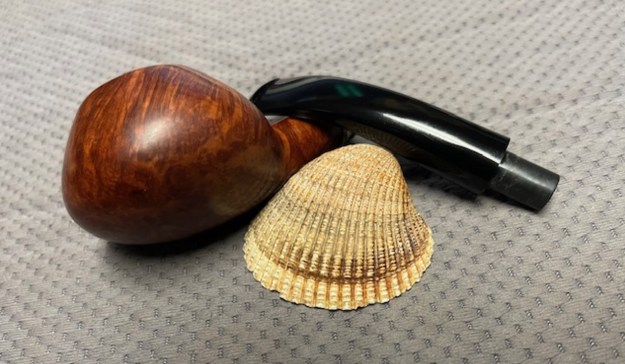
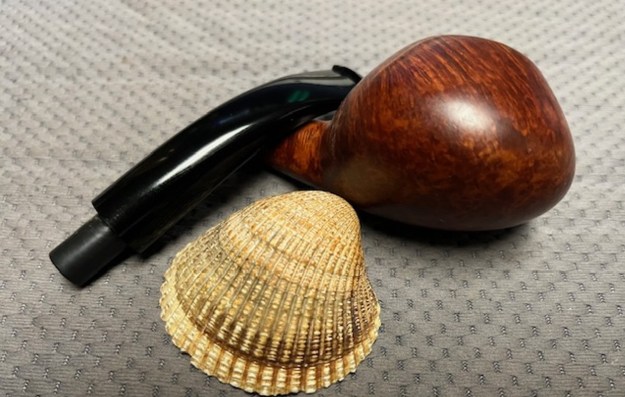
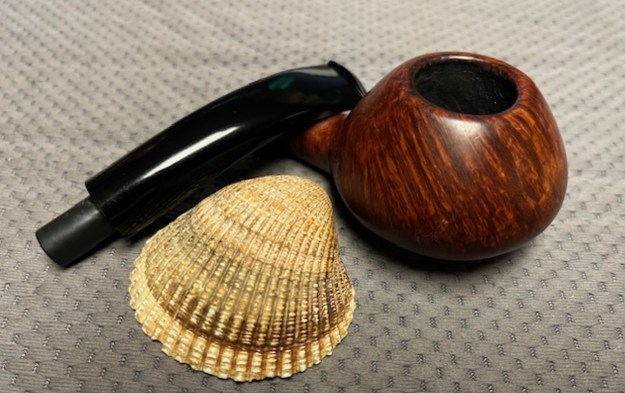
I turned to work on the pipe itself. I reamed the bowl with a PipNet pipe reamer using the cutting heads 2 and 3. I finished the reaming with a Savinelli Fitsall Pipe Knife. I sanded the walls of the bowl with 220 grit sandpaper wrapped around a piece of dowel. I turned to work on the pipe itself. I reamed the bowl with a PipNet pipe reamer using the cutting heads 2 and 3. I finished the reaming with a Savinelli Fitsall Pipe Knife. I sanded the walls of the bowl with 220 grit sandpaper wrapped around a piece of dowel. I then thoroughly cleaned the bowl walls, shank and the airway in the stem. I used cotton swabs, pipe cleaners (both bristle and regular) and Isopropyl alcohol.I scrubbed the bowl and shank with a tooth brush and some undiluted Murphy’s Oil Soap. I rinsed it off with warm water to remove the dust and soap from the finish. I dried it off with a soft cloth and it looked much better. I rubbed the briar down with Before & After Restoration Balm. I worked it into the briar with my fingertips to work it into the finish. The product works to clean, enliven and preserve the briar. I let it sit for 10 minutes then I buffed it with a cotton cloth to deepen the shine. The briar really comes alive with the balm. I examined the cleaned walls of the bowl and found a divot on the left side of the bowl half way down across the side. I could feel it with my fingers. I wiped the bowl clean with a cotton pad and alcohol to remove any debris on the surface. I mixed a batch of JB Weld to repair the divot on the bowl wall. I pressed it into the damaged area with a tooth pick and a dental spatula. I set the bowl aside for the repair to cure. Once it cured I sanded it smooth with a piece of 220 grit sandpaper wrapped around a piece of dowel to smooth out the repair. I wiped it down with a damp pad to remove the sanding debris.I mixed a bowl coating of sour cream and activated charcoal powder. I inserted a pipe cleaner in the airway entrance to the bowl to keep it open. I applied it to the walls of the pipe with a folded pipe cleaner and repeated it until I had the walls thoroughly covered. I set the bowl aside and worked on the stem. I sanded the stem with 320-3500 grit 2×2 inch pads. I wiped the stem down with an Obsidian Oil cloth after each sanding pad. I polished the acrylic with micromesh sanding pads – 1500-12000 grit pads. I wiped it down with Obsidian Oil after each sanding pad. I used Before & After Pipe Polish – both Fine and Extra Fine to further polish the stem. I the polished mottled brown acrylic taper stem and the Savinelli Autograph 2 Cherrywood bowl with Blue Diamond to polish out the remaining small scratches and raise the shine. I gave the stem and the bowl several coats of Carnauba Wax then buffed the pipe with a clean buffing pad to raise the shine. I hand buffed it with a microfiber cloth to deepen the shine. The pipe polished up pretty nicely. This turned out to be a beautiful Savinelli Autograph 2 with a black acrylic saddle stem. The finished pipe is shown in the photos below. The dimensions are Length: 5 ½ inches, Height: 1 ¾ inches, Outside diameter of the bowl: 1 ½ inches wide x 1 ¾ inches long, Chamber diameter: ¾ of an inch. The weight of the pipe is 2.08 ounces/58 grams. Thanks for walking through the restoration with me as I worked this beautiful Bent Dublin. This one will join the first one I restored both will await my completion of the work on the other two pipes Michael sent me. Thanks for looking.

The second of a foursome of Beautiful pipes sent to me with Potential Burn Out Issues


by Steve Laug

On November 29 I received an email from a fellow regarding a Moretti that came to him from a dear friend. He stated that it had a burnout and that he had someone ream it for him. I have included his first email below.

Steve, I have a Moretti pipe that belonged to a dear friend. It had a burnout and I had the bowl reamed, but I’m afraid to smoke it. Can you offer a suggestion of how the inside of the bowl can be treated against possible future burnout, or can you fit the bowl with either a meerschaum or graphite liner? – Michael

We talked back and forth regarding the pipe and various options for repair. I agreed to work on them and told him to mail it to me. Once he packed it he added another three pipes to the box that he was sure had the same issues. He mailed them to me on December 8 and sent me another email.

You have convinced me that you’re the person who can help restore my pipes! I shipped 4 pipes to you today by USPS, and declared their value at $5 each for a total of $20 as you requested. I’m embarrassed to admit it, but all four have had burnout issues and I’m hoping that you can clean them out and coat the inside of the bowls as you described. If you feel that more effort is needed, please let me know.

On December 28th I received the package from Michael. I opened the box and inside there were four beautiful Italian Made pipes. I have listed them below and included photos of the pipes.

Savinelli Autograph Sandblast Bent Cherrywood
2008 Ardor DR bent Dublin
Mastro Beraldi 2 Bent Dublin
2005 Moretti 1 Bent Rhodesian
The second pipe I brought to the table is a Mastro Beraldi 2 Bent Dublin. Overall it looks very good. It is stamped on underside of the shank and Mastro Beraldi [over] Italy [over] 2. The stamping is clear and very readable. The pipe has a mix of black and brown stains on smooth finish and some amazing grain that the shape follows well. The crowned rim cap is covered with great birdseye while the bowl and shank sides have some beautiful straight grain. The finish was very clean and the bowl had a light cake on the walls but the rim top was clean. I inspected the walls of the bowl and could not find any issues or divots in the walls. I spoke with Michael and he mentioned that it looked like it had some small checking/cracking on the walls of the bowl. Initial inspection reveals that the light cracking in the cake on the bowl walls. I would need to examine it further once it had been reamed and cleaned. The acrylic multihued brown original stem is on the pipe and has brass dot on the top of the taper. The stem showed no tooth marks or chatter on either side. I took photos of the pipe to show what it looked like before I started working on it. I took photos of the bowl and rim top to show the clean finish on the bowl. The photos show a moderate cake in the bowl and a very clean rim top. The stem photos show the condition of the taper stem ahead of the button. I took photos of the stamping on the left and underside of the shank. It is clear and readable as noted above. I removed the stem and took a photo of the pipe to give a sense of the proportions of the pipe.I turned to Pipephil’s site to see if I could find out information on the Mastro Beraldi brand and specifically this pipe (http://www.pipephil.eu/logos/en/logo-m3.html). I have included a screen capture of the section on the page as well as the side bar note

Artisan: Aldo Pierluigi “Mario Grandi” may be a sub-brand of Mastro Beraldi (low end pipes) started in 2006.I then turned to Pipedia and read the section on the brand to see what I could learn about the brand and the carver of the pipe (https://pipedia.org/wiki/Mastro_Beraldi). I quote from that article below:

Aldo Pierluigi emerged as a pipemaker around 1976/77. He stamped his earlier freehand pipes “Per mei amici” (For my friends). As it seems, Pierluigi chose a more commercialised way of pipemaking by creating the Mastro Beraldi line, which is mainly offered in the United States. This is not to say that these pipes are of inferior qual Citation from the homepage:

“Mastro Beraldi pipes are completely hand crafted by Aldo Pierluigi and his family who has been making pipes in Rome since the ‘70s using artisan’s techniques and tools.

The experience acquired in the last 30 years led to the realization of this line of hand made pipes, different one from the others, with the aim of offering to the smokers a high quality product at an excellent price.

The briar wood is Italian and is carefully selected and aged.

The mouthpiece, also by Italian factories, is made of ebonite of the best quality internally strengthened with a special pin to protect against breakage. The finishing touches are obtained with new water colours and varnish.

The rings, trimmings, accessories and packages are individually designed to complement each unique pattern. For the typical manifacture and the selected and used materials we guarantee that this pipe is a totally hand made, made in Italy and ecological product.”

Last year the Pierluigis started a new line of pipes called Mario Grandi. Since December 2006 these pipes are offered exclusively on internet auctions, starting at very low prices. Strange enough, they declare “Mario Grandi” to be a real and living pipemaker…

Considering the prices, these pipes are a good buy, especially if one applies some care to choose the better pieces.

I turned to work on the pipe itself. I reamed the bowl with a PipNet pipe reamer using the cutting heads 2 and 3. I finished the reaming with a Savinelli Fitsall Pipe Knife. I sanded the walls of the bowl with 220 grit sandpaper wrapped around a piece of dowel. I turned to work on the pipe itself. I reamed the bowl with a PipNet pipe reamer using the cutting heads 2 and 3. I finished the reaming with a Savinelli Fitsall Pipe Knife. I sanded the walls of the bowl with 220 grit sandpaper wrapped around a piece of dowel. I then thoroughly cleaned the bowl walls, shank and the airway in the stem. I used cotton swabs, pipe cleaners (both bristle and regular) and Isopropyl alcohol.I scrubbed the bowl and shank with a tooth brush and some undiluted Murphy’s Oil Soap. I rinsed it off with warm water to remove the dust and soap from the finish. I dried it off with a soft cloth and it looked much better. I rubbed the briar down with Before & After Restoration Balm. I worked it into the briar with my fingertips to work it into the finish. The product works to clean, enliven and preserve the briar. I let it sit for 10 minutes then I buffed it with a cotton cloth to deepen the shine. The briar really comes alive with the balm. I mixed a bowl coating of sour cream and activated charcoal powder. I inserted a pipe cleaner in the airway entrance to the bowl to keep it open. I applied it to the walls of the pipe with a folded pipe cleaner and repeated it until I had the walls thoroughly covered. I set the bowl aside and worked on the stem. I sanded the stem with 320-3500 grit 2×2 inch pads. I wiped the stem down with an Obsidian Oil cloth after each sanding pad. I polished the vulcanite with micromesh sanding pads – 1500-12000 grit pads. I wiped it down with Obsidian Oil after each sanding pad. I used Before & After Pipe Polish – both Fine and Extra Fine to further polish the stem. I the polished mottled brown acrylic taper stem and the Mastro Beraldi 2 Bent Dublin bowl with Blue Diamond to polish out the remaining small scratches and raise the shine. I gave the stem and the bowl several coats of Carnauba Wax then buffed the pipe with a clean buffing pad to raise the shine. I hand buffed it with a microfiber cloth to deepen the shine. The pipe polished up pretty nicely. This turned out to be a beautiful Mastro Beraldi 2 Bent Dublin with a mottled brown acrylic taper stem. The finished pipe is shown in the photos below. The dimensions are Length: 6 inches, Height: 2 inches, Outside diameter of the bowl: 2 inches, Chamber diameter: ¾ of an inch. The weight of the pipe is 2.01 ounces/57 grams. Thanks for walking through the restoration with me as I worked this beautiful Bent Dublin. This one will join the first one I restored both will await my completion of the work on the other two pipes Michael sent me. Thanks for looking.

The first of a foursome of Beautiful pipes sent to me with Burn Out Issues


by Steve Laug

On November 29 I received an email from a fellow regarding a Moretti that came to him from a dear friend. He stated that it had a burnout and that he had someone ream it for him. I have included his first email below.

Steve, I have a Moretti pipe that belonged to a dear friend. It had a burnout and I had the bowl reamed, but I’m afraid to smoke it. Can you offer a suggestion of how the inside of the bowl can be treated against possible future burnout, or can you fit the bowl with either a meerschaum or graphite liner? – Michael

We talked back and forth regarding the pipe and various options for repair. I agreed to work on them and told him to mail it to me. Once he packed it he added another three pipes to the box that he was sure had the same issues. He mailed them to me on December 8 and sent me another email.

You have convinced me that you’re the person who can help restore my pipes! I shipped 4 pipes to you today by USPS, and declared their value at $5 each for a total of $20 as you requested. I’m embarrassed to admit it, but all four have had burnout issues and I’m hoping that you can clean them out and coat the inside of the bowls as you described. If you feel that more effort is needed, please let me know.

On December 28th I received the package from Michael. I opened the box and inside there were four beautiful Italian Made pipes. I have listed them below and included photos of the pipes.

Savinelli Autograph Sandblast Bent Cherrywood
2008 Ardor DR bent Dublin
Mastro Beraldi 2 Bent Dublin
2005 Moretti 1 Bent Rhodesian The first one I have brought to the table is a large Moretti Rhodesian. Overall it looks very good. It is stamped on left side of the shank and reads Moretti in script. On the underside of the shank it is stamped with what looks like four Greek Deltas [followed by] the number 1. Running around the shank/stem union it is stamped with the date 2005. The stamping is clear and very readable. The pipe has a mix of black and brown stains on smooth finish and some amazing grain that the shape follows well. The rim cap is covered with great birdseye while the bowl and shank sides have some beautiful straight grain. The finish was very clean and the bowl had been reamed and cleaned. There was a divot in the front bowl wall about the size of my thumb that is not terribly deep but is nonetheless very present to the touch. It is 1 inch tall and 1 ¼ wide and roughly 1/8th of an inch deep at the deepest point mid divot. Initial inspection reveals that the charred briar had been removed with the reaming and the walls were solid to touch with some darkening to the in that area. The white original stem is on the pipe and has tooth chatter and marks on both sides ahead of the button. There is and inlaid briar band on the stem with a B on the underside. Behind the band on the underside of the white stem it is stamped but the two lines are not clear or readable. [Michael wrote me and informed me that the stem was stamped Alberto [over] Bonfiglioli of Bologna who made stems for Moretti at times.] I took photos of the pipe to show what it looked like before I started working on it.  I took photos of the bowl and rim top to show the clean finish on the bowl. It is hard to tell from the photos but the is freshly reamed and very cleaned. The stem photos show the condition of the taper stem ahead of the button. I took photos of the stamping on the left and underside of the shank. It is clear and readable as noted above. I removed the stem and took a photo of the pipe to give a sense of the proportions of the pipe. I turned to Pipephil’s site to see if I could find out information on the Moretti brand and specifically this pipe (http://www.pipephil.eu/logos/en/logo-m7.html#moretti). The listing included the name of the pipe maker, Marco Biagini. The brand is named after his father-in-law, Igino Moretti. This pipe was carved in 2005 and does not bear the Recanati stamping that was on his pipe until 2005. The screen capture below shows the Gradings (ascending) stamps. It shows the four Delta stamp that identifies the pipe as a Collection. I turned to Pipedia to gain additional information on the brand. (https://pipedia.org/wiki/Moretti). There were some informative articles written by Joseph Hornsby and Fred Hanna. They are worth the read if you want some background and gain appreciation for the carver.

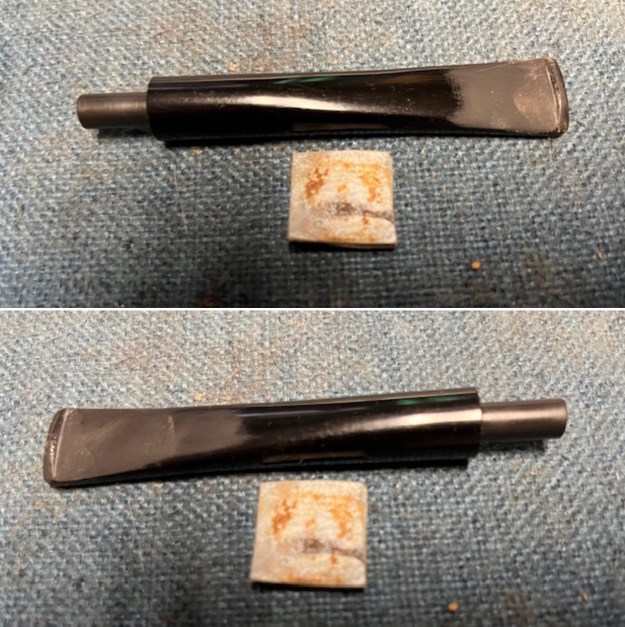
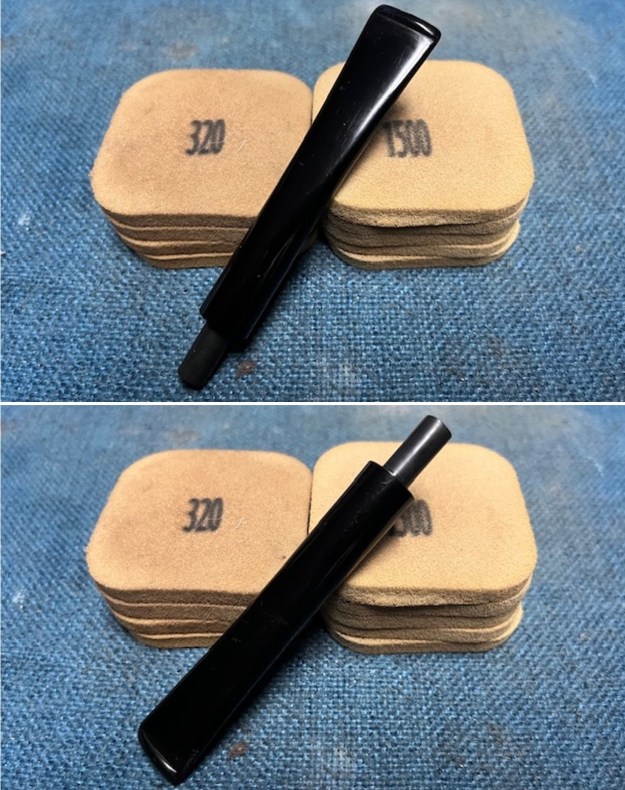
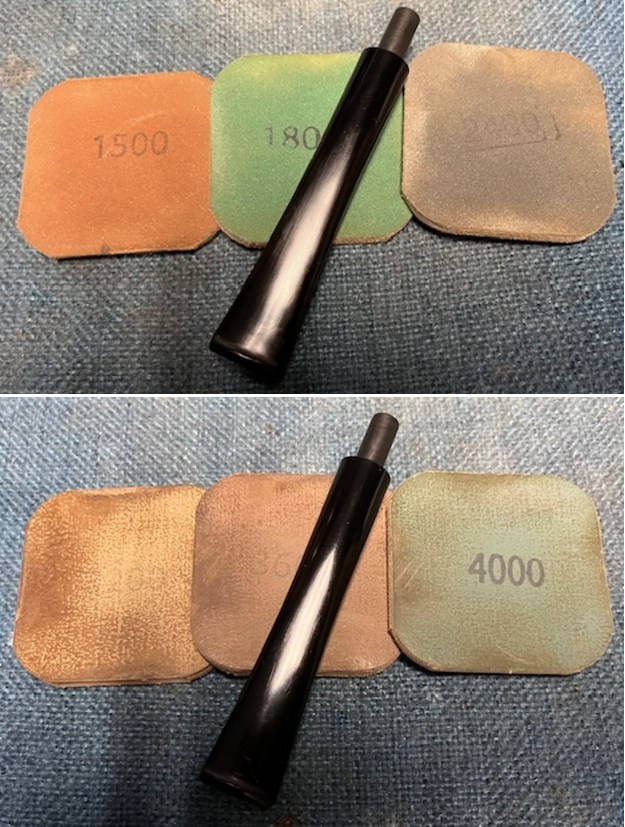
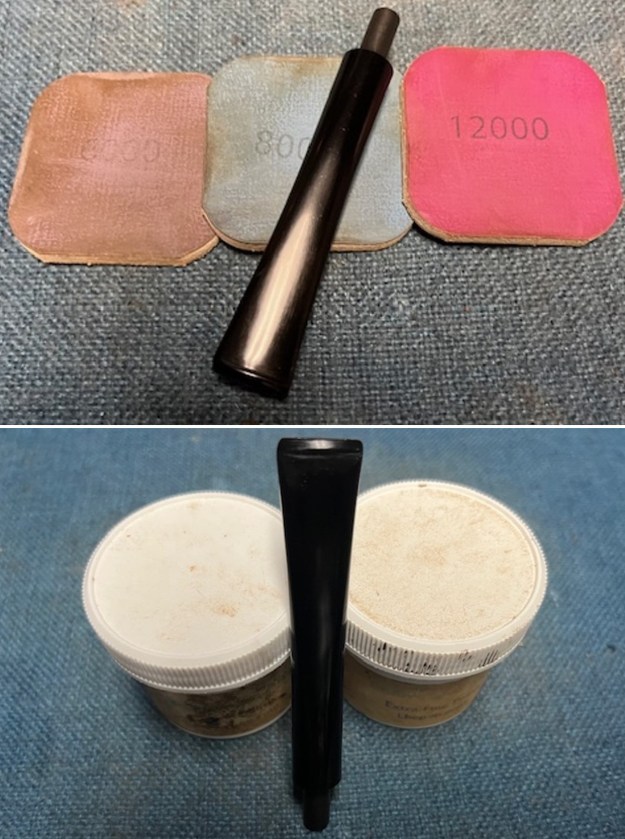
With a clearer picture of the pipe maker in mind I turned to work on this pipe. I began my work on the pipe by thoroughly cleaning the bowl walls, shank and the airway in the stem. I used cotton swabs, pipe cleaners (both bristle and regular) and Isopropyl alcohol.I sanded the stem with 220 grit sandpaper to remove the tooth chatter and marks on the surface. I was able to smooth out the chatter and marks. There is still some darkening in the airway and button slot but it was clean. Overall the stem looked better.I sanded the stem and tenon surface with 320-3500 grit 2×2 inch pads. I wiped the stem down with an Obsidian Oil cloth after each sanding pad.I polished the vulcanite with micromesh sanding pads – 1500-12000 grit pads. I wiped it down with Obsidian Oil after each sanding pad. I used Before & After Pipe Polish – both Fine and Extra Fine to further polish the stem.  I set the stem aside and turned to address the divot on the inner wall on the front of the bowl. I wiped it clean with a cotton pad and alcohol to remove any debris on the surface. I mixed a batch of JB Weld to repair the divot on the bowl wall. I pressed it into the damaged area with a dental spatula. I set the bowl aside for the repair to cure. Once it cured I sanded it smooth with a piece of 220 grit sandpaper wrapped around a piece of dowel to smooth out the repair. I wiped it down with a damp pad to remove the sanding debris.I mixed a batch of bowl coating composed of sour cream and activated charcoal powder to give the bowl a thin coat of the mixture. I used a folded pipe cleaner to paint the walls and heel of the bowl with the mixture. I set it aside to cure. Once the interior of the bowl had cured I turned my attention to the exterior. I rubbed the briar down with some Before & After Restoration Balm. I worked it into the grain and let it sit for 10 minutes while the product did its work. The Balm deeply cleans the briar, preserves and protects the finish. It is a beautiful pipe. I the polished white acrylic taper stem and the Moretti 4 Deltas Collection Rhodesian bowl with Blue Diamond to polish out the remaining small scratches and raise the shine. I gave the stem and the bowl several coats of Carnauba Wax then buffed the pipe with a clean buffing pad to raise the shine. I hand buffed it with a microfiber cloth to deepen the shine. The pipe polished up pretty nicely. This turned out to be a beautiful Moretti 4 Deltas 1 Straight Grain Rhodesian with a white acrylic taper stem. The finished pipe is shown in the photos below. The dimensions are Length: 6 ½ inches, Height: 3 inches, Outside diameter of the bowl: 2 ½ inches, Chamber diameter: 7/8 of an inch. The weight of the pipe is 3.28 ounces/94 grams. Thanks for walking through the restoration with me as I worked this beautiful Moretti Rhodesian. This one will await my completion of the work on the other three pipes Michael sent me. Thanks for looking.

New Life for a 1964 Dunhill Shell Briar 142 F/T Dublin with a Taper Stem


by Steve Laug

The next pipe on the table is another one that came to us from the seller in Caldwell, Idaho, USA on 07/12/2025. It is a Dunhill Shell Briar Dublin with a vulcanite taper stem. It is in dirty but in good condition as can be seen in the photos below. It is stamped on the underside of the shank and reads 142 F/T [followed by] Dunhill [over] Shell Briar. That is followed by Made in [over] England4. That is followed by a stamping Circle 4S. The stamping is clear and readable. The pipe has rich Shell Briar Sandblast Finish with a blend of black, brown and oxblood stains on a richly grained sandblast finish that the shape follows well. The finish was dusty and dirty with grime ground into the finish. It was also spotty and possibly faded. The bowl had a moderate cake and there was tobacco debris in the bowl. The rim top had a thick lava coat on the top and edges. The original white spot taper stem is dirty and oxidized with light tooth marks and chatter on both sides. I took photos of the pipe to show what it looked like before I started working on it. I took photos of the bowl and rim top to show the thickness of the cake and the lava coat on the rim top. There was some tobacco debris in the bottom of the bowl. The stem photos show the condition of the taper stem ahead of the button.The stamping on the sides of the shank are faint but readable as noted above. I took a photo of the pipe with the stem removed to give a sense of the proportions of the pipe. It is a real beauty. One of the first things I like to do is to unpack the stamping and understand each element in it. I turned to Pipephil’s helpful site (http://pipephil.eu/logos/en/dunhill/shell-briar1.html). The stamping is interpreted as follows: The 142 is the shape number for one of many Dunhill Billiard shapes. The F/T gives the shape of the stem as a Fishtail on this taper stem. The Dunhill Shell Briar is the finish. Following the Made In England4 gives the year that the pipe was made. The Circle 4S is the Group 4 size pipe and the S is the stamp for a Shell Briar.

From there I wanted to pin down the date stamp 4. I have included Page 2 of the Dunhill Dating Key (http://www.pipephil.eu/logos/en/dunhill/cledat-en1a.html). Following that it takes me to the box with 1960+suffix. That tells me that the pipe is a 1964 made pipe.    I wanted to know more about the Shell finish and when it was introduced by Dunhill and how that fit the Patent stamp on the bowl. I turned to a listing on Pipedia that gave me the information I was looking for (https://pipedia.org/wiki/Dunhill).

Shell

The Shell is a deep, craggy sandblast finish with a black stain, traditionally applied to soft, beautifully grained Algerian briar. While perhaps not the first-ever use of sandblasting on pipes, the technique perfected by Dunhill is considered one of the brand’s most significant contributions to the art of pipe making. The development is documented in English patent No. 119708/17; preliminary work began on October 13, 1917, and the patent was granted a year later, just weeks before the end of the First World War.

The origin of the finish is famously recounted as an “Accidental Discovery” in early Dunhill catalogues. The story tells of Algerian briar blocks being inadvertently left near a furnace, causing the softer wood to shrink and the harder grain to stand out in a textured relief. The reality, as detailed in the patent application, was a deliberate process of steeping the briar in oil for weeks, followed by a heat treatment. Only then was the sandblast applied to cut away the softer wood, resulting in a durable, lightweight, and cool-smoking pipe.

In 1986, Dunhill introduced a premium version of the Shell finish called the ‘Ring Grain’. These pipes feature a particularly deep blast reminiscent of the classic style of the 1930s to mid-1960s, applied to briar with a superior grain pattern. The ‘Ring Grain’ name was later changed to ‘Shilling’ in 1995. Regarded by many enthusiasts as among the finest modern Dunhills, these pipes are produced in limited quantities and are exceptionally rare.[122][123]

Now I knew that I was working on a Dunhill Shell Briar 142F/T Dublin with a Taper Stem that was made in 1964.

I turned to work on the pipe itself. I reamed the bowl with a PipNet pipe reamer using the cutting heads 2 and 3. I finished the reaming with a Savinelli Fitsall Pipe Knife. I sanded the walls of the bowl with 220 grit sandpaper wrapped around a piece of dowel. I turned to work on the pipe itself. I reamed the bowl with a PipNet pipe reamer using the cutting heads 2 and 3. I finished the reaming with a Savinelli Fitsall Pipe Knife. I sanded the walls of the bowl with 220 grit sandpaper wrapped around a piece of dowel. I worked over the sandblast rim top with a brass bristle wire brush to clean up the debris in the valleys of the blast. It looked better.I cleaned out the inside of the shank and the airway in the stem with alcohol, cotton swabs and both bristle and regular pipe cleaners. I scrubbed the bowl and shank with a tooth brush and some undiluted Murphy’s Oil Soap. I rinsed it off with warm water to remove the dust and soap from the finish. I dried it off with a soft cloth and it looked much better. I rubbed the briar down with Before & After Restoration Balm. I worked it into the briar with my fingertips to work it into the finish. The product works to clean, enliven and preserve the briar. I let it sit for 10 minutes then I buffed it with a cotton cloth to deepen the shine. The briar really comes alive with the balm. I set the bowl aside and worked on the stem. I sanded the surface of the stem with a folded piece of 220 grit sandpaper to remove the oxidation and clean up the tooth marks and chatter on both sides of the stem ahead of the button. I sanded the stem with 320-3500 grit 2×2 inch pads. I wiped the stem down with an Obsidian Oil cloth after each sanding pad.I polished the vulcanite with micromesh sanding pads – 1500-12000 grit pads. I wiped it down with Obsidian Oil after each sanding pad. I used Before & After Pipe Polish – both Fine and Extra Fine to further polish the stem. I the polished vulcanite taper stem and the 1964 Dunhill Shell Briar 142 F/T Dublin bowl with Blue Diamond to polish out the remaining small scratches and raise the shine. I gave the bowl and the stem several coats of carnauba wax then buffed the pipe with a clean buffing pad to raise the shine. I hand buffed it with a microfiber cloth to deepen the shine. The pipe polished up pretty nicely. This turned out to be a beautiful Dunhill Shell Briar 142 F/T Dublin with a Taper Stem. The finished pipe is shown in the photos below. The dimensions are Length: 5 ¾ inches, Height: 1 ¾ inches, Outside diameter of the bowl: 1 ¼ inches, Chamber diameter: ¾ of an inch. The weight of the pipe is 1.20 ounces/34 grams. Thanks for walking through the restoration with me as I worked this beautiful little Dunhill Shell Briar. I will be adding it to the rebornpipes store in the British Pipe Makers Section if you would like to add it to your collection. Thanks for looking.

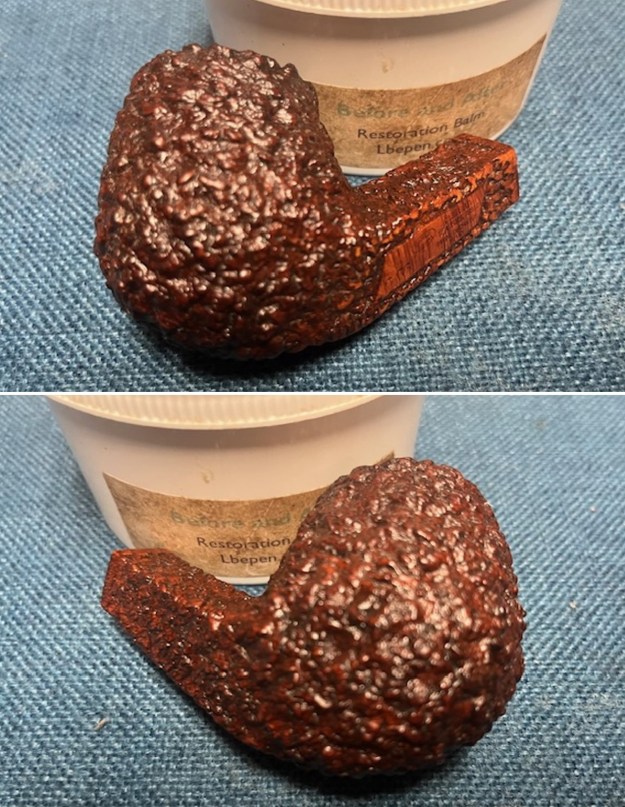
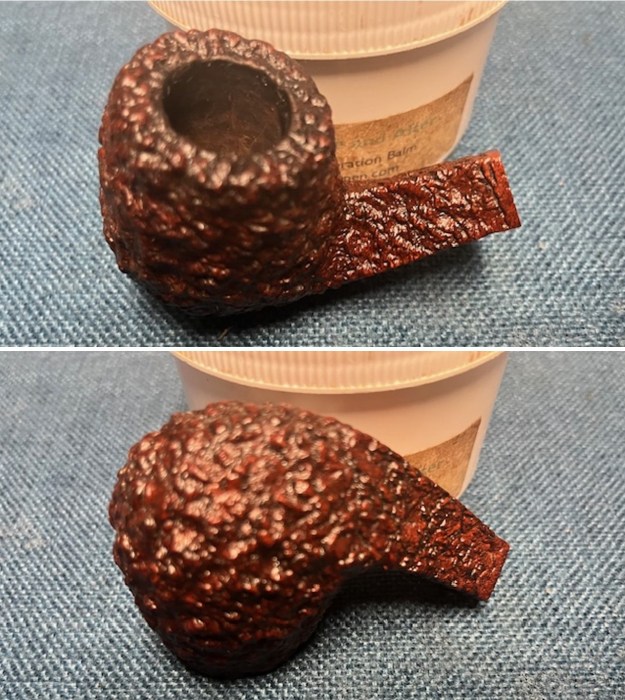
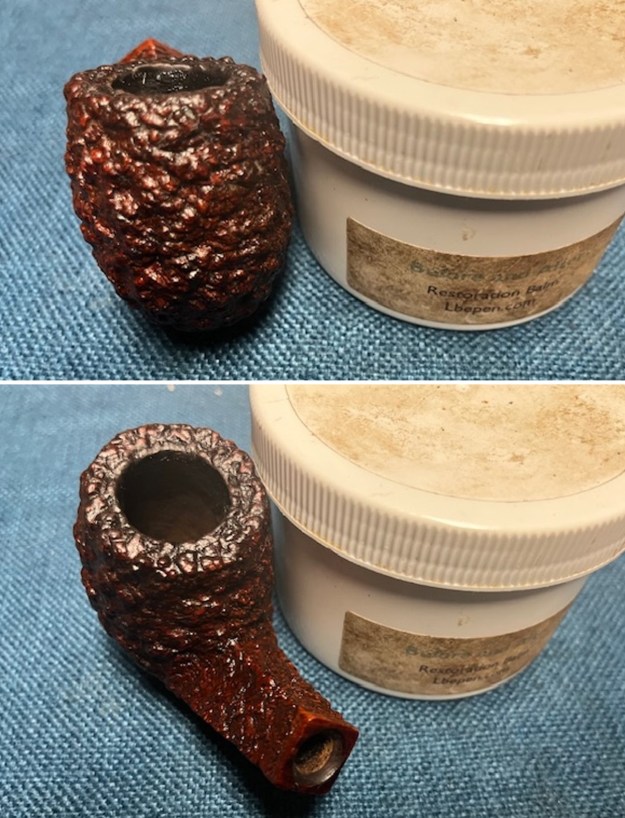
Breathing New Life into Dunhill Shell 360 F/T Billiard on New Year’s Morning 2026


by Steve Laug

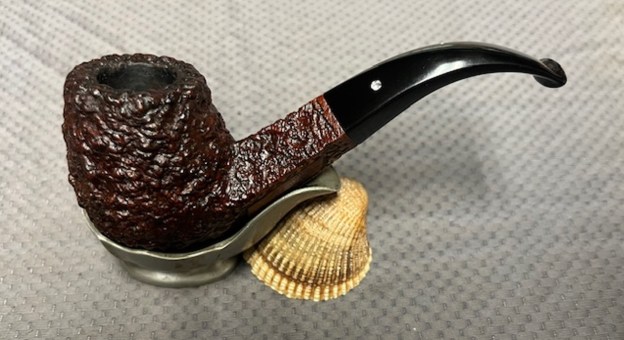
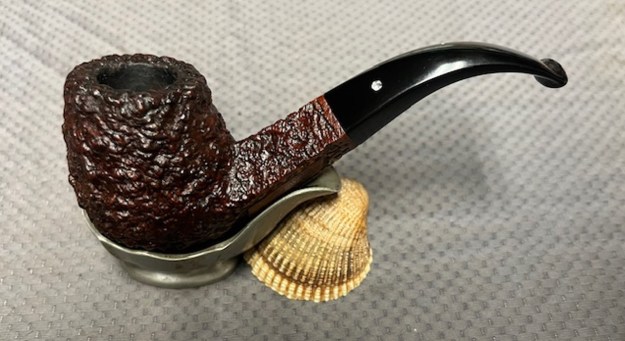
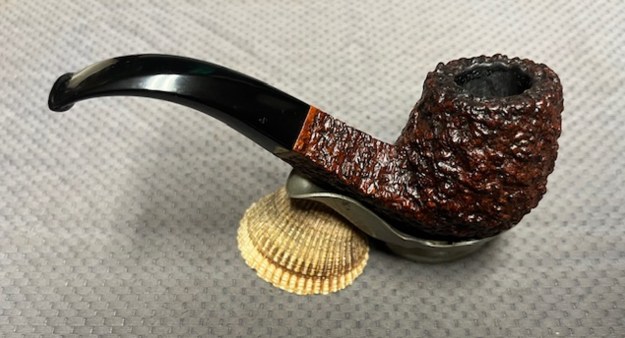
This New Year morning’s pipe on the table came to us from a seller in Cleveland, Ohio, USA on 04/26/2022. I am having fun working on this lot of Dunhill pipes. You may be getting tired of reading about them but I have to say it is a pleasure to work on this lot. The current one is a Dunhill Shell Billiard with a saddle stem. Overall it looks very good. It is stamped on a smooth panel on the underside of the shank. On the heel of the bowl it is stamped with the shape number 360 F/T followed by Dunhill [over] Shell Briar [over] Made in [over] England9 [followed by] 14. The stamping is faint in spots but still readable. The pipe has a mix of black, cordovan and brown stains on a Shell Briar sandblast finish and some amazing grain that the shape follows well. The finish was dusty and dirty with grime ground into the nooks and crannies of the rugged sandblast. The bowl had a moderate cake and there was lava in the sandblasted rim top and edges. The original stem is on the pipe is oxidized and has light tooth chatter and marks on both sides ahead of the button. I took photos of the pipe to show what it looked like before I started working on it. I took photos of the bowl and rim top to show the thickness of the cake and the lava coat on the rim top. There was some tobacco debris in the bottom of the bowl. The stem photos show the condition of the taper stem ahead of the button. I took a photo of the stamping on the underside of the shank. It is clear and readable as noted above. I removed the stem and took a photo of the pipe to give a sense of the proportions of the pipe.One of the first things I like to do is to unpack the stamping and understand each element in it. I turned to Pipephil’s helpful site (http://pipephil.eu/logos/en/dunhill/shell-briar1.html). The stamping is interpreted as follows: The 360 is the shape number for one of many Dunhill Billiard shapes. The F/T gives the shape of the stem as a Fishtail on this saddle stem. The Dunhill Shell Briar is the finish. Following the Made In England9 gives the year that the pipe was made. That is followed by 14. The 14 is the year which the pipe was sold – 1974. Thus, made in 69 and sold in 74.

From there I wanted to pin down the date stamp 9 as well as the second stamp 14. I have included Page 2 of the Dunhill Dating Key (http://www.pipephil.eu/logos/en/dunhill/cledat-en1a.html). Following that it takes me to the box with 1960+suffix. That tells me that the pipe is a 1969 pipe that sold in 1974.I wanted to know more about the Shell finish and when it was introduced by Dunhill and how that fit the Patent stamp on the bowl. I turned to a listing on Pipedia that gave me the information I was looking for (https://pipedia.org/wiki/Dunhill).

Shell

The Shell is a deep, craggy sandblast finish with a black stain, traditionally applied to soft, beautifully grained Algerian briar. While perhaps not the first-ever use of sandblasting on pipes, the technique perfected by Dunhill is considered one of the brand’s most significant contributions to the art of pipe making. The development is documented in English patent No. 119708/17; preliminary work began on October 13, 1917, and the patent was granted a year later, just weeks before the end of the First World War.

The origin of the finish is famously recounted as an “Accidental Discovery” in early Dunhill catalogues. The story tells of Algerian briar blocks being inadvertently left near a furnace, causing the softer wood to shrink and the harder grain to stand out in a textured relief. The reality, as detailed in the patent application, was a deliberate process of steeping the briar in oil for weeks, followed by a heat treatment. Only then was the sandblast applied to cut away the softer wood, resulting in a durable, lightweight, and cool-smoking pipe.

In 1986, Dunhill introduced a premium version of the Shell finish called the ‘Ring Grain’. These pipes feature a particularly deep blast reminiscent of the classic style of the 1930s to mid-1960s, applied to briar with a superior grain pattern. The ‘Ring Grain’ name was later changed to ‘Shilling’ in 1995. Regarded by many enthusiasts as among the finest modern Dunhills, these pipes are produced in limited quantities and are exceptionally rare.[122][123]

Now I knew that I was working on a Dunhill Shell 360 F/T Billiard with a Saddle stem that was made in 1969 and sold in 1974.

I turned to work on the pipe itself. I reamed the bowl with a PipNet pipe reamer using the cutting heads 2 and 3. I finished the reaming with a Savinelli Fitsall Pipe Knife. I sanded the walls of the bowl with 220 grit sandpaper wrapped around a piece of dowel. I used a brass bristle brush to clean up the sandblast on the rim top. I was able to remove the debris built up in the grooves of the sandblast. I cleaned out the inside of the shank and the airway in the stem with alcohol, cotton swabs and both bristle and regular pipe cleaners. I scrubbed the bowl and shank with a tooth brush and some undiluted Murphy’s Oil Soap. I also worked it over with a brass bristle brush and the soap. I rinsed it off with warm water to remove the dust and soap from the finish. I dried it off with a soft cloth and it looked much better. I rubbed the briar down with Before & After Restoration Balm. I worked it into the briar with my fingertips and a horsehair shoe brush to work it into the nooks and crannies of the sandblast finish. The product works to clean, enliven and preserve the briar. I let it sit for 10 minutes then I buffed it with a cotton cloth to deepen the shine. The briar really comes alive with the balm. I set the bowl aside and turned my attention to the stem. I sanded the stem with 220 grit sandpaper to remove the oxidation and the tooth chatter and marks on the surface. I scrubbed the surface with Soft Scrub Cleanser and took off the oxidation that had been loosened by the sanding. It looked much better.I sanded the stem and tenon surface with 320-3500 grit 2×2 inch pads. I wiped the stem down with an Obsidian Oil cloth after each sanding pad.I polished the vulcanite with micromesh sanding pads – 1500-12000 grit pads. I wiped it down with Obsidian Oil after each sanding pad. I used Before & After Pipe Polish – both Fine and Extra Fine to further polish the stem. I the polished vulcanite saddle stem and the 1969 Dunhill Shell Briar 360 F/T bowl with Blue Diamond to polish out the remaining small scratches and raise the shine. I gave the stem several coats of carnauba wax and the bowl several coats of Conservator’s Wax then buffed the pipe with a clean buffing pad to raise the shine. I hand buffed it with a microfiber cloth to deepen the shine. The pipe polished up pretty nicely. This turned out to be a beautiful 1969 Dunhill Shell Briar 360 F/T Saddle Stem Billiard that sold in 1974. The finished pipe is shown in the photos below. The dimensions are Length: 5 ½ inches, Height: 1 ¾ inches, Outside diameter of the bowl: 1 ¼ inches, Chamber diameter: ¾ of an inch. The weight of the pipe is 1.06 ounces/29 grams. Thanks for walking through the restoration with me as I worked this beautiful little Dunhill sandblast. This will soon be on the rebornpipes store in the British Pipe Makers Section. If you are interested in adding it to your collection let me know. Thanks for looking.