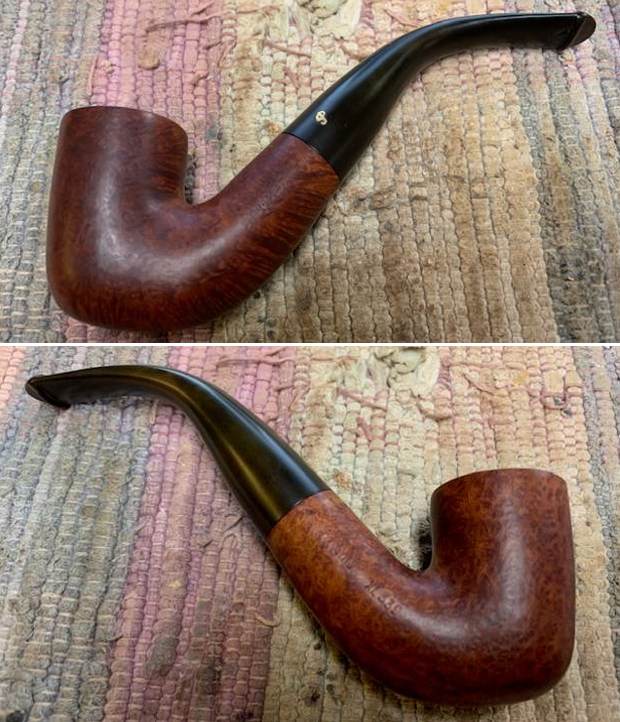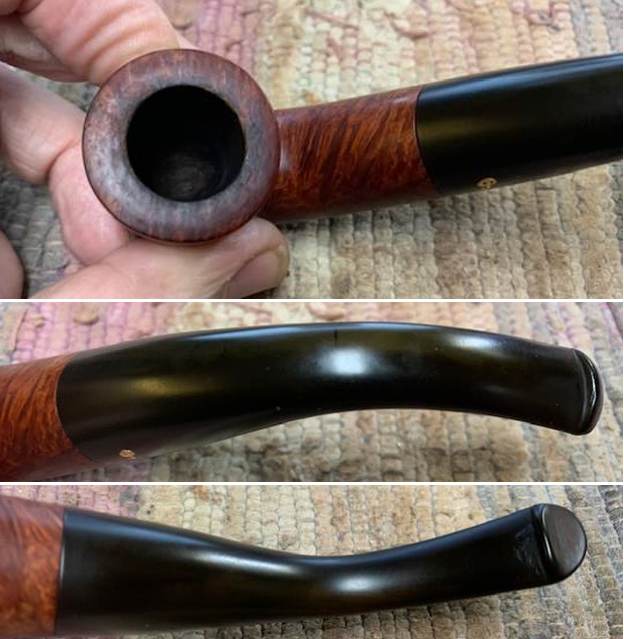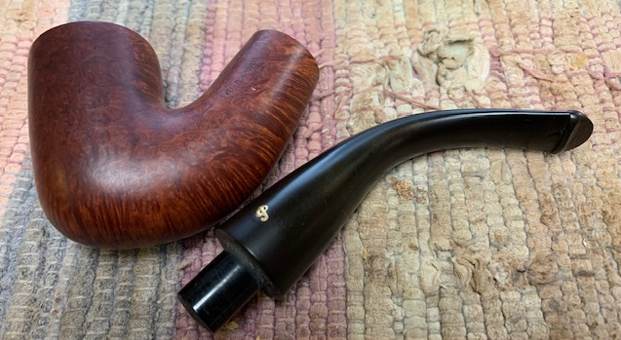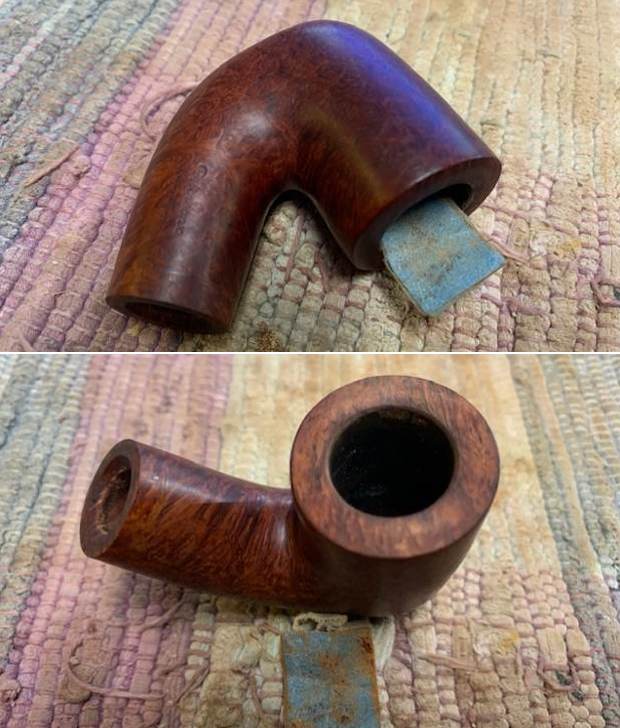
Monthly Archives: January 2023

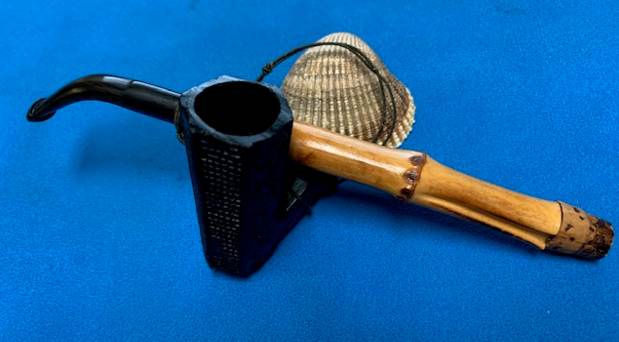
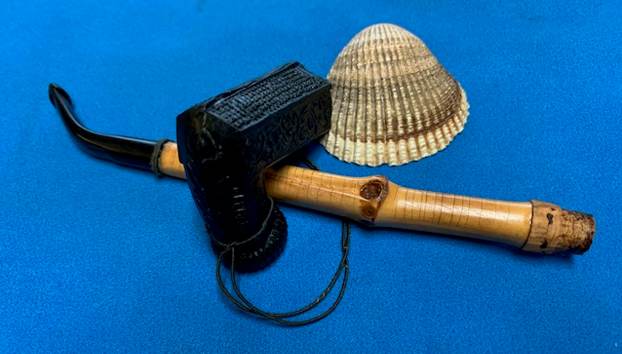
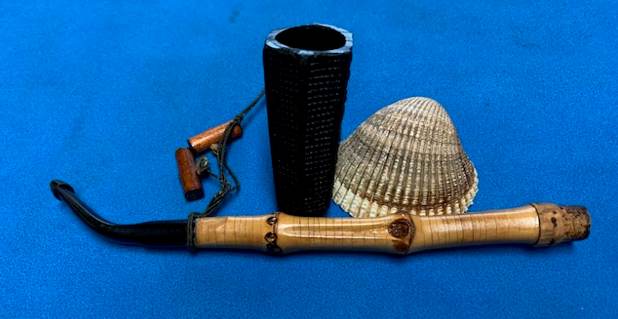
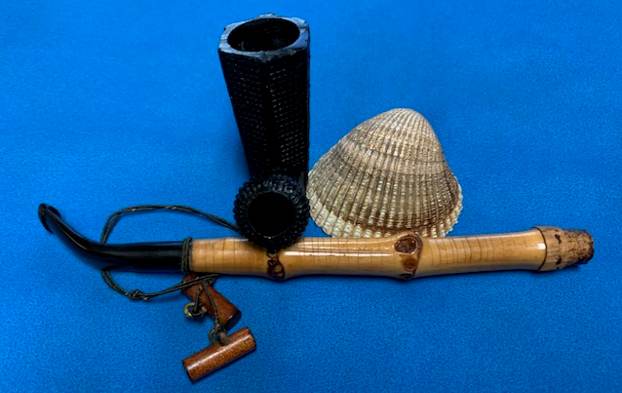
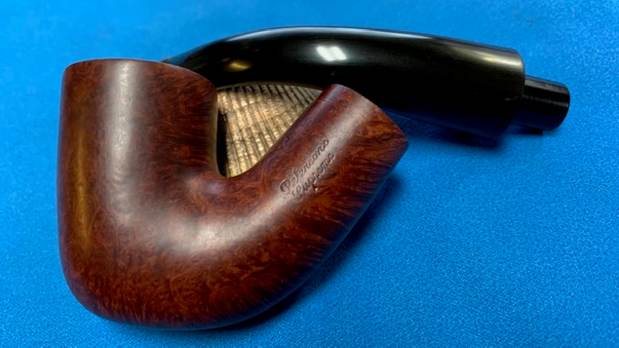
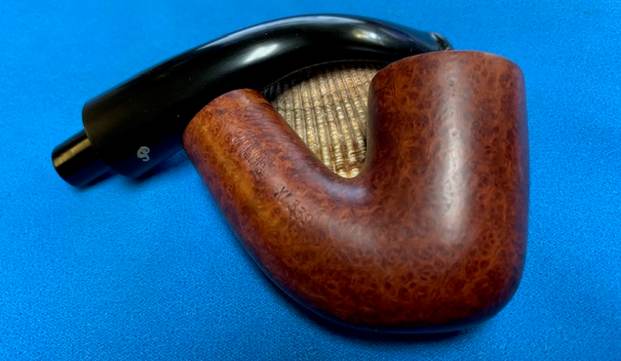
Restoring a Clay Viennese Coffeehouse Pipe with Bamboo Shank and Horn Stem


Blog by Steve Laug

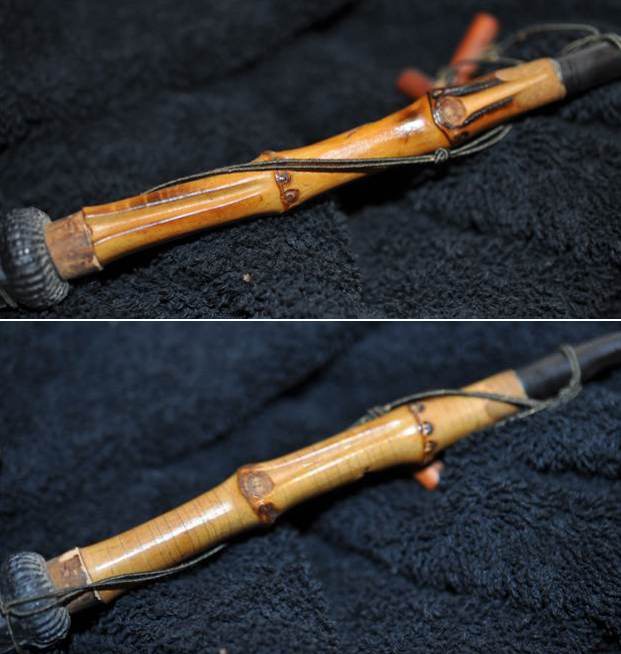
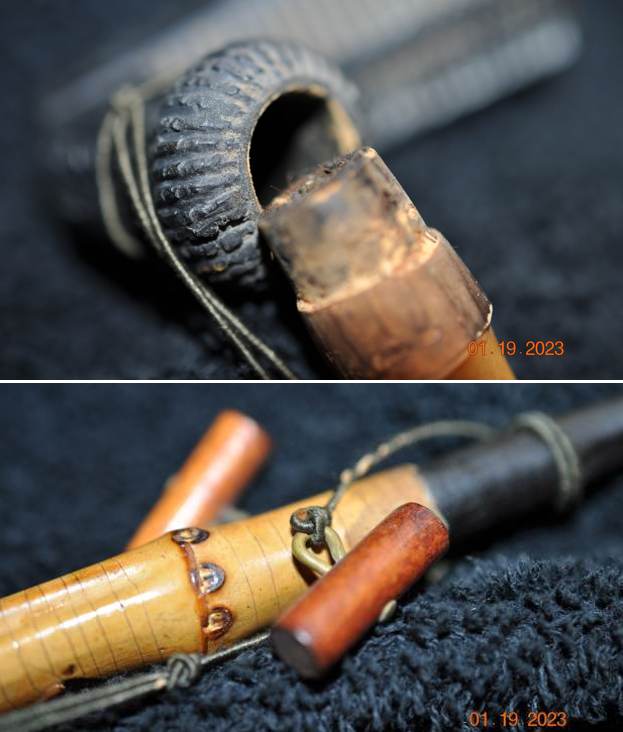
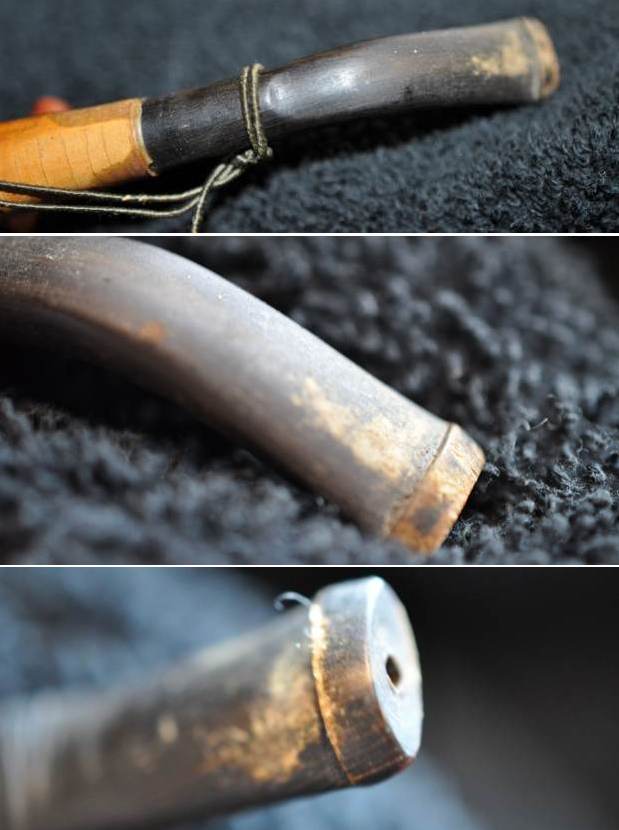
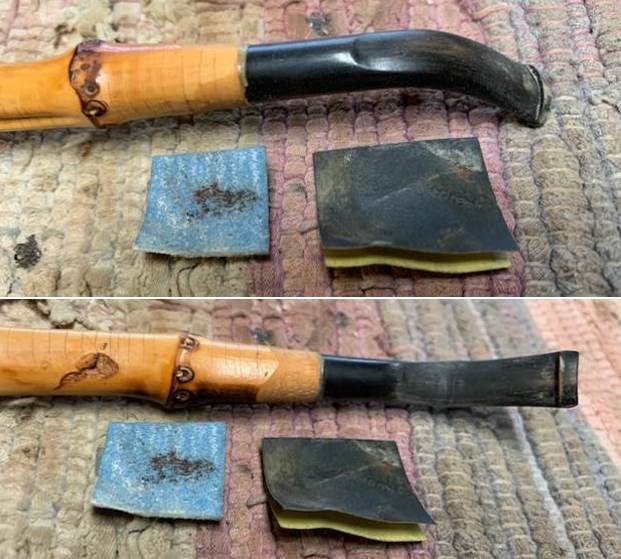
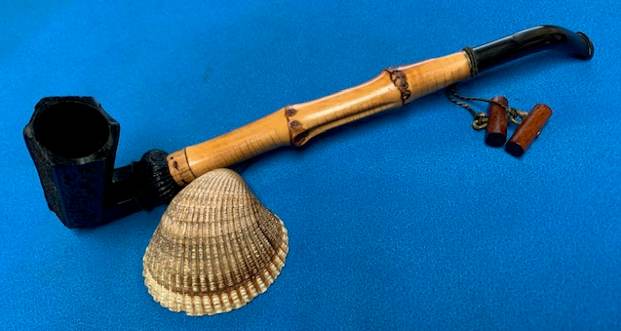
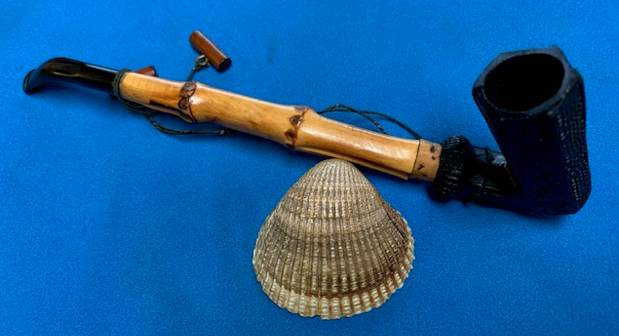
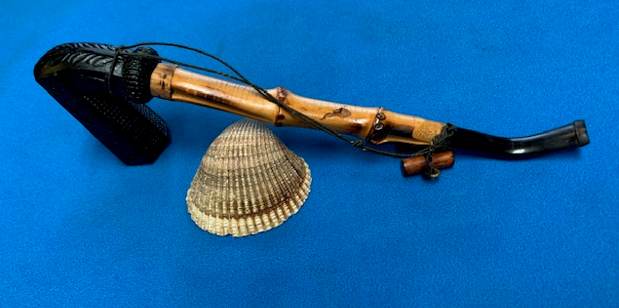
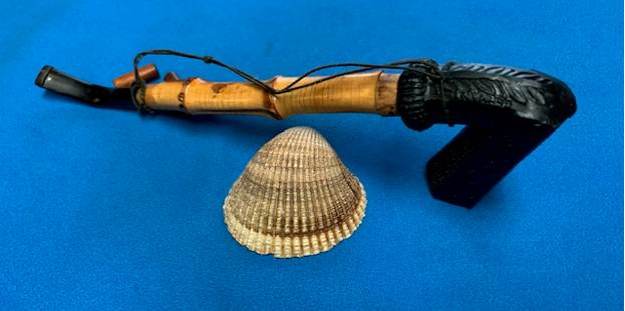
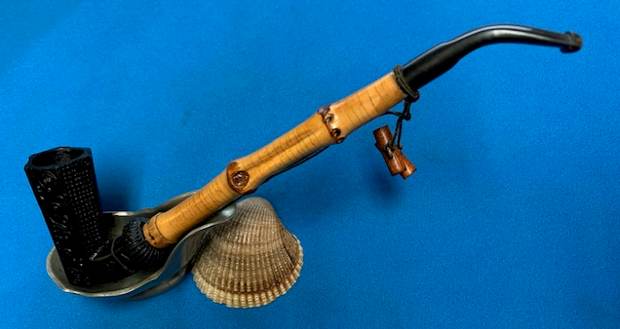
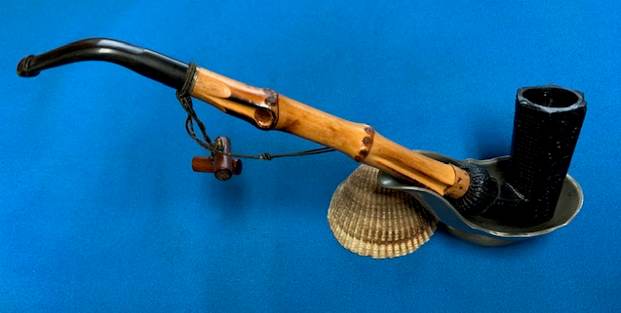
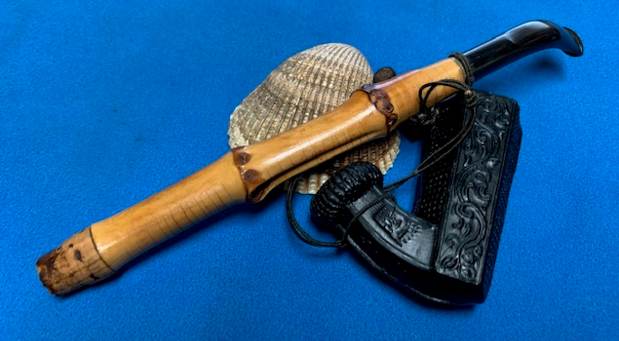
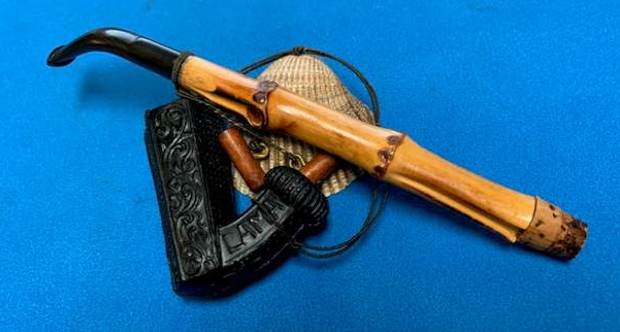
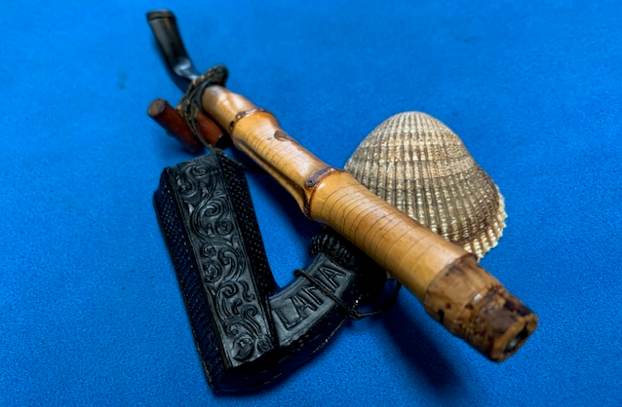
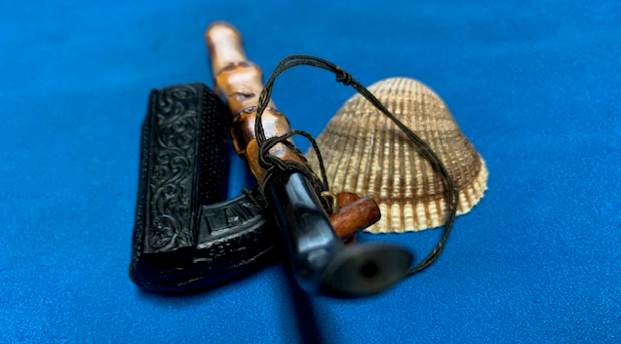
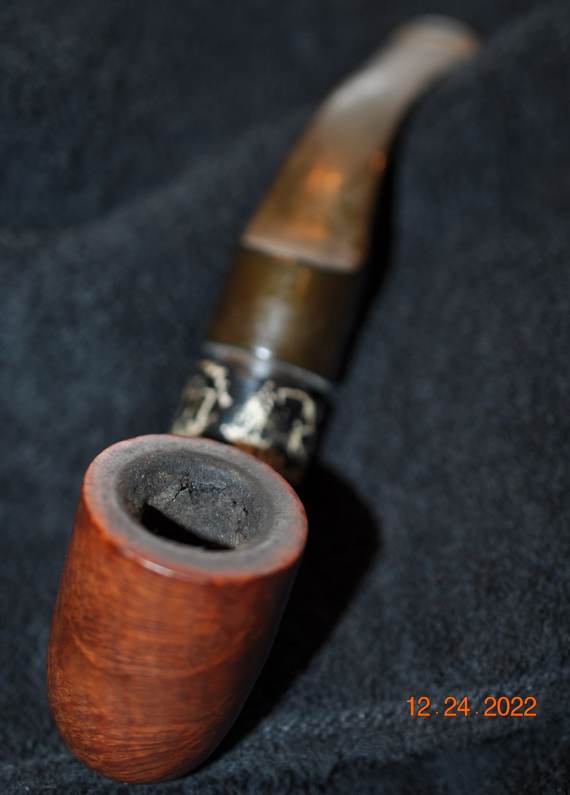
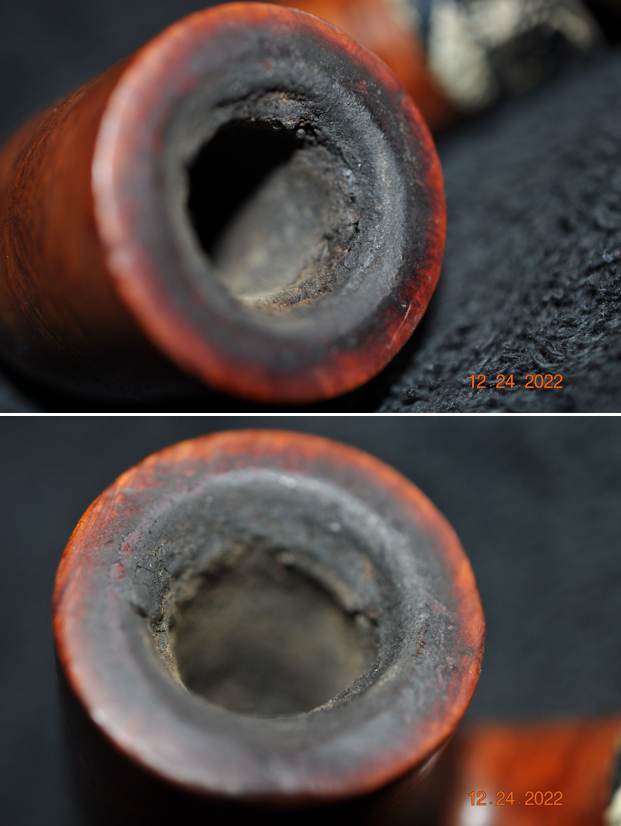
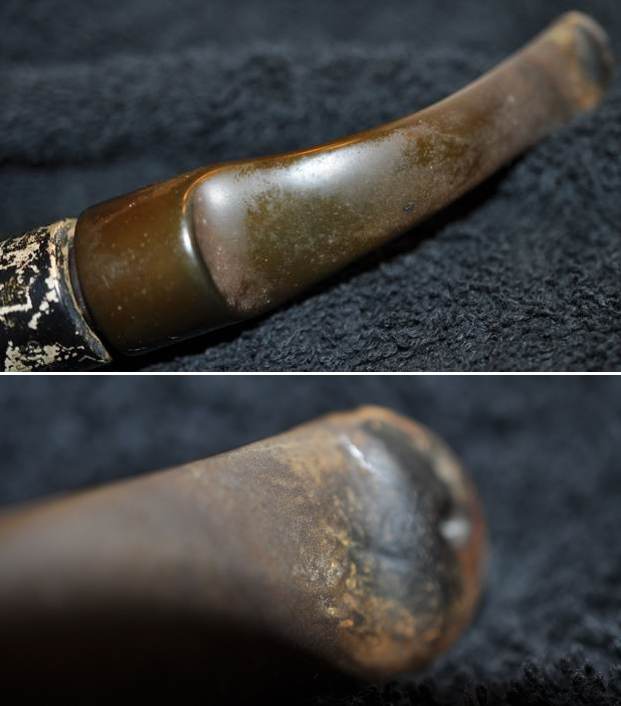
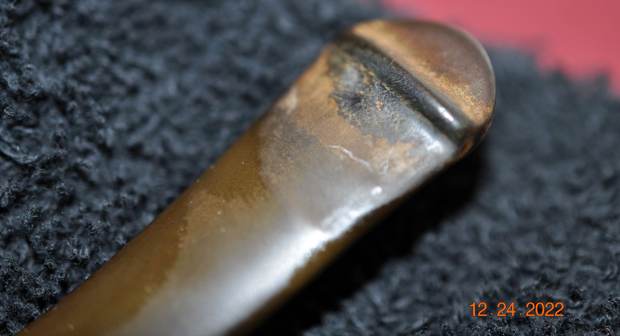
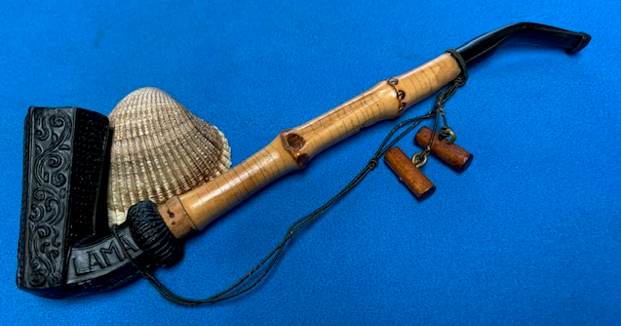
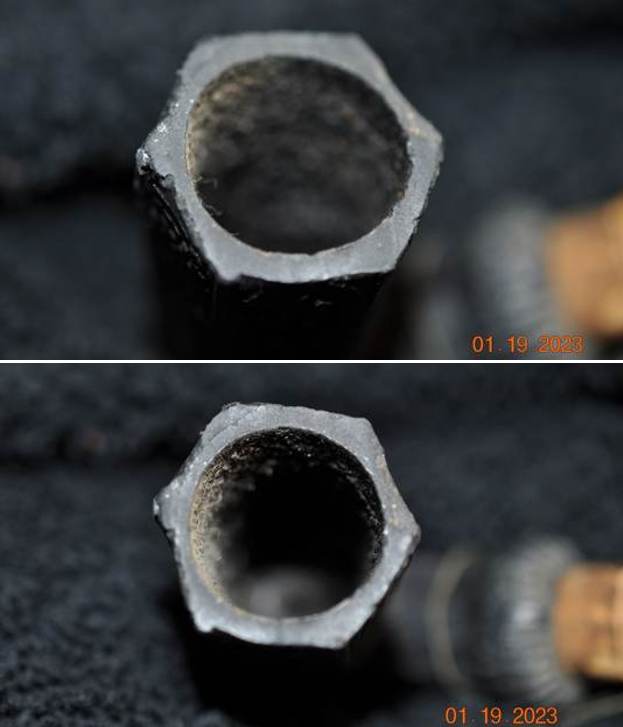
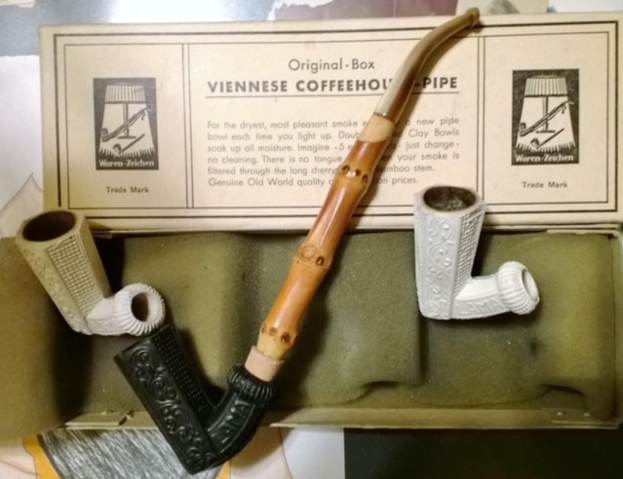
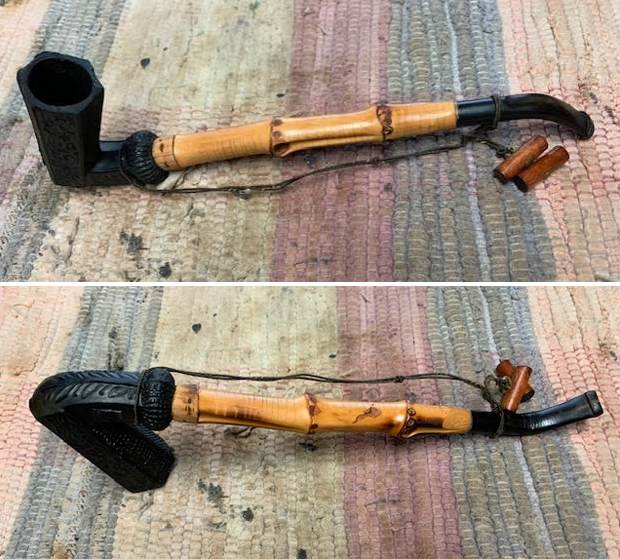
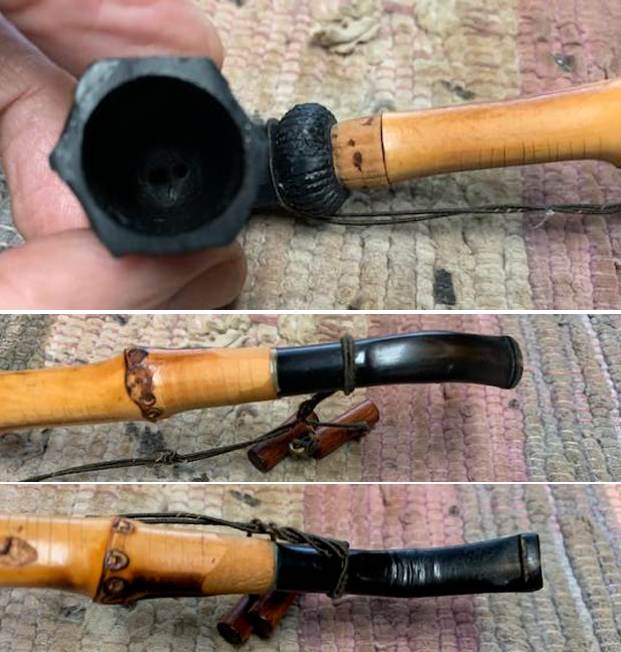
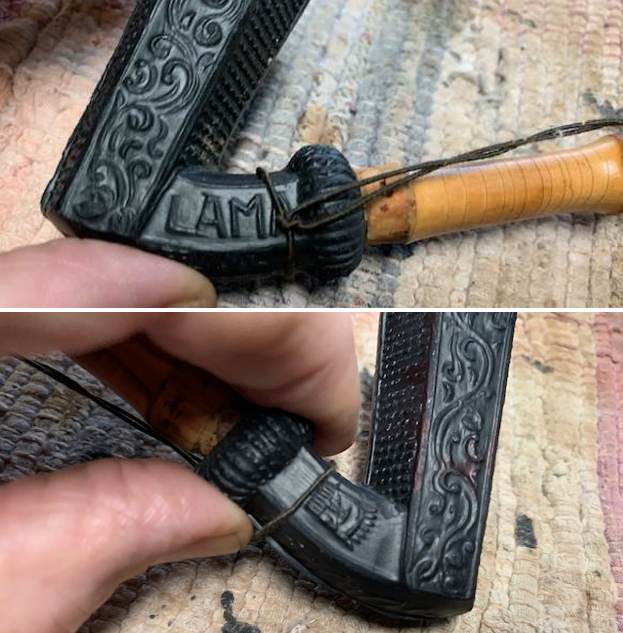
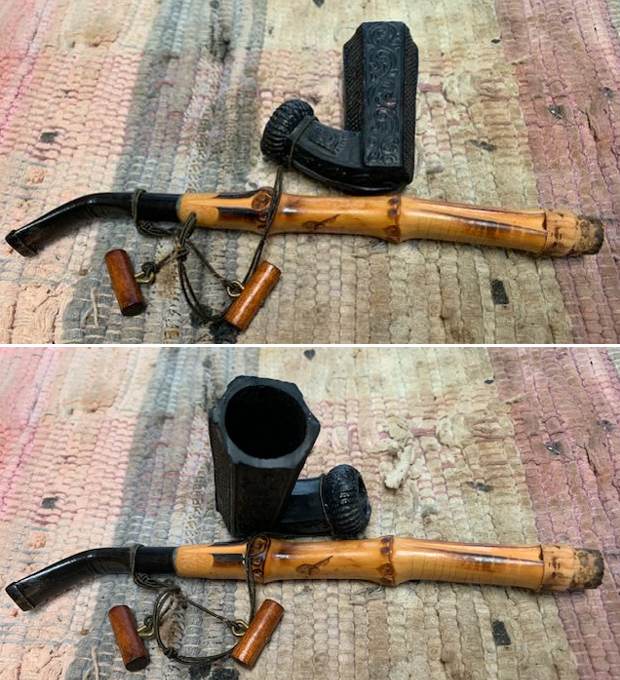
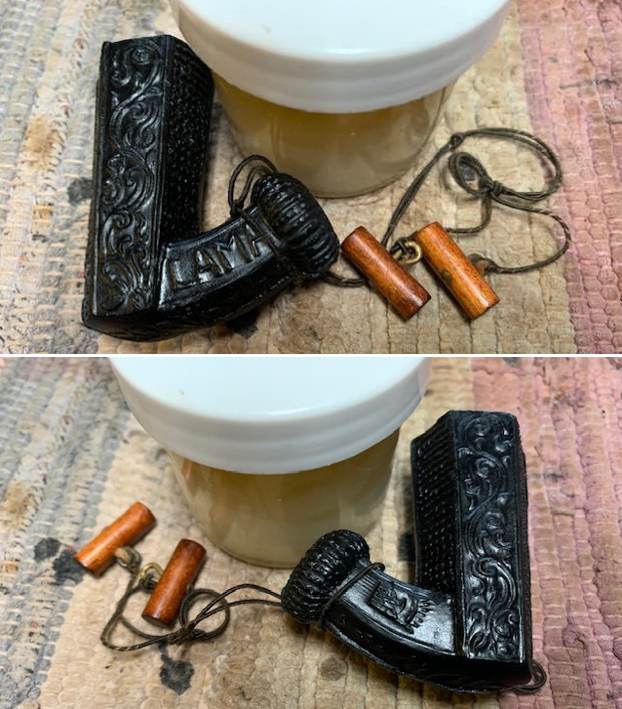
Jeff cleaned this pipe up recently and I received it in the mail last week. It is a unique pipe that caught my eye and made me want to work on it next. This pipe was purchased from an online auction on 07/28/22 in Manorville, New York, USA. The left side of the shank is stamped in the clay and reads LAMA. The right side is stamped with a banner with the letter “L” or maybe a “T” in the center and what looks like a pipe crossing the letter. The bowl of the pipe is clay with a double bottom to the bowl. The shank is Bamboo with a cork fitment on the end of the bamboo to hold it in the shank. There was a cord around the shank and then also around the horn stem. The pipe is well used and heavily smoked. There was a thick cake in the bowl with some lava spots on the rim top and inner edge. The exterior of the hexagonal clay bowl was stamped with unique and twisted/vine like patterns on the sides and a checked pattern on the other front and back of the bowl. The stamping patterns on the bowl are filled in with a lot of dust and debris. It is very dirty looking all the way around. The cork fitting is quite dirty but still has life in it. It is not chipping or torn. The cord is dirty. The Bamboo shank is a two knuckle piece with great patina and crackling in the finish. The horn stem is glued in the bamboo shank and the fit is very good. The horn stem has tooth marks and chatter on both sides near the button. There are some “wrinkles” in the bend of the stem that will need to be addressed. Jeff took the following photos of the pipe before he started his clean up work on it. He took photos of the bowl and rim top to show what they looked like before his clean up. He also took some of the bamboo shank to show the patina and crackled finish. You can also see the cork that secured the bamboo shank in the bowl. The photo of the horn stem show the condition of both sides. The photos of the sides and heel of the bowl show the stamping in the clay around the bowl and shank. The mixture of a fancy carved finish and the black stain on the clay give the pipe a sense of elegance and old age charm. Even under the grime it is a real beauty. The stamping on the left side the shank is shown in the photo below. It is clear and readable as noted above.I did a bit of digging on Google and found that the pipe that Jeff and I purchased was a Viennese Coffeehouse Pipe. The logo on the paper in the background of the photo below is the same stamp that is on the right side of the shank – the letter L or T with a pipe crossing the letter. The stamp on the right side of the shank is LAMA same as the one above. From there I turned to Pipedia to see what I could learn further about the Viennese Coffeehouse   Pipe (https://pipedia.org/wiki/Wiener_Kaffeehauspfeife). I quote from that article below:
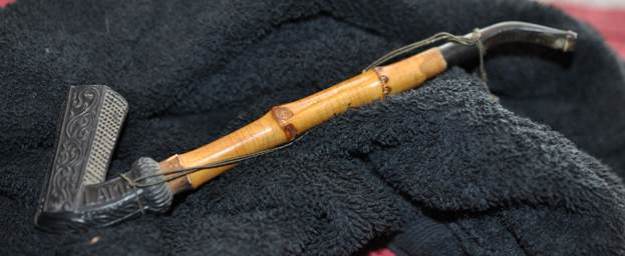
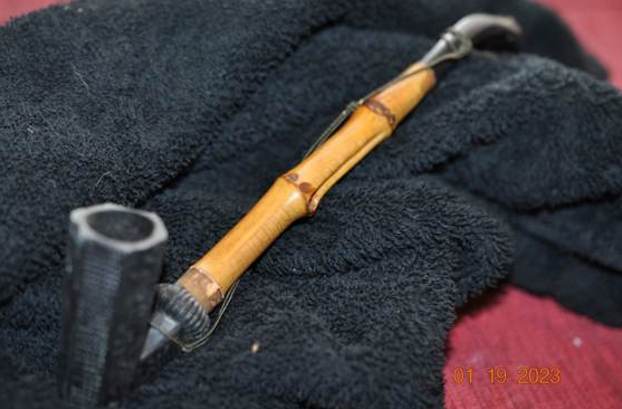
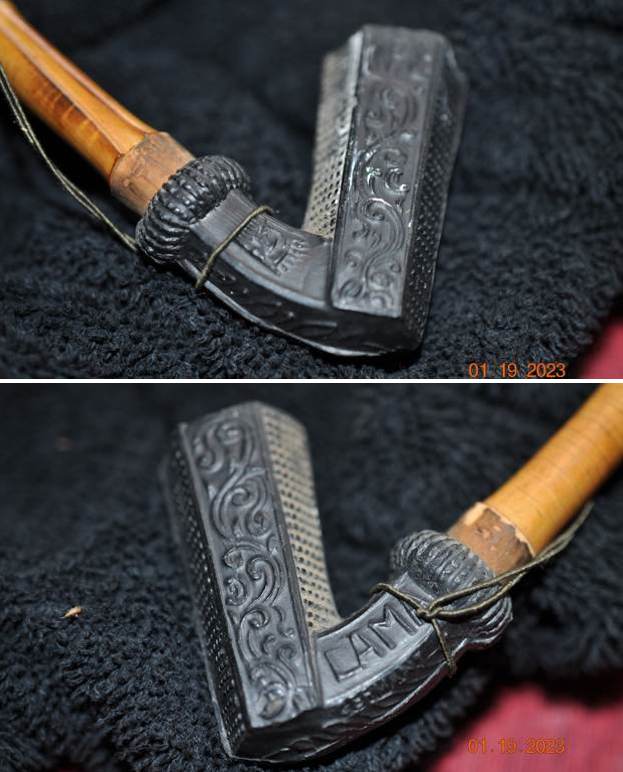
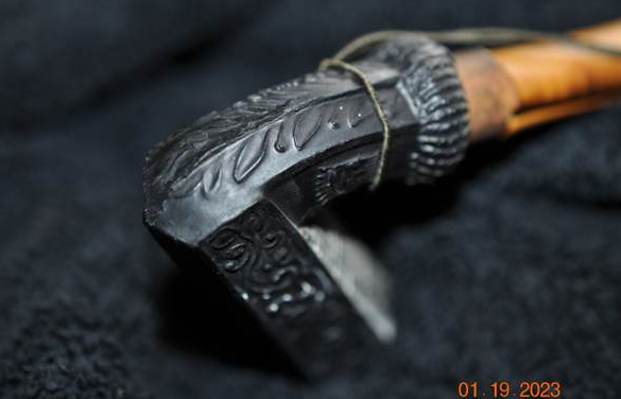
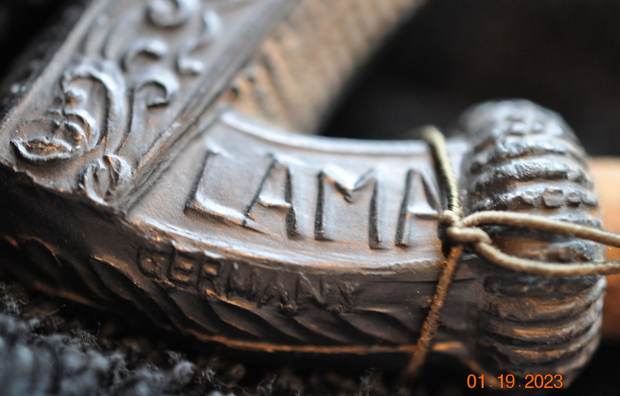
Wiener Kaffeehauspfeifen (Viennese coffee house pipes) are a special type of clay pipes where only the stummel is made of unglazed clay. The shank is often made of wood and the mouthpiece may be made from horn.

“As early as the late 18th century, some Viennese coffee houses had their own rooms for smokers. Business-minded coffee house owners offered their guests pipes stuffed with tobacco as a service. They only paid for the tobacco, the use of the pipe was free. Which brings us to the classic Viennese coffee house pipe of the 19th century. Its tall, slender head with six facets, made of white pipe clay, is easy to recognize. In the ornament-friendly 19th century, of course, the charming ornamentation could not be missing. The repertoire included geometric patterns, delicate tendrils, flowers, vases and figures. These pipes intended for the Austro-Hungarian market were made in workshops in the Westerwald, Germany, southeast of Cologne – well into the 20th century. The astonishingly long stems were mostly made of cherry or sour cherry wood. In order to have enough suitable wood available for their production, trees were planted near Vienna, in Theresienfeld in Lower Austria. One can only hope that the horn mouthpieces of the rental pipes were replaced and washed after use …”[1]

“Anyone who wanted could rent such a pipe for a small fee or for free if it was a known person for the duration of a pipe filling. The guest got a new mouthpiece, mostly they were made of goose quill and then he could indulge in his smoking pleasure. Once it was smoked, the pipe was taken apart, cleaned by the servant of the coffee house and another guest could enjoy it. We know a similar custom from other large cities, including England. There, clay pipes were borrowed in the so-called Tabagie[2] for a small fee and could then be smoked by those who did not own a pipe or who had forgotten it at home. The Kaffee Neuner on Seilergasse was particularly famous in Vienna. Famous contemporaries liked and often frequented there: Lenau and Grillparzer, for example, they quietly smoked their borrowed pipes there.”[3]

Footnotes:

  1. https://stadtarchaeologie.at/aus-der-wundertuete-wiener-kaffeehauspfeifen/
  2. See https://en.wikipedia.org/wiki/Tabagie_(room)
  3. Peter Lehmann, http://169807.xobor.de/t4796f23-Rund-um-die-Pfeifen-von-und-mit-Peter-Lehmann.html#msg17103

I followed some leads on Google to a link on Worthpoint which is an auction site that sells pipes (https://www.worthpoint.com/worthopedia/viennese-coffeehouse-pipe-by-waren-zeichen-w-6). There was a listing there with the same paper above the photo as the one I shared above. It is also interesting to note that the pipe came with one stem/shank unit and an assortment of dark and light coloured clay bowls. I still don’t know how large the pipe is at this point. I include the photo and the quote below:
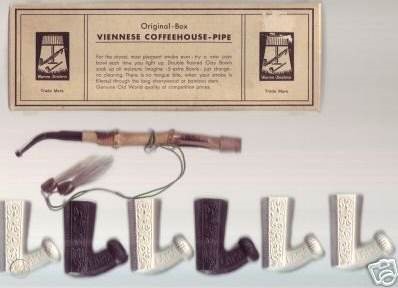
VIENNESE COFFEEHOUSE – PIPE in original box with six bowls in black and white all in like new never used condition(bowls have no chips and no ash residue, they are not used). I am not sure of the age of these, however box has no UPC label and states; Waren – Zeichen Trade Mark with the number 5514 B on box ends and Made in Germany – (below description has complete box information from top cover). Box is in excellent condition with only a mild scuff where there was an old price label, metal staples on box corners are all intact and perfect. Individual pipe bowls have the word LAMA on them. Pipes are made from clay, stem is bamboo. Double floored Clay Bowls soak up all moisture. Imagine – 5 extra Bowls – just change – no cleaning.

From Jeff’s photos I made the erroneous assumption that this was quite a large pipe. I was thinking it had a large style bowl like some of the older Meerschaum pipes I have worked on from Germany – somewhere in the neighbourhood of 12 inches long and 3 inches tall or more. You can imagine my surprise when it arrived. The pipe really is quite petite and light weight. The dimensions are as follows – Length: 7 ½ inches, Height: 2 inches, Outside diameter of the bowl: 7/8 inches, Chamber diameter: ¾ of an inch. The weight of the pipe is 40 grams / 1.41 ounces.

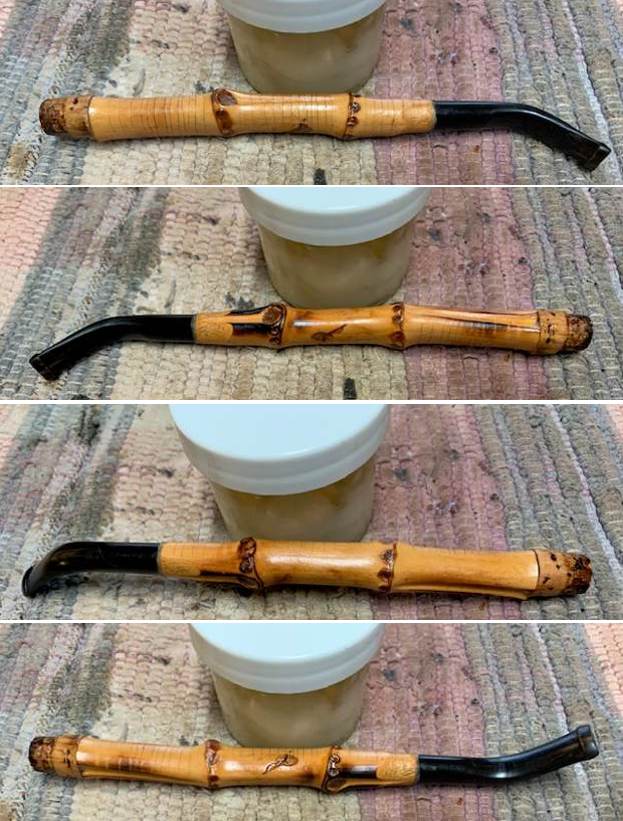
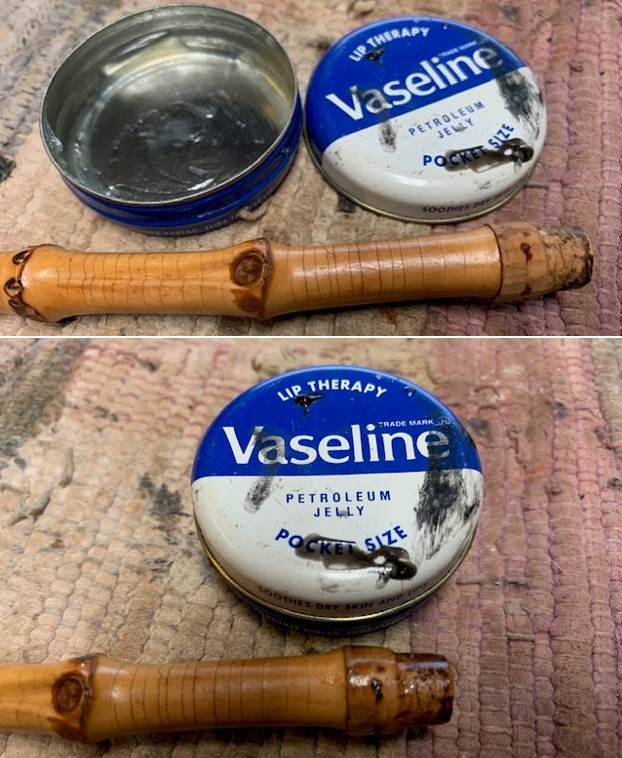
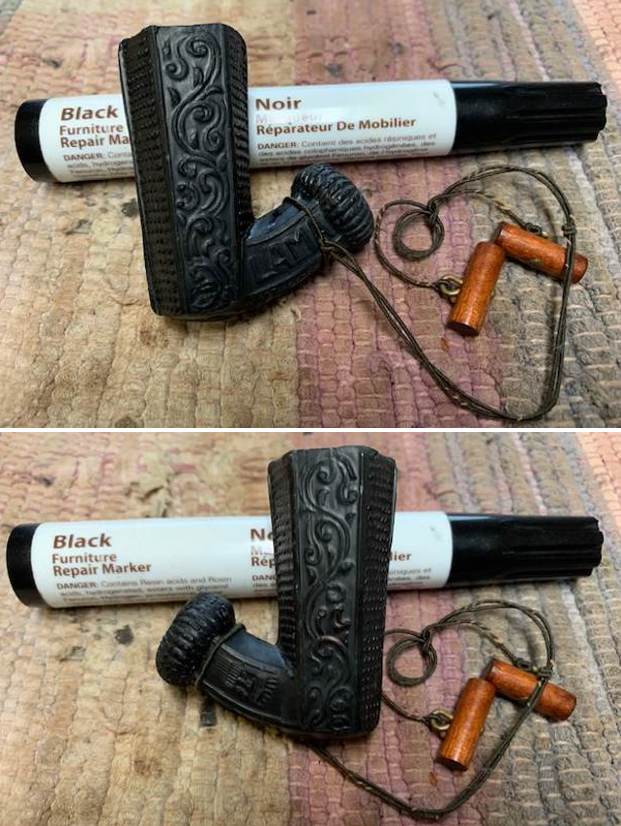
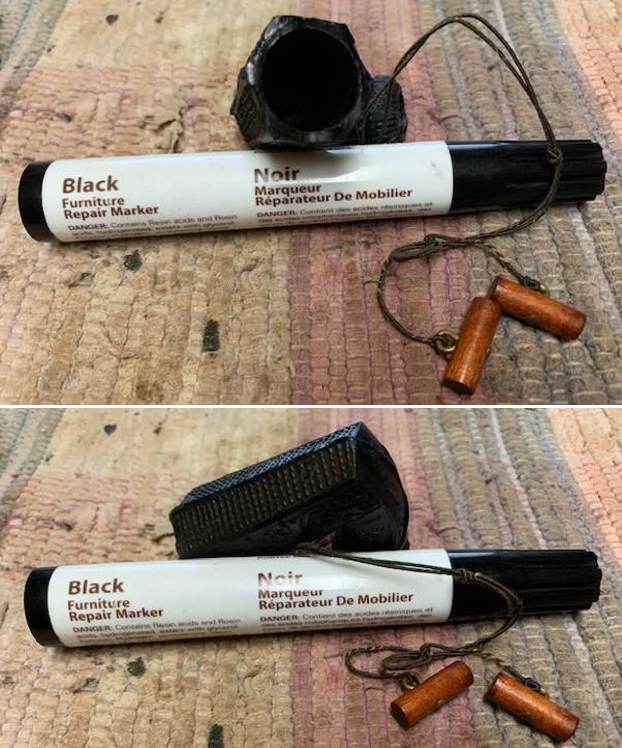
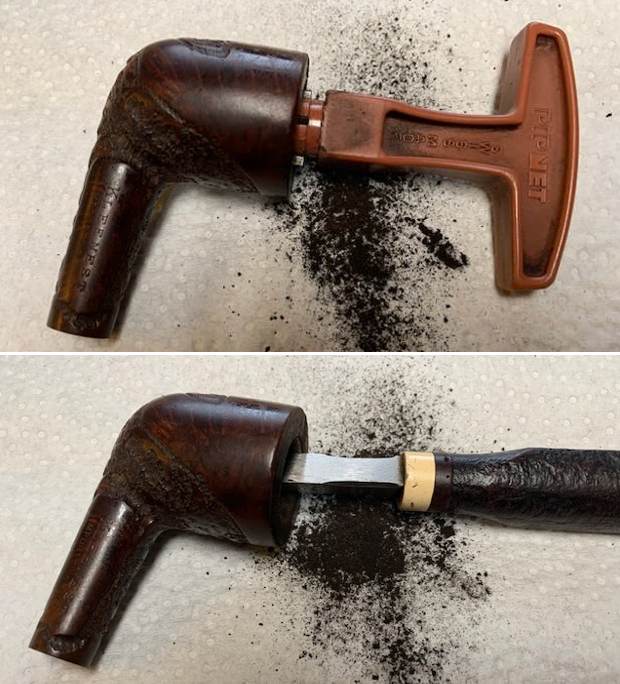
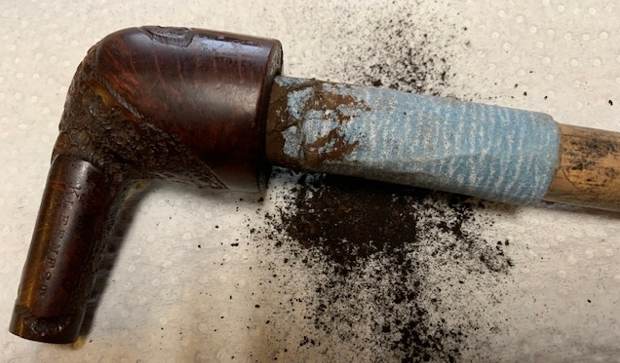
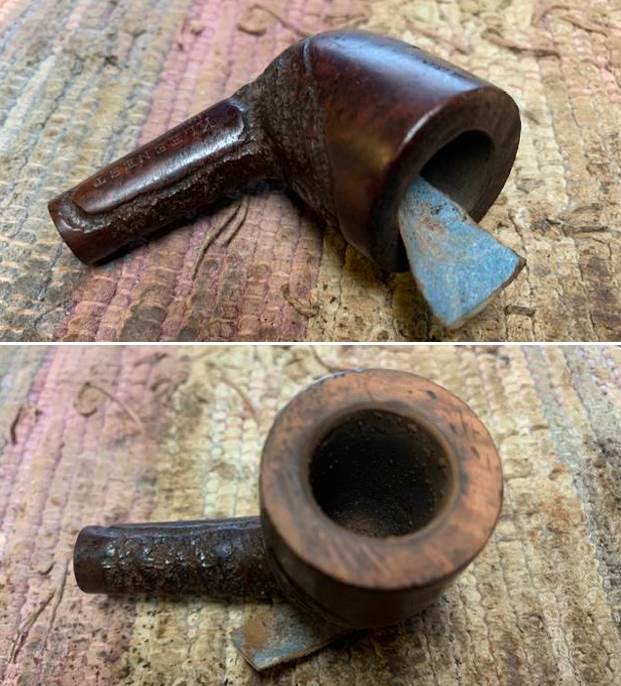
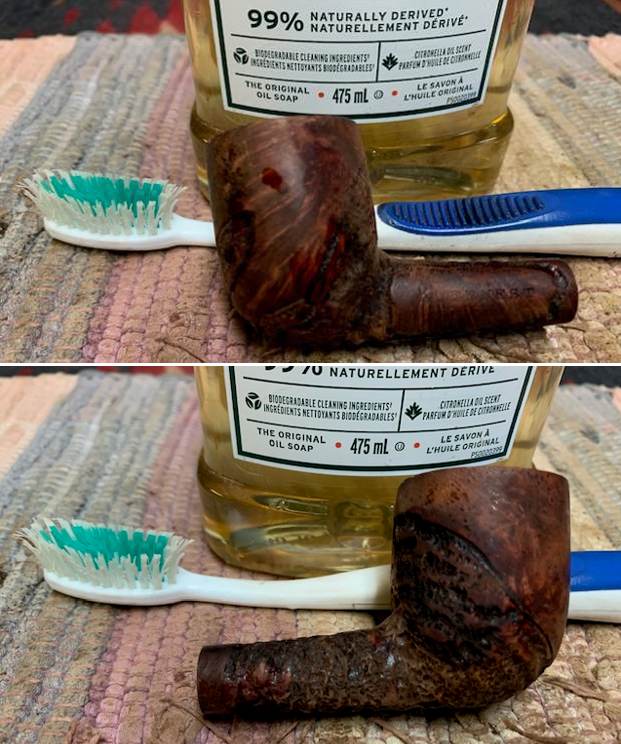
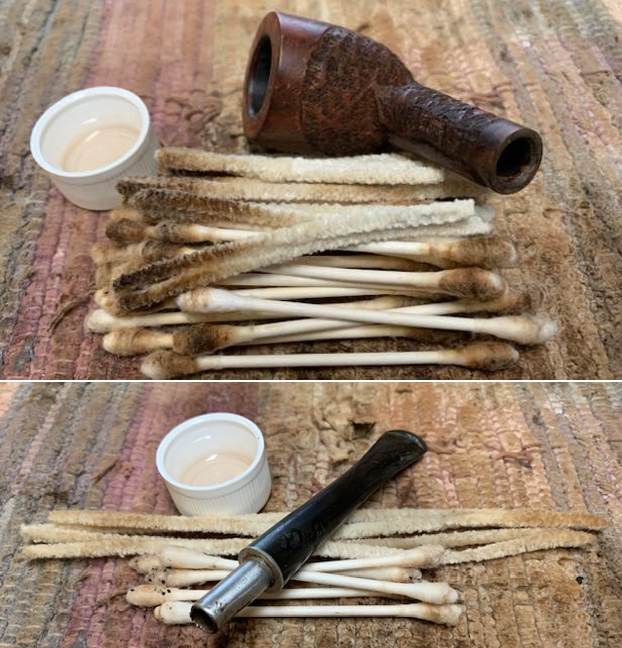
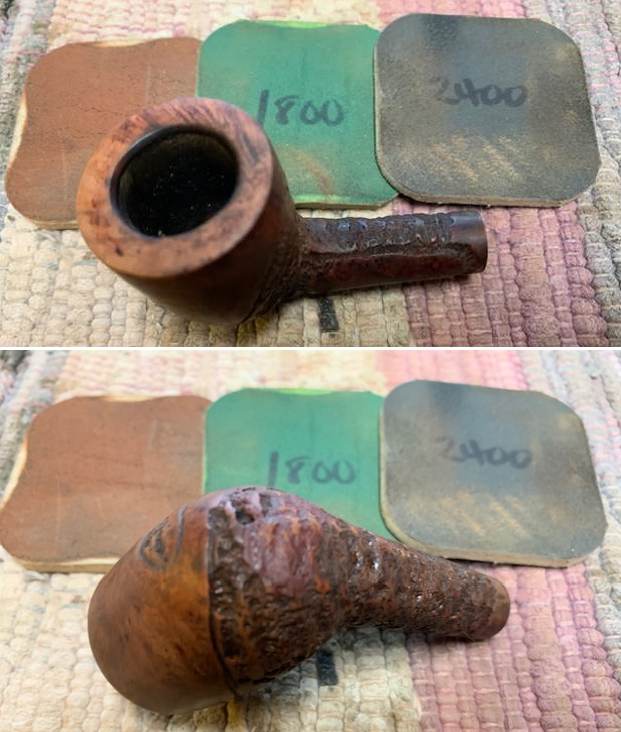
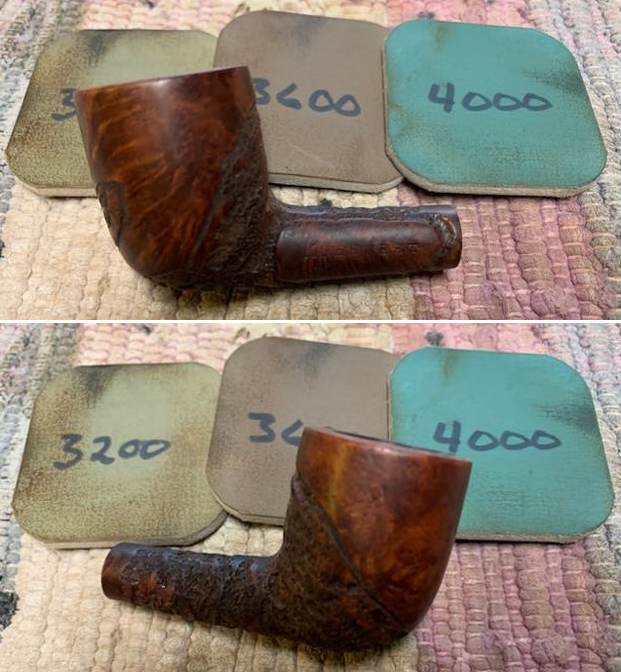
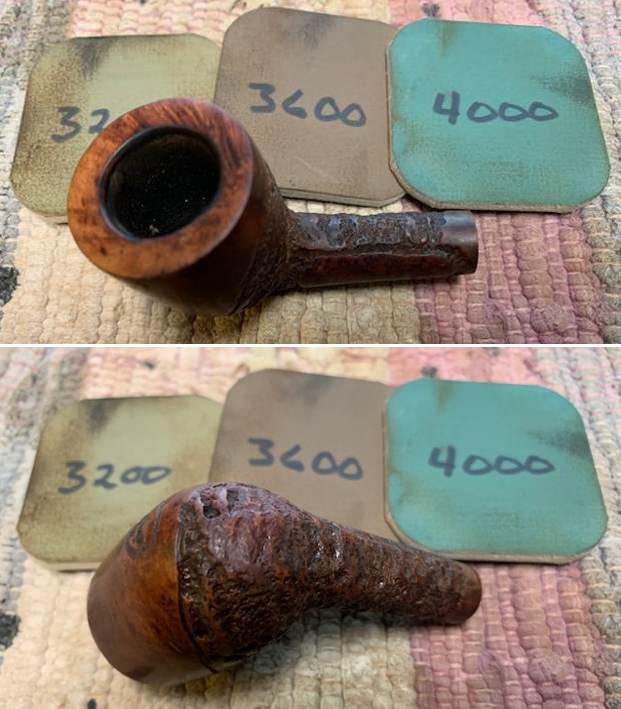
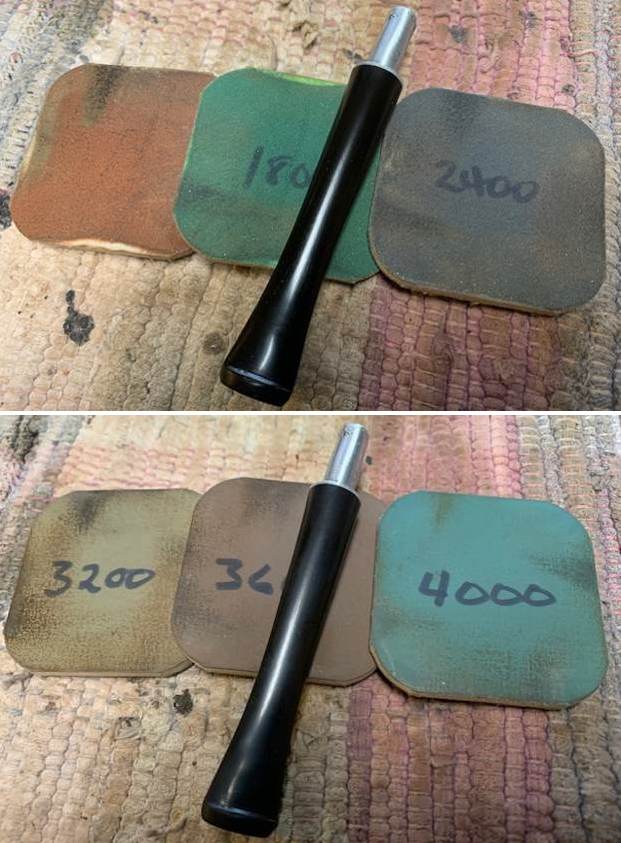
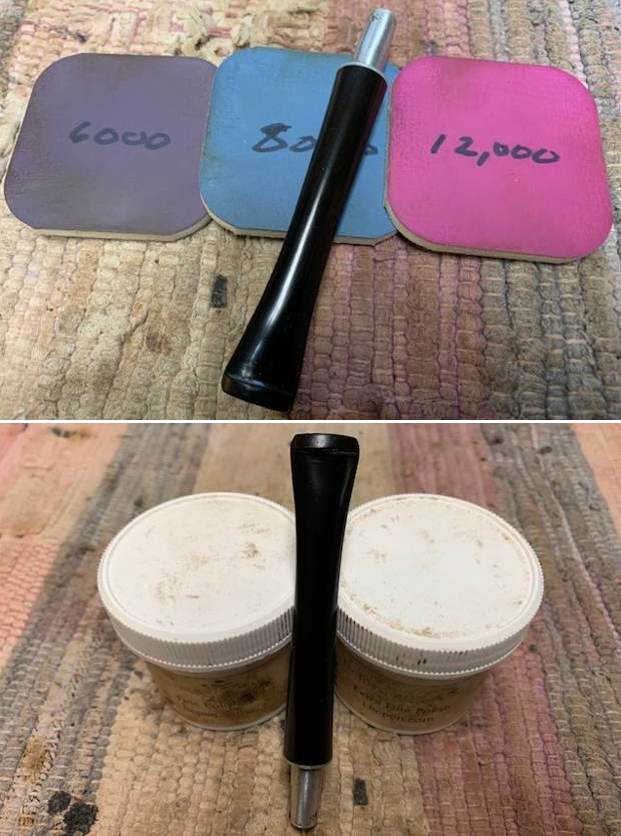
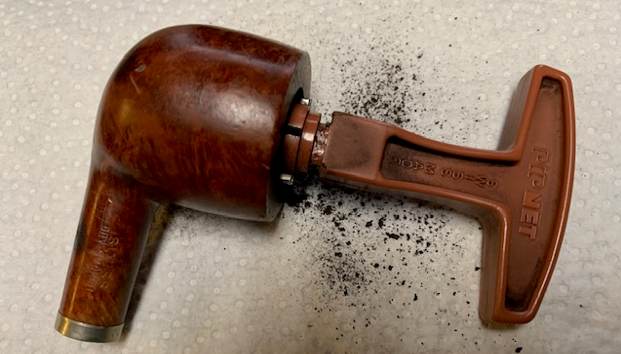
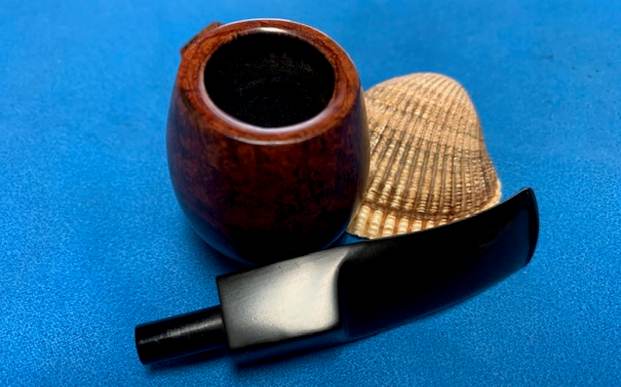
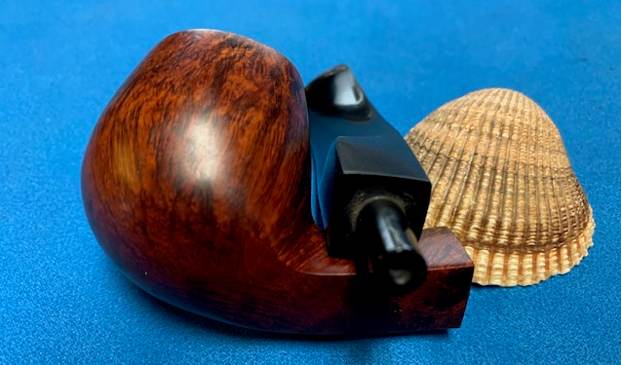
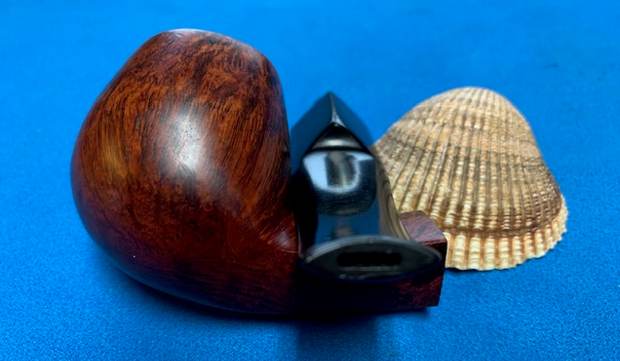
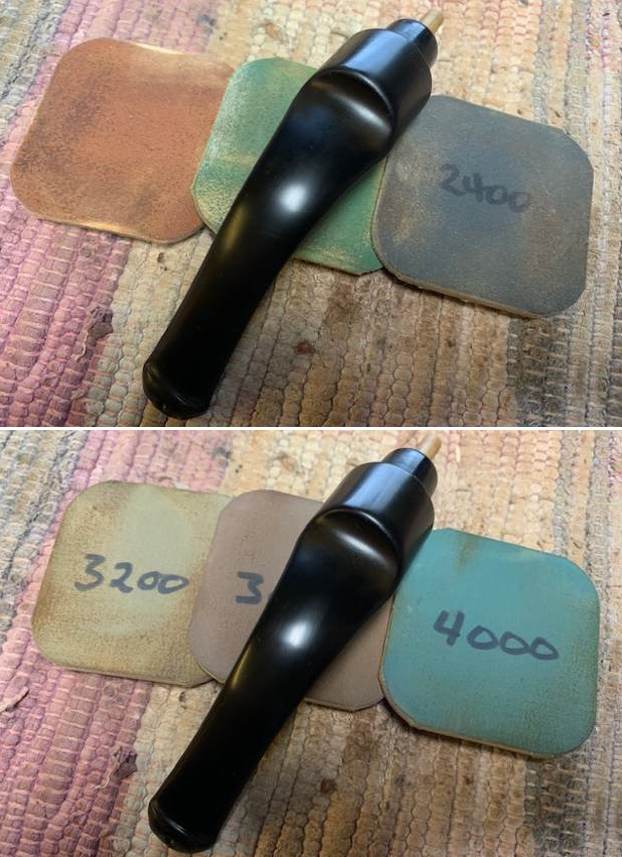
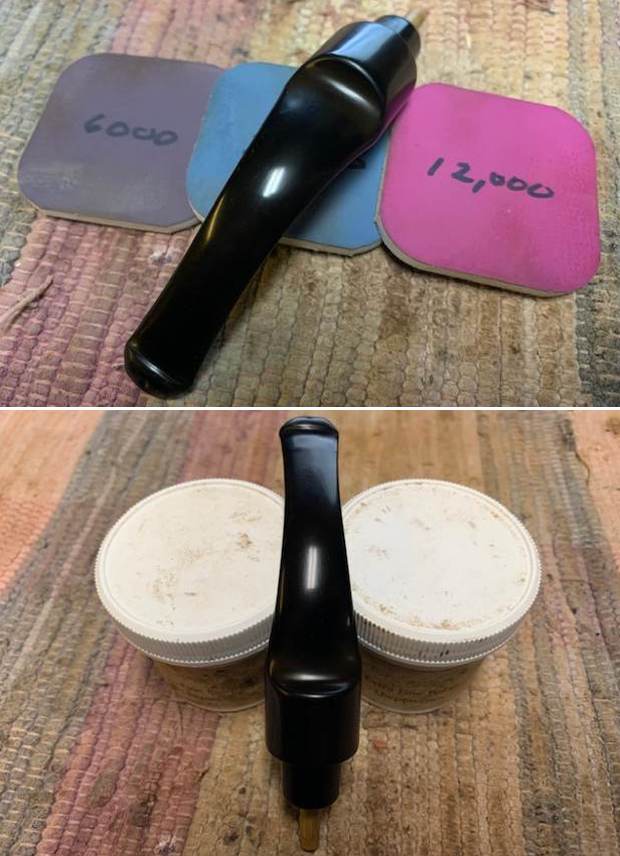
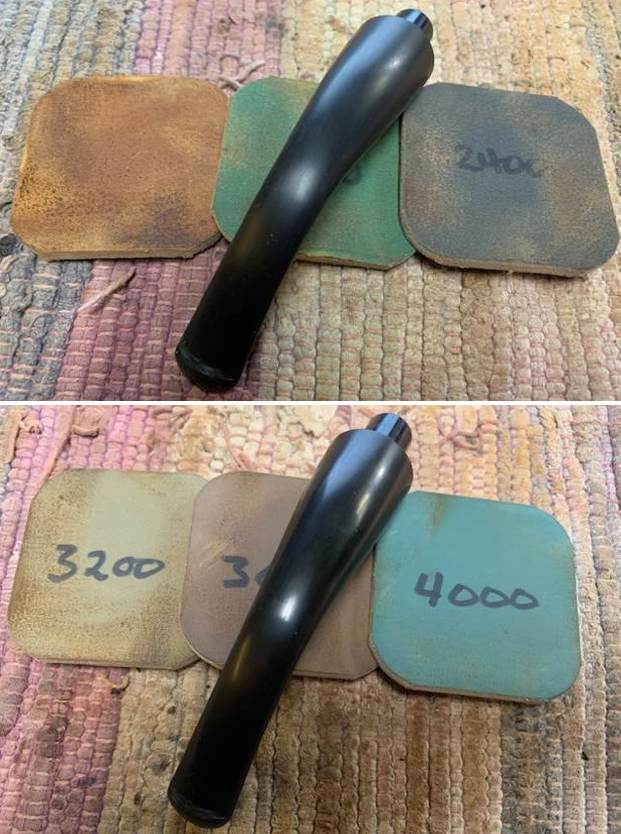
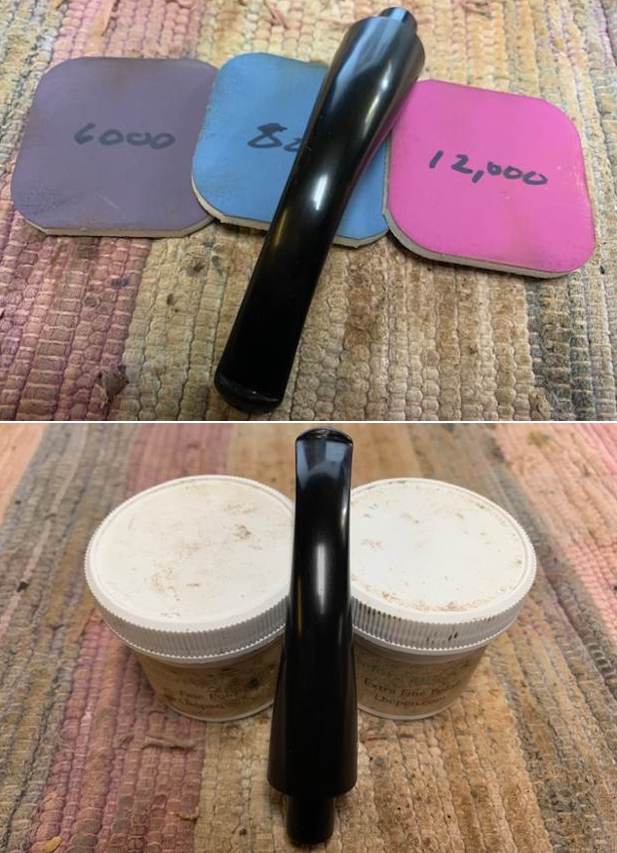
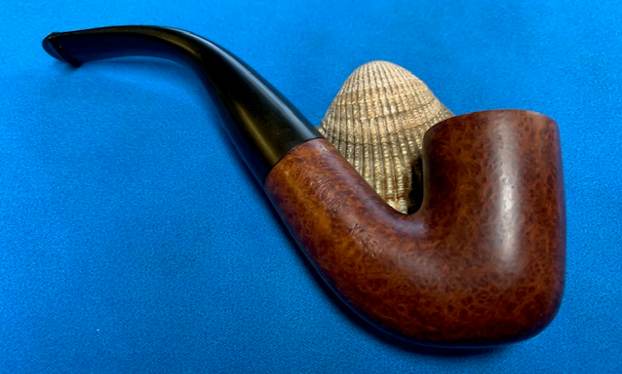
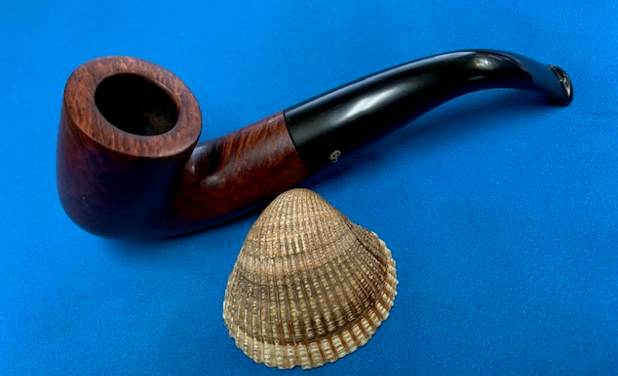
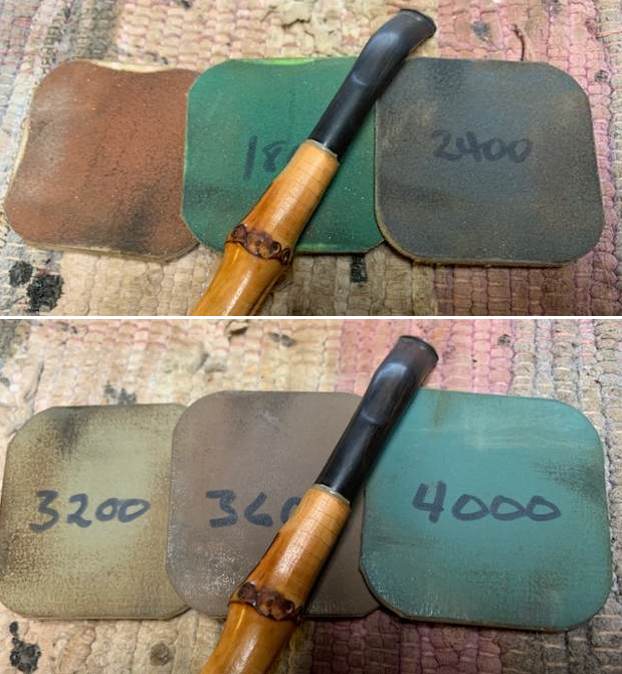
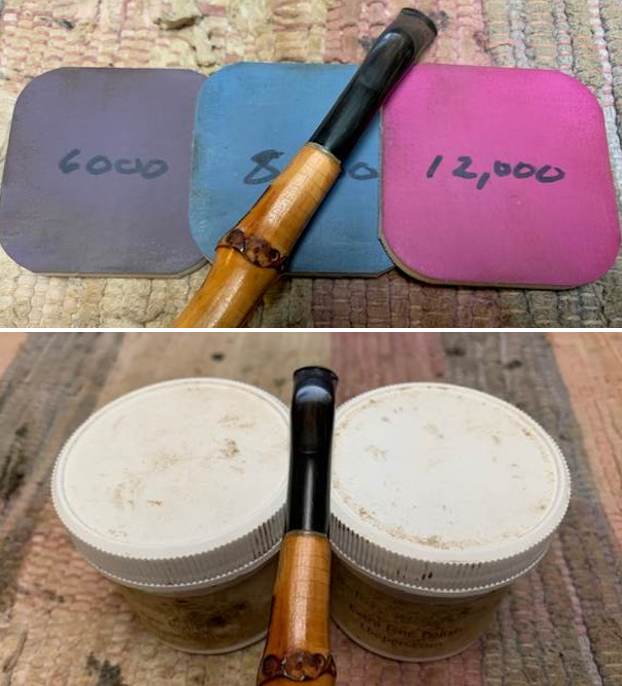
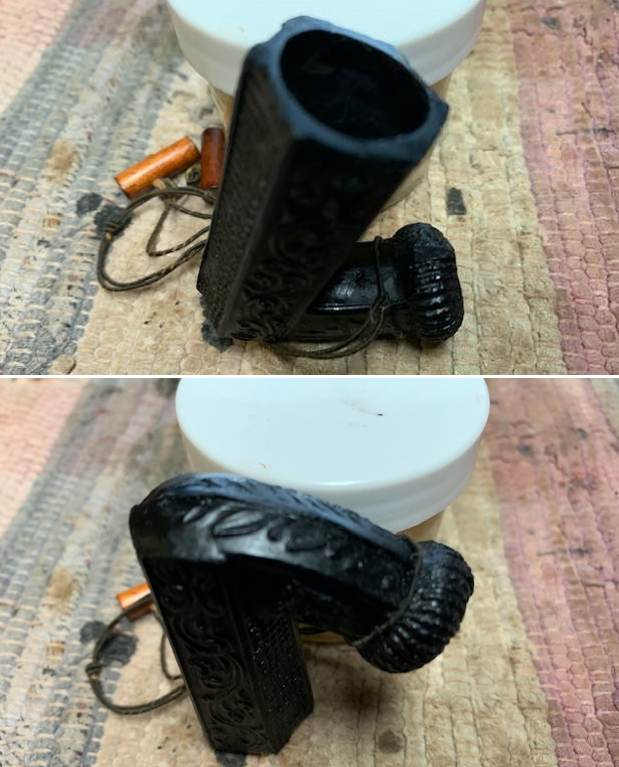
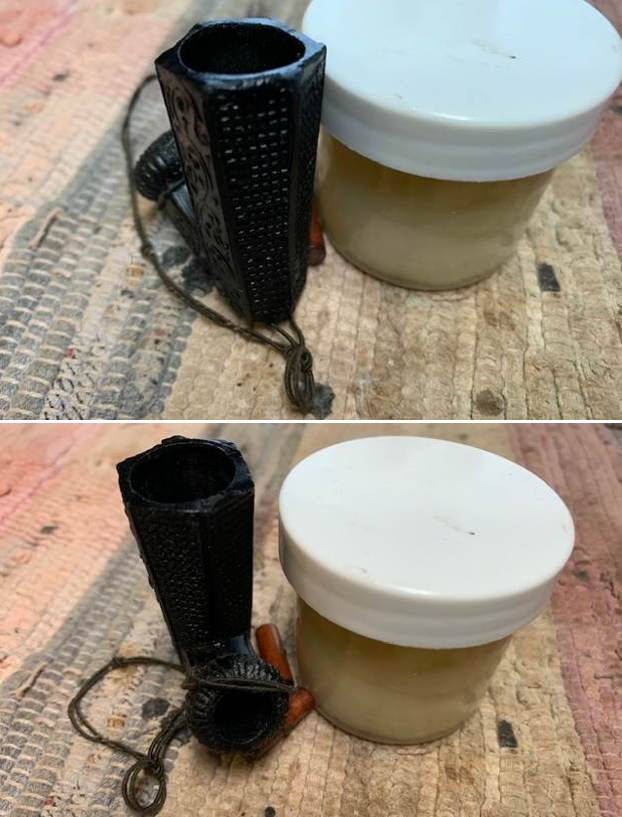
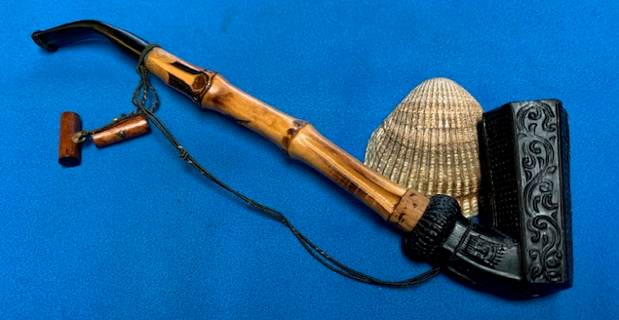
Jeff had thoroughly cleaned up the pipe. He reamed the pipe with a PipNet Pipe Reamer and cleaned up the remnants with a Savinelli Fitsall Pipe Knife.  He scrubbed the bowl with undiluted Murphy’s Oil Soap with a tooth brush. He rinsed it under running warm water to remove the soap and grime. He cleaned out the inside of the bamboo shank and the airway in the stem with alcohol, cotton swabs and pipe cleaners. He scrubbed the exterior of the stem with Soft Scrub to remove as much of the oxidation and calcification as possible. He soaked the stem in Before & After Deoxidizer and rinsed it off with warm water. I took close up photos of the bowl, rim and the stem. You can see how clean the bowl and rim top and edges are. The horn stem is in good condition with light tooth marks and some chatter as noted above.I took photos of the stamping on the sides of the shank. It is readable as noted above. I removed the stem and the shank from the clay bowl and took photos of the bowl an bamboo shank and horn stem to give a sense of the proportions of the pipe. I started my work on the pipe by working on the stem. I sanded out the tooth marks and the wrinkles on the bend on the underside of the stem sides with 220 grit sandpaper and started the polishing process with 600 grit wet dry sandpaper. I was able to polish horn stem and the shaved portion of the bamboo with micromesh sanding pads – 1500-12000 grit pads. I wiped it down with a damp cloth after each sanding pad. I used Before & After Pipe Polish – both Fine and Extra Fine to further polish the stem. I worked some Before & After Restoration Balm into the horn stem and also the Bamboo. I worked it in with my fingertips and a shoe brush. I let it sit and absorb into the surface of both. I buffed it off with a soft cloth. The Bamboo and the stem came alive. I worked some Vaseline Petroleum Jelly into the cork plug that fit on the end of the shank. It enables a snug fit of the shank in the clay bowl. The Vaseline softens the cork and gives it more flexibility and give.I laid the Bamboo shank and stem aside to let the Vaseline absorb into the cork.While it was sitting I turned m attention back to the bowl. I touched up the white spots on black bowl and shank with a black stain pen to blend it into the rest of the clay bowl. It looked much better. I rubbed the clay bowl down with Before & After Restoration Balm. I worked it into the surface of the clay with my finger tips. I worked it into the stampings on the clay bowl and shank sides with a shoe brush. I let it sit for 10 minutes and the Balm did its magic. It enlivens, cleans and preserves a pipe. It certainly brought this bowl back to life. I buffed it off with a clean cloth and took the following photos. This Lama Viennese Coffeehouse Pipe with a Bamboo Shank and horn stem is a great looking pipe now that it has been restored. The beautiful finish really highlights the grain and the polished finish is stunning. I put the stem back on the bowl and carefully buffed the pipe with Blue Diamond on the buffing wheel. I gave the bowl and the stem multiple coats of carnauba wax on the buffing wheel and followed that by buffing the entire pipe with a clean buffing pad. I hand buffed the pipe with a microfiber cloth to deepen the shine. The finished Lama Viennese Coffeehouse Pipe fits nicely in the hand and feels great. Give the finished pipe a look in the photos below. Once again the dimensions are as follows – Length: 7 ½ inches, Height: 2 inches, Outside diameter of the bowl: 7/8 inches, Chamber diameter: ¾ of an inch. The weight of the pipe is 40 grams / 1.41 ounces. I plan on holding on to this unique piece of history so that I can enjoy a transport back in time to Vienna. I will enjoy a bowl of tobacco while time traveling. Thanks for reading this blog and my reflections on the pipe while I worked on it.

Another Interesting Clean up of an Imported Briar KLEENEST Filter Billiard


Blog by Steve Laug

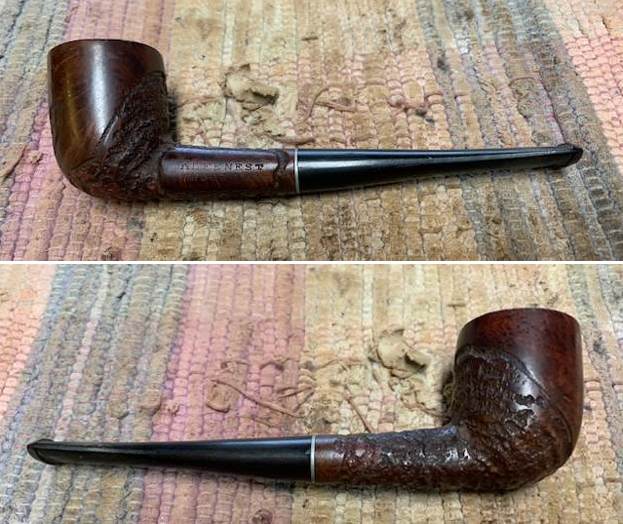
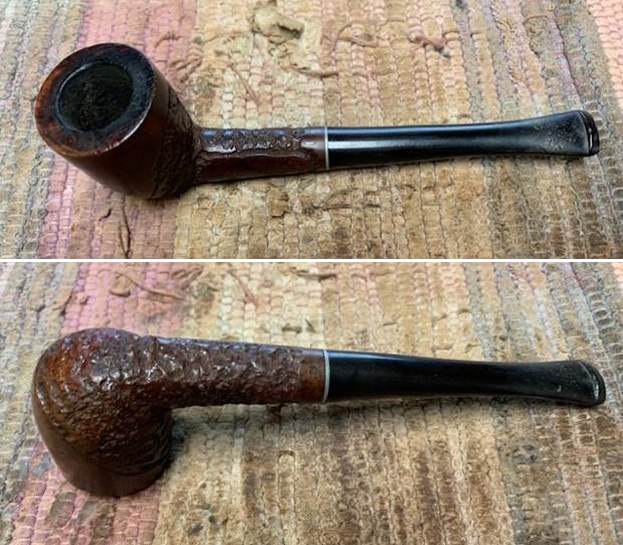
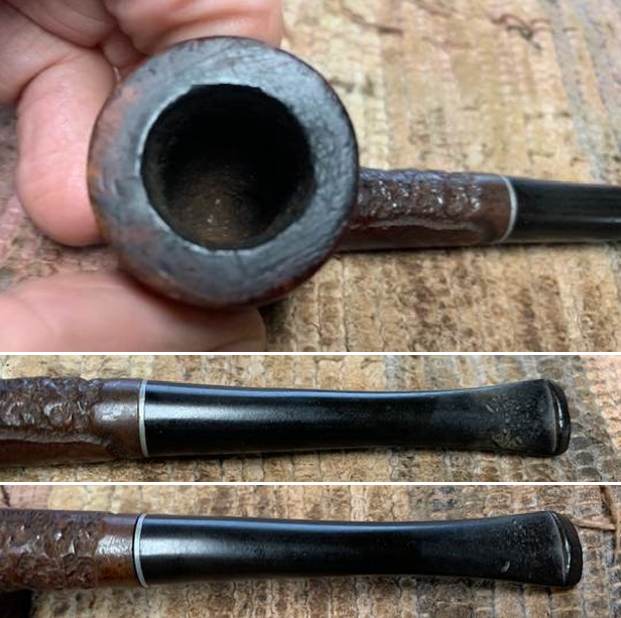
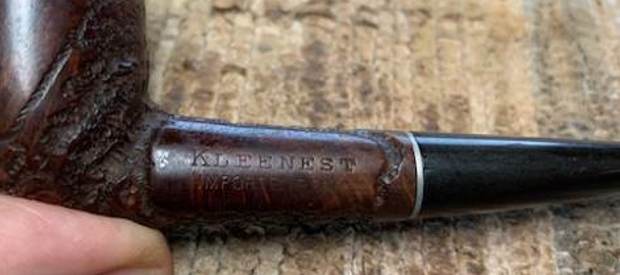
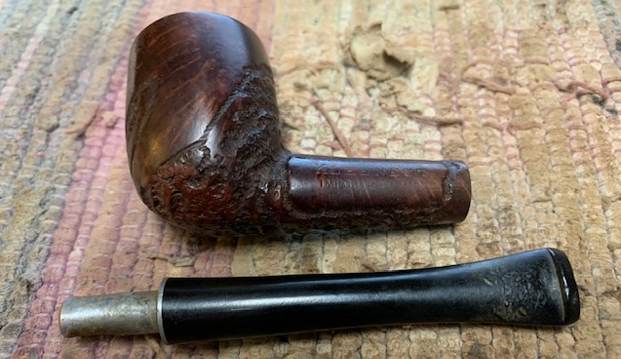
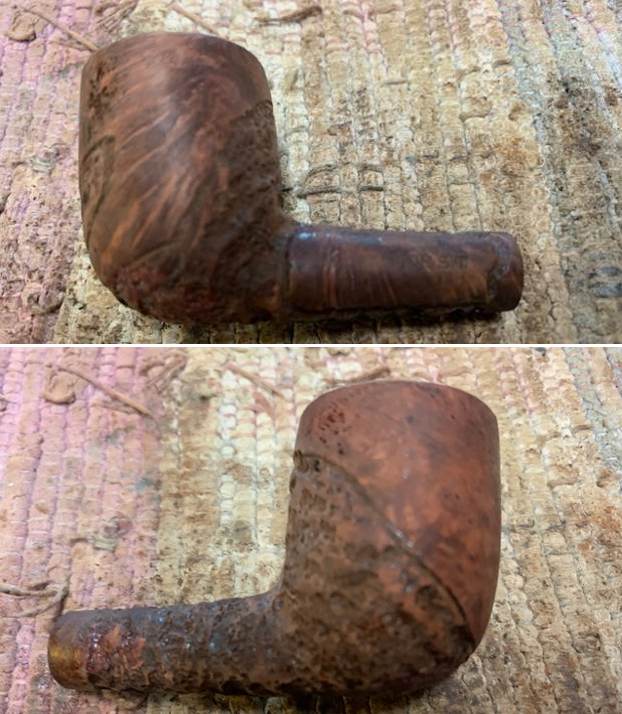
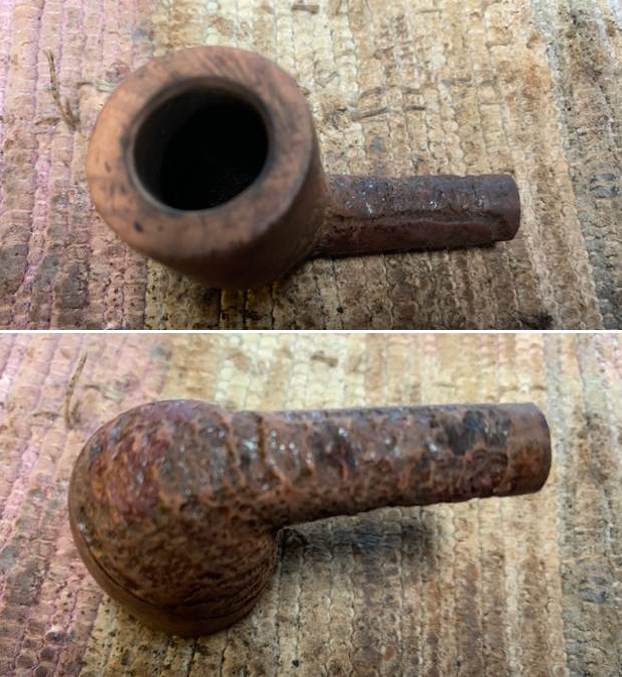
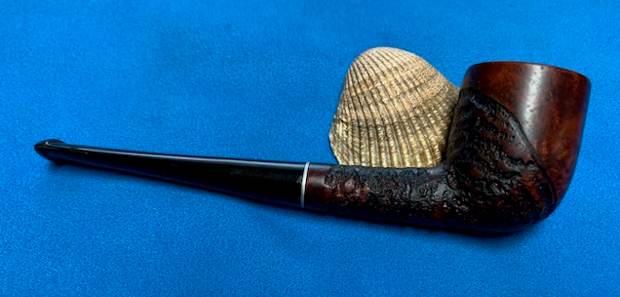
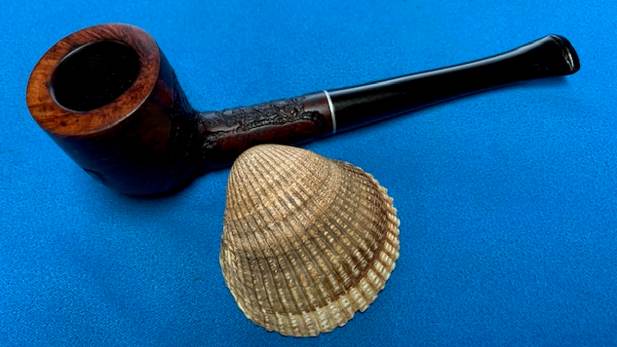
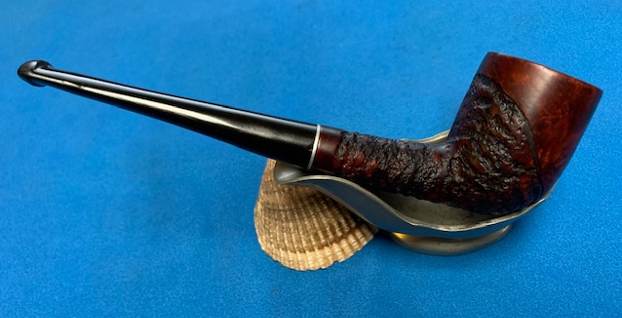
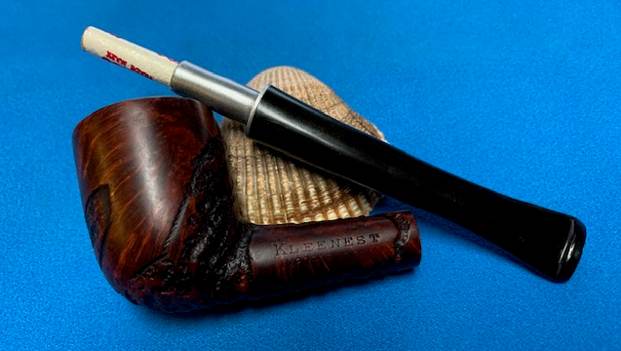
The next pipe on my table was second pipe from threesome sent to for work from a fellow in Eastern Canada. This one is a partially rusticated Billiard. I found that it is stamped on the left side and read KLEENEST [over] Imported Briar. The bowl had a light cake and there was some lava and darkening on the back rim top and edge of the bowl. The bowl was slightly out of round from reaming. The finish was dark, dirty and oily feeling and the briar was semi rusticated. The lower half of the bowl and the shank were rusticated and there was a carved leaf on the front of the bowl above the rustication. The rest of the bowl was smooth. The stem is probably vulcanite and has a Medico style tenon that fits a 6MM filter. There were tooth marks and tooth chatter on both sides of the stem ahead of the button and on the surface. There is no stamping on the stem. I took photos of the pipe before I started my work on it. I took photos of the bowl and rim top to show what they looked like before I started my clean up. I also took some of the stem to show the condition of both sides. The stamping on the sides of the shank are shown in the photos below. They are clear and readable as noted above.I removed the stem from the shank and took a photo of them to show the perspective on the pipe. You can see the burn marks on the bowl and shank and the scratches and fills in the briar.I googled the brand and found a gallery of pipes marked KLEENEST Imported Briar. Here is the link(https://pipes.collectionhero.com/outer/gallery_listings.php?keyword=Kleenest+#google_vignette).

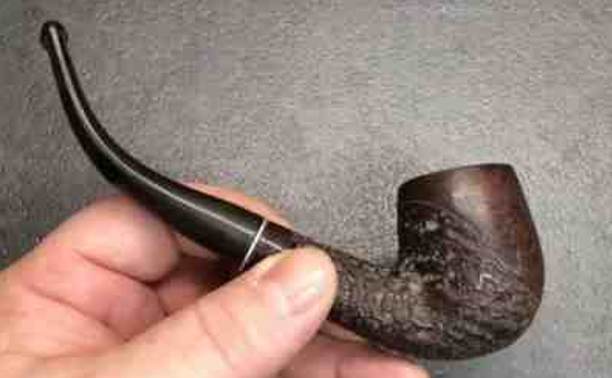
In the pipes listed in the gallery there were ties to Kaywoodie, Medico, Grabow and some were stamped France and other Italy. The metal tenon in the shank reminds me very much of both a Grabow and a Medico pipe. The pipe photo I am including below has a similar style spacer and stem on a bowl that has the same style rustication finish. The description on the site is as follows:

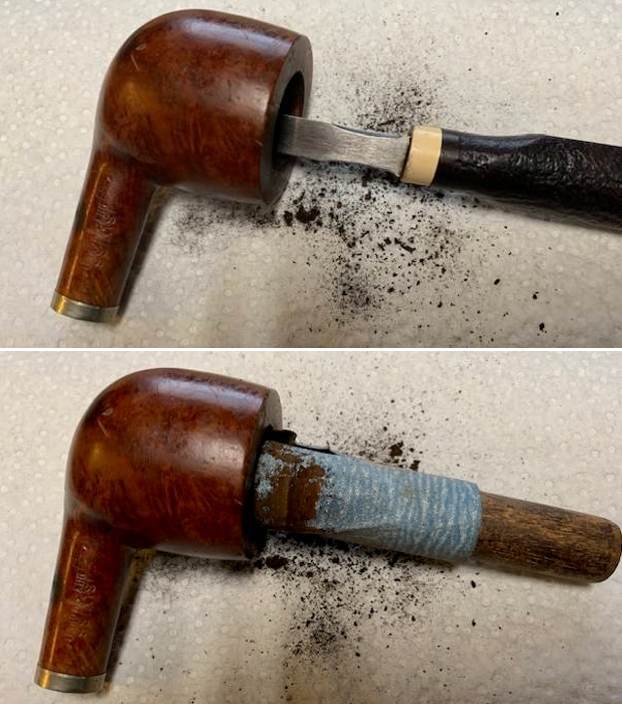
RARE 1950s/60s KLEENEST … RARE 1950s/60s KLEENEST BRIAR Italy TOBACCO PIPEArmed with the information that I found online I turned my attention to the clean up of the pipe itself. I reamed out the remaining cake in the bowl with a PipNet pipe reamer and took the cake back to bare briar. I cleaned up the remnants in the bowl with a Savinelli Fitsall Pipe Knife. I finished the interior of the bowl with a piece of dowel wrapped in 220 grit sandpaper. The bowl looked very good with no damage or checking on the walls. I used a piece of 220 grit sandpaper to bring the bowl back into round. I cleaned off the rim top at the same time. It looked much better.

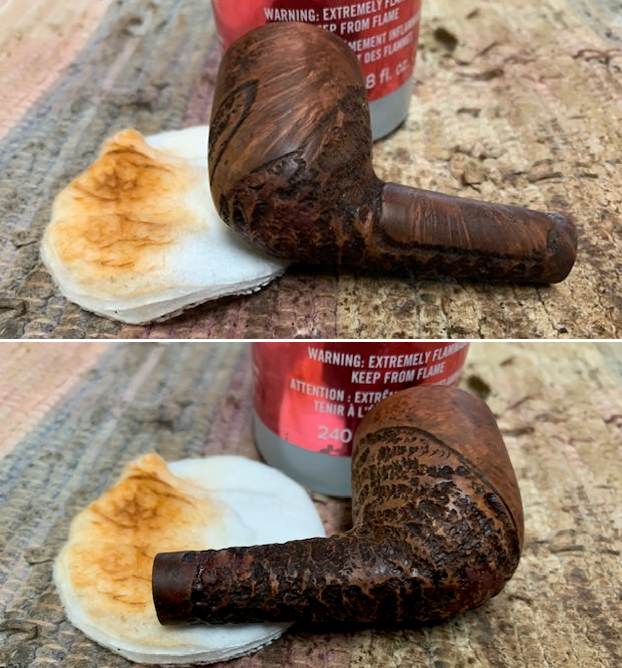
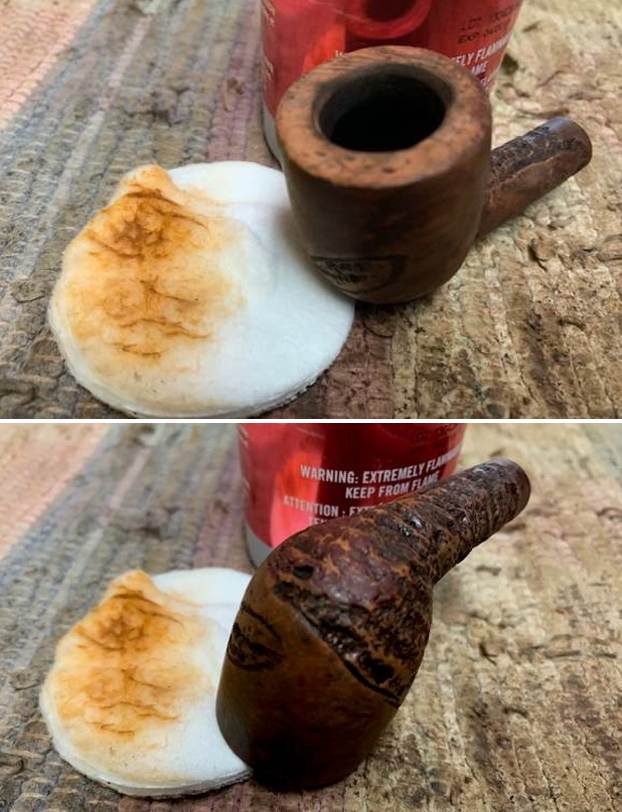
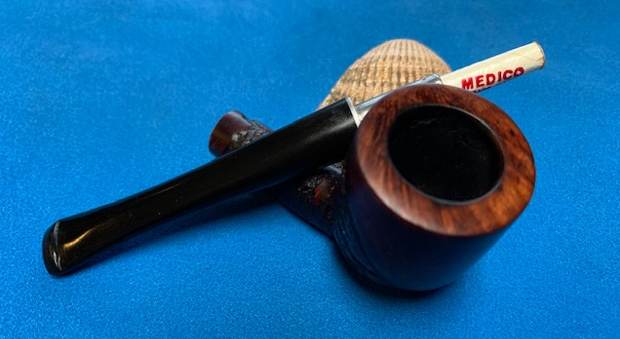
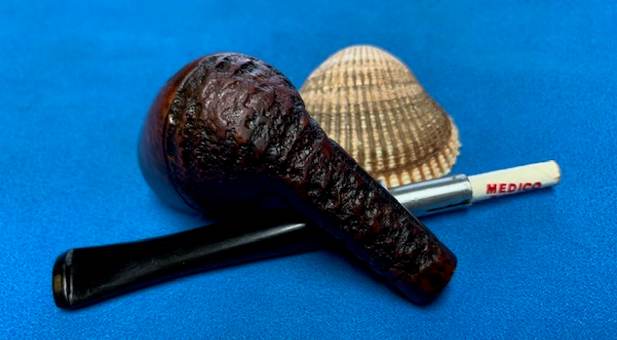
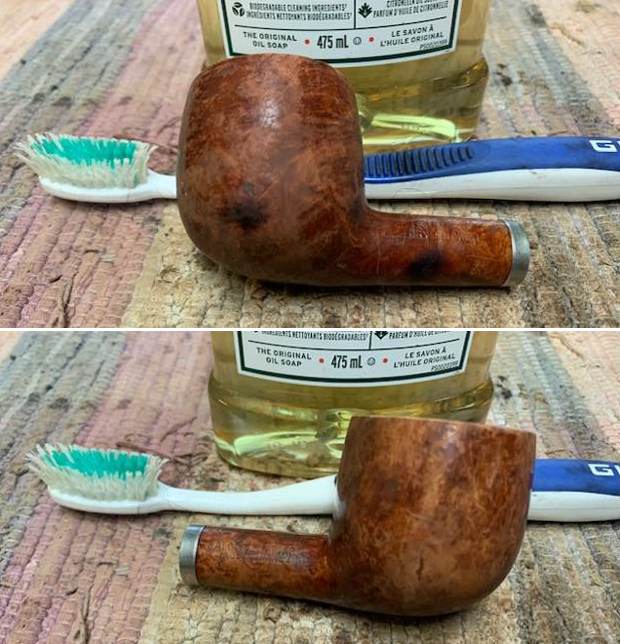
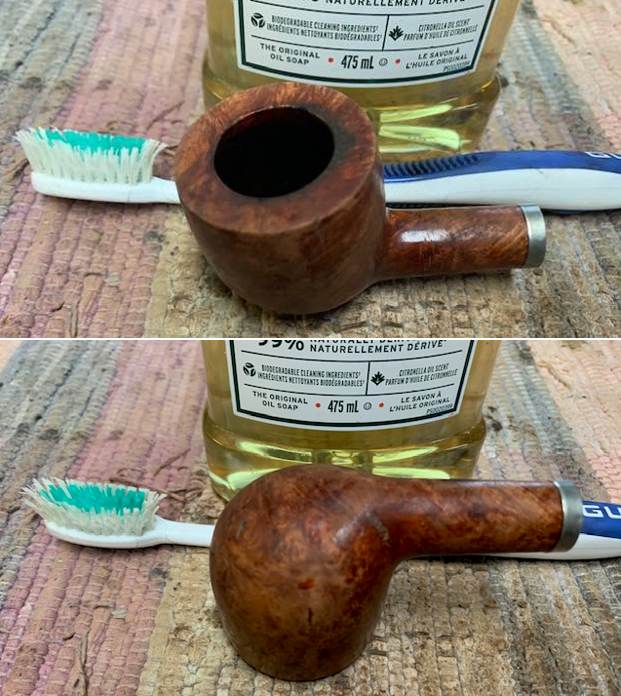
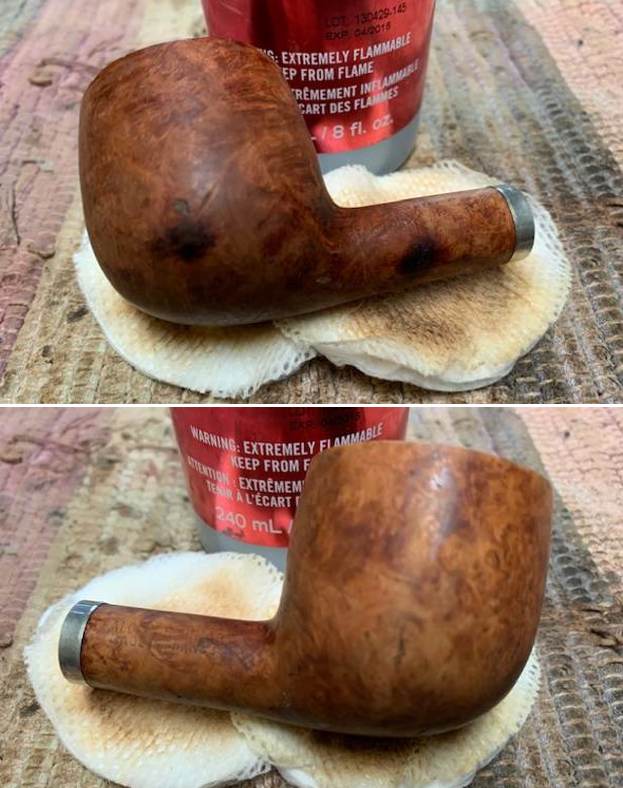
I scrubbed the externals of the bowl with a tooth brush and undiluted Murphy’s Oil Soap. I worked over the bowl and the rim top. I rinsed with warm water to remove the debris and the soap. Once I dried it off you can see that there were still remnants of varnish on the briar that I would need to remove. You can see the sparkles of varnish on the photos above. It is both on the smooth portion of the bowl and the rusticated portion. I wiped the briar down with acetone on cotton pads to remove the varnish coat and clean off the briar. With the varnish removed you can see the burn marks on the right side of the bowl and the shank. I dried it off and took photos of it at this point in the process. There is some nice looking grain around the bowl and the rustication is quite rugged. The clean bowl and shank looks very good. I cleaned the airway and mortise in the shank and the tube airway in the stem until they were very clean. I polished the briar with micromesh sanding pads – dry sanding with 1500-12000 grit pads. I wiped the bowl down after each  pad to remove the grit. The bowl began to take on a rich shine. The briar took on a newer, richer look.   I rubbed the bowl down with Before & After Restoration Balm. I worked it into the briar with my finger tips and into the rusticated portion with a shoe brush. I let it sit for 10 minutes and the Balm did its magic. It enlivens, cleans and preserves the briar. It certainly brought this bowl back to life. I buffed it off with a clean cloth and took the following photos. I set the bowl aside and turned my attention to the stem. I “painted” the stem surface carefully with the flame of a lighter to try and lift the tooth marks. They lifted slightly. I filled in the marks that remained with clear CA glue. When the repairs cured I used a small file to reshape the button edge and flatten out the repairs. I sanded the repairs 220 grit sandpaper to blend them into the surface. I started the polishing process with 600 grit wet dry sandpaper. I polished the stem with micromesh sanding pads – 1500-12000 grit pads. I wiped it down with a damp cloth after each sanding pad. I used Before & After Pipe Polish – both Fine and Extra Fine to further polish the stem. I fit the stem with a paper Medico Filter in the metal tenon in the stem. It fit the tenon and into the shank and provided the smoker with a dry smoke.This Kleenest Imported Briar Filter Billiard is an interesting looking pipe now that it has been restored. The smooth portion of the finish highlights the grain and rustic portion gives a tactile sense to the pipe. I put the stem back on the bowl and carefully buffed the pipe with Blue Diamond on the buffing wheel. I gave the bowl and the stem multiple coats of carnauba wax on the buffing wheel and followed that by buffing the entire pipe with a clean buffing pad. I hand buffed the pipe with a microfiber cloth to deepen the shine. The finished Kleenest Filter Billiard fits nicely in the hand and feels great. Give the finished pipe a look in the photos below. The dimensions of the pipe are Length: 5 ¾ inches, Height: 1 ½ inches, Outside diameter of the bowl: 1 ½ inches, Chamber diameter: 7/8 of an inch. The weight of the pipe is 50 grams/1.76 ounces. I have one more pipe for this Eastern Canada Pipeman to work on. Once I have finished all three I will be sending them back to him to enjoy. Thanks for reading this blog and my reflections on the pipe while I worked on it.

An Interesting Clean up of a French Made Swiss Dry-Smoker Pot


Blog by Steve Laug

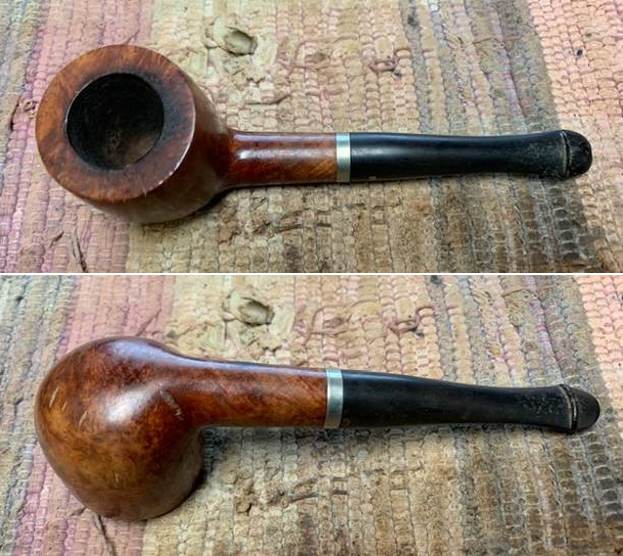
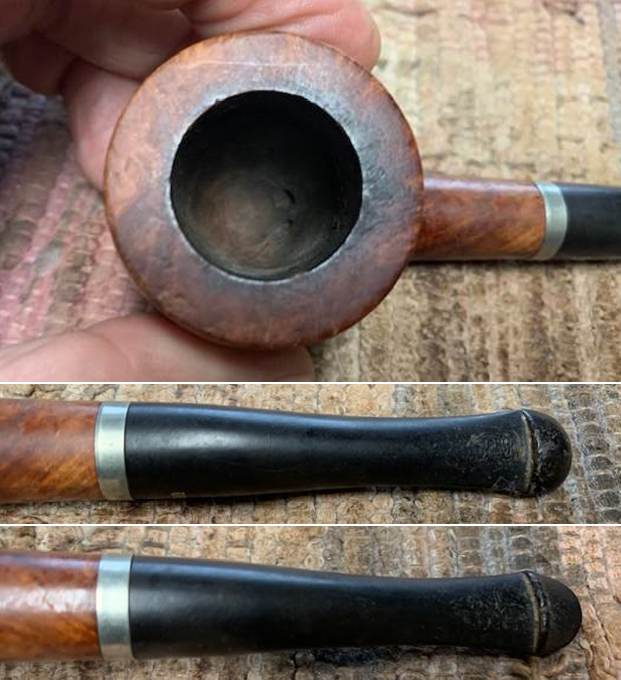
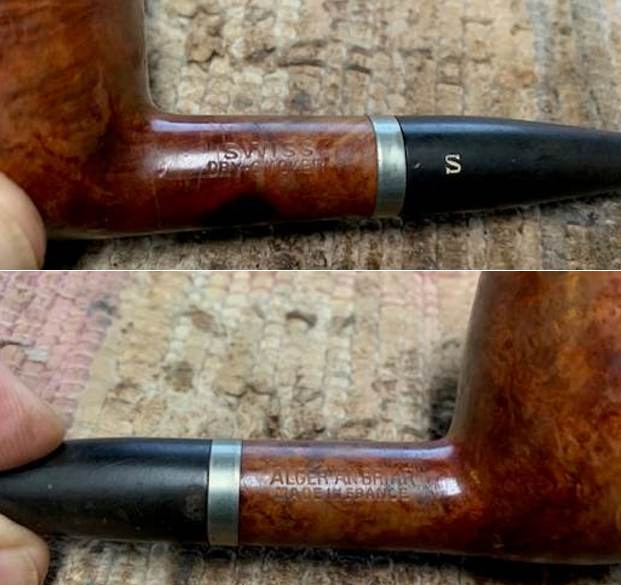
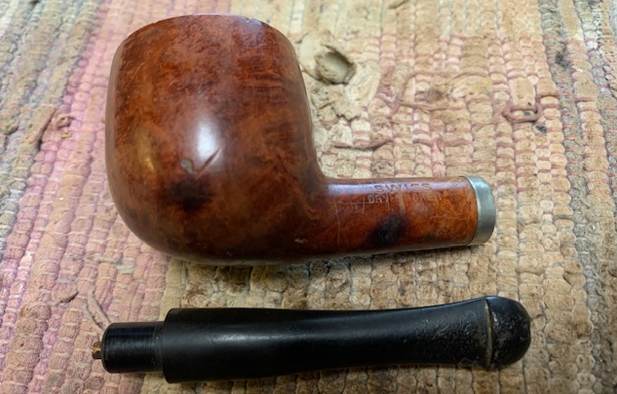
The next pipe on my table was part of threesome sent to for work from a fellow in Eastern Canada. This one is a pot shaped one that on first glance I thought was a Peterson’s Shamrock. This morning when I brought it to the table and examined it I found that it was not a Shamrock or a Peterson Product at all. Rather, it is stamped on the left side and read Swiss [over] Dry-Smoker. On the right side it reads Algerian Briar [over] Made in France. The bowl had a light cake and there was some darkening on the back rim top and edge of the bowl. There was some peeling varnish on the exterior of the bowl and shank. There were also burn marks on the left side of the bowl toward the front and on the left underside of the shank. The bowl had several grey putty fills on the heel of the bowl and on the right side at the shank bowl junction. They do not look deep but they are present in the finish. The shank end has a nickel ferrule. Looking inside the shank and the bowl were two airway entries at the bottom of the bowl and twin aluminum tubes in the end of the mortise. The stem is vulcanite and has a faux P-lip with the exit of the airway at the end of the button rather than on top. There were tooth marks and tooth chatter on both side of the stem ahead of the button and on the surface. It is stamped with an S on the left side of the taper stem. I took photos of the pipe before I started my work on it. I took photos of the bowl and rim top to show what they looked like before I started my clean up. I also took some of the stem to show the condition of both sides. The stamping on the sides of the shank are shown in the photos below. They are clear and readable as noted above.I removed the stem from the shank and took a photo of them to show the perspective on the pipe. You can see the burn marks on the bowl and shank and the scratches and fills in the briar.I turned to Pipephil’s site to see what I could learn about the French made Algerian Briar, Swiss Dry-Smoker brand (http://pipephil.eu/logos/en/logo-s14.html). I found the listing there but little background information on it.I followed a link at the bottom of the listing to a section on the shape and design of the stem (http://pipephil.eu/logos/en/infos/p-lip-en.html). It is noted as a Swiss brand but is clearly stamped Made in France. I have included a screen capture of the section below.I googled the brand and found a discussion on Pipesmagazine.com about the Swiss Dry- Smoker (https://pipesmagazine.com/forums/threads/swiss-brand-pipes.1986/). In a thread there I found this information as well as a link to a Patent file.

Jun 27, 2014  I recently obtained a SWISS Dry Smoker myself. Its construction is along the line of the Peterson, however the “Well” is not like a Peterson nor the WDC Well System or the Kaywoodie/Yello Bole Chesterfield’s. It has what appears to be a brass tube with a slot that allows the moisture to be collected into it. This tube is aprox 1/8 diameter and seems to be about 3/4″ deep. The stem tip looks on the exterior like a P-Lip but the hole comes out straight and not towards the roof of the mouth.

More on this later with pics. I did find this Patent which may be related.
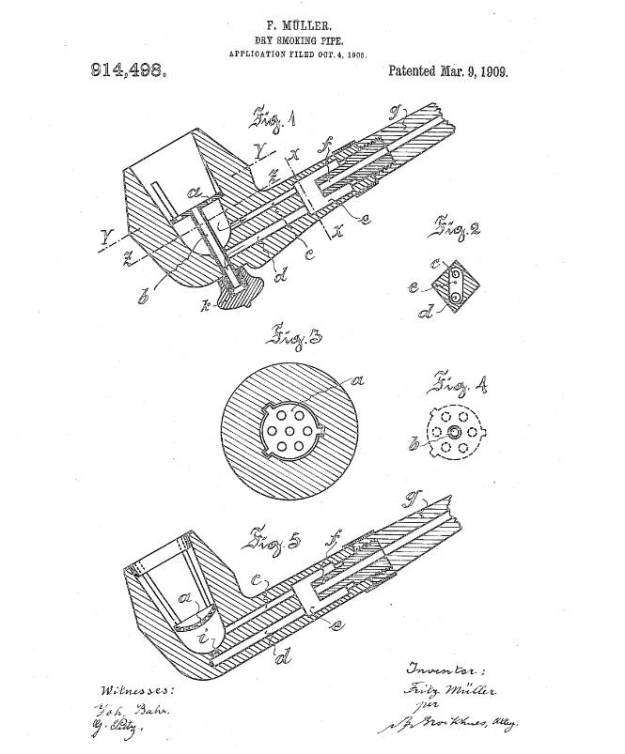
DRY SMOKING PIPE

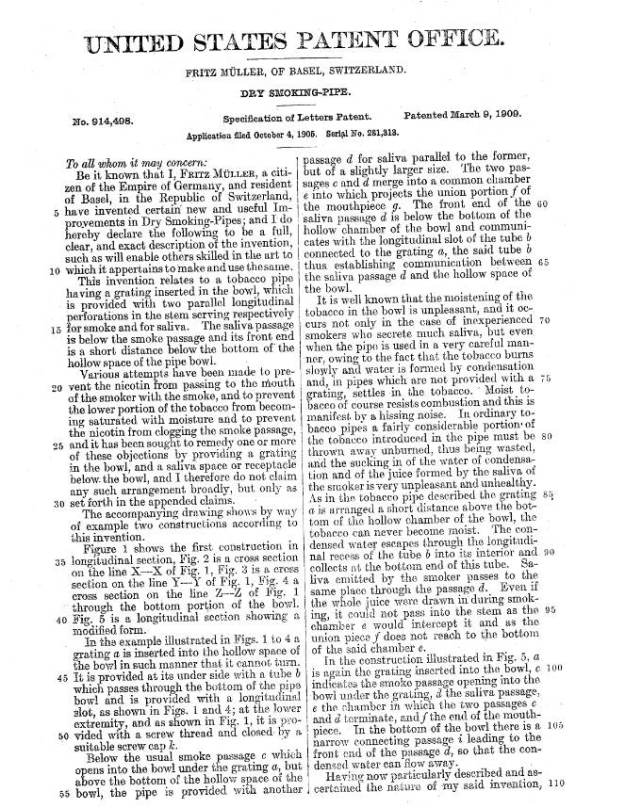
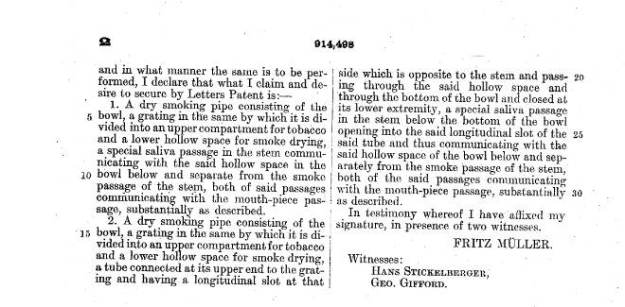
I followed the Patent information link and found the application for a similar looking pipe from 1909. I am including that information and drawing below. (https://patentimages.storage.googleapis.com/54/b4/bd/6175f3f8539de1/US914498.pdf). I don’t believe the pipe I am working on is related to this one in other than the similar two air holes entering the bowl and the single brass line in the stem. The rest of the apparatus is not present in this pipe. Armed with the information that I found online I turned my attention to the clean up of the pipe itself. I reamed out the remaining cake in the bowl with a PipNet pipe reamer and took the cake back to bare briar. I cleaned up the remnants in the bowl with a Savinelli Fitsall Pipe Knife. I finished the interior of the bowl with a piece of dowel wrapped in 220 grit sandpaper. The bowl looked very good with no damage or checking on the walls. I scrubbed the externals of the bowl with a tooth brush and undiluted Murphy’s Oil Soap. I worked over the bowl and the rim top. I rinsed with warm water to remove the debris and the soap. Once I dried it off you can see that there were still remnants of varnish on the briar that I would need to remove. I wiped the briar down with acetone on cotton pads to remove the varnish coat and clean off the briar. With the varnish removed you can see the burn marks on the right side of the bowl and the shank. I used some 220 grit sandpaper to sand out the dark burn spots on the bowl and shank. I was able to significantly reduce them with the process. I sanded the darkening on the inner edge and the rim top to remove that damage. The photos of the bowl and shank to show the bowl at this point. I cleaned the airway and mortise in the shank and the tube airway in the stem until they were very clean. I filled in the shrunken fills on the bowl and shank with clear super glue. I set it aside for the fills to cure. Once it hardened I sanded them with a folded piece of 220 grit sandpaper. I polished the briar with micromesh sanding pads – dry sanding with 1500-12000 grit pads. I wiped the bowl down after each  pad to remove the grit. The bowl began to take on a rich shine. The briar took on a newer, richer look.   I rubbed the bowl down with Before & After Restoration Balm. I worked it into the briar with my finger tips. I let it sit for 10 minutes and the Balm did its magic. It enlivens, cleans and preserves the briar. It certainly brought this bowl back to life. I buffed it off with a clean cloth and took the following photos. I set the bowl aside and turned my attention to the stem. I sanded out the tooth marks and some scratches in the stem sides with 220 grit sandpaper and started the polishing process with 600 grit wet dry sandpaper.I polished the stem with micromesh sanding pads – dry sanding with 1500-12000 grit pads. I wiped it down with a damp cloth after each sanding pad. I used Before & After Pipe Polish – both Fine and Extra Fine to further polish the stem. This Made in France Algerian Briar Swiss Dry-Smoker Pot is a good looking pipe now that it has been restored. The finish both highlights the grain and hides the fills. I put the stem back on the bowl and carefully buffed the pipe with Blue Diamond on the buffing wheel. I gave the bowl and the stem multiple coats of carnauba wax on the buffing wheel and followed that by buffing the entire pipe with a clean buffing pad. I hand buffed the pipe with a microfiber cloth to deepen the shine. The finished Swiss Dry-Smoker Pot fits nicely in the hand and feels great. Give the finished pipe a look in the photos below. The dimensions of the pipe are Length: 5 ¾ inches, Height: 1 ½ inches, Outside diameter of the bowl: 1 ½ inches, Chamber diameter: 7/8 of an inch. The weight of the pipe is 50 grams/1.76 ounces. I have two more pipes for this Eastern Canada Pipeman to work on. Once I have finished all three I will be sending them back to him to enjoy. Thanks for reading this blog and my reflections on the pipe while I worked on it.

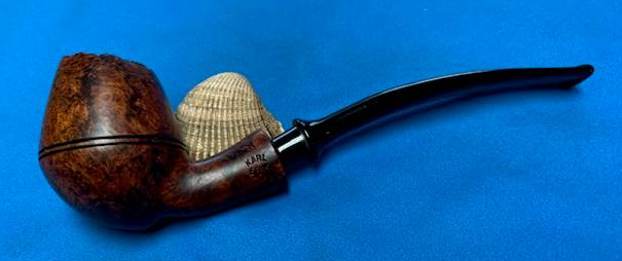
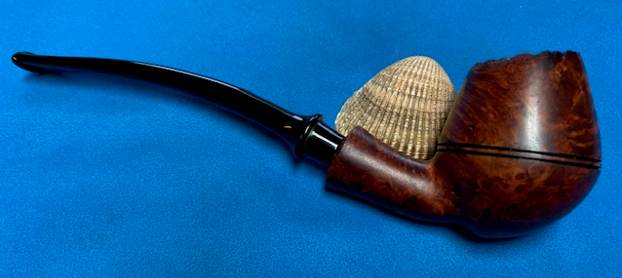
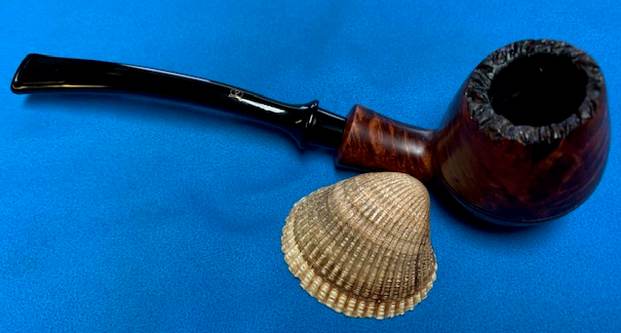
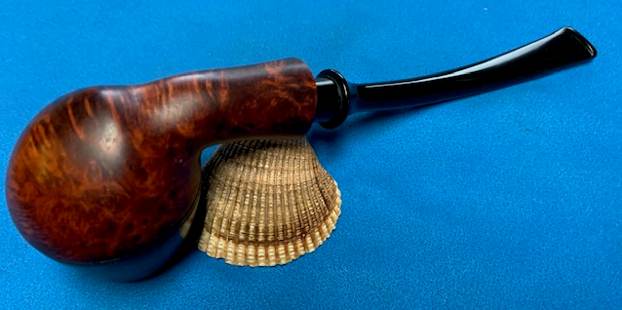
Restoring a Karl Erik Classic Diamond Shank Brandy


Blog by Steve Laug

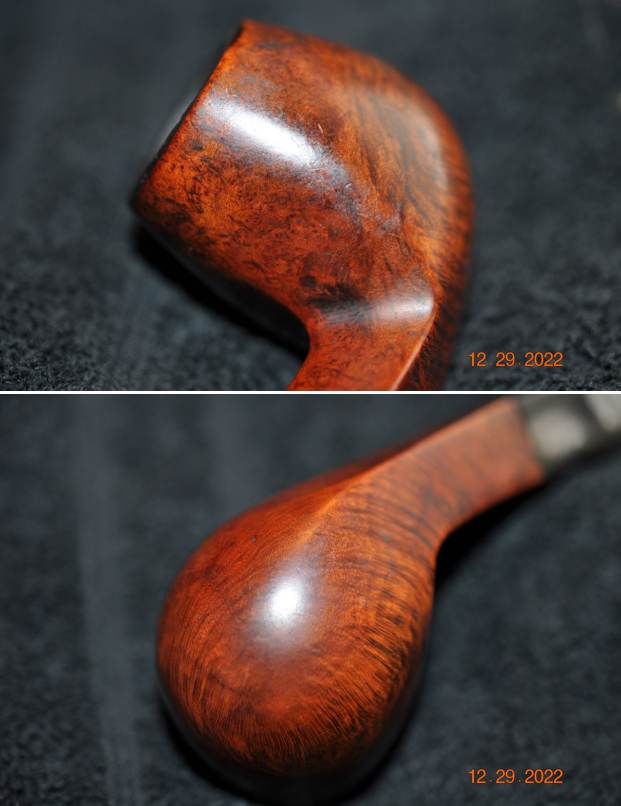
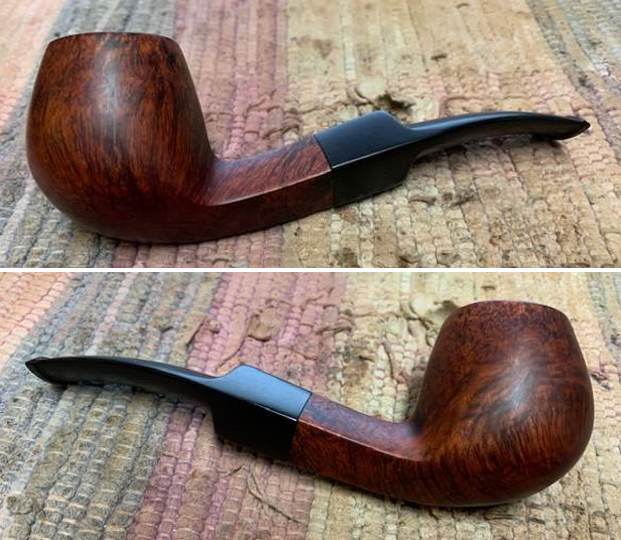
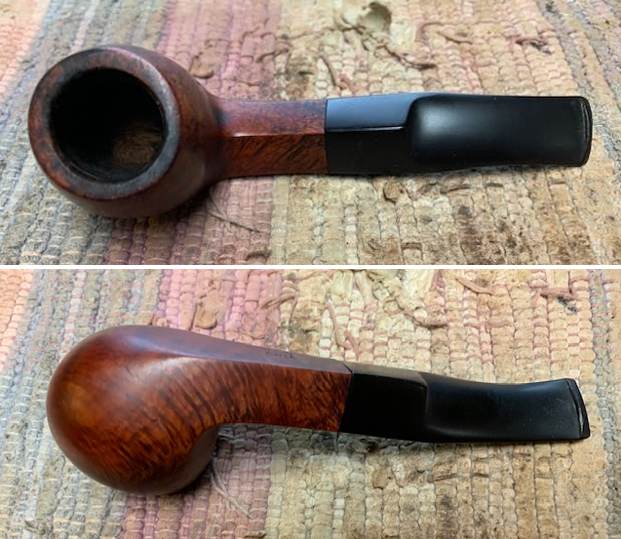
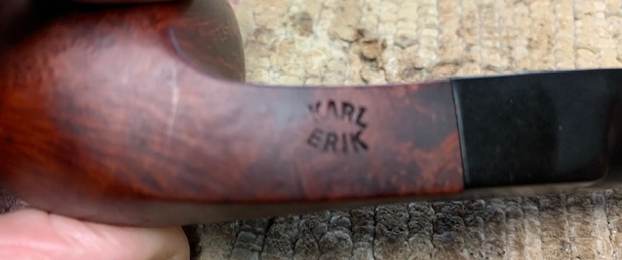
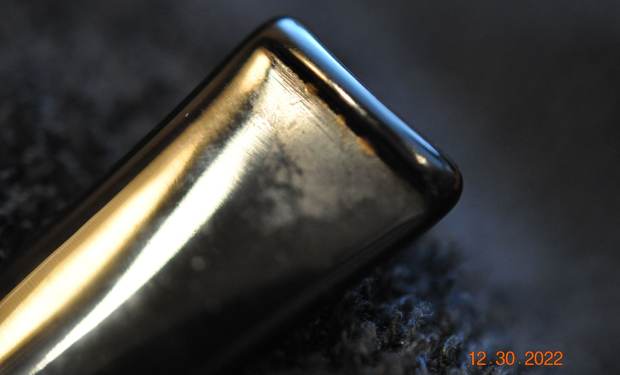
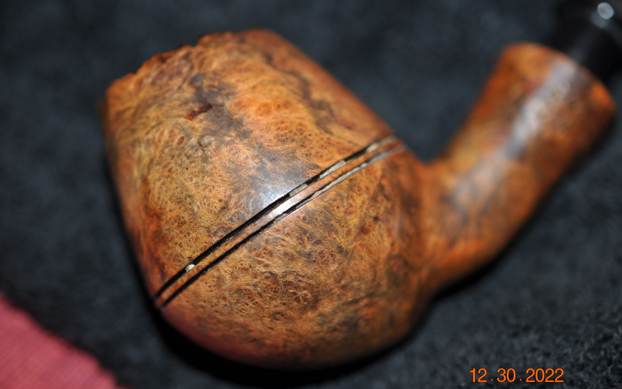
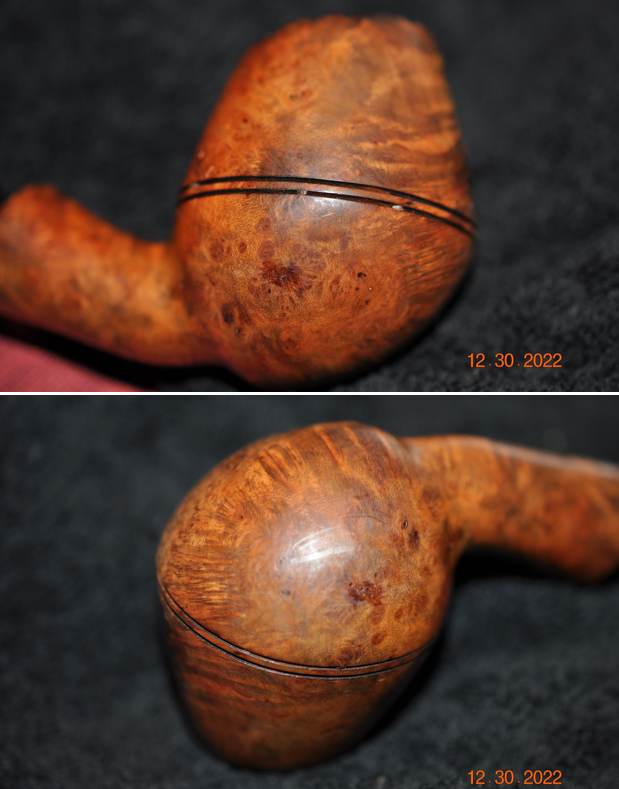
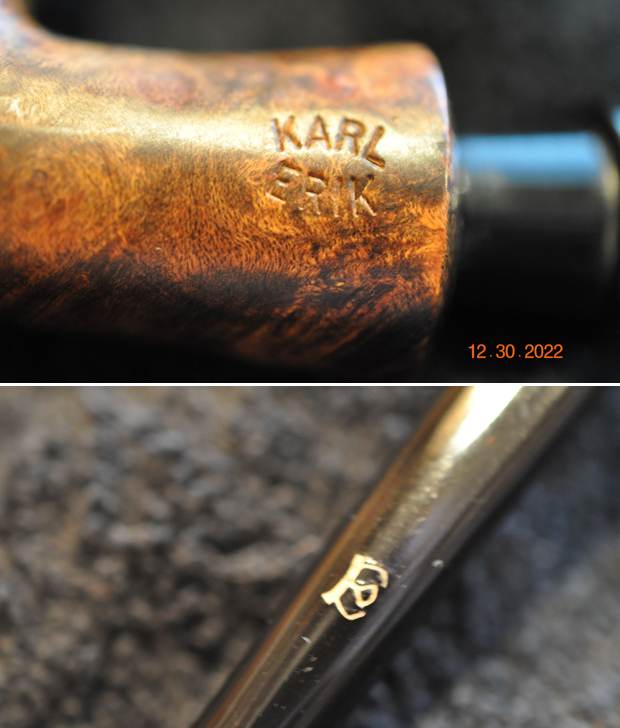
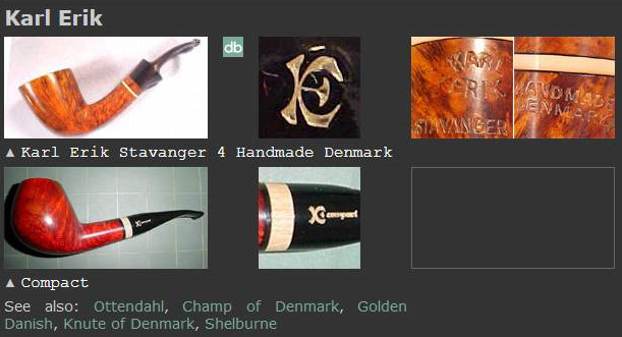
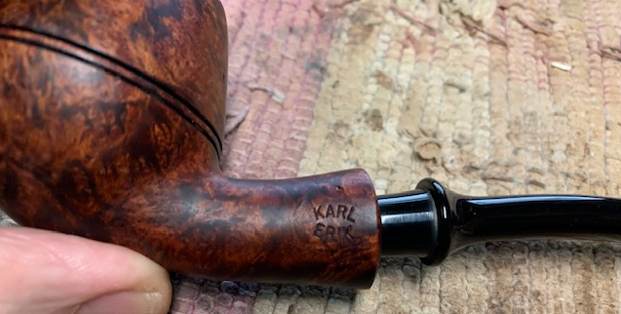
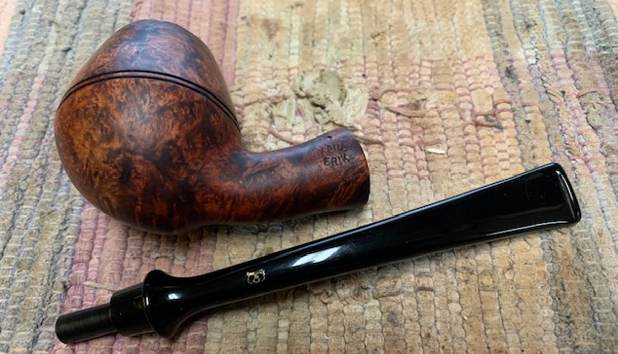
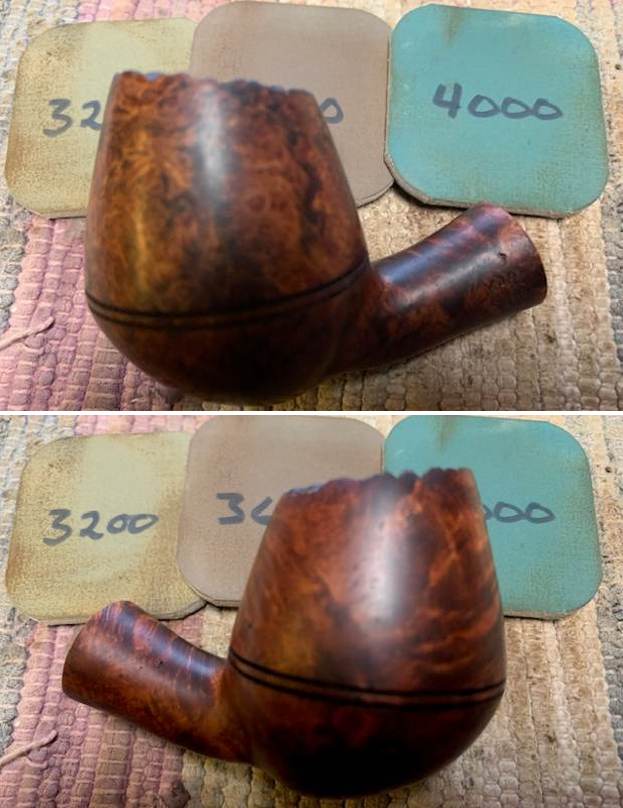
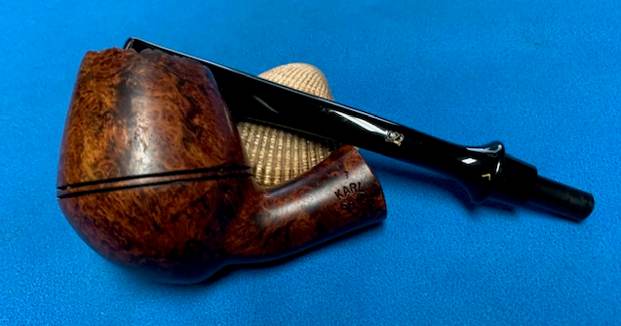
This cool Saturday afternoon I decided to work on was another one that was purchased on 11/14/2022 in a lot of pipes that came to us from Copenhagen, Denmark  It is an interesting pipe with a shape that combines both a classic Brandy bowl with a diamond shank. The grain around both  is an interesting mixture. The pipe is stamped on the left underside of the shank and reads Karl [arched over] Erik. The pipe was a well used pipe when Jeff received it. There was dust and grime ground into the finish. The mixture of brown and black stains highlights some beautiful grain under the dirt. The bowl was heavily caked and there was an overflow of lava on the rim top. The inner edge was hard to see clearly and the lava could easily be hiding damage. The stem is vulcanite and was oxidized and dirty with light tooth marks and chatter on both sides ahead of the button and on the button itself. It has an interesting flair to the saddle portion of the stem that is characteristically Danish. Jeff took photos of the pipe before he started his clean up work on it. He took photos of the bowl and rim top to show what they looked like before his clean up. He also took some of the stem to show the condition of both sides. The photos of the sides and heel of the bowl show the uniquely stained grain around the bowl and shank. The mixture of black and brown stains adds depth finish on the pipe. Even under the grime it is a real beauty. The stamping on the left side the shank is shown in the photos below. It is clear and readable as noted above.Before I started my work on the pipe I wanted to see if I could find any information that would help me date this pipe and get a sense of the line. I turned to Pipephil to get a quick review of the brand (http://pipephil.eu/logos/en/logo-k1.html). The stamp on the stem shown in the photo below is different than the one I am working on. It includeds a K and an E while this one is just an E stamp. I have included a screen capture of the brand info there as well as a note in the side bar about Karl Erik Ottendahl along with a small picture.Brand created in 1965-66 by Karl Erik Ottendahl (1942 – 2004 †). In the best years he employed up to 15 craftsmen among which Bent Nielsen (see Benner) and Peder Christian Jeppesen. Former grading (ascending): from 4 to 1, and “Ekstravagant” (entirely hand made)

I then turned to Pipedia (https://pipedia.org/wiki/Karl_Erik) for more information. I am including just the opening remarks but would encourage you to give the link a read for a very interesting history of the brand. I quote:

Karl Erik Ottendahl (1942 – 2004) was born in Aalborg (Jutland), just a few miles from the very northernmost tip of Denmark. He began smoking a pipe when he was 14 and upon leaving school he started an apprenticeship in the craft as a lithographer at the age of 16.

While working as an apprentice he began hand carving pipes as a hobby. Many were given as gifts to his more senior colleagues. Upon completion of his apprenticeship he moved to Nairobi, Kenya to work as a lithographer during the 1962 war. While in that war torn country, he was unable to procure pipes for himself. In the face of such a predicament, he chose to continue to make pipes for his own use rather than go without.

Returning to Denmark after three years he couldn’t find a well paid occupation in his job, and so he began making a few pipes on the side to boost his income choosing his prenames “Karl Erik” – logo “KE” – for his label. When he managed to find some major Copenhagen pipe stores willing to sell his pieces his reputation grew little by little and he was finally able to purchase more and better machinery and began working full time as a pipe maker.

With that information in hand I knew what I was dealing with in terms of the stamping and the age of this pipe. I knew from the information that the pipe was made sometime between 1965 and 2004. Now it was time to work on the pipe.

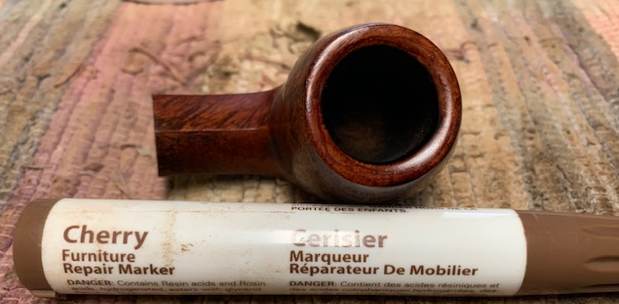
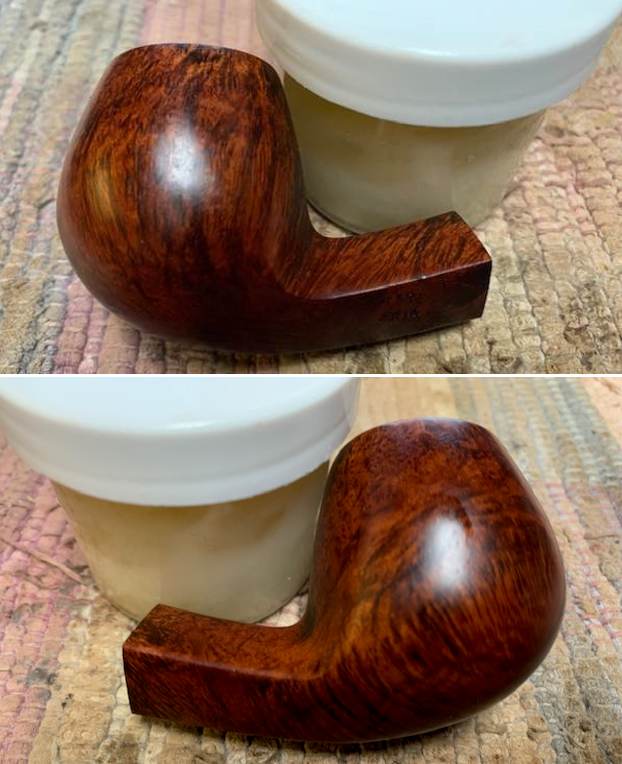
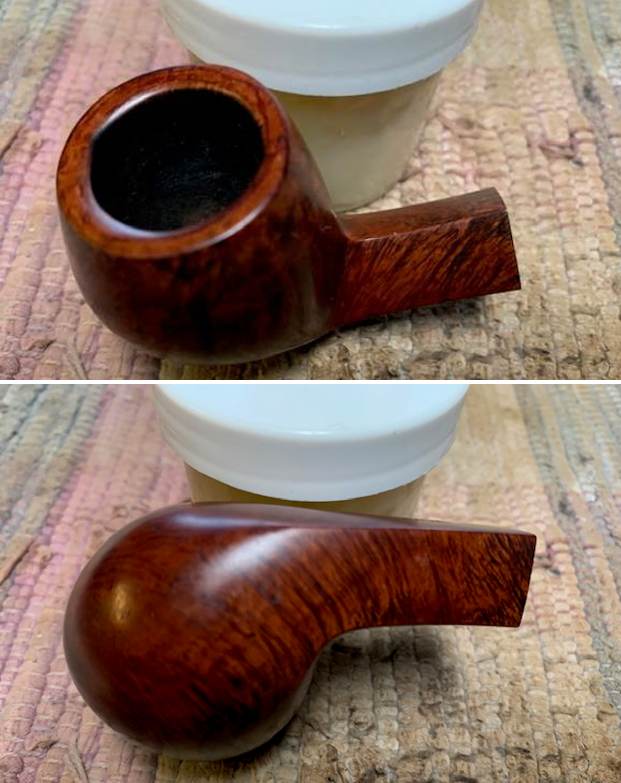
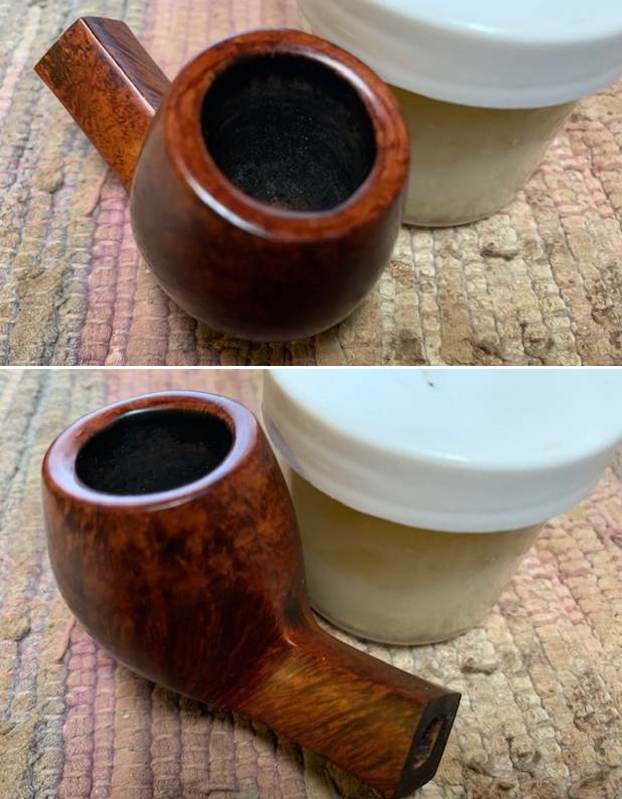
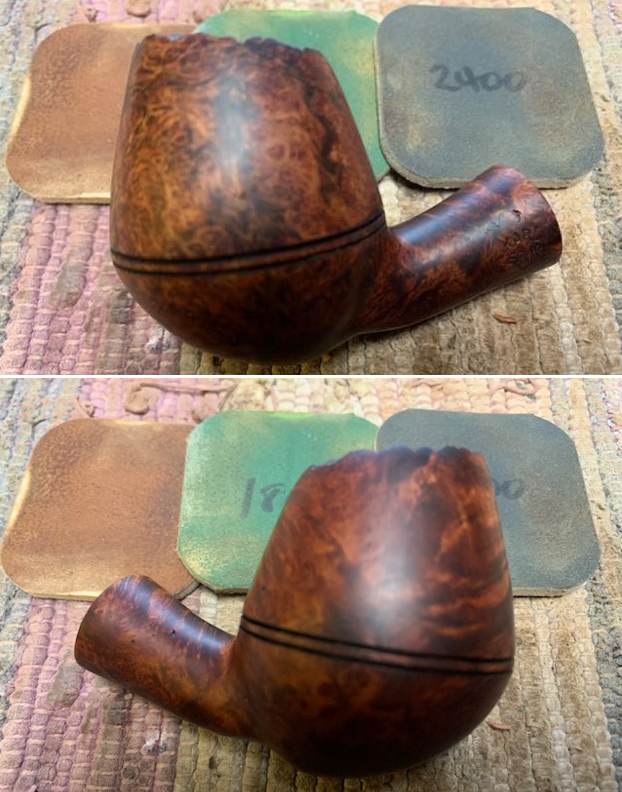
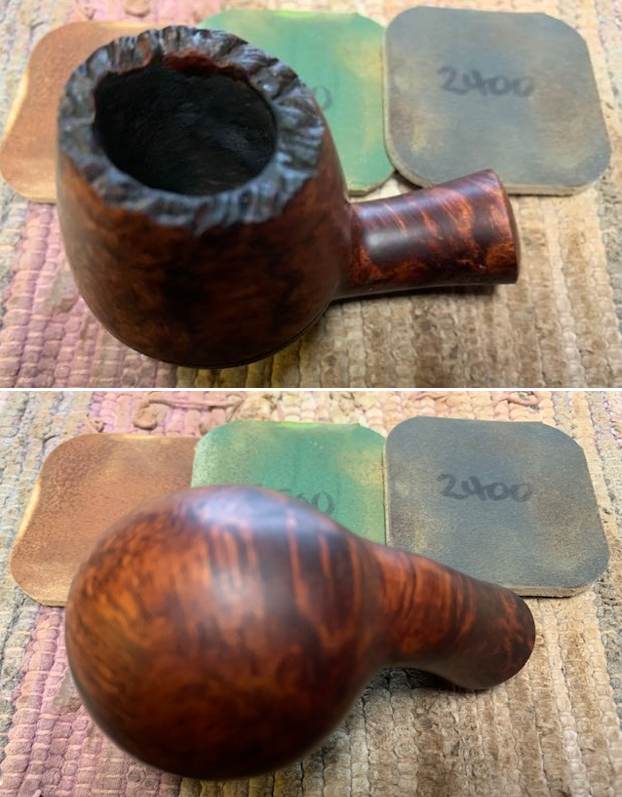
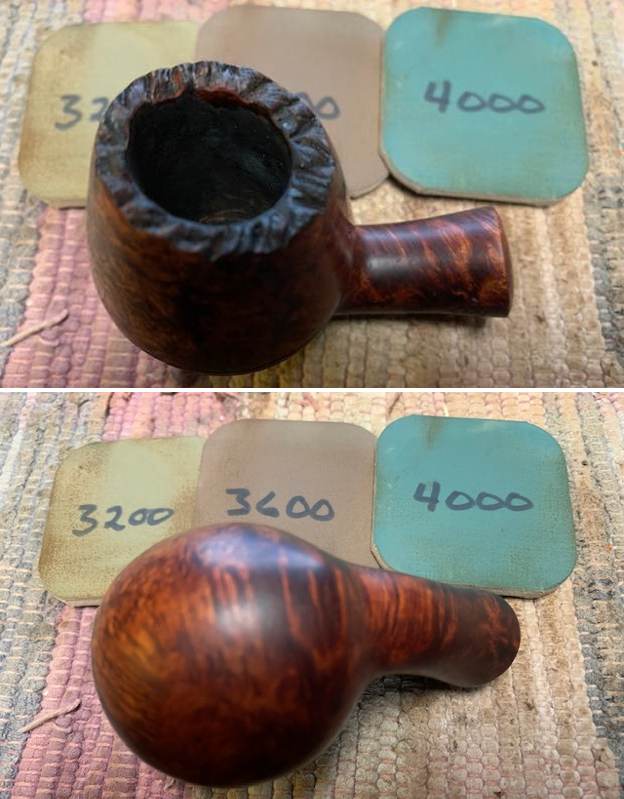
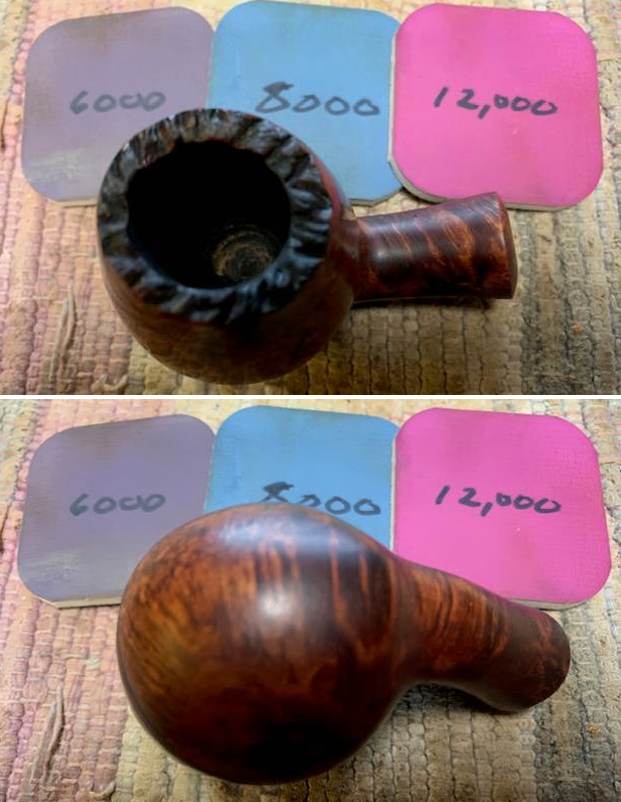
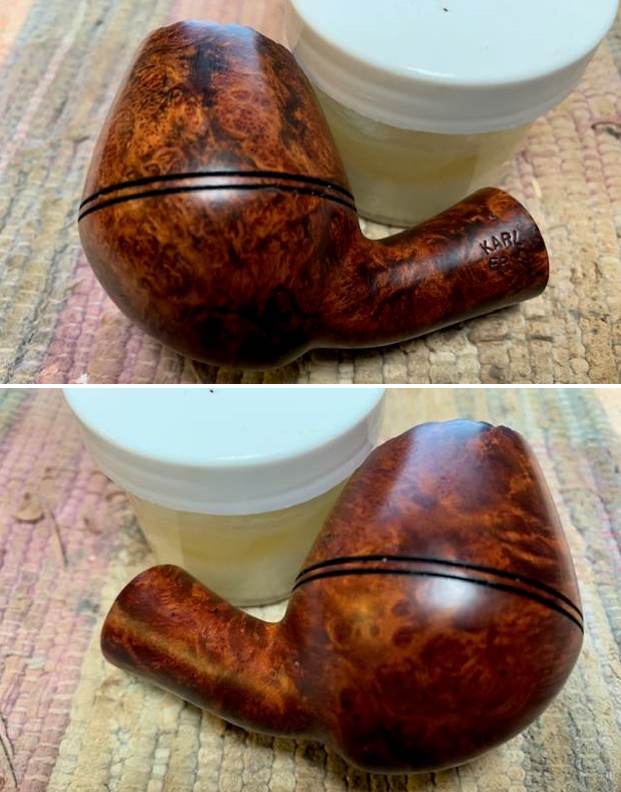
Jeff had thoroughly cleaned up the pipe. He reamed the pipe with a PipNet Pipe Reamer and cleaned up the remnants with a Savinelli Fitsall Pipe Knife.  He scrubbed the bowl with undiluted Murphy’s Oil Soap with a tooth brush. He rinsed it under running warm water to remove the soap and grime. He cleaned out the inside of the shank and the airway in the stem with alcohol, cotton swabs and pipe cleaners. He scrubbed the exterior of the stem with Soft Scrub to remove as much of the oxidation and calcification as possible. He soaked the stem in Before & After Deoxidizer and rinsed it off with warm water. I took close up photos of the bowl, rim and the stem. You can see how clean the bowl and rim top and edges are. The stem is in good condition with light tooth marks and some chatter as noted above. I took photo of the stamping on the left underside of the shank. It is readable as noted above. I removed the stem from the shank and took a photo to give a sense of the proportions of the pipe.I started my work on the pipe working on the damage to the inner edge and the rim top with a folded piece of 220 grit sandpaper to bring the edge back into round. I then used a piece of 220 grit sandpaper and a wooden ball to clean up the bevel on the rim top and edges and it looked much better. I polished the briar with micromesh sanding pads – dry sanding with 1500-12000 grit pads. I wiped the bowl down after each  pad to remove the grit. The bowl began to take on a rich shine. It is a beauty.   I stained the rim top with a Cherry Stain Pen to match the rest of the bowl and shank. The rim looks significantly better than when I started the process.I rubbed the bowl down with Before & After Restoration Balm. I worked it into the briar with my finger tips. I let it sit for 10 minutes and the Balm did its magic. It enlivens, cleans and preserves the briar. It certainly brought this bowl back to life. I buffed it off with a clean cloth and took the following photos. I set the bowl aside and turned my attention to the stem. I sanded out the tooth marks and some scratches in the stem sides with 220 grit sandpaper and started the polishing process with 600 grit wet dry sandpaper.I set the bowl aside and turned to work on the stem. I was able to polish out the tooth marks and chatter with micromesh sanding pads – 1500-12000 grit pads. I wiped it down with a damp cloth after each sanding pad. I used Before & After Pipe Polish – both Fine and Extra Fine to further polish the stem. This Karl Erik Ottendahl Classic Brandy with a Diamond shank vulcanite saddle stem is a great looking pipe now that it has been restored. The beautiful finish really highlights the grain and the polished finish is stunning. I put the stem back on the bowl and carefully buffed the pipe with Blue Diamond on the buffing wheel. I gave the bowl and the stem multiple coats of carnauba wax on the buffing wheel and followed that by buffing the entire pipe with a clean buffing pad. I hand buffed the pipe with a microfiber cloth to deepen the shine. The finished Karl Erik Bent Brandy fits nicely in the hand and feels great. Give the finished pipe a look in the photos below. The dimensions of the pipe are Length: 5 ½ inches, Height: 1 ¾ inches, Outside diameter of the bowl: 1 1/8 inches, Chamber diameter: 7/8 of an inch. The weight of the pipe is 44 grams / 1.55 ounces. I will be adding the pipe to the Danish Pipe Makers Section of the rebornpipes store. If you are interested in purchasing this pipe send me a message or an email. Thanks for reading this blog and my reflections on the pipe while I worked on it.
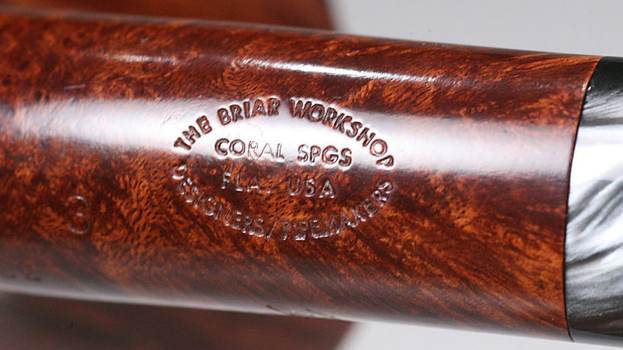
Restoring a Great Looking Briar Workshop Mixed Finish Elliott Nachwalter & Jorge Jemelka 28 Dublin


Blog by Steve Laug

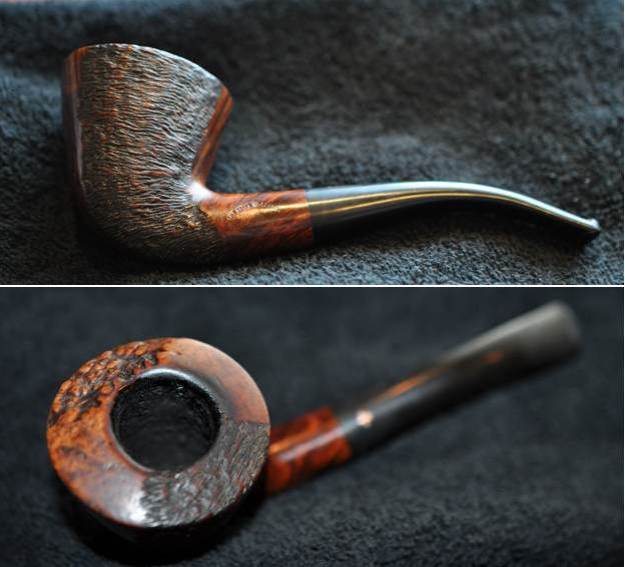
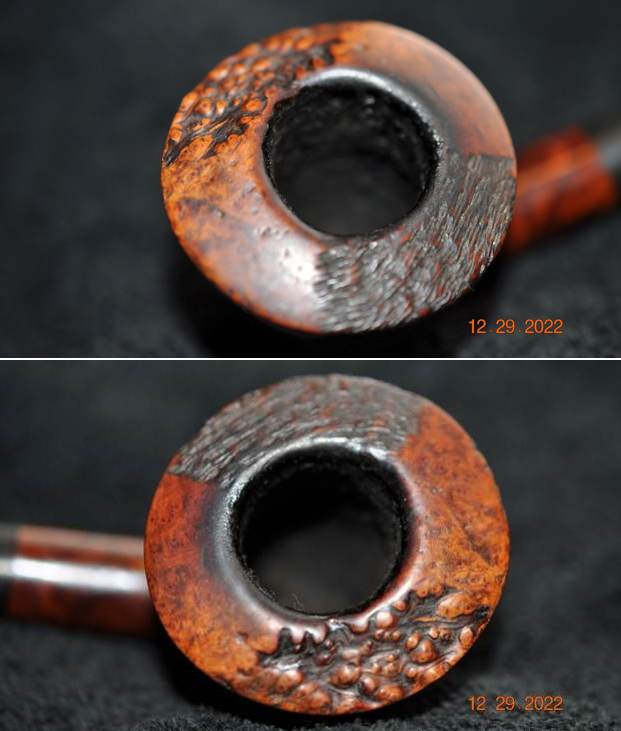
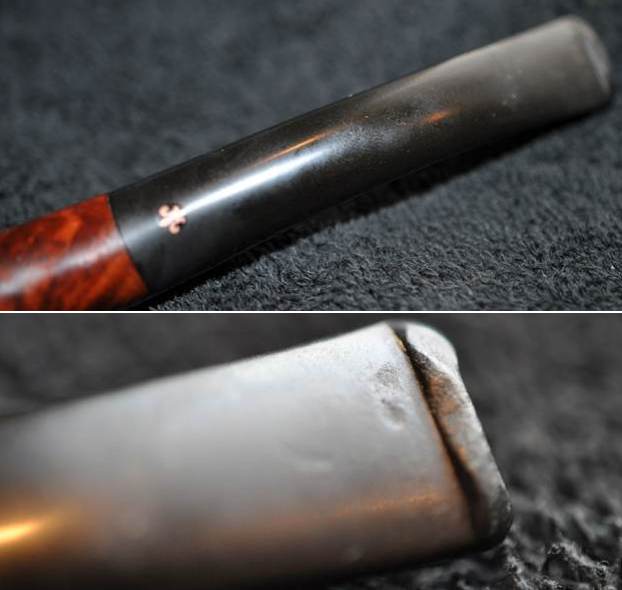
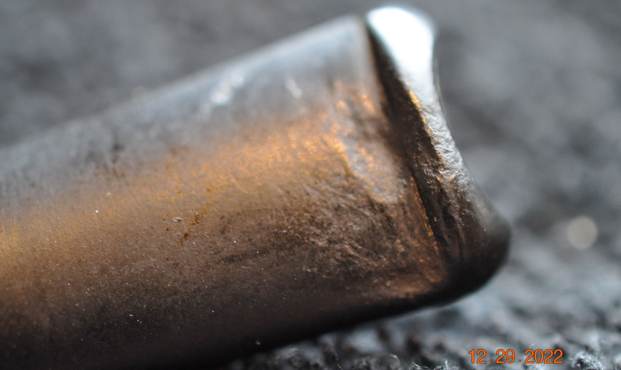
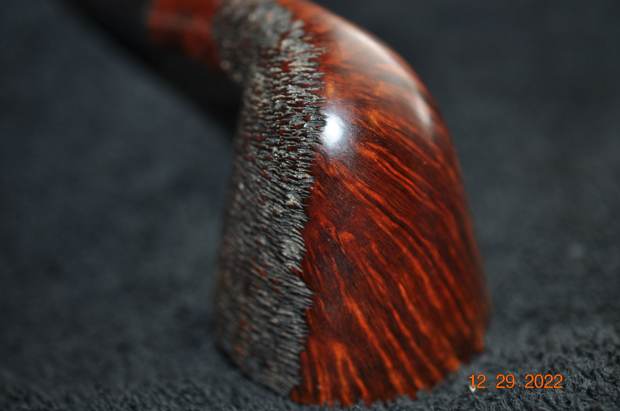
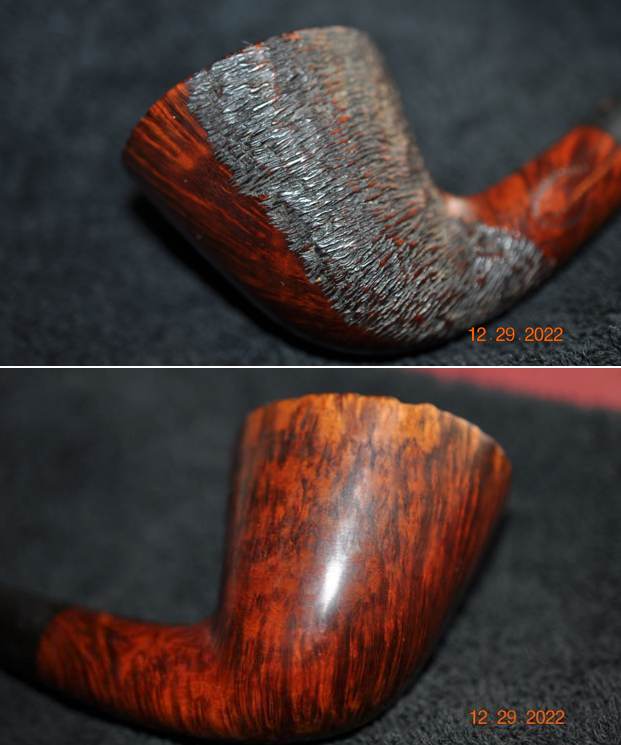
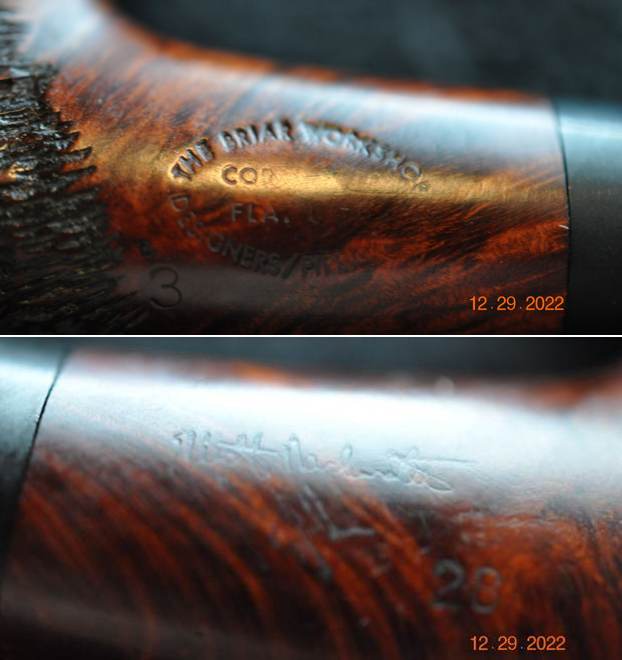
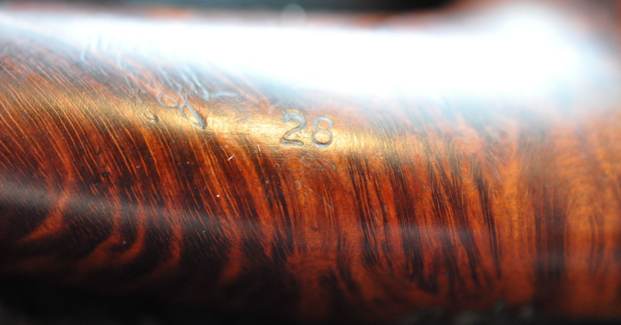
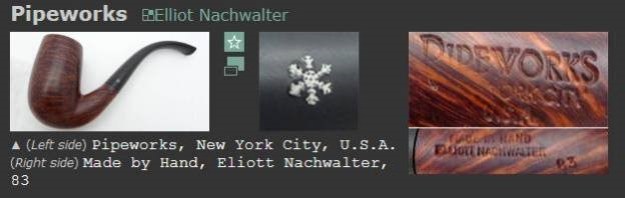
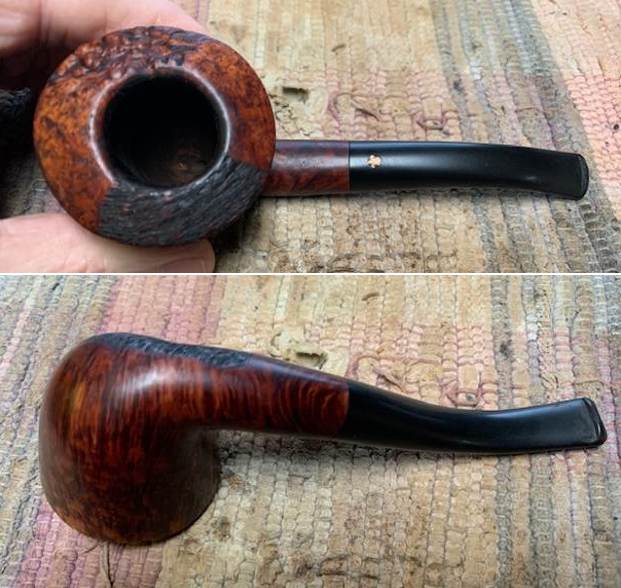
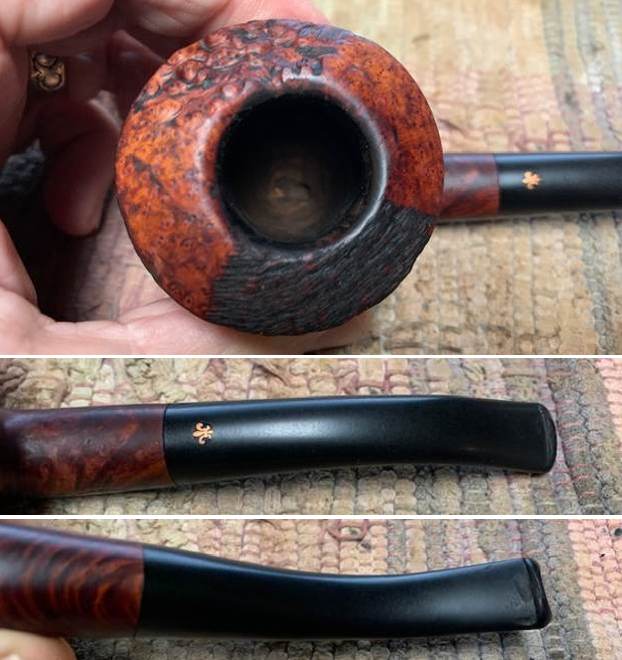
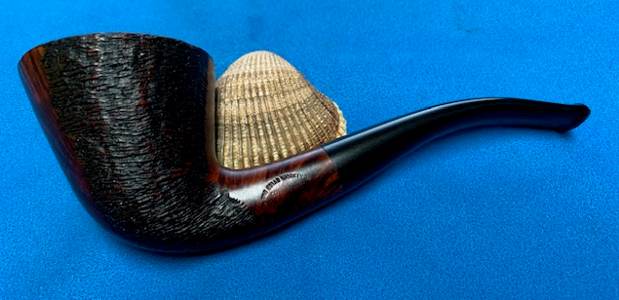
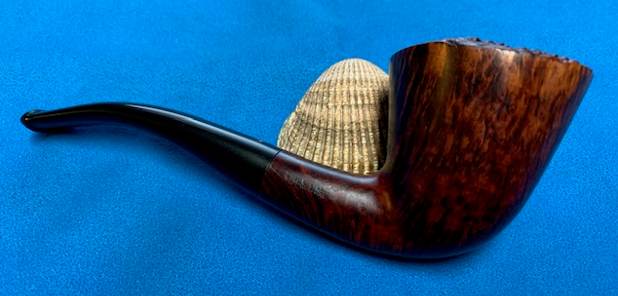
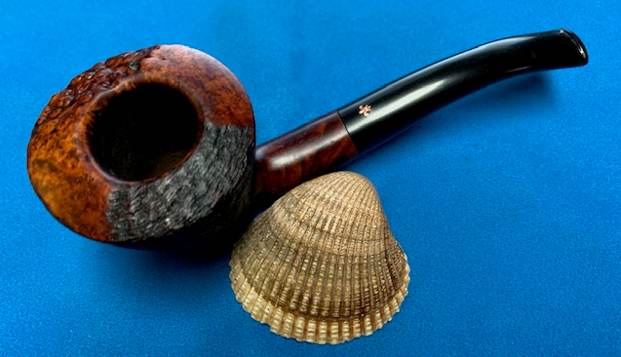
This next pipe was purchased from an online auction on 08/06/22 in Manorville, New York, USA. He sent some photos of the pipe. It was a beautiful shaped The Briar Workshop creation, hand made by Elliott Nachwalter. I have come to appreciated pipes made by Elliott and have several nice ones in my collection. They are uniformly great smokers. I have also restored my fair share of them over the years. The stamping on the left side of the shank is in an oval. Arched at the top of the oval it read The Briar Workshop. In the center it is stamped Coral Spgs[over] FLA. USA. On the bottom of the oval it is stamped Designers/Pipe Makers. Below the left side of the oval it is stamped with a number 3. On the right side it bears Elliot Nachwalter’s signature [over] Jorg Jemelka’s signature. Below that and toward the bowl it is stamped 28. The pipe has an interesting mixture of finishes – on the left side there is a wire like rustication on the rim top, down over the side to the heel and on a portion of the shank. The rest of the finish on the bowl and shank is smooth and has some beautiful grain. On the right side of the rim top was a section of plateau. The bowl had a thick cake in it and the rim top has lava and debris in the plateau, the rustication and on the inner edge of the bowl. The finish on the pipe was dirty with debris ground into the grooves of the rustication and on the smooth finish as well. The stem was oxidized and had some tooth marks on the top and underside just ahead of the button. There was a Fleur-de-lis cut in copper inlaid into the topside of the tapered stem. Jeff took photos of the pipe before he started to work on it.He took photos of the bowl and rim top to show what they looked like before his clean up. He also took some of the stem to show the condition of both sides. The photos of the sides and heel of the bowl show the unique combination of finishes around the bowl and shank. The stains adds depth to the finish and highlights the beautiful grain. Even under the grime it is a real beauty. The stamping on the left side the shank is shown in the first photo below. It is clear and readable as noted above. The second and third photos show the signatures on the right side of the shank and read as noted. I turned to Pipephil’s site to look up information on the brand to identify the period of time when Nachwalter made the pipe. I turned first to the section on Elliot Nachwalter’s name (http://pipephil.eu/logos/en/logo-e2.html#elliotnachwalter) to see what it said. It is interesting in that I shows a pipe made in Vermont whereas the one I have says Coral Springs, Florida USA.I turned then to the section of the site on Pipeworks as that is also stamped on the pipe I am working on (http://pipephil.eu/logos/en/logo-p3.html#pipeworks). Sure enough the site showed a pipe that was stamped the same way as the one I have. It is shown in the screen capture below. The stem logo on the one I am working on is a Fleur-de-Li rather than a snowflake. From there I turned to Pipedia for a bit more information (https://pipedia.org/wiki/Nachwalter). The site quoted from both Lopes book and from Nachwalter’s website and had a lot of great historical information. I quote portions of it below.

From Pipes, Artisans and Trademarks, by Jose Manuel Lopés’

Elliott Nachwalter studied the History of Art and Photography, but passionate about pipes, decided to go into pipe making. With a few tools and some machinery, he started his workshop some 25 years ago (that would be 35 years ago now, as of 2015), in Stowe, Vermont, where he shared a warehouse with Andrew Marks. He later created Briar Workshop with Jorg Jemelka, and was joined by the Danish designer Finn Meyan Andersen. They also collaborated with various artisans, such as Brad Pohlmann, J.T. Cooke, and Carol Burns.

Between 1980 and 1983, Elliot had a shop in New York where he would make and sell his pipes There then followed an interregnum — “For three years I was away from my craft, not knowing if I would ever make pipes again” –, after which he returned to Vermont and built Pipestudio. Aim: “to create sensual pipes, beautifully grained that are pleasing to the eye” and which would be “the creation of sculpted smoking instruments that are functional pieces of art”.

He uses Briar from Italy and Greece; and vulcanite, acrylic, or Cumberland stems. Symbol: a kind of six-pointed star…

…In 1980 I opened a store in New York City and designed and made pipes in the back of the store for pipe smokers that visited me from around the world. I worked late into the night. There came a time when I felt the need to stop making pipes. For three years I was away from my craft, not knowing if I would ever make pipes again. Something was missing. Perhaps I was missing the struggle of the creative process and the pure joy that one feels when you make something turn out exactly as imagined in your mind’s eye. I suppose I needed to make pipes; I needed to work late into the night.

In the autumn of ’96 as the falling leaves mixed with the early snowfall, I built a small studio overlooking the Battenkill and surrounded by the Taconic and Green mountains.

It is my desire to create sensual pipes, beautifully grained that are pleasing to the eye. I work with only the rarest of briar burls that are seasoned in a manner that allows for a minimal break in period and a very smooth smoking pipe. The briar grows in the wild and there is a remarkable difference in grain between each block . This variance of grain together with the myriad of designs in my mind and the nature of the work, makes for truly one of a kind pipes. The essence of my work is in the creation of sculpted smoking instruments that are functional pieces of art.

I turned to the section on Pipedia on the Briar Workshop to gather more information on this particular pipe (https://pipedia.org/wiki/Briar_Workshop). I quote below:

Elliott Nachwalter started the Briar Workshop in Vermont together with Jorg Jemelka. They were joined by Danish designer pipemaker Finn Meyan Andersen.

Through the years they had several talented crafts people working with them including Brad Pohlmann, Jim Cooke (J.T. Cooke), and Carole Burns. They made many pipes that were sold by fine tobacconists around the country. At some point, the Briar Workshop moved to Florida, and the nature of the work changed, along with the pipe makers involved.

While The Briar Workshop was in Vermont, it acquired turn of the century pipemaking equipment as part of a collaborative arrangement with Ehrlich’s of Boston. Jemelka modified this machinery to enable the production of true copies of handmade pipes. This methodology distinguishes Briar Workshop Florida from Briar Workshop Vermont.

Nachwalter and Brad Pohlmann continued in providing designs for batch production as well as hand-made ‘one-offs’ for sale.

It would seem the Briar Workshop and the pipemakers involved played a significant part in laying the groundwork that launching the American hand made pipe making tradition, which has since exploded.

The site also had a photo of the stamp on the left side of the shank that is identical to the one I am working on.Jeff had thoroughly cleaned up the pipe. He reamed the pipe with a PipNet Pipe Reamer and cleaned up the remnants with a Savinelli Fitsall Pipe Knife. He scrubbed the bowl with undiluted Murphy’s Oil Soap with a tooth brush. He rinsed it under running warm water to remove the soap and grime. He cleaned out the inside of the sump in the shank and the airway in the stem with alcohol, cotton swabs and pipe cleaners. He scrubbed the exterior of the stem with Soft Scrub to remove as much of the oxidation and calcification as possible. He soaked the stem in Before & After Deoxidizer and rinsed it off with warm water. I took close up photos of the bowl, rim and the stem. You can see how clean the bowl and rim top and edges are. The stem is in good condition with deep tooth marks and some chatter as noted above.I took photos of the stamping on the sides of the shank. All are clear and readable as noted above. I removed the stem from the shank and took a photo to give a sense of the proportions of the pipe.I started my work on the pipe by cleaning up the inner edge of the bowl with a folded piece of 20 grit sandpaper to minimize and remove as much damage as possible.I polished the briar with micromesh sanding pads – dry sanding with 1500-12000 grit pads. I wiped the bowl down after each  pad to remove the grit. The bowl began to take on a rich shine. It is a beauty.   I rubbed the bowl down with Before & After Restoration Balm. I worked it into the briar with my finger tips. I worked it into the rustication and the plateau rim top with a shoe brush. I let it sit for 10 minutes and the Balm did its magic. It enlivens, cleans and preserves the briar. It brought this bowl back to life. I buffed it off with a clean cloth and took the following photos. I set the bowl aside and turned to work on the stem. I “painted” the stem surface with the flame of a lighter to lift the tooth marks. They came up considerably but not enough. I filled in the marks that remained with clear CA glue and set it aside to cure. Once cured I used a small file to recut the button and flatten out the repairs. I sanded them with 220 grit sandpaper and started the polishing process with 600 grit wet dry sandpaper. I was able to polish out the tooth marks and chatter with micromesh sanding pads – 1500-12000 grit pads. I wiped it down with a damp cloth after each sanding pad. I used Before & After Pipe Polish – both Fine and Extra Fine to further polish the stem. This Briar Workshop Coral Springs, Florida Mixed Finish Elliott Nachwalter & Jorge Jemelka Dublin is a great looking pipe now that it has been restored. The beautiful finish really highlights the grain and the polished finish is stunning. I put the stem back on the bowl and carefully buffed the pipe with Blue Diamond on the buffing wheel. I gave the bowl and the stem multiple coats of carnauba wax on the buffing wheel and followed that by buffing the entire pipe with a clean buffing pad. I hand buffed the pipe with a microfiber cloth to deepen the shine. The finished Nachwalter Briar Workshop Dublin fits nicely in the hand and feels great. Give the finished pipe a look in the photos below. The dimensions of the pipe are Length: 6 inches, Height: 2 inches, Outside diameter of the bowl: 1 ¾ inches, Chamber diameter: 7/8 of an inch. The weight of the pipe is 59 grams / 2.08 ounces. I will be adding the pipe to the American Pipe Makers Section of the rebornpipes store. If you are interested in purchasing this pipe send me a message or an email. Thanks for reading this blog and my reflections on the pipe while I worked on it.

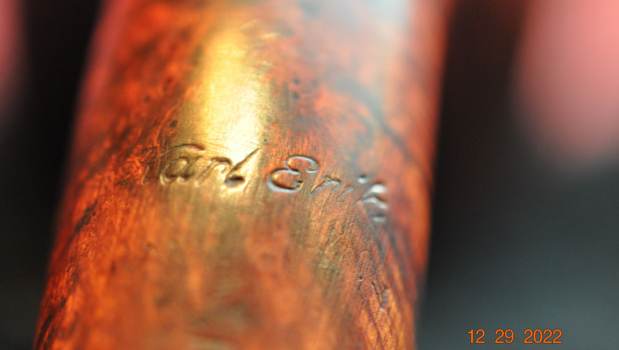
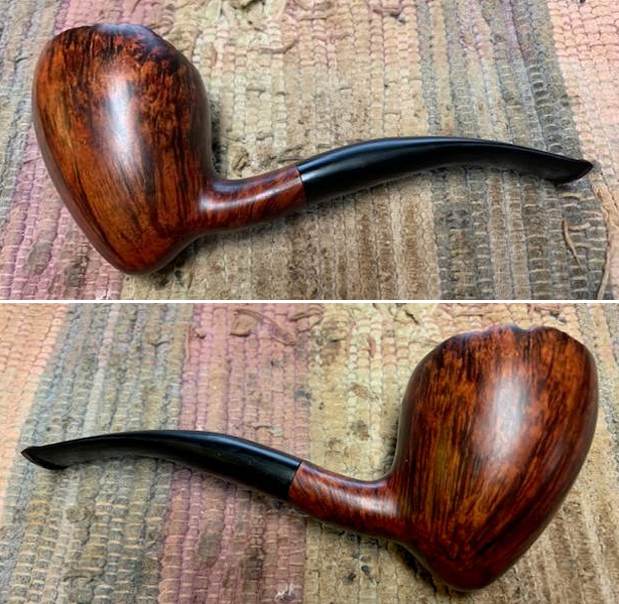
Restoring a Beautiful Karl Erik Made in Denmark Bent Egg Freehand Filter Pipe


Blog by Steve Laug

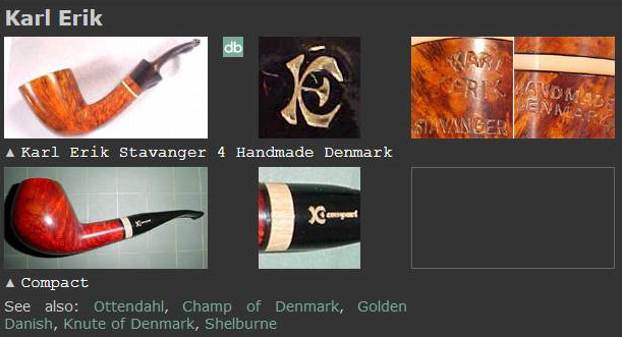
After work today I decided to work on the another one of the pipes that I have still to work on from a variety of places. This pipe was another one that was purchased on 10/03/2022 in a lot of pipes that came to us from Copenhagen, Denmark  It is an interesting pipe with a bowl that combines beautiful straight and flame grain with a Plateau rim top and an egg shape. The pipe is stamped on the underside of the shank and reads Karl [arched over] Erik [over] Hand Made in Denmark. The latter portion of the stamping is faint but readable. The pipe was a well used pipe when Jeff received it. There was dust and grime ground into the finish. The mixture of brown and black stains highlights some beautiful grain under the dirt. The bowl was heavily caked and there was an overflow of lava on the plateau rim top. The inner edge appeared to be in good condition. The filter stem was made for a 6MM filter is vulcanite and was not oxidized. It was dirty with light tooth marks and chatter on both sides ahead of the button and on the button itself. I wonder if the stem is not one made at a later time for the pipe, however the fit to the shank is like and original fit. Jeff took photos of the pipe before he started his clean up work on it.He took photos of the bowl and rim top to show what they looked like before his clean up. He also took some of the stem to show the condition of both sides. The photos of the sides and heel of the bowl show the uniquely stained grain around the bowl and shank. The mixture of black and brown stains adds depth finish on the pipe. Even under the grime it is a real beauty. The stamping on the underside of the shank is shown in the photos below. It is faint but is still clear and readable as noted above.Before I started my work on the pipe I wanted to see if I could find any information that would help me date this pipe and get a sense of the line. I turned to Pipephil to get a quick review of the brand (http://pipephil.eu/logos/en/logo-k1.html). The stamp on the stem shown in the photo below is different than the one I am working on. It includes a K and an E while this one is just an E stamp. I have included a screen capture of the brand info there as well as a note in the side bar about Karl Erik Ottendahl along with a small picture.Brand created in 1965-66 by Karl Erik Ottendahl (1942 – 2004 †). In the best years he employed up to 15 craftsmen among which Bent Nielsen (see Benner) and Peder Christian Jeppesen. Former grading (ascending): from 4 to 1, and “Ekstravagant” (entirely hand made)

I then turned to Pipedia (https://pipedia.org/wiki/Karl_Erik) for more information. I am including just the opening remarks but would encourage you to give the link a read for a very interesting history of the brand. I quote:

Karl Erik Ottendahl (1942 – 2004) was born in Aalborg (Jutland), just a few miles from the very northernmost tip of Denmark. He began smoking a pipe when he was 14 and upon leaving school he started an apprenticeship in the craft as a lithographer at the age of 16.

While working as an apprentice he began hand carving pipes as a hobby. Many were given as gifts to his more senior colleagues. Upon completion of his apprenticeship he moved to Nairobi, Kenya to work as a lithographer during the 1962 war. While in that war torn country, he was unable to procure pipes for himself. In the face of such a predicament, he chose to continue to make pipes for his own use rather than go without.

Returning to Denmark after three years he couldn’t find a well paid occupation in his job, and so he began making a few pipes on the side to boost his income choosing his prenames “Karl Erik” – logo “KE” – for his label. When he managed to find some major Copenhagen pipe stores willing to sell his pieces his reputation grew little by little and he was finally able to purchase more and better machinery and began working full time as a pipe maker.

With that information in hand I knew what I was dealing with in terms of the stamping and the age of this pipe. I knew from the information that the pipe was made sometime between 1965 and 2004. Now it was time to work on the pipe.

Jeff had thoroughly cleaned up the pipe. He reamed the pipe with a PipNet Pipe Reamer and cleaned up the remnants with a Savinelli Fitsall Pipe Knife.  He scrubbed the bowl with undiluted Murphy’s Oil Soap with a tooth brush. He rinsed it under running warm water to remove the soap and grime. He cleaned out the inside of the sump in the shank and the airway in the stem with alcohol, cotton swabs and pipe cleaners. He scrubbed the exterior of the stem with Soft Scrub to remove as much of the oxidation and calcification as possible. He soaked the stem in Before & After Deoxidizer and rinsed it off with warm water. (I only remembered to take these photos after I had restained the plateau and polished the bowl.) I took close up photos of the bowl, rim and the stem. You can see how clean the bowl and rim top and edges are. The stem is in good condition with light tooth marks and some chatter as noted above.I took a photo of the stamping on the underside of the shank. It is clear and readable as noted above. I removed the stem from the shank and took a photo to give a sense of the proportions of the pipe.I started my work on the pipe by touching up the valleys and crevices in the plateau rim top with a black stain pen. It looked much better.I polished the briar with micromesh sanding pads – dry sanding with 1500-12000 grit pads. I wiped the bowl down after each  pad to remove the grit. The bowl began to take on a rich shine. It is a beauty.   I rubbed the bowl down with Before & After Restoration Balm. I worked it into the briar with my finger tips. I let it sit for 10 minutes and the Balm did its magic. It enlivens, cleans and preserves the briar. It certainly brought this bowl back to life. I buffed it off with a clean cloth and took the following photos.  I sanded out the tooth marks and some scratches in the stem sides with 220 grit sandpaper and started the polishing process with 600 grit wet dry sandpaper.I set the bowl aside and turned to work on the stem. I was able to polish out the tooth marks and chatter with micromesh sanding pads – 1500-12000 grit pads. I wiped it down with a damp cloth after each sanding pad. I used Before & After Pipe Polish – both Fine and Extra Fine to further polish the stem. I fit the filter stem with a 6MM Medico Paper Filter. It fit well in the shank and the draw on the stem was clear and easy.This Karl Erik Ottendahl Made in Denmark Freehand Egg with a 6mm filter stem is a great looking pipe now that it has been restored. The beautiful finish really highlights the grain and the polished finish is stunning. I put the stem back on the bowl and carefully buffed the pipe with Blue Diamond on the buffing wheel. I gave the bowl and the stem multiple coats of carnauba wax on the buffing wheel and followed that by buffing the entire pipe with a clean buffing pad. I hand buffed the pipe with a microfiber cloth to deepen the shine. The finished Karl Erik Freehand fits nicely in the hand and feels great. Give the finished pipe a look in the photos below. The dimensions of the pipe are Length: 6 inches, Height: 2 ½ inches, Outside diameter of the bowl: 1 ½ inches, Chamber diameter: 7/8 of an inch. The weight of the pipe is 60 grams / 2.12 ounces. I will be adding the pipe to the Danish Pipe Makers Section of the rebornpipes store. If you are interested in purchasing this pipe send me a message or an email. Thanks for reading this blog and my reflections on the pipe while I worked on it.

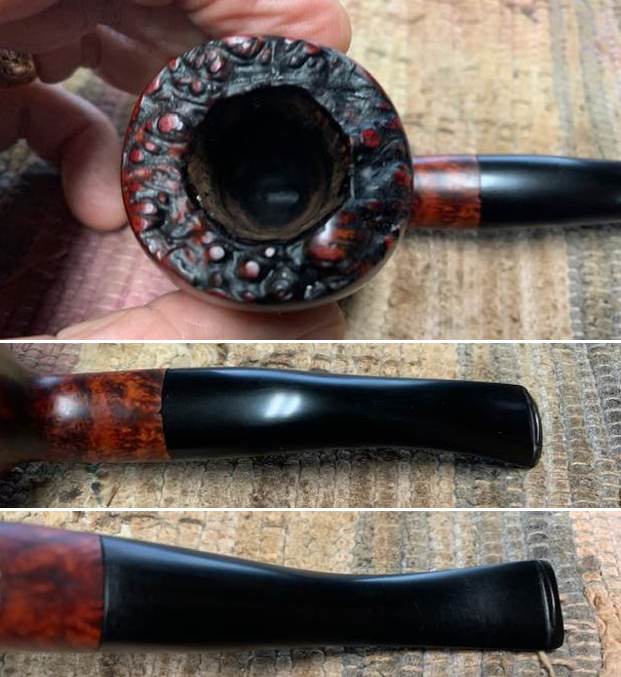
Restoring a Beautiful Karl Erik Freehand “Rhodesianish” Short Churchwarden


Blog by Steve Laug

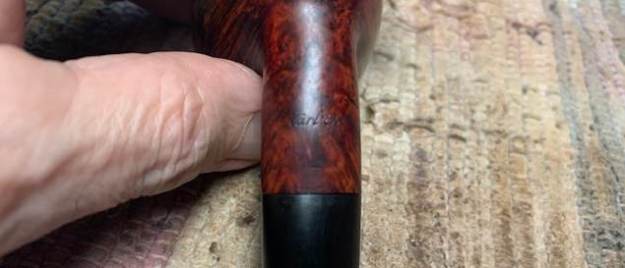
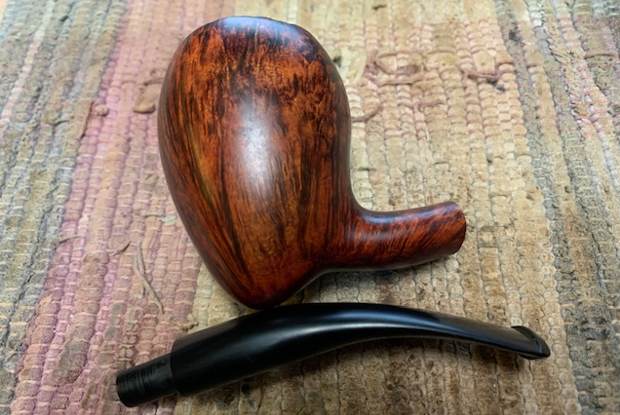
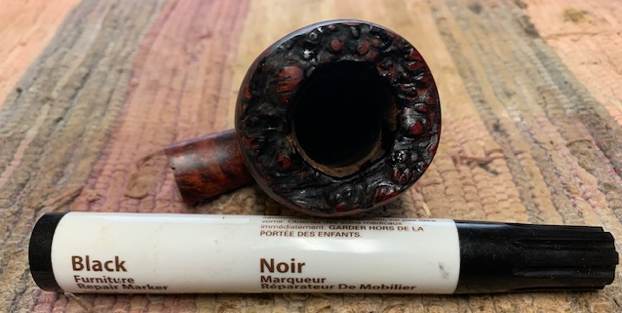
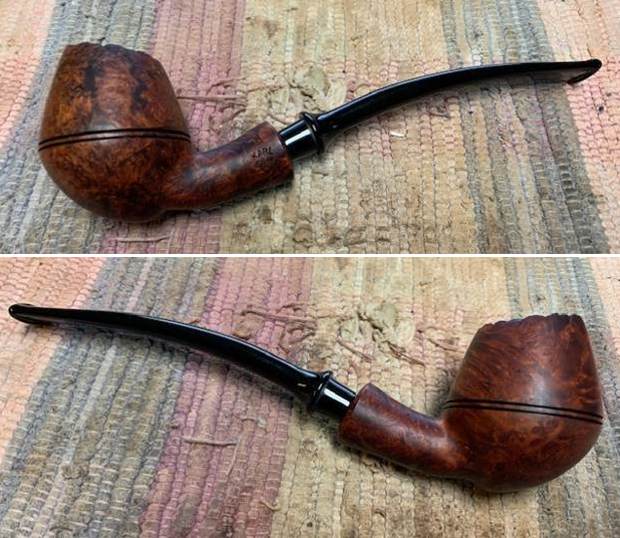
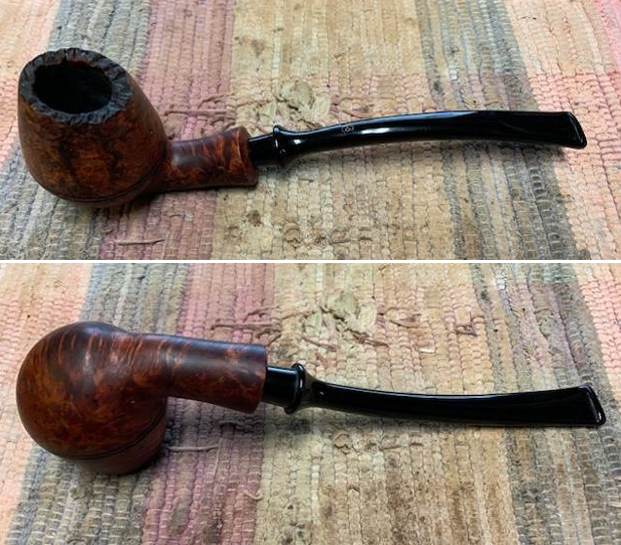
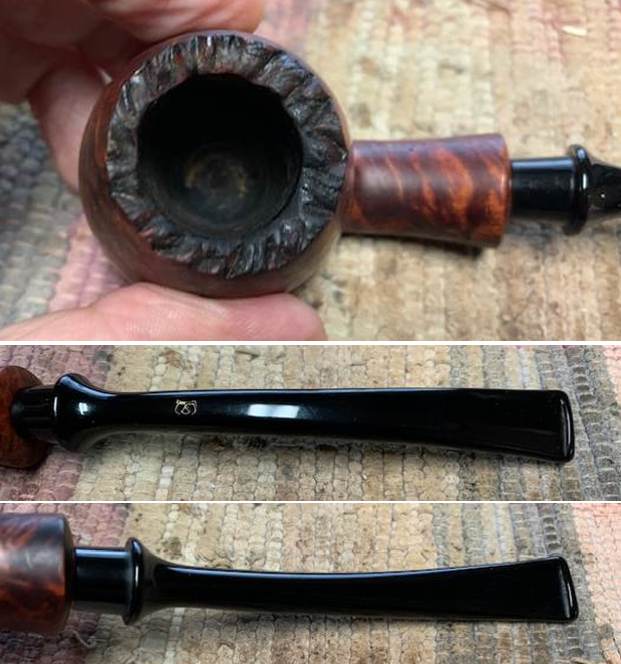
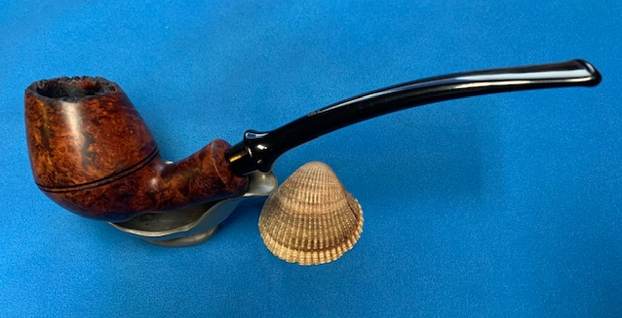
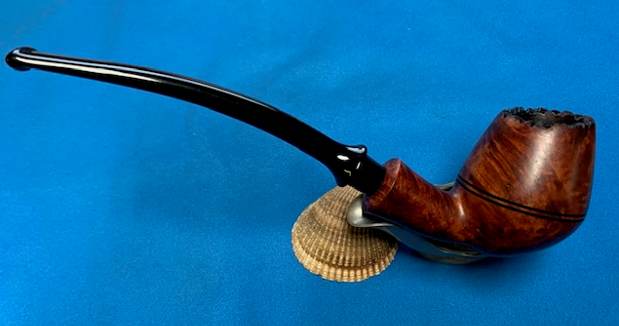
This afternoon I decided to work on a pipe from the lot that I have still to work on from a variety of places. This pipe was purchased from a friend on 06/05/21 in Brazil, Indiana, USA. It is an interesting pipe with a bowl that combines the twin rings of a Bulldog or Rhodesian with a Plateau rim top and a Freehand Flair. The pipe is stamped on the left side of the shank and reads Karl [arched over] Erik. The pipe was a well used pipe when Jeff received it. There was dust and grime ground into the finish. The mixture of brown stains highlights some beautiful grain under the dirt. The bowl was heavily caked and there was an overflow of lava on the plateau rim top. The inner edge appeared to be in good condition. The stem is acrylic and therefore was not oxidized. It was dirty with light tooth marks and chatter on both sides ahead of the button and on the button itself. There is a fancy E stamp in the top of the stem that is in good condition. Jeff took photos of the pipe before he started his clean up work on it. He took photos of the bowl and rim top to show what they looked like before his clean up. He also took some of the stem to show the condition of both sides. The photos of the sides and heel of the bowl show the uniquely stained grain around the bowl and shank. The mixture of black and brown stains adds depth finish on the pipe. Even under the grime it is a real beauty. The stamping on the left side the shank is shown in the photos below. It is clear and readable as noted above. He also took a photo of the fancy E logo on the top of the acrylic stem.Before I started my work on the pipe I wanted to see if I could find any information that would help me date this pipe and get a sense of the line. I turned to Pipephil to get a quick review of the brand (http://pipephil.eu/logos/en/logo-k1.html). The stamp on the stem shown in the photo below is different than the one I am working on. It includeds a K and an E while this one is just an E stamp. I have included a screen capture of the brand info there as well as a note in the side bar about Karl Erik Ottendahl along with a small picture.Brand created in 1965-66 by Karl Erik Ottendahl (1942 – 2004 †). In the best years he employed up to 15 craftsmen among which Bent Nielsen (see Benner) and Peder Christian Jeppesen. Former grading (ascending): from 4 to 1, and “Ekstravagant” (entirely hand made)

I then turned to Pipedia (https://pipedia.org/wiki/Karl_Erik) for more information. I am including just the opening remarks but would encourage you to give the link a read for a very interesting history of the brand. I quote:

Karl Erik Ottendahl (1942 – 2004) was born in Aalborg (Jutland), just a few miles from the very northernmost tip of Denmark. He began smoking a pipe when he was 14 and upon leaving school he started an apprenticeship in the craft as a lithographer at the age of 16.

While working as an apprentice he began hand carving pipes as a hobby. Many were given as gifts to his more senior colleagues. Upon completion of his apprenticeship he moved to Nairobi, Kenya to work as a lithographer during the 1962 war. While in that war torn country, he was unable to procure pipes for himself. In the face of such a predicament, he chose to continue to make pipes for his own use rather than go without.

Returning to Denmark after three years he couldn’t find a well paid occupation in his job, and so he began making a few pipes on the side to boost his income choosing his prenames “Karl Erik” – logo “KE” – for his label. When he managed to find some major Copenhagen pipe stores willing to sell his pieces his reputation grew little by little and he was finally able to purchase more and better machinery and began working full time as a pipe maker.

With that information in hand I knew what I was dealing with in terms of the stamping and the age of this pipe. I knew from the information that the pipe was made sometime between 1965 and 2004. Now it was time to work on the pipe.

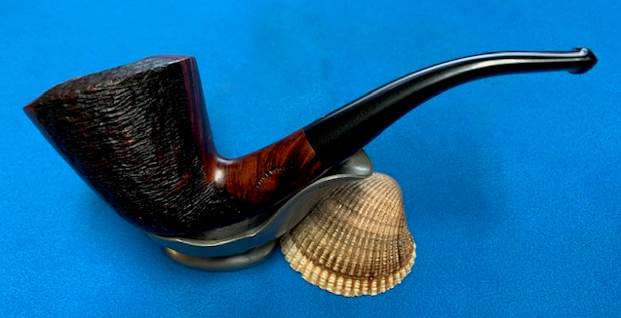
Jeff had thoroughly cleaned up the pipe. He reamed the pipe with a PipNet Pipe Reamer and cleaned up the remnants with a Savinelli Fitsall Pipe Knife.  He scrubbed the bowl with undiluted Murphy’s Oil Soap with a tooth brush. He rinsed it under running warm water to remove the soap and grime. He cleaned out the inside of the sump in the shank and the airway in the stem with alcohol, cotton swabs and pipe cleaners. He scrubbed the exterior of the stem with Soft Scrub to remove as much of the oxidation and calcification as possible. He soaked the stem in Before & After Deoxidizer and rinsed it off with warm water. I took close up photos of the bowl, rim and the stem. You can see how clean the bowl and rim top and edges are. The stem is in good condition with light tooth marks and some chatter as noted above.I took photos of the stamping on the sides of the shank. All are clear and readable as noted above. I removed the stem from the shank and took a photo to give a sense of the proportions of the pipe. I polished the briar with micromesh sanding pads – dry sanding with 1500-12000 grit pads. I wiped the bowl down after each  pad to remove the grit. The bowl began to take on a rich shine. It is a beauty.   I rubbed the bowl down with Before & After Restoration Balm. I worked it into the briar with my finger tips. I worked it into the twin rings and the plateau rim top with a shoe brush. I let it sit for 10 minutes and the Balm did its magic. It enlivens, cleans and preserves the briar. It certainly brought this bowl back to life. I buffed it off with a clean cloth and took the following photos.  I set the bowl aside and turned to work on the stem. I was able to polish out the tooth marks and chatter with micromesh sanding pads – 1500-12000 grit pads. I wiped it down with a damp cloth after each sanding pad. I used Before & After Pipe Polish – both Fine and Extra Fine to further polish the stem. This Karl Erik Ottendahl Rhodesian/Bulldog/Freehand with a long acrylic stem is a great looking pipe now that it has been restored. The beautiful finish really highlights the grain and the polished finish is stunning. I put the stem back on the bowl and carefully buffed the pipe with Blue Diamond on the buffing wheel. I gave the bowl and the stem multiple coats of carnauba wax on the buffing wheel and followed that by buffing the entire pipe with a clean buffing pad. I hand buffed the pipe with a microfiber cloth to deepen the shine. The finished Karl Erik Freehand fits nicely in the hand and feels great. Give the finished pipe a look in the photos below. The dimensions of the pipe are Length: 8 inches, Height: 2 inches, Outside diameter of the bowl: 1 ¼ inches, Chamber diameter: 7/8 of an inch. The weight of the pipe is 72 grams/ 2.54 ounces. I will be adding the pipe to the Danish Pipe Makers Section of the rebornpipes store. If you are interested in purchasing this pipe send me a message or an email. Thanks for reading this blog and my reflections on the pipe while I worked on it.
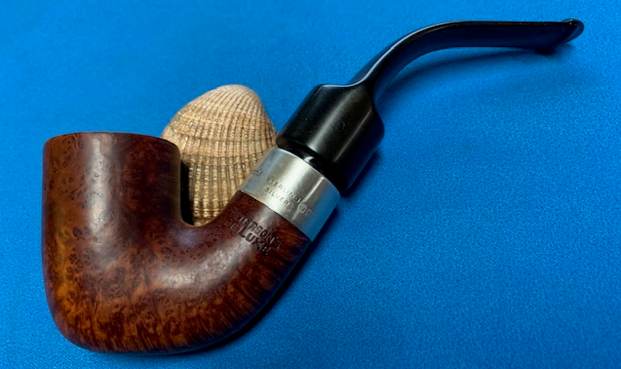
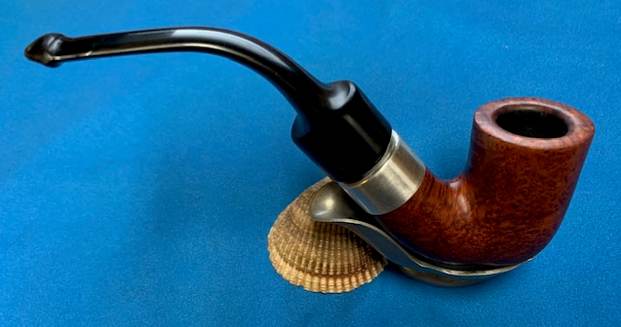
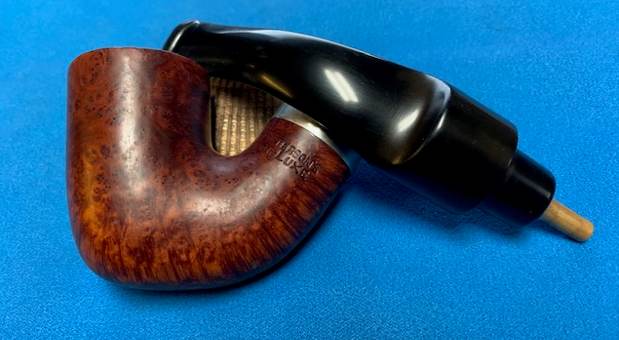
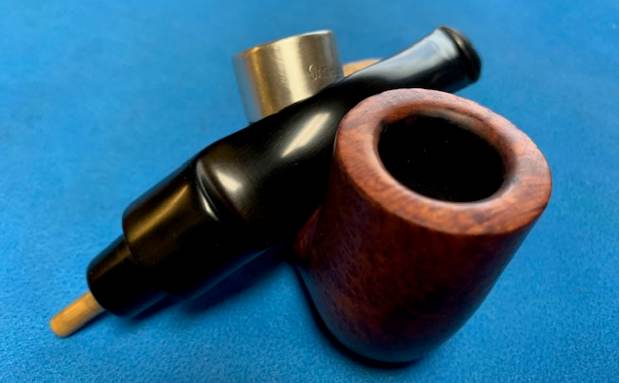
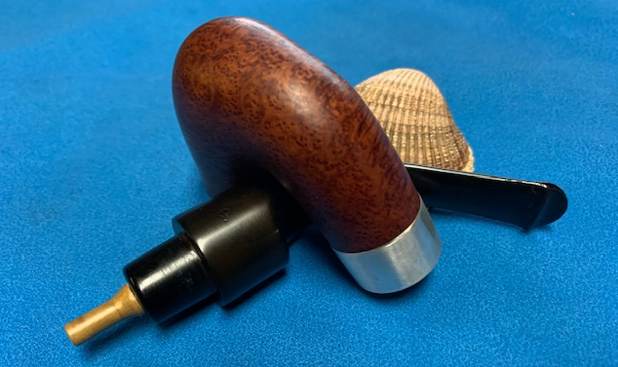
Restoring a Beautiful Republic Era Peterson’s De Luxe Silver Band 4S Bent Billiard


Blog by Steve Laug

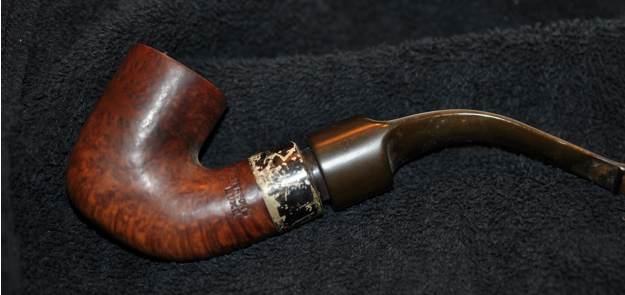
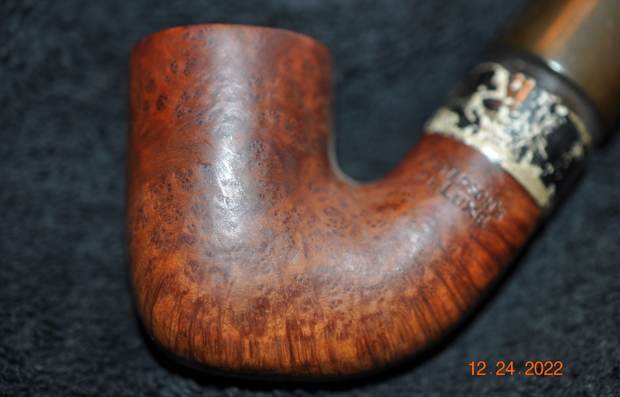
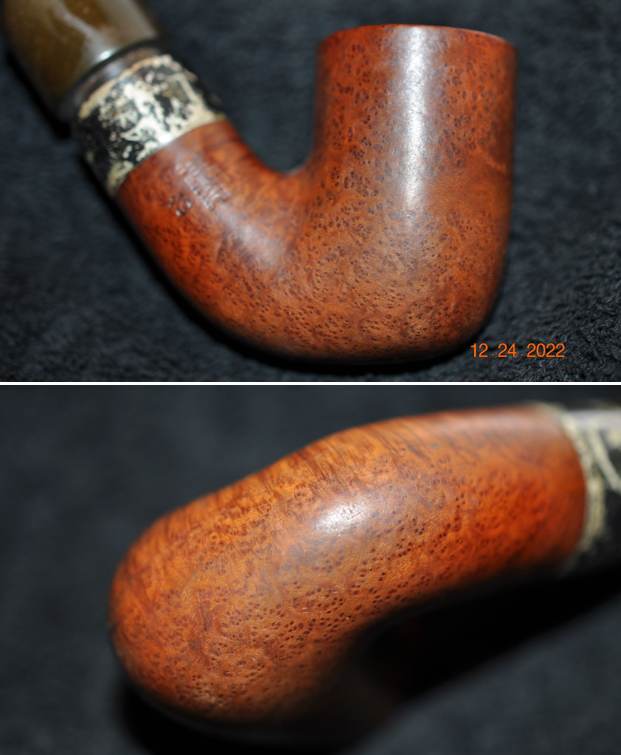
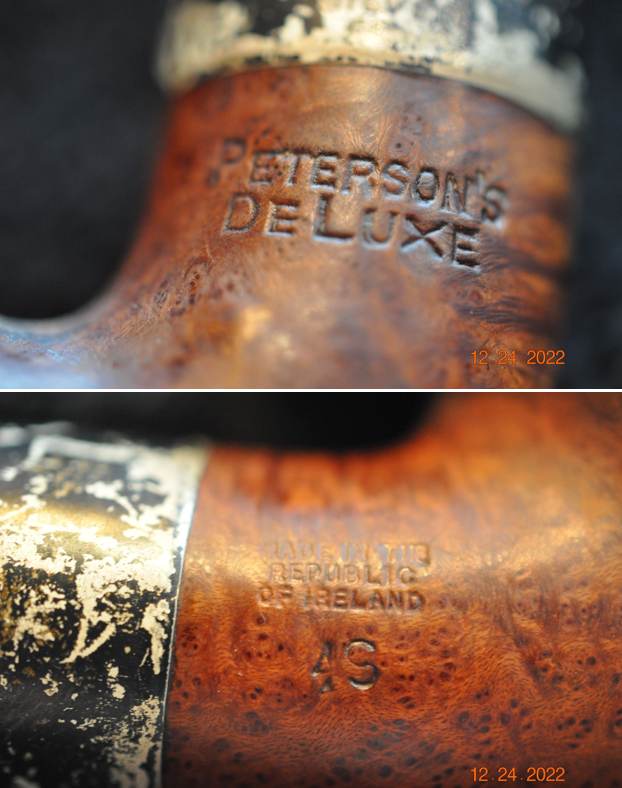
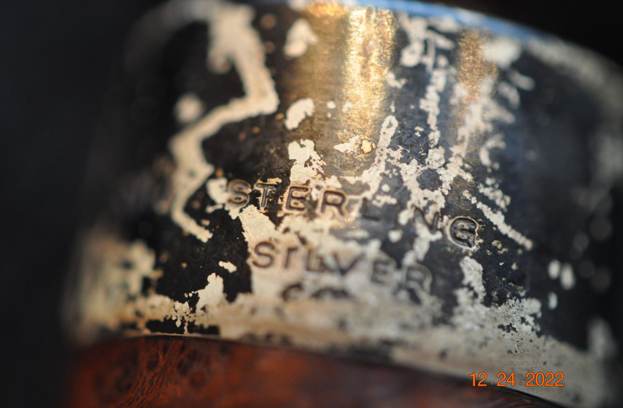
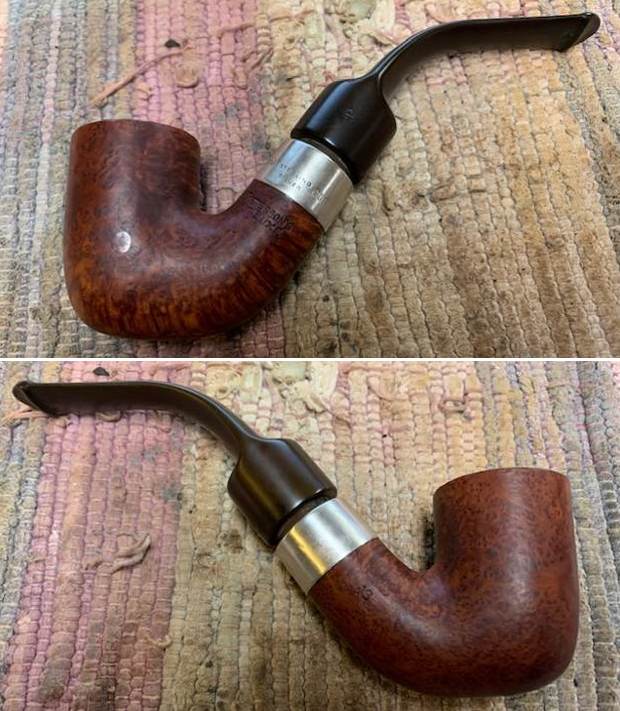
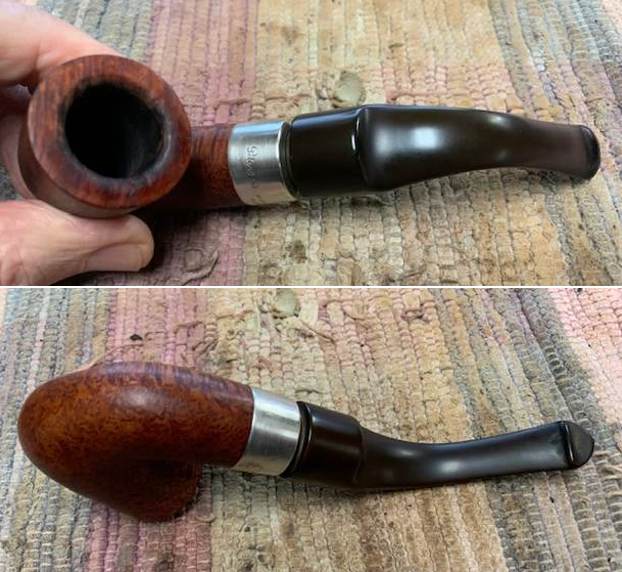
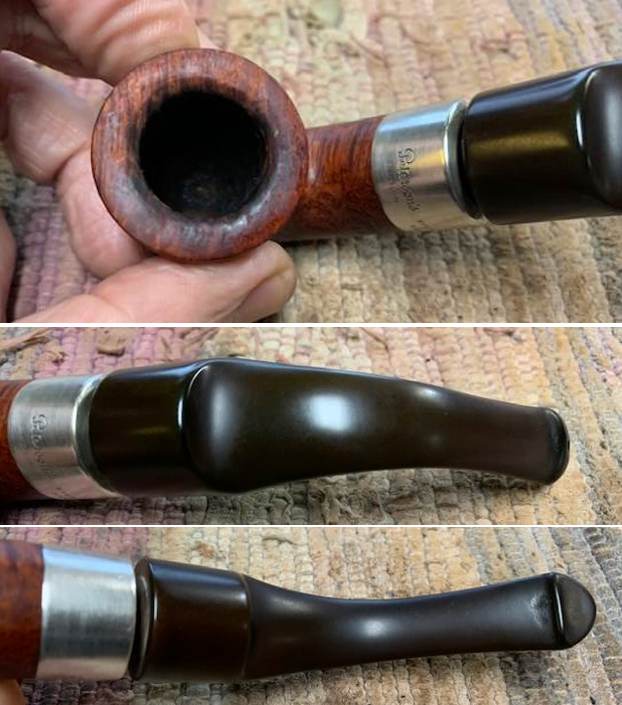
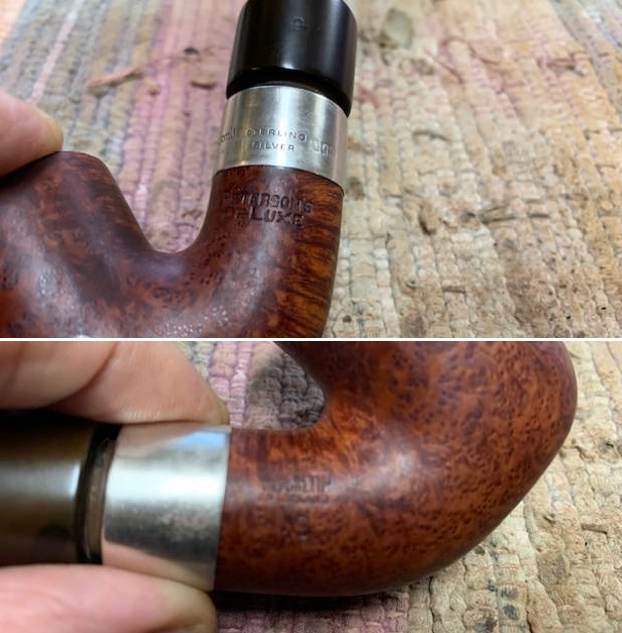
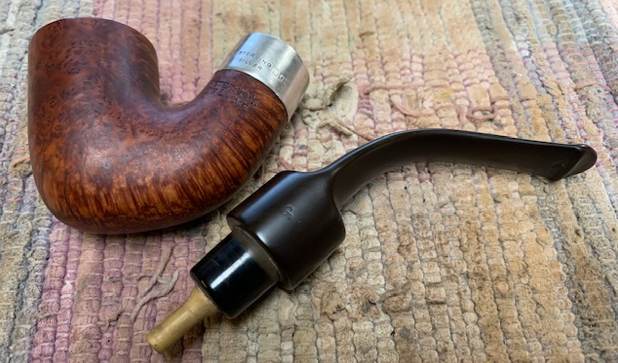
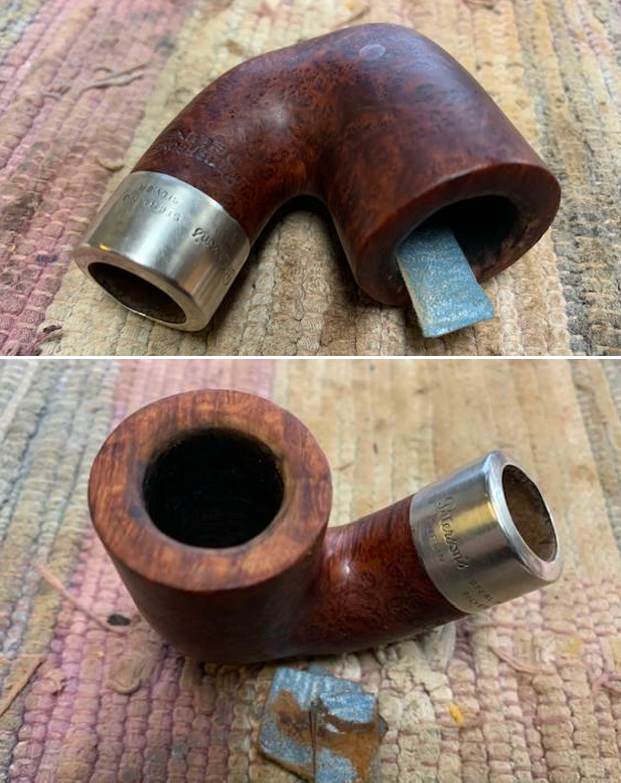
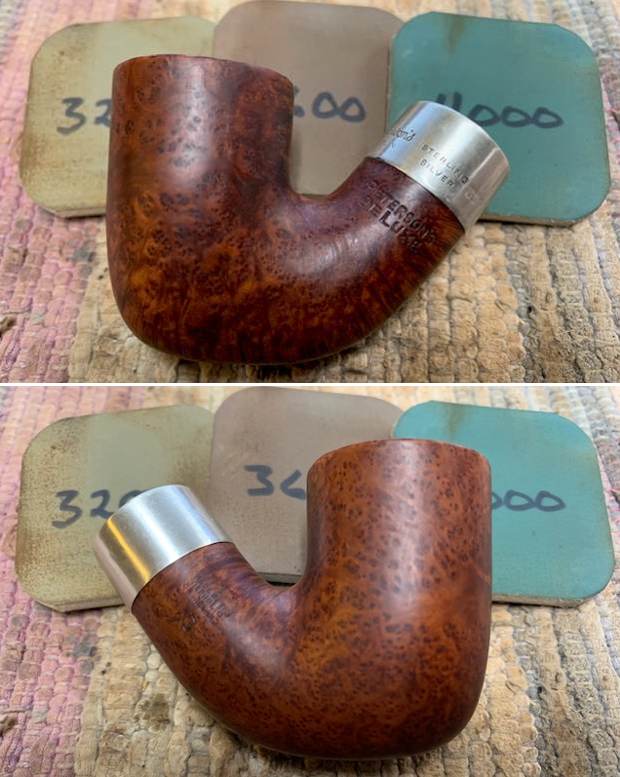
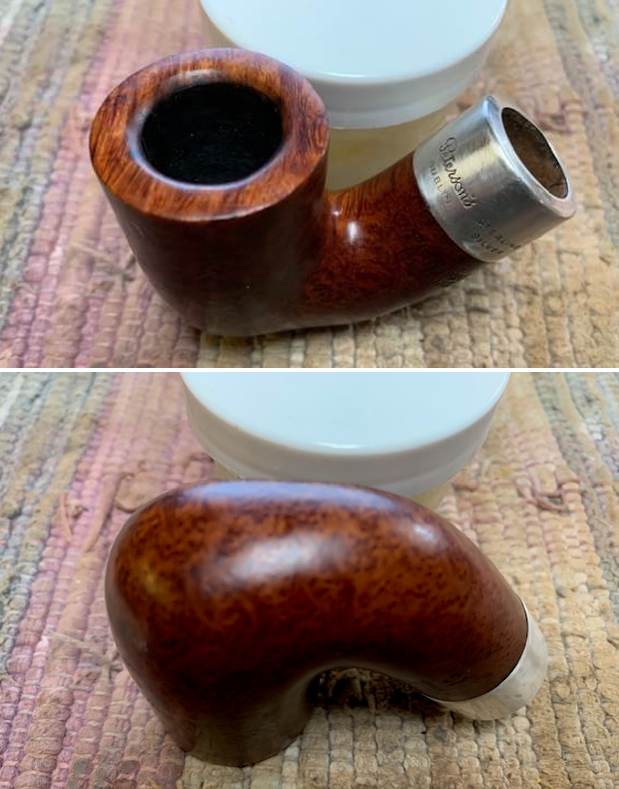
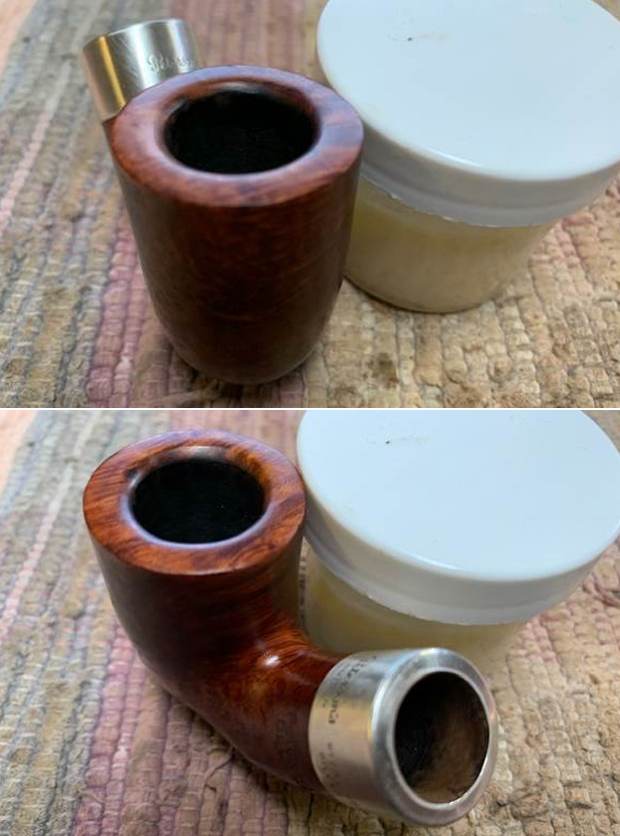
This afternoon I decided to work on the another one of the Peterson’s Pipes that I have still to work on from a variety of places. This pipe was also purchased as part of an estate on 03/30/2022 from Plano, Texas, USA. It is a larger bent pipe that is stamped on the sides of the shank. On the left side it read Peterson’s [over] De Luxe. On the right side it is stamped Made in the Republic of Ireland (three lines) [over] the shape number 4S. There is a very tarnished Sterling Silver band on the shank. It is stamped Peterson’s [over]Dublin on the top of the shank band. Next to that it is stamped Sterling [over] Silver followed by three hallmarks. The first mark is the seated woman Hibernia, the second is a Harp, and the final one, the date stamp is buffed off and illegible. The pipe was a well used pipe when Jeff received it. There was dust and grime ground into the finish. The mixture of brown stains highlights some beautiful grain under the dirt. The bowl was heavily caked and there was an overflow of lava on the rim top. It is hard to know what the edges looked like at this point but time would tell. The vulcanite stem was oxidized and dirty with tooth marks and chatter on both sides ahead of the button and on the button itself. There is a faint “P” stamp in the vulcanite on the left side of the saddle P-lip stem. Jeff took photos of the pipe before he started his clean up work on it. He took photos of the bowl and rim top to show what they looked like before his clean up. He also took some of the stem to show the condition of both sides. The photos of the sides and heel of the bowl show the amazing grain around the bowl and shank. The mixture of brown stains adds depth finish on the pipe. Even under the grime it is a real beauty. The stamping on the sides of the shank are shown in the photos below. The are clear and readable as noted above. He also took a photo of the very tarnish shank band/ferrule. Jeff captured the detail in the photo below. I am including the information from Pipedia’s article on Peterson pipes. It is a great read in terms of the history of the brand (https://pipedia.org/wiki/Peterson). I have included a bit of the pertinent history here.

1950 – 1989 The Republic Era – From 1950 to the present time, the stamp for this era is “Made in the Republic of Ireland” in a block format generally in three lines but two lines have been used with or without Republic being abbreviated.

During the 1950’s and 60’s the Kapp & Peterson company was still in the ownership of the Kapp family. However 1964 saw the retiral of the company Managing Director Frederick Henry(Harry) Kapp.

I then turned to The Peterson Pipe – The Story of Kapp & Peterson to look up information on the DeLuxe line. There on page 297 I found this information:

De Luxe (1915-) Introduced in newspaper advertising in 1916, production of this high grade smooth finish model may have been stalled by the Great War and domestic disturbances. It will not appear in Peterson’s catalogs until ’37. Specimens documented from 1915 to the 30s are extremely rare and confined to extra-large house pipes and occasionally medium sized pipes with unconventional shapes. Specimens from 1930-50 in a wide selection of Classic Range shapes, often as Canadians. Catalogs from 1937-50 list it as “the finest possible quality obtainable.” After ’50 the Supreme would supplant the De Luxe as the top of the line model, and to this day the De Luxe is a high quality pipe but not the highest. Early models often have no COM. Models from the twenties until the sixties will be stamped Irish over Free State, Eire, London Made over England, Made in over Ireland (forming a circle) or Made in the over Republic over Ireland. The last three COM stamps, used from’38 through ’68 when no hallmarks were stamped on the Peterson mountings can never be precisely dated. If a De Luxe was made in ’69 or later it will be hallmarked with the date designator and always have a Republic COM.

With that information in hand I knew what I was dealing with in terms of the stamping and the age of this pipe. I knew from the information that the pipe was made during the Republic Era between 1950 and the present day. The COM stamp on the shank and the hallmarks (even though unreadable in terms of the date stamp) help me to know that the pipe came out after 1969. Now it was time to work on the pipe.

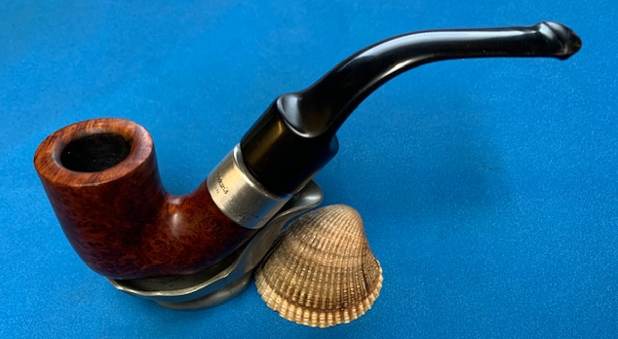
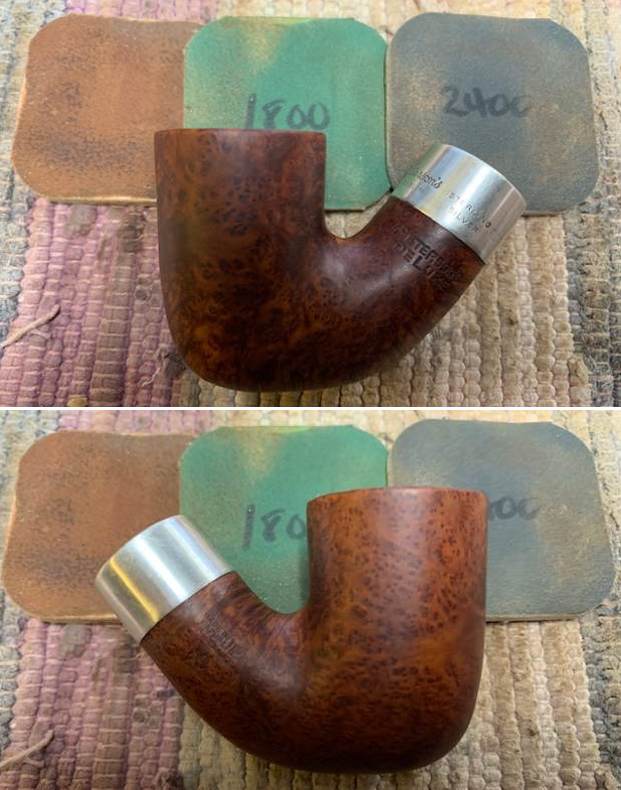
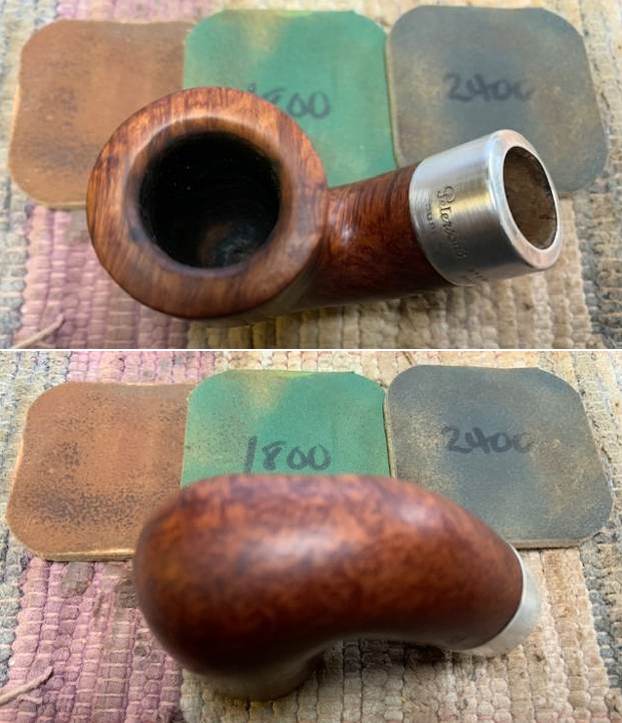
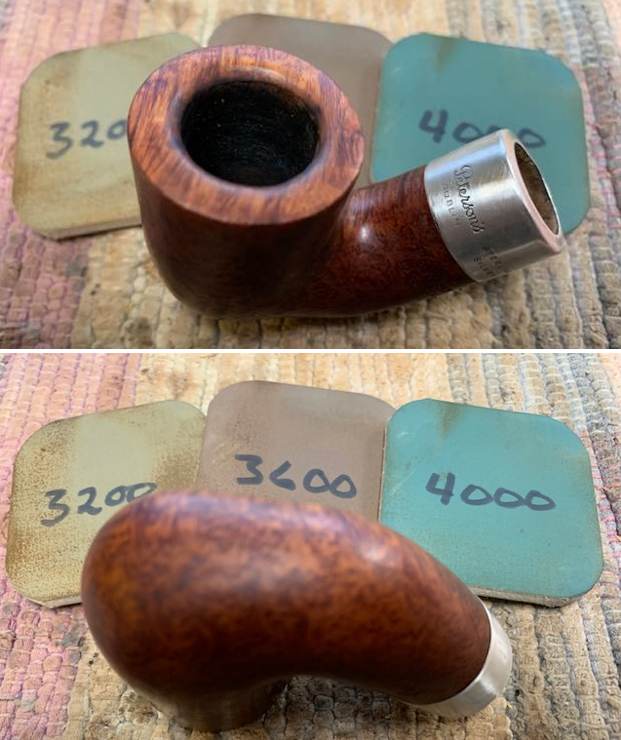
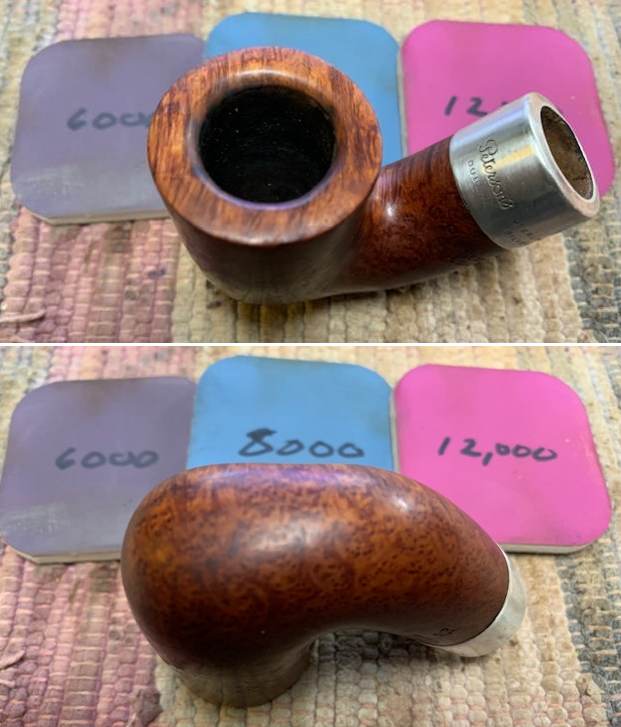
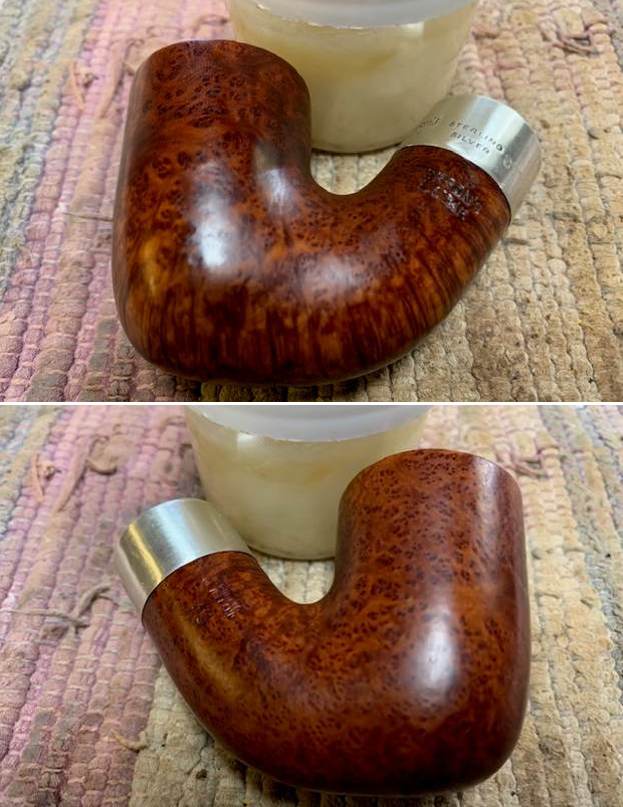
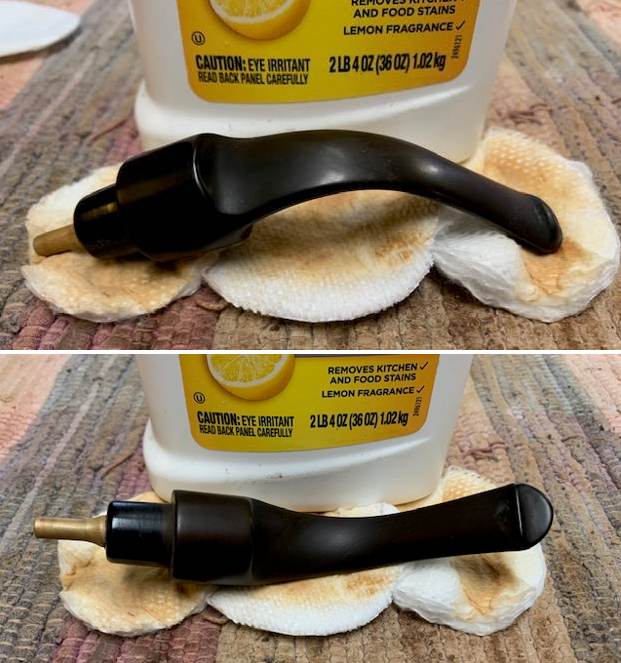
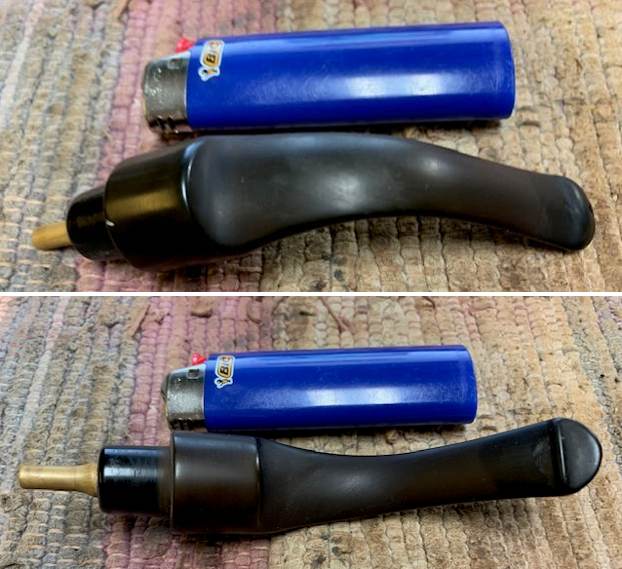
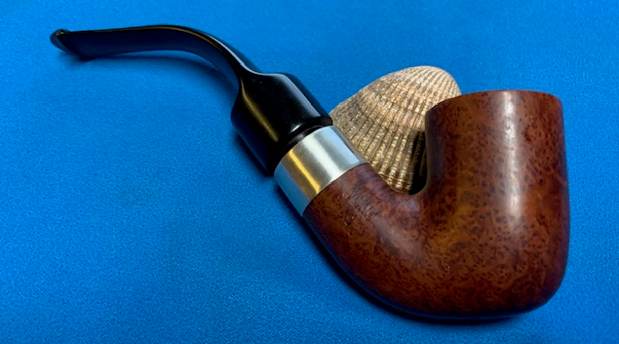
Jeff had thoroughly cleaned up the pipe. He reamed the pipe with a PipNet Pipe Reamer and cleaned up the remnants with a Savinelli Fitsall Pipe Knife.  He scrubbed the bowl with undiluted Murphy’s Oil Soap with a tooth brush. He rinsed it under running warm water to remove the soap and grime. He cleaned out the inside of the sump in the shank and the airway in the stem with alcohol, cotton swabs and pipe cleaners. He scrubbed the exterior of the stem with Soft Scrub to remove as much of the oxidation and calcification as possible. He soaked the stem in Before & After Deoxidizer and rinsed it off with warm water. I took close up photos of the bowl, rim and the stem. You can see how clean the bowl and rim top and edges are. There is some slight damage on the inner edge and scratches on the rim top. The stem is in good condition with tooth marks and some chatter as noted above.I took photos of the stamping on the sides of the shank. All are clear and readable as noted above. You can see the faint P stamp on the left side of the stem in the first photo below.I removed the stem from the shank and took a photo to give a sense of the proportions of the pipe. The chunky shank and stem together make for a classic Peterson’s Pipe.I decided to work on the damage on the top and the inner beveled edge of the bowl first. I started the work with a folded piece of 220 grit sandpaper to clean up the rim top and the inner edge of the rim. Once I had finished I think that it looked much better. I polished the briar with micromesh sanding pads – dry sanding with 1500-12000 grit pads. I wiped the bowl down after each  pad to remove the grit. The bowl began to take on a rich shine. It is going to be a beauty.   I rubbed the bowl down with Before & After Restoration Balm. I worked it into the briar with my finger tips. I let it sit for 10 minutes and the Balm did its magic. It enlivens, cleans and preserves the briar. It certainly brought this bowl back to life. I buffed it off with a clean cloth and took the following photos.  I set the bowl aside and turned to work on the stem. I worked on the deep oxidation with Soft Scrub and cotton pads to remove more of the deep oxidation. It worked very well.I “painted” the tooth marks on the stem with the flame of a Bic Lighter to lift them. I was able to lift them all to some degree. I filled in those that remained with clear CA glue. I used a small file to flatten the repairs. I sanded stem surface repairs smooth with 220 grit sandpaper. I started polishing the stem with 400 grit wet dry sandpaper. I soaked it again in Briarville’s Deoxidizer for several hours to further remove the deep oxidation. I removed it, rinsed it and dried it with a coarse cloth. I polished the vulcanite stem with micromesh sanding pads – 1500-12000 grit pads. I wiped it down with a damp cloth after each sanding pad. I used Before & After Pipe Polish – both Fine and Extra Fine to further polish the stem. This Republic Era Peterson’s De Luxe 4S Bent Billiard and a vulcanite, saddle P-lip stem is a great looking pipe now that it has been restored. The beautiful finish really highlights the grain and the polished finish is stunning. I put the stem back on the bowl and carefully buffed the pipe with Blue Diamond on the buffing wheel. I gave the bowl and the stem multiple coats of carnauba wax on the buffing wheel and followed that by buffing the entire pipe with a clean buffing pad. I hand buffed the pipe with a microfiber cloth to deepen the shine. The finished Peterson’s De Luxe 4S Bent Billiard fits nicely in the hand and feels great. Give the finished pipe a look in the photos below. The dimensions of the pipe are Length: 6 inches, Height: 2 inches, Outside diameter of the bowl: 1 ¼ inches, Chamber diameter: ¾ of an inch. The weight of the pipe is 57 grams/2.01 ounces. I will be adding the pipe to the Irish Pipe Makers Section of the rebornpipes store. If you are interested in purchasing this pipe send me a message or an email. Thanks for reading this blog and my reflections on the pipe while I worked on it.
Restoring a Beautiful Republic Era Peterson’s Supreme XL339


Blog by Steve Laug

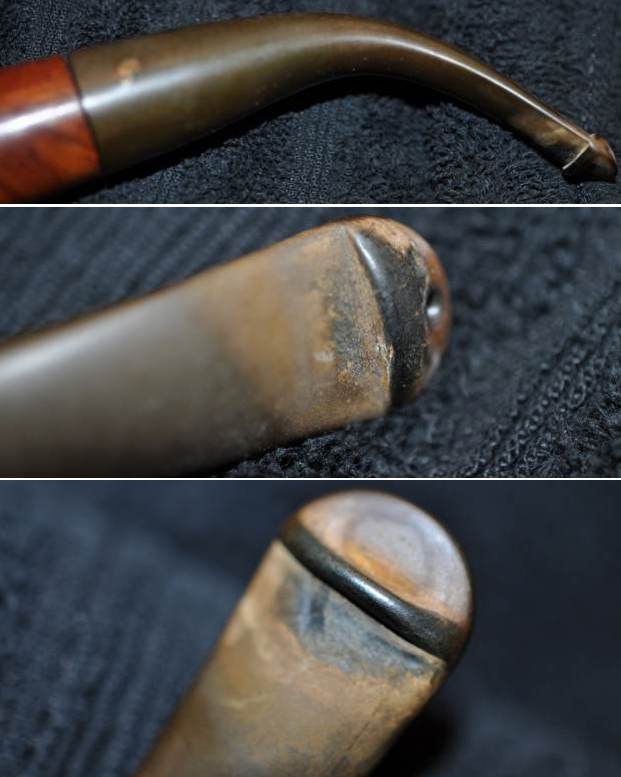
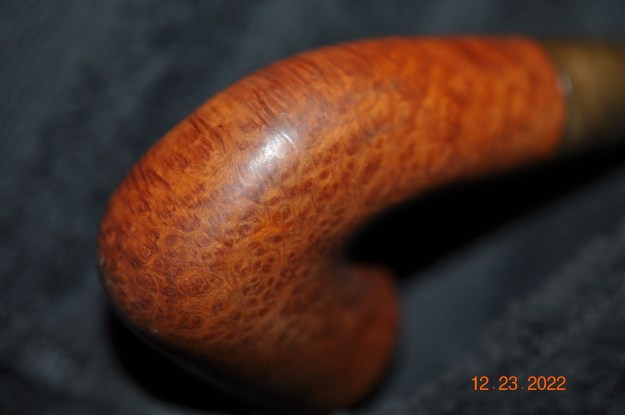
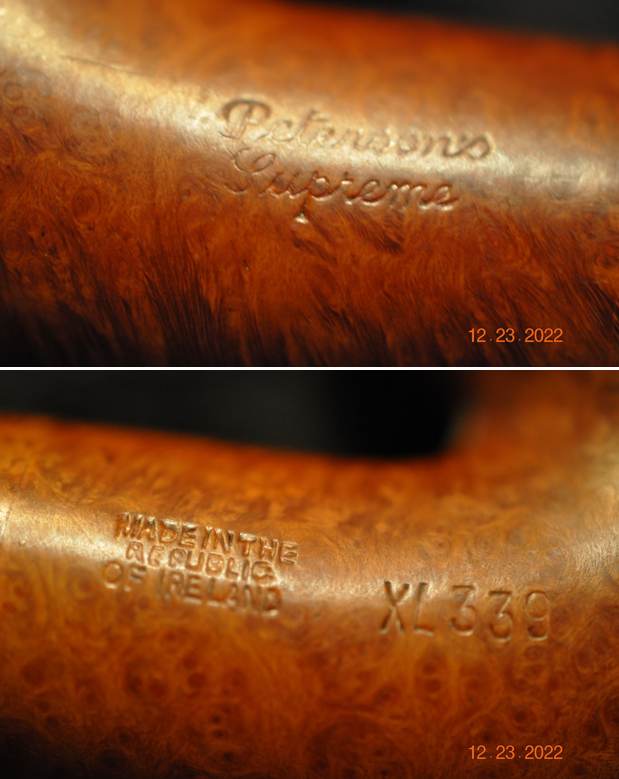
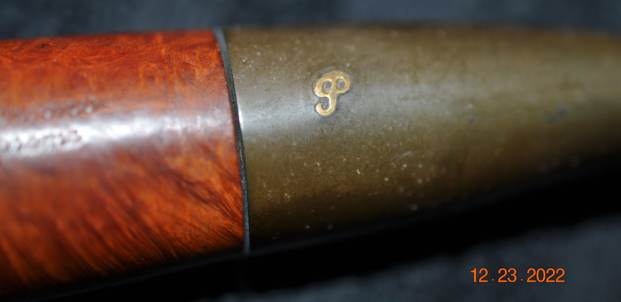
This afternoon I decided to work on the another one of the Peterson’s Pipes that I have still to work on from a variety of places. This pipe was purchased as part of an estate on 03/30/2022 from Plano, Texas, USA. It is a larger bent pipe that is stamped on the sides of the shank. On the left side it read Peterson’s [over] Supreme. On the right side it is stamped Made in the Republic of Ireland (three lines) followed by the shape number XL339. The pipe was a well used pipe when Jeff received it. There was dust and grime ground into the finish. The mixture of brown stains highlights some beautiful grain under the dirt. The bowl was heavily caked and there was an overflow of lava on the rim top. It is hard to know what the edges looked like at this point but time would tell. The vulcanite stem was oxidized and dirty with tooth marks and chatter on both sides ahead of the button. There is a gold (brass) “P” set in the vulcanite on the left side of the taper P-lip stem. Jeff took photos of the pipe before he started his clean up work on it. He took photos of the bowl and rim top to show what they looked like before his clean up. He also took some of the stem to show the condition of both sides. The photos of the sides and heel of the bowl show the amazing grain around the bowl and shank. The mixture of brown stains adds depth finish on the pipe. Even under the grime it is a real beauty. The stamping on the underside of the shank are shown in the photos below. The are clear and readable as noted above. Jeff captured the detail in the photo below. I am including the information from Pipedia’s article on Peterson pipes. It is a great read in terms of the history of the brand (https://pipedia.org/wiki/Peterson). I have included a bit of the pertinent history here.

1950 – 1989 The Republic Era – From 1950 to the present time, the stamp for this era is “Made in the Republic of Ireland” in a block format generally in three lines but two lines have been used with or without Republic being abbreviated.

During the 1950’s and 60’s the Kapp & Peterson company was still in the ownership of the Kapp family. However 1964 saw the retiral of the company Managing Director Frederick Henry(Harry) Kapp.

I then turned to The Peterson Pipe – The Story of Kapp & Peterson to look up information on the Supreme line. There on page 314 I found this information:

Supreme (1953-) Peterson’s highest grade, introduced by Rogers Imports. Polished natural stain finish and aluminum P, in many shapes, P-lip and fishtail mouthpiece. Later models are sterling or gold mounted. Until c. 1980, stamped Made in over Ireland. Later gold and sterling banded models hallmarked and stamped Made in the over Republic over of Ireland.

With that information in hand I knew what I was dealing with in terms of the stamping and the age of this pipe. I knew from the information that the pipe was made during the Republic Era between 1950 and the present day. The Supreme came out originally in 1953. This one does not have a gold or silver band but does have a gold inset P on the stem. Personally I think this is probably a 60s era pipe. Now it was time to work on the pipe.

Jeff had thoroughly cleaned up the pipe. He reamed the pipe with a PipNet Pipe Reamer and cleaned up the remnants with a Savinelli Fitsall Pipe Knife.  He scrubbed the bowl with undiluted Murphy’s Oil Soap with a tooth brush. He rinsed it under running warm water to remove the soap and grime. He cleaned out the inside of the sump in the shank and the airway in the stem with alcohol, cotton swabs and pipe cleaners. He scrubbed the exterior of the stem with Soft Scrub to remove as much of the oxidation and calcification as possible. He soaked the stem in Before & After Deoxidizer and rinsed it off with warm water. I took close up photos of the bowl, rim and the stem. You can see how clean the bowl and rim top and edges are. There is some slight damage on the inner edge and scratches on the rim top. The stem is in good condition with just a few tooth marks and some chatter.I took photos of the stamping on the sides of the shank. All are clear and readable as noted above. I included the gold P inlay on the left side of the stem in the first photo below.I removed the stem from the shank and took a photo to give a sense of the proportions of the pipe. The chunky shank and stem together make for a classic Peterson’s Pipe.I decided to work on the damage on the top and the inner edge of the bowl first. I started the work with a folded piece of 220 grit sandpaper to clean up the rim top and the inner edge of the rim. Once I had finished I think that it looked much better. I polished the briar with micromesh sanding pads – dry sanding with 1500-12000 grit pads. I wiped the bowl down after each  pad to remove the grit. The bowl began to take on a rich shine. It is going to be a beauty.   I rubbed the bowl down with Before & After Restoration Balm. I worked it into the briar with my finger tips. I let it sit for 10 minutes and the Balm did its magic. It enlivens, cleans and preserves the briar. It certainly brought this bowl back to life. I buffed it off with a clean cloth and took the following photos.  I set the bowl aside and turned to work on the stem. I “painted” the tooth marks on the stem with the flame of a Bic Lighter to lift them. I was able to lift them all to some degree. I filled in those that remained with clear CA glue. I used a small file to flatten the repairs. I sanded them smooth with 220 grit sandpaper. I started polishing the stem with 400 grit wet dry sandpaper. I polished the vulcanite stem with micromesh sanding pads – 1500-12000 grit pads. I wiped it down with a damp cloth after each sanding pad. I used Before & After Pipe Polish – both Fine and Extra Fine to further polish the stem. This Republic Era Peterson’s Supreme XL339 Bent Billiard and a vulcanite P-lip stem is a great looking pipe now that it has been restored. The beautiful finish really highlights the grain and the polished finish is stunning. I put the stem back on the bowl and carefully buffed the pipe with Blue Diamond on the buffing wheel. I gave the bowl and the stem multiple coats of carnauba wax on the buffing wheel and followed that by buffing the entire pipe with a clean buffing pad. I hand buffed the pipe with a microfiber cloth to deepen the shine. The finished Peterson’s Supreme XL339 Bent Billiard fits nicely in the hand and feels great. Give the finished pipe a look in the photos below. The dimensions of the pipe are Length: 6 inches, Height: 2 inches, Outside diameter of the bowl: 1 ¼ inches, Chamber diameter: ¾ of an inch. The weight of the pipe is 65 grams/2.29 ounces. I will be adding the pipe to the Irish Pipe Makers Section of the rebornpipes store. If you are interested in purchasing this pipe send me a message or an email. Thanks for reading this blog and my reflections on the pipe while I worked on it.
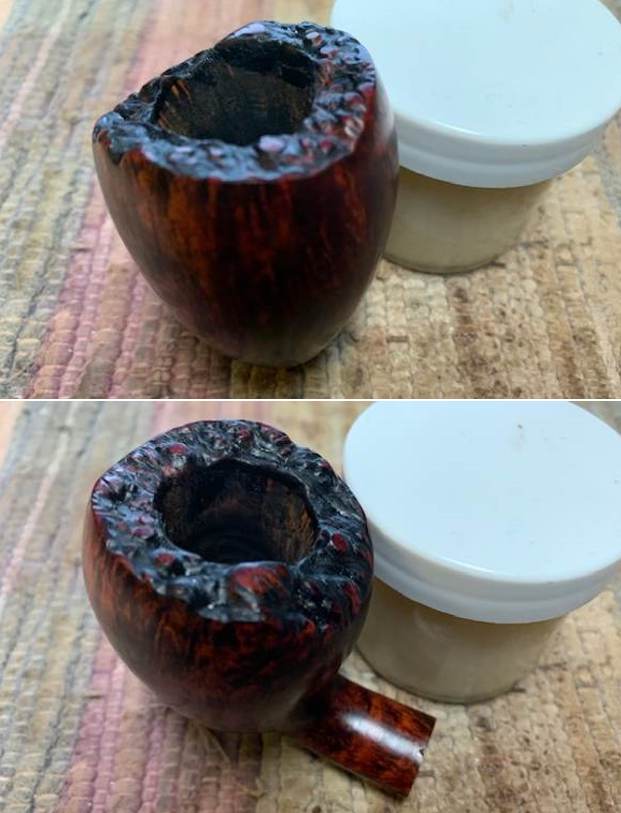
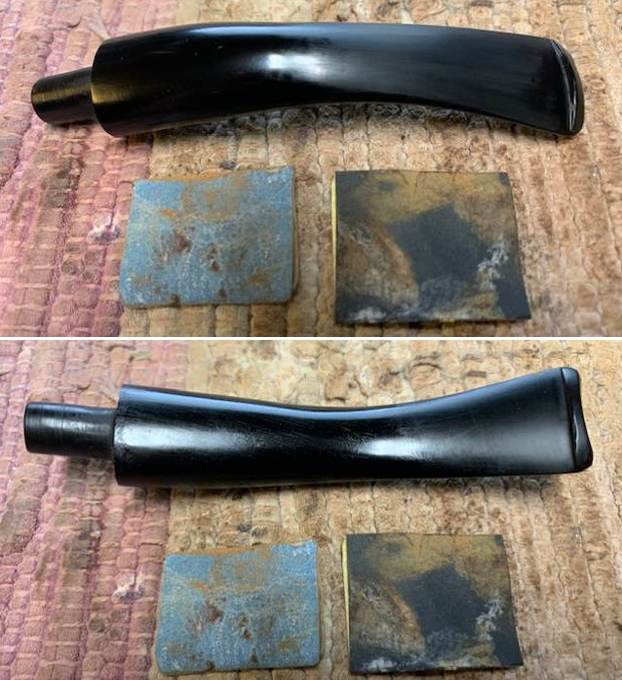
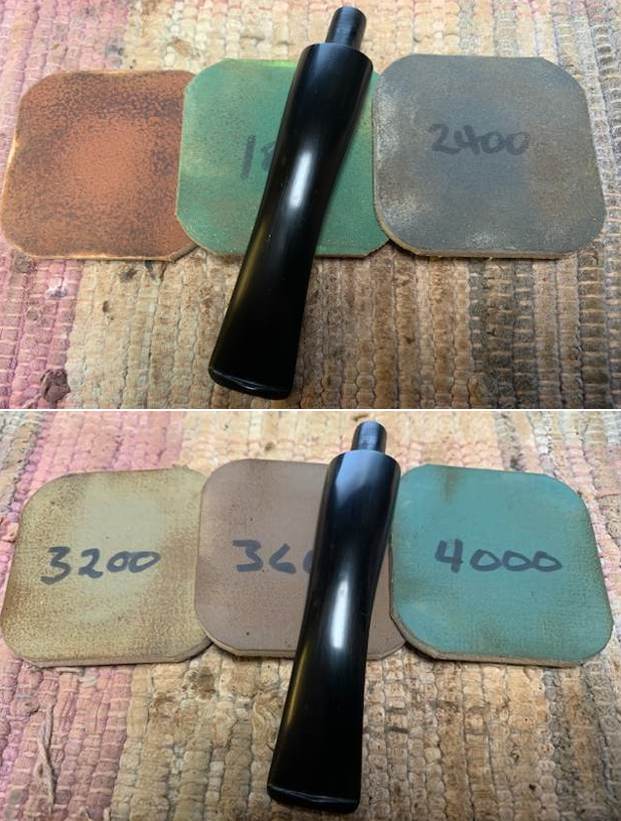
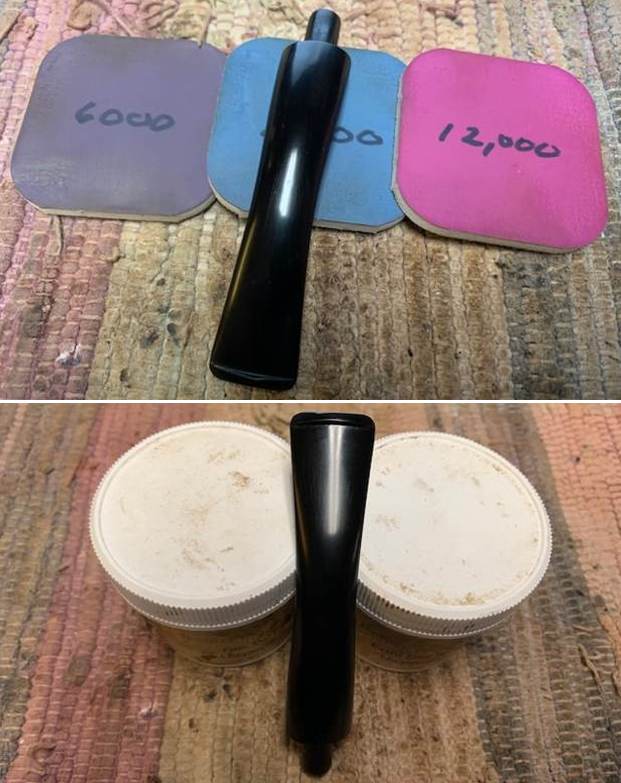
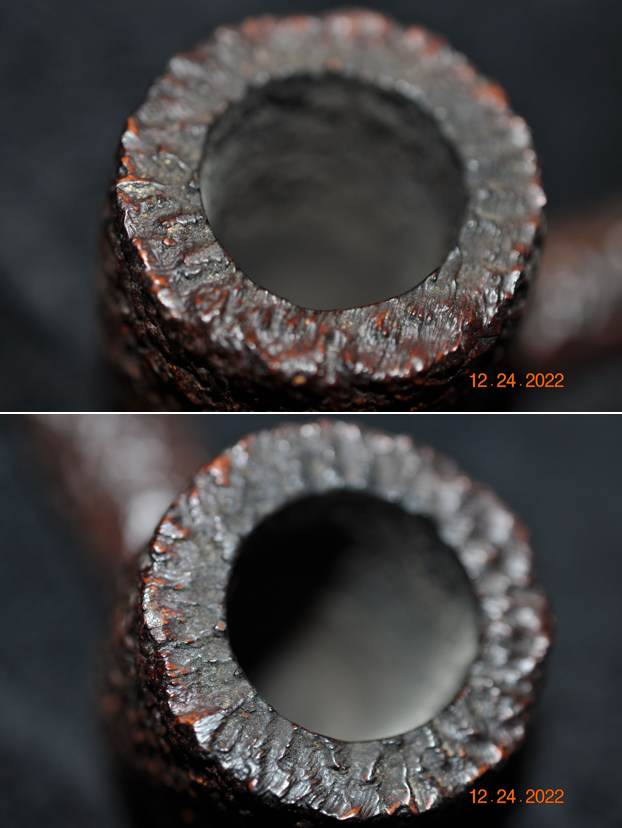
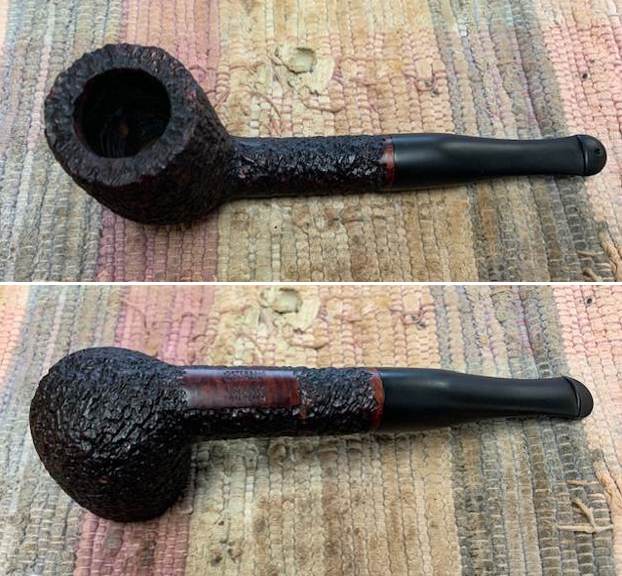
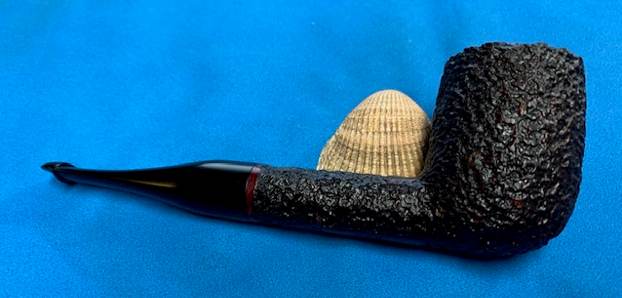
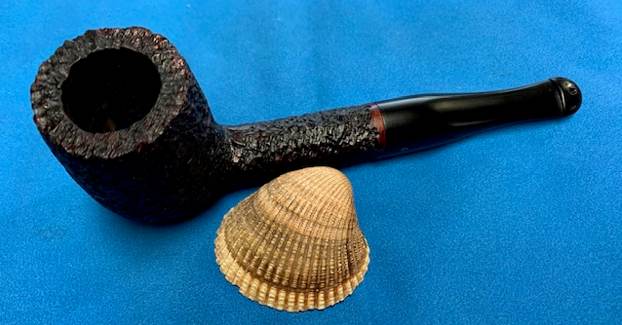
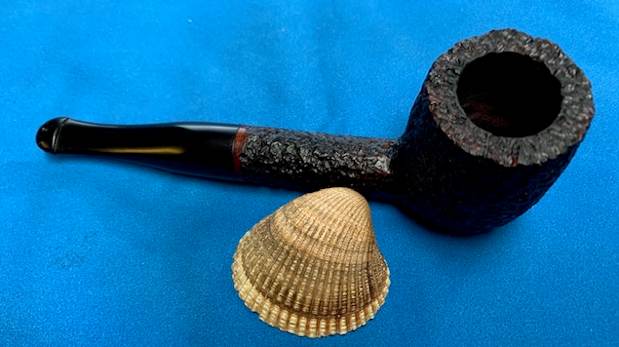
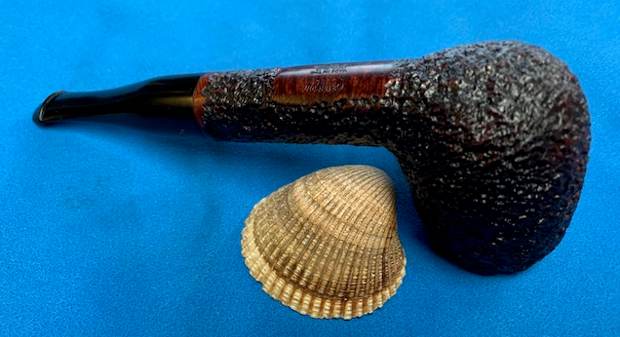
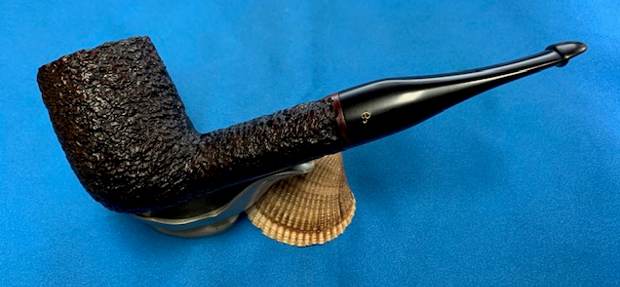
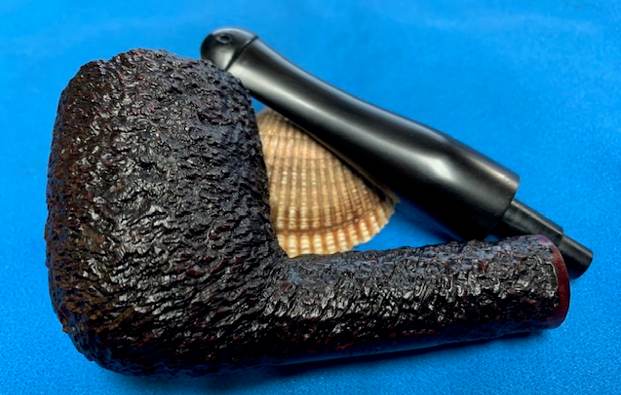
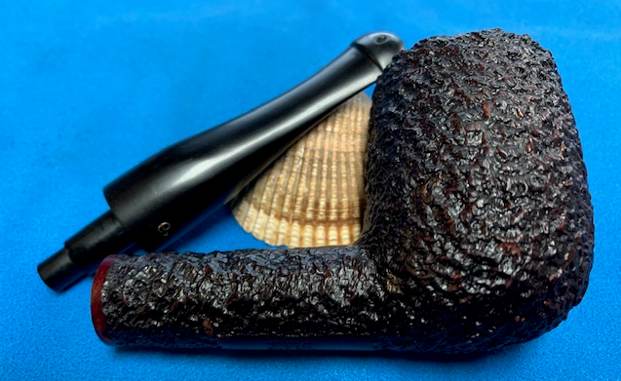
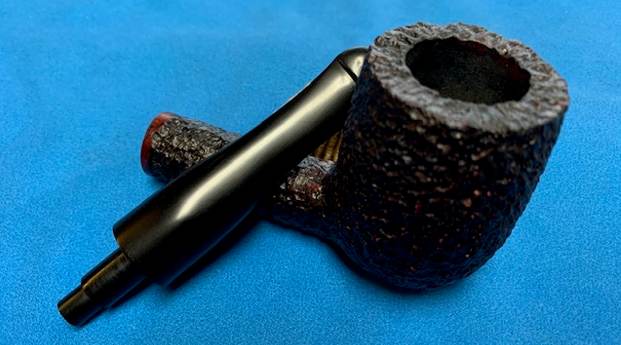
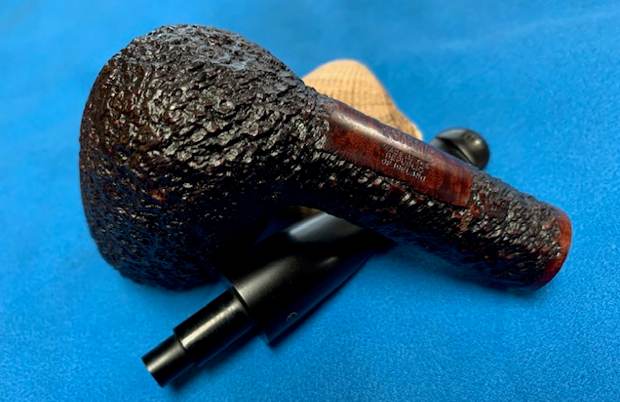
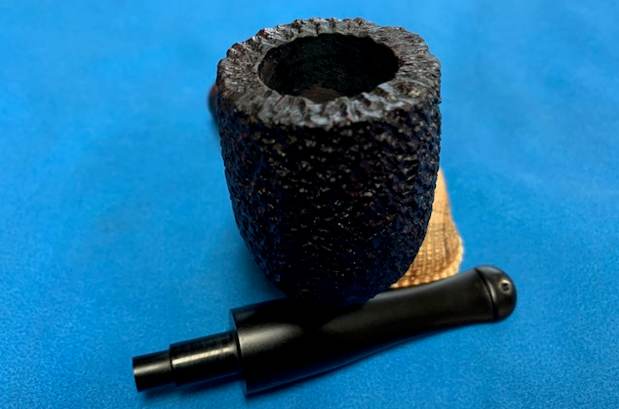
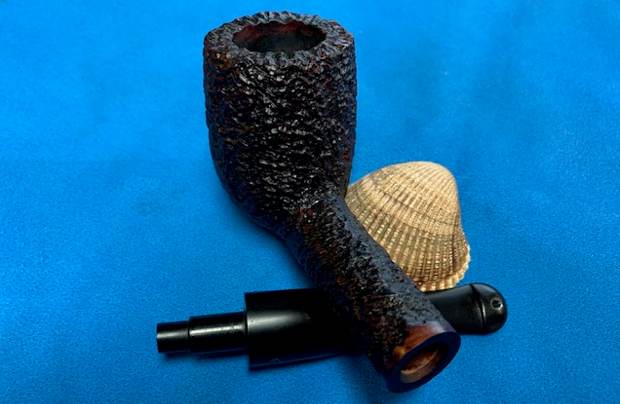
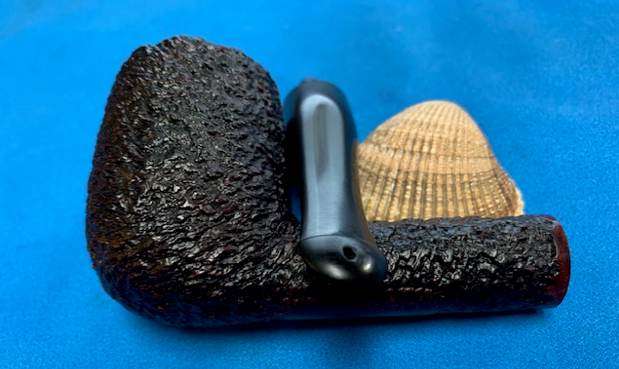
Restoring a Beautiful Rusticated Peterson Republic Era War Club


Blog by Steve Laug

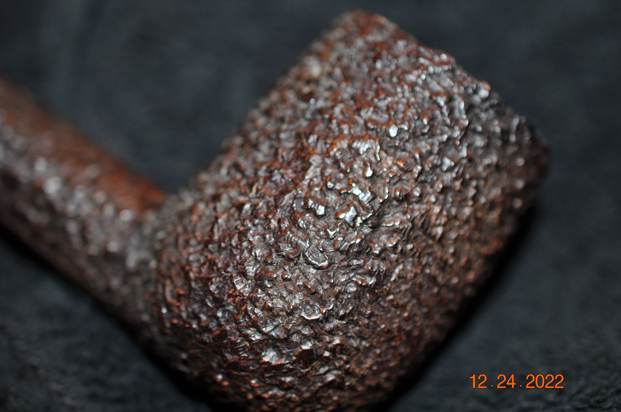
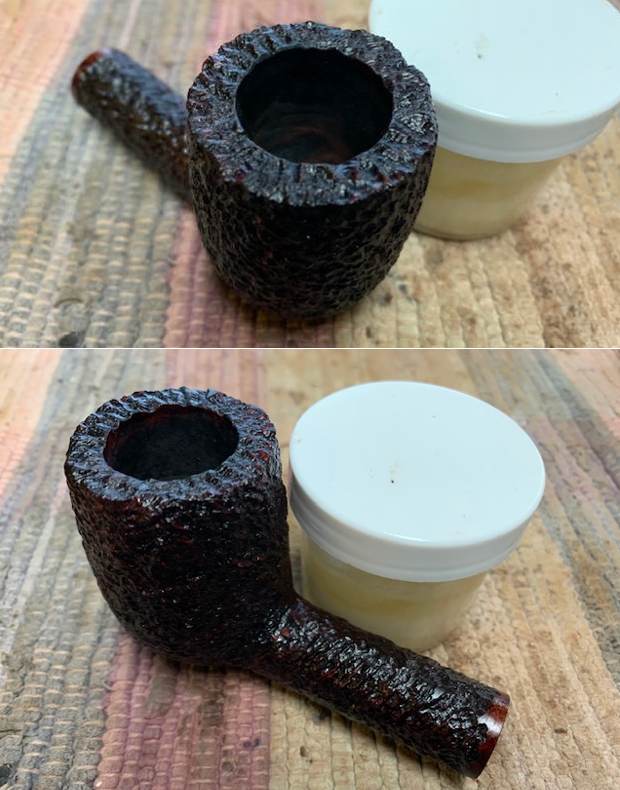
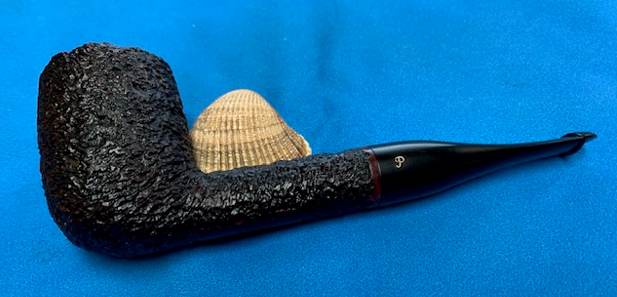
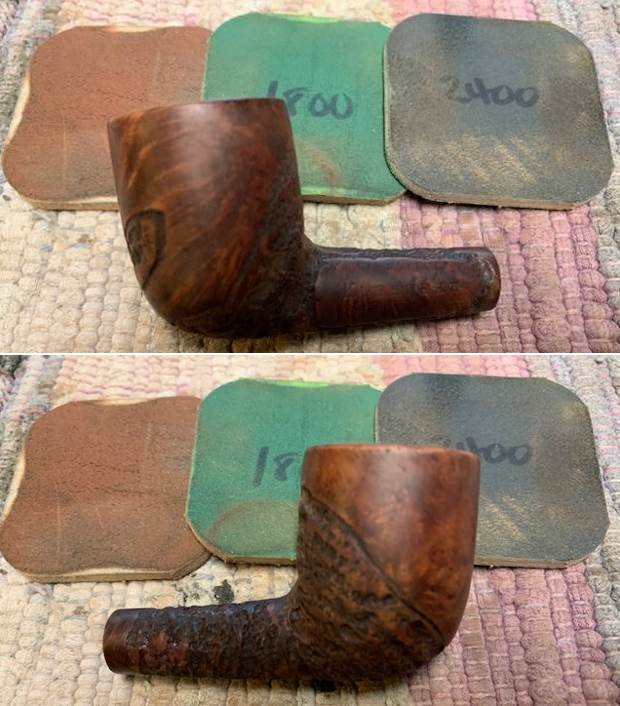
This afternoon I decided to work on the first of a few Peterson’s Pipes that I have still to work on from a variety of places. This rather large rusticated pipe was purchased from an antique store on 10/20/2022 in Vancouver, Washington, USA. It is a large pipe that is stamped on a smooth panel on the underside of the shank. It read Peterson’s [arched over] Dublin. Underneath that it is stamped Made in the Republic of Ireland (three lines). The pipe was quite dirty when Jeff found it with dust and debris in the rustication. The mixture of brown stains give depth and texture to the rustication. The bowl was moderately caked and there was dust and lava in the rustication on the rim top. The edges were quite clean and undamaged. The vulcanite stem was oxidized and dirty with tooth marks and chatter on both sides ahead of the button. The “P” stamped on the left side of the taper P-lip stem and appeared to have remnants of gold stamped in the letter. Jeff took photos of the pipe before he started his clean up work on it. He took photos of the bowl and rim top to show their condition and of the stem to show the condition of both sides. The photos of the sides and heel of the bowl show the rugged rustication on the bowl and shank. The mixture of brown stains adds depth finish on the pipe. Even under the grime it is a real beauty. The stamping on the underside of the shank are shown in the photos below. The are clear and readable as noted above. Jeff captured the detail in the photo below. I am including the information from Pipedia’s article on Peterson pipes. It is a great read in terms of the history of the brand (https://pipedia.org/wiki/Peterson). I have included a bit of the pertinent history here.
1950 – 1989 The Republic Era – From 1950 to the present time, the stamp for this era is “Made in the Republic of Ireland” in a block format generally in three lines but two lines have been used with or without Republic being abbreviated.

During the 1950’s and 60’s the Kapp & Peterson company was still in the ownership of the Kapp family. However 1964 saw the retiral of the company Managing Director Frederick Henry(Harry) Kapp.

With that information in hand I knew what I was dealing with in terms of the stamping and the age of this pipe. I knew from the information that the pipe was made during the Republic Era between 1950 and the present day. Personally I think this is probably a 60s-70s pipe. Now it was time to work on the pipe.

Jeff had thoroughly cleaned up the pipe. He reamed the pipe with a PipNet Pipe Reamer and cleaned up the remnants with a Savinelli Fitsall Pipe Knife.  He scrubbed the bowl with undiluted Murphy’s Oil Soap with a tooth brush. He rinsed it under running warm water to remove the soap and grime. He cleaned out the inside of the sump in the shank and the airway in the stem with alcohol, cotton swabs and pipe cleaners. He scrubbed the exterior of the stem with Soft Scrub to remove as much of the oxidation and calcification as possible. He soaked the stem in Before & After Deoxidizer and rinsed it off with warm water. I took close up photos of the bowl, rim and the stem. You can see how clean the bowl and rim top and edges are. It is almost like new in the overall appearance. The stem is in good condition with just a few tooth marks and some chatter.I took a photo of the stamping on the underside of the shank. All are clear and readable as noted above. I also took a photo of the P stamp on the left side of the stem.I removed the stem from the shank and took a photo to give a sense of the proportions of the pipe. It is really quite nice looking.The finish was in such great condition that I only needed to polish it. I rubbed the bowl down with Before & After Restoration Balm. I worked it into the briar with my finger tips and a horse hair shoe brush. I let it sit for 10 minutes and the Balm did its magic. It enlivens, cleans and preserves the briar. It certainly brought this bowl back to life. I buffed it off with a clean cloth and took the following photos. I touched up the “P” stamp on the left side of the stem with some Rub’n Buff Antique Gold. I rubbed it into the stamp with a tooth pick. I buffed it off with a cotton pad and it looked very good.I polished the vulcanite stem with micromesh sanding pads – 1500-12000 grit pads. I wiped it down with a damp cloth after each sanding pad. I used Before & After Pipe Polish – both Fine and Extra Fine to further polish the stem. This Republic Era Ireland Peterson’s Dublin Large Rusticated Billiard and a vulcanite P-lip stem is a great looking pipe now that it has been restored. The beautiful rustication really highlights briar and the polished finish is stunning. I put the stem back on the bowl and carefully buffed the pipe with Blue Diamond on the buffing wheel. I gave the bowl multiple coats of Conservator’s Wax and the stem multiple coats of carnauba wax on the buffing wheel and followed that by buffing the entire pipe with a clean buffing pad. I hand buffed the pipe with a microfiber cloth to deepen the shine. The finished Peterson’s Rusticated Billiard fits nicely in the hand and feels great. Give the finished pipe a look in the photos below. The dimensions of the pipe are Length: 7 inches, Height: 2 ¼ inches, Outside diameter of the bowl: 1 ½ inches, Chamber diameter: 1 inch. The weight of the pipe is 80 grams/2.82 ounces. I will be adding the pipe to the Irish Pipe Makers Section of the rebornpipes store. If you are interested in purchasing this pipe send me a message or an email. Thanks for reading this blog and my reflections on the pipe while I worked on it.