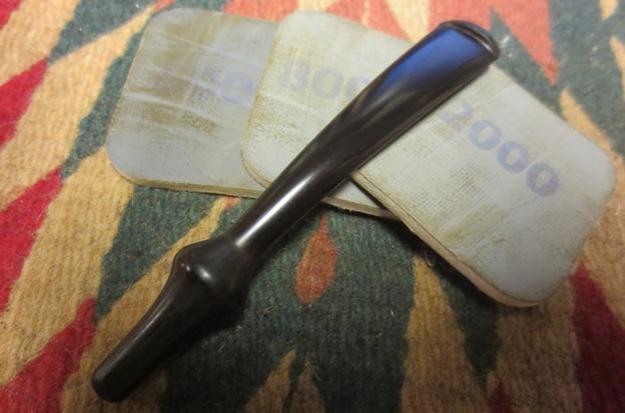
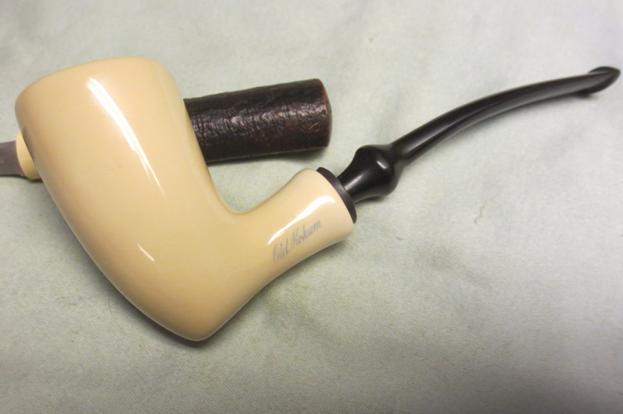
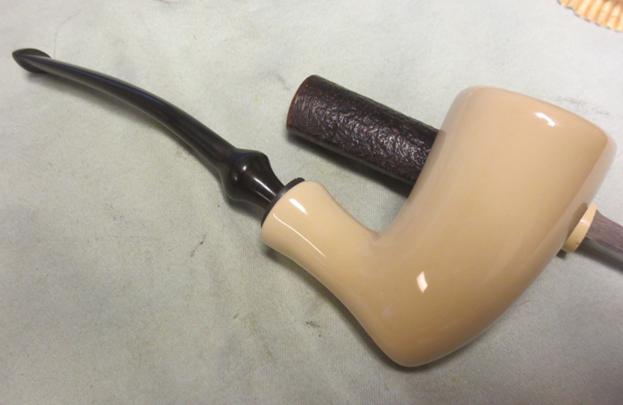
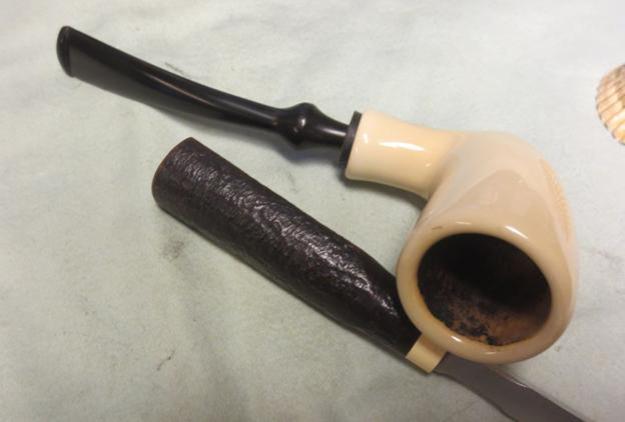
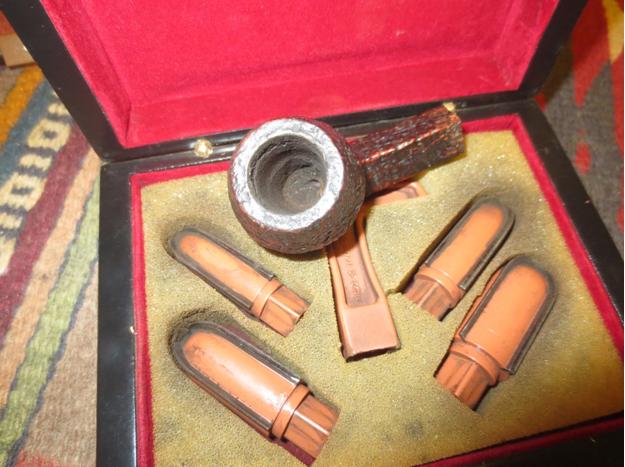
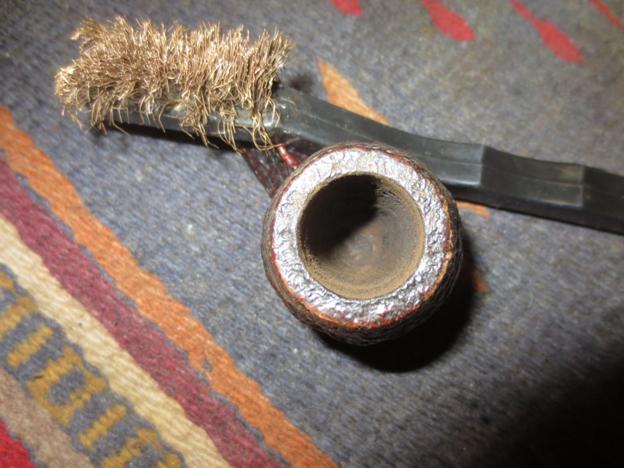
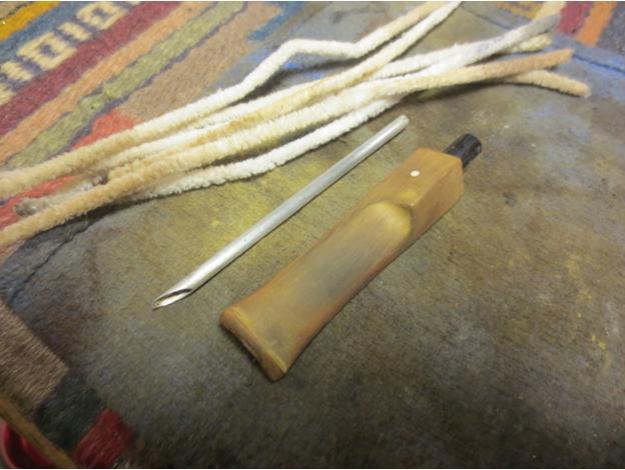
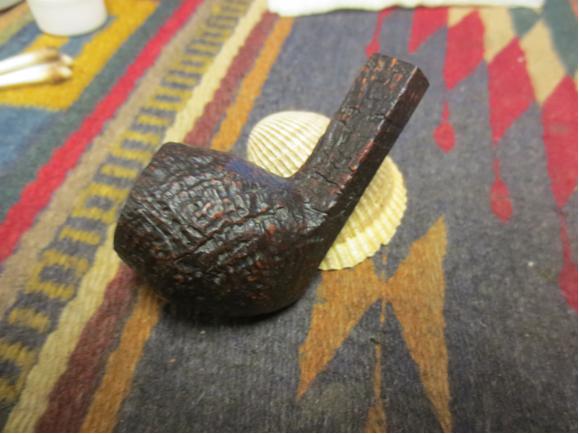
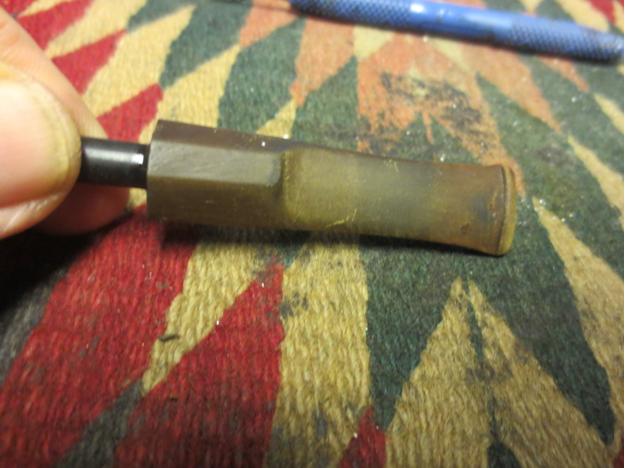
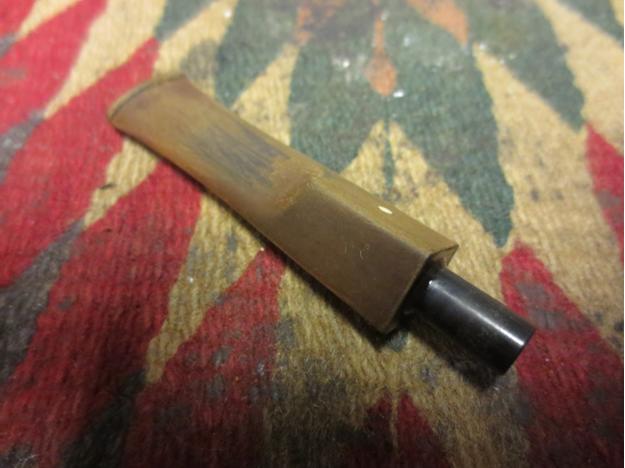
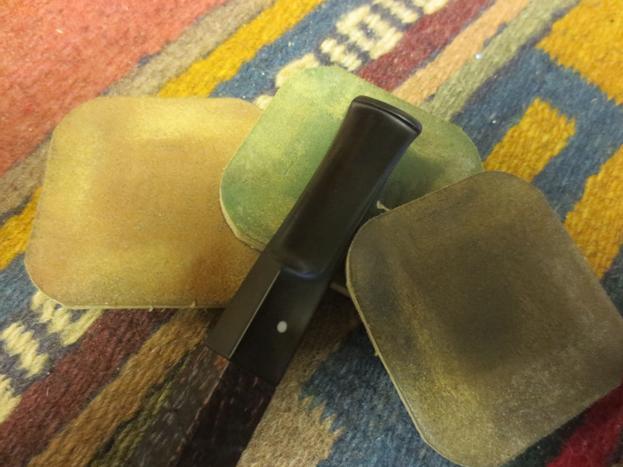
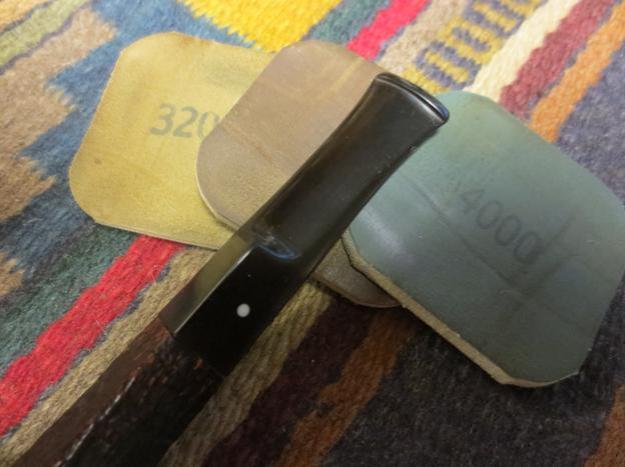
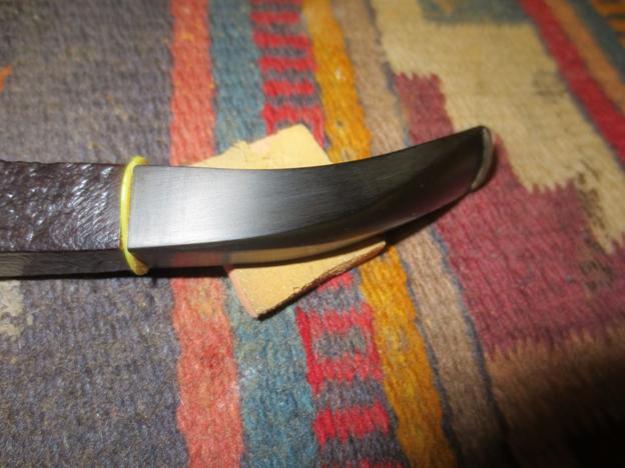
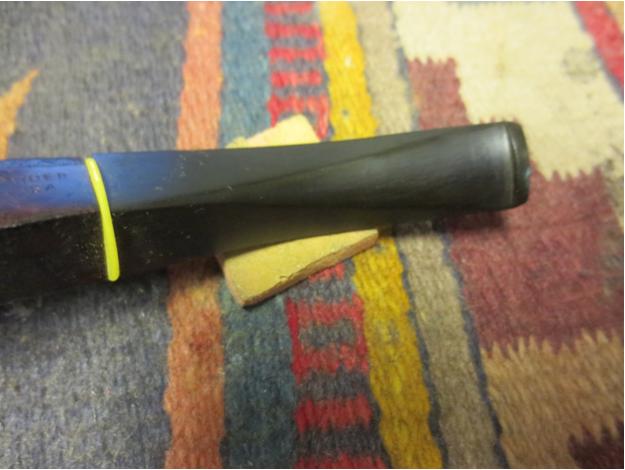
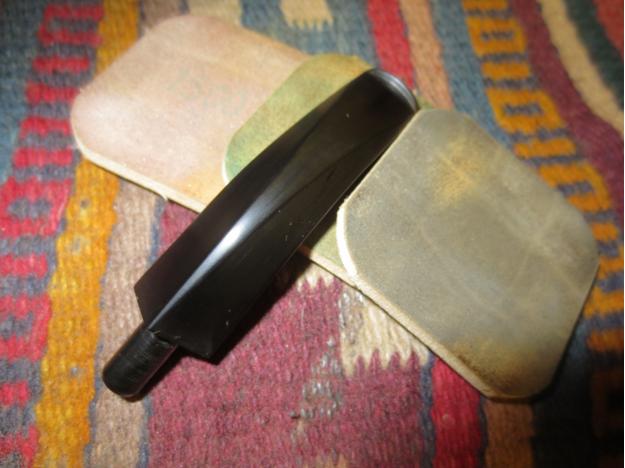
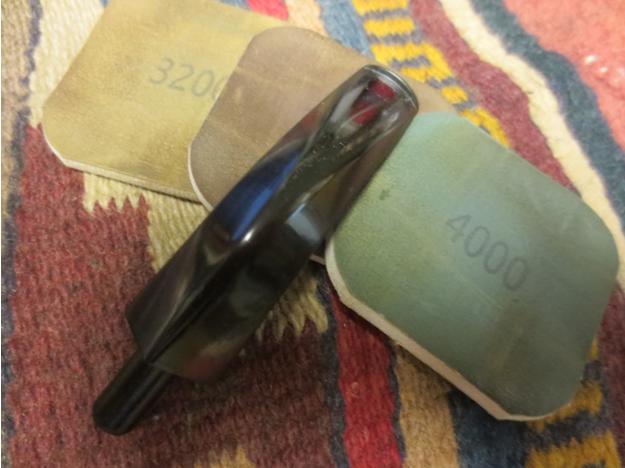
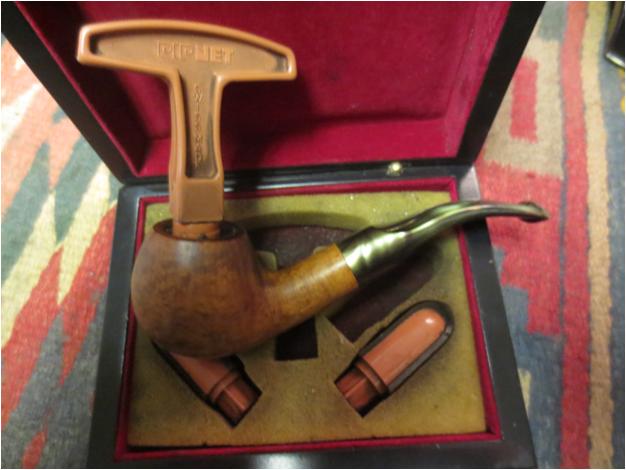
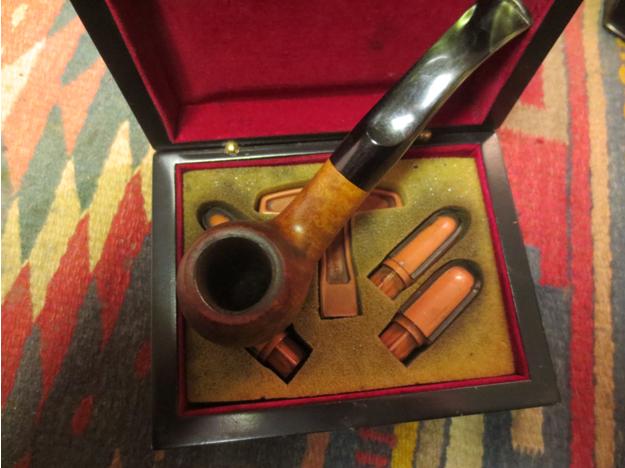
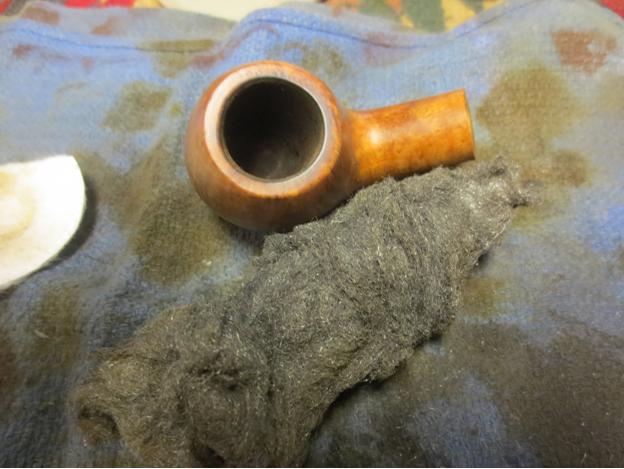
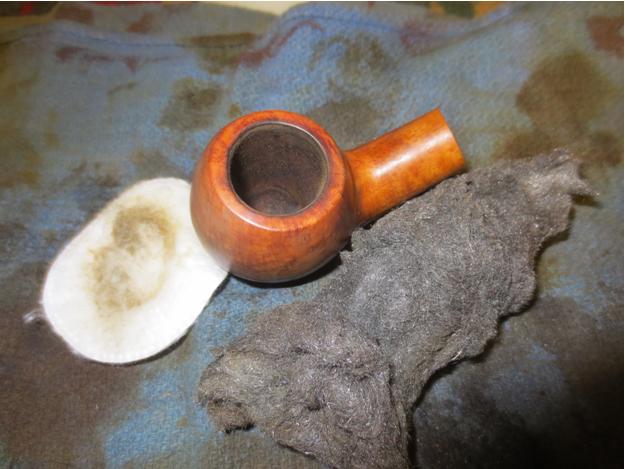
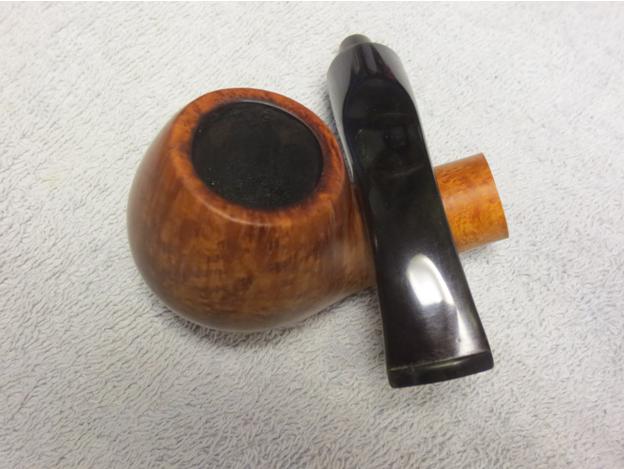
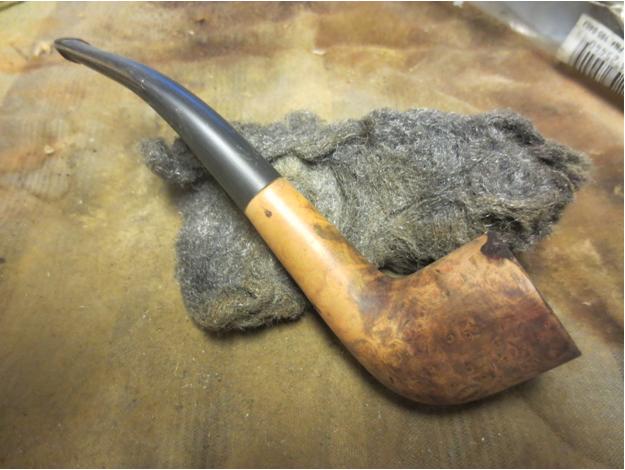
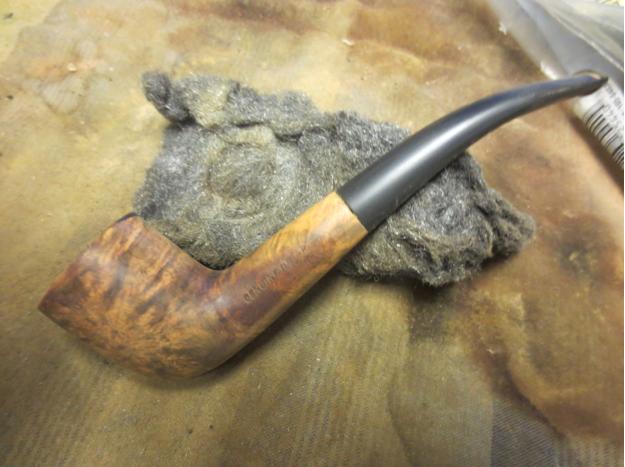
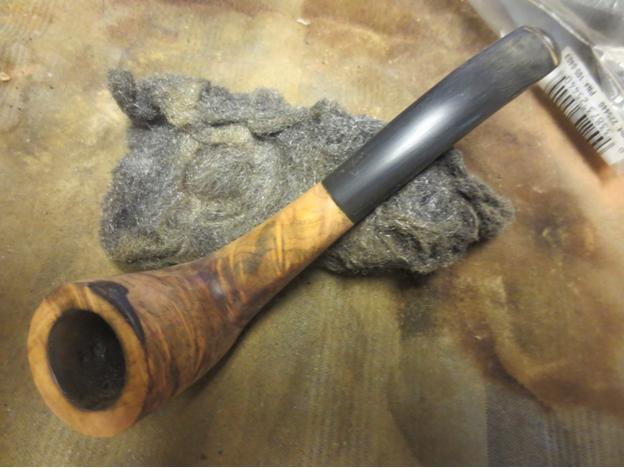
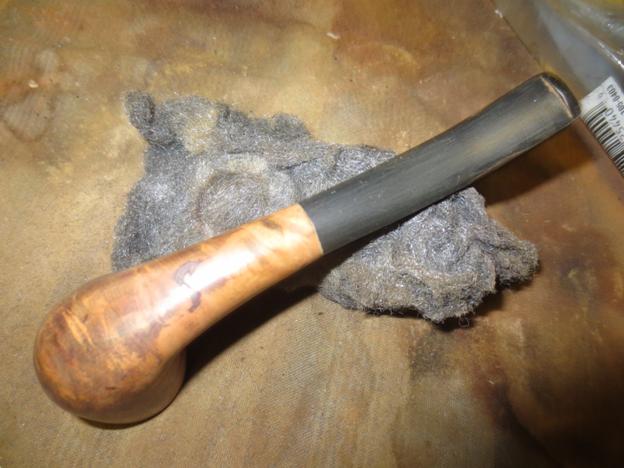
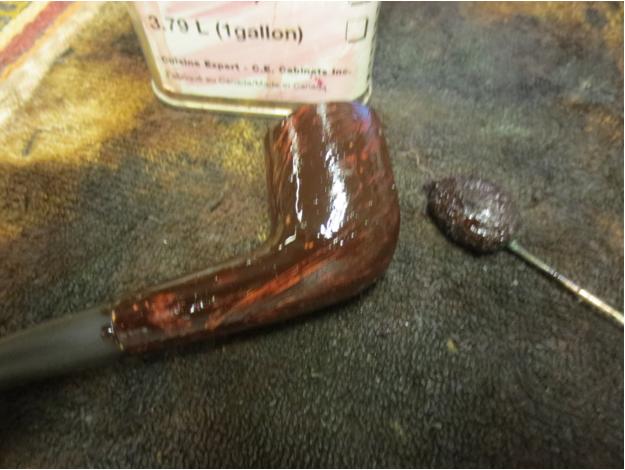
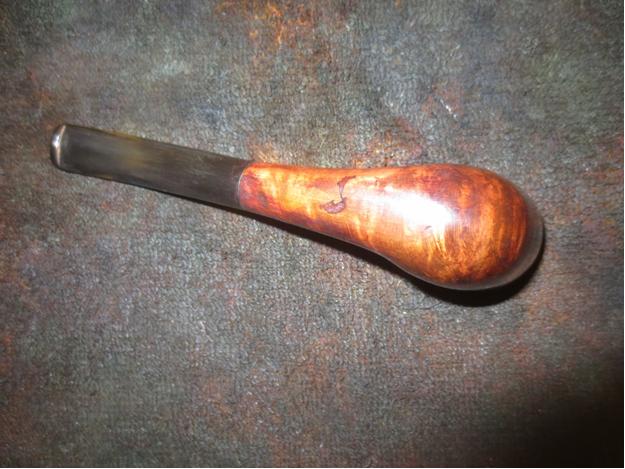
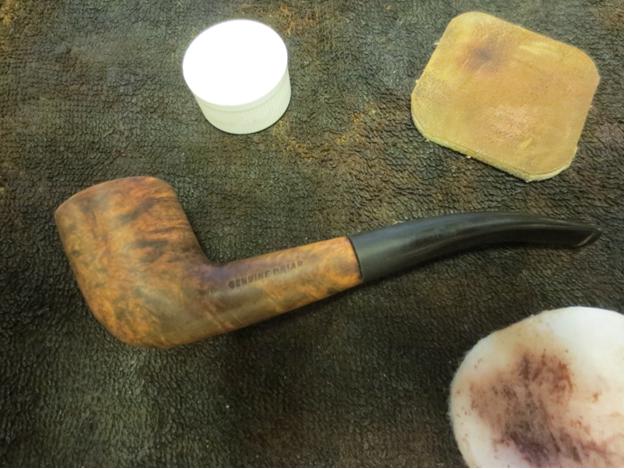
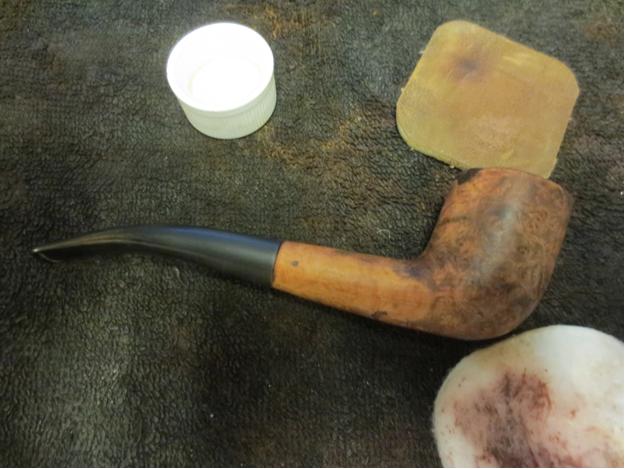
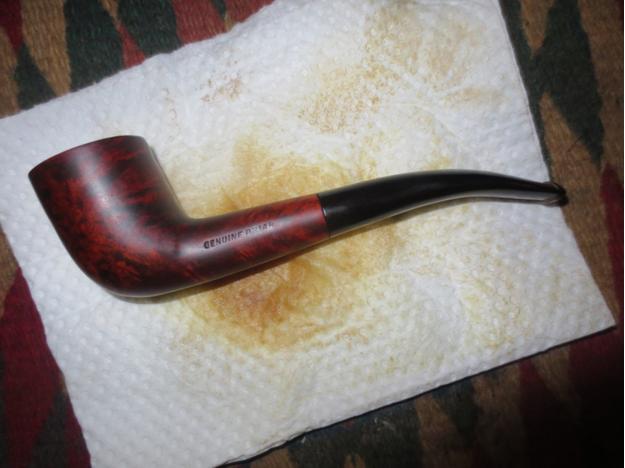
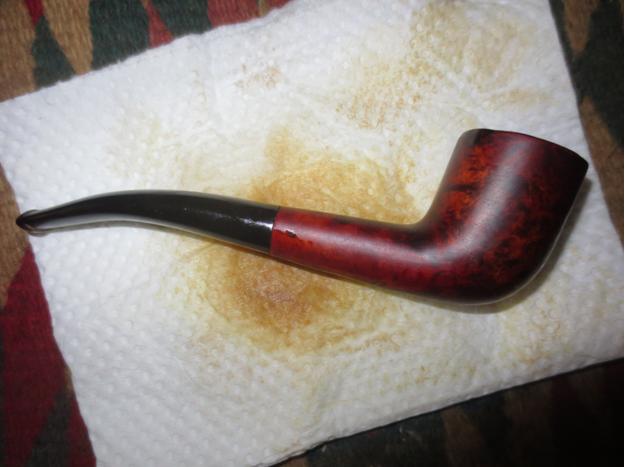
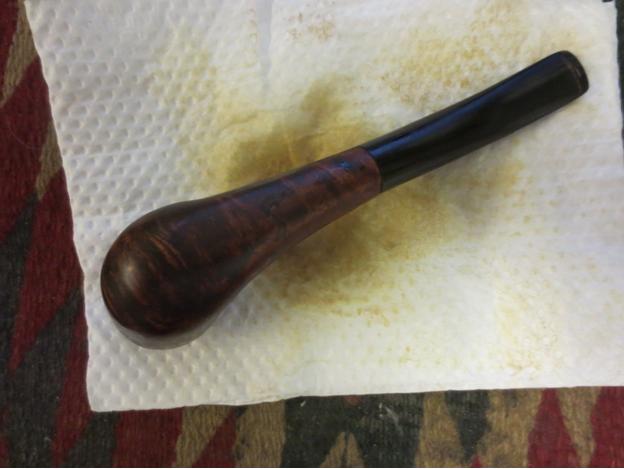
Tag Archives: waxing a stem

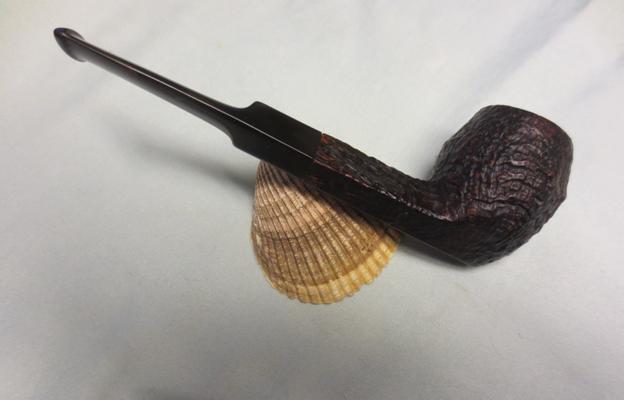
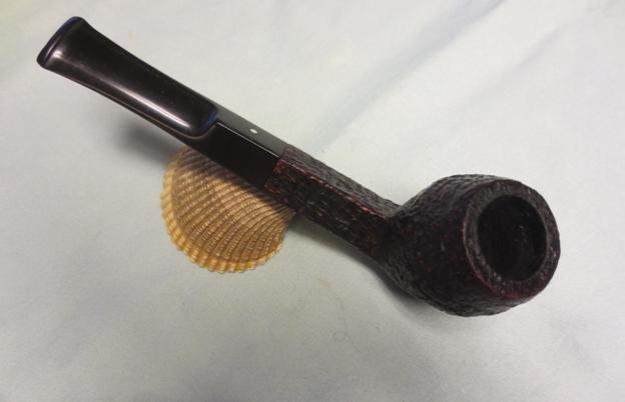
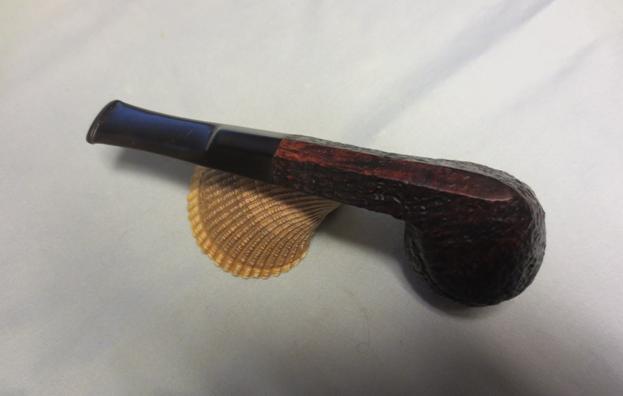
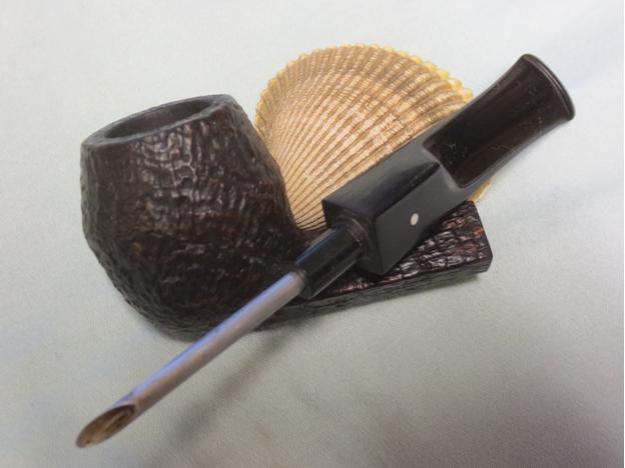
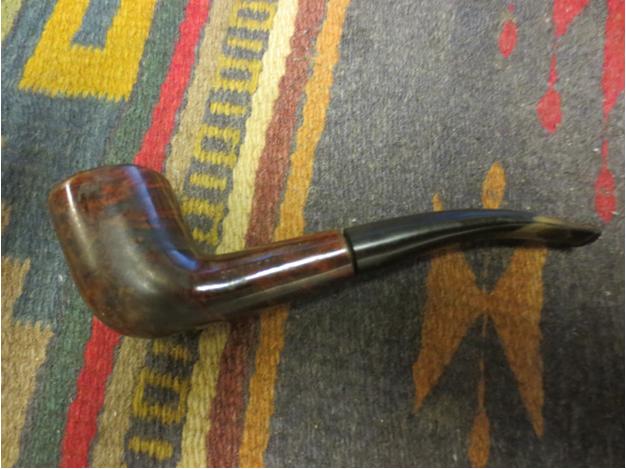
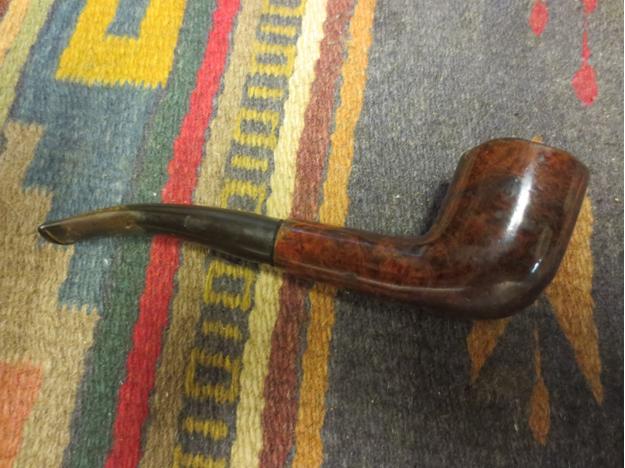
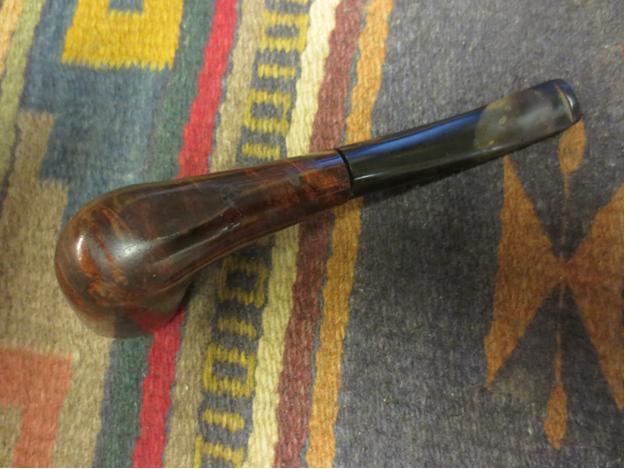
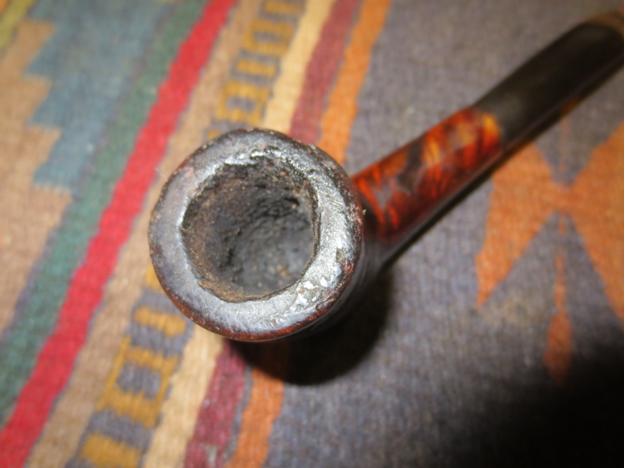
A Tinsky sent back to Mark for a new stem and then given personal adjustments by me


Blog by Steve Laug

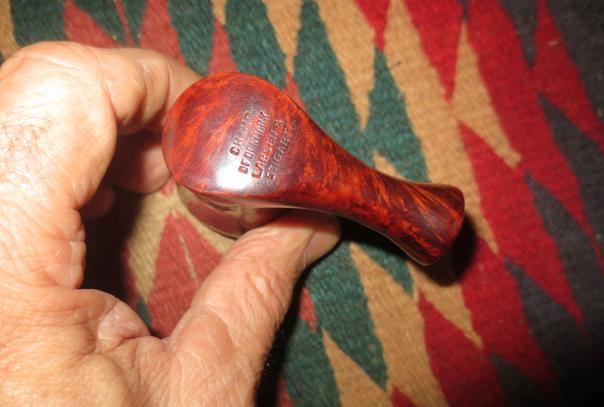
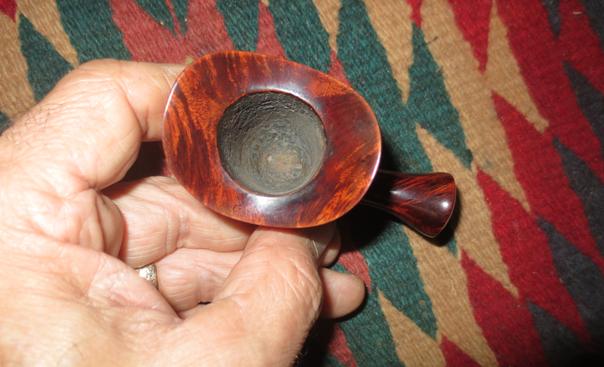
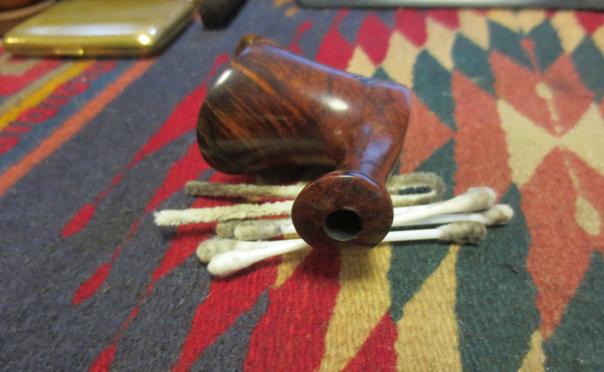
I had a surprise just before my recent trip to Europe when I went to my pipe cupboard and took out my Tinsky apple. It is a pipe that has traveled with me around the world and one I love to smoke when I am traveling. It is a smoking machine. Well when I took it out I noticed that the original stem had a split on the top side and the underside that went from the bend to the button just over the airway. It was a crack that with time would grow. I took it to Europe and enjoyed it in Greece and Germany. It did not split further. When I got back I sent it off to Mark for a new Tinsky Stem. It did not take him too long to make a new one for it. I received within a week or less of his repair.

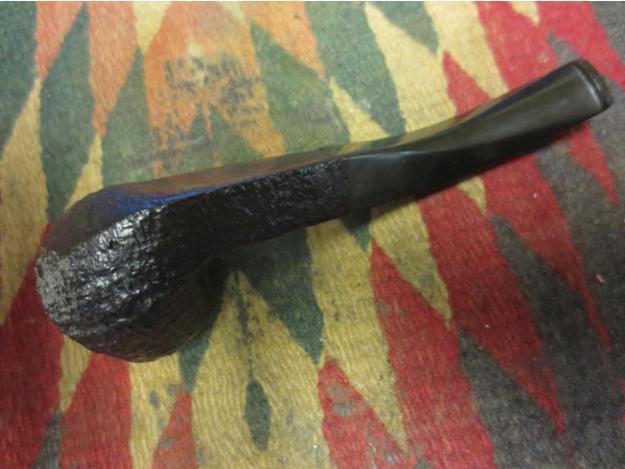
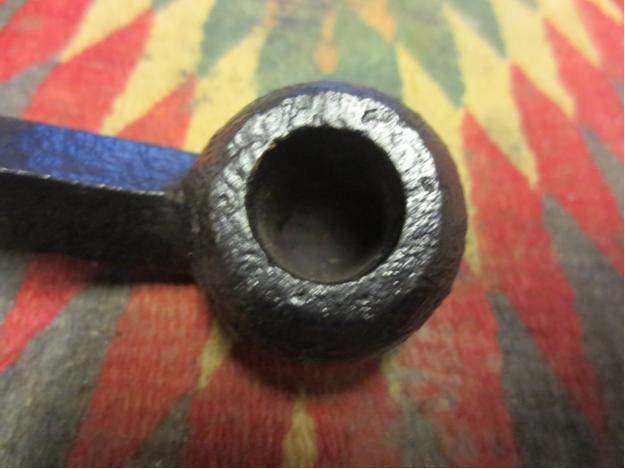
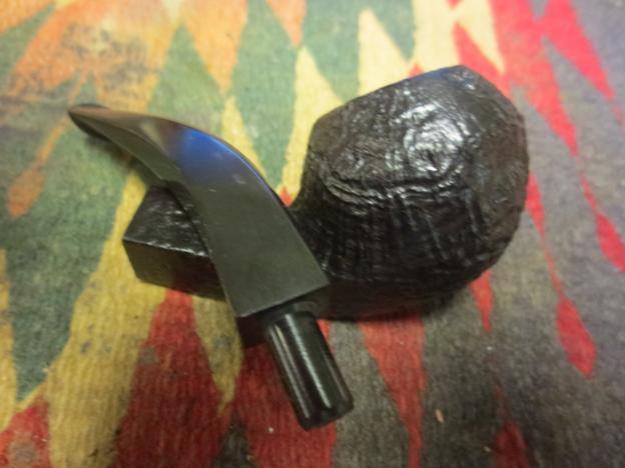
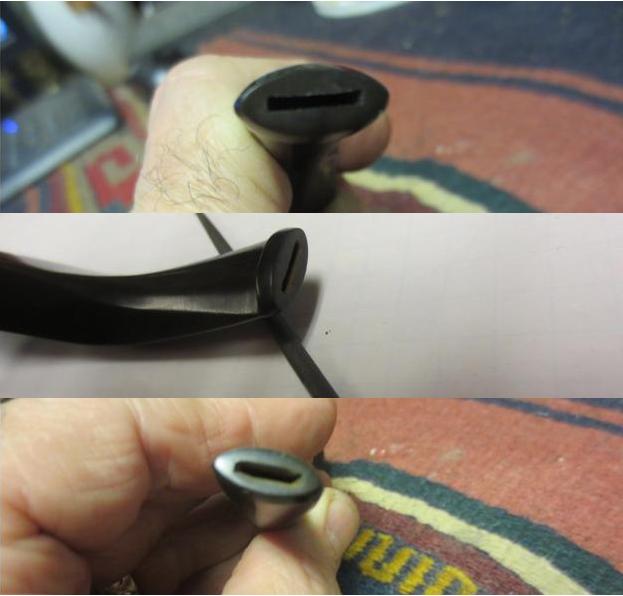
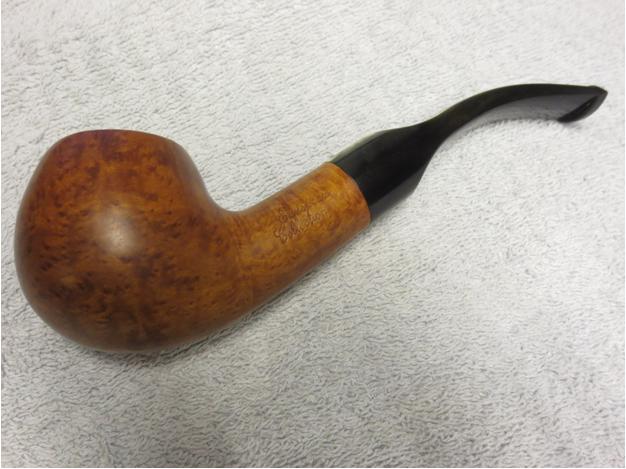
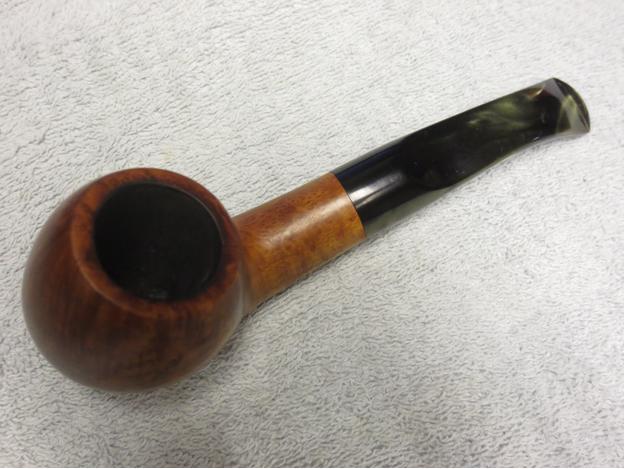
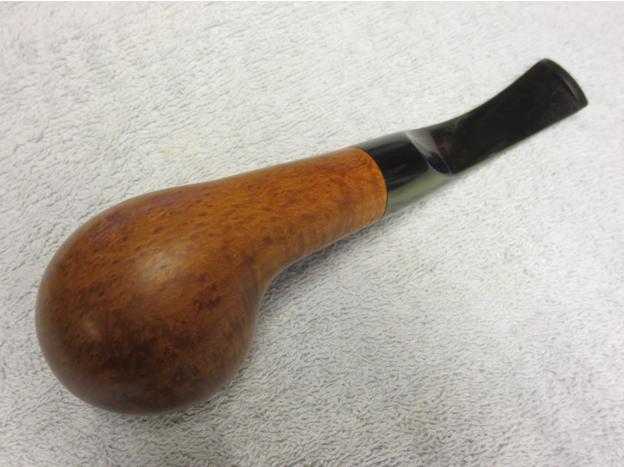
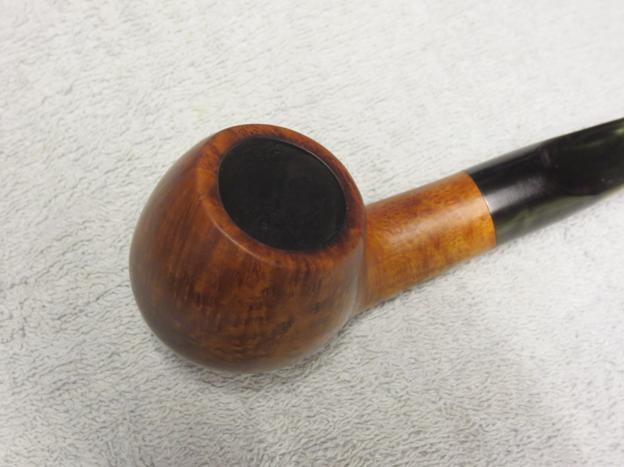
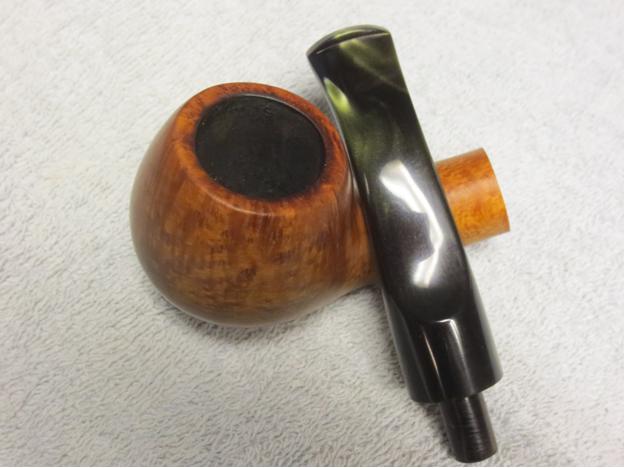
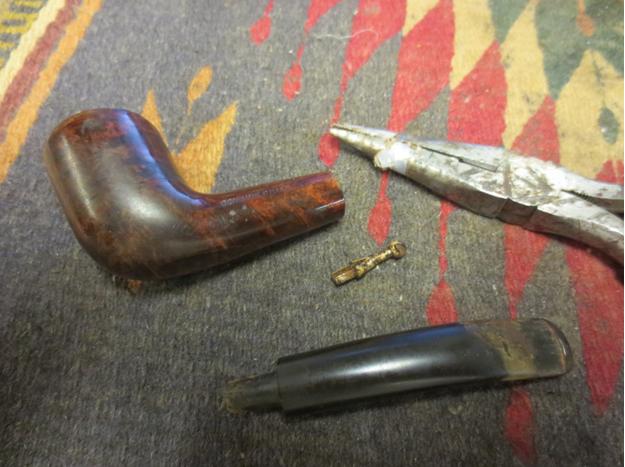
The photo below shows the pipe when I got it originally. It quickly became a favourite. I think I have probably had it over 15 years if I remember it correctly. It is just an old friend now and one that gets a lot of use. The shape in the hand feels great. The thinness of the mouthpiece and the shape hangs just right. The length is good for me. The blast and finish on the pipe is tactile and as it warms from the fire in its belly all seems right with my world. So that being said of course I would replace the stem and of course I would send it to Mark for another Tinsky stem.Tinskyapple When the pipe came back I have to say I was a little disappointed with the new stem. Not disappointed enough to send it back for an adjustment but not at all satisfied with the new look of the pipe. It just did not work well for me. To my eye the stem was chunkier and less delicate than the original. I wrote that off to the possibility that Mark was correcting the issue with the thinness and size of the airway leading to potential for this one to crack as well. The new stem was a good ½ or ¾ inch longer than the original and the bend was not as gentle. The bend did not look right to me and seemed in my opinion to be over bent. It definitely was not a copy of the original stem it is slightly thicker all the way around, a deeper bend and not as delicate looking all made me concerned. I decided to smoke the pipe for a while and see if the difference was that big of a deal to me. All of the issues were ones that I could address so I was not too concerned.

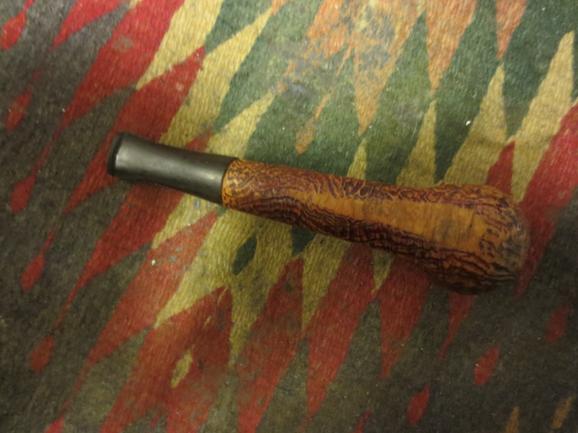
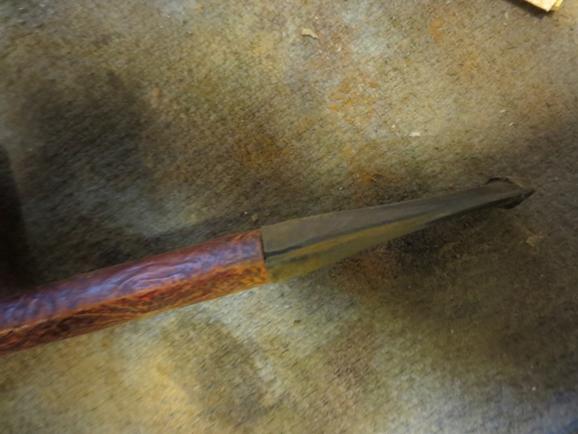
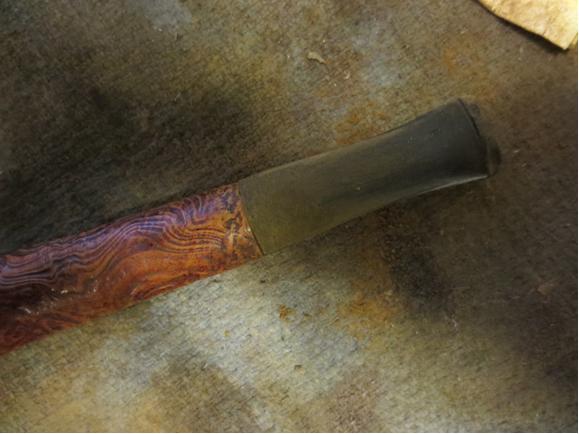
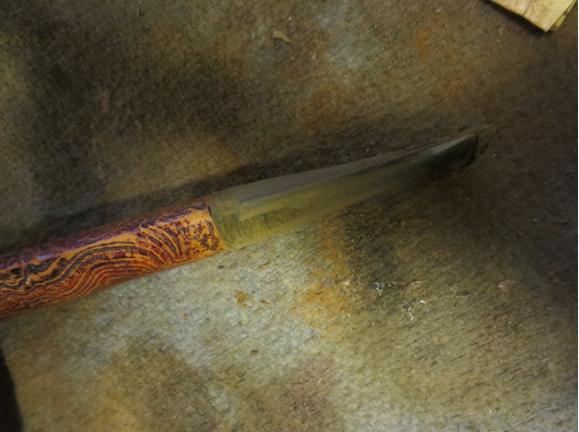
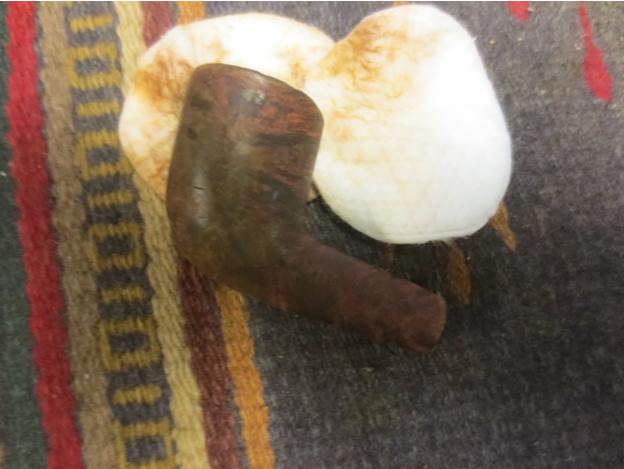
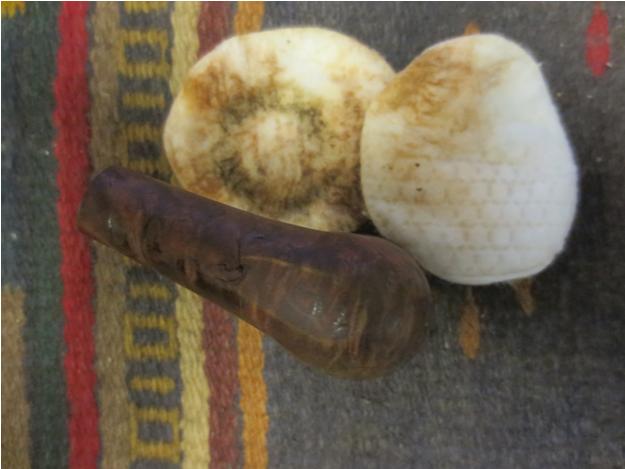
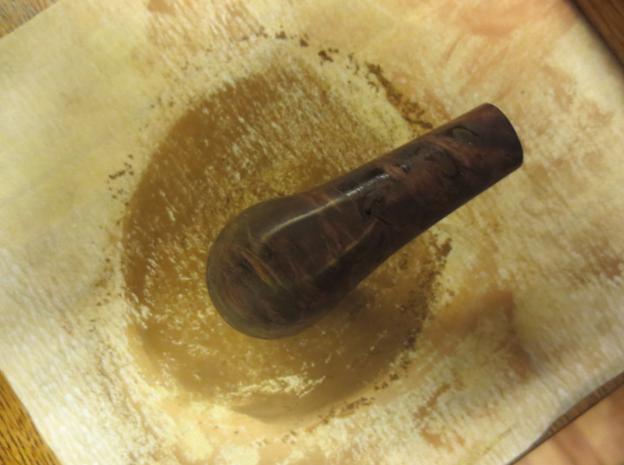
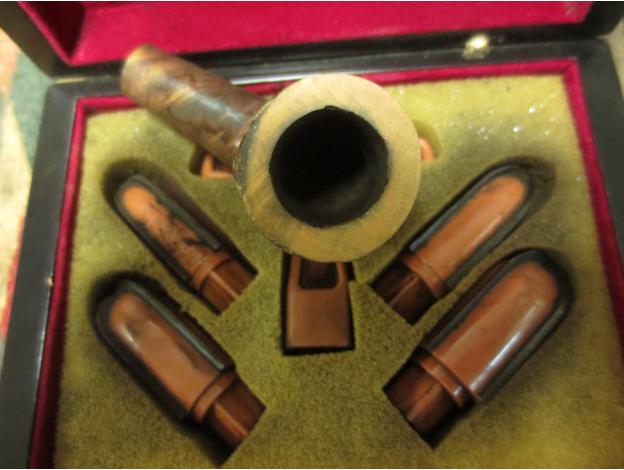
Here are some photos of the stem and pipe. The stem on the pipe is the new one. The one underneath to the pipe is the original. In each of the photos below the thicker stem is the new one regardless of the angle of the camera. The difference is very evident.Tinsky1

Tinsky2

Tinsky3

Tinsky4 I have been smoking it now for over a month. I think that is adequate time to adjust to the new feel of the stem. However, I did not adjust to it. It sat “wrong” in my mouth and hung with the bowl tilted toward the front too far. It was easier to light but was not nearly as easy to clench. The thickness added some weight to the pipe and was nowhere near as comfortable in the mouth. To put it in just a few words, the overall look of the new stem just bugged me.

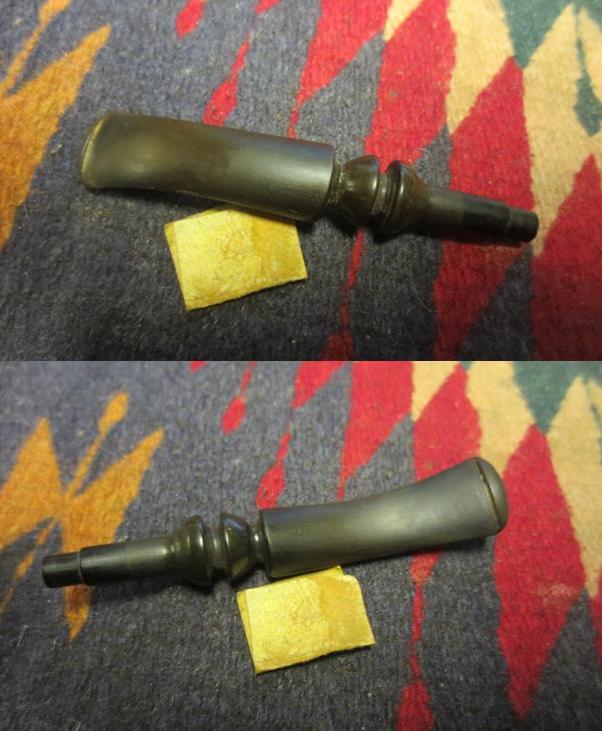
So tonight I decided it was time to tackle the stem and do some work to remedy my concerns. I set up my heat gun and heated the acrylic stem to take out some of the bend and try to match it to the original stem. I really wanted the end of the stem to be in line with the bowl top when it was flat. In the first photo below you can see the variation in the bend. The top stem is the old one and the bottom one is the new stem.Tinsky5 I heated it slowly above the heat gun on low heat. I have learned the hard way that if it gets too close to the gun the acrylic can bubble and burn and give me more issues to deal with. I heated it until it was pliable and then flattened it against the top of my work table until the bend was the same as the original stem. I set the bend with cool water.Tinsky6 I put the stem back in the shank and took the photo below to show the modification of the bend in contrast to the original stem which sits below the pipe in the photo.Tinsky7 With the bend corrected I also want to thin down the stem and remove some of the heaviness in the area above the saddle. I wanted more of a taper from the saddle to the button and give the saddle to the slope of the stem a bit more definition. I sanded the stem with 220 grit sandpaper to get the angles right to my eye. I also wanted the pinch between the saddle and the blade of the stem to be more defined.Tinsky8

Tinsky9 I sanded and sanded for about forty five minutes to clean up the flow of the stem and finally I was getting to the place that I liked the look of it.Tinsky10

Tinsky11

Tinsky12 I sanded the top and underside of the stem to modify the thickness back toward the button. I wanted more of a flattened taper from the saddle back.Tinsky13

Tinsky14 When I got it to the place I wanted I put the stem back on the pipe to get a feel for the new look. It was definitely thinner than when I started. I did not want to take too much off the top of the stem toward the button as I wanted to leave more material over the airway than was on the original stem in that area.Tinsky15

Tinsky16

Tinsky17 I still needed to do some more shaping with the 220 grit sandpaper so I worked on the stem with it on the pipe so that I could continue to see the effect on the overall look of the pipe.Tinsky18

Tinsky19

Tinsky20

Tinsky21 I was finally happy with the overall shape. It was time to work on the finish of the stem. I sanded it with a medium and a fine grit sanding sponge to remove the scratches left behind by the sandpaper.Tinsky22

Tinsky23

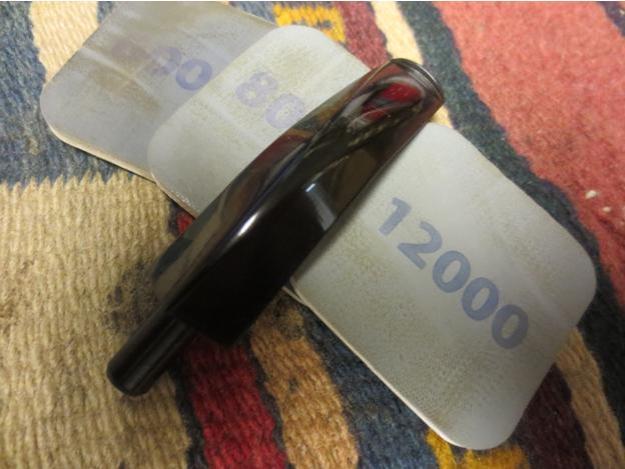
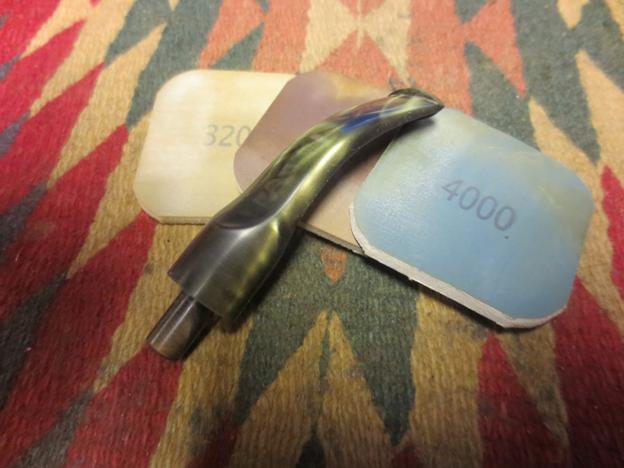
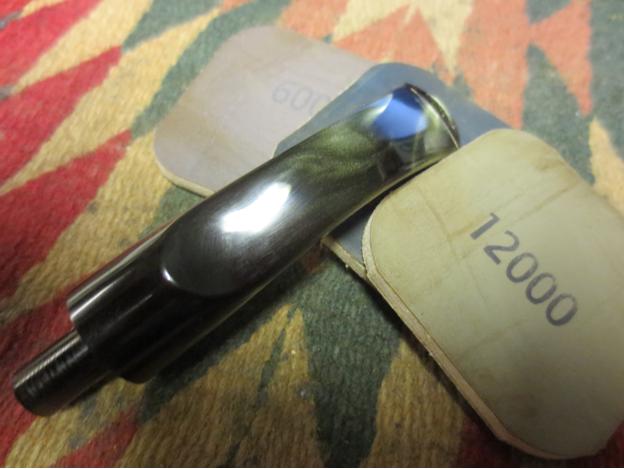
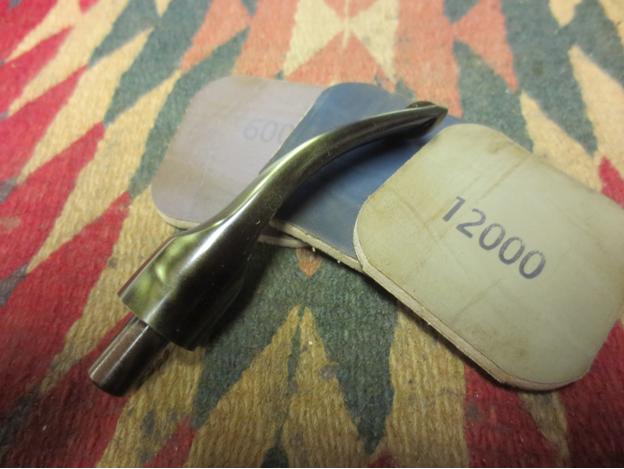
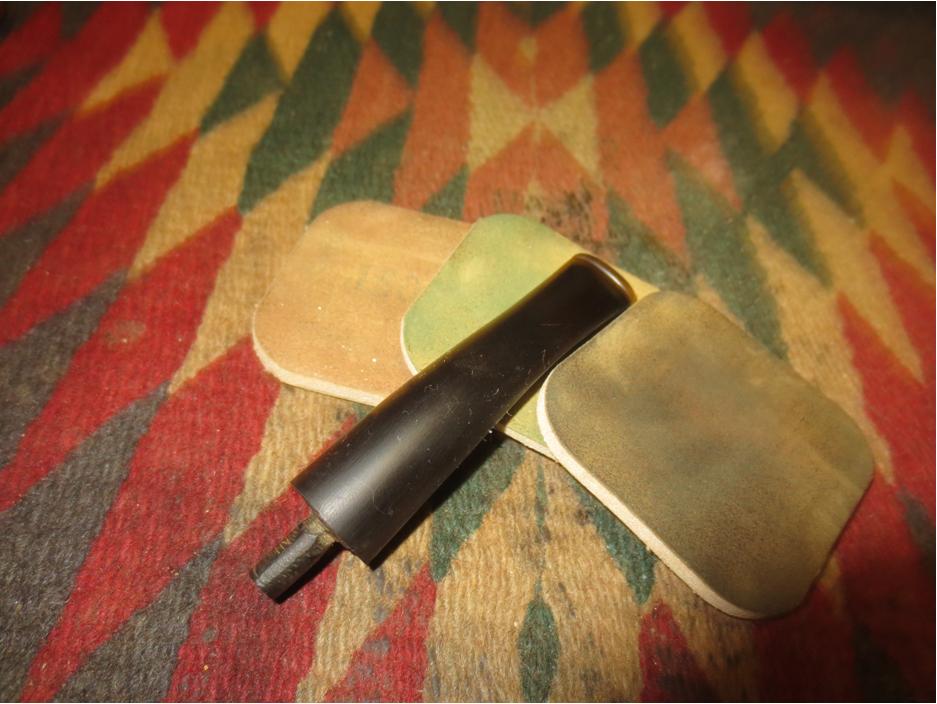
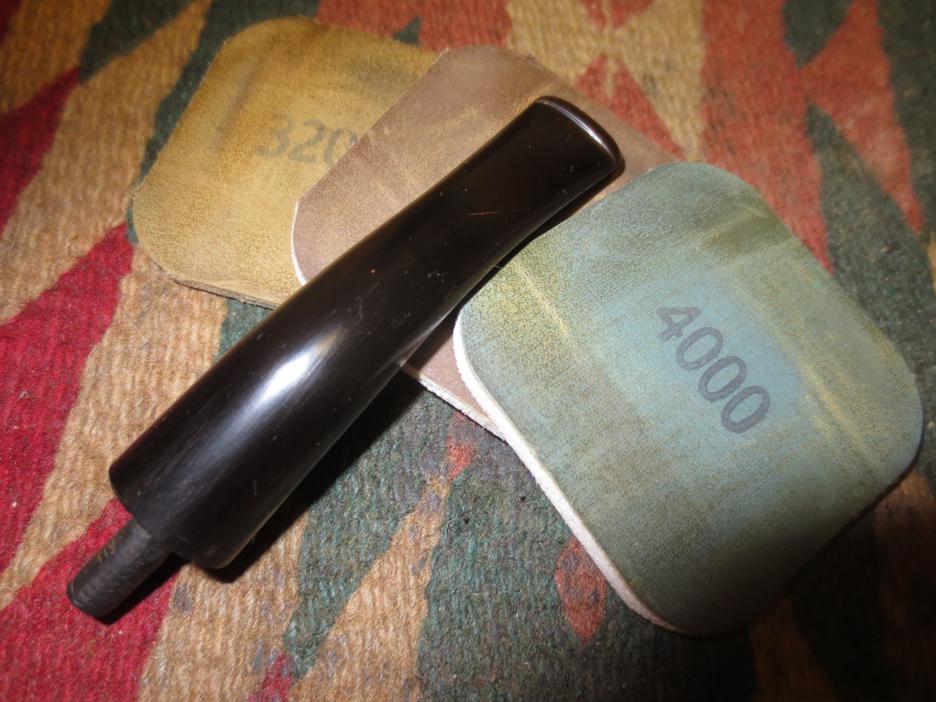
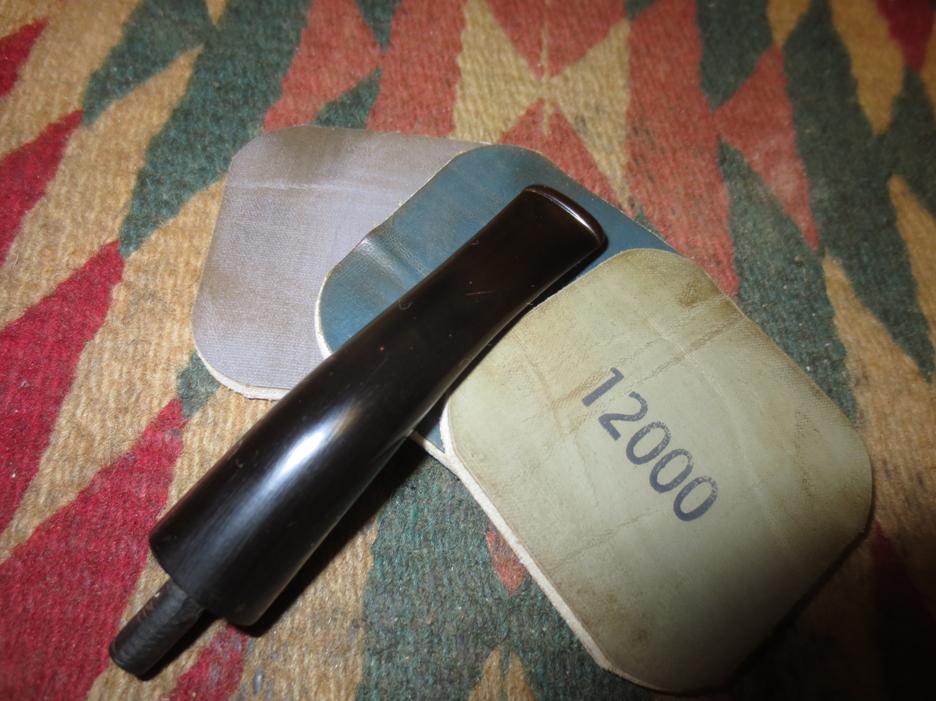
Tinsky24 I moved on to sand it with micromesh sanding pads. I wet sanded with 1500-2400 grit pads and dry sanded with 3200-12,000 grit pads. Between each set of three I rubbed the stem down with some Obsidian Oil as I have found that it enables the micromesh to have a better bite on the stem material.Tinsky25

Tinsky26

Tinsky27

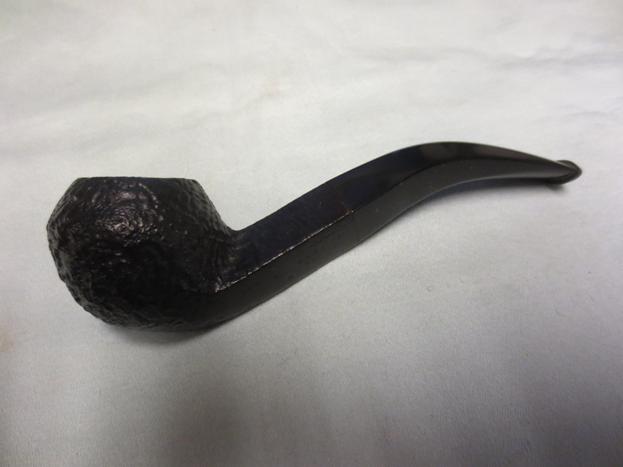
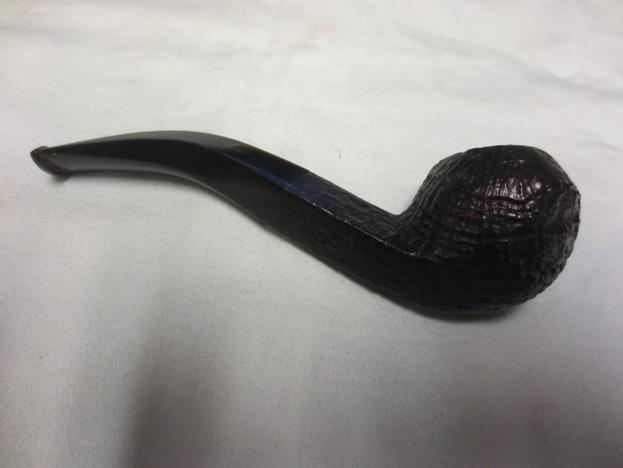
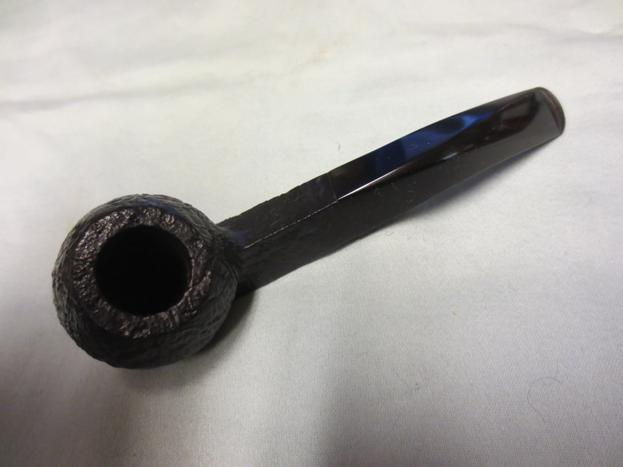
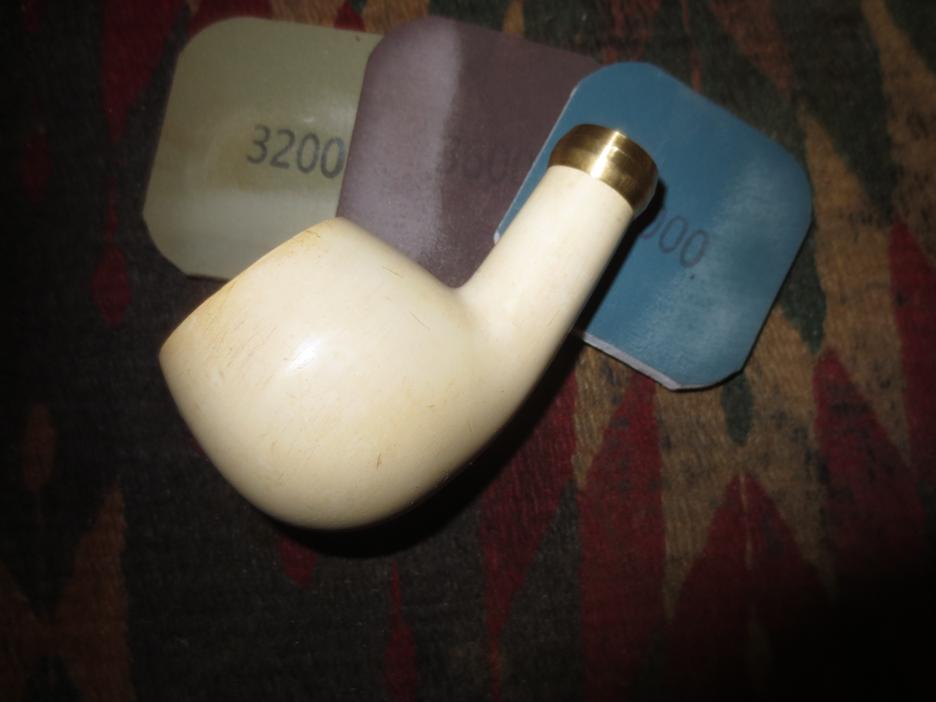
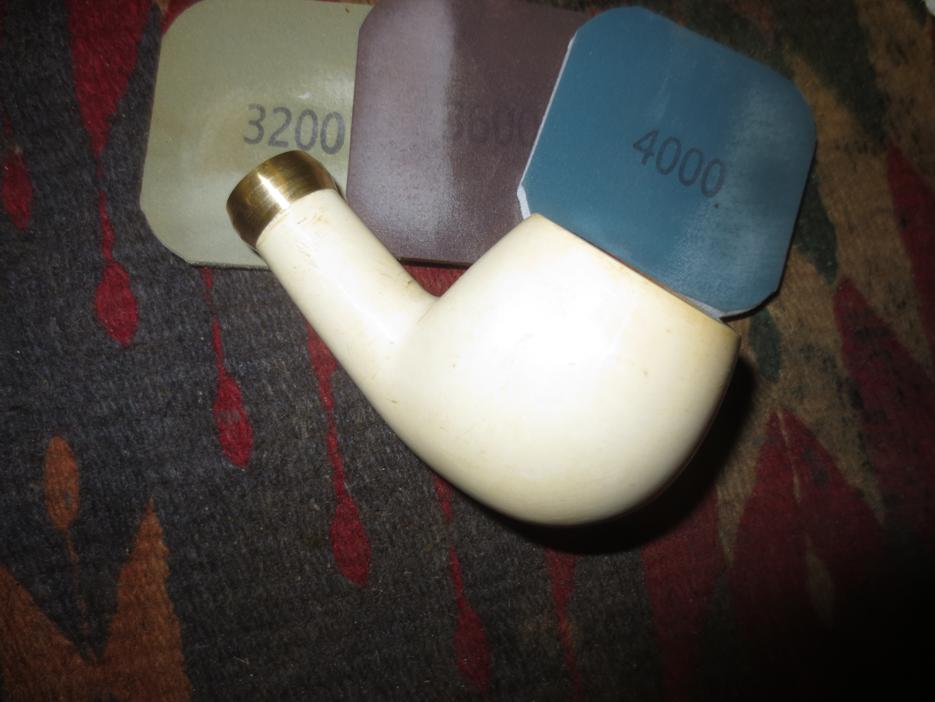
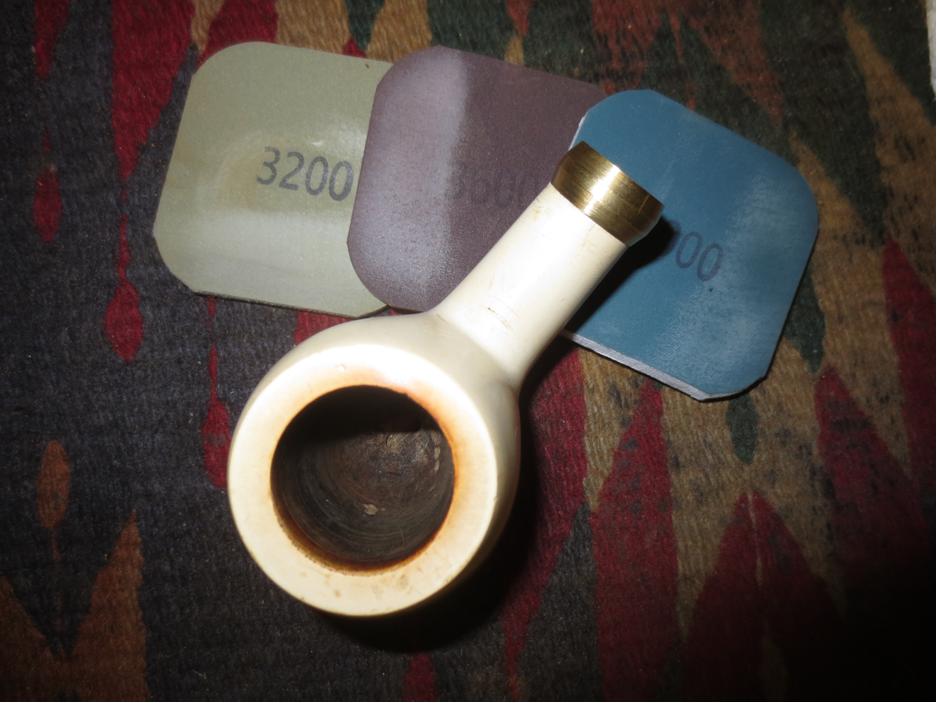
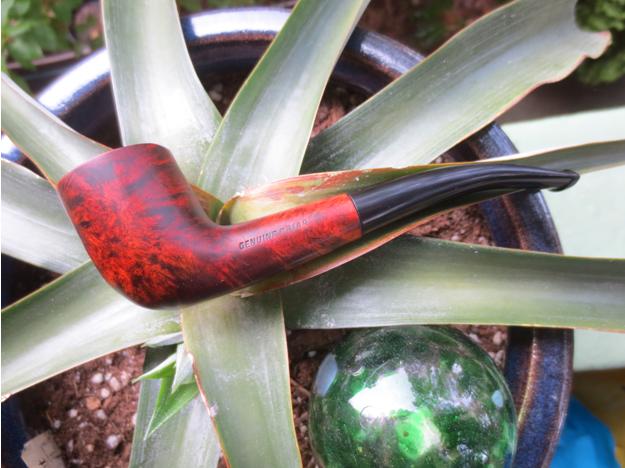
Tinsky28 When I finished with the micromesh I gave it a light buff on the wheel with Blue Diamond Plastic Polish. I then buffed it with carnauba wax and finally with a clean, flannel buff to raise the shine and give it depth. I also gave the bowl several coats of wax with a light touch so it did not clog up in the blast. The finished pipe is shown below from a variety of angles to show the new shape of the stem. It is so much more comfortable to me than it was and I really like the more refined look.Tinsky29

Tinsky30

Tinsky31

Tinsky32

Tinsky33

TInsky34

Tinsky35

Tinsky36

Tinsky37

TInsky38 Now it is time to load up a bowl and give it a smoke. I picked up some McClellands 2035 this past weekend when I was in the US and this pipe loves flake tobacco. I am really looking forward to having this old friend back in the regular rotation.

Refurbishing a 1978 Dunhill Root Briar 41041 Bulldog


Blog by Steve Laug

This is another pipe that came to my work table. It is a beautifully shaped Dunhill Bulldog. It is stamped 41041 and Dunhill over Root Briar on the left side of the shank. The right side bears the made in England stamping with the date number that puts it at 1978. The bowl was in excellent shape and had been recently reamed and cleaned. The finished was dull but very clean. There were no issues with the briar. The stem was also in great shape other than being heavily oxidized on the top sides. There was a small tooth mark on the top side of the stem next to the button as well. What made this one interesting to me was the issue that I often see with diamond shank pipes. The sides all looked the same but were not when measured. The top left was slightly bigger than the top right and so forth. It was not an issue as I did not need to replace the stem but it was just an interesting tidbit and one thing I always look for when working on diamond shank pipes. The next series of four photos show how the pipe looked when I brought it to my work table.Dunhill1

Dunhill2

Dunhill3

Dunhill4 I took two close-up photos of the stem to show the oxidation and the slight tooth mark on the topside near the button. The underside of the stem was not as badly oxidized but had slight oxidation.Dunhill5

Dunhill6 I mixed up a batch of Oxyclean and put the stem in it to soak overnight.Dunhill7

Dunhill8 While the stem soaked I decided to clean out the shank and airway. I used isopropyl alcohol, cotton swabs and pipe cleaners to remove the tars and oils in the shank. I have found that even when I buy a “refurbished” pipe on eBay I do this and am always surprised at the grime and oils that come out of the “clean” shank. I did not want to use the retort on this one as it was not terribly dirty and had been subjected to a pretty good cleaning before it came to me.Dunhill9 In the morning when I took it out of the bath and dried it off much of the surface oxidation was gone and the mix had raised some more oxidation.Dunhill10

Dunhill11 I put a plastic washer on the tenon and put the tenon in the shank so that I could clean up the edges/shoulders of the stem without rounding them. I sanded it with a medium and a fine grit sanding sponge to start with and worked on the oxidation.Dunhill12

Dunhill13

Dunhill14 I wet sanded the stem with 1400-2400 grit micromesh sanding pads. I worked on the scratches as well as the oxidation on the stem.Dunhill15 I “painted” over the surface of the stem with flame from a BIC lighter to burn off some of the surface oxidation and then wiped it down with Obsidian Oil. The photos below show the stem after that process.Dunhill16

Dunhill17

Dunhill18

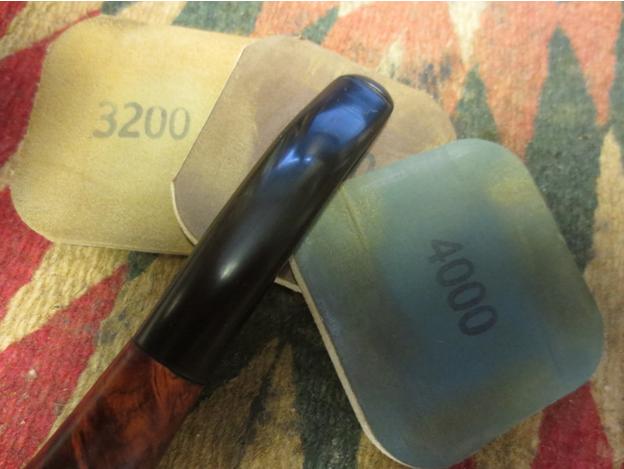
Dunhill19 I went back over the stem with the 1500-2400 grit micromesh sanding pads until the surface was freer of oxidation. I then wet sanded it with 3200-4000 grit pads and the shine began to show up.Dunhill20

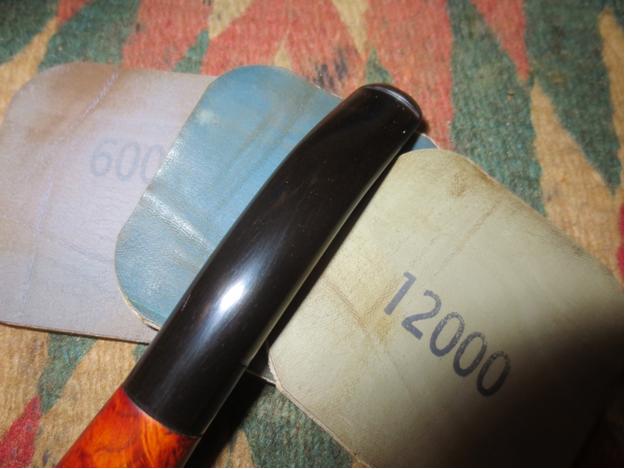
Dunhill21 I buffed the stem with red Tripoli and White Diamond before finishing with 6000-12,000 grit micromesh sanding pads. When I finished with the pads I rubbed down the stem with Obsidian Oil and let it soak in.Dunhill22

Dunhill23 Once the oil had soaked into the stem I buffed the bowl and stem with Blue Diamond plastic polish being careful around the stamping on the shank. I gave the bowl and the stem multiple coats of carnauba wax and then buffed it with a clean, soft flannel buffing pad to raise the shine and give it that like new look. The finished pipe can be seen in the photos below. It is ready for the next pipeman to load up his favourite bowl and have a smoke.Dunhill24

Dunhill25

Dunhill26

Dunhill27 Thanks for looking.

Using a Rotary Tool to Buff Stems


Blog by Andrew Selking

I have been looking for a better way to make my pipe stems look good for a very long time. I started out just using high grit sandpaper, next I got a buffing attachment for my drill, after that I moved up to an actual buffer. I added micro mesh sanding pads, white diamond rouge, and carnauba wax, but still had problems with getting a consistent shine. Of course the other problem with buffing stems, especially stems with sharp edges, is the tendency for the buffer to catch the edge and fling the stem across the room. How could I ever improve my stem work?

Fortunately one of the pipe restoration gurus who does this for a living let something slip on a discussion board. He mentioned that he uses a variable speed buffer. My first thought was, “that sounds expensive,” but after giving it some thought I realized that I had a variable speed rotary tool (that’s what you call a Dremel knock off). I paid $19.99 from Harbor Freight tools and it even came with a large selection of attachments.

Here is a recent example of a stem I did using this tool. The previous owner did take care of the pipe, it was well waxed and clean inside, but if you look closely you can see the telltale signs of oxidation.Andrew1 I gave the stem my usual soak in Oxyclean, which revealed the full scope of oxidation to be dealt with. (Sorry the pictures are a bit blurry).Andrew2

Andrew3 Some people have asked me why use Oxyclean if it makes the stem look so bad. The answer is, the oxidation is present regardless whether you choose to address it or not. If you polish over the oxidation you will eventually end up with a shiny brown stem.

To remove the oxidation I use 400 grit wet/dry sand paper with water. Since the water makes the stem artificially shine, I dry it to make sure I get all the oxidation. Another trick I learned from one of the articles on Steve’s blog was to use a washer at the end of the stem to prevent rounding the shoulders. It’s well worth the effort. Since this stem had so many flat surfaces, I use a small plastic kitchen scraper as a sanding block with the 400 grit.

After the 400 grit I use 1500, 1800, and 2400 grit micro mesh pads with water. Here is the stem after that treatment.Andrew4 While I waited for the stem to dry I retorted the pipe and cleaned the shank. I didn’t take pictures of the process since the pipe was basically new. Once the stem was dry I used a progression of micro mesh pads from 3200 to 12,000 grit to polish the stem. In my opinion polishing with the micro mesh pads is the real key to a nice looking stem. As you progress to a finer level, you’re removing the scratch pattern from the previous one.

Now comes the fun part, making it shine! This is what my set up looks like. The rotary tool, white diamond, carnauba wax, and the felt pads for polishing.Andrew5 Notice the speed adjustments.Andrew6

Andrew7 To buff the stem, I set the speed to 1 and load the felt pad with white diamond. I hold the stem in one hand and apply the pad with the other. It is important to keep the pad moving, if you leave it in one place too long it will start to dig into the vulcanite. This isn’t a fast process, but I find I can get a lot better control and consistency with the shine. Once the stem is buffed to a high luster, I switch out buffing pads, turn the speed to 2, and proceed with the carnauba wax. As you can see the stem turned out pretty well.Andrew8

Andrew9 Here are some gratuitous pictures of a dead sexy pipe. Thanks for looking.Andrew10

Andrew11

Andrew12

Andrew13

Andrew14

Put Up Your Ducs: Restoring a Meer-Lined Le Duc


Blog by Anthony Cook

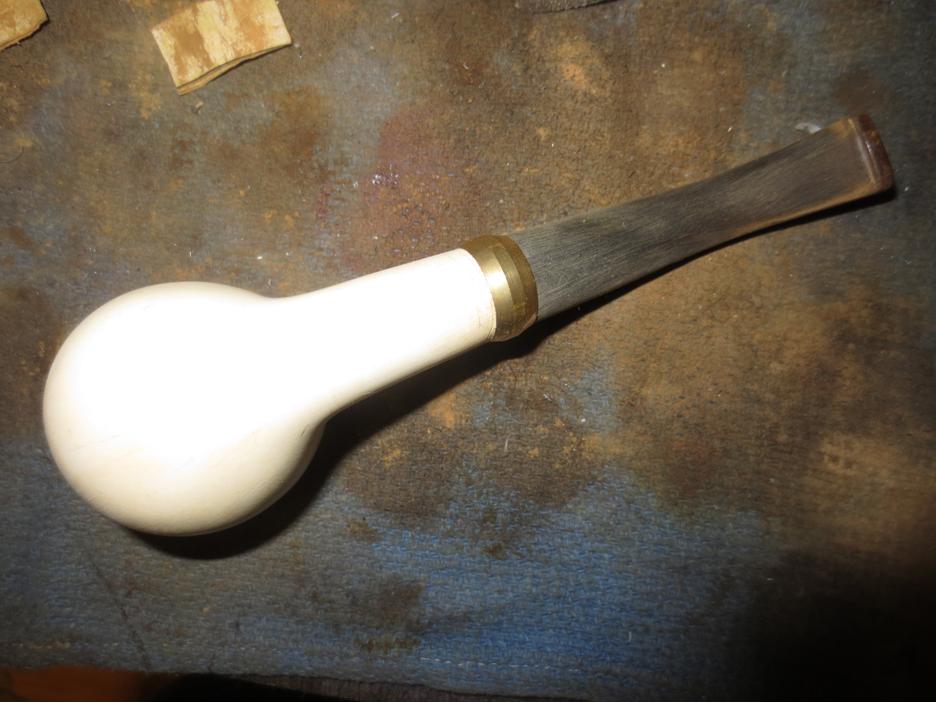
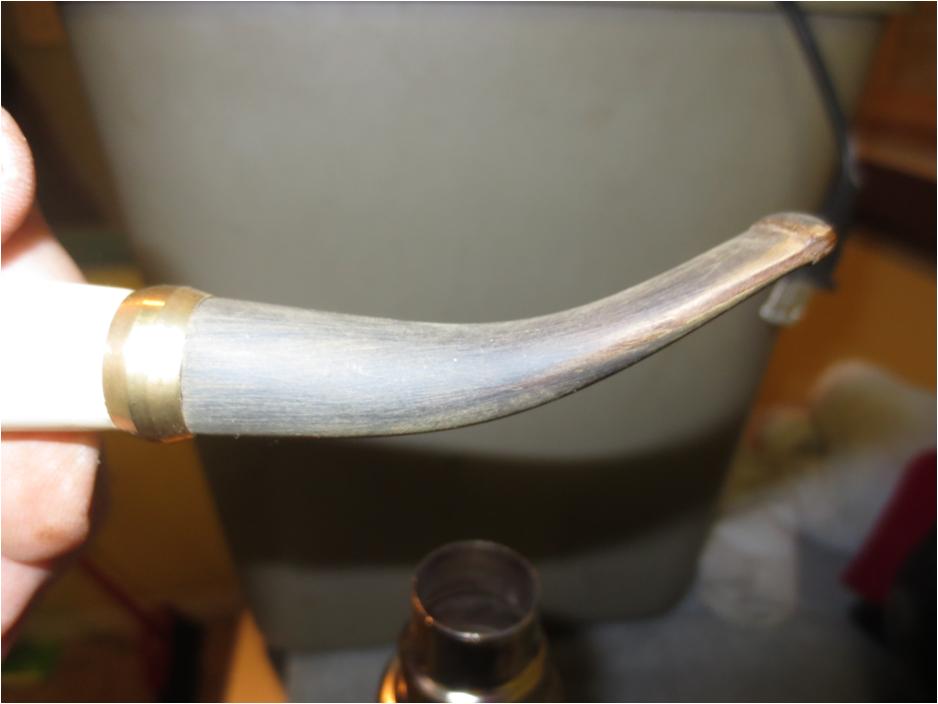
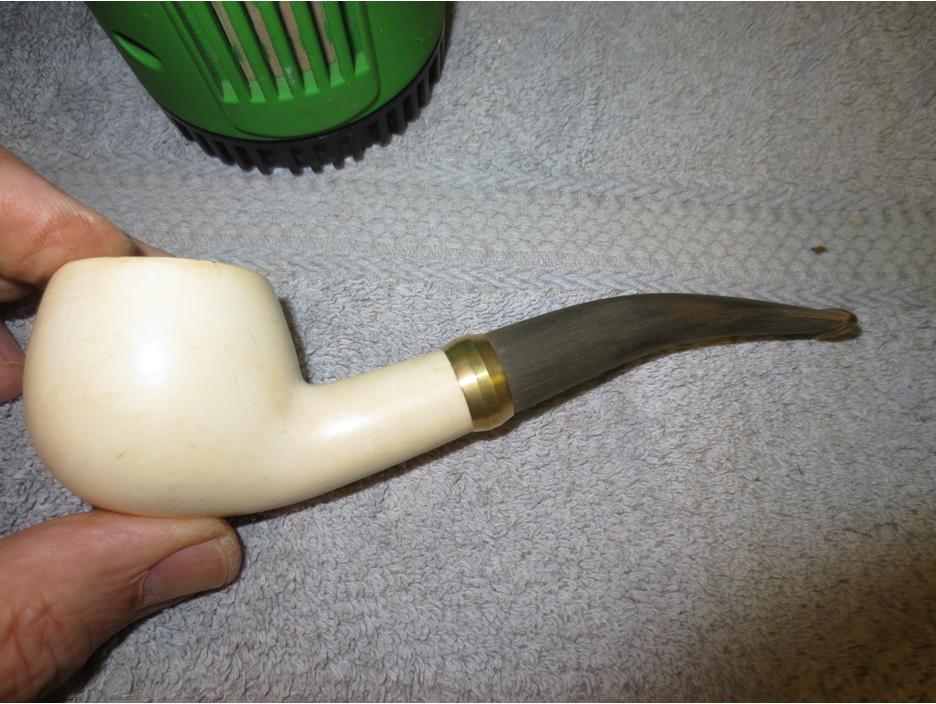
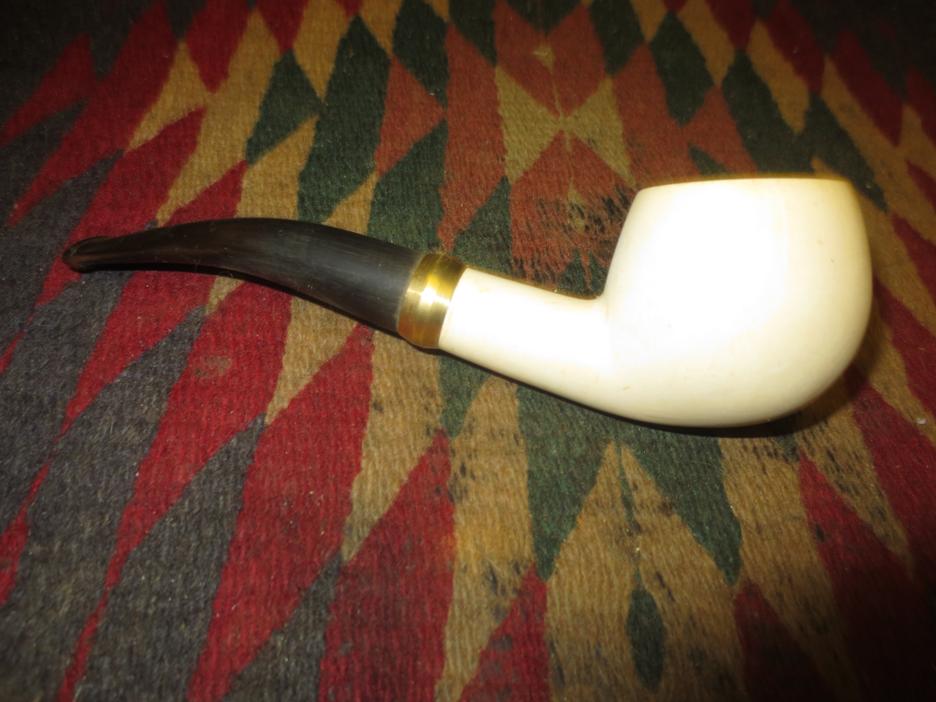
I recently completed work on this meerschaum-lined Le Duc pipe. It has a paneled bowl and a shape that sits somewhere between a squat egg and an elongated apple. It’s stamped simply, “LE DUC” on the left side of the shank and “1” on the right side, which I assume is the shape code. The stem is horn with an aluminum tenon and a twisting, screw-in stinger. This pipe presented me with a number of firsts. I had never worked with panels, meer-linings, or horn stems. So, I knew this one would be fun.Duc1 It’s been difficult to dig up anything conclusive on the history of the Le Duc brand. Both Pipephil and Pipedia come up empty, and a Google search reveals very little more other than a couple of links to an estate pipe that was once available for purchase from Amazon and eBay (the same pipe at both sites). That pipe is the only other example of a Le Duc that I have been able to find. The previous owner of this one did mention that it was from the Netherlands. So, it’s possible that it’s somehow associated with Gubbels.

I posted pictures of the pipe on Pipe Smoker Unlimited and asked if anyone had any more information. General consensus was that it is a French-made pipe, but that’s about as far as it went. Due to some slight shaping errors that I found in both the stummel and stem, I’m willing to bet that it’s somebody’s seconds brand. Though, I’m not quite willing to bet all of my marbles on a particular country of origin yet. So, if anyone out there has any insight into the brand, please don’t hesitate to let me know in the comments section.

There were a few small scratches and dents on the surface of the lacquer-coated stummel. The worst of which was a series of more than a dozen nicks on one back panel. The narrow surface of briar around the rim was lightly scratched, but didn’t appear to be charred. A thin layer of old tar covered both the meer and the briar on the back of the rim.

The chamber was lightly caked, mostly in the top two-thirds. The meerschaum lining was by and large intact, but roughly a third of it had been broken out of the heel of the bowl around the draft hole. A crack in the remaining meer ran around the circumference of the heel and I could not for life of me figure out what was holding the rest in. I planned to eye this area with suspicion while I worked.

Some light chatter was present on both sides of the stem and there were a couple of shallow tooth impressions on the top. Someone had also chosen to add a dash of white paint to the bottom of the button, apparently for contrast and flair.

Overall, things could have been better, but I’ve seen much, much worse. The photos below should give you a better idea of the condition of the pipe when I started work.Duc2

Duc3

Duc4 (By the way, that dark spot in the photo above is not a natural coloration. It’s tar build-up showing through the translucency of the horn. More on that later.)Duc5

Duc6 The first thing I did was remove the nasty, tar-caked stinger, which wasn’t easy. The build-up had pretty much glued it into place. I dripped alcohol around the joint until the tar had softened enough that I could unscrew it. Then, I dropped the stinger into a small container of alcohol to soften the remainder of the gunk.

While the stinger detoxed, I attempted to remove the schmutz along the rim with good ol’ cotton pads, saliva, and elbow grease, but I found it to be too stubborn. Since I needed to address the scratched in the briar along the rim anyway, I lightly topped the bowl with 320 and 400-grit sandpaper until both the tar and scratches were gone.Duc7 The cake in the chamber was light but very hard. I started removing it by sanding out with 320-grit paper. Once most of it had been removed, I switched to 400-grit to finish it off. Unfortunately, like William Butler Yeats wrote, “Things fall apart; the centre cannot hold;” and as careful as I was, the remaining bottom of the meer liner was sacrificed during the cake removal process. Of course, I wasn’t at all surprised. I think the cake was the only thing holding it in to begin with.Duc8 After removing most of the cake, I checked back in with the gummy stinger. The alcohol had softened the tar enough that the majority of it could be removed with cotton swabs and a pipe cleaner. The crud in the air slot was still pretty firm, however, and I had to use a pick to scrape it out before I could scrub it clean with a pipe cleaner. I followed with some #0000 steel wool along most of its length. The aluminum is very soft. So, I maintained a very light pressure and avoided the threaded end.Duc9 Then, I started scrubbing out the inside of the shank with isopropyl alcohol and a few shank brushes, cotton swabs, and pipe cleaners. Let me tell you, this was one dirty Duc. The tar was built up into peaks and ridges that seemed to rival the Himalayas. Removing the crud in the shank was less like cleaning and more like heavy landscaping.

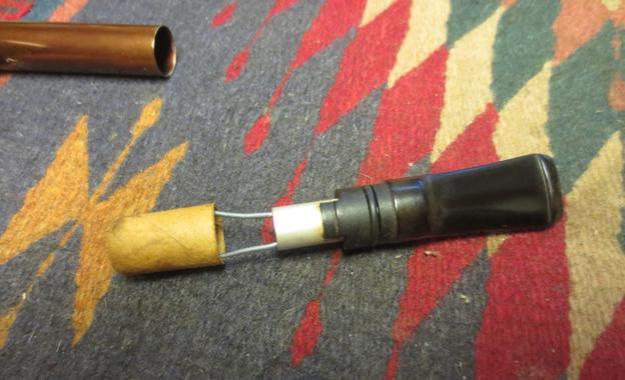
Eventually, it did start to come clean and I was surprised to discover a cork gasket in the mortise that I hadn’t noticed before. It was quite worn and seemed to be deteriorating with age. I found a similarly colored, dry dust around the tenon and also clogging the airway of the stem that I assumed to be detritus from the crumbling cork. There still remained enough of the gasket to give the stem a fairly snug fit, though, and I didn’t have anything at hand for a proper replacement. So, I decided to leave it for the time being to give it some thought.Duc10 Cleaning the stem internals was no more fun than the shank had been. It was completely clogged and would by no means pass a cleaner. To open it up, I had to drip alcohol into the tenon, wait for it to soak in, and then gouge the softened tar with a straight pick. Rinse and repeat all the way down. The process was a bit like mining, except there was no prospect of gold or precious jewels. When I finally broke through the button end, the sludge that came pouring out looked for all in the world like black squid ink. It actually cleaned up pretty quickly after that and you can see it for yourself in the photo below. Notice that the dark spot on the stem that I referenced earlier has lightened considerably after cleaning.Duc11 The more I thought about the mortise gasket, the more I knew that I couldn’t leave it be. It was clearly on its last legs and I started to worry about the taste that might be imparted to the smoke by the years of tar soaking into the cork. I still didn’t have a solid solution, but I learned years ago with my first car that anything can be easily disassembled. If you want to continue using it though, you’ll have no choice but to figure out a way to put it back. With that in mind, I decided to remove the gasket.

I picked through my selection of drill bits until I found one that was a perfect match for the job. It was almost exactly the diameter of the mortise. So, I could insert it and rotate it by hand to remove the gasket without any fear of it scraping the briar. Afterward, I very carefully sanded the mortise with 400-grit paper wrapped around a pencil end to remove the remaining cork and glue. The photo below shows the mortise just after using the bit.Duc12 I gave a lot of thought to how best to replace the gasket and experimented with a couple of different materials. Surgical tubing used as a sleeve fitted over the tenon had the longest legs at this stage. I found that tubing with a 1/32” wall would kind of work, but was much too tight of a fit and put far too much stress on the mortise. My ideas were just about exhausted. I began to consider drilling out the mortise to accommodate the tubing sleeve, but that was something that I really didn’t want to do. Then, I remembered that I had some marine heat shrink tubing that I’ve barely ever used. I gave it a try out of desperation. Perfect fit! Since it’s the marine quality stuff, it has adhesive on the inside to keep it from slipping. I made sure to use a piece without any printing because that would just be ugly.Duc13 With that problem out of the way, I turned my attention back to the stummel. I stripped the lacquer coat off the bowl by wiping it down with acetone and cotton pads. It was quite stubborn in areas. So, I had to use #0000 steel wool to remove it in a few spots. When the bare wood was exposed it was much easier to tell which of the surface blemishes would require special attention.Duc14 I then clamped the stummel in my bench vice to prepare it for the first step in removing the blemishes. I used some soft foam between the stummel and the vice jaws to protect the wood. Then, I set up my steaming kit, which includes a tea candle, a flat-blade screwdriver, a cotton cloth, and a container of water. I wet the cloth and placed it over the surface dents. Then, I heated the blade of the screwdriver and applied it to the cloth. A hiss and a tiny puff of steam later and the dents were on their way to being level with the rest of the surface. It took multiple applications of steam to raise the nicks along the back of the bowl. The edges were sharp. So, they weren’t removed completely, but they were raised enough to make them much easier to deal with when sanding. All in all, the steam treatment did a great job and would save a lot of time and material later.Duc15 I addressed the remaining nicks and scratches by sanding them out. I used 220-grit paper on the deepest ones to knock them down until they were barely visible. Then, I used 320-grit to completely remove them along with some of the minor scratches. I followed that with 400-grit to blend those areas into the rest of the surface.Duc16 The next order of business was to repair the damage in the chamber. The meer liner sits like a cup inside the bowl and there had been a slight gap between the bottom of the liner and the heel of the bowl. So, with a section of the liner completely missing at this point, there was a significant gap between the draft hole and the bottom of the chamber. I decided to use a two-stage mud application to build up the bottom and replace the missing lining.

In stage one; I ran a pipe cleaner through the shank and slightly into the bowl to protect the airway. Then, I mixed up a batch of what I like to call “pipe tar” and applied a small amount to the bottom of the chamber with my pipe tool. Pipe tar is equal amounts of activated charcoal and FFFF-grade (very fine) powdered pumice mixed with just enough sodium silicate (waterglass) to give it a tar-like consistency. It’s very sticky and sets up quickly. So, it can be difficult to work with when fresh. It clings like ivy, though, and it can be applied in fairly thick layers without developing cracks while it dries. This makes it an excellent choice for building up the bottom of a chamber. It takes about three days to fully cure, but once it has, it is as hard as concrete and just as porous. However, due to its hardness it’s extremely difficult to sand. So, I’ve learned that it’s best to use it sparingly.

In stage two; I again secured the airway with a pipe cleaner, and then mixed up a batch of more traditional pipe mud. The recipe is largely the same, except that I used water instead of sodium silicate for the mix. Although, I did add a drop or two of sodium silicate to act as a binder and to give it a little more “stick”. The mud has a more paste-like consistency than the tar and is slightly gritty. I used my pipe tool to apply the mud around the edges of the heel, and then shaped it to round out the bottom. It takes a full day to dry. Once it has, it’s a bit softer and easier to sand smooth than the tar. The photo below was taken shortly after applying the mud.Duc17 I wasn’t idle during all of that drying. I took the opportunity to get some work done on the horn stem while I was waiting. As I’ve said, this was my first time working with horn and it was quite different from any other stem material that I have encountered.

I started by leveling out the chatter with 220-grit paper. The horn turned out to be much softer than I expected. So, I used a very light touch to avoid removing too much material.Duc18 Next, I applied a thin patch of clear CA glue to the tooth impressions at the top. The dents were small and very shallow. So, instead of dripping glue directly on the stem, I put a couple of drops on a cardboard surface. Then, I used a flat toothpick to pick up small amounts of glue and applied it to the stem.Duc19 When the glue had dried, I sanded the patches down with 220-grit paper. I began blending them in with 320-grit followed by 400-grit. I rubbed the stem down with a drop of mineral oil between each grit to keep the fine fibers from splintering.Duc20 Once the patches were blended, I again rubbed the stem down with mineral oil and lightly sanded the entire surface with 600-grit and 1200-grit to remove a few faint scratches and smooth it out.Duc21 Finally, I polished with 1500-12000 micromesh pads with an application of mineral oil between each progression of three grits.

I had no idea when I began working with it that this stem would turn out like it has. When the light hits the stem, the translucency gives it a soft glow. I am completely in love with it and ready to replace all of my stems with horn. The polished stem can be seen in the two photos below (although they don’t do it justice).Duc22

Duc23 With the stem work completed, it was time to get back to the chamber. The tar and mud repair had cured. So, I used a finger to sand the patch smooth with 400-grit paper. Unfortunately, I seem to have forgotten to take any photos at this stage. I get caught up in the work sometimes. No worries. You can see the final patch in the photos of the completed pipe.

There was nothing left to do then but to work on the finish. I was very nervous about staining around the meer liner. The briar around the rim was so narrow that it seemed impossible to stain it without touching the meerschaum. So, I made an attempt to protect it by smearing a little petroleum jelly over the surface of the meer with a toothpick.Duc24 I began staining by applying a rather sloppy coat of Fiebing’s medium brown dye thinned 3:1 with isopropyl alcohol. I used a size 10/0 filbert brush to paint over the grain. I made sure to leave several open and unstained areas to provide some contrast. Normally, I would heat the briar before doing this, but I didn’t want to melt the petroleum jelly into the meer. So, I made do.

After application and flaming, I wiped the rim clean and realized that the petroleum jelly had been a mistake. It had given the meer a slight yellow stain. I scrubbed it out as best I could with a couple of cotton swabs lightly dampened with alcohol, but some of it still remains. Oh, well. Lesson learned. I won’t be doing that again.

I finished this step by hand-buffing the stummel with a cotton cloth to remove the excess stain. You can see the results in the photo below.Duc25 Next, I lightly sanded the entire surface with 600-grit paper before using a size 20/0 liner brush to make a more specific application of dark brown dye thinned 3:1 with alcohol. I used this sparingly, since I just wanted to add some depth to a few areas in the grain. After flaming the stain to set it, I hand-buffed the stummel with a cotton cloth again. Obviously, I skipped the petroleum jelly this time. It turns out that it was unnecessary anyway. The liner brush did a great job of precisely applying the stain to the rim.Duc26 The stummel was sanded with 1200-grit paper, which I followed with 1500, 1800, and 2400-grit micromesh pads. Then, I gave it one, final coat of stain. This time I used light brown thinned to the same ratio as the previous applications. I used a cotton swab to apply it to the entire stummel, except for around the rim where I used the liner brush. I gave it a final hand-buff to achieve the results in the photo below.Duc27 To finish up the work on this pipe, I polished the stummel with the remaining pads in the micromesh series. I then gave it a light buff and a few coats of wax to seal the deal.

I think this one turned out quite nice. There is a “warmth” to the pipe that is difficult to describe. It was also a pleasure to work on a pipe that did not require any major modifications to facilitate repairs for a change (repairs to the bowl lining notwithstanding). You can see the final pipe for yourself in the photos below.Duc28

Duc29

Duc30

Duc31

Duc32

Duc33

My Process for Cutting off and Reshaping Broken Stems


Blog by Steve Laug

It seems like lately I have had a few of these pipes with broken stems. I have gotten several emails through the blog asking for more information about how I go about cutting back a stem and reshaping it. Since I just finished working on the Yves St. Claude pipe where I did cut back the stem and reshape the button I thought I would use it as an example of the process. I figured that this provided the perfect opportunity to spell out more of the details that I hinted at in the full blog on the restoration of the pipe. The pictures below will show the progress from broken stem to a short saddle stem. It is only one of the methods for addressing a broken stem. Stem splicing and stem replacement are also possible solution. Soon I hope to have another blog on stem splicing but until then have a look at the piece by Jacek Rochacki where he demonstrates his method. https://rebornpipes.com/2014/02/28/some-remarks-on-dealing-with-damaged-stems-of-smoking-pipes-by-jacek-a-rochacki/

1. Before I cut off anything on a stem I spend quite a bit of time examining the broken stem. For me that means checking out the thickness of the stem material above and below the airway in the stem. There needs to be enough thickness that I can shape a button on the cut off portion. I check out the stability of the vulcanite to see if it crumbling or if the break is clean. Sometimes you need to cut quite a ways back into the stem to get either the correct thickness or stability to reform a button. I always try to imagine what the pipe will look like with a shorter stem. To help me see it I have devised a simple method. I clasp it between my thumb and finger making a straight line across the stem. Using my finger and thumb I can slide the stem as far as I want between the fingers and get a good picture of what the pipe will look like with a shorter stem. If all of these steps are passed then I get ready to cut off the broken portion.

This stem passed all the tests. The break not straight across the stem but actually was slightly diagonal. It was a very clean break with no crumbling material. The airway appears to be close to the surface on the top side of the stem but because of the angle of the break there was sufficient material there for me to cut and shape a button. I was ready to cut of this stem.YSG5

YSG6 2. I marked the stem with a pencil to delineate how far I planned on cutting the stem. I use a Dremel with a sanding drum to cut off the broken portion of the stem to the point of my line. Others use coping saws or hacksaws to remove the material. Choose whatever tool you are comfortable with to do the work. For me I hold the Dremel in my right hand and the stem in my left. I keep the stem stationary while cutting but frequently rotate it in my hand to keep the edges straight. I am always conservative in the first cut only taking off what looks to be necessary. I want a solid surface to work on with the button. Once I have the cut finished I use the drum to slightly round the corners of the line. In the end I wanted to have a slight crown on the finished button so I plan for that at this point. In the two photos below you can see the slightly bow in the cut off. The cut off edge is vertical to the surface of the stem forming a 90 degree angle.YSG16

YSG14 3. When the cut off is finished I take time to look at the profile of the stem. In this case the stem was quite thick. I was going to need to shave off the surface and thin the stem down but I would not do that until I had cut the button and roughed in the shape. Looking at it I could also see that I would need to flatten the stem near the new button as it had a definite rounding that would make it uncomfortable in the mouth.YSG15

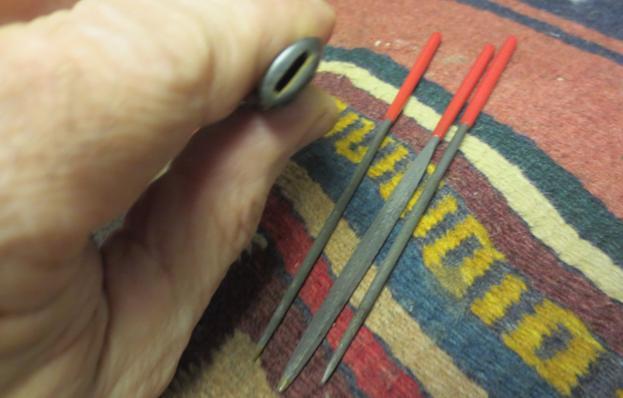
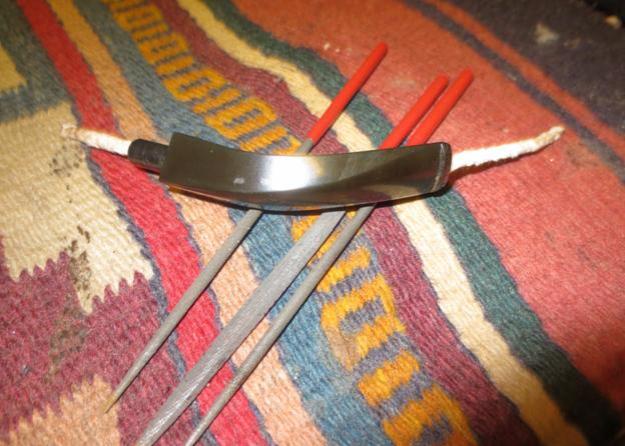
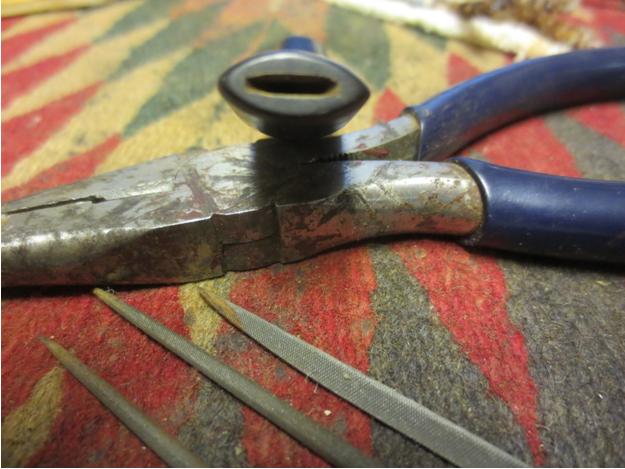
YSG17 4. The first tools that I use are a knife shaped needle file that has a thin edge like a blade and squared edge for the initial cuts and a folded piece of 220 grit sandpaper to clean up the newly cut edge.YSG23 5. I cut the edge with the straight edge of the file. I eyeball the line to make sure it aligns on both sides of the stem. This is a bit tricky at first but I rotate the stem to and angle where I can see both sides at once and begin the second cut. At this point in the process I am not finishing the cut but only drawing the line with the file. With the line cut and the button edge defined there is a lot of finishing work that needs to be done but you can get a clear picture of what the button will look like.

6. I use the knife edge of the file to shave the surface of the stem on the top and bottom sides. Be careful not to gouge the surface but smoothly shave it. I hold the blade at slight angle against the surface of the stem and carve toward the button. I have the stem on the table and work the blade away from myself sometimes and other times I have it in hand with the new button against the heel of my palm and work the blade toward the button. I work the blade until I have defined the line of the button and flattened the crown on the surface of the stem. Remember this is all initial carving. It will be cleaned up and smoothed out with the sandpaper and other files.YSG24

YSG25 7. When I have the material in front of the button cut away and thinned down I sand it with the folded 220 grit sandpaper to get an idea of how it looks and of how much more I will need to remove from the crown on both sides of the stem. In the case of this stem I have enough material removed. I still need to shape the button and clean up the edges of the sharp edge. The top and bottom surface of the button still need to be shaped and sanded but the overall look is good to go.YSG26

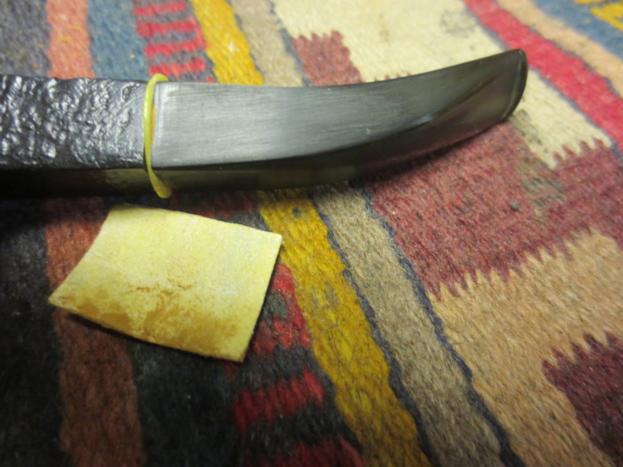
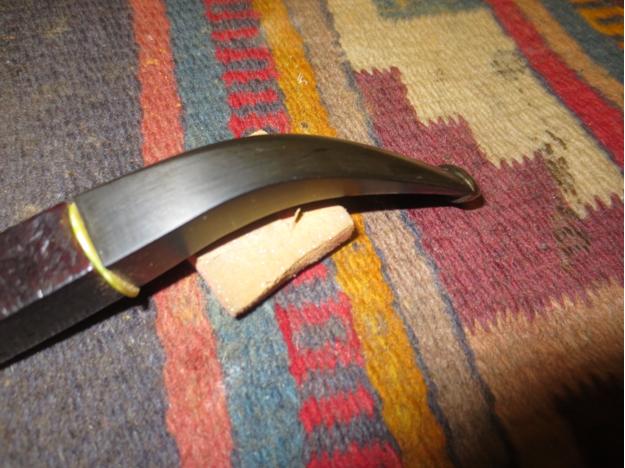
YSG27 8. With the rough shape finished I cut the slot in the end of the button and flare the airway. The first photo below shows the way the airway looked once I cut of the stem. You can see that there is plenty of material above and below the airway. I started the process by sanding the face of the button on my topping board and sandpaper. It is important to make sure that stem is absolutely vertical and does not tilt either way when doing this. You want to make a smooth face to work on the slot.YSG28 9. I use several different needle files to open the slot. The first file I use is a flattened oval file shown in the photo below. I work it against the right and left edges of the airway to open the slot. I don’t worry about the finished look at this point but am concerned to rough it in with the file. The flattened oval does the initial shaping work. I like a slot that is oval and tapers to a point on each side. I also work the file into the airway to taper the internals into a Y shaped funnel ending at the airway.YSG29 10. I work the top and bottom edges with the second file – an oval blade that is not flattened and almost round. I use it to work the internals into more of a smooth Y and then open the top and bottom of the slot. I follow this with a round needle file that has a thin point to clean up the opening and shape it. The photo below shows the slot after I have used all three files.YSG30 11. I fold a piece of sandpaper into a rectangle that I can fit into the slot. I work it in the slot to sand the internals and remove the file marks. I sand the face of the button to remove file marks and also sand the slot to refine the shape of oval.YSG31 12. The next photo shows the slot after I have worked it with the sandpaper. The internals are clean and smooth. I then use a pipe cleaner and isopropyl alcohol to remove any dust from the inside of the airway. The face of the stem still shows some light scratching that will be taken care of with wet sanding using micromesh sanding pads. However, you can see the new shape of the slot and how it sits on the button. That portion of the reshaping of the new button is finished and all that remains is to sand and polish the stem with the micromesh and the buffer.Button1 13. I sanded the stem – all surfaces including the button face with a medium and a fine grit sanding sponge to remove the scratches left behind by the 220 grit sandpaper. I worked on giving the surface of the button a slight bevel downward toward the slot. I personally like a gentle slope so I don’t overdo it with the sanding.YSG32

YSG33 14. With the scratches removed the stem is ready for polishing. I used micromesh sanding pads to do this work. Others use high grit wet dry sandpapers or micromesh papers. I like the way the pads fit in my fingers and how I can push the edge up against the slot to work that angle. I wet sand with 1500-2400 grit pads – wetting the surface of the stem and then sanding with the pads. I wipe it off regularly to remove the grime and check on the smoothness of the surface. I sand with each of the three grits until the particular grit no longer takes off any of the vulcanite. Once I finish with the three pads I rub the stem down with Obsidian Oil as I find it highlights the remaining scratches and also helps the micromesh to bite into the surface of the stem. I have used olive oil to do the same thing, applying it sparingly with a fold piece of cloth or paper towel. At times I have applied the oil between each of these three grits – essentially replacing the water with the oil. It works very well.YSG34 15. I dry sand (no oil or water) with the remaining grits of micromesh. I sand with 3200-4000 grit pads and then rub the stem down with oil again for the same reasons as above. I then either go back to the 1500-2400 grit pads to rework areas of concern or move on to sanding with the 6000-12,000 grit pads.YSG35

YSg36 16. I buff the stem with White Diamond at this point in my process. If you do not have a buffer you can buff with a plastic polish on a cotton pad or cloth. The idea is to remove any of the remaining scratches (micro scratches really at this point) and give the vulcanite a high sheen. When I finish buffing I give the stem multiple coats of carnauba wax. When I did not have my buffer I used Kiwi neutral shoe wax which has carnauba in it and hand buffed the stem with a shoe brush. Sometimes I revert to using the shoe brush even now. Especially when buffing areas around stamping and logos.

17. The finished stem is shown below. The button looks like it has always been there. I like giving it a look that fits the age of the pipe. I don’t want it looking like a brand new button that has been tacked onto an old pipe. Rather I want it to look as if it has been there for the life of the pipe and has seen some smoothing from use. You can be the judge if I have achieved that but at least that is the aim. You can also decide how you want the buttons that you shape to look. Don’t be afraid to experiment and add your own steps or modify these so that they work for you. The end result is really all we are interested in anyway and the methods for getting there are many.YSG37

YSG38

Restoring a Horn Stem Terminus Apple – An Early Version of a Reverse Calabash


Blog by Steve Laug

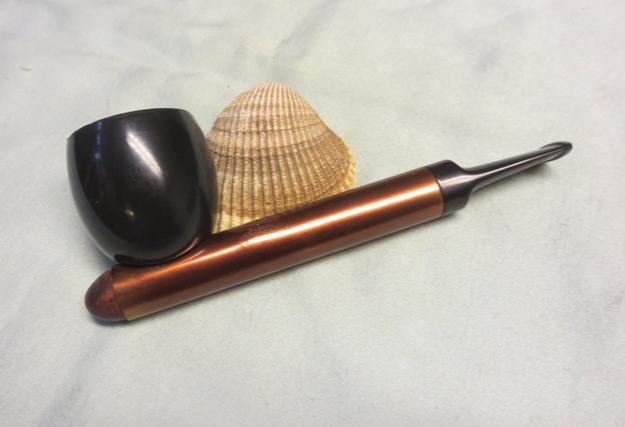
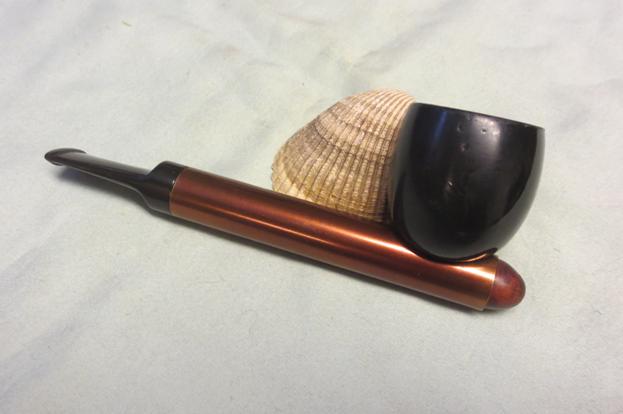
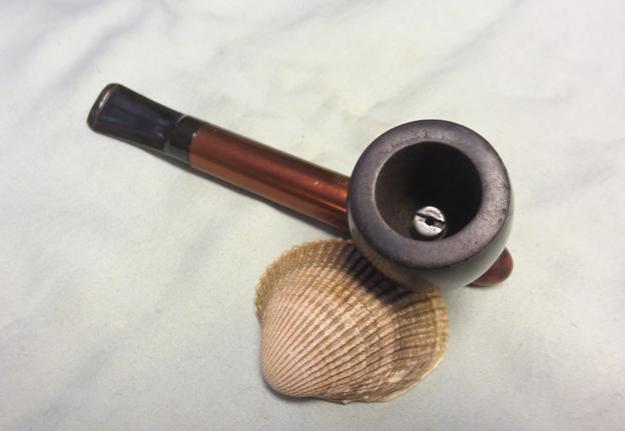
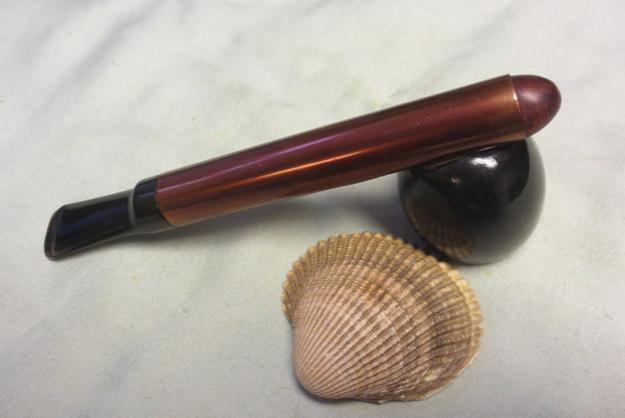
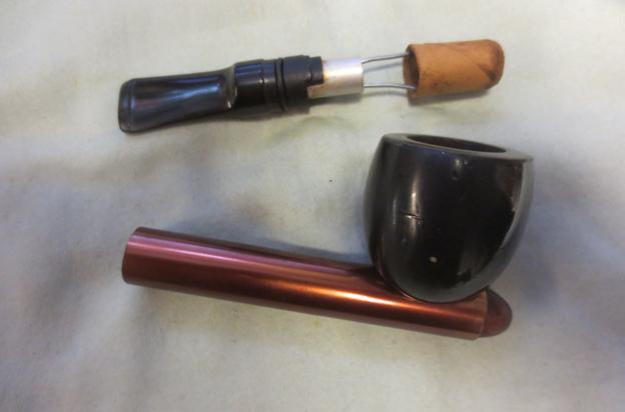
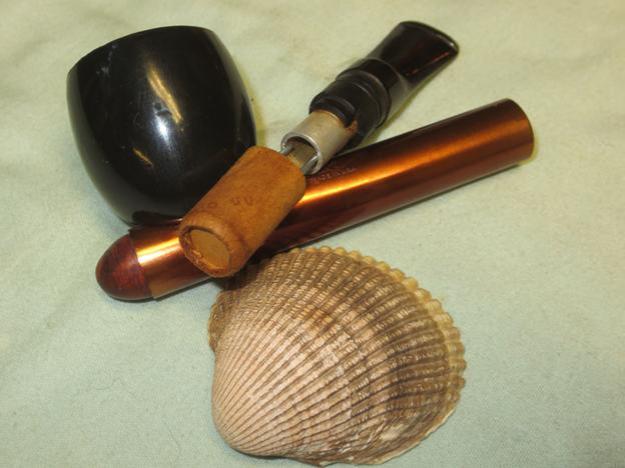
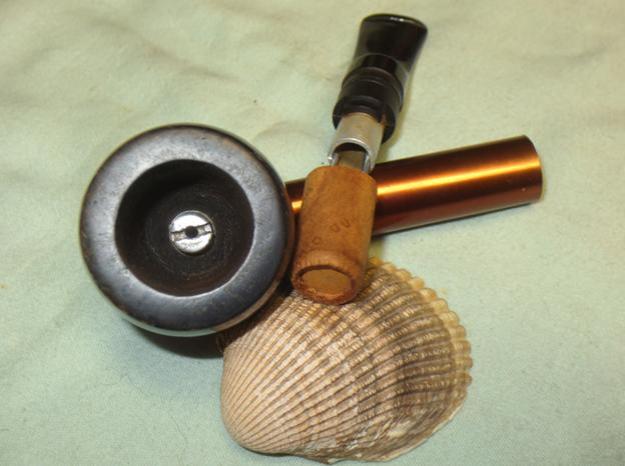
Terminusa I was gifted a beautiful rusticated Terminus apple from Anthony Cook. At least it has the potential to be a beautiful pipe to my eye. I have kept an eye out one of these old system pipes for a long time. They are like an early reverse calabash design. From my reading and observation it is both similar and different from the Keyser Hygienic pipes that I have written about before on the blog. It is similar in that it has an aluminum condensing contraption in the mortise of the shank with a centre tube that extends about ¼ inch beyond the end of the shank and rests in a larger tube in the military mount stem. This is the similarity – tubes, condensing contraption and the military mount stem. The dissimilarity is that at the end of the mortise where the flat base of the condensing unit sits there are two airway entries toward the top on either side of the centre tube. In the bowl there are also two airways at the bottom of the bowl. I found an online photo of the apparatus in the mortise and also how the stem and shank fit together. The Terminus I have is older than the one in the photo but the design is the same.Terminusb Terminus was a St. Claude, Francepipe maker. This is one of the early models, dating from the beginning of the 20thCentury.The patent was for an inner tube in the shank with two draw holes either side and a smaller inner tube in the stem, thus keeping “gunk” to a minimum.A straight apple with cow horn saddle bit.5.25 inches (13.5cms) long. Bowl height 1.75 inches (4.5cms). Looking up the name on Pipephil Logo and Stampings website I found the following information.Terminus4 On the screen capture from the site above you will note the phrase patented anti gunk system by Jean Masson. I clicked on that and was taken to the following information.Terminus4a There are several differences that I can see between this diagram (pictured below) and the pipe I have in hand. The first difference is that the back end of the condensing chamber is flat and does not have an extension or well on the bottom side of the chamber. The entire chamber extends the length of the mortise up to the two airways. The second difference is that the condensing chamber actually continues in the stem and there is a larger draw tube that the smaller tube in the mortise rests in. The third difference is that the stem is military mount and fits into the mortise around the smaller tube in the mortise. The tube seems to extend as far up the airway in the stem as I can see with a flash light.Otherwise the diagram gives an approximate idea of how the system fits together.Terminus5 Anthony sent me several pictures of the Terminus Pipe he was sending to give me a feel for what was coming. Overall it looked to be very workable. There was nothing in the pictures that gave me pause in terms of what it would take to clean it up. It appeared that the finish was basically gone – or it may have been a natural finish it was hard to tell. The horn stem looked interesting. It looked to be quite large and the taper on it was unique to the horn stems that I have worked on and kept in my collection. The tars on the rim did not seem to hide damage to the inner or outer edge of the bowl. The twin draught holes in the bottom of the bowl seemed to be hidden in the cake on the sides of the bowl. The condensation chamber in the mortise had a thick build-up of tars and oils that would be a challenge to get out.Terminus1
Terminus2

Terminus3 When the package arrived I quickly unwrapped it and took out the pipe. I really like the look and feel of it. It was comfortable in the hand and showed a lot of potential under the worn finish and dirt. It is stamped on a smooth rectangle on the left side of the shank with Serie No. 8349 in an arch over Terminus over Pipe. Under that it is stamped Brevete S.G.D.G. in a reverse arch. On the right side of the shank is a matching rectangle that is stamped 3036 over GP.The first four photos below show the pipe as it appeared to me fresh out of the box. The finish was slightly worn but underneath the tight rusticated pattern (almost a blast) was some beautiful ring grain that shone through the rustication. The bowl appeared to be unstained natural briar and would clean up very nicely. The stem was horn and had some tooth chatter on the top and bottom sides and also a deep tooth mark on both. The colour of the horn varied from a cream colour to a dark brown and seemed to move in waves that ran the length of the stem. When polished this stem would be beautiful.Terminus8

Terminus9

Terminus10

Terminus11 The next two photos are close-ups of the top and bottom of the stem and show the tooth chatter and the deep bit mark on both sides.Terminus12

Terminus13 I decided to address the chatter and bite marks on the stem first. I sanded the stem with 220 grit sandpaper to smooth out the tooth chatter and the wear around the button. I also wanted the surface of the stem smooth before I repaired the bite marks. I sanded the stem with a medium and a fine grit sanding sponge to smooth out the surface then wiped it down with a damp cloth to remove the sanding dust. I used a drop of clear super glue to fill the holes on the top and bottom. And set it aside for ½ hour for the glue to cure.Terminus14

Terminus15 When the glue had cured I sanded the two patches with 220 grit sandpaper to blend them into the surface of the stem. The two photos below show the patches after sanding and before I worked over the stem with the medium and fine grit sanding sponge.Terminus16

Terminus17 I sanded the stem with medium and fine grit sanding sponges to further blend in the repairs and smooth out the nicks in the surface of the horn.Terminus18

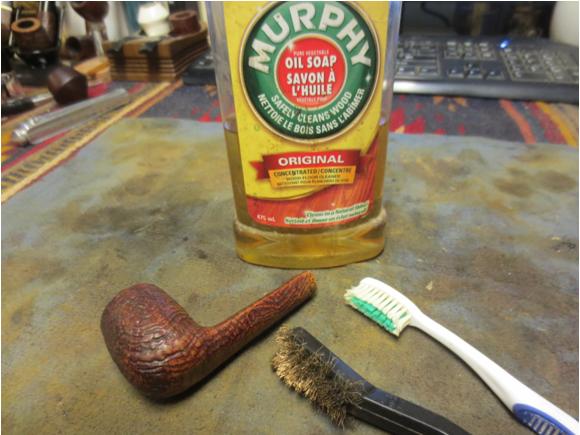
Terminus19 I cleaned out the shank, condensing chamber in the shank and stem and the airway in the stem and two airways in the end of the shank using alcohol, cotton swabs and pipe cleaners. I did not use the retort on this one as I am not clear on how the boiling alcohol would affect the horn stem. It took a lot of soaking and scrubbing before the aluminum chamber in the mortise and the chamber in the stem were clean and shiny once more I reamed the pipe back to bare wood and the used a dental pick to clean out the debris from the twin airways in the bottom of the bowl.Terminus20 I scrubbed the surface of the bowl with Murphy’s Oil Soap and a tooth brush and then rinsed it off with running water. I dried it off then wiped the bowl down with acetone on cotton pads to further clean the dirt and wax from the bowl surface. I scrubbed the aluminum shank band with silver polish and then lightly sanded it with the 1500 grit micromesh sanding pad.Terminus21

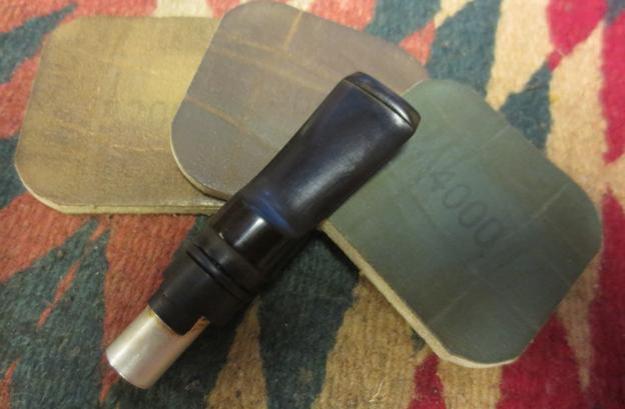
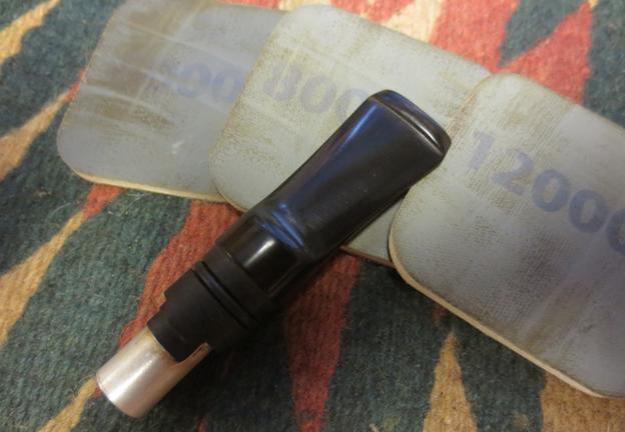
Terminus22 I worked on the tars and oils on the rim with saliva on a cotton pad and then used acetone on a cotton pad and was able to remove all of the build up. The grain really stood out on the rim and was a nice contrast to the rusticated pattern of the bowl.Terminus23 With the mortise and airways cleaned out I decided to use the cotton ball and alcohol treatment on the bowl to remove the heavy aromatic tobacco smell that still hung onto the pipe. I stuffed the bowl with cotton balls and used and ear syringe to fill it with isopropyl alcohol. I let it sit all day while I was at work. When I returned in the evening the oils had wicked out of the briar into the cotton. Once I removed the cotton and the bowl dried out the smell was gone and the bowl was fresh.Terminus24 I sanded the stem with micromesh sanding pads – wet sanding with 1500-2400 grit pads and dry sanding with 3200-12,000 grit pads. I rubbed the horn down with Obsidian Oil in between the sanding and while the oil was drying continued to sand with the pads. I find that the oil gives the micromesh the kind of bite on the horn stem that really raises the shine and removes the scratches and marks left behind from age.Terminus25

Terminus26

Terminus27

Terminus28

Terminus29

Terminus30 After polishing with the micromesh I buffed the stem with White Diamond and then gave it several coats of carnauba wax to protect it. I decided to rub down the bowl with some olive oil on a paper towel. I rubbed over the surface of the bowl so that oil went down into the grooves and soaked in. Once the oil had penetrated the briar I wiped it off with a soft cotton cloth and hand buffed it with a shoe brush.Terminus31 This morning I gently buffed the pipe and stem a final time and gave it a light coat of carnauba wax. I finished by buffing it with a soft flannel buff to give it a shine and make the horn material glow. To me there is nothing more beautiful on these old pipes that the warm luminescence of polished horn. In this case the variations in colours from cream to dark brown and everything in between gave the stem an almost three dimensional look. The oil enlivened the old briar without muting the ring grain that shone through the rustication. To me this old pipe just glows with deep inner warmth that will make it a pleasure to smoke. I am looking forward to the interesting smoke that the twin airway in the bowl and the condensing chamber in the pipe and stem will provide. The draught on the pipe is quite open so it should smoke well. My guess is that it will deliver a cool smoke. The horn stem provides a unique feel in the teeth and mouth that nothing quite rivals. The finished pipe is shown below.Terminus32

Terminus33

Terminus34

Terminus35 The final photos give a close up view of the parts of the pipe beginning with the cleaned and polished rim and walking you through the condensation chamber and a photo of how the two tubes intersect when the stem is in place.Terminus36

Terminus37

Terminus38

Terminus39

Making an Ehrlich Sandblasted Billiard Less Dreary


Guest Blog by Robert M. Boughton
Member, North American Society of Pipe Collectors
http://www.naspc.org
http://www.roadrunnerpipes.com
http://about.me/boughtonrobert
Photos © the Author

Once upon a midnight dreary, while I pondered, weak and weary,
Over many a quaint and curious volume of forgotten lore –
While I nodded, nearly napping, suddenly there came a tapping,
As of some one gently rapping, rapping at my chamber door.
“’Tis some visitor,” I muttered, “tapping at my chamber door –
Only this and nothing more.”
― Edgar Allen Poe (1809-1849), U.S. poet, author, editor and literary critic, in “The Raven,” 1845

INTRODUCTION
My inspiration for restoring an Ehrlich Sandblasted Straight Billiard acquired online as part of one very good estate haul was much like the opening lines to Poe’s most famous poem, except that no raven appeared to quethe negativity. Instead, the insight I gained from the gentle rapping on my creative door, which is how most of my contemplative phases before any restoration pass, was to transform the original dark and dreary pipe into something lighter and bolder.Rob1 Rob2 Rob3 Rob4 Rob5 Rob6 Rob7 Rob8 Rob9 THE RESTORATION
There are times when, to make something better of a pipe – whether it appears to have passed through a wood chipper or looks okay or at least nice enough as it first appears – calls for drastic action, such as stripping the old finish. There are two ways I know to accomplish this: the more invasive and time-consuming sanding approach, which always carries the contingency of scratches, and the faster, smoother method of soaking in Everclear. On rare occasions I have needed to start with the soaking and finish with light sanding, but for the most part I now try to avoid stripping at all because of my early restorations when I was gung-ho for the total overhaul idea. I soon enough learned there was a good reason for the darker finishes that so offended me, with a few notable exceptions.

But by either route, the initial result will be a striking step backward in the pipe’s aura. In other words, the wood is going to look like it’s been scorched by the fires of Hell. Still, I knew this was an occasion that merited stripping, and the pipe in question being sandblasted was one reason I chose the kinder, gentler Everclear.

Taking advantage of the fifteen minutes needed for the Everclear to do its work on the bowl and shank, I set upon the task of working out the few kinks in the stem. Starting with purified water on a small square of cotton cloth, I gave it a bath, then used 200-grit paper only on the bite mark below the top lip, which with concerted rubbing, to my surprise, eliminated any sign that the chatter had ever been there. I was able to finish spiffing up the stem with 2400, 3200 and 3600 micromesh.Rob10

Rob11 Removing the briar from the alcohol, I wiped down the outside and scrubbed the chamber with more cotton cloth pieces and scoured the inside of the shank with a wire-handled cleaner before I set it aside to finish drying.Rob12

Rob12a

Rob13

Rob14

Rob15

Rob16 Other upsides to the Everclear method were that the rim burn was gone and the chamber, which was not in the usual horrid state to begin with, needed no reaming at all and came smooth not even starting with my customary 150-grit first line of attack but an easy sanding with 320-grit paper.

I seized the opportunity to retort the pipe before moving to the buffing of the wood with a progression from superfine steel wool to 2400, 3200, 3600 and 4000 micromesh. I only snapped one photo of the results of this step. It captures the nice return of a lighter, golden, more natural shine to the briar as well as the only nomenclature on the Ehrlich, a brand that hails from Boston, Massachusetts.Rob17 Ready to turn the finished parts on the wax wheels, I used red and white Tripoli and White Diamond on the stem and added carnauba (not having any Halcyon II) to the bowl and shank. The carnauba only needed more intense rubbing with a soft cotton cloth to clear out the excess.Rob18

Rob19

Rob20

Rob21

Rob22

Rob23CONCLUSION
I’ve said it before. I’m more of a naturalist when it comes to pipe restoration, or a believer of using the truest color of the wood to its best effect, although for good cause I have strayed from the ideal. Most of the times I see an over-dark stain for no apparent good reason, I have an overwhelming urge to uncover the obscured richness of the wood beneath. I think I succeeded with this Ehrlich.

Repairing a Bite Through on a Vulcanite Stem with Black Super Glue


Blog by Steve Laug

I recently posted about an old BBB 701 Rhodesian that I restored. It was quite a mess and needed a lot of attention to both the bowl and the stem. In the process I took some photos of the stem repair I did and thought I would write a blog on the process. The first three photos below show the state of the stem when I started. The top and bottom sides of the stem at the button had significant tooth chatter. The top of the stem had the bite through at the button and a much worn edge on the button. The underside of the stem had deep bit marks next to the button and small chatter up the stem about 1 inch. There was oxidation on the stem as well. In the photo there appears to be a crack from the bite through hole into the button and to the edge. That mark is more tooth marks but the stem material is not cracked in that way. The red arrow in the first two photos highlights the apparent crack. In the third photo the arrow points to the tooth marks on the surface of the stem.Stem1

Stem2

Stem3 The first step in preparing to patch the hole in the stem is to clean up the surface and remove any loose or damaged portions of the stem. I use a dental pick to pick at the edges of the hole and the cracks and broken spots on the stem. I also probe other potential thin spots on the top and the bottom of the stem. I particularly probed the tooth marks on the underside to see how thin the vulcanite was in those areas. Once I had picked away the damage I wiped down the areas with a cotton pad and alcohol. The surface needs to be free of wax or dirt before the patch is applied because these will cause the patch to not bind to the surface of the stem.

I have a nail file that I “stole” from my daughters that is a perfect fit in the slot of most pipe stems that I work on. It is tapered and pointed so that it fits deep into the airway underneath the hole in the stem. I want a hard surface under the patch for the glue to puddle against. In order to not glue the file into the stem permanently I apply a thick coat of Vaseline petroleum jelly to the end of the file before I insert it. I only put enough of the jelly on the file that it does not squeeze out of the hole and soil the repair area. This took time to get the hang of. Too much jelly makes a mess of the repair area and too little makes the super glued file the next problem you will need to address in repairing the stem. It takes practice to get it just right – don’t get frustrated and remember too much jelly is better than too little!

With the file inserted in the airway it is time to start the patch. I drip black super glue around the edges of the hole first to solidify the broken edges and provide a live edge to build on when I fill the hole. I let that first coat of glue dry hard to touch before adding the next layer of glue. I have used an accelerator in the past to quick dry the patch. This time I decided to do it the long way and let the patch cure between coats. In the photo below you can see the ring around the bubble of the patch that is that first layer of the repair. The arrow in the picture points to the cured edge of the repair that surrounds the bubble in the centre. I apply several more coats to the edge to build it out toward the middle. The final coat I purposely overfill because as the glue cures it shrinks. It is a bit more work to sand out the excess material but in the end it makes for a thicker and stronger patch. I also filled the tooth marks on the underside of the stem next to the button with the superglue. These took two coats to build it up enough to reshape the button with files and sandpaper. I set the stem aside overnight to give the glue patch time to cure and harden.Stem4 The next morning, when the glue had hardened I sanded the patch with a folded piece of 180 grit sandpaper followed by more sanding with 220 grit sandpaper. I work to blend the edges of the repair into the surface of the stem and feather out the surface of the repair to match the surface of the surrounding stem material. In the photo below the arrow points to the patch. It is a slightly different colour of black to the rest of the stem at this point in the process. More sanding and working on the patch will change that.Stem5 On the underside of the stem I sanded the patches until they were smooth as well. On this particular repair there were two small air bubbles that showed up when I sanded the patch. They are shown by the arrows. I refilled these small holes with a drop of black super glue and let it cure until hard then resanded the patched areas.Stem6 When repairing the surface of the stem I always check the profile of the stem to make sure that I am not creating bulges in the surface of the stem. I want to maintain the flow and lines of the stem and not change the profile. When I sand the repairs I repeatedly look at the profile and often take pictures to make sure the flow and lines are smooth. The photo below shows the smooth profile of the stem after the repairs and initial sanding.Stem7 I sanded the stem with 400 grit wet dry sandpaper with a spot of water on the stem. I sanded to remove the oxidation and to blend the patch into the surface of the stem on both the top and the bottom sides. As can be seen in the photos below the patch on the top side is smooth and blended into the stem. It is still a slightly different black colour but more sanding will remedy that. The patch on the underside is well blended. More work needed to be done with the two air bubble repairs to blend them further.Stem8

Stem9 I sanded the stem further with a medium and a fine grit sanding sponge. 3M makes this product and it is very flexible. I find that it allows me to follow the curves of the stem and the sharp edges of the button with little effort. The top and bottom of the stem are shown after sanding in the next two photos. The patches are now little more than small spots on the stem that will further disappear after sanding with micromesh sanding pads.Stem10

Stem11 I wet sanded the stem with 1500-2400 grit micromesh pads to smooth out the repair and further blend the patches. In the photo below you can see that the patch has all but disappeared on the top side of the stem. The one on the underside looks similar at this point in the process.Stem12 I dry sanded the stem with 3200-12,000 grit pads. The surface of the stem began to shine and have a rich glow in the surface. Each successive grit of pad deepened the shine and the richness of the black stem.Stem13

Stem14 I buffed the stem with White Diamond and gave it multiple coats of carnauba wax. I buffed it with a soft flannel buff to raise the shine. The final two photos show the top and underside of the stem the shine is rich enough that the flash is shown reflected in the surface of the stem. The hole is solidly repaired and the tooth marks on the underside of the stem no longer show. The edge of the button has been sharpened as well to distinguish between the stem surface and the button. The finished stem looks as if it was never damaged though under a bright light the spots are slightly visible if you know what you are looking for. The stem is now ready to be put into service. The proof of the durability of the patch will be seen over time as the pipe is smoked and used. On other stem repairs like this I have never had a problem with durability and I am hoping for the same with this stem.Stem15

Stem16

A Custombilt Lovat Reborn


Blog by Steve Laug

I found this pipe on a recent pipe hunt in the US. It was sitting in a locked cabinet in an antique mall just waiting to be found. It has a long round shank with a saddle stem so it fits the description of a Lovat. It is a large pipe however – approximately 6 inches long. The combination of rustication and smooth is attractive. It has the standard Custombilt rustication but for some reason on this old pipe it looks more refined and less clunky (good scientific term, LOL!) than the other Custombilts and CustomBilts that have passed through my hands.hunt I have several Custom Bilt or Custom-Bilt pipes stamped with a separation or a capital B on bilt. I remembered reading Bill Unger’s book on CustomBilt pipes and knew that the change of stamping reflected a change in the company. I turned to one of my reference sources – Pipedia, to see what they said. Here is the link to the full article by Rich Essermann http://pipedia.org/wiki/Custom-Bilt I quote from that article below:

“In 1946, the name was changed to Custombilt after Mincer began an association with Eugene J. Rich, Inc. There were some big changes in advertising and distribution. The slogan “AS INDIVIDUAL AS A THUMBPRINT” began at this time as well.”

“In the early 1950’s, Tracy Mincer developed severe financial problems that caused him to stop making the Custombilt, and he lost the name. In 1953, Leonard Rodgers bought the company and emphasized tobacco pouches and butane lighters. (However, it appears Mincer was working on his new pipe, the Doodler.) In 1968, Rodgers sold the Company to Consolidated Cigars. In the early 1970s, Wally Frank Co. bought the Custombilt trademark and began to produce their version of the pipe in 1974 or 1975. Hollco Rohr owned the Weber pipe factory, located in New Jersey, and produced the Custombilt pipes there. In 1987, the pipes were made out of the Butz-Choquin factory (France) and then Mexico until the late 1990s. Currently, the Custombilt name is owned by Tobacalera of Spain.”

From the above information it seems that the pipe I have could have been made between 1946 and 1953 if it is one made by Tracy Mincer. Otherwise it could have been made during the 1970’s. In my opinion the more refined less classic Mince CB look of the pipe, the variations on the rustication pattern from the bowl to the shank, the type and look of the stem all lead me to put it in the later era – the 1970s and attribute its manufacture to Wally Frank and Company. I may be wrong but that is my read on this particular Custombilt Lovat.

The pipe I found was in very good shape. The stem was slightly oxidized and had some roughness like it had never been finished well. There was no bite or tooth marks or tooth chatter on the stem. The interior of the stem and shank were also clean. The briar in the shank was unstained and looked new. The bowl had a very light cake. The finish was virgin/natural and originally had probably been oiled or just waxed. There was no stain coat or lacquer/varnish coat. Whew! The stamping on the pipe is simple. On the left side of the shank it is stamped Custombilt over Imported Briar. On the underside of the shank it is stamped with the shape number 12 running horizontally next to the stem/shank union.CB1
CB2

CB3

CB4 The closeup photo below shows the top of the rim with its unique rustication and the state of the bowl. The rim is in great shape and the bowl is fairly clean.CB5 I cleaned out the shank and the stem with pipe cleaners, cotton swabs and isopropyl alcohol to remove the light oils and tars. It took very little effort to clean this pipe.CB6 I gave it a light reaming with the PipNet reamer and took it back to bare wood so that whoever ends up with this pipe can break in and build an even cake of their own.CB7 I scrubbed the rusticated areas on the bowl and shank with a tooth-brush and Murphy’s Oil Soap. The grooves and crevices had a buildup of dust in them that dulled the finish. After scrubbing I rinsed the pipe under running water to remove the soap. I put my thumb over the bowl to keep the interior dry.CB8 The next series of four photos show the bowl after the rinse and dry. The grooves are clean and the pipe is ready for the next step in its cleanup.CB9

CB10

CB11

CB12 I use a plastic washer that I made out of a bread tab between the shank and the stem to allow me to sand up against the shank without damaging the finish and without rounding the shoulders of the stem or shank. It works like a charm and I have several of these that I have punched with a variety of holes to fit different tenon sizes. I sanded the stem with 220 grit sandpaper to smooth out the roughness and followed that with a medium and fine grit sanding sponge.CB13 Once I had smoothed out the roughness of the stem I moved on to sanding with micromesh sanding pads. I followed my usual method of wet sanding with 1500-2400 grit pads and dry sanding with 3200-12,000 grit pads. I rubbed the stem down with Obsidian Oil between each set of three pads.CB14

CB15

CB16 I rubbed the bowl down with a paper towel and a dab of olive oil to bring the natural finish of the bowl back to life before I buffed it. I rubbed it down and let the oil dry overnight. In the morning I buffed the pipe and stem with White Diamond and gave the bowl a light buff of carnauba and then rubbed it down with some Halcyon II Wax. I gave the stem multiple coats of carnauba wax. The finished pipe is shown below.CB17

CB18

CB19

CB20 The final three photos give a close up view of the bowl and stem from various angles. There is something quite attractive about this particular Custombilt. It has a dignity that draws me to it.CB21

CB22

CB23

Refreshing an Older Heritage Antique #13 Dublin Pipe


Blog by Steve Laug

The Heritage brand was on I had no familiarity with until Andrew wrote up this blog for us https://rebornpipes.com/2014/12/23/refurbishing-a-heritage-heirloom/ He gave background, history, line information and the classic brochure from the company. I want to give a brief summary of what he found in the next two short paragraphs to set the stage for the one that I found once he highlighted the brand for me.

Heritage pipes were Kaywoodie’s answer to Dunhill. According to one of their brochures, Heritage pipes were made from “briar burls seasoned and cured for up to 8 months,” with only “one briar bowl in over 300 selected to bear the Heritage name.” “Heritage stems are custom fitted with the finest hand finished Para Rubber stems. Mouthpieces are wafer thin and concave.”

The Heritage line began in the early 1960’s, with the trademark issued in 1964. The line was started at the request of Stephen Ogdon, (who worked for Kaywoodie in 1962). Mr. Ogdon had previous experience working for Dunhill, either running the New York store or working for Dunhill North America. Mr. Ogden was made President of Heritage Pipes, Inc., Kaywoodie Tobacco Co.,Inc. and Kaywoodie Products Inc. as well as a Vice President of S.M. Frank & Co. Heritage Pipes were produced from 1964 until 1970 (Source Kaywoodie.myfreeforum.org).

I found one online on Ebay that was stamped Heritage Antique 13. I scanned the brochure that Andrew provided and found this regarding the Antique Line: The Heritage Antique line is characterized by “Rustic Grain stands out in rugged relief.” “This pipe is so bold-looking, yet so light and smooth-smoking. A special sandblasting process exposes a greater surface area on the bowl, giving a cooler, more satisfying smoke. Centuries-old Heritage Antique is strikingly masculine in appearance.”The number 13 is the shape number for the Dublin shape. It can be seen in the first coloumn second pipe down on the left side of the brochure page below.heritage4_zpsdc6295ef The seller of the pipe I picked up on EBay included some basic information on the pipe. The said the stamping was Heritage Antique with a 13 on the bottom of the shank. The stem has an inlaid double white diamond on the left side. It is out of a Kansas City estate. It measures:
5-1/2 inches Long
1-3/4 Inches High Bowl
1-1/4 inches Bowl Width
3/4 inch of a Bowl Bore
3 inch long stem

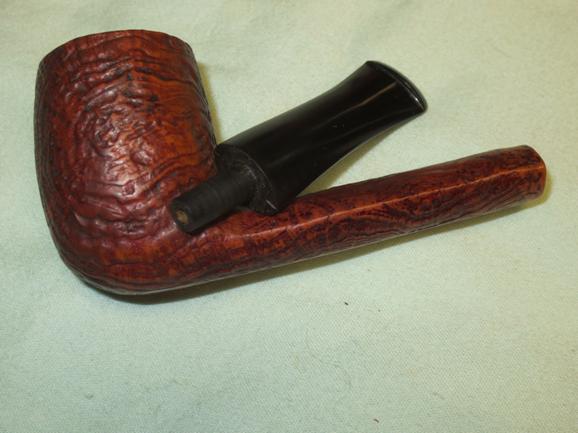
The next eight photos were included with the EBay advert and give a pretty good idea of the type of blast on the briar as well as a good picture of the state of the stem. The pictures show the colour of the pipe in a more red hue than it actually appeared when it arrived. In reality the stain is a brown tone similar to that of the Dunhill Shell Briar.Heritage1

Heritage2

Heritage3

Heritage4

Heritage5

Heritage6

Heritage7

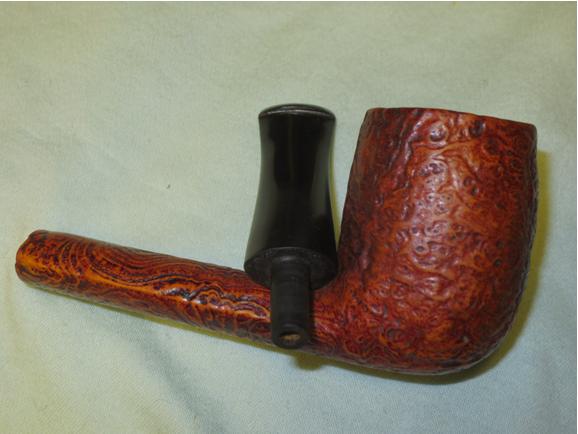
Heritage8 When the pipe arrived in Canada I was very pleased when I opened the box. The briar was in good but dirty condition and it appeared that the finish was in great shape under the grime and tars. The blast was amazing and craggy – very much like that on my older Shell Briars. The rim had some buildup on it that was flaking off but the bowl was in round and there was no damage to the edges of the rim.Heritage9

Heritage10

Heritage11

Heritage12 The stem was thin and quite clean. It was oxidized and had some waxy substance on the top side. There were two tooth marks – almost pin prick marks, on the underside of the stem visible in the first photo below. The second photo shows the waxy buildup on the surface of the stem and the oxidation.Heritage13
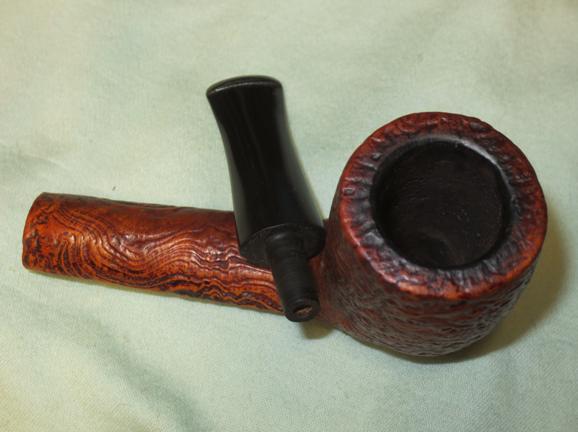
Heritage14 The rim of the pipe, shown in the photo below had a thick buildup of tars that were flaking off the surface of the rim. I picked at it with a dental pick and could see that the sandblast surface was undamaged underneath. The bowl was in need of a reaming to smooth out the uneven cake on the sides and bottom of the bowl.Heritage15 The stem was frozen in the shank so a short time in the freezer and the stem was easily removed from the shank. The step down tenon was in great shape and showed no damage and the tenon itself was not tarry.Heritage16 I reamed the bowl with a PipNet Reamer beginning with the first cutting head and finishing with the size 2 cutting head. I reamed it back to bare wood to restart the cake build up.Heritage17

Heritage18 I picked the flaky buildup on the rim with a dental pick and the scrubbed it with a soft bristle brass tire brush to remove all the grit and take it back to the surface of the rim. I have used this method over years as the bristles remove the tars without damaging the sandblasted surface.Heritage19 Once I had the surface brushed clean with the wire brush I scrubbed the entire bowl and shank with undiluted Murphy’s Oil Soap and a tooth brush to get the grime out of the crevices of the blast and remove the oils from the previous owners hands. Once I had scrubbed it I put my thumb in the bowl and rinsed it off with cool water and dried with a cotton cloth.Heritage20 I put the stem back in place and set up the retort. I filled the test tube half full of 99% isopropyl alcohol and heated the alcohol over a tea candle. The alcohol boiled through the pipe and cleaned out the tars and oils in the stem and shank. The alcohol also rinsed the inside of the bowl which was plugged with a cotton ball.Heritage21

Heritage22

Heritage23

Heritage24 With the inside of the pipe cleaned and the exterior of the briar scrubbed it was time to address the oxidation and the marks on the stem. I put a plastic washer between the stem and shank so that I could sand the stem right up to the shank without worrying about rounding the shoulders of the stem. I sanded it lightly with 220 grit sandpaper to remove the waxy buildup on the stem (turns out it was a varnish) and also loosen the surface oxidation. I followed that by sanding with a medium and fine grit sanding sponge to remove scratching and oxidation.Heritage25

Heritage26

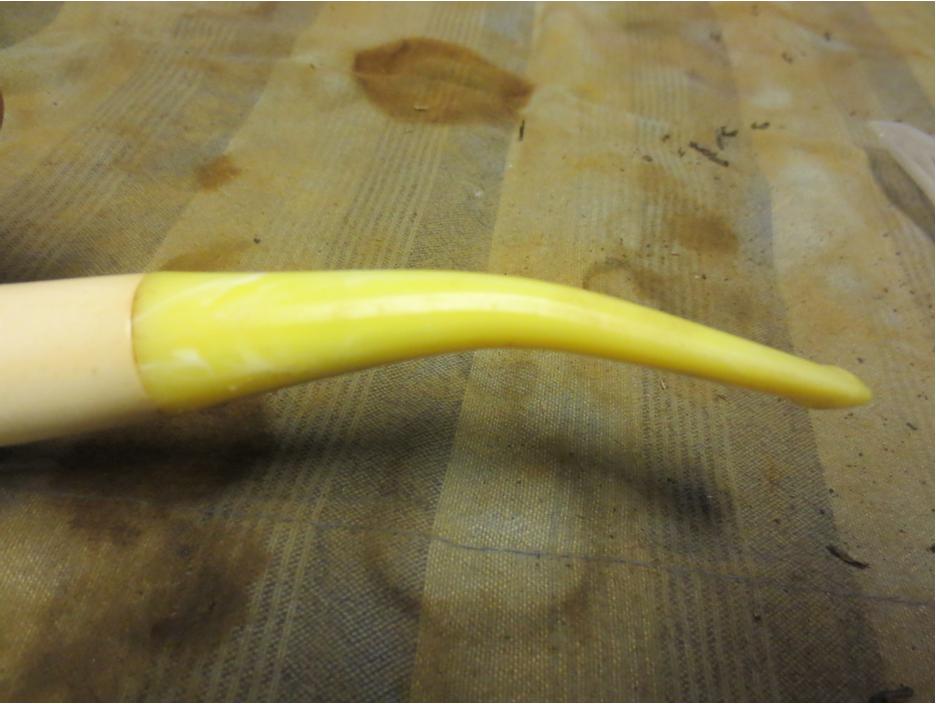
Heritage27 Once the stem was sanded, I wiped it down with a cotton pad and alcohol in preparation for repairing the two tooth marks. I filled these with black super glue and set aside the stem to let the glue cure.Heritage28 When the glue had dried I sanded the two spots with 220 grit sandpaper and the two sanding sponges to smooth out the patches and blend them into the vulcanite. I then sanded the stem with micromesh sanding pads – wet sanding with 1500-2400 grit pads and dry sanding with 3200-12,000 grit pads. I rubbed the stem down with Obsidian Oil between each set of three pads and also at the end of the sanding process.Heritage29
Heritage31

Heritage32 I buffed the stem with White Diamond and gave it multiple coats of carnauba wax. I rubbed two coats of Halcyon II Wax on the sandblast of the bowl and then gave the pipe and stem a light buff with a soft flannel buff to raise the shine. The next photos give a clear picture of the finished pipe. Heritage33

Heritage34

Heritage35

Heritage36 I end with three close-up photos of the bowl to give a good idea of the quality of the sandblast on this piece of briar. It is a stunning pipe with a blast that rivals that found on the Dunhill Shells that are in my collection. I intend to fire up this old pipe and enjoy its trust for many years to come.Heritage37

Heritage38

Heritage39