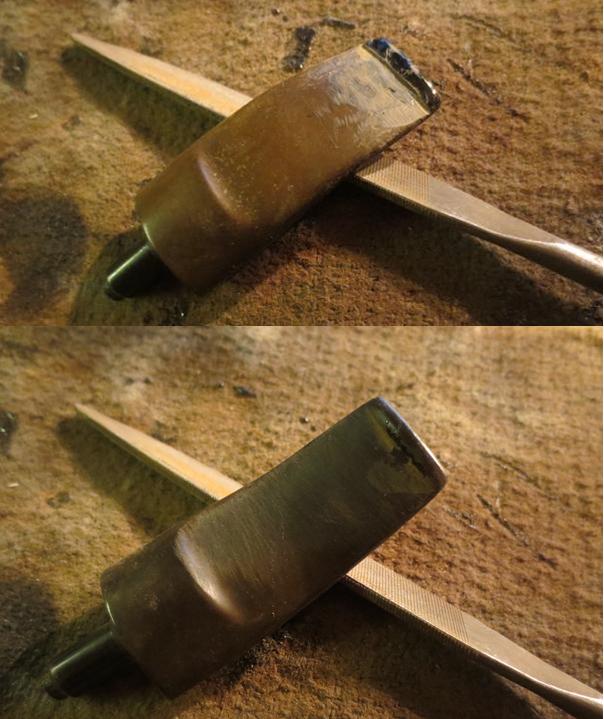
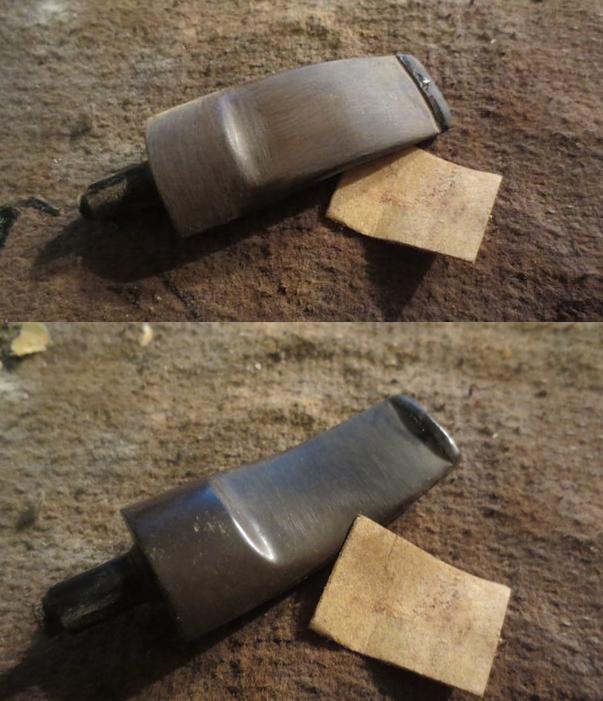
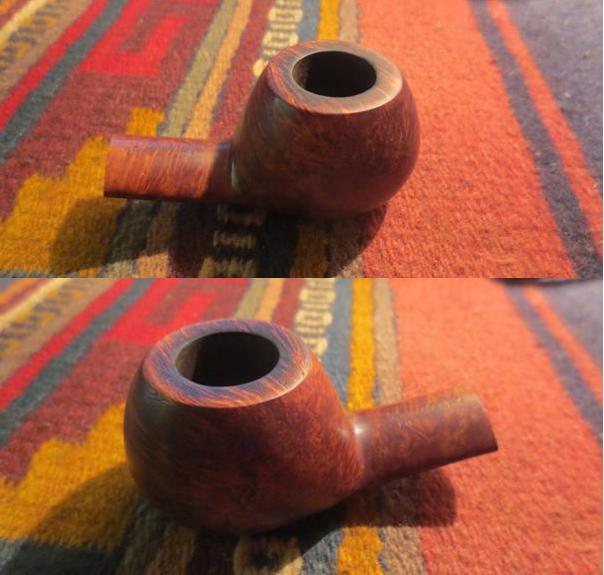
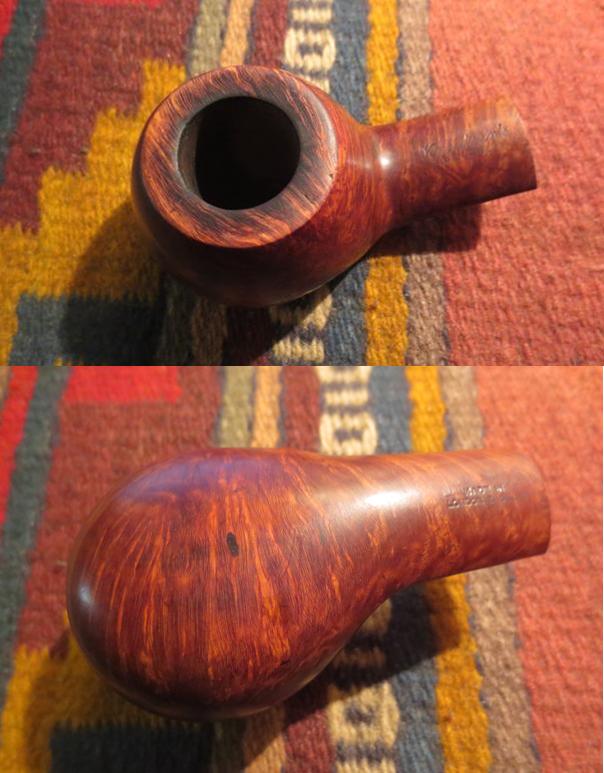
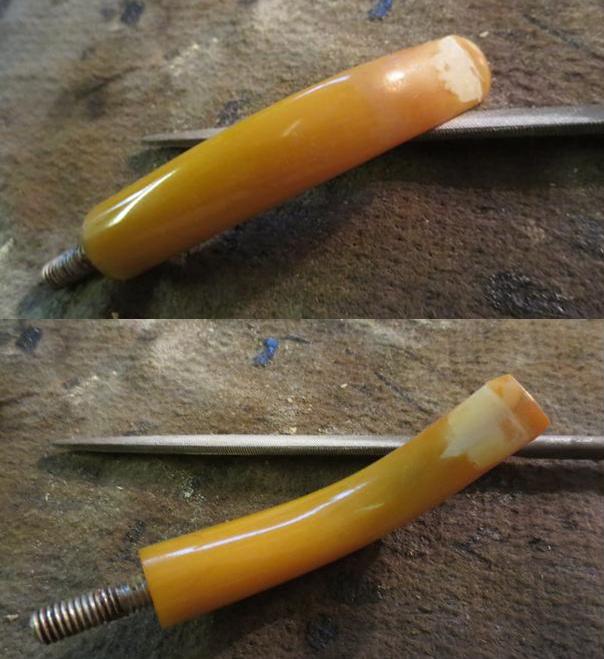
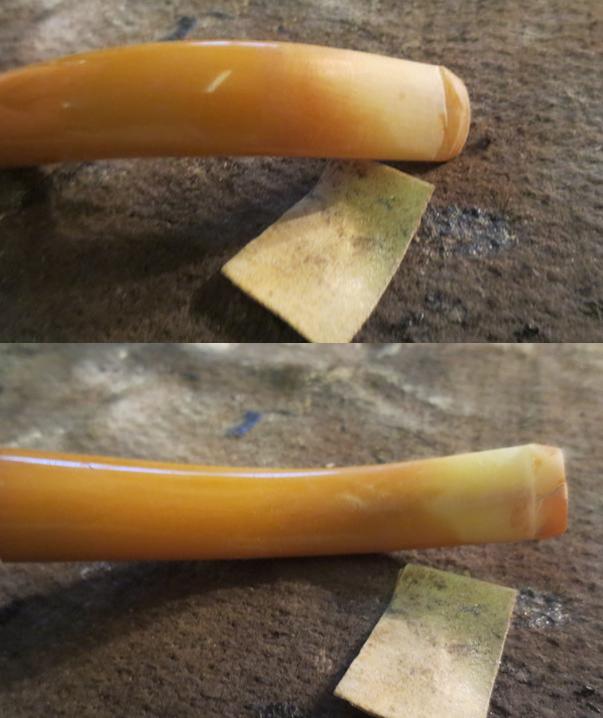
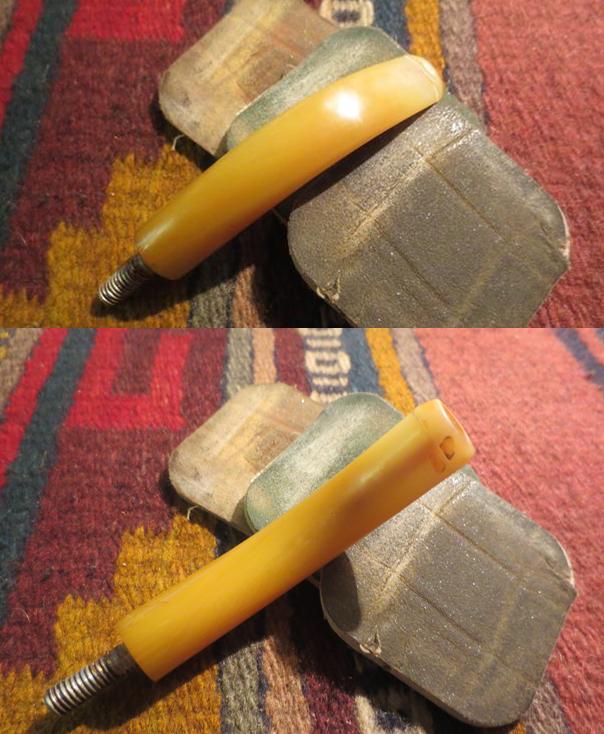
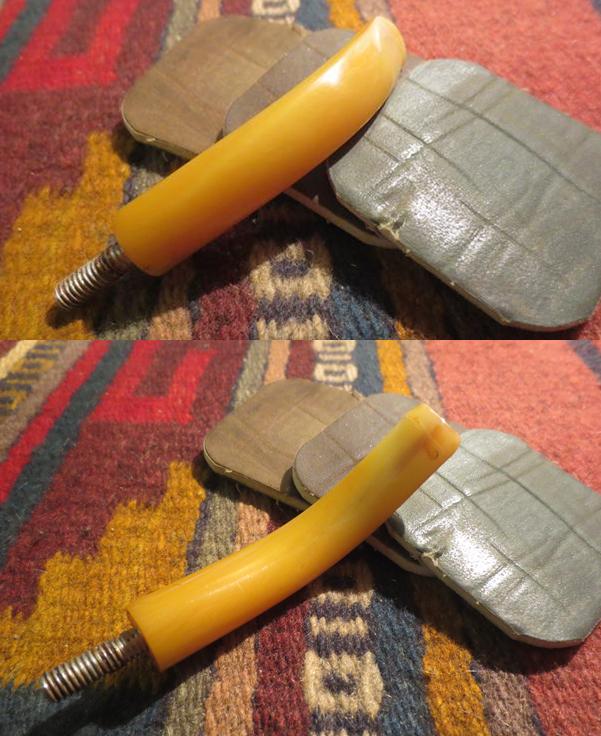
Tag Archives: stem work

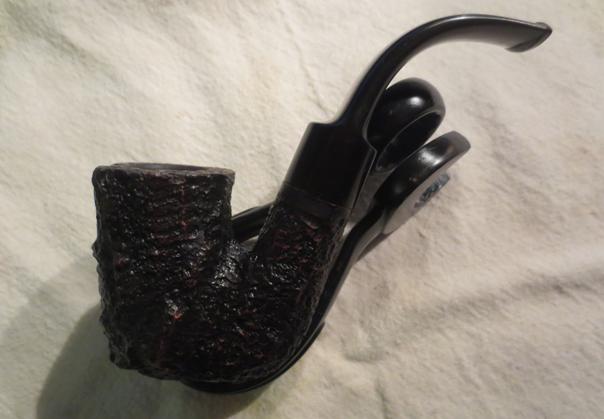
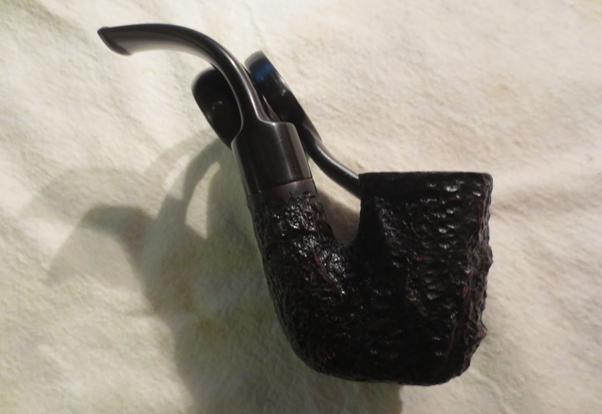
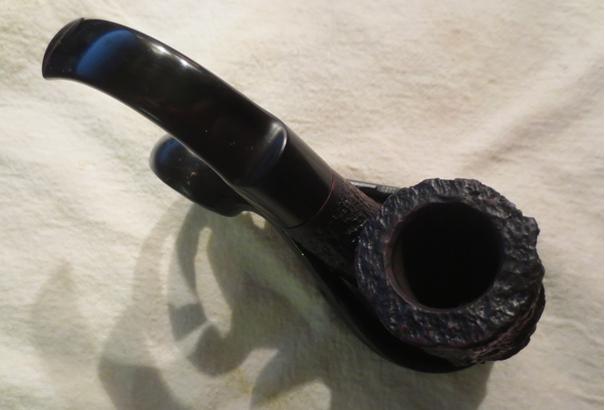
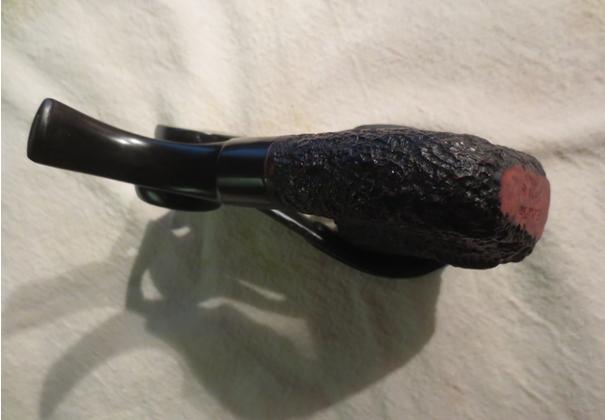
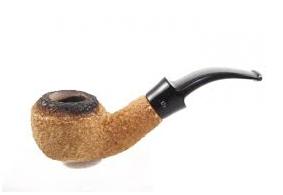
New Life for a Savinelli Estella 604KS Oom Paul


Blog by Steve Laug

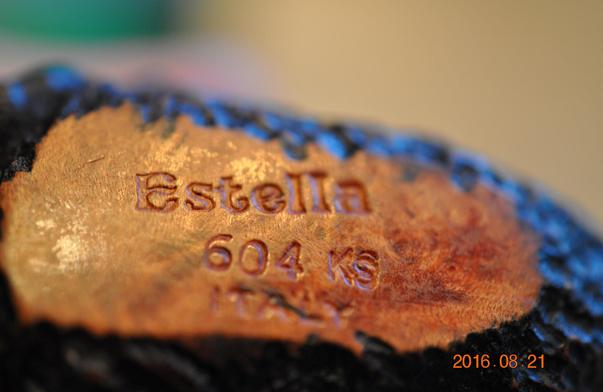
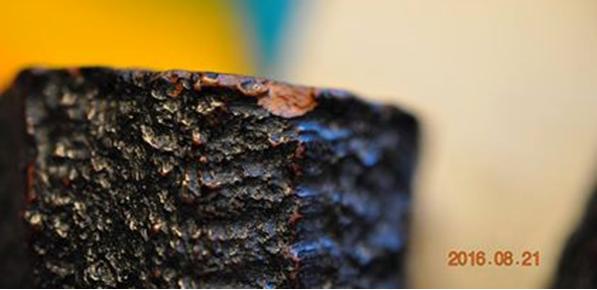
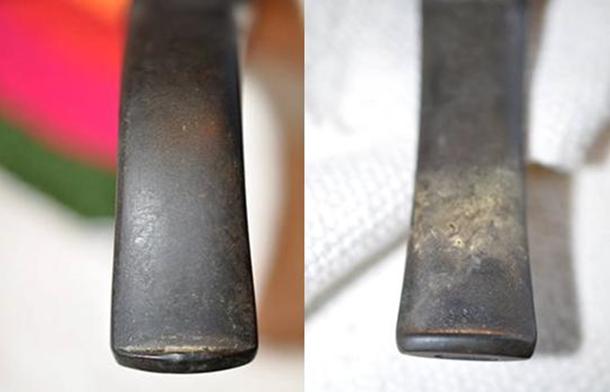
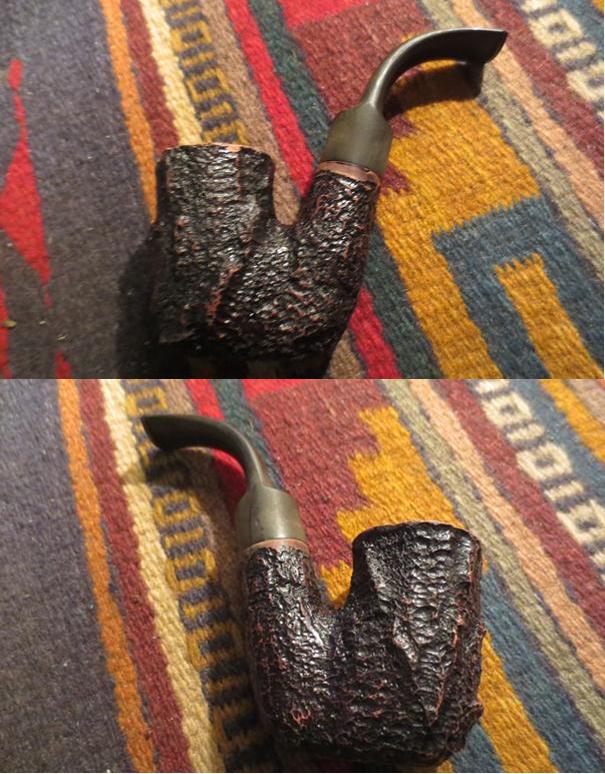
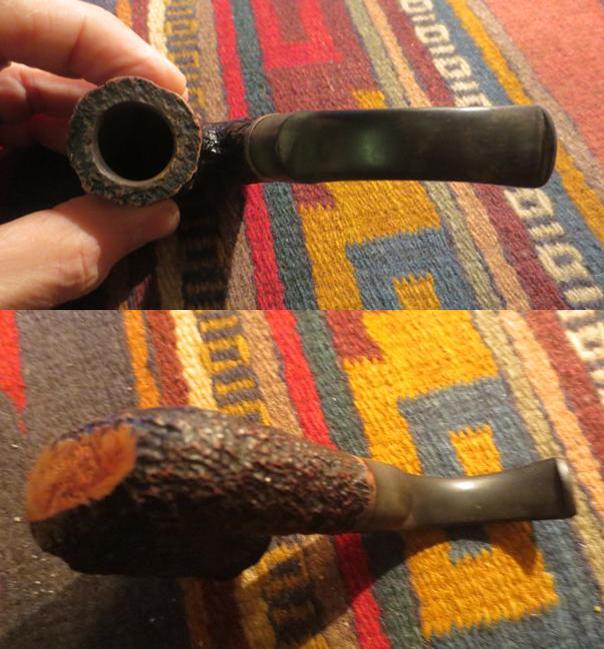
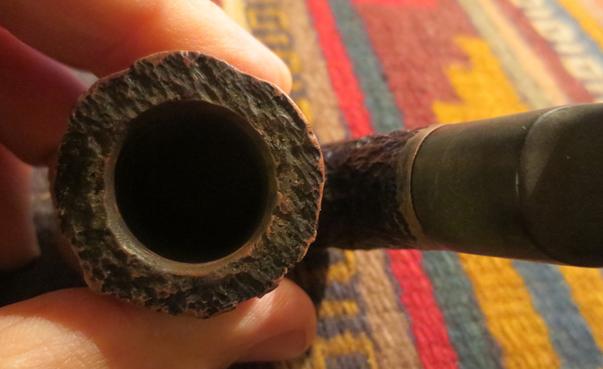
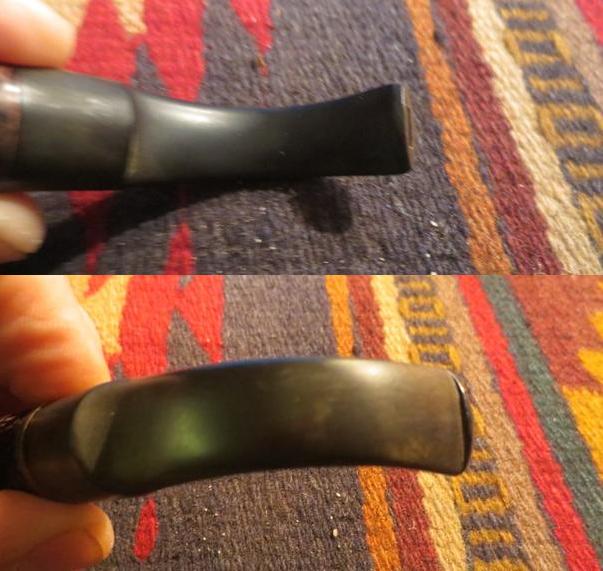
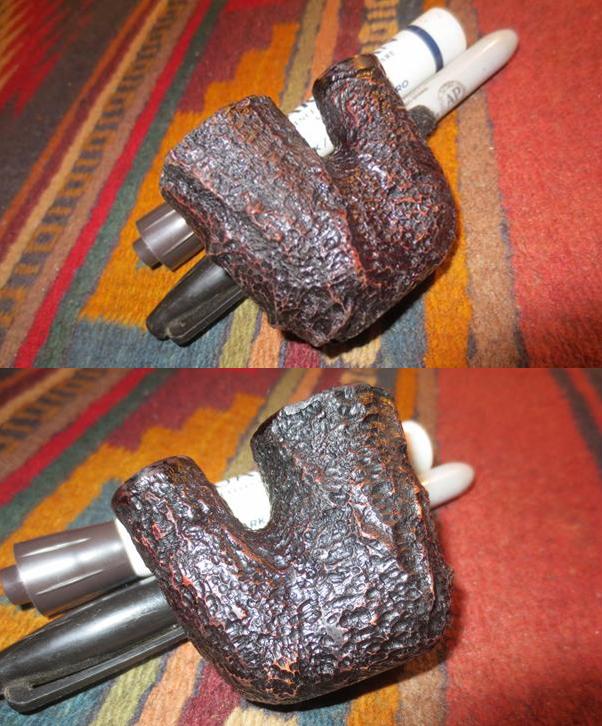
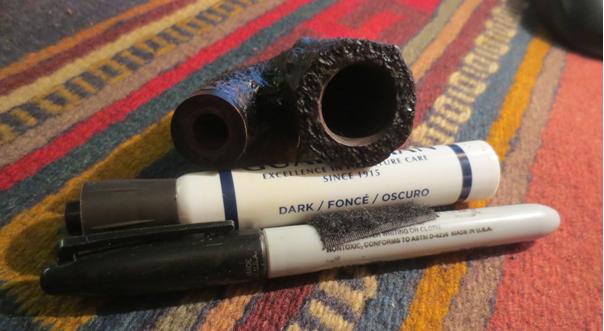
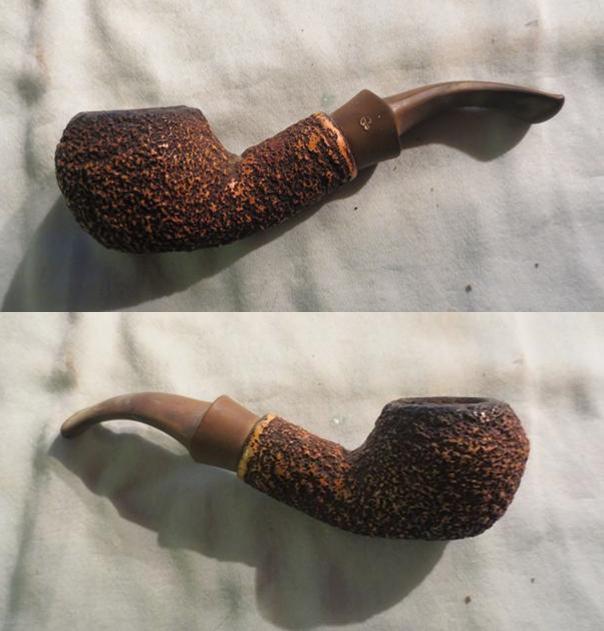
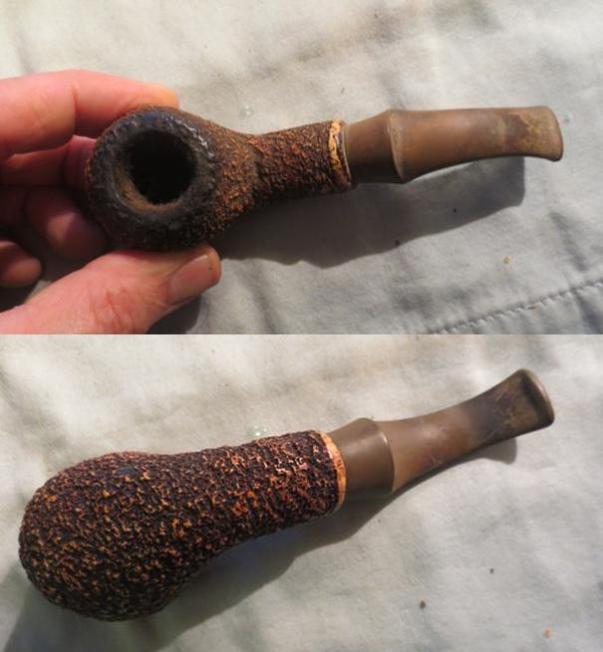
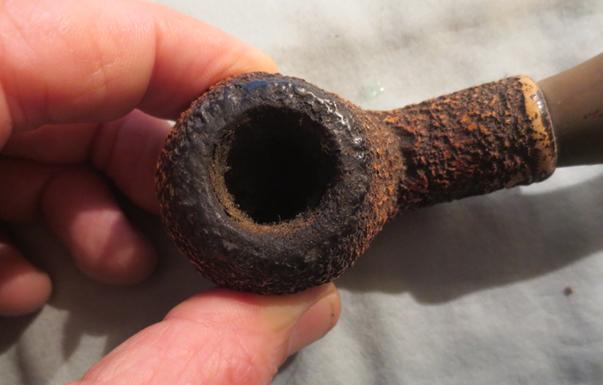
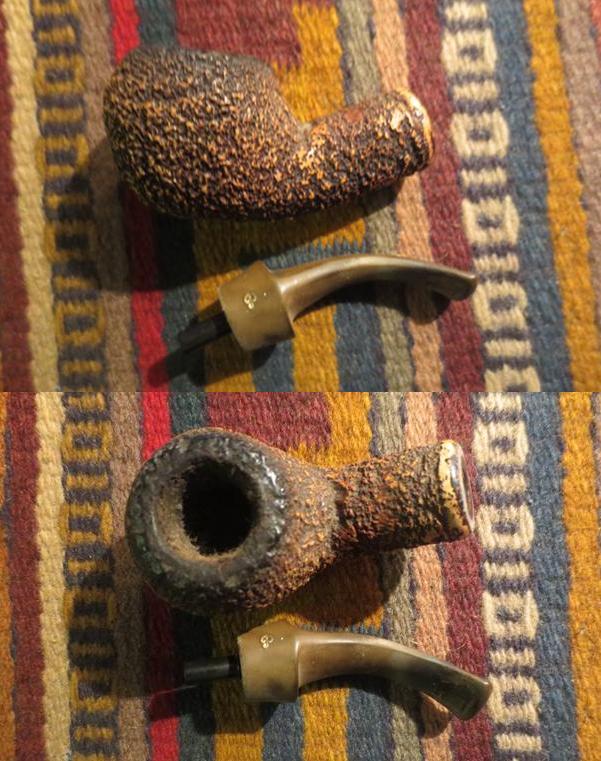
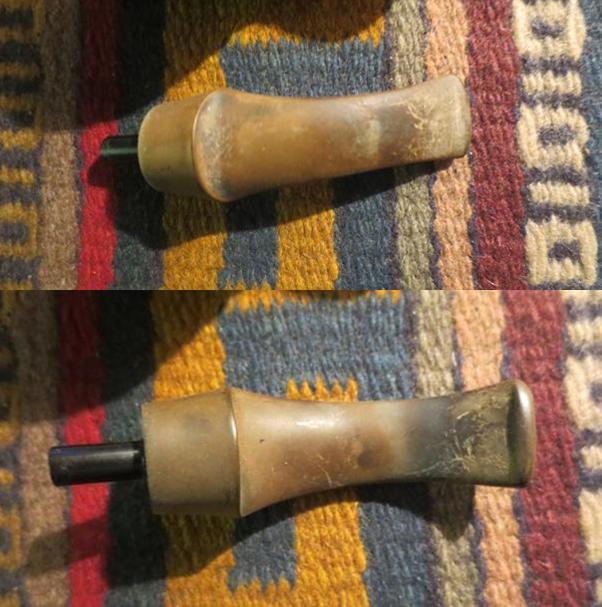
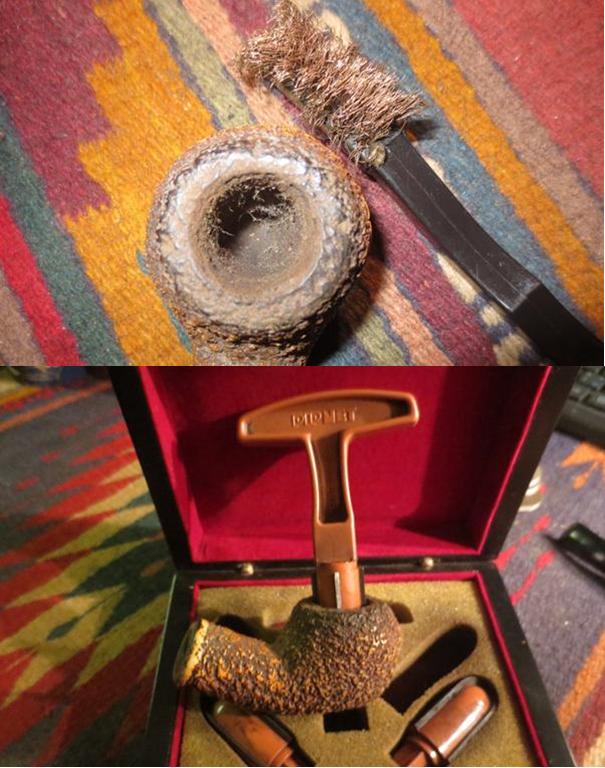
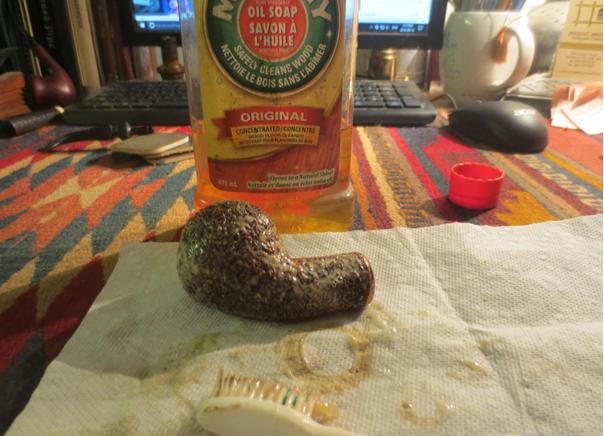
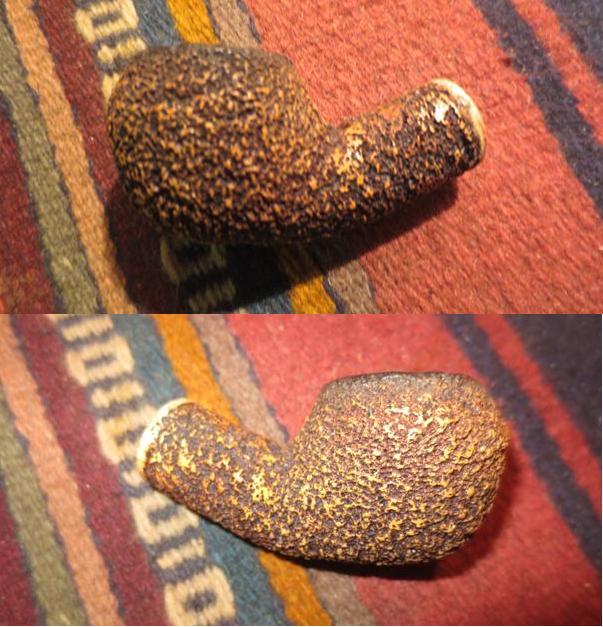
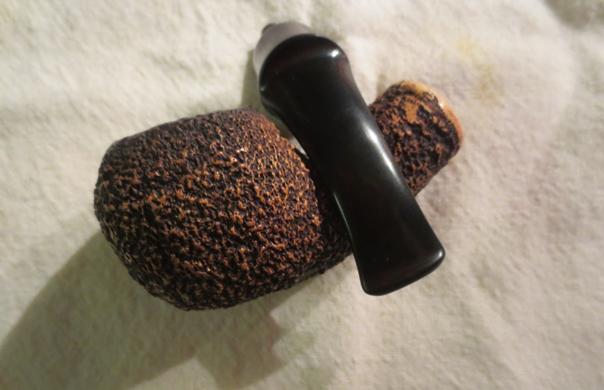
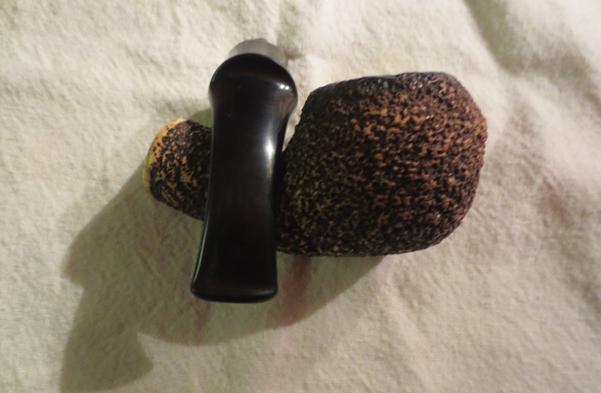
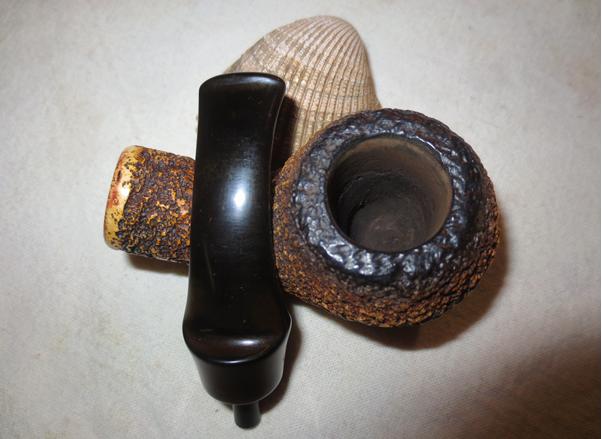
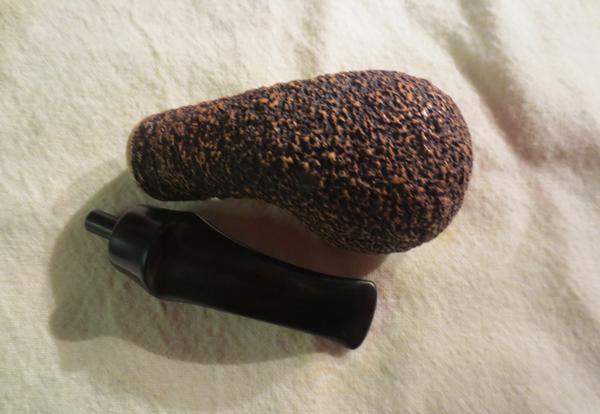
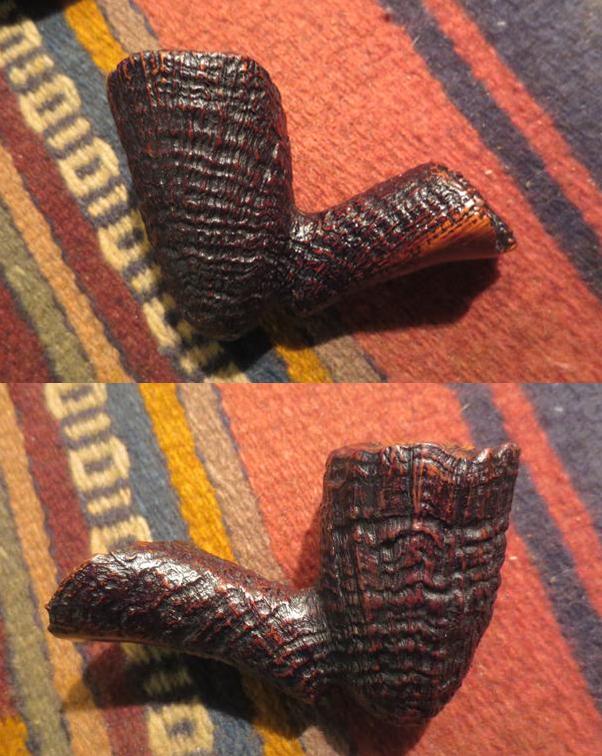
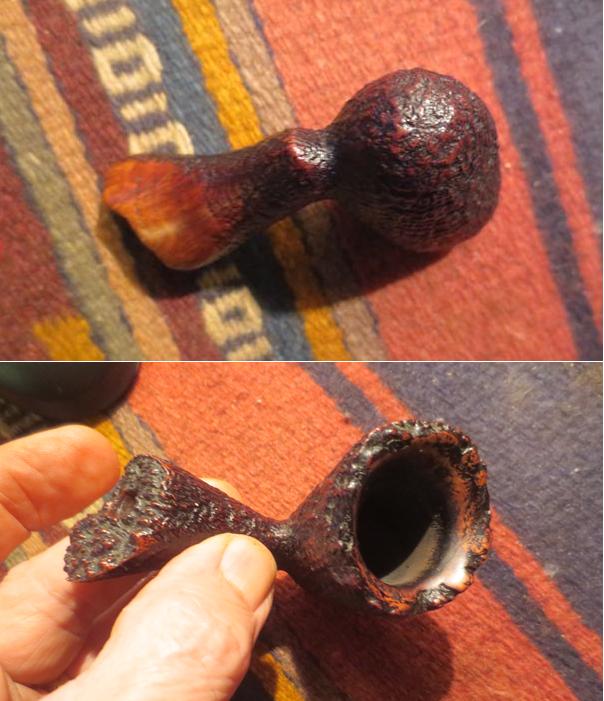
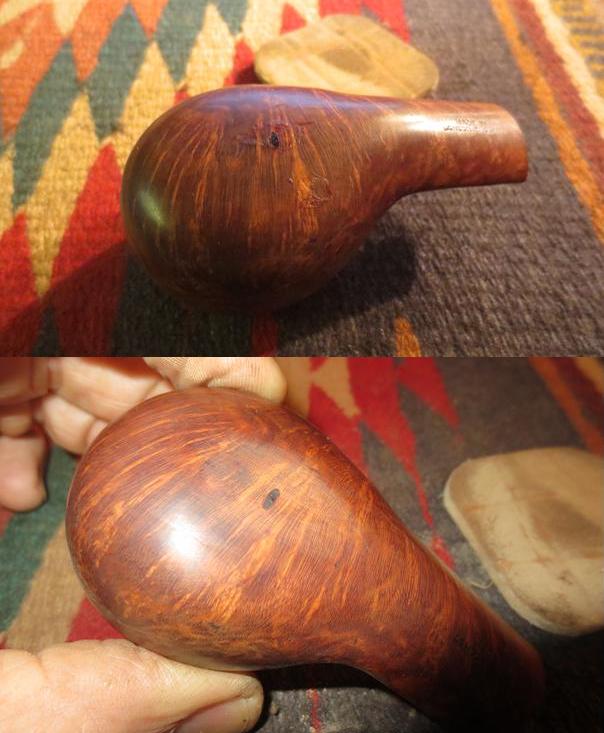
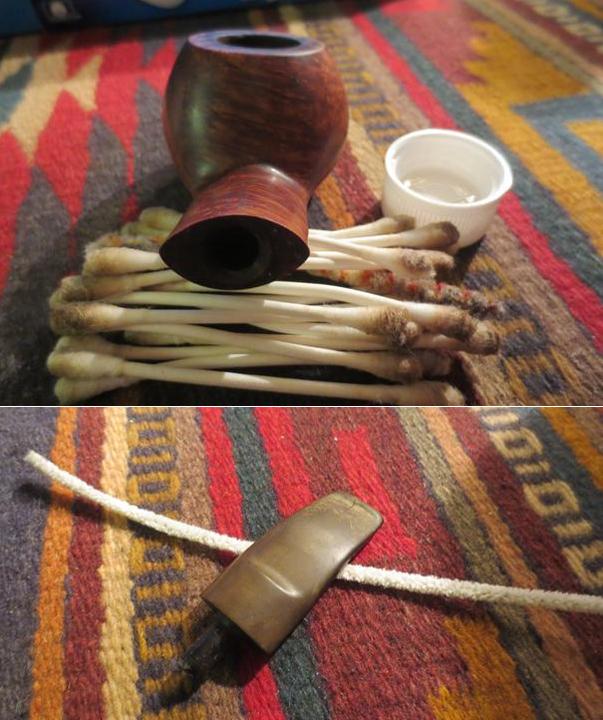
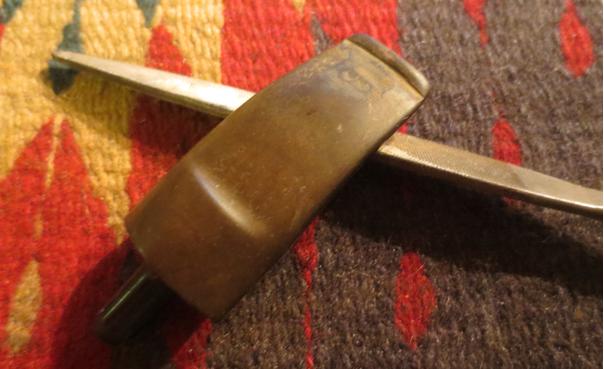
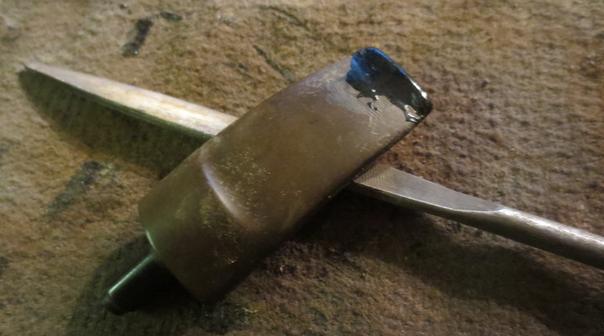
I have always liked the rough rustic finish on the Estella pipes by Savinelli. The texture of the sandblast and the ridges and whorls are a great tactile part of the pipe. This pipe is one that my brother picked up. The finish was dirty and there were some chips and wear around the rim of the bowl. The cake in the bowl and the dust and grime made this look dull but there was a beauty underneath. The stem had no tooth marks and a little chatter and calcification. There was a light oxidation on the stem. The seven photos below are ones my brother took before he cleaned up the pipe.estella1 estella2The next three photos are close up pictures of parts of the pipe. The first one shows the rim and the cake in the bowl. The cake is quite thick. The second photo shows the chips and damage to the outer edge of the rim. The third shows the stamping on the smooth bowl bottom. The final photos show the stem and its condition before the cleaning.estella3 estella4 estella5 estella6My brother Jeff reamed and cleaned the pipe before sending it to me. He scrubbed the bowl exterior with Murphy’s Oil Soap and a tooth brush under running water. He cleaned the internals with pipe cleaners and cotton swabs. When the pipe arrived it was in great condition and clean. It was ready for me to restore. The oxidation on the stem came to the surface when he was cleaning it.estella7 estella8The bowl was clean and the rim was also cleaned off. All of the grooves and ridges were clean and there were no tars or oils on the rim. The stain was lightened on the rim and the end of the shank.estella9I took some photos of the stem to show the condition – no tooth marks and other than oxidation it was in great shape.estella10I wiped down the edge of the rim with alcohol on cotton swabs to remove any remaining dust and debris and touched up the stain on the rim, rim edge and shank end with a combination of black Sharpie pen and a dark brown stain pen.estella11 estella12The stem was an easy clean up. I polished the stem with micromesh sanding pads – wetsanding it with 1500-2400 grit sanding pads and dry sanding it with 3200-12000 grit pads. I rubbed the stem down with Obsidian Oil between each set of three pads. After final rubdown I set the stem aside to dry.estella13 estella14 estella15I rubbed the bowl down with a light coat of olive oil and then gave it multiple coats of Conservator’s Wax. I buffed it with a clean buffing pad and by hand with a microfibre cloth. The photos below show the bowl after buffing.estella16I gave the stem multiple coats of carnauba wax and then buffed the pipe with a clean buffing pad to raise the shine. I hand buffed it again with the microfibre cloth. The photos below show the finished pipe. It is a beauty in its cleaned up condition. This one is available if anyone wants to add it to their rack. Just email me at slaug@uniserve.com or send a private message and it can be yours. Thanks for looking.estella17 estella18 estella19 estella20 estella21 estella22 estella23 estella24

Letting Go of a 1954 Dunhill Patent Sandblast Canadian


Robert M. Boughton

Member, International Society of Codgers
Member, North American Society of Pipe Collectors
Member, Facebook Gentlemen’s Pipe Smoking Society
http://www.roadrunnerpipes21.biz (under construction)
http://about.me/boughtonrobert
Photos © the Author except as noted

Two years ago, I became the sudden, very fortunate and most of all surprised owner of four Dunhill pipes.  Two – a natural Bruyere billiard #4103 and a sandblasted Shell Briar billiard #114 – were made in years not yet determined, although I suspect 1977 and 1965 respectively.  The other two are a 1976 smooth Root Briar #433 and the 1954 sandblast Shell Briar Patent Canadian that is the cause of my mixed sorrow and pleasure in blogging its refurbish.  You see, the four splendid examples of briar’s best use were gifted to me by a good friend who was ordered by his cardiologist to stop enjoying his beloved pipes, the only reason he gave them to me, and now I am forced to offer one for sale.  Of course, the logical choice happens to be the jewel of my eye.

Larry L., as I will call him, was my patron in two senses of the word: for his generosity, and his status as the first person to buy a pipe on my original online store, and then another.  He was a regular member of my local pipe club for a short time when he was 90 years old, which, based on the date of the bounteous gift makes him 92 now.  Now he is the club’s only Emeritus Member.  I’ve stayed in touch with Larry, by email and phone and several times in person, and although his physical and mental faculties are fit, he lacks the zest for life he had while savoring his large collection by himself and I’m sure more so in the company of his fellow pipe peers, where he was the fastest draw I’ve ever heard with raunchy and off-color jokes.

I have to question the wisdom of his young, well-meaning doctor who forced Larry to quit the hobby and activity he loved more than anything but his wife.  And so to refurbish the pipe for sale after the cursory cleaning I performed when it was gifted to me was not an easy decision.  When times are rough, the cost can be dear.  At least I know I will get a decent price for the sacrificial and beautiful piece of craftsmanship or sleep better keeping it.  My only happiness is the opportunity to share the details of the ’54 Canadian with readers.

When I first took a careful look at the pipe to date it, I thought the sandblasted Canadian was much older based on one of the many erroneous dating methods published online.  Then, a few months ago as I began to advertise the pipe for sale on various forums, I made a better estimate but was still off by three years.  On that occasion I had not understood parts of the dating flowchart on Pipephil.  Returning to the same chart four days ago, with clarification of what Pipephil meant by “Dunhill aligned with Shell” in the nomenclature, I took a third stab at dating the sandblast Shell Briar, starting with Patent No. 417574, on Google’s Patent Search service.  Google Patents almost always finds the desired invention, but again I came up with nothing.

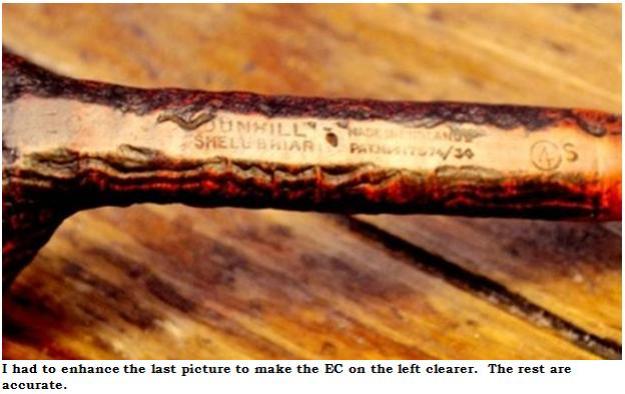
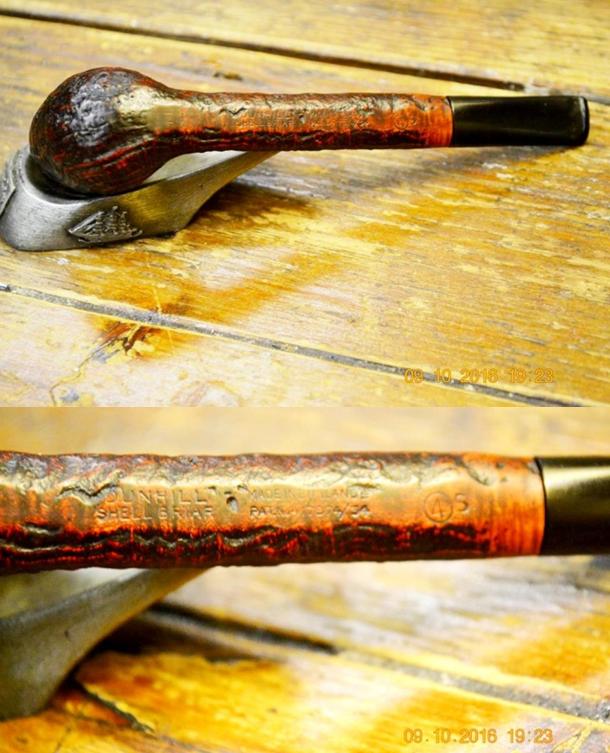
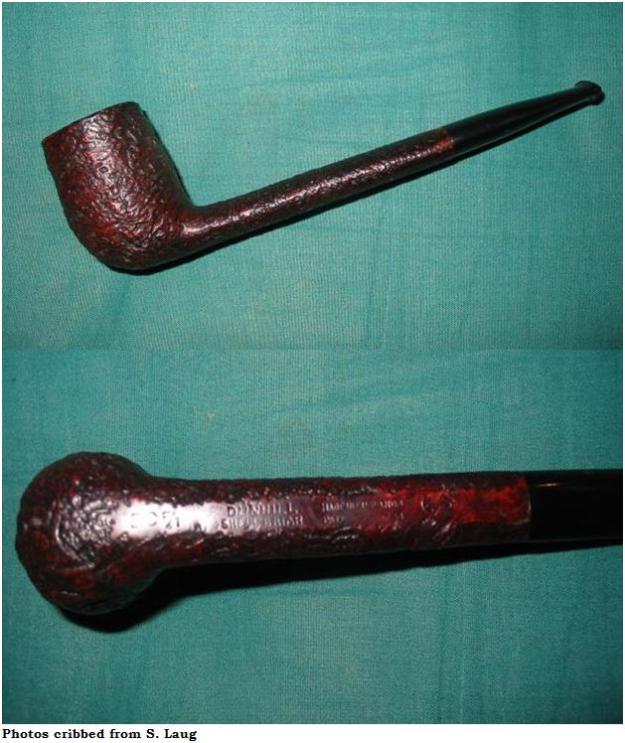
The nomenclature on the pipe reads, in capital blocks, EC on the far left of the smooth sitter bottom; Dunhill above Shell Briar; Made in England and a small 4 with a line under it above Patent No. 417574/34, and then to the far right, a circled 4 with an S.  I have since learned, or come to believe from the veracity of certain sources, that EC is Dunhill’s way of indicating the pipe is a 5½″ Canadian; Shell is the type of finish characterized by deep, rugged sandblasting and a black stain, and the circled 4 with an S is a combination bowl size (running from 1-6) and group code, seeming to indicate in this case a Shell.  I also was informed that 1954 was the last year of the Patent nomenclature and the same year Shell was replaced with Shell Briar.

Somewhat late, to be sure, I came to the conclusion the Patent might be British.  I found the Espace.net link for the European Patent Office shown in the sources below, and had no trouble locating the Patent No. GB417574, granted October 8, 1934.  From this research, it wasn’t difficult to understand the /34 represents the year the proprietary rights were granted to Dunhill for the special tube system within the bit and shank and extending to the mortise hole, and not the year of manufacture.  Steve was good enough to explain something, the answer to which I suspected, when he clarified that “aligned with,” in respect to the words Dunhill and Shell, means beside and not above and below.   As it turned out, therefore, mine was not aligned.  This is central to dating the Dunhill.

Therefore, following the flowchart shown at the first source link below, I answered yes to the pipe having a suffix and Patent Number and then clicked on Narrow Down Your Dating.  The next page said at the top, “Your Dunhill pipe has been crafted between 1921 and 1954.”  Again I followed the yes line under “The Patent Number is 417574/34,” then (and here is the key to whether the pipe was made c. 1940 or c. 1950) no to “Dunhill stamping over London or Dunhill stamping aligned with Shell.”  This led down to Dunhill suffixes 2-4, and mine being the little 4 with a line under it, the chart led to the bottom line: 1950 + suffix, making the year of manufacture 1954.  I tell you, this has to be the most clandestine dating system I have encountered, reminiscent of the sort of codes and tradecraft of MI6, or what Le Carré called by a more apt name, the Circus.  But I found my year of manufacture at last.

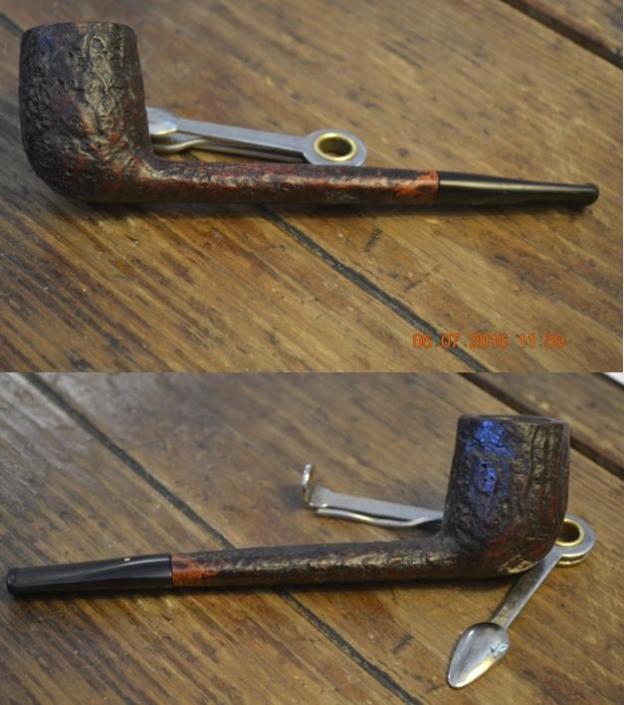
A couple of days ago, double-checking my course through the flowchart, I came across a blog by Steve, called “Reflecting on My Dunhill Collection,” from two years ago.  My conclusion was vindicated by the following photos of his “ultimate pleasure” from one batch of pipes he received, a 1954 Dunhill Canadian identical to mine.dunhill1Having emailed Steve the updated result from the flowchart, I read his response within seconds after copying and pasting the photos of his pipe above: “That is my birth year pipe…what does it look like?”  I referred him to his own blog and inserted the two pics of the twins above, adding that they are identical except for a lighter shade I gave mine.
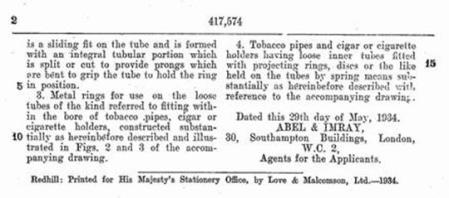
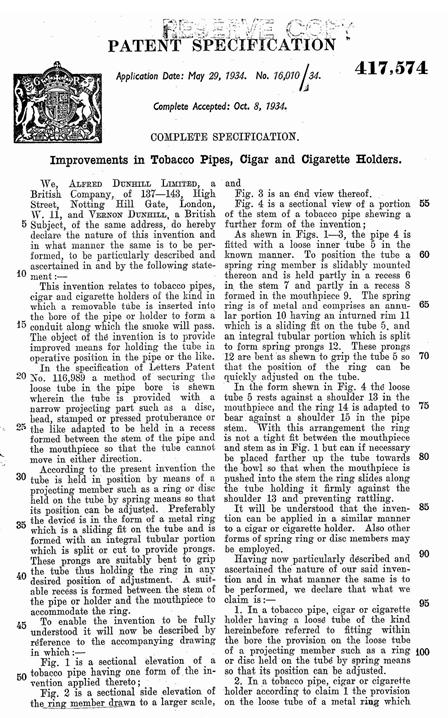
Here is a copy of GB417574. dunhill2 dunhill3 dunhill4The Patent is fascinating on several levels, some of which will be described later.  Of particular importance to this blog is its detailed description of the system in which an improved, removable metal tube “is inserted into the bore…to form a conduit along which the smoke will pass.”  A revised, spring ring to hold the tube in place with better effect than earlier Patents is added to supplement an improvement that was part of another Patent, GB116989, requested along with this one but granted the next year.
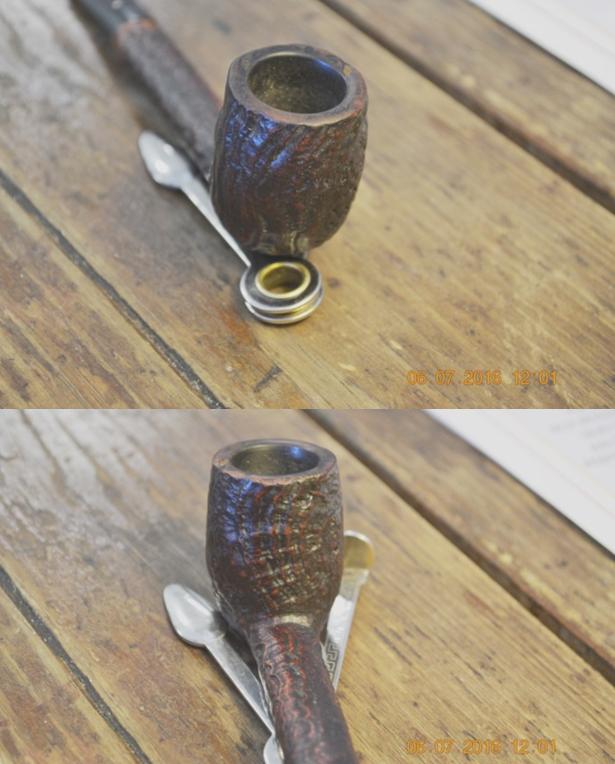
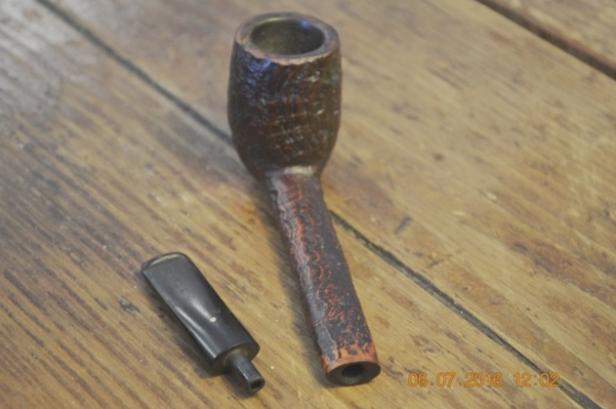
The version in the 1954 Canadian has two tubes and rings, one pair in the shank and leading to the mortise and the other within the mouthpiece and the rest of the bit.  These innovations are not only clever but quite durable and effective, and the tubes can be seen with close scrutiny within the openings of the push tenon and shank.  The most amazing aspect of the invention is the tiny size of its pieces that somehow fit the slim bit and shank of the Canadian.

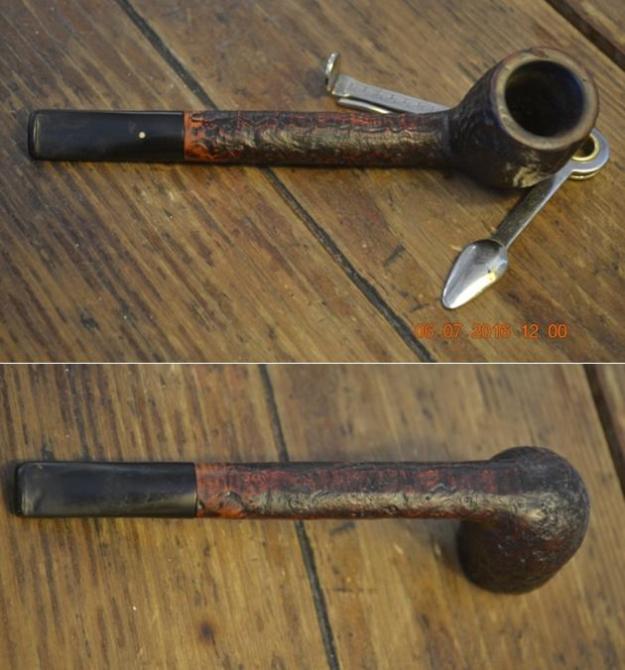
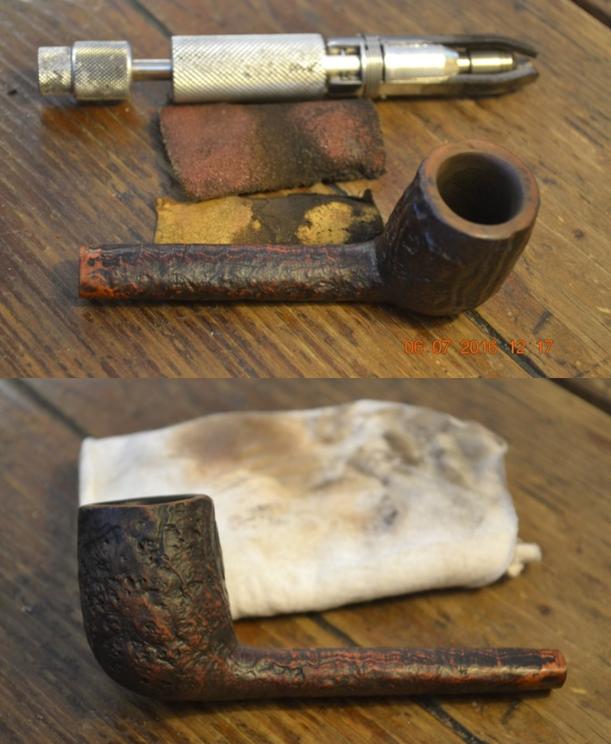
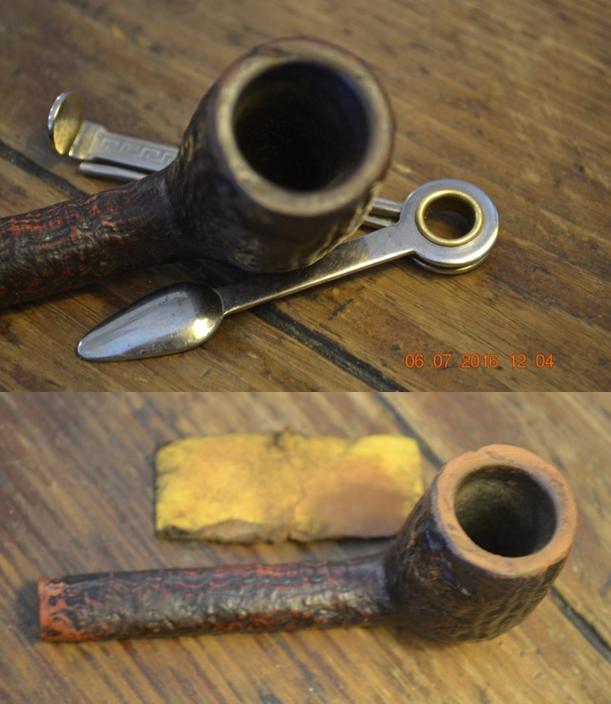
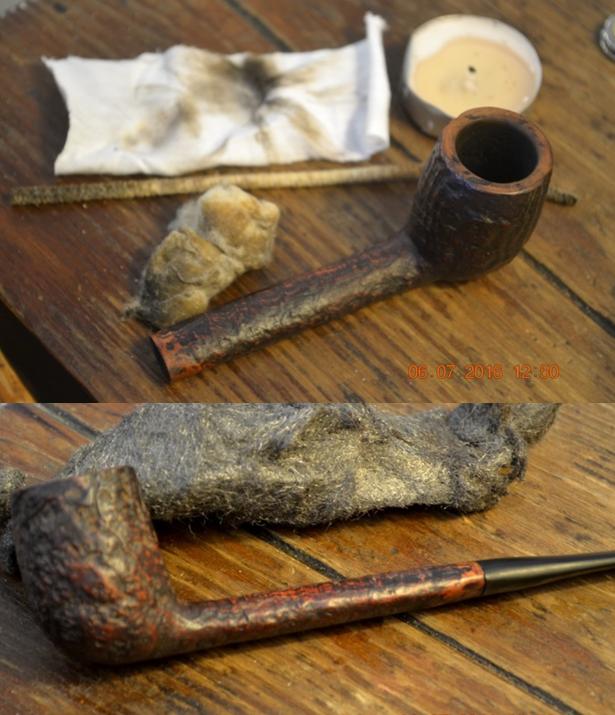
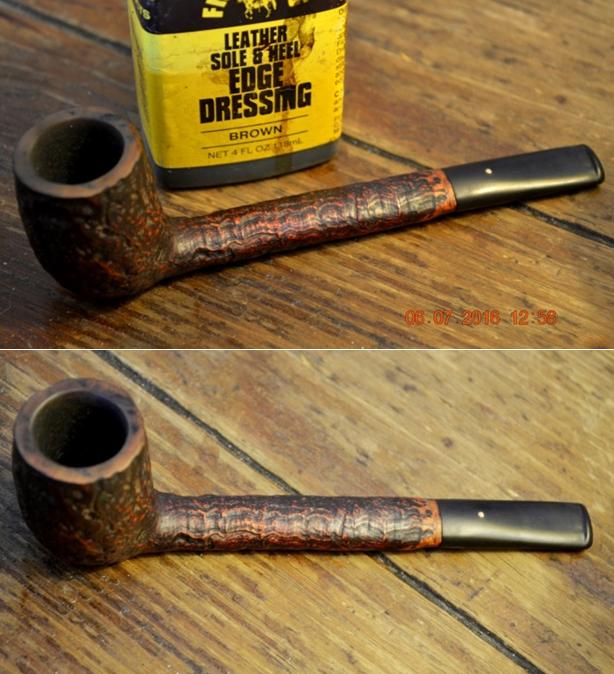
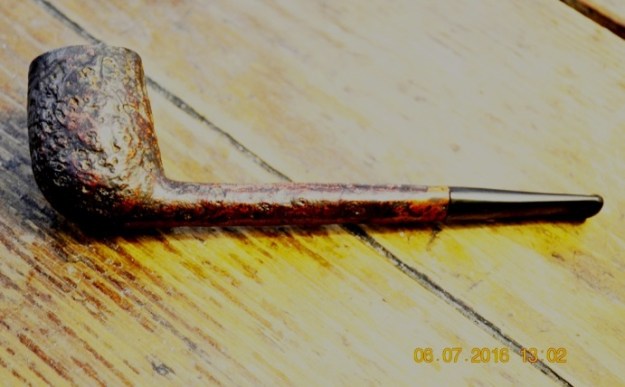
The pipe was in great condition when I received the gift.dunhill5 dunhill6 dunhill7 dunhill8 dunhill9To start the restore, I went at the rim with 220-grit sandpaper because of some dings that were too deep for micro mesh or even very fine paper.  Even so, more work was needed later, as will be shown.  Then I reamed the chamber and sanded it smooth with 180- and 320-grit paper and wiped the exterior using a soft cotton gun cleaner cloth with a little purified water.dunhill10 dunhill11I figured I might as well knock off the bit, which was in good shape but needed some quick work with the only viable micromesh kit I had at the time.  This was only last June, but my old set of usual pads was decimated and not yet replaced.dunhill12 dunhill13Retorting the pipe, I decided to take off a little of the darker color to show more of the natural rust hue of the briar, using super fine 0000 steel wool.dunhill14I re-stained the rim with Fiebing’s Medium Brown alcohol-based boot conditioner, flamed it with a Bic and micro meshed off the thin coat of char with 800 and 12000.dunhill15The touch-ups above were made June 7.  I revisited the Canadian after transferring all of the photos so far, as well as seven more of the “finished” pipe, from my DSLR memory stick to the computer.  Next is the left side view as it appeared two months to the day later.dunhill16I should have kept the original top view from when I thought the work was complete in July.  As I did not, you’ll just have to take my word that the rim work was, I must confess, sloppy.  And so, here is the rim after sanding again, with 180- and 320-grit papers, micro meshing all the way, staining with the medium brown and flaming it again, and micro meshing off the thin band of light char with 4000, 8000 and 12000 micro mesh once more.dunhill17 dunhill18The true finishing touches were adding a thick coat of Halcyon II wax, setting the stummel aside for a half-hour and buffing on the clean electric wheel as much of the wax as possible into the wood while removing the excess.dunhill19 dunhill20 dunhill21 dunhill22The Patent, again, is an engaging document.  In fact I consider the text worth reading despite its detailed description that is styled in universal Patent-ese.  Somehow this Patent, among the millions of sterile, lackluster examples that tend to put most unaccustomed readers to sleep, shines with refined elegance one would expect only from the British.  The just-more-than-one-page of text as well as the drawings have a secure place in pipe history.  And then there are the little touches to enjoy   For example, easy to miss, with the eyes scanning and expecting to read “shown,” is the repetition of the antiquated (chief. Brit., as the staid but thorough Oxford English Dictionary might add) “shewn.”  Still more overlookable is the typical economy of language displayed in the first paragraph, referring to “We, Alfred Dunhill Limited, a British Company, of 137-143, High Street, Notting Hill Gate, London, W. 11, and Vernon Dunhill, a British Subject, of the same address….”  At last, seen only by the greatest of Anglophiles, is the printer’s credit that states:
“Redhill: Printed for His Majesty’s Stationery Office, by Love and Malcomson, Ltd. – 1934.”

Redhill is a U.K. town next to Surrey, south of London.  Love and Malcomson Ltd. was a British printer and later book publisher established in 1901 and lasting until 1983, when it was dissolved.  The reference to His Majesty at the time of printing was King George V (r. 1910-1936).  Easy to forget are the other His Majesties during Love and Malcomson’s illustrious time: prior to George V, King Edward VII (r. 1901-1910); King Edward VIII (r. 1936), until he became the only monarch in British history to abdicate – for the woman he loved – and King George VI (r. 1936-1952) of “The King’s Speech” fame.

And then, of course, there is Queen Elizabeth II (r. 1952-present), to whom Love and Malcomson was a loyal British Company for the first 31 years of her monarchy that has so far lasted 64 years, the longest of any British sovereign.

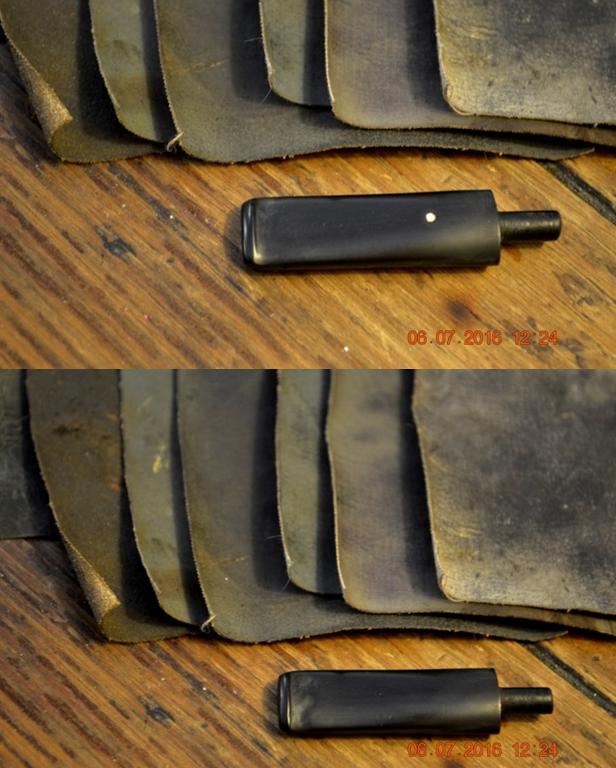
I’ll finish up with a fascinating tidbit about Dunhill history, what Saturday Night Live might have called a “Deep Thought by Jack Handy.”  I never even considered the origin of the now famous White Dot atop Dunhill pipe stems.  Then one day my research took me to a Pipedia page with a time line.  Among the long list of dreary, bygone dates and facts, I came across this single, novel and somewhat sad bit of intelligence: in 1915, five years after the company formed, Alfred and his advisors came to the bright idea that their customers should be given some help whilst reattaching the bit, like, I suppose, after removing it to clean.  I can’t with honesty know what they were thinking.  But anyway, that conundrum gave birth to the now revered single White Dot – so that Dunhill buyers everywhere might know which side of the stem goes on top!  I don’t know about the rest of you, but I find this reasoning behind the White Dot somehow discouraging, disappointing and downright depressing.  I mean, did Alfred Dunhill Limited, the mighty British Company, get so many complaints about which side was up to conclude its loyal fans must be stupid?  And were they maybe really that dense?  The whole thing is just too much for me.  My deepest thoughts on the meaning of the mysterious single White Dot have been dashed forever.  I think I need to take a nap now, as the melancholy Jack Handy would do. dunhill23

SOURCES

http://www.pipephil.eu/logos/en/dunhill/cledat-en1.html
http://www.rdfield.com/Articles/A%20Dunhill%20Pipe%20Dating.htm
https://rebornpipes.com/2012/11/01/dunhill-pipe-shapes-collated-by-eric-w-boehm/
https://pipedia.org/wiki/Dunhill#Shell
http://www.loringpage.com/attpipes/dundate.htm
https://rebornpipes.com/2014/03/23/reflecting-on-my-dunhill-collection/
http://www.epo.org/searching-for-patents/technical/espacenet.html#tab1
https://worldwide.espacenet.com/publicationDetails/originalDocument?CC=GB&NR=417574A&KC=A&FT=D&ND=3&date=19341008&DB=en.worldwide.espacenet.com&locale=en_EP
https://worldwide.espacenet.com/publicationDetails/biblio?FT=D&date=19341008&DB=en.worldwide.espacenet.com&locale=en_EP&CC=GB&NR=417574A&KC=A&ND=4
http://www.cooperativepatentclassification.org/cpc/scheme/A/scheme-A.pdf
http://www.pipephil.eu/logos/en/dunhill/cledat-en1b.html
https://companycheck.co.uk/company/00070719/LOVE-AND-MALCOMSON-LIMITED/companies-house-data
https://en.wikipedia.org/wiki/English_and_British_monarchs_family_tree_(simple)
https://pipedia.org/wiki/Dunhill
http://www.historyonthenet.com/monarchy/timelinetwentiethcentury.htm

Bringing a Peterson’s Rhodesian Shaped Meerschaum back from the brink


Blog by Steve Laug

The next pipe on my “to do list” from the fellow in Dawson Creek is a Peterson Meerschaum that has some great colour to it. It is made of African Meerschaum which is denser than Turkish meerschaum and usually unevenly colour to the extent that they are stained to give the pipe a better look. This one is a mottled brown and cream coloured block. I am not sure how much of it is the aging patina and how much is the stain but I love the look of the pipe.

peteI did a bit of hunting on the internet to try to find a photo of the pipe. It was hard to find a Meerschaum Rhodesian picture and found one that is the close to same shape. It has a flumed dark top edge or cap. The shape of the stem is a little different at the shank union than the one I am working on. The one in the photo is more pinched at the shank. The one I am working on has a band of cream coloured meer that is rounded over and the stem sits against it.

I have been watching eBay for the Pete’s and have not found one this shape. I have read that African Block Meerschaums Peterson’s are getting harder to find since the Laxey meerschaum mines shut down in 2006. I have a few of the pipes in my collection and I have found that they are heavier than Turkish meerschaum due to the inclusion of minerals and aggregate material in the Block and the fact that they were ‘Calcinated’ after being carved, to give them greater strength and durability. They will color with smoking and the use of beeswax, but it will be more of a gradual process than high-grade Turkish meerschaums.

The pipe from Dawson Creek was heavily caked which bodes well for it being a great smoking pipe. The rustication on the rim was thickly cake with the overflow from the bowl. The rusticated finish on the bowl and shank was dirty. The stem was heavily oxidized and there was some tooth chatter on the top and underside near the button. The P stamp was faded though it still was deep enough for a touch up job. I was looking forward to seeing what the finished pipe would look like after the cleanup.pete1 pete2I took a close up photo of the rim and the bowl. It shows the thick cake that is slightly sticky and has picked up a lot of dust and debris. The rustication on the rim is filled in with tars and oils to the point you cannot really see the grooves and ridges.pete3The Delrin tenon is glued into the vulcanite stem and mortise is lined with a Delrin tube. The tenon was surprisingly small in diameter for a stem this large when I took the pipe apart. The photo below shows the pipe taken apart.pete4I took some close up photos of the stem to show the oxidation and tooth chatter on the stem. There was large tooth mark on the top of the stem. It is hard to see in the photos below but after the first cleaning it would be visible.pete5I used a brass bristle brush to scour the top of the rim to remove the thick cake and reveal the crevices and ridges below the grime. I reamed the bowl with a PipNet reamer to take out the majority of the cake. I would need to clean it further later.pete6I scrubbed the externals with a tooth brush and Murphy’s Oil Soap to remove the grime and oils in the grooves of the bow and shank. I rinsed the bowl off with warm running water to remove the soap and dirt. I scrubbed it more under the running water using the tooth brush.pete7I dried off the bowl and used Savinelli Pipe Knife to clean up the inside of the bowl and remove the last of the cake.pete8I cleaned the mortise and the airways in the shank and the stem with alcohol, pipe cleaners and cotton swabs until the internals were clean.pete9I put the stem in an Oxyclean bath and let it sit overnight. In the morning I took it out of the bath and rubbed it down with a coarse cloth to remove the loosened oxidation. I took the following photos to show the stem at this point. The second photo shows the deep tooth marks.pete10Because the dent was round and smooth I decided to try to lift it with heat. I used a Bic lighter and “painted” the dent with the heat. It took a couple of passes of the lighter before it was smooth. The dent rose up to meet the surface of the stem. I did not need to do a fill or repair on the stem.pete11I touched up the P stamp with white acrylic and a fine brush. I overfilled the P and let the paint dry. Once it was dry I carefully scraped it off with a sharp knife and sanded it smooth. The second photo shows the stem stamping.pete12I took photos of the bowl at this point to show how it looked after cleaning. pete13 pete14I polished the stem with micromesh sanding pads – wet sanding with 1500-2400 grit pads and dry sanding 3200-12000 grit pads. I rubbed it down with Obsidian Oil between each set of three pads. I set the stem aside to dry.pete15 pete16 pete17I buffed the stem with Blue Diamond on the buffing wheel. I avoided buffing the bowl with the Blue Diamond because it would collect in the grooves and ridges of the meerschaum. I gave the stem multiple coats of carnauba wax and buffed the pipe and stem with a clean buffing pad to polish the wax on the stem. I hand buffed the pipe with a microfibre cloth. The finished pipe is shown in the photos below. I think this one will be a good smoking pipe for Steve once I send it back to Dawson Creek. Thanks for looking.pete18 pete19 pete20 pete21 pete22 pete23 pete24 pete25 pete26


Repairing and Rejuvenating a Soren Danish Freehand


Blog by Steve Laug

soren1aThe fifth pipe I am working on for Steve in Dawson Creek, British Columbia is a beautiful freehand that is stamped Soren Hand Carved over Made in Denmark on the underside of the shank. The finish is not bad. There were two cracks in the plateau rim top with one of them just on the rim and the other one coming down the left side about ¼ inch. These would need to be repaired. The bowl had a light cake and there was overflow onto the plateau top. This would need to be scraped clean. The shank end was also plateau and it had a lot of dust in the grooves. The finish on the bowl was dirty and there were some small nicks on the sides. It has a diamond-shaped freehand stem that was lightly oxidized and had tooth marks on the top and the underside near the button.soren1I looked up the brand on pipephil (http://www.pipephil.eu/logos/en/logo-s10.html) and found that the brand was carved by Søren Refbjerg Rasmussen. Pipes that he made for the European market were mostly stamped “Refbjerg” while those made for the US market were stamped “Soren”. Thus I knew that one I was working on was imported into the US market.soren2I took a close up photo of the rim and the bowl to show the condition of the pipe when I took it out of the box. The thick cake on the top of the bowl rim filled in much of the plateau surface. You can see the thickness of the cake in the bowl. In the photo you can see that it is thicker at the top than at the bottom of the bowl.soren3I took photos of the stem to show the light oxidation and the scratching and wear to the stem. There were small tooth marks on the top and underside of the stem near the button.soren4I took some photos of the condition of the bowl and the finish before I started cleaning the pipe. I wanted to be able to track the difference in the cleanup of the briar. In the second photo below I used a dental pick to try to pick at the thick cake on the rim. It would not be the way to clean up the rim.soren5I reamed the cake back to bare briar using the Savinelli Pipe Knife. In the photo below you can see the crack on the left side near the rim. I have circled it with red to highlight the crack.soren6I used a microdrill bit to drill a cap hole at the end of the crack to keep it from spreading further down the side of the bowl. The crack was not long so it was an easy fix.soren7I cleaned the top of the rim with a brass bristle brush to clean out all of the grooves and the areas of plateau on top of the bowl. It worked far better than the dental pick to clean off the thick cake on the bowl top. In the photo below you can see the two small cracks. I have circled both of them. I cleaned them out with a dental pick so that they were open. The crack did not go down into the interior of the bowl.soren8I pushed briar dust into the crack and the end cap hole and the put super glue on top of the dust. I put more dust on top of the glue. The three photos below show the repairs.soren9 soren10I sanded the repaired areas with 220 grit sandpaper to remove the excess briar dust and super glue and blend the repairs into the surface of the briar.soren11After sanding the repairs I wiped down the bowl with alcohol to remove the grime on the surface of the briar. I carefully wiped down the area of the repairs.soren12 soren13The next photo shows the repaired area on the side of the bowl toward the top.soren14I touched up the repaired areas with a medium stain pen to blend those lighter areas on the side and on the rim with the colour of the stain.soren15I buffed the pipe with Blue Diamond on the buffing wheel and gave it multiple coats of carnauba wax. I buffed it with a clean buffing pad. I took the next photos of the bowl after buffing.soren16The photo of the top of the bowl shows the newly stained and contrast finish on the rim. I used a black Sharpie pen to colour in the grooves in the top of the rim and the end of the shank. I used the stain pen over that. On the bottom of the bowl the birdseye grain shows some dark stain in the grain.soren17 soren18I cleaned out the mortise and the airway in the shank and the stem with cotton swabs, pipe cleaners and alcohol until they were clean.soren18aI polished the stem with micromesh sanding pads – wet sanding with 1500-2400 grit pads and dry sanding with 3200-12000 grit pads. I rubbed the stem down with Obsidian Oil after each set of three grits. I set the stem aside to dry.soren19 soren20 soren21I buffed the bowl and stem together with Blue Diamond polish and gave it several more coats of carnauba wax. I buffed the pipe with a clean buffing pad and with a microfiber cloth to deepen the shine. The finished pipe is shown in the photos below. It is ready to go back to Steve in Dawson Creek. It is the fifth of the pipes I have been working on for him. I am looking forward to hearing what he thinks of them when he has them in hand. Thanks for looking.soren22 soren23 soren24 soren25 soren26 soren27 soren28 soren29


Back in Flight – A Pair of Mastercraft Sparkless Cigar-Pipe Zeppelins


Blog by Steve Laug

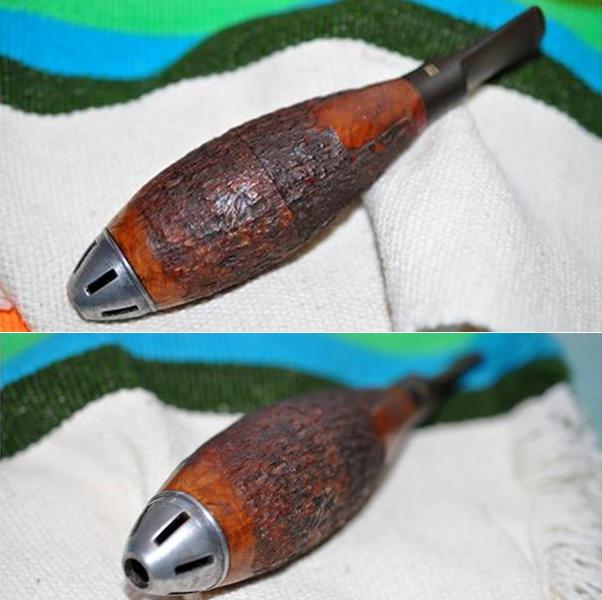
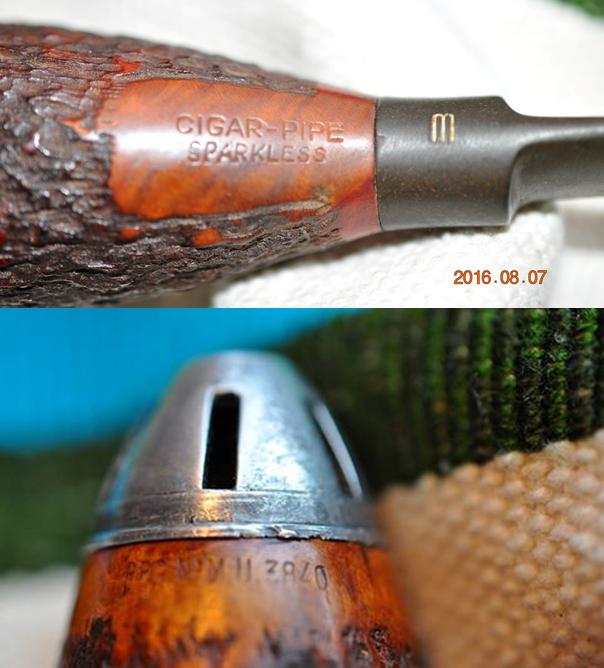
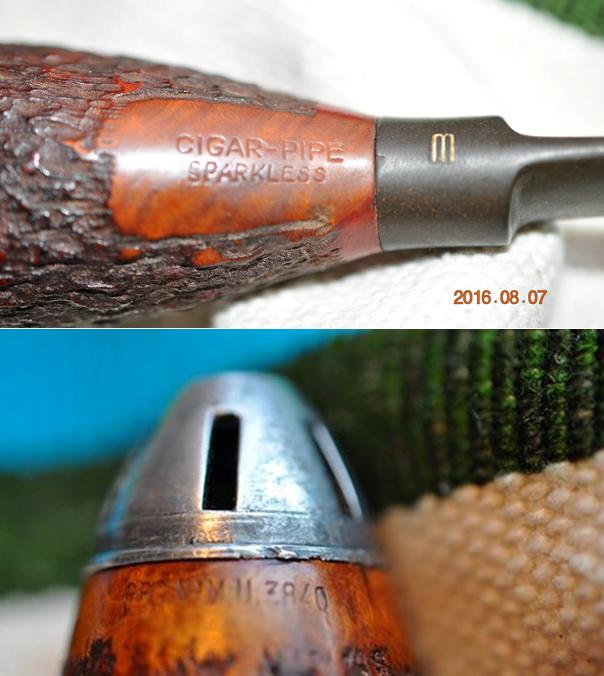
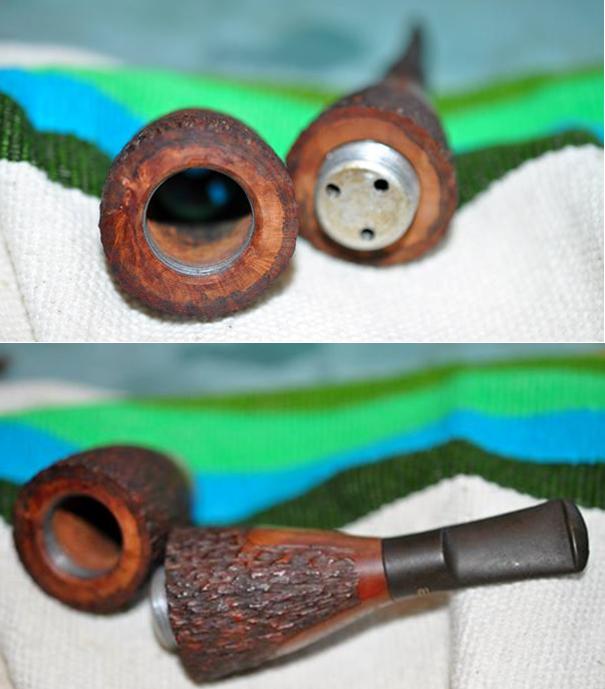
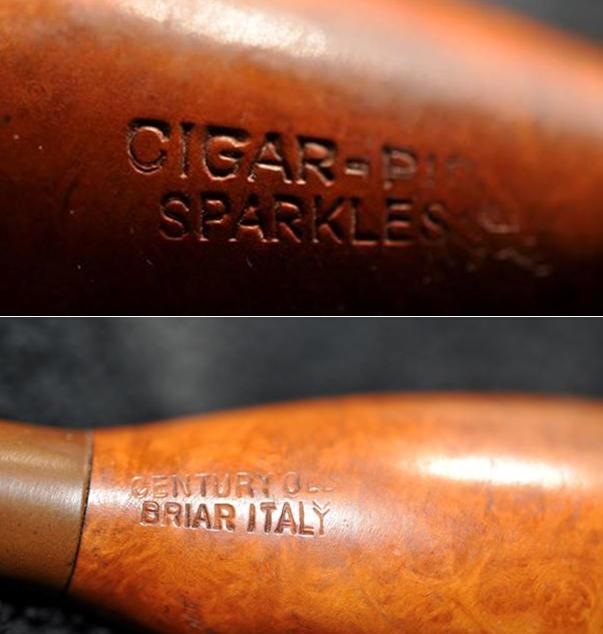
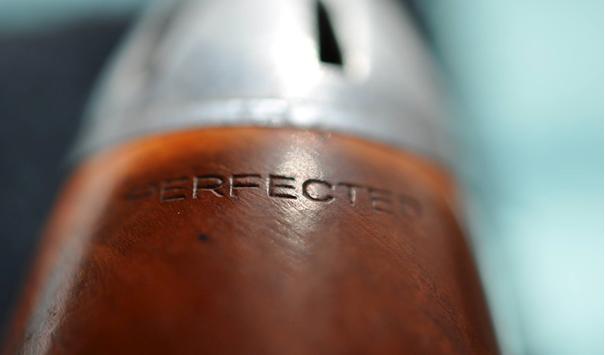
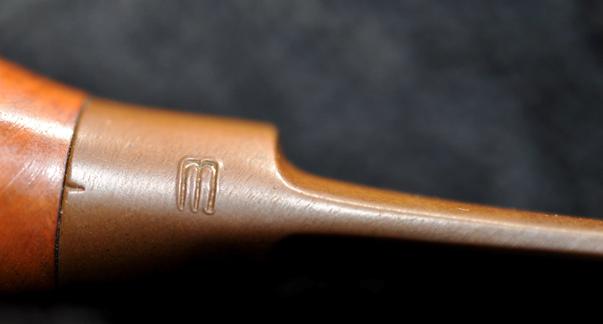
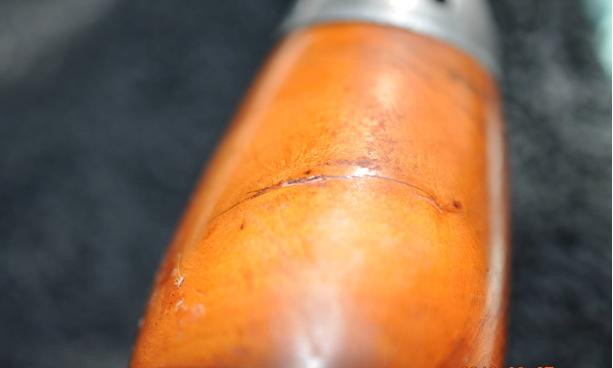
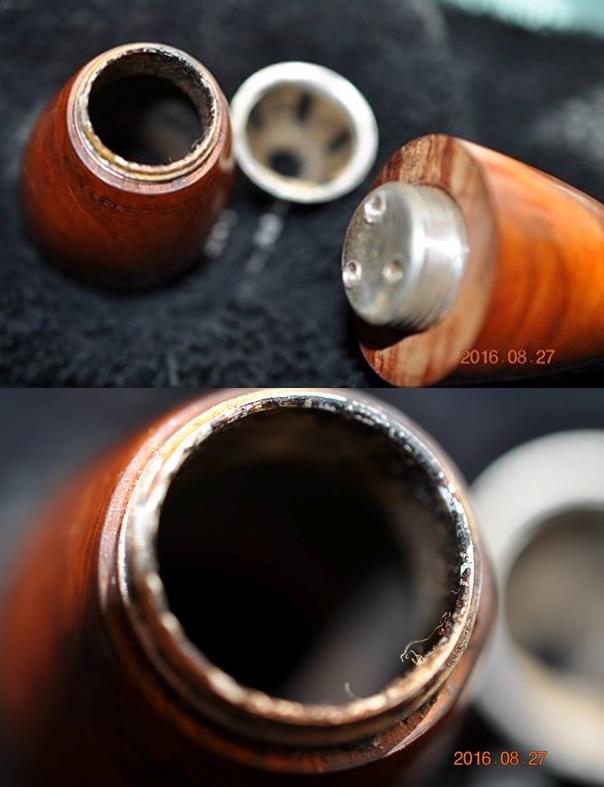
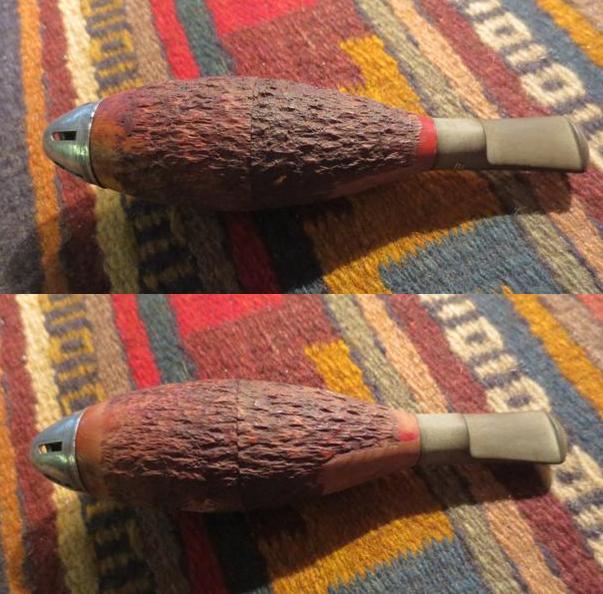
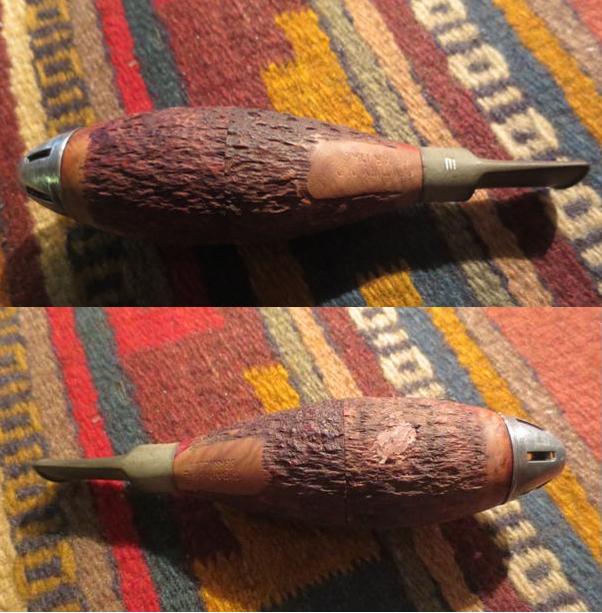
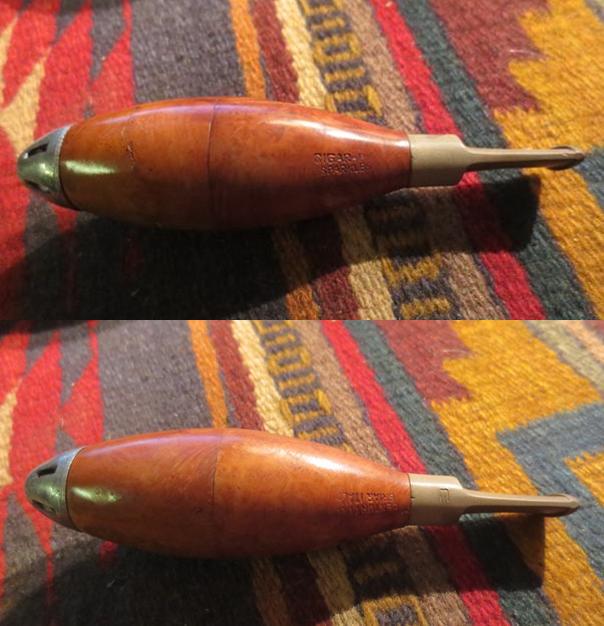
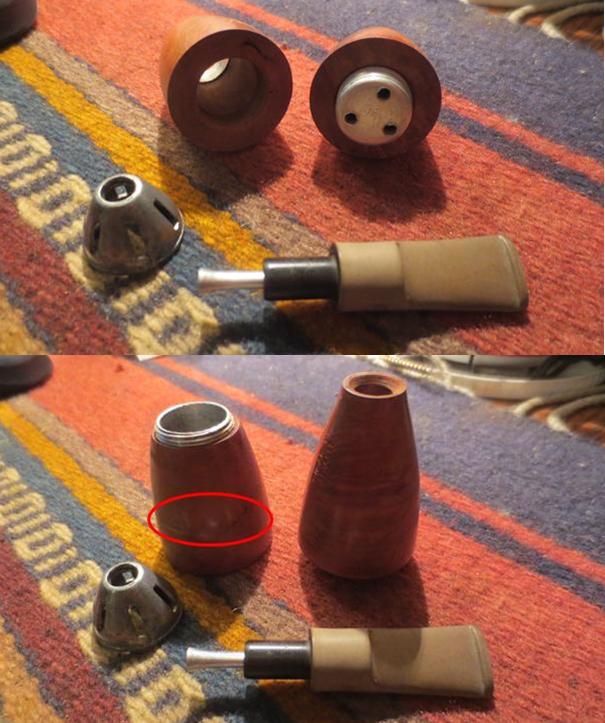
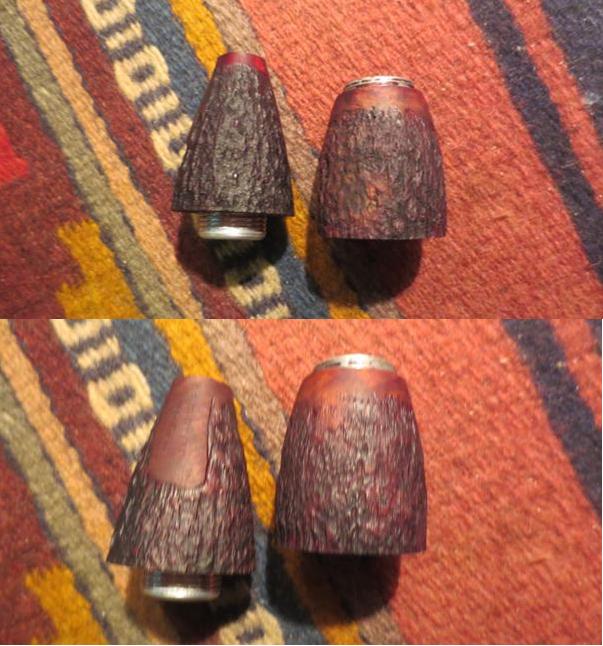
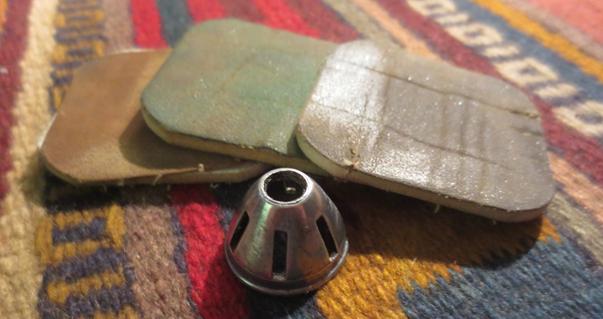
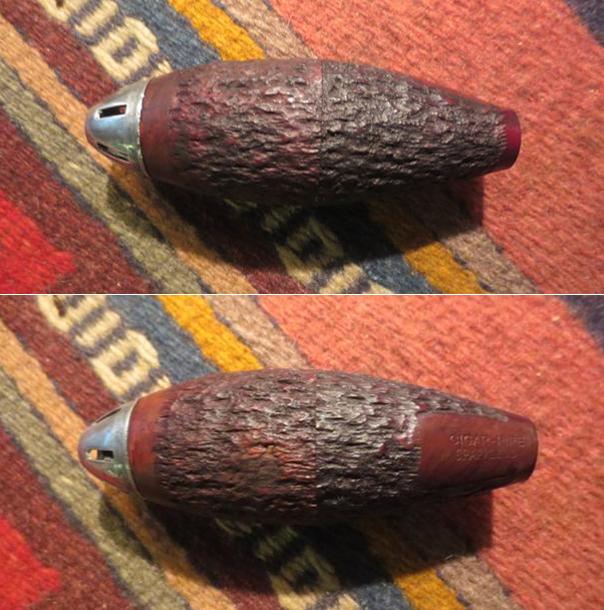
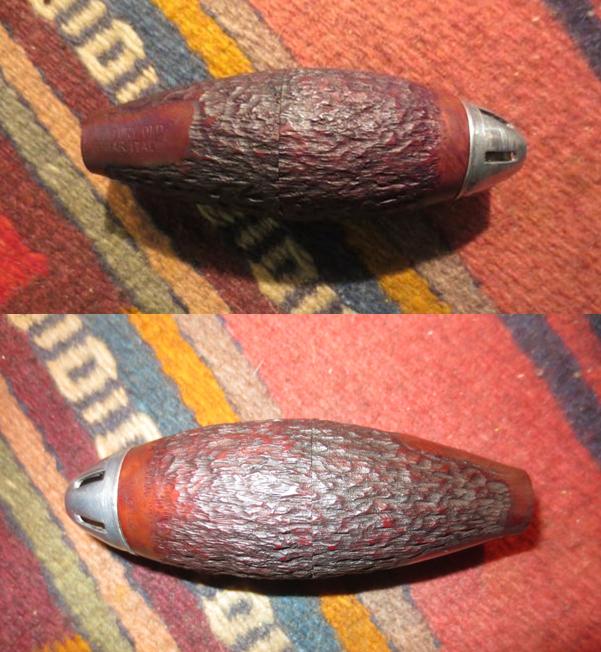
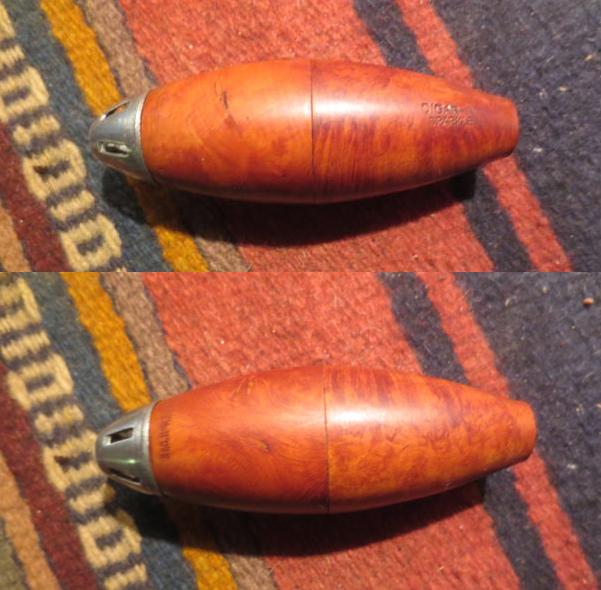
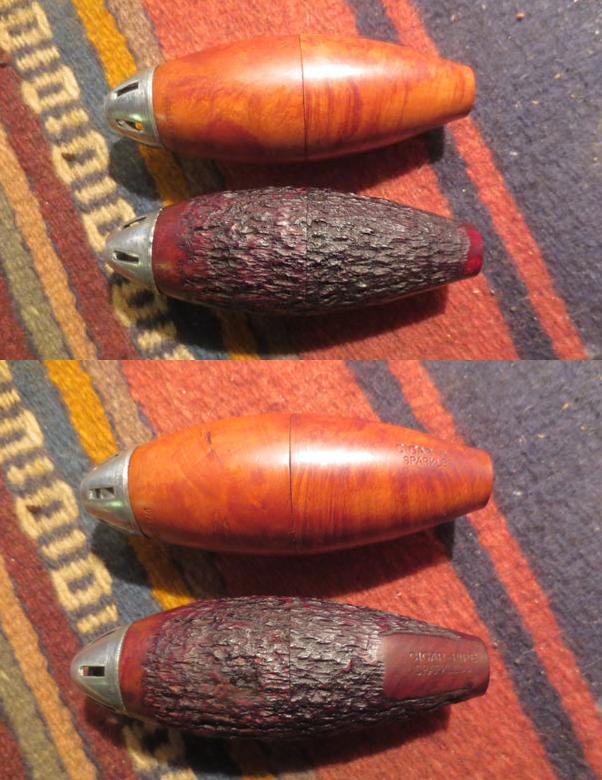
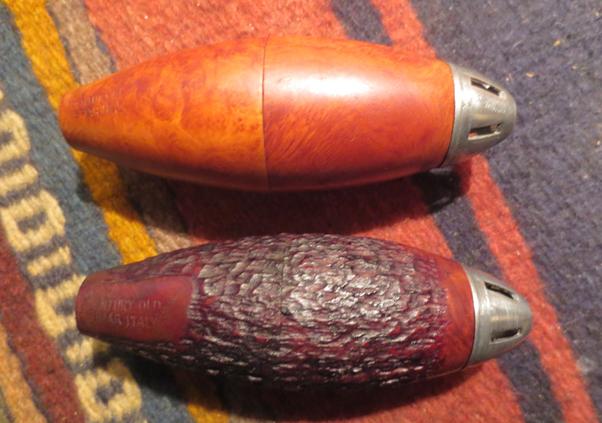
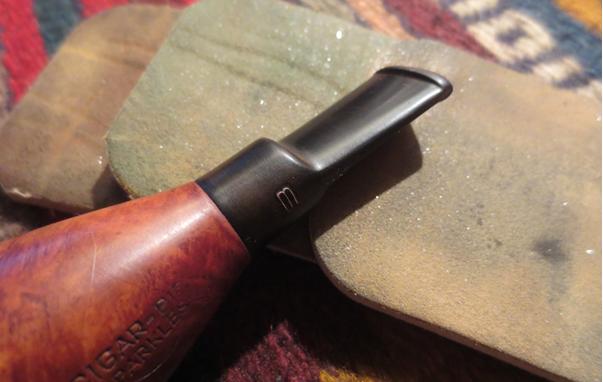
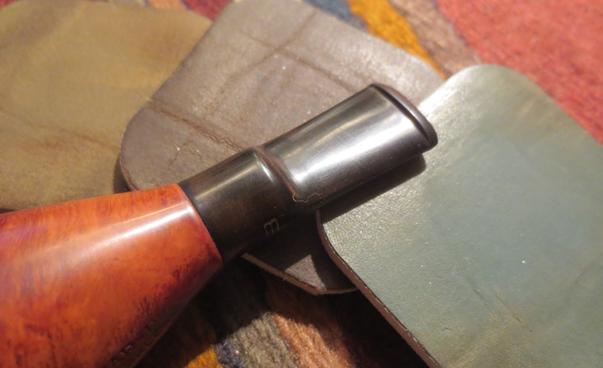
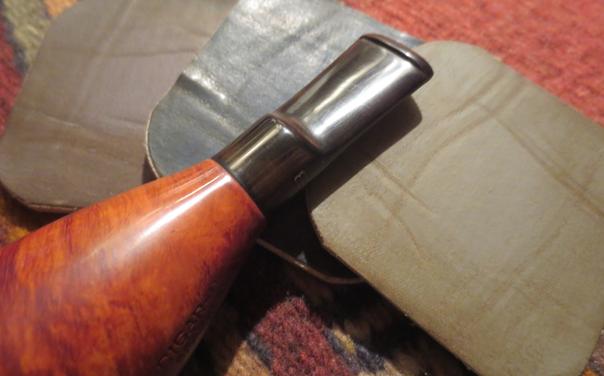
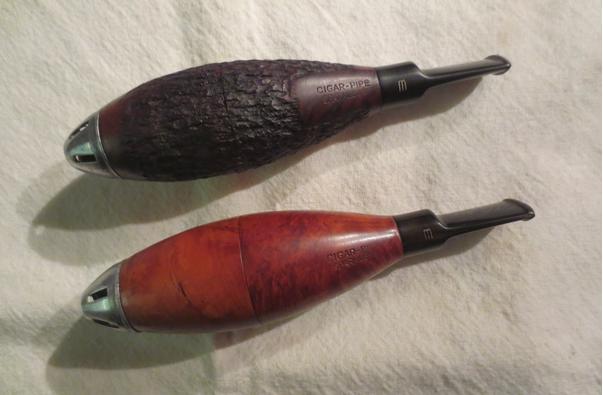
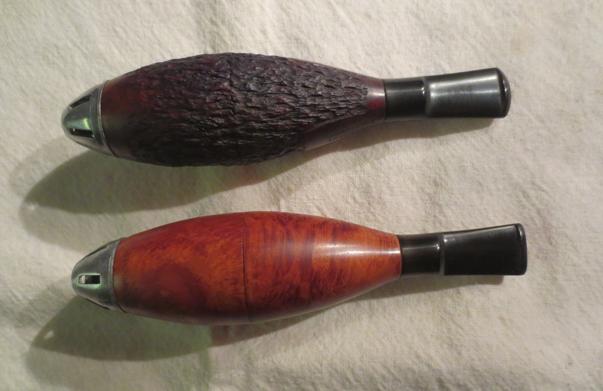
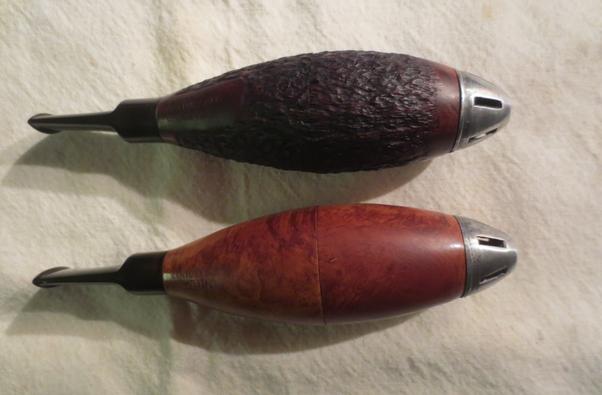
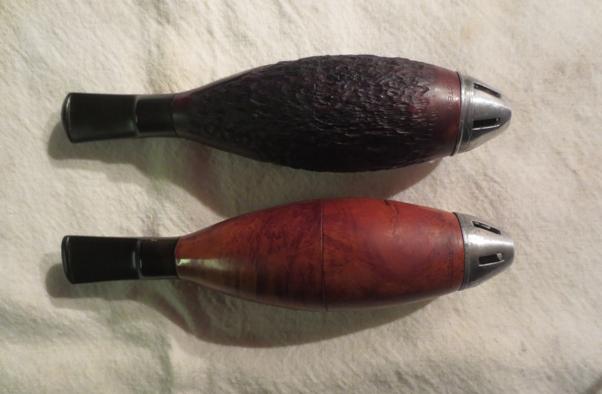
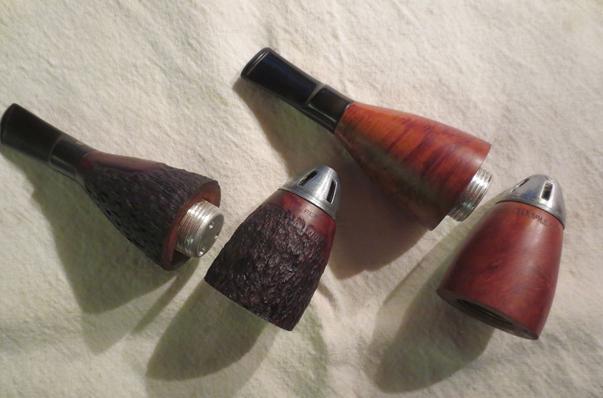
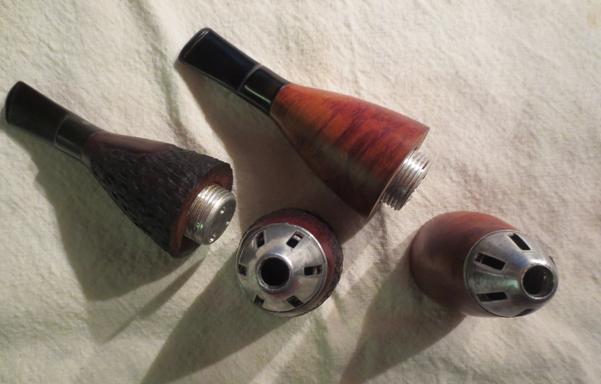
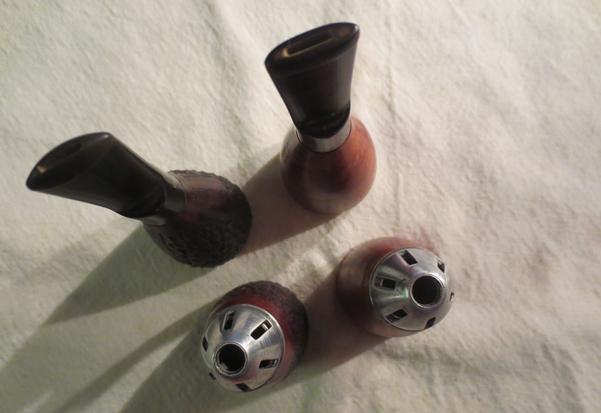
My brother sent me two Zeppelin pipes – a rusticated and a smooth one. He included the following photos of the two pipes that he took when they arrived in Idaho before he cleaned them up. The first one is a rusticated Sparkless Cigar Pipe. It has an interesting rustication pattern on the briar parts. I always want to know how a pipe is stamped as it is part of the restoration process for me. This one has quite a bit of stamping on it. Along the tip of the briar where the polished aluminum nose cone screws into the briar it is stamped PERFECTED on one side and Reg. No. MU3840 on the other. The stamping runs along the briar just below the nose cone. On the other end of the pipe, on what are the sides when the mouthpiece is in place it is stamped CENTURY OLD BRIAR ITALY on what would be the left side and on the right side it reads CIGAR-PIPE over SPARKLESS. The first two photos below show the pipe as it looks when put together.cigar1The next four photos show the stamping on the pipe and the M on the stem which told me I was dealing with a Mastercraft pipe.cigar2 cigar3The last two photos show what the pipe looks like when it is taken apart.cigar4The second Cigar Pipe that my brother sent to me was a smooth one that is identical in size and shape to the rusticated one. It even bears the same stamping on the pipe. It is stamped along the briar just below the polished aluminum nose cone. On one side it reads PERFECTED and on the other side is reads Reg. No. MU3840. Like the rusticated version is stamped on what would be the sides of the shank when the stem is in place. On the left side it reads CIGAR-PIPE over SPARKLESS and on the right side it reads CENTURY OLD BRIAR ITALY. The first photo is of the pipe put together.cigar5The next three photos show the stamping on the nose cone and the shank of the pipe.cigar6 cigar6aThe next photo shows the M stamp on this stem as well exactly like the one on the rusticated pipe above. It is thus also a Mastercraft pipe.cigar7The next photo shows what appears to be a crack on the upper portion of the cigar pipe. It would need to be checked out once I had it in hand. My brother was pretty sure that it was a fill in the briar as it did not go all the way through the piece.cigar8The next three photos show the pipe after it has been taken apart. Each of the pipes was made of four pieces.cigar9 cigar10I have seen a lot of these pipes for sale in shops and on eBay but I had never had one in my hand so I had never done any research into them or what “sparked” their invention. So now that I had two of them I figure it was time to look up some information. I looked on the pipephil website and found that they were made by Mastercraft and that there were some further articles in the odd pipes section of the site. Here is the link to that part of the site. http://www.pipephil.eu/oddpipes/pipcig/sparkless2.html. The trouble is that the articles were in French. I used Google Translator to translate them into English and then did some serious editing to the translations. I am including both articles in full here. The first one is written about the smooth briar versions and the second is about the rusticated versions.

Overseas manufacturers of pipes are not deprived of market of cigar pipes based on the mythical model of the 1920s. The best-known is called Sparkless [1] and comes from the Mastercraft House which was issued in several finishes. Two of them will allow you to judge fully of these strange pipes (The article included two photos of two different smooth finishes on the pipes – a stained and an unstained version).

It should be noted on at the outset that it is stockier than its Germanic Zeppelin cousin. When the pipe is disassembled we note that the two wooden parts screw into another – one side is threaded wood on the interior of the piece and the other side has a metal threaded end that turns into the wooden threads. There may be some doubts about how well this type of connection will hold up under use. There is no place for a filter in the Sparkless pipes unlike the Zeppelin. This pipe is adapted to the tastes of American smokers.

You should know that Mastercraft had a long standing near-monopoly of imports of European briar and particularly Italian briar. This explains the stamping ITALY on the side of the pipe.

The stamping is as follows:

On one side it is stamped Cigar Pipe, Sparkless and on the other side it is stamped Century Old, Briar Italy. On the nose of the pipe it is stamped Perfected on one side and Reg. No. M.U. 3840 on the other side.

The measurements of the pipe are as follows: The length is 13.9 cm and the height is 3.2 cm.

Where the German maker, Vauen offers one model of the Zeppelin pipe, the American Mastercraft diversifies its range. To the two versions of the Sparkless model mentioned above we add here two other variations in the form of pipe, rusticated in natural finish.

These variations to this atypical pipe probably spoke to a limited audience. Let’s face it the quality of the woodwork on the two models rusticated models isn’t the most refined in the light of the criteria of the XXI century. But don’t lose sight of the variety that was offered when these pipes were made was radically new.

My preference is usually saddle bit pipes. But I confess that by comparing the Zeppelin to the Pipe-Cigar Mastercraft models, the Zeppelin has more elegance due to the continuity of the shape to the tip compared to the general shape of the Cigar-Pipe. The German made Zeppelin pipe appears as a whole very consistent where each part (tip – stove – metallic cap) is the continuation of the other. This consistency and flow is less noticeable for this North American pipe.

The complete disassembly of the pipe shows that the stem in ebonite has a condensation system reduced to its simplest expression here: a small aluminum tube. It should be noted that these systems don’t bring great benefits for smoking and on the contrary can add moisture and condensation. They are often the origin of disturbances in the draw of the pipe and cause of particularly unpleasant gurgle. But it should not hurt.

The details of the stamping nomenclature reflects that the origin of the pipes is Italian and are potentially made by Lorenzo.

On one side it is stamped Cigar Pipe, Sparkless and on the other side it is stamped Century Old, Briar Italy. On the nose of the pipe it is stamped Perfected on one side and Reg. No. M.U. 3840 on the other side.

The measurements of the pipe are as follows: The length is 13.9 cm and the height is 3.2 cm.

Armed with the interesting information I went to work on the two Cigar-Pipes that I had. One was the darker coloured rusticated pipe and the second was the natural coloured smooth one. I thus had two of the finishes that are mentioned in the above information.

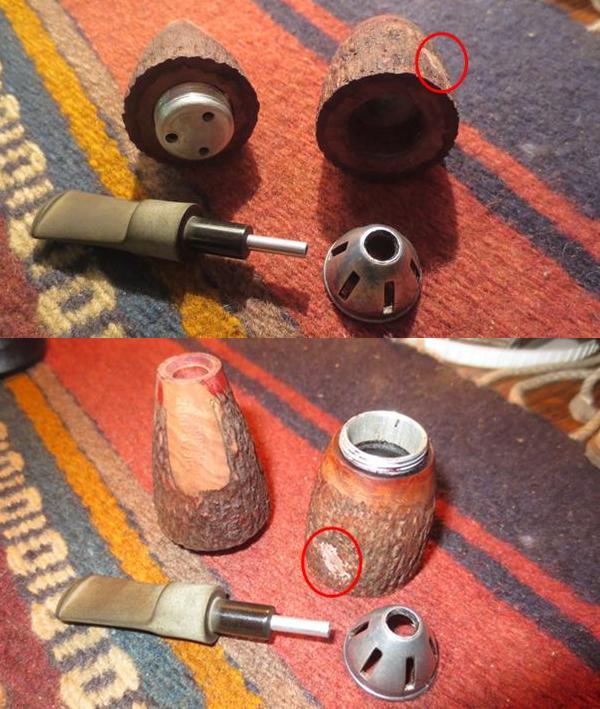
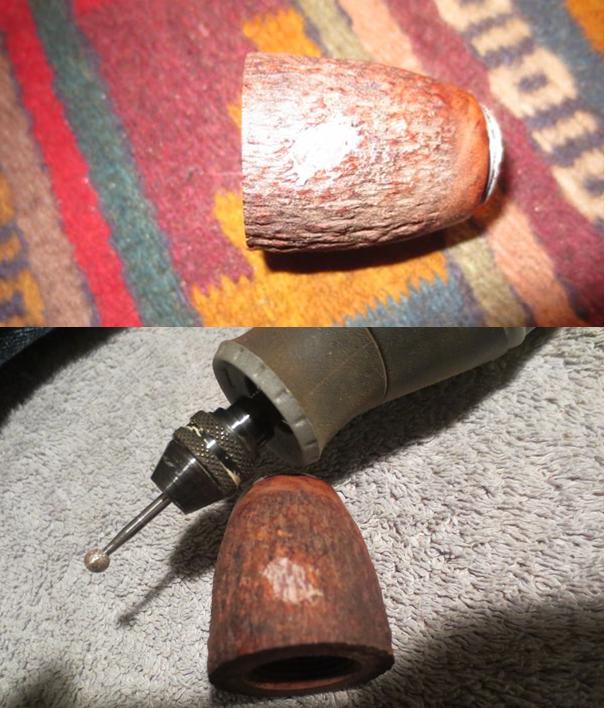
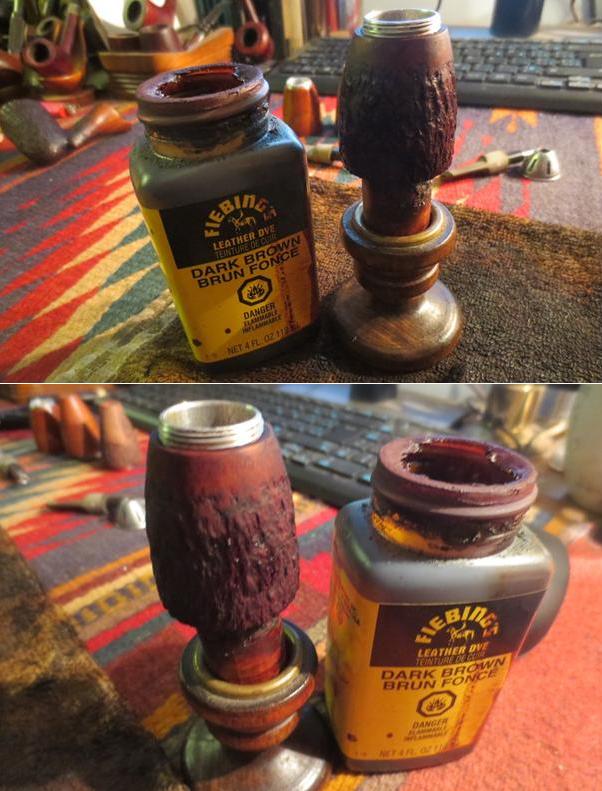
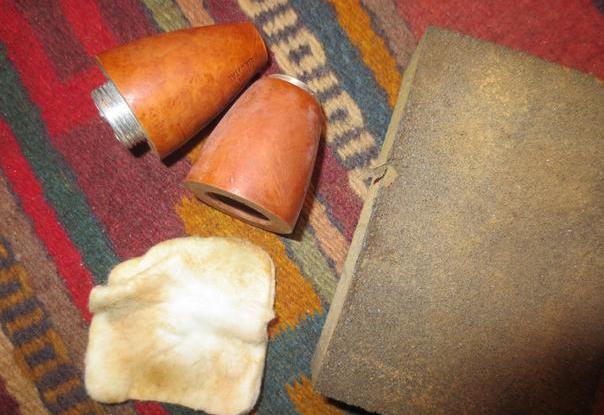
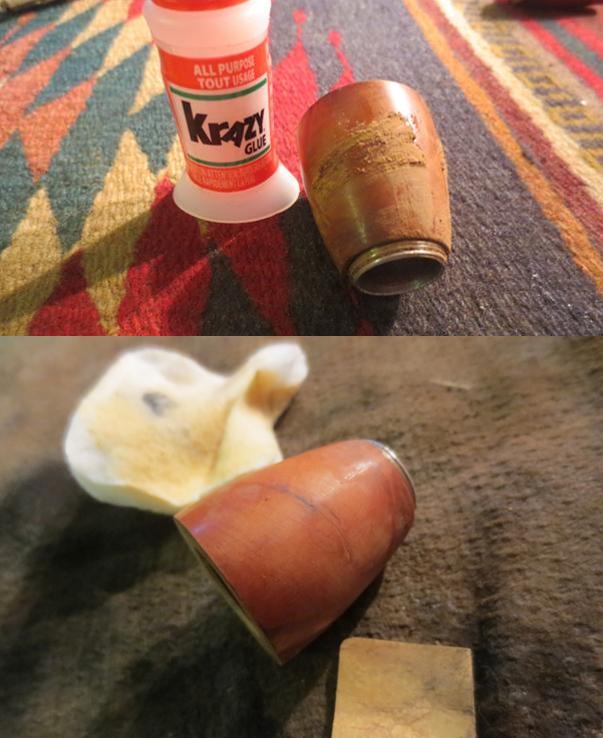
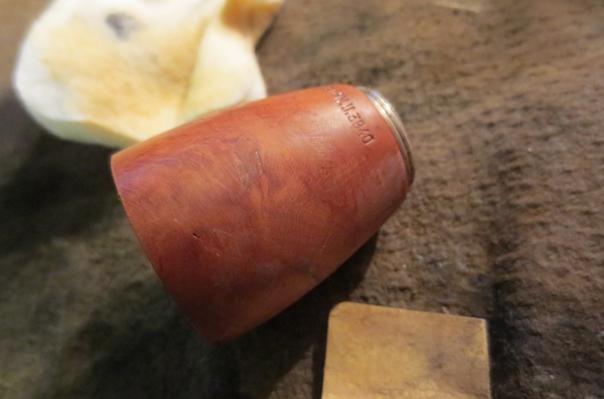
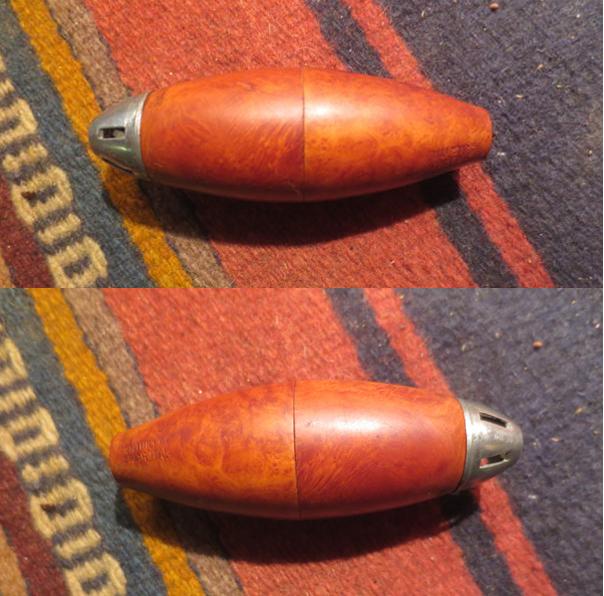
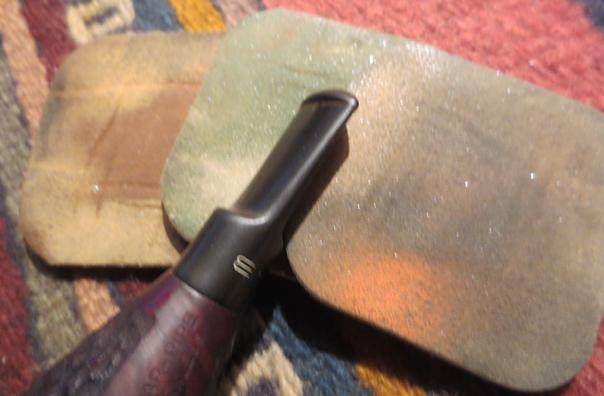
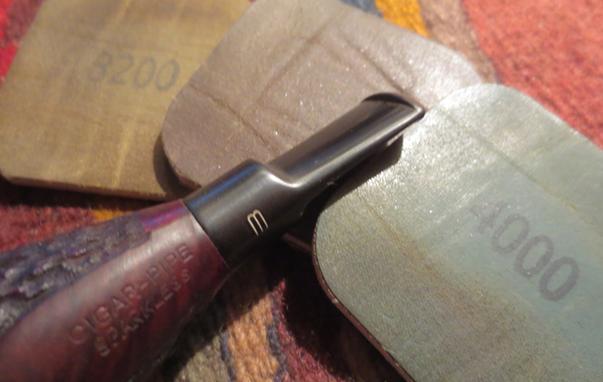
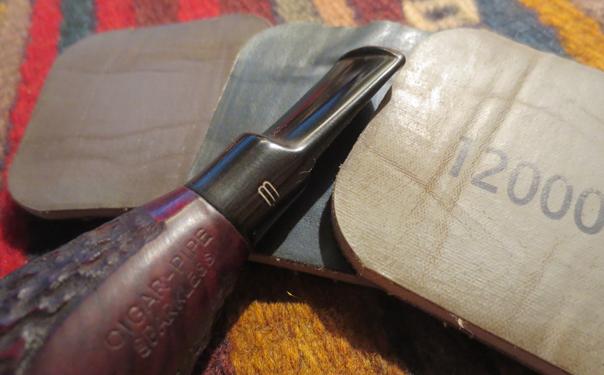
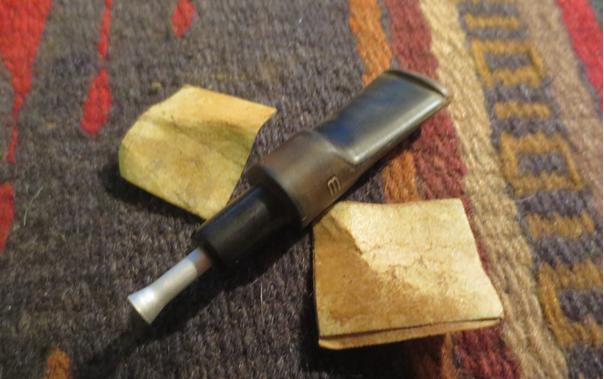
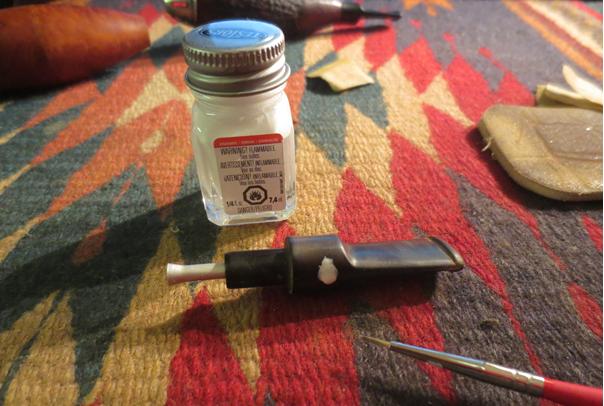
I started with the rusticated pipe. My brother had done the lion’s share of cleanup work on both of these pipes. Judging from the internals and the externals he did a great job cleaning out all of the gunk and grime. The rusticated briar was cleaned with a tooth brush and Murphy’s Oil Soap and in doing so he was able to remove the majority of the finish. The next four photos show the exterior of the pipe. The stem was oxidized and the letter M on the stem was faint. The finish was dull. The aluminum nose cone was dull. There was a fill on one side of the pipe that stood out as it was smooth and the rest of the bowl was rusticated.cigar11 cigar12I took the pipe apart and took pictures of all of the parts. In the second photo below you can see the fill on the briar piece on the right side of the photo. It is silver/grey in colour so it really stands out.  I circled it in red. The aluminum internals are clean. The inner tube on the stem is clean as well. I was able to slide it out of the stem and clean behind it. There was no grime there.cigar13After I took apart the rusticated one and took the photos I did the same with the smooth pipe. The smooth pipe would be the one I worked on next. Once again my brother had done the lion’s share of cleanup work. Judging from the internals and the externals he did a great job cleaning out all of the gunk and grime. The smooth briar was cleaned with a tooth brush and Murphy’s Oil Soap and in doing so he was able to remove the majority of the finish. There still was a varnish coat on the briar. That would need to be wiped with acetone and sanded. The next four photos show the exterior of the pipe. The stem was oxidized and the letter M on the stem was faint. The finish was dull. The aluminum nose cone was dull. There was a fill on one side of the pipe that stood out as it was smooth and the rest of the bowl was rusticated.cigar14 cigar15I took the pipe apart and took pictures of all of the parts. In the second photo below you can see what looks like a crack on the side of the briar piece on the left of the photo. It is a thin line that runs horizontal across the briar and there is a second divot next to it just out of the photo. I circled it in red. The aluminum internals are clean. The inner tube on the stem is clean as well. I was able to slide it out of the stem and clean behind it. There was no grime there.cigar16I started working on the parts on the rusticated cigar-pipe first. I decided to start with the silver grey fill and try to get it blend into the briar. I used the Dremel with a round head burr to carve lines in the fill that matched the pattern on the bowl sides. I figured if I could make the pattern match I could hide it.cigar17I stained the briar parts with a dark brown aniline stain thinned 50/50 with isopropyl alcohol. I applied the stain with a folded pipe cleaner and then flamed it. I stained both parts of the bowl with the stain and flamed them. I repeated the process until the coverage was even.cigar18I took some photos of the newly stained parts of the pipe. The first photo shows the coverage of the stain on the fill. I had used a black Sharpie Pen to fill in the newly cut grooves from the Dremel and then put the brown stain over the top.cigar19I polished the aluminum nose cone with micromesh sanding pads from 1500-2400 grit. I hand buffed it with a microfibre cloth.cigar20I put the pipe back together and took photos of the newly finished pipe.cigar21 cigar22I set the rusticated one aside and turned to work on the smooth one. I wiped it down with acetone on cotton pads to try to penetrate the varnish coat. Parts of it came off and parts stubbornly refused to move. I sanded the briar with a medium and fine grit sanding sponge and was able to get the entire varnish coat off. I wiped it down with acetone again to remove the dust.cigar23I picked out the fill that looked like a crack and filled it in with briar dust and clear super glue. Once it dried I sanded it smooth with 220 grit sandpaper and the sanding sponge.cigar24 cigar25Since the original Mastercraft smooth Cigar-Pipe came in a natural finish and this one appeared to have that rather than a Bruyere finish I rubbed it down with a light coat of olive oil and then gave it a coat of carnauba wax. I put the pipe back together so that I could see the finished briar portion.cigar26 cigar27I put the rusticated and smooth pipes together and took some photos of the stain and finished briar parts with the polished nose cones. The pipes are looking great at this point in the process. I still had to sand both stems at this point but the briar was done and the pipes were clean.cigar28 cigar29Now it was time to work on the stems. The stem on the rusticated pipe was cleaner and took less work so I did it first. I sanded it with micromesh sanding pads – wet sanding with 1500-2400 grit pads and rubbing it down with Obsidian Oil. I touched up the M stamp on the left side of the saddle with acrylic paint and a fine bristle brush. I sanded off the excess paint with the 1500-2400 grit pads. (I forgot to take a photo of that part of the process.) I dry sanded the stem with 3200-12000 grit pads and rubbed the stem down with Obsidian Oil after each set of three pads. I set it aside to dry.cigar30 cigar31 cigar32While I worked on the stem from the rusticated pipe I had the stem from the smooth one soaking in an Oxyclean bath. It soaked for about six hours. I took it out of the soak and took the next two photos.cigar33I sanded the stem with 220 grit sandpaper to remove the oxidation that had been softened by the oxy bath.cigar34I touched up the stamping on the stem with white acrylic paint and a small fine brush. Once it dried I scraped off the excess and then polished it.cigar34aThe stem was a bear to clean up and remove the oxidation even after soaking in an Oxyclean soak. I wet sanded it with 1500-2400 grit micromesh sanding pads and dry sanded it with 3200-12000 grit pads. I rubbed it down between each set of three pads with Obsidian Oil. I set it aside to dry.cigar35 cigar36 cigar37I buffed the pipe with Blue Diamond on the buffing wheel and worked over the stem quite a bit to remove the oxidation that remained. I gave the pipe multiple coats of carnauba wax and buffed it with a clean buffing pad to protect and give it a shine. I hand buffed it with a microfibre cloth. The finished pair of Zeppelin style Cigar-Pipes by Mastercraft is shown below. There is something about the oddness and shapes of the pipes that attract me to them. I don’t know when they will be used but when they are it should be an interesting experience. Thanks for looking.cigar38 cigar39 cigar40 cigar41 cigar42 cigar43 cigar44 cigar45

Kirsten “Stinger” Ram Rod Intake Tube as designated, is it really necessary?


Blog by Samuel R. Vior

I have been reading Sam’s posts on the Gentlemen’s Pipe Smoking Society Group on Facebook since I joined the group some time ago. He always has some interesting posts on pipes and tobaccos and I enjoy reading them. Today he posted a piece with the title “Kirsten “Stinger” Ram Rod Intake Tube as designated, is it really necessary.” With that title I assumed his answer would be a categorical NO. I was right! He did a masterful job not only explaining how he removed the ram rod but his rationale for doing so. I wrote him a private message and asked if he would write it up for rebornpipes as I thought you all might enjoy it! He said he would be glad to do so.  Thanks Sam and welcome to rebornpipes. It is a pleasure to have your writing here. Here is his story in his own words.  — Steve

Here´s my little story as requested. My name is Samuel R Vior; got into pipes around 10 years ago, as to have a personal pastime, by trade I manage a small fleet of oil support vessels in the Gulf of Mexico, SE Mexico side.

Since I move a lot because of work, I needed to get something to allow me to leave my precious pieces at the house and still have the versatility of pipe smoking and after a thorough review of the options; I was convinced that a metal pipe was what I needed. I got a Falcon and a Jima but both seemed fragile, while Kristen’s are sturdier in construction.

I must say, that I never thought I would fall in love with them, and since my work world is metal, aluminum was just right. The very first one I purchased I had restored by Jason Bard of Bards Vintage Briar and the rest all by me.

I have bought and restored in between 60 to 70 pieces, mostly from EBay, Etsy, Pipestud and some Antique Stores and Flee Markets hunts, when possible. I got them in all sorts, sizes, shapes, as to learn the system and when needed, restore or repair them myself, having my pipes restored by others is troublesome (S&H costs and customs) and lengthy process.

As for the “stinger” article, I will start with the repair of a shattered one, since that is how I stumbled onto it.

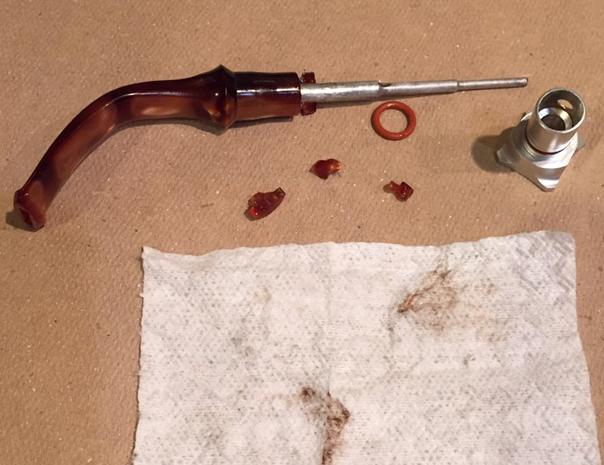
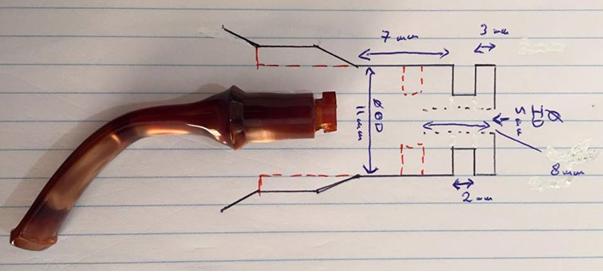
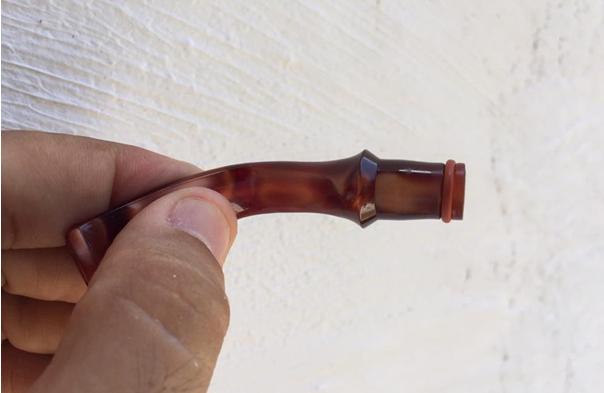
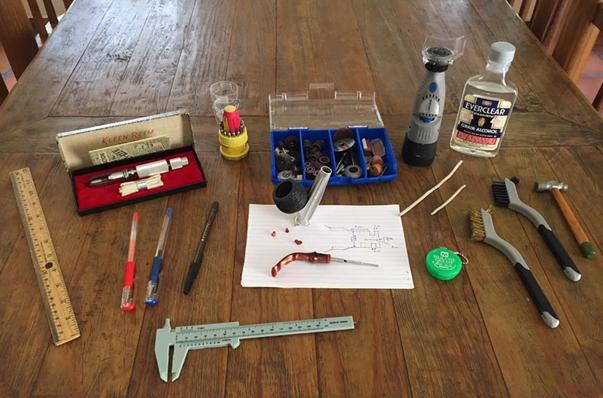
After the stem mouth piece had shattered, I thought of gluing it together, but I knew it would not hold permanently. I took advantage of the material left in the stem and removed the breakage area. I recessed the tenon hole, made the groove around the end of the stem for the rubber O ring and narrowed the stem as to be able to fit into the shank radiator body upper hole.sam1 sam2 sam3 sam4And that brings me to the post that Steve read on Facebook – The Kirsten “Stinger” Ram Rod Intake Tube as designated, is it really necessary? Not in my book!

A few of months ago, I had posted about the repair of a Stem/Mouth-bit which had shattered while cleaning the inside of a valve. This made me “discover” that removing the stinger was a far more enjoyable smoking experience.

I also suspected that the Ramrod Intake Tube, was not glued or permanent attached to the stem/mouth-bits. But until I recently obtained a 4th generation brand new pipe all of my previous experiences were to have the “stinger” stuck to the mouthpiece.

Anyway, since returning from Summer holidays I have removed all Stinger, Ramrod Intake tubes from my Kirstens and smoke them without a single issue and again much better smoking condition.

Disclaimer: Attempting to remove your “stinger” (ramrod intake tube) is dangerous and should only be done by trained professionals and under controlled environment conditions.

But if you want to give it a try anyway here’s how I removed mine. Spray a bit of dielectric fluid at the base of the acrylic and let it rest for 20 minutes. After that remove the o-rings and submerge stingers and mouth-bits in a soapy water mixture made of warm water and Bar Keepers Friend Soft. After that scrub the inside if the mouth-bits with Everclear pipe cleaners and let them dry.

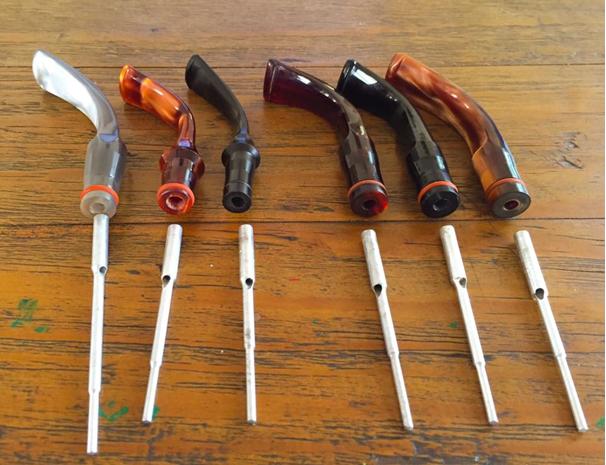
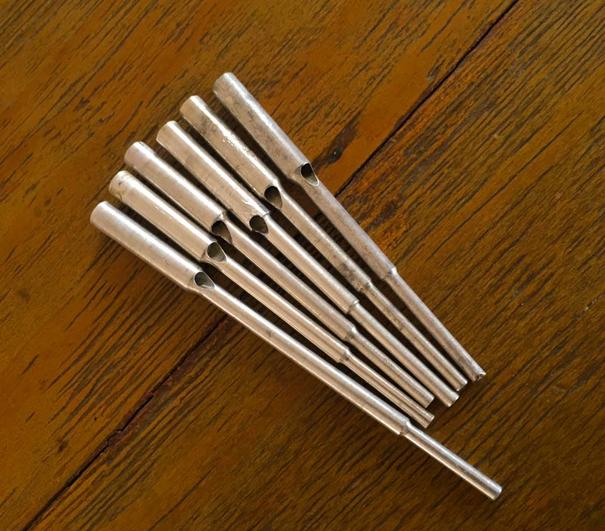
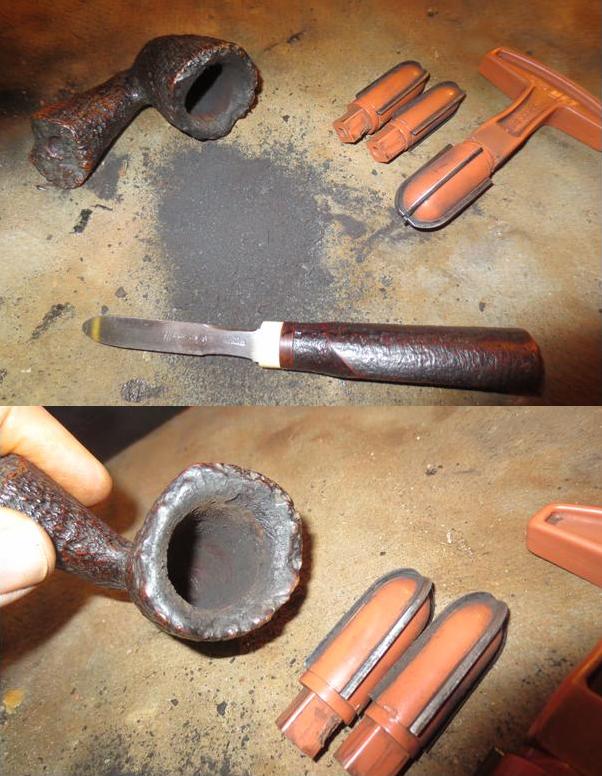
Use plastic wrapped pliers if possible and twist left to right until the Stinger, Ramrod Intake Tube comes off.  The photos below show six of my stems with the tube removed and the tubes themselves. They came out pretty easily. I am enjoying smoking my Kirstens without the contraption in the barrel. Thanks for looking. sam5 sam6 sam7

I don’t know who made it but this LS Handmade Danish Freehand is a beauty.


Blog by Steve Laug

The brand is unknown to me but many things about it look like a Preben Holm or Ben Wade pipe to me. The flow and lines of the bowl and stem, the well done sandblast, the smooth internal rim top all point that way to me. But I have not heard of nor have I been able to find information on the LS. The pipe is stamped Hand Made in Denmark over LS on the underside of the shank.dan1 dan2The pipe was in great condition in terms of the finish of the bowl. It had dust in the grooves of the deep lines of the sandblast. The stain was in good shape. The smooth underside of the shank was very clean and did not have scratches. The plateau in the shank end was dirty but in good condition. The interior surface of the smooth rim top was covered in a very thick and dirty cake that flowed up from the bowl and over top. The next photo shows the flaking cake on the top of the rim and in the plateau areas around the outer edge.dan3I reamed the bowl with a PipNet pipe reamer using the first three cutting heads to trim back the cake into the heel of the bowl. I followed that up with a Savinelli Pipe Knife to smooth out the transitions between the various cutting heads. I remove the cake back to bare briar. I also used the pipe knife to cut back the cake on the inner edges of the rim.dan3aI sanded the inner smooth portion of the rim with 220 grit sandpaper to remove the tars and lava that I could not get off otherwise. I  picked at the grooves, nooks and crannies in the plateau portion with a dental pick. I wiped it down with isopropyl alcohol and sanded some more until the surface was smooth.dan4I scraped the last remaining edges of cake with the Savinelli Pipe Knife. I cleaned out the mortise and the shank with pipe cleaners, cotton swabs and alcohol.dan5The stem had been sitting in an Oxyclean soak overnight. Once I had the bowl cleaned I took the stem out of the bath to begin working on it. I ran a pipe cleaner through the airway in the stem to clean out any remaining debris and the oxy solution.dan7I scrubbed it once more with the oxy solution and then rubbed the stem dry with a coarse cotton cloth. It removed a lot of the oxidation from the grooves in the stem and the surface of the stem.dan8There was a deep, troublesome tooth mark on the top of the stem. It looks like it goes through to the airway but it does not. I probed it with a dental pick to clean out the debris in the mark and then cleaned it with some alcohol on cotton swabs to get rid of any oxy solution that might be in the hole.dan9I waxed the sandblasted bowl and the plateau on the shank and the rim edges with Conservator’s Wax. I also waxed the smooth inner edge of the rim top with the wax. I buffed it with a shoe brush and then with a clean buffing pad to raise the shine.dan10 dan11 dan12 dan13Once the glue cured on the stem I filed it with a needle file to smooth out the patch to match the surface of the stem.dan14I sanded it with 220 grit sand paper to remove the scratches and smooth out the surface of the patch and the tooth chatter on the underside of the stem.dan15I polished the stem with micromesh sanding pads – wetsanding it with 1500-2400 grit pads and dry sanding it with 3200-12000 grit pads. I rubbed it down with Obsidian Oil between each set of three pads. After the final set of three I rubbed it down one last time and set it aside to dry.dan17 dan18 dan19I buffed the stem with Blue Diamond polish on the buffing wheel and gave the stem multiple coats of carnauba wax. I buffed the stem and bowl with a clean buffing pad to bring a shine to the pipe. I hand buffed it with a microfibre cloth and deepened the shine. The finished pipe is shown in the photos below. The look of the internal smooth rim with the plateau edges and the deep sandblast finish make this a beautiful pipe. I think Steve in Dawson Creek will like the way this one turned out as well. It should serve him for many more years to come. Thanks for looking.dan20 dan21 dan22 dan23 dan24 dan25 dan26 dan27ee

Restoring a Long Diamond Shank Aldo Velani Grande 39


Blog by Steve Laug

This pipe came to me through my brother. I am not sure if it was one of his eBay finds or his pipe hunting adventures. Either way it is a unique and unusual pipe. It has a long diamond shaped shank ending in a tapered diamond shaped stem with a slash of briar inserted into the Lucite. The bowl is a variation on a Dublin shape with the diamond shape of the underside of the shank carrying through to the bottom of the bowl. The rim had been obviously tapped out on some hard surface and the top and the outer edges of the rim had nicks and dents. Somewhere along the way someone had cracked the shank and put on a poorly installed Sterling silver band. The stem had some slight tooth chatter on the top and the bottom near the button and there were several small tooth marks on the underside.aldo1It is stamped Aldo Velani Grande on the left side of the shank. The centre portion of the top line of the stamp is faint. It is stamped on the right underside of the shank with the shape number 39. There was no other stamping on the shank. The stem bore an AV stamp that had originally been gold in colour but had faded. In the second photo below you can see the glue from the band oozing out onto the shank. It was that way all the way around. Someone had carelessly used the glue and not cleaned up the overflow. You can also see that the stem does not fit properly against the shank end.aldo2The stem listed to downward and to the left side of the shank and was crooked. Once I pulled the stem out I could see that the tenon was no longer straight.aldo3The next two photos show the top of the rim and the bottom of the bowl respectively. You can see the light cake and the rounding of the outer edges of the rim in the first photo. The underside of the pipe looked pristine. The finish was dirty and a bit spotty.

aldo4My brother, Jeff cleaned up the pipe. He scrubbed out the internals and the external of the pipe. When it arrived in Canada it was very clean and the finish had basically been removed. I am really growing to like having these pipes arrive cleaned and ready to restore. Thanks Jeff!aldo4a aldo4bThe next photo shows the rim after he had cleaned up the surface. There was a burn mark on the front edge of the rim that would need to be addressed. You can clearly see all the nicks and chips in the rim edges in this photo.aldo4cOnce I removed the stem the band fell off in my hands. I could see the band covered a sloppy crack repair. Though the repair held and the crack was sealed there was a lot of glue. I am not sure whether it was for the crack or for the band. Either way it was over kill. The glue had hardened and somewhere along the way the silver band had picked up the ridges and valleys of the hard glue underneath.aldo4dI sanded the glue until it was smooth on the shank end. I squared up the band and made the angular corner of the diamond shape more sharp. I smoothed out the dents in the band as much as possible from the inside of the band. I slid band on the shank and used a small ball-peen hammer to carefully tap the band flatter from the outside. I was able to remove much of the damage to the silver band with this process. I used a small bit of glue to hold the band snug on the shank.aldo4eTo take care of the rim damage and to reduce the damage to the outer edge of the rim I topped the bowl on a topping board with 220 grit sandpaper. I sanded until the edge was clean and then worked on the outer edge of the rim with sandpaper. In the second photo below you can see the area where the burn has affected the outer edge at the front of the bowl.aldo5I wrapped a KleenReem pipe reamer with 220 grit sandpaper and used it to sand the interior of the bowl and clean up the inner edge of the rim.aldo6On the right side of the bowl there were two larger chips in the outer edge. I used crazy glue and briar dust to fill in the divots. Once the repair dried I sanded it with 220 grit sandpaper to reshape it.aldo7I heated the tenon with a Bic lighter until the tenon was flexible and then carefully inserted it into the mortise and aligned it with the shank. I held it in place until the tenon cooled. That repaired the fit of the stem to the shank.aldo8Since I was working on the stem I decided to finish polishing it. I sanded out the tooth marks and tooth chatter with 220 grit sandpaper. I polished it by wet sanding with 1500-2400 grit micromesh sanding pads. I dry sanded it with 3200-12000 pads. I wiped the stem down with a damp cloth. Once the pipe was finished I would buff the stem and pipe together.aldo9 aldo11 aldo12I used European Gold Rub n’ Buff to touch up the AV stamp on the side of the stem and hand buffed the stem.aldo13I stained the bowl with a dark brown aniline stain cut by 50% with isopropyl alcohol. I flamed it and repeated the process until I got an even coverage.aldo14I took the next set of photos to show the bowl after the stain had dried. It was too opaque for me and hid the grain on the pipe but I would deal with that in the morning. I set the pipe aside of the night and let the stain dry.aldo15 aldo16In the morning I wiped the bowl down with alcohol on a cotton pad to thin the stain coat and make the grain stand out.aldo17 aldo18With the stain looking good and the stem finished I buffed the pipe with Blue Diamond on the buffing wheel and gave it multiple coats of carnauba wax. I buffed it with a clean buffing pad to raise the shine and then by hand with a microfibre cloth. The finished pipe is shown in the pictures below. It is a beautiful pipe. It is ready for whoever wants to add it to their rack. Send me a message or an email at slaug@uniserve.com if you are interested in this beauty. Thanks for looking.aldo19 aldo20 aldo21 aldo22 aldo23 aldo24 aldo25 aldo26 aldo27


Charatan Made Knudsen’s Pipe Dream Oval Shank Banker brought back to life


Blog by Steve Laug

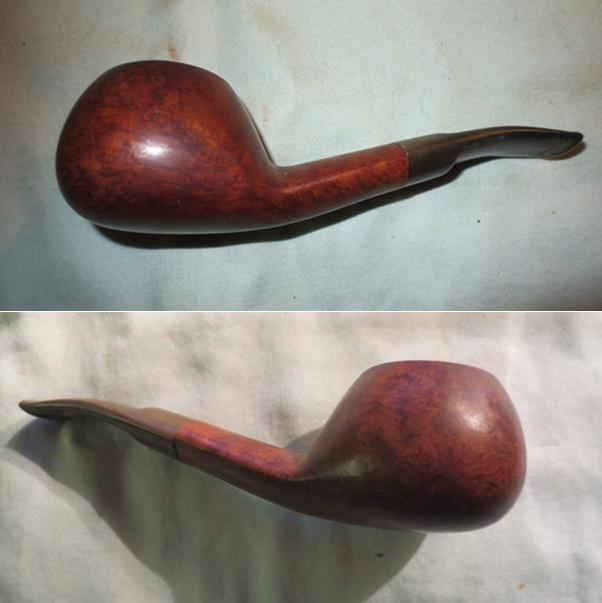
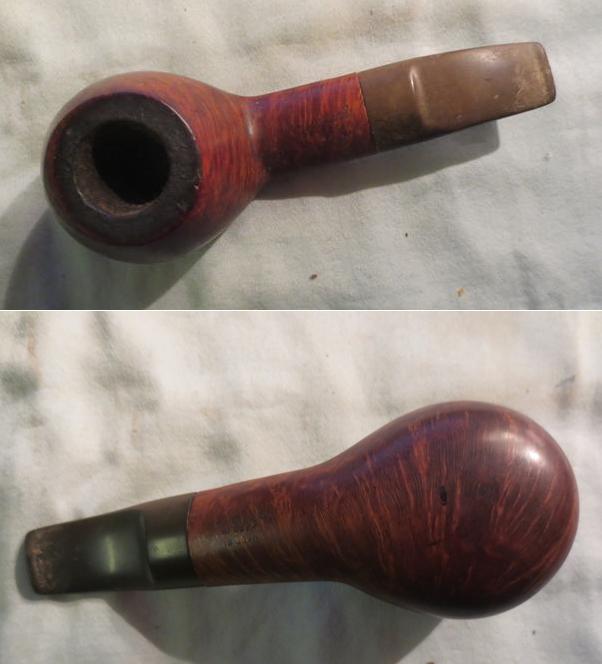
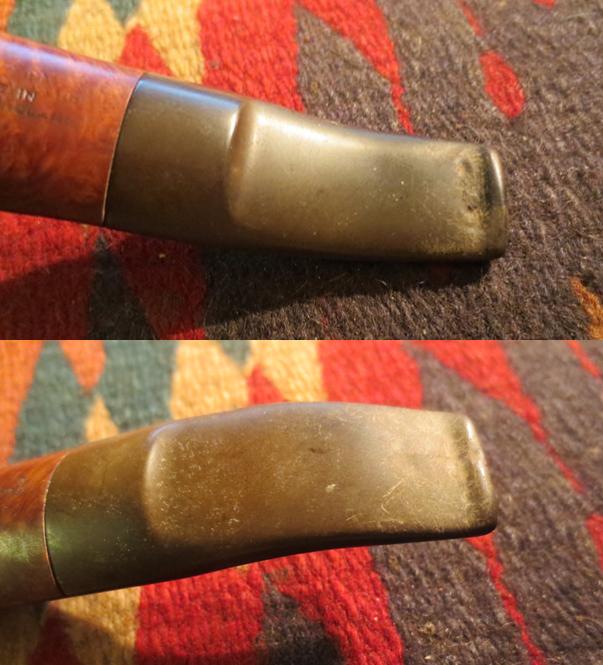
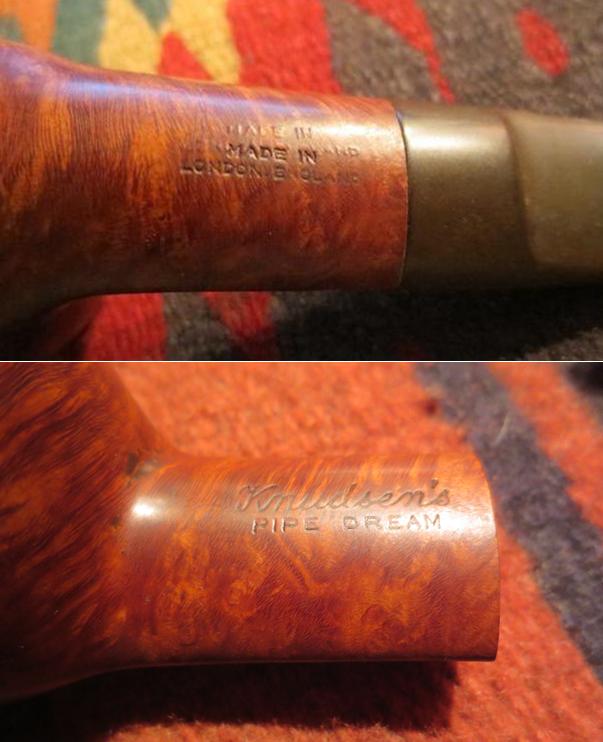
This great looking Banker shaped pipe is another one from the pipe man up in Dawson Creek, British Columbia. I am not sure if it was also one of his Grand dad’s pipes but it definitely has some age. It is stamped Knudsen’s Pipe Dream on top of the shank and Made in London England on the underside. From my research I am pretty confident that the pipe was made by Charatan as the shape is on their shape charts. However, it does not have the Banker shape number. I took the photos below to give an idea of the shape and the condition of the pipe when it arrived at my work table. The first thing that stood out to me is that there is a lot of promise under the grime – the birdseye grain and cross grain are peaking through. There was one fill on the underside of the bowl that was chipped but otherwise tight in the sandpit. The finish appears to be really good under the grime with no dings or dents in the briar. There was a thick cake in the bowl that runs like lava runs over the rim of the bowl. It is hard to know for sure if there is damage to the rim underneath the thick cake. The stamping is readable and the Made in London England stamp on the underside of the shank appears to have been done twice though one of them is quite faint and slightly above the other. The stem is worn and has deep tooth marks on the top and bottom sides and the button is worn. I was looking forward to working on this pipe.

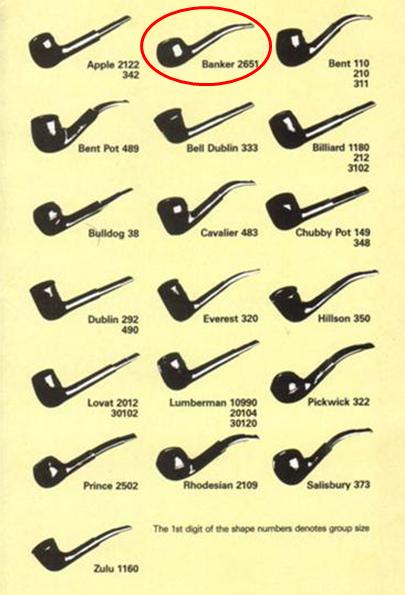
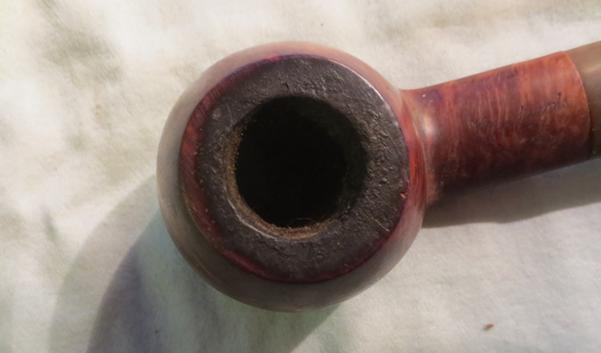
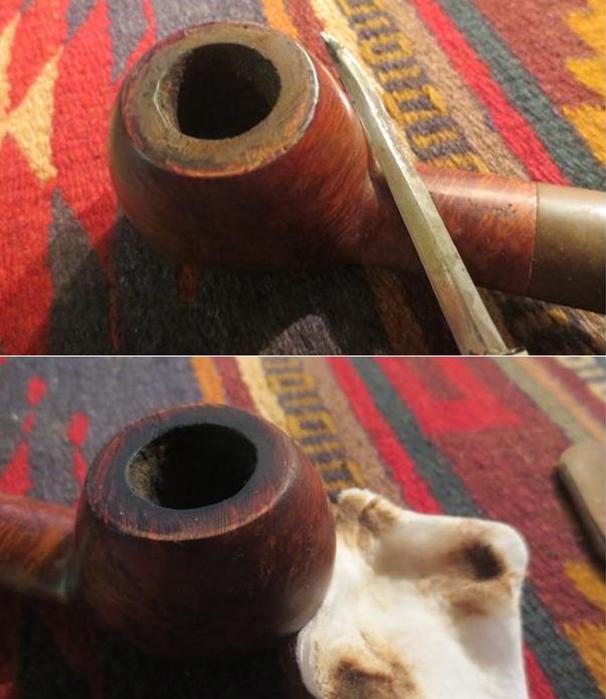
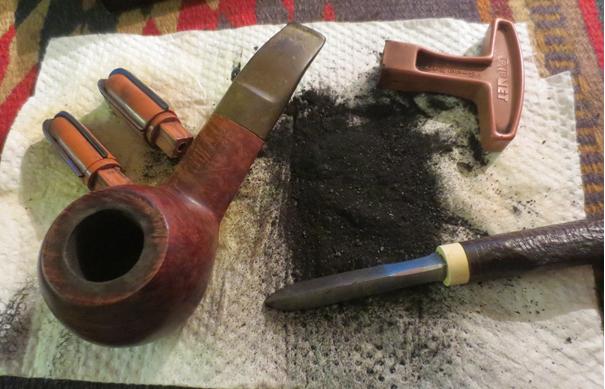
I did some digging to see if I could find anything out about the brand stamp on the top of the shank. I found that there is a Knudsen’s Pipe Dream Pipe Shop in Regina, Saskatchewan. The address and phone number is as follows: 4621 Rae St, Regina SK S4S 6K6, Phone: 306-585-1616. There was also a Knudsen’s Pipe Dream sandblasted Dublin that had sold on the smokingpipes.com website. The web address and link to the pipe is https://www.smokingpipes.com/pipes/estate/england/moreinfo.cfm?product_id=132697. They list it as an English made pipe. To me it also looks like a Charatan shape.bank1 bank2I found this page from a Charatan Catalogue online. The link said that it was Charatan even though the page does not say so. I have circled the Banker shape in red in the picture below. It is in the middle column at the top of the page. The shape would thus be a 2651.bank16I took a close up photo of the rim top to show the thickness of the cake on the rim and in the bowl. You can see why it is hard to assess what is going on with the inside of the bowl and the rim from this photo. A lot of work will need to be done before I can actually know the condition of the bowl and the rim.bank3I also took close up photos of the stem showing the bite and tooth marks on the top and bottom near the button.bank4I wanted to photograph the stamping as well. You can see the faint double stamping of Made in London England in the first photo and you can clearly see the name Knudsen’s Pipe Dream in the second photo.bank5I scraped the rim with a sharp pen knife to scrape off the thick buildup. I generally do this to try to preserve the stain coat on the rim. In this case I also wanted to see if there was damage under the cake on the rim top before I topped the bowl. Once I had it scraped off I wiped it down with alcohol on a cotton pad.bank6I reamed the bowl with the PipeNet reamer and the Savinelli Pipe Knife and took the cake back to bare briar. I wanted to assess damage to the interior wall of the bowl. Thankfully there was none this time around.bank7I repaired the chipped fill and the deep nick on the underside of the bowl with clear superglue. I did not use briar dust this time as neither repair was deep. I lightly sanded the spot with 220 grit sandpaper and then with 1500-2400 grit micromesh sanding pads.bank8

I cleaned out the mortise and airways in the bowl and stem with pipe cleaners, cotton swabs and alcohol until they were clean.bank9I needed to repair the small groove (looks like a crack but does not go through the surface) in the button and on the surface of the stem as well as the tooth marks but before I could do that I needed to redefine the button edges. I used a needle file to recut the sharp edge and smooth out the ridges and bumps on the stem. With the file I was able to smooth out the groove on the button surface and the stem. With this done it was clear that there was not a crack. I wiped the stem down with alcohol and then built up the damaged areas with black super glue. I also repaired the spots on the underside of the stem with the black super glue.bank10 bank11When the glue had cured I filed the repairs back until they were even with the surface of the stem. I also recut the edge following the path I had previously cut.bank12I sanded the repaired areas and the entire stem with 220 grit sandpaper to smooth out the surface and to remove the oxidation.bank13I wiped down the bowl with a light coat of olive oil to make the grain stand out and to see if there was any glaring light spots that needed to be touched up with a stain pen. It looked good. Once I polished and waxed the bowl I think it would be good to go. The photos below show the bowl at this point in the process. It really is a beautiful piece of briar.bank14 bank15I polished the repaired stem with micromesh sanding pads – wet sanding with 1500-2400 grit pads and dry sanding with 3200-12000 grit pads. I tried something new this time to try to defeat the frustrating oxidation on the stem. Instead of wet sanding with water I wet the stem with a light coat of olive oil and sanded it with the pads. It worked really well to cut through the oxidation. I wiped the stem dry after wet sanding and dry sanded without the oil. The finished shine is deep.bank17 bank18 bank19I buffed the bowl and stem with Blue Diamond on the buffing wheel to raise the shine. I gave it multiple coats of carnauba wax and buffed it with a clean buffing wheel. I hand buffed it with a microfibre cloth. I am hoping Steve enjoys this one. It is one beautiful old pipe. It helps that it carries a family story with it. Thanks for looking.bank20 bank21 bank22 bank23 bank24 bank25 bank26 bank27

Restoring a Well-Aged Double Walled Ceramic Baronite Pipe


Blog by Steve Laug

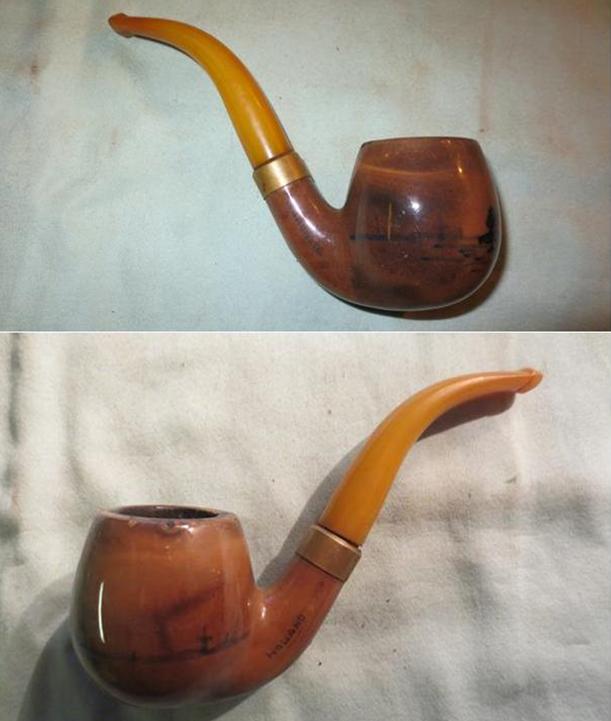
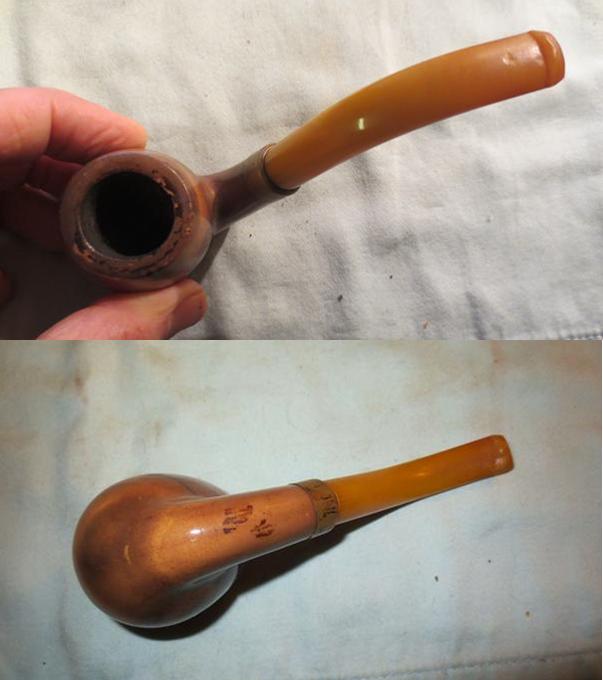
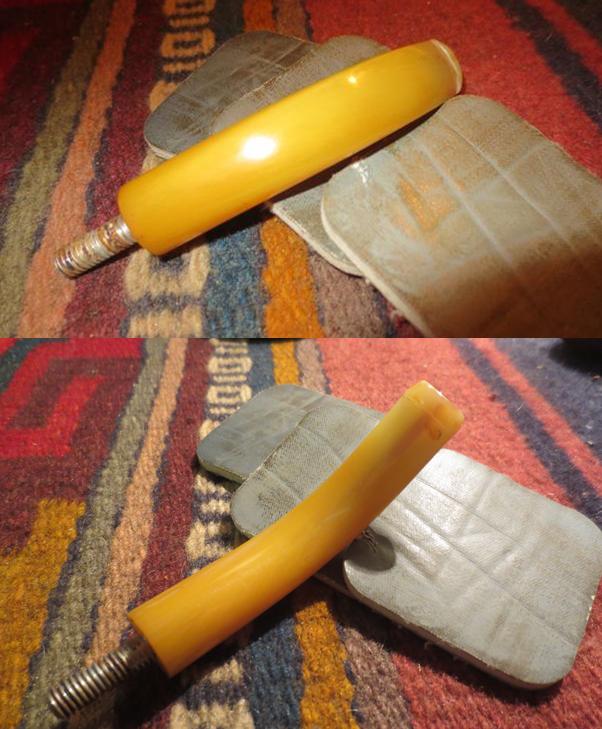
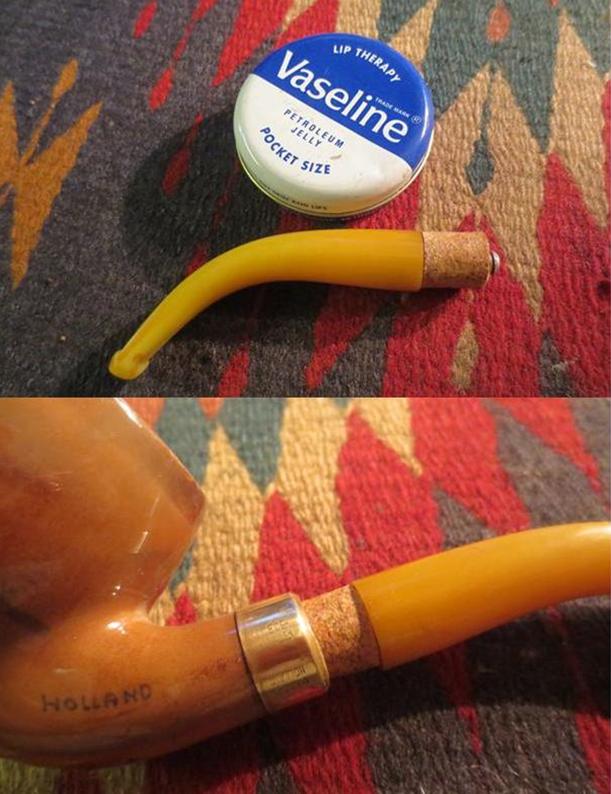
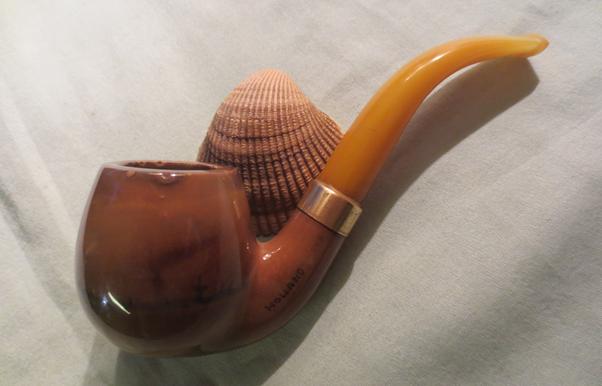
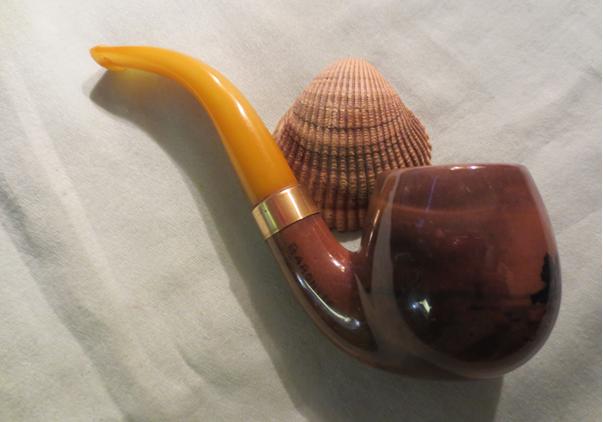
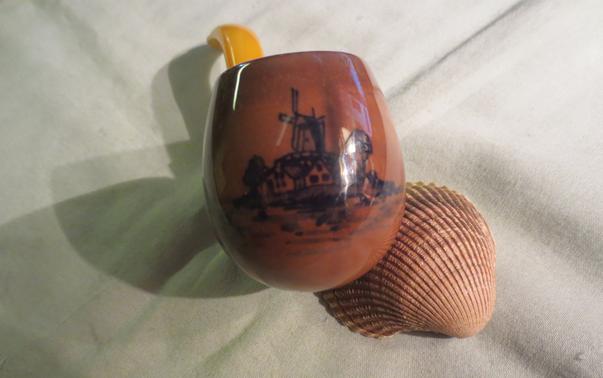
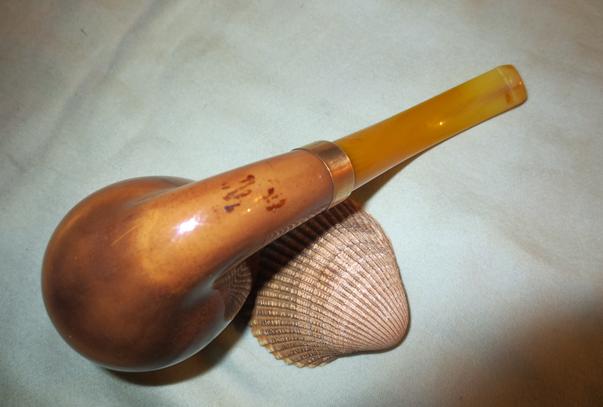
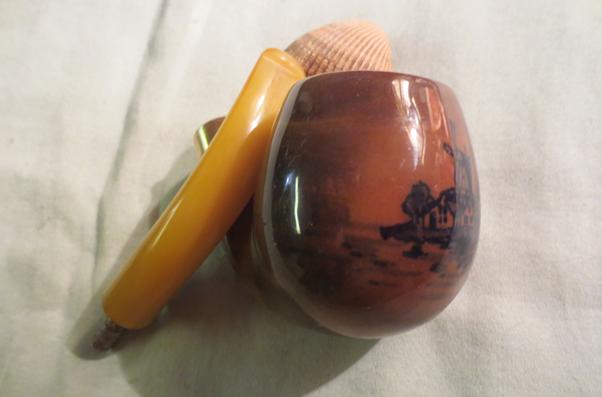
Steve, a pipe man in Northern British Columbia who sent me this old Baronite pipe said it belonged to his grandfather. That makes sense to me looking at the patina on this old double walled ceramic pipe. It is darkened with age like a well cured meerschaum. I have cleaned up quite a few of these but I have not seen one darkened to this degree. It is basically a bent apple shaped pipe with a windmill and canal scene on the front of the bowl wrapping slightly onto each side. On the left side of the shank it reads Holland and on the right side Baronite. I had a memory of the Baronite stamping referring to a line of pipes from a Dutch company called GoedeWaagen. I looked it up on Pipedia: https://pipedia.org/wiki/GoedeWaagen. I found the following information that confirms that the Baronite was a line of Double Walled Ceramic pipes produced by GoedeWaagen. I quote the short article in full:

Dirck GoedeWaagen became a master pipemaker on January 1, 1779 and took on his first assistant the following month. Soon after Dirck’s grandson fell in love with and married a girl from the illustrious De Jong family, legendary in the ceramic pipemakers guild in Gouda. He built a workshop in the Keizerstraat in Gouda, which continued for two generations until his grandsom Abraham GoedeWaagen moved the company to a new location.

In 1853, Pieter Goedewaagen purchased his father-in-law’s factory “De Star”, which becomes the basis of the modern GoedeWaagen company. In approximately 1880, Abraham’s grandson Aart GoedeWaagen persuaded his father Pieter to expand the business with an eye towards more models of pipes, and P. GoedeWaagen & Sons was founded in response. Within ten years the firm had hundreds of models and P. GoedeWaagen & Son was exporting pipes around the globe.

GoedeWaagen continued to make pipes, but also began acquiring other ceramics firms, including ‘De Distel’ in 1923, and in so doing acquiring the expertise to make decorated ceramics other than clay pipes. It is at this time that the company is granted a Royal charter and by the 1930’s Royal Goedewaagen is one of the top names in dutch ceramics.

While Goedewaagen pipes were originally traditional and figural clays, after the invention of the double walled clay pipe by Zenith, also a Gouda company, Goedewaagen began producing pipes in that commonly seen style, which they marketed as The Baronite Pipe, advertised for its clean smoking and health benefits. Since the company’s bankruptcy in 1982, however, they have made only the occasional souvenir pipe, including a line commemorating Holland’s monarchs.

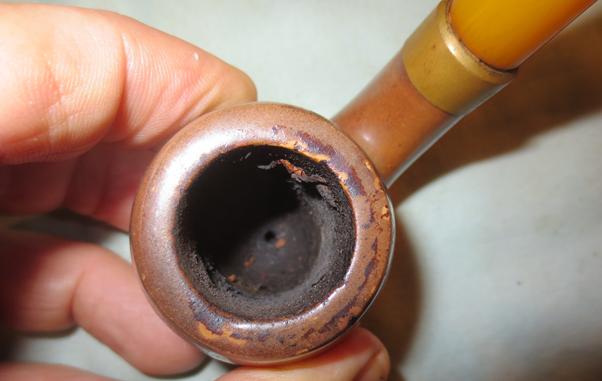
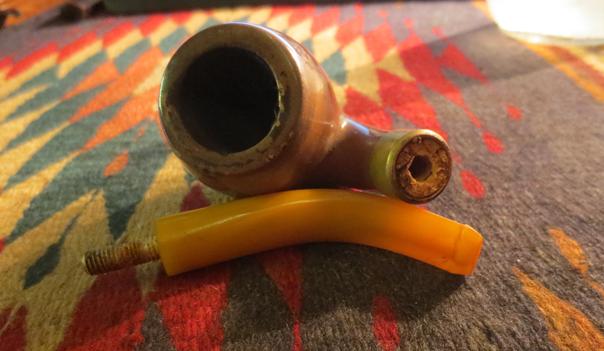
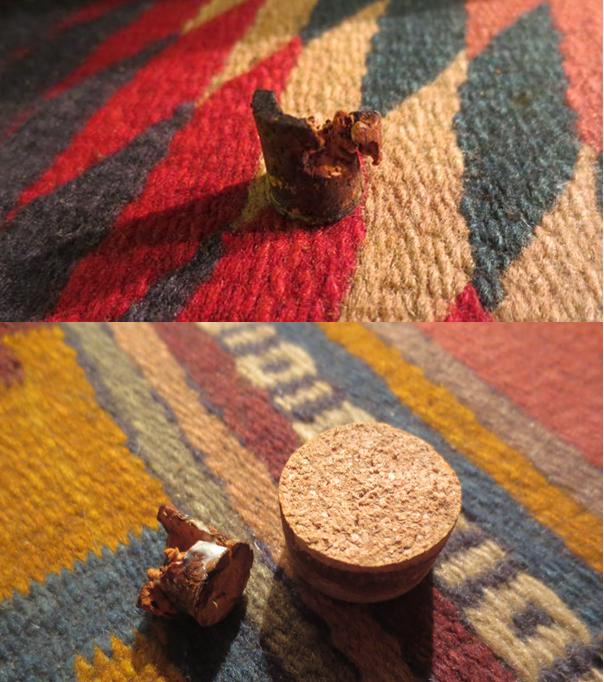
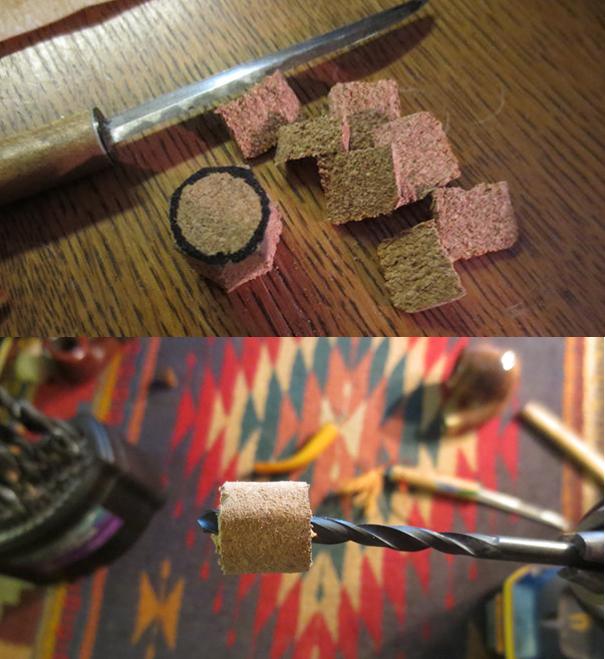
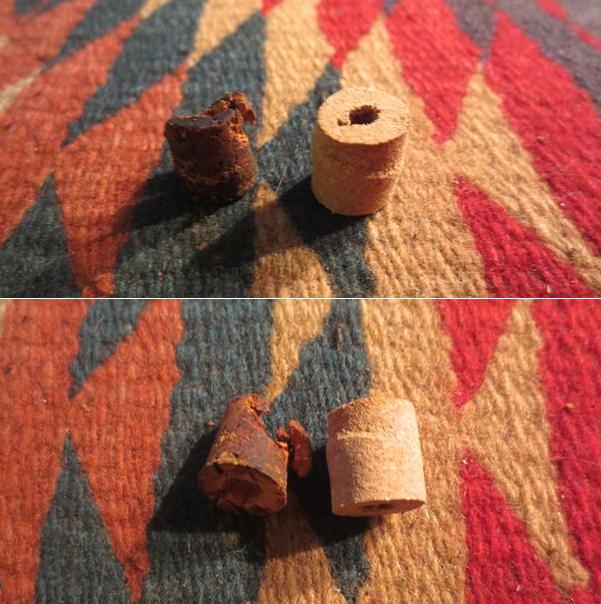
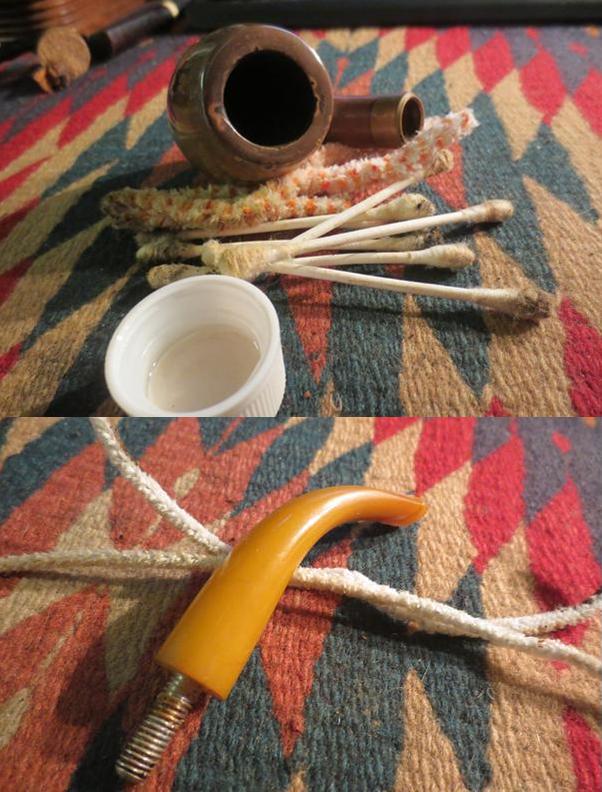
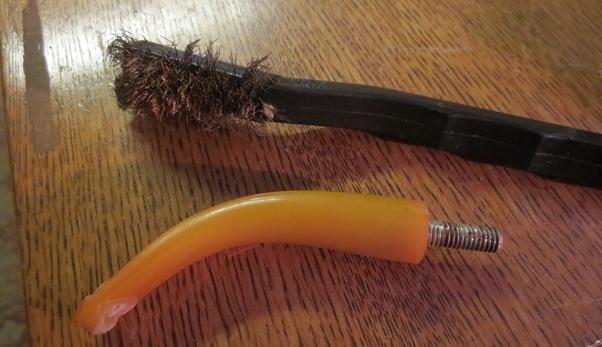
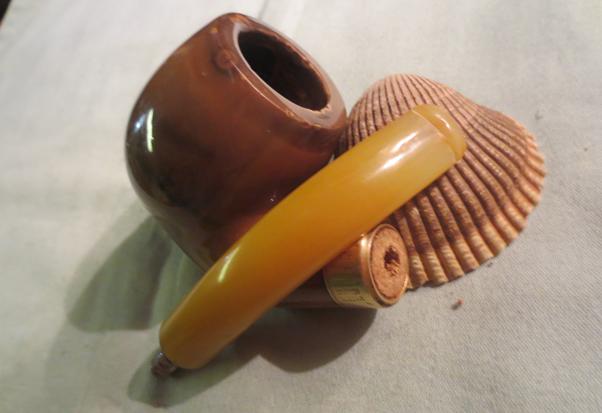
I have no idea when this pipe was made but at least we now know who made it and where it was made. The stem is yellow Bakelite with a threaded metal tenon. I don’t know if that is original but it is in excellent shape. It is screwed into a cork insert in the shank of the pipe. It had deep tooth marks on the top and bottom sides near the button and into the top of the button edges. The bowl in this case had a fairly thick cake of carbon built up inside. The exterior of the bowl had a lot of dirt and debris stuck to the surface of the bowl and shank. The pipe reeked of strong tobacco. The rim seemed to have some spots of either damage or flaws from the original manufacture. There was also some tar buildup on the rim top. The brass band on the shank was oxidized and dull. Overall it was a dirty pipe in need of TLC.delft1 delft2I took this close up photo of the interior of the bowl and the rim. Note the airway at the bottom of the bowl that drops into the inner space between the two ceramic walls. The rim is also dirty with tar. In the second photo I removed the stem and you can see the crumbling cork insert.delft3 delft4I sanded the top of the bowl with a 1500 grit micromesh sanding pad to remove the tar and buildup without damaging the glaze on the ceramic. I reamed the bowl with a Savinelli Pipe Knife to scrape the cake back to the bare ceramic walls. Just a note – ceramic bowls like meerschaum bowls should be wiped out after each smoke to make sure that a cake does not build up in the bowl.delft5 delft6I pulled the cork insert out of the shank and it was dry and deteriorated. I wanted to try to rejuvenate the cork but it was too far gone and crumbled in my hands. A new cork could have been purchased from a pharmaceutical supply but I have always cut and shaped my own cork inserts for these from old wine corks. I cut a piece of cork the same thickness as the insert.delft7I traced the diameter of the old insert on the new piece of cork and cut off the excess with a sharp pen knife.  I shaped it with a Dremel and sanding drum until it was round. I twisted the cork onto a drill bit the sized of the tenon.delft8I sanded the diameter of the insert with the Dremel and sanding drum until the diameter was the same as the old insert and could be compressed into the shank of the pipe. In the photo below you can still see a slight ridge in the middle of the cork. I would need to smooth that out before I inserted it in the shank.delft9I scrubbed out the shank and the airway in the stem with pipe cleaners, cotton swabs and alcohol. I was able to get a lot of the grime and grit out of the shank. I was not able to clean in the airspace between the walls using this method.delft10I remembered reading somewhere that you could rinse out the inside of the shank and the airspace with water. I ran warm water in the shank and plugged the bowl with my thumb and vigorously shook the bowl. The warm water loosened the buildup in the airspace and soon chunks of dark tar fell out of the shank. I continued to shake and rinse the bowl until the water came out clean. The pipe began to smell fresh again.delft11Before I left for work this morning I repaired the deep tooth marks on the stem with clear super glue and let the stem cure all day. When I got home I cleaned the threads on the metal tenon with a brass bristle brush to remove the rust and oils that had accumulated there as well.delft12I filed the patches on the stem and recut the edges of the button and took the repairs down until they were even with the surface of the Bakelite stem.delft13I sanded the patched areas of the stem with 220 grit sandpaper and reshaped the button as well. The surface of the patch blended in on both sides of the stem. There is a slight problem in sanding the yellow Bakelite stem in that the sanded areas are lighter than the rest of the stem. Polishing the stem will minimize this but it is definitely lighter. To me a smooth stem is far better than a rough, tooth marked stem so I am willing to live with the slightly lighter stem at that point. I have also found that as the pipe is used the colour eventually blends in.delft14I polished the stem with 1500-12000 grit micromesh sanding pads – wet sanding with 1500-2400 grit pads and dry sanding with 3200-12000 grit pads. I rubbed the stem down with Obsidian Oil between each set of three pads. I am pretty sure that it does nothing for the Bakelite but it does give the micromesh pads more bite and add to the quality of the polishing.delft15 delft16 delft17With the stem polished it was time to twist the cork insert onto the tenon. I have inserted them directly into the shank before but find that this method works easier and keeps the cork from breaking in the process of inserting it.delft18Before I inserted it into the shank I rubbed the cork down with Vaseline Petroleum Jelly to soften the cork and make it easier to slip into the shank. Once the cork was greased I carefully pushed it into the shank.delft19I hand buffed the bowl and stem with Conservator’s Wax and a soft microfibre cloth to polish it and give it a shine. I was able to clean off the grime and leave behind the rich reddish-brown patina on the bowl. I polished the brass band with 6000-12000 grit micromesh sanding pads. I waxed it as well. The finished pipe is shown in the photos below. It is ready for another long life of enjoyment. It looks and smells great. The polishing of the stem minimised the lightning of the yellow so that it almost is unnoticeable. I am hoping that Steve enjoys his grand dad’s pipe and lets his mind travel to the times he remembers him smoking it. Cheers. Thanks for looking.delft20 delft21 delft22 delft23 delft24 delft25 delft26 delft27