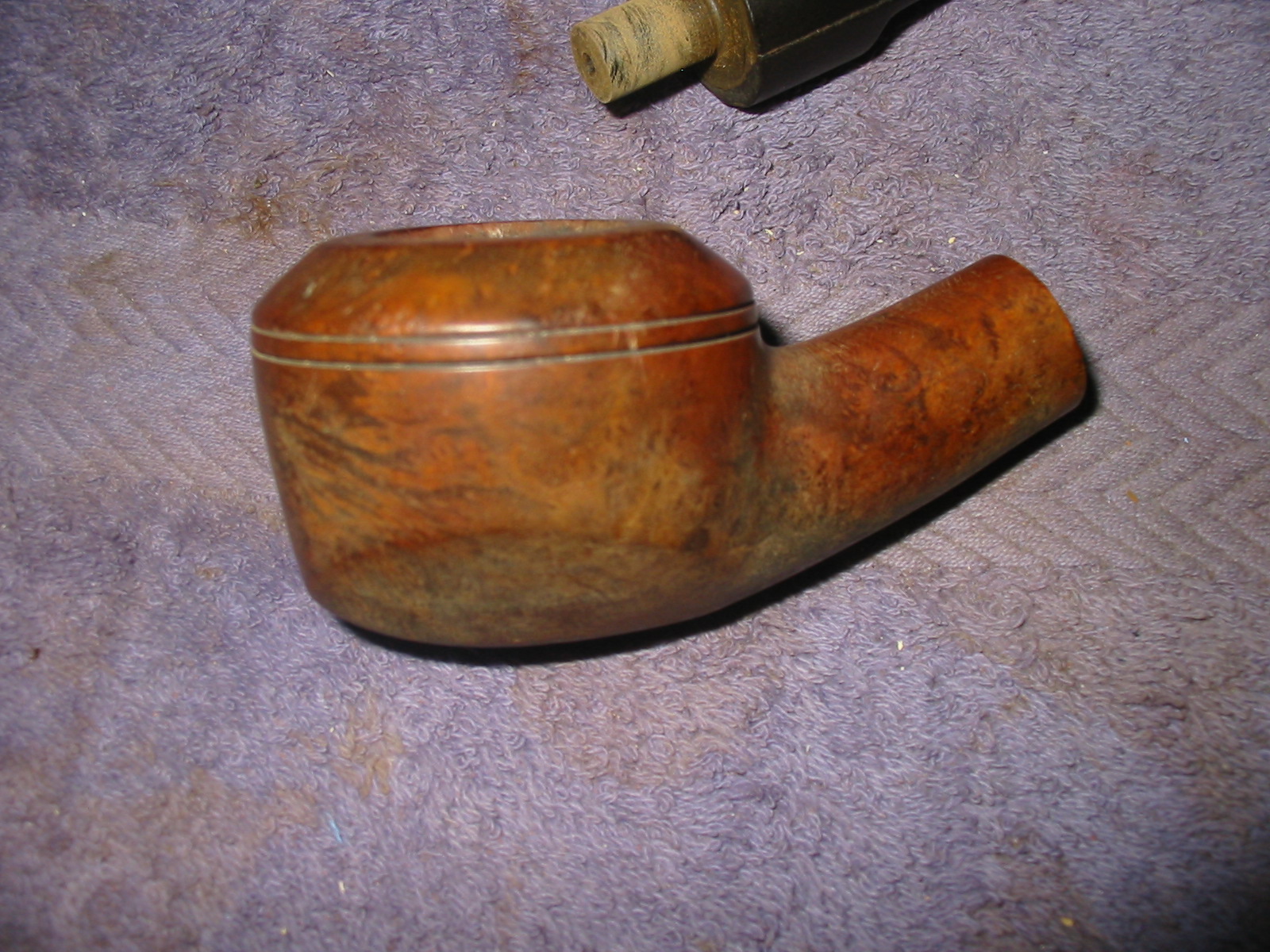
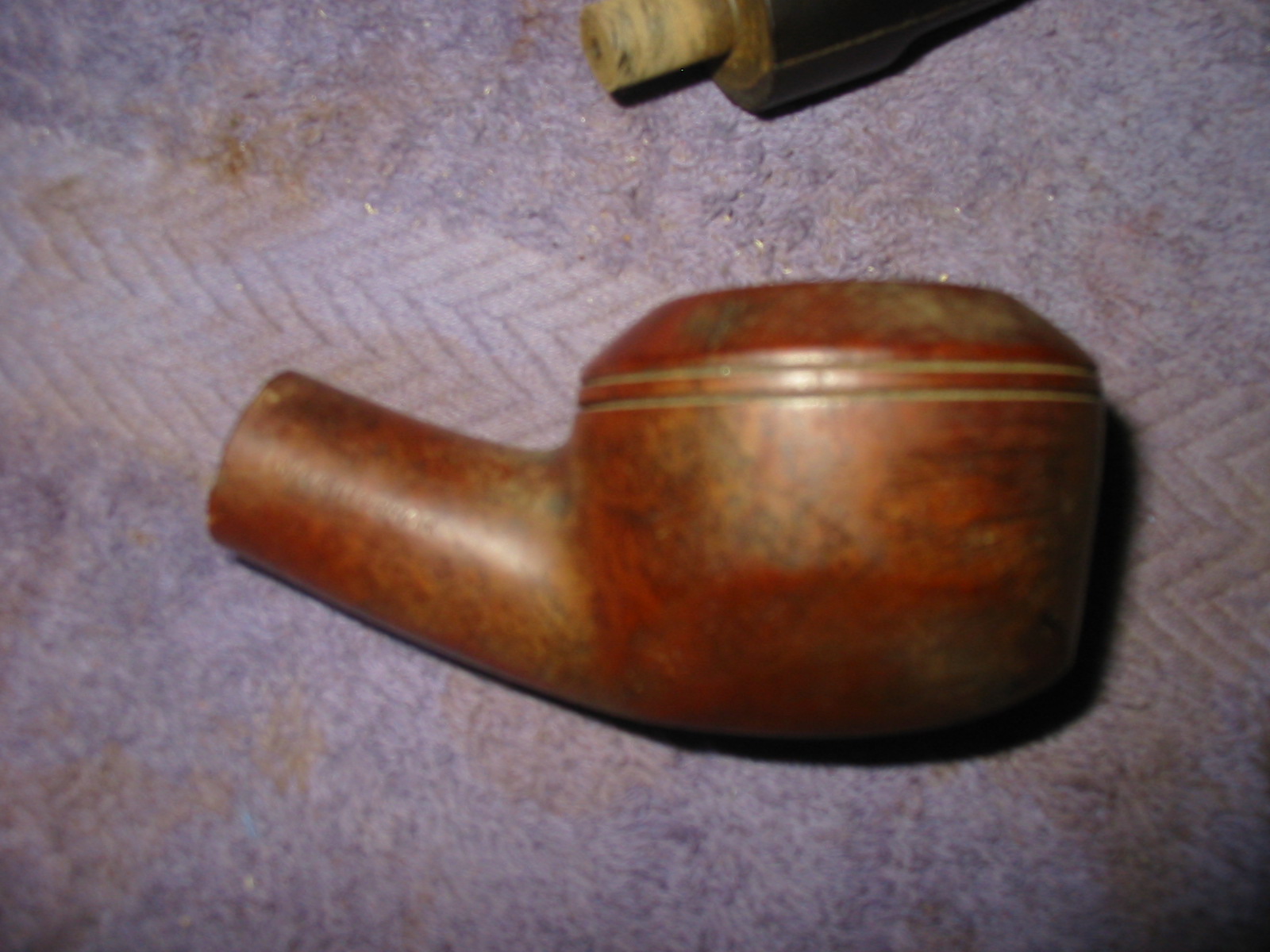
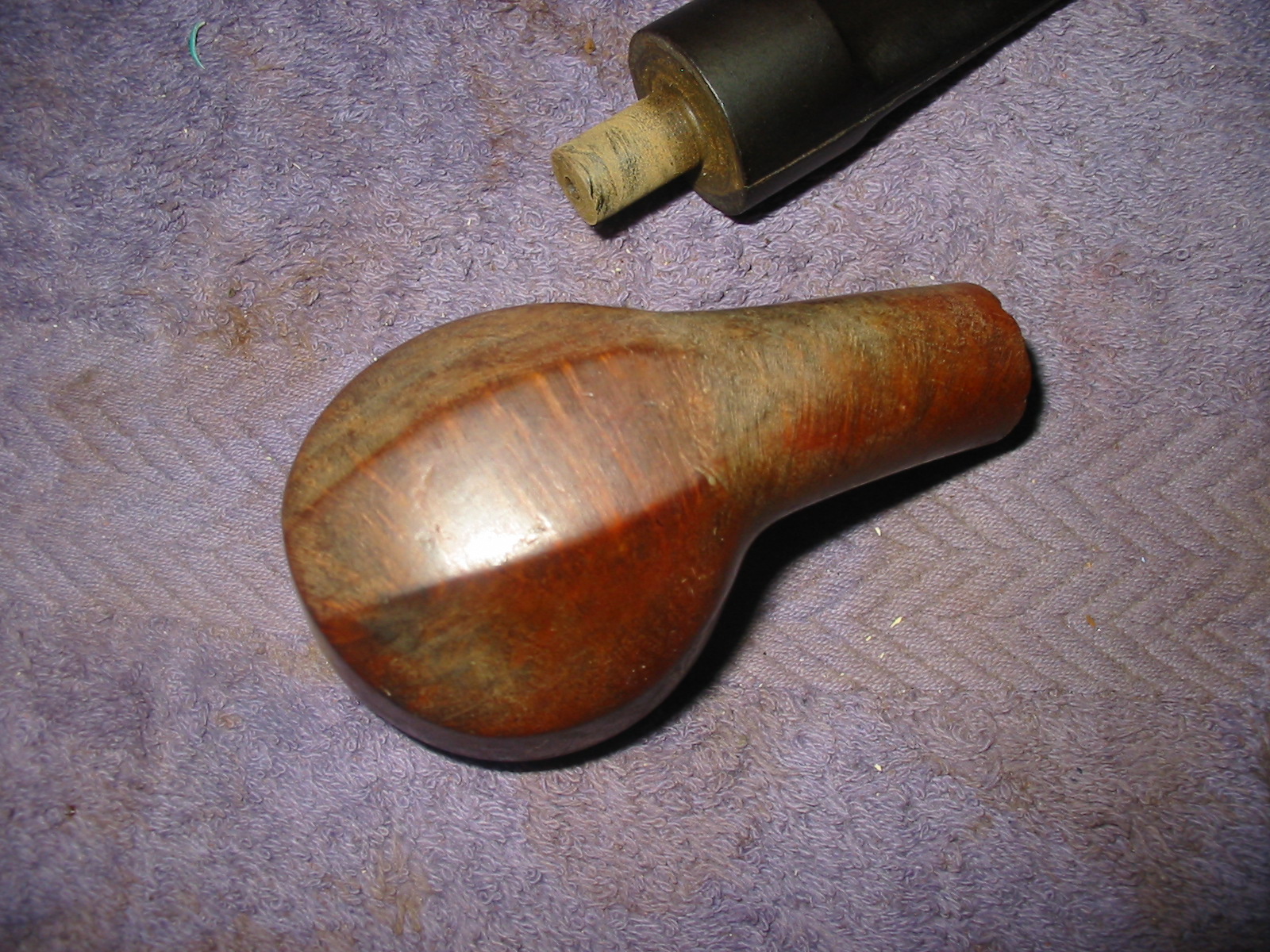
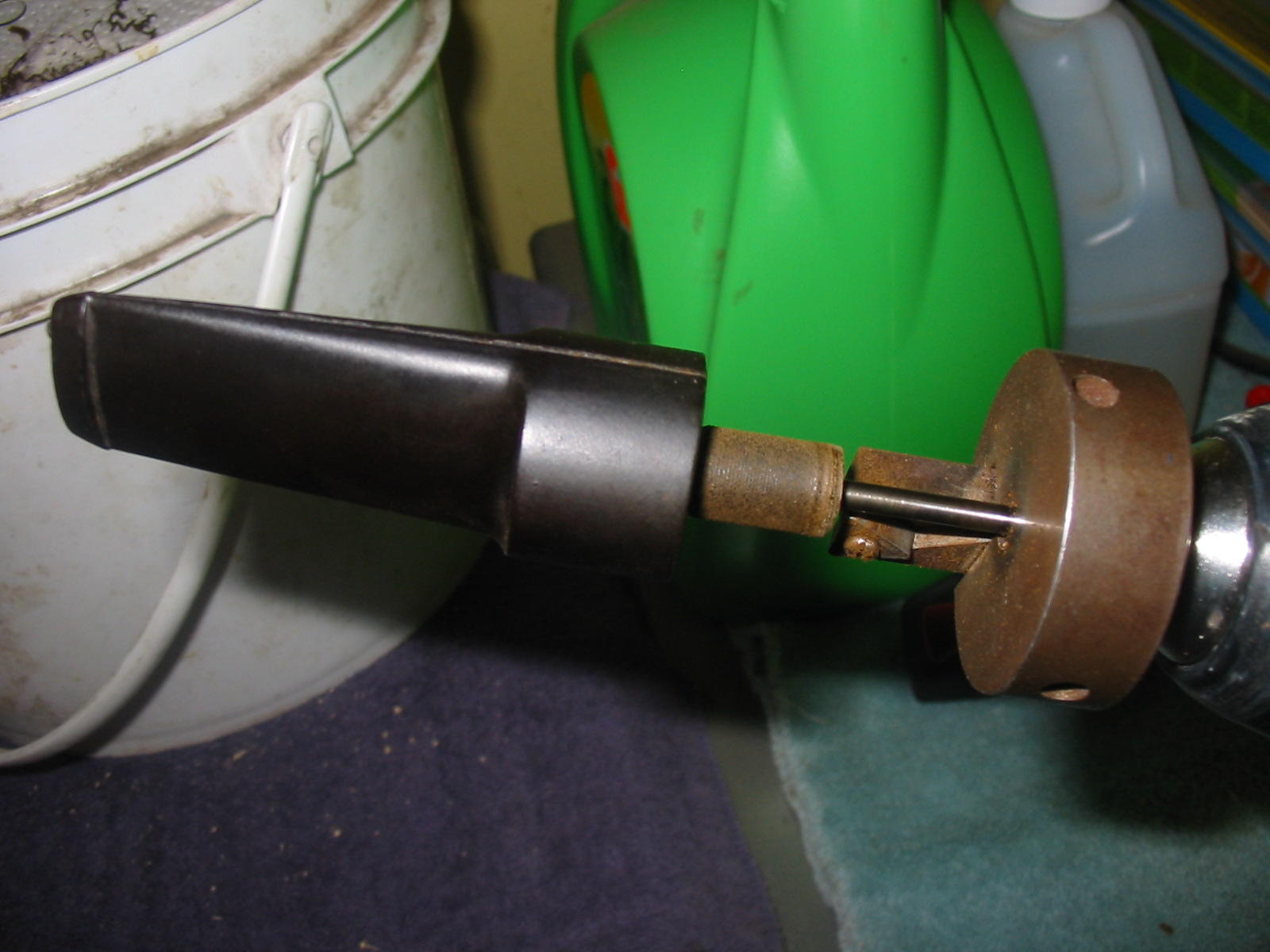
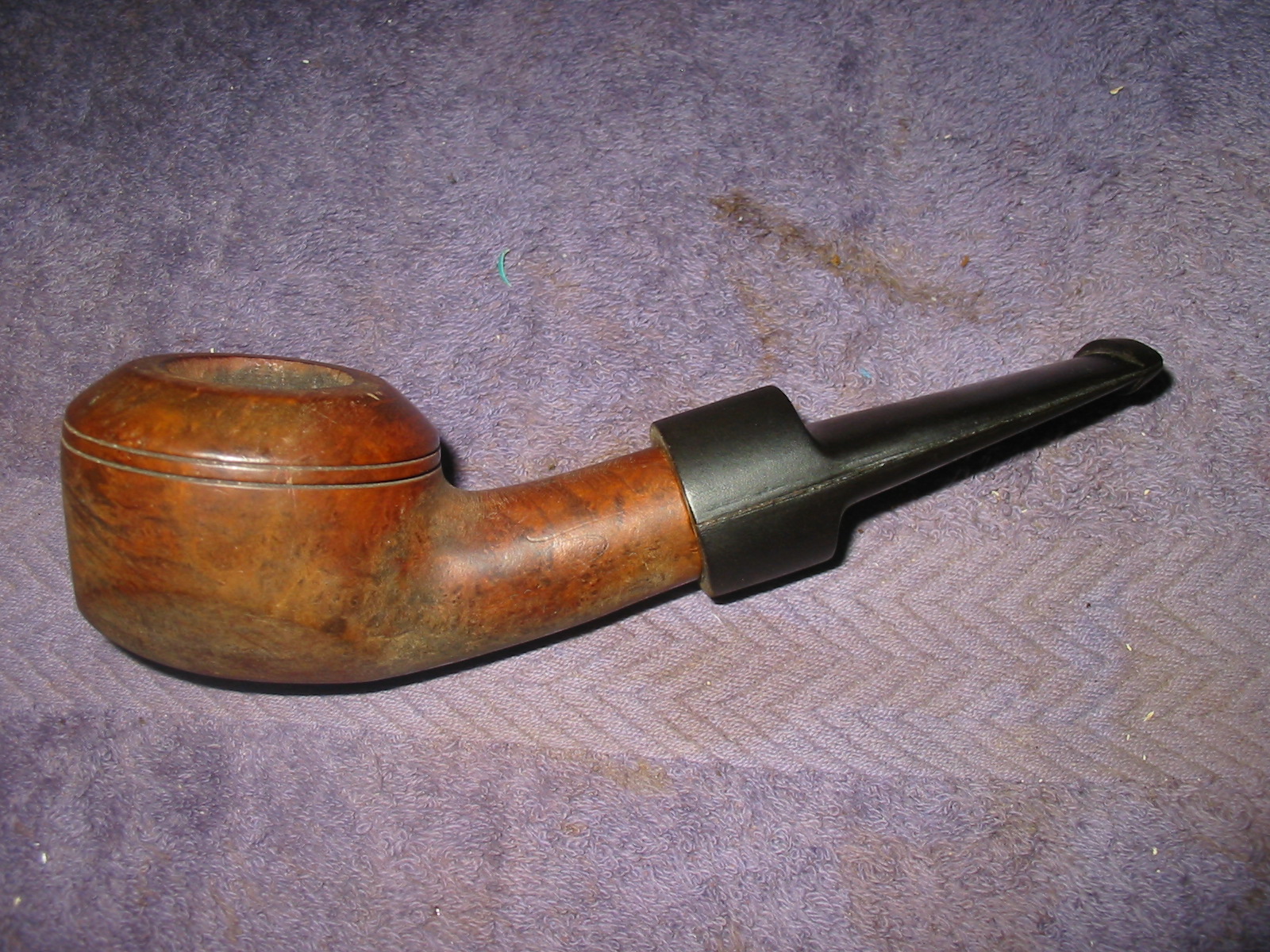
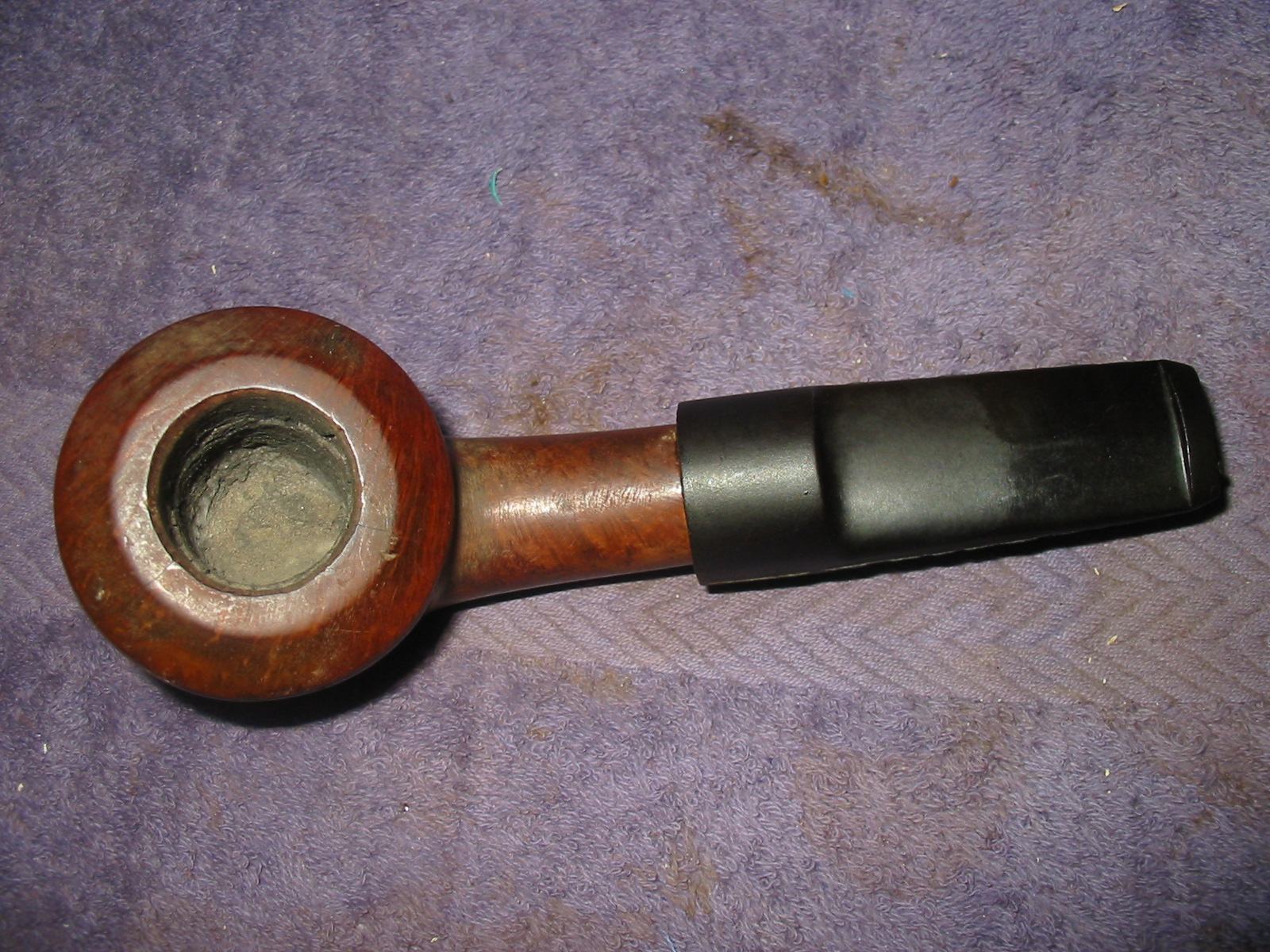
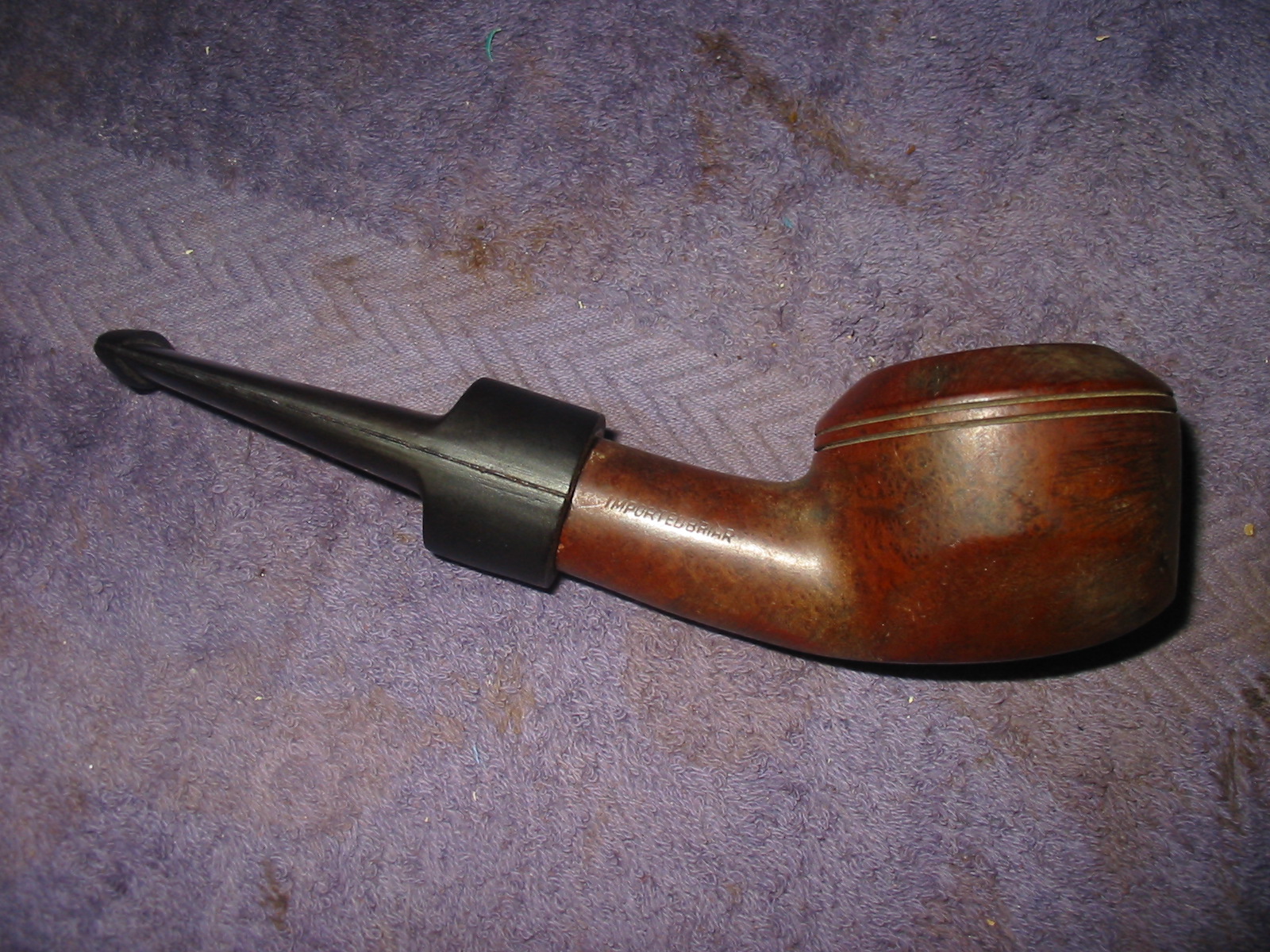
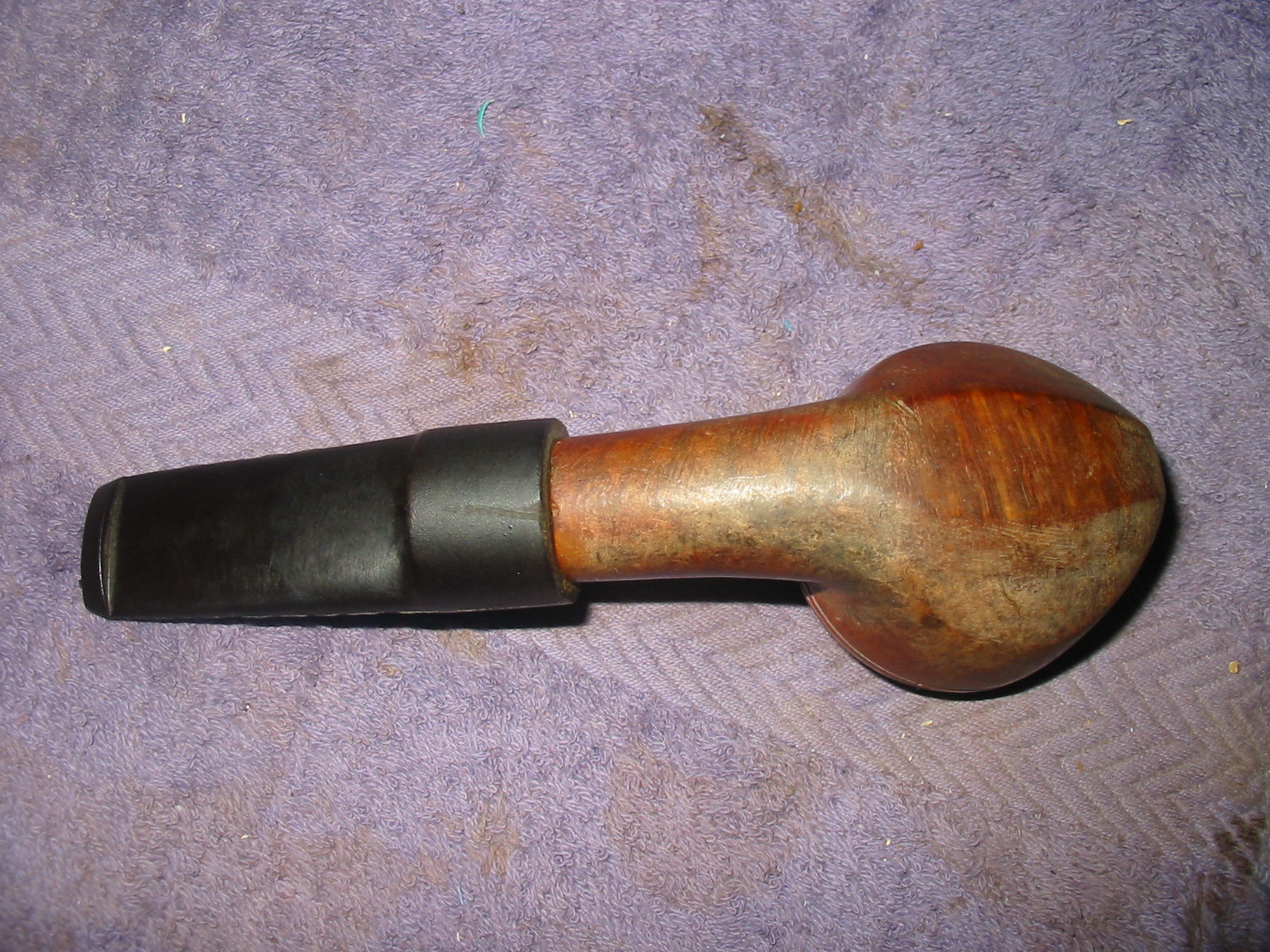
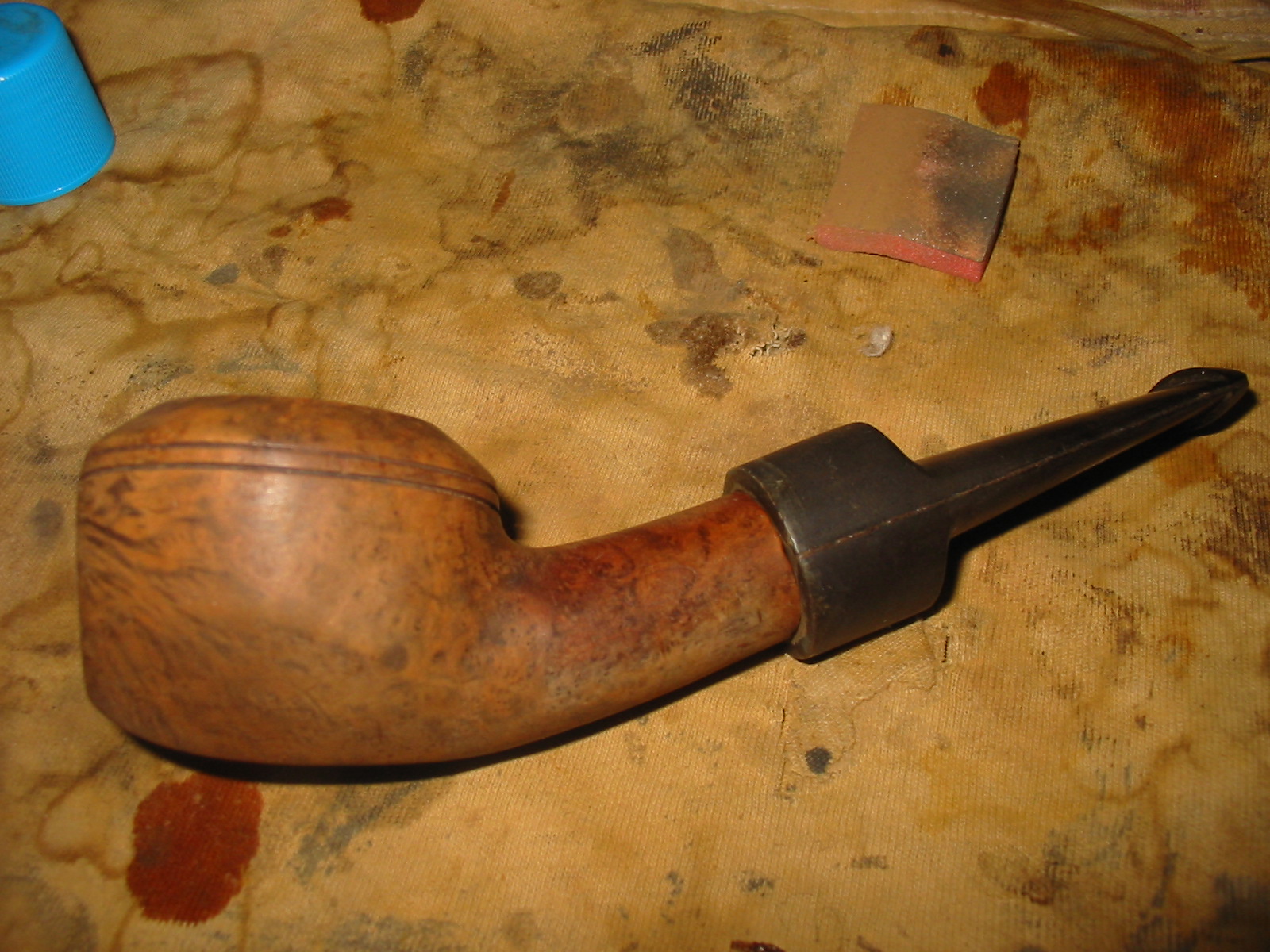
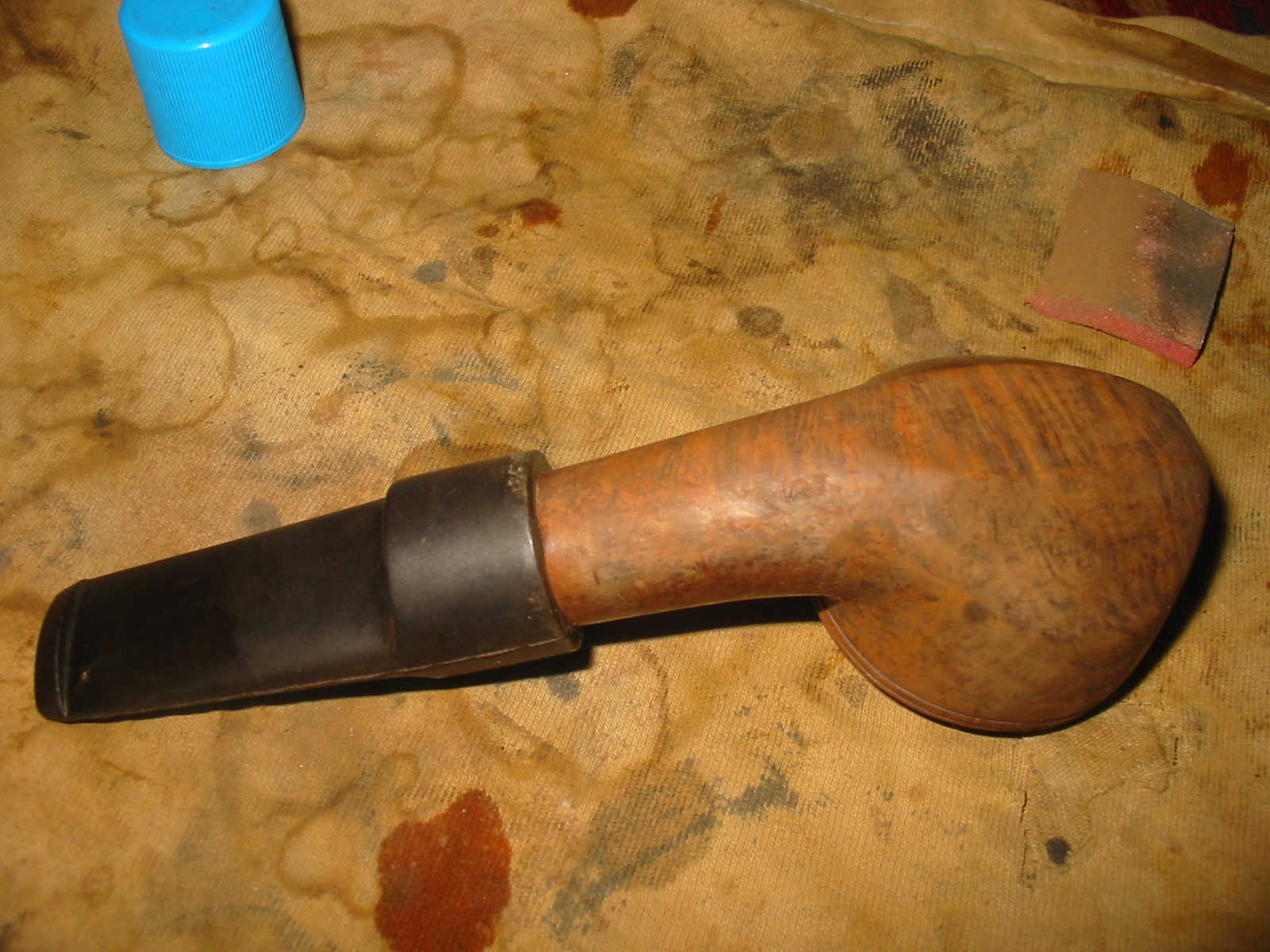
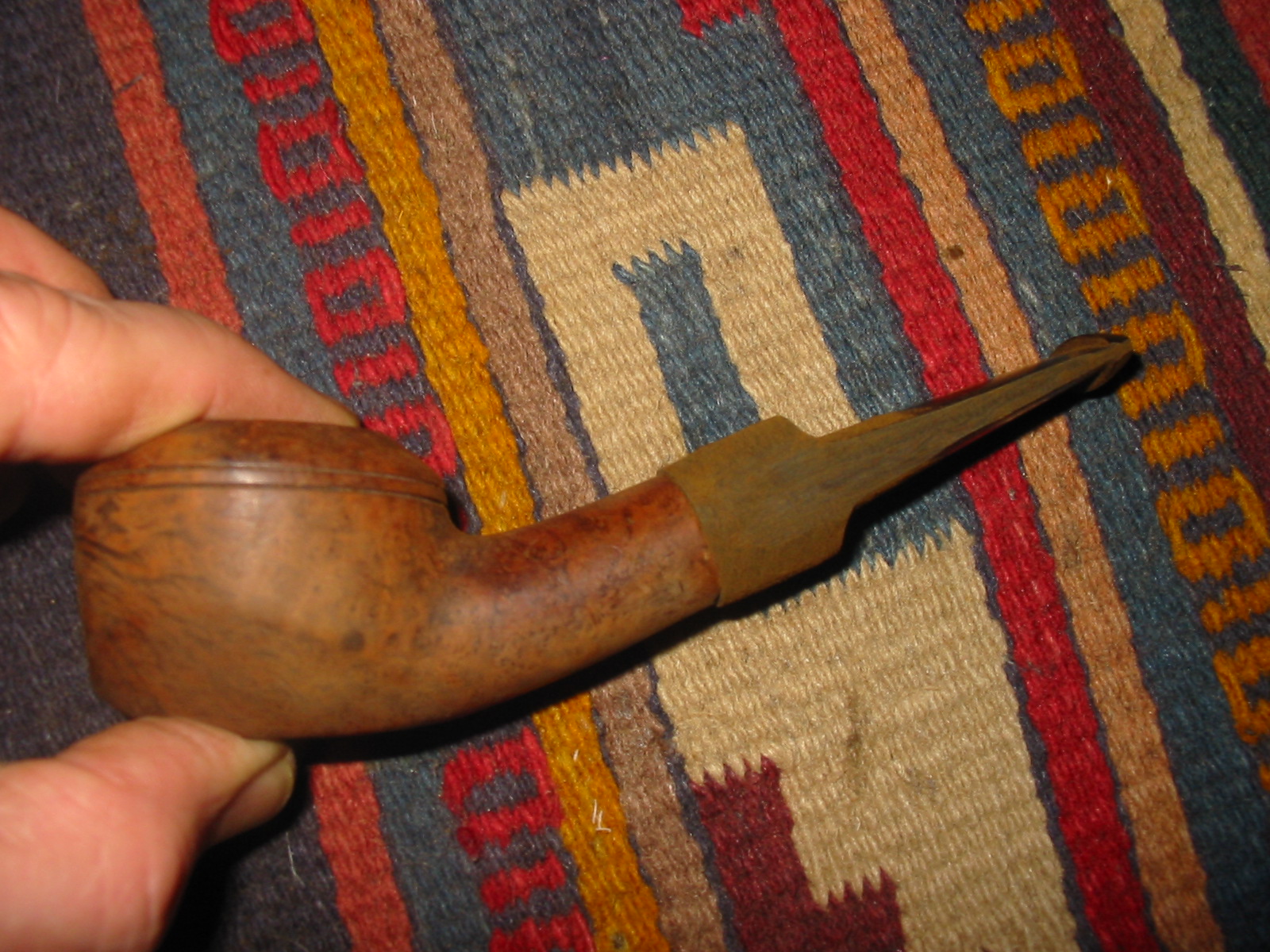
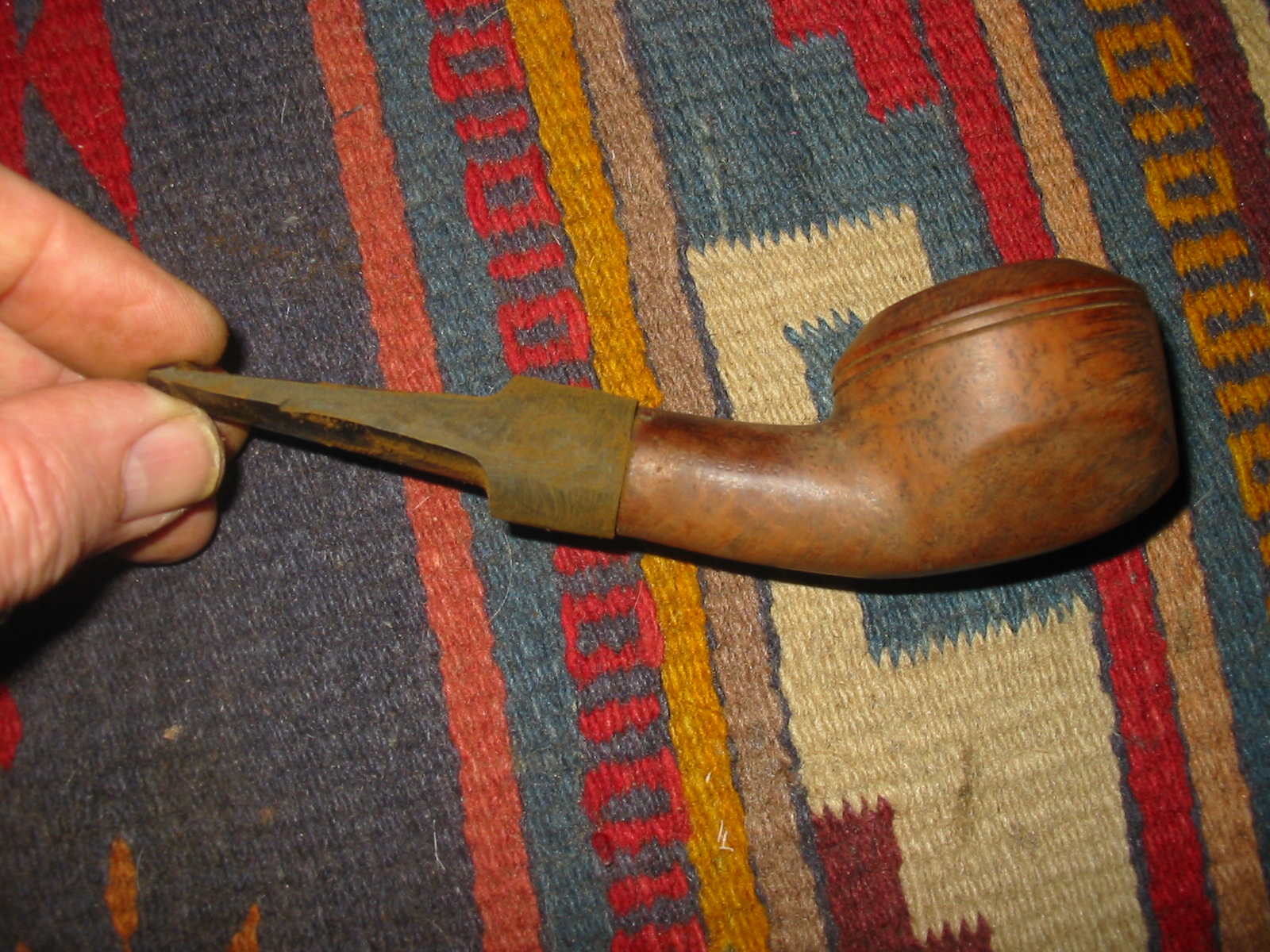
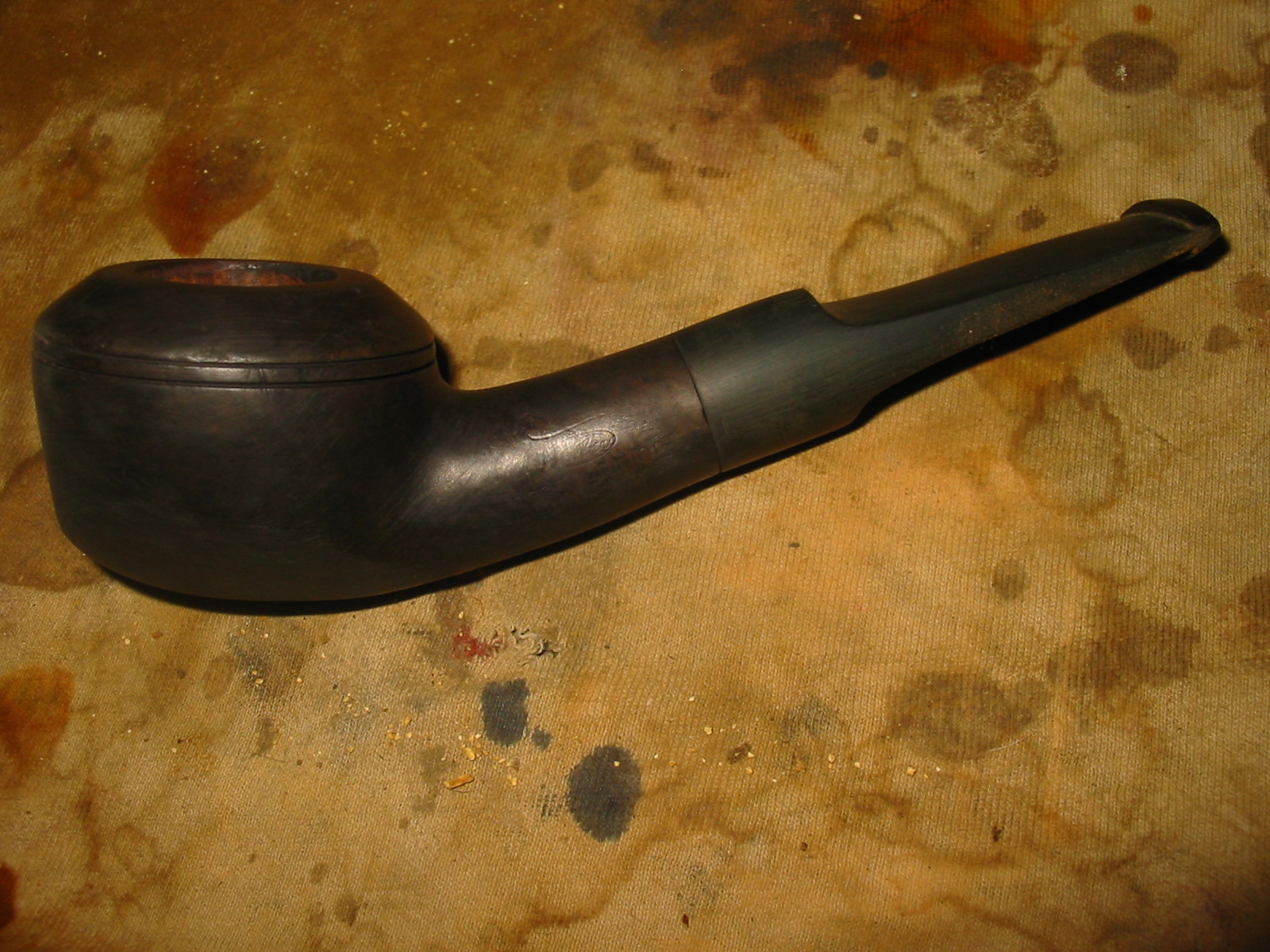
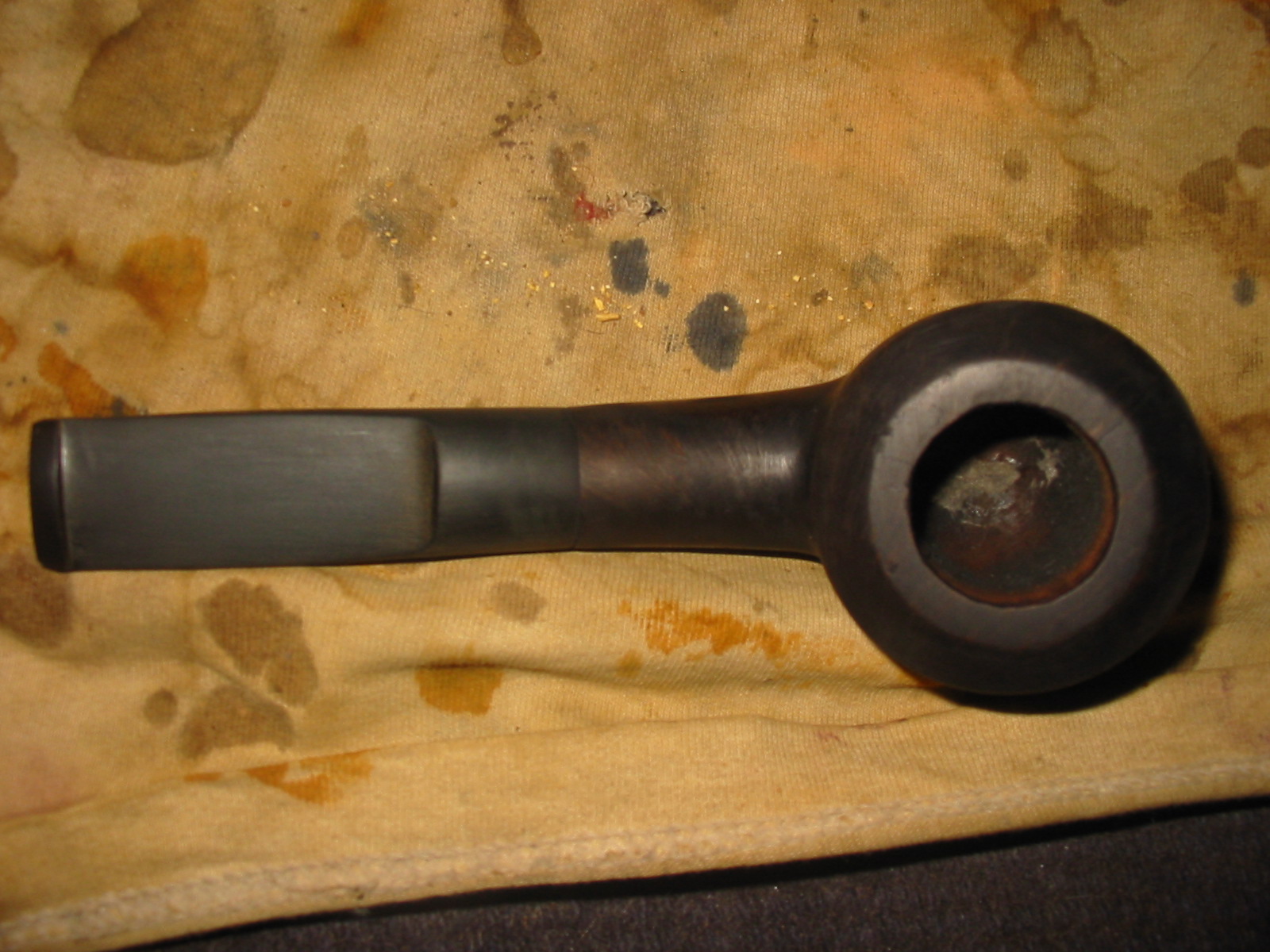
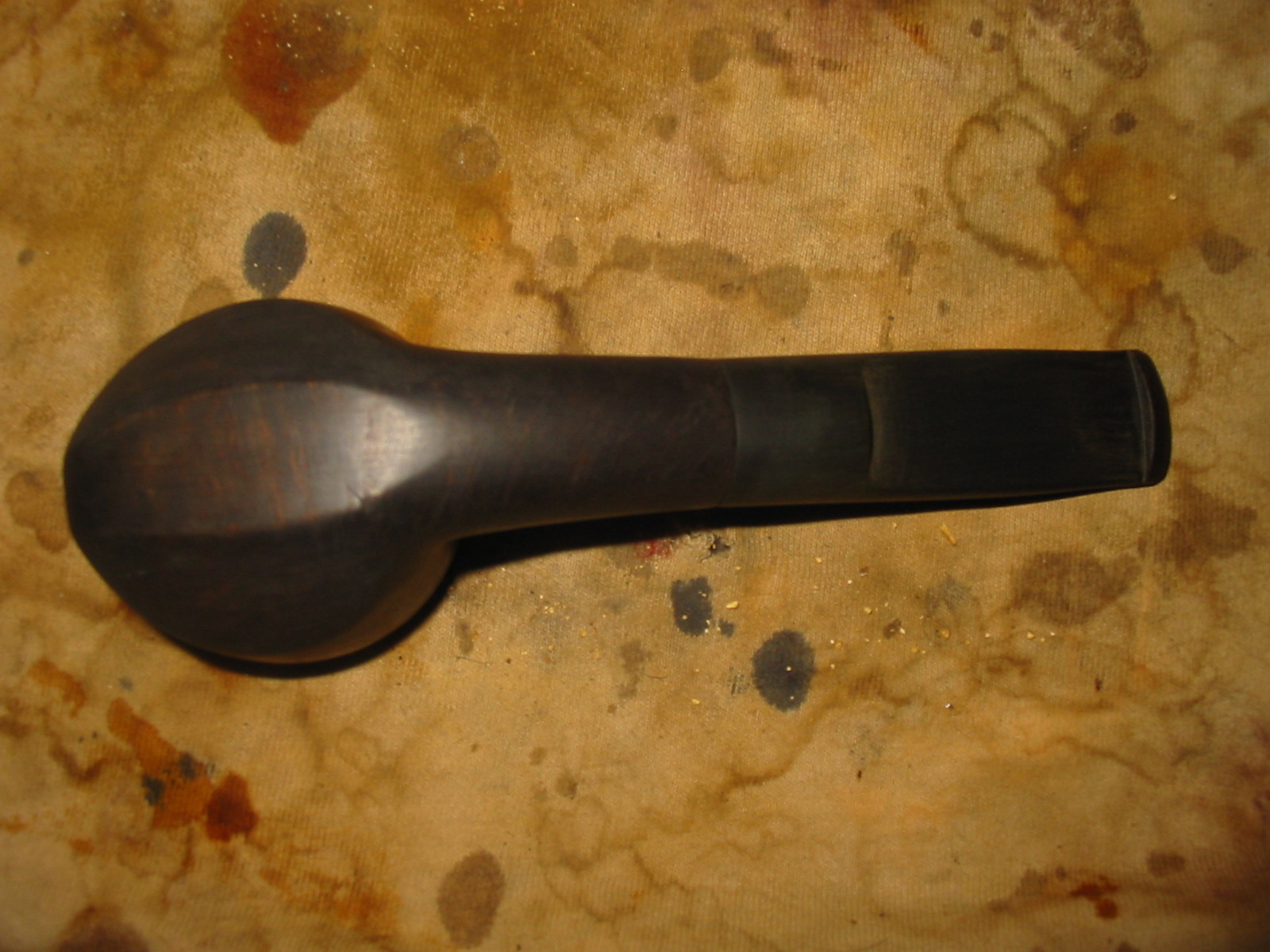
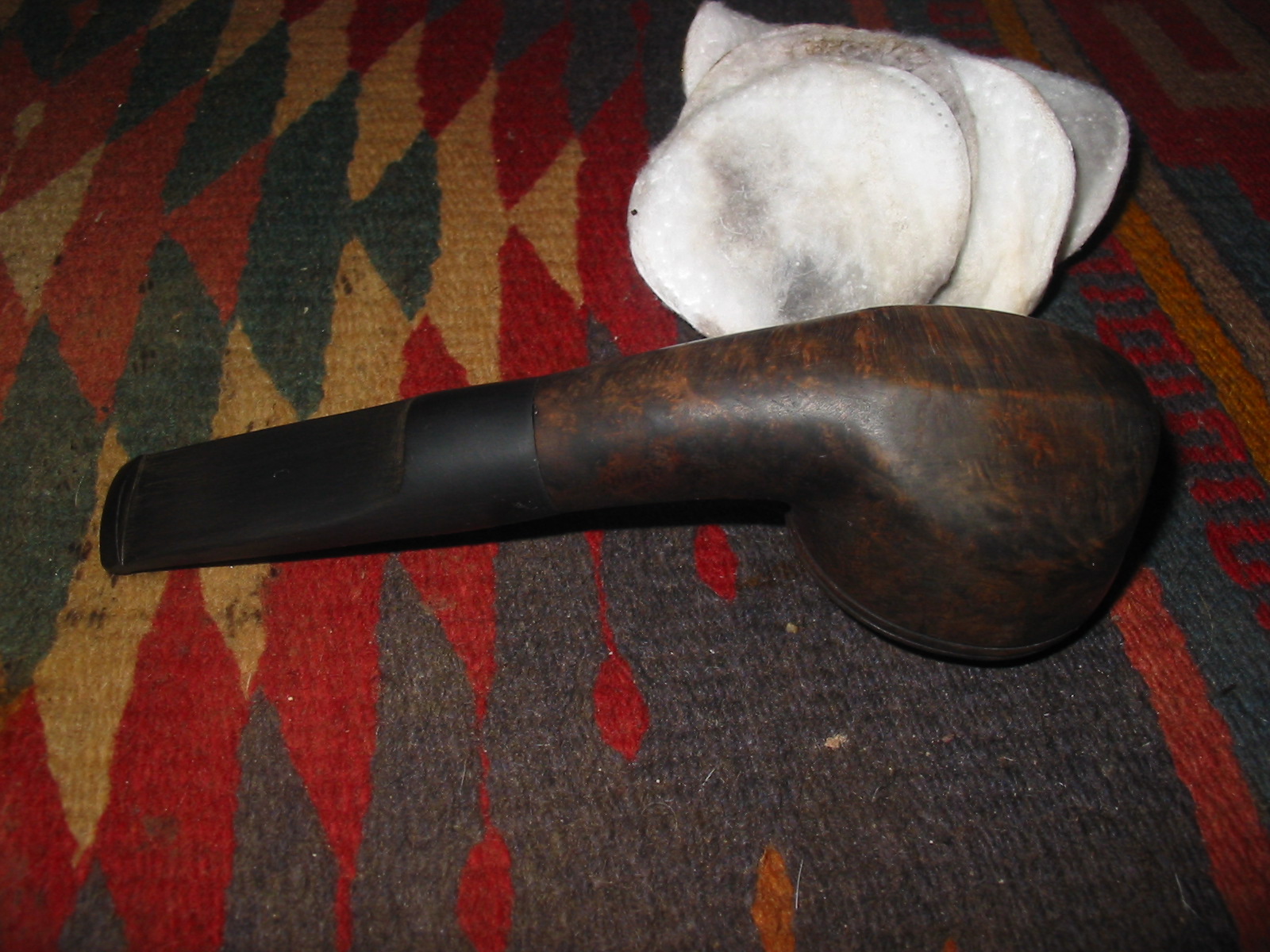
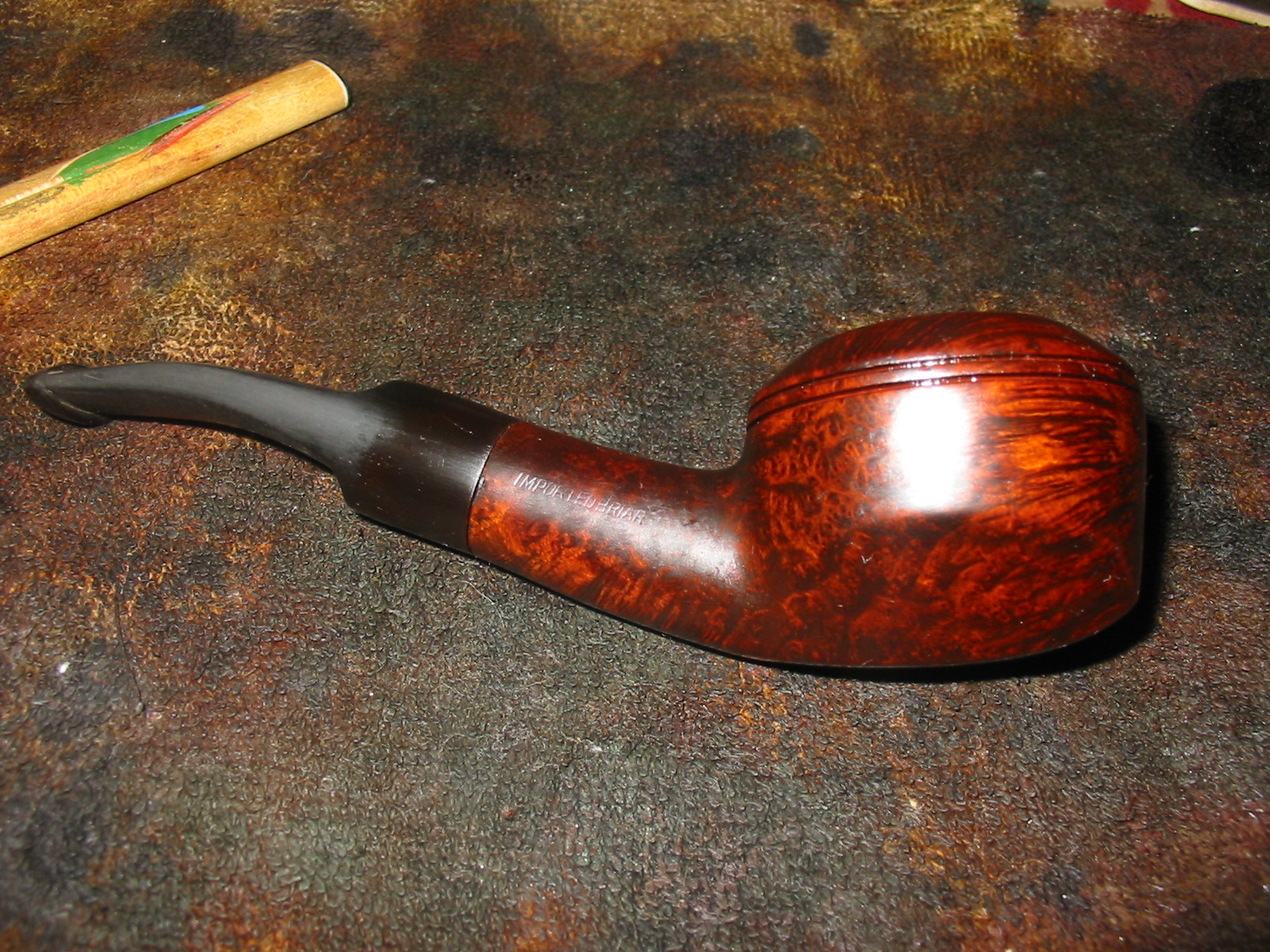
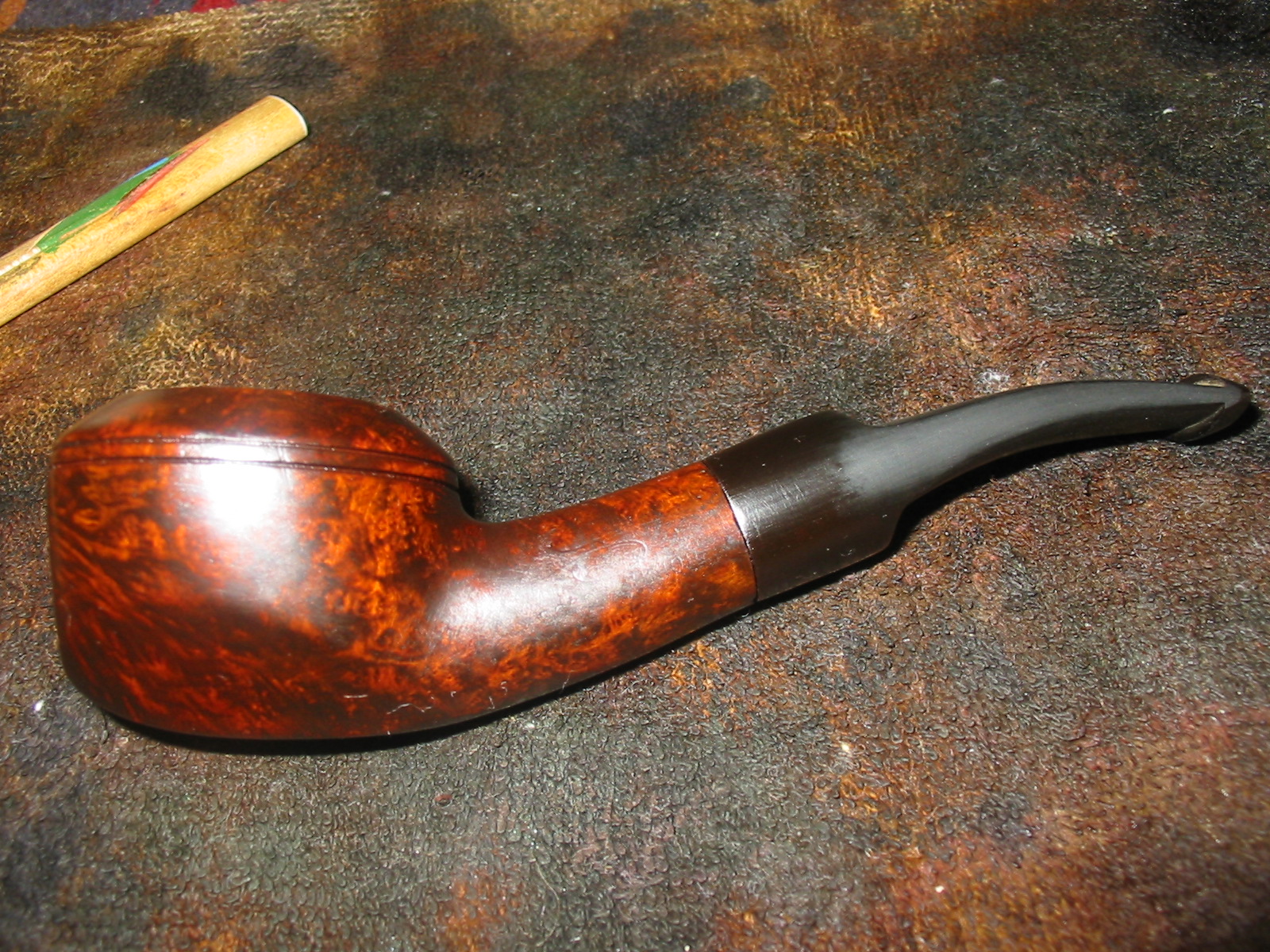
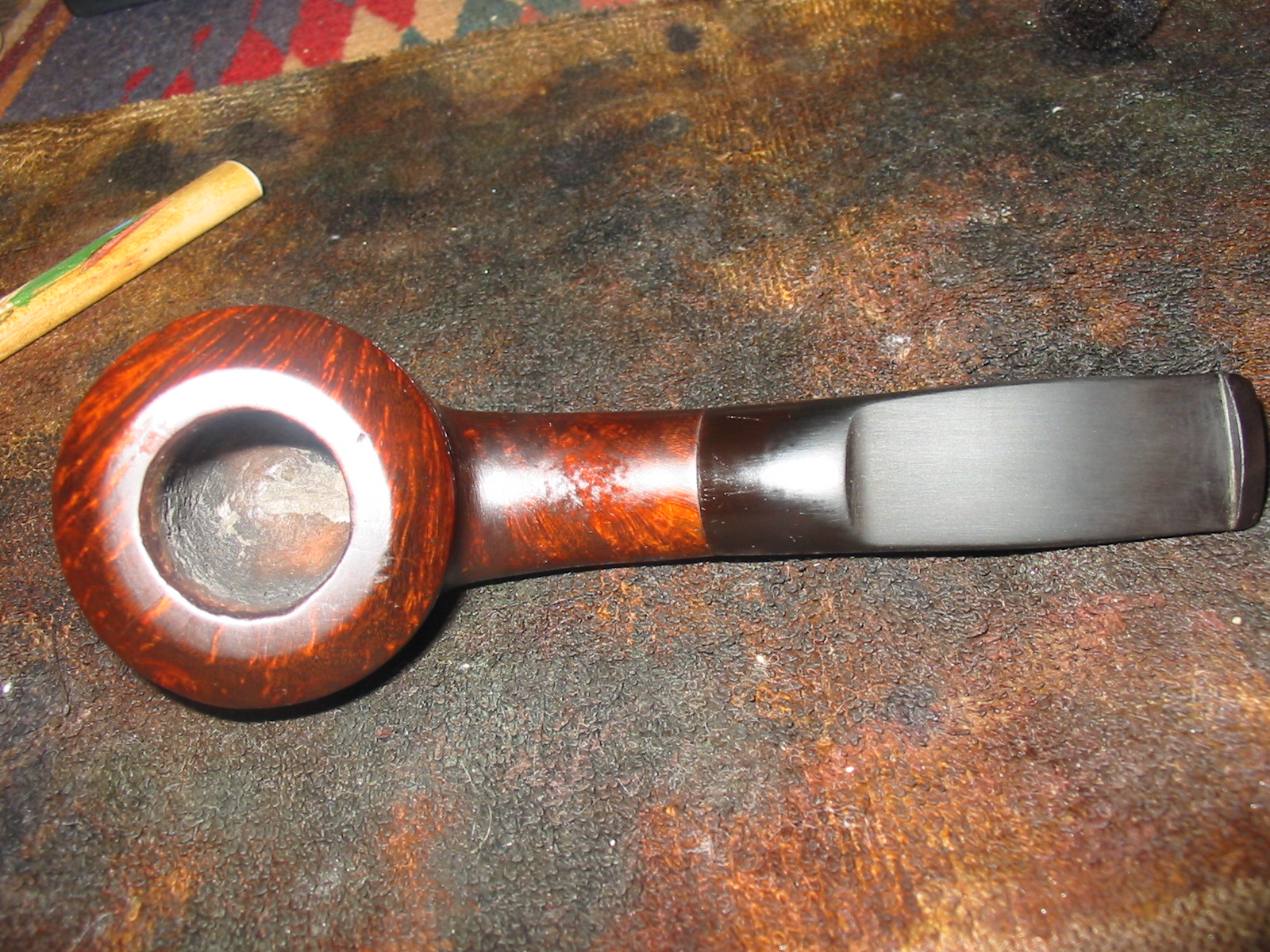
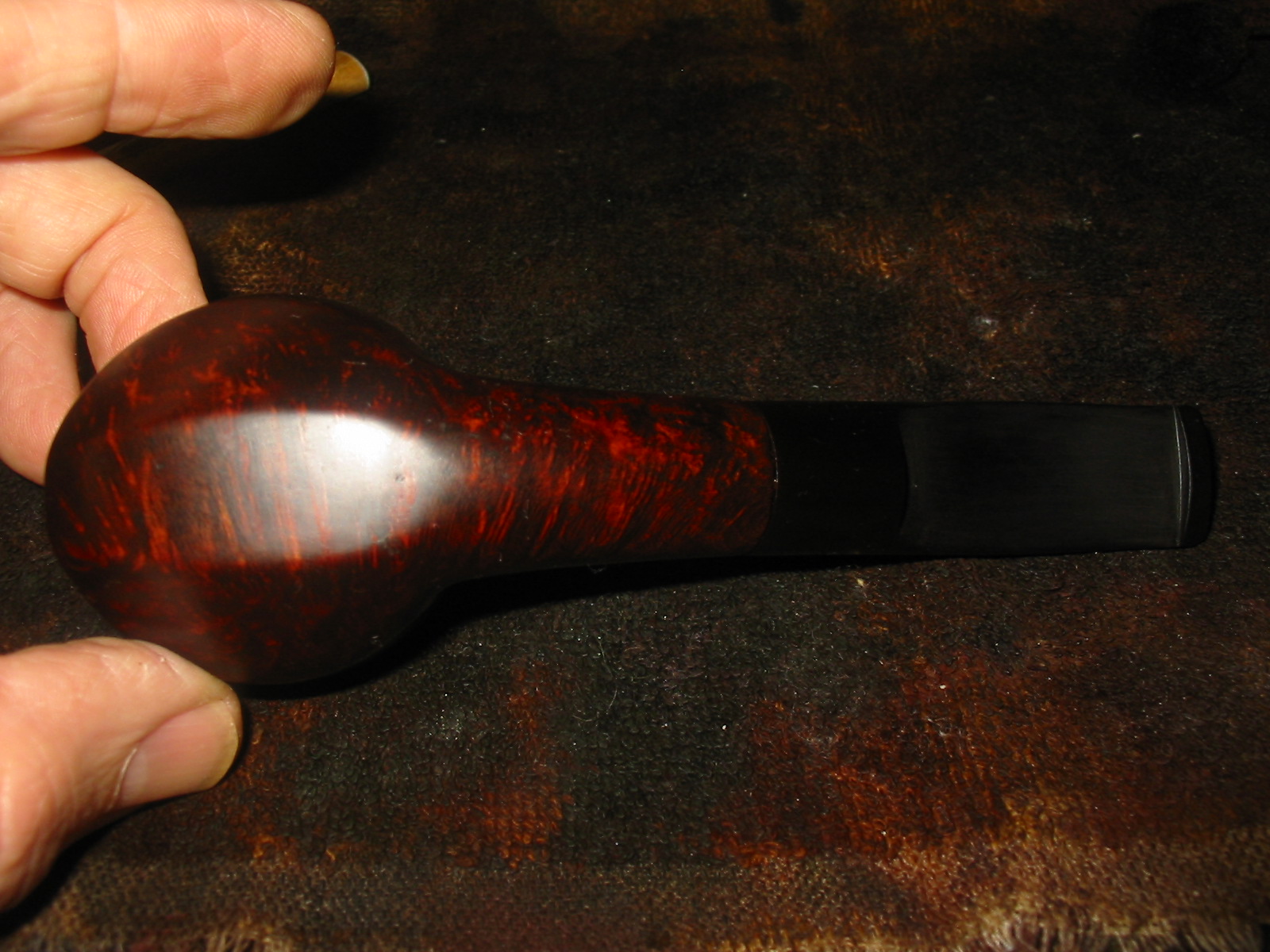
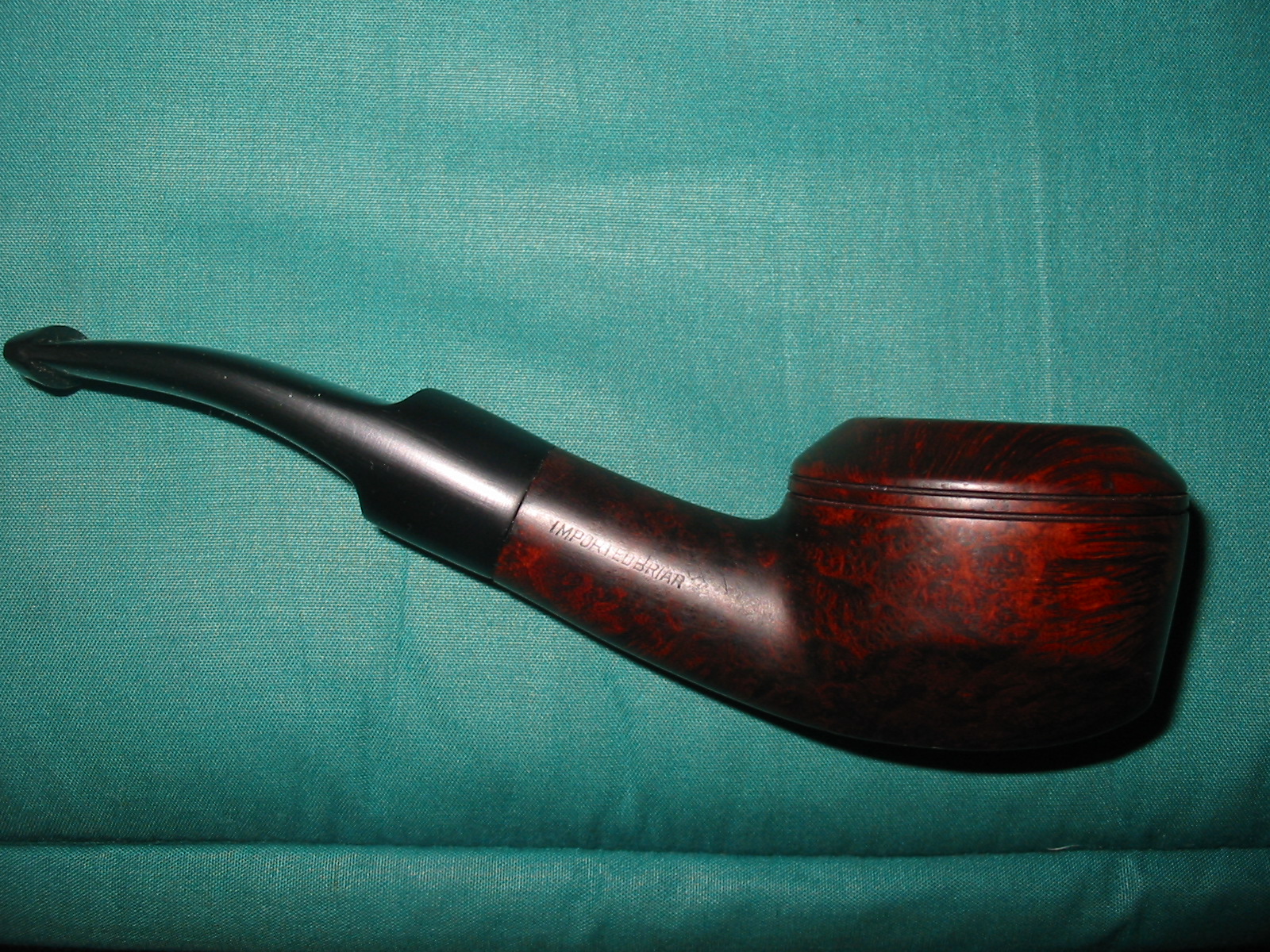
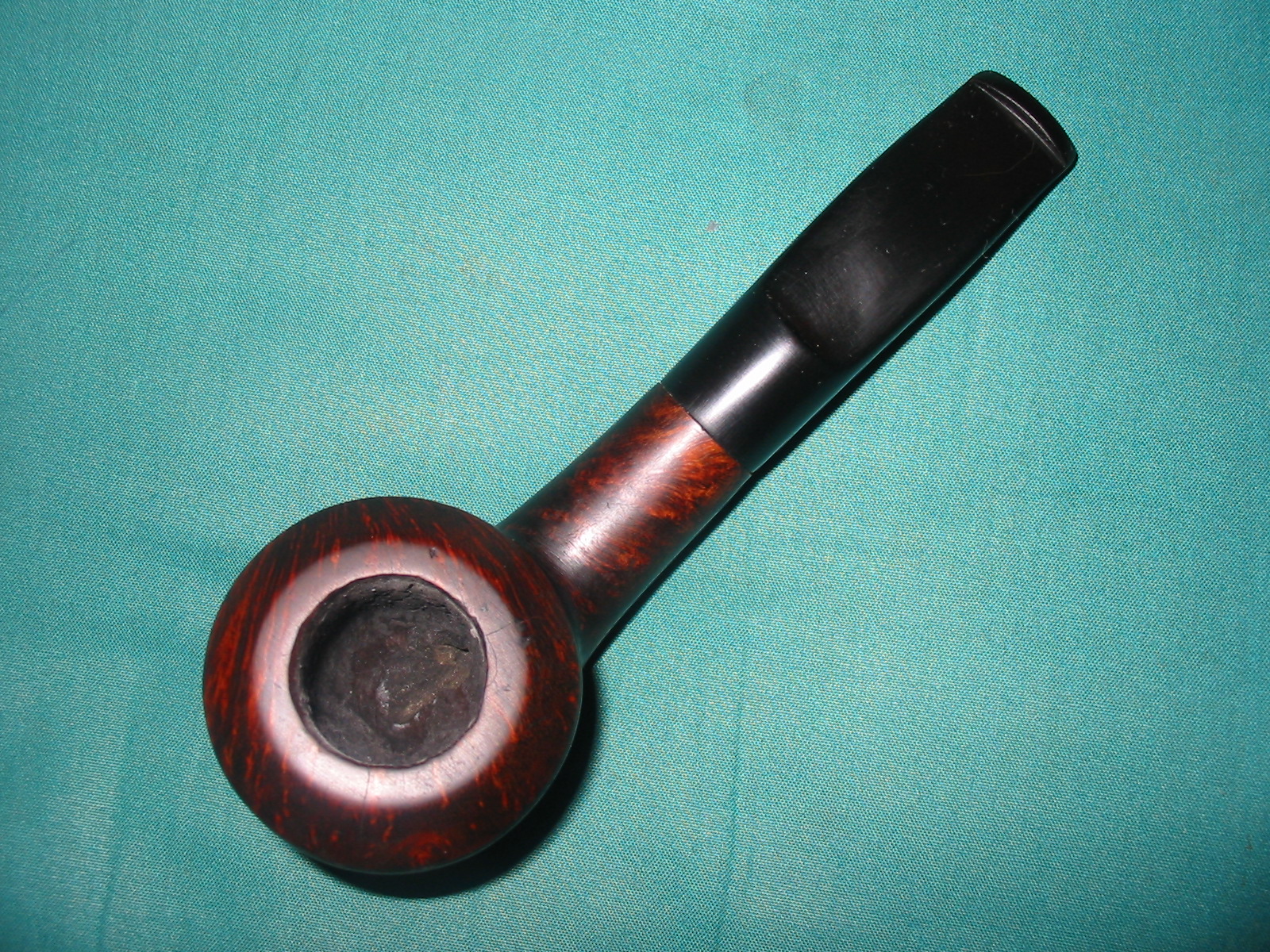
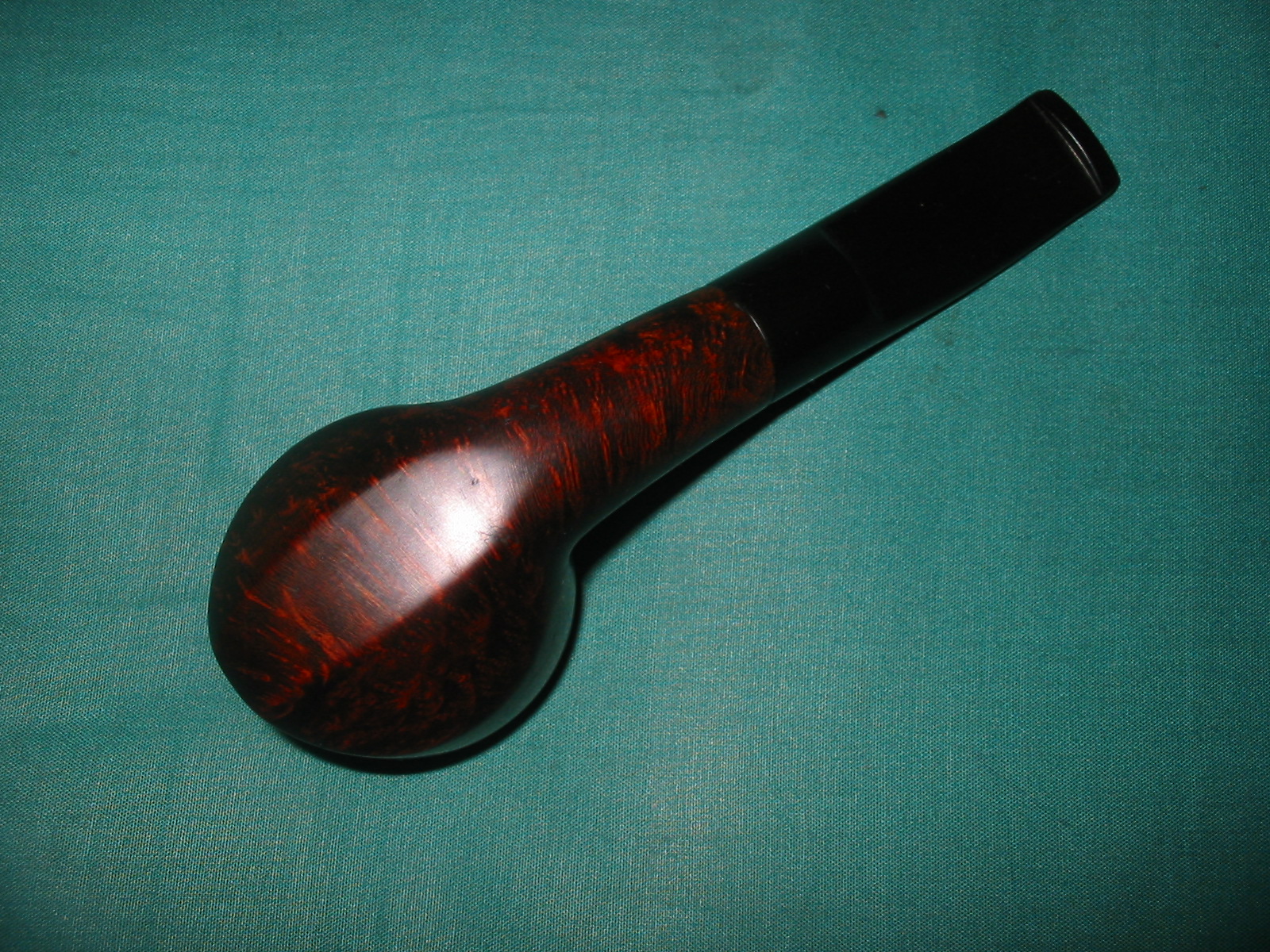
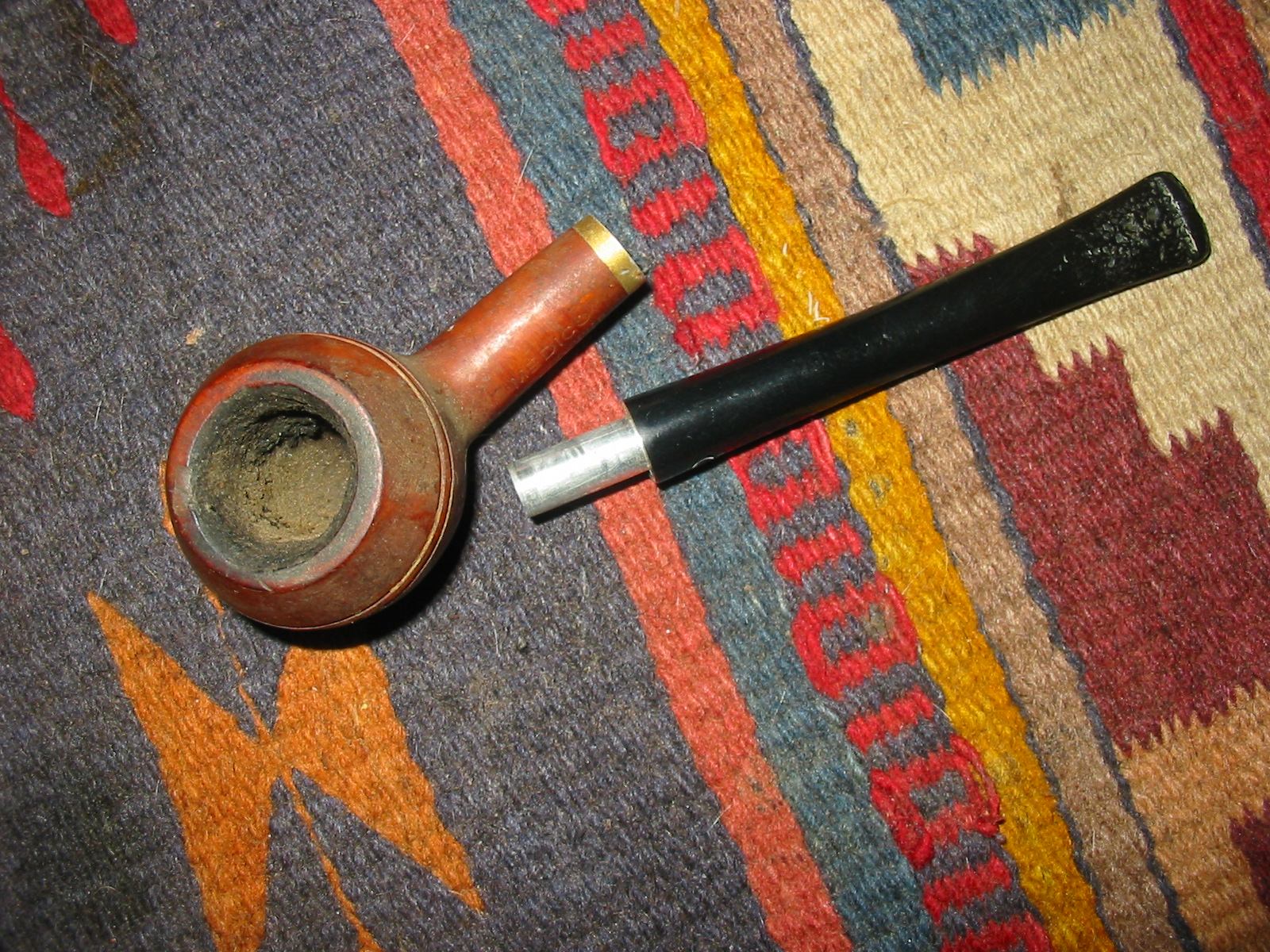
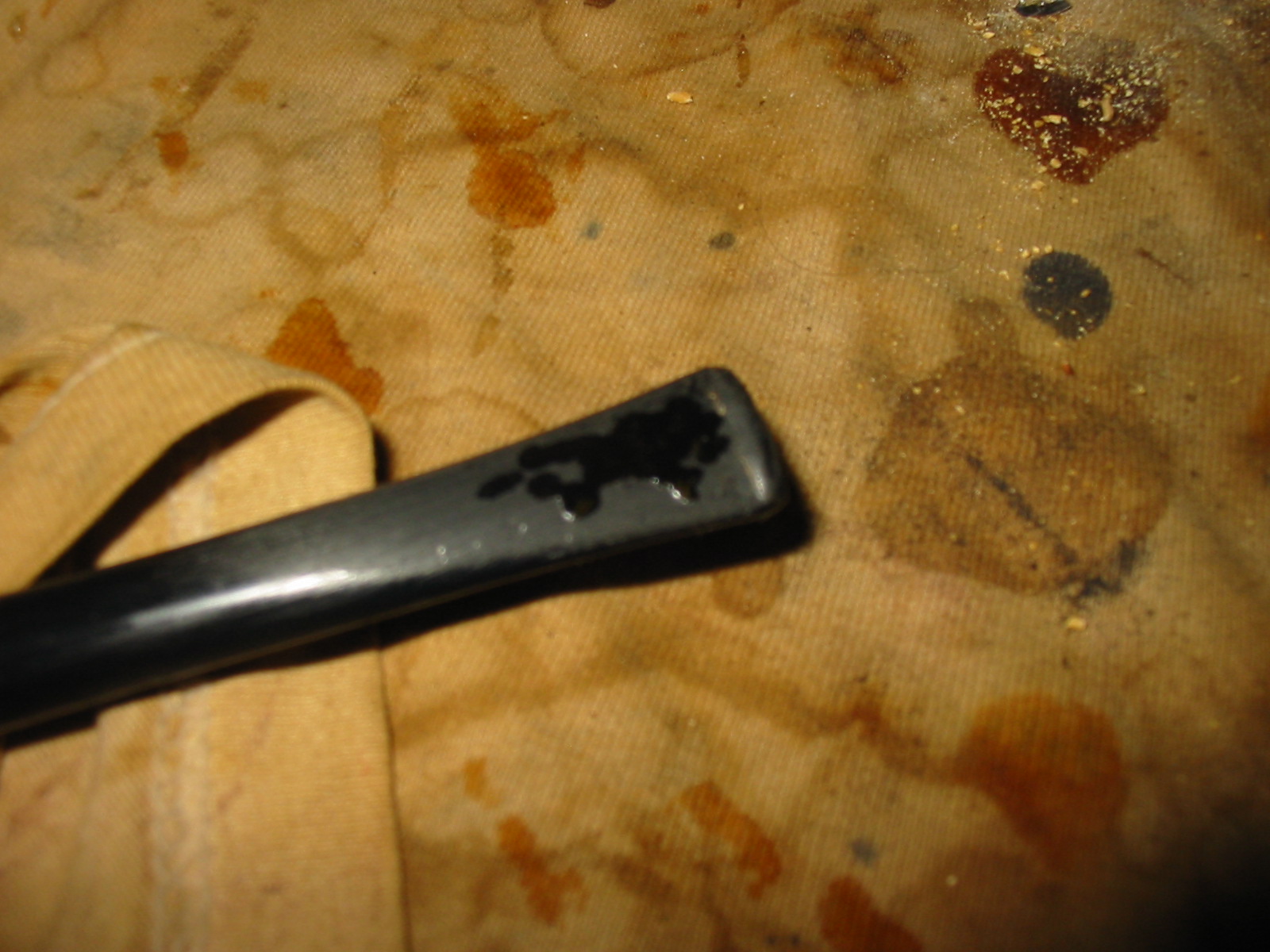
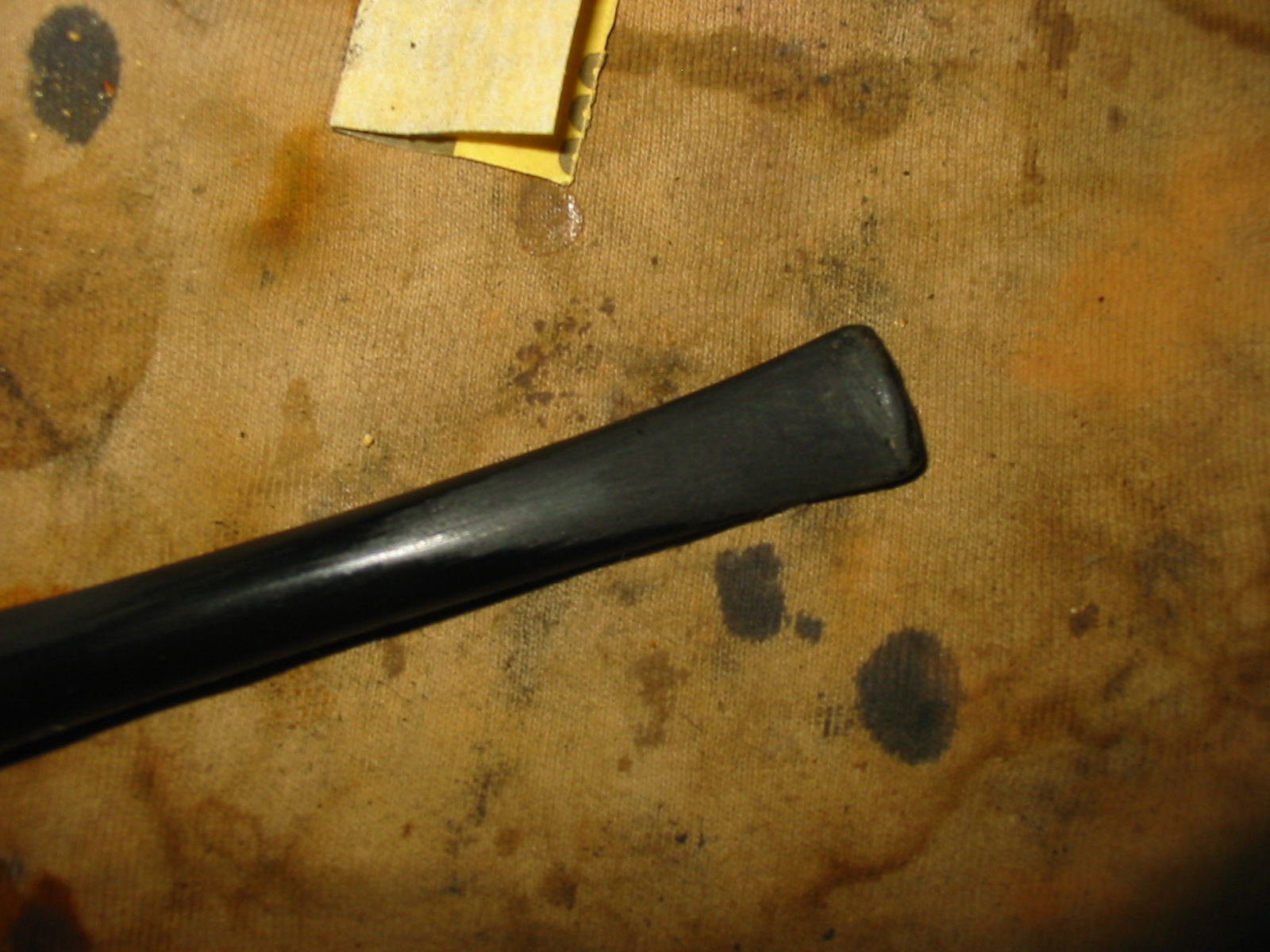
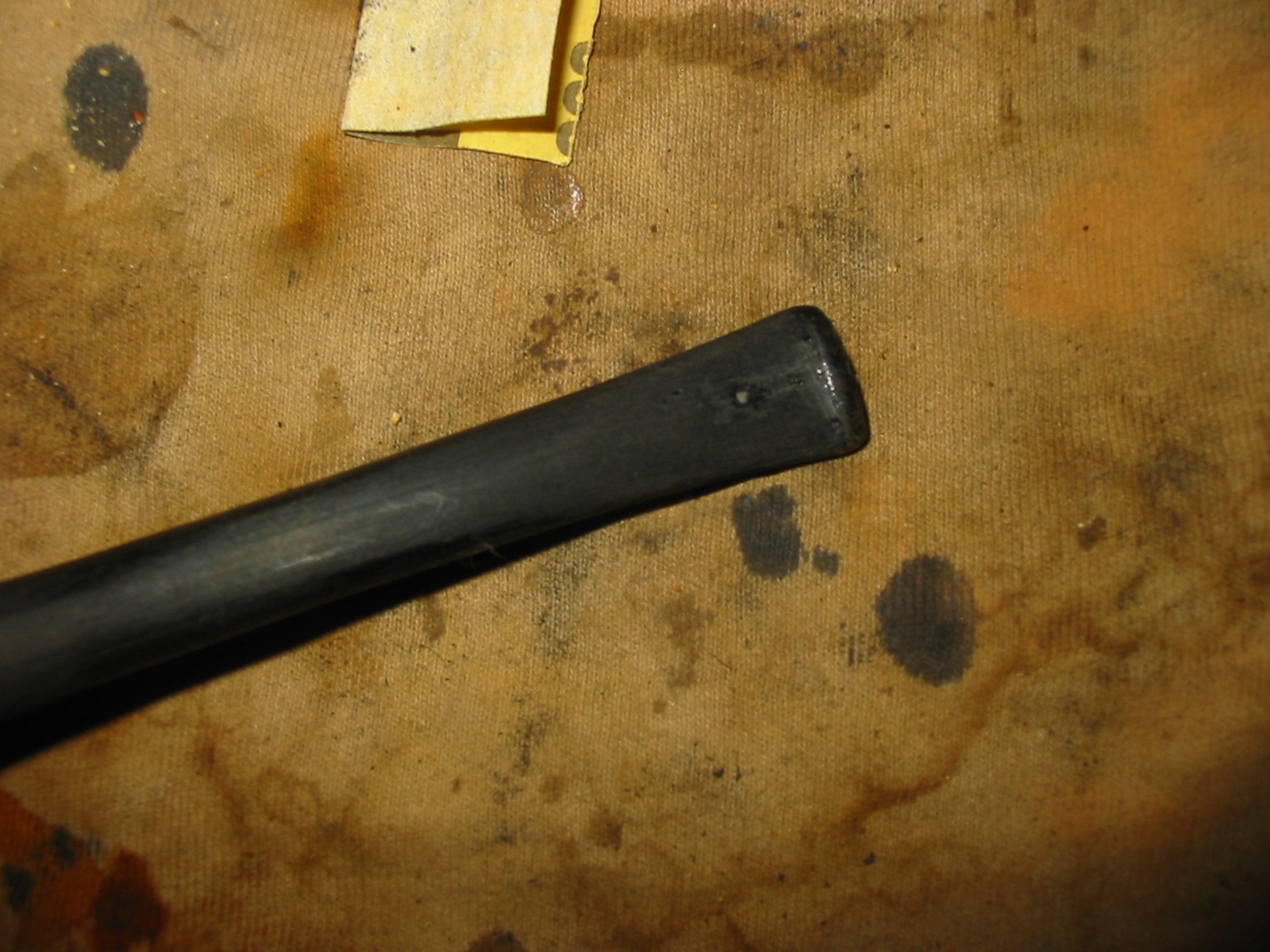
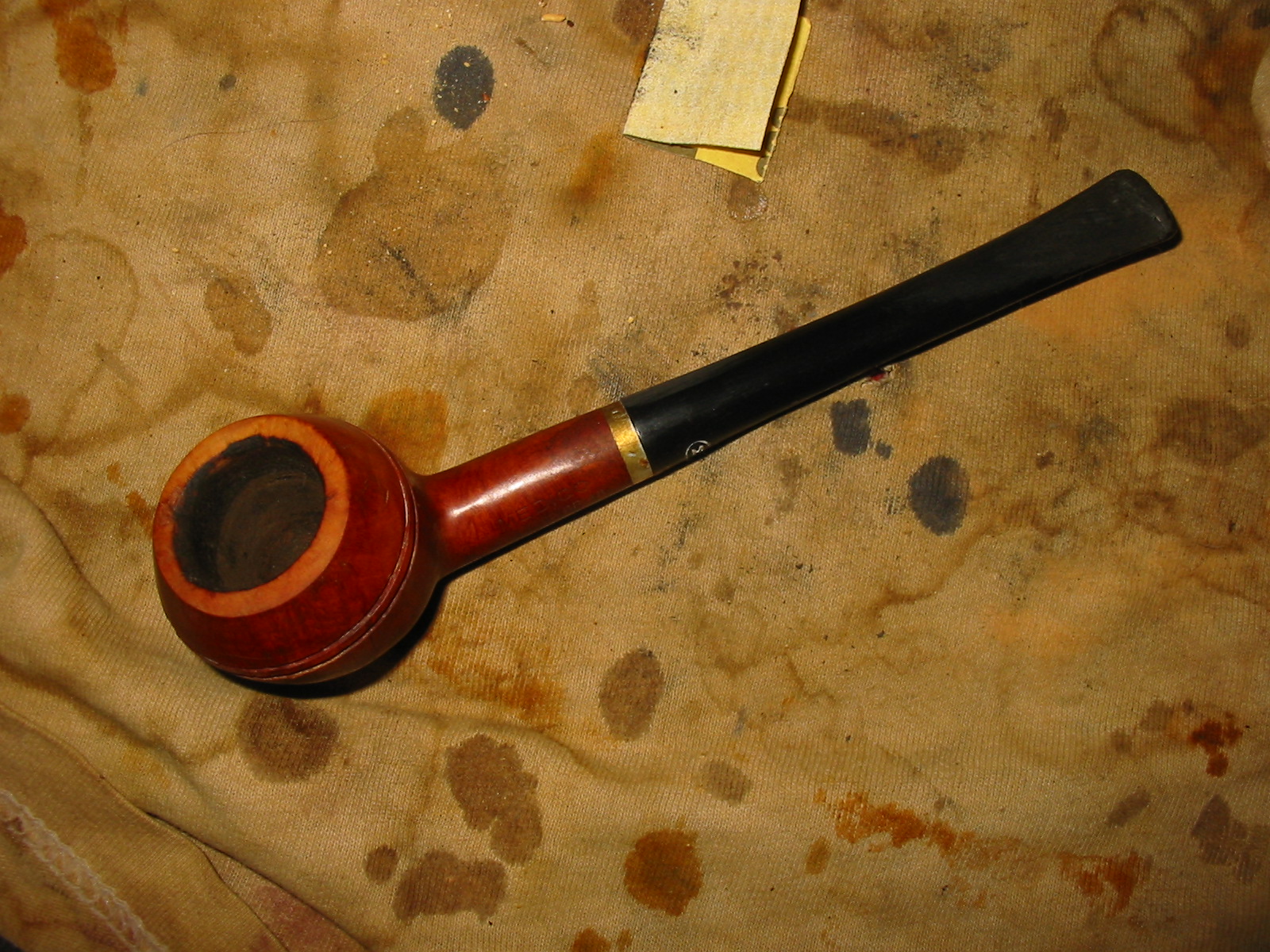
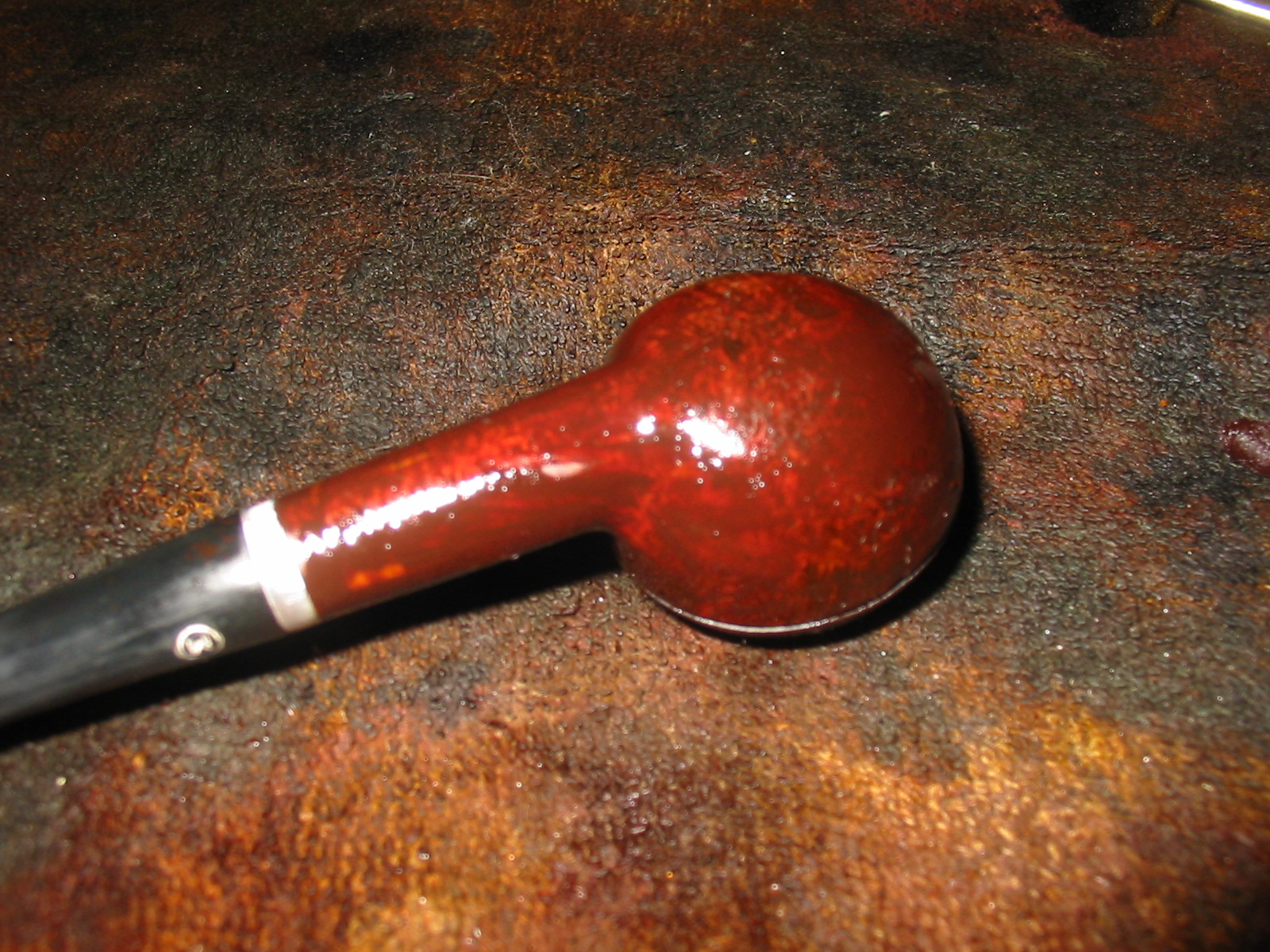
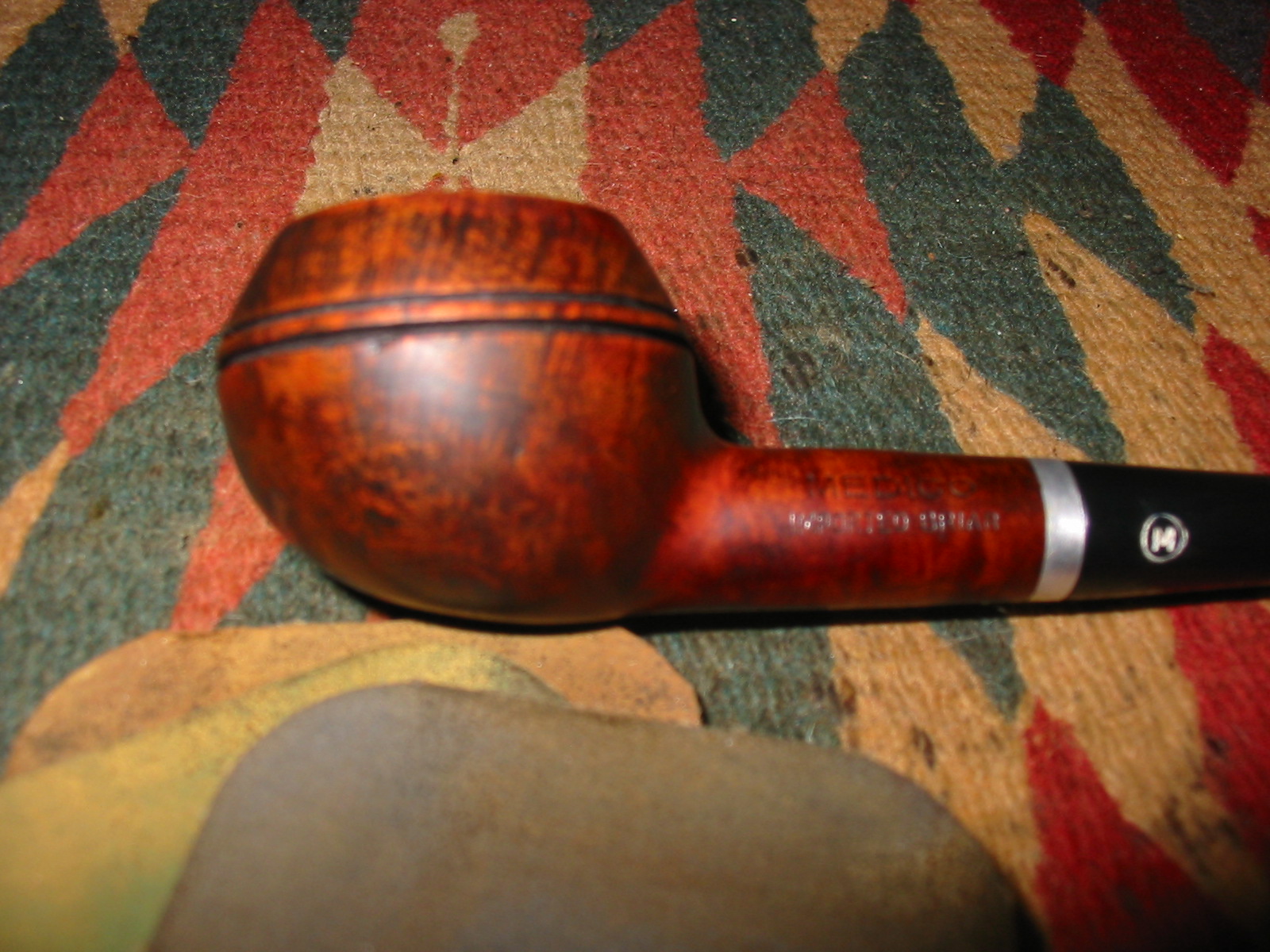
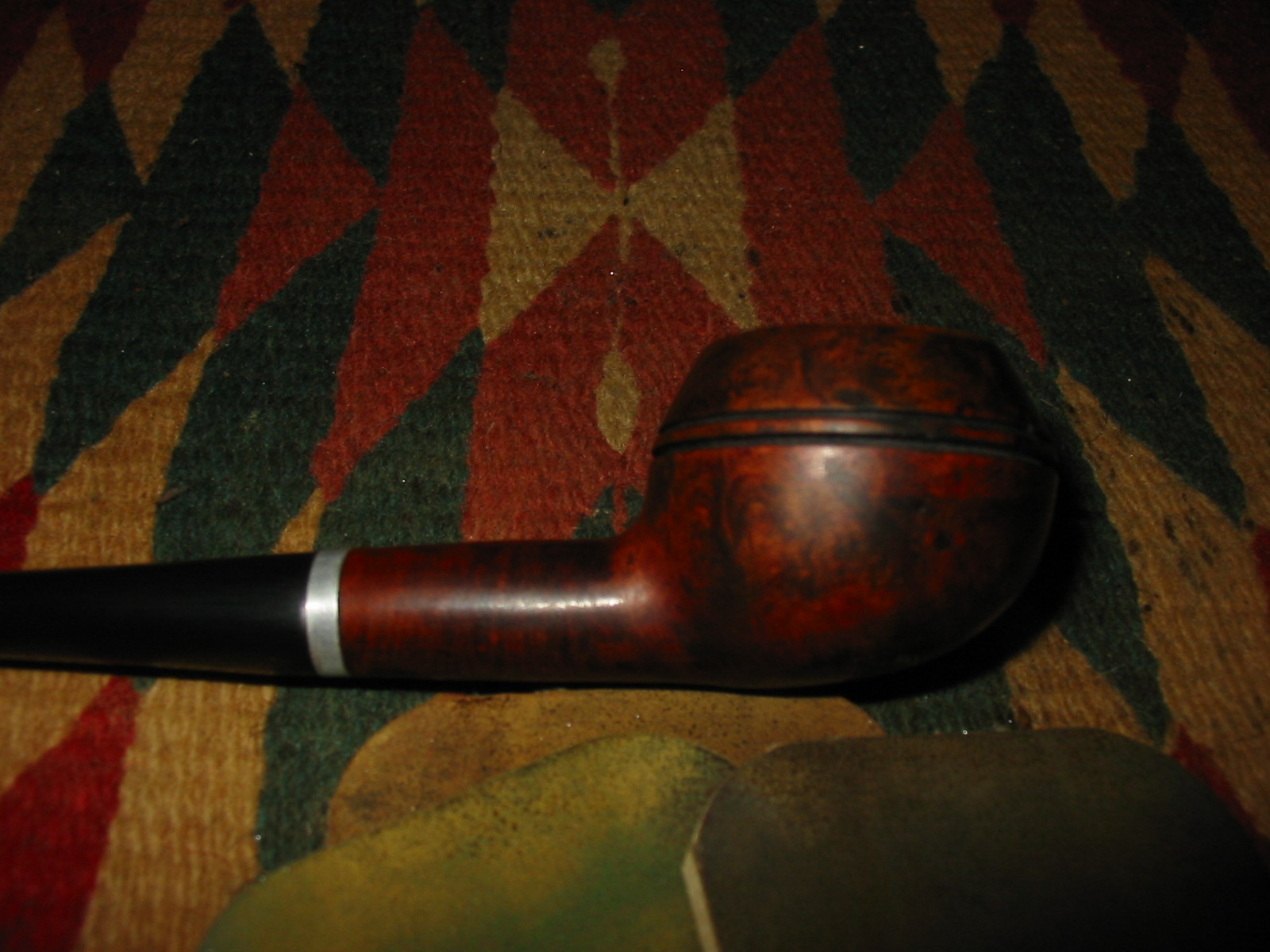
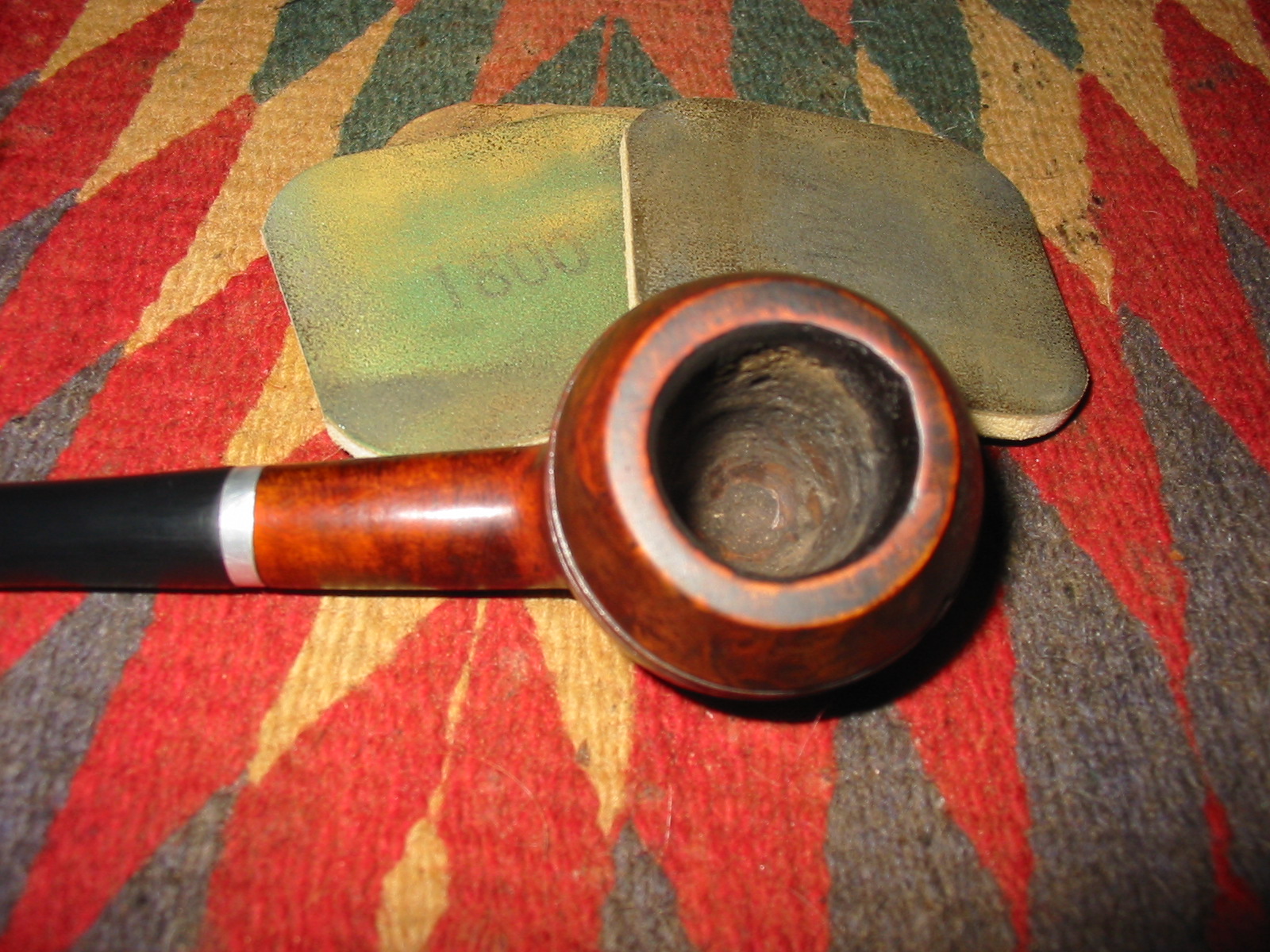
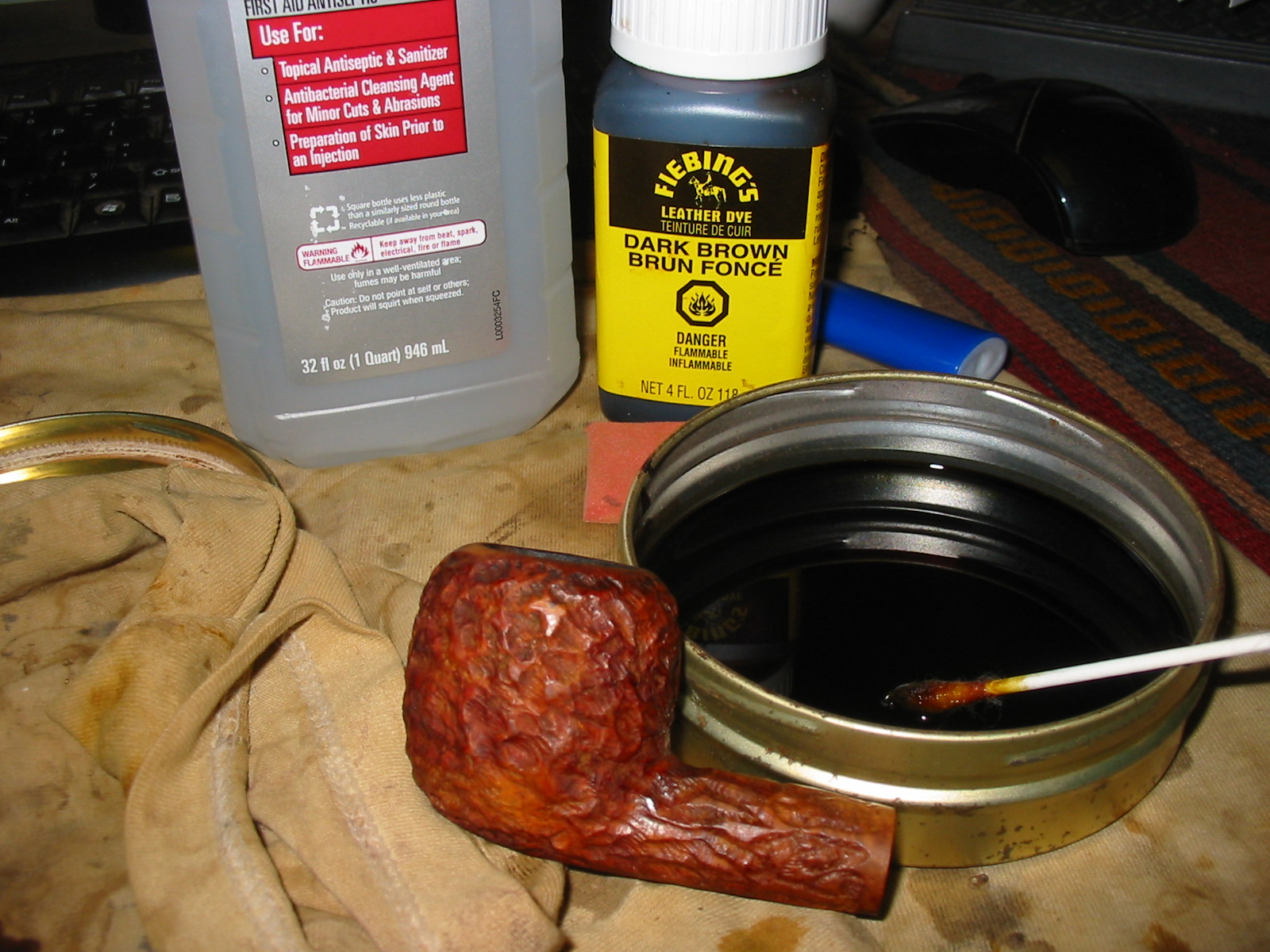
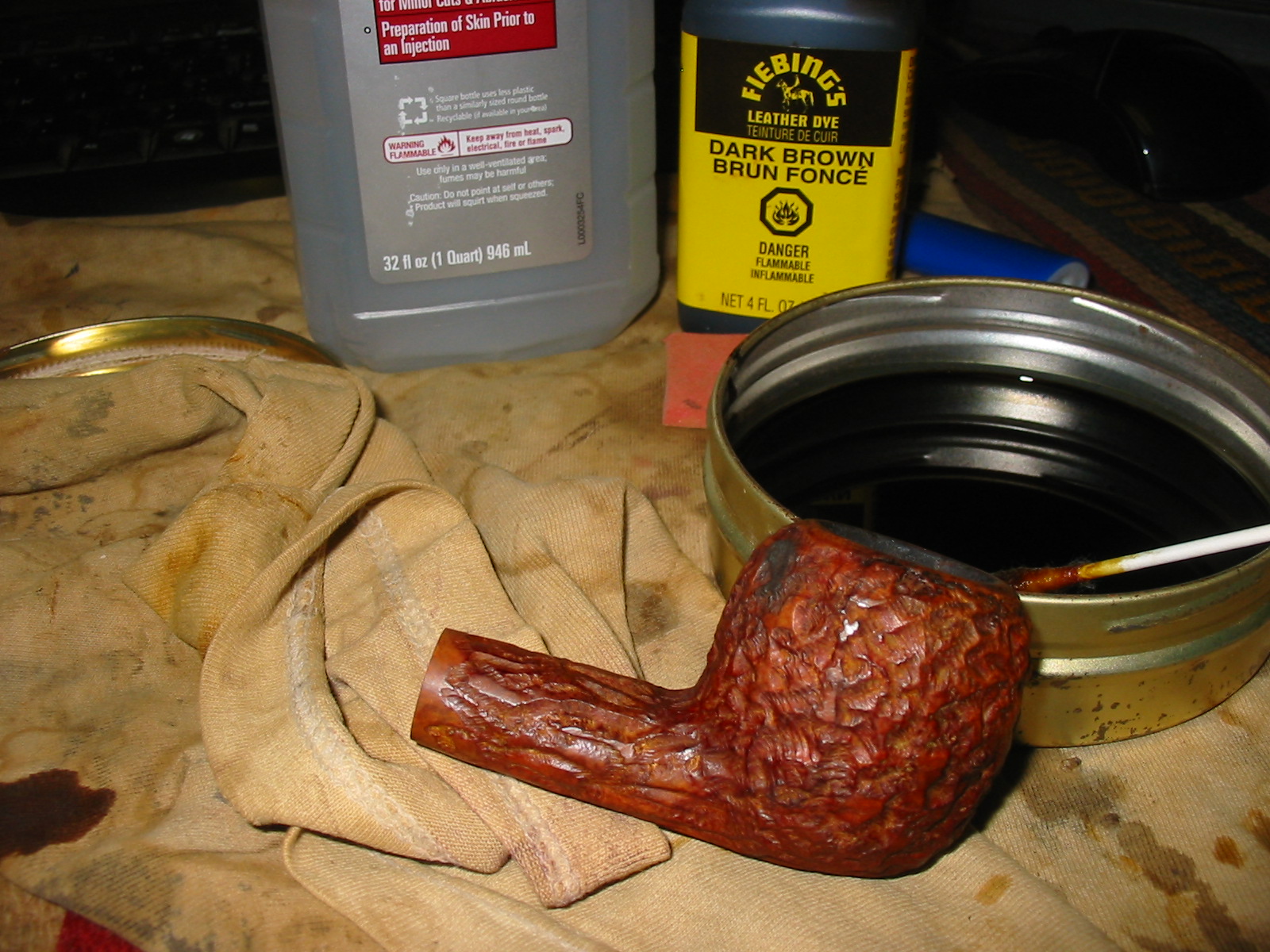
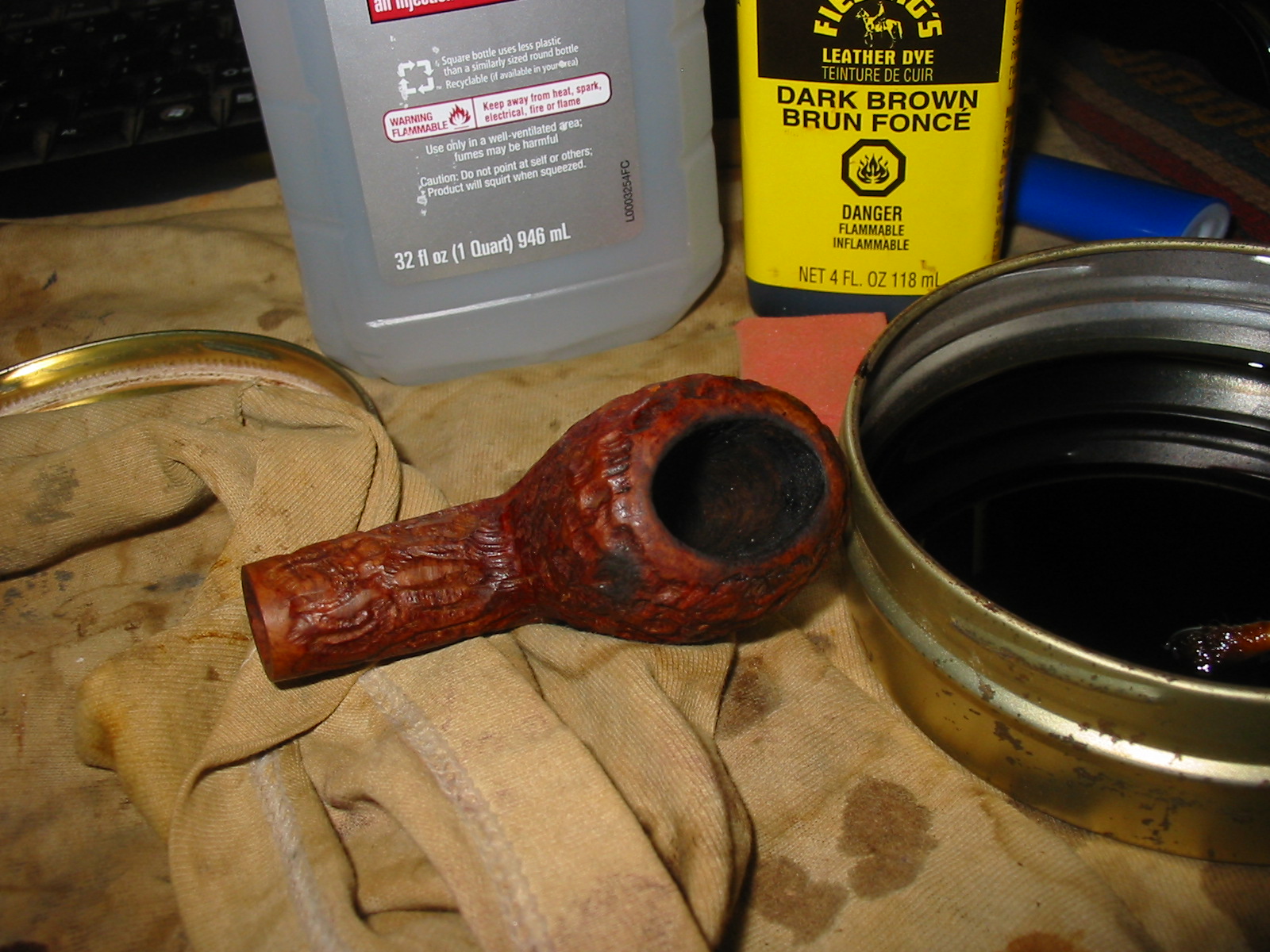
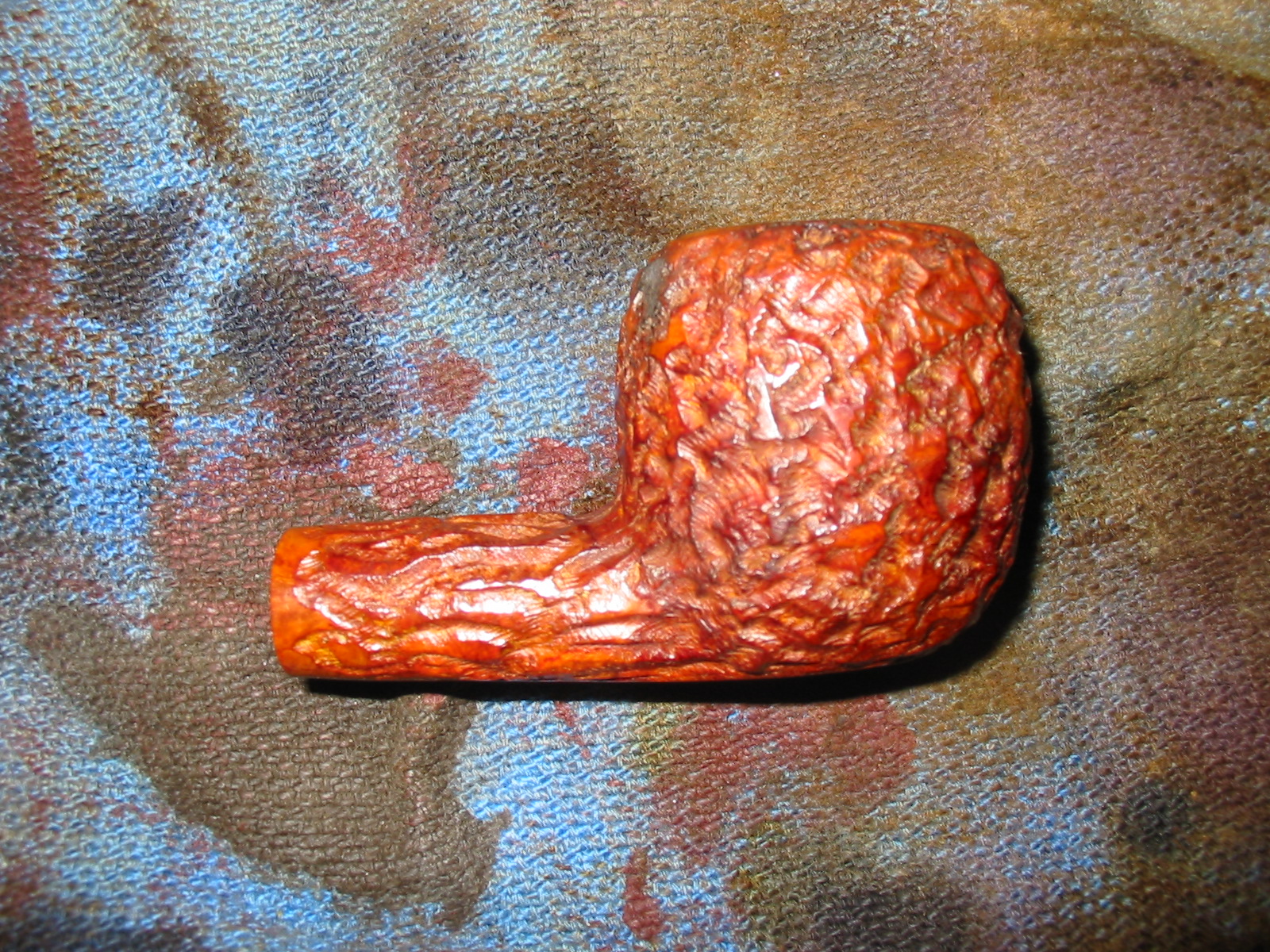
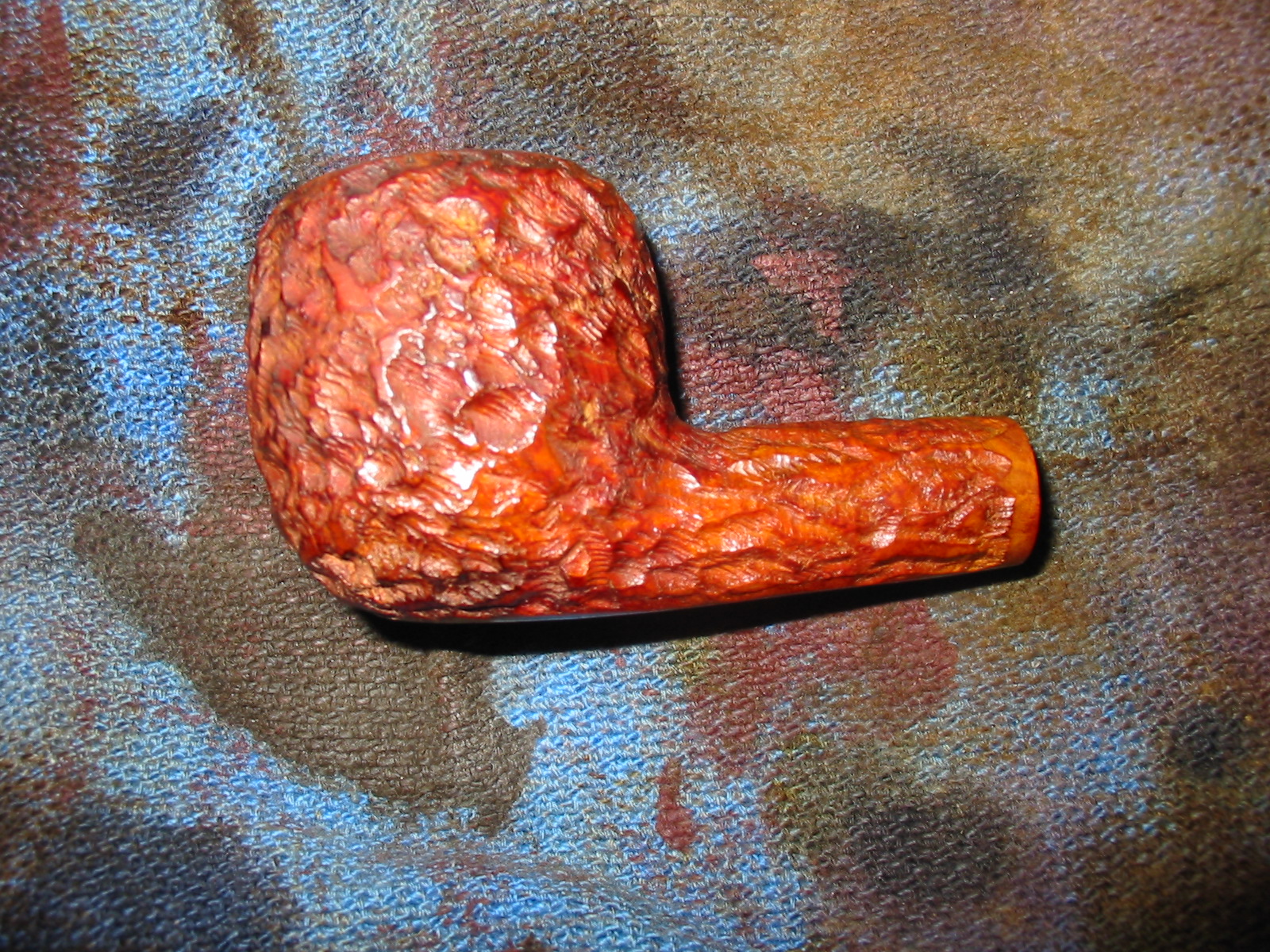
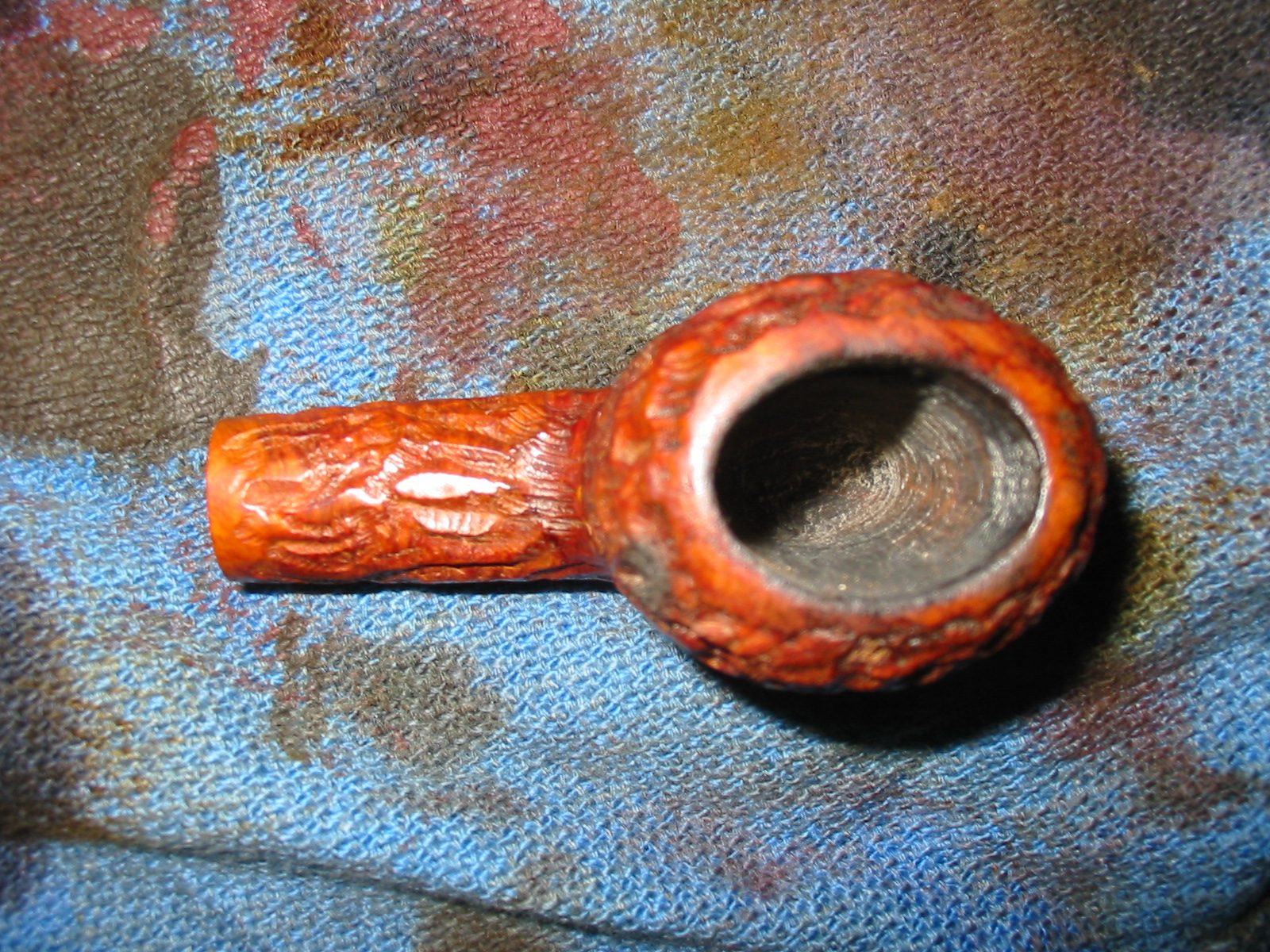
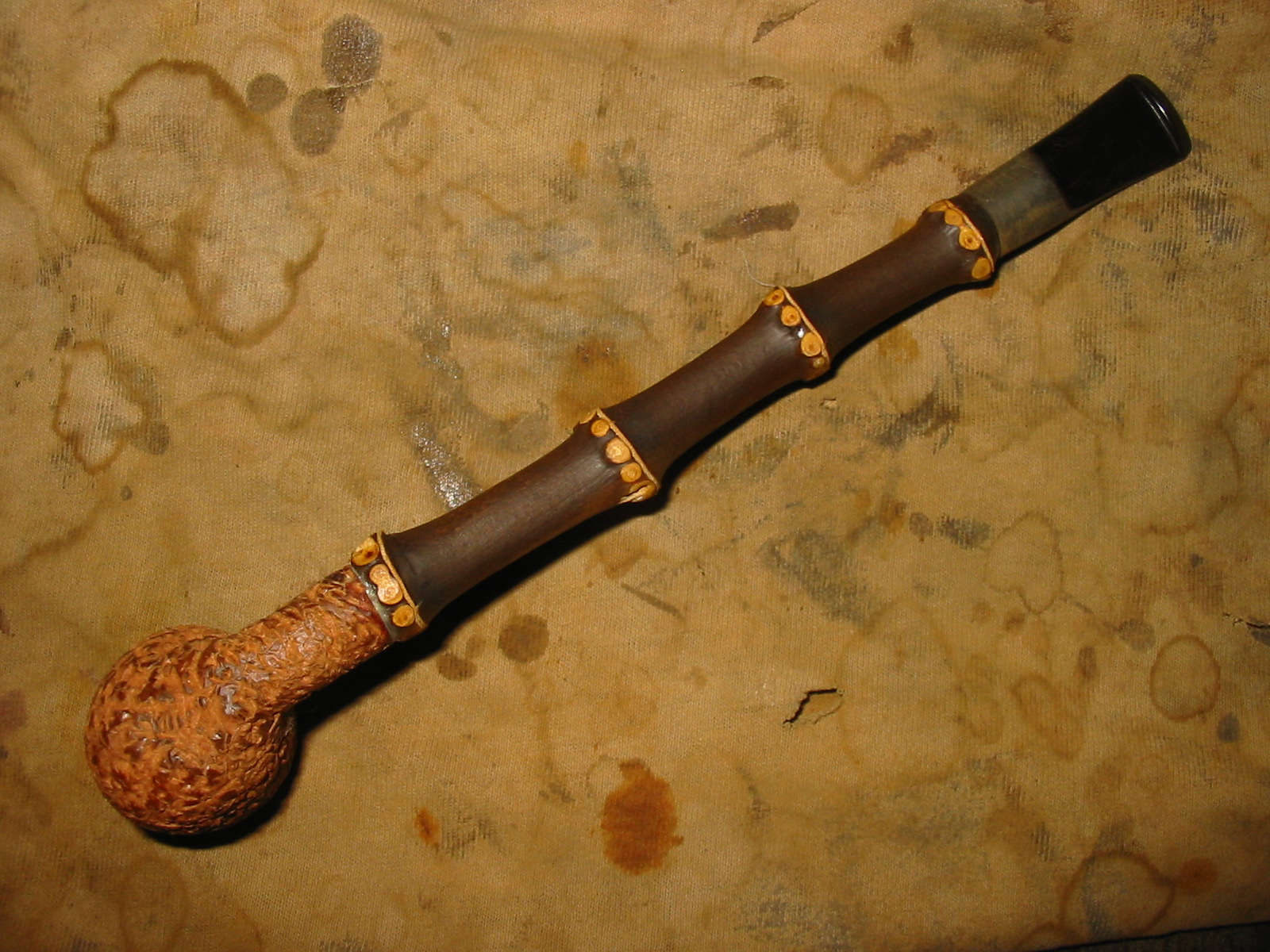
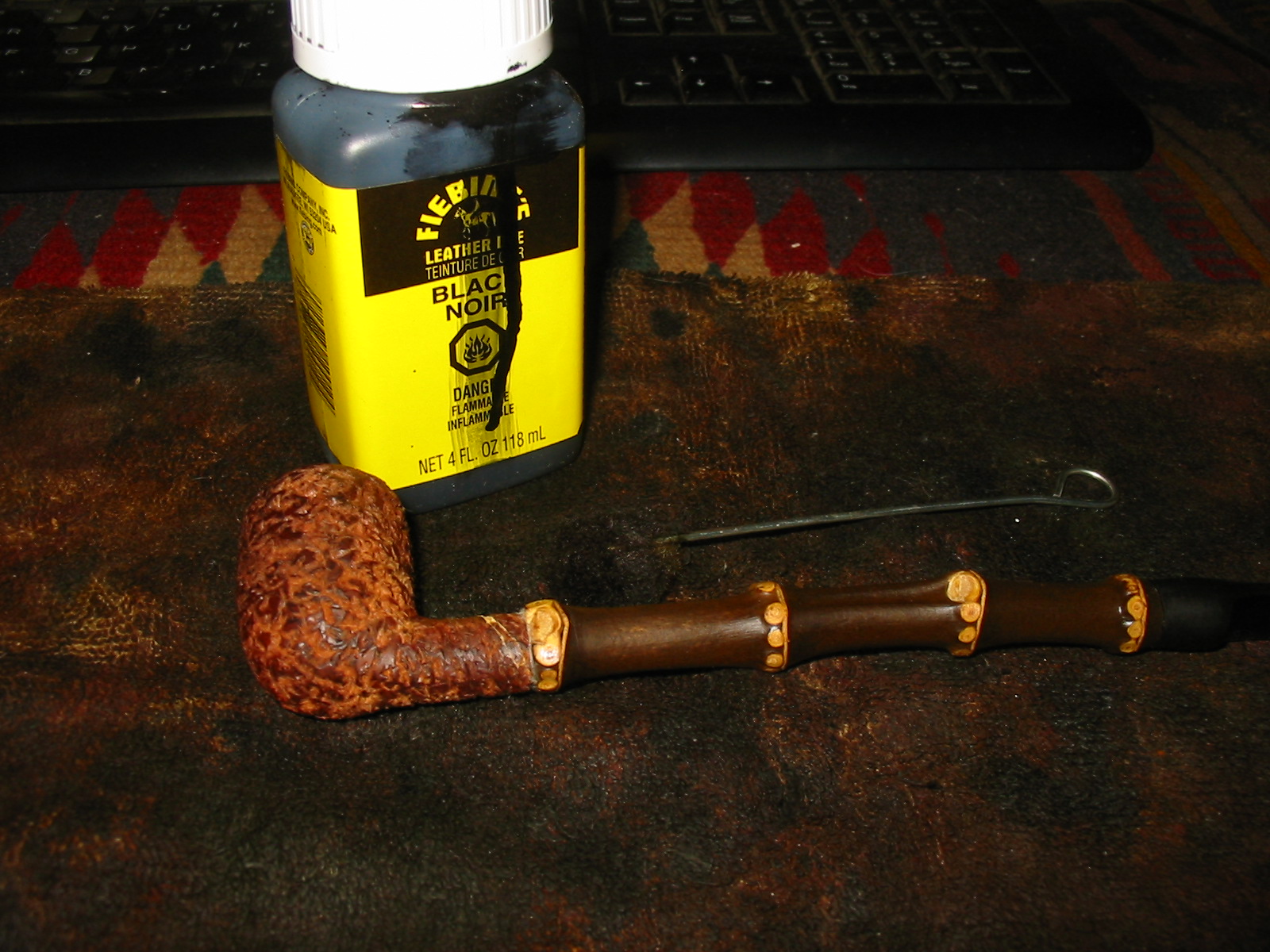
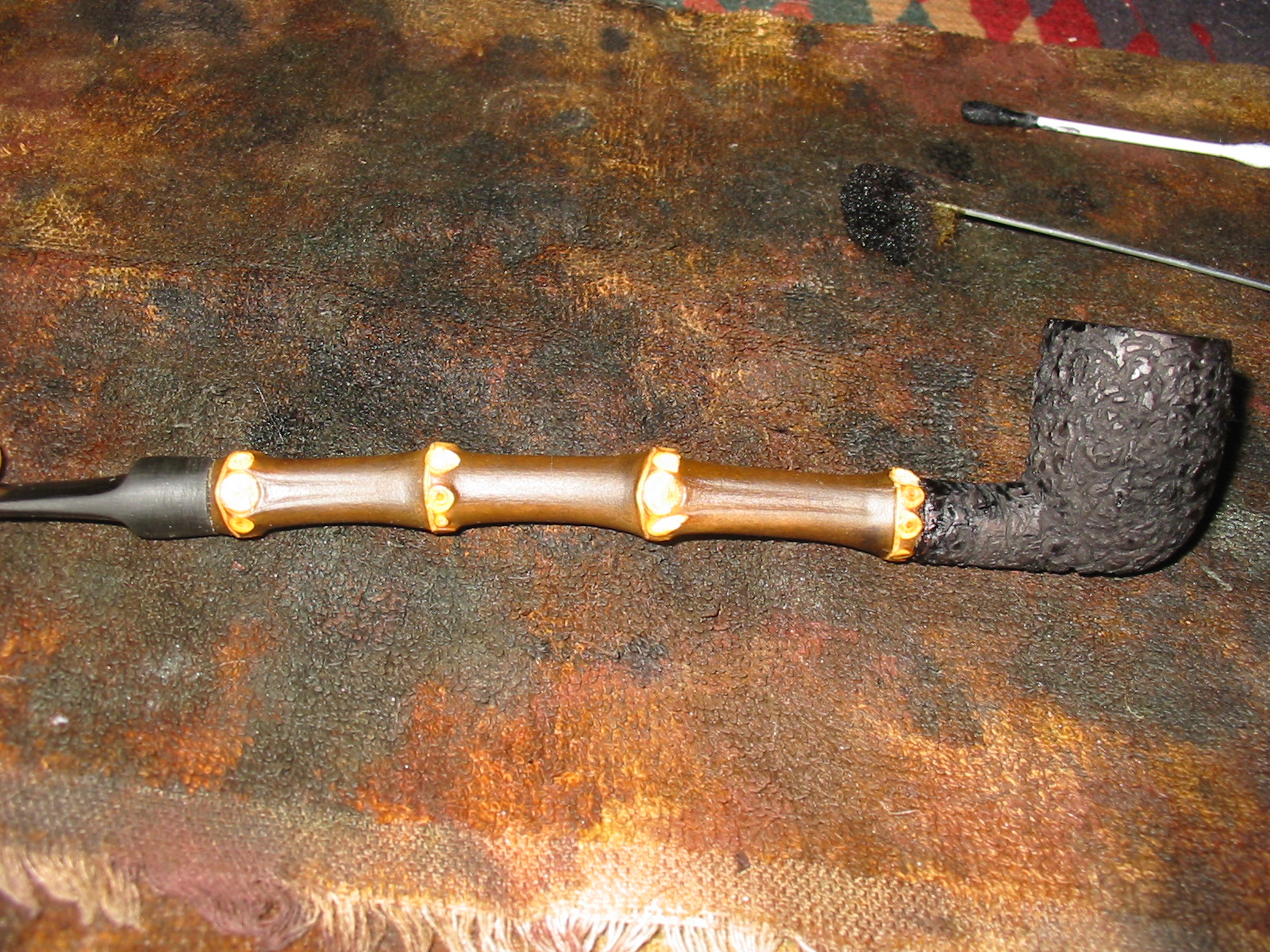
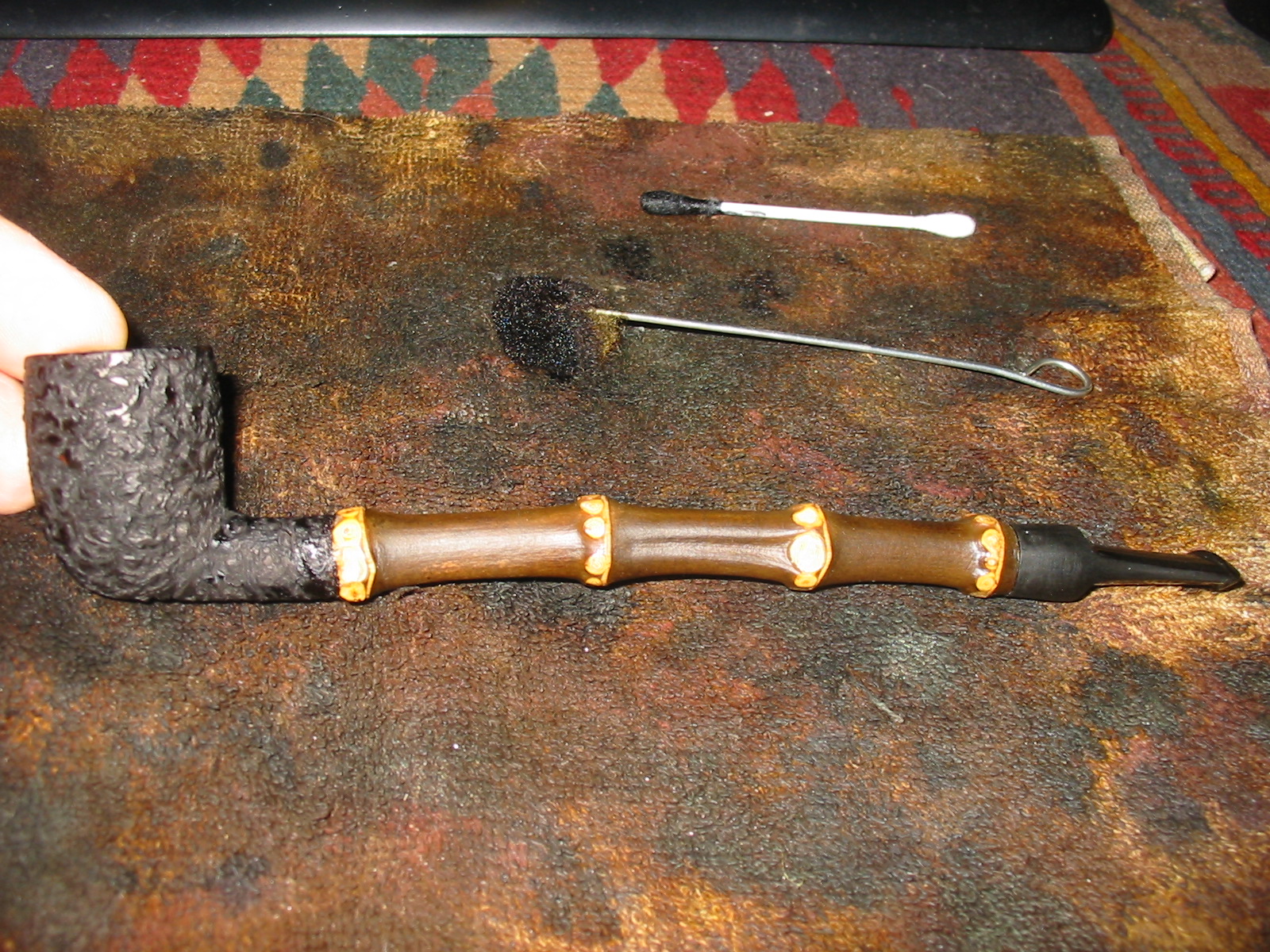
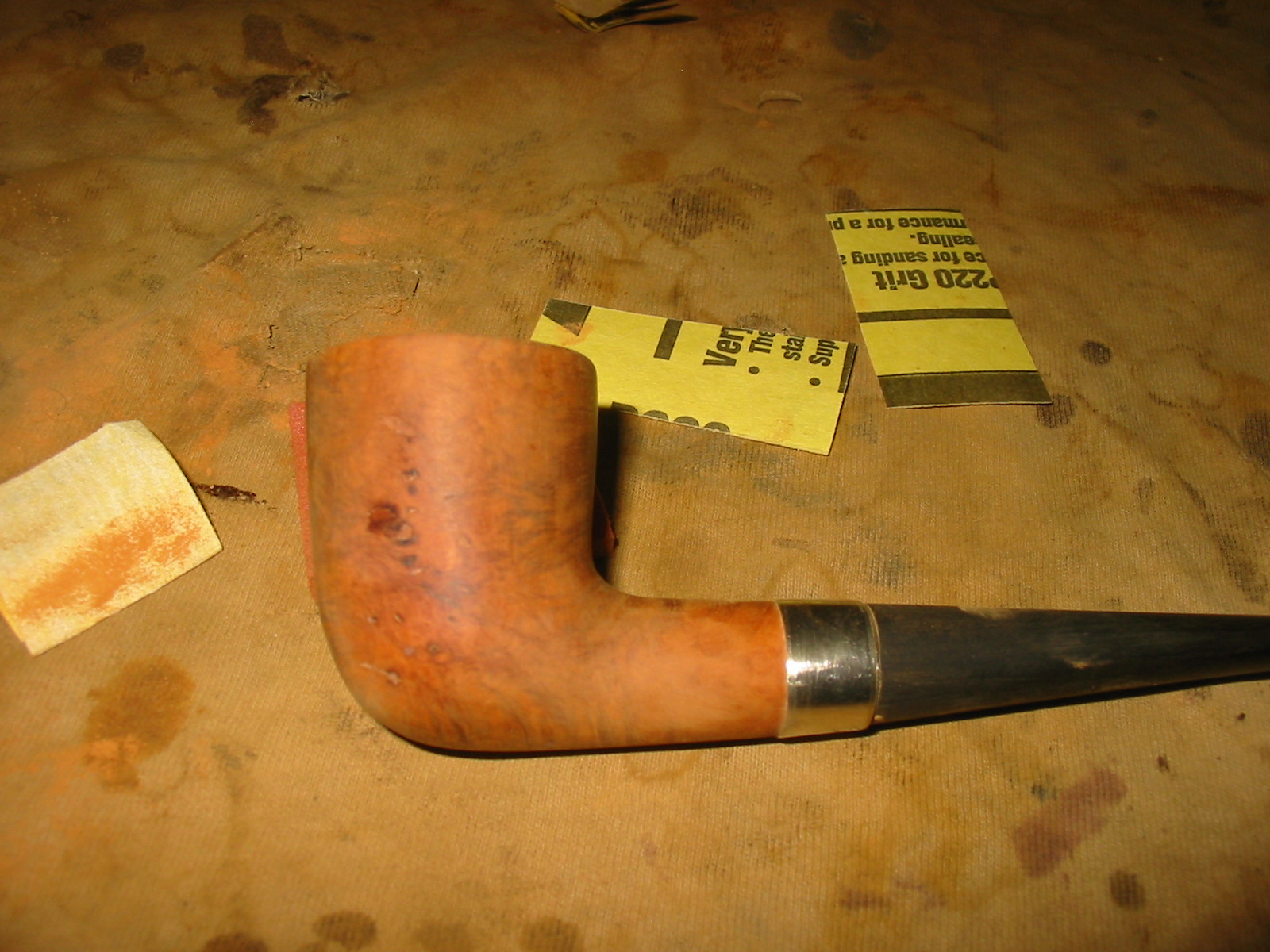
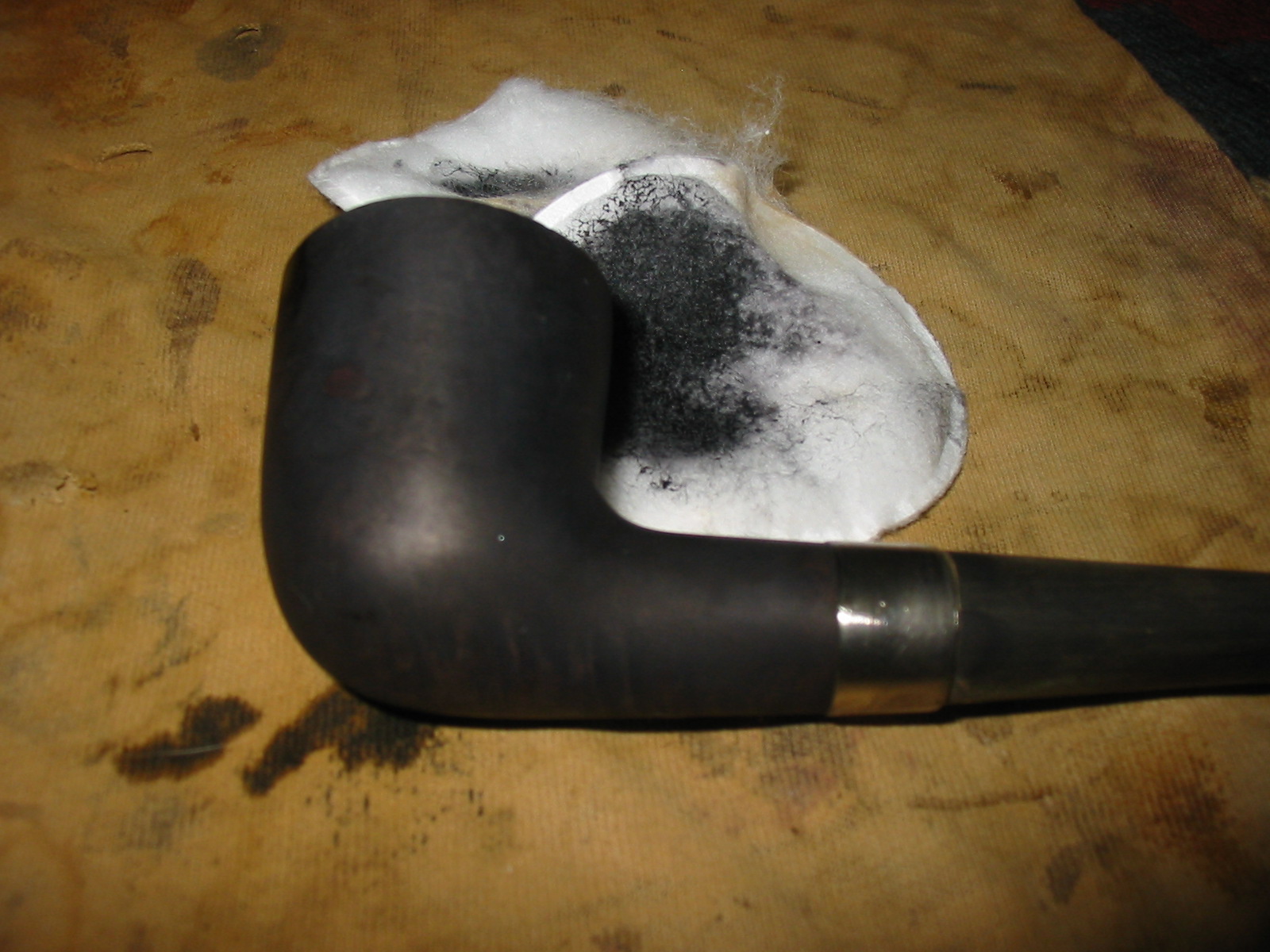
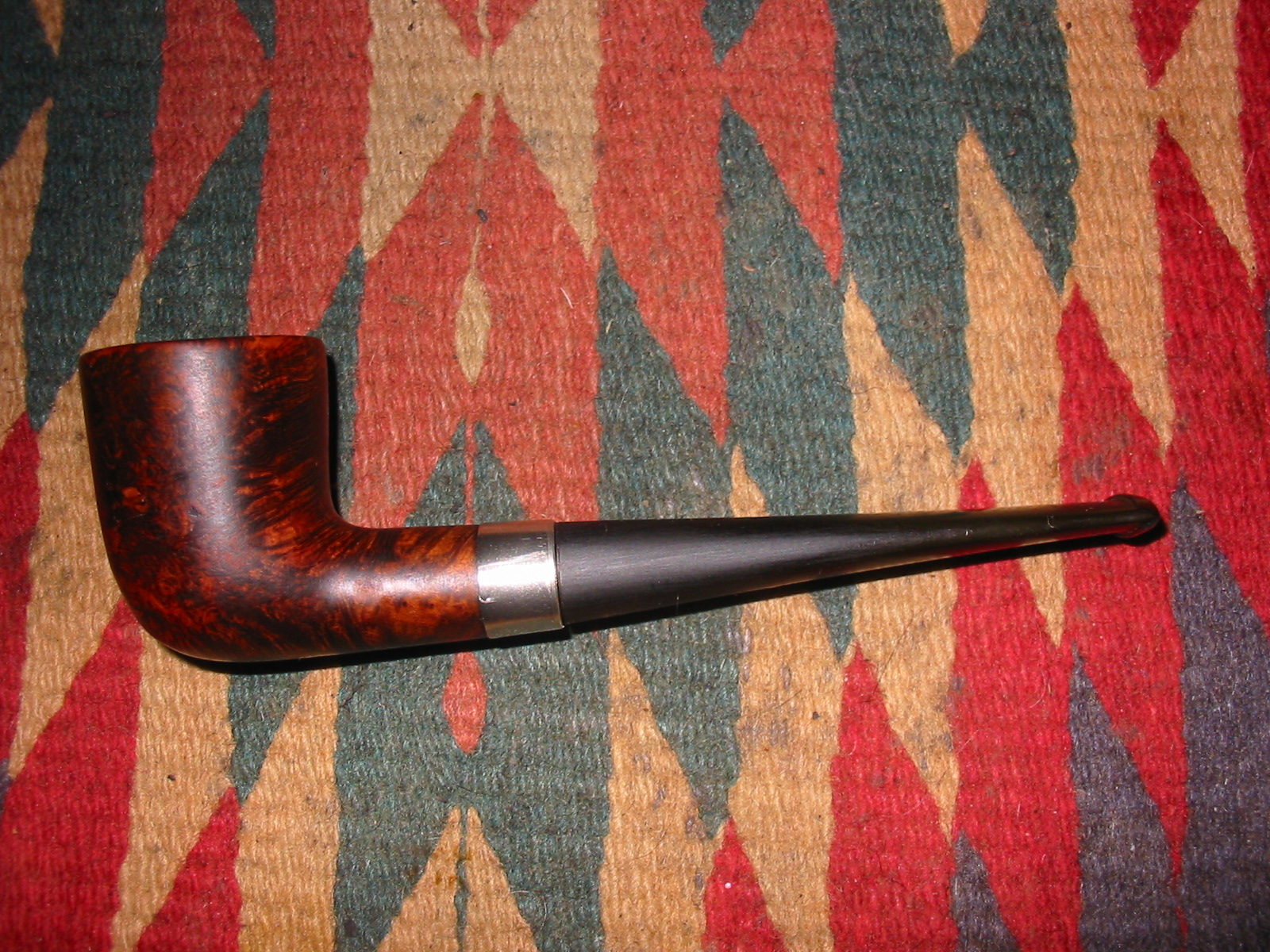
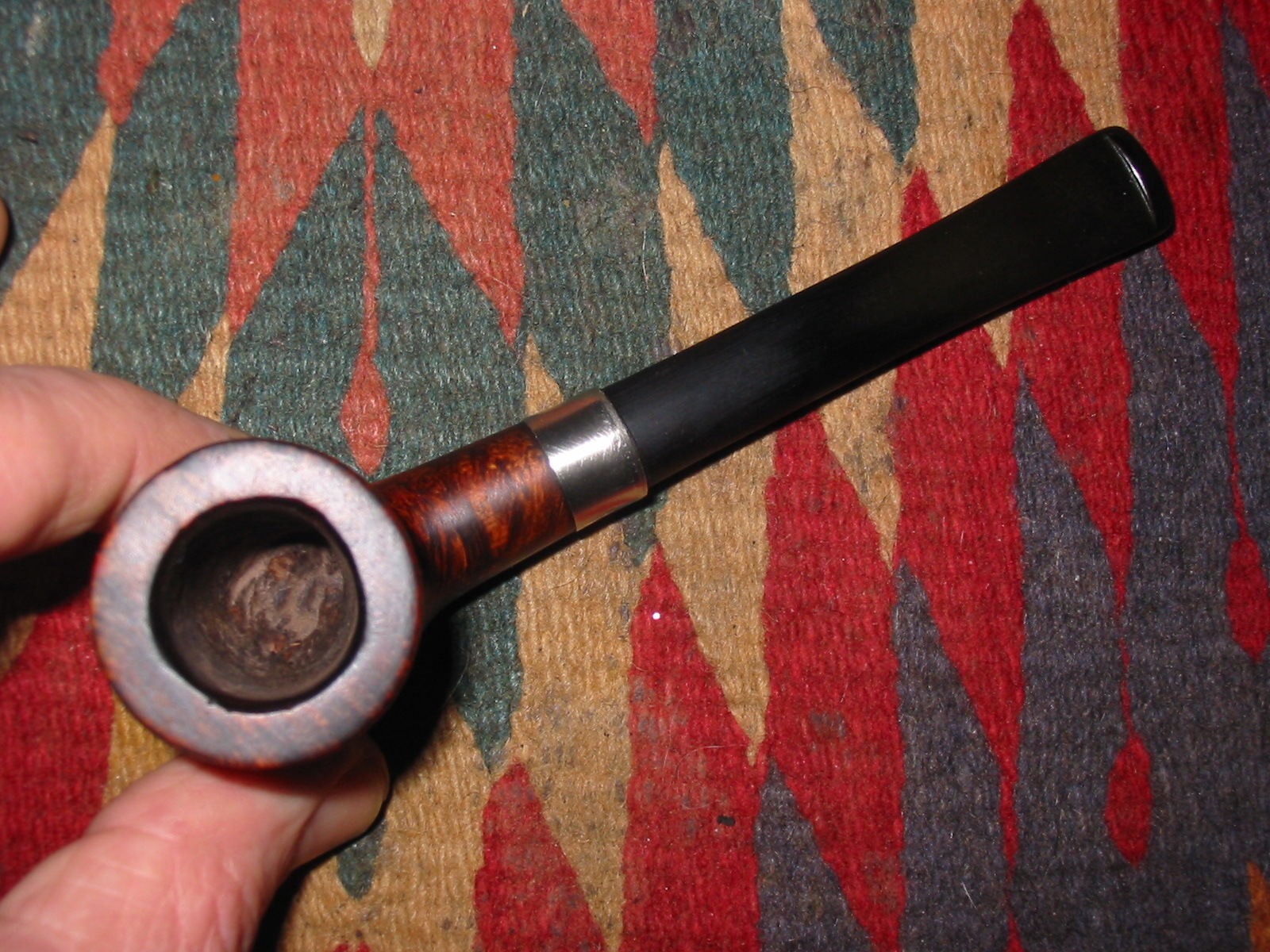
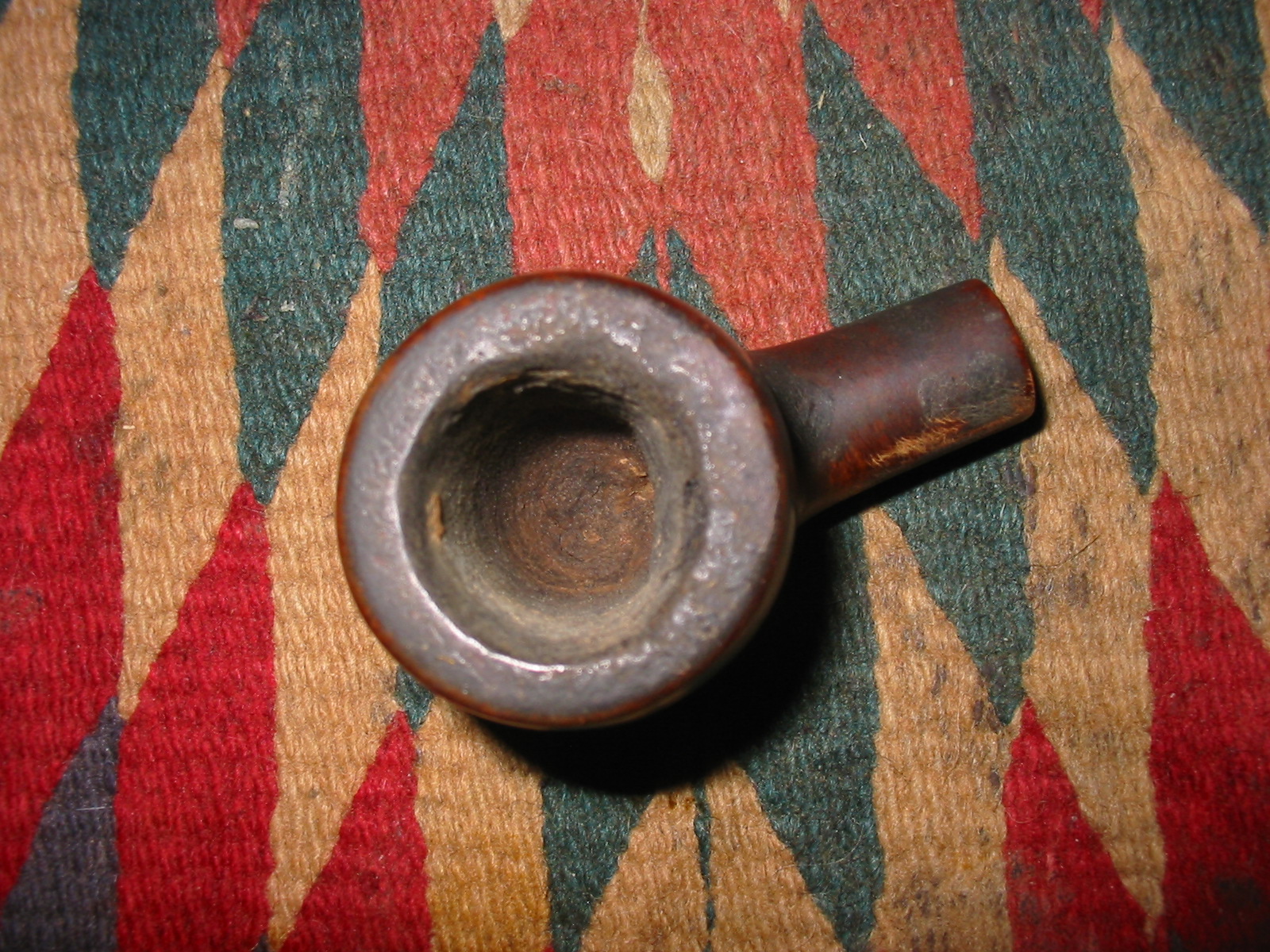
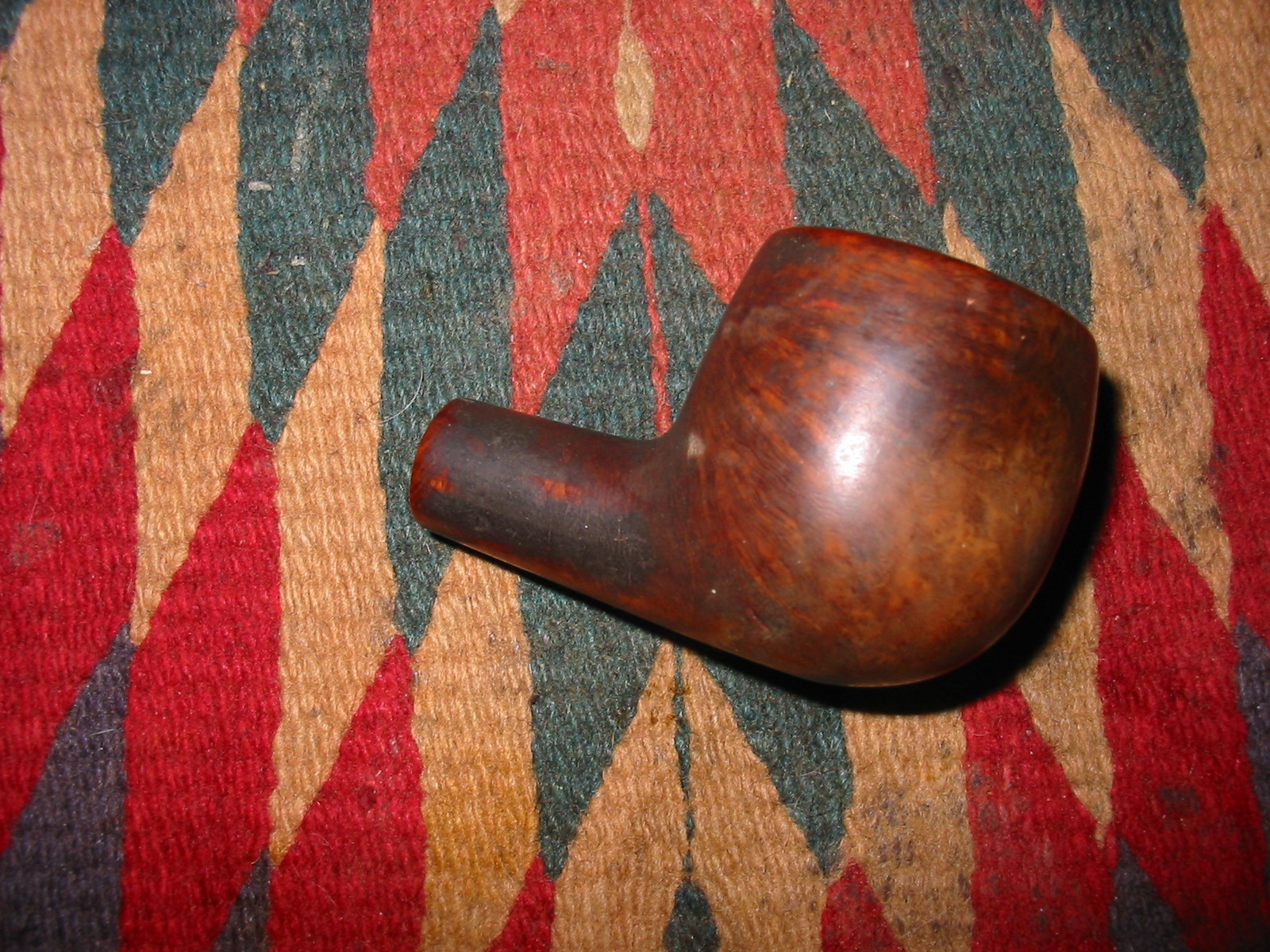
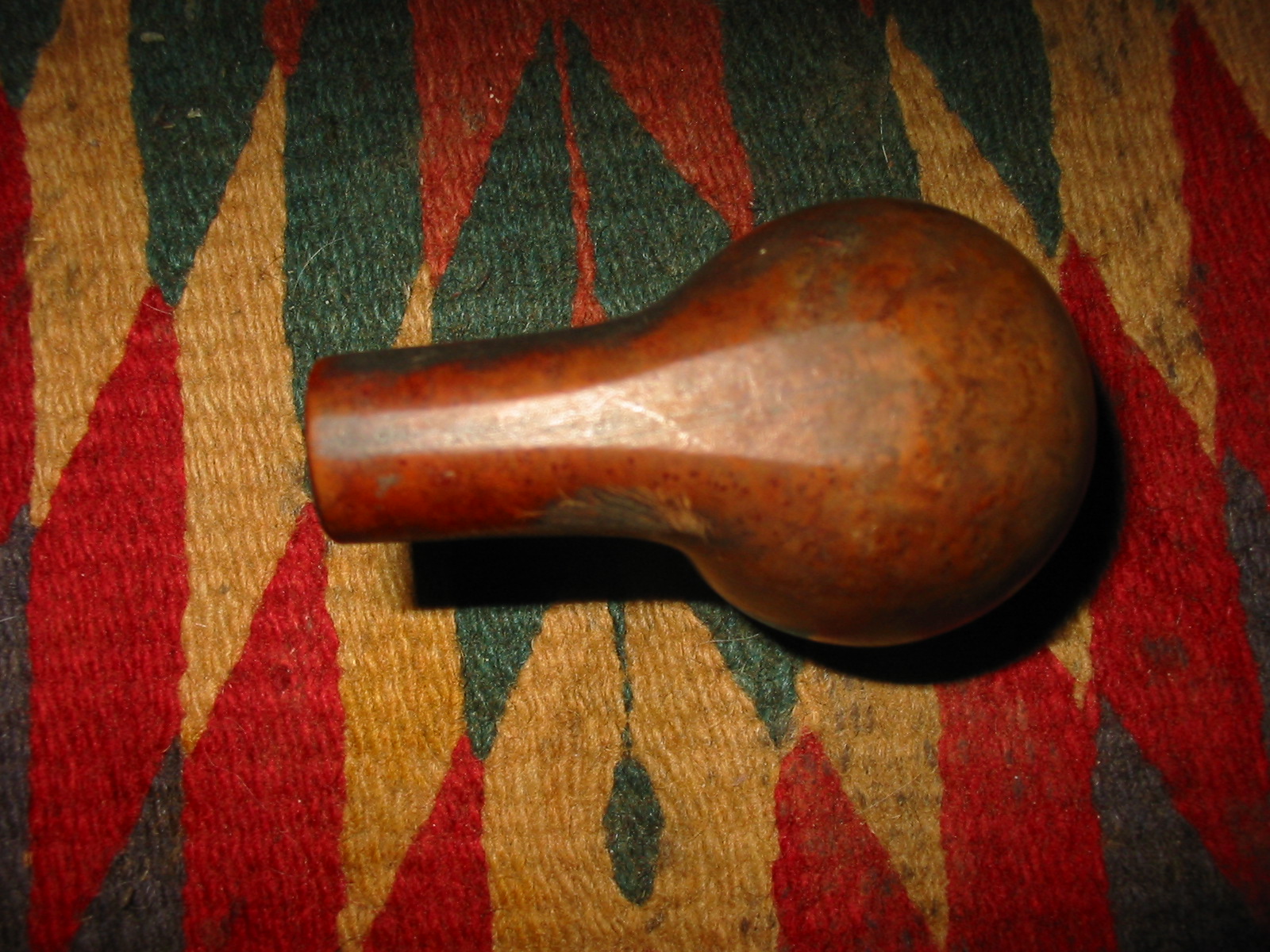
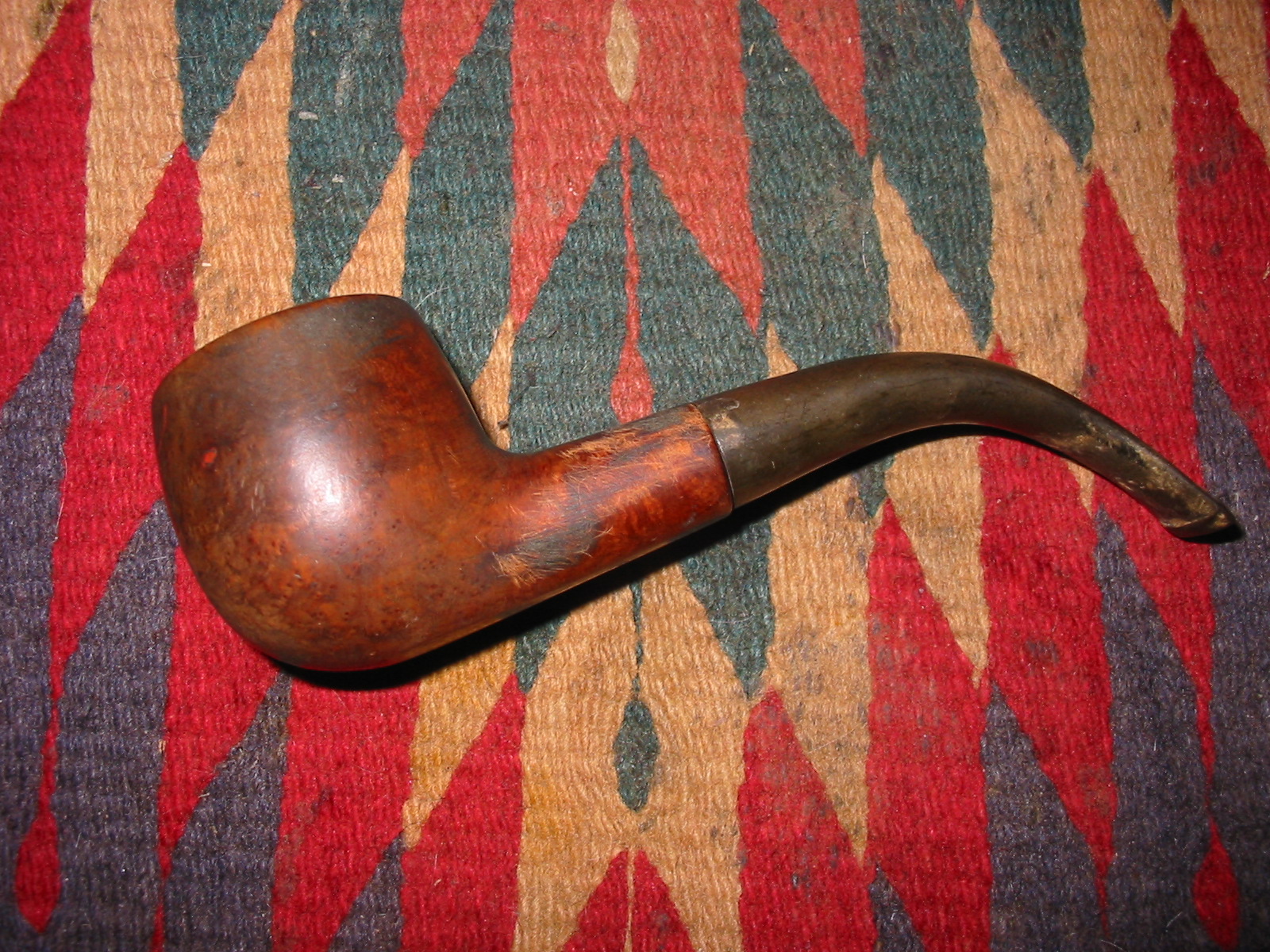
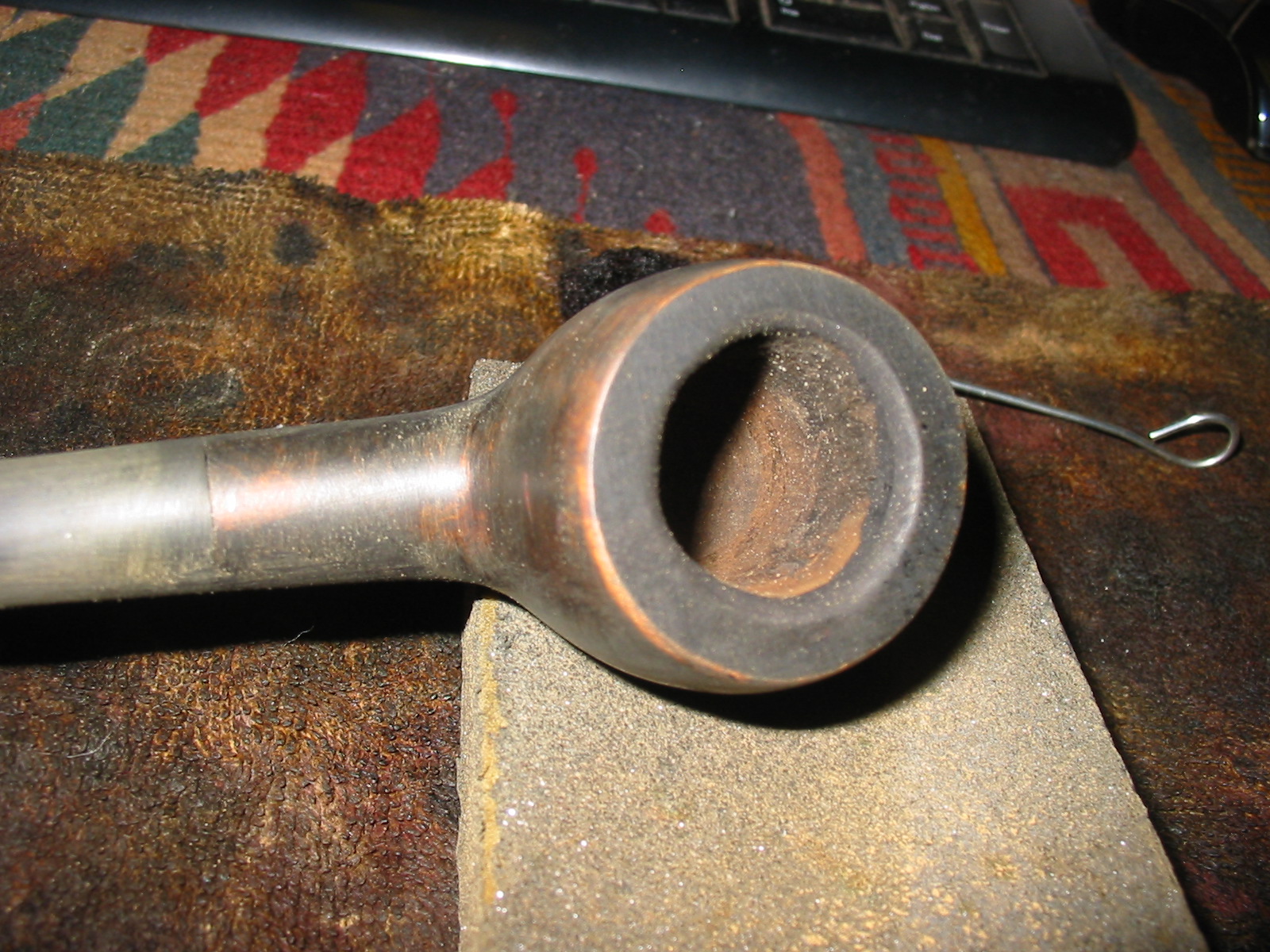
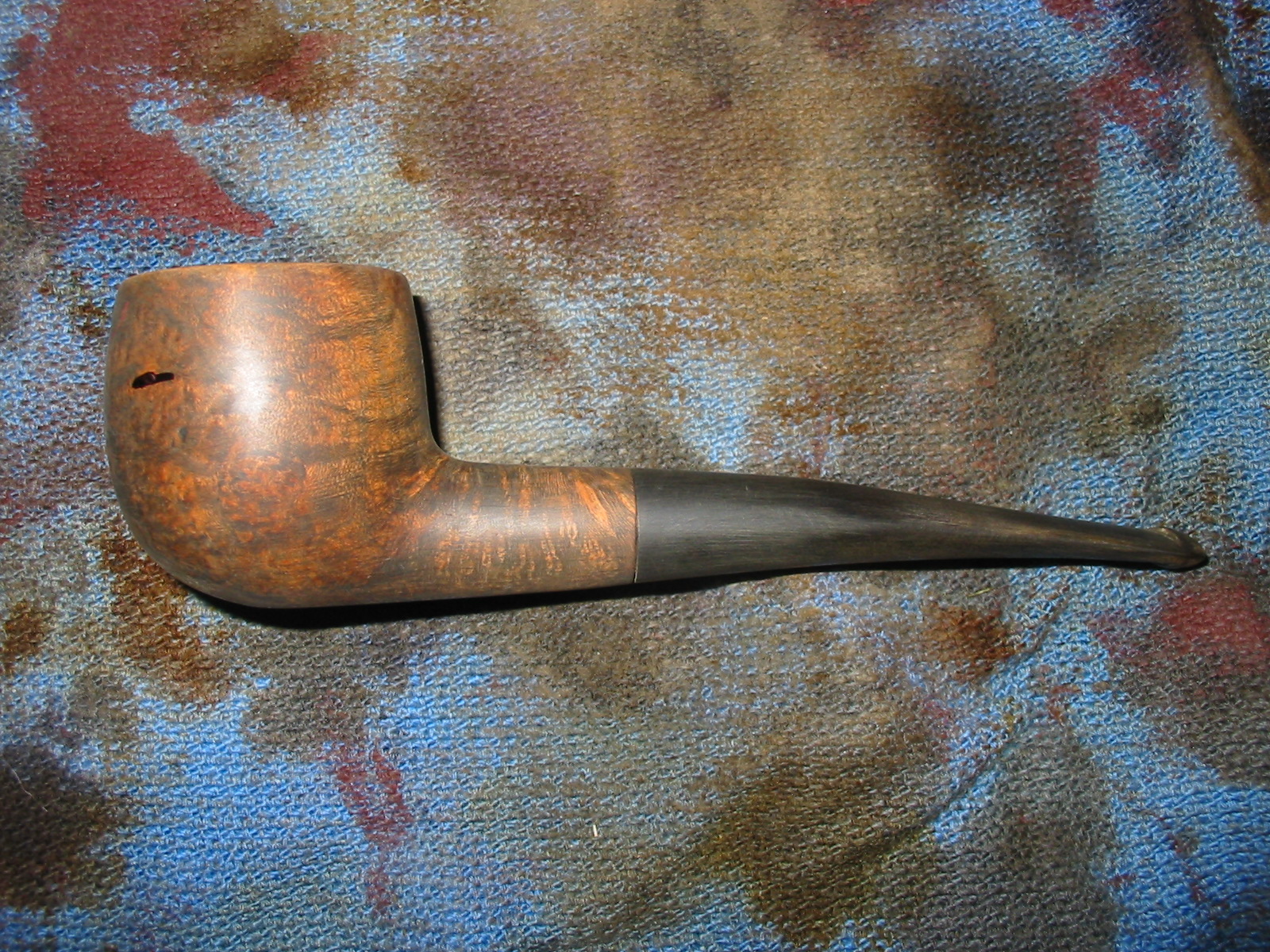
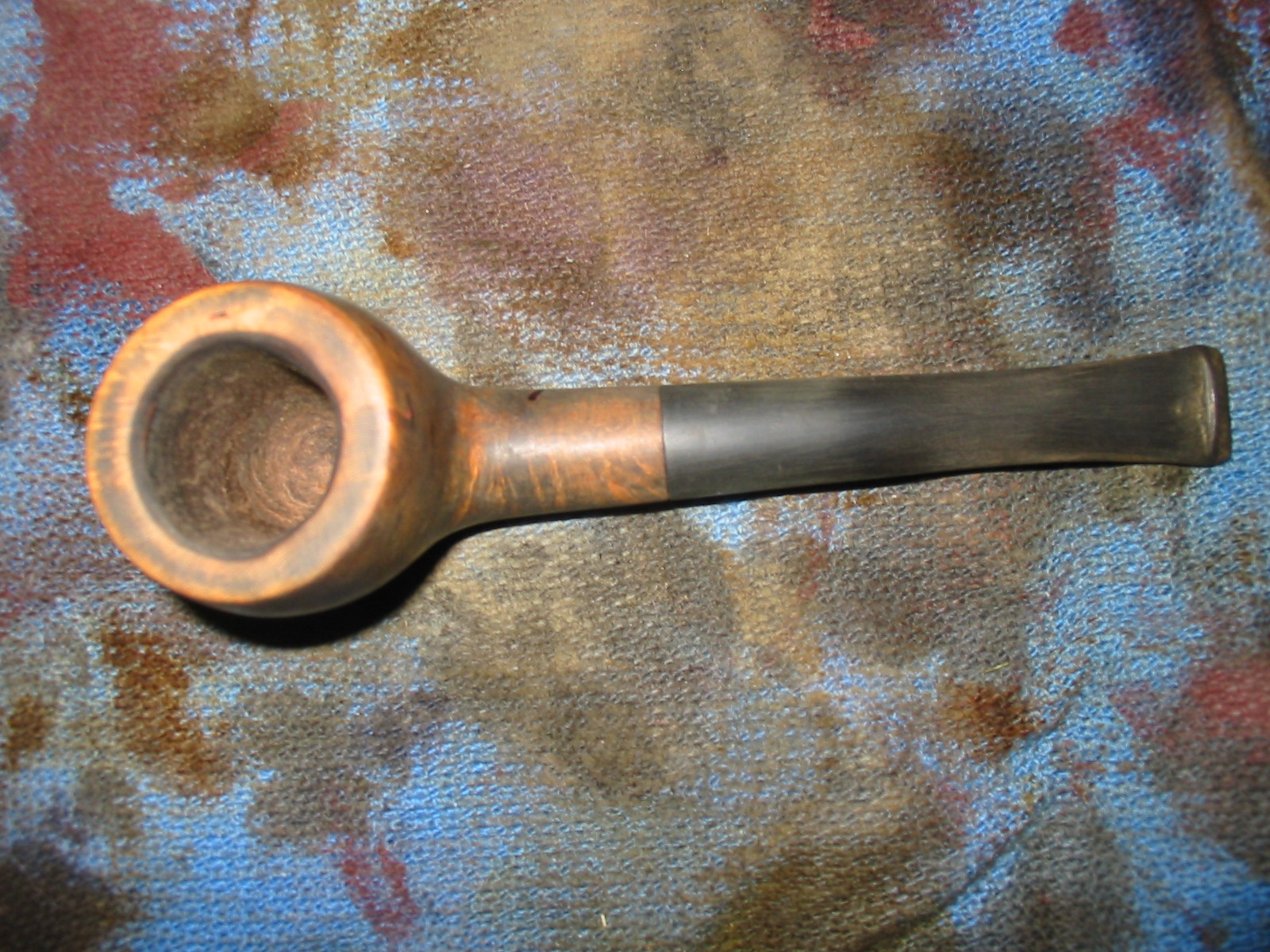
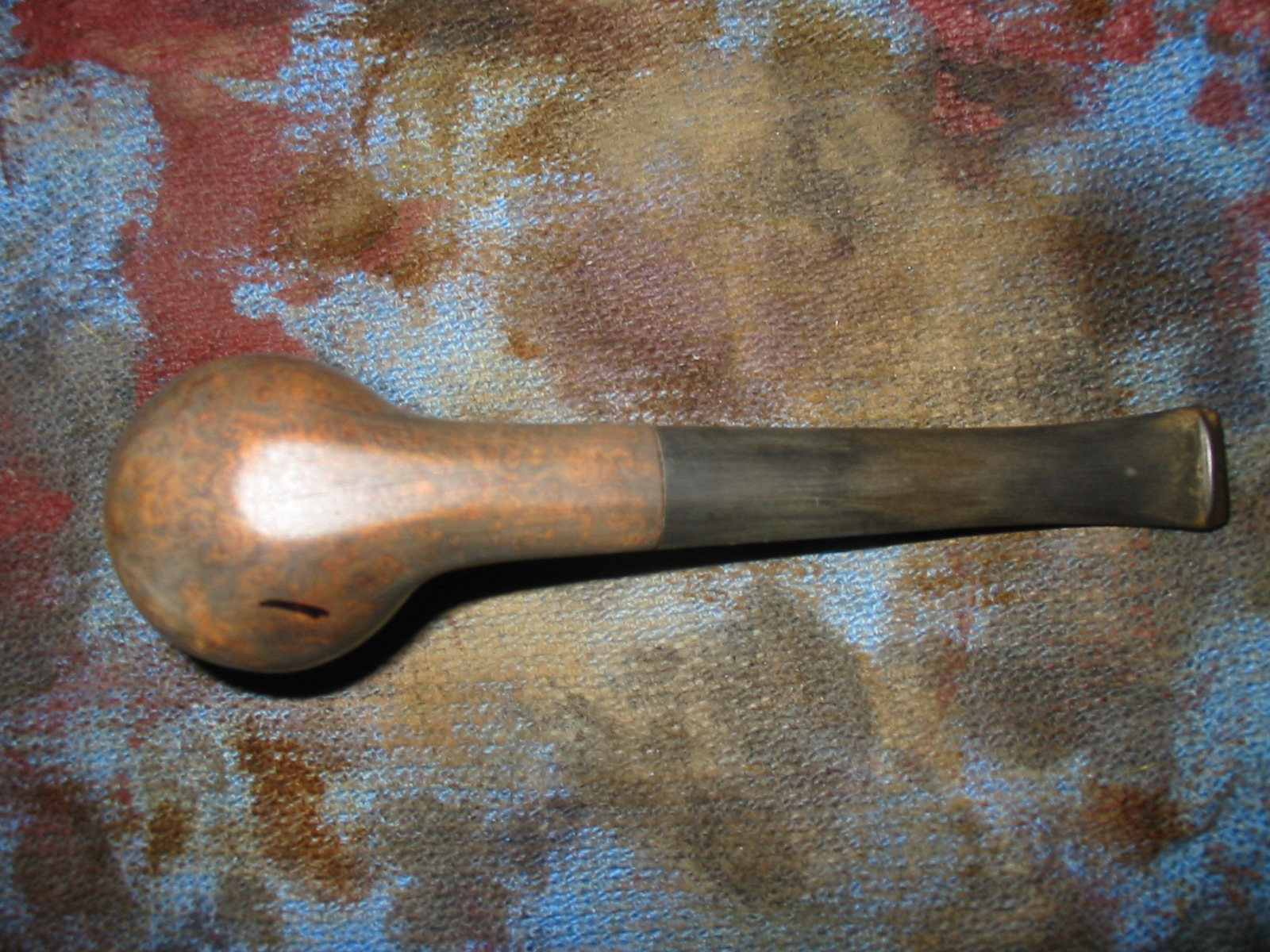
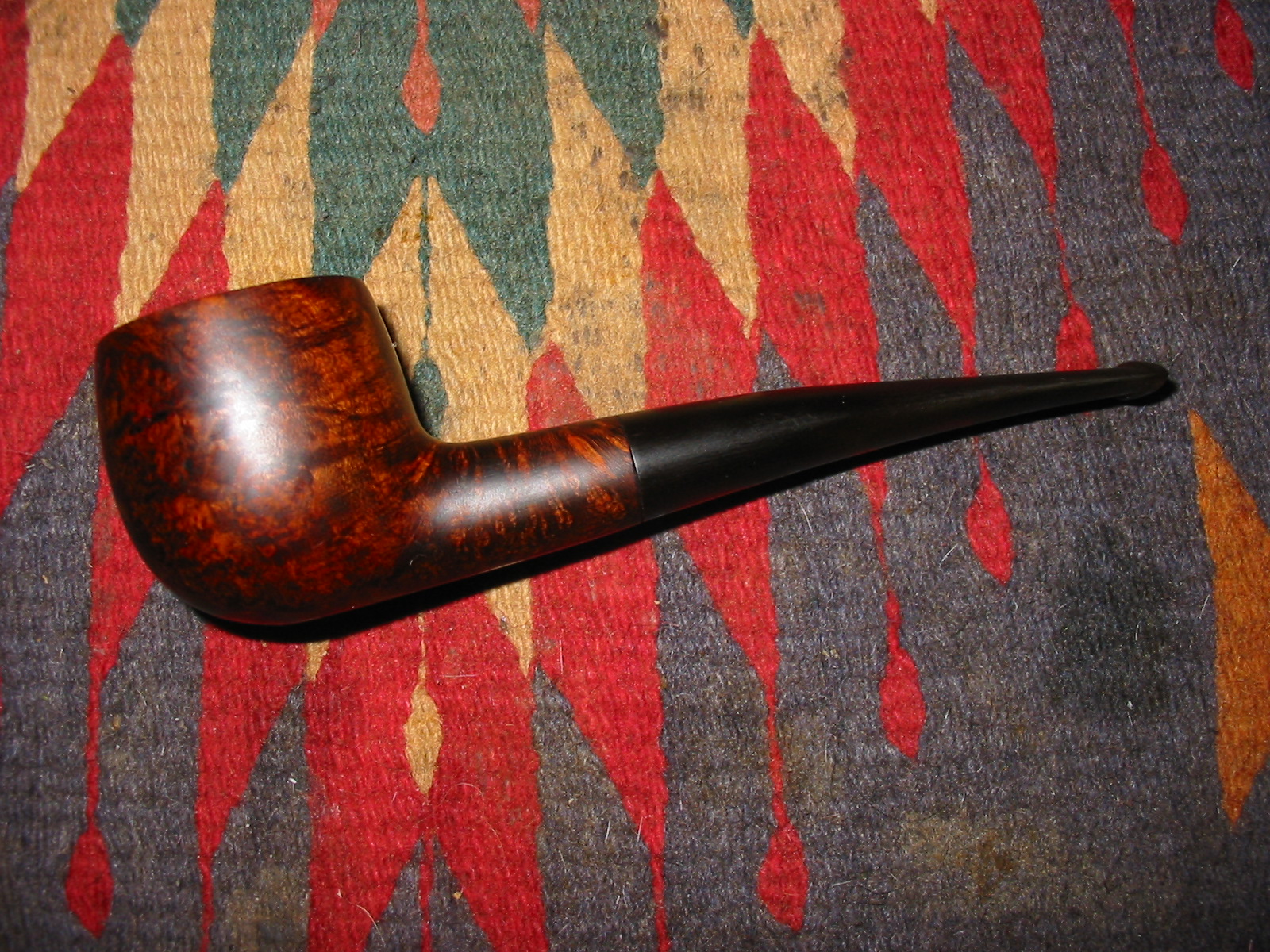
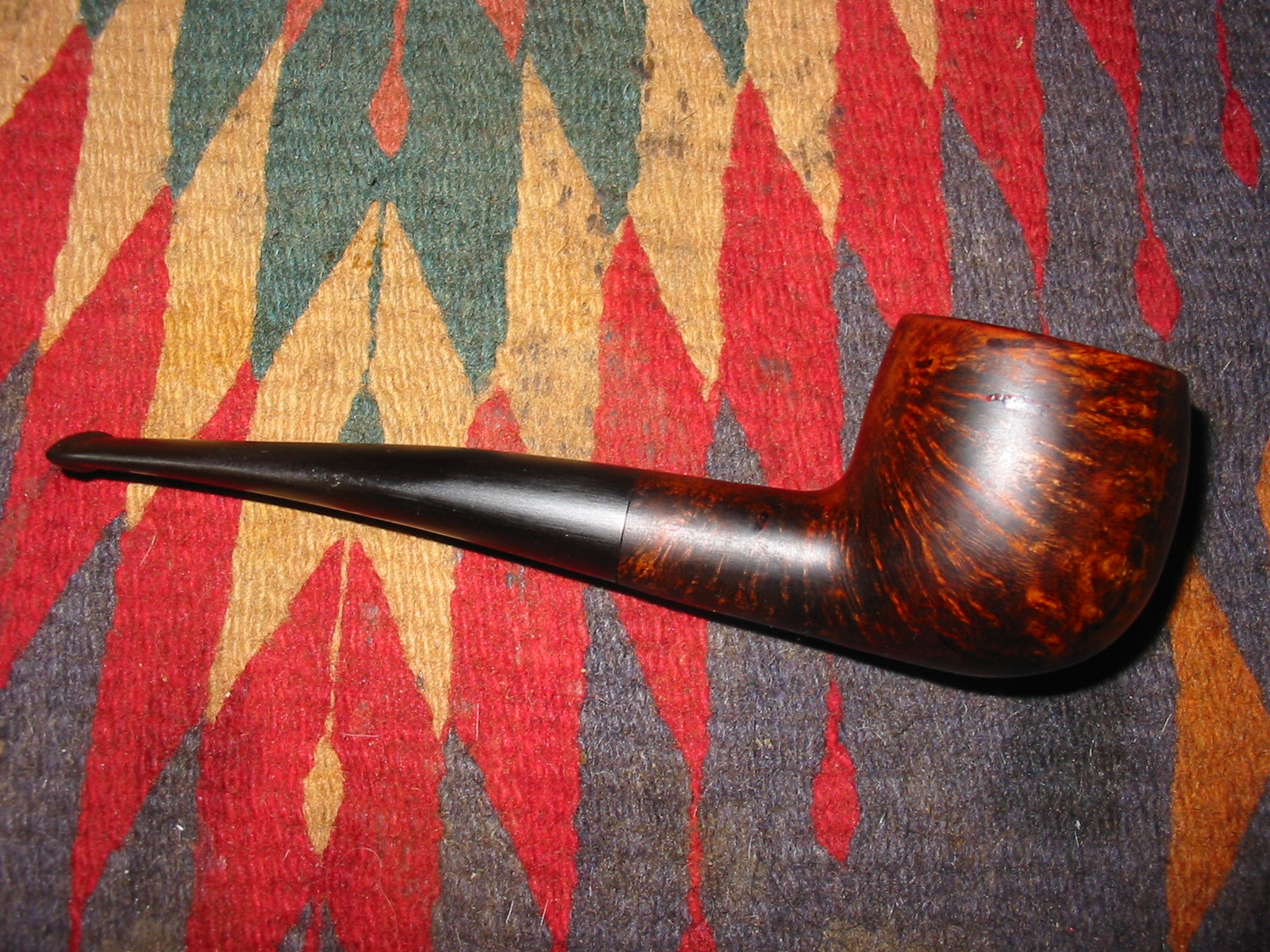
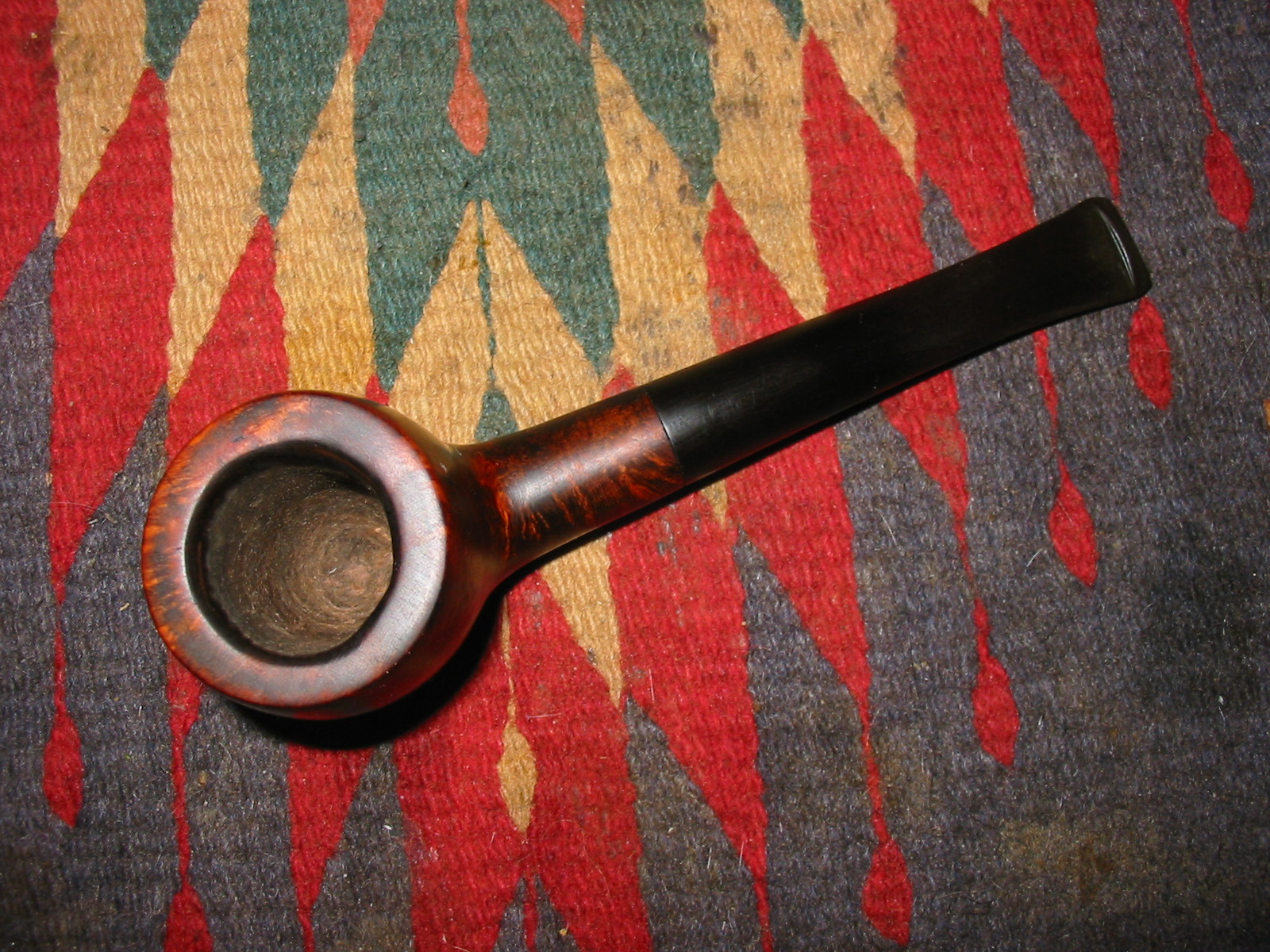
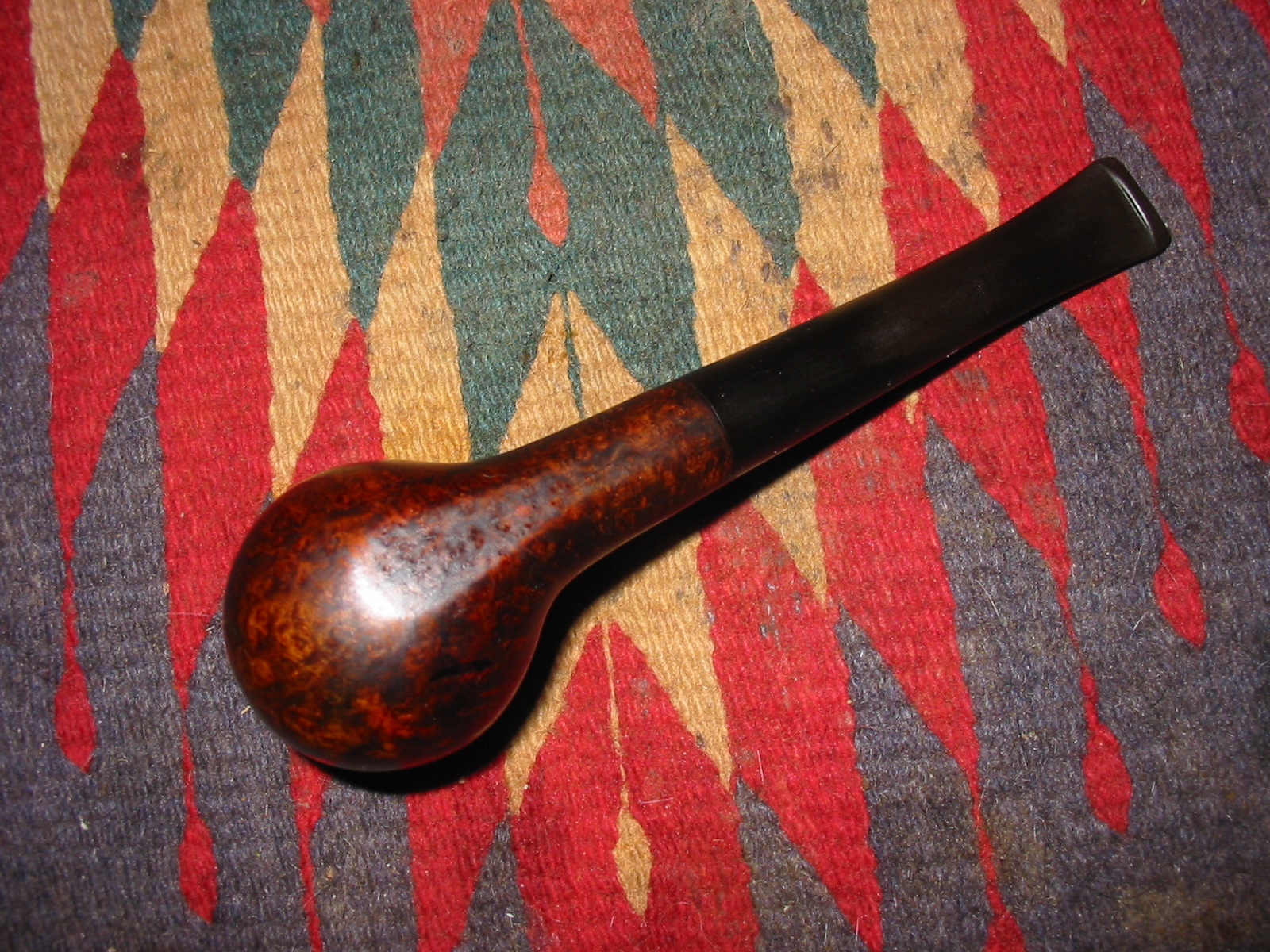
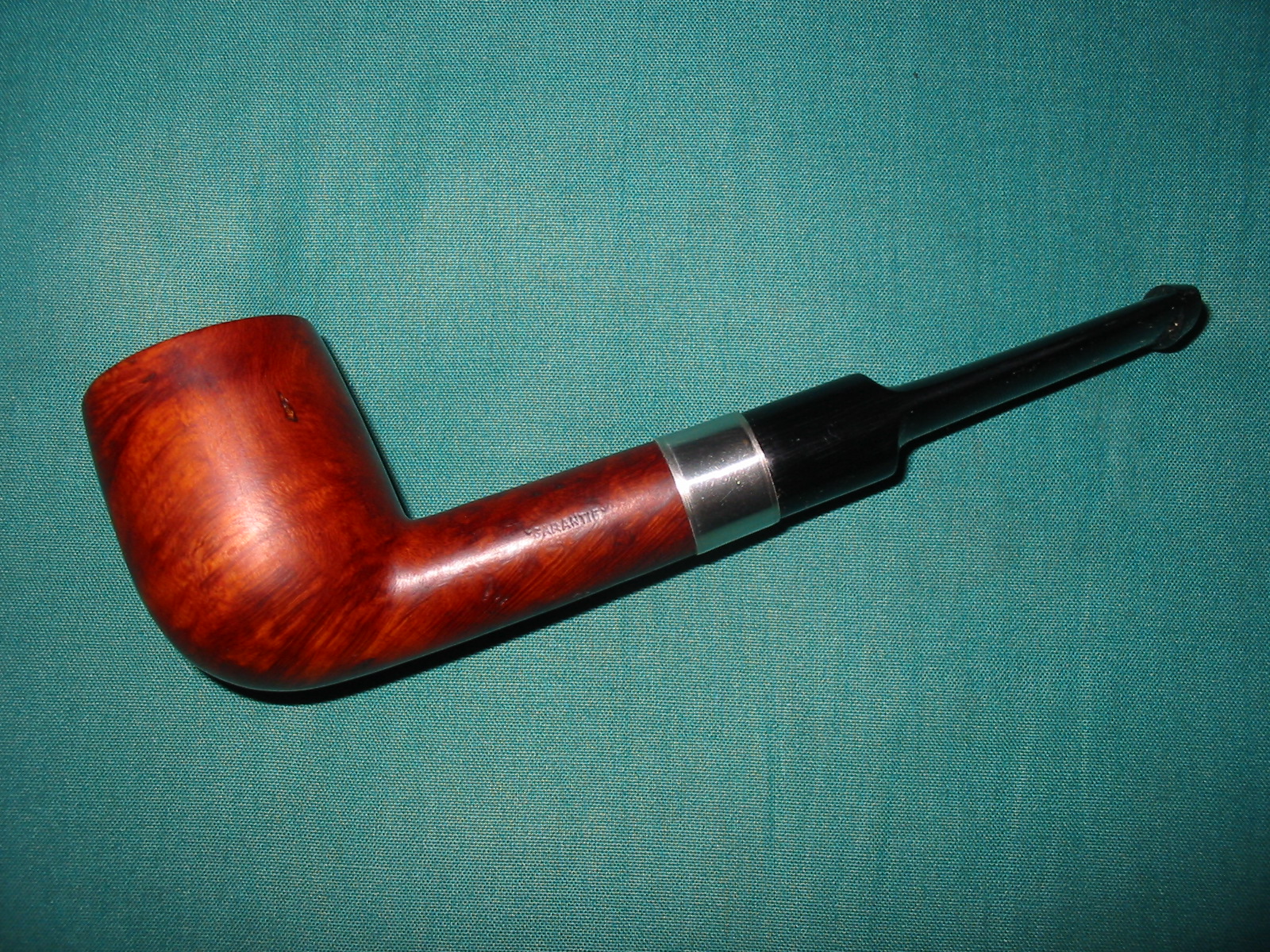
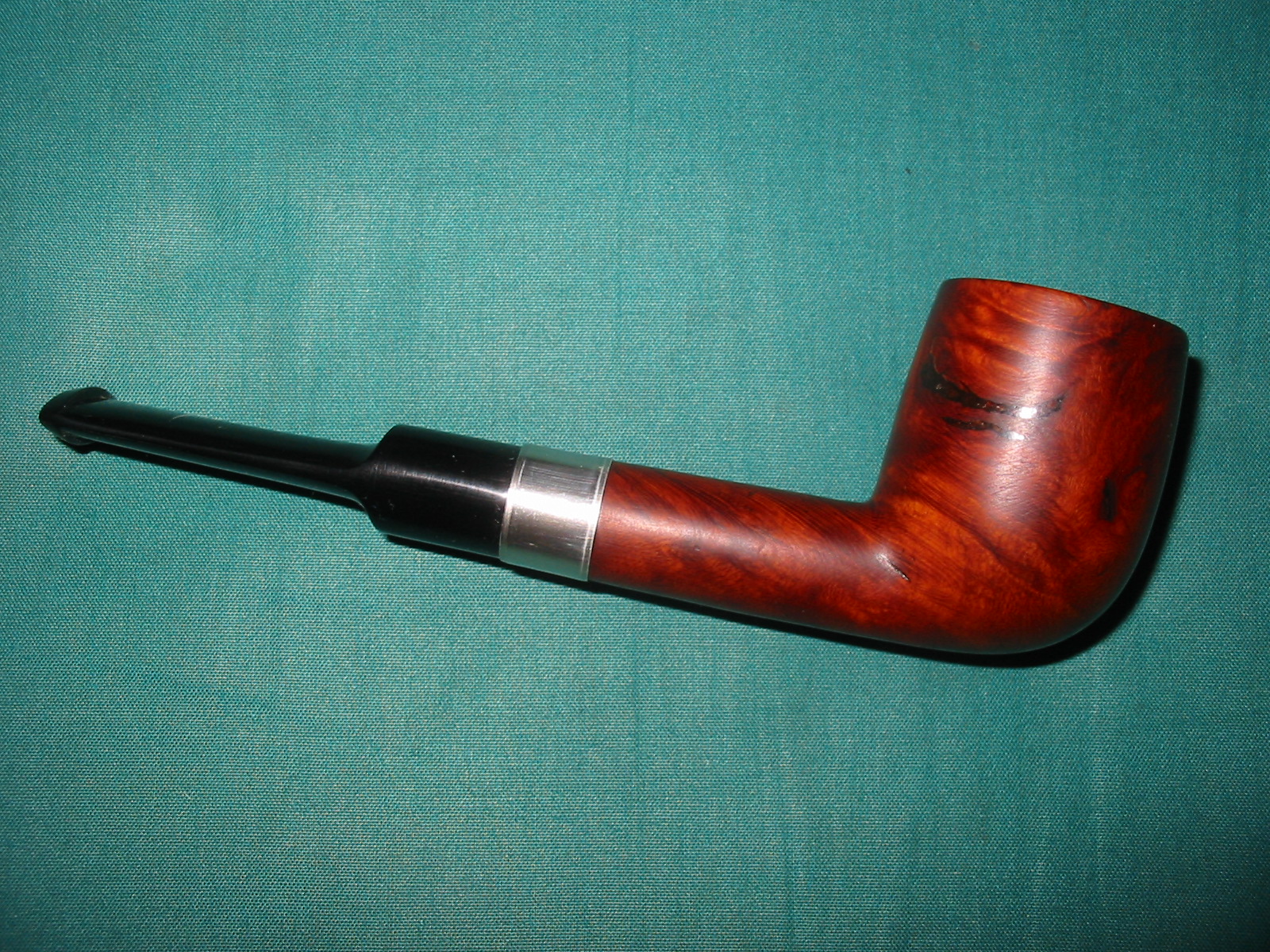
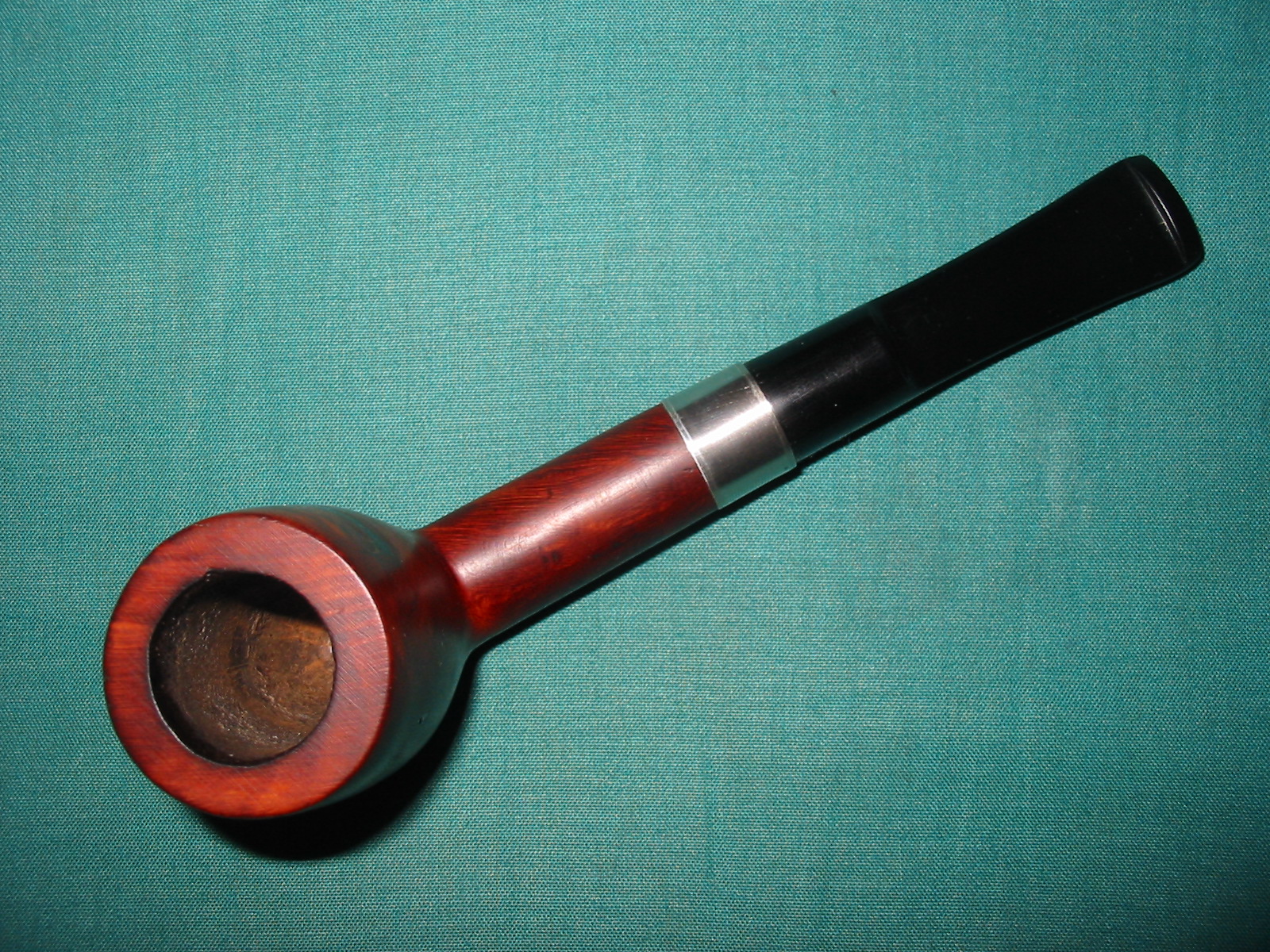
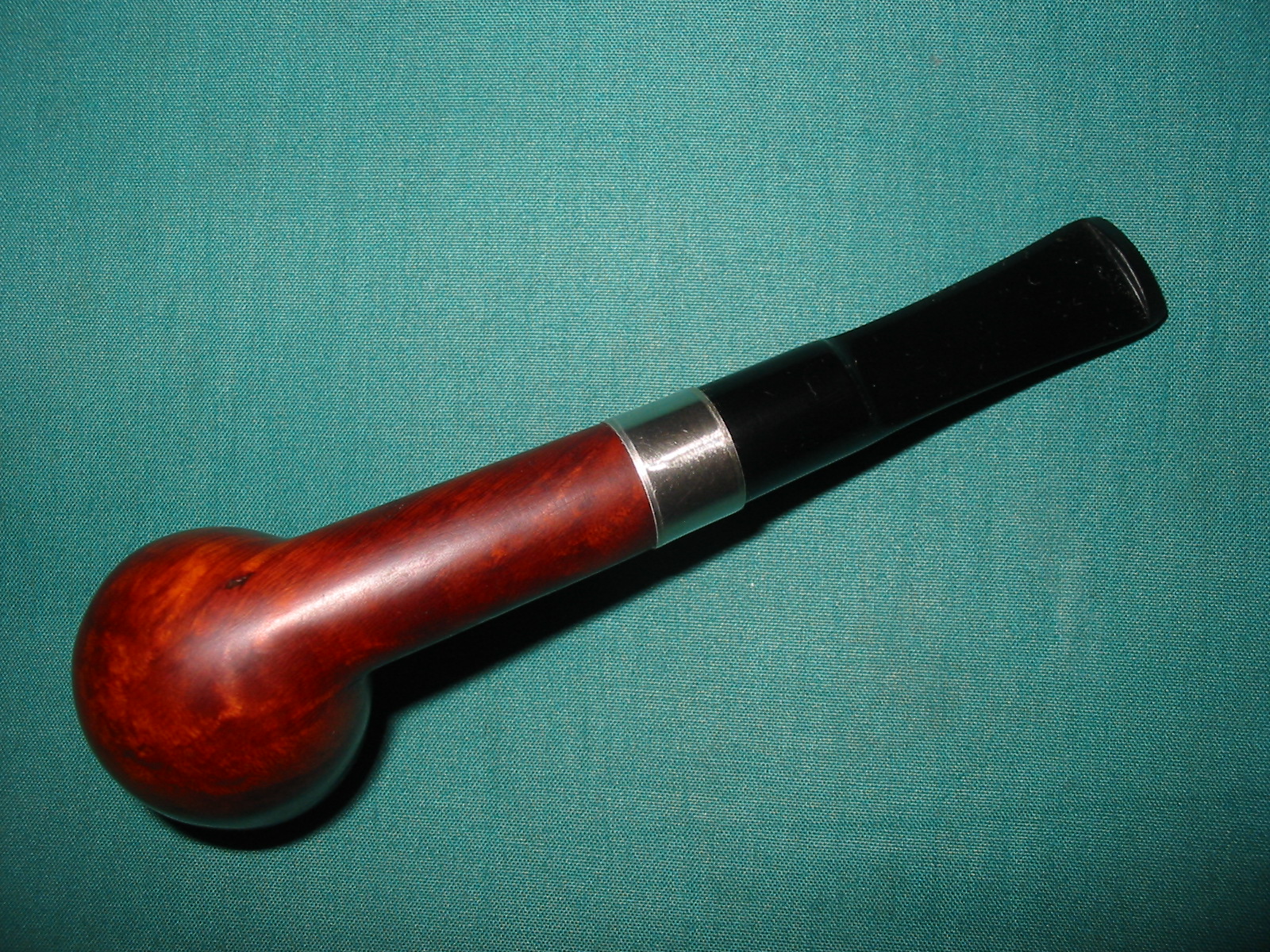
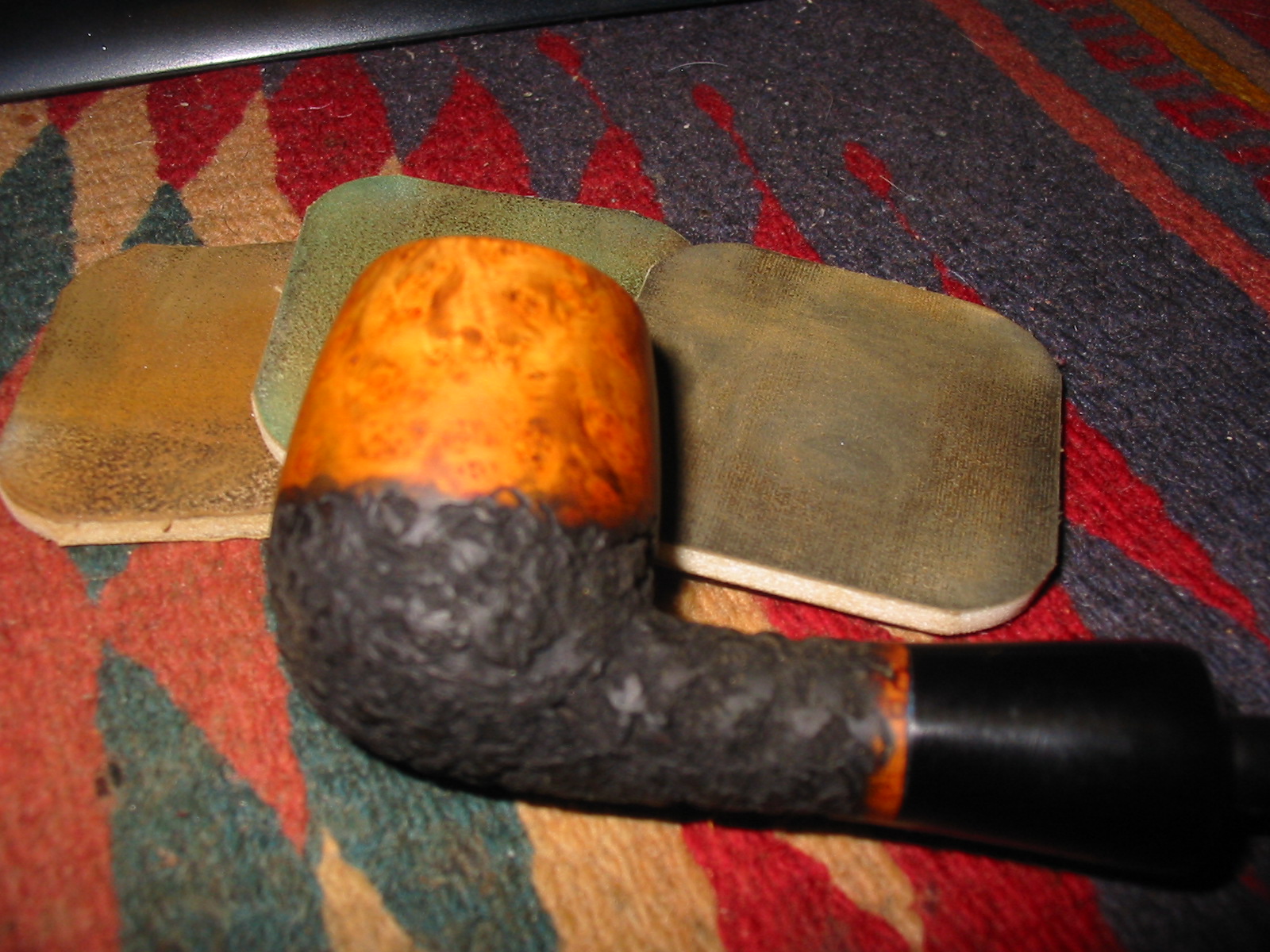
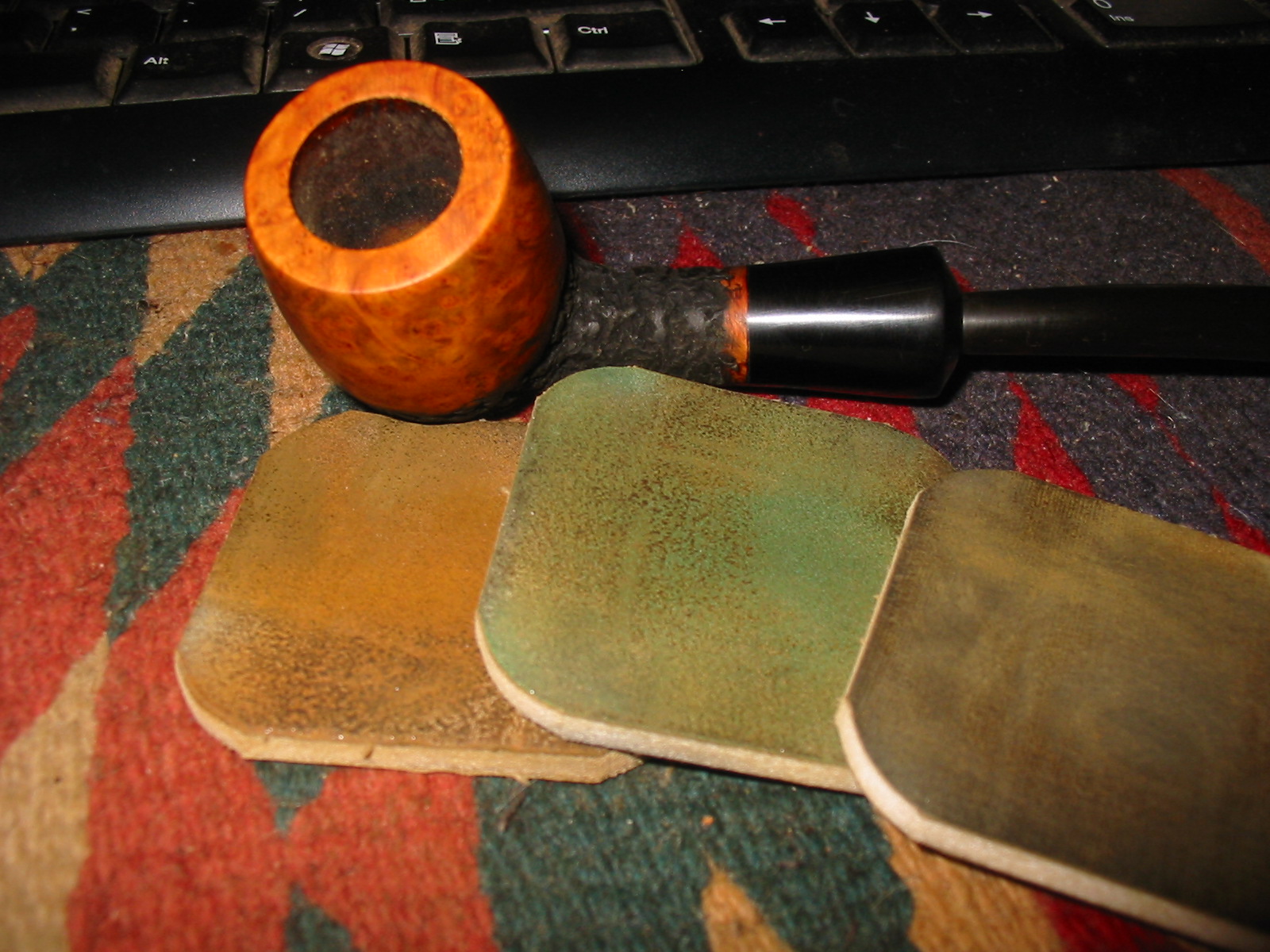
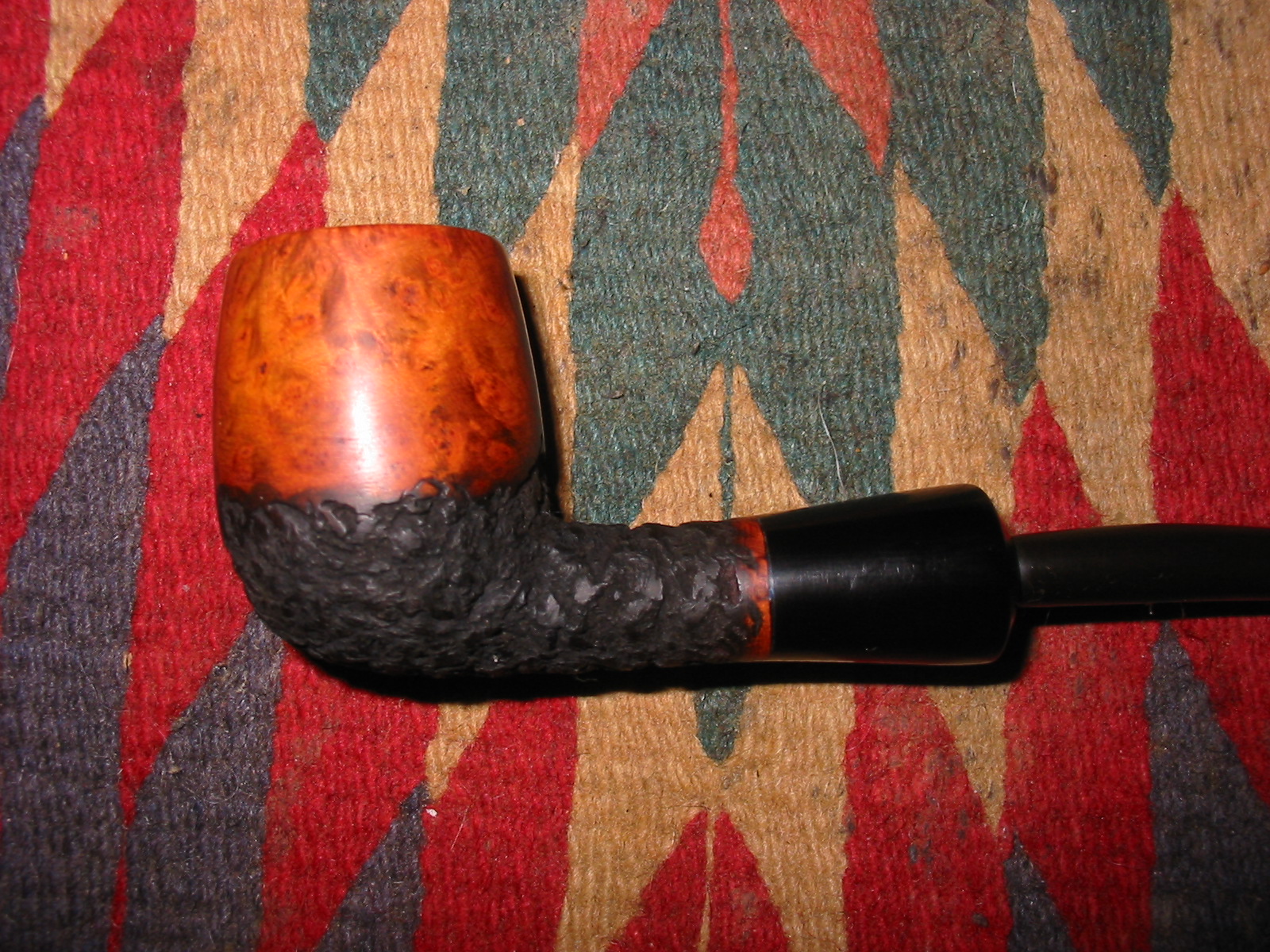
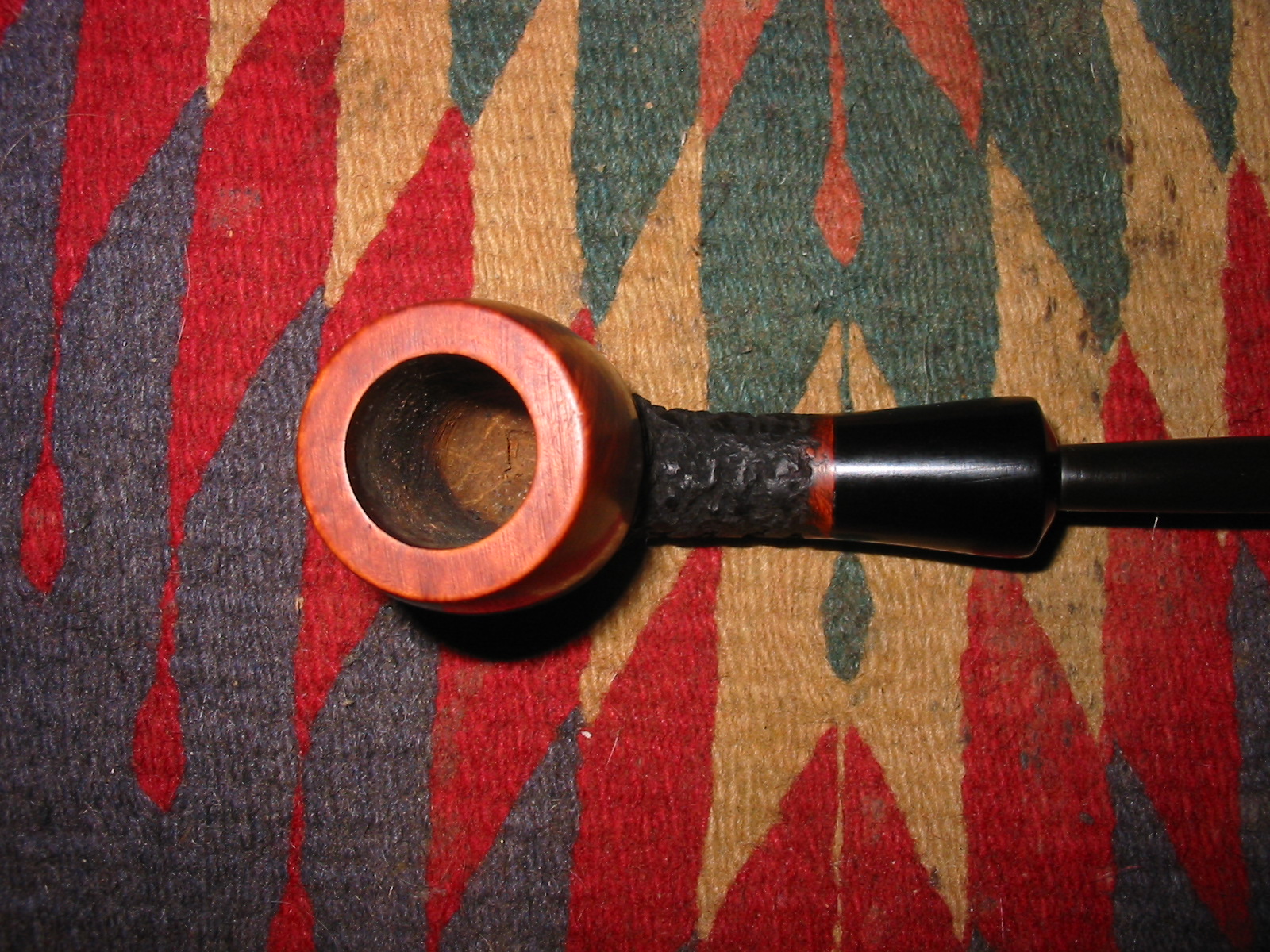
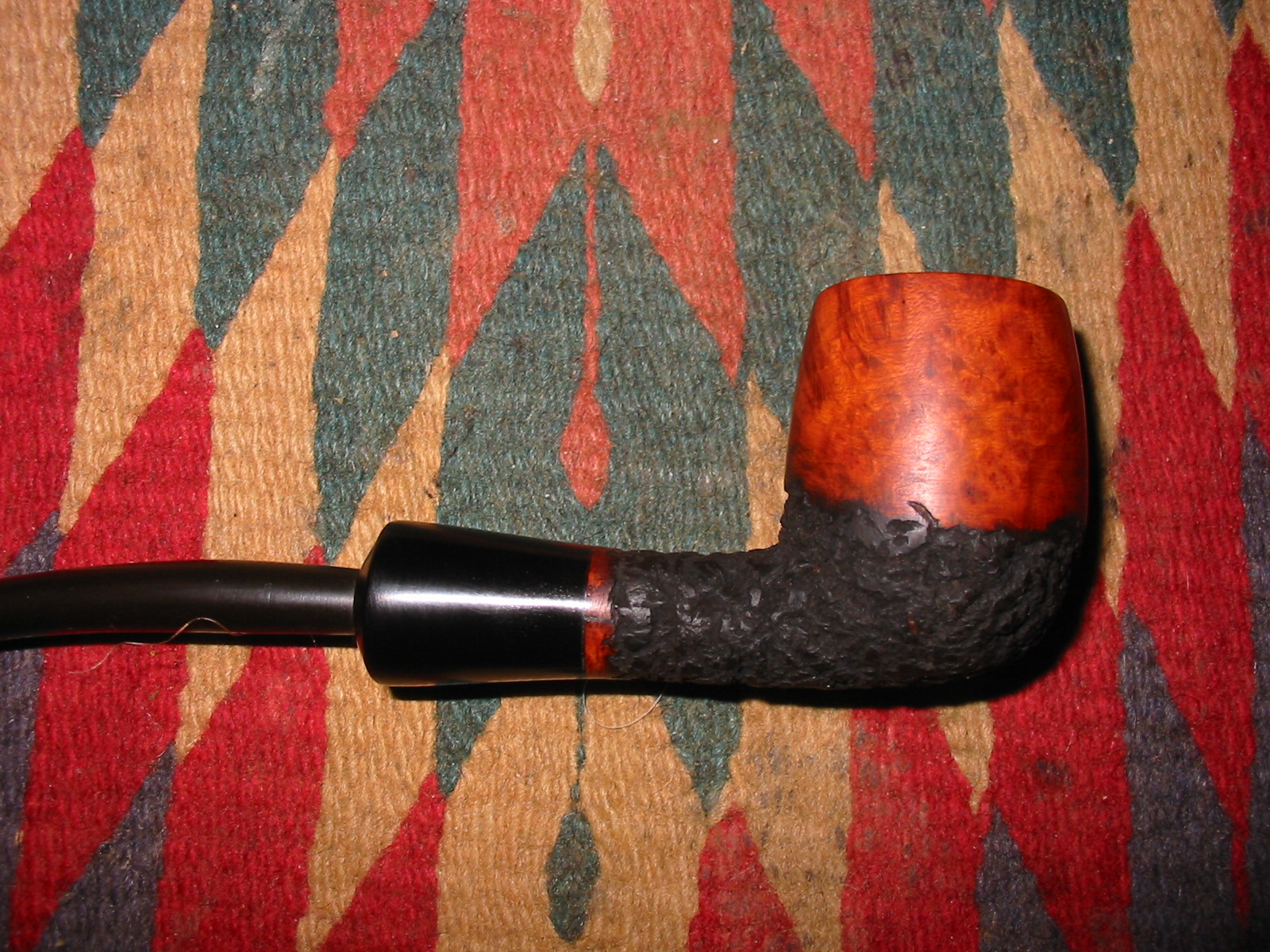
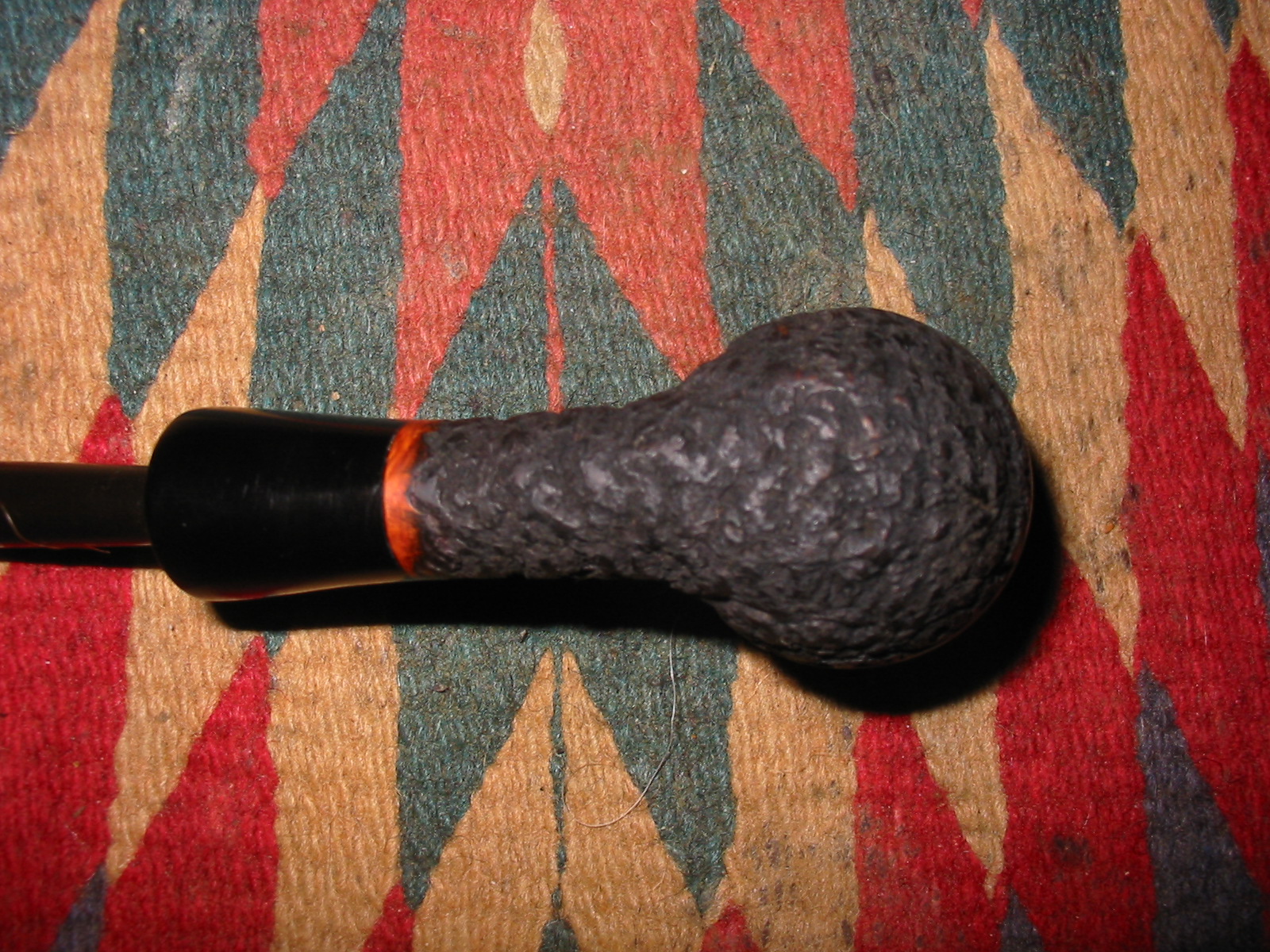
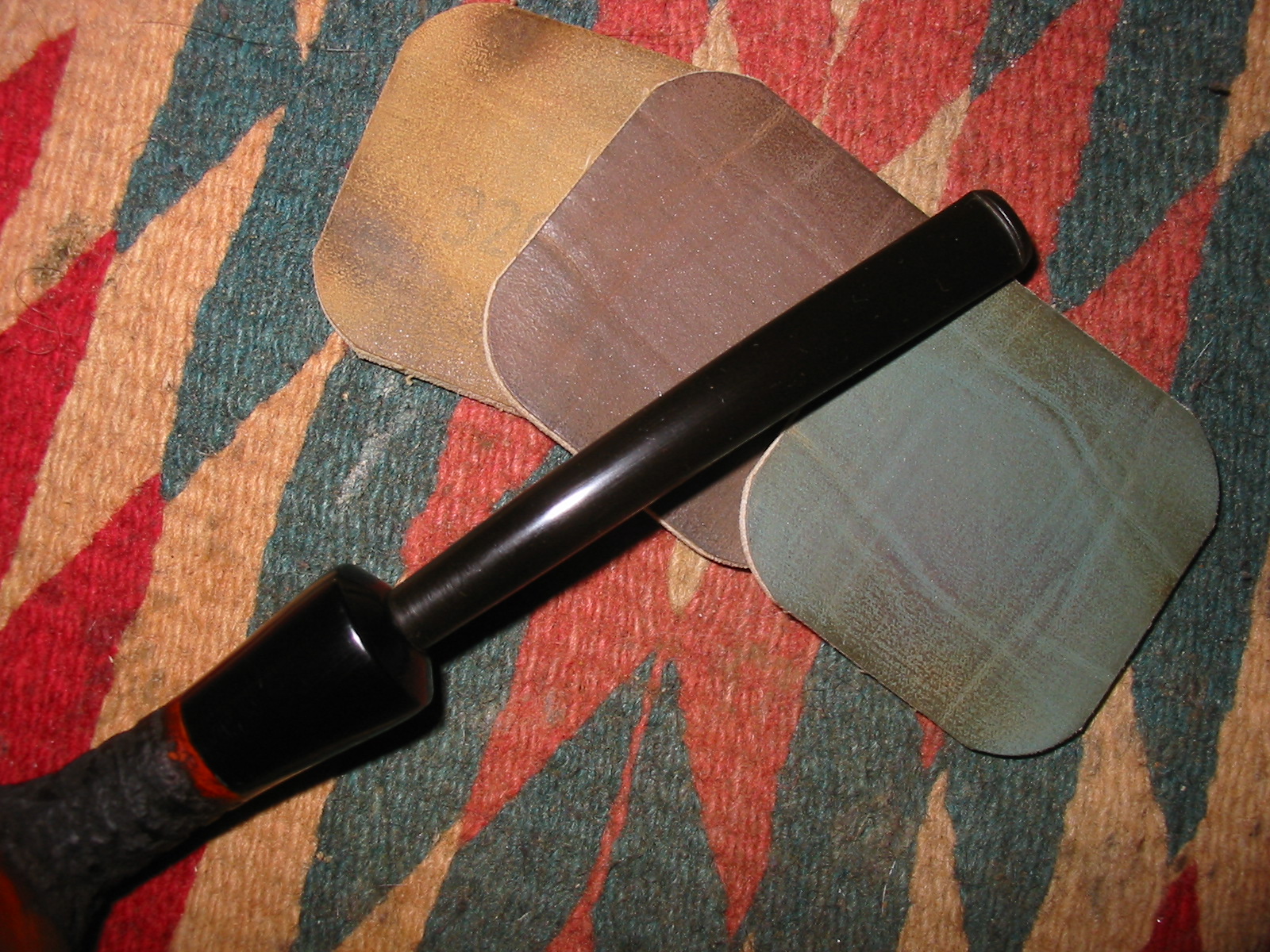
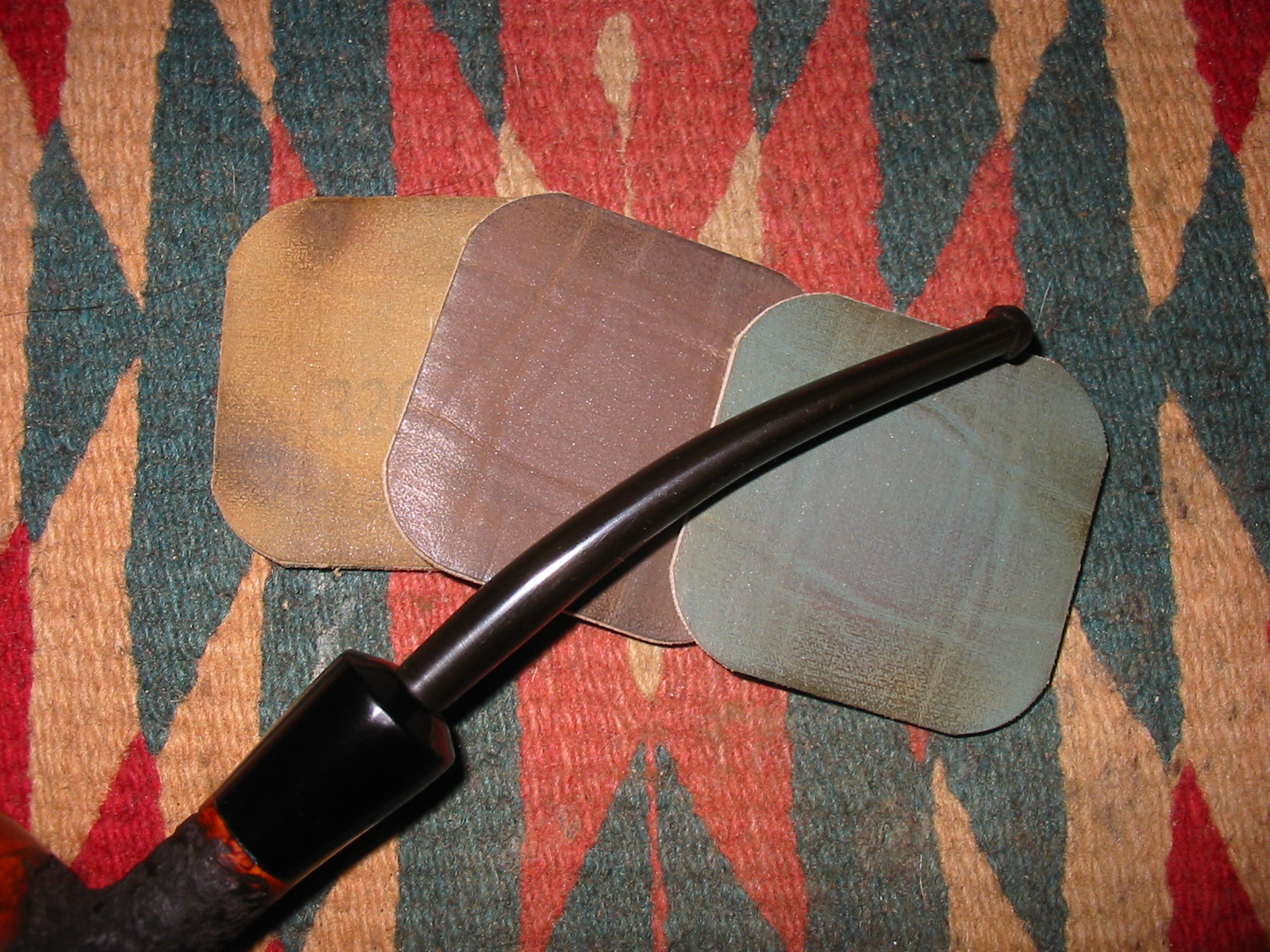
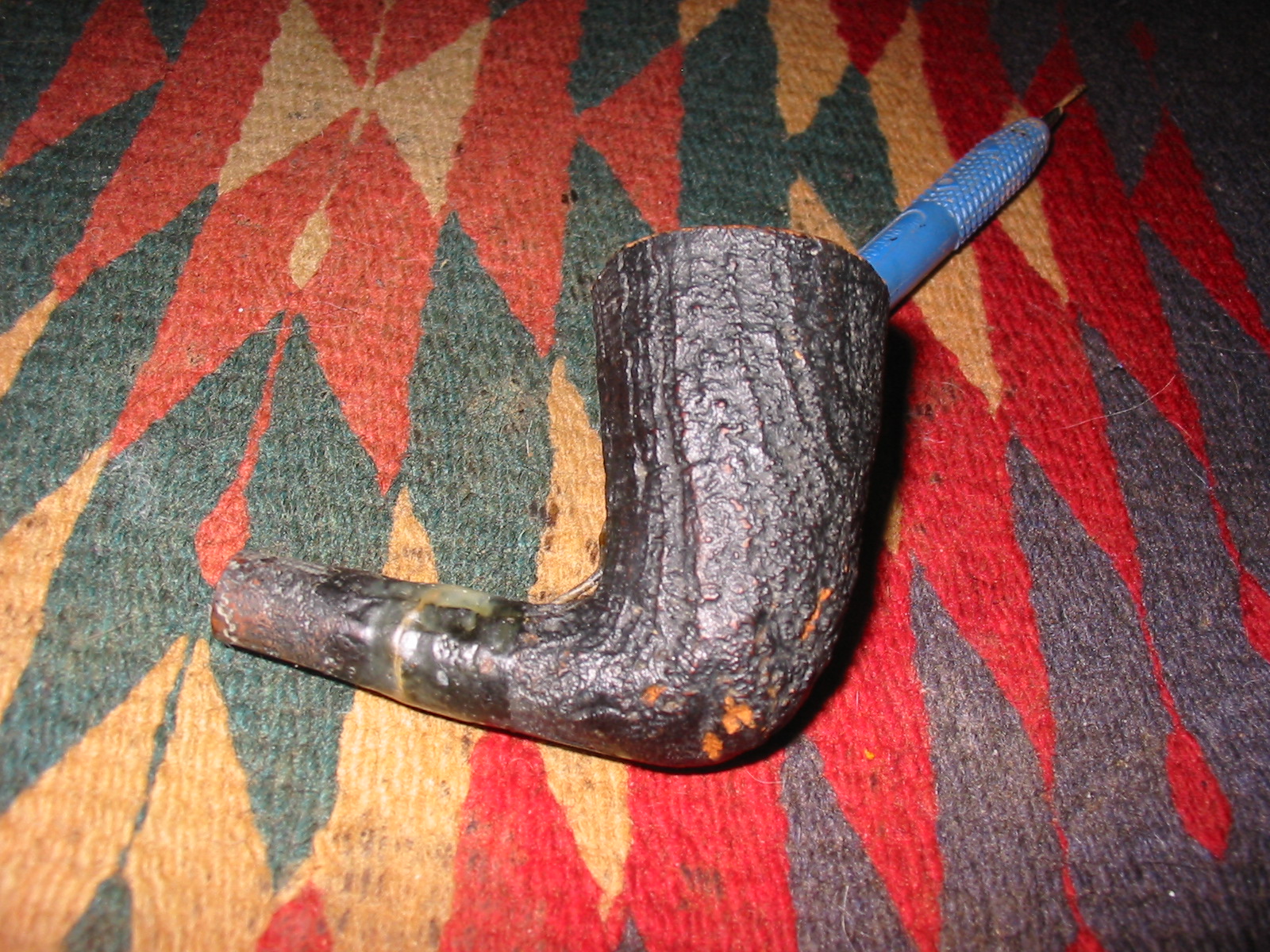
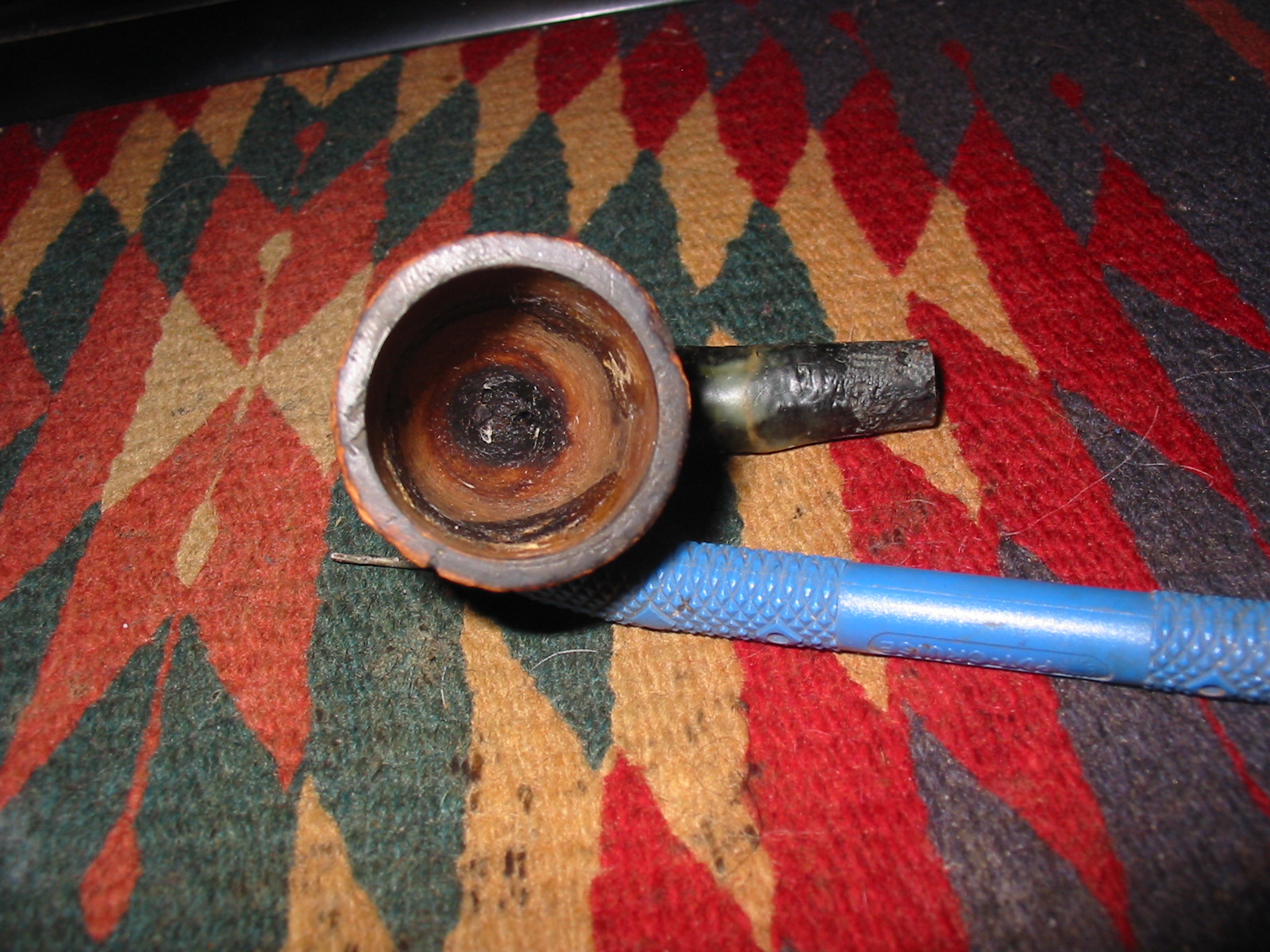
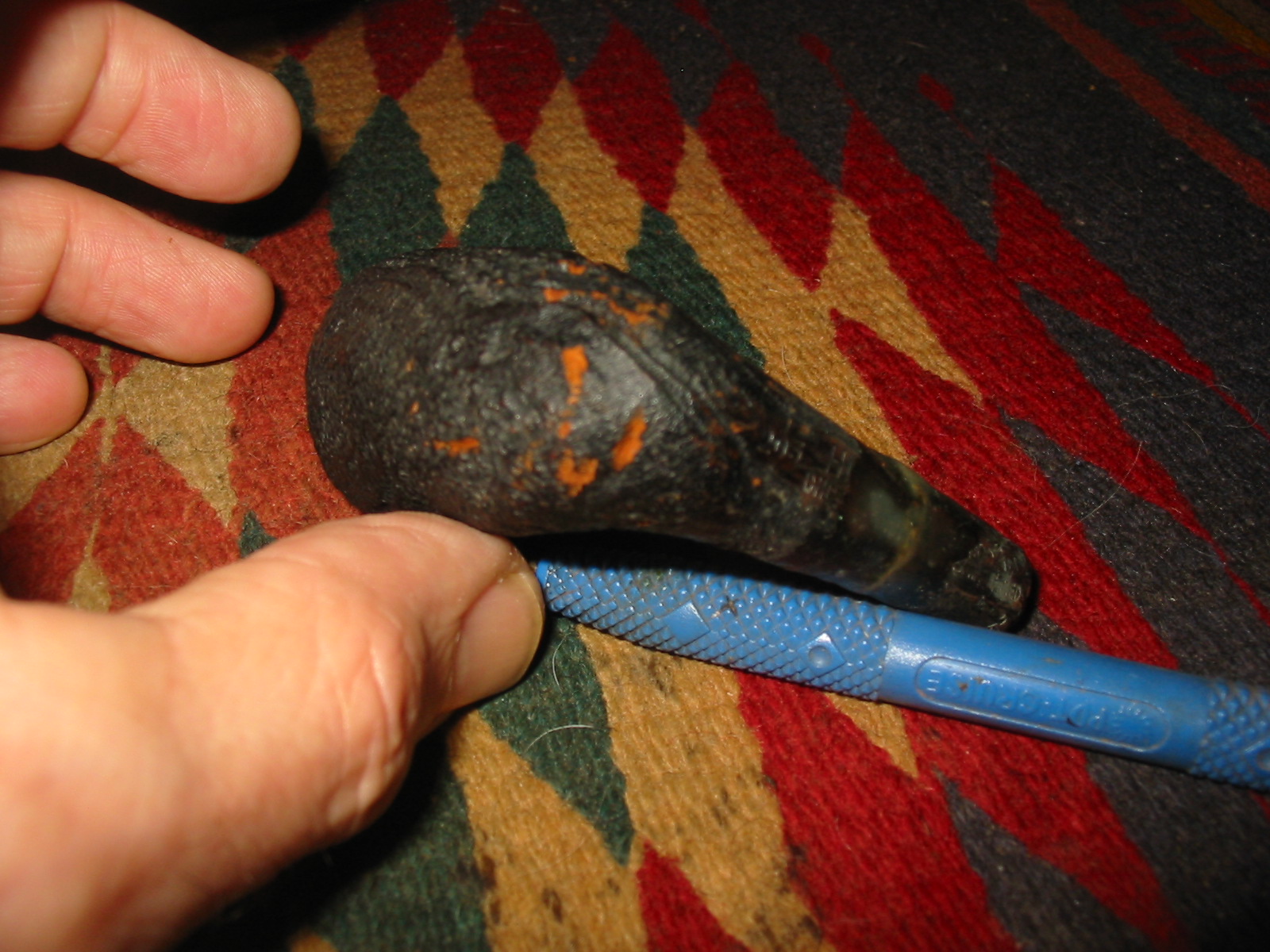
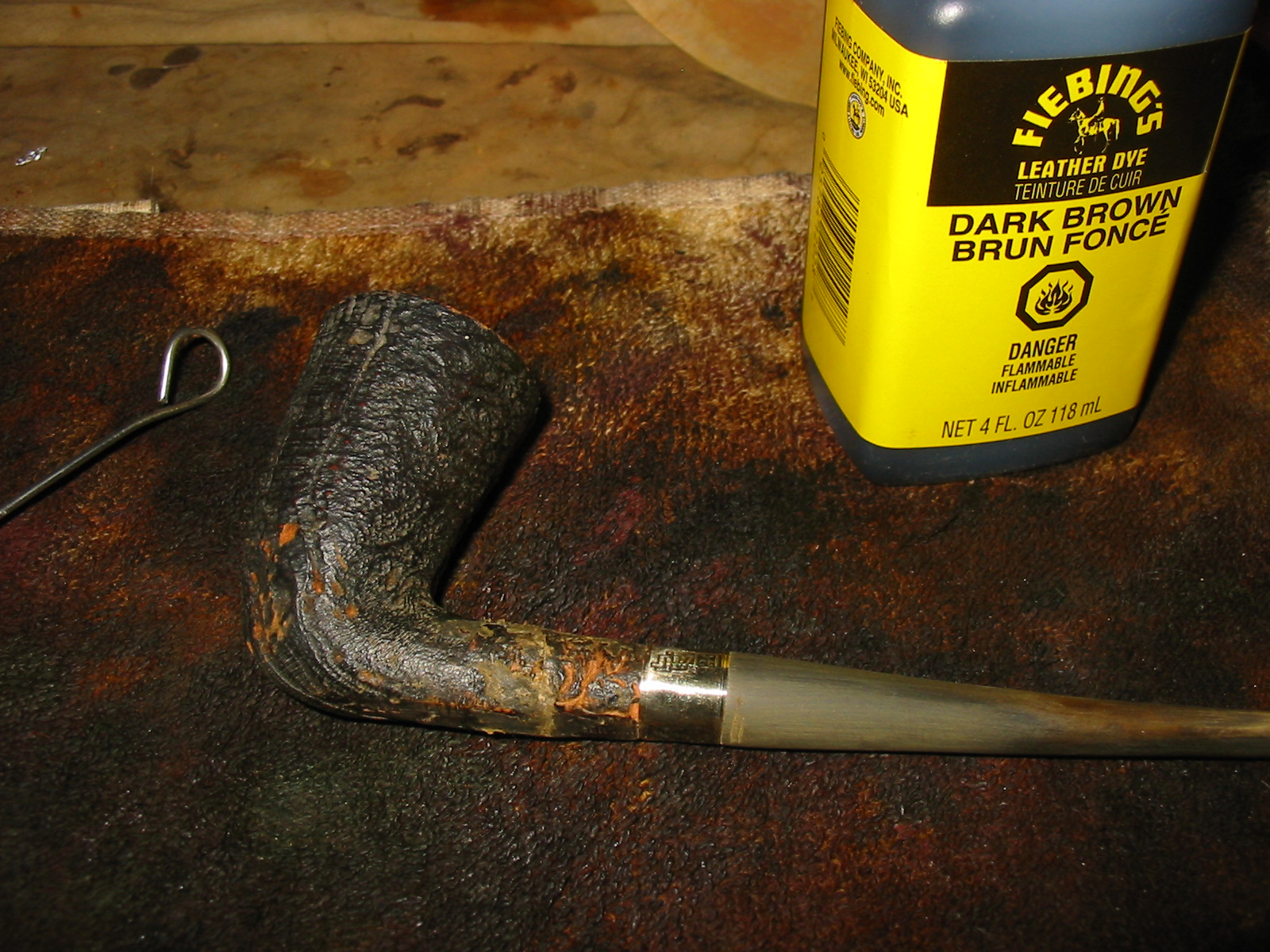
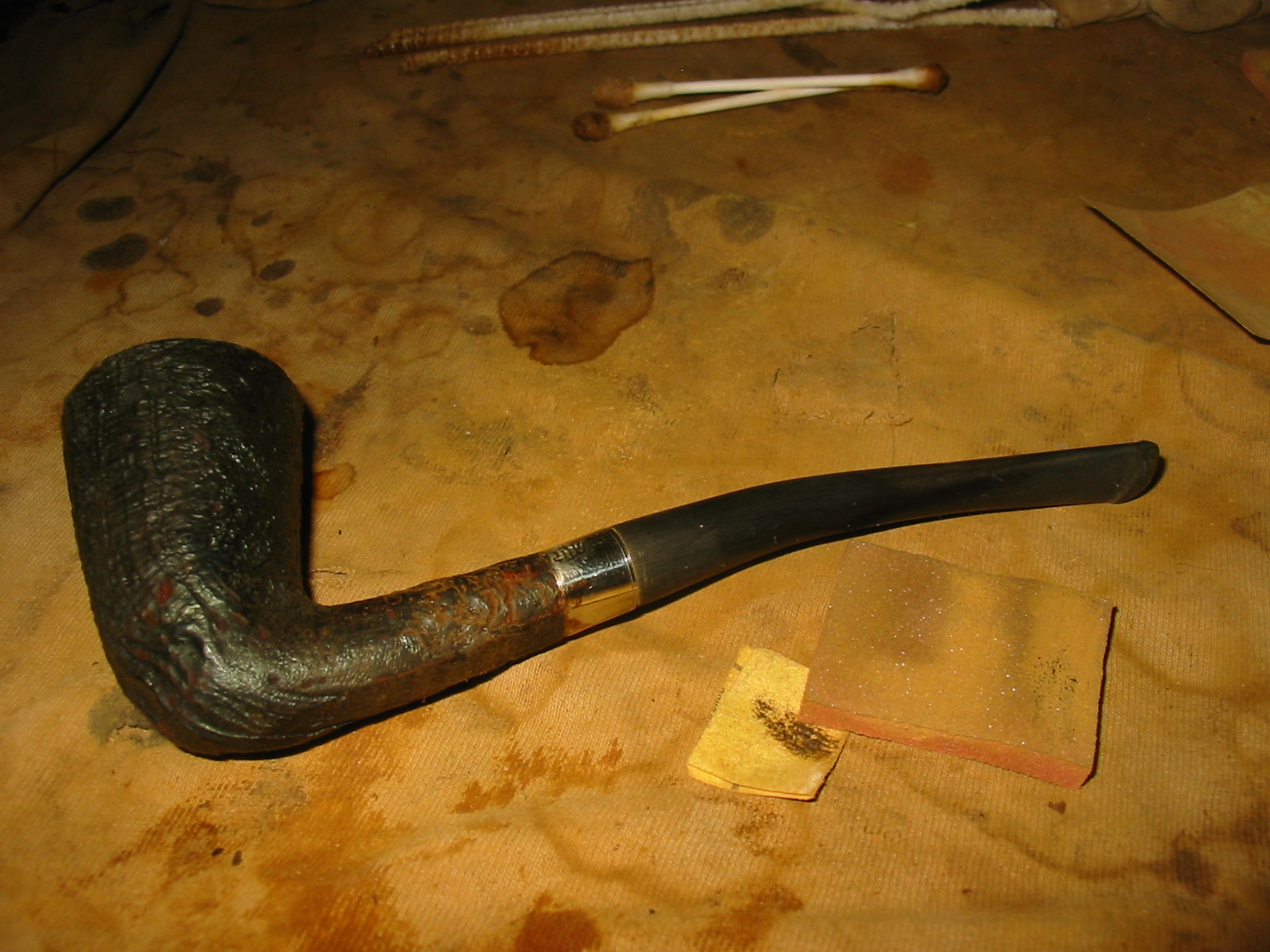
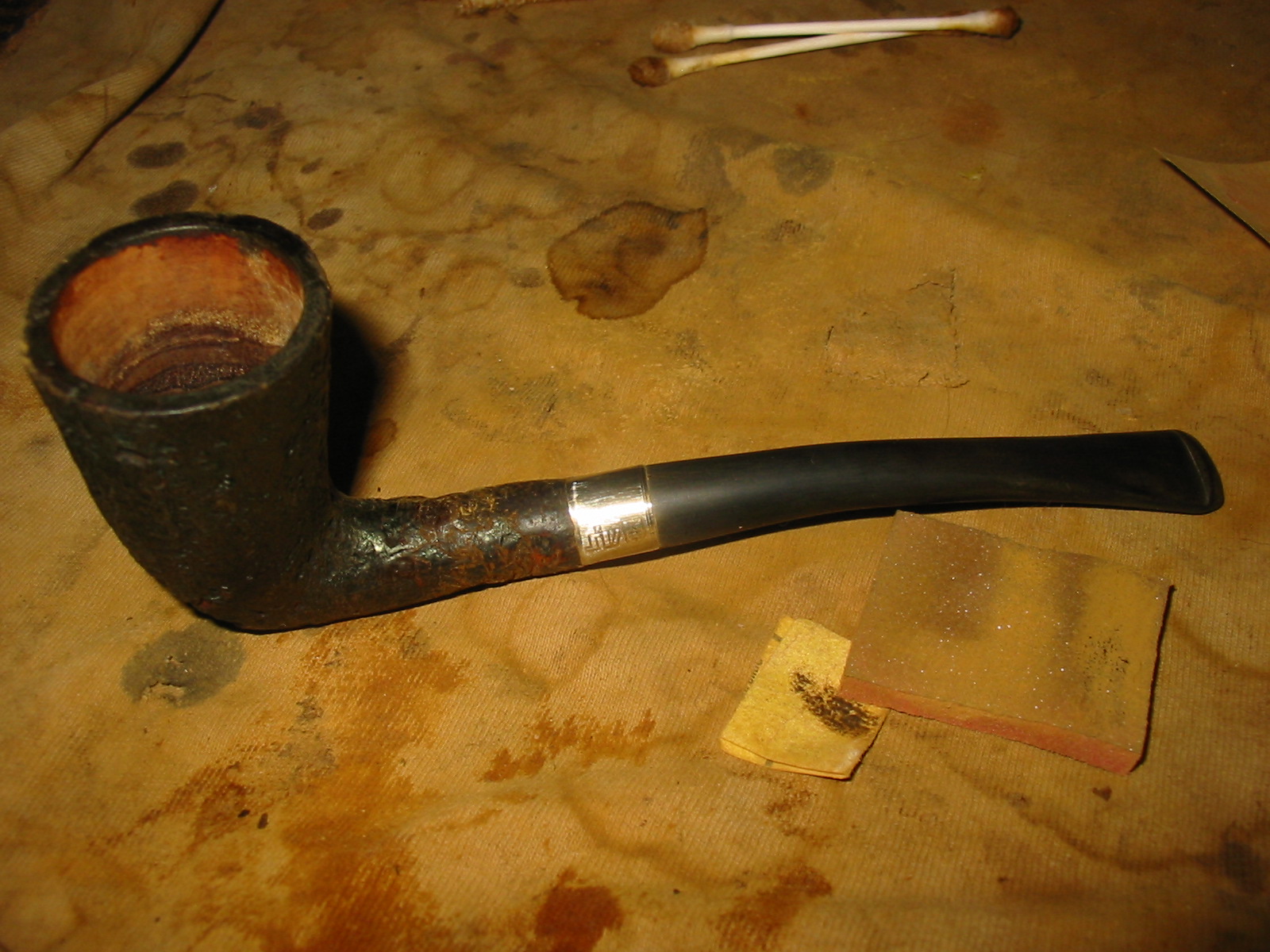
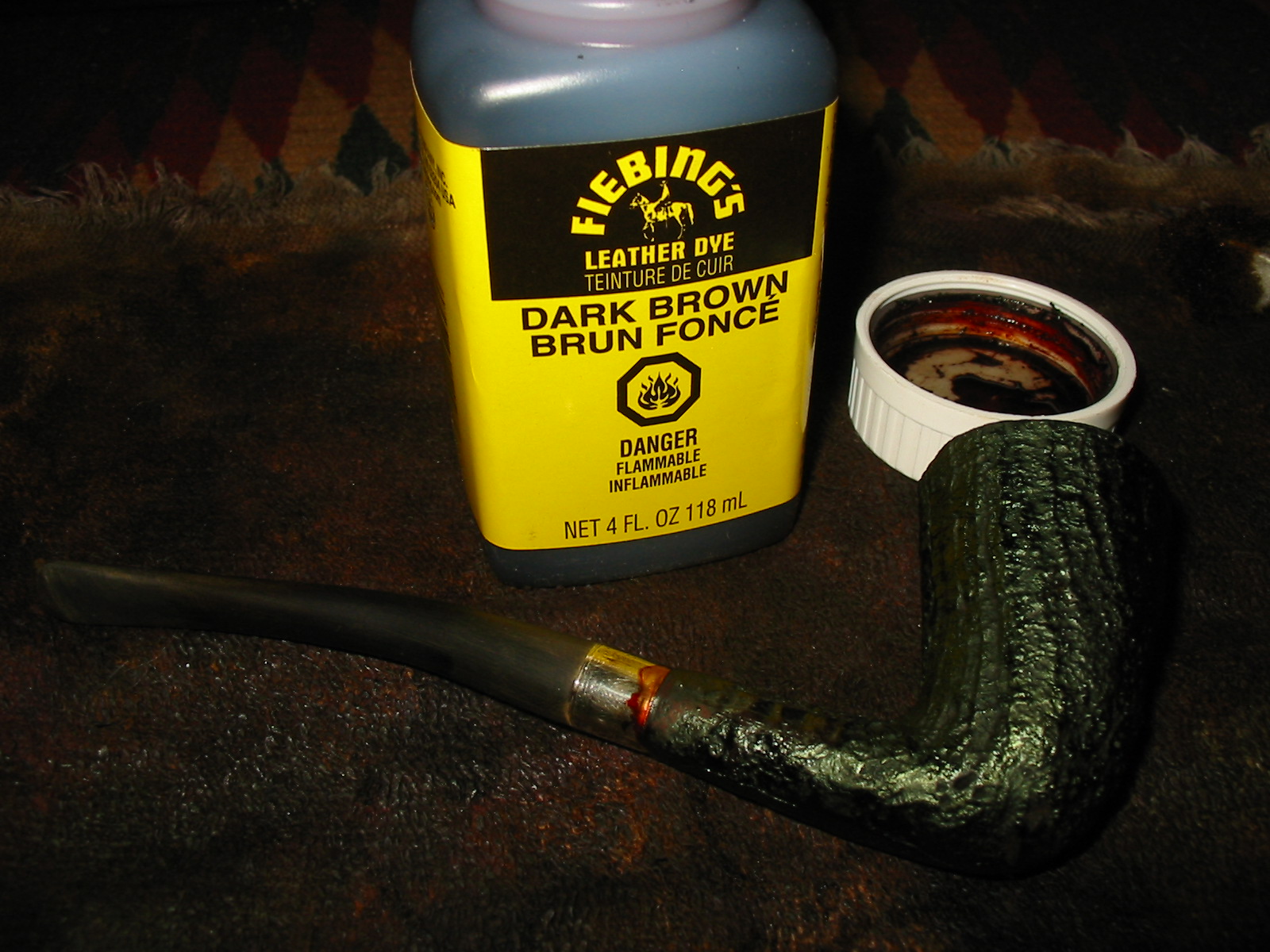
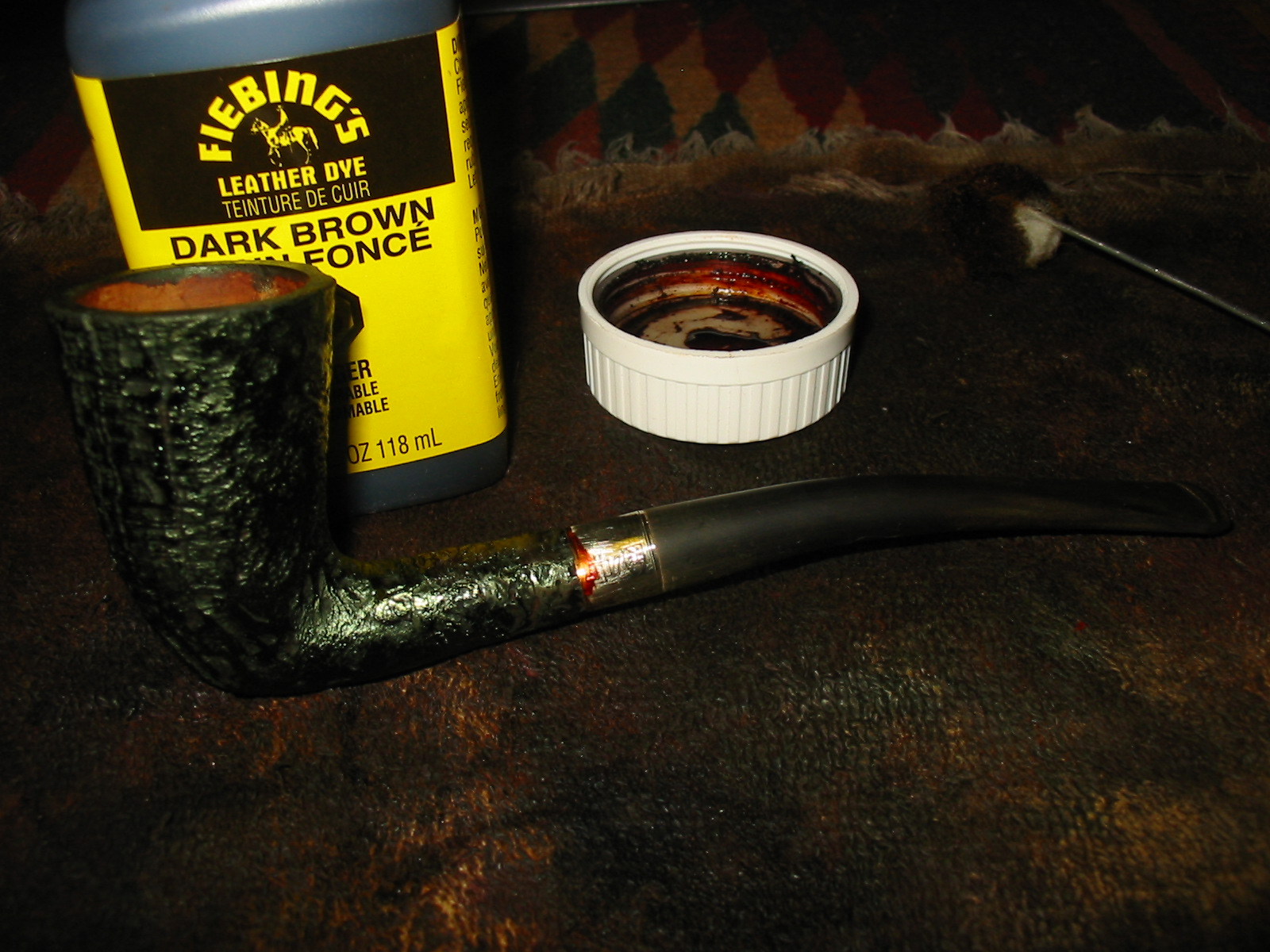
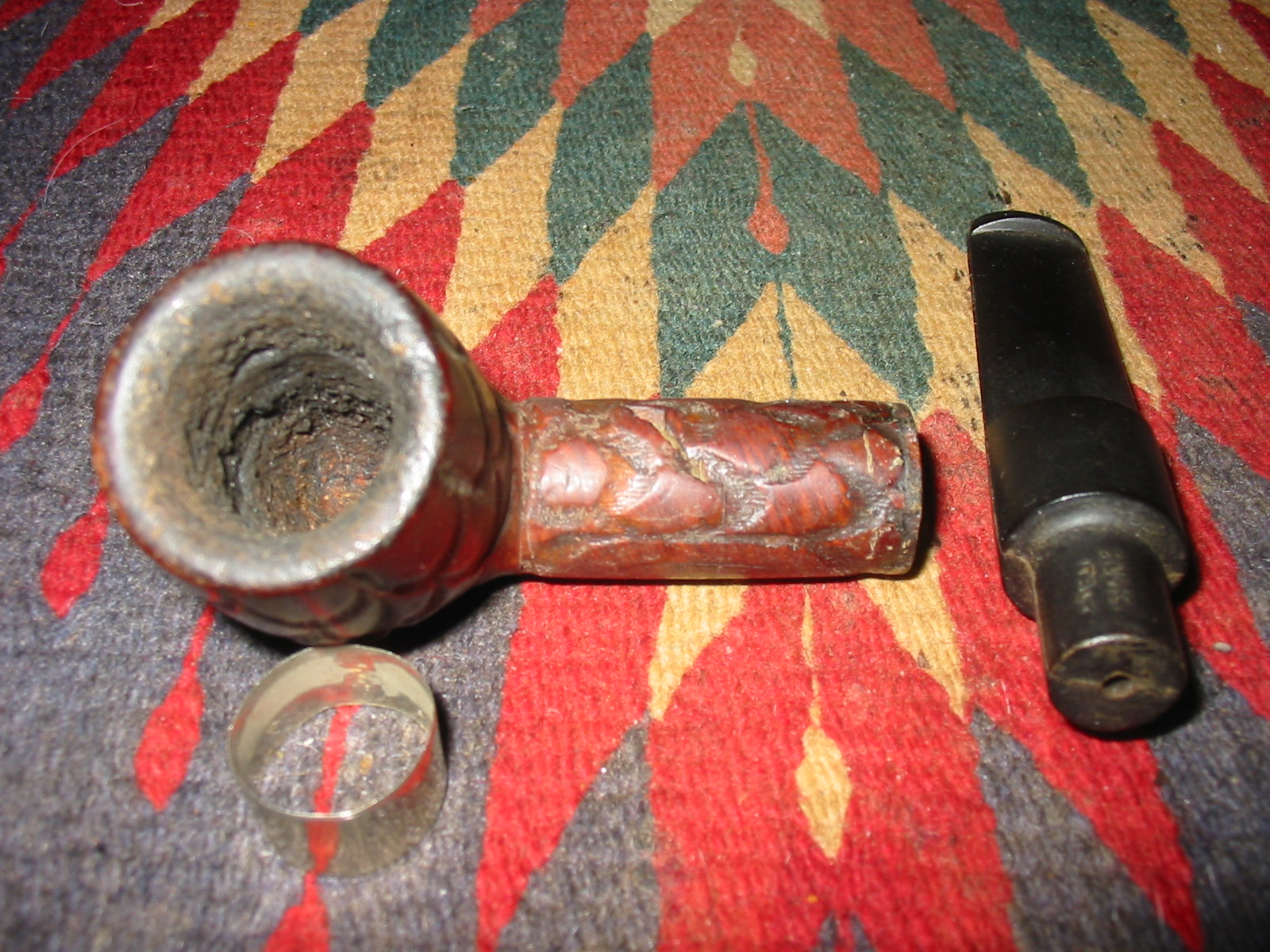
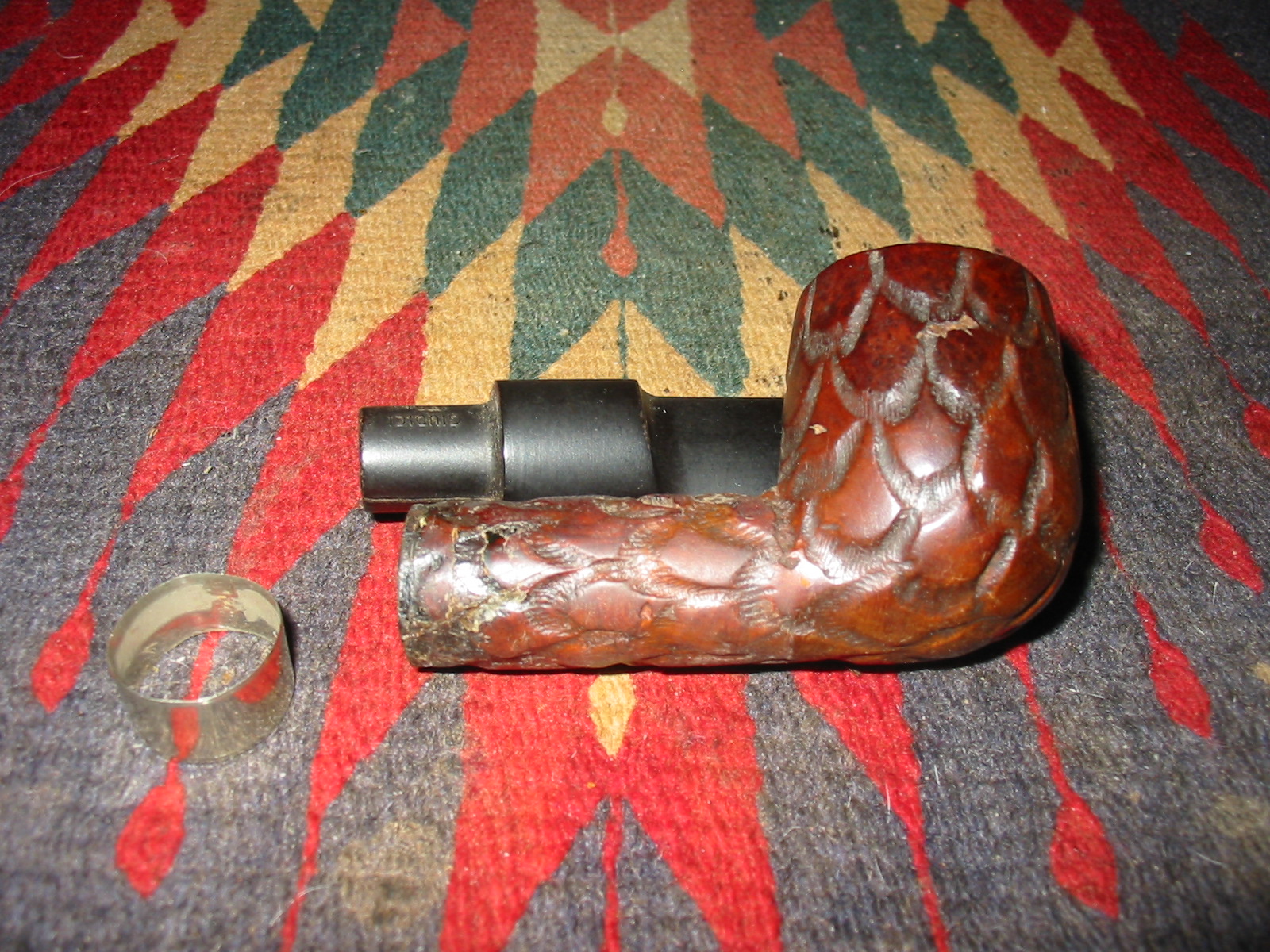
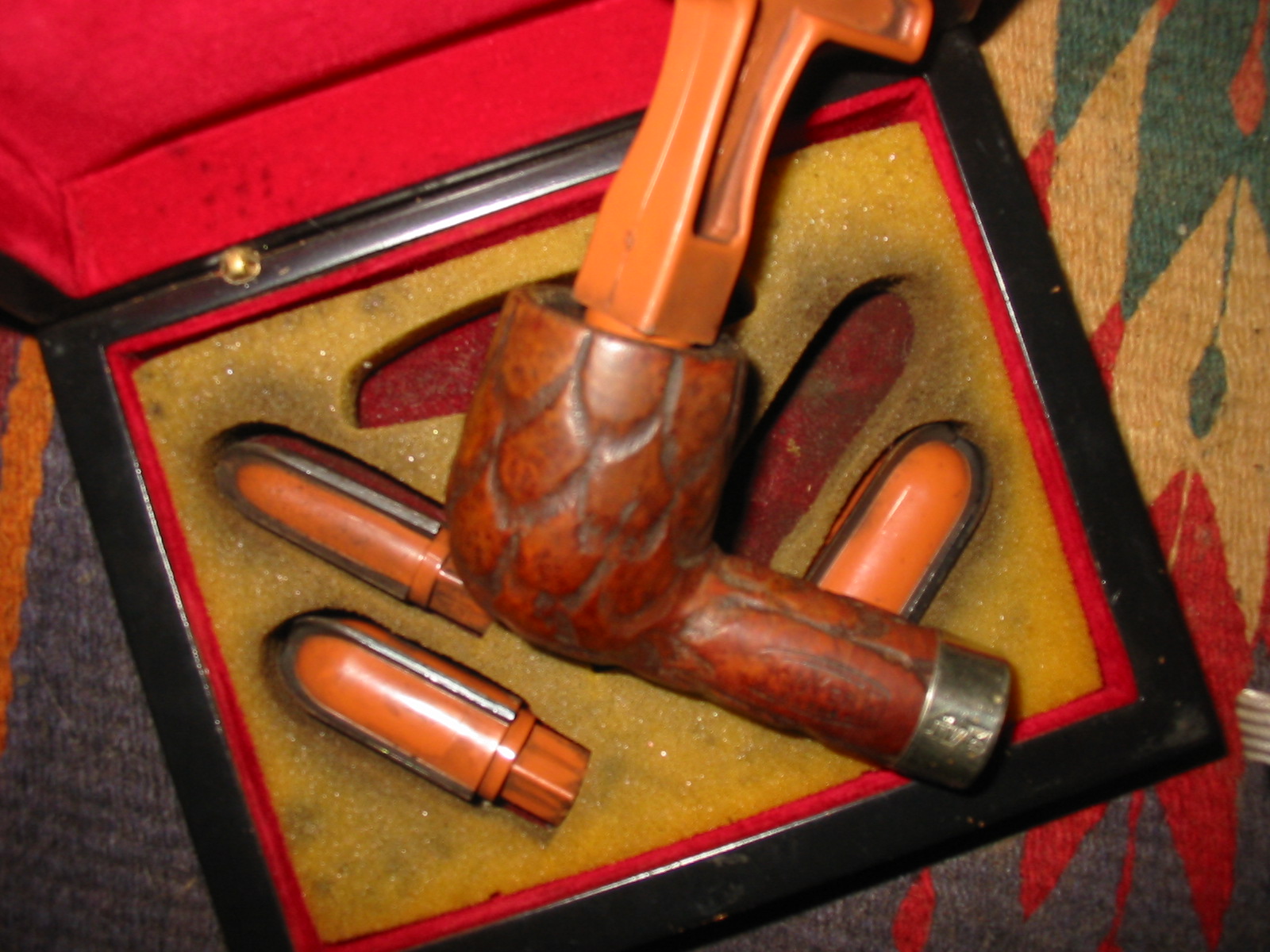
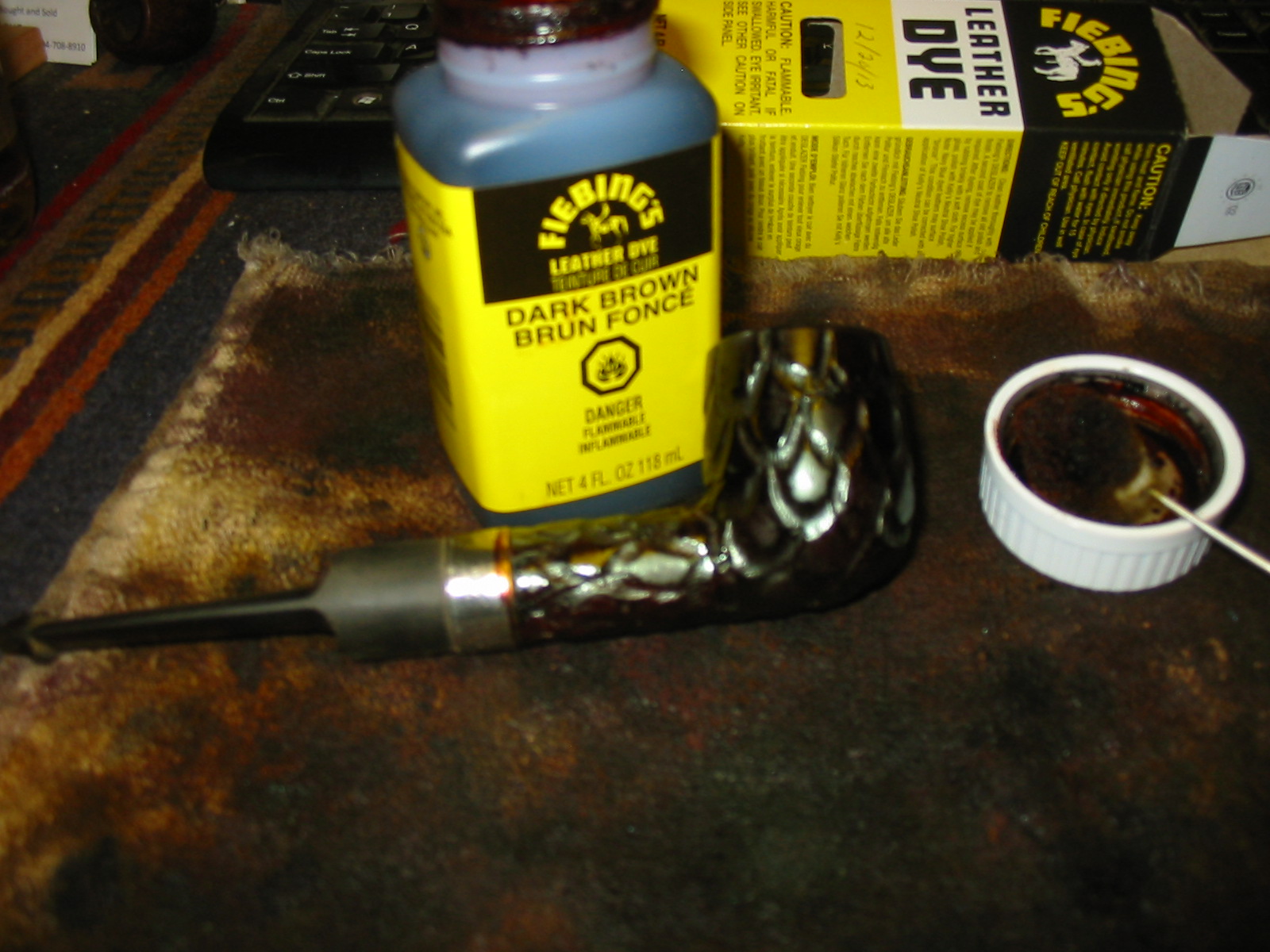
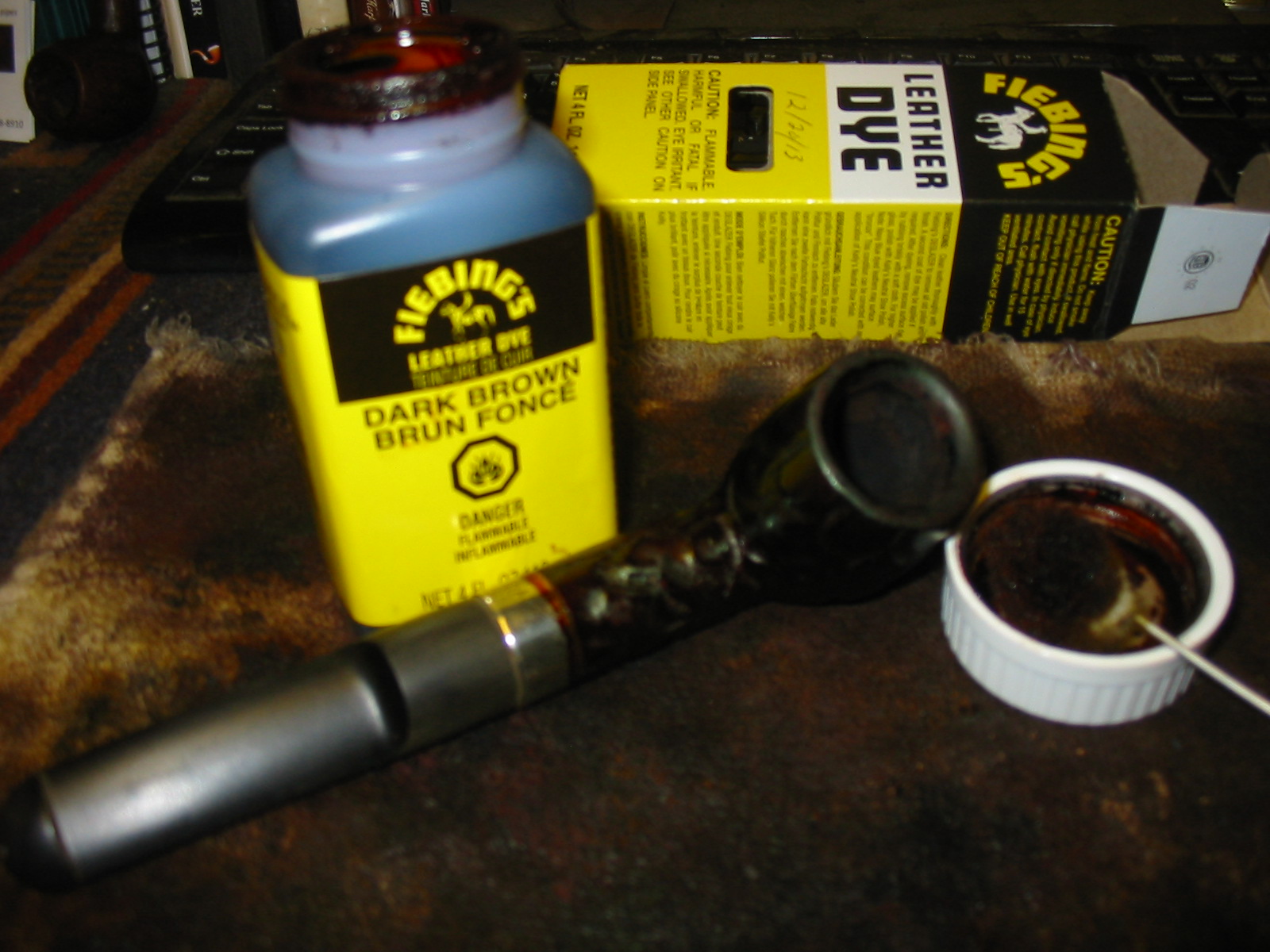
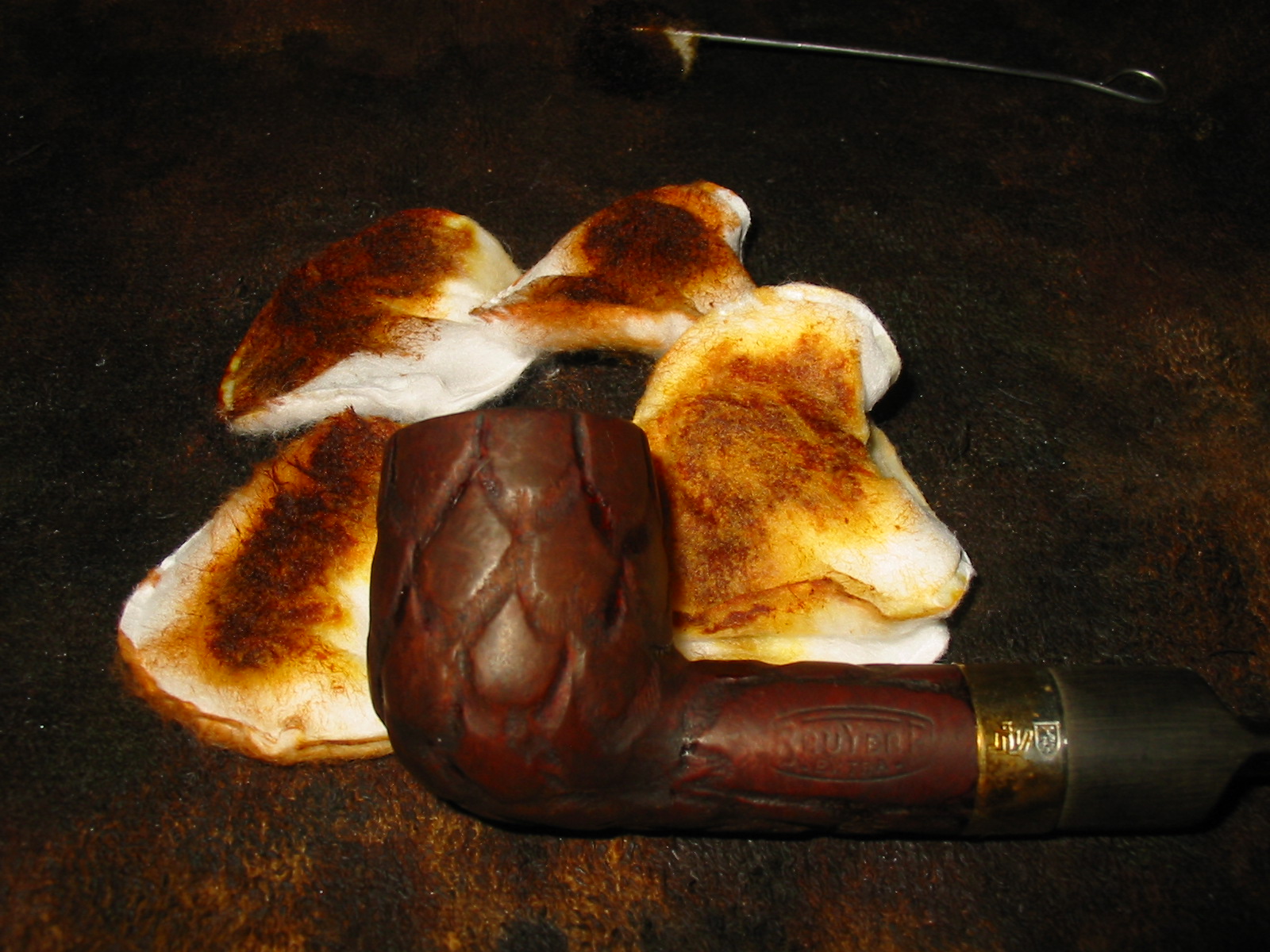
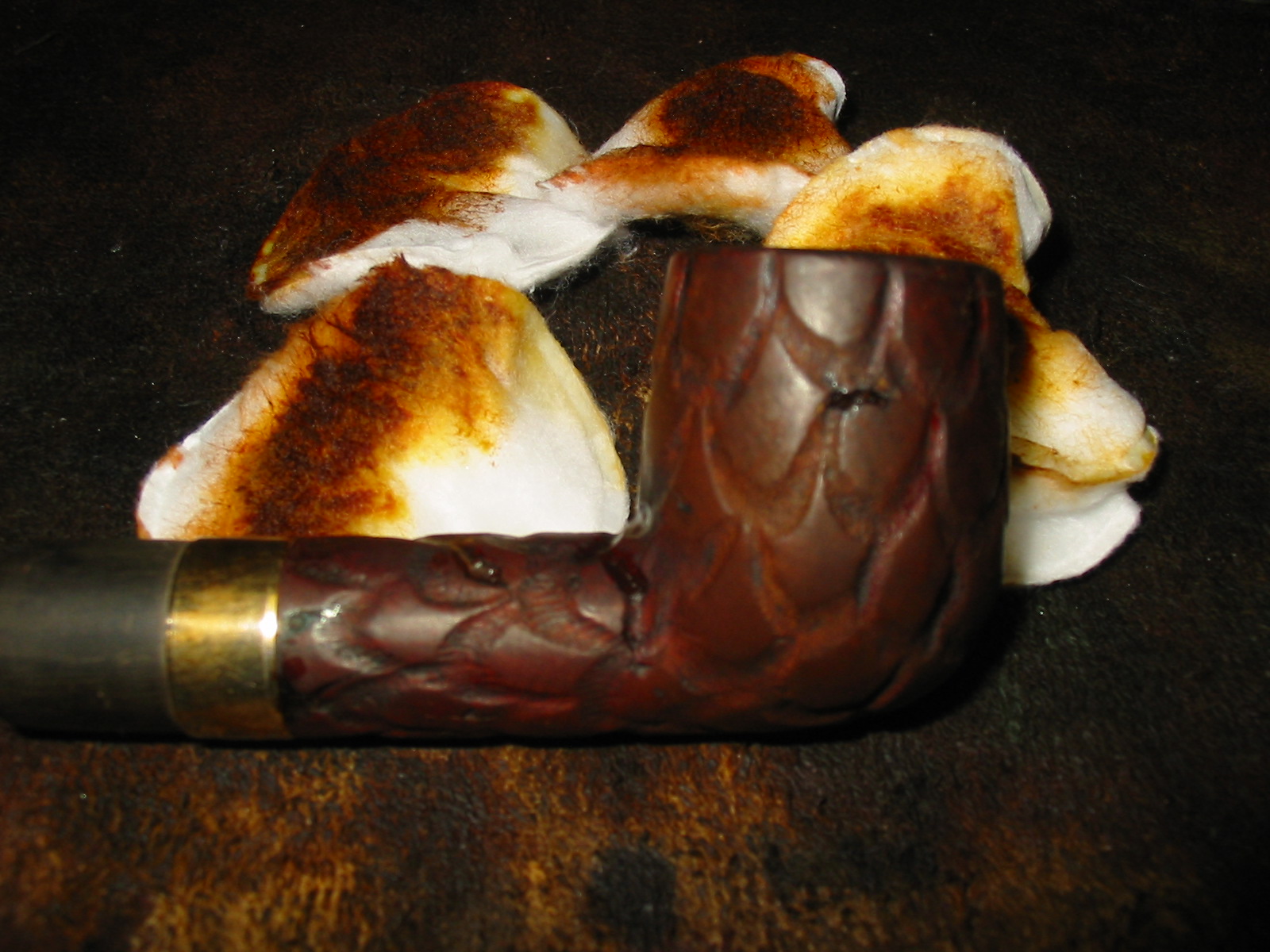
Tag Archives: restaining

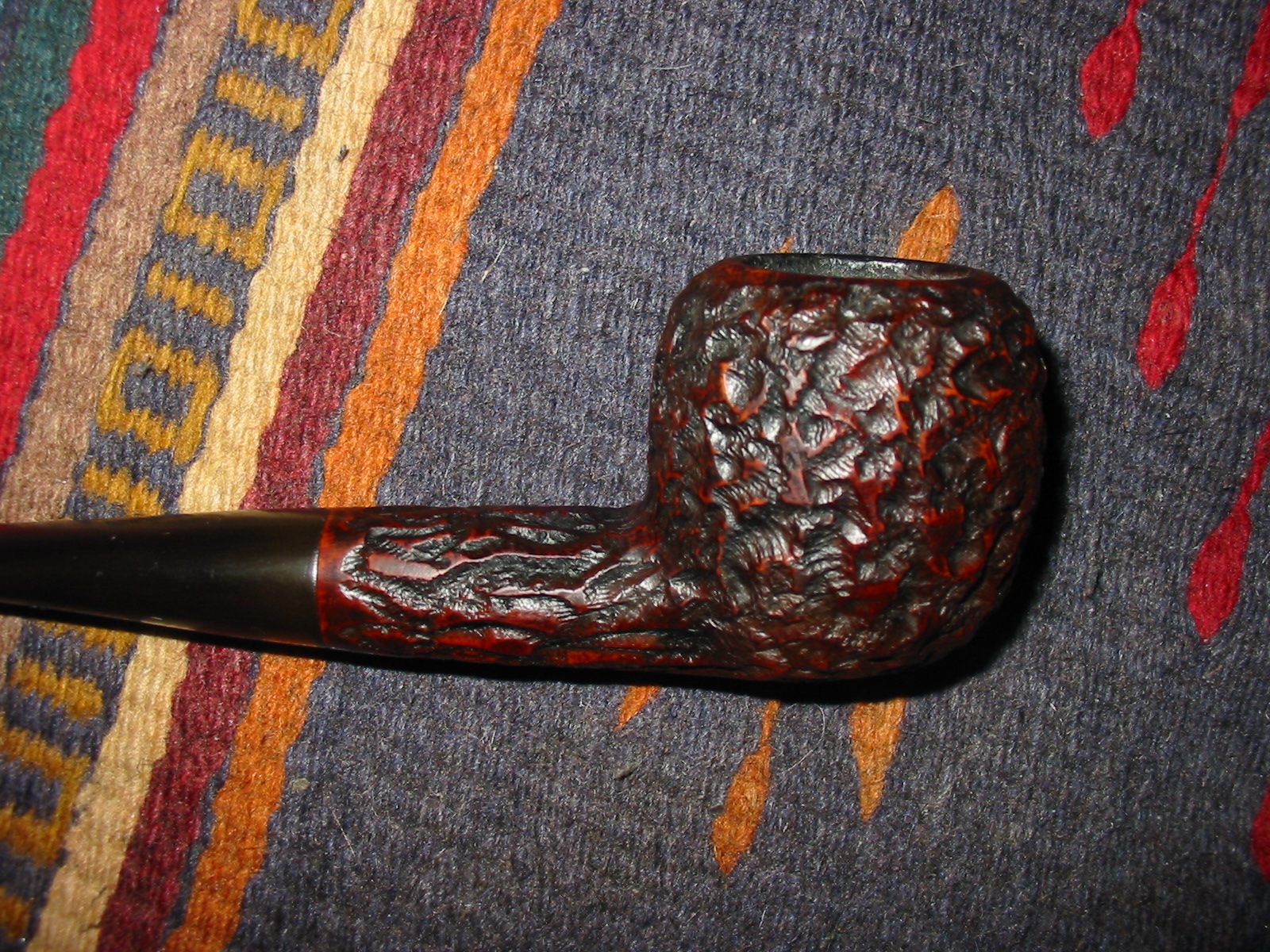
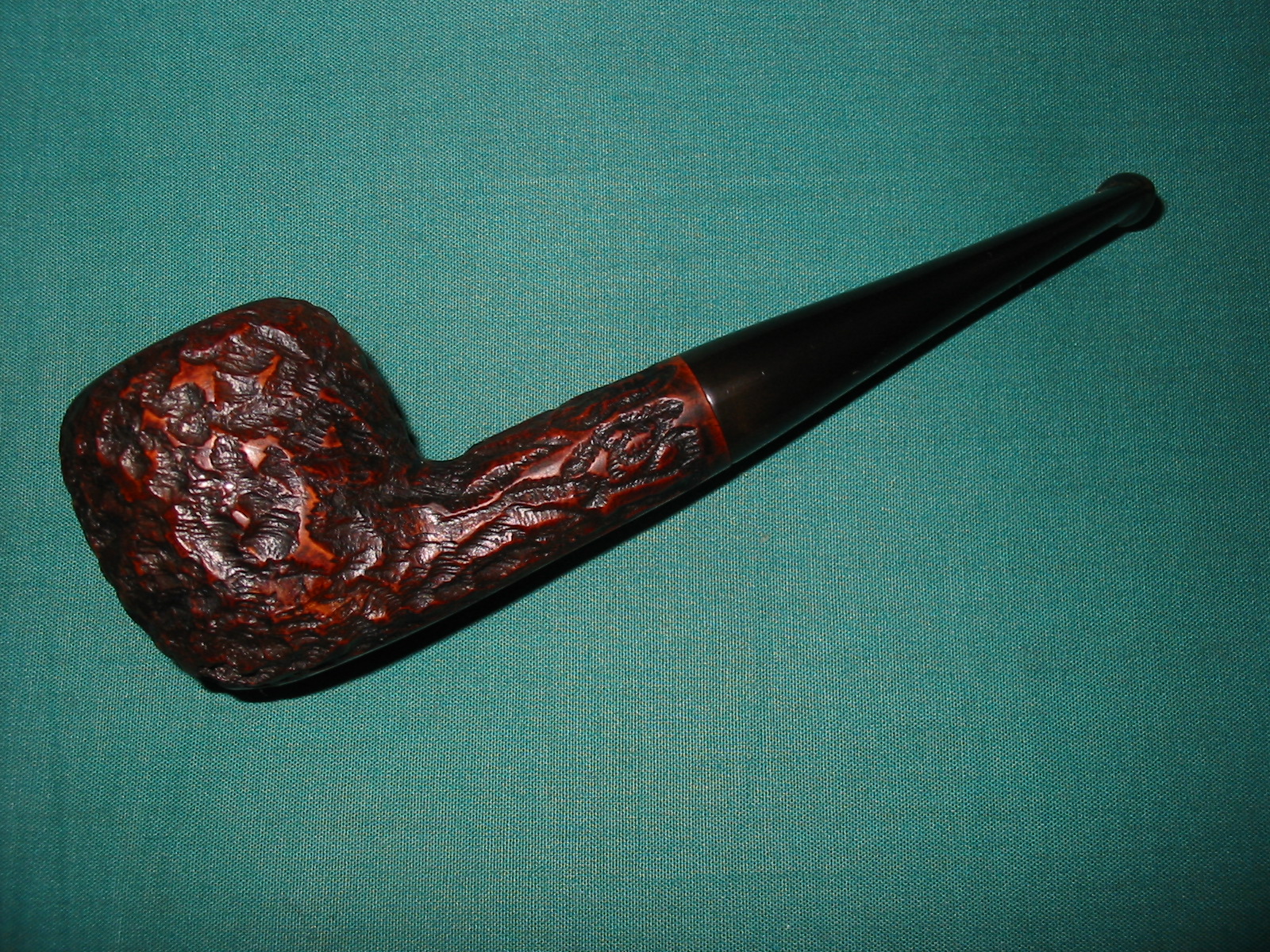
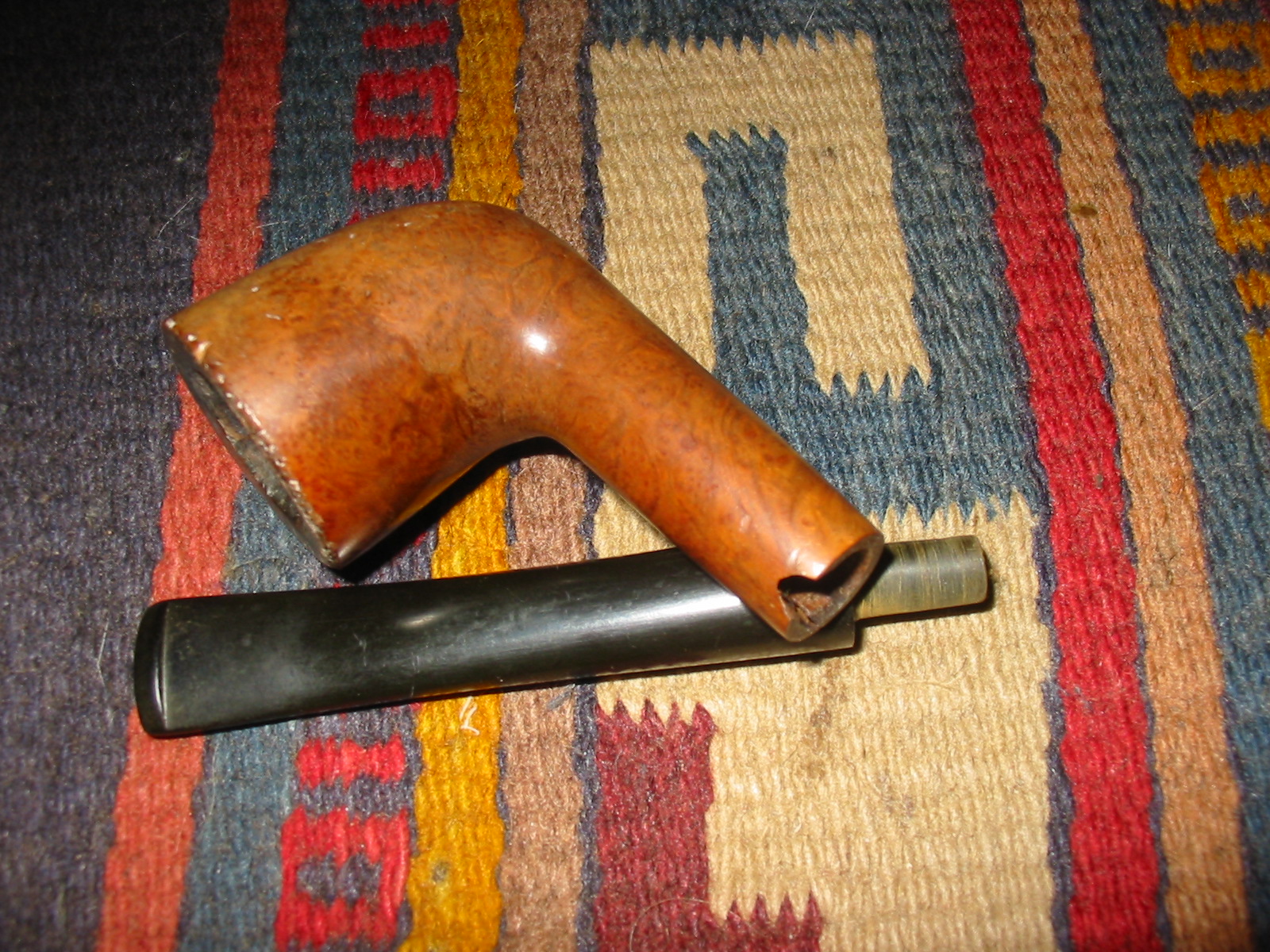
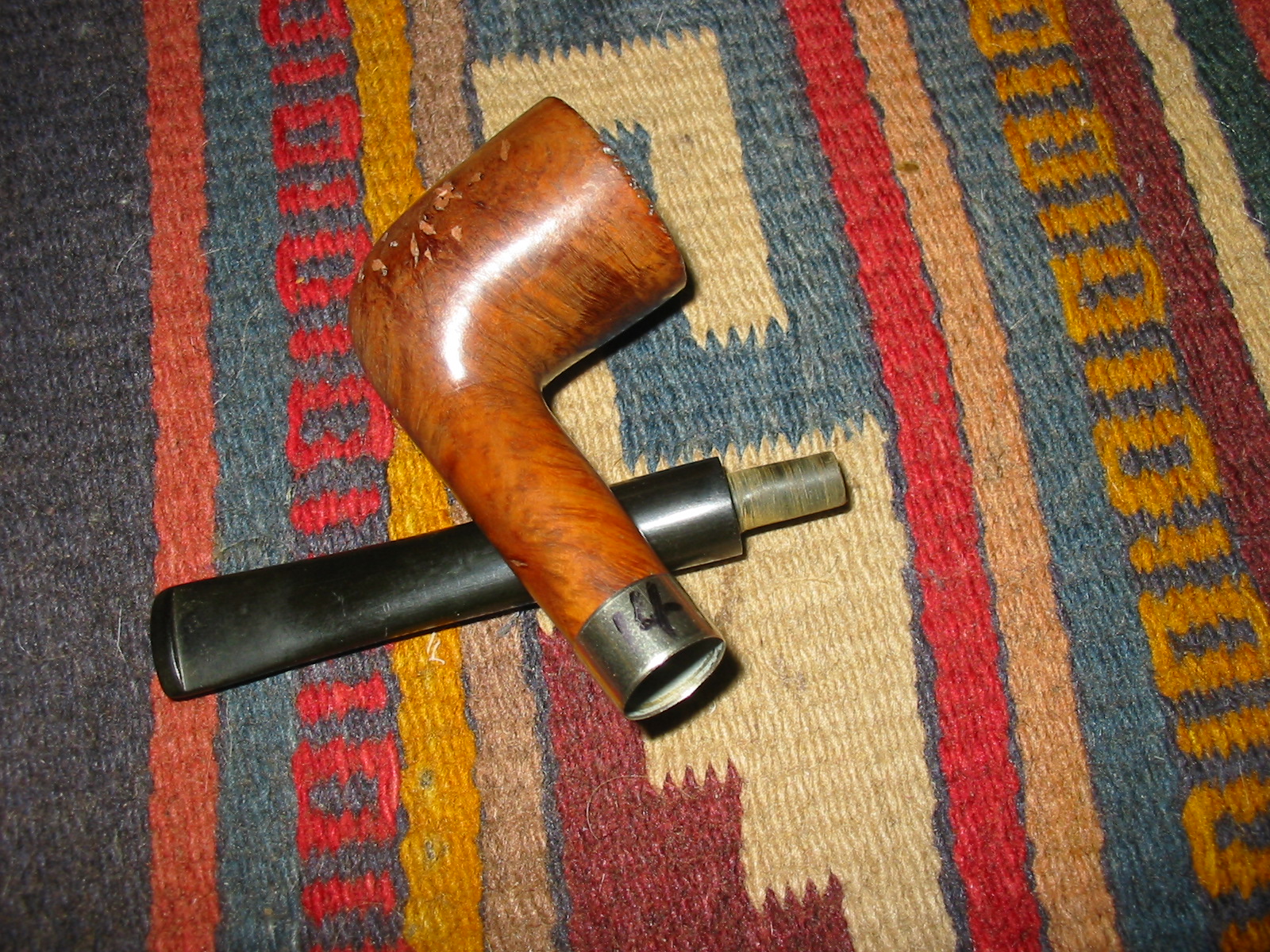
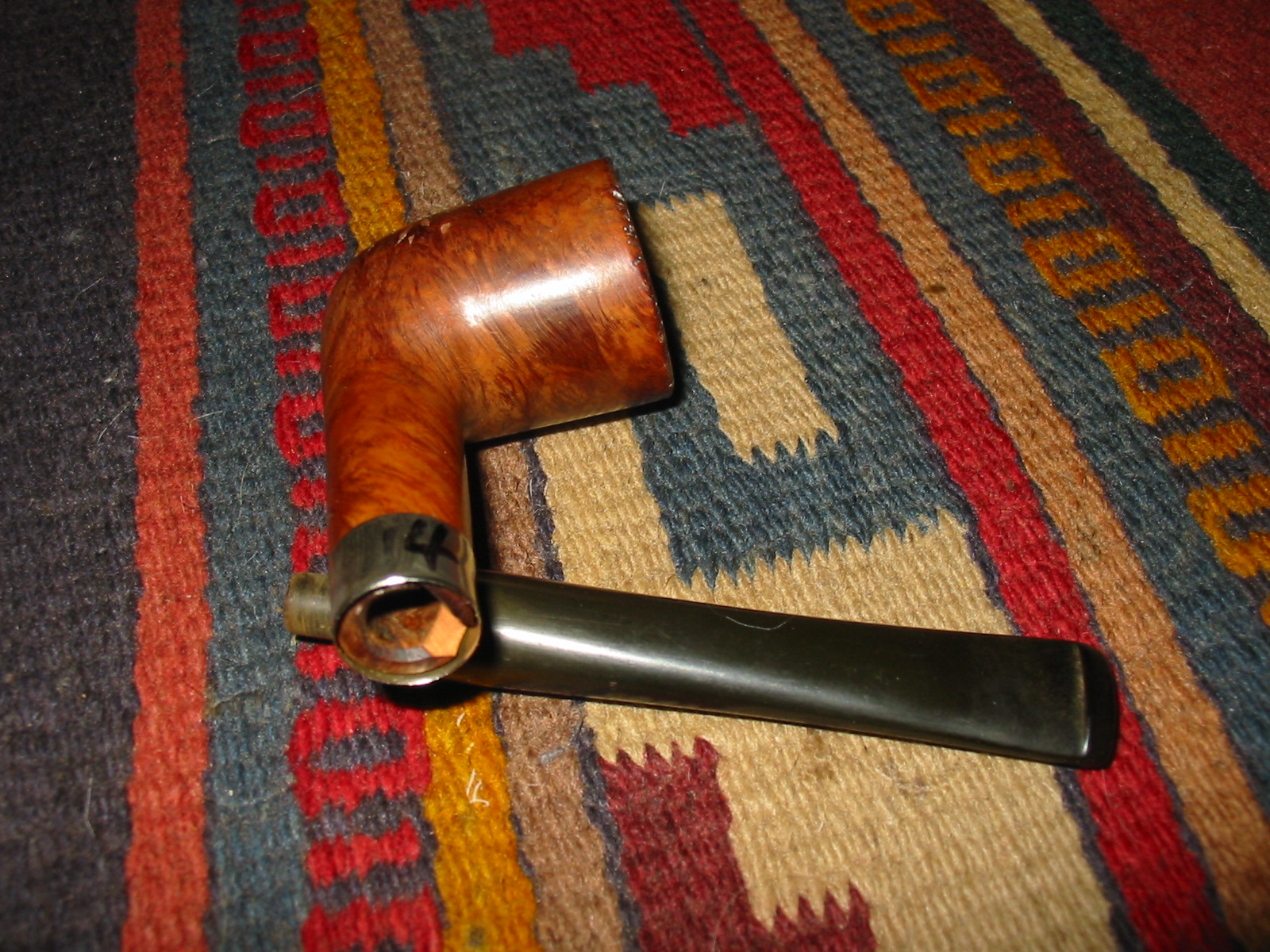
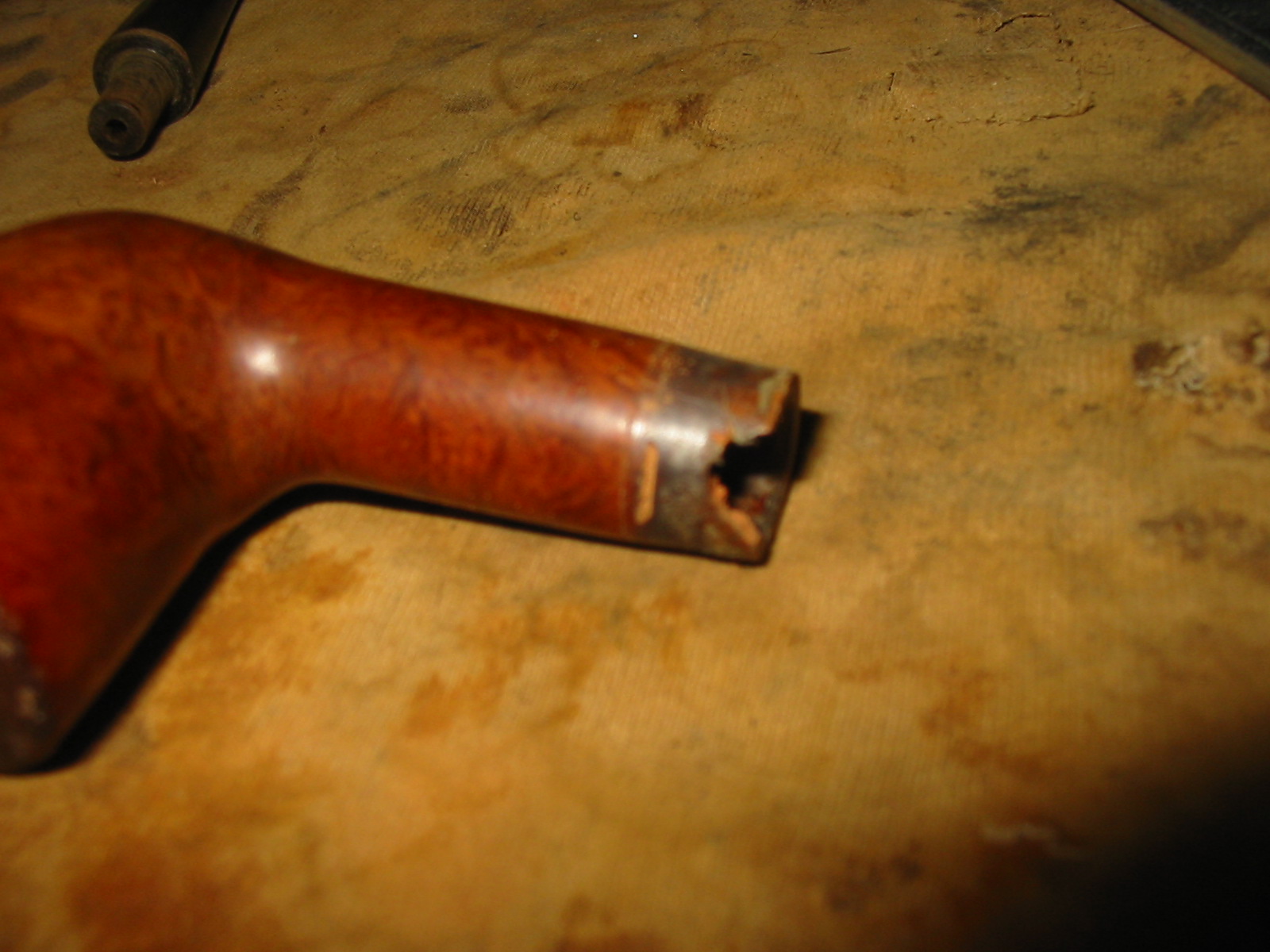
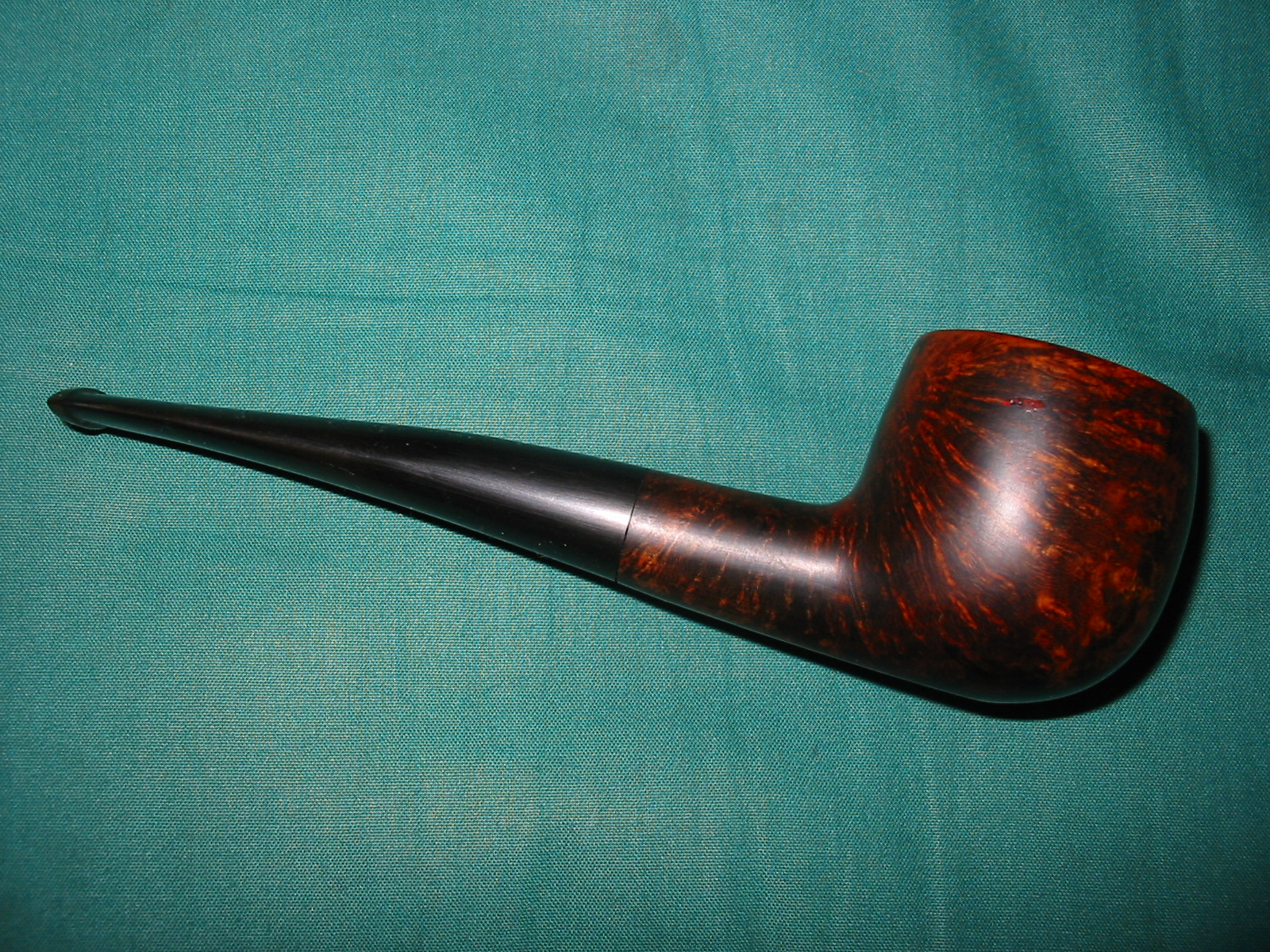
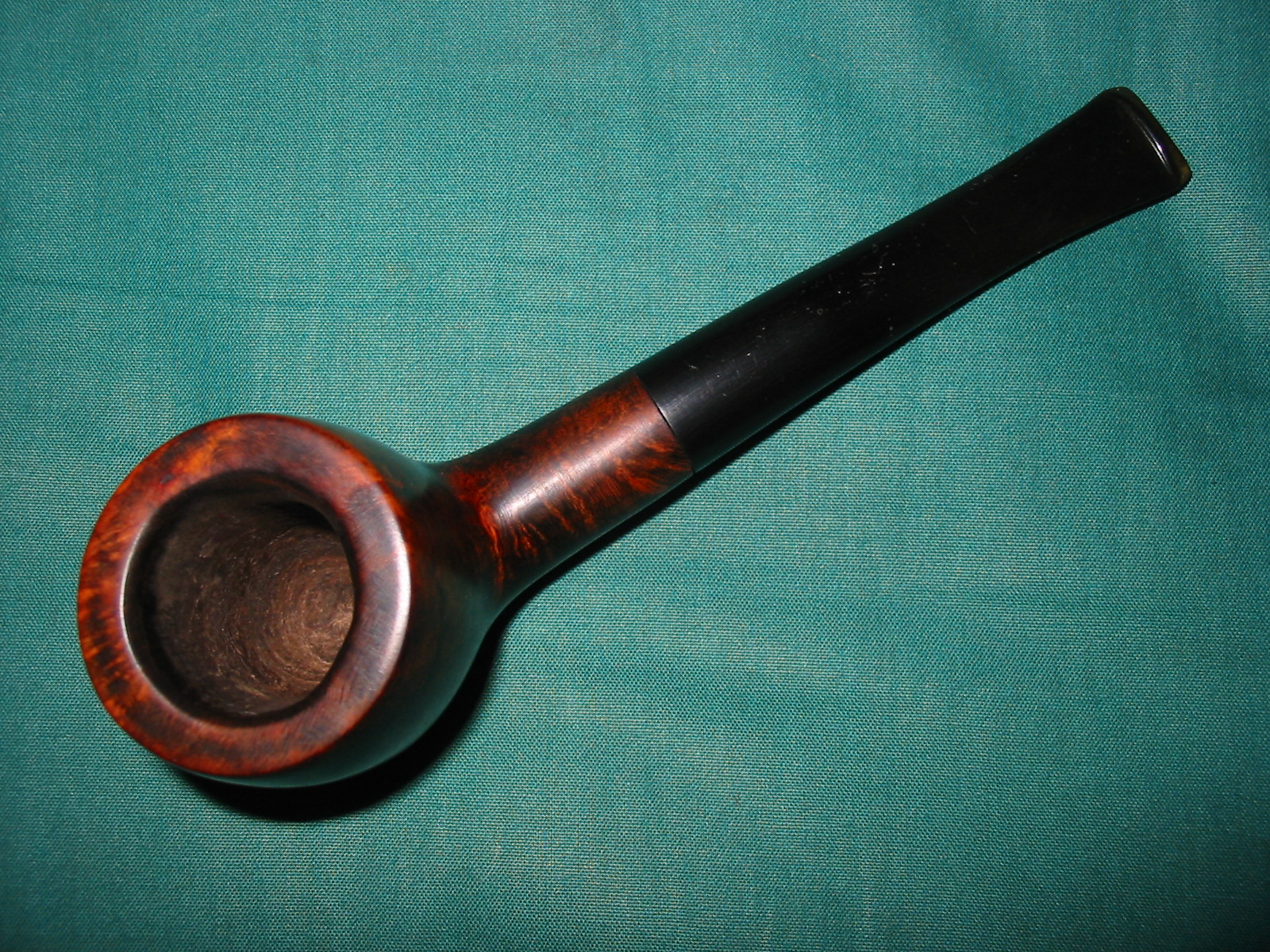
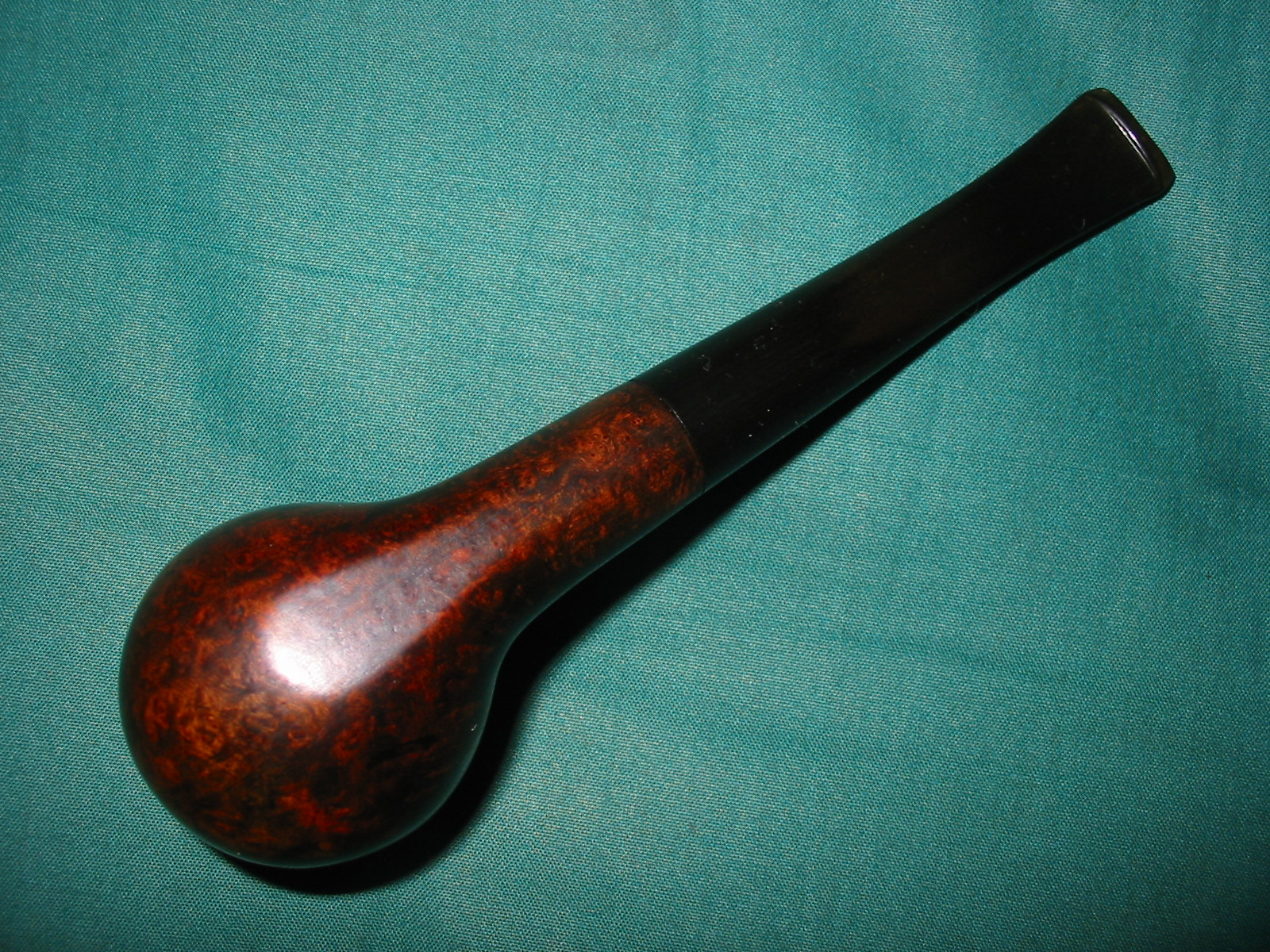
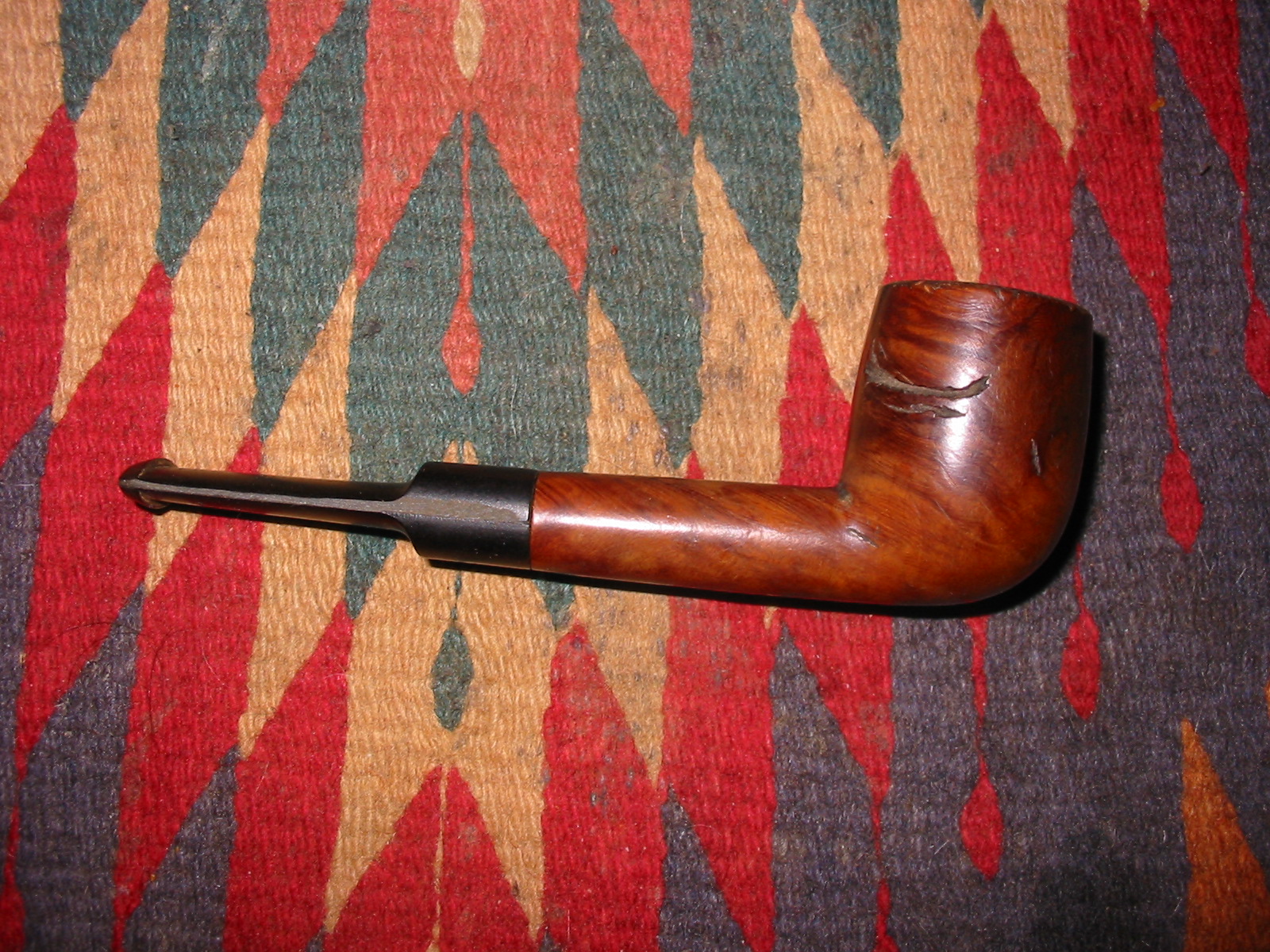
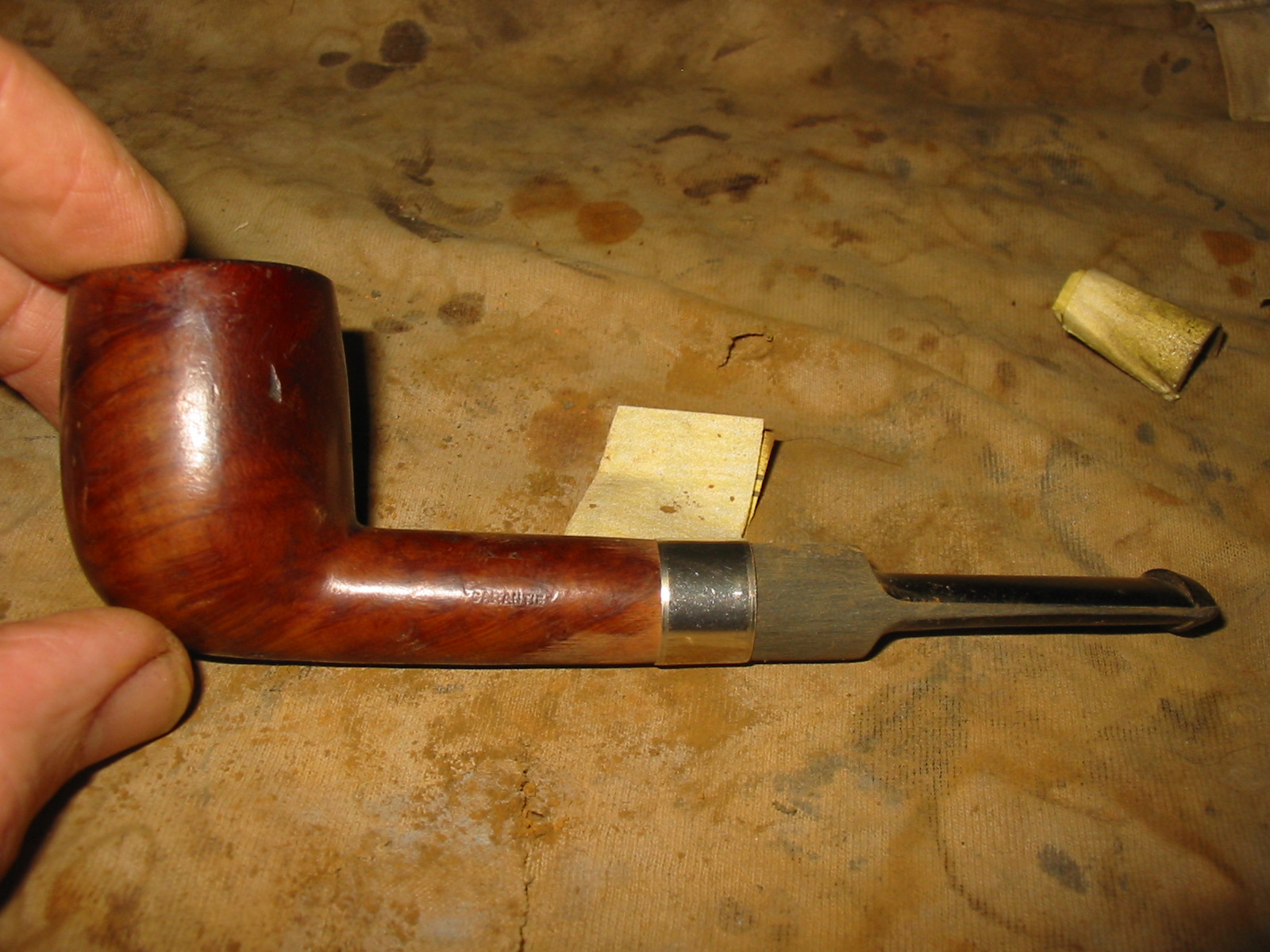
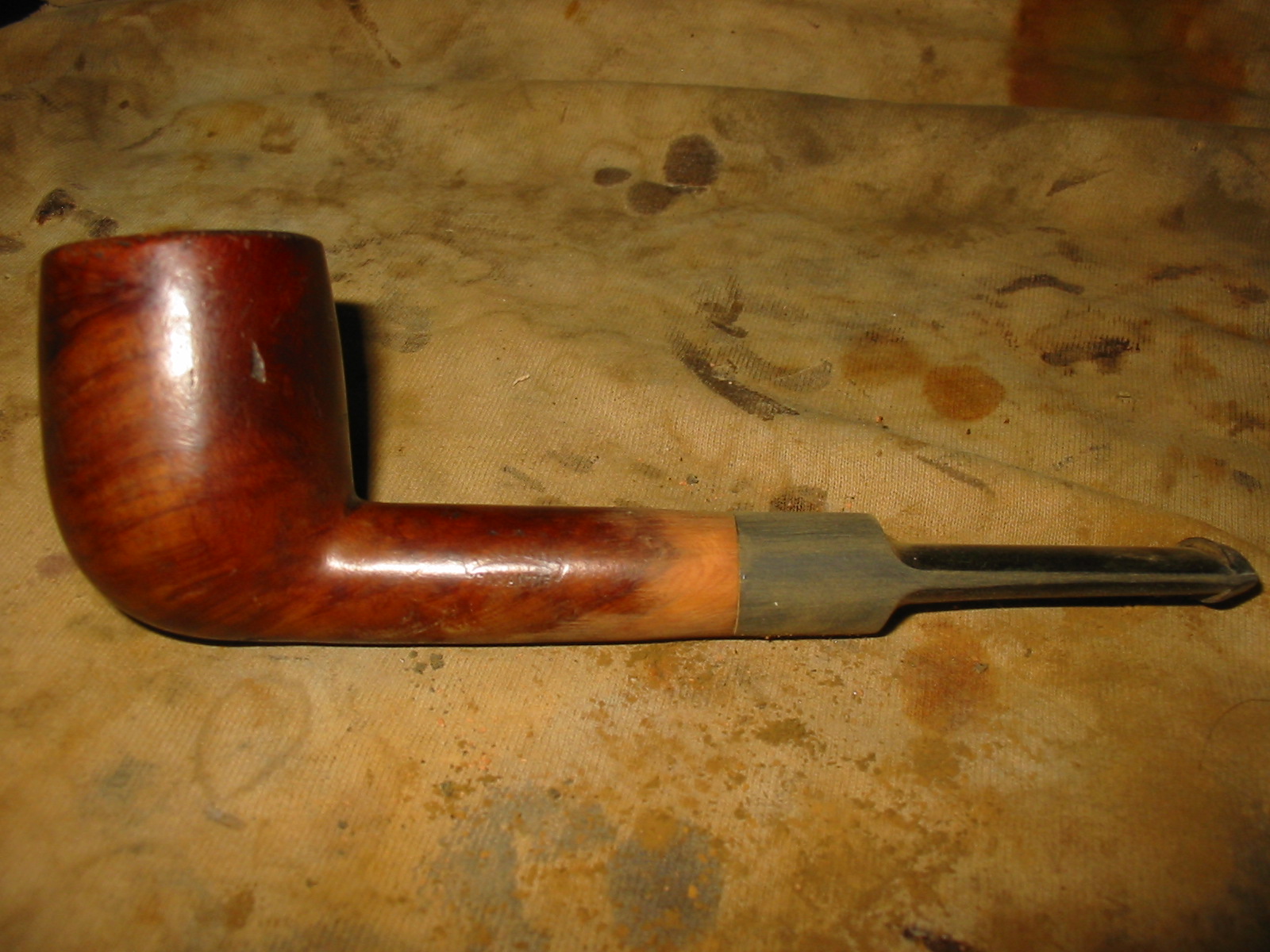
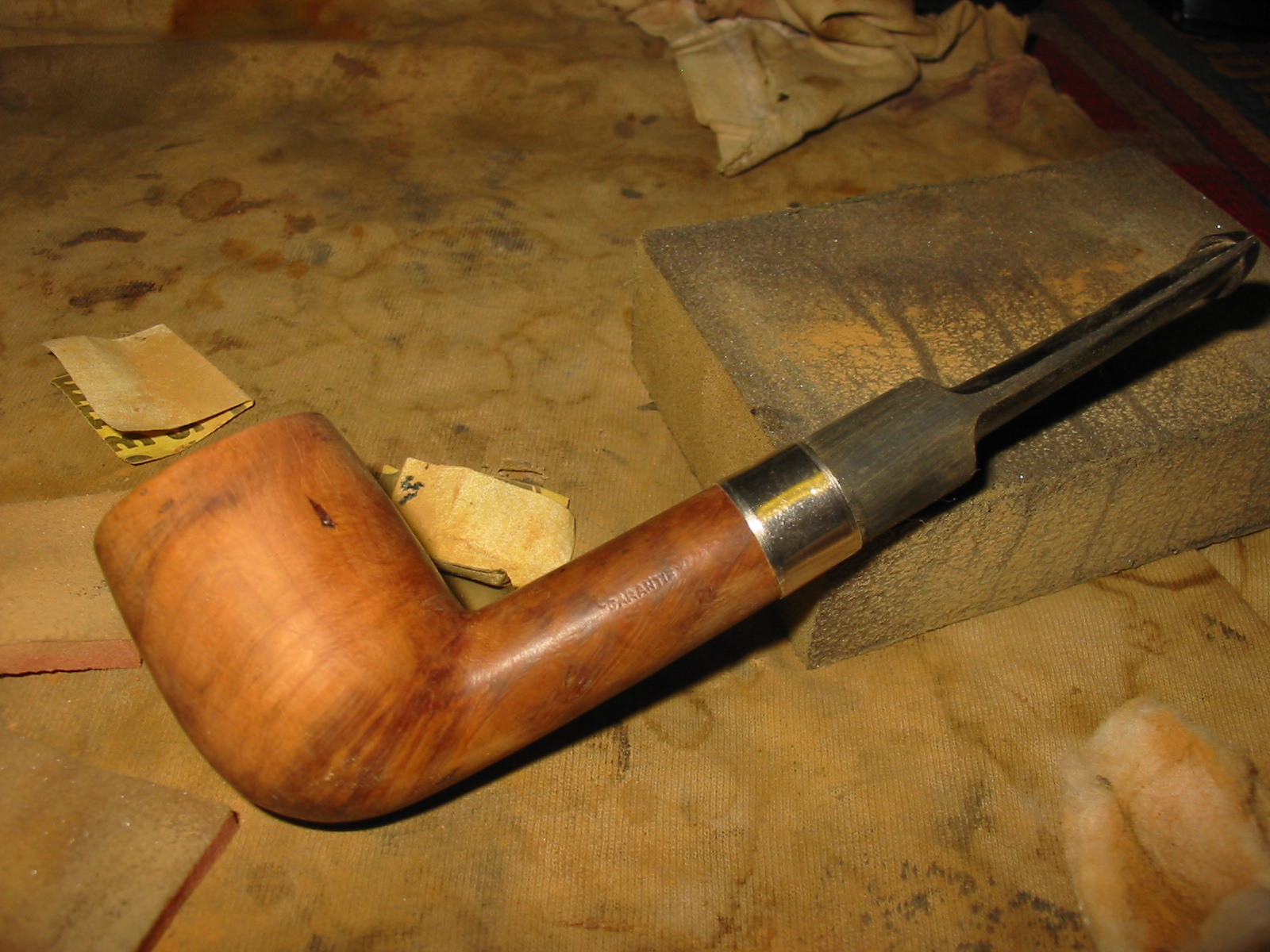
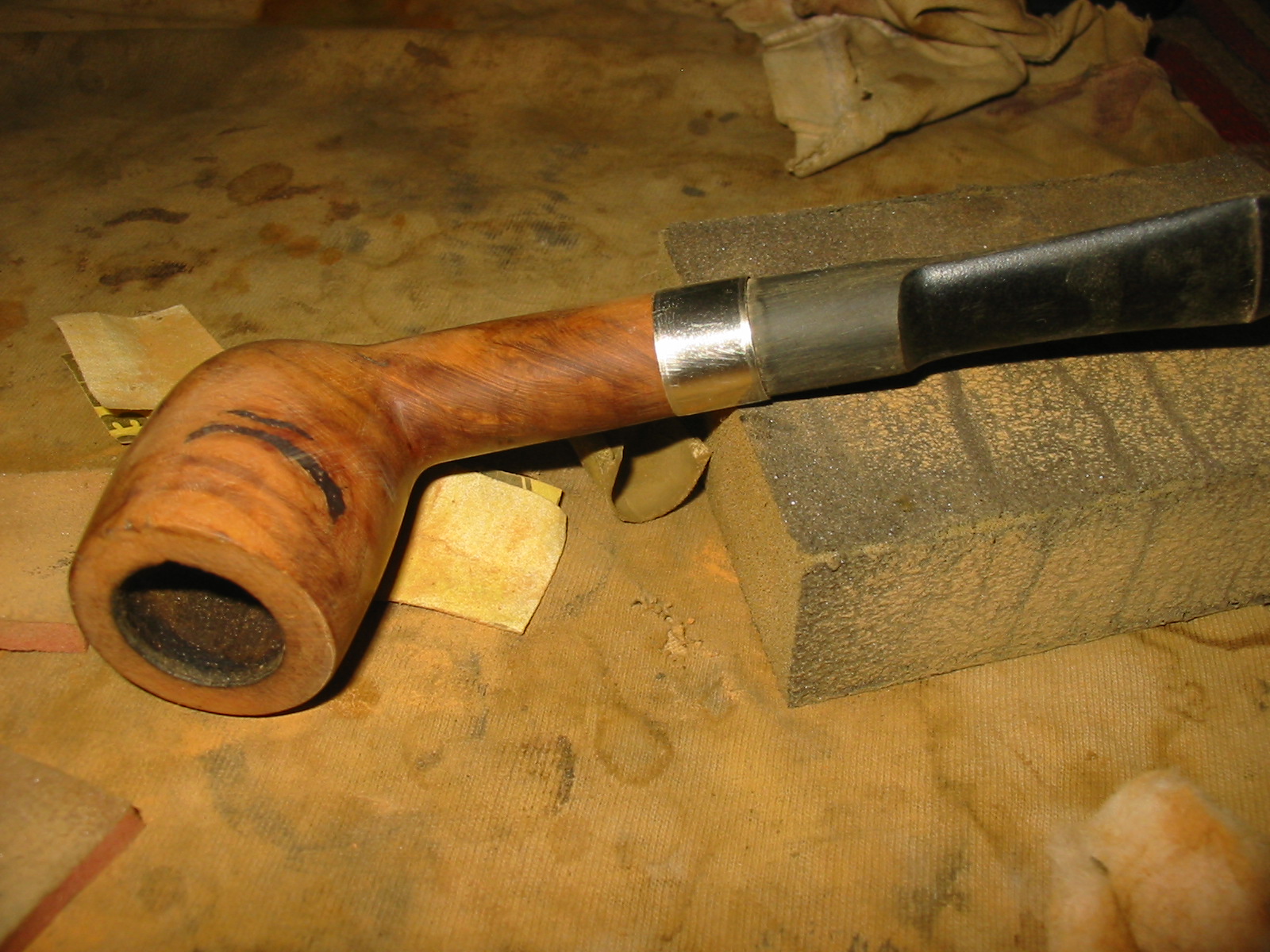
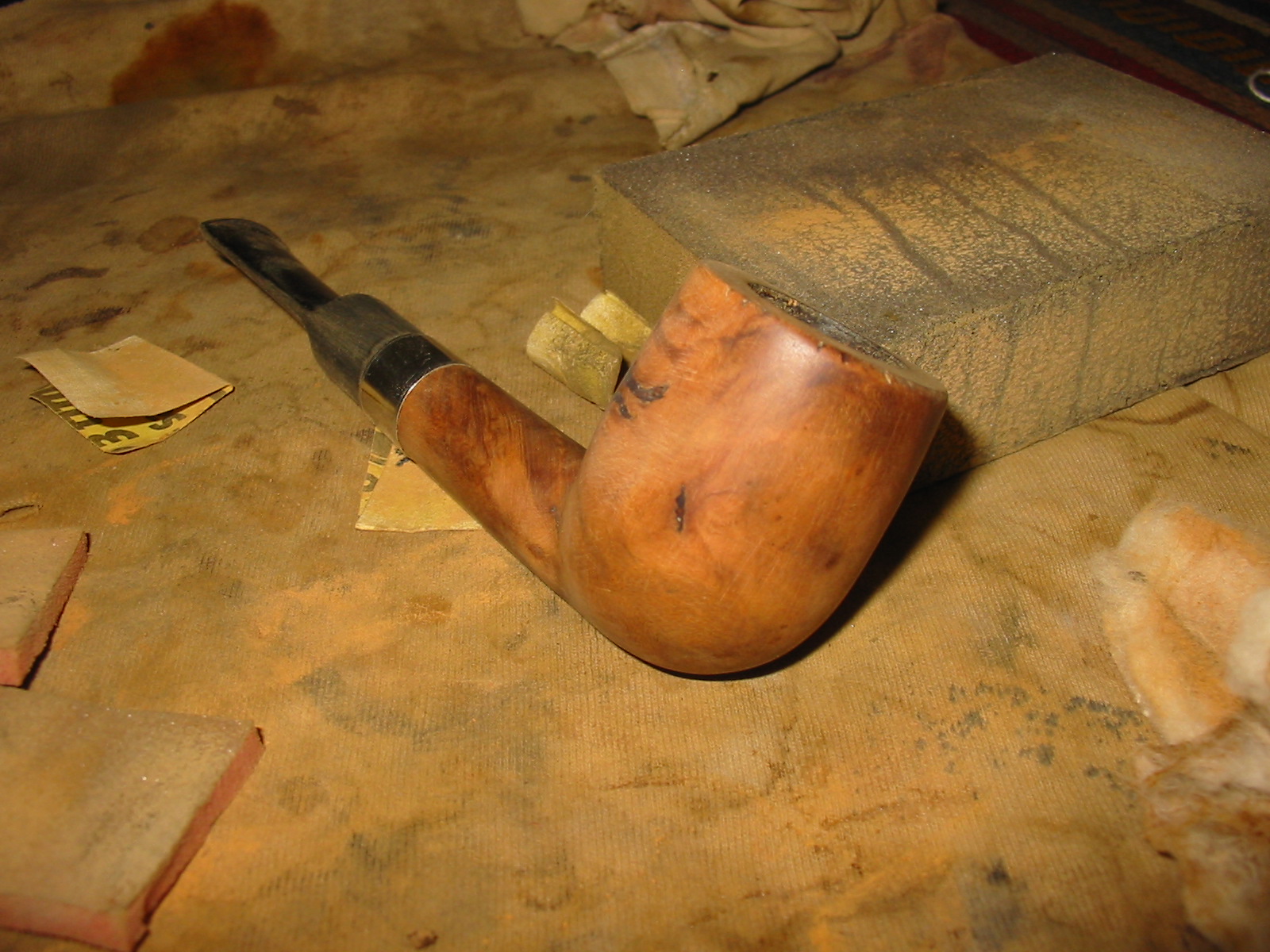
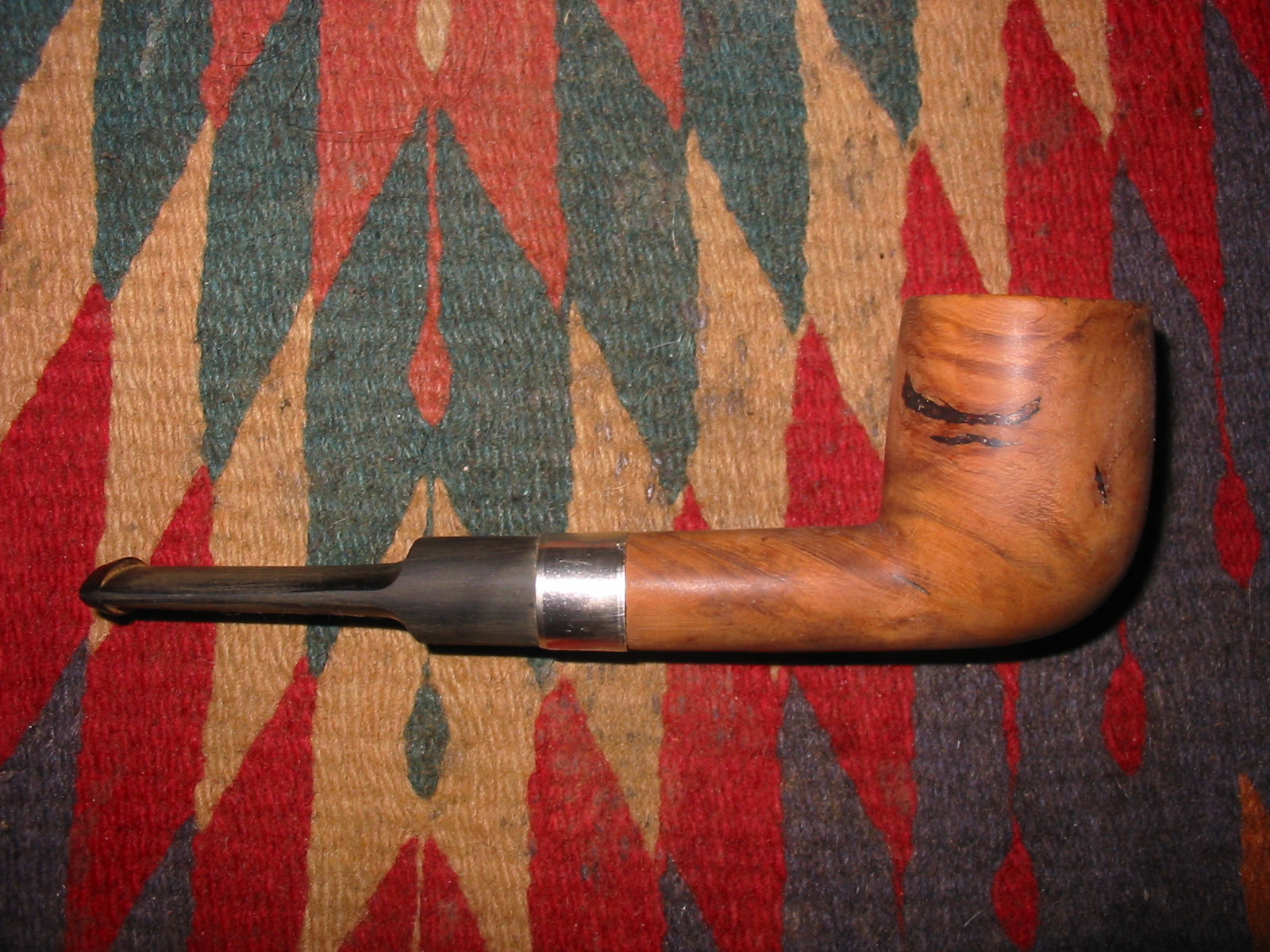
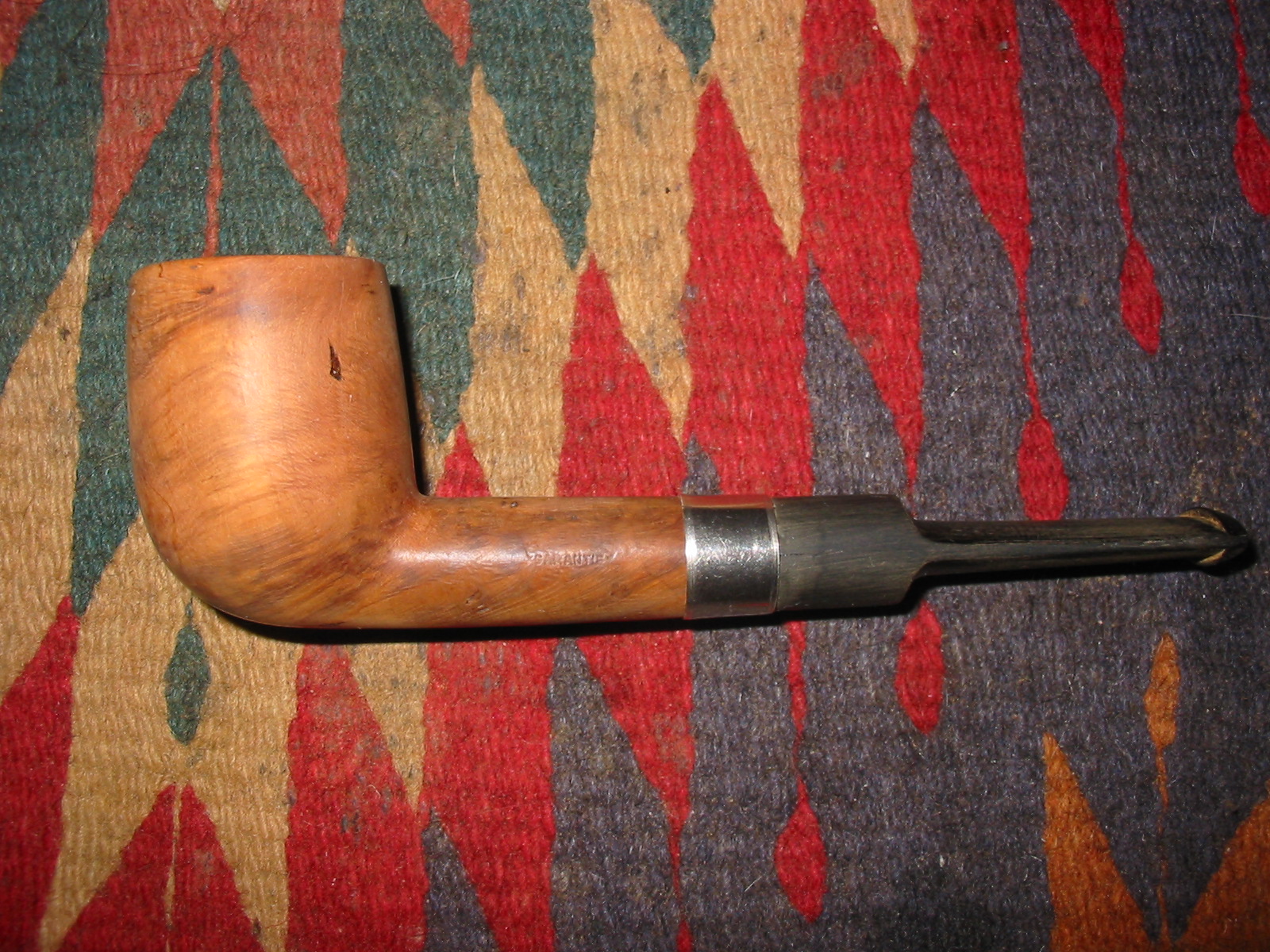
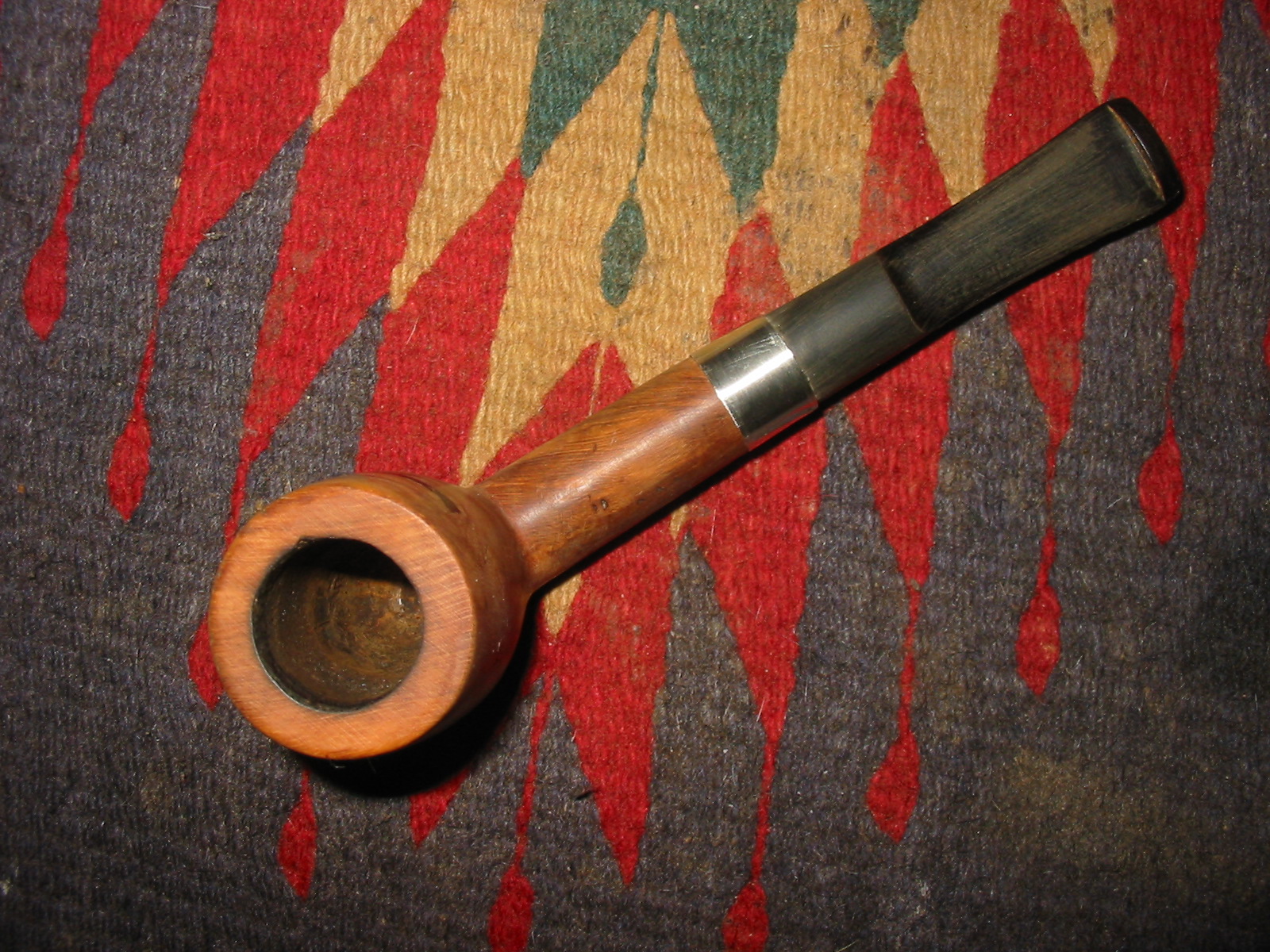
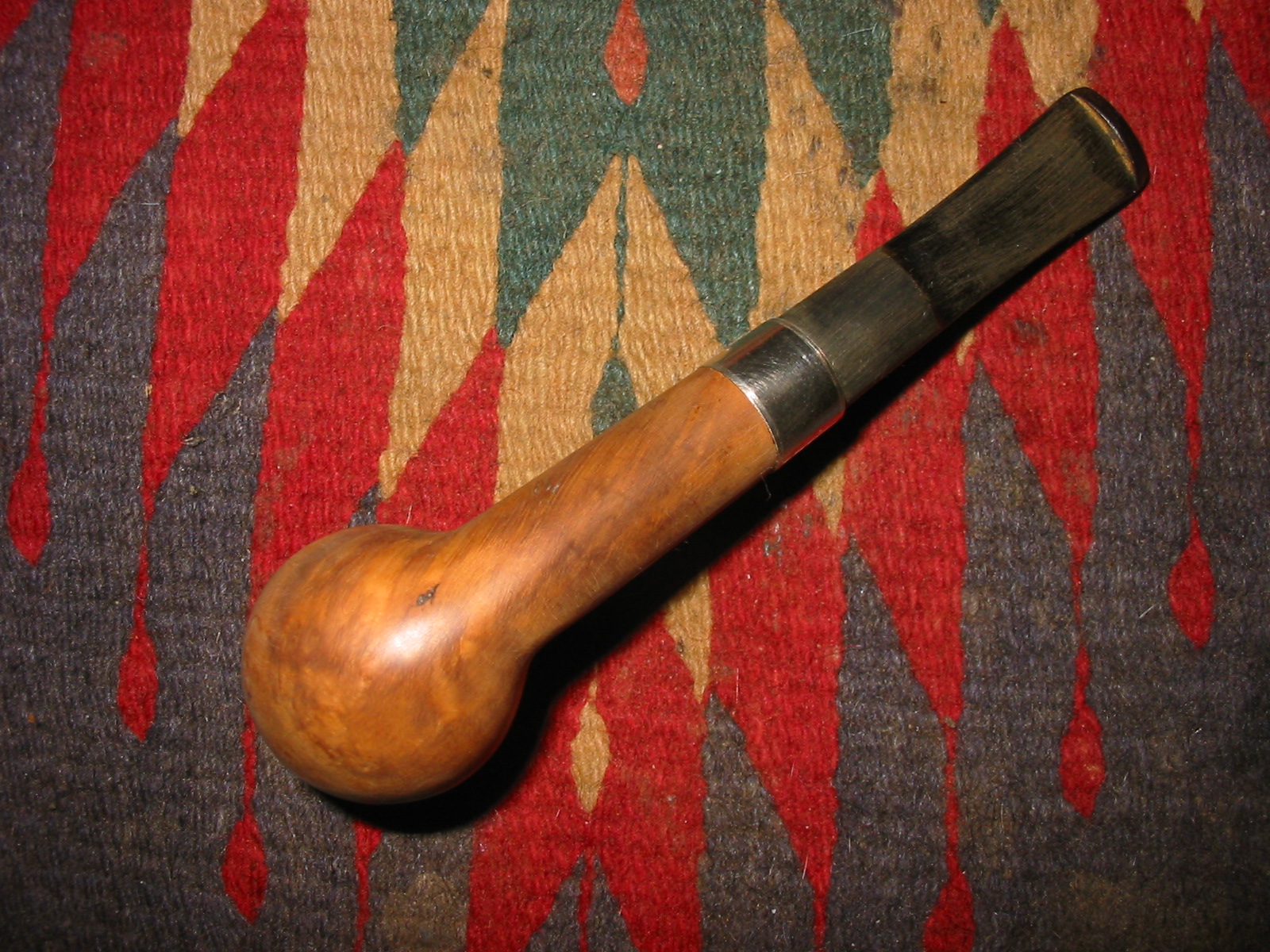
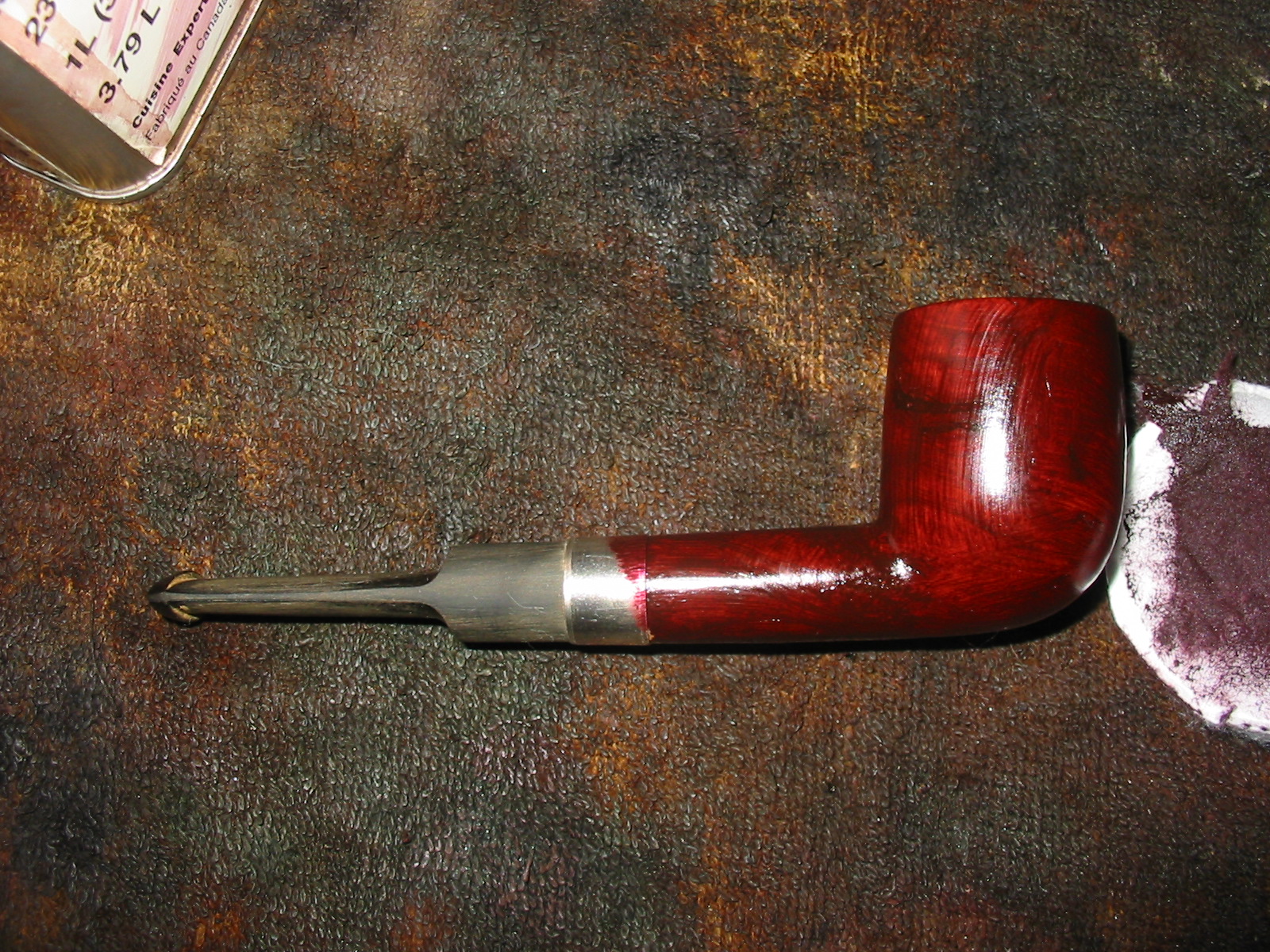
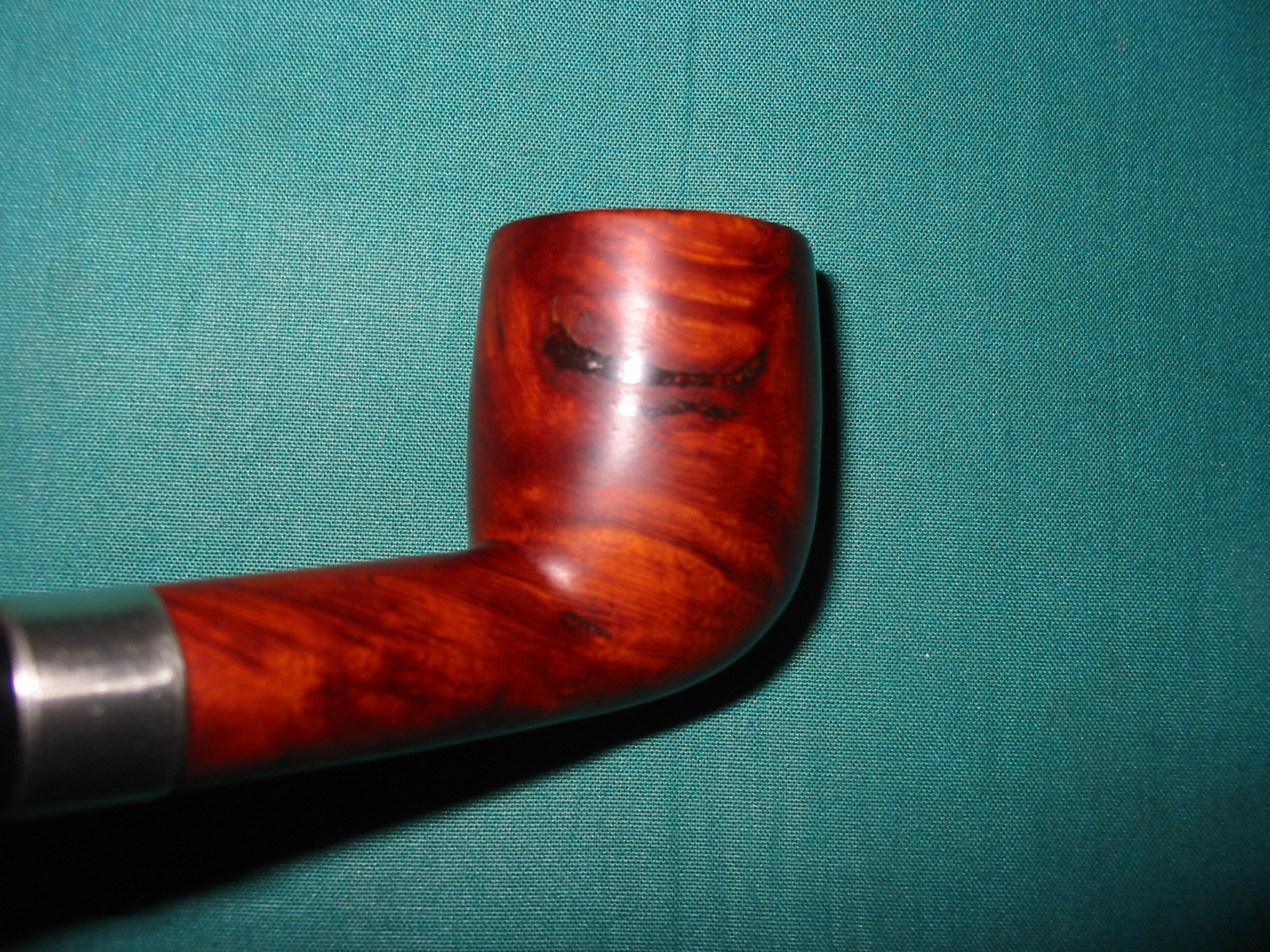
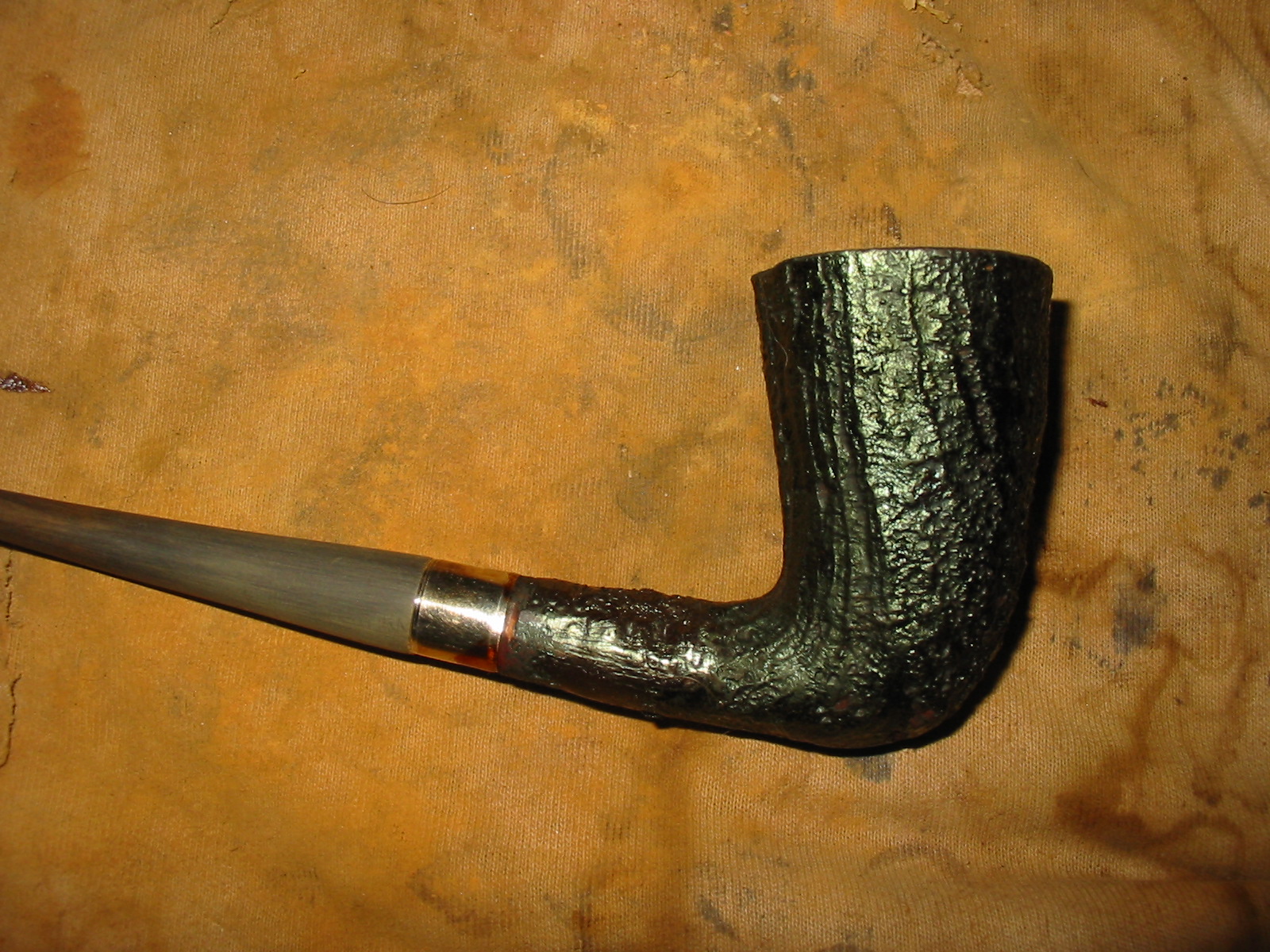
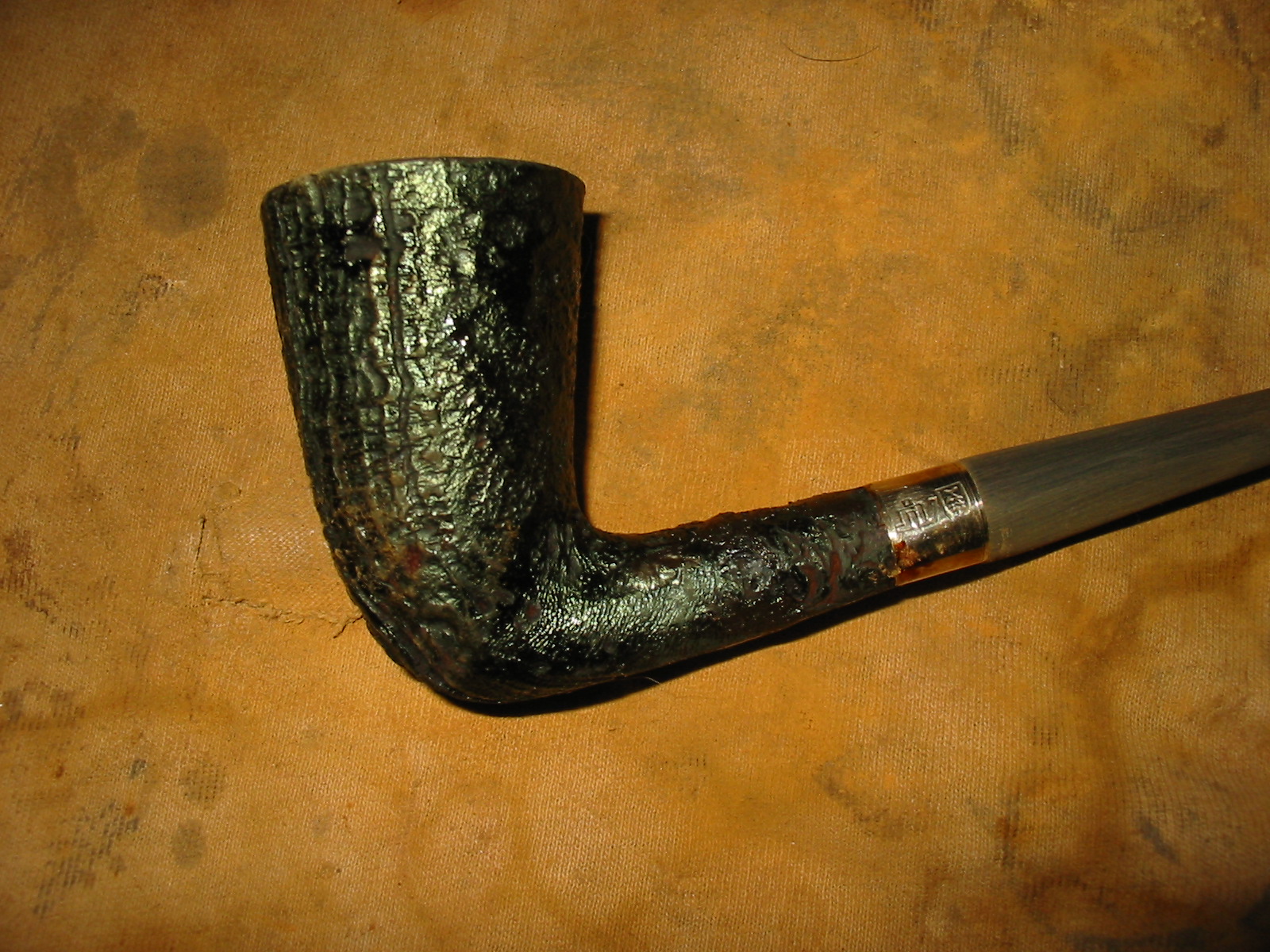
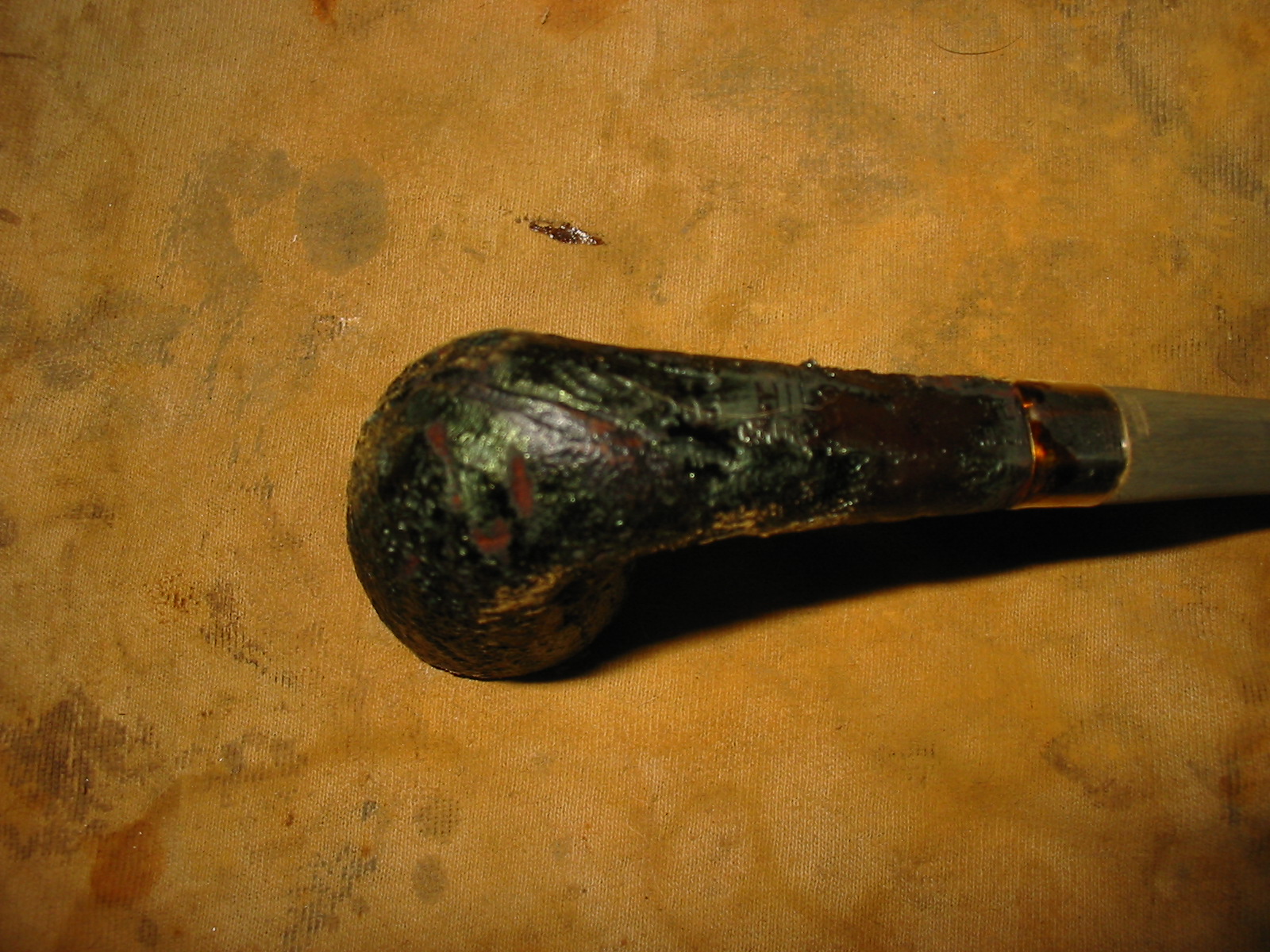
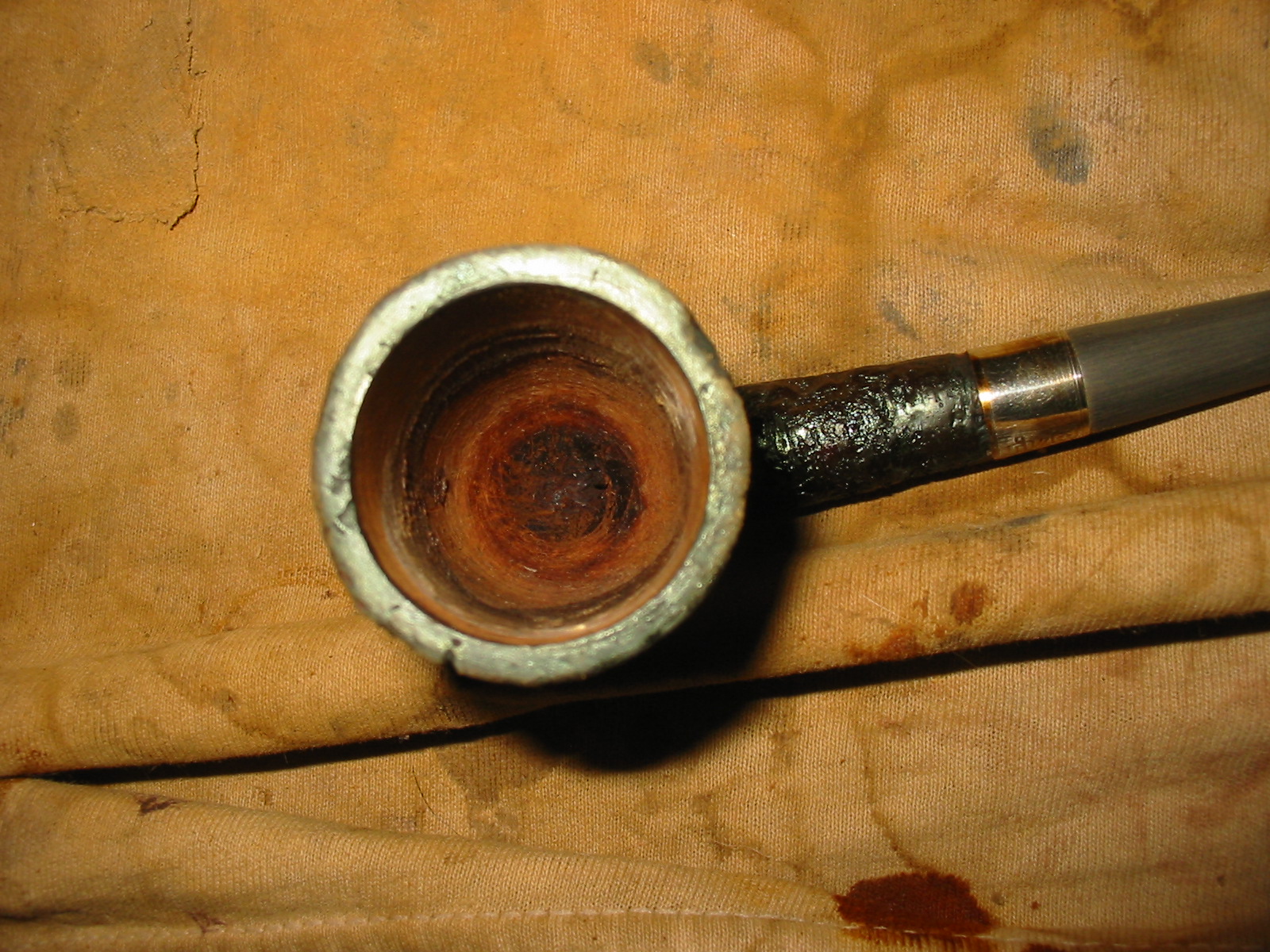
It looked like someone took a saw to the bowl on this one – A Bruyere Garantie Lovat Restored


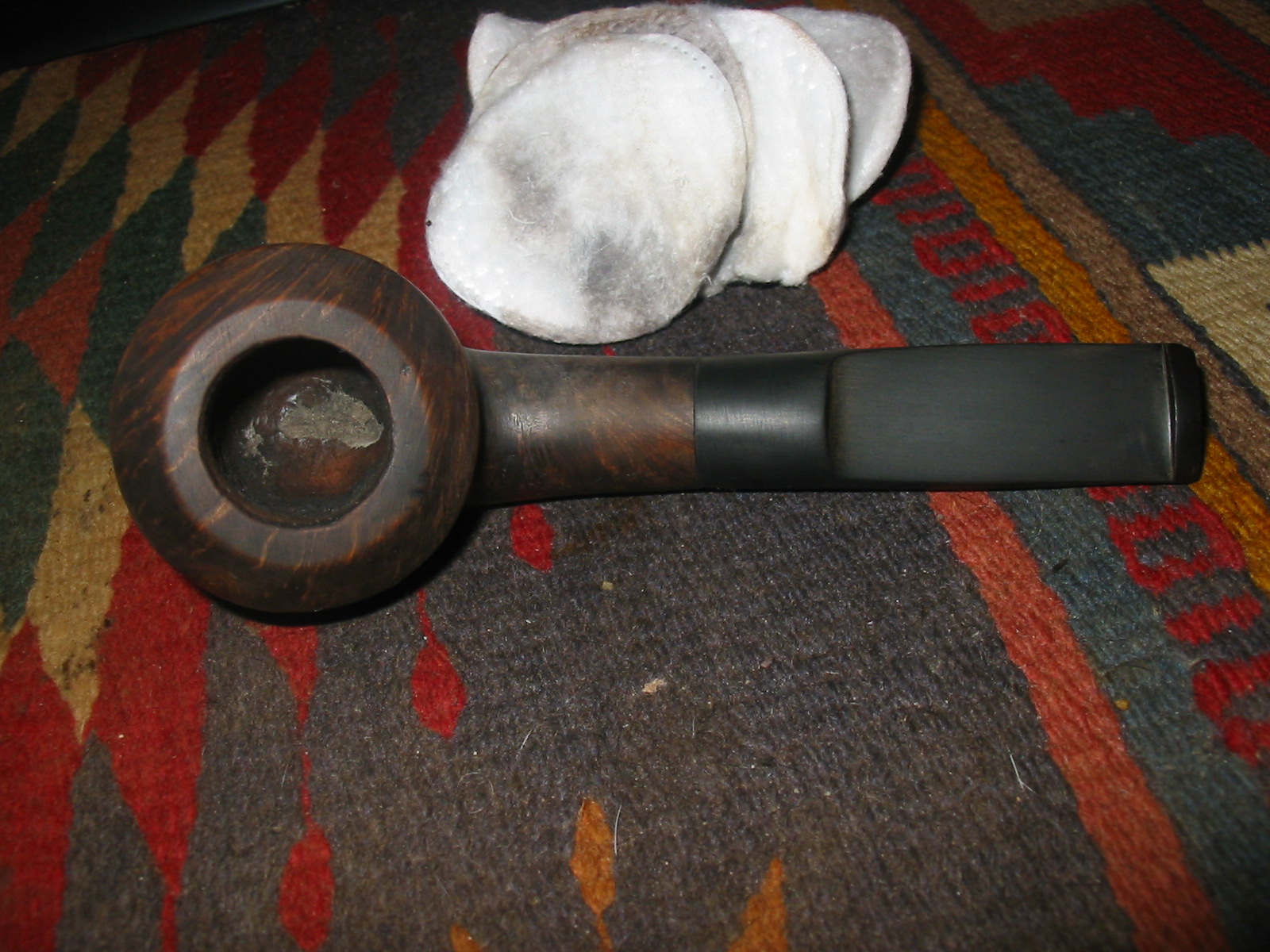
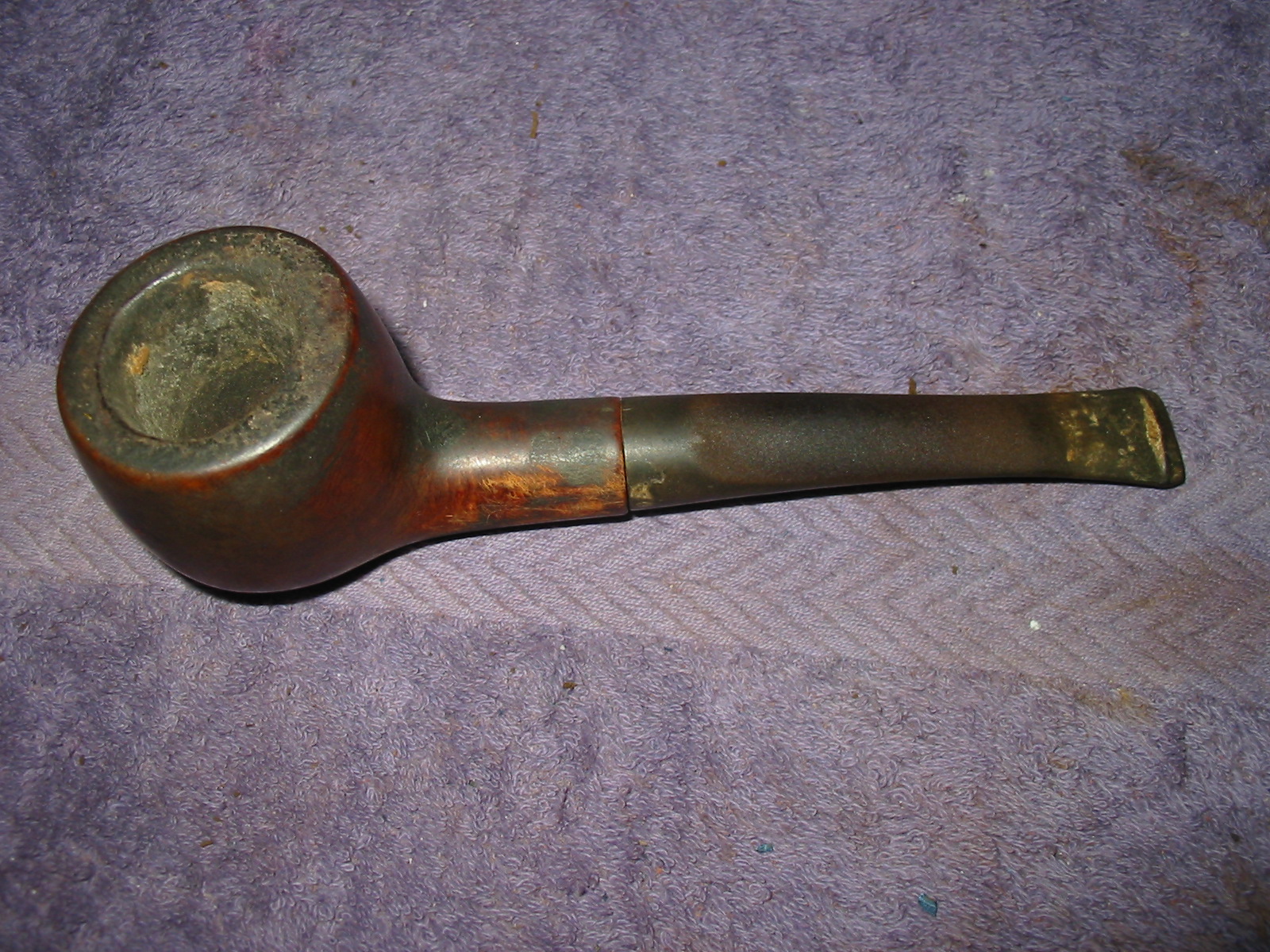
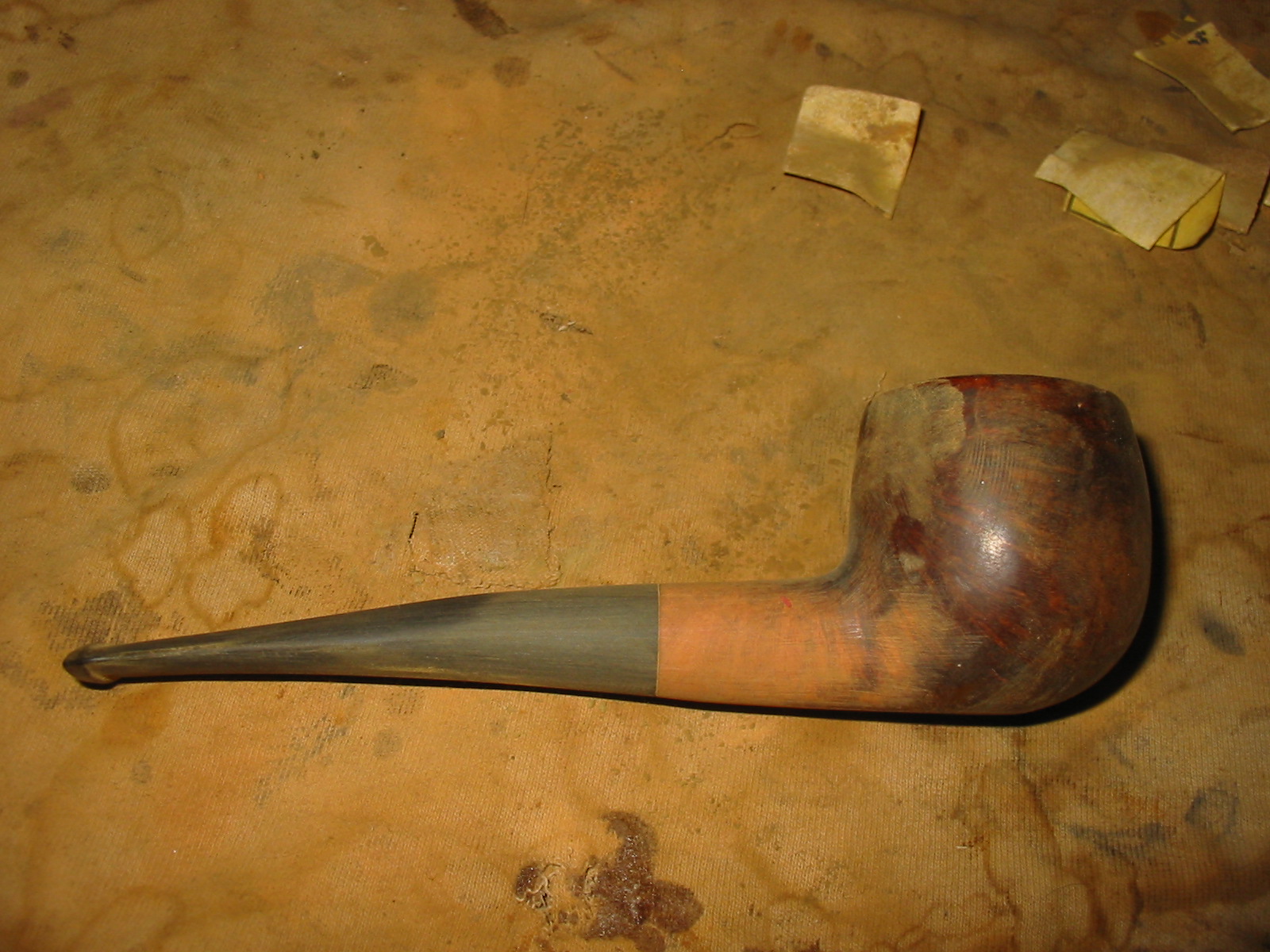
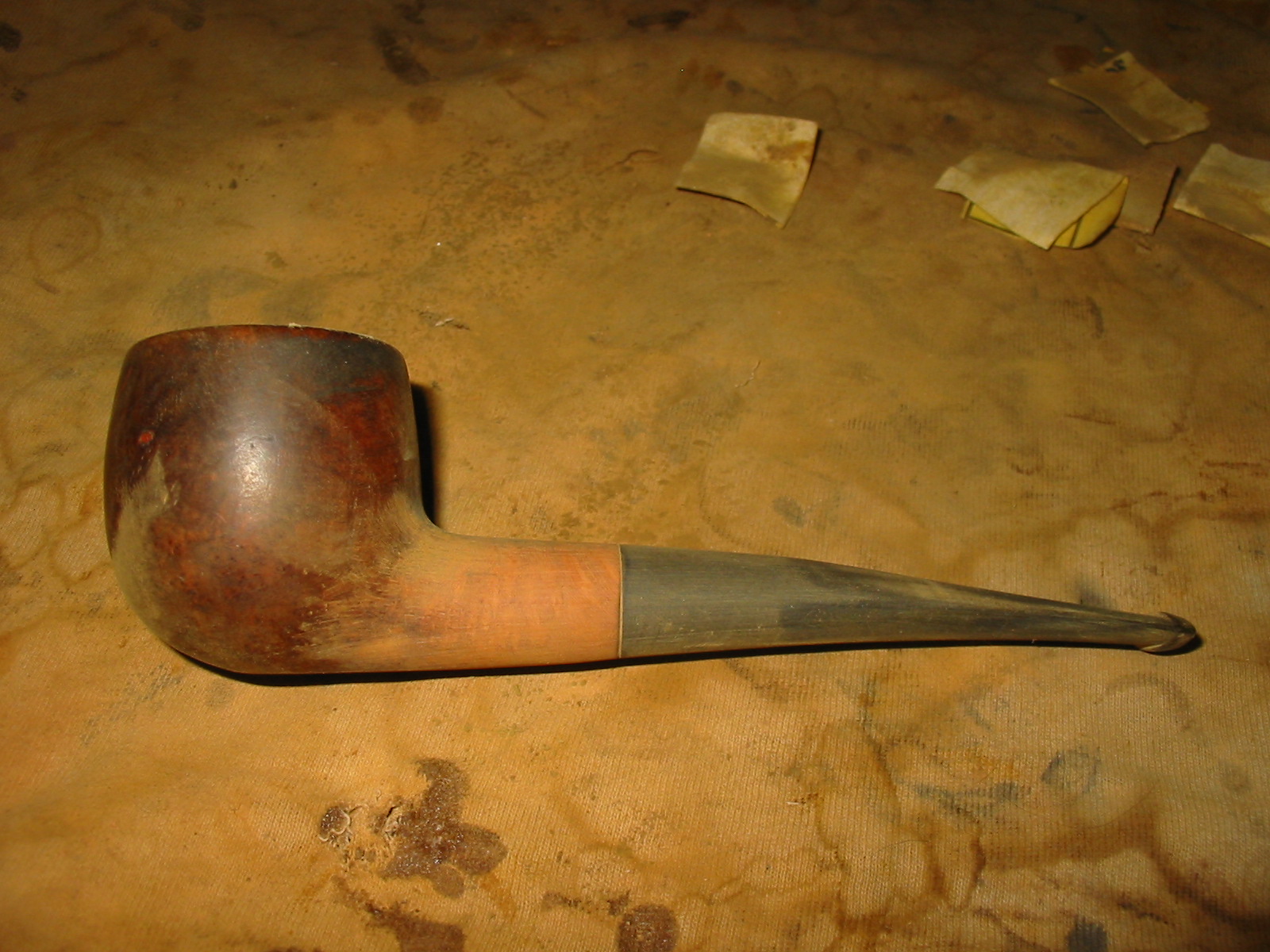
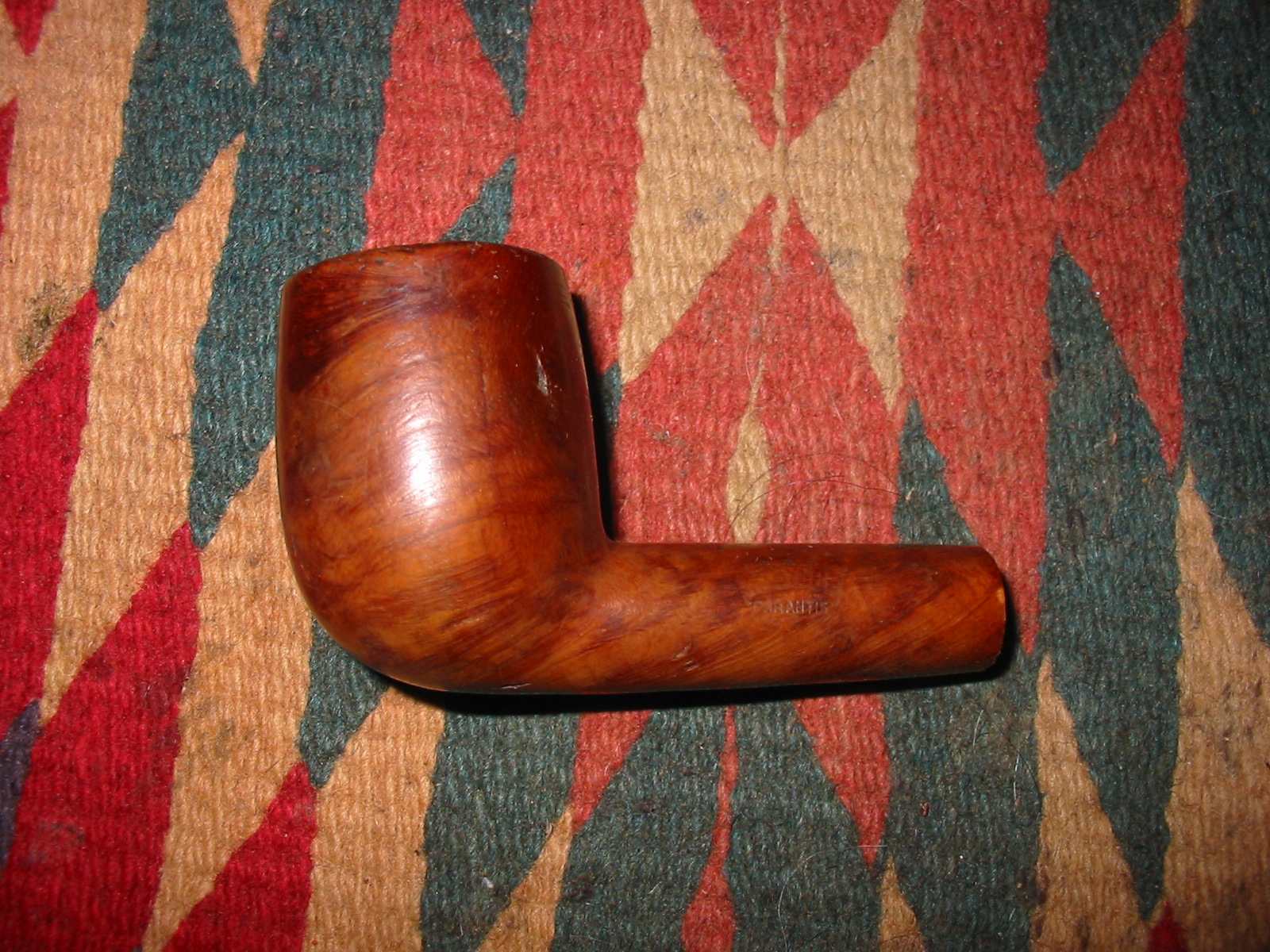
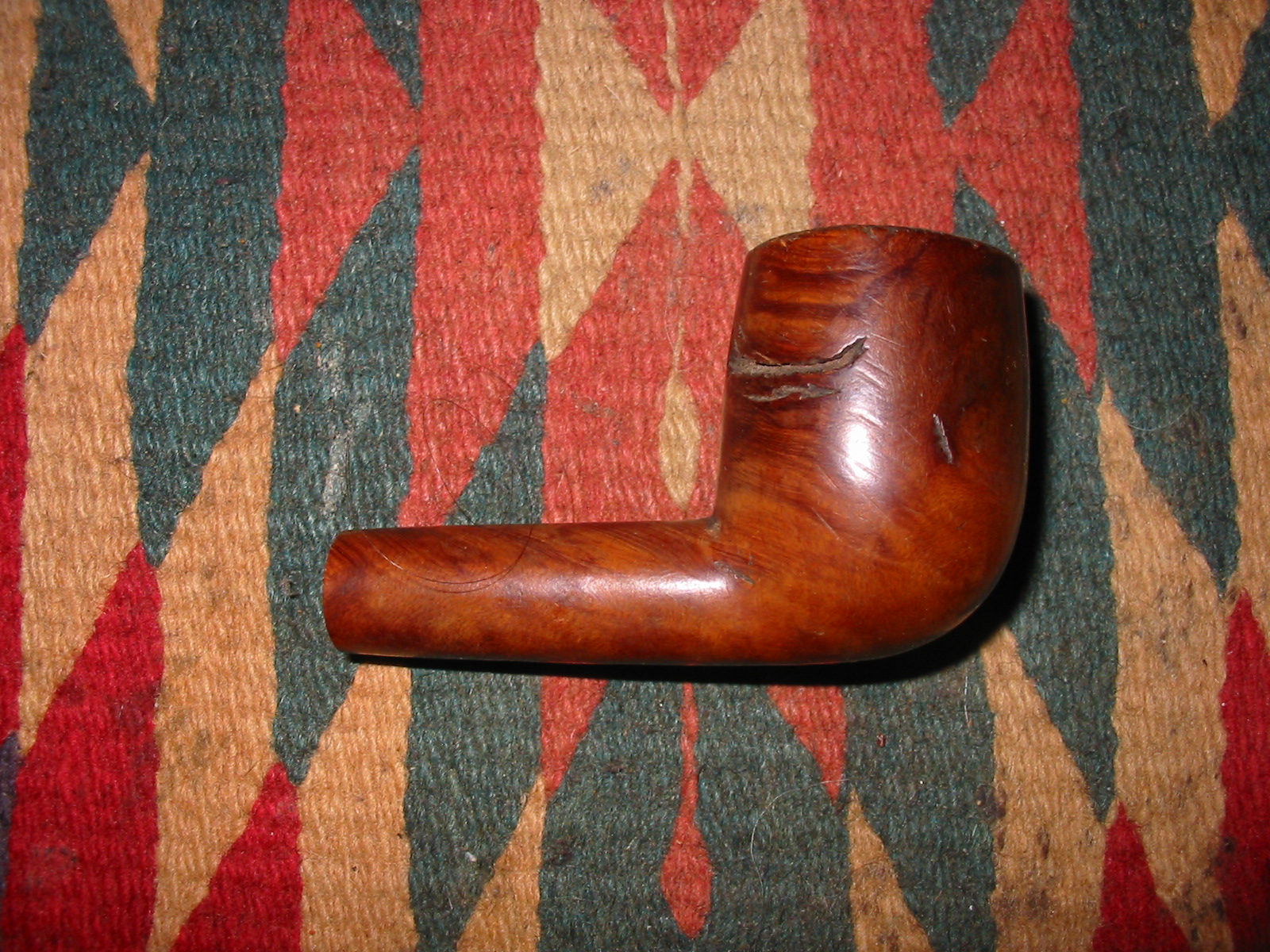
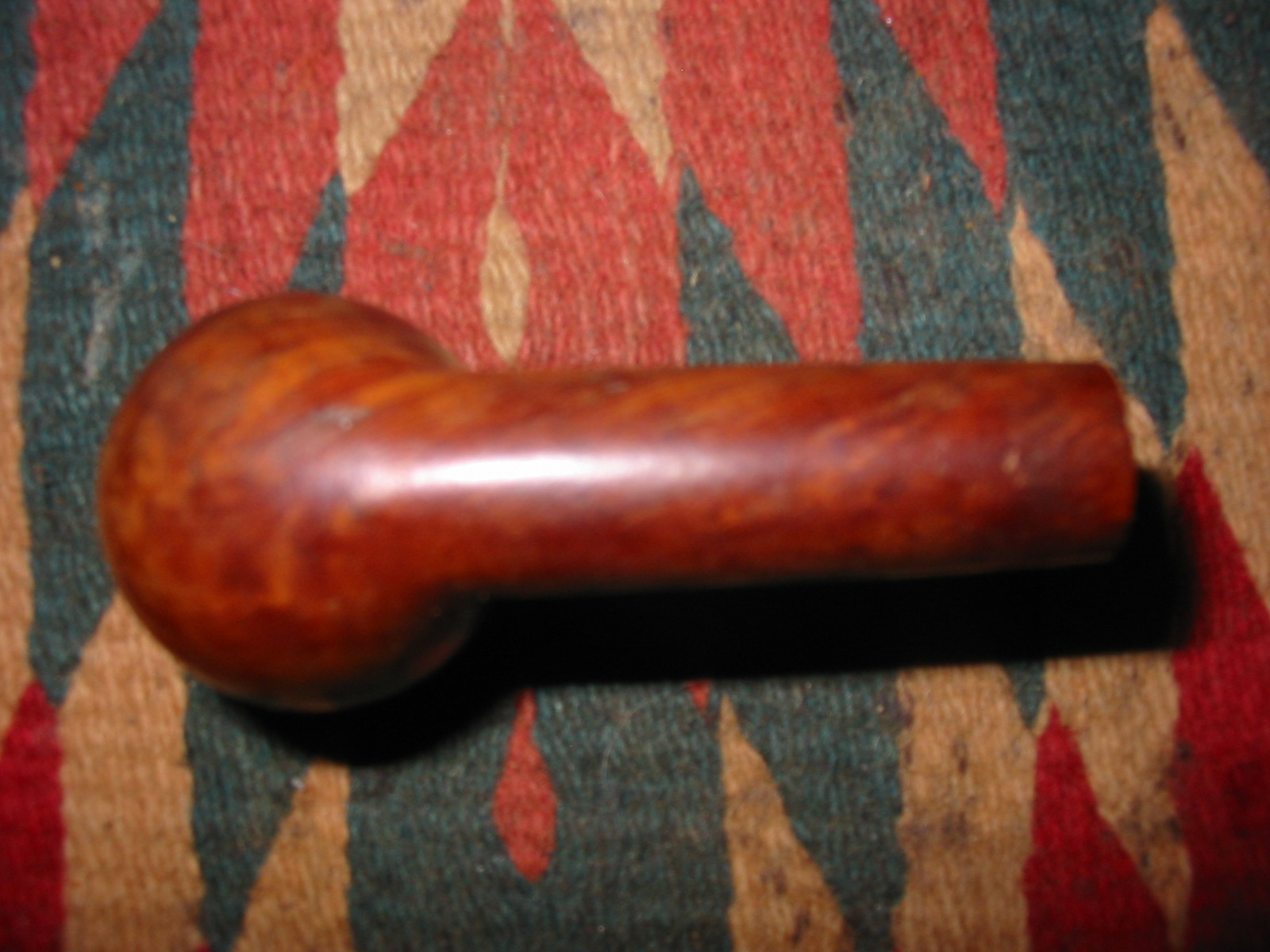
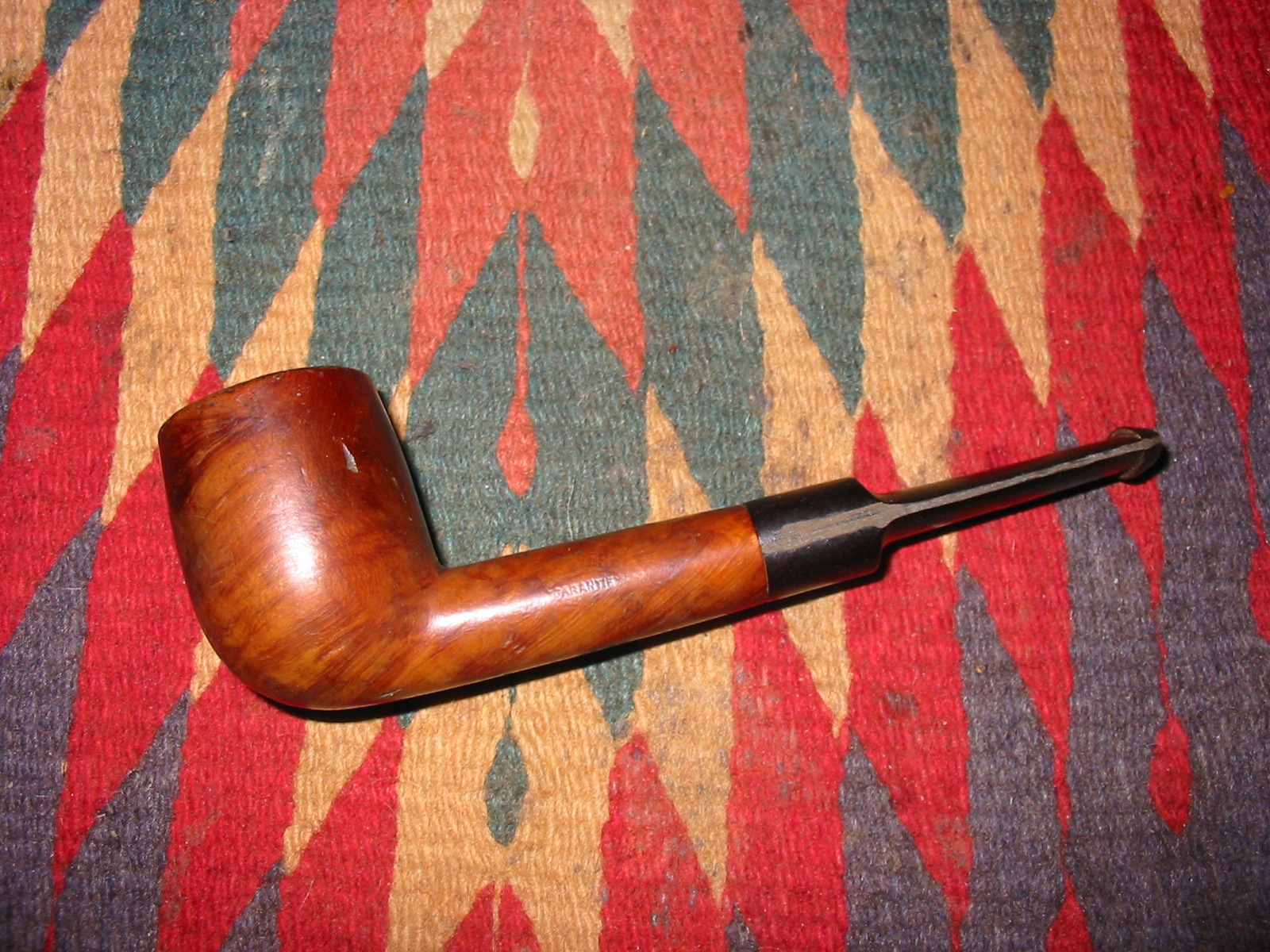
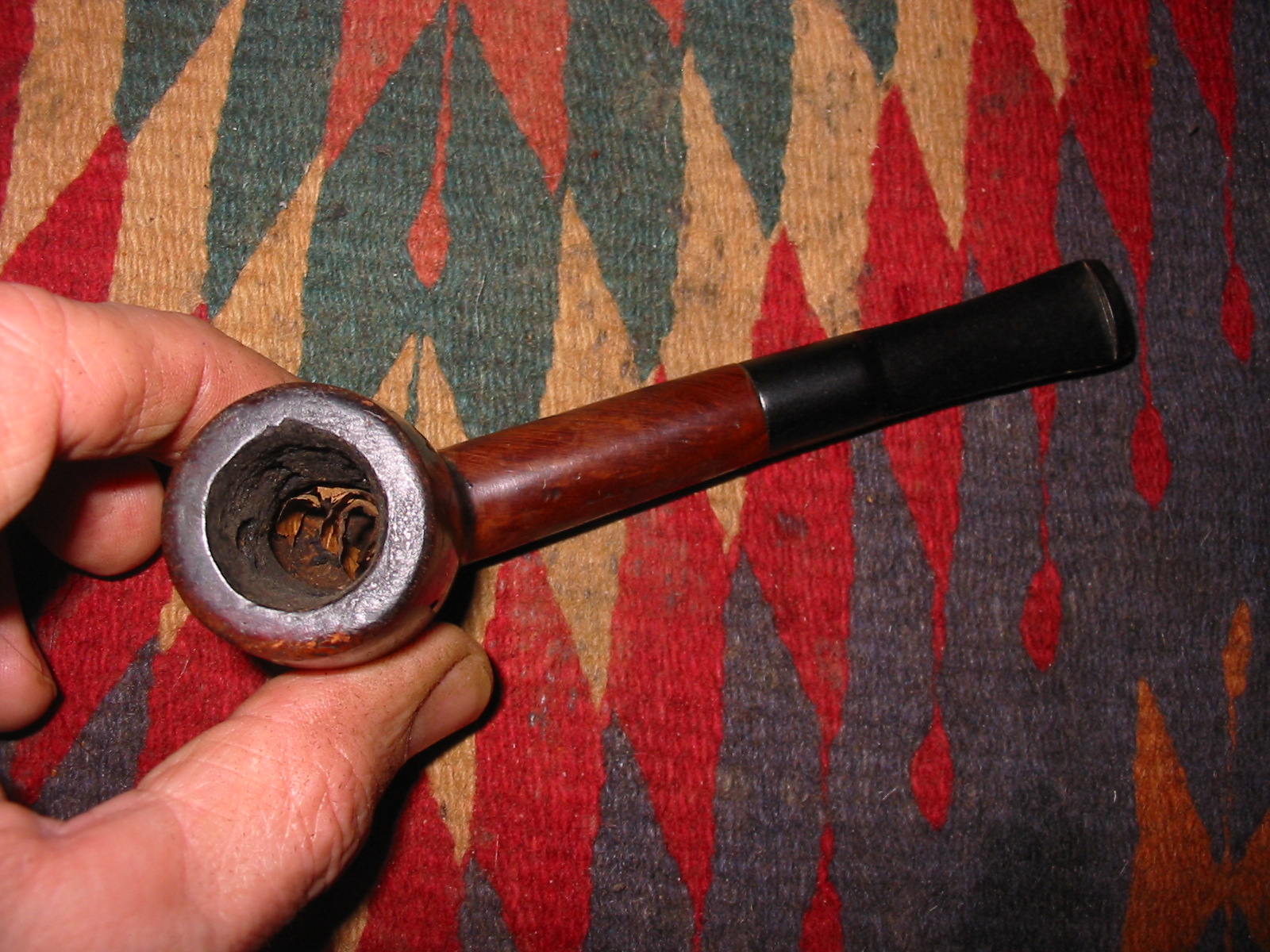
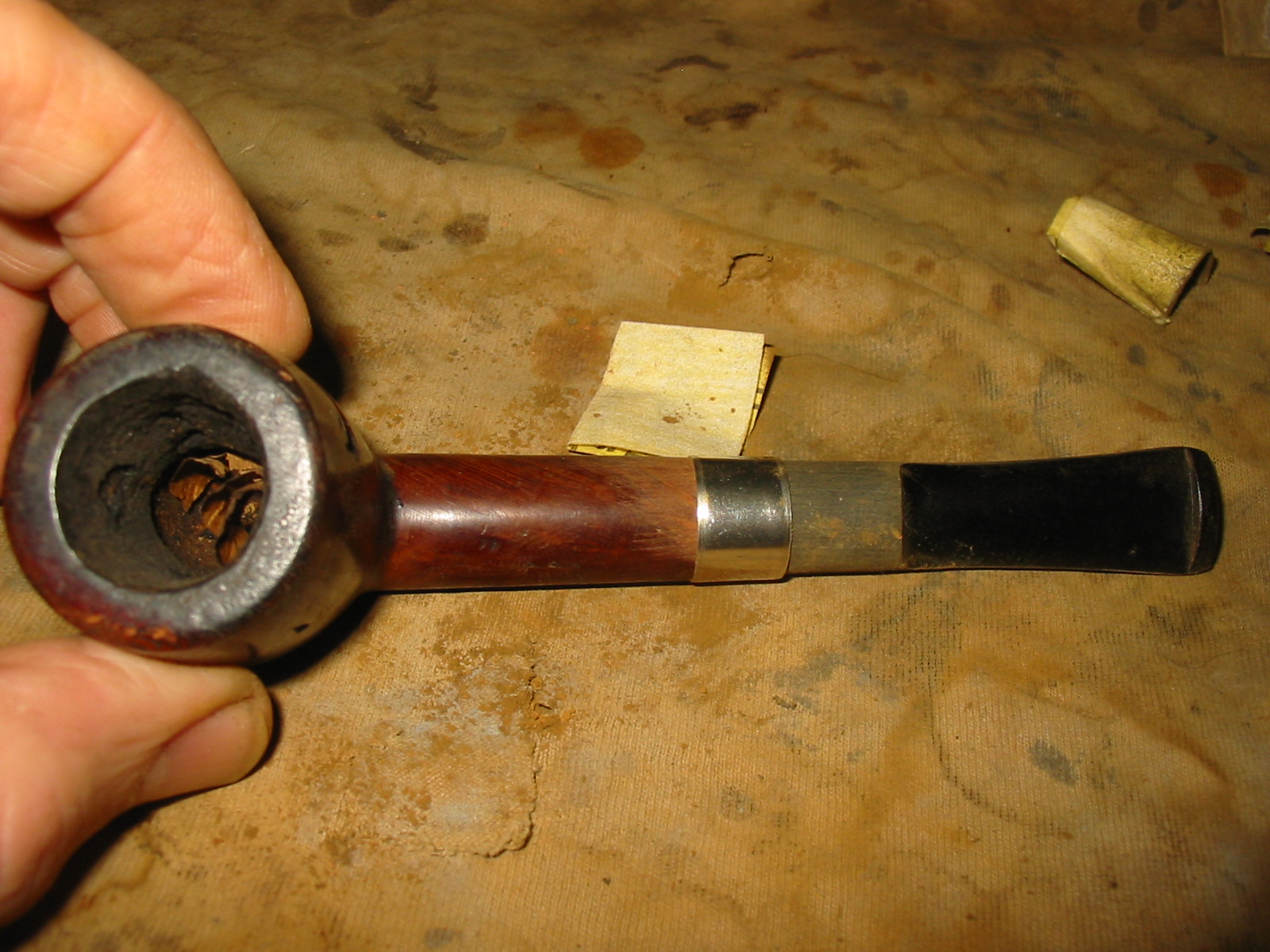
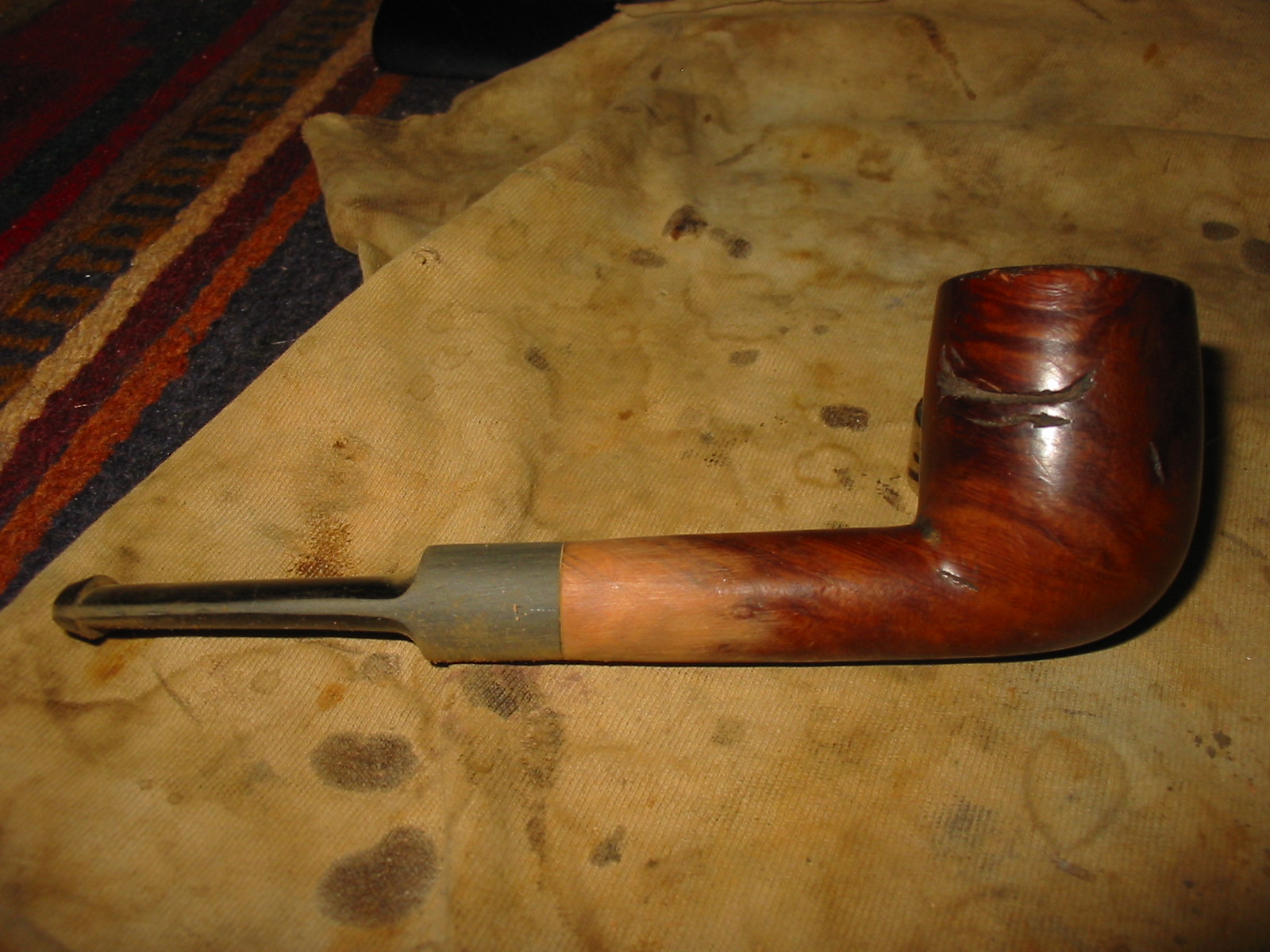
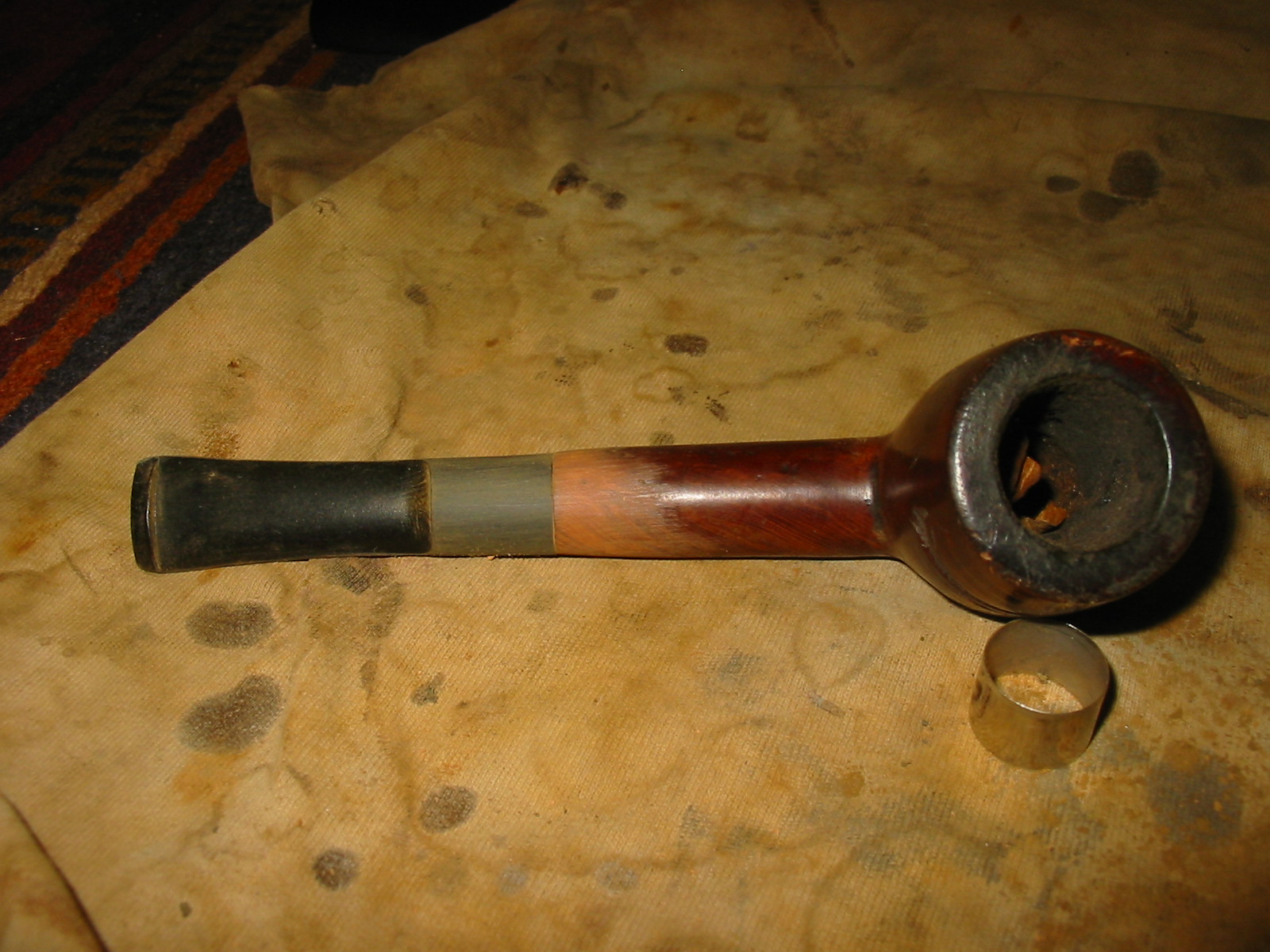
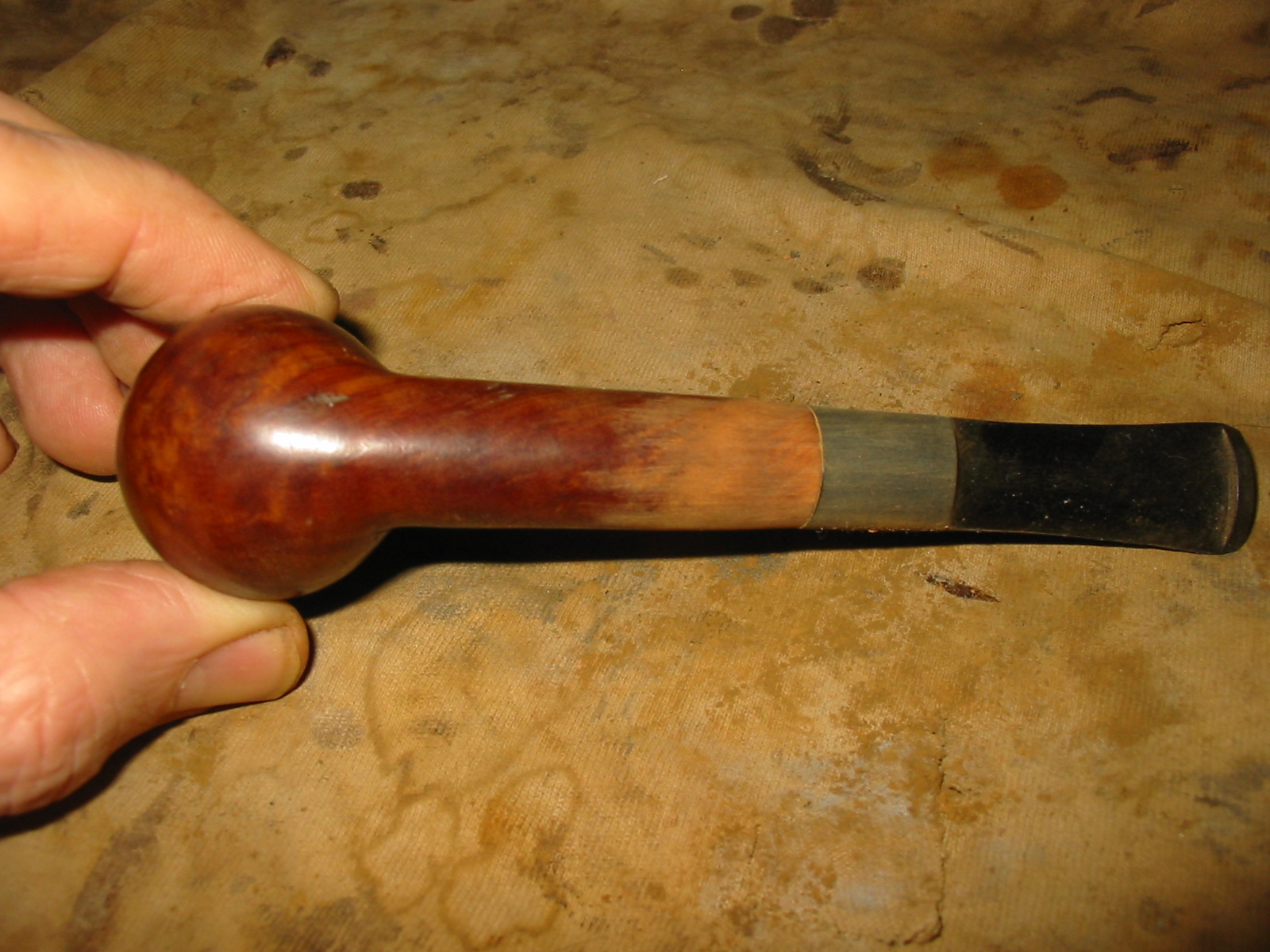
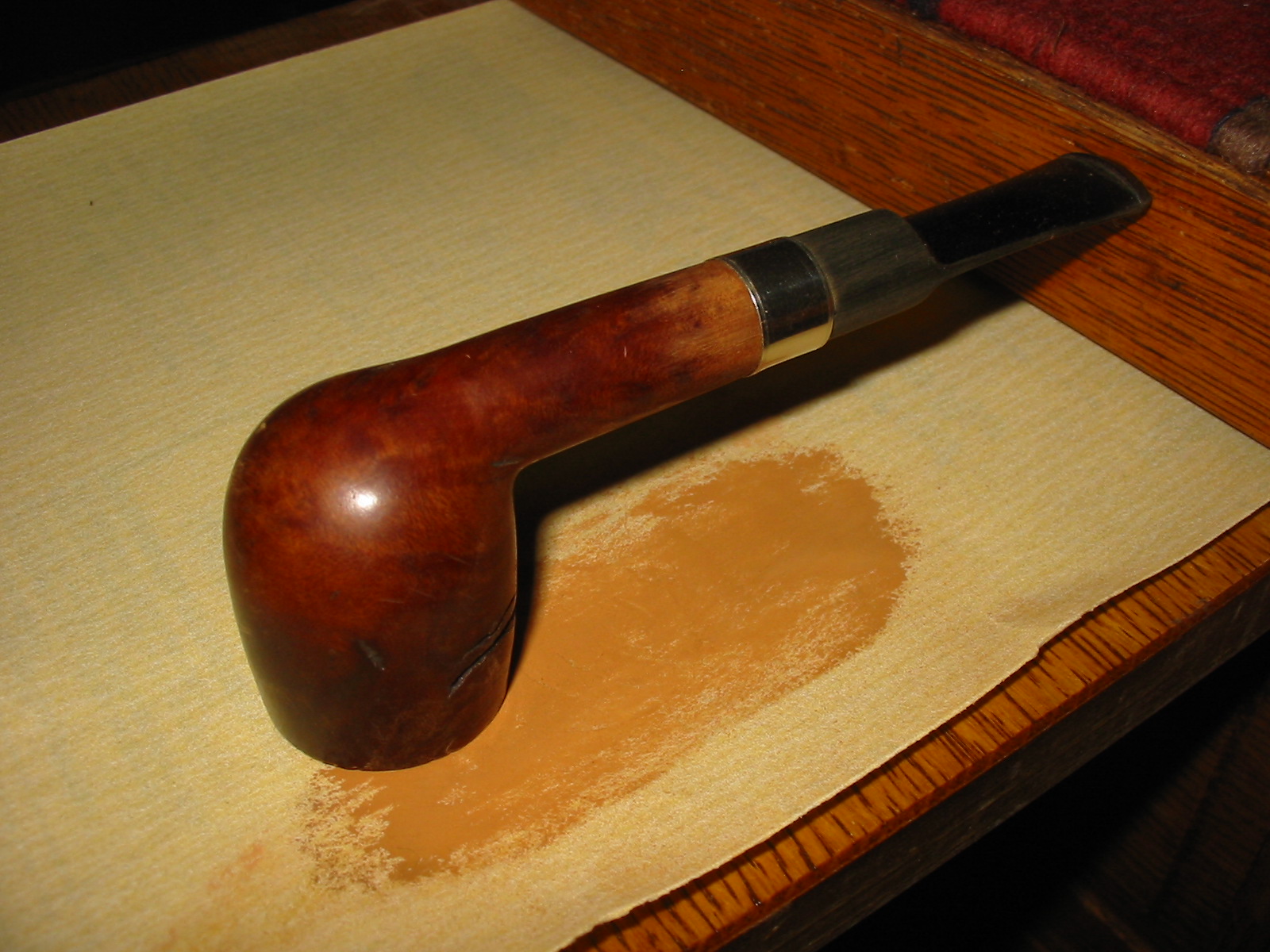
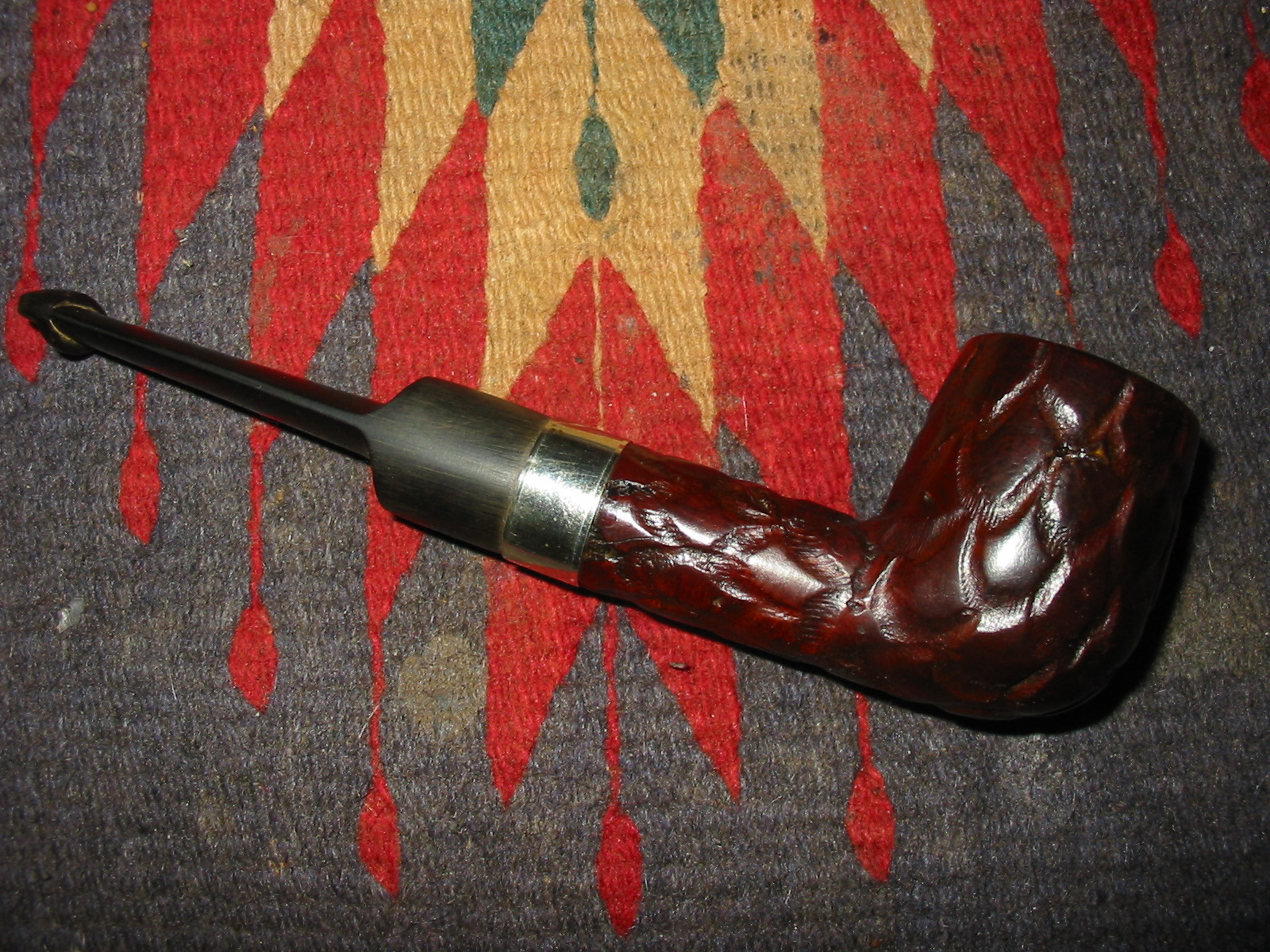
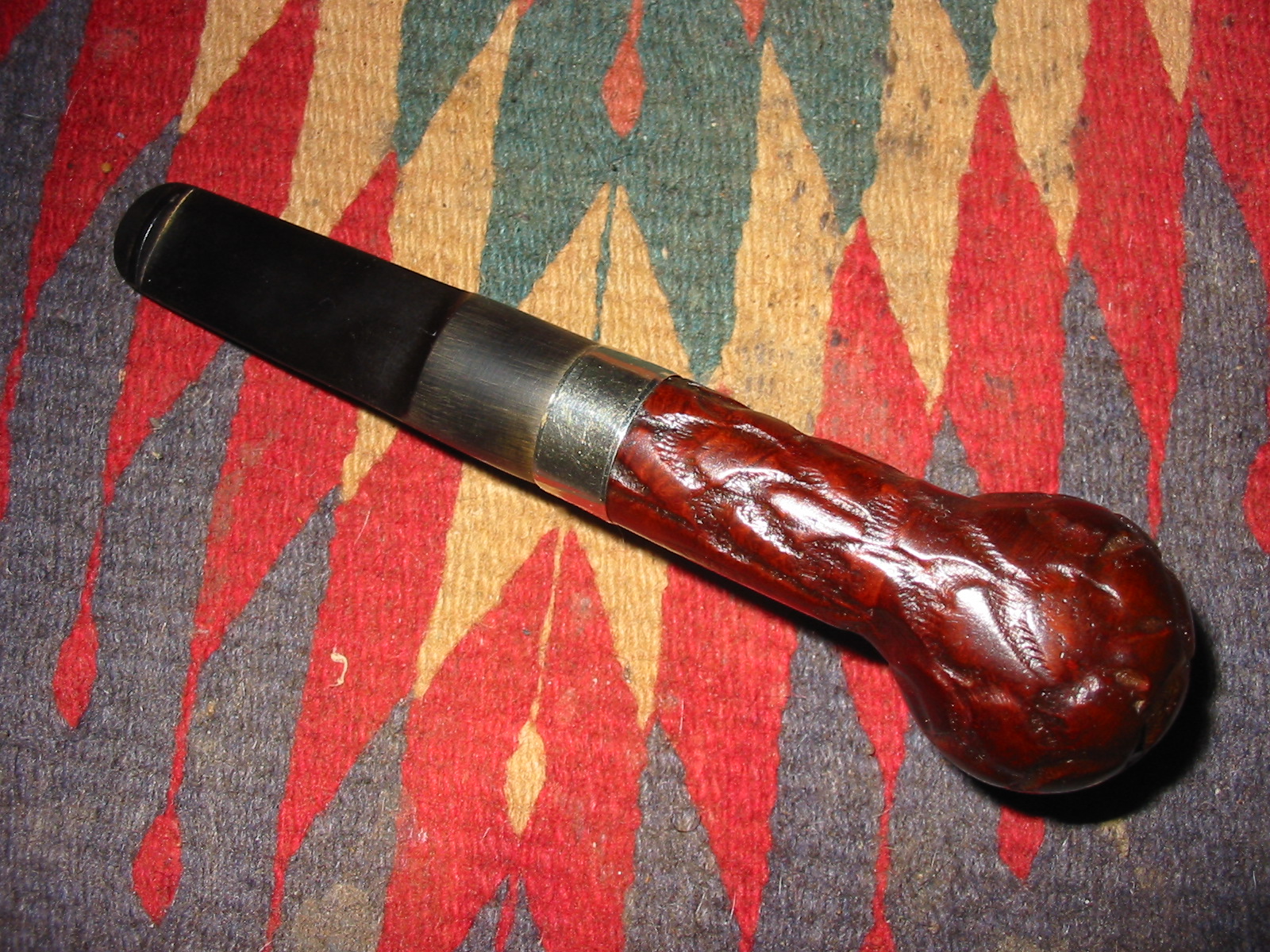
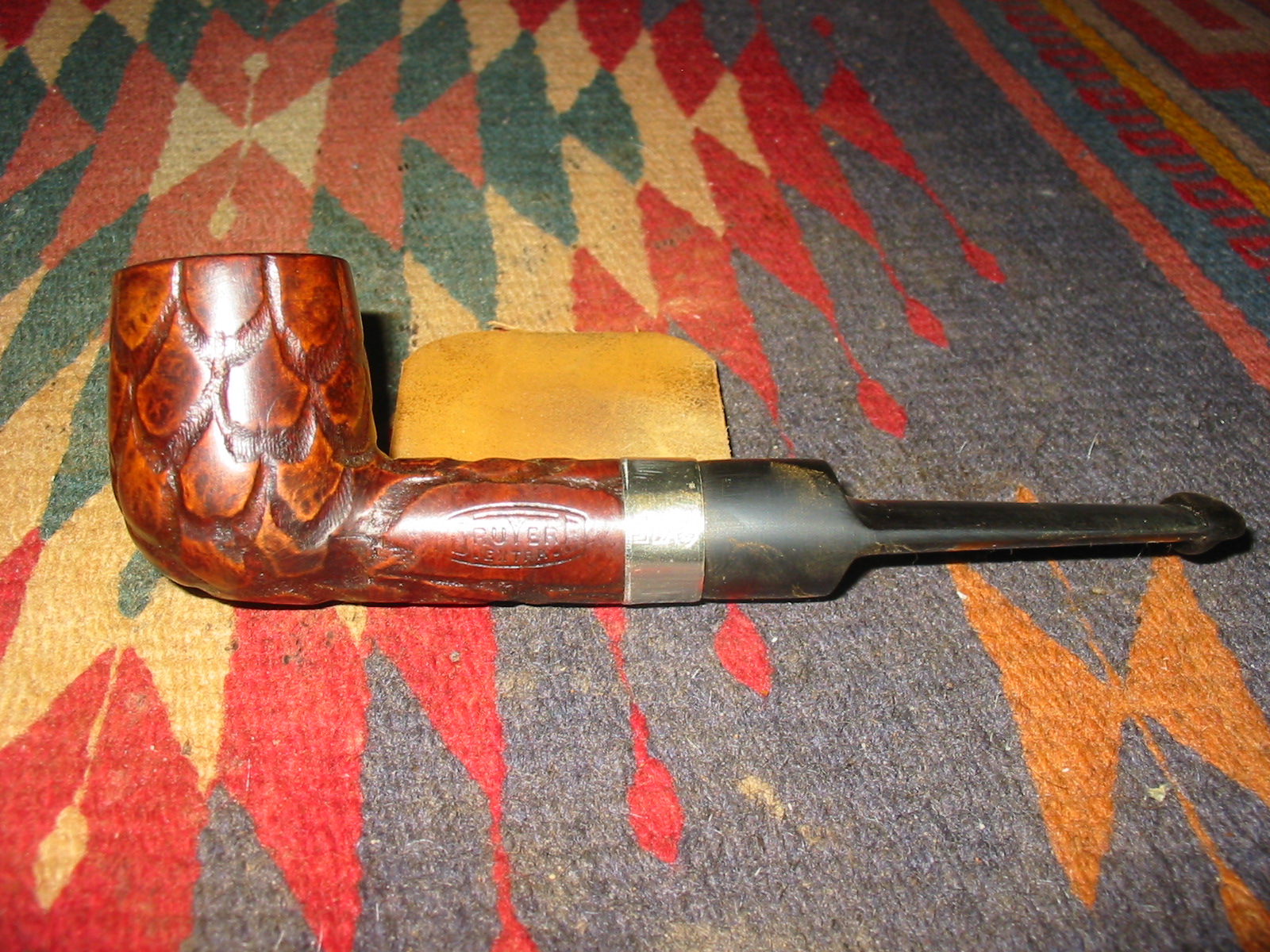
This bowl came to me showing a lot of promise but also a lot of damage. It was like someone had sawed at the bowl on the side near the shank. The cuts were more than mere flaws in the briar as they were very jagged and broken inside the cuts. There were what looked like tooth marks in the grooves. I debated on rusticating it but there was something about the challenge that made we work at ways to make it smooth once again. The inside of the bowl was in great shape. There was one damaged spot on the inside edge of the rim on the right side of the bowl. The bowl had tobacco still in it and the top of the rim was tarred and caked. There were multiple nicks in the finish all the way around the bowl but the majority of those were in line with the deep grooves. The bowl came without a stem and the shank had a nick out of the end making a clean fit almost impossible. There were no cracks in the shank so no damage in that way. The stamping on the pipe is Bruyere in a curved banner – unfurled in an arch on the left side of the shank and underneath it is stamped Garantie. The banner also seems to go across a three pointed crown that is visible underneath the banner.
IMG_5612

IMG_5613

IMG_5614

IMG_5615
I found a precast stem in my can of stems that was close to the right diameter to the shank and turned the tenon with a PIMO Tenon Turner and then fit it in the shank. I used a Dremel to remove the excess rubber along the edges and end of the cast.
IMG_5616

IMG_5617

IMG_5619
I sanded the stem and the shank to achieve a good smooth transition between the two. In the process I was curious as to what the shank would look like with a band so I slid a band part way on and fit the stem in place to have a look.
IMG_5620

IMG_5621
I liked the look of the band so I removed it and sanded the stem to fit smoothly against the shank. I sanded it with 220 grit sandpaper. (I have found that lower grits, courser sandpaper just makes for more scratches and is counterproductive when I am working toward refinishing the bowl.
IMG_5622

IMG_5623

IMG_5624

IMG_5625
Once I had the fit right and the transition smooth I cleaned off the shank with isopropyl alcohol and then rubbed on some white glue I heated the band and pressed it in place. With the band in place I took the bowl back to my work table and did a light topping as the outer edges of the bowl were more damaged than I thought. I wanted a good clean rim to go with the pipe once I had stripped and refinished it.
IMG_5626

IMG_5627
I reamed the bowl with a PipNet reamer and took it back to bare wood all the way to the bottom of the bowl.
IMG_5629
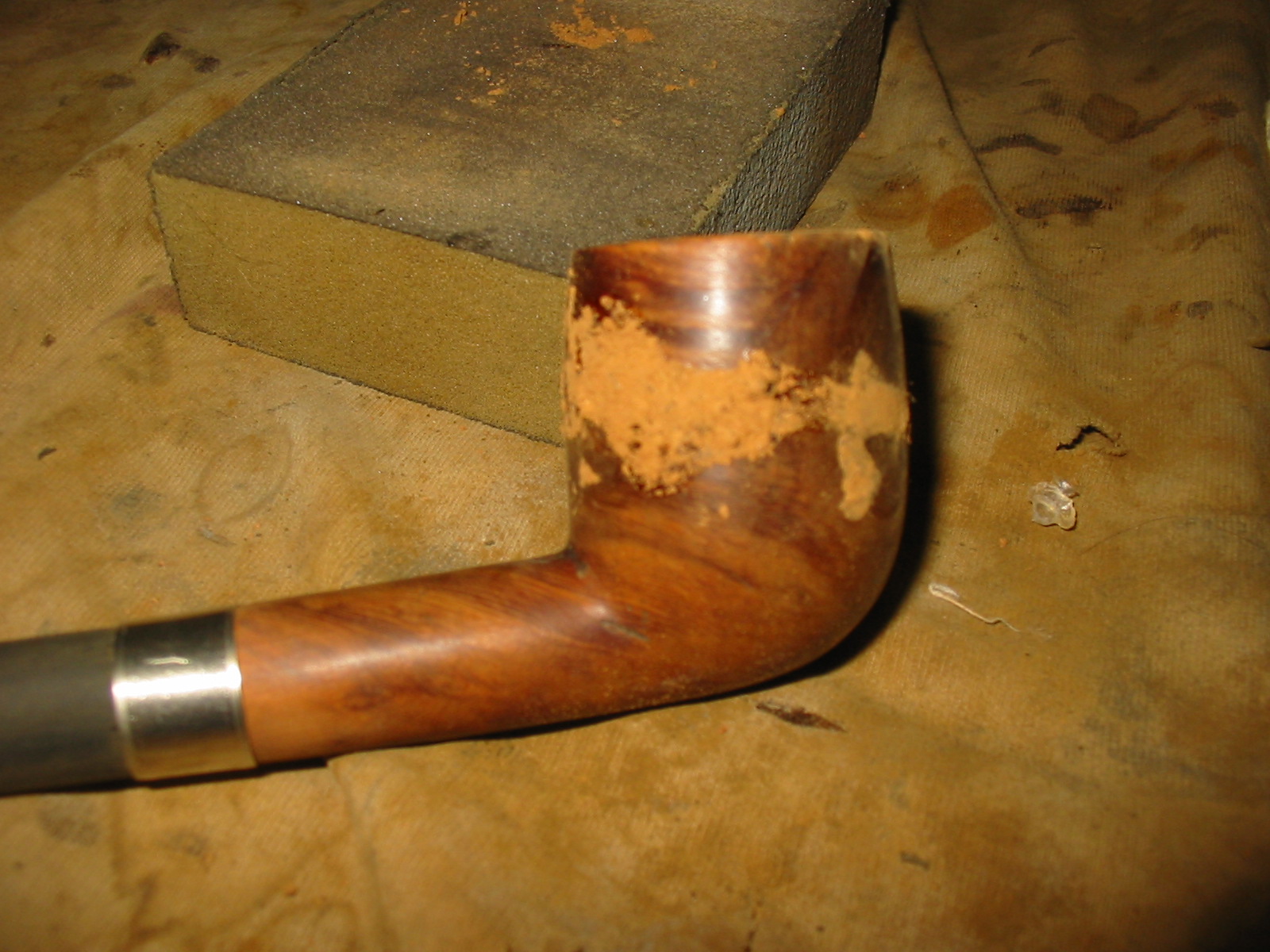
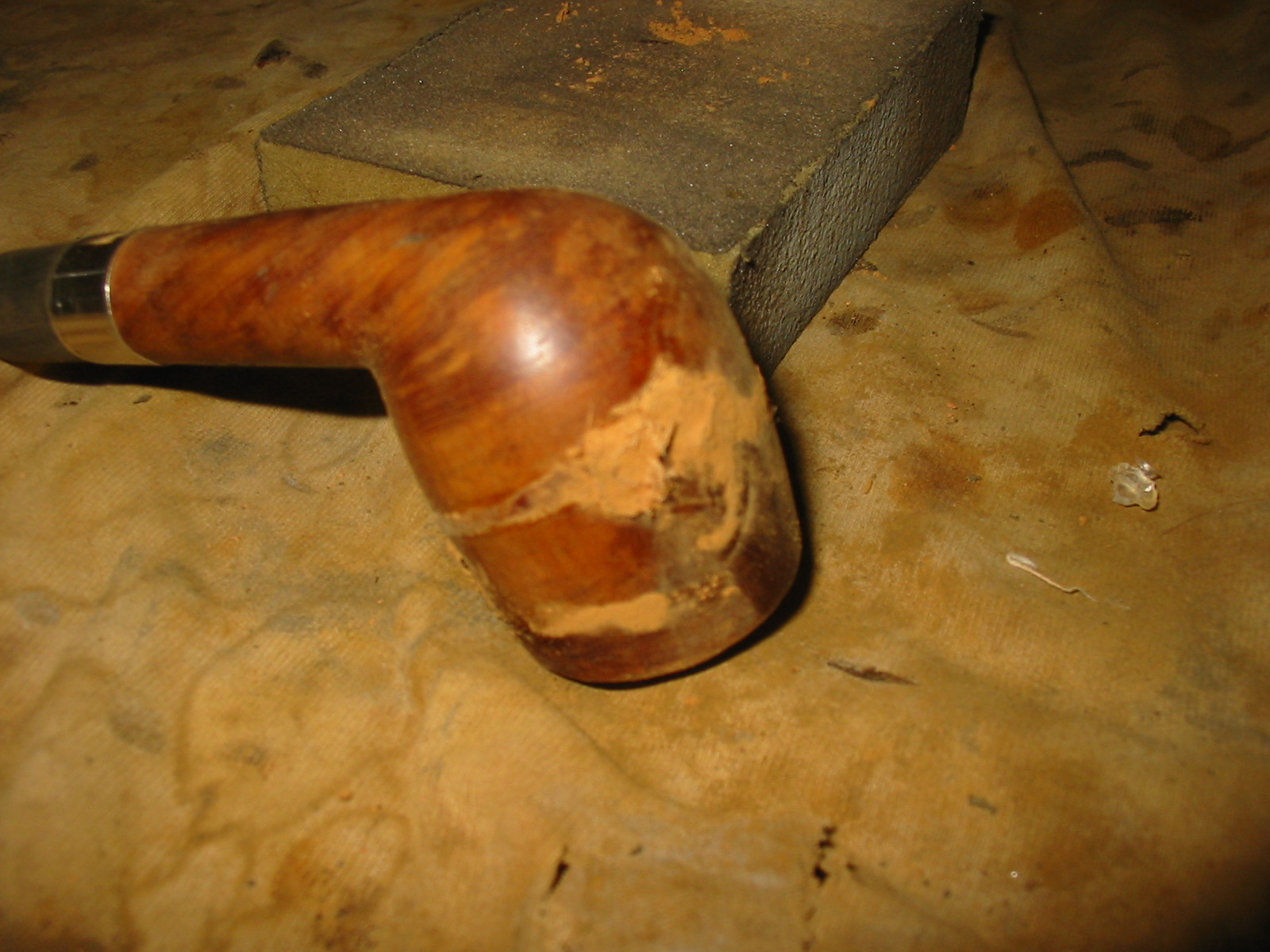
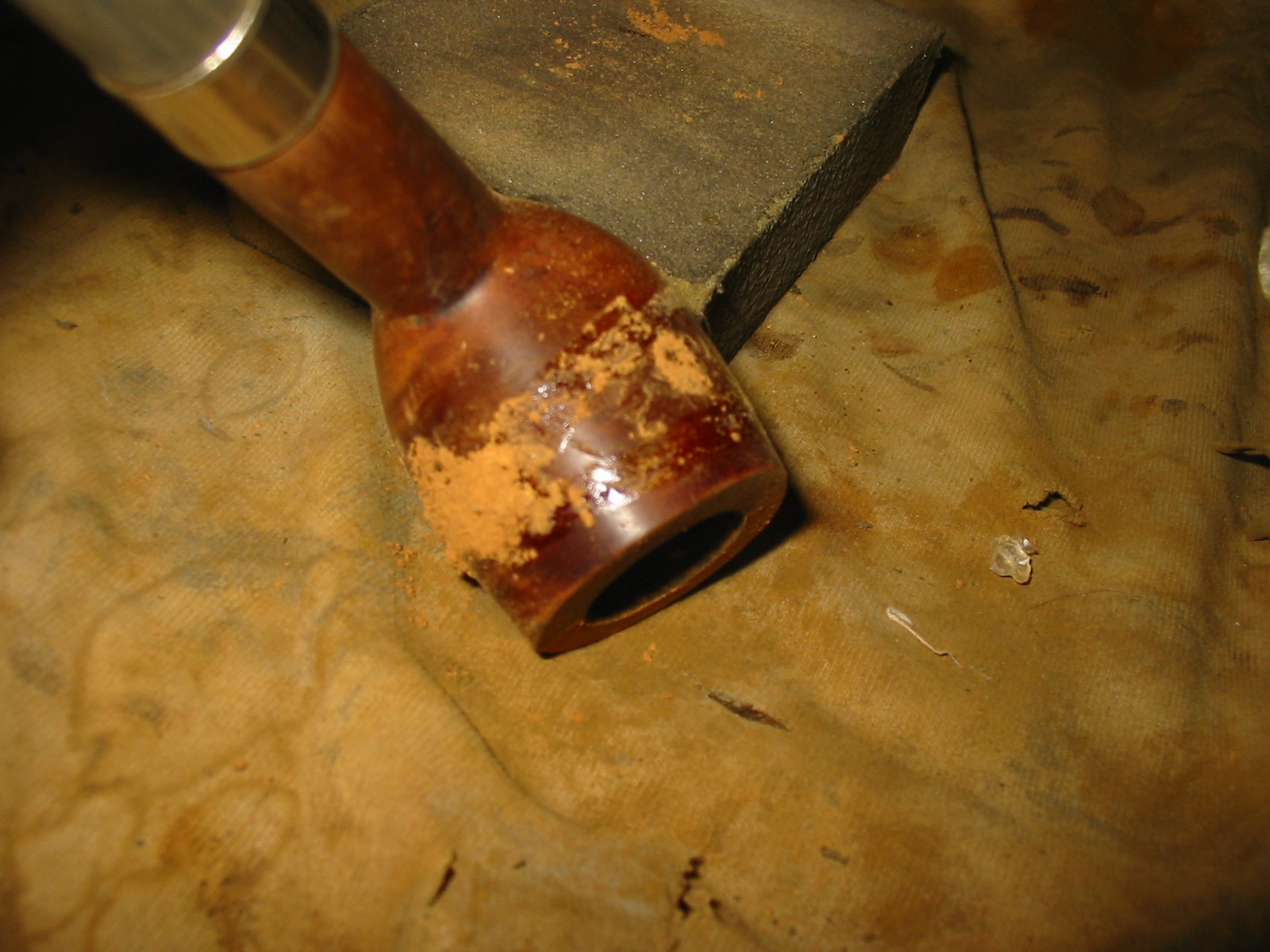
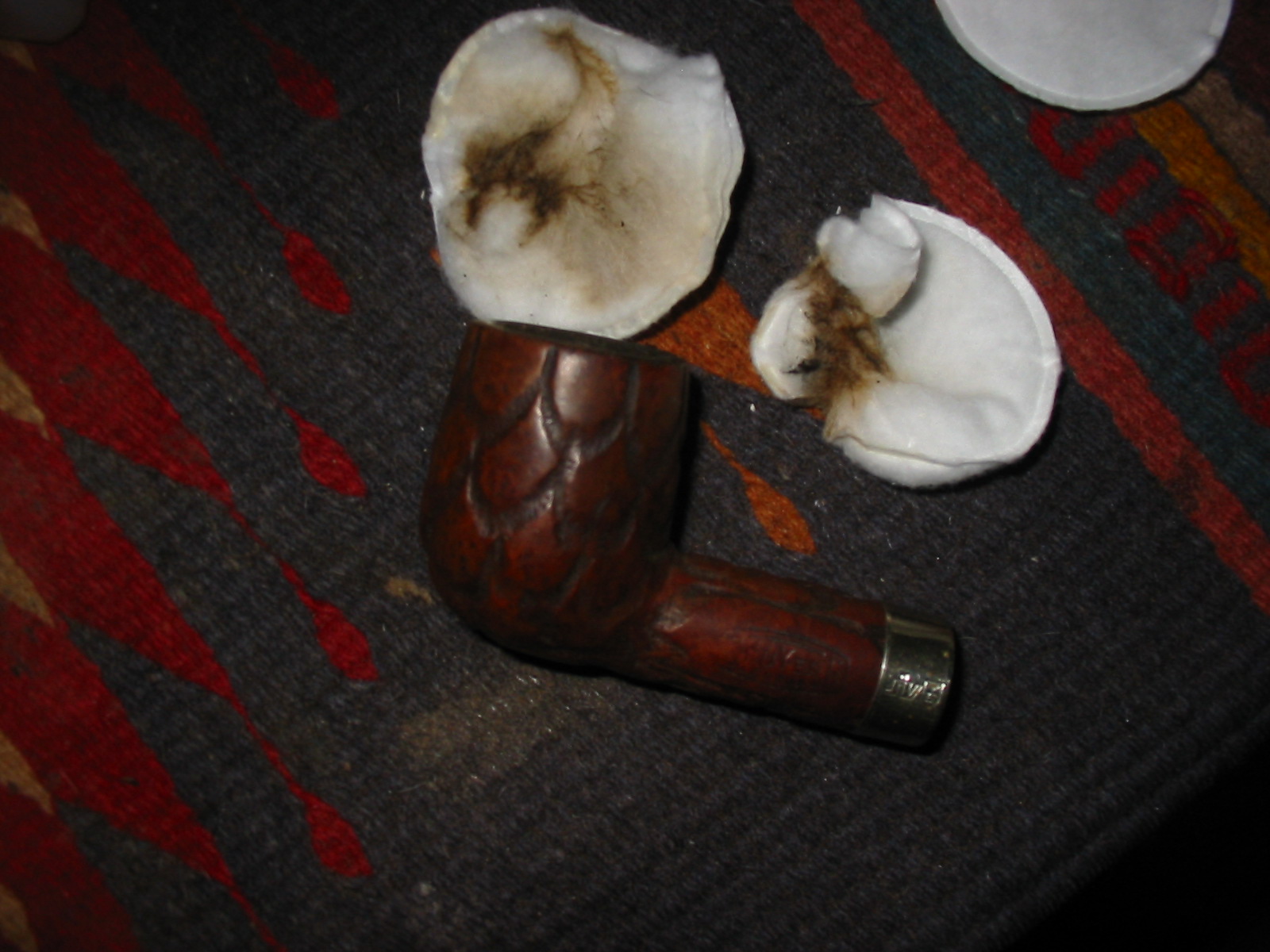
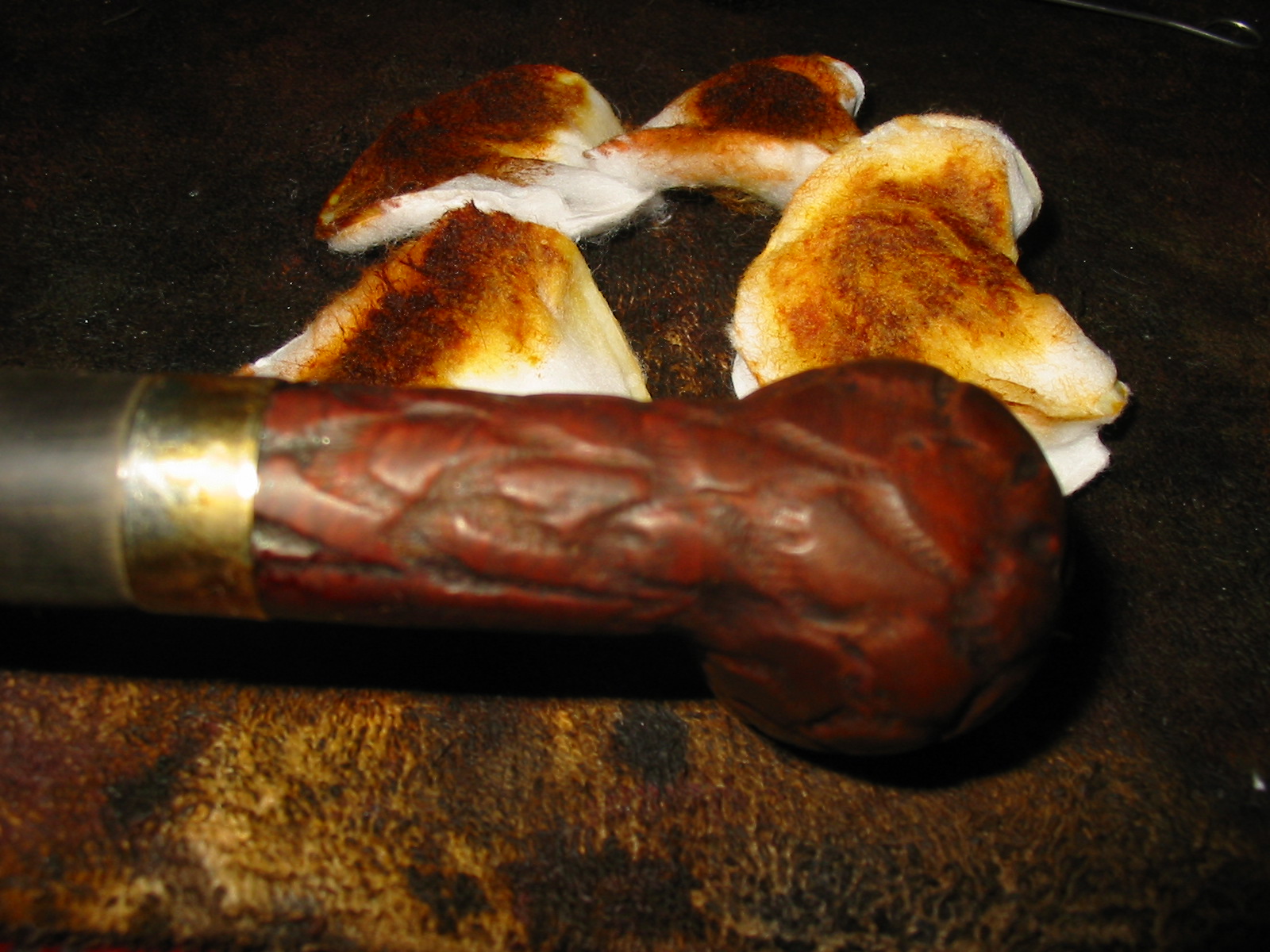
I wiped down the bowl with acetone on cotton pads to remove the finish. I wanted it clean of debris and grime as well as stain so that I could do the repair. I used the dental pick to clean out the edges of the two large cut marks and the smaller chatter in the briar as well. None of them actually were fills but rather gouges in the briar. I roughened the edges and wiped it down a final time with the acetone and cotton pads.
IMG_5632
I packed the cuts and nicks with briar dust and tamped it into place with the curved head or a pipe nail and also with the dental pick. Once they were full I dripped super glue into the grooves. I then packed more briar dust into the grooves, over filling them. I always put far more briar dust in the grooves than necessary to get good tight fills in the holes. I figure I can pack once and sand it back to the surface of the bowl instead of doing the pack two or three times. At this point in the process the photos show the pipe as a serious mess. I always wonder if I will be able to clean it up or if I had just made it a mess for nothing.
IMG_5633

IMG_5634

IMG_5635
I sanded the repairs and the bowl with 220 grit sandpaper to remove the excess material on the surface of the bowl. I followed that by sanding with a medium grit sanding block. The repairs are visible in the photos below as a solid dark brown/black coloured fill.
IMG_5636

IMG_5637

IMG_5638
I sanded the bowl further with medium and fine grit sanding sponges to remove the scratches in the surface of the bowl. I wet sanded with 1500-2400 grit micromesh sanding pads to smooth things out even more. I wanted the surface of the repairs to be smooth with the rest of the briar on the bowl. Once the sanding was finished I wiped the bowl down with some isopropyl alcohol on a cotton pad to clean off the dust.
IMG_5639

IMG_5640

IMG_5641

IMG_5642
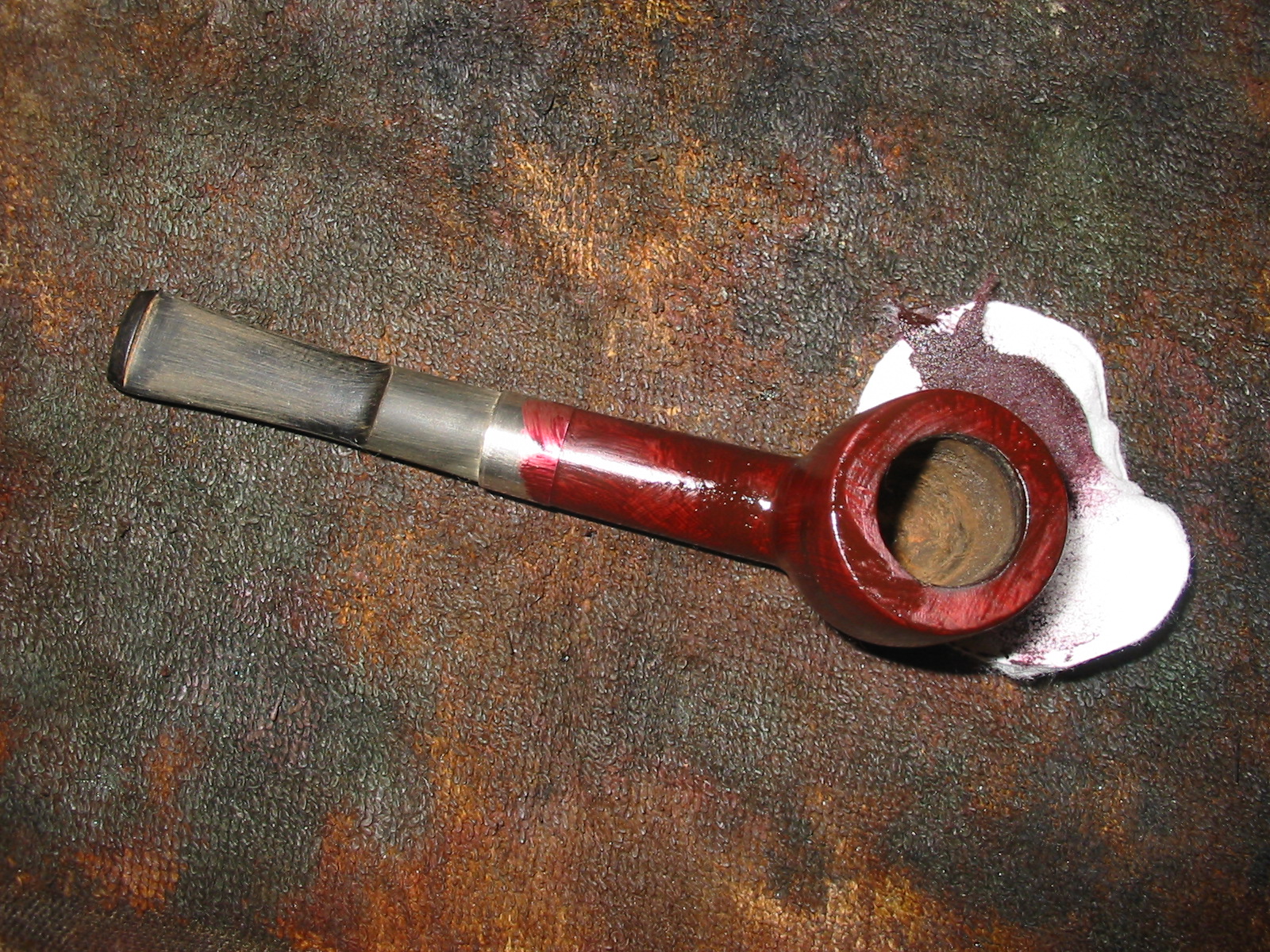
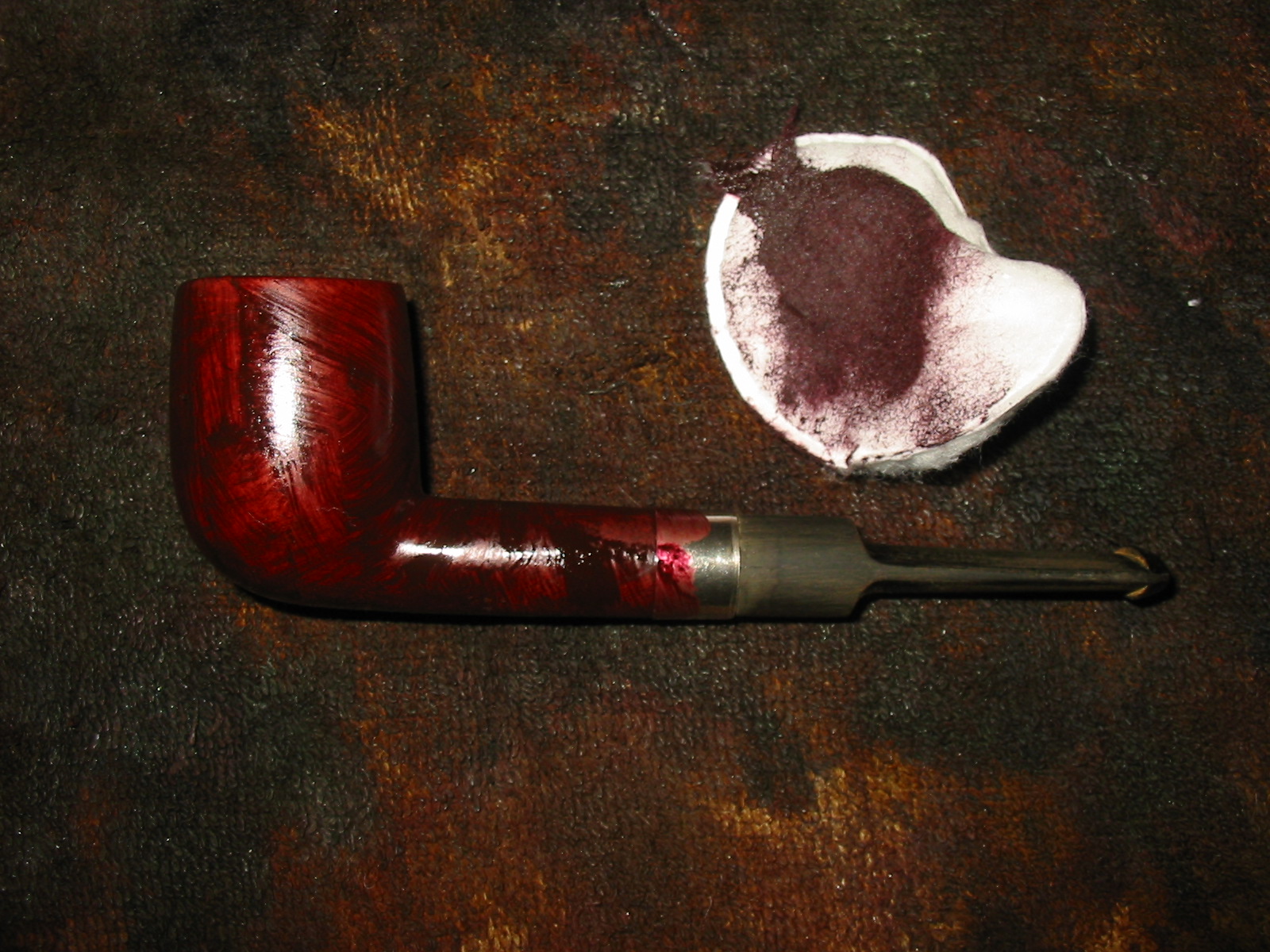
I decided to give the bowl several coats of an oxblood stain that was slightly more opaque than my normal aniline stain. It is a stain that is used on kitchen cabinets and surfaces that food comes into contact with so I believe it is safe once it is dry.
IMG_5643

IMG_5644

IMG_5645
I wiped the bowl down with a soft cotton cloth to remove the excess stain and then restained it a second time. I repeated the staining until the coverage was even and clear.
IMG_5646

IMG_5647

IMG_5648
I worked on the stem some more with medium and fine grit sanding sponges and then with micromesh sanding pads. I wet sanded with 1500-2400 grit pads and dry sanded with 3200- 12,000 grit pads.
IMG_5724

IMG_5725

IMG_5726
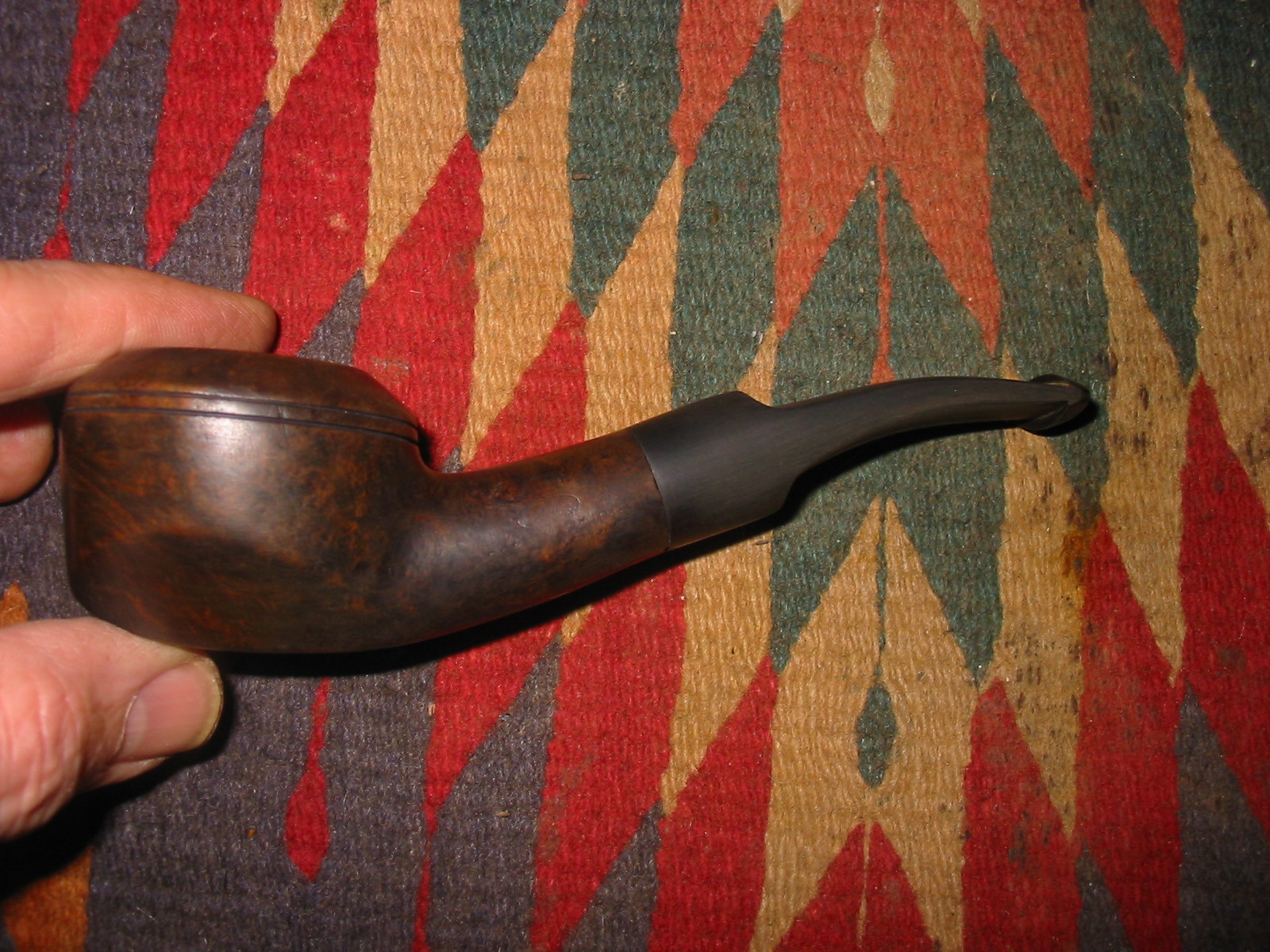
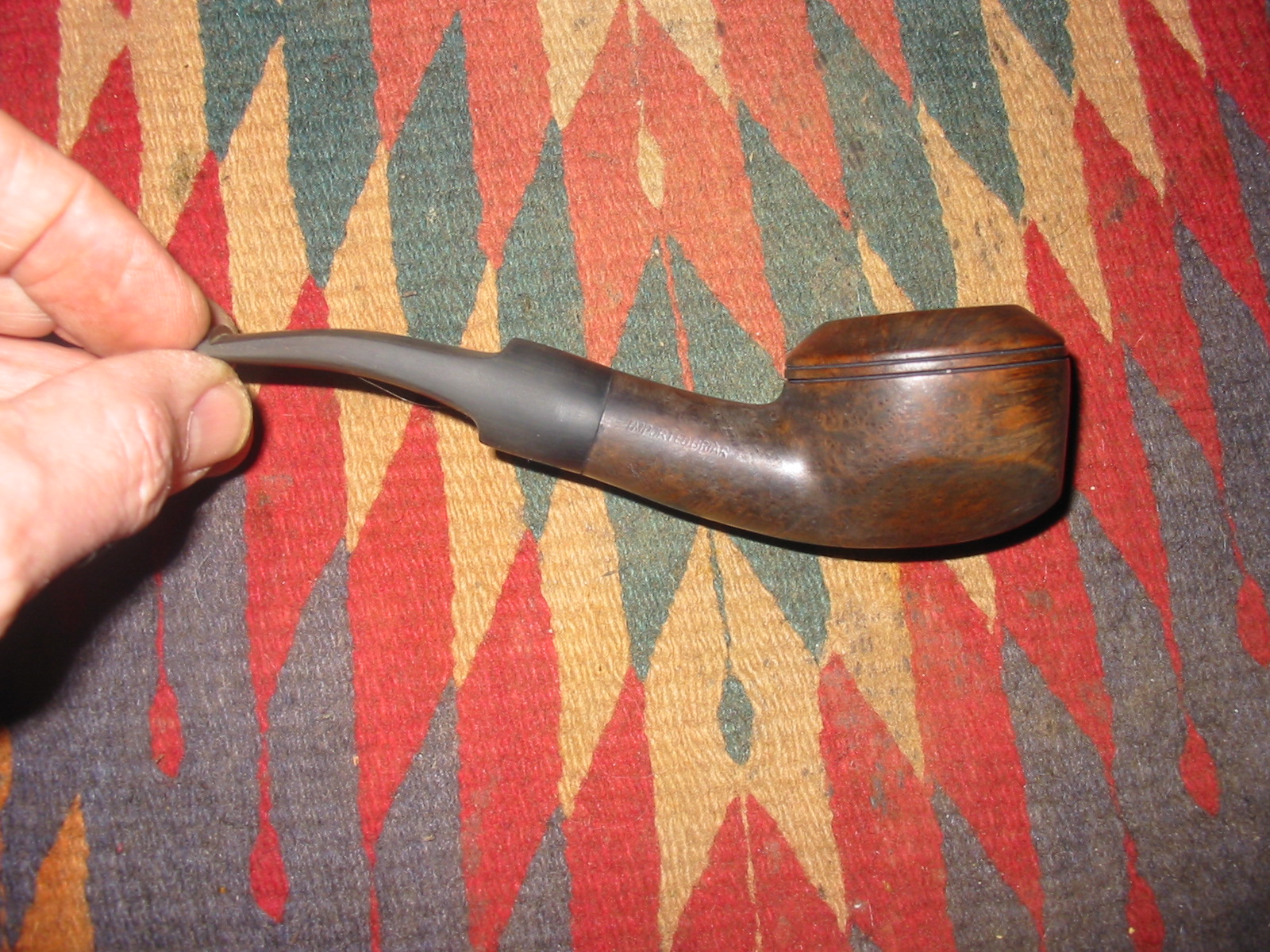
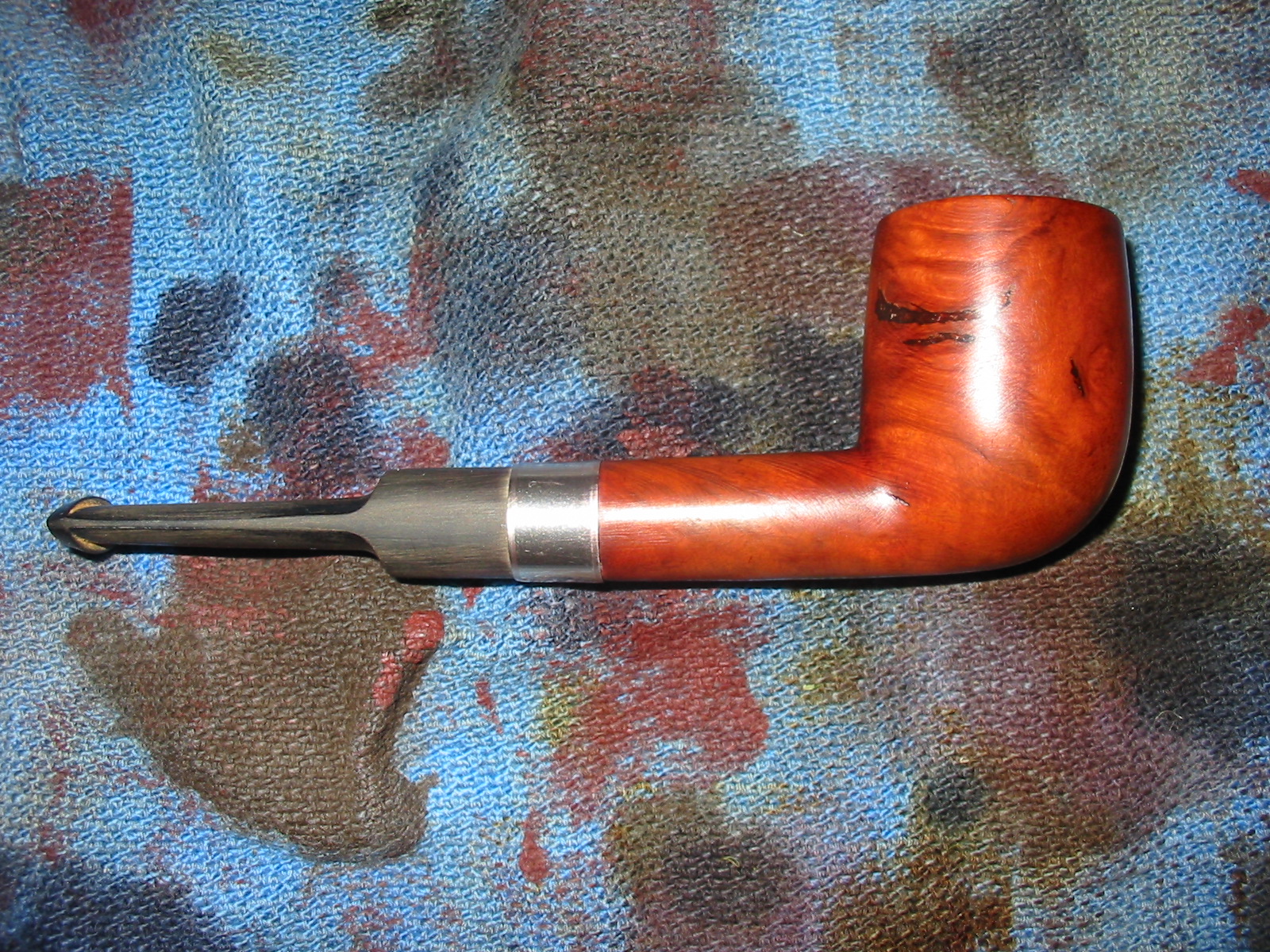
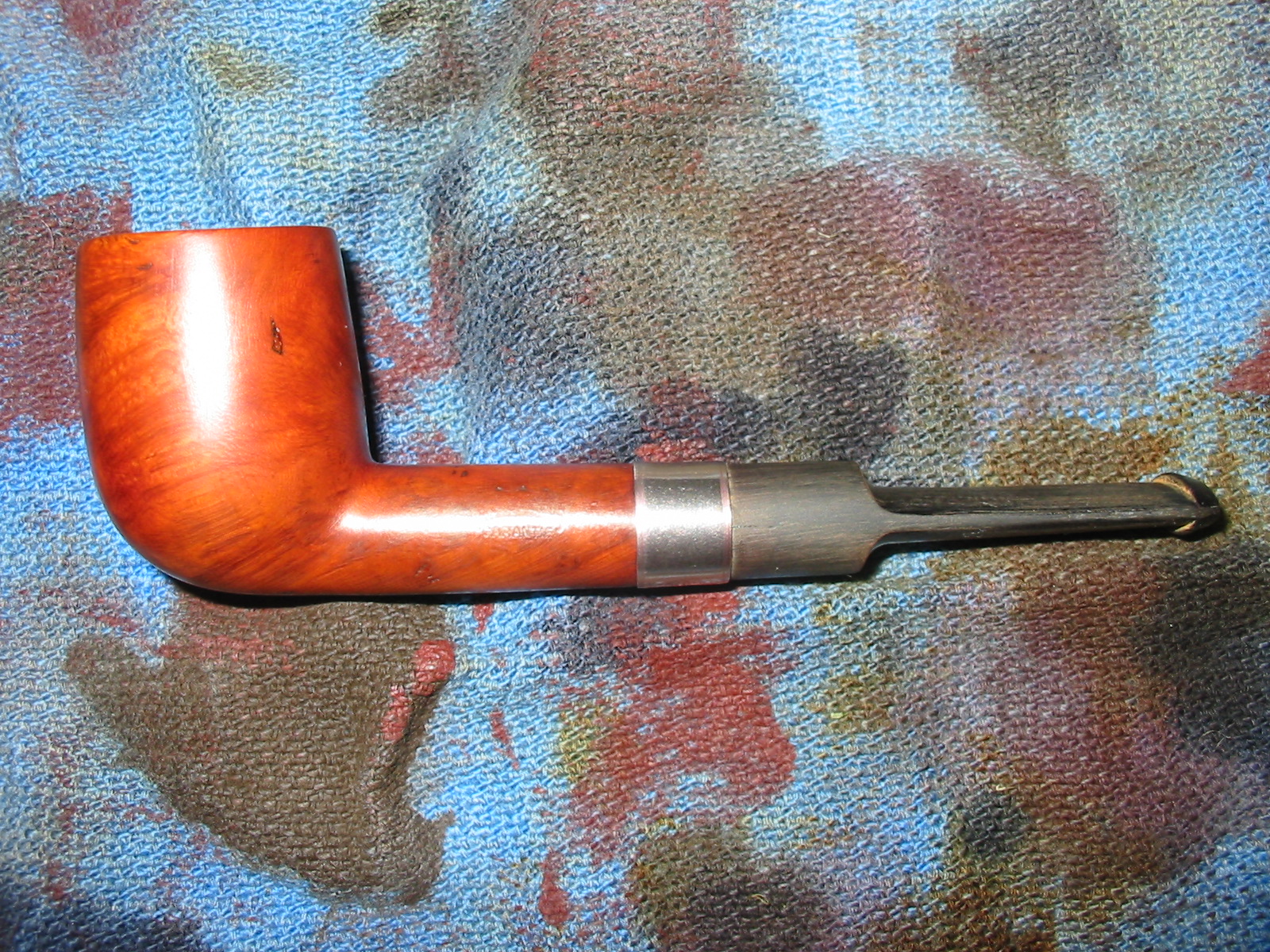
I rubbed the stem down with Obsidian Oil and let it soak in. I looked over the bowl again and decided to give it a top coat of a walnut brown stain. I felt that it might add some darker highlights to the repaired areas and make them less noticeable. I applied the stain, flamed it, restain and reflamed it and then buffed the bowl and the stem with White Diamond on the buffing wheel. I gave the whole pipe multiple coats of carnauba wax and then a final buff with a soft flannel buff to add a polish. The next four photos show the finished pipe. While the flaws/cuts are still visible they are no longer deep gashes in the wood. Rather they give a sense of character to the pipe and overall it is ready to go and last a long time delivering a quality smoke.
IMG_5727

IMG_5728

IMG_5729

IMG_5730
I took the final photo to give a close up view of the repaired gashes on the bowl. Though visible they are now smooth to the touch and solid and unmovable.
IMG_5731

Learning something new while repurposing this damaged pipe bowl – adding a shank extension.


Blog by Steve Laug

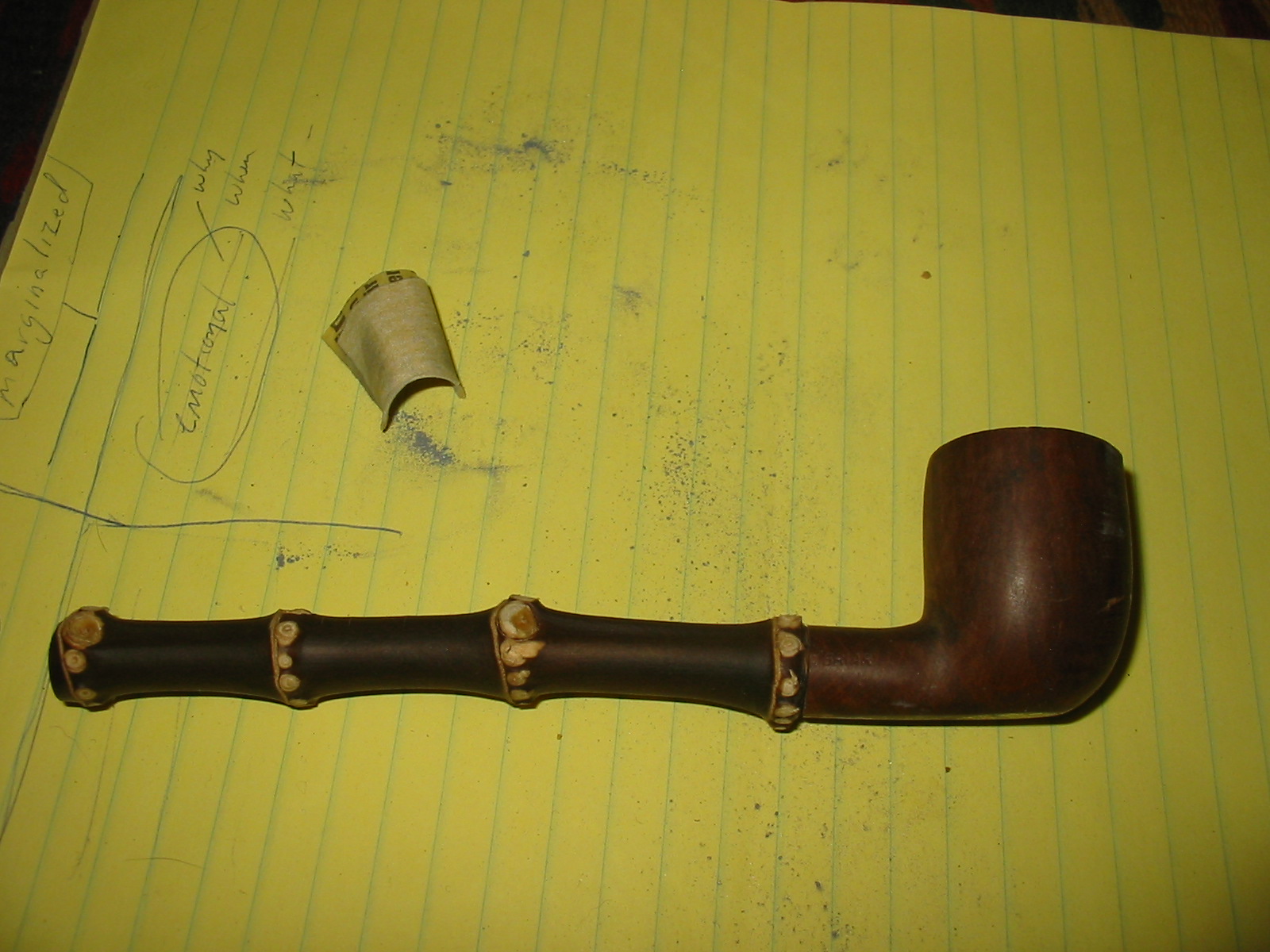
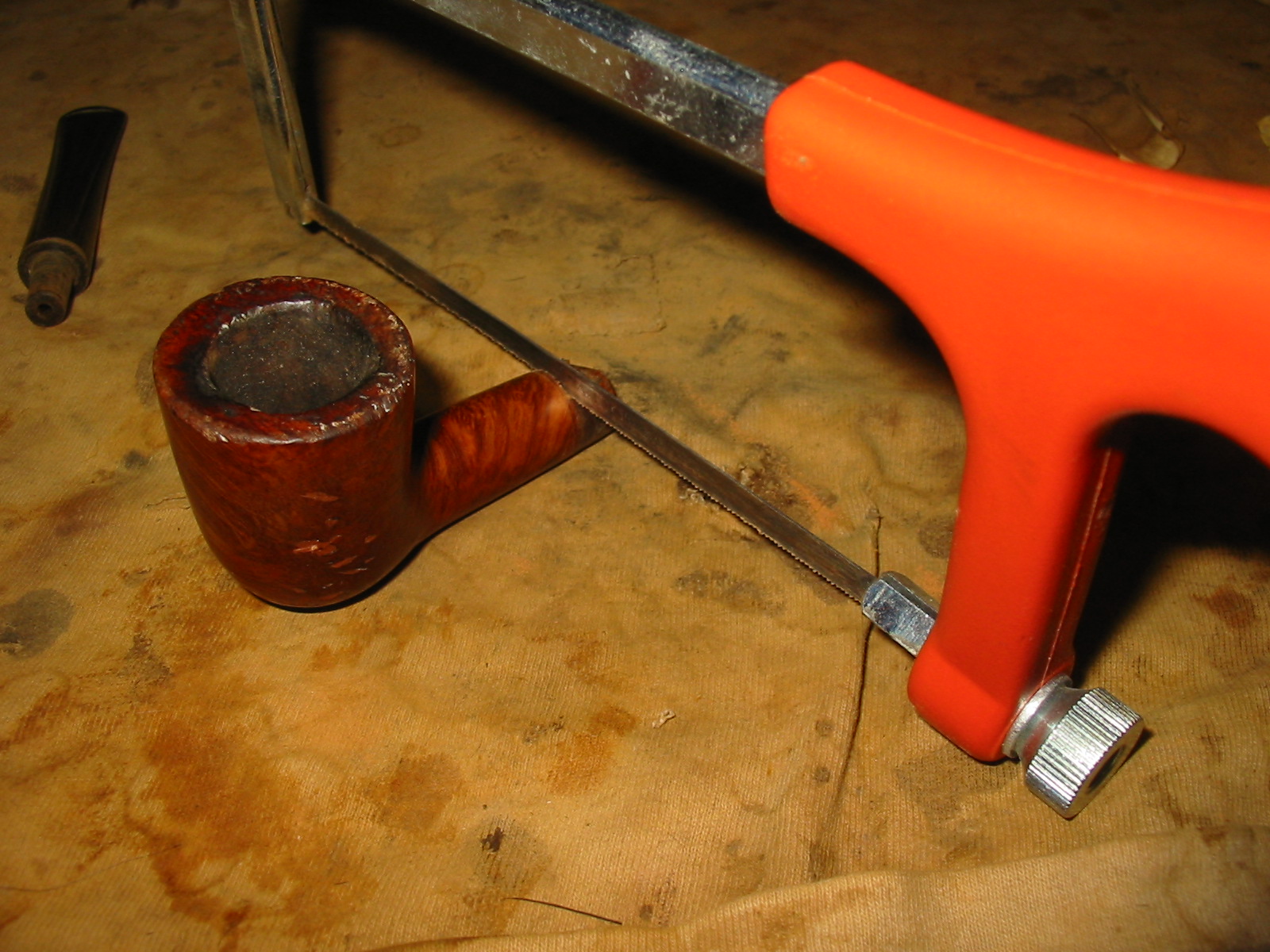
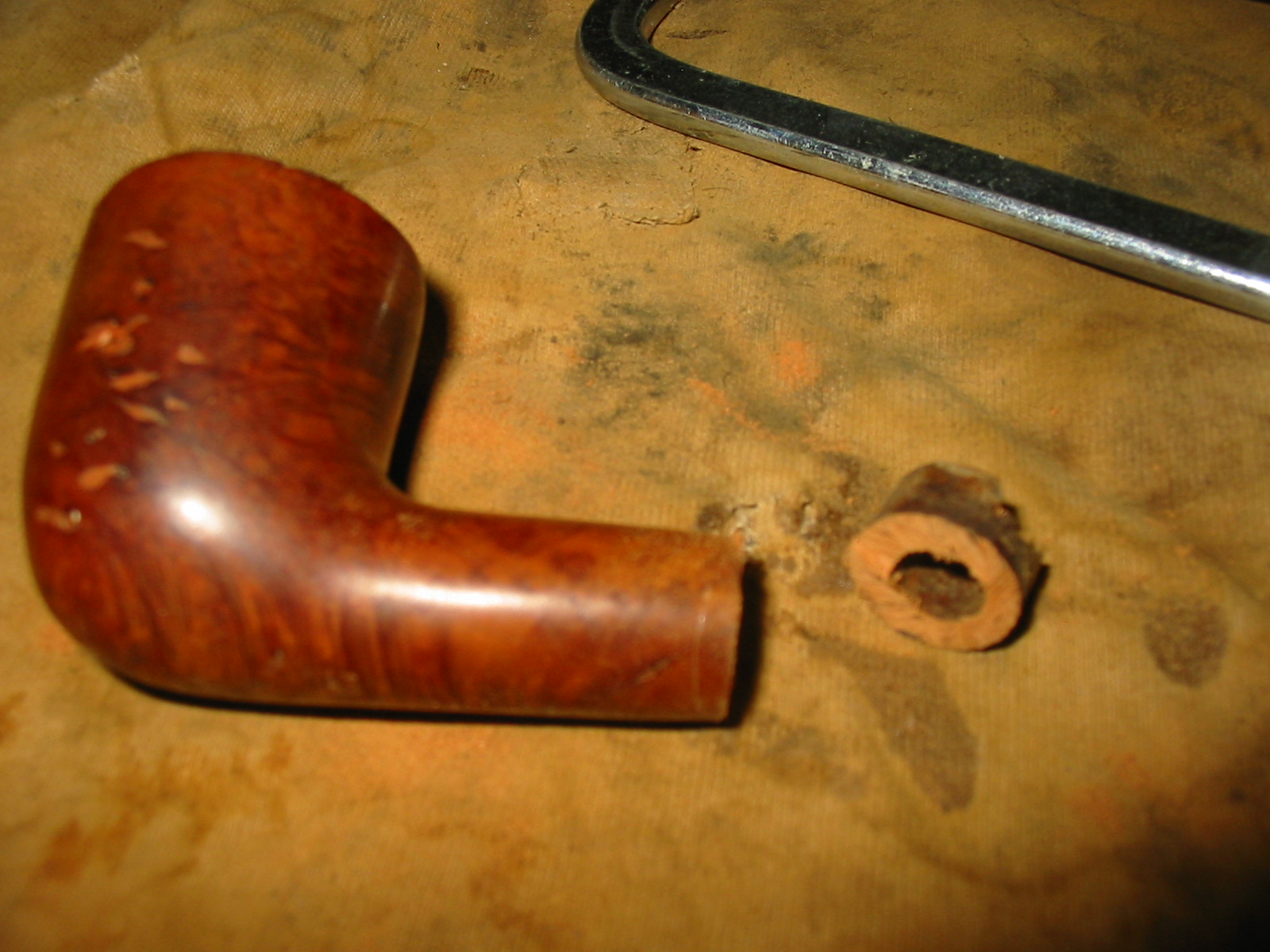
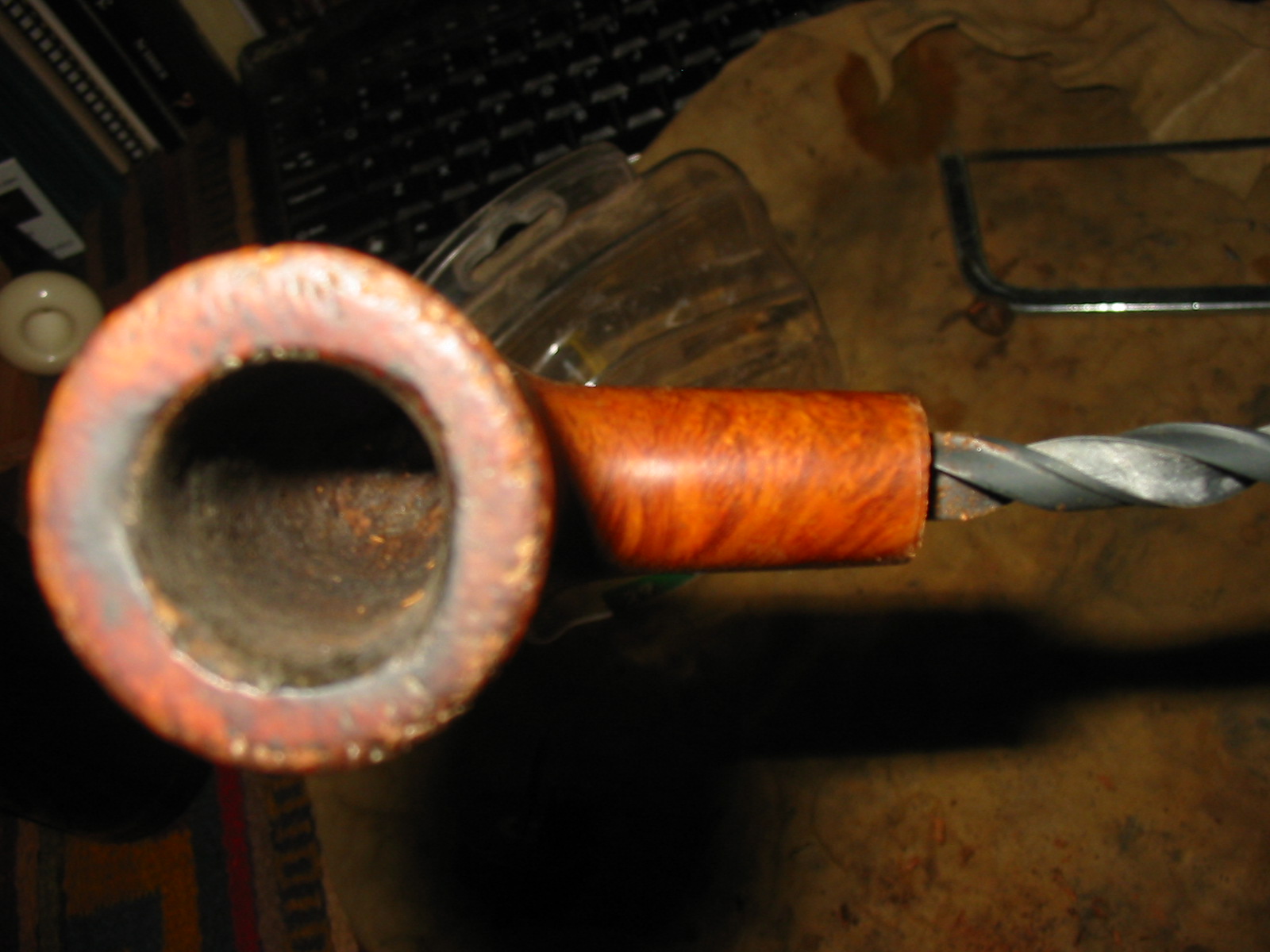
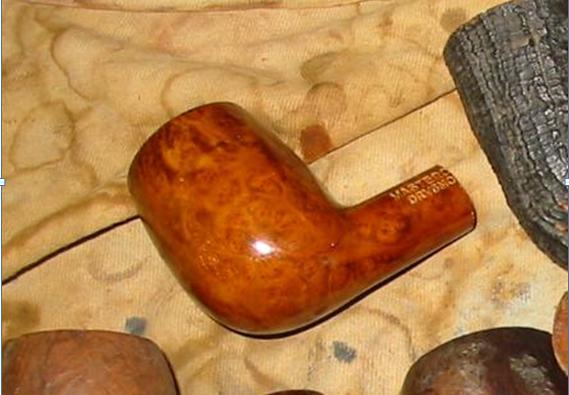
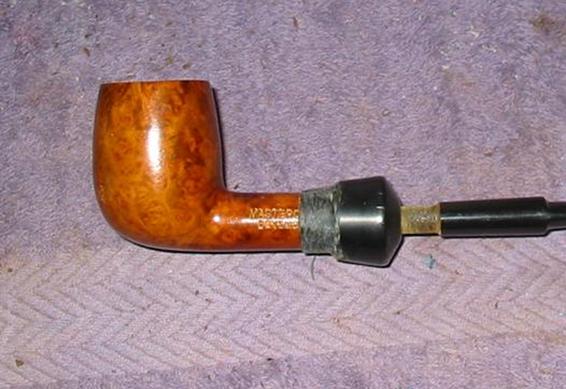
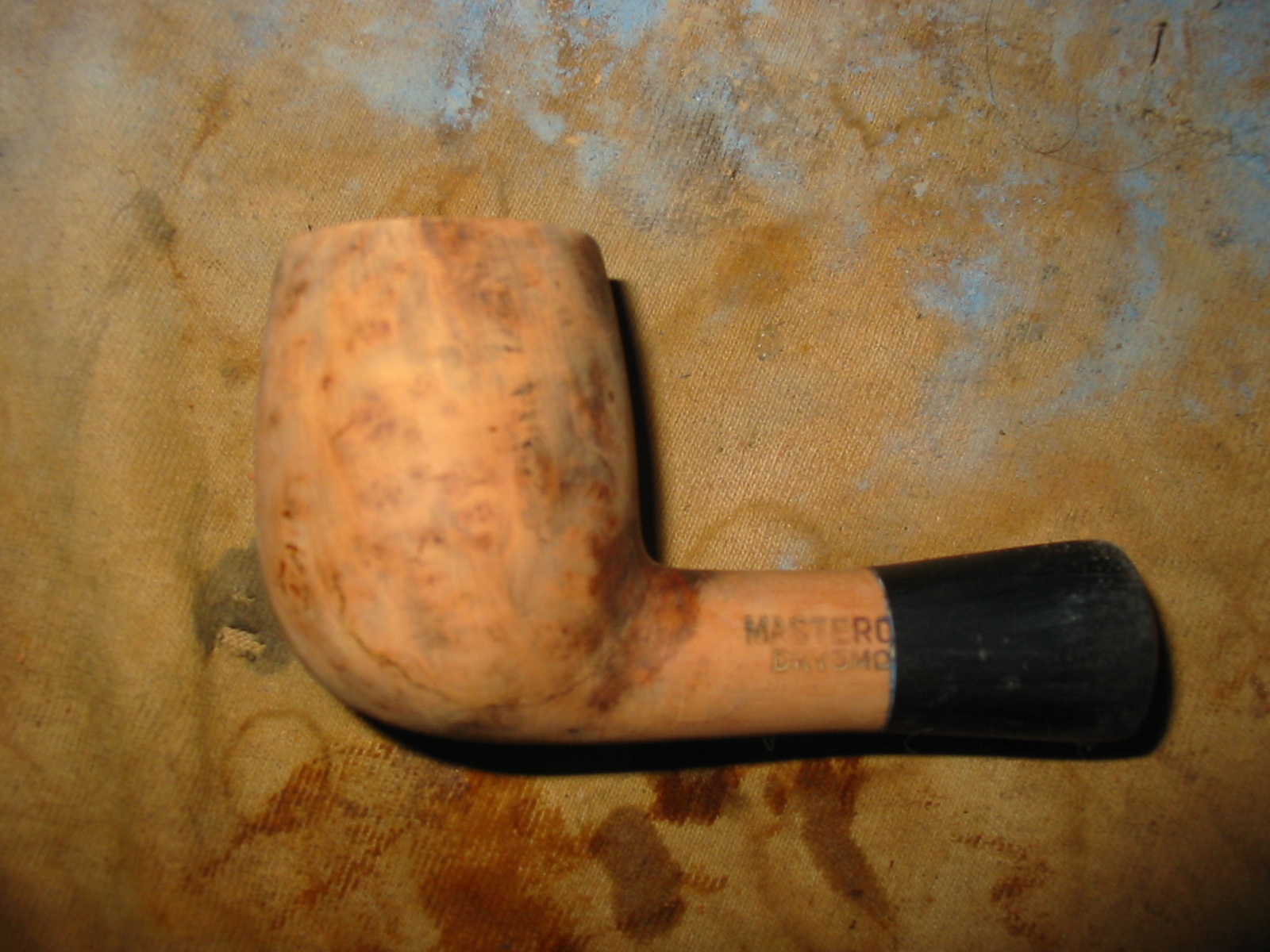
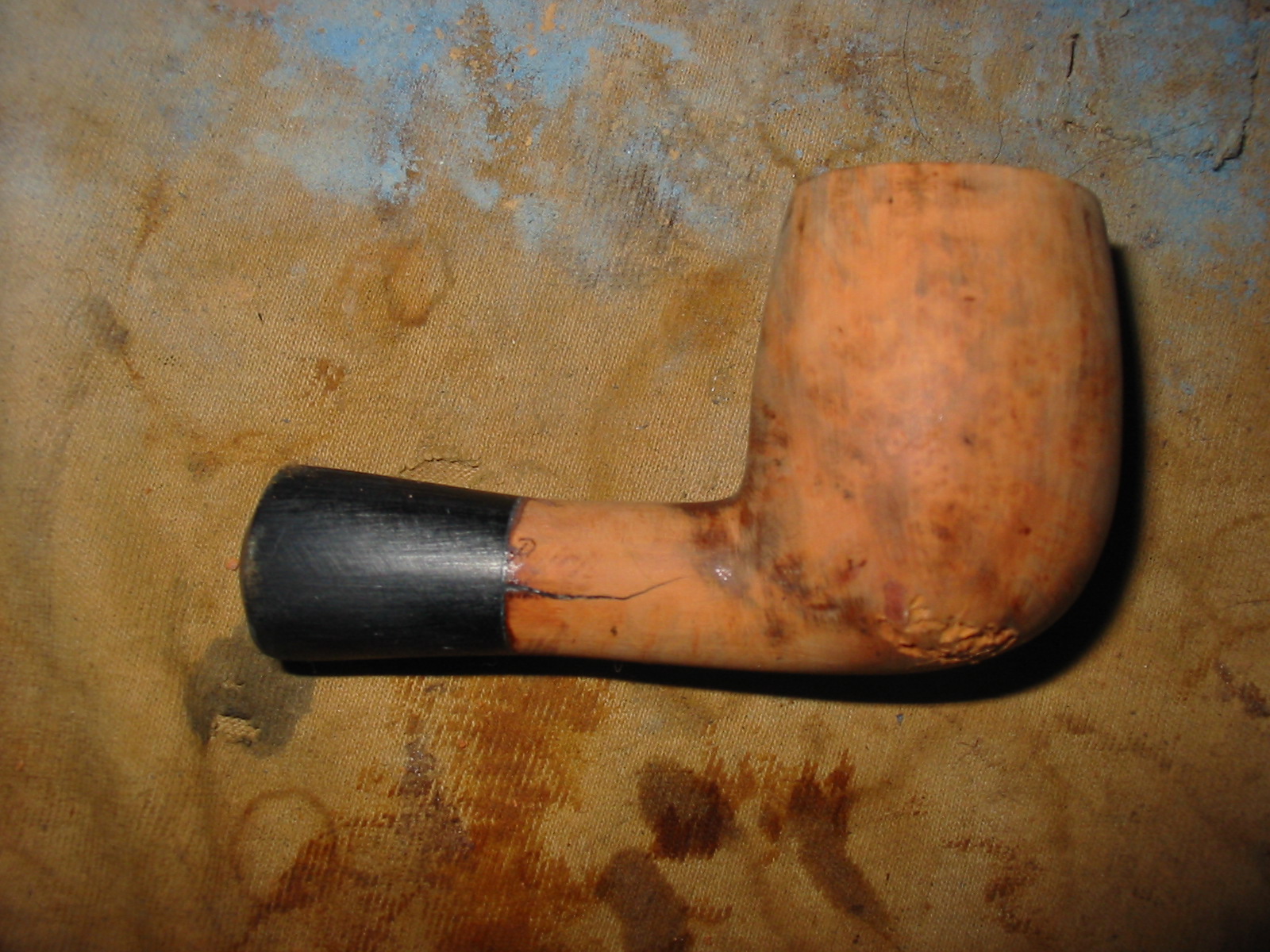
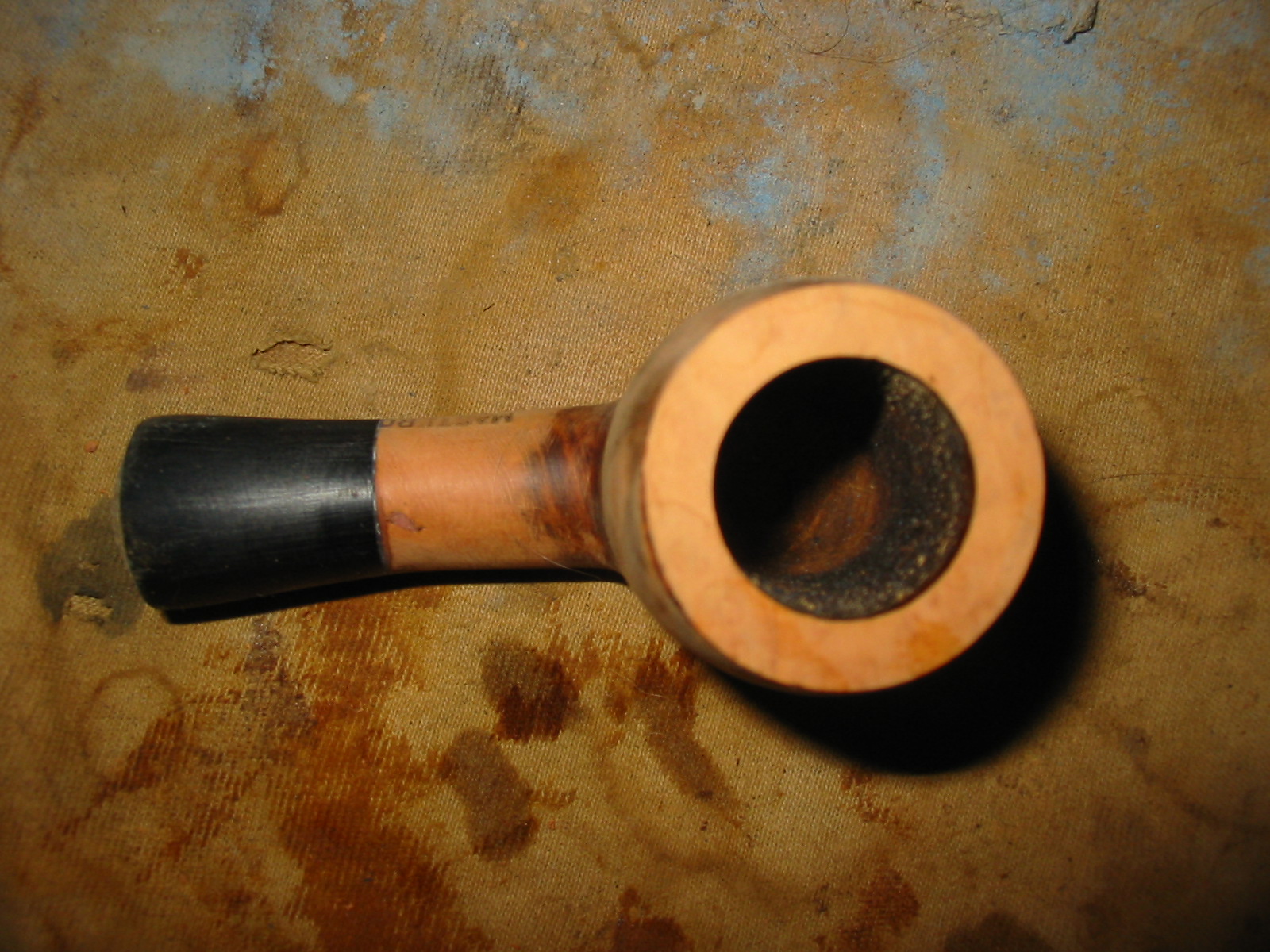
One of the pipe bowls I was recently gifted was an unsmoked Mastercraft Drysmoke bowl that had the shank cut back to half of its original length. The cutback was done poorly – crooked cut with a dull saw. It had cut right through the stamping on both sides of the shank and was crooked.
Dry smoke
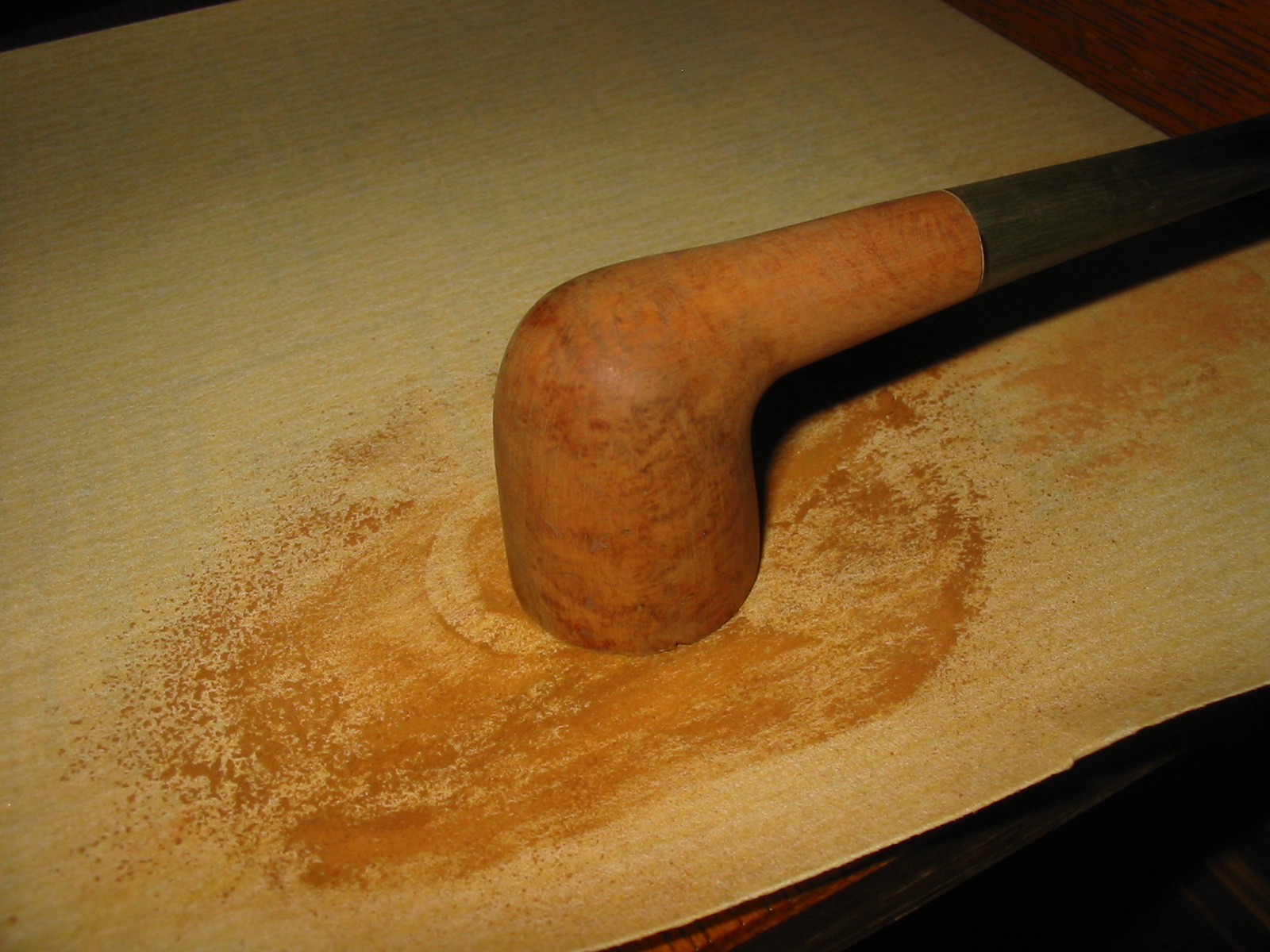
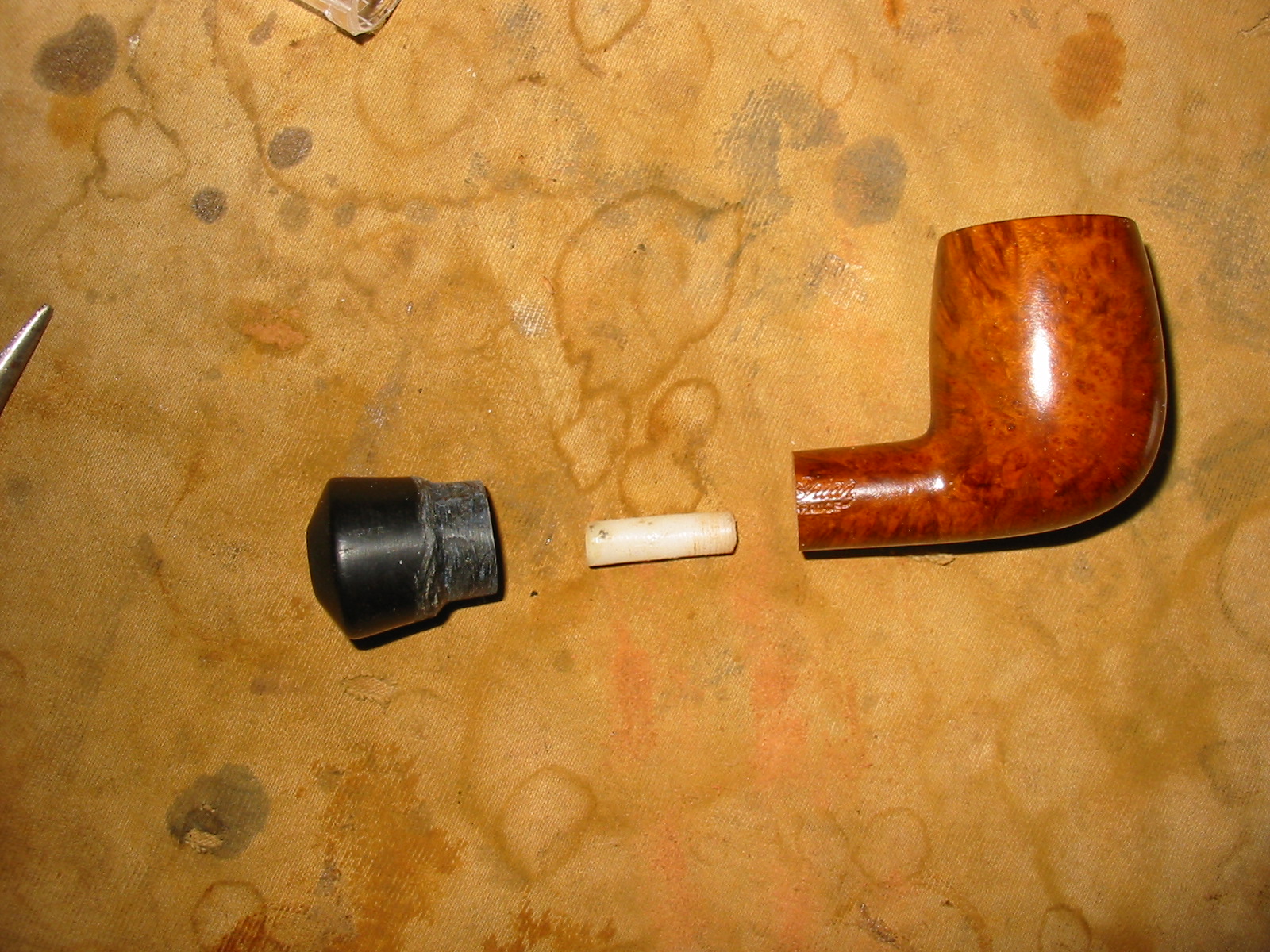
The bowl had a very heavy coat of urethane on it as well. There was some nice grain on part of the bowl but the bottom had some hack marks where it looked like the saw had jumped. I took some time to look it over and try to figure out what I was going to do with it. I was not sure and looked at the end of the cut off. I knew I would have to face the end of the shank to even things up no matter what I did with it. I could easily have just drilled the mortise large and cut a new stem for it. It would have ended up a short shank billiard and that would have been fine. However in the midst of the review I decided that it was time to learn something new. I have always wanted to learn how to do shank extensions so I figured this was a great candidate for my schooling. I flattened the end of the shank squaring it like I do when topping a bowl. I had an old vulcanite shank extension I scavenged somewhere. I had played around with it and sanded away part of the end that faced on the shank of the pipe before I threw it in my parts box. It was a mess as it was but it might just work. I also had some white Delrin tenon material that would work well. I had already turned it almost to the correct size with my Dremel and sanding drum. Maybe these parts would all come together and help me craft something different. What the heck it was worth a try and I would learn a lot in the process.
IMG_5514
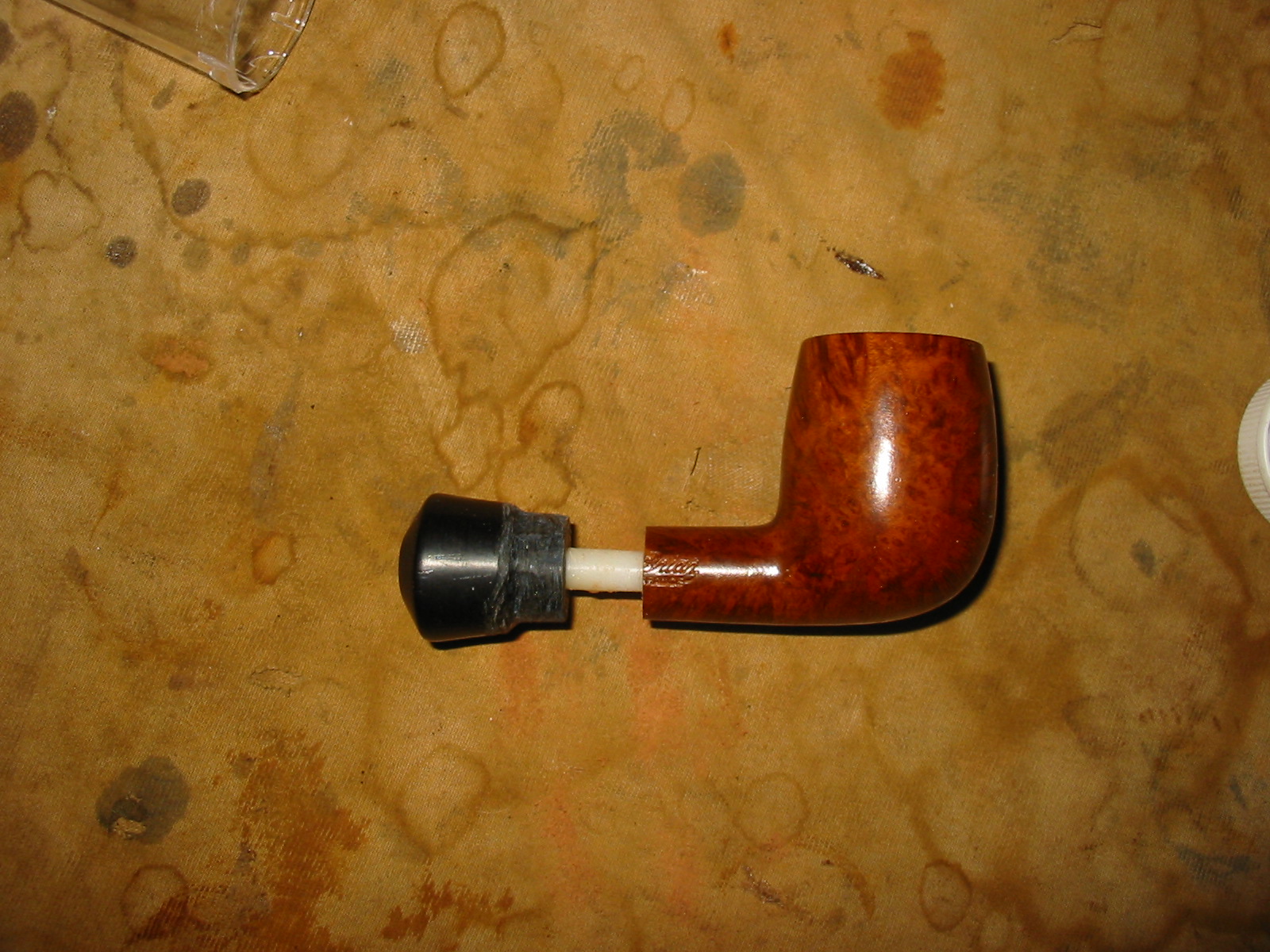
The photo above shows all the parts laid out for the connection. I faced the end of the shank using a sanding board in the same manner I used to top a bowl rim. It took a bit of work and focus to get it flattened out and perfectly horizontal. (Oh to have a lathe to do this kind of thing.) I used the Dremel with the sanding drum to fine tune the diameter of the Delrin so that it would fit well in both the end of the cut of shank and the vulcanite extension. I wanted the two parts to face smoothly against each other. I put it together to make sure I had the fit right
IMG_5515
I put glue on the end of the tenon and pressed it into the shank and then repeated the process and pressed the extension in place. The fit against each other was exactly what I wanted. I ran some superglue in the joint between the two materials and when it dried I would sand it down. I had an old stem that had the right tenon size and inserted it to have a look. I wanted to see what the newly glued shank extension would look like with a stem in place. The joint looked good and a stick bit stem would work well when I got to that point in the process.
glued shank
I removed the excess material of the extension with the Dremel and sanding drum and a lot of hand sanding with 220 grit sandpaper. I wanted to make the extension slightly flared and the transition between the shank and the extension smooth and seamless. I was going for a taper back from the bowl to the end of the shank. I also wiped the bowl down with acetone on cotton pads to remove the urethane finish. It was a tough go so I sanded the bowl and shank. I decided to not worry about sanding the partial stamping that was left on the shank as it was no longer a Mastercraft pipe at this point.
IMG_5518
In the process of adding the Delrin I noticed that there was a crack in the shank on the right side of the pipe. It was present before I inserted the tenon, but the insert opened it up. I dripped some super glue in the crack before I put the Delrin insert in place. I knew that the insertion of the tube in the shank from the cut end to the end of the airway would give strength to the repair and also remove the pressure on the shank. I also knew that there would no more stress on the crack once the extension and tube was in place. After sanding the shank and extension I did some cosmetic work on the crack and filled it with superglue and briar dust. Once it was dry I sanded that area of the shank until it was smooth.
IMG_5519

IMG_5520
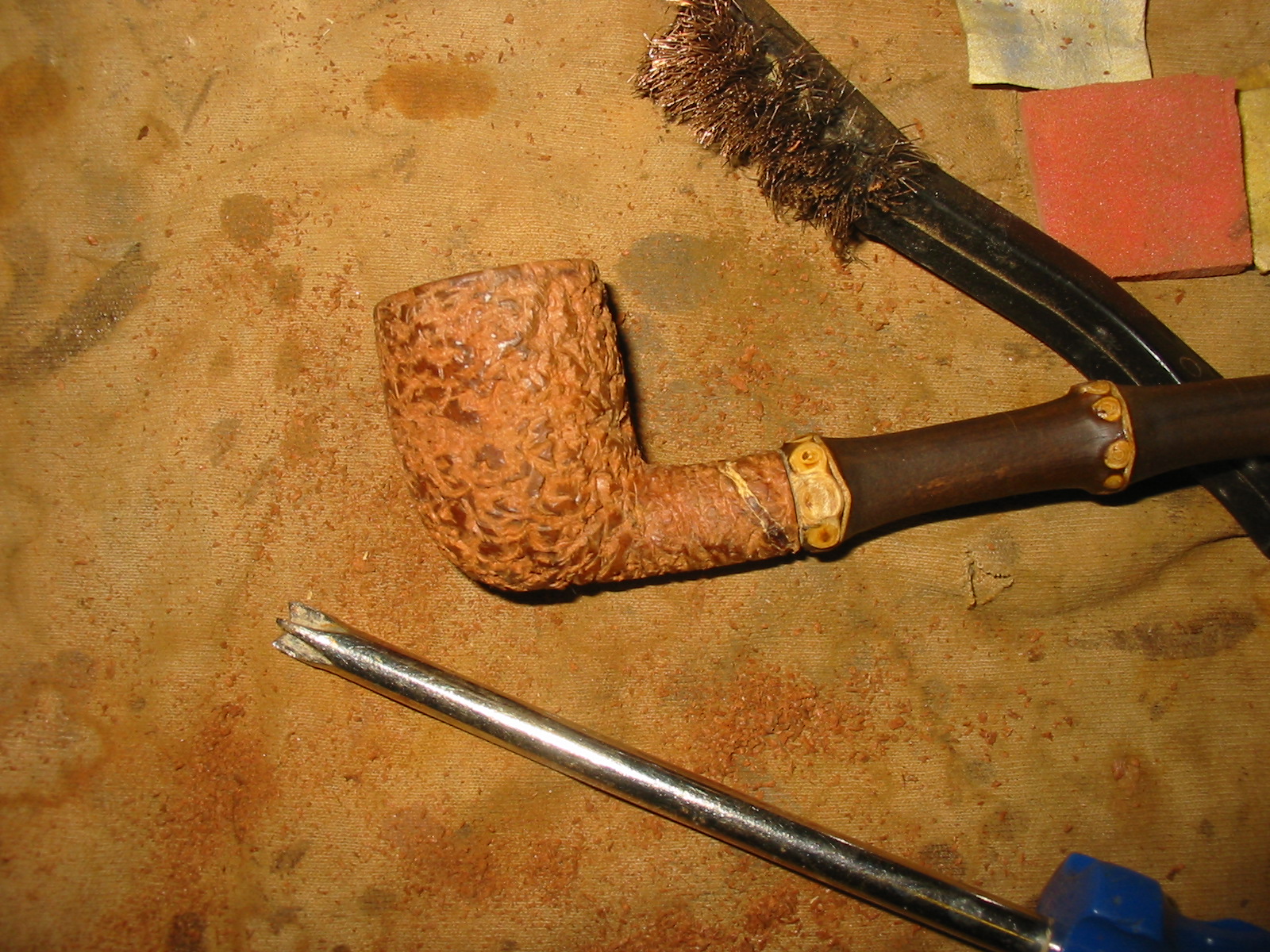
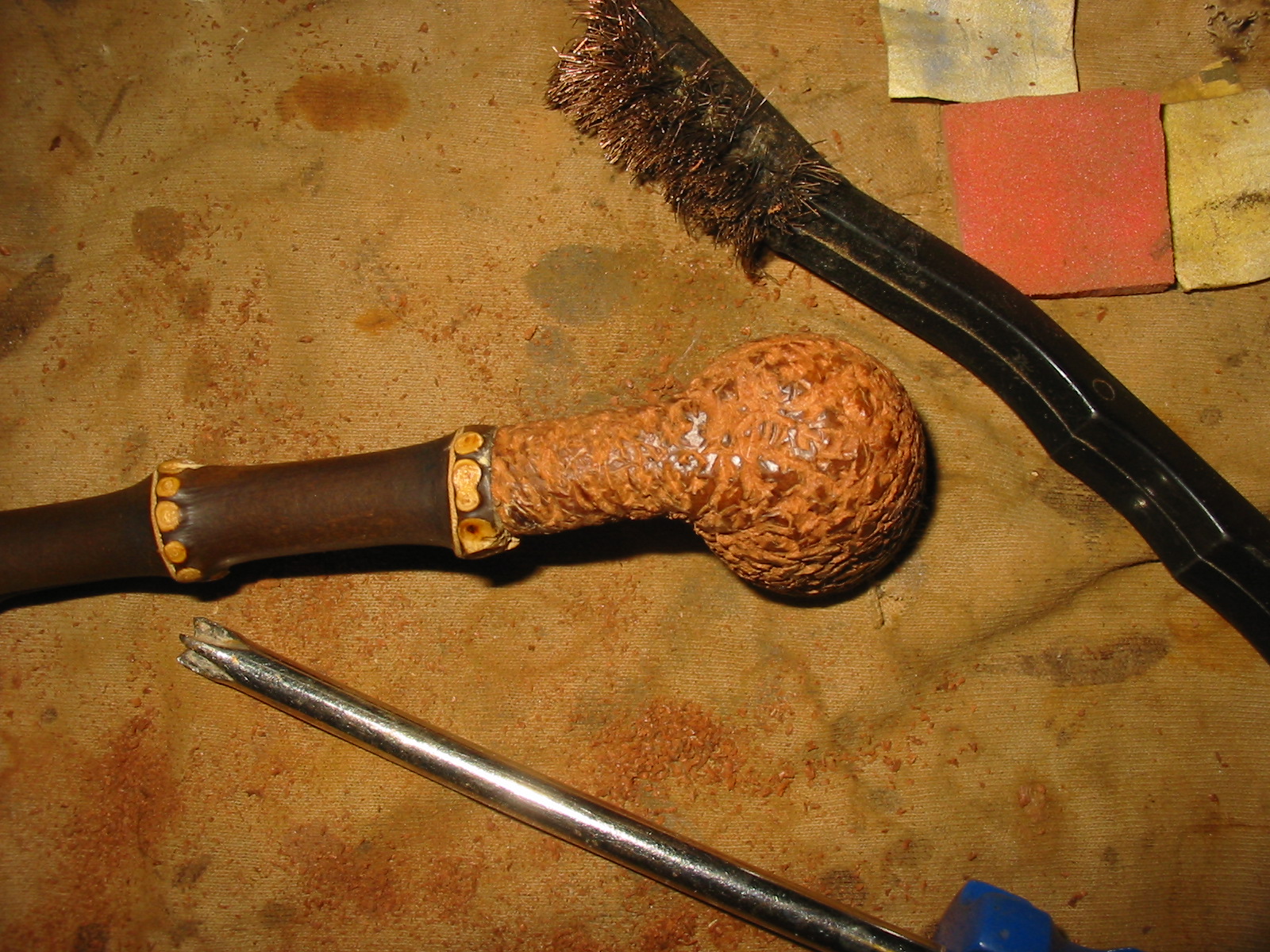
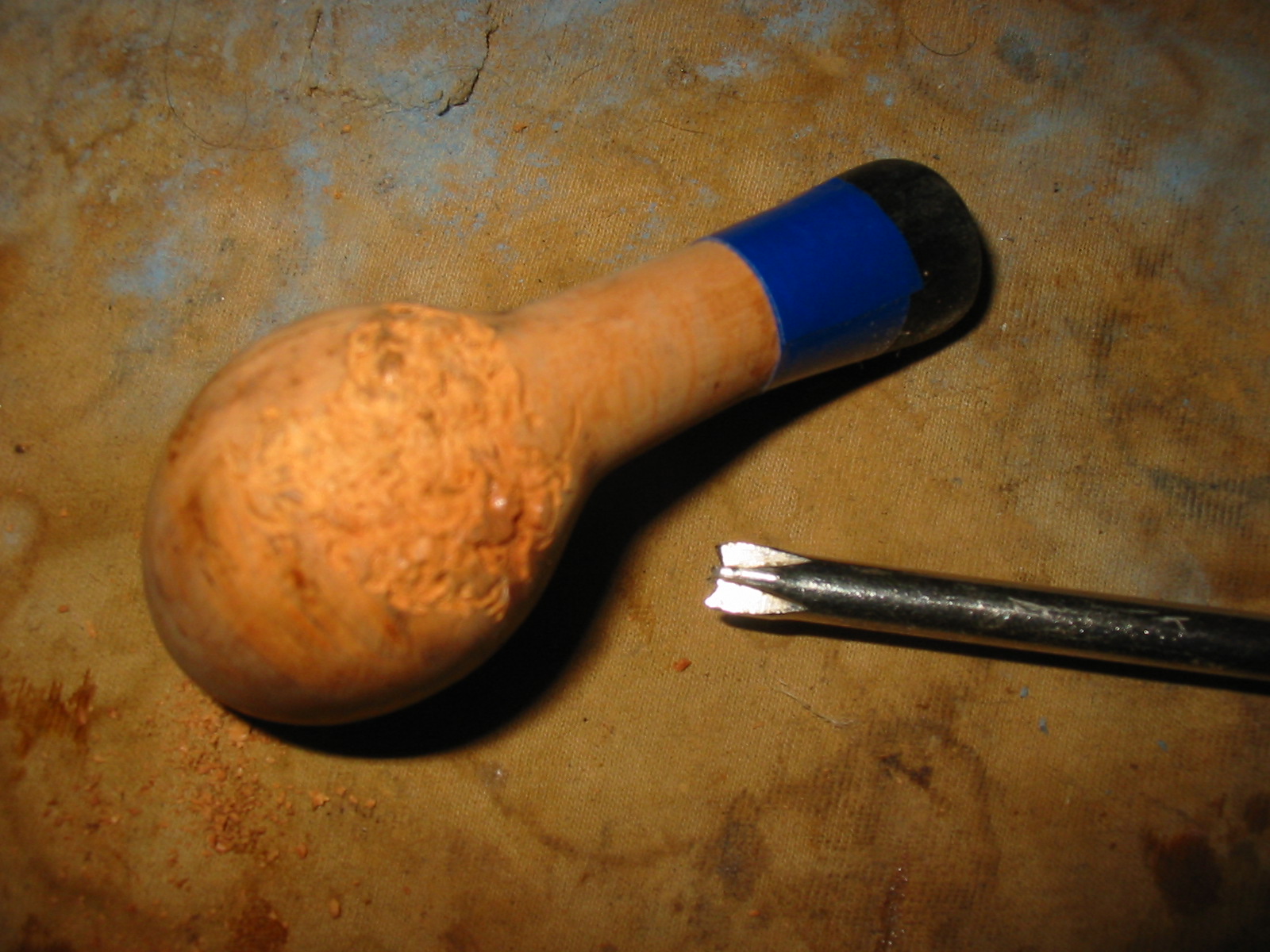
With the crack and repair being very visible and knowing that it would not disappear in the stain I decided to rusticate the shank and the bowl bottom. I did not worry about the visibility of the repair as the entire pipe is a repair job. I have been reading a lot about John Calich and his use of rustication and smooth finishes in the same pipe and the contrast stains to highlight the transition between finishes so I decided to try that out with this bowl. I wanted a thin band of smooth briar around the joint so I taped off the area and did the rustication with my modified Philips screwdriver. I rusticated the shank and the bottom of the bowl. I used a brass bristle tire brush to go over the rustication and knock off the rough areas. I buffed it with red Tripoli to further smooth out the rustication slightly.
IMG_5522
I stained the bowl bottom with black aniline stain and flamed it. I repeated the staining and flaming until I had a good even coverage on the rusticated portion of the bowl. I cleaned up the smooth areas next to the stained rustication with sandpaper to remove the slight bleed from the black stain. I wiped those areas down with acetone on a cotton swab to clean the transition areas.
IMG_5523

IMG_5524

IMG_5525

IMG_5526
I found the stem I wanted to use in my can of stems. It was a slender military bit with a slight taper. I liked the look of the stem. I put it in place for the next photos. It is not stuck deeply enough into the mortise because of the taper to the end of the stem. It will need to be turned down slightly to get a good snug fit deep in the mortise.
IMG_5527

IMG_5528

IMG_5529

IMG_5531
Before going to bed last evening I rubbed down the bowl and stem with Olive oil. I wanted it to penetrate the vulcanite extension, stem and the bowl (smooth and rusticated portions) to give a bit more life to the rubber and the briar. This morning when I got up I worked on the end of the stem to get a deeper fit into the mortise. I used the PIMO tenon turning tool adjusted as small as possible and turned the first inch of the stem to get a tenon. I sanded it with 220 grit sandpaper to bring it down to the diameter of the inside of the mortise. The next two photos show the stem sanded enough to go half way into the mortise. It would take a lot more sanding before it sat against the end of the mortise.
IMG_5532

IMG_5533
Ah progress! Got the stem fit right – it is snug and deep in the mortise now. I sanded the tenon until it fit well. I also sanded the transition from the end of the tenon to the taper on the rest of the stem. I wanted the fit against the shank extension to be snug without the edges of the tenon showing when the stem was in place. This pipe has turned out to be a great lesson for me in the school of pipe repair up to this point. I am looking forward to “graduating” from this project at this point.
IMG_5534
I sanded the bowl, the smooth band at the union of the extension and the briar and the vulcanite of the stem and extension with micromesh sanding pads. I wet sanded with 1500-2400 grit pads to remove any scratches in the briar and the shank extension from sanding with the fine grit sanding sponges. The photos below show the bowl and stem after I had sanded them with the early grits of micromesh. I wiped down the bowl and the stem with a cotton cloth and then rubbed Obsidian Oil into the vulcanite extension and stem.
IMG_5535

IMG_5536

IMG_5537
I stained the smooth parts of the bowl and shank with a cherry stain using a cotton swab and wiped it off with a soft cloth. I hand buffed the bowl and shank with a shoe brush to give it a quick polish.
IMG_5539

IMG_5540

IMG_5541

IMG_5542
Once that was finished I continued to sand the stem with the micromesh sanding pads. I had already wet sanded the extension and the stem with the earlier grits of pad so now it was time to dry sand them with the remaining pads – 3200-12,000 grit.
IMG_5543

IMG_5544

IMG_5545

IMG_5546
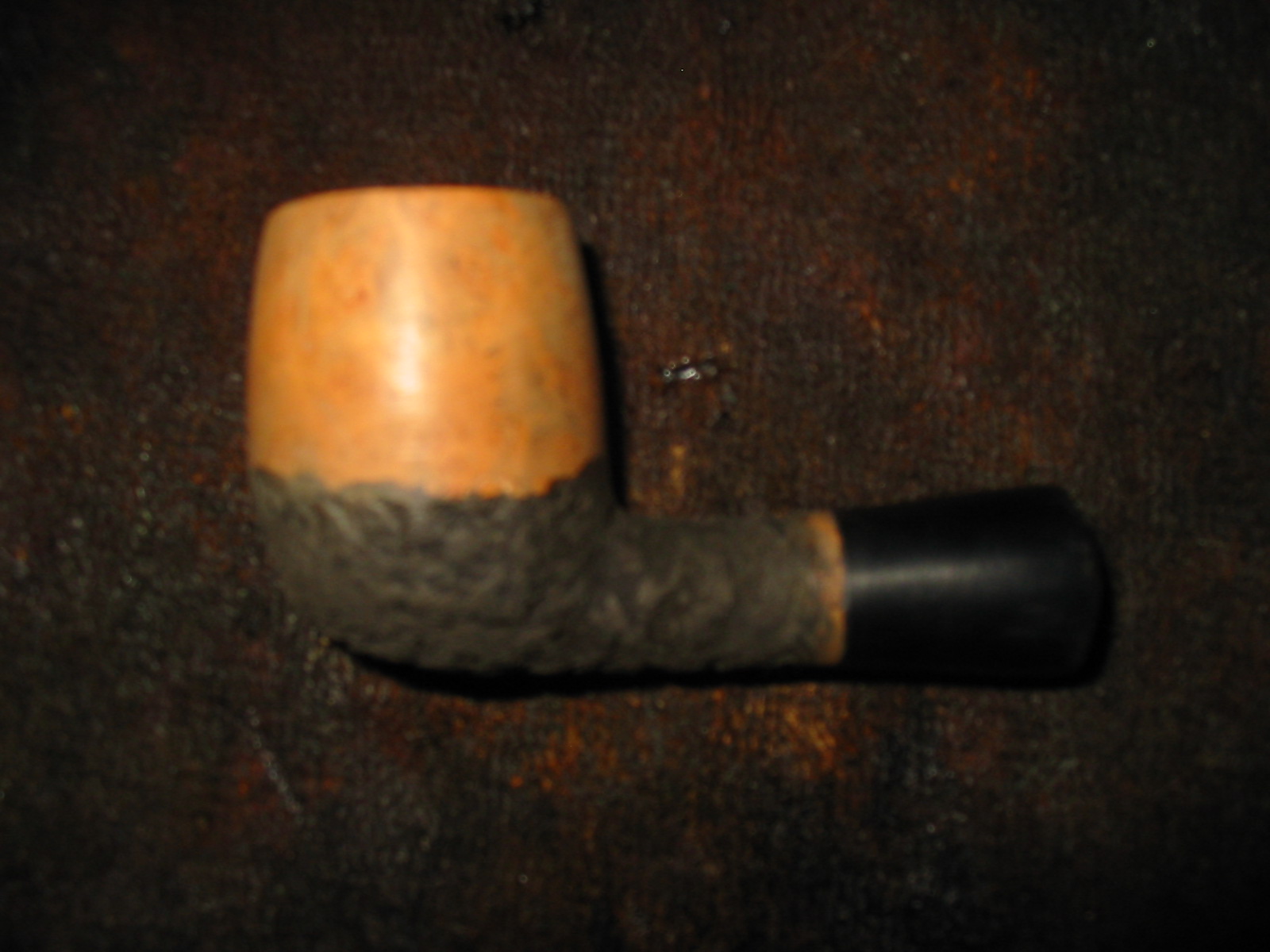
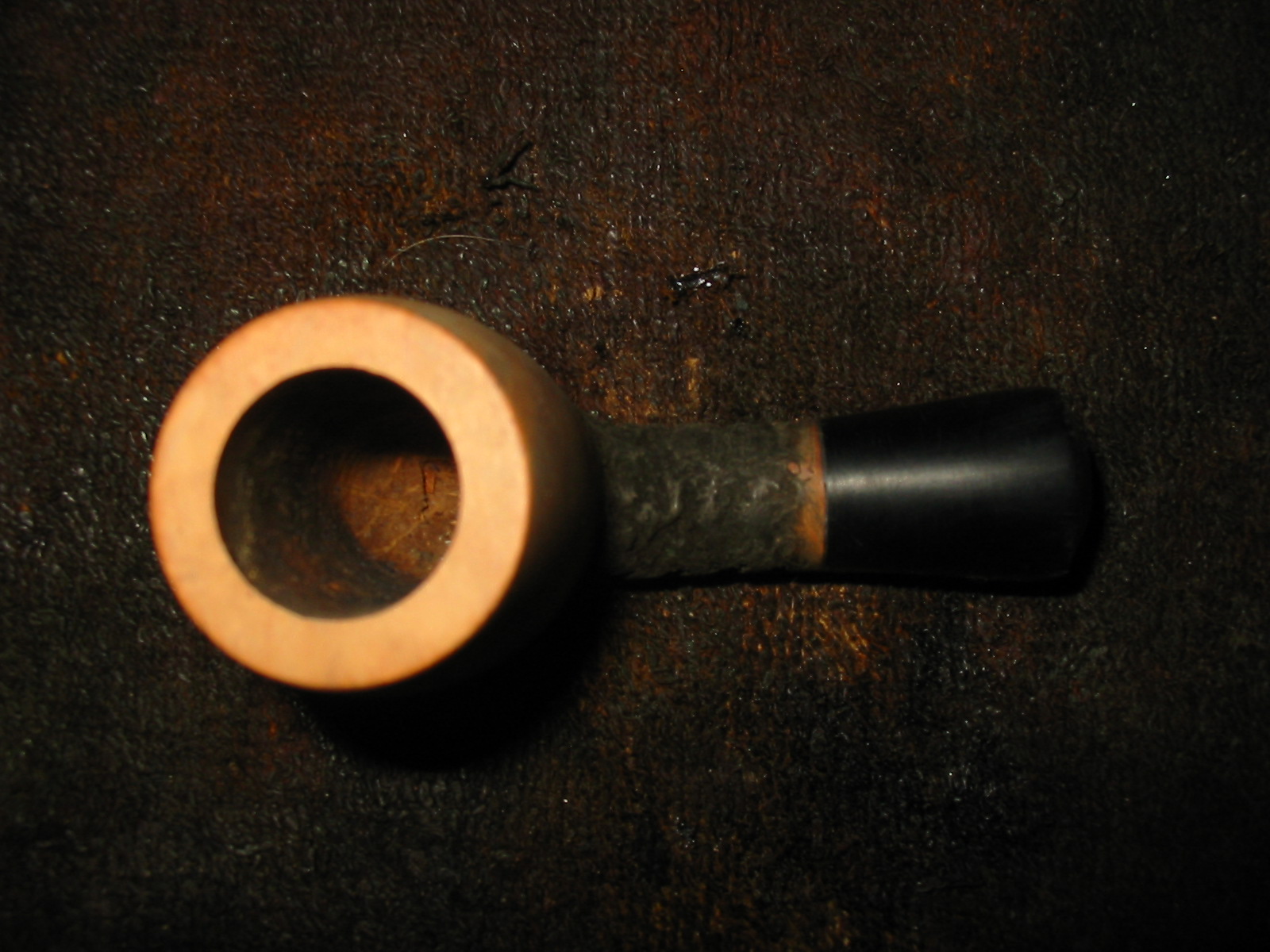
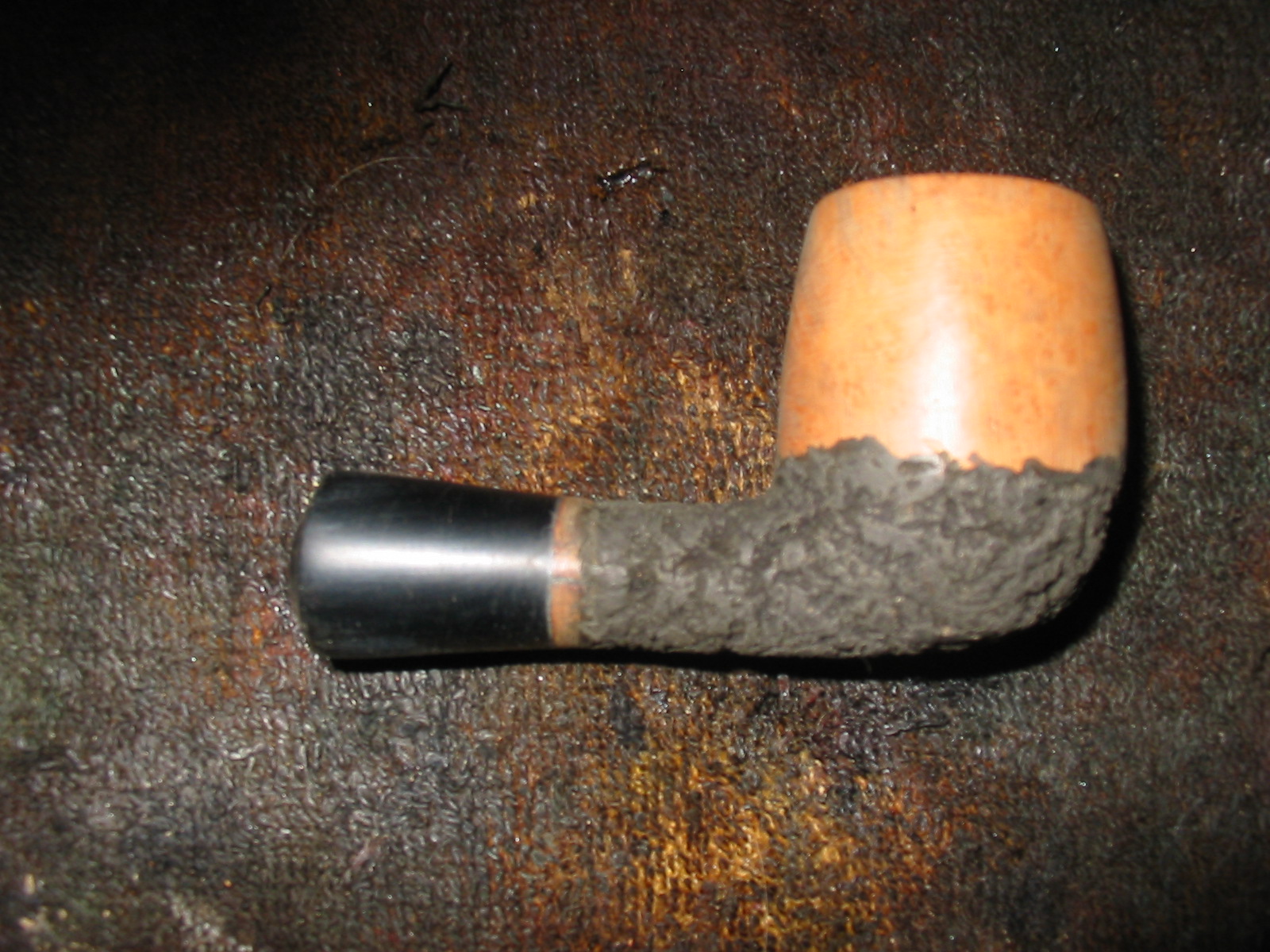
When I finished sanding with the micromesh sanding pads I rubbed the vulcanite extension and stem down with Obsidian Oil and when it was dry gave the stem, extension and smooth portions of the pipe a buff with White Diamond. I gave the smooth areas of the pipe and the vulcanite multiple coats of carnauba wax. I buffed with a soft flannel buff to give it a shine. The finished pipe is shown in the photos below. It has come a long way from the cut off bowl that I started with in the beginning of this restoration. I think rather than restoring this one I have actually repurposed a bowl – a phoenix rising from the ashes. Now I have another new pipe to fire up and try out later today.
IMG_5547

IMG_5548

IMG_5549

IMG_5550

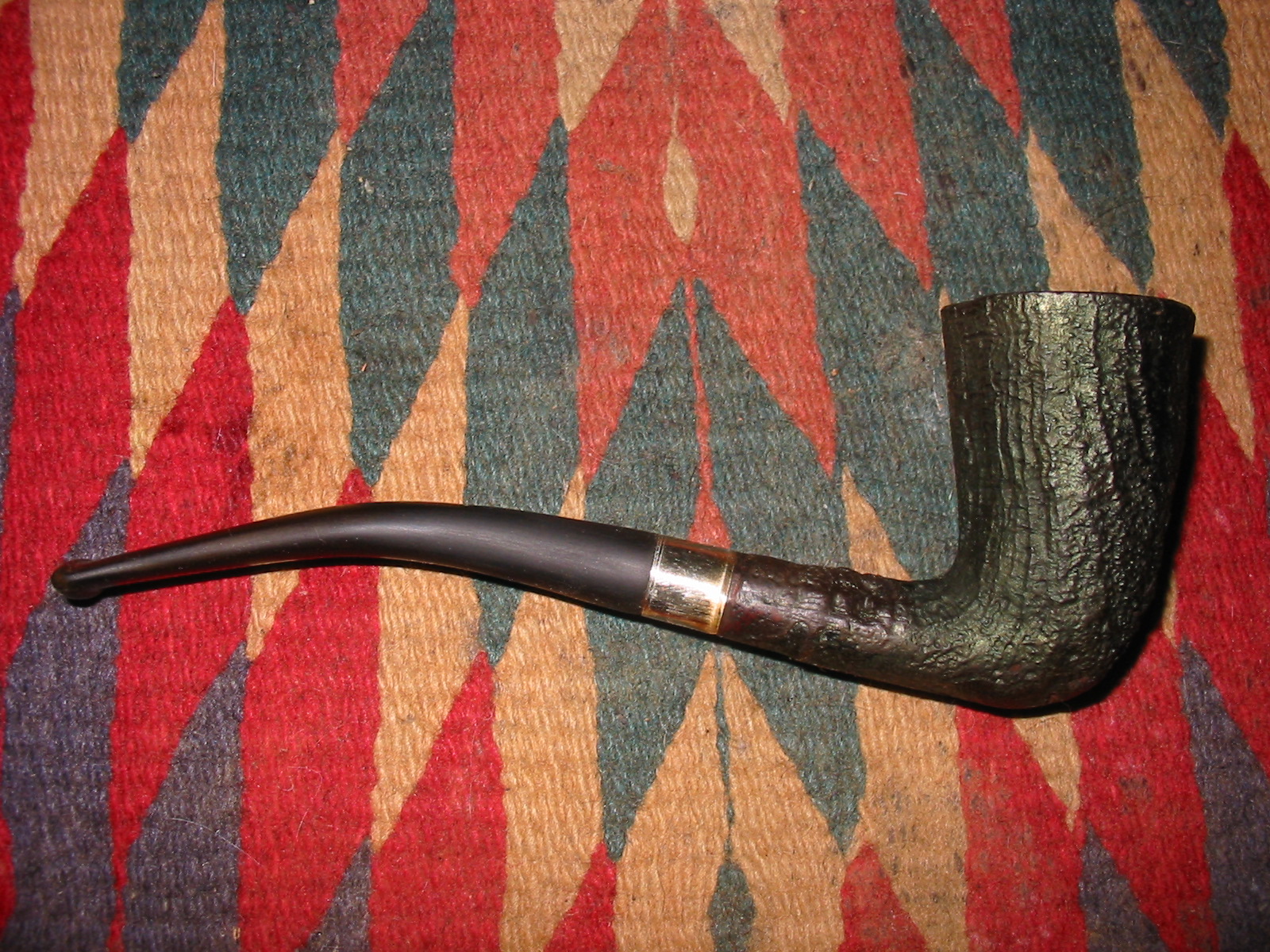
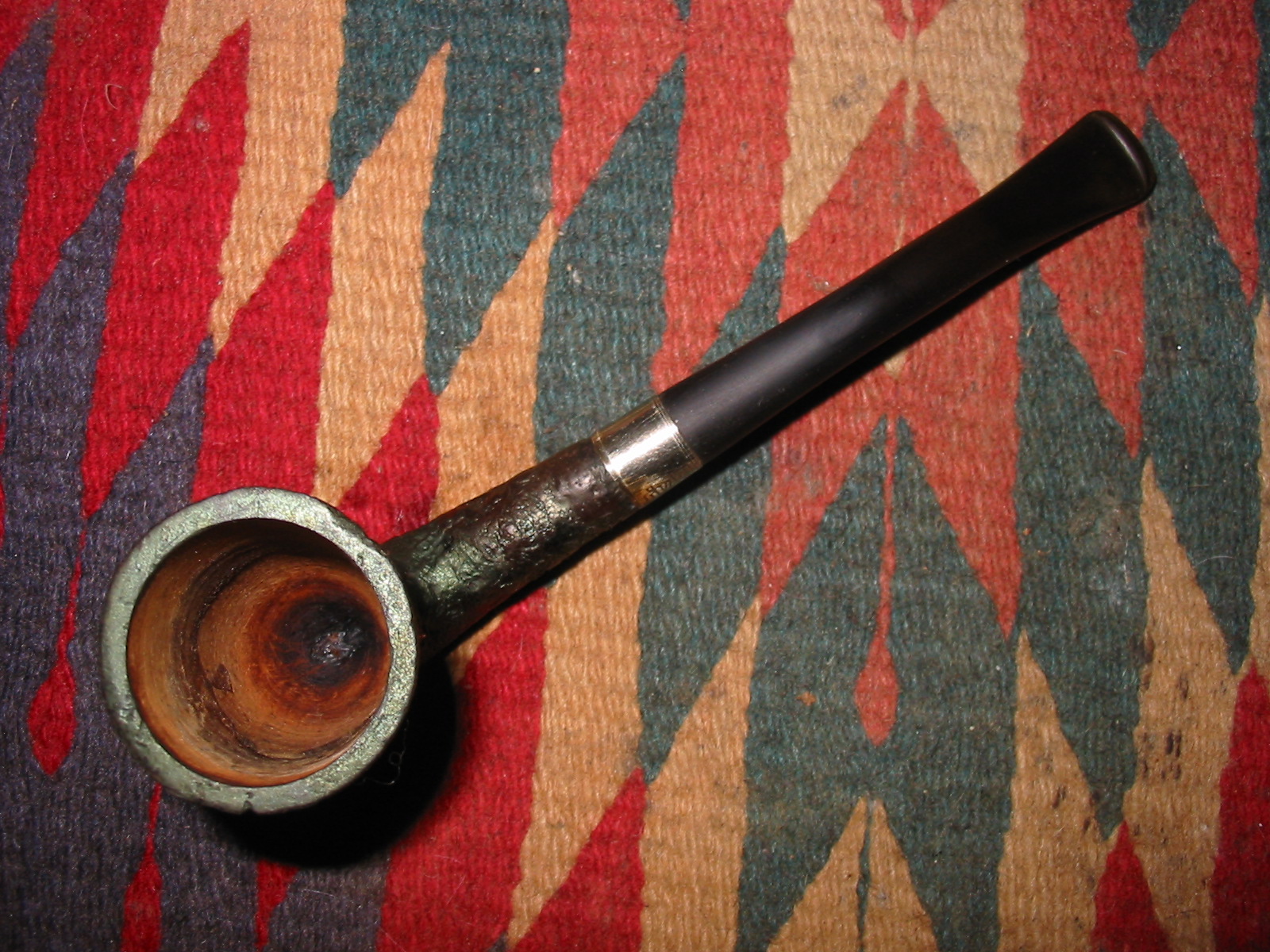
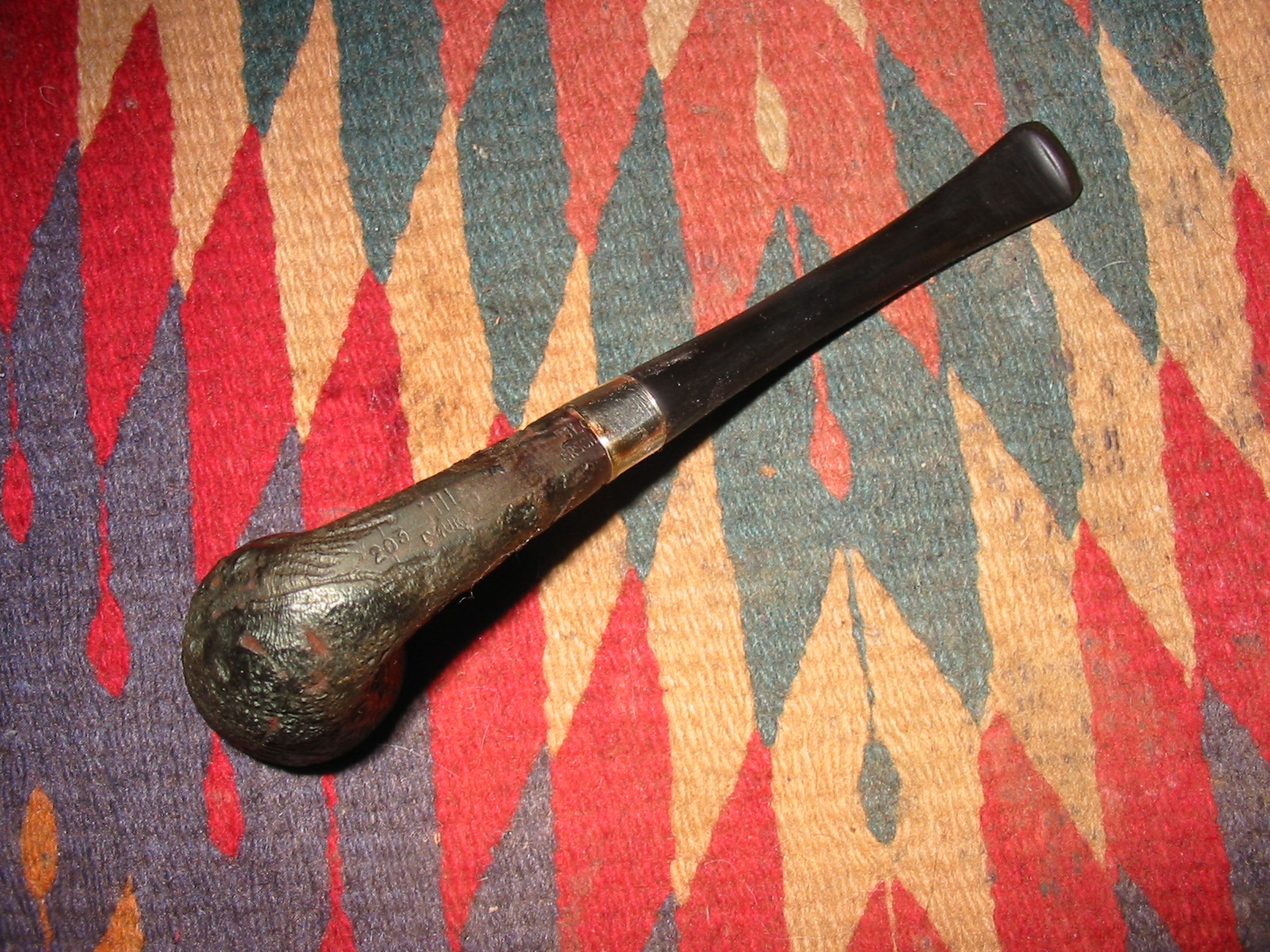
A Hilson Meerlined Tall Dublin Reborn into a Briar Calabash


Blog by Steve Laug

I received this old briar bowl from a friend and decided to see what I could do with it. It was in pretty rough shape. The shank had been damaged and repaired with some kind of epoxy as the gel surface of the crack was hard as rock. The repair was actual the most substantial part of the bowl. The bowl had an amazing deep and craggy blast to it but the finish itself was worn. Fortunately the wear was not deep and the cragginess was not too badly affected. The rim was smooth but the edges were slightly worn. The bottom of the exterior of the bowl showed the most nicks and damage to the finish. There were marks from looked to be a band on the shank. The inside of the bowl was quite clean. Originally it looked as if it had a meerschaum lining and the glue that had held that bowl in place was gone and just a small remnant of the glue was on the interior walls of the bowl. The bottom of the bowl was stained with tobacco so evidently the meerschaum lining must have crack and seepage darkened the bottom of the bowl.
IMG_5393

IMG_5394

IMG_5395

IMG_5396

I cleaned out the inside of the bowl with cotton swabs and isopropyl alcohol. Once I had it clean I worked on the resin on the shank repair. I sanded it until it was flush with the surface of the rest of the shank so that it did not bulge. I continually checked to see if I was weakening the repair but the shank was solid. I used the dental pick and my modified Philips screwdriver rusticator to rusticate the area around the resin repair. I also found a band in my box that fit the shank perfectly and pressed it into place. The band was more for bling than as the shank was not cracked or damaged. I also went through my stem can and found a stem that fit the diameter of the shank, turned it with the PIMO tenon turning tool and fit is in place. It would need to be reduced slightly in diameter to fit well with the band. I wiped down the bowl and shank with isopropyl alcohol on a cotton pad. I did not want to chance acetone as I was worried about it dissolving the resin on the shank repair. As I did not know what was used in the repair I did not want to chance further damage.
IMG_5397

I stained the bowl with a dark brown aniline stain. I applied it, flamed it, applied it again and flamed it again. To get an even coverage on the sandblast finish it would take more than three applications and flamings to make the stain even. The photos below show the bowl after three coats of the stain. It would need to be repeated later in the process to get the rough places stained.
IMG_5398

IMG_5399

IMG_5400

IMG_5401

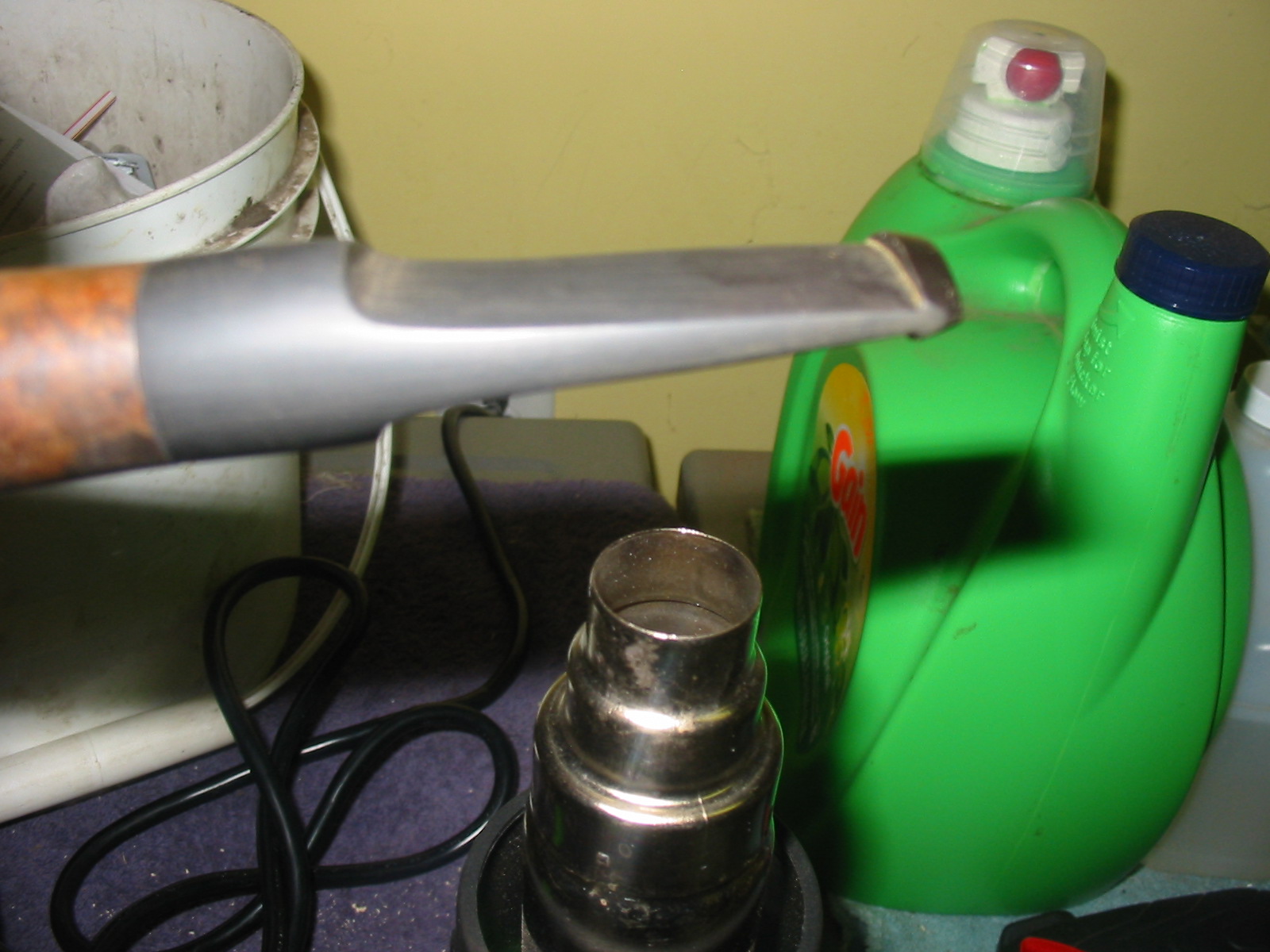
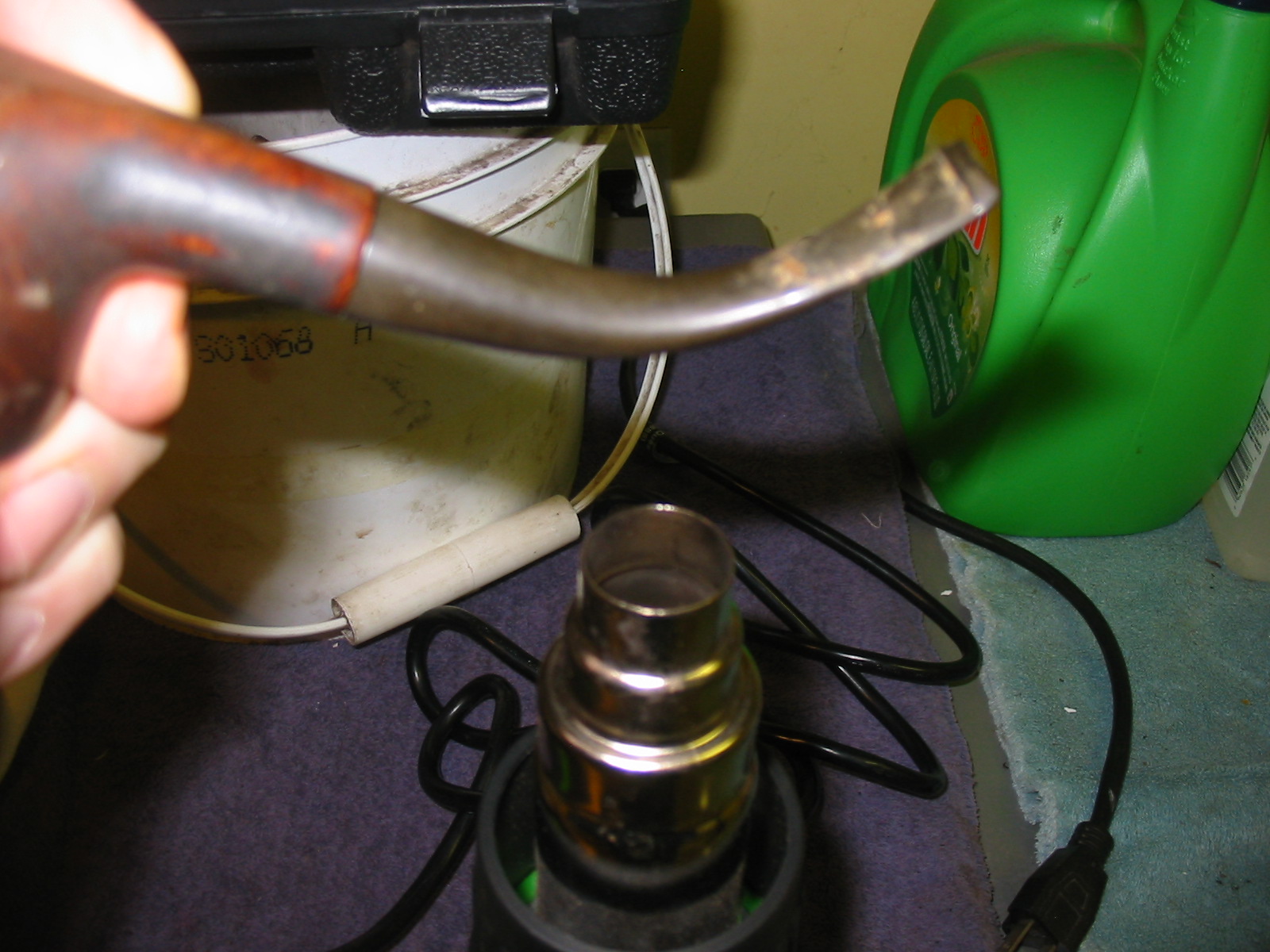
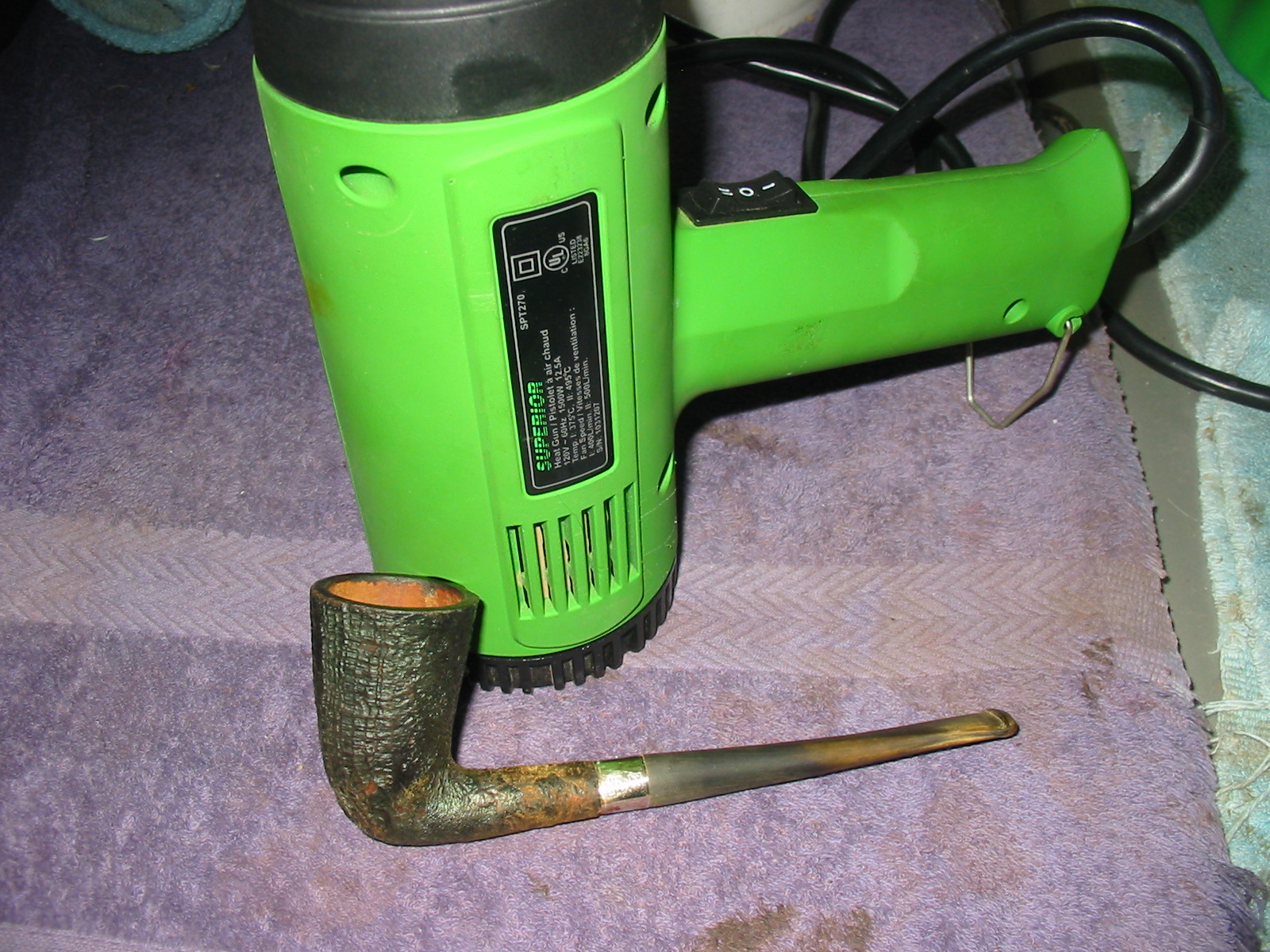
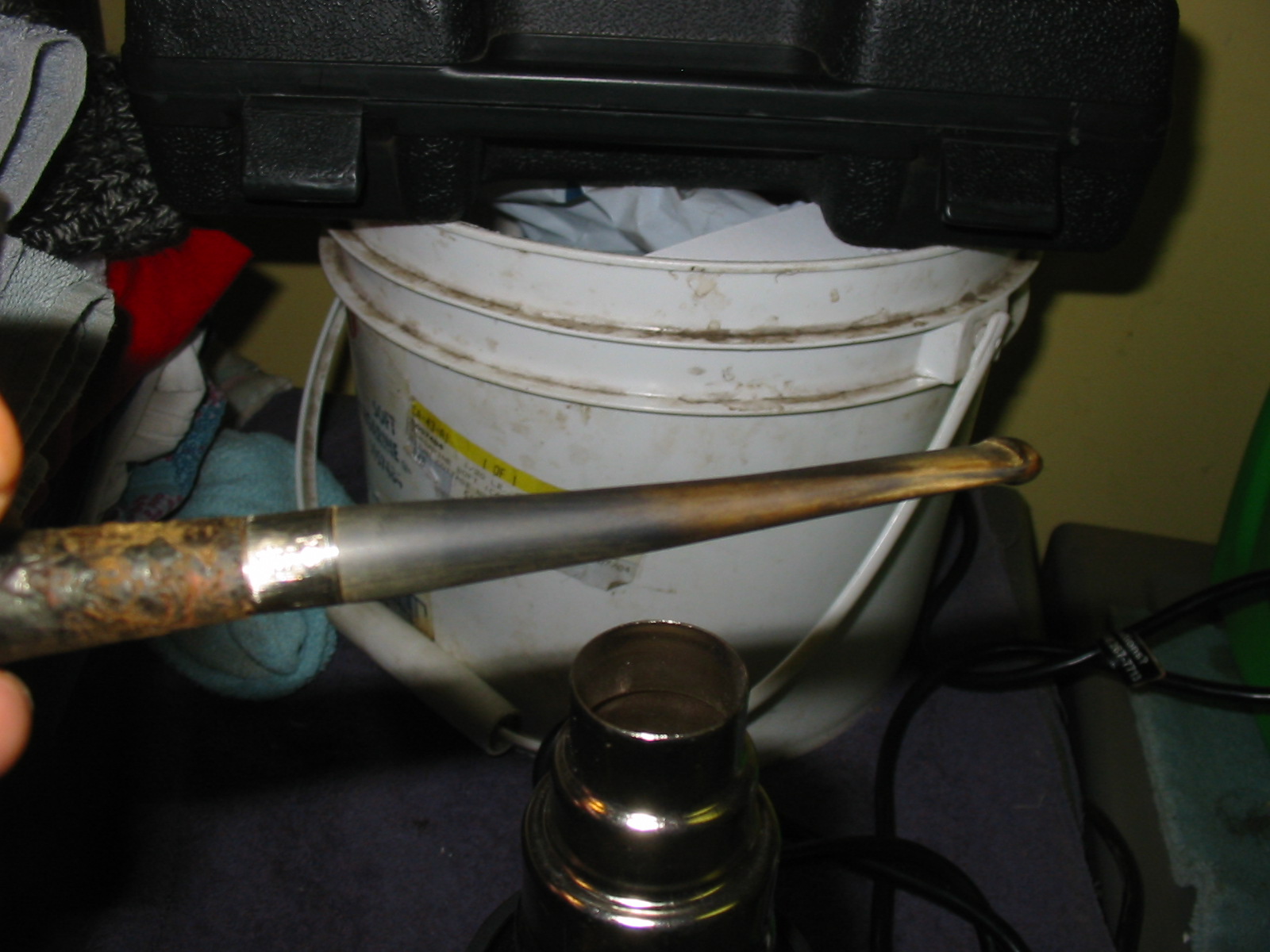
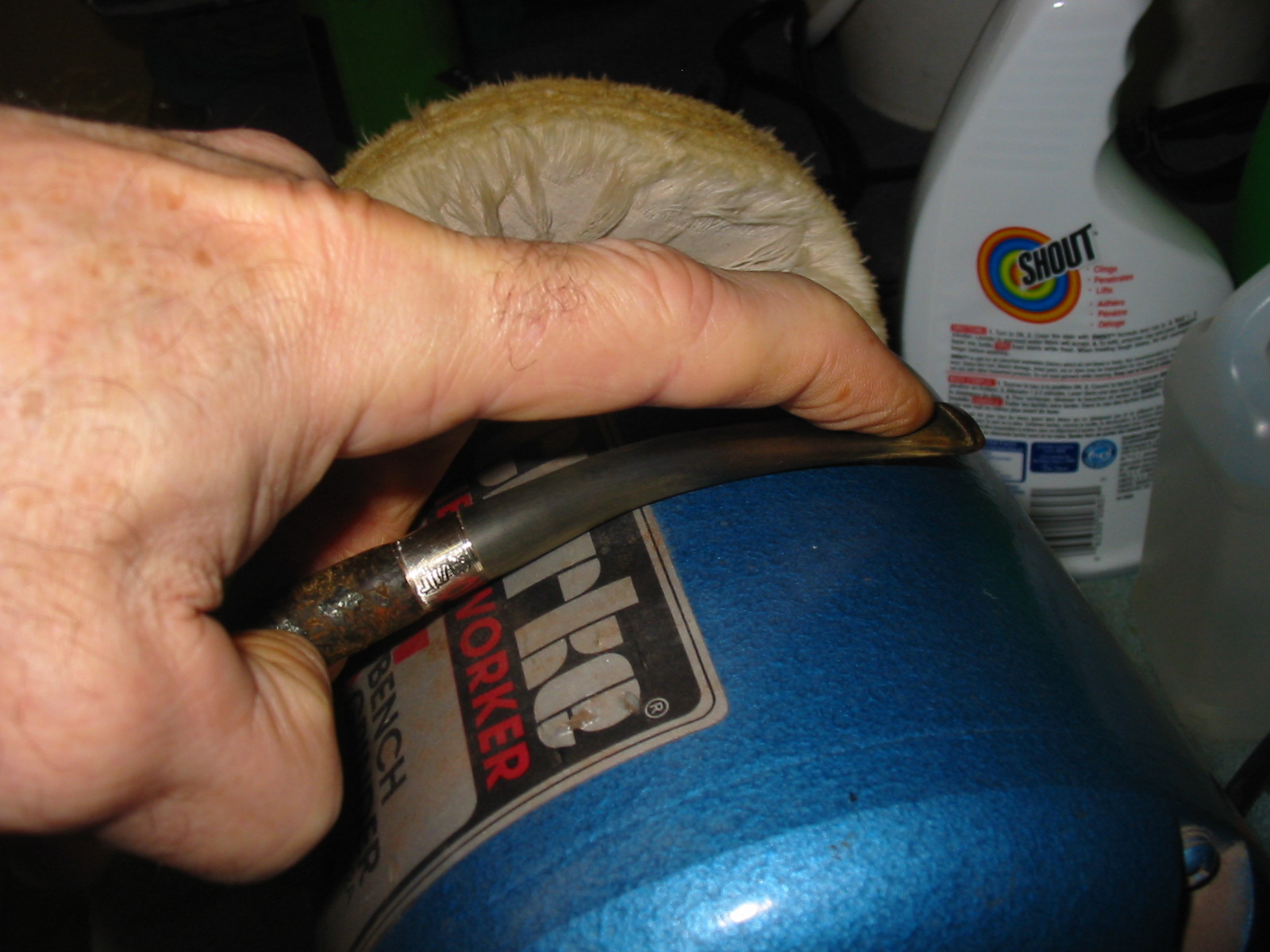
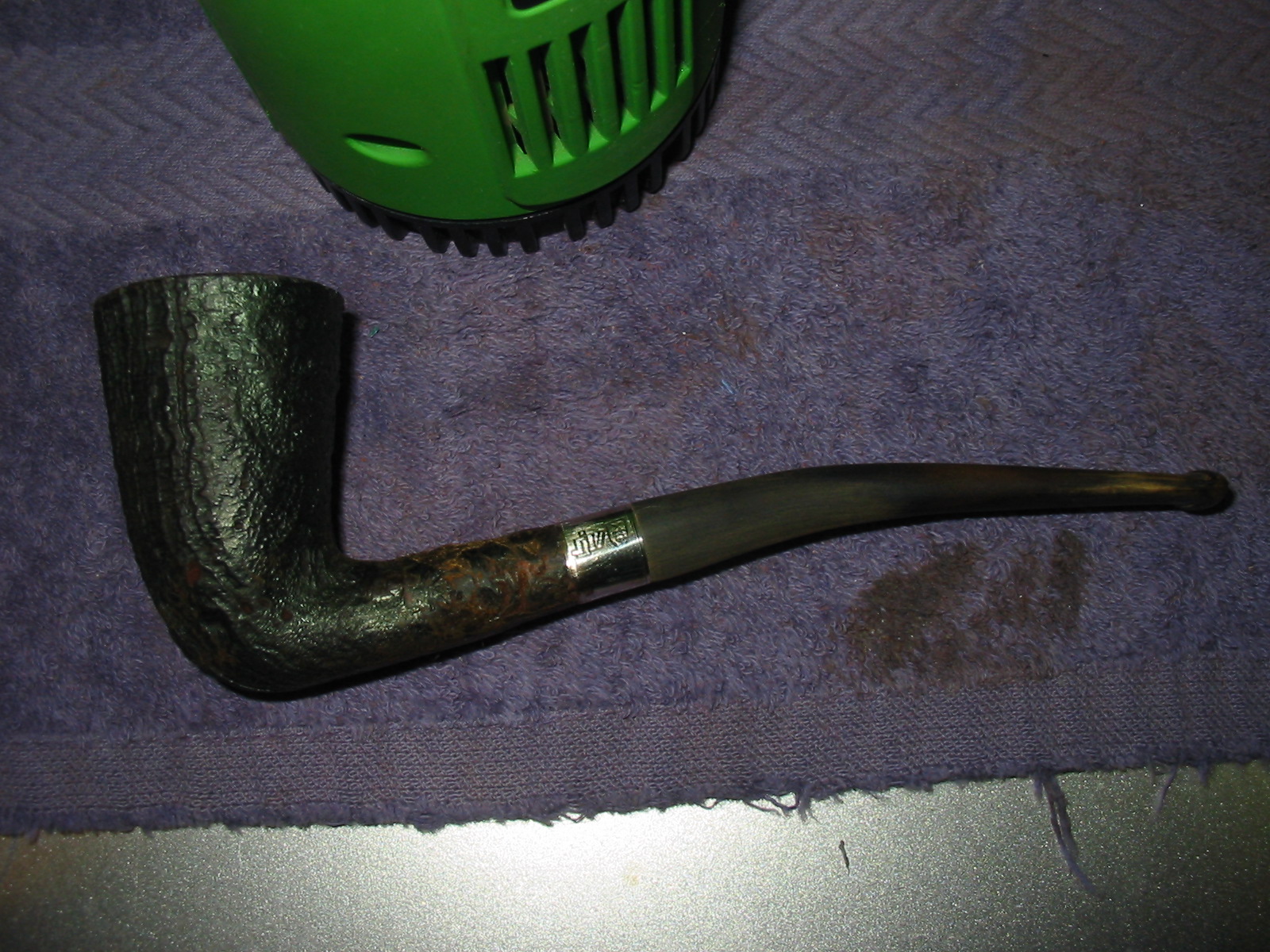
I sanded the stem with 220 grit sandpaper and with a medium and fine grit sanding sponge to make the fit against the band work well. Once the shape and the fit of the stem were correct I used a heat gun to bend the stem to an angle that worked well with the look of this pipe. For the angle I used the curve of my buffer to press the softened stem over. When I had it bent I held it as it cooled and then set the bend with cool water.
IMG_5402

IMG_5403

IMG_5404

IMG_5406

IMG_5407

After bending I resanded the stem with the sandpaper and sanding sponges. Once the majority of the scratches were gone it would need to be sanded with the micromesh sanding pads but I wanted to do some more work on the bowl and shank before finishing the stem.
IMG_5408

IMG_5409

IMG_5410

IMG_5411

I roughened the shank some more to give it a closer look to the sandblast of the bowl. I heated the bowl with the heat gun to warm up the briar before giving the bowl and shank yet another coat of the aniline stain. I gave it the fourth coat of the stain, flamed it and the coverage was finally what I was looking for on the pipe. The shank and the bowl bottom took the stain this time and matched the rest of the bowl.
IMG_5412

IMG_5413

I hand buffed the bowl with a shoe brush and then gave it a light buff with White Diamond on the buffing wheel. I took it back to the work table and gave it several coats of Halcyon II wax which works well on sandblast and rusticated finishes. I buffed it with the shoe brush to bring up the shine. The next three photos below show the bowl after the final stain and light buff.
IMG_5415

IMG_5416

IMG_5417

At this point in the process I used a cotton swab dipped in stain to touch stain the places on the shank the underside of the bowl that were lighter than the rest of the bowl. I let it dry completely over night and then hand buffed the bowl.

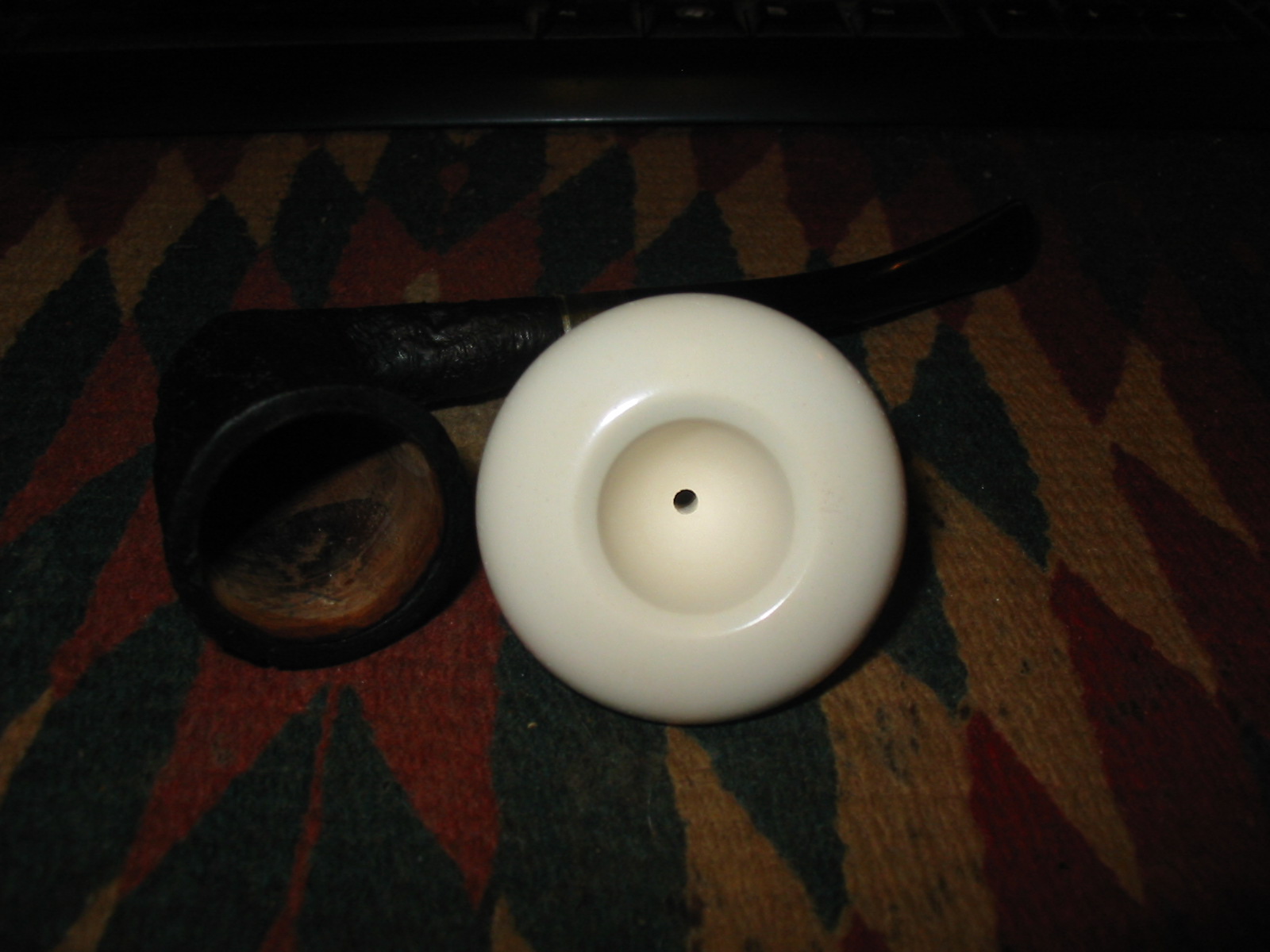
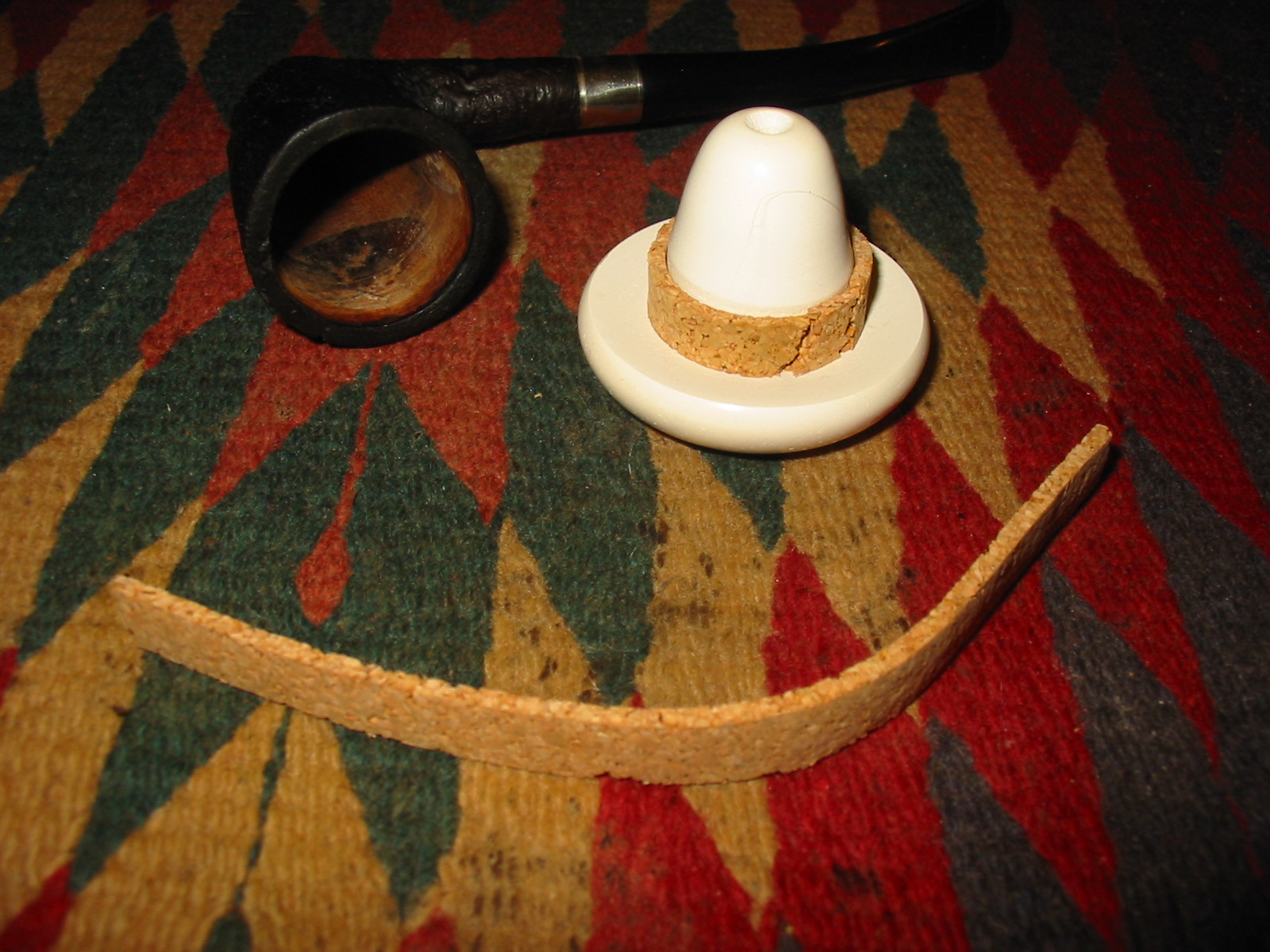
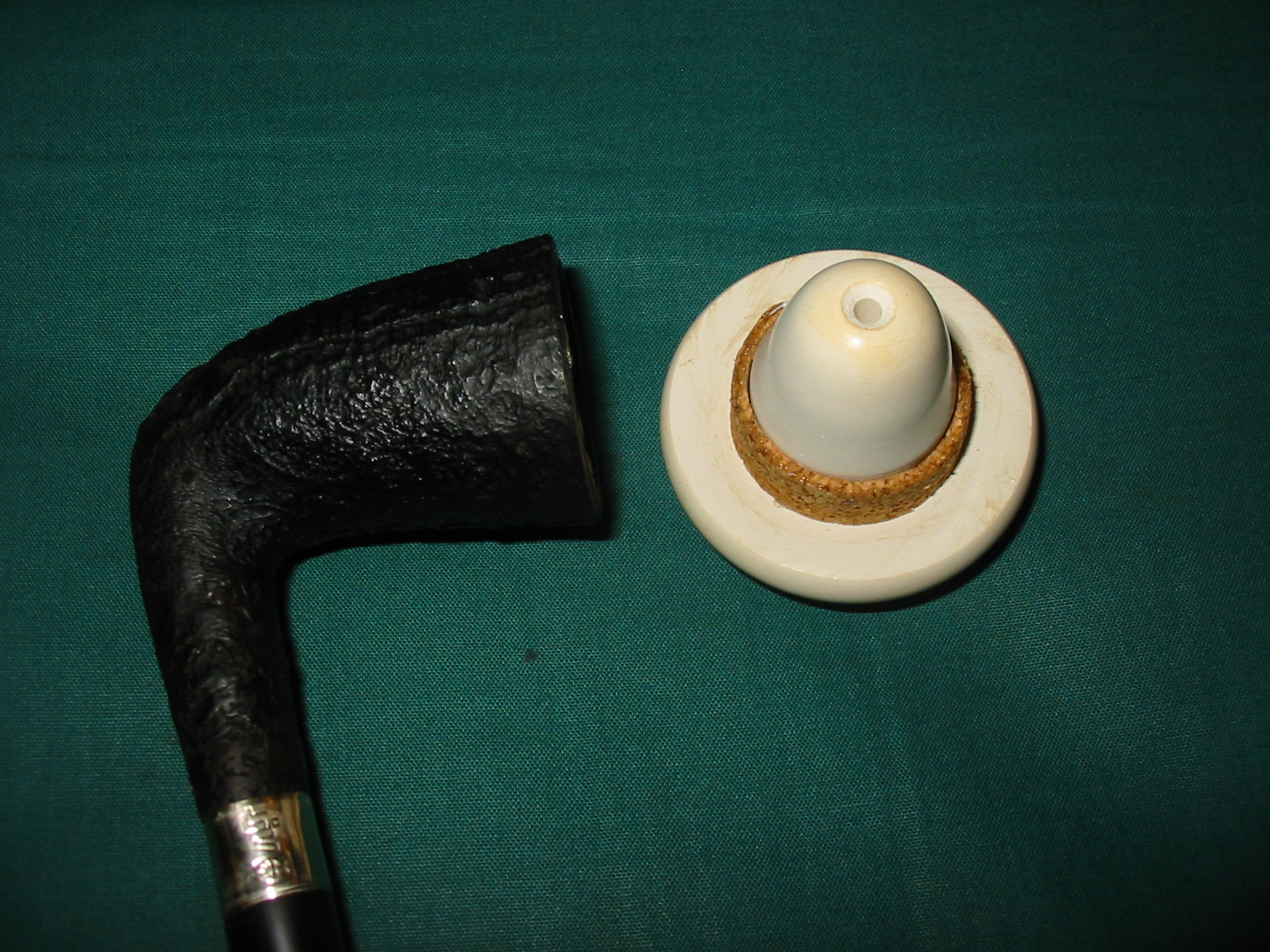
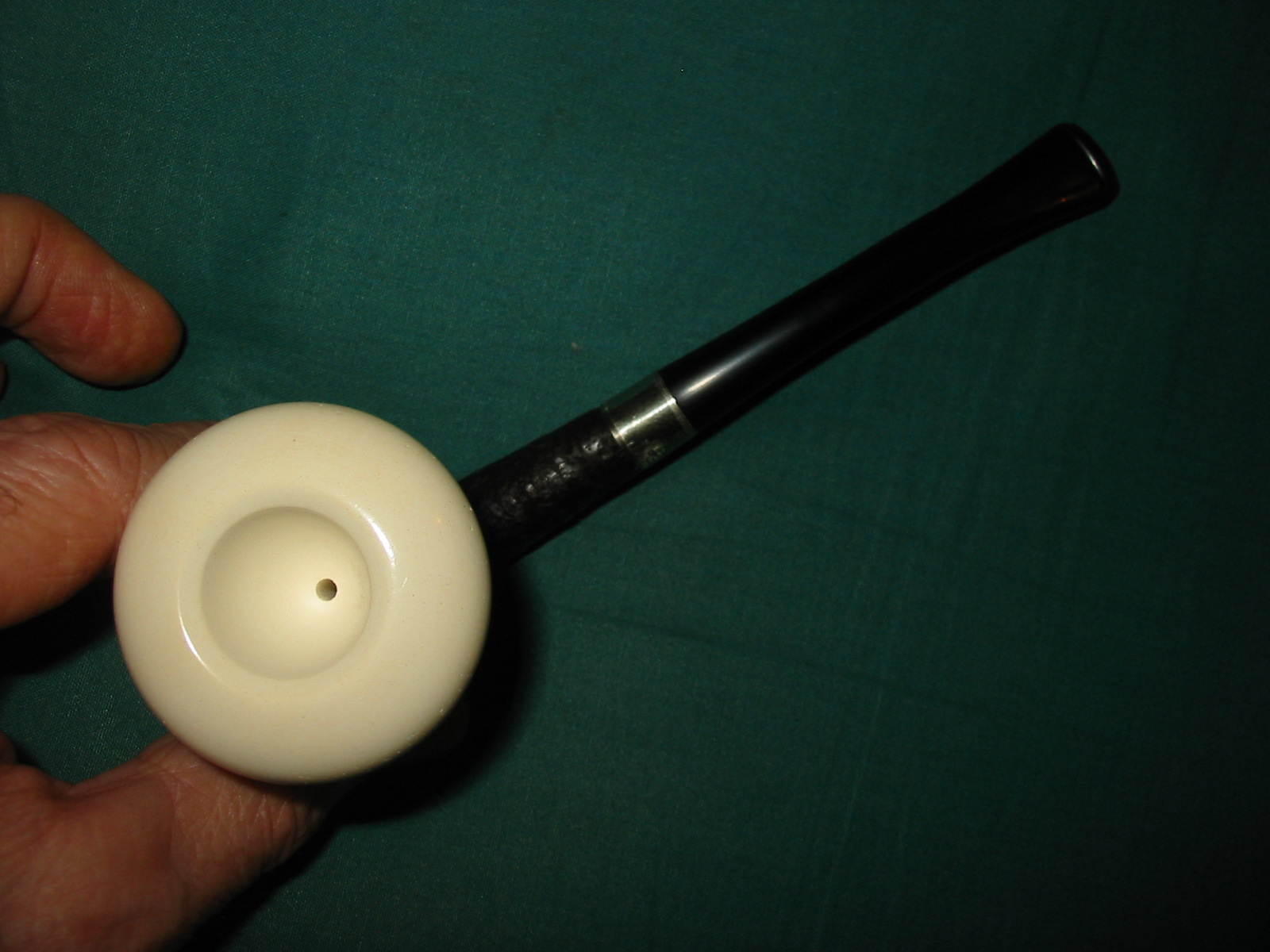
In a phone call with Tim West of J.H. Lowe Pipe Repairs I discussed the possibility of making this pipe a Briar Calabash. I gave Tim the dimensions of the bowl and he happened to have a bowl that was originally made for Pioneer Calabash pipes that was the correct dimensions. He sent along several strips of cork that would be used for making a gasket to give the meerschaum cup a snug fit in the briar bowl.
IMG_5501

I cut a strip of cork and glued it to the bowl with super glue. I used a small piece of the cork to fill the gap between the ends of the strip. Once the glue dried I sanded the cork gasket until it was the proper diameter for the briar bowl.
IMG_5502

IMG_5507

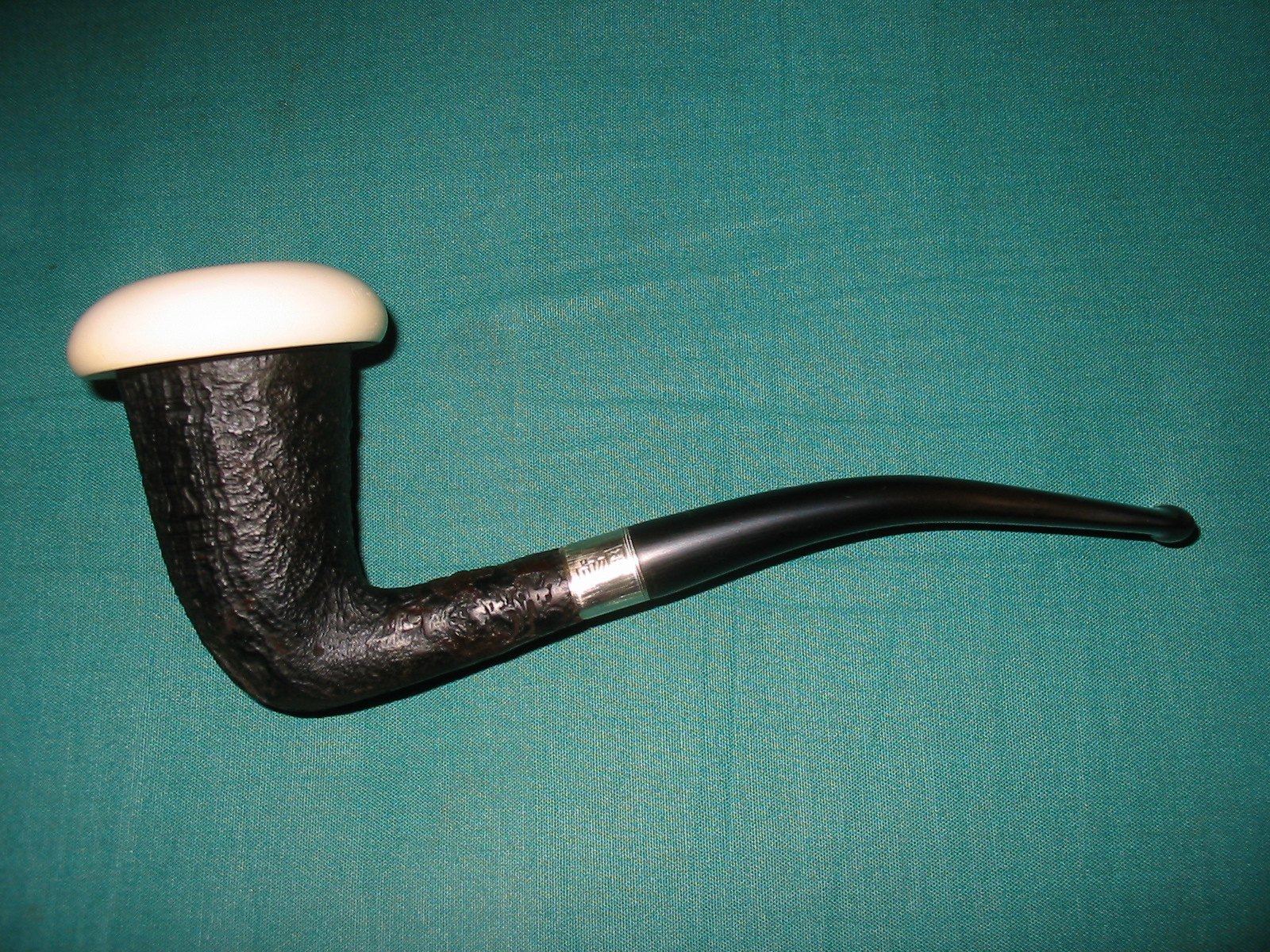
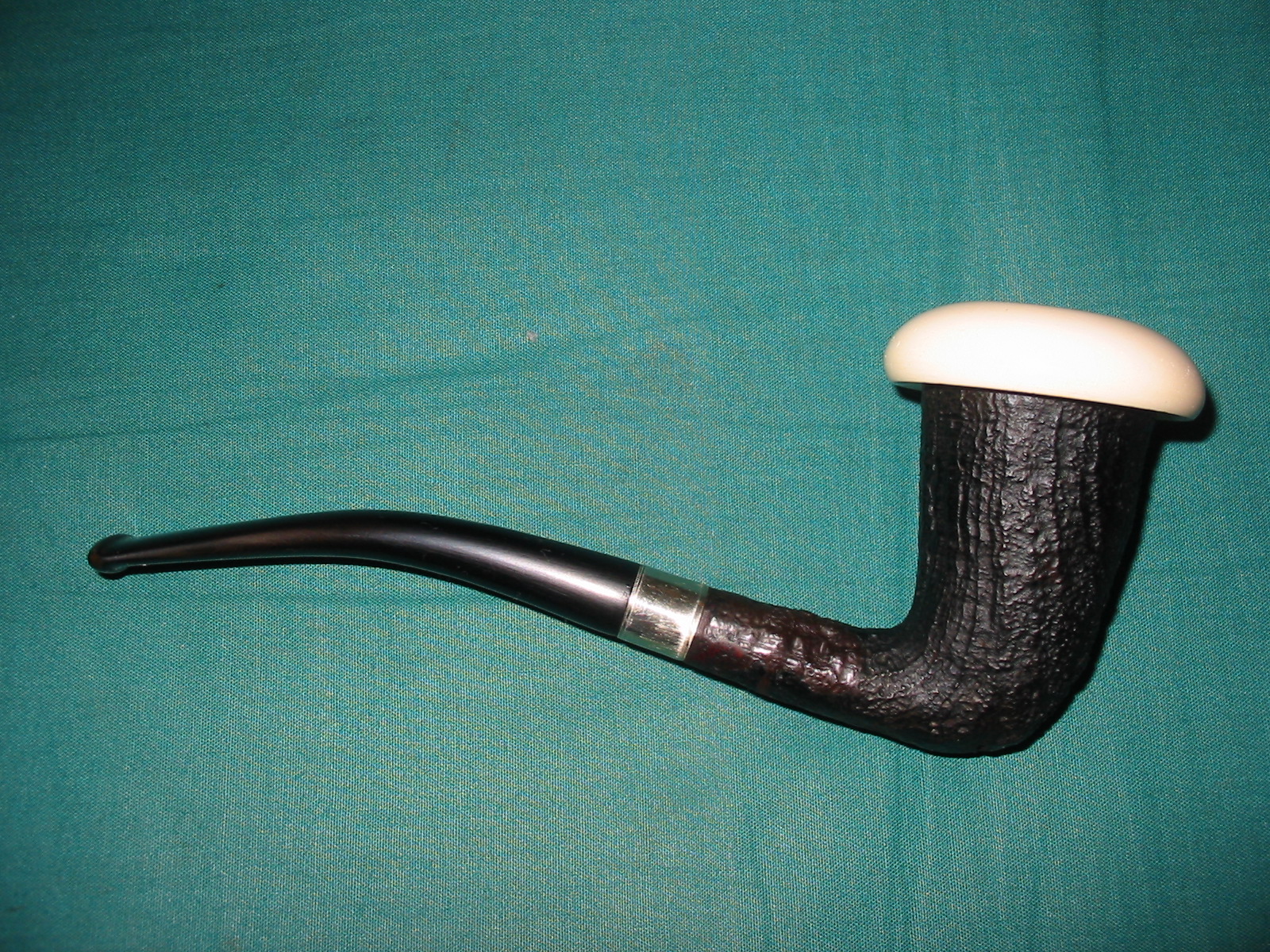
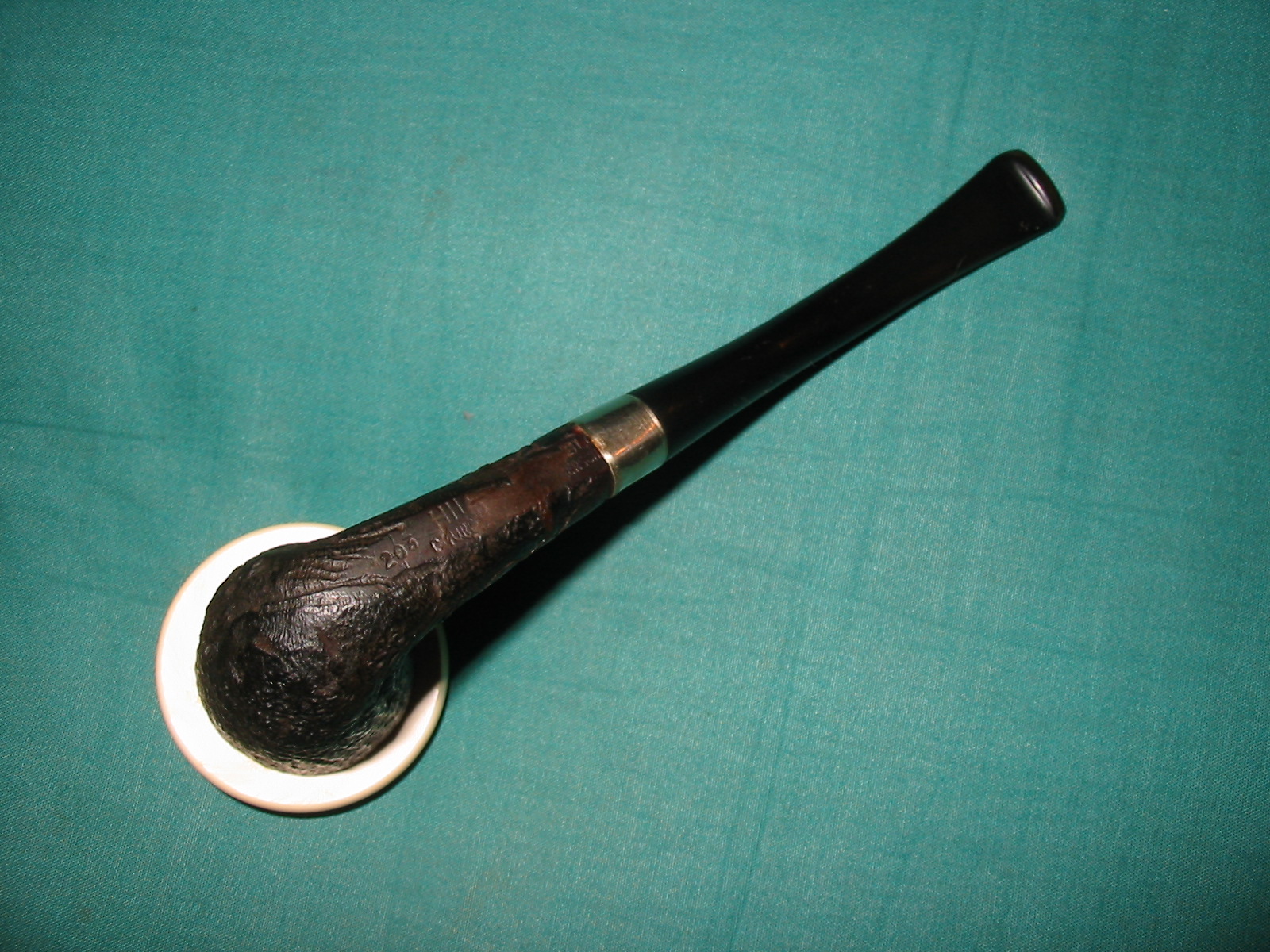
I used some Vaseline and lubricated the cork gasket and then used my finger to coat the inside edge of the briar bowl where the cork would sit. I then pressed the meerschaum cup into place in the briar bowl. The finished Briar Calabash pipe is shown in the photos below. The polished gloss of the white meerschaum bowl looks great against the sandblast dark brown briar bowl. The silver band gives a bit of contrast to the pipe. The draught on the pipe is perfect and the feel of the new Calabash in the hand is great. The pipe is still light in weight and the thin pencil shank and stem work well. Now all that remains is to load it up and have the inaugural smoke.
IMG_5508

IMG_5509

IMG_5510

IMG_5511

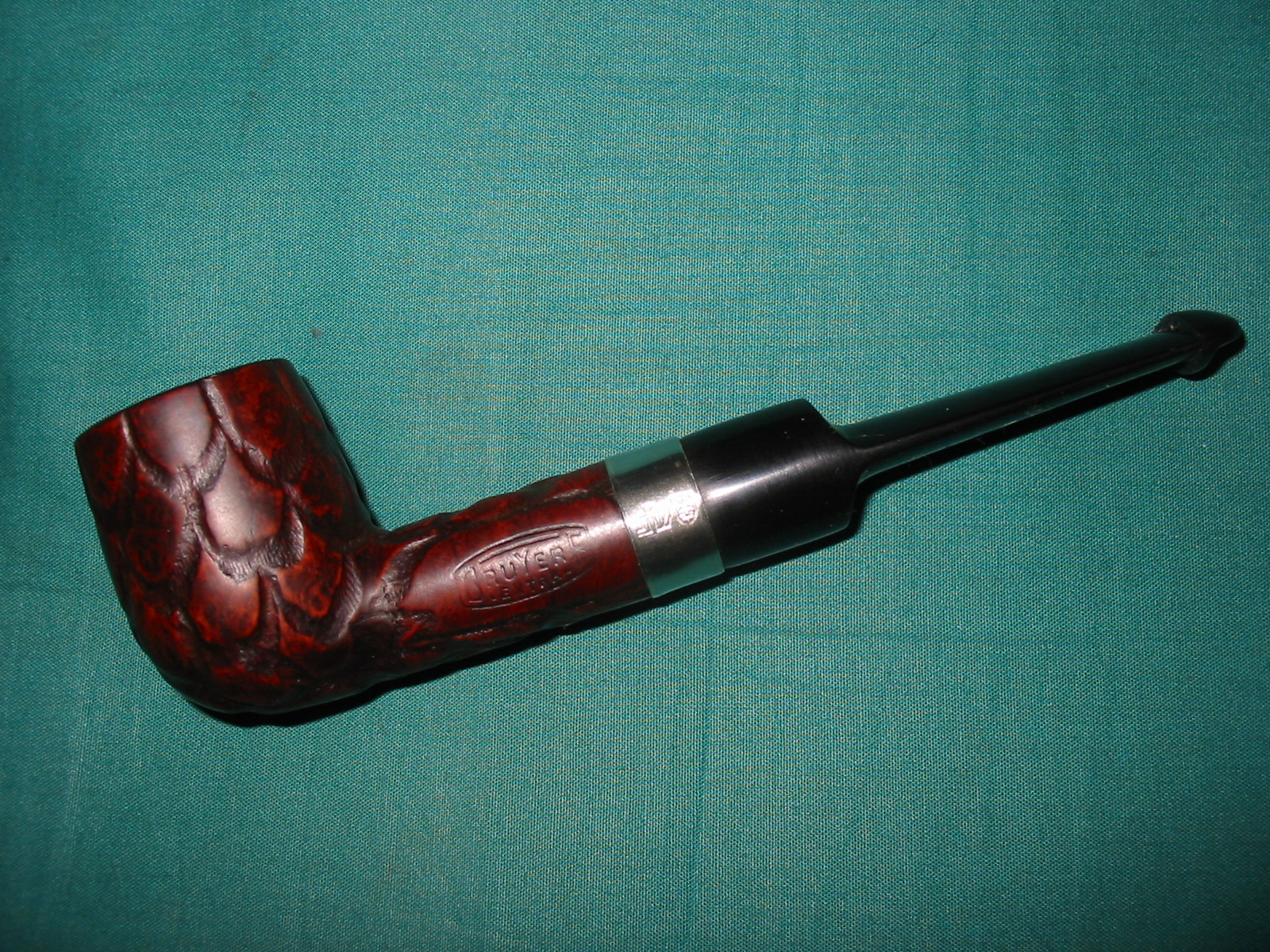
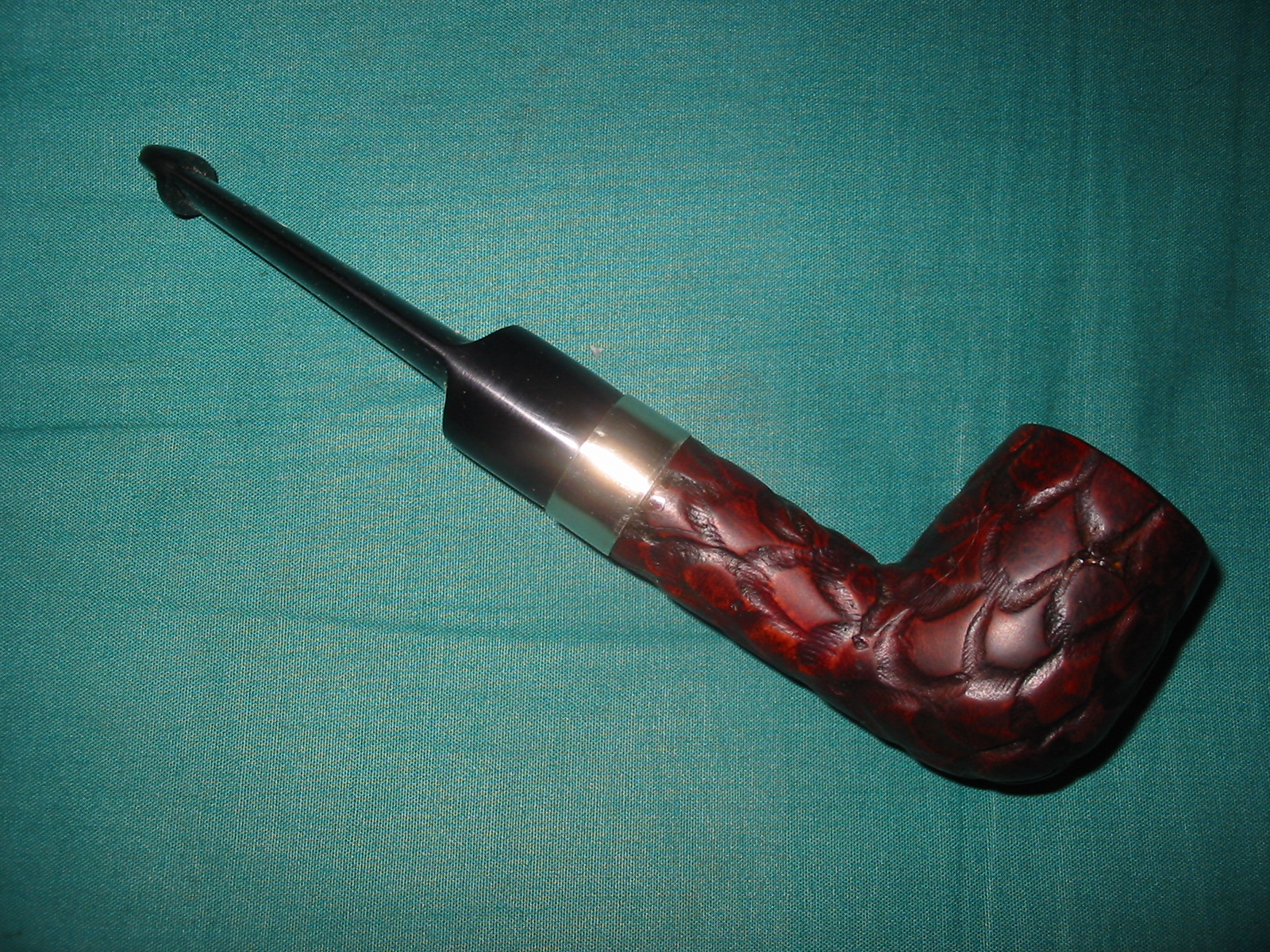
Restoring an old Bruyere Extra Chubby Billiard


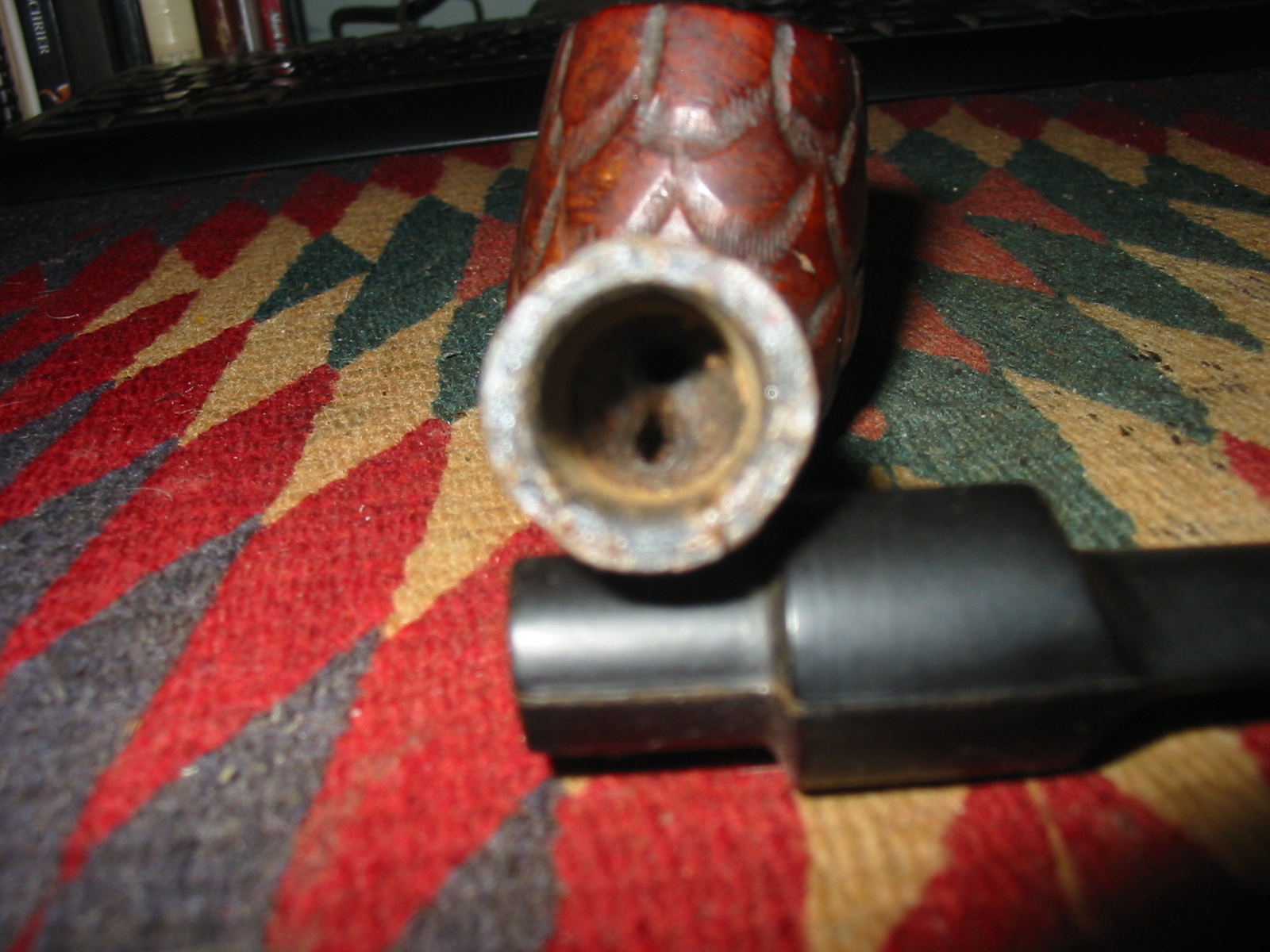
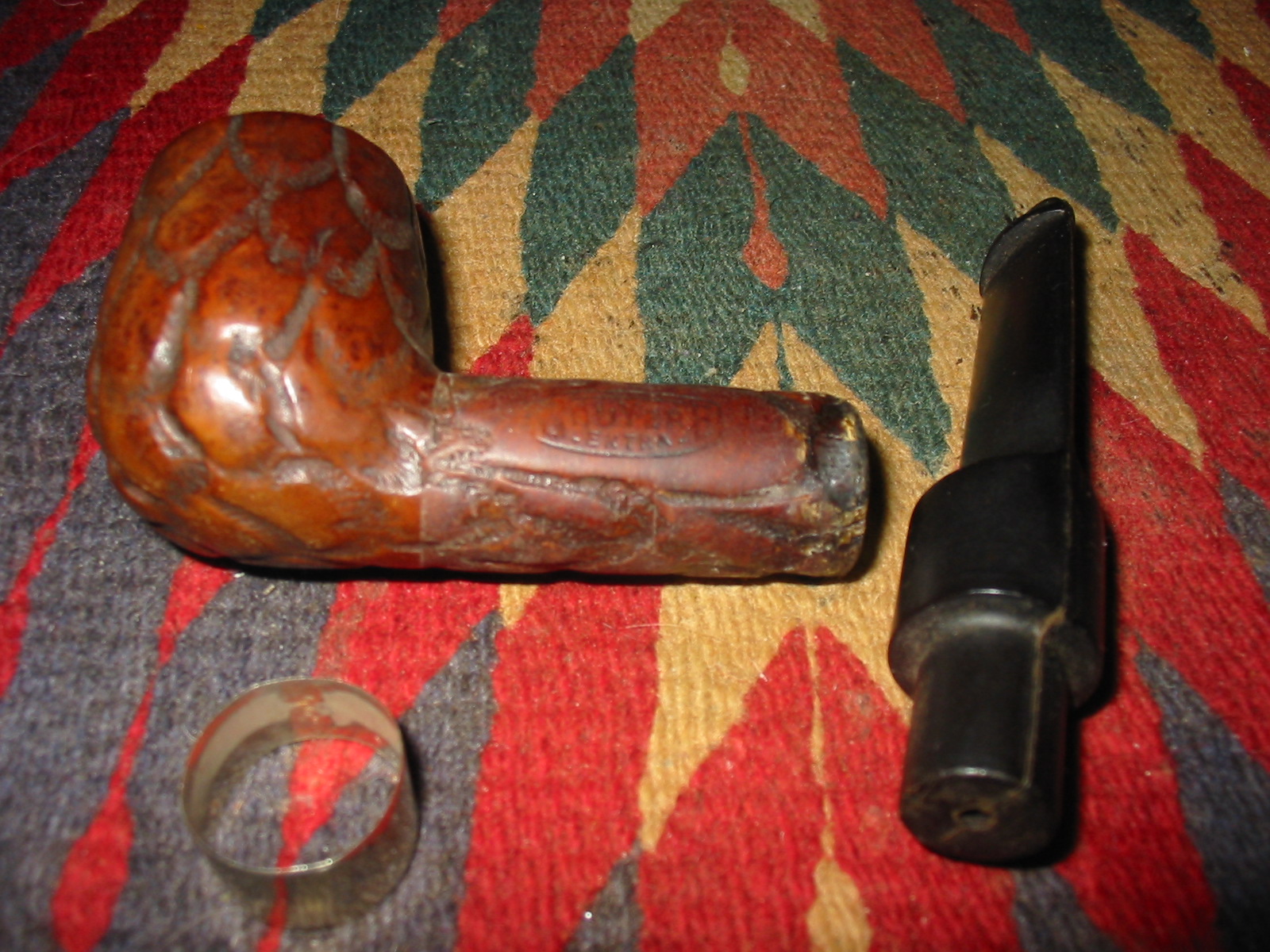
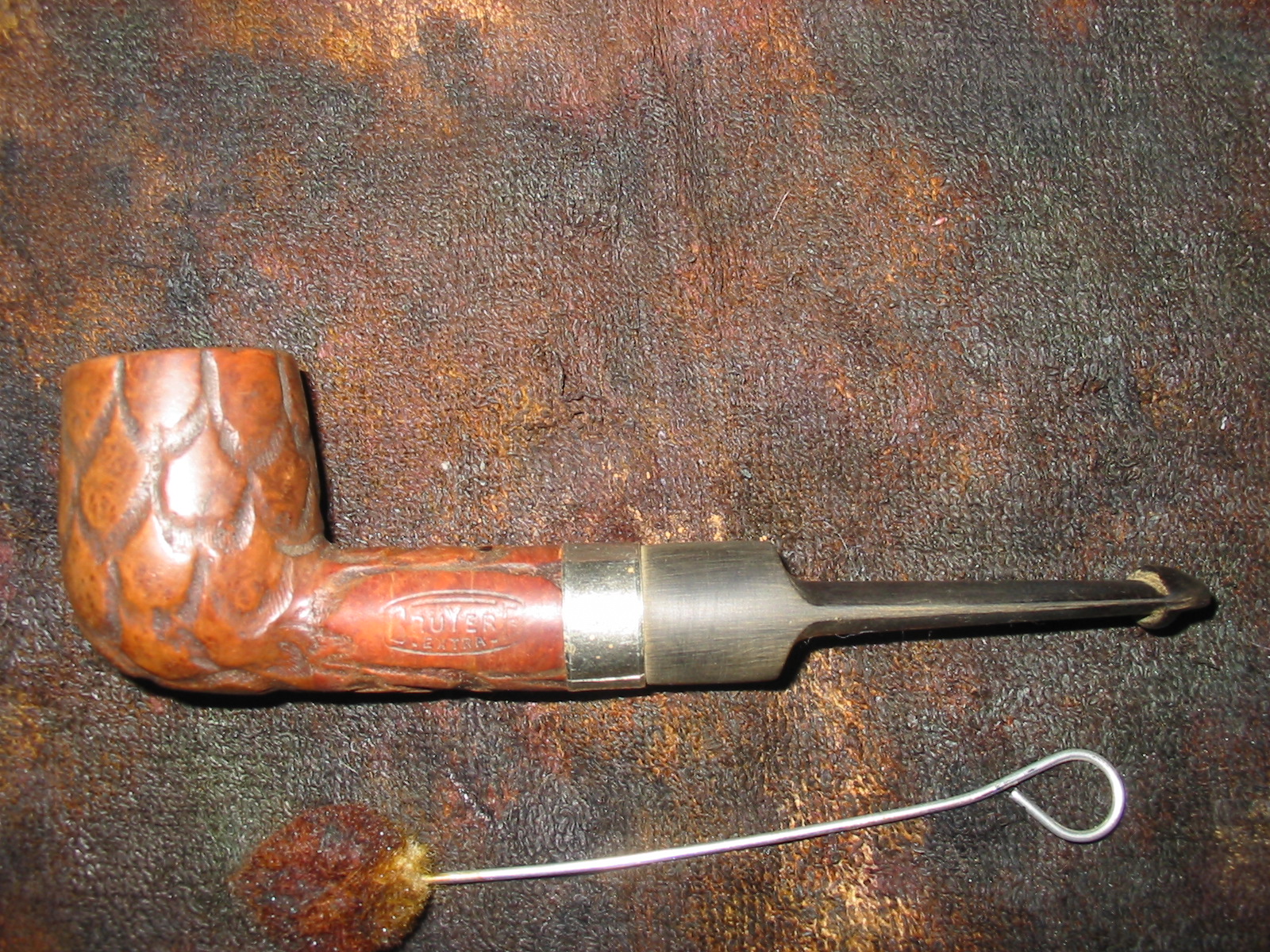
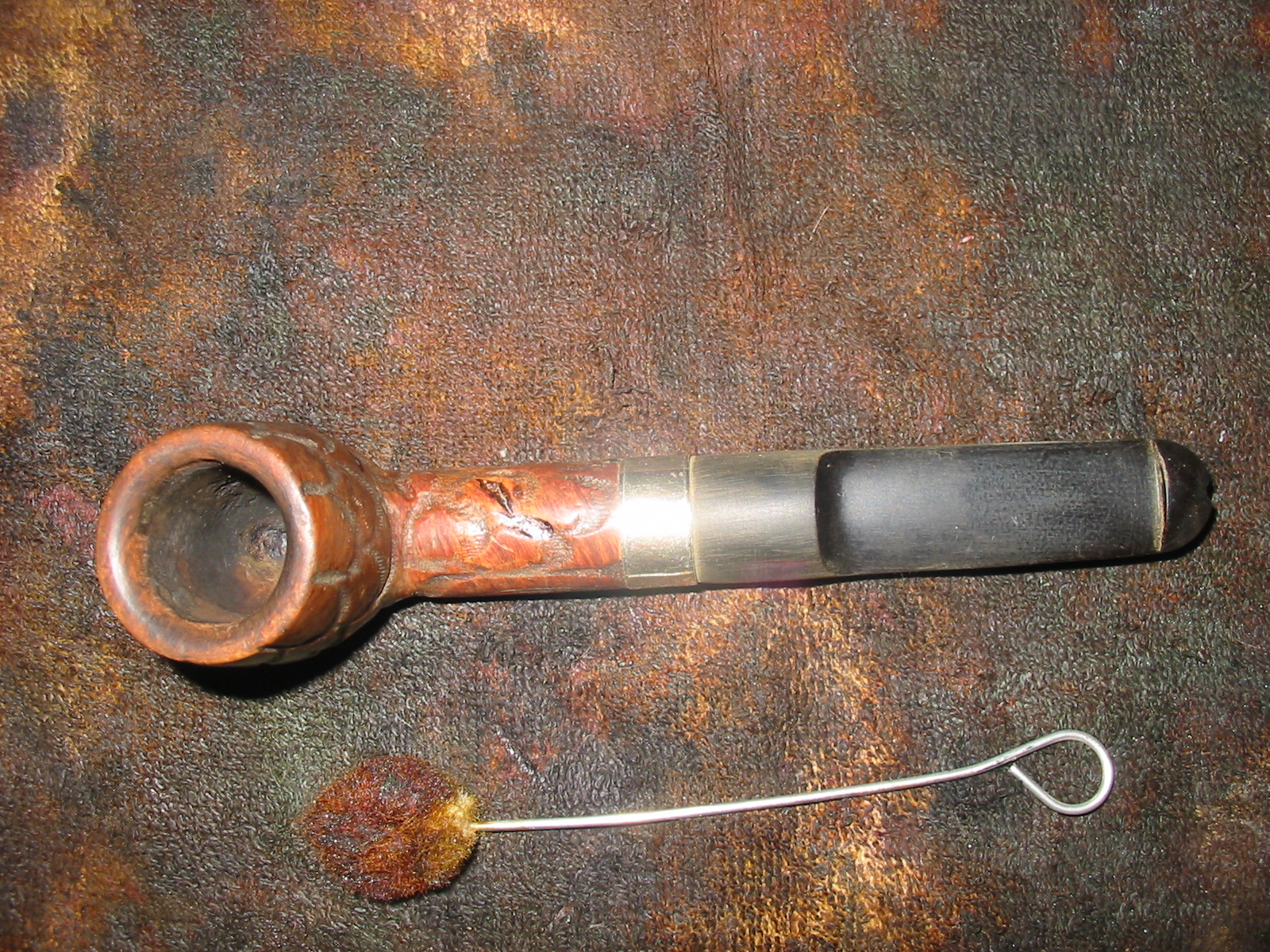
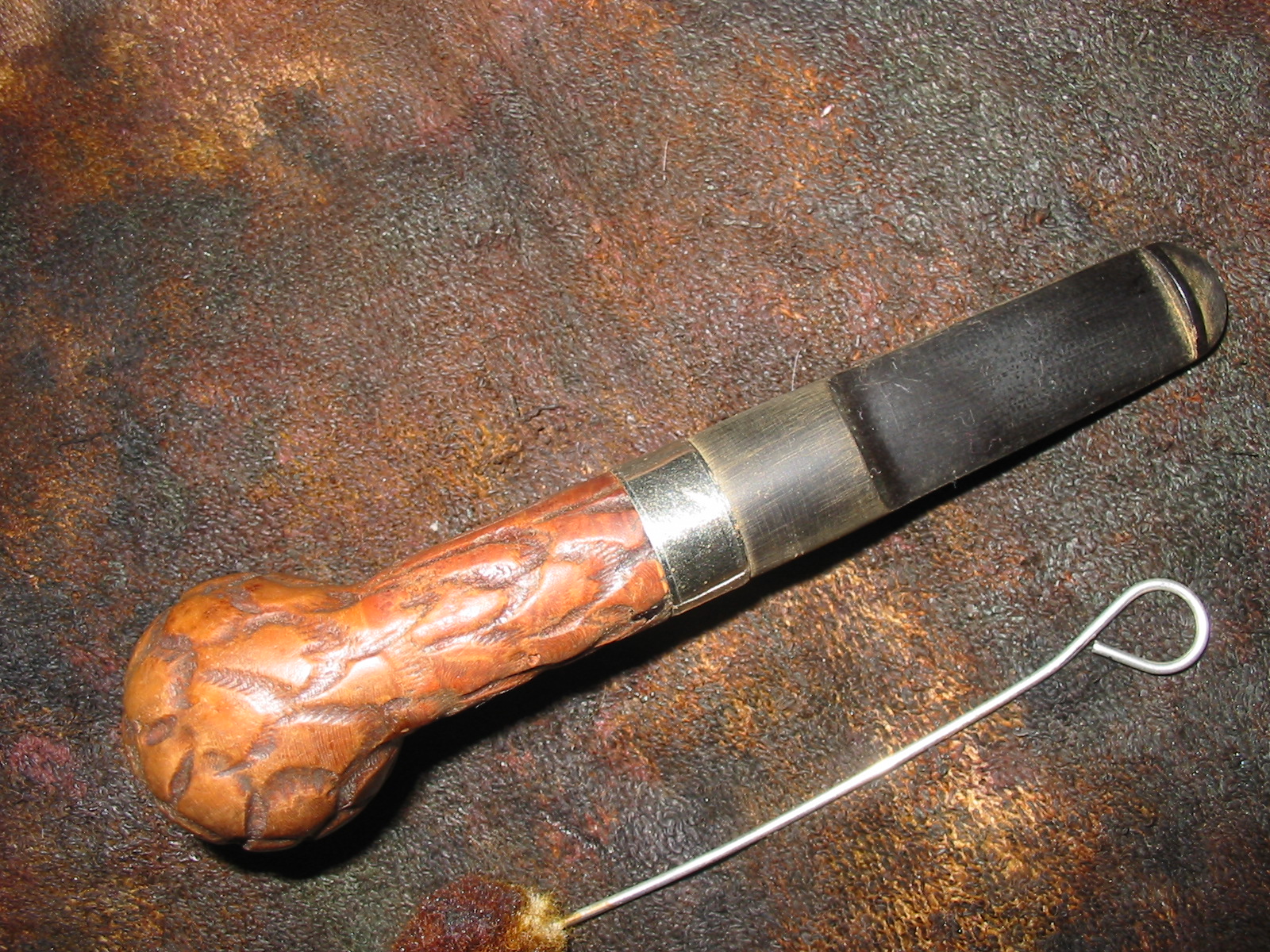
Yet another gift pipe is on the worktable. It is an interesting bowl. The exterior is carved with what looked like scales. There were several sandpits in the trails surrounding the scales. The shank had several cracks and looked as if it had previously sported a band. By appearances the band that was missing looked like it had been original rather than an addition for repairs. But the repairs were there nonetheless. The bowl was caked and the finish very dirty. It was worn away to a large degree. The fascinating part of the bowl was the drilling of the airway. The end of the mortise, which is quite large, is concave. At the end of the concave mortise there are two holes drilled looking like a colon “:”. The top hole is the airway leading into the bowl and the bottom hole is about a ½ inch deep and ends. With a stem in place the mortise looks to serve as a second chamber for cooling the smoke. The shank is stamped Bruyere over Extra in and oval with the ends flattened. There is no other stamping on the shank.
IMG_5462

IMG_5463

I went through my box of bands and found one that would work well on the cracked and repaired shank of the pipe. I also found a stem in my can of stems that would work well with this pipe. The tenon needed to be quite large in diameter to fit the large mortise. The stem I had was a faux Peterson stem. The airway was directly in the end of the button not on the top. Thus the look was Peterson like but the stem was actually a straight airway from tenon to button.
IMG_5460

IMG_5461

IMG_5464

I added some wood glue to the area of the shank that the band would be pressed on and then heated the band and pressed it onto the shank. I reamed the bowl with a PipNet reamer to take the cake back to bare wood. I also scrubbed the rim down as it had a chamfered inner edge around the bowl.
IMG_5466

IMG_5467

I wiped down the bowl with acetone on cotton pads to remove the remnants of the finish and to clean up the debris and dust in the carved trails between the scales on the bowl and shank. I picked out the debris in the flaws in the trails, scratched the surface surrounding the flawed areas and then packed in briar dust with a dental pick and dripped superglue into the dust. I lightly sanded the areas of the fills and wiped the bowl down again with acetone on the cotton pads.
IMG_5468

IMG_5474

IMG_5476

IMG_5477

IMG_5478

With the repairs completed, the band in place and the stem fitted to the shank it was time to stain the bowl. I wiped it down a final time to remove any remaining dust and debris before staining. I decided to use a dark brown aniline stain and applied it with the dauber that comes with the Feibings Shoe Dyes. The dauber works well on the wider grooves between the carved scales on the finish. I applied the stain, flamed the finish, reapplied the stain and flamed it again until the coverage of the stain was even.
IMG_5479

IMG_5480

I wanted a contrast to the finish – dark stain in the grooves of the trails and a bit more opaque stain on the surface of the scales so I wiped the bowl down with isopropyl alcohol to reduce the stain colour on the smooth surfaces of the finish.
IMG_5481

IMG_5483

IMG_5484

IMG_5485

I buffed the bowl with Red Tripoli and White Diamond on the buffing wheels to polish the bowl and give me an idea of the look of the finish once polished.
IMG_5486

IMG_5487

IMG_5488

IMG_5489

I sanded the smooth surfaces of the bowl with a 1500 grit micromesh sanding pad to further lighten the stain and allow the grain to pop through. The smooth surfaces had birdseye on most of them and I wanted that to stand out on the pipe.
IMG_5490

IMG_5491

IMG_5492

IMG_5493

I sanded the stem with 220 grit sandpaper to make the fit the shank even around the circumference of the saddle portion of the stem. I sanded it with medium and fine grit sanding sponges to remove the deeper scratches on the stem. I then used my normal line of micromesh sanding pads – wet sanding with 1500-2400 grit pads and dry sanding with 3200-12,000 grit pads. I also sanded the nickel band to polish it and remove the small scratches that were present in the finish.
IMG_5494

IMG_5495

IMG_5496

I rubbed the stem down with Obsidian Oil and once it was dry buffed the bowl and stem with White Diamond. I gave the pipe and stem multiple coats of carnauba wax and polished it with a clean flannel buff to finish the process. The old pipe has a new look and a great feel. I look forward to giving it a try to see how the second chamber – the reverse calabash actually works on this pipe. The photos below show the finished pipe ready to use!
IMG_5497

IMG_5498

IMG_5499

IMG_5500

Giving New Life to a no-name Sandblast Apple


I was gifted this old apple bowl. It was a nicely shaped apple with a light sandblast finish. There were some significant problems with flaws and crevices in the bowl. The major flaw was on the right side of the bowl toward the top and on the top of the rim itself. It extended into the bowl for about a ¼ inch. There was no cake or build up and the bowl seemed clean and lightly smoked if smoked at all. It had a rounded shank so it was clear that the original stem had been a stick bit of some sort – though sadly it was lost. I had it sitting in my box of pipes to be refurbed for awhile while I worked on other pipes. Its turn finally came up.
IMG_5419

IMG_5422

IMG_5421

IMG_5420

I went through my can of stems and found the kind of stick bit free hand style stem I thought would look good on this pipe.
IMG_5418

I turned the tenon end of the stem with a PIMO tenon turning tool and then used the Dremel and sanding drum and finally some hand sanding with 220 grit sandpaper to get the stem to fit well in the mortise of the shank. With the fit nice and snug I would need to sand the saddle area and clean up the tenon to make it shine.
IMG_5426

IMG_5427

IMG_5428

IMG_5429

IMG_5430

I cleaned up the crevices with a cotton swab and dental pick and isopropyl alcohol. I then packed some briar dust into the filled crevices and dripped super glue into the briar dust. I repeated the process until the flaws were filled and the surface of the bowl and rim bulged slightly. I sanded the rim and the fill on the side with 220 grit sandpaper to remove the excess fill. I scratched the surface with the dental pick to give it a similar texture to the surround sandblasted bowl. I sanded the saddle on the stem at the same time with 220 grit sandpaper. I finished the repair and the saddle area with a medium and a fine grit sanding sponge.
IMG_5431

IMG_5432

IMG_5433

Once the area was filled and the texture finished it was time to stain the pipe. I decided to use a dark brown aniline stain that I would later wipe down with alcohol to give more transparency and aid in a contrast on the surface of the bowl. I wiped down the surface of the bowl with isopropyl alcohol before staining the bowl to remove the dust. I applied the stain and flamed the bowl and repeated the process until the coverage was even.
IMG_5434

IMG_5435

IMG_5436

IMG_5437

I wiped the bowl down with isopropyl alcohol on cotton pads to give the stain some more transparency and to lighten it.
IMG_5440

IMG_5441

IMG_5442

I buffed the bowl with a light touch on the buffer using White Diamond. I took it back to the work table and hand buffed it with a shoe brush to give it a shine. There were spots on the shank and the bowl where I would need to touch up the stain as it was too light and shiny.
IMG_5443

IMG_5444

IMG_5445

IMG_5446

Once the coverage looked good I gave the bowl a coat of oxblood aniline stain to build a contrast. In the photos below you can see the way it worked to highlight the blast and show the grain. The birdseye grain under the blast on the left side of the bowl showed up with a nice contrast look.
IMG_5447

IMG_5448

IMG_5449

IMG_5450

I worked over the stem with micromesh sanding pads using the 1500-2400 grit pads to sand the surface of the bowl and give it more contrast with the crevices in the blast. I polished the stem with my usual pattern of micromesh pads – wet sanding with the 1500-2400 grit pads and dry sanding with the 3200-12,000 grit pads. I rubbed the stem down with Obsidian Oil and let it soak in. When it had dried I hand buffed the stem.
IMG_5451

IMG_5452

IMG_5453

I buffed the pipe and the stem with White Diamond and then gave it multiple coats of carnauba wax. I buffed it with a clean flannel buff to raise the shine on the bowl. The finished pipe is shown in the photos below.
IMG_5454

IMG_5455

IMG_5456

IMG_5457

In closing I include two photos of the repaired areas of the bowl to show the finished repair. The super glue and briar dust repair worked well and is quite hidden by the stain and finish work. The trick was not to overfill the areas surrounding the crevice so that the filled area would blend into the texture of the bowl. I am pleased with the finished product.
IMG_5458

IMG_5459

Repairing a Cracked Bowl on a GBD London Made Canadian


Blog by Steve Laug

Andrew sent me this old pipe as a bit of a challenge and I thought I would give it a go. This was a great looking pipe at one point in its life – nice grain. It is stamped GBD in the oval on the top of the shank with LONDON MADE in an arc under the oval. That leads me to believe the line is the LONDON MADE rather than the location. On the underside of the shank it is stamped: LONDON ENGLAND over D256. The 256 is the correct shape for an oval shank Canadian but I had not seen the D stamping before a number on GBD pipes.

The finish was rough and there was split in the back side of the bowl that ran horizontally in an arc across the bowl about ½ inches from the top. It was as if the grain had separated that way across the back of the bowl. It follows the arc of the grain in that part of the briar. From the main split there was a tiny crack branching off into another line of grain on the left side of the bowl. The weird thing about the split is that it was only external. There was no sign of it inside the bowl after removing the thin cake. The stem was not with the pipe so it would need to be restemmed. I found an old saddle stem in my can of stems that would work for this pipe after I modified it.
IMG_5336

IMG_5337

IMG_5338

IMG_5339

In talking on the phone with Tim West last evening while I was ordering parts for repairs I discussed this pipe with him. He said that in his estimation the crack being only on the outside of the bowl suggested that the issue was a moisture problem.

I shaped the stem with a Dremel and a sanding drum. I removed the saddle on the stem and converted it into a taper shape and also narrowed it to fit the dimensions of the oval shank. The next four photos show the newly fit stem and the rough shaping that I did with the Dremel. All that remained in the stem fit was a lot of hand sanding!
IMG_5343

IMG_5344

IMG_5345

IMG_5346

I reamed the bowl with a PipNet reamer to remove the existing cake and to check the interior walls of the bowl. They were not cracked as noted above. I washed down the pipe with acetone on cotton pads to remove the grime and the finish in preparation for doing the repair on the cracks. I picked out the debris in the cracks with a dental pick and cleaned out the sides and interior of the cracks. I washed that part of the bowl down a final time with acetone to clear away any debris left behind by my picking at it.
IMG_5348

IMG_5349

I packed briar dust into the cracks with a dental pick and then dripped super glue on top of the briar dust to bond it and make a fill for the crack. The next series of photos show the repair at this point from various angles.
IMG_5350

IMG_5351

IMG_5352

Once the glue was dry and the patches were solid I sanded the patch with 220 grit sandpaper to smooth it out to match the surface of the bowl. I sanded it with medium and fine grit sanding sponges afterward to smooth it out further. The next photos show the initial sanding of the patches. There was still much sanding to do and some more filling in spots that were low.
IMG_5353

IMG_5354

IMG_5355

IMG_5356

I sanded the bowl and the new stem further with 220 grit sandpaper to remove the finish and smooth out the transitions. On the crack repair I wanted to even out the transition between the fill and the surrounding briar. On the new stem shank union I wanted to make that transition between the briar and the vulcanite stem seamless.
IMG_5357

IMG_5358

IMG_5359

IMG_5360

The next series of three photos show the newly sanded repair. It looks better but there are still a few areas that will need to be filled and sanded some more.
IMG_5361

IMG_5362

IMG_5363

At this point in the process I was still undecided as to whether I would stain the repaired bowl or rusticate it. I posted on an online forum to see what others thought and the audience was split. I decided to stain it and see how the repair looked. If I changed my mind I could rusticate it later. I wanted to use a contrast stain on the bowl to minimize the look of the crack so I used a black aniline stain to do the undercoat. It would also highlight any areas on the repair that needed more attention. I applied the stain, flamed it and did the same again until the coverage I was looking for was achieved.
IMG_5364

IMG_5365

I took three photos of the repair after staining to show what the repair looked like at this point.
IMG_5366

IMG_5367

IMG_5368

When the stain was dry I wiped it down with isopropyl alcohol to lighten it and bring out the grain. I wanted the black stain to settle into the grain and highlight the stripes. I wiped it down with acetone as well to further lighten the stain. I buffed the pipe with red Tripoli and White Diamond to further lighten the black undercoat. I stained it with a top coat of dark brown aniline stain, flamed and restained it for the coverage I wanted. It must be remembered at this point that this was not the finish coat but merely the way in which the repair is highlighted and makes it clear where I still need to do some work on the fills. The photos below show the repair and make it very clear where there was still work to do. This meant more filling of the crack with briar dust and superglue and more sanding. It also meant that I would need to restain that particular area of the pipe
IMG_5369

IMG_5370

IMG_5371

IMG_5372

Once the pipe was at this point several things stood out to me. I really like the grain patterns on the bowl and shank and I need to continue to work on the patch until it was well blended. So I took it to the buffer and buffed it with White Diamond and then took it back to the work table to do some more work on the patch.I sanded down the area around the repair with 220 grit sandpaper and then packed in more briar dust with the dental pick. I added more superglue until the repair was mounded slightly. While this would take more work in terms of sanding, I knew it would make the patch as perfect as possible.

Once I had the patch sanded back to match the surface of the surrounding briar with the 220 grit sandpaper, I sanded it further with medium and fine grit sanding sponges and then with 1500-2400 grit micromesh sanding pads. The scrathes left behind by the sandpapers disappeared with the micromesh sanding. I restained the area with the black undercoat, sanded it again and then gave it a topcoat of dark brown aniline stain a second time. I did not bother sanding and restaining the whole pipe as my plan was to sand the entire bowl to create the contrast I wanted with the two stains. I sanded the pipe with 1500-2400 grit micromesh sanding pads to blend in the freshly stained portion of the pipe with the rest. The next three photos show the status of the repair at this point.
IMG_5377

IMG_5378

IMG_5379

I continued to sand the bowl and shank being careful around the stamping on the top and bottom of the shank with the micromesh sanding pads until the top stain was almost translucent. I wanted the top coat to be there but I wanted the grain to pop through it. I also wanted the colour to blend in such a way that the dark repair would not be hidden completely but would be minimized. The next four photos show the pipe after all of the sanding and a buff with White Diamond to enhance the shine.
IMG_5373

IMG_5374

IMG_5375

IMG_5376

I worked on the stem to remove several small tooth marks on the underside and one on the topside of the stem. I then sanded the stem with 220 grit sandpaper to further shape it and get the flow of the taper just right. I sanded it with medium and fine grit sanding sponges and then used my normal range of micromesh sanding pads to finish the work. I wet sanded with 1500-2400 grit and then dry sanded with 3200-12,000 grit pads. I rubbed the stem down with Obsidian Oil and let it soak into the vulcanite.
IMG_5382

IMG_5383

IMG_5384

I did some more sanding with micromesh sanding pads on the stem to remove some of the light scratching that showed up under the flash and then buffed the stem and bowl with White Diamond. I gave them both multiple coats of carnauba wax to protect and give it a shine. The first three photos below show the repair as it stands now. The surface of the bowl is smooth to the touch. The light and the dark spots on the repair are some of the briar dust in the patchwork. Some takes the stain and is dark and there seem to always be light spots as well. This old pipe has come a long way since I received it in the mail.
IMG_5389

IMG_5390

IMG_5392

The finished pipe is shown in the next series of four photos. The stem fit came out nicely. The change from a saddle to a taper style worked well. The contrast stain looks great on the pipe. Over all I am well pleased that I decided to stain it and not rusticate it. I look forward to loading up a bowl and enjoying the “new” pipe.
IMG_5385

IMG_5386

IMG_5387

IMG_5388

Giving New Life to an Old, Tired Unique


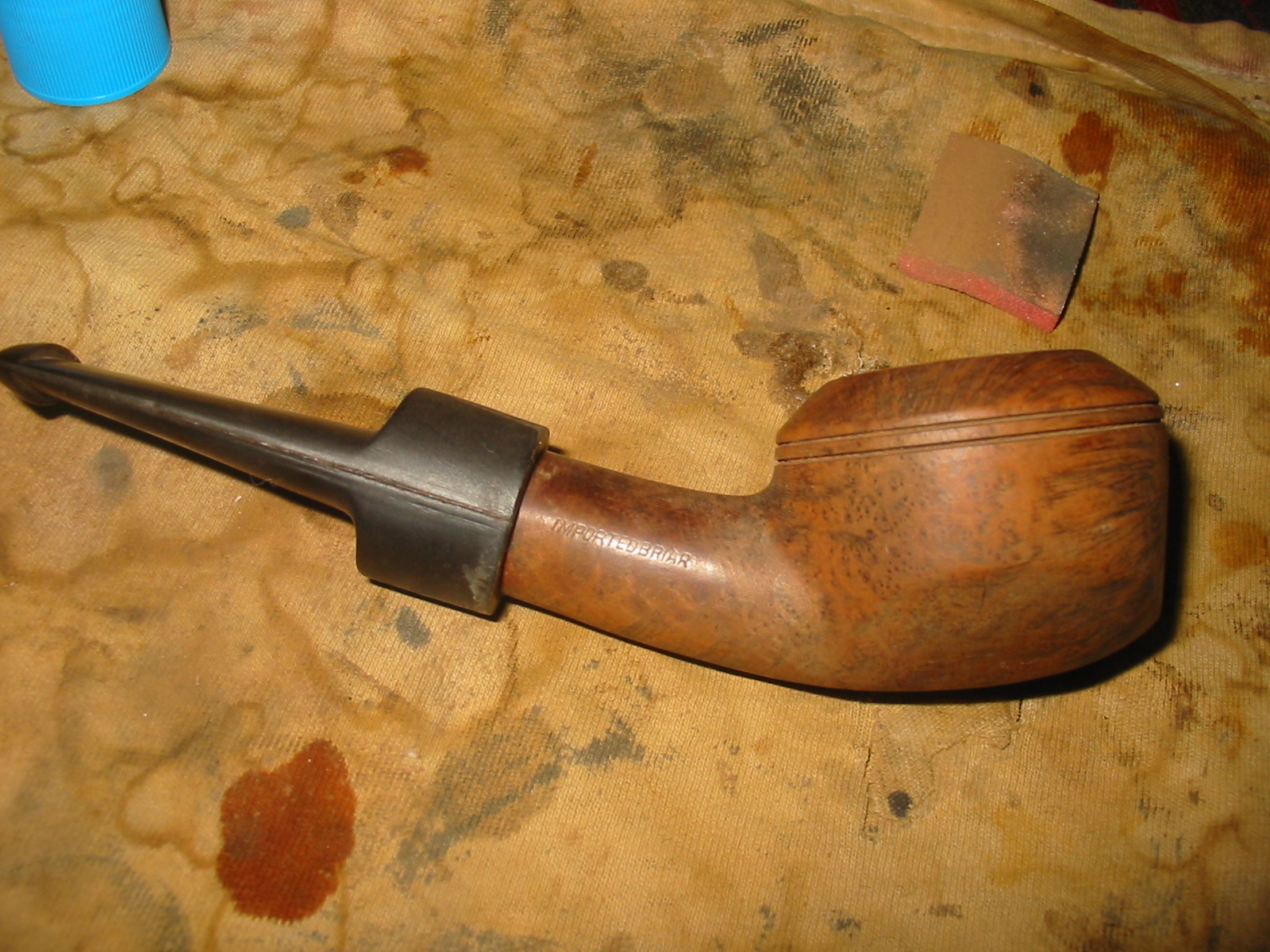
I am not sure who the maker of this pipe original was. It has some rustication patterns that remind me of Dr. Grabow. It has a metal screw mount mortise. The flat base that extends from the bottom of the bowl backward toward the stem also has similarities to a Grabow shape. But this one is only stamped Imported Briar on the bottom of the shank. When I received it the bowl was in rough shape. The finish was gone. The stem was gone, the rim was a beaten and worn down mess. I think originally the rim was probably straight across but it was worn and beaten to the point that it was now angled. If indeed it was originally angled then the rim was badly beaten. Either way it was rough. The cake in the bowl was quite thick. The internals of the shank and airway were quite clean – that was a surprise. The briar was solid and relatively thick and sound.
IMG_5281

IMG_5282

IMG_5283

IMG_5284

As I looked at it and studied it there was something about it that drew me to the shape. The wear and tear still did not hide the fact that there was some life still left in this old pipe. I went through my can of stems and found an old screw mount stem. The stinger apparatus on it was slightly different than the old Grabows that I had seen but it would work. The draw on the stem was very constricted anyway so I figured I would end up cutting the stinger off and drilling out the metal tenon. The stem has lots of tooth marks and chatter but was solid. It was a nylon stem and not vulcanite so it was a little trickier to work with. The diameter was also slightly off and the stem was overturned once it was on the shank.
IMG_5285

IMG_5286

IMG_5287

IMG_5288

I heated the metal tenon with a heat gun until the glue softened and then turned it in the shank until it lined up. This type of tenon is actually very easy to realign.
IMG_5290

IMG_5291

IMG_5292

Once the stem was aligned I reamed the bowl with a PipNet reamer and heads taking the bowl back to bare wood. I wanted to see what the shape of the bowl under the cake was like to assess whether I wanted to continue to put time into the pipe. The interior bowl was actually in excellent shape under the cake. This pipe must have been a good smoker – someone’s favourite pipe.
IMG_5300

IMG_5301

I set up a topping board and sanded the rim at the angle of the bowl to even out the top and to minimize the damage. The back edge was very ragged from tapping the pipe out, or using it as a hammer! It took some time to get the top flat and the angle correct from the back of the bowl to the front edge.
IMG_5302

IMG_5303

I wiped the bowl down with acetone on cotton pads to clean up the grime in the grooves of the rustication and to even out the remaining stain coat. There was also some varnish left on the shank that I wanted to remove.
IMG_5304

IMG_5305

IMG_5306

Once the finish was gone I experimented with a metal band. The shank was not cracked or broken. It was solid but I wanted to see what the shiny silver would look like against the rugged rustication. I also wanted to minimize the slight difference in the diameter of the shank and the stem. I decided I liked the look of the band so I heated it with the heat gun and pressed it into place on the shank. I liked the finished look of the nickel band. I feel it gives a bit of bling to a rough looking pipe.
IMG_5307

IMG_5308

I screwed the stem in place to have a look at the fit and finish of the pipe as a whole. I thought to myself that it would work well. I would need to give the stem a bend to make a correct fit to the sitter style of the bowl but it would work.
IMG_5309

IMG_5310

I decided to sand out the tooth marks and chatter as much as possible. I was hoping that the heat would lift the marks a bit. I heated the stem with a heat gun to do the bending. I bent it over a rolling pin. It took awhile for the nylon to be flexible enough to bend. Bending nylon stems is far trickier than vulcanite. It does not seem to have the memory of vulcanite so once bent it remains even if heated and has to be pressed back into shape. It also kinks very easily so you have to be very careful when bending it. I have also found that the wire in a pipe cleaner heats up and the pipe cleaner can stick to the inside of the stem. All of the above make it a pain to bend this type of stem.
IMG_5313

IMG_5314

IMG_5315

I finished the bend and set it with cold water. I was not happy with the overall look and flow of the stem. The bend was correct in terms of allowing the pipe to sit flat on the bottom of the bowl with the tip of the button arching to touch as well but the flow/arch of the stem was not right. I reheated and tried it a second time and still it did not quite work. I decided to stop and revisit that later.
IMG_5316

The draught on the pipe bowl was wide open and easy but the stem itself was very constricted. The stinger apparatus had a slotted entry into the stem. It was very narrow and seemed to extend quite a distance up the stem. A pipe cleaner would not pass through the stem and the stinger. I decided to sacrifice the stinger end so I sawed it off with a hack saw and then drilled out the airway in the metal tenon. As can be seen in the photo below the drill bit went a long ways into the stem before it broke through the slotted airway. Once I had opened the airway in the stem and removed the stinger the draught on the pipe was excellent – open all the way and passing a pipe cleaner with ease.
IMG_5317

I stained the bowl with an oxblood aniline based stain. I flamed it and restained until it was well covered. I then buffed the bowl with White Diamond on the buffing wheel. The photos below show the bowl after the staining and buffing. The colour of the briar after the stain coat was workable. The black undertones that were deep in the grooves of the rustication worked well with the red of the oxblood stain. The rim colour matched the bowl and the birdseye grain showed nicely on the flat of the rim.
IMG_5318

IMG_5319

IMG_5320

IMG_5321

The stem being nylon required all handwork. I could not use the buffer on it as it would melt and make more work than I desired to do on this pipe. Before I sanded it I used the heat gun to rebend the stem and get the angles and bend correct. Once I had that done I sanded it with 220 grit sandpaper and then with a medium and a fine grit sanding sponge. I then sanded the stem with my usual array of micromesh sanding pads – wet sanding with 1500-2400 grit pads and dry sanding with 3200-12,000 grit pads.
IMG_5325

IMG_5326

IMG_5327

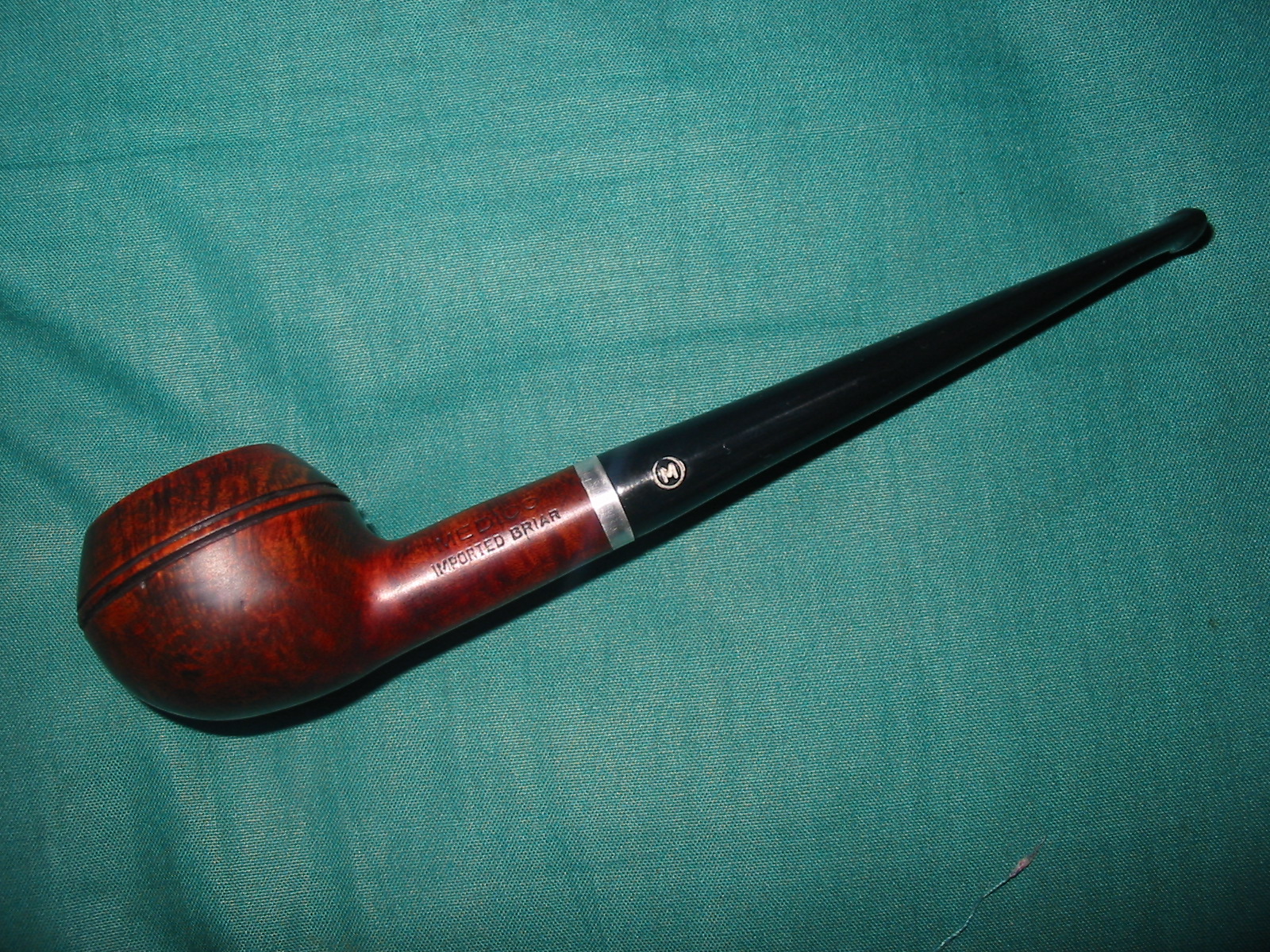
I rubbed the nylon down with Obsidian Oil and once it was soaked in I hand buffed it with Paragon Wax. I gave it multiple coats of the wax to preserve it. I buffed the bowl with White Diamond and then gave it multiple coats of carnauba wax with a light touch to keep the wax from building up deep in the grooves of the rustication. The next series of photos show the finished pipe. The side profile photos show the pipe in the sitter position and also from an angle. The top and bottom view photos show the new finish on the rim and the shape of the bottom of the pipe. This old worn pipe is now freshly reworked and ready to give many more years of service.
IMG_5328

IMG_5333

IMG_5329

IMG_5332

IMG_5330

IMG_5331

Restoring a Briarmeer Rhodesian 175 ED that was Made in Canada


Blog by Steve Laug

I received an email from Andrew saying that he had a pipe he wanted to send my way. It was my kind of shape – a Rhodesian. He said that it was an odd pipe in that on the bottom of the bowl it had a slightly inset circular divot. The round inset was almost like a poorly made plug on the bottom of the bowl, or one that had shrunken with time. He thought that it would be a great challenge for me to do a repair on it. The stamping on the pipe shank was Briarmeer 175 ED Canada.
Briarmeer1

The brand was one I had not heard of before. And since I am in Canada I wanted to try to figure out where the pipe was made and what the plug was about. The name seemed to suggest that it was a meerlined pipe or at least included meerschaum in some form or fashion. Yet when I emailed Andrew about it he replied that there was no meerschaum lining present in the bowl. Instead it was just a nice looking briar pipe with the strange, misfit looking round plug on the bottom of the bowl.
This would require some research to see what I could find out. I went online and searched for any information that I could find regarding the brand. I wrote to the trademark attorney who was listed as the representative of the brand and received a very cryptic answer that was not helpful at all. I did learn however that Briarmeer pipes were made by Briarmeer Pipes Limited, 226 Park Street, Brockville, Ontario. The business was no longer present at that address and did not show up in any Brockville Business Directories available online or through the Yellow Pages .I searched the Canadian, American and British patent sites hoping to find a patent registration for the pipe but was not able to find one. I found a trademark registration document from the US patent office that showed that the brand or trademark was registered in the US in 1973. The document pictured below gives that information as well as the Canadian Registration Number 180,805 and that it was registered in Canada on January 21, 1972.
Briarmeer US Trademark patent

Using these registration numbers I searched both the Canadian and US patent records but could find no patent information available. From the public records it appears that the Briarmeer Company went out of business sometime in the late1980’s or early 1990’s and the name became public domain.

I was able to find out through further digging that the pipe is a variation on what Kaywoodiedid with its famous Carburetor.Kaywoodie had drilled a hole in the bottom of the bowl and inserted a metal airhole to introduce air into the bottom of the bowl to enhance burning of the tobacco. In the Briarmeer the drilled out area in the bottom of the bowl was significantly larger.It had been drilled out and a meerschaum disk inserted in the resultant hole. The draw hole was to be perfectly centered at the bottom of the bowl. From what I could find out the idea of using the meerschaum insert came to a Canadian engineer about 30+ years ago. He reasoned that the meerschaum bottom of the bowl would allow for a drier and cooler smoke while the briar would be sturdier than the meerschaum for the walls of the bowl.Now I knew what the inset on the bottom of the bowl was and where the Meer portion of the Briarmeer name came from.

I decided to see if I could hunt down some photos of the pipe. I had not noticed them before and did not figure I would find many available. I was wrong. I found quite a few clear photos online that showed the novel meerschaum insert with clarity. In all of the photos it was clear that the insert sits inset into the bottom of the bowl and there is a variance in the external bowl bottom and the depth of the inset meerschaum disk. I have included four of the photos I found to show the insert in the exterior bowl bottom. Some of the photos show a new and unsmoked pipe and other show an estate pipe. All have the pipes show the same variation in the depth of the bottom of the bowl and the depth of the meerschaum disk.
Briarmeer6

Briarmeer8

Briarmeer3

Briarmeer pipe bottom

I also learned that the American Company, Briarcraft who made the Smokemaster pipe also made a pipe with called the Briarmeer Acadian. The Briarcraft version of the pipe was a meerschaum lined pipe and was stamped with the Briarcraft logo, a B in a diamond on the shank and on the stem.However, the pipe I was gifted was not a meerschaum lined briar and it did not have the B stamp on either the shank or the stem. The stem appears to be original and the stamping on the shank clearly says that the pipe is Canadian made.

The pipe from Andrew arrived and it was indeed one of my favourite shapes. The finish was a little dirty and the rim had some carbon build up. The stem was oxidized and had some tooth marks on the underside of the stem near the button. There was also a darkened spot like a burn mark on the underside of the shank near the insert. There were several fills in the grooves of the rustication but I was fairly certain that when I restained the pipe they would be hidden. The meerschaum insert looked to be in very good shape from the outside of the bowl. Inside was caked with a fair amount of carbon and the insert was not visible looking into the bowl.
IMG_5192

IMG_5193

IMG_5194

IMG_5195
Upon closer examination it was evident that there was a crack in the shank on the right side that ran at an angle from mid-shank toward the back of the bowl shank union. The crack did not start on the bottom of the shank but rather started midway up on the right side of the shank and ended near the top middle of the shank. It was very clear under a lens that it was present. The next two photos, though slightly out of focus show the crack. It runs across the rustication pattern mid-shank.
IMG_5196

IMG_5197

I cleaned out the crack with a dental pick to remove the buildup of grime that filled it. The grime was evident through the lens. Once I had it clean when I viewed it through the lens I used superglue to repair the crack. Fortunately the crack did not go all the way into the airway. I checked the inside of the airway with a penlight and it was smooth and flawless. The repair externally would remove the visible damage.
IMG_5218

IMG_5219

I left the superglue to cure overnight and in the morning used the dental pick to clean out the grooves of the rustication and sanded the smooth portions of the briar surface with 220 grit sandpaper and then medium and fine grit sanding sponges. The photo below shows the repair after sanding and shaping.
IMG_5227

I wiped the surface of the bowl down with acetone on cotton pads to remove the damaged finish and enable me to blend in the patch when I restained the pipe. I scrubbed the rusticated rim of the bowl with the pads as well and was able to remove the carbon build up.
IMG_5228

IMG_5229

IMG_5230

I sanded the darkened area (burn?) on the bottom of the bowl to lighten it in preparation for staining. I wiped that area down with acetone on cotton pads afterward.
IMG_5231

I sanded the stem with 220 grit sandpaper and a medium and fine grit sanding sponge to remove the oxidation. I sanded the tooth marks on the underside of the stem near the button and was able to remove them.
IMG_5233

IMG_5234

IMG_5235

IMG_5236

I wiped the bowl down a final time with acetone, being careful not to scrub the insert with it. Once it was cleaned off I stained it with a dark brown aniline stain applied with a cotton swab. I avoided the meerschaum insert as I did not want to have the stain penetrate the meerschaum. I flamed the stain and reapplied it. I flamed it again and reapplied it again. After the final flaming of the bowl I set it aside to dry.
IMG_5238

IMG_5239

IMG_5240

IMG_5241

IMG_5243

When the stain had dried I buffed it with White Diamond on the buffer to even out the stain and give it a shine. I also applied a coat of Halcyon II wax to the rusticated surface and hand buffed the bowl with a shoe brush. The next four photos show the bowl after the buffing and waxing.
IMG_5244

IMG_5245

IMG_5246

IMG_5247

I worked on the stem with my usual group of micromesh sanding pads – wet sanding with 1500-2400 grit pads. I then buffed the stem with red Tripoli and White Diamond before going back to the work table and dry sanding with 3200-12,000 grit micromesh pads. I rubbed the stem down with Obsidian Oil and let it soak into the vulcanite.
IMG_5248

IMG_5249

IMG_5250

I buffed the finished pipe with White Diamond and then gave it multiple coats of carnauba wax. The finished pipe is shown in the photos below. The meerschaum disk inset into the bottom of the bowl is an interesting touch. I look forward to loading up a bowl and giving it a test run very soon. At the very least this is a great piece of tobacciana that still leaves a bit of mystery unsolved.
IMG_5251

IMG_5252

IMG_5253

IMG_5254

Out Damned Spot!…or at Least Hide – By Josiah Ruotsinoja


Josiah and I have been emailing back and forth on this old Kaywoodie for quite a while now. I asked him to do a write up for the blog on it as he tried some different ways of minimizing stains to the briar. Each method he used has its own application and effect. Josiah did a great job writing this up and demonstrating the way the method worked and the results of the application. Thanks Josiah for the great work. I look forward to reading more about your refurbishing in the days ahead.

This last August, I acquired a Lot of estate Kaywoodies. All were in fair condition. Some looked like old, loved friends and a couple hardly smoked at all. One was unsmoked with the price sticker still on the stem. I’m guessing that all came from the same estate judging from the burn pattern on the rims. The main issues to be dealt with were the moderate burns on the rim and some spots from sitting in something wet. These spots proved to be the more serious problem, as you may gather from the title.
Among them was this Connoisseur #69 pot.
Josiah1

Josiah2

As you can see, there was quite a lot of grime and a large dark spot on the left side of the bowl. Another, less severe spot was on the bottom of the shank. However, it appeared to be in good condition overall with nice thick walls and no deep dents or scratches. The bowl had some very nice birdseye on both sides. Visions of a nice blond or honey colored stain immediately jumped into my head.

Time to restore! My first steps were to ream the bowl and put it in an alcohol bath and soak the stem in an Oxyclean solution. The stem came clean and polished up nicely without much trouble. I heated up the stinger and screwed it in to the mortise while still warm to correct the alignment.

The grime on the rim came off quickly, but there were a couple pretty deep scorch marks. I started off topping the bowl with 220 grit sandpaper, but it quickly became apparent that it was going to take forever with that fine a grit. So I started over with 80 grit until most of the burn was removed and worked my way up through 600 until it was gone. Then I put a slight bevel on the outer and inner rim.

Now for the real problem. The water marks (I kinda think old motor oil) hadn’t come out in the alcohol bath as I had hoped it would. Having never dealt with removing such marks from wood, I decided I needed to consult someone with more experience. I sent an email off to Steve here at the blog for advice. In response he suggested a few options: lemon juice, bleach, oxalic acid and as a last resort sand paper.

First, I tried lemon juice.That worked to a degree, but the stains were still clearly visible. Here are the marks after the lemon juice.
Josiah3

Josiah4

I figured anything I could see would be more visible after applying stain, but I decided to give it a try anyway. I sanded the entire surface from 220 up to about 6000 grit. I applied stain and flamed it to set the stain. Below is the first attempt…not so successful.
Josiah5

Josiah6

So I sanded off the stain again and went for bleach. I almost ruined the whole project here by leaving the bowl in the bleach too long. It raised the grain quite a bit and penetrated further than I expected.
Josiah7

Josiah8

After sanding, I managed to get most of the white patched off and the surface smooth again.
Josiah9

Josiah10

On to attempt #2 with stain…
Josiah11

Josiah12

Better results, but the stains were still clearly visible. I moved on to oxalic acid crystals. I mixed a paste of crystals and water, applied it, let it dry and sanded the dried mixture off. Use a particle mask when sanding this stuff. It’s not something you want to inhale.
Josiah13

Josiah14

I tried once more with stain and the results were similar to the second attempt. I seem to have lost the pictures for this, but by this time, you get the idea. This last unsuccessful attempt made it clear to me that I must admit defeat and give up my dreams for a shapely blond and give a brunette a try. The repeated sanding, staining and sanding again had taken its toll on the nomenclature and the side profile was starting to flatten out. In order to save the now faint stampings, I chose a nice deep espresso color and success! The pesky spots are now hiding well in the rich stain. I think that only a very well trained eye, or one that knew the stains were there in the first place, would be able to spot them.
Josiah15

Josiah16

So after a lot of work, I have myself a beautiful Kaywoodie pot. Disaster almost struck in its inaugural smoke, however, when the Kaywoodie club fell out of the stem, the original glue having lost its glue-iness after the soak in the Oxyclean. I managed to find it where I had been sitting and it’s safely superglued back in place.

Many thanks to Steve for his suggestions. Even if it didn’t turn out the way I planned originally, I now have options for tackling similar problems in the future and about a pound of oxalic acid to try to remove the stains my 13 year old has left on her bedroom window sill.

Giving a Brewster Round Top Billiard a Face Lift


Blog by Steve Laug

I was gifted a pipe bowl from a friend in exchange for some work on his Peterson. He had no idea of the brand or maker but thought I could have some fun with it. I dug it out of the refurb bin the other evening and began to work on it. I would need to clean it up and then restem it in the process as it did not come with a stem. It was stamped Brewster over Imported Briar on the left side of the shank with no other identifying stamping.
brewster1b
The finish seemed to be a very heavy lacquer that was cloudy with age. The shape was very interesting to me – a billiard like shape with a crowned rim, rounded and quite elevated. I like the looks of it. It is a small pipe – group 2 sized. There were a lot of putty fills on both sides of the bowl, the shank and the rim that would definitely show up once the lacquer finish was removed.
IMG_5103

IMG_5105

The bowl was in great shape with a light build up of cake that was the right thickness. There was no heavy smell of aromatics clinging to the pipe. The shank was clean and the metal insert in the mortise was also clean and in good shape. The thread pattern and the look of the metal fitment looked exactly like a Dr. Grabow set up.
IMG_5104

IMG_5106

I had an old Dr Grabow stem here that was missing the stinger apparatus but the threaded tenon was in working order. I took it from the can of stems I have and gave it a try on the shank. It threaded in perfectly. It was overturned but it fit. This added some objective evidence to my assumption that this pipe had some connection to Dr. Grabow.
IMG_5107

Back Story of Brewster Pipes (If you get bogged down in the history you can skip ahead to the section on the refurbishing process).

At that point in the process I slowed down the cleanup and went to the computer. I was hooked and wanted to see what I could find out about the Dr. Grabow connection to Brewster, if there was one. I wanted to know who made the pipe so I did some research on the web and in some of my books to see what I could find out about the brand. From the book Who Made that Pipe I learned that the brand was Italian made followed by the words unknown maker. I looked on Pipedia and there found much the same information – Italian made followed by question marks as to the maker. After working the web with Google and other search engines the most I could find out was that slight information – the pipe was an export brand of an unknown Italian company.

I decided to take a different tack. I found the Grabow Company site online and wrote an email to their information centre seeking information on the brand. I decided to follow-up on my hunch from the stamping and the metal insert in the shank that somehow this pipe was related to Dr. Grabow pipes. I had no clue how but it certainly had the signs so I went to the Dr. Grabow forum on-line and posted my questions http://drgrabows.myfreeforum.org/index.php . I also did some reading on the forum of back posts and found one series of posts on the brand. I read the following and immediately had more questions. The Grabow connection was not clear but I had found that the pipe may have been a promotional item. Here is the quote that gave me the information”

“A couple months back, I scored a Brewster off eBay for five bucks. Research on this forum and the wild, untamed internet tells me the Brewster pipes were all made in one batch in 1964 as a promotional item for Sir Walter Raleigh.”

Last evening while relaxing, my iPhone vibrated notifying me of a new email. I picked up the phone and saw that I had a response to the questions that I had posted on the forum. Dave Whitney, author of the book on refurbishing called Old Briar, had responded to my request for information. What he sent me was extremely helpful and a true goldmine of information. His answer affirmed the Grabow connection and gave critical information that I had not been able to find anywhere. I have included that information in part below.

Dave Whitney: Here’s what I have from my accumulated notes on Brewster – much of it looks like it came off this forum, ted/td being one of the early ones to help build this forum and a former Sparta CEO:

All the Brewsters were “made” in about 64’… Brewster… is probably from Fratelli Rossi from 64’… Ted, an older pipe smoker than me, suggested the Brewster pipes are comparable to the Willard pipes, and that Brewsters were often sold either with tobacco, or in a coupon offer. For example Brewster was sold as a redemption offer with Brown and Williamson for Sir Walter Raleigh tobacco.

Further information came from Dr. B… I think (in my feeble state of mind, after today) that Brewster was sold as a redemption offer with Brown and Williamson for Sir Walter Raleigh tobacco. But, Mastercraft in 74 had a LOAD of them left. We (Mastercraft) sold them as closeouts along with several pipes in baskets of 4 dozen at $3.98. We also included a bunch of Mastercraft from F. Rossi at the same price……..Rossi pipes are another story……Remind me of the “sticky lacquer” and I’ll tell it…….ted

Mastercraft was founded by Bernard Hochstein, an Orthodox Jew. Old, White Haired, Santa Claus looking (still alive at 96, last time I knew), and he was REKNOWNED for his ability to “strong arm” the European pipe suppliers into selling pipes to M/C at a bargain. Probably the best (never say nothing) negotiator that I’ve ever met. He sold a business (Mastercraft) to UST for 6 million in STOCK. He’s probably worth 60 million today. Mr. Hochstein could negotiate a peace in the Middle East in a very few days, and talk all parties outta’ their pants in the process.

OK, so Mr H “rapes” the Italian suppliers even up till 1964 when the Surgeon General’s (SG) report comes out. As it turns out, “rape” works both ways. A supplier, Fratelli Rossi, (still in business) took an order in 1963 for over 1 million pipes at 1/2 dollar (US) per pipe. When the SG’s report comes out, Rossi has filled a small part of the order for Hochstein, and had orders for a great many more pipes than Hochstein ordered. Rossi decided to experiment with his lacquer …Whose pipes did he experiment on? Hochsteins.

When I started at Mastercraft we had 1215 cartons of pipes from Rossi…Mastercraft Standard….72 dozen per carton, with lacquer so “tacky” that if you held the pipe as if you were smoking it, you’d have to “shake” it out of your hand. Rossi left out the curing agent. Ever touched wet paint?……..After 10 years they were still STICKY…..after 20 years, they were still STICKY.

We fought these SOB’s for years, when finally Luther Marlow (you’ll see topics about him) concluded that we could re-spray them with the Grabow lacquer and sell em’. We did, and we did. Through a “drive” by the UST salesforce, we sold every one. So if you have a Mastercraft Standard with what looks to be “heavy” lacquer, you are probably right.

Hussar…..Rossi also made Brewster. Better lacquer job though… Brewster was sold as a redemption offer with Brown and Williamson for Sir Walter Raleigh tobacco. But, Mastercraft in 74 had a LOAD of them left. We (Mastercraft) sold them as closeouts along with several pipes in baskets of 4 dozen at $3.98.

When I started with Mastercraft in the early 70’s we had over 400 cartons of pipes from Hully. Each carton contained 60 to 80 dozen, most of which were stamped Brewster or Stetson and these had a base cost (from the 60’s or earlier) of $2.80 /dz. Some of the smaller pipes, called Southern Assortment were $1.90 / dz. May be partly to blame for them going out of business.

That was very helpful information on the brand. It gave a definitive date and origin to the pipe. The Italian connection was also clear. The Dr. Grabow link was also clear in Dave’s answer. Now I wanted to know something about maker, Rossi. Dave kindly included that information in his answer as well. It is as follows:

From approximately 1946 up to the end, Ferdinando Rossi II, a grandchild of the founder, headed the company. But after World War II the world of the pipe changed dramatically. Especially in Italy, where those big pipe factories mainly turned out pipes for the lower priced segments of the international mass markets. The demand for these pipes shrunk considerably as more and more smokers turned to cigarettes. Rossi got into this vortex as well. Little by little the number of pipes produced sank. This evolution was accelerated by the upcoming fame of pipes from Denmark. As well, new Italian brands established after the war like Castello, Brebbia or little later Savinelli operated cleverer and thus were more successful.

So the decline went on through the 1960’s and 1970’s, even though Rossi offered more than 800 possible shapes in dozens of lines and uncounted finishes. Besides the completely machine made pipes there were also some lines of semi-freehands and even quite considerable freehands were made. But all these efforts could not stop the fall anyway. Due to increasing financial difficulties Rossi closed down in 1985, just one year before the 100th anniversary.

In the years around 1870 and still later the bulk of Italian pipes was made by time taking and laboriously manual work. Mainly based on families who sold their pipes to travelling purchasers handing them on to some wholesaler. Most pipes were still made of box or olive wood.

Ferdinando Rossi from Milan was one of the most important wholesalers for tobacco related goods of northern Italy. When he attended one of his pipe suppliers in Saint-Claude in 1880 he got hooked on the idea to establish this manner of industrialised briar pipe production in Italy as well. Rossi went abroad several times to buy the hardware here and there because the special features of machines for pipemaking were secrets – well kept by the French in those days. Many machines and tools had to be modified on Rossi’s defaults.

[From the Catalogue “La Regina della Pipa” (1896)] He acquired a large area of land in Barasso in the province of Varese and founded the Fabbrica di Pipe di Radica Rossi in 1886. For sure there was no lack of skilled workers and Rossi personally recruited 30 craftsmen of different occupations from the environment to get started. After a few years the enterprise had developed well and entered into export trades. In 1892 e.g. the ledgers registered the first pipes shipped to Brazil.

One reason of success was the ultramodern conception of the factory and its equipment at the given time. To give an example: a system of canals invented by Rossi drove water to turbines propelling downstream generators, which supplied the entire machinery with electricity. Also lighting and heating were already electrically operated.

In the first years after 1900 Rossi grew steadily and became one of the ten biggest pipe manufacturers of the world. Rossi’s rapid ascent produced further foundations of pipemaking firms in the area.

I love finding out the old company histories of the pipes that I refurbish. I find that it gives a colour and flavour to the pipe I hold in my hands and rework. It gives me the back story on the pipe and adds another dimension to the work of refurbishing. I have included it here for those who enjoy the same kind of history.

The Refurbishing Process (for those of you who have skipped ahead to see the work here is where it begins.)

I screwed the old Grabow stem into the mortise fitment and found that it was overturned. I used a Bic lighter to heat the metal tenon in the stem to loosen the glue. I put the stem back in place and tried to turn it straight, to clock it, but it was not loose enough. I reheated and retried until it was loose. I then turned the stem into place and aligned it with the bowl. I then cooled it under cool running water to set the glue. From the photos below it can be seen that the diameter of the stem was off. In looking at it from the tenon end it was also not round. The bottom part of the stem and the sides were wider than the top portion.
IMG_5108

IMG_5109

IMG_5110

I sanded the stem with 220 grit sandpaper to decrease the diameter but soon grew tired of hand sanding and decided to give myself a head start on the work. I used a Dremel with the sanding drum to remove the excess vulcanite of the stem. I then brought it back to the work table and sanded the shank to make the transition between the shank and the stem smooth and the bowl to remove the lacquer finish.
IMG_5112

IMG_5113

IMG_5114

IMG_5115

IMG_5116

Once I had removed the finish I could see that the number and the size and shape of the fills would make them hard to blend into the new stain. I made a decision to rusticate the bowl at that point in the process. I used the modified Philips screw driver to rusticate the bowl.
IMG_5117

IMG_5118

With the bowl rustication finished and the stem fit finished I set up my heat gun and heated the stem to take out the bend. This particular Brewster shape had a straight stem. I held it above the heat gun until the vulcanite softened and the stem began to straighten on its own.
IMG_5119

IMG_5120

Once it was straight I set the shape by putting it under running water. The straightened stem can be seen in the photo below.
IMG_5121

I took the pipe back to my work table and went over the surface with a brass bristle brush to knock off the rough spots on the surface of the bowl. I also buffed it with Tripoli to smooth it out. I took the photos below to show the new look of the Brewster. The stem and the rustication looked good to me. The smooth rim and the patch with the stamping would look good once the pipe was restained.
IMG_5122

IMG_5123

IMG_5124

I decided to give the pipe a contrast stain. For the bottom coat I used a dark brown aniline stain. I applied it with a cotton swab and flamed it. I repeated the process until the stain had covered the bowl evenly. The dark brown went deep into the crevices of the rustication.
IMG_5127

IMG_5128

IMG_5129

IMG_5130

For the topcoat of stain I chose an oxblood aniline stain. I rubbed it onto the high points of the rustication with a cotton pad. My plan was to leave the dark brown in the crevices and the oxblood on the high points. I flamed the stain and then buffed the pipe with Tripoli.
IMG_5131

IMG_5133

IMG_5134

I sanded the stem with 220 grit sandpaper to finish the shaping and then used medium and fine grit sanding sponges to removes the scratches left behind by the sandpaper. I followed that up by sanding the stem with micromesh sanding pads. I wet sanded with 1500-2400 grit micromesh pads and dry sanded with the 3200-12,000 grit pads. I rubbed the stem down with Obsidian Oil and when it was dry buffed the stem with White Diamond.
IMG_5136

IMG_5140

IMG_5141

I put the stem back on the bowl and buffed the whole pipe with White Diamond. I then lightly buffed the bowl and buffed the stem with carnauba wax. I wanted to preserve the vulcanite and give it a shine. I also wanted to give a shine to the high points of the rustication on the bowl and also polish the rim. The finished pipe is shown in the pictures below. The old Brewster, with all of its history since 1964, is ready to enter a new phase of its own personal history. The face lift I gave it brings it to a new place. It is my hope that this old timer will give someone a great smoke and endure beyond me. That, after all, is what refurbishing work is all about – extending the life of the old pipes and delivering them intact to the next generation of pipemen.
IMG_5142

IMG_5143

IMG_5144

IMG_5145