Tag Archives: restaining

A WDC Bakelite/Briar Pipe like none I have seen before


Blog by Steve Laug

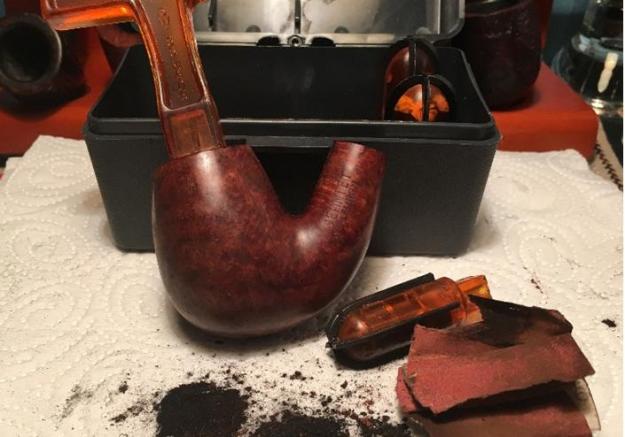
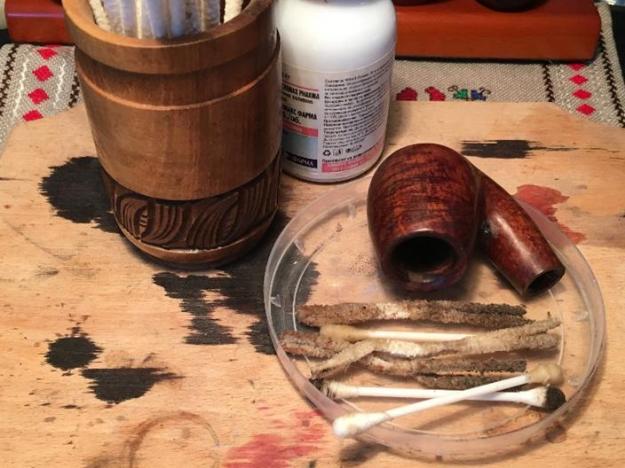
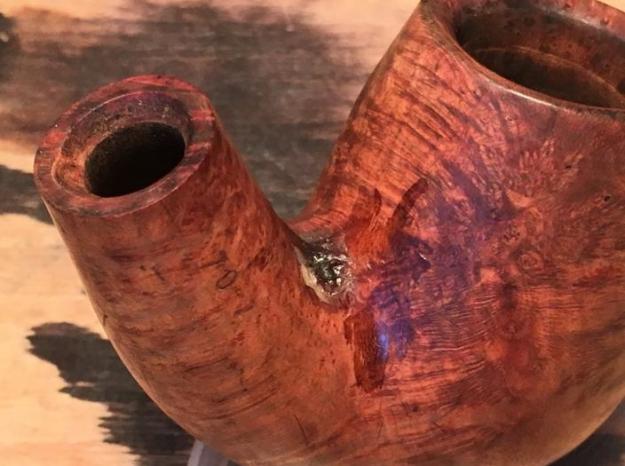
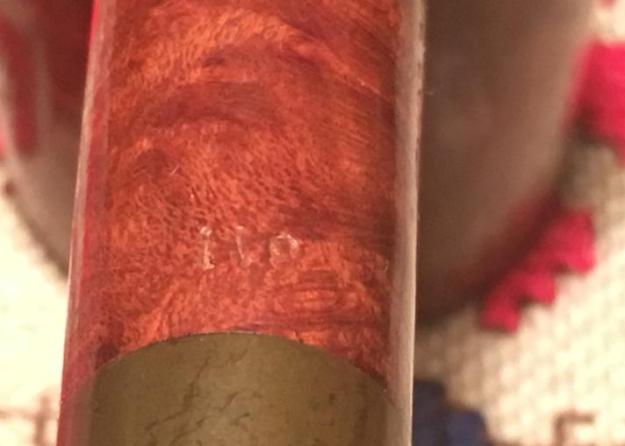
When my brother sent me this pipe I have to say I was surprised and enamored with it. I have cleaned up a lot of WDC pipes over the years and have come to really like them. There is something about them that always gets my attention. The workmanship is generally well done. The materials used are good quality. The briar always tends to have some flaws and is never perfect. But there is something about the brand that I like. Well this pipe is an oddity to me. It is a shape that is similar to some of the CPF pipes I have cleaned up and the combination of briar, brass and Bakelite it really nicely done. The first difference is that this one has a flat rectangular shank and saddle stem. The Bakelite base is rounded and flows into the flattened shank and stem. The stem is also Bakelite or Redmanol as the case may be. It is a rich reddish colour that is translucent and the light really plays with. The second difference is that in a lot of this style pipe the threaded connector and bottom of the bowl is metal. On this one it is white porcelain. When the bowl is removed the threaded connector is also porcelain – a single porcelain unit from the cupped bottom of the bowl to the connector. Those two differences intrigued me.WDC1There is a brass spacer between the base and the briar bowl and at some time in its life the spacer had been reversed and the sharper edges scarred the bowl. The Bakelite is actually notched to receive the sharp turned down edges of the spacer. The bowl had lots of dents and scars – character marks that I wish could talk and tell the story of the travels of this old pipe. The brass rim had long since come loose and was easily removed but for some reason never disappeared as it clung to the rim of the pipe. In the next photo you can see the rim top and the porcelain bottom of the bowl… it almost looks like the old milk glass that my grandmother collected.WDC2After looking at the two pictures above that came from my brother I was looking forward to seeing the pipe in person. When it arrived and I finally took it out to work on it was all that I had expected. The stem was over clocked so that would need to be addressed but I lined things up and took the next set of photos to show what the pipe looked like after my brother did an amazing job cleaning it. (It is great to have him work with me – it really speeds up the process on the restoration. He reams and cleans the pipes and does the dirty work of reaming and removing the debris of the years.) I looked it over to see if there were identifying marks. What I thought was brass may all be what is stamped on the right side of the band – 14K Gold Plated. The left side of the band bears the inverted WDC triangle logo.WDC3 WDC4I took a close up photo of the rim top to show the dents, scratches and scars on the surface. The photo also shows the porcelain cup in the bottom of the bowl. It has three round air holes for directing the smoke into the bottom chamber and into the stem.WDC5I dismantled the pipe to show the many parts that went into its construction. The photo below shows the broken down pipe.WDC6The next photos show the over clocked stem. (I had removed the loose band at this point in the process.) Once the base was screwed onto the stem it was grossly overturned. The metal tenon was set in the stem so it would need to be heated to be able to repair this.WDC7I heated the metal tenon with a lighter and once the glue softened I was able to align the stem and shank very easily. Underneath the band the number 43 had been scratched into the Bakelite shank. I am not sure if that is the shape number or if it is the “autograph” of the assembler of the pipe. Either way it is something that remained hidden for many years. WDC8I set the base aside and worked on the bowl. I removed the rim cap and cleaned off the glue that remained behind on the top of the bowl. It was rough and I was thinking that it was reason that the cap was no longer smooth. I scrubbed out the glue residue in the inside of the rim cap as well with alcohol and cotton swabs. I used a flat blade screw driver to smooth out the interior flat surface of the cap. I wiped down the bowl with acetone to remove the remnants of the finish and then glued the rim cap back in place with an all-purpose glue. I polish the rim with some micromesh and metal polish. I decided to leave some of the dents and dings as to me it gave the pipe character.WDC9 WDC10I cleaned the surface of the Bakelite base and sanded the whole base with micromesh sanding pads from 1500-12000 grit. I rubbed the base down with Obsidian Oil several times throughout the process to give the micromesh some bite as I polished the base. WDC11WDC12I gave the internals a quick clean with alcohol and cotton swabs to remove any of the sanding dust that might have found its way into the bowl base and shank. I also cleaned the airway in the stem at the same time with alcohol and pipe cleaners.WDC13I roughened the area on the base that would be underneath the band to give the glue something to bind to. I used an all-purpose glue and applied it sparingly to the shank. I had previously polished the band with metal polish to remove any tarnish and give it a shine. I pressed it in place and laid the base aside for the glue to set.WDC14I cleaned the inside of the space plate with alcohol and cotton swabs to remove the debris of the years. The spacer appeared not to have been glued in place so I left it that way. I polished it with micromesh sanding pads 1500-4000 grit until it gleamed. I laid it aside until I was ready to put the pipe back together.WDC15I turned my attention to the stem. There were some light tooth marks on the underside of the stem near the button. I sanded these out with 220 grit sandpaper. I wet sanded the stem with 1500-2400 grit micromesh sanding pads. I wiped the stem down with a damp cotton pad and dry sanded it with 3200-12000 grit pads. I gave the stem a final wipe down with the damp pad.WDC16 WDC17 WDC18With the stem finished and the glued band dried I put the base and stem back together. I would still need to buff the entirety with Blue Diamond on the buffing wheel.WDC19WDC20I used a medium brown stain pen to stain the bowl. I heated the briar and then applied the stain with the pen. I repeated the staining until the coverage was smooth and even.WDC21I gave the bowl several coats of Conservator’s Wax and hand buffed it to raise the shine with a microfibre cloth.WDC22WDC23With all the parts finished I took a final photo of the bowl and the base before putting it back together.WDC24I buffed the completed pipe with Blue Diamond to polish out some of the scratches in the base and the stem. I was not able to remove all of them so I left a few behind to tell the story. I gave the pipe several coats of carnauba wax and buffed it with a clean buffing pad. I hand buffed it with a microfibre cloth. The finished pipe is shown in the photos below. I am really pleased with the finished pipe and how it looks. Thanks for looking.WDC25 WDC26 WDC27 Wdc28 WDC29 WDC30 WDC31 WDC32


Another Attempt at a Drier Smoke – a Vintage Dri-Bowl Rhodesian


Blog by Steve Laug

My brother sent me a link to this sale on eBay and I found it intriguing. In the first photo there is what appears to be the edge of a dial on the bottom of the bowl – it is peeking out at the bottom of the bowl. That was intriguing to me. I wanted to know more about the pipe but at this point I had not read the seller’s description of the pipe. I was still looking at the pictures and seeing all of the fills and rim damage on the pipe in the first three photos. It really was quite a mess. The bowl appeared to be reamed but the dings and dents added to the fills made me wonder if it was worth the effort. I still had no idea what the bottom looked like and what made this a dry bowl. Scrolling through the rest of the seller’s photos soon made that clear.Dri1Dri2

Dri3The fourth and fifth pictures remove the mystery of the knurled edge on the bottom of the bowl that showed in the first photo. You can see in that photo of the bowl bottom that the silver disk looks like it was made to be rotated. We talked and my brother bid and won the pipe (I can’t wait for the pipe to get here so I can check this out). The fifth photo shows the inside of the bowl. The top of the disk appears to be a cup intruding into the bowl bottom. It was really odd looking.

I dropped to the bottom of the eBay ad to read the seller’s description of the pipe. I wanted to get some information on the pipe. I had done some searching on Google but was unable to find any information on the brand. It is a bit mysterious. The seller writes:

“This French Briar Rhodesian Dri-bole has a 5/8″ diameter silver metal “sump”, with knurled edge, set into the bottom of the bowl. The “sump” may actually be an alloy of silver, such as coin or sterling; metal is untested, but has silver-like qualities.”

“According to advertisements, found in various 1911 magazines, this “sump” was used to hold a provided, removable “wad”. The throw away “wad” would absorb all of the nicotine and saliva as the tobacco burns. Thus the tobacco was kept dry, so that it would be fully burned.”

“This extra nice Dri-bole pipe has the same “wad” holder or “sump”, as those “silver mounted” pipes patented on Sept. 7, 1909 and shown in 1911 Saturday Evening Post and Literary Digest Magazine advertisements! That would make this pipe over 100 years old, if it is indeed the same Dri-bole pipe! There are not any “wads” with this one, but it should be a good smoker, with a nice look and make a great conversation piece!”Dri4Dri5 That information was helpful on many levels. He did not however have any photos or drawings of the pipe or pictures of the advertisements. I wanted to know if the bottom “sump” as he called it was pressure fit or threaded and screwed into the briar. I wanted to know if the bottom of the bowl was damaged or if the “sump” sat as it was supposed to flush with the bottom. It was hard to tell from the photos. I wanted to know was the “wads” were that sat in the sump. From the look of the bowl bottom it appeared that the “wads” may well have been lozenges that fit in the curved cup and then sat flat in the bottom of the bowl. But what did they look like? More research would be needed to answer these questions. But at least the mystery of the knurled edge peaking from the first photo was solved. It was a single unit with a cup on the inside of the bowl. I could not wait to see this in person and “fiddle” with it.

The seller also included a photo of the stamping on the pipe and briefly spelled out what it said. The left side of shank is stamped DRI-BOLE (in crescent) and below the crescent it reads REG. U.S. PAT. OFF. The right side of the shank is stamped Imported Briar leading me to believe that is it American made. The bottom of shank is stamped “266”. Dri6He gave the dimensions of the pipe as follows: overall length: 5 ½ inches, bowl height: 1 ½ inches, diameter of the bowl: 1 5/8 inches, bore diameter: 7/8 inches, bore depth: 1 1/8 inches and the weight: 44 grams or 1.6 ounces

When the pipe arrived in Vancouver I was looking forward to working on it. My brother had done a great job cleaning the interior and stripping the shiny coat that had been applied to the pipe. It was clean and ready for me to work on. I tried to turn the knurled silver disk on the bottom of the bowl and could not move it at all. The rim looked rough and needed topping. The stem was in decent shape with some pitting and dulling to the old rubber. I was so excited that I forgot to take photos of the pipe before starting my restoration. I put the bowl in an alcohol bath to see if I could loosen the tars that held the silver disk tightly in place. I was guessing it was threaded so I was thinking that if I could soak the bowl overnight things would soften up. Dri7I took it out of the alcohol bath and heated the disk with the flame of a lighter. I used a pair of pliers to hold tightly to the edge of the disk and I was able to twist it out of the bowl. Once it popped free I could undo it by hand. The first photo below shows the inside of the silver disk. The second shows the knurled outside.Dri8To remove the damage to the rim top and edges I topped the bowl on a topping board with 220 grit sandpaper.Dri9There were some nicks around the hole in the bottom of the bowl so I sanded those smooth with sandpaper and then cleaned out the threads in the briar with a cotton swab and alcohol.Dri10I used the brass bristle brush to scrub the threads and the cup on the disk. I cleaned it afterwards with cotton swabs and alcohol.Dri11I used a cotton swab to coat the threads on the disk with Vaseline and turned it into the bottom of the bowl. I wanted to make sure that I could easily turn the disk by hand.Dri12I cleaned out the internals with pipe cleaners, cotton swabs and alcohol. It was pretty clean thanks to my brother. It did not take too many to clean it out.Dri13I sanded the bowl and stem with a medium and a fine grit sanding block. The pipe is beginning to look really good. I had to make a decision how far to sand the bowl and how many of the original dings and dents to remove without changing the “story” and character of this old timer.Dri14I heated the briar and then stained it with dark brown aniline stain cut by 50% with isopropyl alcohol. I flamed it to set the stain and repeated the process.Dri15I wiped down the stain with alcohol dampened cotton pads to make it more transparent and make the grain stand out. At this point the fills stood out and I would need to address them a bit differently.Dri16Dri17I used a black Sharpie Permanent Marker to draw some lines across the fills and blend them into the grain on the pipe. I then chose to give the bowl a second contrast staining using a Cherry Danish Oil stain. I find that the combination of the black marker and the cherry stain blends the fills better than a brown stain. The combination of the brown and the cherry stains gives depth to the finish so I like using them together.Dri18Once the cherry Danish Oil stain dried (overnight) I buffed it lightly on the wheel with Blue Diamond and then gave the bowl a coat of carnauba wax. I hand buffed it with a microfibre cloth. You can see the small dings that I left in the bowl sides rather than change the look. I polished the silver disk with a silver polishing cloth. The next series of photos shows the bowl at this point in the process.Dri19Dri20I set the bowl aside and worked on the stem. The old hard rubber that was used on this stem was good quality. There was very little oxidation if any on it. The main issue was the pitting that covered the surface of the stem. I sanded it with 220 grit sandpaper to address the pitting and smooth out the surface and then began my normal sequence of micromesh sanding pads. Between each set of three grits (1500-2400, 3200-4000, 6000-12000) I rubbed the stem down with Obsidian Oil. I gave it a final coat of the oil and let it dry before I buffed the pipe.Dri21Dri22I buffed the pipe and stem with Blue Diamond and gave it several coats of carnauba wax. I buffed it with a clean buffing pad to raise the shine. I hand buffed it with a microfibre cloth to put the finishing touches on the pipe. The finished pipe is shown in the photos below. Thanks for looking.Dri23Dri24Dri25Dri26Dri27Dri27aDri28Dri29Dri30


A Large Ben Wade Royal Grain Freehand brought back to life


Blog by Steve Laug

One of the recent acquisitions that my brother sent me is a beautiful freehand briar pipe. The briar is a piece of plateau with mixed flame and straight grain. The plateau is on the top of the bowl and also the end of the shank. The plateau was faded with most of the dark stain washed out. The smooth portions of the bowl were also faded and washed out. The stem was oxidized and had deep teeth marks on the top and the bottom of the stem near the stem. There were some scratches on the bowls sides but none of them were deep. The bowl was large – 1 inch in diameter. The inside of the bowl was also quite clean. The photos below show what the pipe looked like when my brother received it.Ben1 Ben2The pipe is stamped Ben Wade over Royal Grain over Hand Made in Denmark. The stamping is clear and readable.Ben3The next photo shows some of the scratches in the bowl. They are not deep but they are visible.Ben4My brother scrubbed the briar with Murphy’s Oil Soap and a soft tooth brush. He rinsed it under running water and cleaned out the interior with pipe cleaners, cotton swabs and alcohol.Ben5 Ben6I took a close up photo of the plateau rim. It is clean and undamaged. I took a close up photo of the stamping on the shank as well. The grain and the stamping are in great shape.Ben7 Ben8I stained the plateau on the rim and the shank with black aniline stain and flamed it to set it in the grain. I used a pipe cleaner to apply the stain because the fuzz on it went into the grain and high spots. I find that it works amazingly well to apply the stain.Ben10I wiped down the bowl with a little bit of olive oil to see what the grain looked like and also so I could sand the bowl with micromesh sanding pads. I sanded it with 1500-4000 grit sanding pads until it was smooth.Ben11 Ben12Once I had sanded the scratches out of the grain I stained it with a mixture of dark brown stain and alcohol – 50/50 mixture. I flamed it and repeated the process until the coverage was good. I kept the brown stain off of the plateau areas of the bowl and shank.Ben13My brother washed the stem with Murphy’s Oil Soap and rinsed it off. The oxidized stem has deep tooth marks on the top of the stem that crossed the top of the stem and the button on the left side. The underside had three deep grooves in it that did not penetrate into the airway. The fact that they did not break through into the airway was the only real blessing in the mess.Ben14I sanded the stem to smooth out the oxidation and to remove the debris around the tooth marks. I wanted the stem area clean so that I could patch it. I used black super glue and let it dry for one hour and then sprayed it with an accelerator to harden it.Ben15I used a needle file to recut the button edges and clean up shape of the button. I sanded it with 220 grit sand paper to remove the excess black super glue patch and blend it into the surface of the stem. The Ben Wade Crown stamp was faint but still slightly visible. I planned on maintaining it as much as possible.Ben16I wet sanded the stem with 1500-2400 grit micromesh sanding pads and rubbed it down with Obsidian Oil. I dry sanded the stem with 3200-4000 grit pads and gave it another coat of oil. I finished sanding it with 6000-12000 grit pads, gave it a final coat of Obsidian Oil and set it aside to dry.Ben17 Ben18 Ben19I buffed the bowl and stem with Blue Diamond on the buffing wheel and then gave the bowl and the stem multiple coats of carnauba wax. I buffed it with a clean buffing pad to raise the shine. I finished by hand buffing it with a microfibre cloth to deepen the shine. The finished pipe is shown in the photos below. It is a large pipe. The dimensions are: length – 7 inches, height – 2 ½ inches, inside diameter of the bowl – 1 inch, outside diameter of the bowl – 2 ½ inches. If this beauty is of interest to you send me a message or leave a response below. It could easily be added to your rack and provide years of service. If it is anything like my Ben Wade Freehand this is likely to be great smoking pipe. Thanks for looking.Ben20 Ben21 Ben22 Ben23 Ben24 Ben25 Ben26
Another ‘Hole in the Wall’ Find – BBB Banker Bent Volcano


Blog by Dal Stanton

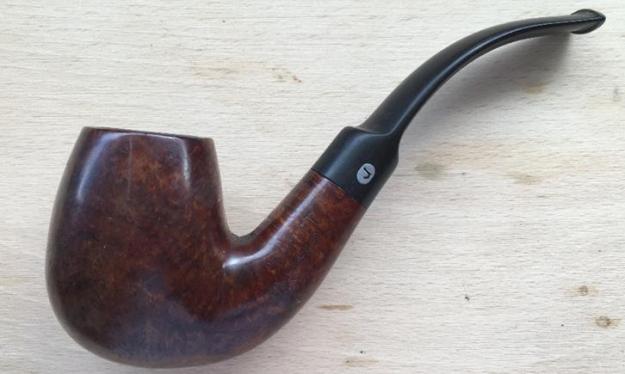
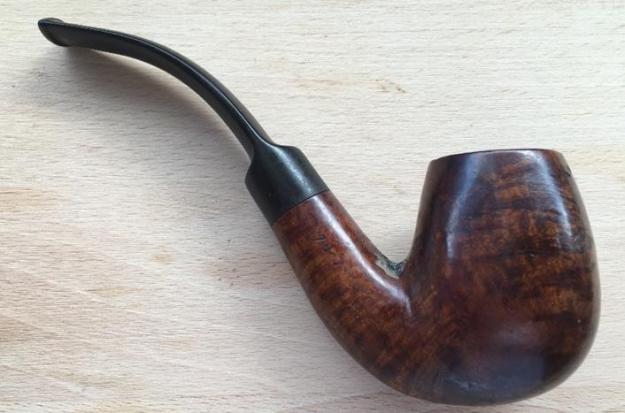
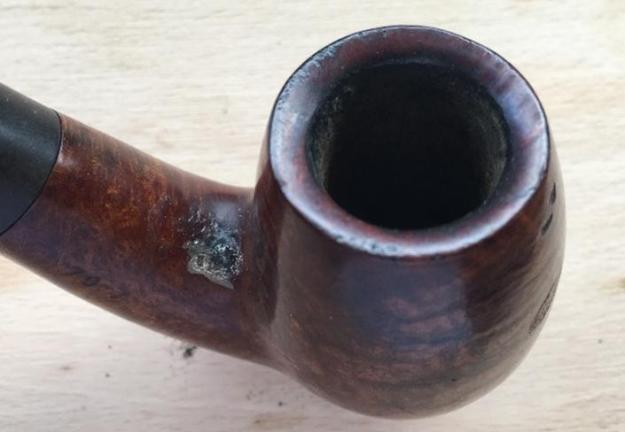
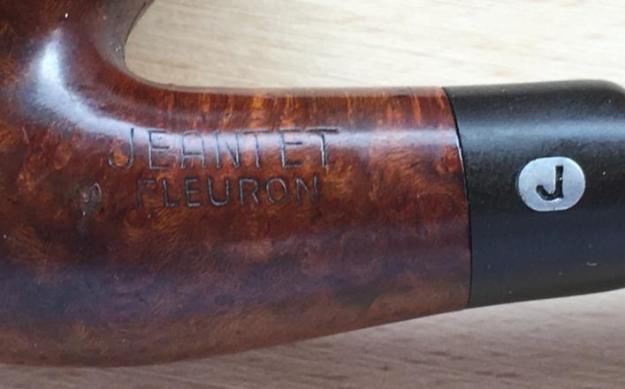
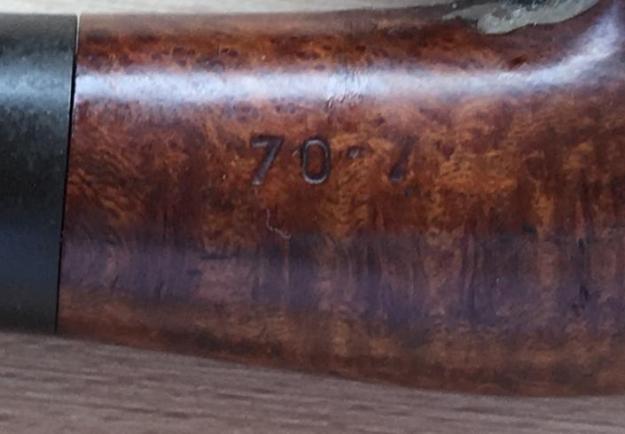
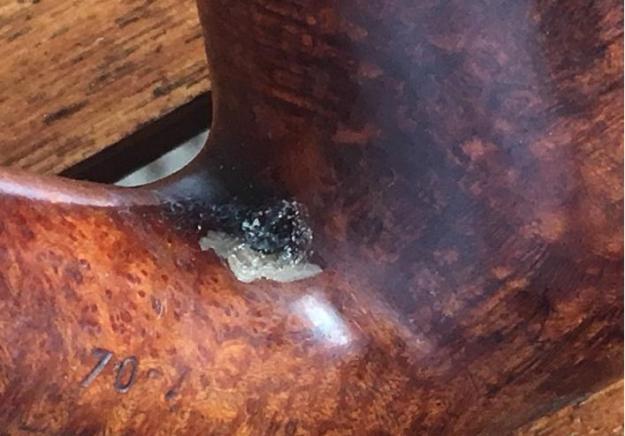
Last April, during one of my earlier visits to what I have affectionately named, ‘The Hole in the Wall’ antique store near the Zhenski Pazar (Women’s Market) in downtown Sofia, Bulgaria, my eyes locked on to a very handsome pipe that called out to me resolutely – “Take me home!”  The pipe was a slightly bent volcano shape, brandishing a broad flattened oval shank and stem that drew my attention.  In my small collection of pipes then, and even today, I have nothing like it.  After taking in the unique shape, the briar grain, obscured by layers of grime and old wax, gave me an internal ‘wow!’ that I carefully kept hidden from the shop owner who would see my excitement as potential greater profit for him – so I played it cool.  I looked at how the grain moves horizontally across the bowl and shank giving the appearance of a tiger pattern looking down on the shank.  Looking straight at the bowl the grain looked like horizontal flames terminating on the sides of the bowl with Birdseye patterns – I was anxious to work on this pipe.  The top of the shank was imprinted with the classic BBB diamond mark over Banker.  Underneath the shank had London, England over 739.  The stem top also had the white diamond BBB mark.  I also spied another pipe in the basket that looked like a good candidate to bundle with the BBB Banker, a French Jeantet Fleuron 70-7 which helped me negotiate 30 Bulgarian Leva for the pair – about 16US.  Not a bad deal at $8 a pipe!  The first picture is the Jeantet followed by the BBB Banker after I arrived home from the ‘Hole in the Wall’ with my newest acquisitions:Bank1 Bank2 bank3 Bank4 Bank5 Bank6 Bank7 Bank8 Bank9I found a lot on the internet about the BBB name.  The small blurb in Pipehill describes the evolution of the BBB moniker:

BBB: ” Best British Briar” is now a brand of the Cadogan Company (Oppenheimer group). American rights to use the brand name were sold to Wally Frank in 1980.

Founder of the brand in 1847: Louis Blumfeld. The oldest pipe brand name in the UK has been registered in 1876 (Blumfeld Best Briar).

Steve also posted a blog on the history of BBB pipes a few years ago using the French article:

https://rebornpipes.com/2012/08/05/history-of-bbb-pipes/

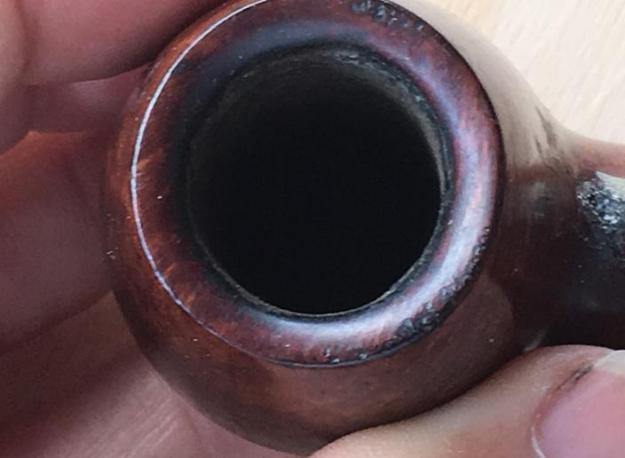
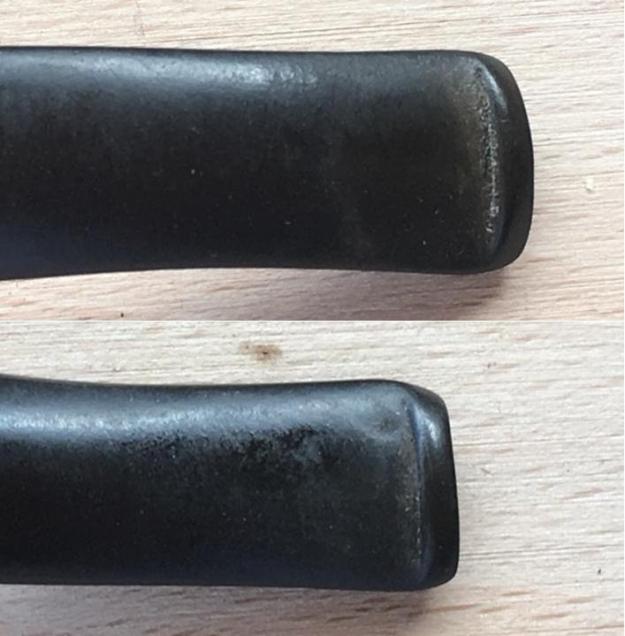
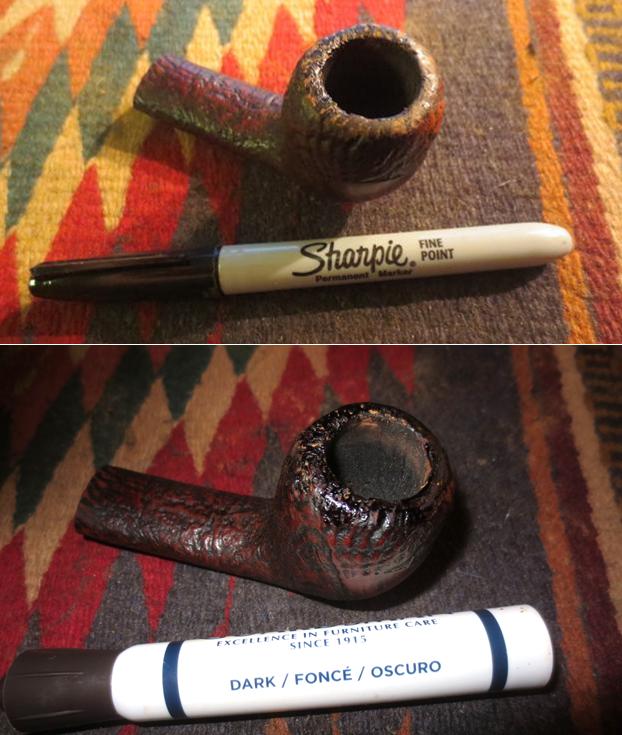
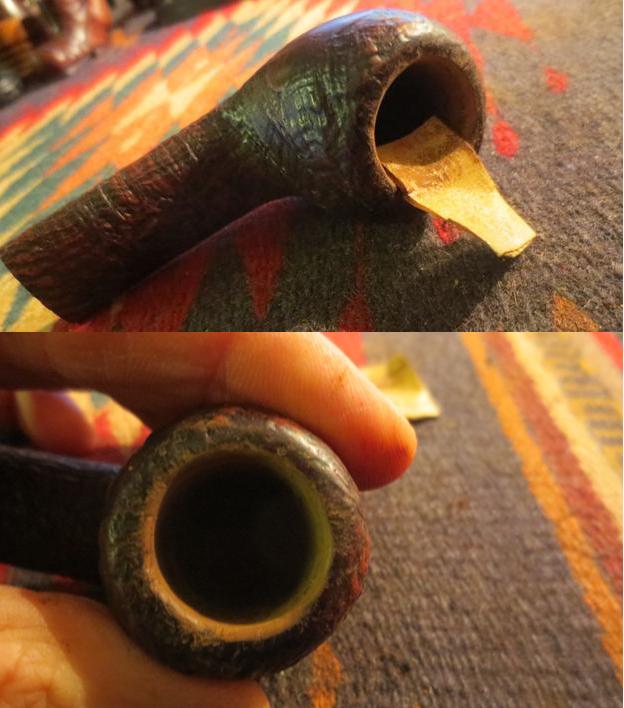
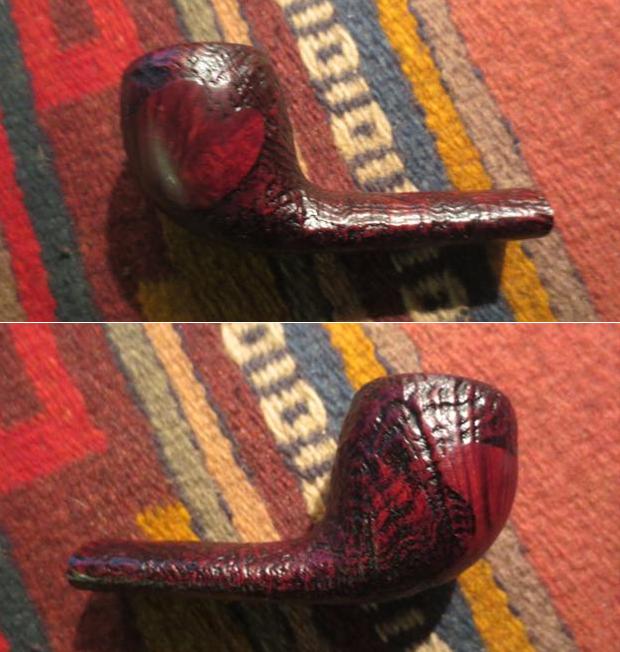
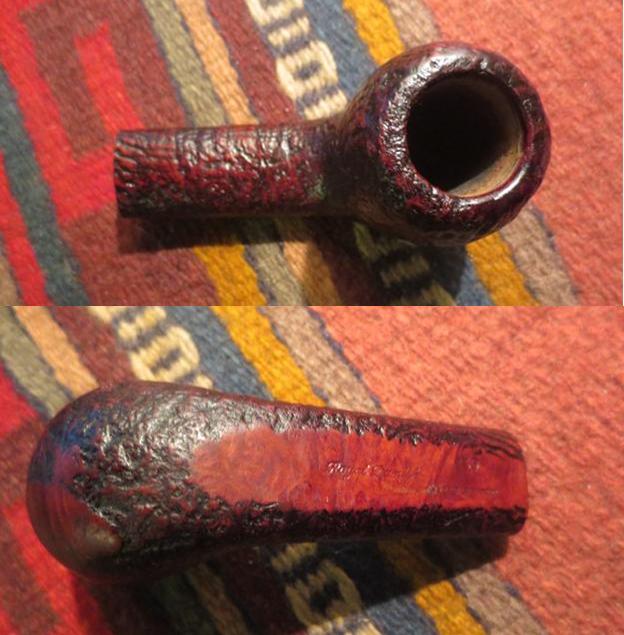
I discovered that there are many BBB collectors and enthusiasts in my research.  Unfortunately, I could find nothing helping me to date or place my BBB Banker except some informed guesses comparing to the BBB stamps (pictured below) depicted in the French article Steve posted above which would probably date the Banker at the earliest in 1989 when the Cadogan Company consolidated manufacturing its various pipe lines at Southend-on-the-Sea, but more likely in the 2000s – not a terribly old pipe (Can anyone help me on that?):Bank10The condition of the Banker is generally good.  There is some cake build up in the chamber but I still want to ream the bowl down to the briar for a fresh start and to be able to make sure there are no problems lurking beneath – which I really don’t expect.  The rim has light grime and lava on it, but a significant wearing down of the front lip so that bare briar is exposed.  The stummel looks to be in good shape – I detect one fill underneath but it looks to be solid and will blend well.  The stummel grain is dulled and obscured by grime and oil build up.  The stem is in good shape – showing almost no oxidation, but has a tooth dent on the lower side of the bit.  I take a fresh close up of the rim to mark the progress.  I begin with reaming the bowl with my Pipnet reaming kit.  As I’ve become accustomed, I try to do the dirtier part of the cleanup on the 10th floor balcony adjoining our bedroom where my work-station is here in Sofia, Bulgaria.  Sometimes I wish I had a basement work area, but we do what we must!  I use only the two smaller blades of the four blades available to ream the cake down to the briar.  I follow the use of the reaming blades with 120 grit sanding paper to clean the cake further and finish with 240 grit on the chamber wall.  The bowl looks good.  True confession – while I was reaming the bowl my thoughts drifted off to a Savinelli reaming knife – on the eBay block, that I’ve had my eye on – one like Steve often employs.  There are still a few days left in the auction and I’m hopeful that I might add it to the arsenal!  I’ll let you know!  In order to get a better idea of the rim’s condition, I clean the external stummel with Murphy Oil Soap and work on the grime covering the rim.  I use cotton pads with undiluted Murphy’s.  I also employ a brass brush to work on the rim.  After the cleaning, I take the stummel to the sink and rinse it with cool tap water.  The pictures show the progress.Bank11 Bank12 Bank13 bank14Ok, for you who have years of restorations under your belts, here are some newbie musings – your patience appreciated!  At this point I realize I need to top the bowl to repair the front lip of the rim – it won’t take much but it is needed.  When one takes the rim down to the bare briar, I’ve learned that one also must have a plan for matching the hue of the old stain if one desires to keep the old stain tone matching the bowl.  I like the color scheme of the BBB Banker and I desire to keep it.  To keep it, I need to match the rim color tone with the rest of the stummel AND I need to address the very minor scratches and wear marks on the stummel surface BUT NOT sand it aggressively to remove the stain.  It is in some ways much easier to take the briar down to the wood with acetone and sanding and then apply new stain and voila!  New surface and color all blended and ready to go.  I know this situation calls for use of polishing compounds and such, which is a more passive approach to dealing with the surface – more opportunity to learn new things!  So, I move forward with topping the bowl with the aim of maintaining the current rich, deep red tones – we’ll see how it goes.  I took the BBB Banker to the topping board – 240 grit paper on a chopping block and rotated it on the paper in a gentle clockwise circle not applying too much pressure – letting the grit do its work.  To make sure I wasn’t leaning into the damaged lip area as I rotated, I eyeballed that the damaged area was untouched during the early rotations which meant the topping was true – I took a picture at this point (second picture).  I took off only enough to clear out the front lip problems.  I think it went well and the bowl looks perfectly round.  As I often like to do, to add a classy touch to the rim I bevel the inside lip.  I make the initial cut of the bevel with 120 grit sanding paper followed by 240 grit.  I’m satisfied with the bevel – not too much but just an accent.  I use micromesh on the rim from 1500-12000 to complete the rim repair preparing it for stain later.Bank15 Bank16 Bank17 Bank18 Bank19Now, the stummel surface.  I have questions rolling through my mind regarding how aggressive I can be to remove small scratches and wear blemishes but maintain the original patina of the briar as it came to me.  I elect to micromesh the stummel surface and leave the small blemishes.  I do not start with the coarsest pad (1500) but at 2400 – gentle approach (though the first picture below shows the 1500 it was not used).  I’m not sure this is the best plan but I can always back up to a more aggressive posture if I’m not satisfied with the results.  After a quick email with Steve, I feel better about the course of action.  I continue on the stummel with micromesh pads 3200-4000 and 6000-12000.  I am loving the briar grain popping out through the micromesh process – one of God’s small creations each piece of briar.  The pictures show the progress:Bank20 Bank21 Bank22As I put the stummel aside to work on the stem, I realized that I was so involved in working on the externals that I forgot that I hadn’t cleaned the internal of the stummel nor stem.  Before working on finishing the stem I decide to use the retort to clean the internals.  Last time I used the retort, an alcohol saturated cotton ball was launched from the bowl during the process.  I was gun-shy of the retort to begin with when I first acquired it – the launch didn’t help.  Notwithstanding, I unwrap the retort, get out the vodka, and proceed to let the retort do its work.  The pipe was surprisingly clean.  After two retort cycles, I finished off with cleaning the internals of stummel and stem with Qtips and pipe cleaners dipped in alcohol.  I think it’s better to clean internals earlier in the process….Bank23 Bank24 Bank25Now to the stem externals.  Earlier, I applied black super glue to two significant tooth dents on the underside of the bit (visible in picture above).  I use 240 grit sanding paper to remove the excess super glue removing traces of the dents as  well as file marks after using a needle file to fine tune the shape of the button. There was very little oxidation on the stem or teeth chatter so I proceed to wet sand with micromesh 1500-2400 and apply Obsidian Oil to the stem.  I follow by dry sanding using 3200-4000 micromesh pads and then the same with 6000-12000 and apply Obsidian Oil and set the stem aside to dry.  I’m pleased with the vulcanite ‘pop’ – that wet reflective look is great.Bank26 Bank27 Bank28 Bank29Well, I mentioned earlier that I was hopeful to add a Savinelli pipe knife to my tool box.  Steve speaks highly of this tool and has increasingly put it to good use in his restoration work.  He also posted a blog describing it when it arrived on his work table in Vancouver.  When I saw one on the block in the eBay’s estate pipes in tobacciana listings a few days ago, I decided to watch the auction and see if I could snag it – it seemed to be calling out to me: “I want to live in Bulgaria!”  As you would guess, others were watching too.  I’m thankful that my bid was sufficient and my new Savinelli pipe knife will be delivered to my daughter and son-in-law who live in Denver.  They will carry it with them to Bulgaria (along with some other supplies I’ve ordered including 32 oz. of Lane BCA Cavendish tobacco which I discovered with great enjoyment on my last trip to the US) when they visit in September!  My son-in-law had no problem agreeing to find space in the suitcases when I bribed him with sharing bowls together of the Lane BCA!  So, I’ll look forward to their arrival for the additional reasons that they will be packing new supplies and my new pipe knife!Bank30The BBB Banker slightly bent volcano is now in the home stretch.  After topping and sanding the rim with micromesh, I left the rim the bare wood until I finished the sanding of the stummel. I did this so that the stain I would eventually apply to the rim would be more closely matched.  Using an Italian brand stick, I applied a dark Mahogany stain to the rim and before it dried, lightly wiped it with a dry cotton pad to remove uneven stain application – the first two pictures below show before and after application of the stick.  I’m very satisfied with the match up of stummel and rim and am anxious to finish the stummel.  Living on the 10th floor of a former Communist block apartment building and with my work station in my bedroom (shared with my gracious and understanding wife!) space is at a premium.  My Dremel high speed tool is my workhorse when it comes to the polishing wheel.  Starting with a felt wheel, I first purge the engaged wheel by using the flat edge of the Dremel’s metal tightening wrench against it.  This softens the wheel and rids it of residue Tripoli caking from previous jobs.  With the newly purged wheel, I begin the final polish of the BBB Banker applying Tripoli to the surface addressing the minor pits and scratches on the bowl surface that I did not sand out aggressively to guard the beautiful patina of this piece of briar.  Bank31 Bank32 Bank33Finished with the Tripoli and Blue Diamond, I change to a cotton cloth wheel for the Dremel and apply several coats of carnauba wax.  I use the slowest setting for the Dremel and keep a continuous circular rotation over the briar surface – oh my, does the grain pop!  I cannot say exactly when this pipe was made, but if it’s been since 1989, someone employed by Cadogan Company’s Southend-on-the-Sea pipe making plant did an amazing job with the choice of this piece of briar and the volcano shape it became.  The grain is beautifully showcased in horizontal movements laterally across the stummel so that one can see the horizontal flame grain facing the stummel straight on and then move to the sides of the stummel and see the grain emerge in Birdseye perspective and swirls.  In the beginning I described the top-down view of the broad, flattened oval shank as reminiscent of tiger fir to me – now as I look at it zebra also comes to mind.  Another example of the beautifully showcased briar grain in the Volcano shape is the broad landscape of its underside – from across the broad shank to the front lip of the volcano base, runs a robust dissecting flow of grain that is majestic from my vantage point.  Yes, I confess, I’m a briar grain junkie.  Its beauty reminds me of its Maker.  With my last application of carnauba wax on stem and stummel, I change to a clean cotton cloth wheel and buff the entire stummel and stem.  Then I give the BBB Banker bent volcano a brisk buffing with microfiber cloth to bring out the richness of this briar even more.  I’ve enjoyed this restoration and look forward to loading the BBB Banker with its first bowl of tobacco in my hands.  Thanks for joining me!Bank34 Bank35 Bank36 Bank37 Bank38 Bank39 Bank40 Bank41 Bank42


A Pipe with a Story – an R.V.W. Handmade 5 pipe


Blog by Steve Laug

My brother sent me pictures of a pipe he found on eBay that grabbed his attention. It was not so much the pipe but the story of the pipe that caught his eye. He sent me the link and I had a look but was not sold on picking up the pipe. But he wanted it so he threw in a bid and won the pipe. He wrote to the seller and asked about it. He received a reply that the pipe had been found in Northern Michigan, US in a mud bank on the Rifle River – farm country in the middle of nowhere. They had no more information. The pipe was dark and looked like the mud bank it had been found in to my eye. The stem looked too long and the flow of the pipe did not work for me.R1The stamping on the pipe was pretty clear which surprised me. On the underside of the shank it read R.V.W over Handmade and then a 5 underneath that. That piqued my interest a bit so I decided to wait and reserve judgment until I saw the pipe.R2 R3 R4While I waited I did a bit of research and found out the pipe was made by Randy Wiley. I Googled to find his website and was directed to his Faceboook page. The link follows: https://www.facebook.com/wileypipes?__mref=message_bubble. I sent him a message on Facebook and related the story that my brother told me. I also included the above photos of the pipe supplied by the eBay seller. The next day I received a message back from Randy. Here is what he wrote: “Hi Steve, Wow, Glad there wasn’t a body with it. I’ll bet it was dropped while fishing. I’ve heard many stories. One day someone will find a pipe while scuba diving. I know the owner. This pipe is a second, RVW. It retails today for around $105.00”

When I first read his response I missed the part about him knowing the owner. This morning I read his response again as I was working on this blog and wrote Randy back regarding that line. I wonder if the original owner would want the pipe returned. We shall see.

When I was in Idaho I taught my brother to do the initial clean up on the pipes. It has been a real help for me. With the box of pipes to be refurbished filling up on this end it is really nice to have him work on them ahead of time. When I get them they have been reamed and the internals all cleaned so it makes my work much quicker. Because this one attracted his attention he really liked the cleanup of it. He reamed and cleaned the bowl and shank as well as the airway in the stem with pipe cleaners, cotton swabs and alcohol. He scrubbed the exterior of the bowl with a tooth brush and Murphy’s Oil Soap to remove the debris left behind by the mud bank. He took the following photos to show the pipe after his cleanup work. The straight grain on the left side, back and front of the bowl and the birdseye on the right side are beginning to show through.R5 R6 R7 R8 R9When I received the pipe I brought it to the worktable and took some photos of it before I began to work on it. While the grain was showing through it was still too dark to my liking. There were also many tiny nicks and pits in the surface from time spent in the mud by the river. These would need to be sanded out. The rusticated portions on the bowl sides and edges were also in need of deeper cleaning. The heel of the pipe had been knocked around and had many nicks and pits. The combination of smooth and plateau on the rim also needed deeper cleaning. The stem still seemed too long to me and if I end up either keeping the pipe or selling it I think I will make a second stem that is more proportional to the pipe in my opinion. The stem was oxidized but did not have any tooth marks or chatter.R10 R11I ran the Savinelli Pipe Knife around the inside of the bowl out of habit with little effect because my brother had done a great job reaming this one.R12The bowl had some white debris in the bottom which I think was water marks from its time in the mud. I used alcohol pipe cleaners and cotton swabs to remove that debris. I scrubbed the exterior of the bowl and shank to remove more of the dark stain with acetone on cotton pads and was able to remove some more dark stain. There was more work to be done in this area but I would keep trying.R13 R14I scrubbed the exterior with a bleach mixture to further remove the stain. The next photos show the effect of the bleach on the stain. The grain is beginning to show.R15 R16I went through my stem can and found a nice amber Lucite stem that was the right length to my eye and would be a great contrast with the bowl. I did not have to do any fitting or tenon work as the stem fit in the mortise perfectly from the start. The stem was bent too much and would need to be straightened and bent to match the flow of the bowl. You can see in the photo below that the new stem is about an inch shorter than the one that came with it when I got it. I put the stem in place and took some photos to get an idea of how the pipe looked with the stem. You can also see the effect of the bleach on lightening the stain on the bowl in these photos.R17 R18 R19I used a Sharpie pen to darken the plateau areas on the end of the shank and the top of the bowl. I also used it on the rustications down the bowl sides and front.R20 R21I used Watco’s Danish Oil with a Cherry Stain to stain the bowl. It is an oil based product and as it dries on the surface it darkens to a black cherry. I applied the stain with a cotton pad and let it absorb into the warm briar.R22When it had dried I buffed it off. The stain had darkened and with the natural darkening that had happened as the pipe lay in the mud the overall appearance almost a rich charcoal grey with red undertones.R23 R24I forgot to take photos of the process of rebending the stem but what I did was boil water in the microwave in a cup and then heated the stem until it was flexible in the hot water. I inserted the tenon in the mortise and then bent the stem to match the flow of the bowl. I held the stem under cool water to set the new bend. There was some tobacco stains in the stem from a previous pipe it had graced. I cleaned it out with pipe cleaners and cream cleanser/soft scrub cleanser until all of the stains were gone.R25There was a groove in the stem on the top side about a ¼ inch from the saddle that I sanded out with 220 grit sandpaper. I worked over the stem with micromesh sanding pads – wet sanding the stem with 1500-2400 grit pads and dry sanding with 3200-12000 grit pads.R26 R27 R28I sanded the bowl with micromesh sanding pads to try to lighten the dark cherry colour of the stain. I finished sanding it with 6000-12000 grit pads to polish the briar.R29While I was finishing polishing the pipe, I received an message from Randy regarding the previous owner of the pipe. He said that he had confused it with one that had been lost while scuba diving. So he could not remember who had purchased this one. I had also asked whether the stem was original and he was not certain.I actually found that to be good news as I did not like the stem that it came with.
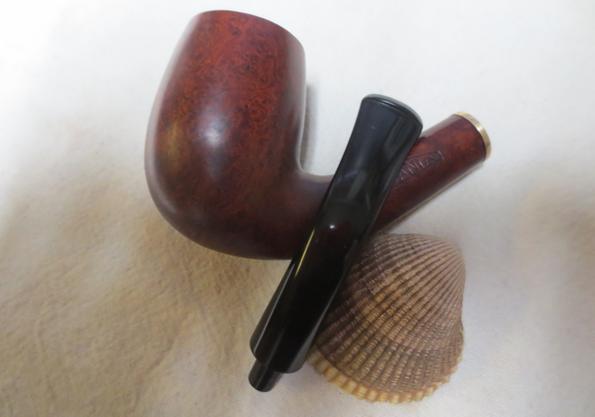
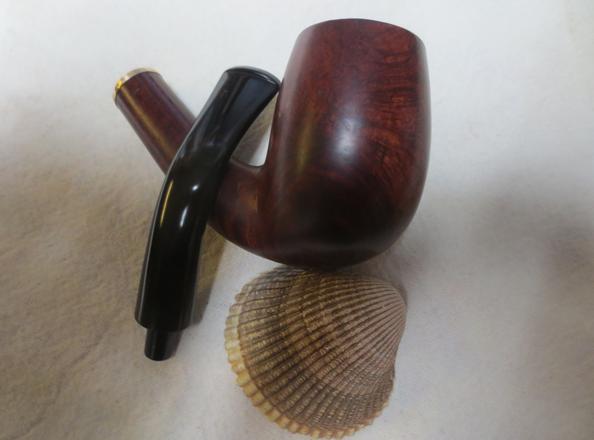
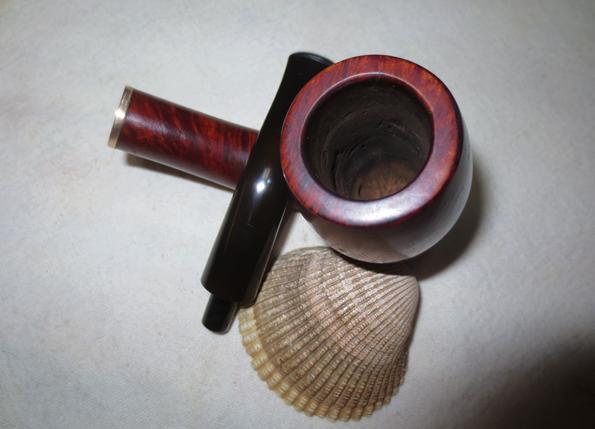
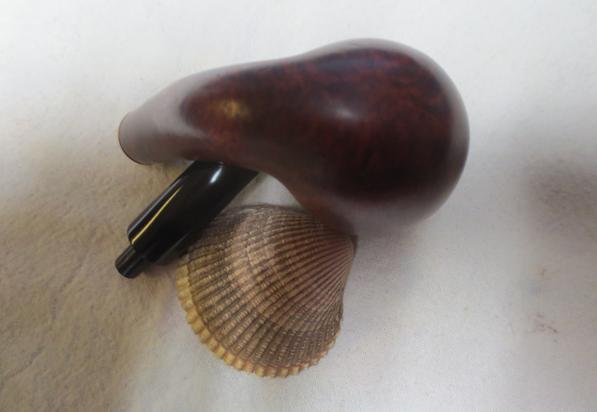
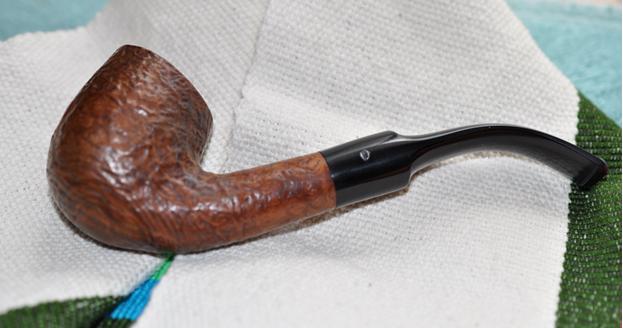
I took the pipe to the buffer and buffed the pipe with Blue Diamond and then gave it several coats of carnauba wax. The briar has many small pits in the surface that I am convinced came from its time spent in the mud alongside the river. Part of me wanted to sand them out and remove them but another part, the part that won decided to leave them to bear witness to the shadow life this pipe had before it was found. I took the next photos with the blanket background as it seems to allow the grain to stand out a bit.R30 R31 R32 R33The next photos I took against a light blue backdrop to show the contrast between the amber stem and the dark cherry stain. Thanks for looking.R34 R35 R36 R37 R38 R39

Marxman Jumbo Lovat


Blog by Aaron Henson

Several years ago when I was first getting into our hobby, I stopped into a local antique store looking for practice pipes.  This particular store did not have much and what few they did were dirty, heavily caked and $25 each. The dirt and the heavy cake didn’t bother me but dropping 25 clams on an old briar pipe for practice was not going to happen.

A few weeks ago, one of my jobs happened to take me past this same store. It had been two years since I had been in so I thought it might be time for another look.  After my last visit I wasn’t expecting much.  When I asked the gentleman behind the counter about pipes he directed me to the same old display case at the back of the store.  The same pipes were on display but this time the price tag had been changed.  Clearly the pipes had been in inventory too long and he wanted to move them because now they were two for $10.   Not one to pass on a deal this good, I selected four large bowl pipes including the Marxman below (shown second from the top) as well as a large caliber Emperor and an unmarked Custombilt look-alike. L1The Marxman is a truly large pipe (and not the largest of the three) with a bowl diameter of 1 1/2”, chamber diameter of 1” and a depth of 1 5/8”.  The shank is a whopping 7/8” in diameter and the bit is that same width. The following page from a 1946 ad for Marxman calls the large size a “Jumbo” but I do not have any way of telling what letter size it might be.L2For background, Marxman only made pipes from 1934 until 1953 before being bought out by Mastercraft.  But Bob Marx’s short run made an impact on Hollywood and on US pipe makers in general. Pipedia has a short article on Marxman.L3Taking the pipe to the work bench I started by cataloging the things that needed to be done.  The bowl had a thick cake built up. So much so that I had to start with the smallest head on my Castleford reamer (and the largest head was too small to be effective to finish reaming the bowl).  The rim had a significant buildup of tars and a couple burn marks.  The outside of the stummel was grimy and had some dents but nothing too devastating.  On the bottom of the bowl there were two dark burn marks.  They were located on the bottom side of the shank which made me think they were not burn-outs but with the bowl cake so thick I could not be sure.  When I removed the stem, I could see that the end of the tenon, the stinger and the inside of the shank were all coated with a heavy tar.  This was going to be an arduous cleaning job. L4 L5For as much build up as there was in the stummel there was little in the way of tooth chatter or marks on the stem.  One small tooth dent on the top side of the stem was all. The button was quite small but the slot was nicely formed. Aside from some oxidation, all in all the stem was in great shape.
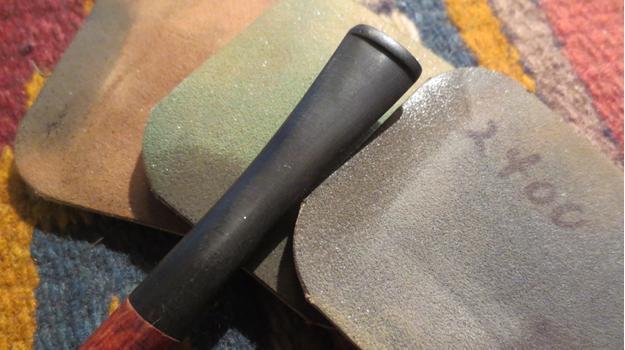
I set the stem to soak in an Oxiclean bath to loosen the oxidation and the tar build up in the air way and turned my attention to the stummel. First I reamed the cake out of the bowl. I could not believe just how much there was!  I took it back to clean briar to make sure there was no burn through. After the largest reaming head, I still needed to finished off the chamber with 80 grit sand paper wrapped around a dowel. There was a slight loss of briar about half way down the bowl but no burn through. If I had to guess, the previous owner may have been in the habit of half loading the pipe early in its life.

I shaped a soft wood stir stick into a narrow spatula shape and used it to clean out the caked gunk in the shank. I also need a short piece of wire coat hanger to open the air way. I finished scrubbing the internals of the shank with bristled pipe cleaners dipped in alcohol and cotton swabs until they came out clean.

Now that the insides were clean I turned to the outside of the pipe.  The rim was heavily coated with crusted tar/lava.  I had hoped to clean up the rim without needing to top the bowl but that was not the case. There were some burn marks in the rim under the tar build up that were best removed at the topping board. When topping a bowl, I use 100 grit paper on a smooth flat surface and work the bowl in a circular motion. I have recently started rotating the bowl a quarter turn every 10 passes. This helps me keep the topped bowl level by ensuring I don’t put too much pressure on one side of the bowl all the time.L6I started cleaning the outside of the pipe by wiping down the briar with acetone. This removed the wax and grime build up. I had hoped that the burn marks on the bottom of the shank were superficial and would be removed with a light sanding but I was mistaken.  I am not sure what happens to the pipe but it appeared to have been exposed to a significant heat source because the burns were deep. The wood was not damaged, that is to say there was no charring.  After a significant amount of sanding with 220 grit I had removed as much of the burn as possible without significantly impacting the shape of the pipe. I was careful to sand the entire area around the burn to blend, or feather, the repair.  Even so, it did not completely remove all of the burn mark.L7Next I steamed out dents by wrapping the bowl with a wet terrycloth rag and applying a clothes iron. The important thing here is to keep your fingers away from the steam and the iron away from any stamping.
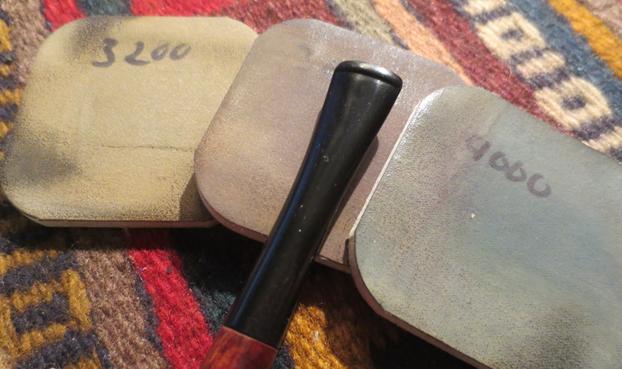
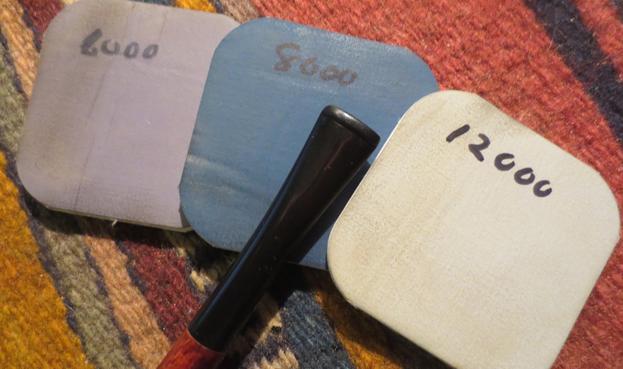
I finished the bowl by sanding the outside with 1500 – 3200 micro mesh pads. I also took the liberty of beveling the inside of the rim which I thought gave the large bowl some visual character.L8Even though I sanded the chamber back I could still smell some ghosts of the old tobacco so thought I would give the pipe a salt and alcohol soak. I let sit for 24 hours but there was still a residual odor.  Before I was done with the restoration, I had to run three tubes of grain alcohol in a retort through the pipe before the pipe was truly clean (sorry no pictures). L9
The original finish was very light colored, almost a natural. To hide the remnants of the burn I decided to go with a light brown stain and contract the worm grooves with a slightly darker stain to make them stand out.  This would also help hide the burn.L10The stem was an easy clean for a saddle bit. The Oxiclean bath had loosened the crud in the airway and a few passes with bristled than soft pipe cleaners took care of the internals. The outside I sanded with 1500 grit micro mesh then added a small drop of black super glue to the one small tooth mark and a another dent that I didn’t want to sand out. I had tried to raise both with heat first but with little success hence the super glue.  Continued sanding with micro mesh pads up through 12,000 grit. I kept the pipe assembled during this process in order to keep the shank-stem connection flush.L11

With sanding and polishing complete I coated the entire pipe in mineral oil and let sit overnight. The mineral oil seems to help hydrate the briar and vulcanite of the stem.L12After 12 hours I wiped off any remaining oil and took the pipe to the buffer.  I went over the whole pipe with red diamond then applied multiple coats of carnauba wax.  As a finishing touch I decided to apply a bowl coating to the chamber.  I wiped the inside with maple syrup then add a table spoon of charcoal powder.  Placing the heel of my palm over the rim I shake the pipe until the charcoal evenly coats the inside.  I let the pipe dry for a week before dumping out the excess charcoal.

Now it’s time to “Relax with a Marxman”.  Thank you for taking the time to look.L13 L14 L15


Restoring ‘The Professor’ – WDC Milano Hesson Guard


Blog by Dal Stanton

This pipe was gifted to me in 1980 while a seminary student.  I was Professor Freundt’s student assistant and I spent much time with him in his office which was a virtual jungle of books, papers and journals – heaped in piles here and there yet the professor knew where to find the most obscure minutia.  Added to the smells of old books and leather covers were the tobacco and smoke that regularly provided an upper layer haze in his work space.  The Professor introduced me to the art and enjoyment of smoking pipes – now some 36 years ago.  I was young and eager, soaking in the ambiance of academia at a post-graduate level and pipes I discovered, were very comfortable partners in this environment.  Professor Freundt gave me the Hesson Guard, showed me how to pack its first bowl in my hands, and I smoked it, adding my offerings to the perpetual haze.  After these days, pipe smoking was put aside until last fall when Steve reintroduced me to it.  At this point, 3 pipes made up my collection: a corncob I also bought during those seminary days to use while fishing and duck hunting, a Willard I received after my grandfather’s passing (a future restoration), and the WDC Milano Hesson Guard that I had tucked away in drawers over the past three and a half decades.   Anxious to put a pipe back into service last fall, I grabbed the Hesson Guard, to clean it and do what I thought then were needed repairs….  I made a mess of the pipe – cracked the shank, reamed out the mortise so that the metal tenon was too loose – sloppy repair with super glue….  I’m anxious now to return to ‘The Professor’ (its given name) and try to make amends for the rough treatment he received last fall!

The right side of the shank is stamped with the well-known WDC inverted triangle next to Milano over Real Briar.  The left side holds Hesson Guard.  The bottom of shank had PAT. 1855800 which enabled me quickly zero in on the dating of the pipe.  The patent application was submitted by the inventor of the special internals, William W. Hesson, in 1930 and granted two years later.  An excerpt from the patent documentation describes the essence of the design:

The principal object of the invention is to provide a pipe which will eliminate contamination of the natural aroma of the tobacco through noxious secretions and which will remain sweet and clean.  A further object is to devise a construction of pipe which will be simple and inexpensive to manufacture and which. will be devoid of pockets to harbor noxious elements.  The principal feature of the invention consists in the novel arrangement of a tubular resilient member surrounding and embracing a metal stem which extends from the pipe bowl to the mouth piece and forming a seal to prevent the seepage of moisture around the metal stem.

(https://www.google.bg/patents/US1855800?dq=1855800&hl=en&sa=X&ved=0ahUKEwibqa2KsOjNAhUFVBQKHZ1DAvMQ6AEIGjAA)

I was curious to compare my Hesson Guard with the patent diagram which essentially is a long metal tenon meeting up with a metal sleeve at the base of the bowl and shank junction.  This design, along with many other designs, was to eliminate the moisture build up, gurgle and gunk.  Figure 1 (below) is followed by my overlay comparison picture – the tube inserts quite a way according to the 1930 design.  Following are pictures telling the current story of The Professor:H1 H2 H3 H4 H5 H6 H7 H8 H9 H10 H11The pipe is attractive and has a good feel in my hand.  The free-hand sculpting on the bowl gives the appearance of flames rising and is showcased in 3 paneled murals around the bowl. I notice that one of the panel dividers has been damaged at the top by cutting the briar.  It looks like they were seeking to connect the panels – not sure.  That will need to be filled in.  The rim will also need some gentle repair to what appears to be nicks created by wear and tear.  The cracked shank will need repair to keep it from growing and cleaning up the metal tenon and creating a good fit with the mortise might be a challenge.  The bit has very mild tooth chatter.  The last picture above captures not only the crack in the shank but the metal sleeve deep in the mortise that the chamfered tube/tenon docks with to create a dryer smoke – according to the patent information.  Before any cosmetic restoration takes place I first must deal with the major issues of the shank crack repair and the tenon/mortise fit.  I start the crack repair by drilling a small hole at the end of the crack to keep the crack from creeping up the shank.  I use my Dremel tool and a 1.5mm drill bit to make the hole. I utilize a magnifying glass to trace the crack which had become a ‘hairline’. I’m careful not to drill too far and breach the mortise wall.  Next time, I want to use a 1mm drill bit to leave less of a footprint.  Next, after inserting the tenon into the mortise to expand the crack area for glue penetration, I create a mixture of briar dust and CA Instant Glue filling the hole and running a line of glue along the crack.  I then sprinkle briar dust over the entire area and wait to dry.  The timing worked out well as my wife just called me for lunch!  After lunch, I work on cleaning up the tenon removing the old superglue with fingernails, Winchester knife, brass brush and 240 grit sanding paper – back in pristine shape. H12 H13 H14Well, after about a week, I return to the Milano Hesson Guard after my wife and I take advantage of the summer opportunities at the Black Sea coast.  We enjoy some days at the beach near our favorite coastal fishing town, Sozopol. While at the beach, I thought about the Milano and how best to approach the overly loose tenon/mortise fit.  Instead of applying clear nail polish around the metal tenon, which is what I did before, I attempt to rebuild the mortise wall by applying a very gentle coat of superglue on the inner wall of the mortise, rotating it as I applied superglue to achieve, what I hope, will be an even texture around the mortise wall.  Amazingly, this seems to have worked!  After drying, I gently reach into the mortise to remove some superglue ‘bumps’ with a needle file and I use a tightly rolled piece of 240 sanding paper carefully to smooth things down.  I don’t want to inadvertently remove too much of the restored mortise wall! I also give the crack repair a light, strategic sanding with 240 grit paper, careful to guard the stampings. I refit the stem and to my relief, a snug fit was restored.H15 H16 H17With the stem refitting correctly and inserted, I return to the shank crack to finish sanding it to remove the excess superglue – I do this with stem in so as to not create unevenness between the mortise and stem shoulder.  Satisfied with the shank crack repair and rebuilding the mortise wall, I put the stem in an Oxyclean bath for a soak to soften up the moderate oxidation buildup. I move my attention to the bowl to ream the mild cake down to the briar and then move to rim repairs and then to the panel repair.  I want to have all these completed before looking at the general stummel cleanup and refinishing. I move out to the 10th floor balcony adjoining my bedroom work station with Pipnet reaming kit to minimize the airborne cake soot – maximizing happy wife status!  I started with the smallest reaming blade moving to use 3 of the 4 blades available to remove the moderate cake in the bowl.  I finished the reaming by employing 120 grit paper on the chamber wall to remove remaining cake and smoothing the wall.  I took a close up of the chamber and rim to show progress and to get a good idea of how to approach the rim repair.  Inspecting the rim, I place a drop of superglue on one particular ‘dent’ that reached significantly down the external side of the bowl.  I’m hoping that this small fill will enable me not needing to take as much off during the bowl topping to repair the rim.H18 H19 H20 H21After the superglue sets up on the rim dent fill, I top the bowl using 240 grit sanding paper on top of a chopping block.  Since the day is beautiful, I again move to the 10th floor balcony to do the work. With the rim having no burns, I expect the surface to plane off evenly without pulls toward softer burned areas of the rim.  I rotate in a clockwise circular even motion and take off only as much as needed to remove the damaged area of the rim.  As I like to do, I create a small bevel on the inner wall of the rim to give a more finished, classier look.  I use 120 grit paper to form the initial bevel angle followed by 240.  I also decide to give the outer rim edge a slight sanding to round off the lip which seems to be consistent with the original Milano design.  Again, I make the initial cut on the lip with 120 grit paper and finish off with 240.  I have grown to appreciate more the rim presentation in finished pipes.  To me, the rim, it’s nuances, are the first thing the eye is drawn to when looking at a pipe – much like the first thing one sees when looking a person are the eyes, then one follows by taking in the general appearances.  The following pictures show the Milano’s rim progress.H22 H23 H24 H25You can see in the immediate preceding picture the rim superglue fill spot at the 11 o’clock position of the rim and the ongoing panel repair just below it (to the left in the picture).  Before moving to the stummel finishing, I now need to resolve the panel repair. I realize at this point with all the stummel repairs (cracked shank, topping and panel line), I will be removing the finish and refinishing the surface in order to achieve an even briar tone appearance.  Now, continue to ‘heal’ the panel cut – earlier I applied superglue to it to build it up.  I take a close up of the panel as it is now in order to know what I have. In order to blend more, I rough up the original superglue with a Dremel stone sander instrument. I apply on top of it a thick mixture of superglue and briar dust to form the restored surface that will join the side briar panel with the solid ring around the top of the bowl. I use toothpicks to mix, spread and tamp the mixture into place. I want this briar dust putty to setup well so I put the stummel aside for the time and turn to the stem which has been soaking in Oxyclean.H26 H27 H28The Oxyclean bath did the job of bringing the oxidation to the stem surface. I attack this initial layer with 000 steel wool and then use 240 grit paper to address the minor tooth chatter – I take pictures of bit top and bottom before starting to show progress. In order to have a good match between the mortise and the stem, I want to eyeball what the fit looks like before I proceed further.  As I suspected, with all the superglue applied to the mortise area, the fit between mortise end and stem was not flush.  I took the stummel back to the topping board and gently rotated the shank end on the board to regain a flush docking between stummel and stem.  After a few rotation cycles and testings to eyeball things, I am satisfied.H29 H30 H31 H32 H33 H34Before starting the micromesh cycles for the stem finishing, I need to remove the lip that I discovered with the shank end over the stem.  With the topping of the shank end, I enlarged the circumference of the end just a bit so that it was a bit larger than the circumference of the stem shoulder – primarily on the lower side of the shank.  I use 240 grit paper to even out the difference between the shank and stem – leaving the stem in place to assure a good, smooth transition! I am careful to use my thumb to cover and protect the nomenclature as I move around the shank with the sanding paper.H35Now to the panel repair below the rim. Using 240 grit sanding paper I bring the hardened superglue and briar dust mixture down to the bowl surface careful to maintain a rounded surface and not to flatten out the area of sanding focus.  The pictures show the progress.H36Dal

I like the panel patch and it will blend with a darker stain.  On a roll, I launch into the clean-up of the stummel and especially the ‘flame murals’ which are filled with grit and dust.  I use a tooth brush with Murphy’s Wood Soap undiluted and work over the entire stummel with special focus in the fire sculpting to remove the surface finish.  I follow this with rubbing down the stummel using cotton pads and tooth brush with acetone to remove the finish deep in the grain of the briar.  I finish my clean-up of the surface by picking the carved crevices with a dental tool.  Using micromesh sanding pads, I sand the high points of the stummel.  Using 1500-2400 I wet sand.  Following, 3200-4000 dry sand and finishing dry-sanding with 6000-12000.  The pictures show the progress – I’m liking the briar grain the micromesh process is bringing out.H38 H39 H40 H41 H42At this point, I have two questions about how to proceed before staining the stummel.  First, I need to clean out the ‘flame’ sculpting and use a black fine tipped permanent marker to darken the flames to give more contrast after the stain is applied.  The other question was how do I treat the stampings of the WDC Milano – Hesson Guard?  Do I protect it from the stain?  Do I cover them with Vaseline?  What? Upon closer inspection, I notice that the left side stamping, Hesson Guard, appeared to have gold left over in the ‘Hesson’ lettering – the rest having worn off (picture below) after the crack repair.  After a quick email to Steve, his input revealed that both sides would have originally born the gold lettering.  So, from my model kit (I’ve been involved in a project for several years building the USS Constitution sailing ship) I discover a bottle of Testors Gold Enamel Model Paint and my wife finds a small brush which I trim with my knife to create a more distinct point.  With Steve’s counsel stored in my mind, I applied the paint over the lettering and wiped off the excess.  To my relief and joy, the gold paint adhered to the crevices of the lettering and the overflow came off with the paper towel.  My first stamping restoration with paint worked well!  Steve also said that there was no need to worry about the new lettering during staining – that the gold paint would repel the stain.  Careful to avoid the new gold lettering, I clean the bowl with isopropyl using a tooth brush to get rid of the residue from the sanding and then I move to highlighting the flame sculpts to bring greater definition to the paneled murals in the finished pipe.  The pictures tell the story.   H43 H44 H45 H46 H47Time to stain and I decide to use a mixture of an alcohol-based Italian stain I found here in Bulgaria with a color description of dark nut.  I want this as the base, but I mix it with a mahogany color water based stain to bring out a slightly more redish tone in the briar.  I think the red will work with the flame sculpting motif and I think this will look good – but of course the briar does what it will with the hues!  After mixing the stains in the shot glass, I apply the mixture to the stummel mounted on the cork and candle stick with cotton balls making sure to cover everything and getting a good thick coverage.  After applying stain, I use the butane lighter to flame the stain.  With the mixture that I made, the alcohol content was too low to ‘flame’ so I evenly moved the lighter flame across the surface to evaporate the alcohol setting the dye in the grain of the briar.  I repeated the process again and set the stummel aside to dry.H48With the stummel put aside, I turn again to the stem.  I re-inspect the button area after the earlier sanding to remove the teeth chatter.  I decide that the button needed a little more attention.  I use 240 grit sanding paper and a needle file to fine-tune the shape of the button before starting on the micromesh cycles.  I wet-sand the stem using 1500-2400 and complete the cycle by applying Obsidian Oil.  While still wet from the oil I continue to dry sand with 3200-4000 micromesh pads, again concluding the cycle by applying Obsidian Oil. The final cycle, 6000-12000 is used and a final coat of Obsidian Oil and I put the stem aside to dry.  I love watching the shine of the stem progressively make it to the surface getting that final wet, reflective look in the stem.  Nice!  The stem pops.  The pictures capture the progress!H49 H50 H51 H52For me, beginning the process of finishing the stummel after the staining dries, is like opening a Christmas present.  The anticipation is to see what actually is under the crust of flamed stain and what the briar grain will reveal.  With the Dremel tool, I begin to remove the ‘wrapping’ using a felt wheel.  Also with a felt wheel I polish beginning with Tripoli and then move to Blue Diamond.  I focus on bringing out the contrast of briar ‘flames’ showcased in the three panels.  I switch to a cotton cloth wheel and apply carnauba wax to both stummel and stem.  After several coats of carnauba, I complete the job by giving the pipe a clean cotton cloth wheel buff followed by a rigorous buffing with a micro-fiber cloth to bring out the deep tones of the briar.H53 H54I’m pleased with the revitalization of ‘The Professor’, WDC Milano Hesson Guard.  I think Professor Freundt, if he were alive today to comment, would agree.  The rich dark tones of the briar, with the hints of deep reds, reminds me of the myriads of leather bindings and books that filled his hazy office.  I’m pleased with the results.  Thanks for joining me!H55 H56 H57 H58 H59 H60 H61 H62


Restoring a Piece of History – A Mastercraft Mark II Zeppelin


Blog by Mike Zarczynski

I first read about Mike’s restoration of this Zeppelin on Facebook in one of the pipe smoking groups. Because I was so impressed with what he had done with the pipe and because I have been looking for one to restore, I wrote him a message and asked if he would be willing to do a write up for rebornpipes. It is a privilege to have him post his first blog here and show us some of his work. I think you will enjoy the work he has done on this unique piece of pipe history. He has written a brief introduction to himself so rather than repeat it I will let him tell you in his own words. “I’ve been restoring pipes for about a year now, I started when I first became inspired by Steve’s blog rebornpipes (it is an incredible honor to have been requested to write an article for the blog). At first it was a way to avoid paying list price for big brands, but now it’s a full blown addiction. I’ve restored fishing gear most of my life and once I started smoking I realized pipes were an obvious choice to fill the need of fixing things.”

The pipe itself:
Being an avid reader of both Charles’ and Steve’s Blogs, I read an article on an odd pipe. Charles had restored a Master-craft Zeppelin pipe for a family member, but one thing crossed my mind, how did it smoke? Months passed by of watching the type and shape, and almost winning a few auctions had me wondering, just how rare is this pipe? I read on pipephil that there were two main versions, Mark I, a smooth pipe, and Mark II, a rusticated pipe. Being a fan of rusticated pipes, I started searching for the second variety. (The idea of rustication is to give as much surface area as possible to dissipate heat.) I finally won an auction and the pipe was received on a Saturday following the transaction.

The pipe was in great shape, no corrosion on the aluminum, a bit of oxidation on the stem, and two fills on the briar. One of the fills had shrunk to the point it needed replacing, but the other could stay.Marx1 Marx2 Marx3First off is to ream the bowl, and scrub the outside (I prefer to work on a clean pipe.) The interior of the pipe was in decent shape with no major burn outs or char. I popped the large fill out and started filling it with layers of CA superglue mixed with briar dust. The result worked nicely and was re-rusticated with a Dremel.

After a good retort and scrub of the “smoke chamber”, I could shine the aluminum in the interior. I shined the nosecone of the zeppelin with 6000 grit sandpaper to give it a shine, but leave the oxidation to give it an antique look. I sanded the stem with 600-6000 grit sandpipers to remove any oxidation and to give it a shine. The stem was also cleaned with 70% isopropyl alcohol and pipe cleaners.

I chose to re-stain the pipe to give it a more contrasted dark-light look with the rustication. I set the dye with the flame of a lighter (gotta love the blue flame of this step) and set it to finish drying. After a quick wipe down and hand buff with conservative wax, the pipe was pieced back together and a “bowl” of Prince Albert Burley was packed to try to give it a start of a cake once again. Here are the results of this restoration:Marx4 Marx5 Marx6 Marx7 Marx8Thank you to Steve Laug and friends for not only letting me write an article on my restoration, but for serving as inspiration and entertainment for this past year, and for the many years to come.

Restoring a Chubby Shank Bruyere Shop Apple


Blog by Steve Laug

This one came to me in the box of pipes from my brother, Jeff. It is stamped Bruyere Shop on the left side of the shank and Imported Briar on the right side. It has a sterling silver band that is stamped STERLING and bears three hallmarks – an Anchor, a Lion and a T. The band thus reads Birmingham (the Anchor), .925 Sterling Silver (the Lion) and the letter T which dates the pipe to 1943. The band appears original as there are no cracks that it is banding or repairing. There is no damage to the pipe under the band. The silver band was oxidized and tarnished. It is pressure fit on the shank. The bowl was in decent shape when I got it – dirty and worn. There were paint specks on the briar. The beveled/rounded rim had darkening and heavy coating of tars and oils. The bowl had a cake that cover the sides and bottom. The thick shank was extremely dirty and oily. The stem had tooth marks on the top side and the underside next to the button. It was oxidized and very dirty as well.b1 b2I took a close-up photo of the rim to show the buildup and the cake in the bowl. The second one shows the stamping on the band that I spelled out above.b3The next two photos show the condition of the stem and show the oxidation and the tooth marks next to the button.B4I scrubbed the bowl and rim with acetone on cotton pads to remove the old wax and grime on the finish. I worked on the rim to remove the buildup that had collected there.B5 B6I used the Savinelli Pipe Knife to cut back the cake to bare briar.B7I sanded the inner edge and top of the rim to clean off the tarry buildup and also smooth out the dents and nicks in the rim.B8I scraped out the shank with a dental spatula and scrubbed the shank with pipe cleaners, cotton swabs and alcohol until it was clean.B9I polished the silver band with silver polish to remove the tarnish and oxidation. The bright shine of the sterling silver came through the polish and I could see that it was going to be a beauty once the tarnish was gone.B10I used a light brown stain pen to restain the rim and polished it.B11I buffed the bowl lightly with Blue Diamond to polish the briar. I buffed it until the bowl and rim matched each other.B12 B13I sanded the stem with 220 grit sandpaper to remove the tooth marks on the top side of the stem. I repaired the one on the underside with black super glue. I built up the top of the button on both sides of the stem with black super glue. I sprayed it with an accelerator to dry it quickly.B14I used a needle file to rehape the sharp edge of the button and smooth out the surface of the stem.B15I cleaned out the airway with pipe cleaners and alcohol to remove all of the oils and tars in the stem.B16I sanded the stem with 220 grit sandpaper to remove all of the oxidation. B17I wet sanded the stem with 1500-2400 grit micromesh sanding pads. I gave the stem a coat of Obsidian Oil and dry sanded it with 3200-4000 grit pads. I gave it another coat of oil and sanded it with 6000-12000 grit pads. I gave it a final coat of oil and set it aside to dry.B18 B19 B20I buffed the stem and bowl with Blue Diamond on the buffing wheel to polish it. I gave the bowl and stem multiple coats of carnauba wax and buffed it with a clean buffing pad to raise the shine. I hand buffed it with a microfibre cloth to deepen the shine. The finished pipe is shown in the photos below. If anyone knows anything about the Bruyere Shop please let me know in the response below. Thanks for looking.B21 B22 B23 B24 B25 B26 B27

ADDENDUM

I was doing some reading on the web and found a reference to a pipe shop in Buffalo, N.Y. called the Bruyere Pipe Shop in a May 1953 Popular Mechanics Magazine. I wonder if there is a tie…


Restemming and Restoring a Hardwicke’s Freehand


Blog by Steve Laug

One of the pipe bowls that came to me in the box of pipes from my brother was a tall nicely grained freehand that was stamped on the shank Hardwicke’s and Italy on the underside of the shank next to the shank stem junction. H1I had never heard of the brand before and it was not listed on Pipedia or on the Pipephil website. The more I looked in my usual sources such as Who Made that Pipe the more stymied I was about the brand. It was an interesting shaped bowl. The bowl had some dark marks on the shank, the bowl bottom and on the right side at the point and up the side midway. There was a thick coat of urethane over the entire bowl and the faux plateau. The rustication on the rim matched that of the end of the shank and had been done with tools. There was a thick coat of tars and oils under the urethane on the rim. The bowl itself had a thick cake in it that filled it from top to bottom. The first quarter inch down from the top of the rim had a darker stain that ran down the walls. (I almost forgot to take photos of the bowl before I had sanded all of the urethane off the surface. I stopped and caught these. On the lower part of the bowl on the right side there was a spot of real plateau.H2 H3I went through my box of stems and had a stem that would work really well with this pipe. It would need to have the tenon end reduced so that it would sit in the mortise.H4I decided to Google Hardwicke’s Cigar and Pen to see if the pipe could have been a shop pipe. It was made in Italy but the Hardwicke’s stamping pointed elsewhere. I found that there was a group of shops in Indianapolis, Indiana. The main shop was located at 743 Broad Ripple Ave, Indianapolis.H5One reviewer of the shop had this to say about the shop: “This small cigar shop is located just south of the circle, so in the heart of downtown. They carry a pretty impressive stock of cigars and the pricing is relatively reasonable considering their location. The staff is incredibly knowledgeable and willing to help you find something in your price range. They do have a lot of cigars at the $5 price point so don’t be put off by the fact there are also a lot of $15+ cigars.”

“They also have their own brand, which is rolled with several different tobaccos and in several sizes, these should not be overlooked, especially if you don’t want to spend a lot on your smoke.”

“They also offer pens, pipes, pipe tobacco and the usual array of cutters and lighters you’d expect from a cigar shop. I’ve only purchased cigars here so cannot comment the rest of their offerings, although their selection of pipes does seem good to me.”

Further digging found an article in the Indy Star newspaper about the Downtown shop closing. The article also says that the Broad Ripple Store remains open. I have included the link to the article as well the article in full. http://www.indystar.com/story/money/2016/01/20/smoke-free-downtown-landmark-hardwickes-exits/78800744/

Hardwicke’s Pipe & Tobacco, a long-time Indianapolis fixture, seems to have shuttered its Downtown store.

The inventory was being removed last week, and a store clerk said closure was imminent. The store now stands empty, void entirely of the fine cigars, cigarettes and pipes the retailer sold for five decades.

Hardwicke’s Broad Ripple store, which predates the Downtown shop, remains open. Staffers answering the phone there declined to comment on the fate of the Downtown location, which had occupied a storefront at 18 N. Meridian St., just off Monument Circle, since 1977.

The demise of Hardwicke’s Downtown comes amid a flurry of change for Indianapolis’ old-time businesses.

Last month Kincaid’s, the high-end meat market at 56th and Illinois streets that had been in the same family since its founding nearly a century ago, was sold. Virginia Jarvis Coiffures, a beauty shop for many of Indianapolis’ leading women since 1965, closed its doors Saturday. G. Thrapp Jewelers, in the Butler-Tarkington neighborhood, closed Sunday after 33 years.

Contact IndyStar reporter Will Higgins at (317) 444-6043. Follow him on Twitter @WillRHiggins.
So now I knew that the pipe I had was indeed a shop pipe made for Hardwicke’s Tobacco Shop of Indianapolis. Now it was time to work on it and restore and restem it. I sanded the bowl with 220 grit sandpaper to remove the urethane finish that covered the grime and the burn marks. I sanded the burn marks and tried to reduce the damage to the briar. The more I worked on them the more I am convinced that they were not burn marks but rather dark stains that happened when the bowl was laid in something that left a stain mark. I remember when my mom made pickles when I was a lad and the jars of vinegar left dark rings in the oak table top. These looked identical to the ones I remember as a boy. I sanded and was able to remove several of them. I wiped the bowl down with acetone to clean off the stain and the dust.H6The rim was thickly caked. I worked on it with a brass bristle wire brush and a dental pick to remove the build up on the rim. You can see from the second photo the rustication pattern in the faux plateau on the rim. It is identical to the one that is cut on the end of the shank.H7I reamed the bowl with a PipNet reamer and took the cake back to bare wood. I cleaned up the edges and the bottom of the bowl with the Savinelli Pipe Knife.H9I sanded the bowl with a medium and fine grit sanding sponge and then with 1500-2400 grit micromesh sanding pads to remove the scratching in the surface left behind by the 220 grit sandpaper. I remove the darkening around the top of the rim so the surface of the briar was the same over the entire bowl.H10 H11The bottom of the bowl shows a scratch in the surface that looks like it is a hairline crack. Looking at it with a magnifier I am pretty sure it is a scratch and not a crack.H12To deal with the darkened spots on the shank and the bowl bottom as well as the scratch I decided to use a contrast stain. I stained the bowl with a black aniline stain and flamed it. I repeated the process until the coverage was even.H13I wiped down the black stain with alcohol on cotton pads to remove the stain in the body of the briar and leave it in the grain.H14I washed it down with an alcohol damp pad and gave it a top coat of brown stain. I flamed it and applied it until the coverage was even. Then I set it aside to dry.H15I used the Dremel and sanding drum to reduce the diameter of the tenon. I cleaned it up with a piece of 220 grit sandpaper. I put the stem in the shank and took some photos of the look of the pipe at this point in the process.H16 H17 H18I sanded the stem with 220 grit sandpaper to remove the tooth chatter on the top and bottom sides of the stem at the button.H19I cleaned out the airway with a pipe cleaner and alcohol. It was not dirty at all which surprised me.H20I wiped down the bowl with alcohol on cotton pads and then buffed the bowl with Blue Diamond on the buffing wheel.H21 H22I wet sanded the stem with 1500-2400 grit micromesh sanding pads and rubbed it down with Obsidian Oil. I dry sanded with 3200-4000 grit pads, gave it another coat of oil and finished sanding it with 6000-12000 grit pads. I gave it a final coat of Obsidian Oil and set it aside to dry.H23 H24 H25I buffed the bowl and stem with Blue Diamond on the buffing wheel. It removed a little more of the brown stain and made it a bit more translucent. I gave the stem and bowl several coats of carnauba wax and buffed it with a clean buffing pad to raise the shine. The new stem looks like it belongs with the pipe and the curve of the bowl and the new stain look great in my opinion. The grain on the pipe is very nice. The black and brown stain combination hides the dark mars on the shank and the bowl. They are still present but blend in nicely. Thanks for looking.H26 H27 H28 H29 H30 H31 H32