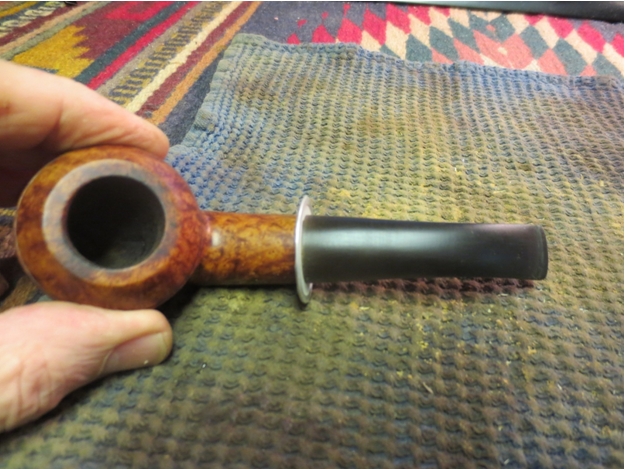
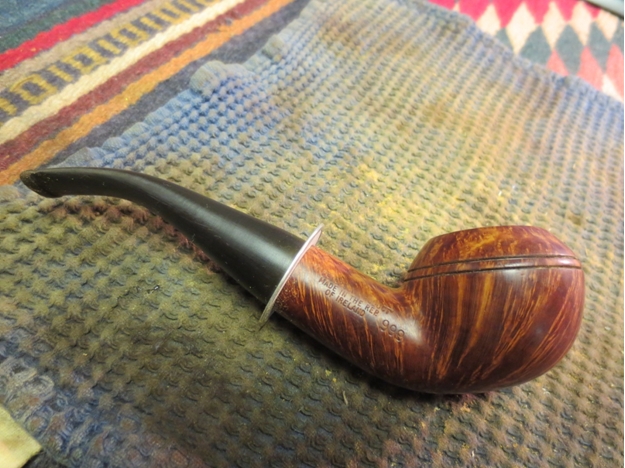
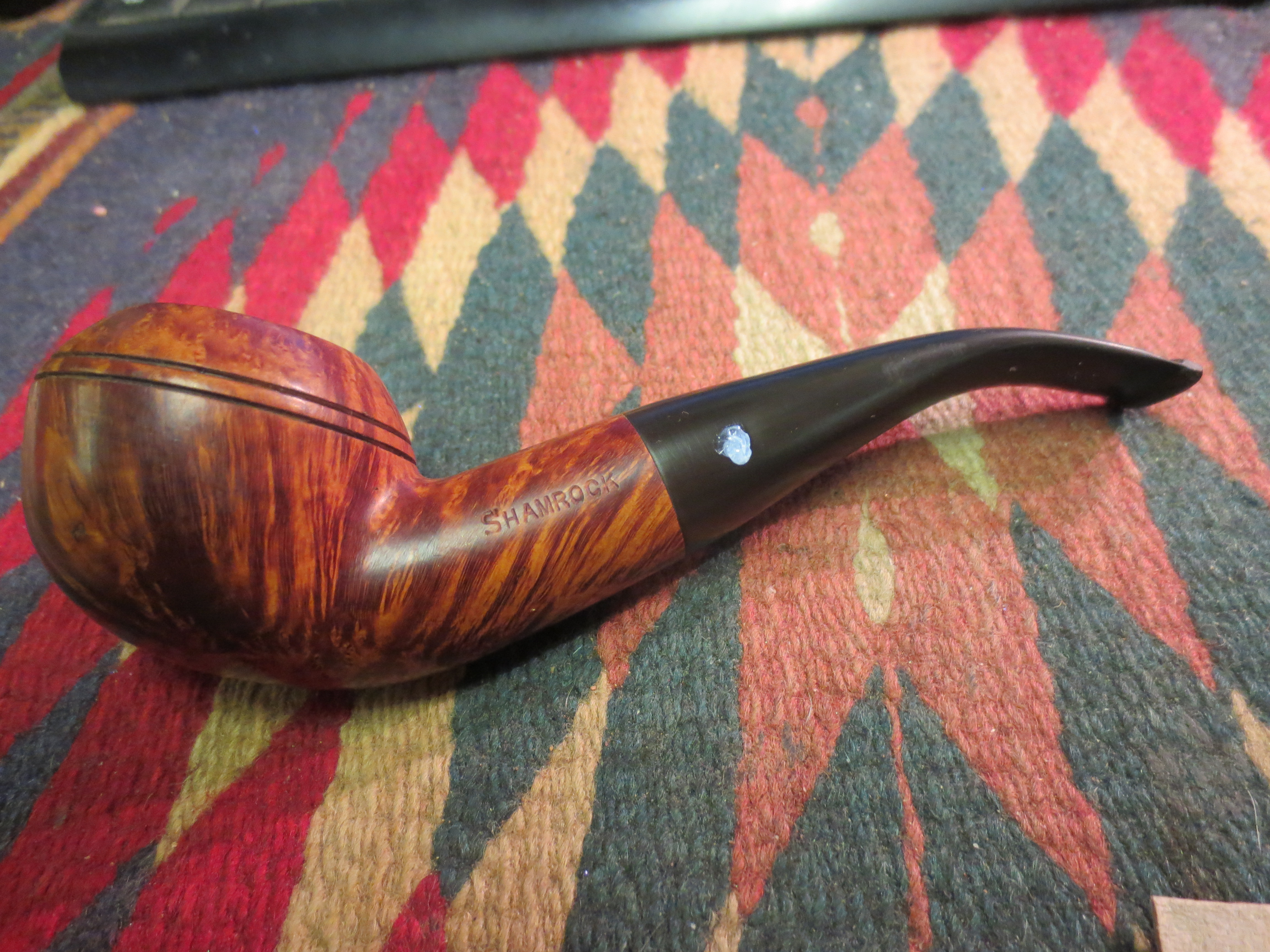
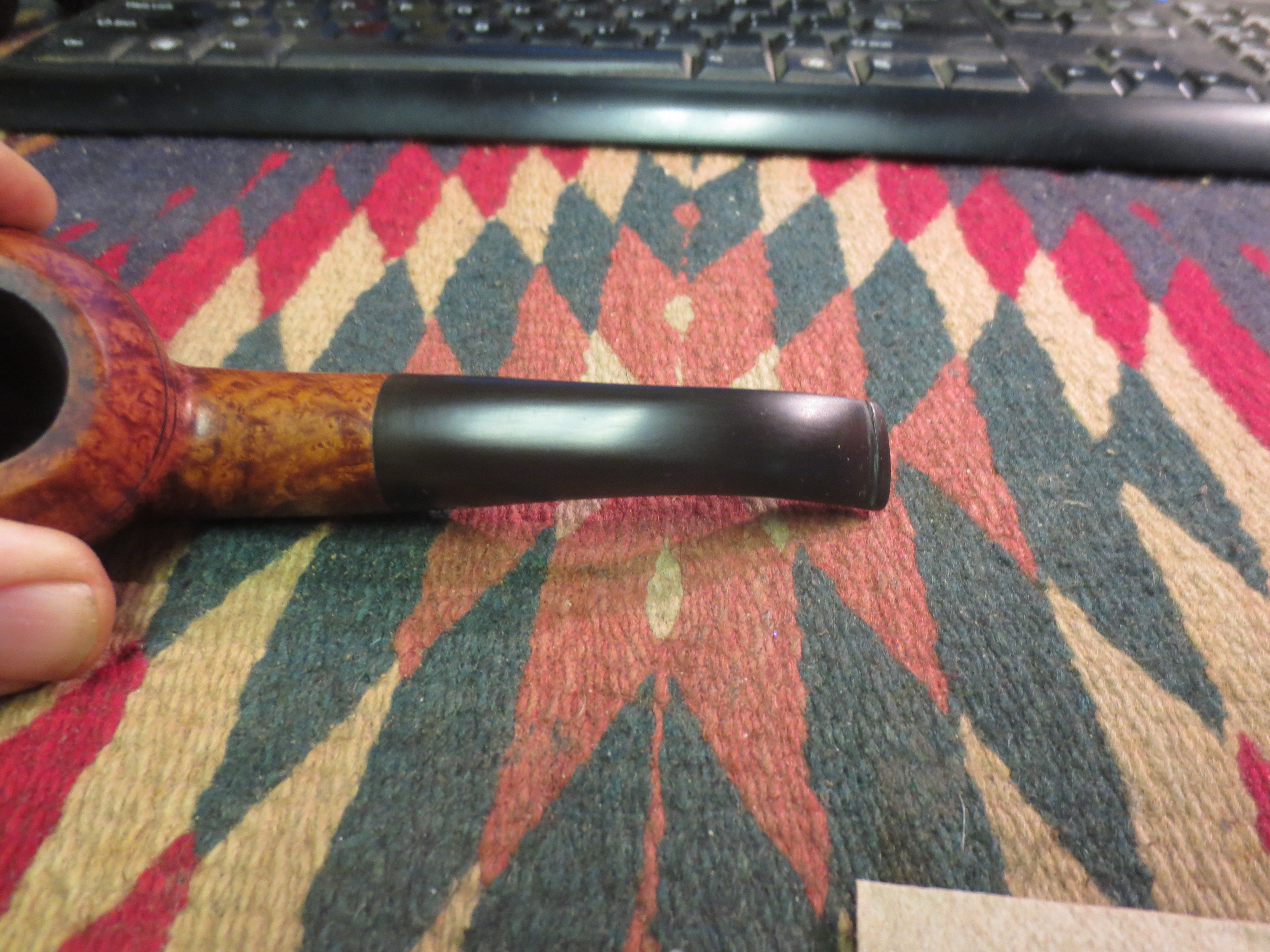
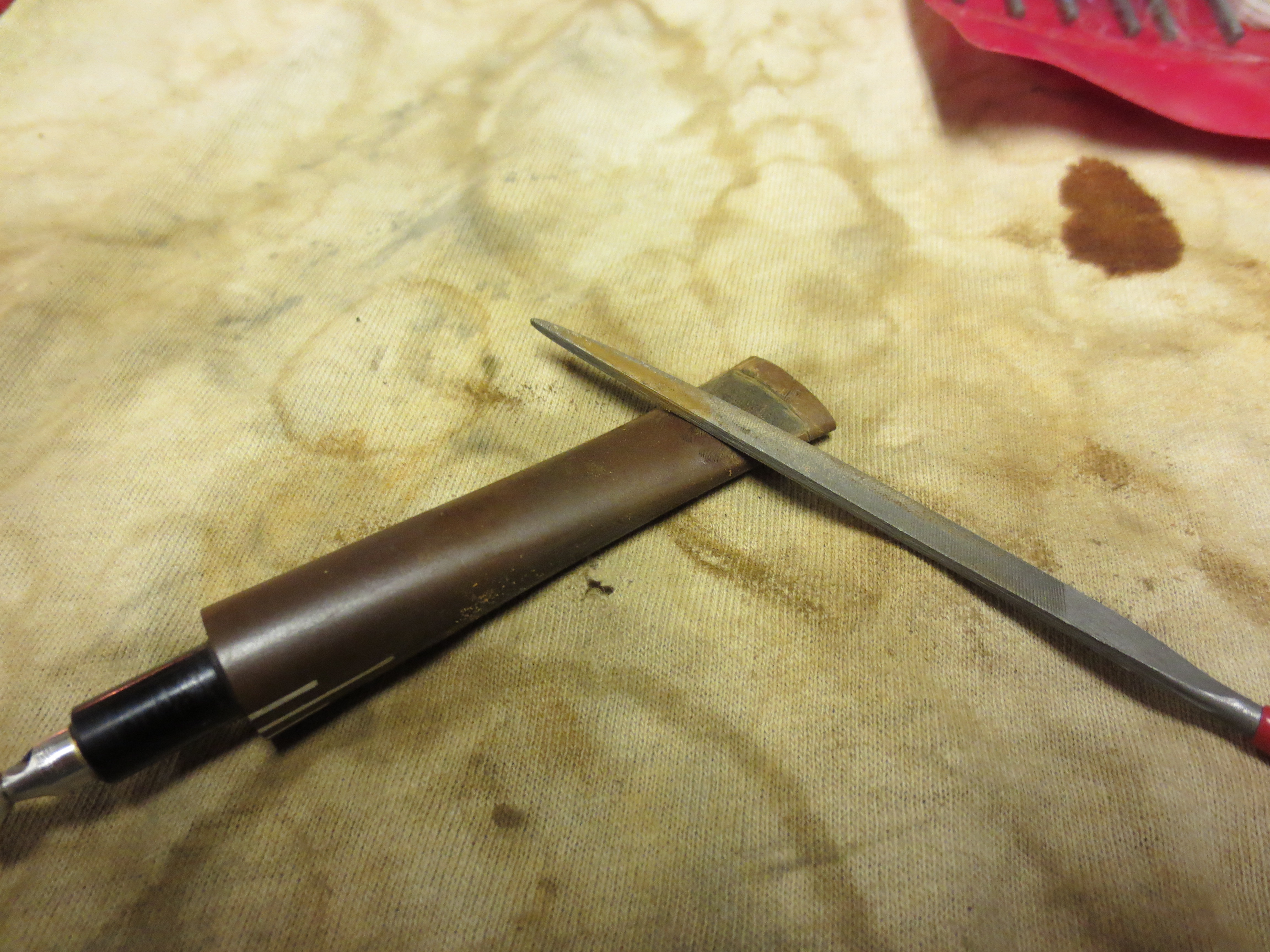
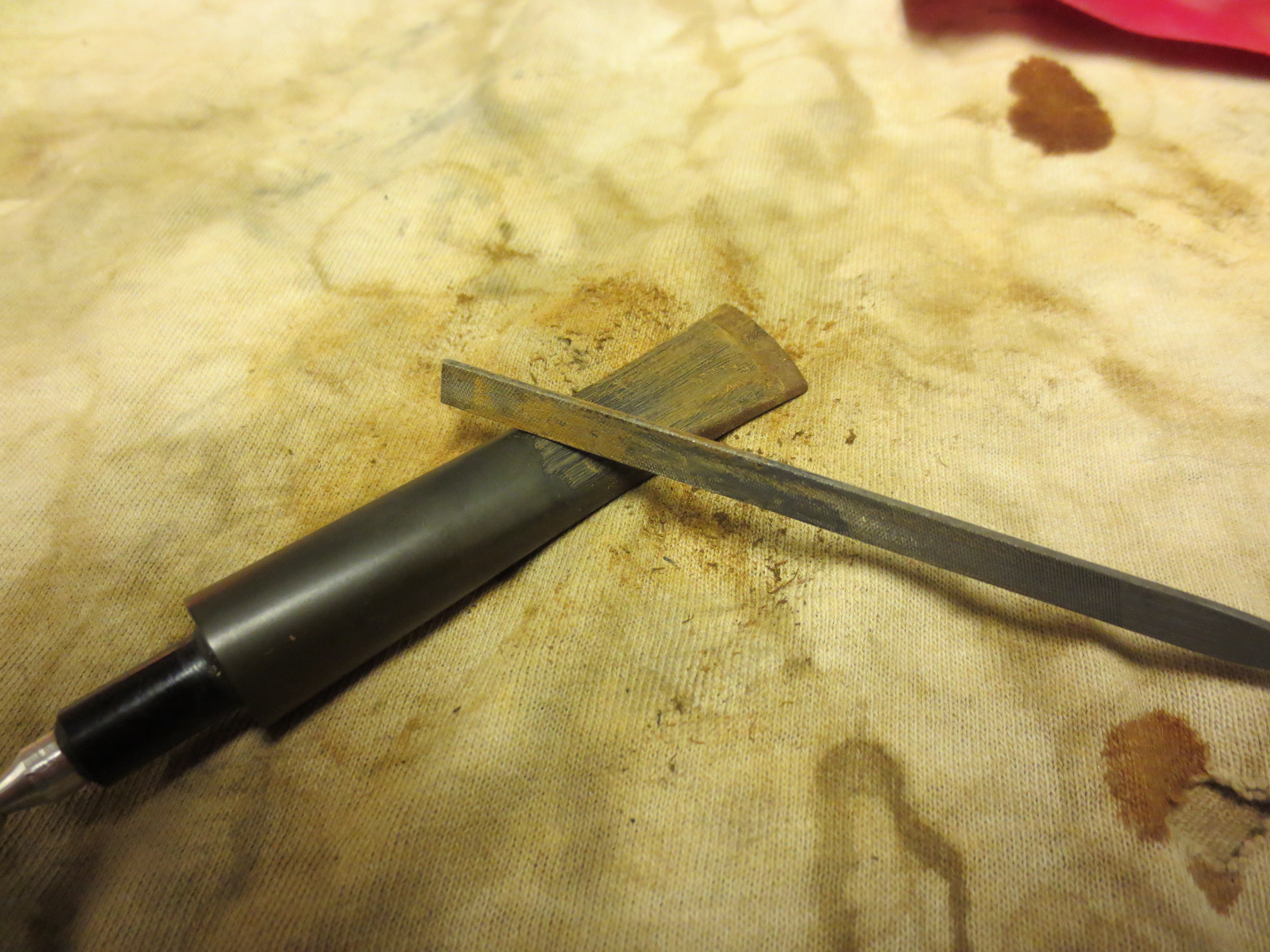
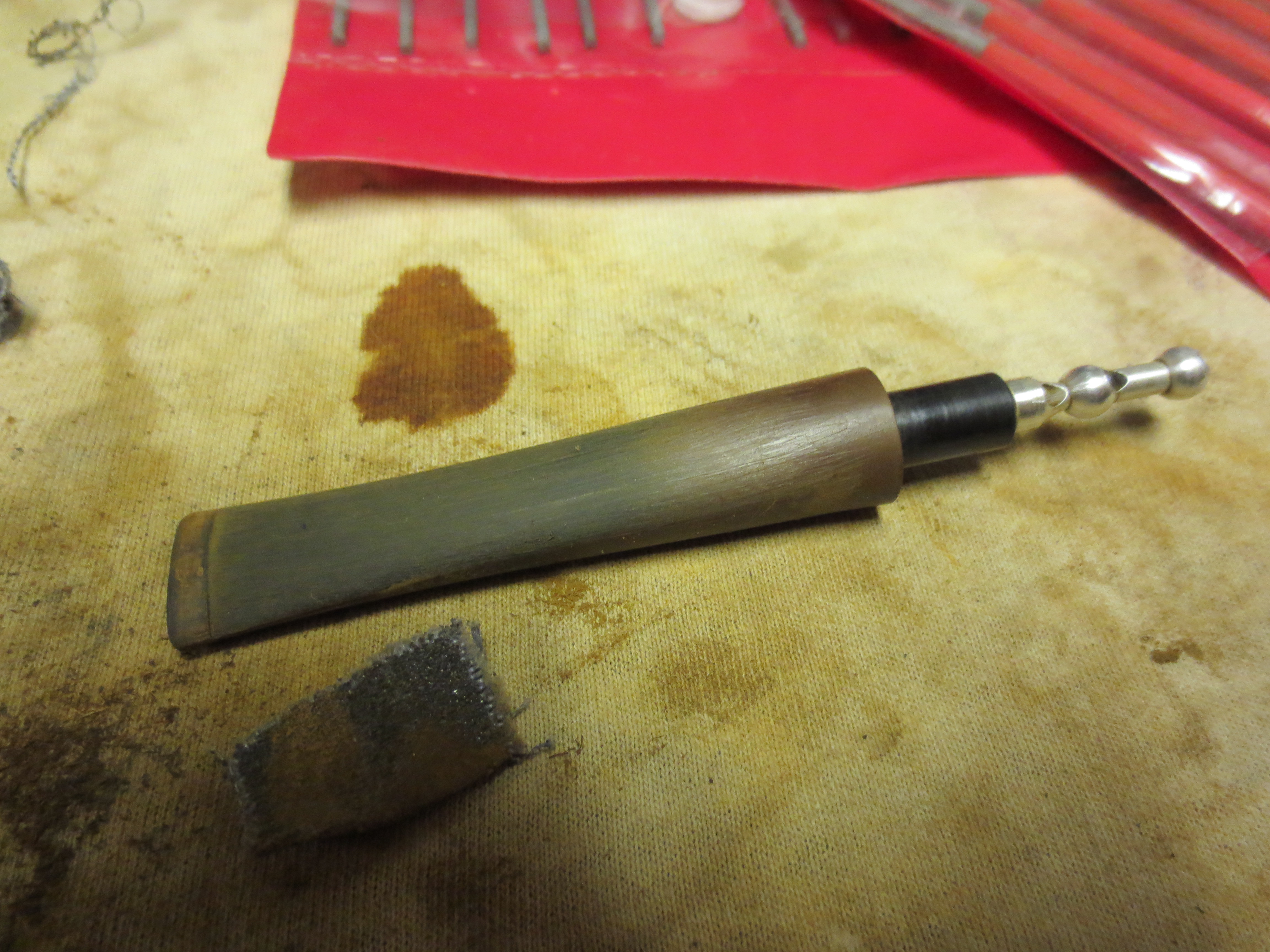
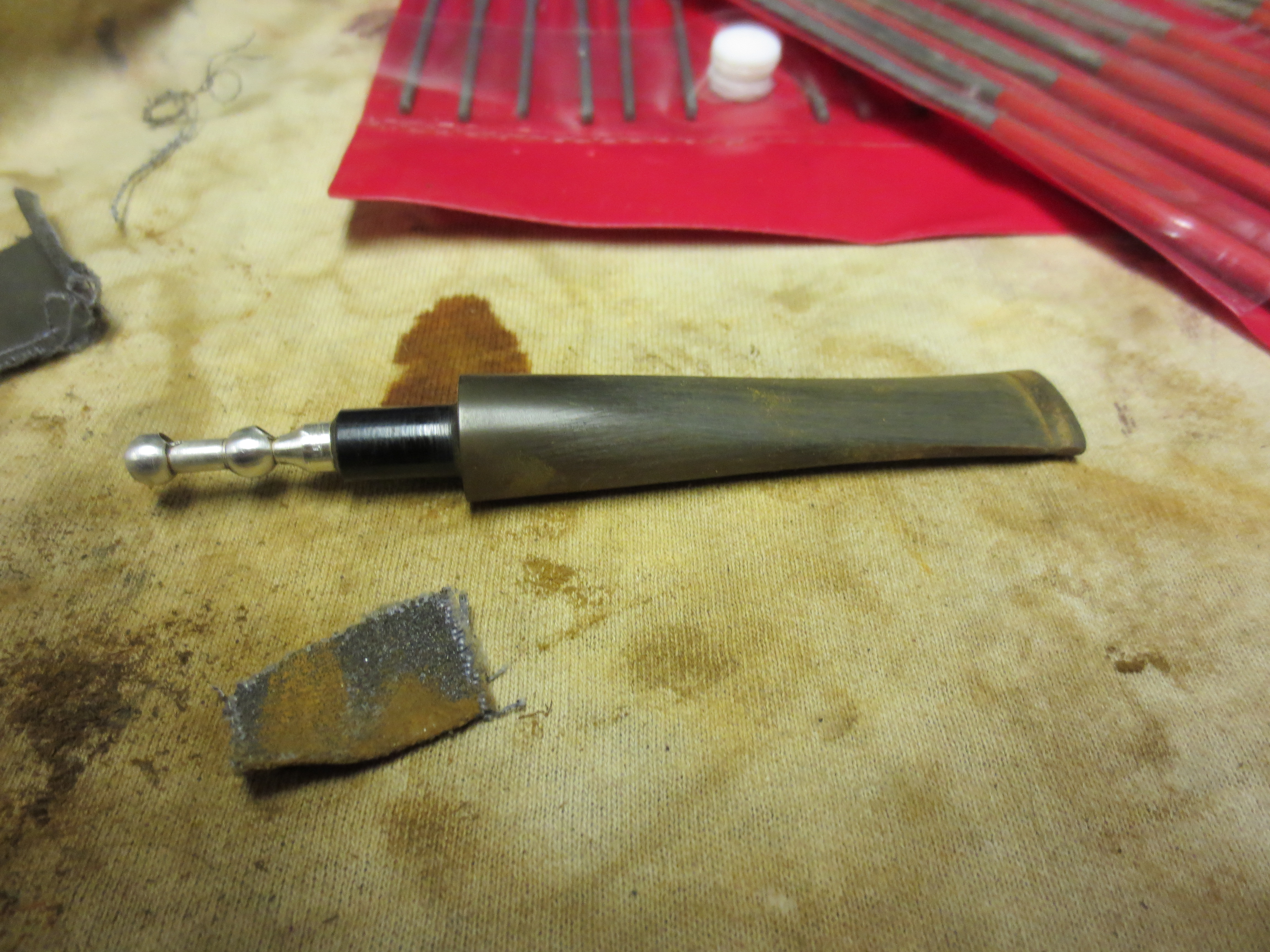
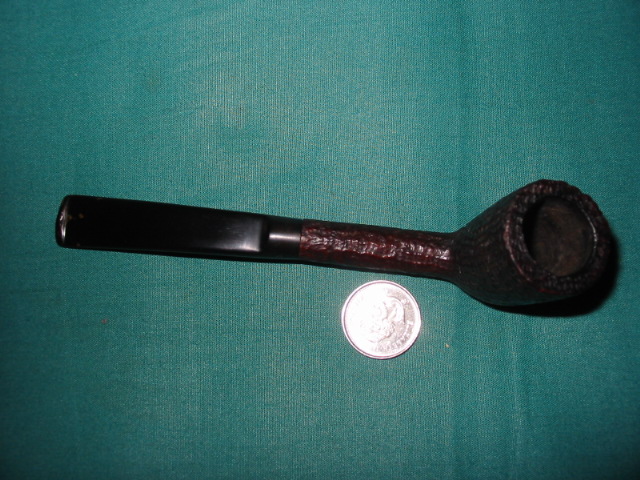
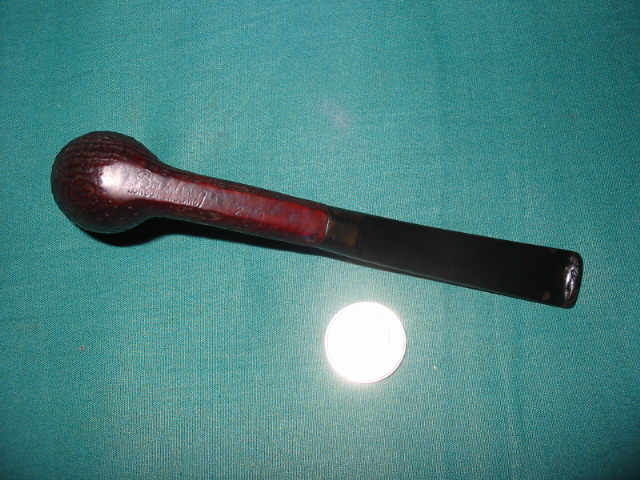
Tag Archives: reshaping a button

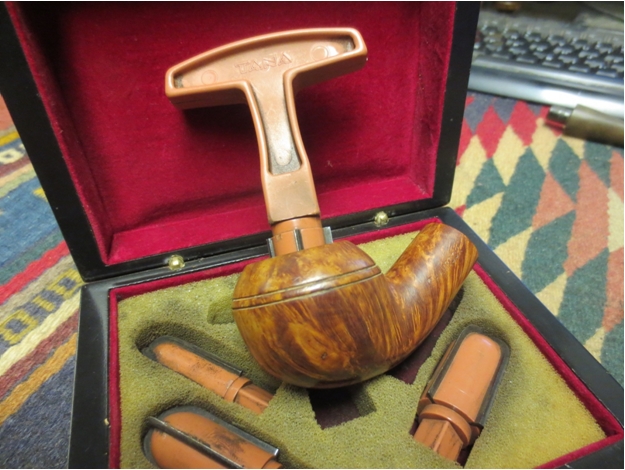
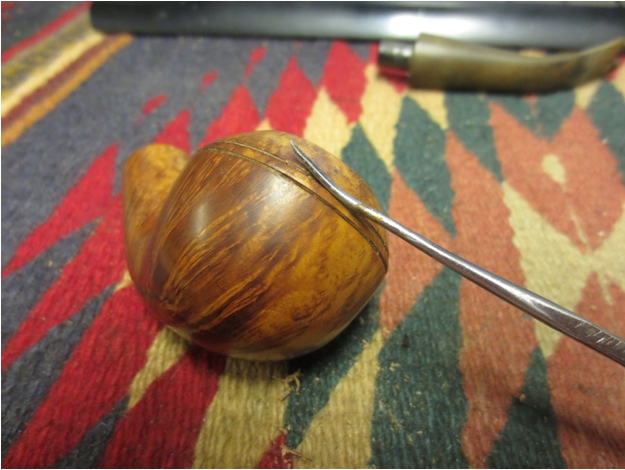
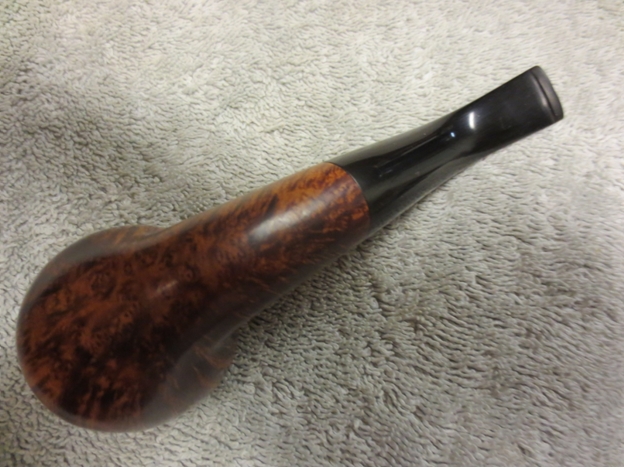
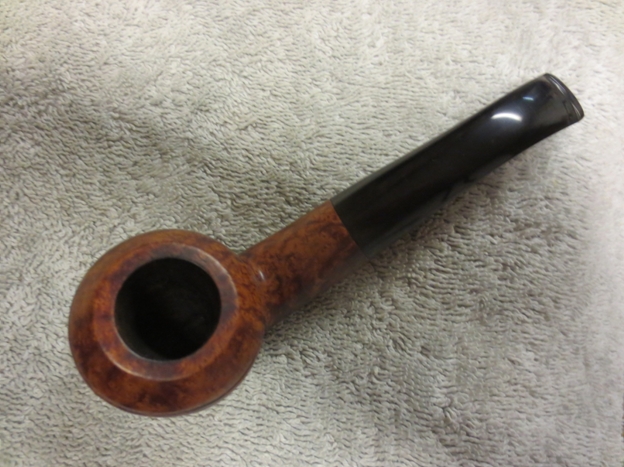
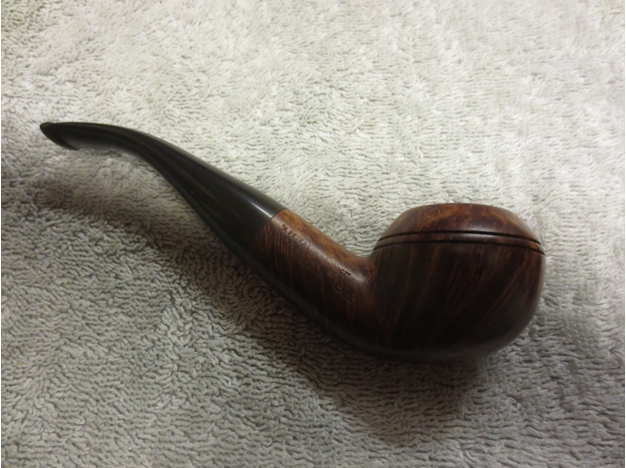
Building a Better Button on a 1930’s Yello Bole Oom Paul


Blog by Andrew Selking

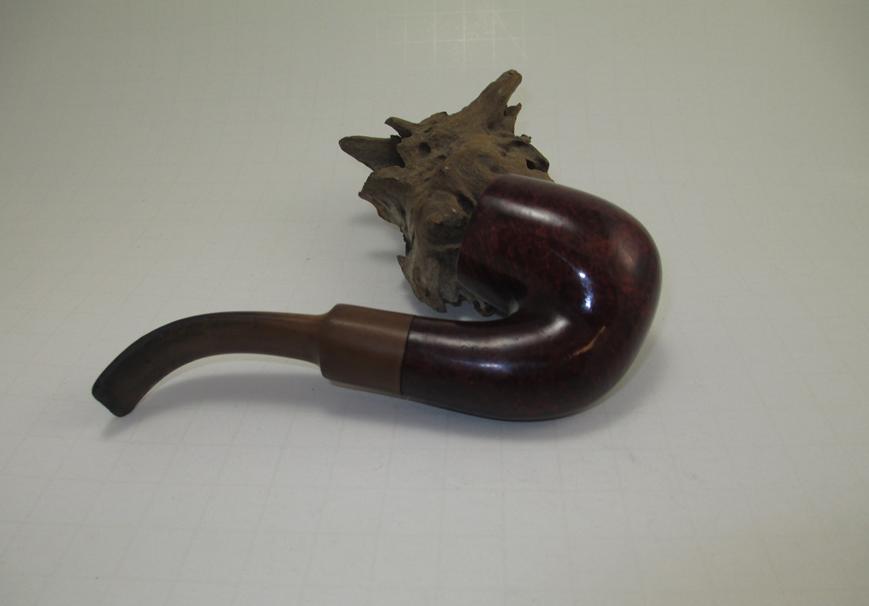
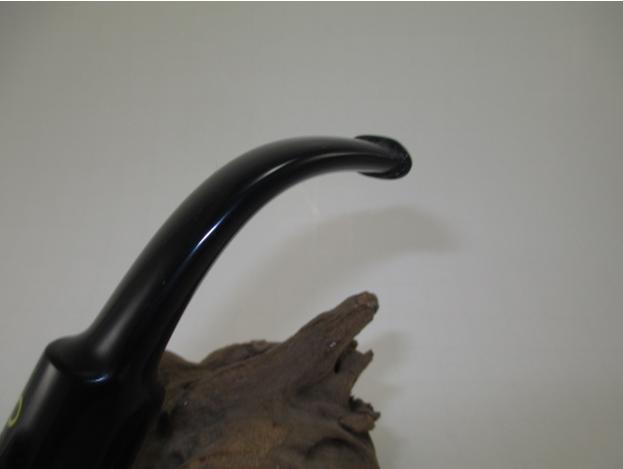
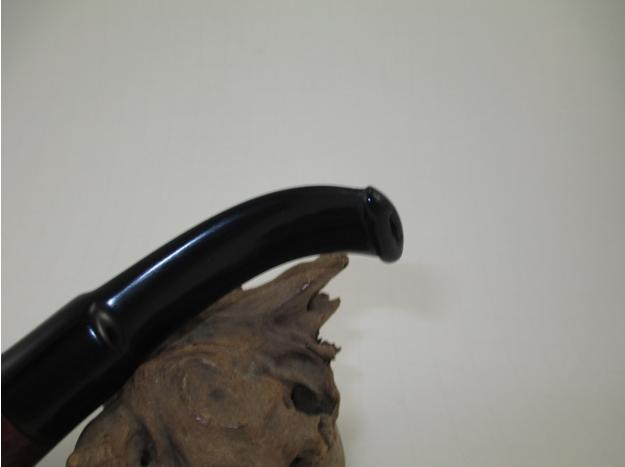
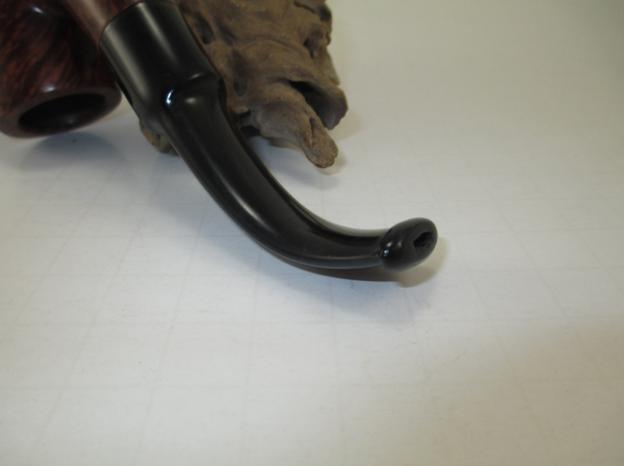
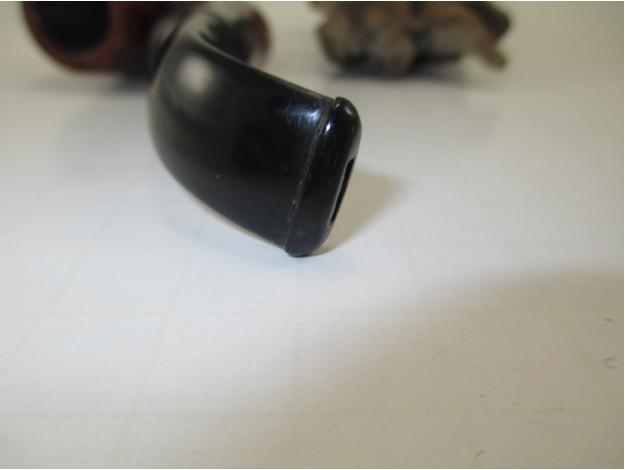
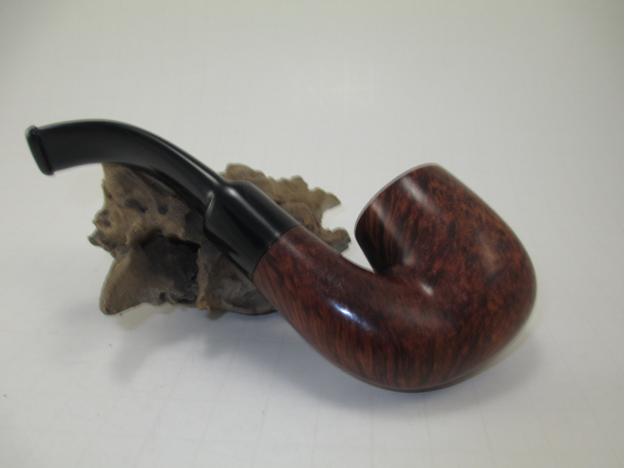
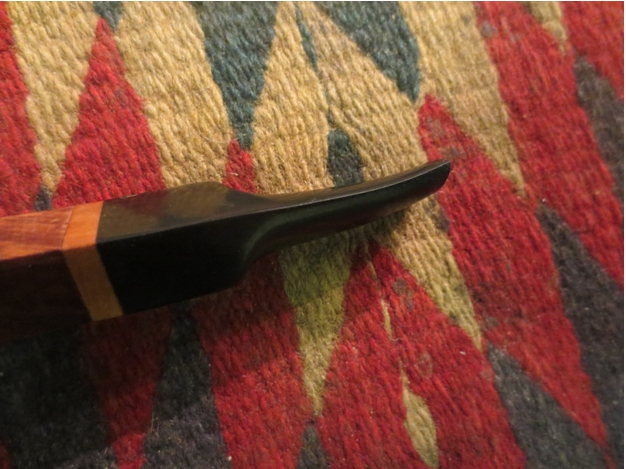
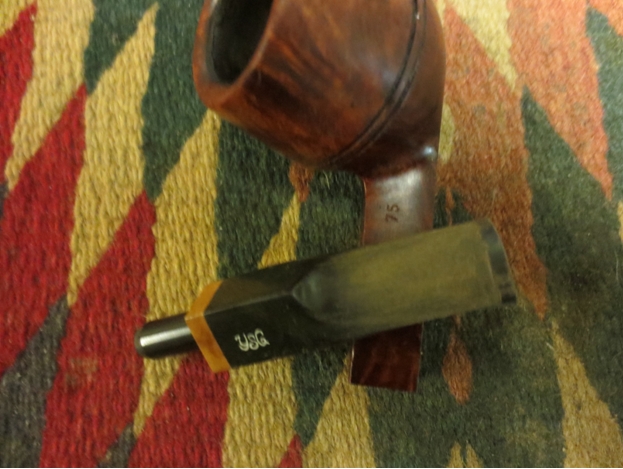
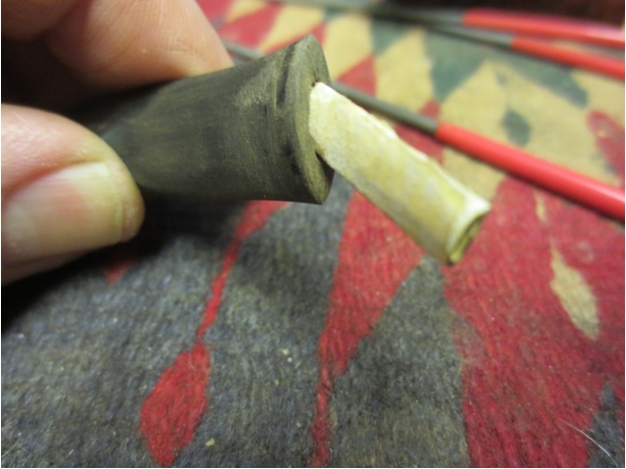
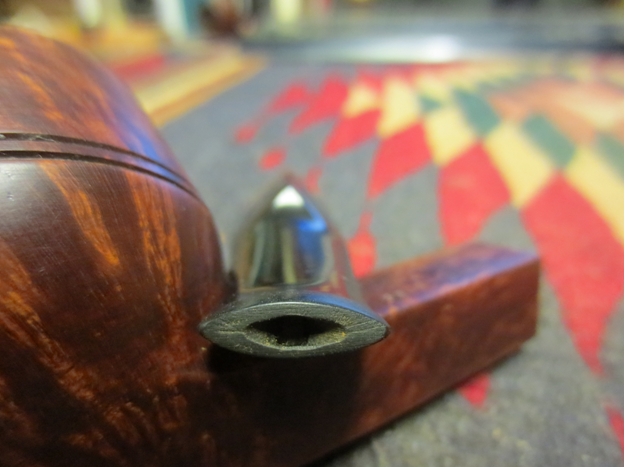
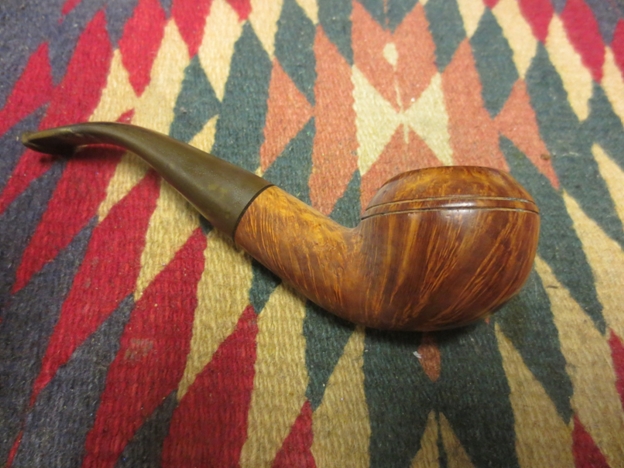
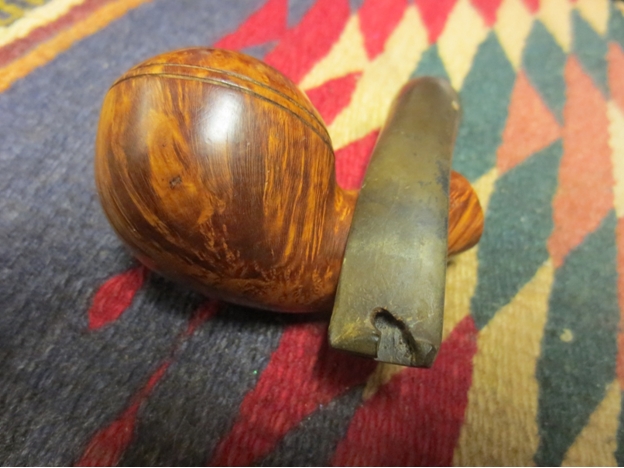
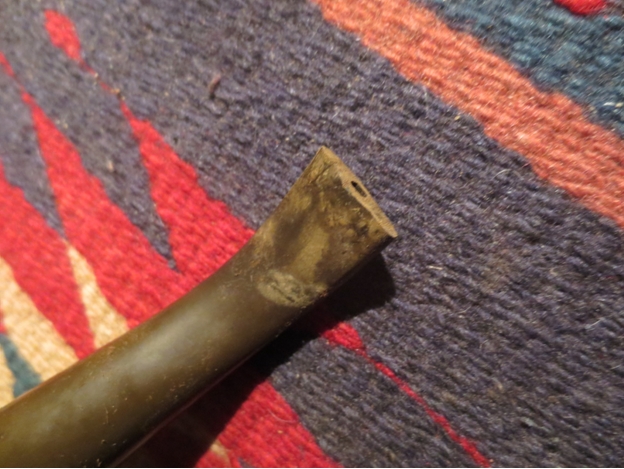
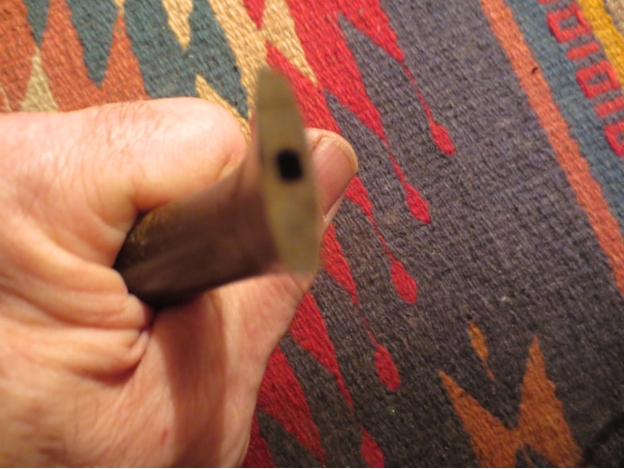
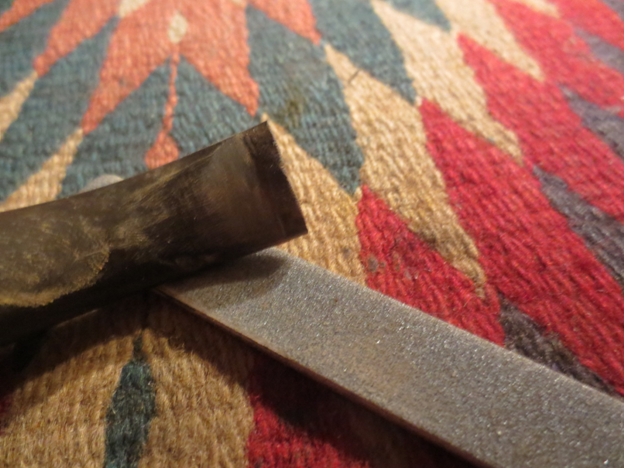
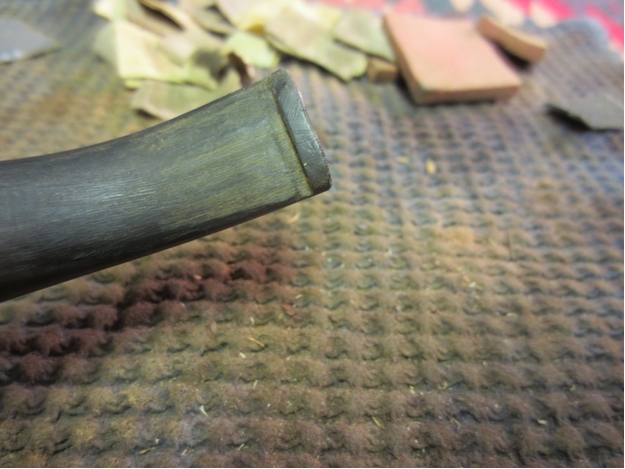
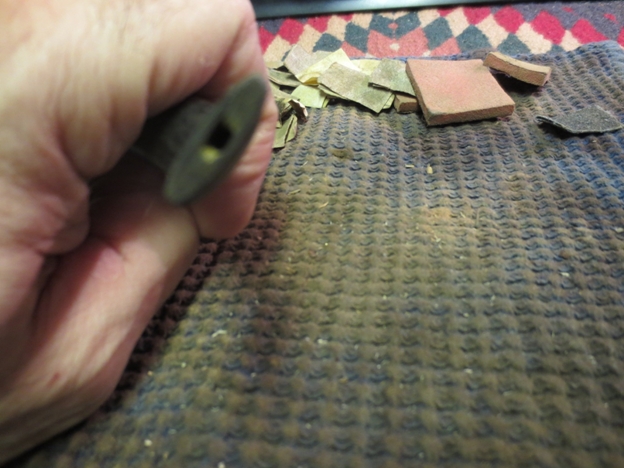
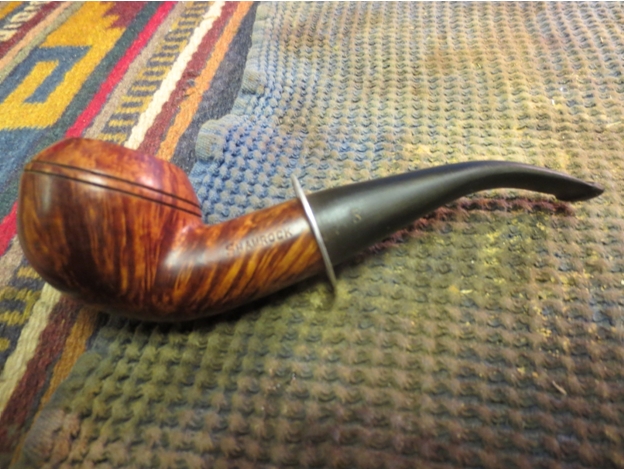
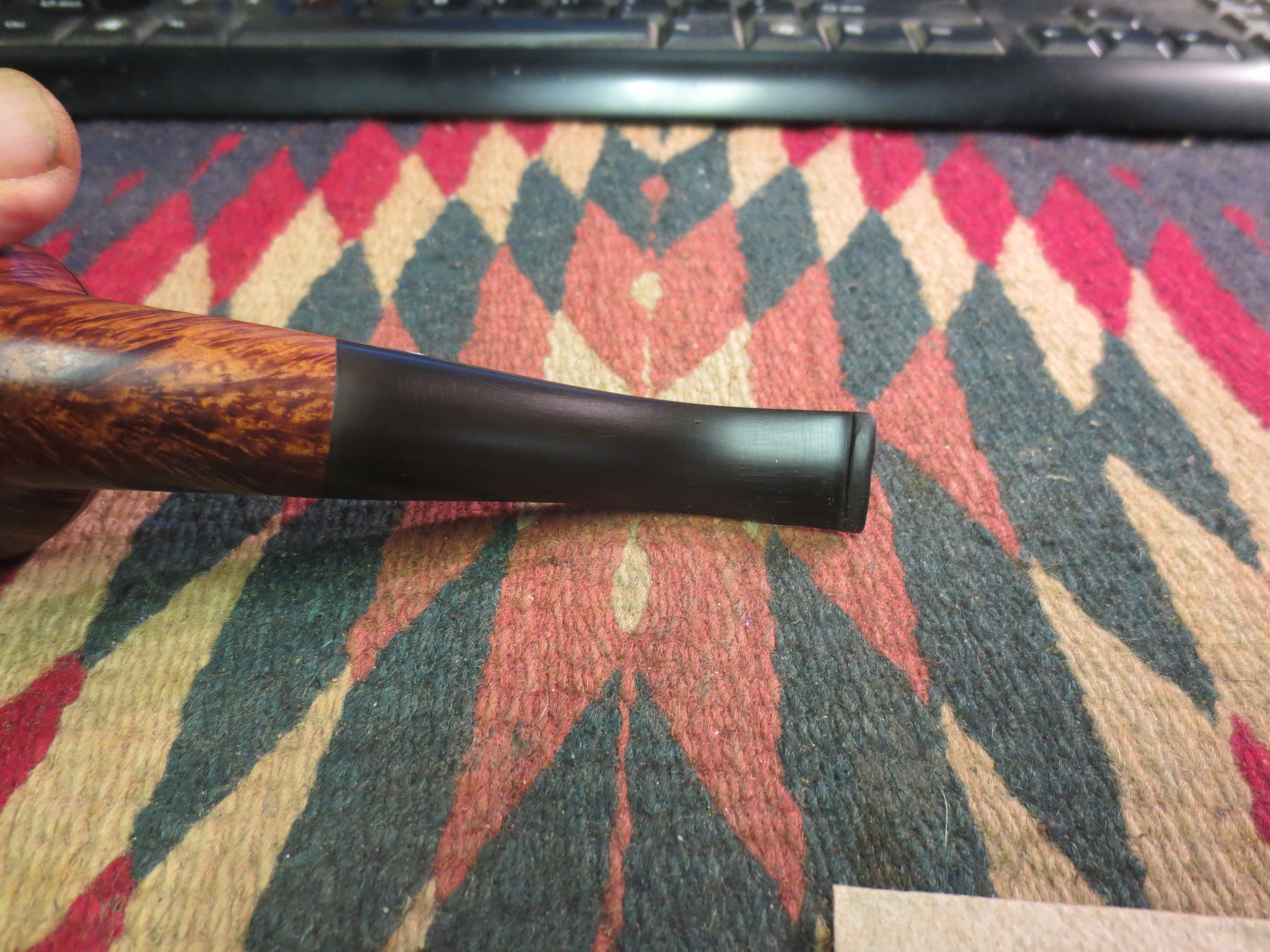
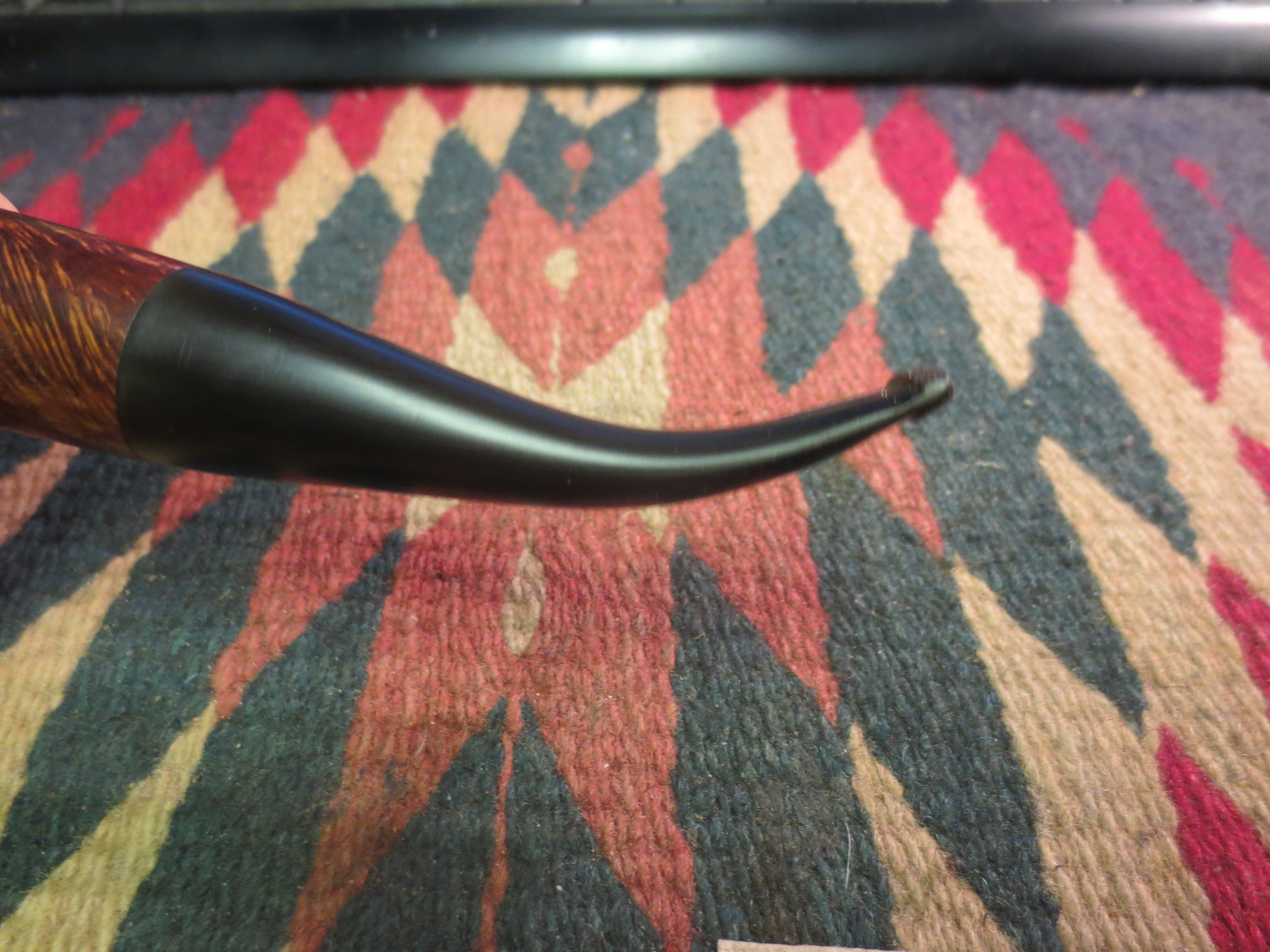
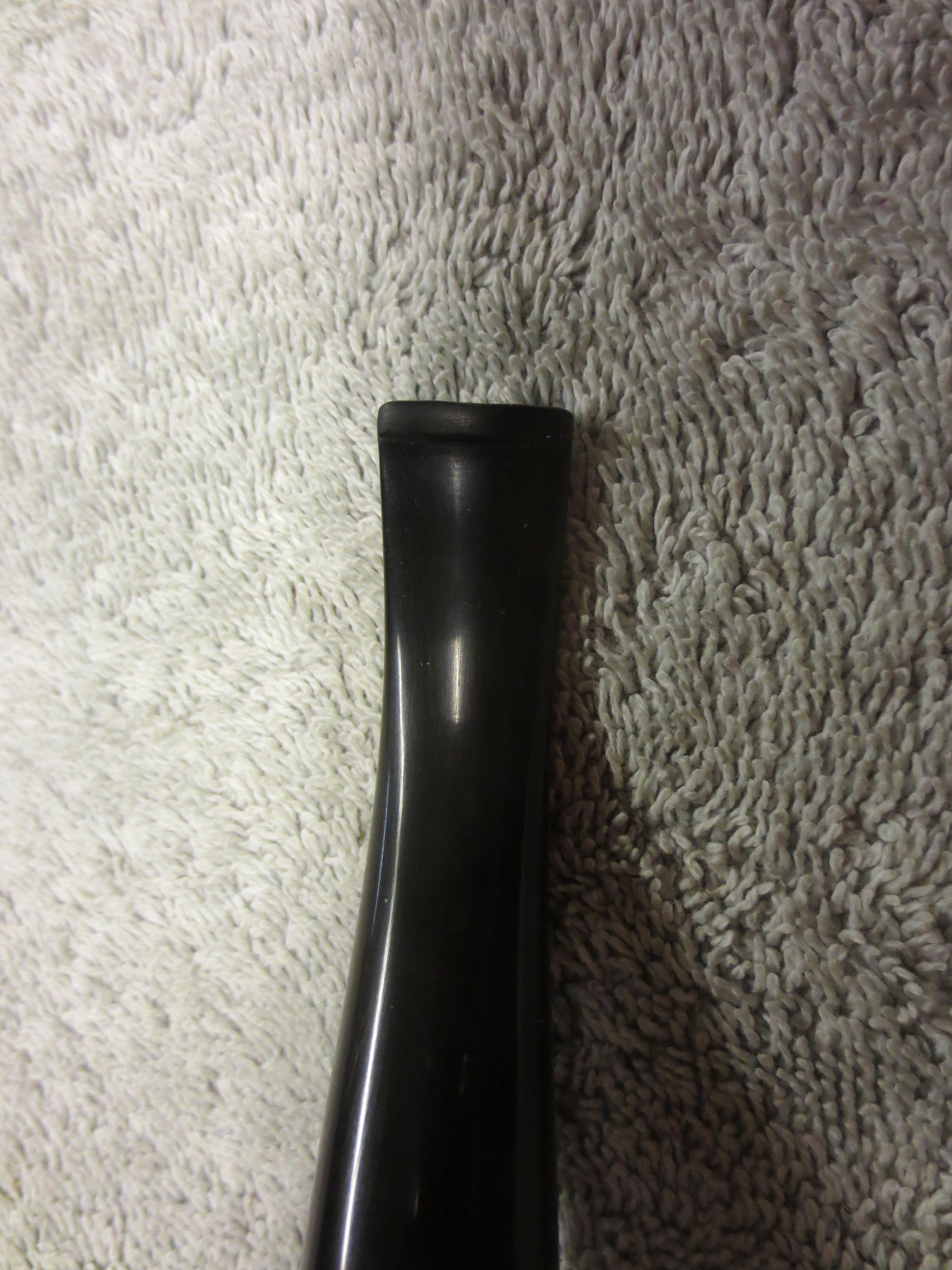
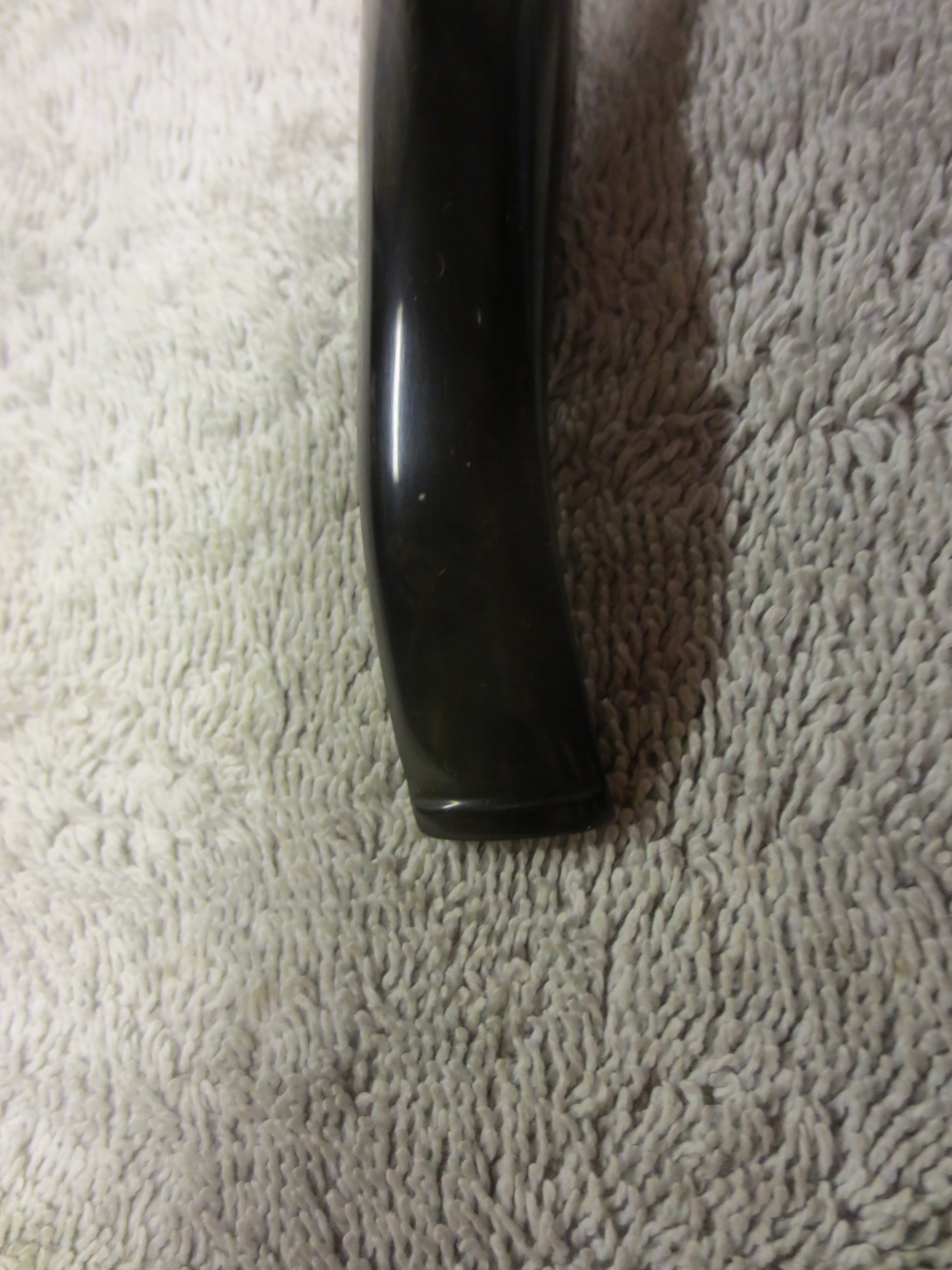
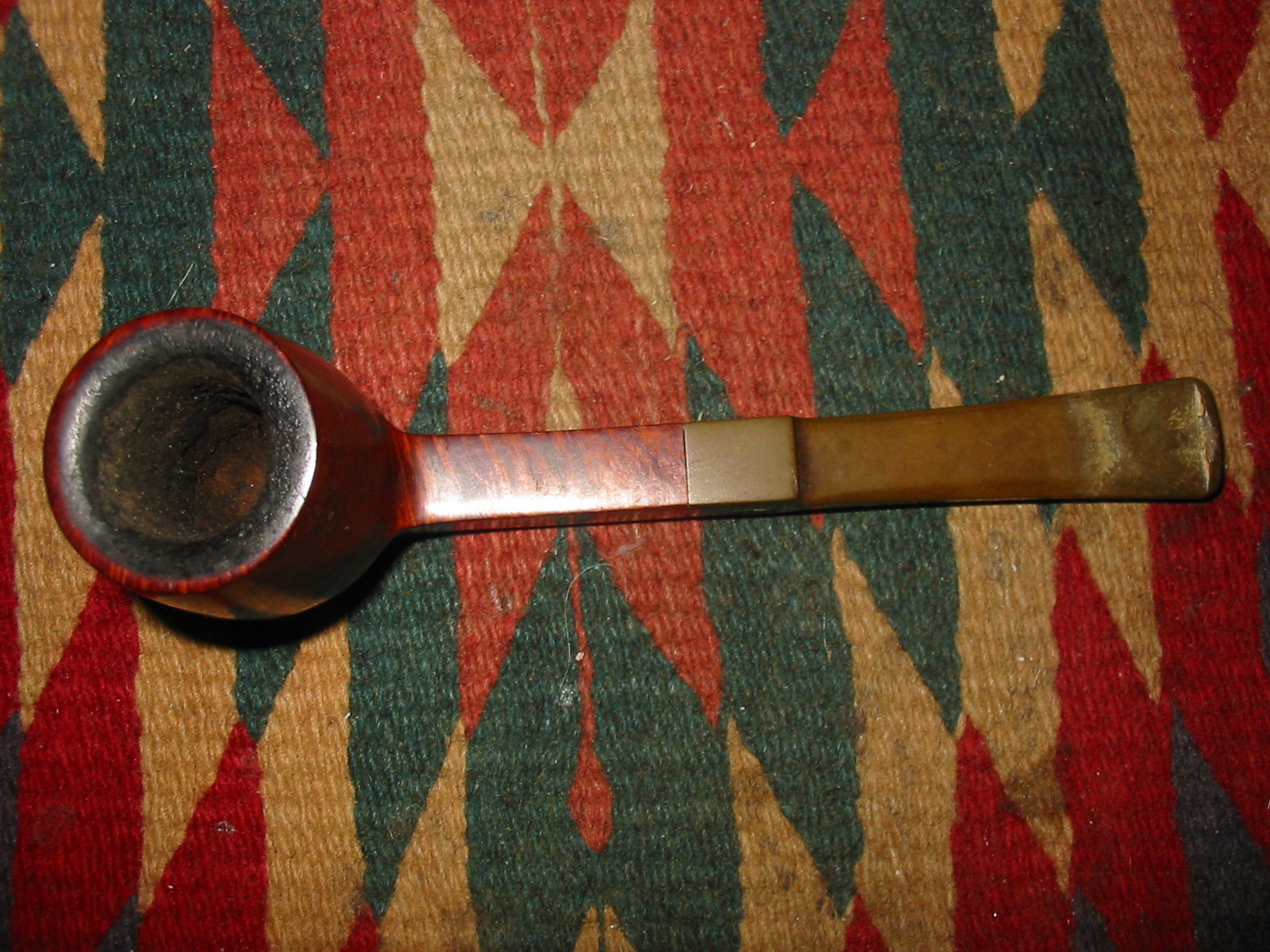
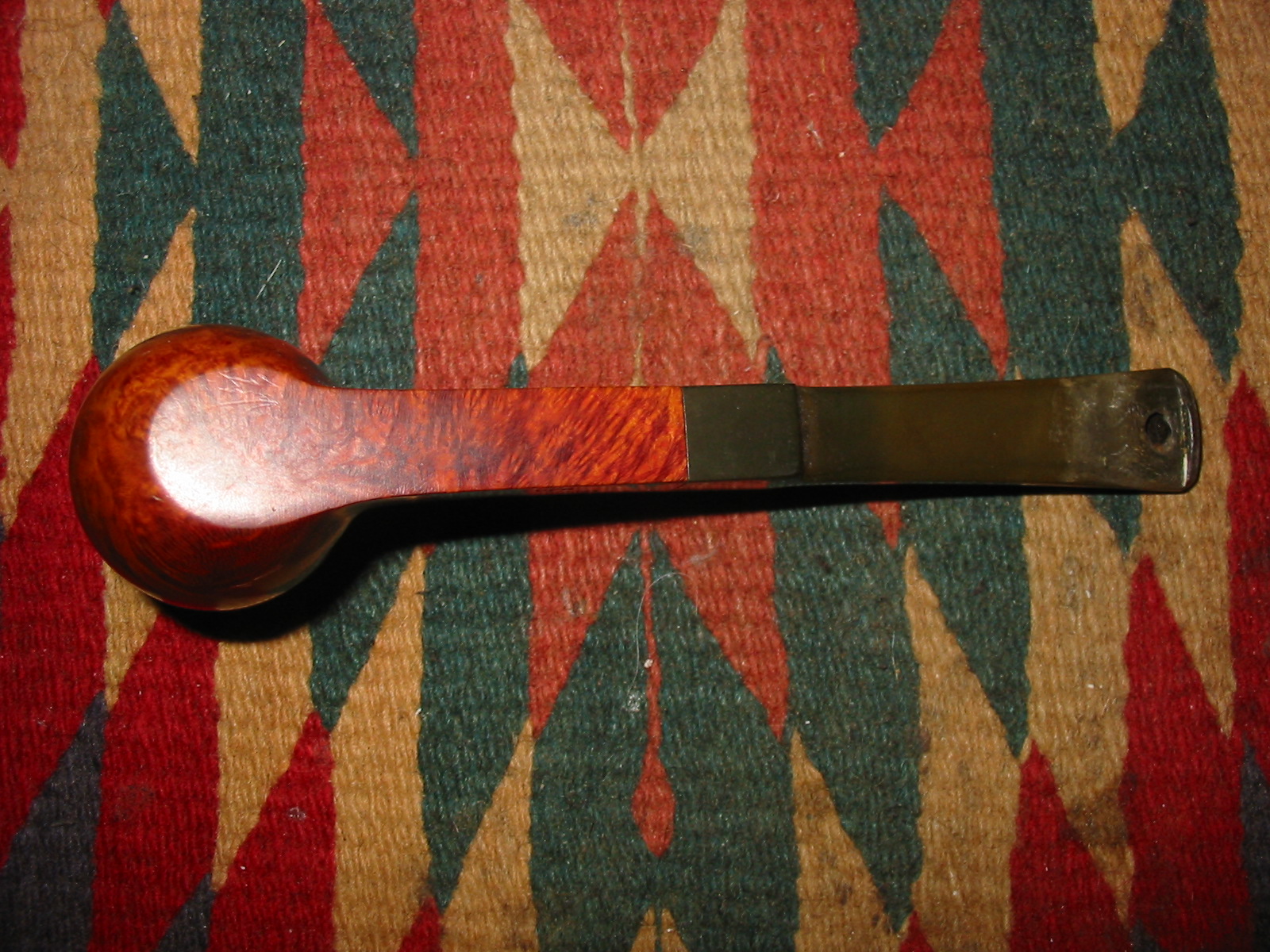
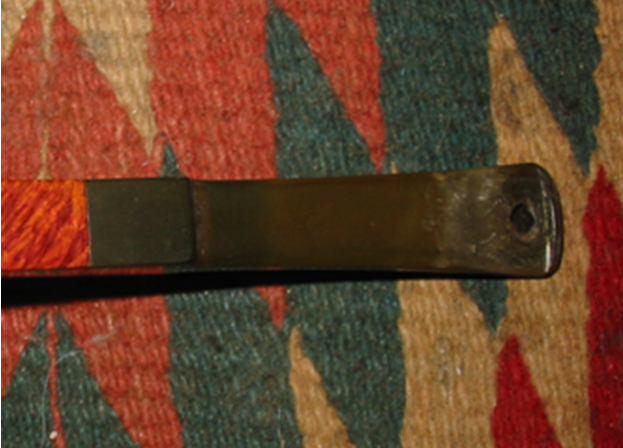
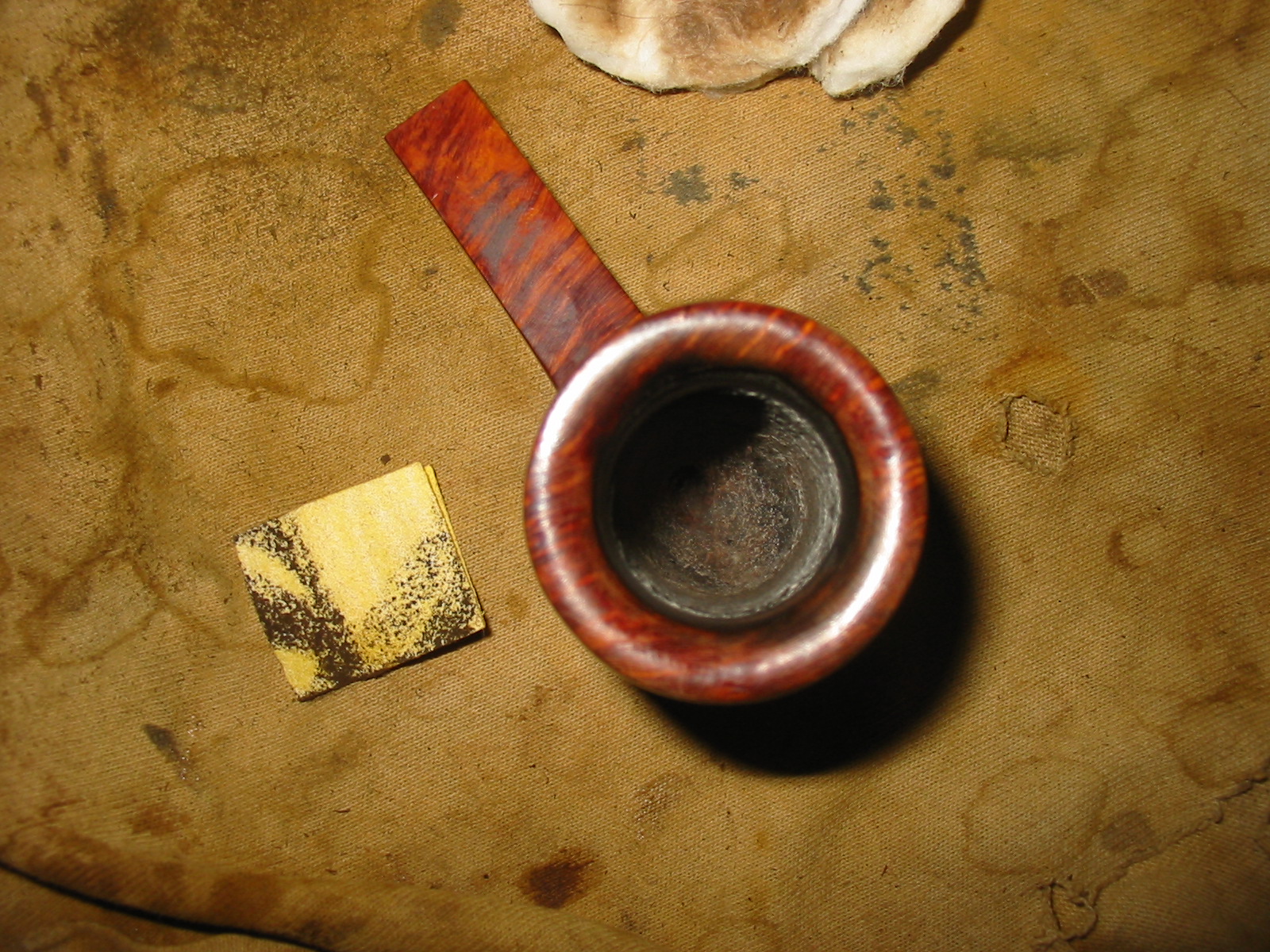
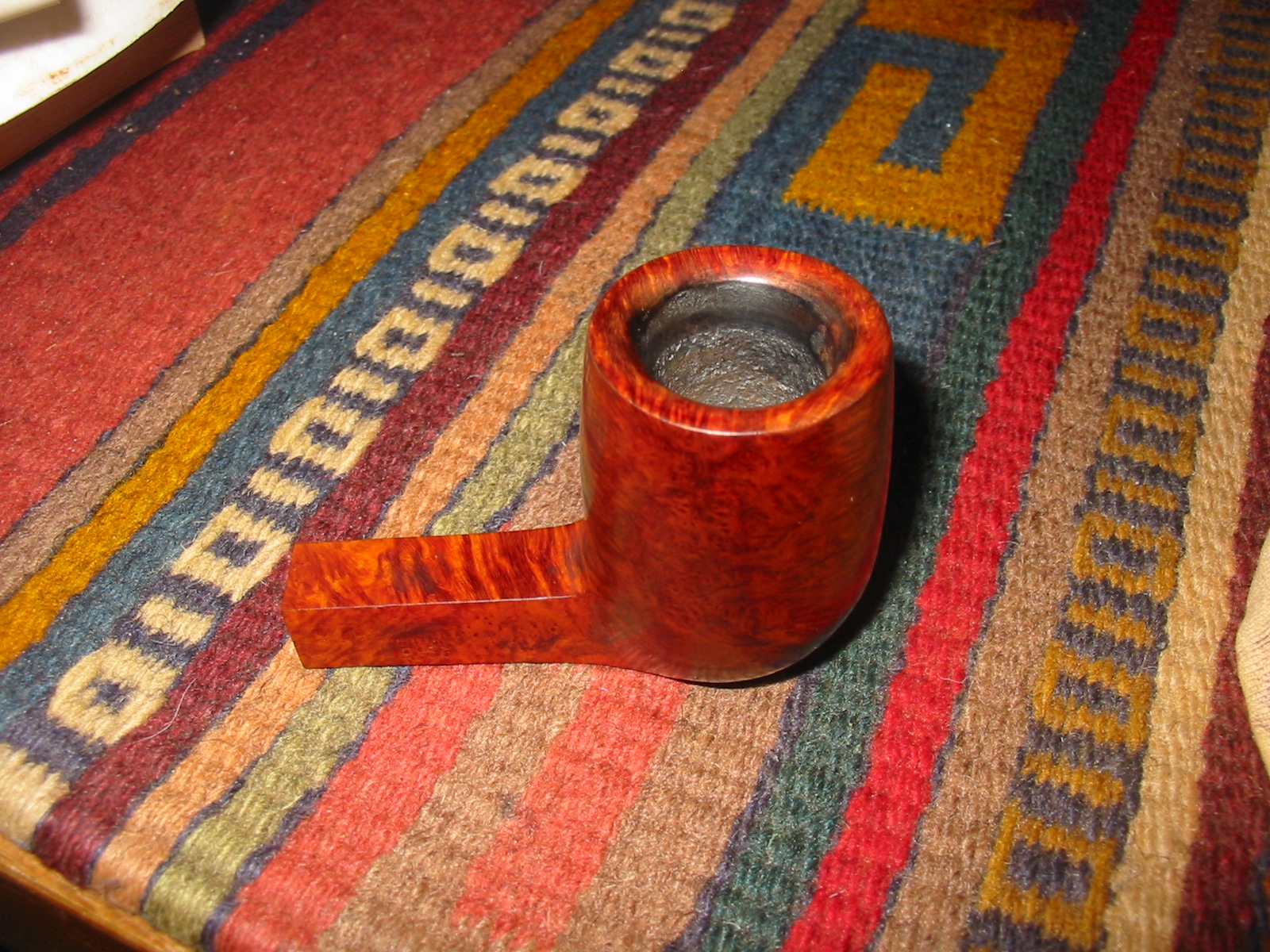
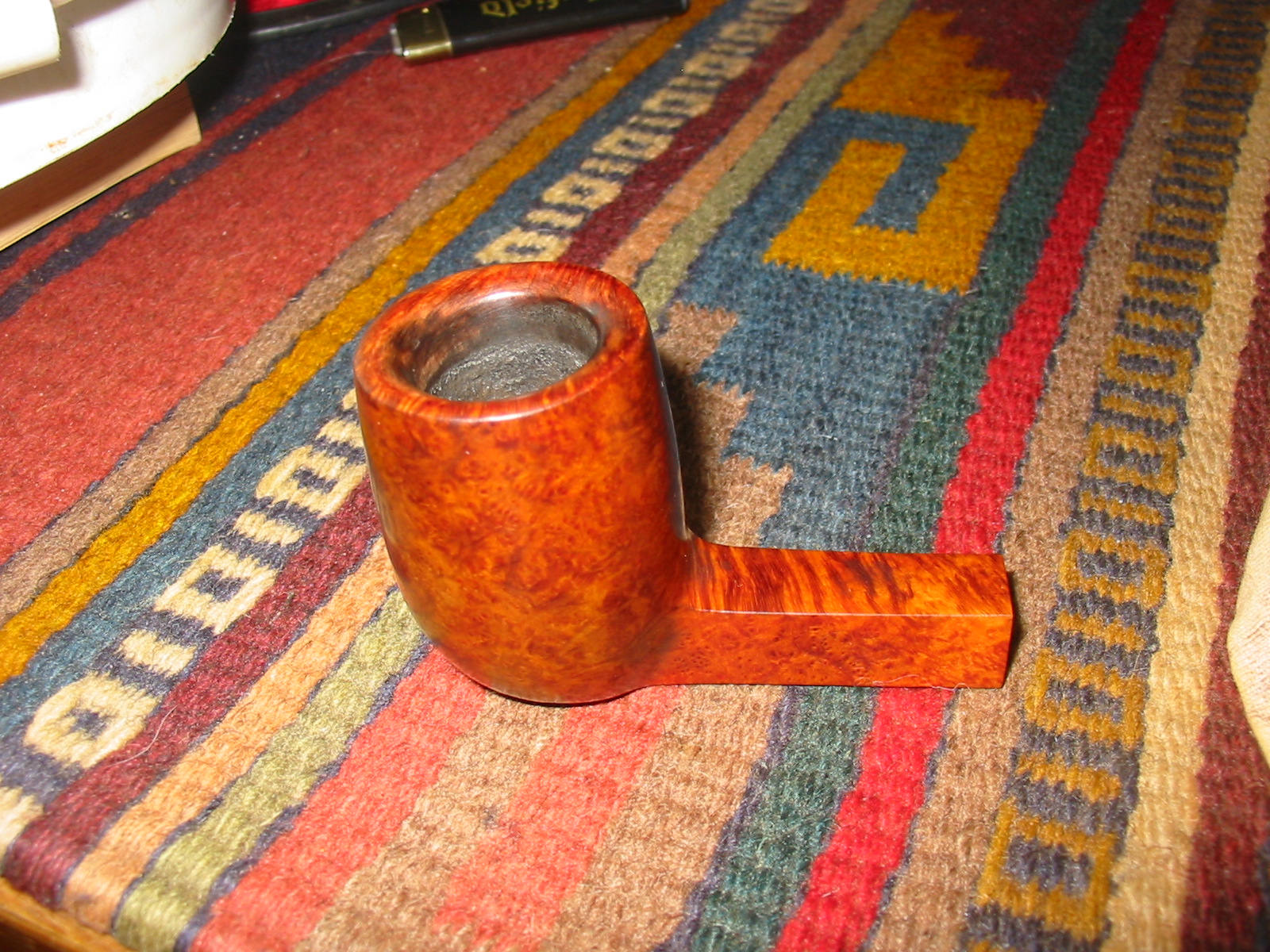
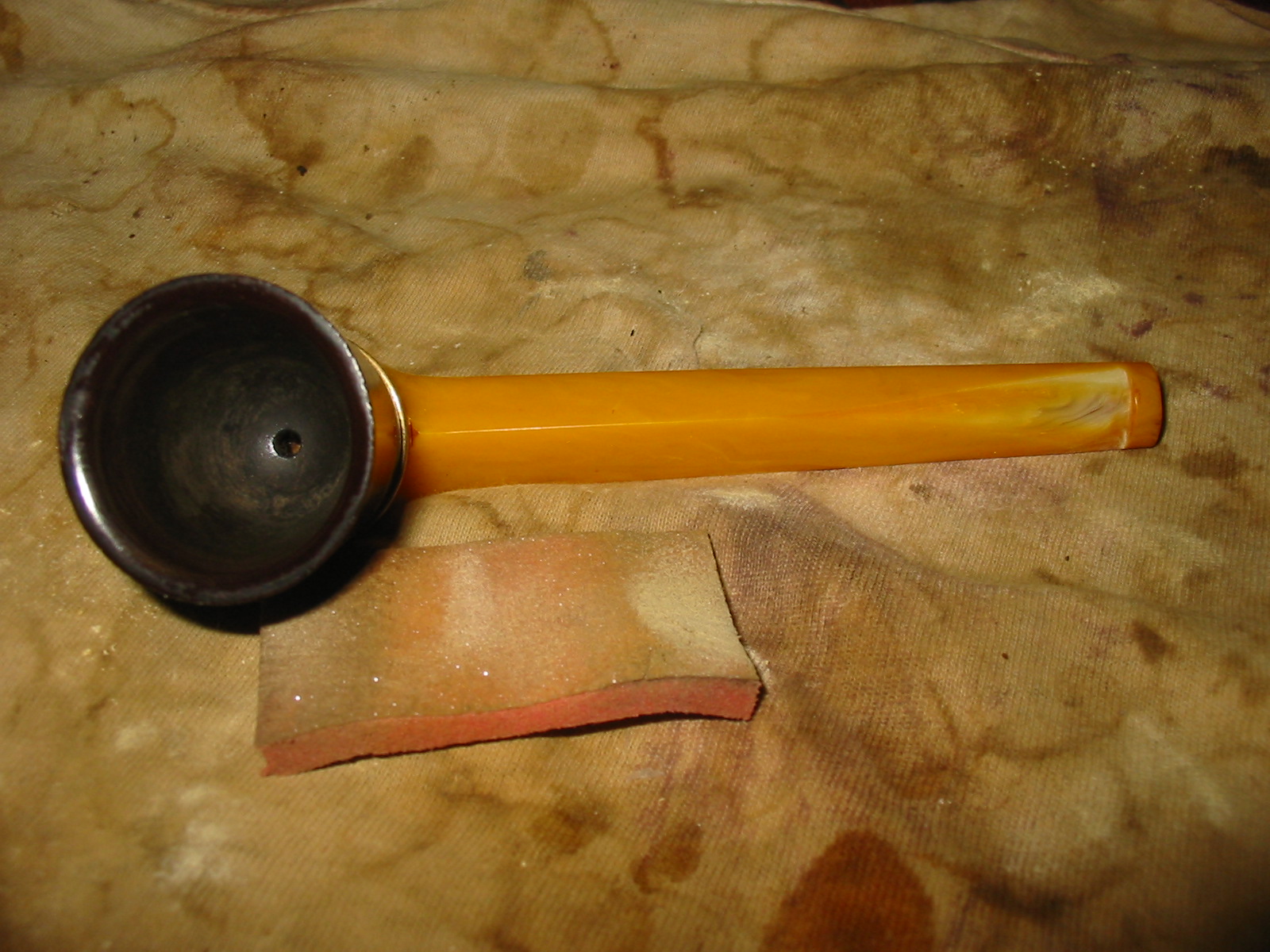
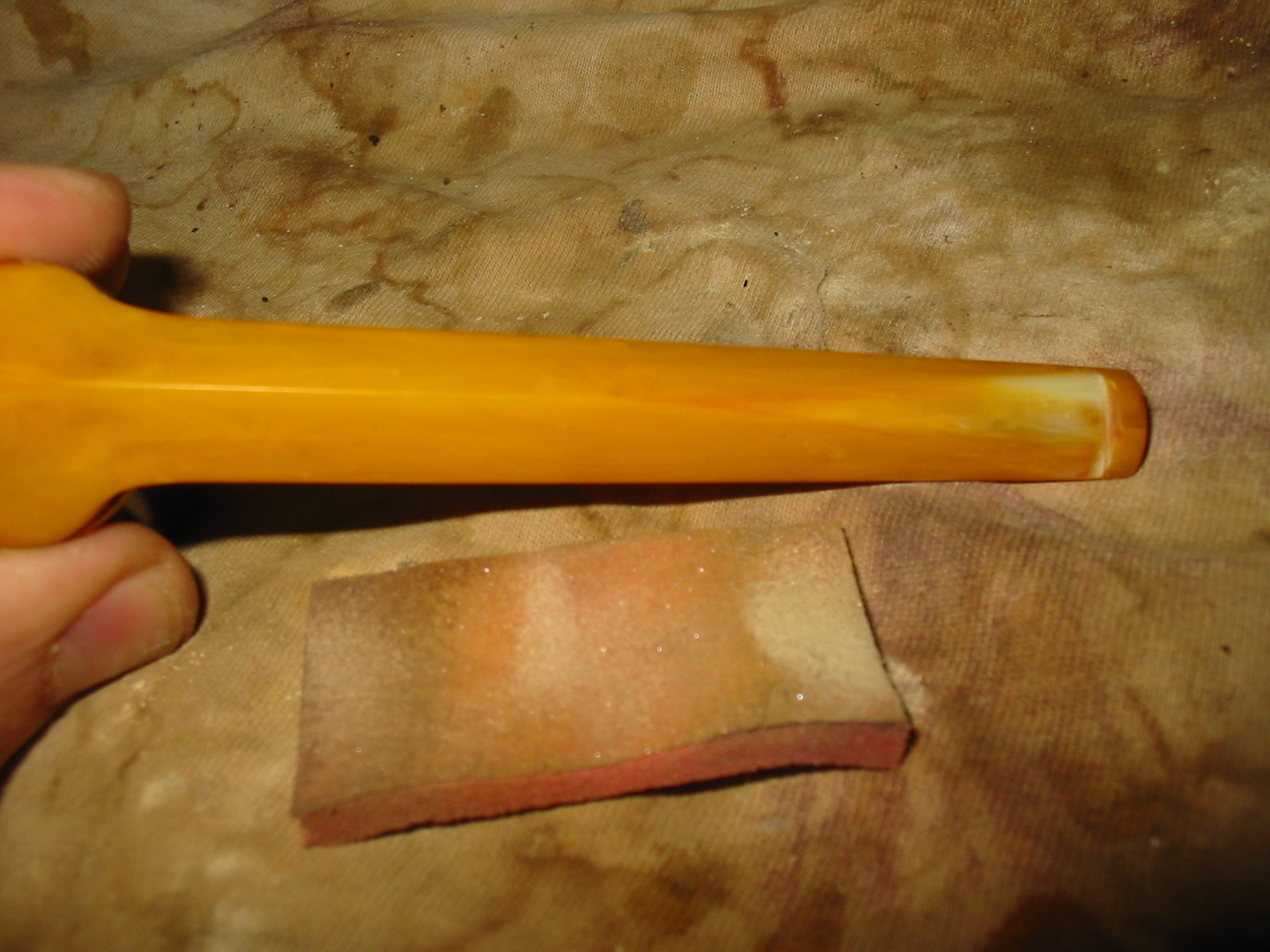
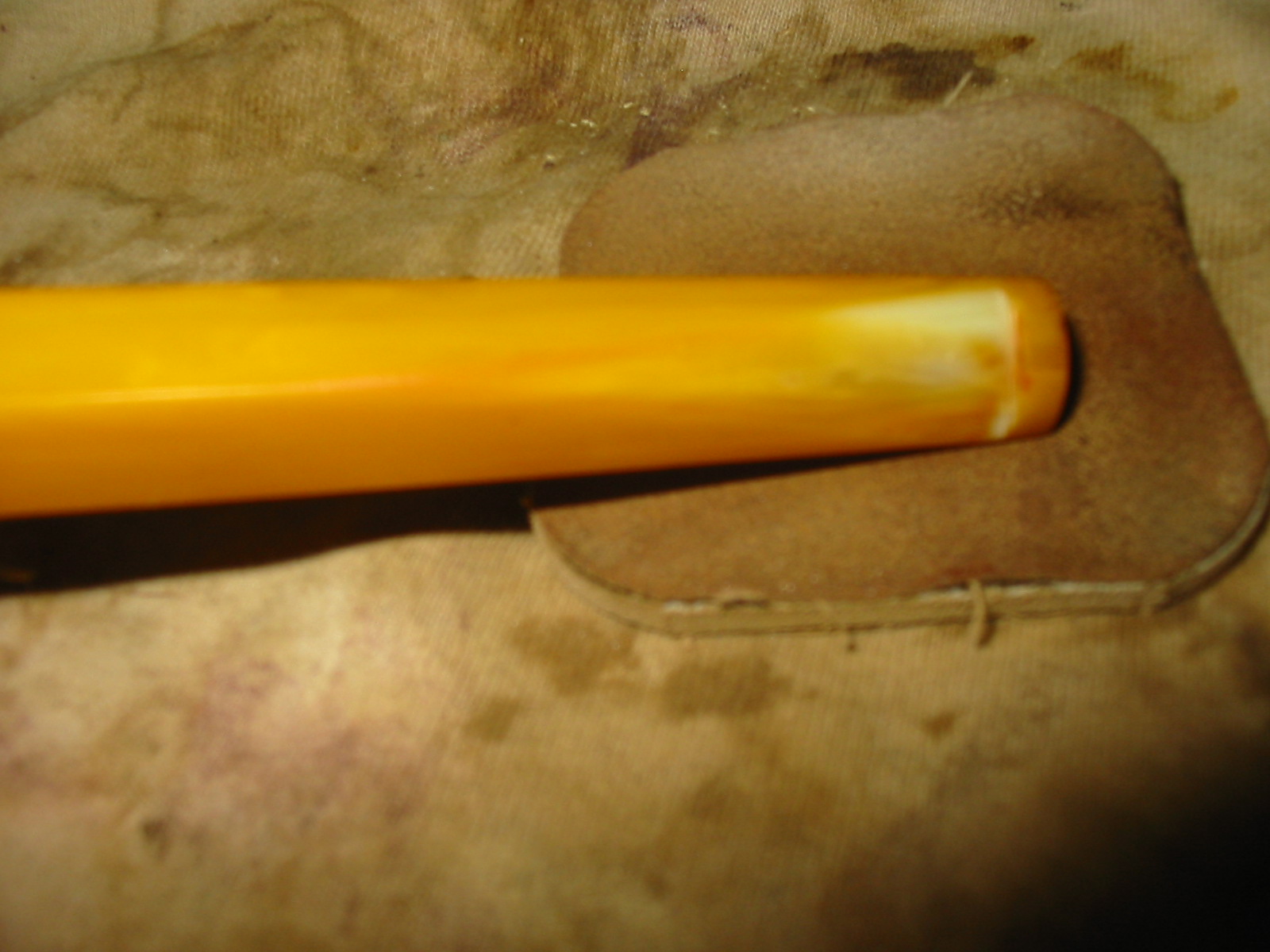
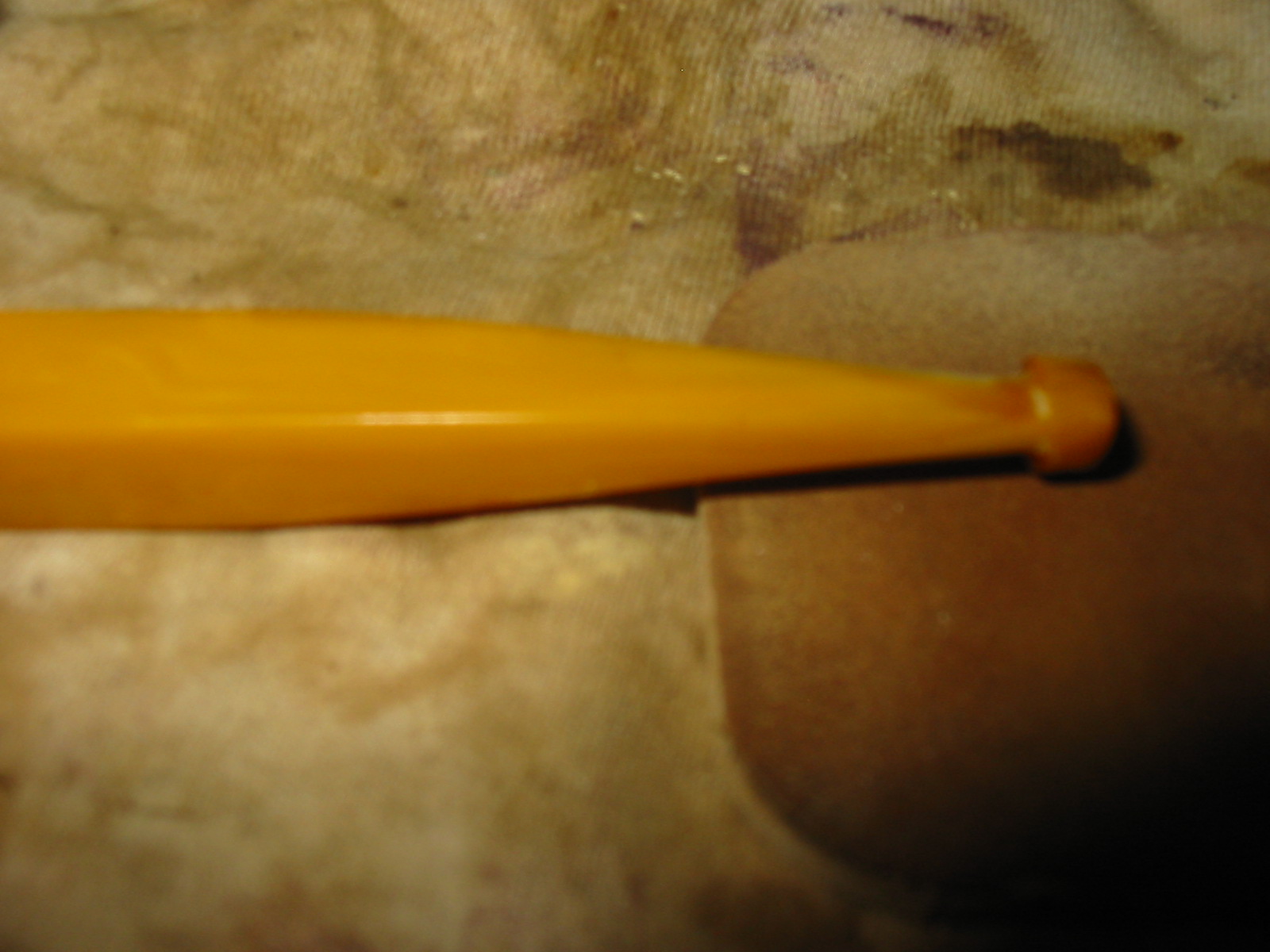
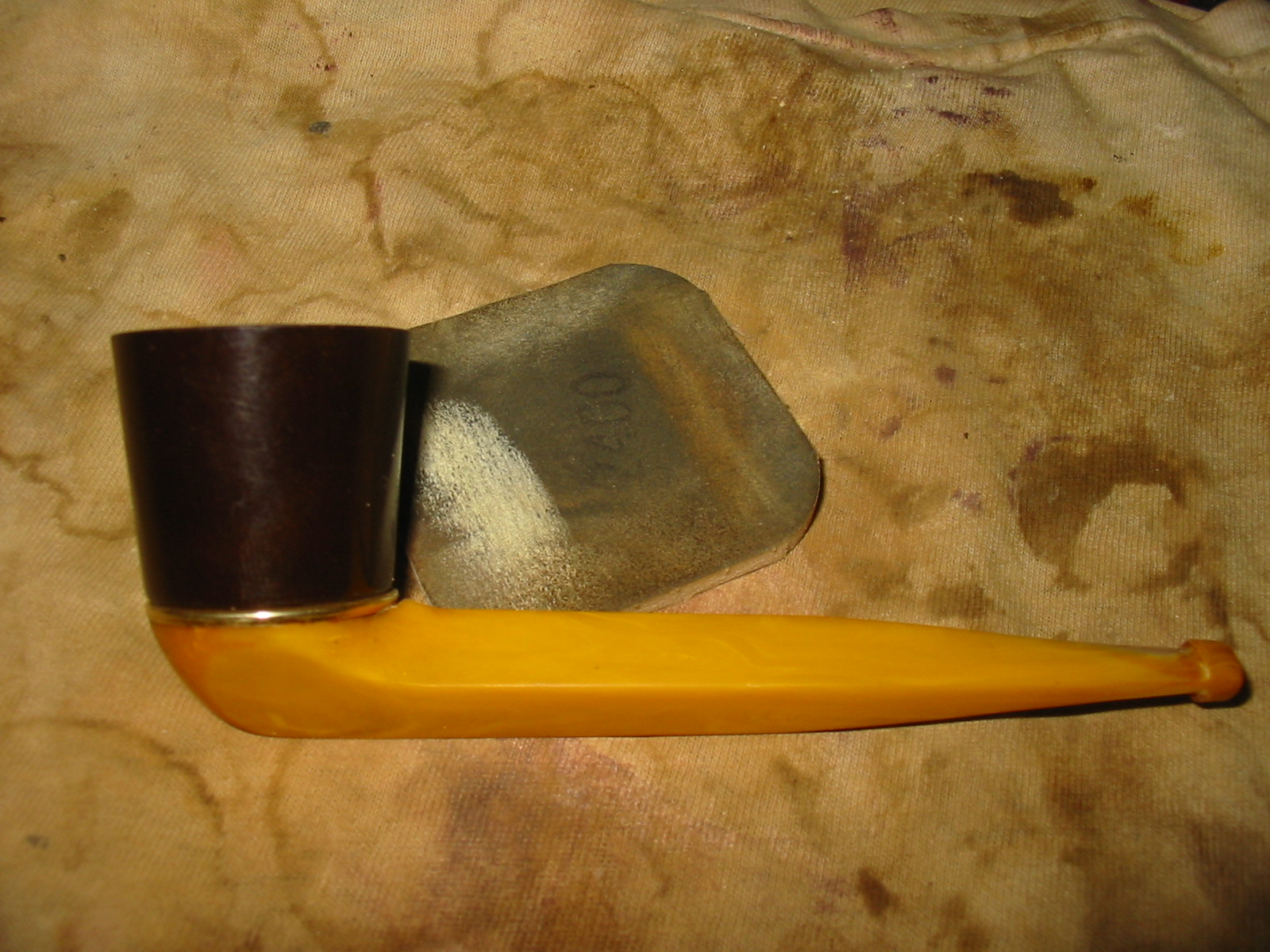
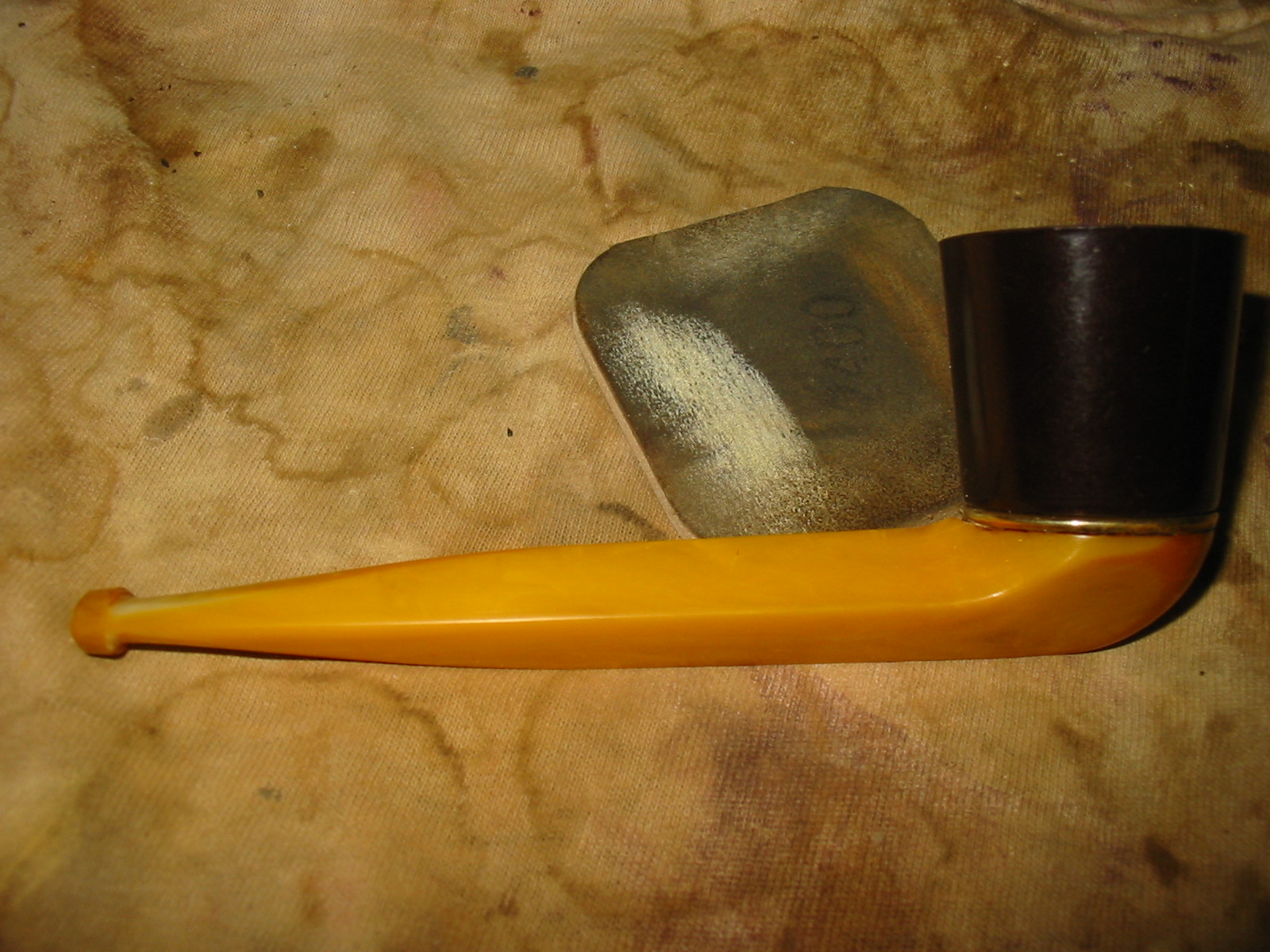
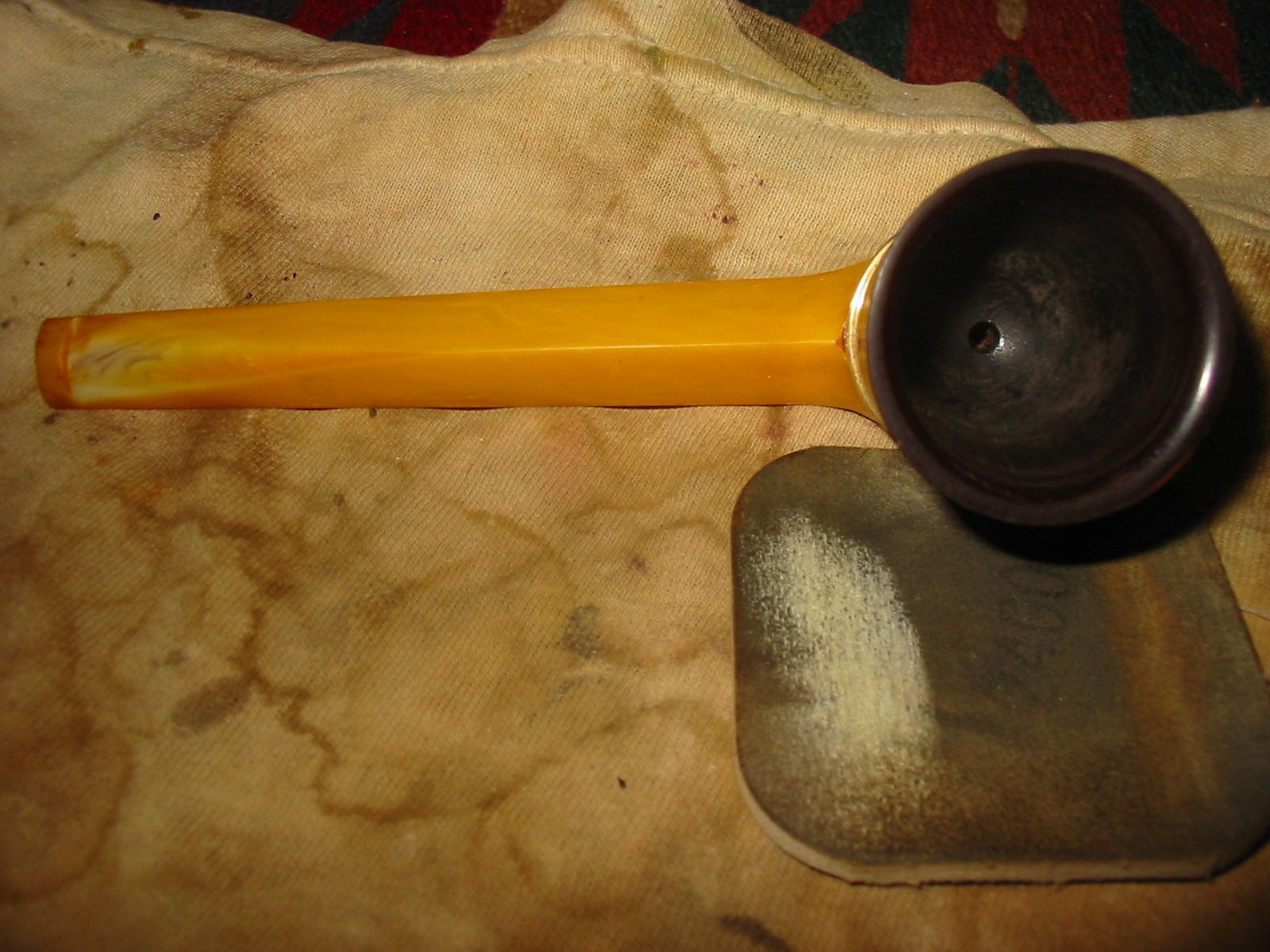
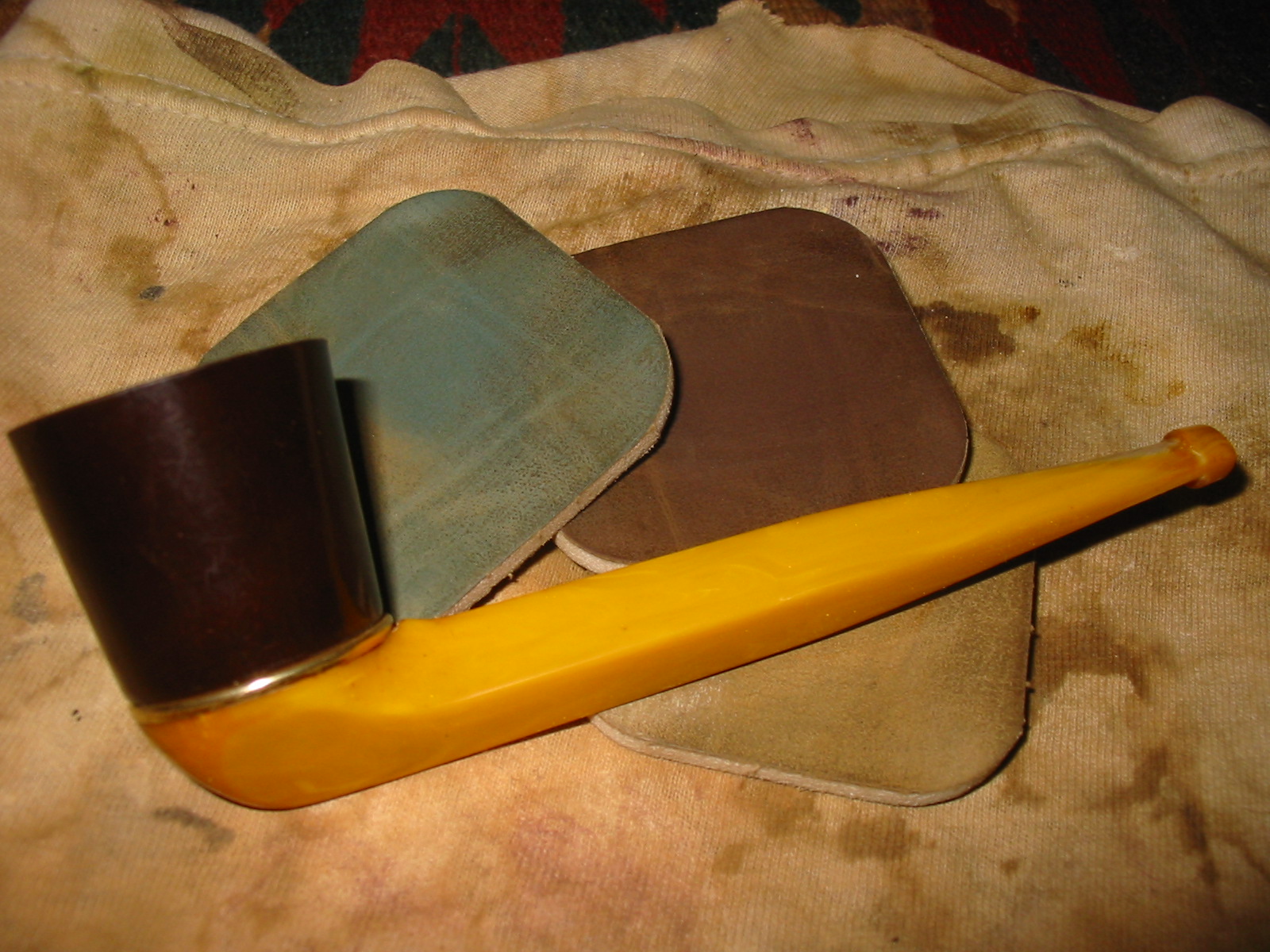
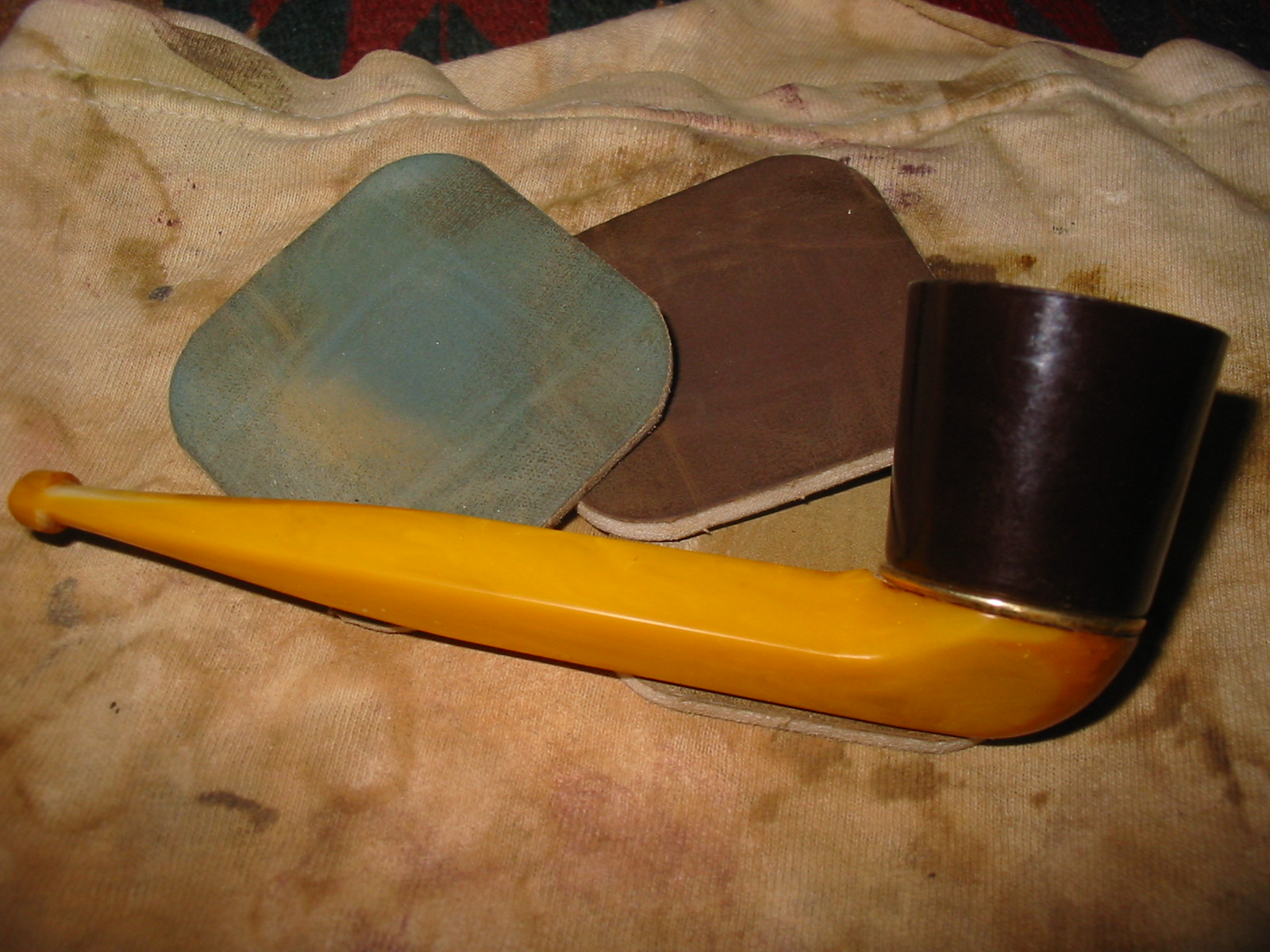
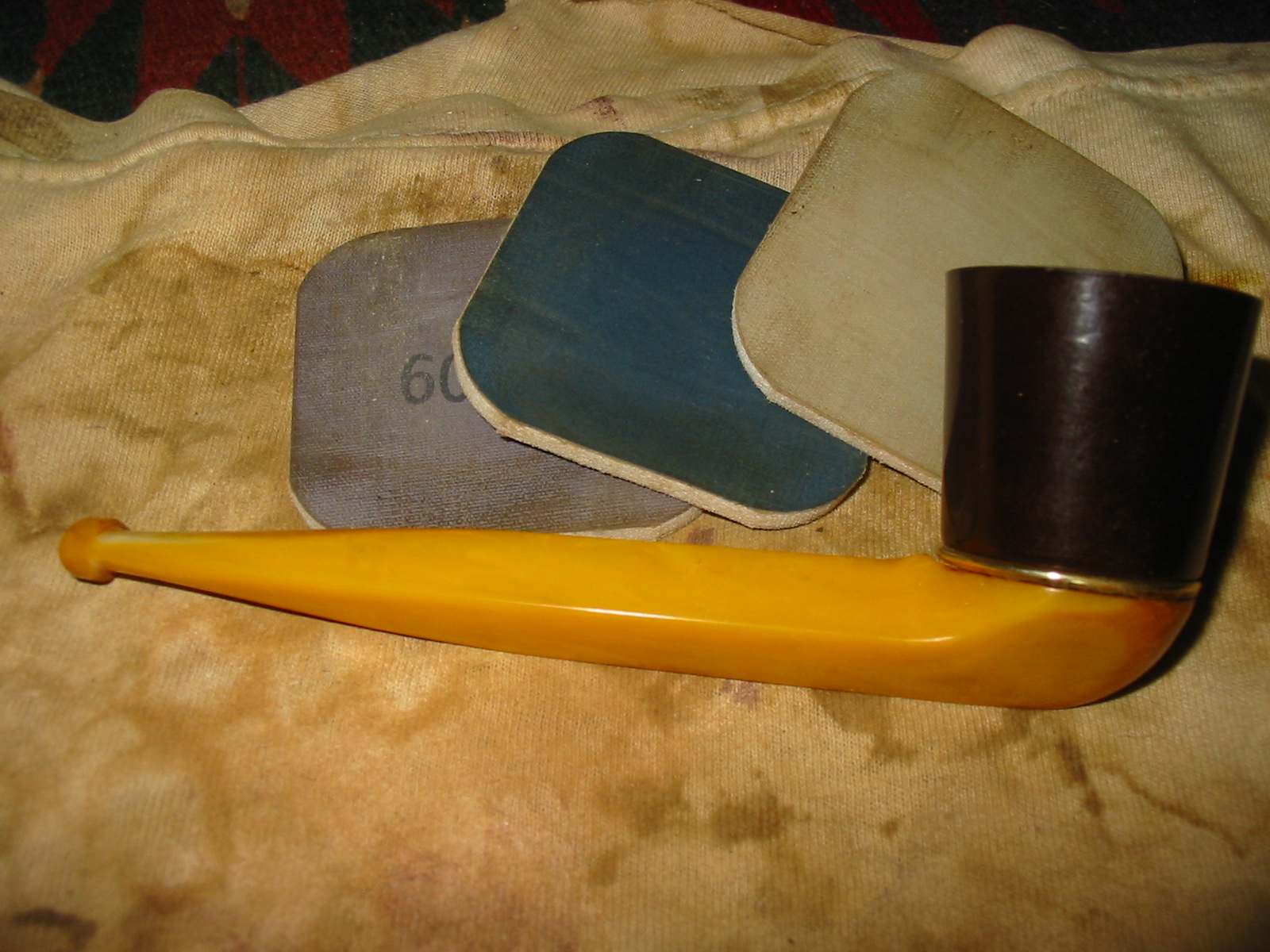
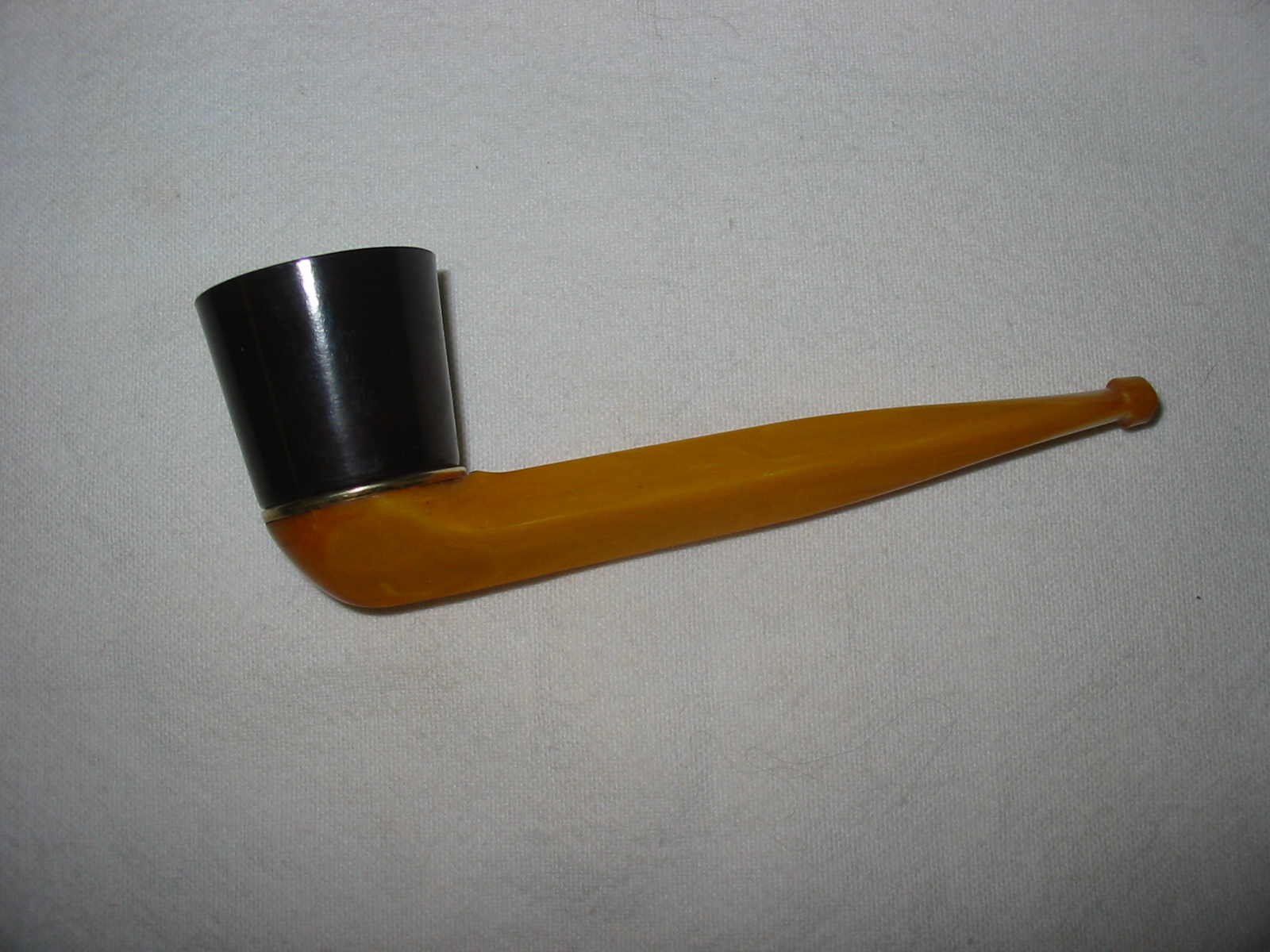
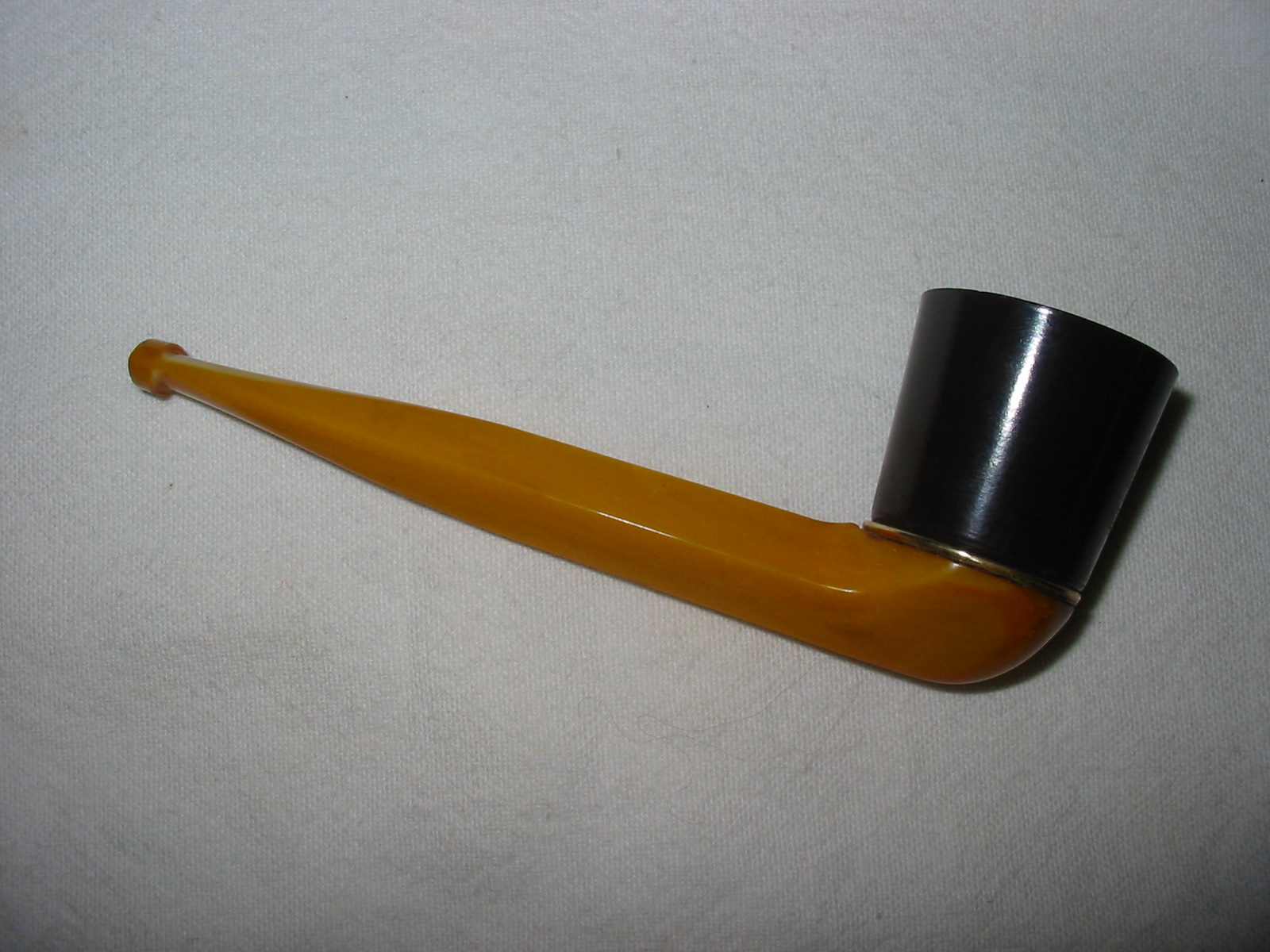
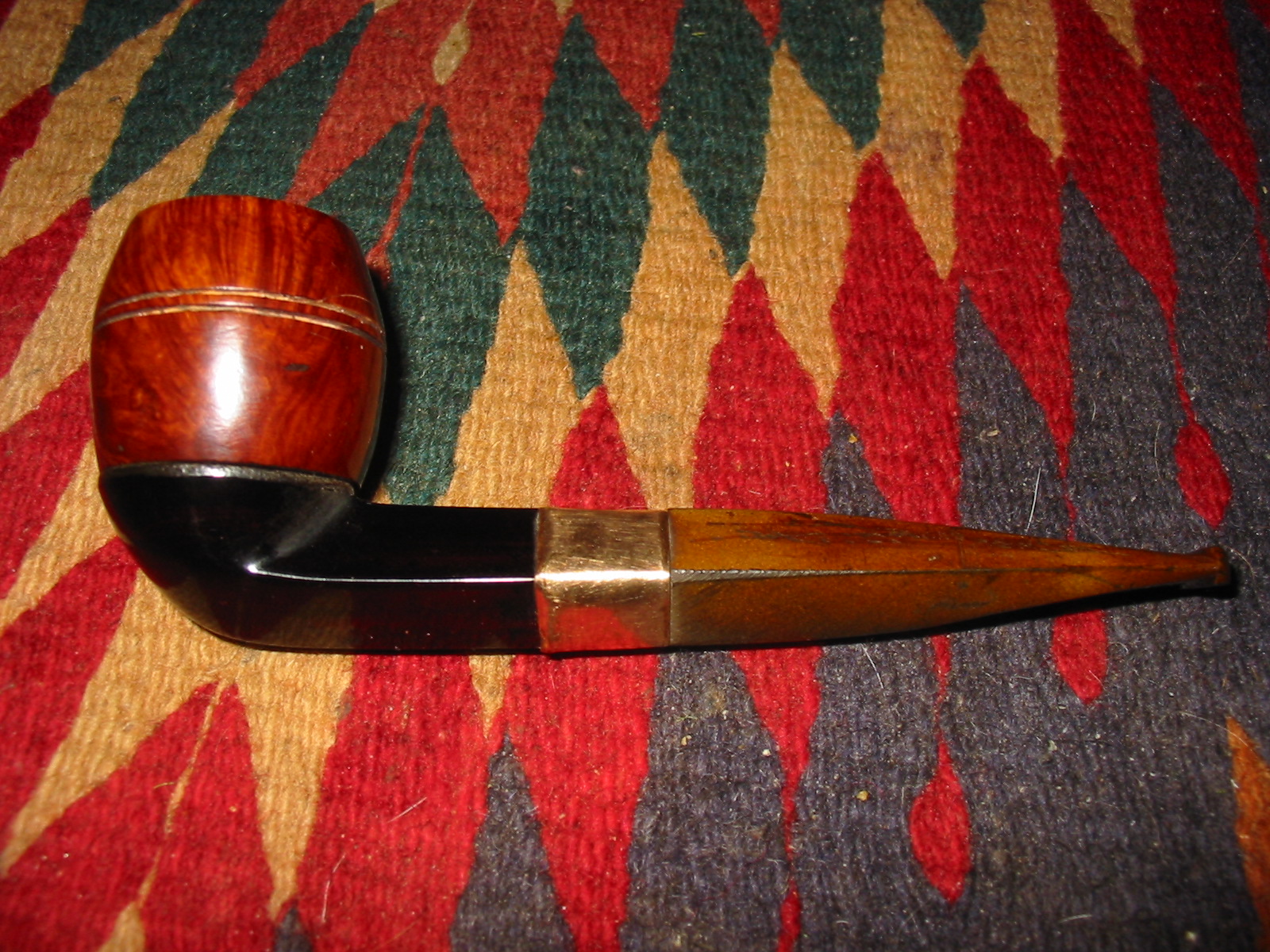
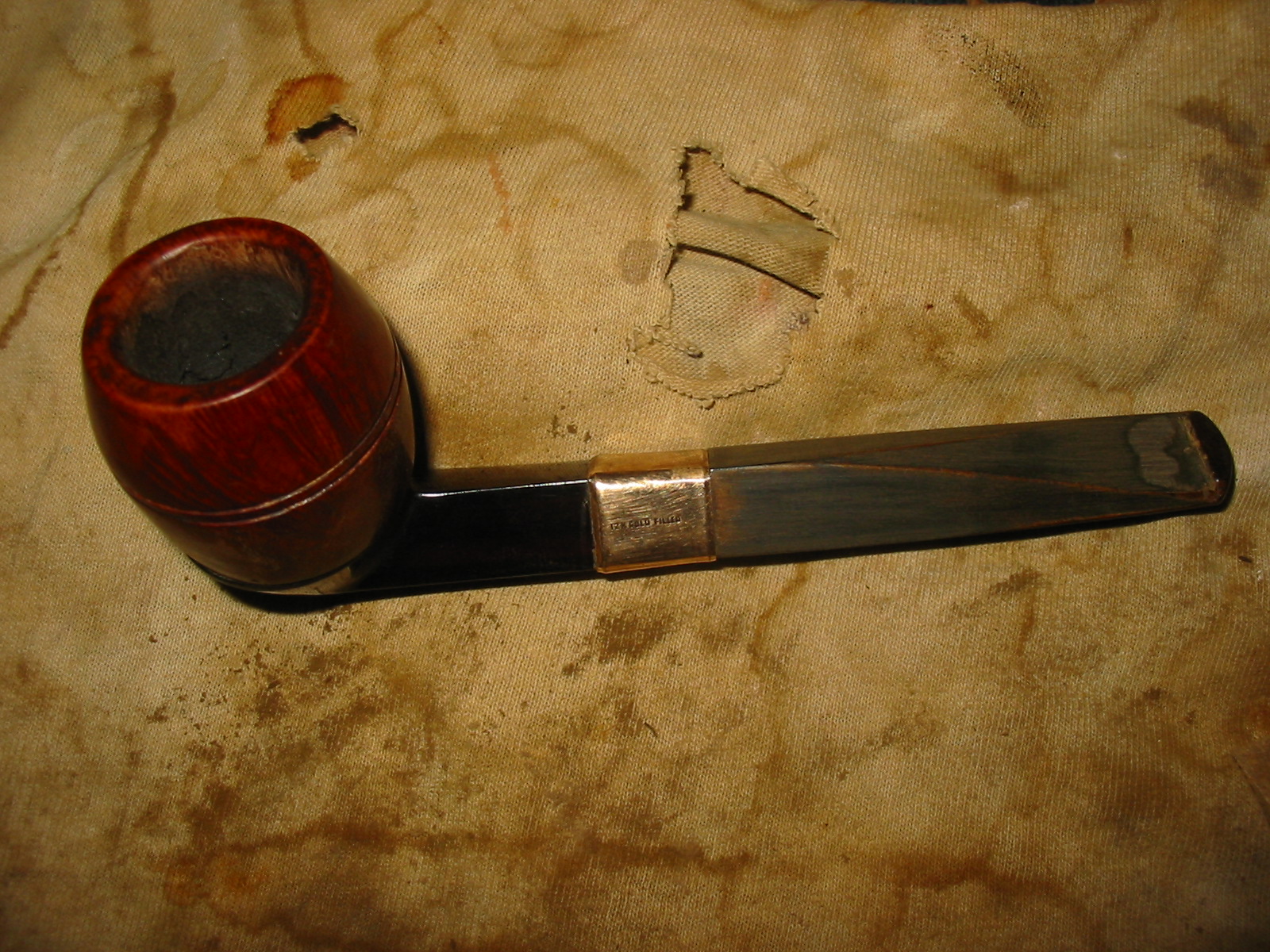
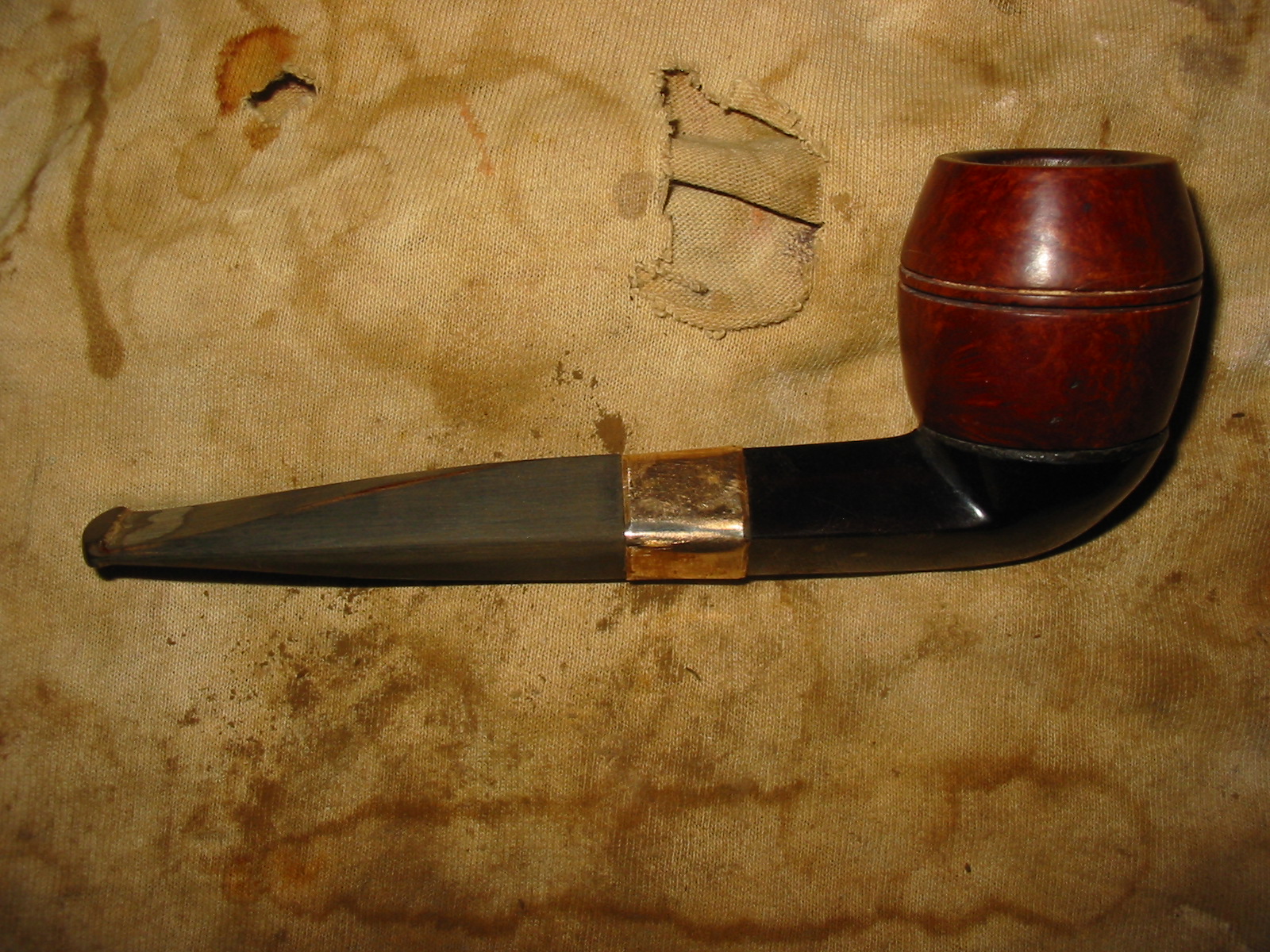
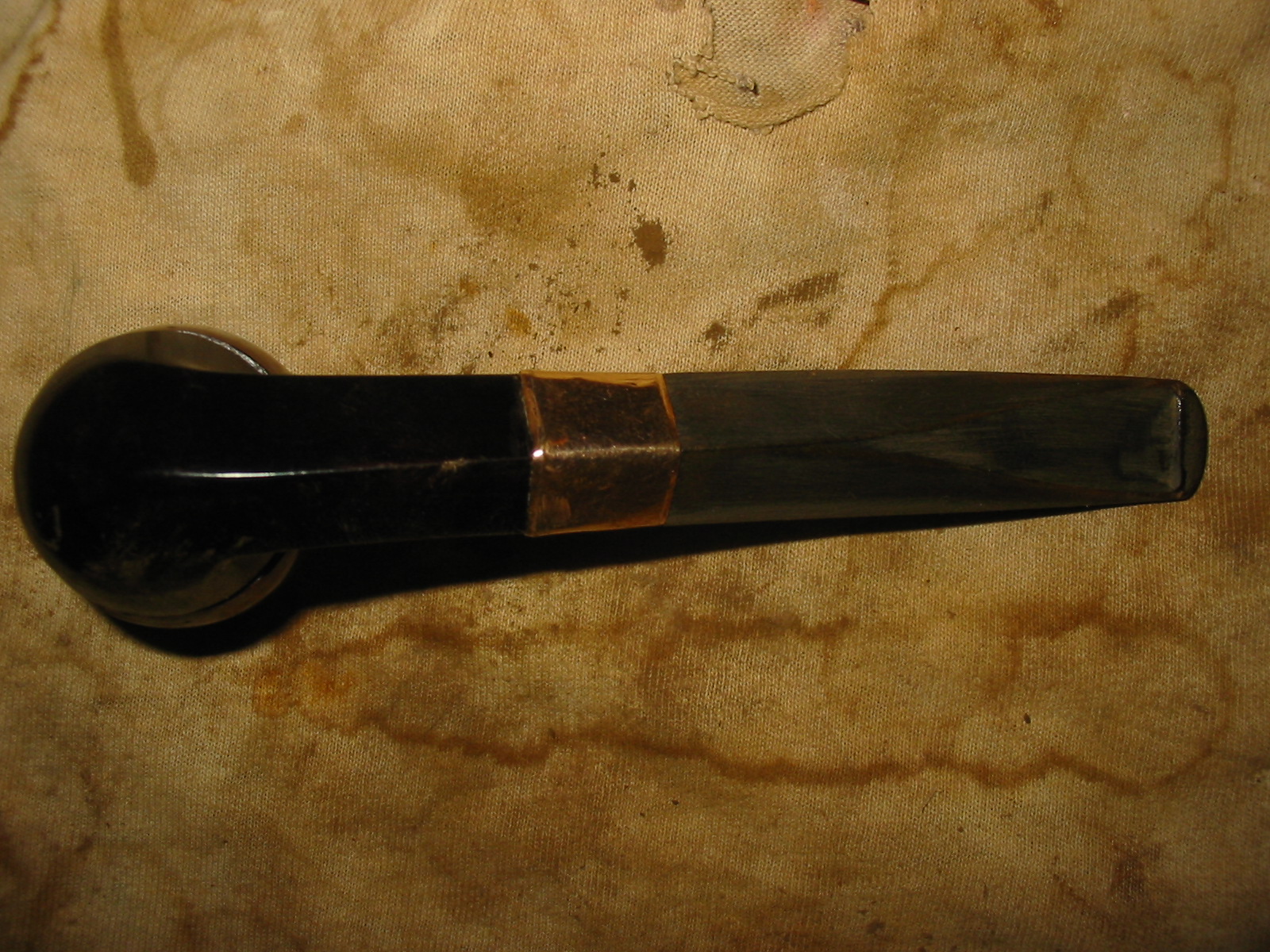
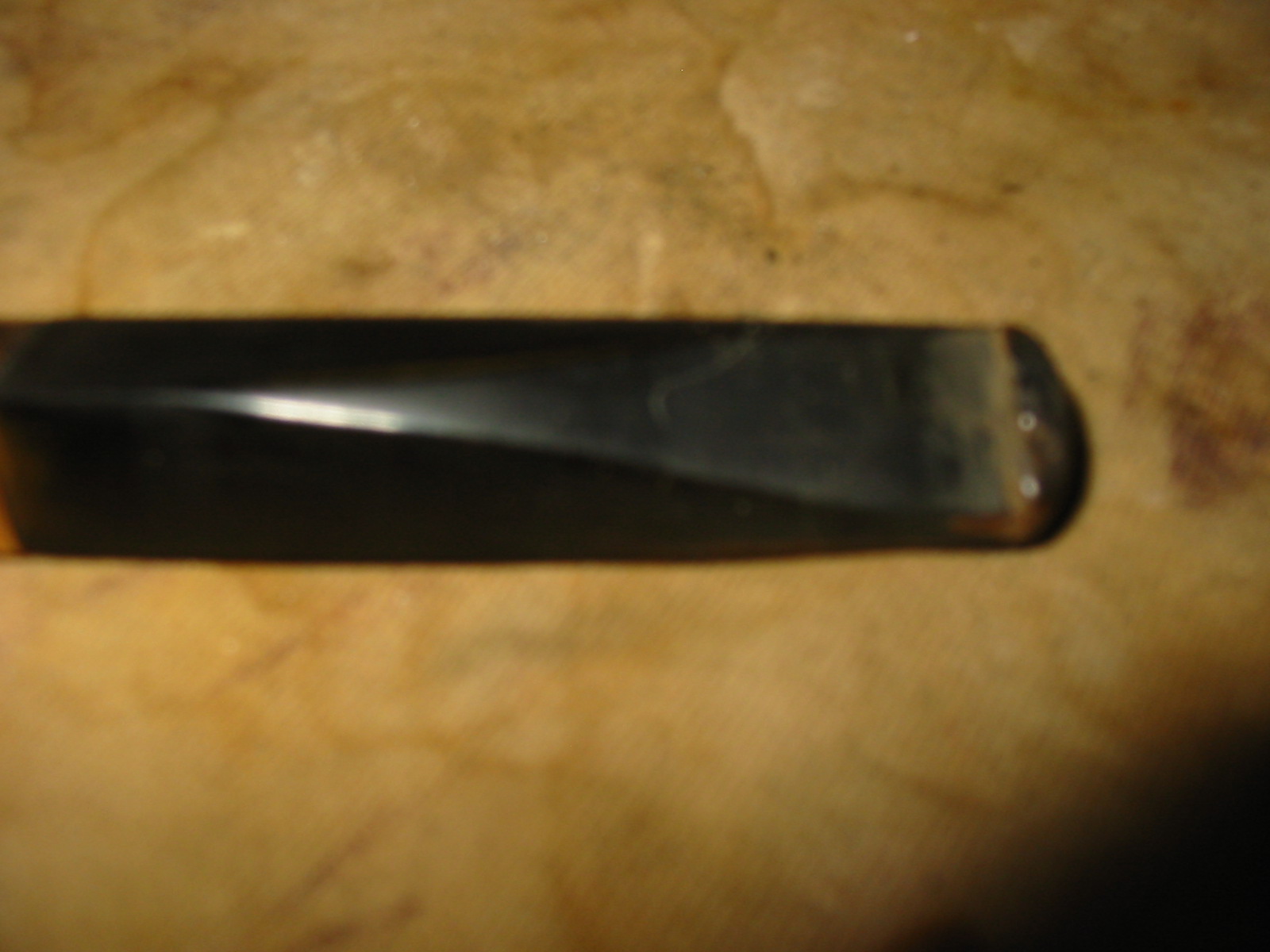
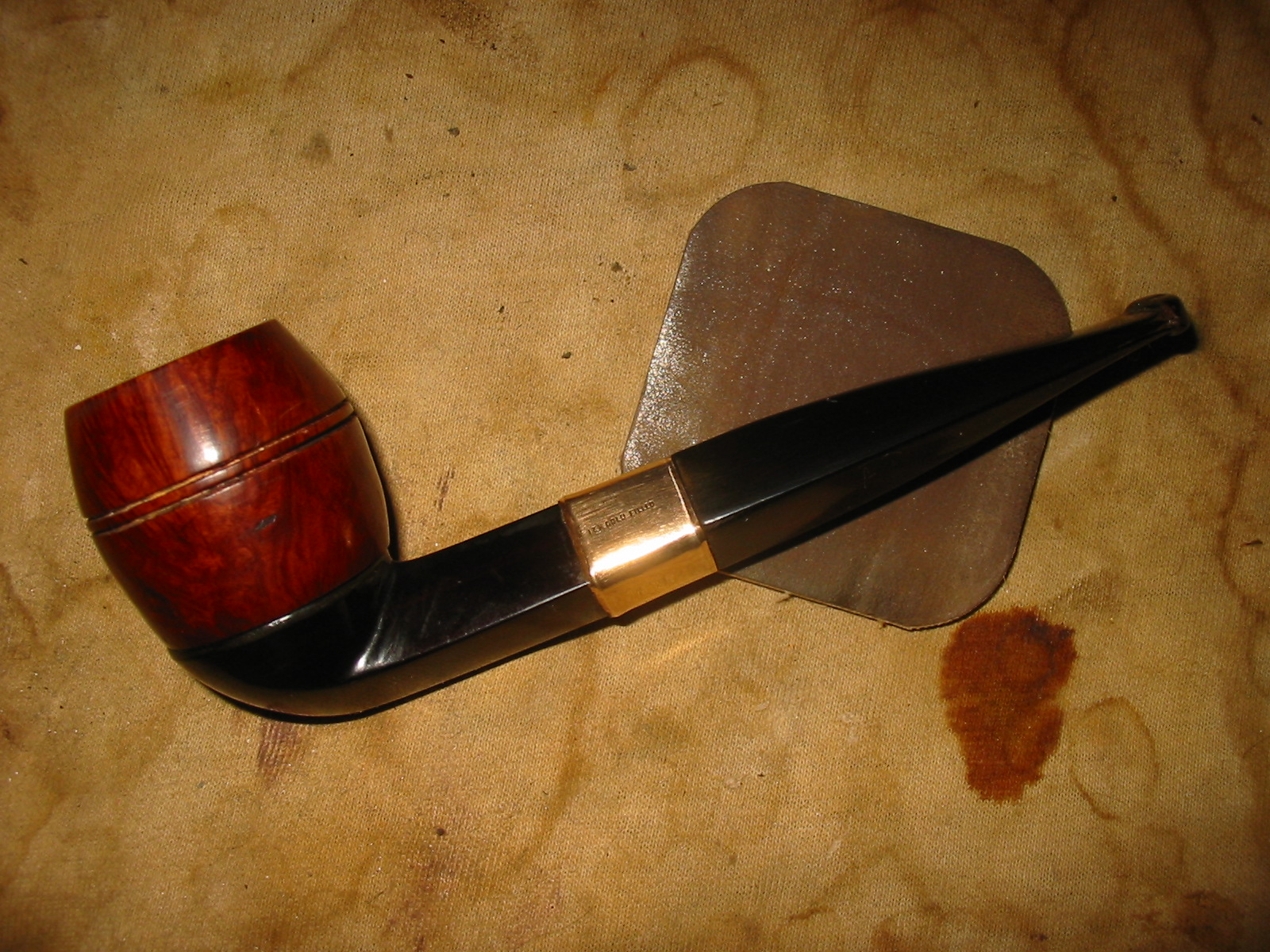
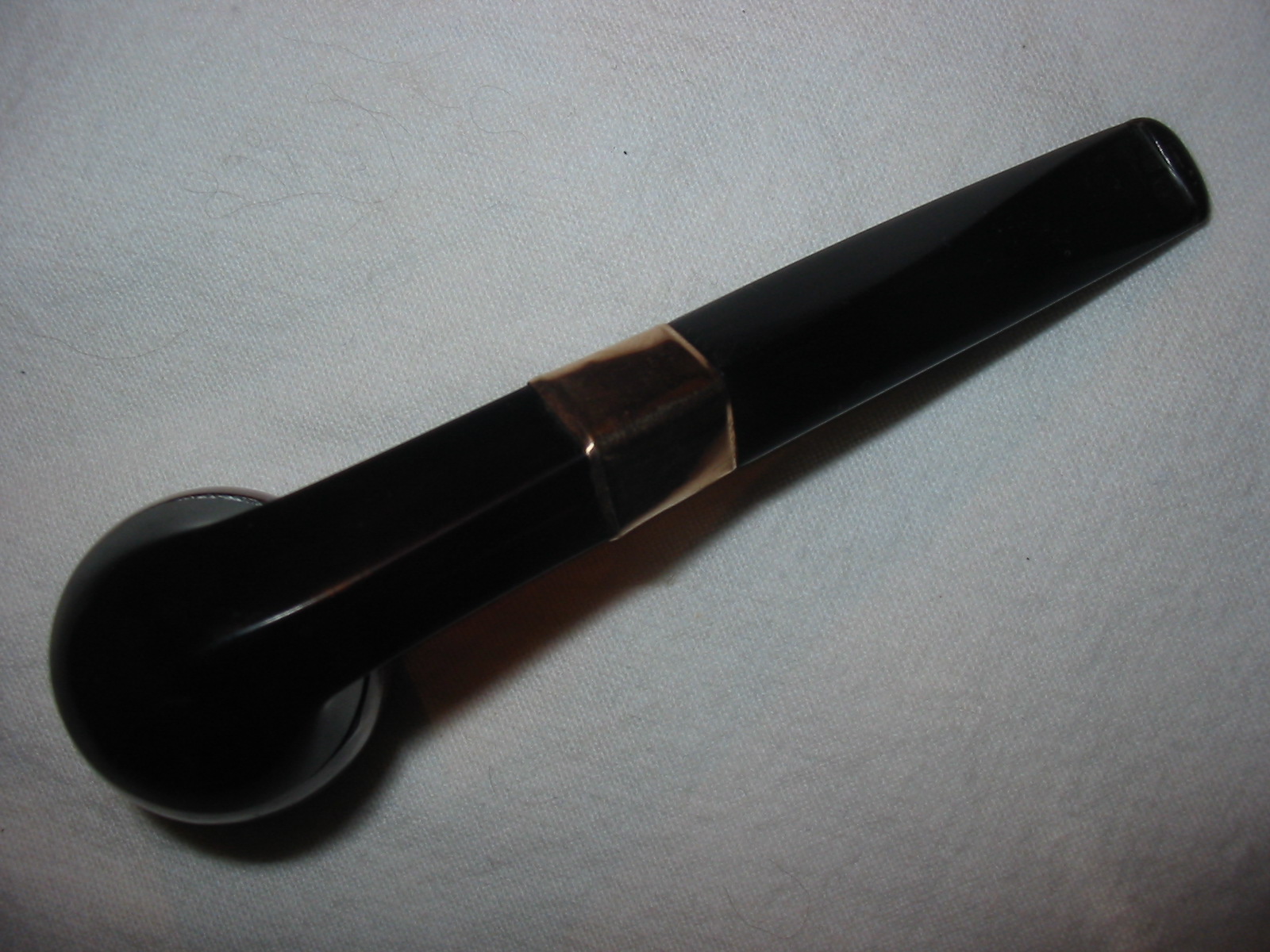
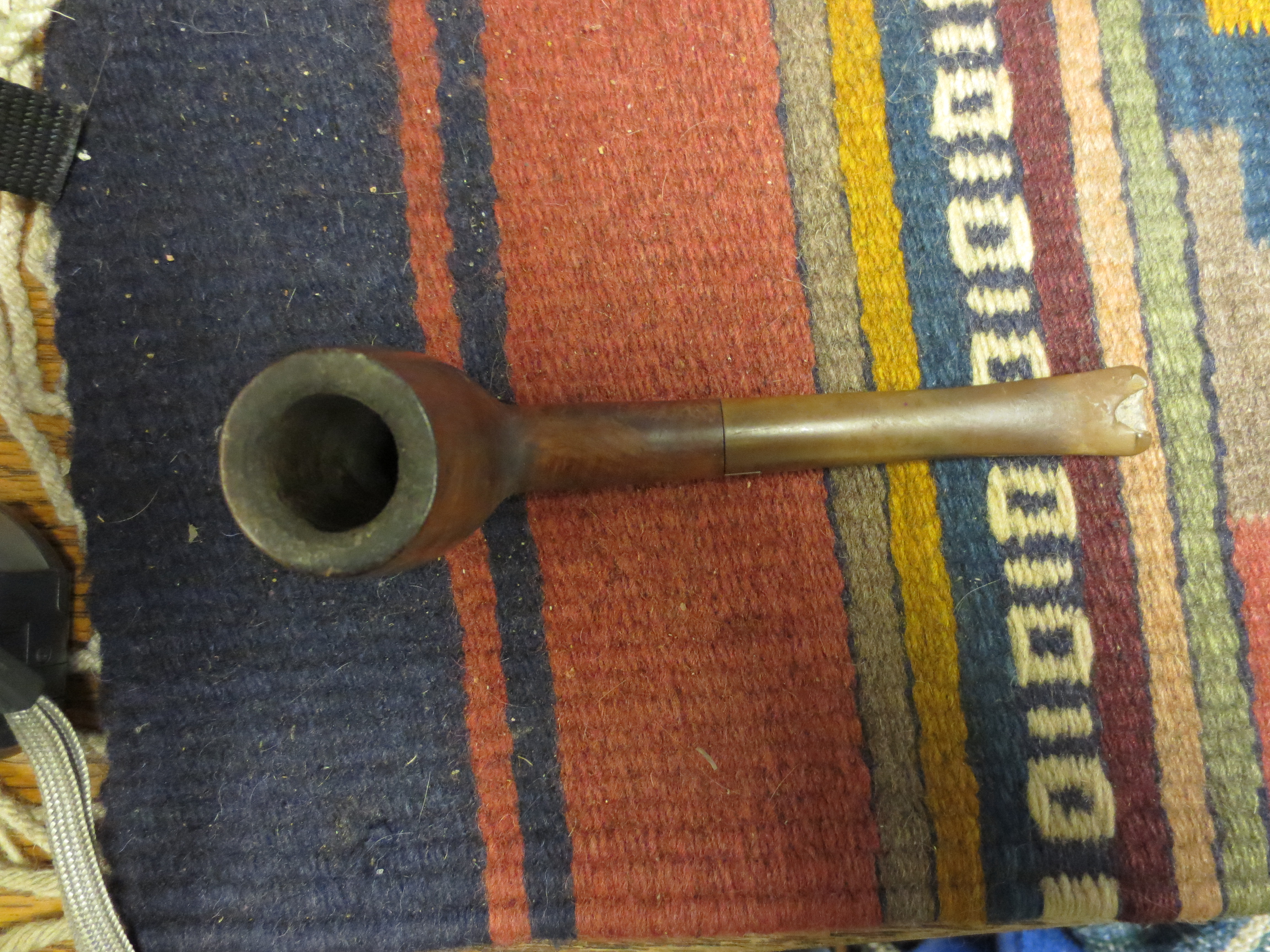
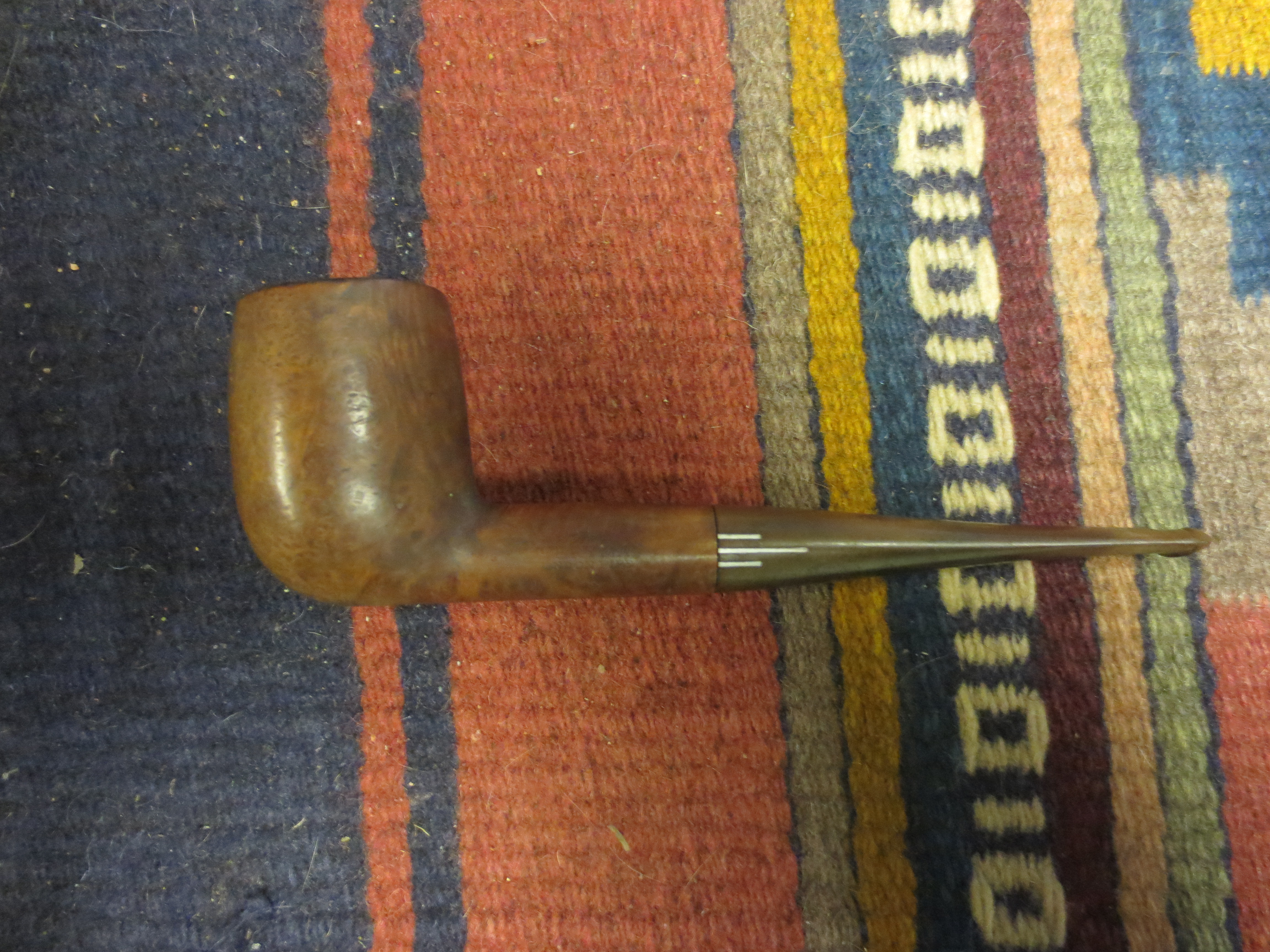
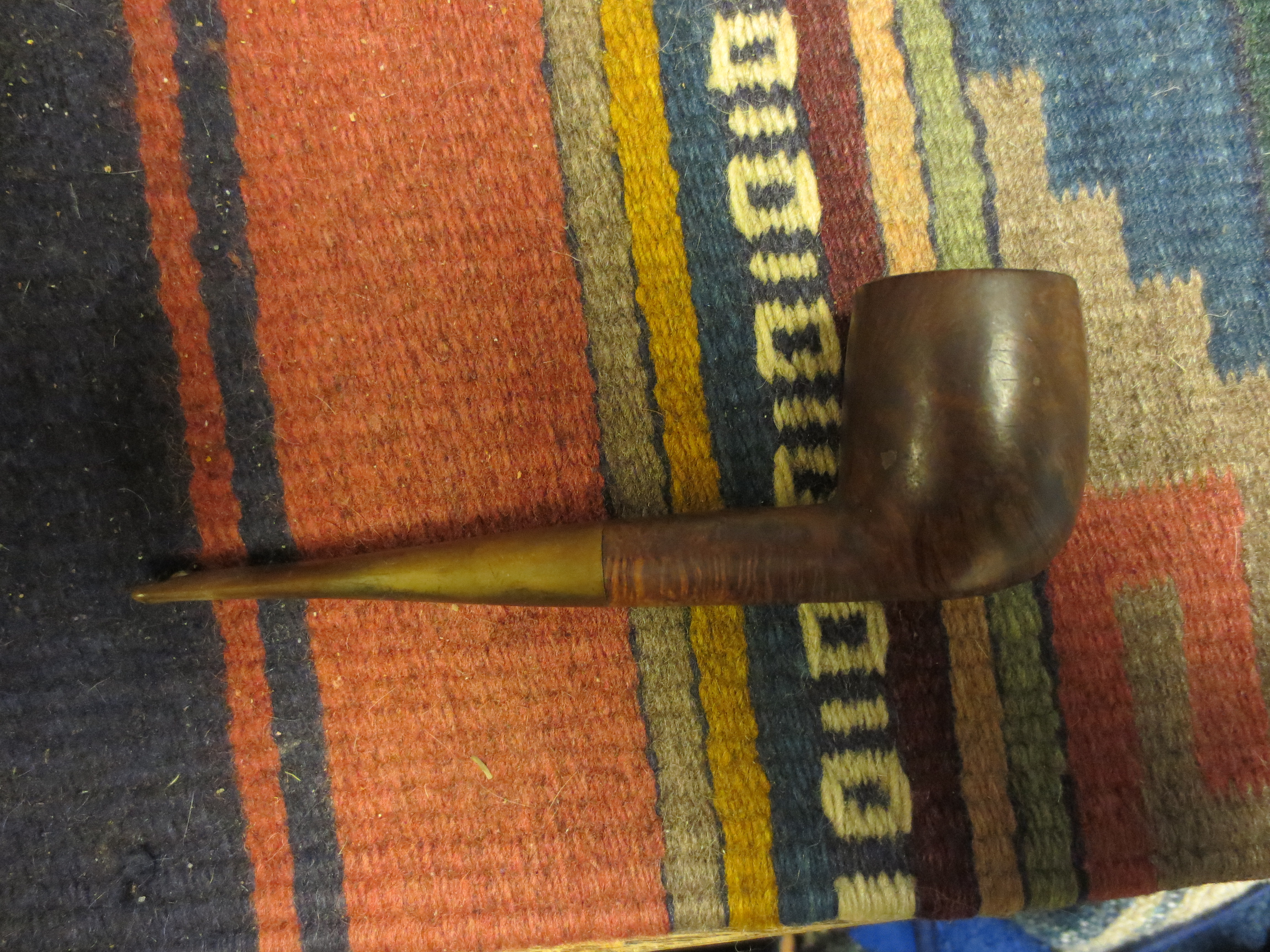
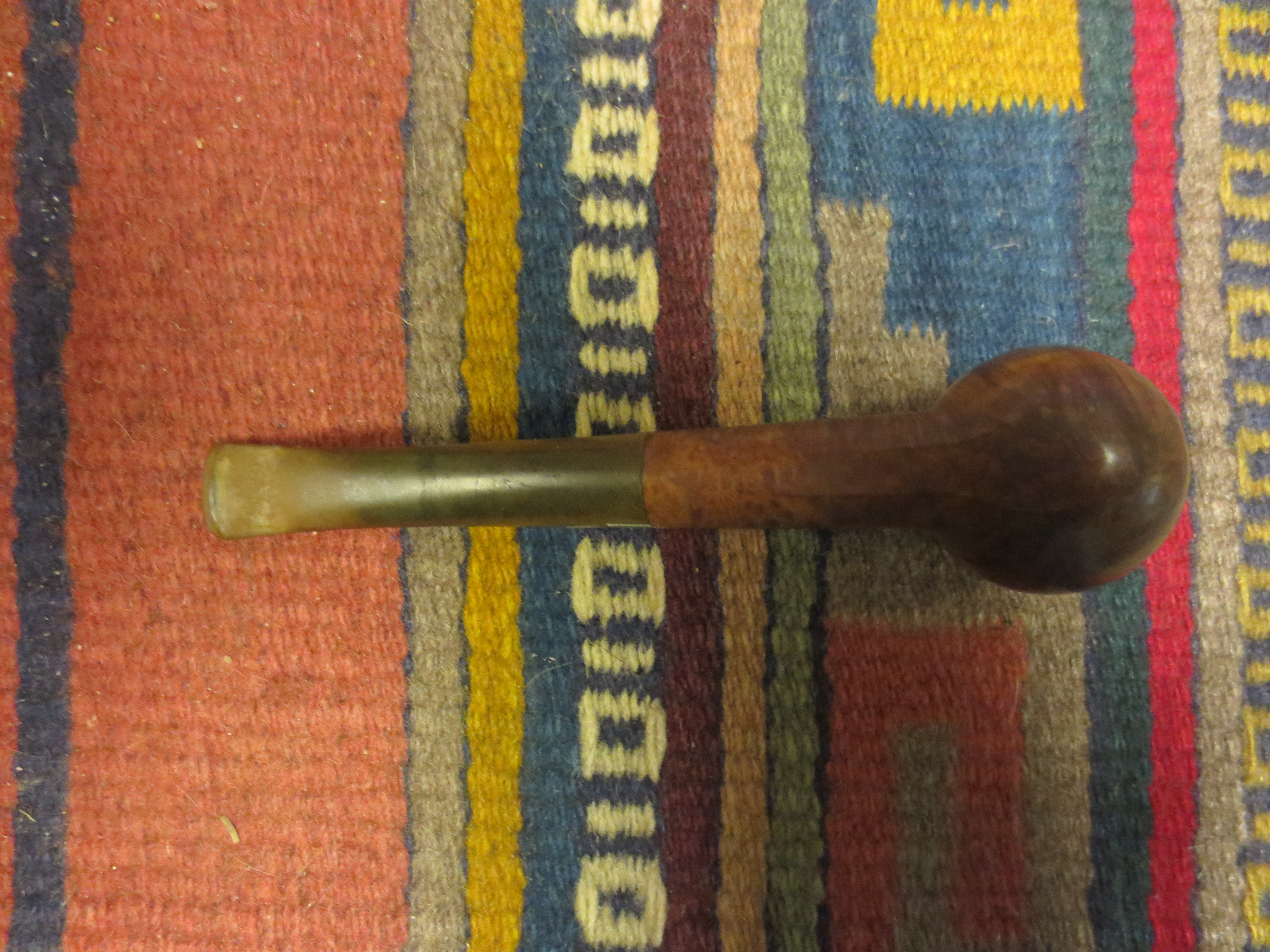
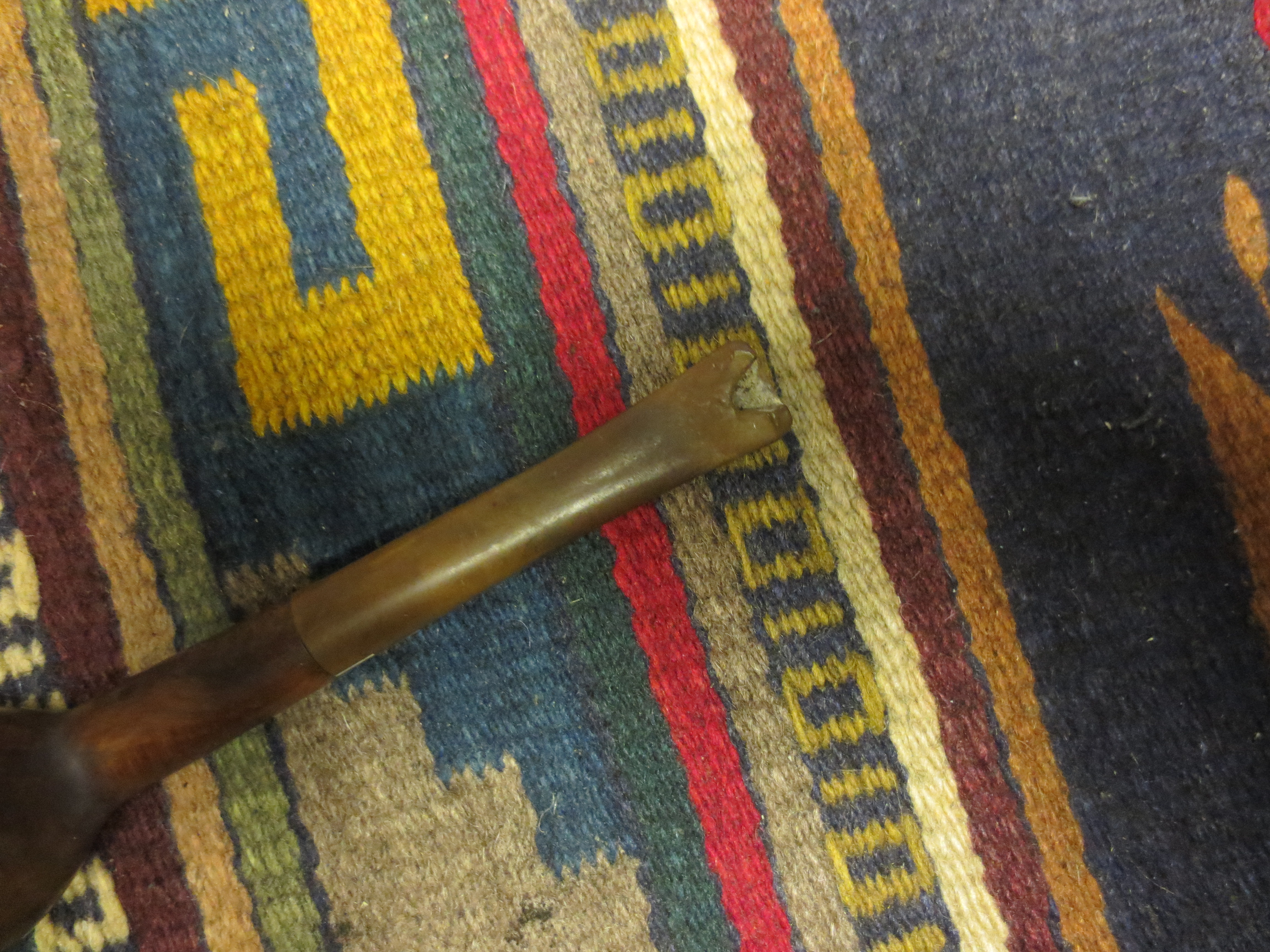
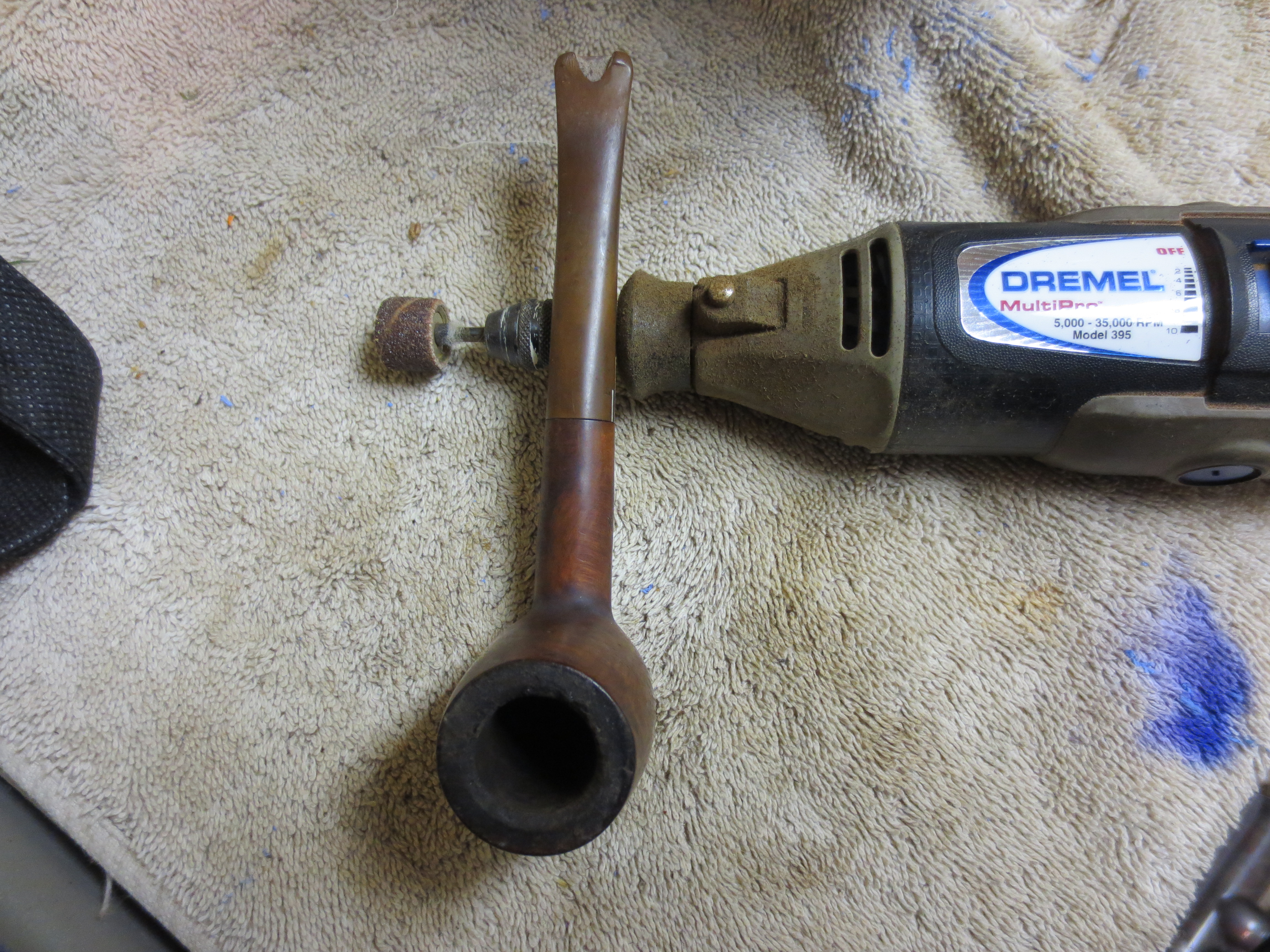
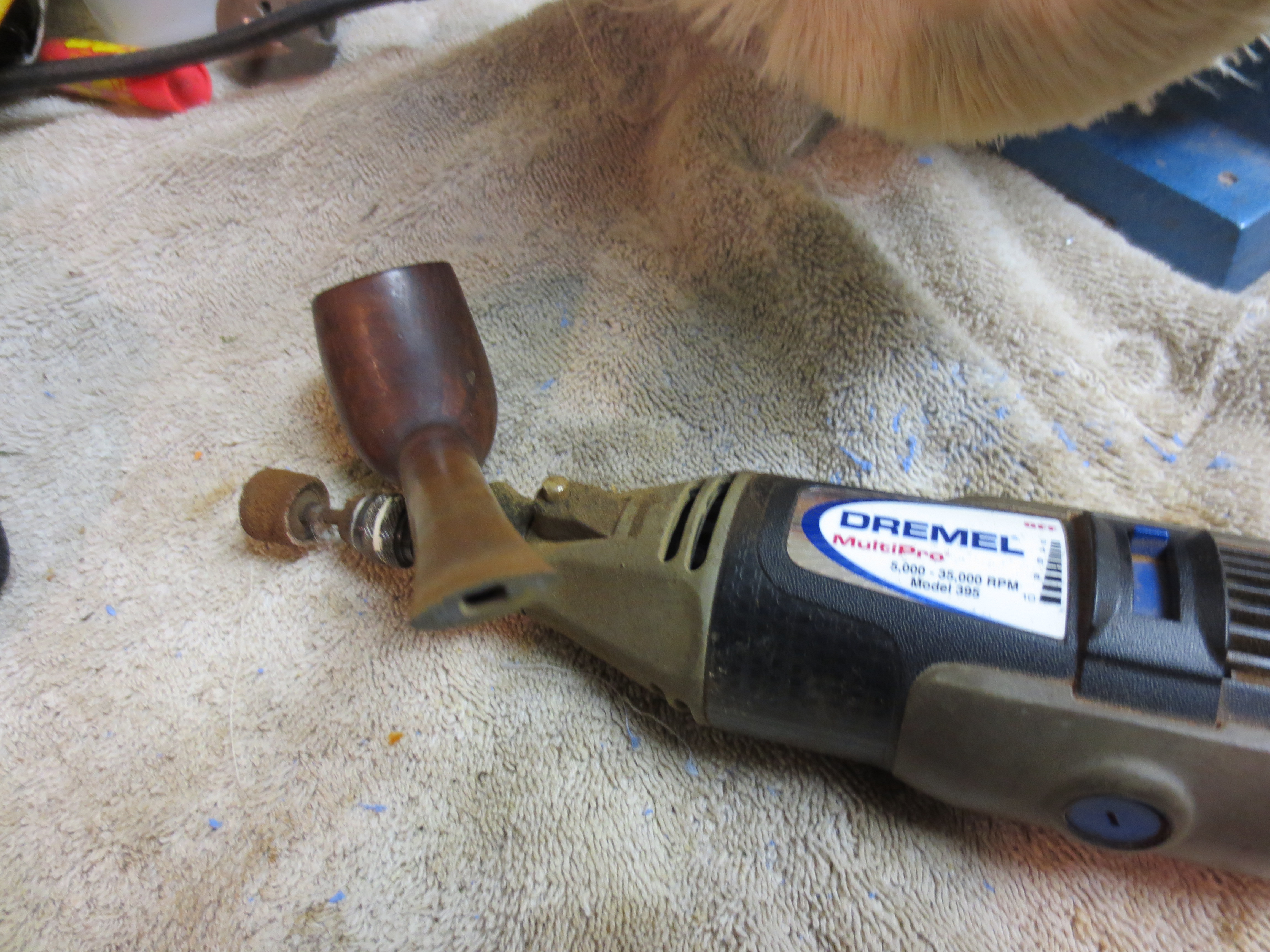
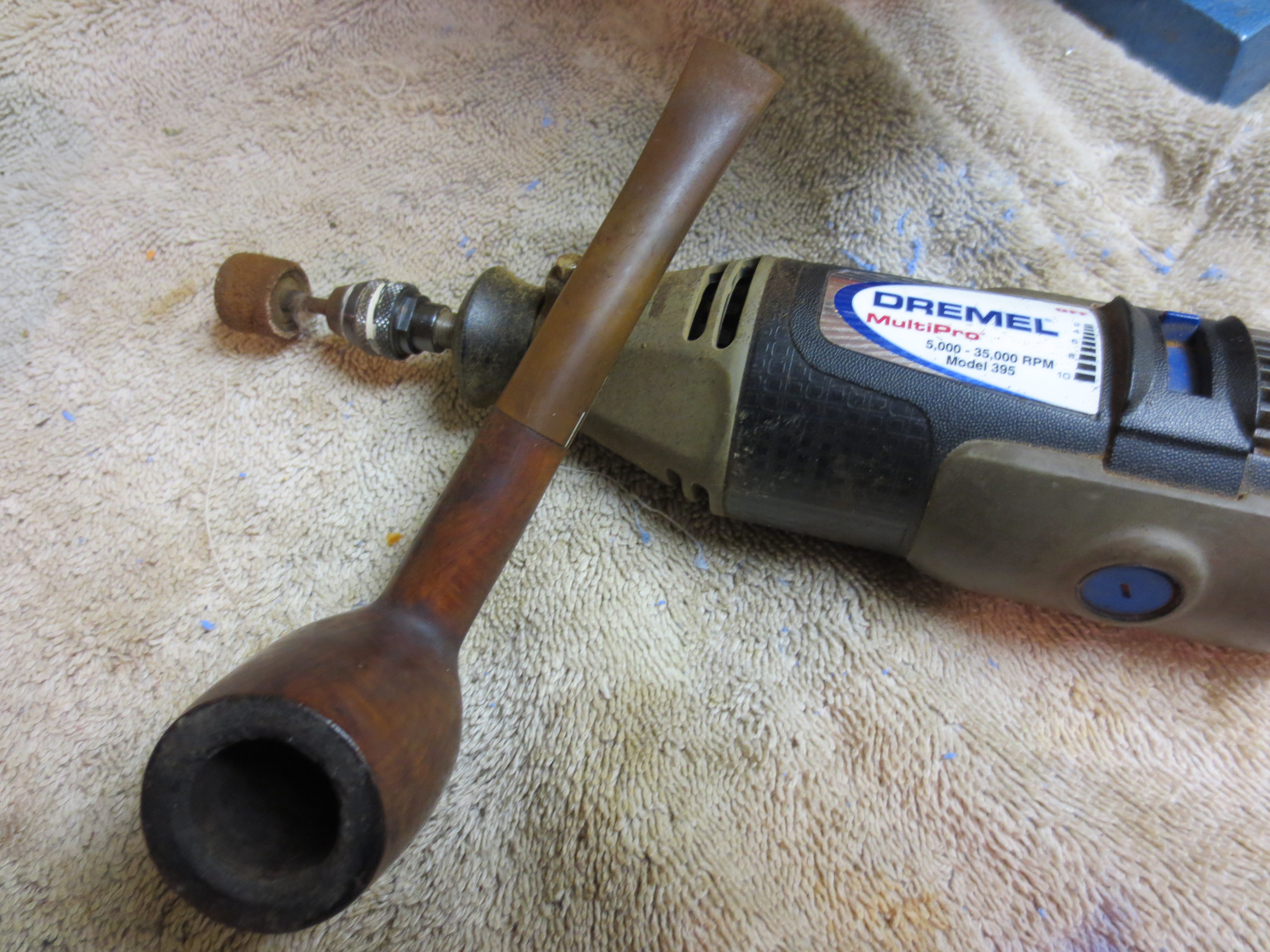
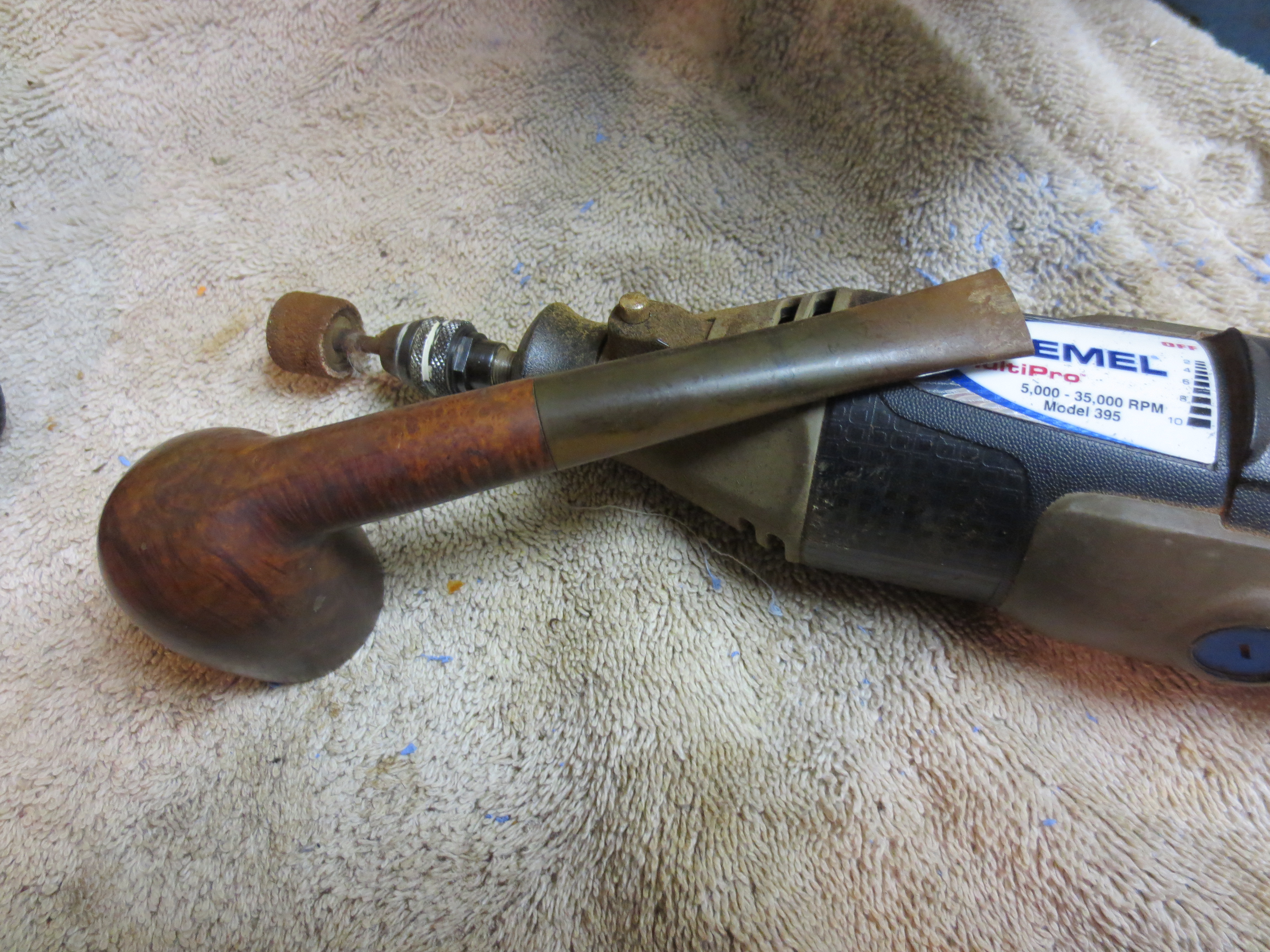
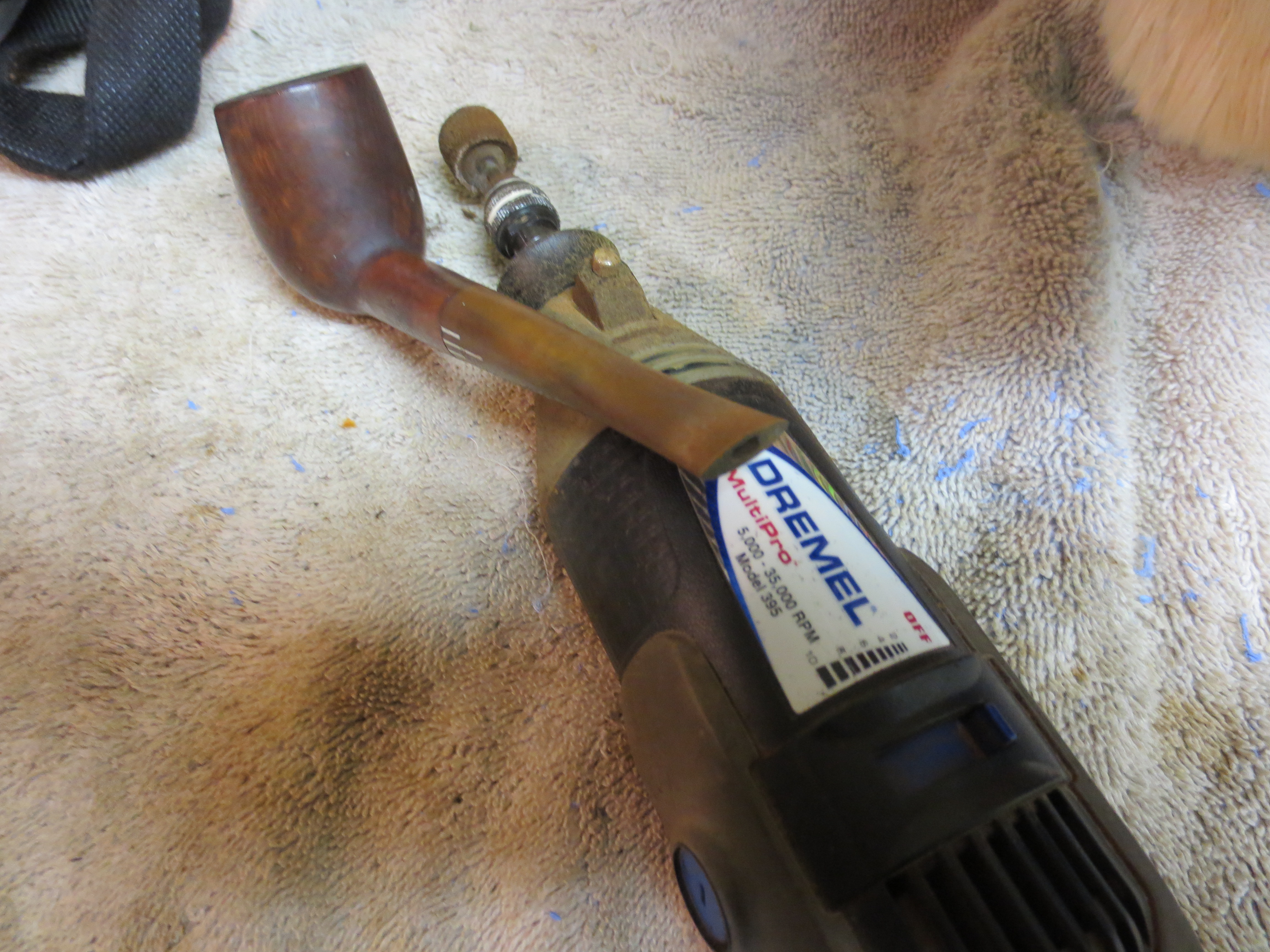
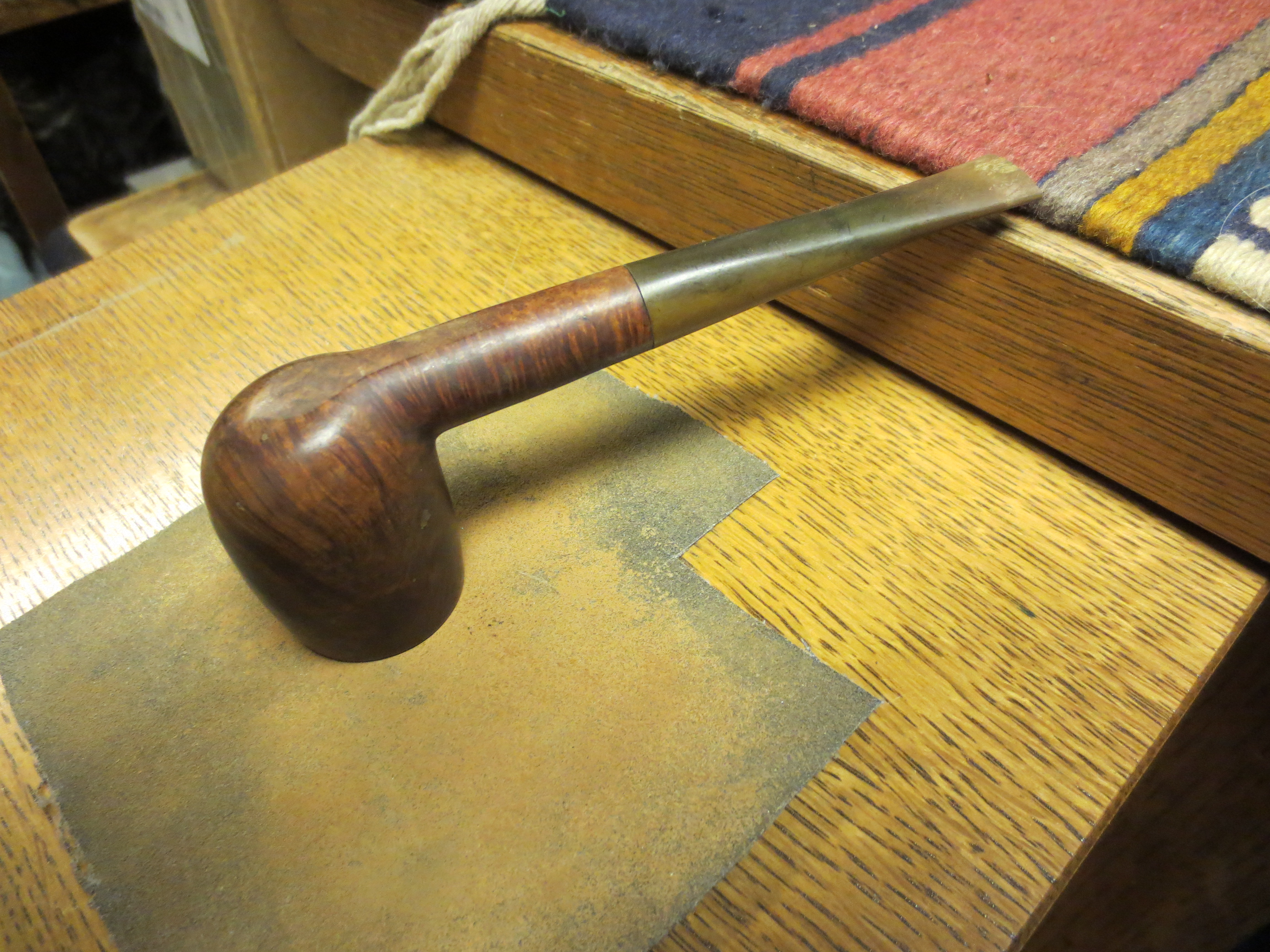
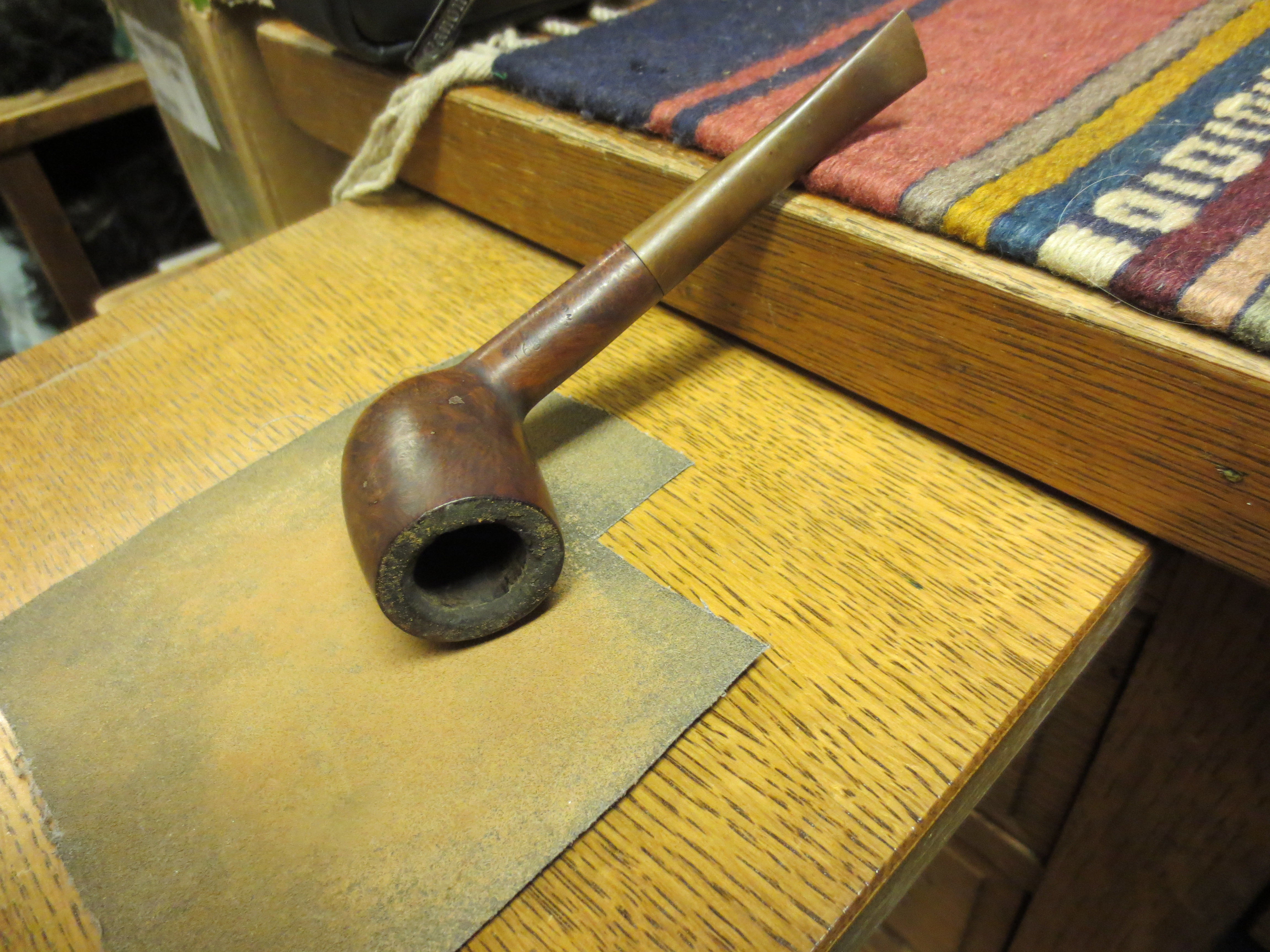
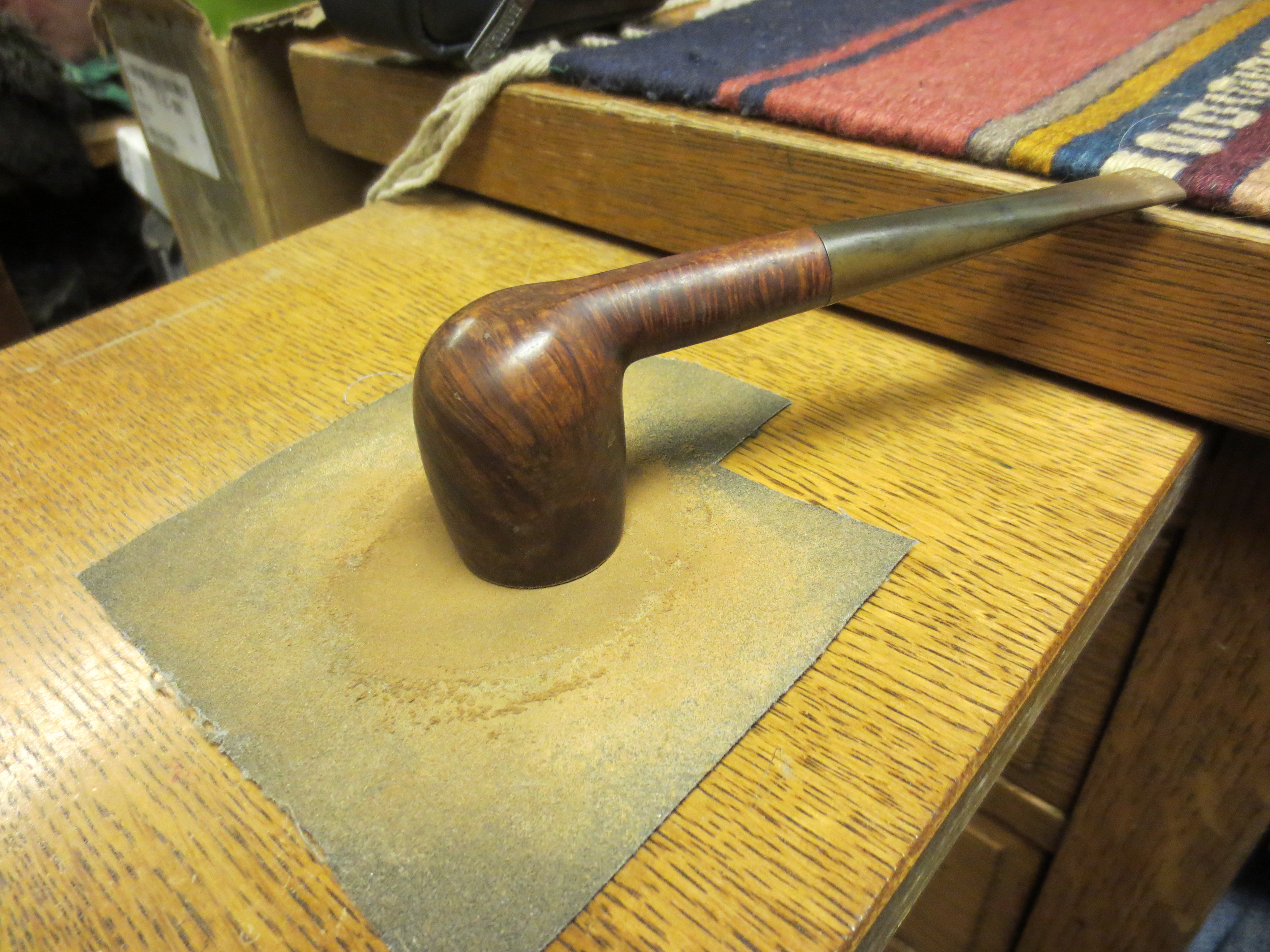
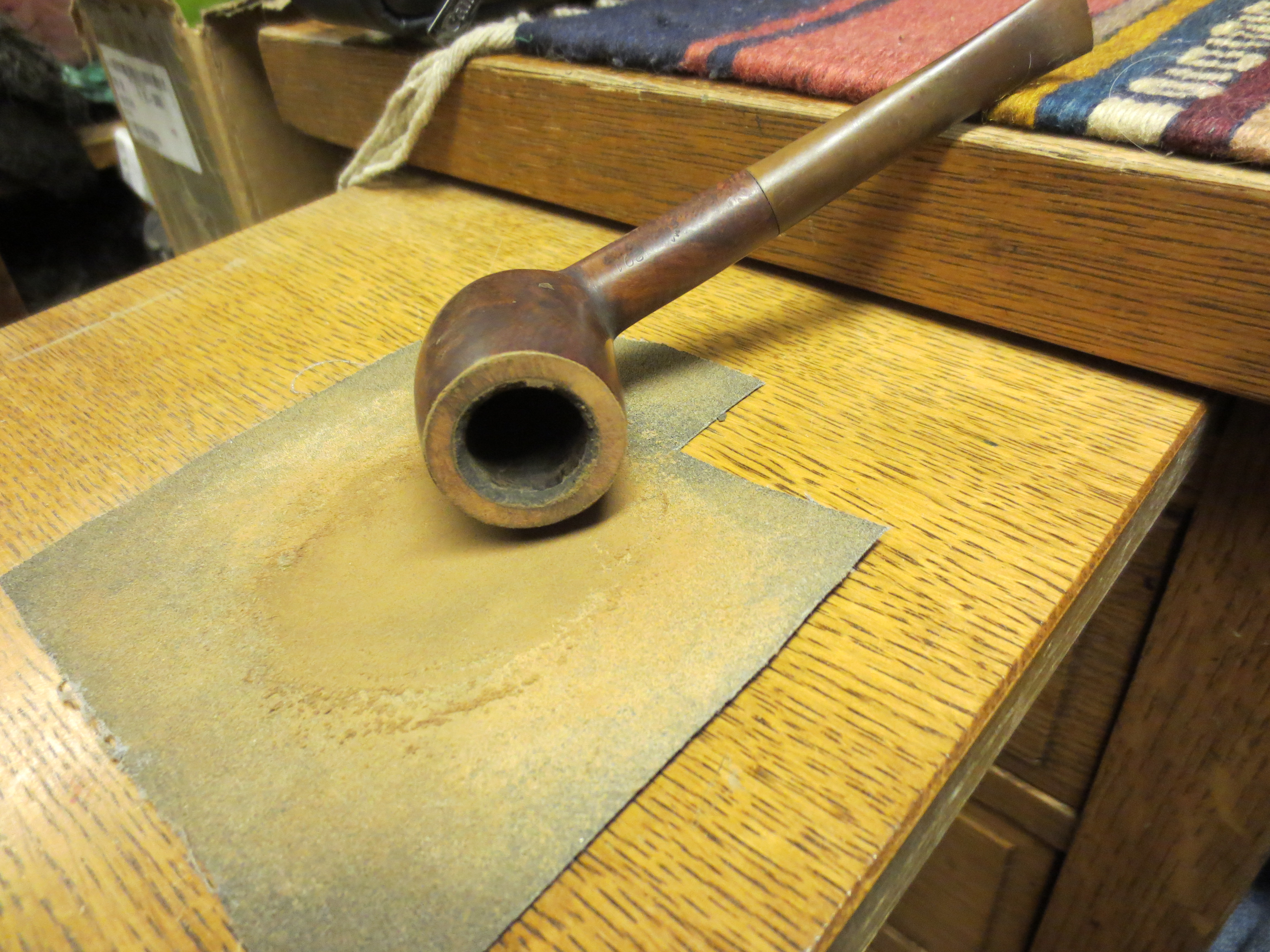
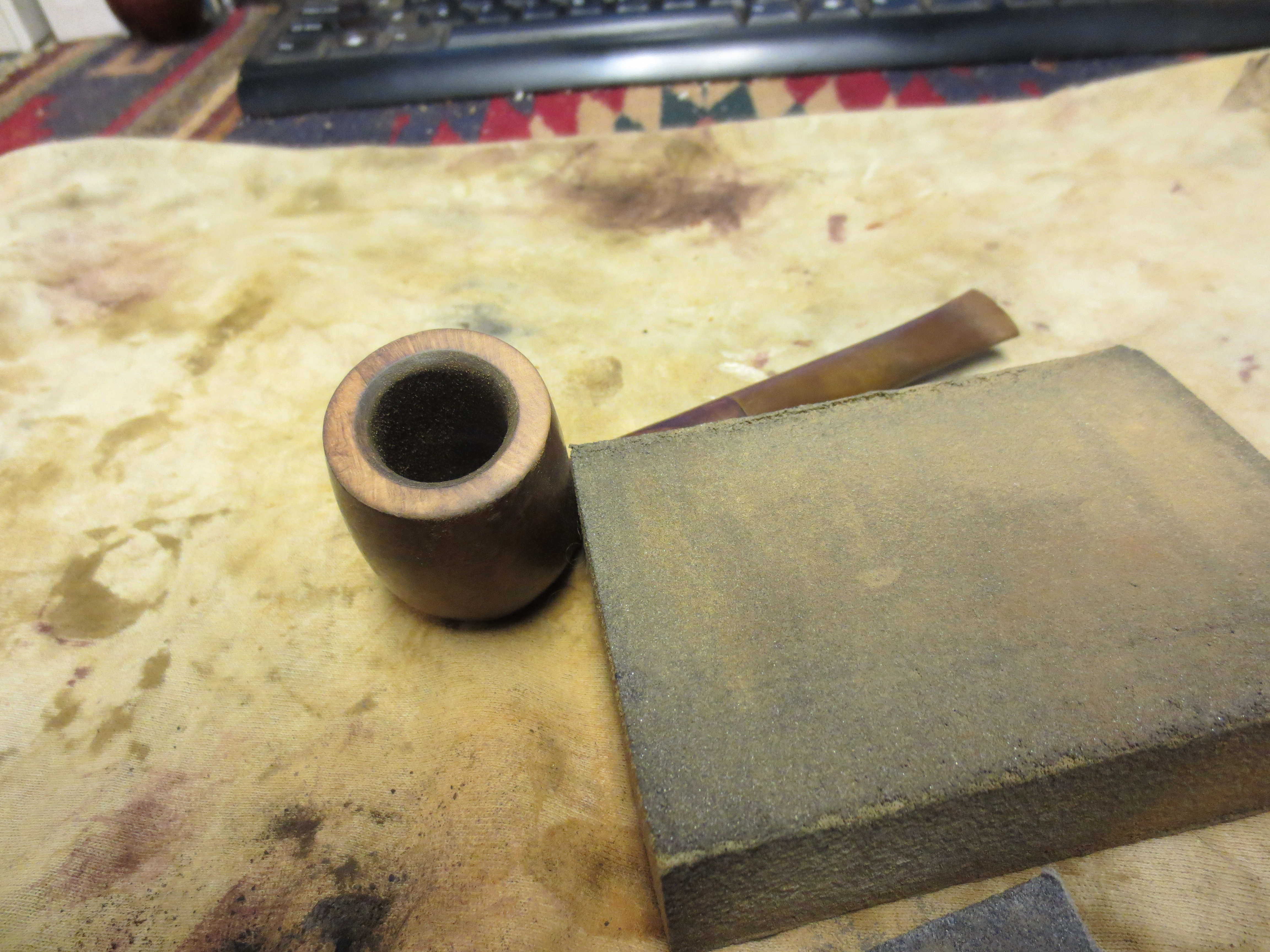
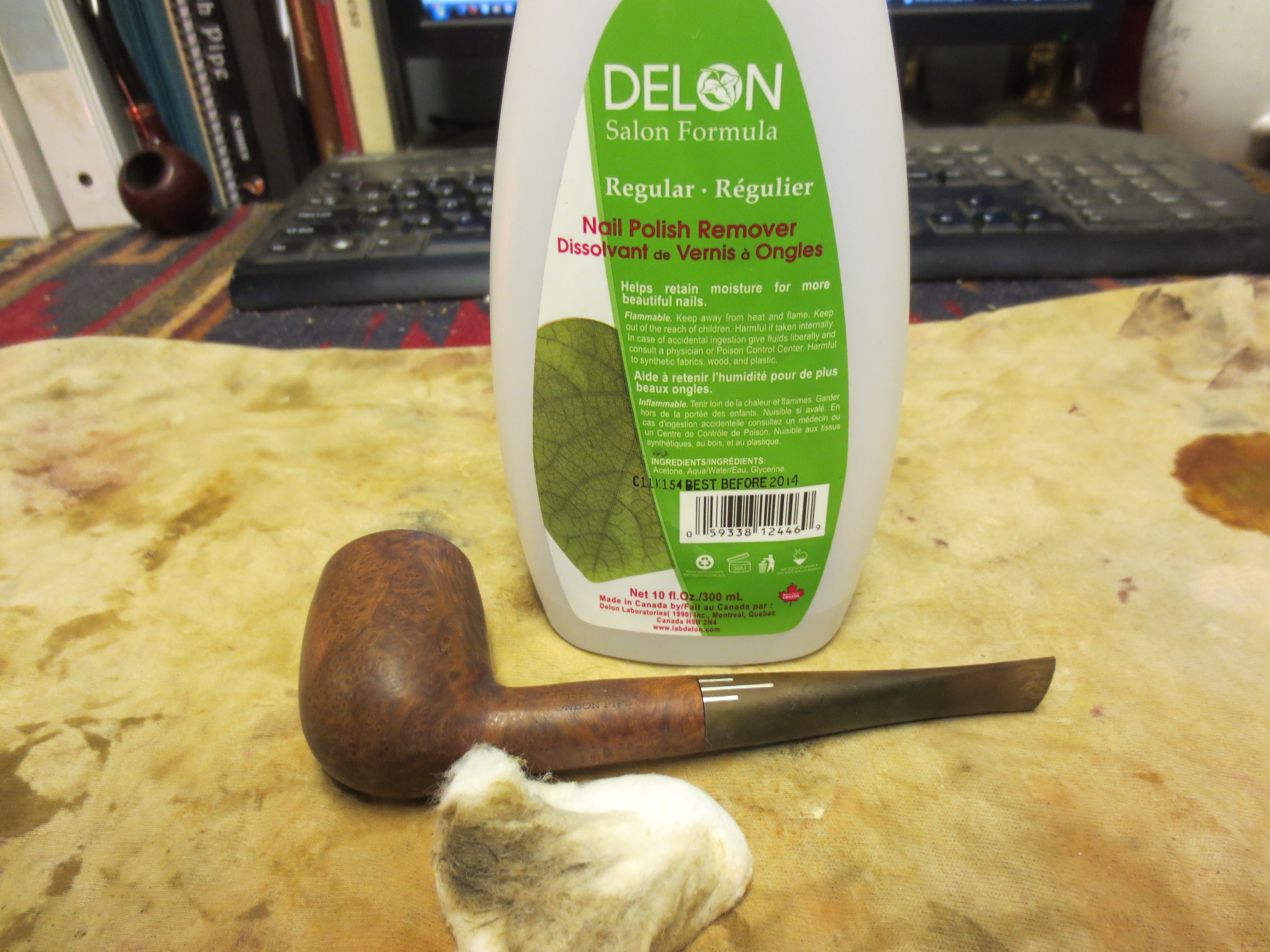
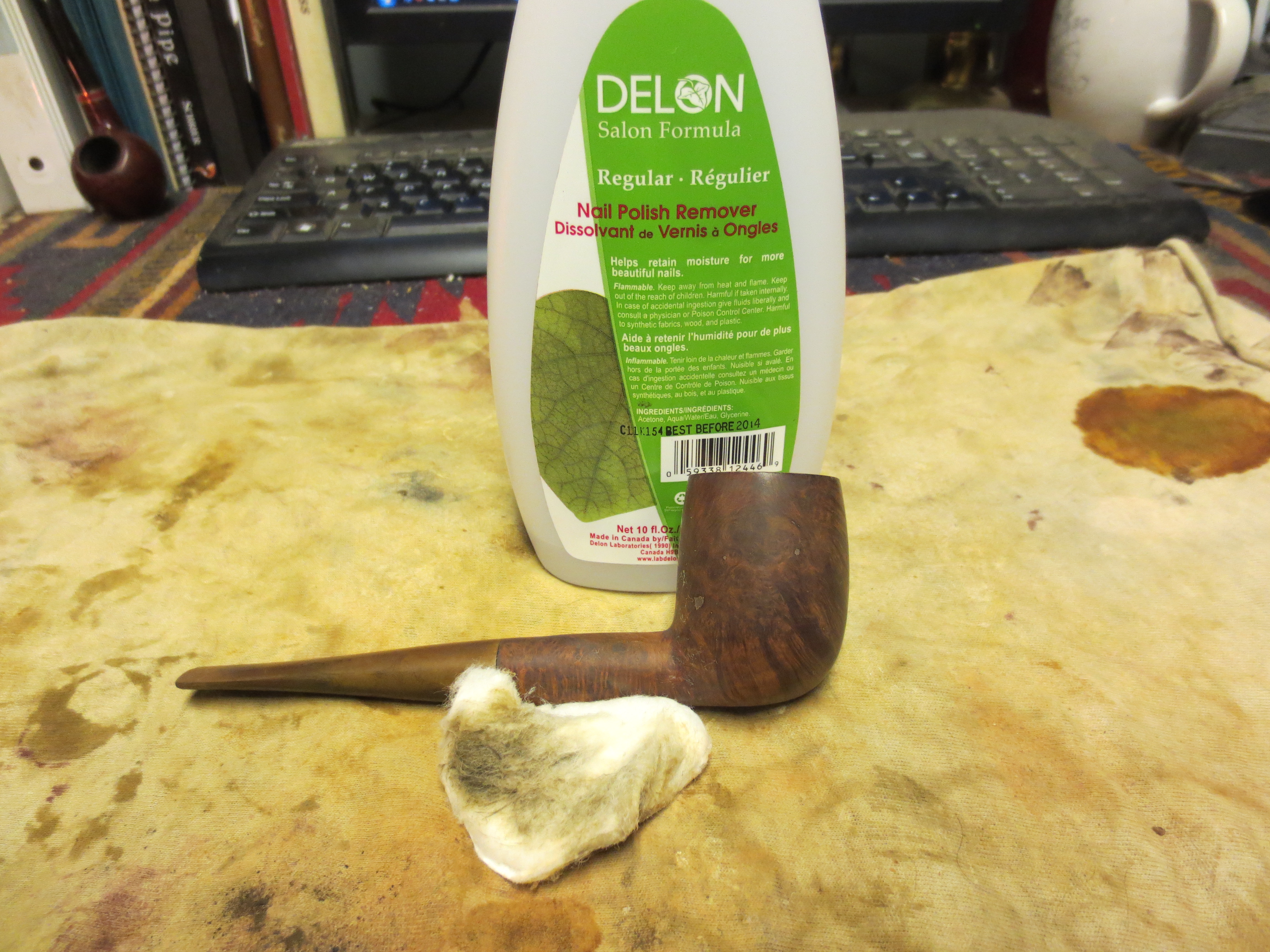
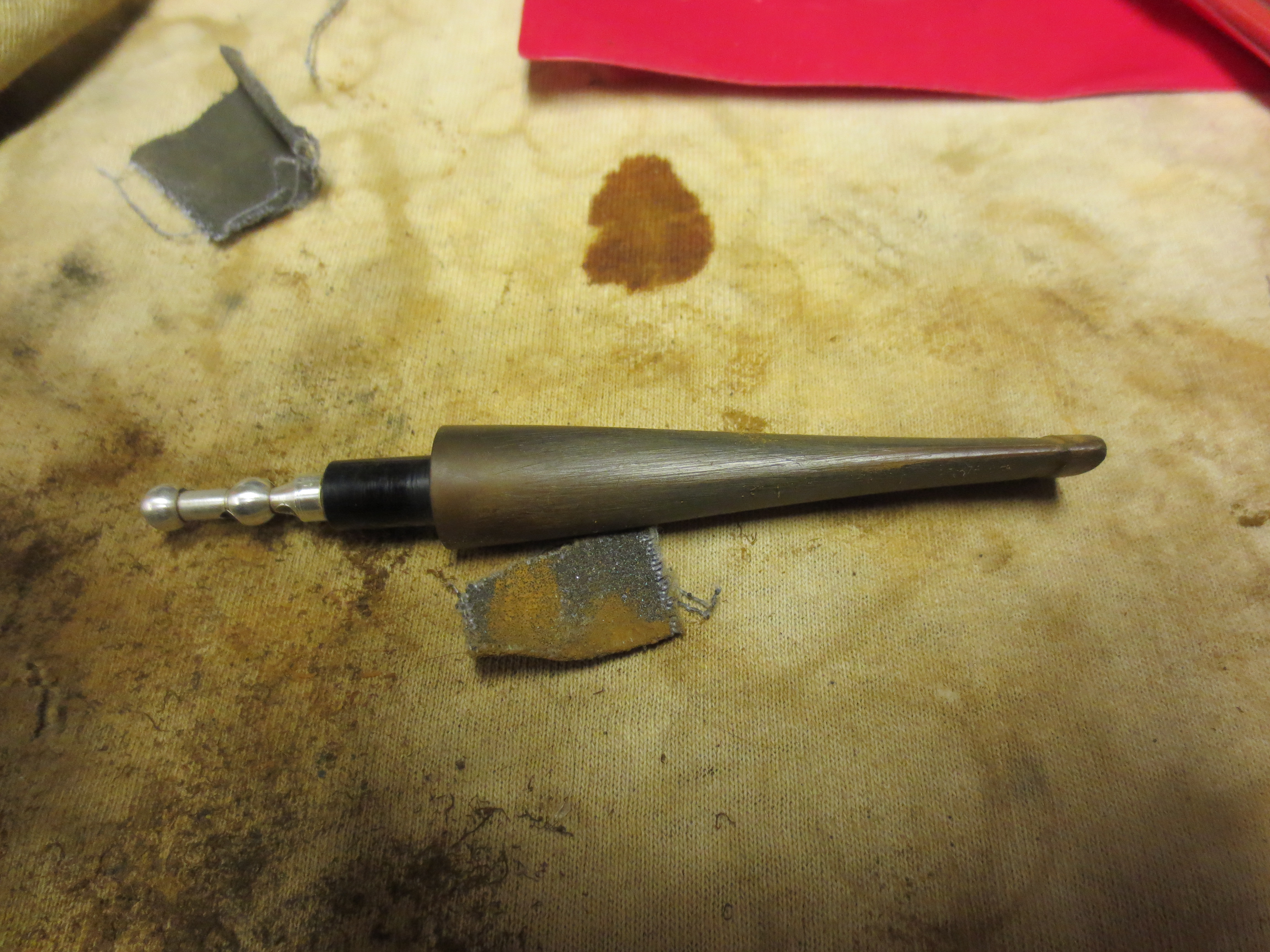
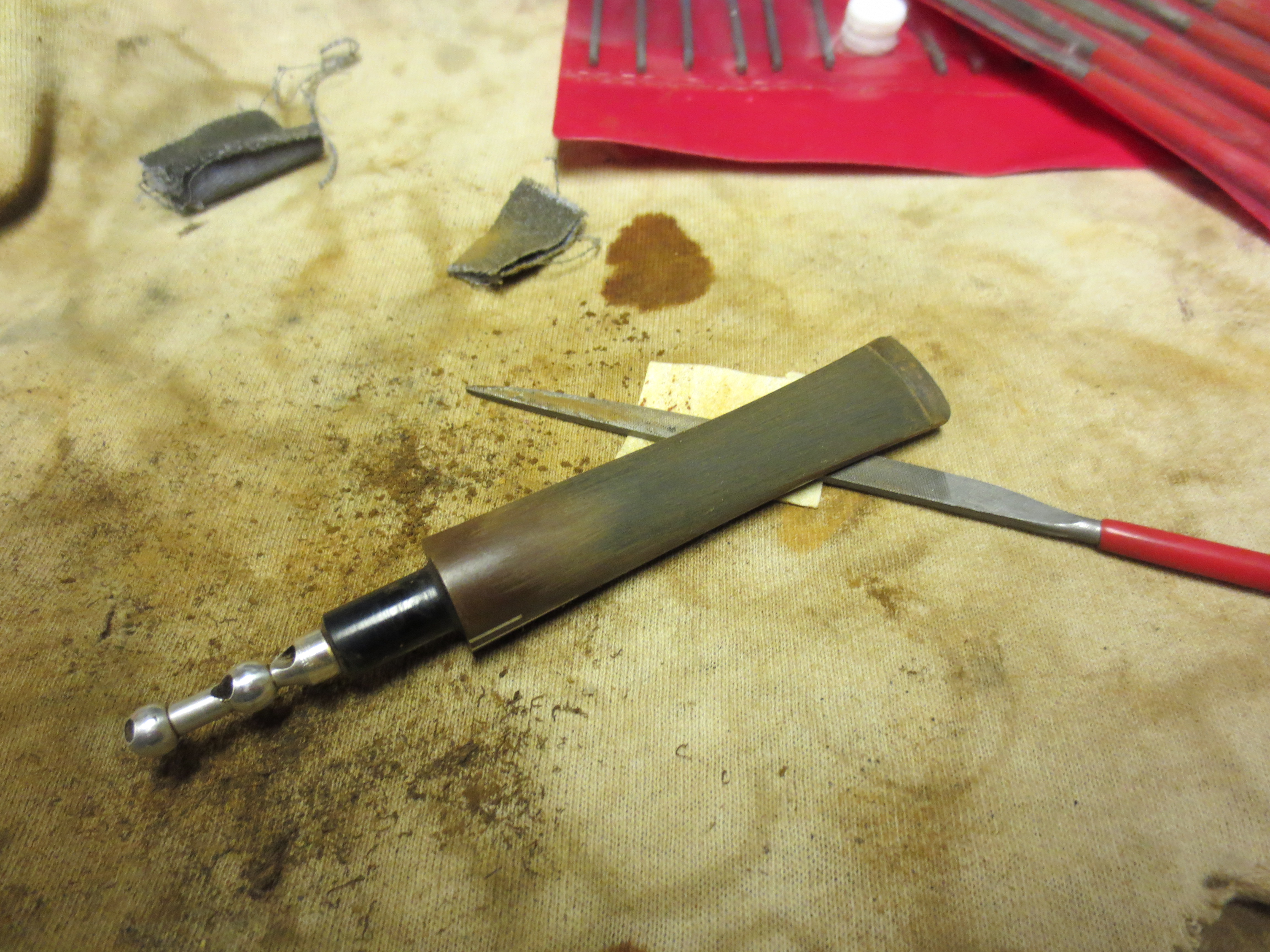
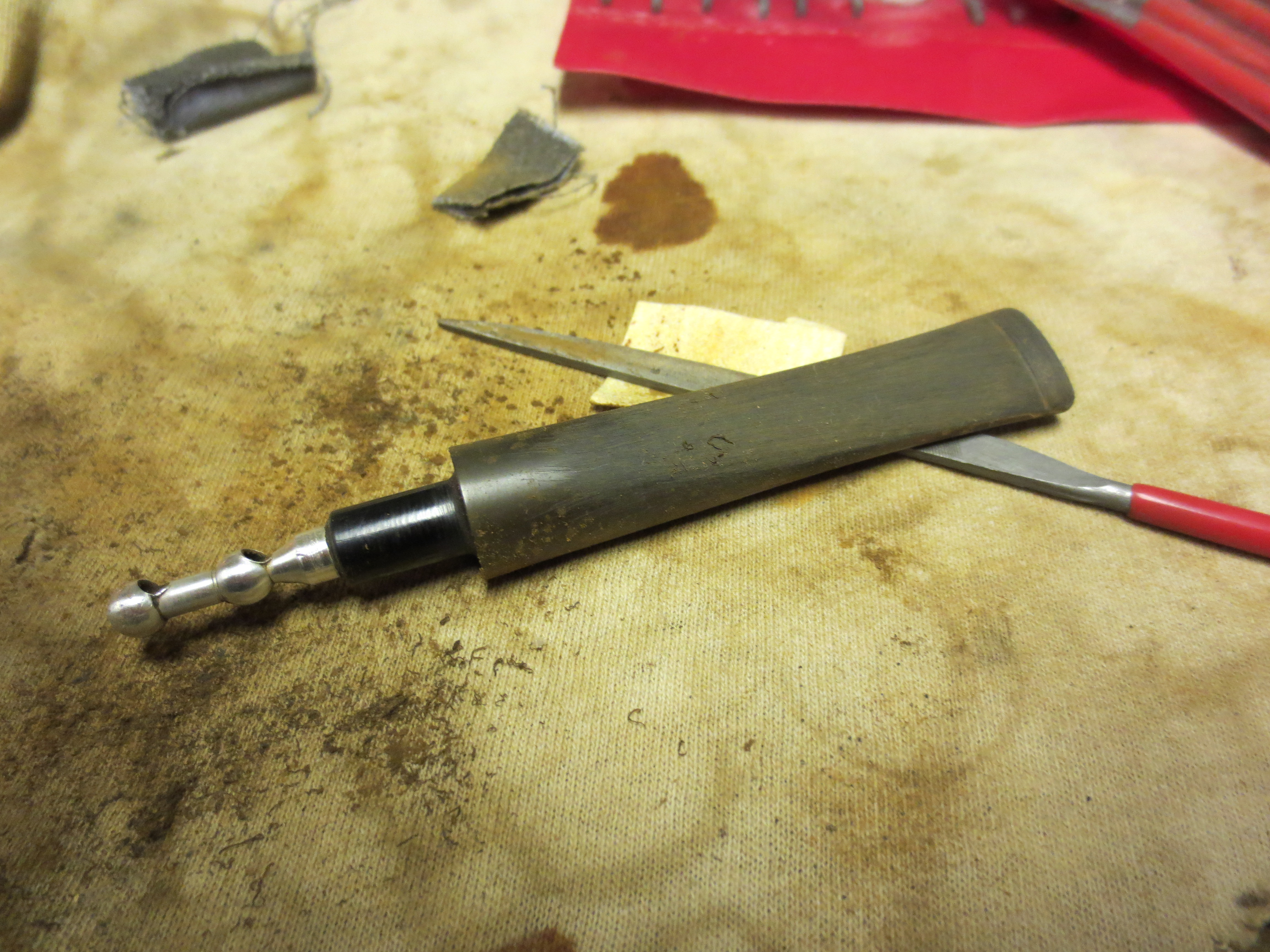
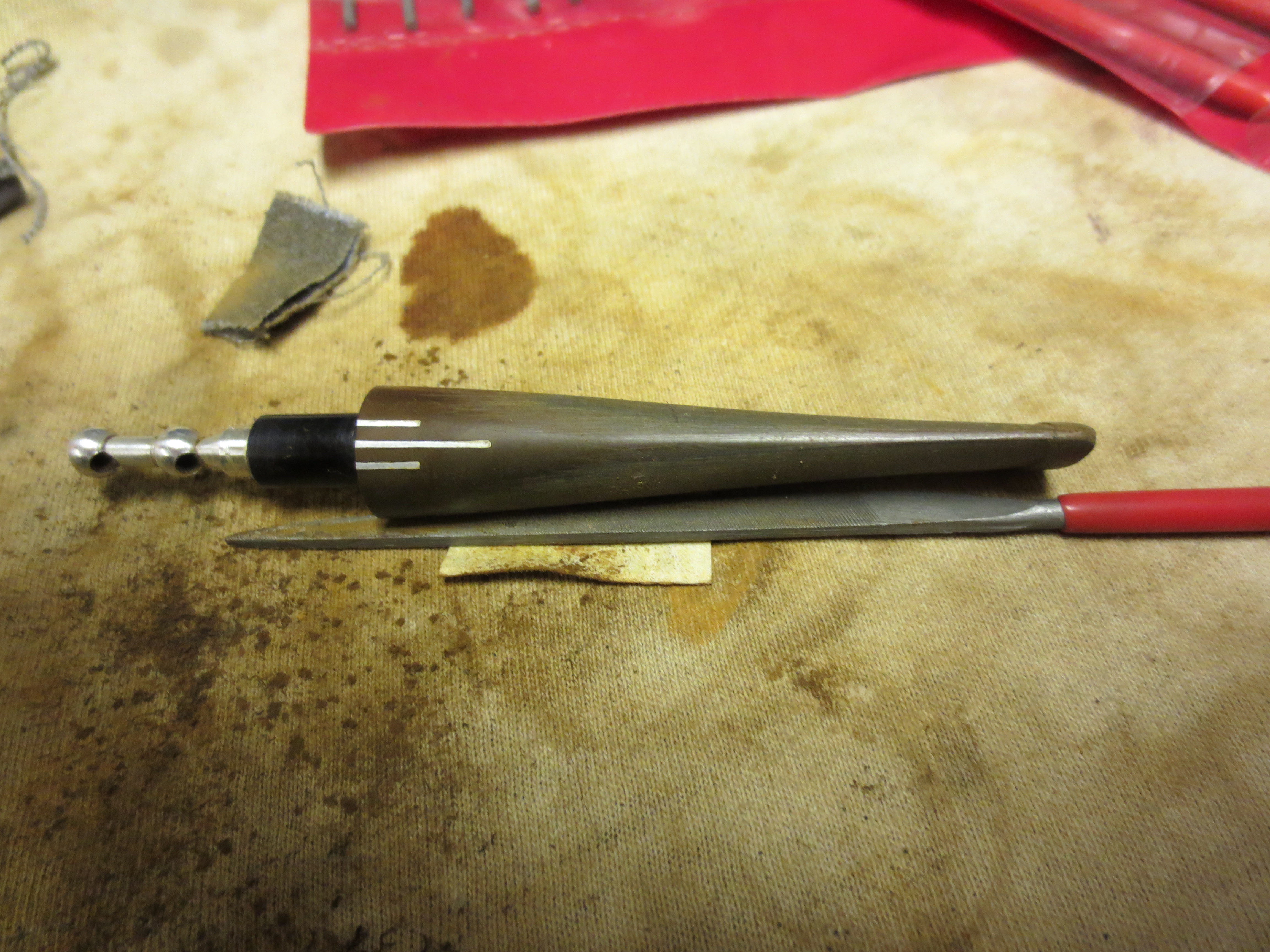
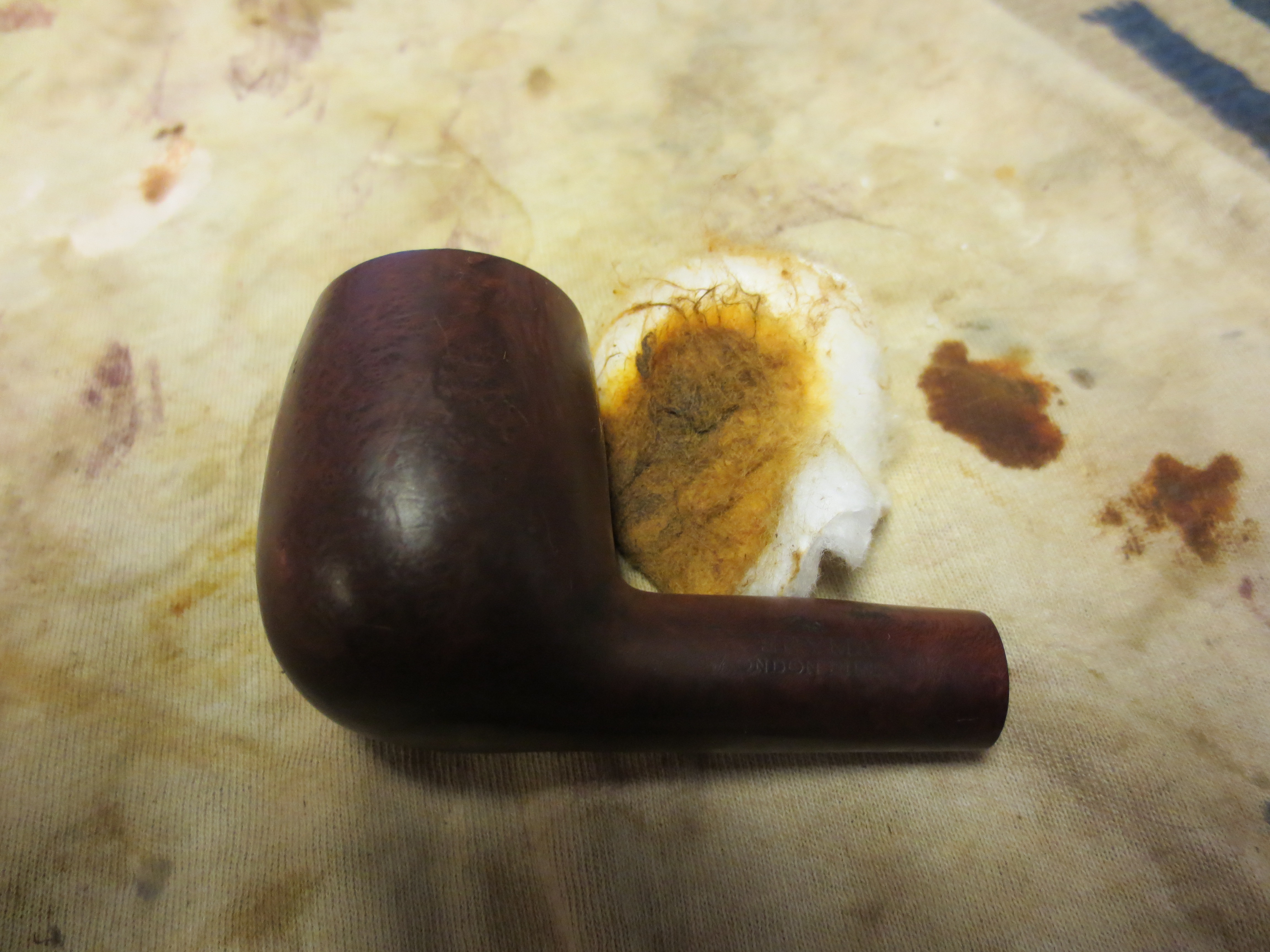
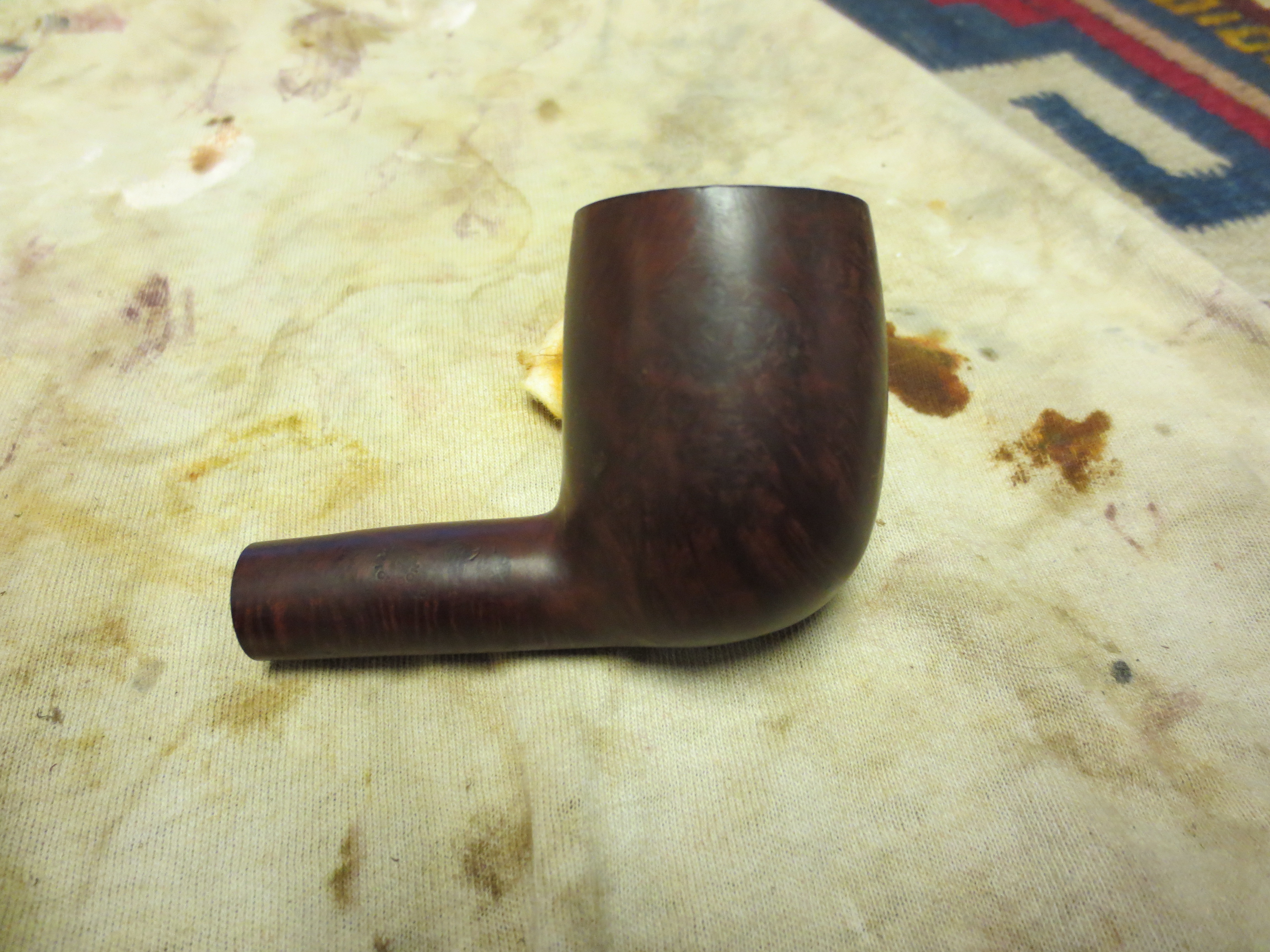
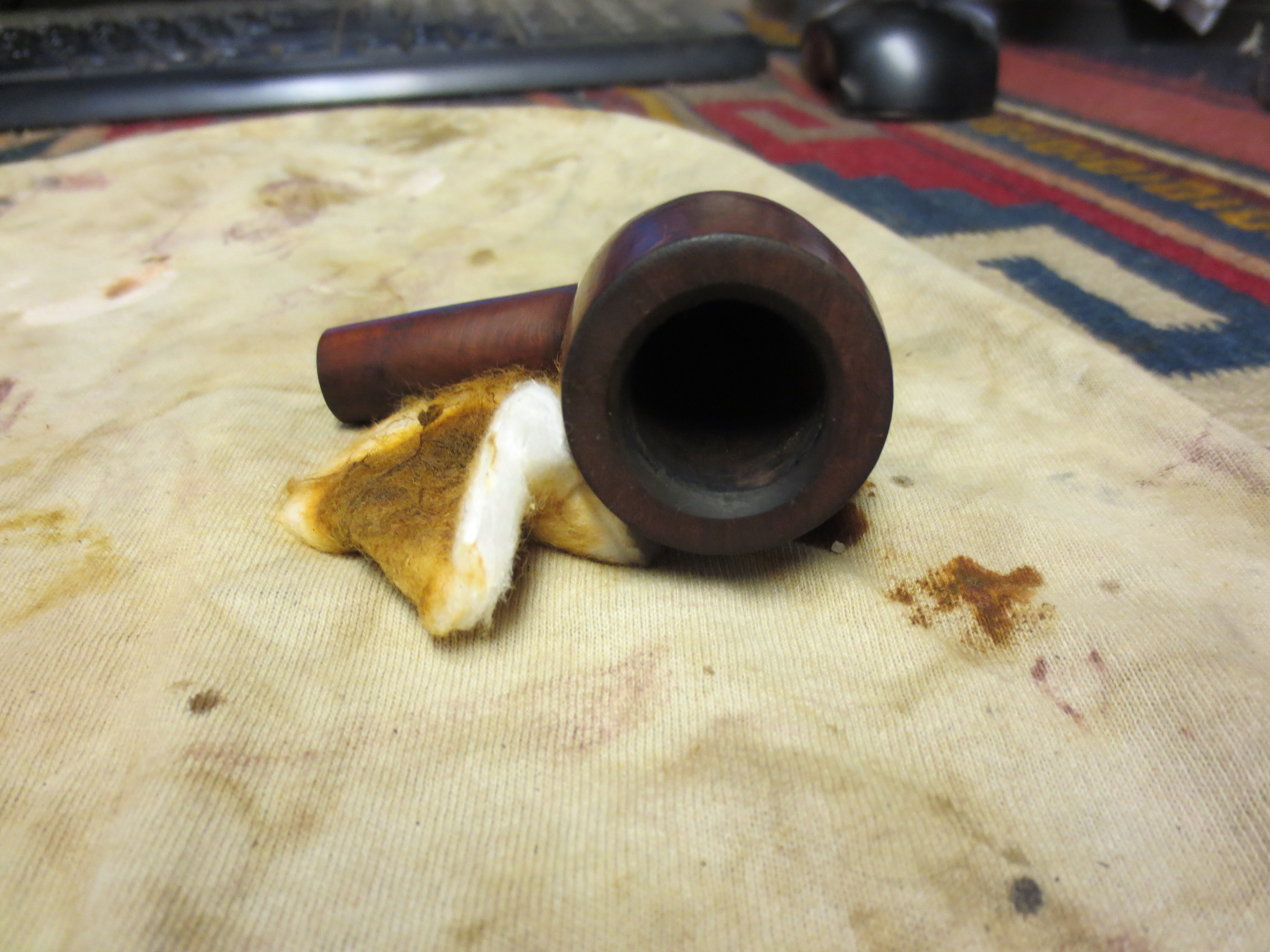
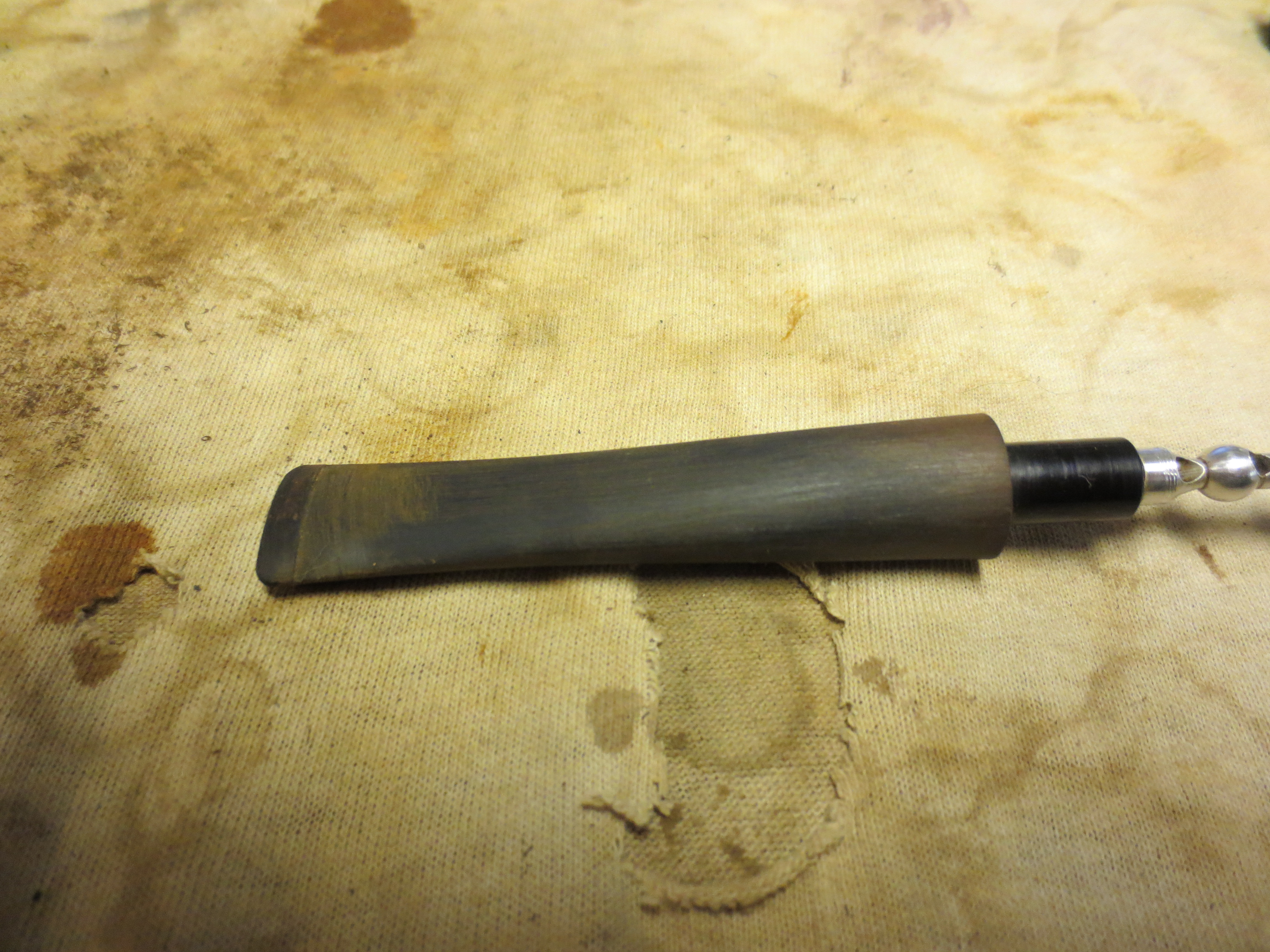
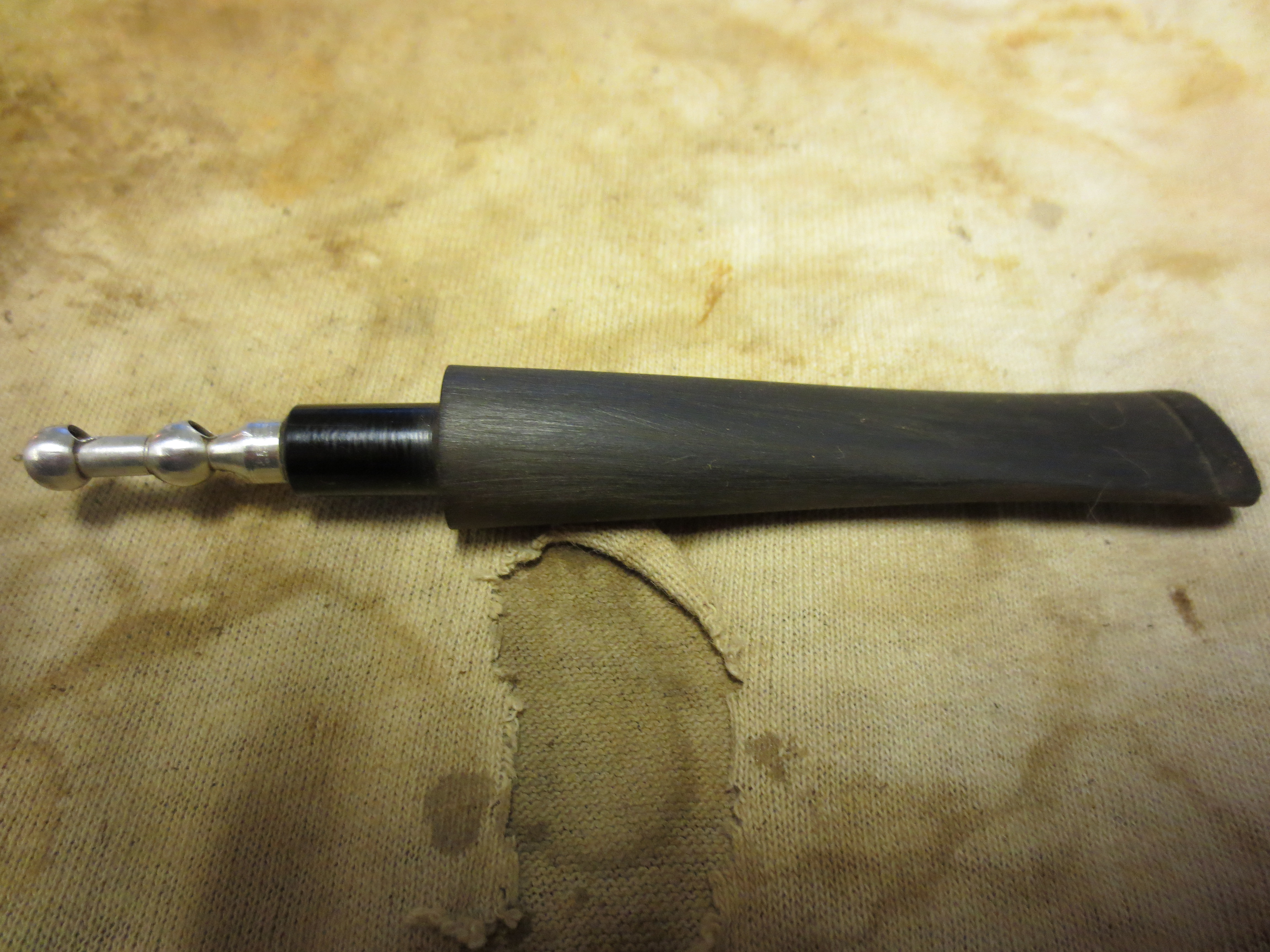
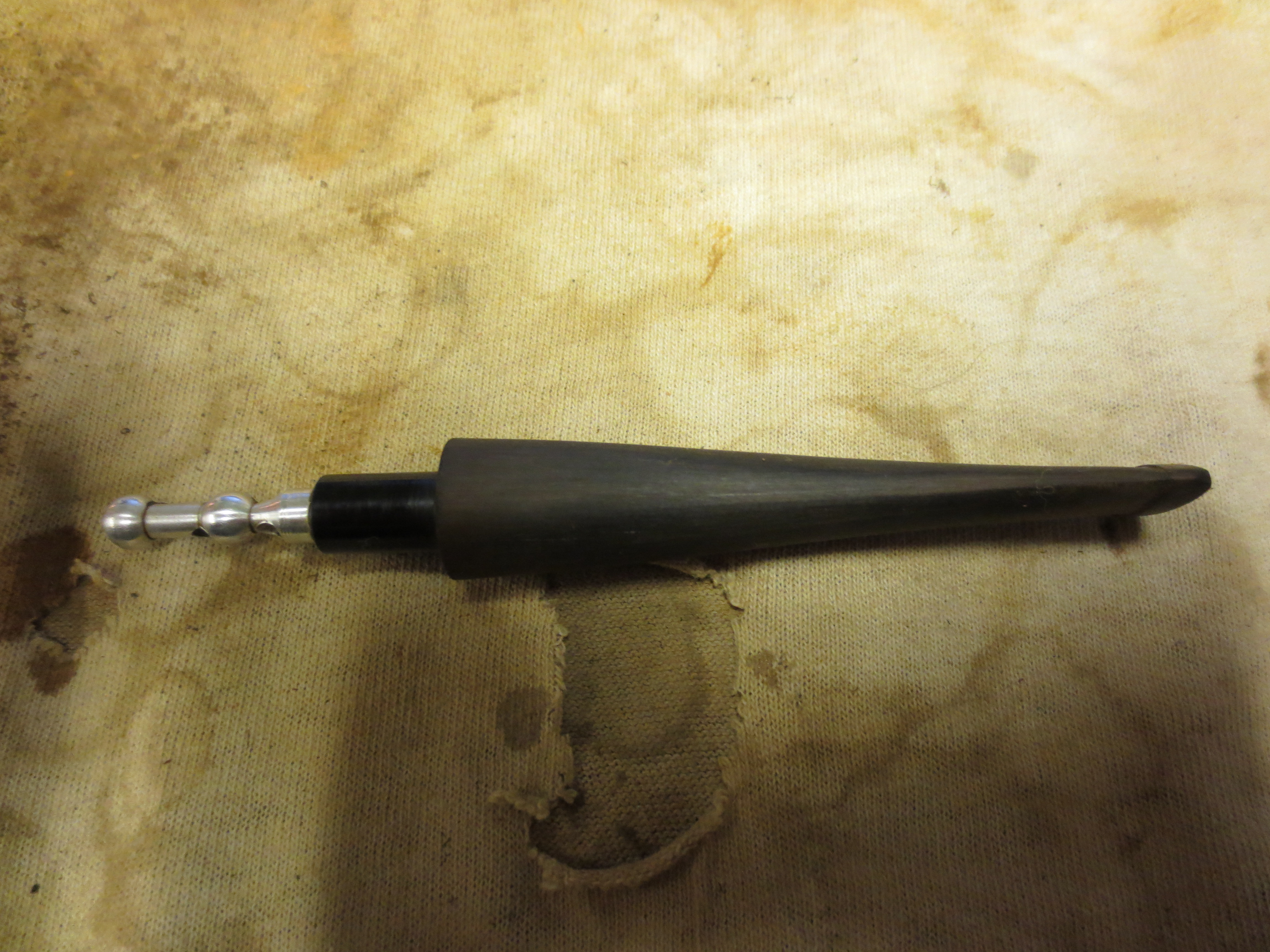
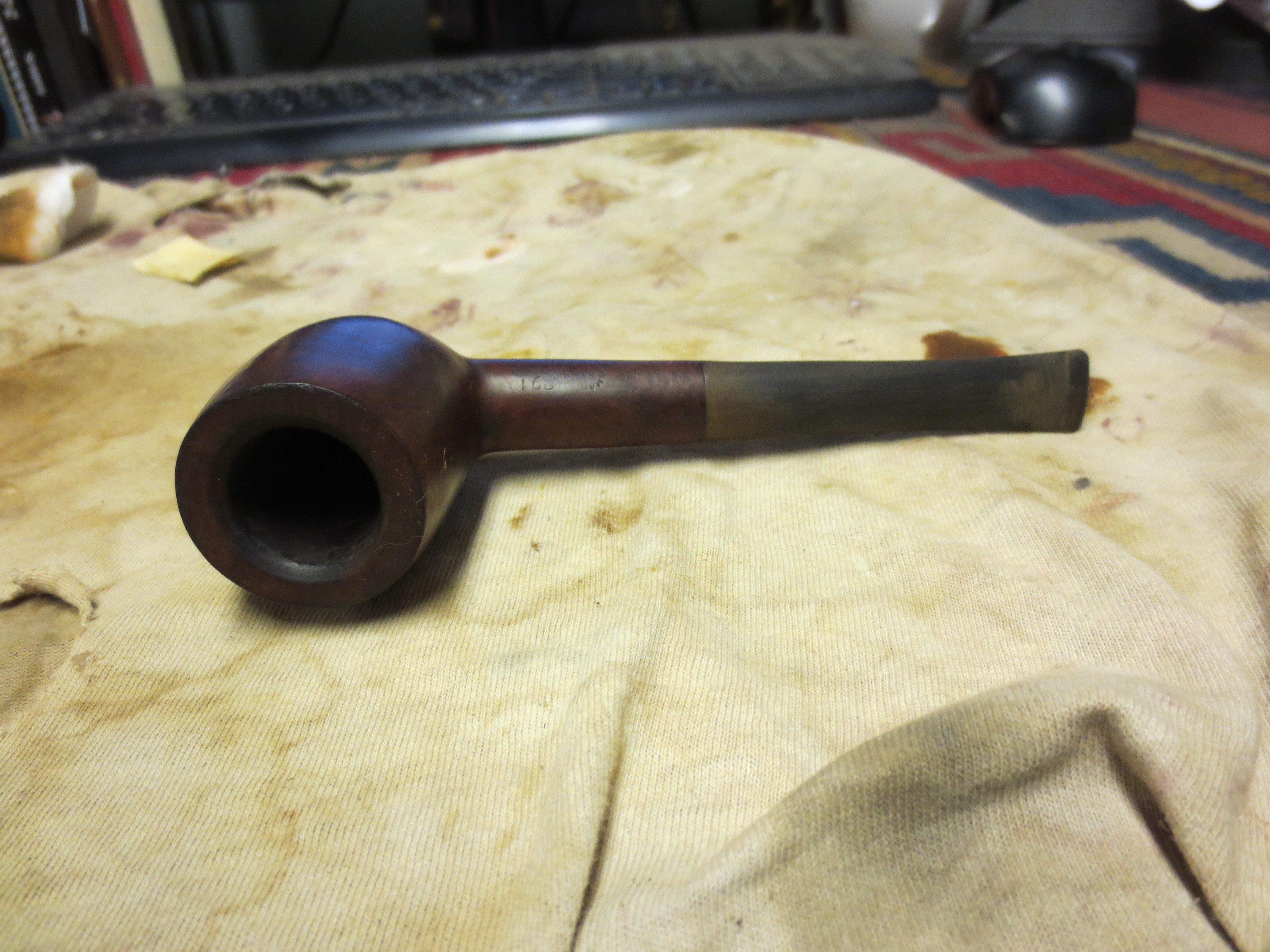
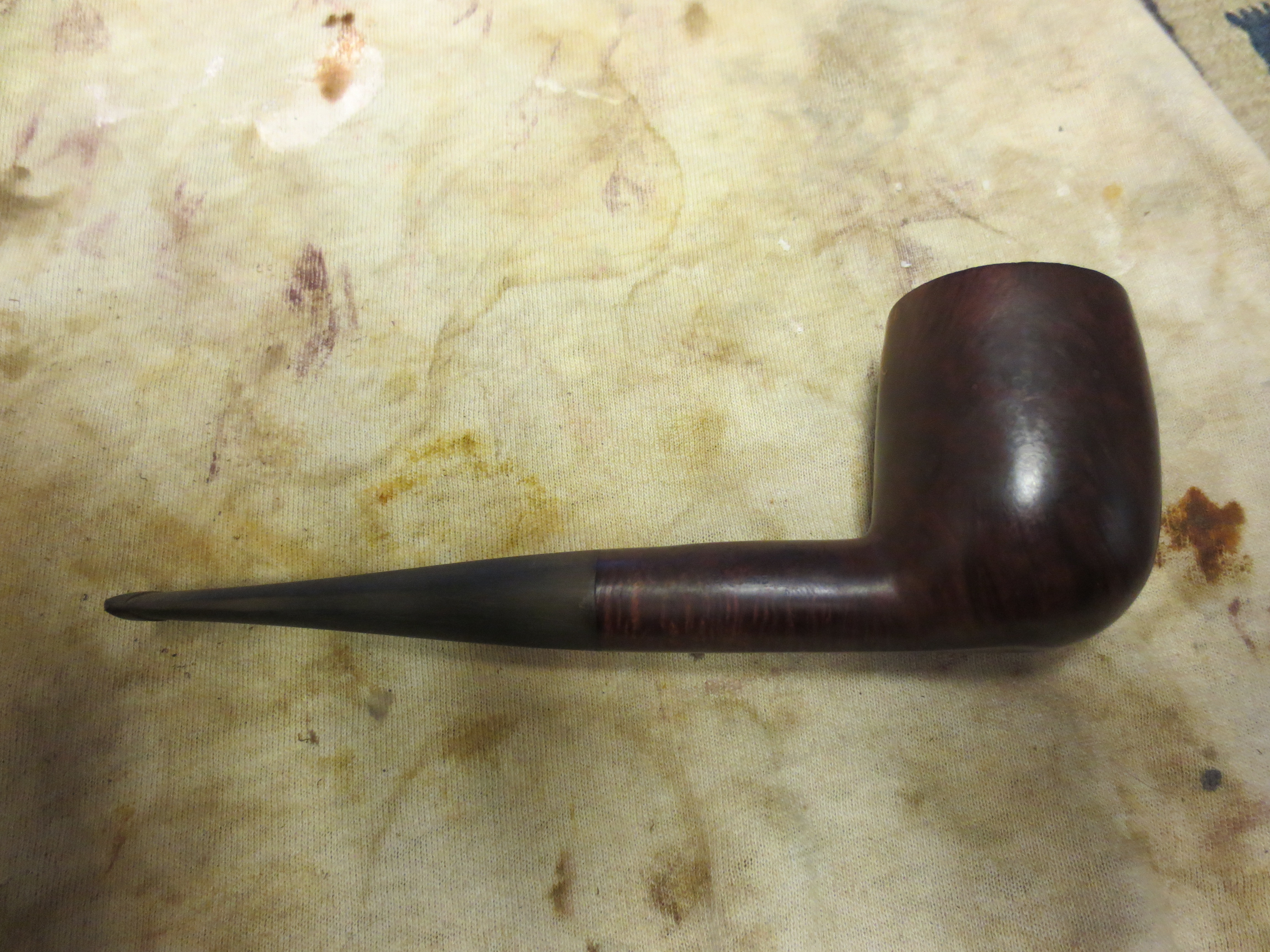
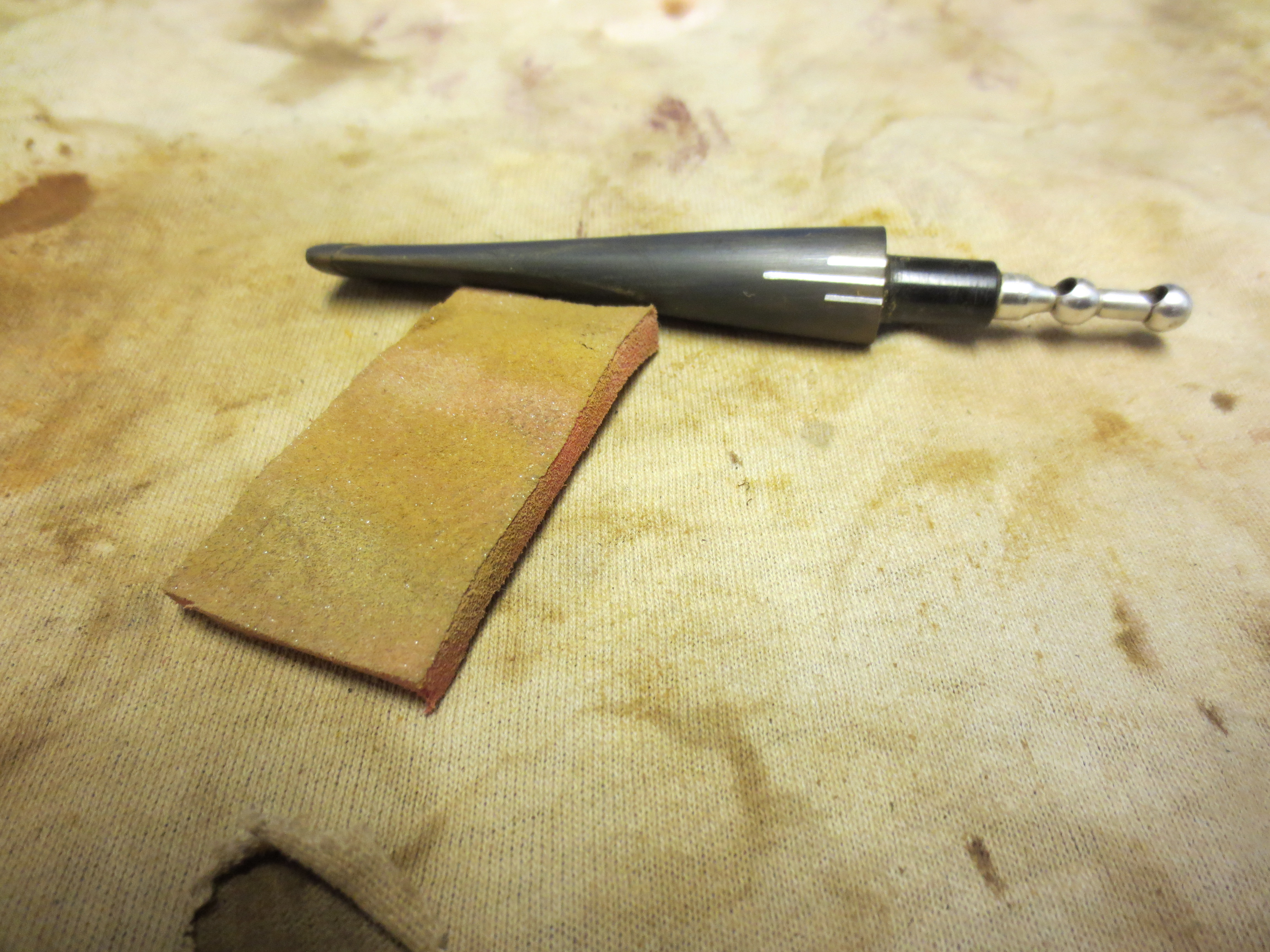
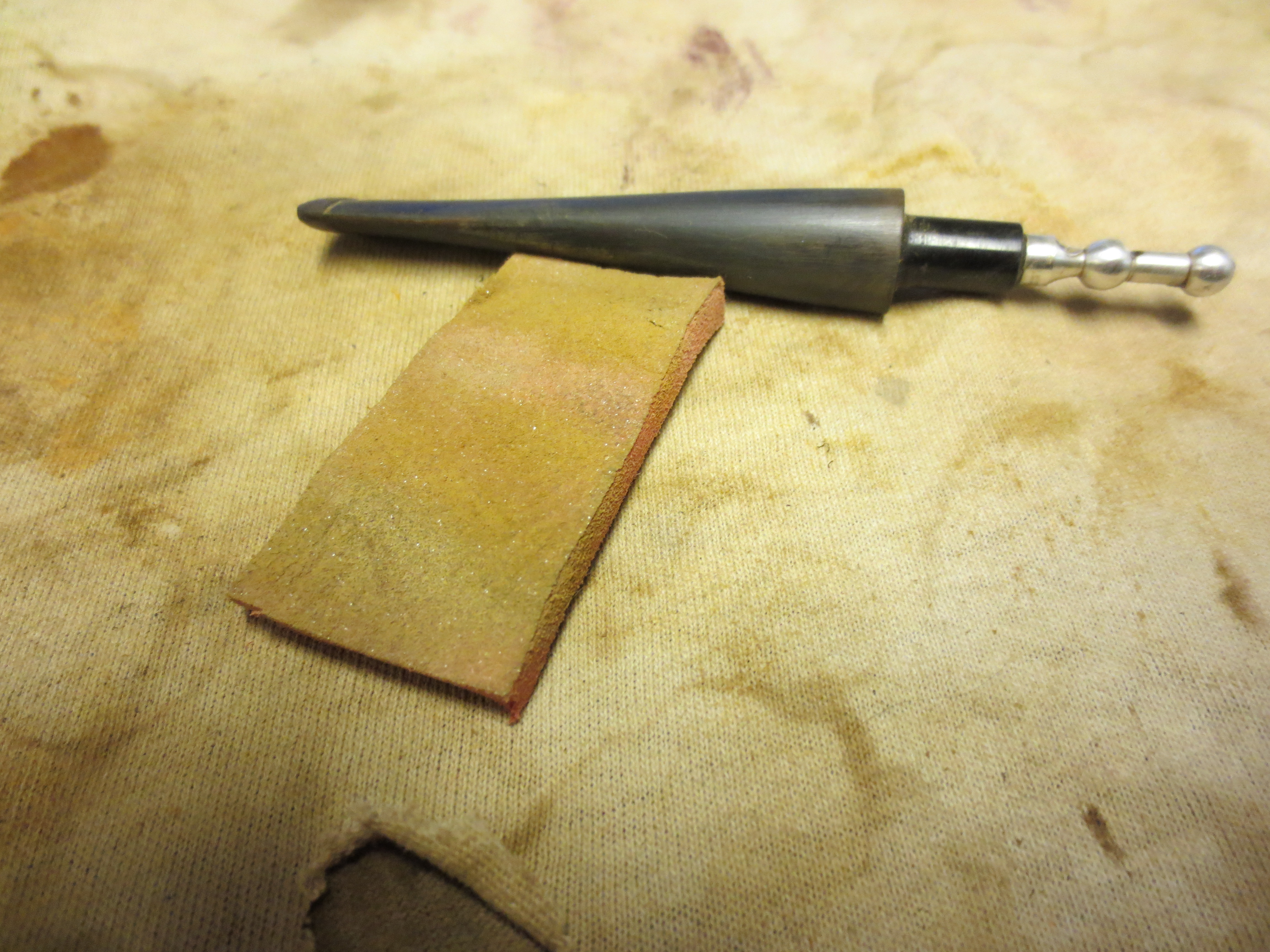
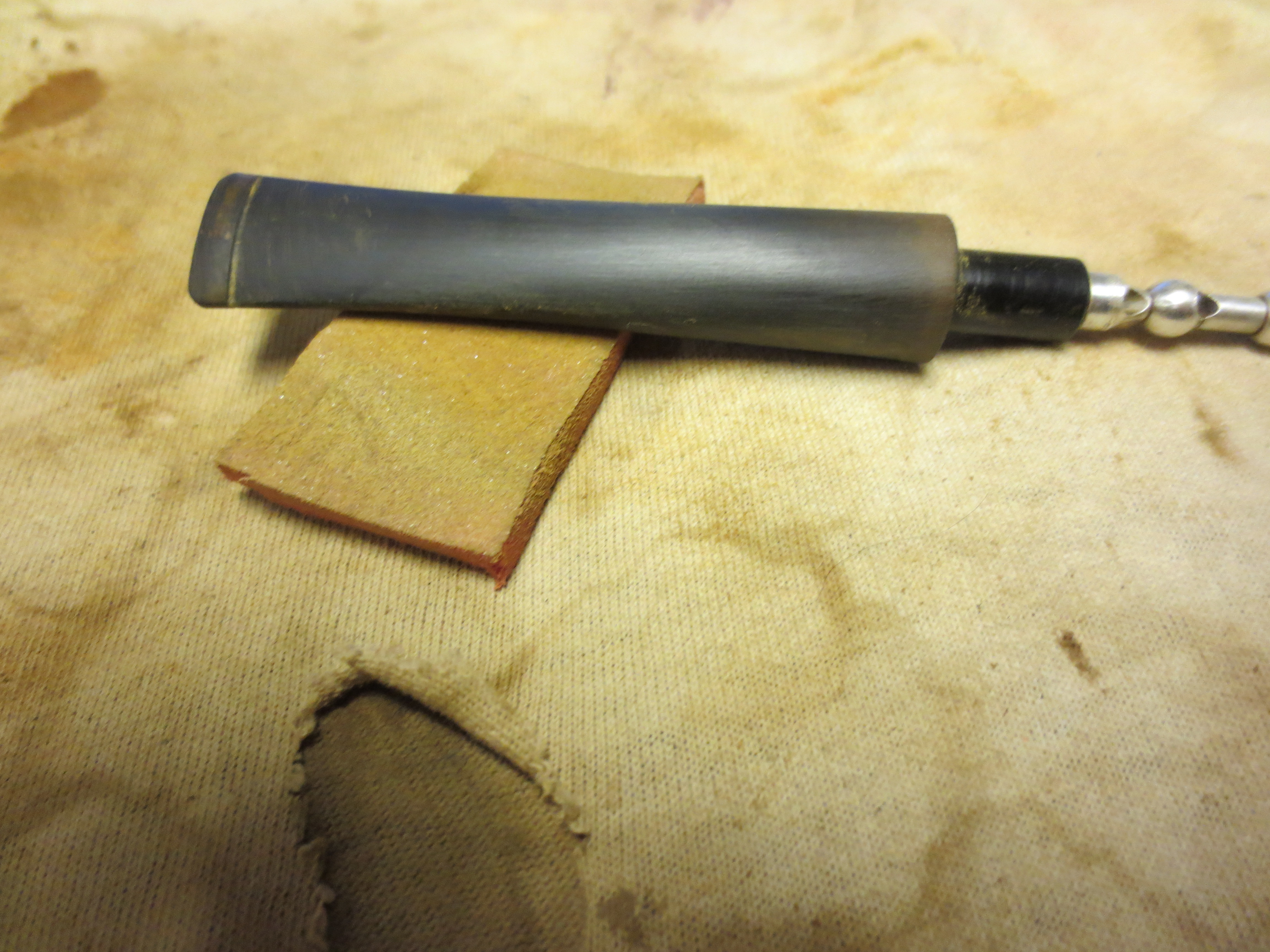
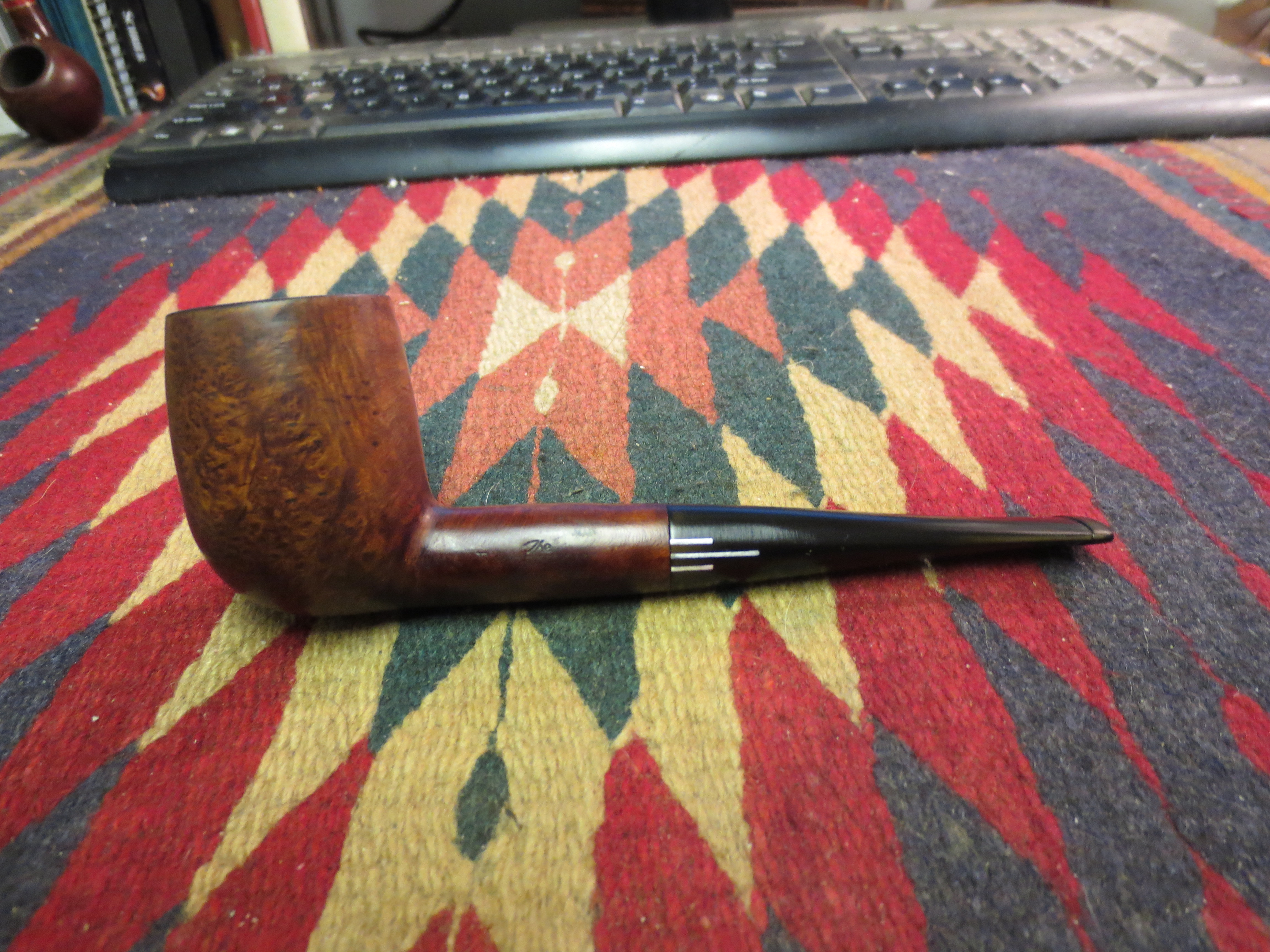
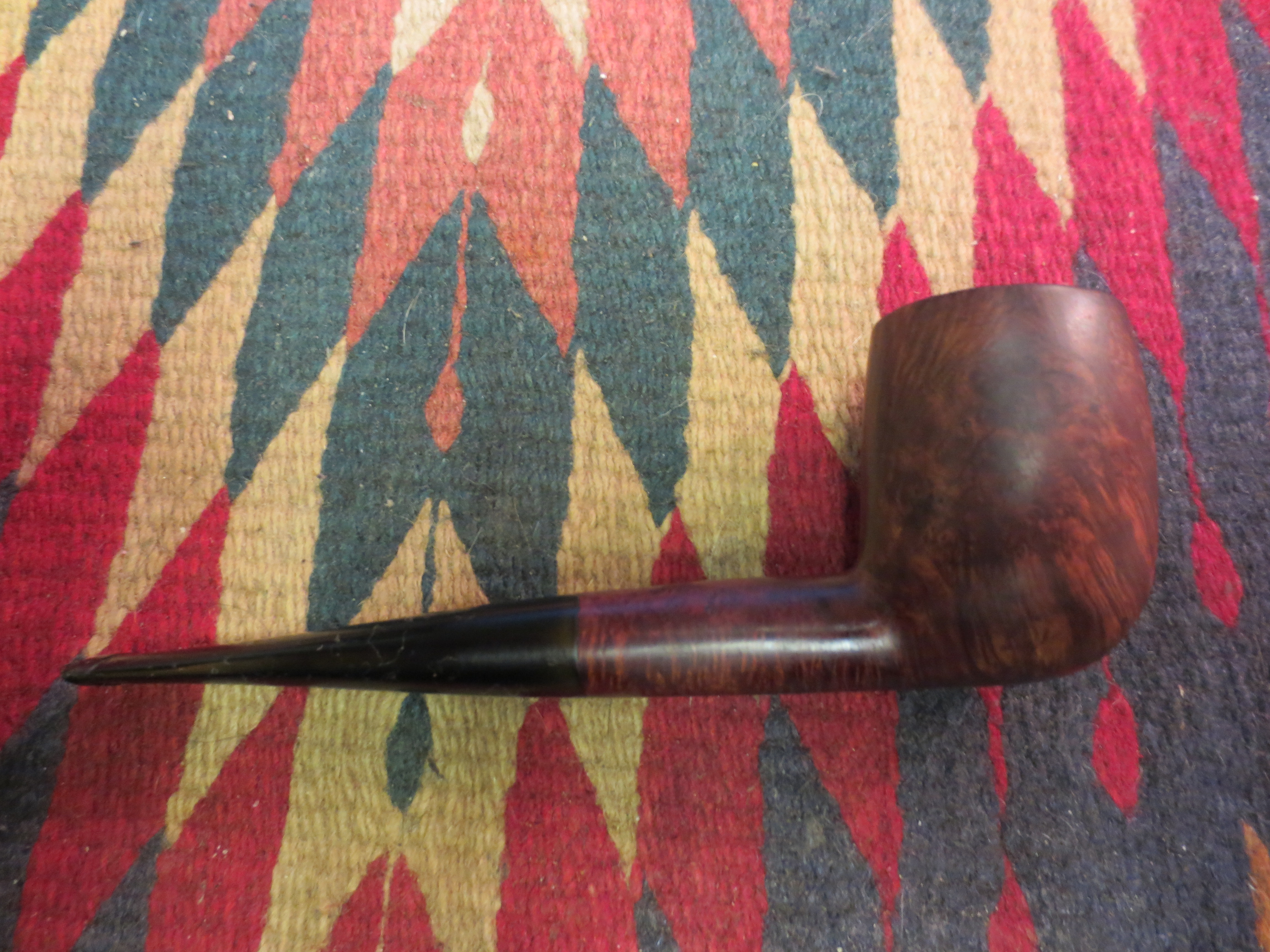
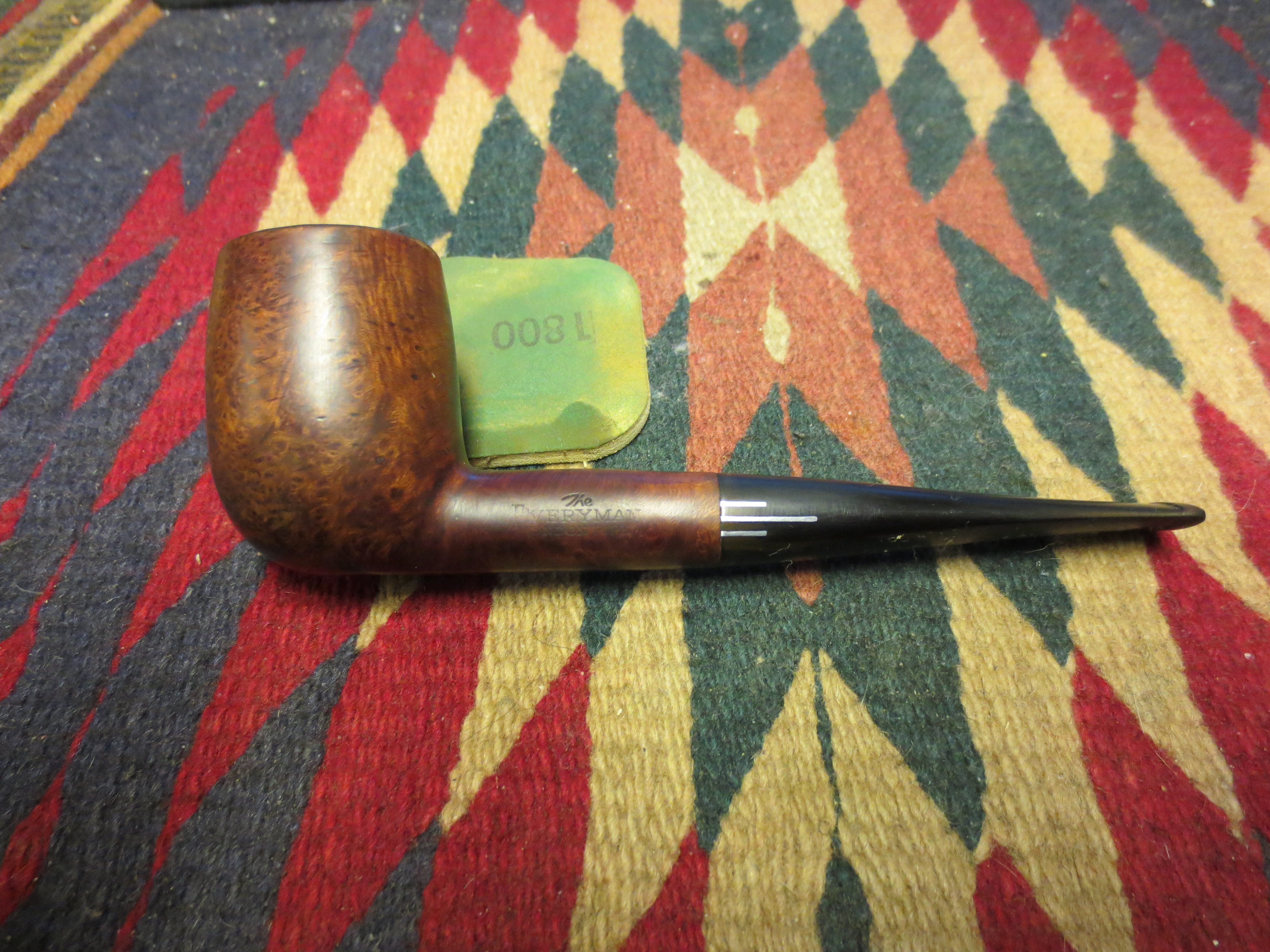
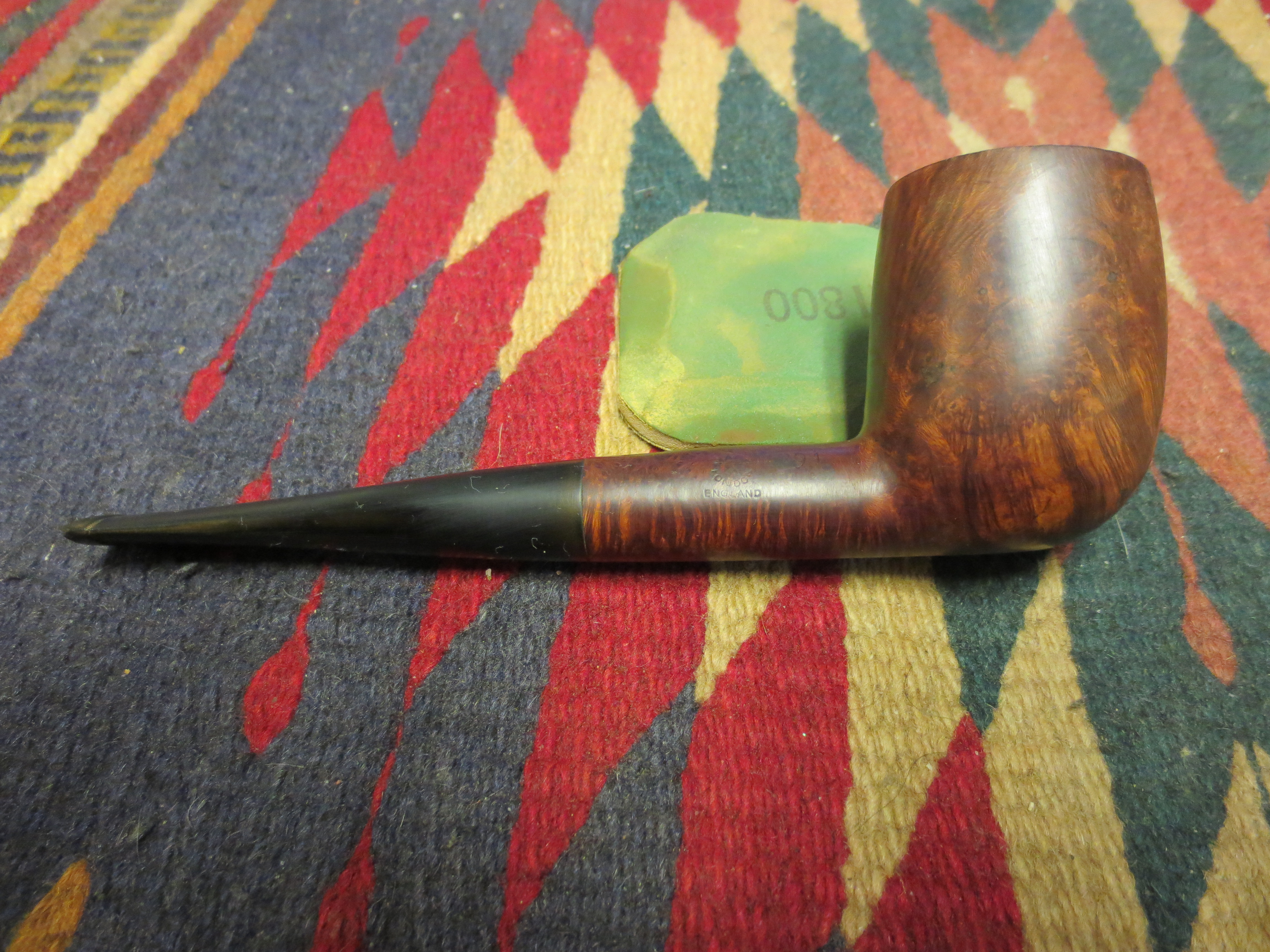
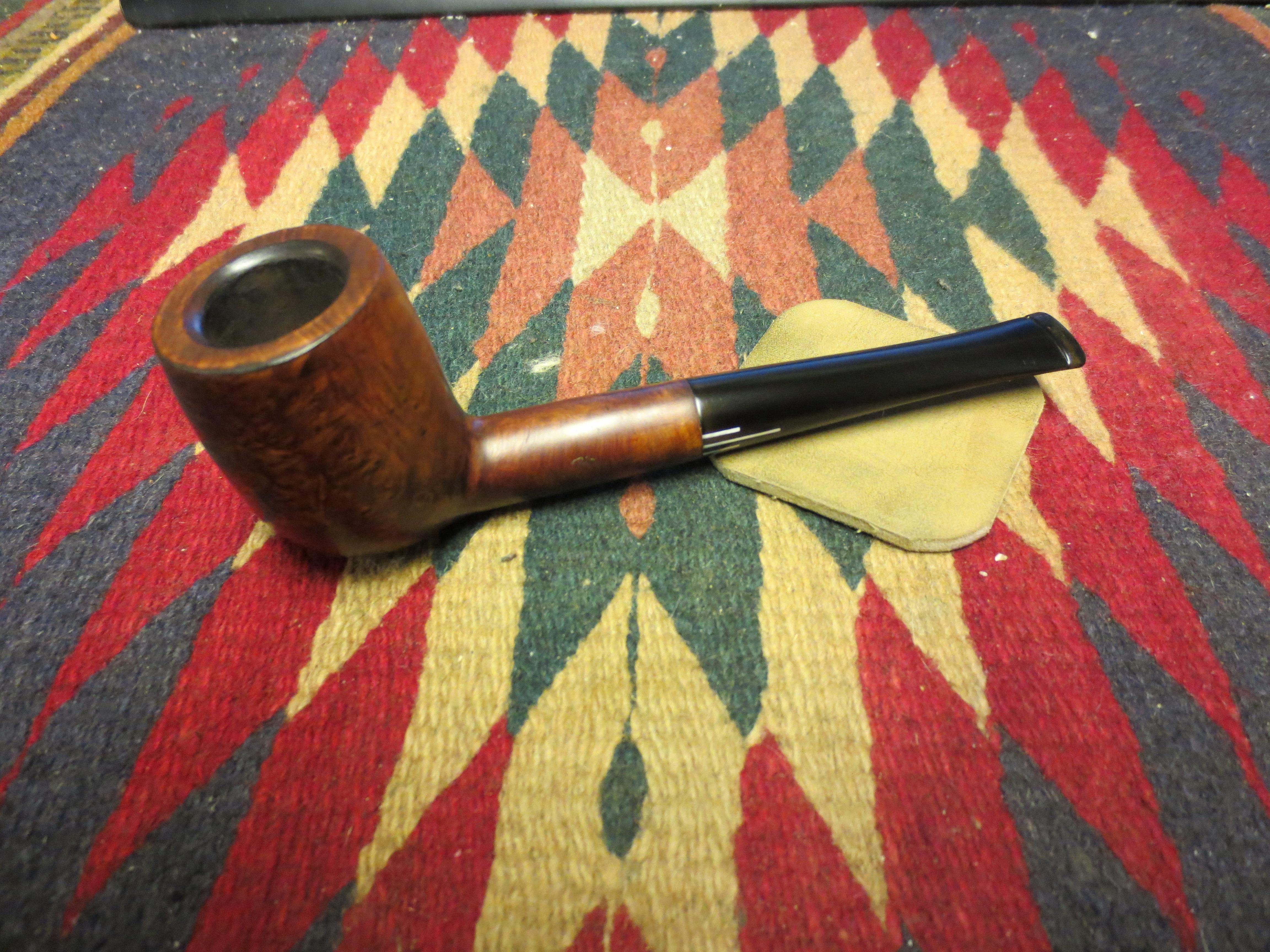
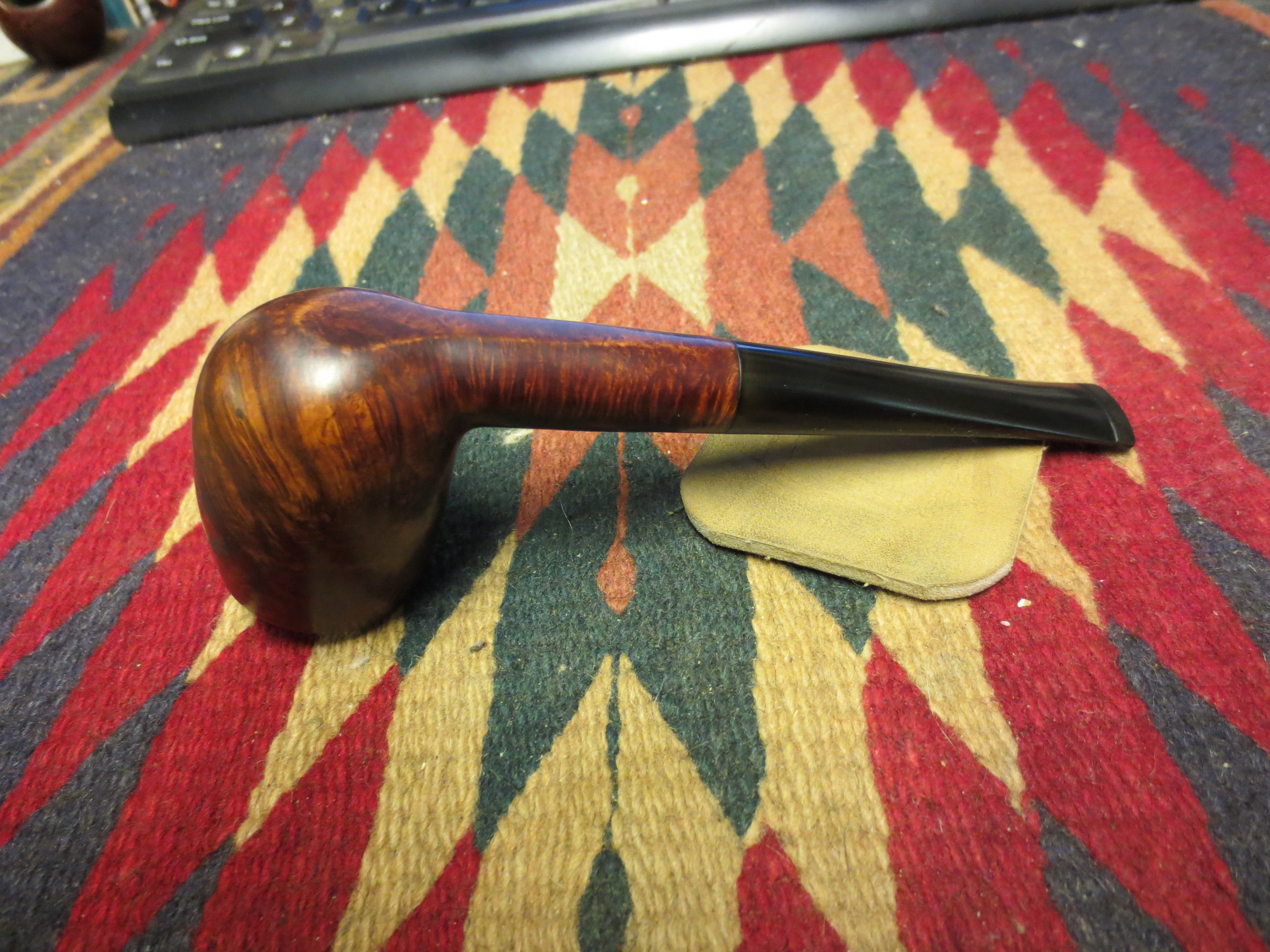
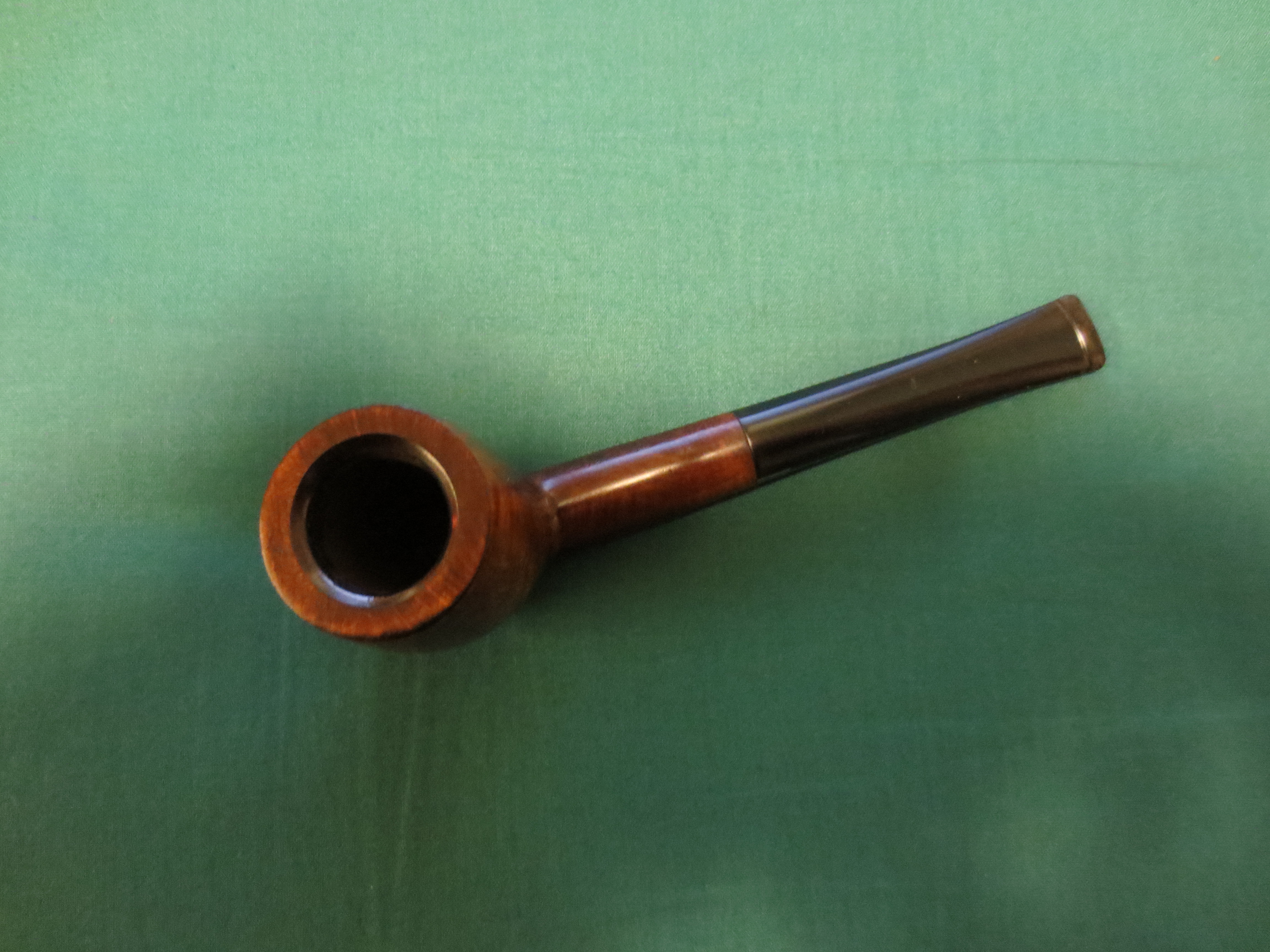
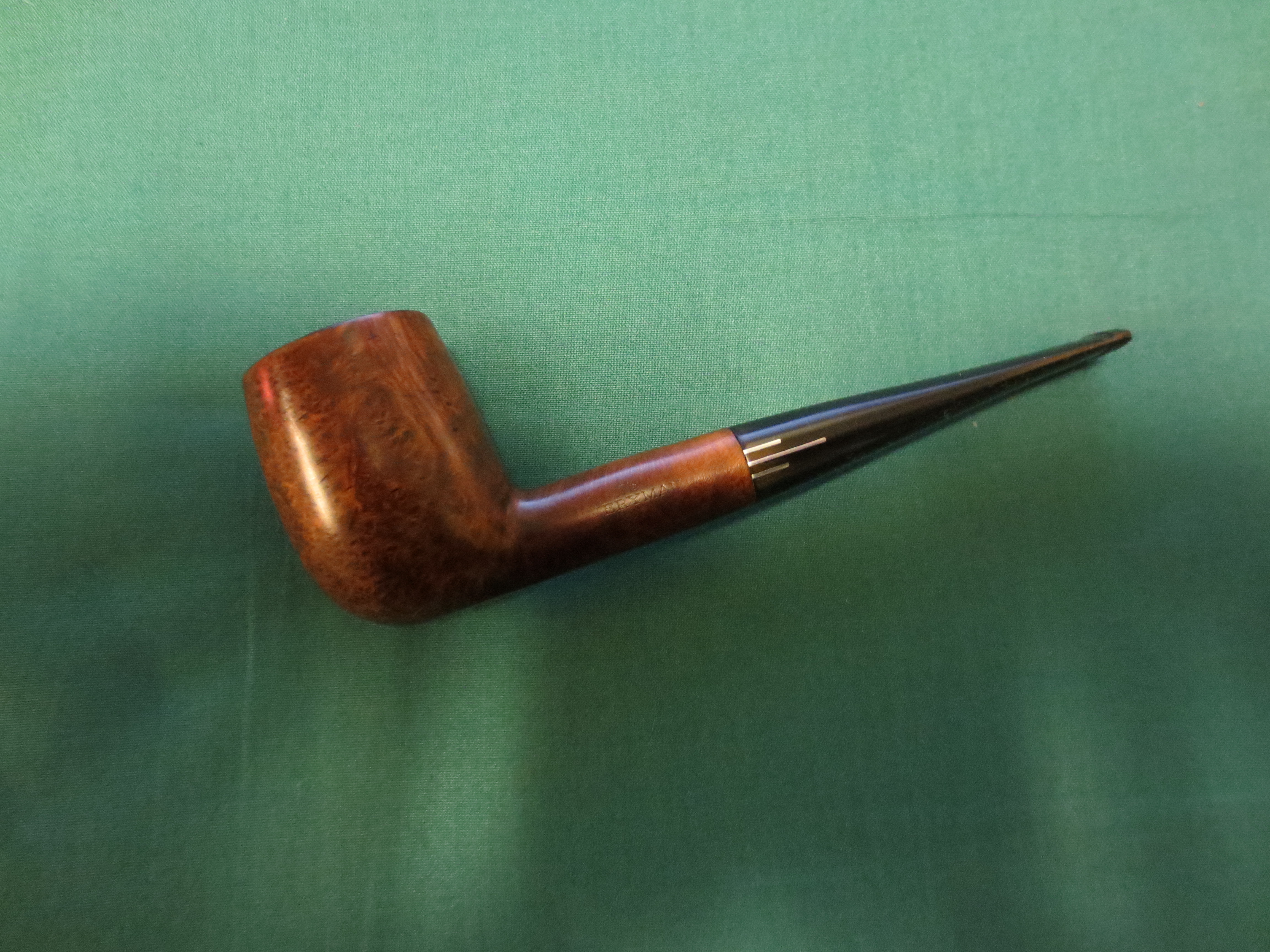
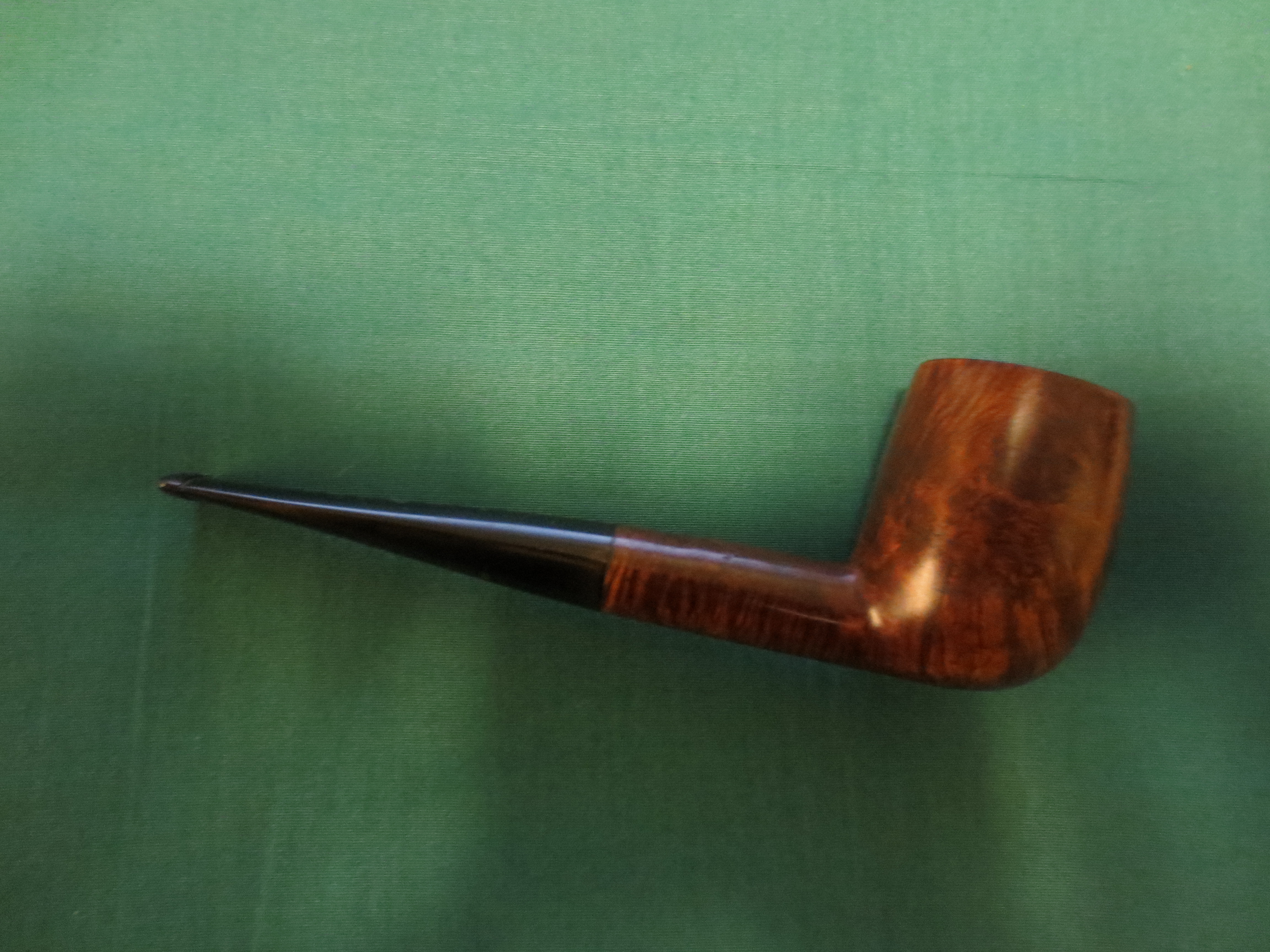
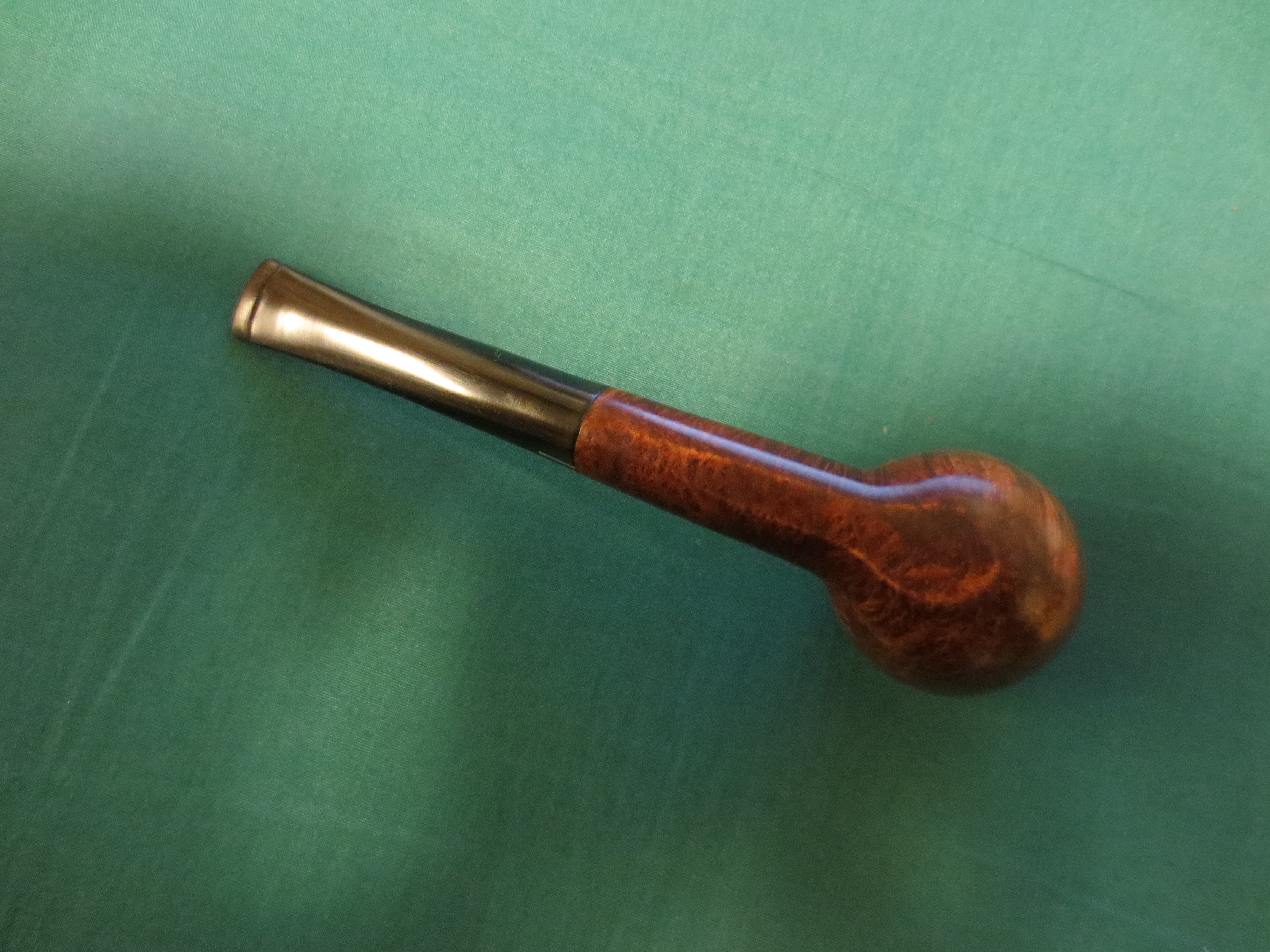
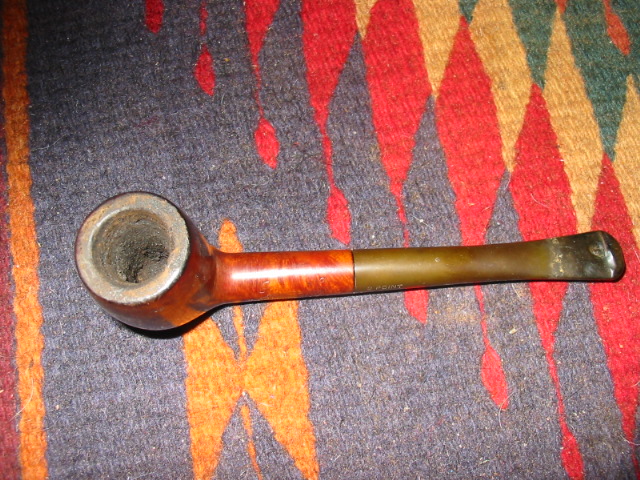
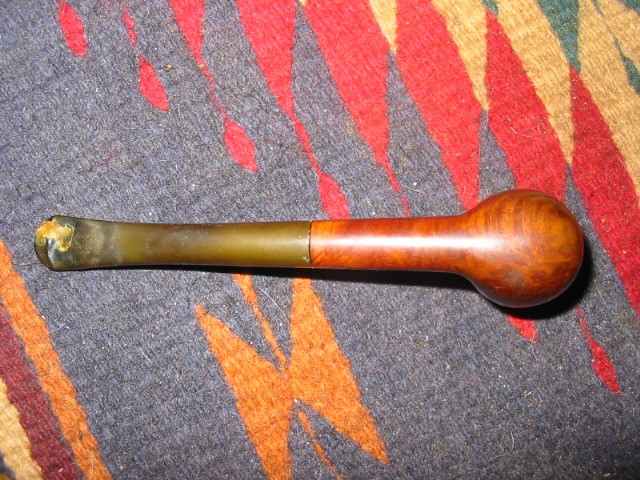
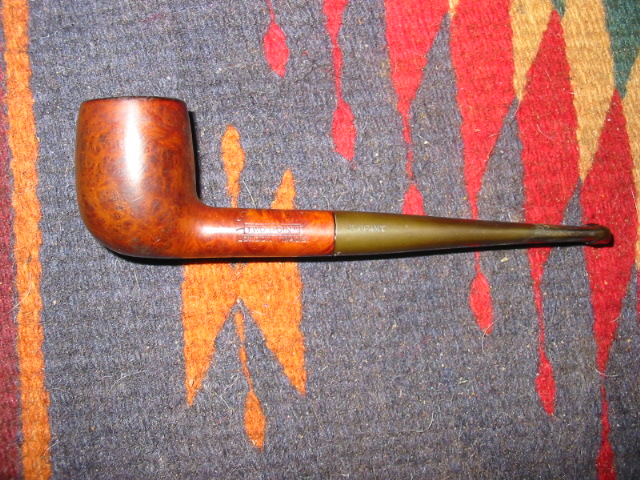
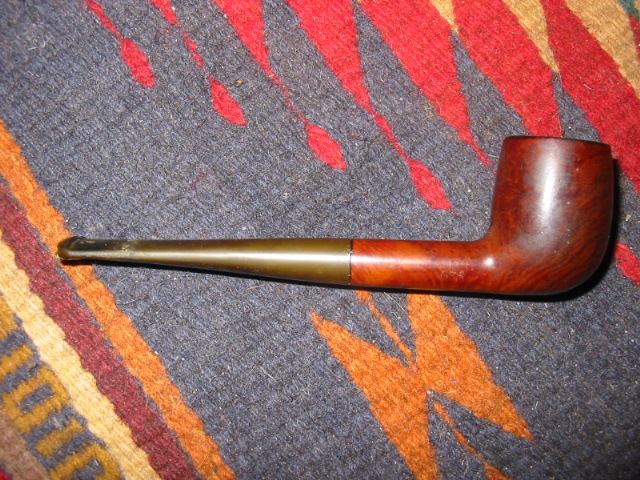
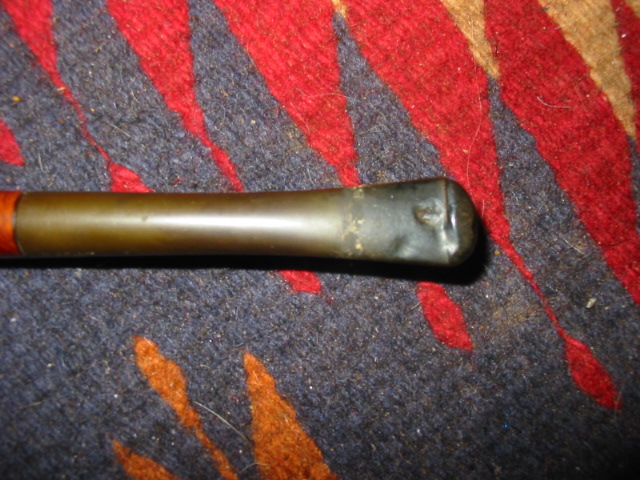
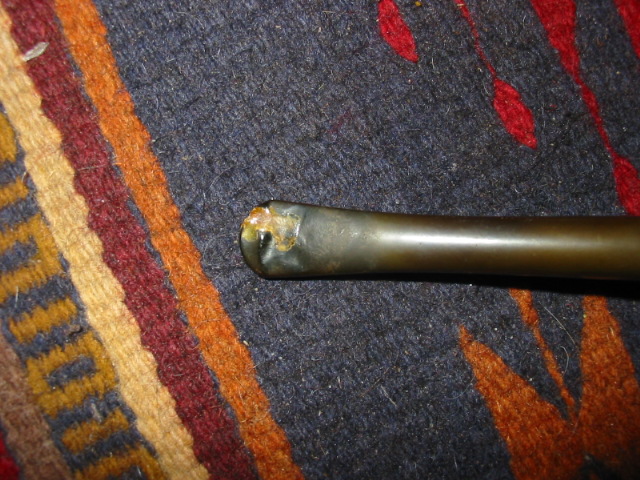
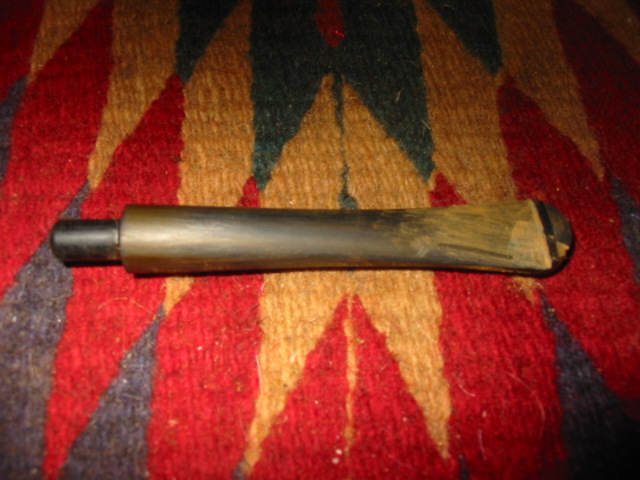
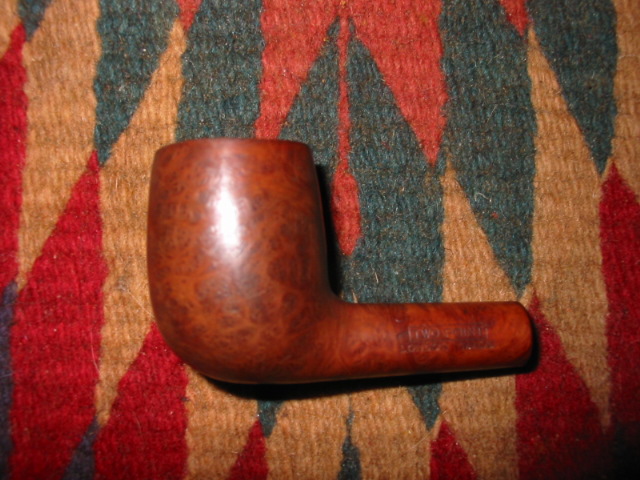
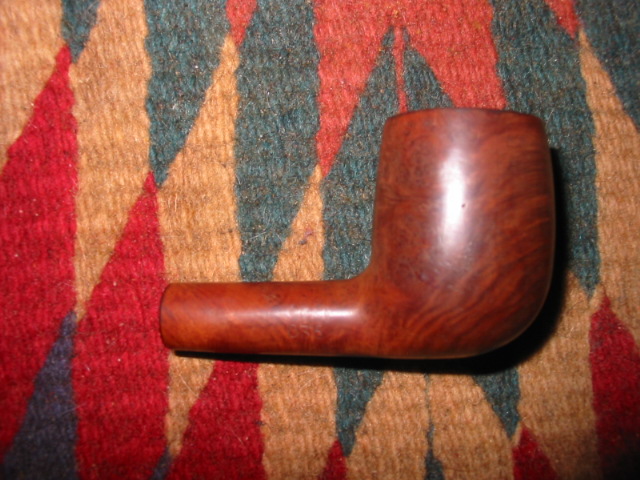
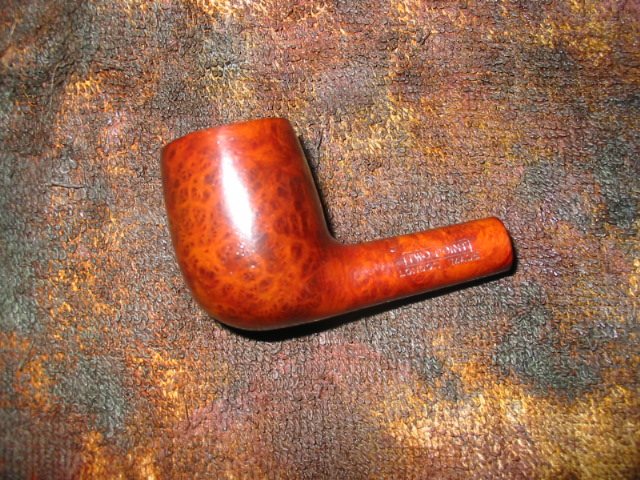
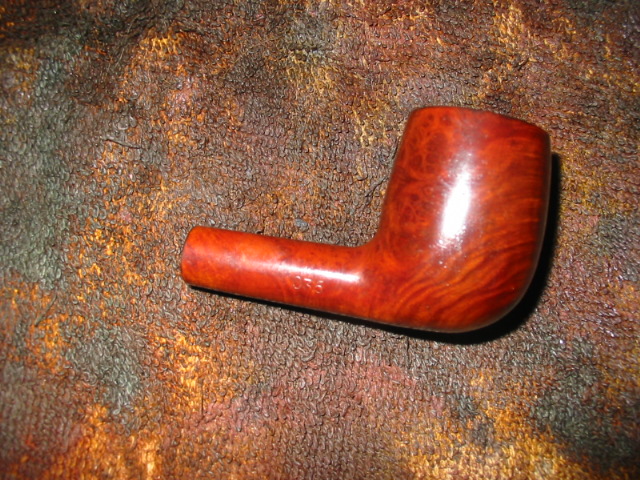
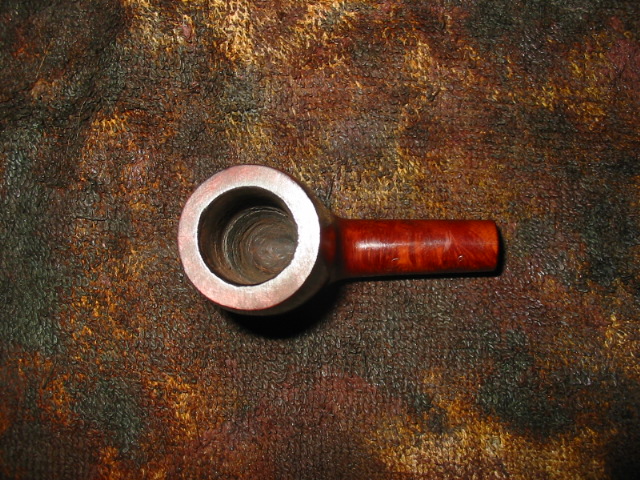
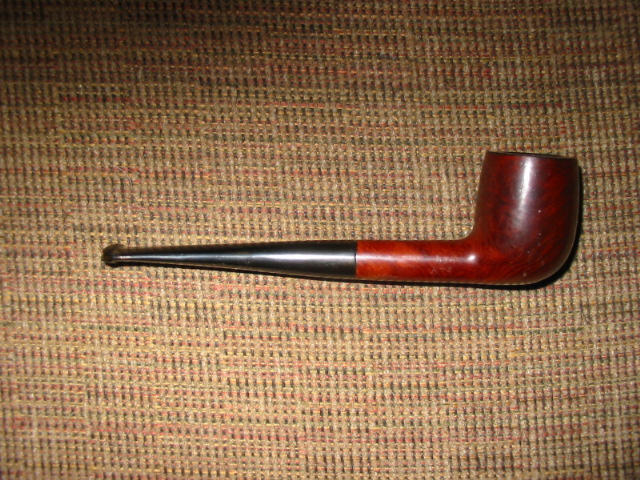
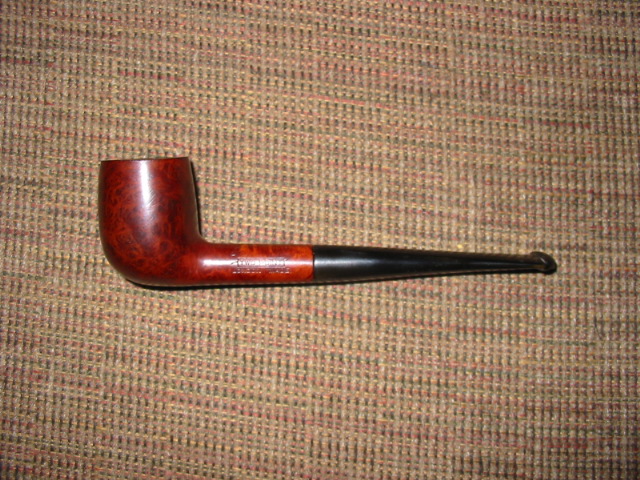
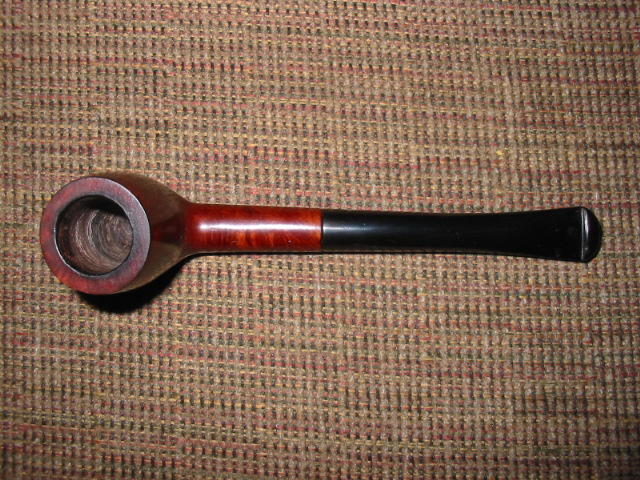
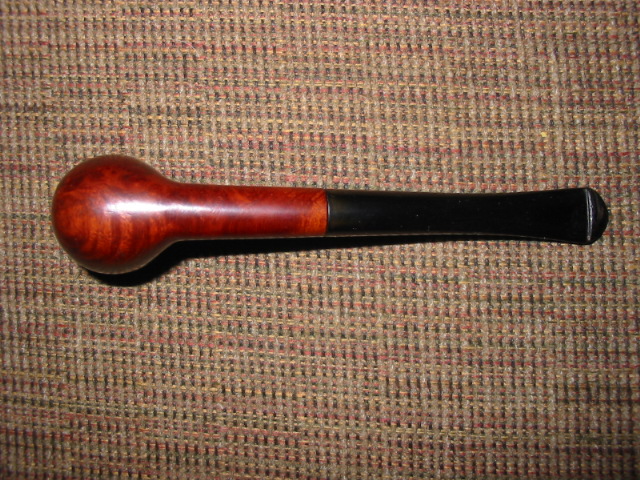
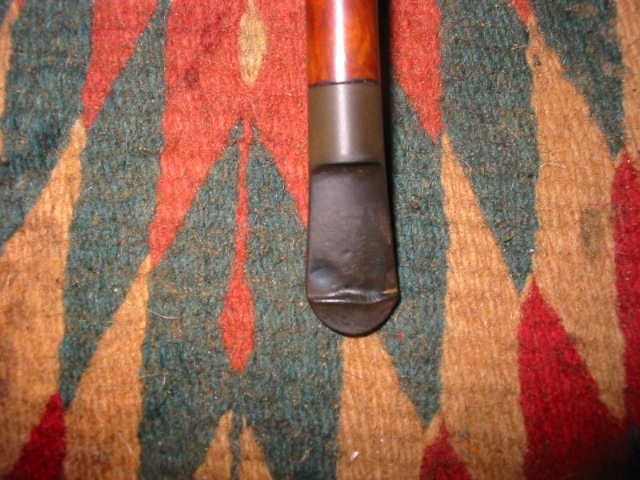
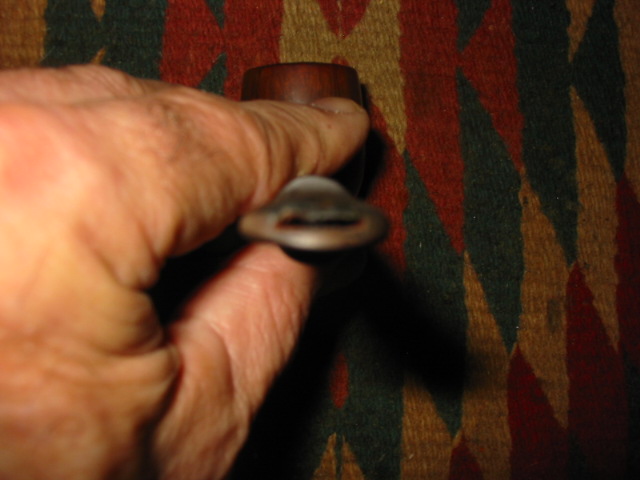
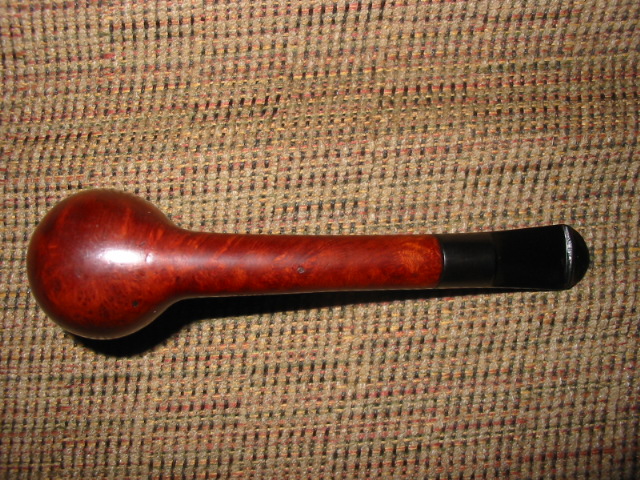
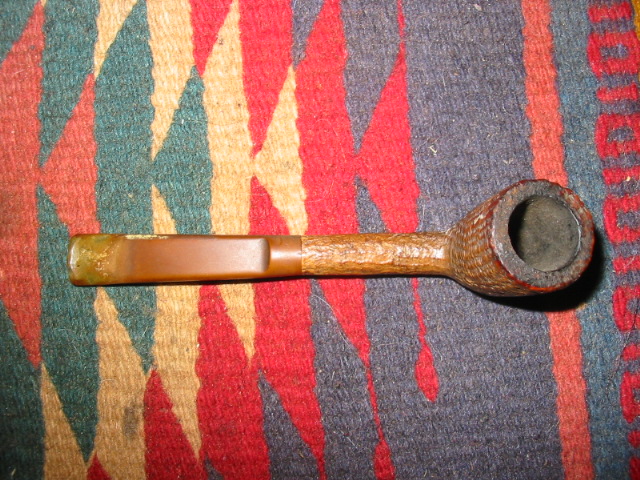
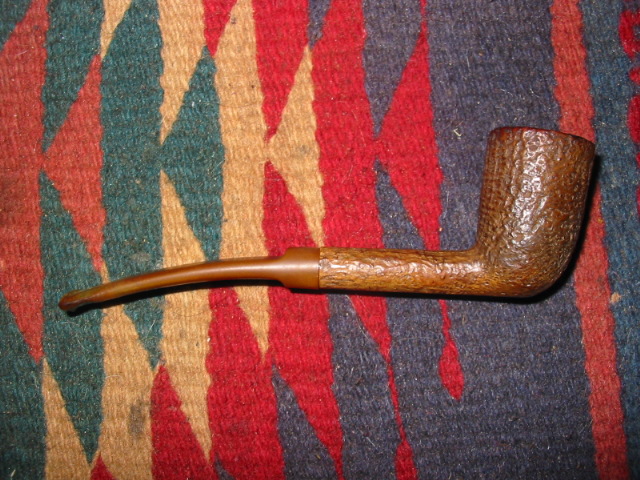
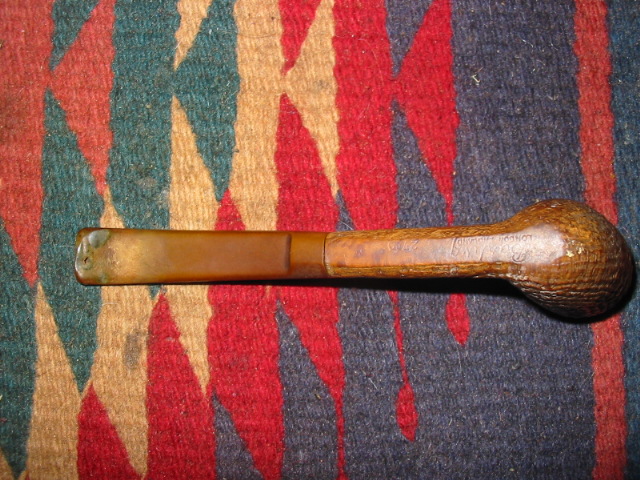
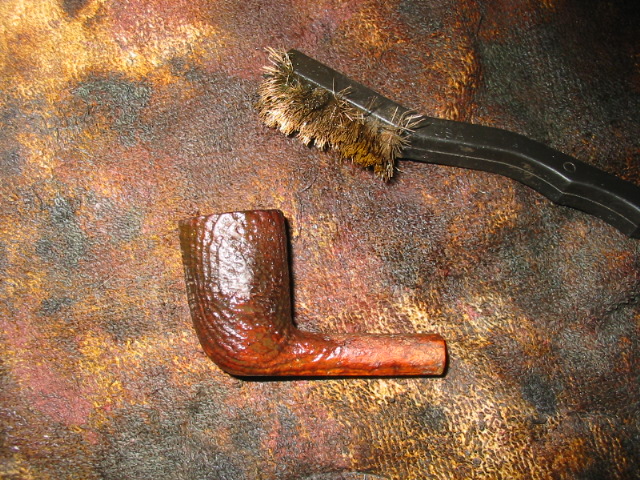
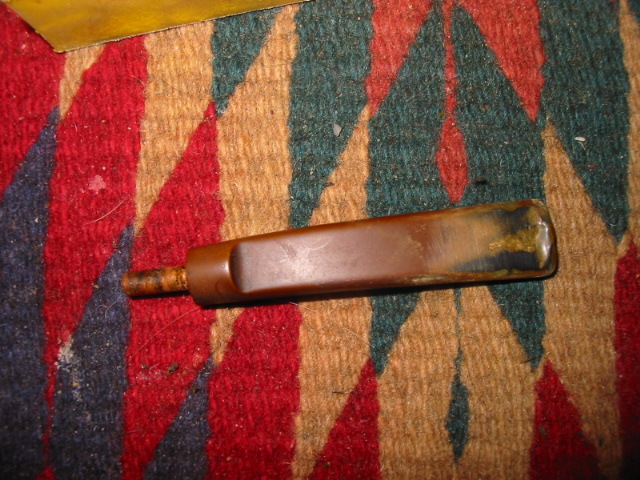
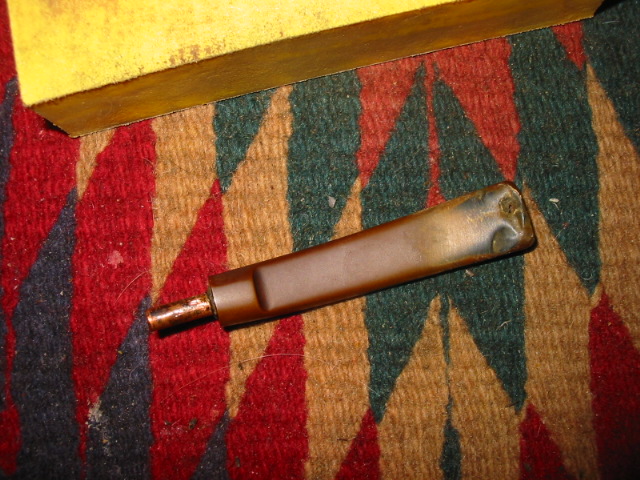
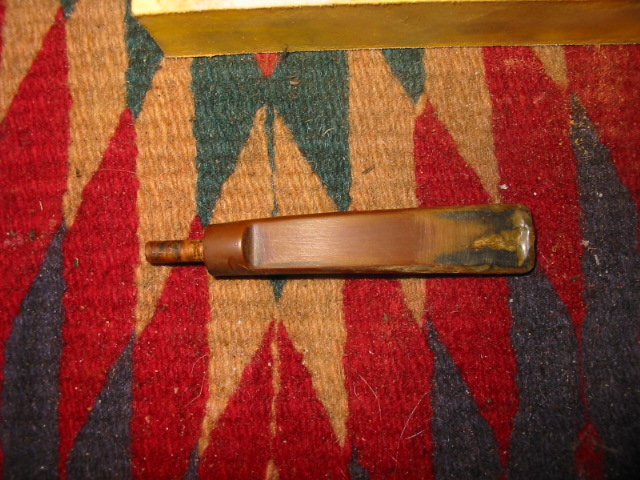
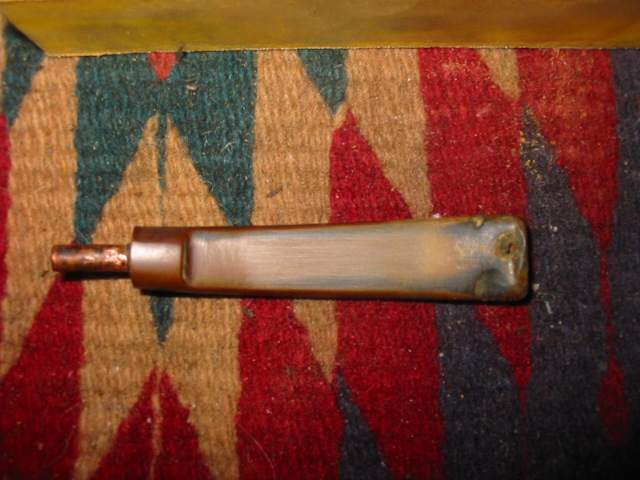
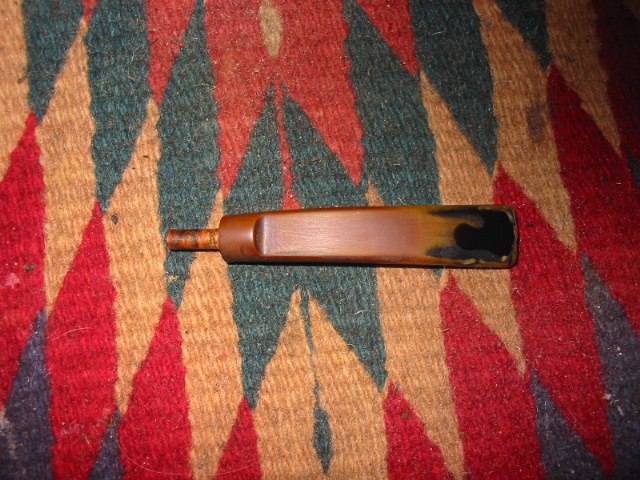
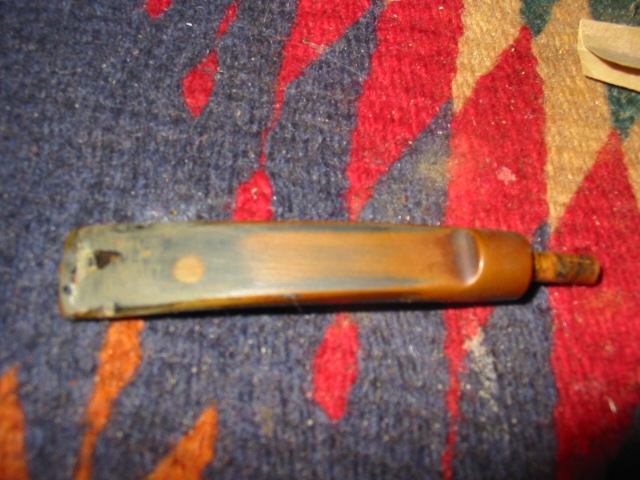
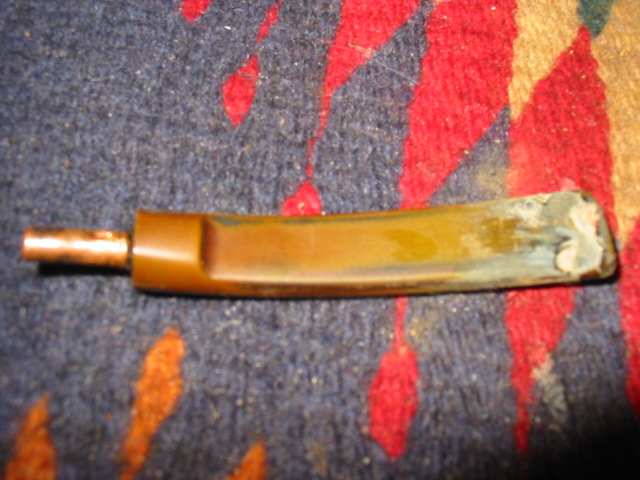
Have you ever found that Holy Grail pipe only to realize that it has a major flaw? For me, this pipe ticked all the boxes, a KB&B pipe made between 1933 and 1936, it was a less common shape and looked to be in decent condition. The only problem I could see was that a previous owner had filed off the button.Andrew1

Andrew2

Andrew3

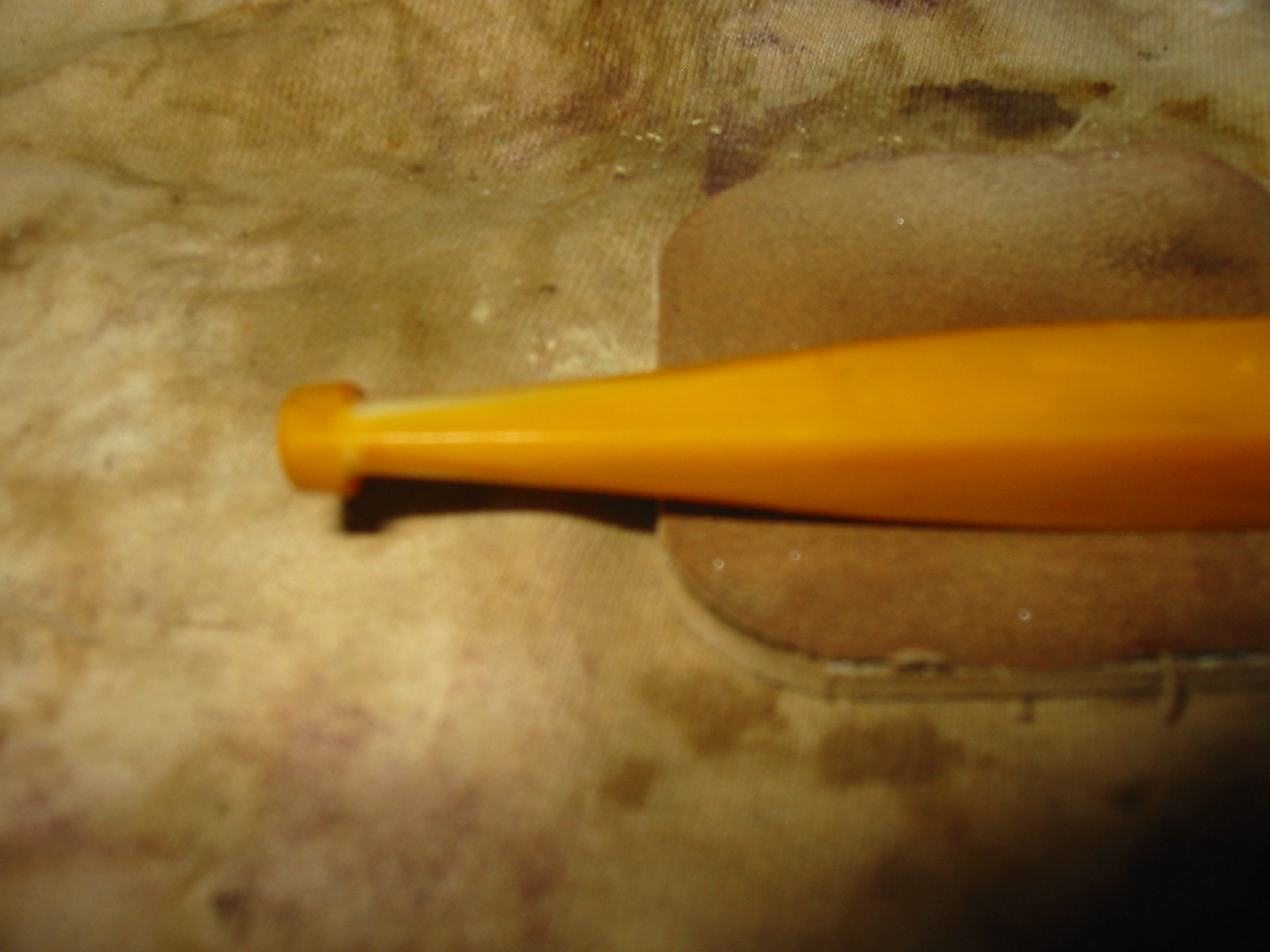
Andrew4 I’ve been experimenting with super glue and ground charcoal for stem repair and I had an idea how I might use that to re-create the button. Now just a quick disclaimer. I am not a medical professional and I do not pretend to know any potential health hazards to the use of super glue on something you put in your mouth. On the other hand, I am aware that the state of California has found that pipe smoking is not healthy for pregnant women or their unborn children. As an adult, I accept these risks as the relaxation benefit outweighs the health risks.

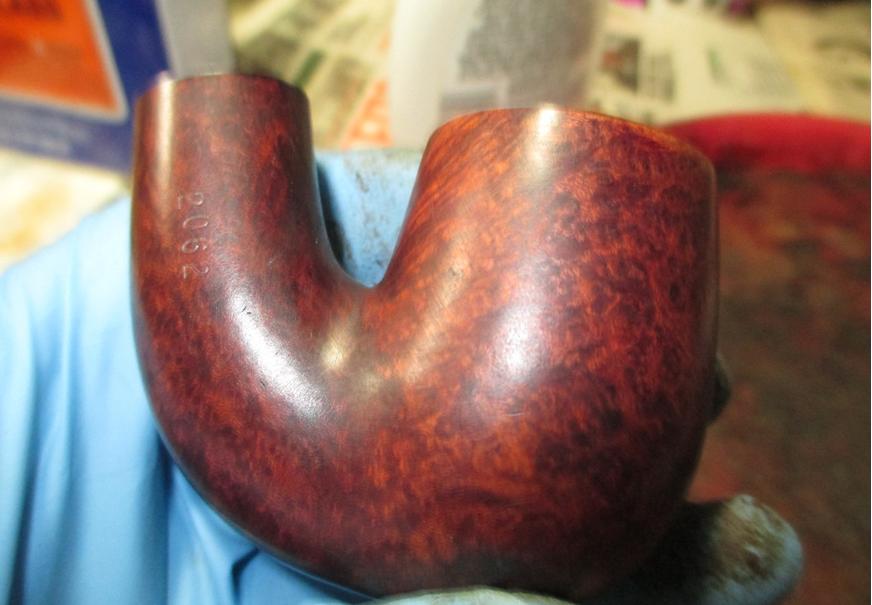
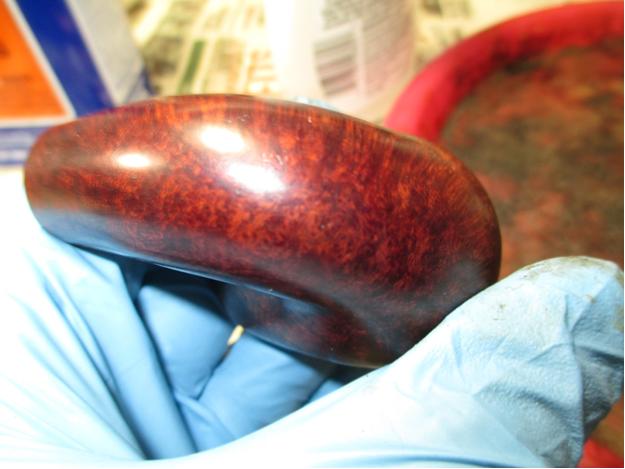
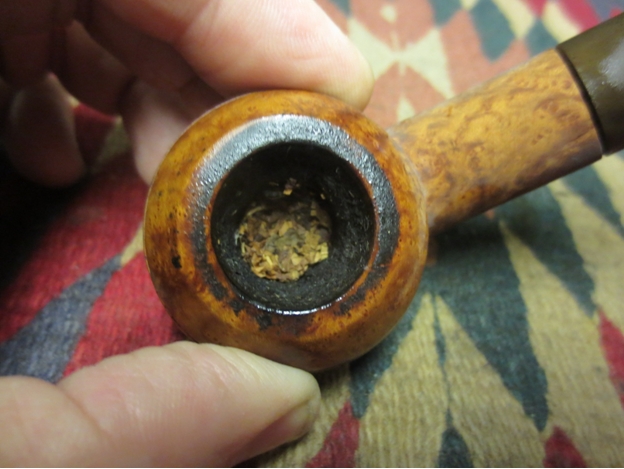
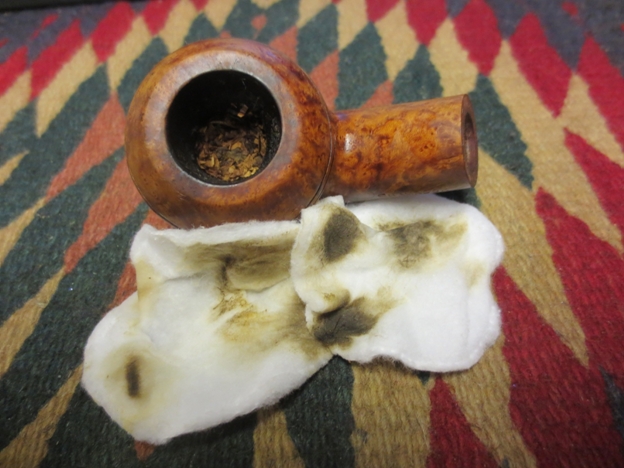
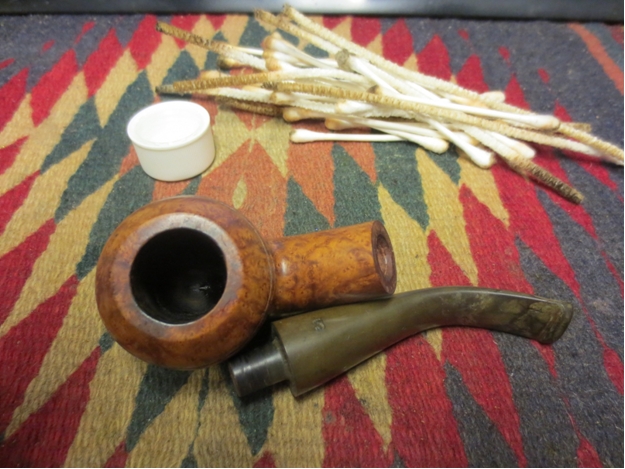
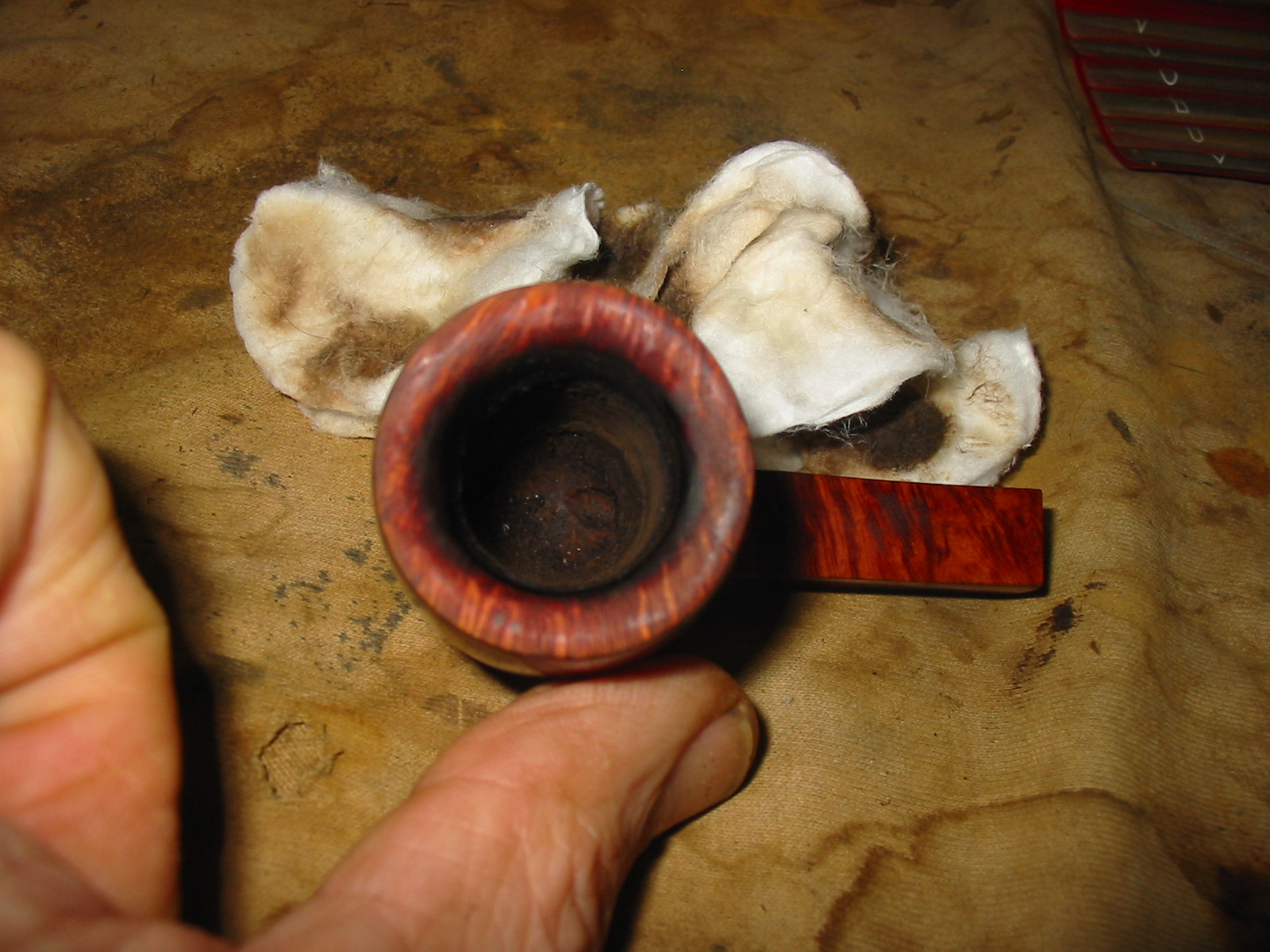
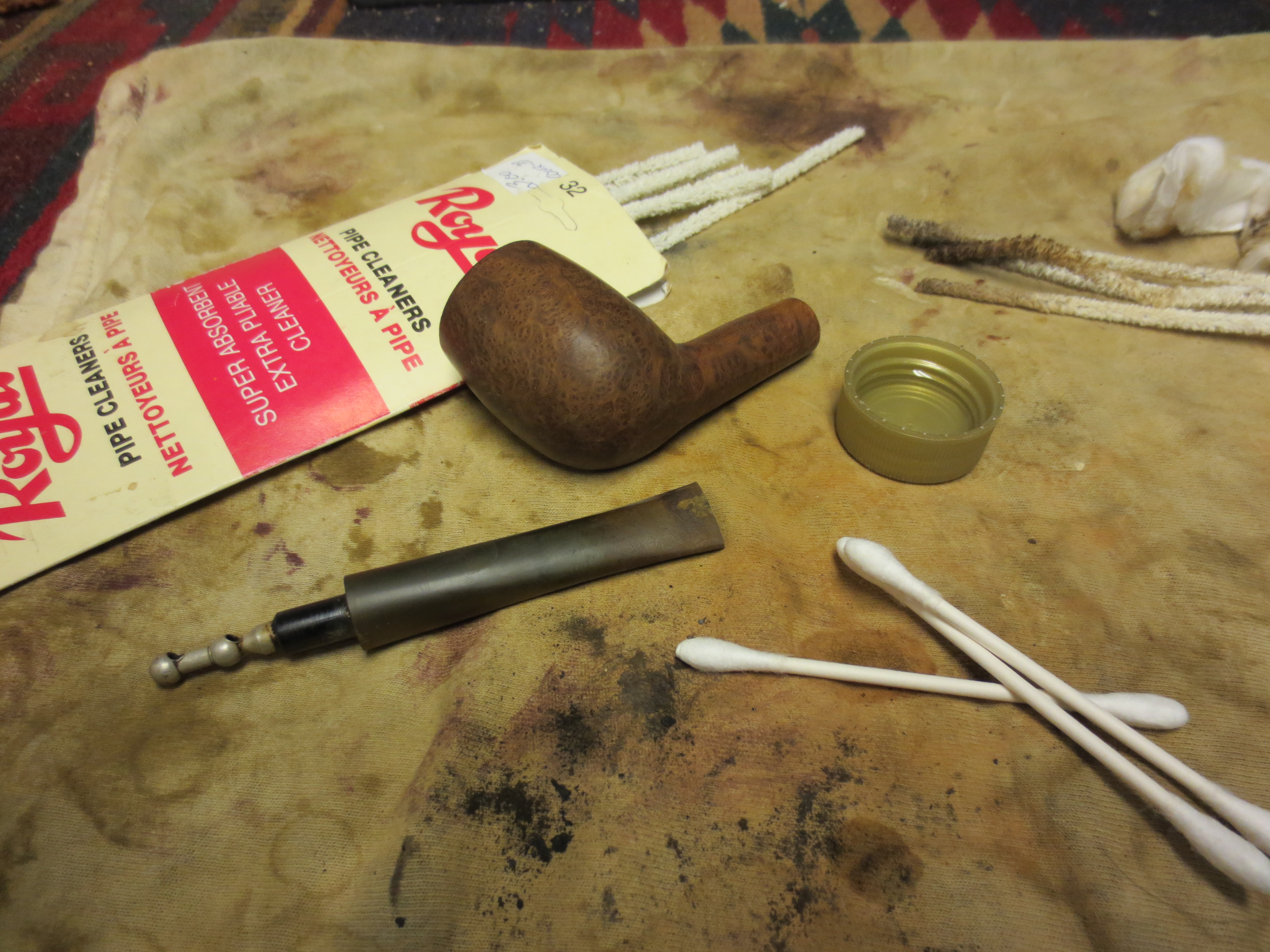
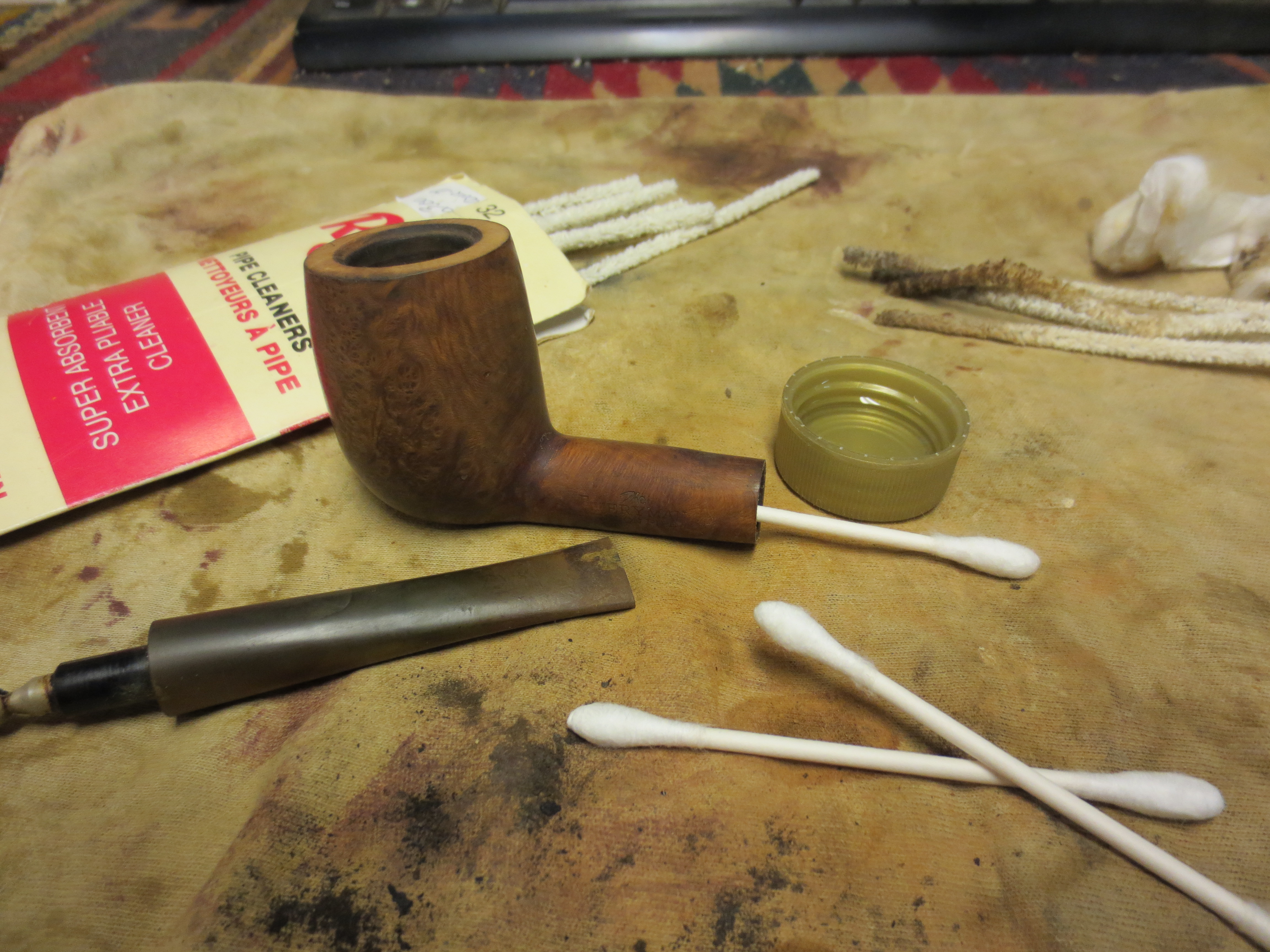
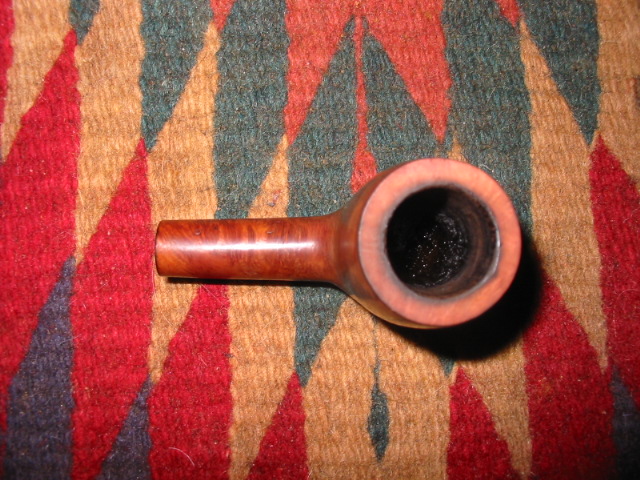
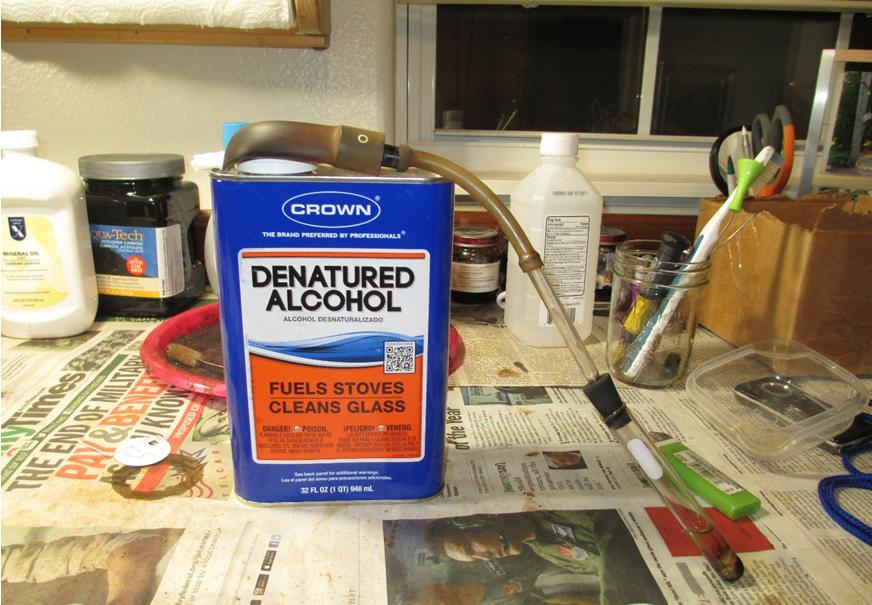
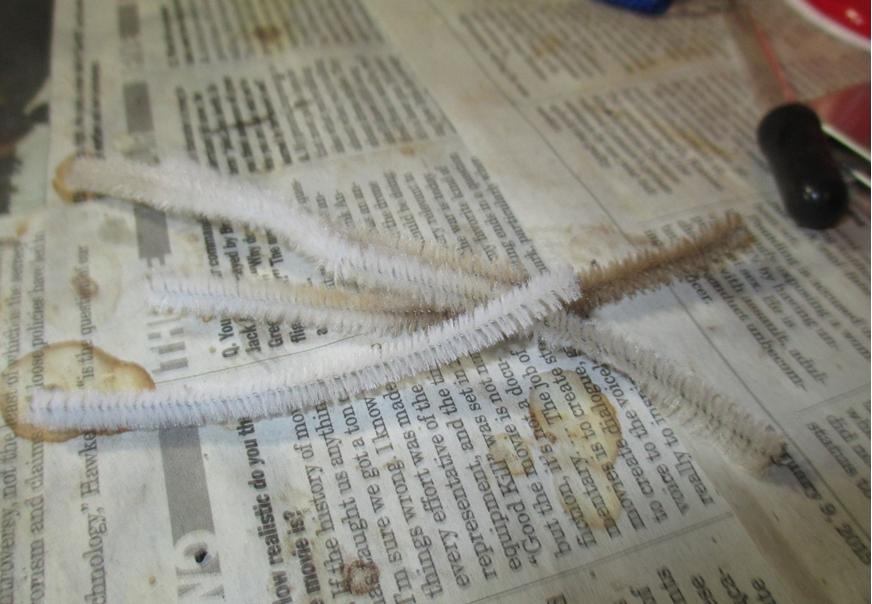
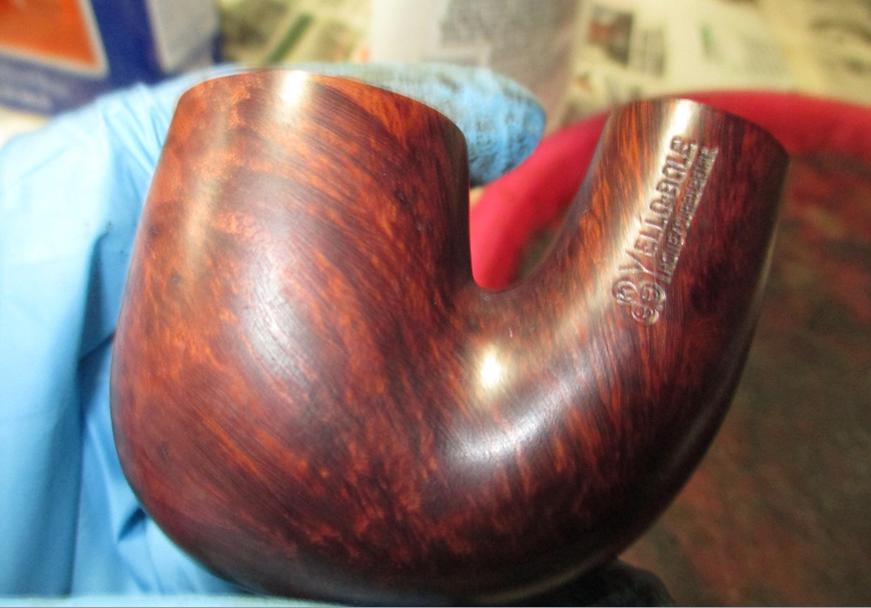
Before tackling the button I needed to clean up the pipe. I started the process by giving the bowl an alcohol bath.Andrew5 While the bowl marinated, I dropped the stem into a solution of Oxyclean. After a good long soak, I reamed the bowl.Andrew6 After reaming the bowl, I retorted the stem and bowl. I forgot to take pictures of the bowl during this process.Andrew7 The stem was pretty clean, which I expected based on the minimal amount of chatter and the lack of cake build up in the bowl. A couple of fuzzy sticks dipped in alcohol did the trick.Andrew8 The alcohol bath serves two purposes, it loosens up the internal gunk and it helps remove the old finish. On this particular pipe, I noticed that the bowl was stained a purplish read and had a heavy varnish on it. That’s usually a sign of inferior briar and lots of fills. With great trepidation, I used acetone and 0000 steel wool to see what was under the old finish.Andrew9 I was pleasantly surprised to find beautiful grain and not a single fill.Andrew10
Andrew12

Andrew11

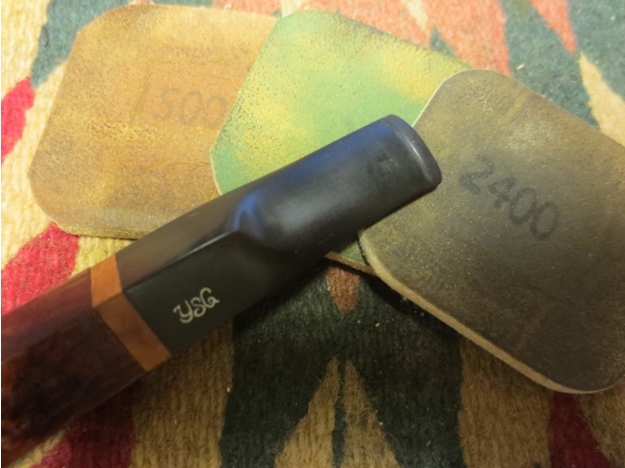
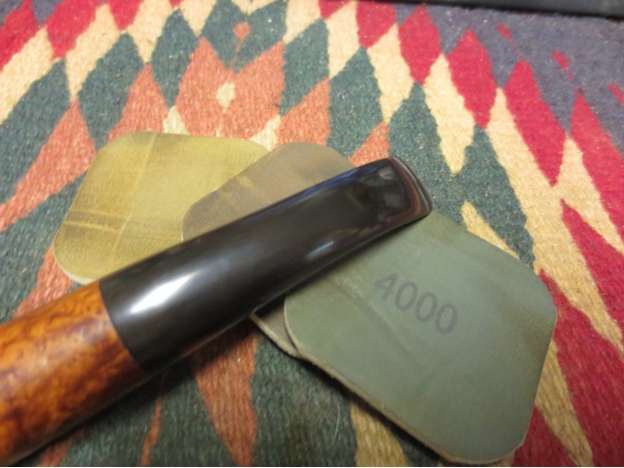
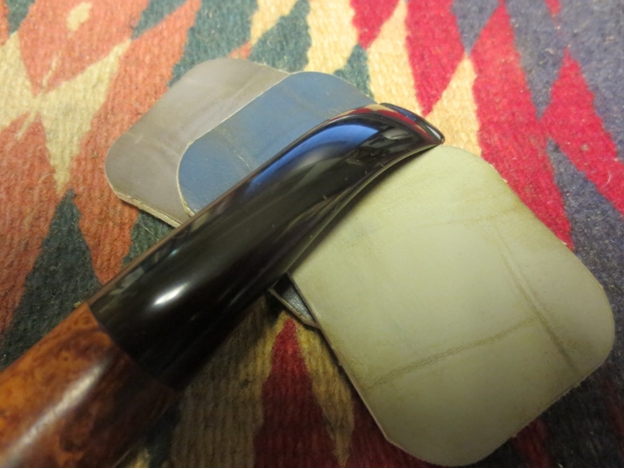
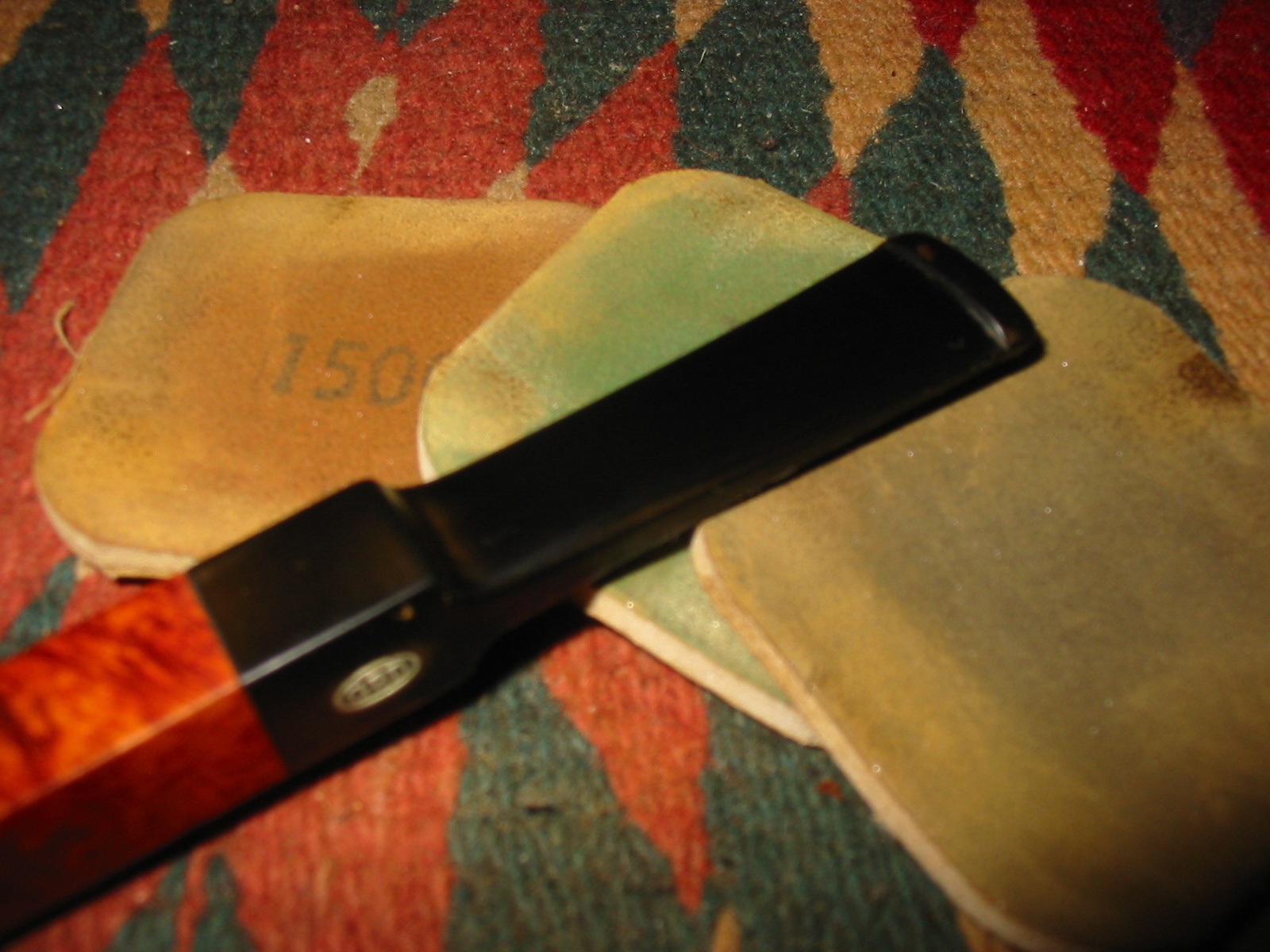
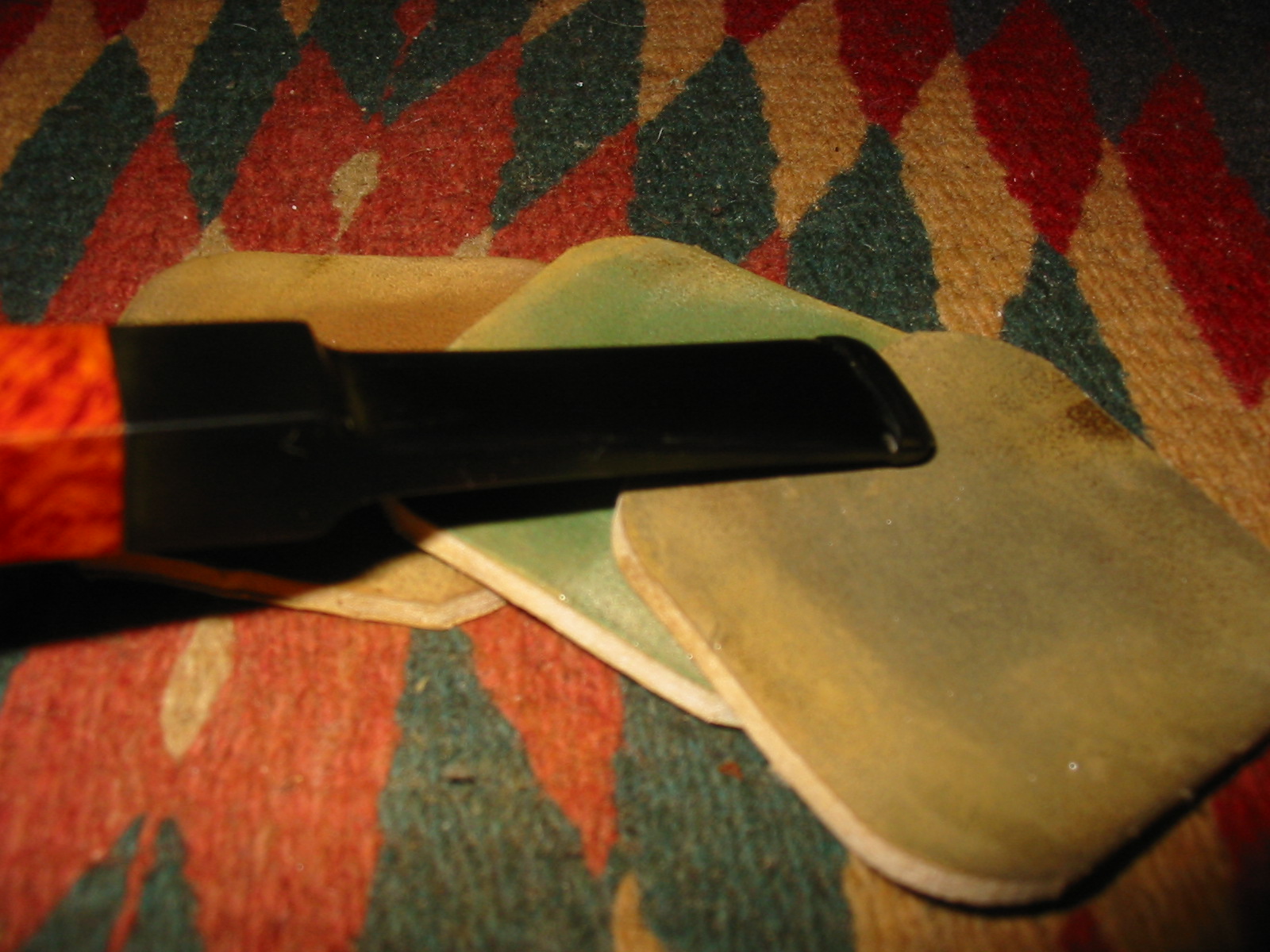
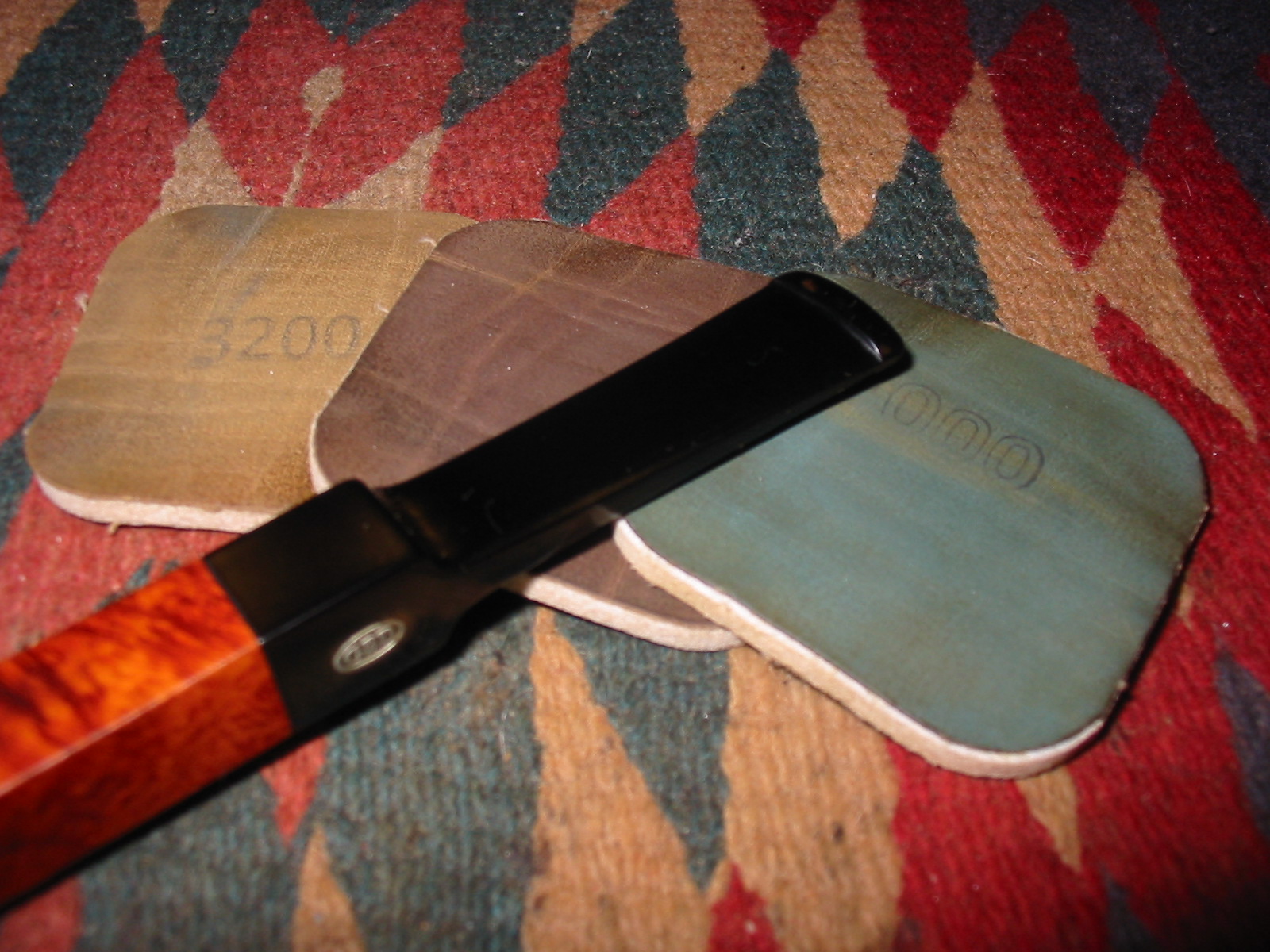
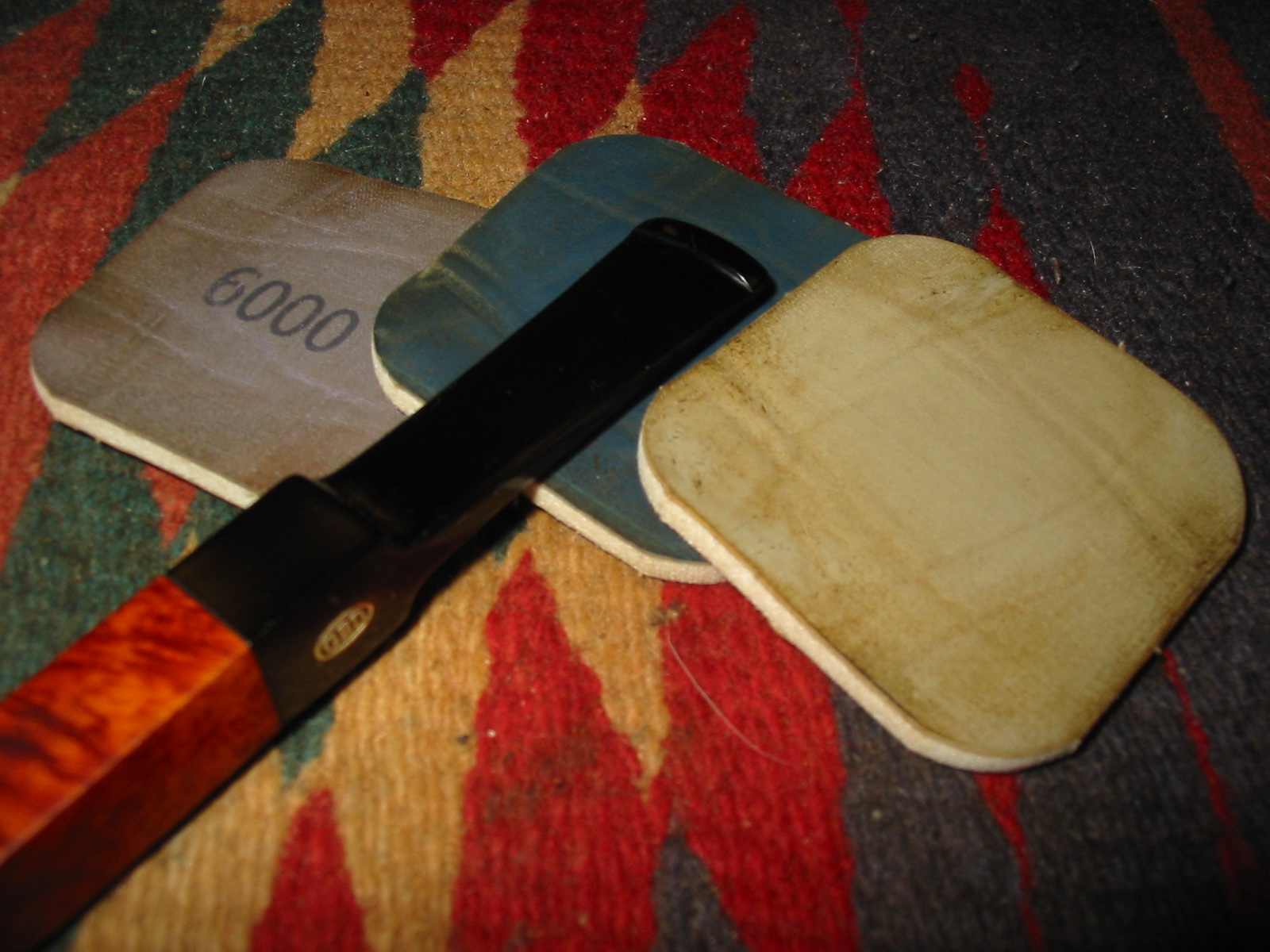
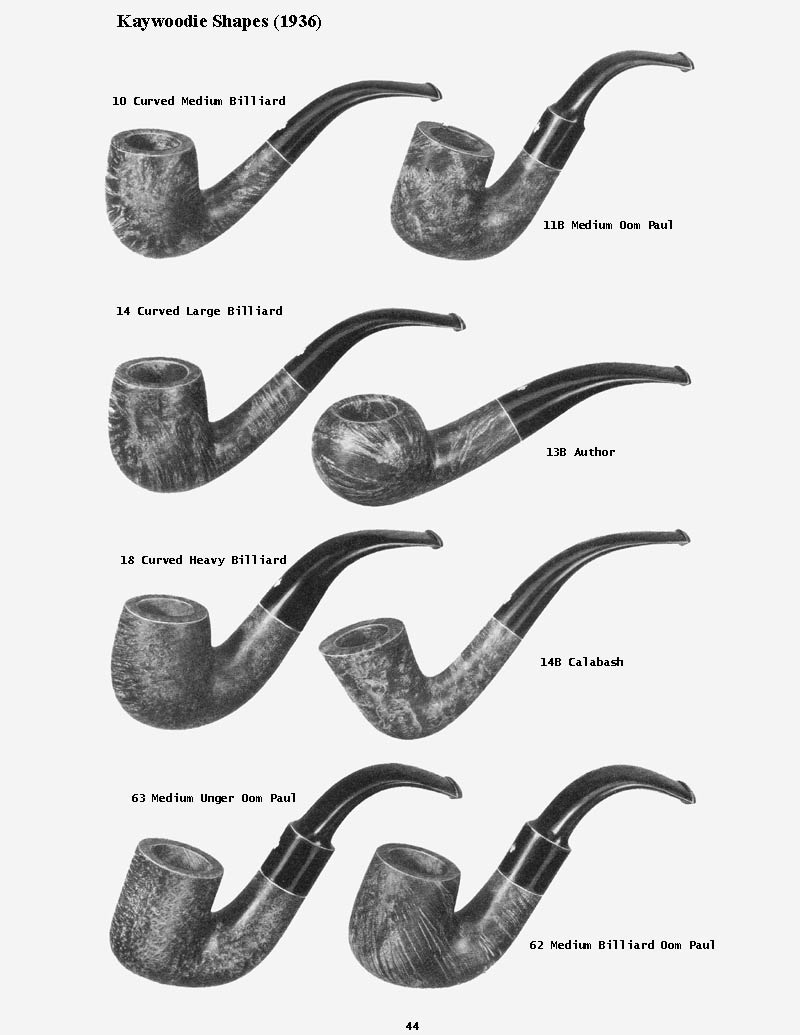
Andrew13 I was not happy with the purple tint of the wood though, I mean who does that? My guess is, this pipe could have made the cut as a Kaywoodie, maybe they were short on the Yello Bole line so they put a Yello Bole stem on it and that hideous varnish. Interestingly enough, this pipe has the identical shape number as the Kaywoodie medium billiard Oom Paul. Just to give you an idea how many pipes Kaywoodie used to make, they had three models of the Oom Paul shape.Andrew14 I decided the best way to take care of the purple stain was with some judicious sanding. Since the bowl didn’t have any scratches or dents, I didn’t have to go too heavy. I started out with 1500 grit micro mesh and worked my way up to 12,000 grit. You will notice the washer between the stem and shank. I’ve learned that the best way to get a sharp shoulder on the shank and the stem is by using the washer to prevent the sanding medium from rounding it off.Andrew15 This is what the bowl looked like after the micro mesh pads.Andrew16
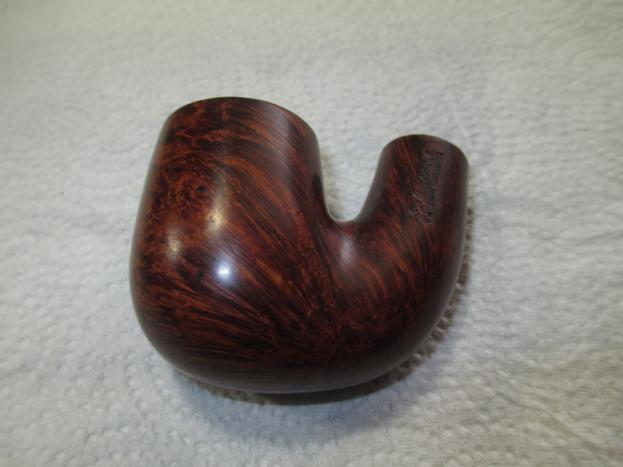
Andrew17 I decided to keep the stain light, so I diluted some Pimo Pipe Supply mahogany and used a single coat. Unfortunately I didn’t take a picture of that process, I was kind of excited about fixing the stem.

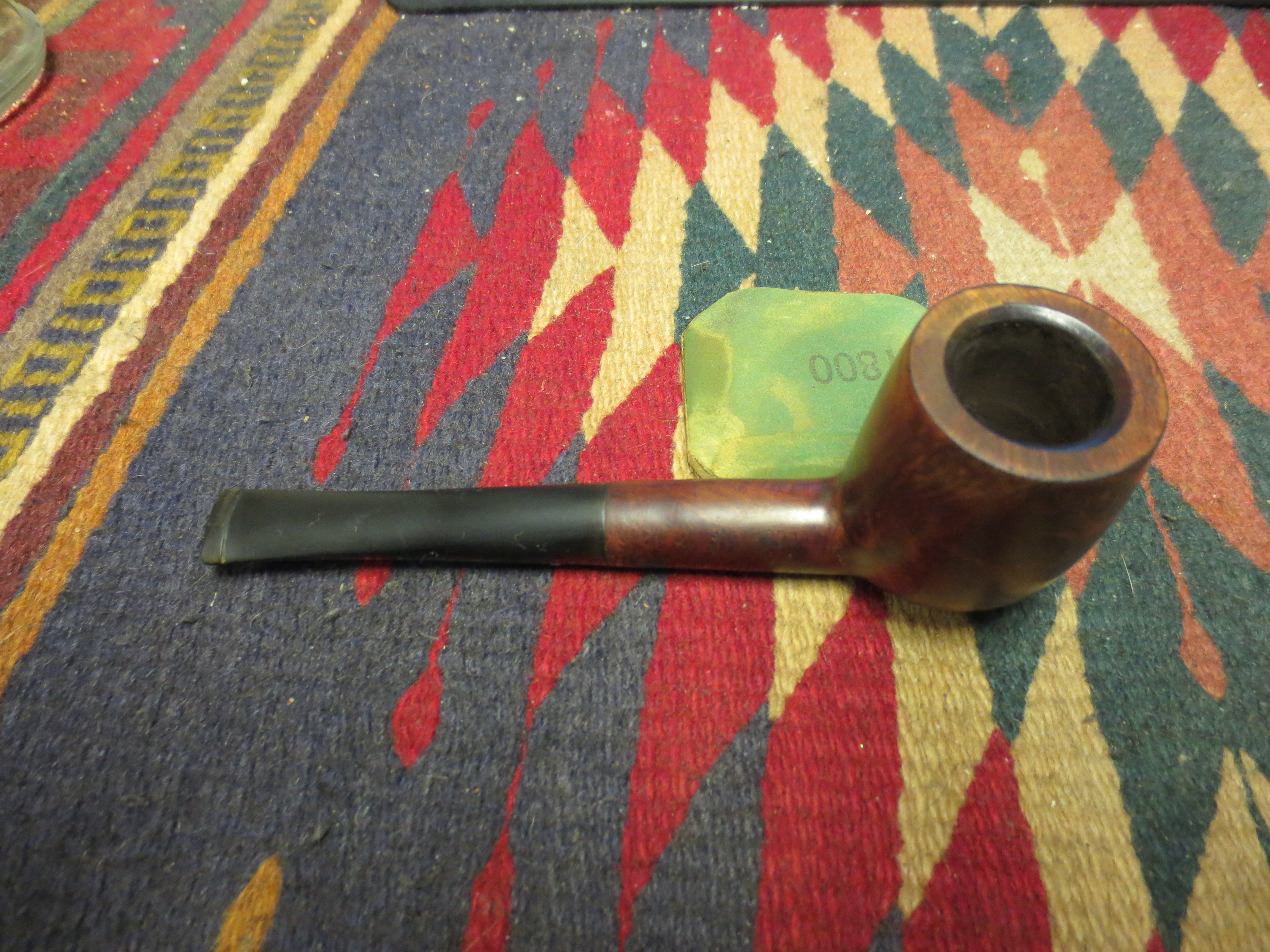
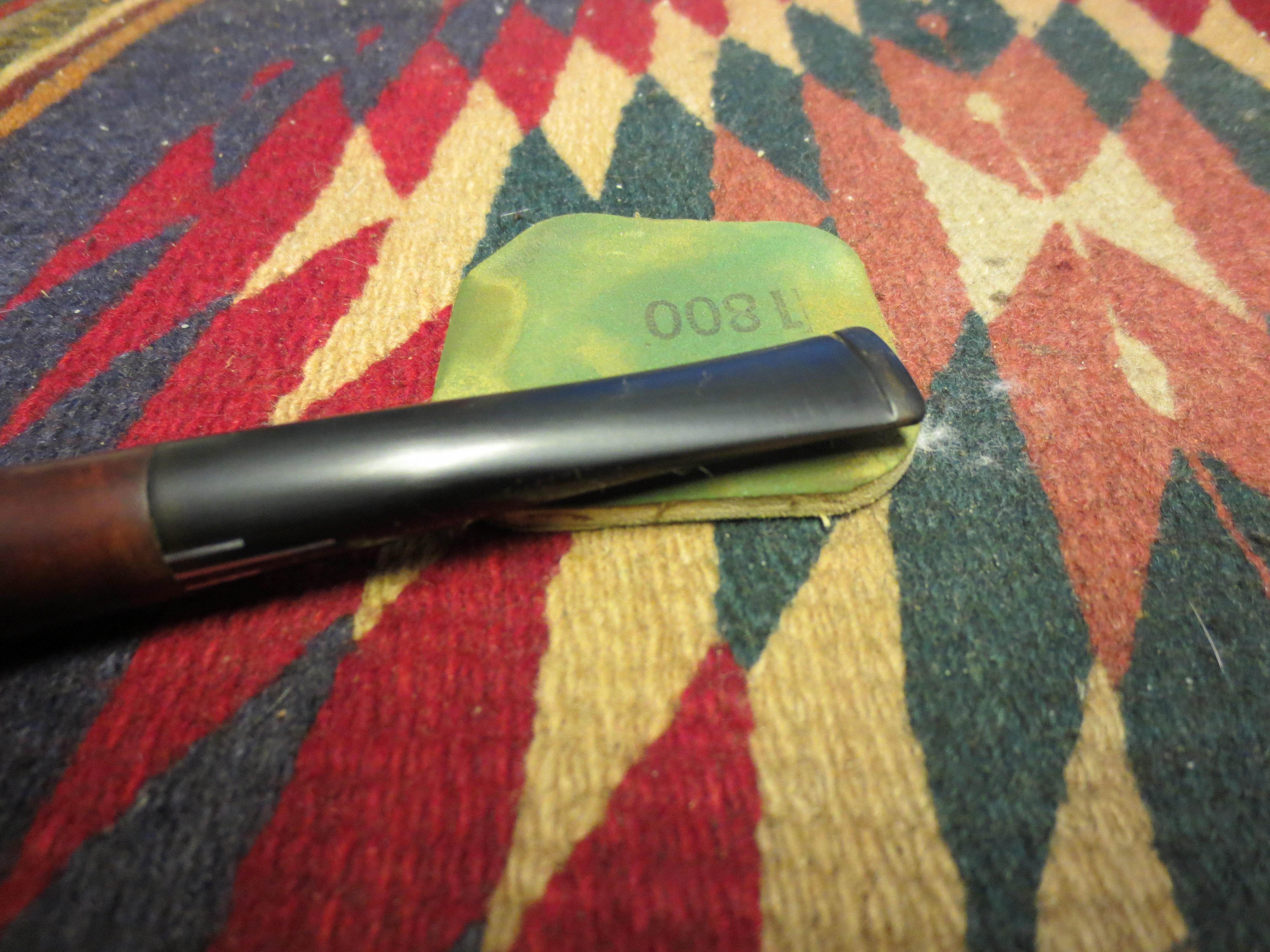
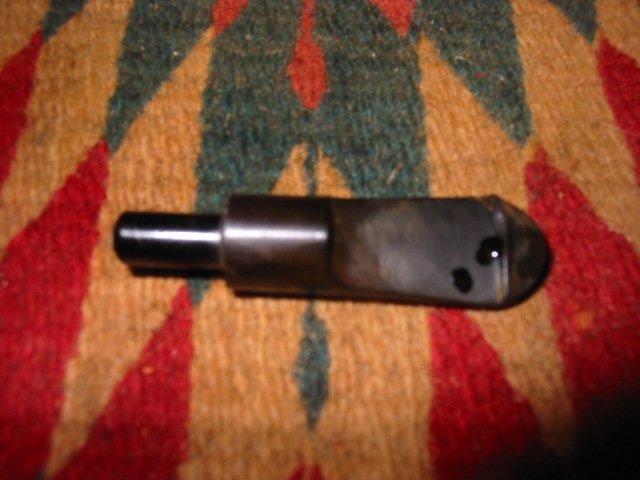
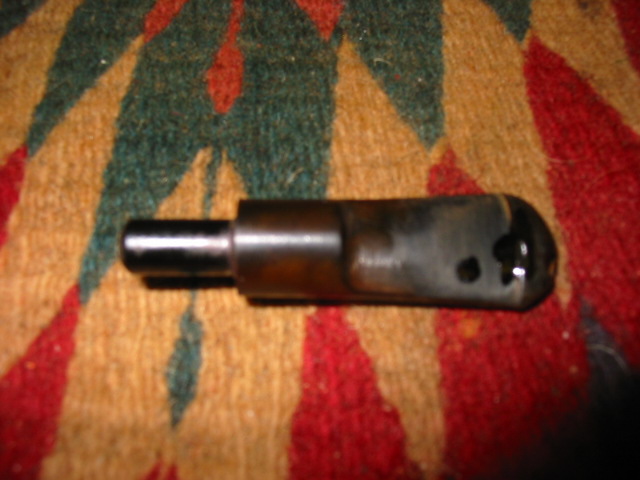
I removed the oxidation on the stem with a progression of 1500-2400 grit micro mesh pads with water. I didn’t have the bowl attached, so I just held the washer over the tenon to prevent rounding.Andrew18 With the oxidation addressed, it was time to start building the new button. I’m not the best when it comes to carving the bottom side of the button so I decided to use clear tape to create definition.Andrew19
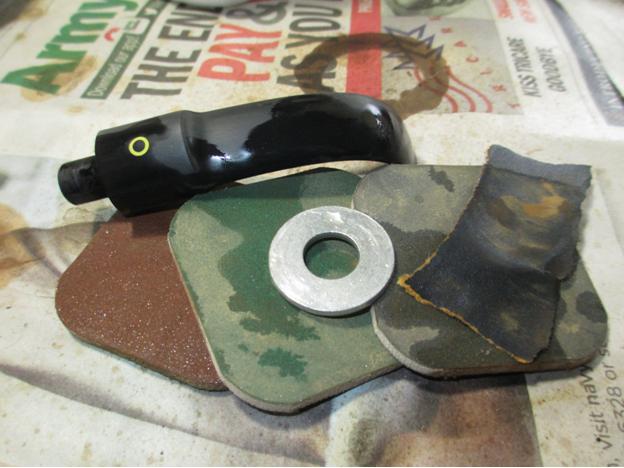
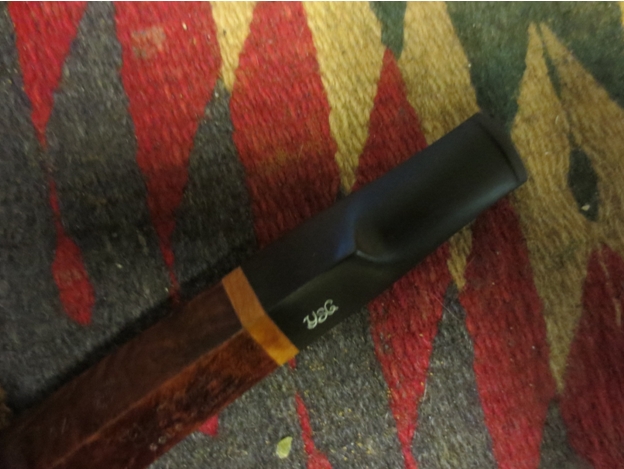
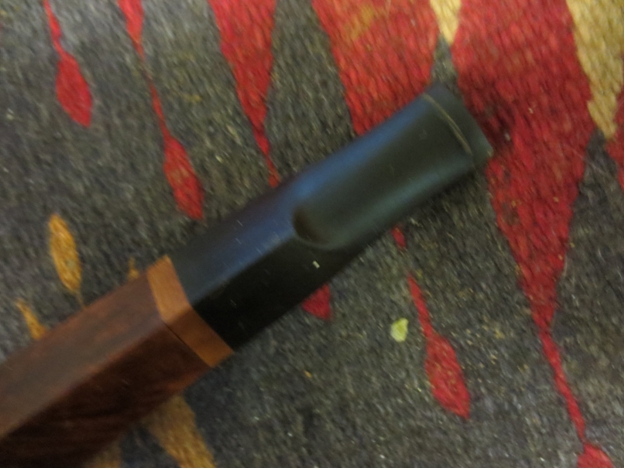
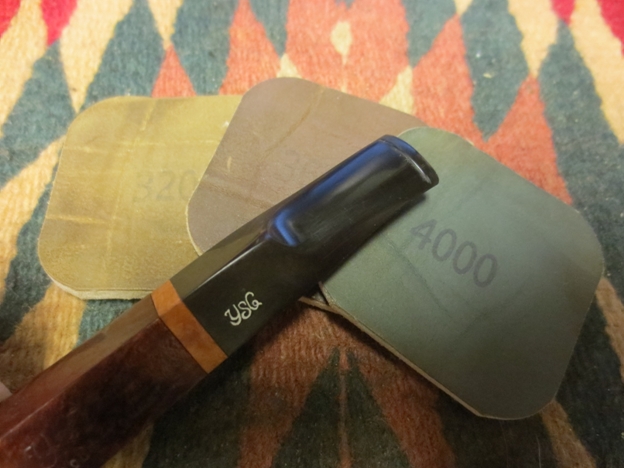
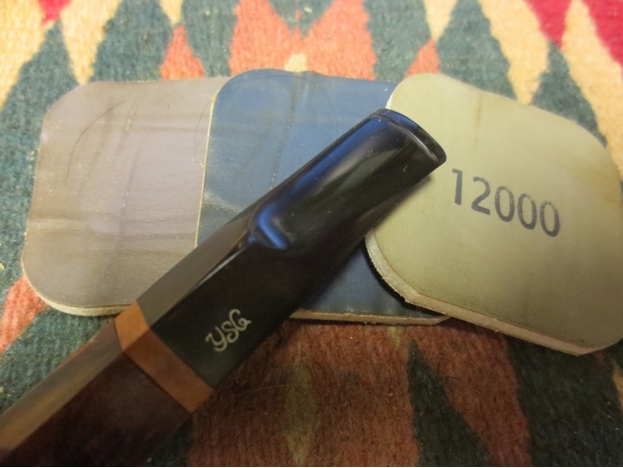
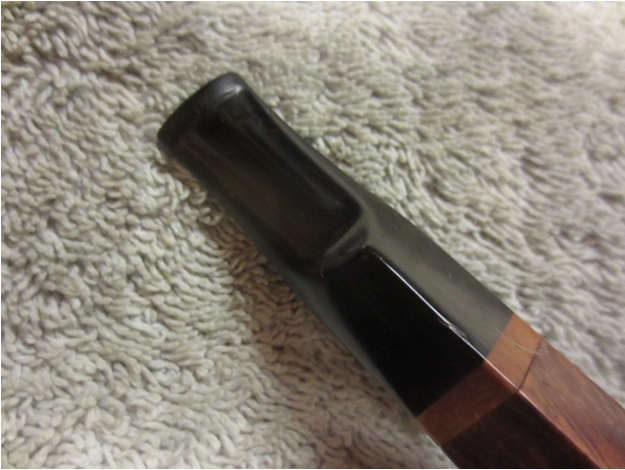
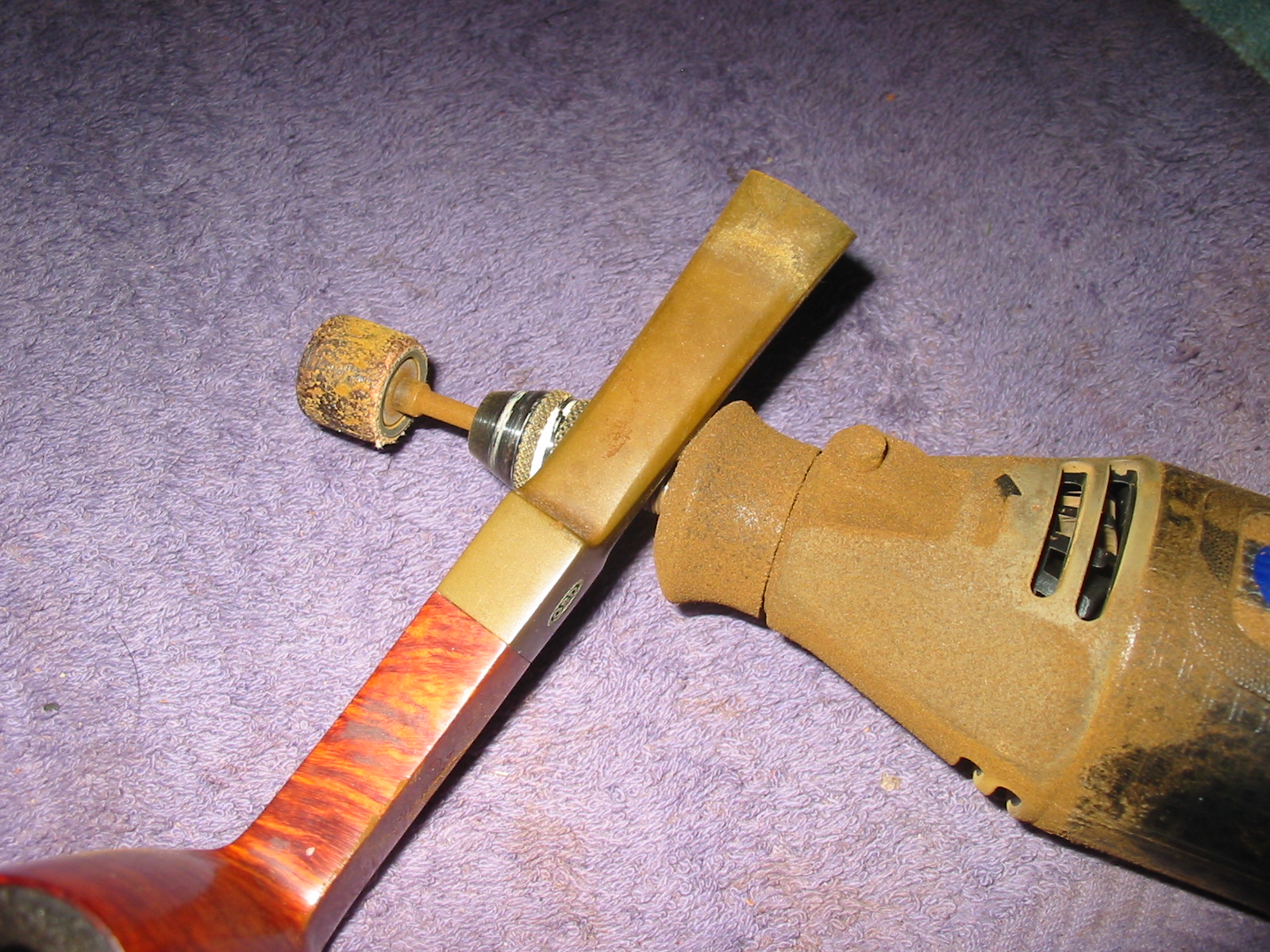
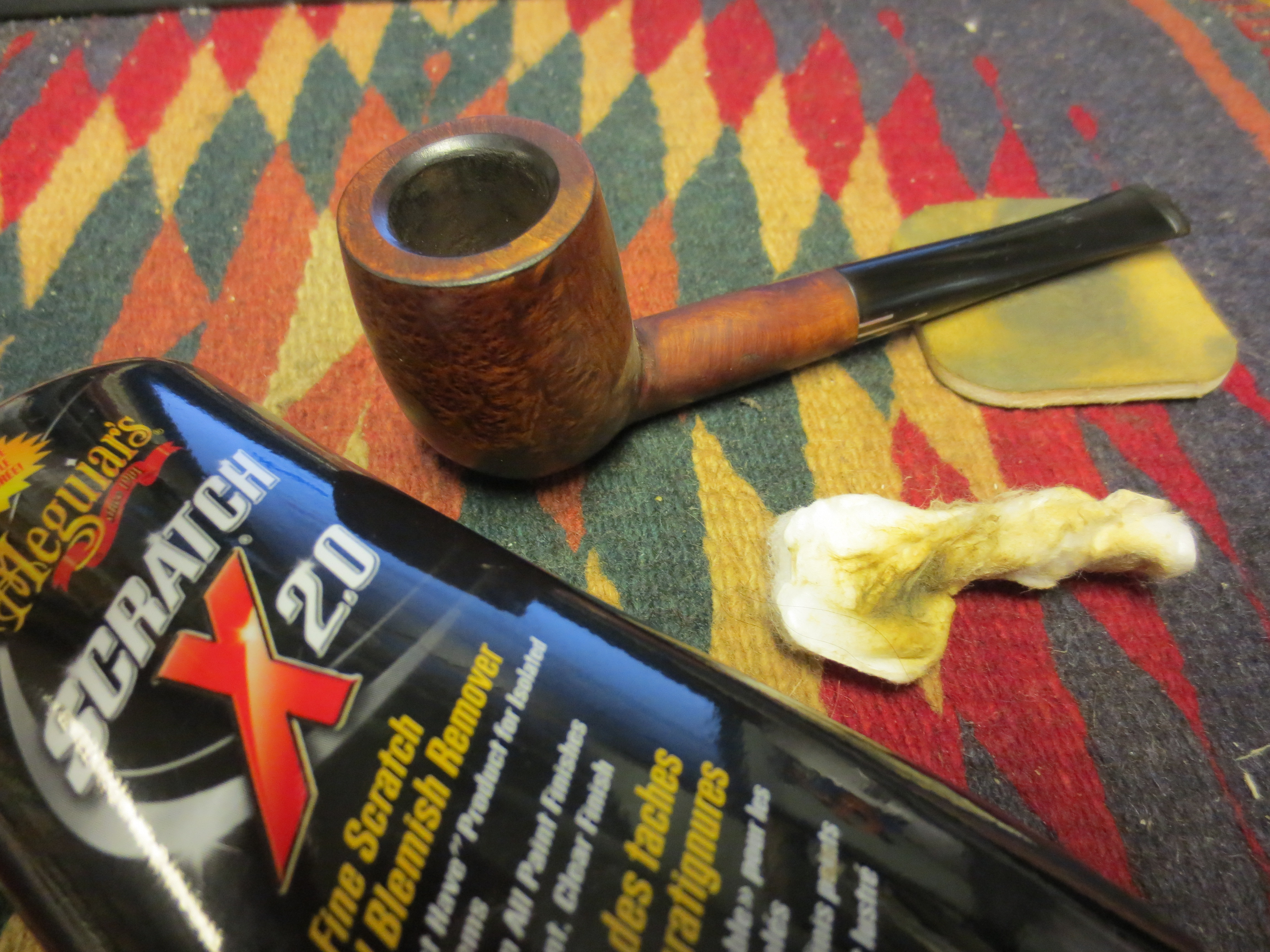
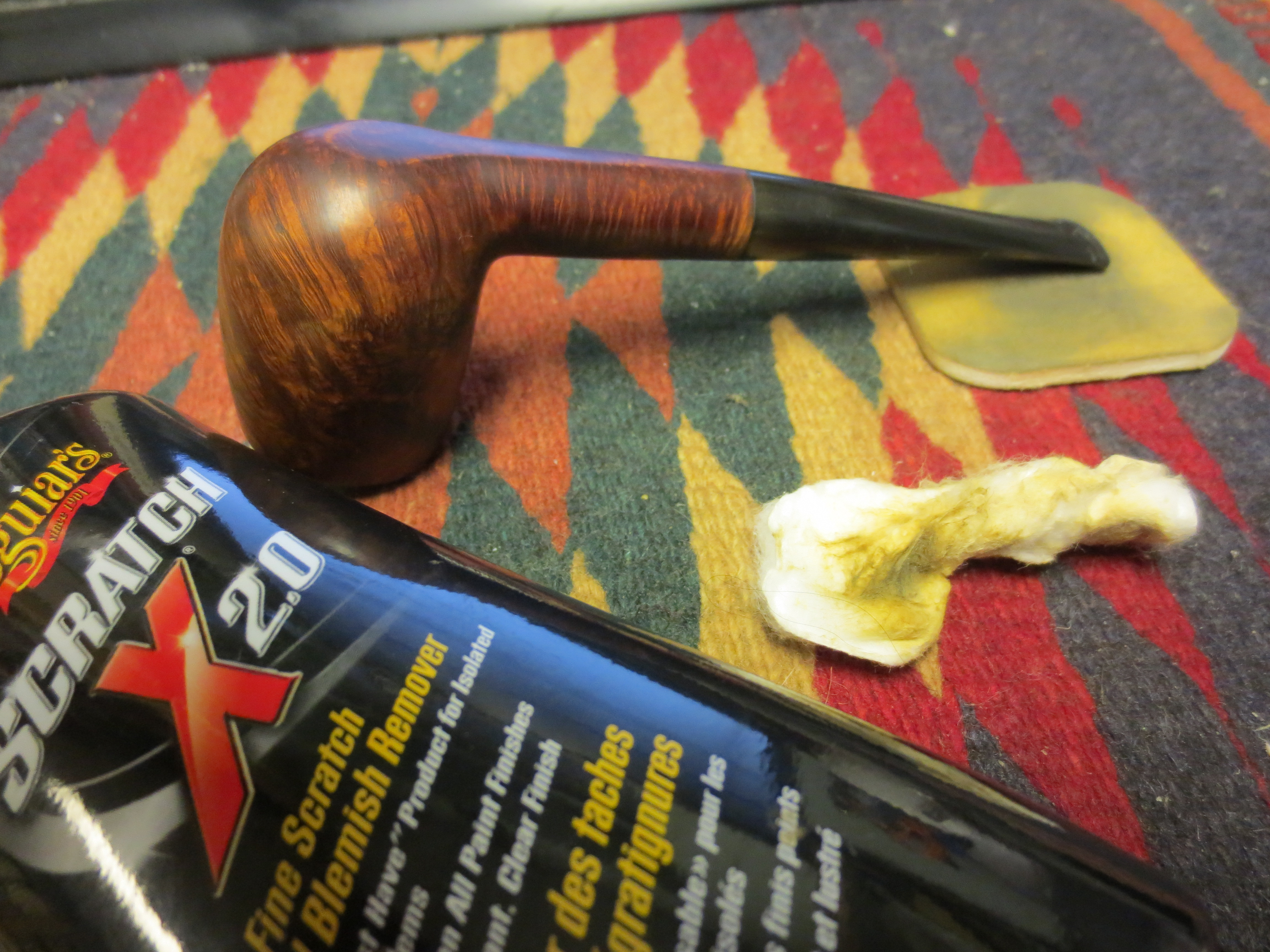
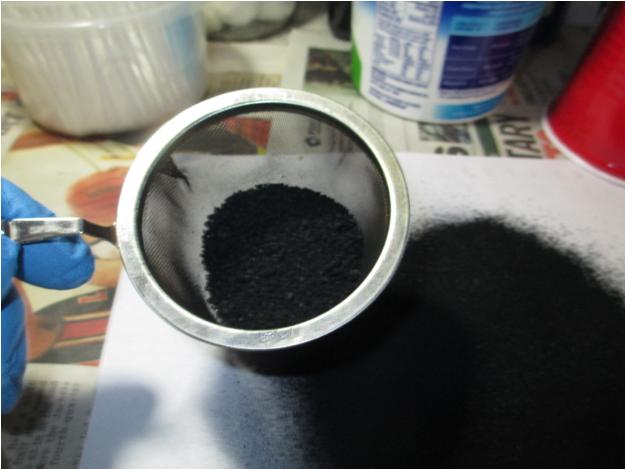
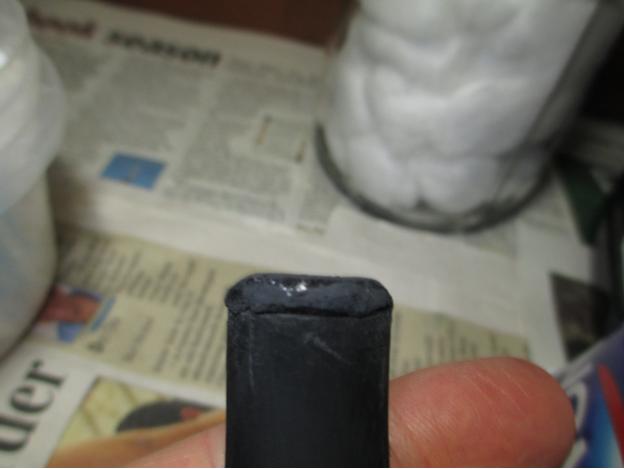
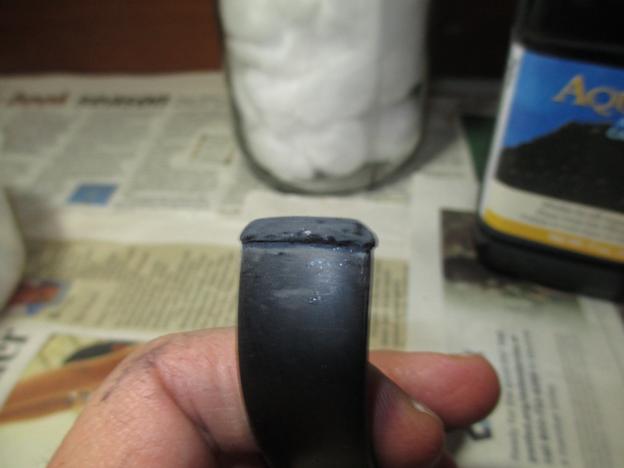
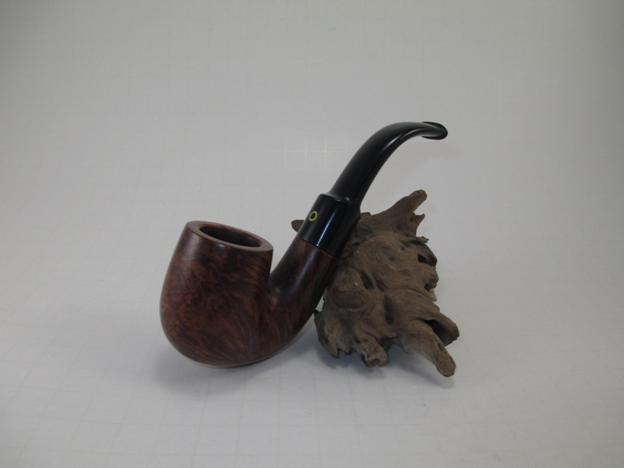
Andrew20 I built up layers of tape until it was the thickness that I wanted for the underside of the button. Next, I mixed some ground charcoal and super glue and started applying it. After each application I put a drop of accelerator on the end and applied another layer. It was not looking the way I wanted it to look.Andrew21 I remember Steve said that when he used activated charcoal it was very fine. So I sanded off the mess and started over. To get a finer charcoal I used our coffee grinder, which did a pretty good job, but still left some larger chunks.Andrew22 To solve that problem, I used a tea strainer. The result was very finely ground charcoal.Andrew23 I mixed the super glue and charcoal and applied it as before.Andrew24 I sanded between applications and filled in any remaining divots.Andrew25 Once I had the button shaped to my liking, I used a progression of micro mesh pads from 3200-12,000. Then I used my rotary tool with white diamond and carnauba wax to bring out the shine.Andrew26 I gave the bowl a quick spin on the buffing wheel with white diamond and carnauba wax. Here is the result.Andrew27
Andrew28

Andrew29

Andrew30

Andrew31

Andrew32

Andrew33

Andrew34

Andrew35

Andrew36

Andrew37 I am happy to say that this pipe smokes as well as it looks. It is a system pipe. I couldn’t be happier with the button. The thing I like about using the charcoal and super glue is, it polishes and shines just like the vulcanite. This pipe is a keeper. Thanks for looking.
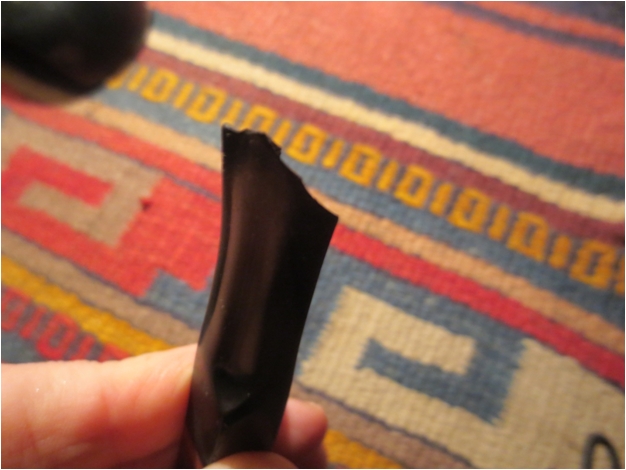
My Process for Cutting off and Reshaping Broken Stems


Blog by Steve Laug

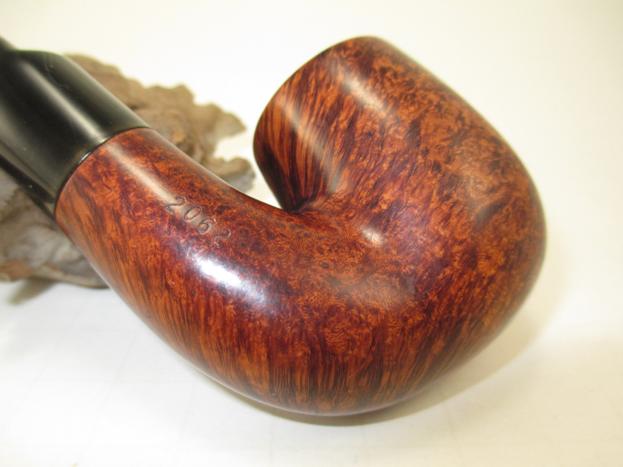
It seems like lately I have had a few of these pipes with broken stems. I have gotten several emails through the blog asking for more information about how I go about cutting back a stem and reshaping it. Since I just finished working on the Yves St. Claude pipe where I did cut back the stem and reshape the button I thought I would use it as an example of the process. I figured that this provided the perfect opportunity to spell out more of the details that I hinted at in the full blog on the restoration of the pipe. The pictures below will show the progress from broken stem to a short saddle stem. It is only one of the methods for addressing a broken stem. Stem splicing and stem replacement are also possible solution. Soon I hope to have another blog on stem splicing but until then have a look at the piece by Jacek Rochacki where he demonstrates his method. https://rebornpipes.com/2014/02/28/some-remarks-on-dealing-with-damaged-stems-of-smoking-pipes-by-jacek-a-rochacki/

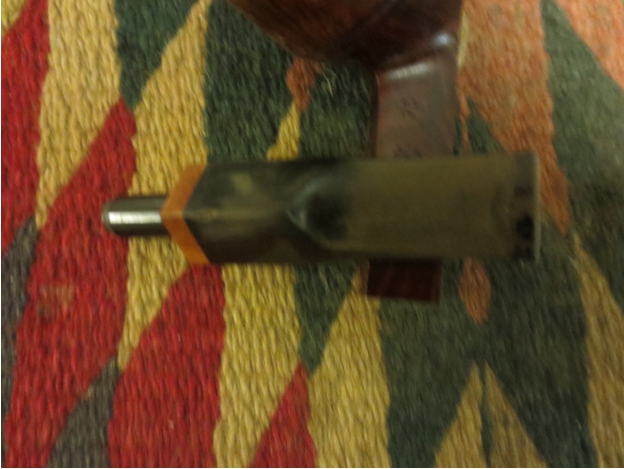
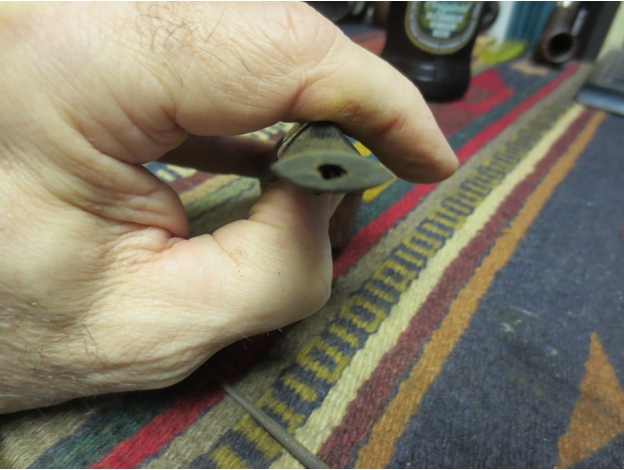
1. Before I cut off anything on a stem I spend quite a bit of time examining the broken stem. For me that means checking out the thickness of the stem material above and below the airway in the stem. There needs to be enough thickness that I can shape a button on the cut off portion. I check out the stability of the vulcanite to see if it crumbling or if the break is clean. Sometimes you need to cut quite a ways back into the stem to get either the correct thickness or stability to reform a button. I always try to imagine what the pipe will look like with a shorter stem. To help me see it I have devised a simple method. I clasp it between my thumb and finger making a straight line across the stem. Using my finger and thumb I can slide the stem as far as I want between the fingers and get a good picture of what the pipe will look like with a shorter stem. If all of these steps are passed then I get ready to cut off the broken portion.

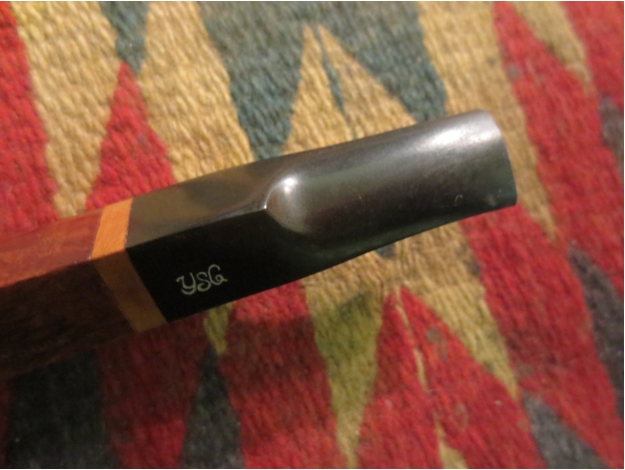
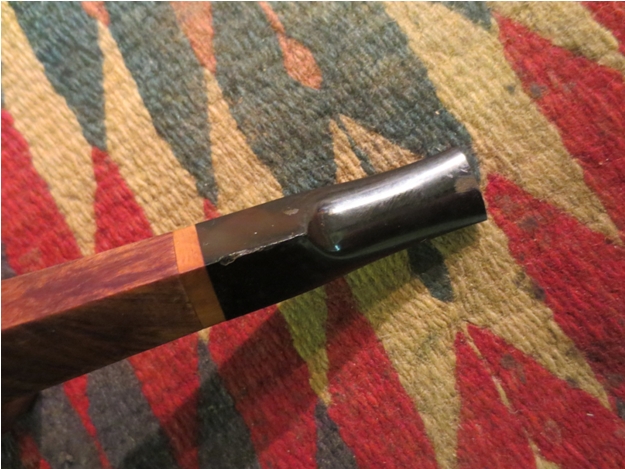
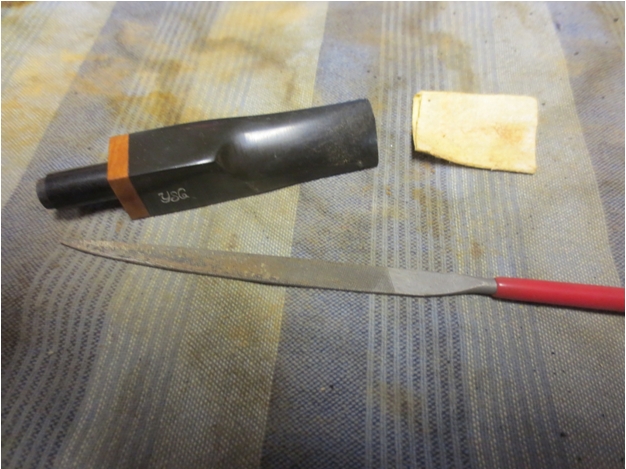
This stem passed all the tests. The break not straight across the stem but actually was slightly diagonal. It was a very clean break with no crumbling material. The airway appears to be close to the surface on the top side of the stem but because of the angle of the break there was sufficient material there for me to cut and shape a button. I was ready to cut of this stem.YSG5

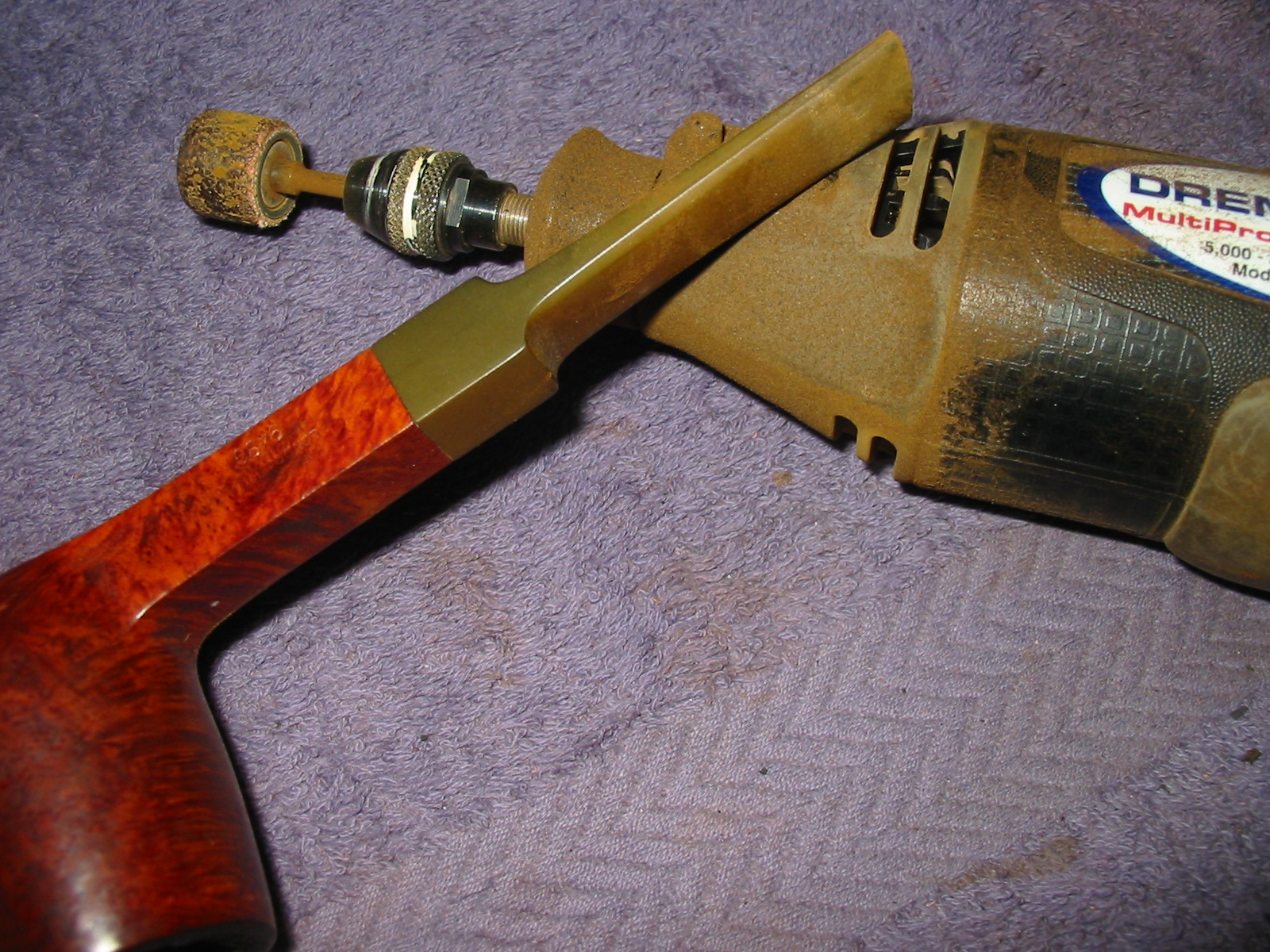
YSG6 2. I marked the stem with a pencil to delineate how far I planned on cutting the stem. I use a Dremel with a sanding drum to cut off the broken portion of the stem to the point of my line. Others use coping saws or hacksaws to remove the material. Choose whatever tool you are comfortable with to do the work. For me I hold the Dremel in my right hand and the stem in my left. I keep the stem stationary while cutting but frequently rotate it in my hand to keep the edges straight. I am always conservative in the first cut only taking off what looks to be necessary. I want a solid surface to work on with the button. Once I have the cut finished I use the drum to slightly round the corners of the line. In the end I wanted to have a slight crown on the finished button so I plan for that at this point. In the two photos below you can see the slightly bow in the cut off. The cut off edge is vertical to the surface of the stem forming a 90 degree angle.YSG16

YSG14 3. When the cut off is finished I take time to look at the profile of the stem. In this case the stem was quite thick. I was going to need to shave off the surface and thin the stem down but I would not do that until I had cut the button and roughed in the shape. Looking at it I could also see that I would need to flatten the stem near the new button as it had a definite rounding that would make it uncomfortable in the mouth.YSG15

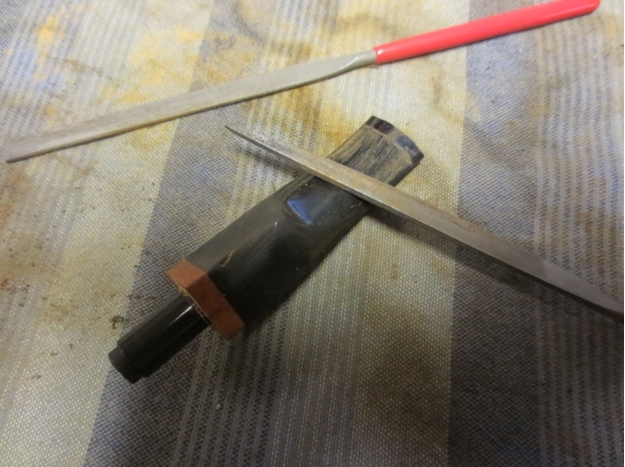
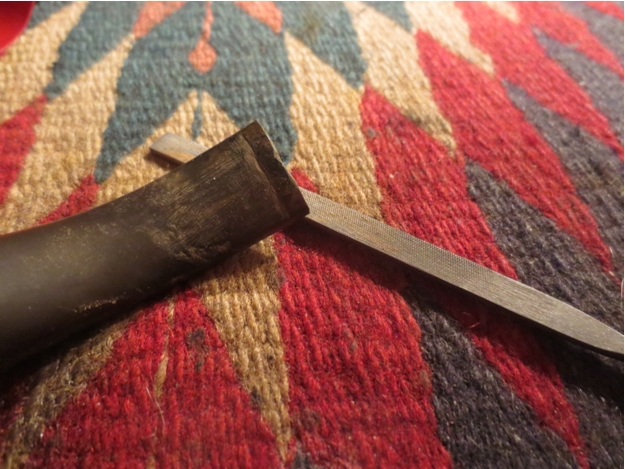
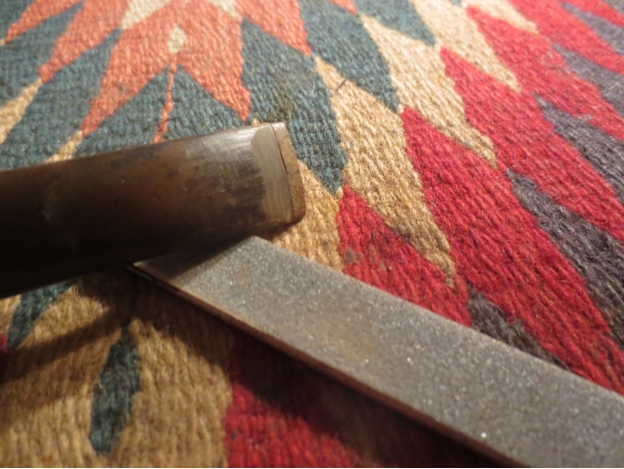
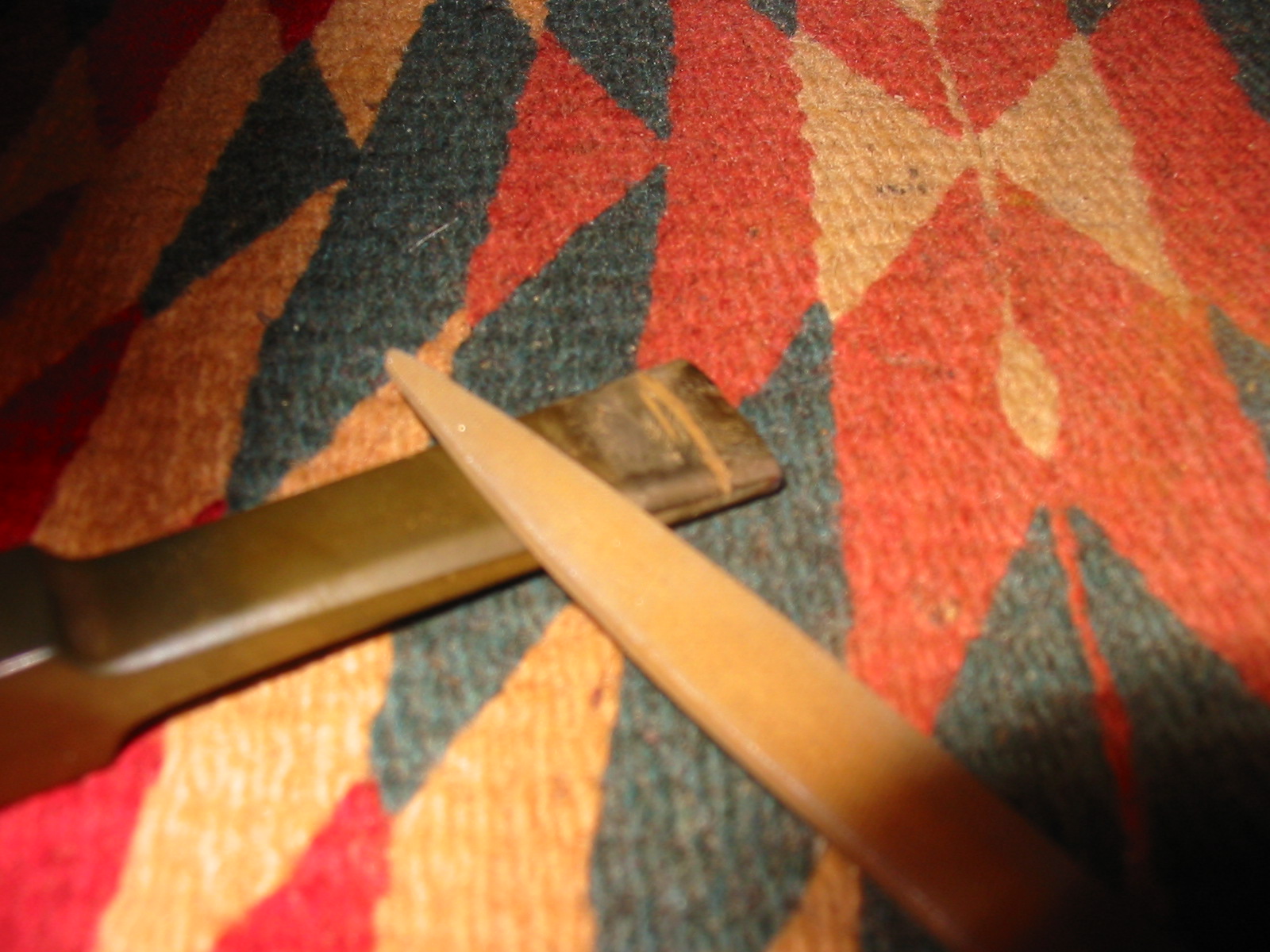
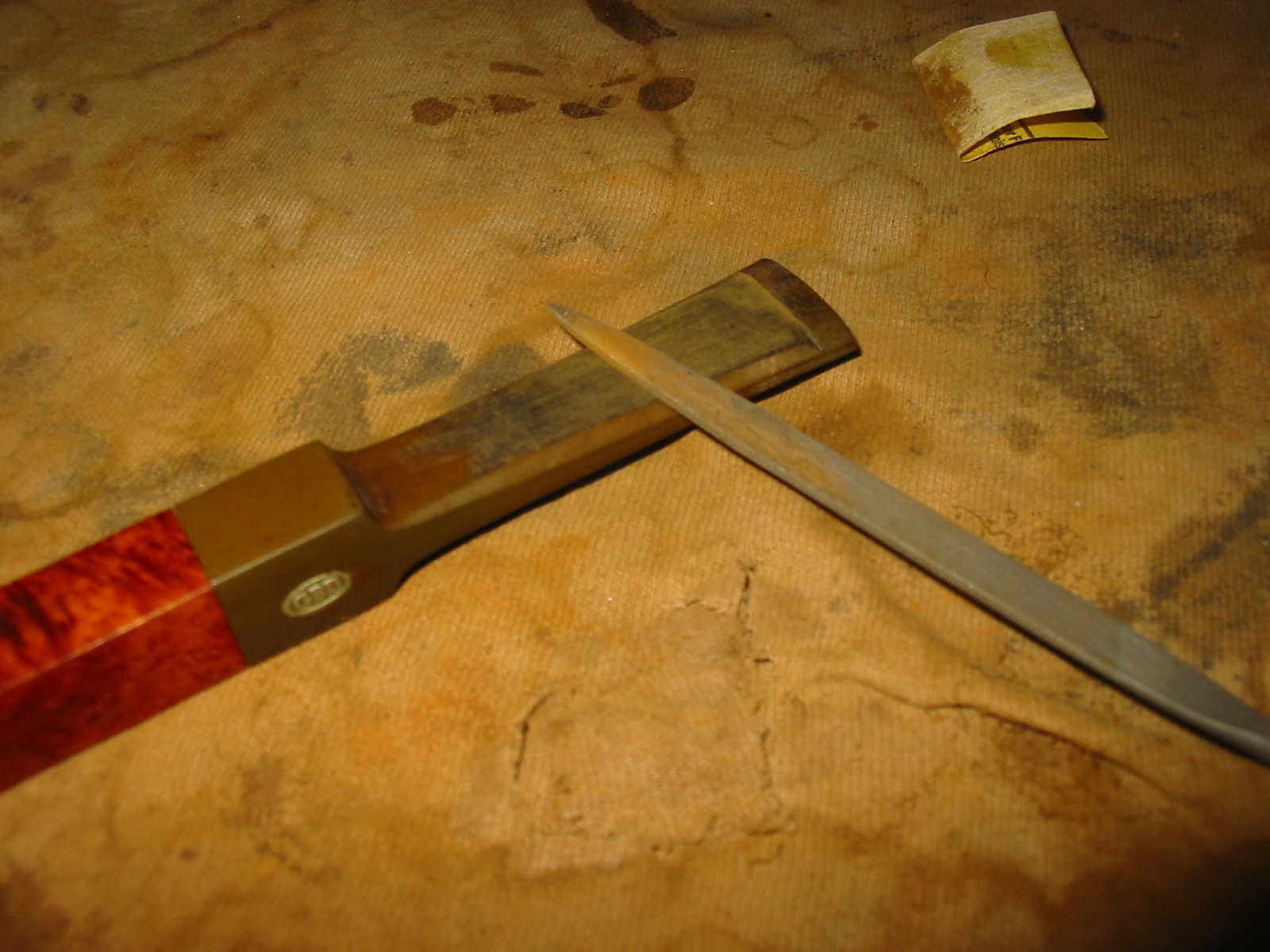
YSG17 4. The first tools that I use are a knife shaped needle file that has a thin edge like a blade and squared edge for the initial cuts and a folded piece of 220 grit sandpaper to clean up the newly cut edge.YSG23 5. I cut the edge with the straight edge of the file. I eyeball the line to make sure it aligns on both sides of the stem. This is a bit tricky at first but I rotate the stem to and angle where I can see both sides at once and begin the second cut. At this point in the process I am not finishing the cut but only drawing the line with the file. With the line cut and the button edge defined there is a lot of finishing work that needs to be done but you can get a clear picture of what the button will look like.

6. I use the knife edge of the file to shave the surface of the stem on the top and bottom sides. Be careful not to gouge the surface but smoothly shave it. I hold the blade at slight angle against the surface of the stem and carve toward the button. I have the stem on the table and work the blade away from myself sometimes and other times I have it in hand with the new button against the heel of my palm and work the blade toward the button. I work the blade until I have defined the line of the button and flattened the crown on the surface of the stem. Remember this is all initial carving. It will be cleaned up and smoothed out with the sandpaper and other files.YSG24

YSG25 7. When I have the material in front of the button cut away and thinned down I sand it with the folded 220 grit sandpaper to get an idea of how it looks and of how much more I will need to remove from the crown on both sides of the stem. In the case of this stem I have enough material removed. I still need to shape the button and clean up the edges of the sharp edge. The top and bottom surface of the button still need to be shaped and sanded but the overall look is good to go.YSG26

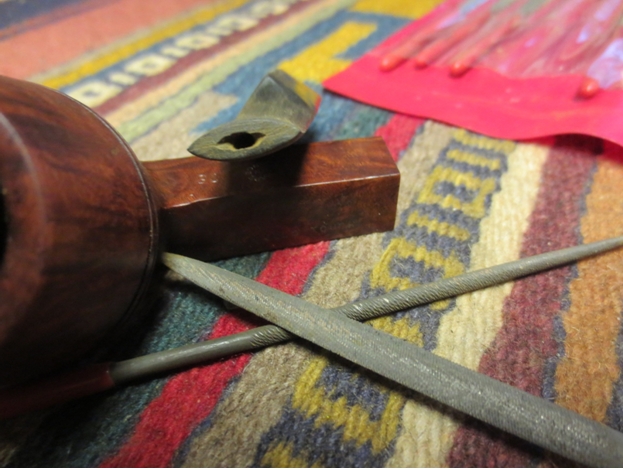
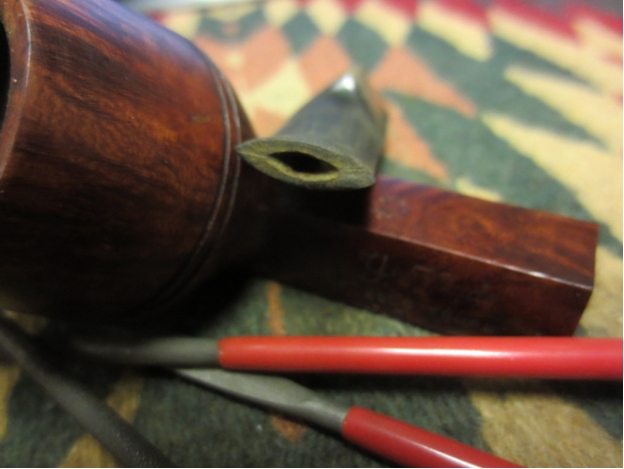
YSG27 8. With the rough shape finished I cut the slot in the end of the button and flare the airway. The first photo below shows the way the airway looked once I cut of the stem. You can see that there is plenty of material above and below the airway. I started the process by sanding the face of the button on my topping board and sandpaper. It is important to make sure that stem is absolutely vertical and does not tilt either way when doing this. You want to make a smooth face to work on the slot.YSG28 9. I use several different needle files to open the slot. The first file I use is a flattened oval file shown in the photo below. I work it against the right and left edges of the airway to open the slot. I don’t worry about the finished look at this point but am concerned to rough it in with the file. The flattened oval does the initial shaping work. I like a slot that is oval and tapers to a point on each side. I also work the file into the airway to taper the internals into a Y shaped funnel ending at the airway.YSG29 10. I work the top and bottom edges with the second file – an oval blade that is not flattened and almost round. I use it to work the internals into more of a smooth Y and then open the top and bottom of the slot. I follow this with a round needle file that has a thin point to clean up the opening and shape it. The photo below shows the slot after I have used all three files.YSG30 11. I fold a piece of sandpaper into a rectangle that I can fit into the slot. I work it in the slot to sand the internals and remove the file marks. I sand the face of the button to remove file marks and also sand the slot to refine the shape of oval.YSG31 12. The next photo shows the slot after I have worked it with the sandpaper. The internals are clean and smooth. I then use a pipe cleaner and isopropyl alcohol to remove any dust from the inside of the airway. The face of the stem still shows some light scratching that will be taken care of with wet sanding using micromesh sanding pads. However, you can see the new shape of the slot and how it sits on the button. That portion of the reshaping of the new button is finished and all that remains is to sand and polish the stem with the micromesh and the buffer.Button1 13. I sanded the stem – all surfaces including the button face with a medium and a fine grit sanding sponge to remove the scratches left behind by the 220 grit sandpaper. I worked on giving the surface of the button a slight bevel downward toward the slot. I personally like a gentle slope so I don’t overdo it with the sanding.YSG32

YSG33 14. With the scratches removed the stem is ready for polishing. I used micromesh sanding pads to do this work. Others use high grit wet dry sandpapers or micromesh papers. I like the way the pads fit in my fingers and how I can push the edge up against the slot to work that angle. I wet sand with 1500-2400 grit pads – wetting the surface of the stem and then sanding with the pads. I wipe it off regularly to remove the grime and check on the smoothness of the surface. I sand with each of the three grits until the particular grit no longer takes off any of the vulcanite. Once I finish with the three pads I rub the stem down with Obsidian Oil as I find it highlights the remaining scratches and also helps the micromesh to bite into the surface of the stem. I have used olive oil to do the same thing, applying it sparingly with a fold piece of cloth or paper towel. At times I have applied the oil between each of these three grits – essentially replacing the water with the oil. It works very well.YSG34 15. I dry sand (no oil or water) with the remaining grits of micromesh. I sand with 3200-4000 grit pads and then rub the stem down with oil again for the same reasons as above. I then either go back to the 1500-2400 grit pads to rework areas of concern or move on to sanding with the 6000-12,000 grit pads.YSG35

YSg36 16. I buff the stem with White Diamond at this point in my process. If you do not have a buffer you can buff with a plastic polish on a cotton pad or cloth. The idea is to remove any of the remaining scratches (micro scratches really at this point) and give the vulcanite a high sheen. When I finish buffing I give the stem multiple coats of carnauba wax. When I did not have my buffer I used Kiwi neutral shoe wax which has carnauba in it and hand buffed the stem with a shoe brush. Sometimes I revert to using the shoe brush even now. Especially when buffing areas around stamping and logos.

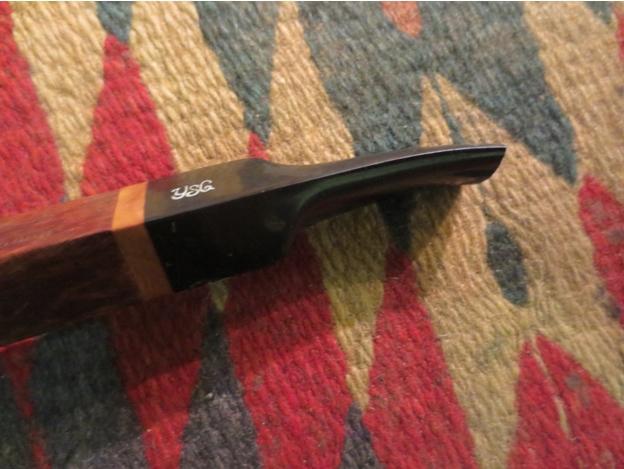
17. The finished stem is shown below. The button looks like it has always been there. I like giving it a look that fits the age of the pipe. I don’t want it looking like a brand new button that has been tacked onto an old pipe. Rather I want it to look as if it has been there for the life of the pipe and has seen some smoothing from use. You can be the judge if I have achieved that but at least that is the aim. You can also decide how you want the buttons that you shape to look. Don’t be afraid to experiment and add your own steps or modify these so that they work for you. The end result is really all we are interested in anyway and the methods for getting there are many.YSG37

YSG38

Restoring a Republic Era Shamrock 999 Rhodesian


Blog by Steve Laug

peterson When I saw this pipe on Ebay I immediately threw in a low bid. The seller included two photos the clear side view of the pipe shown below and the second photo below – an out of focus picture of the stem end. It was obvious there was damage to the stem and that it would take some work but it was still interesting to me. I was the only bidder so the pipe became mine.Shamrock1

Shamrock2 It was stamped Shamrock on the left side of the shank in capital letters (once it arrived I saw that on the right side of the shank it bore the stamping “A Peterson Product” over Made in the Republic of Ireland with 999 stamped next to that). While the seller never revealed the data stamped on the right side of the shank or the shape number it was clearly a Peterson 999 – one of my favourite shapes. I am particularly fond of the thick shanked older versions of the shape but this one looked workable. While I waited for it I did some research on the brand. I have several Shamrock pipes and fortunately all of them are very nicely grained briar.

I wrote to a favourite source of all things Peterson, Mark Irwin, to inquire about the mark. He responded with the following helpful information. “There were two Shamrock lines—the Rogers Import U.S.-only line with the nickel band, and the Peterson unmounted line with a white “S” stamped on the mouthpiece. This line—which is what your pipe is from—debuted in the 1945 catalog in the 30 classic shapes then being offered, in both smooth and sandblast, always with a fishtail mouthpiece, and continued with the same finish and “S” stamp until the 1975 catalog. It was a “Product” line, so look carefully for fills, as Peterson always strives to get the most mileage out of their briar. If it does indeed lack fills, someone messed up in the workshop, as it would normally have been released in a much higher line. The name was subsequently used on newer “Shamrock” lines with various finishes and stains until very recently, but always as an entry-grade line.”

I also was a bit more information on the stamping on the other side of the shank so I read more on dating Peterson Pipes in an article here on the blog by Mike Leverette. In it I found that pipes that bore the Republic of Ireland stamping came from the Republic Era which extended from 1949 until the present. “The Republic of Ireland was formed on 17 April 1949. From 1949 to present the stamp for this era is “Made in the Republic of Ireland” in a block format generally in three lines but two lines have been used with or without Republic being abbreviated.”

Mike also addressed a further question on the stamping “A Peterson Product”. He wrote: “Also, we must address the stamp “A Peterson Product.” During the last few years of the Pre-Republic era and throughout the Republic era, Peterson began stamping their other lines, such as Shamrocks and Killarneys, with “A Peterson Product” over the COM stamp. So a pipe stamped thusly will have been made say from 1948 to the present with the COM stamp identifying it as a pre-Republic or a Republic pipe.”

That was helpful information. With Mark’s and Mike’s information I had learned a lot about my pipe even before it arrived. It came from the earlier Shamrock line which debuted in 1945 and continued until 1975. It certainly fit in the description of a classic shape and an unmounted line with a white S on the stem. It was a Republic Era pipe which put it after 1949 and bore the Peterson Product stamp which put it in the same time frame. That is as specific as I can get in dating this pipe.

When the pipe arrived I opened the box and took it out of the bubble wrap. The stem was frozen in the shank and did not fit against the shank. The grain was beautiful and the natural finish was dirty. The bowl had a thick cake and still had a half bowl of unsmoked tobacco. The rim had a build up of tar on it that was thick. The inner and outer edge of the rim was undamaged and the bowl was still round. The stem was oxidized and the button end had significant damage as can be seen in the third photo below.Shamrock3

Shamrock4

Shamrock5

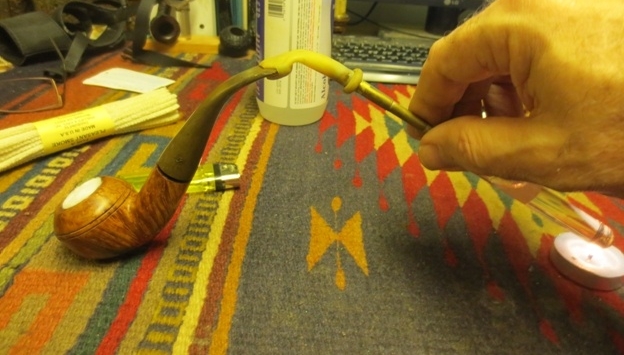
Shamrock6 I put the pipe in the freezer and left it overnight so that the temperature change would do its magic and loosen the stem in the shank. In the morning I took it out and was able to remove the stem with no problems. The photo below shows the damage to the button very clearly. There is also a sand pit visible in the side of the bowl. It is unfilled and from what I could see of the rest of the bowl there were not any fills.Shamrock7 I left the tobacco in the bowl while I worked on the rim. I scrubbed it with saliva and cotton pads until I was able to remove all of the tarry build up. I also scrubbed down the rest of the exterior of the bowl and shank.Shamrock8 I removed the tobacco with a dental pick and then reamed the pipe with a PipNet reamer and took the cake back to bare wood.Shamrock9 I used the dental pick to also clean out the twin rings around the bowl. These were packed with dust and wax from previous buffing.Shamrock10I set up my retort and put the tube on the broken stem. I loosely stuff a cotton ball in the bowl and heated the alcohol over a tea light candle. I ran the alcohol through until it came out a rich brown. I emptied the test tube and refilled it with alcohol and repeated the process. The second time the alcohol came out clean. I removed the retort and cleaned out the shank and bowl with cotton swabs and pipe cleaners.Shamrock11

Shamrock11a

Shamrock12 I debated for a long time what to do with the damaged stem. I could try a stem splice or replace the stem. I could also cut off the stem and reshape the button. In looking over the stem I decided there was enough length and material to allow me to cut if off and reshape it. I used a Dremel with a sanding drum to remove the broken part of the stem. I squared it off on the topping board and I was ready to recut the button.Shamrock13

Shamrock14

Shamrock15 I use needle files to cut the lines of the new button. They give me a good square edge and let me cut the basic shape of the button.Shamrock16

Shamrock17 Once the line is cut I use a variety of tools to trim back the taper from the line back toward the shank. I used an emery board to work on the shape of the stem. Often this is all I need but in this case it was not enough.Shamrock18

Shamrock19 I used a knife blade shaped needle file to shave the stem back to the button. With this blade I removed a lot of the excess material and the button began to take shape. I also used the file to begin to shape the oval of the button and to open up the slot in the end of the button. I continued to work on the taper of the stem and smoothed out the flow o the stem to the button using 220 grit sandpaper.Shamrock20

Shamrock21

Shamrock22 Once I had the shape and the taper of the stem correct I put a washer on the tenon and inserted it in the shank so that I could work on the stem. I sanded the stem with 220 grit sandpaper to remove the oxidation and then sanded it with a medium and a fine grit sanding sponge. I carefully avoided damaging the logo stamp on the stem. I also rubbed the bowl down with a little olive oil on a cotton pad. It really enlivened the grain on the pipe. I buffed it lightly with White Diamond and then gave it several coats of carnauba wax.Shamrock23

Shamrock24

Shamrock25

Shamrock26 Once the oxidation was taken care of I used some liquid paper to re-whiten the S on the stem. The photos below show the shape of the button and the stem at this point in the process. The new button works well and the shortening of the stem did not too seriously damage the appearance of the pipe.IMG_3070

IMG_3071

IMG_3072

IMG_3073 I wet sanded the stem with 1500-2400 grit micromesh sanding pads and dry sanded it with 3200-12,000 grit pads. I rubbed the stem down with Obsidian Oil between each set of three grits of micromesh sanding pads.Shamrock31

Shamrock32

Shamrock33

Shamrock34 I rubbed it down with a final coat of Obsidian Oil and once it had been absorbed into the vulcanite I hand buffed it with a soft cloth and took the next two photos to show the finished look of the stem.IMG_3091

IMG_3092 The finished pipe is shown below. The two profile photos show the look of the new button and the revised taper of the stem. It feels great in the hand and in the mouth. The bend matches my other 999 pipes and the overall length actually is the same as the chunkier stemmed early 999s that I have in my collection. I buffed the pipe and stem with White Diamond and gave it several coats of carnauba wax. I buffed it with a soft flannel buff to raise the shine on the pipe. It looks and smells fresh and clean. It is ready to load with a bowl of Virginia and give an inaugural smoke. In closing look at the grain on this old Shamrock – for the life of me I can find no fills in the briar. It is clean – two or three smalls sandpits but they in no way effect the overall look of the pipe. Amazing, I think that it did indeed slip through during production. No problem for me, I will enjoy it.Shamrock37

Shamrock40

Shamrock39

Shamrock38

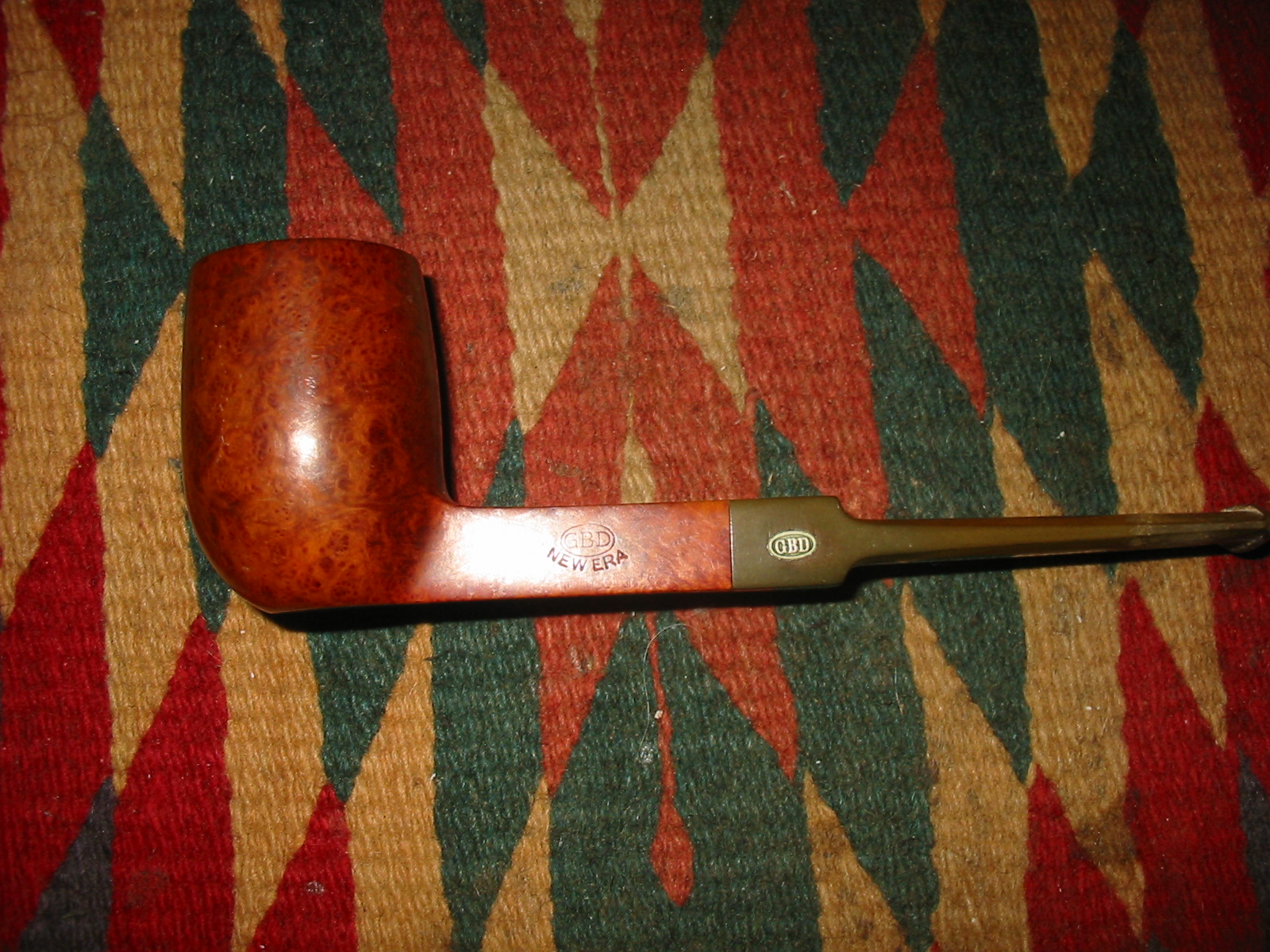
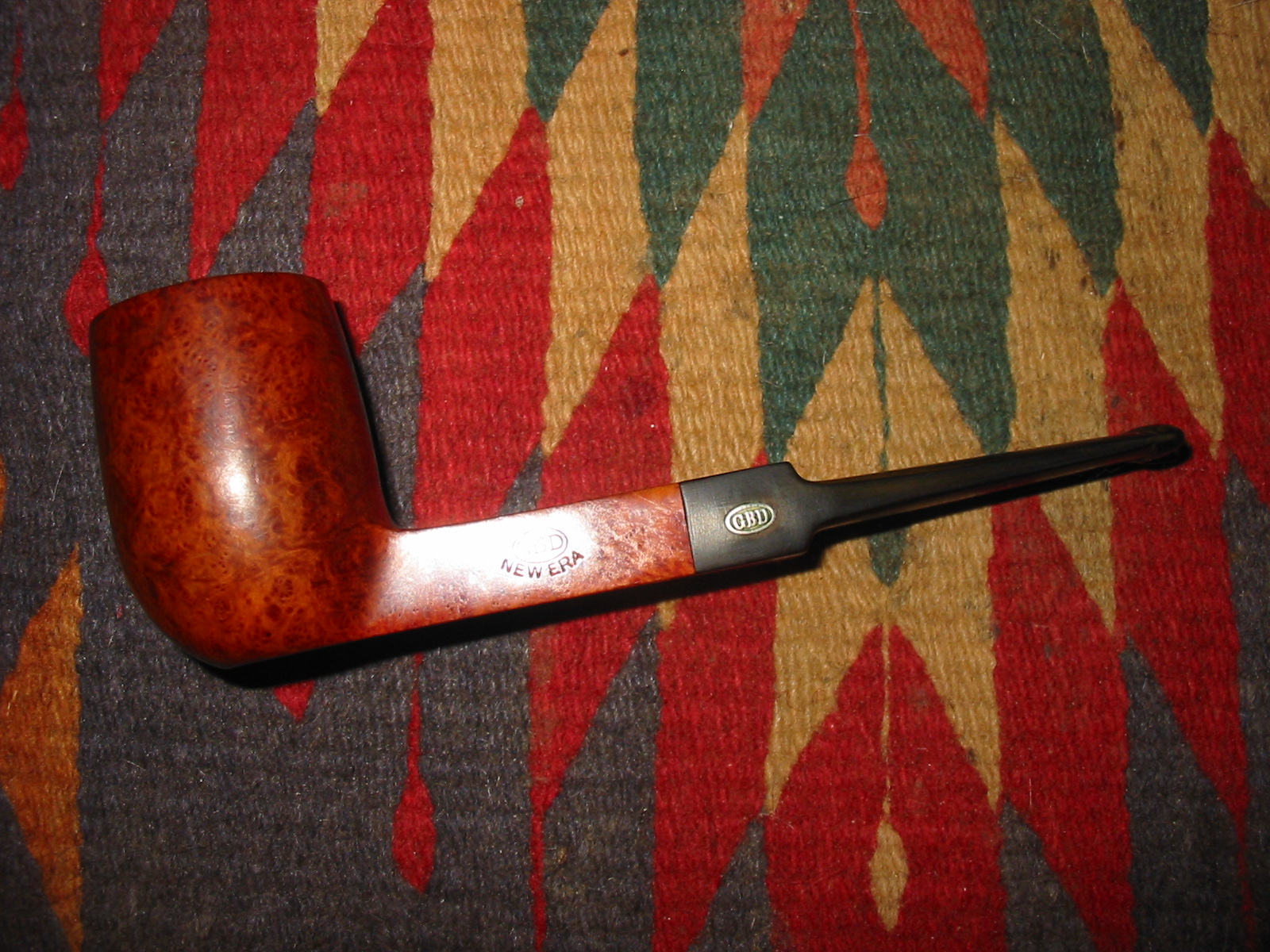
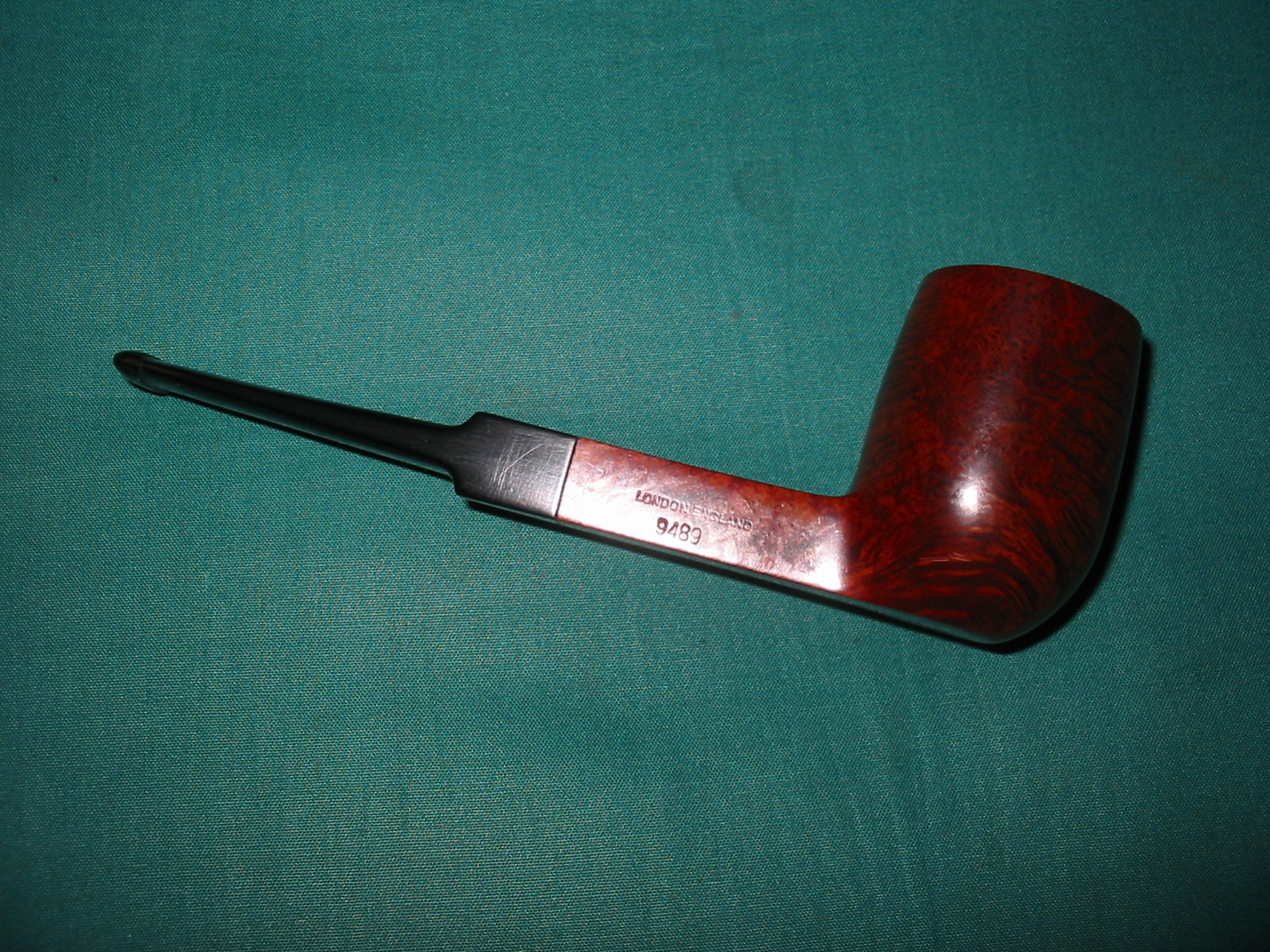
A Great Piece of Briar – Restored Square Shanked GBD New Era 9489 Billiard


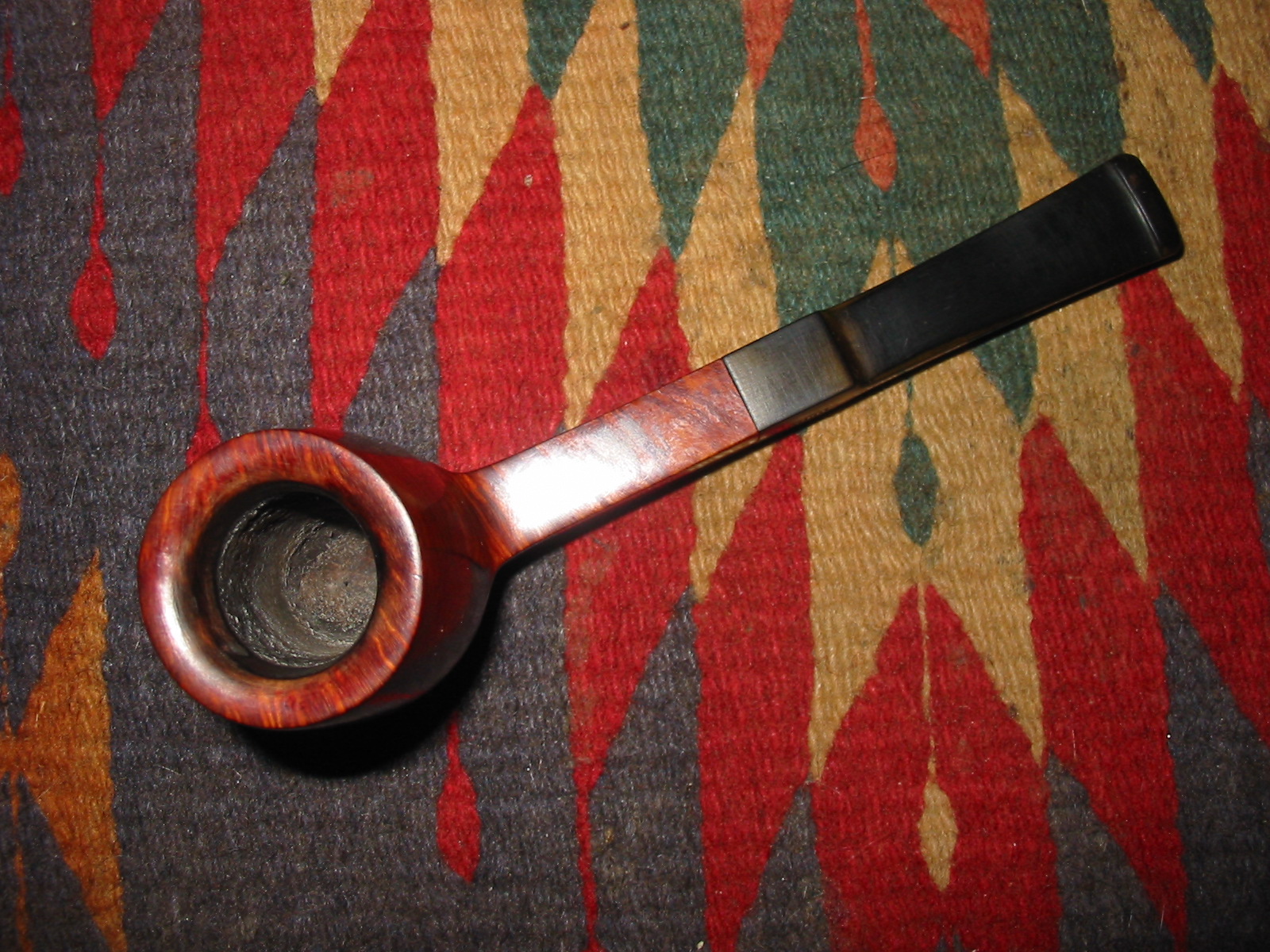
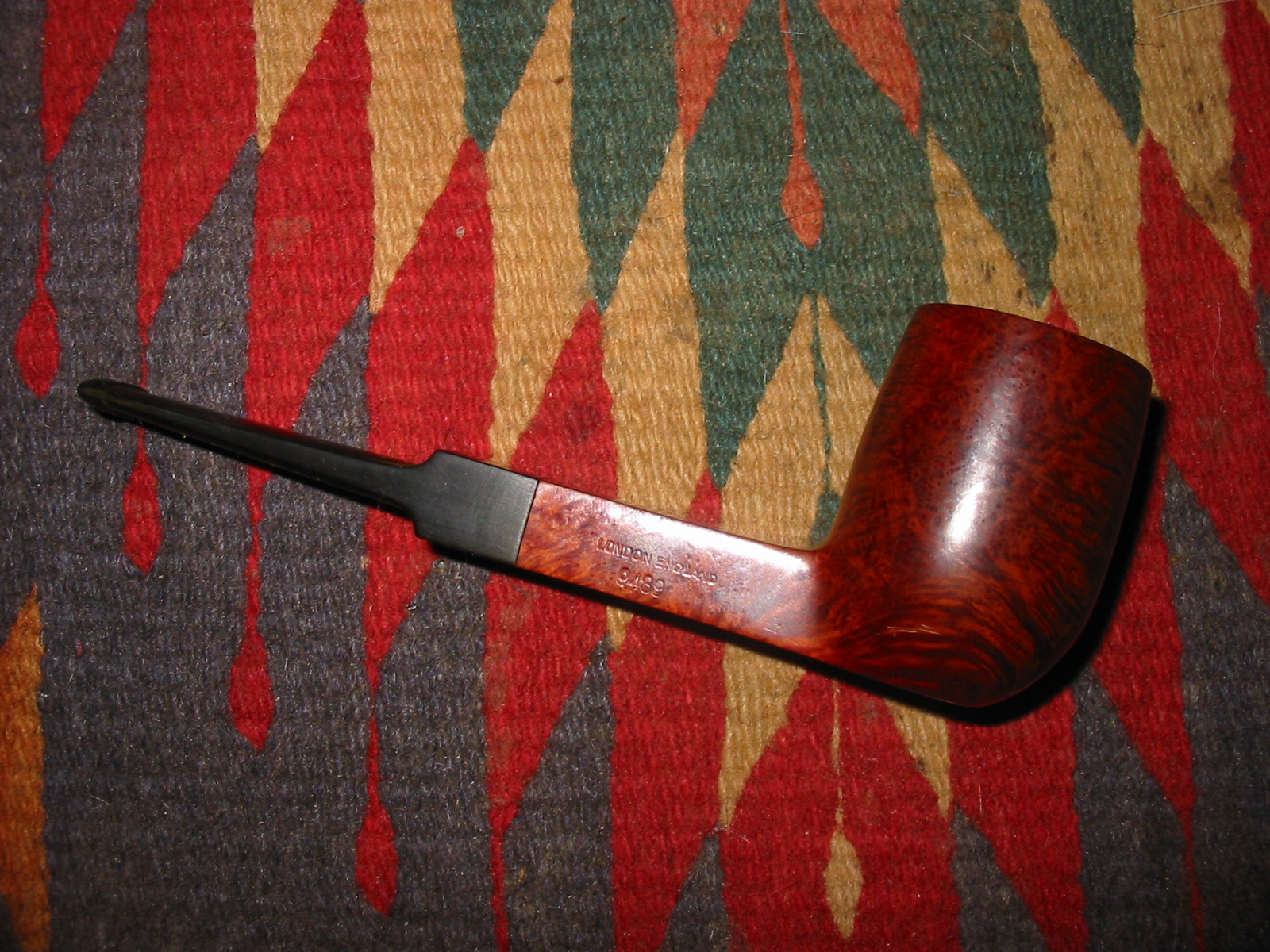
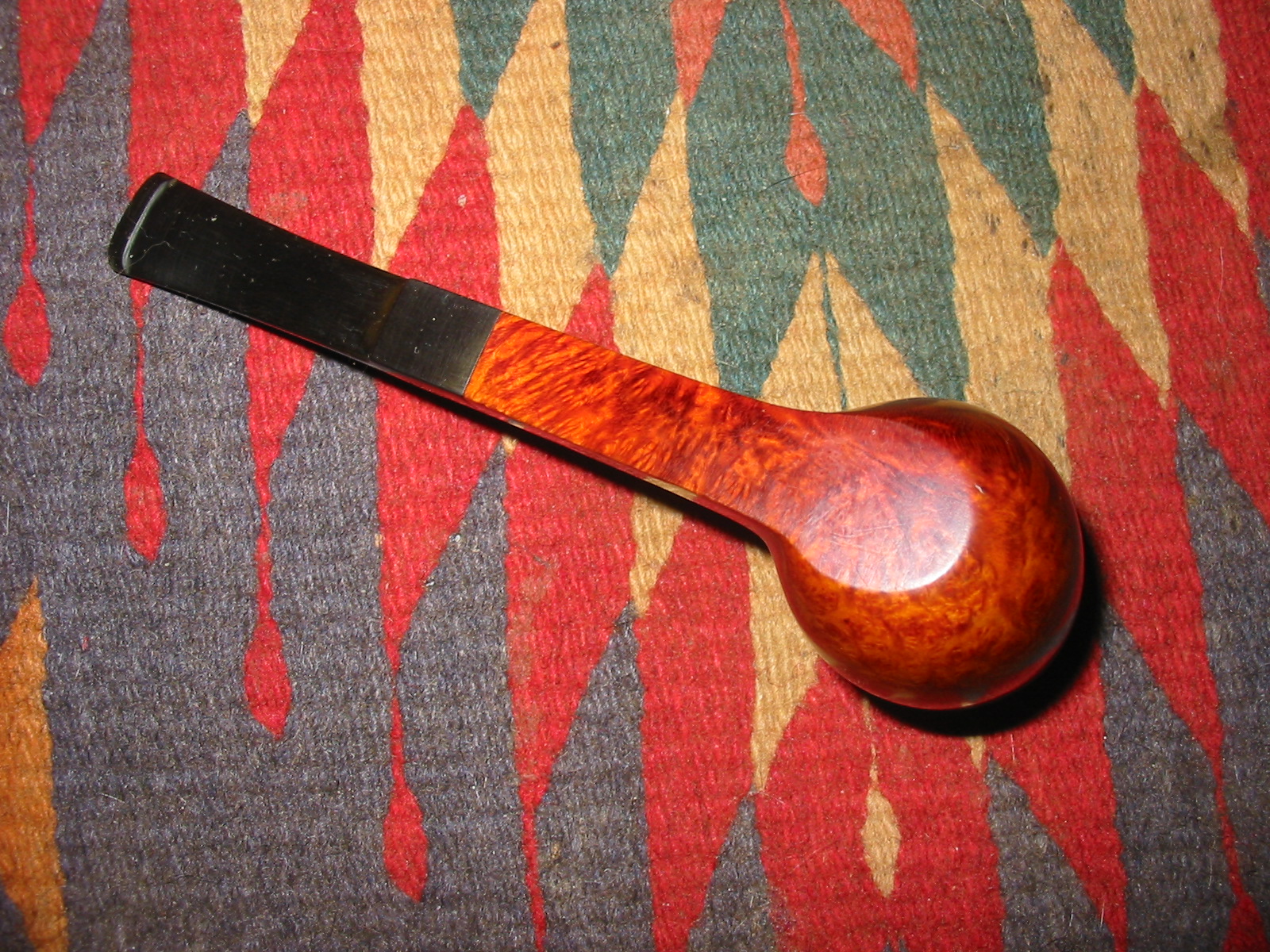
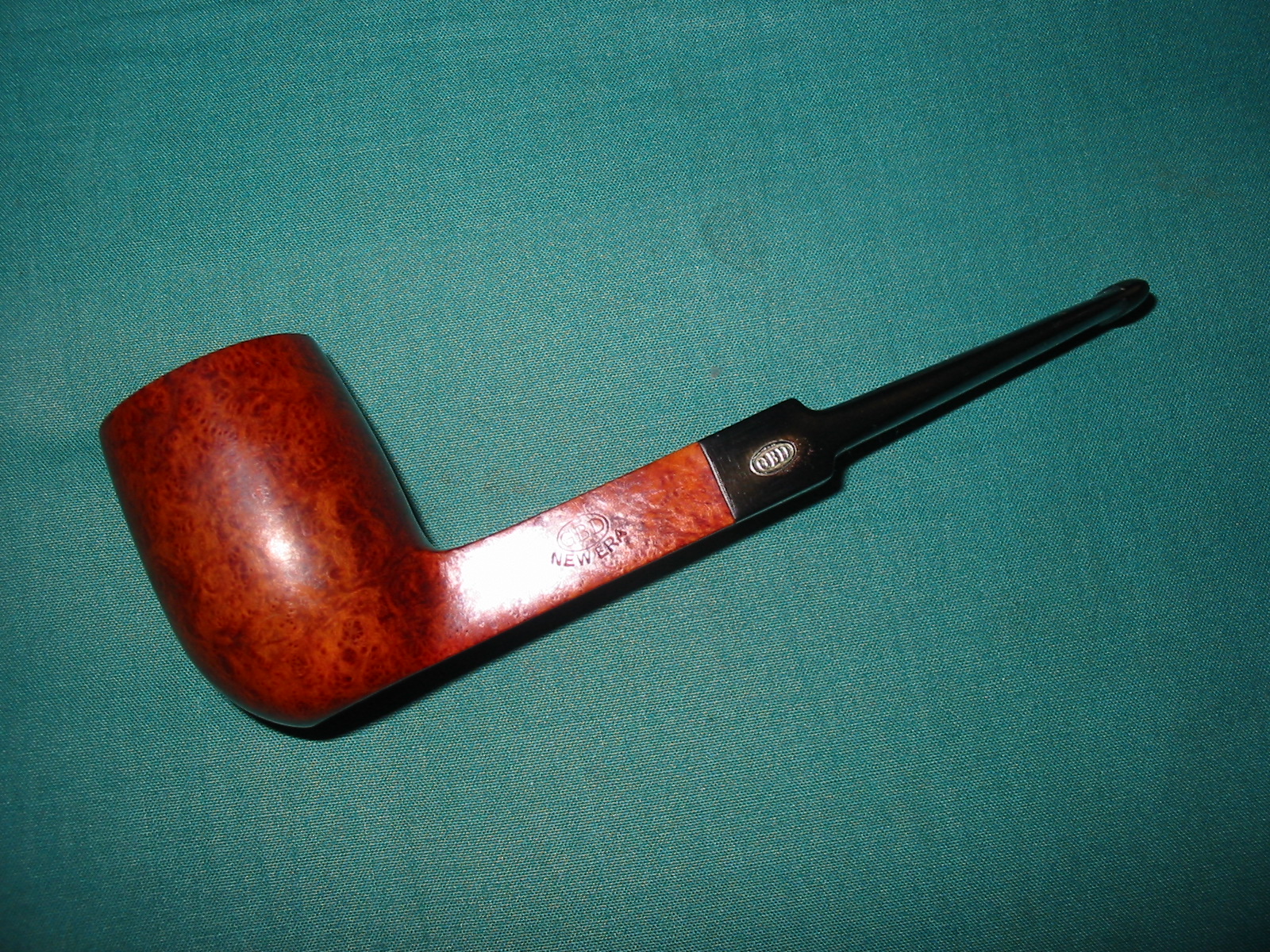
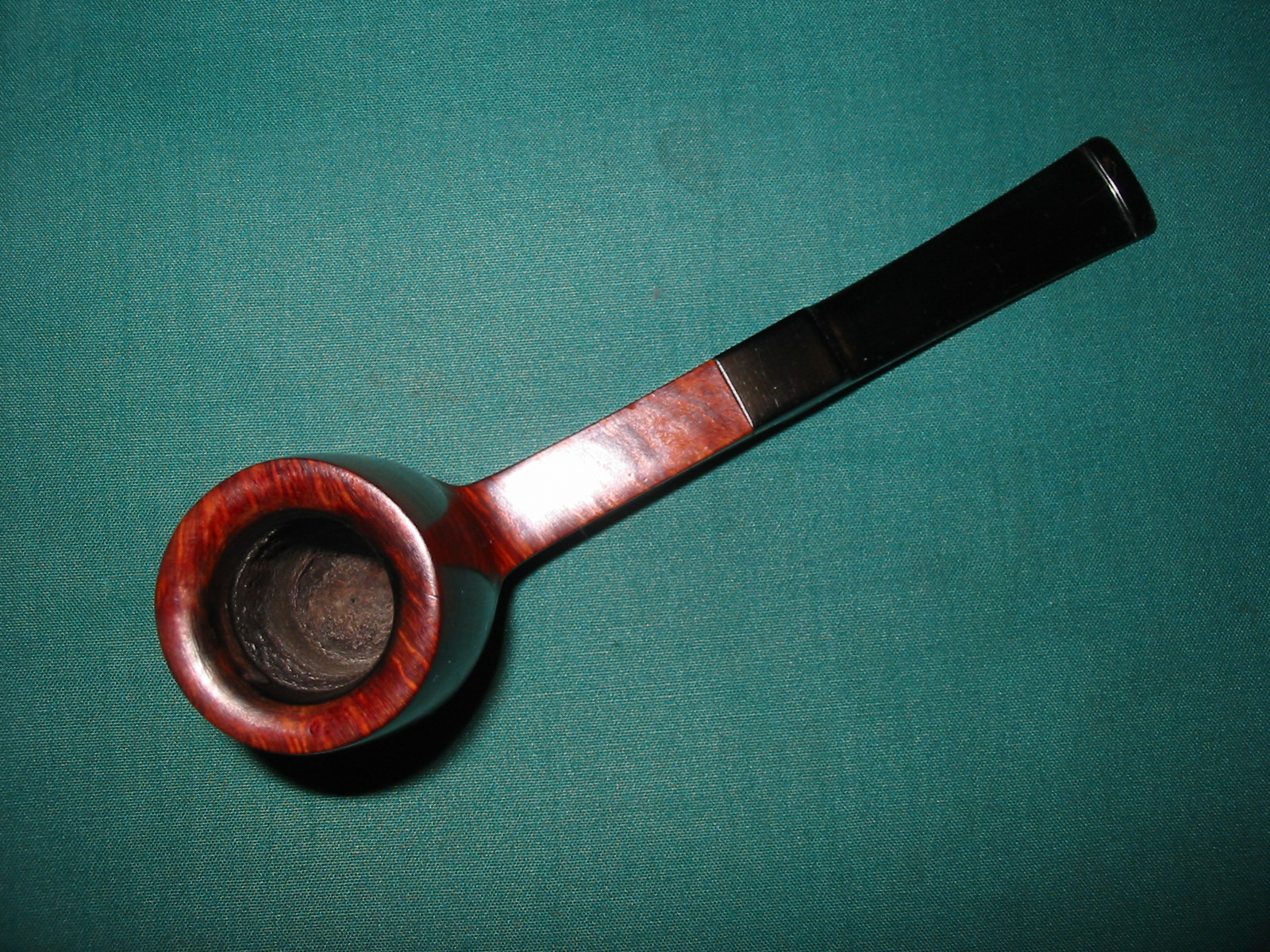
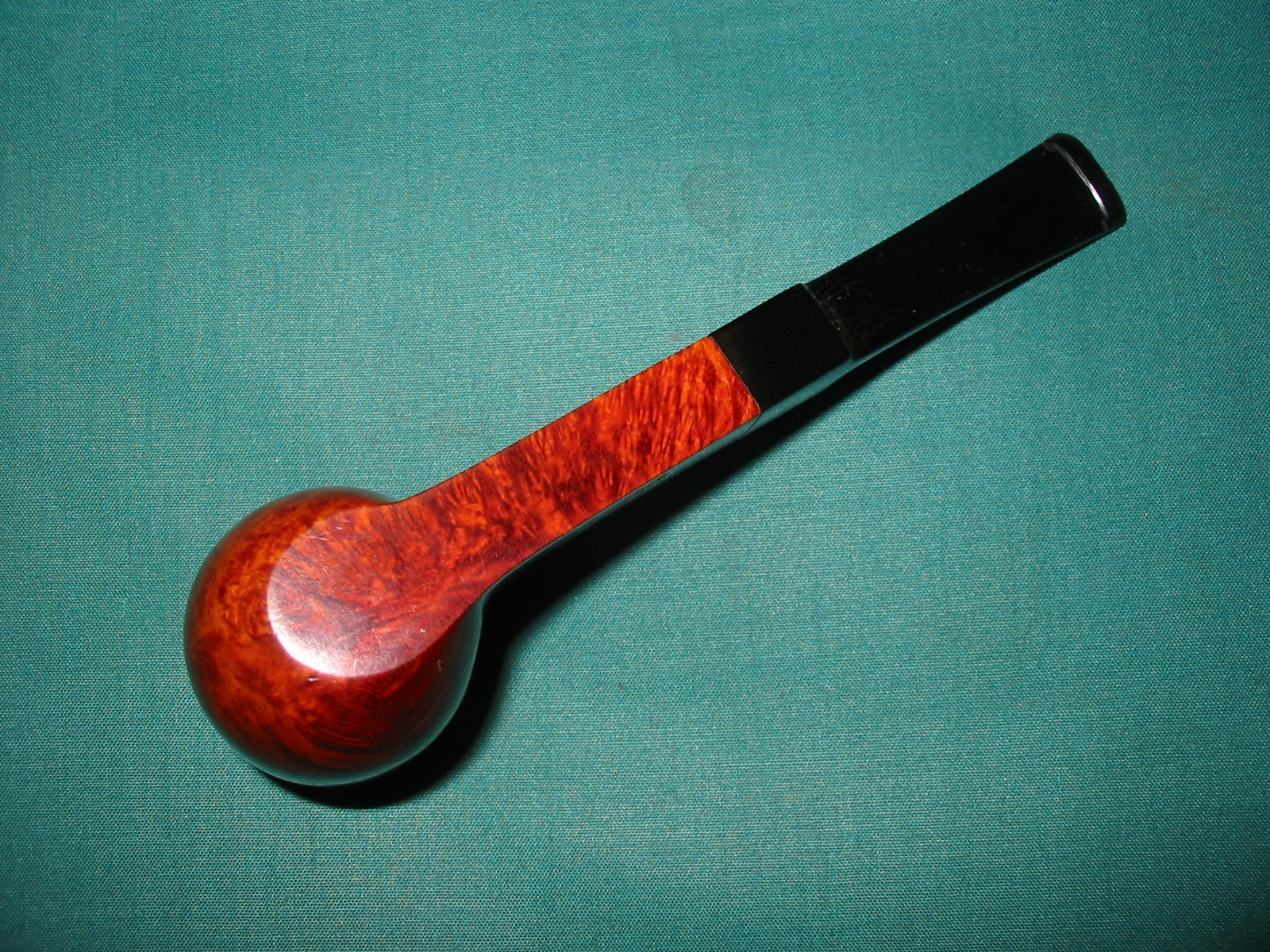
I am generally not a fan of square shanked pipes. I am not sure why but there is just something about them that has never caught my eye… that is until I saw this GBD New Era Billiard. It has stunning grain – cross grain on the back of the bowl and the top and bottom of the shank and the bowl. There is also some cross grain off centre on the front of the bowl. The left side has stunning birdseye and the same is also true on the right side of the bowl. The rim of the bowl is beveled inward and is also cross grain. The finish on the bowl was in excellent shape other than a heavy build up on the rim of tars and carbon. The stem was long, oxidized and had a huge bite through on the underside of the stem. It is stamped GBD in an oval over an arced New Era on the left side of the shank and London England over 9489 on the right side.
IMG_3455

IMG_3456

IMG_3458

I have included the photo below of the underside of the stem. The size of the hole made it unpatchable with my usual methods.
Hole in stem

I used the Dremel and sanding drum to cut off the end of the stem and remove the damaged portion of the stem. I would then recut a button on the end of the stem and rework the airway opening in the slot.
IMG_3842

IMG_3843

IMG_3844

IMG_3845

I took the pipe back to my work table and used a file to cut the line for the button. For this initial part of shaping the new button I leave the stem on the shank as the bowl provides a good “handle” to hold on to when reworking the stem.
IMG_3847

I used a flat needle file to carve down the slope of the stem toward the button. I find that reworking the slope of the stem gives a smoother transition between the new button and the blade of the stem. I think we have all seen poorly cut buttons where the button looks pinched on the end – almost like someone squeezed the button out of the stem. I want the transition to move gently toward the new button and then have clean angles on the button.
IMG_3848

At this point I usually remove it from the shank as I have much more carving to do on the stem with needle files and I want to be able to turn it at various angles to get things the way I want them. I continued to work on the stem with various needle files and 220 grit sandpaper to shape and contour the stem. I sanded the rest of the stem as well carefully working around the GBD roundel to make sure not to damage it. When I had finished the shaping of the button I sanded the entirety with a medium grit sanding sponge to smooth out the scratches and further remove the oxidation. I probably could have soaked it in Oxyclean but since I was working the button over with sandpaper and files anyway I just sanded the stem.

I set the stem aside for a bit and scrubbed the bowl rim down with saliva on cotton pads scraping and rubbing until I got to the clean surface of the rim. I did not intend to restain this pipe so I was careful not to remove the finish in the process.
IMG_3849

I took it to the buffer after I had it cleaned up as shown above. I buffed the edge with White Diamond to remove the last of the detritus of the carbon on the rim. The first photo below shows the clean bowl rim. The three photos following that one show the bowl after it had been buffed with carnauba wax to polish it and protect it.
IMG_3852

IMG_3853

IMG_3854

IMG_3856

I put the stem back on just to have a look at the work so far. Sometimes I need to get a bit of perspective on the stem work so I will stop and put things back together, take a few photos and study them to see what I need to do. Somehow the photos show things that my eye does not pick up as I work on the pipe.
IMG_3857

IMG_3858

IMG_3859

IMG_3860

The pipe was looking good and the areas that needed work on the oxidation and scratches showed up clearly in the flash. I used micromesh sanding pads to work on the finish. I wet sanded with 1500-2400 grit pads and dry sanded with 3200-12,000 grit pads.
IMG_3861

IMG_3862

IMG_3864

IMG_3866

When I finished sanding I rubbed the stem down with Obsidian Oil and when it as dry buffed it with White Diamond once again. I gave the bowl and stem multiple coats of carnauba wax and buffed it with a clean flannel buffing pad to give it a shine. It is important when buffing to not press to hard around the nomenclature. I generally use a very light touch in those areas and then hand polish them with a soft cotton cloth. The finished pipe is pictured below. The stem came out quite nicely There is a bit of oxidation around the roundel that still remains. I will continue to work on that with the micromesh pads and see what I can do but it is ready to load a bowl and smoke.
IMG_3868

IMG_3869

IMG_3870

IMG_3871

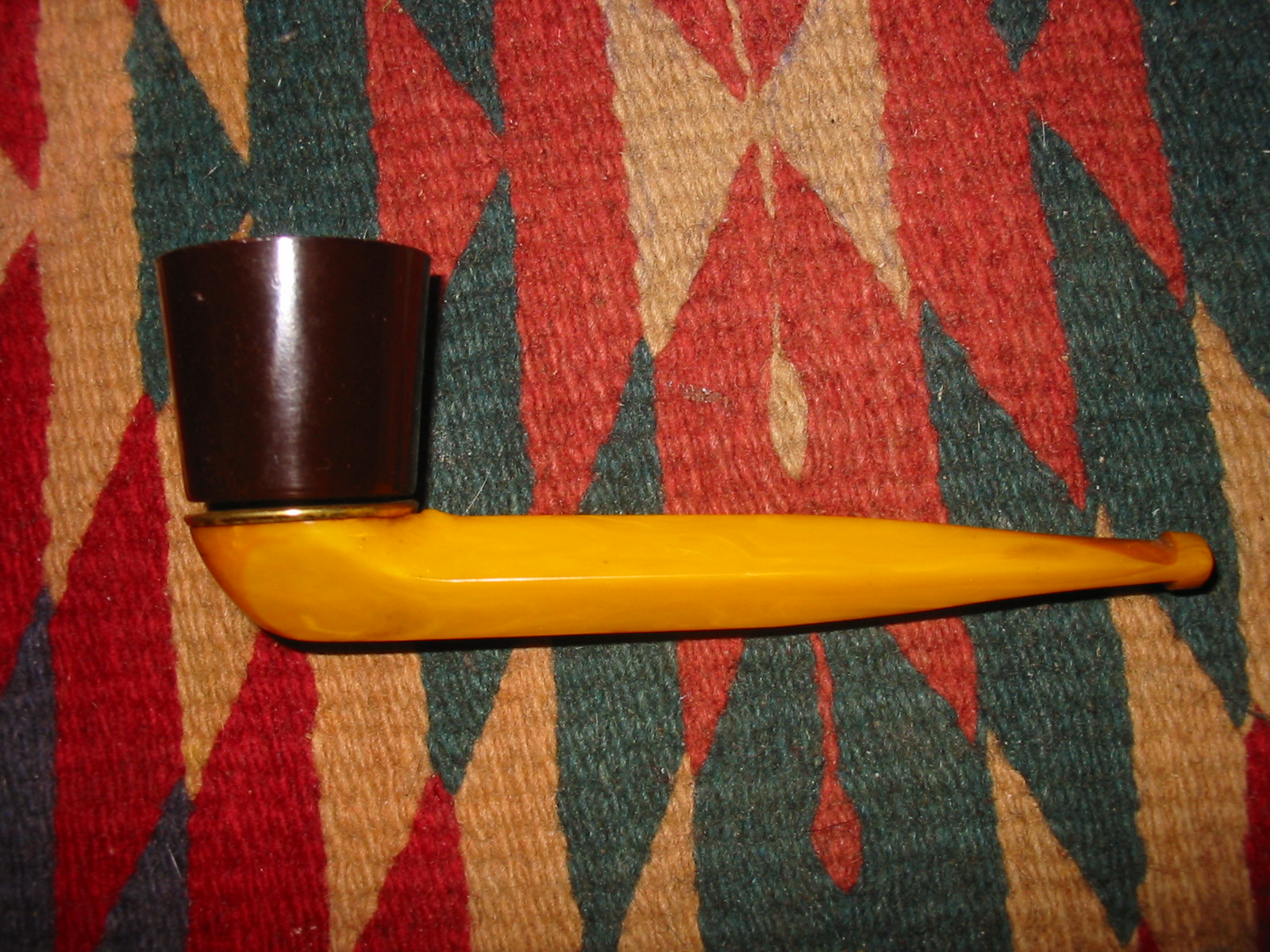
A Piece of Tobacciana History – a Bakelite Bowl on a Bakelite Base


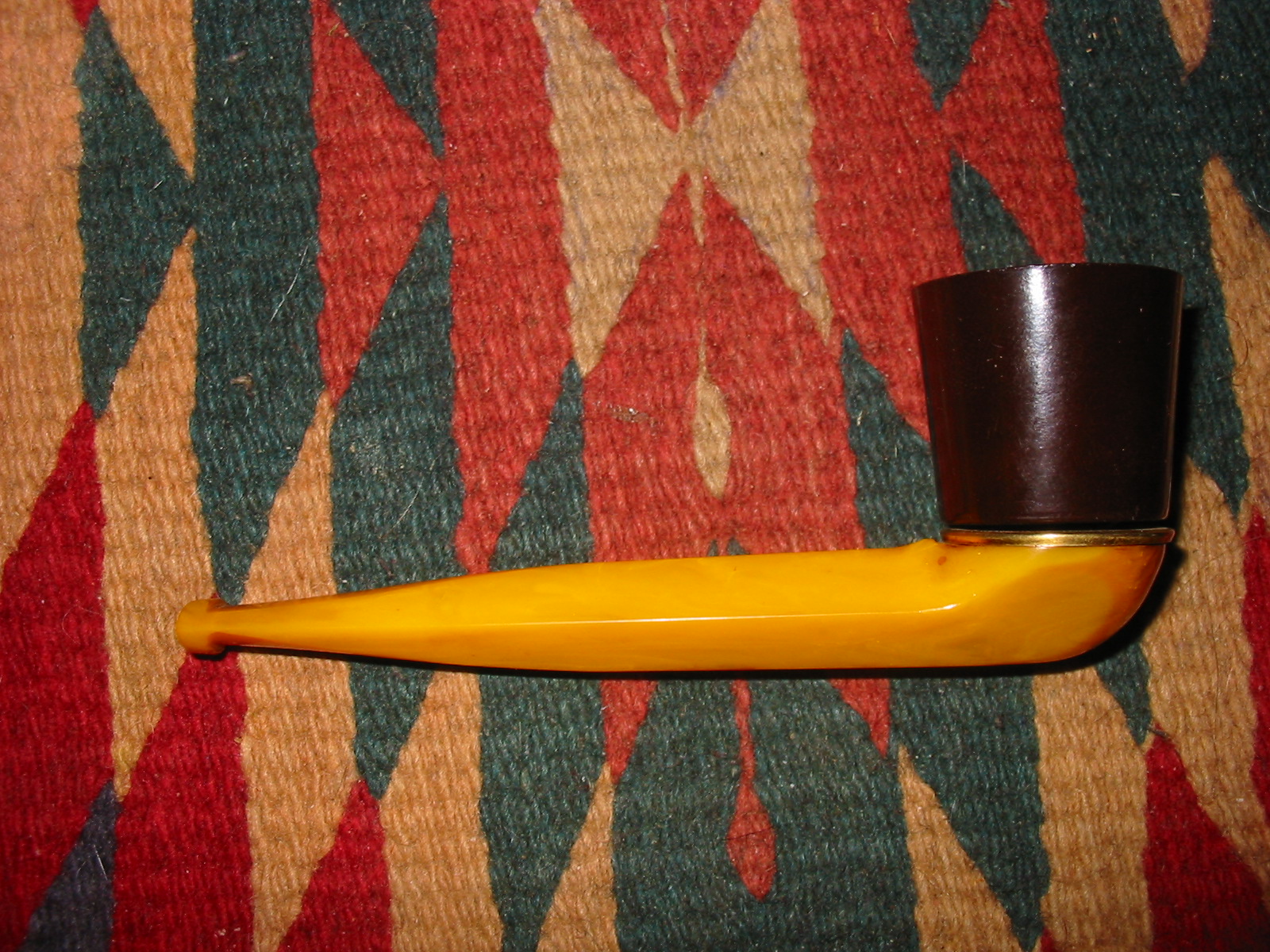
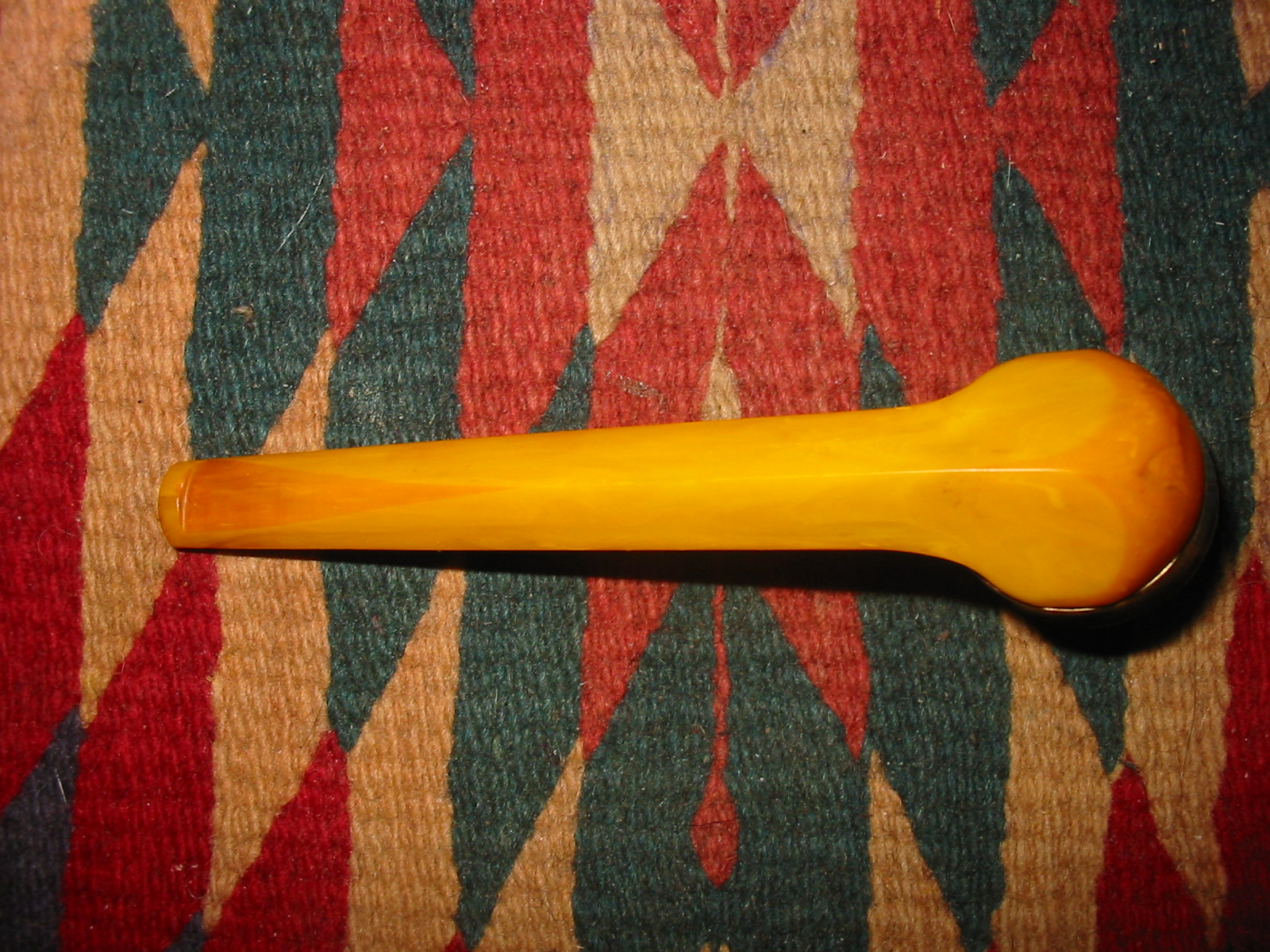
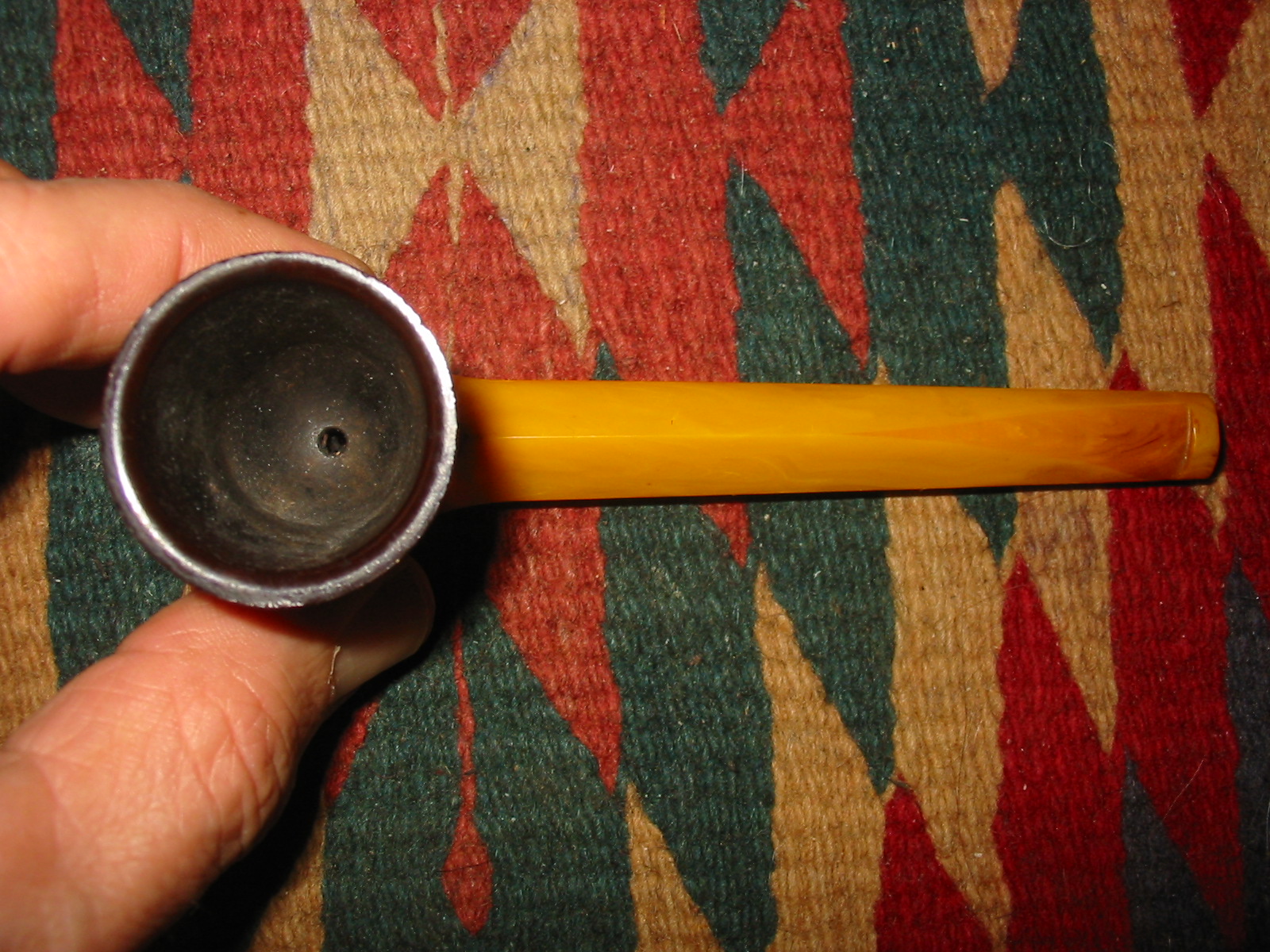
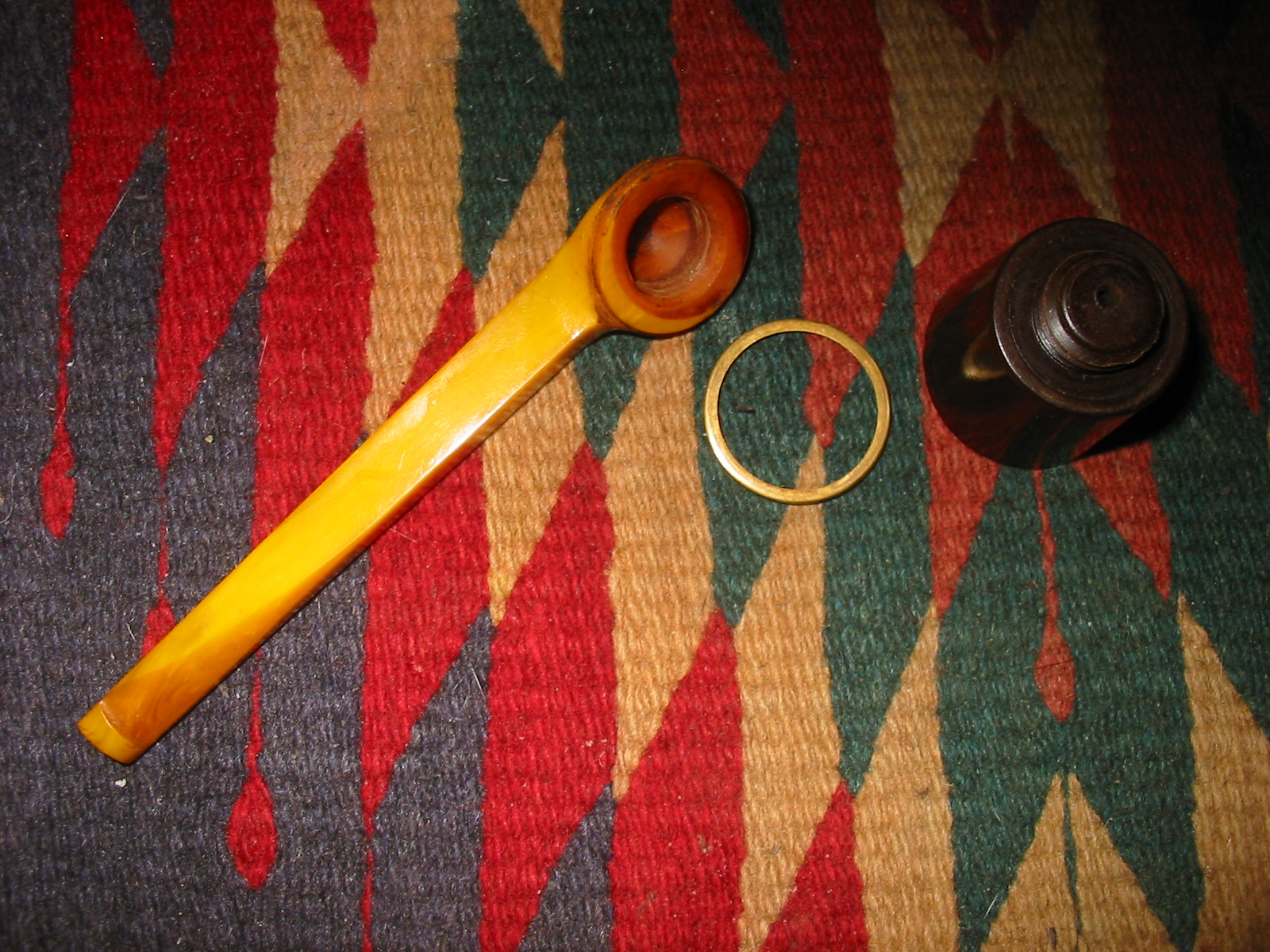
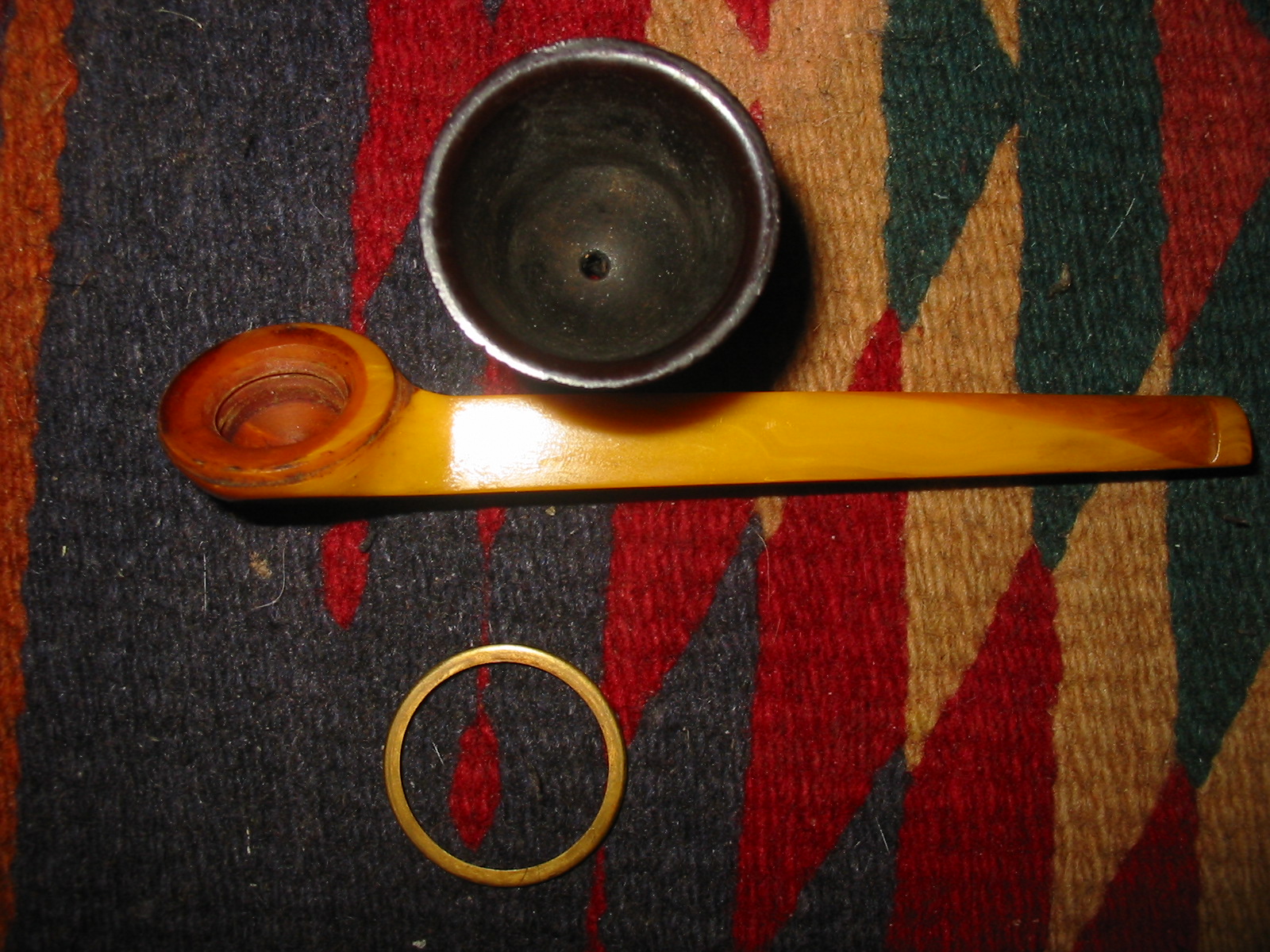
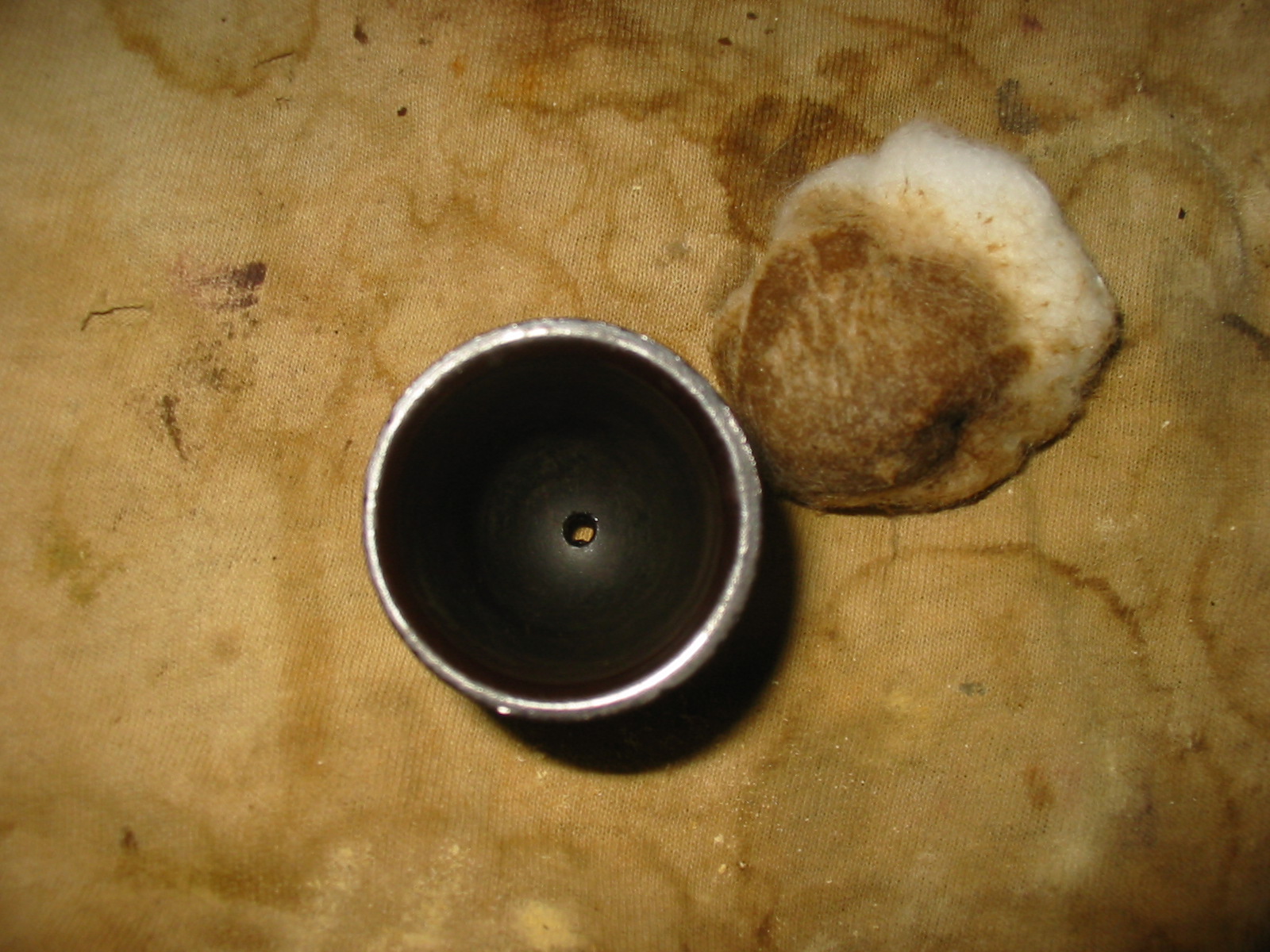
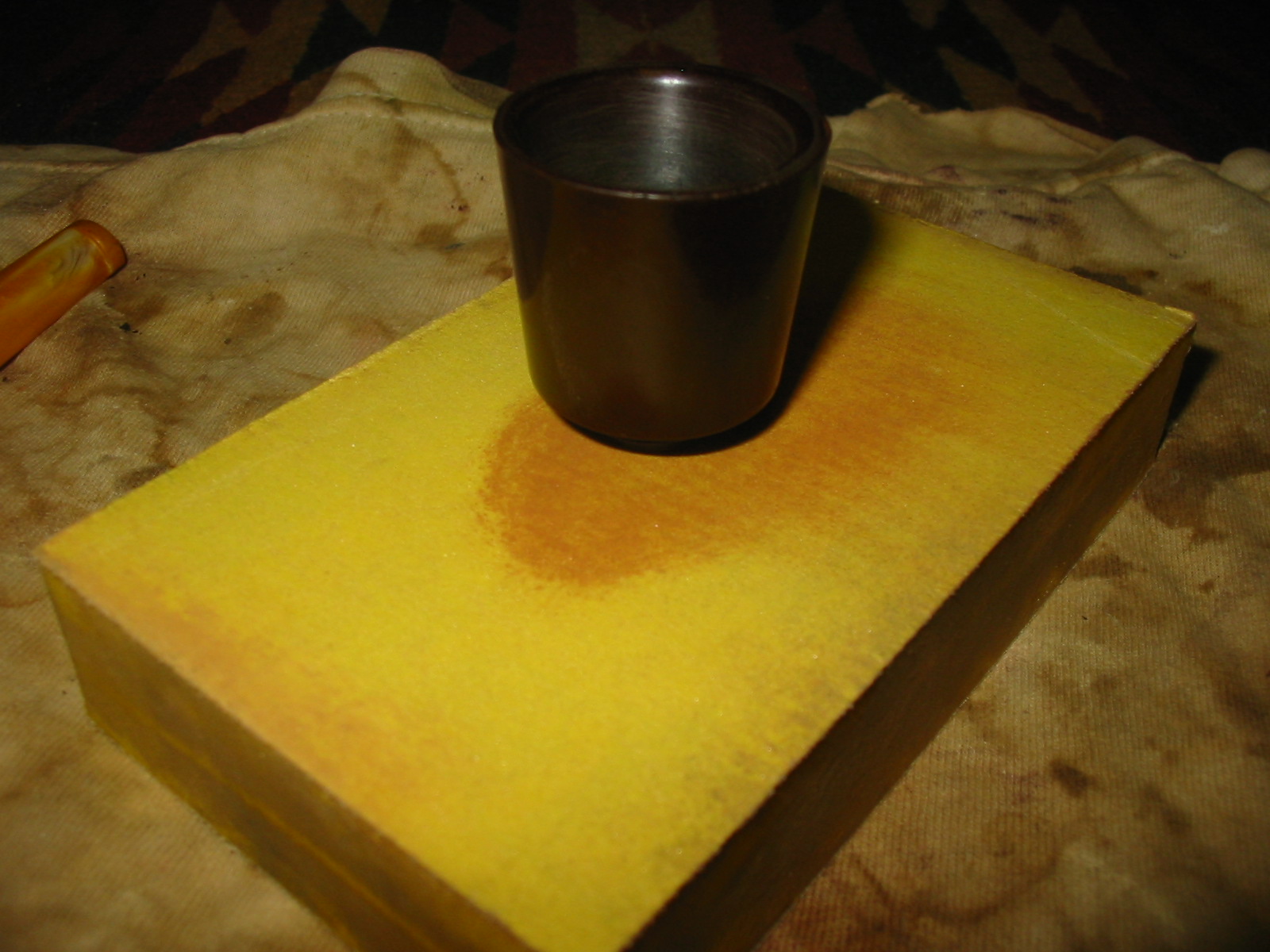
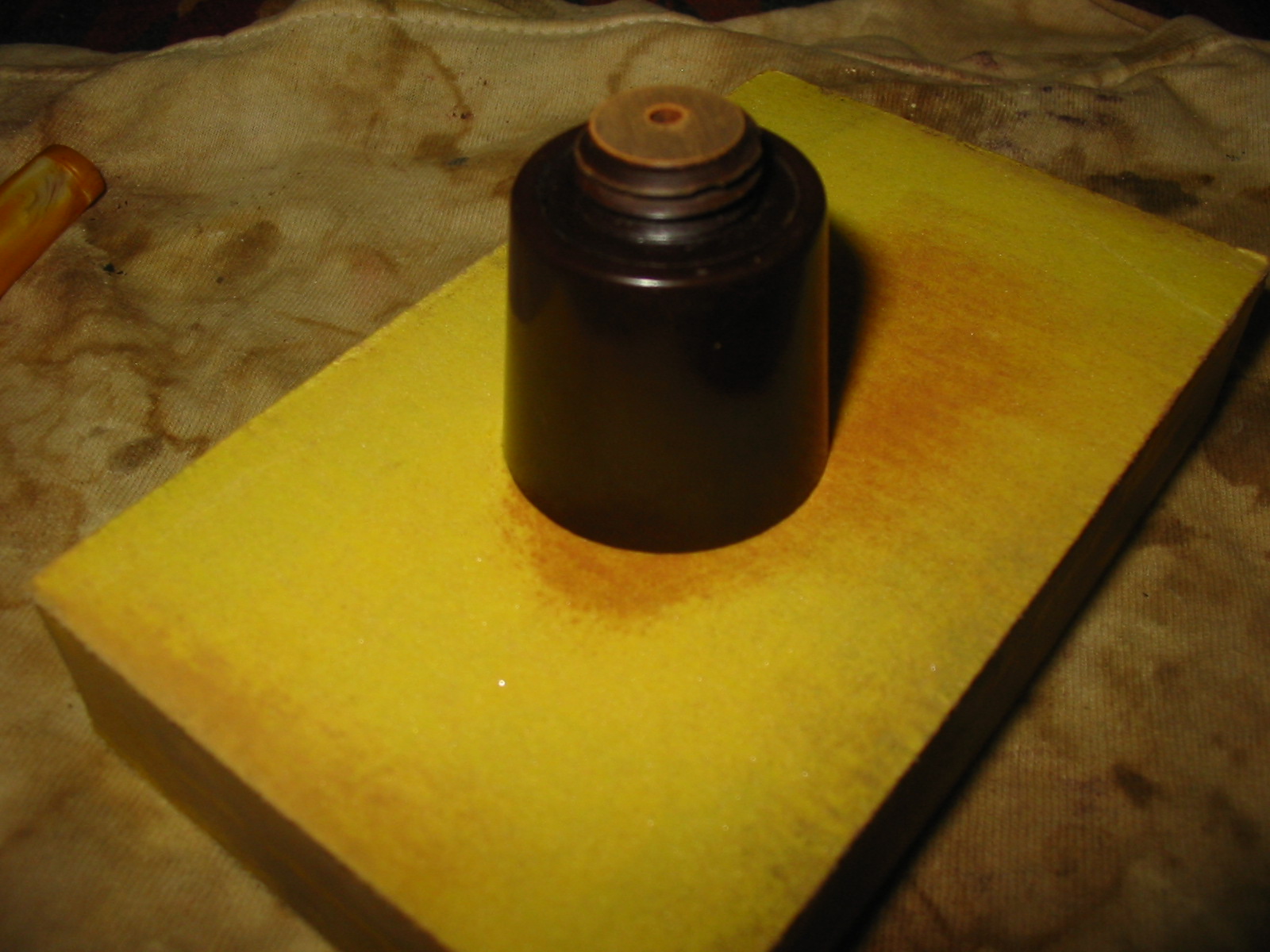
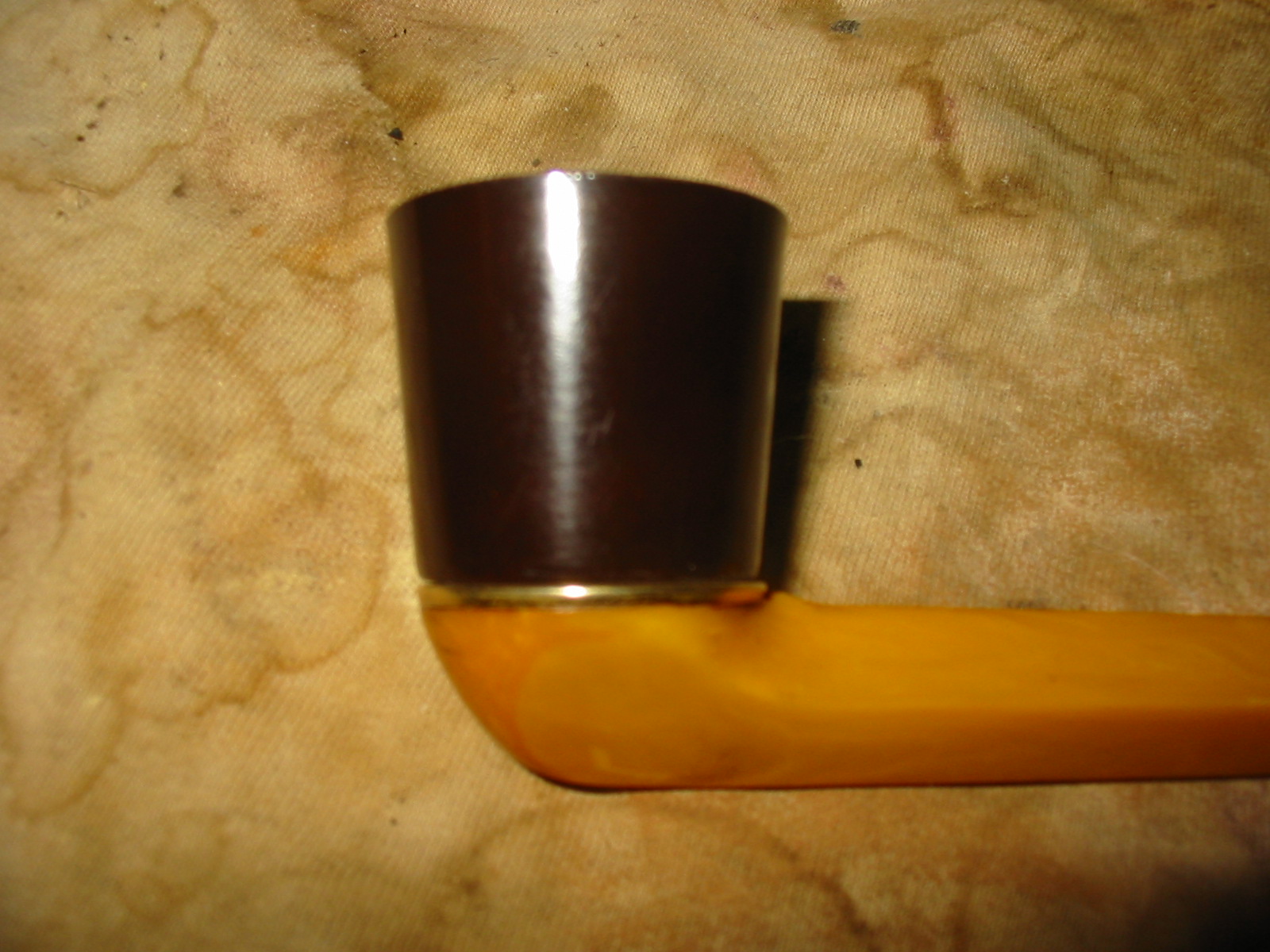
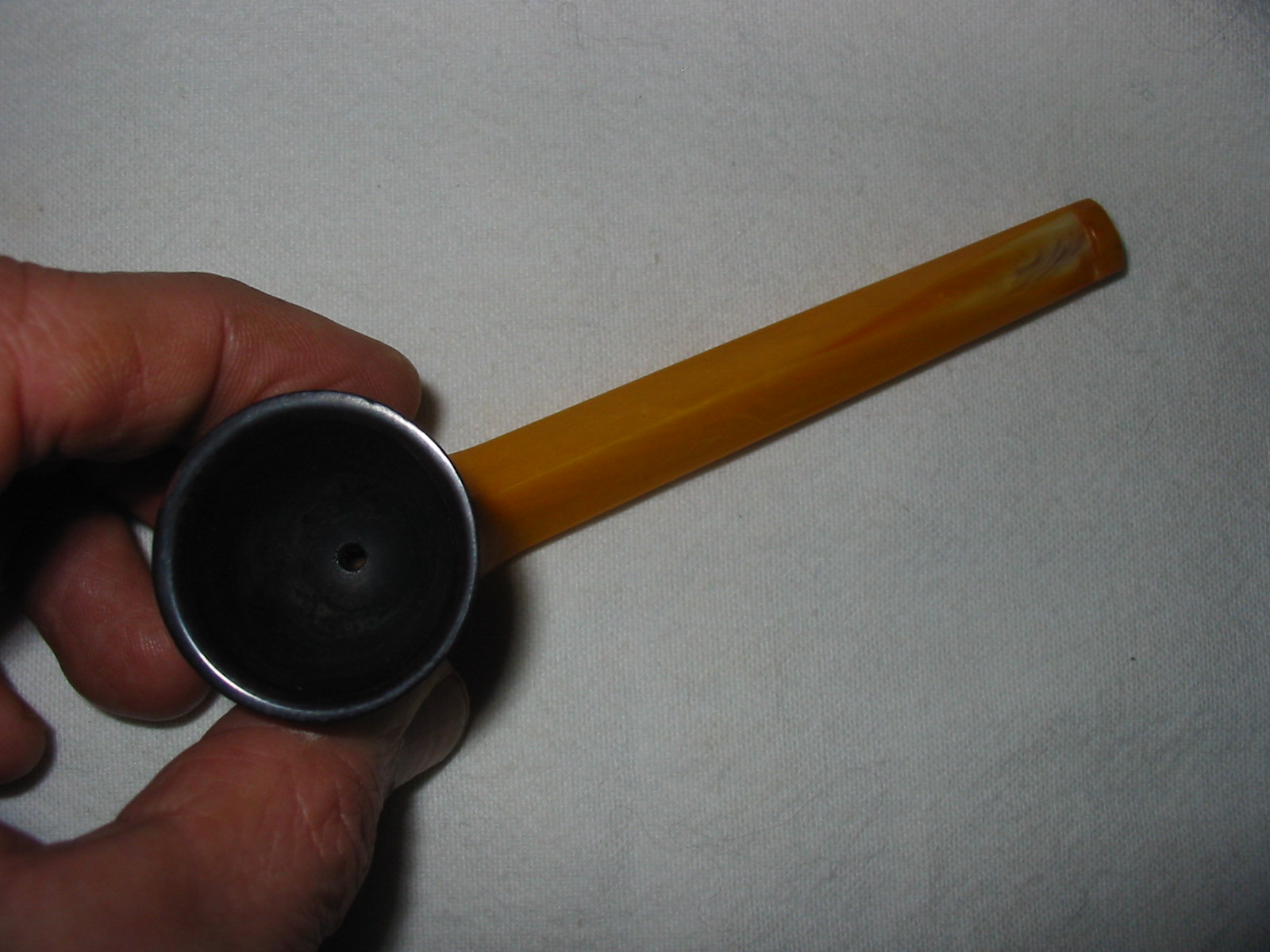
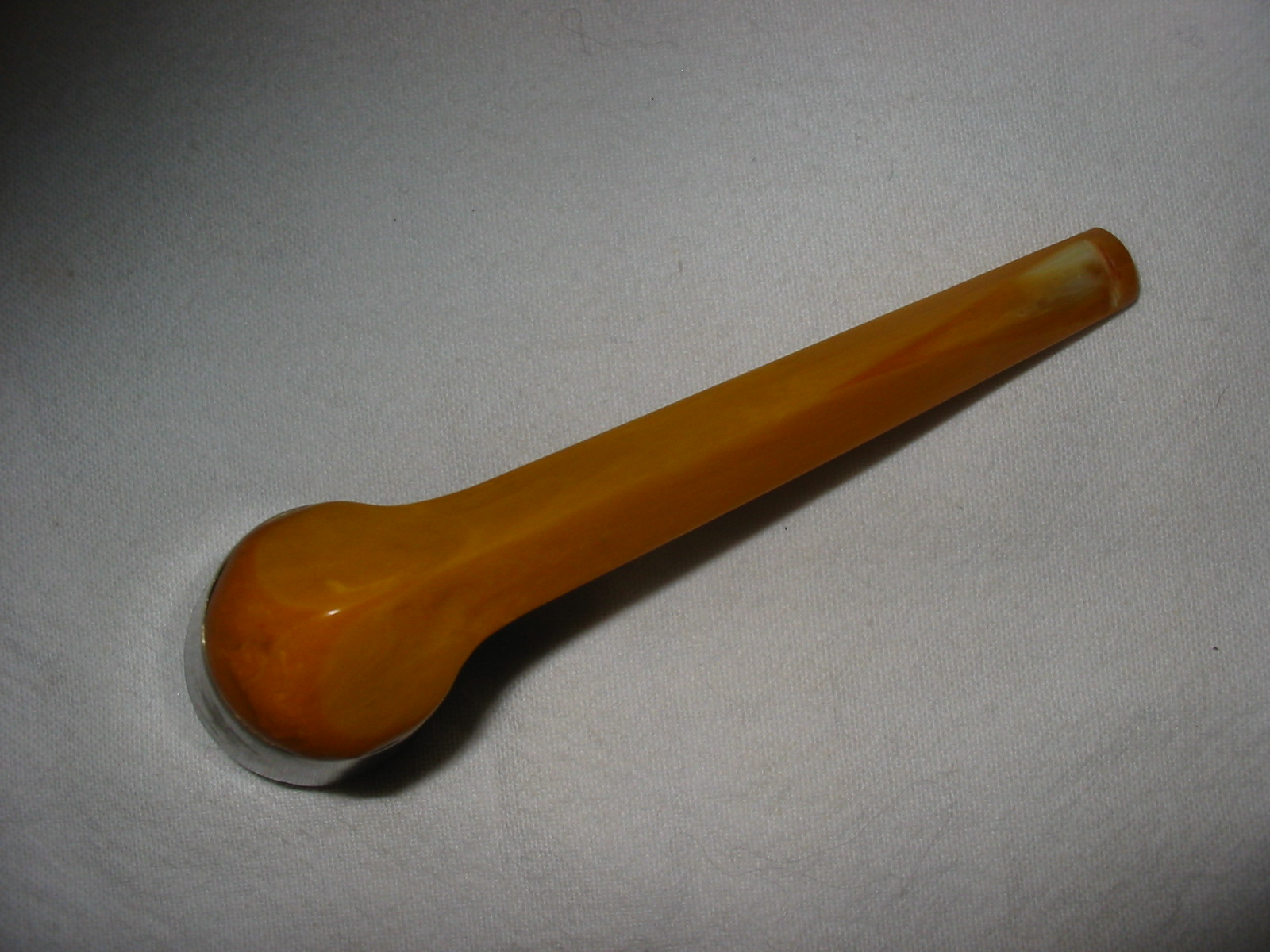
This is a new one to me. I have never seen this combination of parts. I have refurbished quite a few of the screw on bowls on Bakelite bases with either metal or vulcanite stems. I even recently completed a Bakelite base with a Bakelite stem on it. But never have I seen a Bakelite bowl. This one is solid Bakelite with no lining whatsoever. The bowl is like a cup. This one was another Chuck Richards gift. I think he takes delight in these surprises. And a surprise it truly is. There is not a single identifying stamp on the pipe so it is a mystery as to its manufacture. It is very unique. The brass ring between the bowl and base was loose and slide around as the pipe was moved. The bowl was lightly coated with tar. The rim had some dings in it and the base/stem unit was not even at the button. Each side of the angle coming down to the button was off and there were tooth marks in the stem. The inside cup of the base was dirty and the inside of the shank and stem unit was also dirty with tars. The end of the button and orific “o” opening was very clean and unstained which is a bonus. Once I get it cleaned up I intend to load a bowl and see what it is like to smoke. The first series of four photos show the pipe as it was when it arrived to my worktable.
IMG_0727

IMG_0728

IMG_0729

IMG_0730
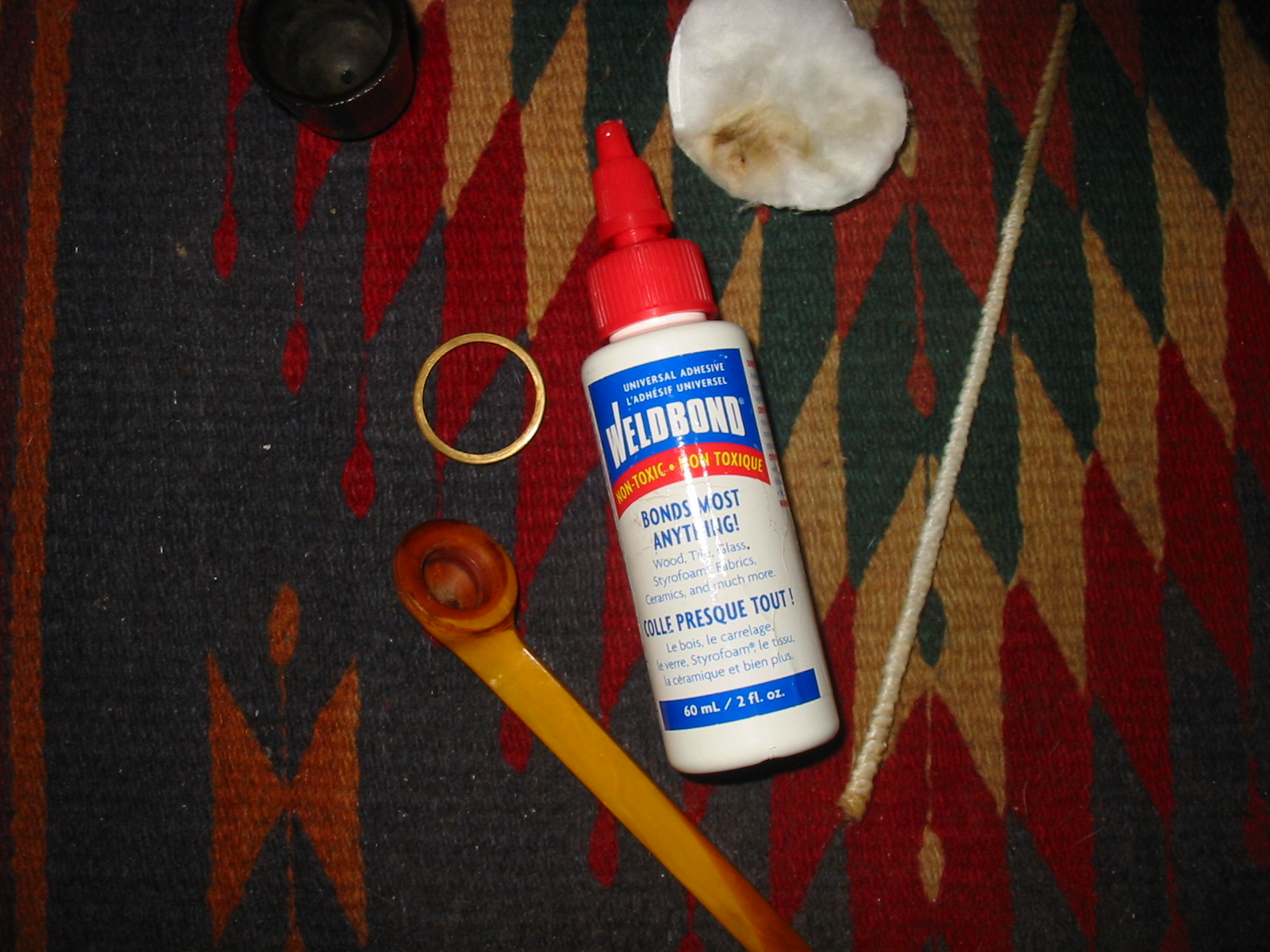
I took it to the work table this morning and took it apart. I cleaned all the parts of the pipe with Everclear and a soft pipe cleaner. I scrubbed out the cup in the Bakelite base with Everclear on a cotton pad. There was darkening to the Bakelite that I could not remove but the slight build up disappeared. I cleaned up the brass ring and then reglued it to the base. I used a white glue to anchor this to the base. The next series of three photos shows that process.
IMG_0731

IMG_0732

IMG_0733
I sanded out the interior of the bowl with 320 grit sandpaper, wiped it down with Everclear on a cotton pad and then sanded it again with a fine grit sanding sponge. I sanded down the rim of the bowl with the sanding sponge to remove the slight nicks in the edge of the bowl and clean up the rough edges. I followed up with a 1500 grit micromesh sanding pad. The picture below shows the cleaned bowl.
IMG_0736
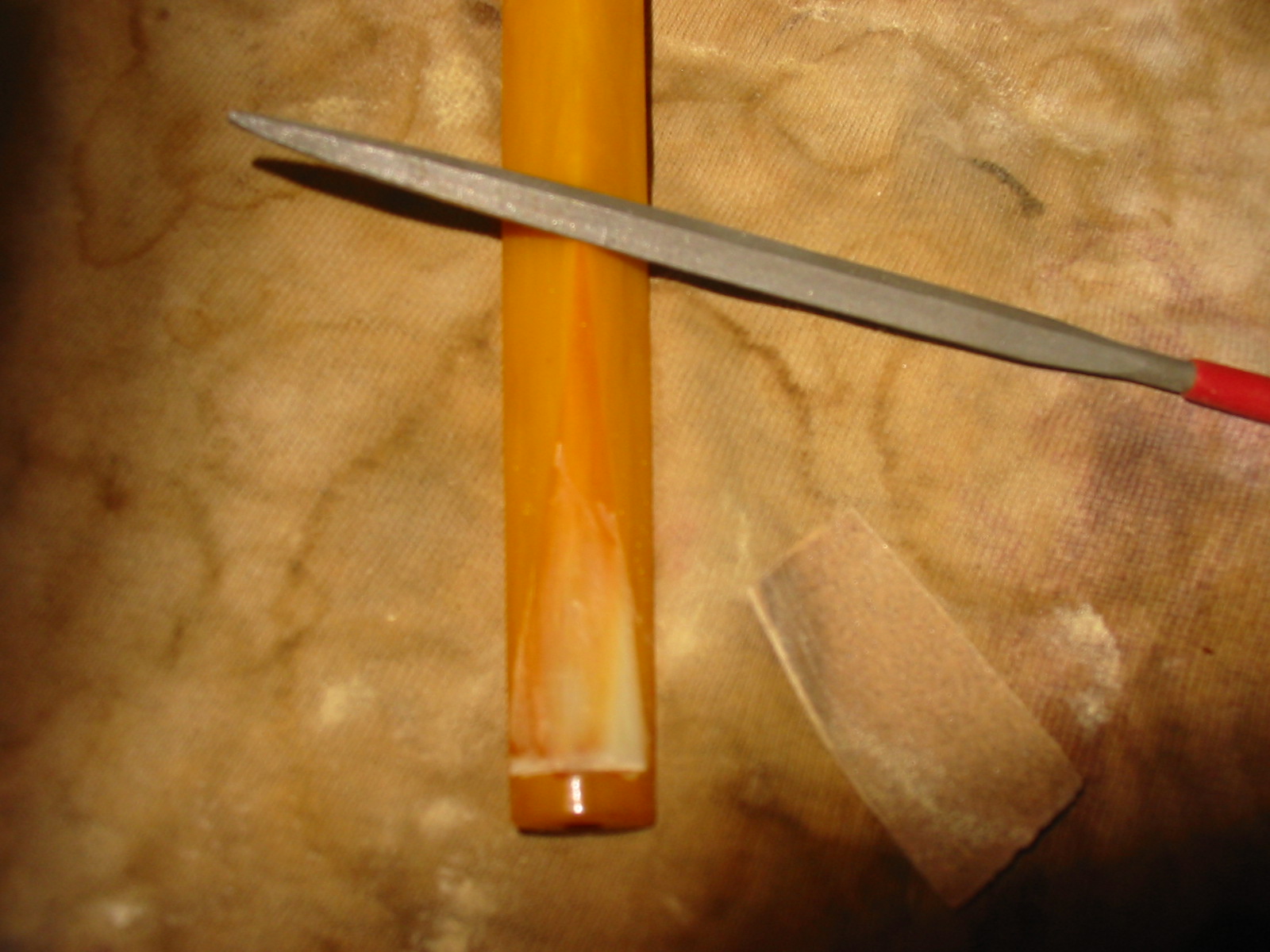
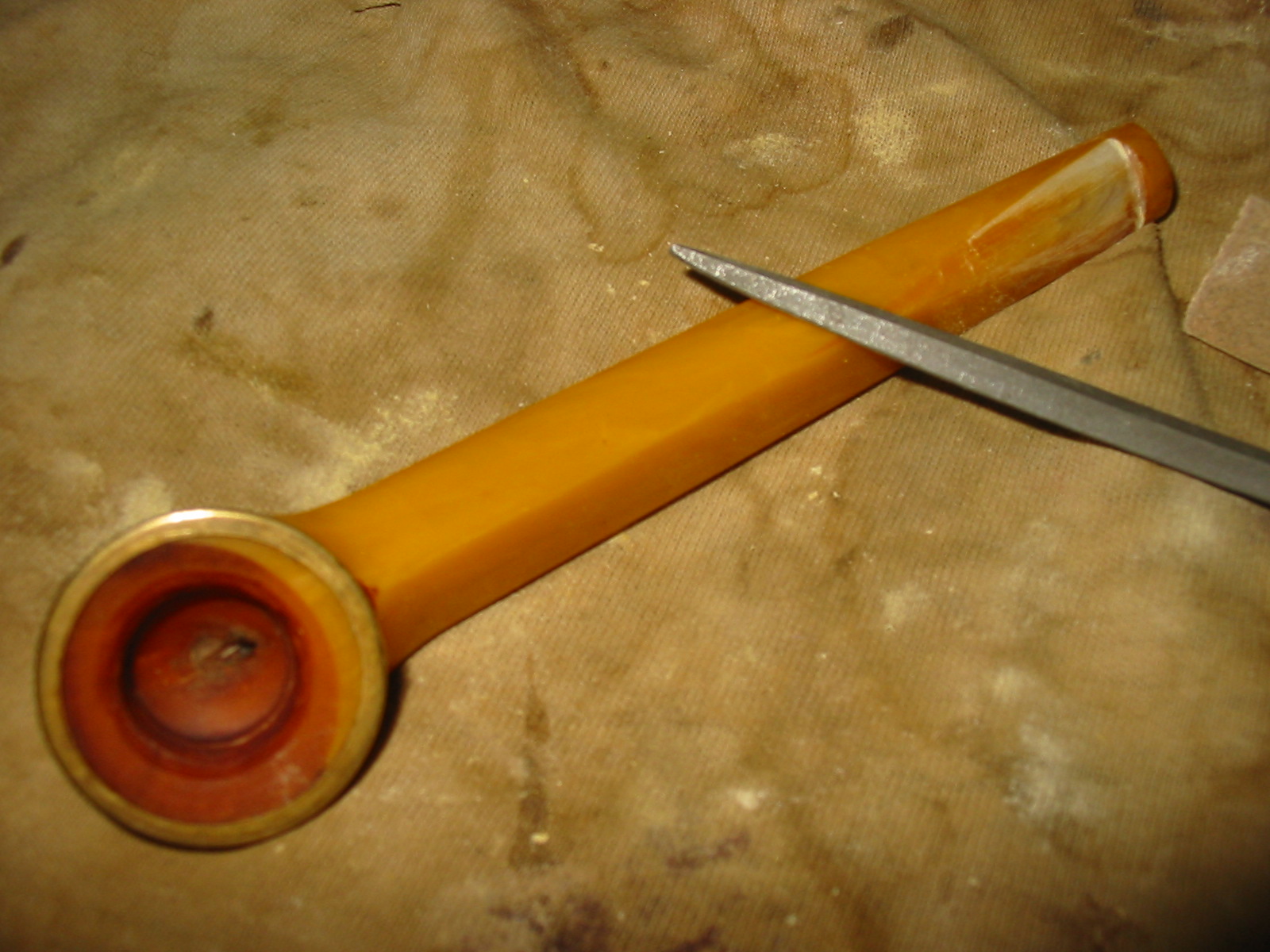
I reshaped the stem and button area with needle files to repair the angles and remove the tooth marks. I sanded the newly shaped area with 240 and 320 grit sandpaper to remove the file scratches. I followed up with micromesh sanding pads 1500-12,000 grit to progressively polish and shine the stem and base. I sanded the entire base with the micromesh sanding pads. There were many small surface scratches in the surface that the micromesh took care of. The next series of eight photos show the reshaping of the button area from the use of the files through the sanding with 1500 grit micromesh sanding pads.
IMG_0734

IMG_0735

IMG_0737

IMG_0738

IMG_0739

IMG_0740

IMG_0741

IMG_0742
The bowl did not seat well on the base. It seemed to sit at a bit of an angle and did not fit into the bottom of the cup. I sanded down the bottom of the bowl insert to remove a small portion of the material to reduce the depth of the threaded portion of the bowl. I also sanded the thread carefully to remove the nicks and chips to the surface. I used micromesh to sand the threads as I wanted to merely clean them up not damage or reduce them. Once this was completed the bowl threaded on more easily and also was seated well on the base. The next series of three photos show the reseating of the bowl.
IMG_0743

IMG_0744

IMG_0745
At this point in the process I sanded the entire pipe with micromesh sanding pads. I used all the grits from 1500-12,000 to polish the Bakelite and give it back its luster. This took quite a bit of time as I was trying to remove all of the minute scratches in the base and on roughness on the outer edges of the bowl. The seven photos below show the progress shine developing through the sanding with the micromesh sanding pads.
IMG_0746

IMG_0747

IMG_0748

IMG_0749

IMG_0750

IMG_0751

IMG_0752
When I had finished with the sanding and the bowl and base had a shine to them I hand buffed it with carnauba wax, applying several coats and buffing it with a soft cotton cloth. My only frustration with the finished pipe is that the area around the button that I changed and sanded is a bit lighter than the yellow/amberlike colour of the rest of the base. It shined up nicely but is lighter. Ah well, it is better than it was and it is certainly more comfortable than when I began. The final series of four photos show the finished pipe. Now it is time to load it and fire it up. The experience is about to begin.
IMG_0753

IMG_0754

IMG_0755

IMG_0756

Rebirth of a No Name Bakelite Pipe with Bakelite Stem


This pipe came to me from Chuck Richards (Desertpipe) in a box he sent me. It is the first of three old timers that he sent for me to work with. It is a common interest that we share – this love of the old timers and restoring them to some of their former glory. The first four photos below show the pipe as it was when it arrived to my work table. There is no stamping on the pipe at all. The gold band is stamped 14K Gold Filled. The stem has no logos or stampings. The underside of the bowl and the Bakelite base has no information stamped on it either. It is much like some of the WDC or William Demuth pipes that I have from the same era. The pipe itself was in pretty decent shape. The bowl was very clean. The rim was undamaged and the finish on the bowl was quite nice. The double grooves around the bowl were filled with grit and the surface had a few pits in it. The Bakelite bowl base and shank were in good shape. There seems to have been a metal decorative rim that went around the base between the bowl and base that was missing. The 14K gold filled band was in place but was on backwards so that the stamping of the gold was upside down. The stem was very oxidized and had been filed to give a steeper angle on the taper to the button. The filing had gone too deep and the airway next to the button was exposed. At first examination it appeared that the stem was too hard a material to be vulcanite and the filing marks did not look like they were on vulcanite. My initial guess was that the stem was also Bakelite.
IMG_0649

IMG_0650

IMG_0651

IMG_0652
I removed the bowl from the base and reamed and cleaned it. I reamed it with a PipNet reamer back to a very thin cake. I cleaned out the airway at the bottom of the bowl. I used a dental pick to clean out the dual lines around the bowl top. I cleaned out the reservoir in the bottom of the base with cotton swabs and Everclear. I cleaned out the shank with bristle and fluffy pipe cleaners and Everclear as well. I removed the band from the shank by heating it gently. The glue softened and I was able to remove it and turn it around. I tapped the band with a small furniture hammer to flatten out the edges and squared the edges. I reglued it with wood glue. When this work was done I set the bowl and shank aside and went to work on the stem.
The stem took significant work. Somehow my camera failed (maybe the photographer did) and I was unable to get any good photos of the stem work. I built up the filed area against the button with clear superglue (Photos 1 -2). I layered on lightly, let it dry, relayered it and repeated until the thickness was sufficient enough for the airway to be protected. I also built up the button. It looked to me that a previous repair had been done and a new button had been cut in the stem. I repaired the shape and the thickness of the button. It was an old style bone tenon that was mounted in the shank so I cleaned that up and cleaned the inside the stem. The hole in the button was the old style orific or “o” opening. The rebuilding of the button and stem took the majority of time in working on this old stem. Once it was dry and had cured overnight I worked on the oxidation. I did not want to use anything that could possible harm the Bakelite so I kept the alcohol to a minimum and only on the inside the airway and was careful not let it touch the outside. For the outside I used 240 grit sandpaper to smooth out the newly repaired slope on the stem and to sand out the file marks that remained from the previous repair. I also sanded the corners on the stem to give it a more rounded look in keeping with the era it was made. The 240 grit sandpaper easily removed the oxidation. Photos 3 – 4, though of poor quality, give an idea of how the stem looked after patching with the superglue and sanding with the 240 grit sandpaper. The oxidation was pretty well removed. The button is shaped and the patch on the stem in front of the button is visible. There is still a lot of sanding to do at this point. From the 240 grit I went on to sand with 320 grit and also a fine grit sanding sponge to further blend the patch and to remove the oxidation.
IMG_0647

IMG_0648

IMG_0653

IMG_0660
I put the stem back on the pipe and worked on the fit against the band. When I reversed the band the stem was too large on the right side and extended beyond the width of the band. To repair that I had to take of material at the bottom edge of the top right side and the upper edge of the bottom right side of the diamond to reduce the angle of the diamond on that side. By reducing these two points on the stem I was able to bring the sharp edge to the same width as the shank and band. It balanced the look of the stem. I used the 240 and 320 grit sandpaper for doing this part of the stem work. I continued to use the sanding sponge to blend the patches on the top and bottom of the slope to the button. The next series of eight photos show the progress on the stem. The patch is clearly visible in the photos of the top side. The one on the bottom was not as big and it blended in more easily.
IMG_0662

IMG_0663

IMG_0664

IMG_0665

IMG_0666

IMG_0687

IMG_0688

IMG_0689
After removing the scratches and oxidation with the sandpaper I sanded with the fine grit sanding sponge and then progressed through the various grits of micromesh sanding pads from 1500-12,000 to smooth and polish the stem. As I worked on it my initial conjecture about the material being Bakelite was confirmed. The next four photos are a sample of the work of the micromesh sanding pads on the stem. The pad in the photos is 3600 grit. I also used the micromesh on the bowl and the Bakelite base and shank to remove some of the surface scratches.
IMG_0690

IMG_0691

IMG_0692

IMG_0693
I gave the pipe a very light buff on the buffer with White Diamond. I had learned on previous occasions that the speed of the buffing pad can produce heat that can actually damage the Bakelite and cause fibres from the pad to embed in the stem. A very light touch is necessary if you are going to buff these stems. I wanted to give them a quick light buff to remove any remaining scratches and give it a quick sheen. I buffed the base and bowl at the same time as well. The final series of four photos show the finished pipe. I applied a coating of carnauba wax to the pipe by hand. I buffed it lightly with a soft flannel cloth to bring up a shine and finished buffing with a soft shoe brush. The finished pipe speaks for itself. It is a testimony to the life that resides in these old timers. It is a life that will certainly extend beyond mine! As mentioned above, I share a love for these older pipes with Chuck that seems to extend to their restoration and re-entry into the purposes for which they were made. What do you think Chuck? How does the final pipe look to you?
IMG_0695

IMG_0696

IMG_0697

IMG_0698

Comoy’s The Everyman Billiard Brought Back to Life


Blog by Steve Laug

This is the third of the lot that I picked up on EBay that included the BR Israeli Apple and the Richmond Oddity. This one is stamped The Everyman over London Pipe on the left side of the shank. On the right side it is stamped Made in London in a circle over England and the shape number 291. This one came to me in rough shape. The bowl showed promise of great grain under the grime. The finish was shot but the briar was undented. The rim was caked with tars and oils but there were no dents or burns. Even the beveled inner edge of the bowl was clean under the grime. The bowl had a thick crumbly cake that reeked of the same sweet aromatic smell as the other two pipes in this lot. There was one rather large fill on the right side of the bowl that was hard and dark. The stem was oxidized and a major chunk of vulcanite had been chomped off. It was a large bite out of the top of the stem extending back along the stem about a ¼ inch or more. The fifth photo below shows the extent of the damage to the stem. Since the stem had the Comoy’s three bar logo I did not want to make a new stem for this old pipe but rather look for a way to keep it. The series of four photos below show the state of the pipe when it arrived to my work table.

ImageImageImageImageImage

I took the stem to the work area where I have my Dremel to cut off the broken part of the stem. I have the large sanding drum on the Dremel and use it at half speed to cut off the stem. I have learned that it works very well at that speed and allows me to control the angles of the cut to insure that the line is straight. This one was a bit of a challenge as the Y cut in the airway was very close to the surface of the stem. I needed to cut it back far enough to allow me to have enough material to work with to cut the new button. The next six photos show the process of cutting the stem back. There are several photos of the end of the stem showing the new airway and the amount of material available to cut the new button. From the point of the stem the airway dropped suddenly back to the normal straight drilling and would allow me room to do the shaping.

ImageImageImageImageImageImage

I took the pipe back to my work table and reamed the bowl back to bare wood. I then topped the pipe very slightly to remove the buildup on the rim and to smooth things out. The next series of four photos show the topping process and the results. In the fifth photo below I used a medium grit sanding sponge and then a fine grit sponge to finish the topping and remove any sign of scratching to the surface. I also used 320 grit sandpaper to clean up the beveled inner edge of the bowl.

ImageImageImageImageImage

Once the top was cleaned and smooth I wiped the bowl down with acetone (finger nail polish remover) on a cotton pad to clean off the grime and remnants of finish on the bowl. The next two photos show the bowl after I have wiped it down. There was some beautiful birdseye on one side of the bowl and some great flame grain on the other side. In the second photo you can see the fill that is visible on the bowl.

ImageImage

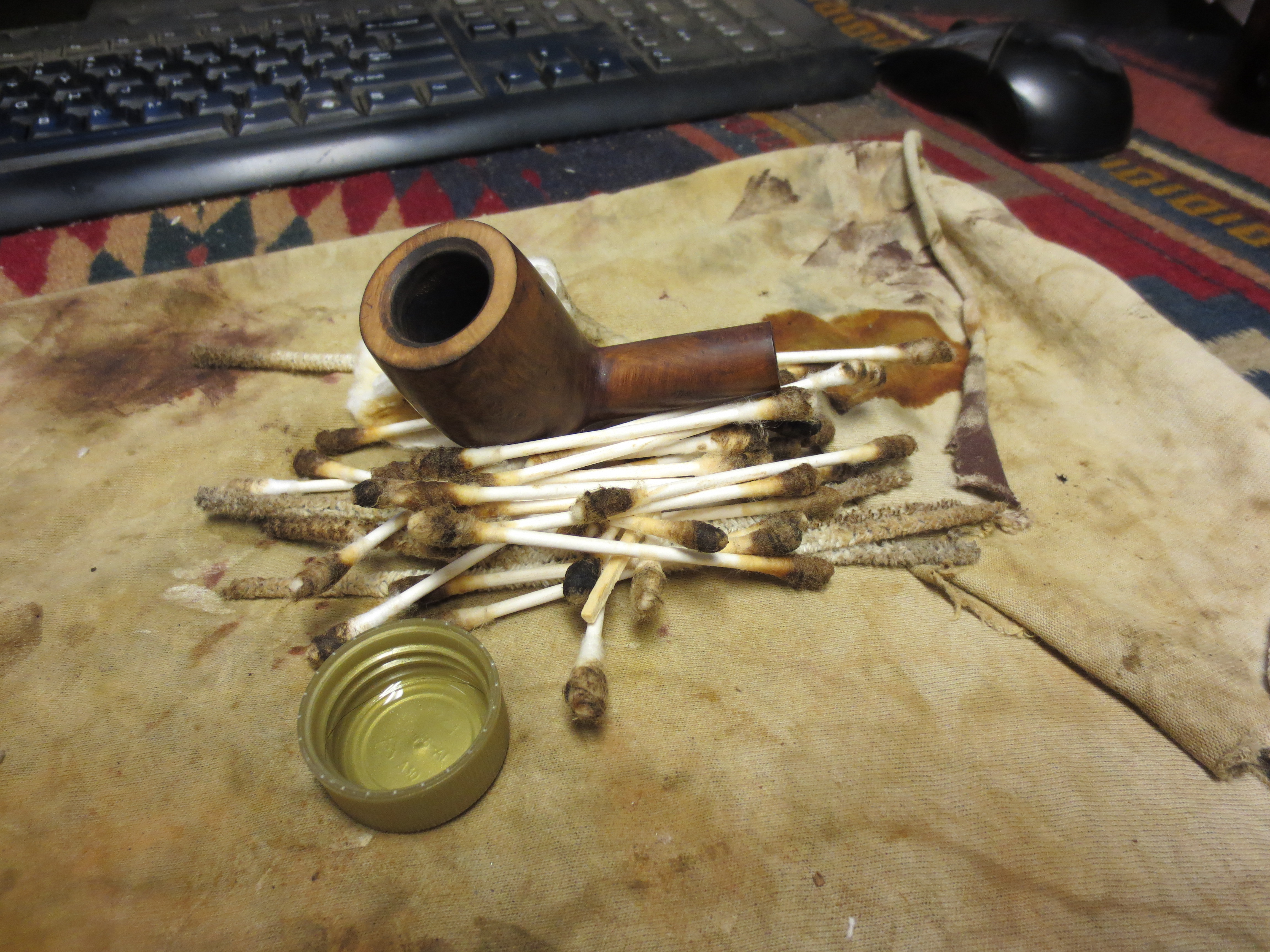
After cleaning the outside of the bowl it was time to clean the shank and bowl. I removed the stem and poured some Everclear into the cap to use to clean the airway. I used many cotton swabs to clean out the airway and the mortise. I also used a significant number of pipe cleaners in the process. The next three photos show the cleaning materials I use and the final photo of the threesome shows the pile of cotton swabs and pipe cleaners used to clean the shank.

ImageImageImage

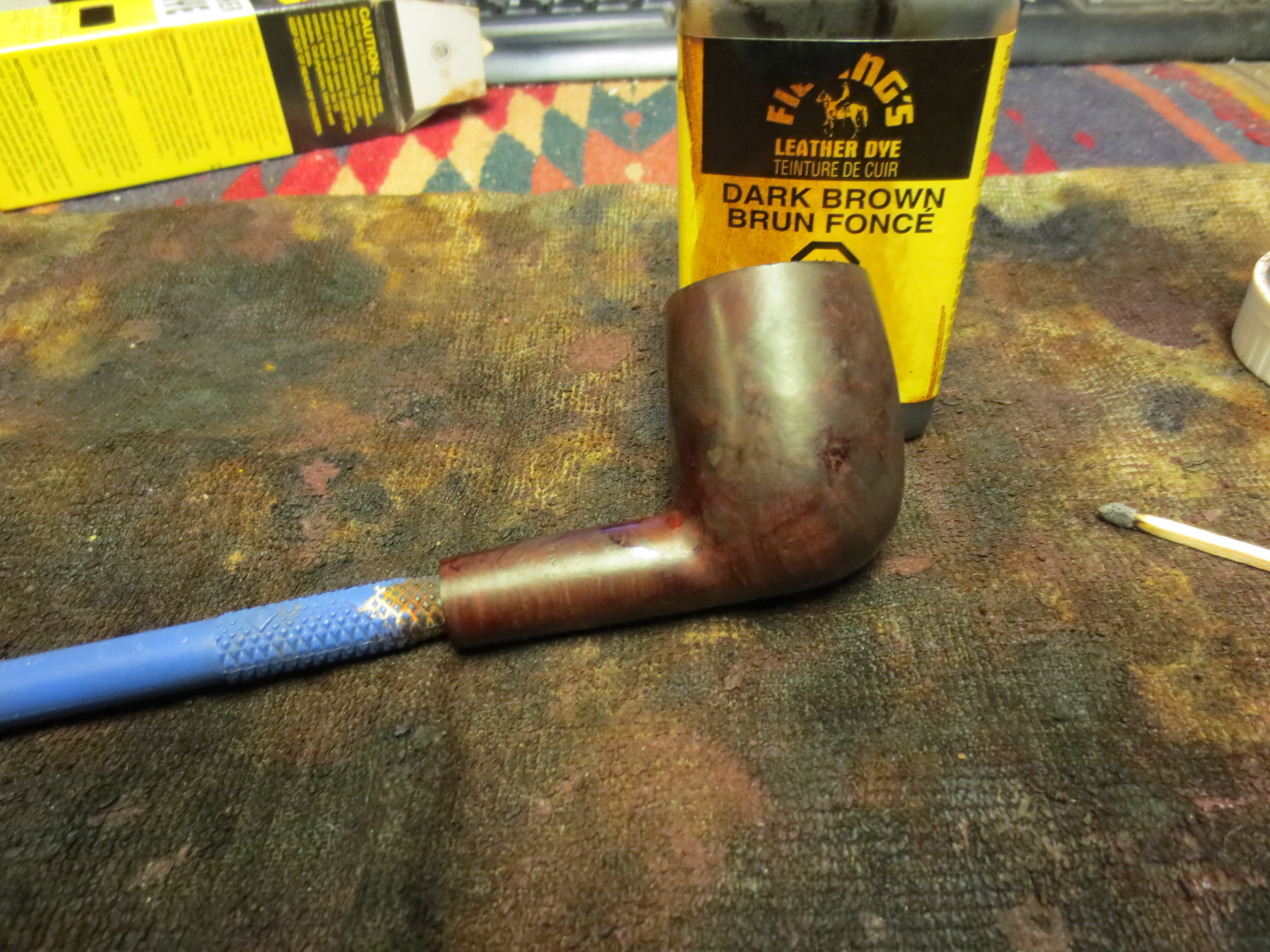
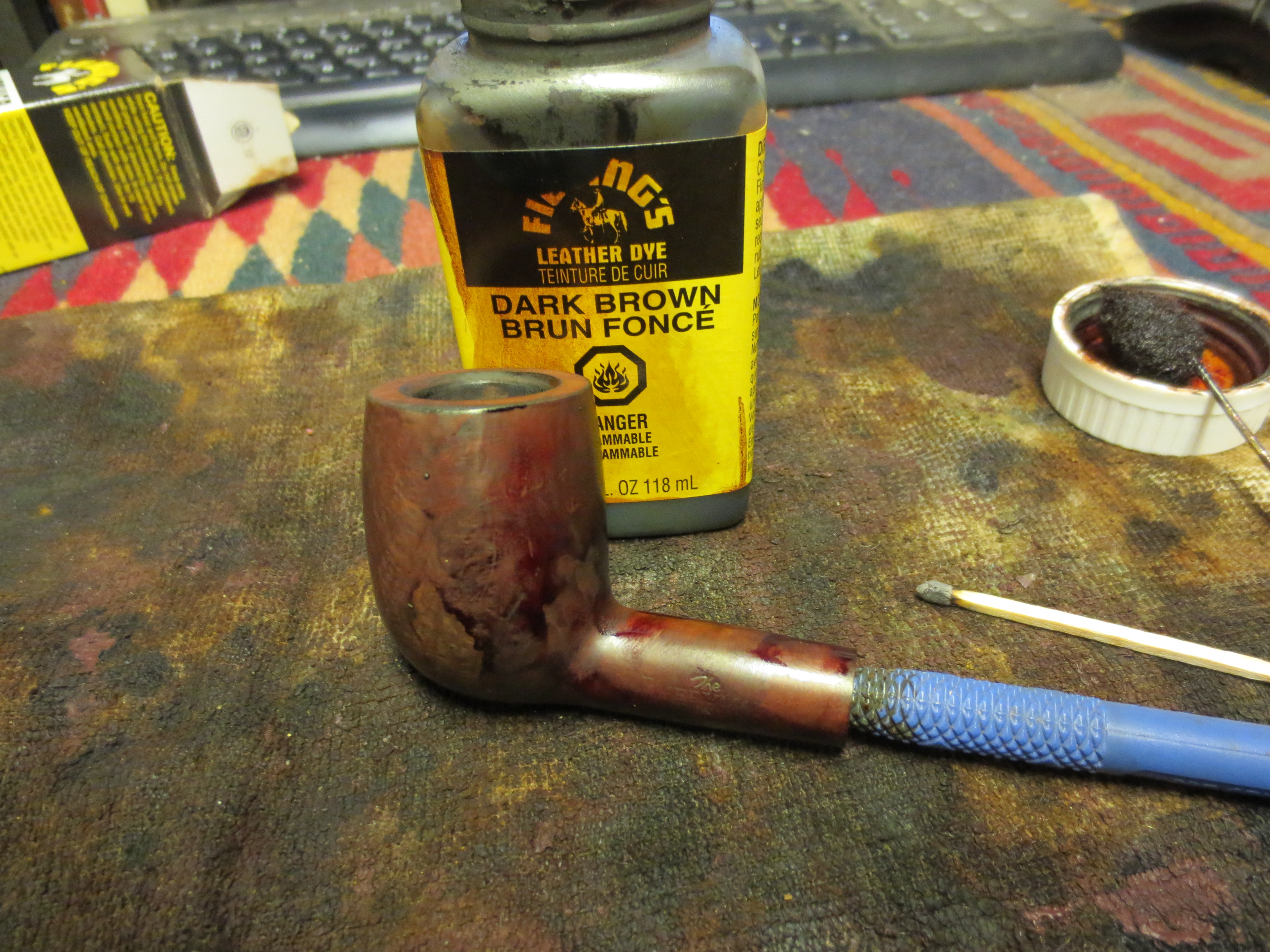
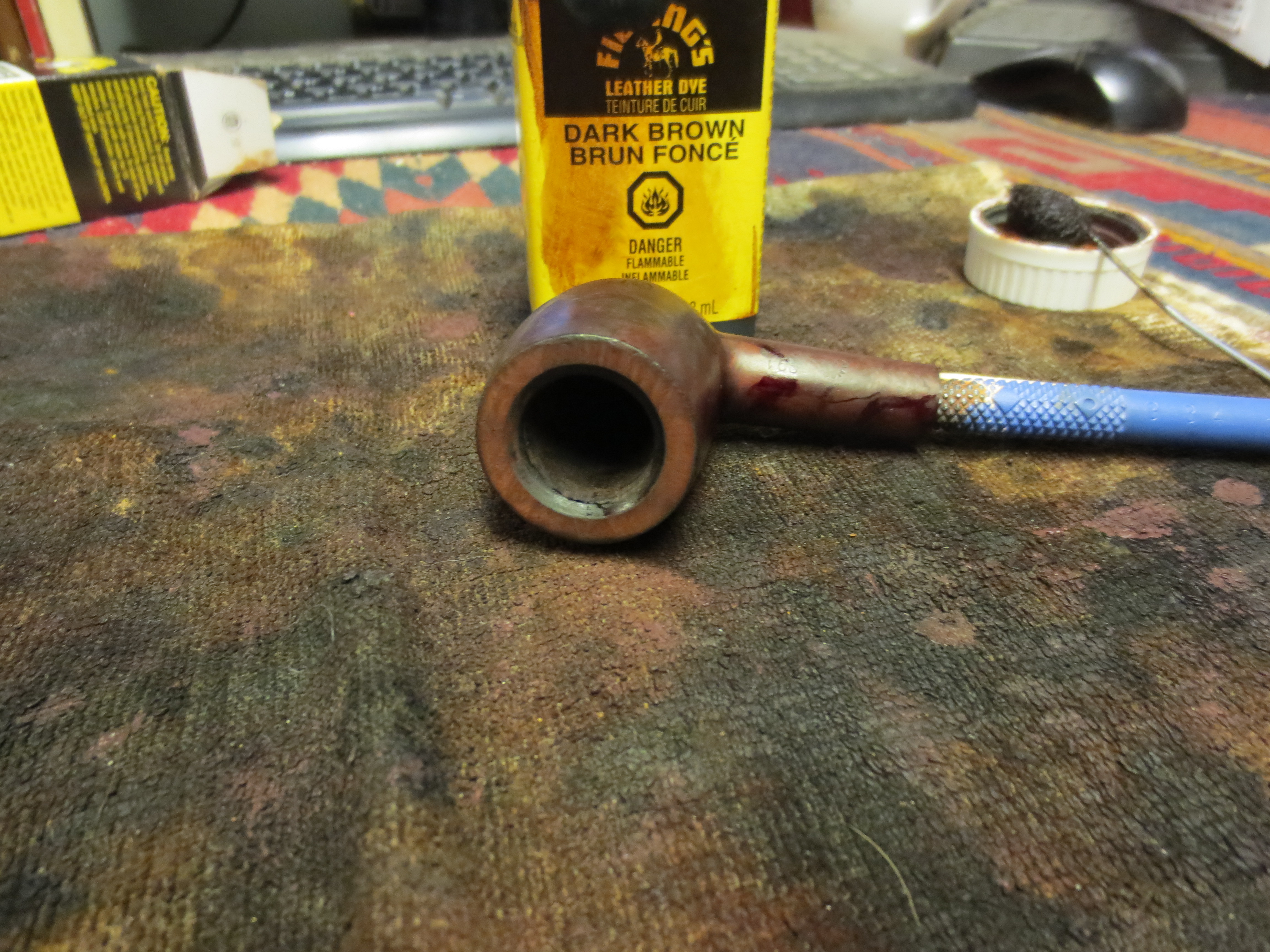
I used a black permanent marker to draw the grain pattern over the fill to make it less obvious once I stained it. I stained the bowl next using a dark brown aniline stain (Feibings Shoe Dye) and applied the stain with the dauber in the box. I flamed it with a match to set the stain, restained it and then flamed it a second time. I paid particular attention to putting the stain on heavy on the rim. The next three photos show the pipe after staining.

ImageImageImage

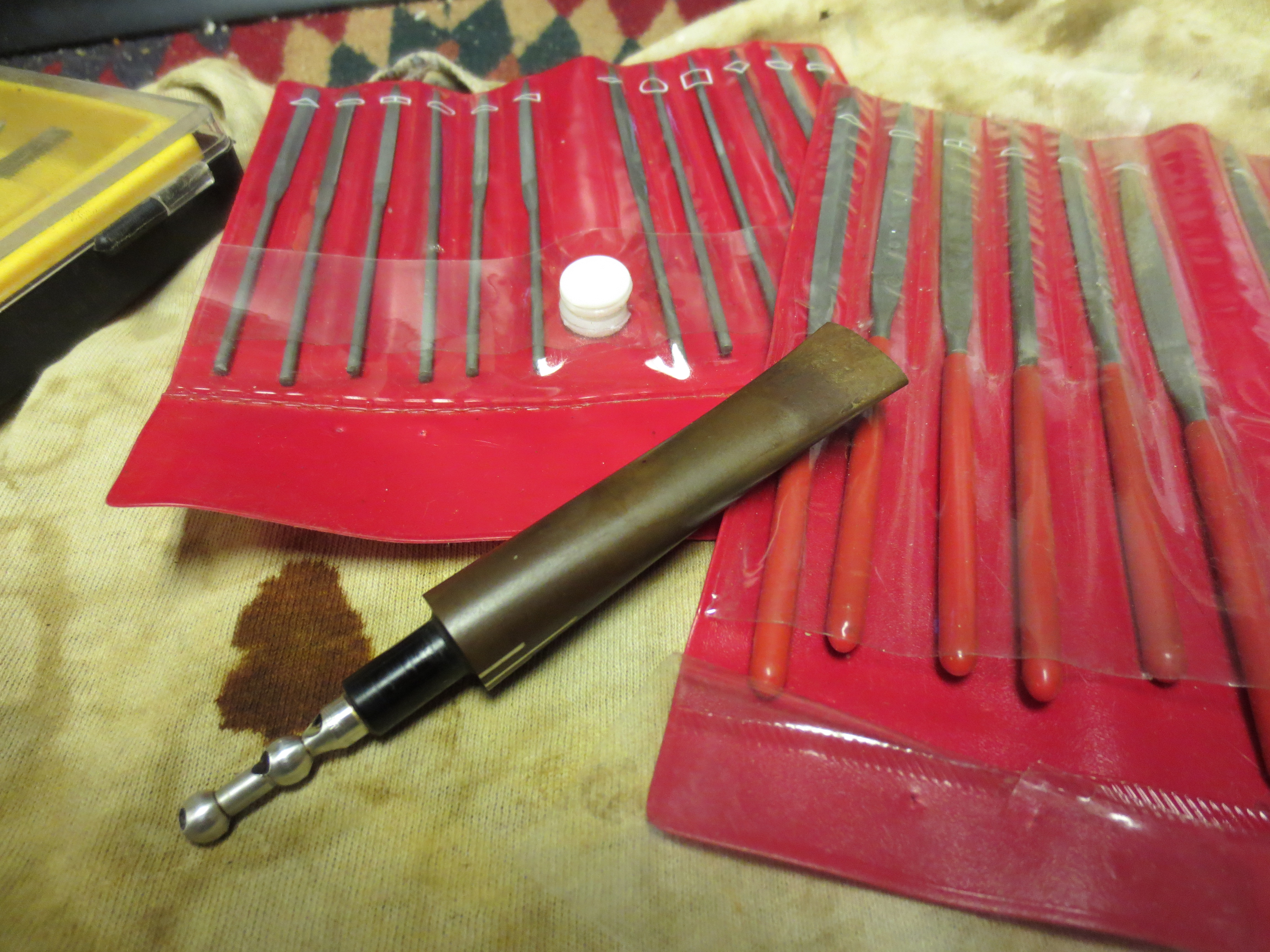
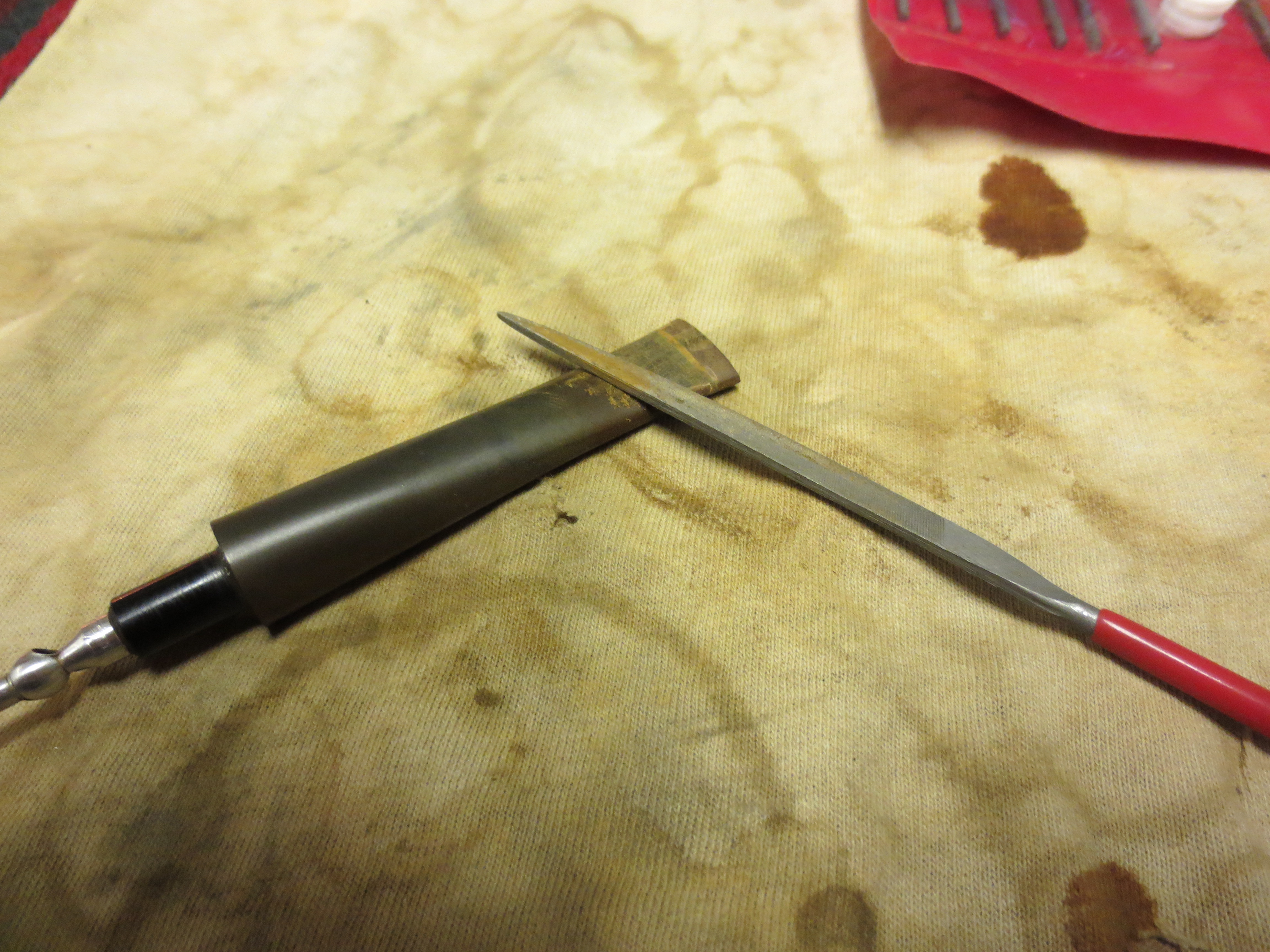
After staining I set the bowl aside to thoroughly dry and went to work on reshaping/cutting the new button on the stem. I use needle files to cut the button and work to keep it even on both sides of the stem and to also modify the taper from the stem backward to the button. After cutting the edge with the files and working the slope to make a smooth transition with the files I use a fine grit emery paper to sand out the scratches left by the file and to remove the oxidation. I am careful as I near the stem shank joint to not remove too much material as I do not want to round the shoulders on the stem or reduce the diameter of the stem in the process. I follow that by sanding with 320 grit sandpaper to yet again reduce the scratching. The next eleven photos show the progress of shaping the button and modifying the stem.

ImageImageImageImageImageImageImageImageImageImageImage

Once the button is cut and the taper modified I set the stem aside to work again on the bowl. There is no logic to this in terms of timing. I just need to give my hands and wrists a rest after working on the vulcanite. I wipe the bowl down with some isopropyl alcohol as the dark brown stain is too dark and opaque for what I wanted the finished pipe to look like. I find that the alcohol will remove the surface stain while leaving the undercoat. I work at this carefully to get the finish to the colour I want and then set it aside to dry yet again. The next three photos show the bowl after the wash.

ImageImageImage

I went back to the stem and worked on it with 320 grit sandpaper again. I worked to remove the oxidation and the scratches. I also used 0000 steel wool to scrub the stinger apparatus that is present in the Everyman pipes.

ImageImageImage

I then put the stem back on the pipe to check the fit and the profile of the pipe. I wanted to make sure that the angles looked right on the slope and also that the shank and stem junction still was smooth. The next three photos show the look that I had been aiming for in the process of reshaping the stem.

ImageImageImage

I once again removed the stem and sanded it again with a fine grit sanding sponge (pink sponge backed sanding medium). The scratches and oxidation are becoming less pronounced. The next four photos show that progress.

ImageImageImageImage

I reinserted the stem and polished it with some Maguiar’s to see where I stood on the scratches. I also buffed the bowl and stem to get an idea of the finished look. The next series of four photos show the state of the pipe after that work. The fill on the right side of the bowl is almost invisible and the pipe is beginning to look like the final product. There still remained much to do to get the stem back to a new look.

ImageImageImageImage

I wet sanded the stem with 1500, 1800 and 2400 grit micromesh sanding pads and also dry sanded the bowl with the same pads. I wanted a bit lighter and translucent finish on the pipe. The next four photos show the bowl and stem after this treatment. The fifth and sixth photos below show the stem and bowl after I had once again polished the stem with the Maguiar’s. You can see the new look of the finish on the bowl. The grain really is beginning to pop through.

ImageImageImageImageImageImage

I continued sanding with 3200-12,000 grit micromesh to finish the stem work and then polished the stem a last time with Maguiar’s before taking it to the buffer and polishing the stem and bowl. I brought it back to the work table, wiped down the stem with Obsidian Oil and then applied multiple coats of carnauba wax to the stem and bowl. The first two photos below show the state of the pipe after the sanding, buffing and application of Obsidian Oil. The stem and bowl are looking very good in my estimation. The final four photos show the finished pipe with the newly adjusted stem and many coats of wax. It is ready for its inaugural smoke.

ImageImageImageImageImageImage

Refurb on a Two Point Billiard – Gnawed Stem


This is the second Two Point pipe that I had in my box to be refurbished. It obviously was owned by the same pipe man as the little Lovat as evidenced by the matching bite marks. The pipe had an uneven cake in the bowl making the bowl conical even though it was U-shaped in reality under the cake. The rim was dirty and tarred but not damaged with dents or knock marks. The finish was spotty and uneven so the bowl would need to be stripped and restained for good coverage. The biggest problem can be seen in the first two pictures below: the stem was very badly chewed. In the first picture it can be seen that the top of the stem had several deep bite marks and the button was eliminated on the left side. It was more of an upward slope to the tip than the sharp angular edge that was originally there. The round cap of the top of the p-lip button was smoothed out and no longer crowned. In the second picture you can see that the bottom tooth marks and bite throughs had been repaired with what appeared to be epoxy that was fairly caked on the stem tip to the point that the lip line and the button were gone. What remained was a working stem that had no beauty to my eye.

ImageImage

The third and fourth photos show the profile of the button and it can be seen to have been virtually eliminated with the slope of the epoxy on the bottom edge and the chewed top edge. You can also see the state of the finish on the pipe. The spottiness and grime that covered the outside of the bowl are visible. Obviously this was a good smoking pipe that the previous owner cobbed a repair on so that he could continue to enjoy smoking it.

ImageImage

The next two photos are enlarged to show the state of the stems. The first one shows the top of the stem and you can see the two large dents (interestingly they are in the same place as those on the other Two Point pipe).You can also see the wearing away of the edge of the button to a slope. The crown is also flattened. The second shows the underside of the stem and the remaining two dents – one next to the button on the bottom half of the stem and the second inward from that dent. You can also clearly see the epoxy patch that fills the bite through and the button. The usual line that separates the button on the p-lip from the stem is gone. To repair these two surfaces the dents need to be raised and the holes filled to the point where it is possible to cut a new button on the top and the bottom. The crown will need to be built up a bit and the epoxy patch hidden or blended into the black of the stem.

Image

IMG_7946
I decided to work on the top side of the stem first and heated the surface of the vulcanite to lift the dents as much as possible. Once that was finished I filled what remained of the two dents with black super glue (see the first photo below). The dent next to the button I over filled so that I could have room to recut the edge of the button. When the glue had dried I sanded it back with 240 grit sandpaper to even the surface. I also recut the button edge to give it more of a sharp distinction. The sanded top surface can be seen in the second photo below.

Image

Image

On the underside of the stem I decided to recut the button and the line with needle files before I refilled the dents and the epoxy patch. I sanded off the extra epoxy to get the surface smooth and level with the surface of the stem. I used 240 grit sand paper to bring the surface down and the needle files to cut the edge on both sides of the line. You can now see that line in the picture below and there is a definite break between the bottom of the p-lip and the stem. It is a duplicate of the button on the Two Point Lovat.

Image

Once I had that recut the button area I filled the surface of the stem with black super glue as seen in the picture below. I propped it with a pen to keep the surface level as I did not want the super glue to run and pool. I also built up the epoxy patch on the edge of the button as well. Once the glue was dry I sanded the surface and did a bit of work with the needle files to redefine the edges. The second picture below shows the sanded stem with a smooth surface.

Image

Image

I finished sanding the stem with 400 and 600 grit sandpaper and water and then moved through the micromesh pads from 1500-6000 grit. The trick was to build a black coating on the epoxy patch. This took repeated coats of the black super glue. Once that was complete then the stem could be polished by hand until I finished with the bowl refinishing.

While I had been working on the stem the bowl had been soaking in the alcohol bath. Before dropping it in the bath I had wiped it down with a soft cloth and acetone (fingernail polish remover works very well) to remove the finish and the grime. It was time for it to be removed from the bath so that I could work on it. The three pictures below show the bowl after it has dried off from the alcohol bath. It now needed to be sanded with micromesh to remove any surface scratches and the rim needed to be thoroughly wiped down in preparation for the staining. I sanded and then wiped it down with a soft alcohol soaked cloth and set up the staining area.

ImageImageImage

The next four photos show the restained bowl. I used a medium brown aniline based stain (Fiebings Leather Dye) to stain the pipe. Once it was stained I flamed it and buffed it to polish the briar and make the grain stand out. The patterns of birdseye and swirls is quite unique. This is a clean piece of briar – no fills and no problem areas.

ImageImageImageImage

I then put the stem on the pipe and buffed the entirety with White Diamond and carnauba wax to bring it back to a shine. The final four photos show the finished pipe. Pay attention to the stem and button areas as they are now very distinct in the profiles and the build-up on the top and bottom give it back its original shape.

ImageImageImageImage

Rebuilding a chewed and dented stem with super glue


I just finished reworking this old stem from an Imperial Two Point Made in London Lovat. The stem was very unique in that it is a p-lip design though slotted in the airway. I have a second one that I am working on that has the same stem so I believe this is one of the hallmarks of the Two Point. That being the case I decided to restore the stem rather than cut a new one. You can see the state of the vulcanite from the three pictures below. The first picture is of the top of the stem. There were three major tooth dents in the surface of the stem, two chunks out of the edge of the button and a piece missing out of the edge of the lip of the slot. The second picture is of the underside of the stem. There you can see one major dent from teeth and also several smaller dents. There is also a dent in the edge of the lip of the pipe that has moved the straight line with a dip in it. The third picture shows the slot in the end of the stem, it is a bit out of focus but you can see the missing piece at the left side of the top edge.

ImageImageImage

I used my heat gun set on low to lift the dents as much as possible before working on the stem with sandpaper and superglue patches. I cleaned the surfaces of both the top and bottom of the stem after heating and then sanded them with 240 grit sandpaper to remove oxidation and anything that would prohibit the glue from sticking. In the first photo below you can see the two patches on the dents that remained after heating on the underside of the stem and the work that has been done straightening the line. I decided to work on the underside first as it needed a bit less repair. Once the glue was dry I turned the stem over and patched the top side. In the second photo below you can see the super glue patches on the surface of the stem, the two dents on the edge of the button to build up the edge. Once it was dry I planned on using needle files on both top and bottom to sharpen the edge of the button to a crisp restored look.
ImageImage

The next two photos show the top and bottom surfaces of the stem after sanding with 240 grit sandpaper to bring the glue patches flush with the surface and using the needle files to sharpen the edges of the patched button.

ImageImage

The next picture (I apologize for the blurriness but I think it still is clear enough to see the point I am making) shows the work that was needed to rebuild the lip of the button on the topside where the chip was. I carefully layered in black superglue making sure not to close off the airway. I used a greased pipe cleaner folded in half in the airway of the slot to provide a base to build on. Once the base was buildt I stood the stem on end and gradually layered in super glue to build up the top edge of the slot. The goal was to return it to a smooth rounded crown with a clean straight slot for the airway.

Image

The next two pictures show the build up area on the end of the button. It is a shiny black spot in the photo at the bottom right edge of the button. Each one shows a bit more of the build up to give an idea of the process. I would have to recut the edge of the button on the top side when the build up was complete.

ImageImage

When I had the surface filled to satisfaction I recut the edge of the button with the needle files and also sanded the surface with 240 grit sandpaper and 400 and 600 grit wet dry and water to smooth out the fill. I then proceeded to use my normal list of micromesh pads from 1500-6000 grit to finish the stem. I put the stem back on the pipe and buffed it with White Diamond. I took it back to the work desk and gave it a coat of Obsidian Oil, wiped it off when dry and gave the stem a final coat of carnauba wax. The pictures below show the finished stem. The first one shows the topside and the rebuilt crown of the button. The glare and shadows on the picture do not allow you to see clearly the recut edge but it is straight and clean. The second picture shows the underside of the stem and the crisp straight edge of the button. The final picture is an end shot to show the slot and the curve and flow of the crown of the button.

ImageImageImage

Overall I am pleased with the repair and now have a renewed pipe.

ImageImage

Giving New Life to a Barling’s 2729 Fancy Bent Dublin from 1962


I picked up this old Barling’s shape 2729 in a lot I bought on EBay. From what I could find out about it on the internet it came out in 1962. You can see from the pictures the state it was in when it arrived. It was the kind of challenge I like to work on in these old estate pipes. There is a deep satisfaction in bringing them back to life and restoring them to a spot on the pipe rack and the weekly rotation. The finish was gone, though in the grooves of the blast there was some darker brown/red stain. The blast was obscured on the sides and rim by the grime that filled the valleys in it. The rim was intact and not beat up at all – just incredible dirty. The bowl had been lightly reamed and was still round!! The stem was well chewed with deep dents on the edges of the stem and deep dents in the top and bottom. There were also holes chewed through the stem on both the top and bottom as well. The oxidation was very heavy and deep. The Barling’s Cross was all but gone on the stem but under a bright light it was faintly visible so the stem was clearly the original.

ImageImageImage

I took the stem off the pipe to work on and placed the bowl in my alcohol bath for overnight. Before submerging it in the bath I wet it with alcohol and scrubbed it with a small brass tire brush that is readily available at most Wal-Mart stores or online through Amazon. I find that the soft brass does not damage the ridges and valleys on the blast finish but really loosens the grime when used with Isopropyl alcohol. I generally dip the bowl and then scrub it before leaving it to soak. When I remove it from the bath I scrub it once again and wash off the bowl with some fresh alcohol to remove any residual grime. Once the bowl was dry it was utterly lacking any finish. It was ready to restain. I set it aside and turned my attention to the stem.

Image

The stem was a mess on this pipe as I mentioned above. Below are four pictures of it after I soaked it in Oxyclean to soften the oxidation on the surface. The pictures show how reddish brown that oxidation was when I started. I sanded the surface to highlight the bite marks and holes in the stem. The stem was badly chewed and could have been a candidate for replacement but it was an original Barling’s stem so I wanted to see if I could save it and reuse it. I cleaned the surface and picked the grit and grime out of the holes with a dental pick. I washed the surface down with Isopropyl to give a good clean surface. The button was virtually chewed away and there was a fair sized hole on the underside of the stem. The tooth marks were very deep and there was not much to work with in lifting them with heat. This made them a candidate for a patch with black super glue.

ImageImageImageImage

The picture below shows the top of the stem with the black super glue fill in the bite marks and holes. The idea is to slowly fill them and build up the surface of the stem. I also continued to fill them until there was a good slope from the stem surface to the top of the button. Once it was dry my plan was to use needle files to recut the button.

Image

The next picture shows the glue after it has dried and I have done the initial sanding to smooth out the surface of the stem. I still have not recut the button at this point.

Image

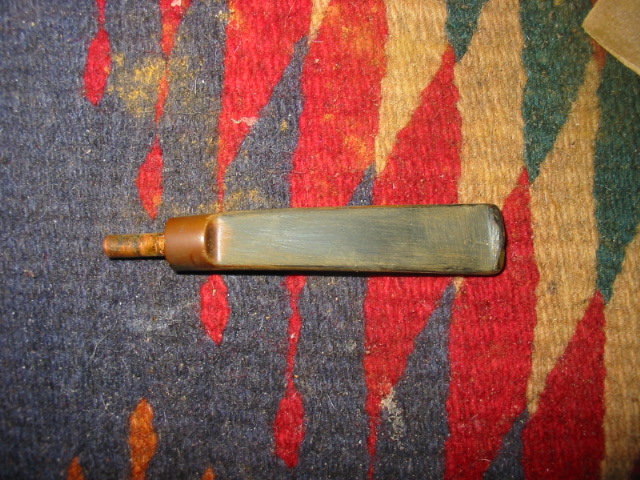
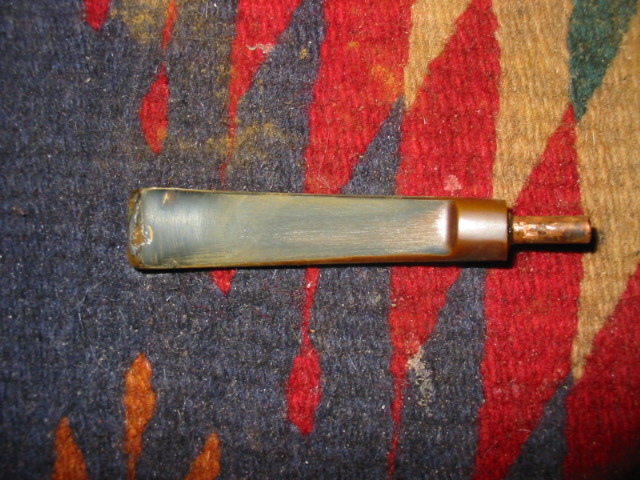
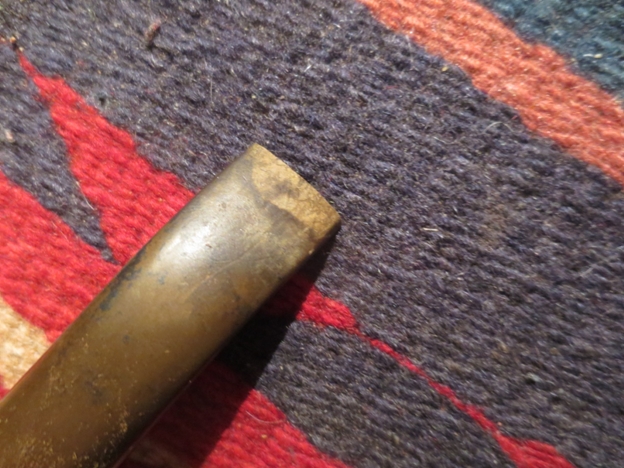
The picture below shows the underside of the stem after the glue has dried and I have done the initial sanding on the stem. It is still pretty rough but the holes are filled and the button is built up. Note in this picture the very visible copper tenon on the stem. The previous owner must have broken the tenon and had it replace with this thin copper tubing. The tenon is very delicate on this stem so the copper is actually an interesting fix in terms of durability. I have never seen a repair like that. The tubing was scored and inserted into the stem and held with an epoxy. After the soak in Oxyclean it was loose so I removed it, cleaned it and since it was a good tight fitting tenon/mortise union so I decided to reuse it. It is a wonder that he did not put a copper band around the button end of the stem as well to repair the bite through and tooth marks.
Image

The next two pictures show the stem after sanding the stem surface smooth with 240 grit sandpaper. My purpose in using that grit is to get a clean surface to work with as I move to rework the button on the top and bottom of the stem. I had yet to work on the saddle of the stem in these pictures. I will often save that until the rest is finished.ImageImage

I failed to take pictures of recutting the button on the stem but you can see the new button in the finished pictures below. I cut and shaped it with a flat needle file and a wedge needle file. I like the clean angles of a new button so I was aiming for that with just a little wear to match the age of the pipe. I finished the sanding and polishing of the stem using 400 and 600 grit wet dry sandpaper and then used the normal list of micromesh sanding pads from 1500-6000 grit. I keep a bowl of water close by to dip both the paper and the pads in as I sand as I find it more effective in removing the scratches and remaining oxidation. Once the stem was finished I put it on the pipe bowl and gave it a buff with Tripoli and White Diamond to get a good sheen to the surface. I never buff a stem apart from a pipe as I do not want to damage the stem shank junction by rounding the clean edge of the stem. Once I finished I set it aside and went back to restain the bowl.

I did a bit of research (that is a part of the process I really like) to find out about the original finish and colour of stain used on this particular pipe. I learned that it was more of a reddish tone and really wanted to get close to that reddish brown colour on the finished pipe. I used some oxblood stain and a bit of medium brown stain (both aniline stains) and gave the bowl a coat of the brown first and then flamed it and buffed it. After that I gave it a coat of the oxblood stain and flamed it. I reinserted the stem and took it to the buffer and with a light touch buffed it with Tripoli and White Diamond. I did not want to soften the ridges of the blast but wanted to buff it enough to get a contrast in the stain.

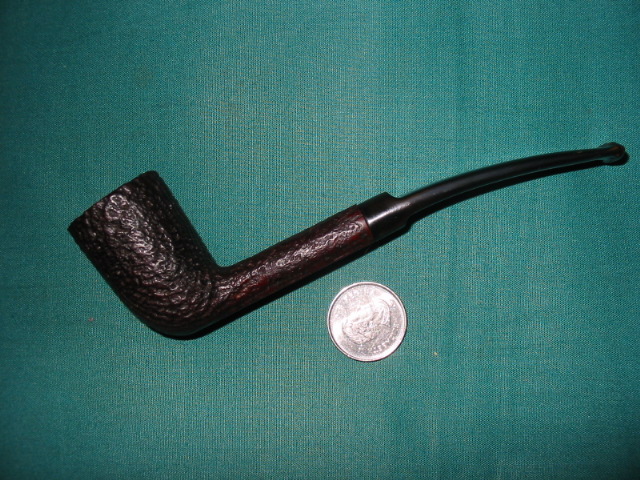
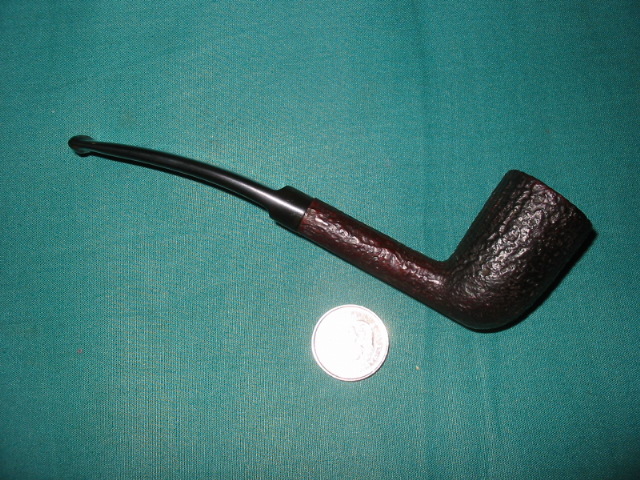
I used some Obsidian Oil on the stem and then Halcyon II wax on the bowl. Once they dried I hand buffed the stem and the bowl with a soft cotton cloth. I added a coat of wax to the stem when it was finished as well. In the pictures below you can have a look at the finished pipe. I took pictures with a .10 cent piece/dime below the pipe to give an idea of the size. It is a dainty little pipe with a pencil shank. I hope to smoke it this week end and enjoy a nice bowl of aged 5100 in it.

ImageImageImageImage