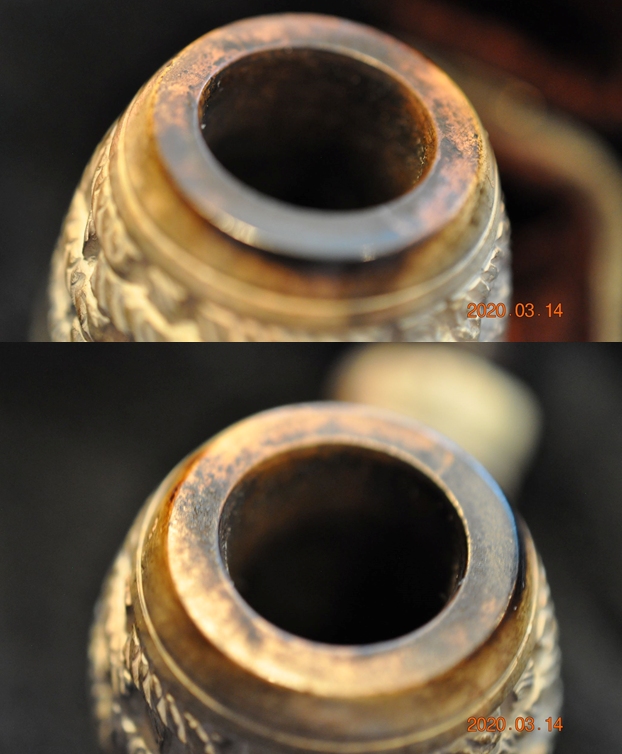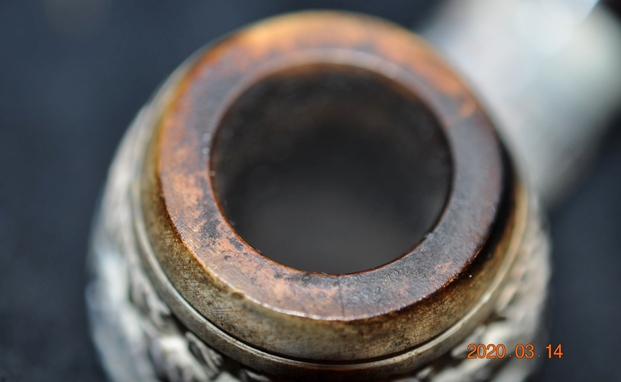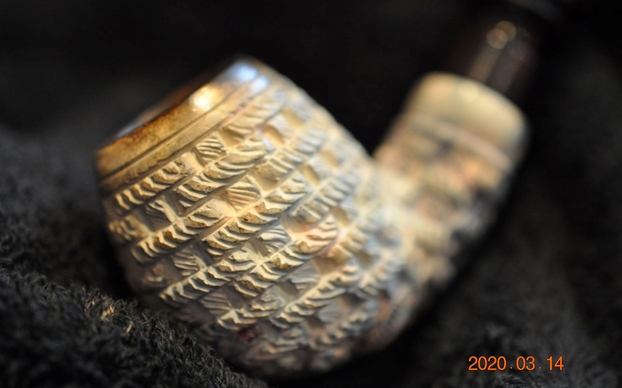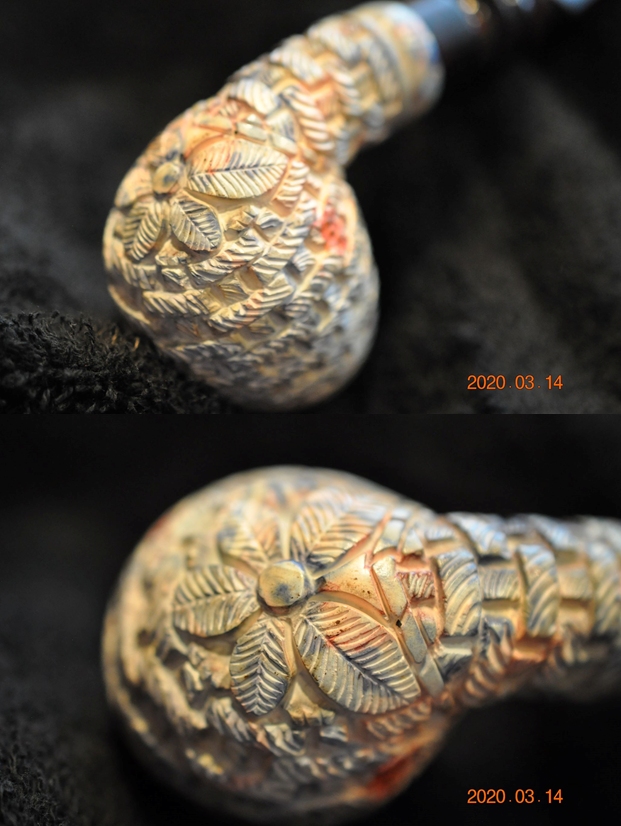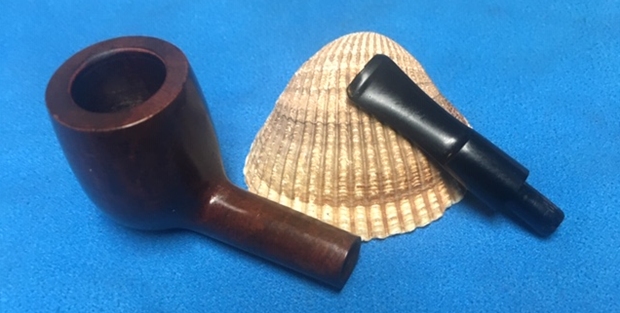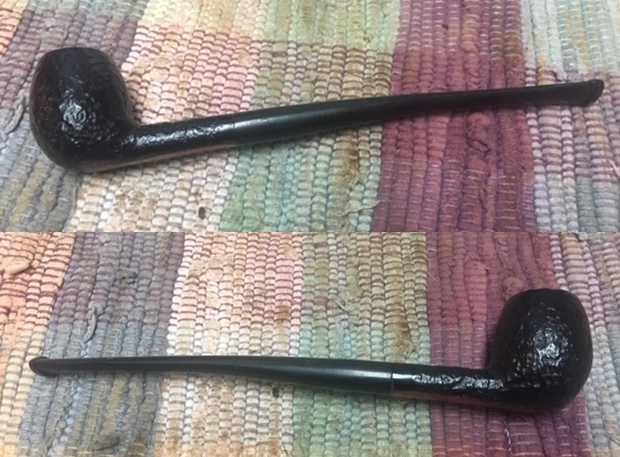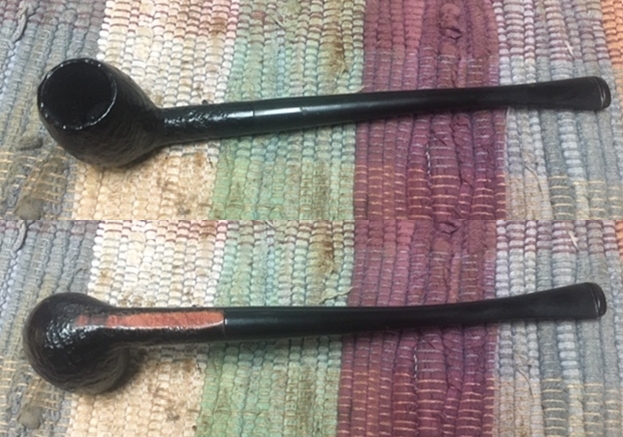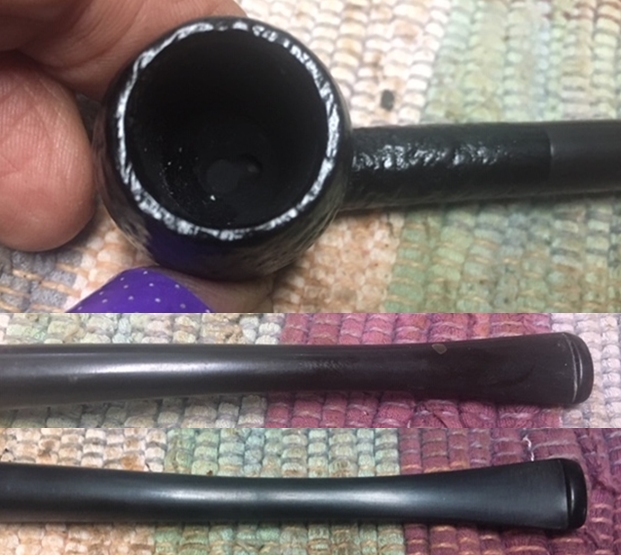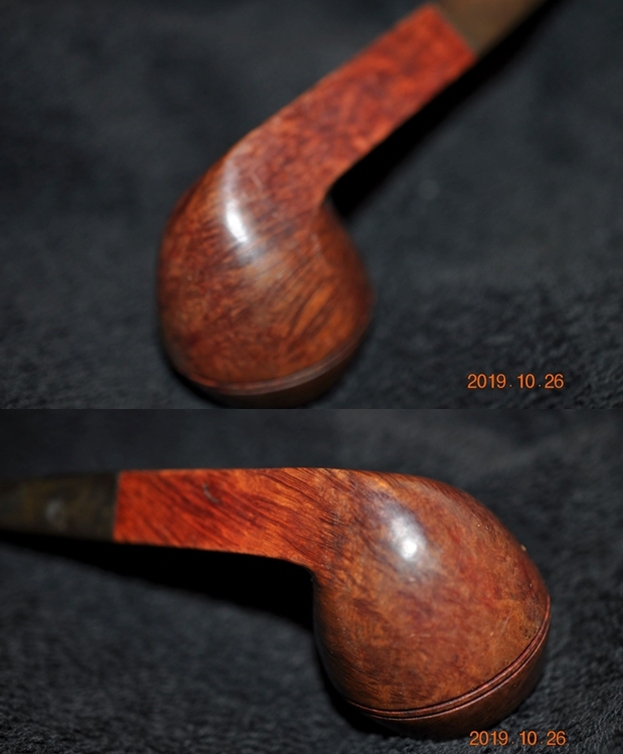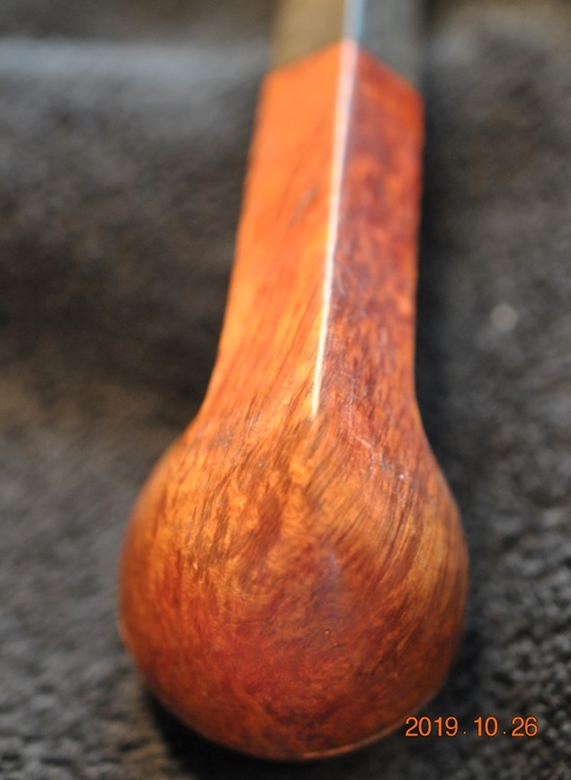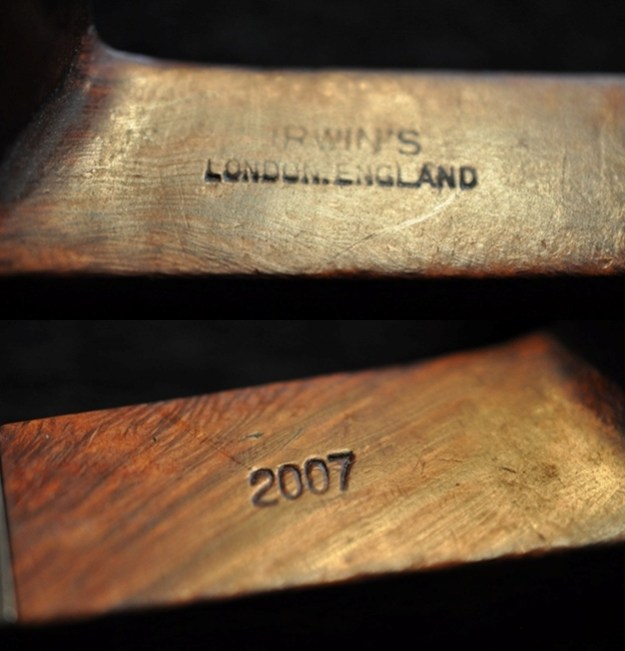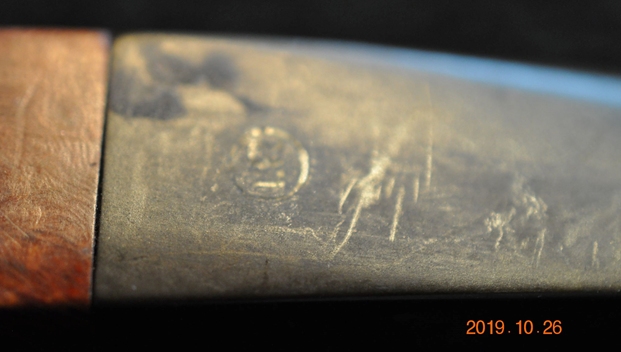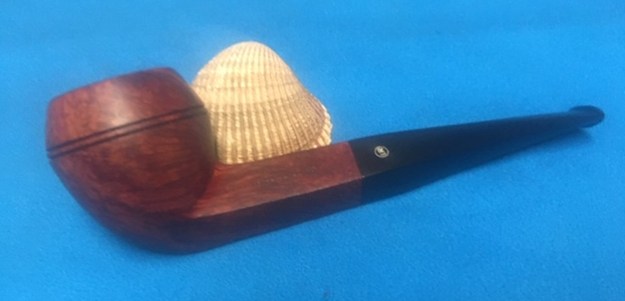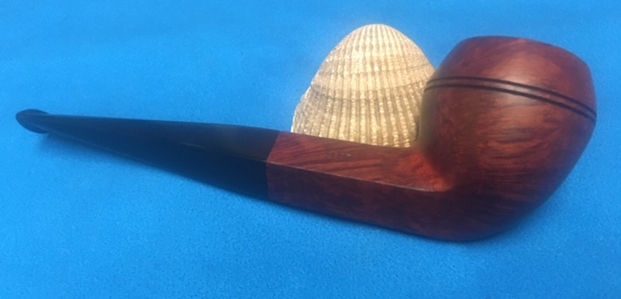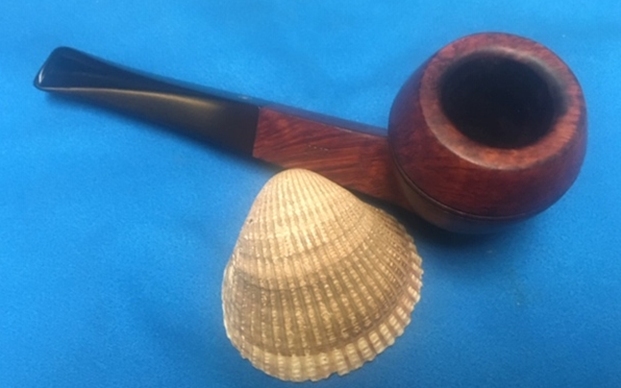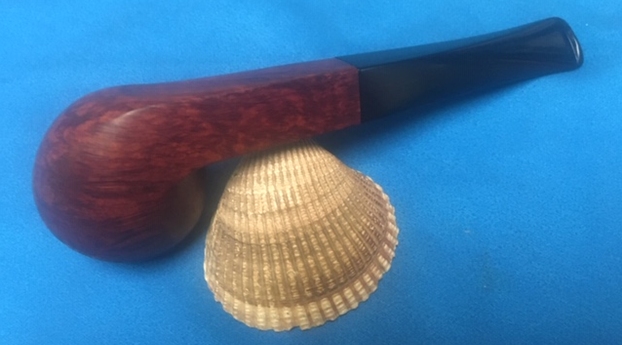
Tag Archives: polishing

My First Ever Tenon Replacement and it’s on a Preben Holm # 7 Freehand Pickaxe Pipe!!


Blog by Paresh Deshpande

The first ever Preben Holm in my collection was from eBay about two years back. It came to me with a broken stem and the tenon stuck in to the mortise. This pipe received a new lease on life in the month of May last year when Steve, Jeff and Dal Stanton visited me here in India. I learned the process of tenon replacement along with many other tips and processes in pipe restoration. Here is the link to the informative write up by Steve on this pipe; (https://rebornpipes.com/2019/05/14/restoring-a-preben-holm-hand-cut-sandblast-freehand-in-pune-india/).

The second Preben Holm in my collection came from my Mumbai Bonanza, which I really enjoyed working on; (https://rebornpipes.com/2019/08/12/refurbishing-a-tired-preben-holm-1-from-the-mumbai-bonanza-lot/).

The next two Preben Holm pipes came to me from a seller on eBay. Both these pipes had some serious stem issues which really kept other buyers away from placing their bids and lucky me, I got both these pipes for a really good price. Even though both pipes came to me together, I shall be working on them separately since they each have a different set of issues involved.

The first of these two PH pipes was restored a couple of weeks ago and it really turned out to be a gorgeous pipe. Here is the link to the write up that has been posted on rebornpipes.com (https://rebornpipes.com/2020/03/10/refurbishing-a-preben-holm-3-freehand-pipe/).

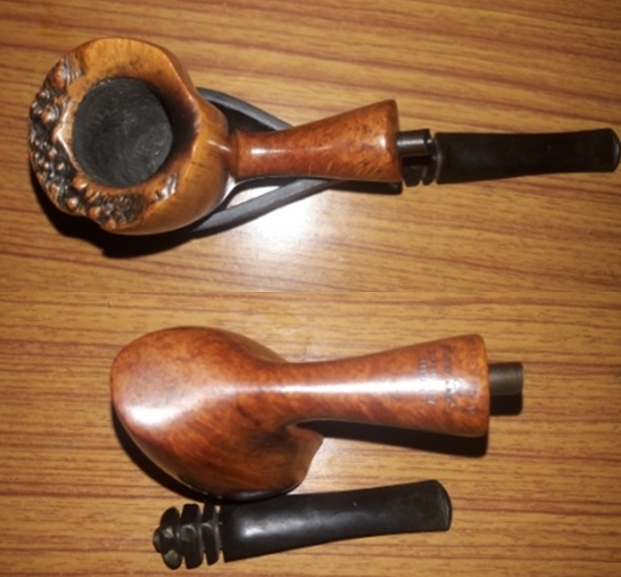
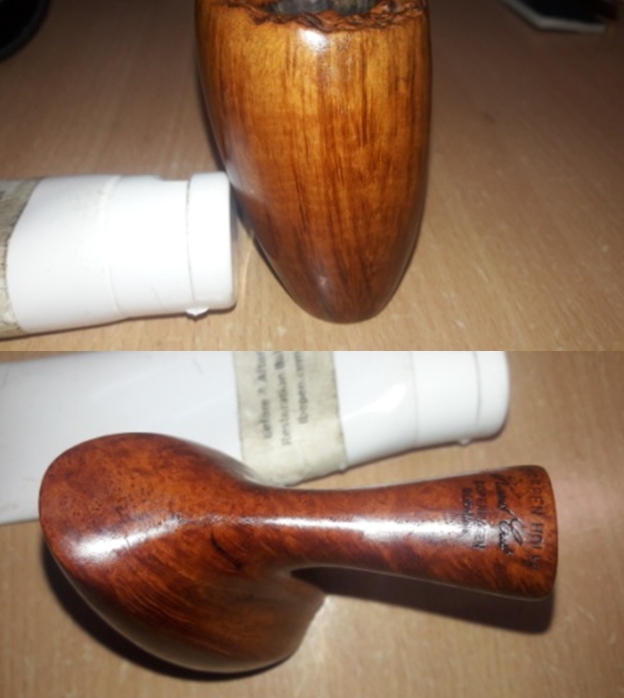
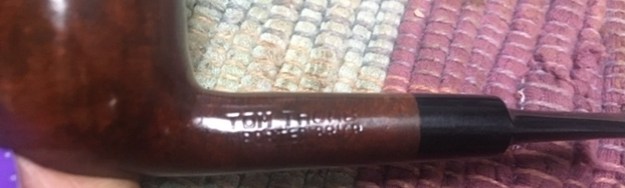
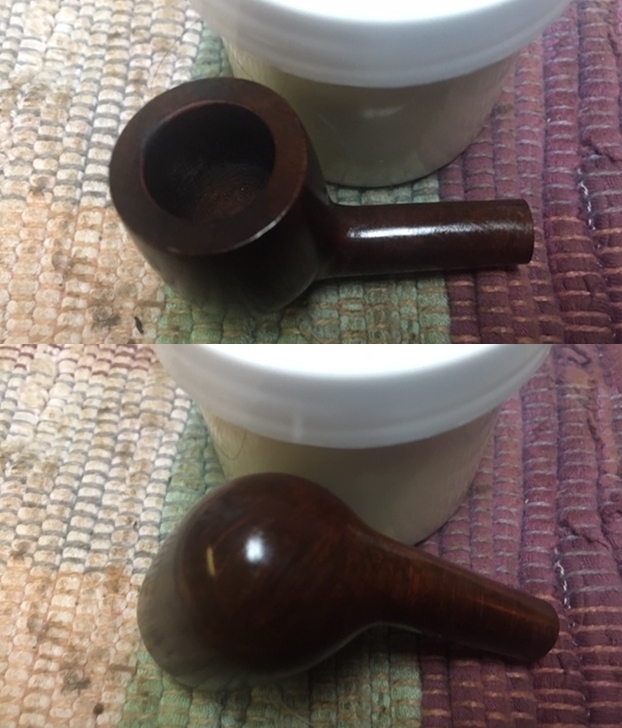
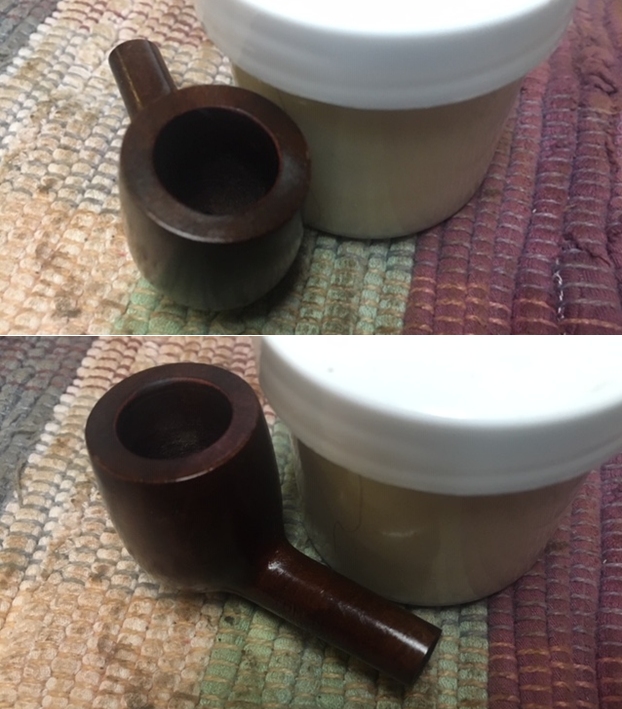
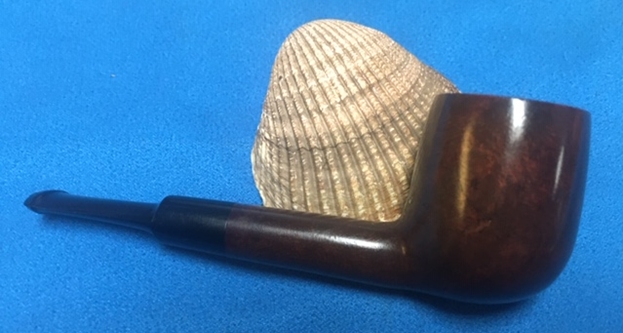
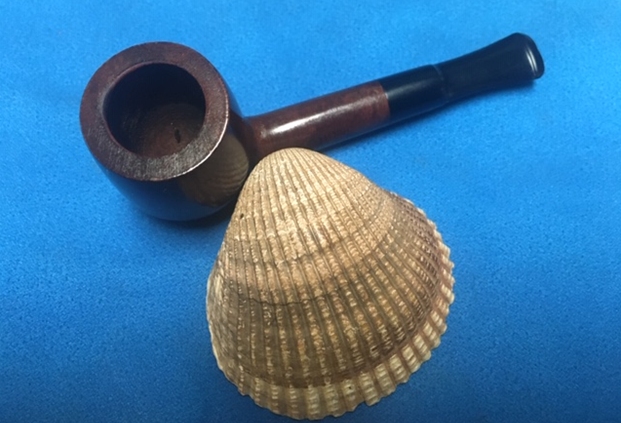
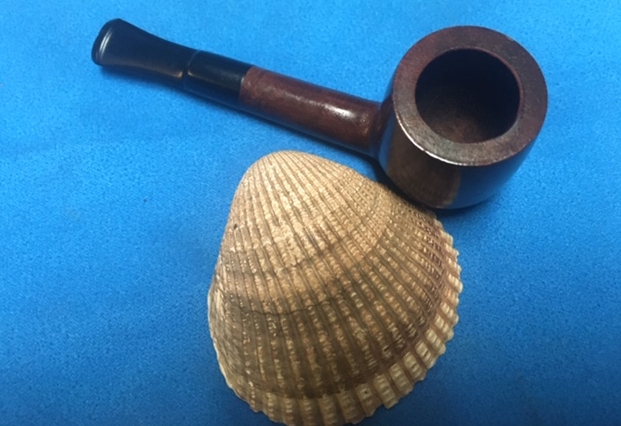
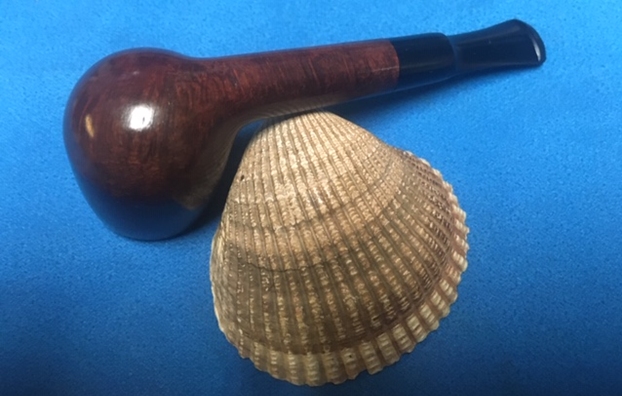
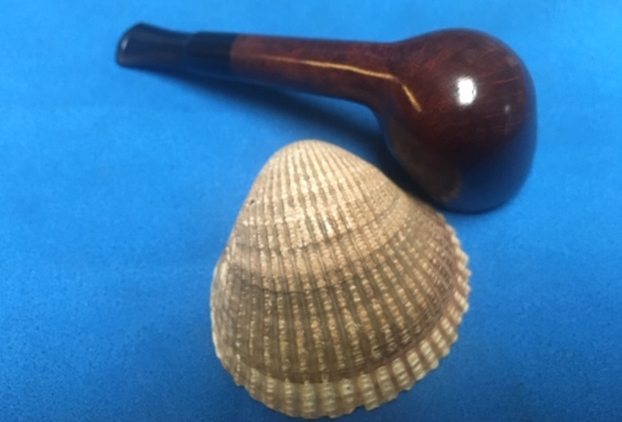
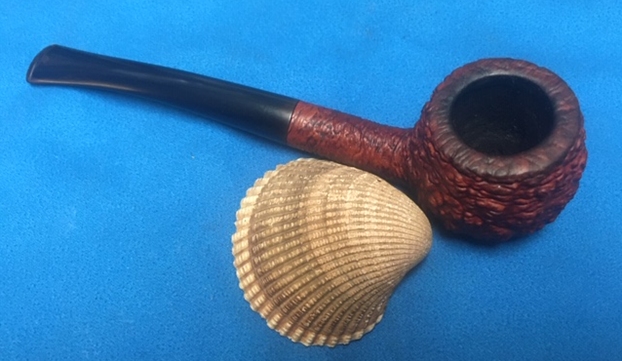
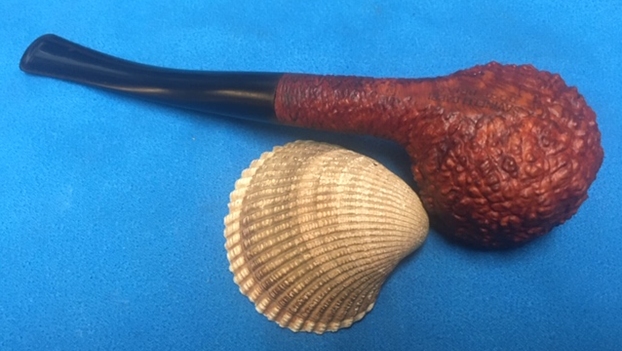
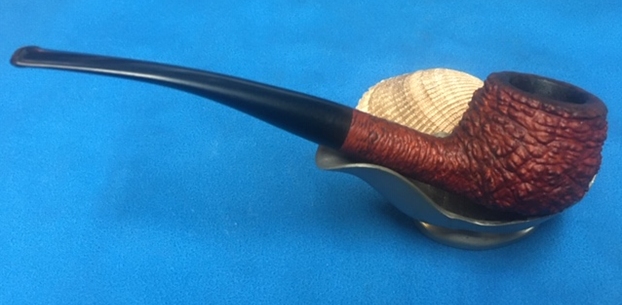
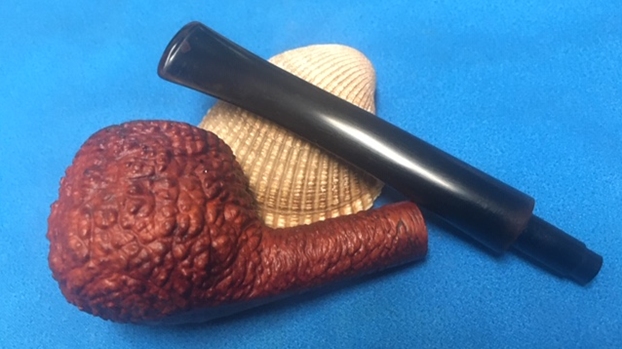
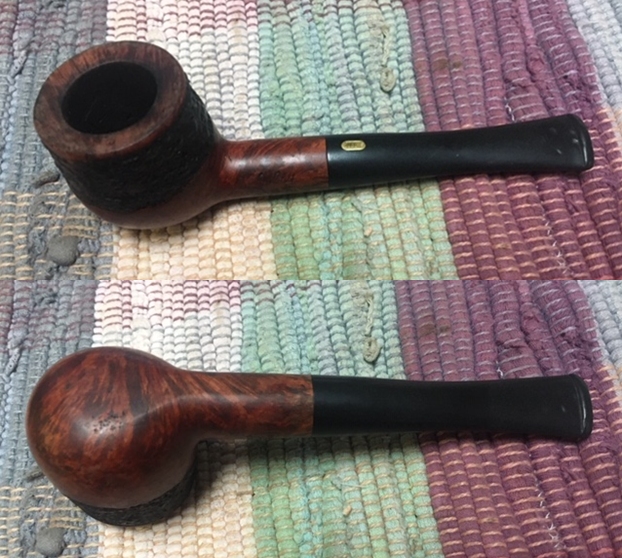
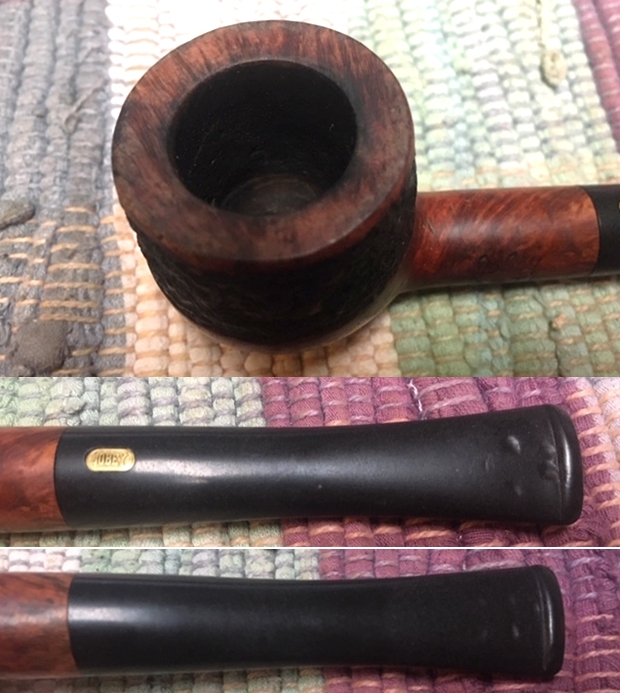
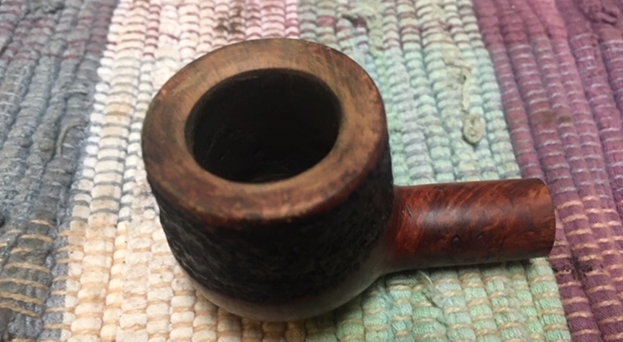
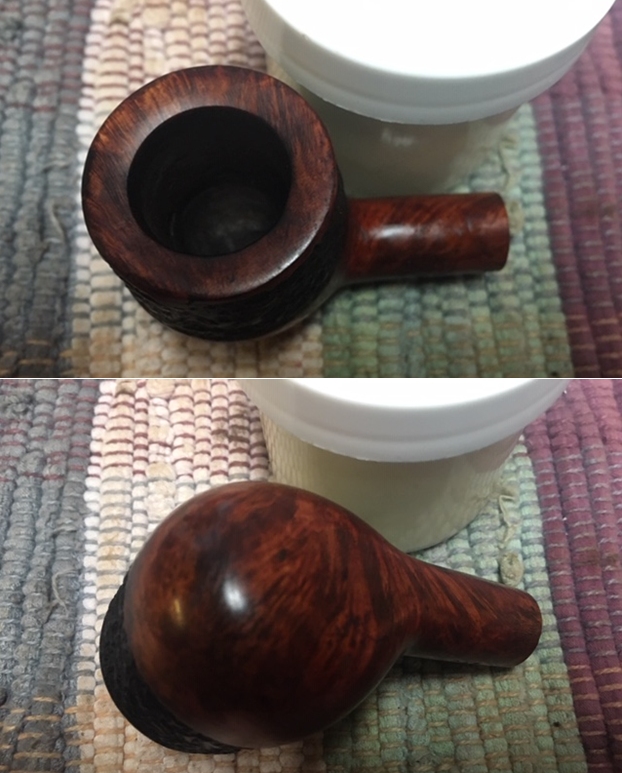
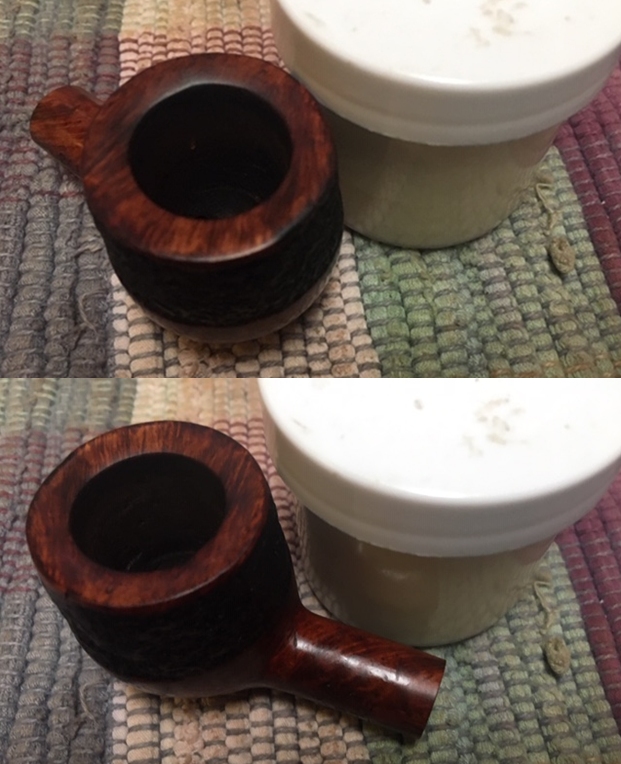
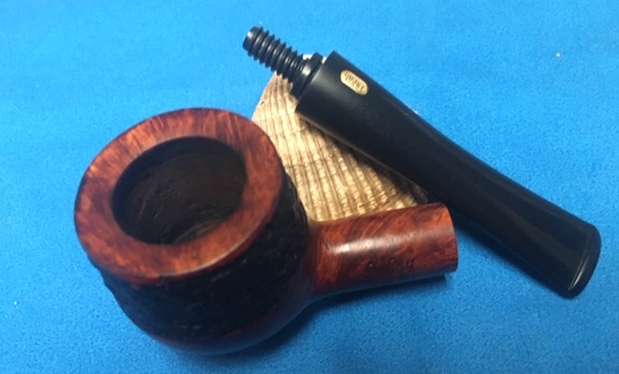
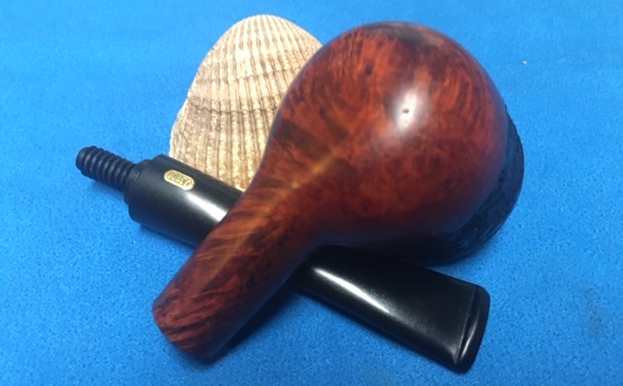
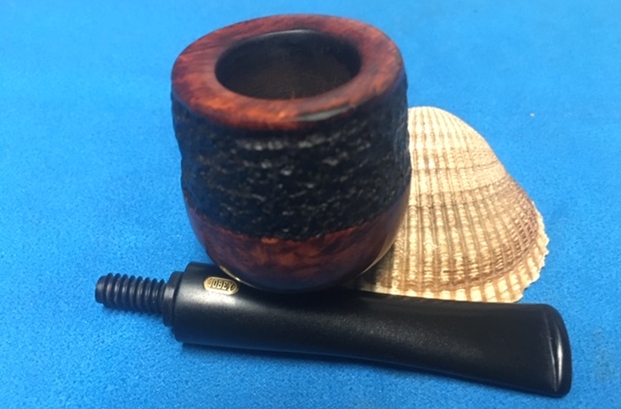
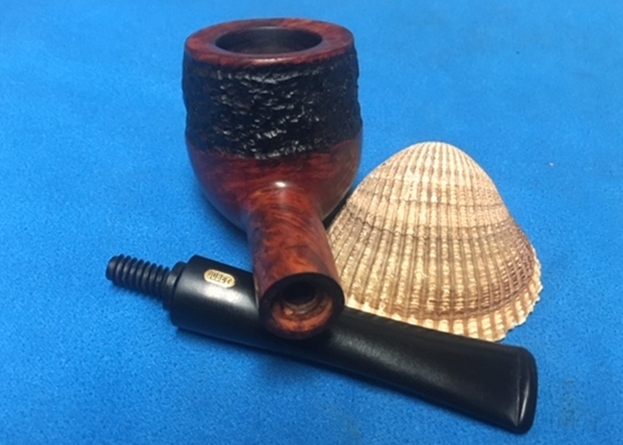
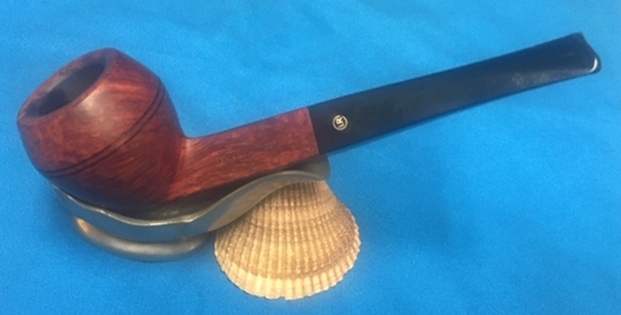
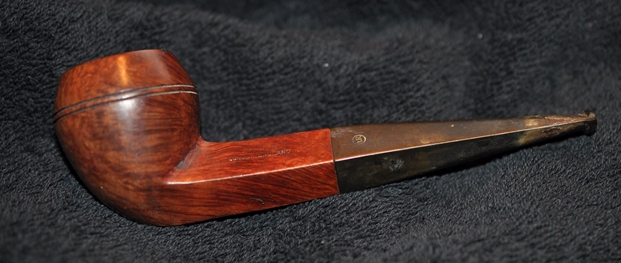
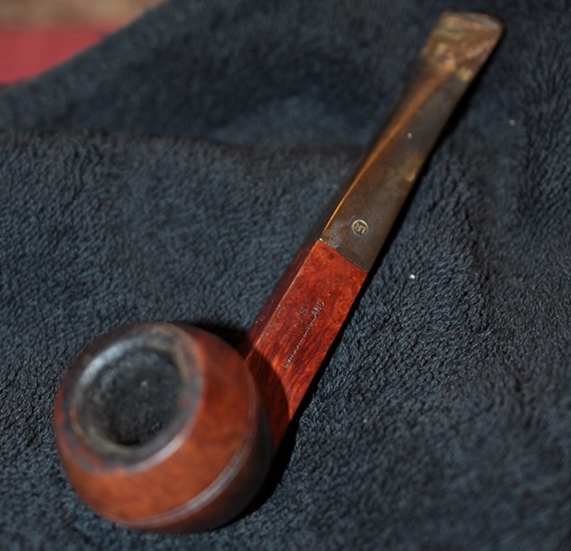
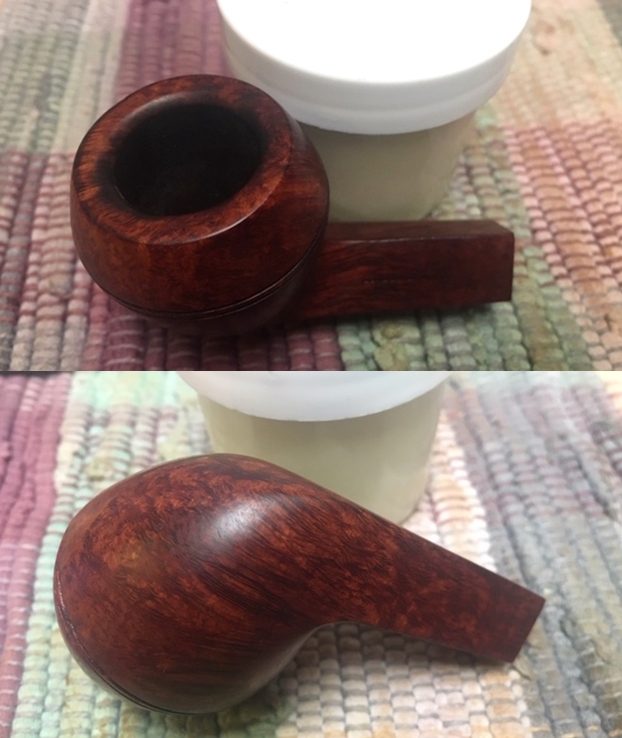
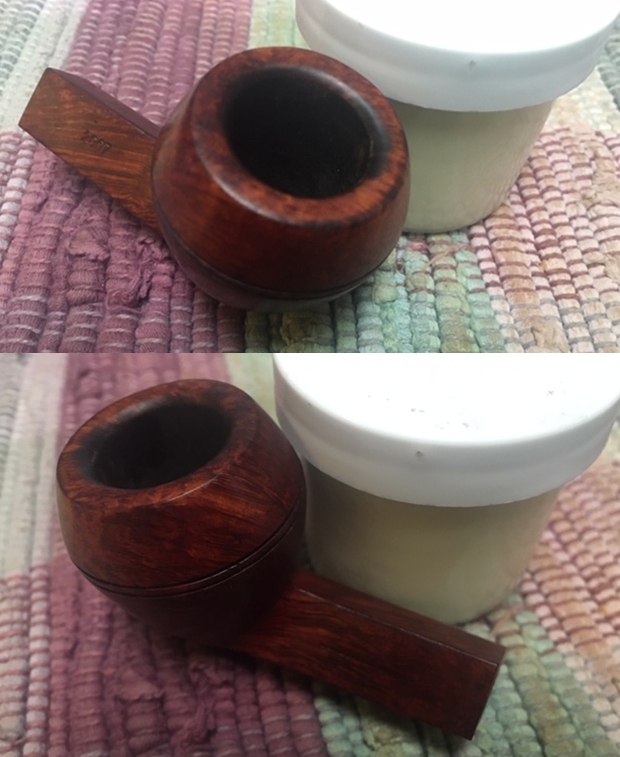
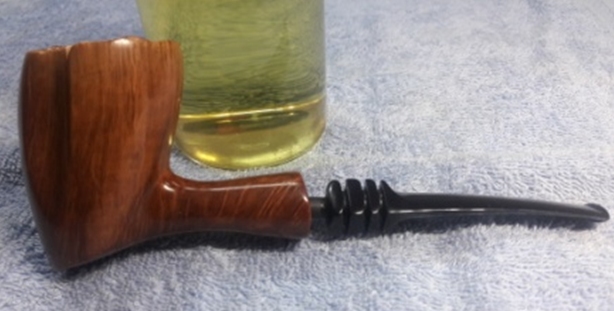
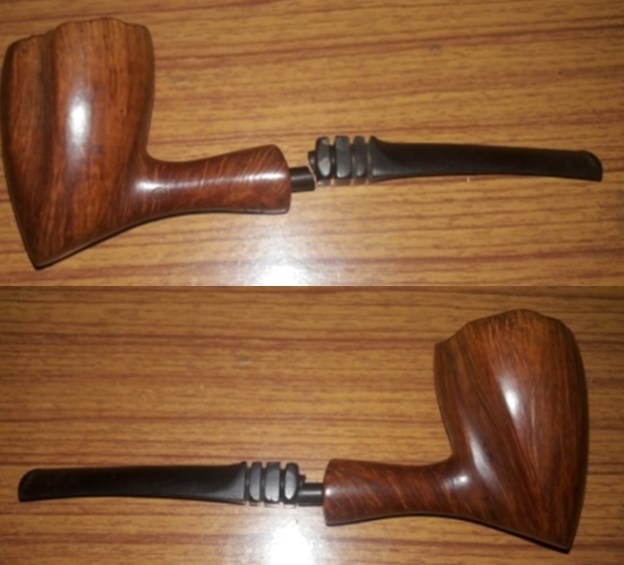
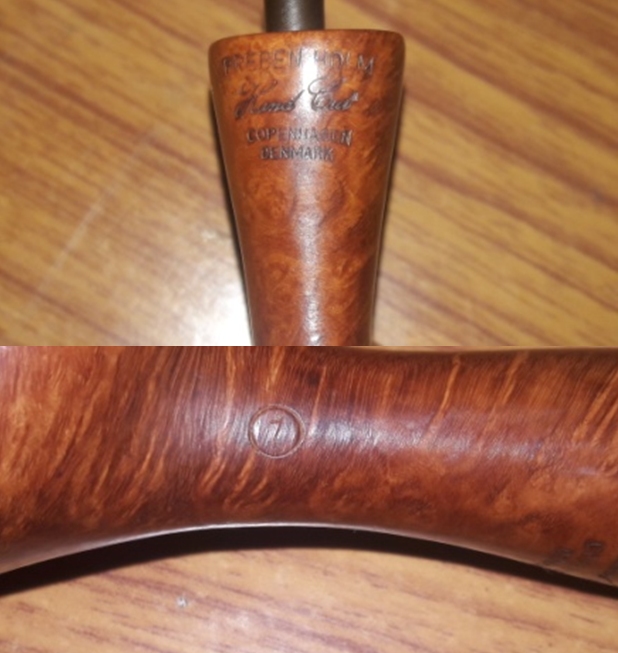
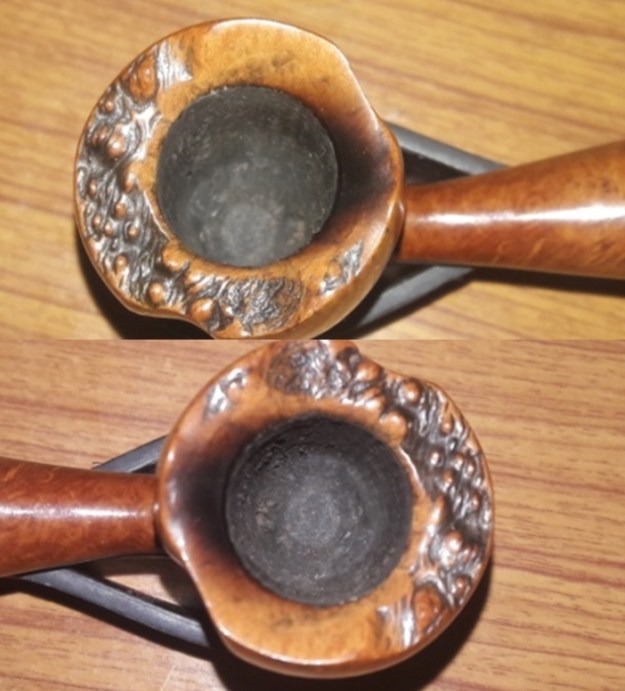
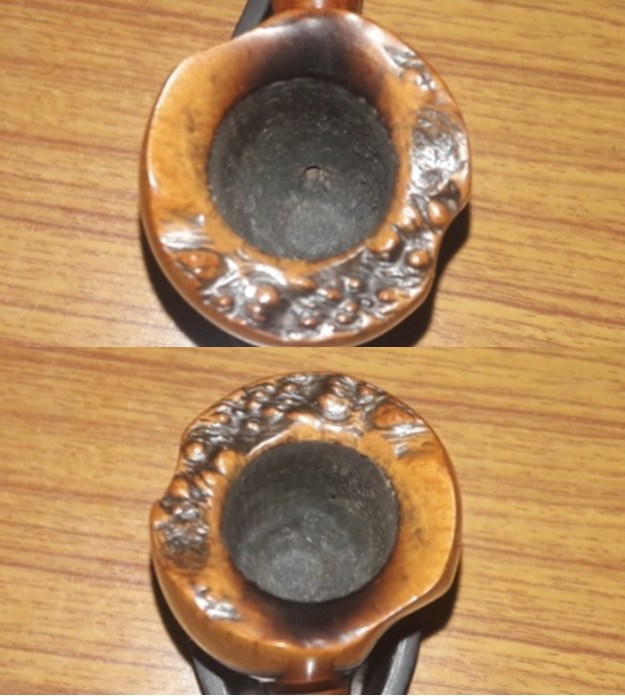
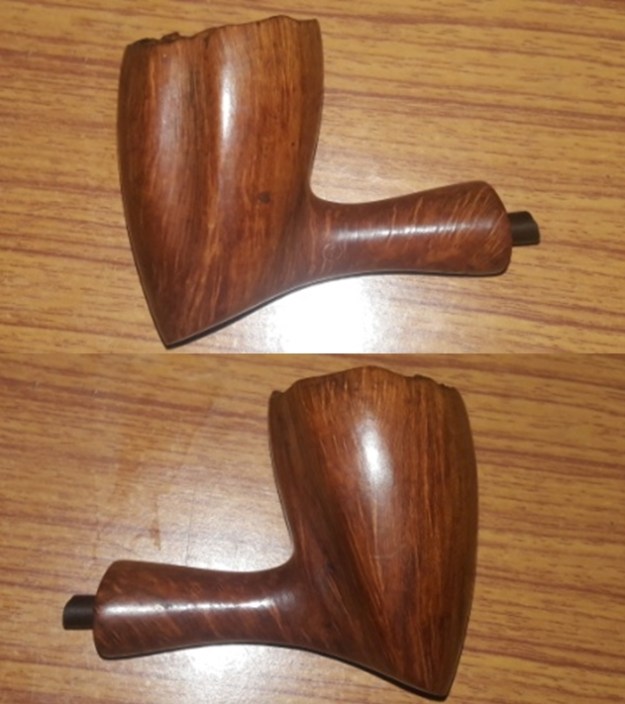
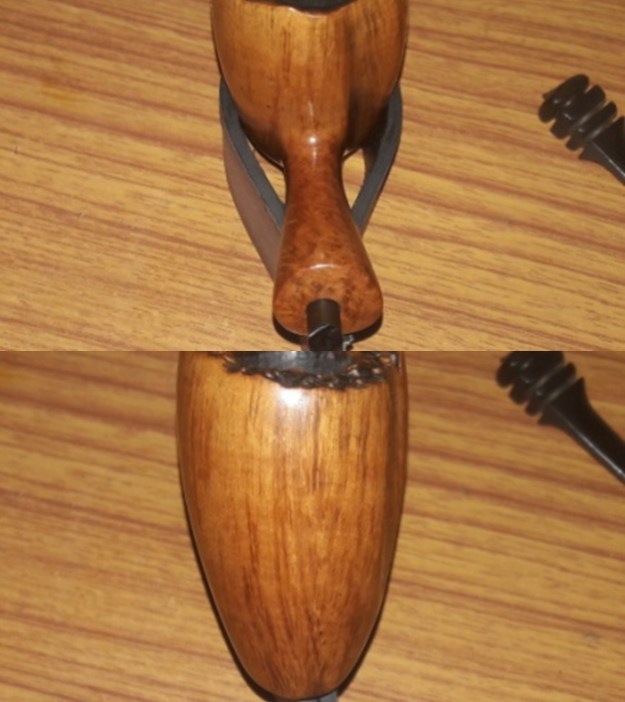
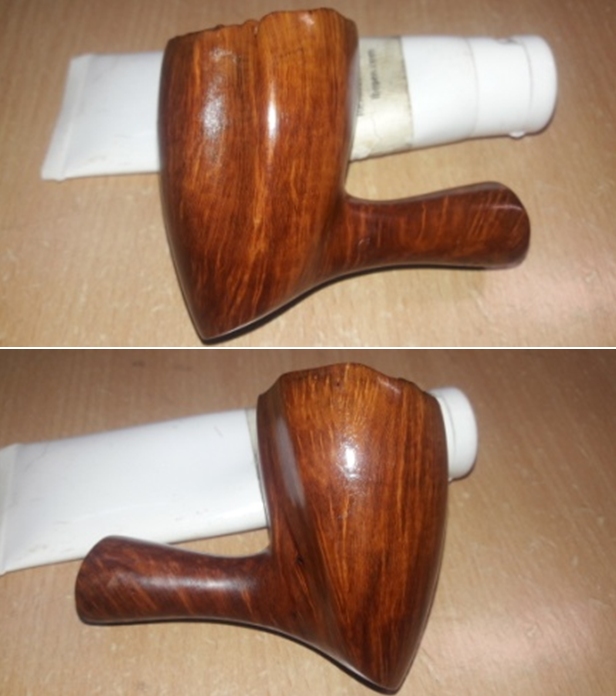
The second PH currently on my work table, is a beautiful pickaxe freehand with beautiful flame grain all around the stummel and shank and birdseye at the foot of the stummel. The rim top has remnants of plateau along the front left side and extending to the right up to half the length of the rim top. The shank end is sleek and smooth with a slight flare at the shank end, a complete contrast to the earlier PH I had worked on that had a large flare at the shank end. Here are the pictures of the pipe as it sits on my work table. The pipe is stamped on the bottom of the flared shank end as “PREBEN HOLM” in block capital letters over “Hand Cut” in a cursive artistic hand over “COPENHAGEN” over “DENMARK”, all in block capitals. The left side of the shank bears the encircled numeral “7”. All the stampings are crisp and easily readable. The fancy vulcanite stem is devoid of any stampings.There is a lot of interesting information on the carver, Preben Holm, on pipedia.org (https://pipedia.org/wiki/Holm,_Preben) which makes for an interesting read. However, there was no information or guidelines to help understand the grading and dating of these pipes from the carver. In my previous write ups on Preben Holm pipes, I had sought input on these specific aspects and was honored by studied information from esteemed readers of rebornpipes. Here is some of the information that was shared by the readers;
Roland Borchers March 10, 2020 at 8:21 am

Hi Paresh,

What a wonderful pipe and a great job (again) on the restoration. The PH pipes were 1968-1970 graded from 1 (lowest) to 8 (unicorn) .
This page from smokingpipes.com might be of interest, but there is more to be found on the www.
https://www.smokingpipes.com/pipes/estate/denmark/moreinfo.cfm?product_id=136933

So a 3 is not bad at all…

Best wishes,

Roland

I followed the link forwarded by Mr. Roland Borchers and reproduce the information gleaned;

“Now that my pulse has returned to (vaguely) normal. Preben Holm pipes which bear a single grading number in a circle, represent Holm’s earliest ‘Hand Cuts’, a period that most estimate between 1968 and 1970. Prior to handling this amazing jewel, the highest grade that I had encountered was a ‘5’. Once (just once) I saw a smoked ‘7’ offered across the pond for a price that could feed a decent sized village for a month (mild exaggeration, but you get the idea). Here we have a ‘6’, featuring both the conservancy of shape that one would expect from the earliest days, as well as a grain worthy of such a lofty grade designation. Forty (plus) years young, utterly unsmoked and it comes with both the original presentation box and sleeve. For Pete’s sake, don’t let this one get away”.

–R. ‘Bear’ Graves

borman August 15, 2019 at 5:44 pm

Not sure how correct I am but… pipes 1-4 as such are lower to higher quality rating as A-E is low to high. The bone extensions that I have had and others I have seen appear to be from the 60’s. Hope I am not far off and also I hope it helps you.

Thus from the above information, it’s evident that this beautiful Preben Holm pipe in my hand is a very rare # 7, top grade and very expensive pipe from 1960s…

INITIAL VISUAL INSPECTION
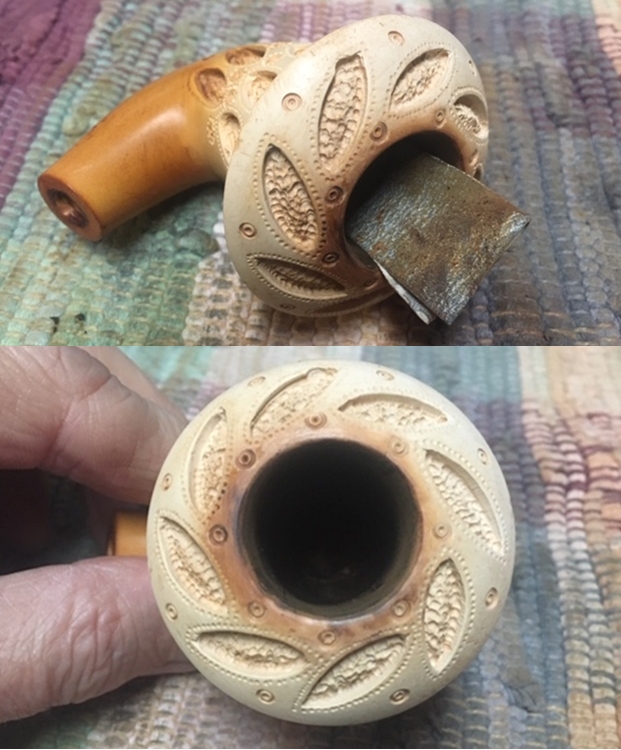
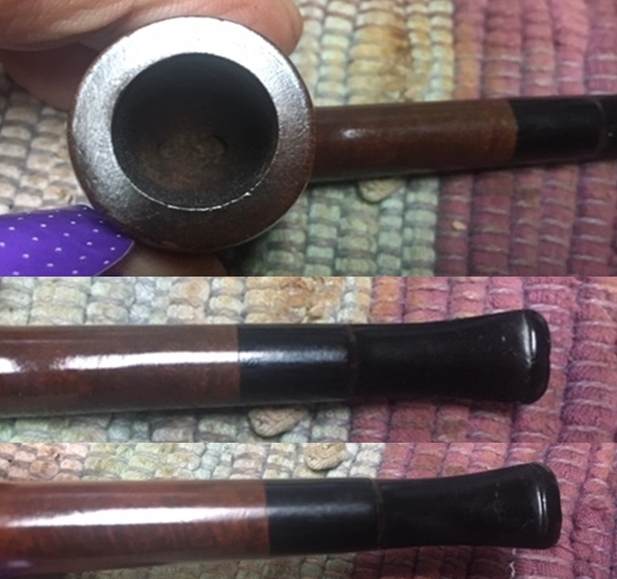
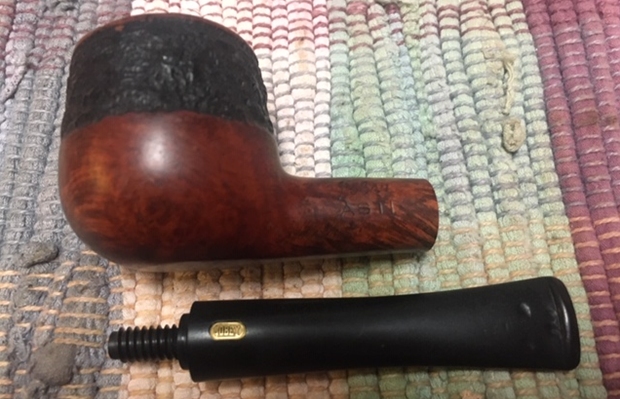
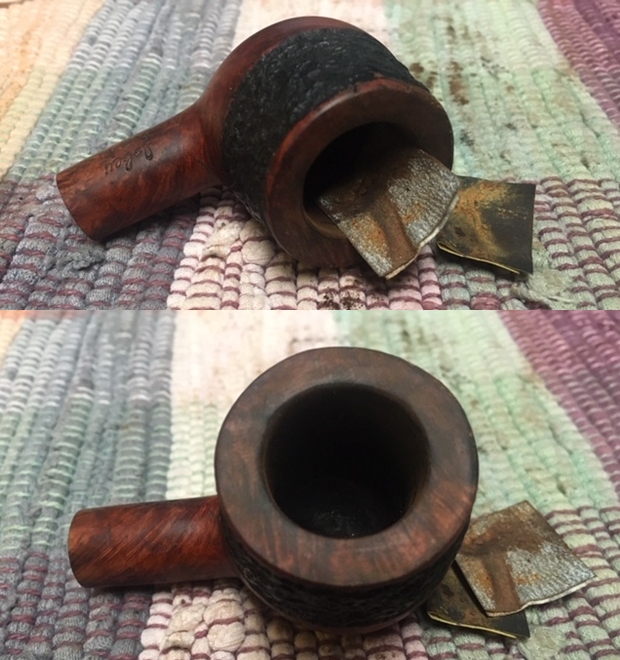
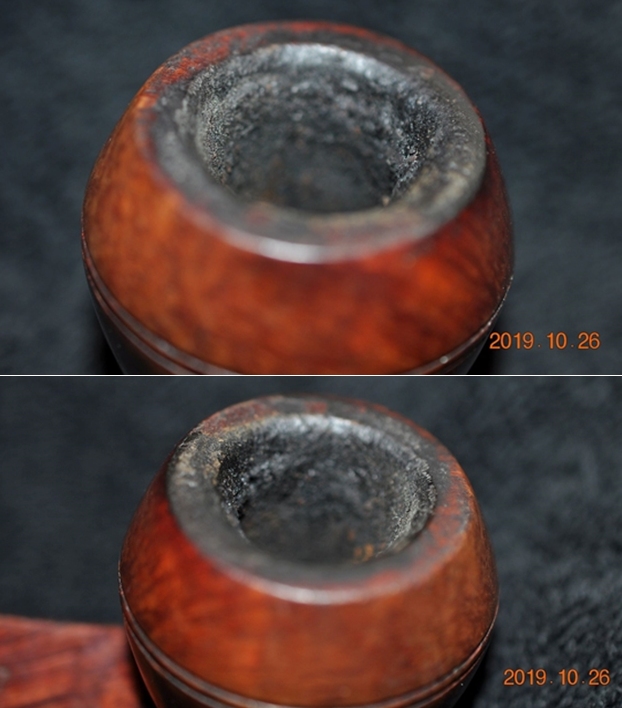
The first and foremost issue that I noticed and was aware of from the description given by the seller is that of the broken tenon. Most of the readers must be wondering as to the rational of buying a pipe, even a Preben Holm, with a broken tenon and it’s a logical question. However, there are two main reasons why I went in for this purchase; firstly my friend and guru, Steve had demonstrated how to replace a broken tenon and I was keen to try my hand at it and secondly was the economic consideration!! Pray tell me if it is possible to get a grade 7 early hand-cut Preben Holm from the 1960s at USD $65, including shipping!! Never, I say. Below are the pictures of the broken tenon stuck in to the mortise. This is going to be a challenging repair being my first tenon replacement.The chamber has a very thin layer of dry and hard cake with the slightly outward flared inner rim edge showing darkening in the 6 o’clock direction. The condition of the inner walls of the chamber can be checked and ascertained only after the cake has been taken down to the bare briar. However, I do not envisage any damage to the chamber walls. There is negligible lava overflow and debris embedded in the plateau of the rim top surface. It is my guess that this pipe suffered said catastrophic damage very early in its existence and had since been languishing in a box with the previous piper before he decided to get rid of it. The stummel boasts of beautiful straight grain all around and extends over the shank surface too!! The surface is relatively clean and without any fills save for a few very minor scratches that could have been caused during routine use. The slightly flared smooth end of the shank is clean. The foot of the stummel shows beautiful bird’s eye grains and is sans any damage. Overall, the stummel presents a sparingly used and a well-cared for pipe. The mortise has the broken tenon stuck in to it. However, given the condition of the chamber and the overall pristine appearance of the stummel, I think the mortise should be clean too!!
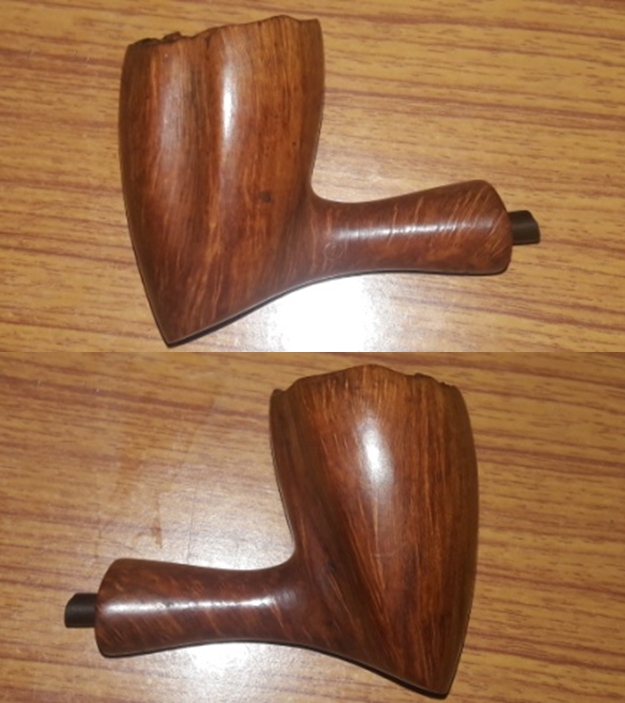
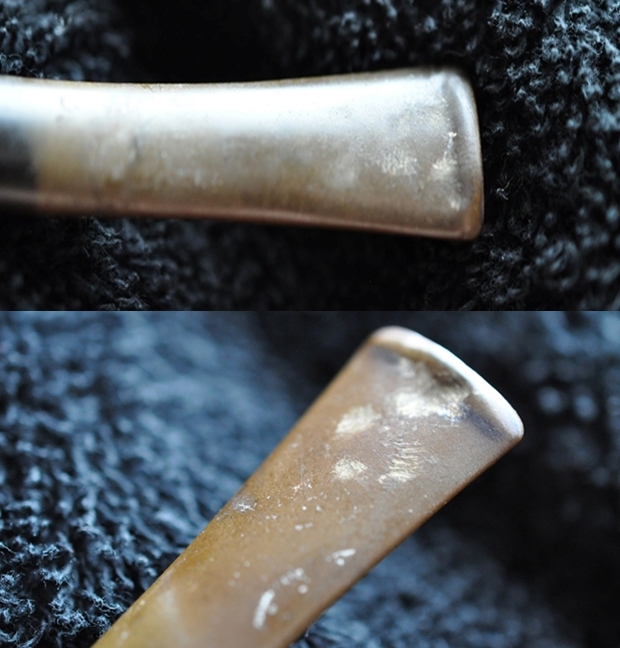
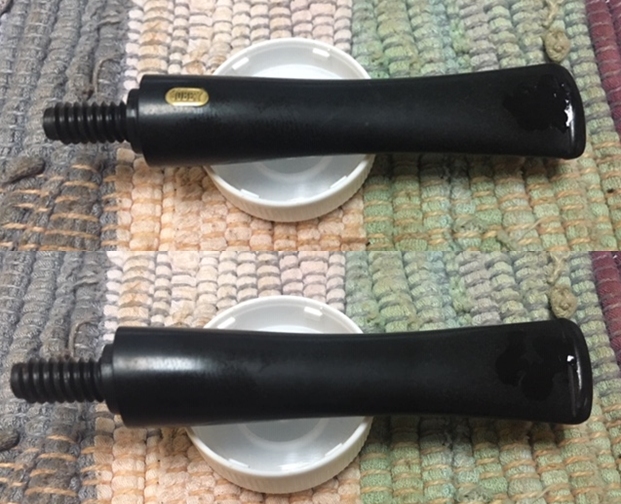
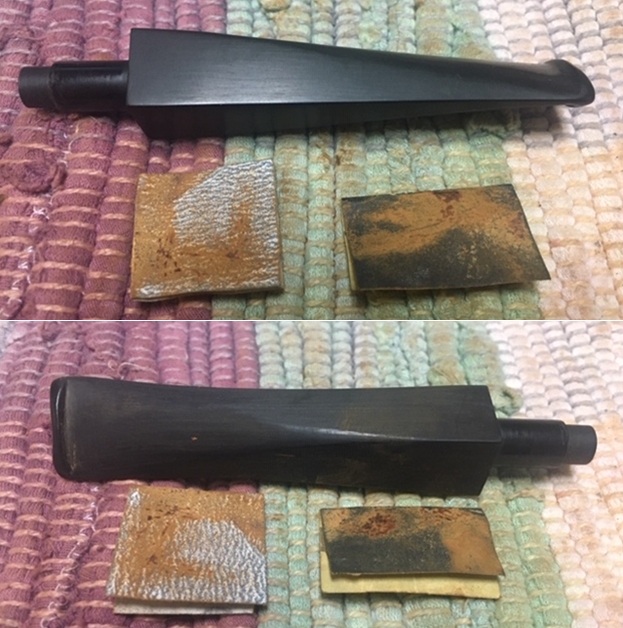
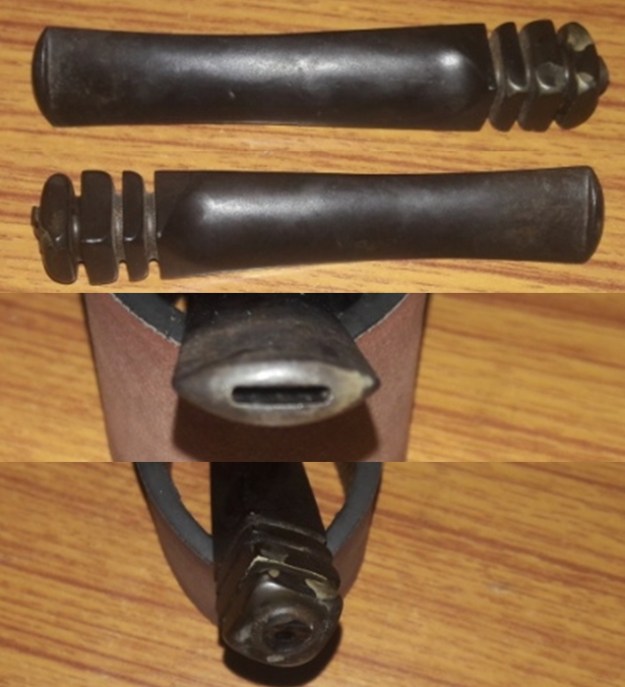
The fancy vulcanite stem shows traces of oxidation and is otherwise sans any major damage. The horizontal slot end of the stem is heavily oxidized to a dark brown coloration. The broken tenon end is jagged and sharp at the place where the tenon has snapped. The fancy stem, though it looks beautiful when black and shiny, is a bear to clean with all the dips and narrow gaps between the beads and rings etc.THE PROCESS
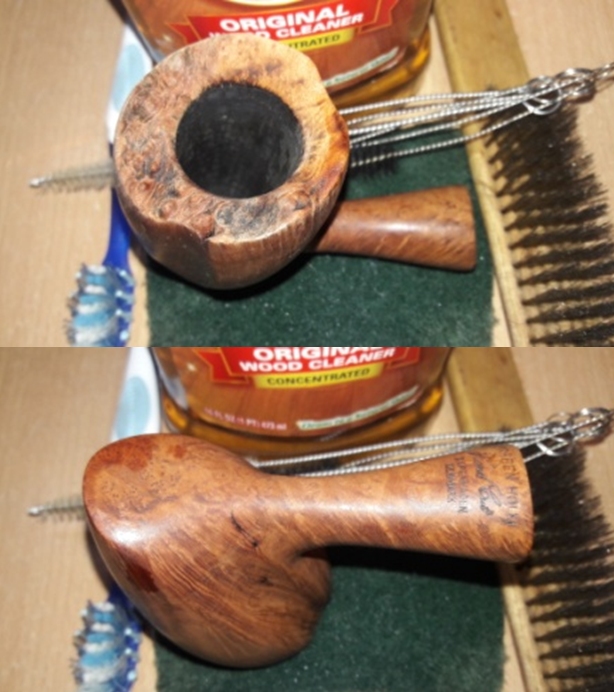
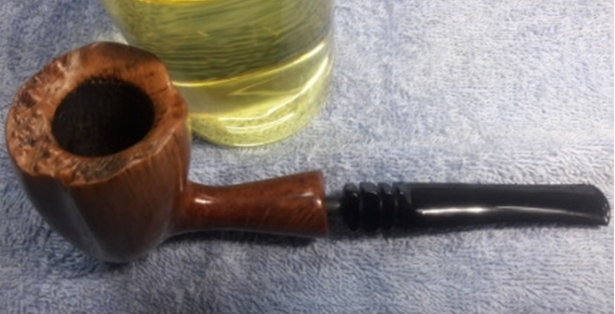
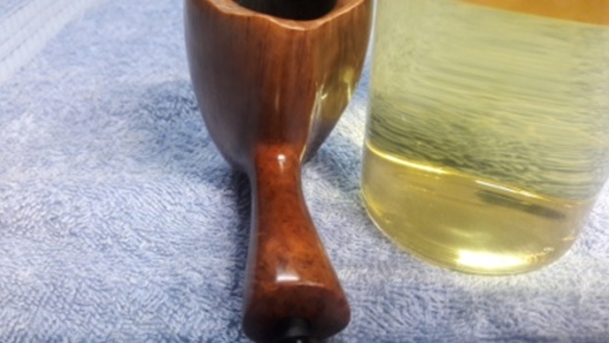
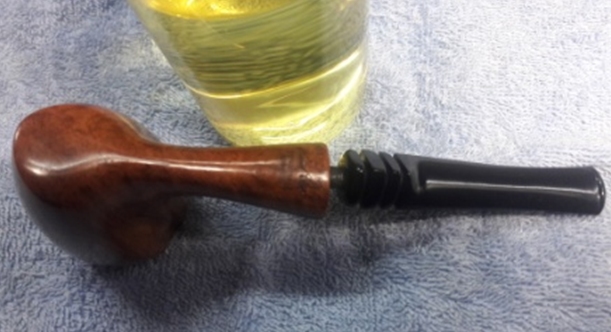
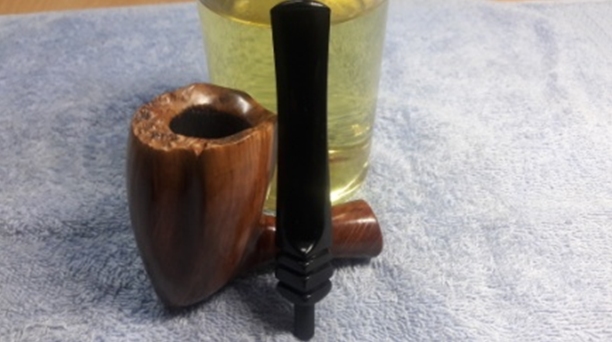
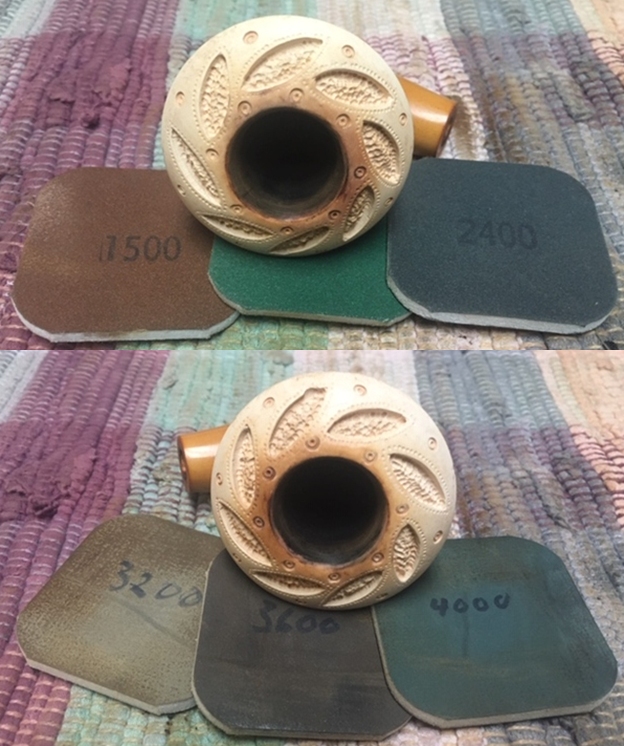
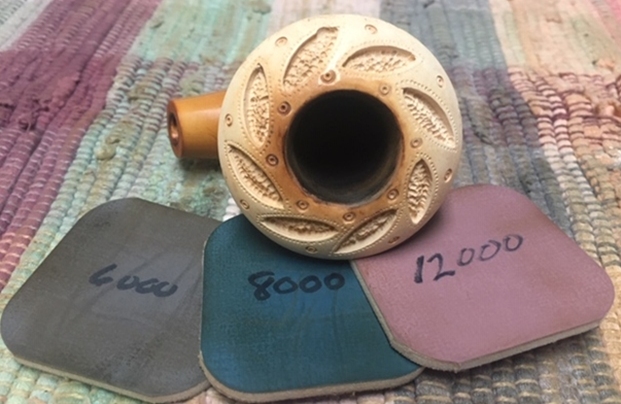
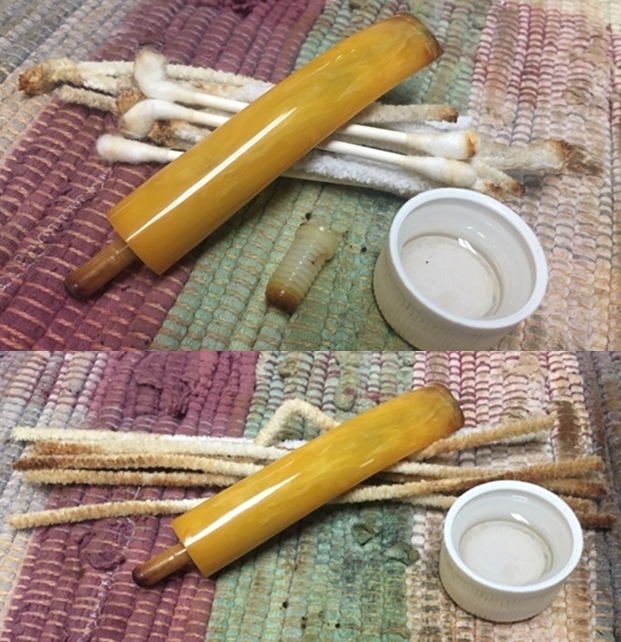
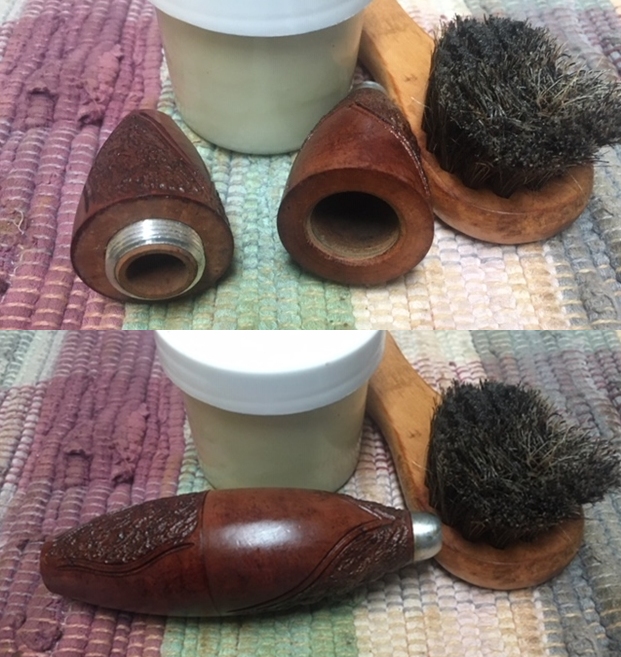
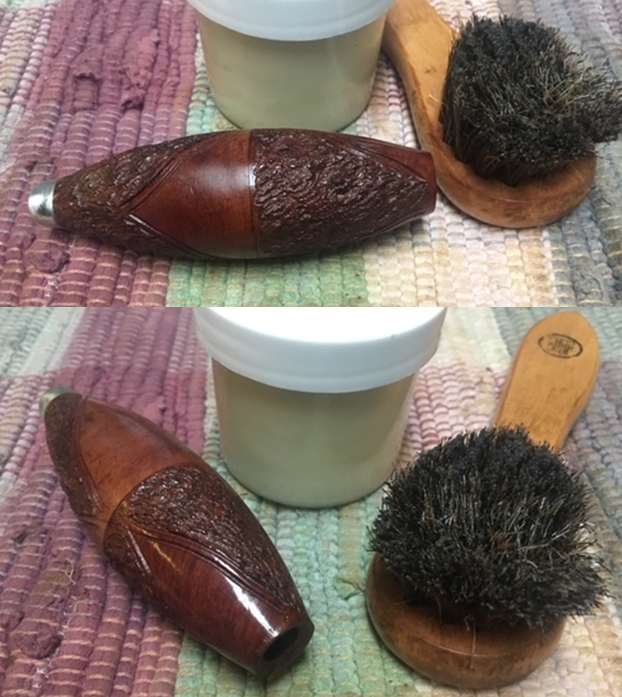
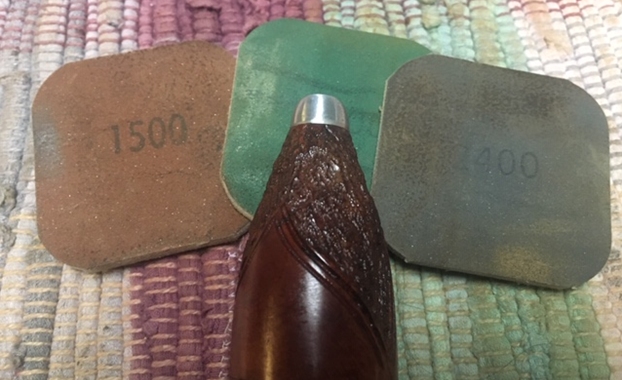
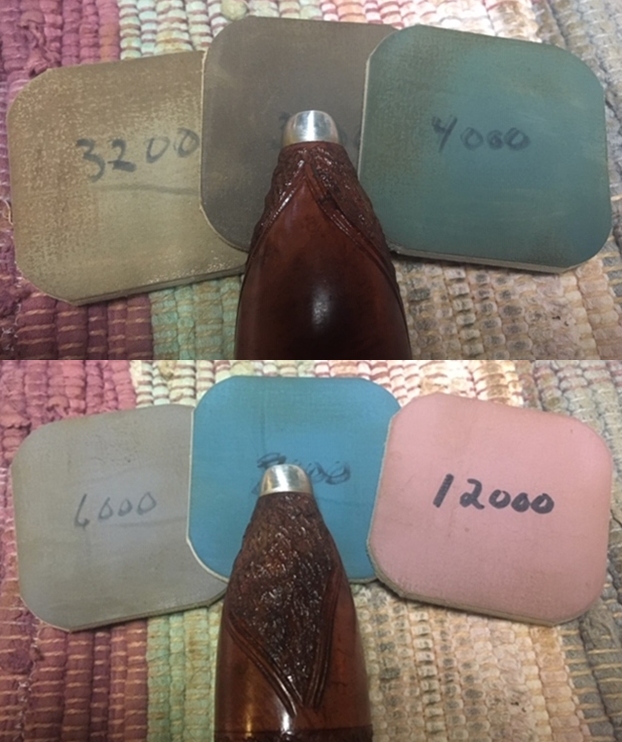
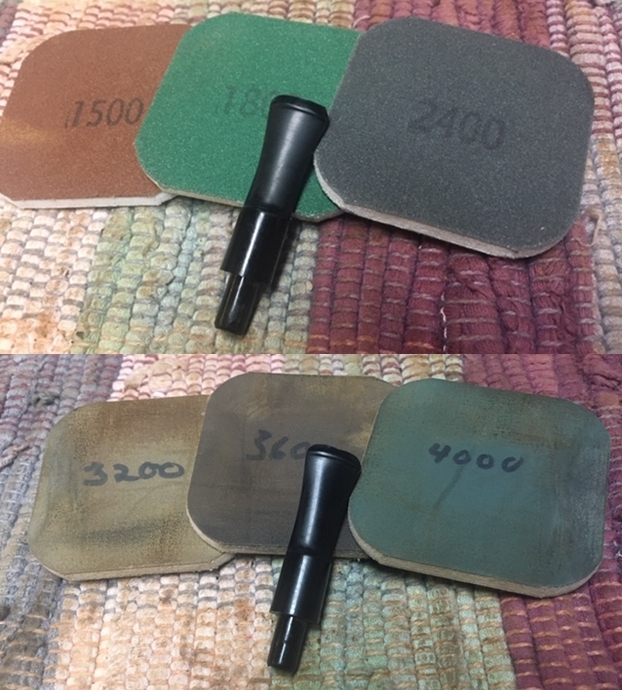
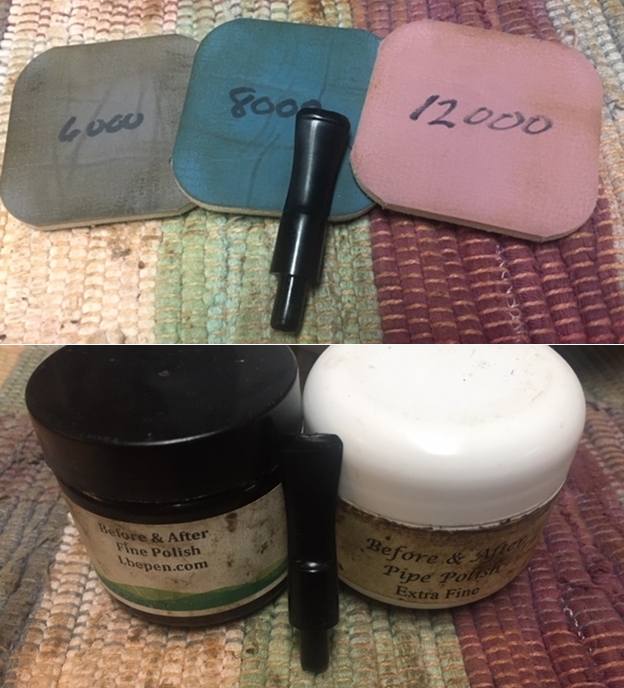
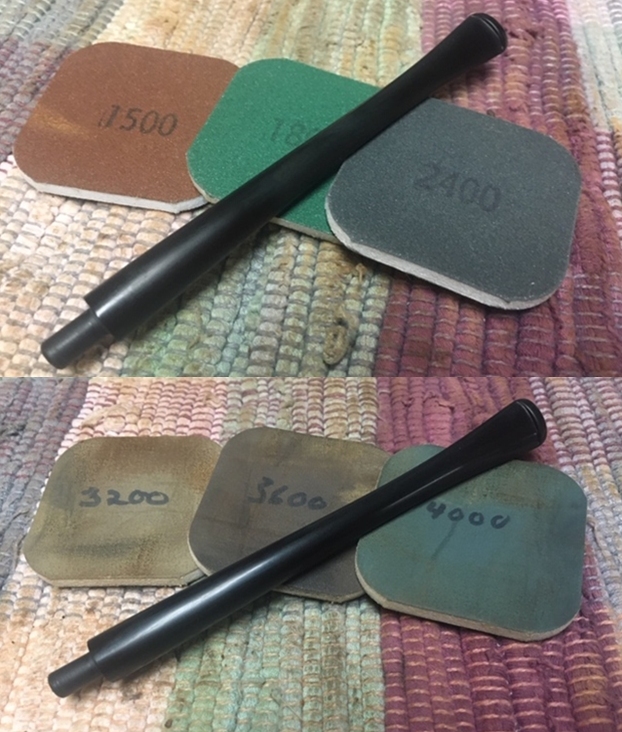
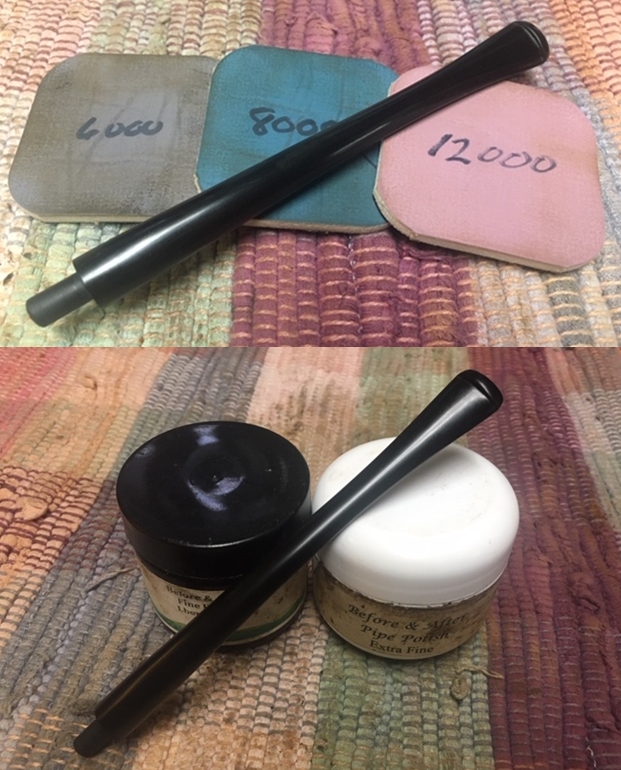
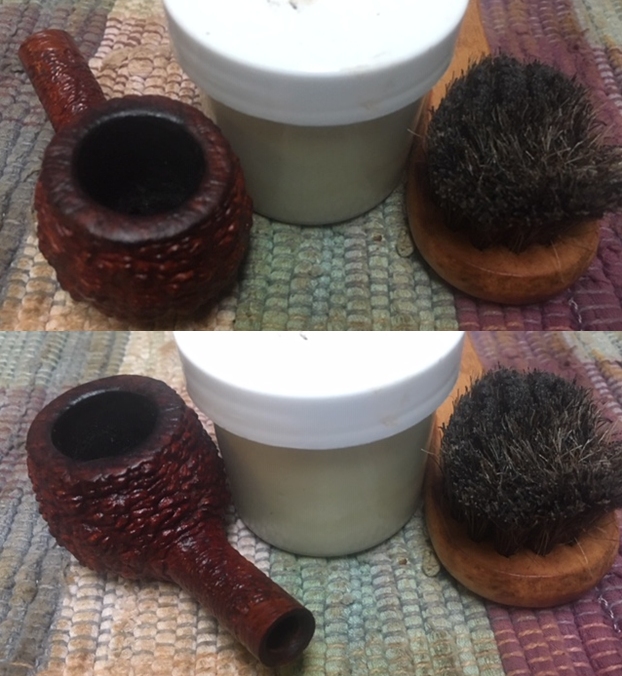
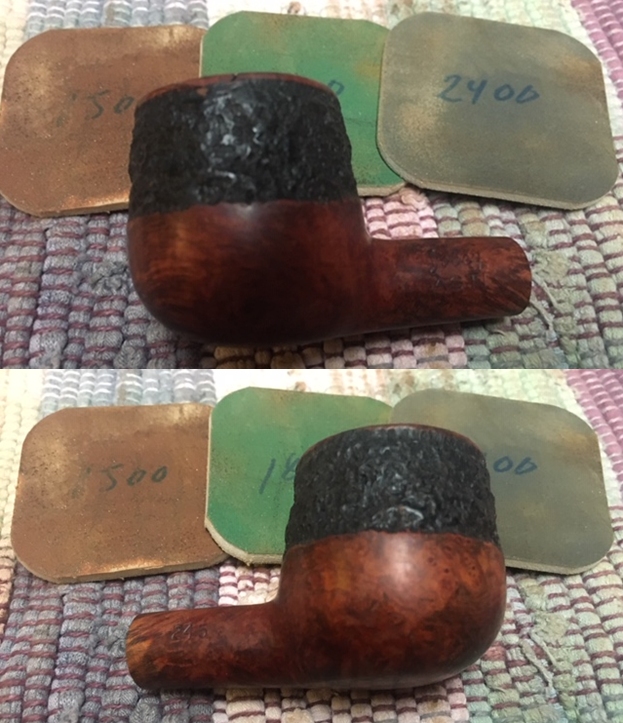
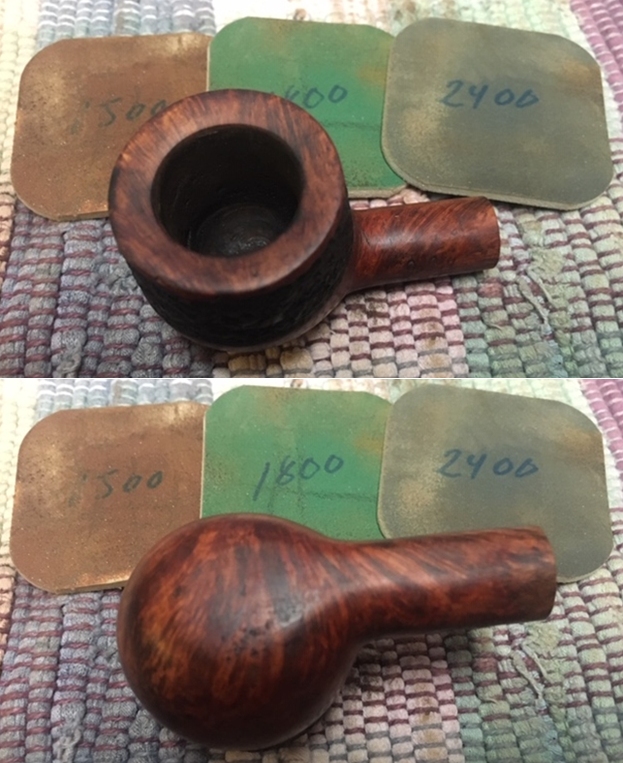
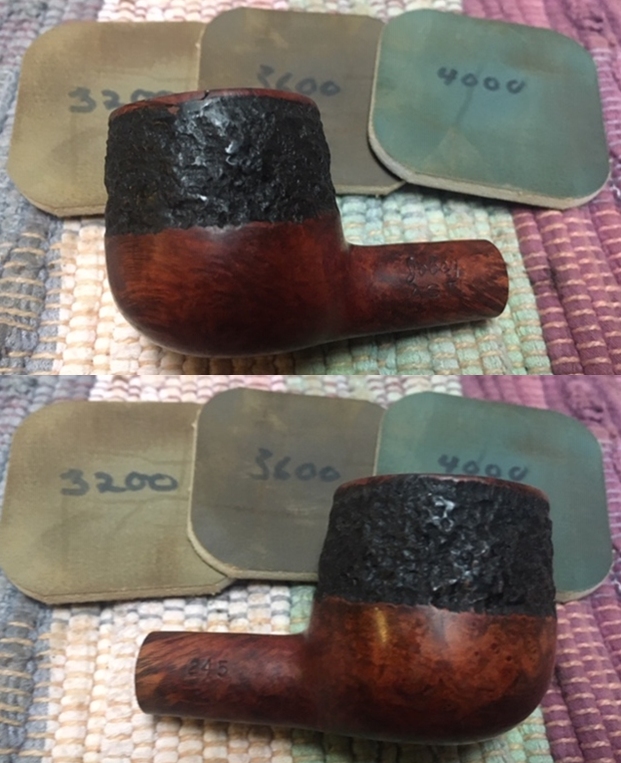
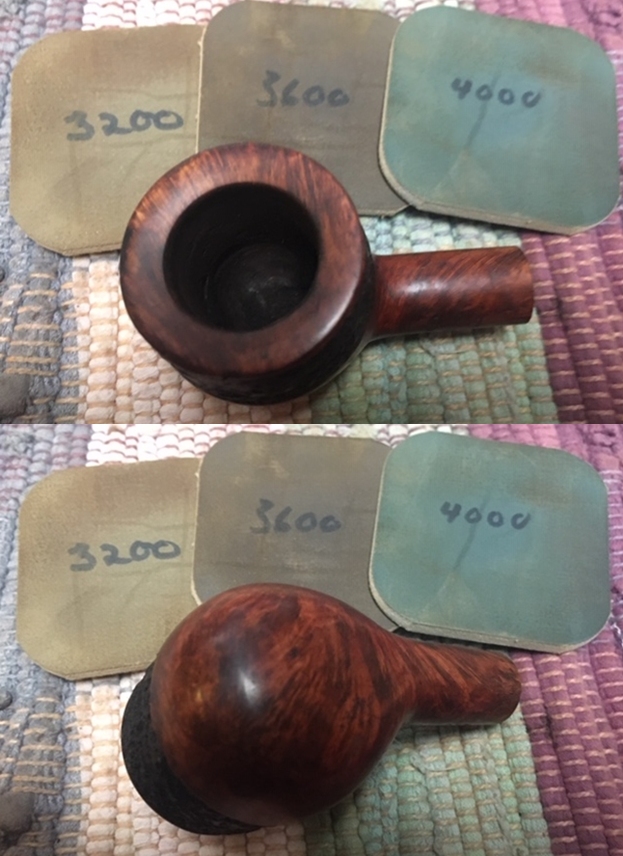
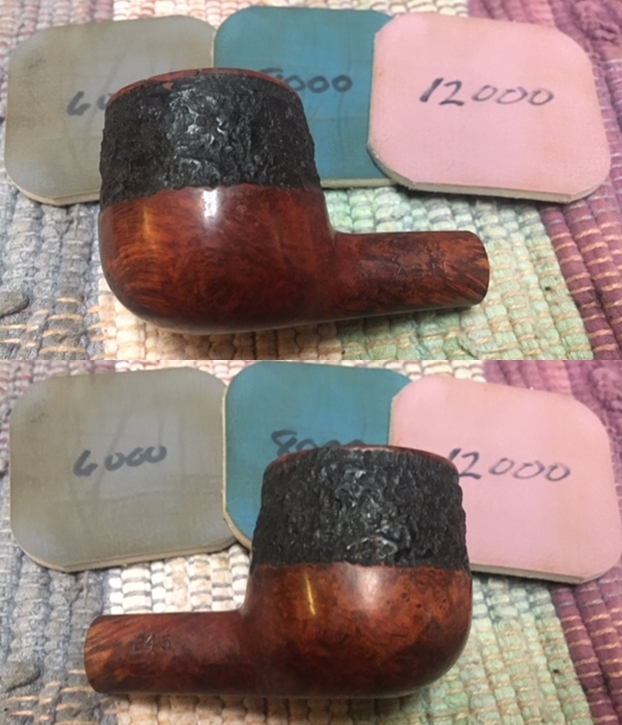
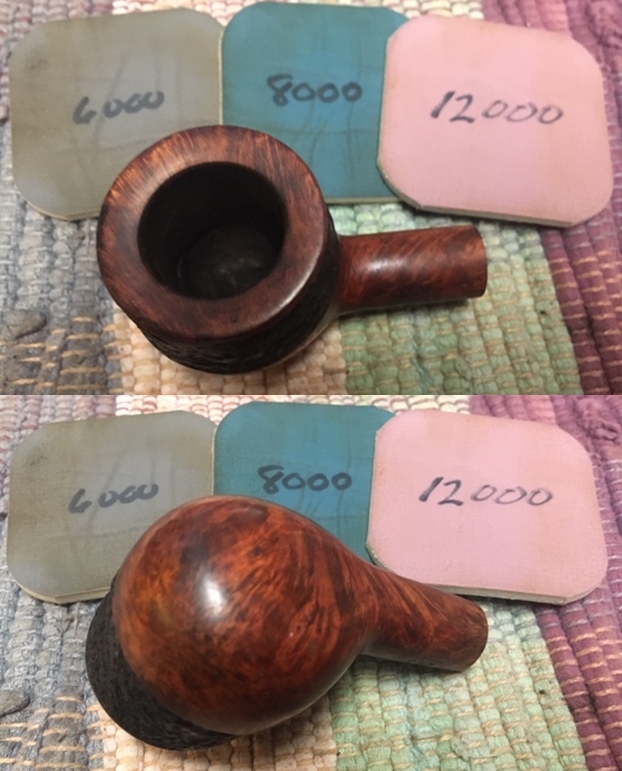
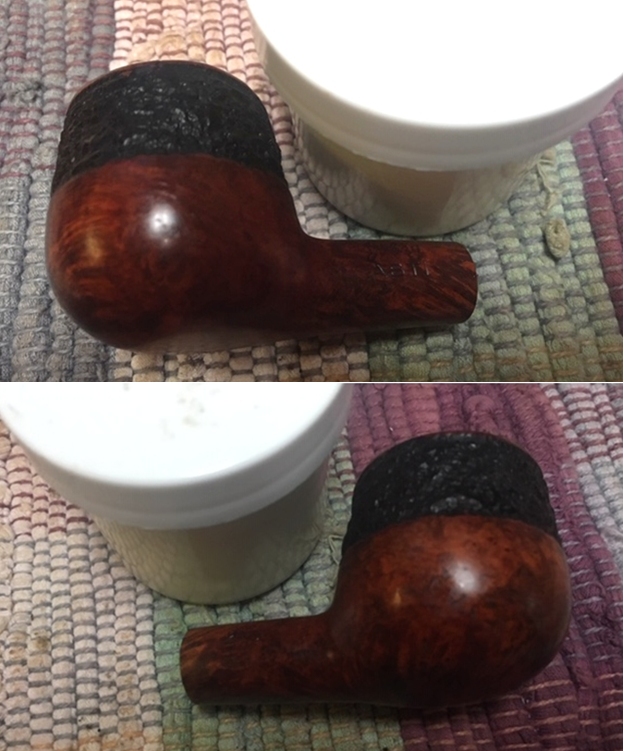
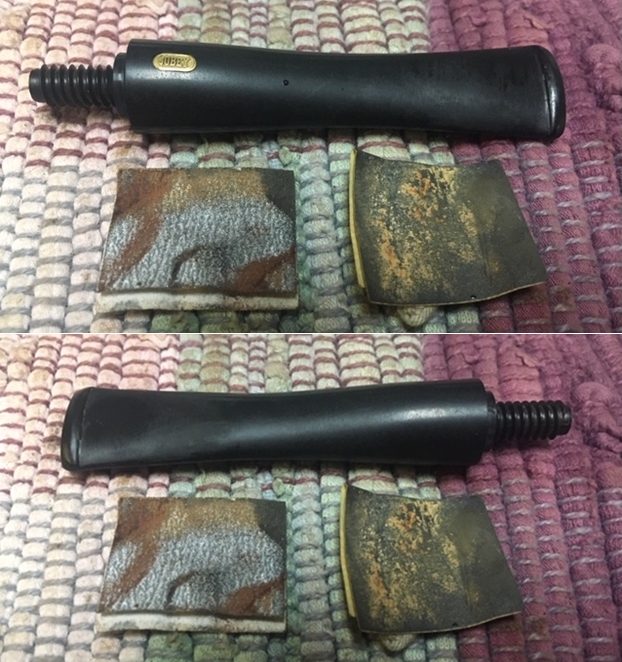
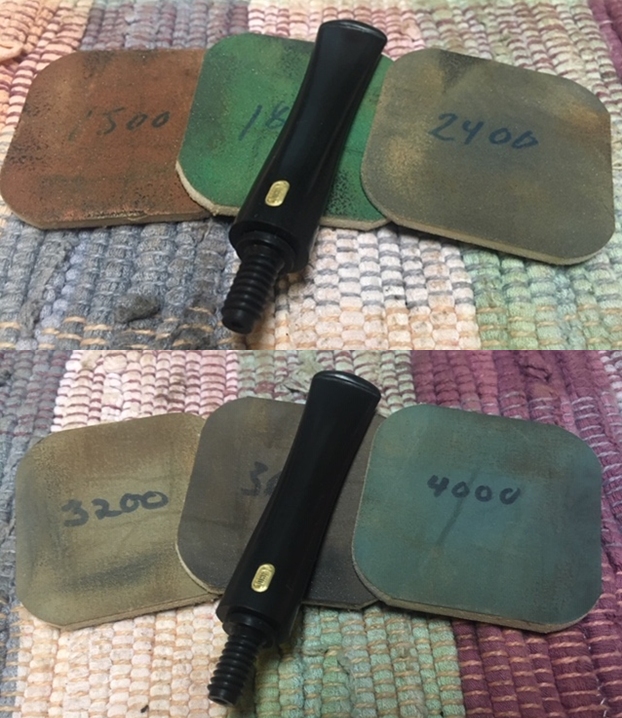
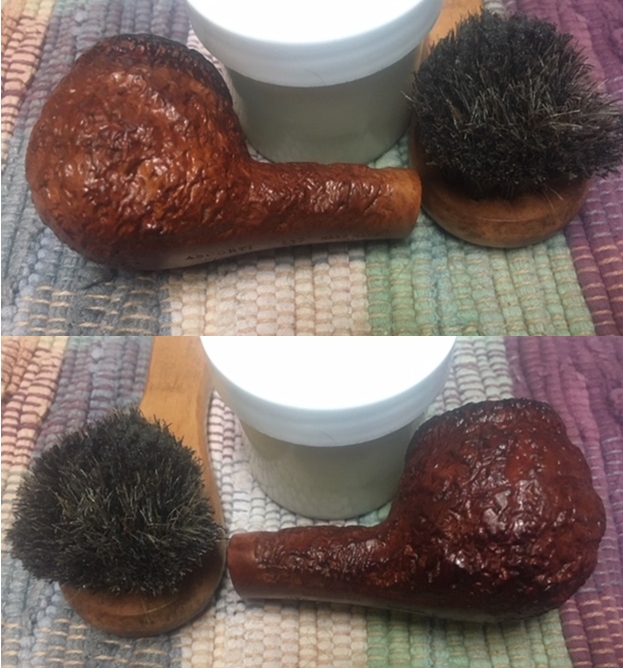
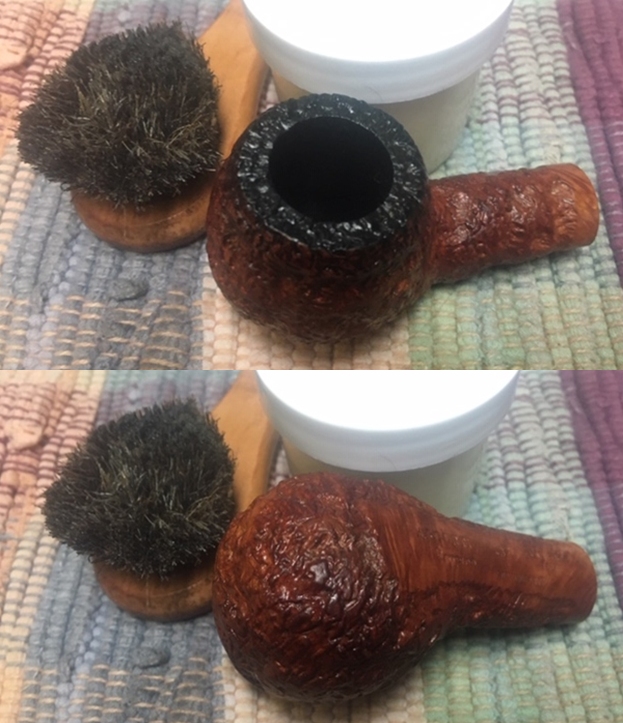
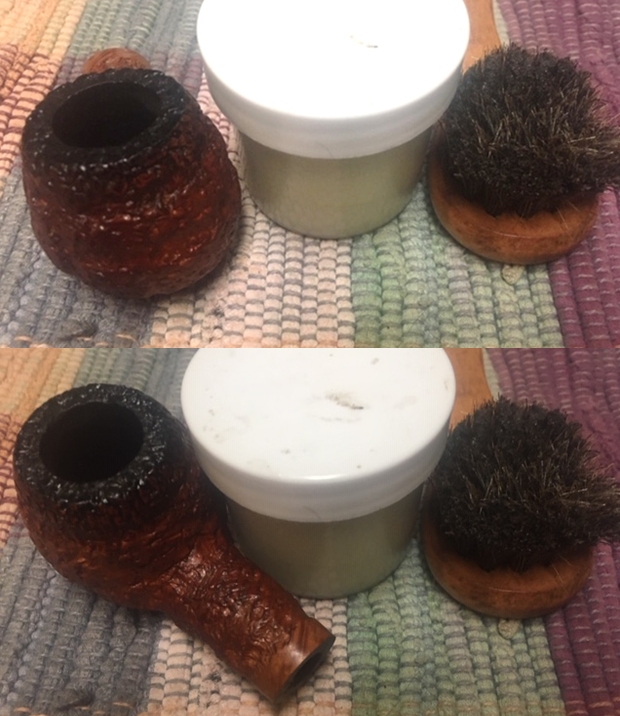
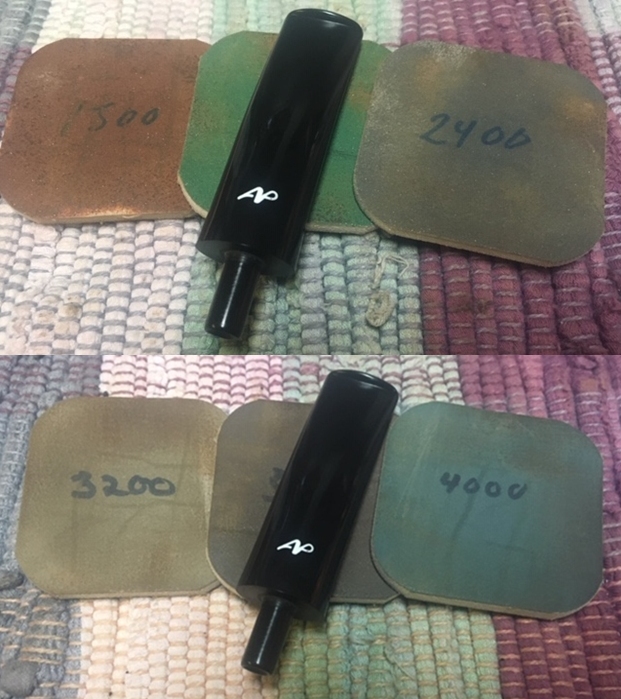
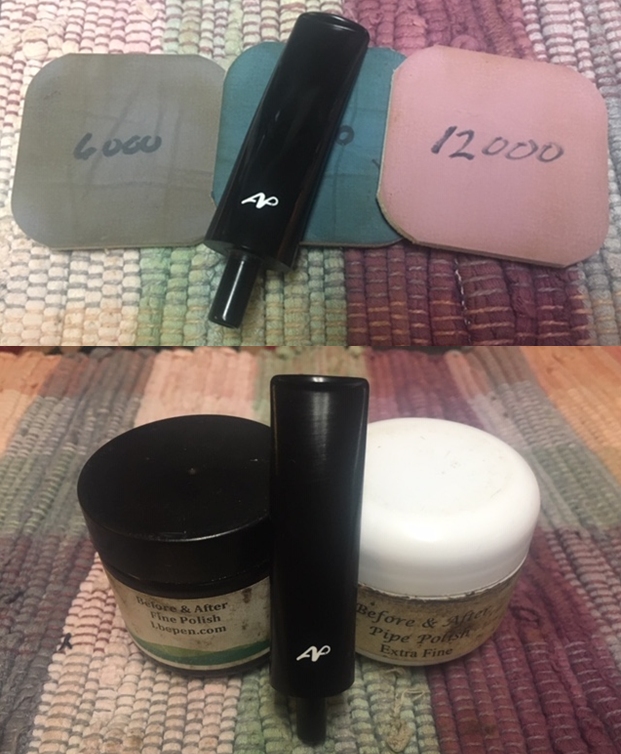
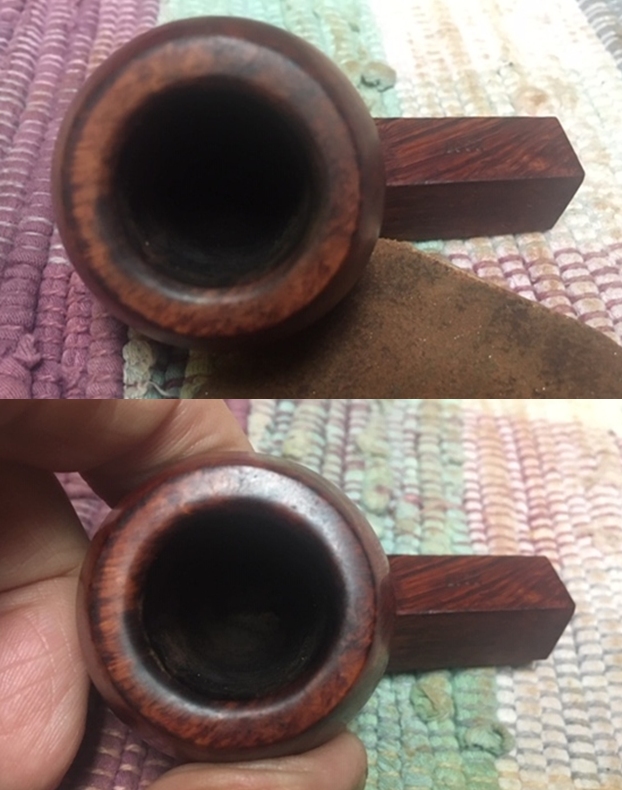
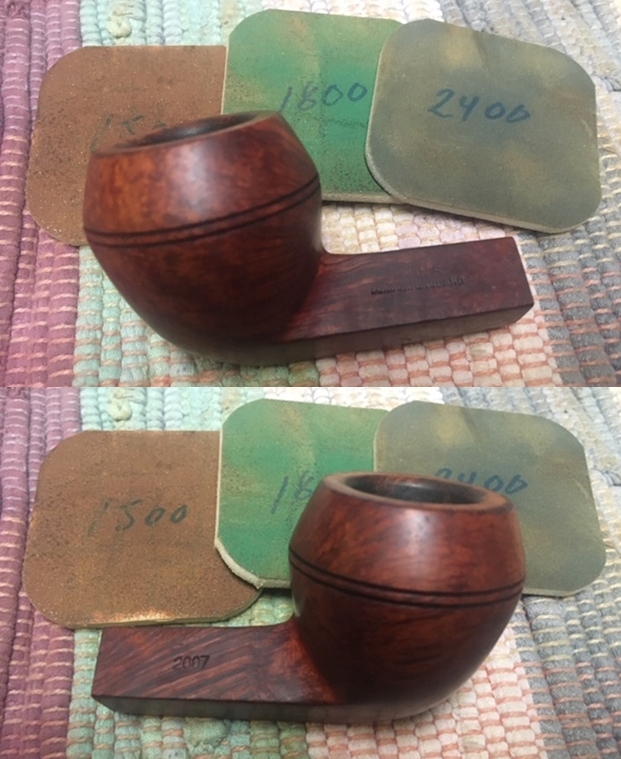
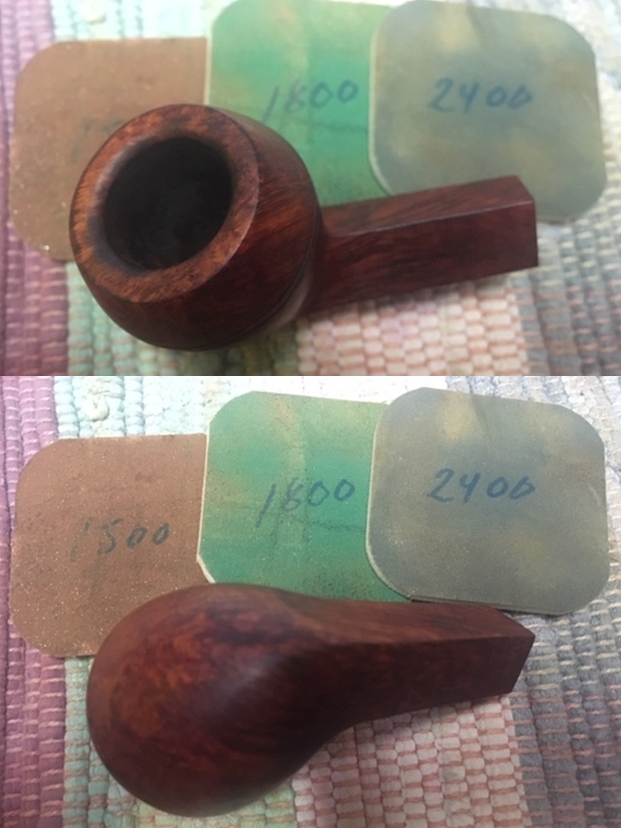
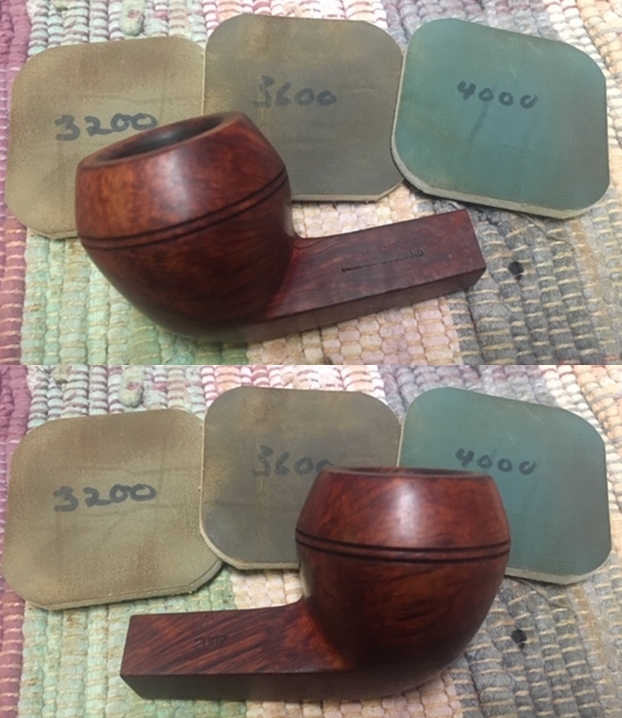
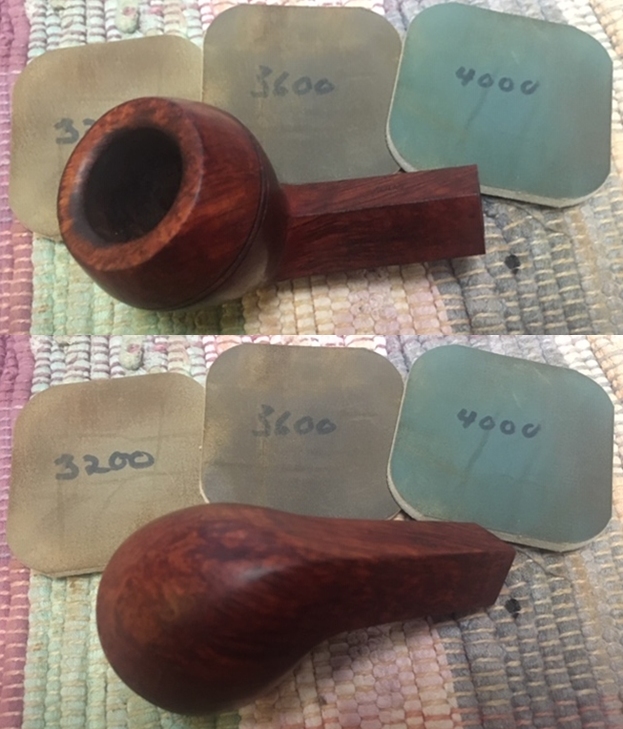
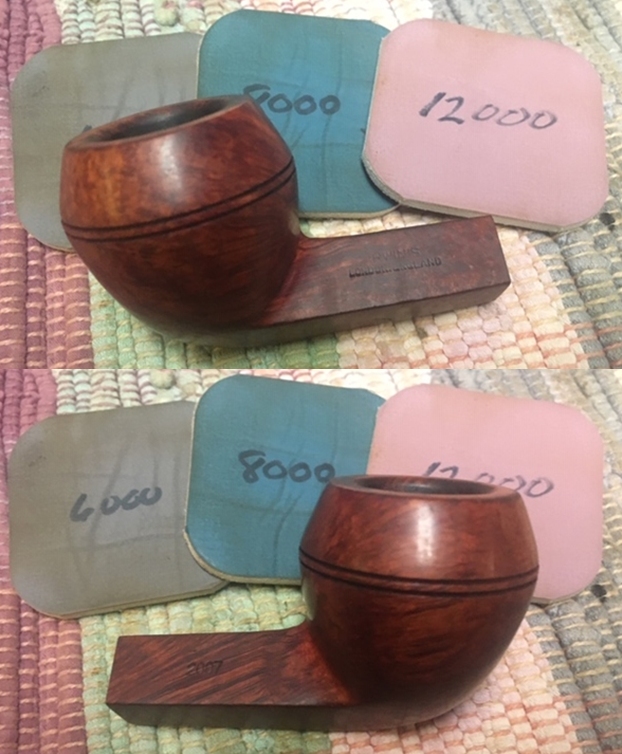
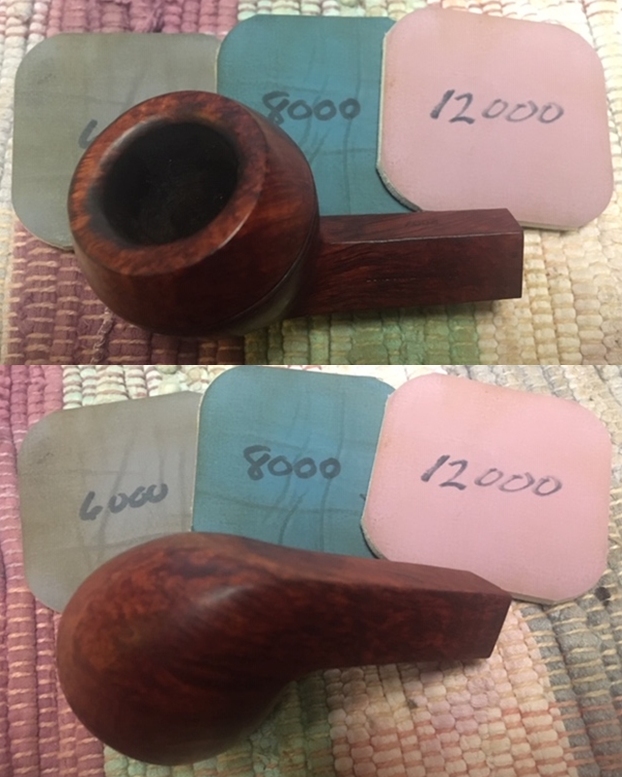
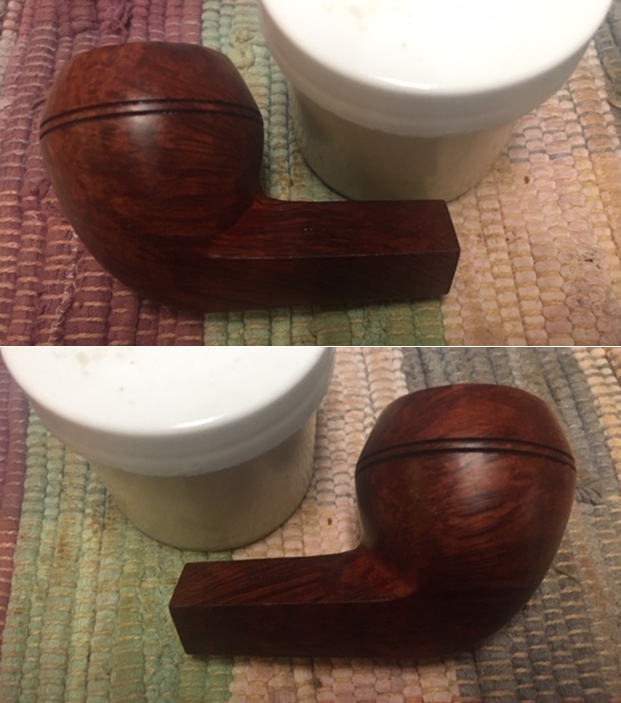
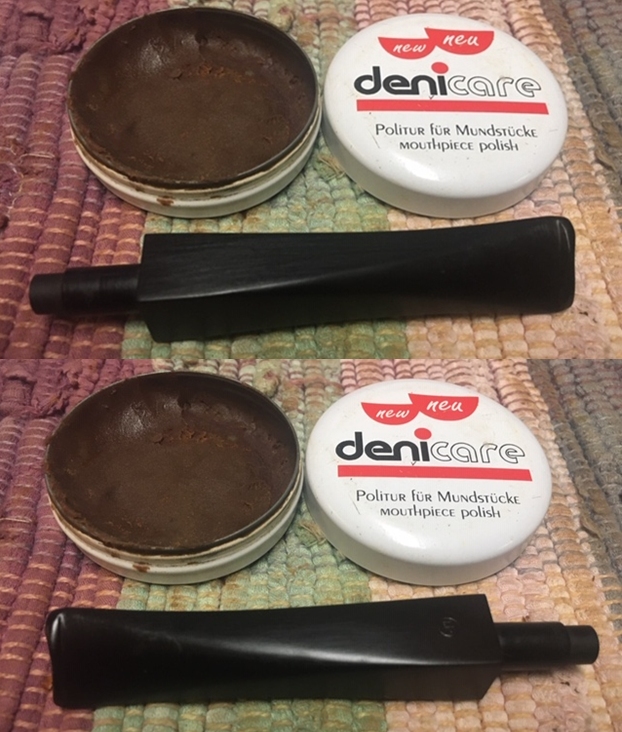
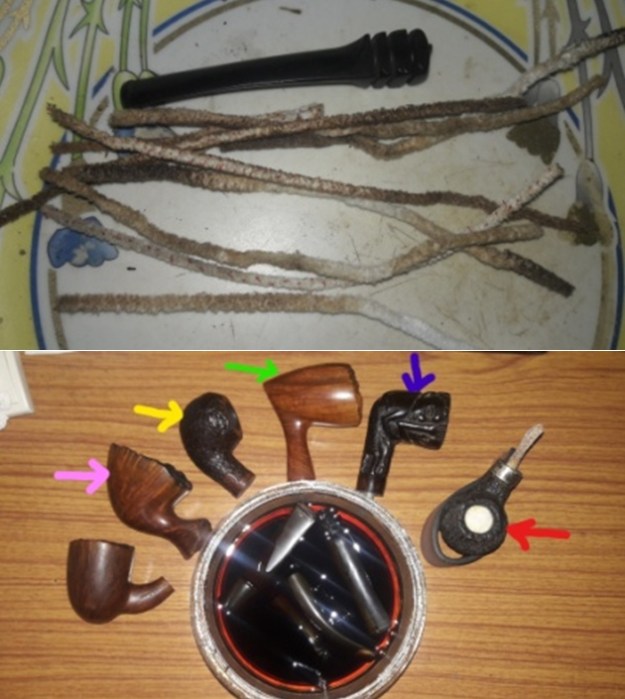
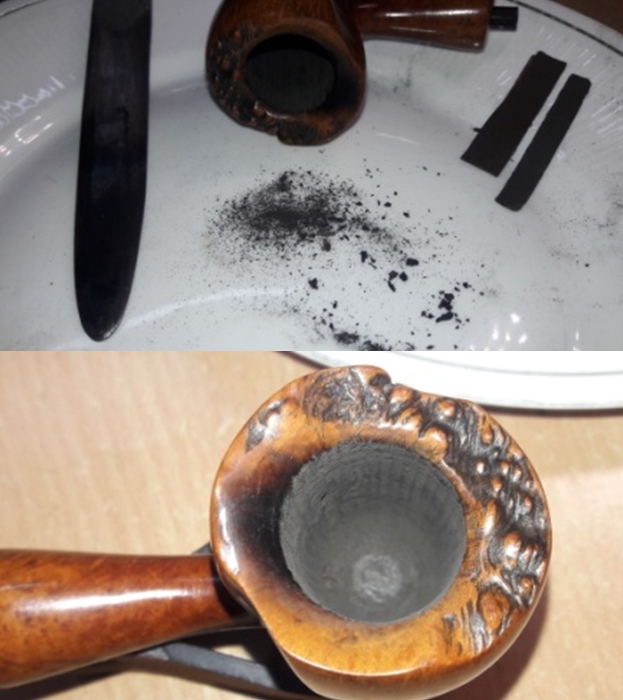
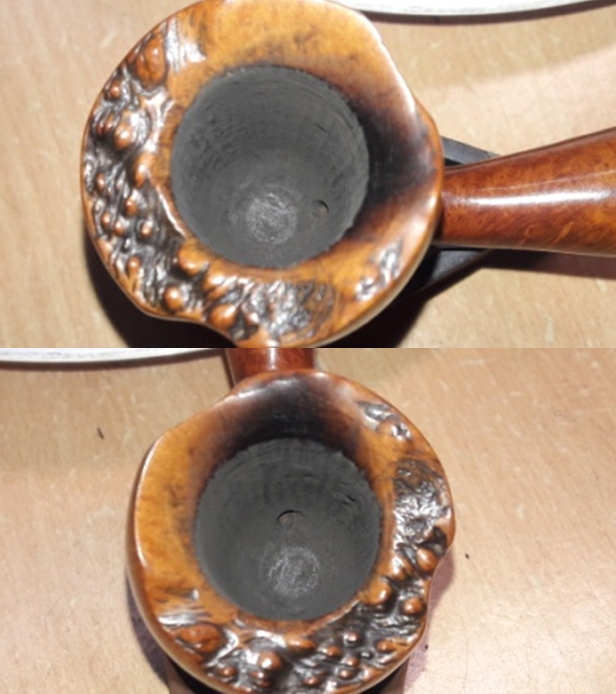
I began the process of refurbishing this pipe with cleaning the internals of the stem using pipe cleaners with isopropyl alcohol (99.9% pure) and dunking the stem in to “Before and After Deoxidizer” solution developed by my friend Mark Hoover. The solution helps to draw out heavy oxidation to the surface making its further removal a breeze, while the minor oxidation is eliminated to a very great extent. I usually dunk stems of 5-7 pipes that are in-line for restoration and this pipe is marked in green arrow. I generally allow the stems to soak in this solution overnight for the solution to do its work.With the stem soaking in the deoxidizer solution, I worked the stummel starting with reaming the chamber with my fabricated knife as the layer of cake was too thin and did not warrant the use of a reamer. It was at this stage that I realized that the pipe has been so sparingly smoked that what I was assuming to be a layer of cake, is in fact a layer of bowl coating!! The walls of the chamber are smooth and solid. I tried to wriggle out the broken tenon that was stuck in to the mortise. Lucky me, it came out without any resistance!! That’s a big relief. Next, I cleaned the mortise with hard bristled and regular pipe cleaners dipped in isopropyl alcohol. I scrubbed the external surface of the bowl with undiluted Murphy’s oil soap and hard bristled tooth brush and dried it using paper towels and soft cotton cloth. I carefully cleaned the plateau rim top with a soft brass wire brush to remove the accumulated dirt and debris from the surface. Thereafter, I cleaned the mortise, plateau rim top and stummel surface with anti-oil dish washing soap on shank brush and tooth brush. The entire stummel, including the platue rim top, cleaned up nicely. I set the stummel aside to dry out naturally. Staying with the stummel restoration, I polished the stummel with micromesh pads, wet sanding with 1500 to 12000 pads. This time around, I did not repeat the mistake of polishing the plateau rim top as I had done with the PH # 3 earlier! I wiped the surface with a soft cloth at the end of the micromesh cycle. The stummel looks amazing with a deep shine and beautiful straight grains popping over the stummel surface. I rubbed a small quantity of “Before and After Restoration Balm” in to briar. I rubbed this balm deep in to the nooks and crannies of the plateau rim top surface with my fingers and let it rest for a few minutes. The balm almost immediately works its magic and the briar now has a nice vibrant appearance with the dark brown hues of the grain contrasting with the rest of the stummel surface. I further buff it with a horse hair shoe brush. As mentioned in the previous write up on refurbishing of pipe PH # 3, I had worked on all the stems that had been soaking in the deoxidizer solution overnight. I fished out all the stems and cleaned them under running warm water and scrubbed the raised oxidation from the stem surface using Scotch Brite pad. I further removed the oxidation by scrubbing the stems with 0000 grade steel wool and applied a little olive oil to rehydrate the stems and set them aside for the oil to be absorbed. Complete oxidation was removed on this stem by the process described above. Unfortunately, I did not click any pictures of these stems at this stage.
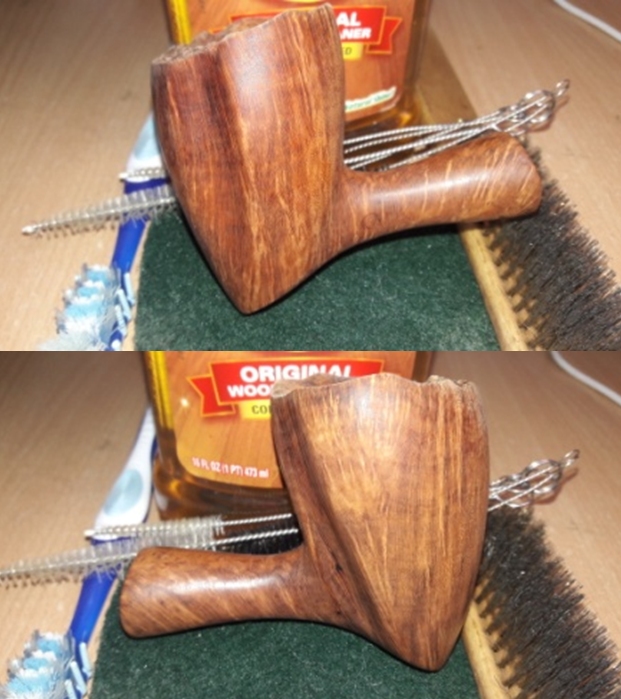
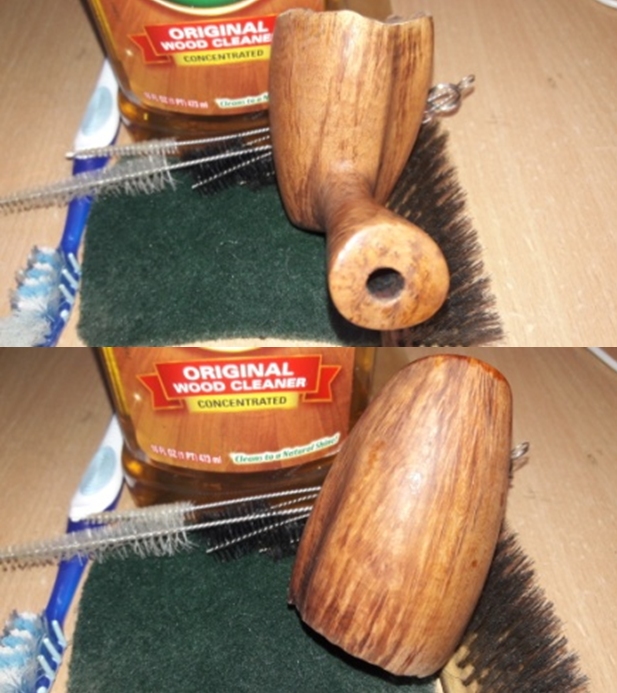
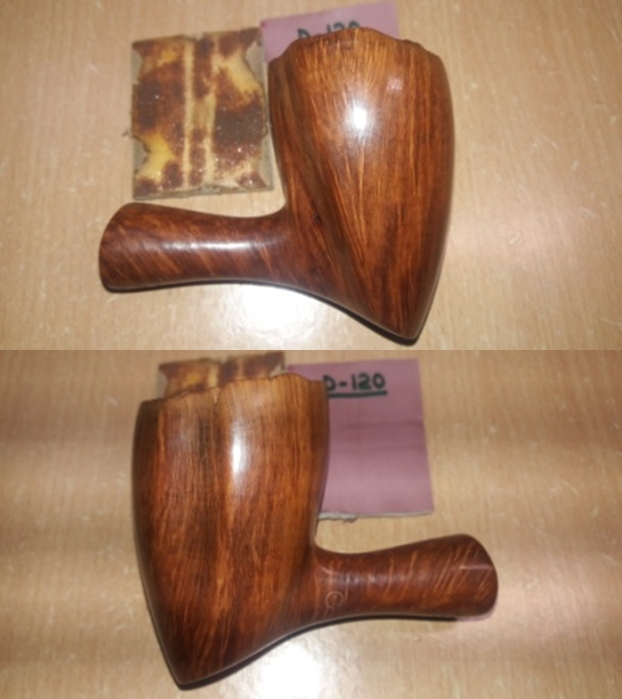
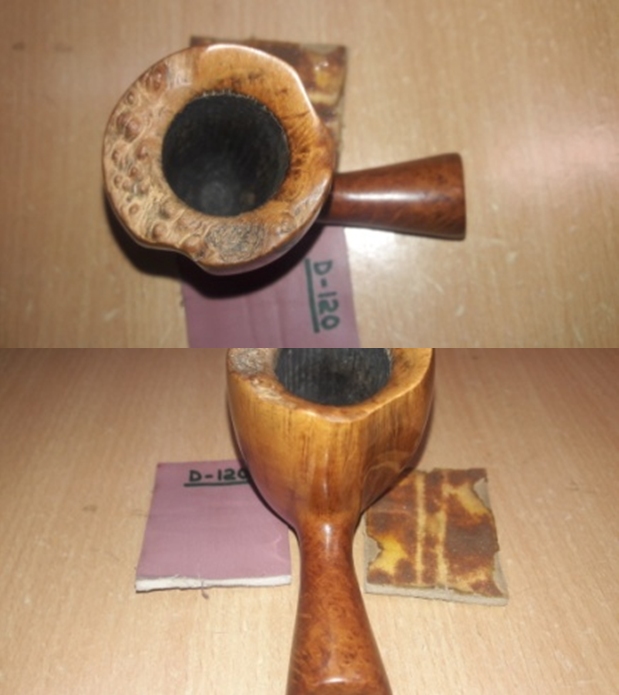
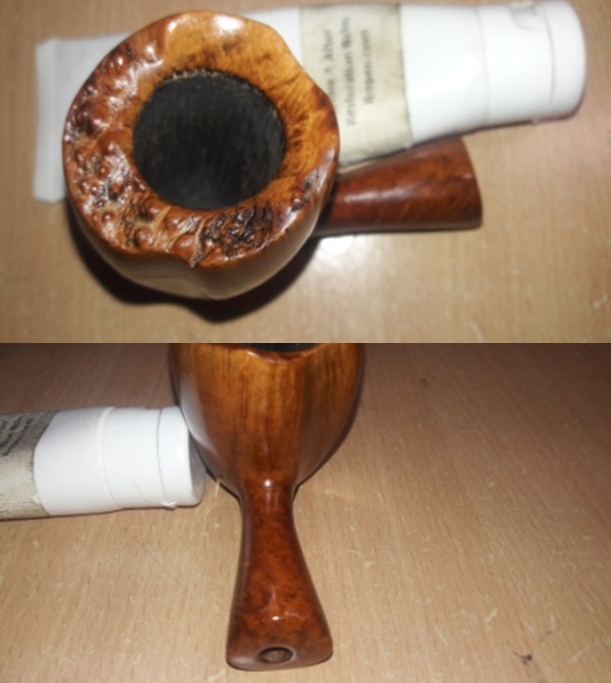
With this, I have now reached the most critical and challenging part of this restoration; replacing the broken tenon. While Steve, Dal and Jeff were here in India, Steve had replaced a tenon on a Preben Holm which had come to me with a broken tenon. I had minutely observed the procedure, made detailed notes and read the relevant blogs that Steve has written on rebornpipes.com.

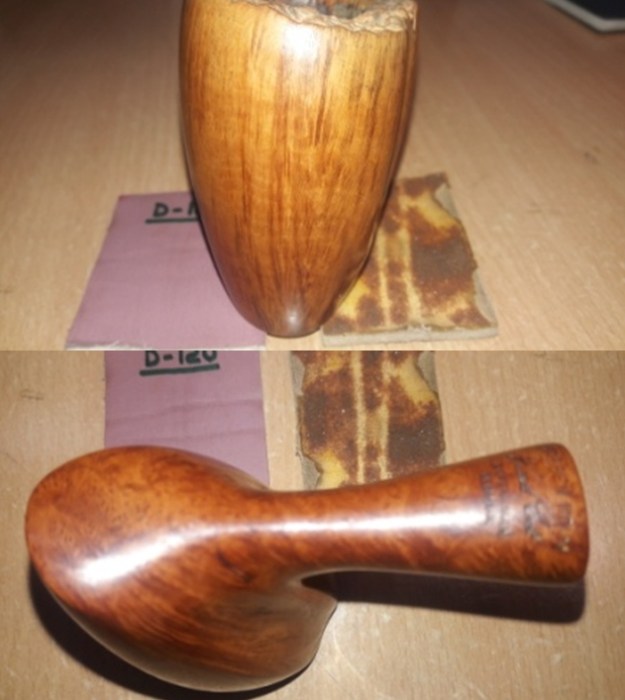
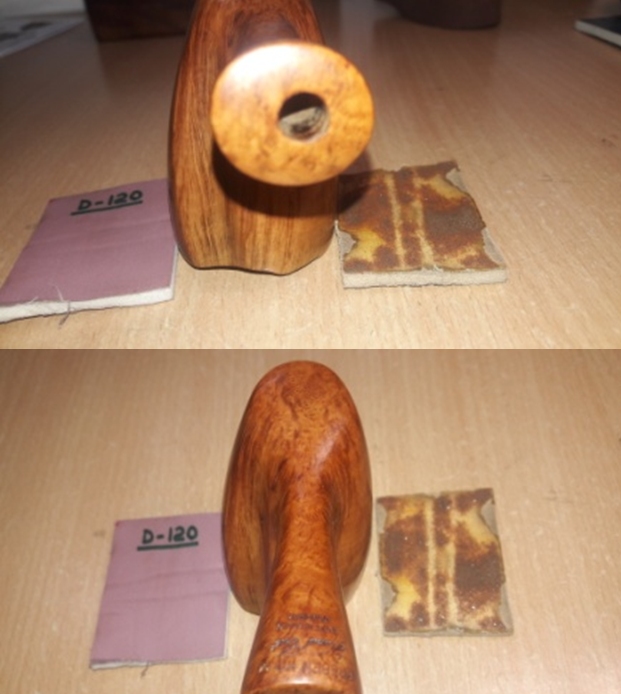
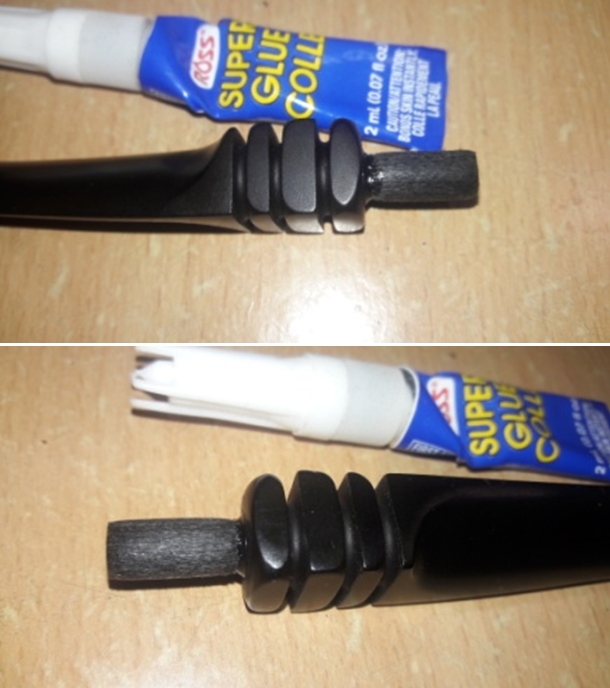
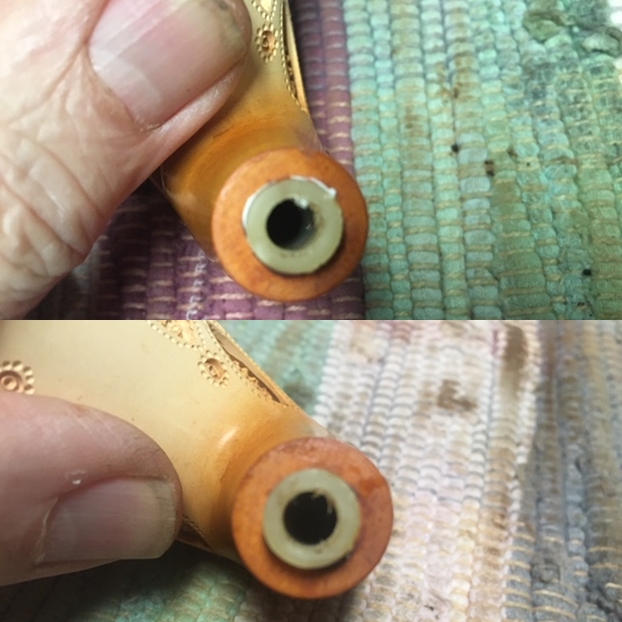
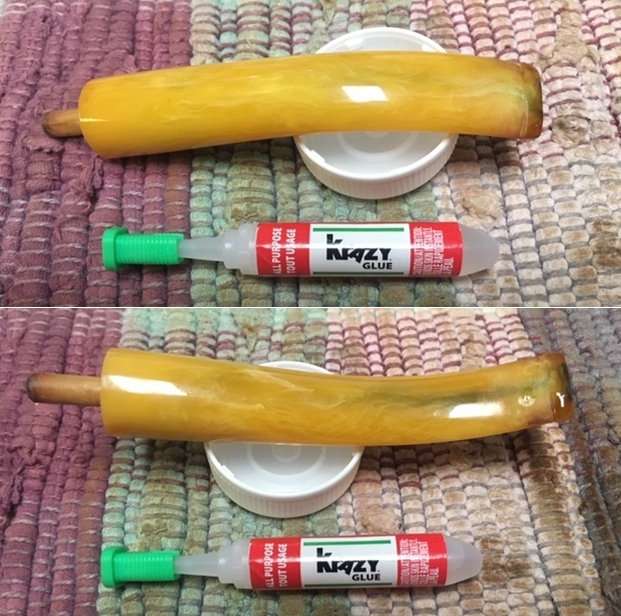
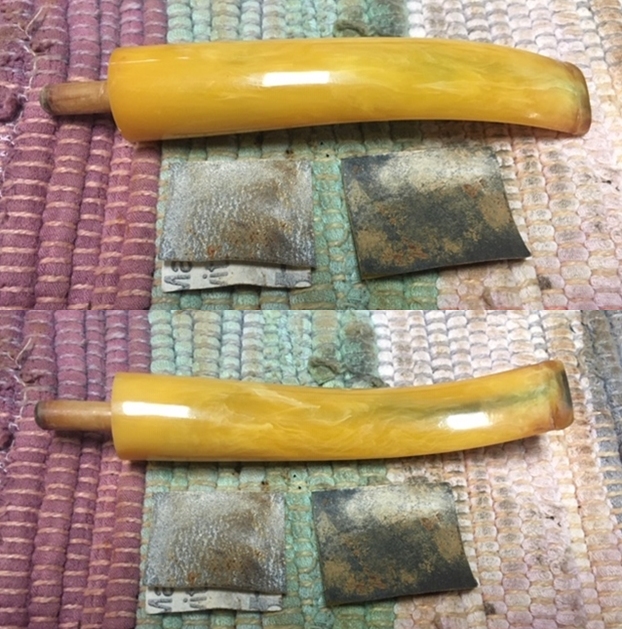
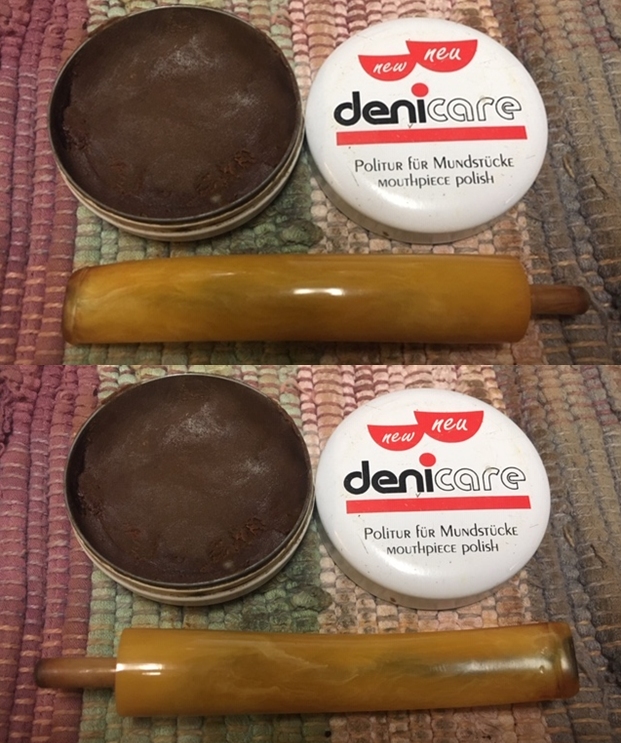
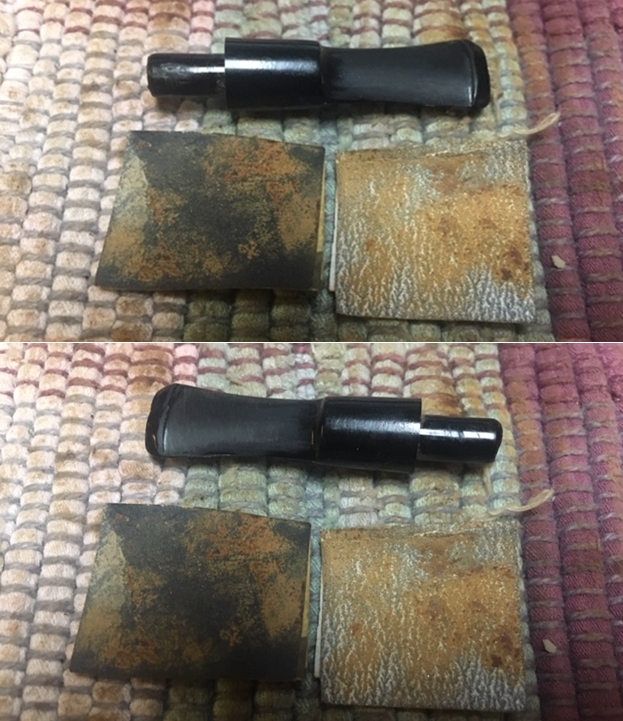
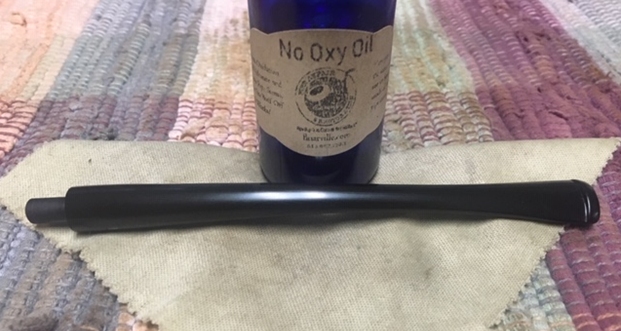
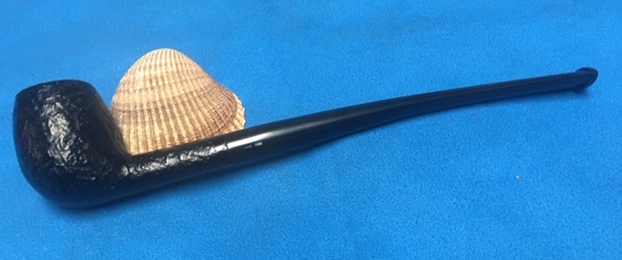
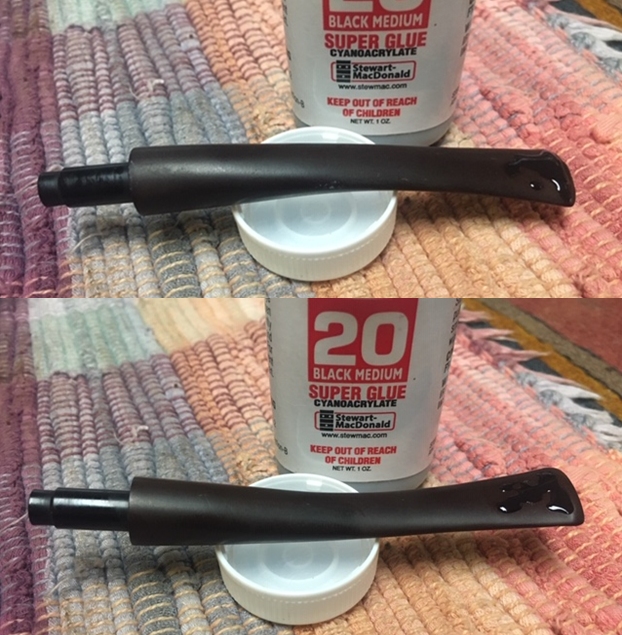
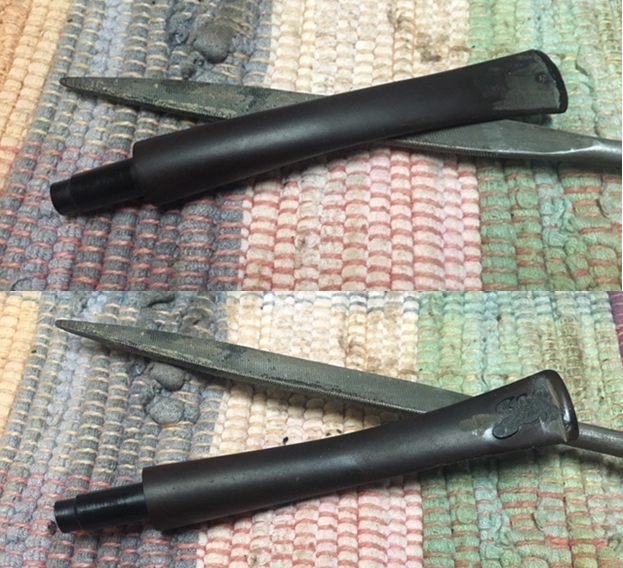
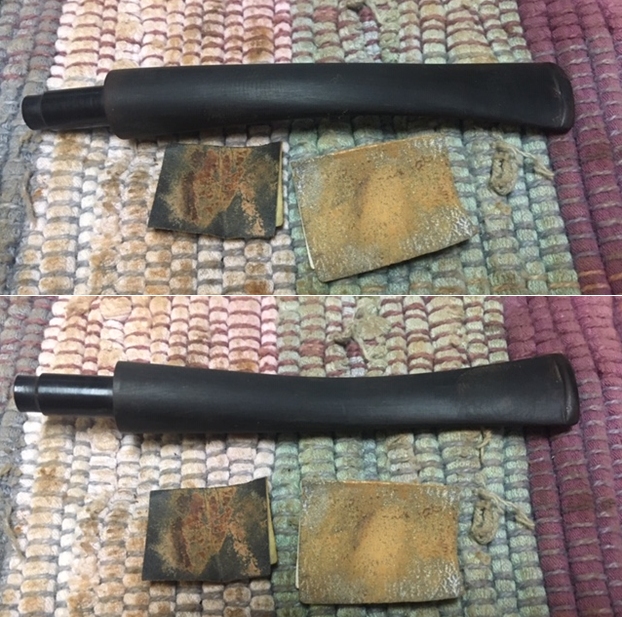
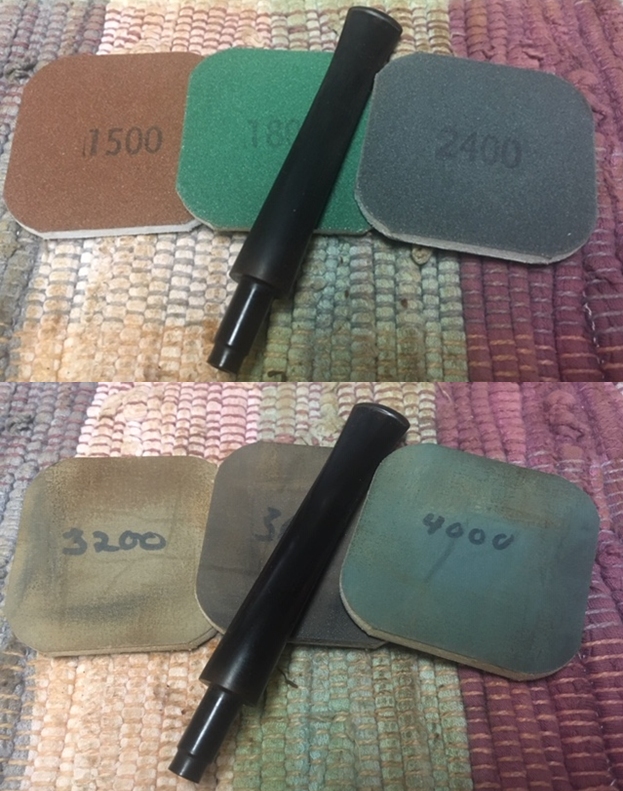
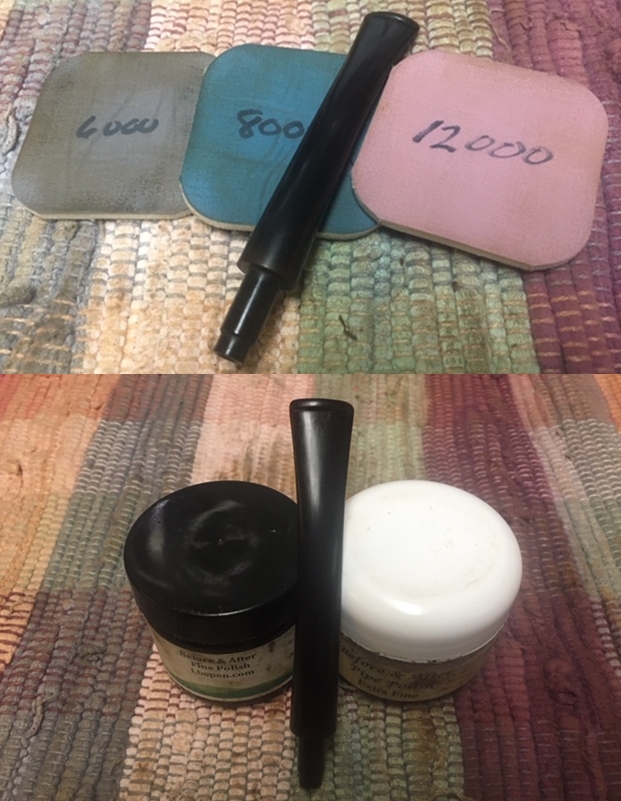
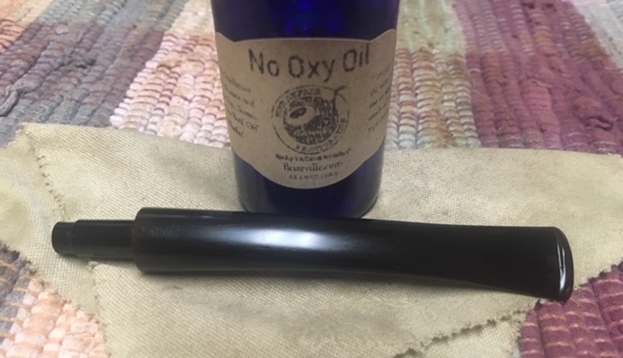
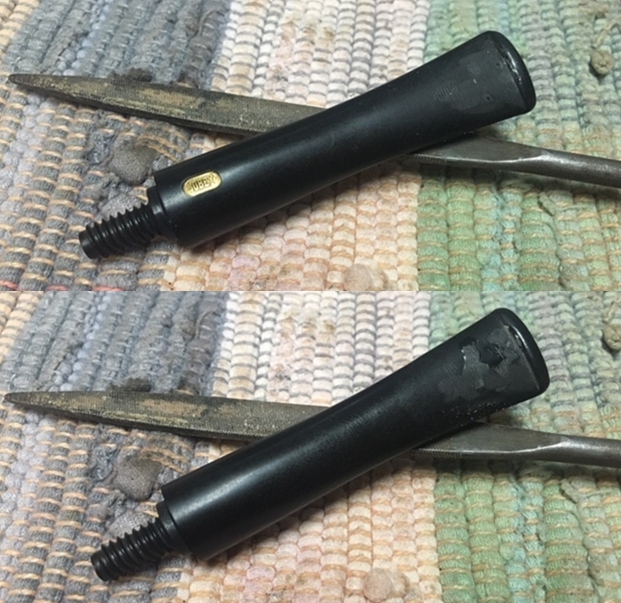
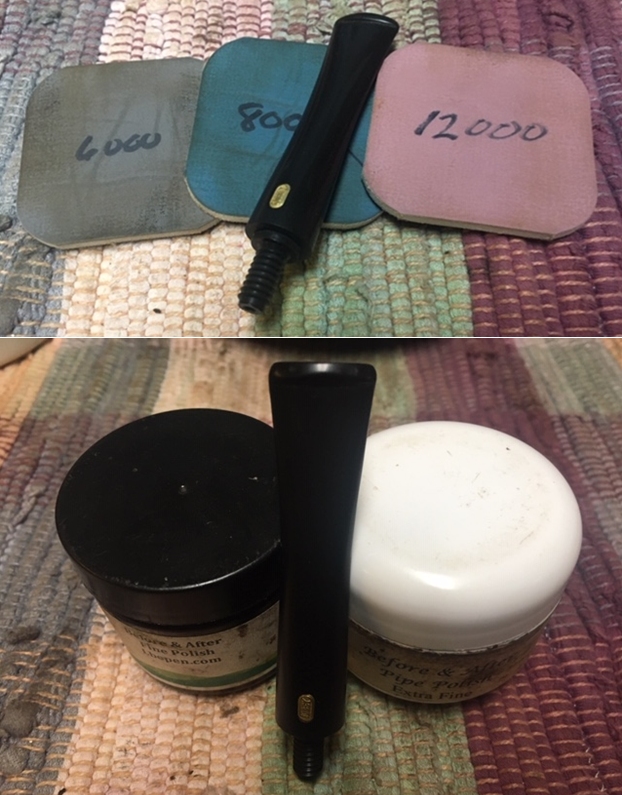
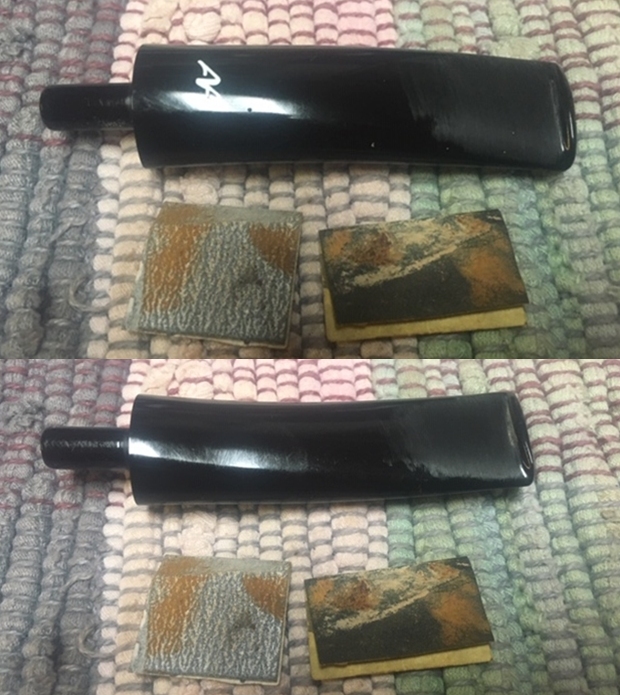
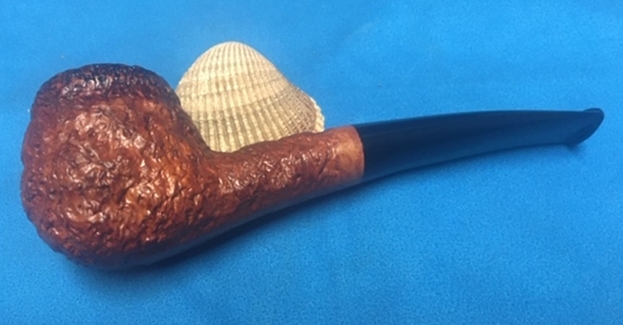
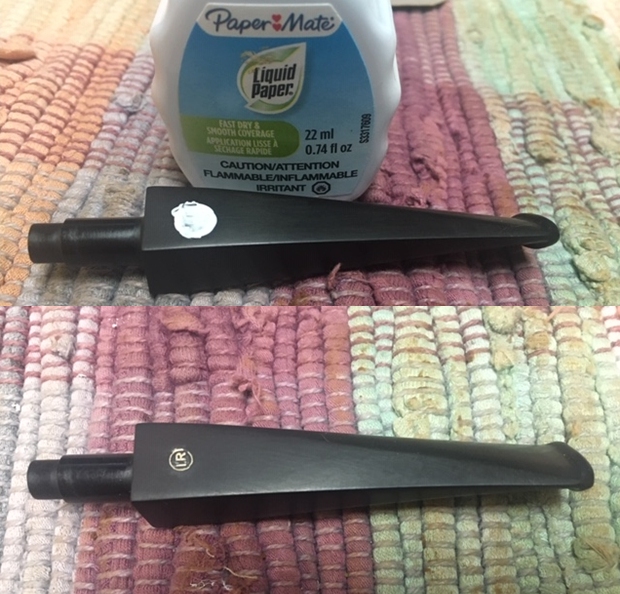
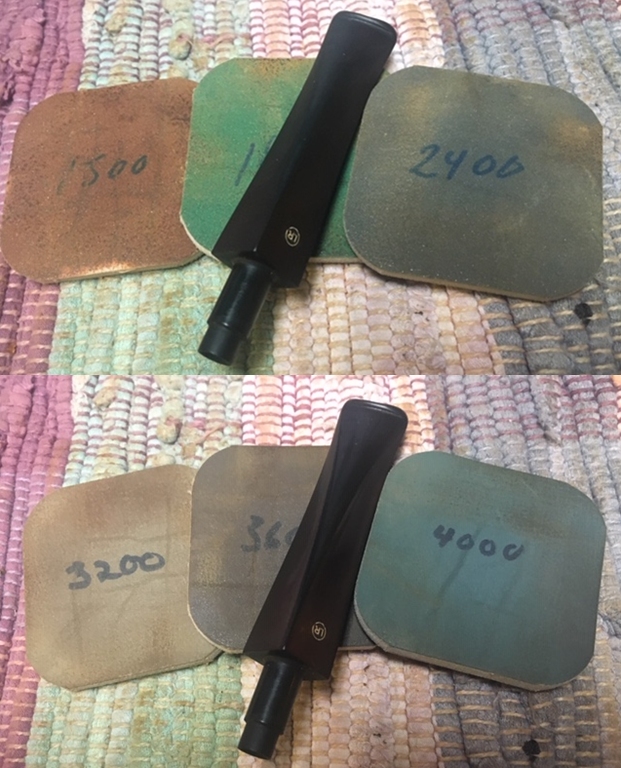
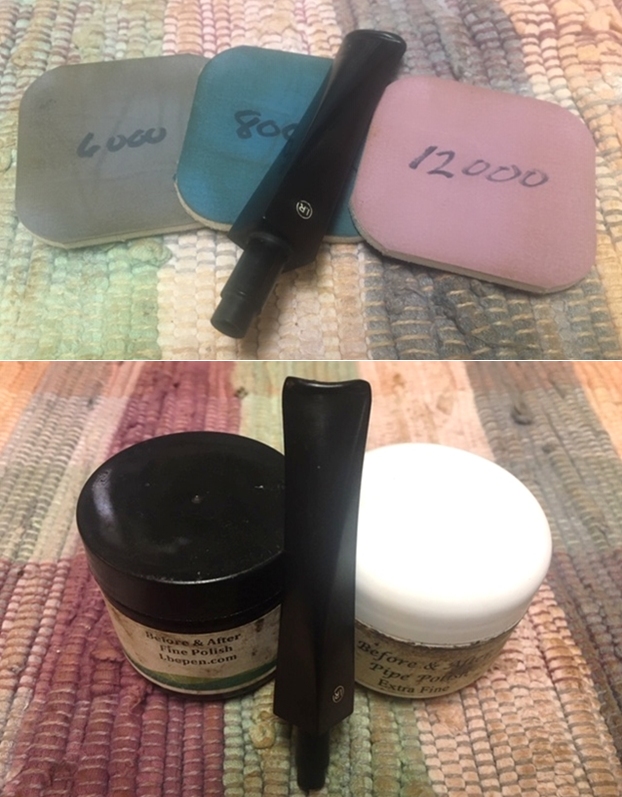
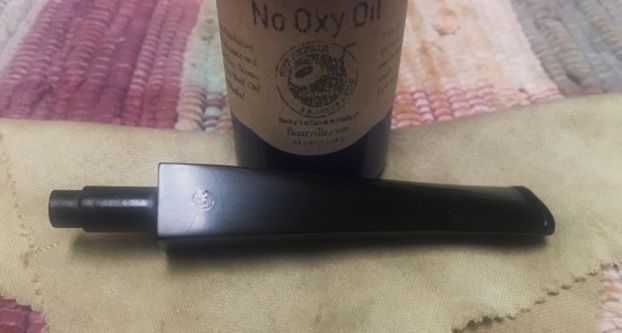
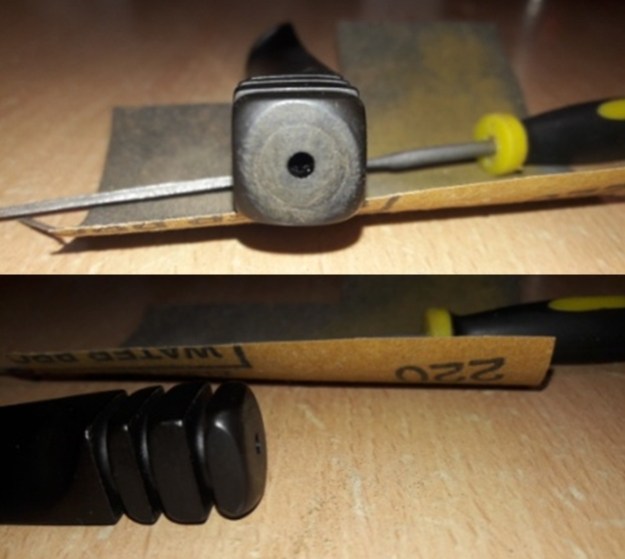
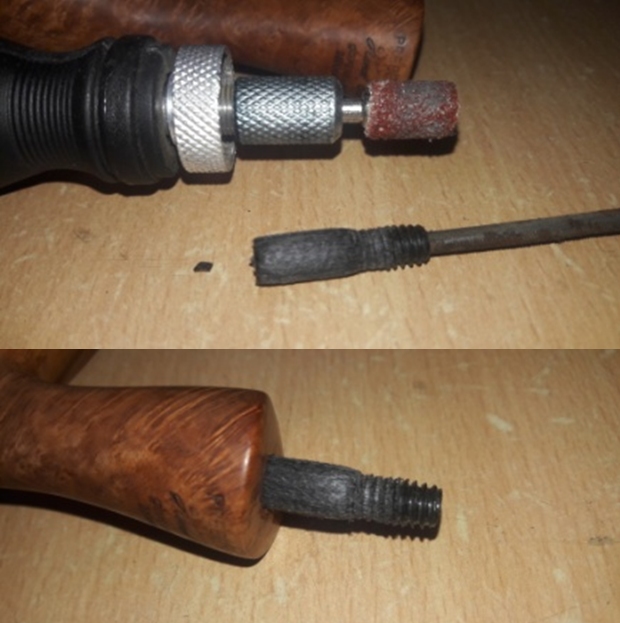
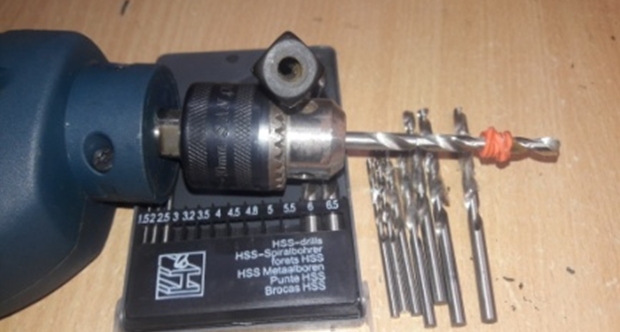
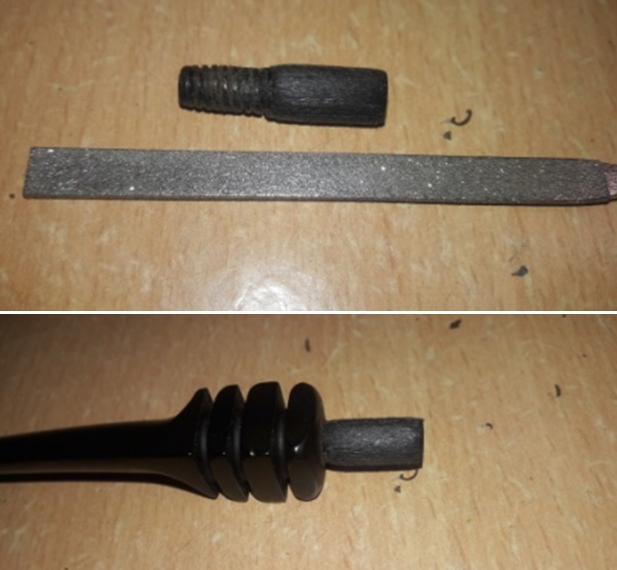
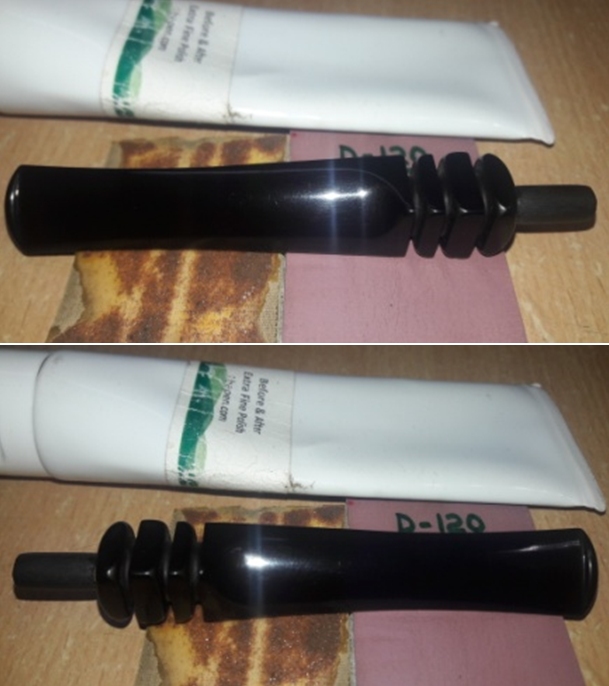
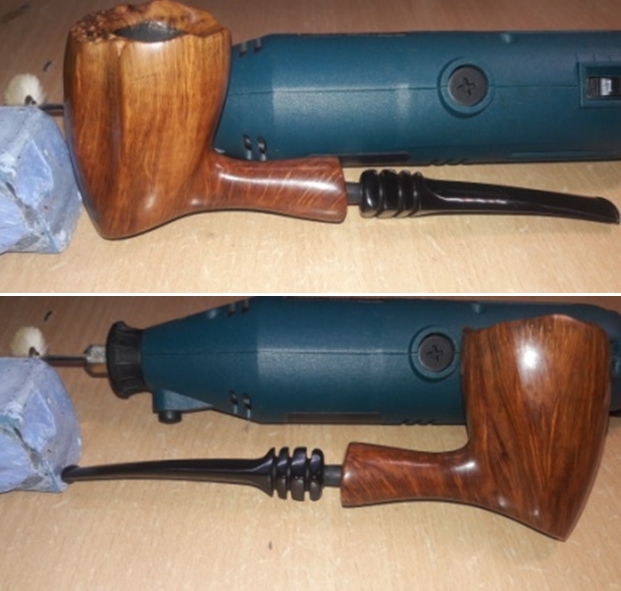
The process starts with sanding the broken tenon end of the stem till a smooth and even stem face is available for the new tenon. This step also reveals and opens up the stem airway for drilling to accommodate the new tenon. I did this by topping the tenon end of the stem face on a piece of 220 grit sandpaper till smooth.Next, I selected a Delrin tenon that was the closest fit in to the mortise. I mounted a sanding drum on to my hand held rotary tool and setting the speed at its lowest, I shaped the tenon to a perfect fit in to the mortise. I was very slow, deliberate and frequently checked the progress being made. Once I had achieved a snug fit, I kept the tenon aside and worked the stem.The one and most important aspect that has to be kept in mind while replacing a tenon is to keep the new tenon and stem airway straight and aligned. To ensure this, with a sharp knife I gave a slight inward bevel to the stem’s airway opening which will serve as a guide to the drill bit when drilling. I use the length of the end of the tenon to determine the depth of the drilling. I marked off this length with a rubber band wound tightly on each and every drill bit that I used. I started the drilling with a bit that was slightly larger than the existing airway. I proceed through a series of bits starting with a 3 mm bit until I had drilled the airway with the final bit of 5.5 mm, the same size as the end of the replacement tenon that I had shaped earlier. I proceed with caution as I wanted to make sure that I kept the airway straight for a good fit of the new tenon.I used a file to knock off the threads on the tenon end just enough to pressure fit it in place in the stem. I carefully checked the alignment to make sure the tenon was straight on the stem before setting it aside to cure. I subjected the stem with the replaced tenon to the pipe cleaner test. The pipe cleaner passed through the air way smoothly and without any obstruction. Once satisfied that the alignment is perfect, I put some super glue on the tenon end and pressed it into the airway and set it aside to cure. I am very pleased with my first attempt at a tenon replacement. I further sand the stem with 600 and 800 grit sand paper and wiped the stem with cotton pad dipped in alcohol to remove the resultant dust and rubbed some extra virgin olive oil in to the stem and set it aside to be absorbed in to stem. I polished the stem with micromesh pads, wet sanding with 1500 to 12000 grit pads. I rubbed a little extra virgin olive oil in to the stem at the end of the micromesh pads polishing cycle. I completed the polishing regime of the stem by rubbing a small quantity of Extra Fine Stem polish developed by my friend Mark Hoover, and giving it a final polish with a soft cotton cloth. The stem is now nice, smooth and shiny.To apply the finishing touches, I first mount a cotton cloth buffing wheel on to my hand held rotary tool and apply a coat of Blue Diamond to the stummel and the stem to polish out the minor scratches.With a cotton buffing wheel that I use for carnauba wax, I apply a coat of carnauba wax to the stummel and stem and continue to work on it till the complete coat of wax has been polished out. I mount a clean cotton cloth buffing wheel and give the entire pipe a once over buff. I finish the restoration by giving the entire pipe a rigorous hand buffing using a microfiber cloth to deepen the shine further. The finished pipe is shown below. P.S. – First things first; tenon replacement, now that I have personally worked on it, is definitely not a very difficult procedure. All it takes is a lot of patience and I strongly recommend that before attempting it, one should go through as many write ups on tenon replacement as possible. Steve has some nice, simple and informative step by step write ups on this procedure which is strongly recommended.
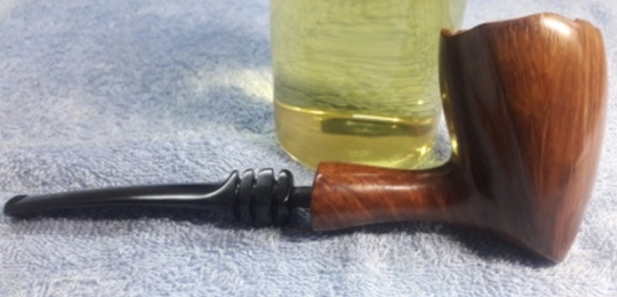
I am really fortunate to be in the process of learning the nuances of pipe restoration and cannot thank Steve enough for his support and guidance.

I wish to thank Mr. Roland Borchers and Mr. Borman who have explained the numbering system followed on Preben Holm pipes and also on dating these pipes for the larger good of our fraternity.

Thanks for your patience and looking forward to inputs about the write up. Cheers…
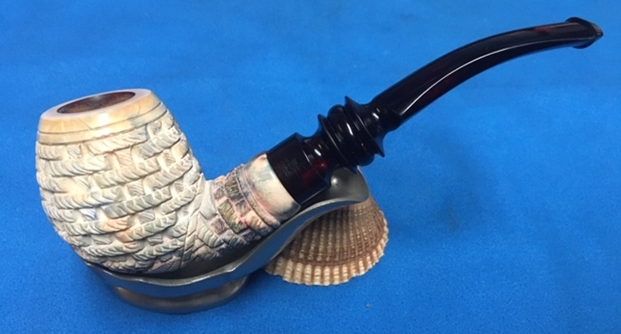
 

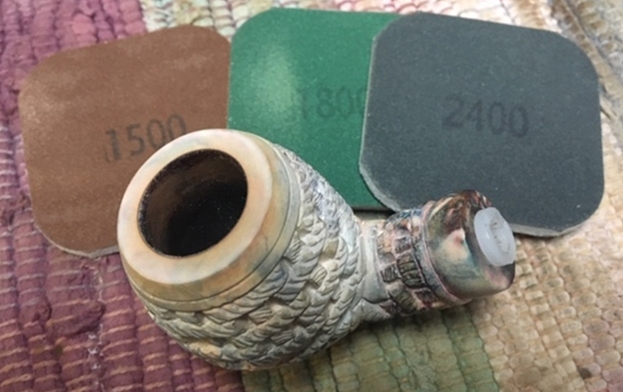
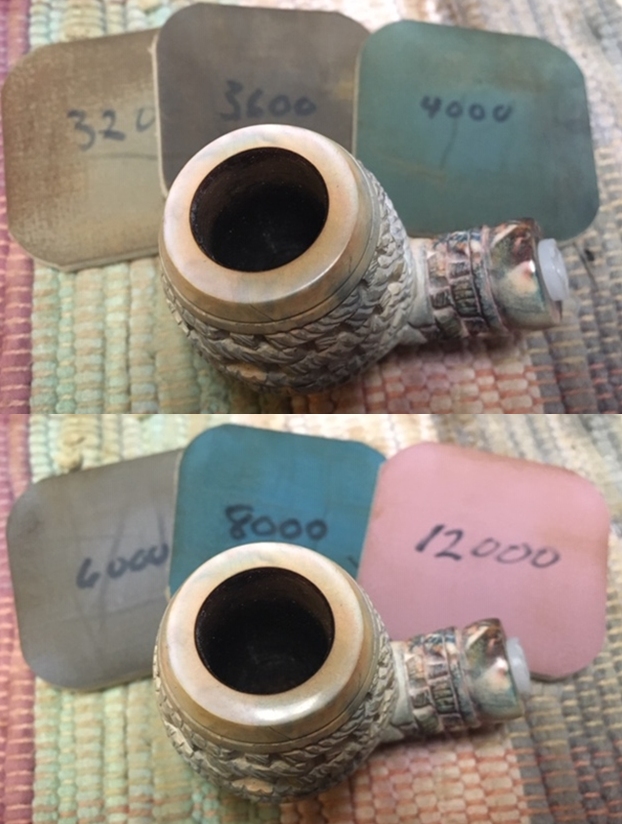
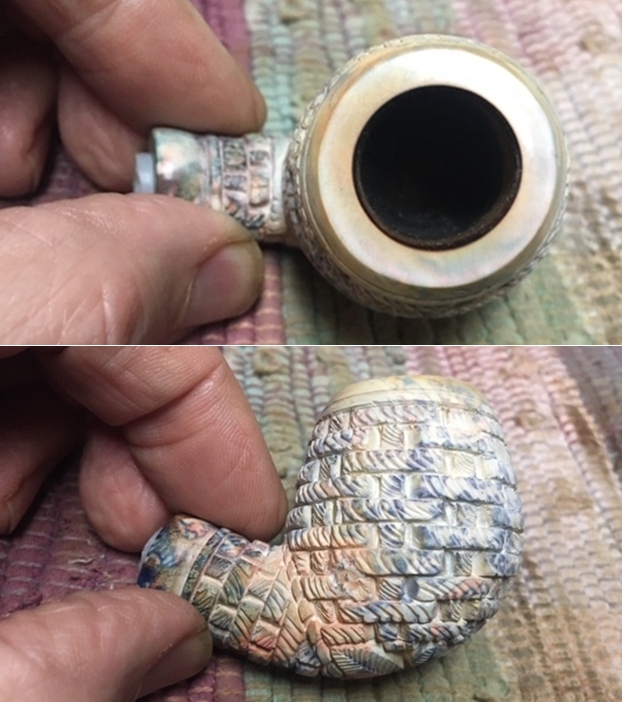
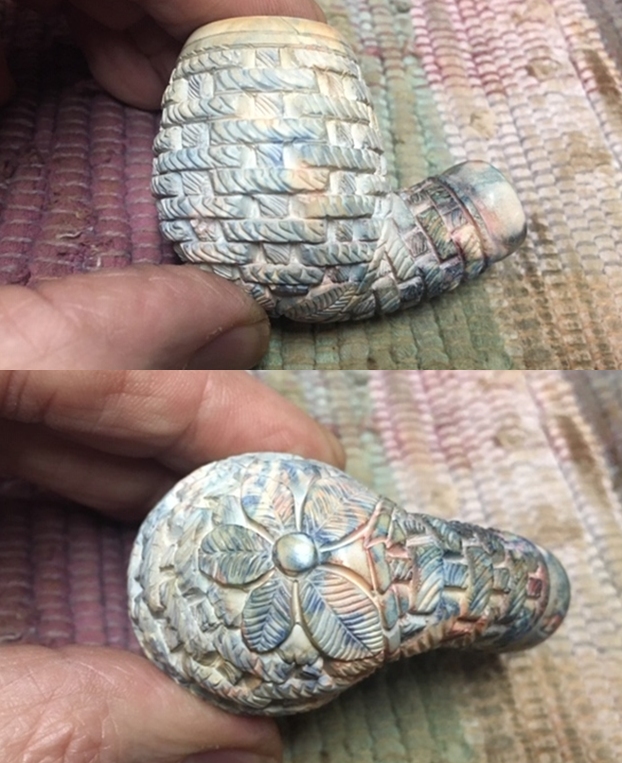
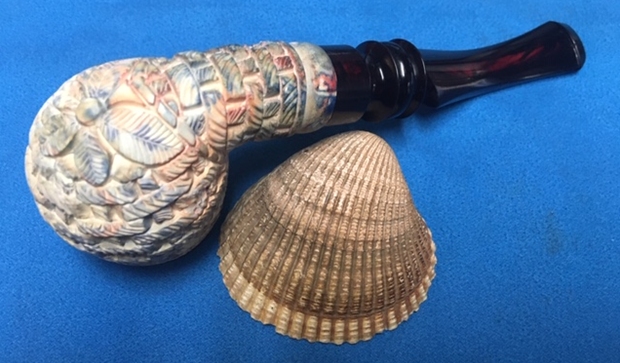
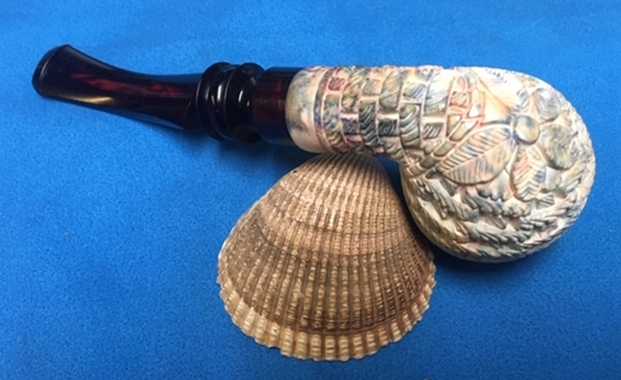
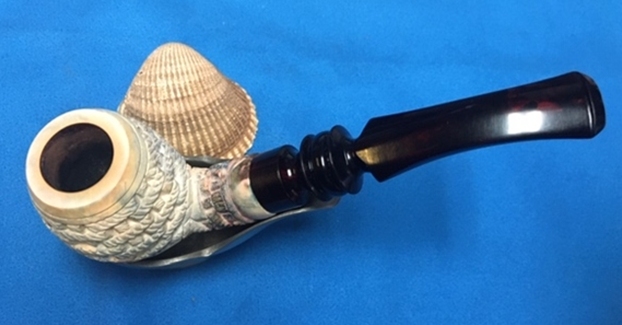
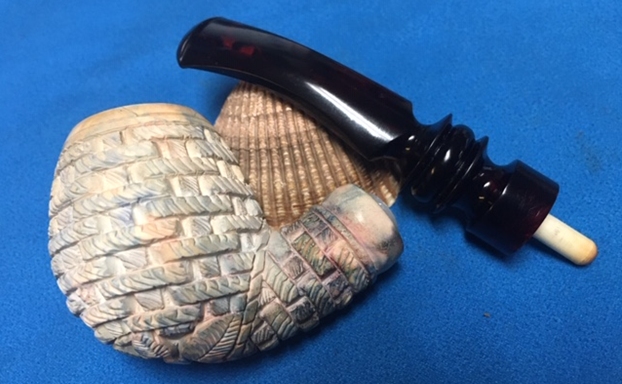
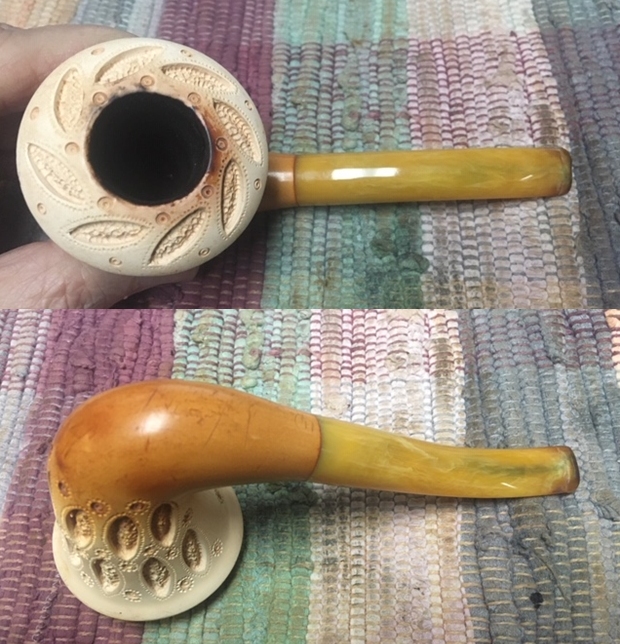
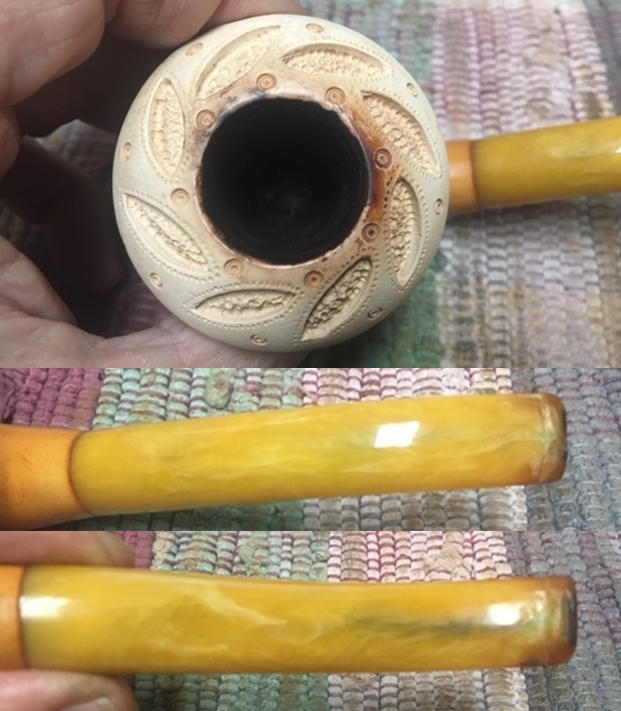
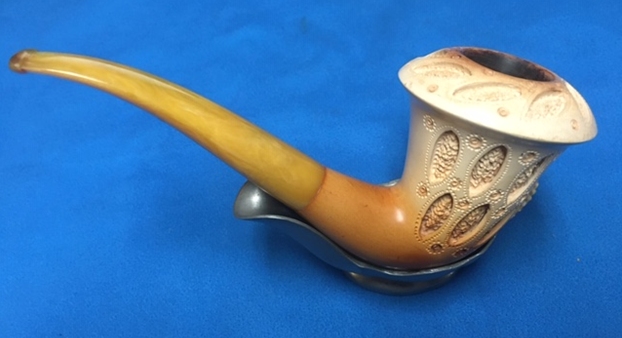
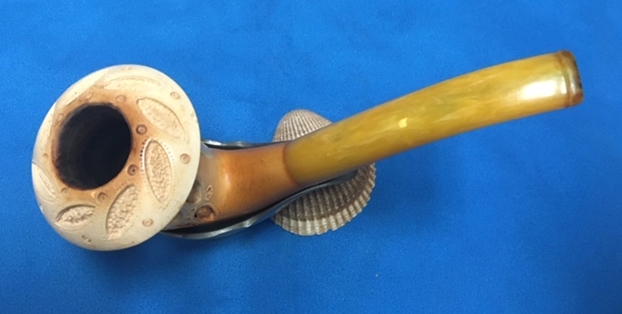
One I have not seen before: A Coloured Basket Weave Meerschaum pipe


Blog by Steve Laug

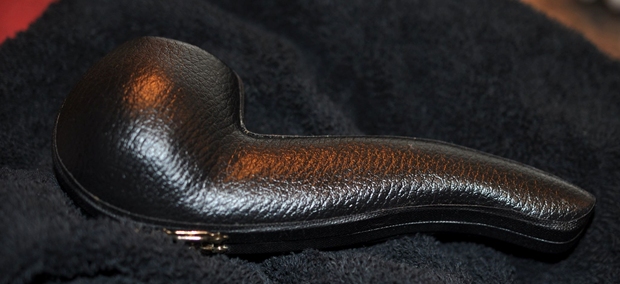
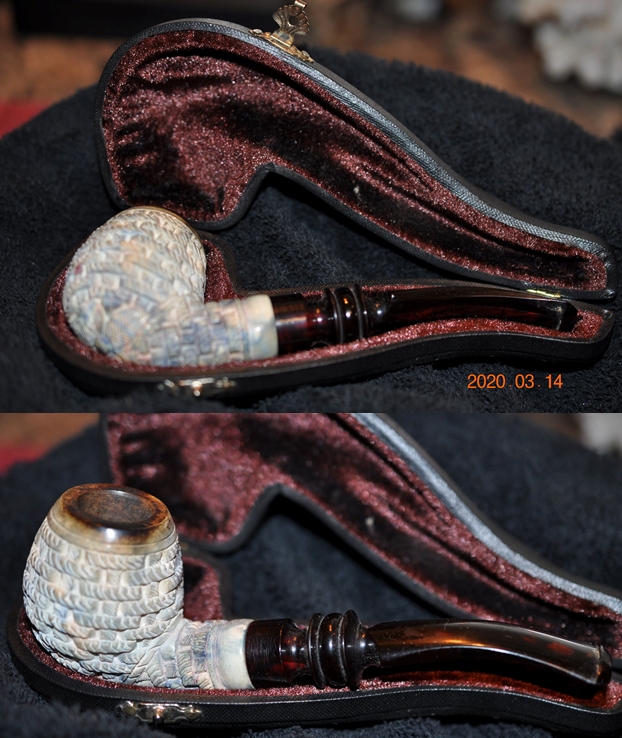
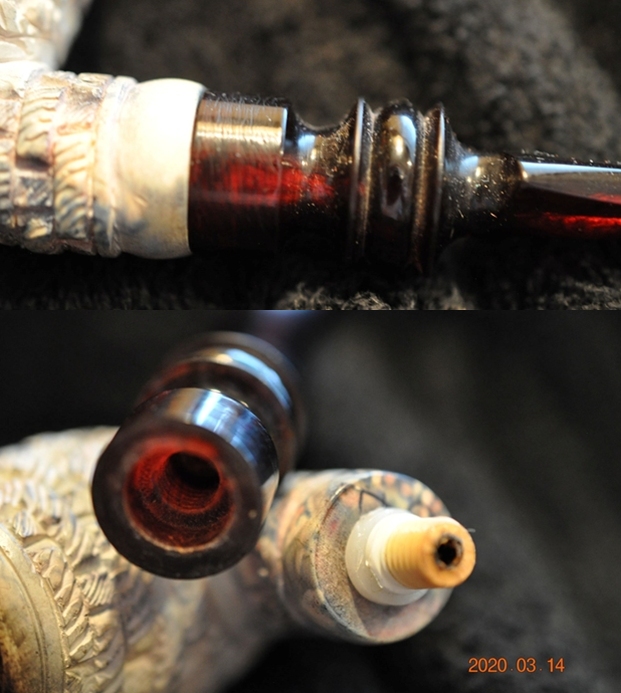
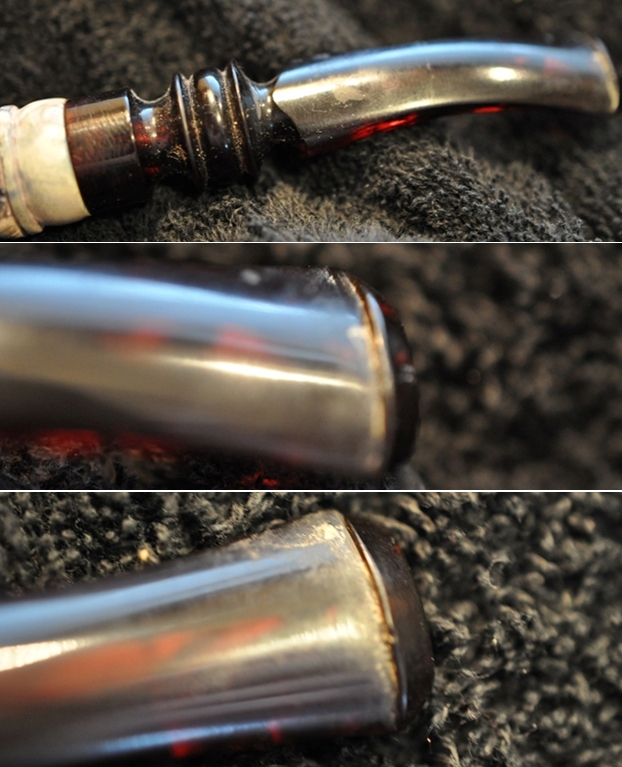
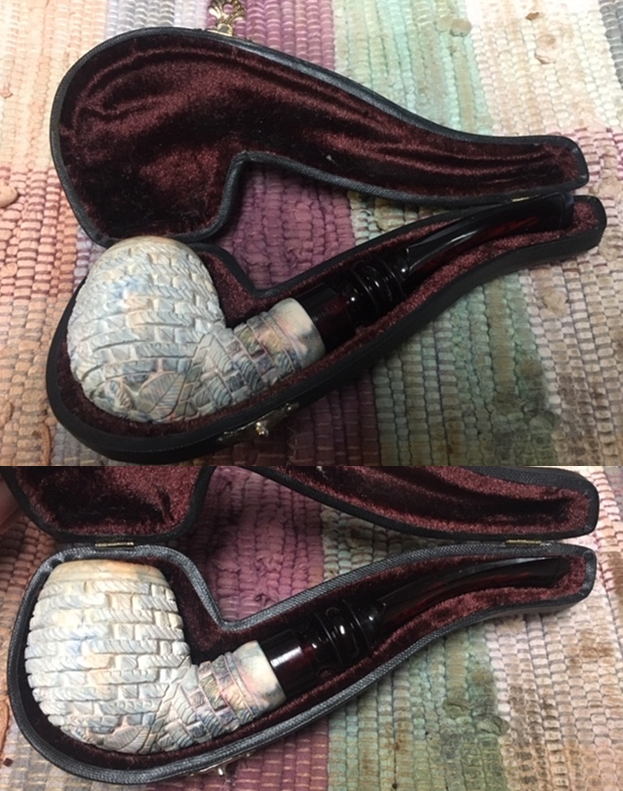
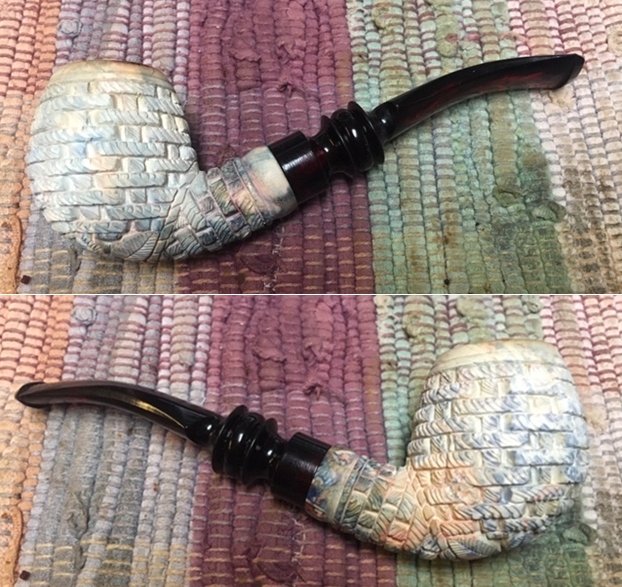
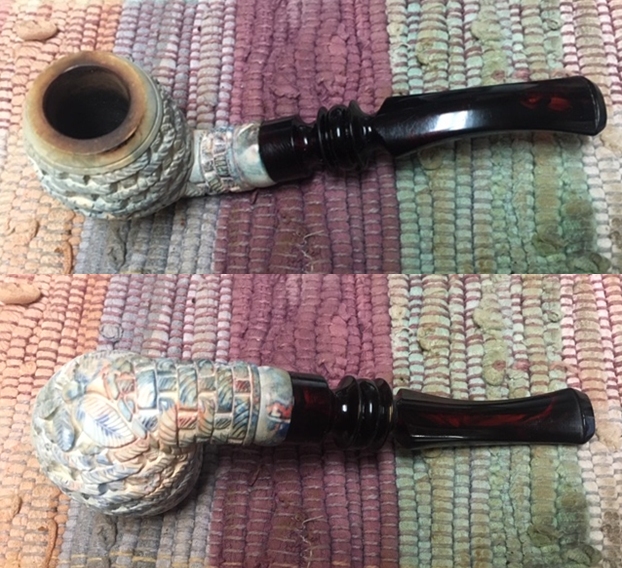
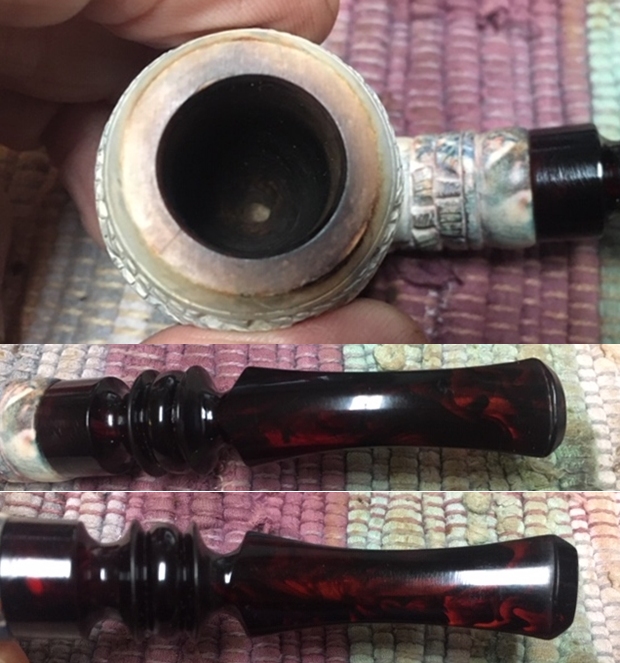
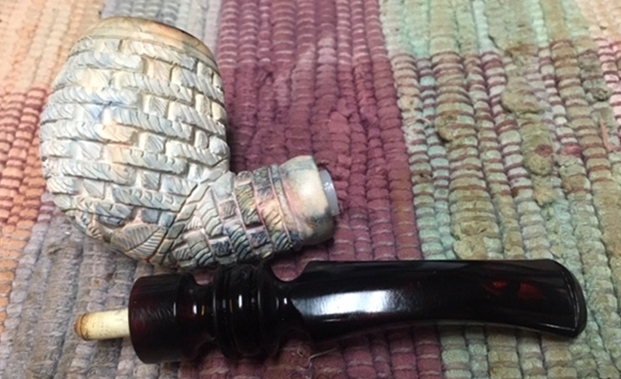
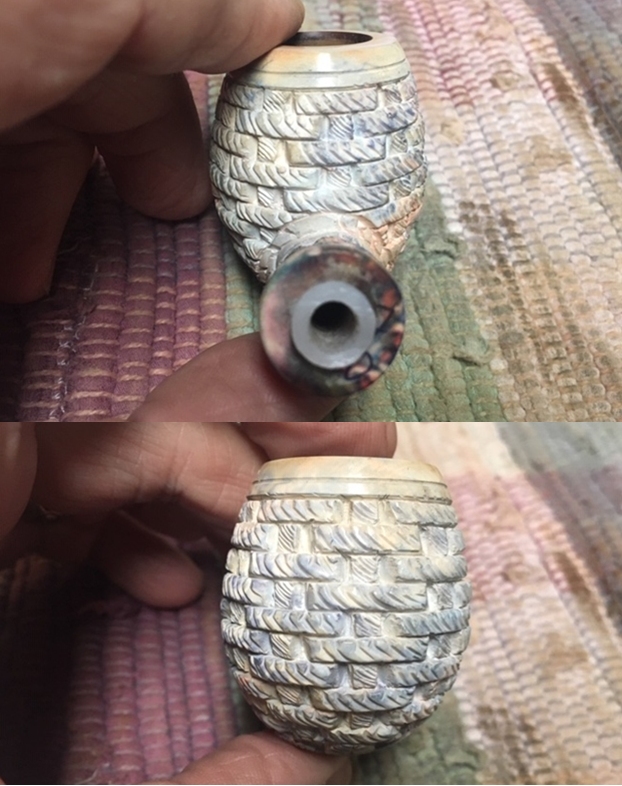
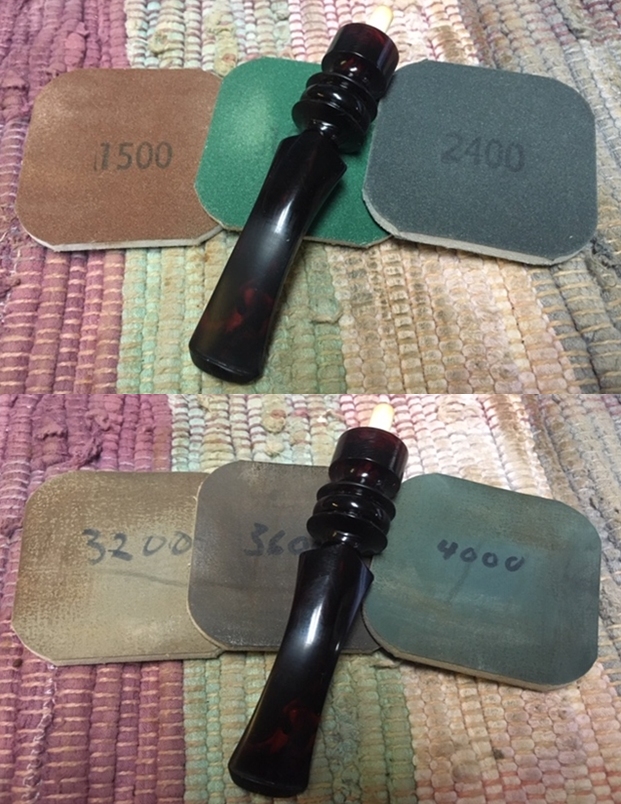
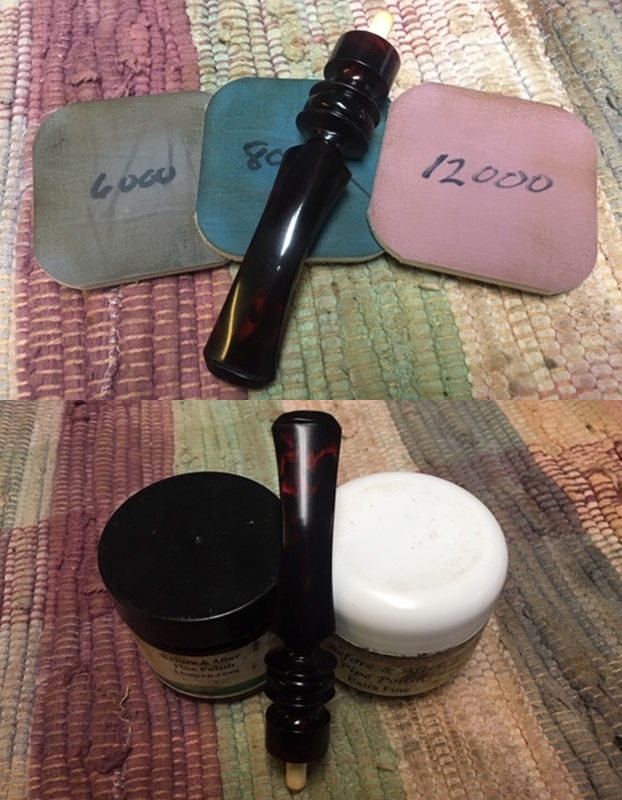
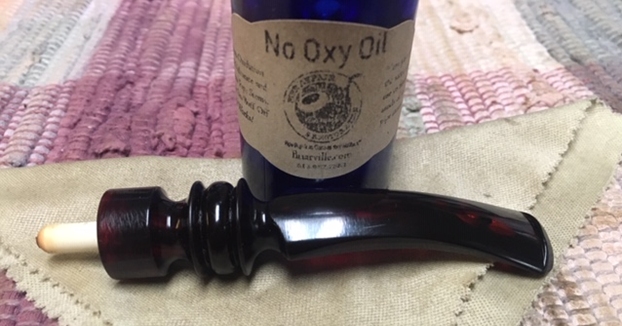
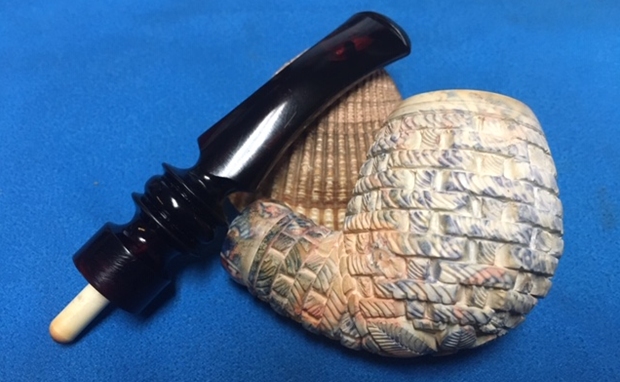
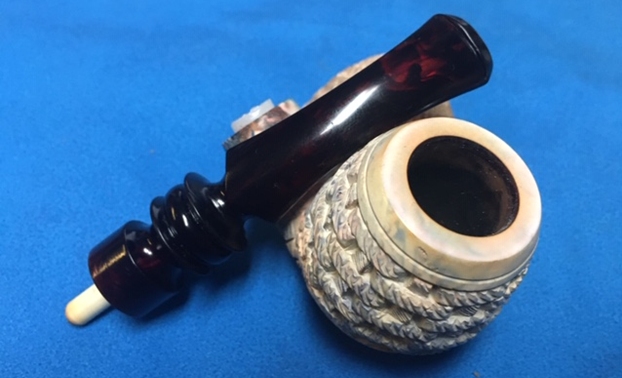
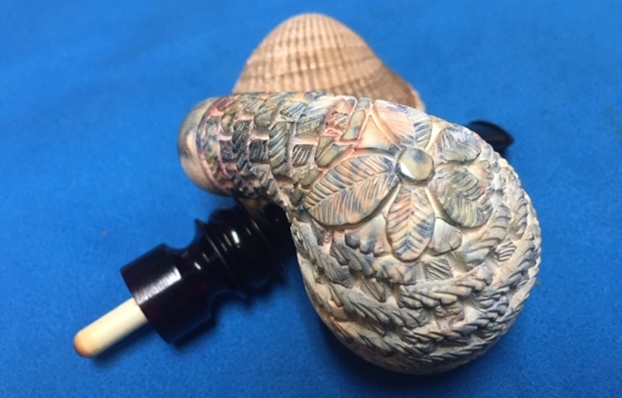
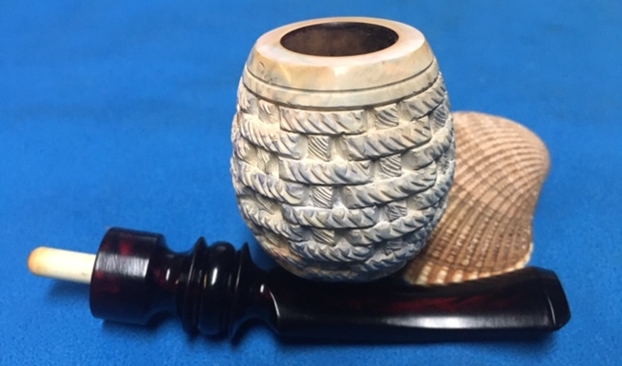
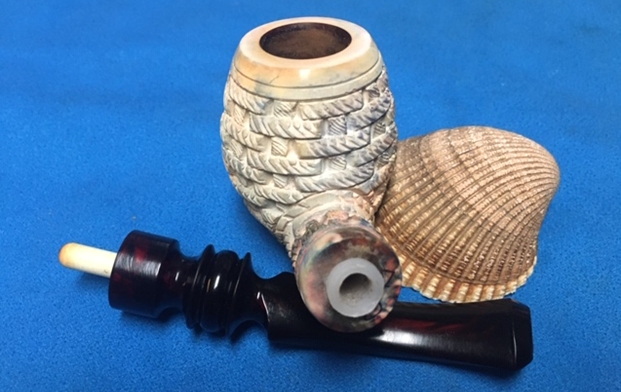
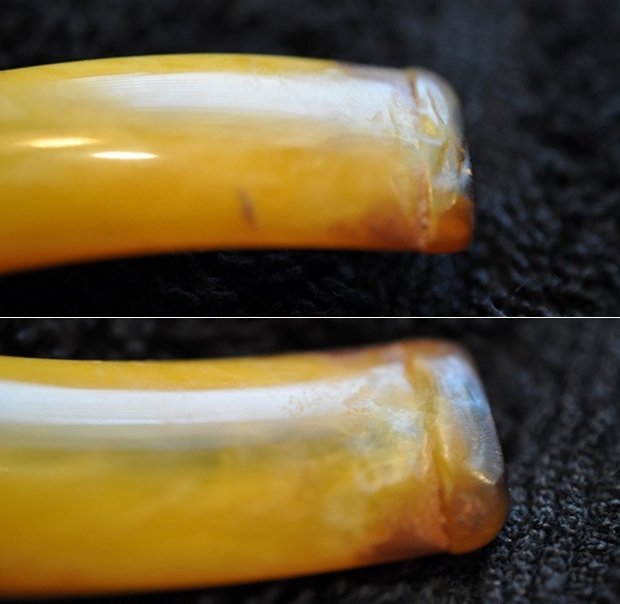
Jeff and I picked up this Egg shape Basket Weave Meerschaum with a red acrylic stem from a recent trip we took together. It came in a black vinyl covered case lined with rich brown velour in the cover and lower portion of the case. The case was in very good condition with brass hinges on the back and a brass clasp on the front. There were no identifying marks in the case or on the pipe itself. Jeff opened the case and this was the meerschaum pipe that was inside. It was a nice looking basket weave carved egg shaped bowl that had a colouration that neither of us had ever seen before. We both wondered if somewhere along the way it had come in contact with a cloth that had bled stain on the pipe. But the pattern and intensity of the colour was bowl wide and deep in the meerschaum. Looking at the shank end we also saw that it seemed to go even into the internals of the pipe. The exterior of the bowl was very dirty and had tars and oils ground into the finish and was dull. Looking at the top of the bowl you can see the light lava that had overflowed onto the rim top. You can also see the darkening on the inner and outer edge of the bowl. There was a thin cake in the bowl. The stem looked to be in good condition with a little chatter but no tooth marks. Jeff took photos of the pipe to show its condition before he started his clean-up.Jeff took close-up photos of the bowl and rim top from various angles to capture the condition of the bowl and rim top edges. There was a very thick cake in the bowl that was hard and uneven.  There was thin overflowing lava coming up from the cake onto the rim top. Jeff took photos of the sides and heel of the bowl to show the carving and colour around the bowl as well as the darkening that had occurred on the outer edge of the bowl. Jeff took the stem off the shank and took a photo. It appears to be a threaded tenon that unscrewed from the stem. This was the first sign of a problem with the tenon being stuck in the shank. It was not clear what kind of tenon we were dealing with here. I expected a push tenon and that could well be the case.  I would know more about that once I had it in hand. The stem was dusty and dirty.  The internals of the pipe looked quite dirty judging from the tenon end. Notice the colours that permeate deep into the meerschaum on the shank end.Jeff took photos of the stem to show the general condition of the fancy stem shape. The curve is graceful and gentle. The photo shows the profile of the stem. He took photos of the top and underside of the stem to show the light tooth chatter on both sides near the button. Having seen the pipe I did before his cleanup I did not know what to expect when I unpacked the most recent box Jeff sent to me. The pipe was present in the box with other cased pipes so as I took each one out and opened it I waited to see this one. When I finally opened a case and this pipe was there I did not know what to expect. The colours left me wondering what to expect so I opened the case with a bit of fear and trepidation at what awaited me inside. I put the case on my desk and opened it to see what was there. I opened the case and took a photo of the pipe inside.I was astonished to see how clean the pipe was. The bowl was definitely coloured with the bubblegum speckles all around the pipe. It actually looked very good at first glance.Now it was time to take it out of the case and have a look at it up close and personal. Jeff had done an incredible job in cleaning up this meerschaum. He had carefully reamed the bowl with a Savinelli Fitsall Pipe Knife, scraping away the thick cake on the walls of the bowl. He also scraped off the lava on the rim top. He scrubbed the exterior of the bowl with Murphy’s Oil Soap and a tooth brush to remove the grime on the bowl and rim and was able to remove much of the darkening. He cleaned out the interior of the bowl and shank with pipe cleaners, cotton swabs and alcohol until they came out clean. The rim top looked incredible when you compare it with where it started. There is some slight darkening on the inside edge of the bowl. He cleaned the stem with Soft Scrub to remove the grime on the exterior and cleaned out the airway with alcohol, cotton swabs and pipe cleaners. I took some photos of the pipe as I saw it. To show how clean the rim top and stem really was I took a close-up photo of the rim. The bowl was clean and cake free. The rim top is quite clean and the inner edge of the bowl has all of the lava removed. There is still some general darkening to the rim top that I would like to remove but it is very clean. The rich Redmanol coloured stem looks very good. The surface and the button edge look really good. There are no issues that are there to address.I removed the stem from the bowl and took photos of the parts. When I first unscrewed it the stem came off the tenon. I looked it over and could see that I was dealing with a push stem system. I screwed it back in place and twisted in the opposite direction and I was able to twist the push stem off the mortise insert. I would clean it up and it should be easy to work with in the future. I decided to address the darkening on the rim top and edges first. I polished the rim top and edges with micromesh sanding pads – wet sanding with 1500-12000 grit pads to remove the blackened spots on the rim top and clean up the top. I wiped it down with a damp cloth to remove the sanding dust. The polishing of the rim top and edges had removed the darkening and left behind a light patina. I took photos of the top, sides and heel of the bowl to show what it looked like at this point. Note the carved flower on the heel of the bowl. It is well done and a unique touch on this basket weave style bowl. The bowl was basically finished so I set it aside and turned my attention to the stem. Since it was quite clean I decided to polish it with micromesh sanding pads – dry sanding with 1500-12000 grit sanding pads. I also worked over the staining of the push tenon at the same time. I wiped the stem down after each sanding pad with a cloth containing some Obsidian Oil. I finished polishing it with Before & After Pipe Stem Polish – both Fine and Extra Fine and buffed it off with a cotton cloth. Even though the stem is acrylic I decided to give it a coat of Briarville’s No Oxy Oil to preserve and protect it. I put the bowl and stem back together again and buffed it with a microfiber cloth to raise the shine on the meerschaum and the acrylic stem. The hand buffing adds depth to the shine. I gave the stem several coats of carnauba wax and the bowl multiple coats of Clapham’s Beeswax Polish. The Beeswax Polish is a soft wax that I can apply with a soft cotton pad and buff with a microfiber cloth. The colours of the pipe came alive and looked great to me. It has a great feel in the hand that is very tactile and an interesting patina should develop as the pipe is smoked. The finished pipe is shown in the photos below. The dimensions of the pipe are Length: 5 ½ inches, Height: 2 inches, Outside diameter of the bowl: 1 ¼ inches, Chamber diameter: 5/8 of an inch. This Coloured Basket Meerschaum is a beauty whose colours make it interesting. When I first saw it I was dubious about the flecks of colour but as I have worked on it I have come to appreciate them. It should make someone a great pipe. It is one that will be on the rebornpipes store very soon. If you are interested let me know. Thanks for reading this blog and my reflections on the pipe while I worked on it.

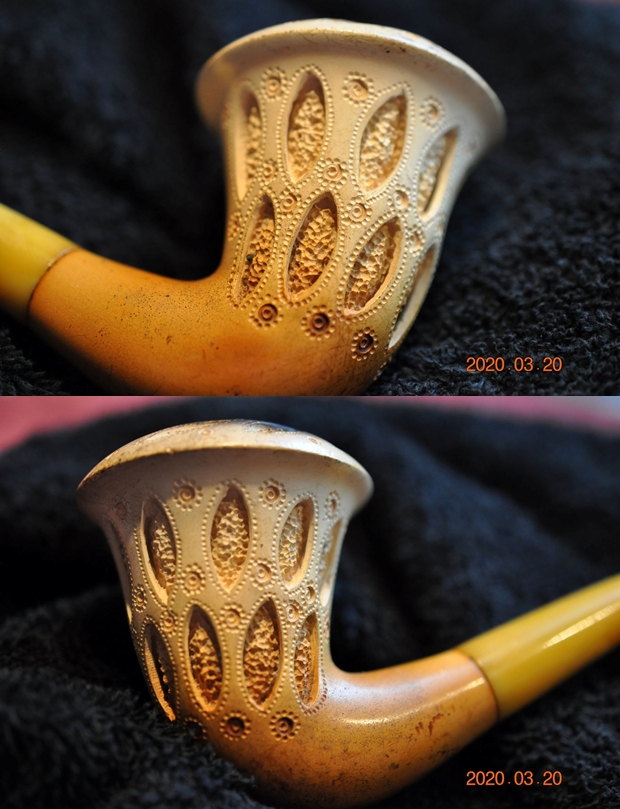
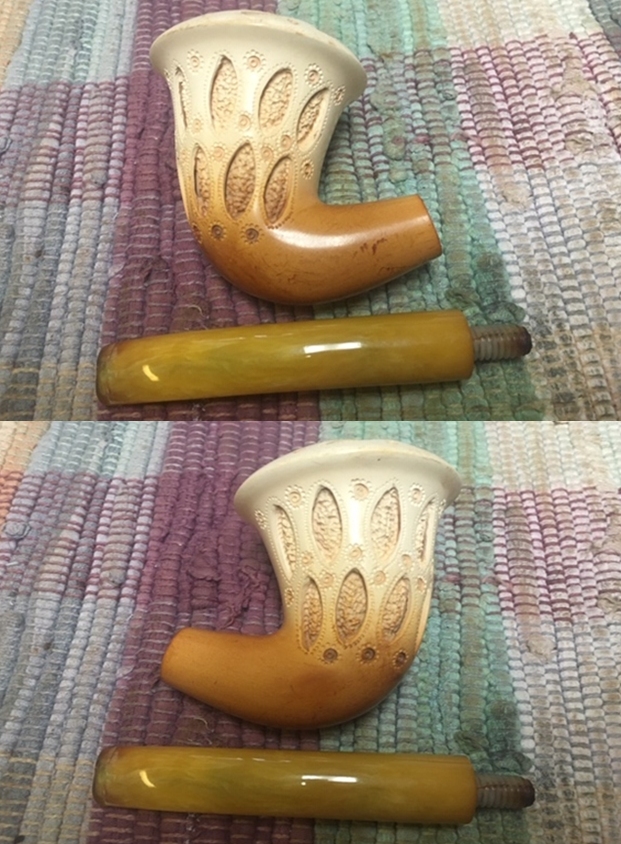
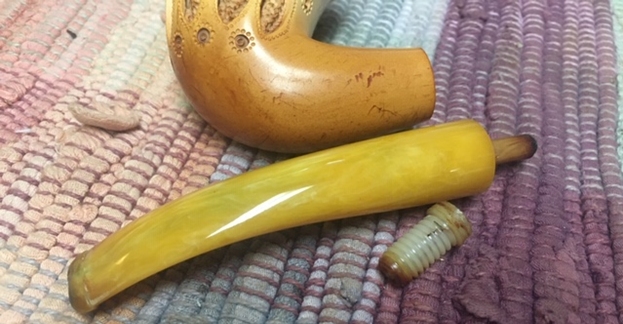
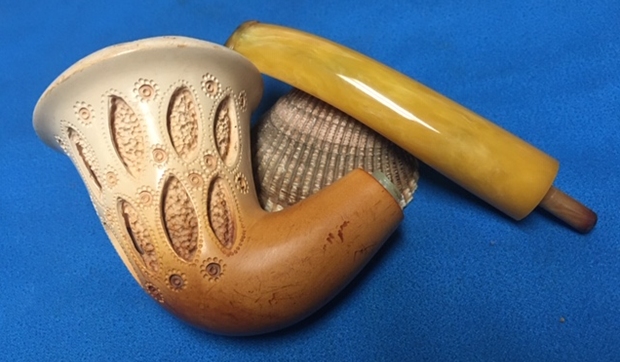
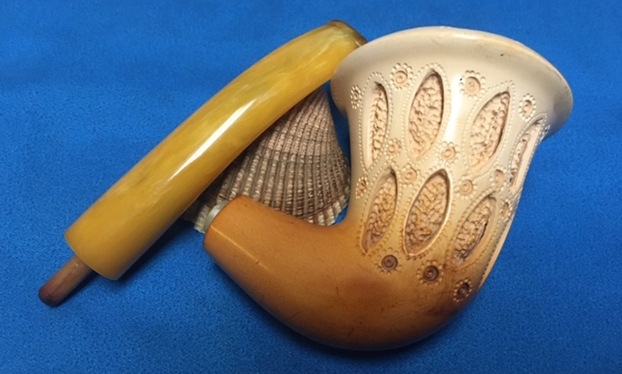
A Beautiful Lattice Meerschaum Lay Underneath the Thick Cake and Lava


Blog by Steve Laug

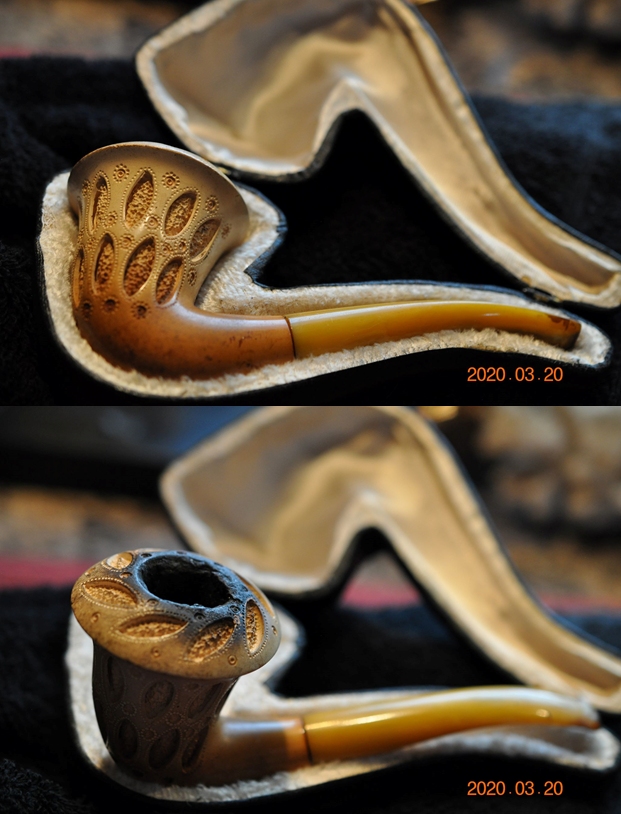
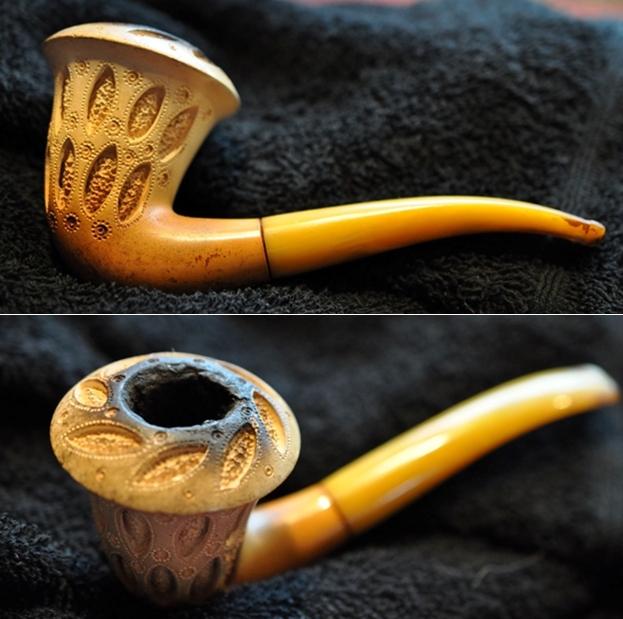
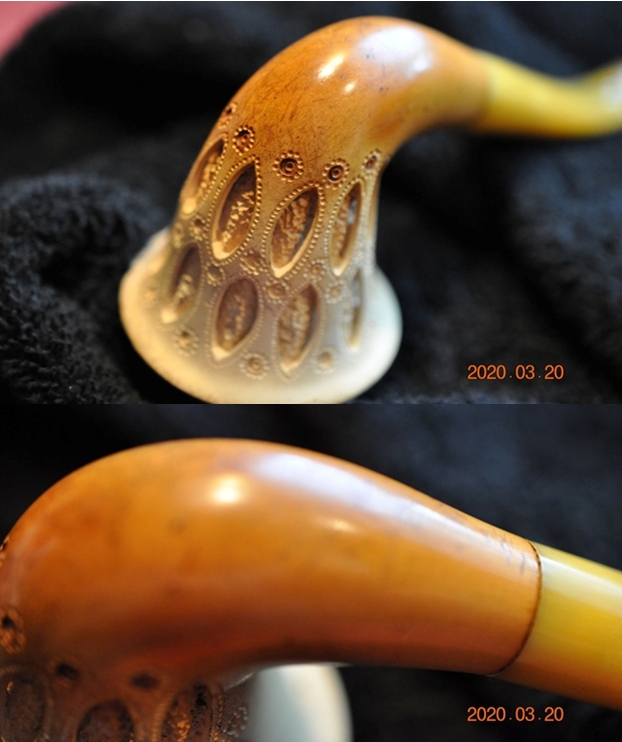
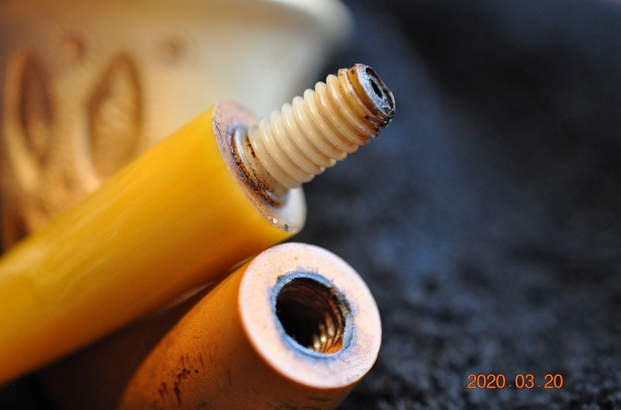
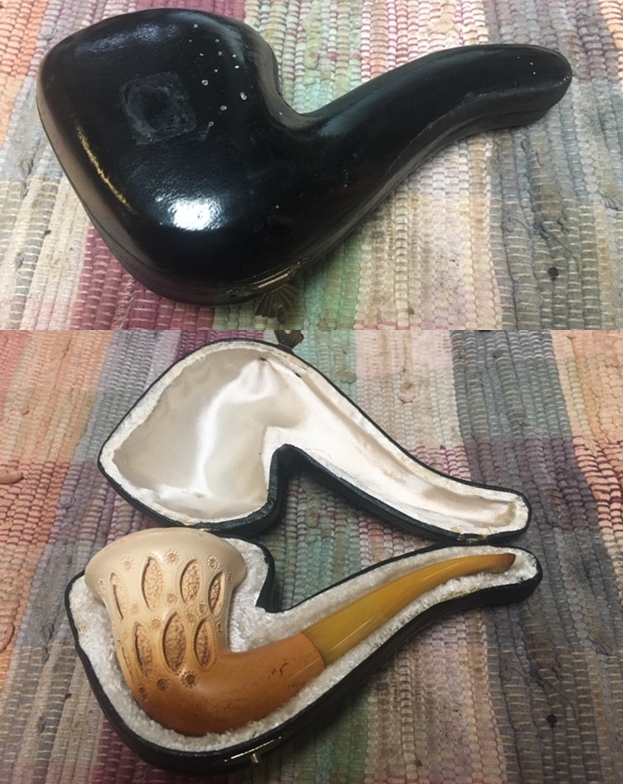
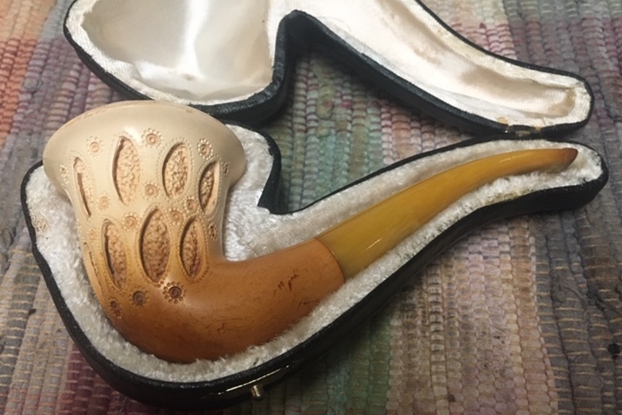
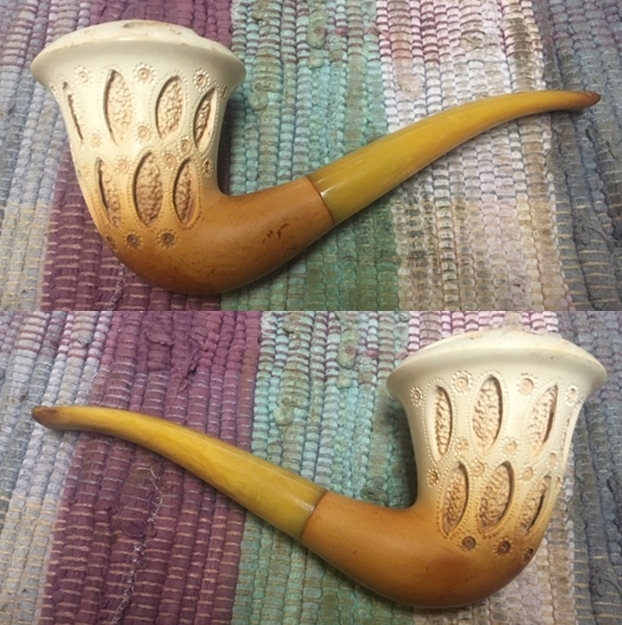
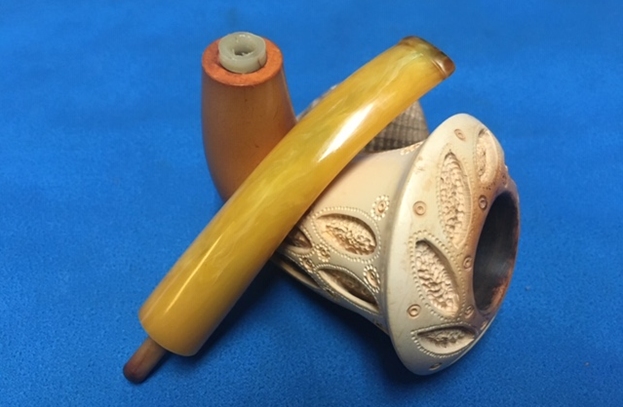
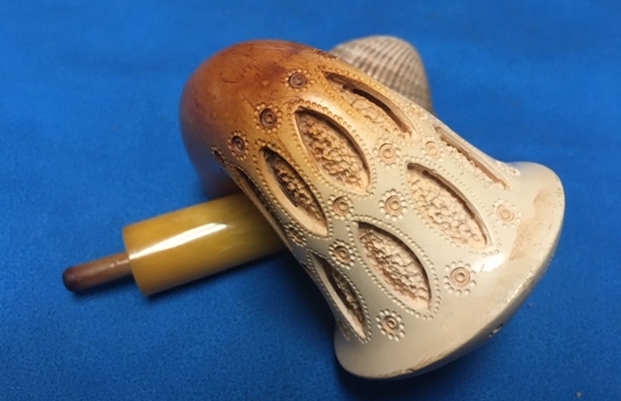
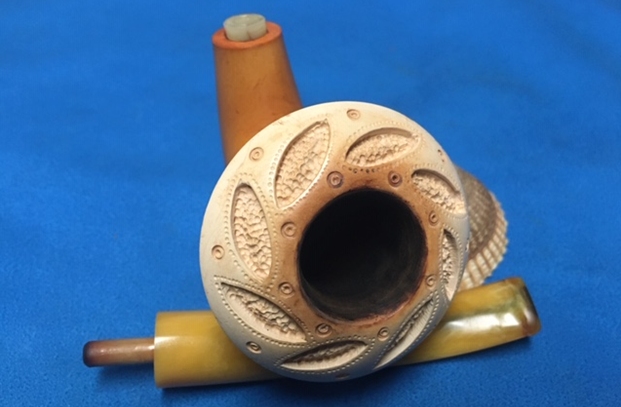
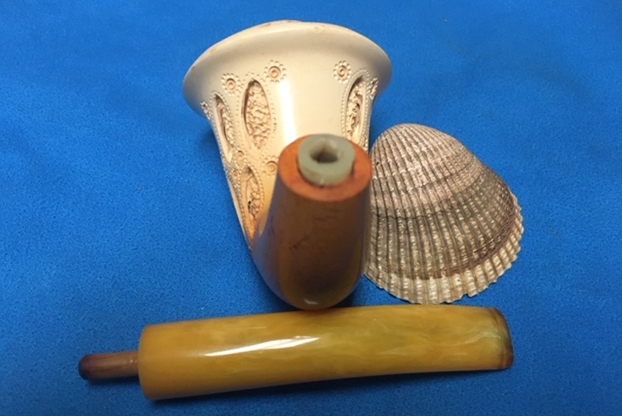
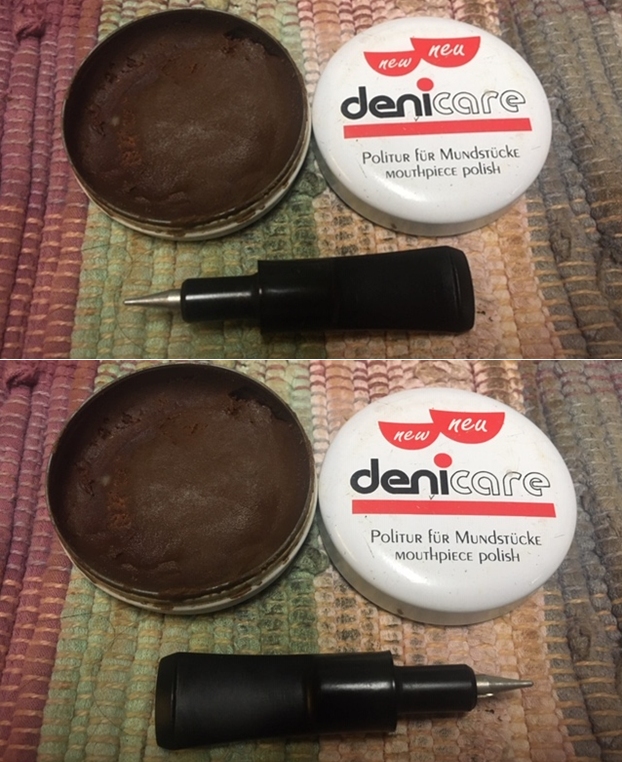
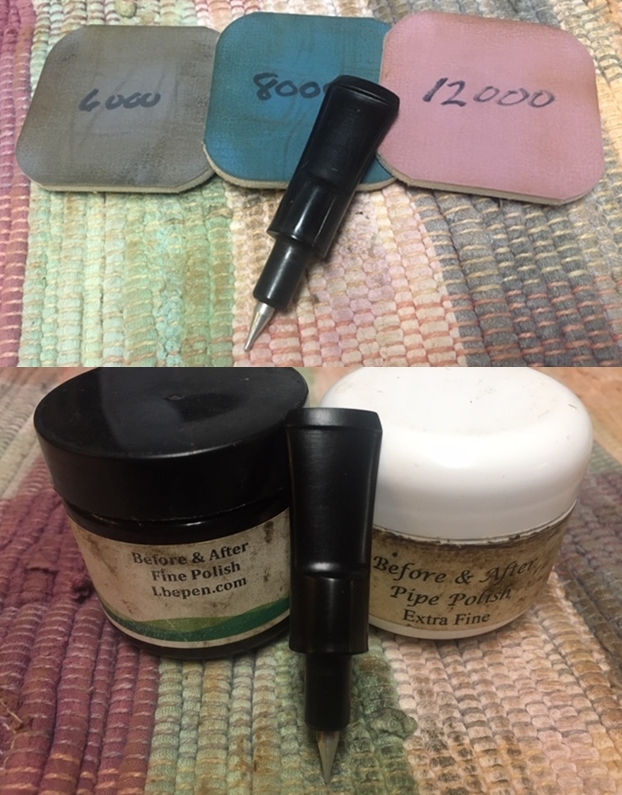
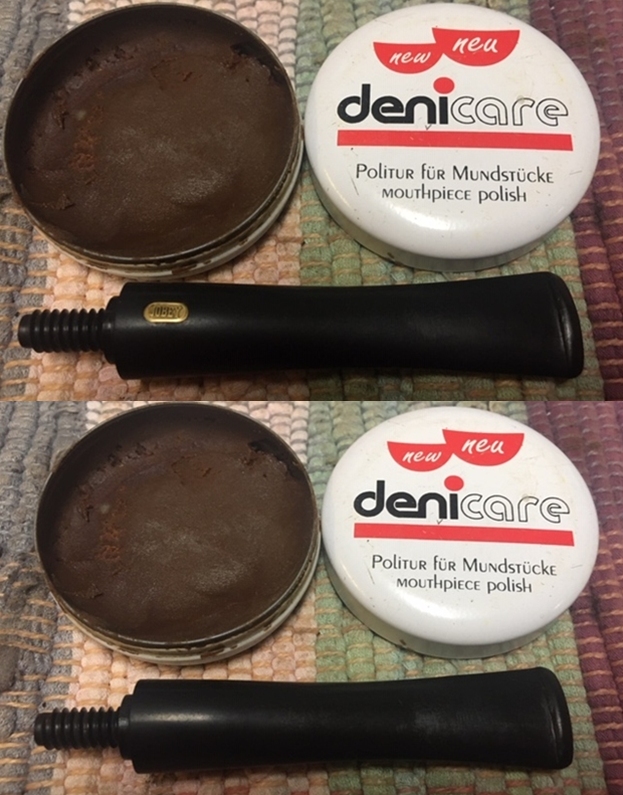
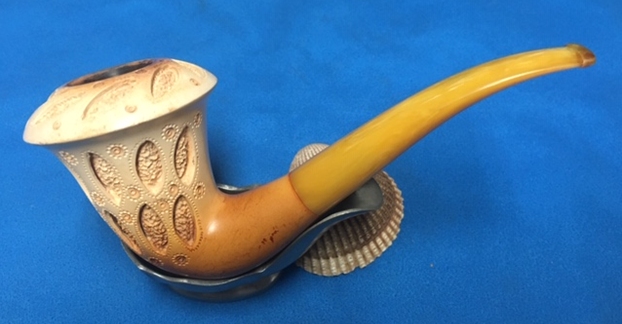
Jeff picked up this Calabash Lattice Meerschaum with an acrylic stem from somewhere on his travels. It came in a black vinyl covered case lined with Satin in the cover and white fur in the lower portion of the case. The case appeared to have had a sticker on the cover that was long gone. There were no identifying marks in the case or on the pipe itself. It has a brass clasp on the front and brass hinges on the back. It was obviously custom made for this pipe.Jeff opened the case and this was the meerschaum pipe that was inside. It was a nice looking lattice carved calabash bowl that had begun to take on some nice colour. The base and shank were almost amber coloured. The exterior of the bowl was very dirty and had tars and oils ground into the finish. Looking at the top of the bowl you can see how much lava had overflowed onto the rim top. It had filled in most of the fine carvings in the top of the rim around the inner edges of the bowl. I am sure once it was out of the case it would become clear how dirty it really was.Jeff took it out of the case to have a better look at the condition of the pipe. It was a beautifully shaped calabash with lots of promise. It looked like it would cleanup really well and look great when finished. The meerschaum was developing some really nice colour around the lower part of the bowl and shank. Jeff took a close-up photo of the bowl and rim top. There was a very thick cake in the bowl that was hard and uneven.  There was thick overflowing lava coming up from the cake over the rim top and filling in the tiny spot and carving on the rim.Jeff took photos of the sides and heel of the bowl to show the carving and colour around the bowl. Jeff took the stem off the shank and took a photo. It appears to be a threaded tenon that screwed into the shank. The first sign of another possibility for me was the thin lip around the end of the tenon. I would know more about that once I had it in hand. The shank end and the tenon were filthy with oils and tars. The internals of the pipe were in as bad a condition as the inside of the bowl and airway.Jeff took photos of the stem to show the general condition of the stem shape. The curve is graceful and the curve great. The photo shows the profile of the stem. He took photos of the top and underside of the stem to show the damage and bite marks on both sides near the button and on the surface of the button itself. It almost looked like it had been wrapped in tape. Having seen the before pictures on this pipe I did not know what to expect when I unpacked the most recent box Jeff sent to me. The pipe was present in the box and I took it out of the box with a bit of fear and trepidation at the amount of work that would await me when I removed it from the case. I put the case on my desk and opened it to see what was there. I opened the case and took a photo of the pipe inside.I was astonished to see how clean the pipe was. The bowl nicely coloured – Jeff had lost none of the patina in clean-up process. Now it was time to take it out of the case and have a look at it up close and personal.Jeff had done an incredible job in cleaning up this meerschaum. He had carefully reamed the bowl with a Savinelli Fitsall Pipe Knife, scraping away the thick cake on the walls of the bowl. He also scraped the thick lava on the rim top. He scrubbed the exterior of the bowl with Murphy’s Oil Soap and a tooth brush to remove the grime on the bowl and rim. He cleaned out the interior of the bowl and shank with pipe cleaners, cotton swabs and alcohol until they came out clean. The rim top looked incredible when you compare it with where it started. There is some slight darkening on the inside edge of the bowl and a dark spot on the back topside. He cleaned the stem with Soft Scrub to remove the grime on the exterior and cleaned out the airway with alcohol, cotton swabs and pipe cleaners. To show how clean the rim top and stem really was I took a close-up photo of the rim. The bowl was clean and cake free. The rim top is quite clean and the inner edge of the bowl has all of the lava removed. The stem looks better with the tape removed. The stem looks very good. There are a few deep tooth marks in the surface and the button edge is thin and blackened.I unscrewed the stem from the bowl and took photos of the parts. The tenon appeared to be threaded but I was not sure of that. I would need to do a bit more work on it to be sure.I examined the tenon and decided to unscrew it from the stem. I locked a pair of pliers on the tenon and twisted it to unscrew it. As I did this the friction was not like threads, rather it was like a friction fit. Then it dawned on me what I was dealing with. The threaded portion was the female part of the push tenon that was normally anchored in the shank of the pipe. I pulled it free of the push tenon itself and took a photo of the parts. I breathed a sigh of relief as this was by far an easier repair to make. I would clean up the female portion and anchor it in the shank them clean up the push tenon and that part of the repair would be finished.I set the parts of the stem and push tenon assembly aside and turned my attention to the bowl itself. I cleaned up the inner edge of the bowl with a folded piece of 220 grit sandpaper.I polished the rim top with micromesh sanding pads – wet sanding with 1500-12000 grit pads to remove the blackened spots on the rim top and clean up the top. I wiped it down with a damp cloth to remove the sanding dust. The top looked considerably better. With the rim top cleaned up I turned my attention to the shank and the stem. Once I had removed threaded insert from the stem it opened up an area underneath that was filled with a lot of tars and oils. I cleaned out that area with pipe cleaners, swabs and alcohol. I cleaned up the inside of the shank and the mortise insert at the same time. I was able to get all of the grime removed. I then turned to the stem where there were also some tars and oils still in the airway and in the slot so I cleaned them as well.With everything cleaned it was time to reconstruct the push tenon system. I coated the threads on the mortise insert with all-purpose white glue and threaded the insert into the mortise. I wiped off the excess glue that came out as the insert seated in the shank. I set the bowl aside to let the glue cure and turned my attention to the stem. I started by using a topping board to remove the thin darkened edge of the button. It was quite thick to start with so I knew that to remove a little would not do damage but actually would make the stem stronger.I used a clear CA (Krazy) glue to fill in the deep tooth marks on both the top and underside of the stem as well as to build up the surface of the button to thicken it and smooth out the tooth damage.I reshaped the button surface and smoothed out the repairs with a folded piece of 220 grit sandpaper. I started the polishing with a folded piece of 400 grit wet dry sandpaper.I rubbed the stem down with Denicare Mouthpiece Polish. It is a gritty, red paste with the consistency of red Tripoli. I find that it works well to polish out scratches and light marks in the surface of the stem. I polished it off with a cotton pad to raise the shine.I polished the stem with micromesh sanding pads – dry sanding with 1500-12000 grit sanding pads. I wiped it down after each sanding pad with a cloth containing some Obsidian Oil. I finished polishing it with Before & After Pipe Stem Polish – both Fine and Extra Fine and buffed it off with a cotton cloth. I gave it a coat of Briarville’s No Oxy Oil to preserve and protect it. I put the bowl and stem back together again and buffed it with a microfiber cloth to raise the shine on the meerschaum and the acrylic stem. The buffing also removes minute scratches in the two materials and adds depth to the shine. I gave the stem several coats of carnauba wax and the bowl multiple coats of Clapham’s Beeswax Polish. The Beeswax Polish is a soft wax that I can apply with a soft cotton pad and buff with a microfiber cloth. The pipe was alive now and looked great to me. It has a great feel in the hand that is very tactile and the patina should develop more deeply as the pipe is smoked. The finished pipe is shown in the photos below. The dimensions of the pipe are Length: 6 inches, Height: 2 ¾ inches, Outside diameter of the bowl: 2 ¼ inches, Chamber diameter: 7/8 of an inch. This Lattice Meerschaum Calabash is a beauty that has great patina already. It should only deepen with time. It should make someone a great pipe. It is one that will be on the rebornpipes store very soon. If you are interested let me know. Thanks for reading this blog and my reflections on the pipe while I worked on it.

Cleaning up a lightly smoked Italian Made Zeppelin Style Cigar Pipe


Blog by Steve Laug

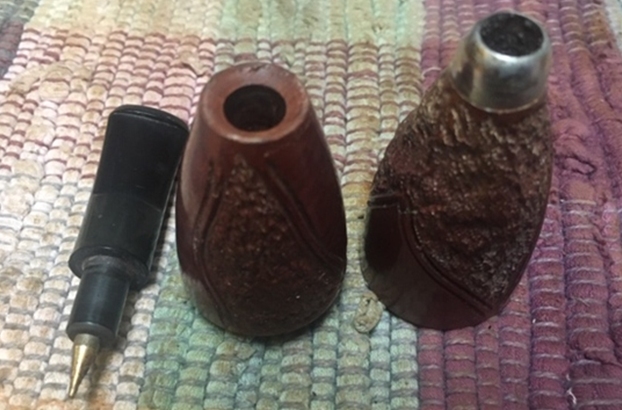
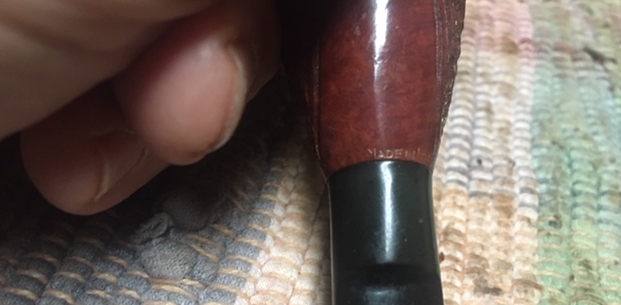
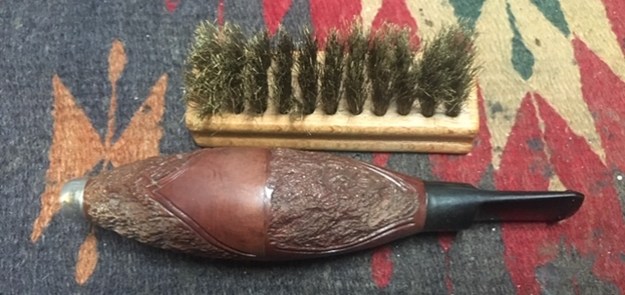
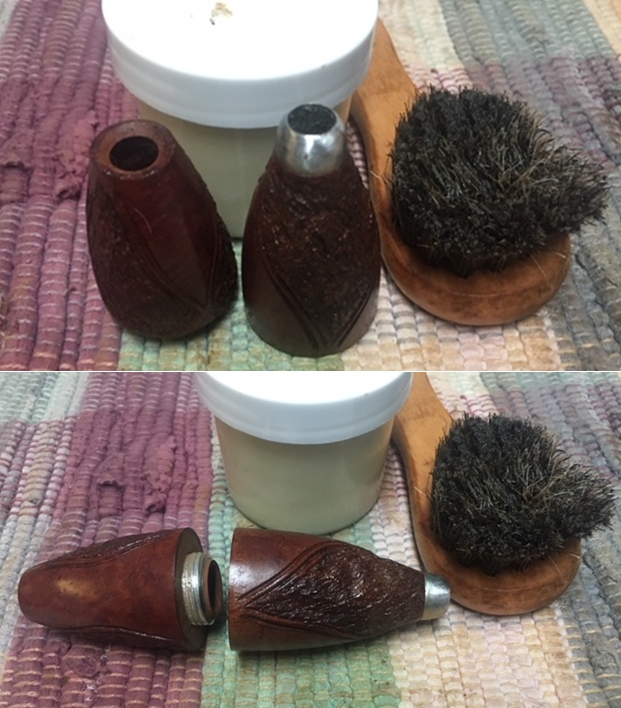
Jeff and I pick up a lot of pipes from a variety of places. The last time I visited him in Idaho I went through out boxes of pipes to be restored and picked out some unsmoked pipe that I could quickly spruce up and turn around on the rebornpipes store. This is another one of those pipes. It is called a Sparkless, Zeppelin or Cigar pipe. It unscrews in the centre of the pipe and the tobacco is stuffed in the cone side and then the pipe is screwed back together. I have yet to read a definitive description of how to light it. Some light it before putting it back together and others light it through the cone end. It remains a mystery to me! It has a vulcanite saddle stem. It is stamped Made In Italy around the thin band between the briar and the vulcanite stem. The pipe was lightly smoked and dusty from sitting around for a long time before coming to us. I say lightly smoked where actually I am not sure if a full bowl was ever smoked in it. It is impeccably clean on the inside with slight darkening in the bowl portion. The finish was a mix of smooth and rusticated in twists and turns around the bowl. It dirty but you can see the finish was okay. The nickel plated cone is oxidized but was not dented. The stem looked good but had some small nicks and scratches in the surface. Otherwise it was a great looking little pipe. It is a unique pipe for sure and well made. I took some photos of the pipe before I cleaned and polished it. I took a close-up photo of the nose cone of the pipe and of both sides of the stem. You can see the dust and debris in the rustication on the nose cone photo. That is how the rustication looks all around the bowl. The stem is scratched and dirty. It looks like it might have had a price tag sticker on it that left behind some stickiness. The smooth portions also seemed to have a light shellac or varnish coat on them that was flaking.I took the pipe apart and took some photos to show what I was trying to explain in the opening paragraph. You can see the front half is threaded in the briar. The mouthpiece end has metal threads over the briar. I removed the bit/stem from the other end and took a photo. It had a metal cone shaped stinger apparatus that is built into the tenon. It looks like it is pressure fit in place. I took a photo of the Made in Italy stamp on the shank end of the cone – just above the stem/shank junction. It is stamped on the smooth portion of the briar.I started my clean-up of the briar with a wire brush. I worked it over the rustications to remove the grime and grit and over the smooth areas to remove the loose varnish or shellac coat. I followed that with a quick application of a 1500 grit micromesh pad on the smooth parts of the pipe. When I was finished it looked dull but clean.I wanted give a little life to the bowl finish so I worked some Before & After Restoration Balm into the surface of the briar with my fingertips and a horsehair shoe brush to get it into the grooves of the rustication. The product works to clean, enliven and protect the briar. I let the balm sit for a little while and then buffed with a cotton cloth to raise the shine. The photos show the bowl at this point in the restoration process. I polished the nickel nose cone with micromesh sanding pads – dry sanding with 1500-12000 grit pads. I wiped it down after each pad with a damp cotton pad. The cone took on a rich shine. I set the bowl aside and turned my attention to the stem. The nicks were prevalent on the surface of the stem so I sanded them out with 220 grit sandpaper and started the polishing with 400 grit wet dry sandpaper.I rubbed the stem down with Denicare Mouthpiece Polish – a red Tripoli like gritty pasted that seems to work really well to smooth out the scratches and remove light oxidation. I don’t think the product is made anymore but it is a great one to use while I still have a bit of it around. I wiped it off with a cotton pad to polish the vulcanite.I polished the stem with micromesh sanding pads – dry sanding with 1500-12000 grit sanding pads. I wiped it down after each sanding pad with a cloth containing some Obsidian Oil. I finished polishing it with Before & After Pipe Stem Polish – both Fine and Extra Fine and buffed it off with a cotton cloth. I gave it a coat of Briarville’s No Oxy Oil to preserve and protect it. I put the pipe back together and buffed the pipe with Blue Diamond on the buffing wheel. I carefully avoided the stamping on the shank during the process. I gave the bowl multiple coats of Conservator’s Wax and the stem multiple coats of carnauba wax on the buffing wheel and followed that by buffing it with a clean buffing pad on the buffer. I hand buffed the pipe with a microfiber cloth to deepen the shine. The finished pipe is actually a nice looking unique. Give the finished pipe a look in the photos below. The dimensions of the pipe are Length: 5 ¼ inches, Height: 1 1/8 inches, Outside diameter of the bowl: 1 ¼ inch, Chamber diameter: 5/8 of an inch. This unique Zeppelin style Cigar Pipe is a well-made little pipe in great condition. Thanks for walking through the sprucing up process with me as I worked over another beautiful pipe. This one will be going on the rebornpipes store shortly. If you are interested in adding it to your collection let me know. Thanks for your time.


Another Simple Sprucing up – A Tom Thomb Lovat


Blog by Steve Laug

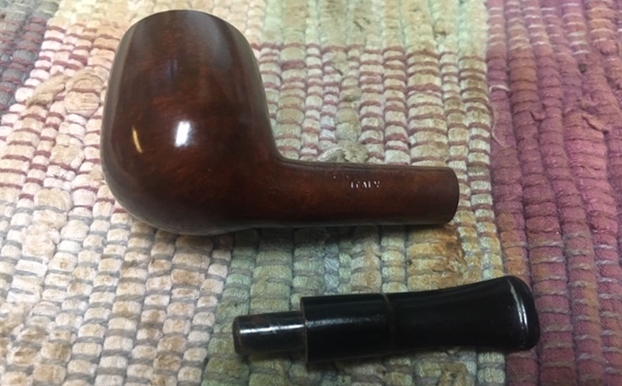
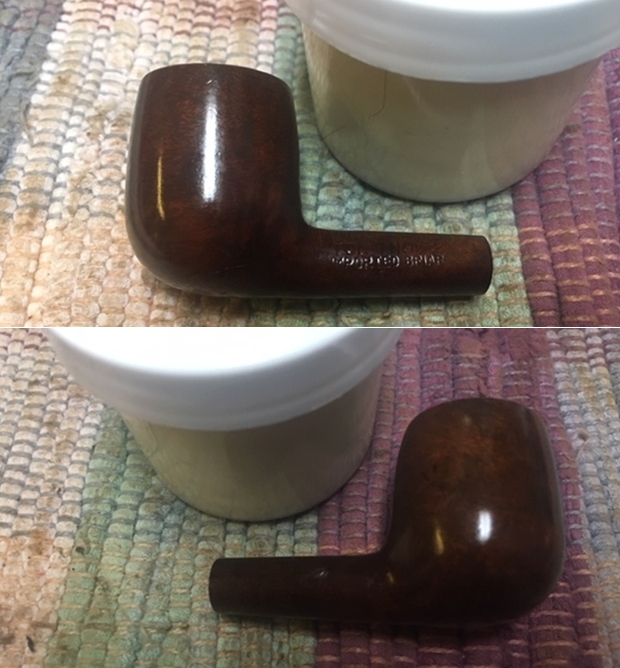
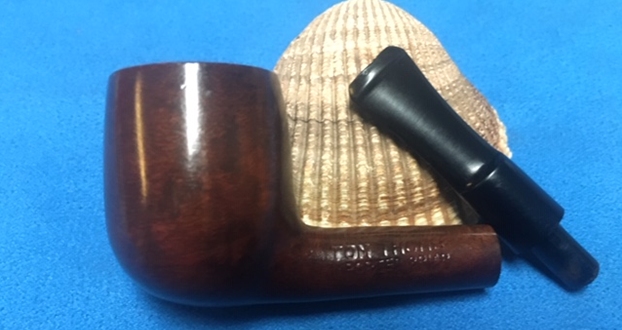
Jeff and I pick up a lot of pipes from a variety of places. The last time I visited him in Idaho I went through out boxes of pipes to be restored and picked out some unsmoked pipe that I could quickly spruce up and turn around on the rebornpipes store. This is another one of those pipes. It is a tiny Lovat with a saddle stem. It is stamped Tom Thomb over Imported Briar over Italy on the left side of the shank. The pipe was unsmoked but dusty from sitting around for a long time before coming to us. The finish was interesting but quite lifeless. The stem looked good but had some small nicks and scratches in the surface. Otherwise it was a great looking little pipe. It is delicate looking but also well made. I took some photos of the pipe before I cleaned and polished it. I took photos of the bowl and rim top to show the unsmoked condition. I also took some photos of the stem to show the nicks, scratches but also otherwise new condition. It would polish up really well.I took a photo of the stamping on the underside on the shank. You can clearly see the TOM THOMB over Imported Briar Italy stamp. It is very readable.  Strangely it is not spelled the way the children’s story I remember spelled it… this one is THOMB instead of THUMB!I removed the stem from the shank and took a photo of the parts. For such a tiny little pipe it is a well-proportioned pipe.Since it was so clean it did not require any repairs or reshaping. I wanted give a little life to the bowl finish so I worked some Before & After Restoration Balm into the surface of the briar with my fingertips to clean, enliven and protect it. I let the balm sit for a little while and then buffed with a cotton cloth to raise the shine. The photos show the bowl at this point in the restoration process. The nicks were deeper on this stem so I sanded them out with 220 grit sandpaper and started the polishing with 400 grit wet dry sandpaper.I polished the stem with micromesh sanding pads – dry sanding with 1500-12000 grit sanding pads. I wiped it down after each sanding pad with a cloth containing some Obsidian Oil. I finished polishing it with Before & After Pipe Stem Polish – both Fine and Extra Fine and buffed it off with a cotton cloth. I gave it a coat of Briarville’s No Oxy Oil to preserve and protect the stem. I put the stem back on the bowl and buffed the pipe with Blue Diamond on the buffing wheel. I carefully avoided the stamping on the shank during the process. I gave the bowl and stem multiple coats of carnauba wax on the buffing wheel and followed that by buffing it with a clean buffing pad on the buffer. I hand buffed the pipe with a microfiber cloth to deepen the shine. The finished pipe is actually a nice looking miniature. Give the finished pipe a look in the photos below. The dimensions of the pipe are Length: 3 ½ inches, Height: 1 ¼ inches, Outside diameter of the bowl: 1 inch, Chamber diameter: ½ of an inch. This small Tom Thomb Lovat is a well-made little pipe in exceptional condition. Thanks for walking through the sprucing up process with me as I worked over another beautiful pipe. This one will be going on the rebornpipes store shortly. If you are interested in adding it to your collection let me know. Thanks for your time.
A Simple Sprucing up – A Semi Churchwarden with a sandblast bowl


Blog by Steve Laug

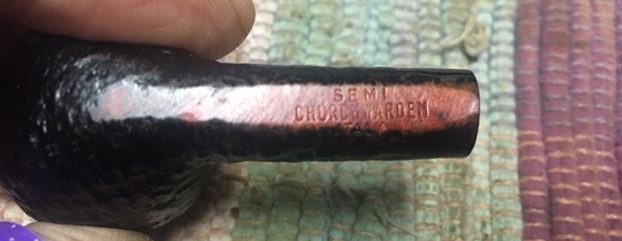
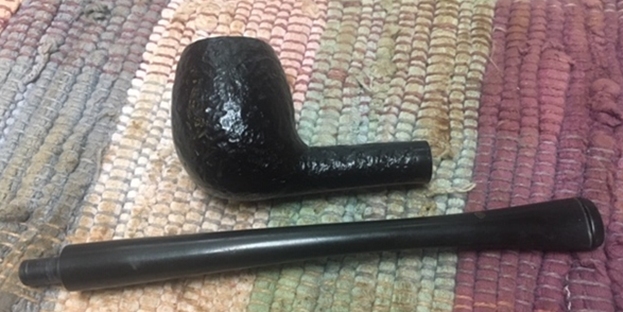
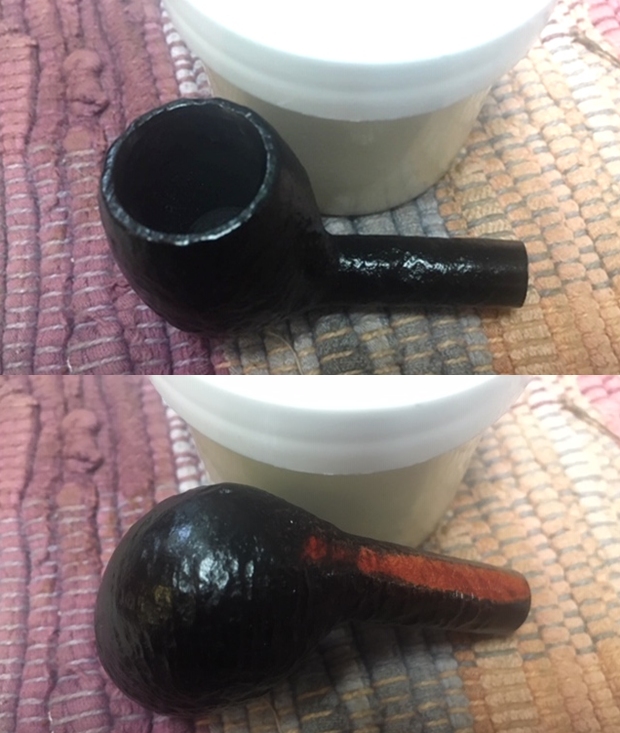
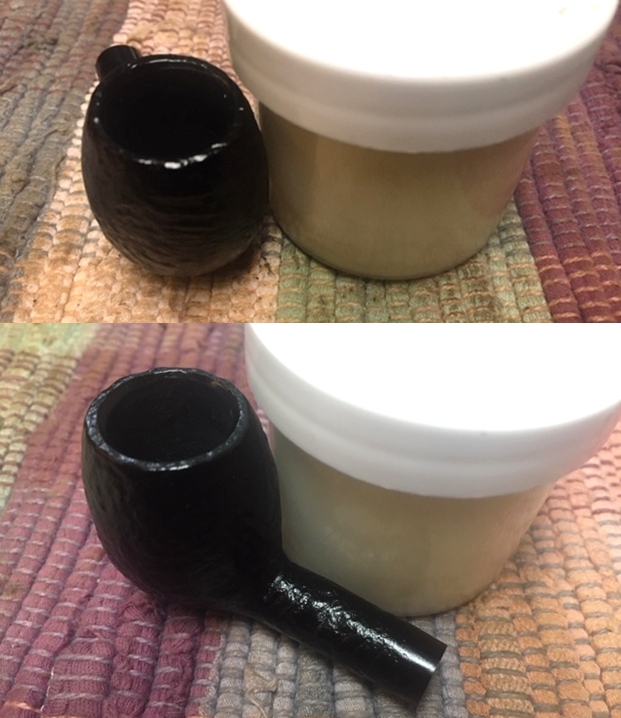
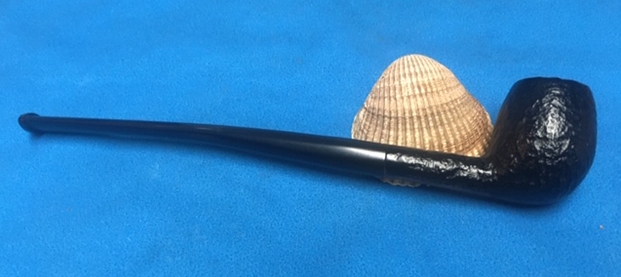
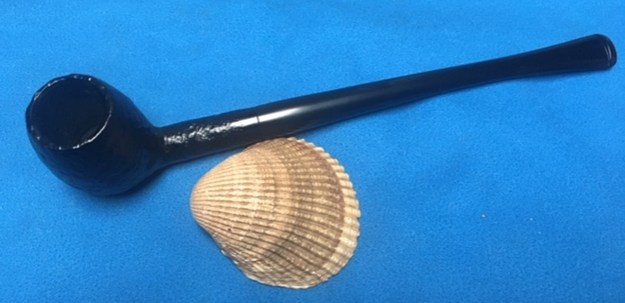
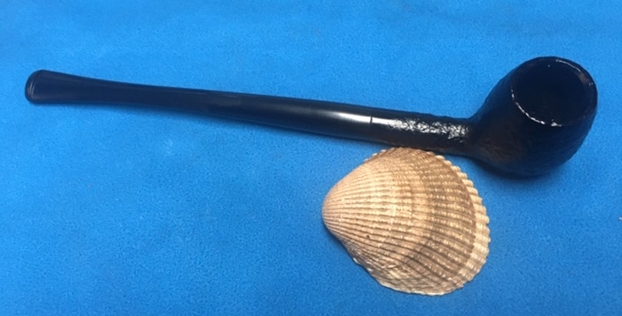
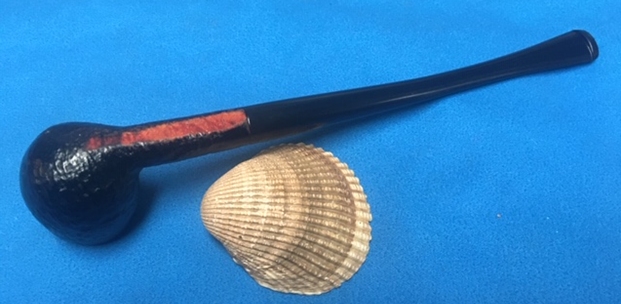
Jeff and I pick up a lot of pipes from a variety of places. The last time I visited him in Idaho I went through out boxes of pipes to be restored and picked out some unsmoked pipe that I could quickly spruce up and turn around on the rebornpipes store. This is one of those pipes. It is a small sandblast bowl with a five inch long stem. It is stamped Semi Churchwarden on the underside of the shank on a smooth panel. There are two side by side white bars on the left side of the taper stem. The pipe was unsmoked but dusty from sitting around for a long time before coming to us. The finish was interesting but quite lifeless. The stem looked good but had some debris stuck to it – maybe a price sticker glue or something like that and some small nicks and scratches in the surface. Otherwise it was a great looking little pipe. It is delicate looking but also well made. I took some photos of the pipe before I cleaned and polished it. I took photos of the bowl and rim top to show the unsmoked NOS (New Old Stock) condition. I also took some photos of the stem to show the nicks, scratches but also otherwise new condition. It would polish up really well.I took a photo of the stamping on the underside on the shank. You can clearly see the SEMI CHURCHWARDEN stamp. It is very readable. There is no other information – country of manufacture, shape number etc.I removed the stem from the shank and took photos of the parts. It is a well proportioned pipe.Since it was so clean it did not require any repairs or reshaping. I wanted give a little life to the bowl finish so I worked some Before & After Restoration Balm into the surface of the briar with my fingertips to clean, enliven and protect it. I let the balm sit for a little while and then buffed with a cotton cloth to raise the shine. The photos show the bowl at this point in the restoration process. I polished the stem with micromesh sanding pads – dry sanding with 1500-12000 grit sanding pads. I wiped it down after each sanding pad with a cloth containing some Obsidian Oil. I finished polishing it with Before & After Pipe Stem Polish – both Fine and Extra Fine and buffed it off with a cotton cloth. I gave it a coat of Briarville’s No Oxy Oil to preserve and protect the stem.  I put the stem back on the bowl and buffed the pipe with Blue Diamond on the buffing wheel. I carefully avoided the stamping on the shank during the process. I gave the bowl multiple coats of Conservator’s Wax and stem multiple coats of carnauba wax on the buffing wheel and followed that by buffing it with a clean buffing pad on the buffer. I hand buffed the pipe with a microfiber cloth to deepen the shine. The finished pipe is actually a nice looking miniature. The sandblast is not deep but still gives a tactile feel to the bowl. Give the finish pipe a look in the photos below. The dimensions of the pipe are Length: 7 ¼ inches, Height: 1 ½ inches, Outside diameter of the bowl: 1 inch, Chamber diameter: 5/8 of an inch. This small Semi Churchwarden is a bit of an anomaly to me. It is one of those pipes that is too long to be a regular billiard and too short to be a real Churchwarden. Even so it is a nice pipe in exceptional condition. Thanks for walking through the sprucing up process with me as I worked over another beautiful pipe. This one will be going on the rebornpipes store shortly. If you are interested in adding it to your collection let me know. Thanks for your time.

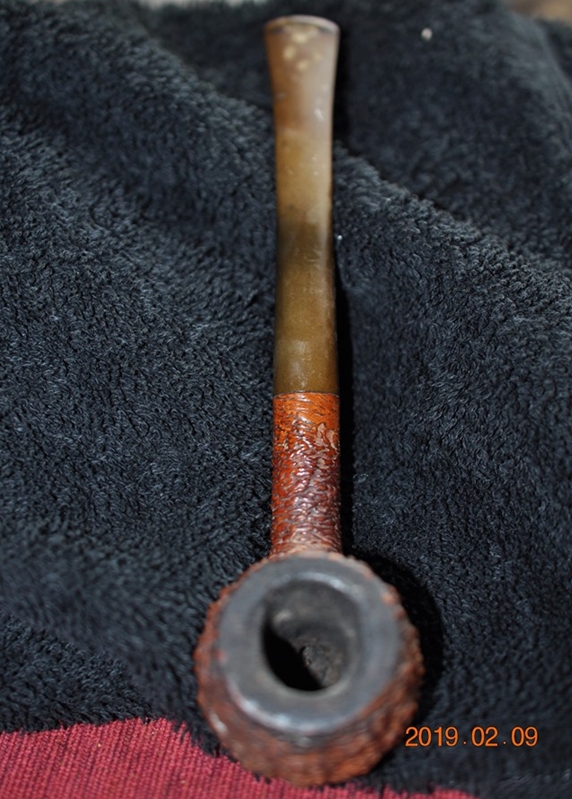
Restoring Jennifer’s Dad’s Savinelli Capri 313KS Root Briar Prince


Blog by Steve Laug

I decided to work on another of Jennifer’s Dad’s pipes. For the next pipe from the estate of George Rex Leghorn I have chosen a Savinelli Prince shaped pipe. You may not have read about this estate before, so I will retell the story. I received an email from Jennifer who is a little older than I am about whether I would be interested in her Dad’s pipes. My brother Jeff and I have been picking up a few estates here and there, so I was interested. Here is the catch – she did not want to sell them to me but to give them to me to clean up, restore and resell. The only requirement she had was that we give a portion of the sales of the pipes to a charity serving women and children. We talked about the organization I work for that deals with trafficking and sexual exploitation of women and their children and she decided that would be a great way to carry on the charitable aspect of her Dad’s character. With some great conversation back and forth she sent the pipes to Jeff and he started the cleanup process on them. Once he had finished cleaning them all he sent them to me to do my work on them.

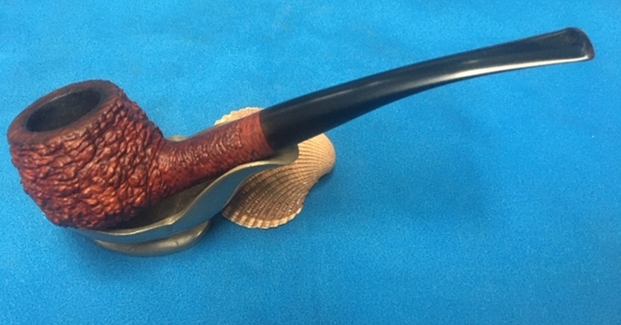
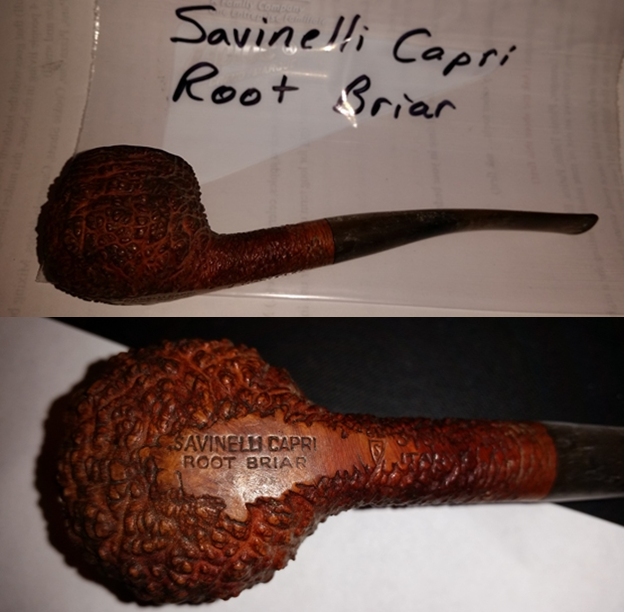
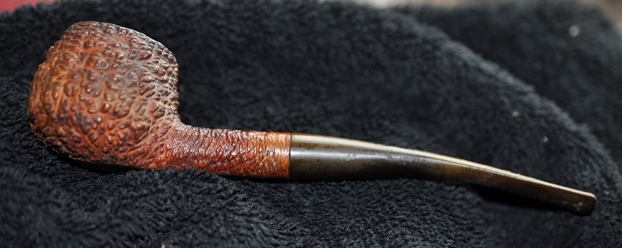
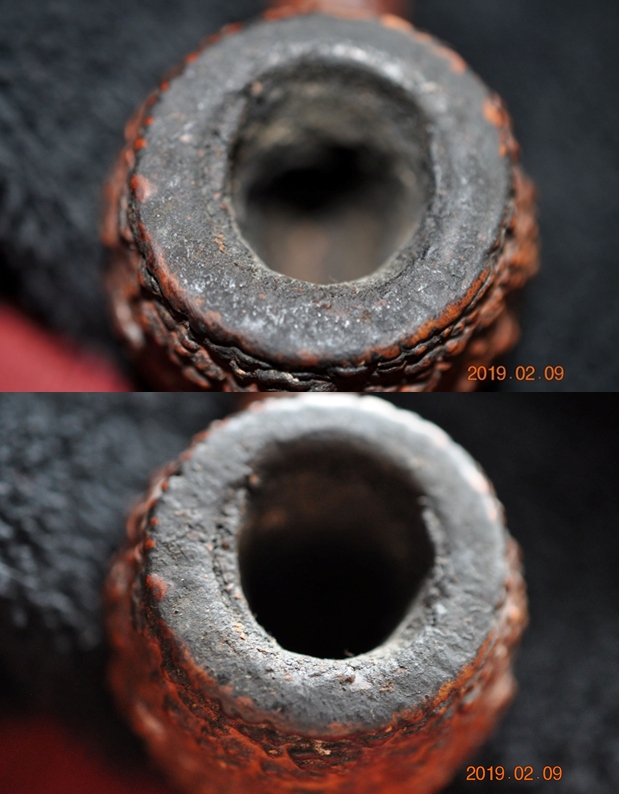
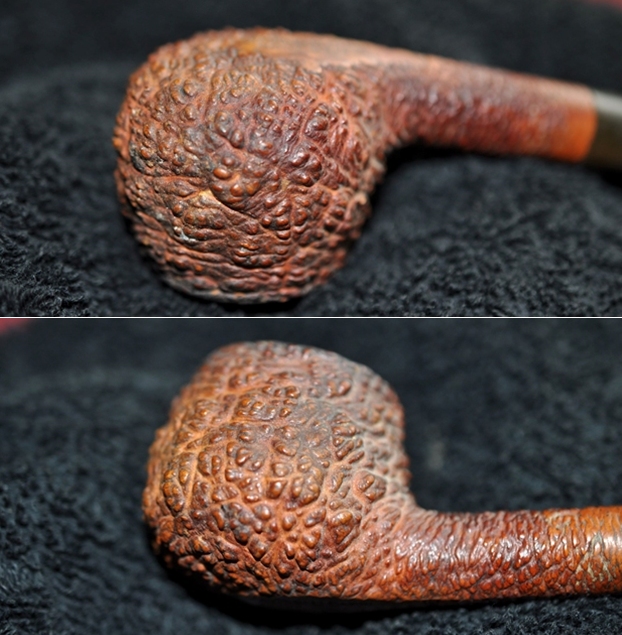
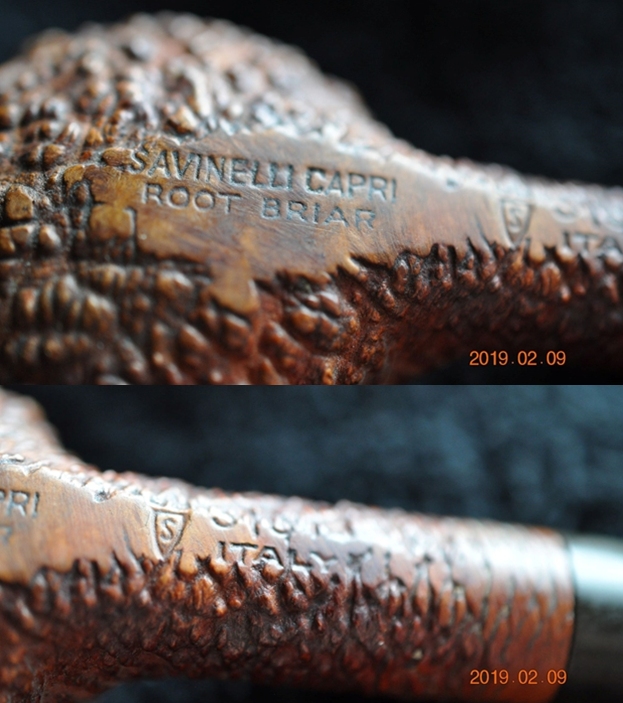
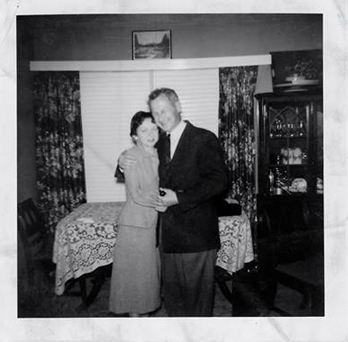
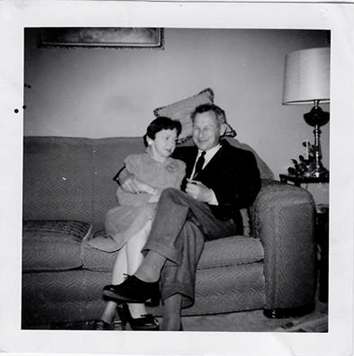
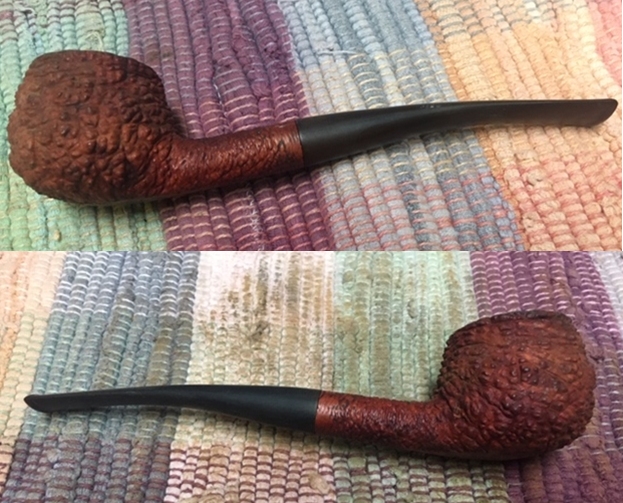
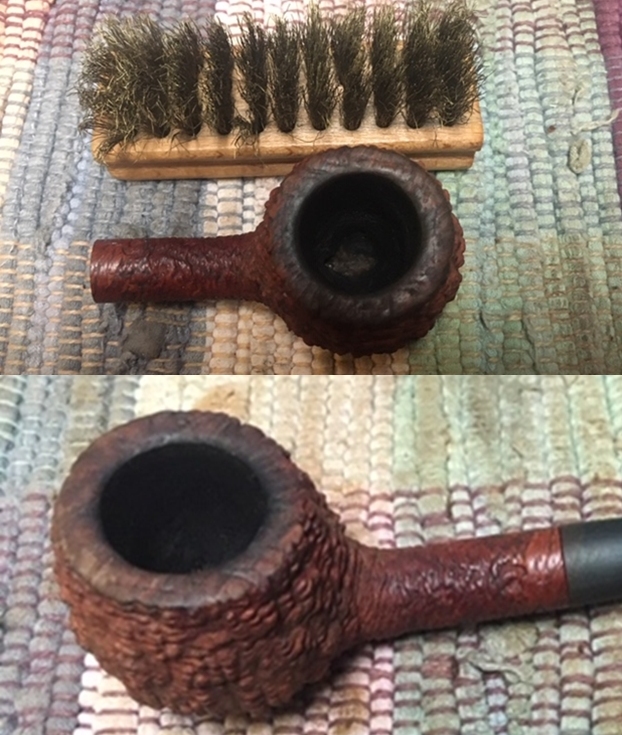
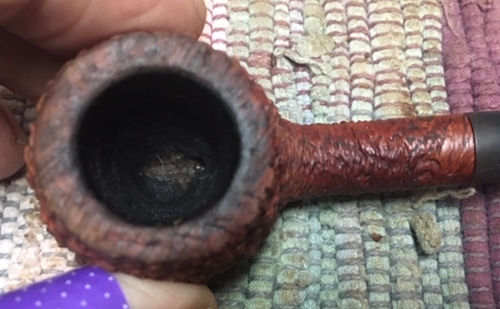
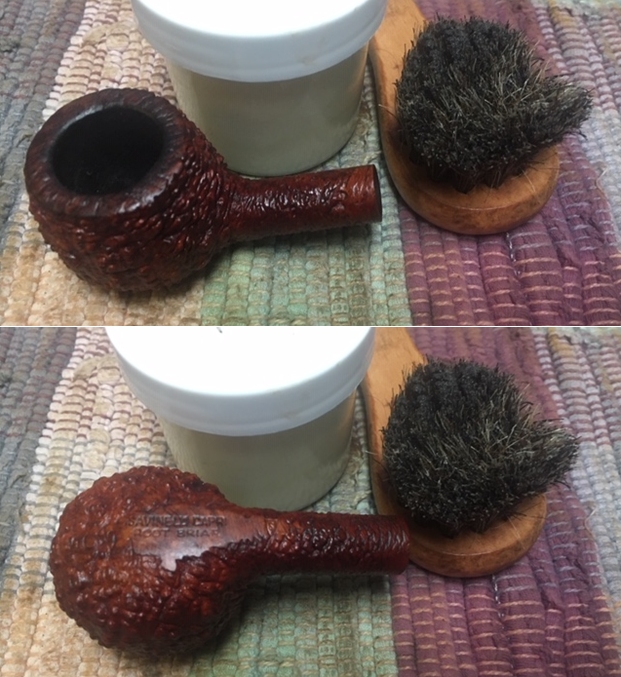
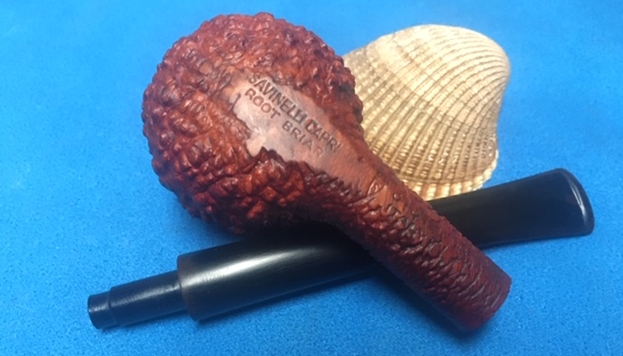
The pipe on the table is stamped on the underside of the bowl and shank on a smooth panel. On the heel of the bowl it is stamped Savinelli Capri over Root Briar. That is followed by The Savinelli “S” shield and Italy and the shape number that looks like 313KS but it hard to read as it is stamped in the rustication. The pipe has a Sea Rock or coral style rustication that I really like. The finish was very dirty, making it hard to see beyond that to the nice grain underneath that. There was a thick cake in the bowl and it had overflowed with lava onto the rim top. It was hard to know at this point the condition of the rim edges. The pipe was a dirty and tired looking old pipe. The stem was badly oxidized and there were George’s usual tooth marks and chatter on both sides just ahead of the button. It had been sitting in boxes for a lot of years and it was time to move ahead with the restoration. Jennifer took photos of the pipes she was sending. I have included the photos of this pipe below. When the box arrived from Jennifer, Jeff opened it and took photos of each pipe before he started his cleanup work on them. This pipe was another real mess but since it bore a coral finish which I like I could see some promise under all of the grime of the years. The shape was a Prince with the normal slightly bent stem. The briar appeared to be in good condition underneath the grime. The pipe really was covered with the grime and oils on the bowl sides from George’s hands. It left the finish looking mottled and dark on the high points. The bowl had a thick cake that had hardened with time. The lava overflow on the rim top filled in the rustication on the rim top. It was very thick but it could very well have protected the edges of the rim from damage. We won’t know what is under it until Jeff had cleaned it off. The stem was oxidized and there were deep tooth marks on both sides just ahead of the button. Jeff took photos of the pipe before he started working on it. I include those below.  Jeff took photos of the bowl and rim top to show the cake in the bowl and the lava build up on the rim top and dust and grime on the bowl. It was thick and hard but hopefully it had protected the rim and edges from damage. The lava coat looks horrible but it points to a well-used, favourite smoking pipe. Judging from the condition of George’s pipe I think it can be assumed that he was rarely without a pipe and that he seriously enjoyed smoking them. This was no exception. Jeff took a photo of the sides and heel of the bowl to show the condition of the finish – the grime and grit all over the sides and bottom of the bowl. The rustication is deep and dirty but it is interesting. This is a very tactile finish and one that I enjoy. Jeff took two photos of the stamping on the underside of the shank to capture all of it. It is very clear and readable other than the shape number 313KS which is in the rustication itself.    Jeff took photos of the top and underside of the stem showing the scratching, oxidation and tooth marks on the stem surface and button. The tooth marks are quite deep on both sides of the stem. Before I get on to cleaning up the pipe I thought I would once again include the tribute that Jennifer wrote to her Dad for the blog. She also sent some photos and an article that her Dad wrote for Jeff and me to be able to get a feel for him. I have included those below. Note in each of them that he is holding a pipe in his left hand. I asked her to also send me an email with a brief tribute to her Dad. Here is her tribute from an email to me.

Steve, I want to thank you again for accepting my dad’s pipes.  They were so much a part of my dad’s life that I could not simply discard them. But as his daughter, I was not about to take up smoking them either. *laughing* I think my dad would like knowing that they will bring pleasure to others.  I know that I do.

I’m not sure what to say about his pipes. I always remember Daddy smoking pipes and cigars.

First a bit about my dad. Though my father, George Rex Leghorn, was American (growing up in Alaska), he managed to join the Canadian Army at the beginning of WWII, but in doing so lost his American citizenship.  He was fortunate to meet a Canadian recruiting officer who told him the alphabet began with “A” and ended with “Zed” not “Zee”, and also told him to say that he was born in a specific town that had all its records destroyed in a fire.  When the US joined the war my dad, and thousands of other Americans who had made the same choice*(see the link below for the article), were given the opportunity to transfer to the US military, and regain their citizenship.

After WWII, my dad, earned his degree at the University of California Berkeley and became a metallurgist. There is even a bit about him on the internet.

He loved taking the family out for a drive, and he smoked his cigars on those trips. (As a child, those were troubling times for my stomach.)

I most remember my father relaxing in his favorite chair with a science fiction book in one hand and a pipe in the other… Sir Walter Raleigh being his favorite tobacco… and the pipes themselves remind me of him in that contented way.  If I interrupted his repose, he’d look up, with a smile on his face, to answer me.
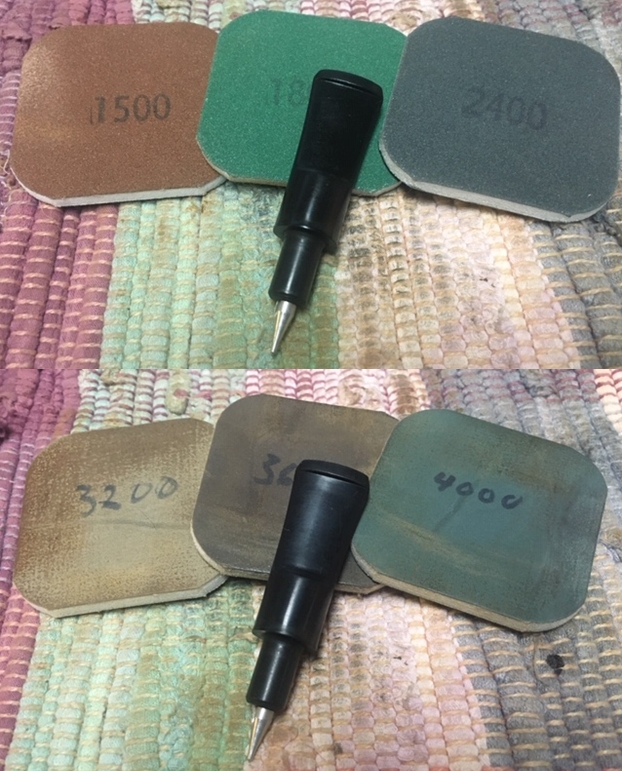
It seemed he smoked his Briarwood pipes the most, though he had others.  At the time, it was only the Briarwood I knew by name because of its distinctive rough shaped bowl.  And it was the Anderson Free Hand Burl Briar, made in Israel, which I chose for his birthday one year, because I thought he might like that particular texture in his hand.

At least two of his pipes, he inherited from his son-in-law, Joe Marino, a retired medical laboratory researcher (my sister Lesley’s late husband)… the long stemmed Jarl (made in Denmark), and the large, white-bowled, Sherlock Holmes style pipe.  I believe Joe had others that went to my dad, but Lesley was only sure about those two.

The Buescher, corncob pipe my older sister Lesley bought for Daddy while on one of her travels around the States.

A note on the spelling of my sister’s name…

My dad met my mother, Regina, during WWII and they married in Omagh, Ireland.  My mother was English and in the military herself.  The English spelling of Lesley is feminine, and Leslie masculine, in the UK… just the opposite of here in the United States.  I guess my mom won out when it came to the spelling of the name…

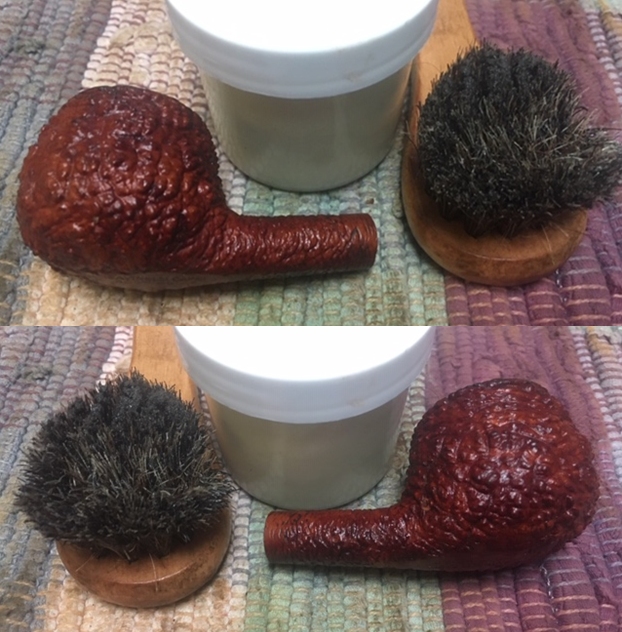
This pipe was a real mess just like the other ones in the collection. I was curious to see what it would look like when I unpack it. I was surprised at how good it looked. He reamed it with a PipNet pipe reamer and cleaned up the reaming with a Savinelli Fitsall Pipe Knife. He scrubbed out the internals with alcohol, pipe cleaners and cotton swabs until the pipe was clean. He scrubbed the exterior of the bowl with Murphy’s Oil Soap and a tooth brush to remove the grime and grit on the briar and the lava on the rim top. The finish on the bowl looked really good when I got it. The rim top looked much better and the inner and outer edges were looking good. Jeff had cleaned the internals and scrubbed the exterior of the stem and soaked them in Before & After Deoxidizer bath to remove the oxidation. The stem looked very good other than the deep tooth marks and chatter in the surface. When the pipe arrived here in Vancouver for the second stop of its restoration tour it looked very good. I took several photos of the pipe from the side and then got called away and did not finish taking photos. Here is what I have.   I forgot to take photos of the condition of the rim top and stem and when I came back to work on the pipe I just jumped in to do the restoration. I decided to clean up the darkening and smoothing of the rim top first. I used a brass bristle brush to work over the surface of the briar. When I was finished it looked better.     I worked some Before & After Restoration Balm into the finish of the bowl and the rim top and shank with my fingertips and a horsehair shoebrush to clean, enliven and protect it. I find that the balm really makes the briar come alive again. The contrasts in the layers of stain and the separate finishes really made the grain stand out. I let the balm sit for a little while and then buffed with a cotton cloth to raise the shine. The bowl really looks good at this point. I set the bowl aside and turned to the stem. I filled in the deep tooth marks with black super glue. I built up the edge of the button at the same time. I set it aside to dry. Once the repairs had cured I used a needle file to re-cut a sharp edge on the button on both sides and to flatten the repaired areas.  I sanded the stem to remove the oxidation that was on the surface and to smooth out the repaired areas. I used a folded piece of 220 grit sandpaper and a piece of 400 grit wet dry sandpaper. At this point the stem is looking better and the tooth marks are gone.  I rubbed the stem down with Denicare Mouthpiece Polish and a cotton pad to remove remnants of oxidation and to further blend in the sanding. The stem was showing some promise at this point in the process. I polished the stem with micromesh sanding pads – wet sanding it with 1500-12000 grit pads. I polished it further with Before & After Pipe Stem Polish – both fine and extra fine. I finished by wiping it down with Briarville’s No Oxy Oil and buffing it to a shine. Once again I am the part of the restoration that I always look forward to – the moment when all the pieces are put back together. I put the pipe back together and lightly buffed the bowl with Blue Diamond. I buffed the stem with a heavier touch with Blue Diamond on the buffing wheel. I gave the bowl multiple coats of Conservator’s Wax and the stem multiple coats of carnauba wax. I buffed the pipe with a clean buffing pad to raise the shine. I hand buffed it with a microfiber cloth to deepen the shine. It is fun to see what the polished bowl looks like with the combination of rustication and smooth finishes. The black vulcanite stem stands out as a shiny black contrast to the colours of the bowl. This little Capri Prince must have been a fine smoking pipe judging from the condition it was when we received it from Jennifer. Have a look at it with the photos below. The dimensions are Length: 6 inches, Height: 1 ¼ inches, Outside diameter of the bowl: 1 ¼ inches, Chamber diameter: ¾ of an inch. This is one that will go on the rebornpipes online store shortly. If you want to carry on the pipe trust of George Rex Leghorn let me know. Thank you Jennifer for trusting us with his pipes. Thanks to each of you who are reading this blog. Remember we are not pipe owners; we are pipemen and women who hold our pipes in trust until they pass on into the trust of the next generation.

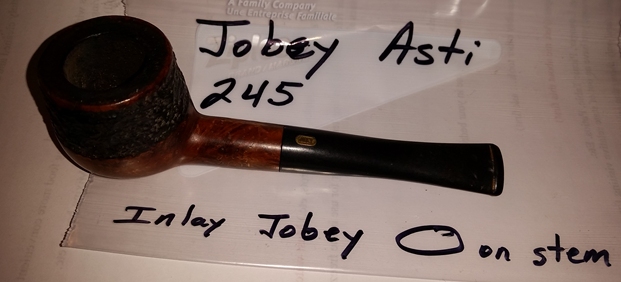
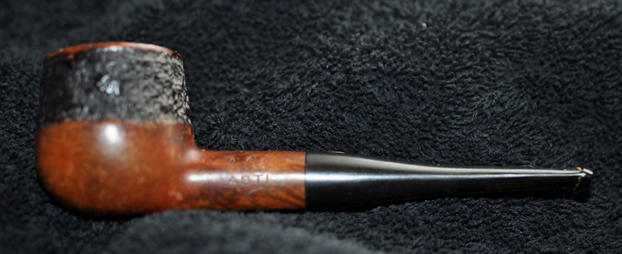
Restoring Jennifer’s Dad’s Jobey Asti 245 Pot


Blog by Steve Laug

I decided to change things up a bit and work on another of Jennifer’s Dad’s pipes. For the next pipe from the estate of George Rex Leghorn I have chosen a Pot shaped pipe. You may not have read about this estate before, so I will retell the story. I received an email from Jennifer who is a little older than my 64+ (65 now – sheesh, I forget how old I am) years about whether I would be interested in her Dad’s pipes. My brother Jeff and I have been picking up a few estates here and there, so I was interested. Here is the catch – she did not want to sell them to me but to give them to me to clean up, restore and resell. The only requirement she had was that we give a portion of the sales of the pipes to a charity serving women and children. We talked about the organization I work for that deals with trafficking and sexual exploitation of women and their children and she decided that would be a great way to carry on the charitable aspect of her Dad’s character. With some great conversation back and forth she sent the pipes to Jeff and he started the cleanup process on them. Once he had finished cleaning them all he sent them to me to do my work on them.

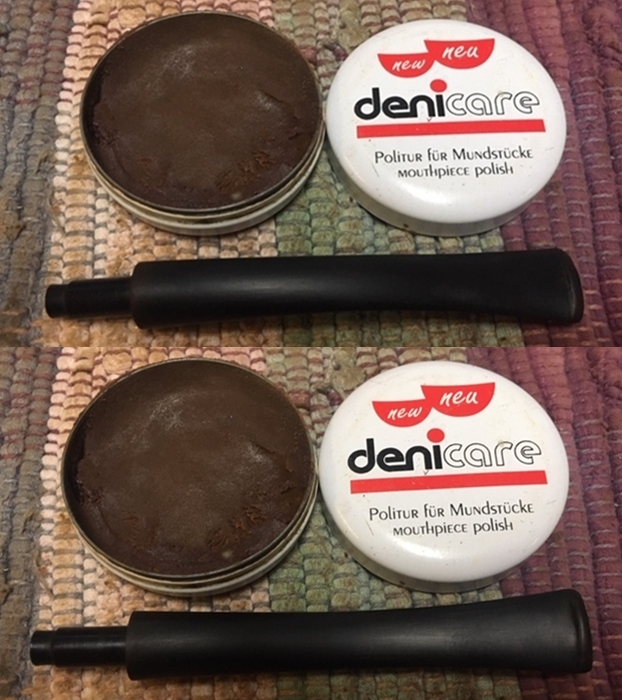
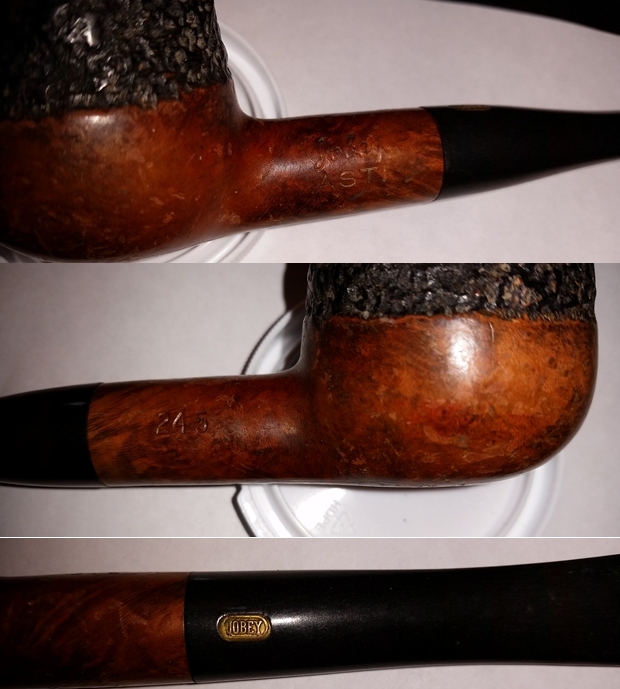
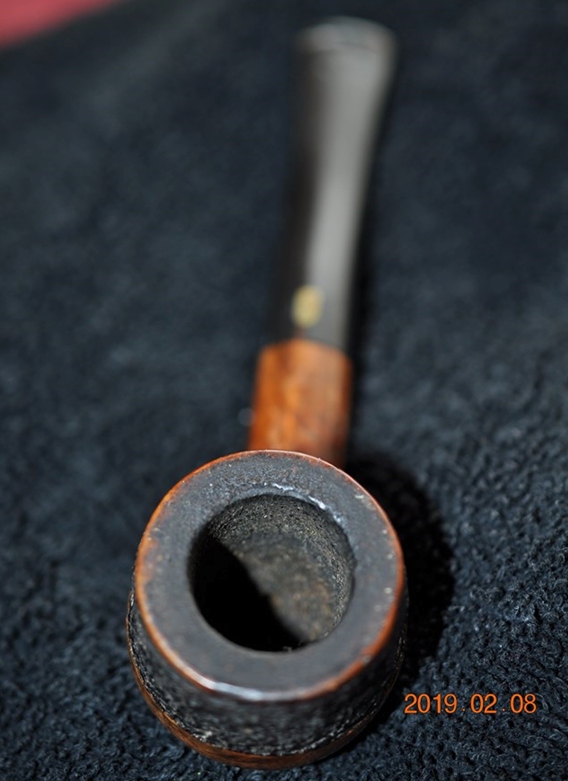
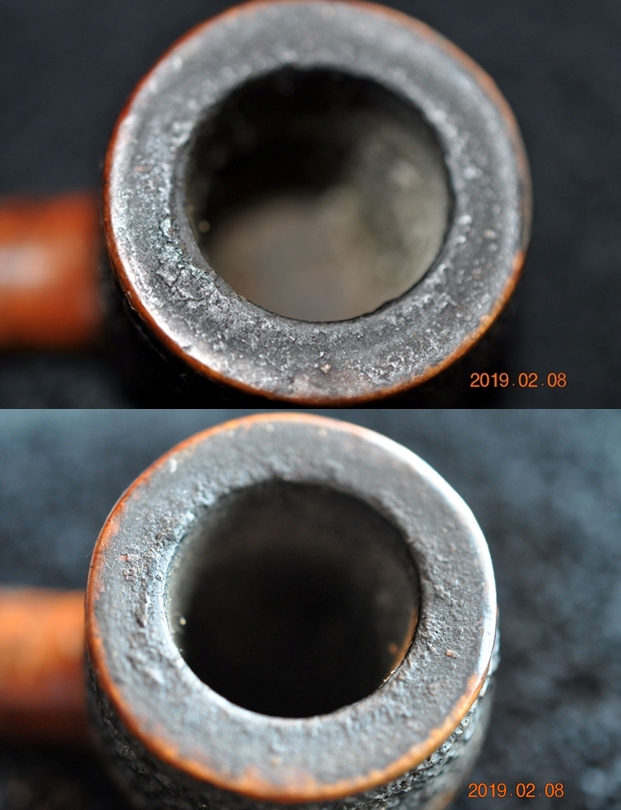
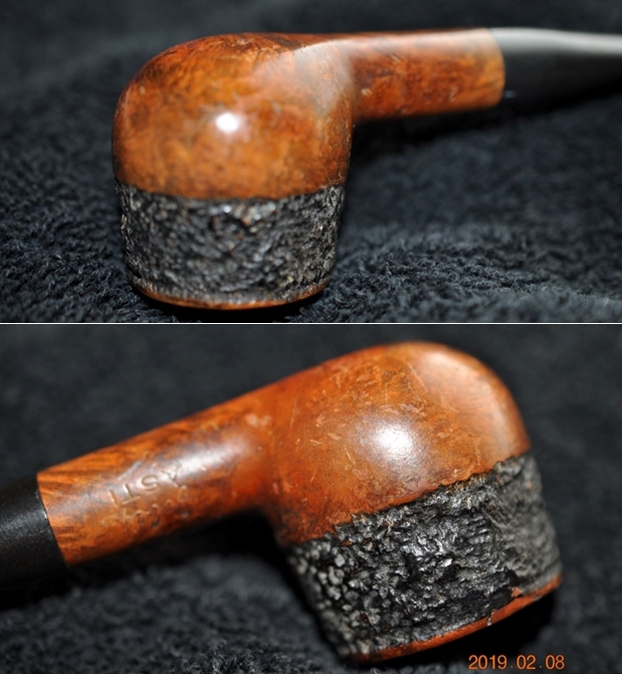
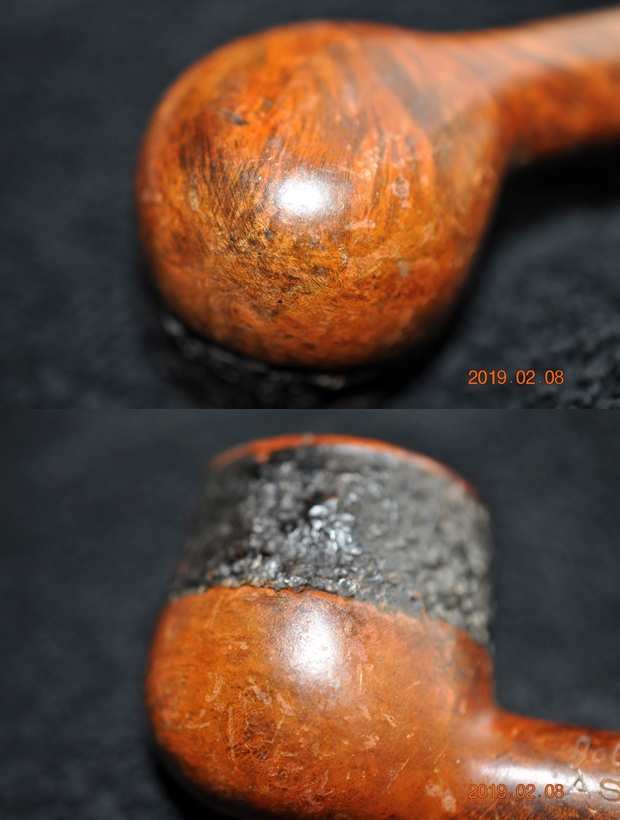
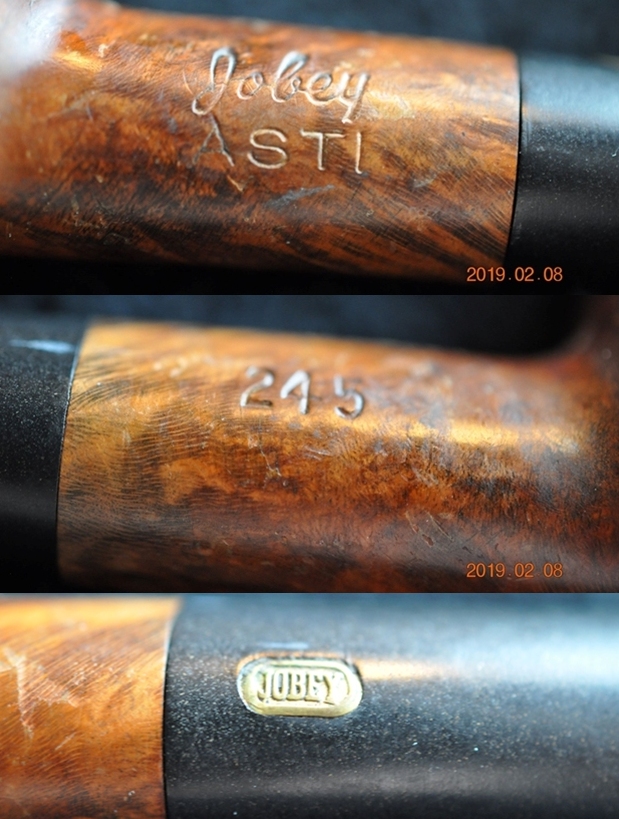
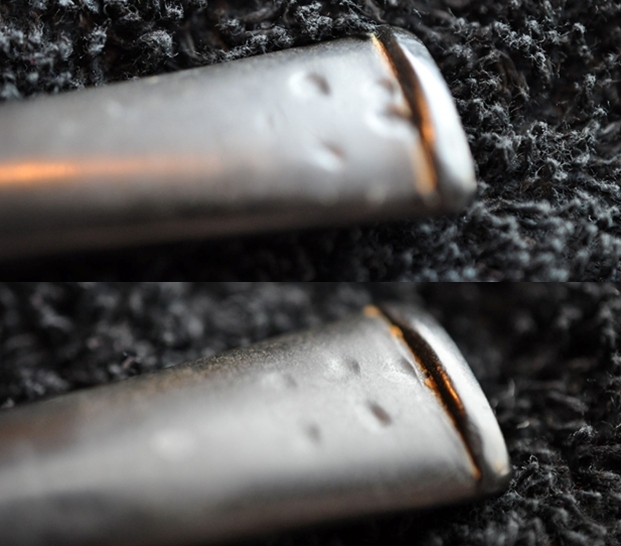
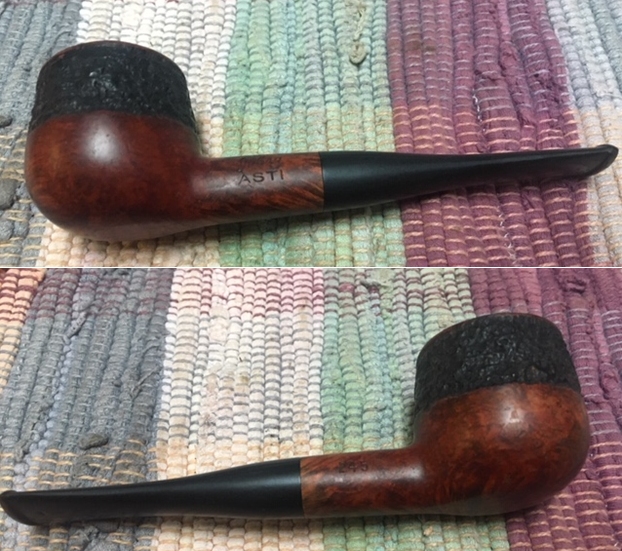
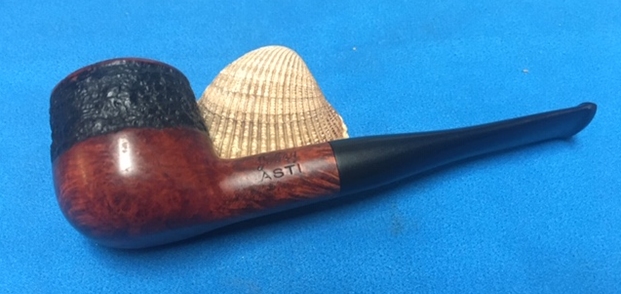
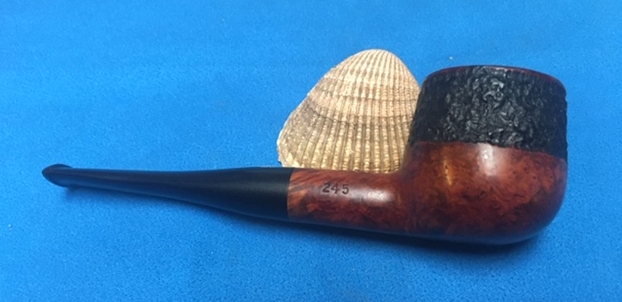
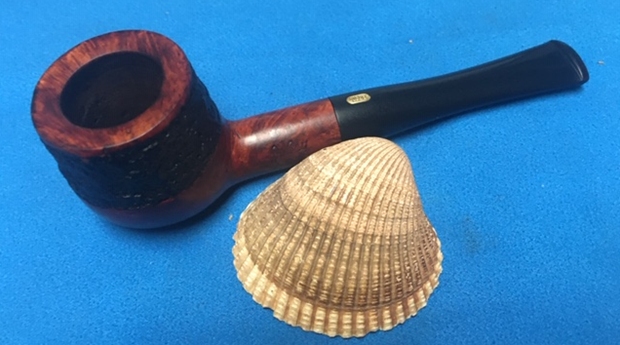
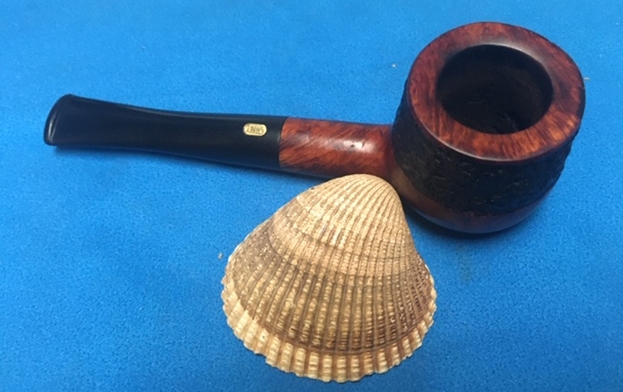
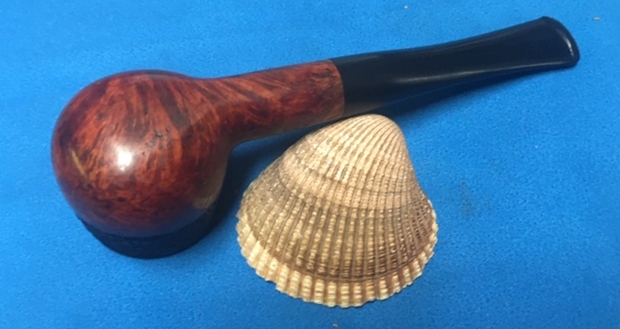
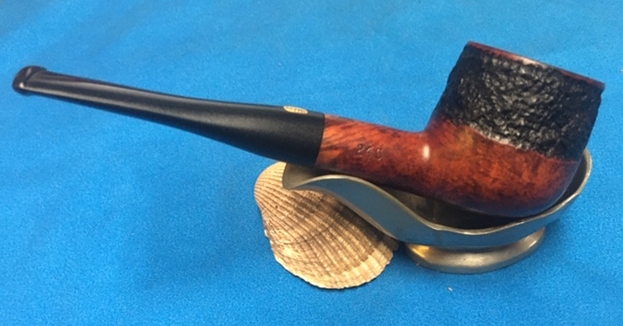
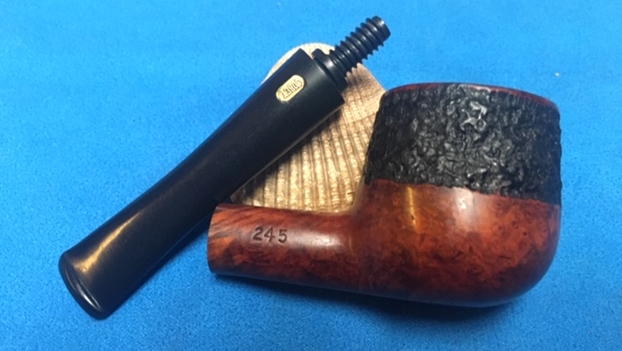
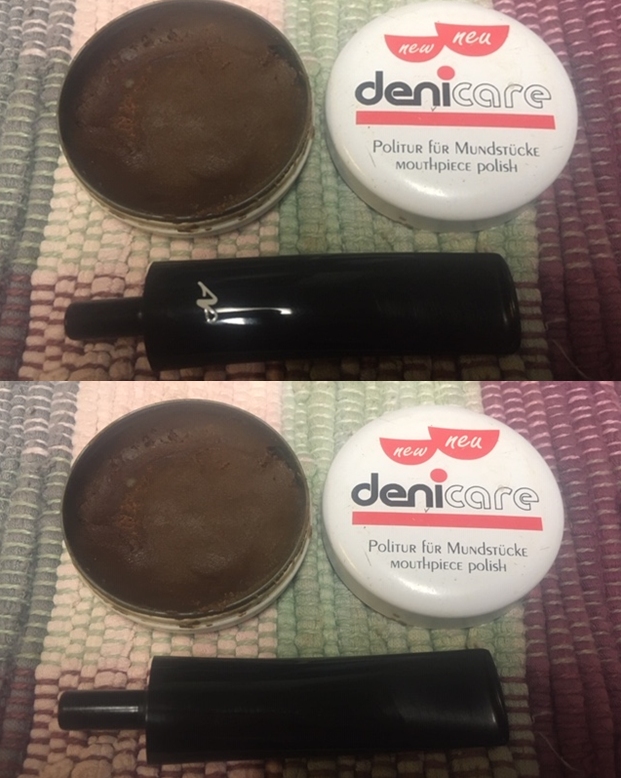
The pipe on the table is stamped on the left side of the shank Jobey over Asti. On the right side is the shape number 245. The tapered stem bears an inlaid brass Jobey oval. The pipe has an interesting mixed finish – smooth lower bowl and shank with a band of rustication and a smooth inwardly beveled rim top. The finish was very dirty, making it hard to see beyond that to the nice grain underneath that. There was a thick cake in the bowl and it had overflowed with lava onto the rim top. It was hard to know at this point the condition of the rim edges. The pipe was a dirty and tired looking old pipe. The stem was badly oxidized and there were George’s usual tooth marks and chatter on both sides just ahead of the button. It had been sitting in boxes for a lot of years and it was time to move ahead with the restoration. Jennifer took photos of the pipes she was sending. I have included the photos of this pipe below. When the box arrived from Jennifer, Jeff opened it and took photos of each pipe before he started his cleanup work on them. This pipe was a real mess but showed some promise under all of the grime of the years. The shape was a pot with the mixed finish as noted above and visible in the photo below. The briar appeared to be in good condition underneath the grime. The finish was spotty and seemed to be peeling which indicated to me that there was some sort of varnish or shellac coat on top of the finish. The pipe really was covered with the grime and oils on the bowl sides from George’s hands. The bowl had a thick cake that had hardened with time. The lava overflow on the rim top filled in much of the beveled rim top. It was very thick but it could very well have protected the rim from damage. We won’t know what is under it until Jeff had cleaned it off. The stem was oxidized and there were deep tooth marks on both sides just ahead of the button. Jeff took photos of the pipe before he started working on it. I include those below.  Jeff took photos of the bowl and rim top to show the cake in the bowl and the lava build up on the rim top and dust and grime on the bowl. It was thick and hard but hopefully it had protected the rim and edges from damage. The lava coat looks horrible but it points to a well-used, favourite smoking pipe. George must have enjoyed this old timer a lot judging from the condition of the pipe.   Jeff took a photo of the side and heel of the bowl to show the condition of the finish – the grime and grit all over the sides and bottom of the bowl. The rustication around the midbowl is deep and dirty but it is interesting.  The peeling varnish/shellac coat is also visible in the photos. Jeff took a photo of the stamping on the left and right sides of the shank. It is very clear and readable. On the left it reads Jobey Asti and on the right it reads 245. The top of the tapered stem has a brass inlaid Jobey oval logo.Jeff took photos of the top and underside of the stem showing the scratching, oxidation and tooth marks on the stem surface and button. The tooth marks are quite deep on both sides of the stem. I turned to Pipephil’s site for a quick review of the brand (http://www.pipephil.eu/logos/en/logo-j3.html). I quote a section of the post on the Jobey brand: These pipes are made in St Claude (France) by Butz-Choquin (Berrod-Regad group) since 1987. Before this date some were manufactured in England and Denmark (Jobey Dansk).

I turned then to Pipedia to gather further information regarding the brand and quote the first part of the article (https://pipedia.org/wiki/Jobey).

English – American – Danish – French… Sadly, solid information about Jobey is scant…

Probably established in England around 1920(?) the brand hiked into the USA later. In the course of time owner, distributor and manufacturer changed repeatedly. As far as is known the following companies have been involved with the brand:

George Yale Pipes & Tobacco, New York (1942)

Norwalk Pipe Co., New York (1949)

Arlington Briar Pipes Corp., Brooklyn (when?)

Hollco International, New York (1969).

Weber Pipe Co., Jersey City, NJ (1970’s)

The Tinder Box, (1970’s – 80’s).

Throughout decades Jobey pipes were mainly sold in the USA, Canada and England but remained almost unknown in continental Europe. The bulk of Jobeys was predominantly made according to classical patterns and mainly in the lower to middle price range. The predominant judgment of the pipe smokers reads: “A well-made pipe for the price.” So there is hardly anything very special or exciting about Jobey pipes although a flyer from ca. 1970 assures: “The briar root Jobey insists upon for its peer of pipes is left untouched to grow, harden and sweeten for 100 years. […] Jobey uses only the heart of this century old briar and only one out of 500 bowls turned measures up to the rigid Jobey specifications.” 99.80% of cull… that makes the layman marveling!

Before I get on to cleaning up the pipe I thought I would once again include the tribute that Jennifer wrote to her Dad for the blog. She also sent some photos and an article that her Dad wrote for Jeff and me to be able to get a feel for him. I have included those below. Note in each of them that he is holding a pipe in his left hand. I asked her to also send me an email with a brief tribute to her Dad. Here is her tribute from an email to me.

Steve, I want to thank you again for accepting my dad’s pipes.  They were so much a part of my dad’s life that I could not simply discard them. But as his daughter, I was not about to take up smoking them either. *laughing* I think my dad would like knowing that they will bring pleasure to others.  I know that I do.

I’m not sure what to say about his pipes. I always remember Daddy smoking pipes and cigars.

First a bit about my dad. Though my father, George Rex Leghorn, was American (growing up in Alaska), he managed to join the Canadian Army at the beginning of WWII, but in doing so lost his American citizenship.  He was fortunate to meet a Canadian recruiting officer who told him the alphabet began with “A” and ended with “Zed” not “Zee”, and also told him to say that he was born in a specific town that had all its records destroyed in a fire.  When the US joined the war my dad, and thousands of other Americans who had made the same choice*(see the link below for the article), were given the opportunity to transfer to the US military, and regain their citizenship.

After WWII, my dad, earned his degree at the University of California Berkeley and became a metallurgist. There is even a bit about him on the internet.

He loved taking the family out for a drive, and he smoked his cigars on those trips. (As a child, those were troubling times for my stomach.)

I most remember my father relaxing in his favorite chair with a science fiction book in one hand and a pipe in the other… Sir Walter Raleigh being his favorite tobacco… and the pipes themselves remind me of him in that contented way.  If I interrupted his repose, he’d look up, with a smile on his face, to answer me.

It seemed he smoked his Briarwood pipes the most, though he had others.  At the time, it was only the Briarwood I knew by name because of its distinctive rough shaped bowl.  And it was the Anderson Free Hand Burl Briar, made in Israel, which I chose for his birthday one year, because I thought he might like that particular texture in his hand.

At least two of his pipes, he inherited from his son-in-law, Joe Marino, a retired medical laboratory researcher (my sister Lesley’s late husband)… the long stemmed Jarl (made in Denmark), and the large, white-bowled, Sherlock Holmes style pipe.  I believe Joe had others that went to my dad, but Lesley was only sure about those two.

The Buescher, corncob pipe my older sister Lesley bought for Daddy while on one of her travels around the States.

A note on the spelling of my sister’s name…

My dad met my mother, Regina, during WWII and they married in Omagh, Ireland.  My mother was English and in the military herself.  The English spelling of Lesley is feminine, and Leslie masculine, in the UK… just the opposite of here in the United States.  I guess my mom won out when it came to the spelling of the name…

This pipe was a real mess just like the other ones in the collection. I was curious to see what it would look like when I unpack it. I was surprised at how good it looked. He reamed it with a PipNet pipe reamer and cleaned up the reaming with a Savinelli Fitsall Pipe Knife. He scrubbed out the internals with alcohol, pipe cleaners and cotton swabs until the pipe was clean. He scrubbed the exterior of the bowl with Murphy’s Oil Soap and a tooth brush to remove the grime and grit on the briar and the lava on the rim top. The finish on the bowl looked really good when I got it. The rim top looked much better and the inner and outer edges were looking good. Jeff had cleaned the internals and scrubbed the exterior of the stem and soaked them in Before & After Deoxidizer bath to remove the oxidation. The stem looked very good other than the deep tooth marks and chatter in the surface. When the pipe arrived here in Vancouver for the second stop of its restoration tour it looked very good. I took photos of the pipe before I started my part of the restoration. I took photos of the bowl and rim top to show how well it had cleaned up. The edges and top were very clean and in excellent condition. There was some darkening on the inner edge but it was still round. The rim top had some light nicks and dents. The stem had some deep tooth marks just ahead of the button.The stem was held in the shank with the Jobey link connector. I is pressed into the stem and threads into the shank. It makes it easily replaceable and also easy to align.I decided to clean up the darkening on the inner edge of the rim top and the dents and nicks on the top itself. I used a folded piece of 220 grit sandpaper to remove the damage and 400 grit wet dry sandpaper to smooth out the sanding. I was happy with the overall look. The finish will show as I polish the pipe with micromesh pad shortly.  I polished the briar with micromesh sanding pads – wetsanding it with 1500-12000 grit sanding pads. I wiped it down with a damp cloth after each sanding pad. It looked better after each pad and the top blended into the colour of the rest of the bowl without staining. I worked some Before & After Restoration Balm into the finish of the bowl and the rim top and shank with my fingertips and a horsehair shoebrush to clean, enliven and protect it. I find that the balm really makes the briar come alive again. The contrasts in the layers of stain and the separate finishes really made the grain stand out. I let the balm sit for a little while and then buffed with a cotton cloth to raise the shine. The bowl really looks good at this point.   I set the bowl aside and turned to the stem. I filled in the deep tooth marks with clear super glue. I built up the edge of the button at the same time. I set it aside to dry. Once the repairs had cured I used a needle file to cut a sharp edge on the button on both sides and to flatten the repaired areas. I sanded the stem to remove the oxidation that was on the surface and to smooth out the repaired areas. I used a folded piece of 220 grit sandpaper and a piece of 400 grit wet dry sandpaper. At this point the stem is looking better and the tooth marks are gone.  I rubbed the stem down with Denicare Mouthpiece Polish and a cotton pad to remove remnants of oxidation and to further blend in the sanding. The stem was showing some promise at this point in the process. I polished the stem with micromesh sanding pads – wet sanding it with 1500-12000 grit pads. I polished it further with Before & After Pipe Stem Polish – both fine and extra fine. I finished by wiping it down with Briarville’s No Oxy Oil and buffing it to a shine. Once again I am the part of the restoration that I always look forward to – the moment when all the pieces are put back together. I put the pipe back together and buffed the bowl and stem with Blue Diamond on the buffing wheel. I gave the bowl multiple coats of Conservator’s Wax and the stem multiple coats of carnauba wax. I buffed the pipe with a clean buffing pad to raise the shine. I hand buffed it with a microfiber cloth to deepen the shine. It is fun to see what the polished bowl looks like with the combination of rustication and smooth finishes. The black vulcanite stem stands out as a shiny black contrast to the colours of the bowl. While this is not one of my favourite finishes as it seems busy to me, it came out looking good. It is a light weight pipe that could be clenched and smoked while doing other things. It must have been a fine smoking pipe judging from the condition it was when we received it from Jennifer. Have a look at it with the photos below. The dimensions are Length: 5 ¼ inches, Height: 1 ½ inches, Outside diameter of the bowl: 1 ½ inches, Chamber diameter: ¾ of an inch. This is one that will go on the rebornpipes online store shortly. If you want to carry on the pipe trust of George Rex Leghorn let me know. Thank you Jennifer for trusting us with his pipes. Thanks to each of you who are reading this blog. Remember we are not pipe owners; we are pipemen and women who hold our pipes in trust until they pass on into the trust of the next generation.


New Life for an Ascorti Peppino 137 Handmade Brandy


Blog by Steve Laug

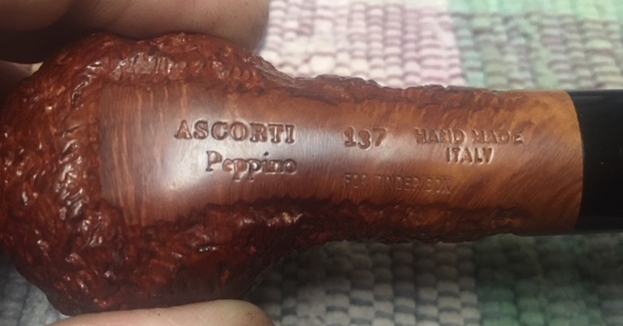
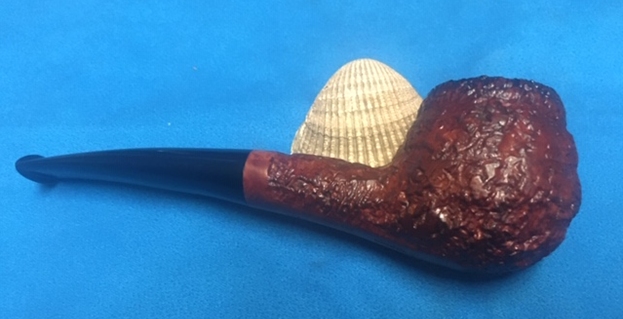
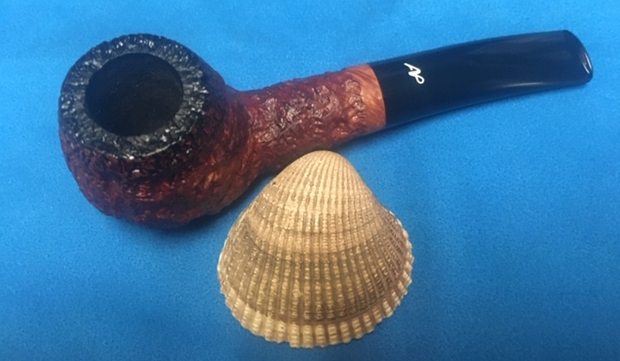
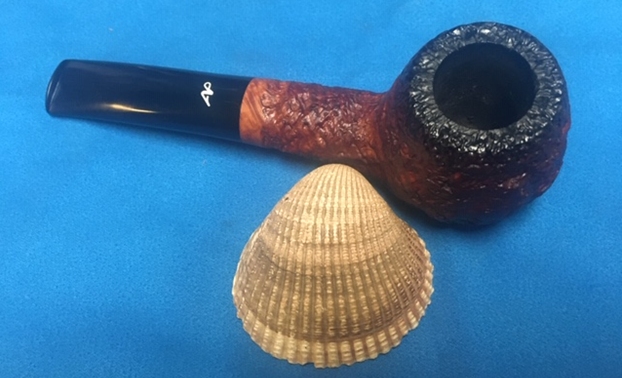
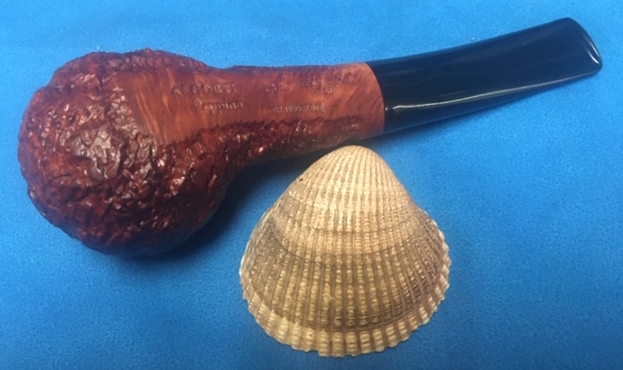
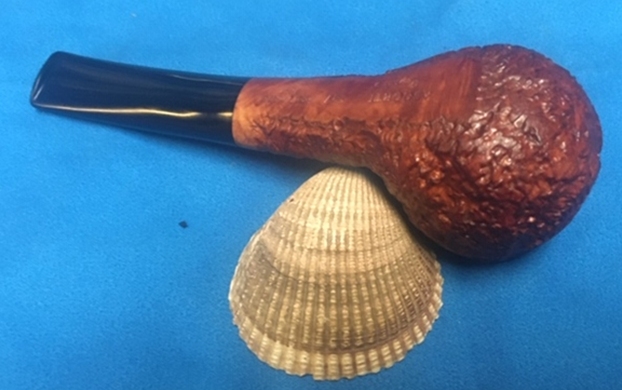
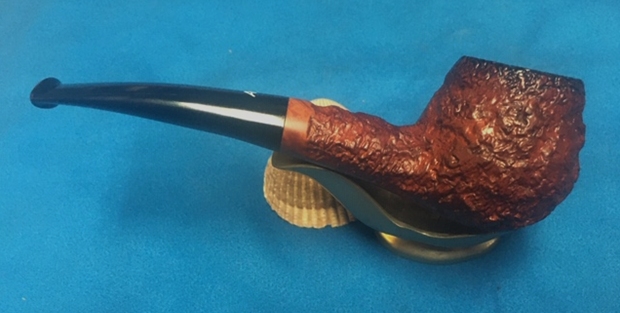
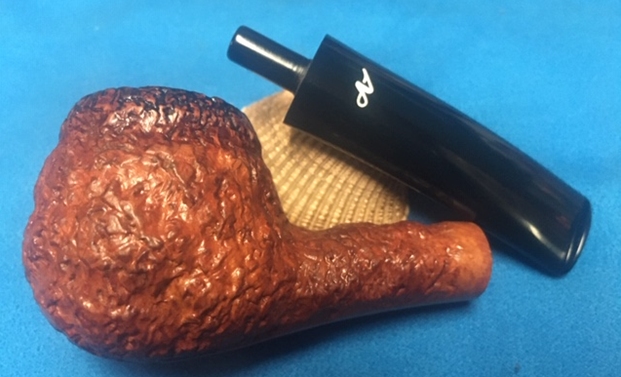
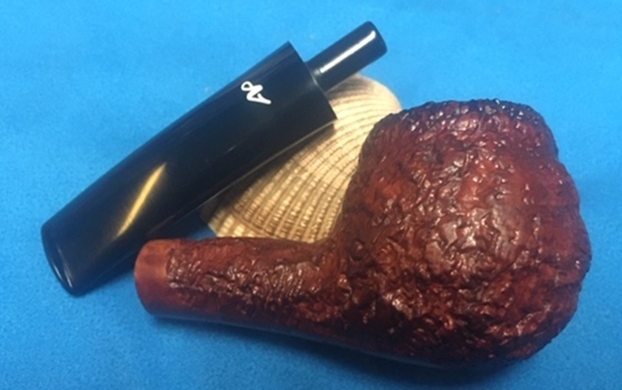
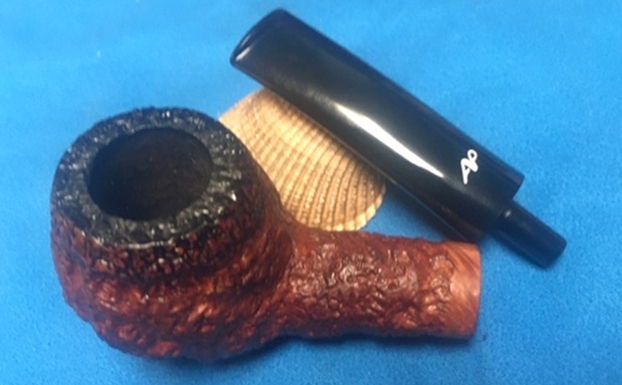
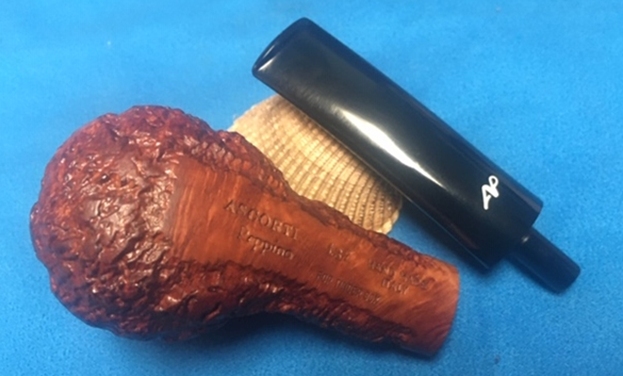
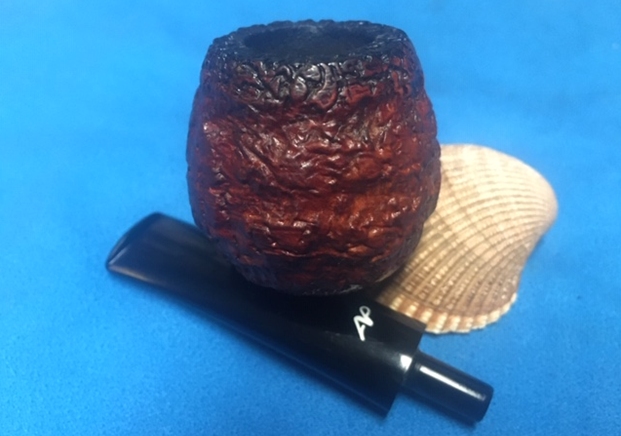
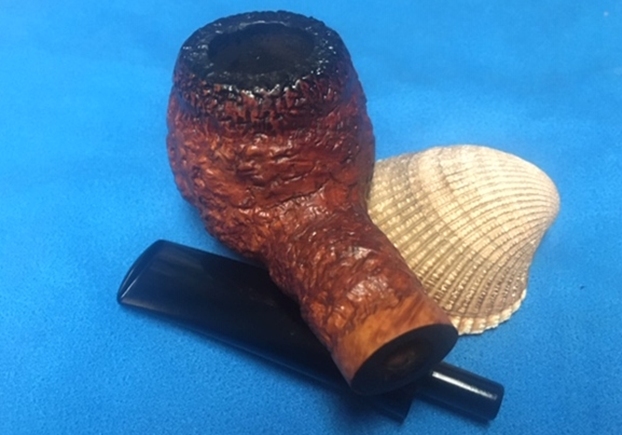
The next pipe on the table is an interesting Ascorti that I picked up somewhere along the way in a trade. Jeff and I picked this one up on a pipe hunt in Utah. It is a rusticated bowl and rim with a smooth panel on the underside and a band around the shank end. The pipe is stamped on the smooth panel and reads Ascorti over Peppino on the heel of the bowl followed by the shape number 137 then Hand Made over Italy. Along the bottom of the panel it also is stamped For Tinder Box. The finish was mottled and dirty with some flume around the rim and rim top that darkened it. There was a thick cake in the bowl and some lava overflow in the grooves of the rustication on the rim top. The acrylic oval stem is in good condition with some small tooth marks and chatter on both sides near the button edges. I took photos of the pipe before I started my work on it. I took a close up photo of the rim top. It is hard to see the cake in the bowl. The cake was much thicker than it appears in the photo. The top of the bowl looks dirty with lava overflow. The inner edges of the bowl look very good. The stem has some light tooth marks on both sides that do not show up well in the photos. Overall the tooth marks are light and should be able to be sanded smooth. The stem bears an AP logo that I will need to look into in the cleanup and research.I took a photo of the stamping on the underside of the shank. The stamping is clear and reads Ascorti over Peppino followed by the shape number 137 and Hand Made Italy. Underneath all of it is stamped For Tinder Box.I was intrigued by the FOR TINDER BOX stamp on the pipe so I did some searching on the internet and came to the Tinder Box site where there was a page on the Peppino line. Here is the link (http://www.tinderboxinternational.com/ascorti_peppino.htm). I am including that article in full below as well as a picture that was included on the site.

Ascorti Peppino Series Pipes

He was very young boy, when Giuseppe Ascorti, “Peppino” to all his friends began his career working as a joiner in a small furniture factory for his father. When he was about 30 years old, his passion for design and his great desire to create, he began to make pipes. In a very short time he became a great master with his revolutionary ideas to create new pipe shapes while still maintaining the classic lines of Italian pipe design. In the 1970’s, a chain of upstart pipe shops named Tinder Box while traveling in Italy, immediately realized his talent, and together collaborated in bringing the Ascorti Pipe to pipe smokers around the world. Peppino taught all his pipe making secrets to his son Roberto, who also had a natural talent as well. Today, after 25 years since Peppino’s disappearance, Roberto Ascorti and Tinder Box has a pleasure to produce a great once in a life time series of smoking pipes to be treasured forever.

Inspired from the original pipe designs, handcrafted in the 1970’s and 1980’s by his father Peppino, Roberto has remade the original designs, with the same hand making process used in those years, the same seasoned and selected briar, and the same care in working that his father was able to do. The pipes are also fitted with the same acrylic mouthpieces that are being specially remade from 30 years ago. Each design will include a certificate that shows the original copy of the old Peppino design drawings. These pipes have a special logo with “A.P.” and stamp with the Peppino name in honor of him and thanking him for the teachings of his passion to his son Roberto.

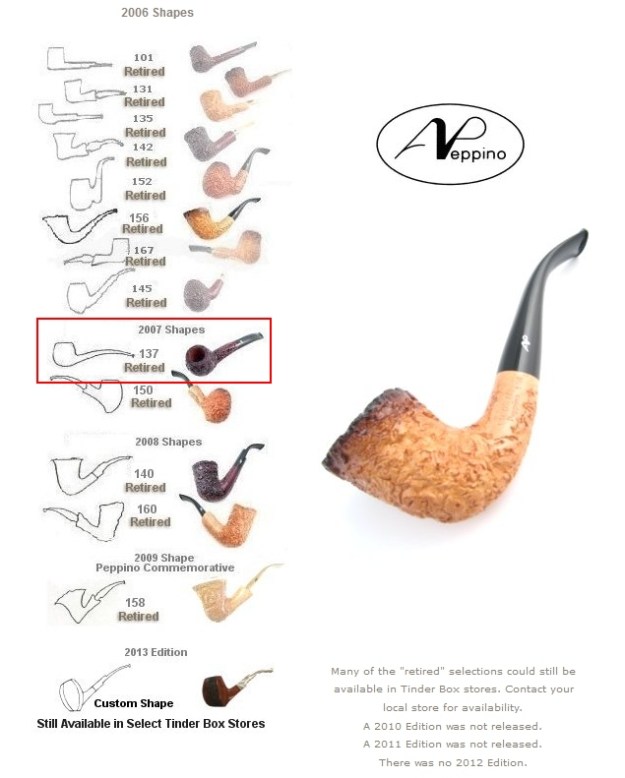
Roberto now has retired all shapes that were introduced as part of the original set in 2006. These shapes are never to be made again as part of the Peppino Serie. There is still availability but quantities are limited. Contact your local Tinder Box to see what finishes and shapes are available. In 2008…Roberto carved two new shapes from the old shape chart to be part of this marvelous series of pipes. 2009 was a very special year in the history of Ascorti Pipes. Roberto reintroduced and carved one shape for the Peppino Series. This shape is in remembrance of the passing of his father, Peppino in 1984…From the reading I knew that the pipe I was working on was made and released as one of the 2007 shapes. The shape has since been retired. All were carved by Roberto from shapes done by his father Peppino. They were done to honour his memory. All of them were released with the unique AP logo on the top of the stem. Now I had the background information in hand it was time to work on the pipe.

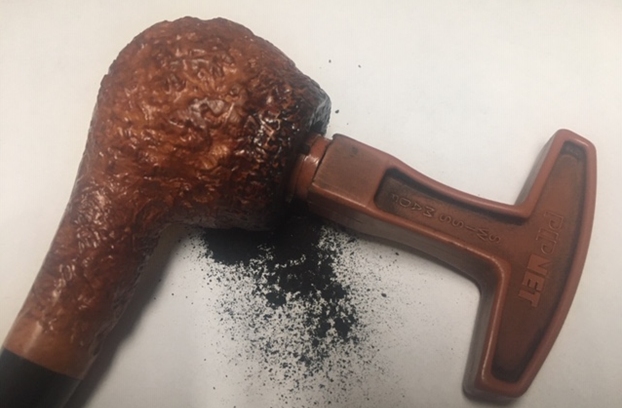
This morning I started by reaming the pipe. It had a thick cake but it was quite soft. I reamed it with a PipNet reamer and worked my way through two of the four cutting heads. I cleaned up the rest of the cake with a Savinelli Fitsall Pipe Knife. I sanded the walls of the bowl with a piece of dowel wrapped in 220 grit sandpaper. I removed the cake from the walls and they are smooth and clean. I scrubbed the bowl and rim with Murphy’s Oil Soap and a tooth brush. I was able to remove much of the grime from the rim top and the grooves and valleys of the sandblast finish. I rinsed it under warm running water to flush away the grime and dust in the soap. The following photos show the cleaned rim and bowl sides. I worked on the remaining debris and darkening on the rim top with a brass bristle wire brush. I was able to remove all of it and leave behind a clean rim top.I scrubbed out the airway in the shank and stem with alcohol, cotton swabs and pipe cleaners. I cleaned out the mortise area so that all of the oils have been removed.I rubbed the bowl and rim down with Before & After Restoration Balm. I worked it into the surface of the rim top and rusticated briar with my fingertips and with a horsehair shoebrush to clean, enliven and protect it. I let the balm sit for a little while and then buffed the pipe with a cotton cloth to raise the shine. I really like watching the Balm do its magic and bring the briar alive.  With the bowl done it was time to address the stem. I sanded the stem surface with a folded piece of 220 grit sandpaper and was able to remove the dents in the surface. I followed that up with 400 grit wet dry sandpaper to start polishing out the sanding marks.I rubbed the stem down with Denicare Mouthpiece Polish. I have found it is a great pre-polish for my use as it shows me areas that I need to work on with the micromesh sanding pads. I polished the stem with micromesh sanding pads – wet sanding with 1500-12000 grit sanding pads. I wiped it down after each pad with a damp cloth to remove the sanding dust. I polished it further with Before & After Pipe Polish – both Fine and Extra Fine. I buffed it with a soft cloth to raise a shine. I put the bowl and stem back together again and buffed it lightly with Blue Diamond on the buffing wheel to raise the shine on the briar and the acrylic stem. The buffing also removes minute scratches in the two materials and adds depth to the shine. I gave the stem several coats of carnauba wax and the bowl multiple coats of Conservator’s Wax. I buffed the pipe with a clean buffing wheel and then by hand with a microfibre cloth to deepen the shine. The pipe was alive now and look great to me. It has a great feel in the hand that is very tactile and should really pop when smoked. The bowl will also develop a deeper colour with smoking. The finished pipe is shown in the photos below. The dimensions of the pipe are Length: 5 ¾ inches, Height: 1 ¾ inches, Outside diameter of the bowl: 1 ¼ inches, Chamber diameter: ¾ of an inch. This rusticated Ascorti Peppino 137 Italian Hand Made Brandy is a beauty should make someone a great pipe. It is one that will be on the rebornpipes store very soon. If you are interested let me know. Thanks for reading this blog and my reflections on the pipe while I worked on it.

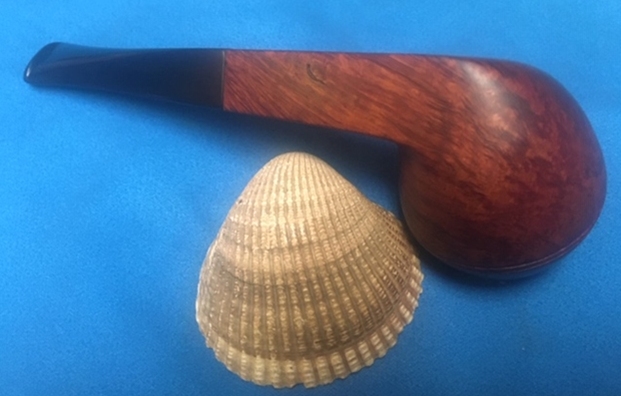
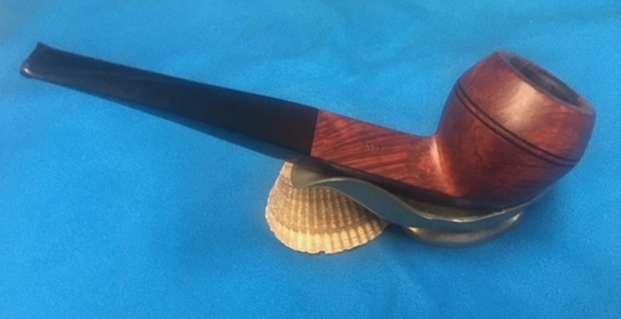
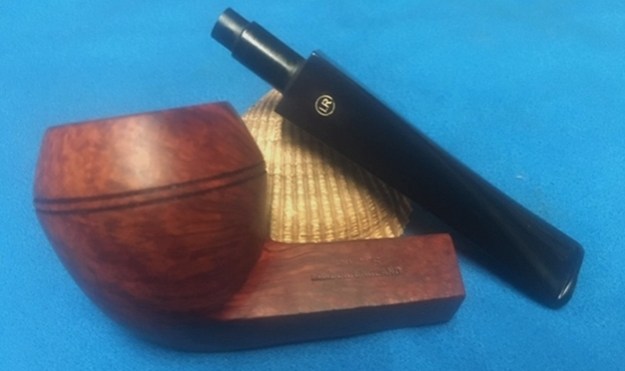
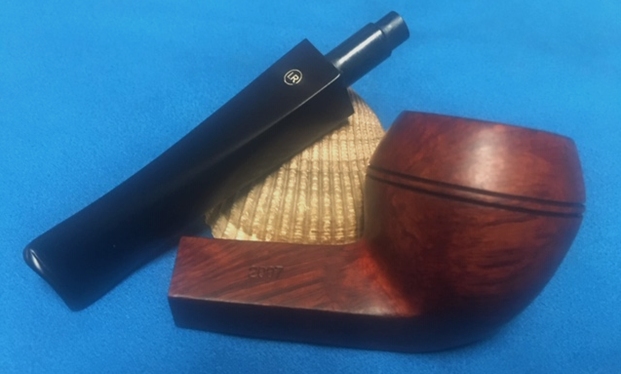
Restoration of an Irwin’s 2007 London Made Bulldog


Blog by Steve Laug

Even with the COVID-19 warnings rolling in incessantly I am still working on pipes! It keeps my mind busy and focused. There is no reason to not enjoy the time alone at the work table bringing these old-timers back to life. After brief foray restoring pipes from several other estates I am back to Bob Kerr’s estate (his photo is to the left). If you have not “met” the man and would like to read a bit of the history of the pipeman, his daughter has written a great tribute that is worth a read. Because I have included it in over 65 restorations to date I thought that I would leave it out this time. Be sure to check out some of the recent Dunhill restoration blog (https://rebornpipes.com/2020/01/01/restoring-the-last-of-bob-kerrs-dunhills-a-1962-dunhill-bruyere-656-f-t-bent-billiard/).

The next pipe I have chosen from his estate is a classic Bulldog. Irwin’s London England 2007 Bulldog. The stamping on the shank is faint. On the left side of the shank it is stamped Irwin’s over London, England. On the right side of the shank it is stamped 2007 – which I am unclear of whether that was a date or shape number! Irwin’s was a seconds line of GBD. The finish is worn and dirty. Underneath the grime the finish looks to be good. There also did not appear to be any fills in the bowl or shank. There is a thick cake and lava overflow on the rim top.  There is damage on the top and edges of the rim and the bowl is out of round. The stem is oxidized with a faint IR logo on the left. There are tooth marks and chatter near the button, some calcification with damage to the button.  Jeff took photos of the pipe to show its general condition before he did his cleanup work.some photos of the pipe before he started his cleanup work. He took photos of the bowl and rim top to show their general condition. You can see the thick cake in the bowl with the lava overflowing on to the rim top. The inner edge of the bowl is beveled inward and thickly lava coated. It is not clear if there is damage to the bowl but it does appear to be slightly out of round.Jeff took some photos of the sides and heel of the bowl to give an idea of the grain on this particular piece of briar. It is amazing and I cannot wait to see what it looks like once it is polished and waxed. He took photos of the stamping on both sides of the shank to capture it for me. The first photo shows the left side of the shank and the stamping as noted above. The second shows the right side of the shank with the 2007 stamp. The final photo of the set shows the faint LR in a circle stamping on the left side of the diamond taper stem. This pipe has a diamond tapered stem that is heavily oxidizes and has some calcification on the button end. There seems to be some tooth marks and chatter on the top and underside.I turned to Pipephil’s site to get a quick overview of Irwin’s pipes. I remembered that they were a seconds of GBD pipes and this confirmed that (http://www.pipephil.eu/logos/en/logo-i.html). I have included a screen capture of the pertinent section from the site.I clicked on the link on the site to the section on GBD (http://www.pipephil.eu/logos/en/logo-gbd.html). There was a brief history as well as a list of GBD seconds. You will note that the Irwin’s brand is listed there. I turned to Pipedia and reread the history of the brand there. I also turned to the link on the shape numbers to see if I could clear up the question whether 2007 was a date or shape number. (https://pipedia.org/wiki/GBD_Shapes/Numbers). I found the section listing the 2007 as a straight bulldog with a diamond shank. I did a screen capture of that section and included it below: So now I knew with certainty that I was working on a GBD made Bulldog – straight, diamond stem. The 2007 was the shape number. The one thing I am not clear about is what mad this pipe a second and not a GBD regular. That information would not be forthcoming. I moved forward to work on the pipe itself and see what I had to do with it. It had come back looking far better than I expected. Even the stem looked remarkably good with most of the tooth chatter gone. I was impressed. Jeff had done his normal thorough clean up – reaming, scrubbing, soaking and the result was evident in the pipe when I unpacked it. I took photos of the pipe before I started my work on it. Just look at the grain on this pipe. Stunning! I took some photos of the rim top and stem. The rim top and bowl looked very good. The cake and lava overflow were gone. Jeff had been able to get rid of the darkening and lava and tars. The rim top had nicks and marks and the inner edge of the bowl was damaged and out of round. The close up photos of the stem shows that it is a much cleaner and better looking stem. The light tooth chatter was gone and the stem looked really good.I took some photos of the stamping on the shank sides to show the condition after the cleanup. Often the stamping takes a hit with the cleaning and is lessened in it clarity. Jeff does a great job in leaving the stamping looking very good.I started my restoration work on this pipe by addressing the out of round inner edge of the bowl and the damage to the rim top. I used a folded piece of 220 grit sandpaper to clean up the edge and clean up the bevel. The next series of photos tell the story of the work on the rim. The first photo shows the rim as it was when I started. The second shows the folded sandpaper when I worked it over. I smoothed out the sanding with a 1500 grit micromesh sanding pad (photo 3). The final photo in the series shows the rim top after the work. With the rim in order I started my polishing regimen on the bowl. I used nine worn micromesh sanding pads and dry sanded the bowl with 1500-12000 grit pads. I wiped the bowl down with a damp cloth after each pad. The bowl really shines by the final three pads. I worked some Before & After Restoration Balm into the surface of the briar with my fingertips to clean, enliven and protect it. I let the balm sit for a little while and then buffed with a cotton cloth to raise the shine. The photos show the bowl at this point in the restoration process. I set the bowl aside and turned my attention to the stem. I sanded out the tooth chatter and blended in the repairs with 220 grit sandpaper and started to polish it with a folded piece of 400 wet dry sandpaper. Once it was finished it was smooth.I used some Denicare Mouthpiece Polish that I have in my kit to start polishing out some of the scratches and remaining oxidation on the stem. I rubbed it in with a cotton pad and my finger tip and buffed it off with a cotton pad.I used some liquid paper to touch up the LR stamp on the left topside of the diamond stem. Once it dried I scraped the excess off with a tooth pick to show the renewed stamp on the stem.I polished the stem with micromesh sanding pads – dry sanding with 1500-12000 grit sanding pads. I wiped it down after each sanding pad with a cloth containing some Obsidian Oil. I finished polishing it with Before & After Pipe Stem Polish – both Fine and Extra Fine and buffed it off with a cotton cloth. I gave it a coat of Briarville’s No Oxy Oil to preserve and protect the stem. I don’t know how many times I have said this but I have to say it again with this pipe. I love it when I come to the end of a restoration and all of the parts come together and the pipe looks better than when we started the cleanup process. I put the stem back on the bowl and buffed the pipe with Blue Diamond on the buffing wheel. I carefully avoided the stamping on the shank sides during the process. I gave the bowl and stem multiple coats of carnauba wax on the buffing wheel and followed that by buffing it with a clean buffing pad on the buffer. I hand buffed the pipe with a microfiber cloth to deepen the shine. The finished pipe is a great looking British Bulldog made by GBD and sold as second – an Irwin’s 2007 shaped Bulldog. Once again the grain and the way the shape follows the grain is amazing. Give the finished pipe a look in the photos below. I can only tell you that it is much prettier in person than the photos capture. The dimensions of the pipe are Length: 5 ½ inches, Height: 1 ¾ inches, Outside diameter of the bowl: 1 ¼ inches, Chamber diameter: ¾ of an inch. This GBD made Irwin’s Bulldog is a great addition to someone’s rack that price will be very reasonable. Thanks for walking through the restoration with me as I worked over another beautiful pipe. This one will be will be going on the rebornpipes store shortly if you are interested in adding it to your collection. Thanks for your time.