Tag Archives: Peterson’s Meerschaum pipes

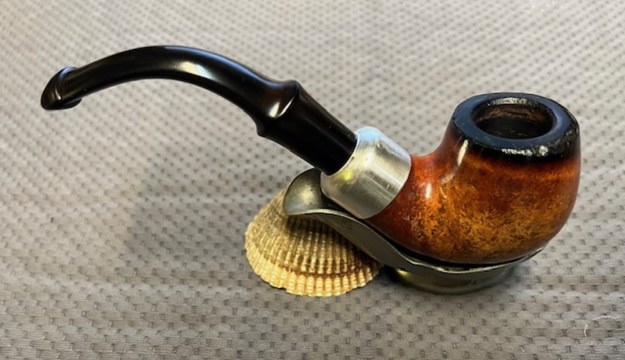
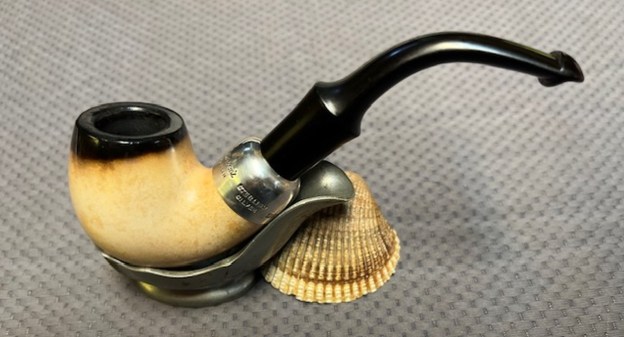
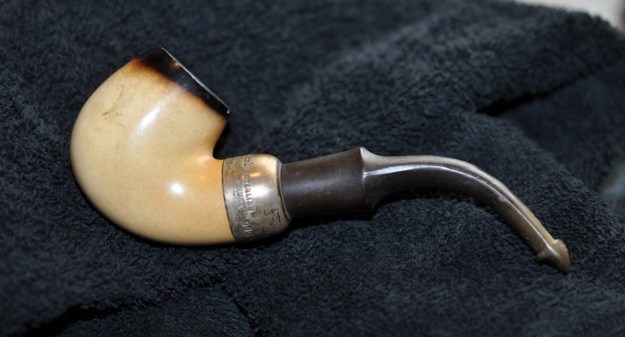
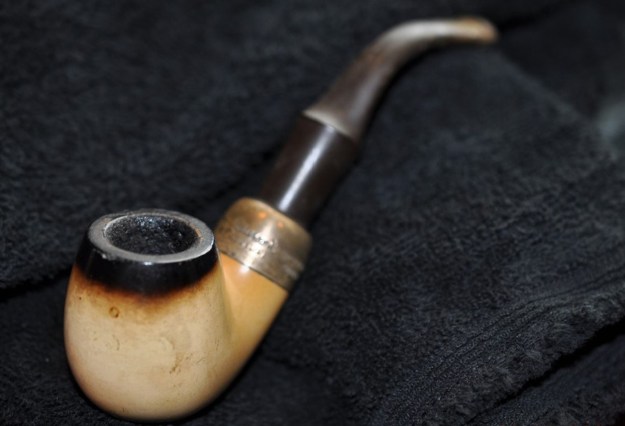
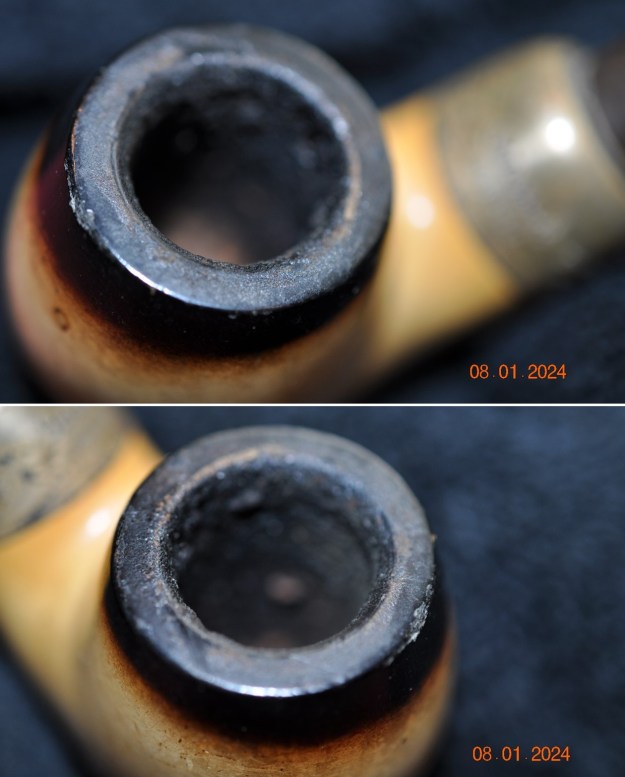
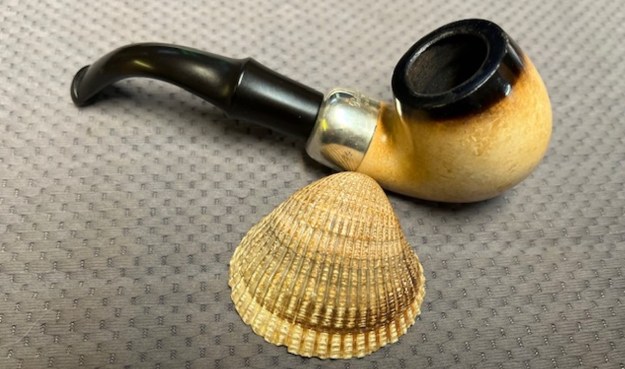
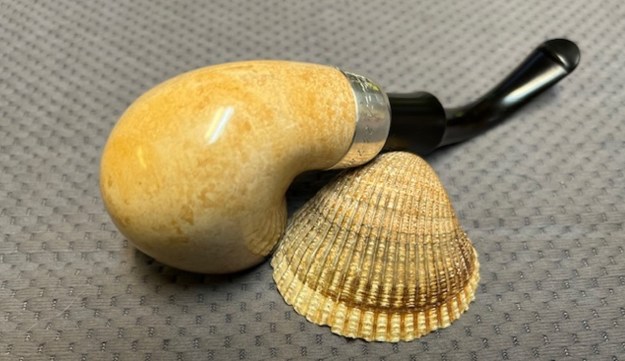
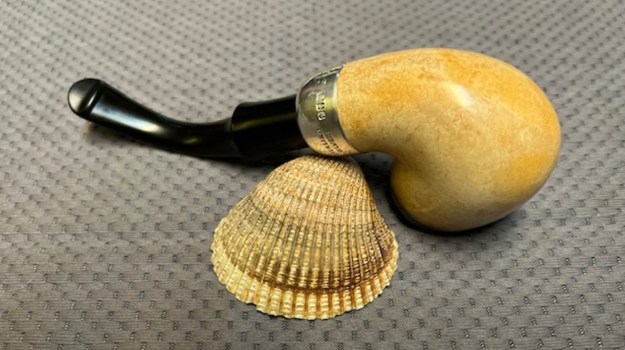
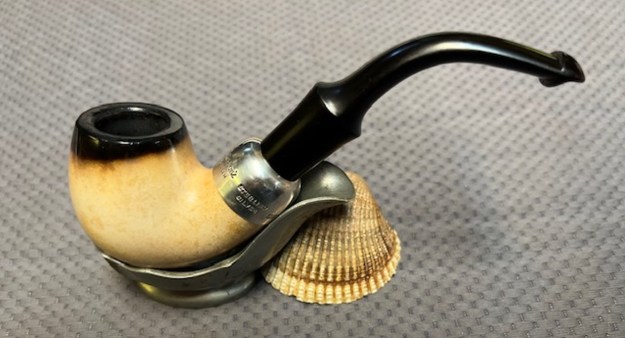
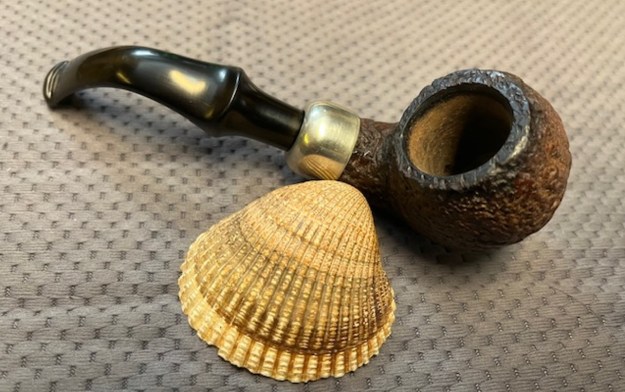
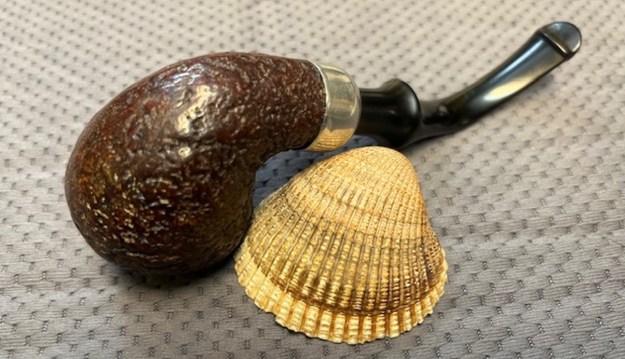
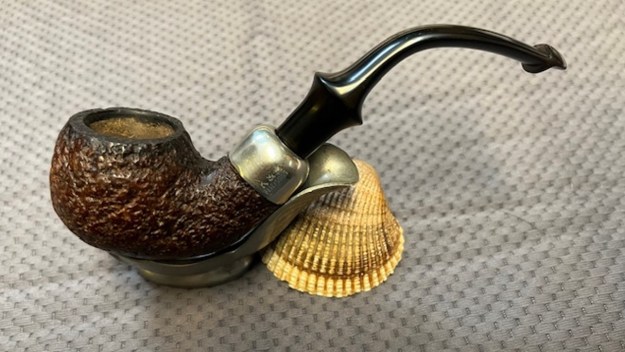
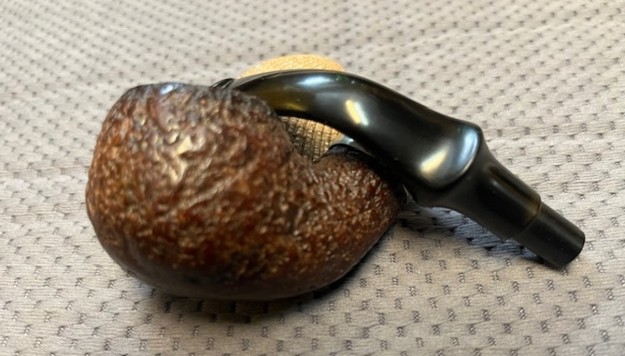
Fresh Life for a Peterson’s Meerschaum Bulldog


by Steve Laug

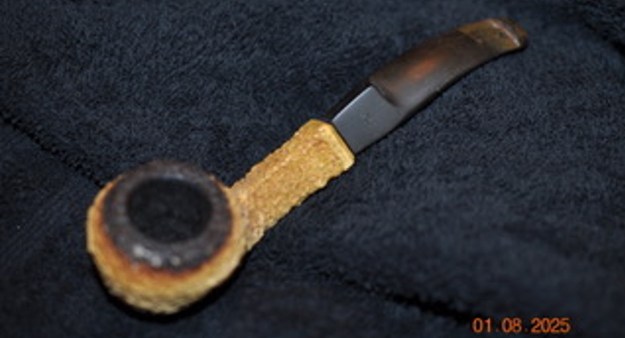
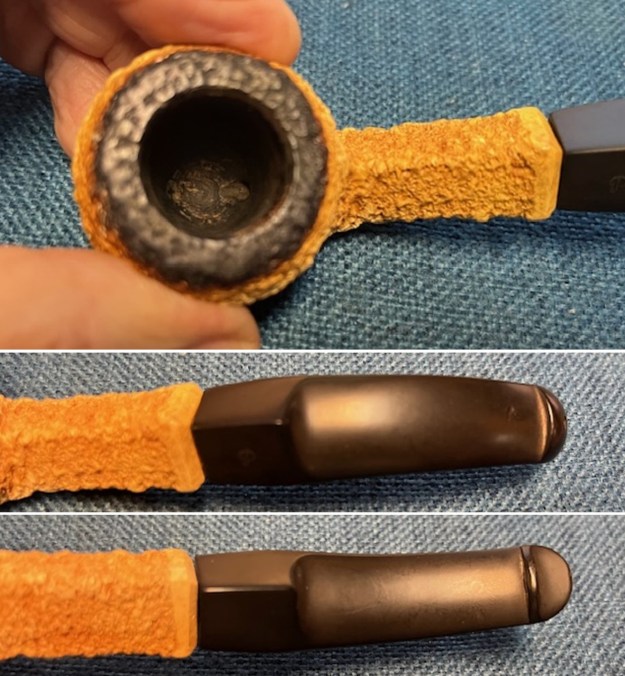
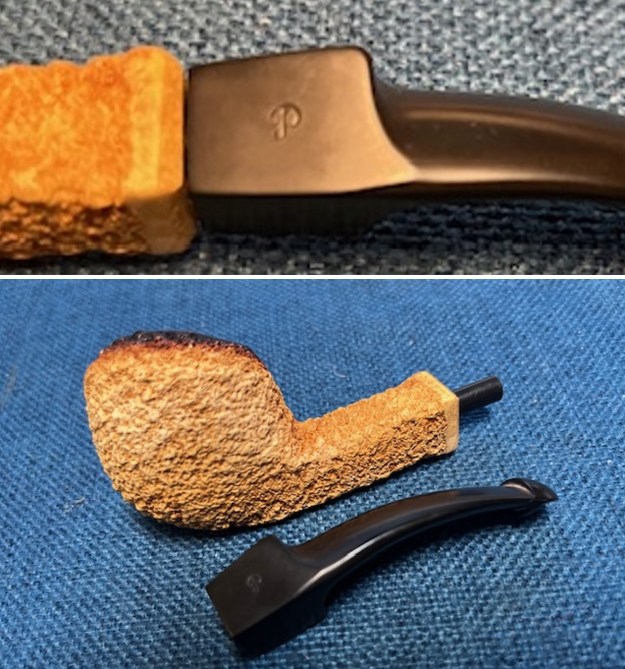
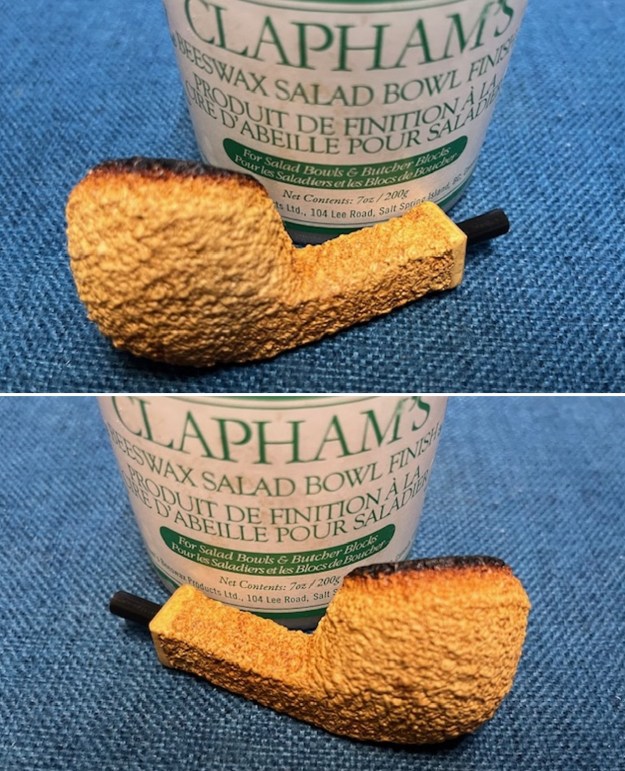
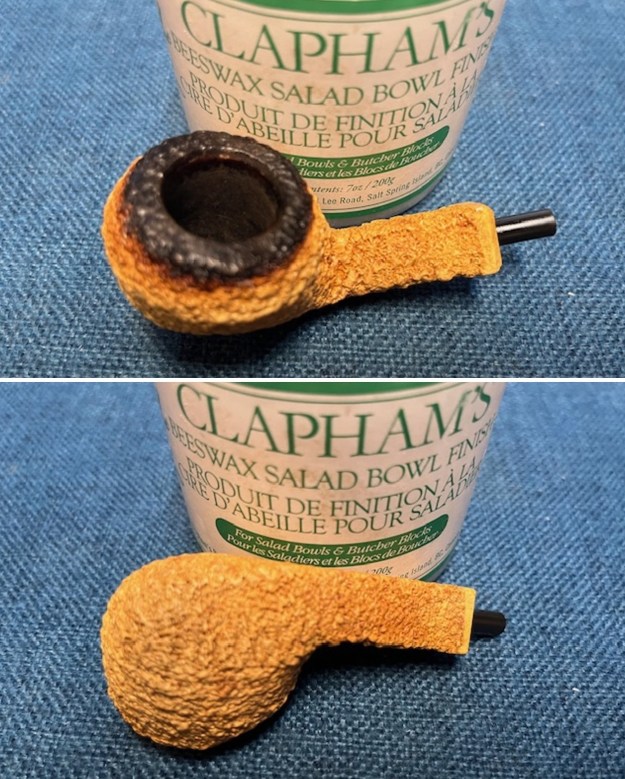
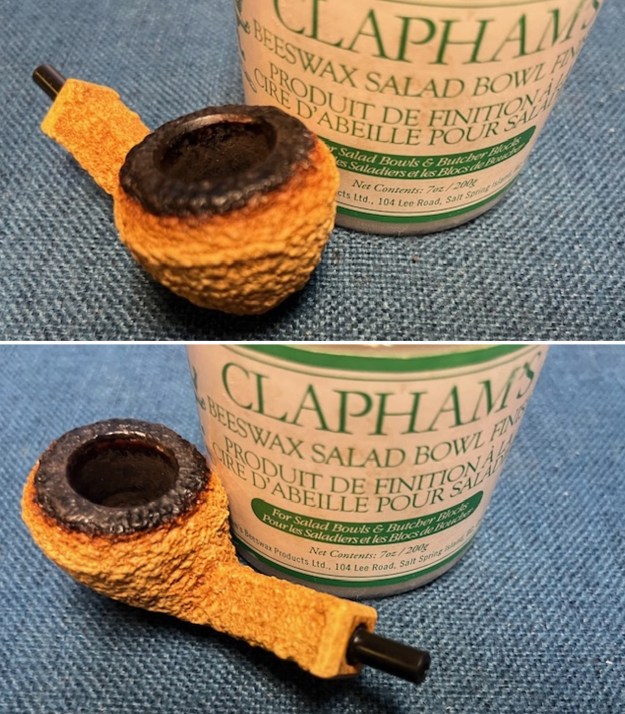
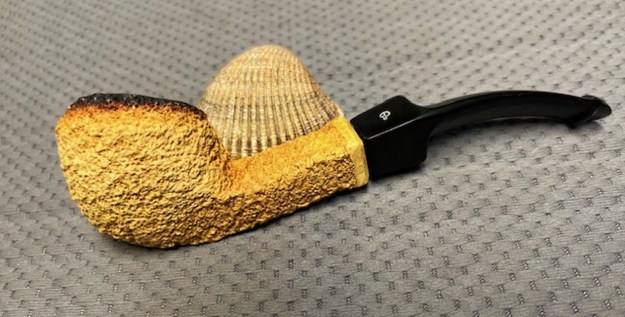
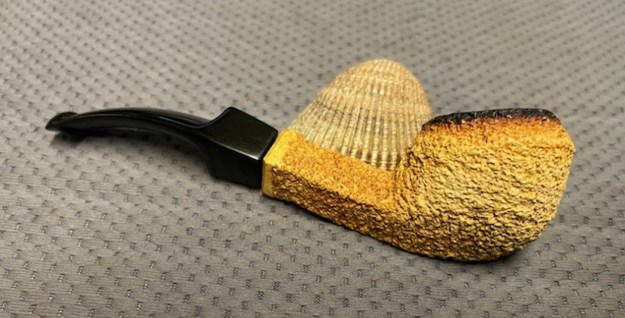
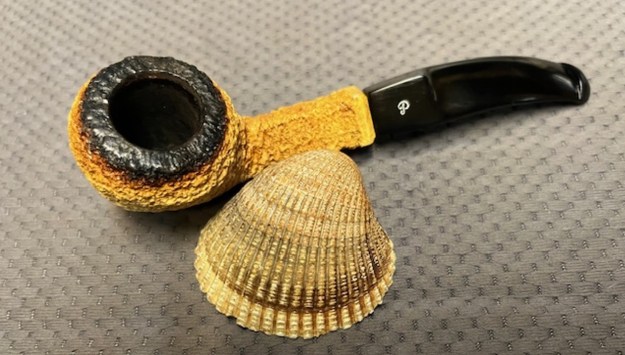
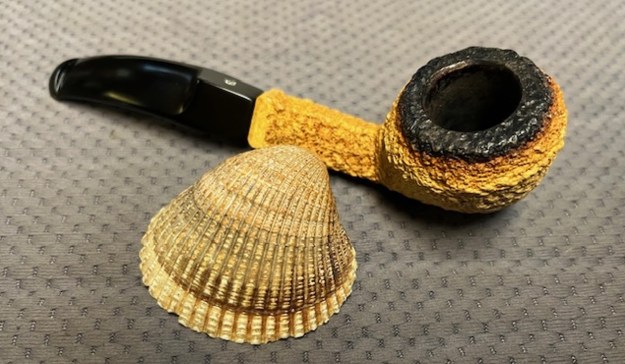
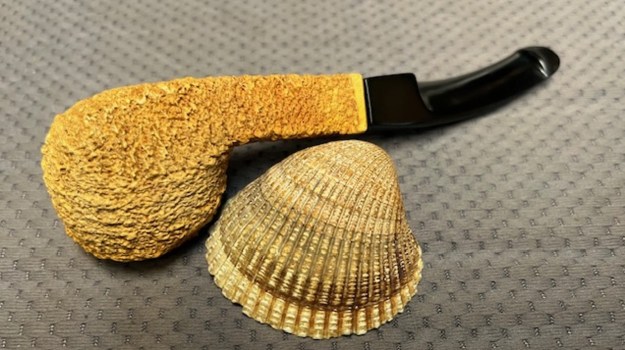
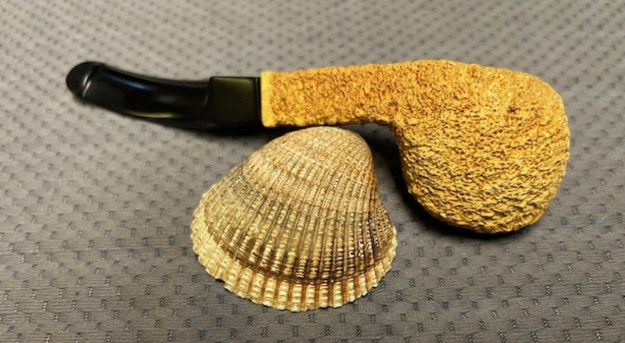
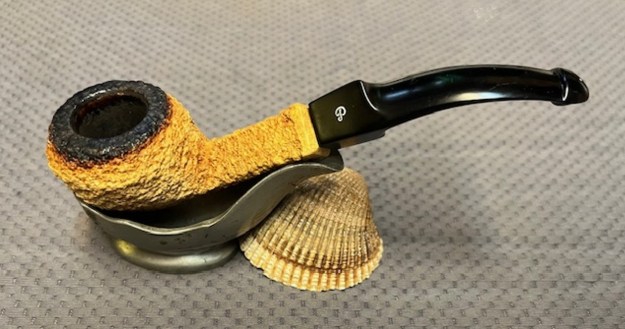
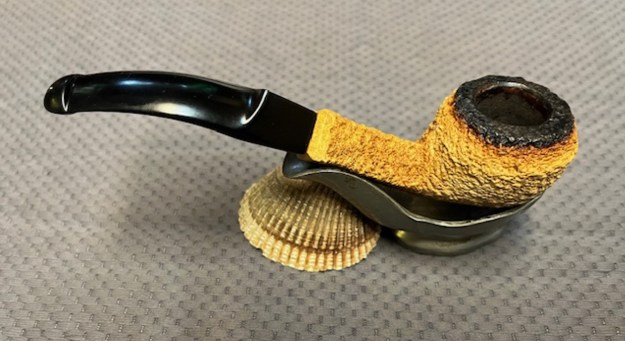
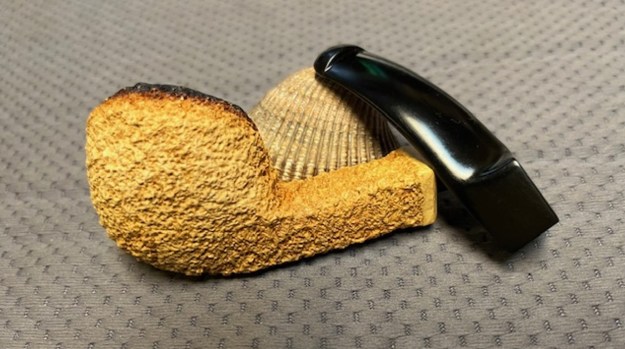
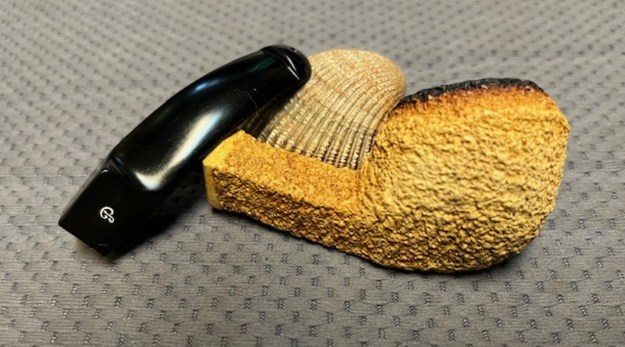
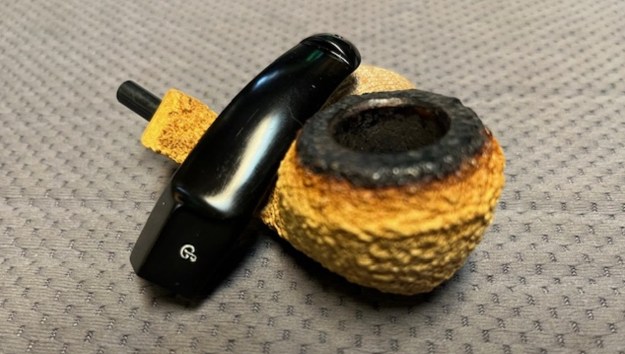
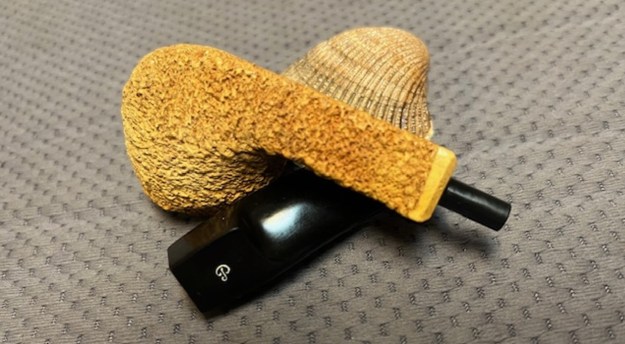
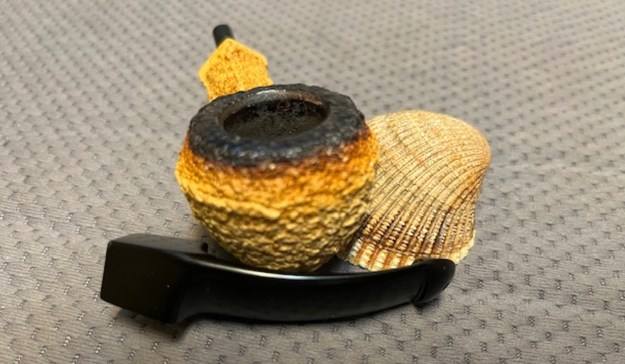
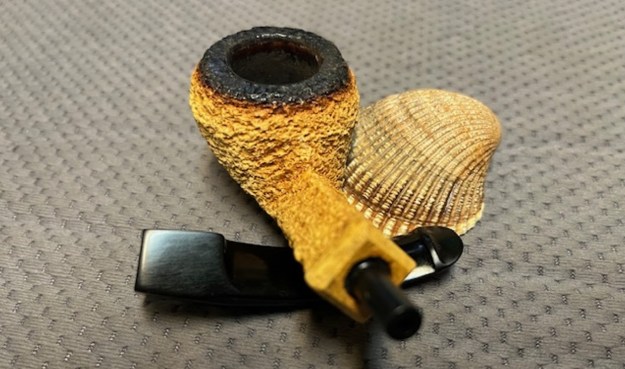
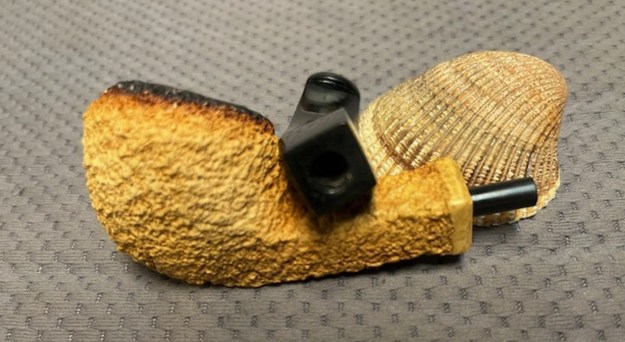
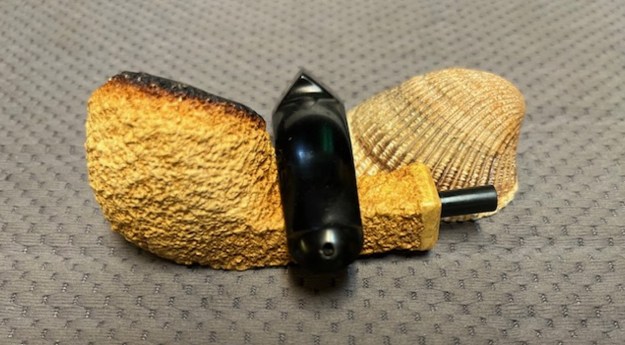
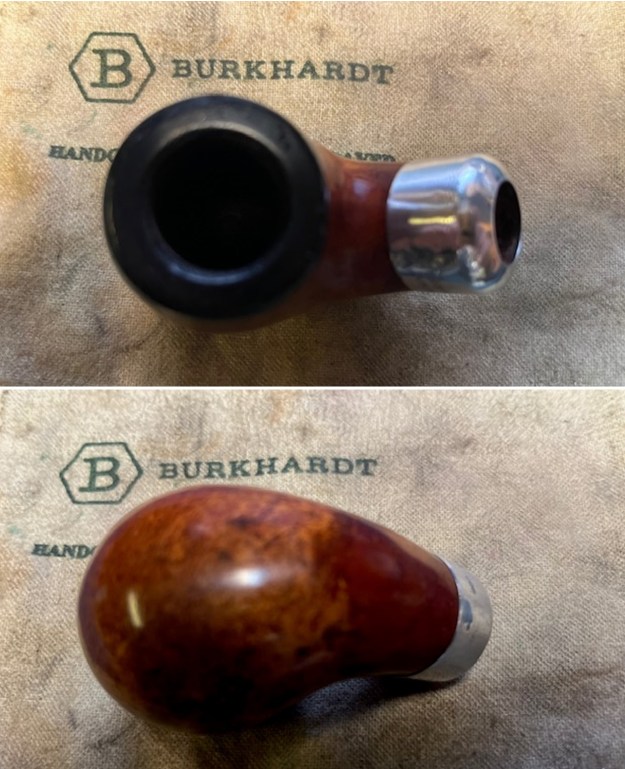
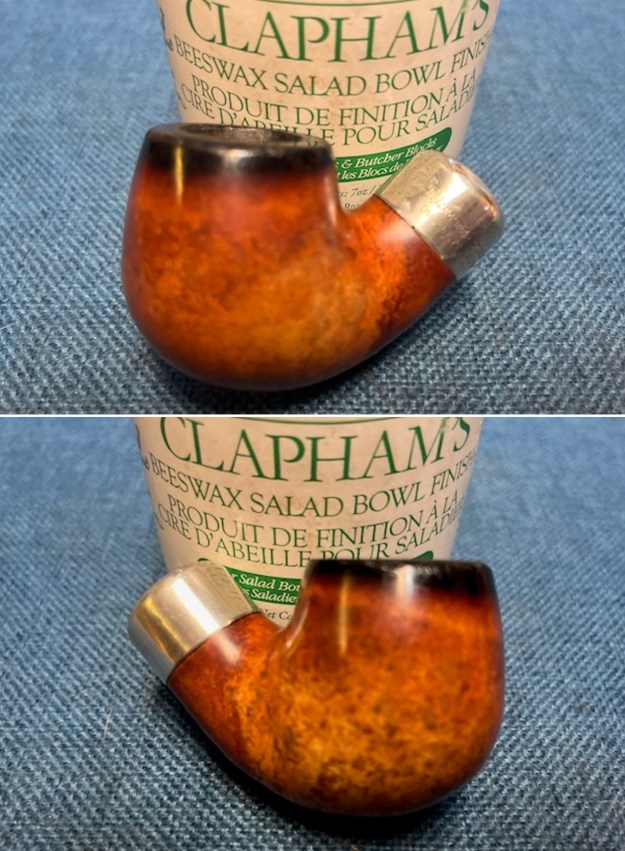
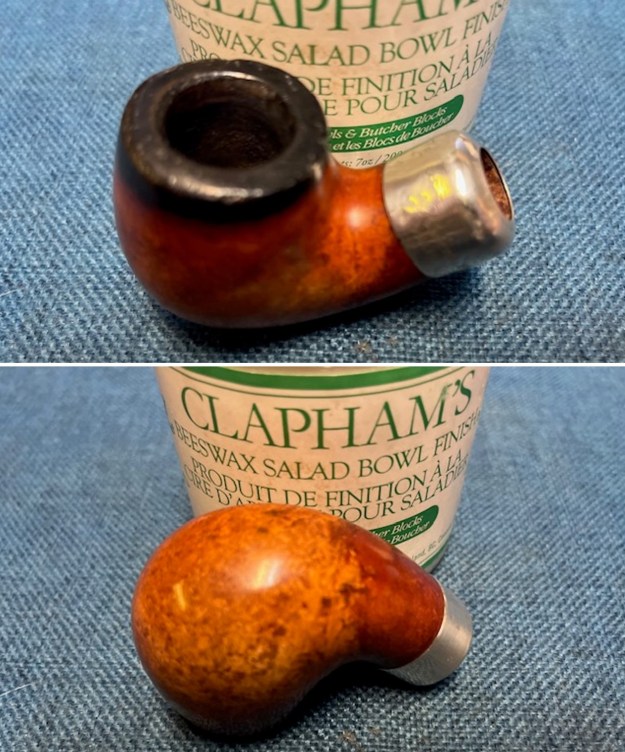
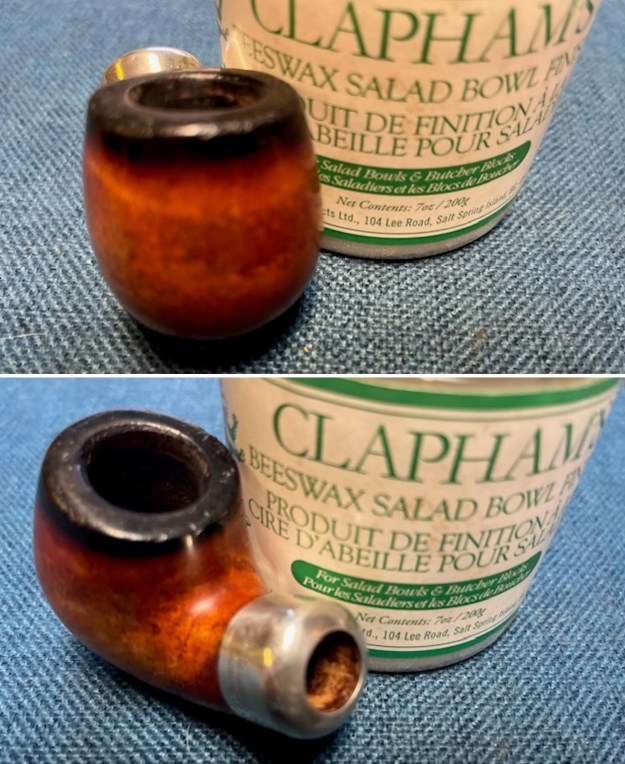
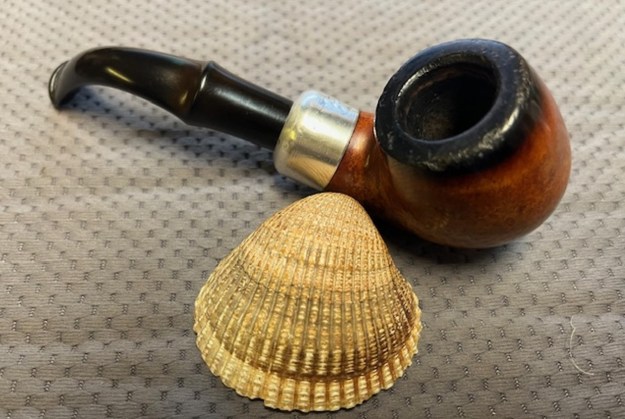
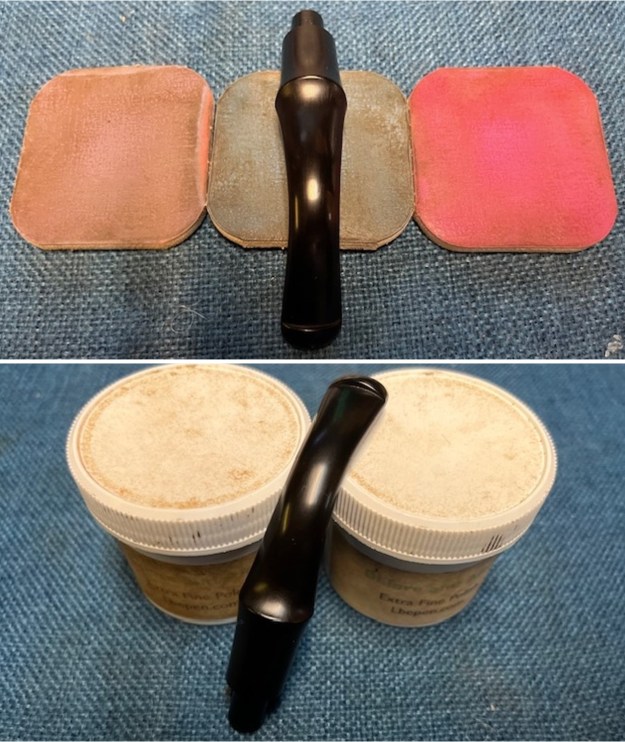
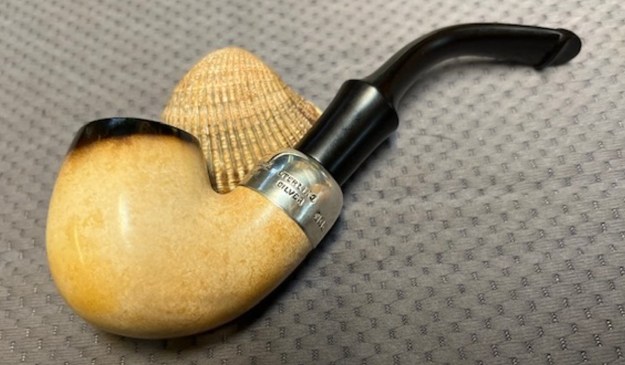
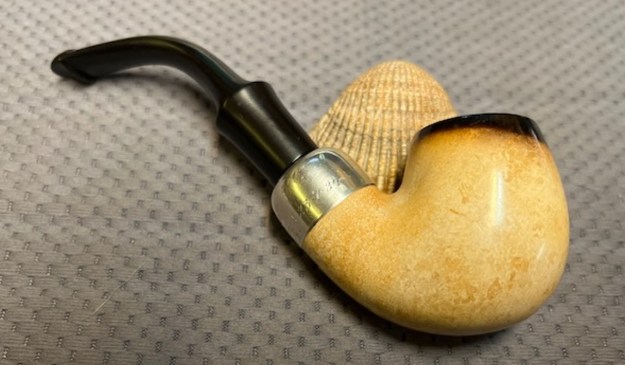
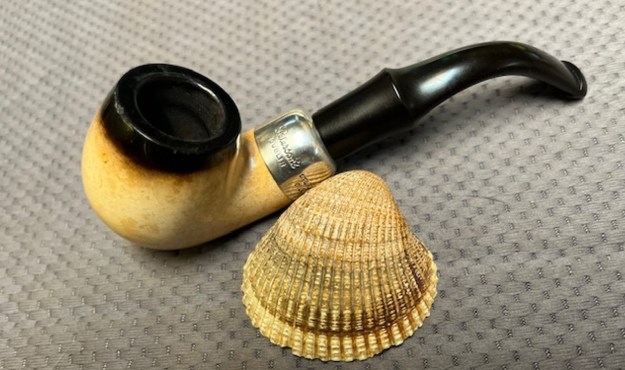
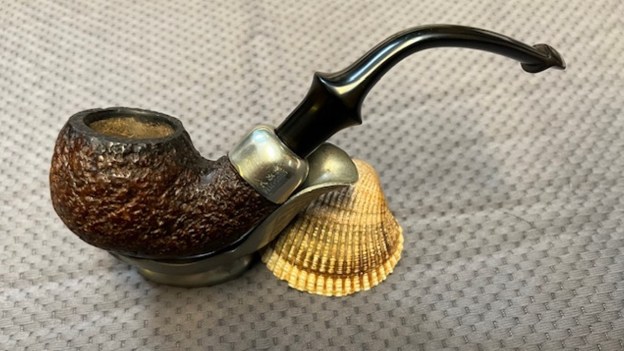
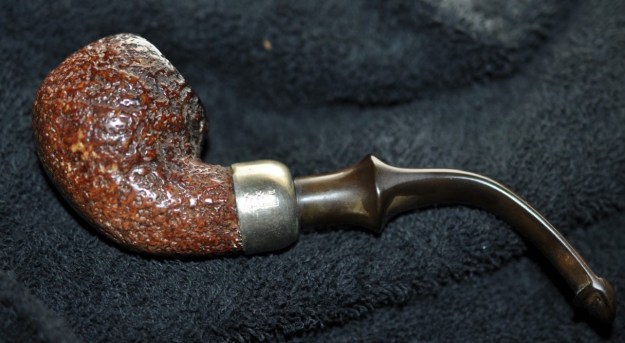
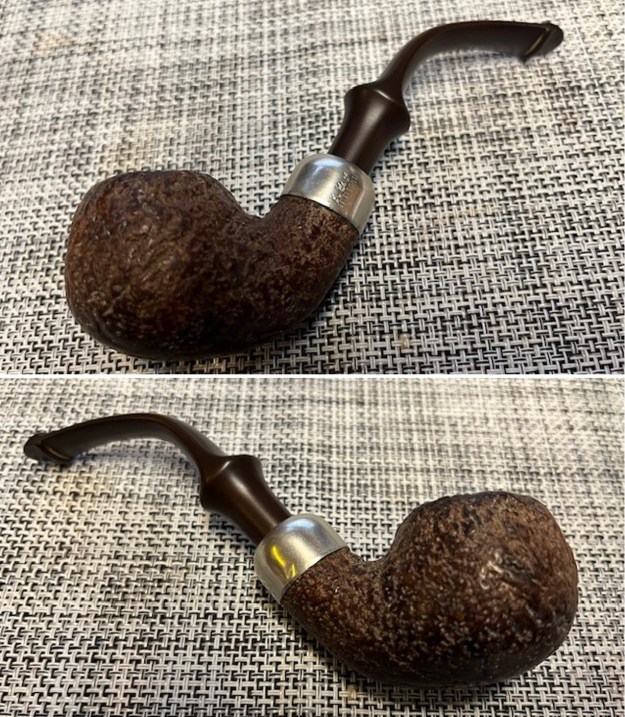
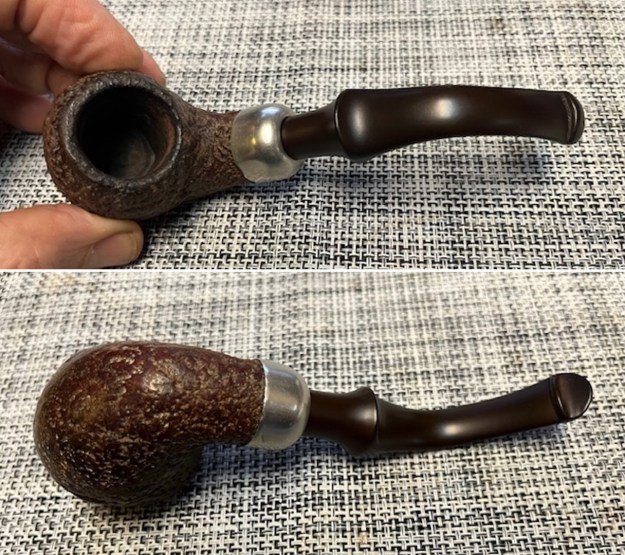
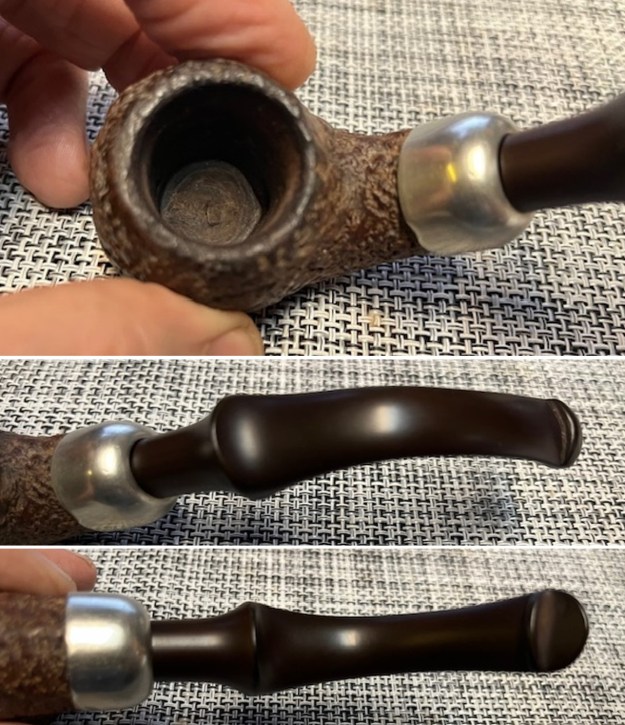
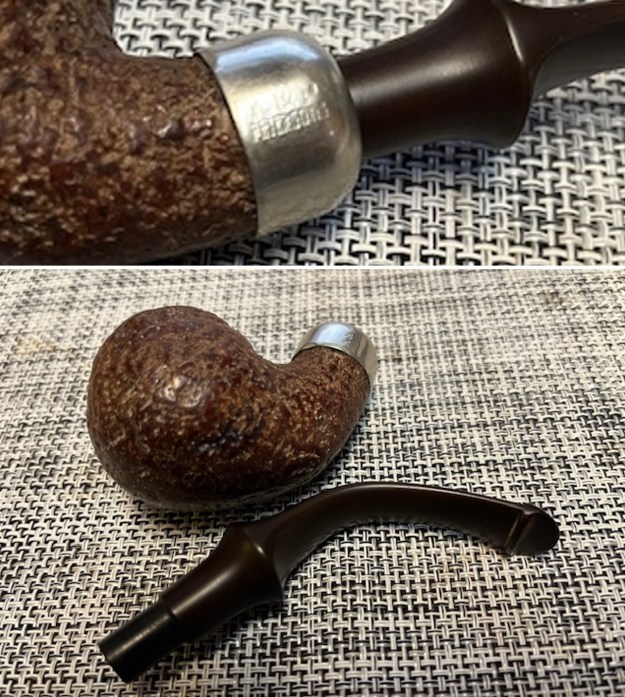
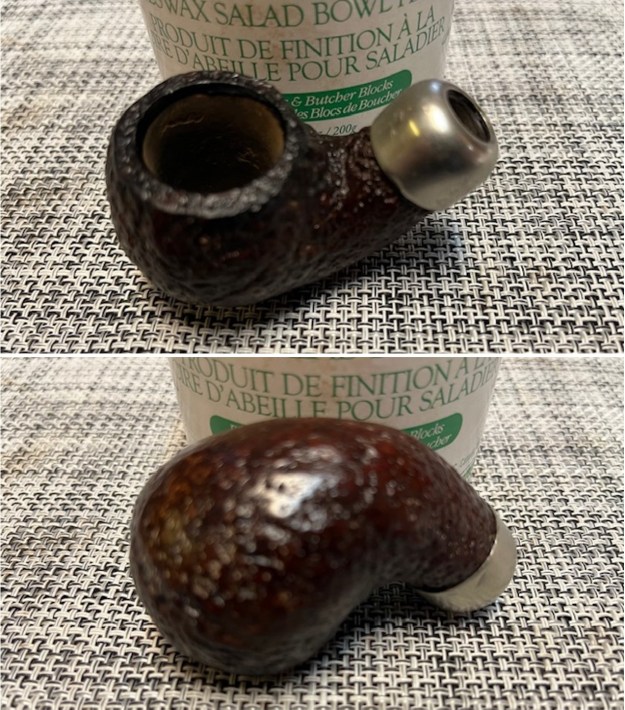
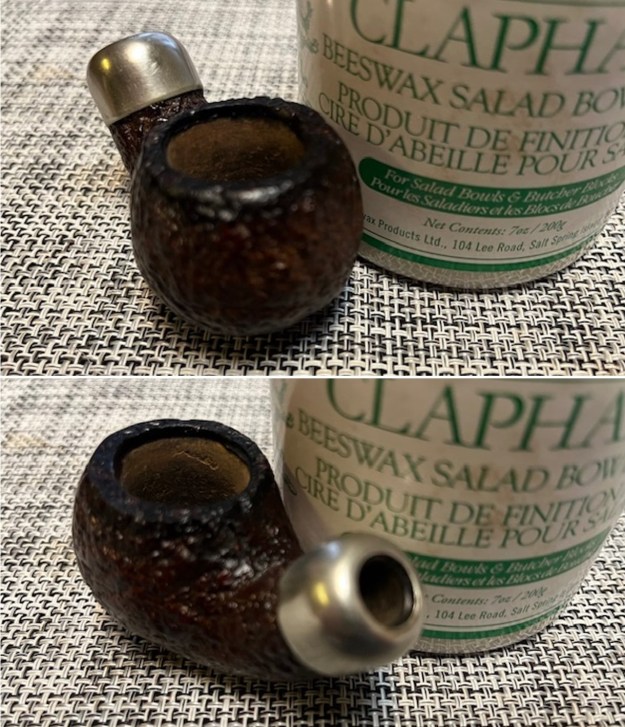
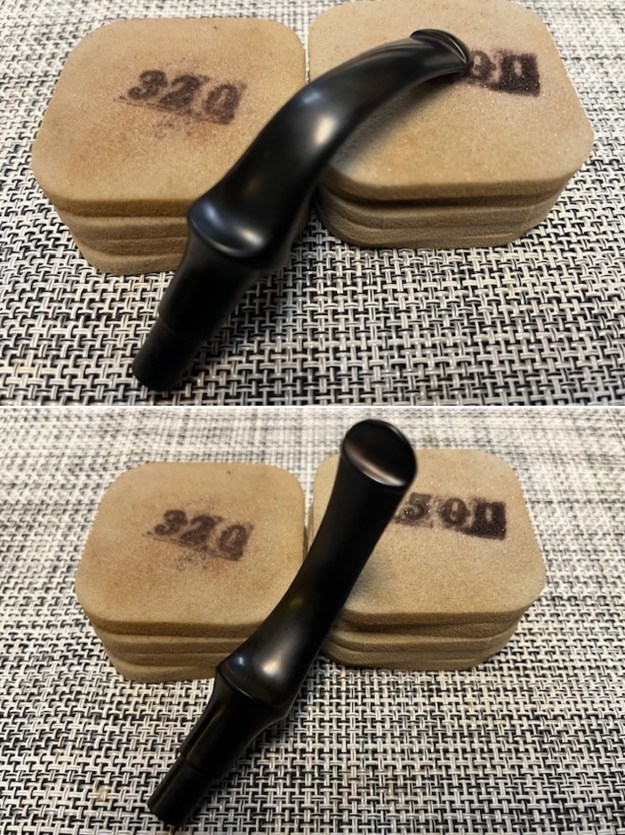
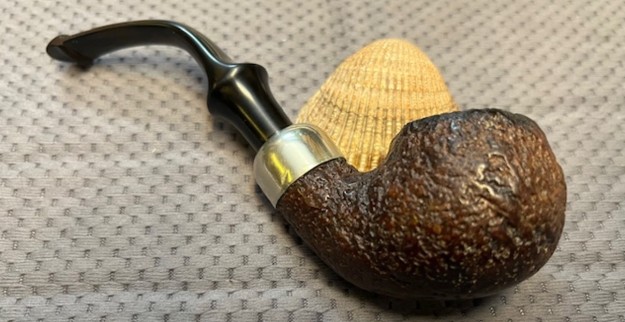
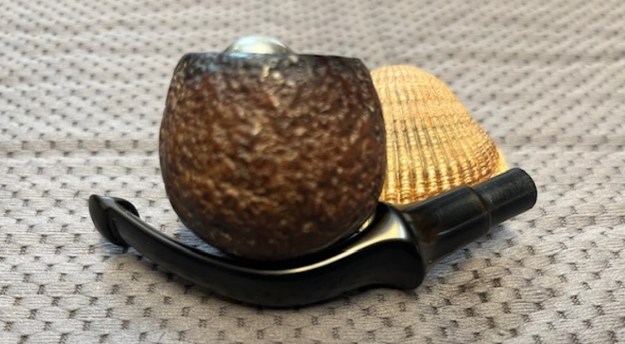
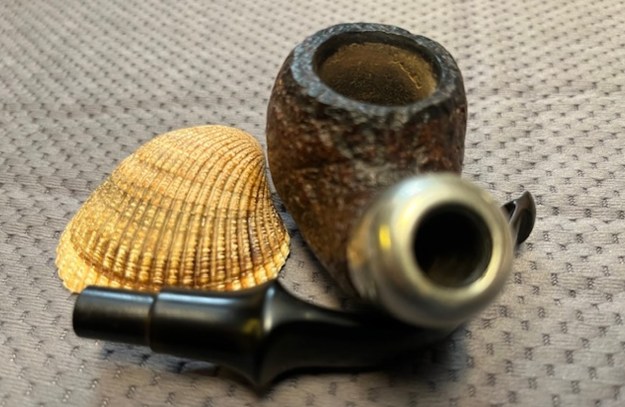
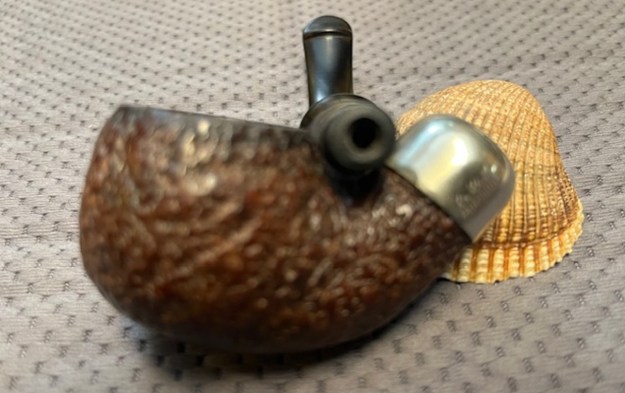
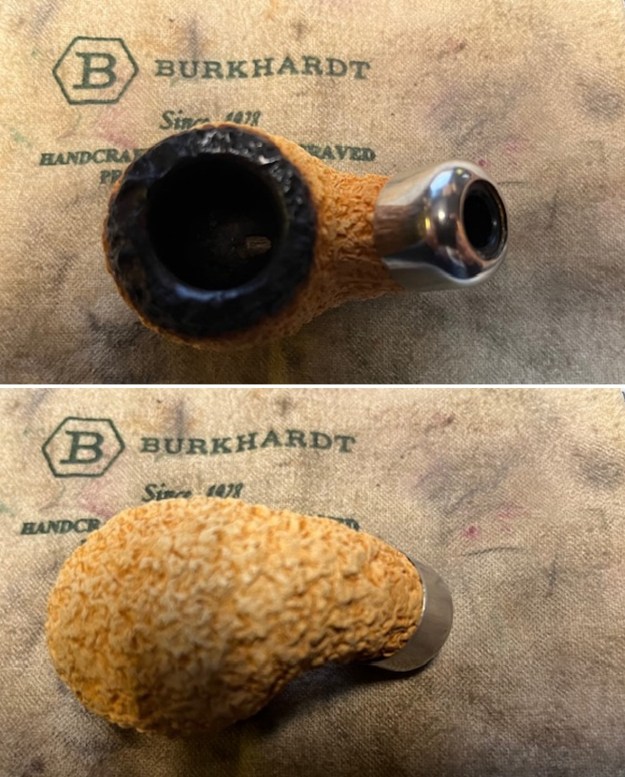
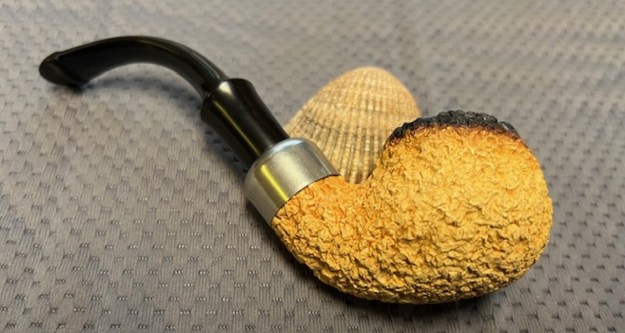
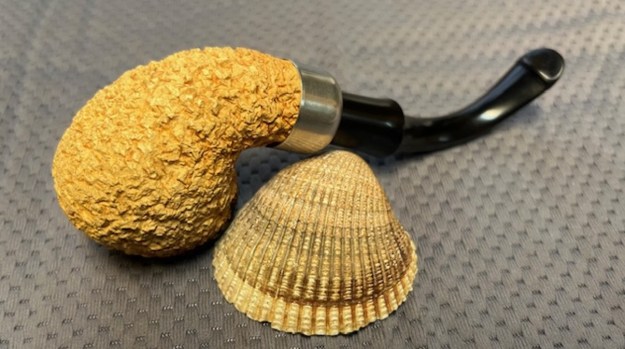
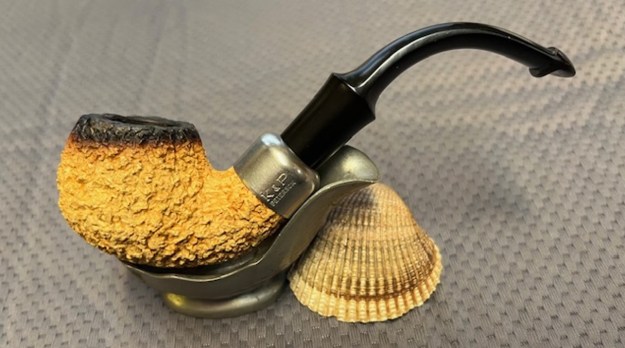
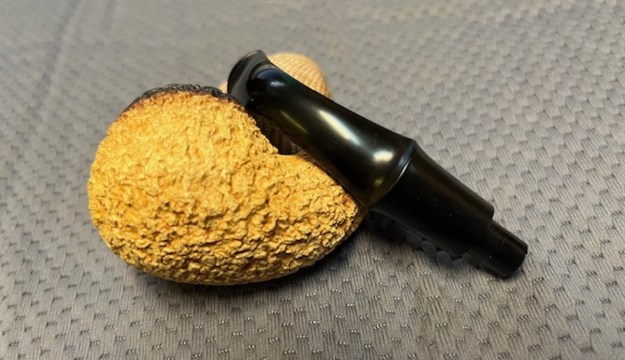
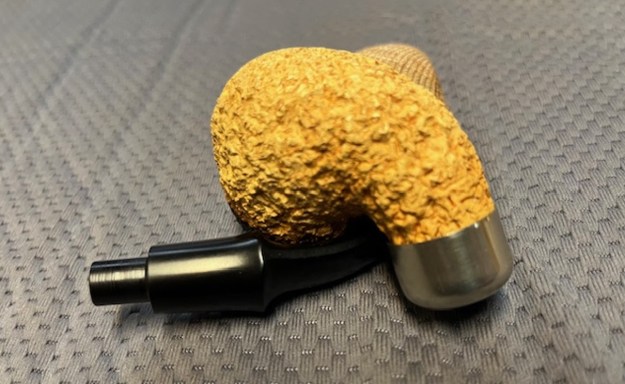
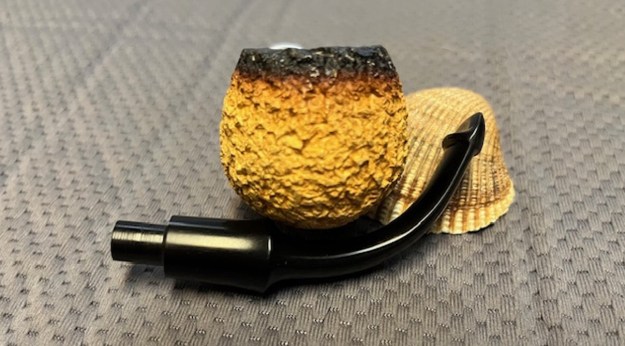
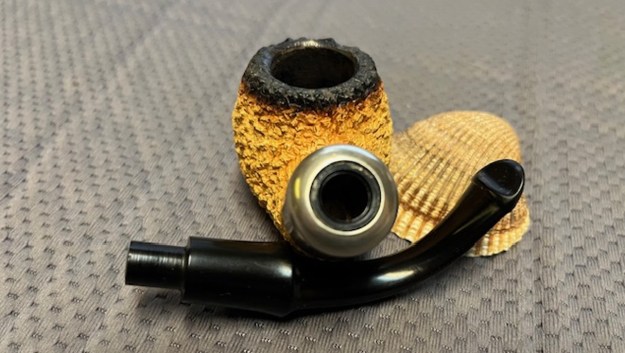
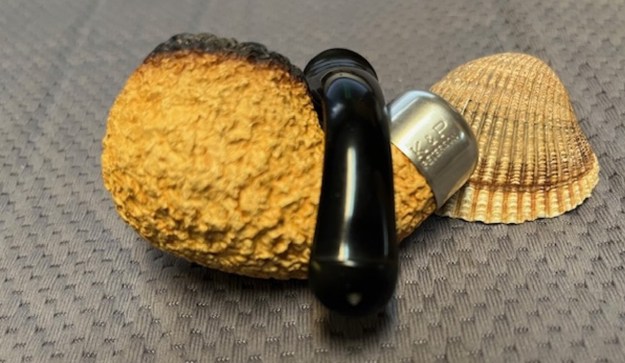
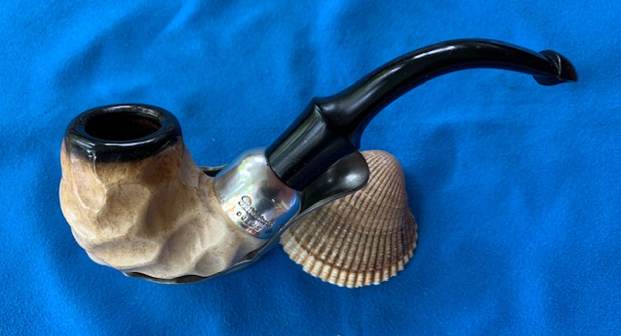
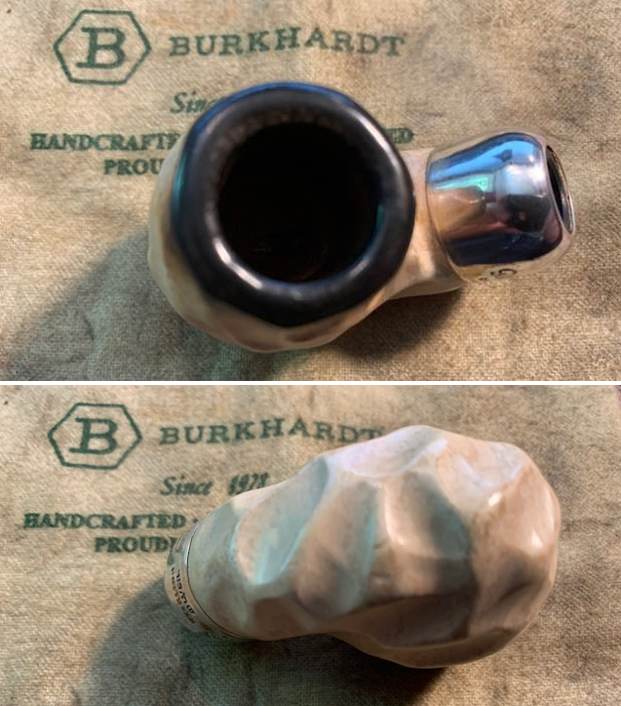
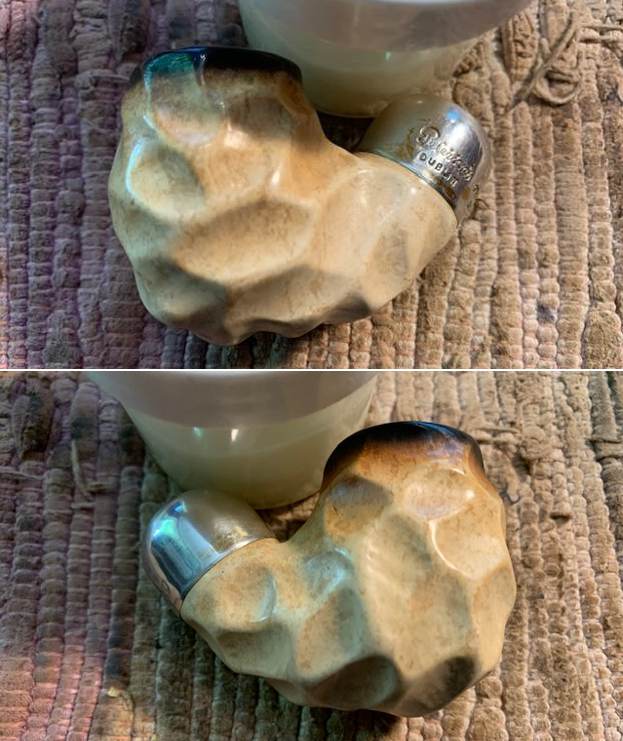
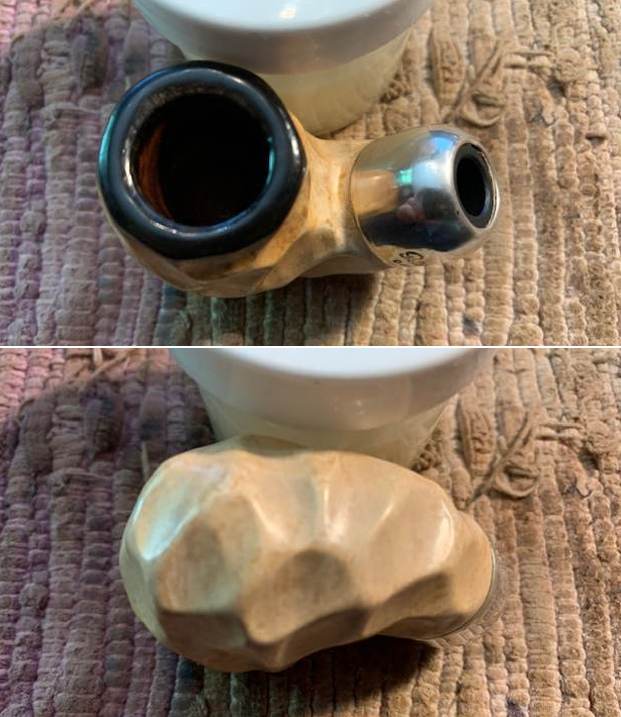
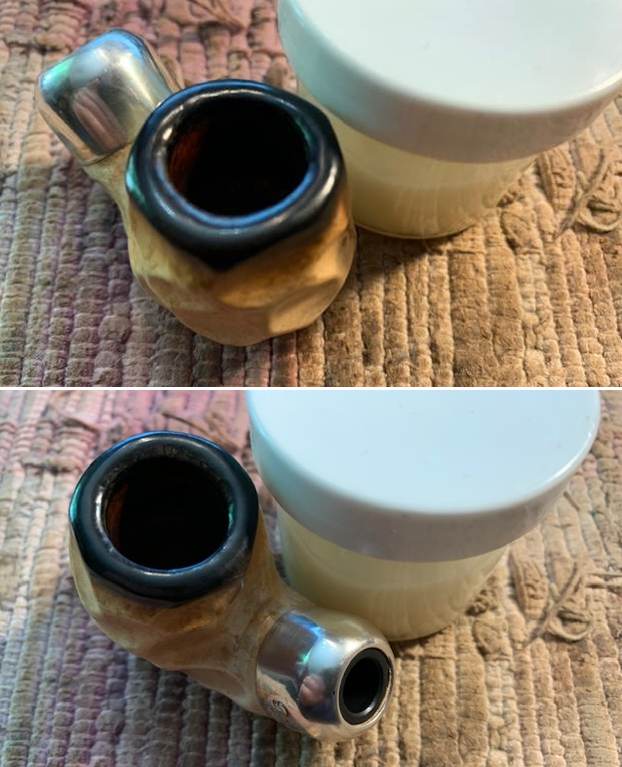
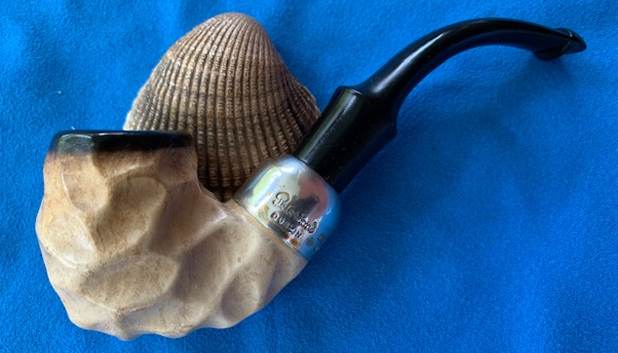
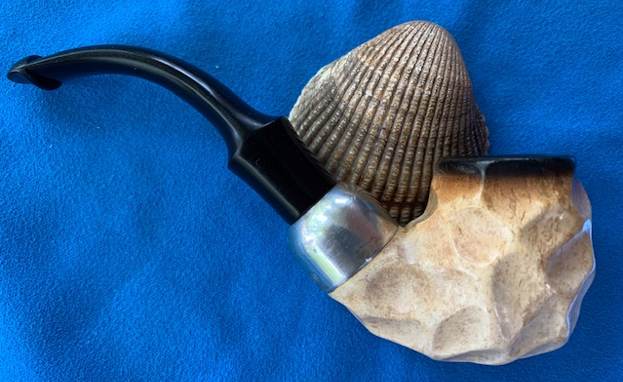
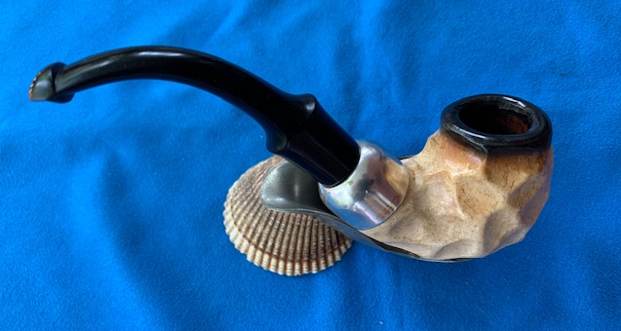
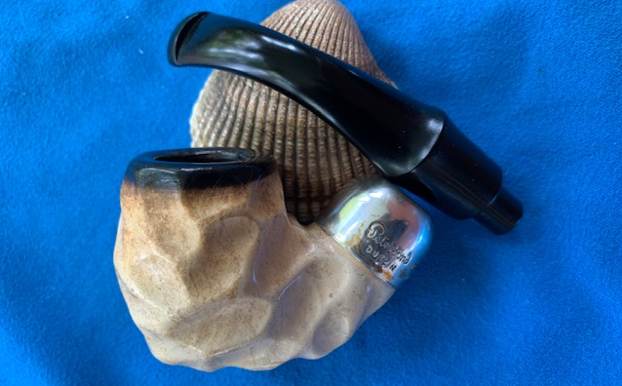
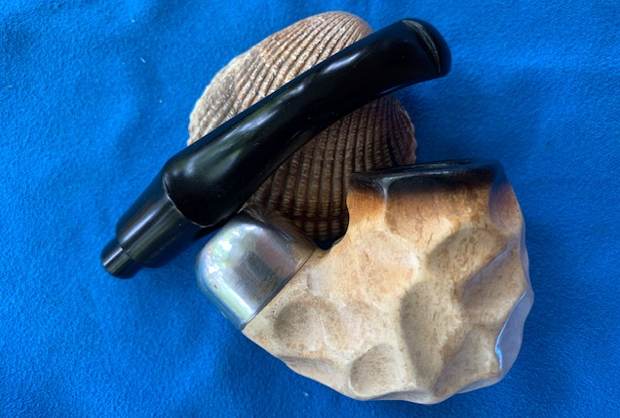
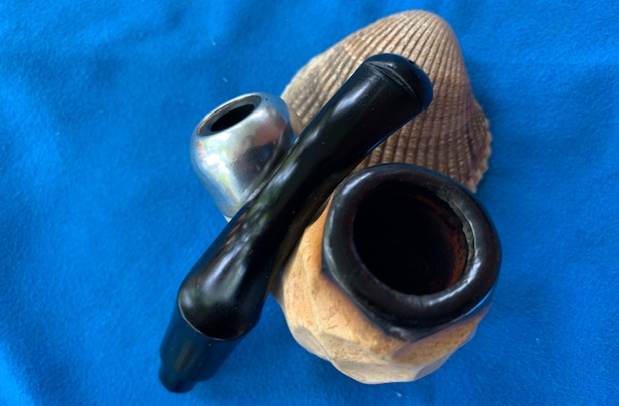
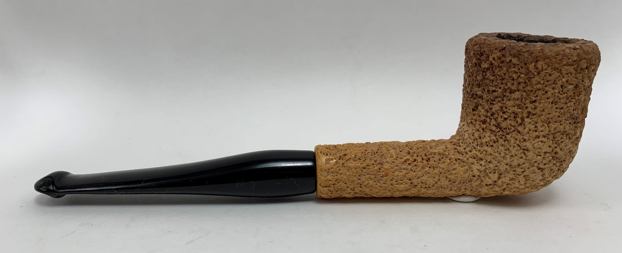
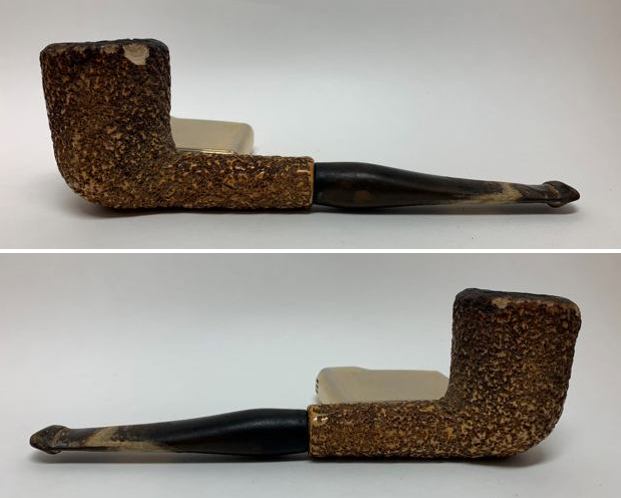
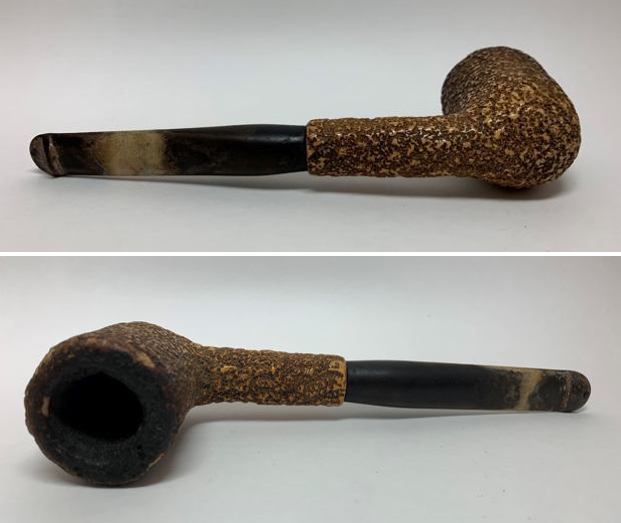
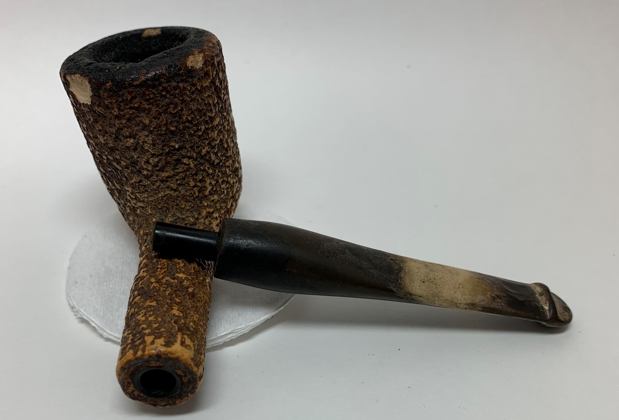
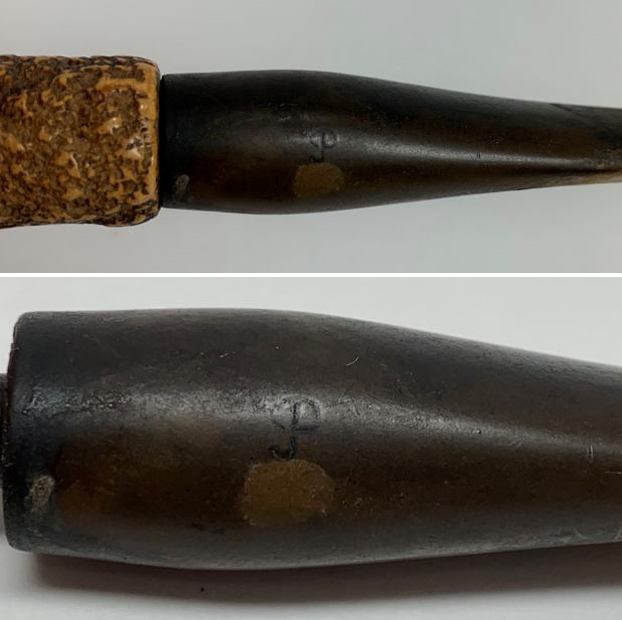
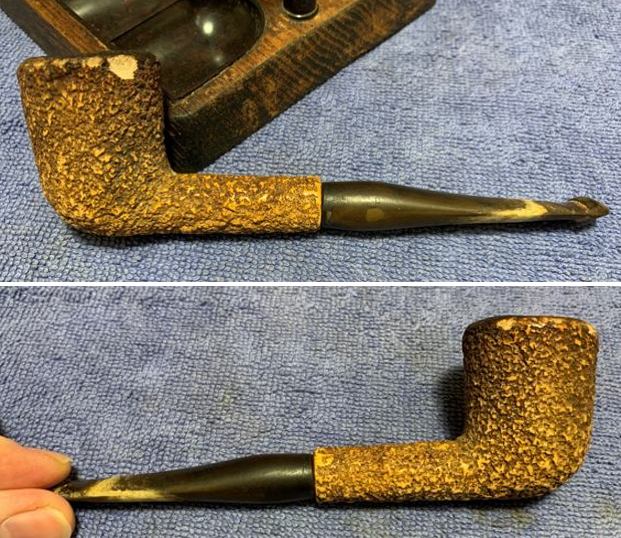
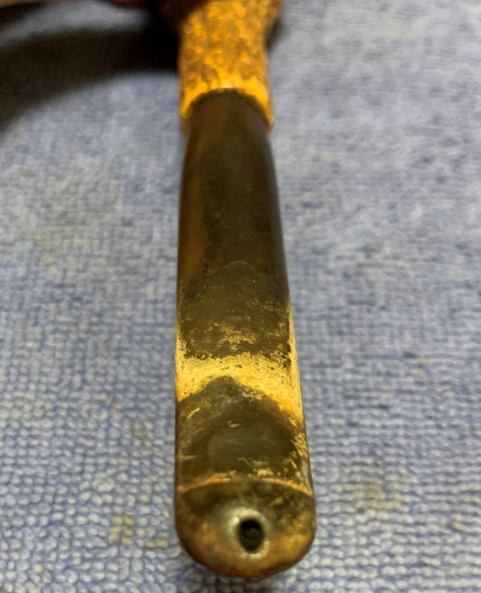
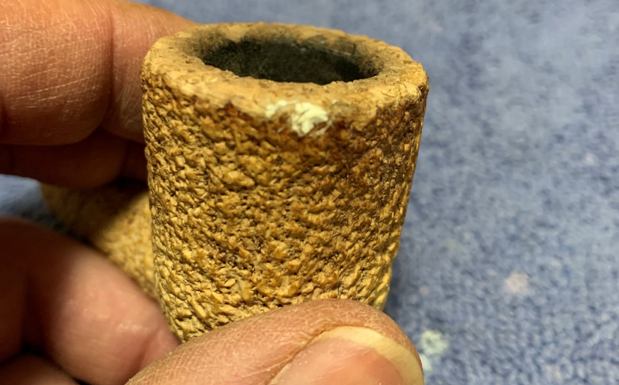
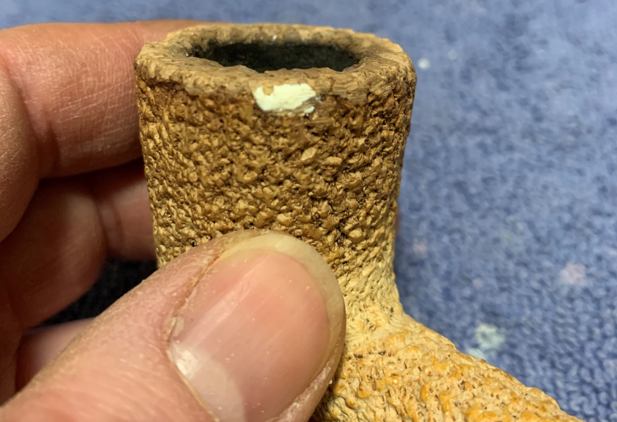
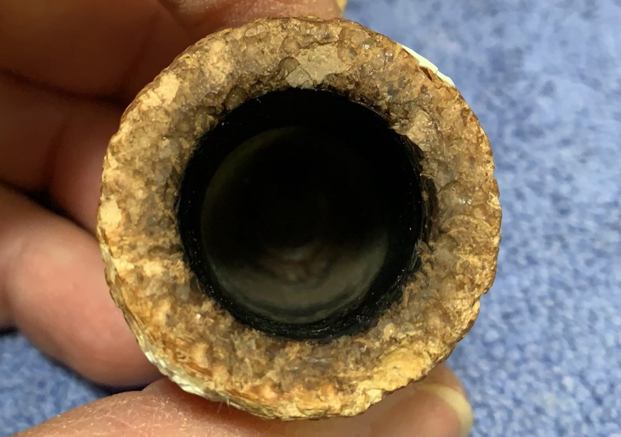
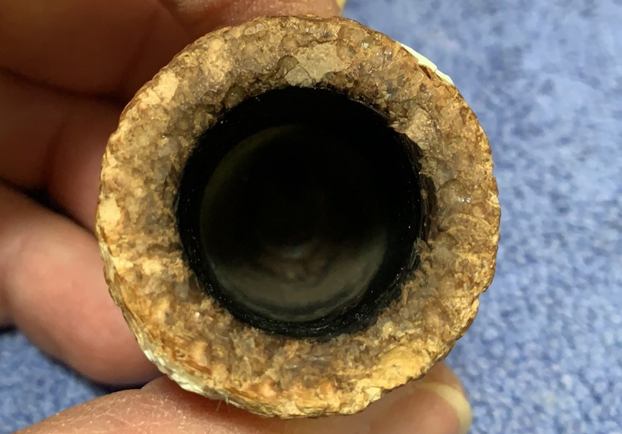
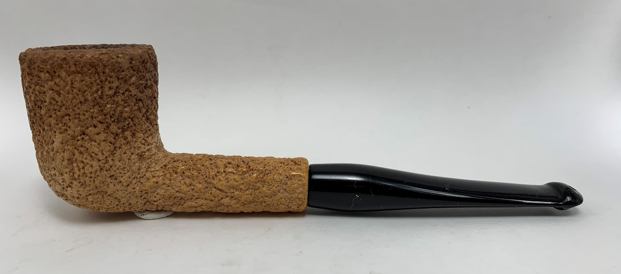
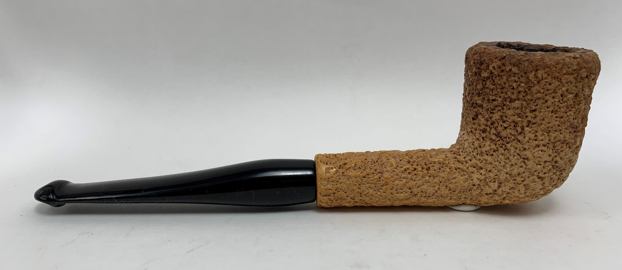
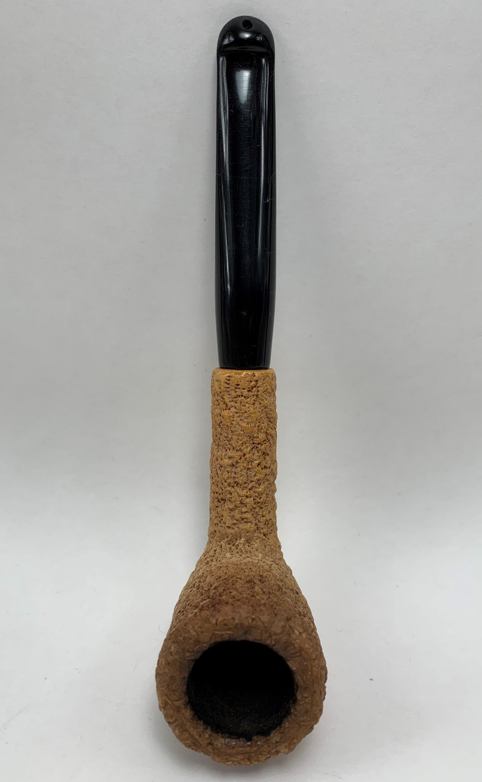
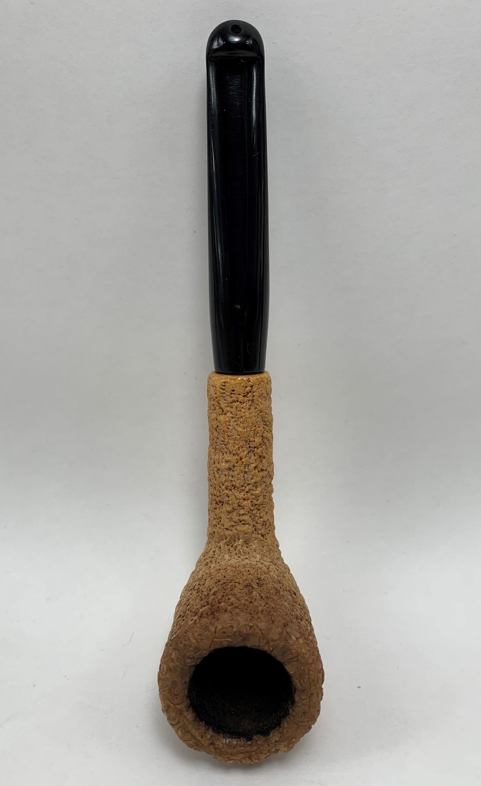
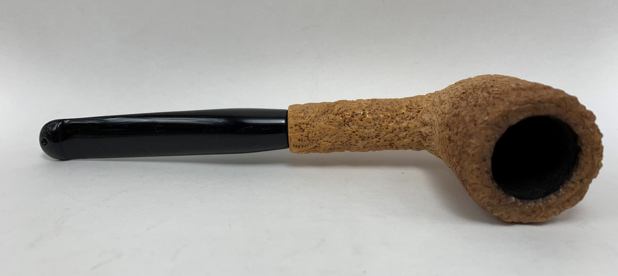
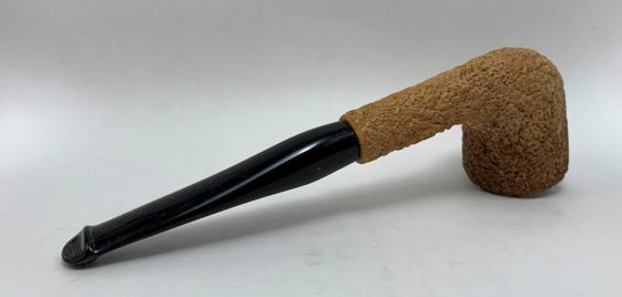
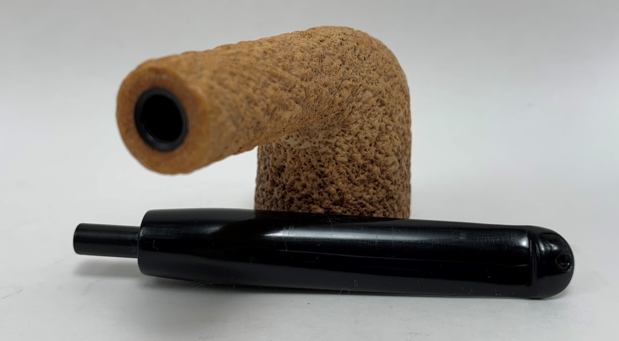
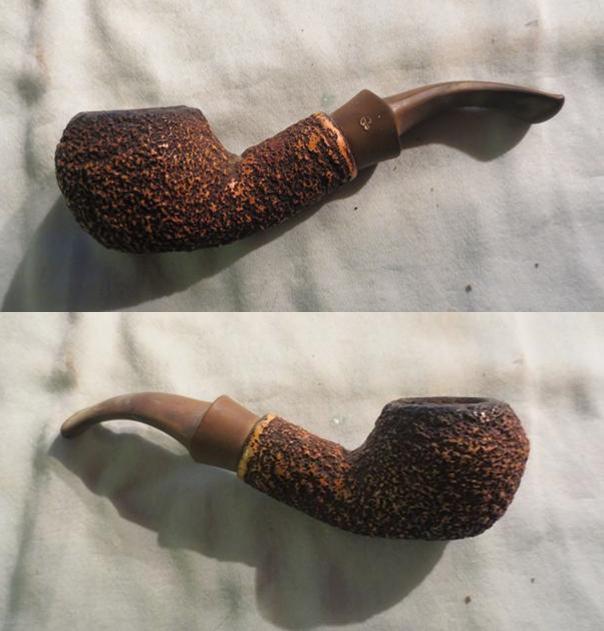
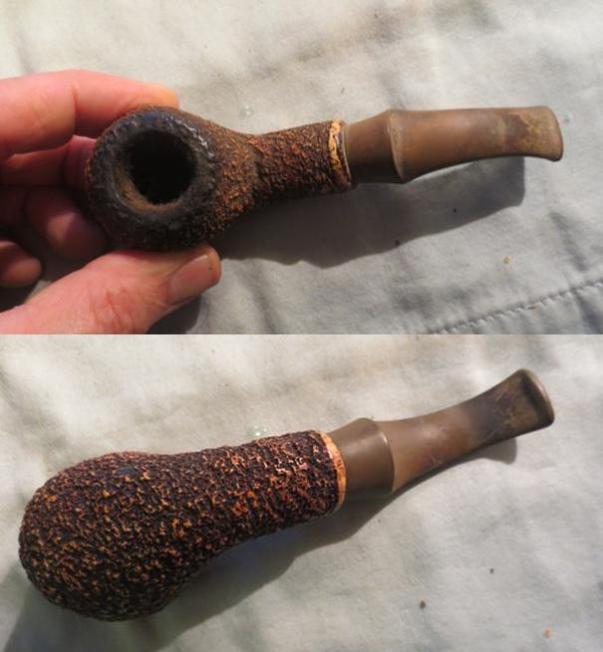
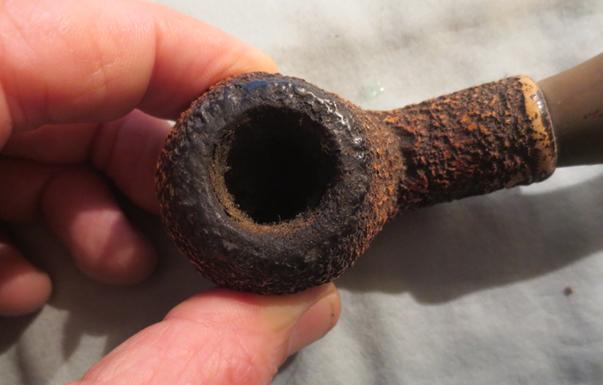
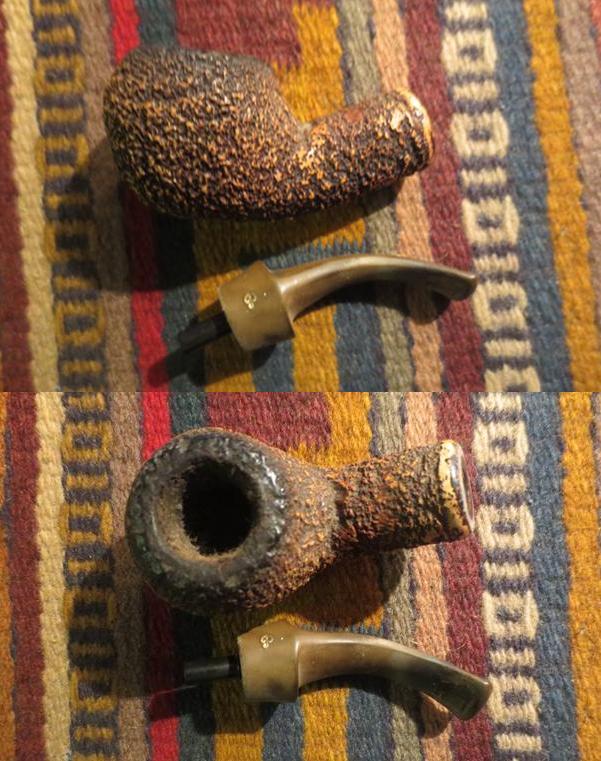
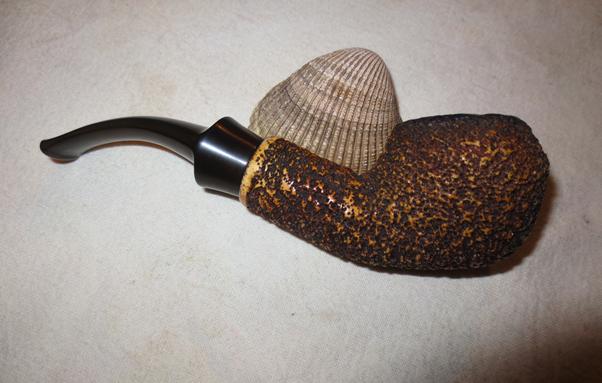
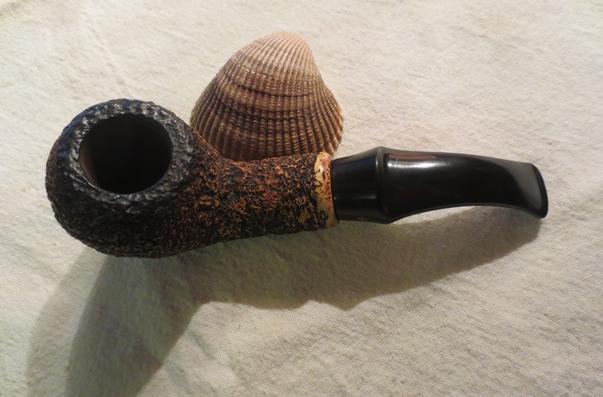
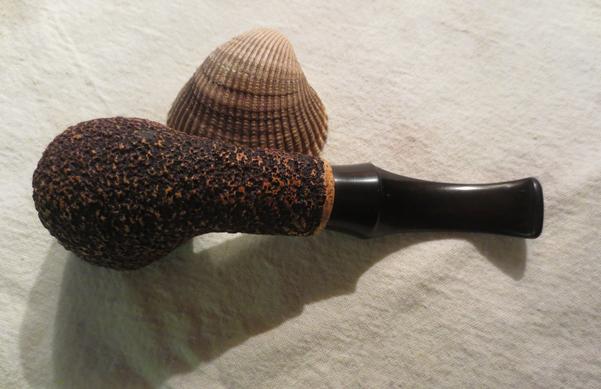
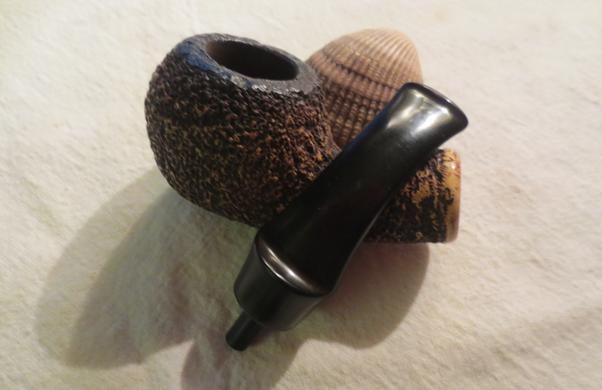
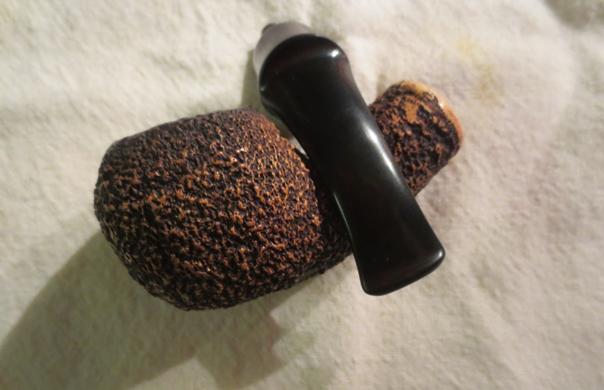
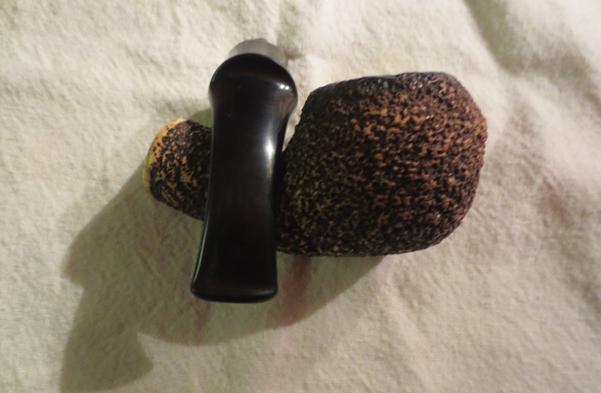
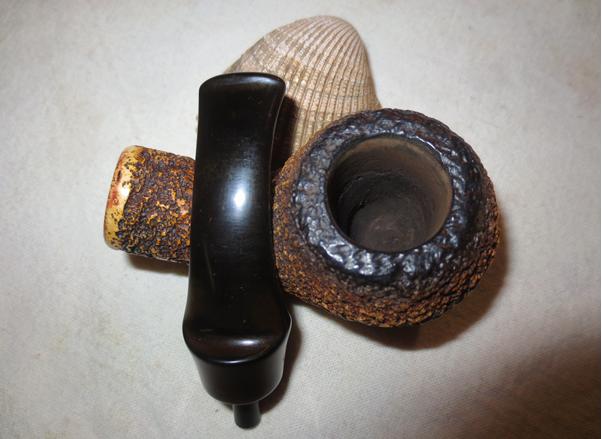
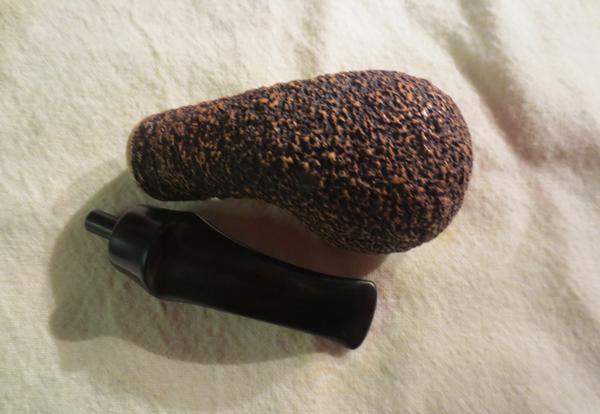
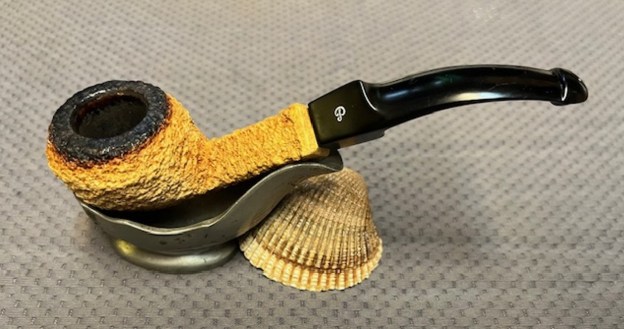
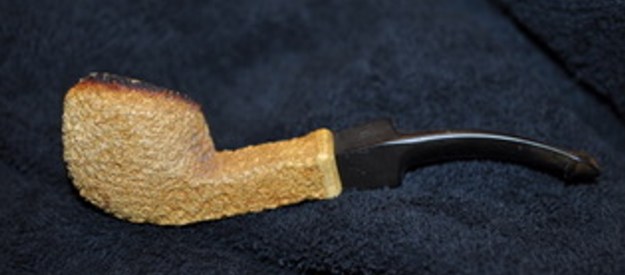
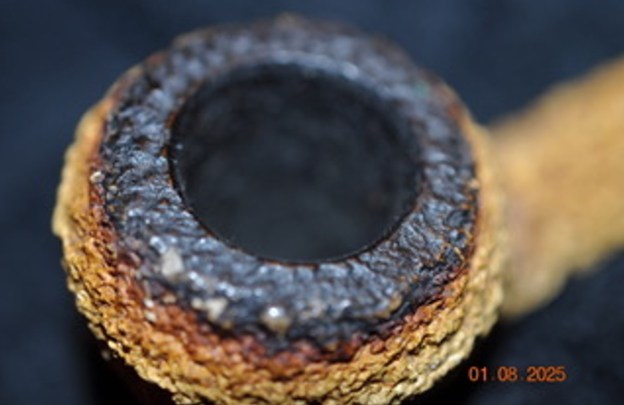
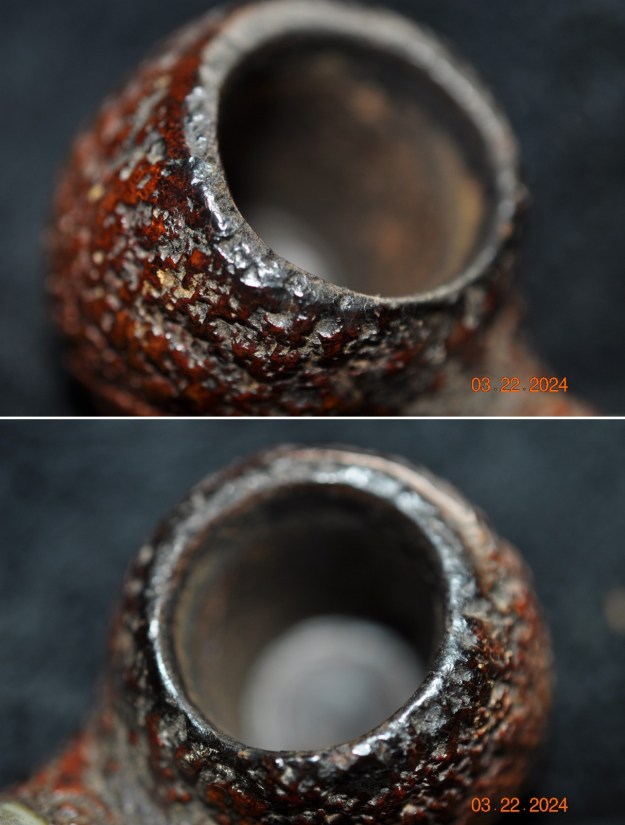
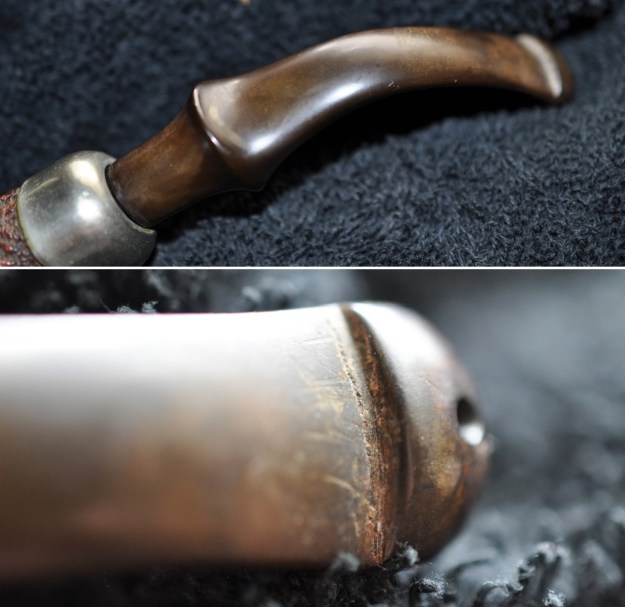
The next pipe on the table is a Peterson Rusticated Meerschaum Bulldog. We picked the pipe up from a seller in Ogden, Utah, USA on 12/12/2024. Probably the fact that it is a meerschaum and that it bore the P stamp on the stem caught our eye. There is no stamping on the shank or anywhere else on the pipe. It is the shape and the P stamp on the stem that tell us that it is a Peterson pipe. It is great looking rusticated pipe that is commonly seen on these meerschaums. The bowl appears to be lightly caked and quite clean. The inner edge and the top show some light lava overflow. And let’s talk about that stem. It is oxidized and calcified which is quite normal for what I see. There are some tooth marks and chatter on the stem surface and button. The P stamp on the top left side of the saddle is deep but has lost the colour. Jeff took some photos of the pipe to show the general condition of the pipe before he started his clean up. Jeff took photos of the rim top and stem to show the general condition of the pipe. The bowl is lightly caked and the rim top and edges have lava overflowing on to them. There are also some spots where the finish is worn off. The stem is oxidized, calcified and has tooth chatter and tooth marks on the top and underside near the button. Jeff took photos of the bowl sides and heel to show the condition of the rusticated finish around this bowl. It is a nice looking pipe. He took a photo of the “P” stamping on the left side of the saddle stem. It is clear and readable but has lost the colour that was originally there. I took some time to remind myself of the provenance of these Peterson’s Dublin Meerschaum pipes. I am pretty sure the pipe was made by the Laxey Pipe Ltd. on the Isle of Man for Peterson’s in Ireland (https://pipedia.org/wiki/Laxey_Pipes_Ltd). I quote from the Pipedia article in full:
Laxey Pipe Ltd. resided in a historical 19th century four-storey Man stone building at The Quay, Old Laxey, Isle of Man, which thankfully has been preserved. The company specialized in the production of Meerschaum Pipes using the Meerschaum mined by the Tanganyika Meerschaum Corporation in the Amboseli basin in Tanganyika (since 1964 part of the United Republic of Tanzania). Please note: you may often find names like “Manx Pipes Ltd.”, “Man Pipe Co.” and others more, but there is no indication of another Isle of Man pipe producer other than Laxey Pipe Ltd. at any time!

Laxey Pipe Ltd. marketed own brands like “Manxpipe”, “Manxman”, “Manxland” e.c. Names like “John Bull”, “White Knight” (unwaxed), “Domino” (black, or lined) indicated some shapes / colours of Laxey’s own series. The stems either showed the astronomical sign for “male” or “man” (circle + arrow), or the crest of the Isle of Man, the 3-legged X in a circle. Manxpipes and Laxey’s other brands were available through pipe retailers in general, but also were sold (mainly) to tourists through their own shop in Laxey.

Furthermore Laxey Pipe Ltd. manufactured the meer bowls for Peterson, Barling, Nørding and others from the later 1960’s until 2001. Man Pipe e.g. was a brand distributed by Comoy’s. The bowls usually showed no nomenclature indicating the orderer. “Genuine Block Meerschaum” was engraved frequently. Often, just the stems were different, while bowls were the same.

Supply of meer from East Africa run out (Kenya / Tanzania exhausted, Somalia inaccessible), and thus the last Laxey meers were supplied to trade in May, 2001. Laxey Pipe Ltd. tried to survive continuing with briar pipes – mainly in the Danish style -, but to no success. It closed down business in July, 2002.

I know that the pipe was made on the Isle of Man by Laxey Pipe Ltd. out of African Meerschaum. It was made for export for Peterson’s of Dublin. The flumed top on the bowl and the rustication around the bowl and shank make me think that it is a 1970s era pipe. That was as much as I could figure out.

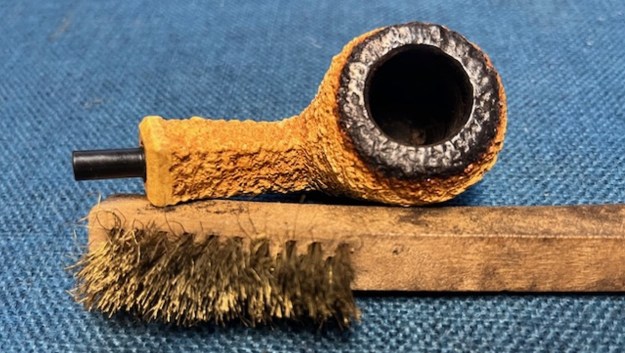
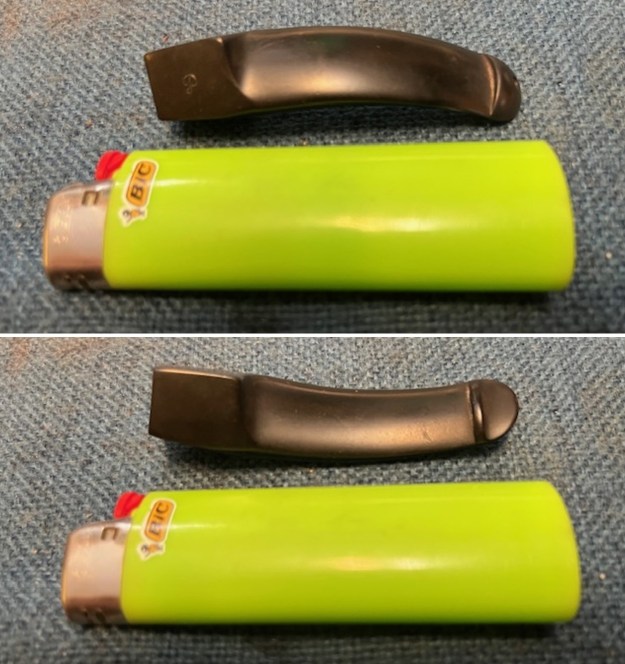
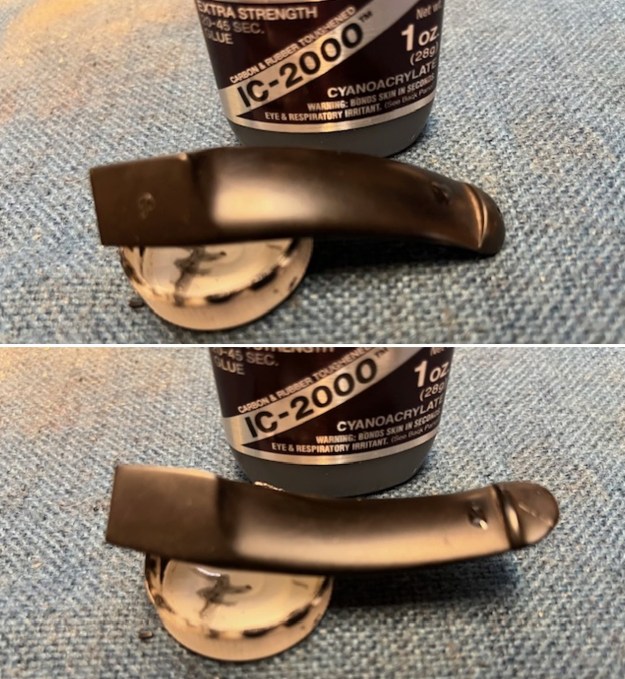
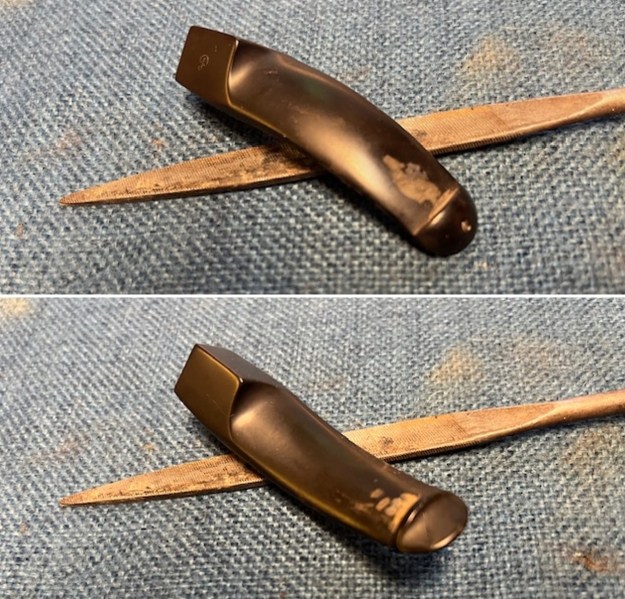
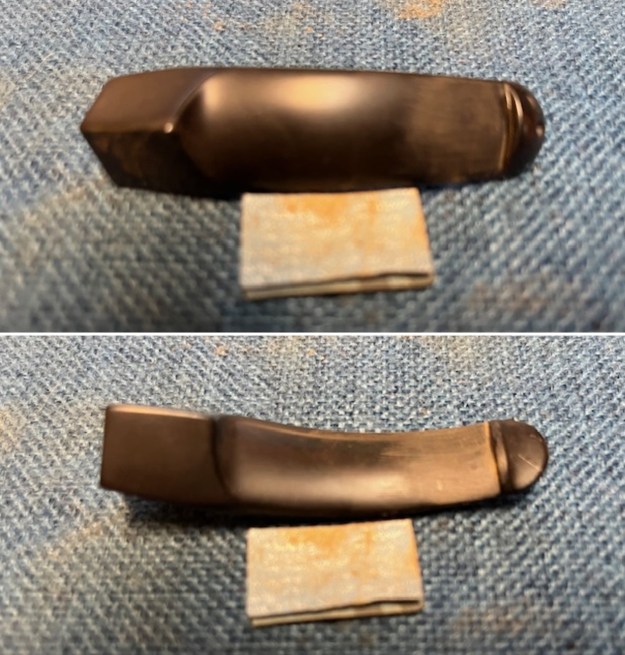
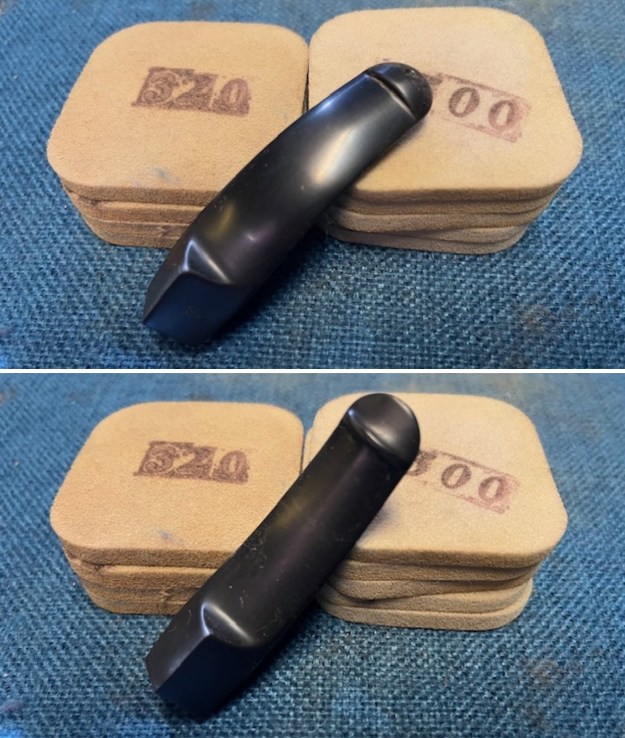
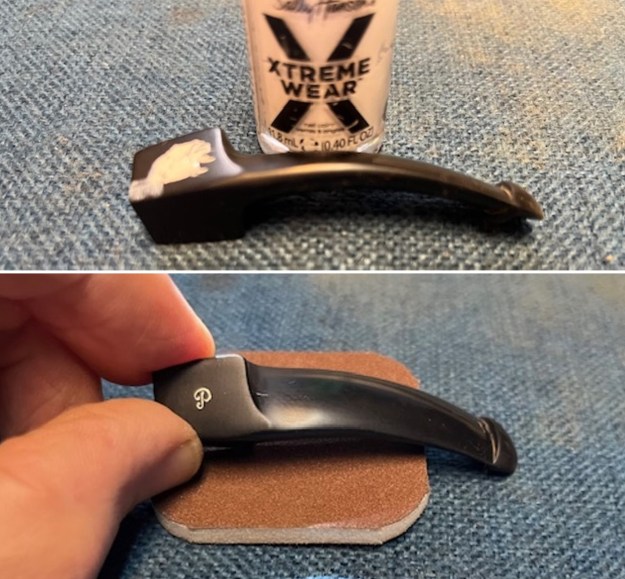
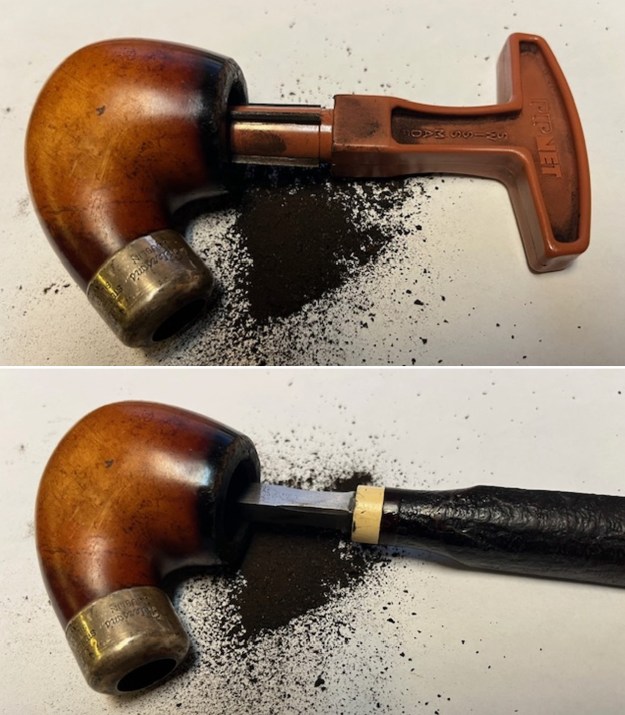
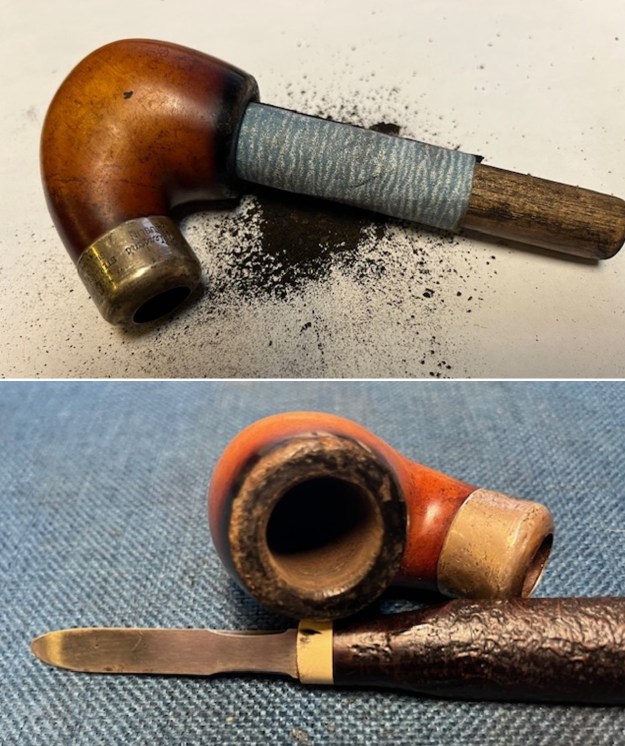
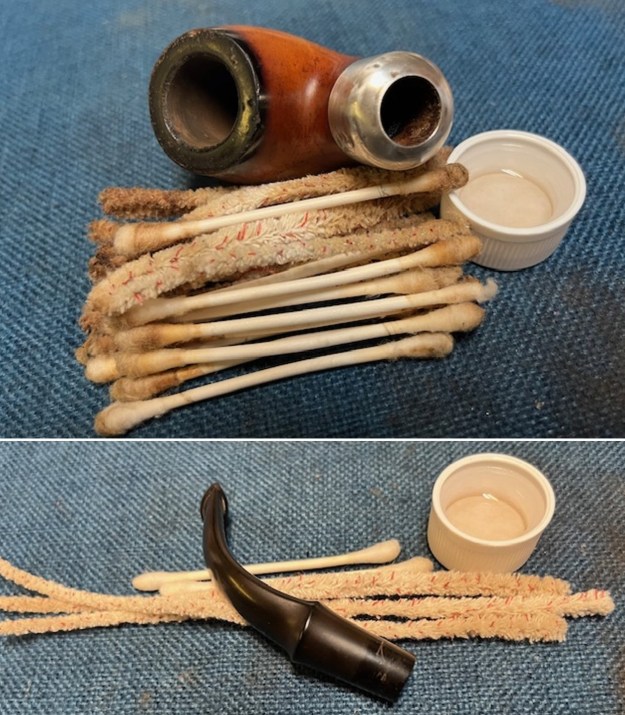
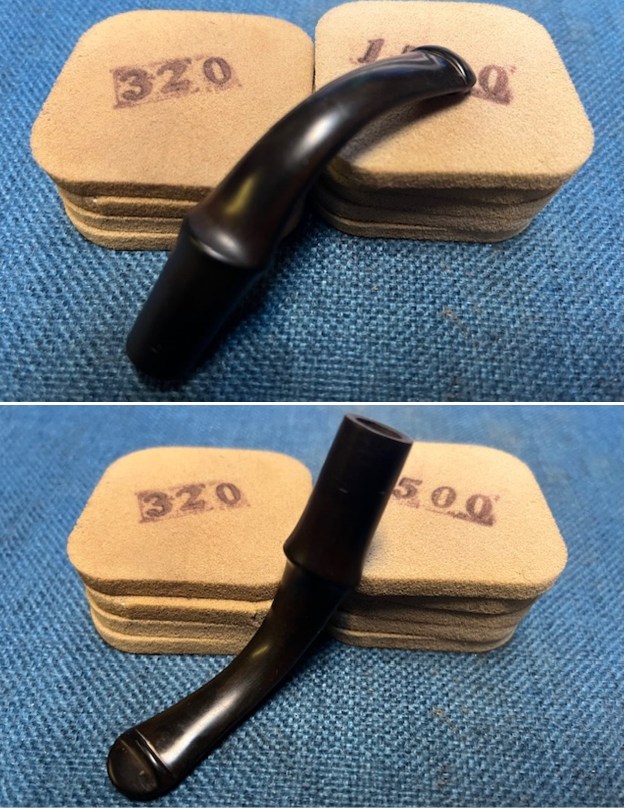
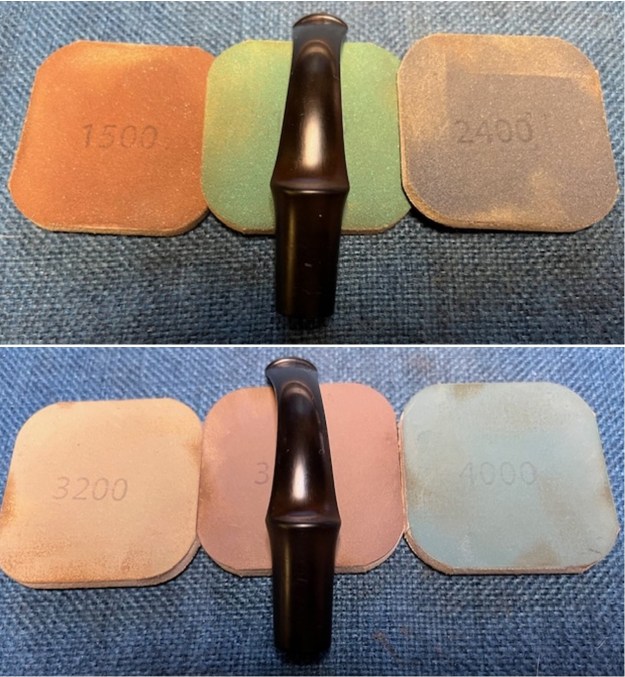
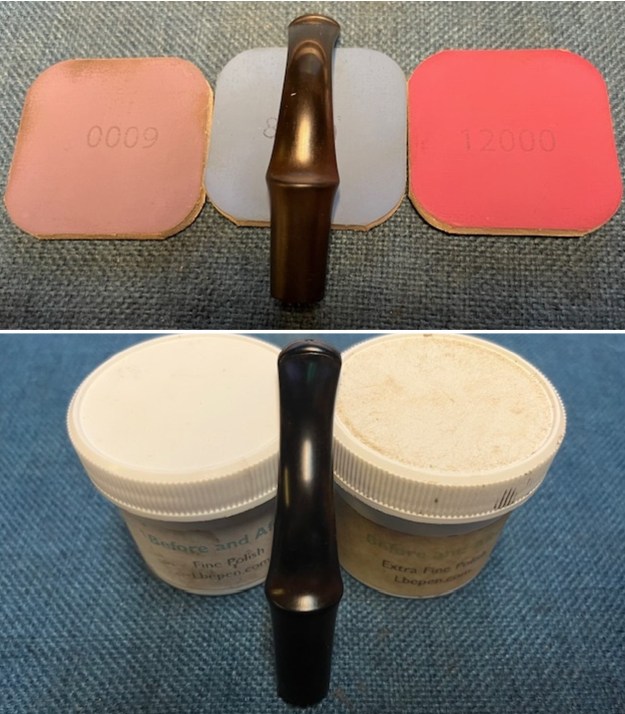
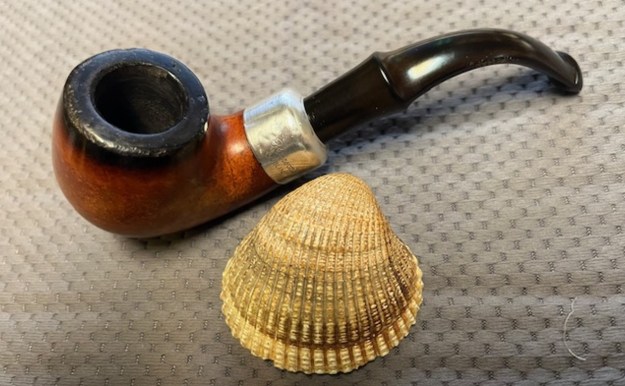
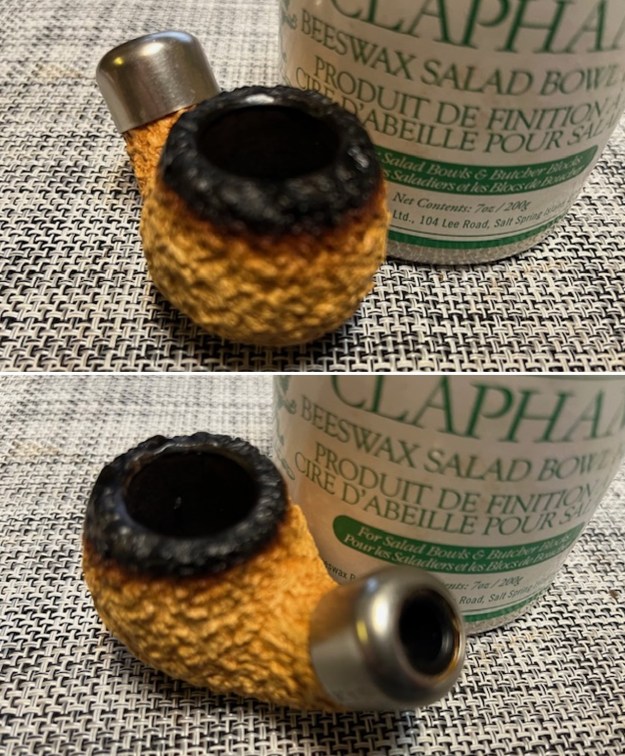
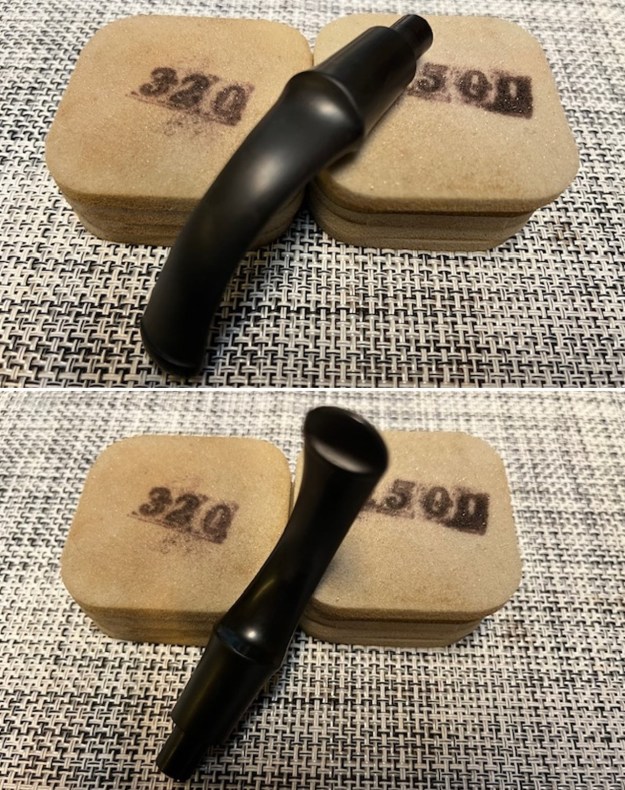
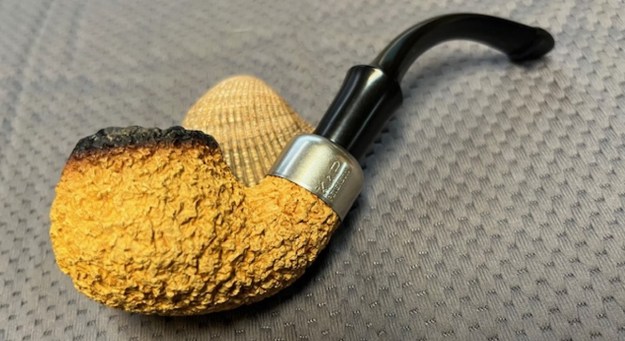
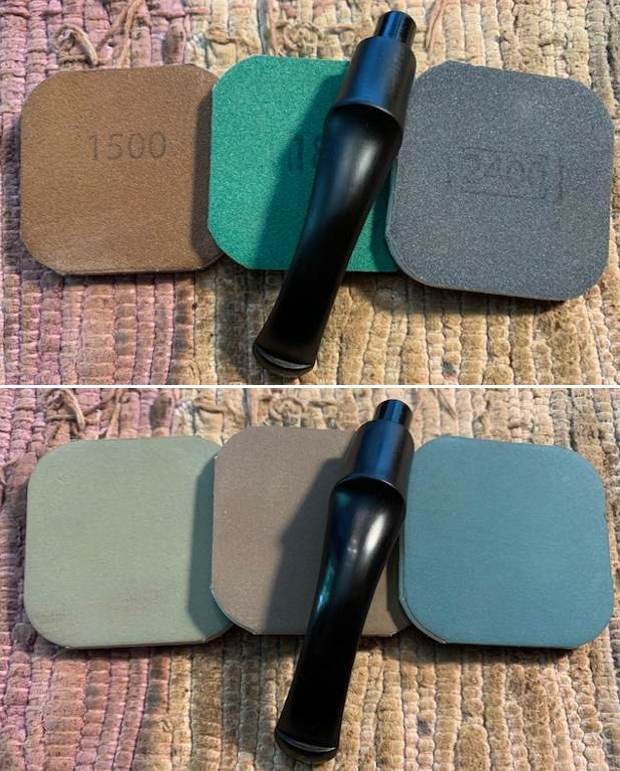
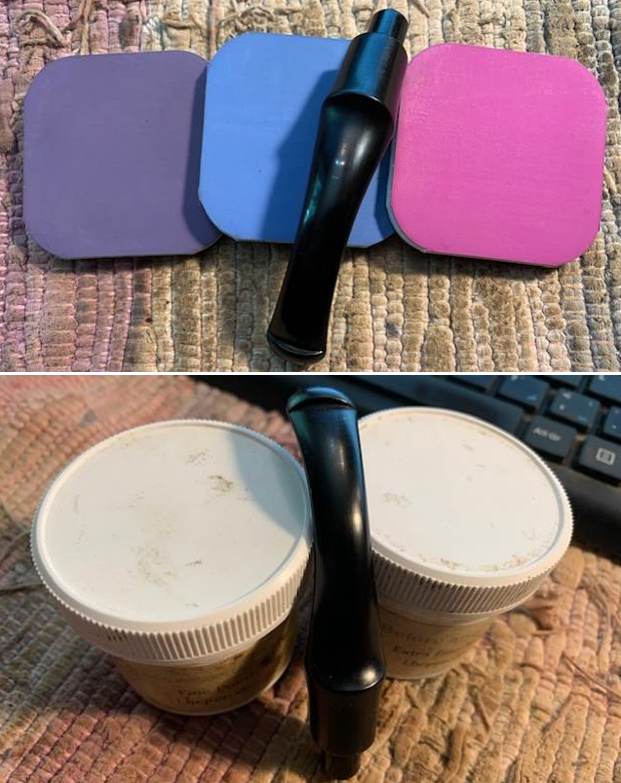
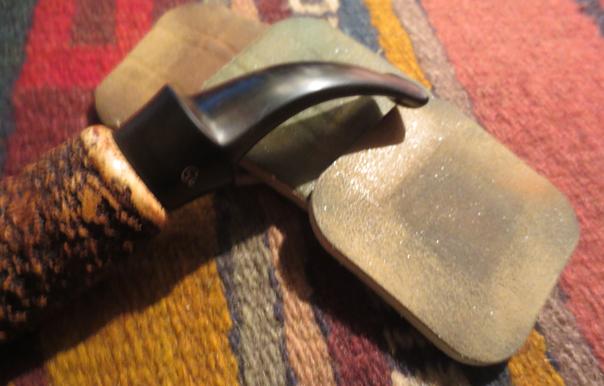
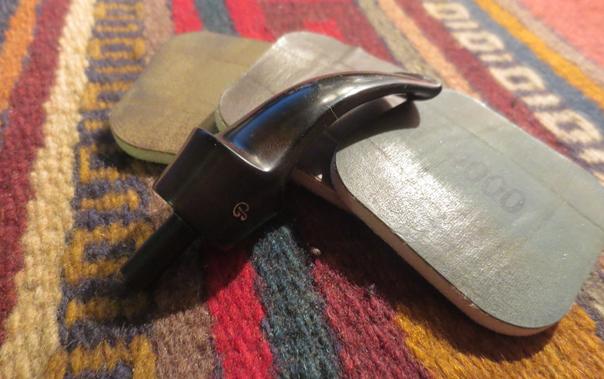
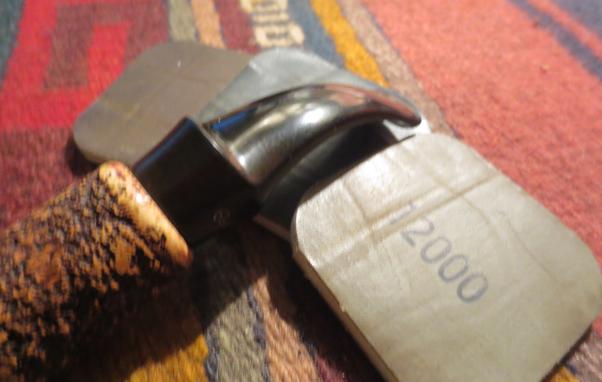
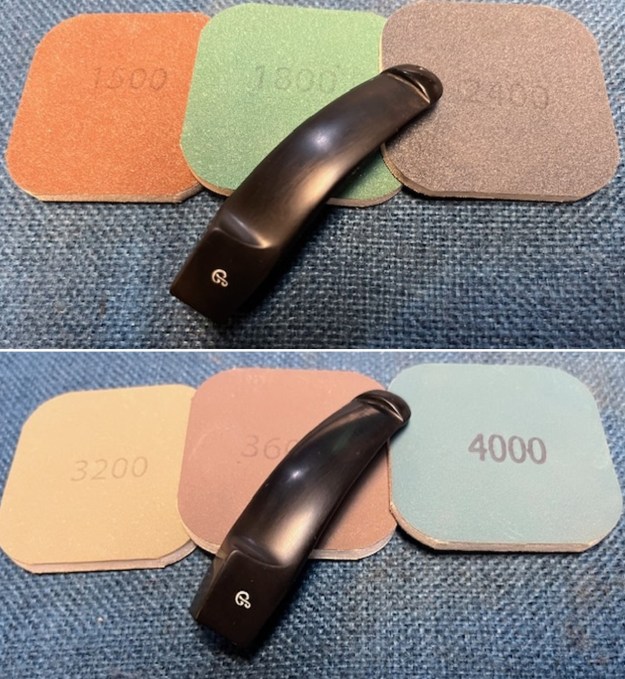
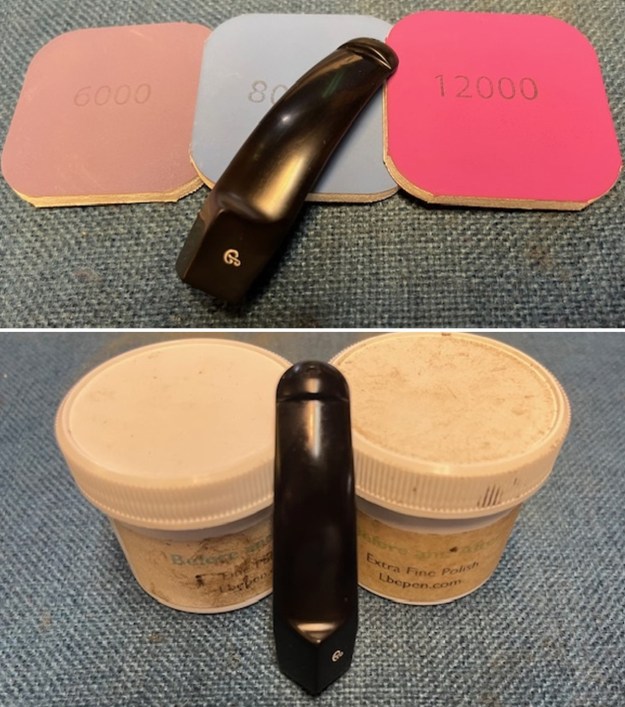
Jeff had done a great job cleaning up the pipe as usual. He reamed the pipe with a PipNet reamer and cut back the cake back to the bare meerschaum. He cleaned up the walls with a Savinelli Fitsall Pipe Knife. He scrubbed the interior of the bowl and shank with pipe cleaners, shank brushes, cotton swabs and alcohol to remove the tars and oils. He scrubbed the exterior of the pipe with Murphy’s Oil Soap and a tooth brush to remove the grime from the finish. He worked on the rim top lava and darkening with the soap and tooth brush. He scrubbed the inside of the stem with alcohol and pipe cleaners. He scrubbed the exterior with Soft Scrub and then soaked it in Briarville’s Pipe Stem Deoxidizer. He washed it off with warm water to remove the Deoxidizer. The pipe looked very good when it arrived. I took close up photos of the rim top and the stem surface. I wanted to show how well it had cleaned up. The rim top and edges looked very good. There was still some debris in the rustication on the rim top. I took photos of the stem to show the condition it was in. There was light chatter on both sides ahead of the button.I took a photo of the stamping on side of the stem. You can see that it is stamped as noted above and is clear and readable. I took the pipe apart and took a photo of the pipe. It is a good looking pipe with great grain.I used a brass bristle wire brush to cleanup the debris in the rustication on the rim top. I knocked out the debris with the brush and the top looked much better and the rustication showed clearly.I worked some Clapham’s Beeswax/Carnauba wax into the finish of the bowl. I used a horsehair show brush to work it into the rusticated finish. I set it aside to allow the wax to dry. I buffed the pipe with a soft cotton cloth to raise the shine on the meerschaum. I set the bowl aside and turned my attention to the stem. I “painted” the stem with the flame of a lighter to try and lift the tooth marks. I was able to lift some of them. I filled in the remaining tooth marks in the stem surface with black CA glue. I set the stem aside to let the repairs cure. Once the glue cured I used a small file to flatten the repairs on the surface of the stem. I used a piece of 220 grit sandpaper to blend them into the surrounding vulcanite. I sanded the stem with 320-3500 grit sanding pads to remove the tooth marks and chatter against the button edge and sand the logo. It worked well on the tooth marks but did little on the logo on the stem top.I touched up the P stamp on the saddle side with white acrylic fingernail polish. I worked it into the stamp with a tooth pick. Once it cured I scraped off the excess then ran some 1500 grit micromesh over the surface. It looked very good.I polished the stem with micromesh sanding pads – dry sanding with 1500-12000 grit sanding pads. I wiped it down after each sanding pad with Obsidian Oil. I polished it with Before & After Pipe Stem Polish – both Fine and Extra Fine. I put the stem back on the Rusticated Peterson’s Block Meerschaum Bulldog and took it to the buffer. I buffed the stem with Blue Diamond to polish the vulcanite. Blue Diamond does a great job on the smaller scratches that remain on the surface. I gave the bowl multiple coats of Clapham Wax and the stem several coats of carnauba wax and buffed the pipe with a clean buffing pad to raise the shine. I hand buffed it with a microfiber cloth to deepen the shine. I am amazed at how well it turned out. The finished pipe is shown in the photos below. This is a beautiful Peterson’s Genuine Meerschaum Bulldog with a rusticated finish and the vulcanite saddle stem has a great look. The dimensions of the pipe are Length: 5 ½ inches, Height: 1 ½ inches, Outside diameter of the bowl: 1 ¼ inches, Chamber diameter: ¾ of an inch. The weight of the pipe is 1.31 ounces/37 grams. This is another pipe that I will be putting on the rebornpipes online store in the Irish Pipemakers Section shortly, if you are interested in adding it to your collection. Thanks for walking through the restoration with me on this beauty!

As always, I encourage your questions and comments as you read the blog. Thanks to each of you who are reading this blog. Remember we are not pipe owners; we are pipe men and women who hold our pipes in trust until they pass on into the trust of those who follow us.

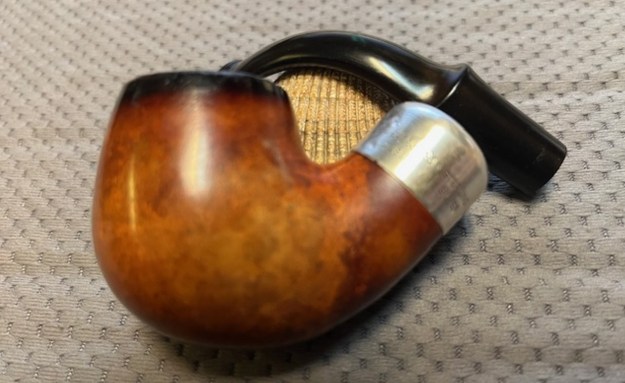
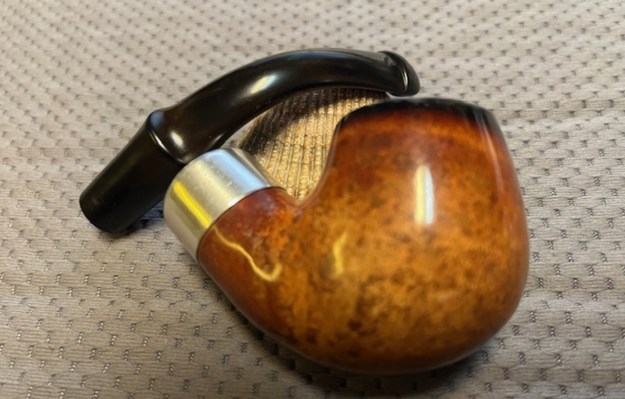
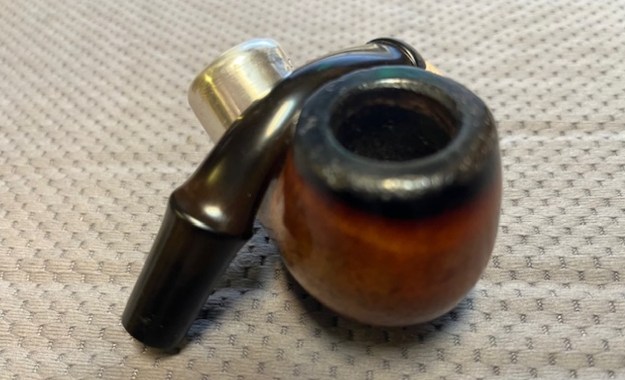
Breathing New Life into a Well Seasoned Peterson’s Meerschaum Bent Pipe


by Steve Laug

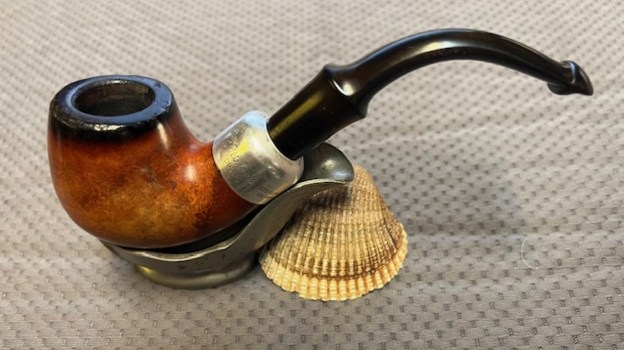
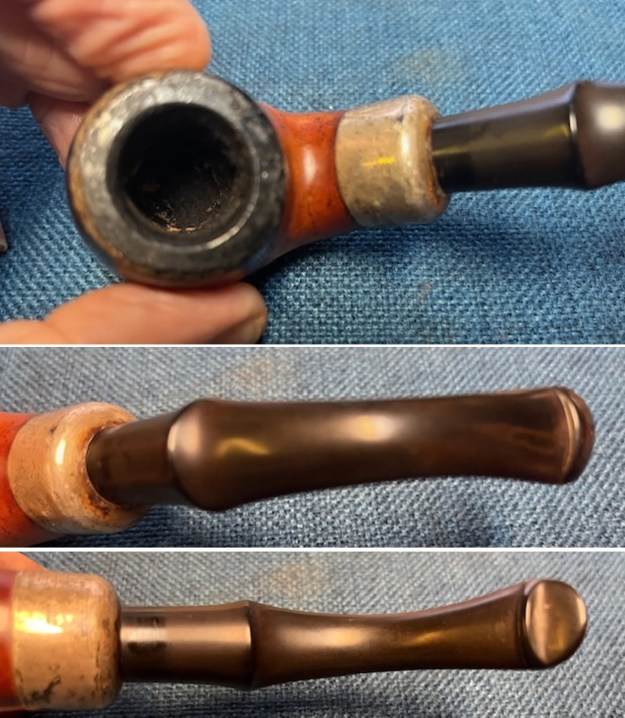
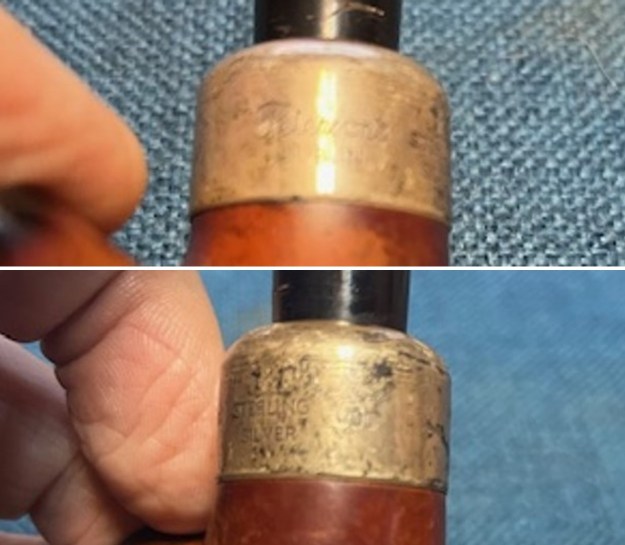
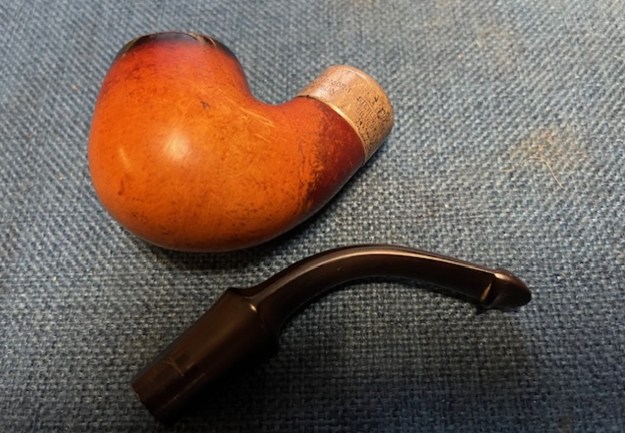
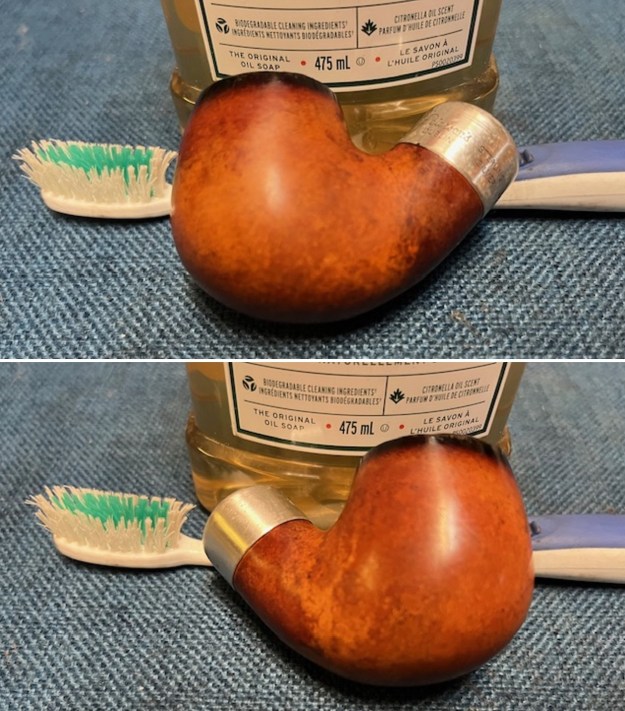
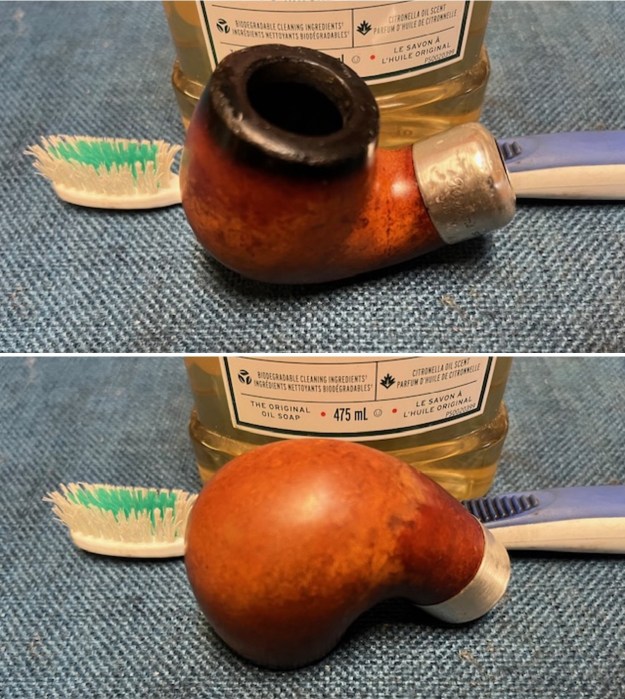
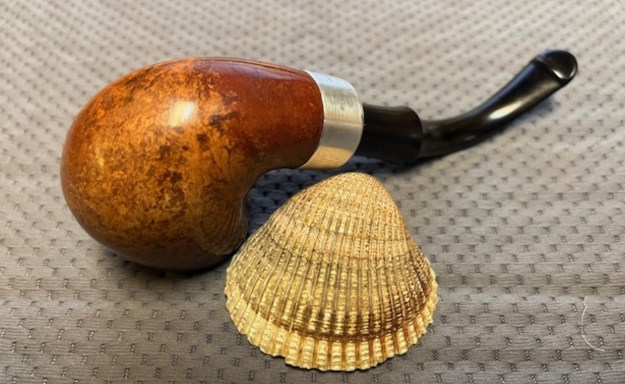
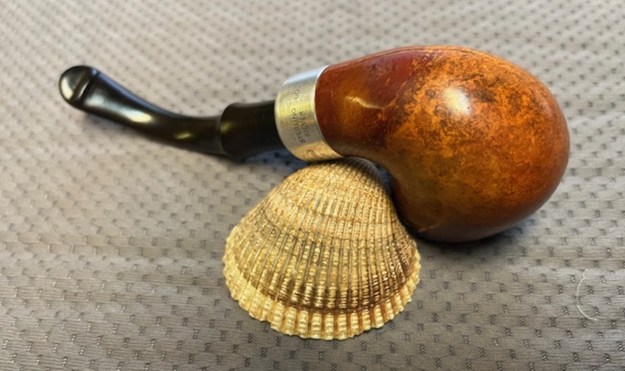
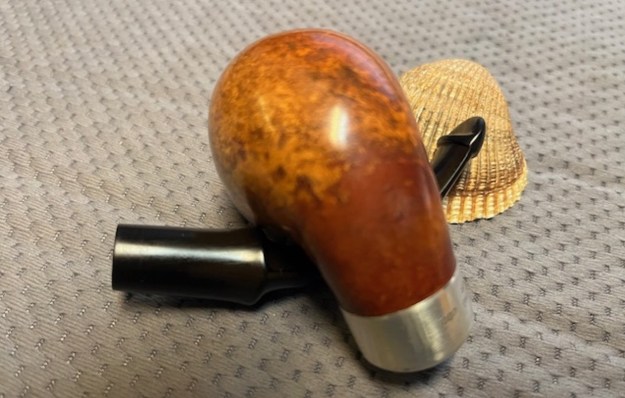
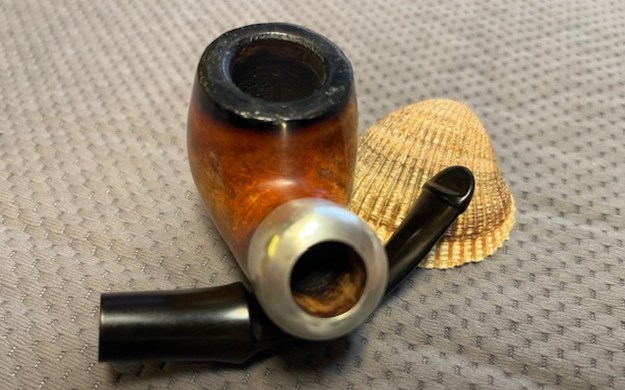
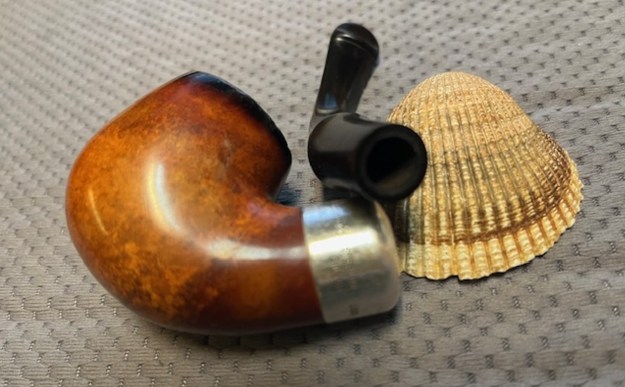
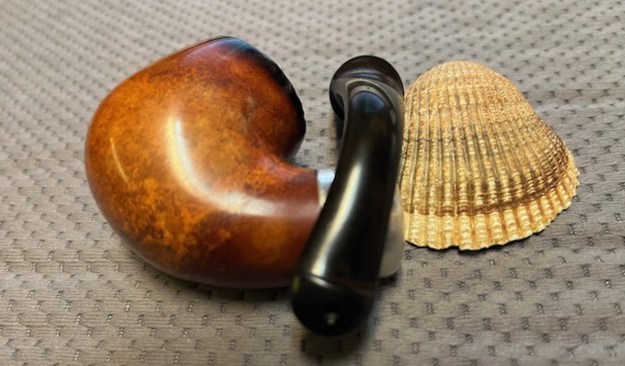
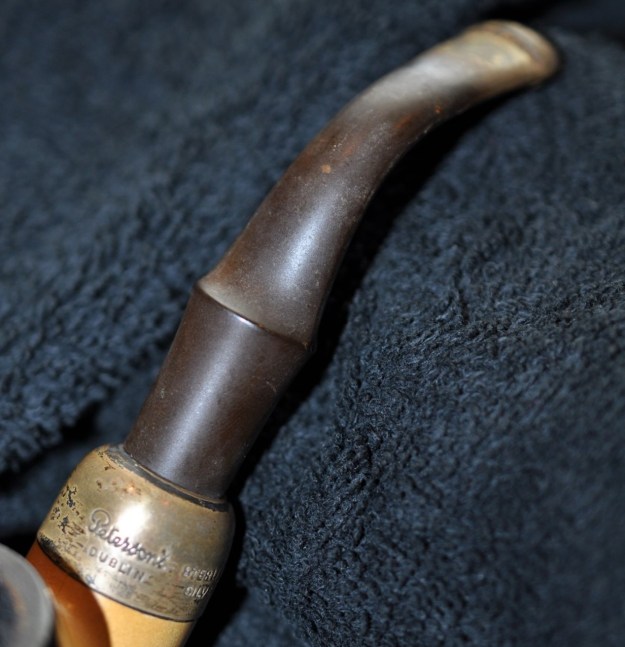
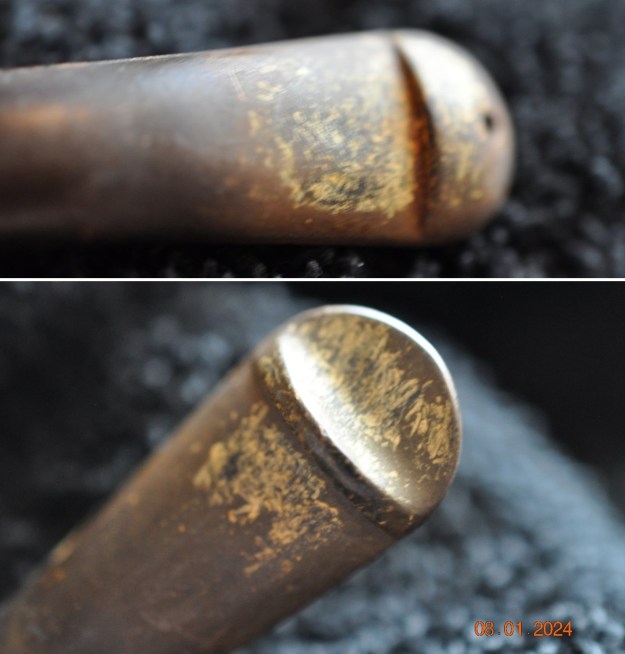
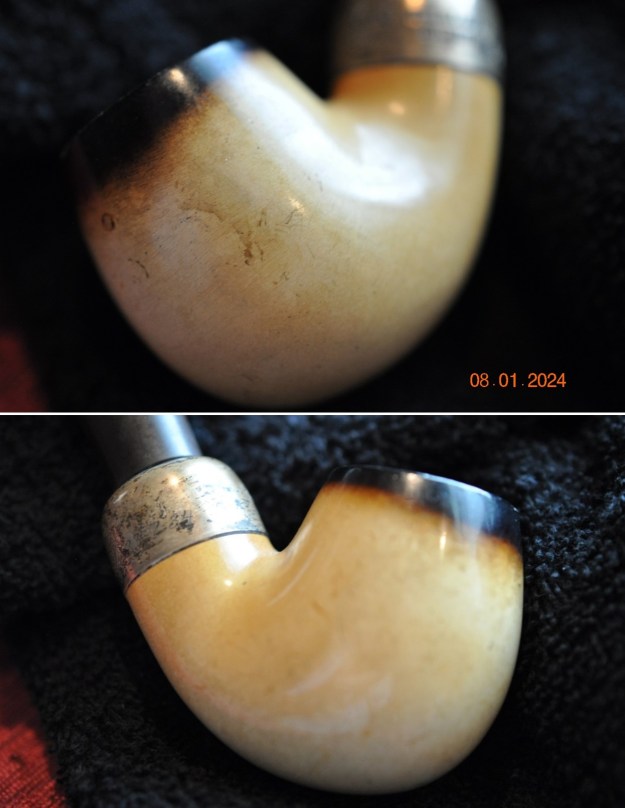
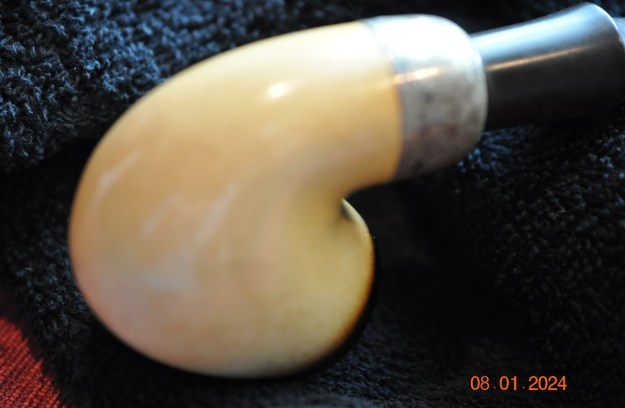
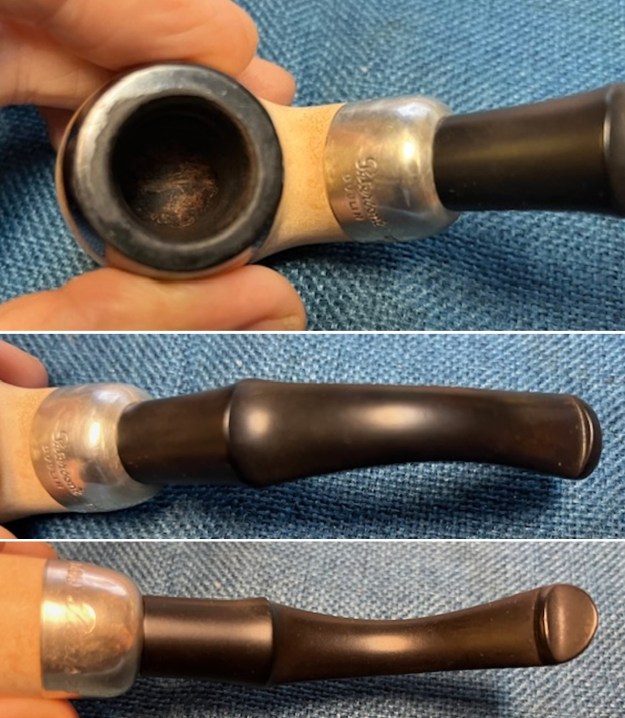
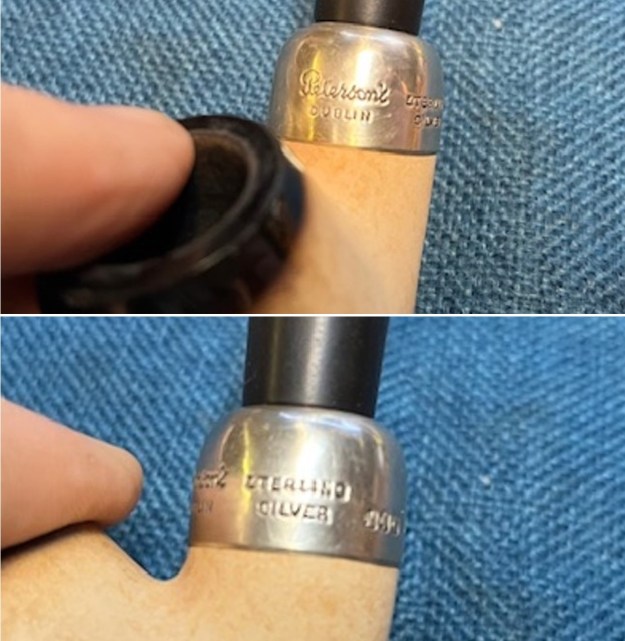
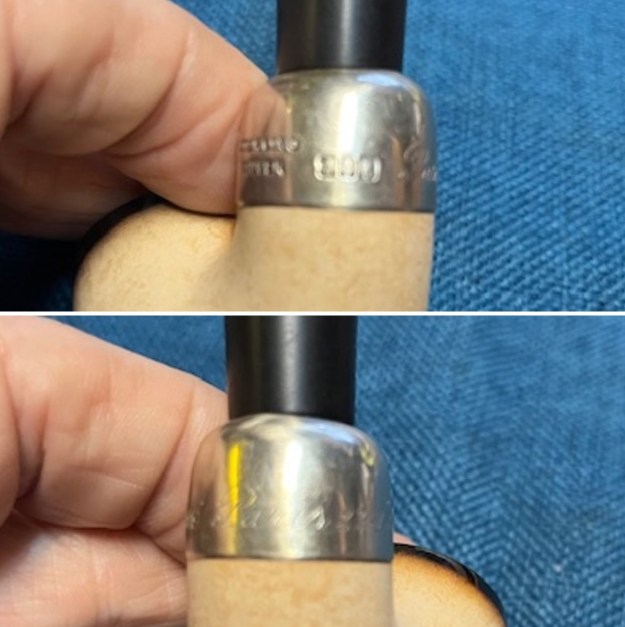
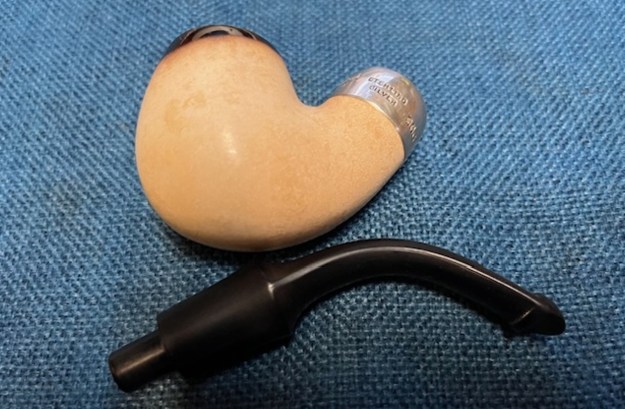
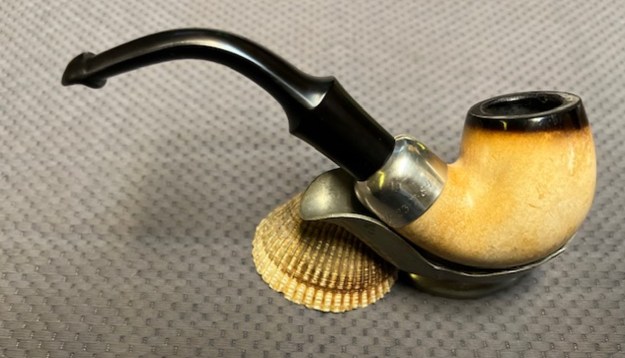
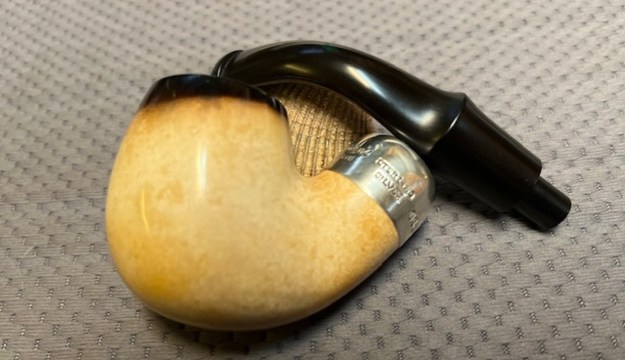
The next pipe I have chosen to work on is a smooth finished, well patinaed Peterson’s African Block Meerschaum pipe. This one is a Bent Meerschaum pipe in a classic Peterson’s Bent Billiard shape. The rim top is flumed in the style of the 60s and 70s. Jeff and I are unclear where we picked this one up. Our best guess was we found it during a pipe hunt in November, 2024 somewhere along the Oregon Coast.  This rich butterscotch and golden coloured patina on the bowl and shank adds a touch of depth to the pipe. The pipe was dirty with grime ground into the finish on the pipe. It was thick and oily feeling to touch. The contrast on the meer of the rich colouration/patina on the bowl and shank with the flumed top made a beautiful pipe. It had nicks and chips in the outer edge of the bowl. The inner edge looked very good. The bowl had a moderate cake and there was lava on the rim top and inner edge of the bowl. The Sterling Silver ferrule is oxidized and dirty. It is stamped Peterson’s [over] Dublin followed by Sterling [over] Silver. On the underside are three hallmark stamps – 1. Seated Hibernia (Ireland) 2. The Harp (symbol for the silver quality) 3. The upper-case italic letter “E” for the date of the pipe. The stem was in quite good condition with minimal oxidation, minor debris in the edge of the button and light tooth chatter on the top and underside on and near the button. I took photos of the pipe before I started my cleanup work. They tell the story and give a glimpse of the pipe. I took photos of the rim top and stem to show the general condition of the pipe. The bowl is moderately caked and the rim top and edges have lava overflowing on to them. The stem is dirty, lightly oxidized and has light tooth marks on the top and underside near the button.I took photos of the Sterling Silver ferrule to show the stamping around it. You can see that it reads as noted above. I did not capture the hallmarks on the underside. I removed the stem from the shank and took a photo of the parts of the pipe to give a sense of the proportion of the pipe. I took some time to remind myself of the provenance of these Peterson’s Dublin Meerschaum pipes. I am pretty sure the pipe was made by the Laxey Pipe Ltd. on the Isle of Man for Peterson’s in Ireland (https://pipedia.org/wiki/Laxey_Pipes_Ltd). I quote from the Pipedia article in full:

Laxey Pipe Ltd. resided in a historical 19th century four-storey Man stone building at The Quay, Old Laxey, Isle of Man, which thankfully has been preserved. The company specialized in the production of Meerschaum Pipes using the Meerschaum mined by the Tanganyika Meerschaum Corporation in the Amboseli basin in Tanganyika (since 1964 part of the United Republic of Tanzania). Please note: you may often find names like “Manx Pipes Ltd.”, “Man Pipe Co.” and others more, but there is no indication of another Isle of Man pipe producer other than Laxey Pipe Ltd. at any time!

Laxey Pipe Ltd. marketed own brands like “Manxpipe”, “Manxman”, “Manxland” e.c. Names like “John Bull”, “White Knight” (unwaxed), “Domino” (black, or lined) indicated some shapes / colours of Laxey’s own series. The stems either showed the astronomical sign for “male” or “man” (circle + arrow), or the crest of the Isle of Man, the 3-legged X in a circle. Manxpipes and Laxey’s other brands were available through pipe retailers in general, but also were sold (mainly) to tourists through their own shop in Laxey.

Furthermore Laxey Pipe Ltd. manufactured the meer bowls for Peterson, Barling, Nørding and others from the later 1960’s until 2001. Man Pipe e.g. was a brand distributed by Comoy’s. The bowls usually showed no nomenclature indicating the orderer. “Genuine Block Meerschaum” was engraved frequently. Often, just the stems were different, while bowls were the same.

Supply of meer from East Africa run out (Kenya / Tanzania exhausted, Somalia inaccessible), and thus the last Laxey meers were supplied to trade in May, 2001. Laxey Pipe Ltd. tried to survive continuing with briar pipes – mainly in the Danish style -, but to no success. It closed down business in July, 2002.

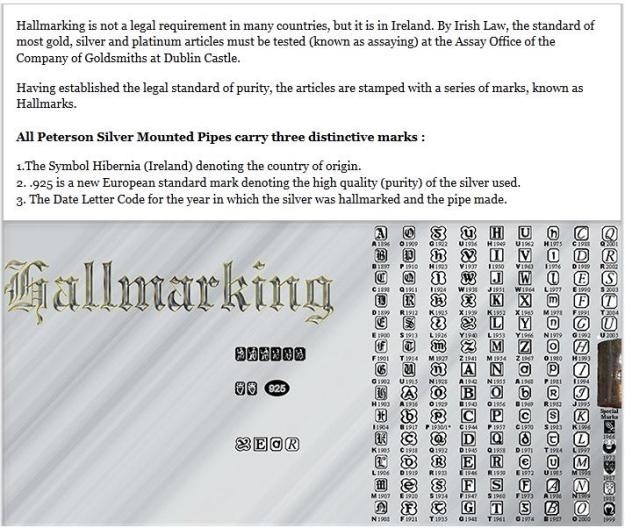
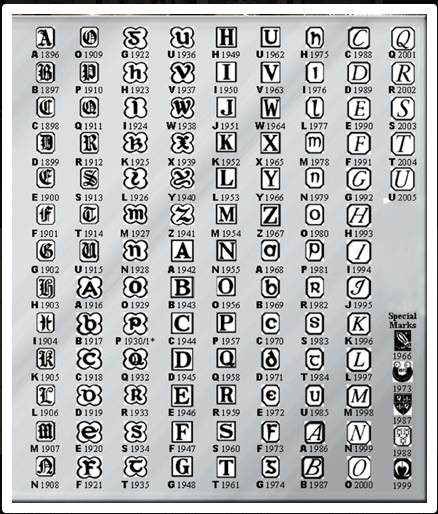
As noted above the silver is stamped Peterson’s [over] Dublin followed by Sterling [over] Silver. On the underside are three hallmark stamps – 1. Seated Hibernia (Ireland) 2. The Harp (symbol for the silver quality) 3. The upper case letter “E” for the date of the pipe. I have included the Peterson’s Hallmark chart below as it is a very helpful tool that I have used repeatedly to date my Peterson pipes.I found a larger photo of the letter section of the above chart. The letter stamp is a upper case italic “E” which dates the pipe to 1990. I know that the pipe was made on the Isle of Man by Laxey Pipe Ltd. out of African Meerschaum. It was made for export for Peterson’s of Dublin. From the hallmarks on the silver I know that the pipe (or at least the silver) was made in 1990. The flumed top on the bowl seems to make it older and maybe it is but the silver is definitely from 1990. That was as much as I could figure out.

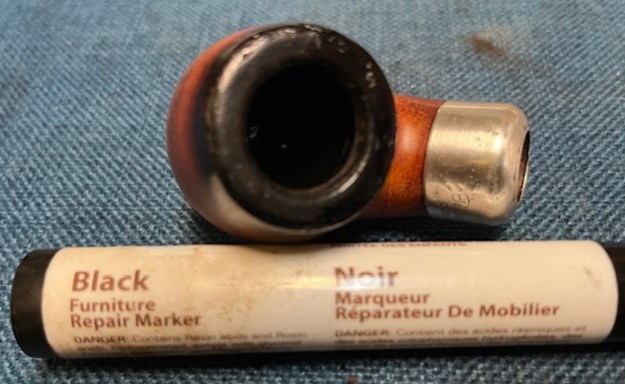
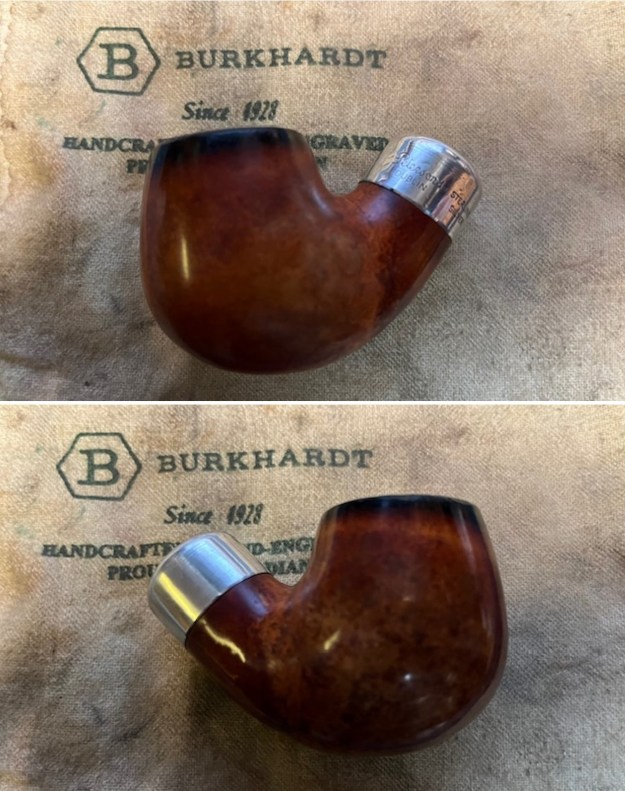
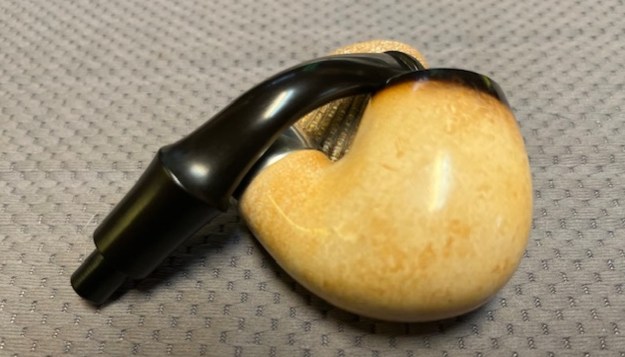
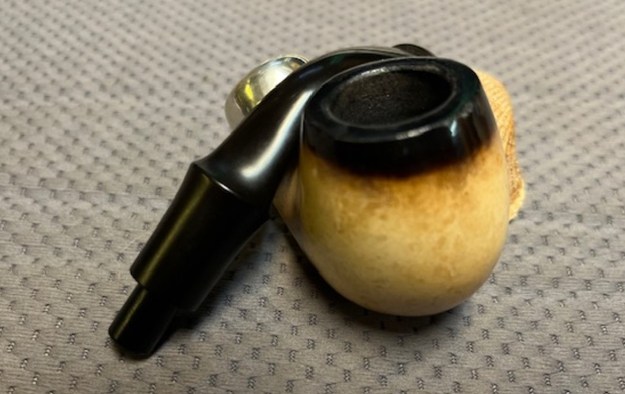
I reamed the bowl with a PipNet reamer and cleaned the reaming up with a Savinelli Fitsall Pipe Knife. I sanded the walls smooth with some 220 grit sandpaper wrapped around a piece of dowel. It looked much better. It was smooth to touch. I scraped the rim top with the edge of the Savinelli Fitsall to remove the lava build up. I cleaned out the stinky smelling tobacco oils and tars in the shank and the airway in the stem. I used 99% isopropyl alcohol, cotton swabs and pipe cleaners and was able to remove the debris and the stench.I scrubbed the exterior of the bowl with a tooth brush and undiluted Murphy’s Oil Soap. I scrubbed the inside of the bowl as well to remove more of the oils and build up there. I rinsed it off with warm running water and dried it with a soft towel. When I dried it off it was dull and a bit lifeless looking. The finish was spotty so I gave it a quick buff with a cotton cloth. It looked much better and the rim top looked clean. I touched up the nicks on the rim top and outer edge with a black stain pen. I had decided to leave them and not sand or remove them. It blended them in much better.I gave the meer a quick buff and then polished the Sterling Silver ferrule with a jeweller’s cloth to shine and slow down the process of oxidation. The ferrule really looks good even with a few small dents in the surface remaining. It has quite a nice sheen. I polished the bowl on the buffer with Blue Diamond polish and hand buffed it with a microfibre cloth to further polish it. I gave it multiple coats of Clapham’s Beeswax/Carnauba Wax and once it dried I had buffed it once again and gave it a quick buff with a clean buffing pad. I set the bowl aside and turned to work on the stem. I sanded the stem with 320-3500 grit sanding pads. I wiped the stem down after each pad with Obsidian Oil. It really began to take on a shine.I polished the stem with micromesh sanding pads – dry sanding with 1500-12000 grit sanding pads. I wiped it down after each sanding pad with Obsidian Oil. I polished it with Before & After Pipe Stem Polish – both Fine and Extra Fine. I wiped the stem down a final time with Obsidian Oil once again and set it aside to dry. As usual at this point in the restoration process I am excited to be on the homestretch. I look forward to the final look when it is put back together, polished and waxed. I put the bowl and stem of this Peterson’s Meerschaum back together. I polished the bowl and stem with Blue Diamond to polish out the scratches in the meerschaum and the vulcanite. I gave the bowl multiple coats of Clapham’s Beeswax/Carnauba Wax mixture and the stem multiple coats of carnauba wax. I buffed the pipe with a clean buffing pad to raise the shine. I hand buffed it with a microfiber cloth to deepen the shine. The pipe polished up pretty nicely. The meerschaum has a rich glow with the wax and polish. The shiny black vulcanite stem is a beautiful contrast to the rich patina of the bowl and the polished silver ferrule. This Peterson’s meerschaum was made by the Laxey Pipe Ltd. on the Isle of Mann. The heavily patinaed finish on this pipe made it another fun pipe to work. It really is a quite stunning pipe whose shape and finish make it stand out. The thick/chubby shank makes it a very comfortable pipe to hold in the hand. The finished pipe is shown in the photos below. The dimensions are Length: 5 inches, Height: 1 ¾ inches, Outside diameter of the bowl: 1 ¼ inches, Chamber diameter: ¾ of an inch. The weight of the pipe is 59 grams/2.08 ounces. It is a beautiful pipe and one that will be on the Irish Pipe Makers Section of the rebornpipes store soon. If you are interested in adding it to your collection let me know. Thanks for walking through the restoration with me as I worked over this pipe. Thanks to each of you who are reading this blog.

Restoring a Peterson’s Dublin Meerschaum System Pipe


by Steve Laug

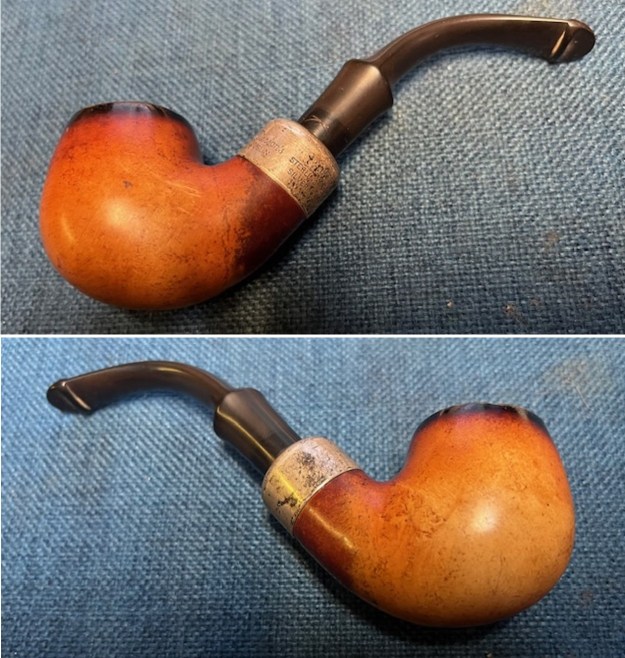
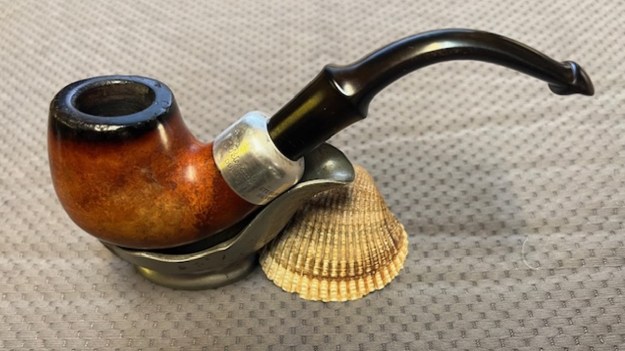
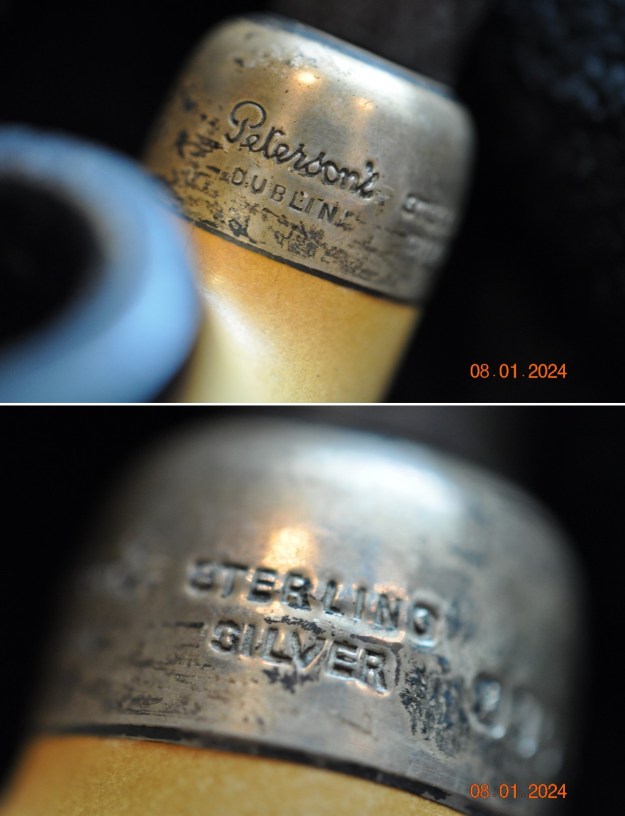
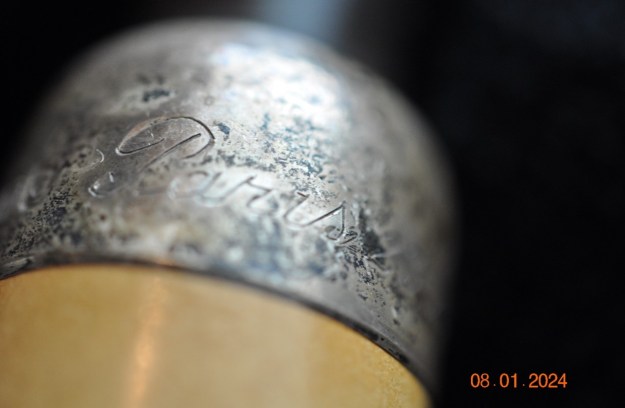
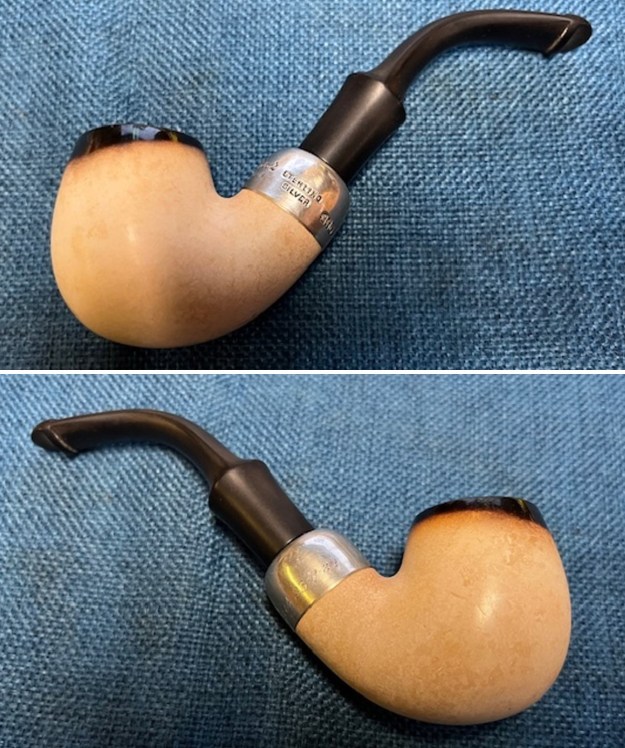
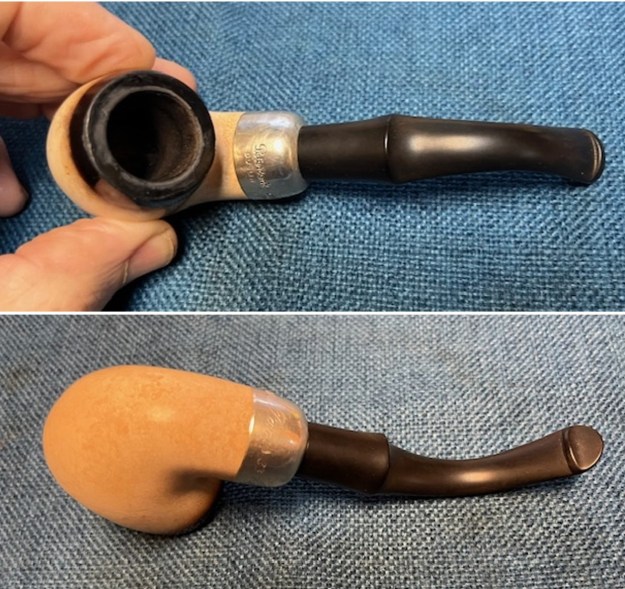
The next pipe on the work table is a white Peterson’s style smooth meerschaum pipe. We purchased it from our contact in Denmark on 04/11/2023. It is a classic Peterson’s 312 shaped bowl and probably made like all their meerschaum by Laxey Pipes Ltd, on the Isle of Man. It has a light patina making it almost golden with a black flume around the bowl and rim top. It is a smooth bowl. The bowl is dirty for sure with grime in the meerschaum. There is a cake in the bowl and a lava overflow in the rustication on the rim top and edges. The pipe has a Sterling Silver ferrule that is stamped Peterson’s [over] Dublin, followed by Sterling [over] Silver, followed by three hallmarks – Hibernia seated for the country of origin (Ireland), Crowned Harp designating the Silver Quality and a Celtic T for the year of manufacture which in this case is 1984. That is followed by the etching Paris 23-7-84. The ferrule has some oxidation and is dull but otherwise undamaged. The stem is lightly oxidized and has tooth chatter and marks on both sides ahead of the P-lip button. Jeff took photos of the pipe before he started his cleanup. Jeff took photos of the rim top and stem to show the general condition of the pipe. The bowl is heavily caked and the rim top and edges have lava overflowing on to them. The stem is oxidized and has tooth chatter and tooth marks on the top and underside near the button. Jeff took photos of the bowl sides and heel to show the condition of the finish around this bowl. It is a nice looking pipe. He took a series of photos of the Sterling Silver ferrule to show the stamping around it. You can see that it reads as noted above. I took some time to remind myself of the provenance of Peterson’s Dublin Meerschaum pipes. I am pretty sure the pipe was made by the Laxey Pipe Ltd. on the Isle of Man for Peterson’s in Ireland (https://pipedia.org/wiki/Laxey_Pipes_Ltd). I quote from the Pipedia article in full:

Laxey Pipe Ltd. resided in a historical 19th century four-storey Man stone building at The Quay, Old Laxey, Isle of Man, which thankfully has been preserved. The company specialized in the production of Meerschaum Pipes using the Meerschaum mined by the Tanganyika Meerschaum Corporation in the Amboseli basin in Tanganyika (since 1964 part of the United Republic of Tanzania). Please note: you may often find names like “Manx Pipes Ltd.”, “Man Pipe Co.” and others more, but there is no indication of another Isle of Man pipe producer other than Laxey Pipe Ltd. at any time!

Laxey Pipe Ltd. marketed own brands like “Manxpipe”, “Manxman”, “Manxland” e.c. Names like “John Bull”, “White Knight” (unwaxed), “Domino” (black, or lined) indicated some shapes / colours of Laxey’s own series. The stems either showed the astronomical sign for “male” or “man” (circle + arrow), or the crest of the Isle of Man, the 3-legged X in a circle. Manxpipes and Laxey’s other brands were available through pipe retailers in general, but also were sold (mainly) to tourists through their own shop in Laxey.

Furthermore Laxey Pipe Ltd. manufactured the meer bowls for Peterson, Barling, Nørding and others from the later 1960’s until 2001. Man Pipe e.g. was a brand distributed by Comoy’s. The bowls usually showed no nomenclature indicating the orderer. “Genuine Block Meerschaum” was engraved frequently. Often, just the stems were different, while bowls were the same.

Supply of meer from East Africa ran out (Kenya / Tanzania exhausted, Somalia inaccessible), and thus the last Laxey meers were supplied to trade in May, 2001. Laxey Pipe Ltd. tried to survive continuing with briar pipes – mainly in the Danish style, but to no success. It closed down business in July, 2002.

I know that the pipe was made on the Isle of Man by Laxey Pipe Ltd. out of African Meerschaum. It was made for export for Peterson’s of Dublin. The flumed top on the bowl and the smooth finish around the bowl and shank fit the 1984 date indicated by both the silver hallmarks and the Paris 23-7-84 engraving on the band.

Jeff had done a great job cleaning up the pipe as usual. He reamed the pipe with a PipNet reamer and cut back the cake back to the bare meerschaum. He cleaned up the walls with a Savinelli Fitsall Pipe Knife. He scrubbed the interior of the bowl and shank with pipe cleaners, cotton swabs and alcohol to remove the tars and oils. He scrubbed the exterior of the pipe with Murphy’s Oil Soap and a tooth brush to remove the grime from the finish. He worked on the rim top lava and darkening with the soap and tooth brush. He cleaned up the tarnish on the nickel ferrule. He scrubbed the inside of the stem with alcohol and pipe cleaners. He scrubbed the exterior with Soft Scrub and then soaked it in Before & After Pipe Stem Deoxidizer. He washed it off with warm water to remove the Deoxidizer. The pipe looked very good when it arrived. I took some close up photos of the rim top and also of the stem surface. I wanted to show how well it had cleaned up. The rim top and edges looked very good. There was still some lava marks on the rim top that would need to be removed. The stem showed some light tooth marks and chatter on the surface near the button.I took a series of photos of the stamping on the Silver ferrule. You can see that once the tarnish was removed it is stamped as noted above. It is clear and readable. I also removed the stem from the shank and took a photo to show the proportions of the pipe. The shank is lined with a Delrin insert. I cleaned up the debris in the rim top with a worn 1500 grit micromesh sanding pads and was able to remove it all. I touched up the rim top and edges with a Black Sharpie Pen. Once it was finished it looked very good.I rubbed the meerschaum down with Clapham’s Beeswax/Carnauba mix. I worked it into the surface of the meerschaum with my fingertips to protect it. I let the wax sit for 15 minutes and then buffed with a cotton cloth to raise the shine. Once the wax had dried on the meer I buffed the bowl on my wheel with a clean buffing pad. It raised the shine and the surface really glowed.I polished the Sterling Silver ferrule with a jeweller’s cloth to raise the shine and slow down the process of oxidation. The ferrule really looks good. I set the bowl aside and turned to work on the stem. I sanded out the chatter and tooth marks with 320-3500 grit sanding pads. I wiped it down after each pad with an Obsidian Oil impregnated cloth. It really began to take on a shine.I polished the stem with micromesh sanding pads – wet sanding with 1500-12000 grit sanding pads. I wiped it down after each sanding pad with Obsidian Oil. I polished it with Before & After Pipe Stem Polish – both Fine and Extra Fine. I enjoy working on these Peterson’s Meerschaum pipes and it is always exciting to be on the homestretch. I put the bowl and stem of this Peterson’s Meerschaum back together. I polished the bowl and stem with Blue Diamond to polish out the scratches in the meerschaum and the vulcanite. I gave the bowl multiple coats of Clapham’s Wax and the stem multiple coats of carnauba wax. I buffed the pipe with a clean buffing pad to raise the shine. I hand buffed it with a microfiber cloth to deepen the shine. The pipe polished up pretty nicely. The meerschaum has a rich glow with the wax and polish. The shiny black vulcanite stem is a beautiful contrast to the rich developing patina of the bowl and the polished Silver ferrule. It really is a stunning pipe whose shape and finish make it stand out. The thick/chubby shank makes it a very comfortable pipe to hold in the hand. The finished pipe is shown in the photos below. The dimensions are Length: 5 inches, Height: 1 ¾ inches, Outside diameter of the bowl: 1 1/8 inches, Chamber diameter: ¾ of an inch. The weight of the pipe is 49 grams/1.73 ounces. It is a beautiful pipe and one that will be on the Irish Pipe Makers Section of the rebornpipes store. If you are interested in adding it to your collection let me know. Thanks for walking through the restoration with me as I worked over this pipe.

Restoring a Damaged Tan Peterson’s Meer in a Shape 302


Blog by Steve Laug

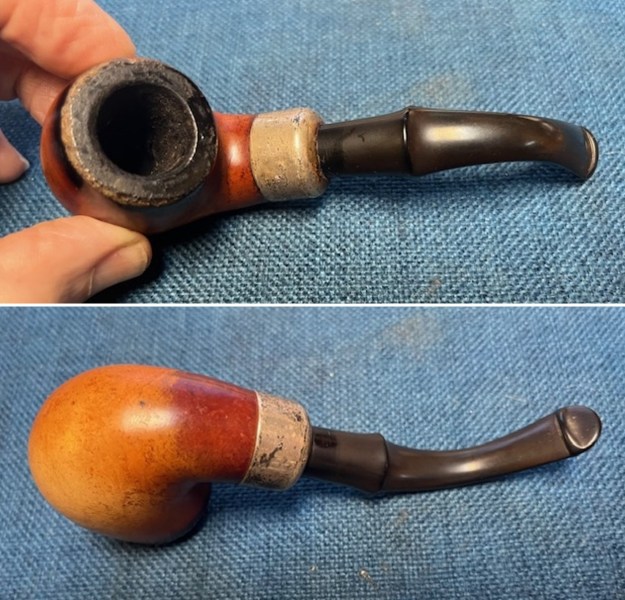
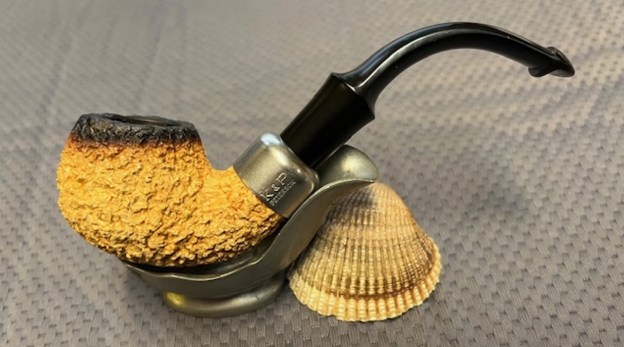
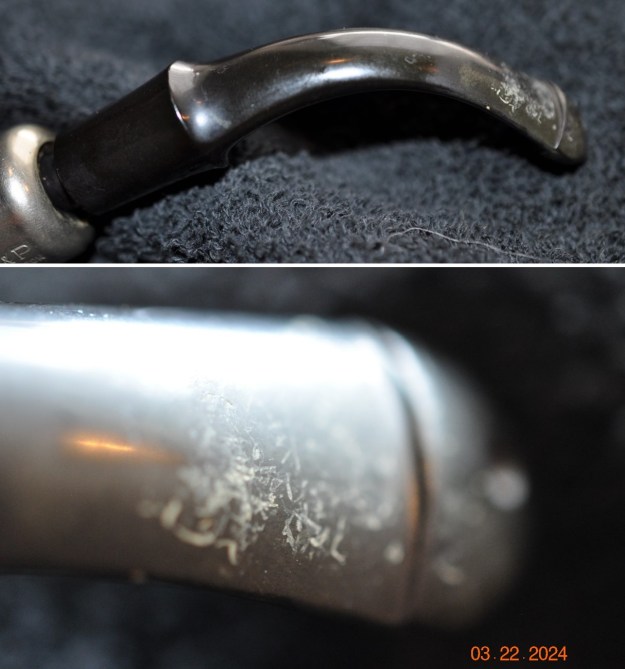
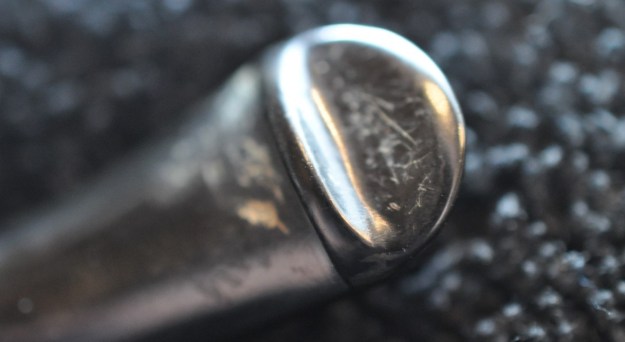
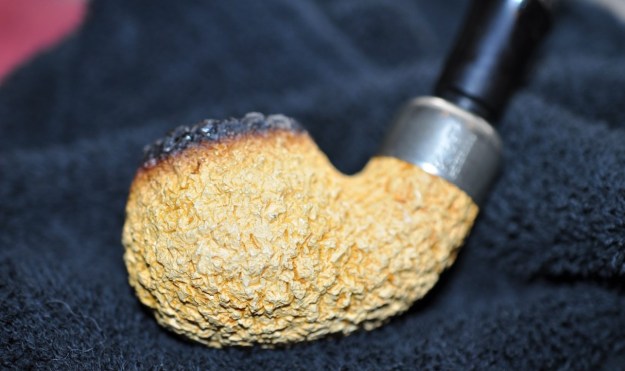
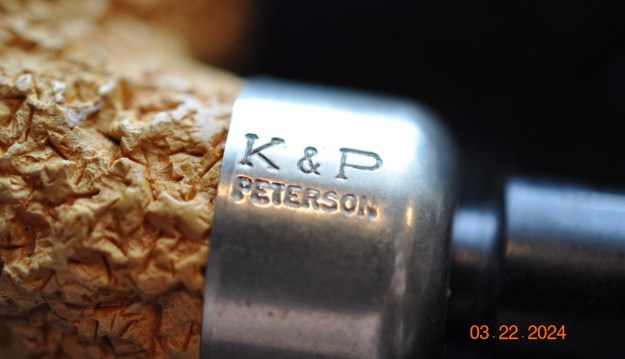
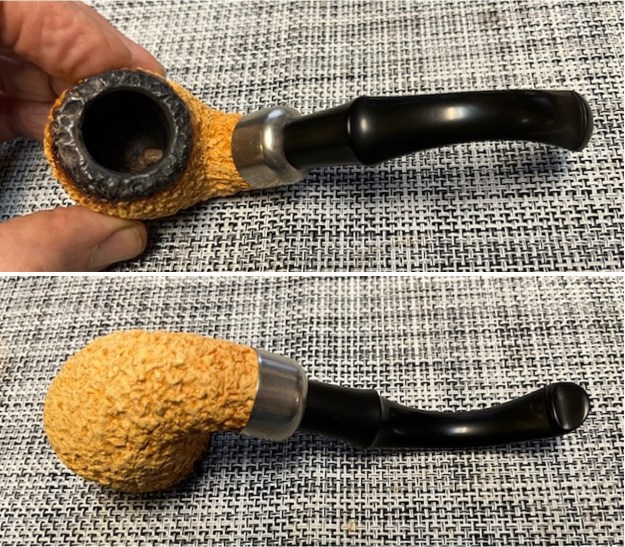
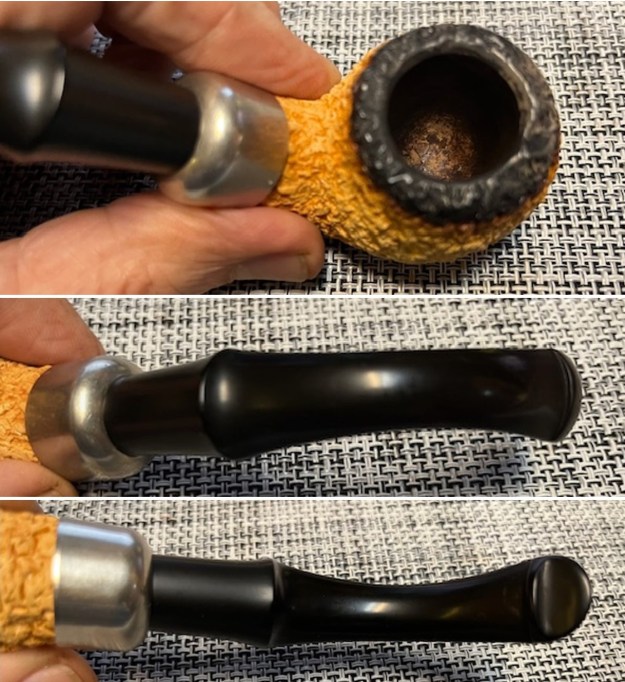
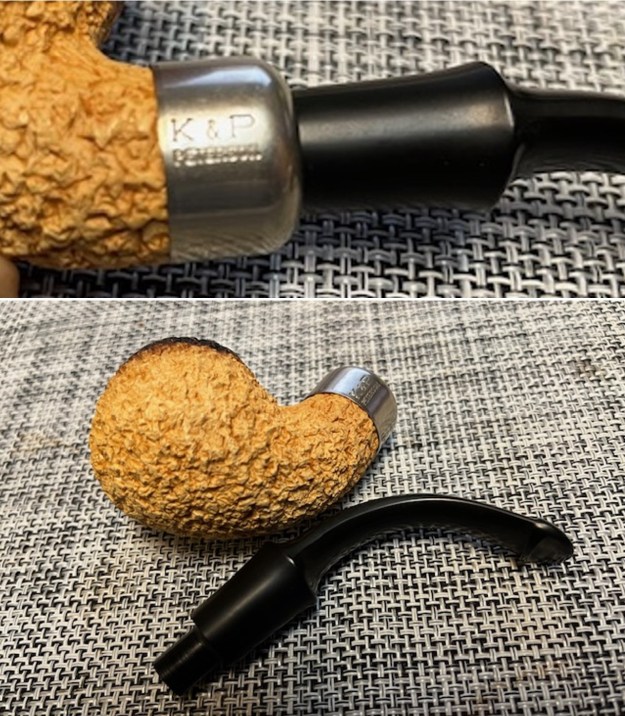
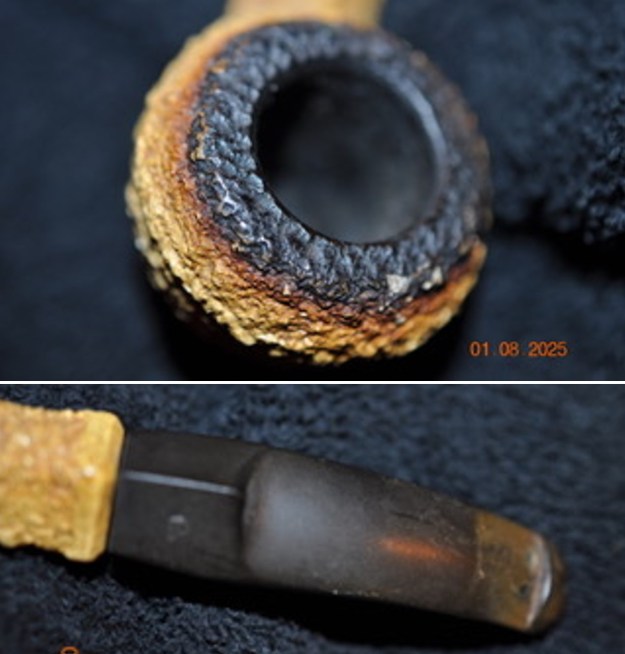
The next pipe on the work table is a tan coloured Peterson’s style meerschaum pipe. We purchased it from a seller in Spring Branch, Texas, USA on 02/29/2024. It is a classic Peterson’s 302 shaped bowl and probably made like all their meerschaum by Laxey Pipes Ltd, on the Isle of Man. It has a tan rusticated bowl that really gives depth to the pipe. The bowl is dirty with grime in the meerschaum. There is a cake in the bowl and a lava overflow in the rustication on the rim top and edges. It looks like the rim top and first 1/8 inch of the rim top have a dark flume coat. The only stamping on the pipe is on the nickel ferrule and it reads K&P over Peterson. The ferrule has some oxidation and is dull but otherwise undamaged. The stem is oxidized, calcified and has tooth chatter and marks on both sides ahead of the P-lip button. Jeff took photos of the pipe before he started his cleanup. Jeff took photos of the rim top and stem to show the general condition of the pipe. The bowl is moderately caked and the rim top and edges have lava overflowing on to them. The stem is oxidized, calcified and has tooth chatter and tooth marks on the top and underside near the button. Jeff took photos of the bowl sides and heel to show the condition of the rusticated finish around this bowl. It is a nice looking pipe. He took photos of the nickel ferrule to show the stamping around it. You can see that it reads as noted above. I took some time to remind myself of the provenance of these Peterson’s Dublin Meerschaum pipes. I am pretty sure the pipe was made by the Laxey Pipe Ltd. on the Isle of Man for Peterson’s in Ireland (https://pipedia.org/wiki/Laxey_Pipes_Ltd). I quote from the Pipedia article in full:
Laxey Pipe Ltd. resided in a historical 19th century four-storey Man stone building at The Quay, Old Laxey, Isle of Man, which thankfully has been preserved. The company specialized in the production of Meerschaum Pipes using the Meerschaum mined by the Tanganyika Meerschaum Corporation in the Amboseli basin in Tanganyika (since 1964 part of the United Republic of Tanzania). Please note: you may often find names like “Manx Pipes Ltd.”, “Man Pipe Co.” and others more, but there is no indication of another Isle of Man pipe producer other than Laxey Pipe Ltd. at any time!

Laxey Pipe Ltd. marketed own brands like “Manxpipe”, “Manxman”, “Manxland” e.c. Names like “John Bull”, “White Knight” (unwaxed), “Domino” (black, or lined) indicated some shapes / colours of Laxey’s own series. The stems either showed the astronomical sign for “male” or “man” (circle + arrow), or the crest of the Isle of Man, the 3-legged X in a circle. Manxpipes and Laxey’s other brands were available through pipe retailers in general, but also were sold (mainly) to tourists through their own shop in Laxey.

Furthermore Laxey Pipe Ltd. manufactured the meer bowls for Peterson, Barling, Nørding and others from the later 1960’s until 2001. Man Pipe e.g. was a brand distributed by Comoy’s. The bowls usually showed no nomenclature indicating the orderer. “Genuine Block Meerschaum” was engraved frequently. Often, just the stems were different, while bowls were the same.

Supply of meer from East Africa run out (Kenya / Tanzania exhausted, Somalia inaccessible), and thus the last Laxey meers were supplied to trade in May, 2001. Laxey Pipe Ltd. tried to survive continuing with briar pipes – mainly in the Danish style -, but to no success. It closed down business in July, 2002.

I know that the pipe was made on the Isle of Man by Laxey Pipe Ltd. out of African Meerschaum. It was made for export for Peterson’s of Dublin. The flumed top on the bowl and the rustication around the bowl and shank make me think that it is a 1970s era pipe. That was as much as I could figure out.

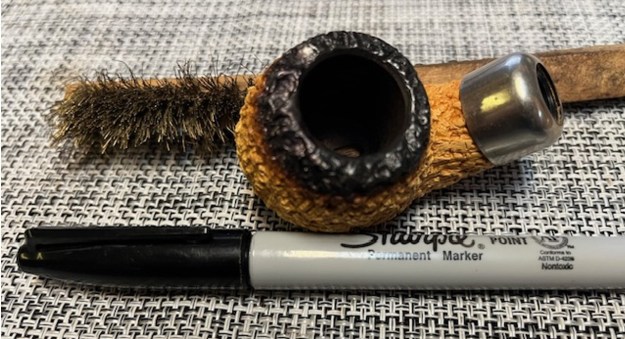
Jeff had done a great job cleaning up the pipe as usual. He reamed the pipe with a PipNet reamer and cut back the cake back to the bare meerschaum. He cleaned up the walls with a Savinelli Fitsall Pipe Knife. He scrubbed the interior of the bowl and shank with pipe cleaners, cotton swabs and alcohol to remove the tars and oils. He scrubbed the exterior of the pipe with Murphy’s Oil Soap and a tooth brush to remove the grime from the finish. He worked on the rim top lava and darkening with the soap and tooth brush. He cleaned up the tarnish on the nickel ferrule. He scrubbed the inside of the stem with alcohol and pipe cleaners. He scrubbed the exterior with Soft Scrub and then soaked it in Briarville’s Pipe Stem Deoxidizer. He washed it off with warm water to remove the Deoxidizer. The pipe looked very good when it arrived. I took some close up photos of the rim top and also of the stem surface. I wanted to show how well it had cleaned up. The rim top and edges were in rough condition. The back rim top and edge were thin and the front left top and edge were damaged. It looked like the rim top had been rusticated like the bowl at one point but it was not clear due to the damage on the top and inner edges. The stem showed some light tooth marks and chatter on the surface near the button.I took a photo of the stamping on the ferrule. You can see that once the tarnish was removed it is stamped as noted above. It is clear and readable. I also removed the stem from the shank and took a photo to show the proportions of the pipe.This pipe needed a bit more work than the previous Peterson’s meer. The rim top had a lot of damage and was burned and chipped on the front inner edge of the  bowlw. The back of the bowl rim top and edge were very thin and also had damage. I cleaned up the inner edge of the bowl with a folded piece of 220 grit sandpaper. While I was able to remove the damage on the inner edge the bowl top and out edge on the front were damaged and there was a dip in the front outer edge. To deal with this issue I gently topped the bowl on a topping board with 220 grit sandpaper. Once finished I used a Dremel and dental burr to rusticate the rim top to match the finish around the bowl sides. I restained the finished rim top and edges with a walnut and a black stain pen. The original bowl had a dark stain on the rim top and on the first 1/8 inch of the bowl side.I polished the nickel ferrule with a jeweller’s cloth to shine and slow down the process of oxidation. The ferrule really looks good. I rubbed the meerschaum down with Clapham’s Beeswax/Carnauba mix. I worked it into the surface of the meerschaum with my fingertips and a shoebrush to protect it. I let the wax sit for 15 minutes and then buffed with a cotton cloth to raise the shine. The pipe is looking quite good. I set the bowl aside and turned to work on the stem. I sanded out the chatter and tooth marks with 320-3500 grit sanding pads. I wiped it down after each pad with an Obsidian Oil impregnated cloth. It really began to take on a shine.I polished the stem with micromesh sanding pads – wet sanding with 1500-12000 grit sanding pads. I wiped it down after each sanding pad with Obsidian Oil. I polished it with Before & After Pipe Stem Polish – both Fine and Extra Fine. As usual at this point in the restoration process I am excited to be on the homestretch. I put the bowl and stem of this Peterson’s Meerschaum back together. I polished the bowl and stem with Blue Diamond to polish out the scratches in the meerschaum and the vulcanite. I gave the bowl multiple coats of Clapham’s Wax and the stem multiple coats of carnauba wax. I buffed the pipe with a clean buffing pad to raise the shine. I hand buffed it with a microfiber cloth to deepen the shine. The pipe polished up pretty nicely. The meerschaum has a rich glow with the wax and polish. The shiny black vulcanite stem is a beautiful contrast to the rich developing patina of the tan bowl and the polished ferrule. It really is a stunning pipe whose shape and finish make it stand out. The thick/chubby shank makes it a very comfortable pipe to hold in the hand. The finished pipe is shown in the photos below. The dimensions are Length: 5 inches, Height: 1 ½ inches, Outside diameter of the bowl: 1 ¼ inches, Chamber diameter: 7/8 of an inch. The weight of the pipe is 54 grams/1.90 ounces. It is a beautiful pipe and one that will be on the Irish Pipe Makers Section of the rebornpipes store. If you are interested in adding it to your collection let me know. Thanks for walking through the restoration with me as I worked over this pipe.

Restoring a Peterson’s Meerschaum in a Shape 302


Blog by Steve Laug

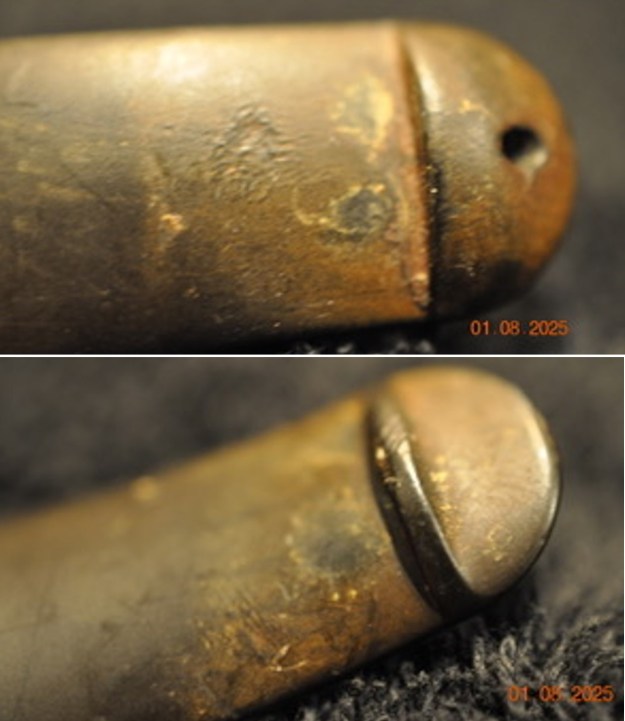
The next pipe on the work table is a white Peterson’s style meerschaum pipe. We purchased it from an estate sale at Idaho Falls, Idaho, USA on 09/16/23. It is a classic Peterson’s 302 shaped bowl and probably made like all their meerschaum by Laxey Pipes Ltd, on the Isle of Man. It has a slight patina making it almost golden with a black flume around the bowl and rim top. It is a rusticated bowl. The bowl is dirty for sure with grime in the meerschaum. There is a cake in the bowl and a lava overflow in the rustication on the rim top and edges. The only stamping on the pipe is on the nickel ferrule and it reads K&P over Peterson. The ferrule has some oxidation and is dull but otherwise undamaged. The stem is lightly oxidized and has tooth chatter and marks on both sides ahead of the P-lip button. Jeff took photos of the pipe before he started his cleanup. Jeff took photos of the rim top and stem to show the general condition of the pipe. The bowl is moderately caked and the rim top and edges have lava overflowing on to them. The stem is oxidized and has tooth chatter and tooth marks on the top and underside near the button. Jeff took photos of the bowl sides and heel to show the condition of the rusticated finish around this bowl. It is a nice looking pipe. He took photos of the nickel ferrule to show the stamping around it. You can see that it reads as noted above.I took some time to remind myself of the provenance of these Peterson’s Dublin Meerschaum pipes. I am pretty sure the pipe was made by the Laxey Pipe Ltd. on the Isle of Man for Peterson’s in Ireland (https://pipedia.org/wiki/Laxey_Pipes_Ltd). I quote from the Pipedia article in full:
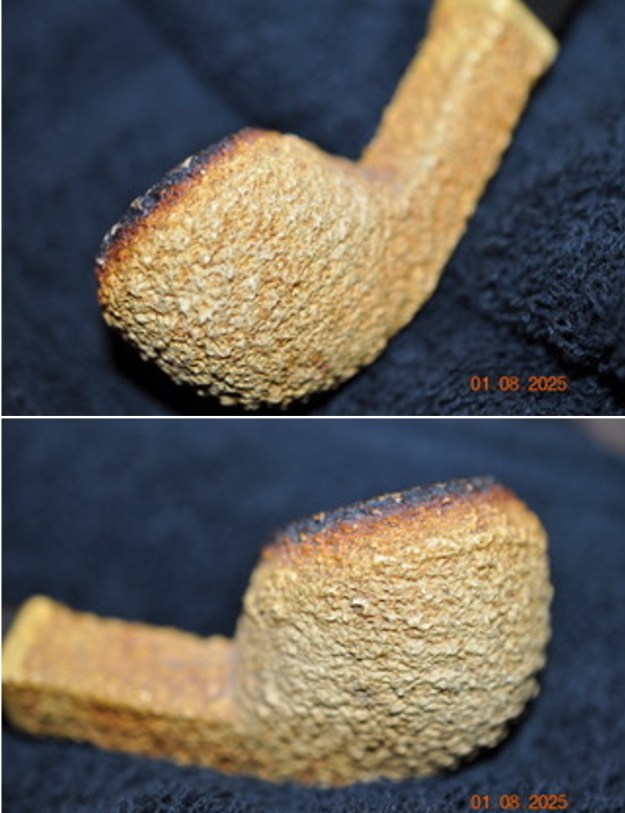
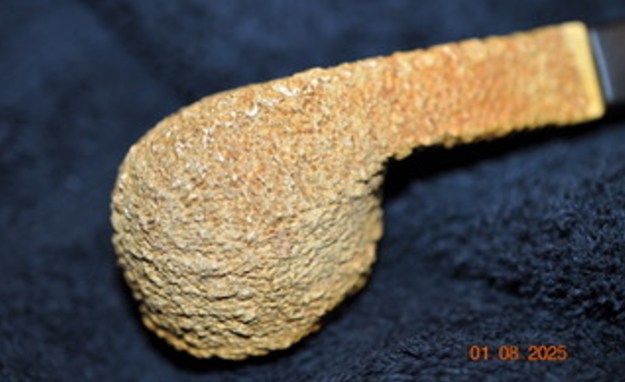
Laxey Pipe Ltd. resided in a historical 19th century four-storey Man stone building at The Quay, Old Laxey, Isle of Man, which thankfully has been preserved. The company specialized in the production of Meerschaum Pipes using the Meerschaum mined by the Tanganyika Meerschaum Corporation in the Amboseli basin in Tanganyika (since 1964 part of the United Republic of Tanzania). Please note: you may often find names like “Manx Pipes Ltd.”, “Man Pipe Co.” and others more, but there is no indication of another Isle of Man pipe producer other than Laxey Pipe Ltd. at any time!

Laxey Pipe Ltd. marketed own brands like “Manxpipe”, “Manxman”, “Manxland” e.c. Names like “John Bull”, “White Knight” (unwaxed), “Domino” (black, or lined) indicated some shapes / colours of Laxey’s own series. The stems either showed the astronomical sign for “male” or “man” (circle + arrow), or the crest of the Isle of Man, the 3-legged X in a circle. Manxpipes and Laxey’s other brands were available through pipe retailers in general, but also were sold (mainly) to tourists through their own shop in Laxey.

Furthermore Laxey Pipe Ltd. manufactured the meer bowls for Peterson, Barling, Nørding and others from the later 1960’s until 2001. Man Pipe e.g. was a brand distributed by Comoy’s. The bowls usually showed no nomenclature indicating the orderer. “Genuine Block Meerschaum” was engraved frequently. Often, just the stems were different, while bowls were the same.

Supply of meer from East Africa run out (Kenya / Tanzania exhausted, Somalia inaccessible), and thus the last Laxey meers were supplied to trade in May, 2001. Laxey Pipe Ltd. tried to survive continuing with briar pipes – mainly in the Danish style -, but to no success. It closed down business in July, 2002.

I know that the pipe was made on the Isle of Man by Laxey Pipe Ltd. out of African Meerschaum. It was made for export for Peterson’s of Dublin. The flumed top on the bowl and the rustication around the bowl and shank make me think that it is a 1970s era pipe. That was as much as I could figure out.

Jeff had done a great job cleaning up the pipe as usual. He reamed the pipe with a PipNet reamer and cut back the cake back to the bare meerschaum. He cleaned up the walls with a Savinelli Fitsall Pipe Knife. He scrubbed the interior of the bowl and shank with pipe cleaners, cotton swabs and alcohol to remove the tars and oils. He scrubbed the exterior of the pipe with Murphy’s Oil Soap and a tooth brush to remove the grime from the finish. He worked on the rim top lava and darkening with the soap and tooth brush. He cleaned up the tarnish on the nickel ferrule. He scrubbed the inside of the stem with alcohol and pipe cleaners. He scrubbed the exterior with Soft Scrub and then soaked it in Before & After Pipe Stem Deoxidizer. He washed it off with warm water to remove the Deoxidizer. The pipe looked very good when it arrived. I took some close up photos of the rim top and also of the stem surface. I wanted to show how well it had cleaned up. The rim top and edges looked very good. There was still some debris in the rustication on the rim top that would need to be removed. The stem showed some light tooth marks and chatter on the surface near the button.I took a photo of the stamping on the ferrule. You can see that once the tarnish was removed it is stamped as noted above. It is clear and readable. I also removed the stem from the shank and took a photo to show the proportions of the pipe.I cleaned up the debris in the rim top with a brass bristle wire brush and was able to remove it all. I touched up the rim top and edges with a black Sharpie Pen. Once it was finished it looked very good.I polished the nickel ferrule with a jeweller’s cloth to shine and slow down the process of oxidation. The ferrule really looks good. I rubbed the meerschaum down with Clapham’s Beeswax/Carnauba mix. I worked it into the surface of the meerschaum with my fingertips and a shoebrush to protect it. I let the the wax sit for 15 minutes and then buffed with a cotton cloth to raise the shine. I set the bowl aside and turned to work on the stem. I sanded out the chatter and tooth marks with 320-3500 grit sanding pads. I wiped it down after each pad with an Obsidian Oil impregnated cloth. It really began to take on a shine.I polished the stem with micromesh sanding pads – wet sanding with 1500-12000 grit sanding pads. I wiped it down after each sanding pad with Obsidian Oil. I polished it with Before & After Pipe Stem Polish – both Fine and Extra Fine. As usual at this point in the restoration process I am excited to be on the homestretch. I put the bowl and stem of this Peterson’s Meerschaum back together. I polished the bowl and stem with Blue Diamond to polish out the scratches in the meerschaum and the vulcanite. I gave the bowl multiple coats of Clapham’s Wax and the stem multiple coats of carnauba wax. I buffed the pipe with a clean buffing pad to raise the shine. I hand buffed it with a microfiber cloth to deepen the shine. The pipe polished up pretty nicely. The meerschaum has a rich glow with the wax and polish. The shiny black vulcanite stem is a beautiful contrast to the rich developing patina of the bowl and the polished ferrule. It really is a stunning pipe whose shape and finish make it stand out. The thick/chubby shank makes it a very comfortable pipe to hold in the hand. The finished pipe is shown in the photos below. The dimensions are Length: 5 inches, Height: 1 ½ inches, Outside diameter of the bowl: 1 ¼ inches, Chamber diameter: 7/8 of an inch. The weight of the pipe is 51 grams/1.80 ounces. It is a beautiful pipe and one that will be on the Irish Pipe Makers Section of the rebornpipes store. If you are interested in adding it to your collection let me know. Thanks for walking through the restoration with me as I worked over this pipe.
Breathing Life a Peterson’s African Block Meerschaum Bent Pipe


Blog by Steve Laug

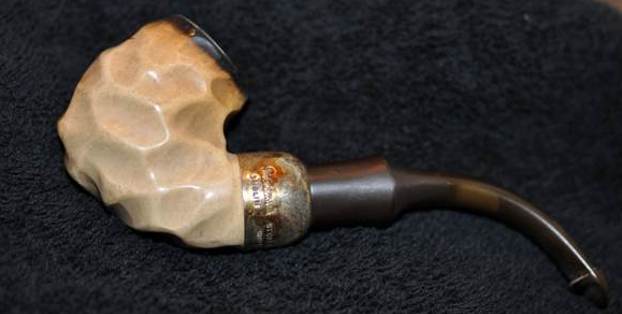
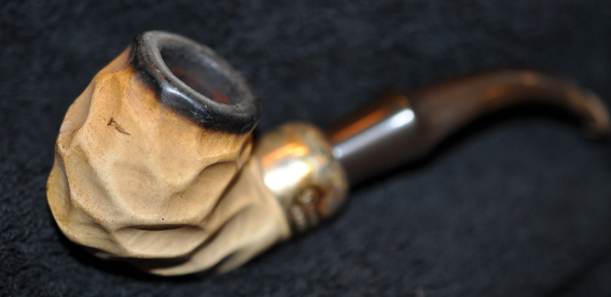
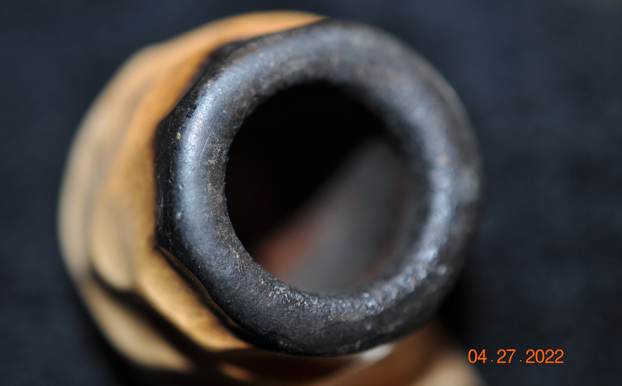
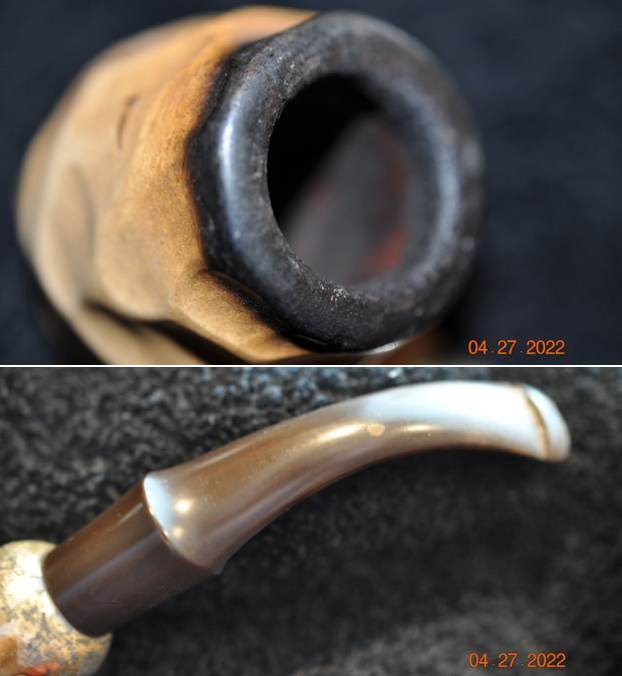
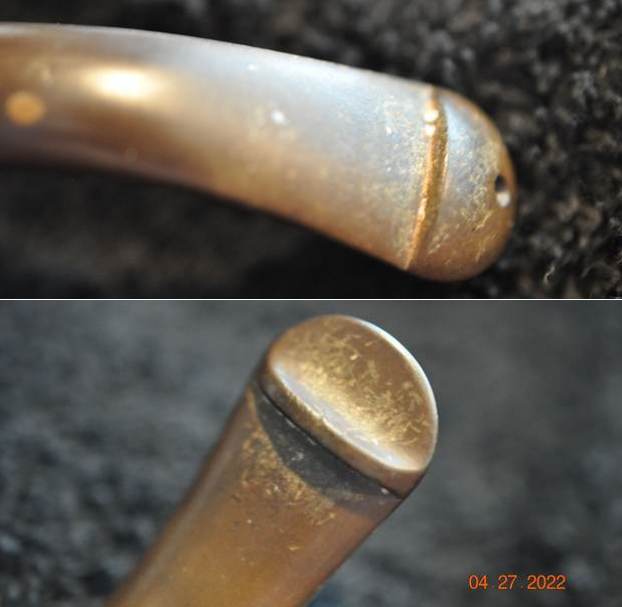
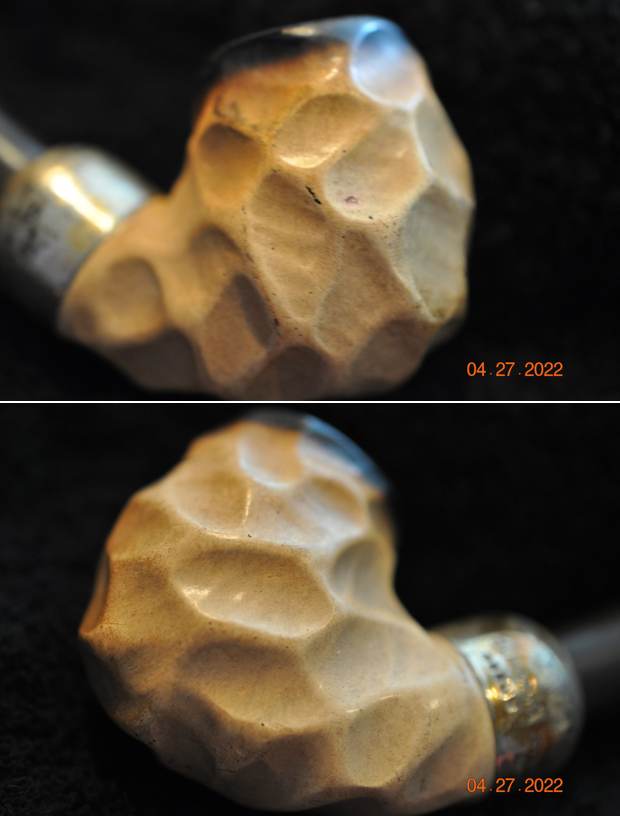
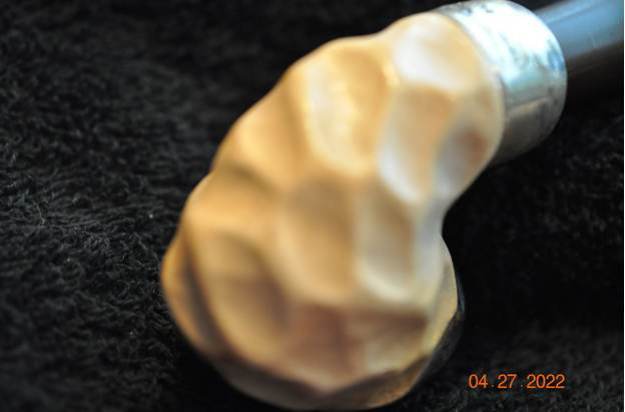
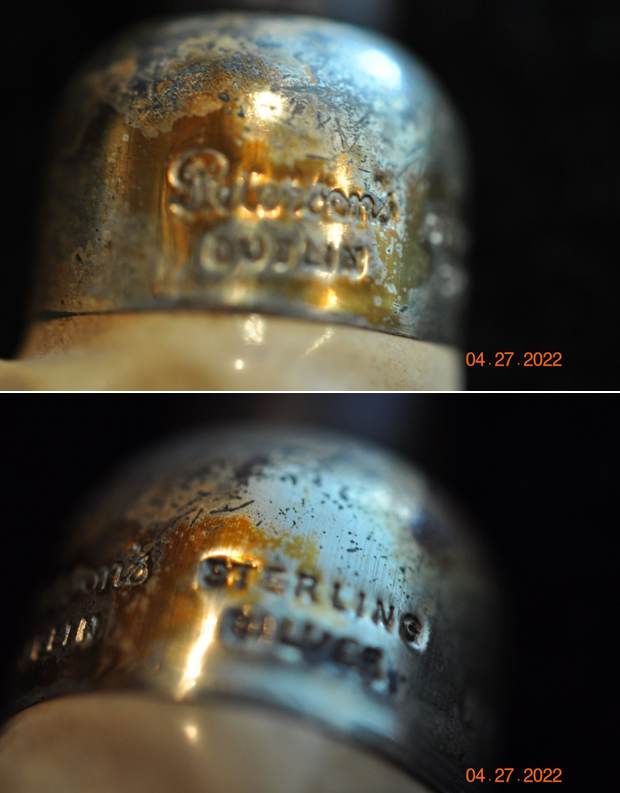
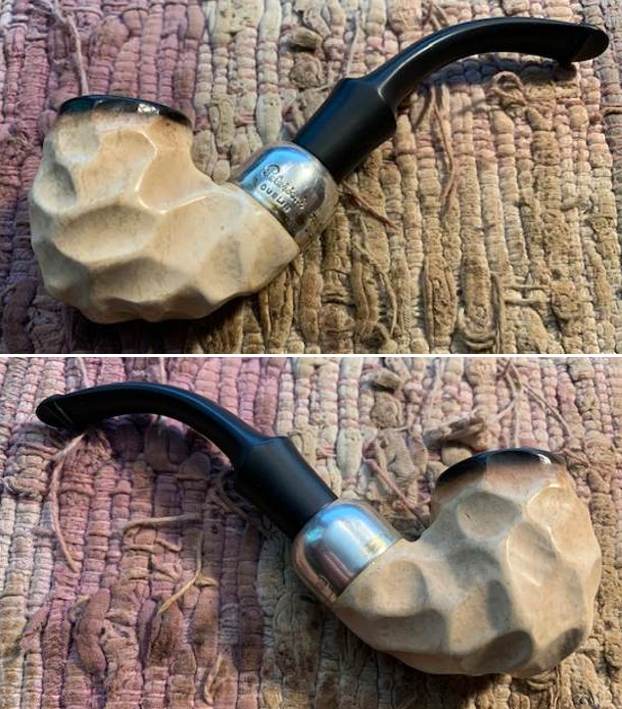
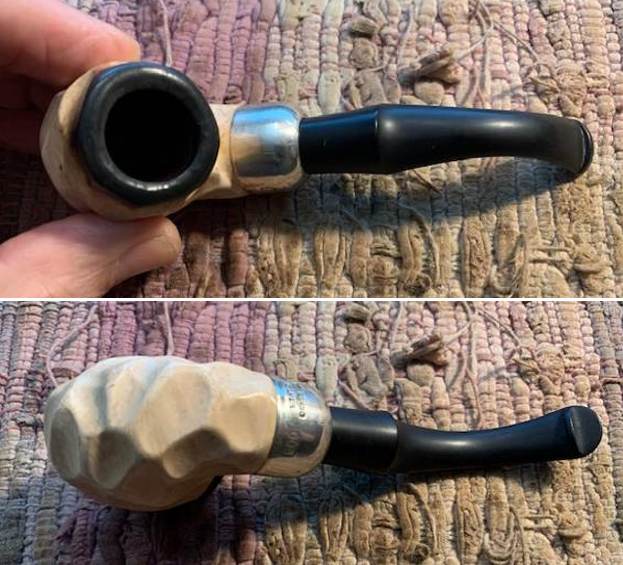
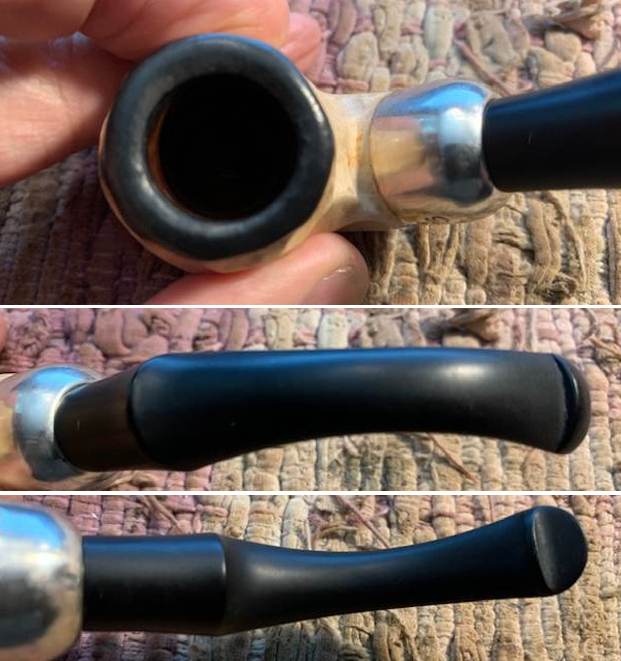
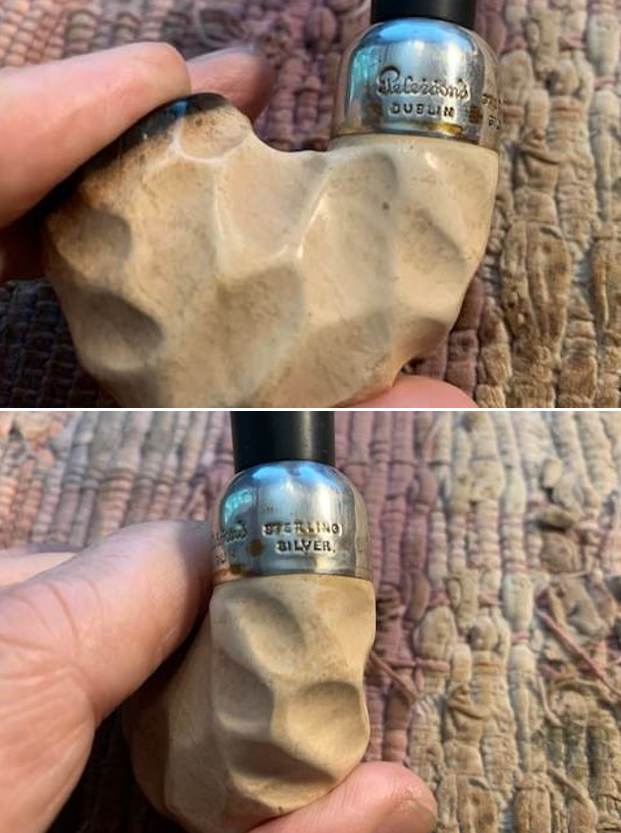
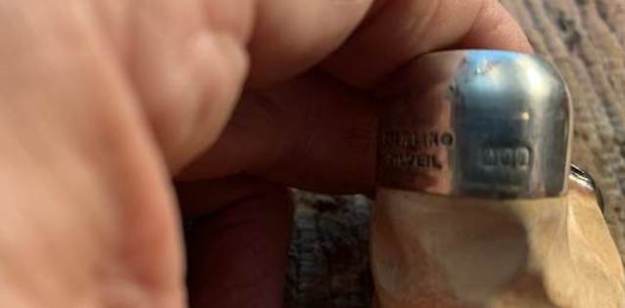
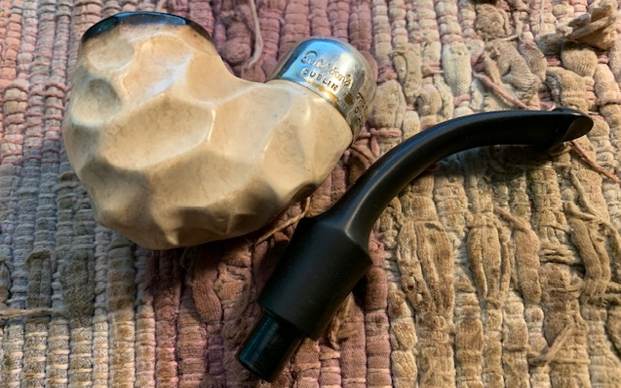
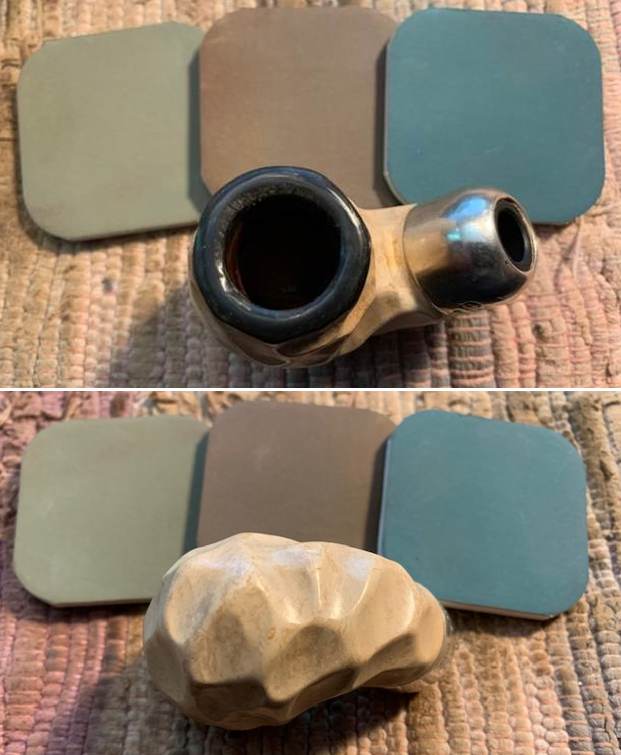
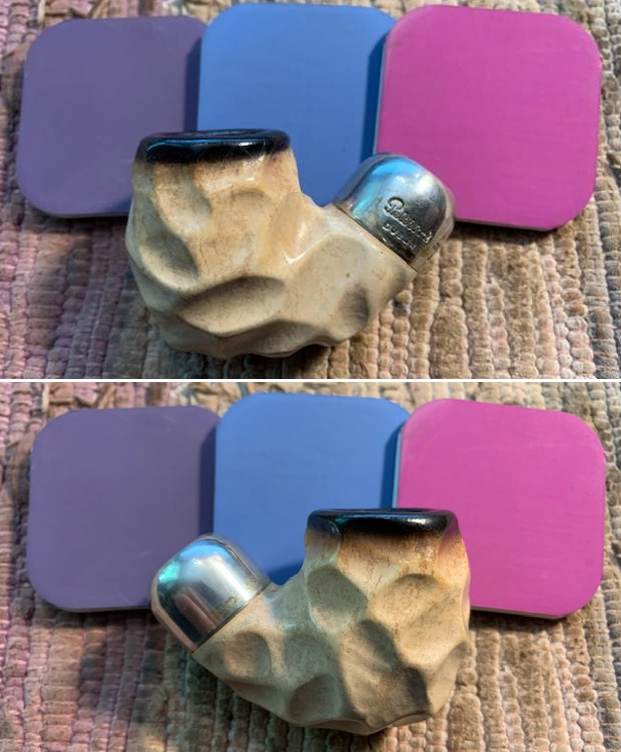
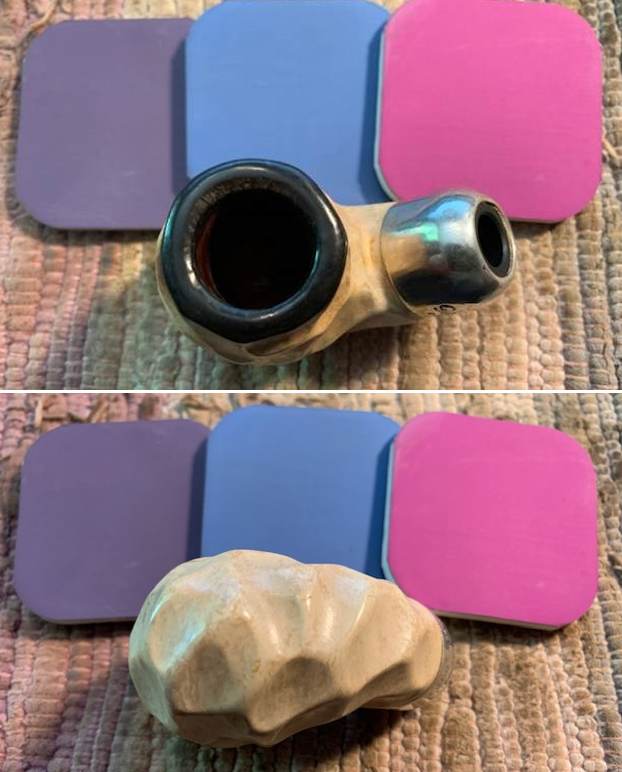
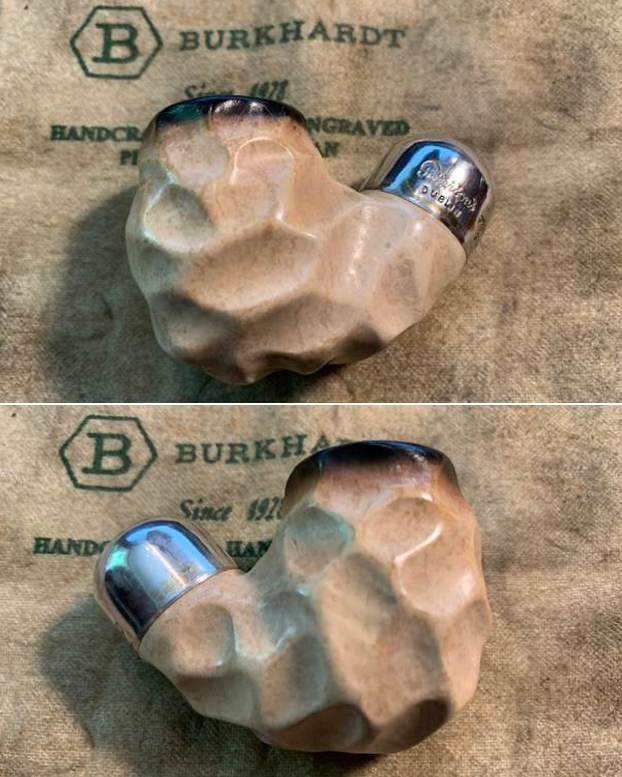
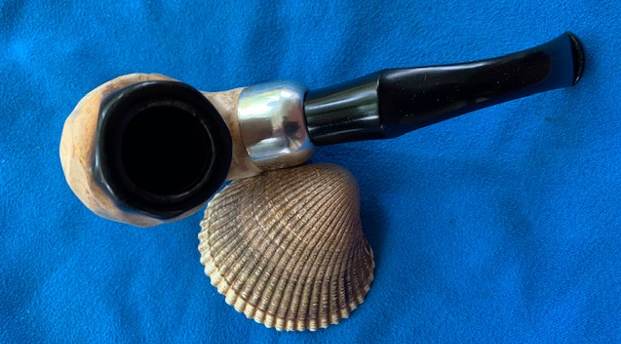
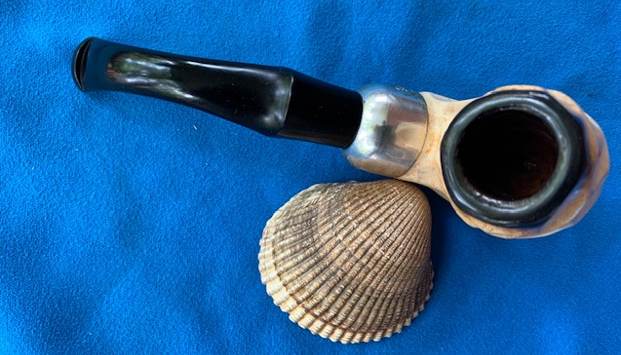
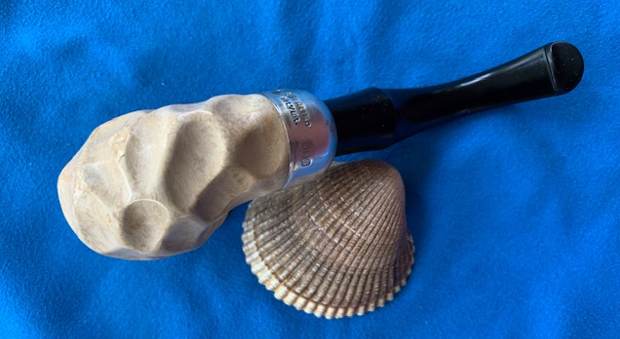
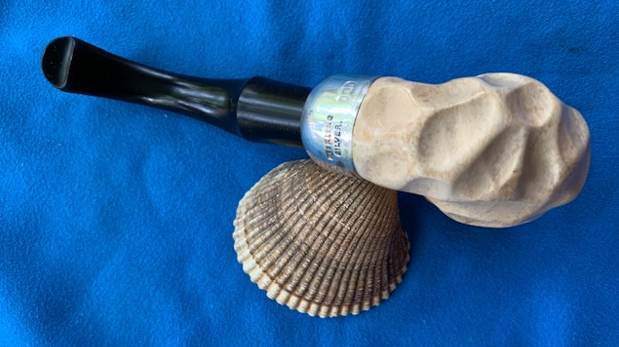
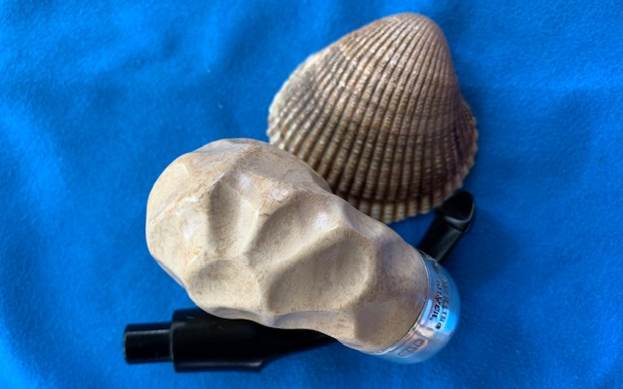
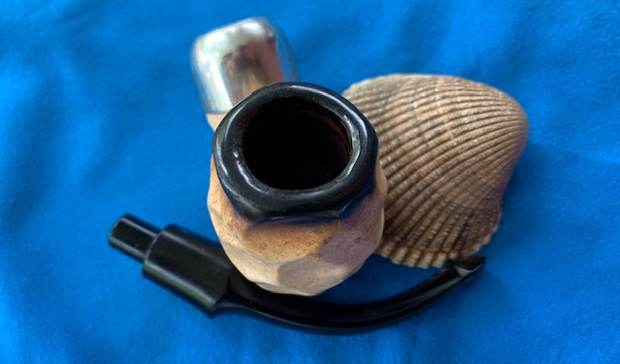
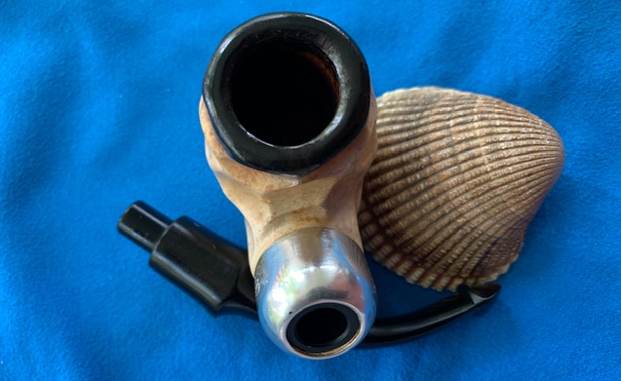
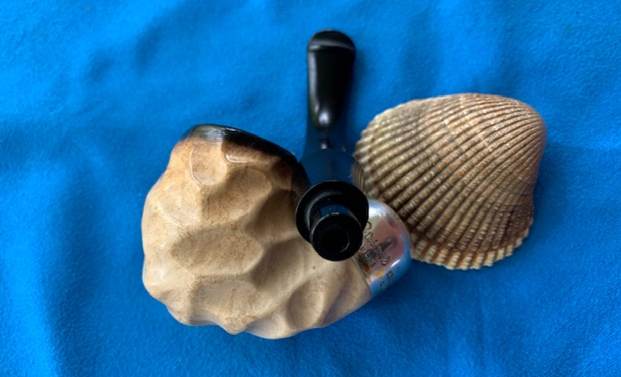
The next pipe I have chosen is a multi-faceted finish Peterson’s African Block Meerschaum pipe. This one is a Bent Meerschaum pipe that has facets around the bowl and shank. The rim top is flumed as was the style of the 60s and 70s. This pipe was purchased on 12/08/21 from Facebook Marketplace in Durham, North Carolina, USA.  This faceted bowl and shank adds a touch of depth to the pipe. The pipe was dusty in the meerschaum ridges and flat spots on the bowl and shank. The contrast of the colouration/patina developing on the high spots and shank with the flumed top looks very good. The bowl had a moderate cake and there was lava on the rim top and inner edge of the bowl. The Sterling Silver ferrule is oxidized and dirty. It is stamped Peterson’s [over] Dublin followed by Sterling [over] Silver. On the underside are three hallmark stamps – 1. Seated Hibernia (Ireland) 2. The Harp (symbol for the silver quality) 3. The lower case letter “l” for the date of the pipe. The stem was oxidized, calcified and had light tooth chatter on the top and underside on and near the button. Jeff took photos of the pipe before his cleanup work. They tell the story and give a glimpse of the pipe. Jeff took photos of the rim top and stem to show the general condition of the pipe. The bowl is moderately caked and the rim top and edges have lava overflowing on to them. The stem is oxidized, calcified and has light tooth marks on the top and underside near the button. Jeff took photos of the bowl sides and heel to show the faceted finish around this bowl. It is a nice looking pipe. He took photos of the Sterling Silver ferrule to show the stamping around it. You can see that it reads as noted above. He did not capture the hallmarks on the underside.I took some time to remind myself of the provenance of these Peterson’s Dublin Meerschaum pipes. I am pretty sure the pipe was made by the Laxey Pipe Ltd. on the Isle of Man for Peterson’s in Ireland (https://pipedia.org/wiki/Laxey_Pipes_Ltd). I quote from the Pipedia article in full:

Laxey Pipe Ltd. resided in a historical 19th century four-storey Man stone building at The Quay, Old Laxey, Isle of Man, which thankfully has been preserved. The company specialized in the production of Meerschaum Pipes using the Meerschaum mined by the Tanganyika Meerschaum Corporation in the Amboseli basin in Tanganyika (since 1964 part of the United Republic of Tanzania). Please note: you may often find names like “Manx Pipes Ltd.”, “Man Pipe Co.” and others more, but there is no indication of another Isle of Man pipe producer other than Laxey Pipe Ltd. at any time!

Laxey Pipe Ltd. marketed own brands like “Manxpipe”, “Manxman”, “Manxland” e.c. Names like “John Bull”, “White Knight” (unwaxed), “Domino” (black, or lined) indicated some shapes / colours of Laxey’s own series. The stems either showed the astronomical sign for “male” or “man” (circle + arrow), or the crest of the Isle of Man, the 3-legged X in a circle. Manxpipes and Laxey’s other brands were available through pipe retailers in general, but also were sold (mainly) to tourists through their own shop in Laxey.

Furthermore Laxey Pipe Ltd. manufactured the meer bowls for Peterson, Barling, Nørding and others from the later 1960’s until 2001. Man Pipe e.g. was a brand distributed by Comoy’s. The bowls usually showed no nomenclature indicating the orderer. “Genuine Block Meerschaum” was engraved frequently. Often, just the stems were different, while bowls were the same.

Supply of meer from East Africa run out (Kenya / Tanzania exhausted, Somalia inaccessible), and thus the last Laxey meers were supplied to trade in May, 2001. Laxey Pipe Ltd. tried to survive continuing with briar pipes – mainly in the Danish style -, but to no success. It closed down business in July, 2002.

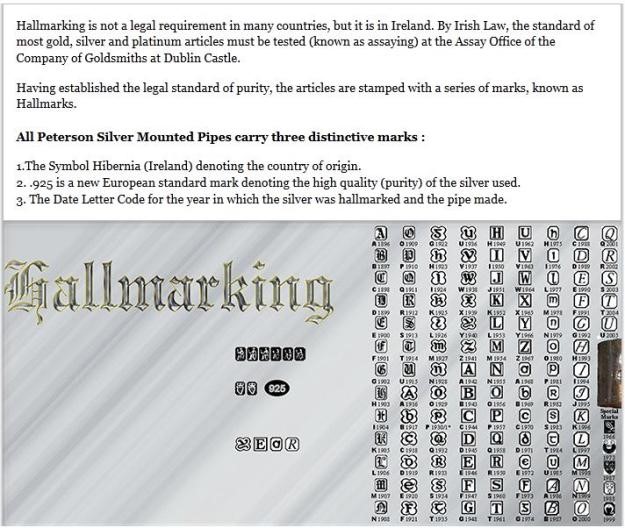
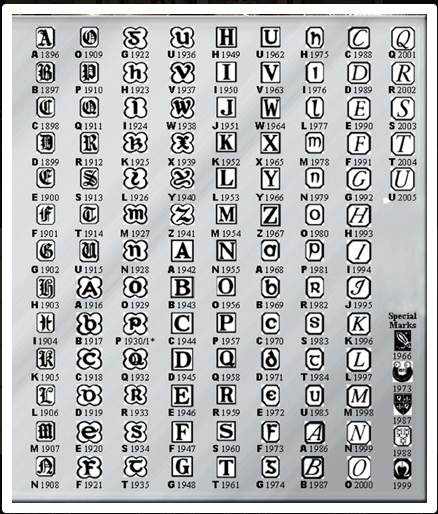
As noted above the silver is stamped Peterson’s [over] Dublin followed by Sterling [over] Silver. On the underside are three hallmark stamps – 1. Seated Hibernia (Ireland) 2. The Harp (symbol for the silver quality) 3. The lower case letter “l” for the date of the pipe. I have included the Peterson’s Hallmark chart below as it is a very helpful tool that I have used repeatedly to date my Peterson pipes.I found a larger photo of the letter section of the above chart. The letter stamp is a lower case “l” which dates the pipe to 1977.

I know that the pipe was made on the Isle of Man by Laxey Pipe Ltd. out of African Meerschaum. It was made for export for Peterson’s of Dublin. From the hallmarks on the silver I know that the pipe (or at least the silver) was made in 1977. That fits the flumed top on the bowl and the faceted carving around the bowl and shank. That was as much as I could figure out.

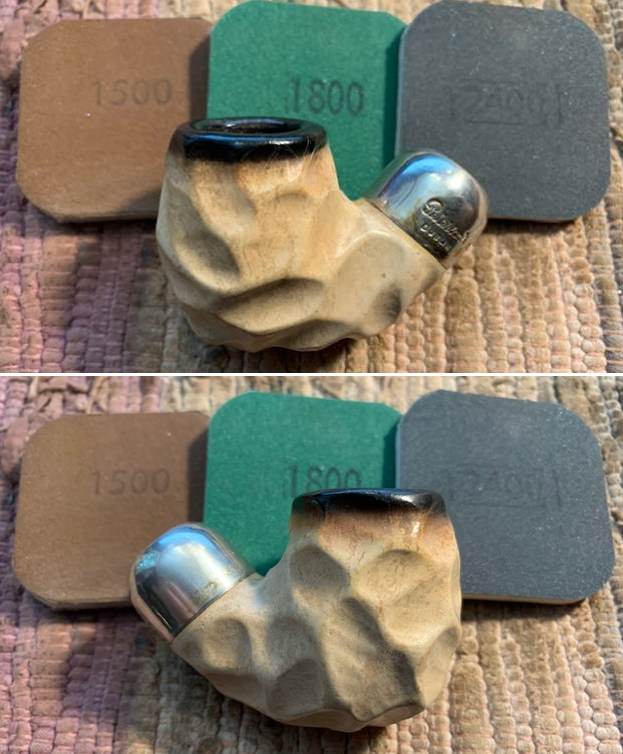
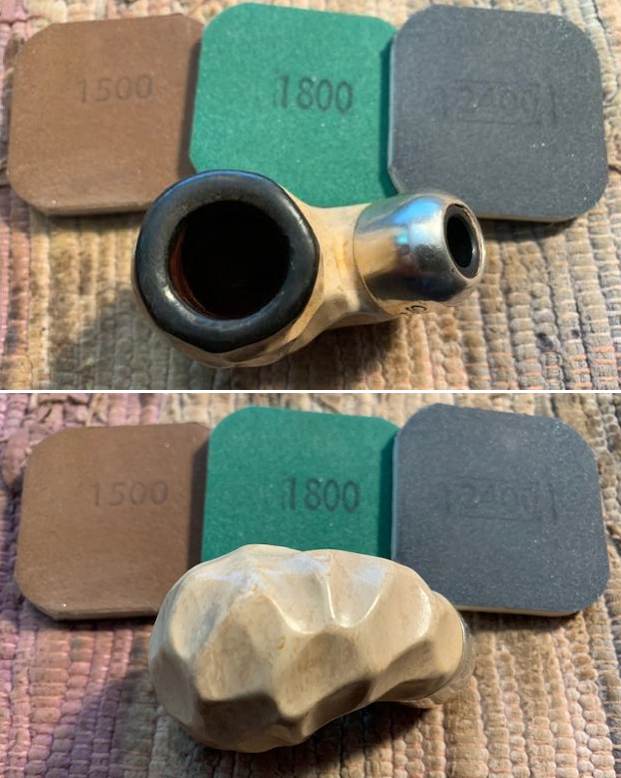
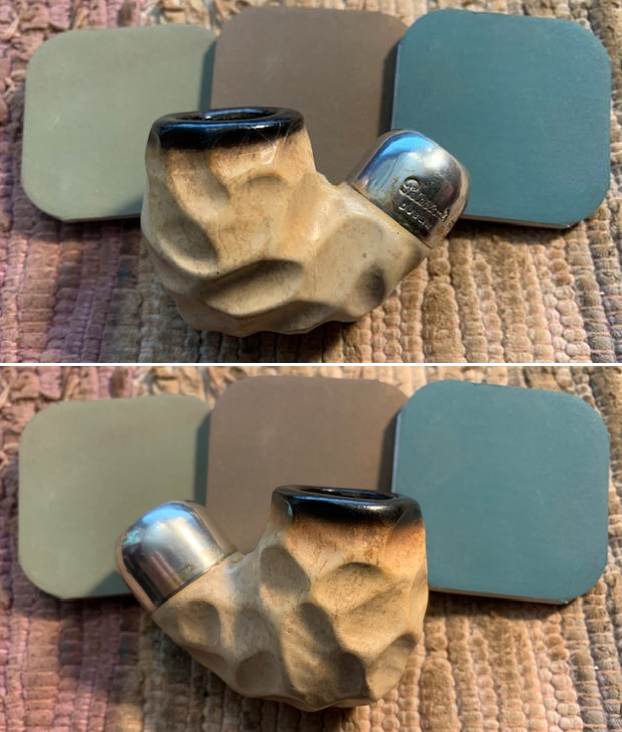
Jeff had done a great job cleaning up the pipe as usual. He reamed the pipe with a PipNet reamer and cut back the cake back to the bare meerschaum. He cleaned up the walls with a Savinelli Fitsall Pipe Knife. He scrubbed the interior of the bowl and shank with pipe cleaners, cotton swabs and alcohol to remove the tars and oils. He scrubbed the exterior of the pipe with Murphy’s Oil Soap and a tooth brush to remove the grime from the finish. He worked on the rim top lava and darkening with the soap and tooth brush. He cleaned up the tarnish on the silver ferrule. He scrubbed the inside of the stem with alcohol and pipe cleaners. He scrubbed the exterior with Soft Scrub and then soaked it in Briarville Pipe Stem Deoxidizer. He washed it off with warm water to remove the Deoxidizer. The pipe looked very good when it arrived. I took some close up photos of the rim top and also of the stem surface. I wanted to show how well it had cleaned up. The rim top and edges looked very good. The stem showed some light tooth marks and chatter on the surface near the button.I took a photo of the stamping on the silver ferrule. You can see that once the tarnish was  removed it is stamped as noted above. It is clear and readable.  I took the pipe apart and took a photo of the pipe. It is a good looking pipe and has an interesting style of rustication around the bowl.I polished the meerschaum bowl and shank with micromesh sanding pads. I dry sanded it with 1500-12000 grit pads and wiped it down with a damp cloth after each pad. I polished the Sterling Silver ferrule with a jeweler’s cloth to shine and slow down the process of oxidation. The ferrule really looks good even with a few worn spots around it. Once it was polished with the Before & After Balm and buffed with a microfiber cloth the stain would blend perfectly. I rubbed the meerschaum down with Before & After Restoration Balm. I worked it into the surface of the meerschaum with my fingertips to clean, enliven and protect it. I let the balm sit for 15 minutes and then buffed with a cotton cloth to raise the shine. Mark Hoover’s Balm is a product that I have come to appreciate and one I use on every pipe I have been working on. I set the bowl aside and turned to work on the stem. I polished the stem with micromesh sanding pads – wet sanding with 1500-12000 grit sanding pads. I wiped it down after each sanding pad with Obsidian Oil. I polished it with Before & After Pipe Stem Polish – both Fine and Extra Fine.  As usual at this point in the restoration process I am excited to be on the homestretch. I look forward to the final look when it is put back together, polished and waxed. I put the bowl and stem of this Peterson’s Meerschaum back together. I polished the bowl and stem with Blue Diamond to polish out the scratches in the meerschaum and the vulcanite. I gave the bowl multiple coats of Conservator’s Wax and the stem multiple coats of carnauba wax. I buffed the pipe with a clean buffing pad to raise the shine. I hand buffed it with a microfiber cloth to deepen the shine. The pipe polished up pretty nicely. The meerschaum has a rich glow with the wax and polish. The shiny black vulcanite stem is a beautiful contrast to the rich developing patina of the bowl and the polished silver ferrule. This Peterson’s meerschaum was made by the Laxey Pipe Ltd. on the Isle of Mann. The faceted finish on this pipe made it another fun pipe to work. It really is a quite stunning pipe whose shape and finish make it stand out. The thick/chubby shank makes it a very comfortable pipe to hold in the hand. The finished pipe is shown in the photos below. The dimensions are Length: 5 inches, Height: 1 ¾ inches, Outside diameter of the bowl: 1 inches, Chamber diameter: 5/8 of an inch. The weight of the pipe is 44 grams/1.52 ounces. It is a beautiful pipe and one that will be on the Irish Pipe Makers Section of the rebornpipes store soon. If you are interested in adding it to your collection let me know. Thanks for walking through the restoration with me as I worked over this pipe. Thanks to each of you who are reading this blog.
A New Solution to an Old Problem


Blog by Kenneth Lieblich

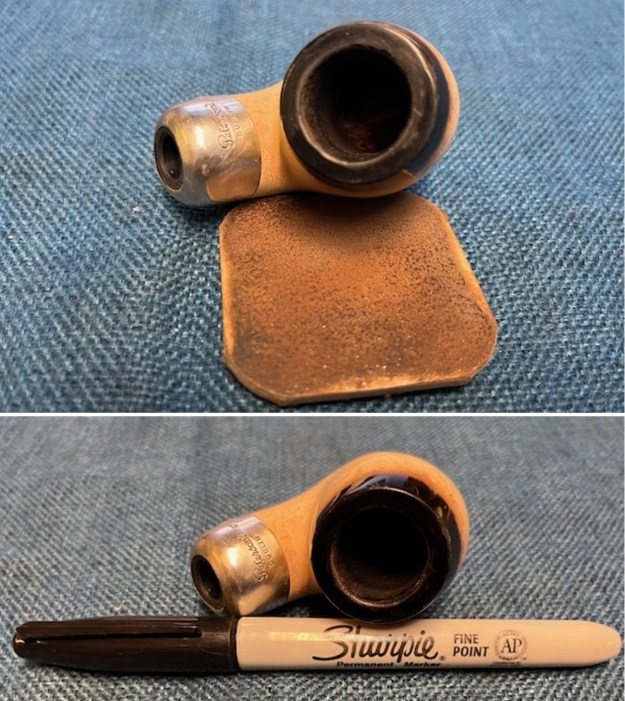
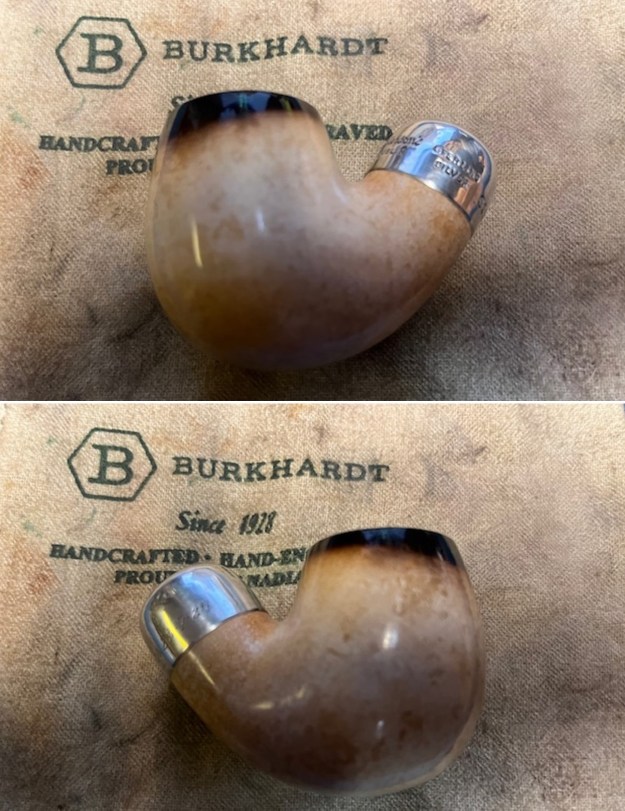
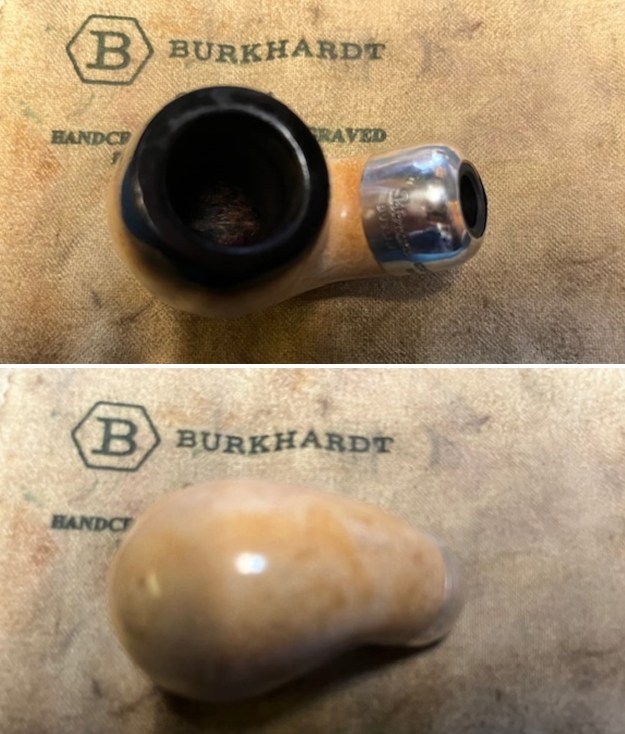
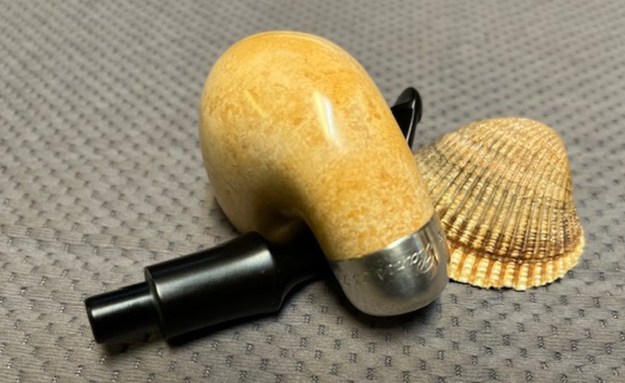
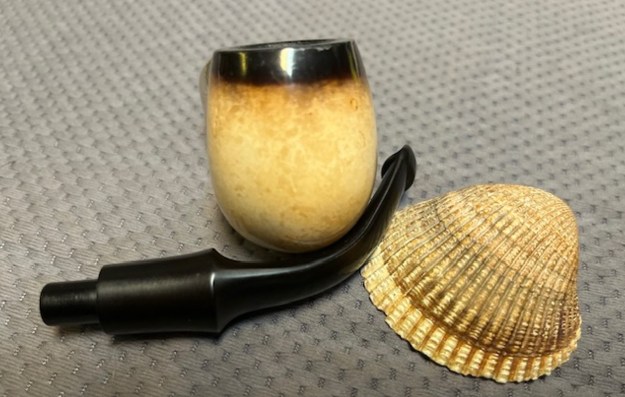
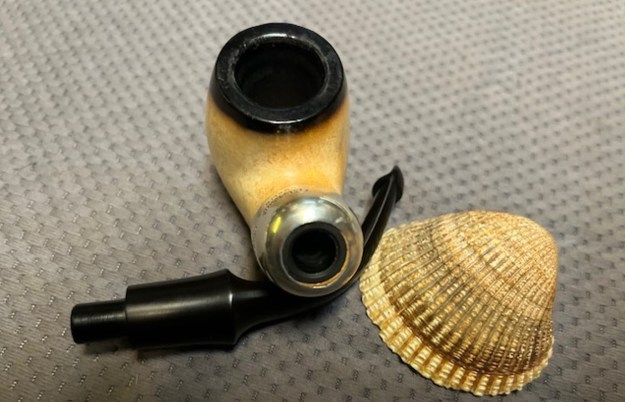
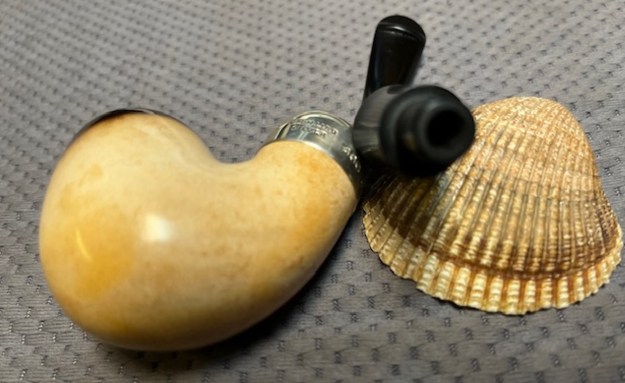
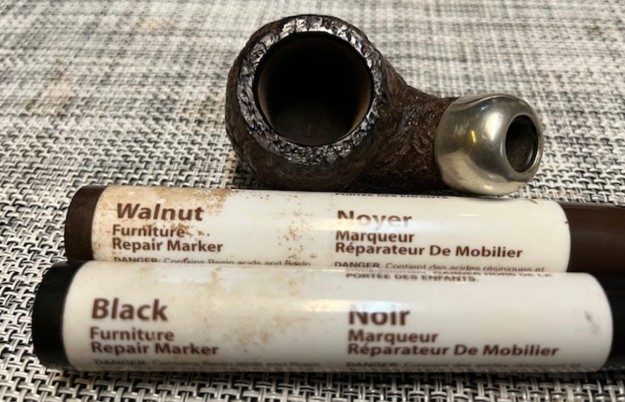
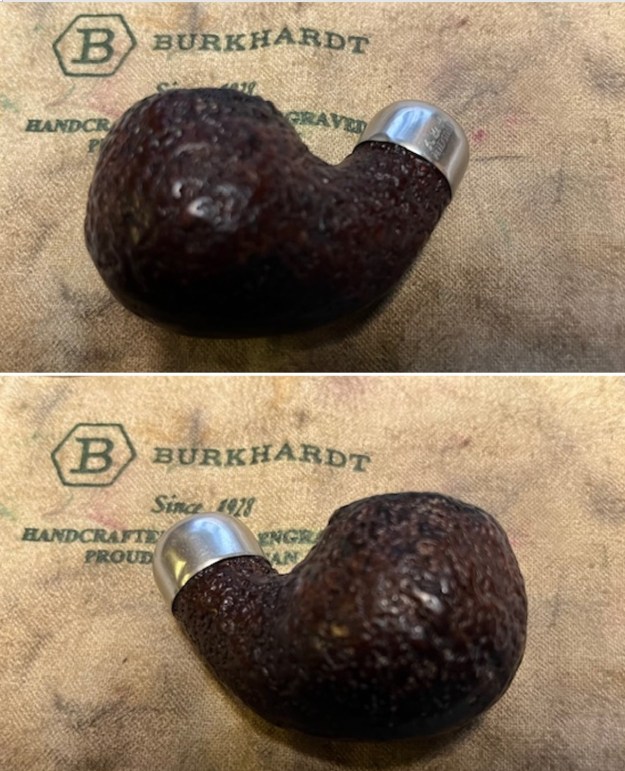
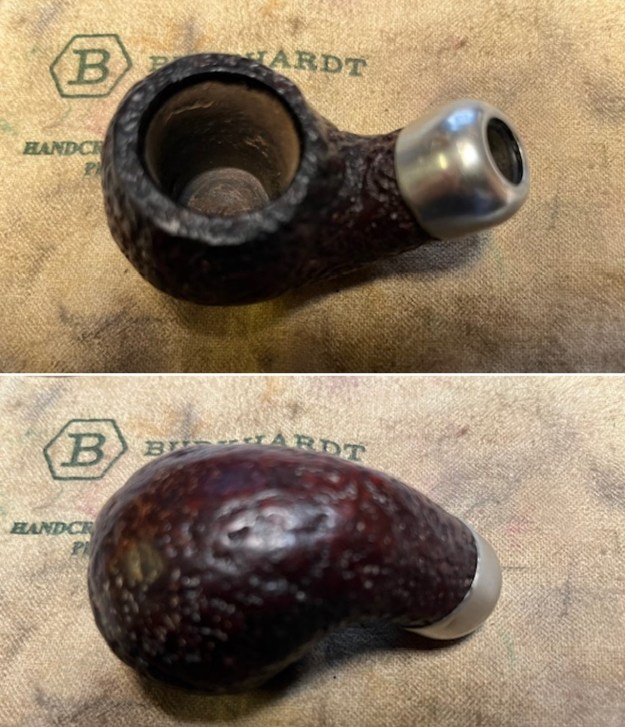
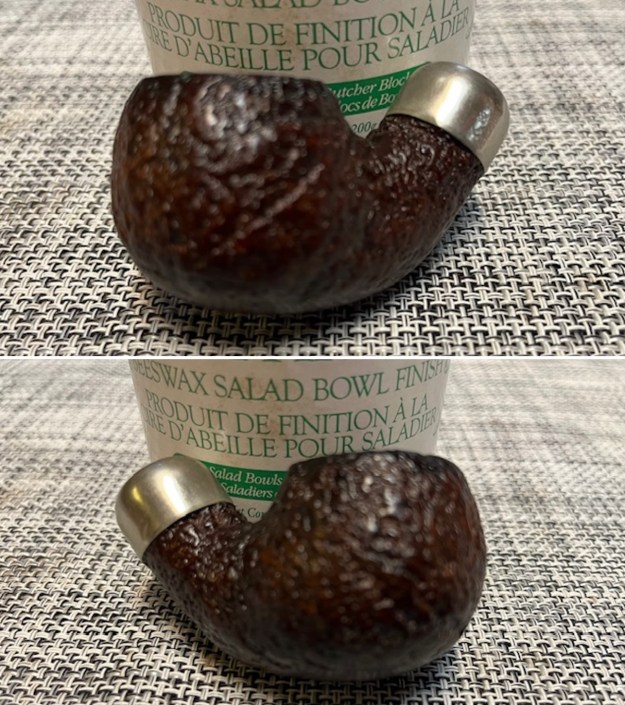
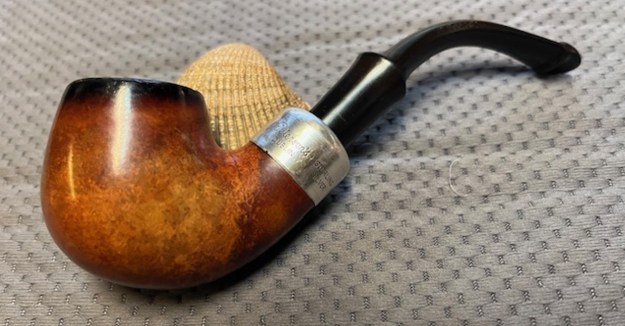
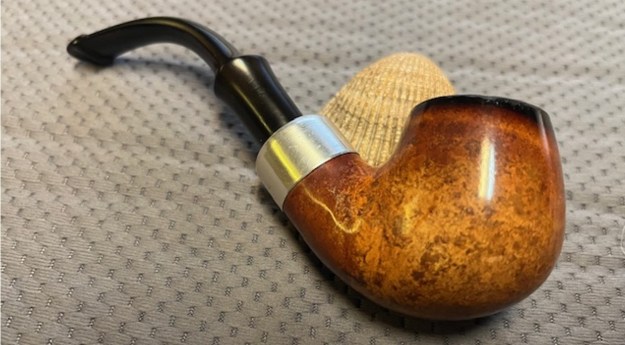
Welcome to my first meerschaum restoration! In fact, it is not just a meerschaum pipe, but it is also a Peterson pipe. This came out of lot of pipes from eBay some months ago, but it took me a while to get to it – I was a bit daunted. Even though it looked rough to start, it ended up as a very handsome pipe. Please read on… This is a rusticated, African block meerschaum, made on the Isle of Man. The stem has a push-style tenon. Like many of the meerschaum pipes of this era, this one has a factory-stained rim – to give it that sort of ‘broken in’ look. How do I know it is a Peterson? Because it has the distinctive, stylized ‘P’ on the left side of the stem, near the shank. Similar to other pipes that Steve has restored, this one seems likely to have been produced by Laxey Pipes Ltd. on the Isle of Man for Peterson Pipes. Here is the Pipedia article about them (I hasten to add that the various errors below are in the original text and are not mine):
Laxey Pipes Ltd. resided in a historical 19th century four-storey Man stone building at The Quay, Old Laxey, Isle of Man, which thankfully has been preserved.
The company specialised in the production of meerschaum pipes using the Meerschaum mined by the Tanganyika Meerschaum Corporation in the Amboseli basin in Tanganyika (since 1964 part of the United Republic of Tanzania). 

Please note: you may often find names like “Manx Pipes Ltd.”, “Man Pipe Co.” and others more, but there is no indication of another Isle of Man pipe producer other than Laxey Pipe Ltd. at any time! 

Laxey Pipes Ltd. marketed own brands like “Manxpipe”, “Manxman”, “Manxland” e.c. Names like “John Bull”, “White Knight” (unwaxed), “Domino” (black, or lined) indicated some shapes / colours of Laxey’s own series. The stems either showed the astronomical sign for “male” or “man” (circle + arrow), or the crest of the Isle of Man, the 3-legged X in a circle. Manxpipes and Laxey’s other brands were available through pipe retailers in general, but also were sold (mainly) to tourists through their own shop in Laxey. 

Furthermore Laxey Pipes Ltd. manufactured the meer bowls for Peterson, Barling, Nørding and others from the later 1960’s until 2001. Man Pipe e.g. was a brand distibuted by Comoy’s. The bowls usually showed no nomenclature indicating the orderer. “Genuine Block Meerschaum” was engraved frequently. Often, just the stems were different, while bowls were the same.

Supply of meerschaum from East Africa run out (Kenya / Tanzania exhausted, Somalia inaccessible), and thus the last Laxey meers were supplied to trade in May, 2001. Laxey Pipes Ltd. tried to survive continuing with briar pipes – mainly in the Danish style -, but to no success. It closed down business in July, 2002.

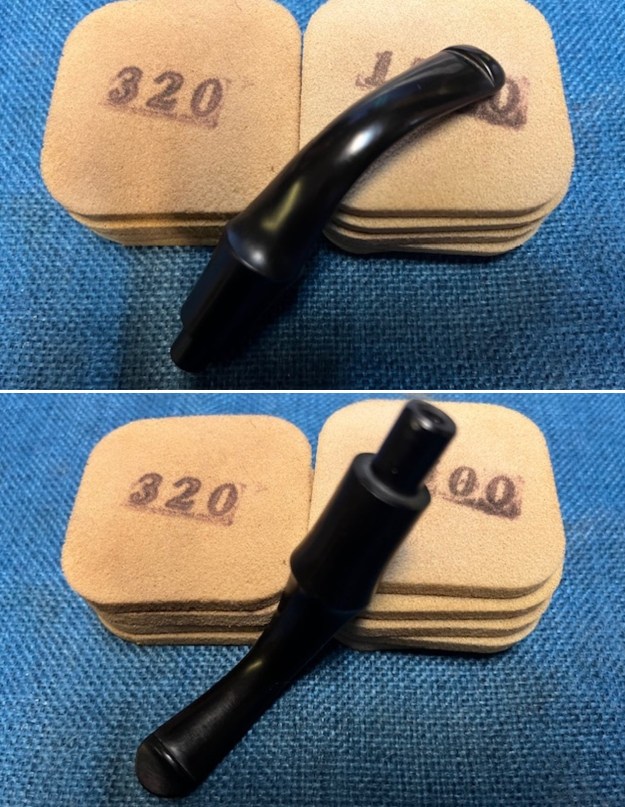
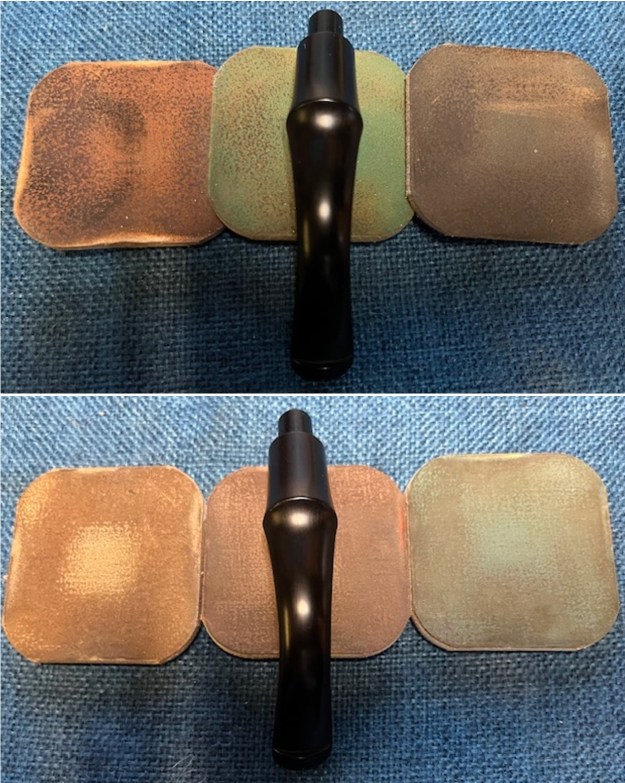
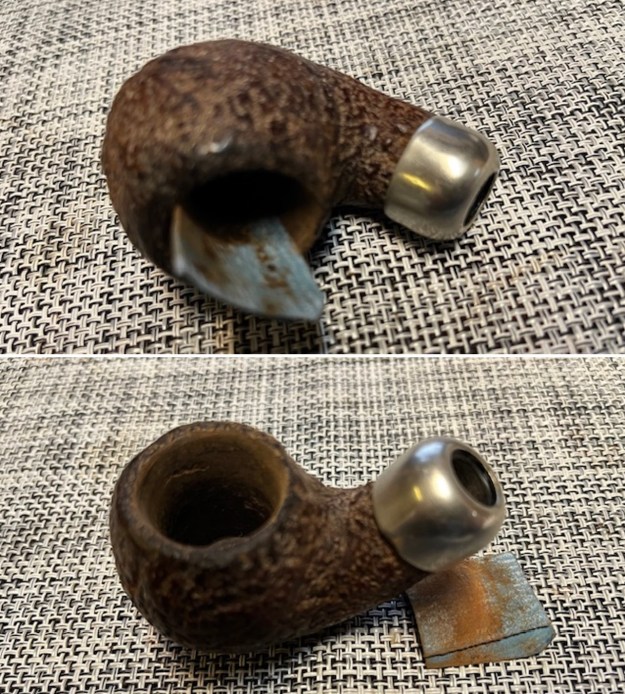
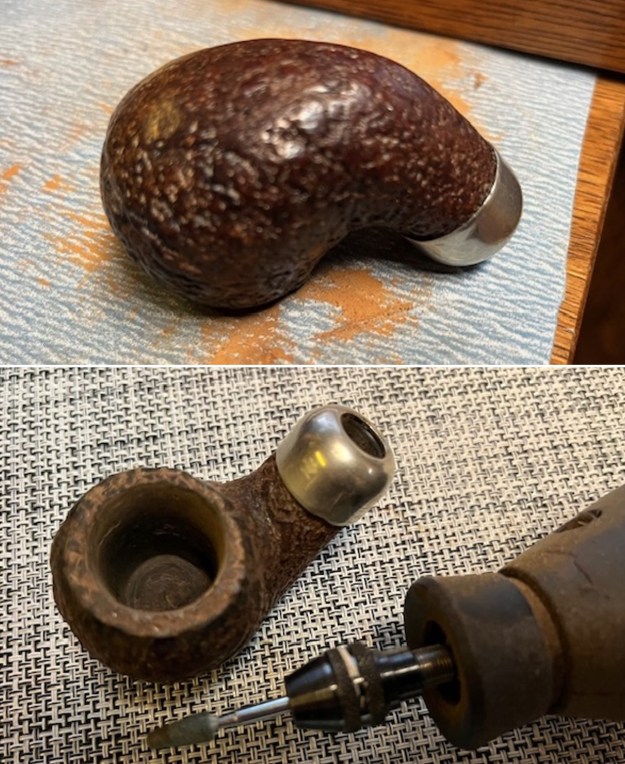
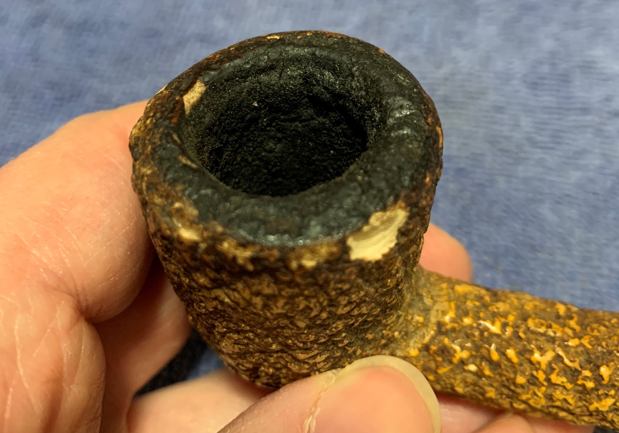
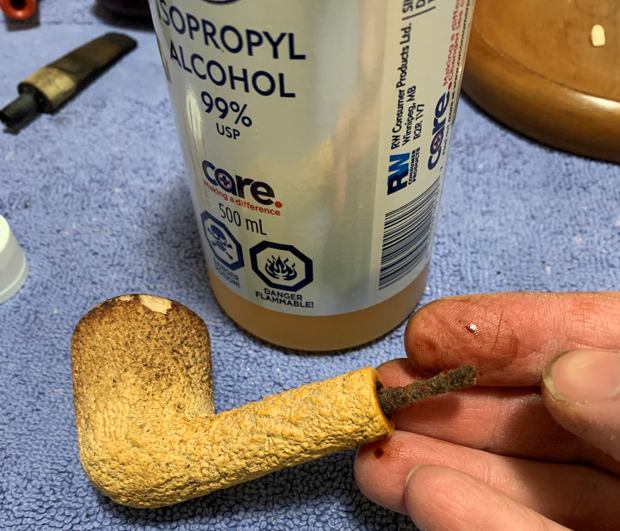
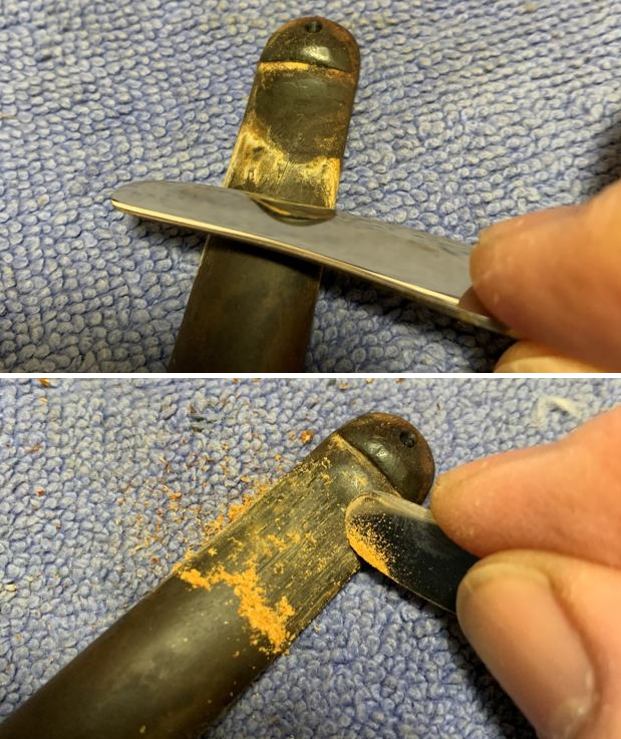
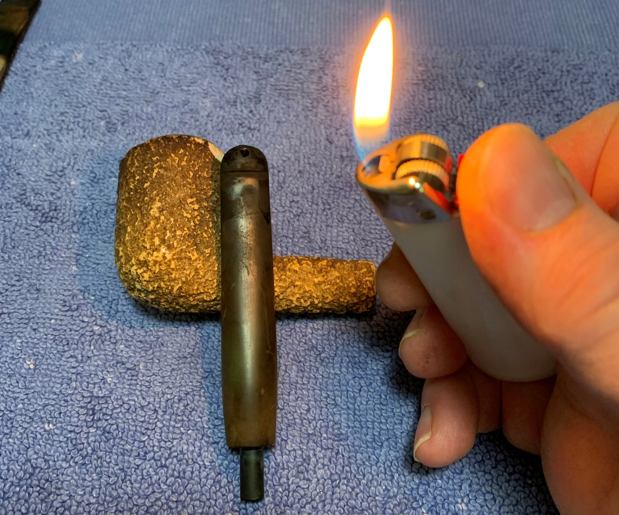
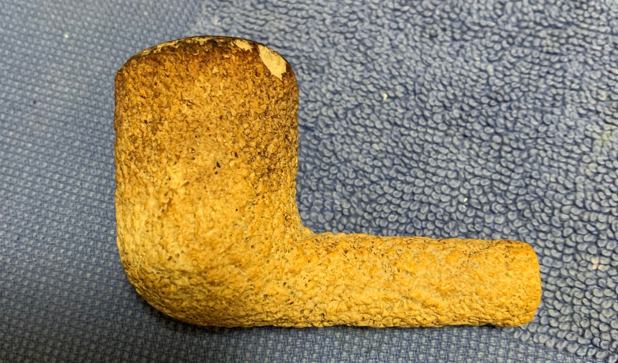
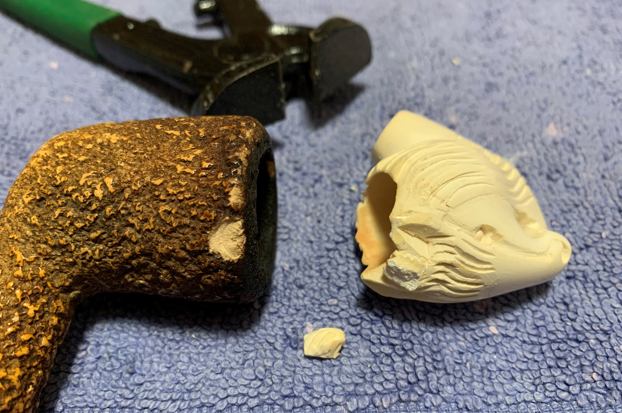
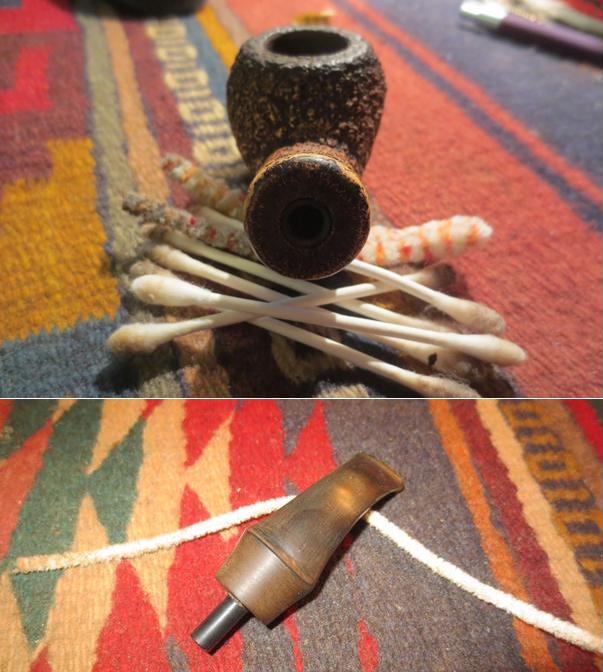
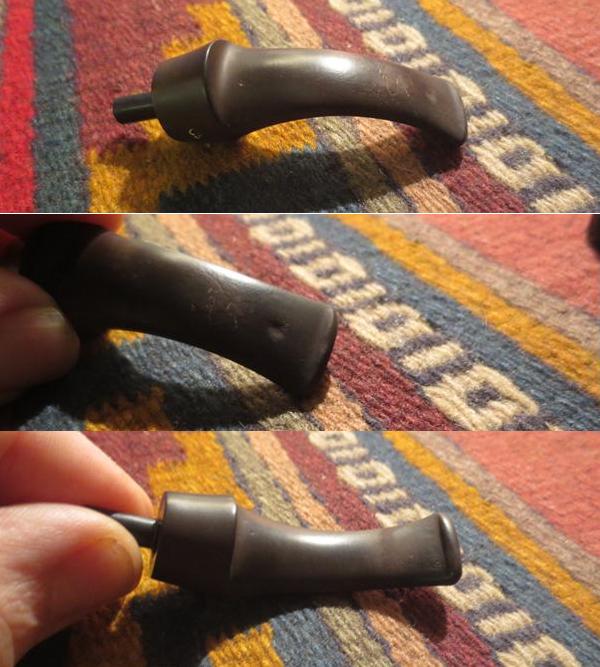
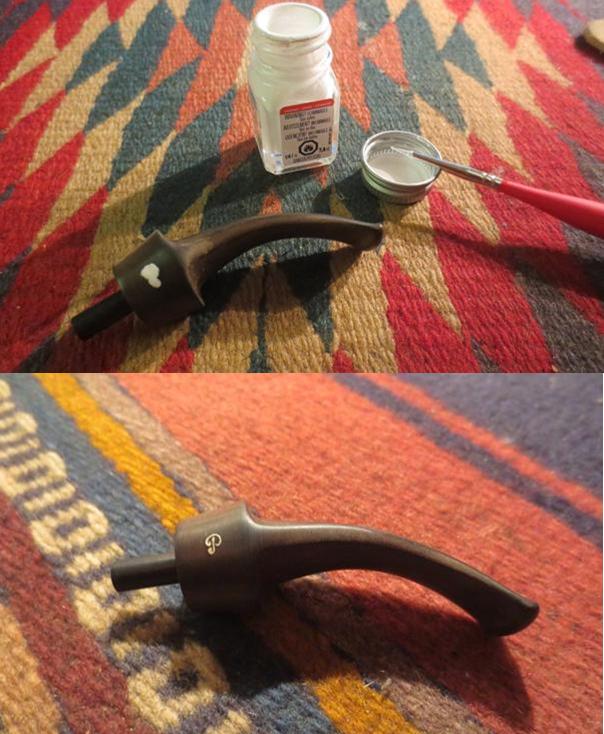
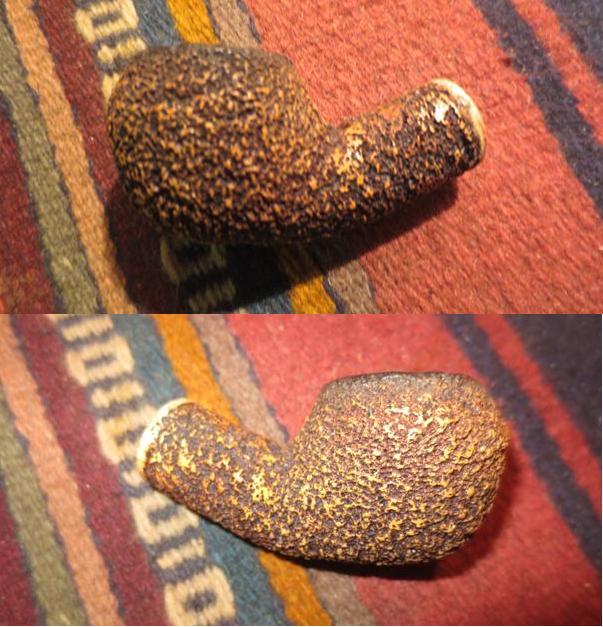
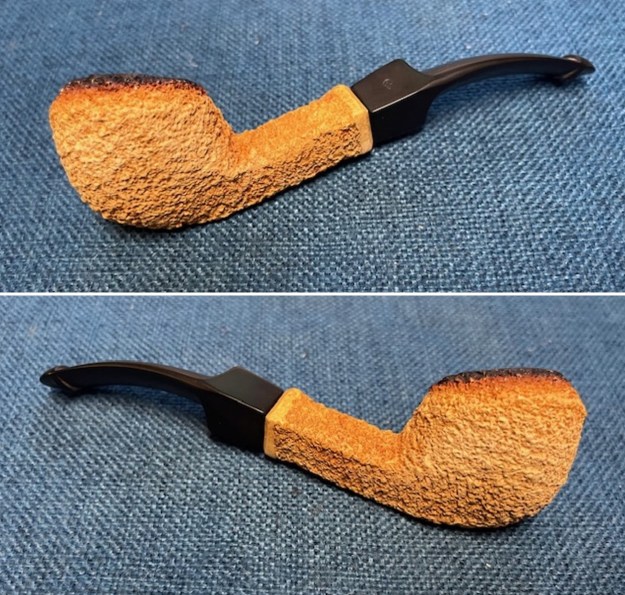
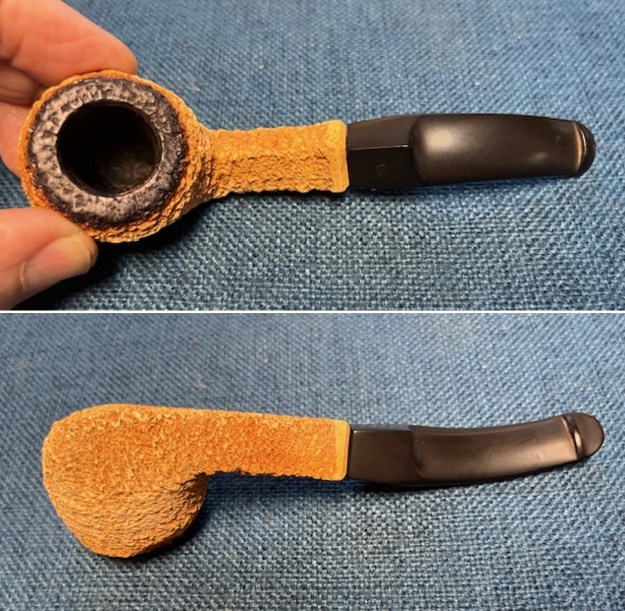
Anyway, on to the pipe – and what a mess it was. The stummel had the following problems: a nasty ghost, filth embedded in the rustication, a creepy and unnatural yellow tinge to the meerschaum, lots of lava on the rim, lots of cake in the bowl, and – worst of all – chunks missing from the rim. Meanwhile, the stem had its own set of problems: the ‘P’ logo was nearly obliterated, heavy oxidation and calcification, and tooth marks and dents. In fact, even my wife commented that this pipe might be the proverbial ‘bridge too far’ – but, like the stereotypical, stubborn husband, I was not to be deterred! I decided to start on them stem, as I still was not sure how to resolve the chunks missing from the rim. I broke out the isopropyl alcohol and pipe cleaners, and got to work on the inside of the stem. Predictably, it was pretty dirty and I went through a good number of pipe cleaners in order to clean it up. Then I had to tackle the overwhelming oxidation and calcification – yuck. I took a blade (an old butter knife, actually) and began gently scraping at all that build-up. Obviously, I took it easy, as I did not want to damage the stem’s vulcanite any further. The butter knife worked quite well and I got a good amount loose. I followed that up with some lemon-infused isopropyl alcohol on some cotton rounds to try and scrub the rest away. This worked quite well and I noted some improvement. There were quite a few dents in the stem. Some were obviously tooth marks, but other dents looked like blunt force trauma! Time to break out the BIC lighter to see if it could raise some of these dents. Quite frankly, it did not do much – this repair was going to require some considerable sanding etc. Before that, however, the stem went for an overnight soak in the Before & After Hard Rubber Deoxidizer. The following day, I cleaned all of the de-oxidizing sludge off with alcohol, pipe cleaners, et cetera. The oxidation had migrated to the surface and would be fairly straightforward to remove. I scrubbed vigorously with SoftScrub to remove the leftover oxidation.Before I moved on to the Micromesh pads, I built up the dent damage on the stem with cyanoacrylate adhesive and let it fully cure. It turned out that this was not as straightforward as I had hoped. It took more than one application of adhesive to sort this problem out. I then sanded it down with 220-, 400-, and 600-grit sandpapers to make the stem look normal. I then used all nine Micromesh pads (1,500 through 12,000 grit) to bring out the lovely black lustre on the stem. I also used Obsidian Pipe Stem Oil in between each pad scrubbing.

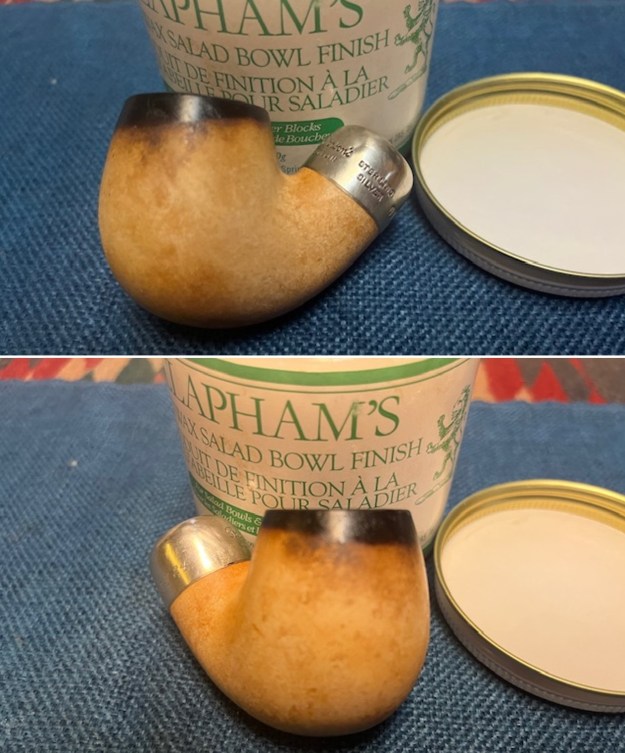
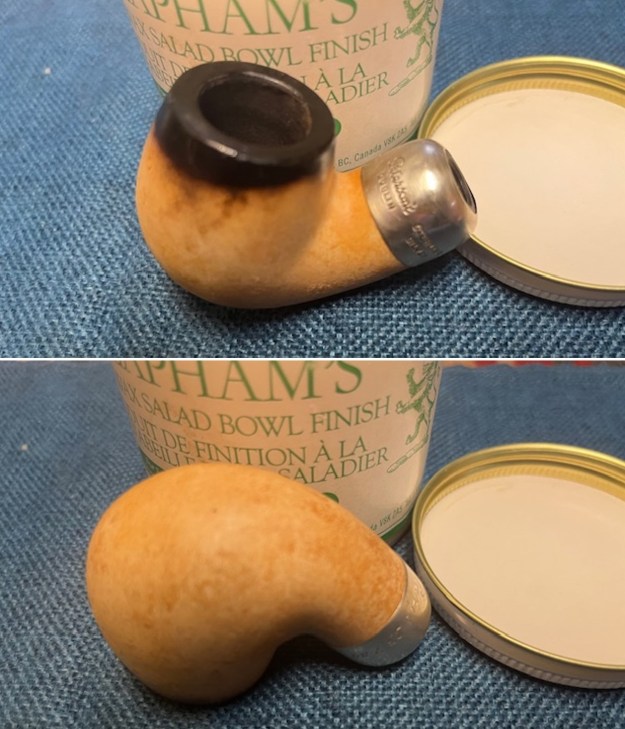
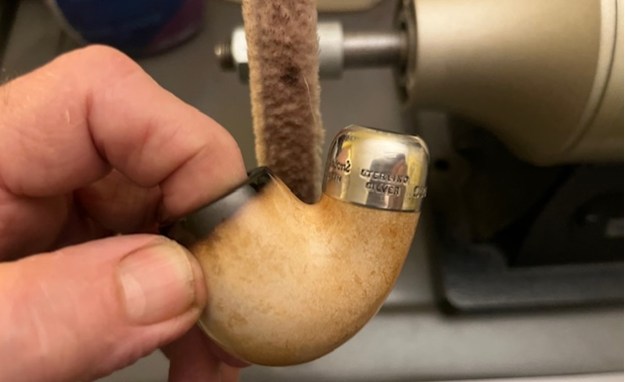
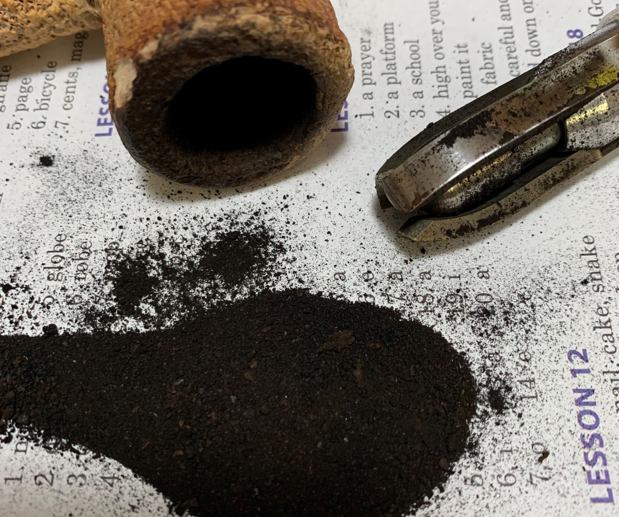
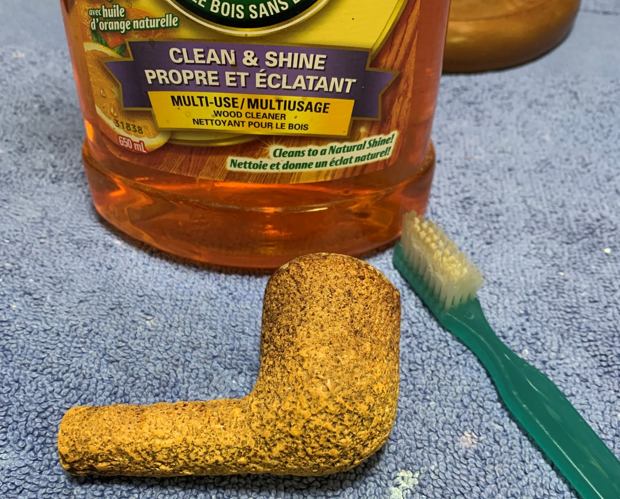
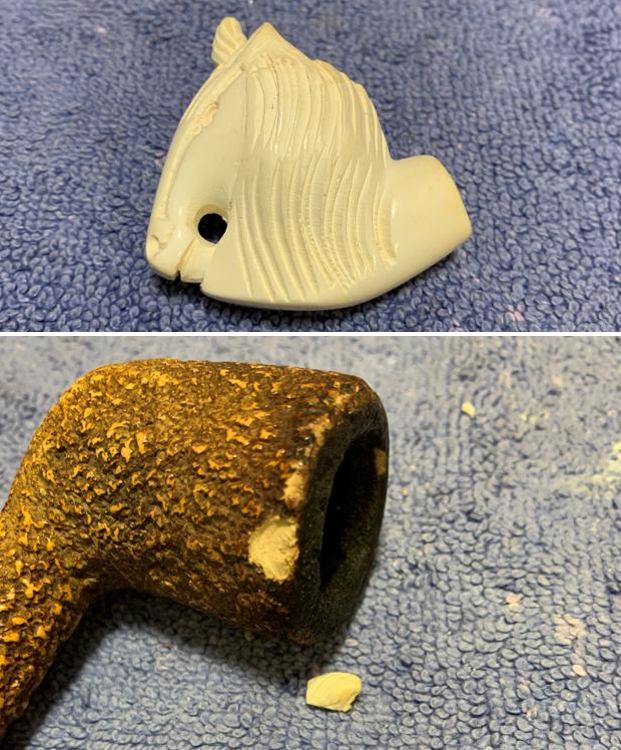
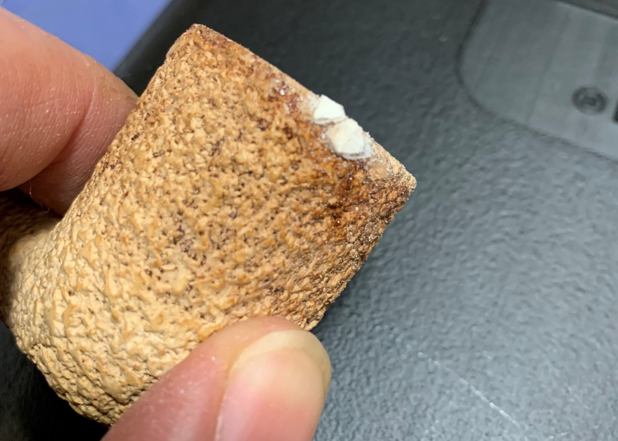
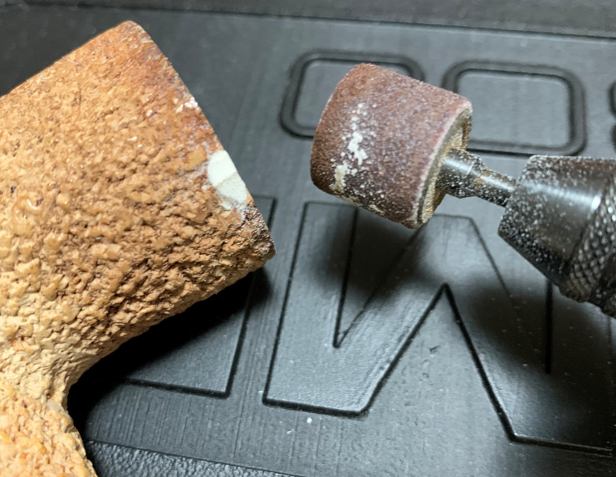
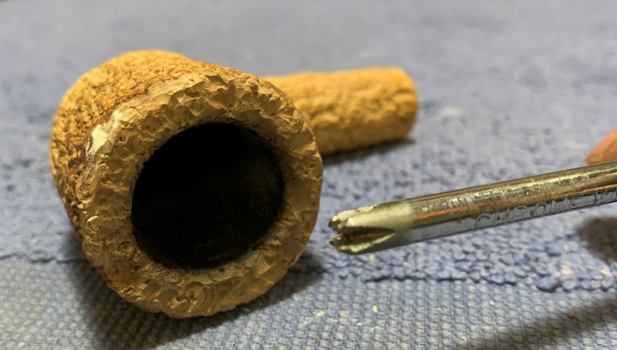
The stummel was next, and the usual cleaning procedures were in order for this pipe. I used both the PipNet Reamer and the KleenReem to remove the built-up cake and followed that with 220-grit sandpaper to remove as much as I could. The meerschaum cannot take the usual de-ghosting process of soaking cotton balls in isopropyl alcohol, so sanding was a way to reduce the old ghost in the pipe. I also wanted to ensure there were no hidden flaws in the interior walls of the meerschaum. Fortunately, there were none. Truth be told, I actually also tried to use a bit of ground coffee in the bowl to remove the ghost, but that was not very successful.I then proceeded to clean out the insides of the shank with Q-tips, pipe cleaners, and isopropyl alcohol. There was quite a bit of nastiness inside this stummel – it took a lot of pipe cleaners etc. to sort that out. I then moved on to cleaning the outside of the stummel with Murphy’s Oil Soap and some cotton pads. That worked very well at removing any latent dirt and that weird yellow tinge that I mentioned earlier. I followed that up by quickly cleaning the insides with some dish soap and tube brushes. The meerschaum cannot be left wet for long – it will turn to mush otherwise. Before & After Restoration Balm does not make the same kind of difference on meerschaum as it does on briar, but it still works – so light coating was applied, followed by my horsehair shoe-brush. On to the inevitable repairs: this is where the nightmares begin. Honestly, it was not immediately clear to me how I was going to make the stummel look decent. Sure, I had cleaned it, etc., but what about the obvious chunks missing from the side? I considered sanding it all down, but I feared this would alter the shape of the pipe beyond reason and repair. I figured that, at very least, this pipe needed to be topped. That is to say, the rim had to be inverted and sanded down on a piece of 220-grit sandpaper. By doing this, it would remove some of the lighter damage altogether and would improve the state of the heavier damage. But the old problem remained: how was I going to repair the chunks of missing meerschaum on this pipe?I then realized that the solution was as obvious as the nose on my face: I would take a piece of meerschaum from another pipe and fashion a repair. I grabbed one of my sacrificial meerschaum pipes (a dreadfully ugly horse’s head) and used a pair of end-cutting nippers to break off a couple of pieces. Having done that, I used cyanoacrylate adhesive to fix them in place on the stummel. I was feeling pretty good about this solution, but knew that there was still a long row to hoe. Obviously, I needed to sand down and shape the new pieces of meerschaum, but I also needed to make the rim as rusticated as the rest of the stummel. Enter the Dremel (with accompanying angelic voices). Yes, I first used a sanding drum on the Dremel to remove excess material from the repair (but not too much), then I used a high-speed engraving cutter to rough up the surface of both the rim and the repair. So far, so good. The engraving cutter had worked – to a point – but it had not really resulted in the sort of rustication I was looking for. My solution came from the Dremel again, but only indirectly. Steve reminded me of his trick of using an old Philips-head screwdriver as a rustication device (you can read about that here). Whereas Steve used Dremel grinding stones to make his rustication device, I used a metal cutting disc on the Dremel. As you can see, my screwdriver came out looking quite good and the stummel came out looking even better. I was definitely pleased with the roughened surface of the stummel, but I next needed to address the lack of colour. This, of course, was a direct result of my topping of the rim – it removed the patina. The solution must have come to me in the mid-afternoon: tea. Yes, I used black tea to provide a beautiful stain to the meerschaum that gave it a really good look. I went and added some more Before & After Restoration Balm and, once again, used my horsehair shoe-brush to work it in.Meerschaum does not really do well on a high-speed buffer, so I used a microfibre cloth to achieve the same effect. I did, however, take the stem to the buffer, where I applied White Diamond and some wax to give it that lovely shine.

In the end, what a beauty this pipe is! It is back to its old glory and ready to be enjoyed again by the next owner. I am pleased to announce that this pipe is for sale! If you are interested in acquiring it for your collection, please have a look in the ‘Irish’ pipe section of the store here on Steve’s website. You can also email me directly at kenneth@knightsofthepipe.com. The approximate dimensions of the pipe are as follows: length 154 mm; height 47 mm; bowl diameter 34 mm; chamber diameter 20 mm. The mass of the pipe is 40 grams. Thank you very much for reading and, as always, I welcome and encourage your comments.

Bringing a Peterson’s Rhodesian Shaped Meerschaum back from the brink


Blog by Steve Laug

The next pipe on my “to do list” from the fellow in Dawson Creek is a Peterson Meerschaum that has some great colour to it. It is made of African Meerschaum which is denser than Turkish meerschaum and usually unevenly colour to the extent that they are stained to give the pipe a better look. This one is a mottled brown and cream coloured block. I am not sure how much of it is the aging patina and how much is the stain but I love the look of the pipe.

peteI did a bit of hunting on the internet to try to find a photo of the pipe. It was hard to find a Meerschaum Rhodesian picture and found one that is the close to same shape. It has a flumed dark top edge or cap. The shape of the stem is a little different at the shank union than the one I am working on. The one in the photo is more pinched at the shank. The one I am working on has a band of cream coloured meer that is rounded over and the stem sits against it.

I have been watching eBay for the Pete’s and have not found one this shape. I have read that African Block Meerschaums Peterson’s are getting harder to find since the Laxey meerschaum mines shut down in 2006. I have a few of the pipes in my collection and I have found that they are heavier than Turkish meerschaum due to the inclusion of minerals and aggregate material in the Block and the fact that they were ‘Calcinated’ after being carved, to give them greater strength and durability. They will color with smoking and the use of beeswax, but it will be more of a gradual process than high-grade Turkish meerschaums.

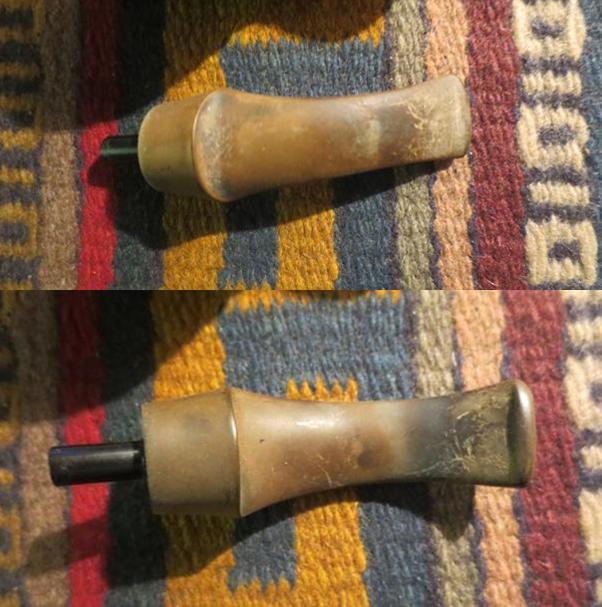
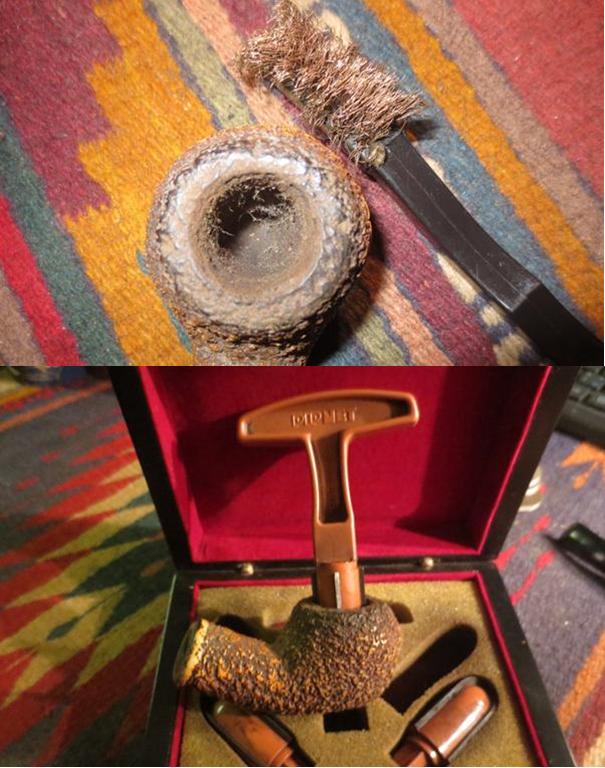
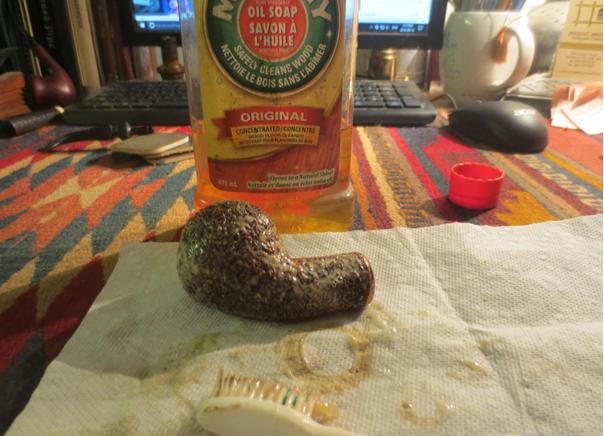
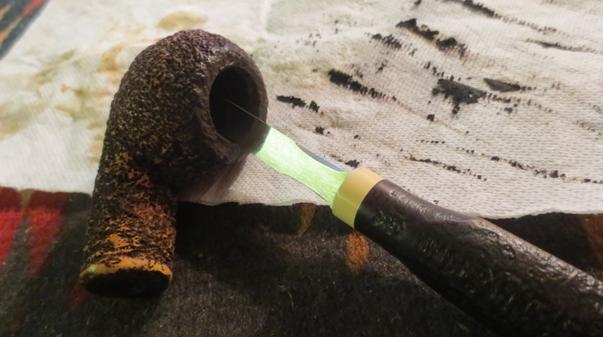
The pipe from Dawson Creek was heavily caked which bodes well for it being a great smoking pipe. The rustication on the rim was thickly cake with the overflow from the bowl. The rusticated finish on the bowl and shank was dirty. The stem was heavily oxidized and there was some tooth chatter on the top and underside near the button. The P stamp was faded though it still was deep enough for a touch up job. I was looking forward to seeing what the finished pipe would look like after the cleanup.pete1 pete2I took a close up photo of the rim and the bowl. It shows the thick cake that is slightly sticky and has picked up a lot of dust and debris. The rustication on the rim is filled in with tars and oils to the point you cannot really see the grooves and ridges.pete3The Delrin tenon is glued into the vulcanite stem and mortise is lined with a Delrin tube. The tenon was surprisingly small in diameter for a stem this large when I took the pipe apart. The photo below shows the pipe taken apart.pete4I took some close up photos of the stem to show the oxidation and tooth chatter on the stem. There was large tooth mark on the top of the stem. It is hard to see in the photos below but after the first cleaning it would be visible.pete5I used a brass bristle brush to scour the top of the rim to remove the thick cake and reveal the crevices and ridges below the grime. I reamed the bowl with a PipNet reamer to take out the majority of the cake. I would need to clean it further later.pete6I scrubbed the externals with a tooth brush and Murphy’s Oil Soap to remove the grime and oils in the grooves of the bow and shank. I rinsed the bowl off with warm running water to remove the soap and dirt. I scrubbed it more under the running water using the tooth brush.pete7I dried off the bowl and used Savinelli Pipe Knife to clean up the inside of the bowl and remove the last of the cake.pete8I cleaned the mortise and the airways in the shank and the stem with alcohol, pipe cleaners and cotton swabs until the internals were clean.pete9I put the stem in an Oxyclean bath and let it sit overnight. In the morning I took it out of the bath and rubbed it down with a coarse cloth to remove the loosened oxidation. I took the following photos to show the stem at this point. The second photo shows the deep tooth marks.pete10Because the dent was round and smooth I decided to try to lift it with heat. I used a Bic lighter and “painted” the dent with the heat. It took a couple of passes of the lighter before it was smooth. The dent rose up to meet the surface of the stem. I did not need to do a fill or repair on the stem.pete11I touched up the P stamp with white acrylic and a fine brush. I overfilled the P and let the paint dry. Once it was dry I carefully scraped it off with a sharp knife and sanded it smooth. The second photo shows the stem stamping.pete12I took photos of the bowl at this point to show how it looked after cleaning. pete13 pete14I polished the stem with micromesh sanding pads – wet sanding with 1500-2400 grit pads and dry sanding 3200-12000 grit pads. I rubbed it down with Obsidian Oil between each set of three pads. I set the stem aside to dry.pete15 pete16 pete17I buffed the stem with Blue Diamond on the buffing wheel. I avoided buffing the bowl with the Blue Diamond because it would collect in the grooves and ridges of the meerschaum. I gave the stem multiple coats of carnauba wax and buffed the pipe and stem with a clean buffing pad to polish the wax on the stem. I hand buffed the pipe with a microfibre cloth. The finished pipe is shown in the photos below. I think this one will be a good smoking pipe for Steve once I send it back to Dawson Creek. Thanks for looking.pete18 pete19 pete20 pete21 pete22 pete23 pete24 pete25 pete26