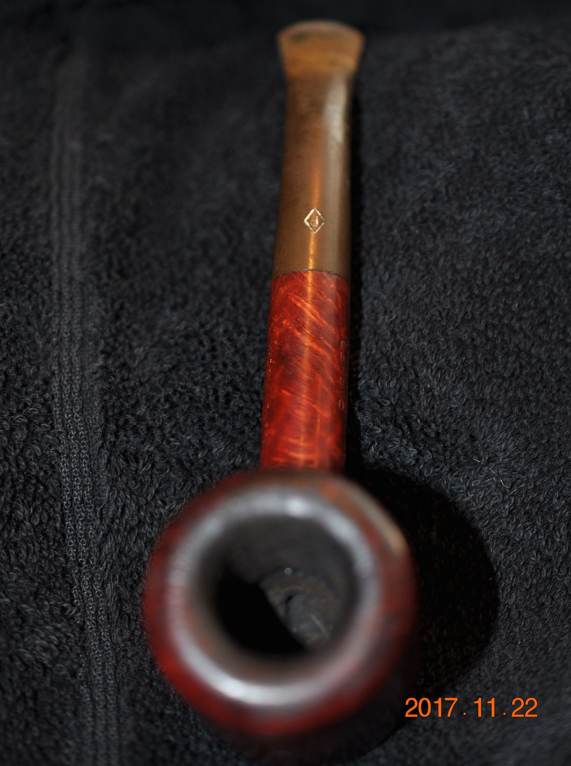
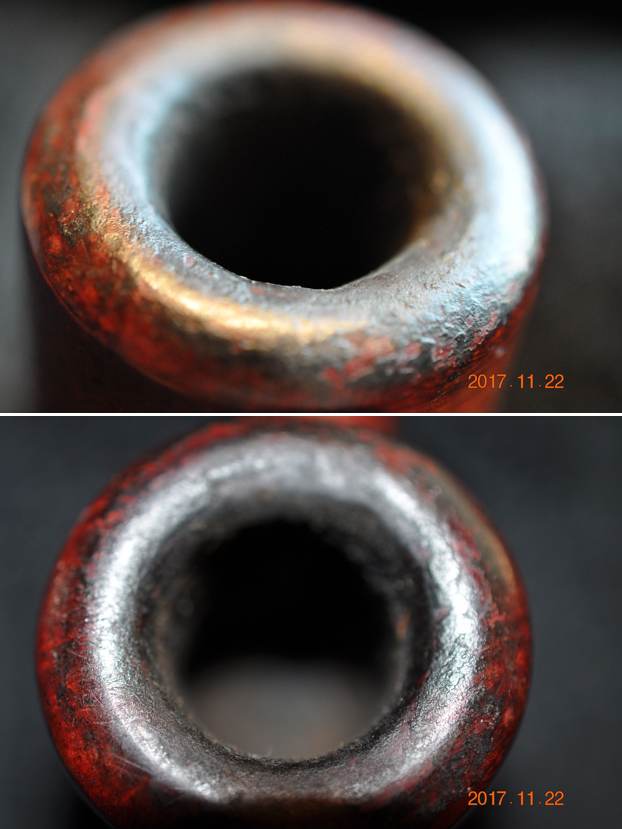
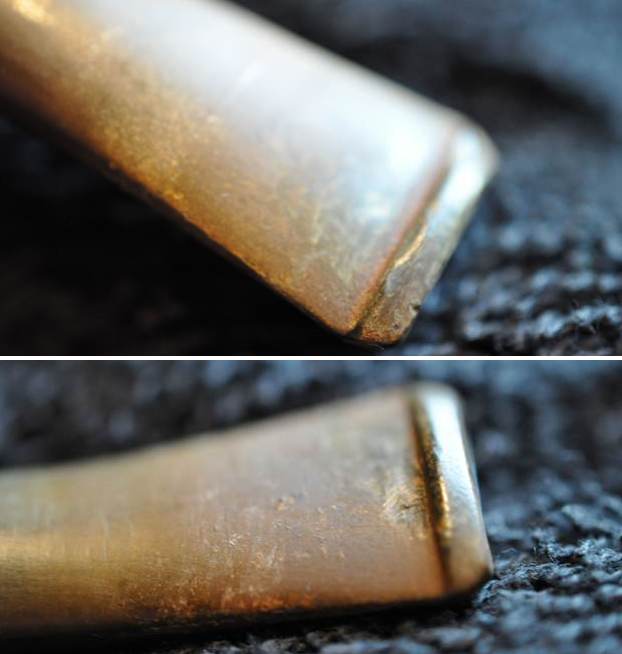
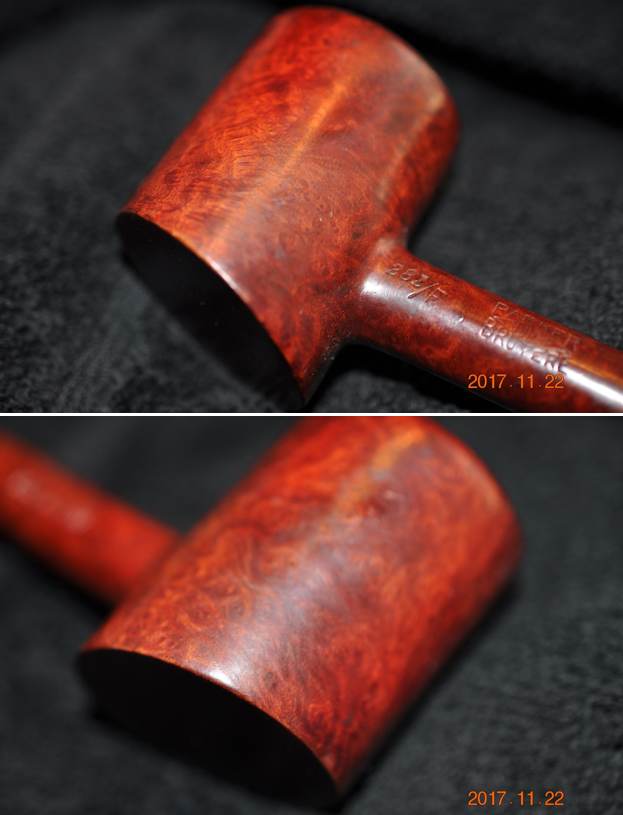
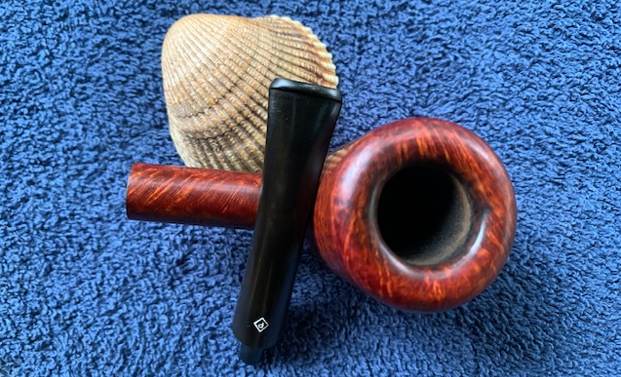
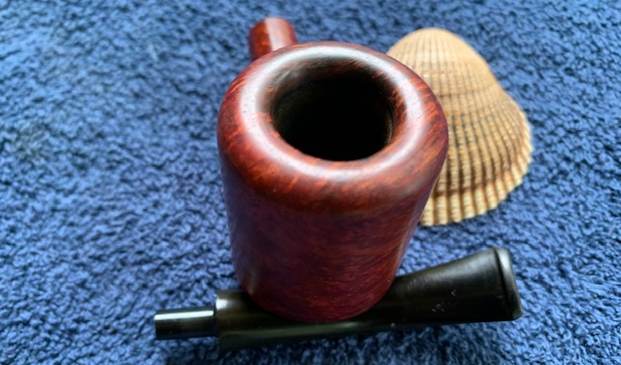
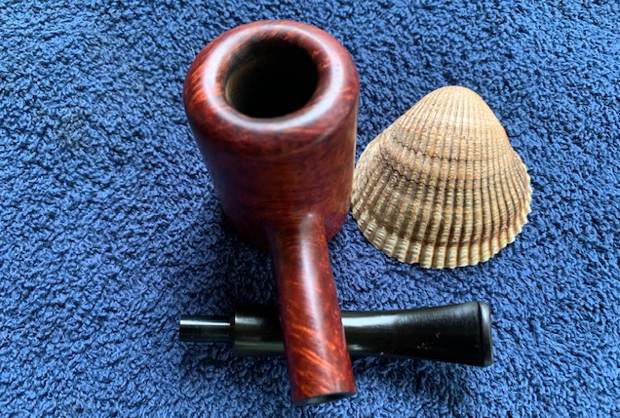
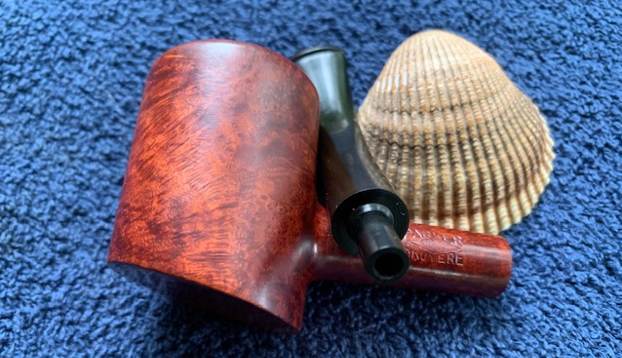
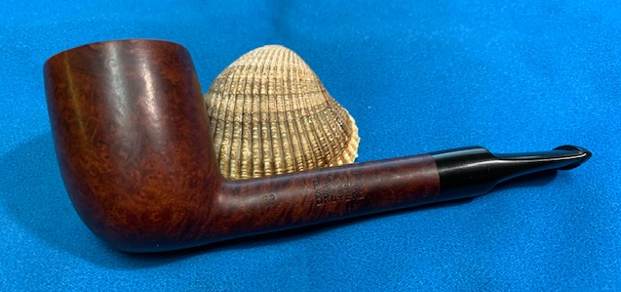
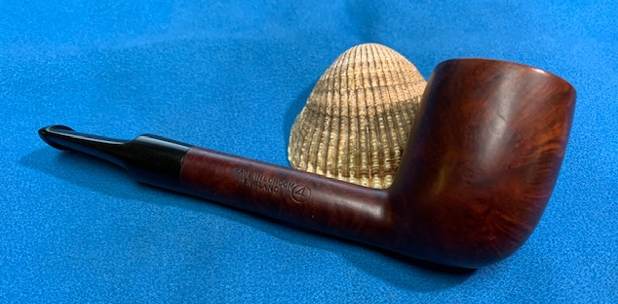
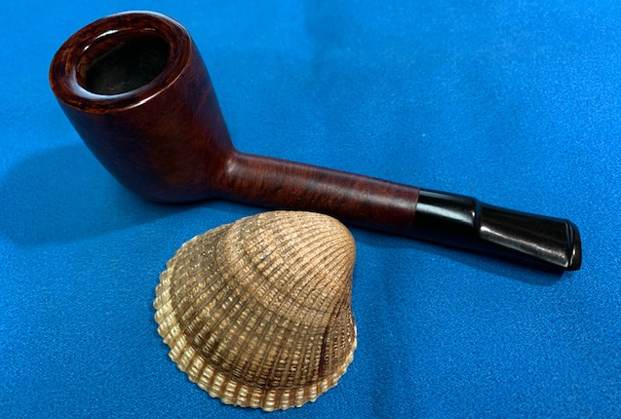
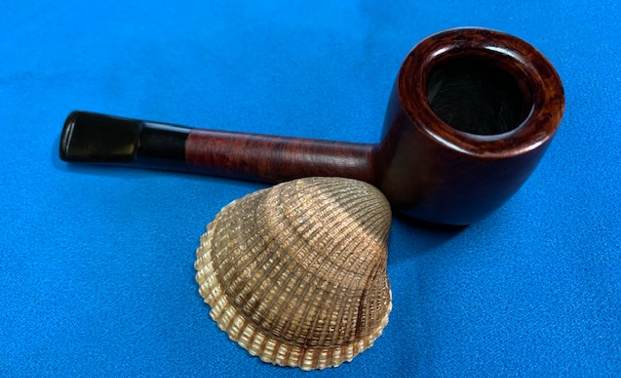
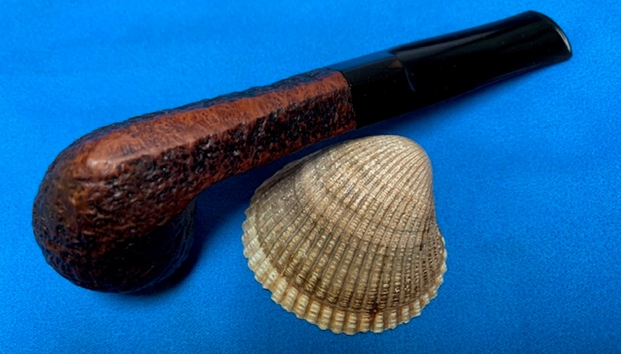
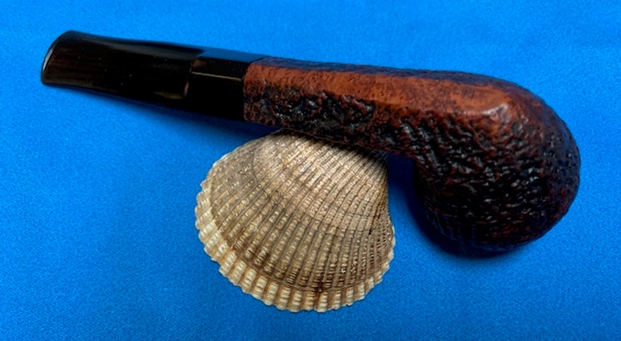
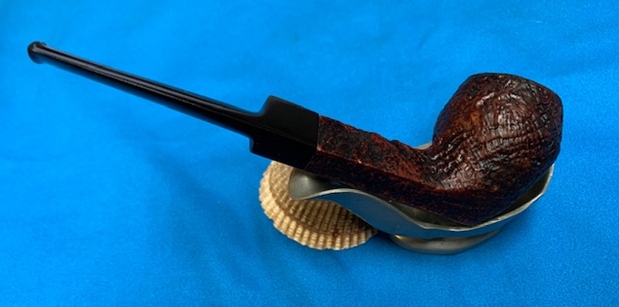
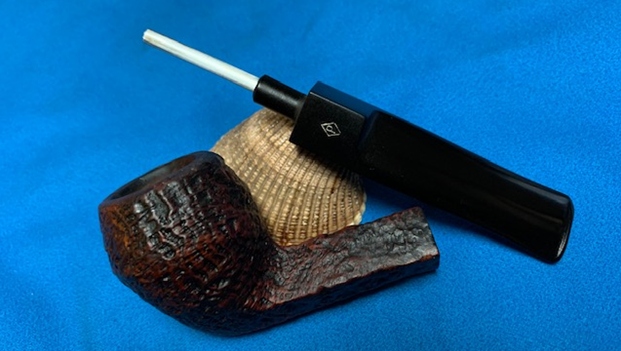
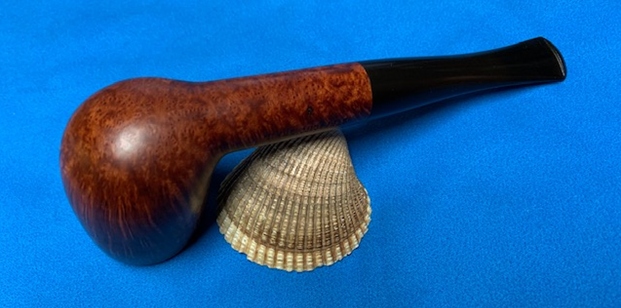
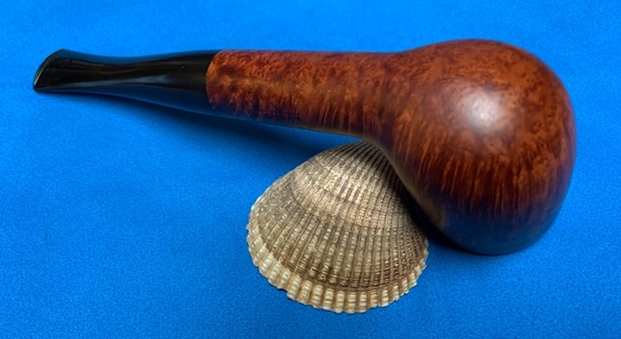
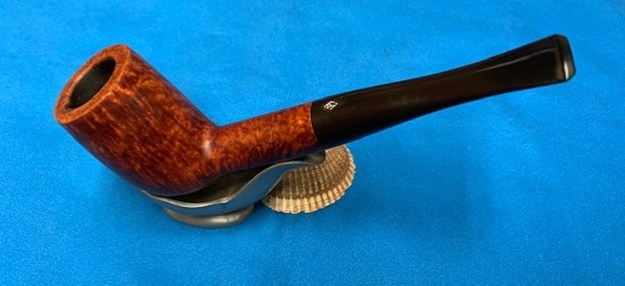
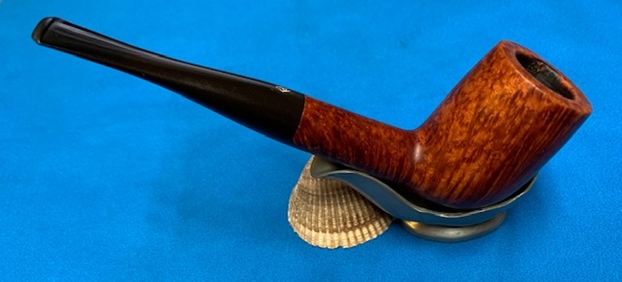
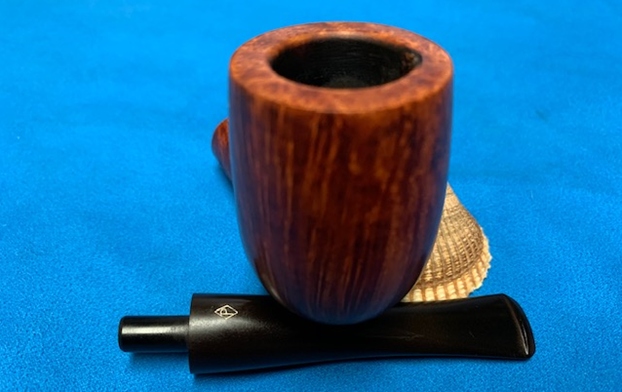
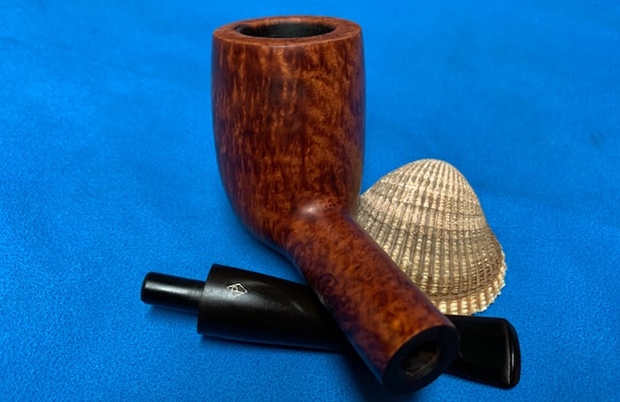
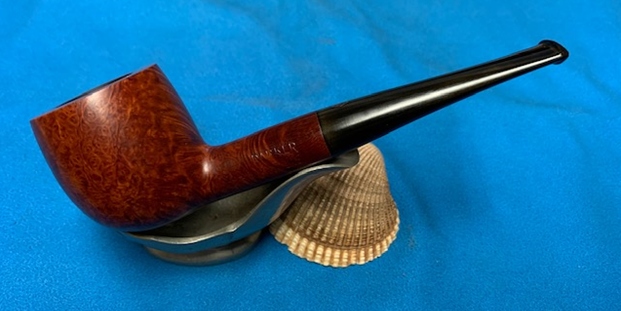
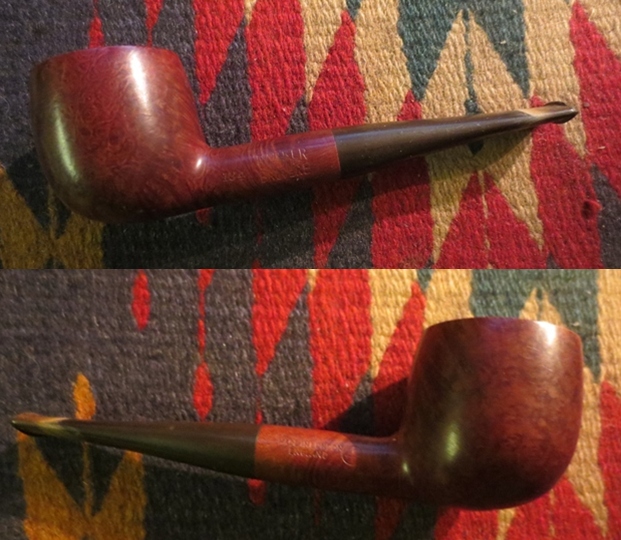
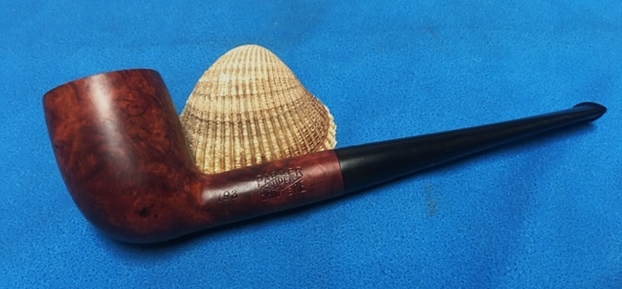
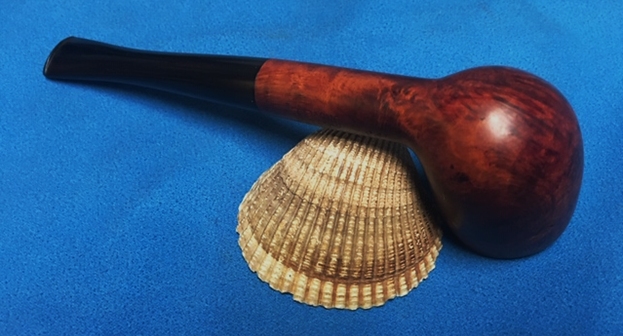
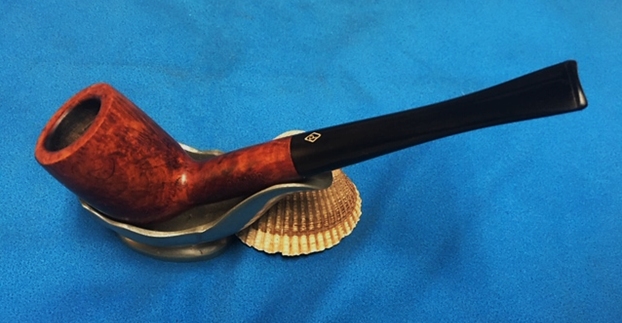
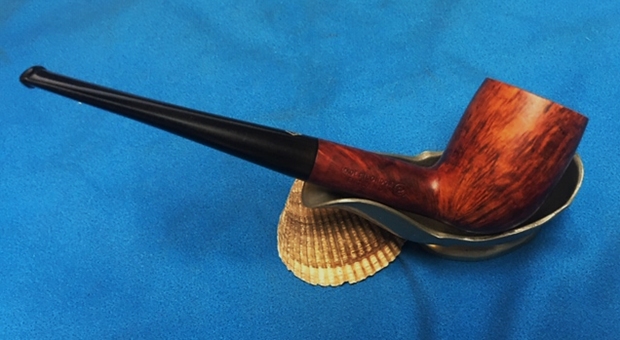
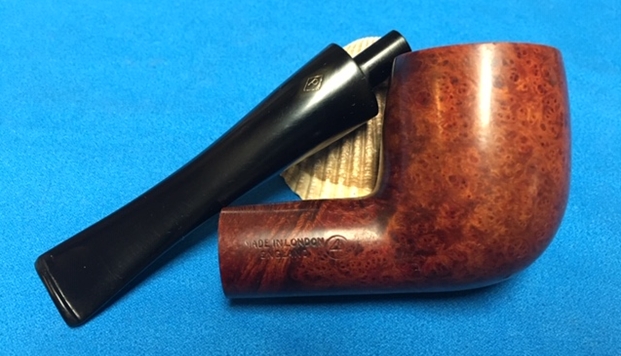
Tag Archives: Parker Pipes

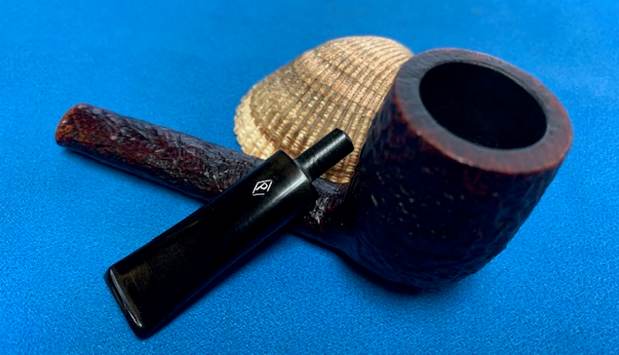
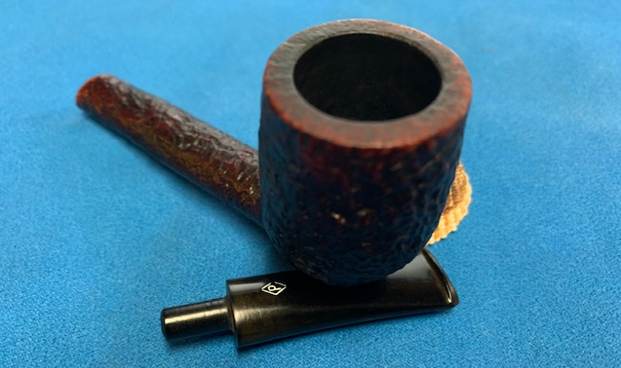
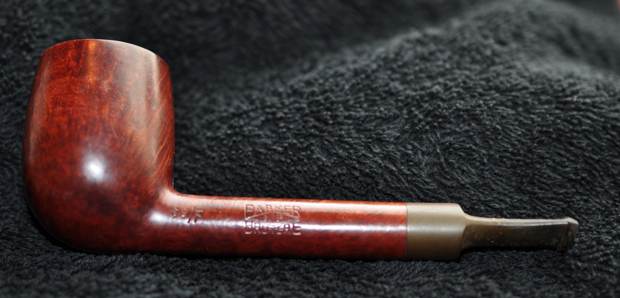
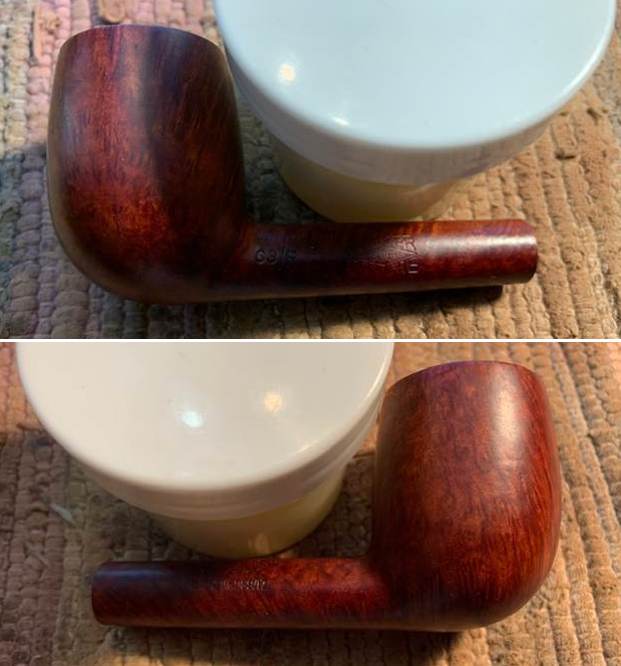
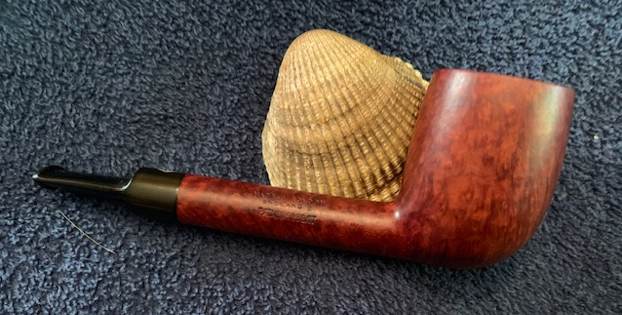
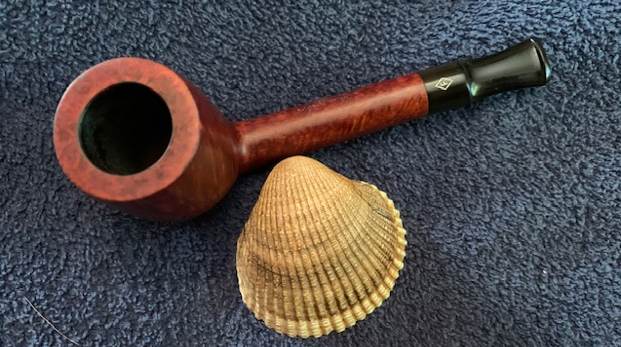
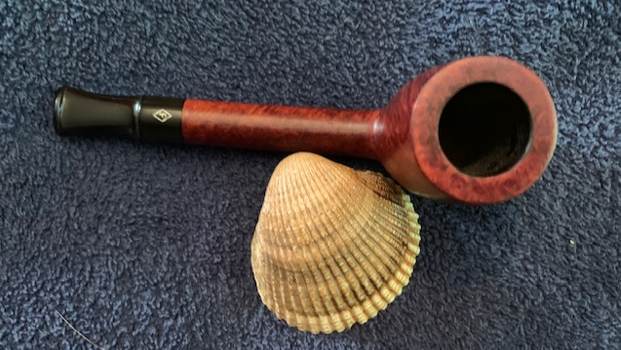
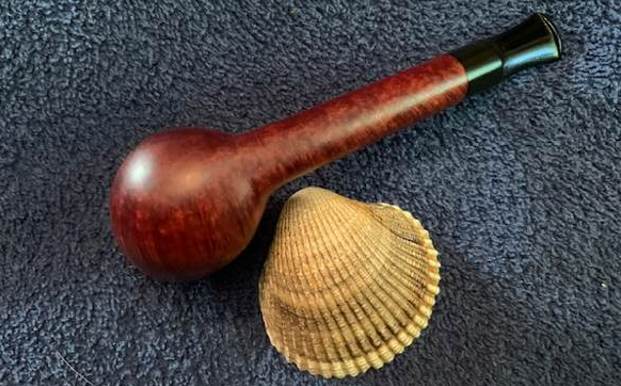
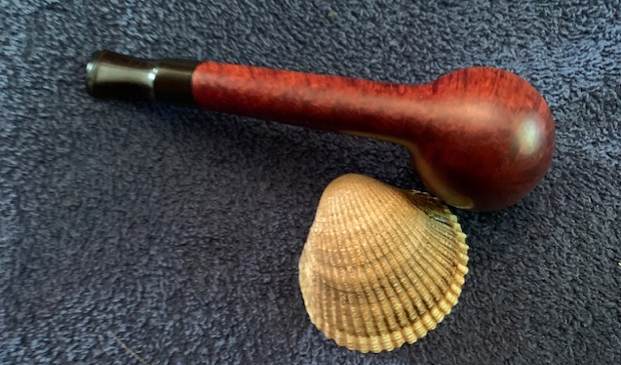
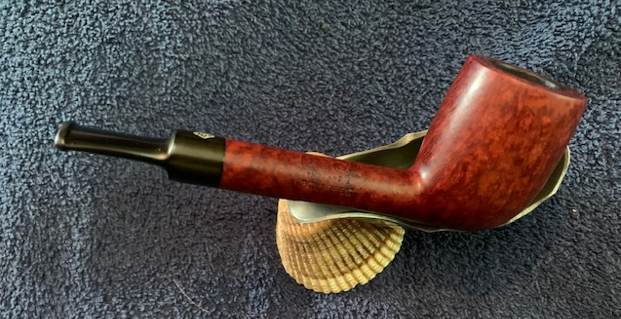
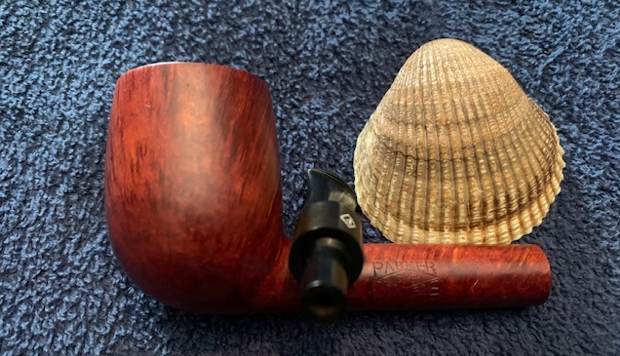
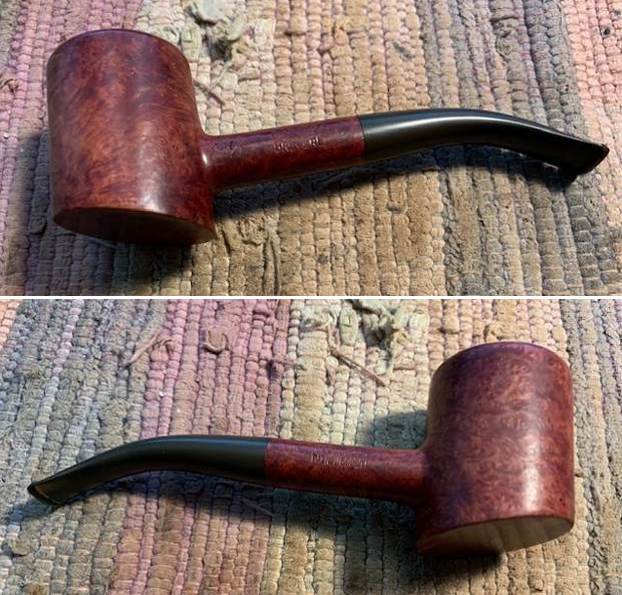
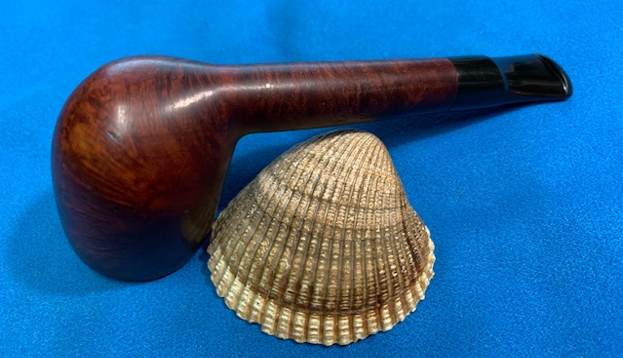
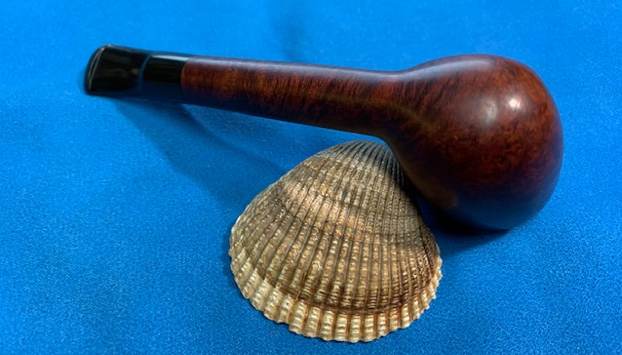
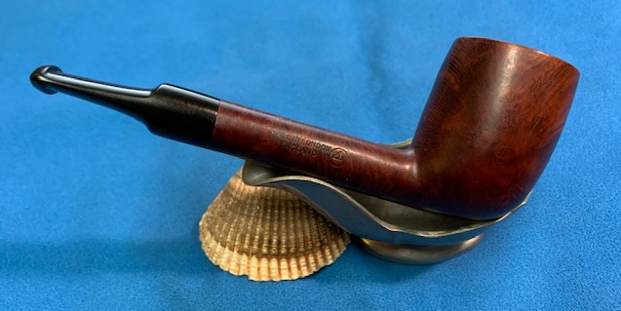
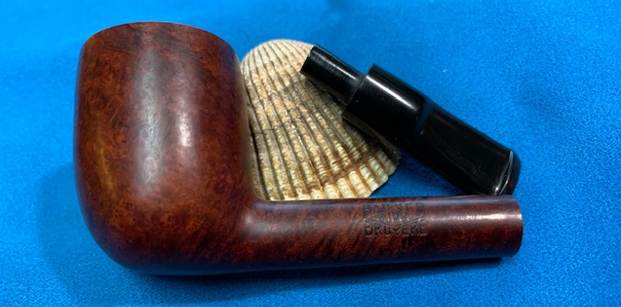
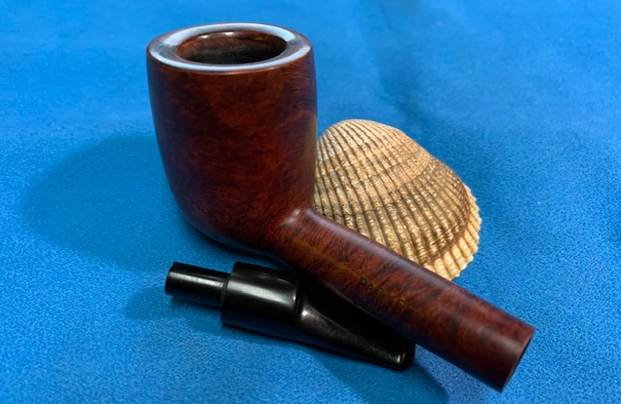
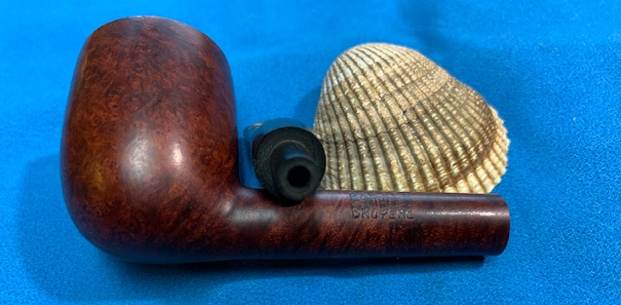
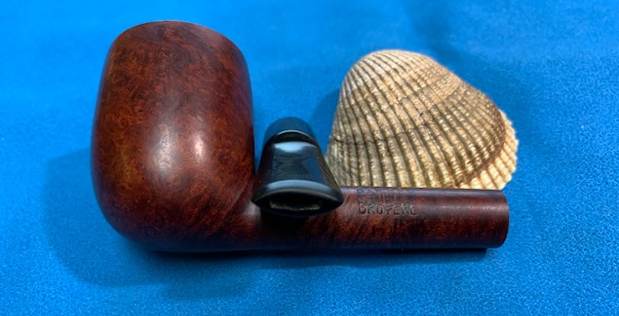
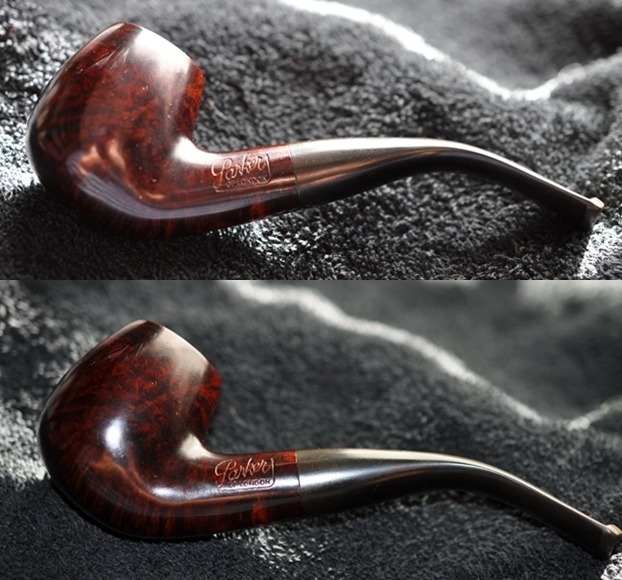
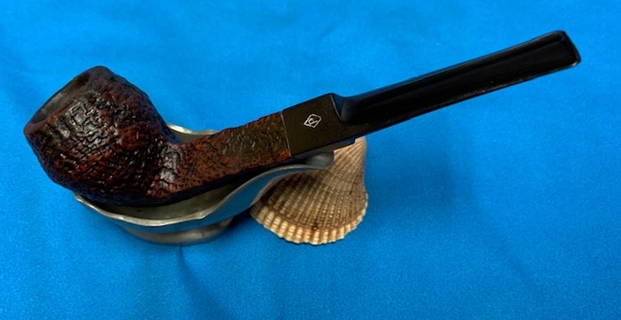
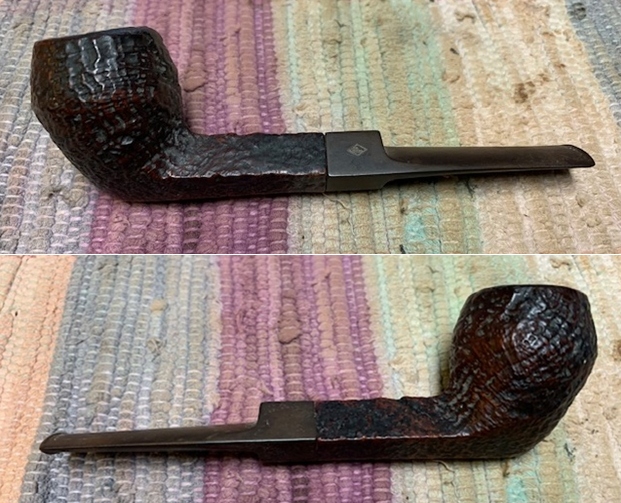
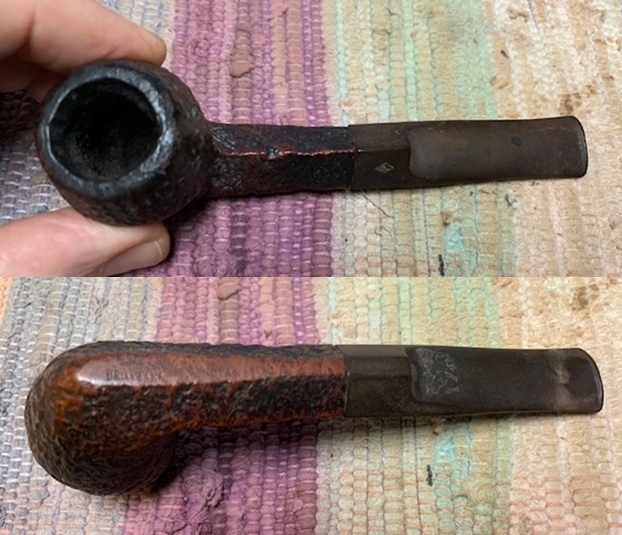
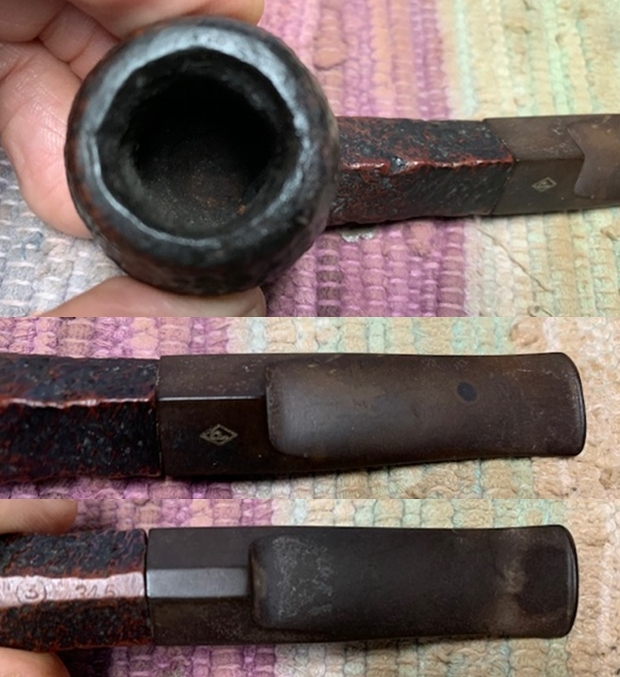
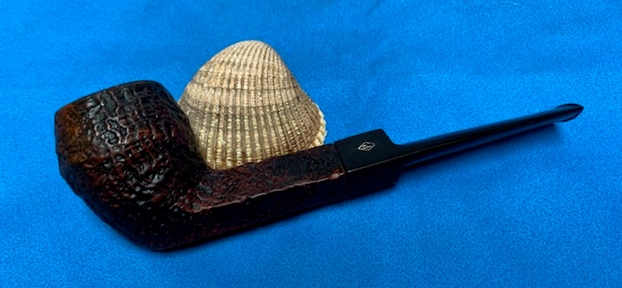
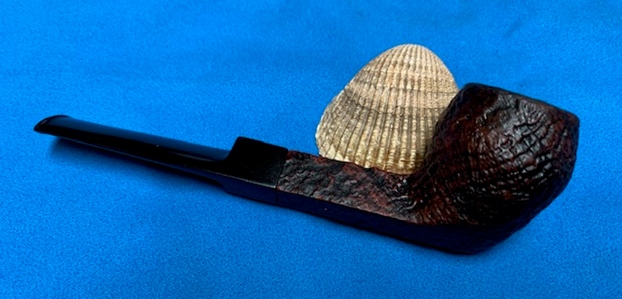
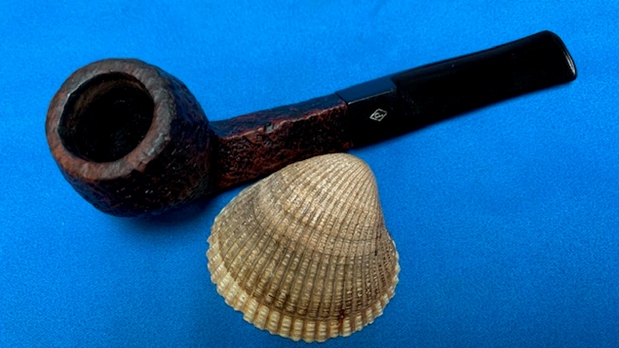
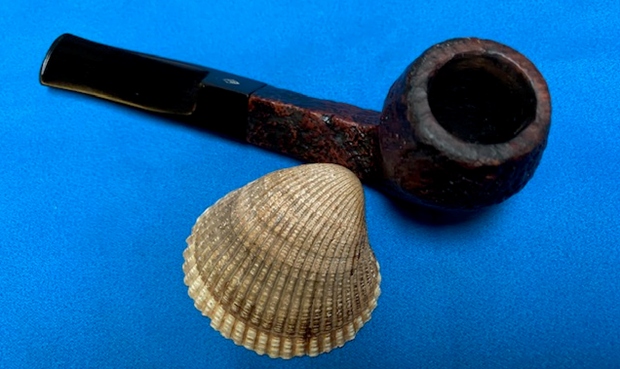
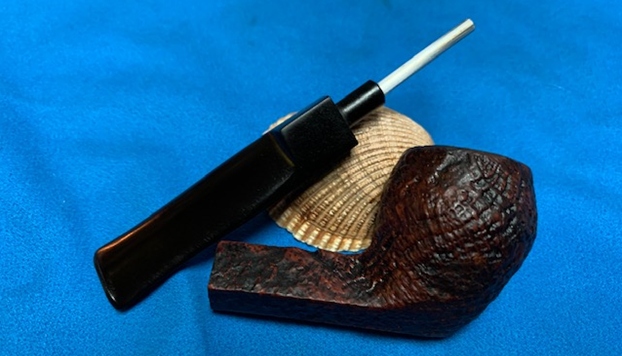
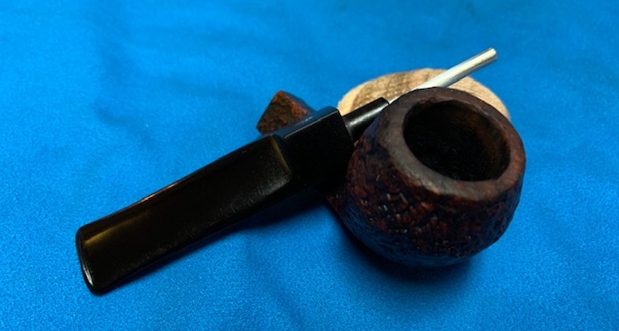
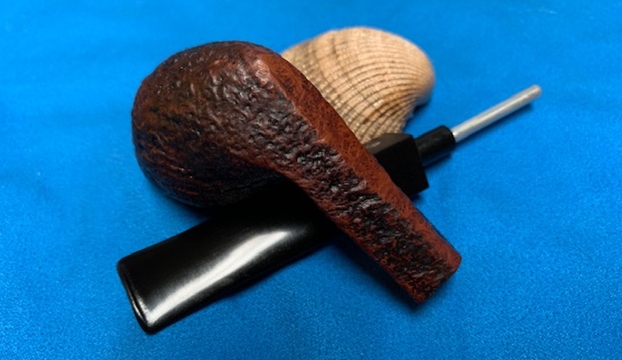
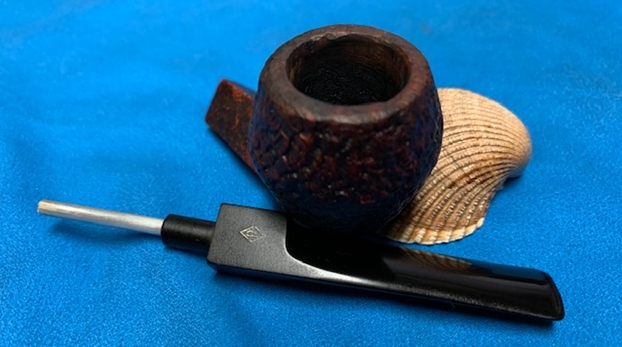
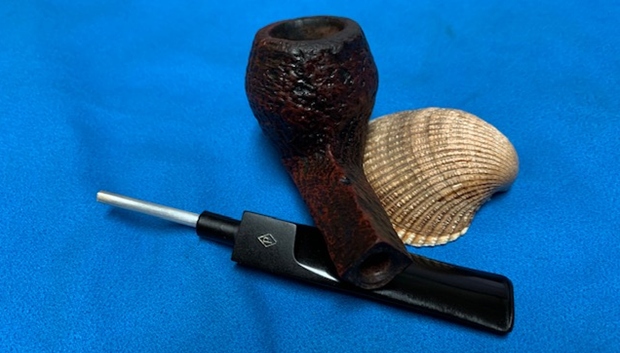
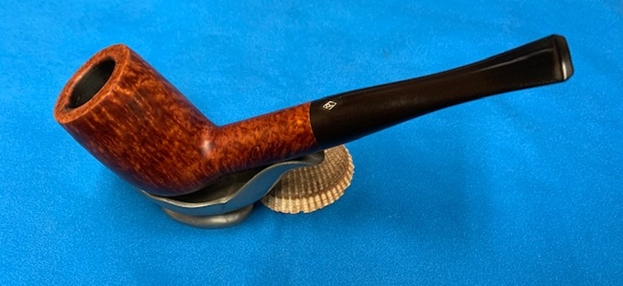
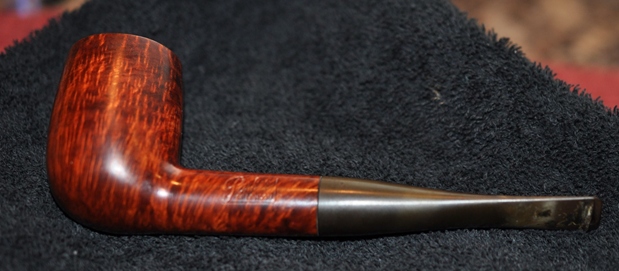
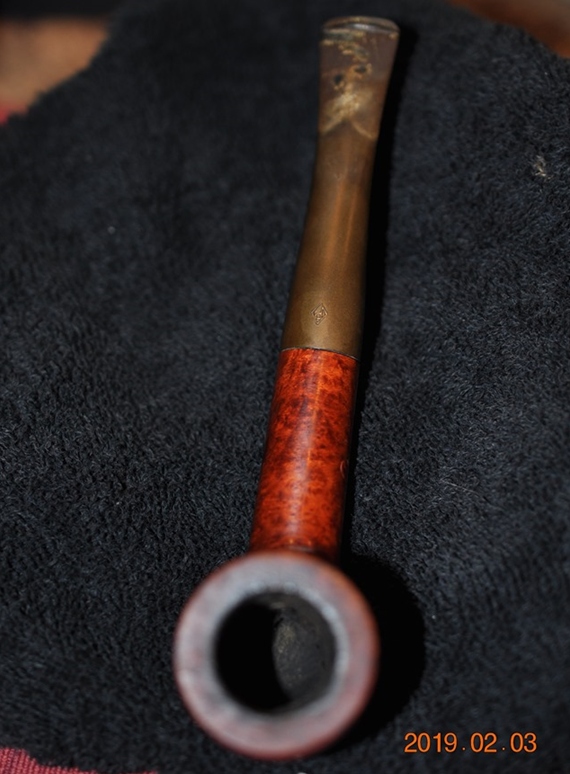
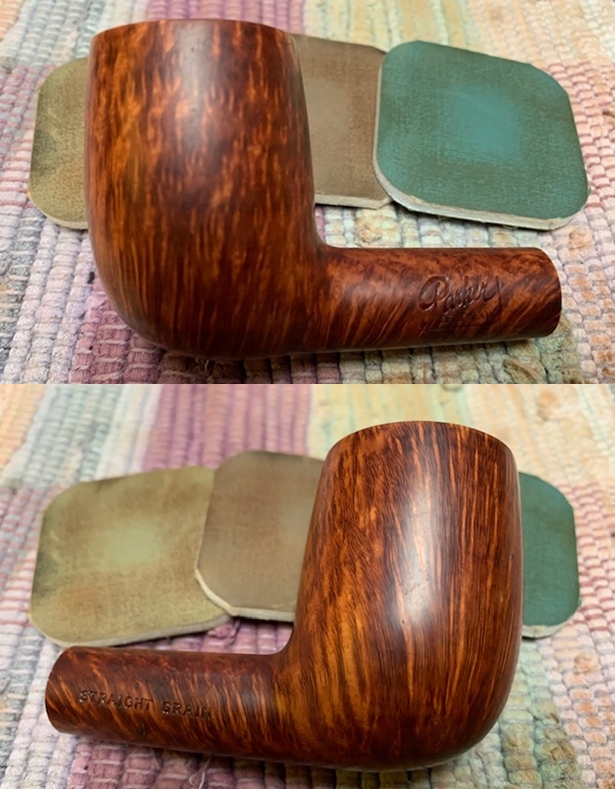
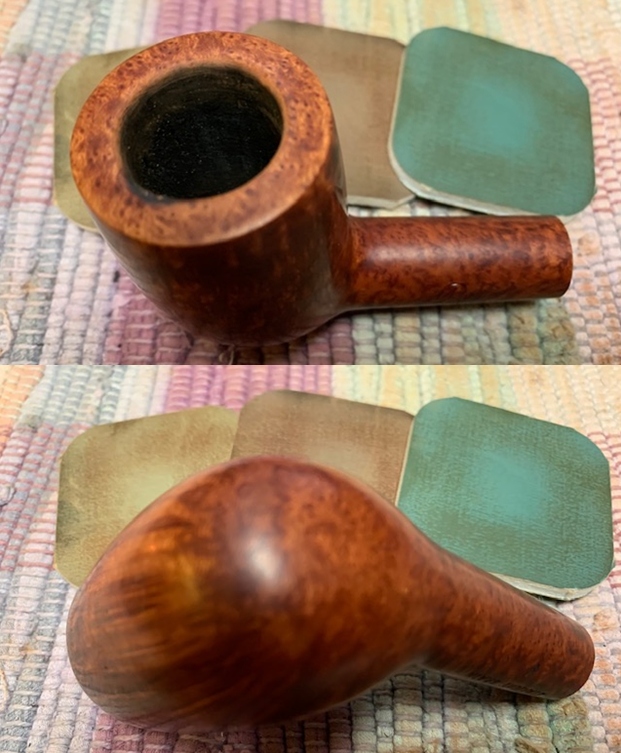
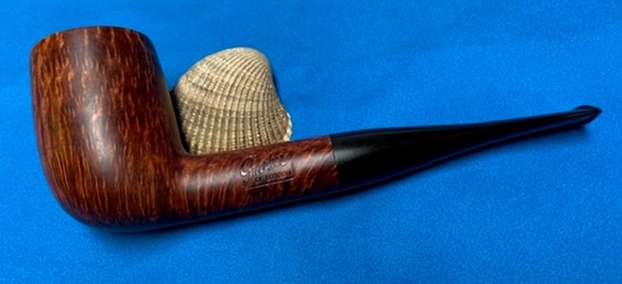
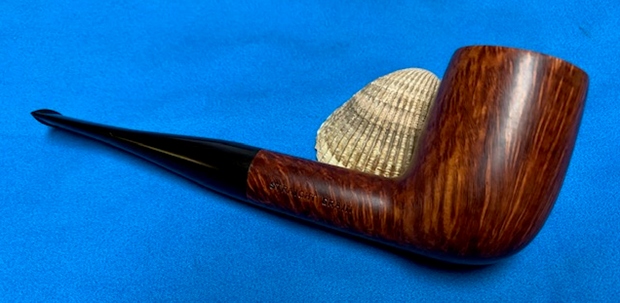
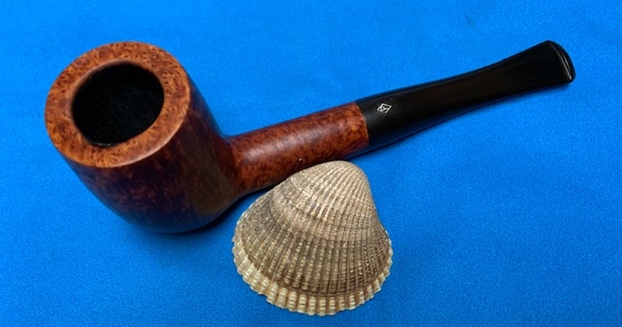
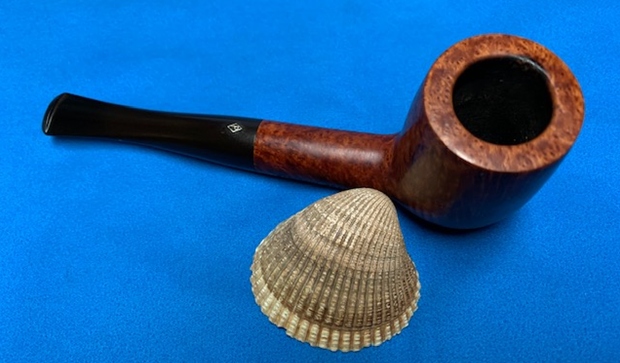
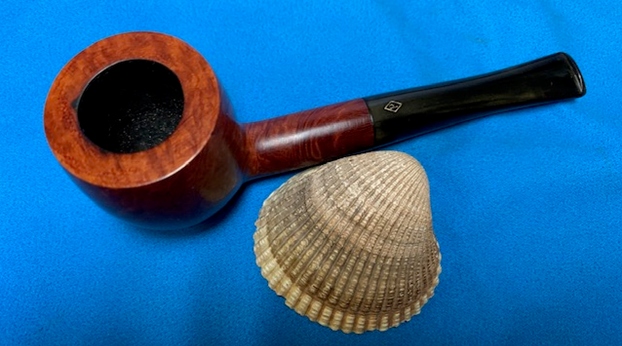
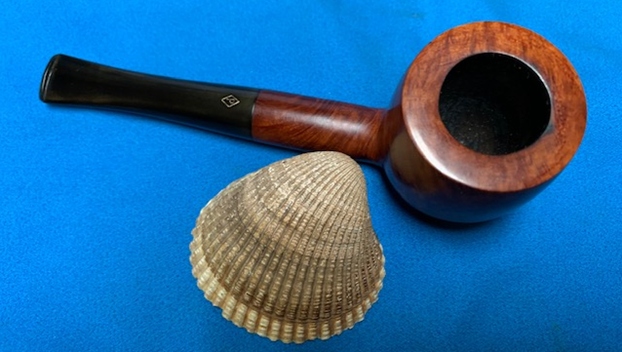
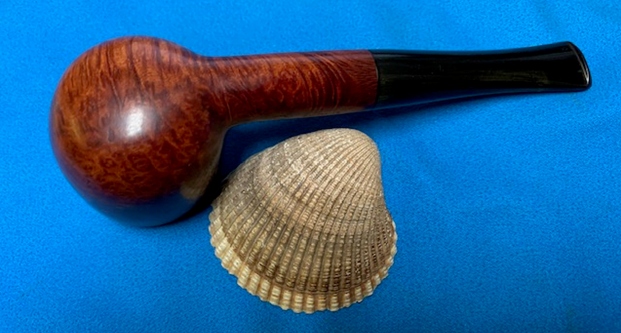
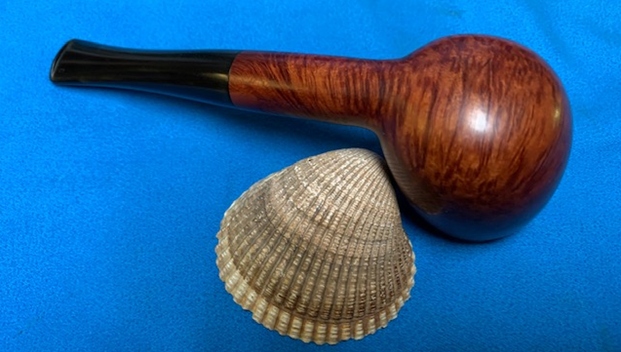
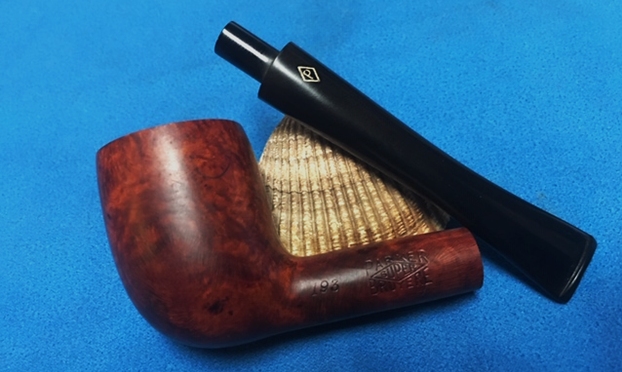
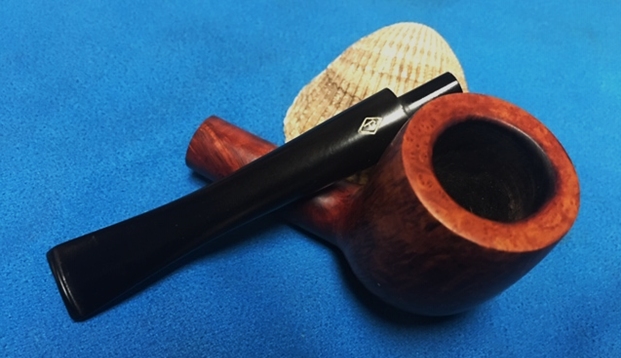
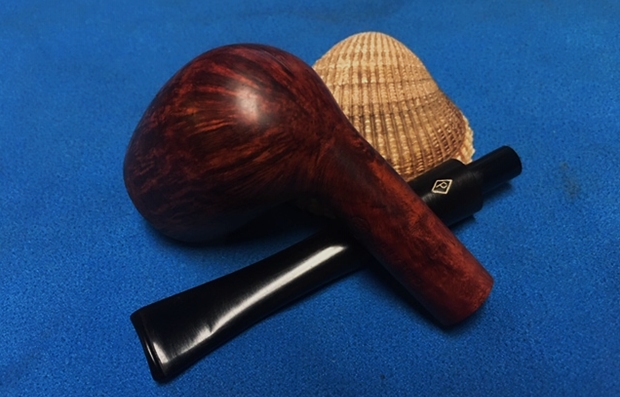
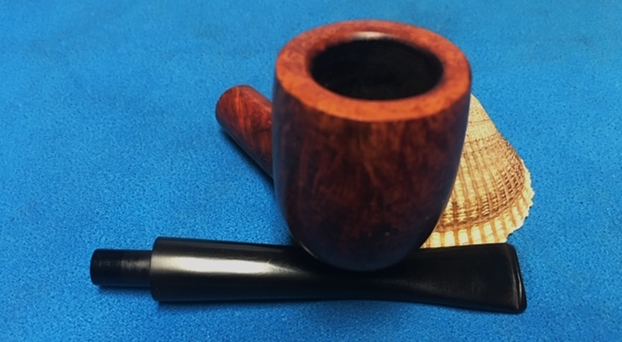
Renewing a Parker Super Bark Sandblast 132 Canadian


Blog by Steve Laug

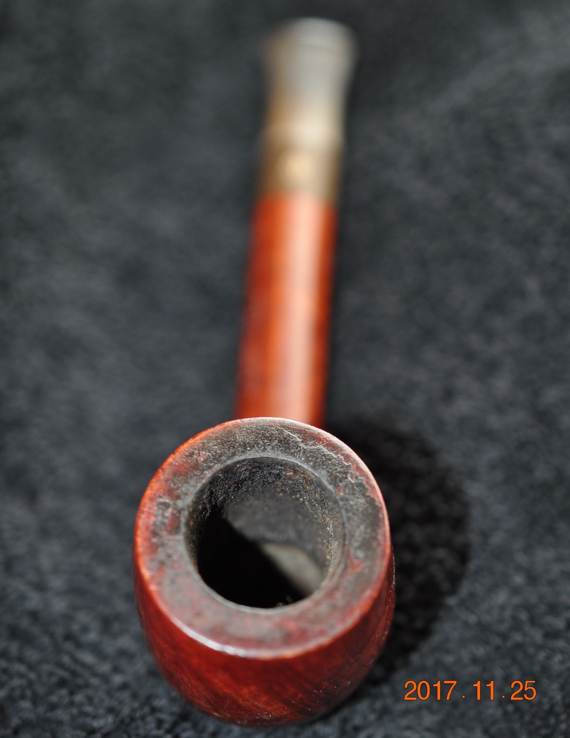
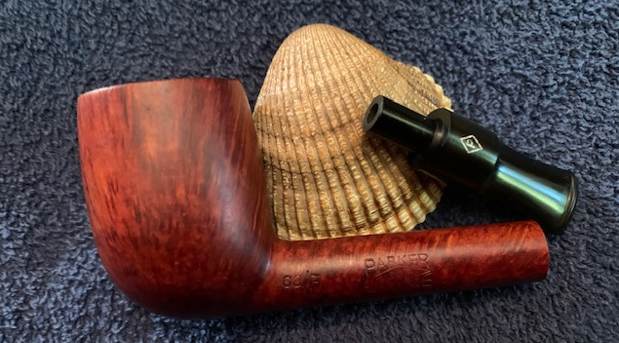
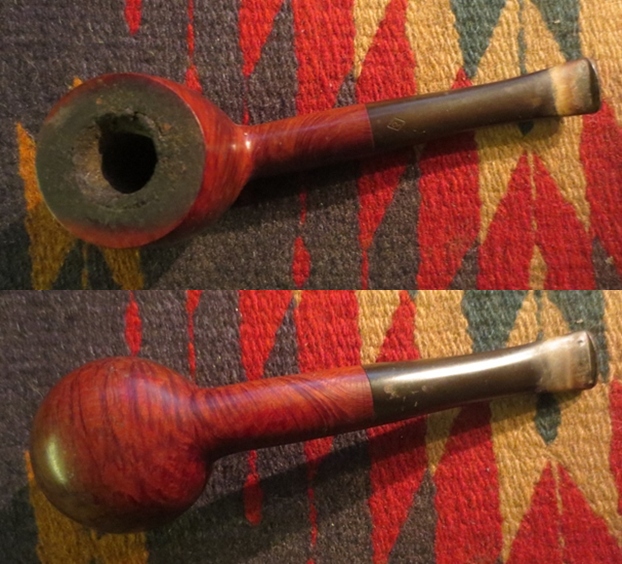
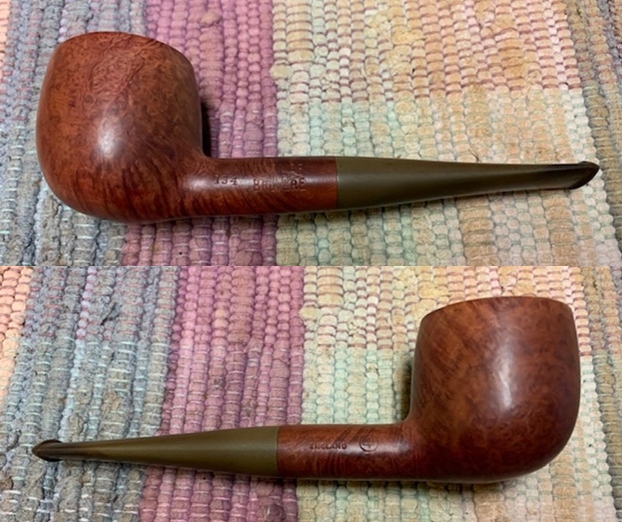
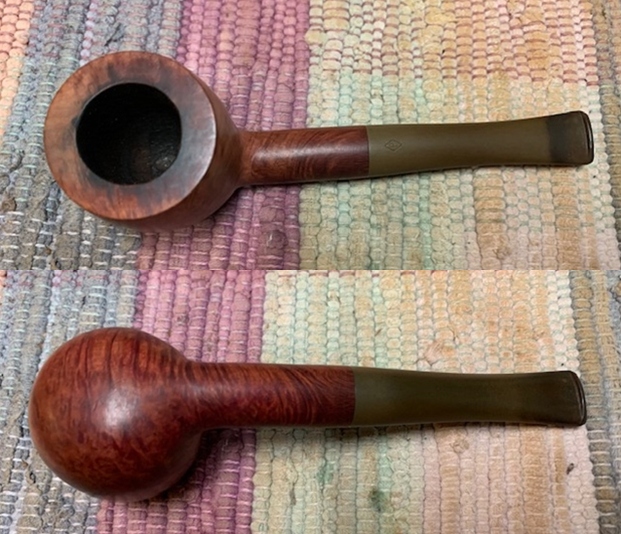
I thought I would continue with the same tack I took on the three pipes and take you through my process of working on each pipe that we purchase. Jeff has set up a spread sheet to track where the pipe came from, the date of purchase and what we paid for it so that we know what we have invested in the pipe before we even work on it. This takes a lot of the guess work out of the process. This particular pipe was purchased on 01/26/2023 in a group of pipes from a fellow in Copenhagen, Denmark. I also want you to understand why we take the photos we do. It is not accidental or chance as the photos have been taken to help me make an assessment of the pipe Jeff sees before he starts his clean up work. We do this to record the condition that the pipe was in when received it and to assess what kind of work will need to be done on. When I look at these photos this is what I see.

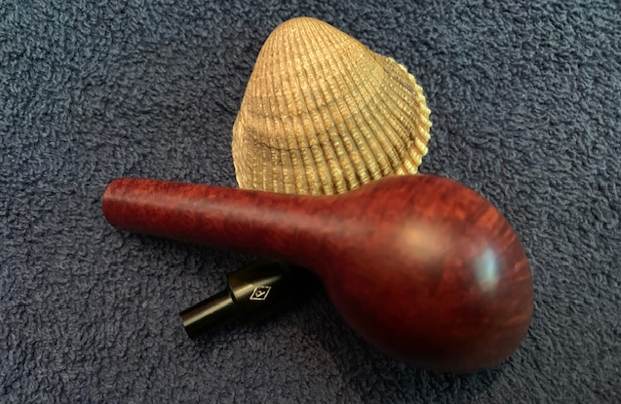
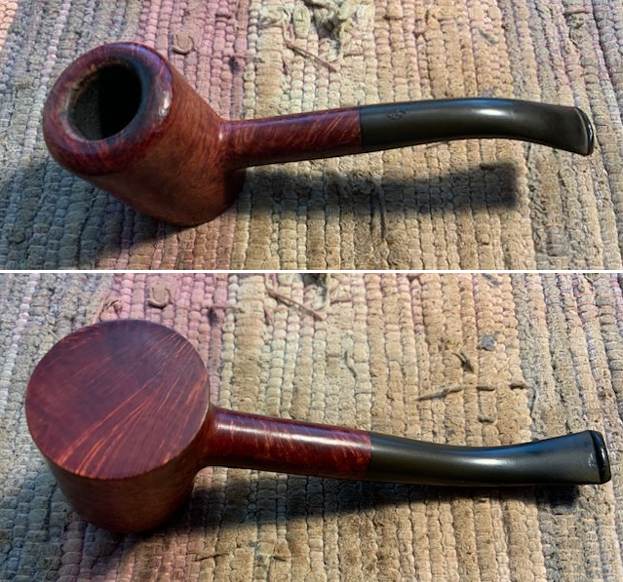
  1. The finish is dirty with dust grooves and valleys of the sandblast bowl and shank. There are some tars and lava flowing down the edges of the rim cap. Underneath there appears to be some excellent grain.
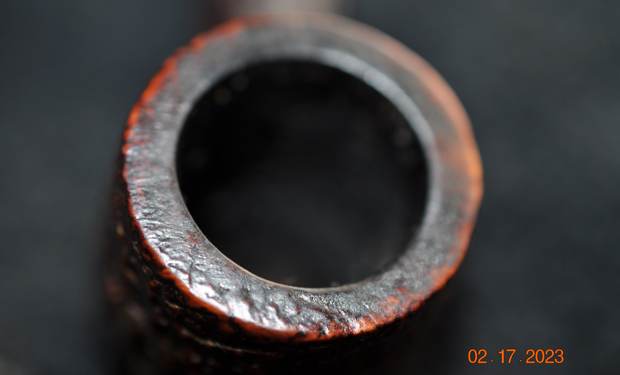
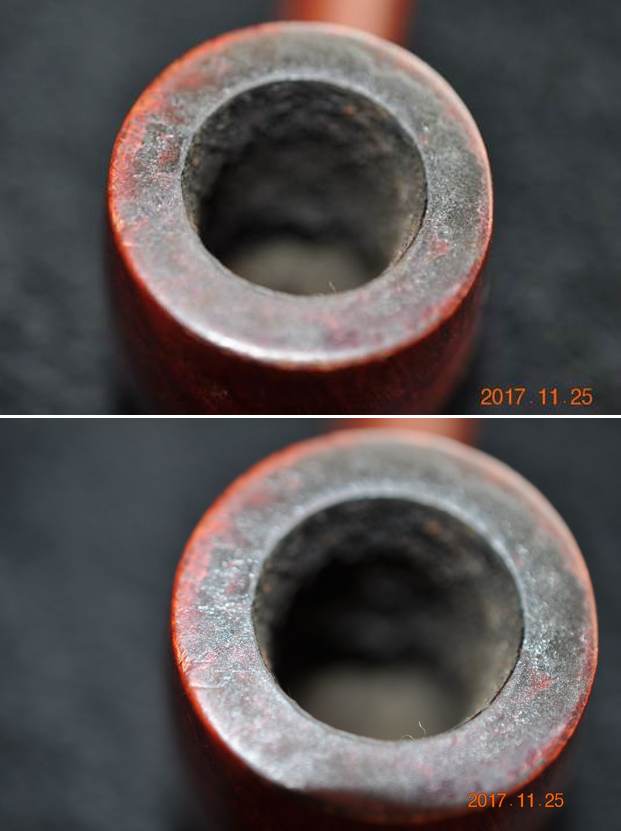
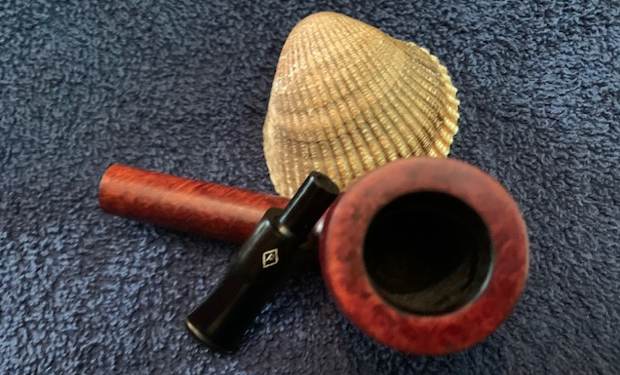
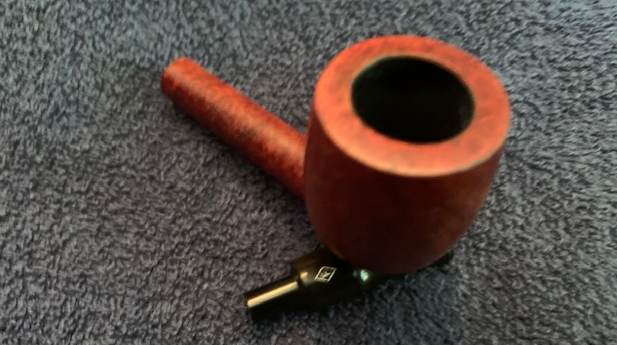
  2. The sandblast rim top is dirty. There is some lava overflow from the cake in the bowl and some darkening on the rim top.
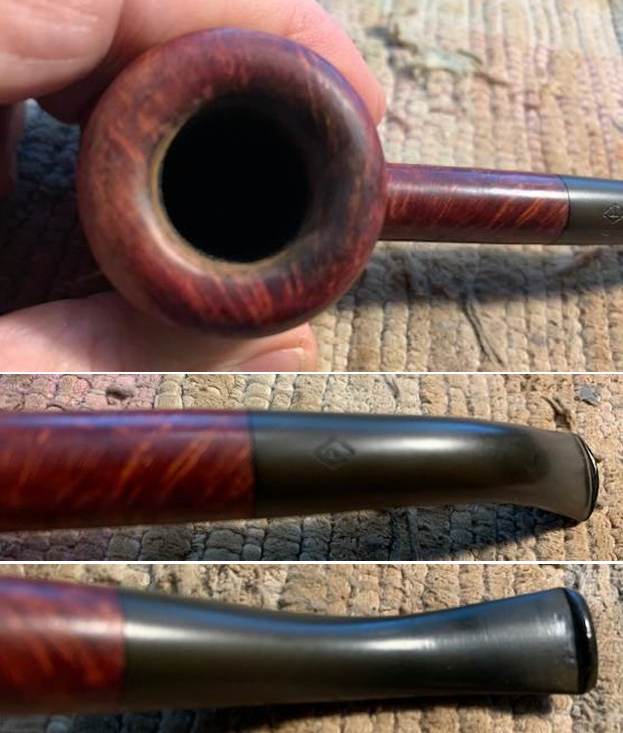
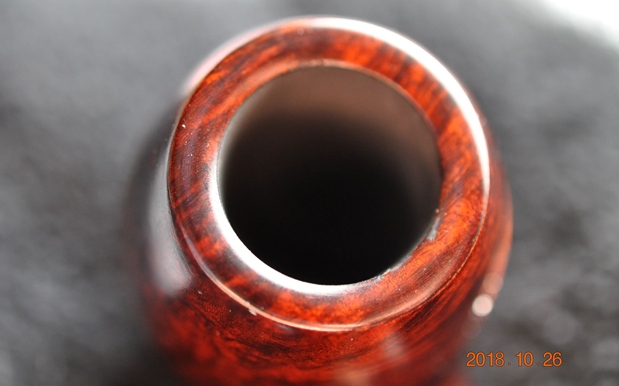
  3. The bowl has a thick cake in it but the inner and outer edge of the bowl actually look to be undamaged from what I can see at this point. There does not appear to be any burning or reaming damage to the edges of the bowl.
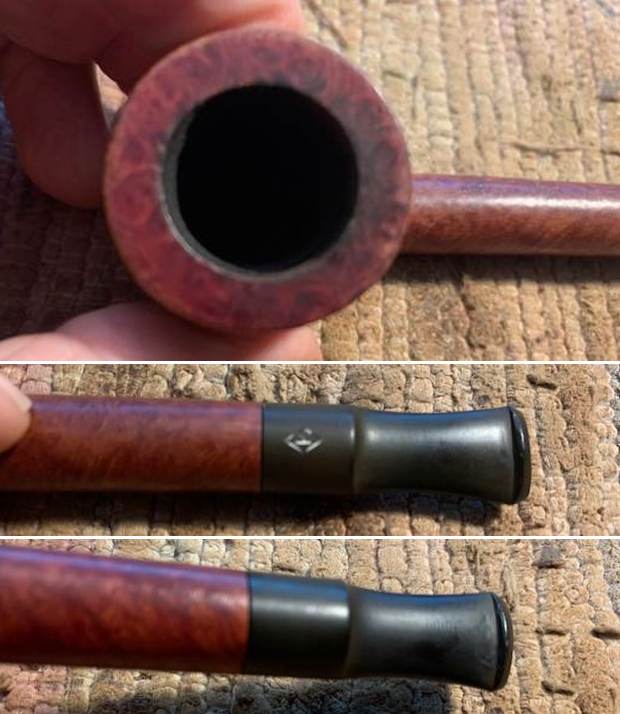
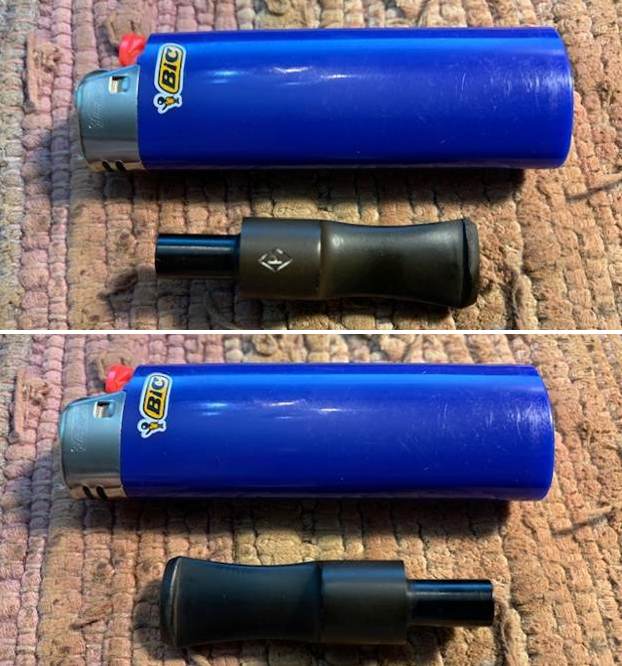
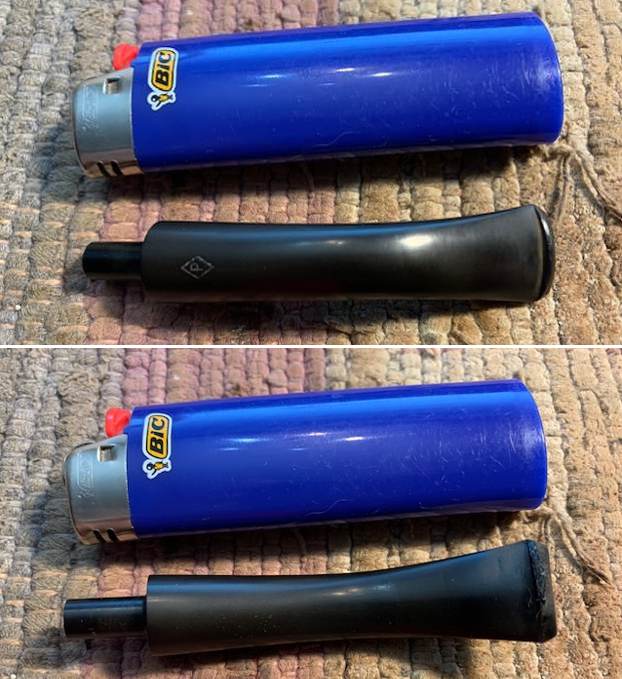
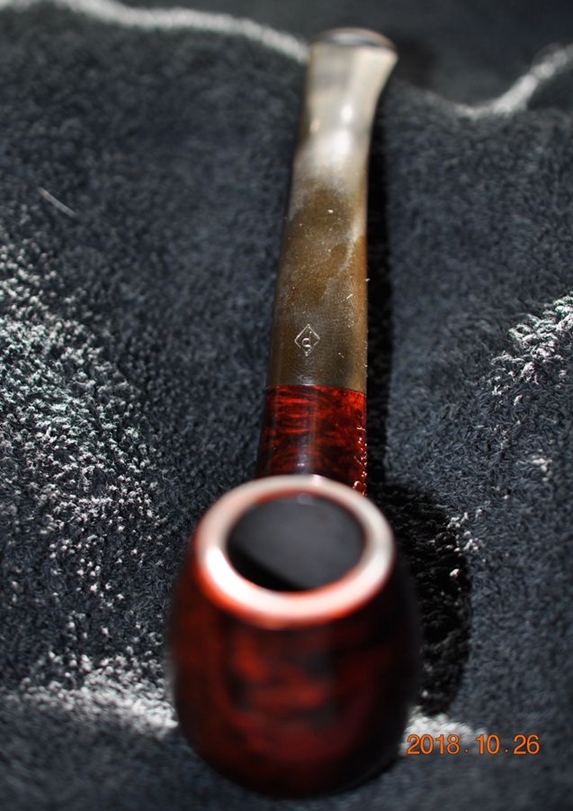
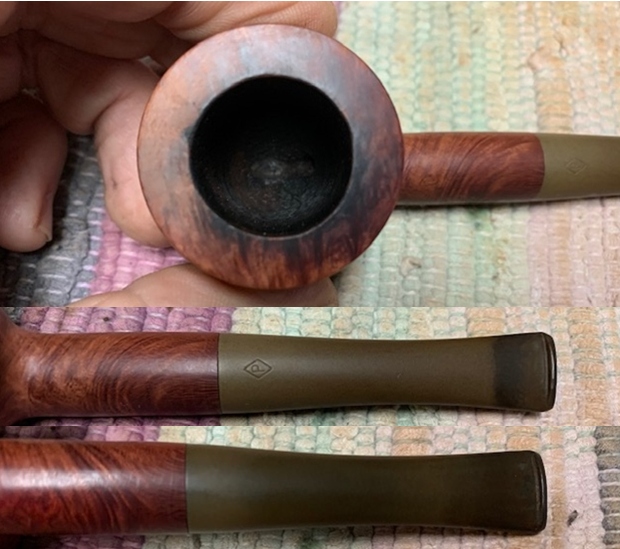
  4. The stem is vulcanite and has the Parker P logo in Diamond stamped into the top of the thin oval stem. The stamp is devoid of colour but it still readable.
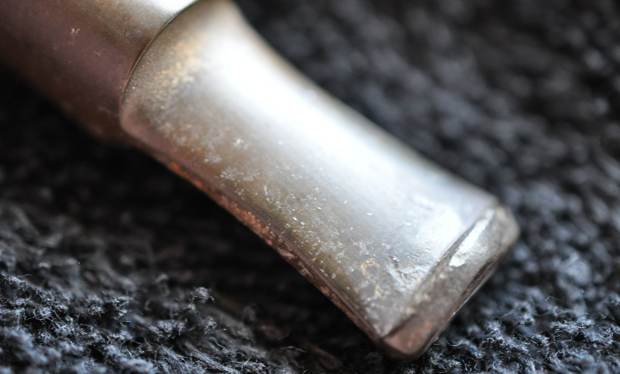
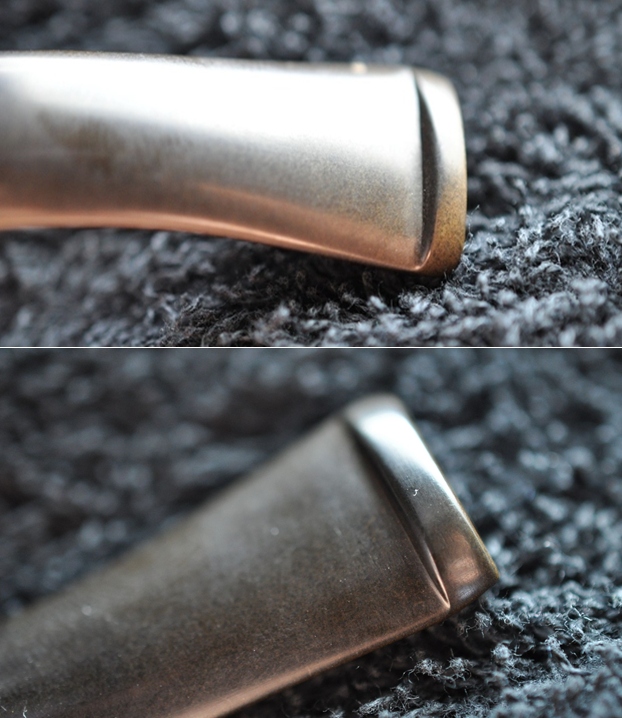
  5. The vulcanite stem has some light oxidation but was dirty. There were tooth marks and chatter ahead of the button that are visible in the photos below. Nothing to deep but nonetheless present.

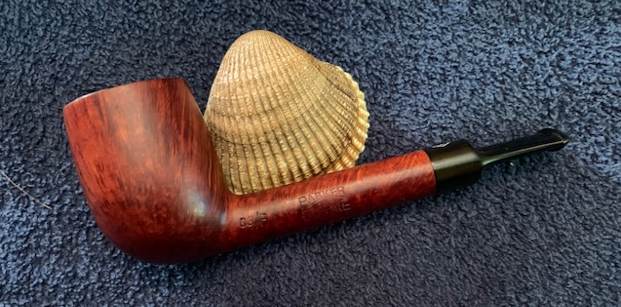
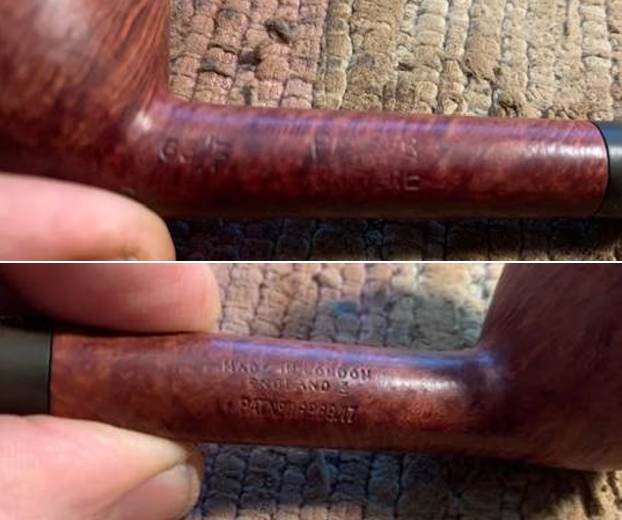
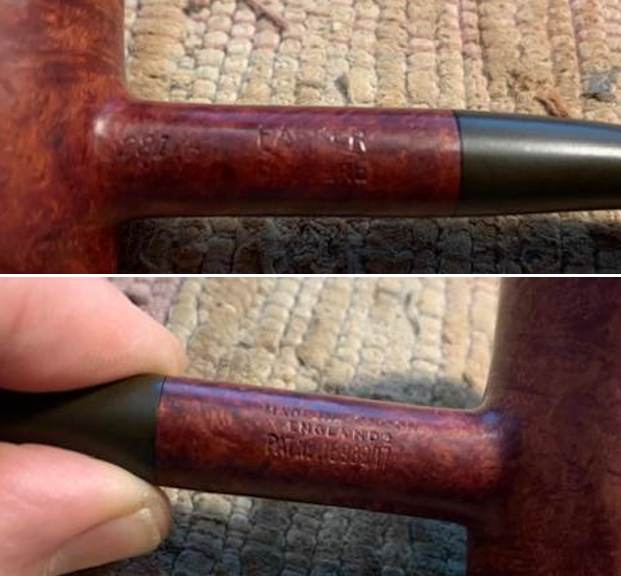
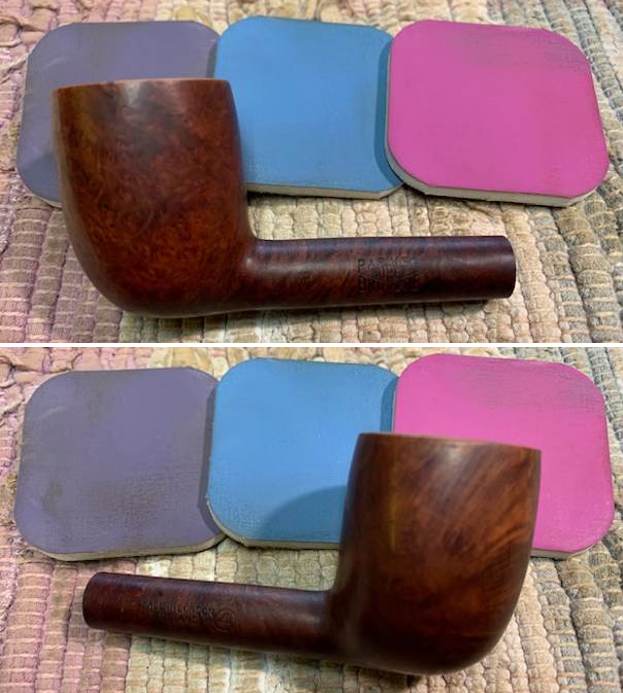
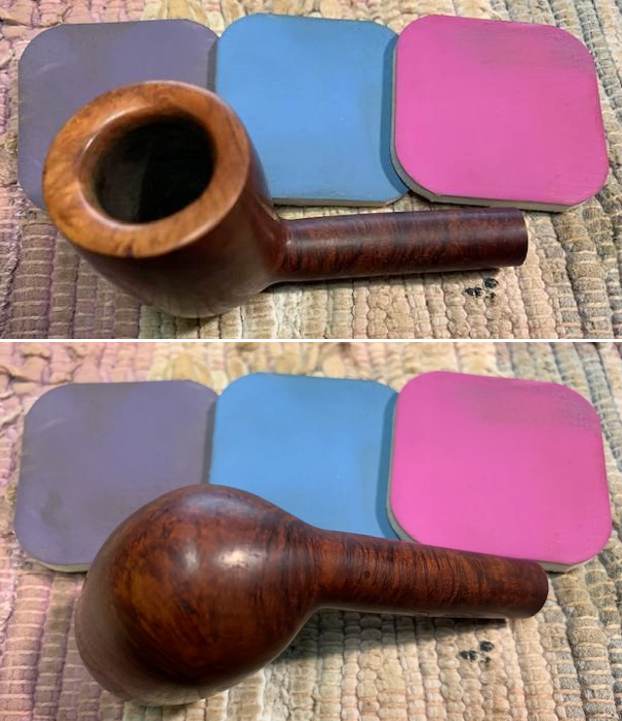
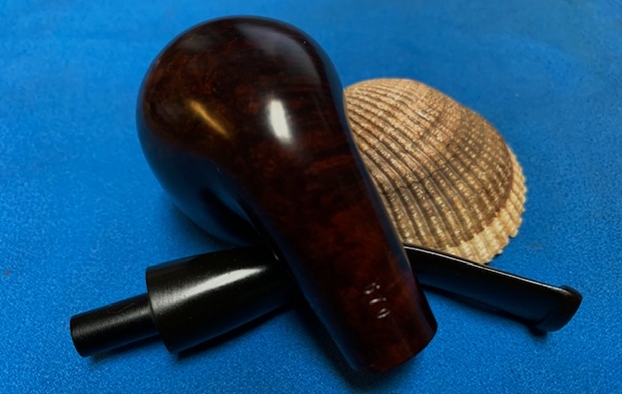
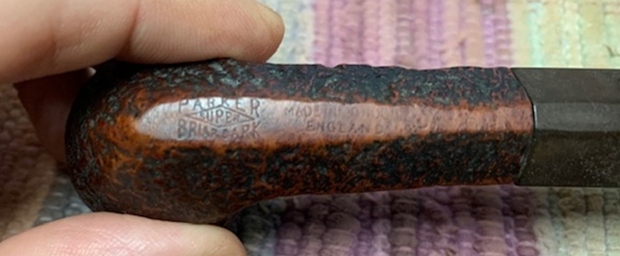
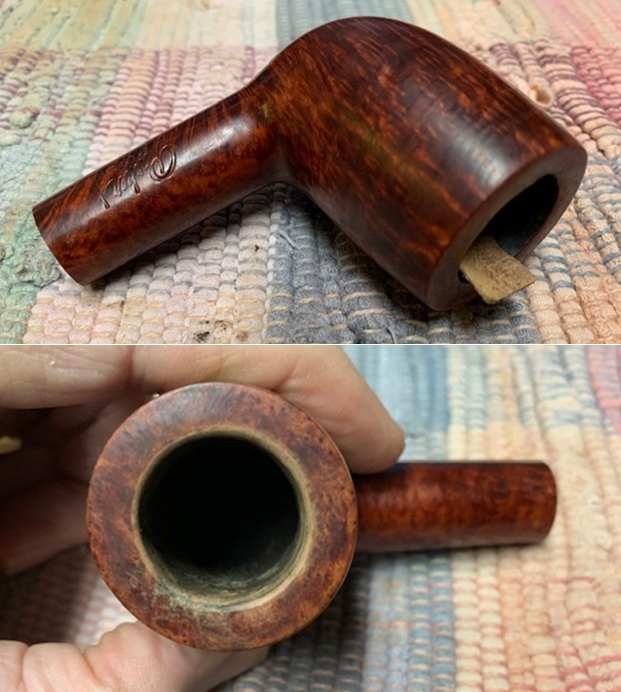
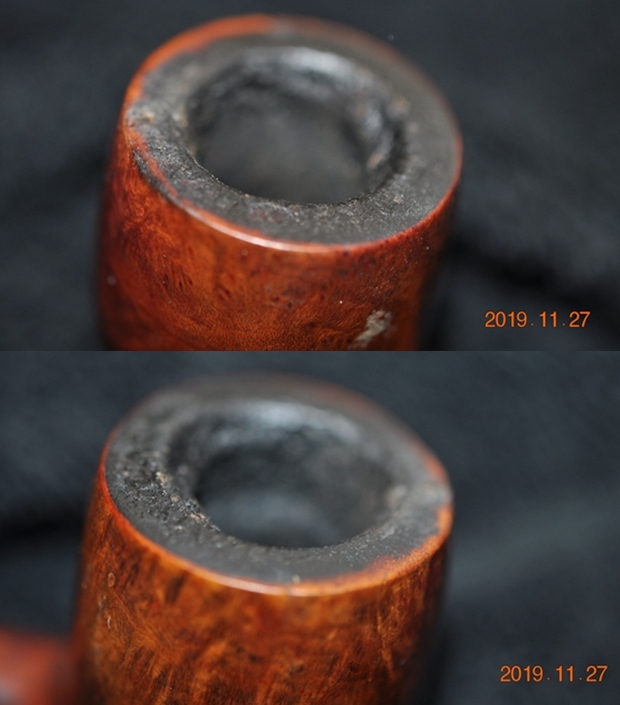
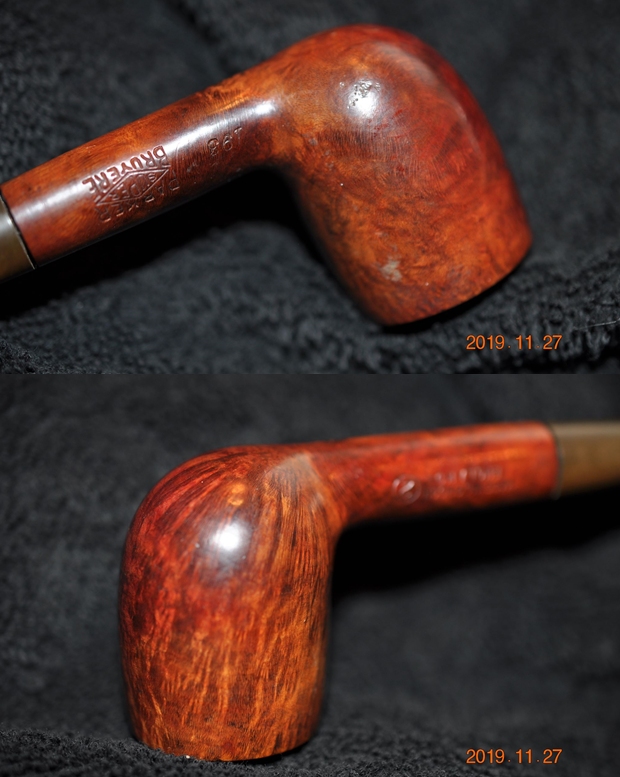
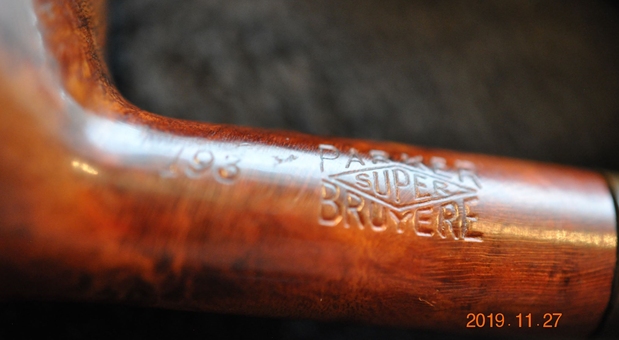
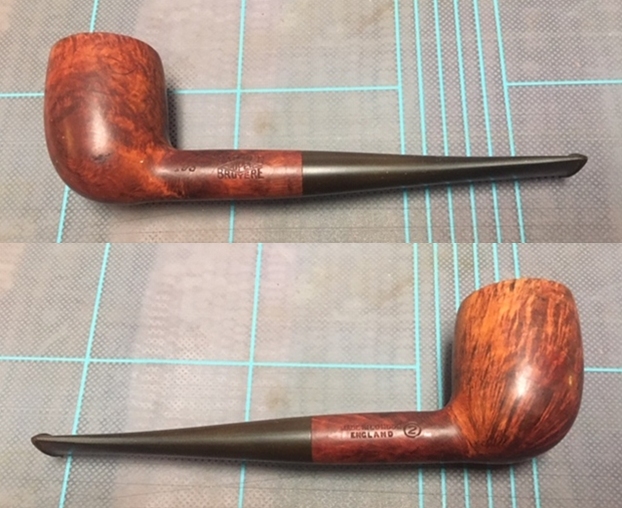
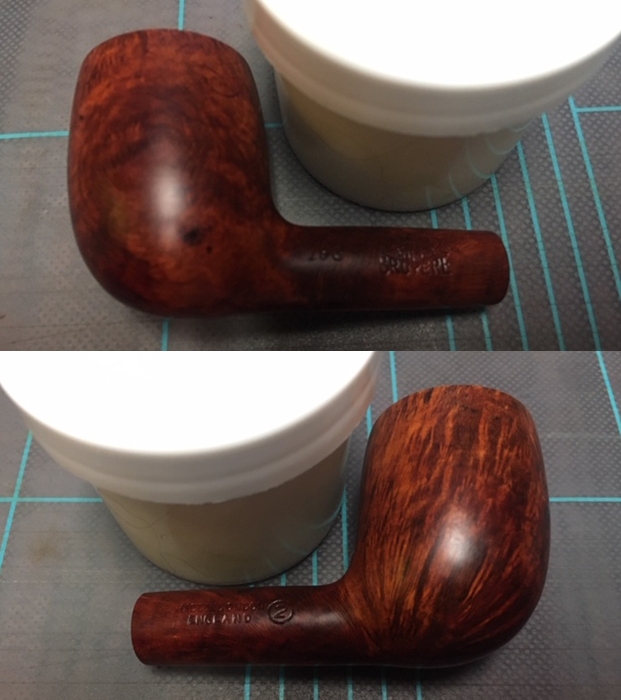
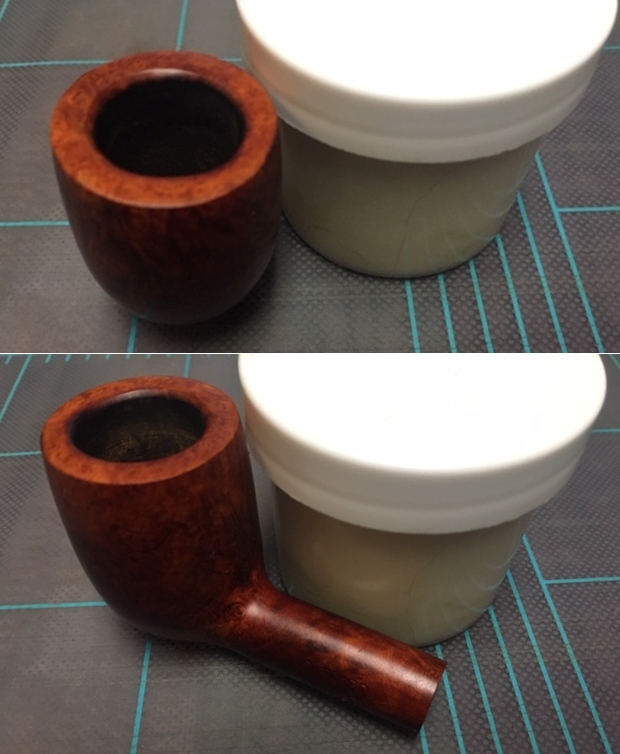
Overall my impressions of this dainty Parker Super Bark Canadian was that it was in solid shape with no significant damage to the briar on the bowl sides and rim. The cake does not seem to hide any burns or checking but I will know more once it is cleaned and reamed. The exterior of the bowl does not show any hot spots or darkening. The photos below confirm the assessment above. Jeff always takes close up photos of key areas on the pipe we buy. These are done so that I can have a clearer picture of the condition of the bowl and rim edges and top. The rim top photos confirm my assessment above. The cake in the bowl is quite thick and the rim top has heavy lava and debris on it that will need to come off. You can also see the lava in the sandblast finish on the rim. You can also see the condition of the inner and outer edges of the rim. This is what I look for when assessing a pipe. While there is lava and darkening there is no visible burn damage at this point and the previous reamings has not left damage either. The bowl is still round. His photos of the stem surface confirmed and heightened my assessment of the condition. You can see the oxidation on the stem surface. You can see the faded out stamp on the top of the stem. Note also the tooth marks on the stem surface ahead of the button on both sides. I always ask Jeff to take photos of the sides and heel of the bowl. While this definitely shows the sandblast patterns around the bowl it also allows me to do a more thorough assessment of the condition of the briar and the finish. The stain on the bowl highlights the grain. There was some grime on the surface but the cleaning will easily remove that. There were no cracks or splits following the grain or coming down from the rim edges. There were no cracks in the shank. I also look for flaws in the grain as those can also hide cracks or damage. In this case the bowl exterior is sound and should clean up very well. I love the sandblast patterns that appear to have a mix of grain underneath it. I also ask him to take photos of the stamping so I can see if it is faint in any spots or double stamped or unclear. It often takes several photos to capture what I am looking for. The stamping on the underside of the shank are clear and readable in the pictures below. There is some faint spots in the stamp but it can still be read. On the heel of the bowl the stamping reads Parker [over] Super in a flattened diamond [over] Briar Bark. The stamping wraps over and under the diamond stamp. That followed by Made In London [over] England followed by the number 3 in a circle which is the size of the pipe according to Dunhill’s size numbers making it a Group 3 size. The last stamp on the shank near the shank/stem joint it bears the shape number 132 which is the shape number for a Canadian. Jeff also included a photo of the stamped stem logo – Parker “P” in a Diamond. I did not take time to do work on the brand as it is a well known brand. There is no date stamp on the shank so I cannot link it to any specific time period. If you would like to do some reading on it you can check both Pipephil’s site and Pipedia for a great write up on the history of the brand. I decided instead to just get to work on the pipe.
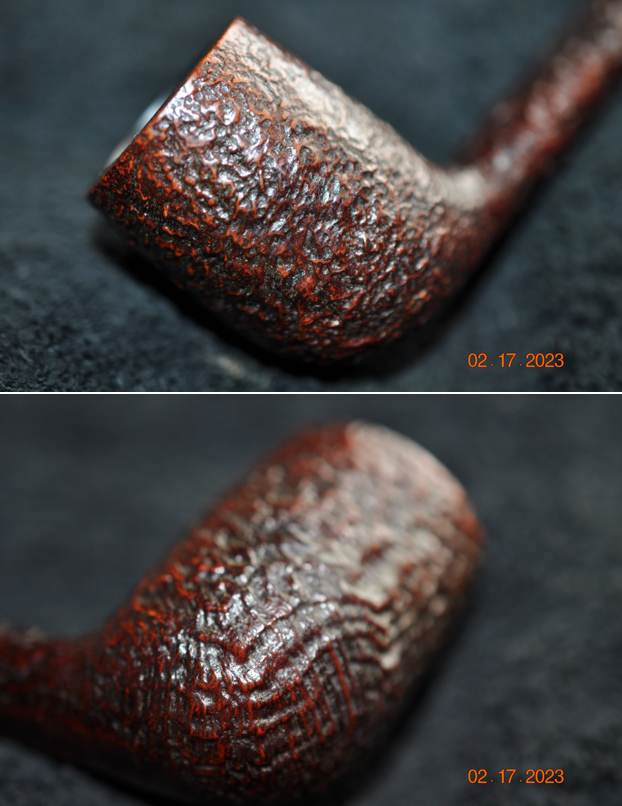
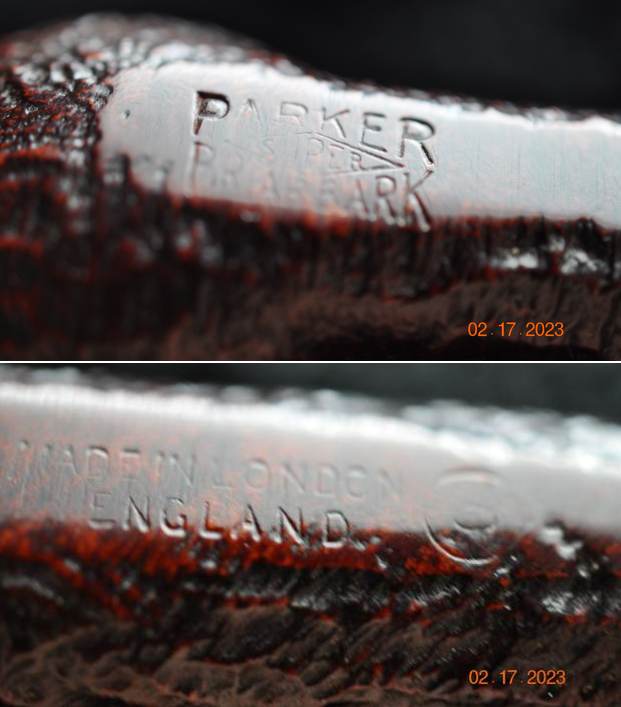
I am sure many of you skip my paragraph on the work Jeff has done before the pipe gets here in my many blogs but it is quite detailed in its brevity. I know some laugh at my opening line Jeff did a thorough cleaning of this pipe. However, I want you to know the details of the work. Back in 2020 Jeff wrote a blog about his cleaning process. I am including a link to that now so you can see what I mean about his process. Do not skip it! Give it a read (https://rebornpipes.com/2020/01/20/got-a-filthy-estate-pipe-that-you-need-to-clean/). Here is the introduction to that blog and it is very true even to this day.

Several have asked about Jeff’s cleaning regimen as I generally summarize it in the blogs that I post rather than give a detailed procedure. I have had the question asked enough that I asked Jeff to put together this blog so that you can get a clear picture of the process he uses. Like everything else in our hobby, people have different methods they swear by. Some may question the method and that is fine. But it works very well for us and has for many years. Some of his steps may surprise you but I know that when I get the pipes from him for my part of the restoration they are impeccably clean and sanitized. I have come to appreciate the thoroughness of the process he has developed because I really like working on clean pipe!

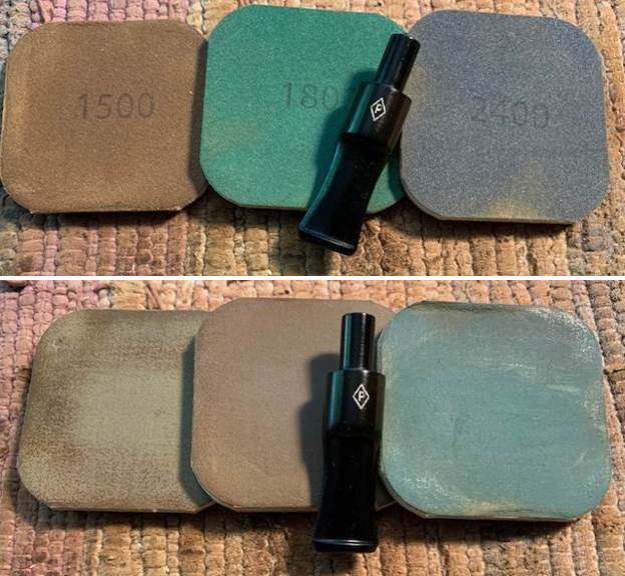
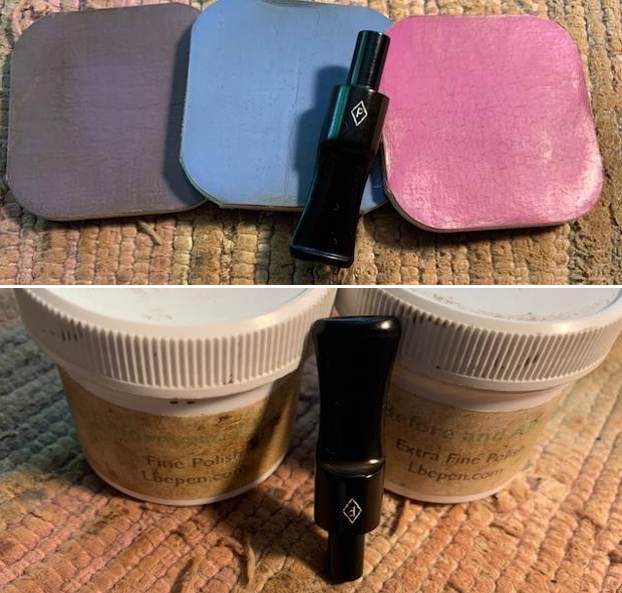
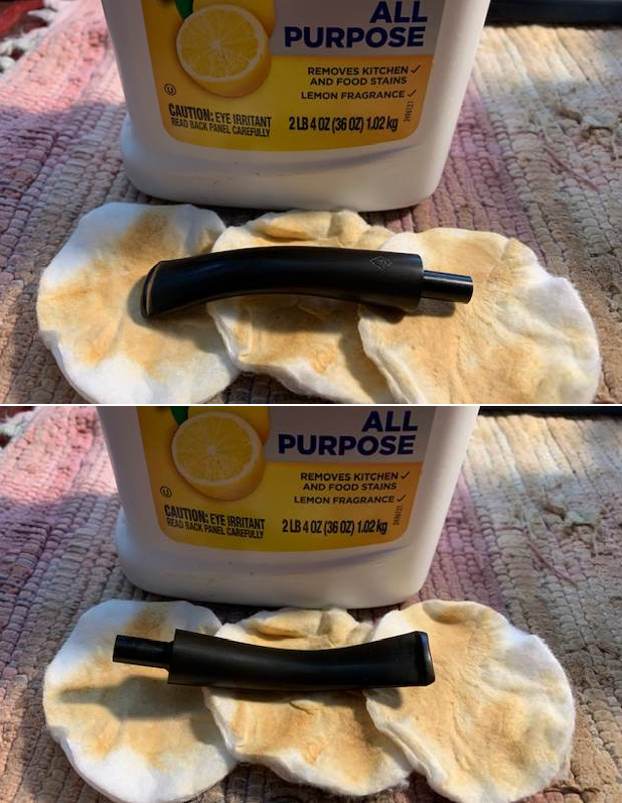
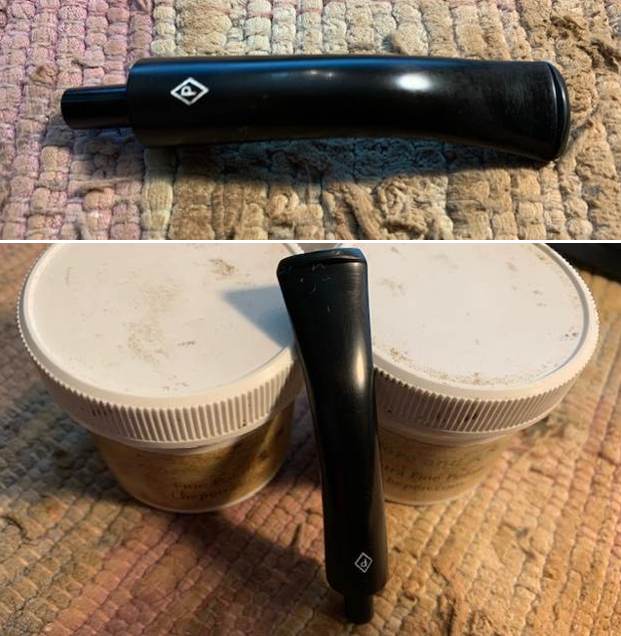
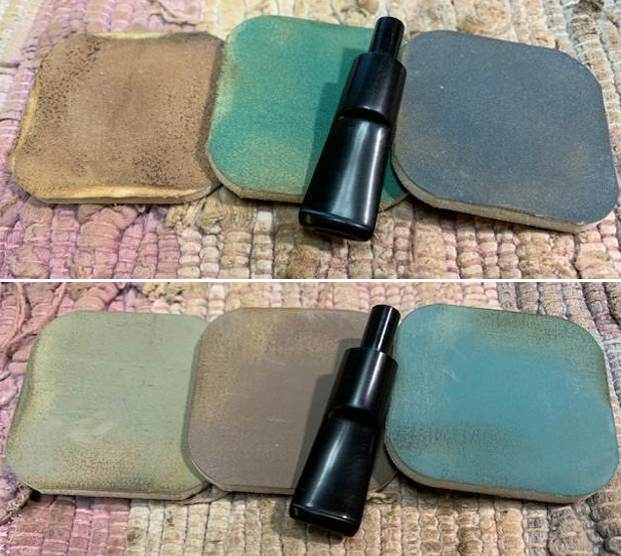
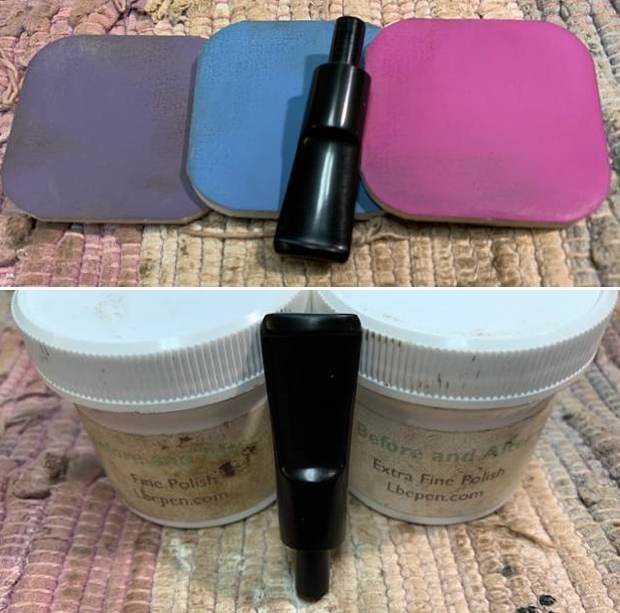
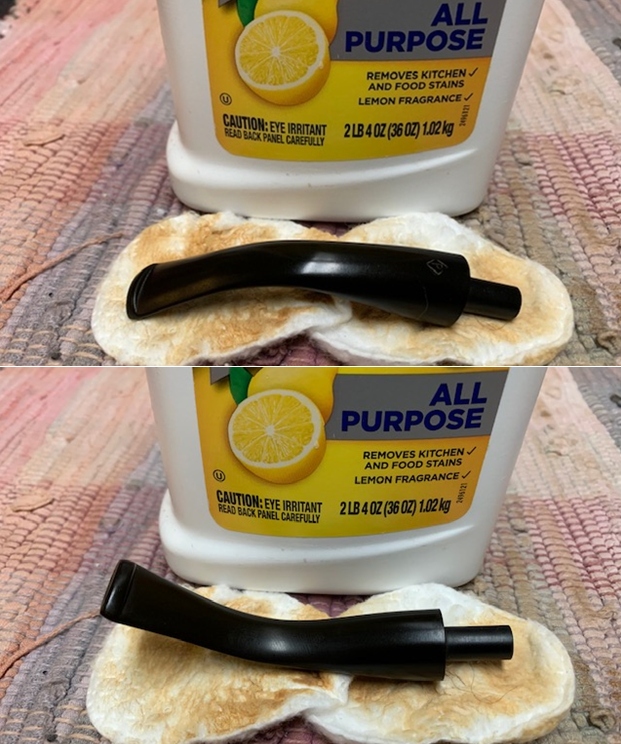
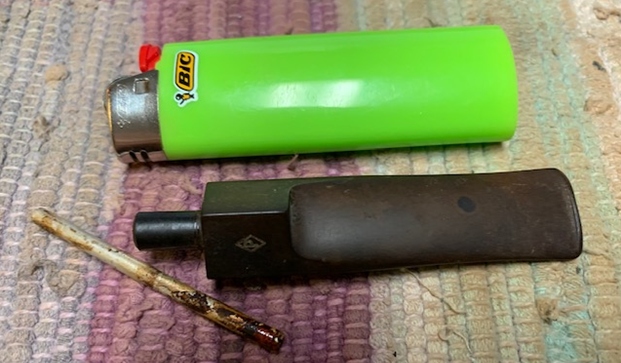
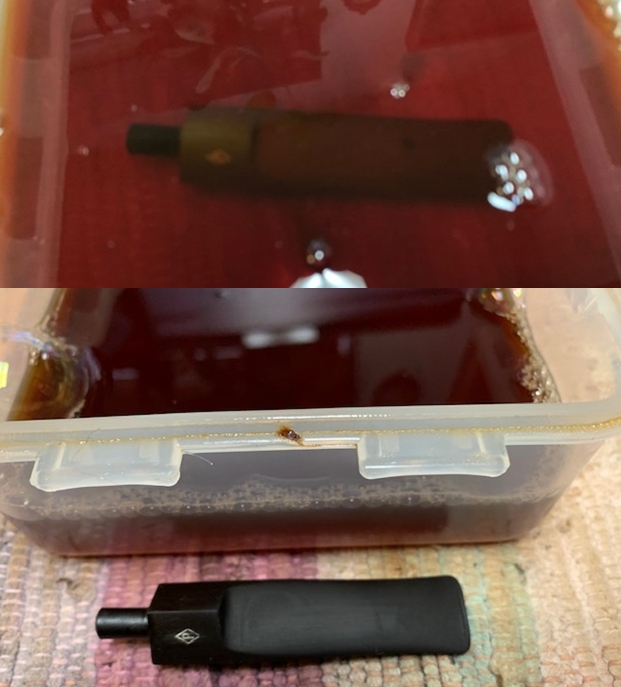
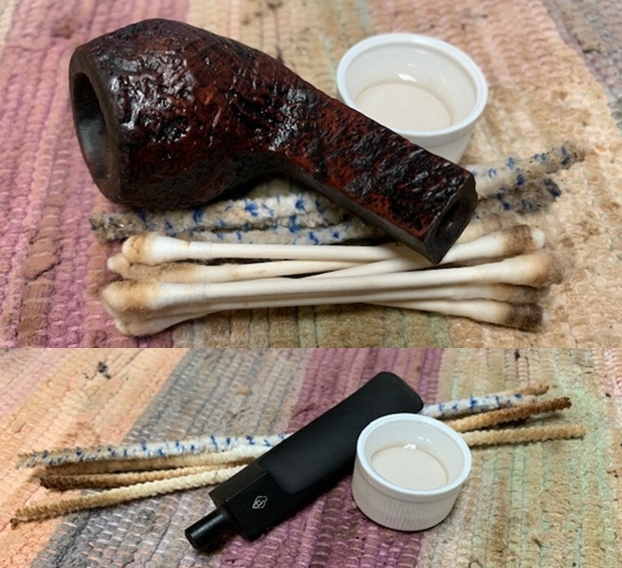
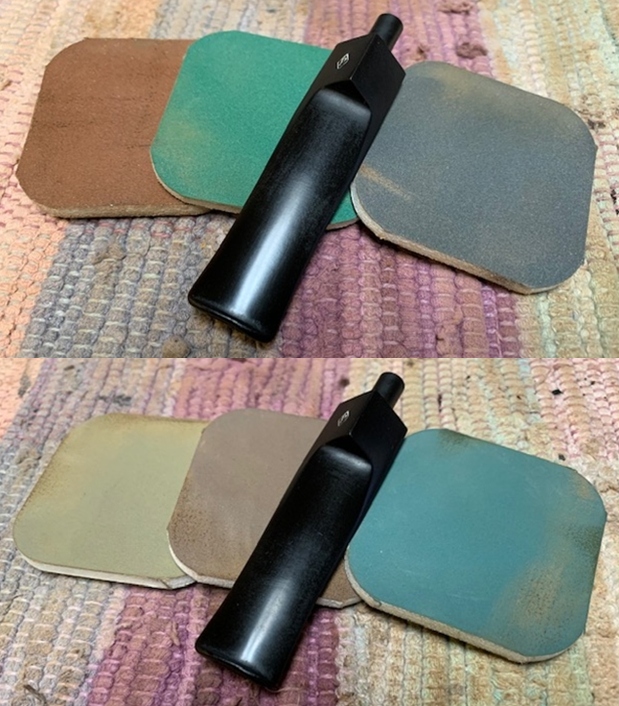
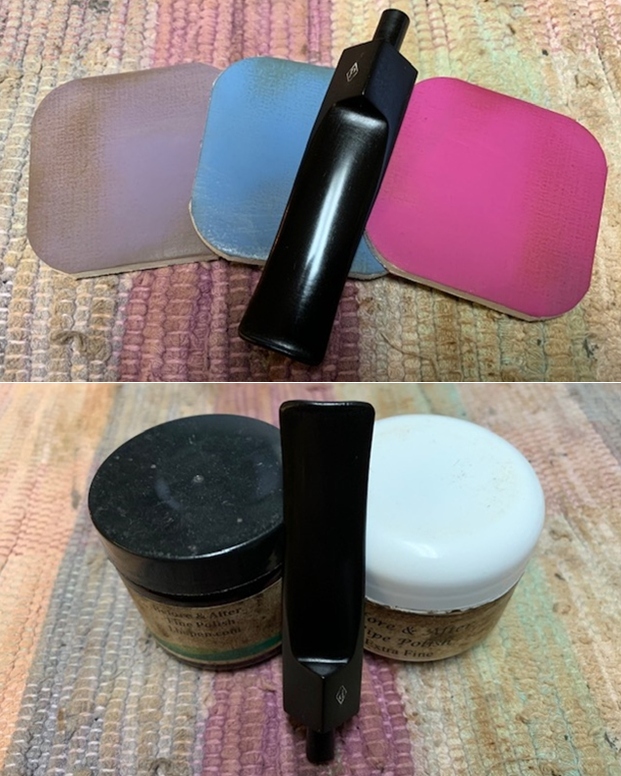
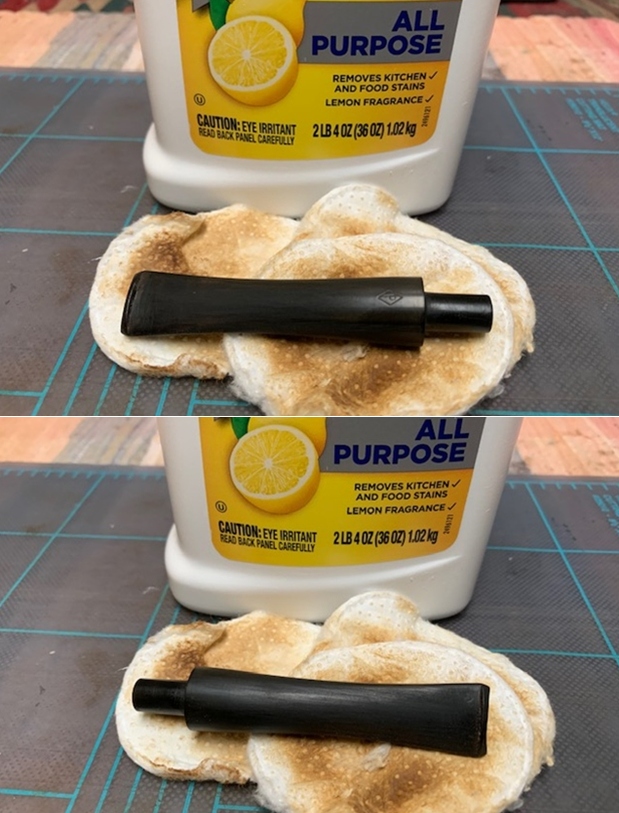
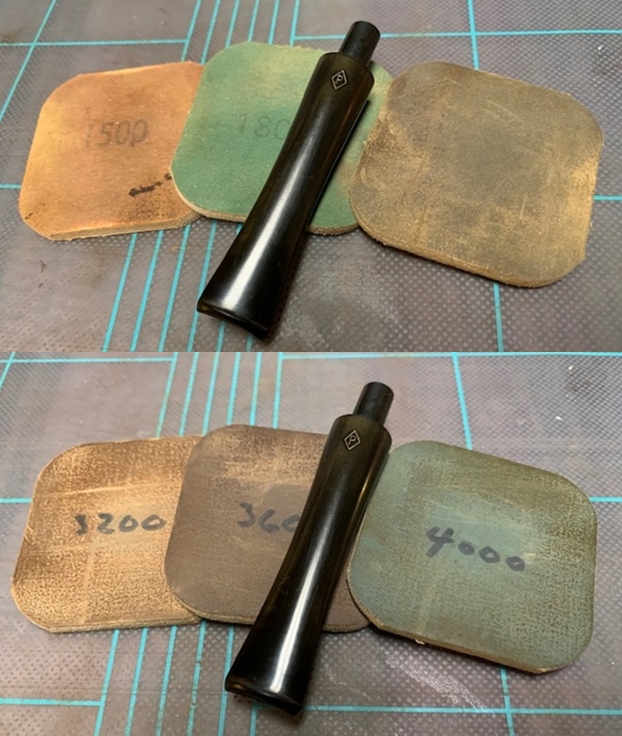
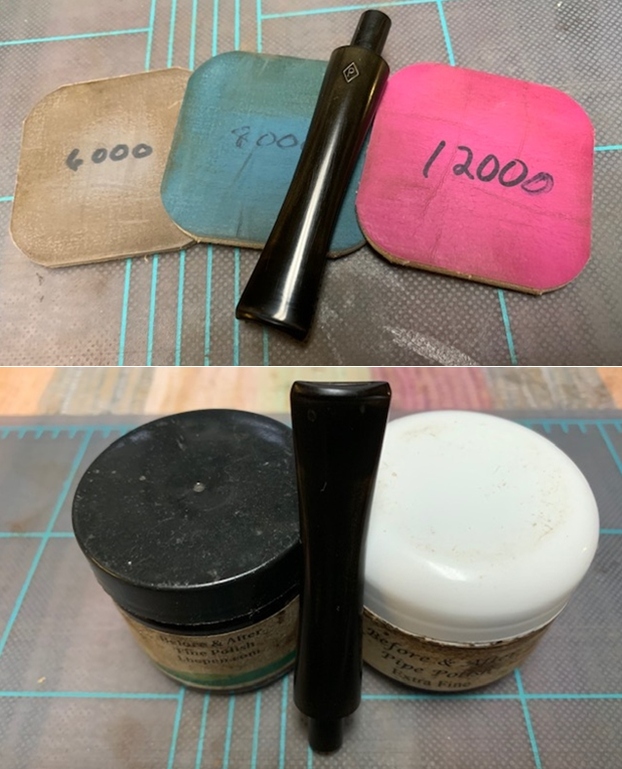
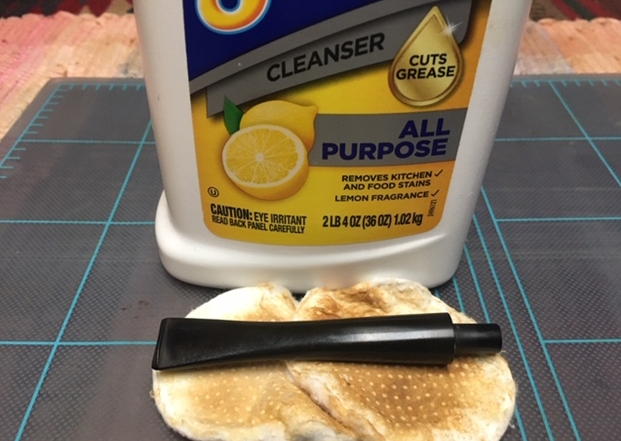
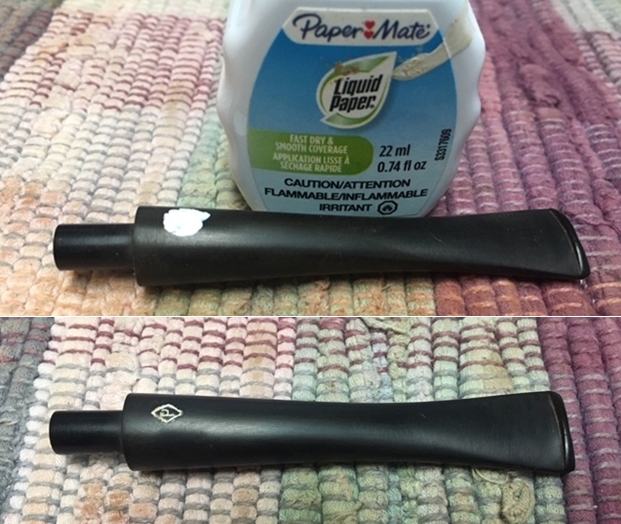
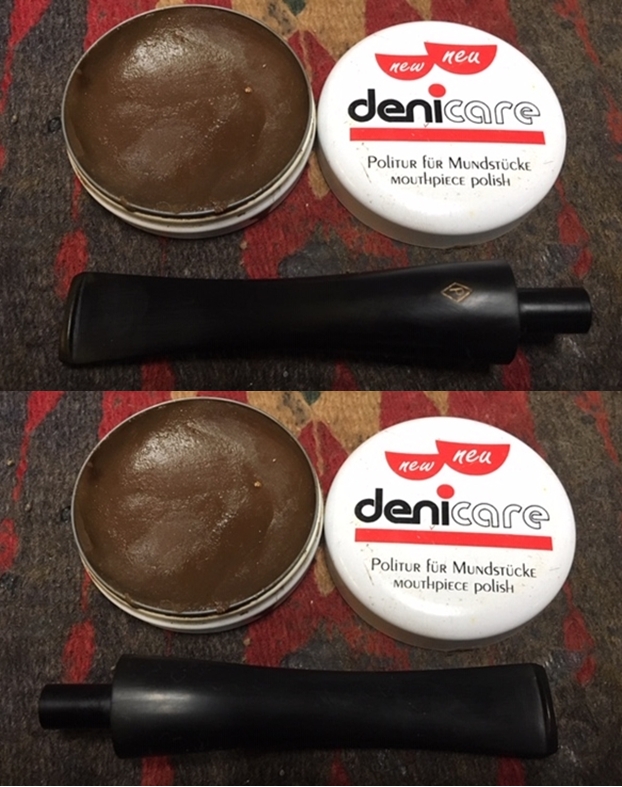
For the benefit of some of you who may be unfamiliar with some of the products he uses I have included photos of three of the items that Jeff mentions in his list. This will make it easier for recognition. These three are definitely North American Products so you will need to find suitable replacements or order these directly on Amazon. The makeup pads are fairly universal as we were able to pick some up in India when we were with Paresh and his family.

In the blog itself he breaks his process down into two parts – cleaning the stem and cleaning the bowl. Each one has a large number of steps that he methodically does every time. I know because I have watched him do the work and I have seen the pipes after his work on them. He followed this process step by step and when the pipe got to me it was spotlessly clean and ready for my work. The inside of the stem, shank and bowl were clean and to me that is an amazing gift as it means that my work on this end is with a clean pipe! I cannot tell you how much difference that makes for my work.

When the pipe arrives here in Vancouver I have a clean pipe and I go over it keeping in mind my assessment shared in the opening paragraph above. I am looking for any significant structural changes in the bowl and finish as I go over it.

  1. The finish cleaned up really well and the dust and grime in the sandblast grooves and crevices was gone. It was very clean and was undamaged. The rim top and the beveled inner edge looked very good. With all the grime removed there was some excellent grain coming through the blast.
  2. The sandblast rim top cleaned up very well, though was still some darkening on the briar. It looked to be in decent condition.
  3. The bowl was very clean and the top and inner edge of the bowl show no damage. The bowl walls are also very clean and smooth with no checking or burn marks on the inside or out of the bowl. The walls were undamaged.
  4. The vulcanite taper stem with the Parker “P” Diamond logo stamped into the topside looks good but there is nothing remaining in the stamp. It appears to be deep enough to reapply the colour to the top.
  5. The vulcanite stems still showed some oxidation that would need to be addressed. There were light tooth marks and chatter ahead of the button that are barely visible in the photos below. Nothing to deep but nonetheless present.

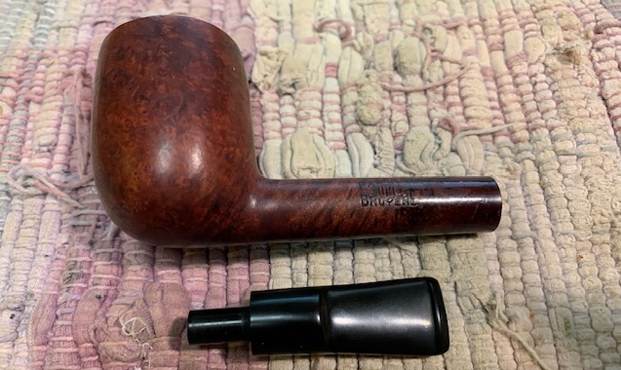
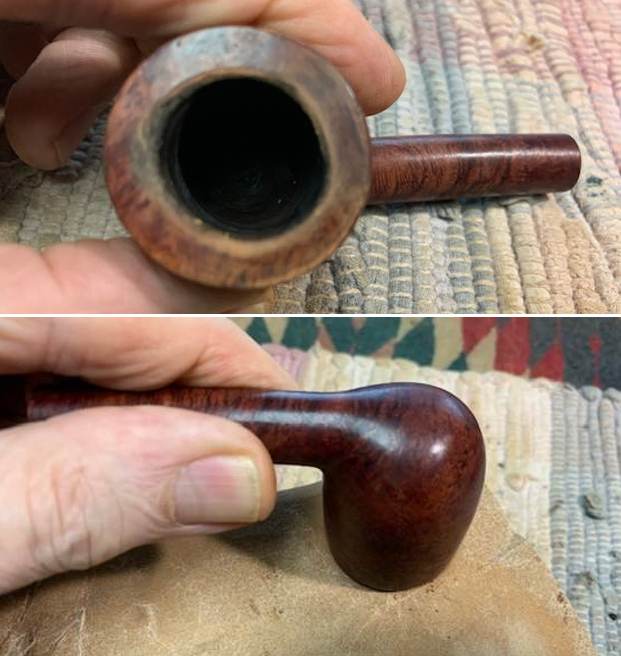
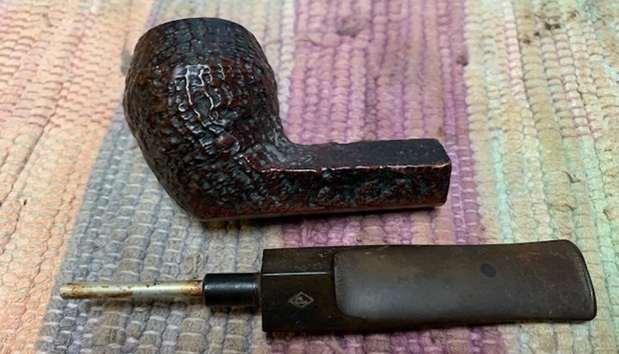
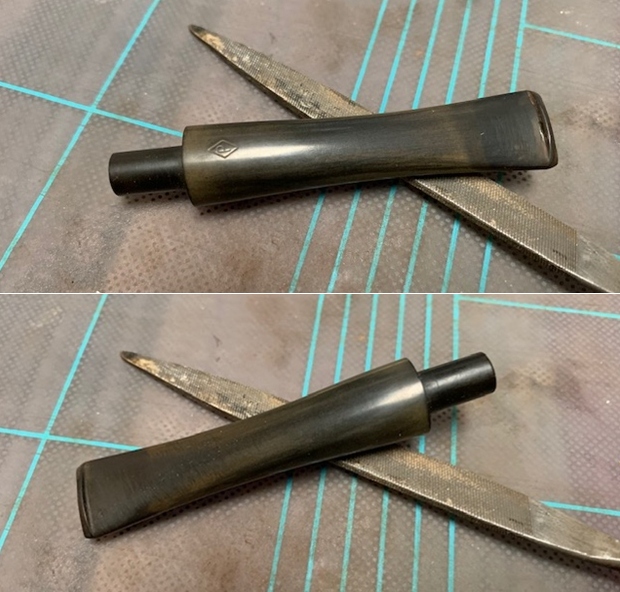
Hopefully the steps above show you both what I look for when I go over the pipe when I bring it to the work table and also what I see when I look at the pipe in my hands. They also clearly spell out a restoration plan in short form. My work is clear and addressing it will be the next steps. I took photos of the whole pipe to give you a picture of what I see when I have it on the table. This is important to me in that it also shows that there was no damage done during the clean up work or the transit of the pipe from Idaho to here in Vancouver. I then spent some time going over the bowl and rim top to get a sense of what is happening there. The bowl looked very good and the walls were smooth. There was no damage internally. The rim top was clean but there seemed to be some darkening still remaining in the grooves. I also went over the stem carefully. There were dents in the stem that are visible in the photos. But the good news is that the tooth marks were not deep and did not seem to puncture the airway. They would clean up well. I examined the button edge and was happy to see that the marks there were not too bad and should be able to be sanded out. I took photos of the rim top and stem sides to show as best as I can what I see when I look at them.I always check to make sure that the clean up work did not damage the stamping on the shank in any way. I know Jeff is cognizant of this but I do it anyway and take a photo to show what I see when I examine it. In this case it has not changed at all from the pictures I included above. I took a photo of the Diamond P stamp on the stem as well. You can see it is deep enough to hold some colour once I repair it. I removed the stem from the shank and checked the tenon and lay the parts of the pipe out to get a sense of the proportion that was in the mind of the pipe maker when he crafted the pipe. It is a beauty in flow and shape.As I pointed out in a previous blog, the question of where to begin the restoration work is always a matter of personal preference. If you read this blog much you will see that each of the restorers who post here all start at different points. Kenneth always starts with the stems, others as well do that. I personally like to start with the bowl because it gives me hope that this pipe is really a beauty. I said previously that I truly do not like the tedious work of stem repairs and stem polishing. I have been thinking about that and I think it is more it takes longer for slower results. I think that is why I always leave that until last even though I know that it needs to be done. So if you are restoring your pipes choose where you want to start and go from there. Just know that it all will need to be done by the end but for me the encouragement of seeing a rejuvenated bowl is the impetus I need to attack the stem work.

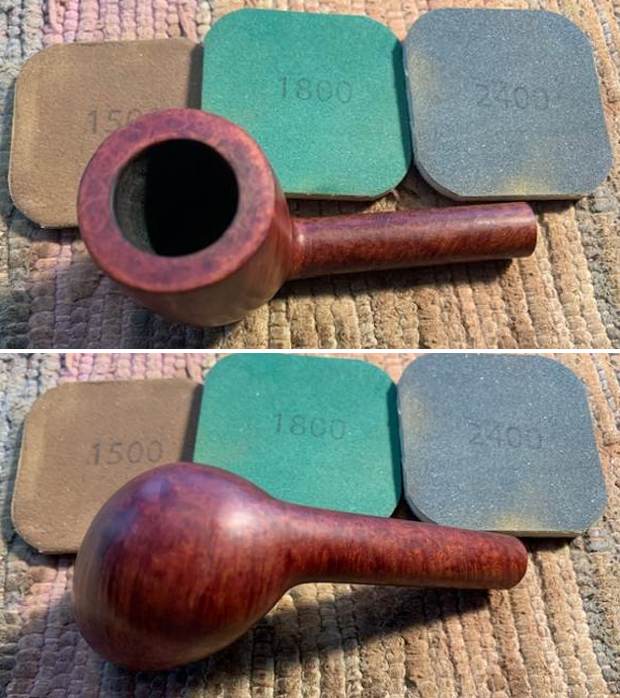
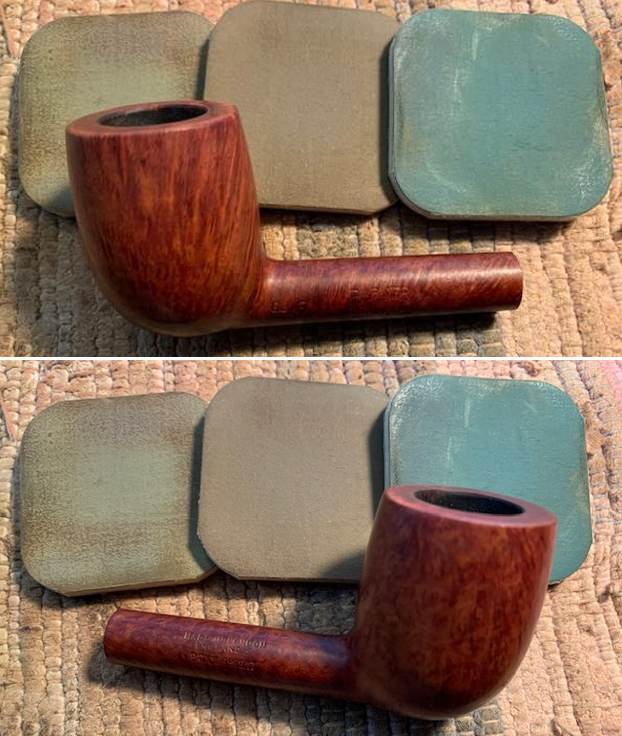
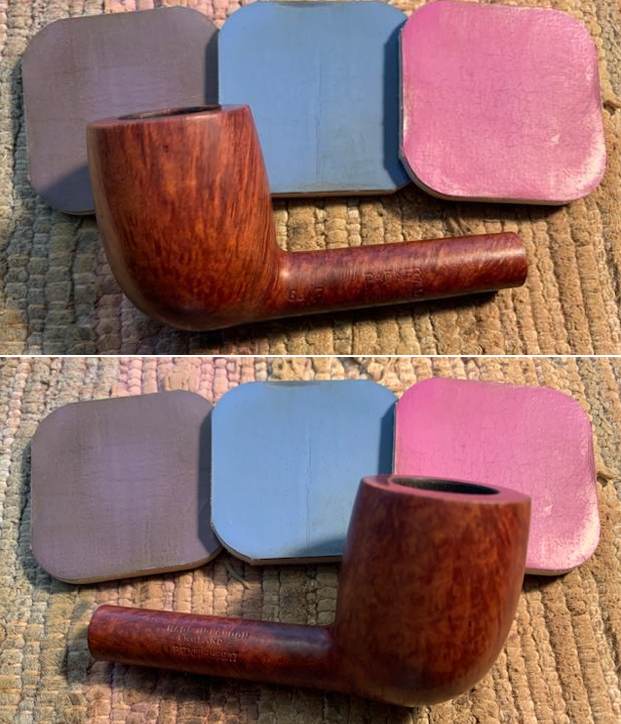
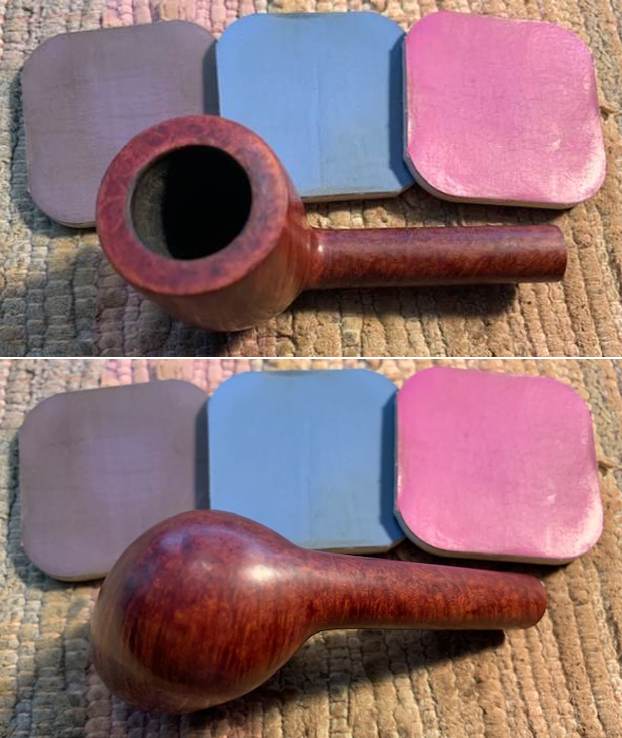
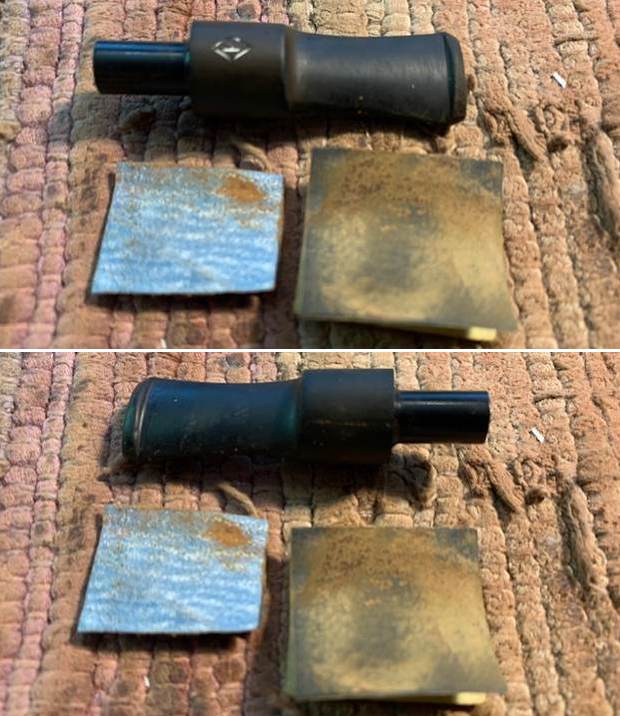
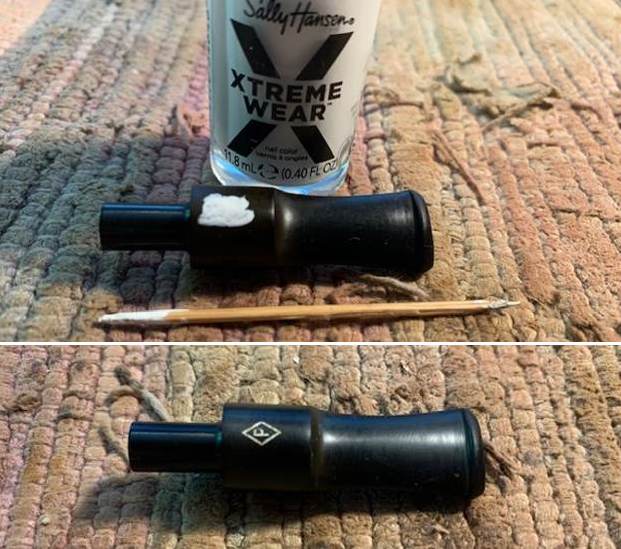
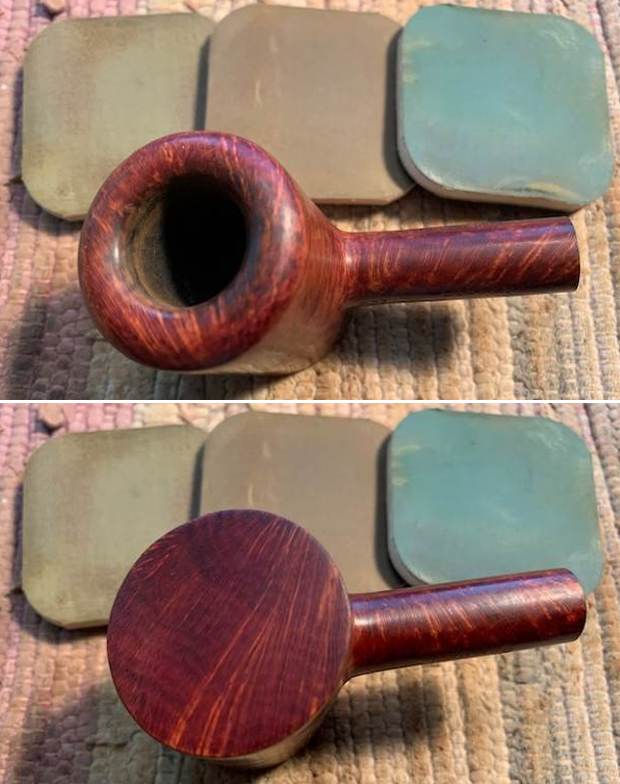
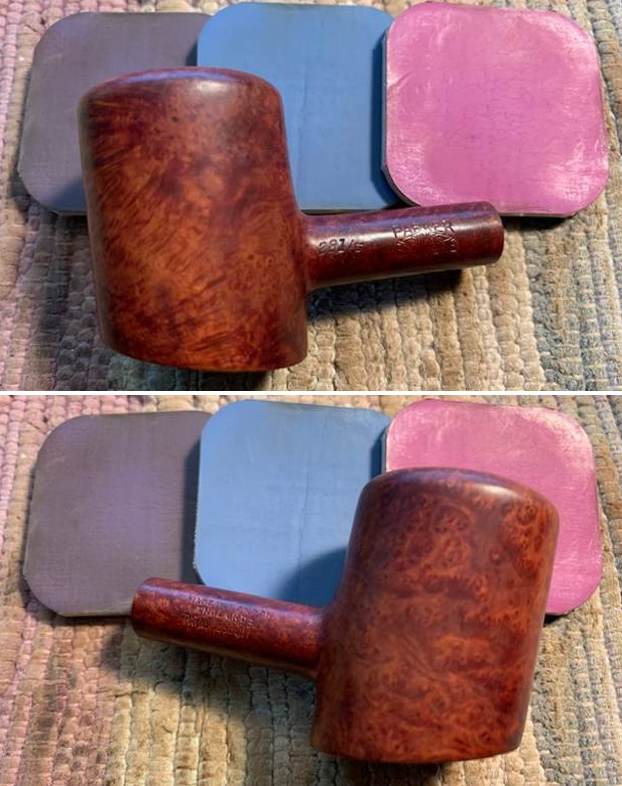
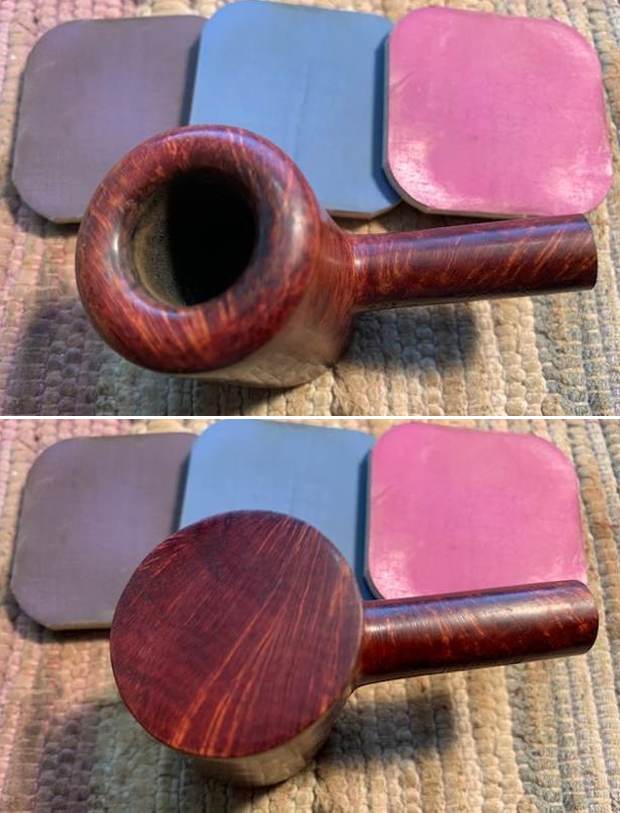
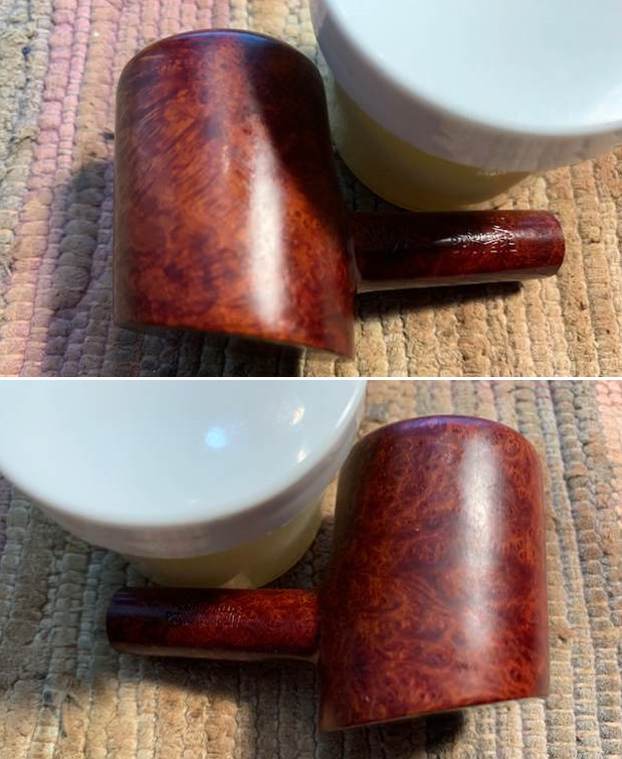
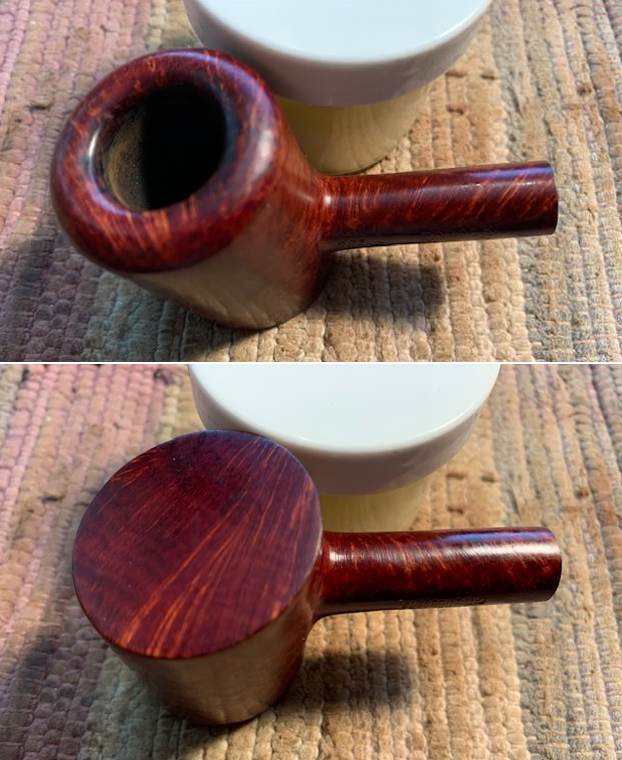
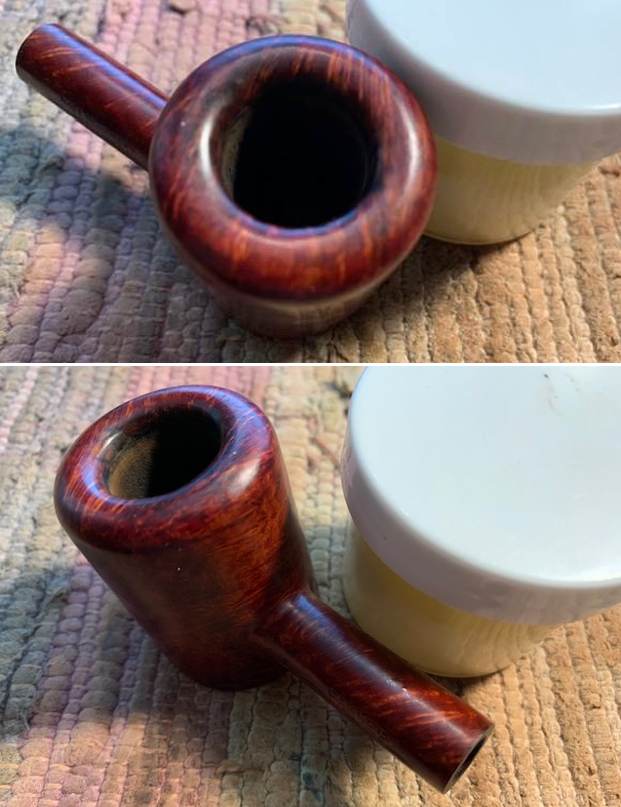
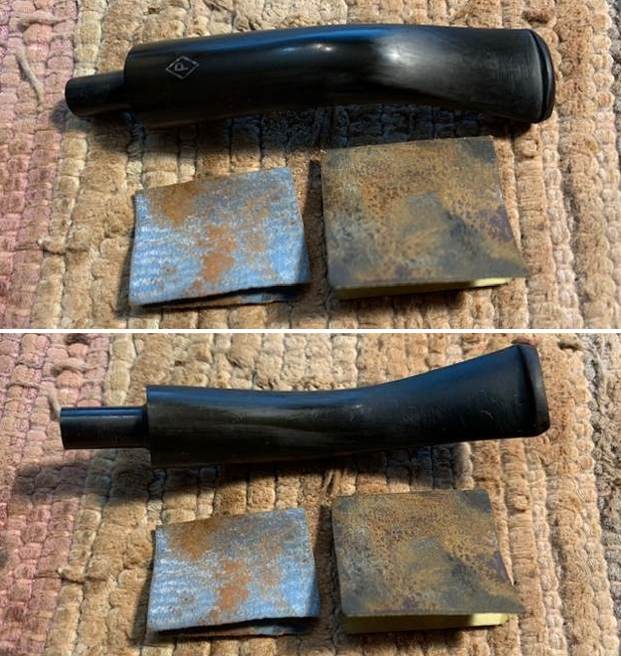
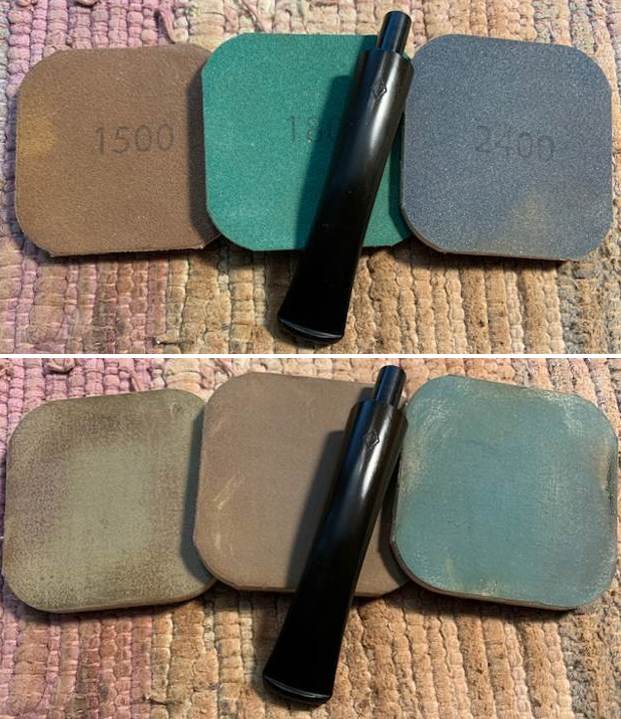
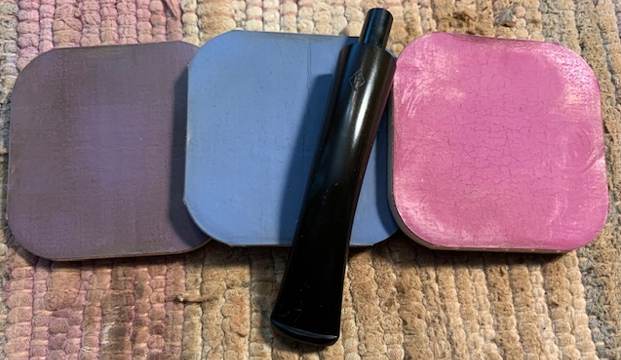
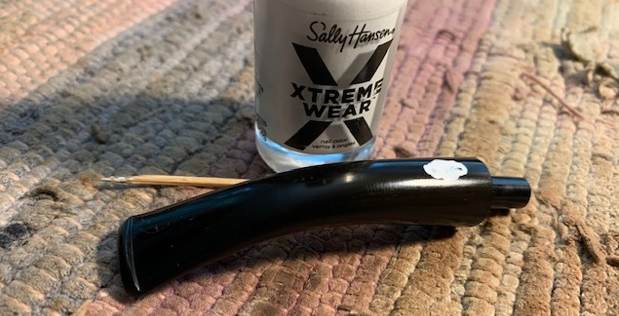
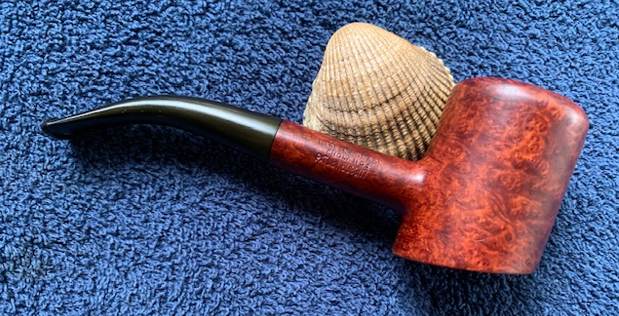
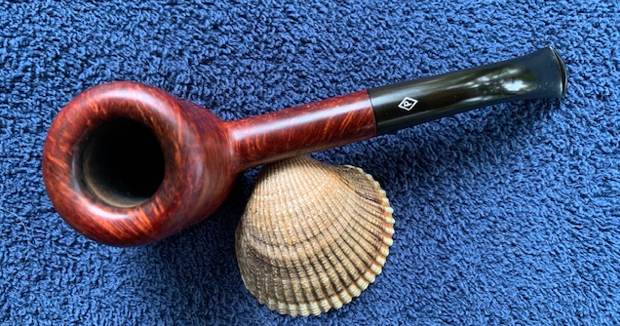
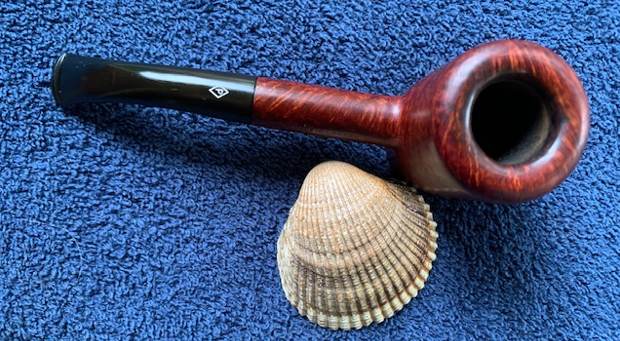
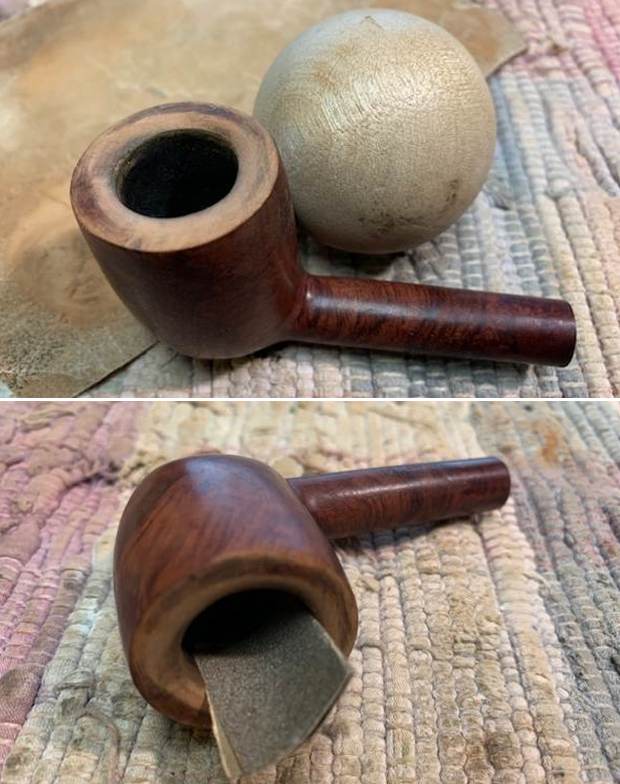
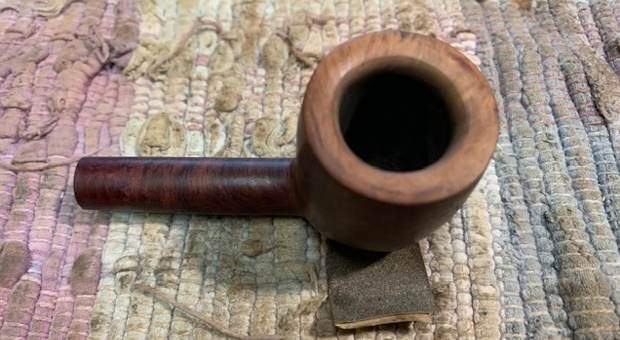
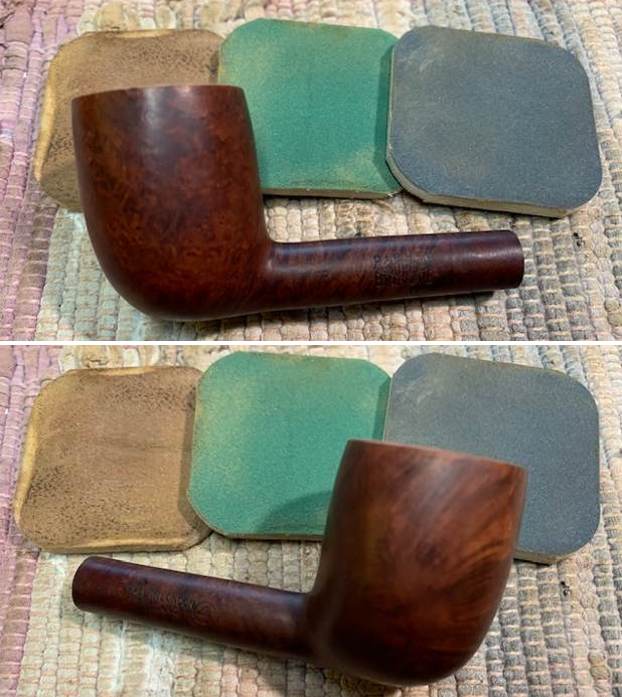
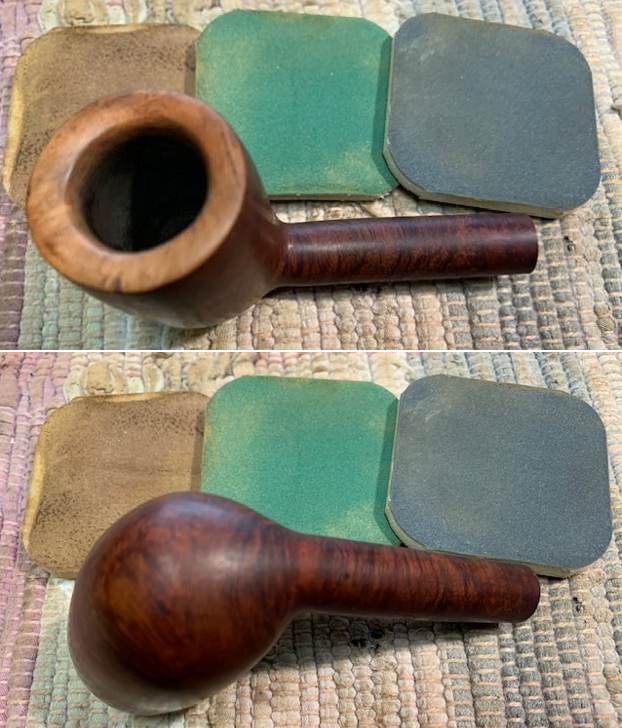
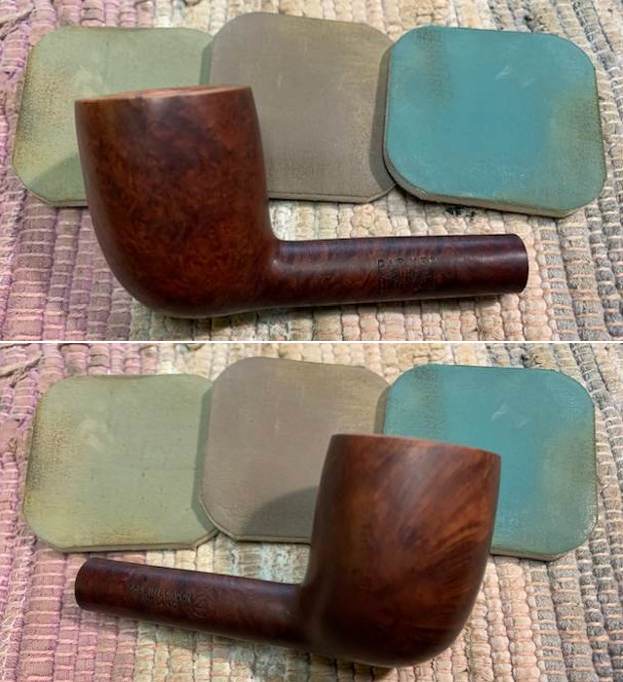
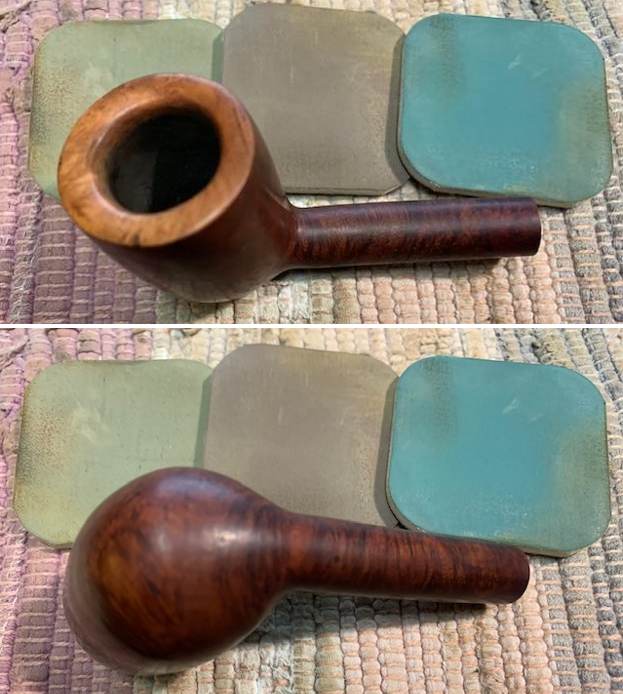
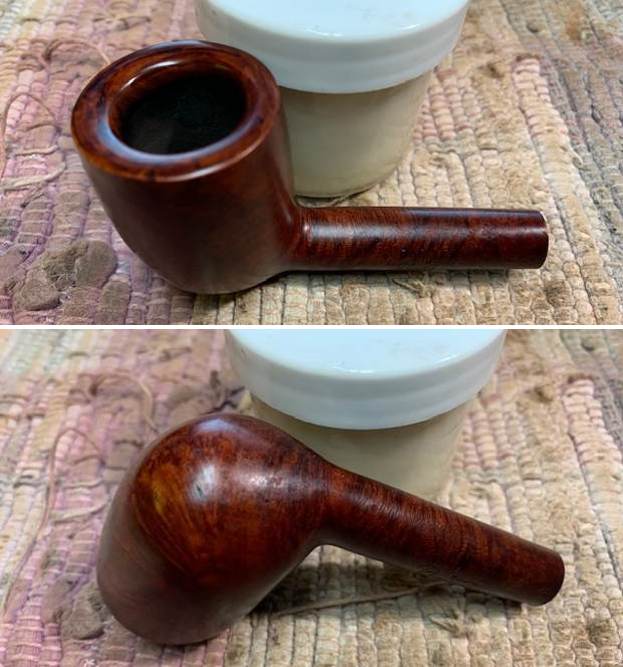
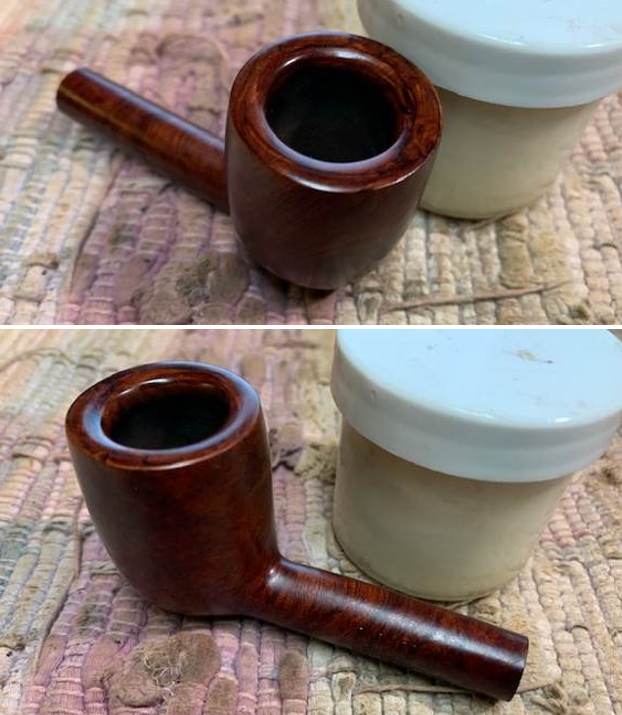
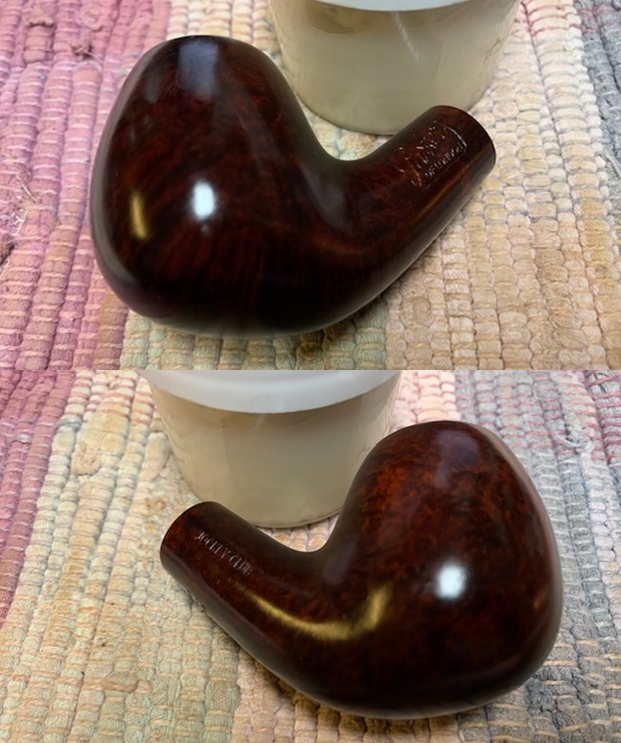
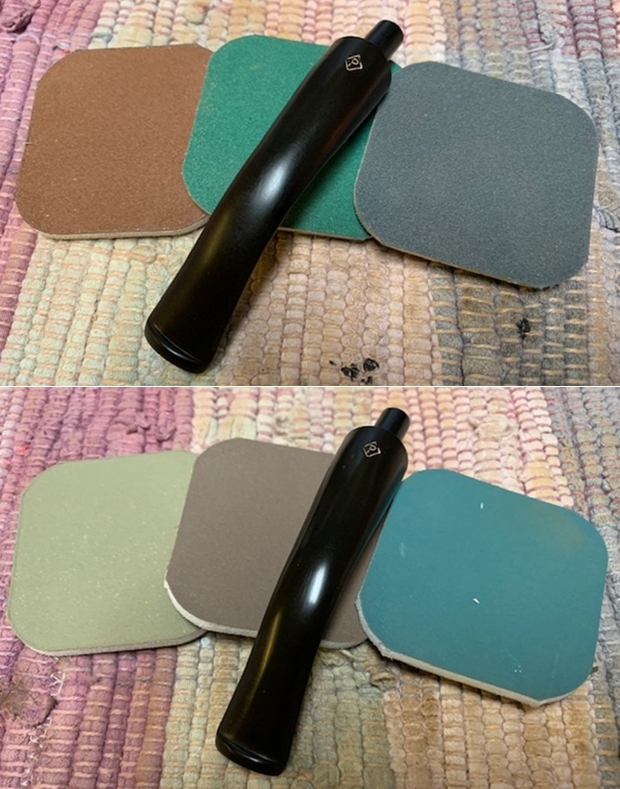
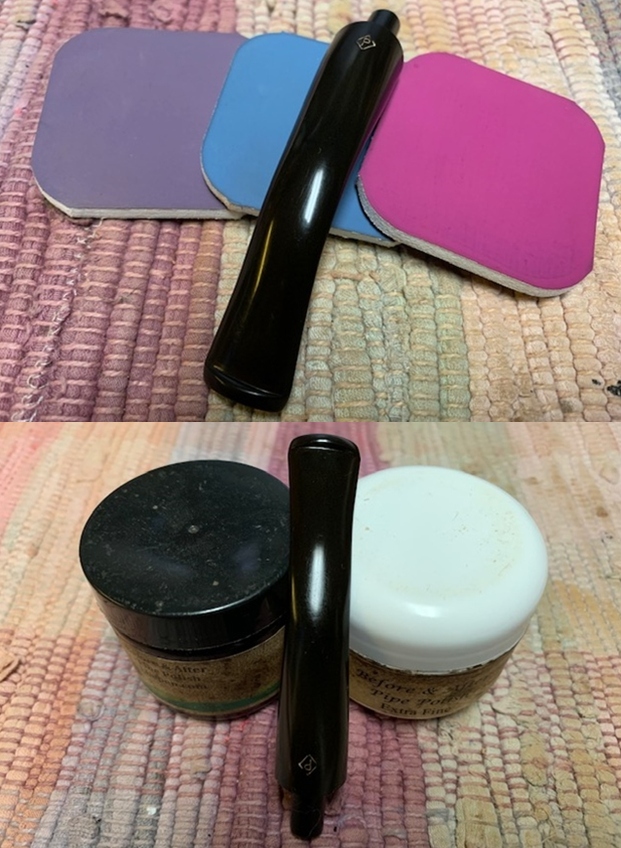
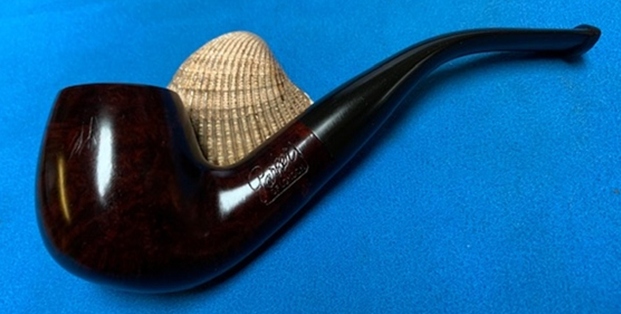
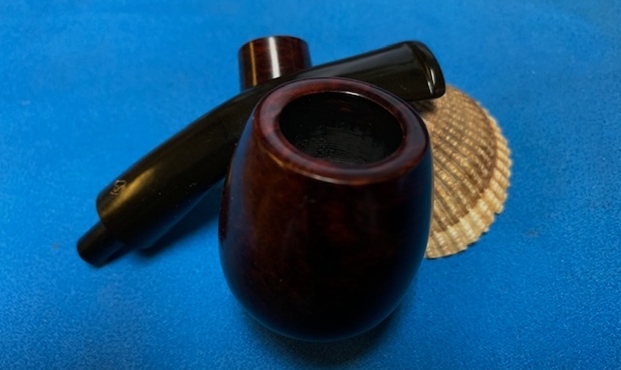
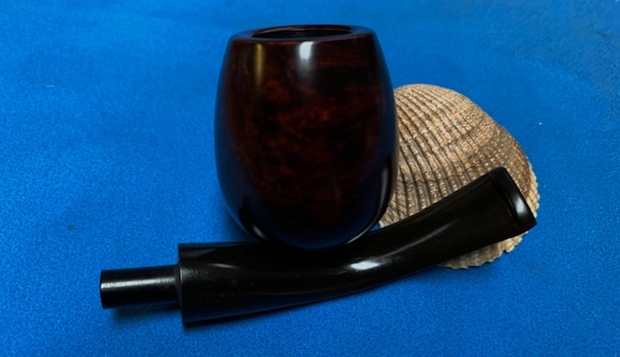
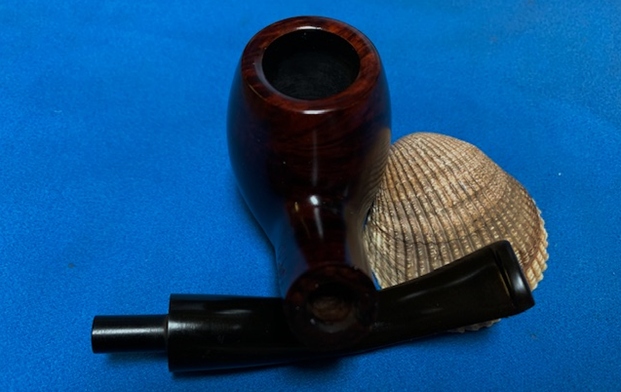
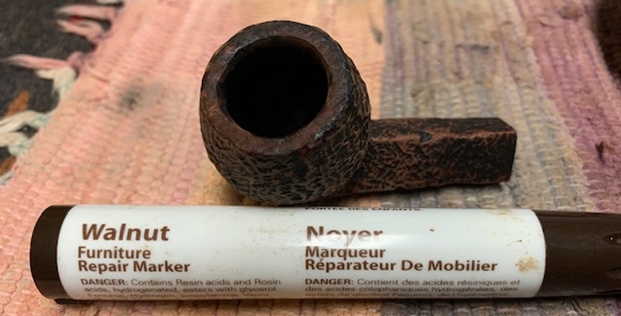
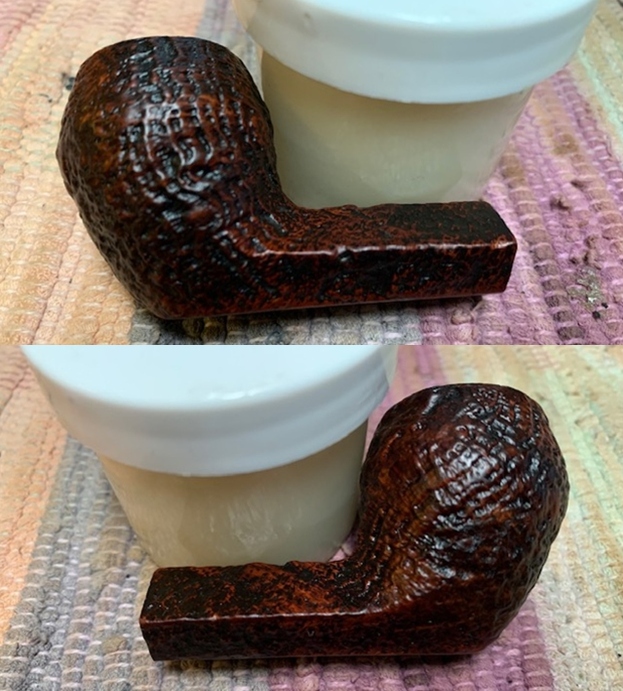
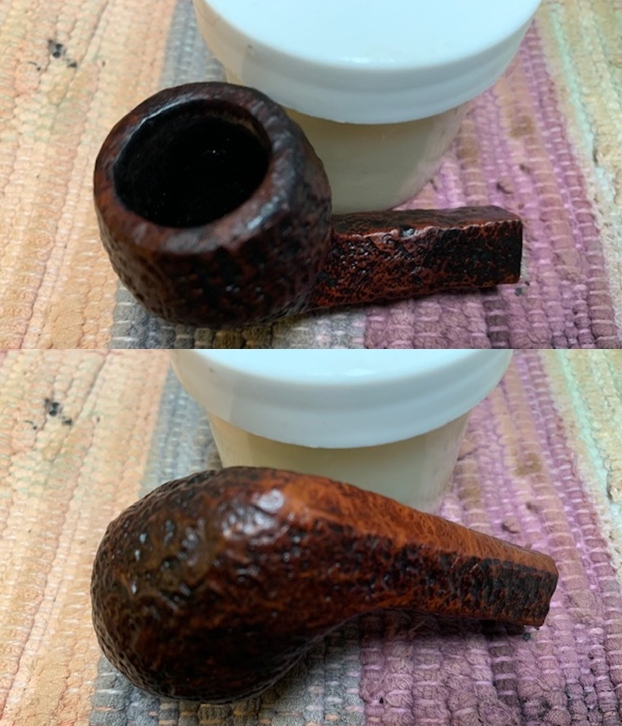
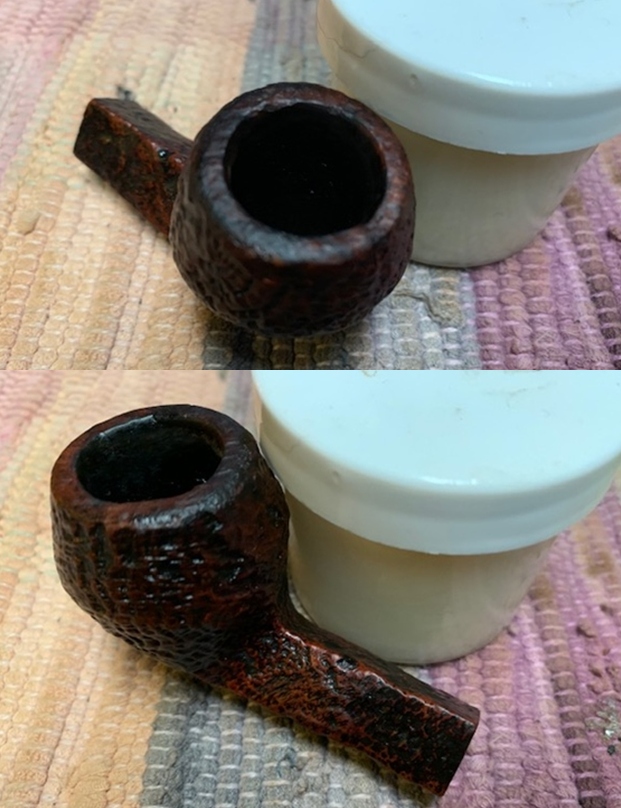
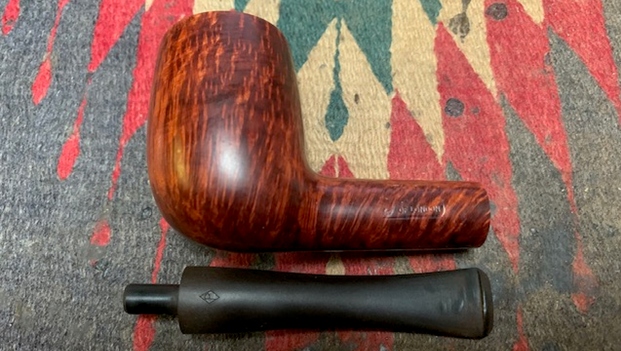
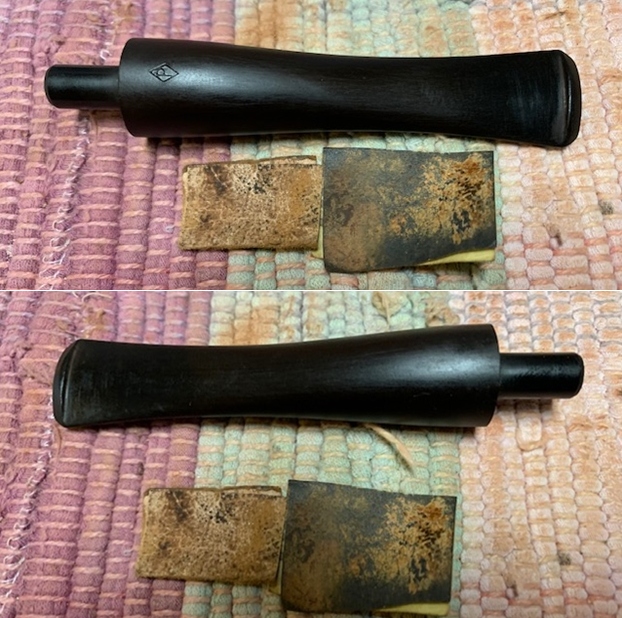
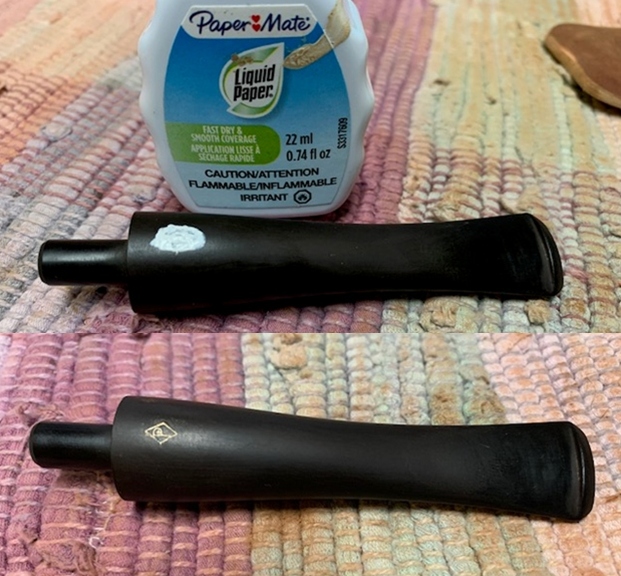
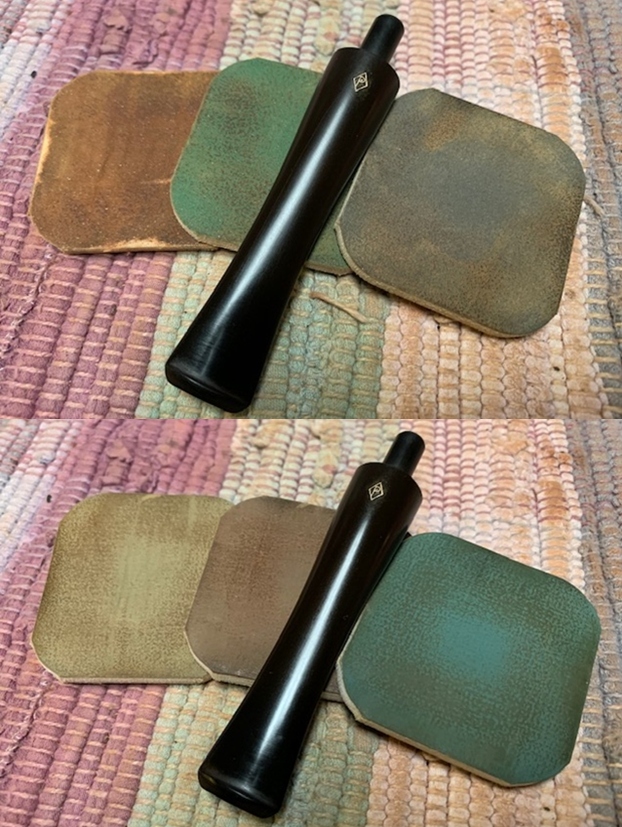
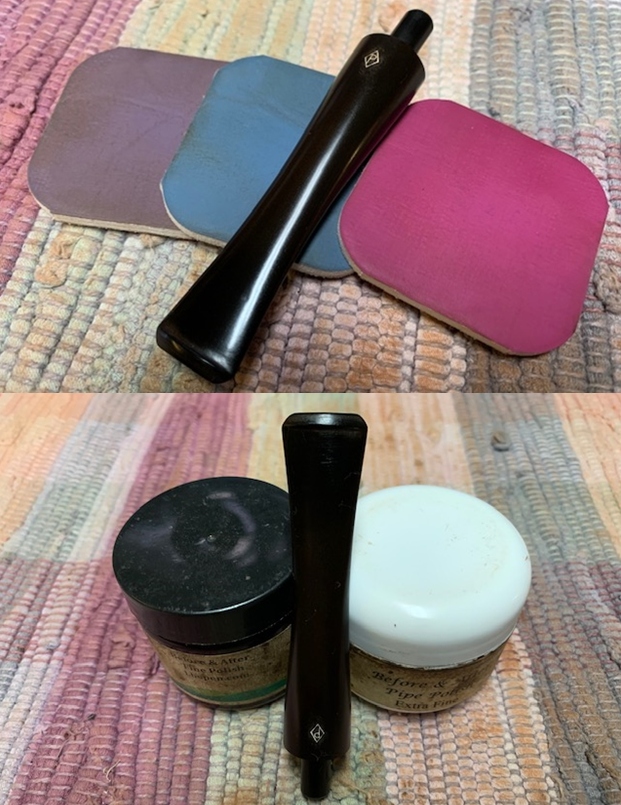
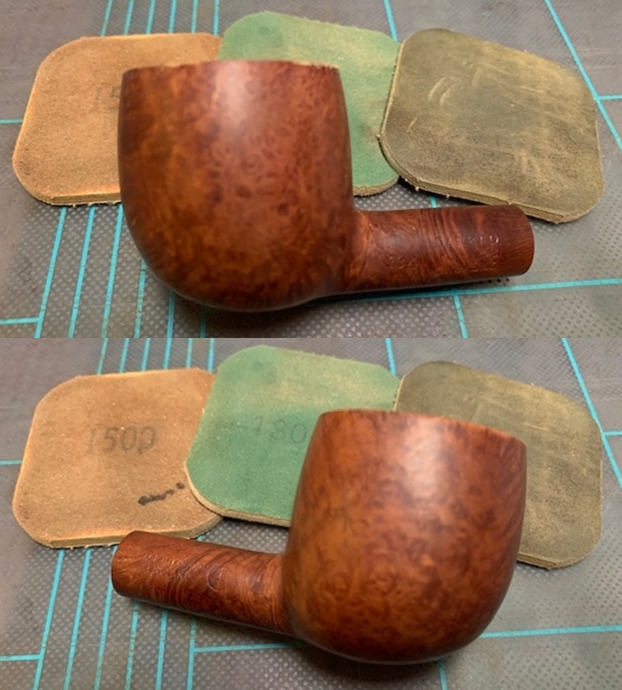
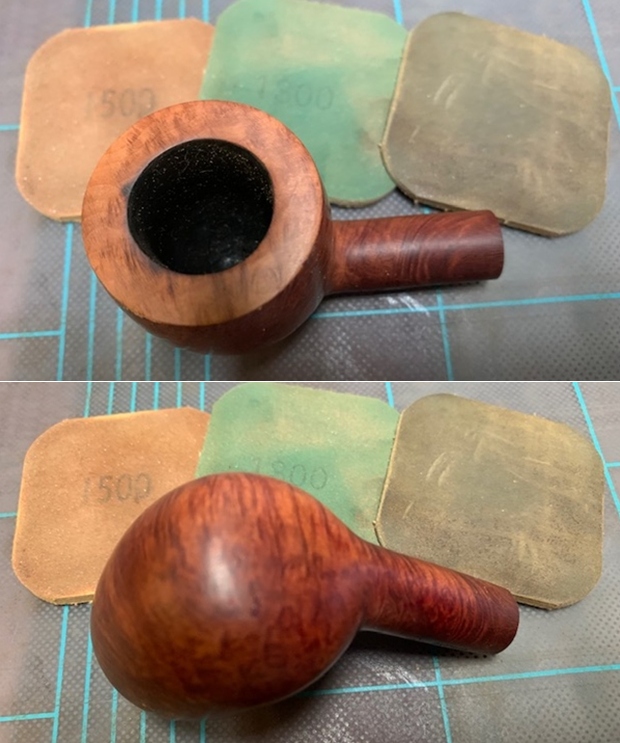
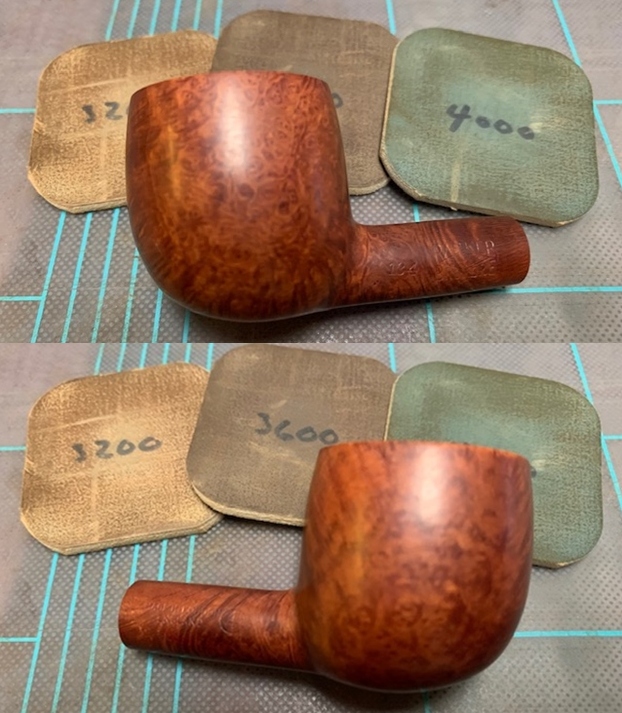
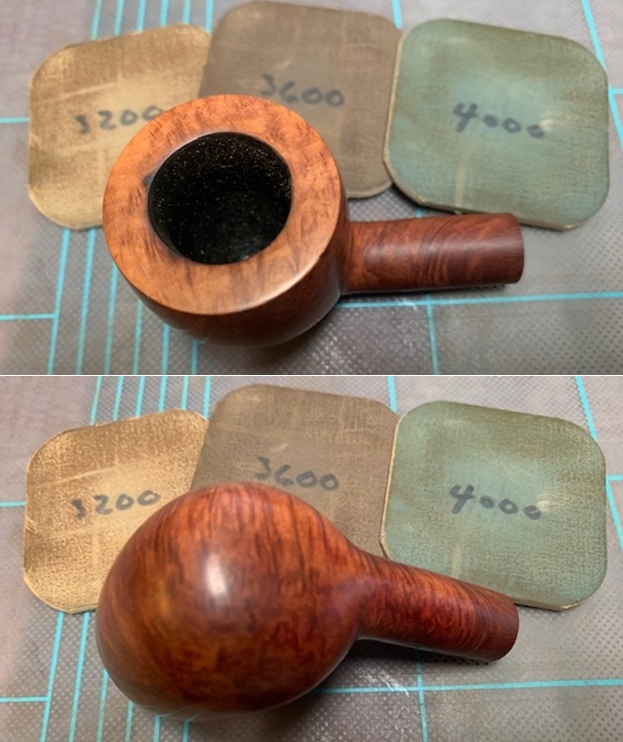
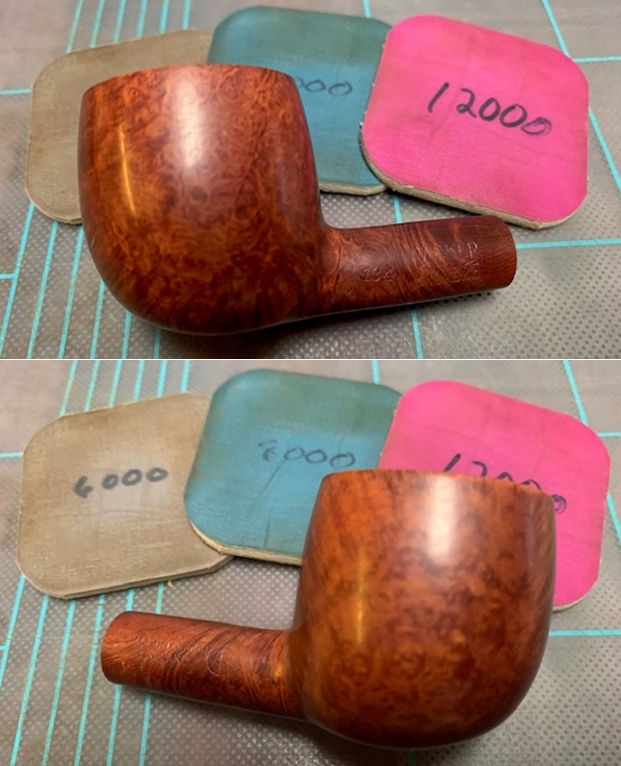
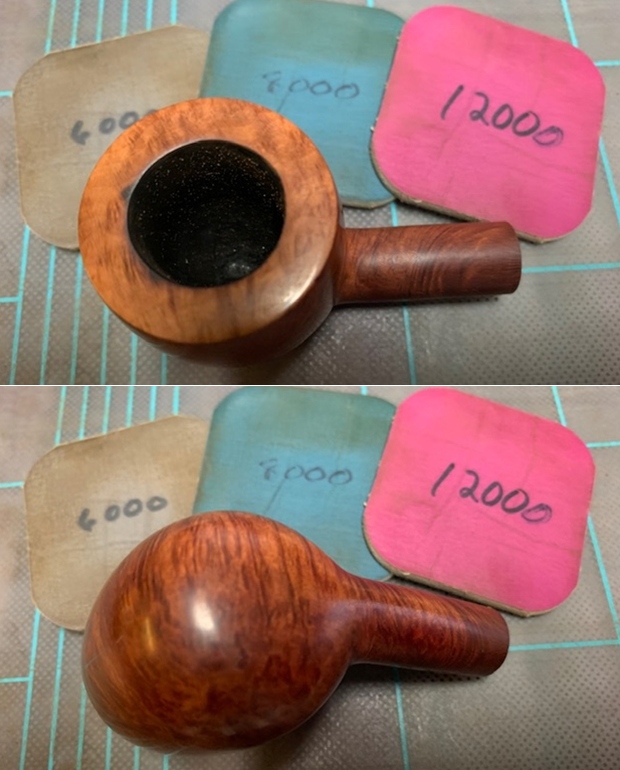
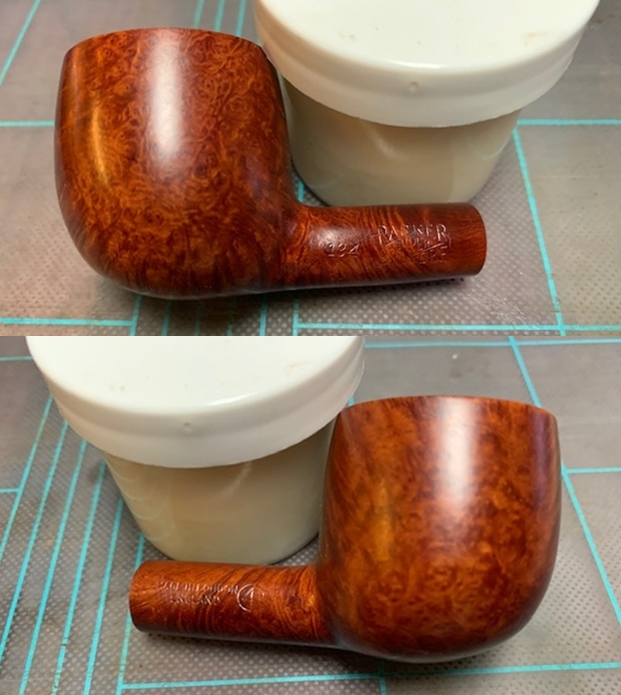
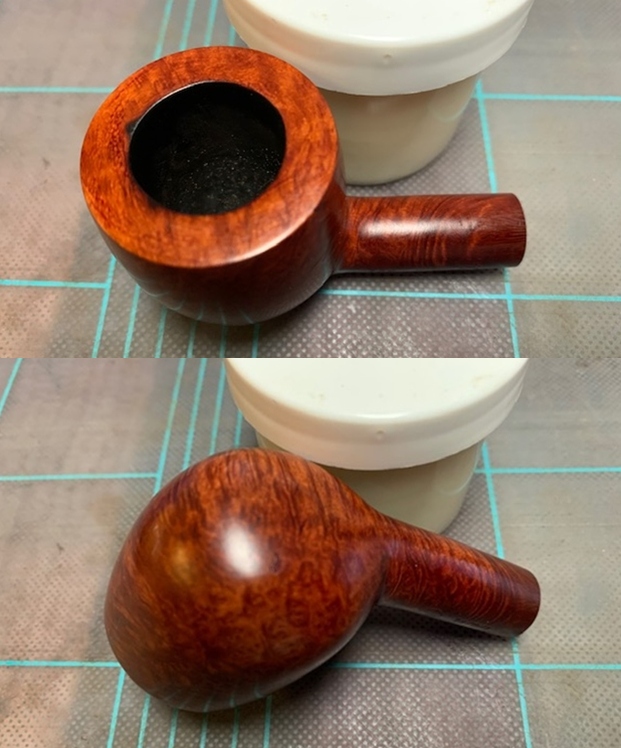
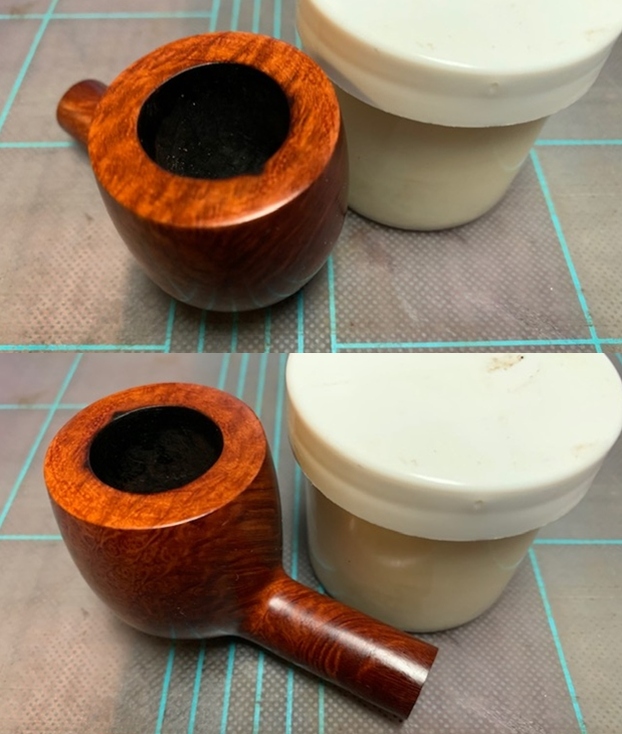
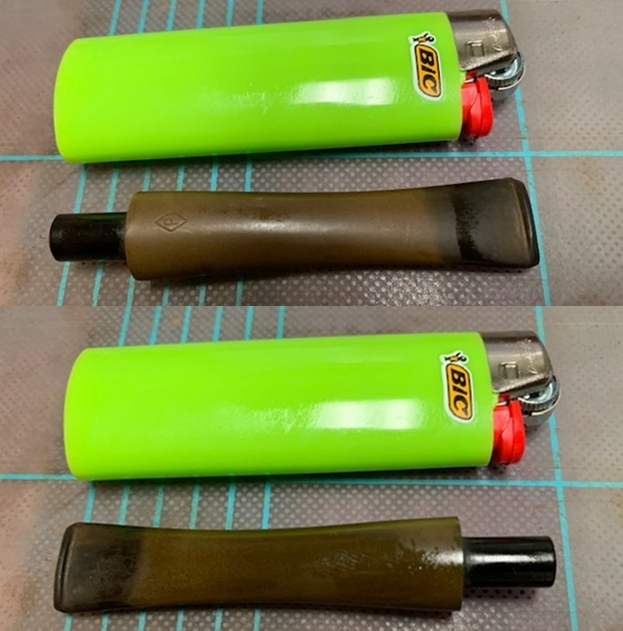
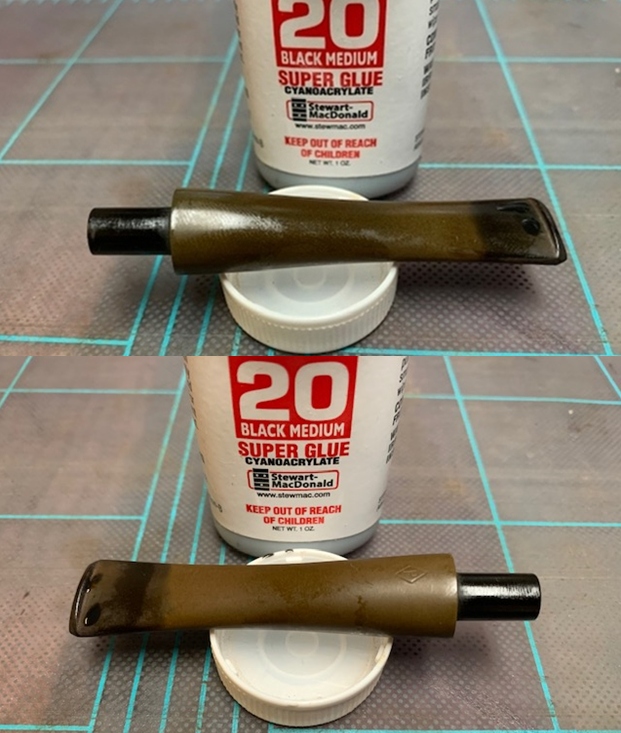
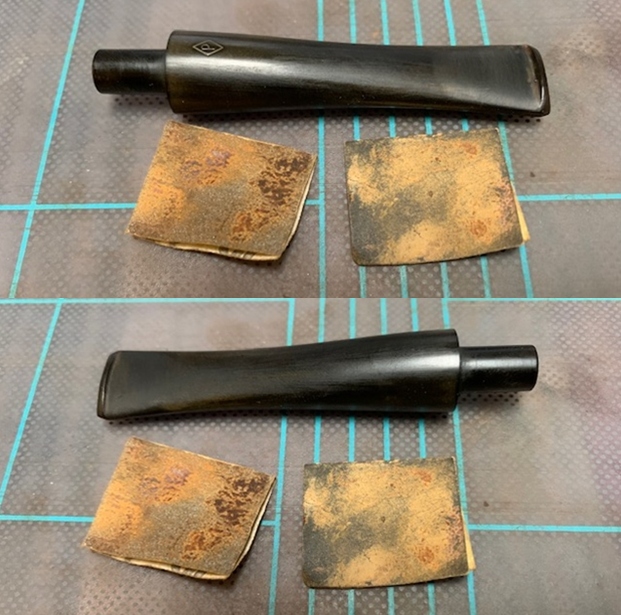
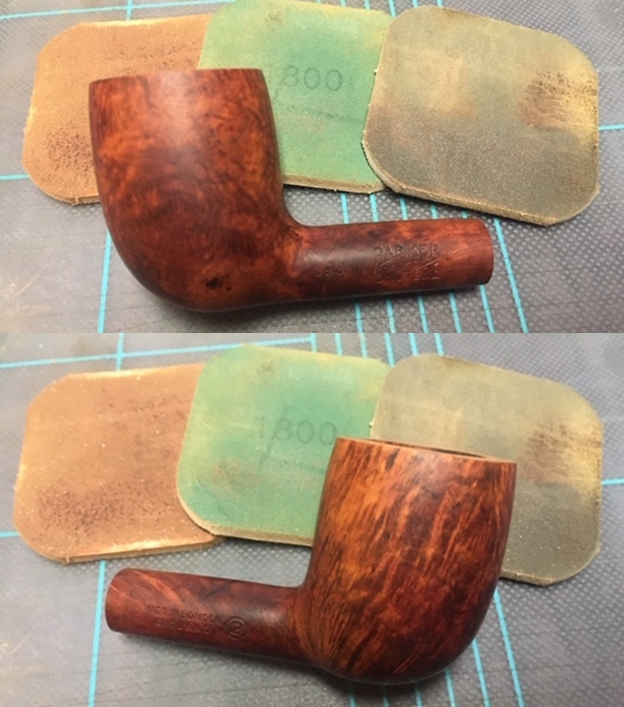
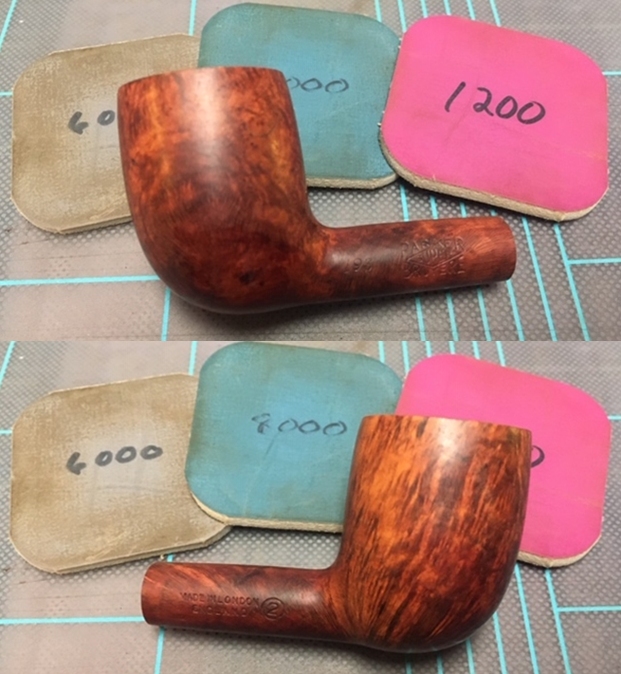
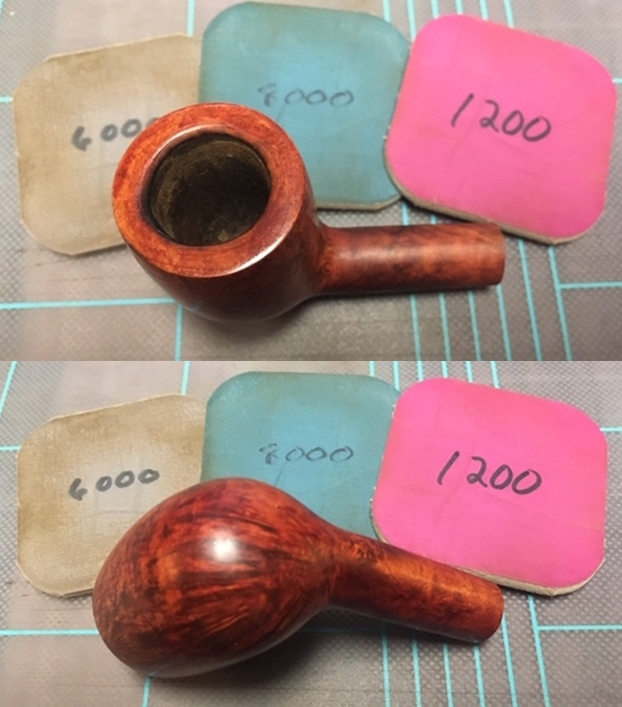
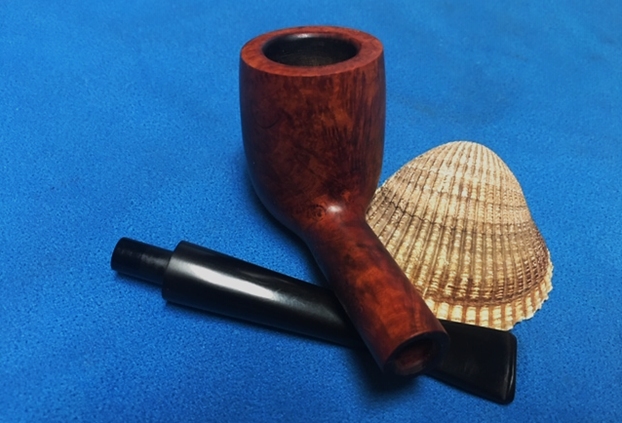
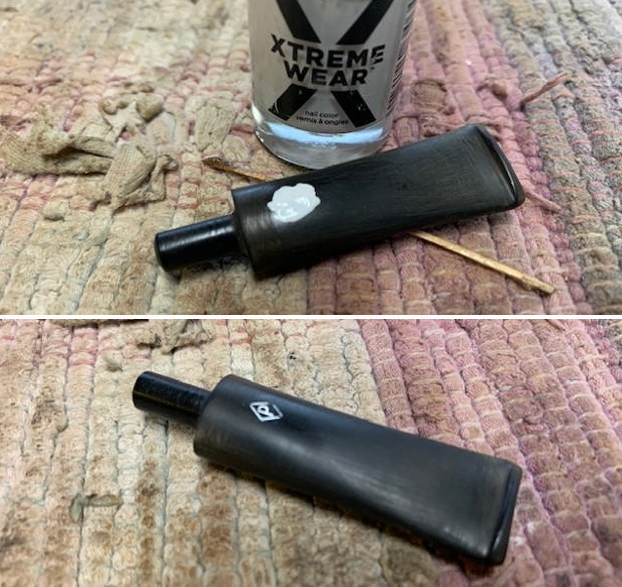
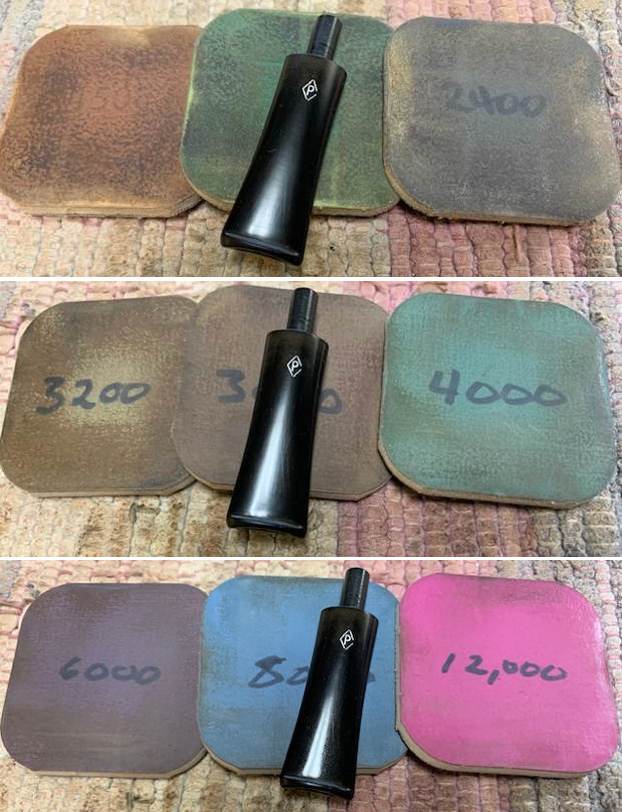
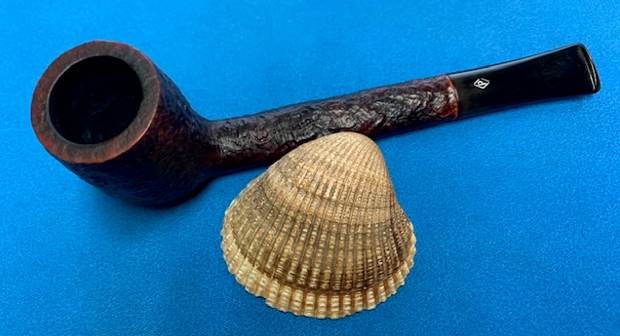
Knowing that about me you can guess that I started working on this pipe by turning to the bowl. The bowl was in great condition over all with a bit of darkening still in the sandblast on the rim top. I decided to clean up the rim top. I use a brass bristle wire brush to work it over and clean up the remaining debris in the sandblast. The bowl was ready for the next stem in the process. I use a product developed by Mark Hoover called Before & After Restoration Balm. It is a paste/balm that is rubbed into the surface of the briar. The product works to deep clean the finish, enliven and protect the briar. I worked it into the briar with my finger tips and a shoe brush to make sure that it covers every square inch of the pipe. I set it aside for 10 minutes to let it do its work. Once the time has passed I wiped it off with a soft cloth then buffed it with a cotton cloth. The briar really began to have a deep shine and show some contrast in the sandblast finish. The photos I took of the bowl at this point mark the progress in the restoration. You see the shine that the briar has taken on and the way the grain just pops. It is a gorgeous pipe. Now it was time to address the part of the restoration I leave until last. I set the bowl aside and turned my attention to the stem. The stem was in quite good shape. Jeff had been able to remove much of the oxidation so that when it came it looked pretty good. I needed to deal with the remaining oxidation and to address the tooth marks at the same time. I sanded the stem surface with 220 grit sandpaper and start polishing it with 600 grit wet dry sandpaper to remove the oxidation. This process removes the oxidation and the marks. Here are photos of the stem after the sandpaper work.I then took some time to touch up the Diamond “P” Parker logo on the topside of the stem with white acrylic fingernail polish. I worked it into the stamp on the stem with a tooth pick to ensure that it went deep into the stamp. Once it cured I scraped off the excess and the stamp looked very good. It was the time now to polish the stem and remove the scratching and bring back a shine. Over the years I have developed my own process for this. It is all preparation for the buffing that will come last. I use micromesh sanding pads and water to wet sand the stem with 1500-12000 grit sanding pads. I wiped it down after each sanding pad with Obsidian Oil on a cotton rag after each sanding pad as I find it does two things – first it protects the vulcanite and second it give the sanding pads bite in the polishing process.After finishing with the micromesh pads I always rub the stem down with Before & After Fine and Extra Fine stem polish as it seems to really remove the fine scratches in the vulcanite. I rub the Fine Polish on the stem and wipe it off with a paper towel and then repeat the process with the Extra Fine polish. I finish the polishing of the stem by wiping it down with a final coat of Obsidian Oil and set the stem aside to let the oil absorb. This process gives the stem a shine and also a bit of protection from oxidizing quickly.The final steps in my process involve using the buffer. I buff the stem and the briar with Blue Diamond on the buffing wheel. Blue Diamond is a plastic polish but I find that it works very well to polish out the light scratches in the vulcanite and the briar. I work the pipe over on the wheel with my finger or thumb in the bowl to keep it from becoming airborne. It works well and I am able to carefully move forward with the buffing. I lightly buff the plateau on the rim top and shank end at the same time making sure to keep the product from building up in the grooves of the finish. I finished with the Blue Diamond and moved on to buffing with carnauba wax. Once I have a good shine in the briar and vulcanite I always give the bowl and the stem multiple coats of carnauba wax. I have found that I can get a deeper shine if I following up the wax buff with a clean buffing pad. It works to raise the shine and then I follow that up with a hand buff with a microfiber cloth to deepen the shine. It is always fun for me to see what the polished bowl looks like with the polished vulcanite stem. It really is a beautiful pipe. The smooth finish around the bowl sides and shank show the grain shining through the rich brown stains of this Parker Super Bark Sandblast 132 Canadian and the polished vulcanite stem is a great addition. The finished pipe feels great in my hand. It is light and well balanced. Have a look at it with the photos below. The dimensions are Length: 5 ½ inches, Height: 1 ½ inches, Outside diameter of the bowl: 1 1/8 inches, Chamber diameter: ¾ of an inch. The weight of the pipe is .92 ounces/25 grams. It is a beautiful pipe and one that I will be putting on the rebornpipes store in the British Pipe Maker section.
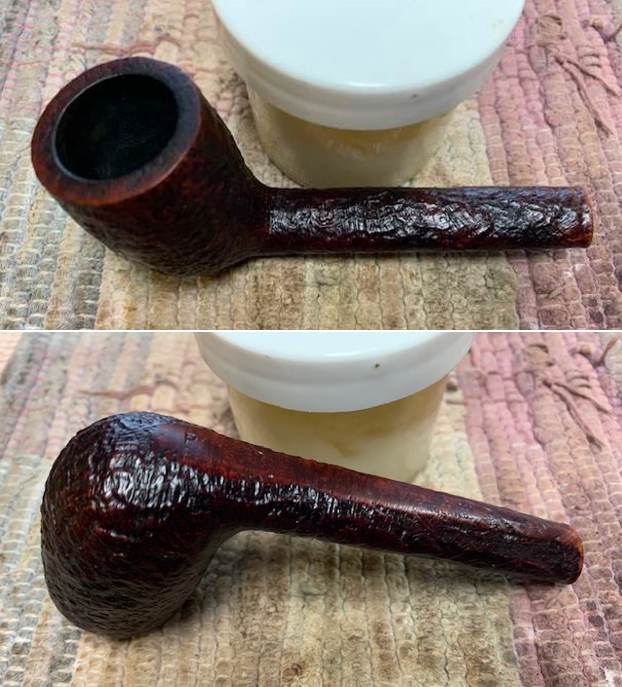
Hopefully this tack of writing this blog is helpful to you in some way. In it I show both what I am looking for and how I move forward in addressing what I see when work on a pipe has been helpful to you. It is probably the most straightforward detailed description of my work process. As always I encourage your questions and comments as you read the blog. Thanks to each of you who are reading this blog. Remember we are not pipe owners; we are pipemen and women who hold our pipes in trust until they pass on into the trust of those who follow us.

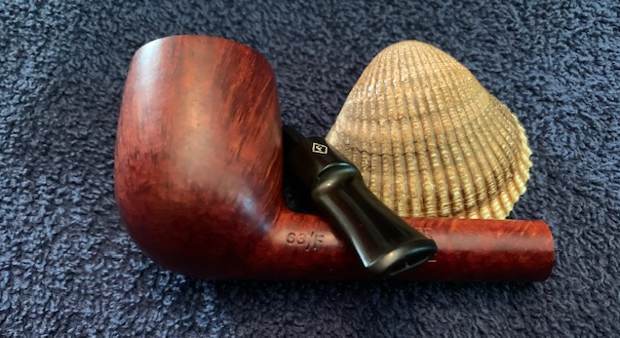
Restoring 1953 Parker Super Bruyere Patent 63/F Lovat


Blog by Steve Laug

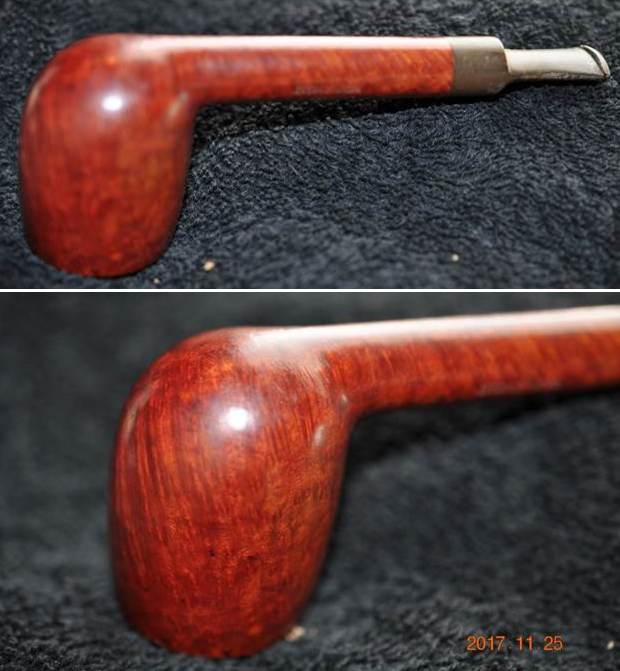
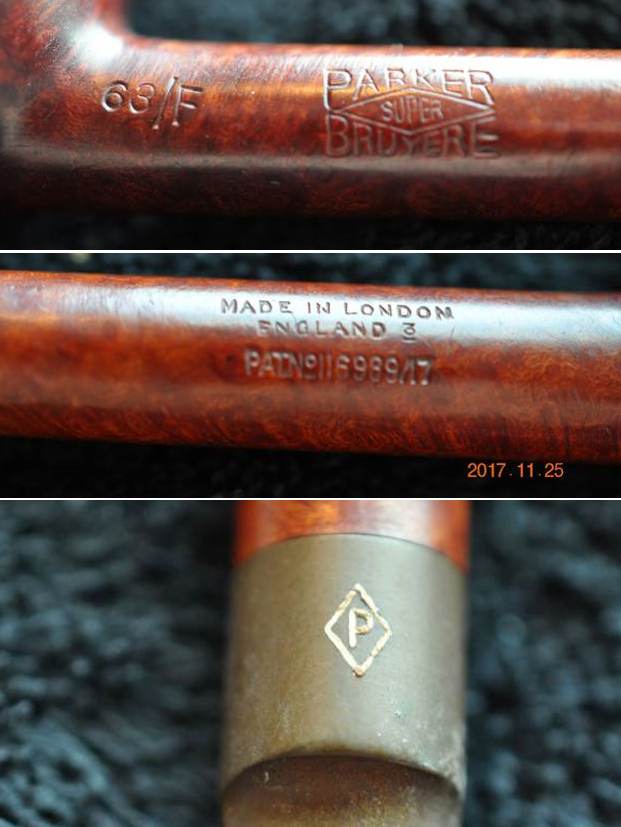
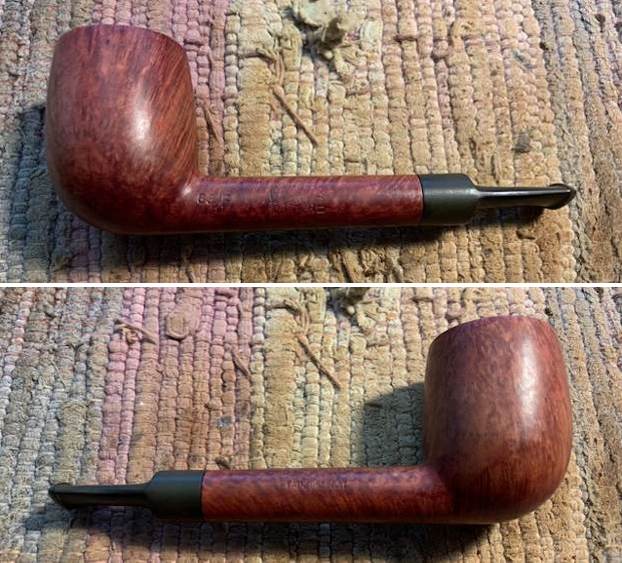
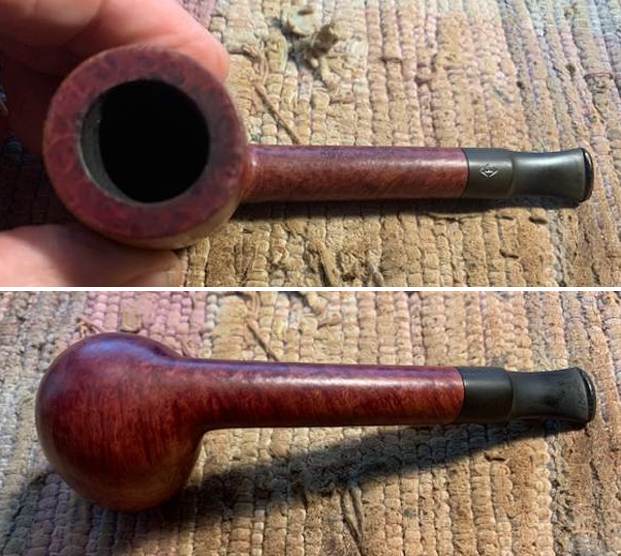
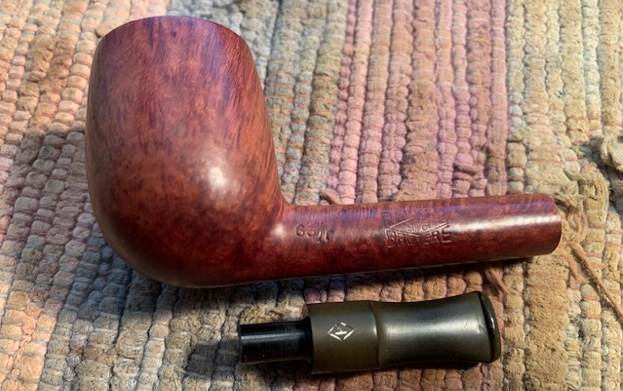
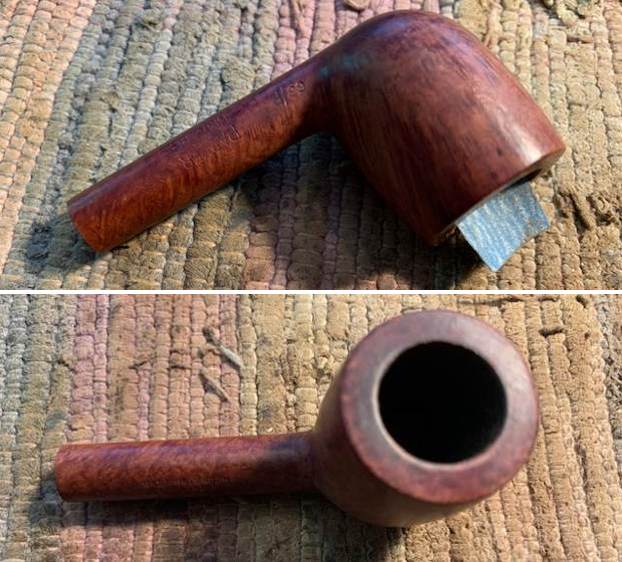
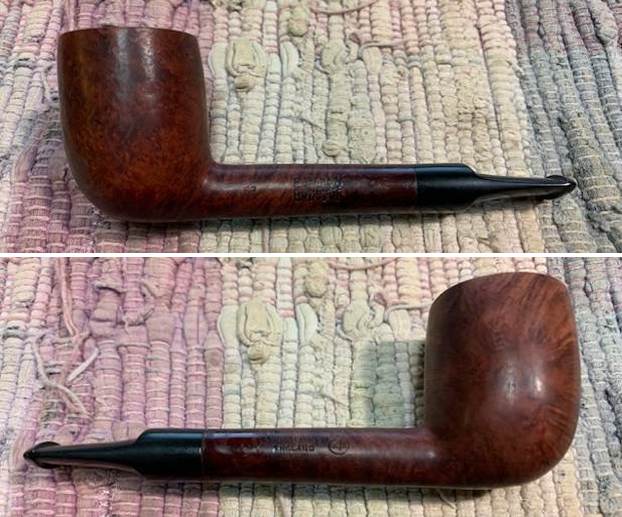
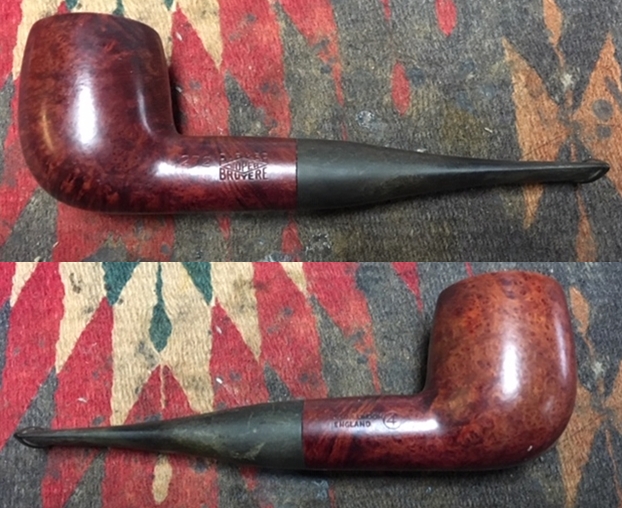
The next pipe on the work table was purchased on 08/16/17 from the same estate in Portland, Oregon, USA as the other Parker I worked on. This one is a beautiful little Parker Lovat. The stamping on the left side of the shank reads Parker over Super in a diamond over Bruyere. To the left of that next to the shank bowl junction is the shape number 63/F. On the right side of the shank the stamping reads Made in London over England with an underlined superscript 3 following the D in England that is the date stamp 1953. The date stamp was easily read after the previous 1954 Parker Super Bruyere Cherrywood that I restored and added to my collection (https://rebornpipes.com/2022/07/16/restoring-my-birth-year-1954-parker-super-bruyere-patent-cherrywood-281-f/). Further stamping under that reads PAT NO. 116989/17 which should also help with dating the pipe. The finish on the pipe was filthy with grime ground into the briar. There was a thick cake in the bowl that flowed out on top of the crowned rim top and down the outer edge of the rim. The cake was thick so it was hard to know what the edge of the rim looked like. The stem was heavily oxidized and calcified with tooth marks on the top and underside ahead of the button. There was a Diamond P logo on the top of the stem. Jeff took photos of the pipe before he cleaned it up. He took photos of the bowl and rim top to show the condition of the pipe. You can see the cake in the bowl and the thick lava build up on the inner edge and the rim top. The stem photos show the oxidation and tooth marks and chatter on the top and underside ahead of the button. He took photos of the bowl and the heel to capture a sense of the grain around the bowl. It is a really nice piece of briar.   He took photos of the stamping on sides of the shank as well as the logo stamp on the top side of the saddle stem. All are clear and readable as noted above.    I have worked on quite a few Parkers over time but this is the second one stamped with both a date stamp and a Patent number. The superscript 3 after the D in England and a Patent Number under that. The pipe was a 1953. I found a picture of a pipe that had the same stamping on both sides of the shank as the one I am working on but it has a different shape number and date after the D (http://www.pipephil.eu/logos/en/logo-parker.html). I have included a screen capture of the section showing pipe. At the top of the listing there was a short summary of the history of the brand. I quote from it below.

Parker Pipe Co. was created in 1923 by Dunhill. After Dunhill acquired Hardcastle the two companies were merged (1967) in the Parker-Hardcastle Ltd.

Patent number 116989/17 is the only one which may appear on a Parker pipe prior to 1954. This was the year Parker and Dunhill both stopped stamping pat#.

On the side bar next to the listing for Parker Super Bruyere the following information was available.

Like Dunhill pipes, Parkers were also date coded but had a independent cycle.

  • From 1925 through 1941 the date code of Parker pipes runs from 2 to 18.
  • From 1945 through 1949 the date code runs from 20 to 24.
  • From 1950 through 1957 (at least) date suffix run from an underlined and raised 0 to 7.

Pat n° 116989/17 is the number corresponding to the Inner Tube patent (with flange).

I turned to Pipedia and did a bit more reading on the brand (https://pipedia.org/wiki/Parker). I quote in part below:

In 1922 the Parker Pipe Co. Limited was formed by Alfred Dunhill to finish and market what Dunhill called its “failings” or what has come to be called by collectors as seconds. Previous to that time, Dunhill marketed its own “failings”, often designated by a large “X” over the typical Dunhill stamping or “Damaged Price” with the reduced price actually stamped on the pipe.
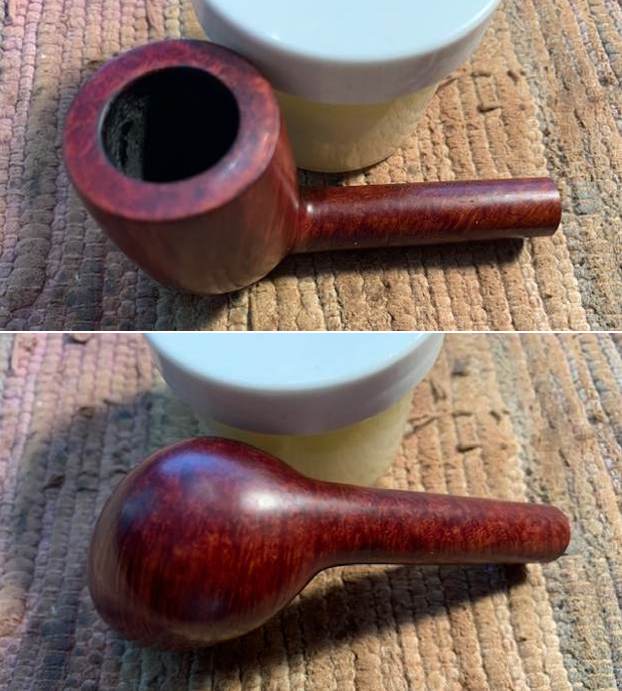
While the timing and exact nature of the early relationship remains a bit of mystery, Parker was destined to eventually merge with Hardcastle when in 1935 Dunhill opened a new pipe factory next door to Hardcastle, and purchased 49% of the company shares in 1936. In 1946, the remaining shares of Hardcastle were obtained, but it was not until 1967 when Parker-Hardcastle Limited was formed.

It is evident through the Dunhill factory stamp logs that Parker and Dunhill were closely linked at the factory level through the 1950s, yet it was much more than a few minor flaws that distinguishing the two brands. Most Dunhill “failings” would have been graded out after the bowl turning process exposed unacceptable flaws. This was prior to stoving, curing, carving, bit work and finishing. In others words, very few Parkers would be subjected to the same rigorous processes and care as pipes destined to become Dunhills. Only those that somehow made it to the end finishing process before becoming “failings” enjoy significant Dunhill characteristics, and this likely represents very few Parker pipes.
After the war, and especially after the mid 1950s the differences between Parker and Dunhill became even more evident, and with the merger of Parker with Hardcastle Pipe Ltd, in 1967 the Parker pipe must be considered as an independent product. There is no record of Parker ever being marketed by Dunhill either in it’s retail catalog or stores.

Parker was a successful pipe in the US market during the 1930s up through the 1950s, at which point it faded from view in the US, while continuing to be popular in the UK. It was re-introduced into the US market in 1991 and is also sold in Europe…

…Prior to Word War II, the possessive PARKER’S stamp was used. However, at least some pipes were stamped with the non-possessive as early as 1936.

Like Dunhill, Parker pipes are date stamped, but differently than Dunhill. The Parker date code always followed the MADE IN LONDON over ENGLAND stamping. The first year’s pipes (1923) had no date code; from 1924 on it ran consecutively from 1 to 19.

There is no indication of a date code for the war years. Parker was not a government approved pipe manufacturer, while Dunhill and Hardcastle were. During the war years Parker manufactured the “Wunup” pipe made of Bakelite and clay. A Parker pipe with a 19 date code has been reported, indicating there was perhaps some production of briar pipes as well, but no dating record.

From 1945 through 1949 the Parker date code runs from 20 to 24 and from 1950 through 1957 it runs from an underlined and raised 0 to an underlined and raised 7.

A little help here from anyone with date code information beyond 1957 would be most appreciated.

The site did give me a lot of information about the Parker brand and its connection to Dunhill. It confirmed without a doubt that the pipe that I was working on was made in 1953 from the date stamp underlined superscript 3 following the D in England. The Patent Number 116989/17 is the only one which may appear on a Parker pipe prior to 1954. This was the year Parker and Dunhill both stopped stamping Patent Numbers. The patent refers to an inner tube with a flange.

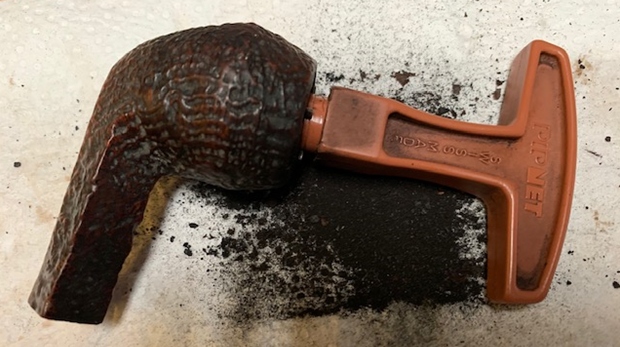
Jeff cleaned the Parker up really well. He reamed it with a Pipnet Reamer and cleaned up the reaming with a Savinelli Fitsall pipe knife.  He had scrubbed the exterior of the bowl with Murphy’s Oil Soap and a tooth brush and rinsed it off with warm water to remove the grime from the finish. He cleaned the internals of the shank and stem with alcohol, cotton swabs and pipe cleaners to remove the tarry residue and oils from the airway in the shank and stem. He soaked the stem in Before & After Deoxidizer to remove the oxidation on the stem surface. When it arrived here on my work table I took photos of the pipe before I started my part of the restoration. The pipe looked very good with a light oxidation still remaining on the stem surface. The Diamond P stamp was clean but had no colour left in the stamping.   The inner and outer edges were in good condition. There was some darkening on the back of the rim top and around the inner edge. There was some light marks or nicks on the front edge. The stem looked good but there was still some oxidation and there were tooth marks and chatter on both sides near the button. I took a photo of the stamping on the sides of the shank. The stamping is clear and readable and reads as noted above.  I took the stem off the pipe and took a photo of the parts to show the look of the pipe as a whole. I started my work on the inner edge of the bowl and rim top with a folded piece of sandpaper to clean up the darkening and damage. It looked much better after the work.   I polished the rim top and bowl with 1500-12000 grit micromesh sanding pads to polish the briar. I wiped it down with a damp cloth after each sanding pad.   I rubbed the bowl and shank down with Before & After Restoration Balm. I worked it into the surface of the bowl sides and shank with my fingertips to clean, enliven and protect the briar. I let the balm sit for 15 minutes then buffed with a cotton cloth to raise the shine. You can see the grain showing through the deep glow. I “painted” the stem surface with the flame of a Bic lighter. I was able to lift the dents and then sanded out the remnants of chatter and marks with 220 grit sandpaper. I started polishing the stem with 400 grit wet dry sandpaper.      I touched up the Diamond P stamp with White Acrylic Fingernail Polish. I pushed it into the stamping with a tooth pick. I scraped it off with the tooth pipe and a cotton pad to remove the excess and still leave some in the stamping.  Afterwards I used a 1500 grit micromesh sanding pad to remove the remaining acrylic.    I polished the vulcanite stem with micromesh sanding pads – 1500-12000 grit pads. I wiped it down with cloth impregnated with Obsidian Oil after each sanding pad.    This 1953 Parker British Made Super Bruyere 68F Lovat is a great looking pipe now that it has been restored. The medium reddish brown stain highlights the grain and works well with the polished vulcanite bent taper stem. I put the stem back on the bowl and carefully buffed the pipe with Blue Diamond on the buffing wheel using a light touch on the briar. I gave the bowl and the stem multiple coats of carnauba wax on the buffing wheel and followed that by buffing the entire pipe with a clean buffing pad. I hand buffed the pipe with a microfiber cloth to deepen the shine. The finished Lovat fits nicely in the hand and feels great. Give the finished pipe a look in the photos below. The dimensions of the pipe are; Length: 5 inches, Height: 1 ¾ inches, Outer diameter of the bowl: 1 ¼ inches, Chamber diameter: ¾ inches. The weight of the pipe is 1.20 ounces/34 grams. I will be adding it to the rebornpipes store in the British Pipemakers Section. Thanks for reading this blog and my reflections on the pipe while I worked on it. This is an interesting estate to bring back to life.

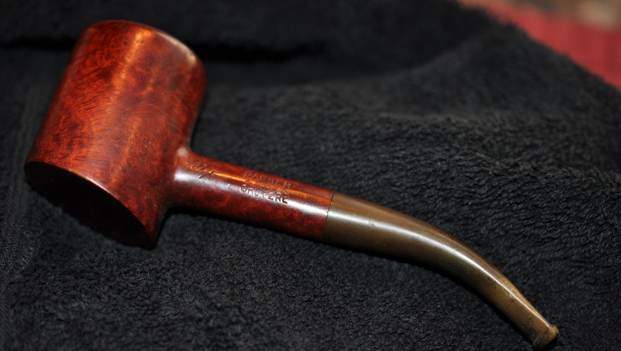
Restoring My Birth Year 1954 Parker Super Bruyere Patent Cherrywood 281/F


Blog by Steve Laug

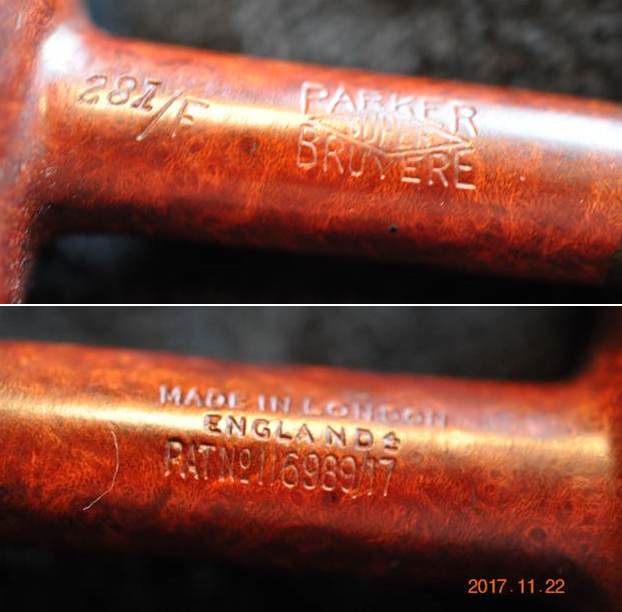
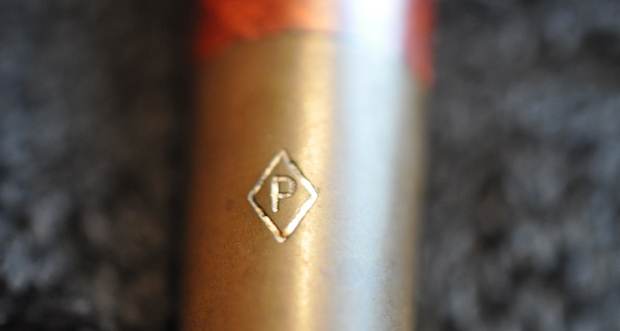
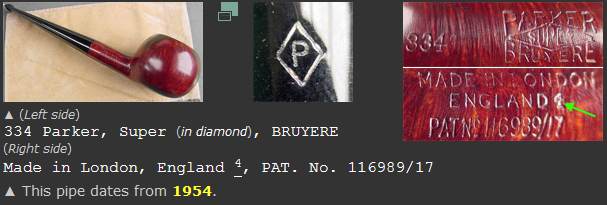
The next pipe on the work table comes from —. This one is a beautiful little Parker Cherrywood. The stamping on the left side of the shank reads Parker over Super in a diamond over Bruyere. To the left of that next to the shank bowl junction is the shape number 281/F. On the right side of the shank the stamping reads Made in London over England with an underlined superscript 4 following the D in England (a date stamp). The date stamp gave me an idea. I have a hunch about the date but I would do a bit more work to make sure my hunch was correct. If it was then this beauty would be staying with me. Further stamping under that reads PAT NO. 116989/17 which should also help with dating the pipe. This pipe was purchased on 08/16/17 from an estate in Portland, Oregon, USA. The finish on the pipe was filthy with grime ground into the briar. There was a thick cake in the bowl that flowed out on top of the crowned rim top and down the outer edge of the rim. The cake was thick so it was hard to know what the edge of the rim looked like. The stem was heavily oxidized and calcified with tooth marks on the top and underside ahead of the button. Jeff took photos of the pipe before he cleaned it up. He took photos of the bowl and rim top to show the condition of the pipe. You can see the cake in the bowl and the thick lava build up on the inner edge of the rim top. The stem photos show the oxidation and tooth marks and chatter on the top and underside ahead of the button. He took photos of the bowl sides and the heel to capture a sense of the grain around the bowl. It is a really nice piece of briar.   He took photos of the stamping on sides of the shank as well as the logo stamp on the top side of the taper stem. All are clear and readable as noted above.    I have worked on quite a few Parkers over time but have not seen one stamped like the one I have now. The superscript 4 after the D in England and a Patent Number under that. My hunch was that this was a 1954 pipe and thus it was one from my birth year. I found a picture of a pipe that had the same stamping on both sides of the shank as the one I am working on but it has a different shape number (http://www.pipephil.eu/logos/en/logo-parker.html). I have included a screen capture of the section showing pipe. The information in the capture confirms the 1954 date for me.At the top of the listing there was a short summary of the history of the brand. I quote from it below.

Parker Pipe Co. was created in 1923 by Dunhill. After Dunhill acquired Hardcastle the two companies were merged (1967) in the Parker-Hardcastle Ltd.

Patent number 116989/17 is the only one which may appear on a Parker pipe prior to 1954. This was the year Parker and Dunhill both stopped stamping pat#.

On the side bar next to the listing for Parker Super Bruyere the following information was available.

Like Dunhill pipes, Parkers were also date coded but had a independent cycle.

  • From 1925 through 1941 the date code of Parker pipes runs from 2 to 18.
  • From 1945 through 1949 the date code runs from 20 to 24.
  • From 1950 through 1957 (at least) date suffix run from an underlined and raised 0 to 7.

Pat n° 116989/17 is the number corresponding to the Inner Tube patent (with flange).

I turned  to Pipedia and did a bit more reading on the brand (https://pipedia.org/wiki/Parker). I quote in part below:

In 1922 the Parker Pipe Co. Limited was formed by Alfred Dunhill to finish and market what Dunhill called its “failings” or what has come to be called by collectors as seconds. Previous to that time, Dunhill marketed its own “failings”, often designated by a large “X” over the typical Dunhill stamping or “Damaged Price” with the reduced price actually stamped on the pipe.

While the timing and exact nature of the early relationship remains a bit of mystery, Parker was destined to eventually merge with Hardcastle when in 1935 Dunhill opened a new pipe factory next door to Hardcastle, and purchased 49% of the company shares in 1936. In 1946, the remaining shares of Hardcastle were obtained, but it was not until 1967 when Parker-Hardcastle Limited was formed.

It is evident through the Dunhill factory stamp logs that Parker and Dunhill were closely linked at the factory level through the 1950s, yet it was much more than a few minor flaws that distinguishing the two brands. Most Dunhill “failings” would have been graded out after the bowl turning process exposed unacceptable flaws. This was prior to stoving, curing, carving, bit work and finishing. In others words, very few Parkers would be subjected to the same rigorous processes and care as pipes destined to become Dunhills. Only those that somehow made it to the end finishing process before becoming “failings” enjoy significant Dunhill characteristics, and this likely represents very few Parker pipes.

After the war, and especially after the mid 1950s the differences between Parker and Dunhill became even more evident, and with the merger of Parker with Hardcastle Pipe Ltd, in 1967 the Parker pipe must be considered as an independent product. There is no record of Parker ever being marketed by Dunhill either in it’s retail catalog or stores.

Parker was a successful pipe in the US market during the 1930s up through the 1950s, at which point it faded from view in the US, while continuing to be popular in the UK. It was re-introduced into the US market in 1991 and is also sold in Europe…

…Prior to Word War II, the possessive PARKER’S stamp was used. However, at least some pipes were stamped with the non-possessive as early as 1936.

Like Dunhill, Parker pipes are date stamped, but differently than Dunhill. The Parker date code always followed the MADE IN LONDON over ENGLAND stamping. The first year’s pipes (1923) had no date code; from 1924 on it ran consecutively from 1 to 19.

There is no indication of a date code for the war years. Parker was not a government approved pipe manufacturer, while Dunhill and Hardcastle were. During the war years Parker manufactured the “Wunup” pipe made of Bakelite and clay. A Parker pipe with a 19 date code has been reported, indicating there was perhaps some production of briar pipes as well, but no dating record.

From 1945 through 1949 the Parker date code runs from 20 to 24 and from 1950 through 1957 it runs from an underlined and raised 0 to an underlined and raised 7.

A little help here from anyone with date code information beyond 1957 would be most appreciated.

The site did give me a lot of information about the Parker brand and its connection to Dunhill. It confirmed without a doubt that the pipe that I was working on was made in 1954 from the date stamp underlined superscript 4 following the D in England. The Patent Number 116989/17 is the only one which may appear on a Parker pipe prior to 1954. This was the year Parker and Dunhill both stopped stamping Patent Numbers. The patent refers to an inner tube with a flange.

Jeff cleaned the Parker up really well. He reamed it with a Pipnet Reamer and cleaned up the reaming with a Savinelli Fitsall pipe knife.  He had scrubbed the exterior of the bowl with Murphy’s Oil Soap and a tooth brush and rinsed it off with warm water to remove the grime from the finish. He cleaned the internals of the shank and stem with alcohol, cotton swabs and pipe cleaners to remove the tarry residue and oils from the airway in the shank and stem. He soaked the stem in Before & After Deoxidizer to remove the oxidation on the stem surface. When it arrived here on my work table I took photos of the pipe before I started my part of the restoration. The pipe looked very good with a light oxidation still remaining on the stem surface. The Diamond P stamp was clean but had no colour left in the stamping. The inner and outer edges were in good condition. There was some darkening on the back of the rim top and around the inner edge. There was some light marks or nicks on the back right side. The stem look good but there was still some oxidation and there were tooth marks and chatter on both sides near the button. I took a photo of the stamping on the sides of the shank. The stamping is clear and readable and reads as noted above. I took the stem off the pipe and took a photo of the parts to show the look of the pipe as a whole. I started my work on the inner edge of the bowl and rim top with a folded piece of sandpaper to clean up the darkening and damage. It looked much better after the work.   I polished the rim top and bowl with 1500-12000 grit micromesh sanding pads to polish the briar. I wiped it down with a damp cloth after each sanding pad.      I rubbed the bowl and shank down with Before & After Restoration Balm. I worked it into the surface of the bowl sides and shank with my fingertips to clean, enliven and protect the briar. I let the balm sit for 15 minutes then buffed with a cotton cloth to raise the shine. You can see the grain showing through the deep glow. I set the bowl aside and turned my attention to the stem. I scrubbed the surface of the stem with Soft Scrub all-purpose cleanser to remove the oxidation that remained on the stem surface.I “painted” the stem surface with the flame of a Bic lighter. I was able to lift the dents and then sanded out the remnants of chatter and marks with 220 grit sandpaper. I started polishing the stem with 400 grit wet dry sandpaper.   I polished the vulcanite stem with micromesh sanding pads – 1500-12000 grit pads. I wiped it down with cloth impregnated with Obsidian Oil after each sanding pad. I touched up the Diamond P stamp with White Acrylic Fingernail Polish. I pushed it into the stamping with a tooth pick. I rubbed it off with a cotton pad to remove the excess and still leave some in the stamping.  Afterwards I used Before & After Pipe Polish – both Fine and Extra Fine to further polish the stem. I gave it a final rubdown with Obsidian Oil and set it aside.       This 1954 Parker British Made Super Bruyere 281F Cherrywood is a great looking pipe now that it has been restored. The medium reddish brown stain highlights the grain and works well with the polished vulcanite bent taper stem. I put the stem back on the bowl and carefully buffed the pipe with Blue Diamond on the buffing wheel using a light touch on the briar. I gave the bowl and the stem multiple coats of carnauba wax on the buffing wheel and followed that by buffing the entire pipe with a clean buffing pad. I hand buffed the pipe with a microfiber cloth to deepen the shine. The finished Bent Cherrywood fits nicely in the hand and feels great. Give the finished pipe a look in the photos below. The dimensions of the pipe are; Length: 5 ½ inches, Height: 2 inches, Outer diameter of the bowl: 1 ½ inches, Chamber diameter: ¾ inches. The weight of the pipe is 1.59 ounces/45 grams. With a 1954 date on it matching my birth year I will be adding this pipe to my collection. Thanks for reading this blog and my reflections on the pipe while I worked on it. This is an interesting estate to bring back to life.

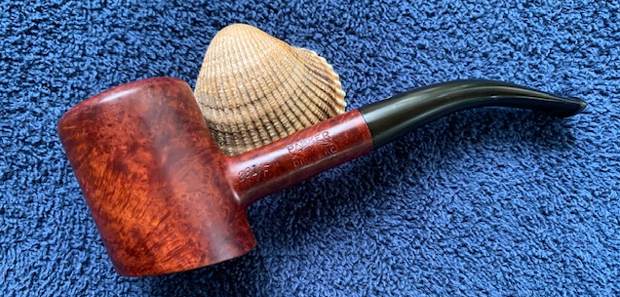
Restoring Parker’s Super Bruyere 63 Lovat


Blog by Steve Laug

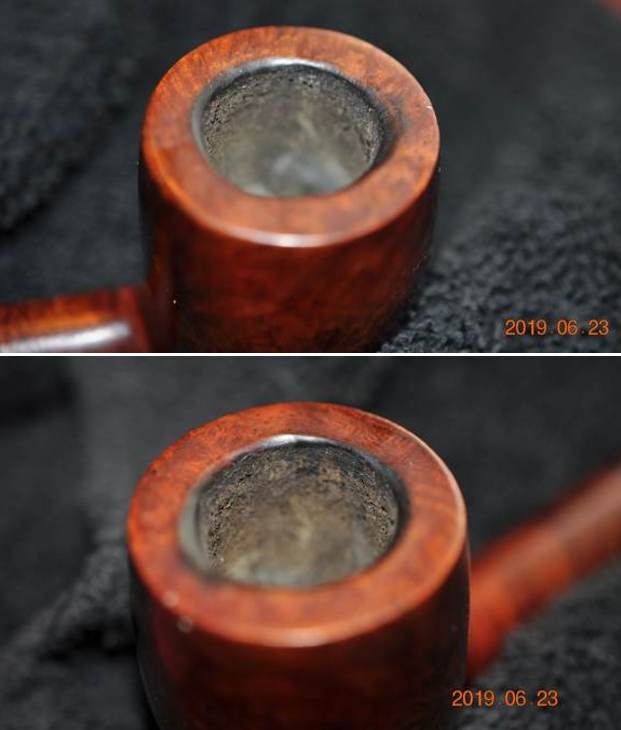
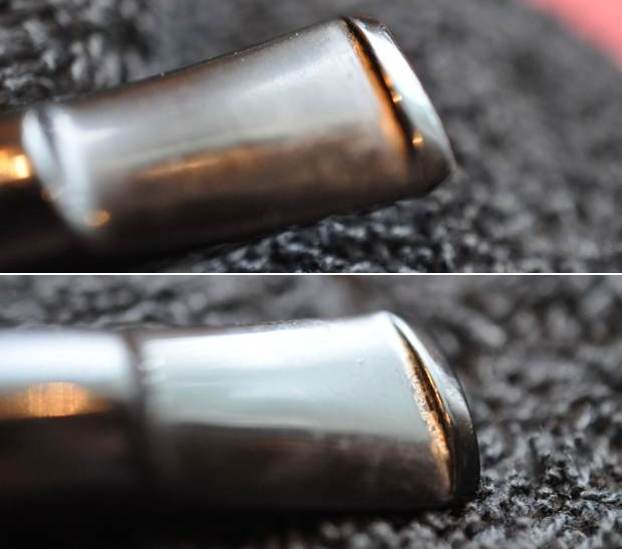
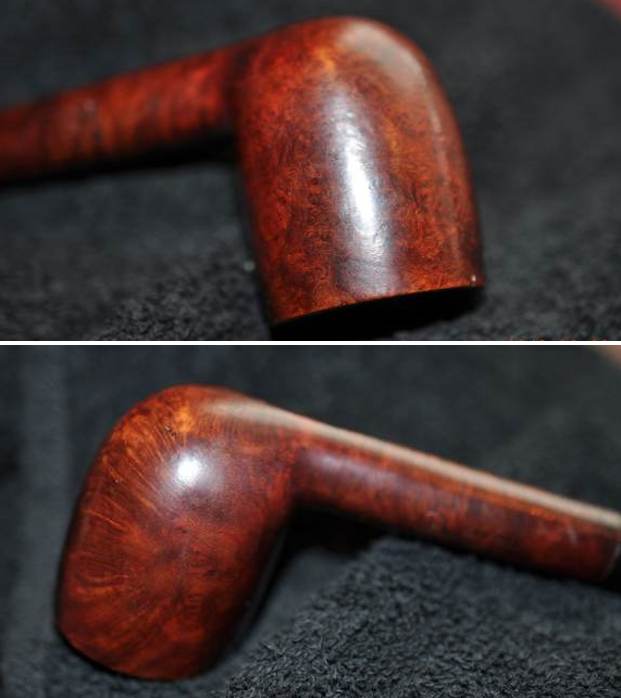
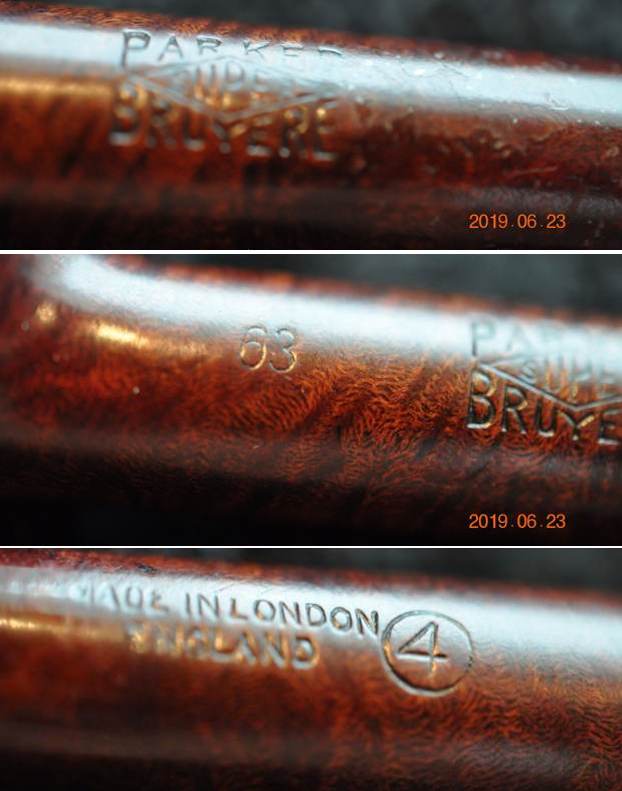
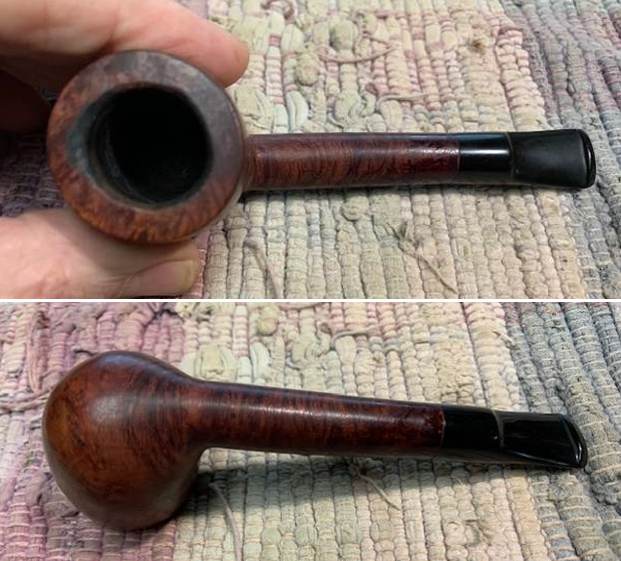
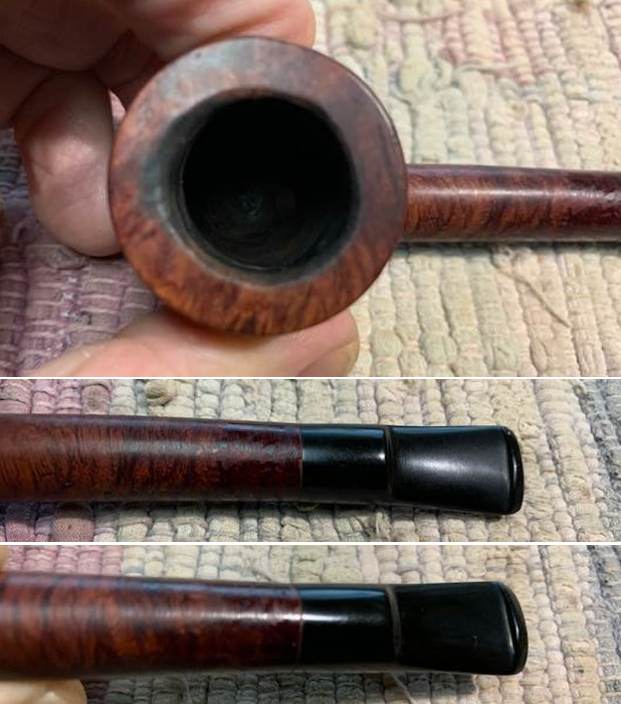
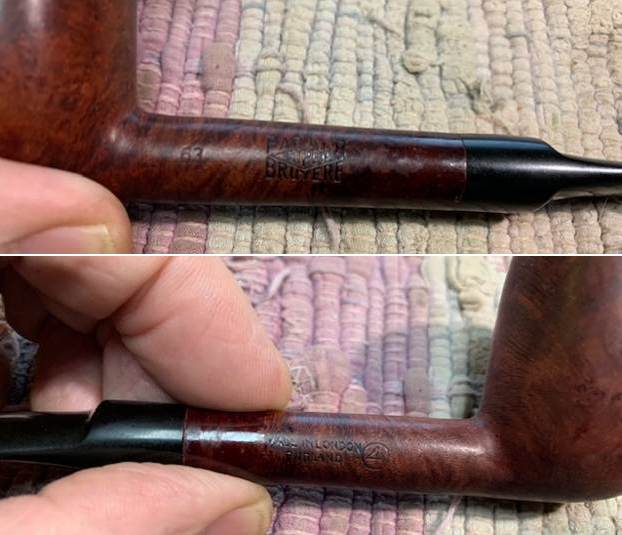
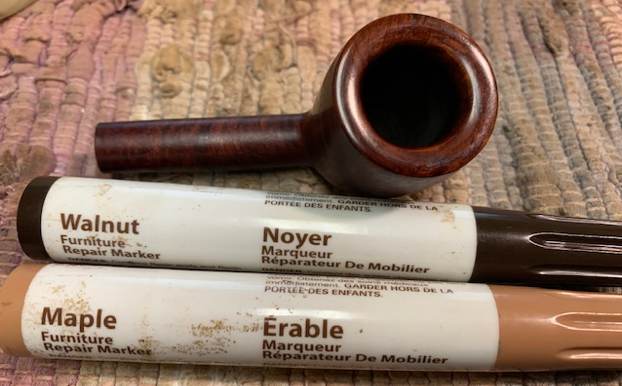
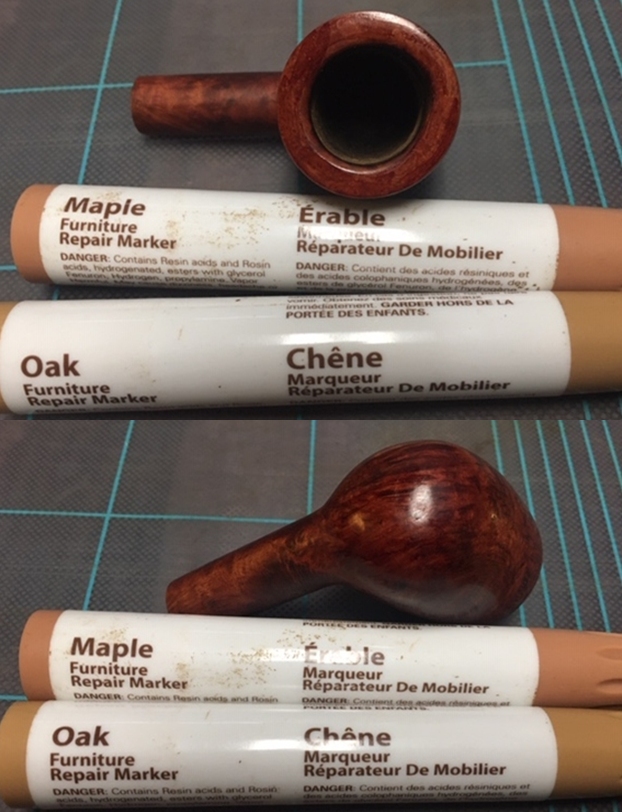
The next pipe on the work table came to us from an online auction on 04/04/19 from Wilkes Barre, Pennsylvania, USA. It is a nice looking Parker Super Bruyere Lovat with a saddle stem. The bowl has a rich reddish brown colour combination that highlights grain. It has been coated with varnish that is spotty and shiny. The pipe has some grime ground into the surface of the briar. This pipe is stamped on the sides of the shank. On the left it reads 63 followed by Parker [over] Super in a Diamond [over] Bruyere. On the right it read Made in London [over] England followed by a 4 in a circle that is the group size. The saddle stem has no marking. There is a thick cake in the bowl and some overflow of lava on the edges of the rim top. The rim top looks okay but the inner edge is damaged/burned on the front and back of the bowl. There were some light tooth marks and chatter on both sides of the vulcanite stem near the button. The pipe looks to good under the grime. Jeff took photos of the pipe before he started his cleanup. He took photos of the rim top to show the cake and the lava coat. The inner edge of the bowl has some darkening and lava on the inner bevel. The top and outer edge also look okay. It is a dirty pipe but obviously one that was a great smoker. He also captured the condition of the stem. It is lightly oxidized, calcified in the groove of the button and has tooth marks and chatter on the top and underside of the stem near the button. He took photos of the sides and heel of the bowl to show the beautiful grain around the bowl and the condition of the pipe. You can see the grime ground into the surface of the briar.   He took photos of the stamping on the side of the shank. They are clear and readable as noted above. The photos show the sides of the shank. I turned first to Pipephil’s site to look at the Parker write up there and see if I could learn anything about the line (http://www.pipephil.eu/logos/en/logo-parker.html). There was a portion of the listing that was for Parker Super Bruyere Pipes. I have drawn a red box around the pipe that matches the stamping on the pipe.From the above screen capture I learned that the pipe I was working on was a more recent Parker Super Bruyere without a date stamp.

I looked up the Parker brand on Pipedia to see if I could find the Parker’s Bruyere there or at least the possessive Parker’s stamping (https://pipedia.org/wiki/Parker).

Dating – Prior to Word War II, the possessive PARKER’S stamp was used. However, at least some pipes were stamped with the non-possessive as early as 1936.

Like Dunhill, Parker pipes are date stamped, but differently than Dunhill. The Parker date code always followed the MADE IN LONDON over ENGLAND stamping. The first year’s pipes (1923) had no date code; from 1924 on it ran consecutively from 1 to 19.

There is no indication of a date code for the war years. Parker was not a government approved pipe manufacturer, while Dunhill and Hardcastle were. During the war years Parker manufactured the “Wunup” pipe made of Bakelite and clay.

The pipe that I was working on was stamped Parker without the possessive stamping. As there are no date stamps on the pipe it either was made during the war years or shortly after. It is definitely a newer pipe.

It was time to work on the pipe. As usual Jeff had done a thorough cleanup on the pipe. He reamed the bowl with a PipNet pipe reamer and followed up with a Savinelli Fitsall pipe knife to remove the cake. He scrubbed out the mortise and the airway in the shank and the stem with alcohol, cotton swabs and pipe cleaners. He scrubbed the exterior of the bowl, rim, shank and stem with a tooth brush and Murphy’s Oil Soap to remove the oils and tars on the rim and the grime on the finish of the bowl. He rinsed it under running water. One of the benefits of this scrub is that it also tends to lift some of the scratches and nicks in the surface of the briar. He dried it off with a soft cloth. He cleaned the internals and externals of the stem with alcohol, pipe cleaners and cotton swabs. He soaked the stem in Before & After Deoxidizer and rinsed it off with warm water and cleaned out the airway in the stem with alcohol. The pipe looked very good when it arrived. Interestingly there was some spotty varnish on the bowl and part of the shank.  I took a photo of the rim top and stem to show the condition. The rim top shows a lot of damage to the inner edge. The bowl is out of round and the burn on the front extends onto the rim top. The vulcanite saddle stem had light tooth chatter and marks on both sides ahead of the button and on the button edges. The stamping on the sides of the shank is clear and readable as noted above.    I removed the stem and the extension from the shank and took a photo of the pipe to give a sense of the whole. It is a nice looking Lovat that should clean up very well.The first photo below shows the condition of the rim top and inner edge when I started reworking it. I reshaped the top and the bowl edges with a piece of sandpaper on a wooden ball. The ball and sandpaper helped clean up the beveled edge and blended in the burn and cuts in the briar as well as bring the bowl back into round. I used a folded piece of 220 grit sandpaper to further shape the bowl. I polished the bowl and rim top with micromesh sanding pads – dry sanding with 1500-12000 grit pads and wiped down the bowl after each sanding pad.     I used a Walnut and a Maple stain pen to blend the colours on the rim top to match the rest of the bowl and shank. Once the stain cures I will buff it out and it should be a good match.I rubbed the bowl and shank down with Before & After Restoration Balm. I worked it into the surface of the bowl sides and shank with my fingertips to clean, enliven and protect the briar. I let the balm sit for a little while and then buffed with a cotton cloth to raise the shine. The Balm did its magic and the grain stood out.     I set the bowl aside and turned my attention to the stem. The stem was in good condition and the light marks and chatter should polish out easily. I polished the stem with micromesh sanding pads – 1500-12000 grit pads. I wiped it down with Obsidian Oil after each sanding pad. I used Before & After Pipe Polish – both Fine and Extra Fine to further polish the stem. I gave it a final coat of Obsidian Oil and set it aside to dry. This nicely grained Parker Super Bruyere 63 Lovat with a vulcanite saddle stem is a great looking pipe now that it has been restored. The briar around the bowl is clean and really came alive. The rich brown stains gave the grain a sense of depth with the polishing and waxing. The grain really popped. I put the vulcanite stem back on the bowl and carefully buffed the pipe with Blue Diamond on the buffing wheel using a light touch on the briar. I gave the bowl and the stem multiple coats of carnauba wax on the buffing wheel. I buffed the pipe with a clean buffing pad to raise the shine. I hand buffed the pipe with a microfiber cloth to deepen the shine. The finished Parker’s Lovat is a beauty and feels great in the hand and looks very good. Give the finished pipe a look in the photos below. The dimensions of the pipe are Length: 4 ½ inches, Height: 1 ¾ inches, Outside diameter of the bowl: 1 ¼ inches, Chamber diameter: ¾ of an inch. The weight of this large pipe is 1.16 ounces /33 grams. This Parker’s Super Bruyere Lovat is another great find our hunts. It is much more beautiful in person than these photos can capture. I will be putting it on the rebornpipes store soon. Look for it in the British Pipe Makers section. If you would like to add it to your collection let me know. This is another pipe that has the possibility of transporting the pipe man or woman back to a slower paced time in history where you can enjoy a respite. Thanks for walking through the restoration with me.

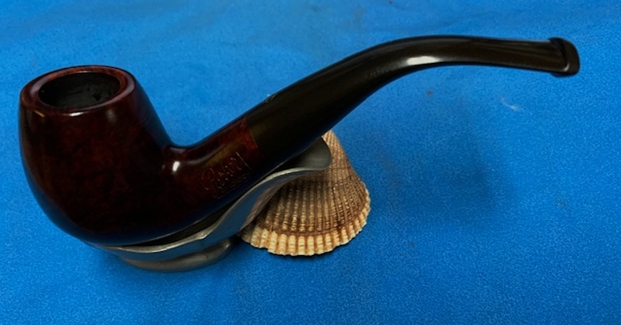
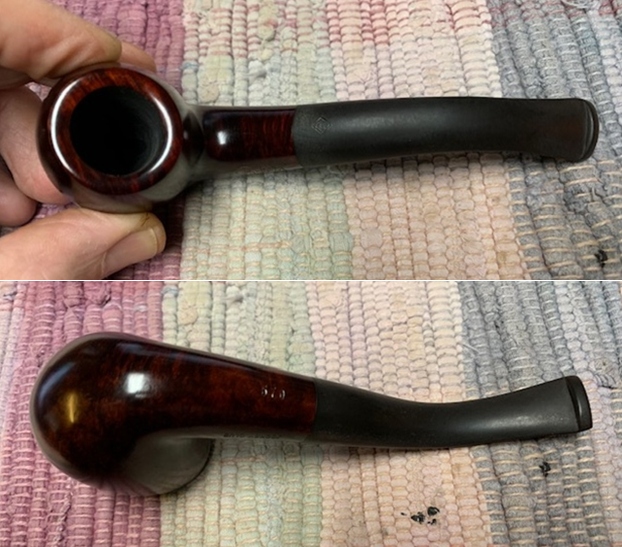
Restoring a Parker of London Jockey Club  570 Bent Apple


Blog by Steve Laug

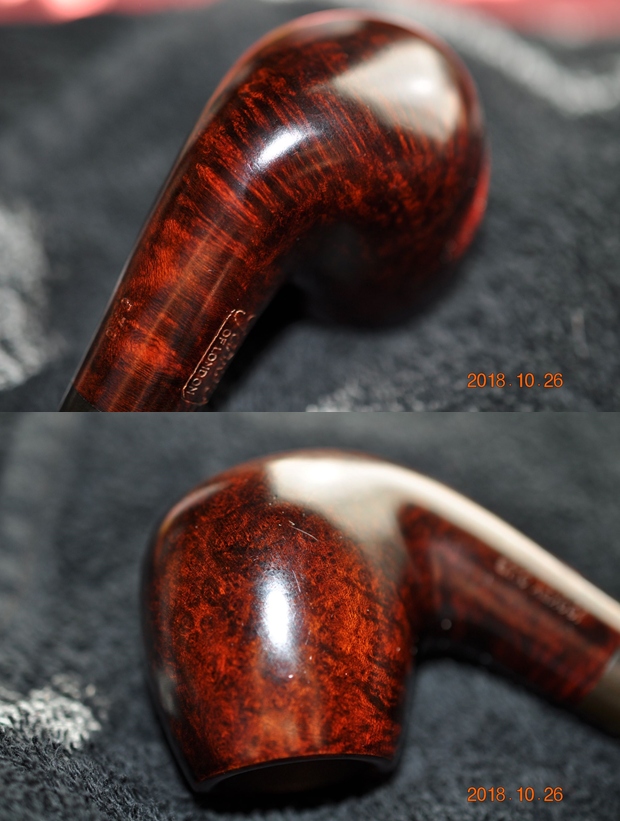
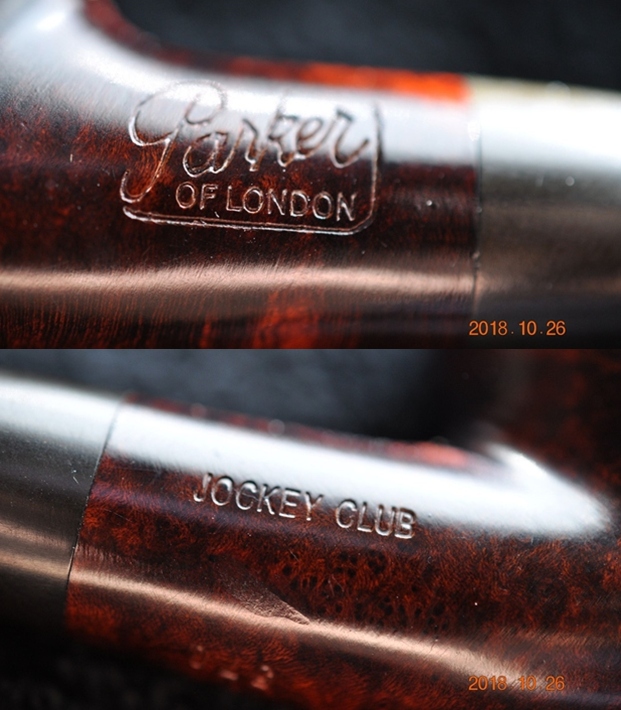
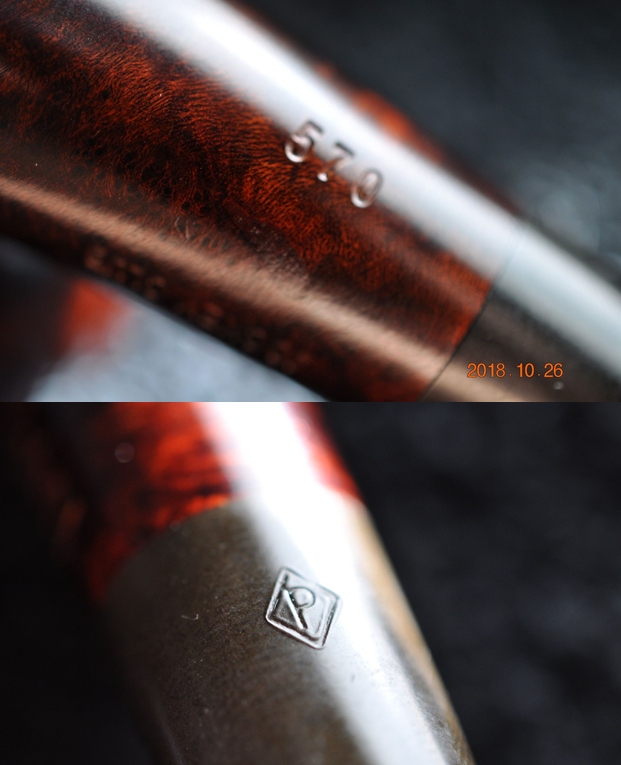
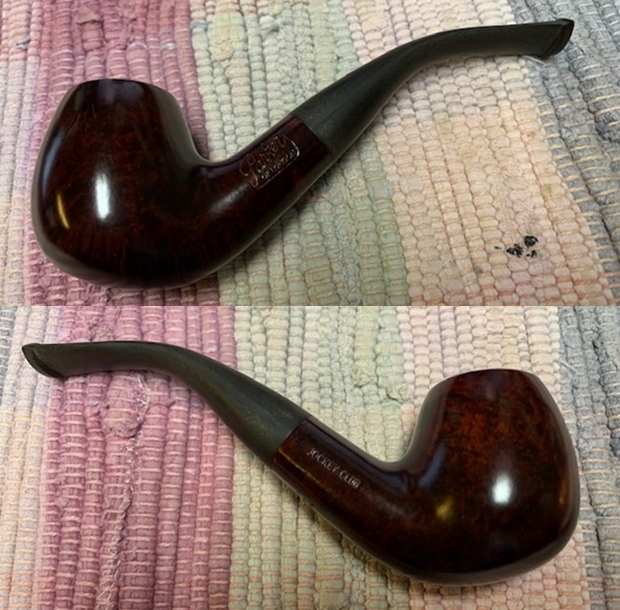
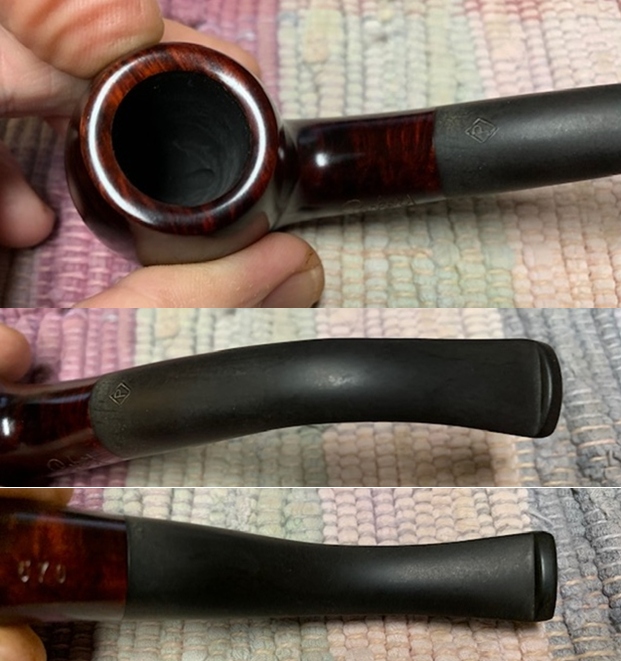
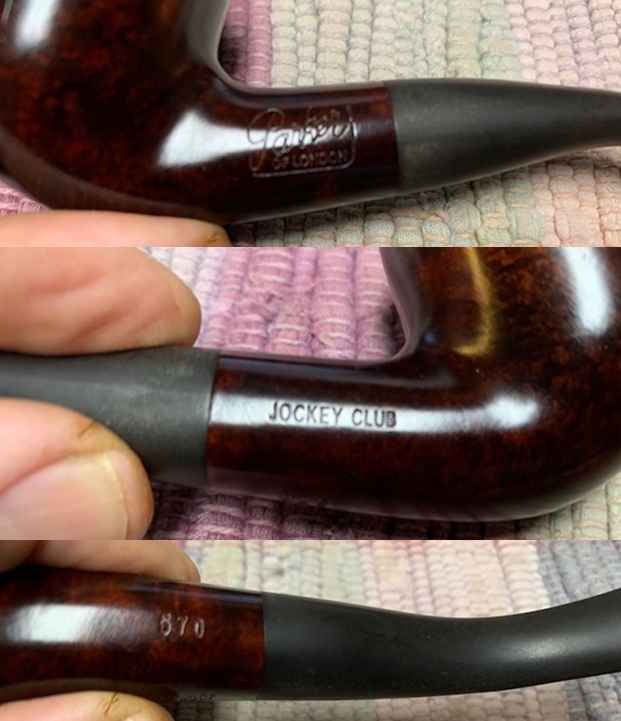
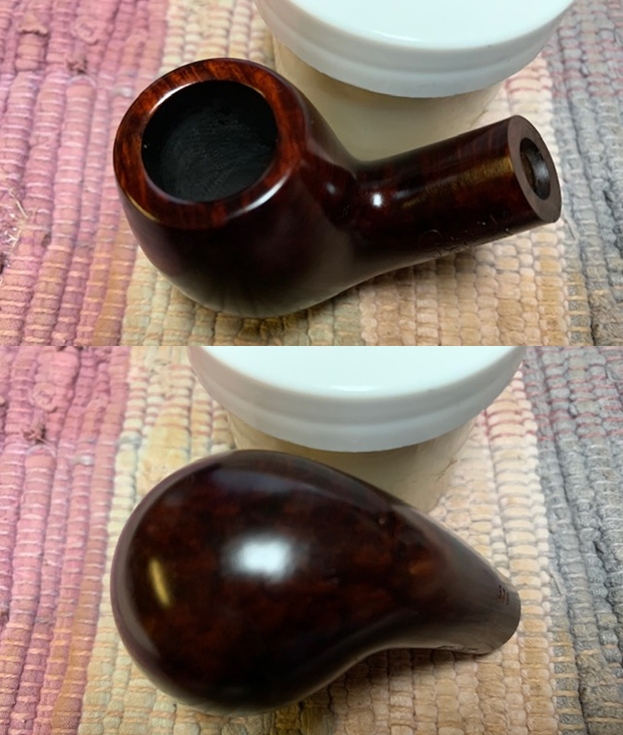
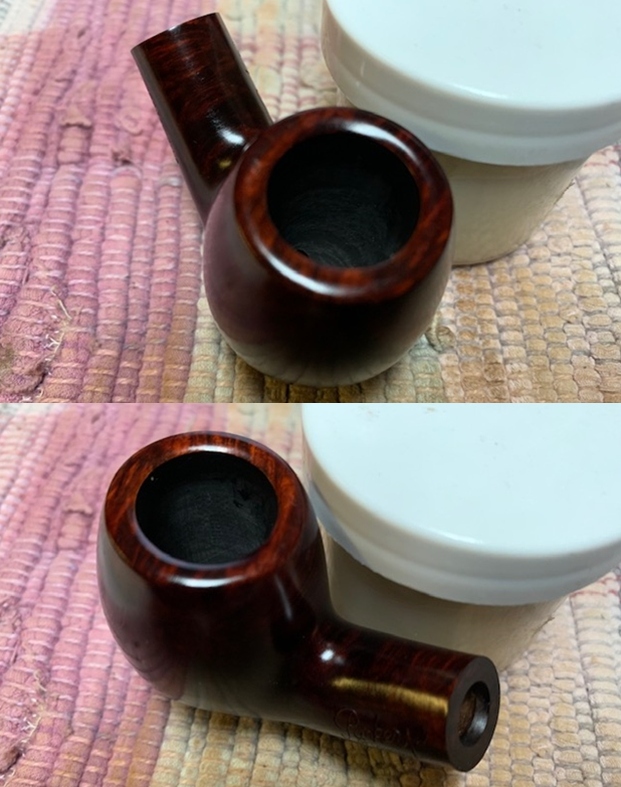
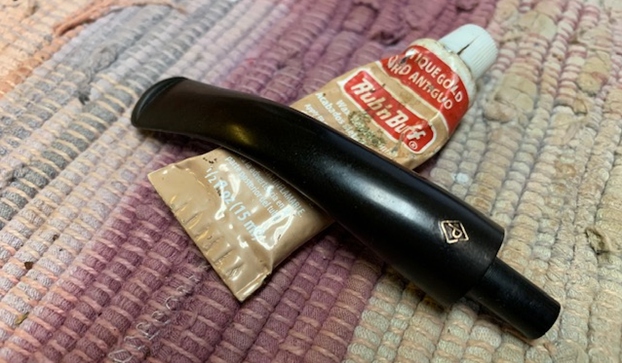
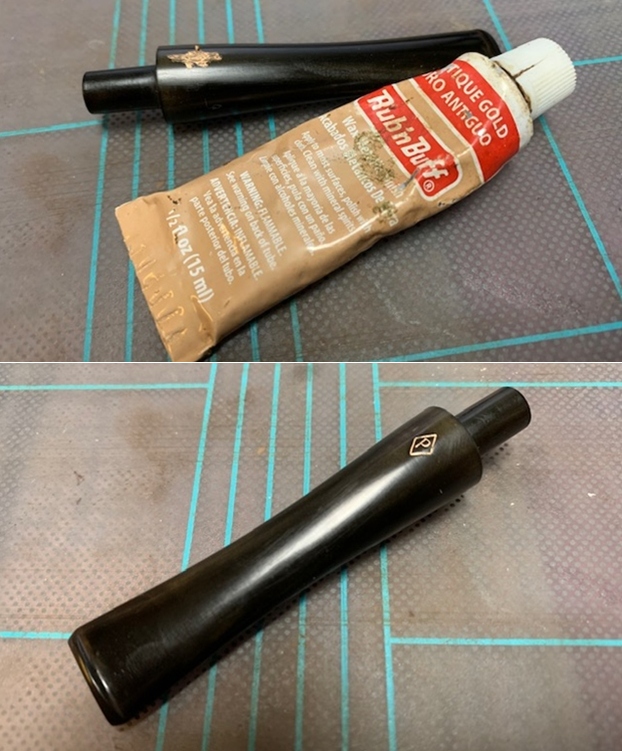
The next pipe on the work table came to us from an auction in Ancram, New York, USA. It is a nice looking mixed grain in a shape Parker identifies as a bent apple with a taper stem. The bowl has a rich reddish brown/ oxblood colour combination that highlights grain. The pipe was in surprisingly good condition. There was some grime ground into the surface of the briar. This pipe is stamped on the sides of the shank. On the left it reads Parker [over] of London. On the right it read Jockey Club and the underside of the shank it is stamped with the shape number 570. The taper stem has a Parker “P” in a Diamond logo on the top side. There is a light cake in the bowl and a few spots of lava on the edges of the rim top. The crowned rim top and edges look very good. The stem was oxidized but there were no tooth marks on the stem surface. The pipe looks to be in good condition other than being dirty. Jeff took photos of the pipe before he started his cleanup. He took a photo of the rim top to show condition of the bowl. The inner edge of the bowl looks good other than a little lava on the right inner edge. The top and outer edge also look okay. It is a very clean pipe. He also captured the condition of the stem. It is oxidized, calcified and has light tooth marks and chatter on the top and underside of the stem near the button.  He took photos of the sides and heel of the bowl to show the beautiful grain around the bowl and the condition of the pipe. He took a photo of the stamping on the sides of the shank. It is clear and readable as noted above.  I turned first to Pipephil’s site to look at the Parker write up there and see if I could learn anything about the line (http://www.pipephil.eu/logos/en/logo-parker.html). There was a Parker of London pipe listed and the stamping matched the one that I am working on but there was no information on the Jockey Club.

I looked up the Parker brand on Pipedia to see if I could find the Parker of London Jockey Club (https://pipedia.org/wiki/Parker). There was nothing that tied directly to the line I am working on. There is a decent history of the brand there that is a good read.

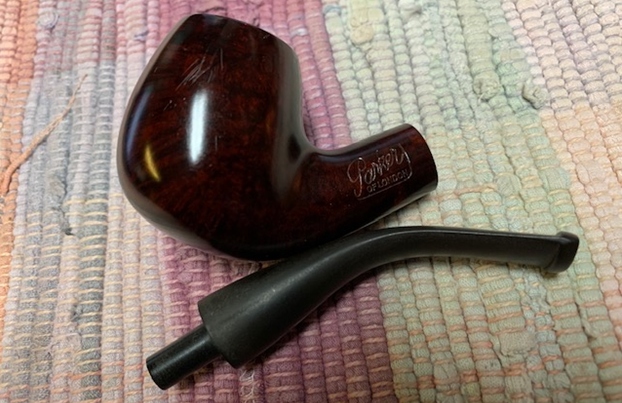
It was time to work on the pipe. As usual Jeff had done a thorough cleanup on the pipe. He reamed the bowl with a PipNet pipe reamer and followed up with a Savinelli Fitsall pipe knife to remove the cake. He scrubbed out the mortise and the airway in the shank and the stem with alcohol, cotton swabs and pipe cleaners. He scrubbed the exterior of the bowl, rim, shank and stem with a tooth brush and Murphy’s Oil Soap to remove the oils and tars on the rim and the grime on the finish of the bowl. He rinsed it under running water. One of the benefits of this scrub is that it also tends to lift some of the scratches and nicks in the surface of the briar. He dried it off with a soft cloth. He cleaned the internals and externals of the stem with alcohol, pipe cleaners and cotton swabs. He soaked the stem in Before & After Deoxidizer and rinsed it off with warm water and cleaned out the airway in the stem with alcohol. Other than the damaged rim top the pipe looked good. I took a photo of the rim top and stem to show the condition. The rim top and edges looked very good. The vulcanite taper stem had light oxidation remaining and light tooth chatter and marks on both sides ahead of the button and on the button edges.   The stamping on the sides of the shank is clear and readable as noted above.     I removed the stem from the shank and took a photo of the pipe to give a sense of the whole. It is a nicely shaped pipe that Parker called a Bent Apple that should clean up very well.   There were some small scratches on the left side of the bowl toward the top. I decided to leave them so as not to damage the sheen of the finish that was otherwise in excellent condition. I rubbed the bowl and shank down with Before & After Restoration Balm. I worked it into the surface of the bowl sides and shank with my fingertips to clean, enliven and protect the briar. I let the balm sit for a little while and then buffed with a cotton cloth to raise the shine. The Balm did its magic and the grain stood out.    I scrubbed the remaining oxidation on the stem with Soft Scrub All Purpose cleanser to remove it. I have found that the product does really well in removing oxidation that remains after soaking in a Before & After  Oxidation bath.   Under a lens it appeared that the Parker “P” Diamond had some gold remaining in the stamping. I used some Rub’n Buff Antique Gold to fill in the Diamond P stamp on the top side of the taper stem. I let it dry the buffed off the excess with a cotton pad.   I polished the vulcanite stem with micromesh sanding pads – 1500-12000 grit pads. I wiped it down with Obsidian Oil after each sanding pad. I used Before & After Pipe Polish – both Fine and Extra Fine to further the stem. The photo below shows the polished stem. This nicely grained Parker of London Jockey Club 570 Bent Apple with a vulcanite taper stem is a great looking pipe now that it has been restored. The briar around the bowl is clean and really came alive. The rich oxblood stains gave the grain a sense of depth with the polishing and waxing. The grain really popped. I put the vulcanite stem back on the bowl and carefully buffed the pipe with Blue Diamond on the buffing wheel using a light touch on the briar. I gave the bowl and the stem multiple coats of carnauba wax on the buffing wheel. I buffed the pipe with a clean buffing pad to raise the shine. I hand buffed the pipe with a microfiber cloth to deepen the shine. The finished Parker Jockey Club Bent Apple is a beauty and feels great in the hand and looks very good. Give the finished pipe a look in the photos below. The dimensions of the pipe are Length: 5 ½ inches, Height: 1 ¾ inches, Outside diameter of the bowl: 1 inch, Chamber diameter: ¾ of an inch. The weight of the pipe is 47grams/1.62oz. This will be going on the rebornpipes store under the British Pipemakers section soon. Thanks for reading this blog and my reflections on the pipe while I worked on it. There are many more to come!

Breathing New Life into a Parker Super Briar Bark 345 Bulldog


Blog by Steve Laug

The next pipe on the work table came to me from either a trade I made (pipes for labour) or a find on one of my pipe hunts. I honestly don’t remember where it came from. It has been around for a while waiting to be worked on. It is a ruggedly sandblasted Parker Super Bark Bulldog that really looks quite nice. The stamping is clear and readable. It is stamped on the underside of the shank and reads Parker [over] Super in a Diamond [over] Briar Bark that is followed by Made in London [over] England. To the right of that stamping is a 3 in a circle followed by the shape number 345. The circle 3 is the size number that matches the Dunhill group size 3. The pipe had a lot of grime ground into the grooves of the sandblast on the bowl and some wear on the finish around the sides of the bowl. The bowl was heavily caked and had an overflow of thick lava on the plateau rim top. It was hard to know what the rim top and inner edge of the bowl looked like under the grime. The stem was calcified, oxidized and had light tooth chatter and marks on the top and underside and the top surface of the button had a tooth mark. There stamped P in a diamond on the top left side of the saddle stem. The pipe had promise but it was very dirty. I took photos of the pipe before he started his cleanup work.   I took photos of the rim top and bowl to give a clear picture of the thickness of the cake and the overflow of lava on the rim top. It is hard to know for sure how extensive the damage was to the inner edge of the bowl because of the thickness of the lava coat. I also took photos of the top and underside of the stem to show the oxidation, calcification, light chatter and tooth marks.       I took a photo of the stamping on the underside of the shank. It reads as noted above and is clear and readable. I took the stem off the bowl and took a photo of the parts. There was also an inner-tube inserted in the tenon and it was unmovable.I looked on Pipephil’s site for information on the Parker Super Briar Bark line and found the following information (http://www.pipephil.eu/logos/en/logo-parker.html). The screen capture below has quite a bit of information on the line from Parker. The one that I am working on definitely has the inner tube but does not have a patent number nor does it have a date stamp following the D in England.I also went to Pipedia and read the article on the Parker brand. It is a great read and worth the time to read it (https://pipedia.org/wiki/Parker). I picked up the following piece of information that was helpful.

After 1957 on pipes Parker ceased to put patent number and the code with definition of date.

That tells me that my pipe was made after 1957 when the numbers were no longer added to the stamping on the pipe.

Now it was time to work on the pipe. I started the process by heating the inner tube and removing it from the tenon. I wrapped a paper towel around the tube and wiggled it free of the tenon. It came out easily.I have to say it once again that I am really spoiled having Jeff clean up the pipes for me. Having to start with them in this condition adds time. I reamed the bowl with a PipNet pipe reamer using the first two cutting heads. I followed up by scraping the remaining cake with a Savinelli Fitsall Pipe Knife. I finished cleaning up the cake in the bowl with a piece of dowel wrapped in 220 grit sandpaper to smooth out the walls of the bowl.  I cleaned up the rim top and the inner edge of the bowl with a folded piece of 220 grit sandpaper. I gave the inner edge of the rim a slight bevel. I smoothed out the top of the rim with the sandpaper in preparation for rusticating it with a series of burrs and the Dremel.    I scrubbed the exterior of the bowl and rim top with a tooth brush and undiluted Murphy’s Oil Soap to remove the debris from the finish. I rinsed the bowl with warm water to remove the grime and soap and dried it off with a soft towel. I touched up the rim top rustication with a Walnut stain pen and a Black Sharpie pen to blend the top into the rest of the bowl colour. I also touched up the faded spots on the heel of the bowl and around the edges of the bowl.I rubbed the bowl and shank down with Before & After Restoration Balm. I worked it into the surface of the bowl sides and shank with my fingertips and a horsehair shoe brush to get into the nooks and crannies of the blast. The balm works to clean, enliven and protect the briar. I let the balm sit for a little while and then buffed with a cotton cloth to raise the shine.   While I was working on the bowl the stem was soaking in Briarville Pipe Repair’s – Pipe Stem Oxidation Remover. The stem sat in the mixture for 2 ½ -3 hours. I removed the stem from the bath, scrubbed lightly with a tooth brush and dried if off with a paper towel. I was surprised that it was quite clean. Just some light tooth marks on the button and underside of the stem near the button. The Diamond P stamp on the stem remained and was not damaged by the deoxidizer. I cleaned out the shank and the airway in the stem with alcohol, cotton swabs and pipe cleaners to remove the tars and oils in the airways of both. Once they were clean the pipe smelled better.I polished the vulcanite stem with micromesh sanding pads – 1500-12000 grit pads. I wiped it down with a damp cloth after each sanding pad. I used Before & After Pipe Polish – both Fine and Extra Fine to further polish the stem. This beautiful sandblasted Parker Super Briar Bark 345 Bulldog with a vulcanite saddle stem is a great looking pipe now that it has been restored. The rich browns and blacks of the contrasting stains in the sandblast came alive with the polishing and waxing. The newly rusticated rim top blended in very well. I put the stem back on the bowl and carefully buffed the pipe with Blue Diamond on the buffing wheel using a light touch on the briar. I gave the bowl multiple coats of Conservator’s Wax and the stem multiple coats of carnauba wax on the buffing wheel and followed that by buffing the entire pipe with a clean buffing pad. I hand buffed the pipe with a microfiber cloth to deepen the shine. The finished Parker Super Briar Bark Bulldog is a beauty and fits nicely in the hand and looks very good. Give the finished pipe a look in the photos below. The dimensions of the pipe are Length: 5 ½ inches, Height: 1 ½ inches, Outside diameter of the bowl: 1 ¼ inches, Chamber diameter: ¾ of an inch. If you are interested in adding this pipe to your collection send me a message or an email. Thanks for reading this blog and my reflections on the pipe while I worked on it. There are many more to come!

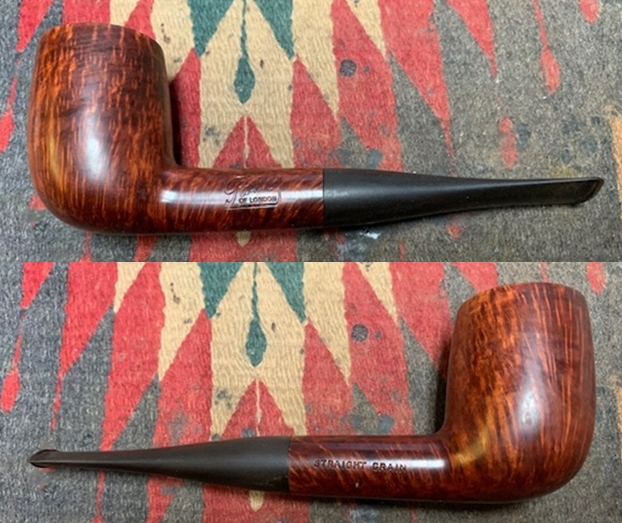
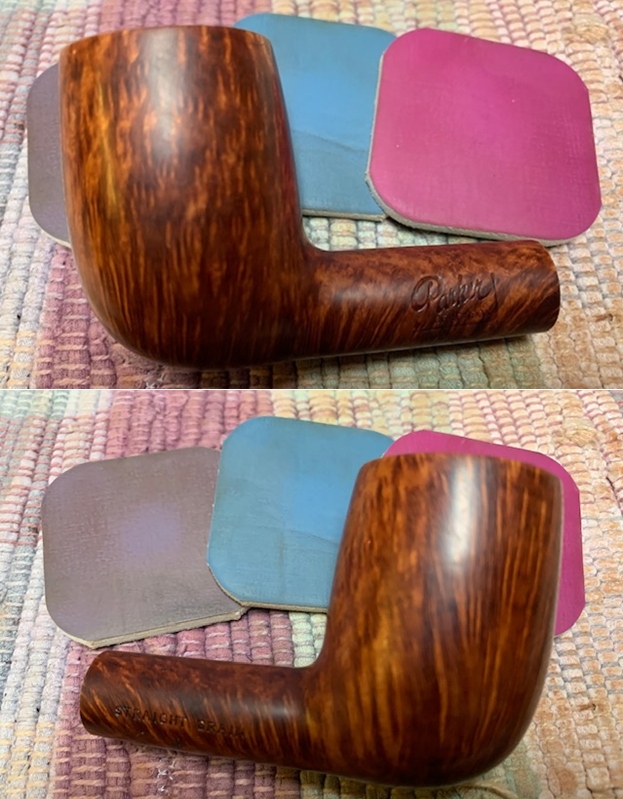
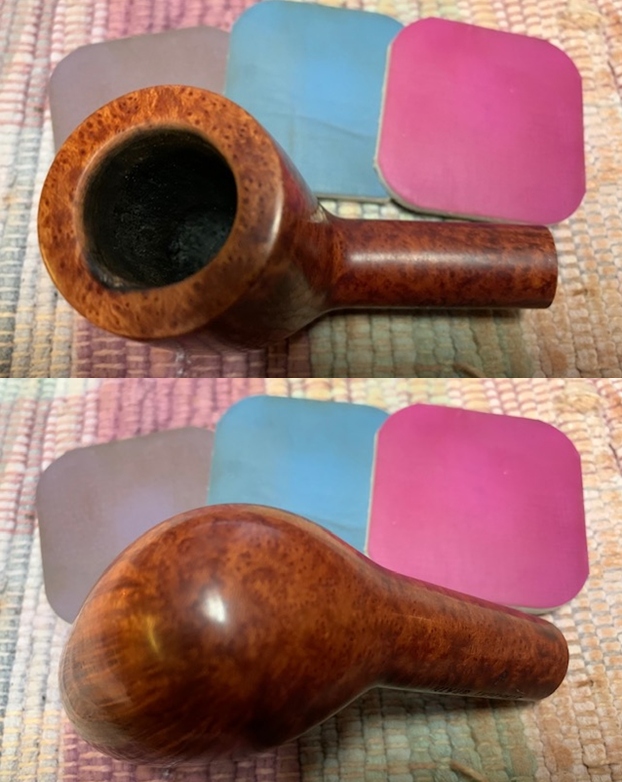
Restoring a Parker of London Straight Grain Billiard


Blog by Steve Laug

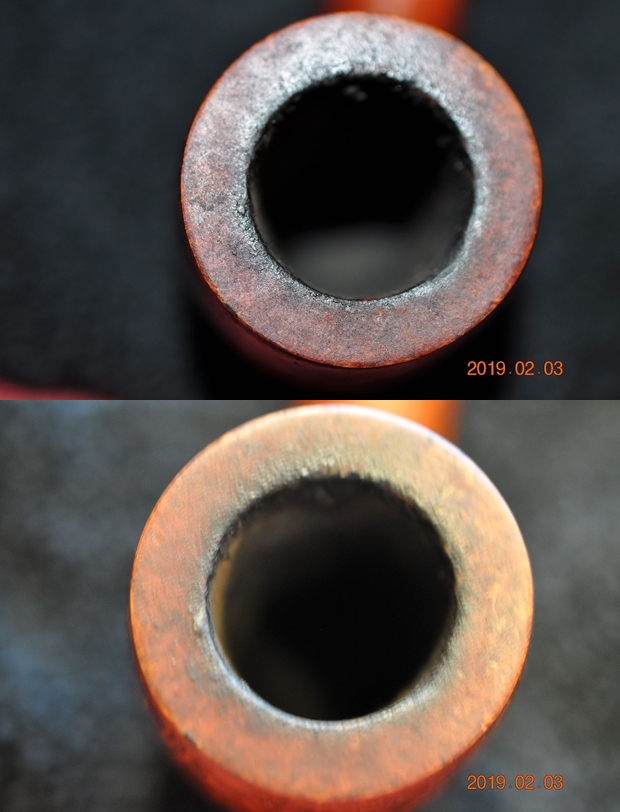
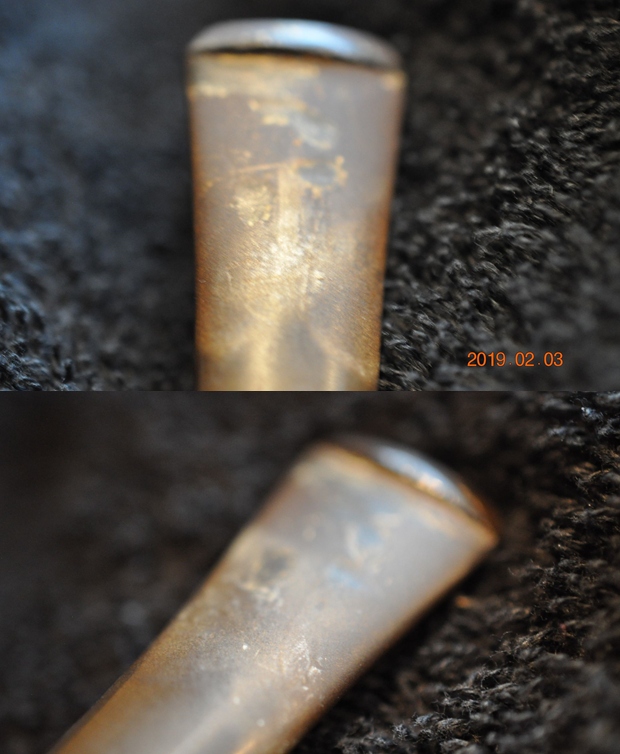
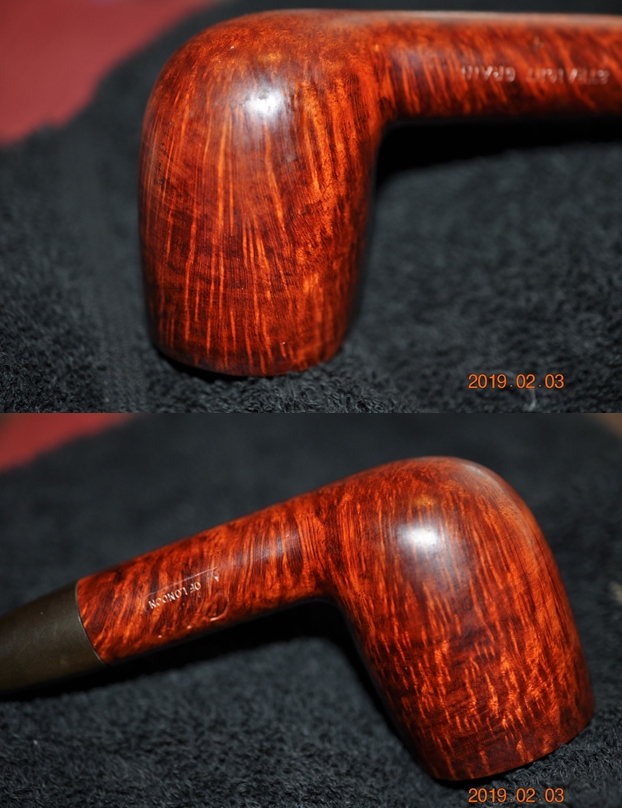
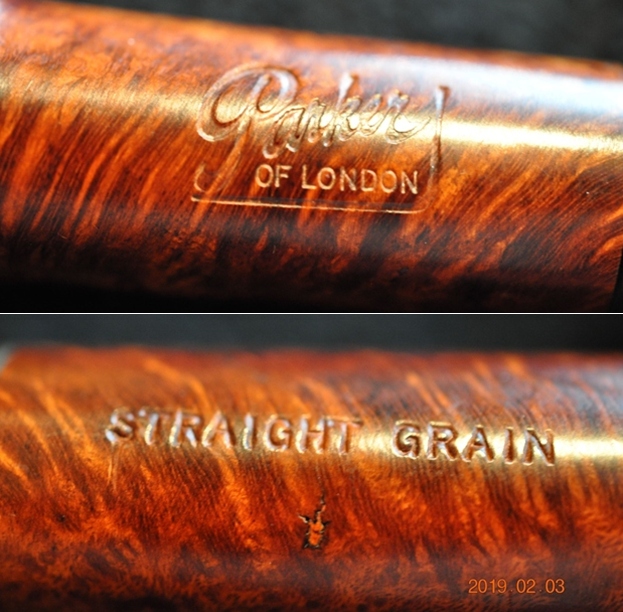
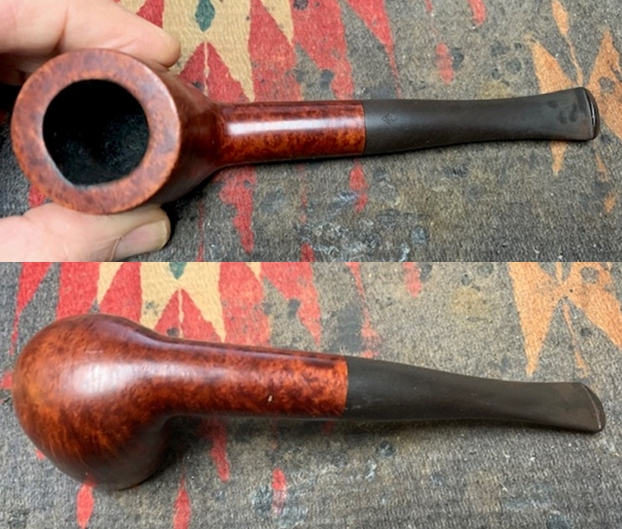
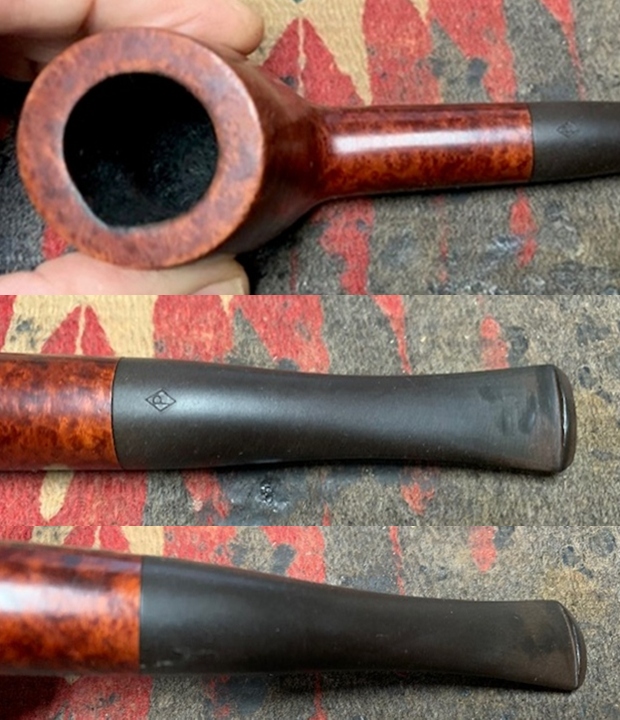
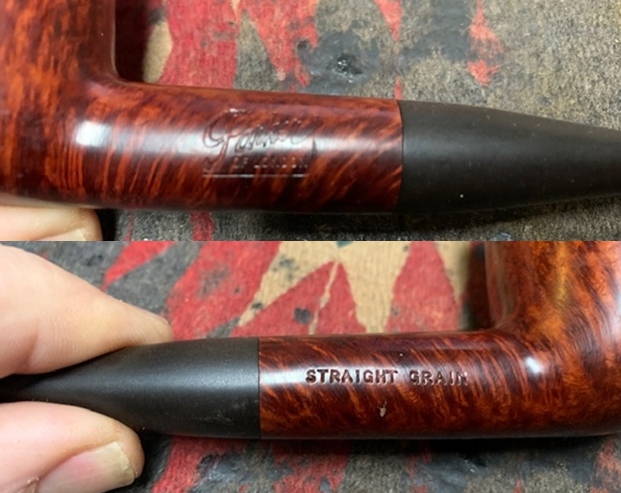
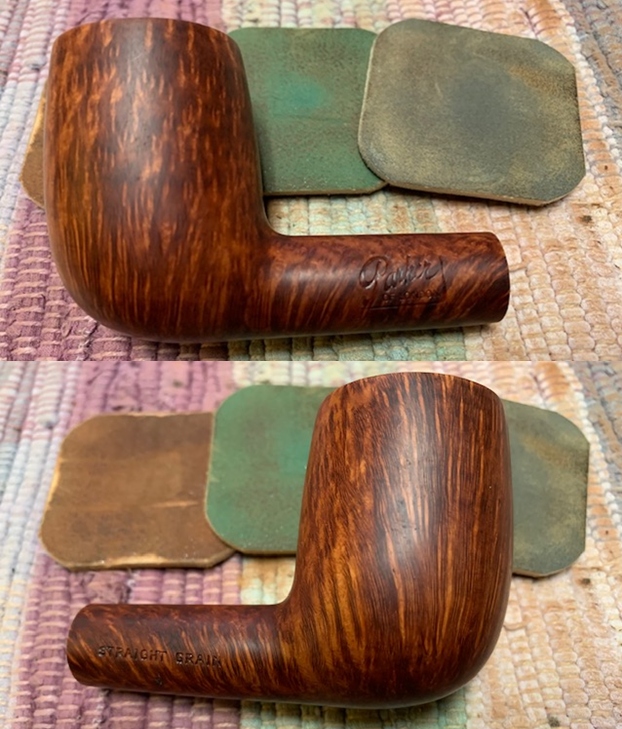
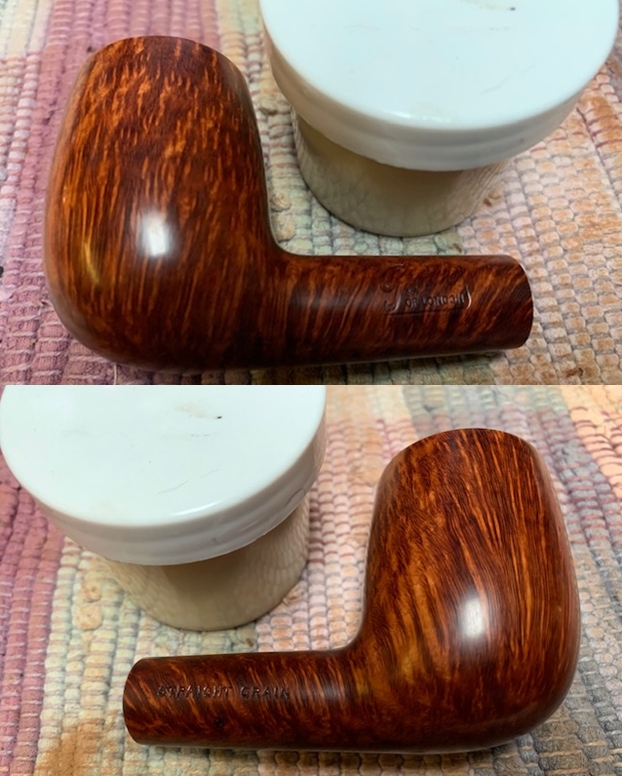
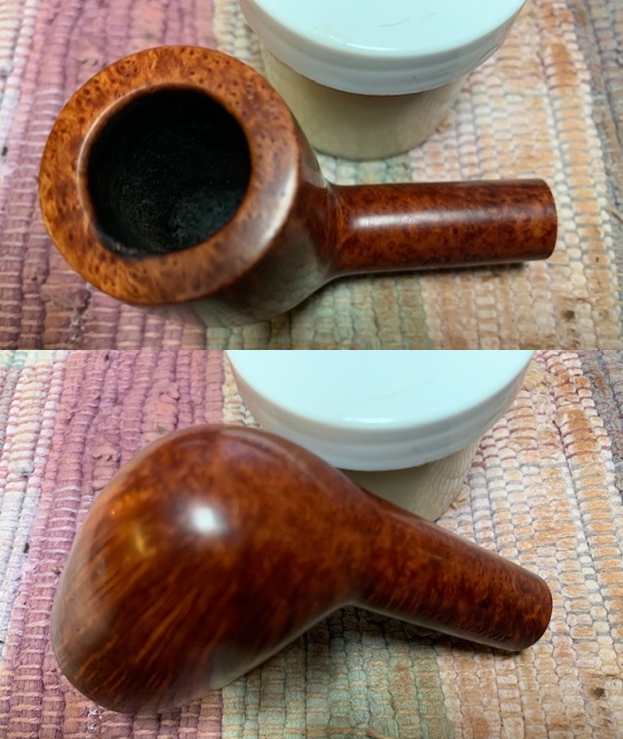
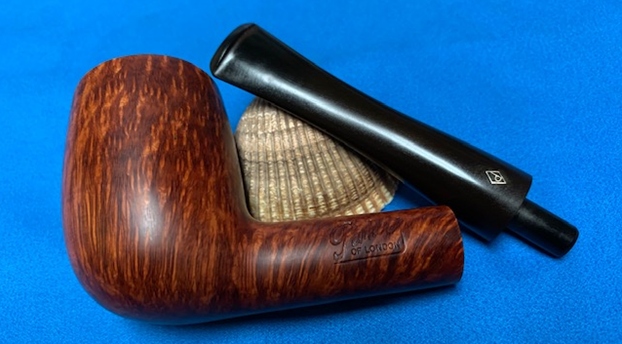
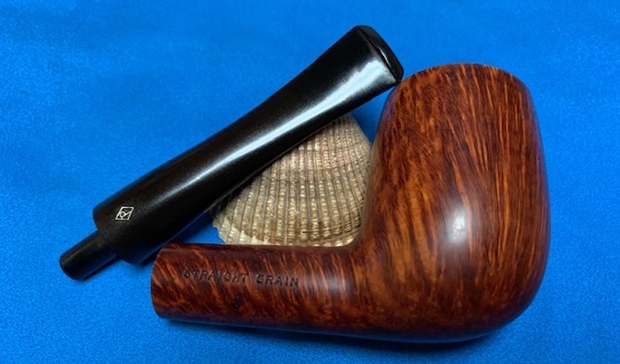
The next pipe on the work table came to us from Cornwall, Pennsylvania, USA. It is a nice looking Straight Grain billiard with a taper stem. The bowl has a rich reddish brown colour combination that highlights grain. The pipe has some grime ground into the surface of the briar. This pipe is stamped on the sides of the shank. On the left it reads Parker [over] of London. On the right it read Straight Grain. There is no shape number on the shank at all. The taper stem has a Parker “P” in a Diamond logo on the top side. There is a moderate cake in the bowl and some overflow of lava on the edges of the rim top. The rim top looks good but there is a burn mark on the left front inner edge of the bowl that leaves the bowl out of round. There were some tooth marks and chatter on both sides of the vulcanite stem near the button. The pipe looks to be in good condition under the grime. Jeff took photos of the pipe before he started his cleanup. He took photos of the rim top to show the cake and the lava coat. The inner edge of the bowl looks good other than the burn mark on the left front. The top and outer edge also look okay. It is an incredibly dirty pipe but obviously one that was a great smoker. He also captured the condition of the stem. It is oxidized, calcified and has tooth marks and chatter on the top and underside of the stem near the button.   He took photos of the sides and heel of the bowl to show the beautiful grain around the bowl and the condition of the pipe. You can see the grime ground into the surface of the briar. He took a photo of the stamping on the sides of the shank. It is clear and readable as noted above.  I turned first to Pipephil’s site to look at the Parker write up there and see if I could learn anything about the line (http://www.pipephil.eu/logos/en/logo-parker.html). There was a Parker of London pipe listed and the stamping matched the one that I am working on but there was no information on the Straight Grain.

I looked up the Parker brand on Pipedia to see if I could find the Parker of London Straight Grain (https://pipedia.org/wiki/Parker). There was nothing that tied directly to the line I am working on. There is a decent history of the brand there that is a good read.

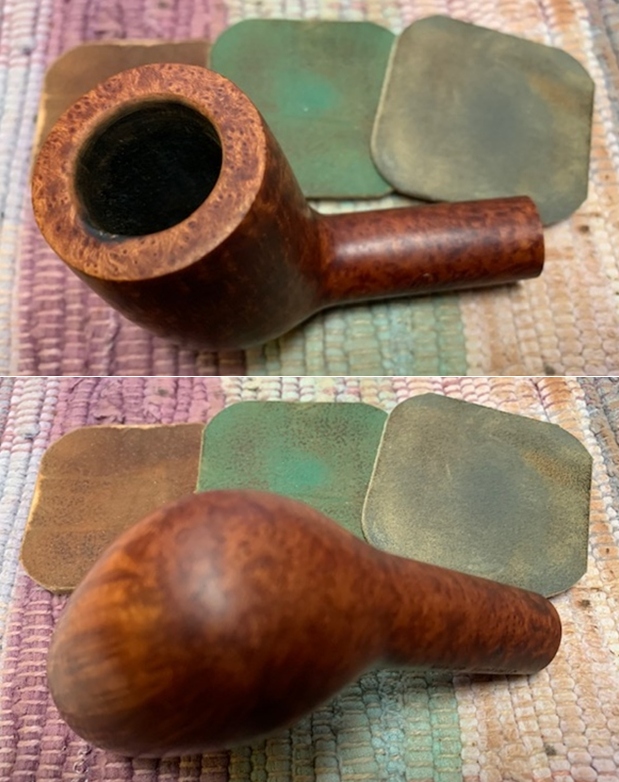
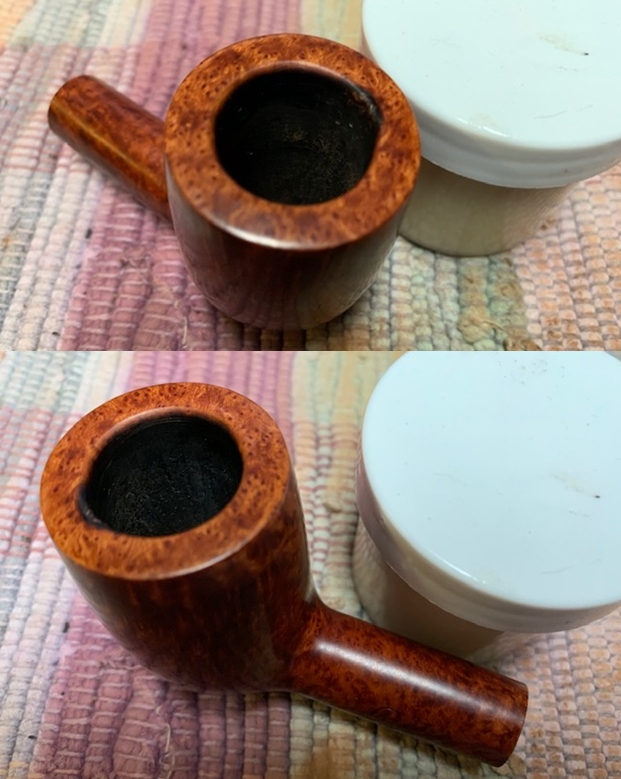
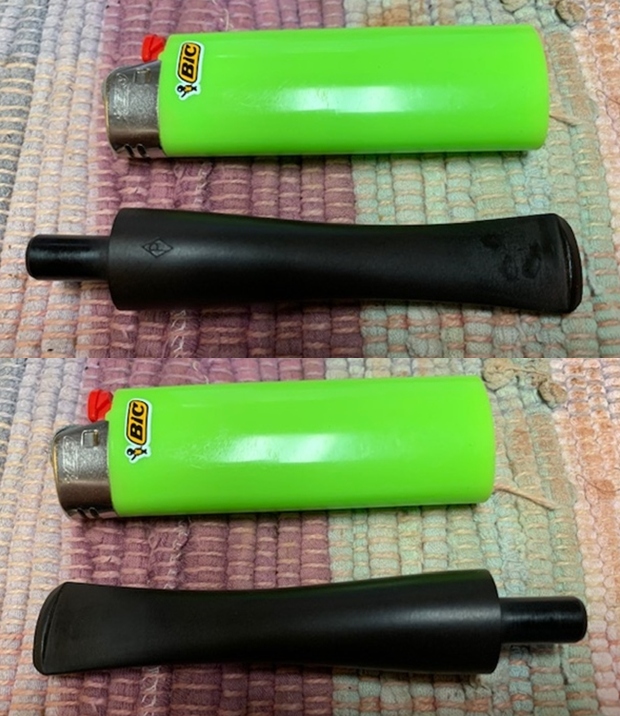
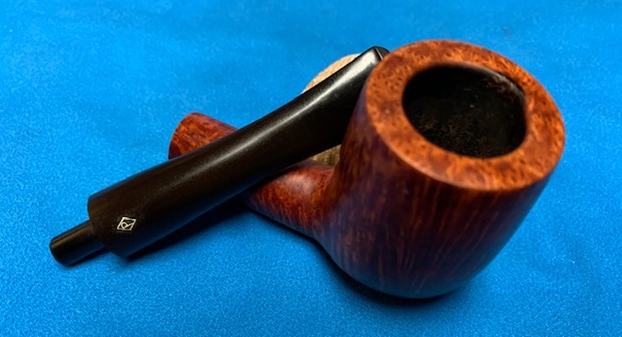
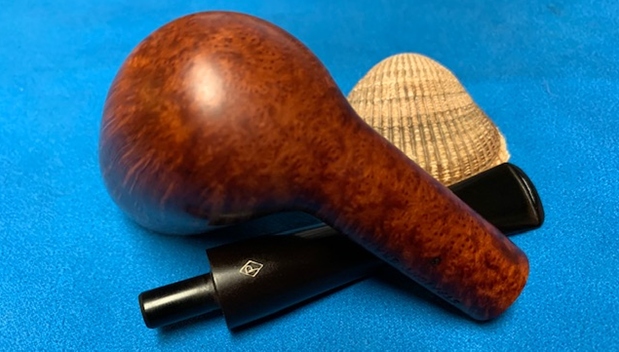
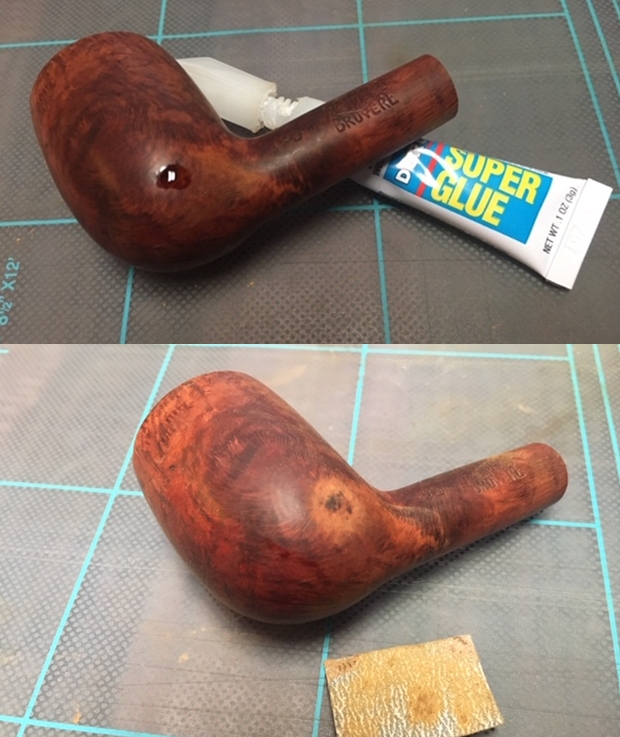
It was time to work on the pipe. As usual Jeff had done a thorough cleanup on the pipe. He reamed the bowl with a PipNet pipe reamer and followed up with a Savinelli Fitsall pipe knife to remove the cake. He scrubbed out the mortise and the airway in the shank and the stem with alcohol, cotton swabs and pipe cleaners. He scrubbed the exterior of the bowl, rim, shank and stem with a tooth brush and Murphy’s Oil Soap to remove the oils and tars on the rim and the grime on the finish of the bowl. He rinsed it under running water. One of the benefits of this scrub is that it also tends to lift some of the scratches and nicks in the surface of the briar. He dried it off with a soft cloth. He cleaned the internals and externals of the stem with alcohol, pipe cleaners and cotton swabs. He soaked the stem in Before & After Deoxidizer and rinsed it off with warm water and cleaned out the airway in the stem with alcohol. Other than the damaged rim top the pipe looked good. I took a photo of the rim top and stem to show the condition. The rim top looked very good. The rim top and the inner edge of the bowl had a burn mark on the left front of the bowl. The vulcanite taper stem had light tooth chatter and marks on both sides ahead of the button and on the button edges.    The stamping on the top and sides of the shank is clear and readable as noted above. I removed the stem and took a photo of the pipe to give a sense of the whole. It is a nice Straight Grain Billiard that should clean up very well.   I filled in the burned area with a drop of clear super glue and briar dust. I reshaped the bowl edges with a folded piece of 220 grit sandpaper to give the rim a slight bevel. The repaired area was dark but it was no longer a large burned area.I polished the briar with micromesh sanding pads – wet sanding with 1500-12000 grit pads and wiped down the bowl after each sanding pad.     I rubbed the bowl and shank down with Before & After Restoration Balm. I worked it into the surface of the bowl sides and shank with my fingertips to clean, enliven and protect the briar. I let the balm sit for a little while and then buffed with a cotton cloth to raise the shine. The Balm did its magic and the grain stood out.     I set the bowl aside and turned my attention to the stem. I “painted” the tooth marks on the stem with the flame of a Bic lighter and was able to lift them all enough that I would be able to sand them out. I sanded out the tooth marks on the stem with 220 grit sandpaper and started the polishing process with 400 grit wet dry sandpaper.   I used PaperMate Liquid Paper to fill in the Diamond P stamp on the top side of the taper stem. I let it dry the scraped off the excess with my fingernail.   I polished the vulcanite stem with micromesh sanding pads – 1500-12000 grit pads. I wiped it down with Obsidian Oil after each sanding pad. I used Before & After Pipe Polish – both Fine and Extra Fine to further polish the stem. The photo below shows the polished stem. This nicely grained Parker of London Straight Grain Billiard with a vulcanite taper stem is a great looking pipe now that it has been restored. The briar around the bowl is clean and really came alive. The rich brown stains gave the grain a sense of depth with the polishing and waxing. The grain really popped. I put the vulcanite stem back on the bowl and carefully buffed the pipe with Blue Diamond on the buffing wheel using a light touch on the briar. I gave the bowl and the stem multiple coats of carnauba wax on the buffing wheel. I buffed the pipe with a clean buffing pad to raise the shine. I hand buffed the pipe with a microfiber cloth to deepen the shine. The finished Parker Straight Grain Billiard is a beauty and feels great in the hand and looks very good. Give the finished pipe a look in the photos below. The dimensions of the pipe are Length: 6 inches, Height: 2 ¼ inches, Outside diameter of the bowl: 1 ½ inches, Chamber diameter: ¾ of an inch. Thanks for reading this blog and my reflections on the pipe while I worked on it. There are many more to come!

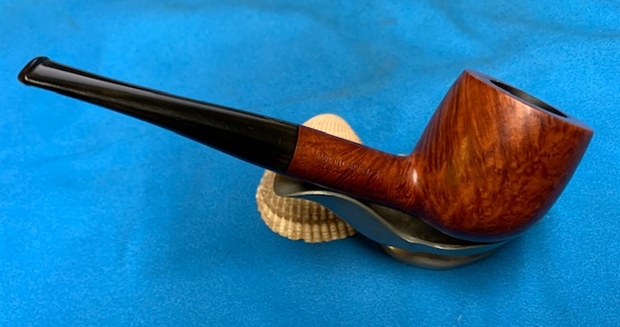
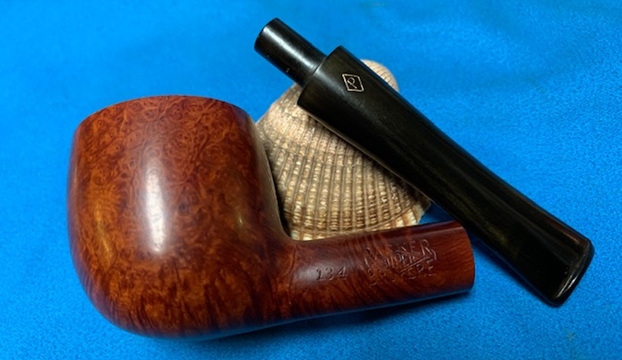
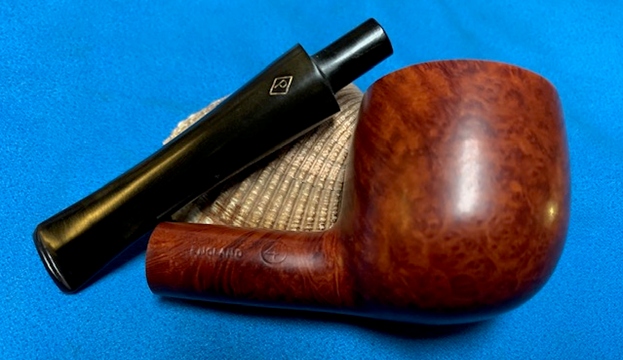
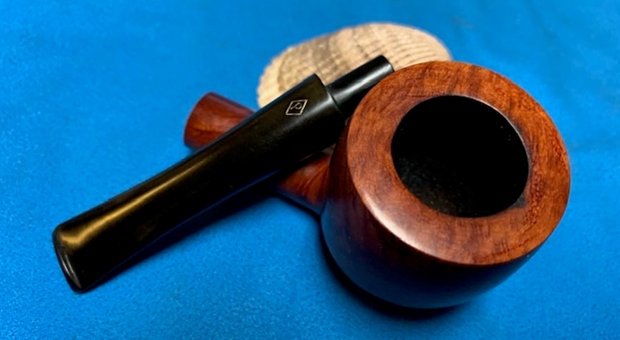
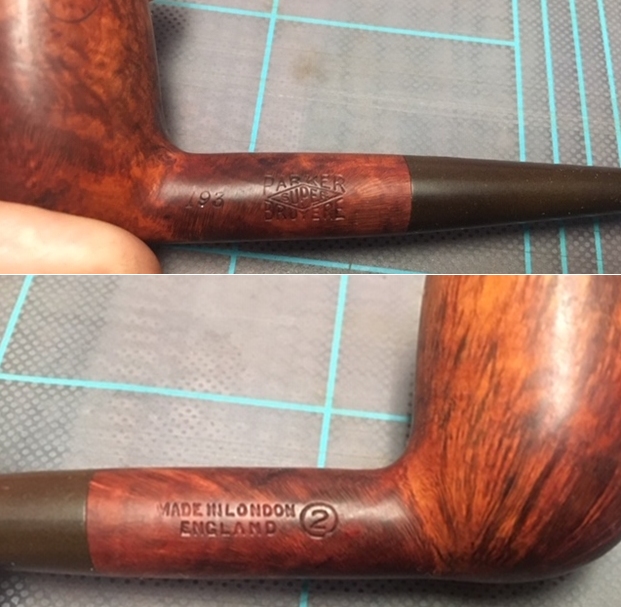
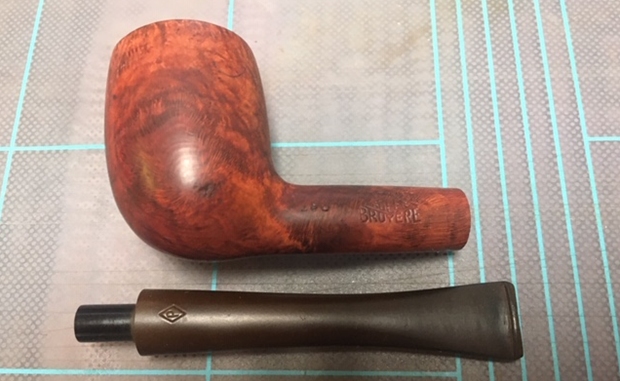
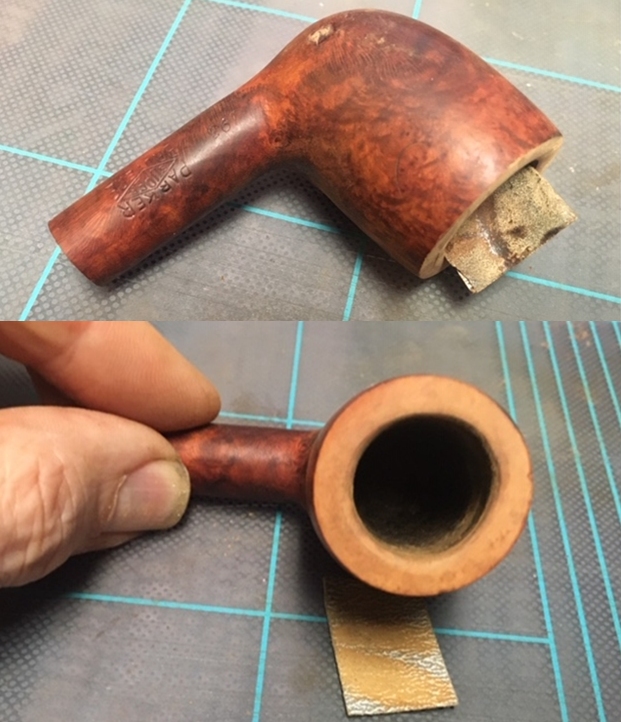
Restoring a Parker Super Bruyere 134 Circle 4 Pot


Blog by Steve Laug

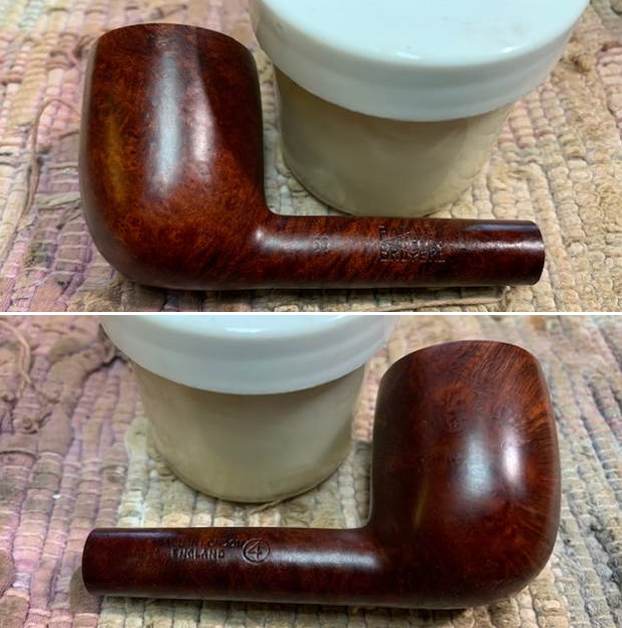
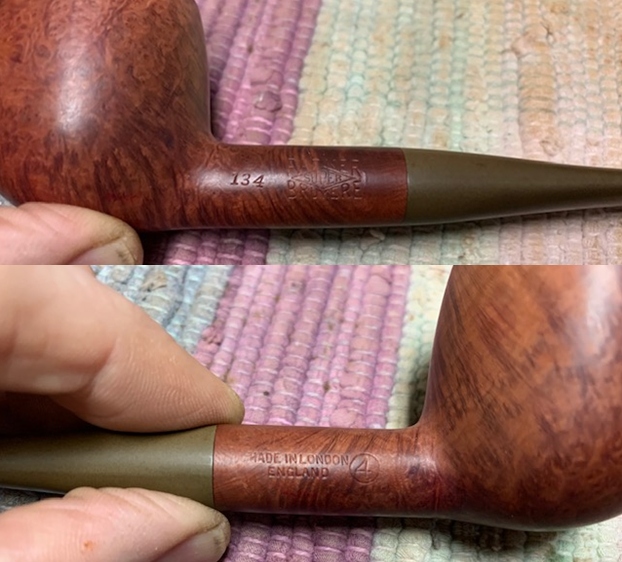
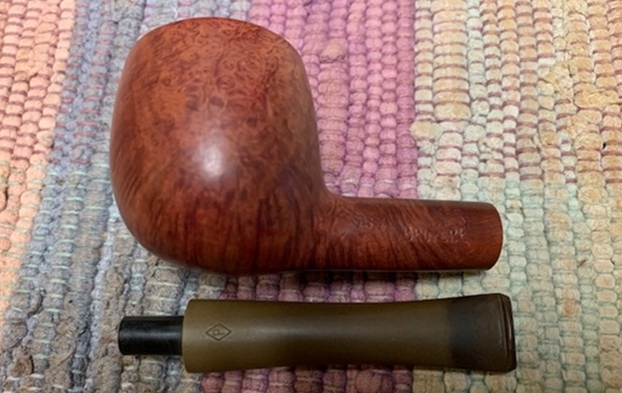
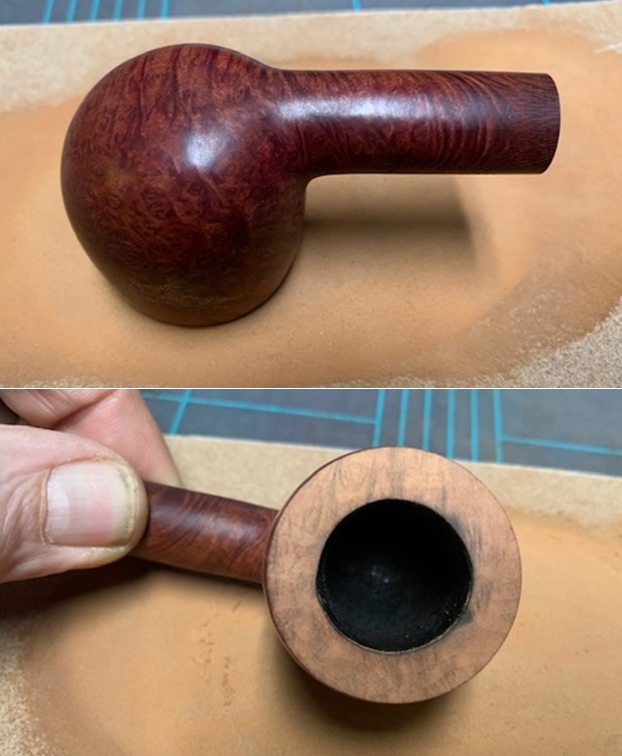
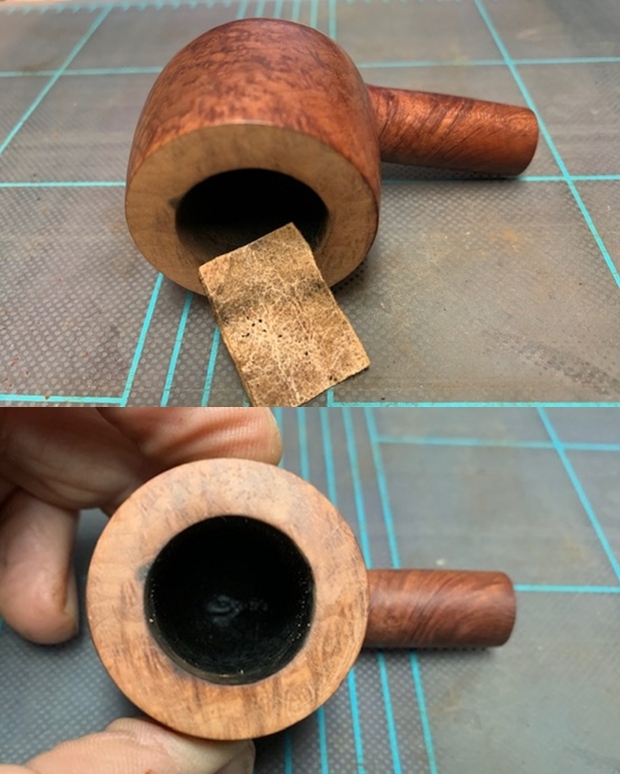
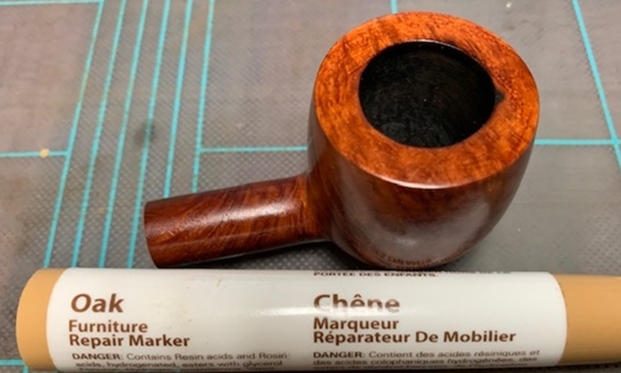
The next pipe on the work table came to me from the estate of a Vancouver pipe smoker whose widow left them with a local Pipe Shop after he died. I was asked to clean them up and sell them for the shop as it has since closed. This is another interesting looking piece – great grain showing through underneath the grime. There is cross grain and birdseye grain around the bowl. The pipe is stamped on the left side of the shank and reads shape #134 followed by Parker [over] Super in a diamond [over] Bruyere. On the right side of the shank it is stamped with the size number 4 in a circle followed by Made In London England. The finish was dull and lifeless with a lot of grime ground into the briar. The bowl was heavily caked with a lava coat on the top of the rim. It was hard to tell how the inner and outer edge of the rim actually looked until the bowl was reamed. The stem was oxidized, calcified and had tooth chatter and marks on the top and underside near the button. It had promise but it was very dirty. I took some photos of the pipe when I received it.   I have worked on quite a few Parkers over time and I have seen them stamped like the one I have however, there was a superscript after the D in England that was lacking in this one. I turned to Pipedia to see what I could find out a Super Bruyere without a date code after the England stamp (http://www.pipephil.eu/logos/en/logo-parker.html). I have included a screen capture of the section showing a similarly stamped. I had sent the batch of pipes from the shop to my brother Jeff in Idaho and he had cleaned them up for me. It was several years ago now that he sent them back to me and I am just now getting to finish them. He reamed them with a Pipnet Reamer and cleaned up the reaming with a Savinelli Fitsall pipe knife.  He had scrubbed the exterior of the bowl with Murphy’s Oil Soap and a tooth brush and rinsed it off with warm water to remove the grime from the finish. He cleaned the internals of the shank and stem with alcohol, cotton swabs and pipe cleaners to remove the tarry residue and oils in the shank and airway. He soaked the stem in Before & After Deoxidizer to remove the oxidation on the stem surface. When it arrived here on my work table I took photos of the pipe before I started my part of the restoration. The bowl was a definite improvement but the stem still showed some oxidation.    The inner and outer edges were in good condition. There was some darkening around the inner edge of the rim and some damage to the rim top. The stem look good but there was still some oxidation and there were tooth marks and chatter on both sides near the button. The underside was worse than the topside.     I took a photo of the stamping on the sides of the shank. The stamping is clear and readable and reads as noted above.         I took the stem off the pipe and took a photo of the parts to show the look of the pipe as a whole.I topped the bowl with 220 grit sandpaper on a topping board to remove the damage to the rim top. I used a folded piece of sandpaper to clean up the inner edge of the bowl. I polished the rim top and bowl with 1500-12000 grit micromesh sanding pads to polish the briar.      I used an Oak stain pen to touch up the rim top and blend it into the rest of the bowl. Once it was buffed it would be a perfect match.I rubbed the bowl and shank down with Before & After Restoration Balm. I worked it into the surface of the bowl sides and shank with my fingertips to clean, enliven and protect the briar. I let the balm sit for a little while and then buffed with a cotton cloth to raise the shine. You can see the grain showing through the deep glow. I set the bowl aside and turned my attention to the stem. I “painted” the stem surface with the flame of a Bic lighter. I was able to lift the majority of the dents but there were two on the underside and a dent along the button on the top side. I filled them in with clear super glue and set it aside to cure. Once the repairs cured I used a needle file to smooth out the repairs and blend them into the surrounding vulcanite. I scrubbed the surface of the stem with Soft Scrub all-purpose cleanser to remove the oxidation that remained on the stem surface. I smoothed out the repair with 220 grit sandpaper to blend it into the surface of the surrounding vulcanite. I started polishing the stem with 400 grit wet dry sandpaper.       I polished the vulcanite stem with micromesh sanding pads – 1500-12000 grit pads. I wiped it down with a damp cloth after each sanding pad. I used Before & After Pipe Polish – both Fine and Extra Fine to further polish the stem.        I touched up the Diamond P stamp with Antique Gold Rub’n Buff. I pushed it into the stamping with a tooth pick. I rubbed it off with a cotton pad to remove the excess and still leave some in the stamping.   This Parker British Made Super Bruyere Pot is a great looking pipe now that it has been restored. This great looking pipe that came to me from the local pipe shop estate that I am restoring and selling for them. The medium brown stain highlights the grain and works well with the polished vulcanite taper stem. I put the stem back on the bowl and carefully buffed the pipe with Blue Diamond on the buffing wheel using a light touch on the briar. I gave the bowl and the stem multiple coats of carnauba wax on the buffing wheel and followed that by buffing the entire pipe with a clean buffing pad. I hand buffed the pipe with a microfiber cloth to deepen the shine. The finished straight pot fits nicely in the hand and feels great. Give the finished pipe a look in the photos below. The dimensions of the pipe are Length: 5 ¼ inches, Height: 1 ¾ inches, Outside diameter of the bowl: 1 ½ inches, Chamber diameter: ¾ of an inch. If you are interested in adding this pipe to your collection send me a message or an email. I have a variety of brands to work on from the shop. Perhaps one of those will catch your attention. Thanks for reading this blog and my reflections on the pipe while I worked on it. This is an interesting estate to bring back to life.

Breathing Life into a Parker Super Bruyere793 Billiard from Bob Kerr’s Estate


Blog by Steve Laug

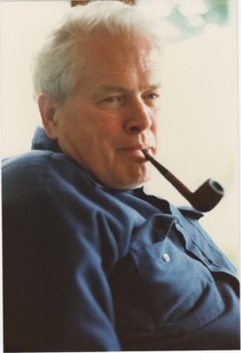
I have only 11 more of Bob’s pipes to finish before I have completed the restoration of his estate so I am continuing to work on them. The next one from Bob Kerr’s Estate is Parker Super Bruyere billiard. It is a nice looking Billiard pipe with nice grain. (Bob’s photo is to the left). If you have not “met” the man and would like to read a bit of the history of the pipeman, his daughter has written a great tribute that is worth a read. Because I have included it in most of the restorations of the estate to date I thought that I would leave it out this time. Check out some of the recent Dunhill restoration blogs that include the biographical notes about Bob. Here is a link to one of them (https://rebornpipes.com/2020/01/01/restoring-the-last-of-bob-kerrs-dunhills-a-1962-dunhill-bruyere-656-f-t-bent-billiard/).

The Parker Super Bruyere Billiard has a taper vulcanite stem. It is a smooth finished bowl and shank that has a lot of dust and debris ground into the finish of the briar. The pipe is stamped on both sides of the shank. On the left it is stamped with the shape number793 followed by Parker over Super in a Diamond over Bruyere. On the right it is stamped with the number 2 in a circle followed by Made in London England. There was a thick cake in the bowl and lava overflow on the rim top. There was tobacco debris stuck on the bottom and sides of the bowl. The tapered vulcanite stem was calcified, oxidized and had tooth marks and chatter ahead of the button on both sides. It had the Parker Diamond P stamp on the topside of the stem. Jeff took photos of the pipe to show its general condition before he did his cleanup. As I mentioned above the exterior of the pipe was very dirty – grime and grit ground in from years of use and sitting. The rim top was covered with a coat of thick lava that overflowed from the thick cake in the bowl. It was hard to know what the rim edges looked like because of the lava.    Jeff took photos of the sides and the heel of the bowl to give a better feel for the condition of the briar around the bowl.       The next photos show the stamping on both sides of the shank. The stamping is clear and readable as noted above. There is also a stamped Diamond P on the top of the tapered stem.   The stem was dirty, calcified and oxidized with tooth chatter and marks on the top and underside of the stem at the button.      I have worked on quite a few Parkers over time and I have seen them stamped like the one I have however, there as a superscript after the D in England. I turned to Pipedia to see what I could find out a Super Bruyere without a date code(http://www.pipephil.eu/logos/en/logo-parker.html). I have included a screen capture of the section showing a similarly stamped pipe. With over 125 pipes to clean from Bob’s estate I took a batch of them to the states with me when I visited and left them with Jeff so he could help me out. Jeff cleaned the pipes with his usual penchant for thoroughness that I really appreciate. Once he finished he shipped them back to me. Bob’s pipes were generally real mess and I did not know what to expect when I unwrapped it from his box. I was surprised to see how well it turned out. He reamed it with a PipNet pipe reamer and cleaned up the reaming with a Savinelli Fitsall Pipe Knife. He scrubbed out the internals with alcohol, pipe cleaners and cotton swabs until the pipe was clean. He scrubbed the exterior of the bowl with Murphy’s Oil Soap and a tooth brush to remove the grime and grit on the briar and the lava on the rim top. The finish looks very good with good looking grain around the bowl and shank. Jeff scrubbed it with Soft Scrub and soaked it in Before & After Deoxidizer to remove the oxidation on the rubber. When the pipe arrived here in Vancouver for the second stop of its restoration tour it looked a lot better. I took photos before I started my part of the work.    I took some close up photos of the rim top and the stem surface. I wanted to show what cleaned bowl and rim top looked like. The rim top had some darkening but the inner and outer edges of the bowl were in excellent condition. I also took close up photos of the stem to show the tooth marks and the remaining oxidation on the stem surface.    I took photos of the stamping on both sides of the shank. The stamping on both the left and right side are clear and readable as noted above.    I removed the stem for the shank and took a photo of the bowl and stem to give a picture of what it looked like. The oxidation is very visible.I decided to start my part of the restoration work on this pipe by addressing the damage to the rim top and inner edge first. I topped the bowl on a piece of 220 grit sandpaper on a topping board to smooth out the damage. I used a folded piece of 220 sandpaper to address the damage on the inner edge and bring the bowl back to round.    There was a deep gouge on the left side of the heel of the bowl that I dealt with next. I filled it in with clear superglue and once it had cured sanded it smooth with 220 grit sandpaper.   I polished the briar with micromesh sanding pads – wet sanding it with 1500-12000 grit sanding pads. I wiped it down with a damp cloth between each sanding pad.   I paused the polishing for a moment and stained the rim top with a Maple and an Oak stain pen to blend the rim top colour into the bowl and shank colour.   I went back to polishing the bowl with 6000-12000 grit micromesh sanding pads.  The last three pads helped to blend in the restained areas of the repairs. I rubbed the bowl down with Before & After Restoration Balm. I worked it into the surface of the briar with my fingertips to clean, enliven and protect it. I let the balm sit for a little while and then buffed with a cotton cloth and shoe brush to raise the shine.      I set the bowl aside and turned my attention to the stem. I painted the stem surface with the flame of a Bic lighter to lift the dents in the surface of the vulcanite. I was able to lift most of them out. What remained were some light marks in the surface.  I scrubbed the stem with Soft Scrub and cotton pads to remove the remaining oxidation. It took a bit of elbow grease but I was able to remove it all. I sanded out the remaining tooth marks on both sides with 220 grit sandpaper. I started the polishing of the stem with 400 grit wet dry sandpaper.      I touched up the Diamond P stamp on the top of the taper stem with Liquid Paper. I worked it into the stamping with a tooth pick. I scraped off the excess with the tooth pick and the finished stamp looked much better.      I polished the vulcanite with micromesh sanding pads – 1500-12000 grit pads. I wiped it down with a damp cloth after each sanding pad. I used Before & After Pipe Polish – both Fine and Extra Fine to further polish the stem.    This nice looking Parker Super Bruyere 793 Billiard from Bob Kerr’s estate cleaned up really well and looks very good. The mixed stain brown finish on the pipe is in great condition and works well with the polished vulcanite taper stem. I put the stem back on the bowl and carefully buffed the pipe with Blue Diamond on the buffing wheel using a light touch on the briar. I gave the bowl and the stem multiple coats of carnauba wax on the buffing wheel and followed that by buffing the entire pipe with a clean buffing pad. I hand buffed the pipe with a microfiber cloth to deepen the shine. The finished Parker Super Bruyere feels great in the hand and I think it will feel great as it heats up with a good tobacco. Give the finished pipe a look in the photos below. The dimensions of the pipe are Length: 5 ½ inches, Height: 1 ¾ inches, Outside diameter of the bowl: 1 ¼ inches, Chamber diameter: ¾ of an inch. If you are interested in carrying on Bob’s legacy with this pipe send me a message or an email. I have more to work on of various brands. Perhaps one of those will catch your attention. Thanks for reading this blog and my reflections on the pipe while I worked on it. This is an interesting estate to bring back to life.

Restoring Pipe #18 from Bob Kerr’s Estate – A Parker 272 Super Bruyere Billiard


Blog by Steve Laug

The third pipe, #18 of Bob Kerr’s Estate is part of my continuing to change things up a bit with the pipes in the estate. This pipe is a beautiful chubby shanked billiard in Bruyere colour like the Dunhill Bruyere pipes. It was very dirty but there was some beauty underneath the grime and the lava on the rim. I will be going back to Bob’s Dunhill collection eventually. I wanted to continue the change and chubby shank Parker billiard fit the bill for me. It is stamped with the 252 shape number on the left side of the shank at the bowl shank union. Following that it reads Parker Super Bruyere. On the right side of the shank it is stamped Made in London England with a 4 in a circle designating the size of the pipe according to the Dunhill pipe sizes. The stem is tapered with the Diamond P on the top side. The grain and shape on this one is very nice and well worth the time to clean up. I took photos of the pipe before I started my cleanup on it. I turned to Pipedia to gather some background on the pipe and to see if I could possibly arrive at a date for its crafting (http://www.pipephil.eu/logos/en/logo-parker.html). I quote from that article in part to set the stage for this restoration.

Parker Pipe Co. was created in 1923 by Dunhill. After Dunhill acquired Hardcastle the two companies were merged (1967) in the Parker-Hardcastle Ltd.

Like Dunhill pipes, Parkers were also date coded but had a independant cycle.

    From 1925 through 1941 the date code of Parker pipes runs from 2 to 18.

    From 1945 through 1949 the date code runs from 20 to 24.

    From 1950 through 1957 (at least) the date suffix run from an underlined and raised 0 to 7.

More recent Parker Super Bruyere did not have the date code.

I turned  to Pipedia and did a bit more reading on the brand (https://pipedia.org/wiki/Parker). I quote in part below:

In 1922 the Parker Pipe Co. Limited was formed by Alfred Dunhill to finish and market what Dunhill called its “failings” or what has come to be called by collectors as seconds. Previous to that time, Dunhill marketed its own “failings”, often designated by a large “X” over the typical Dunhill stamping or “Damaged Price” with the reduced price actually stamped on the pipe.

While the timing and exact nature of the early relationship remains a bit of mystery, Parker was destined to eventually merge with Hardcastle when in 1935 Dunhill opened a new pipe factory next door to Hardcastle, and purchased 49% of the company shares in 1936. In 1946, the remaining shares of Hardcastle were obtained, but it was not until 1967 when Parker-Hardcastle Limited was formed.

It is evident through the Dunhill factory stamp logs that Parker and Dunhill were closely linked at the factory level through the 1950s, yet it was much more than a few minor flaws that distinguishing the two brands. Most Dunhill “failings” would have been graded out after the bowl turning process exposed unacceptable flaws. This was prior to stoving, curing, carving, bit work and finishing. In others words, very few Parkers would be subjected to the same rigorous processes and care as pipes destined to become Dunhills. Only those that somehow made it to the end finishing process before becoming “failings” enjoy significant Dunhill characteristics, and this likely represents very few Parker pipes.

After the war, and especially after the mid 1950s the differences between Parker and Dunhill became even more evident, and with the merger of Parker with Hardcastle Pipe Ltd, in 1967 the Parker pipe must be considered as an independent product. There is no record of Parker ever being marketed by Dunhill either in it’s retail catalog or stores.

Parker was a successful pipe in the US market during the 1930s up through the 1950s, at which point it faded from view in the US, while continuing to be popular in the UK. It was re-introduced into the US market in 1991 and is also sold in Europe…

…Prior to Word War II, the possessive PARKER’S stamp was used. However, at least some pipes were stamped with the non-possessive as early as 1936.

Like Dunhill, Parker pipes are date stamped, but differently than Dunhill. The Parker date code always followed the MADE IN LONDON over ENGLAND stamping. The first year’s pipes (1923) had no date code; from 1924 on it ran consecutively from 1 to 19.

There is no indication of a date code for the war years. Parker was not a government approved pipe manufacturer, while Dunhill and Hardcastle were. During the war years Parker manufactured the “Wunup” pipe made of bakelite and clay. A Parker pipe with a 19 date code has been reported, indicating there was perhaps some production of briar pipes as well, but no dating record.

From 1945 through 1949 the Parker date code runs from 20 to 24 and from 1950 through 1957 it runs from an underlined and raised 0 to an underlined and raised 7.

A little help here from anyone with date code information beyond 1957 would be most appreciated.

The site did give me a lot of information about the Parker brand and its connection to Dunhill. I could tell that the pipe that I was working on was made after 1957 as the pipes prior to that time had the date stamp following the D in England.

I took some close up photos of the rim top and the stem to show what I was dealing with. Parker Chubby Billiard was in pretty good condition considering its age and use. The photo shows the cake in the bowl and the thick buildup of lava on the back side of the rim top. You can see the cake in the bowl in the first photo below. The stem was dirty and oxidized with very light tooth chatter on the top and underside for about an inch ahead of the button. I took a photo of the stamping on both sides of the shank so you can see what it looked like when I examined it. It is clear and readable.With the identification of the pipe as coming out of the Parker/Dunhill factory after 1957 was as good as I was going to get on this old pipe. But that date works well with the other datable pipes in Bob’s collection. I thought it would be good to read about Bob again just to keep his memory alive as you read about his pipes.

I asked his son in law, Brian if he or his wife would like to write a brief biographical tribute to her father, Bob. His daughter wrote the following tribute to her Dad and it really goes well with the belief of rebornpipes that we carry on the trust of the pipe man who first bought the pipe we hold in our hands as we use it and when it is new we hold it in trust for the next person who will enjoy the beauty and functionality of the pipe.

Brian and his wife included the great photo of Bob with a pipe in his mouth. Thank you Bob for the great collection of pipes you provided for me to work on and get out to other pipemen and women who can enjoy them And thank you Brian and your wife for not only this fitting tribute but also for entrusting us with the pipes. Here is his daughter’s tribute to her Dad.

I am delighted to pass on these beloved pipes of my father’s. I hope each user gets many hours of contemplative pleasure as he did. I remember the aroma of tobacco in the rec room, as he put up his feet on his lazy boy. He’d be first at the paper then, no one could touch it before him. Maybe there would be a movie on with an actor smoking a pipe. He would have very definite opinions on whether the performer was a ‘real’ smoker or not, a distinction which I could never see but it would be very clear to him. He worked by day as a sales manager of a paper products company, a job he hated. What he longed for was the life of an artist, so on the weekends and sometimes mid-week evenings he would journey to his workshop and come out with wood sculptures, all of which he declared as crap but every one of them treasured by my sister and myself. Enjoy the pipes, and maybe a little of his creative spirit will enter you!

I reamed the bowl to remove the cake on the walls and the debris that still remained in the bowl. I used a PipNet pipe reamer to start the process. I followed that with a Savinelli Fitsall Pipe Knife to clean up the remaining cake in the U-shaped bottom of the bowl. I sanded the bowl with 220 grit sandpaper wrapped around a piece of dowel. It smooths out the walls and also helps deal with slight damage to the inner edges of the bowl. I cleaned up the rim top and removed the thick lava coat on the back top side of the rim. I used a pen knife blade the edge of the Savinelli Fitsall knife to scrape away the high spots of lava. I used a Scotch-Brite sponge pad to scrub off the remaining lava on the top of the bowl and wiped it down with a bit of saliva on a cotton pad.I polished the rim top with micromesh sanding pads – wet sanding with 1500-2400 grit pads and dry sanding with 3200-12000 grit pads. Each successive pad brought more shine to the rim top. I wiped the rim down with a damp cotton pad after each sanding pad. The shine develops through the polishing. With the removal of the lava coat and polishing of the rim it lightened significantly. I used a Maple and a Mahagony stain pen to blend the colours to match the colour of the rest of the bowl. I would buff it and blend it in better once the stain dried.I worked some Before & After Restoration Balm into the finish of the bowl and shank as well as the surface of the rim top. I worked it into the surface with my fingertips to clean, enliven and protect the wood. I let the balm sit for about 20 minutes and buffed it off with a soft cotton cloth to polish the bowl. I took photos of the pipe at this point in the process to show what the bowl looked like at this point. I cleaned out the internals of the bowl, shank and the airway in the shank and the stem with alcohol, pipe cleaners and cotton swabs until they came out clean. I set the bowl aside and turned my attention to the stem. I sanded out the light tooth chatter on the surface of the vulcanite with a folded piece of 220 grit sandpaper and worked on the spotted oxidation on the surface. I followed the 220 grit sandpaper with 400 grit wet dry sandpaper to minimize the scratching. The two papers combined did a pretty decent job of getting rid of the tooth marks and chatter as well as the oxidation.I polished the stem with Denicare Mouthpiece Polish to take out the oxidation at the button edge and on the end of the mouthpiece. I also worked hard to scrub it from the surface of the stem at the tenon end.I applied some Rub’n Buff Antique Gold to the Diamond P stamping on the topside of the stem. The original Diamond P stamp was gold. I applied it with a pipe cleaner and then buffed it off with a cotton pad. The repaired stamping looked really good.I polished out the scratches with micromesh sanding pads – wet sanding with 1500-2400 grit pads and dry sanding with 3200-12000 grit pads. I wiped the stem down after each sanding pad with Obsidian Oil. I polished it with Before & After Pipe Stem Polish – both Fine and Extra Fine. Once I had finished the polishing I gave it a final coat of oil and set it aside to dry. I put the bowl and stem back together. I buffed the bowl and stem with Blue Diamond to polish out the scratches in the briar and the vulcanite. I gave the bowl and the stem multiple coats of carnauba wax. I buffed the pipe with a clean buffing pad to raise the shine. I hand buffed it with a microfiber cloth to deepen the shine. The pipe polished up pretty nicely. The smooth finish on this Parker Super Bruyere is very nice almost equal to its match in the Dunhill Line. The only flaw I can see is a tiny sandpit in the outer edge of the bowl toward the back. It is quite beautiful and it has some amazing grain around the bowl – a mix of cross grain, birdseye and flame. The contrast of swirling grain looked good with the polished black vulcanite. This Parker will soon be heading off to India to join Paresh’s rotation. The finished pipe is shown in the photos below. The dimensions of the pipe are Length: 5 3/4 inches, Height: 1 7/8 inches, Outside diameter of the bowl: 1 1/4 inches, Chamber diameter: 3/4 of an inch. This is the 18th pipe from the many pipes that will be coming onto the work table from the Bob’s estate. There are a lot more pipes to work on from the Estate so keep an eye on the blog to see forthcoming restorations. Thanks for reading this blog and my reflections on the pipe while I worked on it. I am having fun working on this estate.