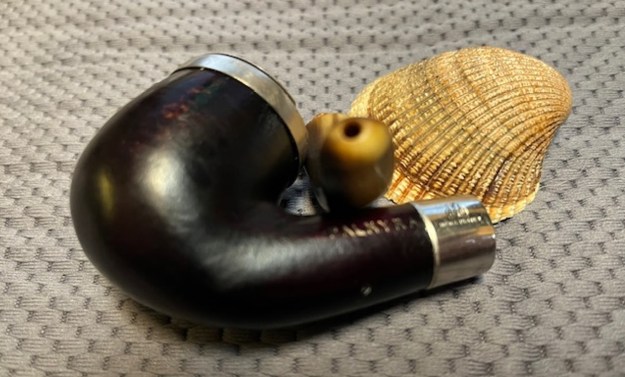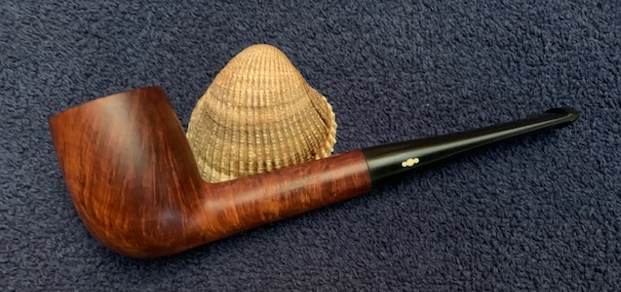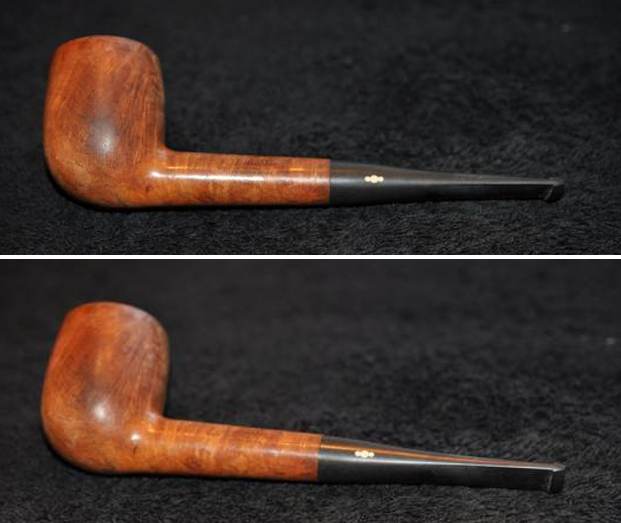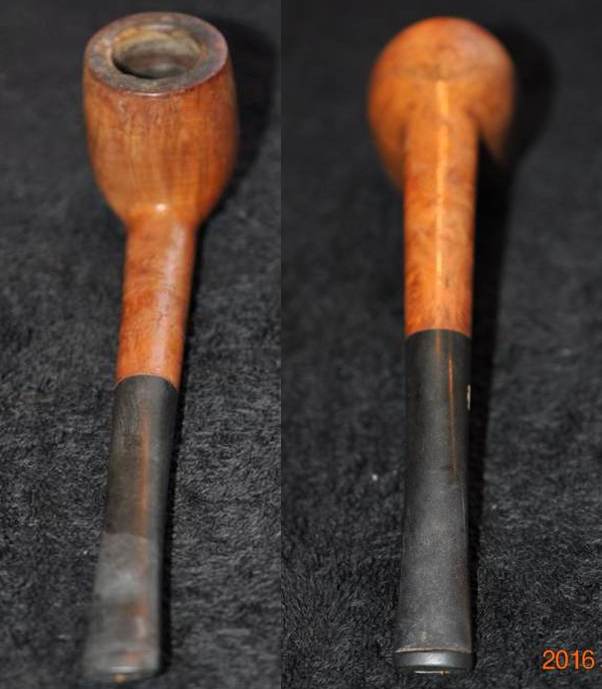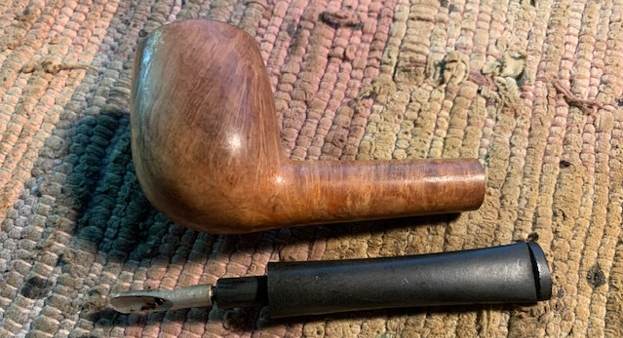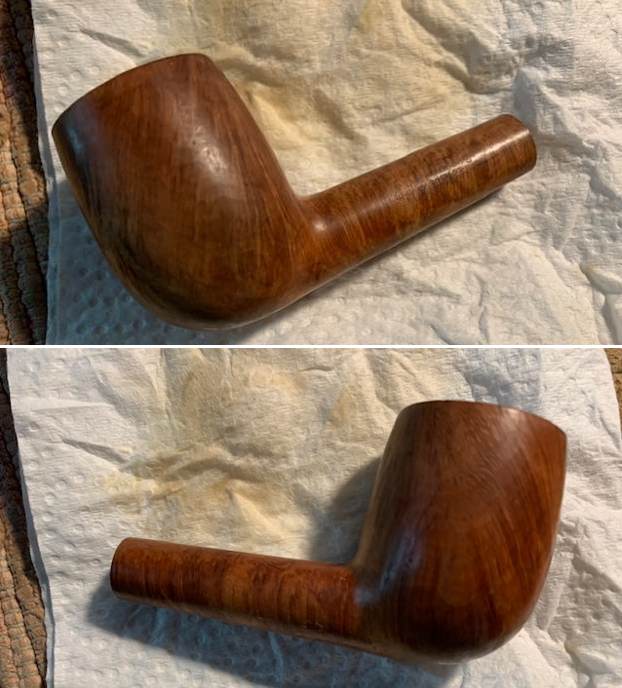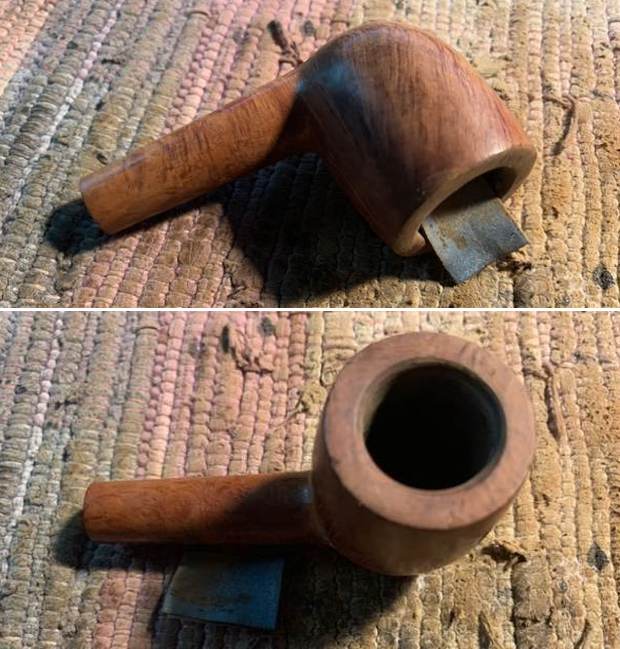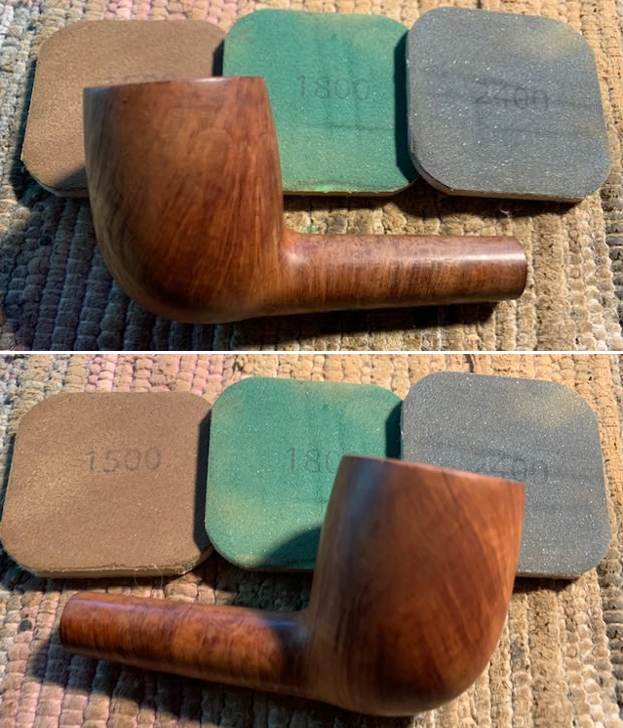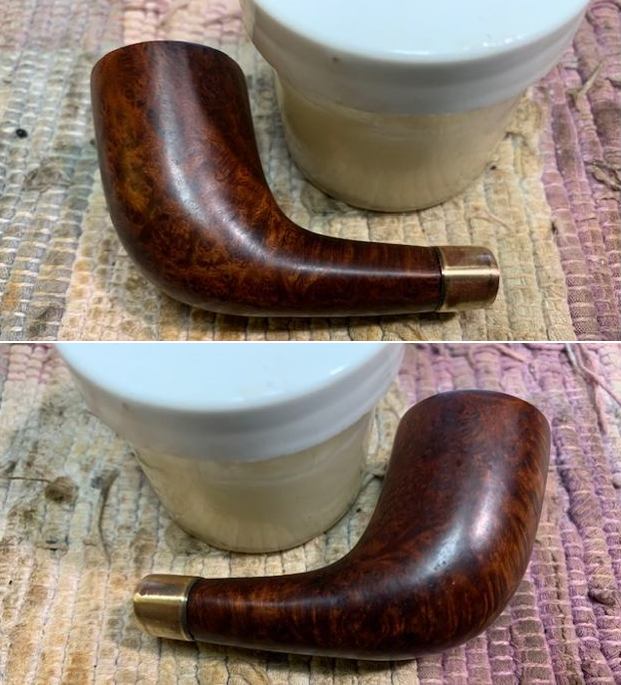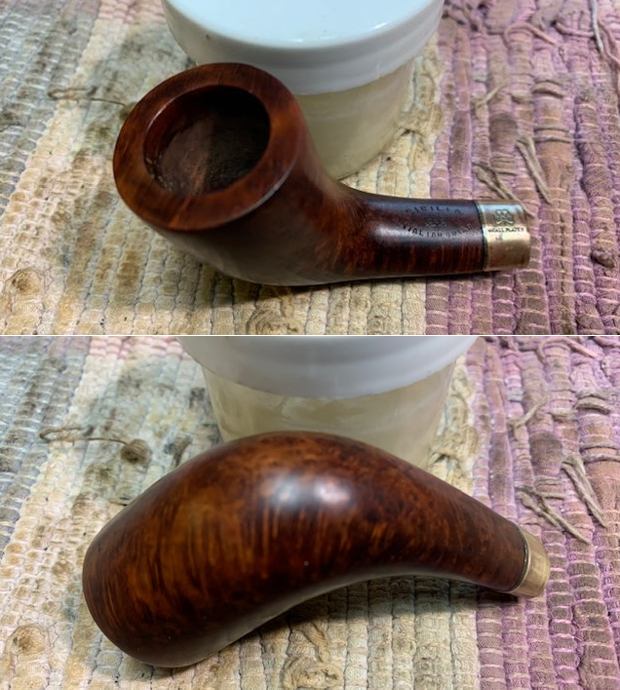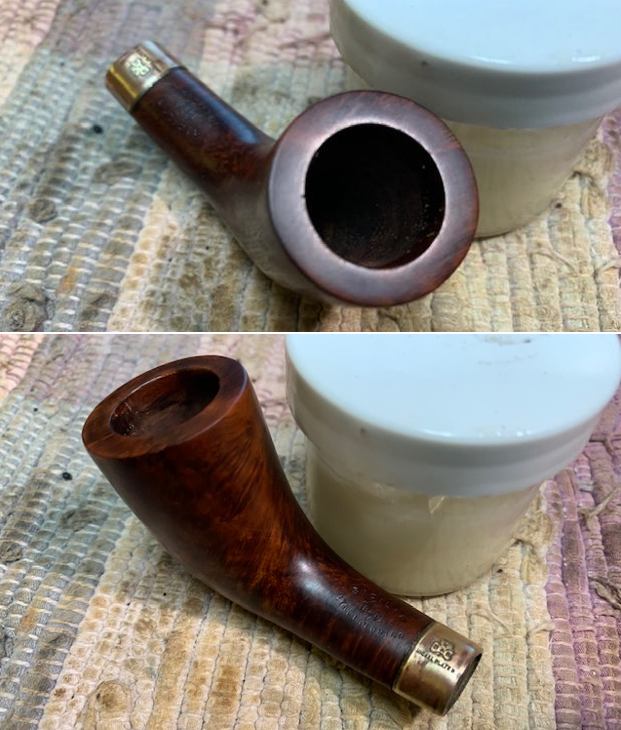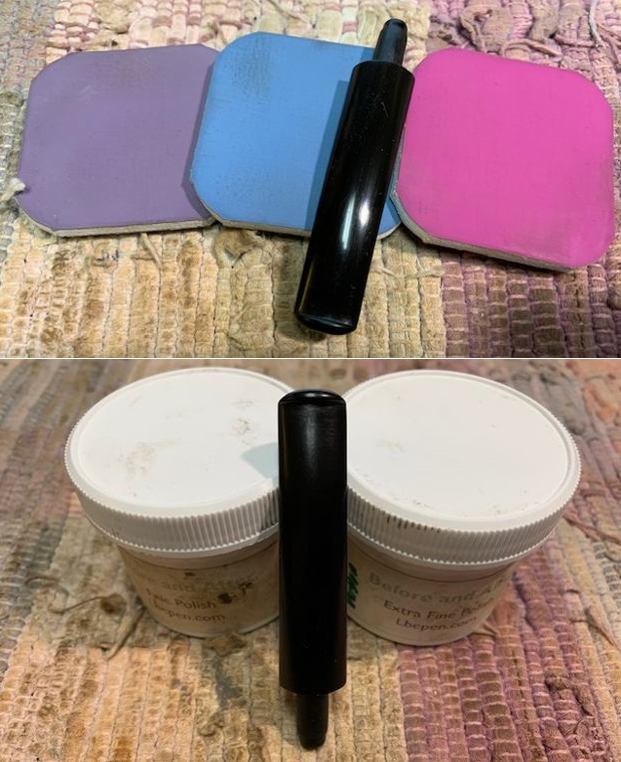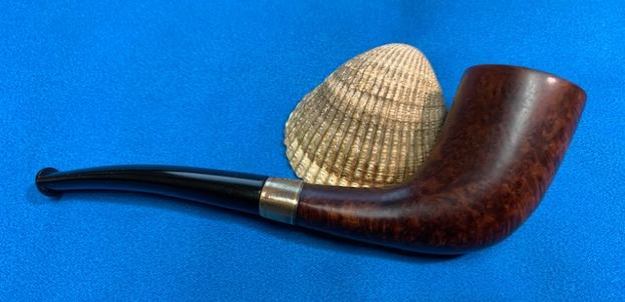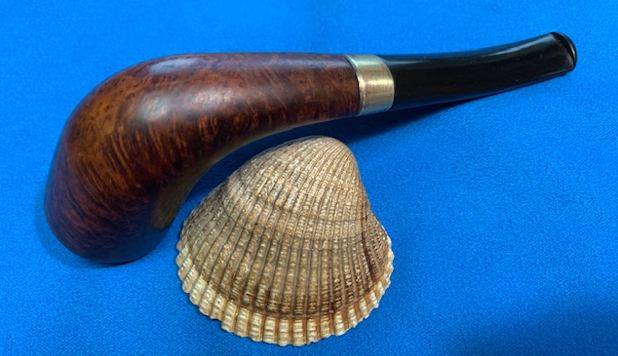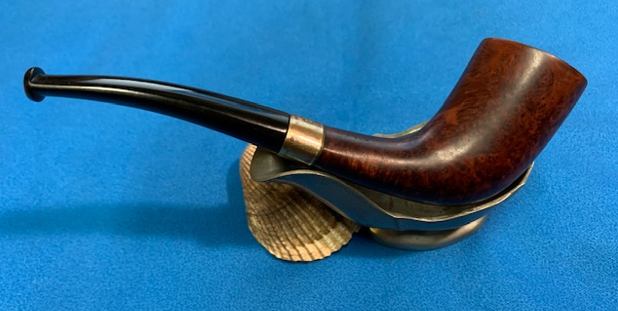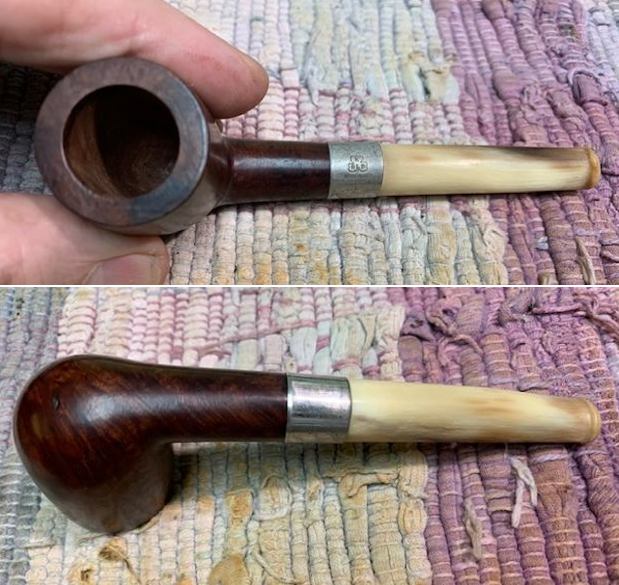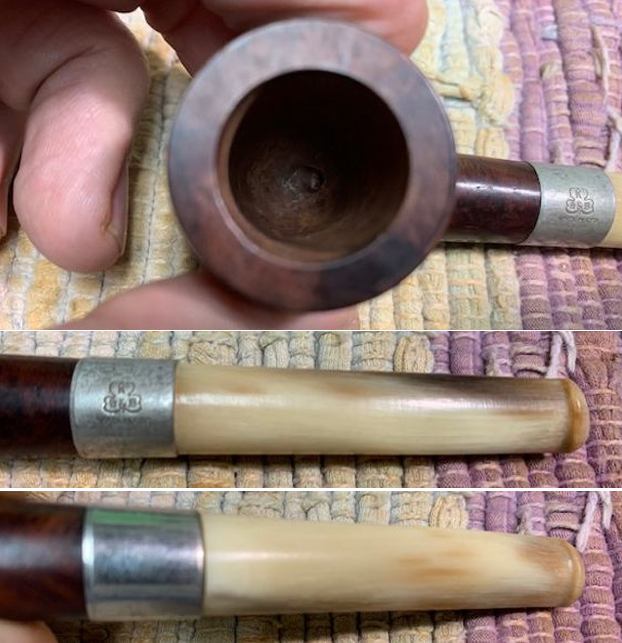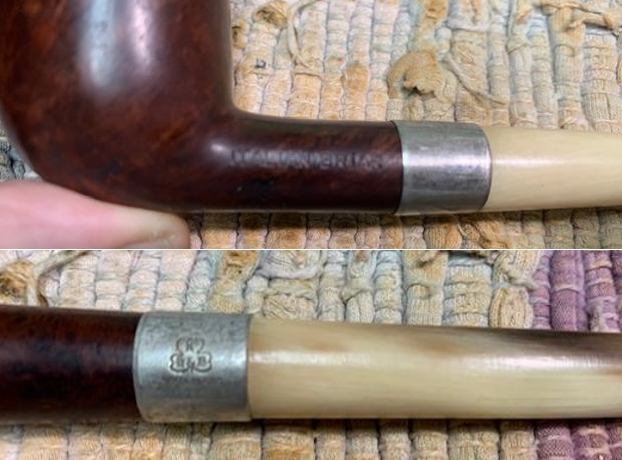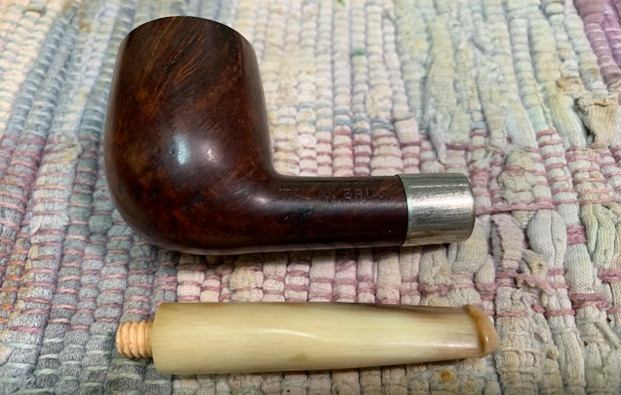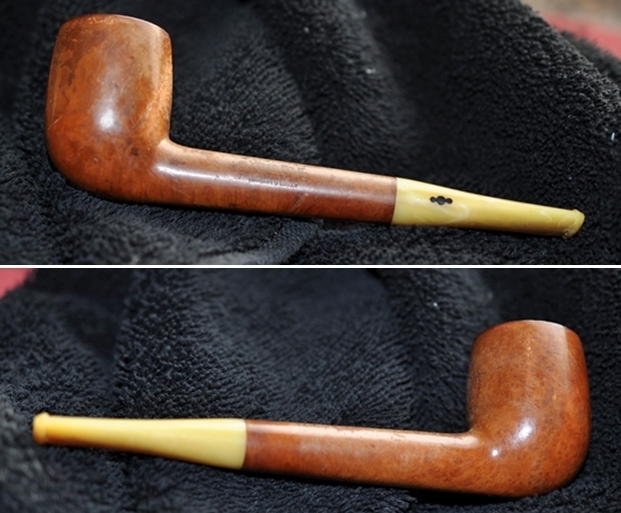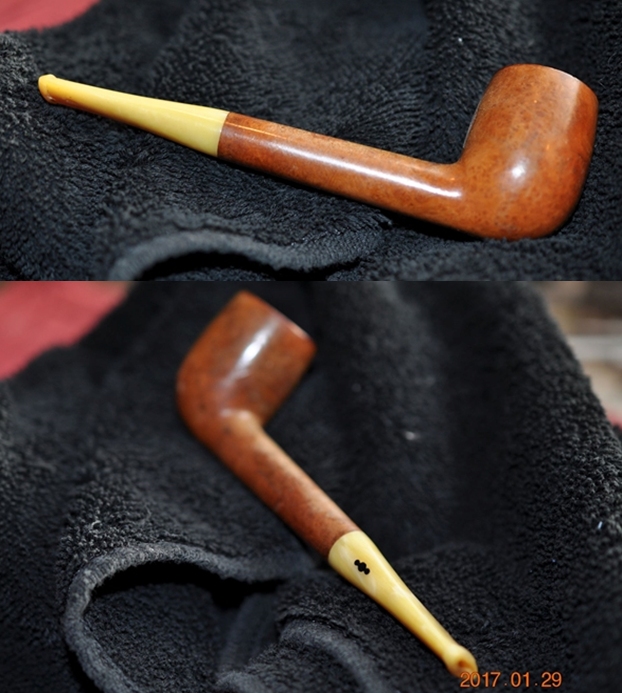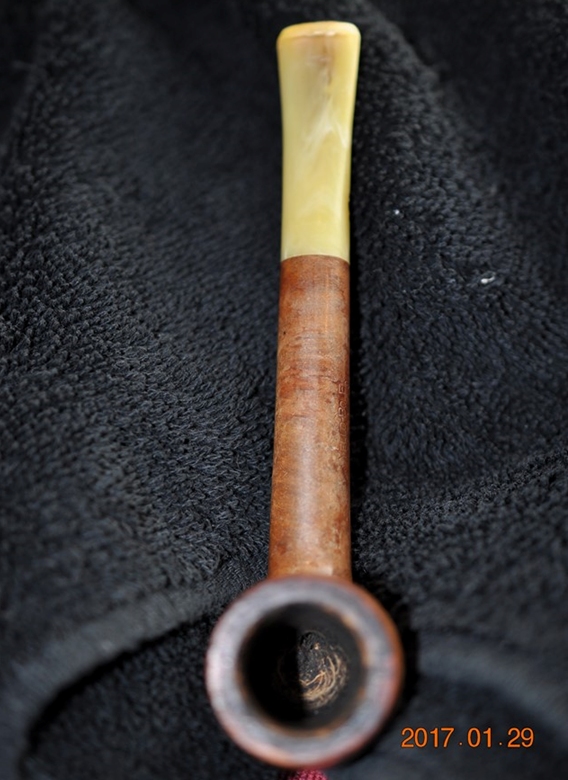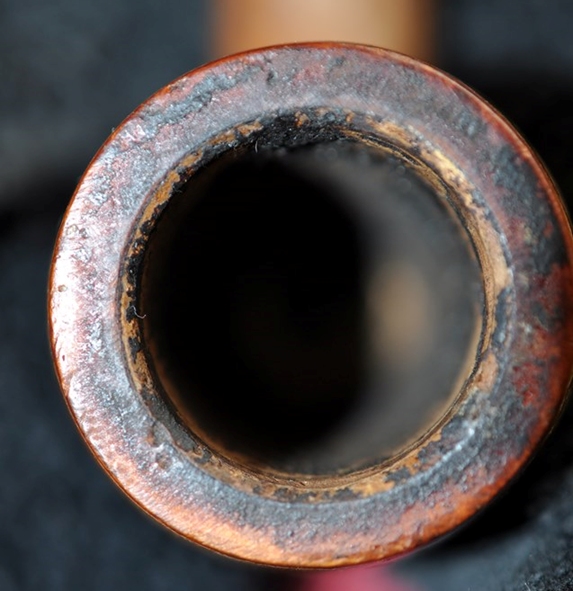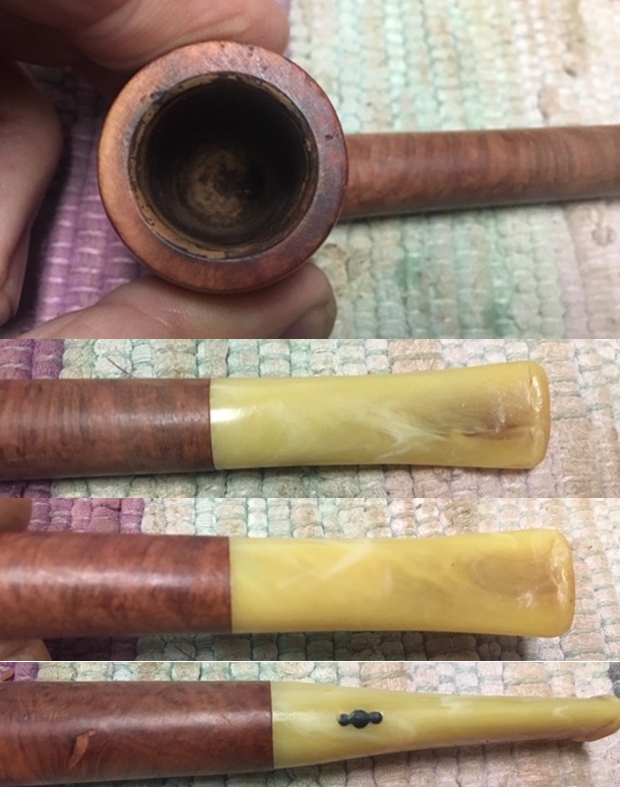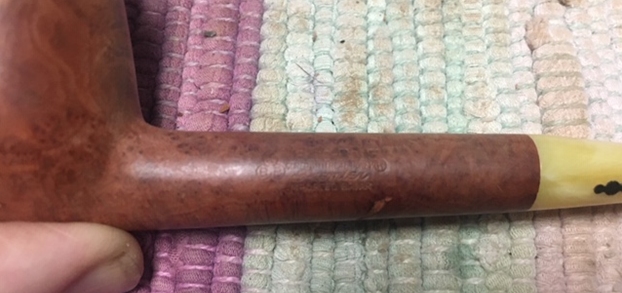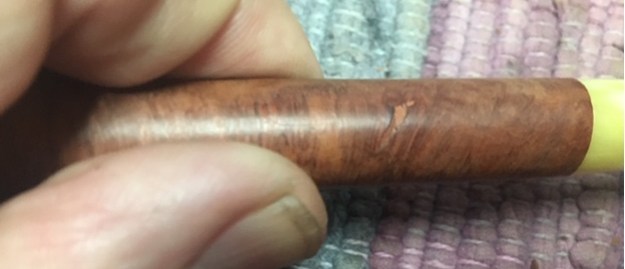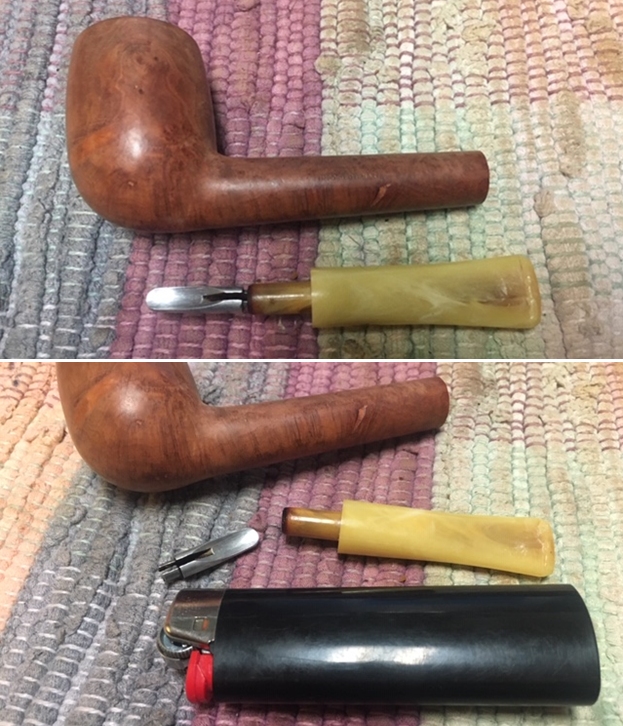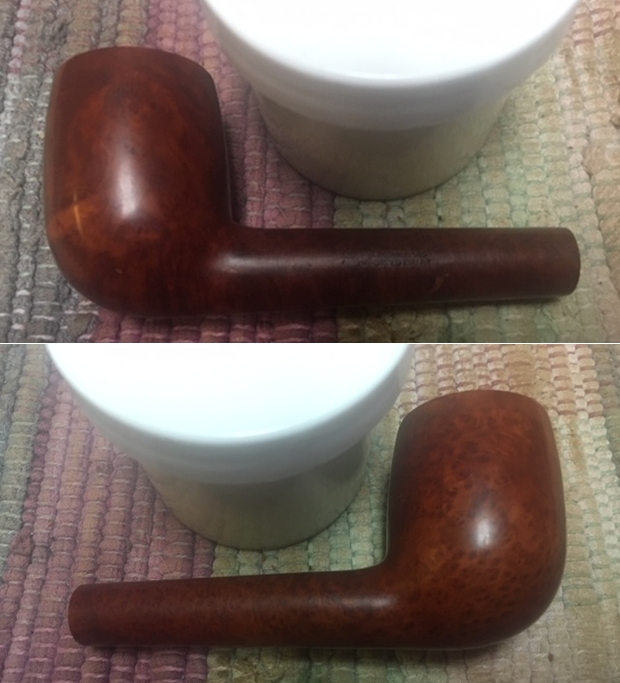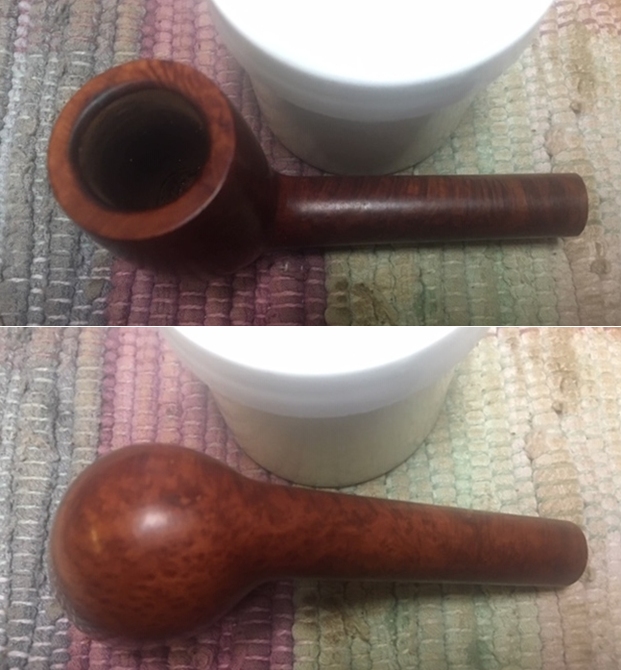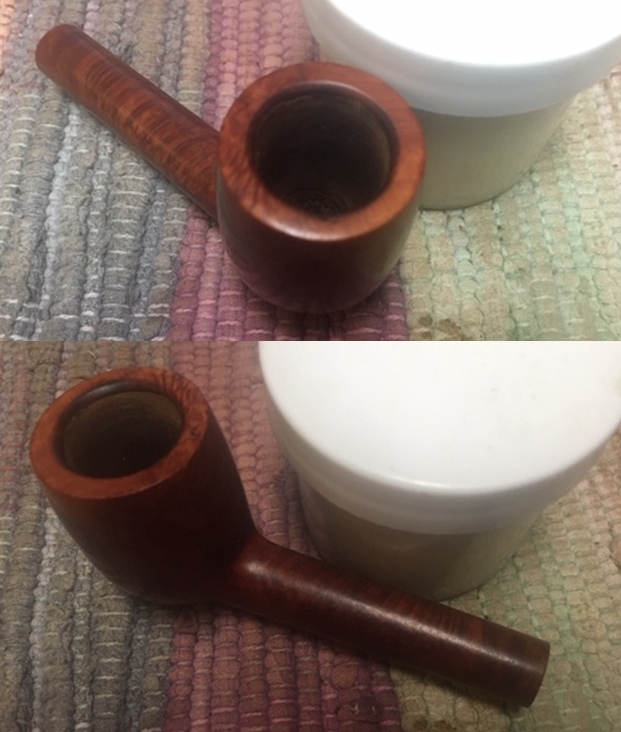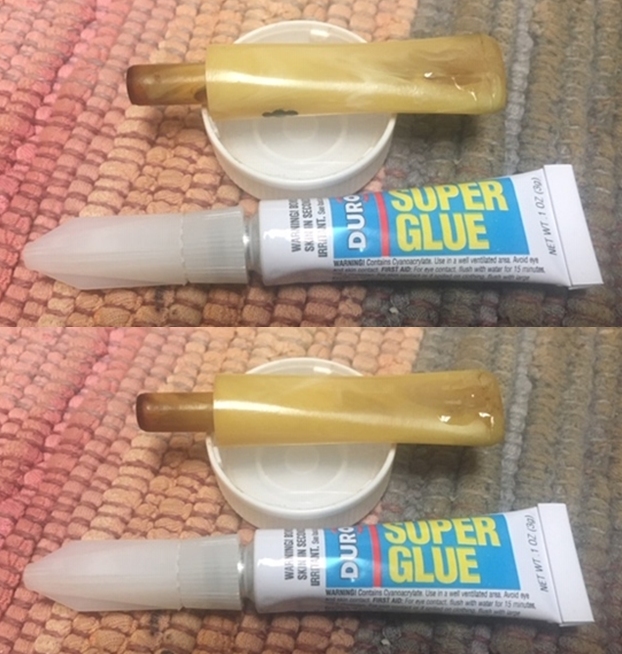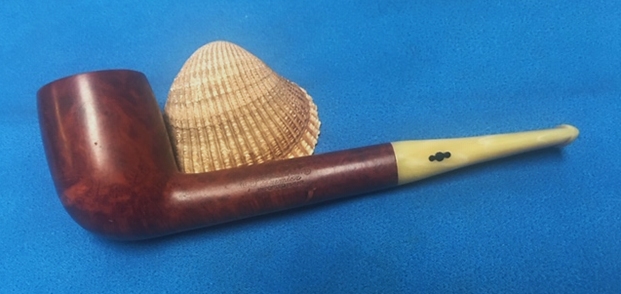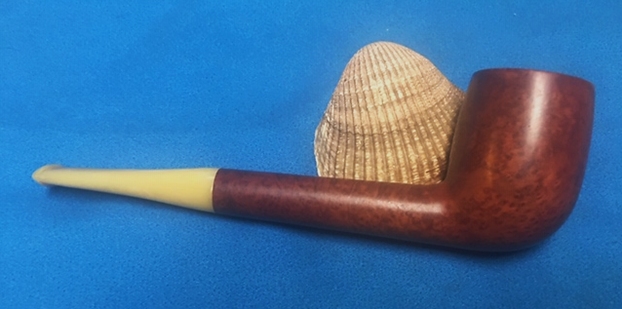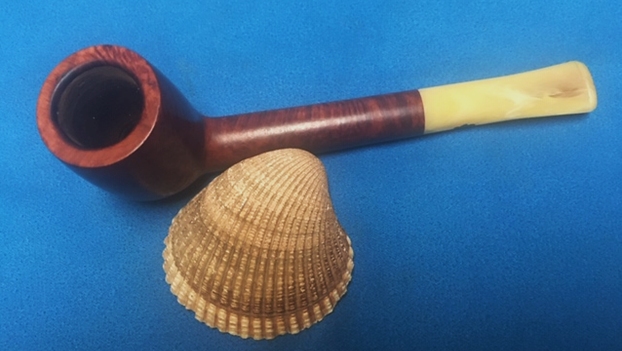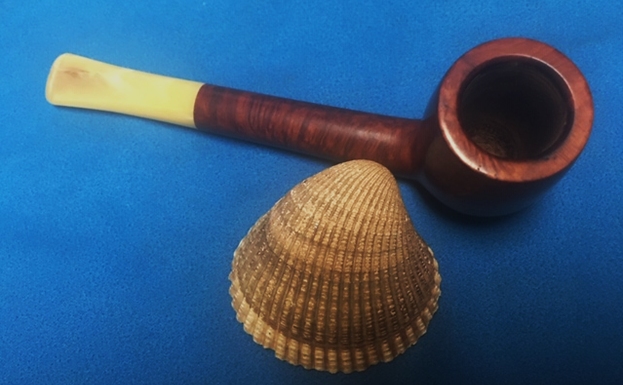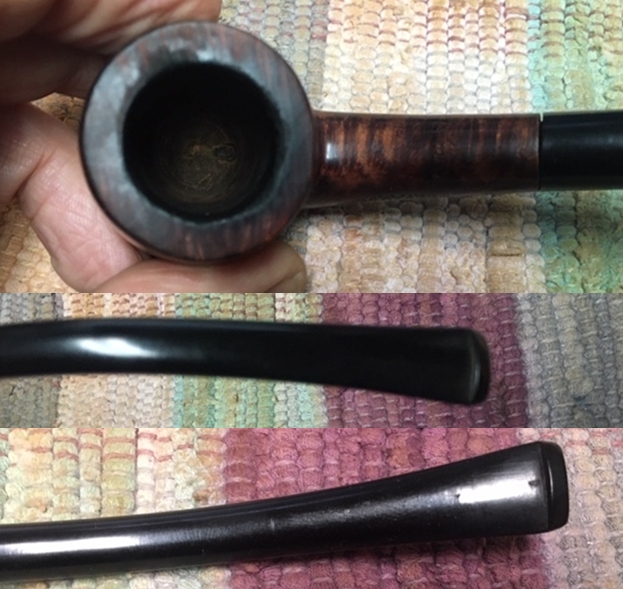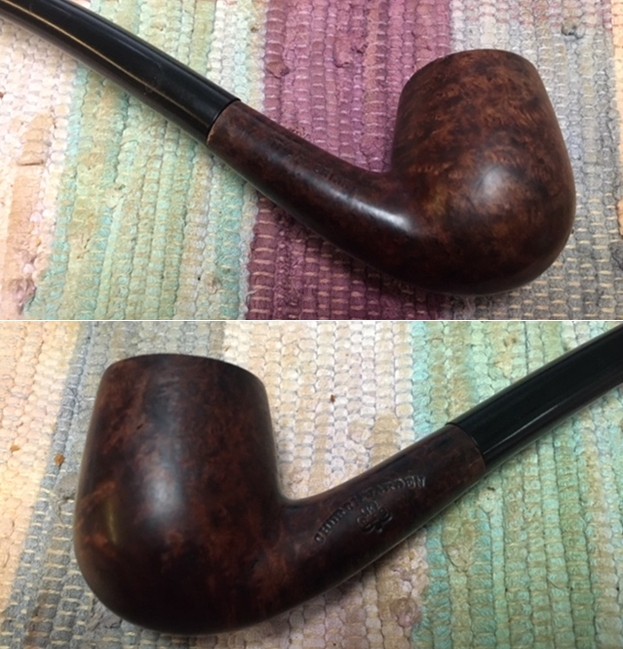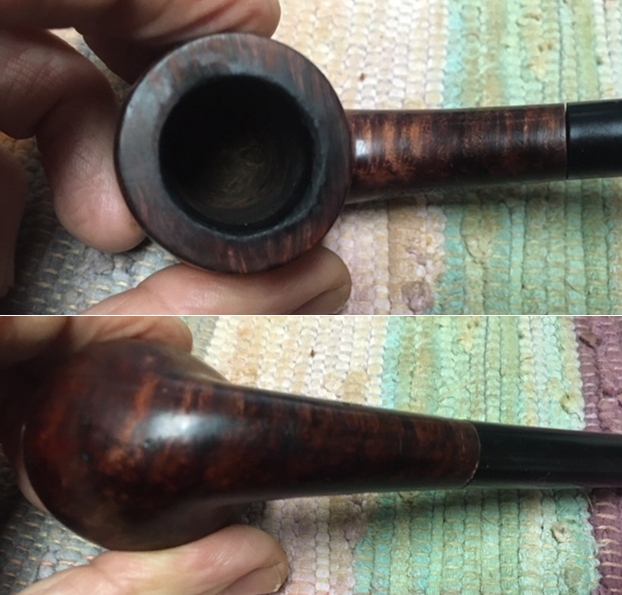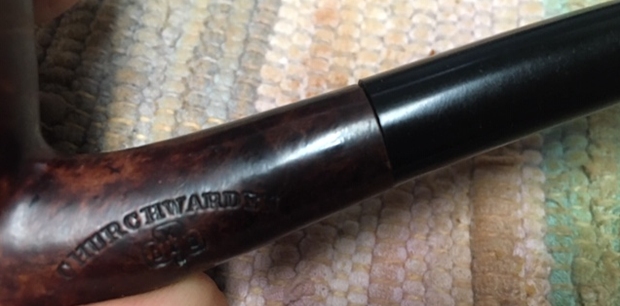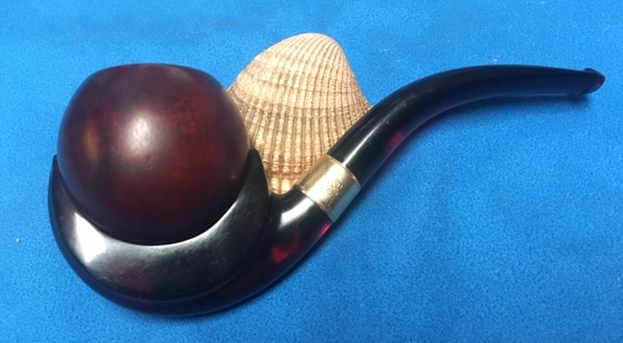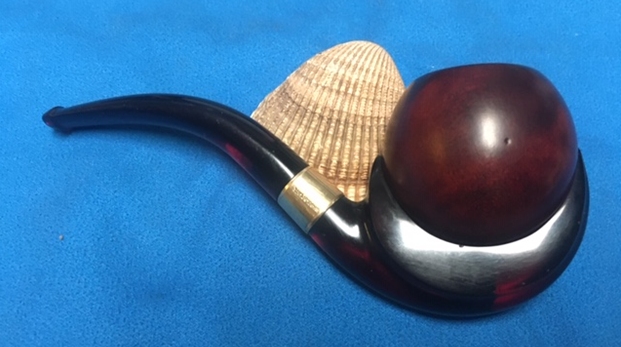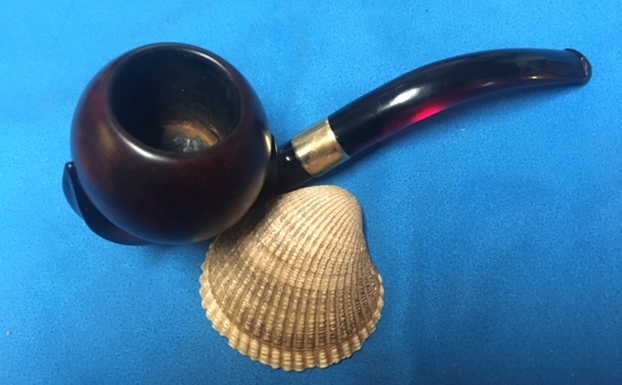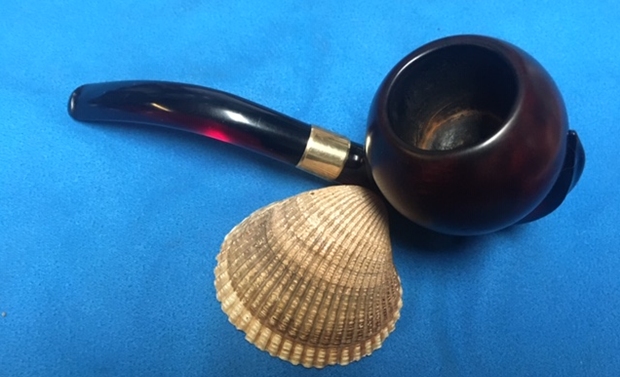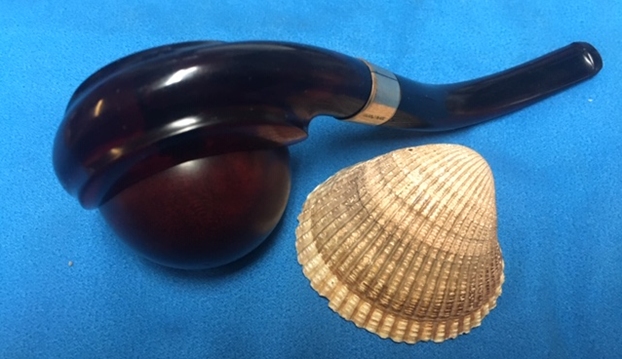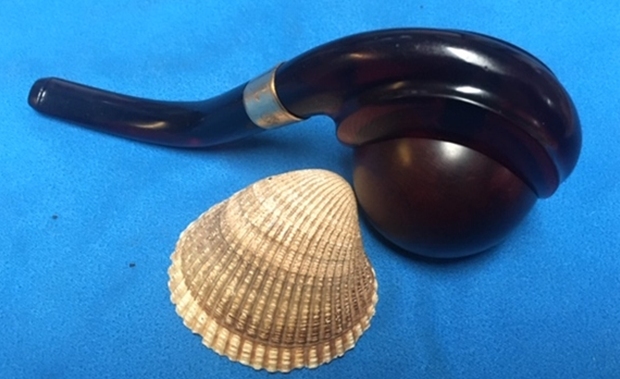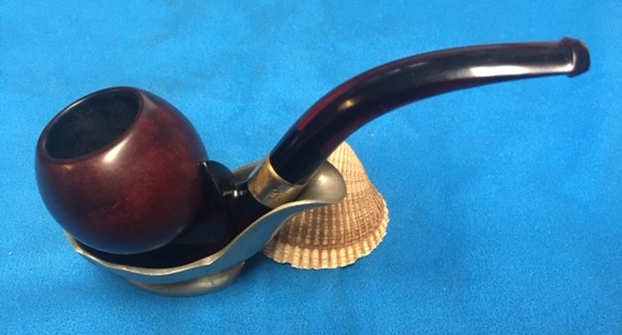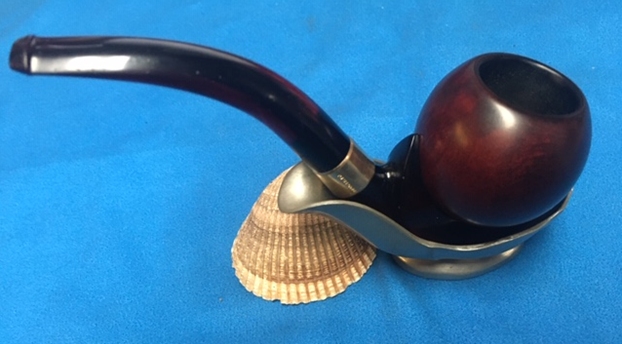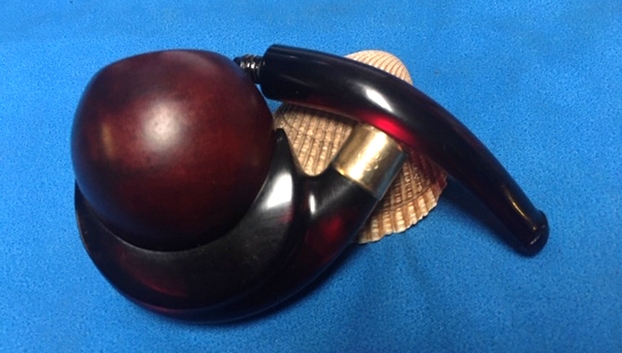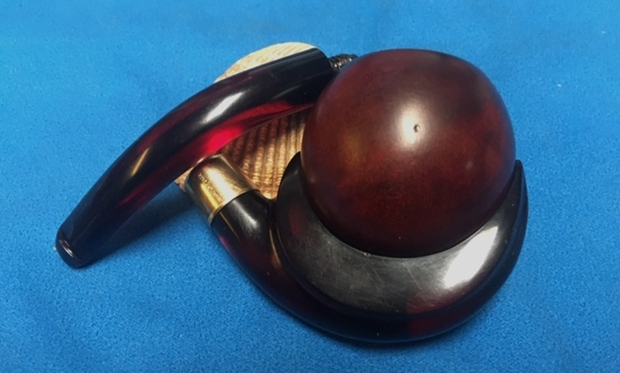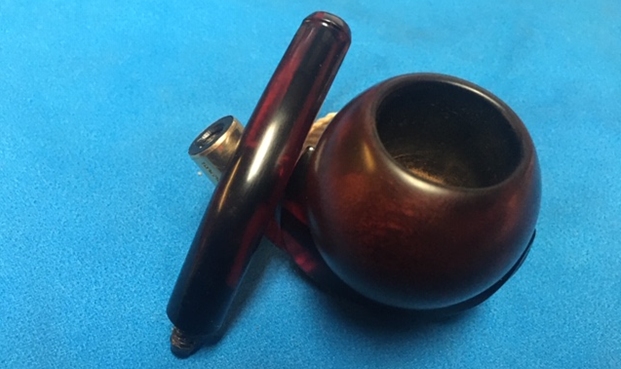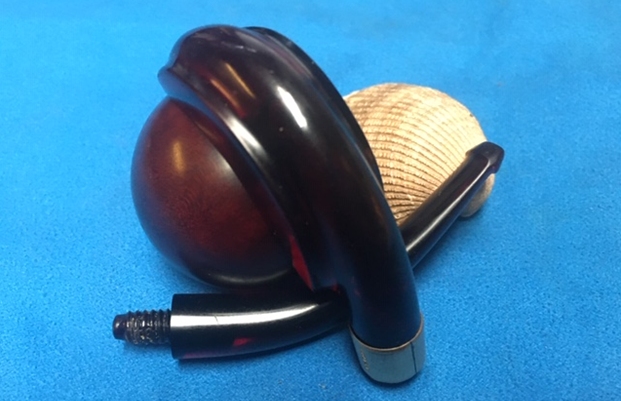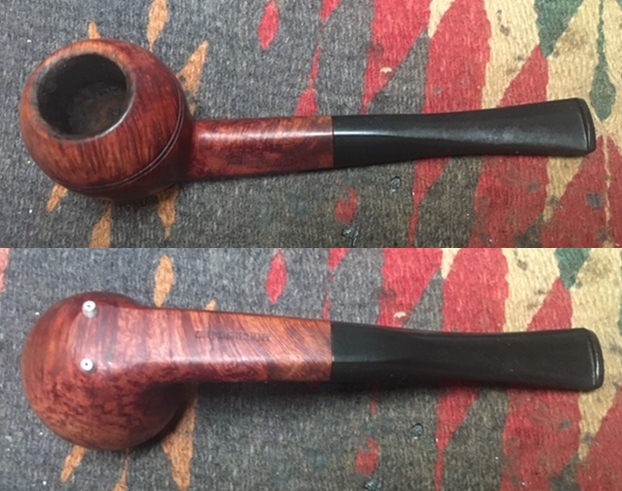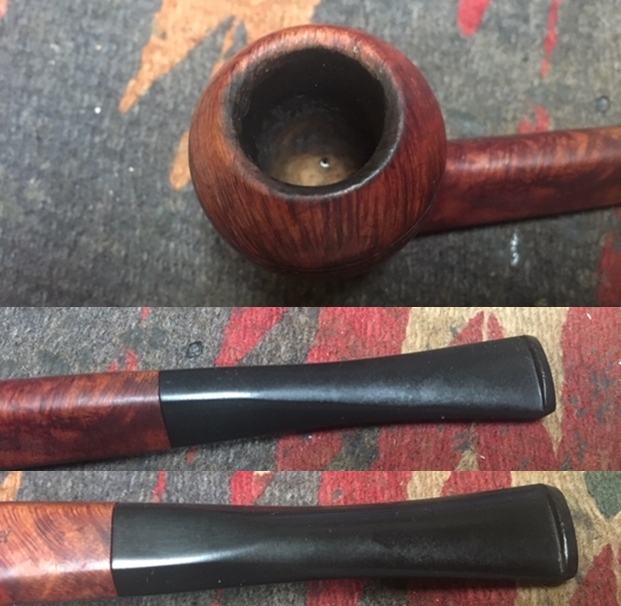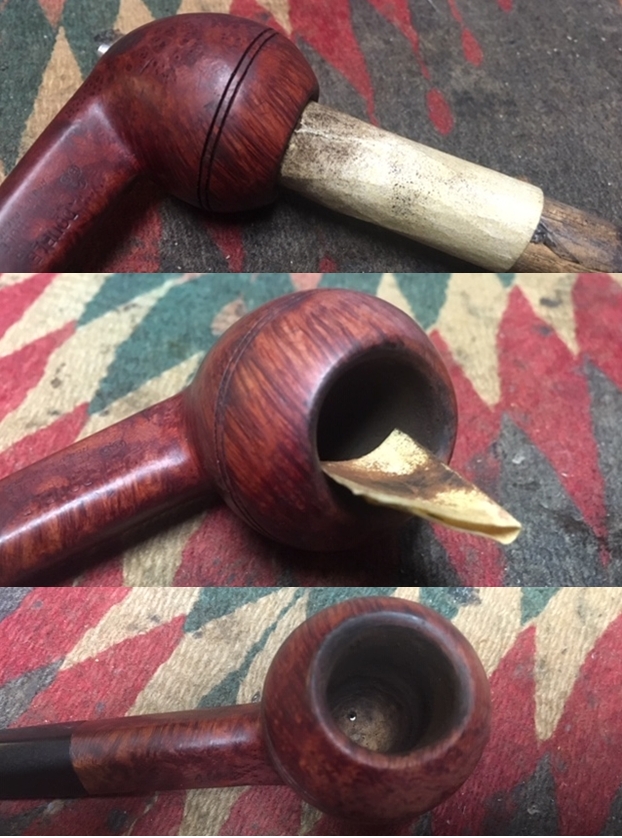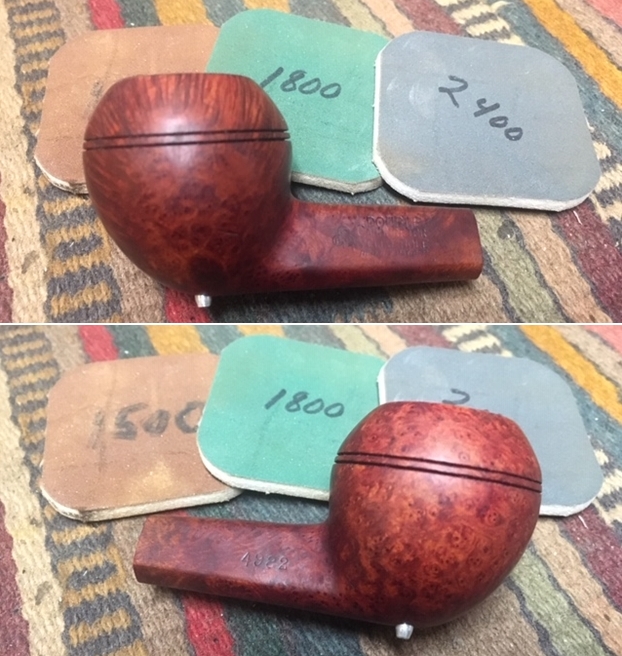
Tag Archives: KB&B pipes

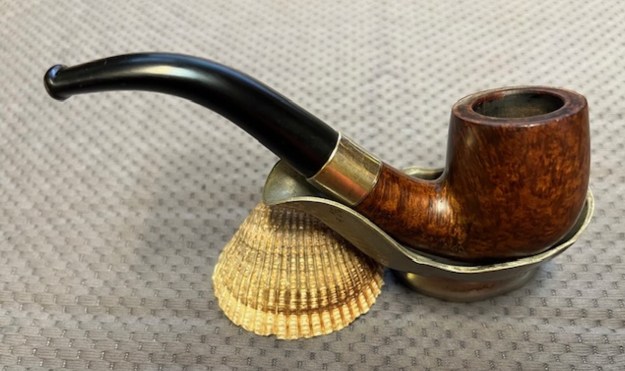
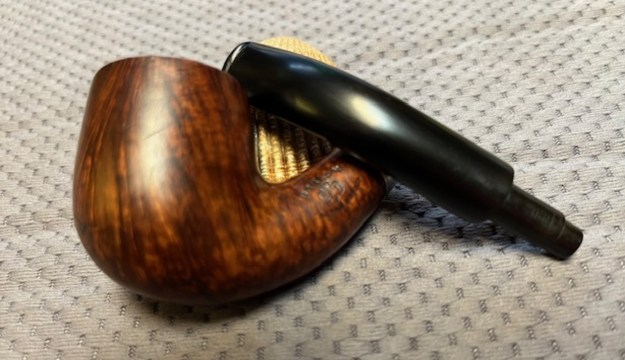
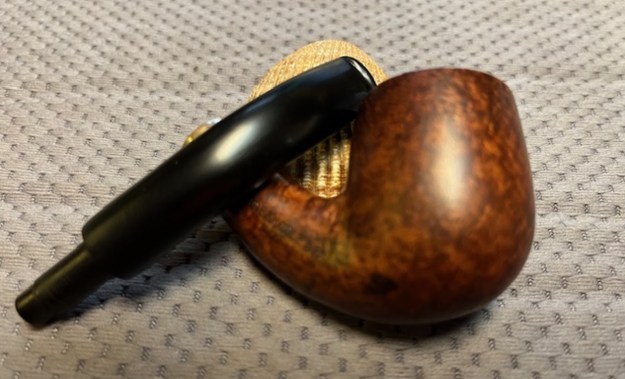
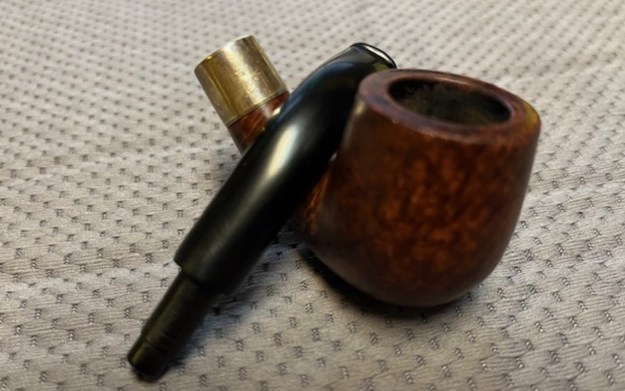
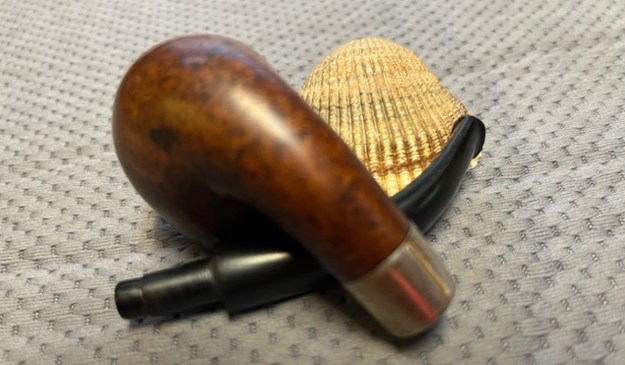
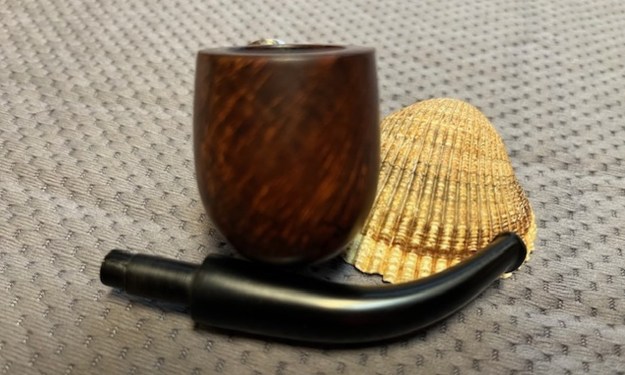
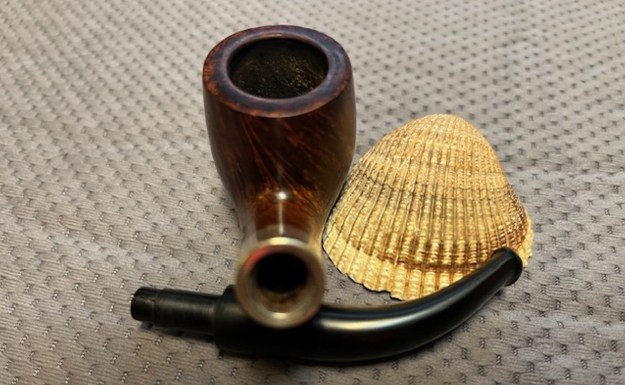
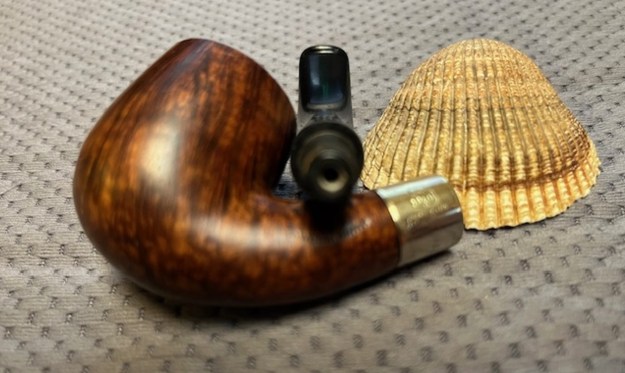
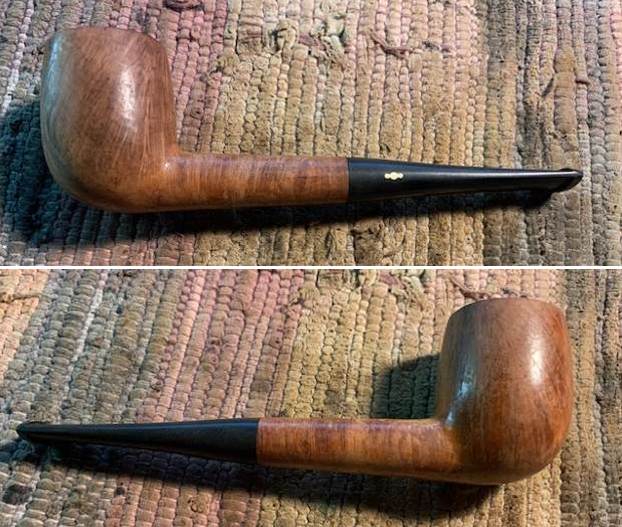
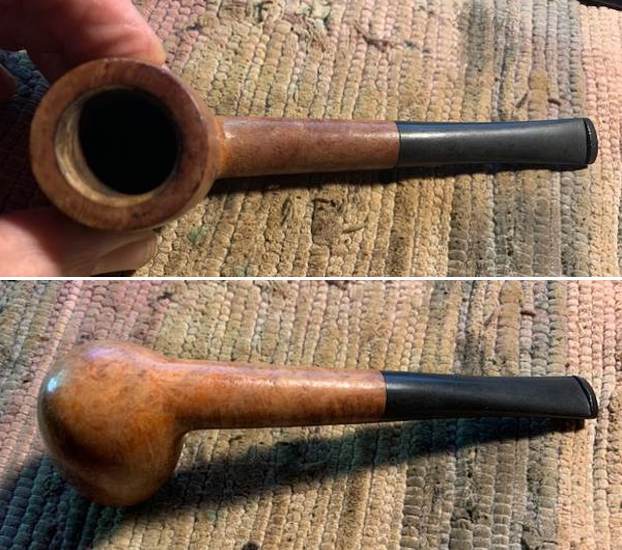
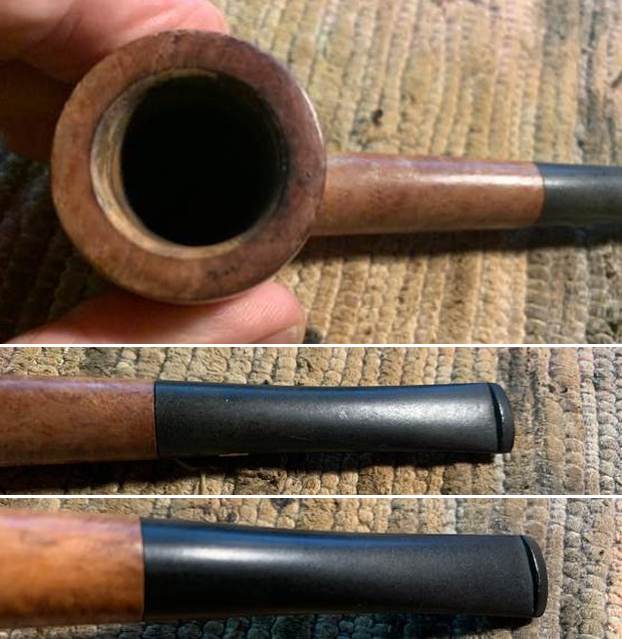
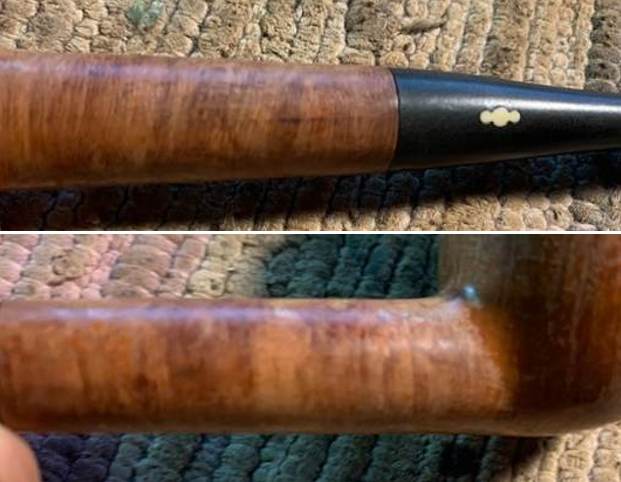
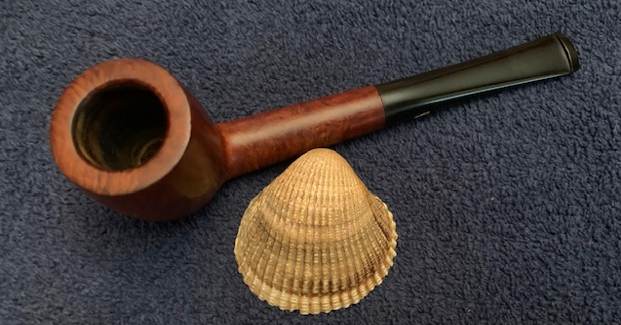
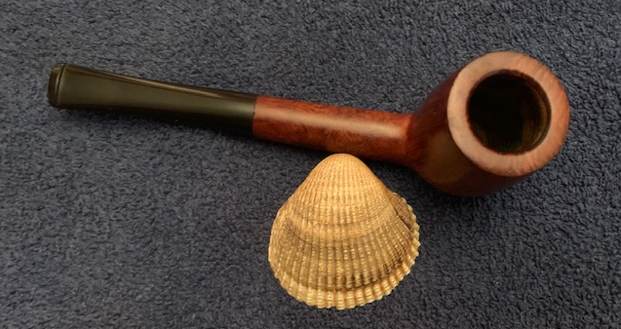
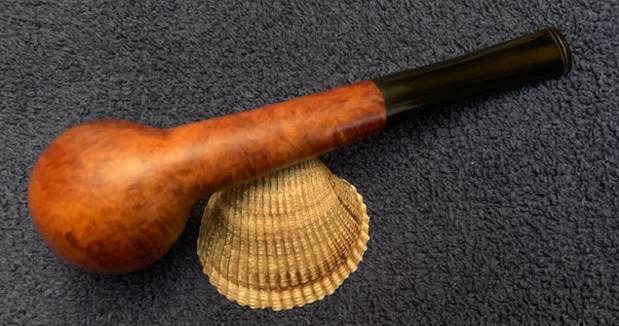
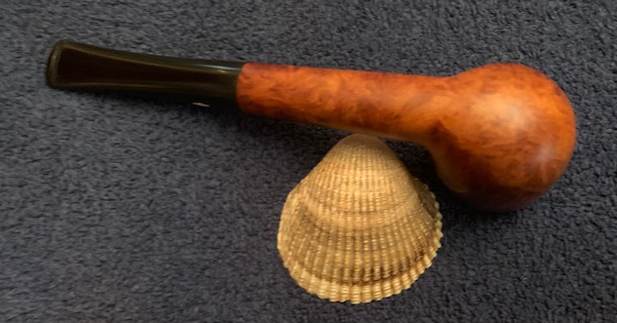
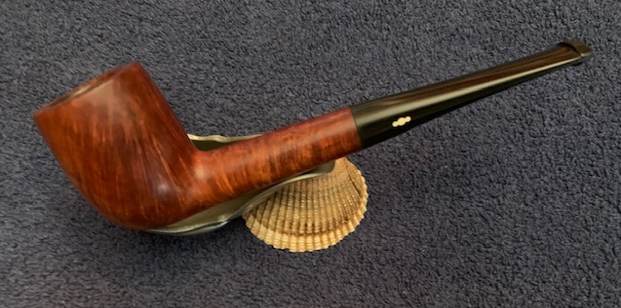
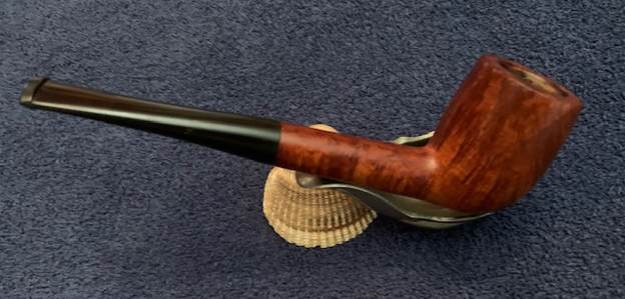
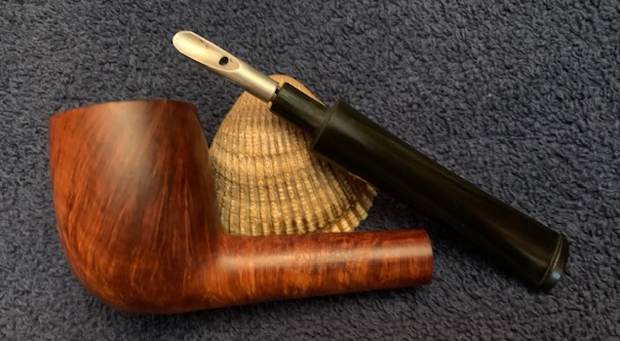
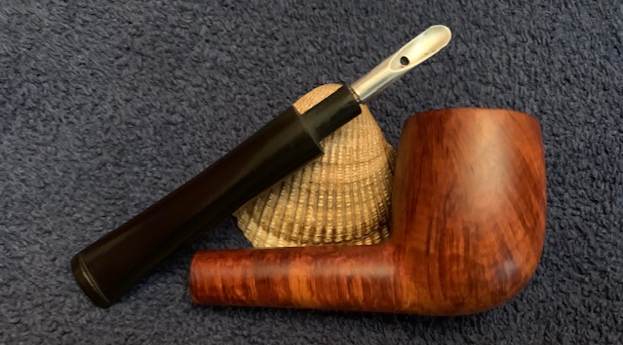
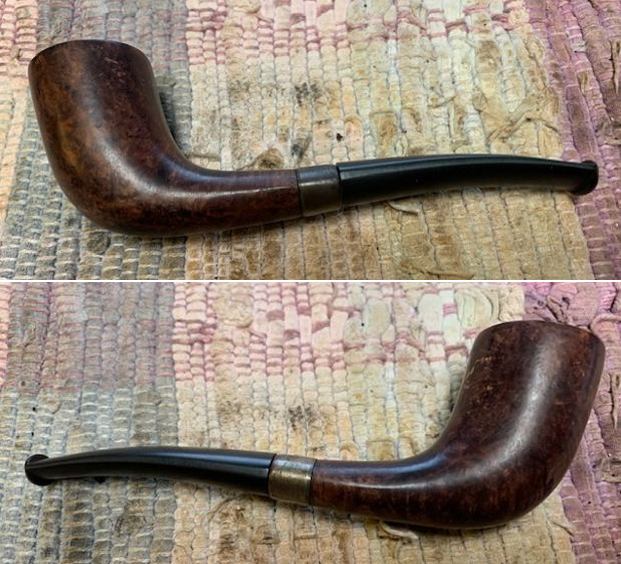
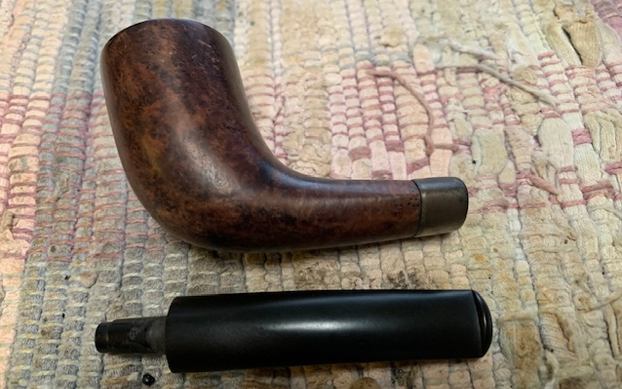
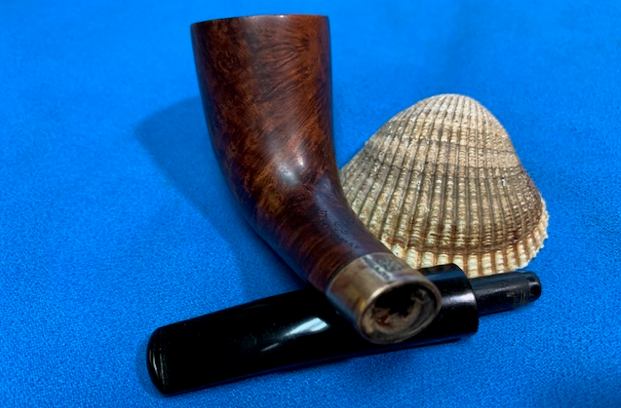
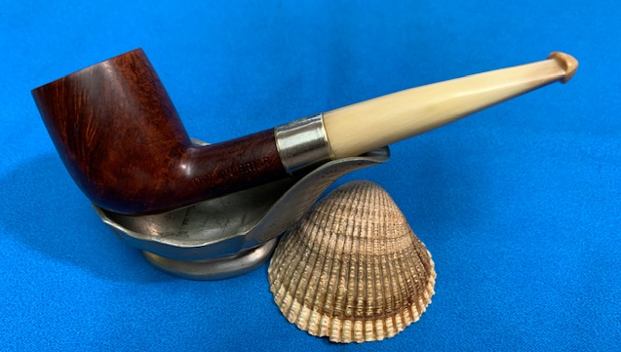
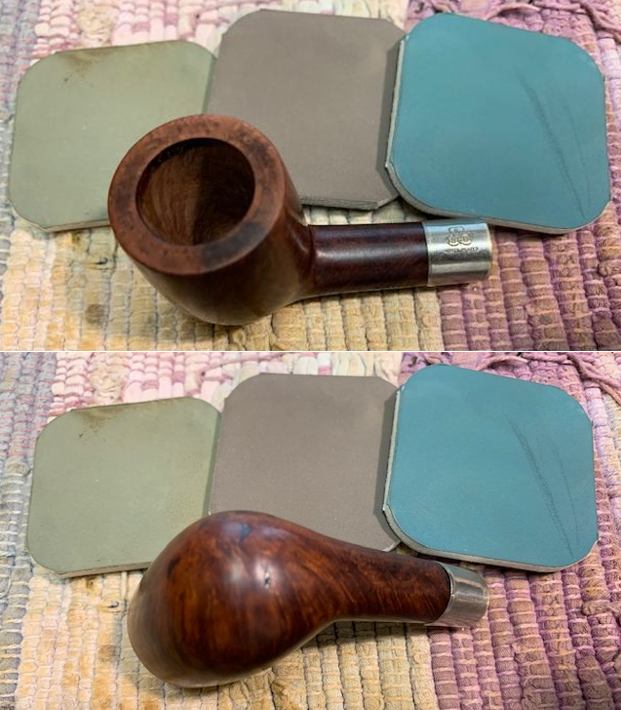
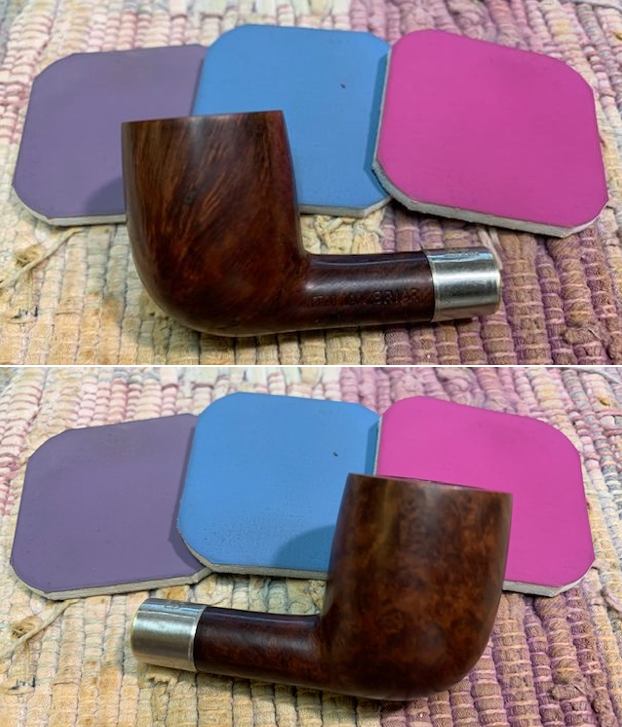
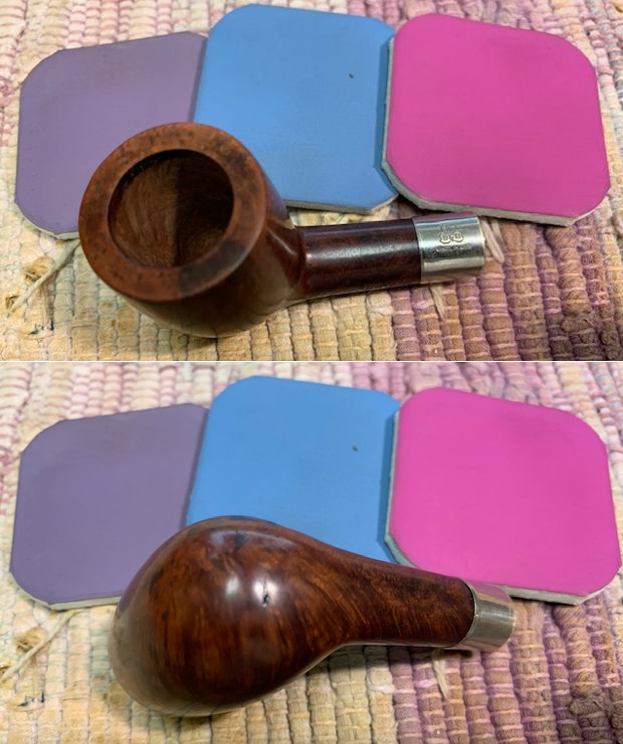
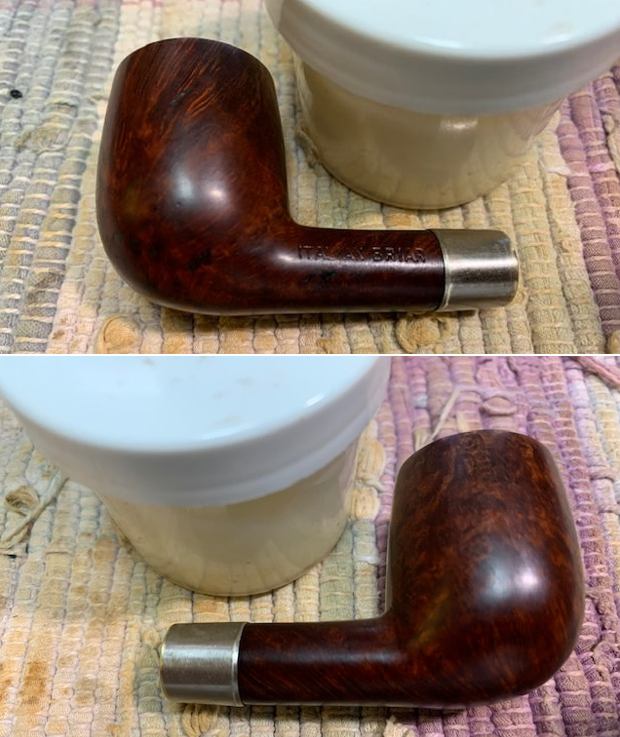
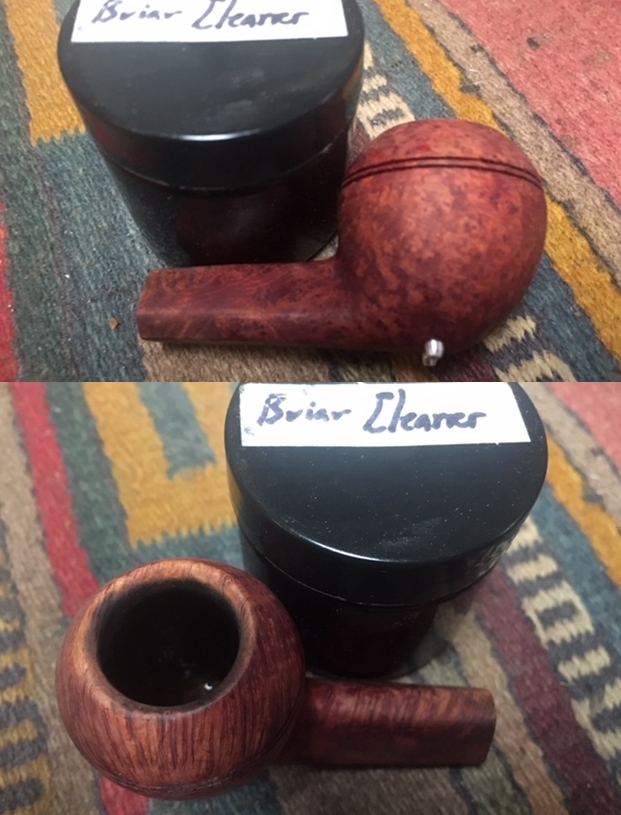
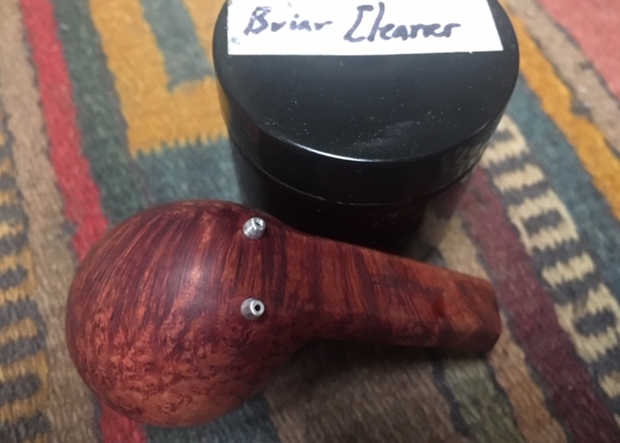
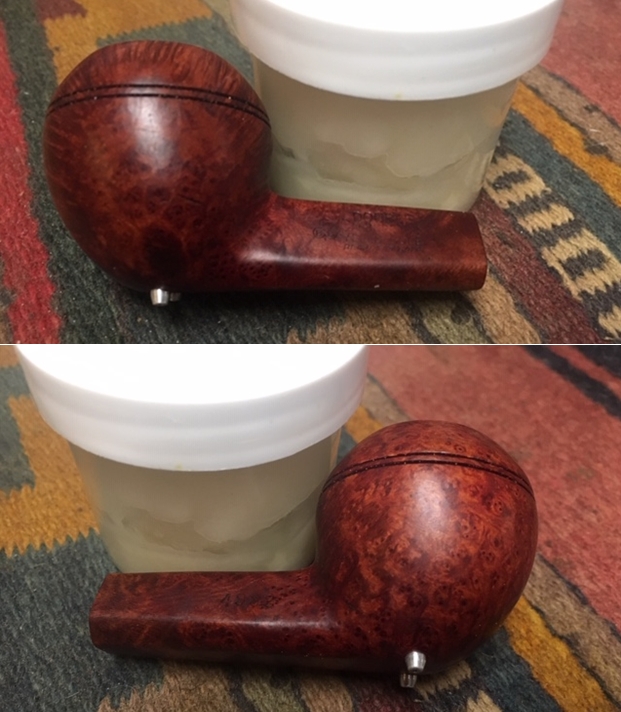
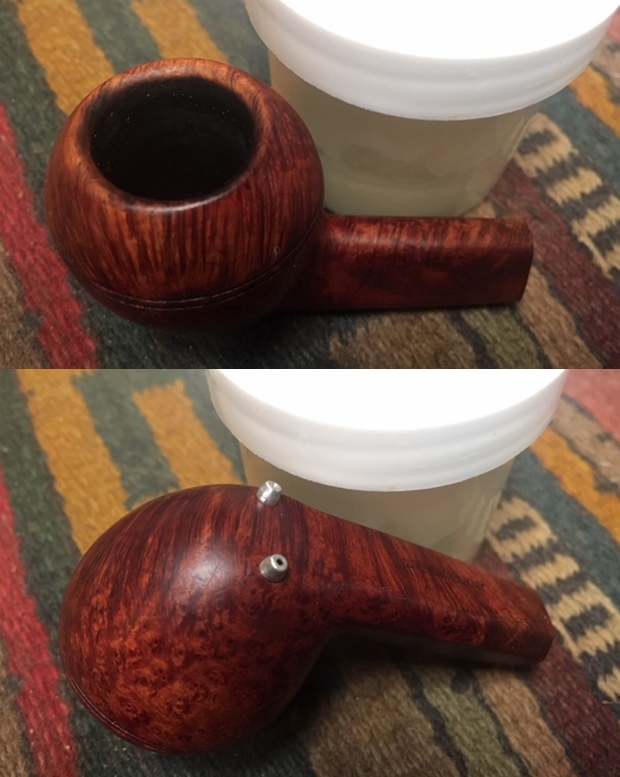
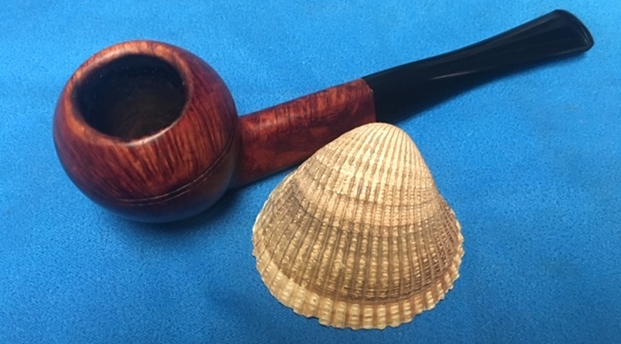
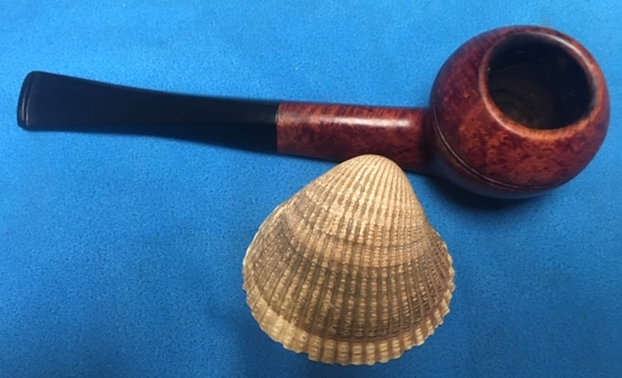
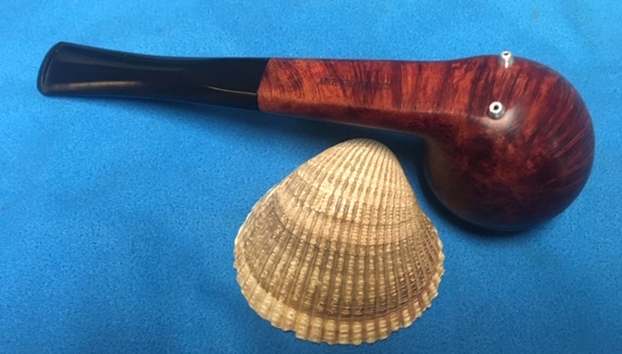
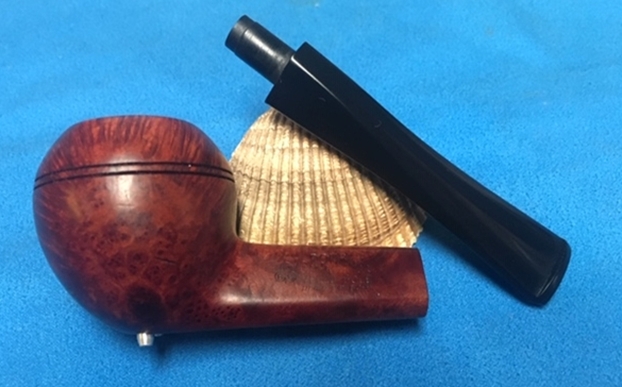
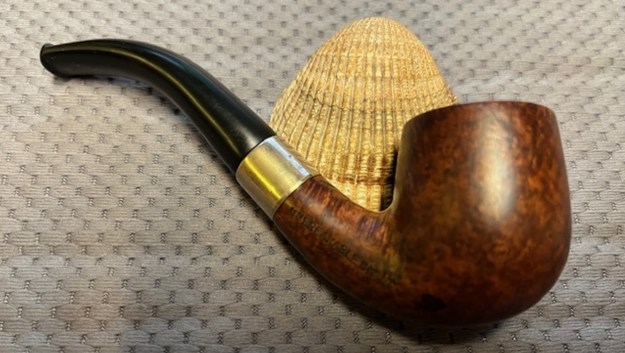
Reworking another trade, a Borlum KB&B Italian Briar Unbreakable Stem Bent Billiard


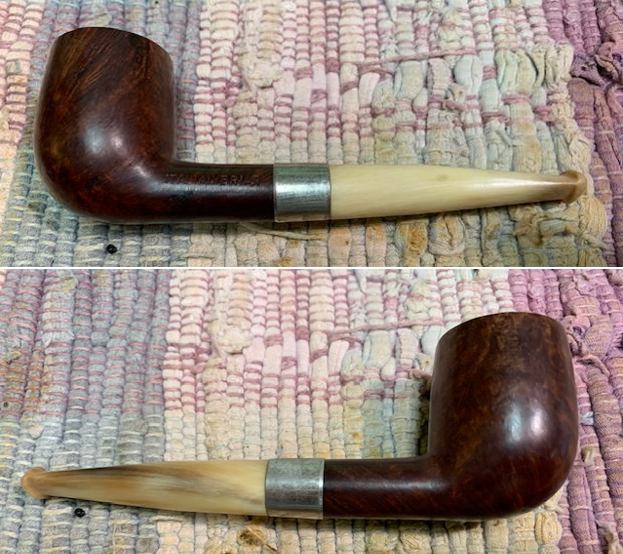
by Steve Laug

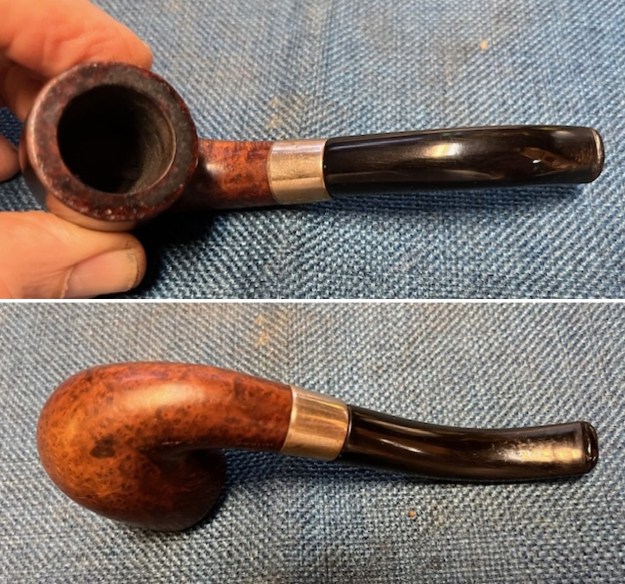
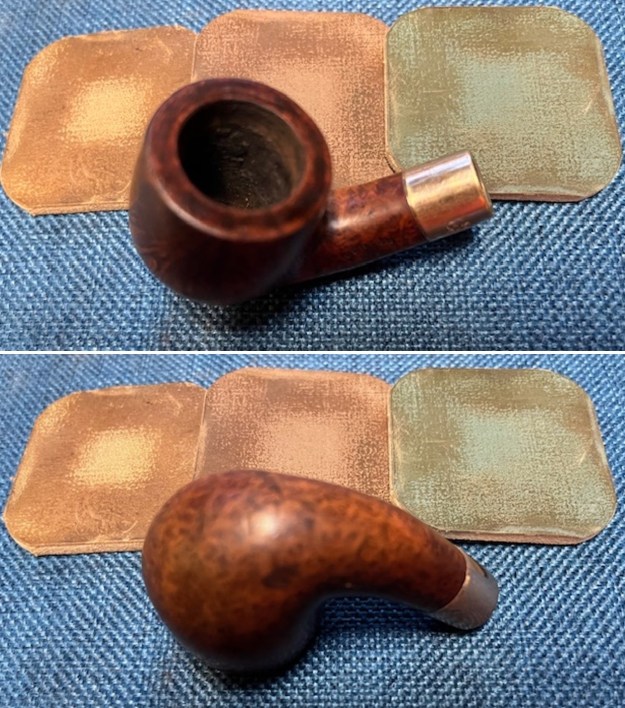
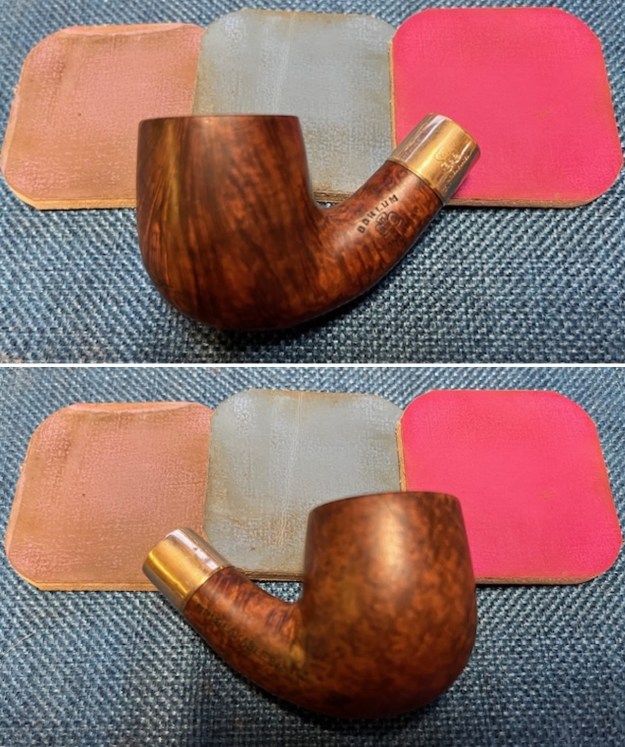
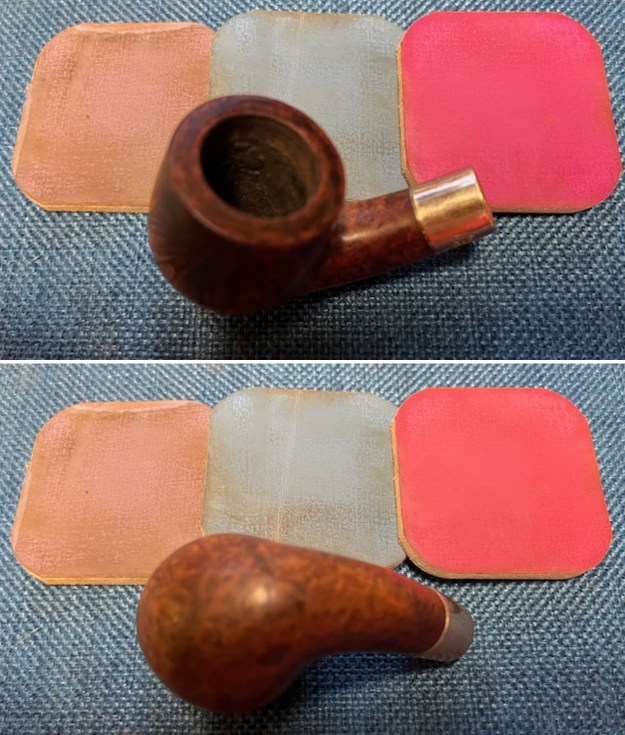
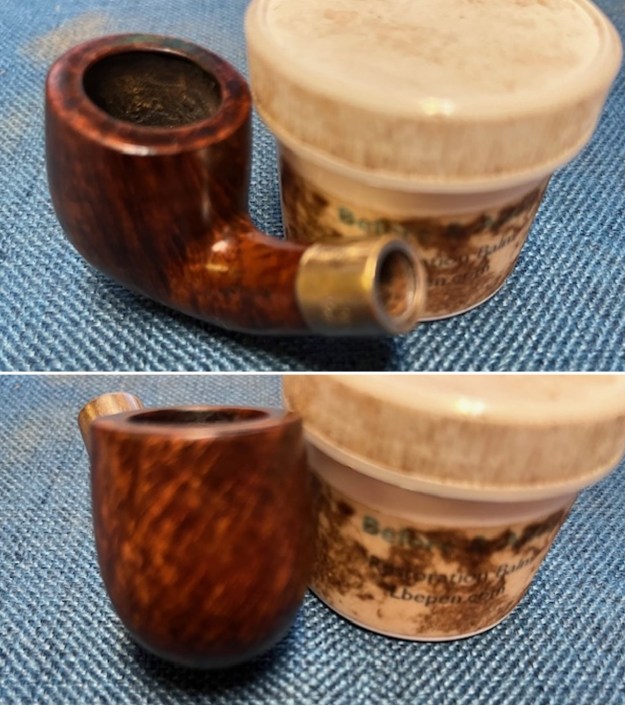
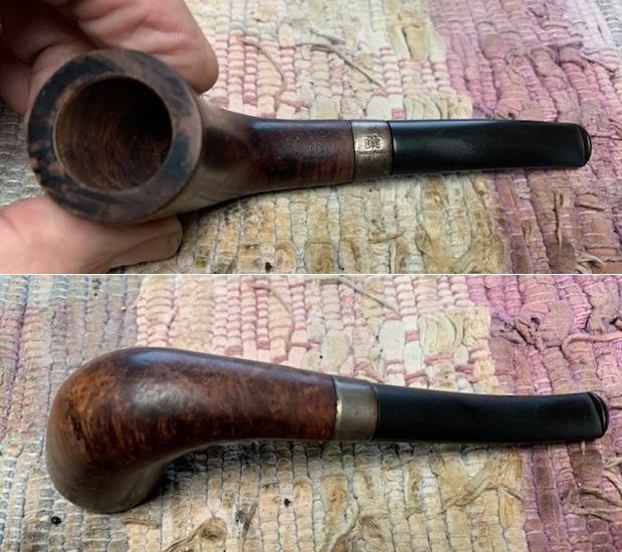
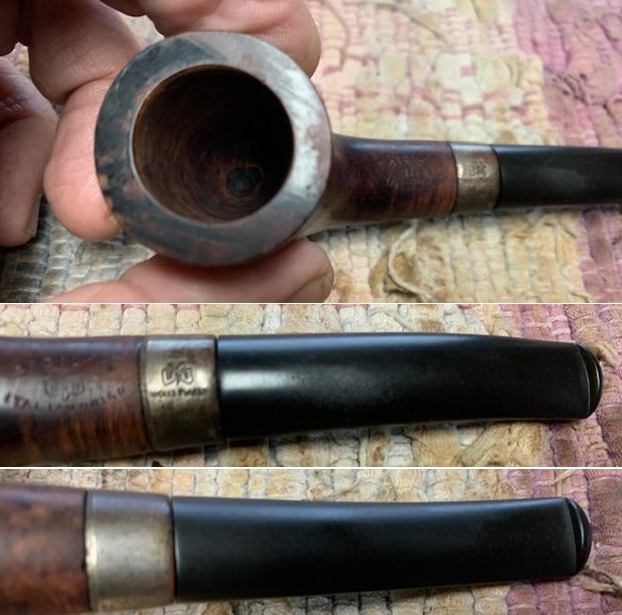
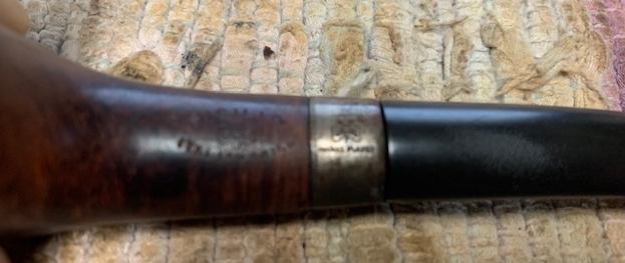
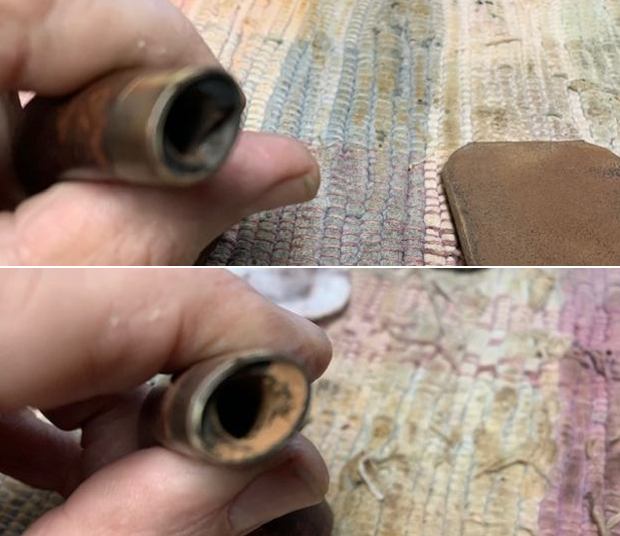
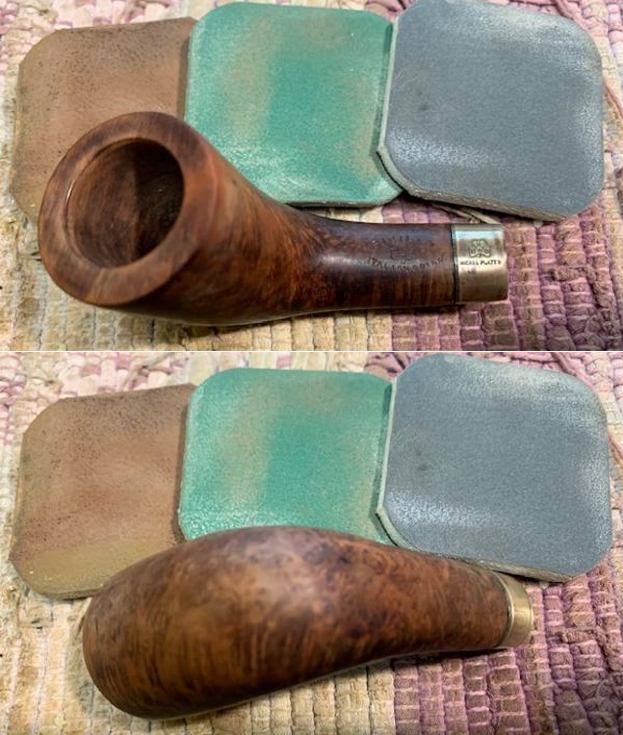
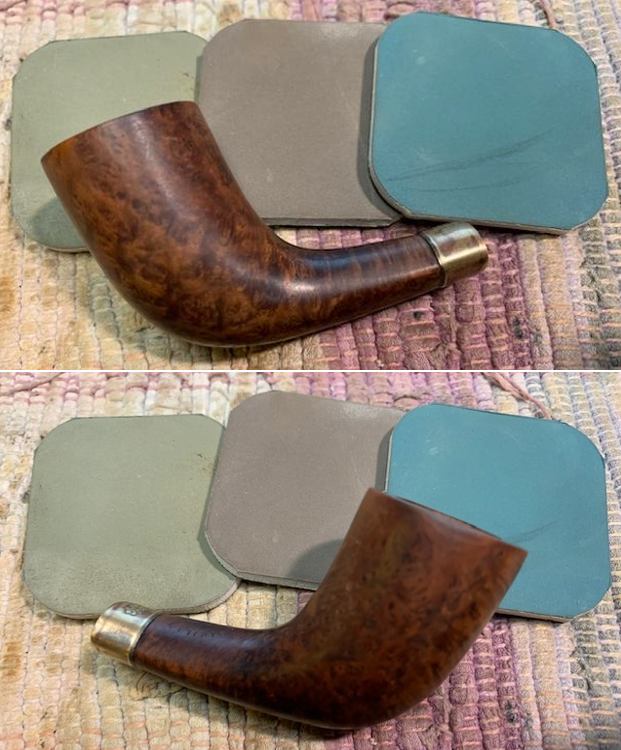
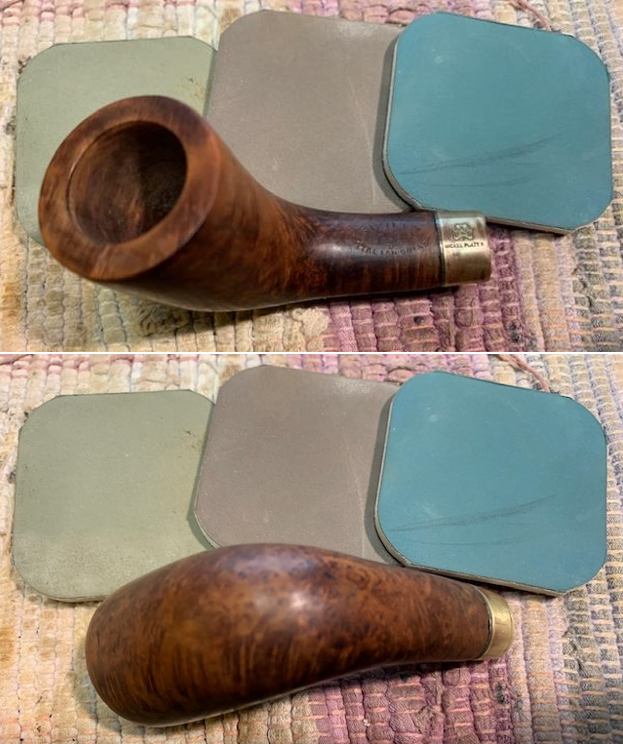
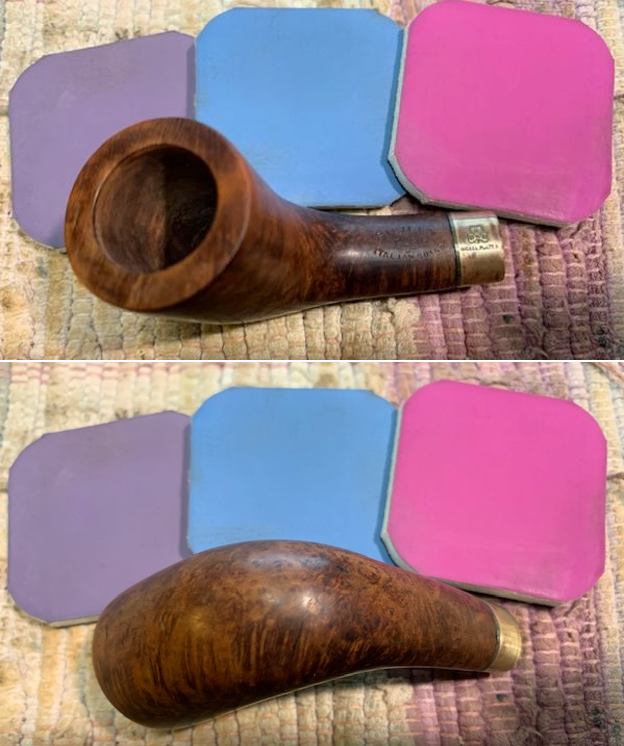
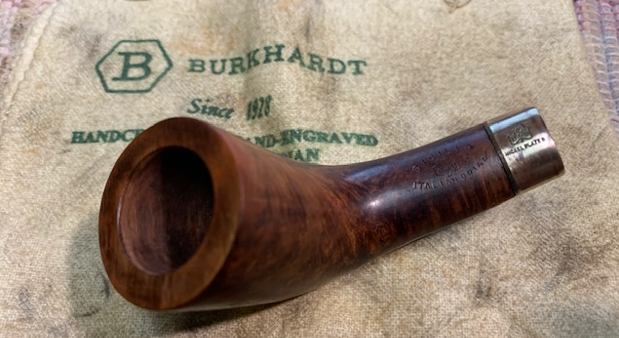
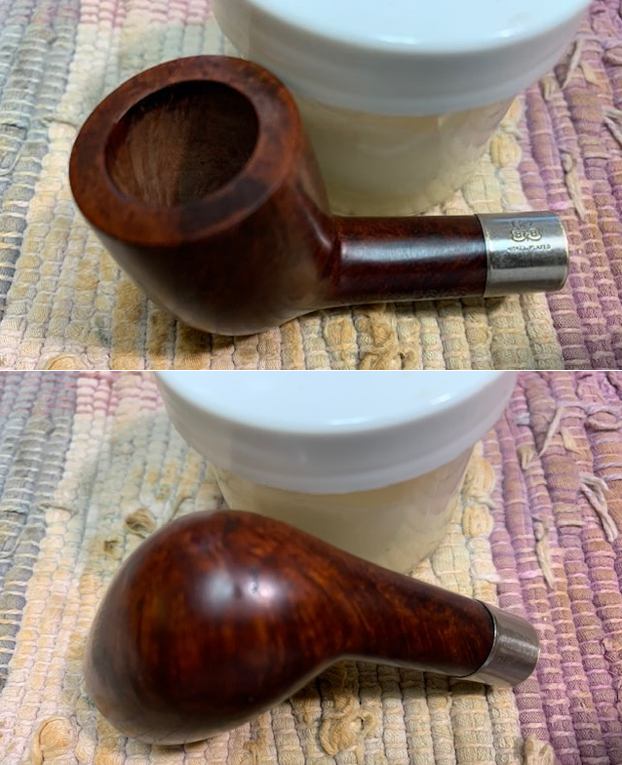
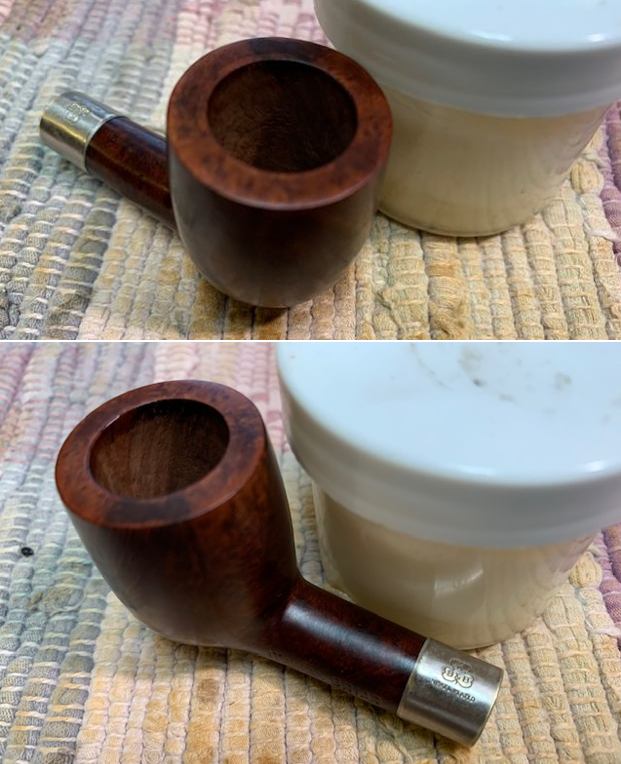
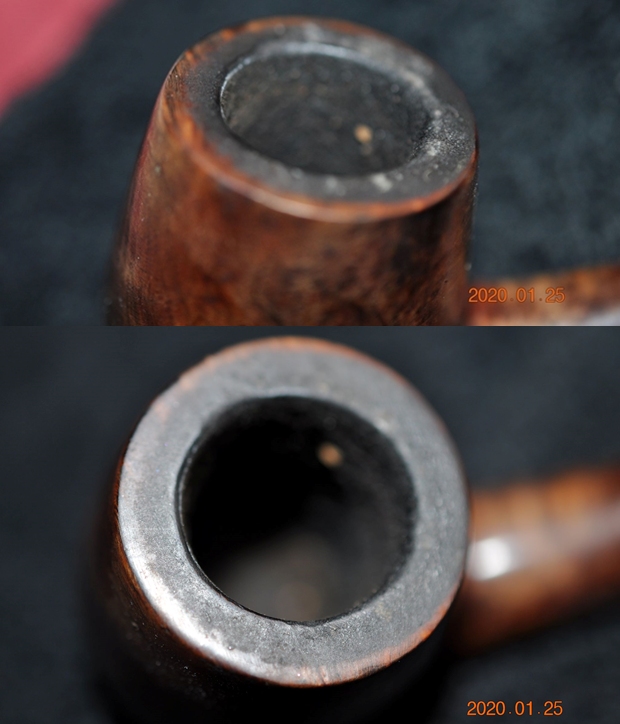
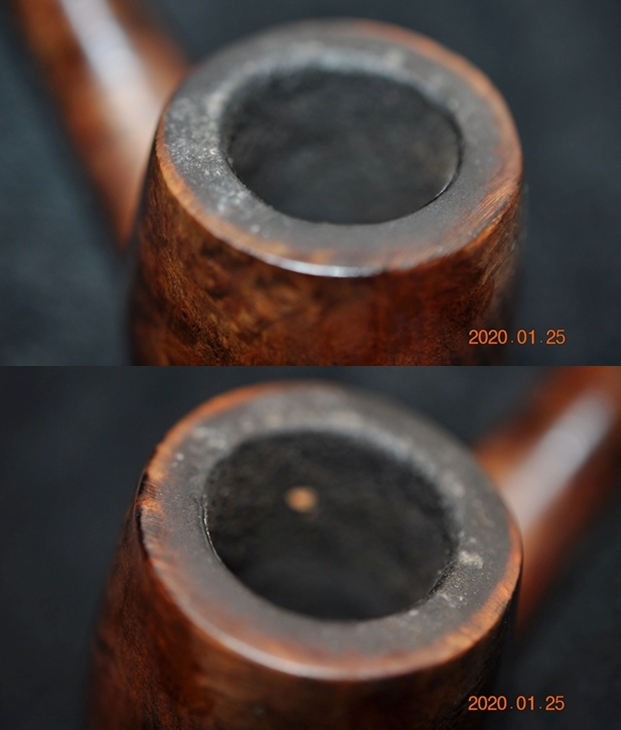
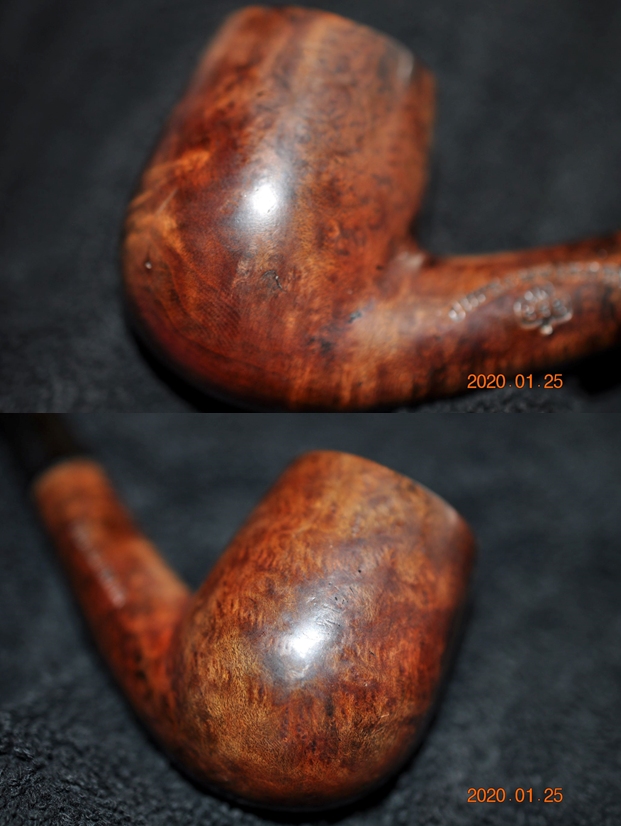
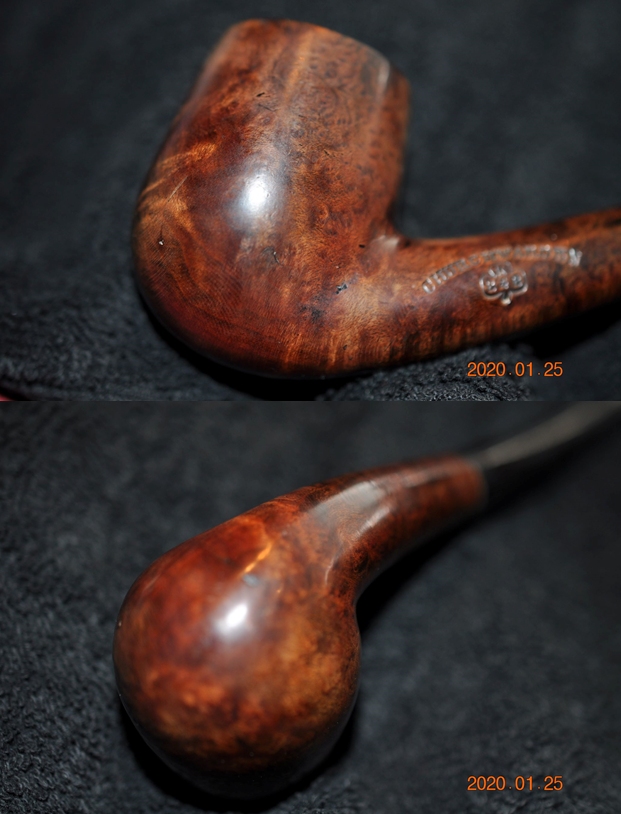
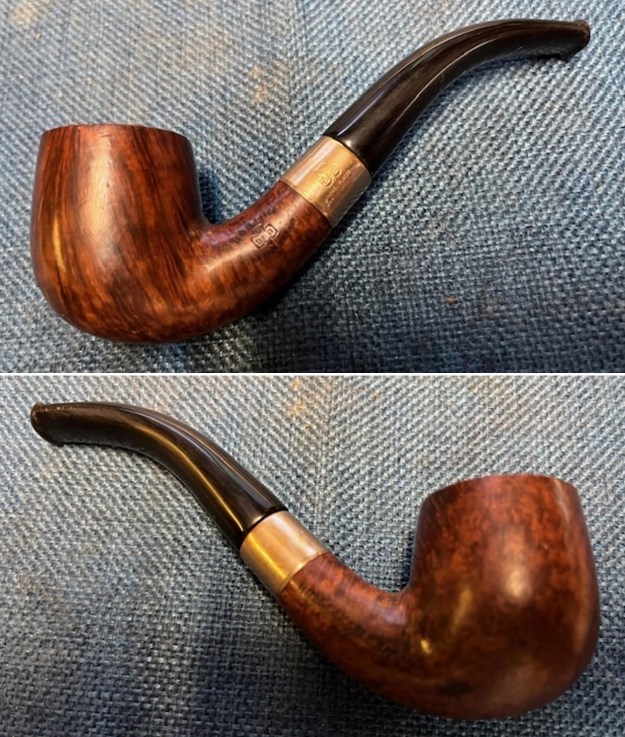
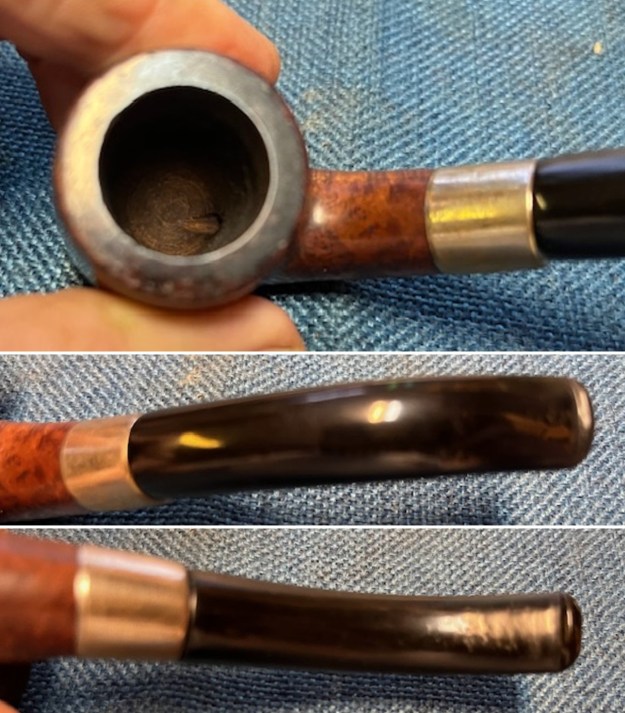
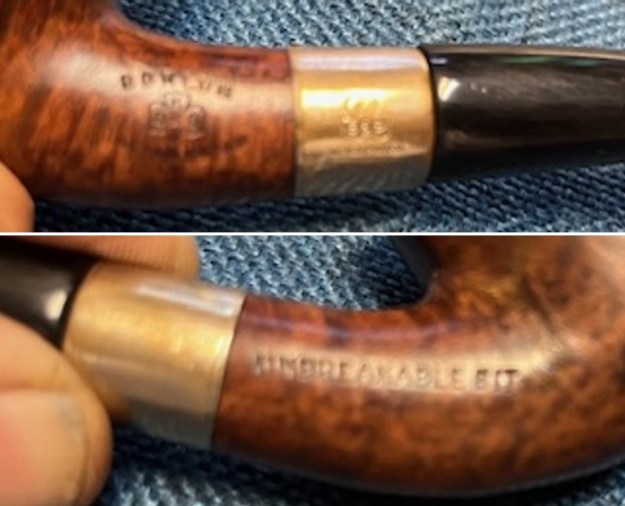
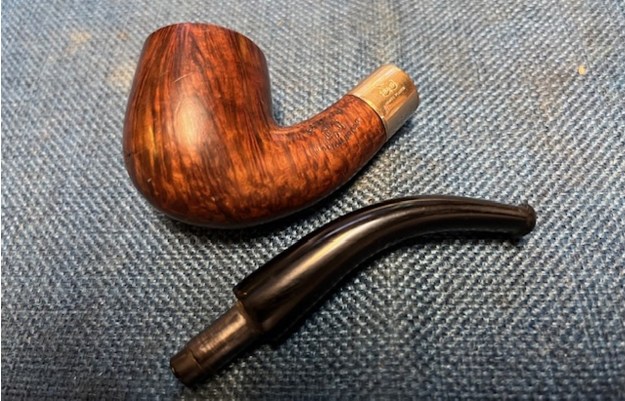
A month or so ago I received an email from a fellow in Japan who had some pipes he wanted to sell. We came to an agreement and he sent me a few. One of them was this interesting smooth finish Bent Billiard. This pipe is stamped on the left side of the shank with the words BORLUM in an arc over KB&B in a cloverleaf. Underneath that it is stamped ITALIAN BRIAR in a reverse arc. On the right side of the shank it is stamped UNBREAKABLE BIT. The stamping was clear and readable. The band on the shank is cosmetic and original and reads KB&B in a cloverleaf [over] Nickel Plated. The bowl had been reamed and the pipe cleaned. The shank is very clean inside and the pipe smelled very clean. It was so clean that I don’t think the pipe had been smoked since the fellow in Japan picked it up. The rim top was clean though there were some scratches and darkening and the inside edge of the rim showed some nicks. There was no damage to the outer edges. The finish around the bowl was in decent condition with great grain under some of the grime and scratching. The stem looked good, though it was not centred on the shank. The diameter of the stem extended beyond the band on the right side and a little above the top and underside. I would need to reduce the stem diameter to fit the shank band. There were some light tooth marks and chatter on the top and underside ahead of the button. Overall, I am happy with it but I will need to rework the stem fit to the shank and clean up the rim top and edges. I took photos of the pipe before I started my work on it.  I took a photo of the rim top to show the condition of the bowl and the top. You can see clean bowl and marks on the rim top. The inner edge is slightly out of round. The stem looks good with light tooth damage and no oxidation on the surface of the hard rubber. It will look much better once I trim down the top, underside and the right side of the stem.I took photos to show the stamping on the sides of the shank and the nickel band. It is clear and readable as noted above. You can also see the fit of the stem to the shank on the top and the right side. I took the stem off and took a photo of the pipe to show its condition.
From an earlier Borlum pipe that I had refurbished back in 2014, I had learned a lot about the background of the manufacturer of the brand. I quote from that blog to summarize the historical background of the pipe (https://rebornpipes.com/tag/kbb-borlum-pipes/). The italicized portions of the text come from the blog with minor edits.

I already knew that Kaufmann Brothers and Bondy was the oldest pipe company in the USA, established in 1851. The Club Logo predated Kaywoodie with the “KB&B” lettering stamped within the Club, and a multitude of KB&B lines were in production long before “Kaywoodie” first appeared in 1919. Therefore, I knew that the pipe I had was a pre-1919, pre-Kaywoodie KB&B Made BORLUM.

As noted above, this particular pipe is stamped on the left side of the shank with the words BORLUM in an arc over KB&B in a cloverleaf. Underneath that it is stamped ITALIAN BRIAR in a reverse arc. On the right side of the shank it is stamped UNBREAKABLE BIT. As stated above it was made before Kaywoodie became the flagship name for pipes from Kaufman Brothers & Bondy (KB&B). It was made before the Kaywoodie invention of the “Stinger” was added, and even before shank logos, model stamps and other features invented by Kaywoodie came to be standards of the pipe making industry. It comes from a time when names like Ambassador, Heatherby, Melrose, Suez, Rivoli, Cadillac and Kamello dominated the pre-Kaywoodie scene. Borlum is one of those names.

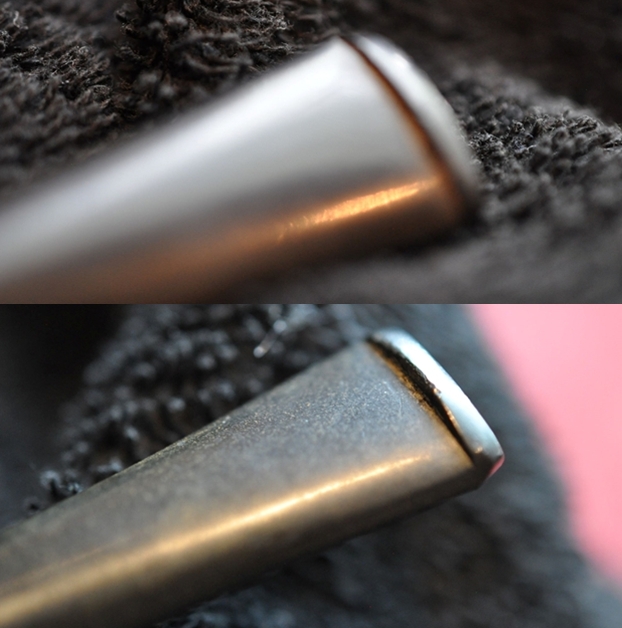
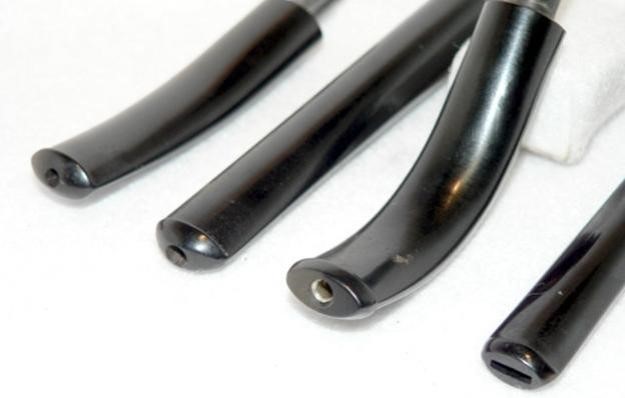
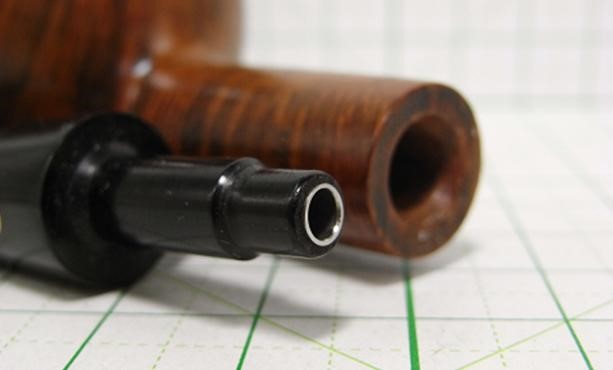
I learned while researching for that blog and rediscovered while working on this one that the Borlum pipe featured some innovations that were new for the time but commonplace to us. These included (1) a solid rubber bit (vulcanite, ebonite), (2) an aluminum inner-tube construction in the stem that stabilized and strengthened the stem explaining the stamping of “Unbreakable Bit” on the right side of the shank, (3) a standard nickel-plated band (marked KB&B) to strengthen the shank connection for the stem. The stem features the older style more rounded bit tip/orific button, and you can see the aluminum inner-tube fitting just inside the tip.

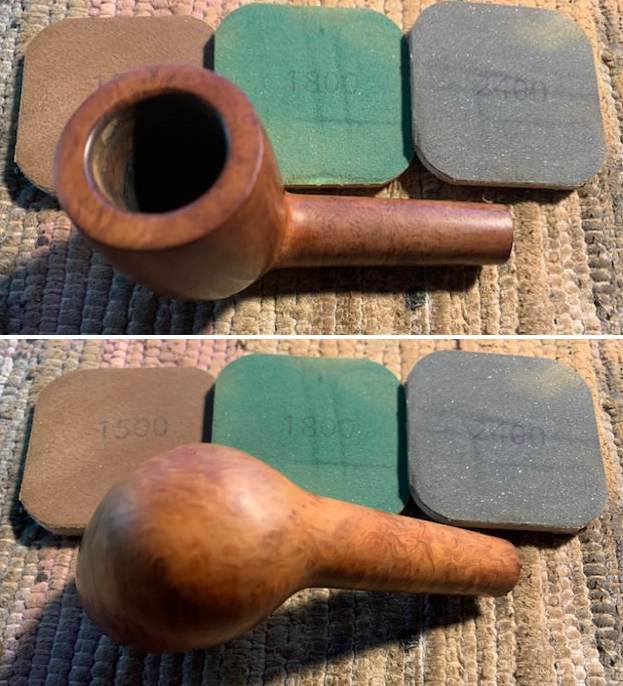
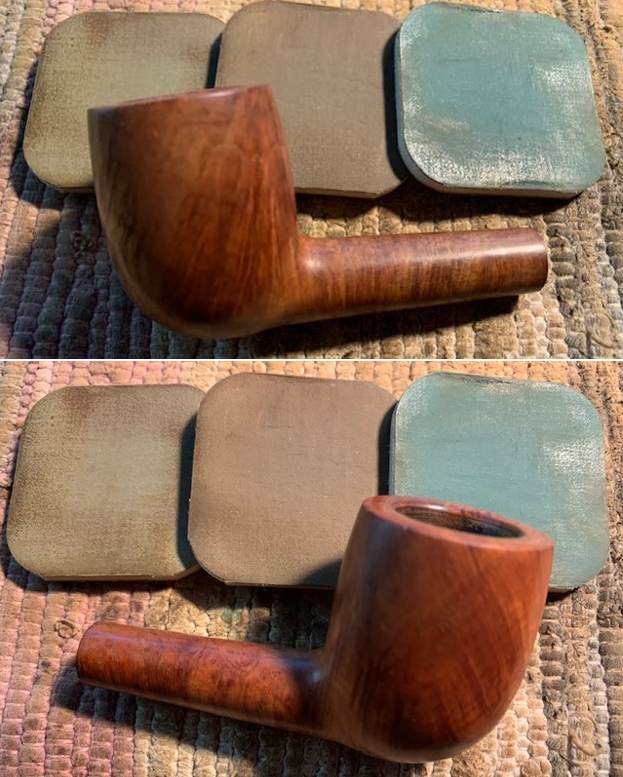
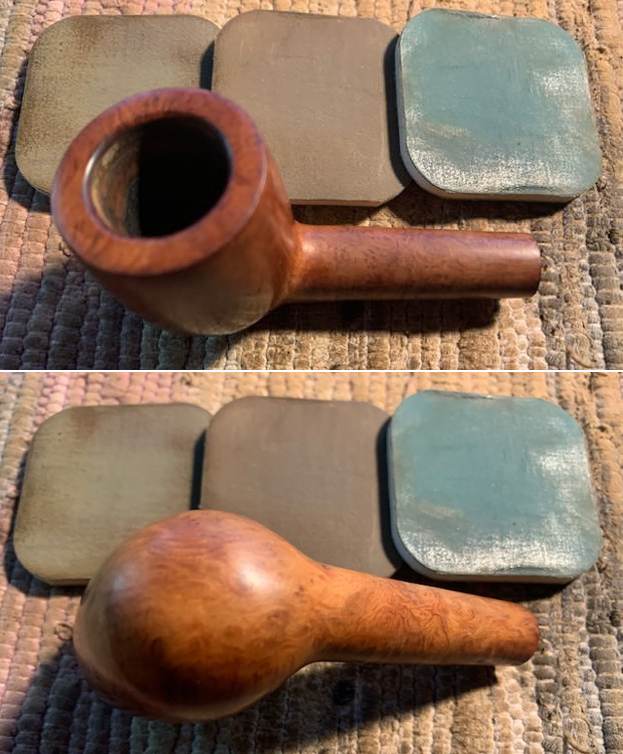
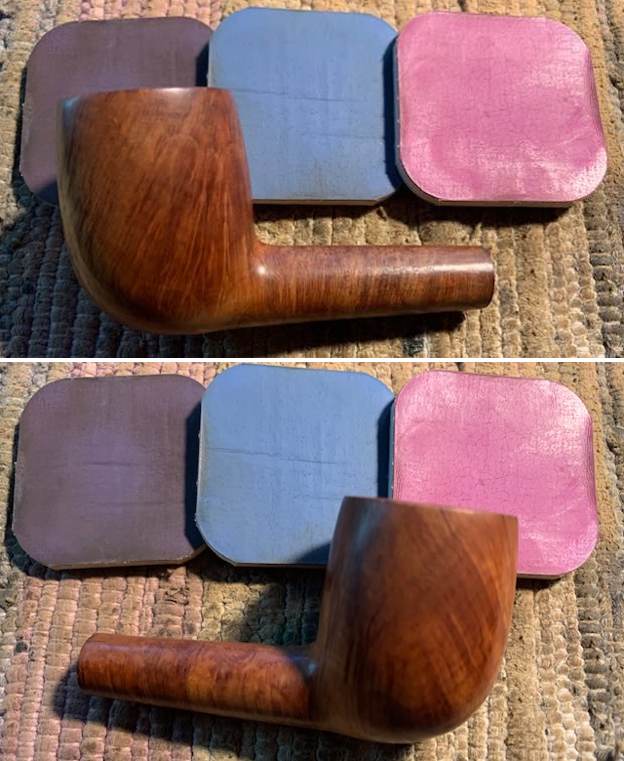
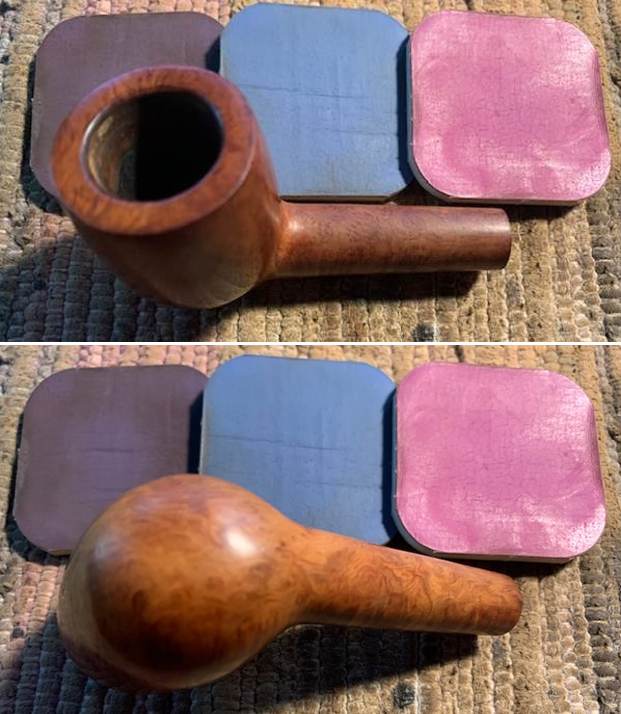
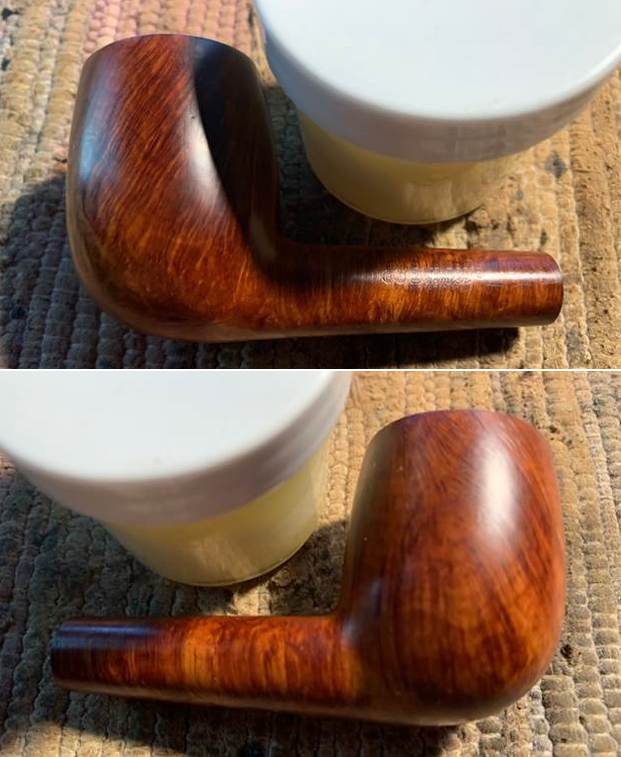
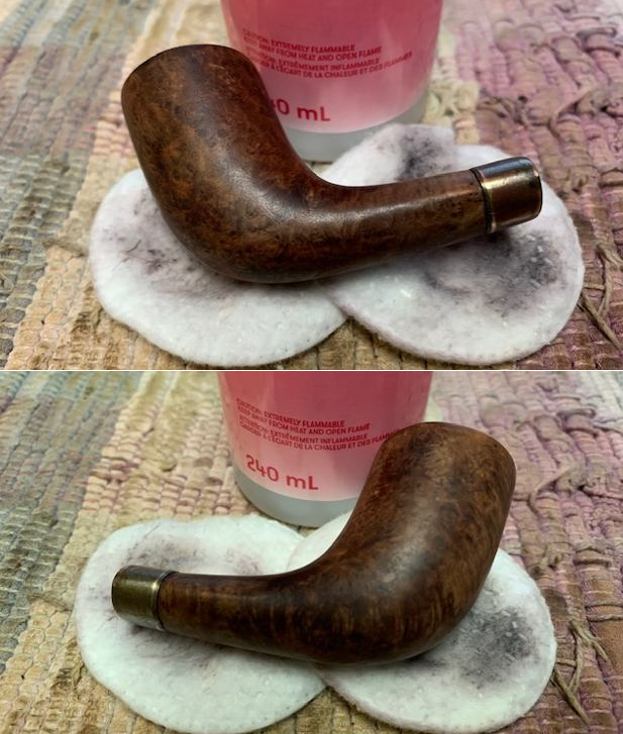
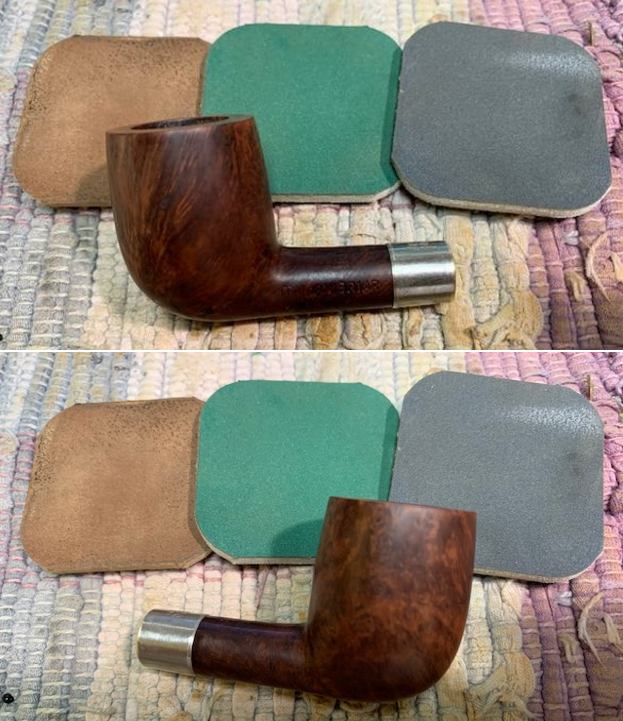
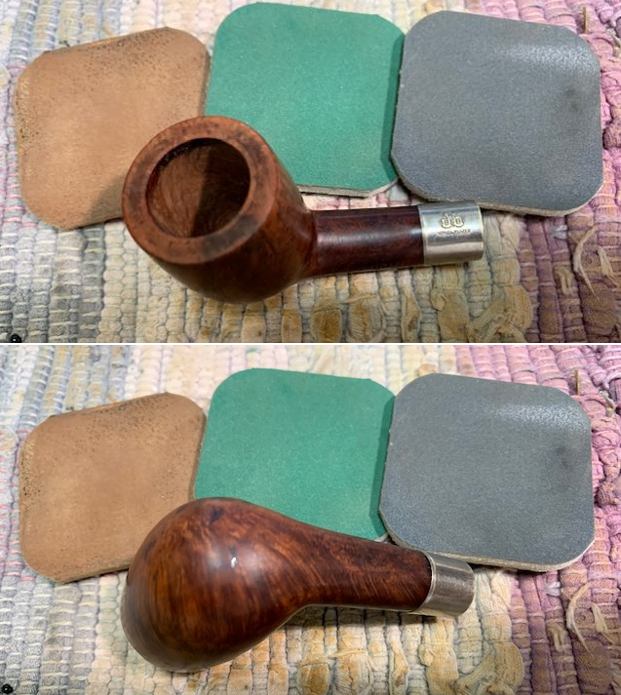
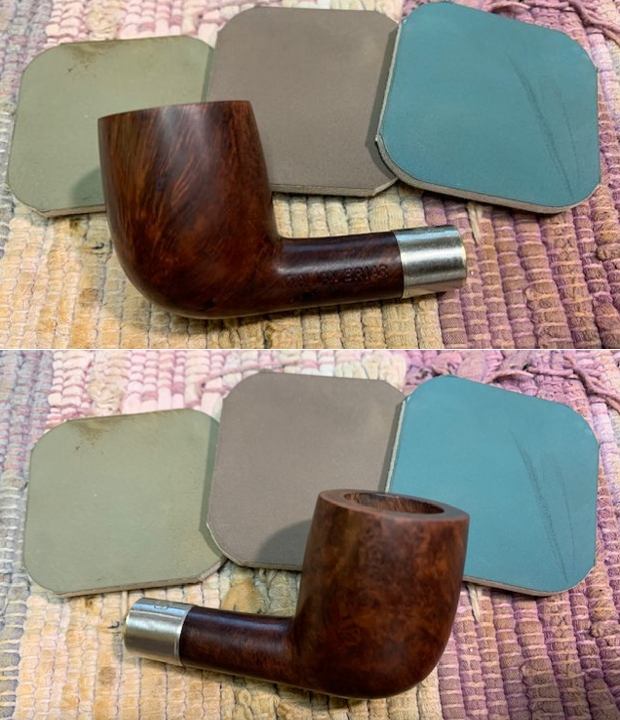
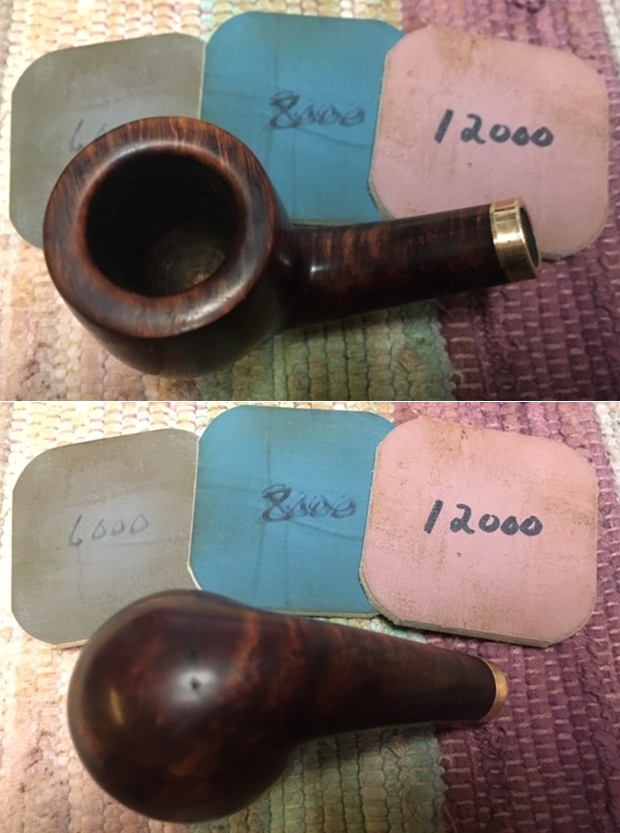
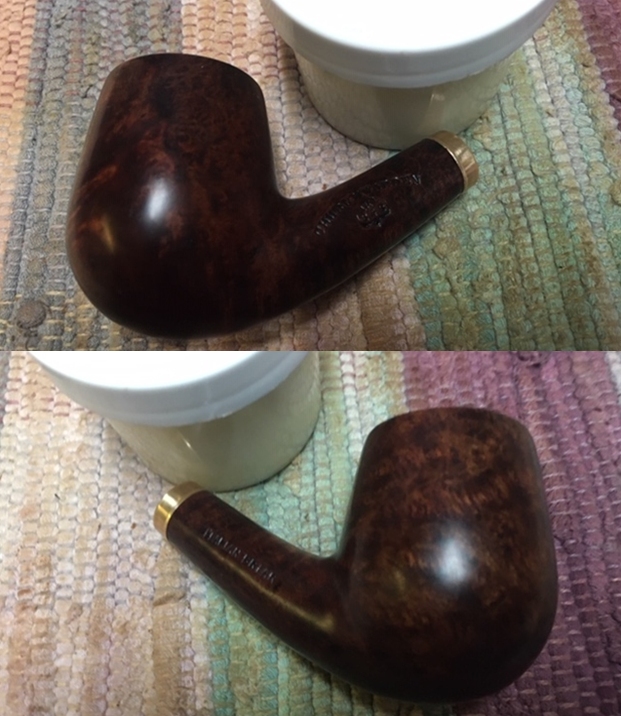
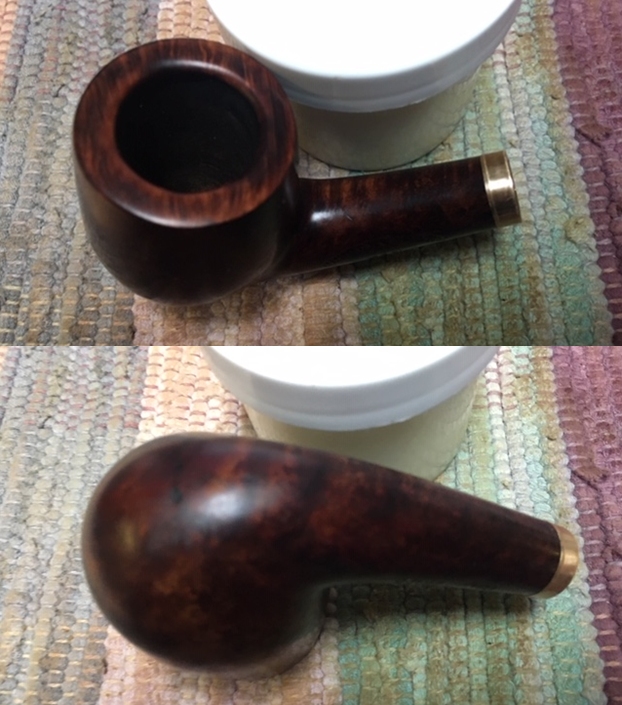
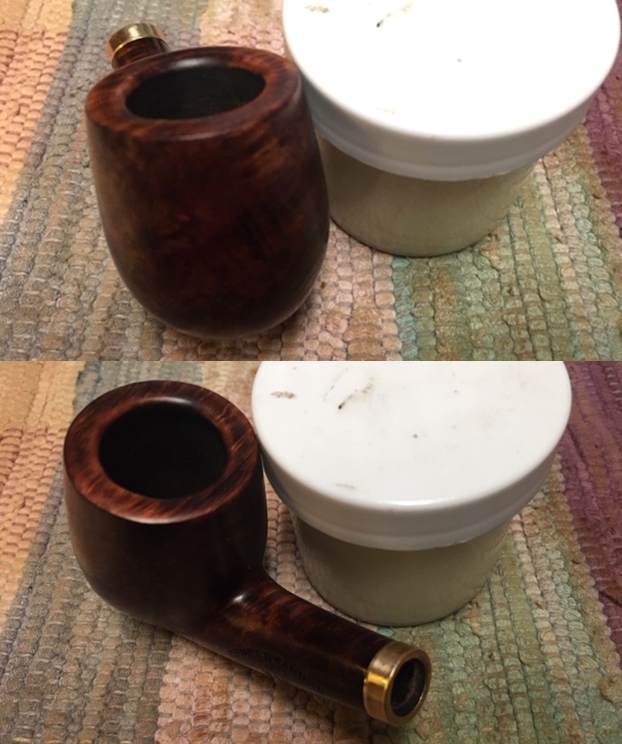
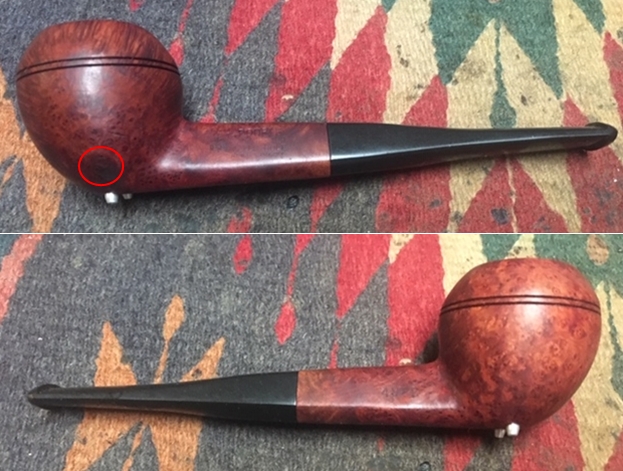
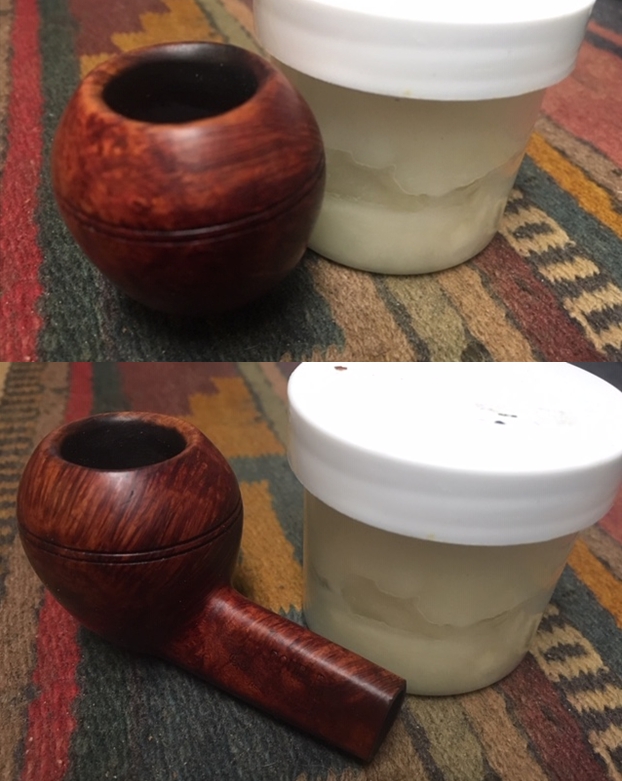
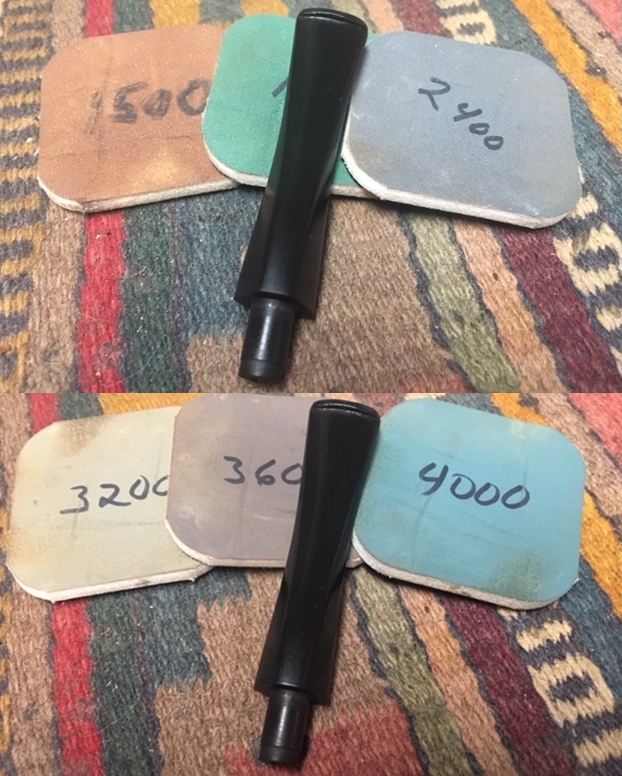
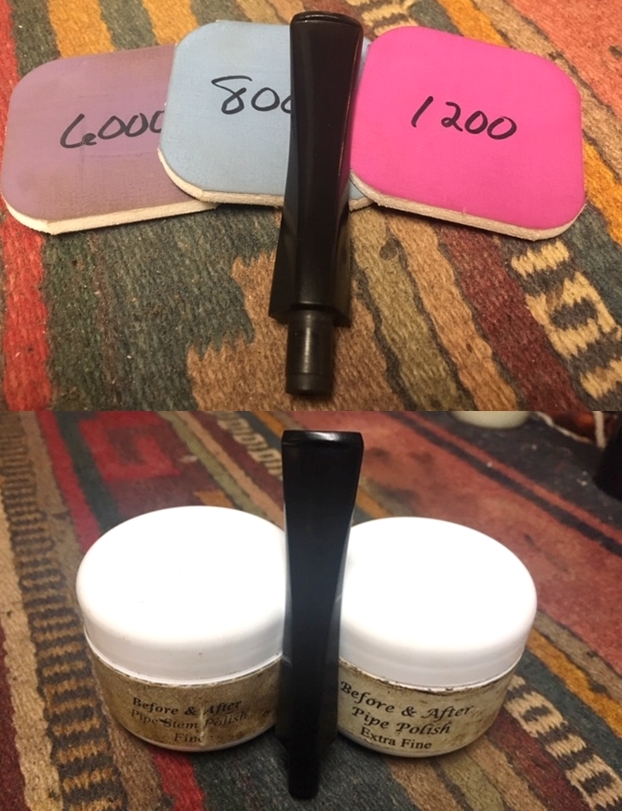
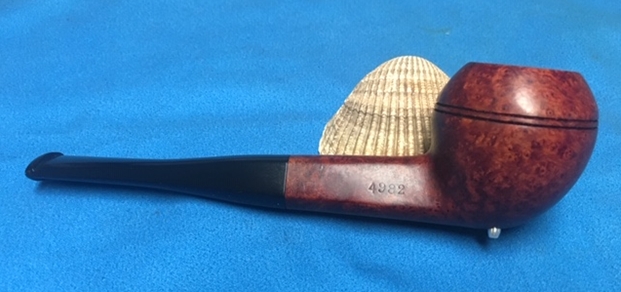
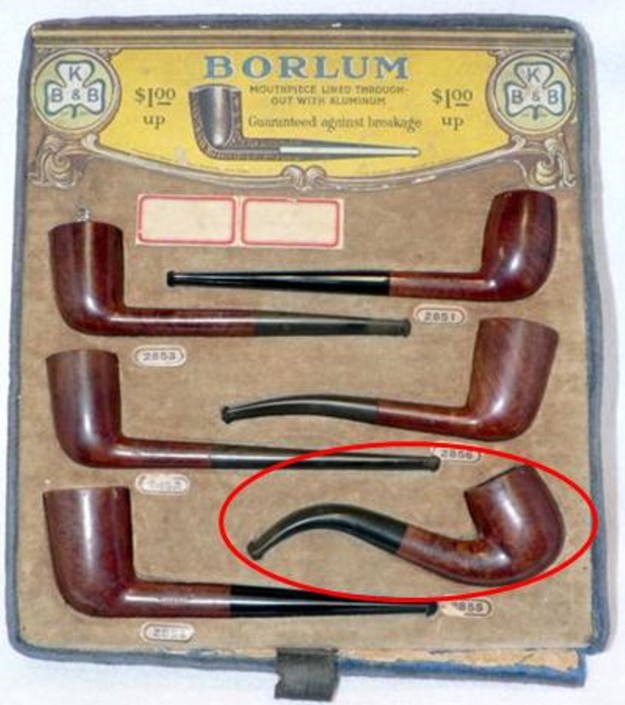
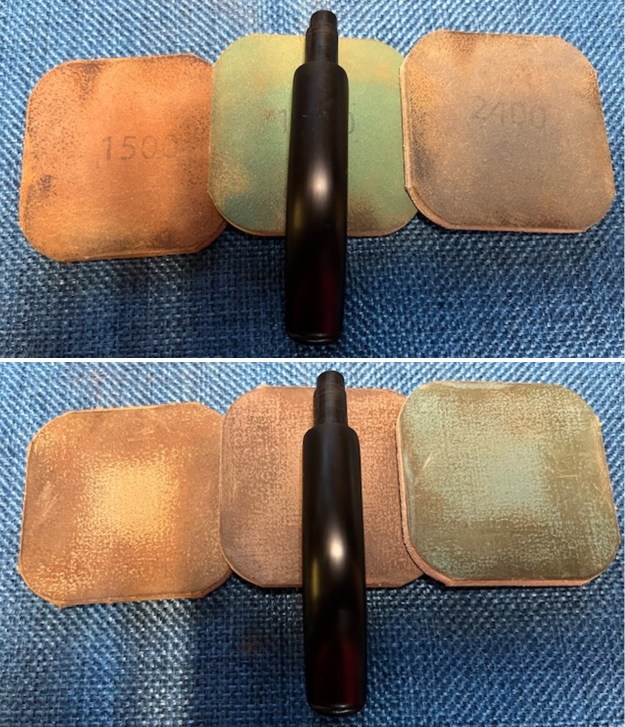
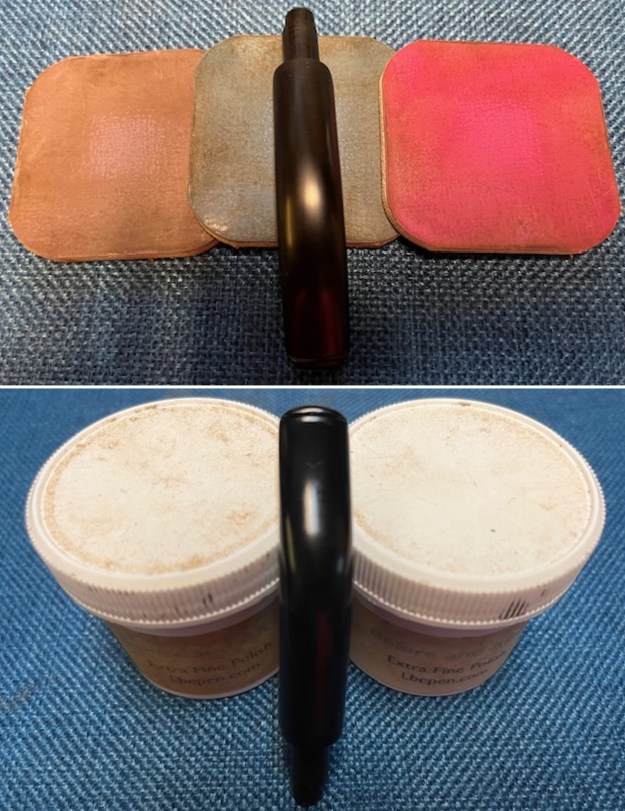
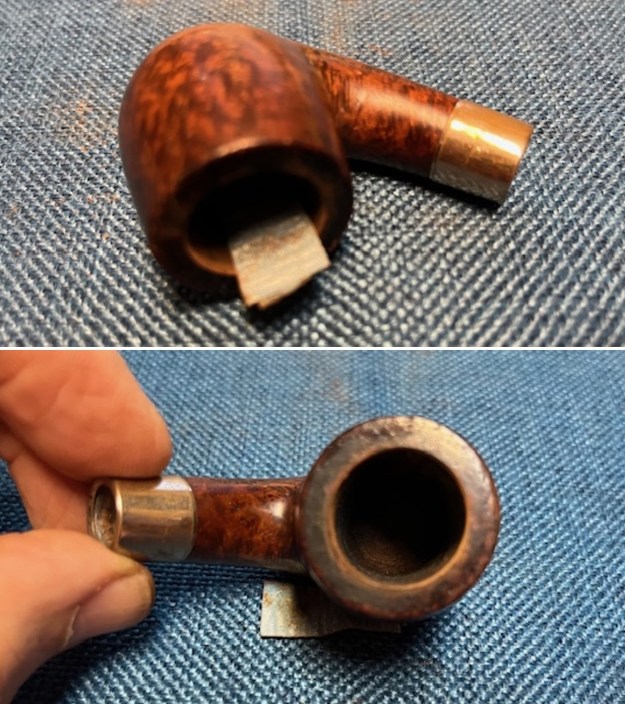
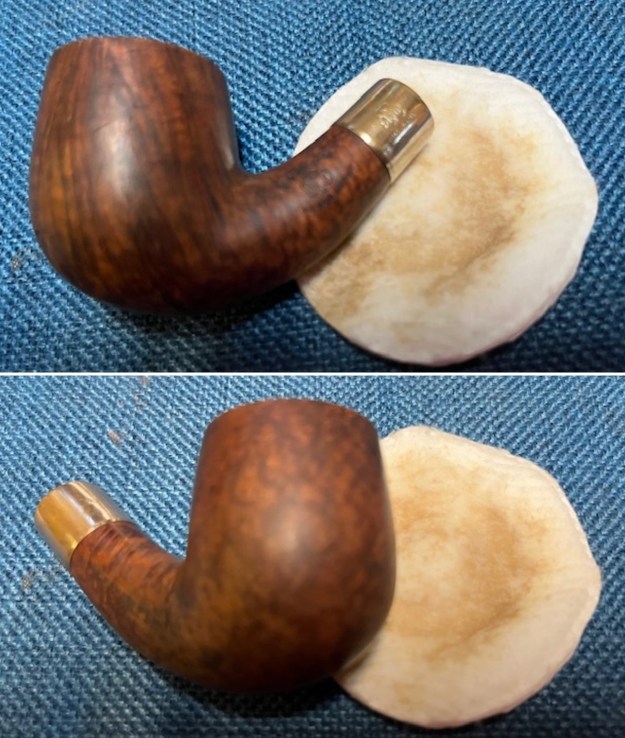
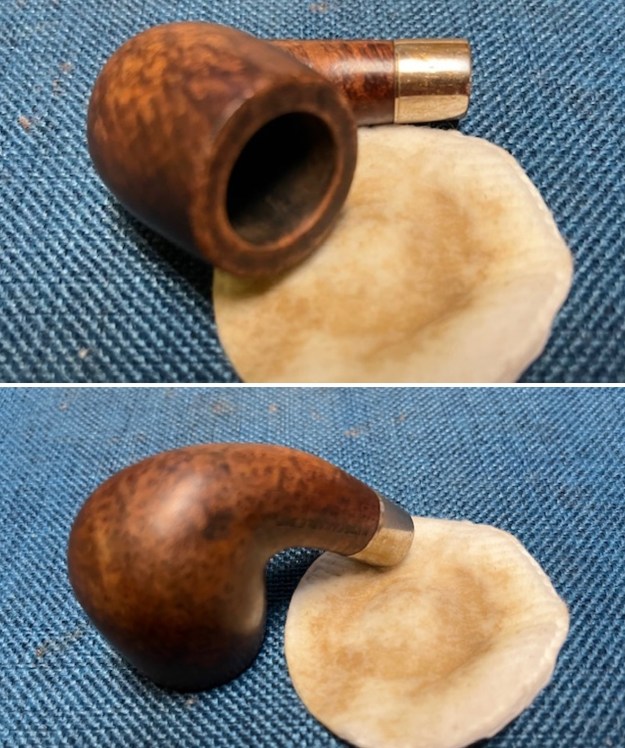
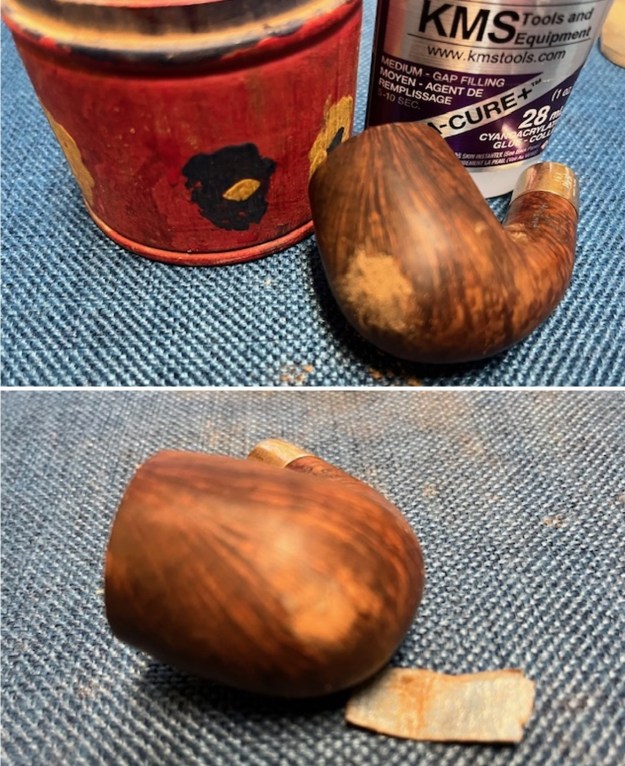
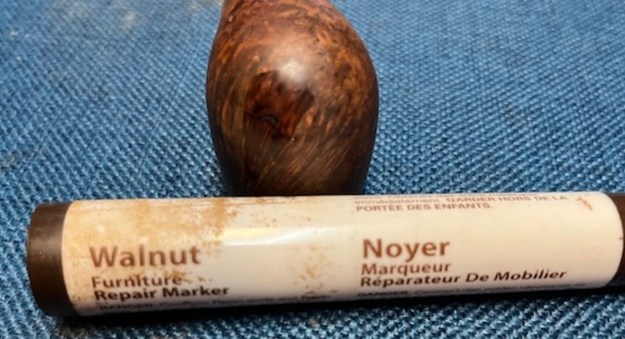
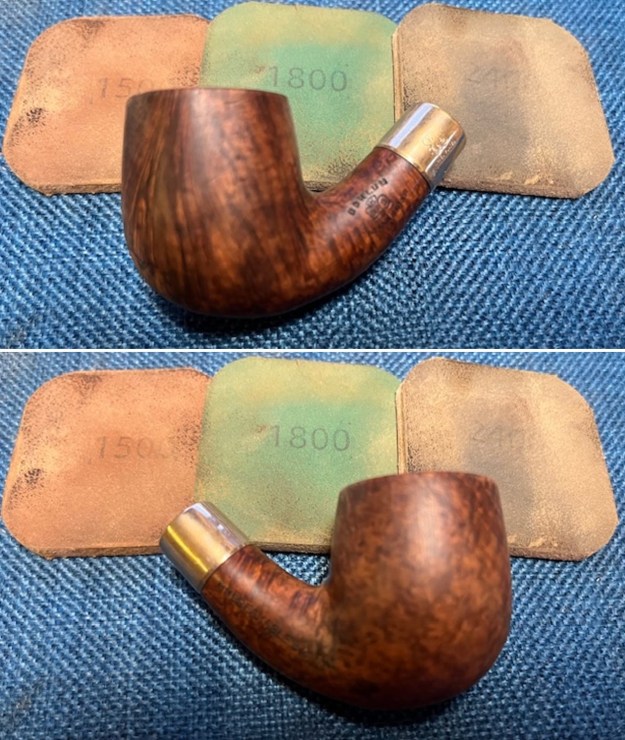
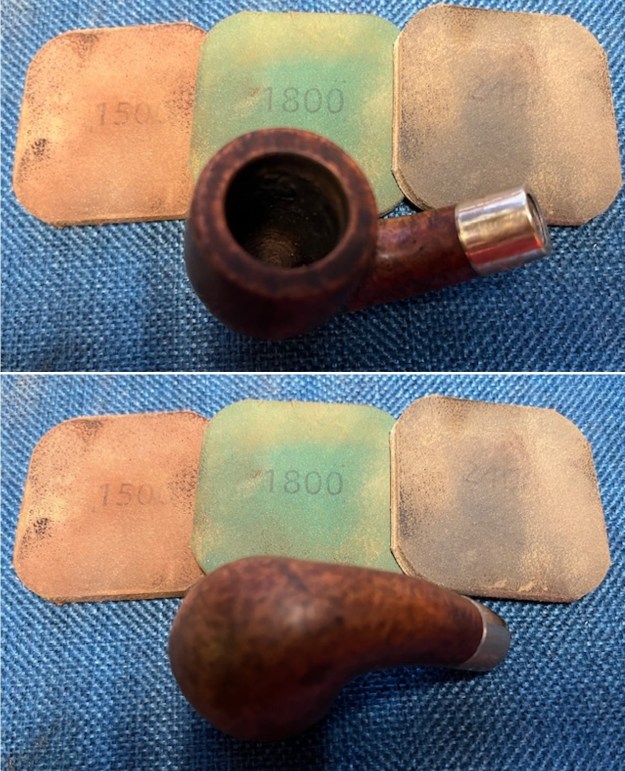
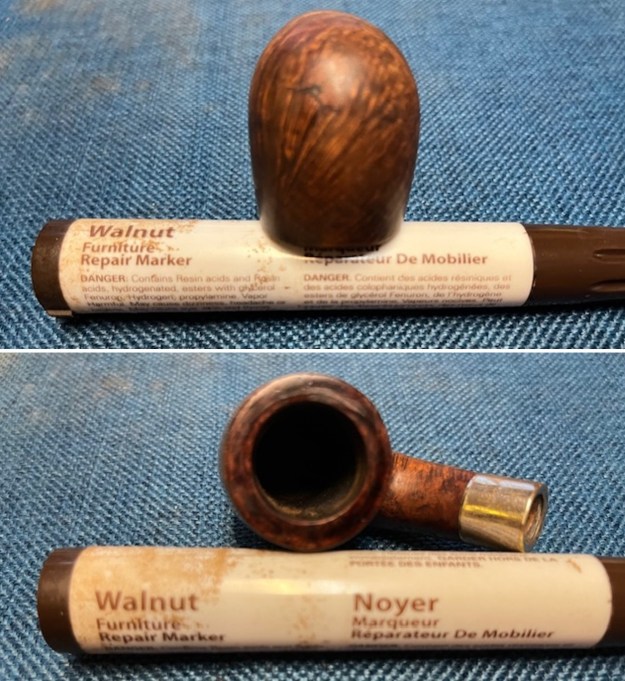
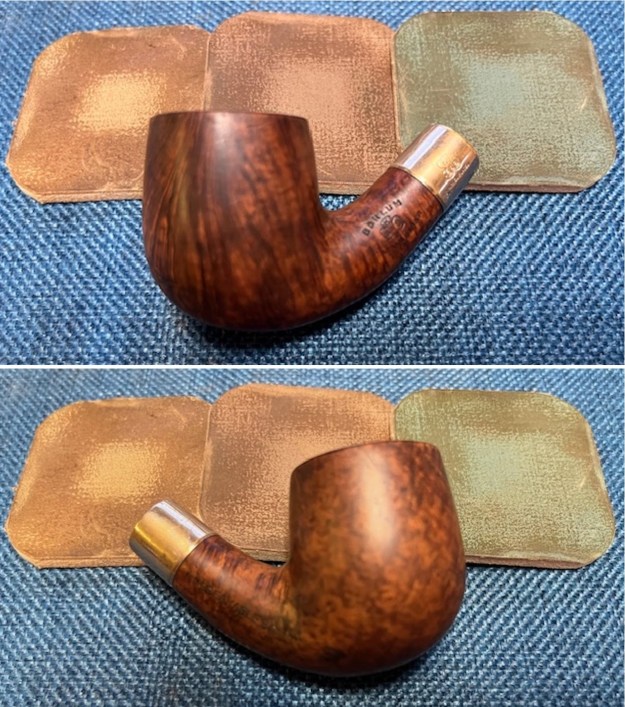
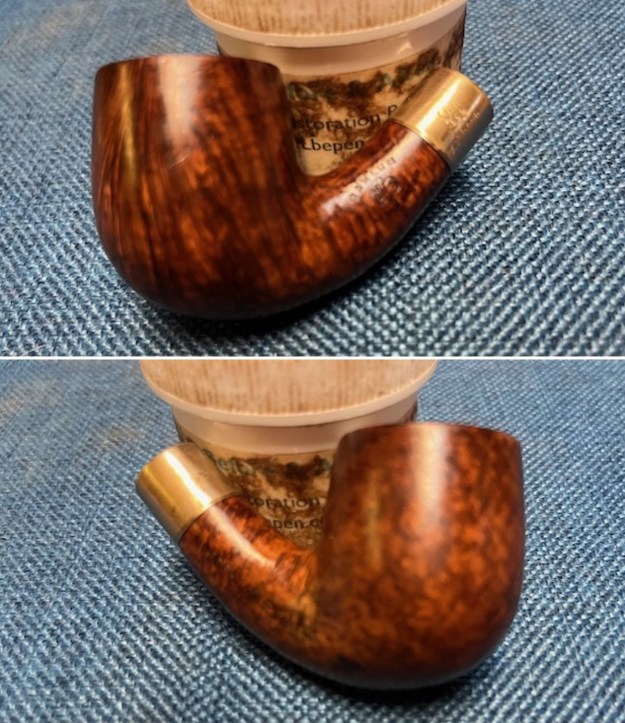
I have included several pictures that I found on the internet that show the unique stem tube in the Borlum that gives rise to the claim that it has an Unbreakable Bit. The first photo shows the bent stem, third from the left with the same metal tube showing at the button. The second photo shows the other end of the tube in the tenon in the Borlum stem. That told me that the pipe I had was made after 1851 and before 1919. I am guessing that because of the other pipes in this lot dating in the late 1890s to about 1905 this one is probably from that same era. Not too bad for a 100+ year old pipe. During the hunt for information, I also found the next photo of a Borlum display and sales card. What is particularly interesting to me is the diagram at the top of the card showing the interior of the stem in place in the shank. It also includes the claim, “Guaranteed against Breakage”. I love the advertisements and sales brochures of these old pipes. The descriptive language that promises so much and the prices the pipes sold for are a nostalgic journey to the past. Note the $1 and up price tag on the sales card. The pipe that I am working on presently is identical to the bottom pipe on the right side of the photo. I have circled it in red. It has the identical shape, curved shank but has a nickel-plated band like mine. It has the hard rubber stem with an orific button. It is more rounded than the modern flat stem but it is still a comfortable feeling stem in the mouth.Now it was time to work on the pipe. I decided to deal with the diameter of the stem against the shank first. I used a folded piece of 220 grit sandpaper to take off the extra diameter of the stem on the right side and the top and bottom. I also sanded the tooth marks and chatter on the stem surface. It was a lot of handwork and fussing to get the fit correct. Once finished it looked much better. I worked over the stem with 320-3500 grit sanding pads to smooth out the scratches left in the hard rubber surface of the stem. Once finished the stem had a deep shine and really looked much better.I polished the stem surface with micromesh sanding pads. I dry sanded it with 1500-12000 grit pads. I wiped it down between pads with an Obsidian Oil impregnated cloth. I finished polishing it with Before & After Pipe Stem Polish – both Fine and Extra Fine. It looked much better. I set the stem aside and turned my attention to the bowl. I smoothed out the damaged inner edge of the bowl with a folded piece of 220 grit sandpaper. It looked much better. I started polishing out the damage on the rim top with the 220 grit sandpaper. It looked much better.I wiped the bowl down with isopropyl alcohol on a cotton pad to remove the shiny wax or shellac coat on the bowl surface. It cleaned up very well. There was a deep sandpit/flaw on the lower front left side of the bowl. I filled it in with a combination of CA glue and briar dust. I sanded the repair with 220 grit sandpaper and smoothed it out into the surrounding briar. I touched up the sanded spot on the bowl front with a Walnut stain pen. It matched the rest of the bowl surface. Once I polished it some it would blend in very well.I polished the bowl and the shank with 1500-12000 grit micromesh sanding pads. I dry sanded with each pad and wiped the briar down with a damp cloth after each pad. I paused the polishing and touched up the stain on the bowl front and the rim top. It really was looking much better at this point. Once it cured I went back to polishing with the micromesh. I worked some Before & After Restoration Balm into the finish of the bowl, rim top and shank with my fingertips and a shoe brush to get it in to the crevices and valleys. The product works to clean, enliven and protect the briar. I find that the balm really makes the briar come alive again. I let the balm sit for 15 minutes and then buffed with a cotton cloth to raise the shine. The bowl really looks good at this point. I polished the nickel ferrule on the shank end with a jeweller’s cloth. It works to polish and protect the metal from further oxidation. It is a great looking addition to the pipe. With the bowl and the stem finished I put the Borlum KB&B Italian Briar Bent Billiard with an unbreakable stem back together and buffed it on the wheel using Blue Diamond to give it a shine. I gave the bowl and the stem multiple coats of carnauba wax on the wheel. I buffed it with a clean buffing pad to raise the shine. I hand buffed it with a microfiber cloth to deepen the shine. It really is a great looking pipe. The dimensions of the pipe are – Length: 4 ½ inches, Height: 1 ½ inches, Outside diameter of the bowl: 1 1/8 inches, Chamber diameter: ¾ of an inch. The weight of this large pipe is 1.20 ounces /33 grams. This Borlum KB&B Italian Briar Bent Billiard is another great looking pipe. It is much more beautiful in person than these photos can capture. I will be putting it in my older American Pipe Collection to enjoy in the future.  This is another pipe that has the possibility of transporting the pipe man or woman back to a slower paced time in history where you can enjoy a respite. Thanks for walking through the restoration with me.
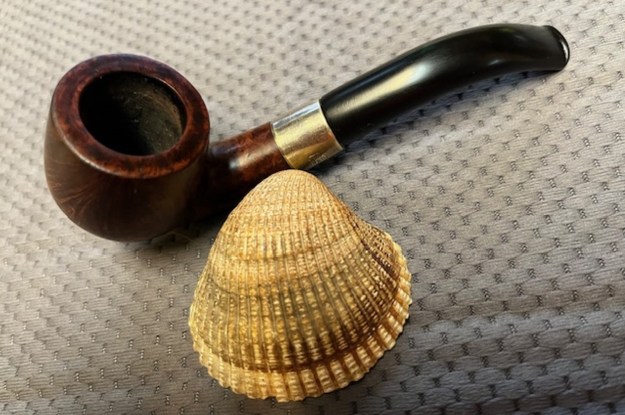
An Interesting Project : Resurrection Of a Pre-1920 KB&B Pembroke


Blog by Paresh Deshpande

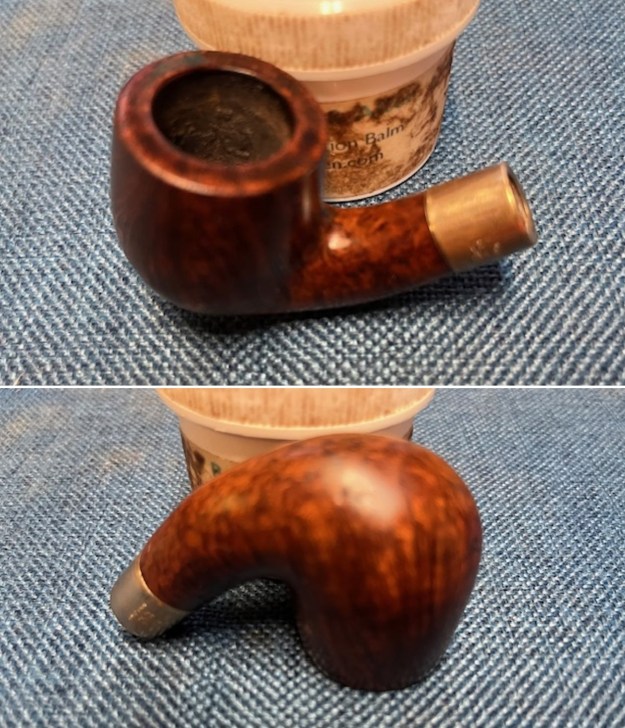
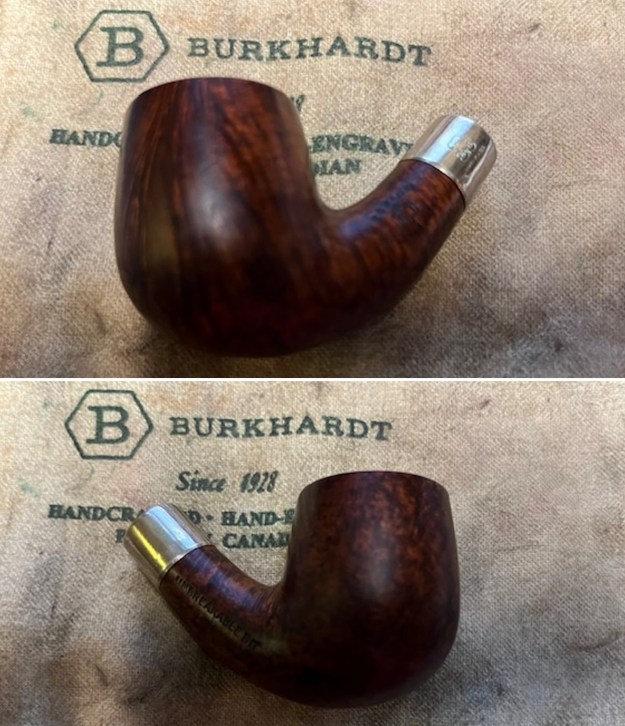
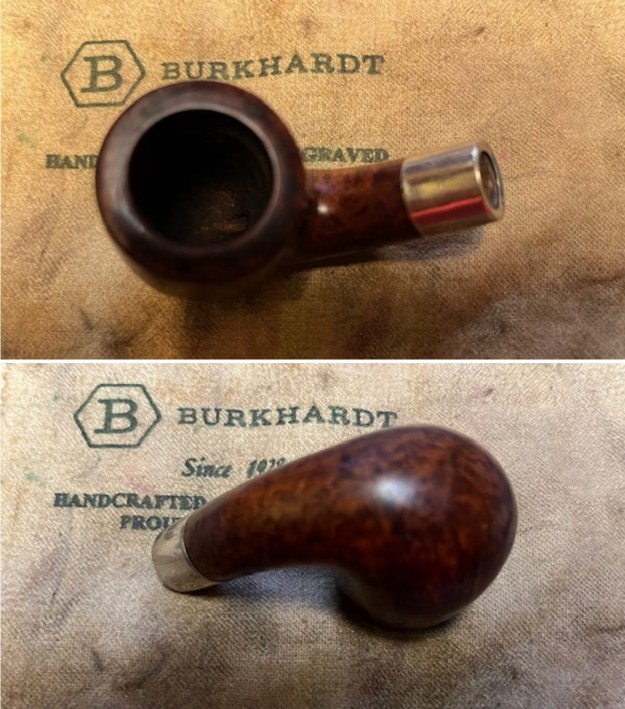
The next pipe is stamped as “PEMBROKE” over KB & B” on the left shank surface and came to me as part of inherited pipes that predominantly constituted pipes from various English brands, most notably LOEWE, BBB, COMOY’S, PETERSON’S, BARLING’S etcetera. However, this lot did also contain many pipes from American pipe makers like WDC, KB & B/ KAYWOODIE and others. I have researched and worked on a few of the KAYWOODIE pipes from this collection and recollect that KB & B changed their name to KAYWOODIE in 1920s to promote their Kaywoodie line of pipes or was it for some other reason? For clarification and recollection of history of this renowned brand from USA, I re-read the history from https://pipedia.org/wiki/Kaufmann_Bros._%26_Bondy#Brands and have only reproduced that information that helps to date the pipe:-

Early History

Kaufmann Bros. & Bondy (KB&B), Kaywoodie has been making pipes since well before the Civil War – around 1851. They peaked in the late 1950’s along with most American Briar works. In the early 20th century, their pipes were the standard others were measured by, along with SasieniCharatan and Comoy’s. There were few other world-class American pipe-crafters (William Demuth Company, early L & H Stern). Their pipes were as good as any of the renowned British firms. Kaywoodie just did not merely produce quantity, they provided quality: in the 1920’s they bought the exclusive rights to some of the choicest briar fields in history, hauling out 250 year-old roots the size of 27″ TVs and fashioning masterpieces out of this spectacular-grained ancient briar.

Early KB&B (non Kaywoodie)

Kaywoodie was the name a pipe offered by Kaufmann Bros. & Bondy Company (KB&B), first appearing in February of 1919.

The origin of the name Kaywoodie is a combination of the K from Kaufmann and wood, as in briar. Not much is known of the original KB&B company other than it was started in 1851 by the German born Kaufmann brothers when they opened a small pipe shop in the Bowery section of New York City.

When one of the men from the New York office got “gold fever” he carried a large supply of pipes with him to California that he sold along the way. This early “national distribution” did much to build the reputation of KB&B. By the late 1800’s, branches of KB&B were opened in Chicago, Atlanta, San Francisco and St. Louis with family and friends acting as agents. The trademarks, for the inlaid cloverleaf and the cloverleaf with the KB&B initials inside, were issued in 1881.

Pre-Kaywoodie KB&B

According to Hackert, the firm of Kaufmann Bros. & Bondy (KB&B) began producing the Kaywoodie Pipe in 1915.

Business thrived and in 1854 the Kaufmanns took in a partner named Bondy. … The three partners retired in 1898, but their relatives continued on with the firm, which had begun to manufacture their own briar pipes under the KB&B trademark. In 1915 the Kaywoodie brand was created as a marketing umbrella for a new briar pipe which the KB&B Company introduced. …”

Hacker concludes his history of Kaywoodie Pipes by noting that: “The KB&B briar pipe brand existed from 1900 until just after World War I (with some overlapping with the Kaywoodie from 1915 — 1917), and collectors refer to the KB&B as a Kaywoodie transition pipe.

The pre-Kaywoodie KB&B pipes were marked on the shank with a cloverleaf around KB&B. 

In March of 1955, when S.M. Frank & Co. Inc. bought Kaufmann Bros. & Bondy, The Kaywoodie Company, Reiss-Premier Corp., The New England Briar Pipe Co. and – of course – Yello-Bole.

Thus, comparing literature notes with the stampings as seen on the pipe that I am working on, I am certain that it dates as to being pre- 1920. Another pointer is the orific slot which was gradually replaced by more elliptical slot from 1920 and progressed further to the horizontal slot that we see on pipes today.

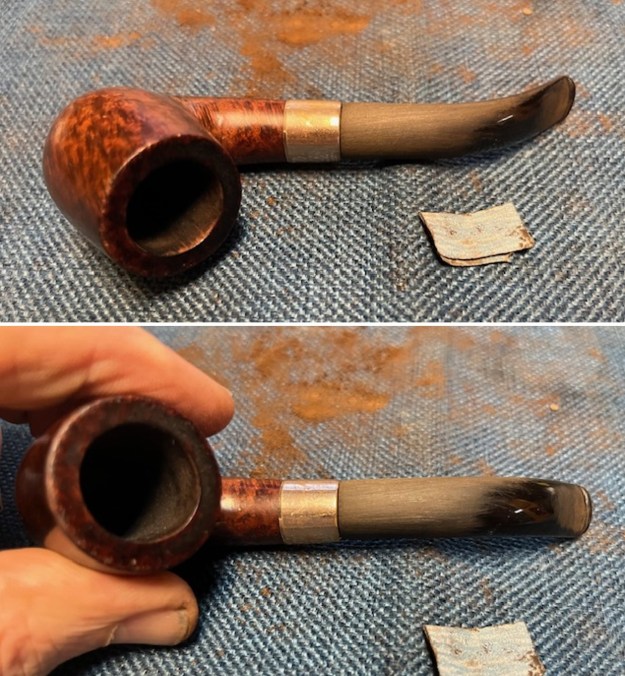
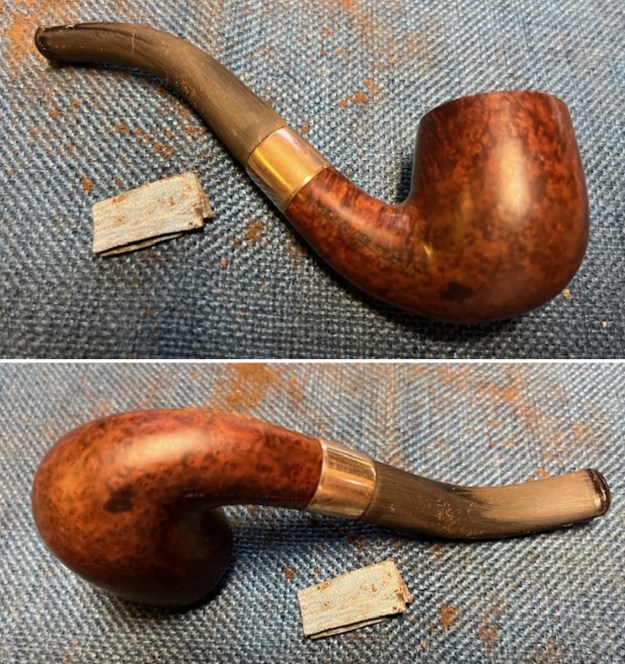
Here are the pictures of the stampings as seen on the PEMBROKE: Initial Visual Inspection
The PEMBROKE, currently on my worktable, is a medium sized classic bent billiards with a decent sized bowl in dark reddish brown color. The well seasoned briar is covered in dirt, dust and grime from decades of use. There are a couple of deep scratches on the stummel surface. There is a thick cake in the chamber with heavy overflow of cake, oils and tars over the rim top surface. The inner rim edge is uneven and charred. The outer rim edge, likewise, is peppered with dents and dings. The high quality hard rubber stem is oxidized with flattened bite zone on either surfaces of the stem. The tenon has a narrow extension at the end and is covered in dried oils and tars. The round orifice slot is similarly clogged with dried gunk. The stem does sit flush with the shank face and the seating is too damn tight within the mortise. Following pictures will give the readers a general idea of the condition of the pipe before I start to work on the pipe. Detailed Inspection
The chamber has a thick hard cake that has spilled over the rim top surface. The cake is thicker around the upper half of the chamber. The outer rim edge has dents and dings all around but is most severely damaged along the front half portion (encircled in yellow), a damage that can result only due to repeated strikes against a hard edged surface. The inner rim edge, prime facie, is sans any damage. The condition of the inner walls of the chamber can be commented upon after the cake has been taken down to the bare briar. There is a strong ghost smell in the chamber which is all pervading. There are remnants of un-burnt tobacco at the bottom of the chamber.The stummel surface is covered in dust, dirt and grime giving a dull, lifeless and lackluster appearance to the pipe. However, the briar has taken on a nice dark patina which has been a result of more than 100 years of usage and would be worth preserving. However, eliminating/ addressing the deep scratches (encircled in green) on both side of the stummel and the few dents and dings would entail sacrificing the patina. This is a call that I would need to take at some stage in the restoration process. The mortise is chock-a-block with old oils, tars, ashes and grime making for a laboured draw. The thick cake and blocked mortise hides the draught hole from the view. These issues need to be addressed. The high quality hard rubber stem is deeply oxidized. The unique feature of the stem is that the stem surface is flattened in the bite zone on either surface with defined cut edges. Now, the question that came to my mind was if these flattened surfaces were original to the stem or carved out by the piper who owned it, probably for ease of clenching? Well, to me it appears that this unique carving of the bite zone is machined and not handmade since the edges are too well defined and sharp to be handmade using home tools. But that the flattening of the bite zone makes it comfortable for clenching is unquestionable. There are no significant bite marks or chatter in the bite zone or over the button edges. The orifice slot shows dried accumulated oils and tars that would need to be cleaned. The tenon has a stepped hard rubber (?) extension similar in shape to the ones seen on Peterson’s Deluxe line of pipes. The tenon and extension too is covered in a thick layer of dried crud. The stem does not seat flush in the mortise and is fit is very tight. I think the seating issues would address itself once the tenon and mortise is cleaned.The Process
I began the repair and refurbishing process with reaming of the chamber. I reamed the chamber with head sizes 1 and 2 of the PipNet pipe reamer. I removed the carbon from the areas where the reamer head could not reach with my fabricated knife. To completely remove the residual carbon from the walls of the chamber and smooth out the walls, I sanded the chamber walls with a folded piece of 220 grit sandpaper followed by cleaning the chamber with a cotton swab wetted with isopropyl alcohol. The chamber walls are in pristine condition. I gently scrapped off the lava build up over the rim top using a sharp knife to avoid damage to the surface. I cleaned the mortise and shank walls of the pipe using dental tool. I scraped out the dried oils and tars from the walls of mortise and shank walls. The pile of crud that was scraped out is indicative to the amount of gunk that was lodged in the mortise and shank internal. At the end of this step, I still was not able to pass a pipe cleaner through the mortise. Out came one of the many modified tools in my arsenal and after some deft use of this poker, I was able to dislodge the blockage from within the mortise. I ran a bristled pipe cleaner and q-tip dipped in alcohol through the mortise and out through the draught hole further clearing the passage. I will continue this further cleaning during the course of refurbishing of this pipe.Next, I decided to subject the chamber and mortise to cotton and alcohol bath. I packed the chamber with cotton and drew out a wick from the cotton and along with a folded regular pipe cleaner, inserted it into the mortise and through the draught hole into the chamber. I tightly packed cotton balls into the remaining portion of the mortise. Thereafter, I soaked the cotton balls with isopropyl alcohol up to the brim. About half an hour later, the level of alcohol had gone down, having being absorbed by the cotton. I topped it up once again and set it aside overnight. By next afternoon, the cotton and alcohol had drawn out all the remaining oils and tars from the chamber and mortise. I removed the cotton balls and the dirt can be gauged by the appearance and coloration of the cotton balls and the pipe cleaner. I ran pipe cleaners through the mortise and draught hole to clean out all the loosened tars and gunk that was lodged in the draught hole and mortise. The chamber and mortise now smelled clean, fresh and looked it too. I set the stummel to dry out naturally.Once the internals of the chamber and shank were cleaned, I cleaned the external surface of the stummel with Murphy’s Oil soap and cotton swabs followed by scrubbing the surface with a toothbrush and dish washing soap. This rid the stummel surface of all the accumulated dust, dirt and grime. Using a piece of Scotch Brite scrub, I deliberately cleaned the rim top and removed the crud from the surface. The damage to the rim edges is now amply evident.Simultaneously, I also cleaned the shank internals with dish washing soap and a shank brush. I set the stummel aside to dry out naturally while I worked the stem.I began the process of refurbishing the stem by first scraping off the dried gunk from the tenon and tenon end extension using a sharp thin knife. I was careful not to damage or break the extension or the stem face. I cleaned the tenon extension with a cotton swab moistened with alcohol and ran a pipe cleaner through the airway to check if the airway was clear of any blockage. Fortunately, it was.Using thin shank brushes and anti-oil dish washing soap, I cleaned the stem airway. I have modified this process of cleaning the stem airway by doing away with pipe cleaners and alcohol as it saves me a ton of pipe cleaners, which is a precious commodity for me here in India. I continued this cleaning till only white clean foam came out of the stem airway, indicating that the airway was nice and clean. I ran a couple of pipe cleaners dipped in alcohol through the airway to dry it out and make sure that there are no traces of soap and gunk hidden in the airway. I also scrubbed the stem surface to remove surface oxidation and rubbed a small quantity of EVO in to the stem surface. Since there were no damages to the stem, I set it aside and shall return to polishing the stem after I am done with the stummel repairs.Next, I got around to addressing the rim top damage. The extent of the damage to the outer edge, caused due to banging against a hard surface, would necessitate heavy topping off of the rim surface, and I for one, absolutely wish to avoid any loss of briar. Also topping to the extent that was required to eliminate the dents/ dings and chipped areas would completely alter the original shape and symmetry of this pipe.  So, I planned on first filling up these dents and dings on the rim edge using briar dust and superglue to roughly match the surrounding intact rim surface and some more and then topping it to achieve a smooth even surface. Theoretically, this sounds logical.

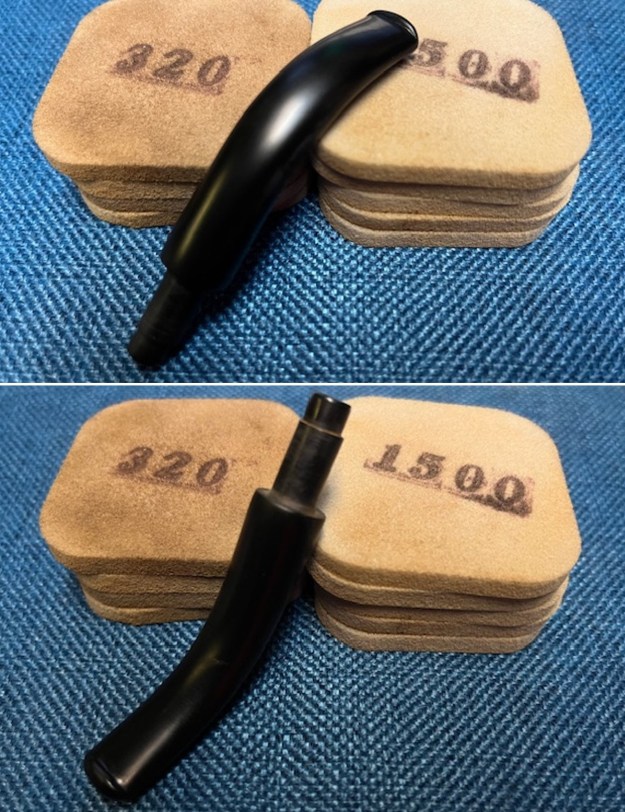
I resorted to the layering method again; first I layered superglue along the damaged surfaces of the rim followed by sprinkling of briar dust, another layer of superglue followed by a final layer of briar dust. This final layer of briar dust reduces the probability of air pockets (or so I thought). In the second picture, you can see that the layering has not been done to the level of the rim surface but above the surrounding intact rim surface as I would be sanding the rim subsequently. I set the stummel aside to cure. I revisit the stummel the next evening after the repairs are completely cured and hard. Using flat needle files, I sand the repairs to achieve a rough match with the surrounding briar surface. Once I had achieved a rough match, I top the rim surface over a 220 grit sandpaper to even out the surface and achieve a perfectly even rim top surface. The inner and outer rim edges are still slightly uneven and shall be addressed next.To get the inner and out rim edges back to round, I created a bevel over the edges with a folded piece of 220 grit sand paper. I am pretty pleased with the progress being made thus far. It was now that I decided to address the numerous scratches over the stummel surface and the process of steaming these out is the best way forward. I assembled the items that are essential to this process; a wet Turkish towel, a knife and a candle. I heated my fabricated knife over the flame of the candle till it was really hot. I covered the scratched surface with the wet towel and placed the hot knife over it. The steam that is generated expands the briar raising the scratches to the surface. I repeated the process over the areas till the issue of scratches was addressed over the entire stummel surface. Though these scratches were pulled to the surface, I would still need to sand the stummel to eliminate them.Using a folded piece of 220 grit sandpaper, I sand the scratched surfaces till these were completely eliminated. I followed the 220 grit sandpaper by sanding the surface with a piece of 800 grit sandpaper. However, here I also realized that this also resulted in losing the patina that I so dearly wanted to preserve. You win some and lose some, that’s how it always is!To further clean and highlight the grains, I sand the stummel with micromesh pads, wet sanding with 1500 to 12000 grit pads. I wiped the stummel after each wet pad with a moist cloth to remove the resulting dust and note the progress being made. I rub a small quantity of “Before and After Restoration Balm” in to briar and let it rest for a few minutes. The balm almost immediately works its magic and the briar now has a nice vibrant appearance. I further buff it with a horse hair shoe brush. I set the bowl aside and took to working on the stem. I once again cleaned the stem surface using the Scotch Brite sponge and followed it up by a scrub with 0000 grade steel wool. This helps in further removing the oxidation from the surface. I also ran a thin shank brush through the stem airway to ensure that it was clean and clear of all the soap deposits. I rubbed the stem with some EVO to hydrate the surface.To impart a deep black shine to the stem while getting rid of the oxidation from the stem surface, I wet sand the stem surface with 400, 600, 800, 1000, 1500 and 2000 grit sand papers. I again rub the surface with some EVO to hydrate the stem and prevent oxidation from again creeping over the surface due to exposure to natural elements and set the stem aside.To bring a deep shine to the hard rubber stem, I polished the stem, wet sanding with 1500 to 12000 grit micromesh pads. I rubbed it down with Extra Virgin Olive oil to rejuvenate the hard rubber. The finished stem is shown below.With the stem refurbishing nearly completed, I took a long hard look at the stummel now bereft of the patina and the original dark reddish brown stain. I discussed with Abha about the difference in the appearance of the stummel at this stage in restoration from the way it appeared at the start. The unanimous decision was to stain the stummel to its original color or as close to it as possible and with the decision made; I decided to stain wash the stummel using Feibing’s Cordovan leather dye.

Using a heat gun, I warm the stummel to open the pores in the surface to accept the stain. I mix a small amount of alcohol with the dye to dilute it and apply it over the heated surface with a folded pipe cleaner. I set the stain by flaming it with the flame of a lighter as I went ahead to different self designated zones of the surface. This helps in the setting of the stain into the grain of the briar and set the stummel aside. The next evening, approximately 18 hours later, as Dal describes, I began to unwrap the stain in the hope to see beautiful grains. I mount a felt cloth buffing wheel on my hand held rotary tool and setting the tool at its slowest speed, I began to peel off the stain from the stummel surface first using Red compound. The stain was peeled out gradually revealing a nice shining surface and grains underneath the stain.Next, I mount a fresh felt cloth buffing wheel and polish the stummel with White Diamond compound. This further lightens the stain, highlighting the grains while imparting a nice shine to the stummel surface. The similar coloration achieved at this stage to the original color, uplifted my spirits sky high. I shall continue the polishing regime further using Blue diamond and finish off with carnauba wax polish.I have now reached the homestretch in this restoration project. To complete the restoration, I mount a cotton cloth buffing wheel on to my hand held rotary tool and polished the stummel and stem with Blue Diamond compound. This compound helps to remove the minor scratch marks that remain from the sanding while further highlighting the grain and lightening the stain. I mount another cotton buffing wheel that I have earmarked for carnauba wax and applied several coats of the wax. I finished the restoration by giving the entire pipe a rigorous hand buffing using a microfiber cloth to raise the shine further. The finished pipe looks amazingly beautiful and with the Cordovan stain, as good as original. In fact, the pipe looks much more endearing and beautiful in person than it does in the pictures below. It shall find a place of pride in my “American pipe makers” section of my personal collection. P.S. – This then is one project which has given me greatest of satisfaction that I have experienced after it’s completion.

I am not too concerned with successes or failures of any project. What matters to me is the journey.

Restoring an Old KBB Palmyra Horn Stem Bent Billiard with a Wind Cap


Blog by Steve Laug

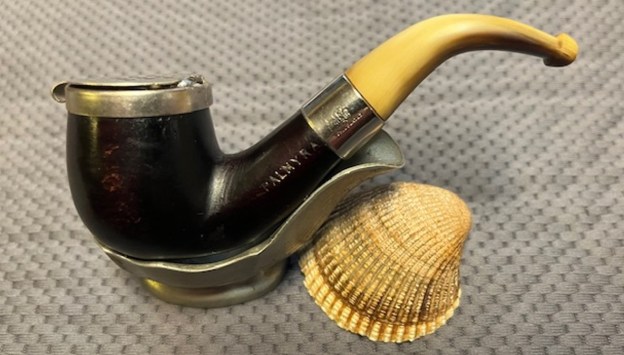
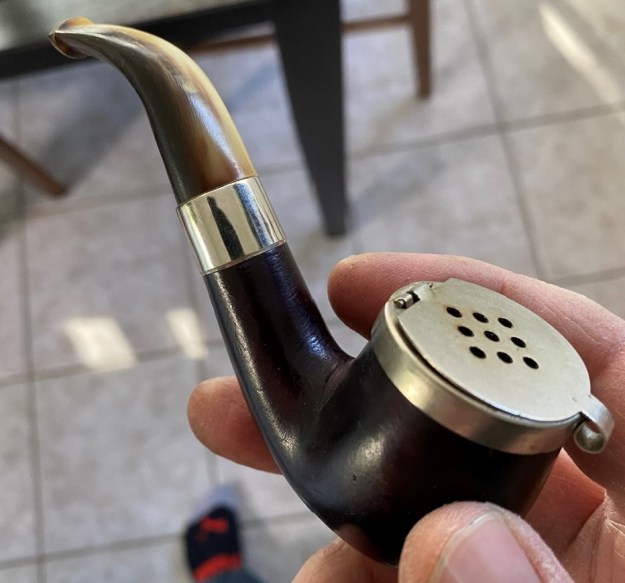
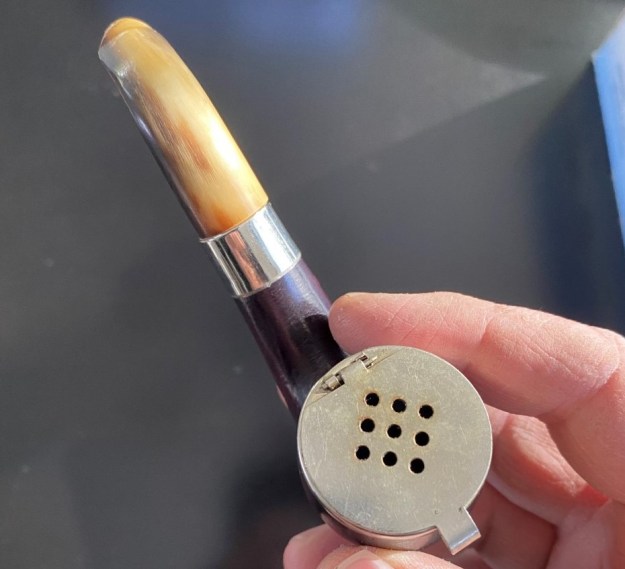
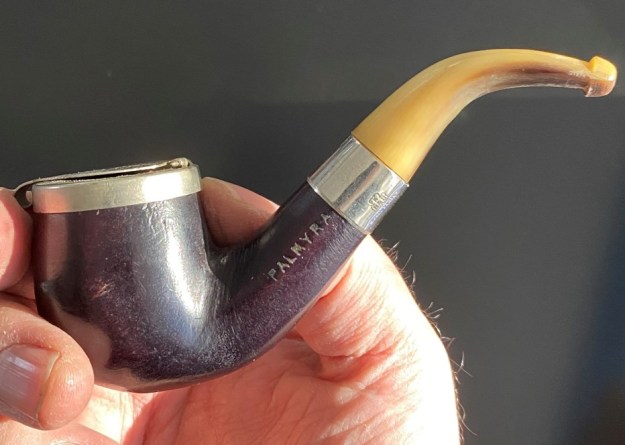
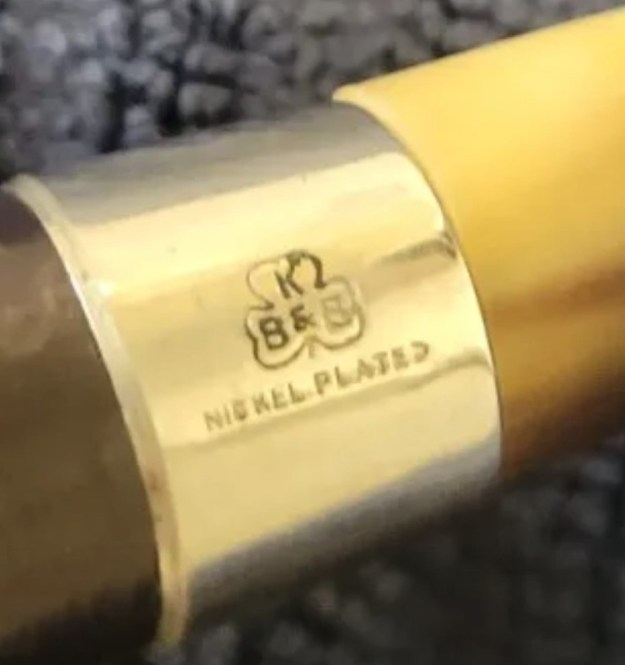
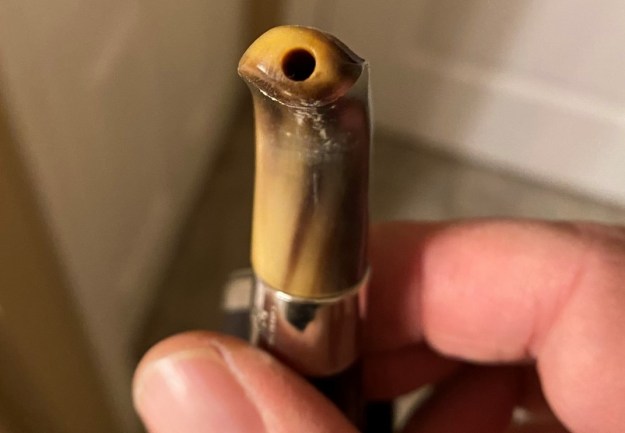
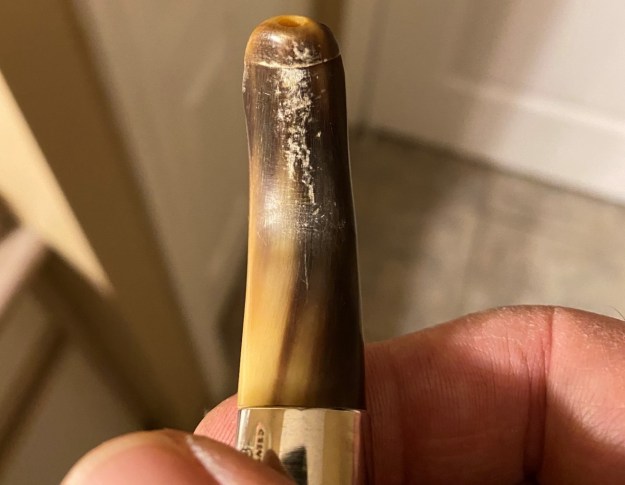
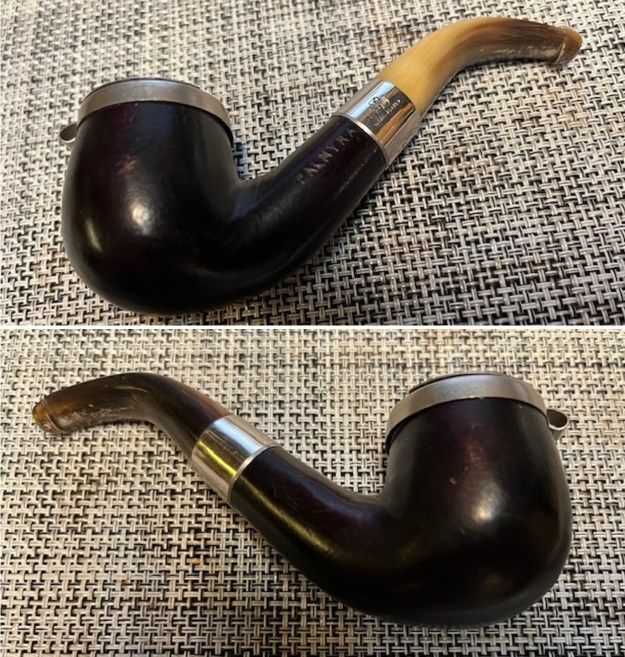
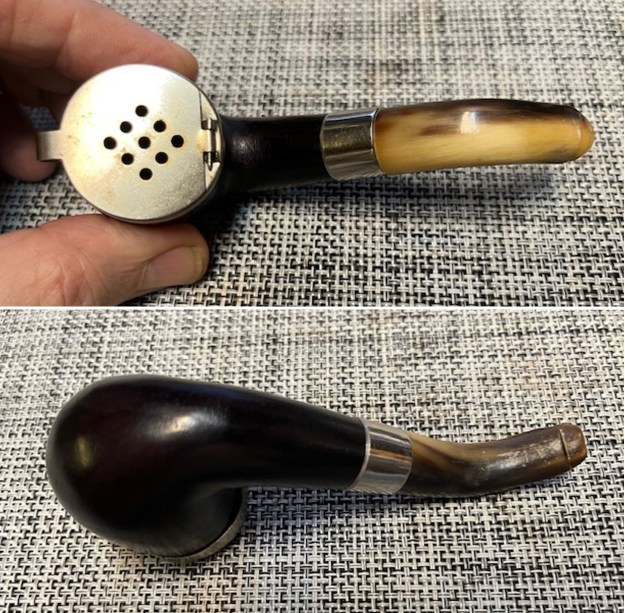
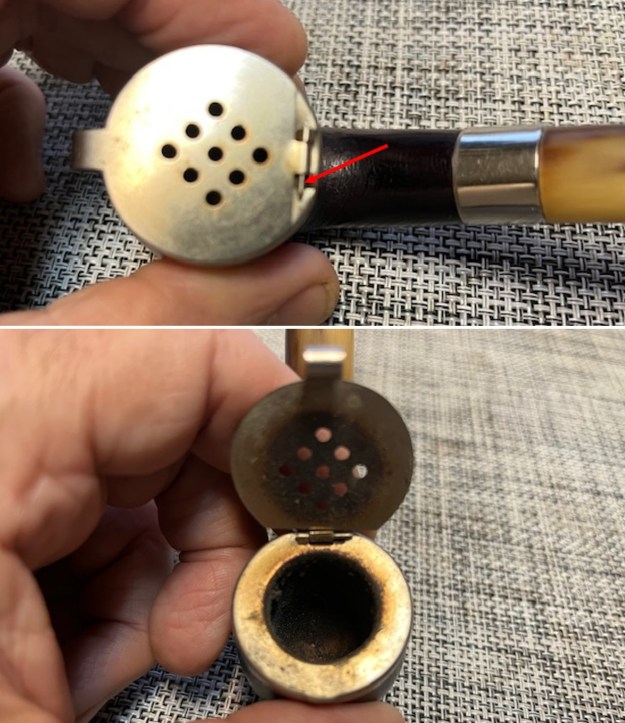
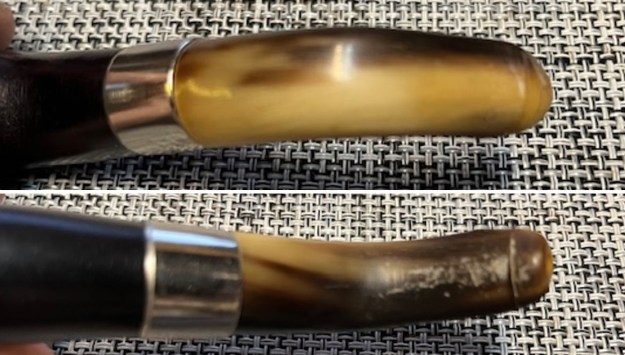
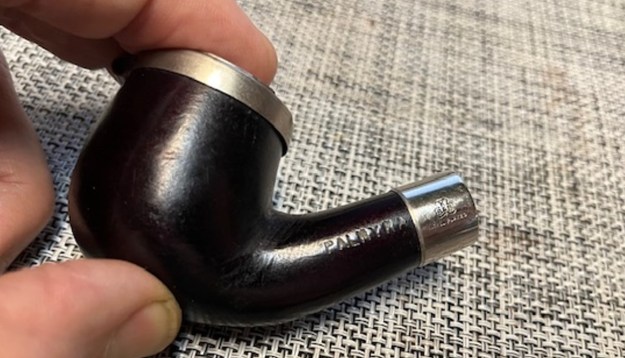
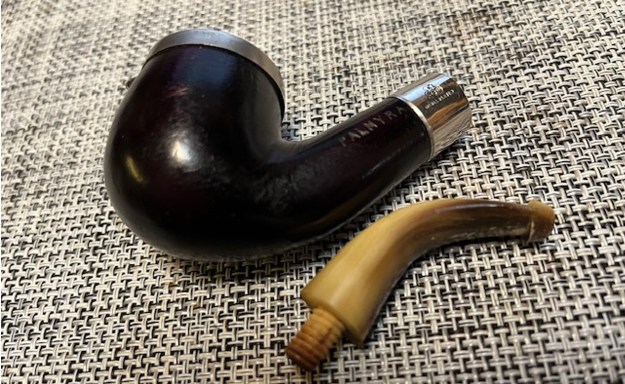
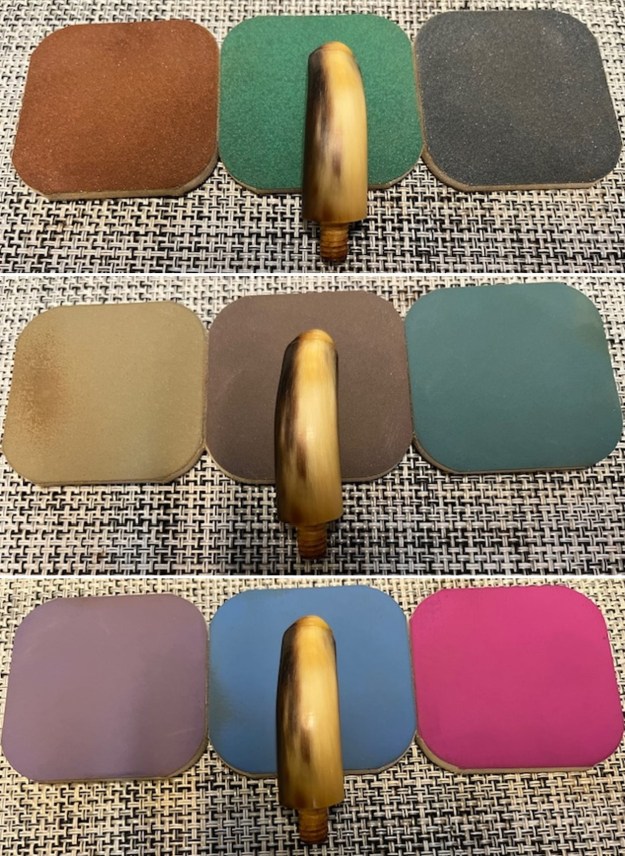
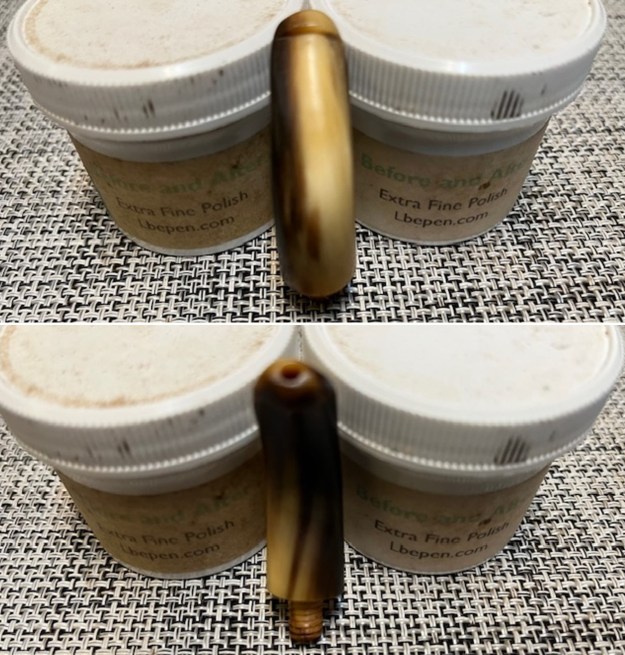
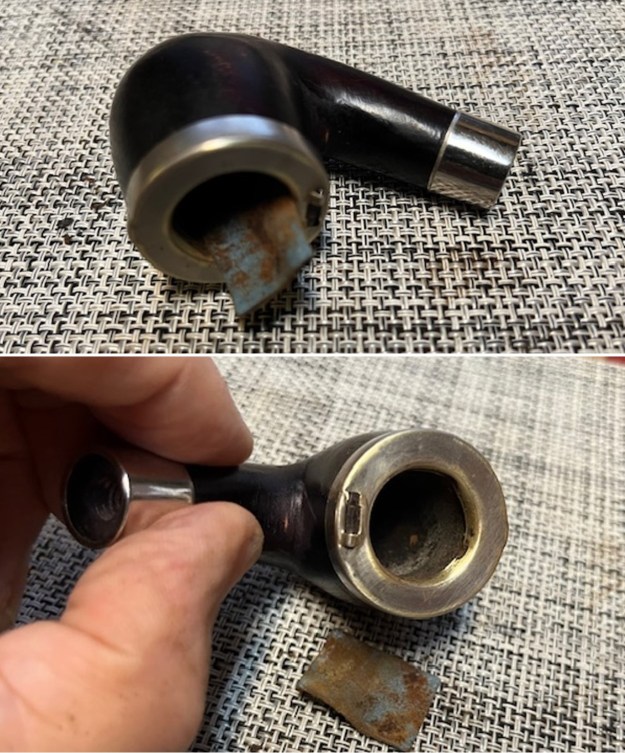
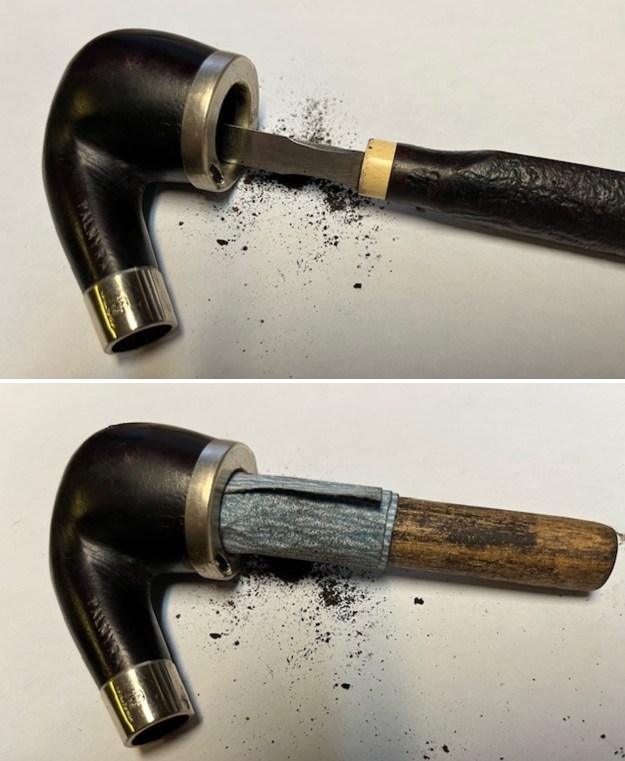
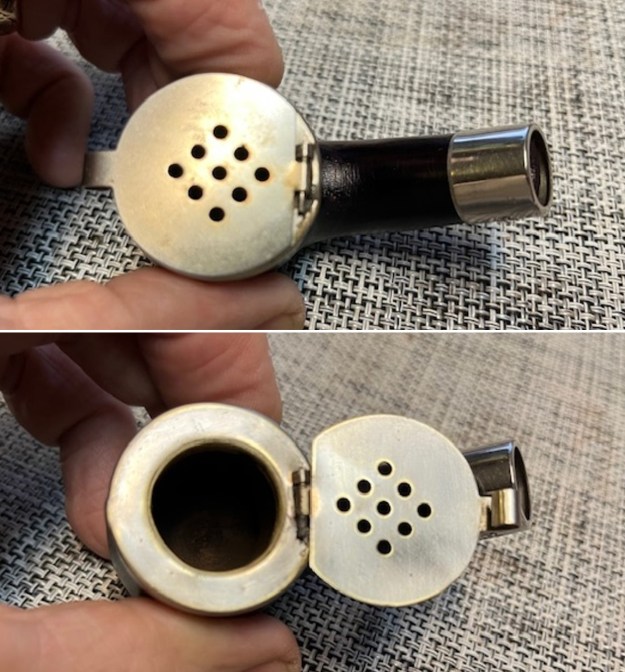
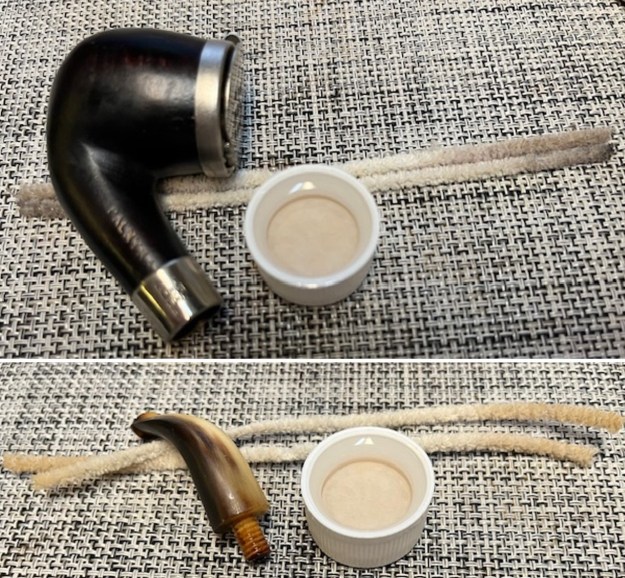
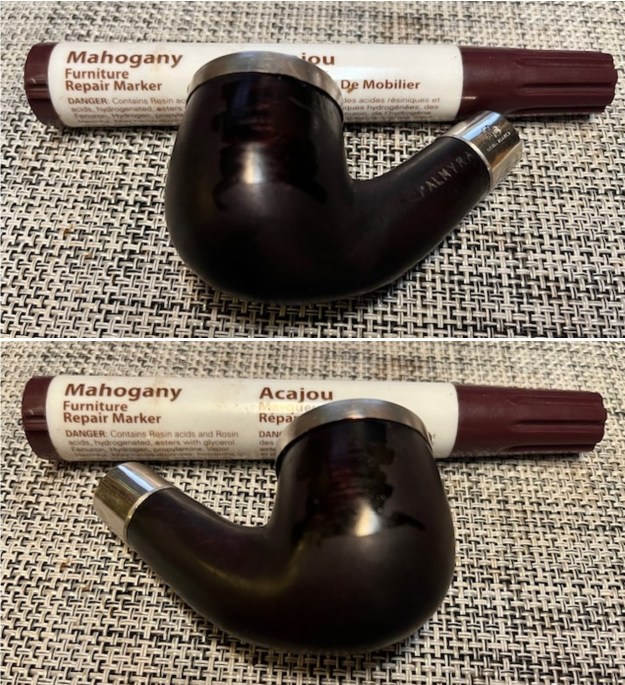
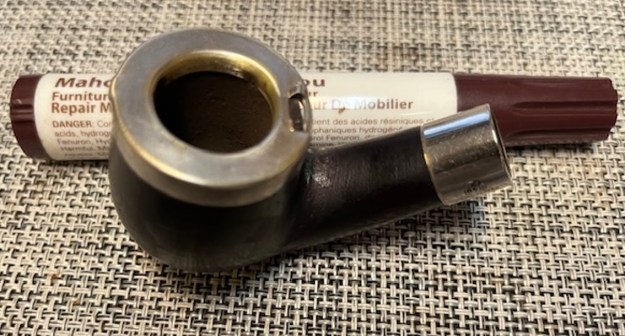
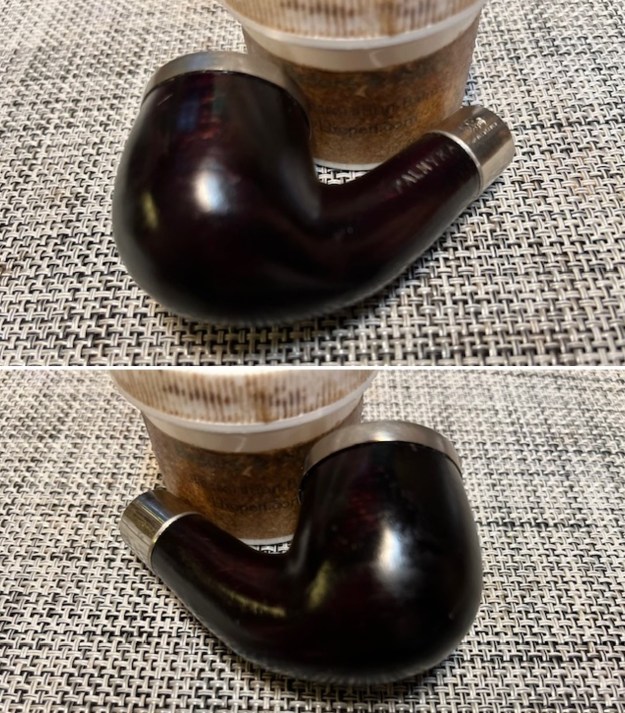
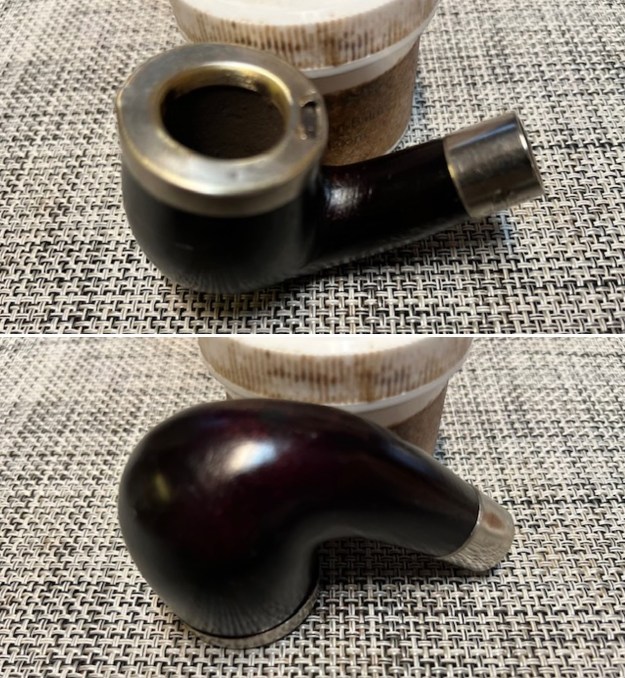
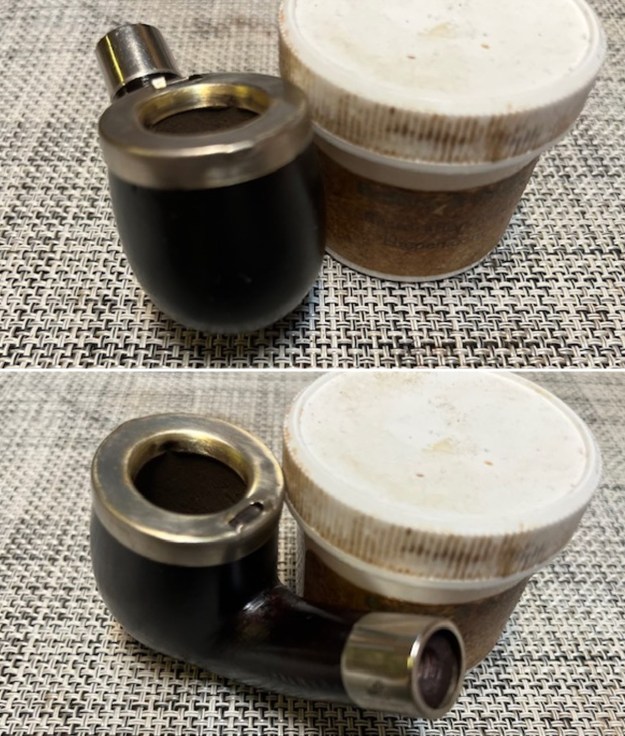
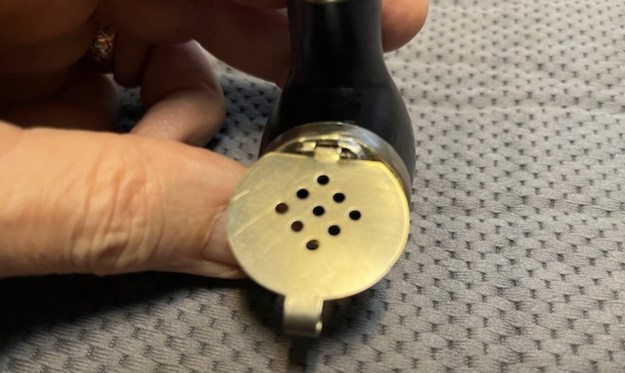
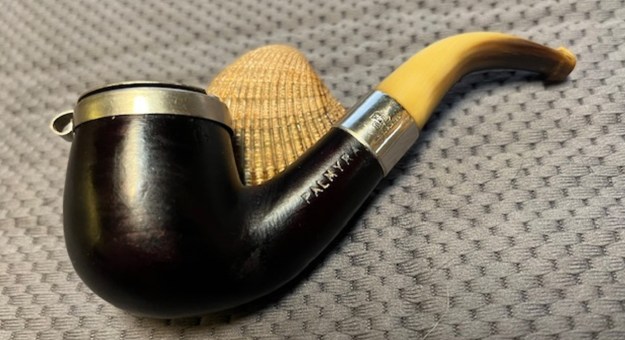
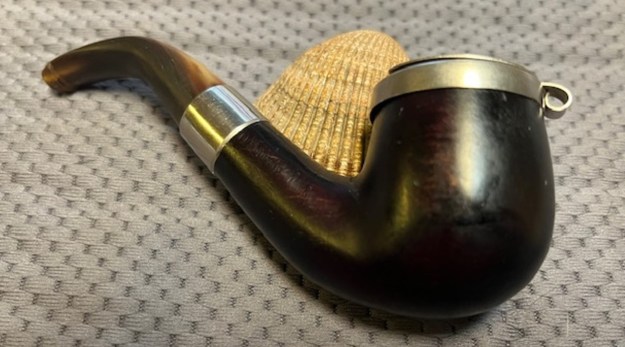
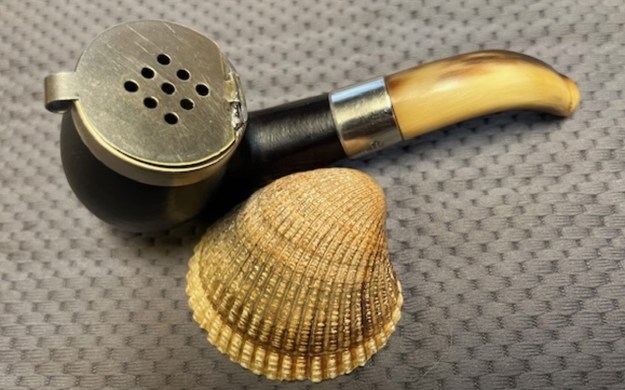
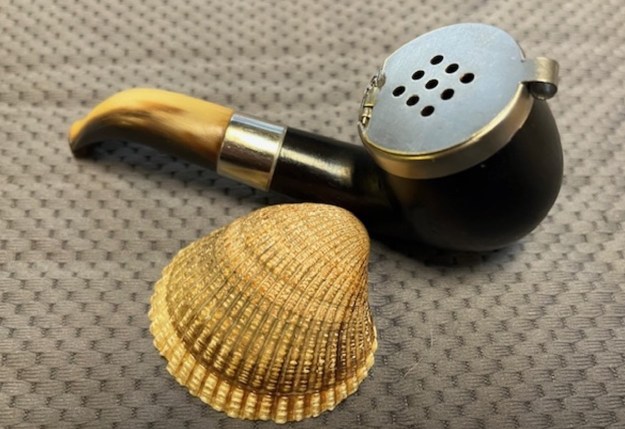
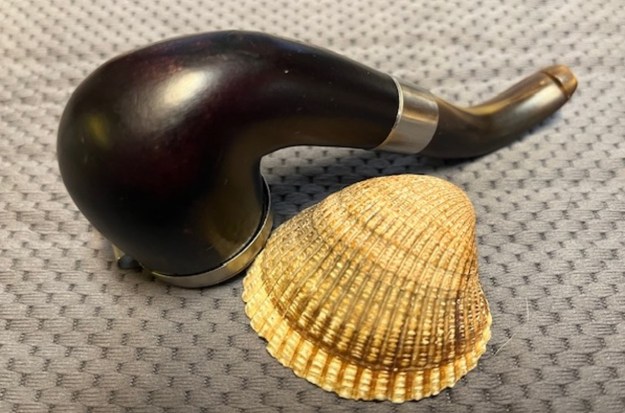
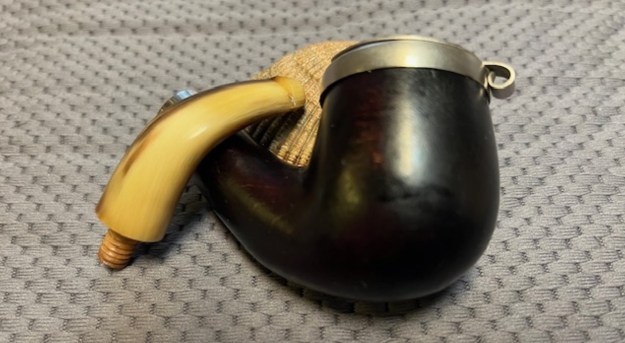
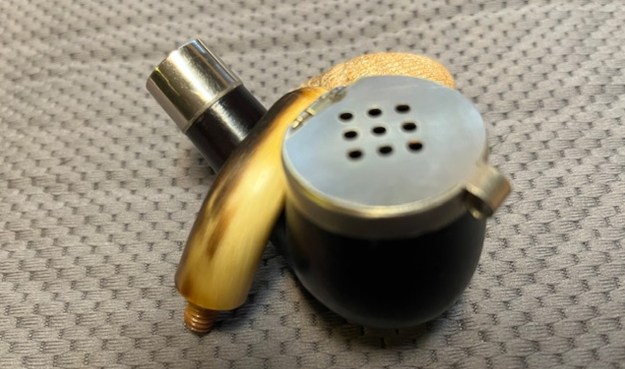
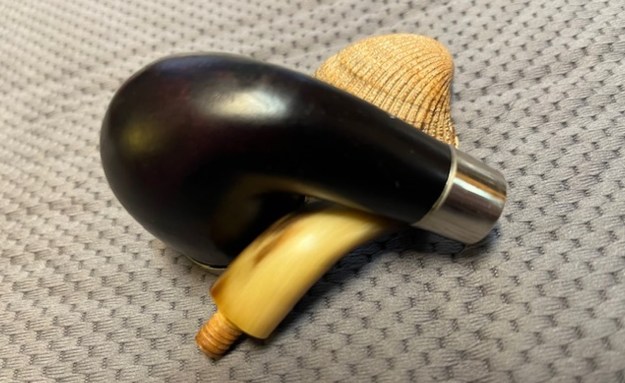
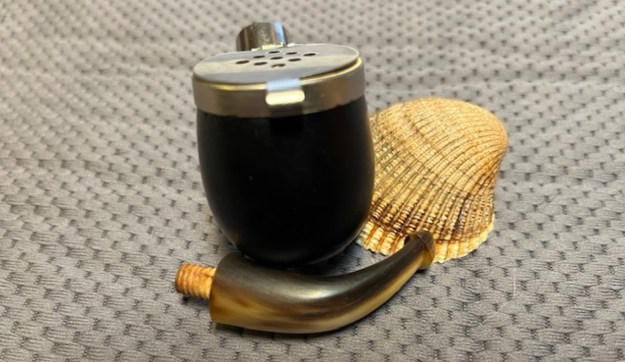
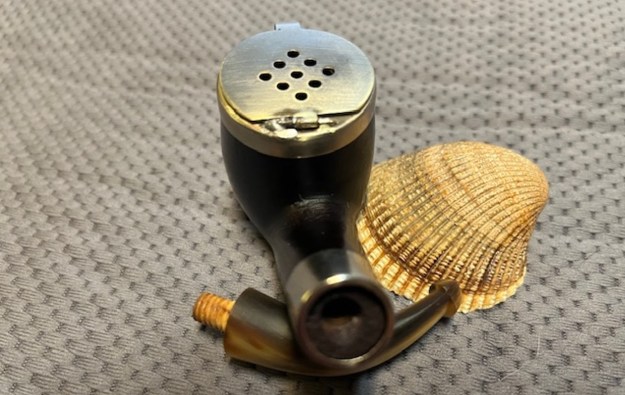
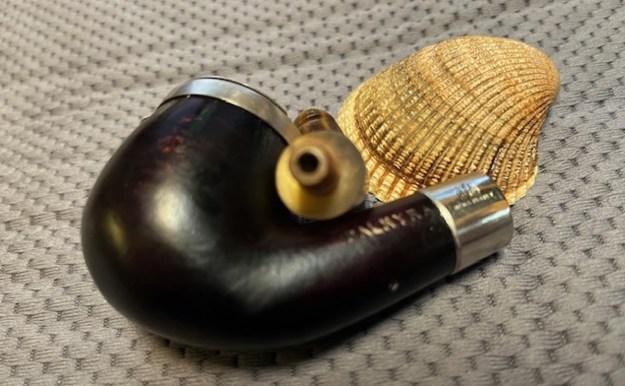
The next pipe on the table is an older KBB Pipe with a horn stem that a friend, Rob sent me. It has a nickel band on the shank and a nickel rim and wind cap. The briar has been stained with a dark purple stain and is a great contrast to the polished nickel and the horn stem. The finish was dirty and there are scratches in the finish. The nickel rim cap is dirty on the underside with tars and darkening. The hinge holding it on the cap is missing one of the anchors holding it in place. I am quite amazed that the hinge pin is not missing. The bowl has a moderate cake in the bowl and around the metal inner edge of the rim. It is quite dirty on the inside. The pipe is stamped on the left side of the shank and reads PALMYRA. On the polished nickel band it is stamped with KB&B in a cloverleaf over NICKEL PLATED on the left side. The horn stem is held in place by a threaded bone tenon that is excellent shape. The stem had tooth marks and chatter on the top and underside of the stem. The horn stem was worn and dry looking. Rob wrote me an email about the pipe asking if I would work on it. I have included the email below.

Hi Steve! 

Greetings from Kamloops… hope you had a great holiday season. A while back, I picked up a KBB Palmyra on EBay (pictures attached) and I was looking into having it restored. It’s a cool little pipe with a horn stem… I think it’s 1920s era? I don’t mind fixing up estates now and again, but I’d like this one to be restored by someone with a little more know-how than me. It basically needs a thorough cleaning, minor repairs, and a repair to the hinge of the wind cap. Would you be interested in restoring it? And do you know what it might cost, offhand?

Have a great weekend, Rob

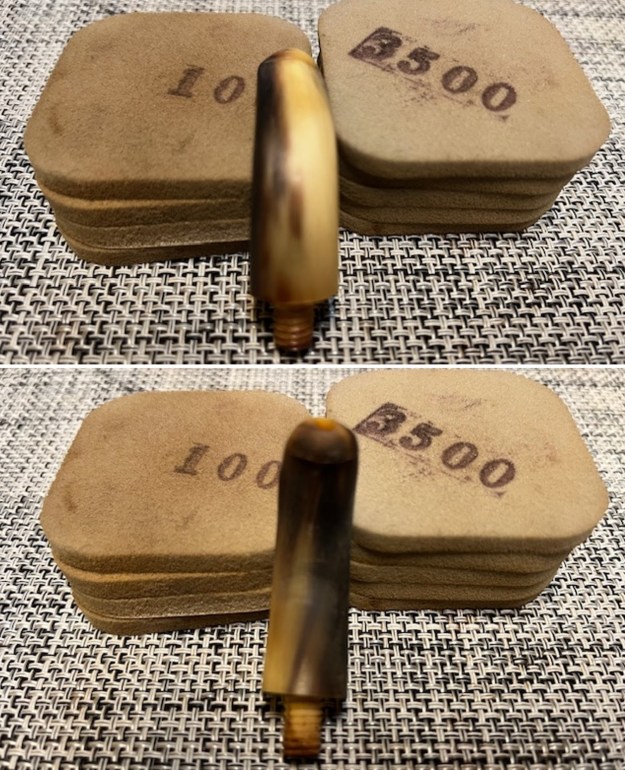
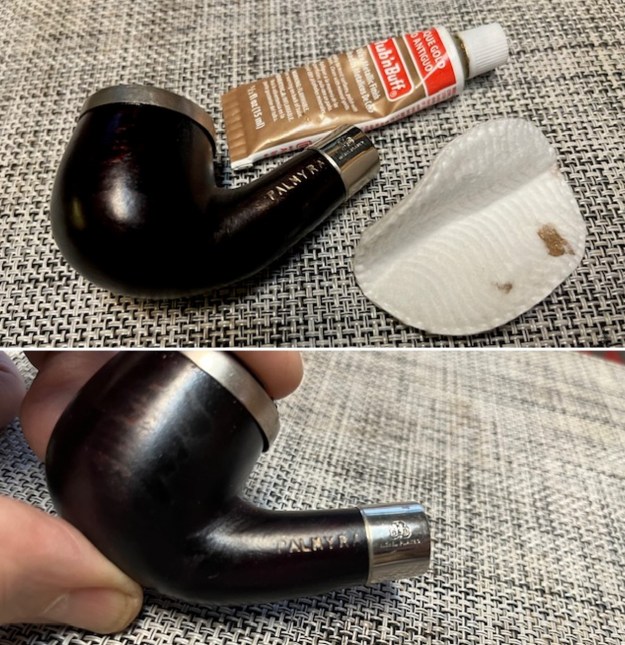
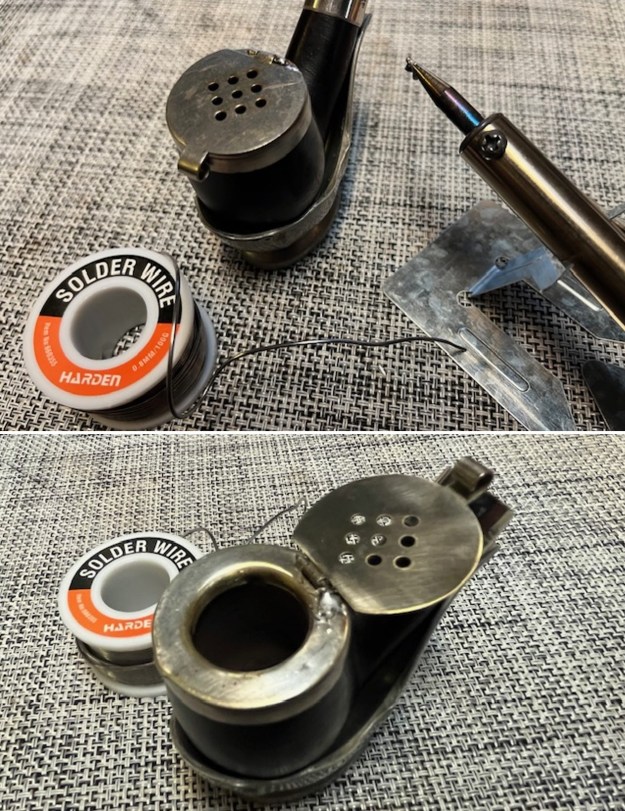
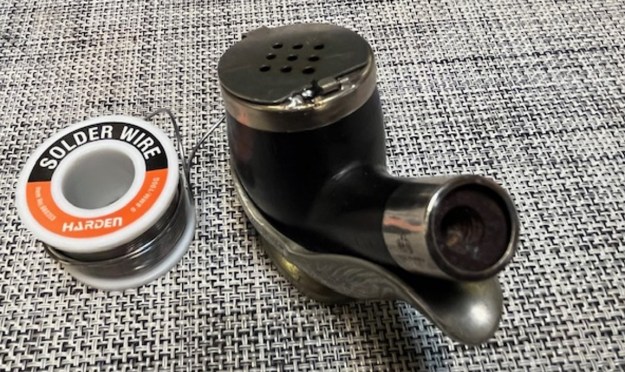
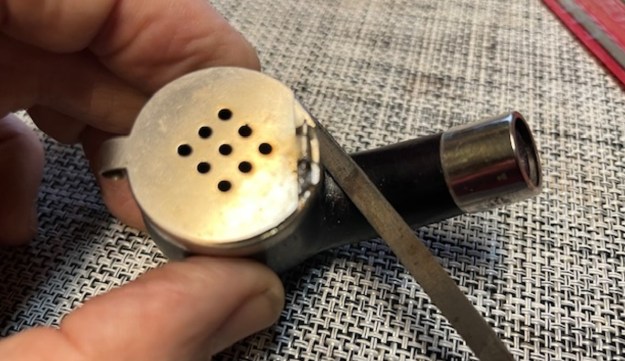
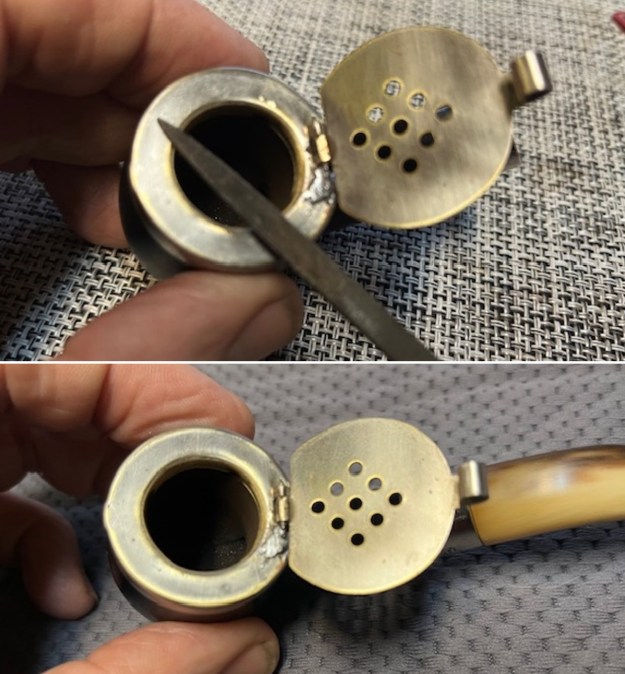
He sent the following photos which I have included below. They reveal the condition of the pipe and gave me a sense of what would be needed. When the pipe arrived yesterday I took it to the worktable. I took it out of the box and took photos of it before I started working on it. The pictures that Rob sent above told the story very clearly. The finish looked okay but there were some nicks and dents in the briar. The stain was a dark purple/oxblood colour that hid the grain but it is the classic stain that was on the bowl when it was made. The nickel on the band and rim edge were clean. The cap needed polishing and the inside of the cap was dirty with tars, oils and build up. The horn stem had tooth marks on the top and underside ahead of the button. I took a photo of the rim top and cap to show the condition. You can see that part of the hinge material is missing at the bottom edge of the pin below. I have inserted a red arrow in the photo below showing the missing hinge piece. I opened the cap and took a photo of the inside. The top of the cap is dirty as noted above and quite rough. The rim cap is also dirty and will need to be cleaned. I also took photos of the stem to show the tooth marks in the surface. I took a photo of the stamp on the shank side. There is some gold leaf still in the stamp that I would touch up after the clean up. I took a photo of the stem and bowl to give a sense of the size and proportion of the pipe. I decided to start with the stem work. I sanded out the tooth marks on the stem surface with 320-35000 grit sanding pads to remove the tooth marks in the surface of the stem. Once I was able to remove the marks in the stem surface and started polishing the horn surface. It looked much better.I polished the vulcanite stem with micromesh sanding pads – dry sanding it with 1500-12000 grit pads. I wiped the stem down after each sanding pad with Obsidian Oil and set it aside to dry.I polished it further with Before & After Pipe Polish – using both the Fine and Extra Fine Polishes. I gave it a rubdown with Obsidian Oil one last time and set it aside. I set the stem aside and turned my attention to the bowl. I removed the cap and the hinge pin from the one side of the cap to free it from the bowl so that I could work on it.  I used a folded piece of 220 grit sandpaper to clean up the metal lined inner edge of the bowl. I also cleaned up the rim cap top at the same time.I scraped the bowl with a Savinelli Fitsall Pipe Knife. I removed all of the cake on the bowl walls. I sanded the bowl walls smooth with a piece of dowel wrapped with 220 grit sandpaper. The bowl was smooth and undamaged.I cleaned up the top of the wind cap with a worn 1200 grit micromesh sanding pad to remove the grime on the top of the cap. I also worked on the build up on the inside of the cap with the same piece of 1200 grit micromesh. It removed the grime but did not damage the polished nickel.I cleaned out the internals in the shank and the airway in the stem and shank with pipe cleaners and isopropyl alcohol. It was surprisingly clean and it took very few cleaners to leave it clean.I touched up the light spots on the bowl sides and on the joint of the shank and the bowl with a Mahogany stain pen. The colour matched perfectly. Once it had cured I would polish it and blend it further. I worked Before & After Restoration Balm deep into the smooth finish to clean, enliven and protect the briar. I hand rubbed it with my fingers and worked it into the finish then set it aside to dry for 10-15 minutes. I wiped it off with a soft cloth. I buffed the bowl with a cotton cloth to polish it. It really began to have a deep shine in the briar. I took some photos of the bowl at this point to mark the progress in the restoration. The grain on the bowl stands out with interesting lines moving across the sides of the bowl and the shank. I touched up the gold gilt in the stamping on the left side shank with Rub’n Buff Antique Gold. I worked it into the stamping with a tooth pick and buffed off the excess with a cotton pad. It looked quite good with the retouched stamp.Now it was time to work on the broken hinge on the cap. The right side of the hinge cap was present as was the hinge pin. The right side had broken off somewhere in the life of the pipe. I used a soldering iron and some solder wired to build up a cap over the left side end of the hinge pin. I opened the lid and soldered the end over the pin on the inside of the cap first. I closed the lid and built it up on the outside of the hinge. I used a small flat file to flatten out the hinge end on the inside and the outside of the cap. I finished it up with a Dremel and a sanding drum to further flatten it out. I screwed the horn stem back on the KB&B Palmyra Bent Billiard and carefully worked the pipe over on the buffing wheel using Blue Diamond to lightly polish the stem. I buffed the bowl and stem to raise the gloss on the briar and the vulcanite. I gave the pipe multiple coats of carnauba wax. I buffed the entire pipe with a clean buffing pad to raise the shine. I hand buffed it with a microfiber cloth to deepen the shine. The finished KB&B Palmyra Bent Billiard is shown in the photos below. The purple/oxblood stains on the smooth Billiard shaped bowl works well with the polished nickel band and the polished horn stem. The dimensions of the pipe are: Length: 4 ½ inches, Height: 1 ¾ inches, Outside Diameter: 1 ¼ inches, Diameter of the chamber: ¾ of an inch. The weight of the pipe is 1.38 ounces/39 grams. This is an interesting pipe with the dark stain on the bowl, the gold stamp on the left side of the shank and shank, the nickel wind cap and band all work with the polished horn stem. I really like how well the parts work together. This one will soon be on its way back to Rob. I think he will enjoy himself with this beautiful little old timer. I look forward to hearing what he thinks of it once he sees it.

As always, I encourage your questions and comments as you read the blog. Thanks to each of you who are reading this blog. Remember we are not pipe owners; we are pipe men and women who hold our pipes in trust until they pass on into the trust of those who follow us.

Cleaning up a Fascinating KBB Yello-Bole Premier Billiard


Blog by Steve Laug

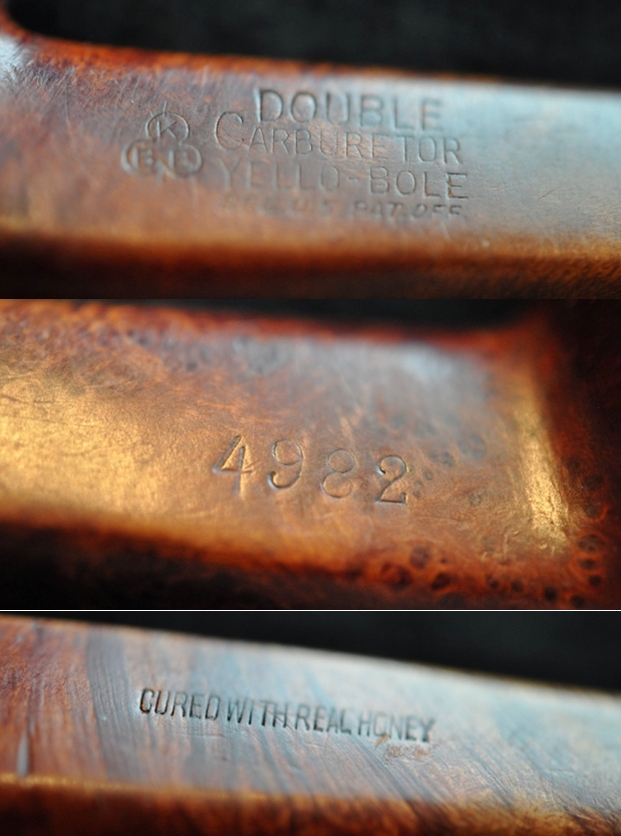
Jeff purchased this pipe off eBay on 05/27/2016 from a seller in Strasburg, Ohio, USA. Once again he showed that he has an eye for old and unique pipes. This one is a straight Billiard with a classic almost British look to it. The grain around the bowl and shank was quite nice and shone through the grime ground into the finish. The bowl was coated with peeling varnish or some shine coat that was worn off around parts of the bowl and shank. The rim top had a lot of dents and damage but that will become evident in the following photos. The bowl had a thick cake and a lava overflow on the inner edge of the bowl. It was stamped on the left side of the shank and has the KBB in a cloverleaf and next to that it reads Yello-Bole over Cured with Real Honey. Next to that is the symbol for a registered trademark ® (R in a circle). Underneath it reads Premier over Imported Briar. On the right side of the shank the stamping very worn but illegible. It may be a shape number but I am not sure. On the stem is the propeller inset logo that appeared on older Yello-Bole pipes. Jeff took photos of the pipe before he started his cleanup work. Jeff took some photos of the rim top and the heel of the bowl to show the condition of the bowl, rim top and finish around the bowl. The bowl interestingly, still had some of the Yello-Bole Honey Cured coating on the top edge and the bottom of the bowl. The rim had been knocked hard on surfaces to empty the bowl. There was some lava and dirt on the rim top and there was a moderate cake in the bowl. There appeared to be issues with the inner edge of the bowl but the outer edge looked to be in good condition. The stem was in decent condition. It was oxidized on both sides of the stem. There were some nicks and tooth marks on both sides near the button and on the top and underside of the button itself. I went back to a previous blog about the various Yello-Bole logos in my collection of these pipes. I reread that blog to try to narrow down a date for the pipe. Here is the link to the post and the comments on the blog: https://rebornpipes.com/2013/01/25/yello-bole-logos-from-my-collection-of-old-yello-bole-pipes/. There was a comment on that blog that came from Troy who I consider my “go to guy” for Yello-Bole information (he has written on rebornpipes and also has a blog of his own). Troy wrote as follows on dating Yello-Bole pipes by the stamping and logos.

“I have a large KBB Yello-Bole collection. They are some of my most favorite pipes and the best smokers for the money (briar wise) you can find in my opinion. I have restored and researched them quite a bit. I have several listed on my blog that I have cleaned or restored. I own about 30-40 KBB Yello-Boles now.”

“Here is a little guide to dating KBB Yello-Boles. If it has the KBB stamped in the clover leaf it was made 1955 or earlier as they stopped the stamping after being acquired by S.M. Frank. From 1933-1936 they were stamped Honey Cured Briar. Pipes stems stamped with the propeller logo they were made in the 30s or 40s no propellers were used after the 40s. Yello-Bole also used a 4 digit code stamped on the pipe in the 30s. If the pipe had the Yello-Bole circle stamped on the shank it was made in the 30s this stopped after 1939. If the pipe was stamped BRUYERE rather than briar it was made in the 30s.” (NB. The portions above in bold and underlined were highlighted as they pertain to the present pipe.)

From that information I ascertained the following. The nicely grained Premier Billiard I had was stamped with KBB in the cloverleaf on the left underside of the shank which told me that the pipe was made before 1955. It had a propeller logo on the stem which further placed it in the period of the 30s and 40s. With all of that collected I knew the pipe was made between 1930 and 1949 which means that this old Billiard has seen a lot of life. I wish it could tell its story.

Ah well… I don’t know for sure where it came from or what previous pipeman carried the trust of this pipe before it came to me. I still needed to do my part of the restoration. I turned my attention to the restoration of the Billiard.

Jeff had worked his magic in cleaning up this pipe. It is nice to work on pipes that he has cleaned up instead of cleaning them myself. He reamed it with a PipNet reamer and smoothed the walls of the bowl with a Savinelli Fitsall pipe knife. He scrubbed out the mortise and the airway in the shank and the stem with alcohol, cotton swabs and pipe cleaners. He scrubbed the exterior of the bowl, rim and shank with a tooth brush and Murphy’s Oil Soap to the oils and tars on the bowl, rim and shank. He rinsed it under running water. He dried it off with a soft cloth. He was able to remove much of the crackling varnish and the briar beneath was in good condition. The cleaning of the stem left a light oxidation in the vulcanite. The tooth marks were clean but visible. I took photos of the pipe to show its condition before I started my work on it.  I took some photos of the rim top and cap to show what it looked like after Jeff had cleaned off the grime and tars. The briar was in good condition but there were some scratches in the flat top and darkening around the inner edge. The bowl was slightly out of round. The stem showed light tooth chatter and wear but it was otherwise in good condition. There were no deep tooth marks. I took photos of the shank sides. The stamping on the left side of the shank is faint but readable. The stamping on the right side is very faint and I am not able to make it out clearly.I removed the stem from the shank and took a photo of the overall look of the pipe. You can see the shovel stinger apparatus in the tenon.I started my work on this pipe by wiping the bowl down with acetone on a paper towel to remove the varnish that remained. Once I was finished the finish was clean and the grain looked really good on the bowl and the rim top. I used a folded piece of 220 grit sandpaper to clean up the damage and darkening there. I also smoothed out the damage on the rim top. It worked amazingly well and the finished edge and top looked much better.  I polished the bowl and the rim top with micromesh sanding pads – wet sanding with 1500-2400 grit pads and dry sanding with 3200-12000 grit pads. I wiped the bowl down after each pad with a damp cloth.    I rubbed some Before & After Restoration Balm into the surface of the briar to enliven, clean and preserve it. I rubbed it in with my fingertips working it into the briar. I set it aside for 15 minutes to let the balm do its work. I buffed it off with a cotton cloth and then buffed it with a microfiber cloth. The photos below show the pipe at this point in the restoration process.  I set aside the bowl and turned my attention to the stem. I polished the aluminum shovel stinger apparatus with a 1500 grit micromesh sanding pad. It took on a rich shine.I polished the stem using micromesh sanding pads – wet sanding with 1500-12000 grit pads to further polish it. After each pad I wiped it down with Obsidian Oil to protect and enliven the stem. I polished it further with Before & After Pipe Polish – both Fine and Extra Fine. When I finished with the polish I gave it a final coat of Obsidian Oil and set it aside to dry. This older rusticated KBB Cured With Real Honey ® Yello-Bole Premier Billiard is an interesting and unusual piece. It has a classic English looking Billiard shape. The smooth finish around the bowl and shank has some nice straight and flame grain around the sides. The rim top and heel have some nice looking birdseye grain. The reddish brown of the bowl and the black of taper vulcanite stem contrast well together. I buffed the bowl and the stem with Blue Diamond polish to raise the shine on the briar and the vulcanite. I lightly buffed the rim top and shank end as well. I was careful to not buff the stamping and damage it. I gave the bowl and the stem multiple coats of carnauba wax. I buffed the entire pipe with a clean buffing pad to raise the shine. I hand buffed it with a microfiber cloth to deepen the shine. The finished pipe is shown in the photos below. The dimensions of the pipe are: Length: 6 inches, Height: 1 ¾ inches, Outside Diameter: 1 ¼ inches, Diameter of the chamber: ¾ of an inch. The weight of the pipe is 1.62 ounces/46 grams. It is an interesting old pipe and should make a great collectible piece for lovers of old Americana Pipe Making Companies. I will be adding it to the American Pipemakers Section on the rebornpipes store very soon if you would like to add it to your collection. Thanks for walking through the restoration with me.
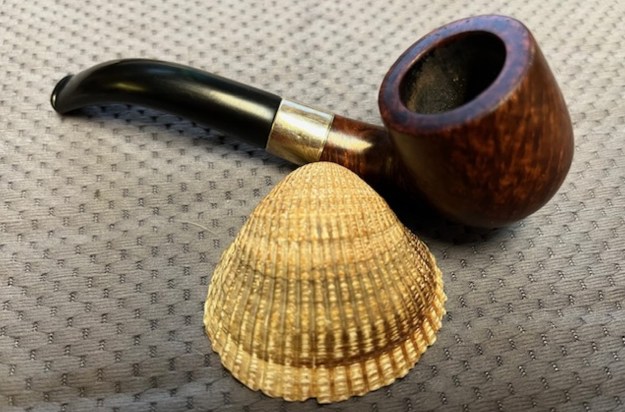
Reviving another Old Timer – a KB&B Sicilia Italian Briar Zulu


Blog by Steve Laug

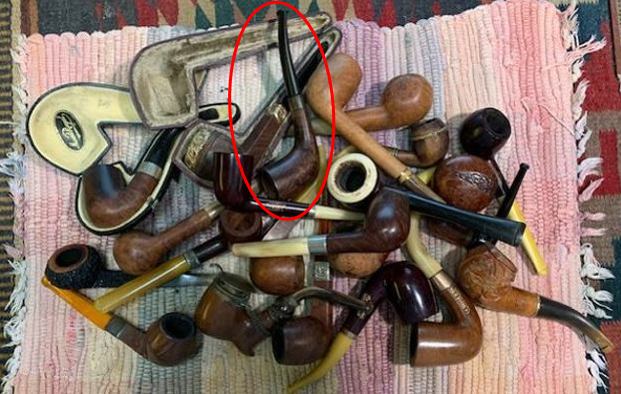
I finished the restoration of four of the older horn stem pipes that I have posted the blogs about on rebornpipes, the first was a beautiful early 1900s KB&B Horn Stemmed Italian Billiard (https://rebornpipes.com/2021/08/29/reviving-another-older-horn-stemmed-pipe-my-next-choice/) then an early French made JSN Racine Bruyere Dublin with a horn stem (https://rebornpipes.com/2021/08/29/reviving-another-older-horn-stemmed-pipe-from-the-bag-of-old-timers/), then a lightly smoked GVG Liverpool made by the founder of Genod (https://rebornpipes.com/2021/08/31/reviving-a-lightly-smoked-horn-stem-gvg-extra-9745-liverpool/), fourth a Belle D’ Or Vielle Bruyere “Double Or” French Made Bent Dublin (https://rebornpipes.com/2021/09/01/restoring-a-la-belle-dor-vielle-bruyere-double-or-horn-stem-bent-dublin/), and fifth a Diamond Black Squat Bulldog with an unusual cut glass style rustication (https://rebornpipes.com/2021/09/03/restoring-a-diamond-black-extra-squat-bulldog/). I decided to keep working on the bag of older NOS/unsmoked and lightly smoked pipes. I chose another old timer from the lot and this time picked a bit of a mystery pipe. It is buried in the pile in the photo below but it is clear in the second photo.In the photo of the poured out bag on my desk top I have circled the pipe that is next on the table. This was an unsmoked Zulu shaped pipe with a smooth finish that was very worn and dirty. The rim top was unmarked and looked good. This little Zulu really intrigued me so it was next. The Zulu pipe was stamped on the top of the shank and read Sicilia [arched over] KB&B in a cloverleaf [over] Italian Briar. The shank band was oxidized to a point it was almost not readable. Underneath the oxidation it was clearly stamped KB&B in a cloverleaf [over] Nickel Plated. The bowl was unsmoked but the finish was shot and very worn. There was a large chip of briar missing on the top inside of the mortise even though the shank itself was clean. The band had been glued in place and held it together. The missing chunk explained why the fit of the stem to the shank was not correct. The pipe had vulcanite/hard rubber stem that was in good condition with no tooth marks or chatter on the stem. The button was orific – a round hole in the button end. The button was in excellent condition. Here are a few photos of the pipe before I did anything to it. I took photos of the bowl and stem. You can see the unused condition of the bowl and the clean, though peeling rim top and edges. The drilling is just a little off centered to the right in the bottom of the bowl. It is a good sized bowl. The interior walls of the pipe are smooth and do not have drilling marks or checks or chips. The vulcanite stem is in excellent condition and has a push tenon and an orific button. I took a photo of the stamping on the topside of the shank. It reads as noted above. You can see the stamping on the top of the band – the KB&B cloverleaf is clear and readable with the Nickel Plated stamp below.I removed the stem from the shank. You can see the brand new threaded bone tenon in the photo below. The proportions of this pipe are well done. The grain around the bowl is very nice.I quote from the blog on a recent KB&B Billiard that I just restored (https://rebornpipes.com/2021/08/29/reviving-another-older-horn-stemmed-pipe-my-next-choice/).

I turned to Pipedia for a review of the history of the brand and to try and pin down a date for this pipe (https://pipedia.org/wiki/Kaufmann_Bros._%26_Bondy). There is a great historical article there that is worth the read. I quote portions of that below.

Early History
Kaufmann Bros. & Bondy (KB&B), Kaywoodie has been making pipes since well before the Civil War – around 1851. They peaked in the late 1950’s along with most American Briar works. In the early 20th century, their pipes were the standard others were measured by, along with Sasieni, Charatan and Comoy’s. There were few other world-class American pipe-crafters (William Demuth Company, early L & H Stern). Their pipes were as good as any of the renowned British firms. Kaywoodie just did not merely produce quantity, they provided quality: in the 1920’s they bought the exclusive rights to some of the choicest briar fields in history, hauling out 250 year-old roots the size of 27″ TVs and fashioning masterpieces out of this spectacular-grained ancient briar…

Early KB&B (non Kaywoodie)
Kaywoodie was the name a pipe offered by Kaufmann Bros. & Bondy Company (KB&B), first appearing in February of 1919. The Dinwoodie pipe, also by KB&B, appeared in November of 1919. Other KB&B brandings included Ambassador, Heatherby, Kingston, Langley, Melrose, Hollywood, Paragon, Borlum, Sicilia, Cadillac, Capitol Extra, Times Square and Kamello. Sometime before 1924, the Dinwoodie had been discontinued and the Kaywoodie name was beginning to be used on an extensive line of pipes that ultimately would be the name of the company. The origin of the name Kaywoodie is a combination of the K from Kaufmann and wood, as in briar. Not much is known of the original KB&B company other than it was started in 1851 by the German born Kaufmann brothers when they opened a small pipe shop in the Bowery section of New York City. In the back room of this shop, they made their first pipes. From this meager beginning, the Kaywoodie name and organization was to emerge…

…Hacker concludes his history of Kaywoodie Pipes by noting that: “The KB&B briar pipe brand existed from 1900 until just after World War I (with some overlapping with the Kaywoodie from 1915 — 1917), and collectors refer to the KB&B as a Kaywoodie transition pipe. During the early years of the 20th century a number of filter systems were designed by the KB&B firm and incorporated into their Kaywoodie Pipes under the names of Synchro-Stem and Kaywoodie Drinkless filters. During the late 1920’s and throughout the 30’s the Kaywoodie became a highly respected pipe in spite of its filter system (which was popular among many smokers of the era) primarily due to the fine quality of the straight grain and the flame grain models. Unfortunately, the hard-to-get-briar years of World War II marked the decline of the Kaywoodie Pipe, a plummet from which it has never recovered as far as collectors are concerned….”

The pre-Kaywoodie KB&B pipes were marked on the shank with a cloverleaf around KB&B. Some early Kaywoodies had this same marking on the shank, but the practice was dropped sometime prior to 1936. Yello-Boles also had KB&B in the leaf on the shanks, but did not have the ampersand found on Kaywoodies.

From that I knew that the pipe I was working on was a Sicilia Italian Briar that had been made between 1900 and 1917 because of the KBB Clowerleaf. Now it was time to work on the pipe.

I started my work on the pipe by addressing the large chip in the top of the shank. I filled it in with a mixture of super glue and briar dust. I layered it in place in the shank with a dental spatula. I was able to rebuild it and strengthen it.I wiped down the bowl with acetone on a cotton pad to remove the peeling varnish coat and grime on the finish of the bowl sides. Wiping it down revealed some great grain around the bowl and shank sides. I polished the briar and the nickel plated band with micromesh sanding pads. I dry sanded with 1500-12000 grit pads and wiped the bowl down with a damp cloth after each sanding pad. The briar began to really come alive. I polished the nickel band with a jewelers cloth to remove the oxidation and protect the finish on it. It looks much better.I rubbed the briar down with Before & After Restoration Balm. I worked it into the finish with my fingertips. The product works to clean, enliven and protect briar finished. I let it sit for 10 minutes then buffed it off with a cotton cloth. The grain on the bowl really came alive with the buffing. It is really a beautiful pipe. I set the bowl aside and polished the vulcanite stem with micromesh sanding pads – 1500-12000 grit pads. I wiped the stem down after each pad with Obsidian Oil to protect and enliven the vulcanite. It came out looking very good. This interesting 1900-1917 KB&B Sicilia Italian Briar with a Vulcanite Stem Zulu turned out really well and it is a great looking pipe with a great shape to it. The fact that it is New Old Stock (NOS)/ unsmoked is an additional bonus. The grain on the briar and the sheen on the stem really popped when the pipe was buffed with blue diamond on the buffing wheel. The nickel band also took on a sheen. I gave the bowl and stem multiple coats of carnauba wax and buffed it with a clean buffing pad. I hand buffed the pipe with a microfiber cloth to deepen the shine. The finished KB&B Sicilia Italian Briar Zulu is comfortable to hold and is quite distinguished looking. Give the finished pipe a look in the photos below. The dimensions of the pipe are Length: 5 ¼  inches, Height: 1 ¾ inches, Outside diameter of the bowl: 1 1/8 inches, Chamber diameter: ¾ of an inch. The weight of the pipe is 29 grams/1.02 ounces. With the internal shank repair this is probably one I should hold on it. It is also a really beautiful pipe that will fit nicely into my older American pipe collection. Thanks for reading this blog and my reflections on the pipe while I worked on it. Keep an eye out on the blog as I have several other older pipes that I will be working on.

Reviving another Older Horn Stemmed Pipe… My next choice


Blog by Steve Laug

Once I finished working on those Ehrlich meerschaum pipes for my friend I was wondering what I wanted to work on. You may not have that issue but you have to remember that I probably have over 500 pipes to choose from. I went through some of the boxes of pipes – British wood? No! Irish pipes? No! I have been pretty well cured of Irish seconds so I have culled the few of those out of the boxes. I looked at a bunch of meerschaum pipes that I have to work on and just shook my head. What was I going to choose and what caught my eye? In one of my drawers of pipes to work on I found a bag of older briar from all over the world. Some American, some French, some English and a few unsmoked pipes. Some of those caught my eye. I walked away and worked on some wall repairs in upstairs bathroom. I have been chipping away at the honey do list! While I worked I mentally went through the boxes.

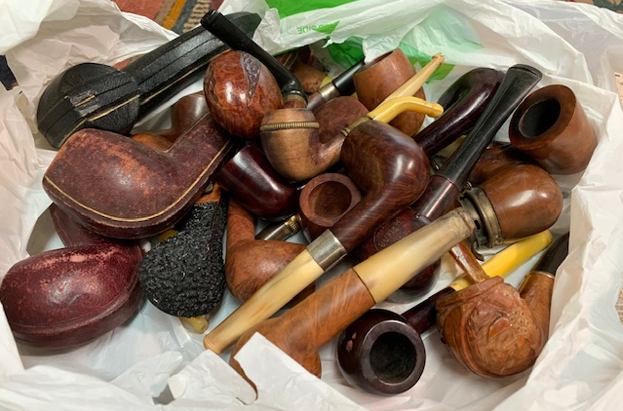
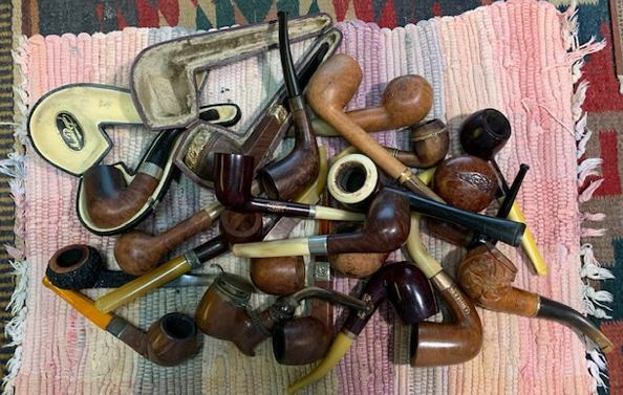
This morning while I watered the garden and sat on the porch with a hot coffee I made up my mind. What lot do you think I chose? I think you already know. It would be the bag of older pipes. That bag held a lot of mysterious and interesting older pipes. I poured the bag out on my desk top and took a photo. You can see the options that were on the desk before me. I picked through them all and looked them over. There are a fair number of French pipes and even two or more C.P.F. pipes. If you have followed rebornpipes long you know how much I like C.P.F. pipes so you may well think I would choose one of those to work on next. There were smoked and New Old Stock Pipes. There were older American made pipes and British made pipes. All in all it was a very unique lot of pipes that gave me a world of choices. So I ask you which would you choose next? What do you think I chose next? I am curious to know what you think. Certainly you can’t read my mind but you may have an inkling.The first thing I did was separate out the NOS and unsmoked pipes from the lot. This included four different French Made pipes and one that was stamped KB&B on the nickel band. All had horn stems and all were well worth working on. All were shelf worn from sitting around for many years but all had clean bowls. All had some nicks and scratches in the bowls but all spoke to me. So which one should I work on? That is where my mind went. At least the number was less than the whole pile shown above.

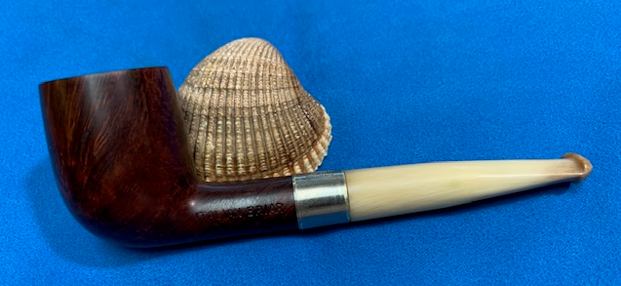
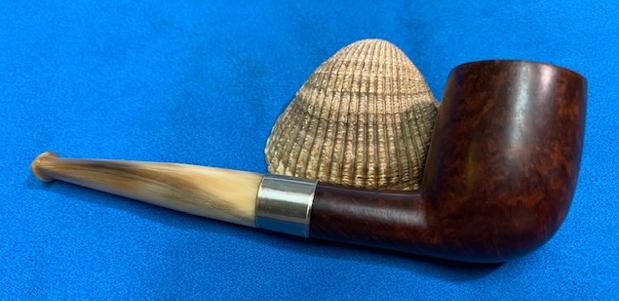
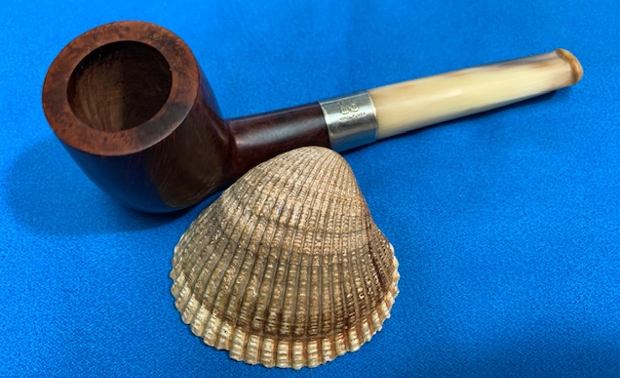
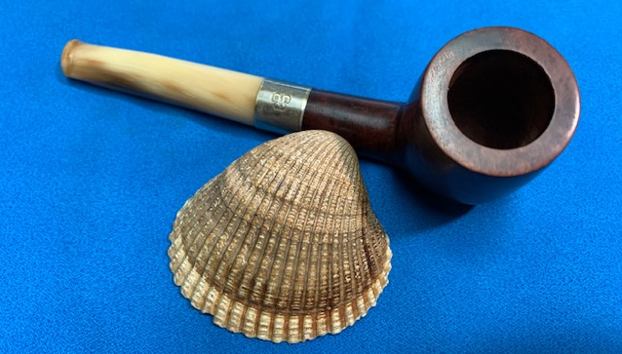
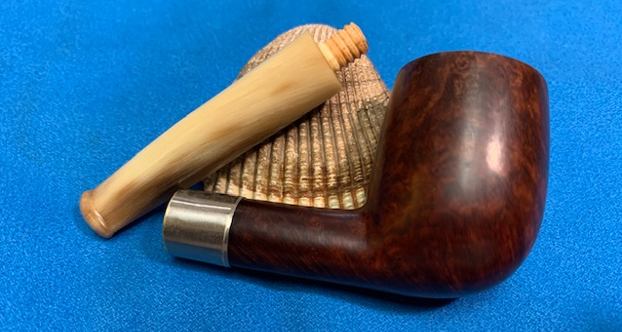
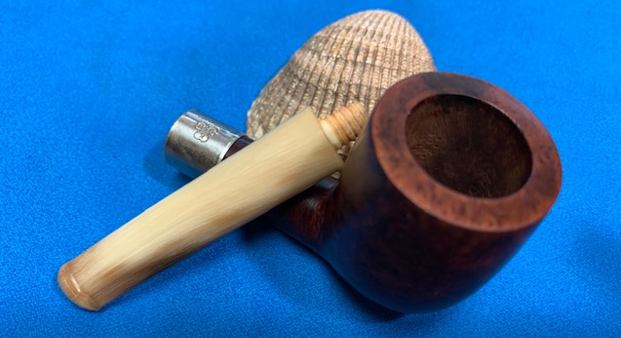
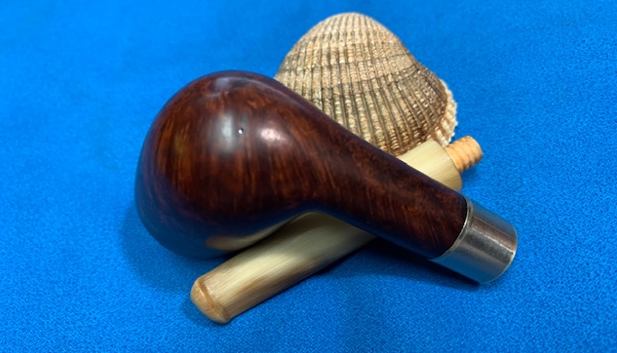
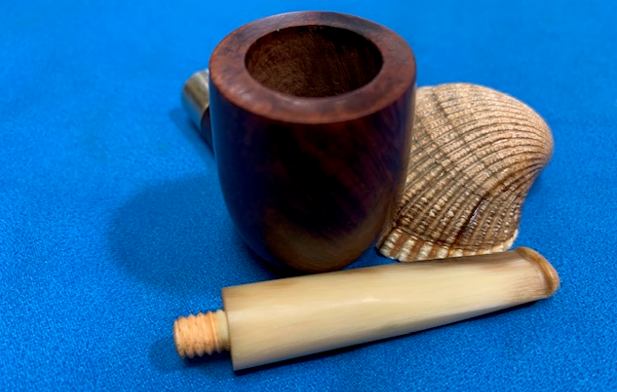
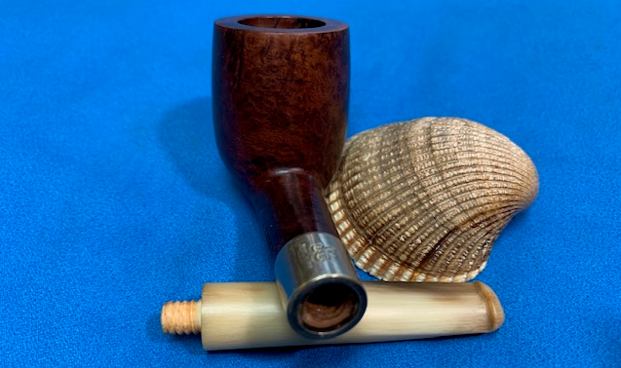
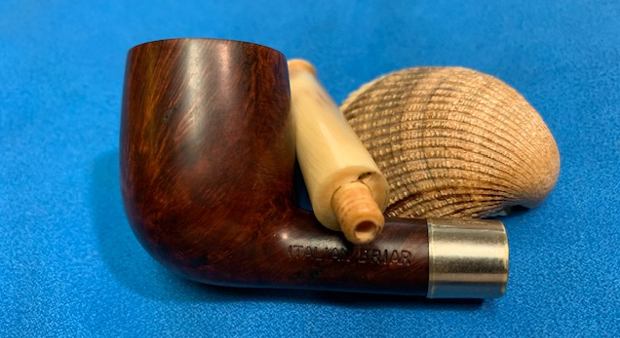
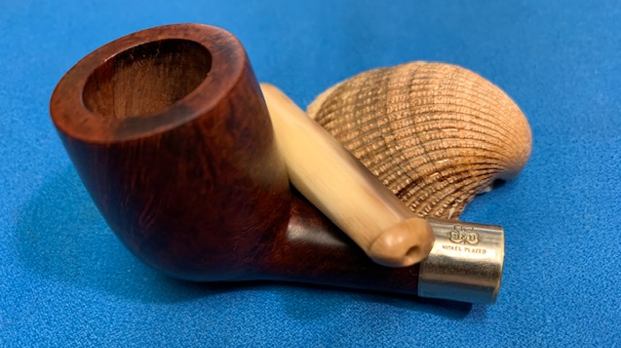
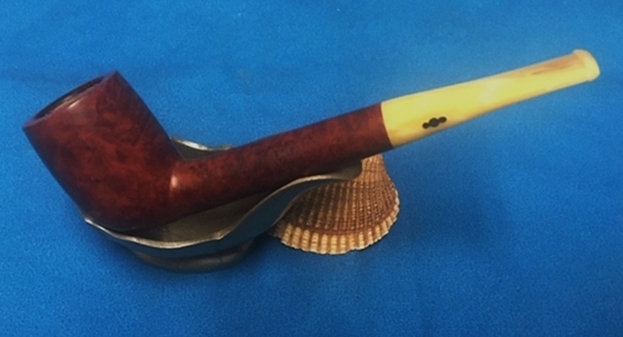
I sat at my desk and went through them all again. I finally made up my mind and chose the older KB&B pipe that probably came from the early 1900s by the look of it. It is an unsmoked, new old stock (NOS) Billiard that is stamped on the left side of the shank and reads ITALIAN BRIAR. There is no other stamping on the shank of the pipe. There is an oxidized silver coloured band that stamped with the KB&B cloverleaf [over] Nickel Plated. The finish is dark and dirty with some nicks on the heel of the bowl and left side of the heel. It was tired looking but under the dark and debris it was quite stunning. The stem is horn and the tenon is threaded bone. It is anchored in the stem and screws into a threaded mortise, strengthen by the band/ferrule. It is a beauty that I want to refresh and probably add to my own collection. Here are a few photos of the pipe before I did anything to it. I took photos of the bowl and stem. You can see the unused condition of the bowl and the clean rim top and edges. The drilling is centered in the bottom of the bowl. It is a good sized bowl. The interior walls of the pipe are smooth and do not have drilling marks or checks or chips. The horn stem is in excellent condition and has a orific button. I took a photo of the stamping on the left side of the shank. It reads as noted above. You can see the stamping on the top of the band – the KB&B cloverleaf is clear and readable with the Nickel Plated stamp below.I removed the stem from the shank. You can see the brand new threaded bone tenon in the photo below. The proportions of this pipe are well done. The grain around the bowl is very nice. I turned to Pipedia for a review of the history of the brand and to try and pin down a date for this pipe (https://pipedia.org/wiki/Kaufmann_Bros._%26_Bondy). There is a great historical article there that is worth the read. I quote portions of that below.

Early History

Kaufmann Bros. & Bondy (KB&B), Kaywoodie has been making pipes since well before the Civil War – around 1851. They peaked in the late 1950’s along with most American Briar works. In the early 20th century, their pipes were the standard others were measured by, along with Sasieni, Charatan and Comoy’s. There were few other world-class American pipe-crafters (William Demuth Company, early L & H Stern). Their pipes were as good as any of the renowned British firms. Kaywoodie just did not merely produce quantity, they provided quality: in the 1920’s they bought the exclusive rights to some of the choicest briar fields in history, hauling out 250 year-old roots the size of 27″ TVs and fashioning masterpieces out of this spectacular-grained ancient briar…

Early KB&B (non Kaywoodie)

Kaywoodie was the name a pipe offered by Kaufmann Bros. & Bondy Company (KB&B), first appearing in February of 1919. The Dinwoodie pipe, also by KB&B, appeared in November of 1919. Other KB&B brandings included Ambassador, Heatherby, Kingston, Langley, Melrose, Hollywood, Paragon, Borlum, Sicilla, Cadillac, Capitol Extra, Times Square and Kamello. Sometime before 1924, the Dinwoodie had been discontinued and the Kaywoodie name was beginning to be used on an extensive line of pipes that ultimately would be the name of the company. The origin of the name Kaywoodie is a combination of the K from Kaufmann and wood, as in briar. Not much is known of the original KB&B company other than it was started in 1851 by the German born Kaufmann brothers when they opened a small pipe shop in the Bowery section of New York City. In the back room of this shop, they made their first pipes. From this meager beginning, the Kaywoodie name and organization was to emerge…

…Hacker concludes his history of Kaywoodie Pipes by noting that: “The KB&B briar pipe brand existed from 1900 until just after World War I (with some overlapping with the Kaywoodie from 1915 — 1917), and collectors refer to the KB&B as a Kaywoodie transition pipe. During the early years of the 20th century a number of filter systems were designed by the KB&B firm and incorporated into their Kaywoodie Pipes under the names of Synchro-Stem and Kaywoodie Drinkless filters. During the late 1920’s and throughout the 30’s the Kaywoodie became a highly respected pipe in spite of its filter system (which was popular among many smokers of the era) primarily due to the fine quality of the straight grain and the flame grain models. Unfortunately, the hard-to-get-briar years of World War II marked the decline of the Kaywoodie Pipe, a plummet from which it has never recovered as far as collectors are concerned….”

The pre-Kaywoodie KB&B pipes were marked on the shank with a cloverleaf around KB&B. Some early Kaywoodies had this same marking on the shank, but the practice was dropped sometime prior to 1936. Yello-Boles also had KB&B in the leaf on the shanks, but did not have the ampersand found on Kaywoodies.

From that I knew that the pipe I was working on was made between 1900 and 1917 because of the KBB Clowerleaf. Now it was time to work on the pipe.

While the stem was removed I used a heated knife and wet cloth to steam out the dents in the briar. I found as I worked on them that they were quite deep. I was able to raise them a bit with multiple steaming but not completely. They were dark spots already so I figured a spot of clear CA glue would level things out.I polished the briar and smoothed out the repairs with micromesh sanding pads. I dry sanded with 1500-12000 grit pads and wiped the bowl down with a damp cloth after each sanding pad. It began to really come alive. I rubbed the briar down with Before & After Restoration Balm. I worked it into the finish with my fingertips. The product works to clean, enliven and protect briar finished. I let it sit for 10 minutes then buffed it off with a cotton cloth. The grain on the bowl really came alive with the buffing. It is really a beautiful pipe. I did a quick polish on the horn stem with micromesh sanding pads – 1500-12000 grit pads. I wiped the stem down after each pad with Obsidian Oil to protect and enliven the horn. It came out looking very good.This interesting 1900-1917 KB&B Italian Horn stem Billiard turned out really well and it is a great looking pipe with a great shape to it. The fact that it is New Old Stock (NOS)/ unsmoked is an additional bonus. The grain on the briar and the sheen on the horn stem really popped when the pipe was buffed with blue diamond on the buffing wheel. The nickel band also took on a sheen. I gave the bowl and stem multiple coats of carnauba wax and buffed it with a clean buffing pad. I hand buffed the pipe with a microfiber cloth to deepen the shine. The finished KB&B Italian Briar Billiard is comfortable to hold and is quite distinguished looking. Give the finished pipe a look in the photos below. The dimensions of the pipe are Length: 5 inches, Height: 1 ½ inches, Outside diameter of the bowl: 1 1/8 inches, Chamber diameter: ¾ of an inch. The weight of the pipe is 29 grams/1.02 ounces. This is a beautiful pipe that will fit nicely into my older American pipe collection. Thanks for reading this blog and my reflections on the pipe while I worked on it. Keep an eye out on the blog as I have several other older horn stemmed pipes that will be coming up soon.

Restoring a KBB Yello-Bole Premier Liverpool


Blog by Steve Laug

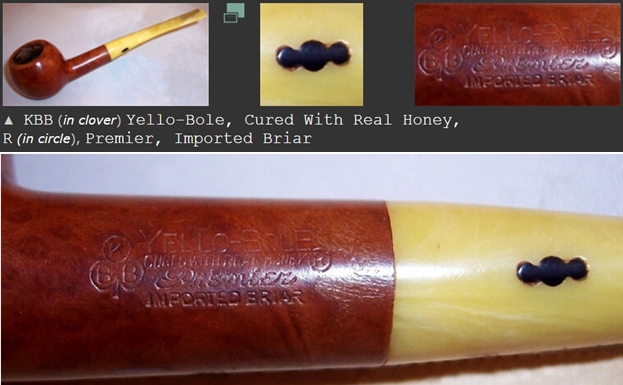
With this post I am celebrating notification from WordPress that rebornpipes is 8 years old. It does not seem possible that 8 years ago in May I posted the first blog on rebornpipes and wrote about my dream of the blog being a gathering spot for information and individuals who enjoy working on rehabilitation and restoration of pipes. I continue to do the work or restoration and rehabilitation of pipes because it is something I enjoy. It is a pleasure to take pipes that are a bit of a wreck and with some effort and careful work bring them back to life. The next pipe on the table is a great one to work on as a part of that celebration. It is a well smoked KBB Yello-Bole Premier Liverpool. The pipe was very dirty with a thick cake in the bowl and some tobacco remnants from the last bowl smoked. There was some darkening and lava around the rim top and inner edge of the bowl. There are a few visible fills around the bowl and the varnish coat is crackling. The taper yellow stem has tooth marks and chatter on both sides. Jeff took some great photos of the pipe to show its general condition before he started his cleanup. Jeff took a photo of the rim top to show the thick cake in the bowl and the lava overflow all over the rim top. It is hard to know what the inner edge of the rim looks like until we remove the cake and the lava.He took photos around the sides and heel of the bowl to show the condition. You can see the grime in the finish and the crackling of the varnish coat. He took a photo of the stamping on the left topside of the shank. You can see that it is clear and readable. It reads KBB in a Cloverleaf followed by Yello-Bole over Cured with Real Honey followed by R in a circle. Underneath that it reads Premier over Imported Briar. Normally there would be stamping on the right side but in this case there does not appear to be any stamping visible.The next two photos show the condition of the stem. You can see that it is lightly oxidized and has some tooth chatter and marks on both sides near the button. There is also some wear on the button surfaces on both sides. I turned to the listing on Pipephil on the KBB Yello-Bole pipes and actually found a very similar pipe to the one I am working on (http://www.pipephil.eu/logos/en/logo-y.html). It is a KBB in a cloverleaf Yello-Bole that also bears the Cured with Real Honey, circle R stamp over Premier over Imported Briar. I did a screen capture of the section and the stamping on the shank side. I have included it below.I turned next to Pipedia to gather a more detailed history of the brand and see if I could find any information on this particular pipe (https://pipedia.org/wiki/Yello-Bole). I quote a portion of that article on tips for dating Yello-Bole pipes below.

Tips for Dating Yello-Bole Pipes

  • KBB stamped in the clover leaf indicates it was made in 1955 or earlier as they stopped this stamping after being acquired by S.M. Frank.
  • Pipes from 1933-1936 they were stamped “Honey Cured Briar”
  • Post 1936 pipes were stamped “Cured with Real Honey”
  • Pipe stems stamped with the propeller logo were made in the 1930’s or 1940’s – no propellers were used after the 1940’s.
  • Yello Bole used a 4 digit code stamped on the pipe in the 1930’s.
  • Pipes with the Yello-Bole circle stamped on the shank it were made in the 1930’s, this stopped after 1939.
  • Pipes stamped BRUYERE rather than BRIAR it was made in the 1930’s.

Following the tips above I learned that the KBB Stamped in a Cloverleaf indicates that the pipe I have was 1955 or earlier. The fact that it is stamped Cured with Real Honey puts it post 1936. The field is narrowing down for a date. The fact that the stem has the propeller logo puts it between the 30s and 40s. So now I have it narrowed down to between 1936 and 1949. That is as close as I am going to get with this one as the numbers are worn off the shank.

It is definitely an interesting piece of pipe history. Armed with the brand information and some parameters for the age of the pipe I turned to work on it. Jeff had done a great job cleaning up the pipe as usual. He reamed the pipe with a PipNet reamer and cake from the walls of the bowl. He cleaned up any remnants of cake with a Savinelli Fitsall Pipe Knife. He scrubbed the interior of the bowl and shank with pipe cleaners, cotton swabs and alcohol to remove the tars and oils. He scrubbed the exterior of the pipe with Murphy’s Oil Soap and a tooth brush to remove the grime from the finish. He was not able to remove the bowl from the base so a thorough cleaning of the base was not possible. He worked on the rim edge lava and darkening with the soap and tooth brush. He scrubbed the inside of the stem with alcohol and pipe cleaners. He scrubbed the exterior with Soft Scrub and washed it off with warm water to remove the cleanser. The pipe looked far better. I took photos of the pipe when I received it before I started working on it. I took photos of the bowl and rim top as well as the stem to show how clean they were. You can the roughness on the top and the inner edge of the rim on the front right side of the bowl. The bowl and rim looks much better without the thick lava and cake. The stem looked better. There was tooth chatter and marks were very visible on both sides of the stem near the button. I have included a photo of the propeller logo on the left side of the stem.I took a photo of the stamping on the left side of the shank. The stamping is faint but very readable and it reads as noted above. The right side of the shank is smooth- if there was any stamping it is long gone.I took a photo of the large fill on the underside and up the left side of the shank. It was hard but it had shrunk and left a divot.I took a photo of the pipe with the stem removed to show the overall look of stem, tenon and profile of the pipe. I noted that there was a small stinger apparatus that is removable in the tenon. I heated the stinger with a Bic lighter flame and was able to very easily remove it for more thorough cleaning of the tenon and airway in the stem.I decided to start my work on the pipe by dealing with the damaged rim top and inner edge of the bowl. I lightly topped the bowl with 220 grit sandpaper to minimize the damage on the top. I used a folded piece of 220 grit sandpaper to smooth out the damaged bevel on the rim edge. It is far from perfect but it is better. I polished the bowl with micromesh sanding pads – wet sanding with 1500-12000 grit pads. I worked over the rim top and edge of the bowl with the pads. I wiped the bowl down with a damp cloth after each pad to remove the sanding debris.  I rubbed the briar down with Before & After Restoration Balm. I worked it into the surface of the briar with my fingertips and a horse hair shoe brush. The product works to clean, enliven and preserve the even that material. The balm is absorbed by the briar and gives it real life. I buffed it with a cotton cloth to deepen the shine. I set the bowl aside and turned my attention to the stem. The stem material is an early acrylic product (perhaps Bakelite) and does not respond like vulcanite when heated. I filled in the deep tooth marks with clear super glue. Once the repairs cured I used a needle file to smooth them out and to reshape the button edge. I sanded it with 220 grit sandpaper to remove the oxidation and tooth chatter on both sides of the stem. I started the polishing of the surface with 400 grit wet dry sandpaper. I polished the stem with micromesh sanding pads – 1500-12000 grit pads. I wiped it down with Obsidian Oil after each sanding pad. I used Before & After Pipe Polish – both Fine and Extra Fine to further polish the stem.  With both parts of the pipe finished, I polished the bowl and the stem with Blue Diamond polish on the buffing wheel. I gave the bowl and the stem multiple coats of carnauba wax. I buffed the pipe with a clean buffing pad to raise the shine. I hand buffed it with a microfiber cloth to deepen the shine. The old KBB Yello-Bole Premier Liverpool polished up pretty nicely. The rich browns of the finish and the grain came alive with the buffing. The finish on the briar works well with the polished yellow Bakelite stem. The finished pipe is a well-proportioned, well-made KBB Yello-Bole Liverpool. Have a look at it with the photos below. The dimensions are Length: 5 ¼ inches, Height: 1 ¾ inches, Outside diameter of the bowl: 1 1/8 inches, Chamber diameter: ¾ of an inch. This KBB Yello-Bole Premier Liverpool will be going on the rebornpipes store in the American Pipe Makers shortly. Thanks for walking through the restoration with me on this older American Made pipe.

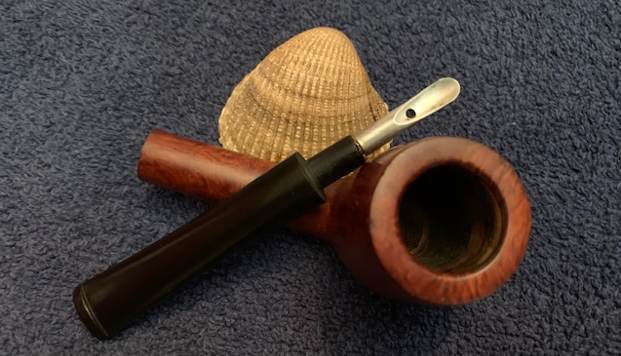
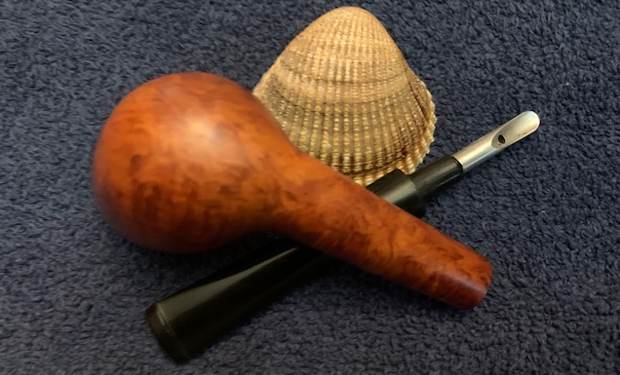
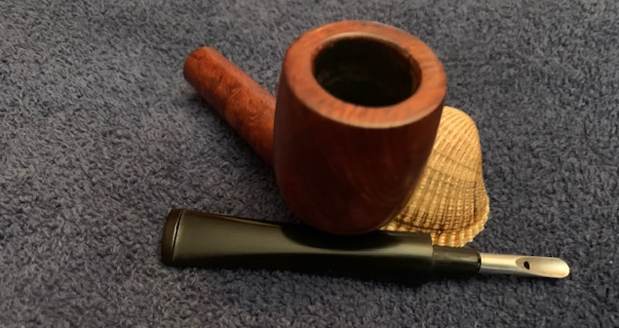
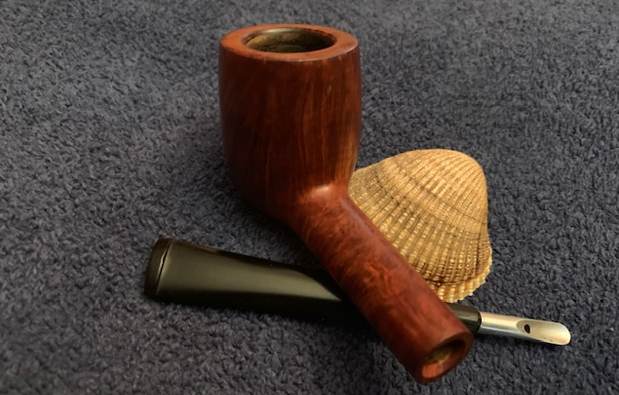
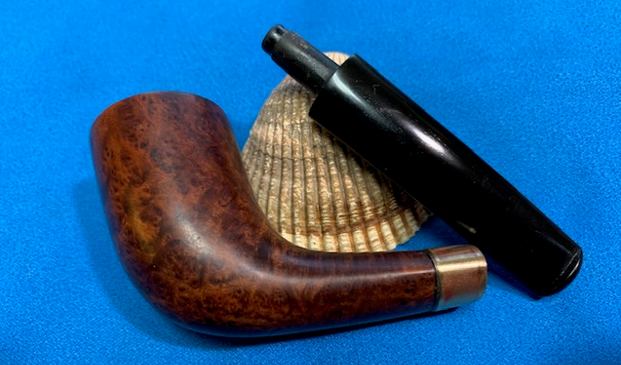
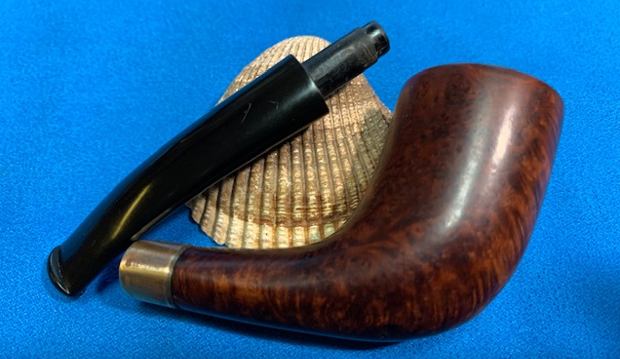
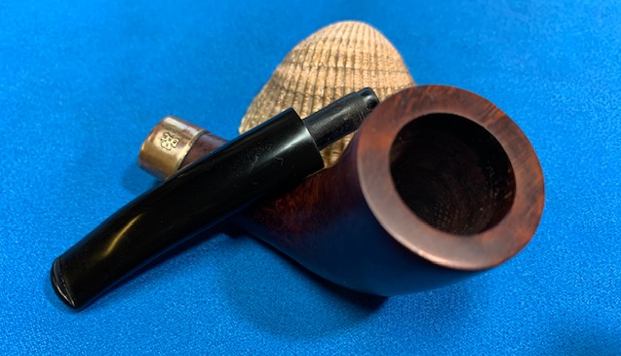
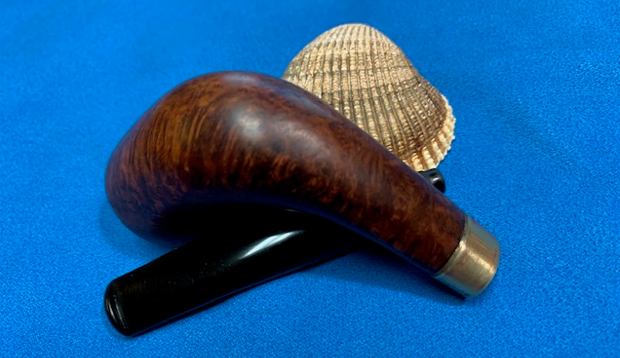
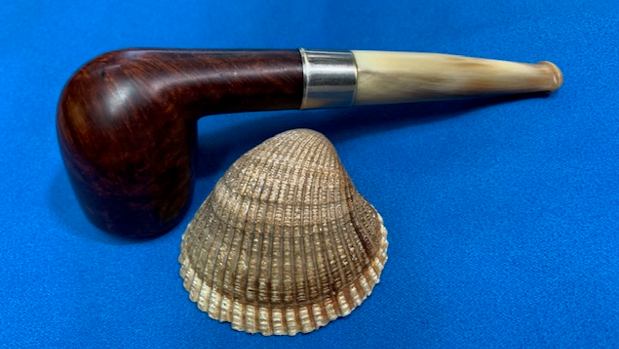
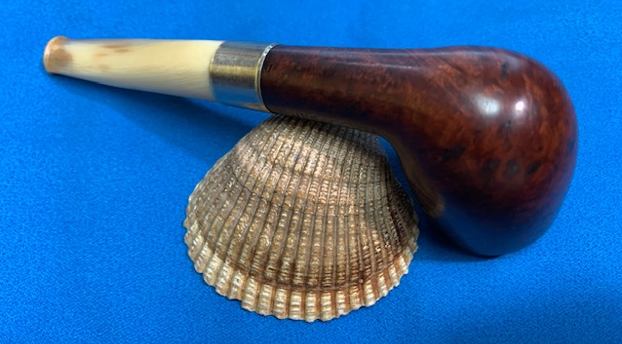
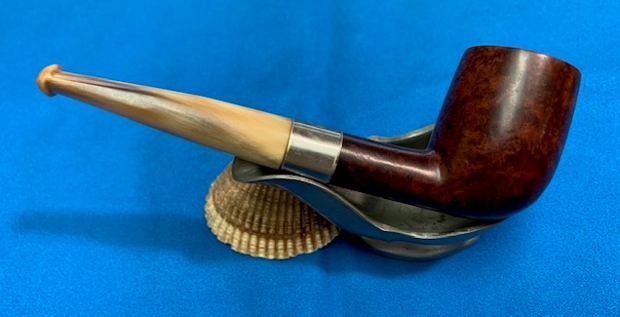
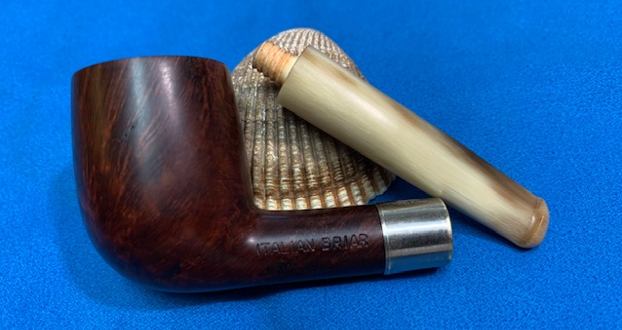
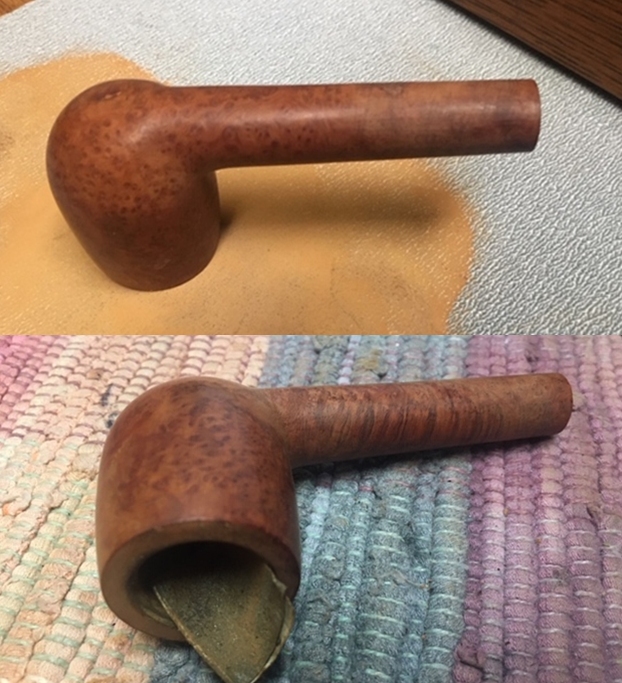
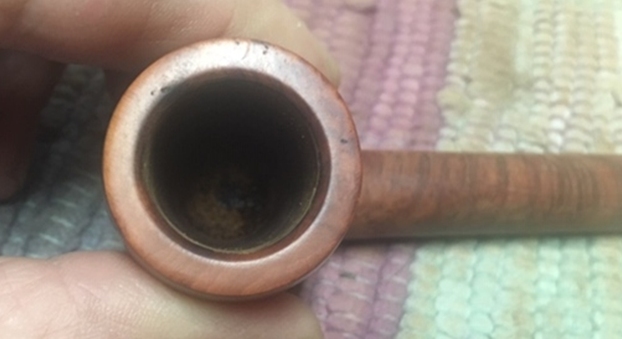
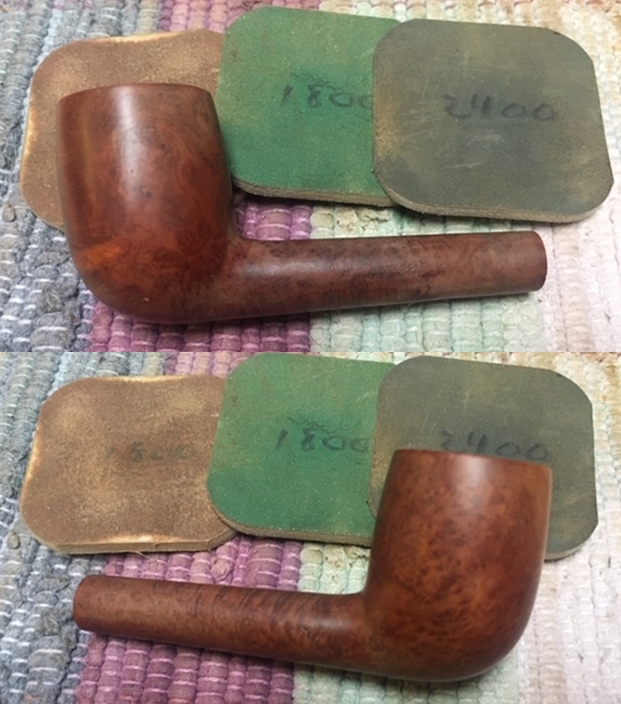
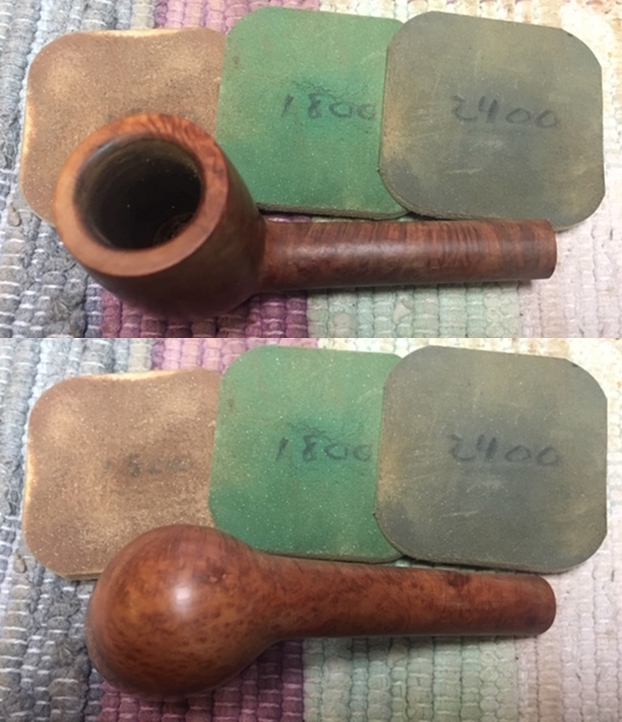
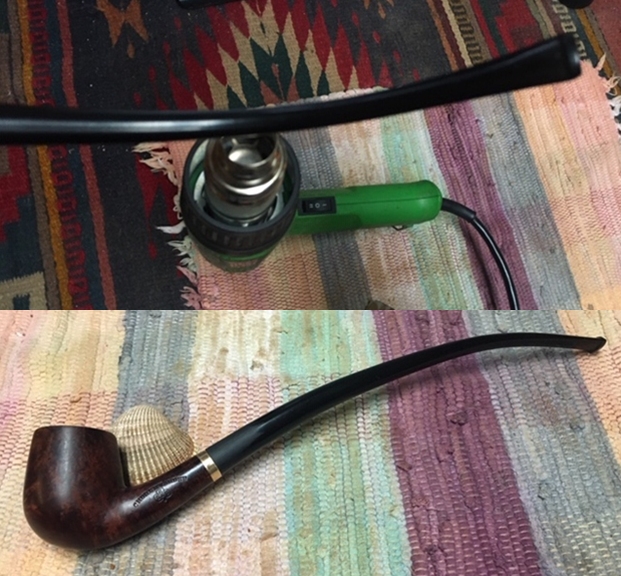
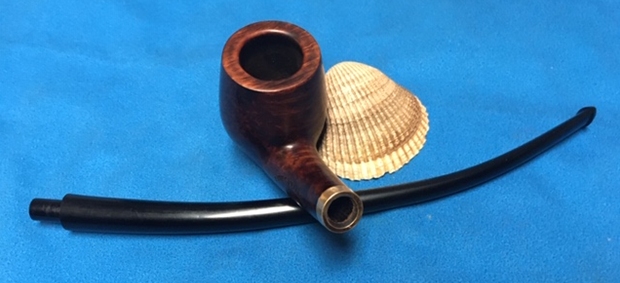
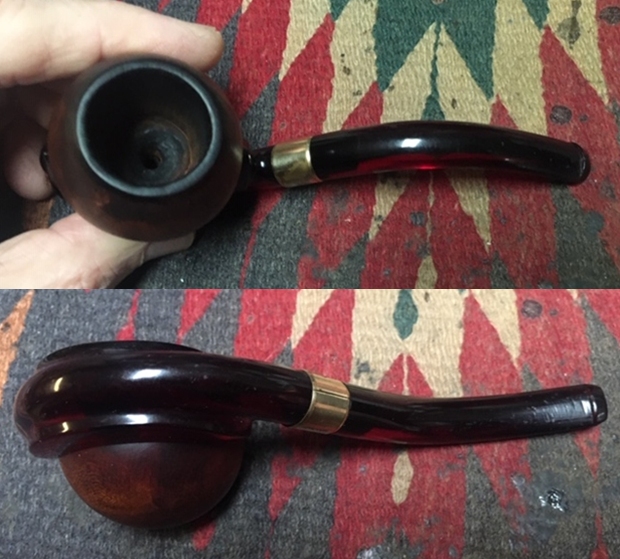
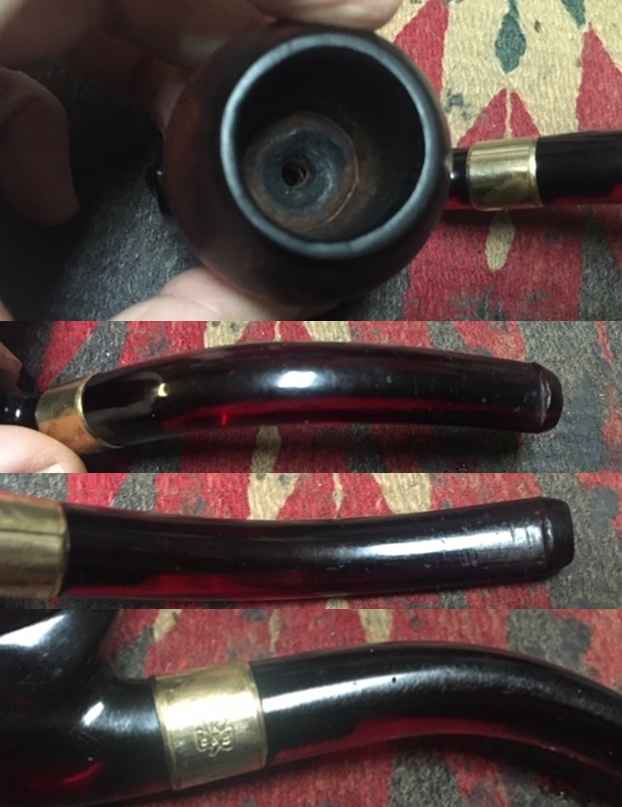
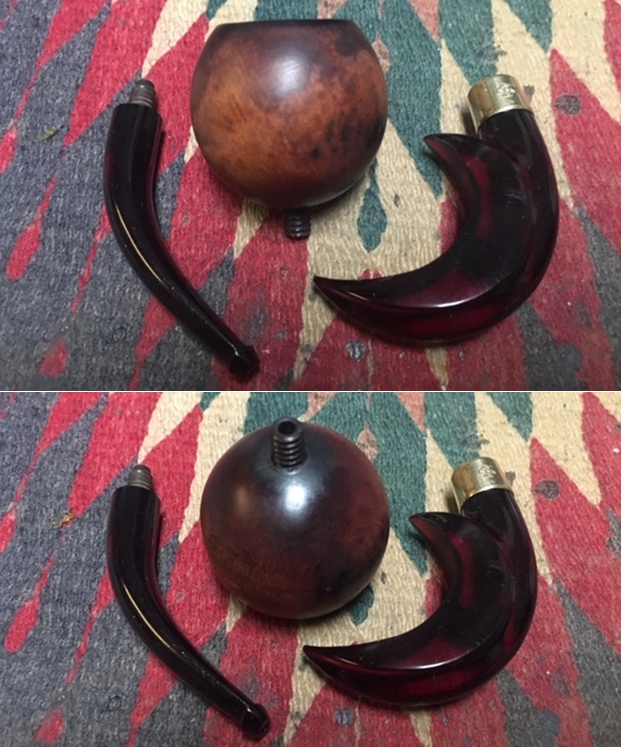
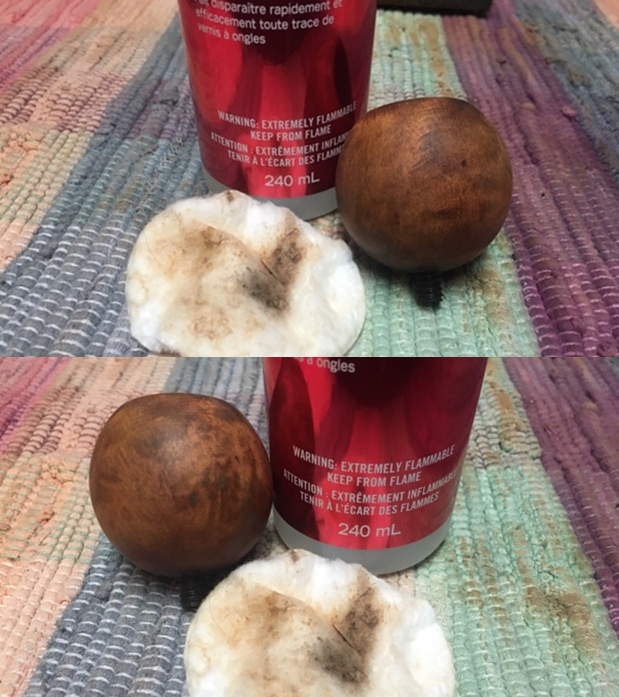
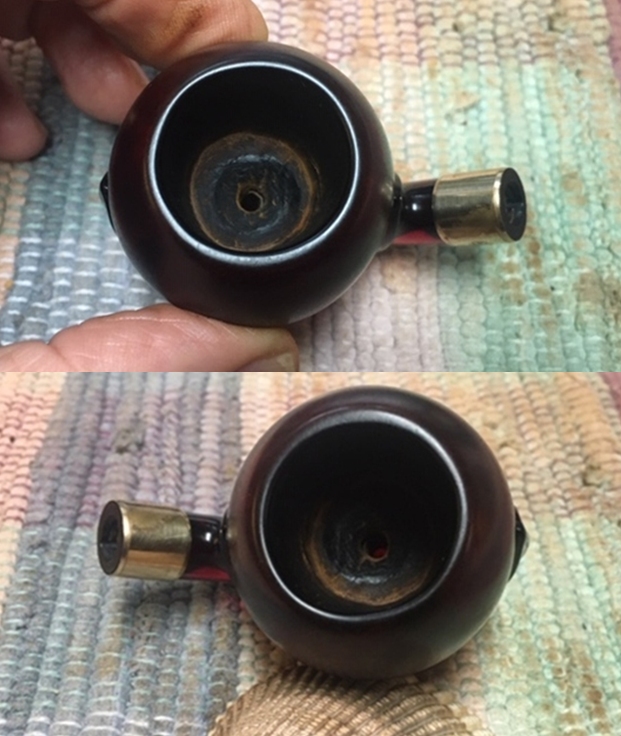
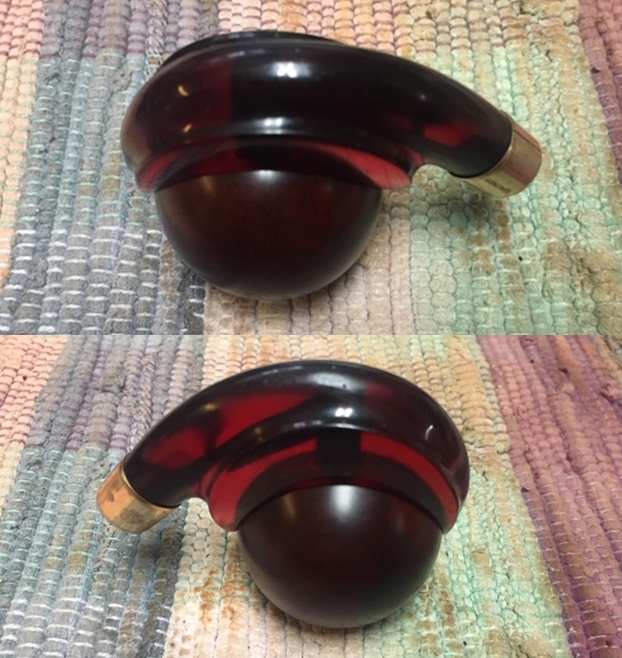
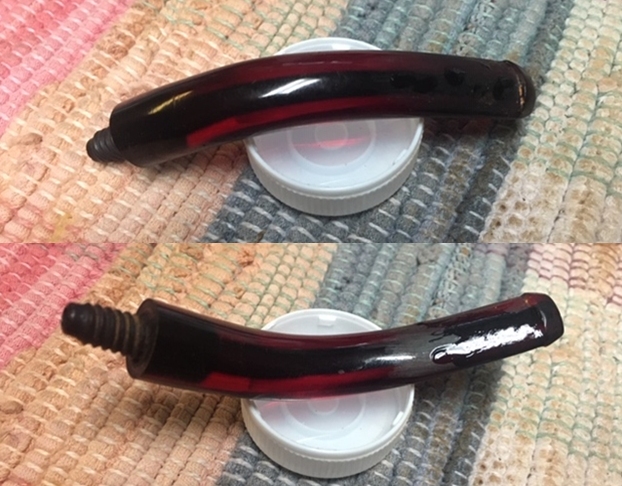
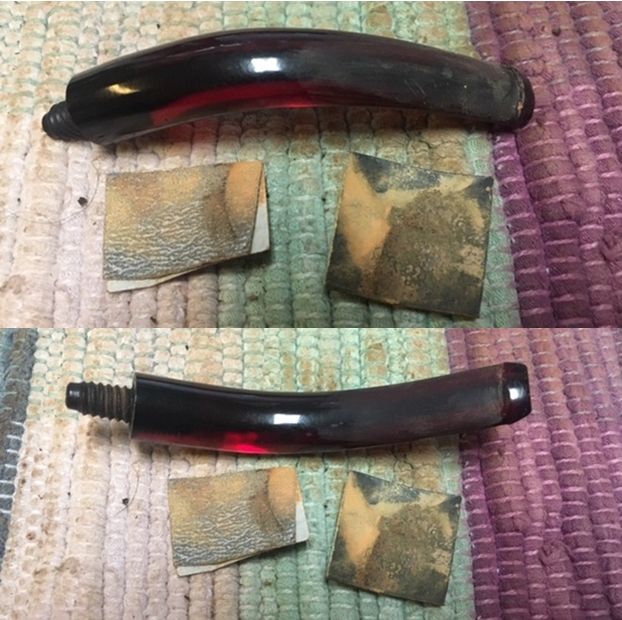
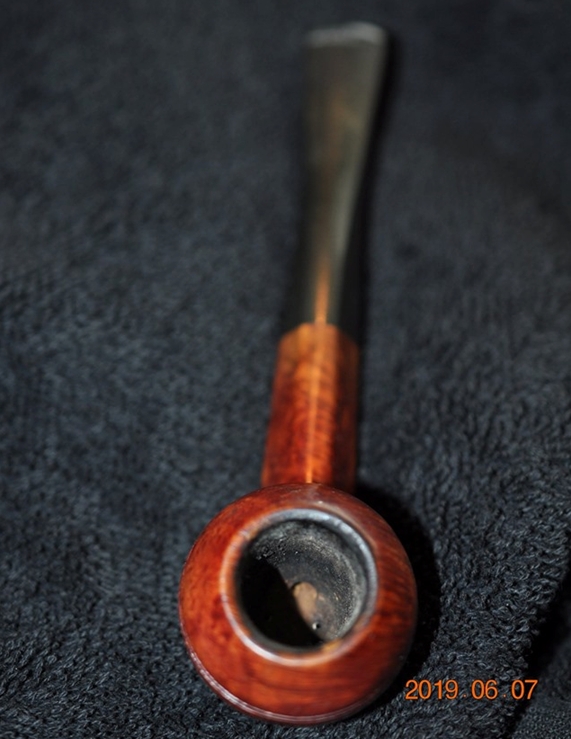
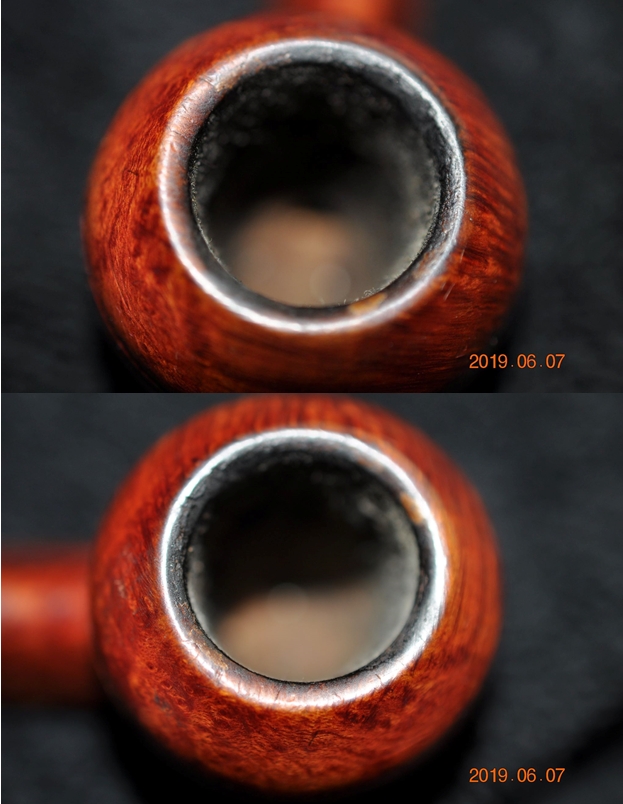
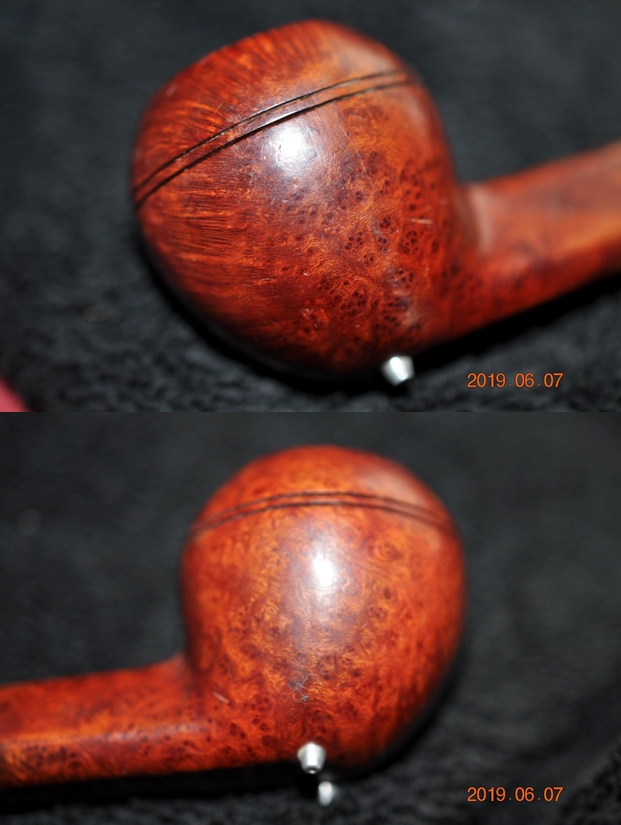
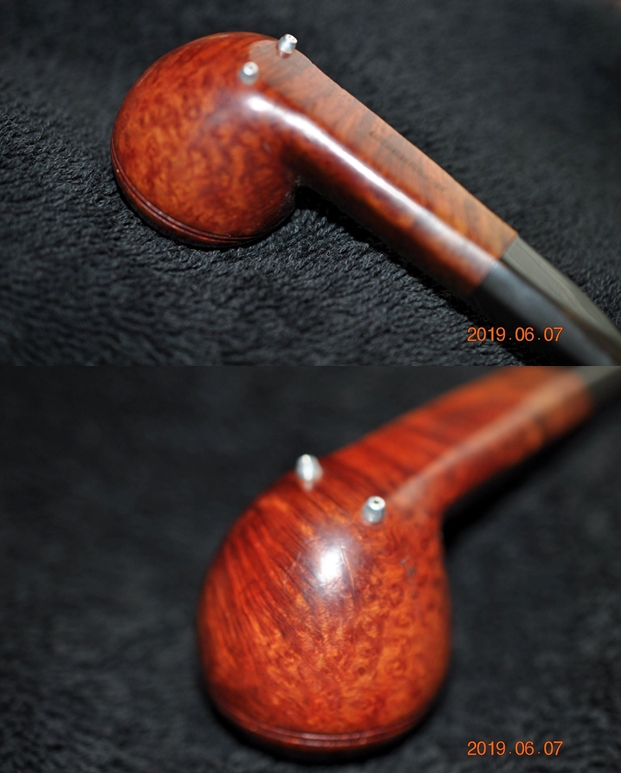
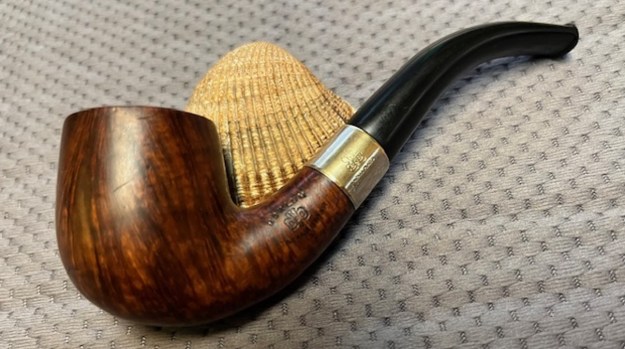
Reworking a KB&B Bent Churchwarden


 Blog by Steve Laug

The next pipe on the table is an interesting KB&B Churchwarden and that is how it is stamped on the left side of the shank. On the right it reads Italian Briar. It is an interesting piece of briar in that it is a mix of grains hidden beneath a dark coat of stain and a top coat of shellac. The briar was very dirty. The bowl had a thick cake overflowing like lava onto the rim top. It is hard to know what the inner edge of the rim looks like because it is buried under the cake and lava coat. The fit of the stem in the shank appeared to be a bit off but cleaning would make that clear. The long vulcanite stem was dirty and oxidized. It was calcified near the button. The bend on the stem was also too much leaving the bowl tipped downward when in the mouth. There were tooth marks and chatter on both sides near the button. Jeff took photos of the pipe before his cleanup work. Jeff tried to capture the condition of the bowl and rim top with the next series of photos. You can see the work that is ahead of us in terms of cake and lava buildup. The grain around the bowl is quite stunning. Jeff took some great photos showing what is underneath the grime and debris of time and use. He captured the stamping on the both sides of the shank it read as noted above.The photos of the stem show the stem surface. It is dirty and has light tooth marks and chatter on both sides ahead of the button.Now it was time to work on my part of the restoration of the pipe. Jeff had cleaned the pipe with his usual penchant for thoroughness that I really appreciate. This one was in decent condition with a bit of buildup on the rim top but virtually no cake in the bowl. He cleaned up the bowl walls with a Savinelli Fitsall Pipe Knife. He scrubbed out the internals with alcohol, pipe cleaners and cotton swabs until the pipe was clean. He scrubbed the exterior of the bowl with Murphy’s Oil Soap and a tooth brush to remove the grime and grit on the briar and the light lava on the beveled rim top. The finish looks very good with good looking grain around the bowl and shank. Jeff scrubbed the stem with Soft Scrub and then soaked it in Before & After Deoxidizer to remove the oxidation on the rubber. When the pipe arrived here in Vancouver for the second stop of its restoration tour it looked very good. I took photos before I started my part of the work. I took some photos of the rim top and stem. Once Jeff removed the lava on the inside edge of the rim top it was in pretty rough condition. There were cuts, nicks and burned areas all around the inner edge and the bowl was out of round from the damage. The outer edge of the bowl looked very good. The close up photos of the stem shows that it was very clean and there was some tooth marks and chatter on the stem just ahead of the button.The fit of the stem in the shank is off. It looked like the shank end had a slight cant to it and the stem did not seat evenly against the shank end. The gap was obvious and made worse by the fact that the diameter of the shank was less than that of the stem. It was worse on the top side and the right side. I checked the shank end and there was some damage there. I could top it lightly but that is a hit or miss proposition. I decided that I would see what a thin band did to the fit. I took some photos to try to capture what I was seeing at the shank stem junction. I went through my various bands. I had picked up a bag of older style bands that included a slight cap that went over the shank end. It was my thinking that this would smooth the surface of the junction for the stem. I heated the band with a lighter and pressed in place on the shank. It was a very tight fit and I liked the look of it. There is something about the look of these thin brass bands that just looks right on older pipes. I took photos of the bowl and the pipe at this point. I decided to address the over bent stem at this point since I was working on the pipe as a whole. I want the bent to be more in keeping with the top of the bowl so that when it sat in the mouth the line was even from the bend to the top of the bowl. I used a heat gun on the lowest setting to soften the vulcanite. To “unbend” is far easier than to bend. You heat the top side of the stem at the bend, constantly moving the pipe and the stem automatically begins to straighten. The key is to stop in time before it is totally straight! I paid attention and caught it at the right moment. I cooled the stem with water to set the new bend.With the shank/stem connection repaired and the bend in the stem reset I was ready to move on to dealing with the issues of the inner edge and rim top. I removed the stem and set it aside and took the bowl in my hands. I used a folded piece of 220 grit sandpaper to smooth out the edge and give it a slight bevel to mask the damaged areas. Once the bowl is polished the bevel is hardly visible and the bowl looks better.I wiped off the remnants of the shellac finish on the bowl with isopropyl alcohol on a cotton pad. Once the finish was removed the grain began to really stand out nicely. I was happy with the way the rim top and edges looked so I moved on to polish the briar with micromesh sanding pads – dry sanding with 1500-12000 grit pads. I wiped the bowl down after each pad with a damp cloth. The grain really began to stand out and the finish took on a shine by the last sanding pad. The photos tell the story! I worked some Before & After Restoration Balm into the surface of the briar with my fingertips. The product works to clean, enliven and protect the briar. I let the balm sit for about ten minutes and then buffed with a cotton cloth to raise the shine. The photos show the bowl at this point in the restoration process. I laid the bowl aside and turned to deal with the stem. I sanded off the excess diameter at the shank with 220 grit sandpaper until the shank and stem were the same diameter. Unfortunately I utterly forgot to take photos of this part of the process. My photos pick up again when I polished the stem with micromesh sanding pads – dry sanding with 1500-12000 grit sanding pads. I was able to remove the scratching and tooth marks with the micromesh. I wiped it down after each sanding pad with a cloth containing some Obsidian Oil. I finished polishing it with Before & After Pipe Stem Polish – both Fine and Extra Fine and buffed it off with a cotton cloth. This KB&B Churchwarden was a fun pipe to work on. I knew that I had to do some work to bring it back to smooth transitions between the shank and stem and to get the bowl looking better and not so beat up. But I was very happy when I got to the point of putting it all back together and everything worked very well. The finish on the pipe is in excellent condition and the contrasting stains work well to highlight the different grain patterns on the pipe. The black vulcanite Churchwarden stem just adds to the mix. With the grime and debris gone from the finish and the bowl it was a beauty and the grain just pops at this point.

I put the stem back on the bowl and buffed the pipe with Blue Diamond on the buffing wheel. I carefully avoided the stamping on the shank and stem during the process. I gave the bowl and the stem multiple coats of carnauba wax on the buffing wheel and followed that by buffing it with a clean buffing pad on the buffer. I hand buffed the pipe with a microfiber cloth to deepen the shine. The finished KB&B Churchwarden is quite beautiful and is a classic bent Churchwarden shaped pipe. The finish on the bowl combines various stains to give it depth. It is very well done. Give the finished pipe a look in the photos below. I can only tell you that it is much prettier in person than the photos capture. The dimensions of the pipe are Length: 10 ½ inches, Height: 2 inches, Outside diameter of the bowl: 1 ¼ inches, Chamber diameter: ¾ of an inch. I really like the looks of this Churchwarden and it is a great looking pipe in great condition. Thanks for walking through the restoration with me as I worked over another beautiful pipe. This pipe will be added to the rebornpipes store soon. If you want to add it to your collection send me an email or a message! Thanks for your time.

Beginning again – a KB&B Bakelite Blueline Cup and Ball Pipe


Blog by Steve Laug

Jeff picked up this interesting Cup and Ball or Claw and Ball pipe somewhere along his hunts or in an auction. It is quite unique. I have worked on a lot of KB&B pipes but never one like this. It is stamp on the inside of the case with the KB&B Cloverleaf and Bakelite in the centre. Underneath it appears to read Blueline. The gold band on the shank end is also stamped with the KB&B Cloverleaf as well as what looks like 12K Gold Plate. Both the base of the pipe and the stem are Bakelite. The stem has a bone tenon that screws into the Bakelite shank. It came in a black leather covered case lined with blue velvet fabric. The only marking on the case was what I mentioned above. The case has a brass clasp on the front and brass hinges on the back. It was obviously custom made for this pipe.Jeff opened the case and this was what the pipe that was inside looked like. It was a very unique looking pipe that is for sure but it was also very dirty. The base, shank and stem were rich red coloured Bakelite. The exterior of the bowl was very dirty and had tars and oils ground into the finish and sticky spots on the finish. Looking at the top of the bowl you can see the cake and how much lava had overflowed onto the rim top. I am sure once it was out of the case it would become clear how dirty it really was.Jeff took it out of the case to have a better look at the condition of the pipe. It was a very interesting looking rendition of a Ball and Cup pipe – at least that is what I would call it. It looked like it would cleanup really well and look great when finished. The hardwood bowl (cherry or maple) had some colour from either being filthy or from age. Cleaning would reveal the facts! He took some close-up photos of the bowl and rim top. There was a very thick cake in the bowl that was hard and uneven and had lots of flakes of tobacco debris stuck to the walls. The lava overflowed down the outside of the ball on several sides. The edges of the bowl looked to be in pretty good condition at this point. Jeff took photos of the sides of the bowl to show the grain and condition of the finish around the bowl. These photos also lead me to conclude that the bowl is not briar… perhaps Cherry or Maple.In terms of stamping the only identifying marks on the pipe were those on the case on the gold band on the shank. Jeff captured those marks in the next set of photos. The logo on the inside lid of the case was worn and dirty so he included two photos of that. I also found a similar lid logo online and have included it as well for comparison sake. Jeff took photos of the KB&B Cloverleaf and the 12K Gold Plate stamp on the band.He took photos of the ball and the stem off the shank/base. The ball and the stem both are threaded and are screwed into the base. It was filthy with oils and tars. The internals of the pipe were in as bad a condition as the inside of the bowl and airway.Jeff took photos of the stem to show the general condition of the stem shape. The curve is graceful and the curve great. The photo shows the profile of the stem. He took photos of the top and underside of the stem to show the damage and bite and scratch marks on both sides up the stem from the button.I remembered that one of the contributors to rebornpipes, Troy Wilburn had done a lot of work on older KB&B pipes so I turned to one of his blogs on rebornpipes on a Blueline Billiard that he restored (https://rebornpipes.com/tag/kbb-blue-line-pipes-with-bakelite-stems/). As expected Troy had done a great job digging into the Blueline brand and potential dates. I quote from his blog the following sections.

I was thinking after some initial research that these pipes were from around 1910 – early 1920s. Seems it’s a little older than I thought. I got this info from a Kaywoodie and early KBB collector who has had several Blue Lines.

Your pipe is made by Kaufman Brothers and Bondy, or KB&B, which later (1915) created the Kaywoodie line we all know. But this pipe is Pre-Kaywoodie, as they were making pipes under the KB&B branding from about 1900 to 1914. Bakelite was invented in 1907, so this pipe was likely made from 1908 to 1914, as the Bakelite was quite the technological wonder of the time, and was used in many products (still in use today). These “Blue Line Bakelite” pipes are rare pieces, seldom seen.”

Having seen the before pictures on this pipe I was looking forward to what it would look like when I unpacked the most recent box Jeff sent to me. The pipe was present in the box and I took it out of the box to see what work awaited me when I removed it from the case. I put the case on my desk and opened it to see what was there. I opened the case and took a photo of the pipe inside.I was astonished to see how clean the pipe was. The bowl clean and the Bakelite base and stem looked very good. Even the gold band looked better. Now it was time to take it out of the case and have a look at it up close and personal. I took photos of the pipe as I saw it. Jeff had done an incredible job in cleaning up this pipe. He had reamed the bowl with a PipNet Pipe reamer and cleaned up the remaining debris with a Savinelli Fitsall Pipe Knife. He also scraped the thick lava on the rim top. He scrubbed the exterior of the bowl with Murphy’s Oil Soap and a tooth brush to remove the grime on the bowl and rim. He cleaned out the interior of the bowl base and stem with pipe cleaners, cotton swabs and alcohol until they came out clean. The rim top looked incredible when you compare it with where it started. There is some slight darkening on the inside edge of the bowl. He cleaned the base and stem with Soft Scrub to remove the grime on the exterior and cleaned out the airway with alcohol, cotton swabs and pipe cleaners. I included a photo of the KB&B Cloverleaf on the gold plated band.I unscrewed the bowl and the stem from the base and took photos of the parts. The bowl and stem both had threaded connectors. The bowl was metal and the stem was bone.I stripped the spotty finish off the bowl with acetone. I know for some this is a no-no for old pipes but honestly this finish was very rough. I would restain it as close to the original aniline as I could but there was damage that needed to remove the stain and finish to address. I followed that by sanding the bowl with a medium and a fine grit sanding sponge. The bowl was looking better and the dark spots turned out to be oils and not burn marks! Whew! I polished the bowl with micromesh sanding pads – dry sanding with 1500-12000 grit pads and wiping the bowl down after each pad with a damp cloth. Note the developing shine on the wood. I went through my various stains and chose a Tan aniline stain for the bowl. It is a nice coloured stain that is close to what was original and will give me some coverage over some of the dark spots on the sides of the bowl. I applied the stain and flamed it with a lighter. The flaming burns off the alcohol and sets the stain in the wood. I repeated the process until I was happy with the coverage.I set the bowl aside to let the stain cure and turned my attention to the base. The band was loose so I removed it for the first round of pads. I polished the Bakelite with micromesh sanding pads to remove the scratching and bring out a shine. I dry sanded with 1500-12000 grit pads and wiped it down with a cloth I use that has Obsidian Oil impregnated in the fibres. It works well to remove the dust. I paused the polishing to glue the gold band on the shank end. I put some white all-purpose glue on the Bakelite and pressed the band in place on the shank. I wiped the excess glue off with a damp cloth. I let the glue dry for a short time.When it had set I continued polishing with the micromesh pads. I set the base aside and went back to the bowl. I buffed out the newly stained bowl with Blue Diamond to bring out a shine. The colour is opaque enough to hide the dark spots and transparent enough to show some grain in the sunlight. I like it!I rubbed Before & After Restoration Balm into the wood with my fingertips to clean, enliven and preserve the newly stained bowl. I find that it adds a depth to the polish that I really have come to appreciate. All that remains at this point is to wax and polish the bowl. With the bowl and the base finished it was time to put them back together. I would still need to buff and wax both but the project was coming to an end. All that remained was to finish the stem work. I set the base and bowl aside and turned to address the issues with the stem. I used a clear CA glue to fill in the gouges across the stem from the button forward an inch on both sides. I also filled in the deep tooth marks on both at the same time.I smoothed out the repairs with a folded piece of 220 grit sandpaper. I started the polishing with a folded piece of 400 grit wet dry sandpaper.I rubbed the stem down with Denicare Mouthpiece Polish. It is a gritty, red paste with the consistency of red Tripoli. I find that it works well to polish out scratches and light marks in the surface of the stem. I polished it off with a cotton pad to raise the shine.I polished the stem with micromesh sanding pads – dry sanding with 1500-12000 grit sanding pads. I wiped it down after each sanding pad with a cloth containing some Obsidian Oil. I finished polishing it with Before & After Pipe Stem Polish – both Fine and Extra Fine and buffed it off with a cotton cloth. I gave it a coat of Briarville’s No Oxy Oil to preserve and protect it. I put the hardwood bowl and Bakelite Base stem back together again and carefully buffed it with Blue Diamond polish on the buffing wheel. I gave the bowl, base and stem multiple coats of Carnauba wax on the buffing wheel. I hand buffed the entirety of the pipe with a microfiber cloth. The pipe was alive now and looked great to me. It has a great feel in the hand that is very tactile and the colouring on the bowl should develop more deeply as the pipe is smoked. The finished pipe is shown in the photos below. The dimensions of the pipe are Length: 5 1/2 inches, Height: 2 1/4 inches, Outside diameter of the bowl: 1 1/4 inches, Chamber diameter: 7/8 of an inch. This older KB&B Blueline Cup and Ball pipe is a beauty and the Bakelite looks great with the newly stained bowl. It is one of those old timers that will be staying in my KB&B collection. It will be a great addition to my collection of old pipes. Thanks for reading this blog and my reflections on the pipe while I worked on it.
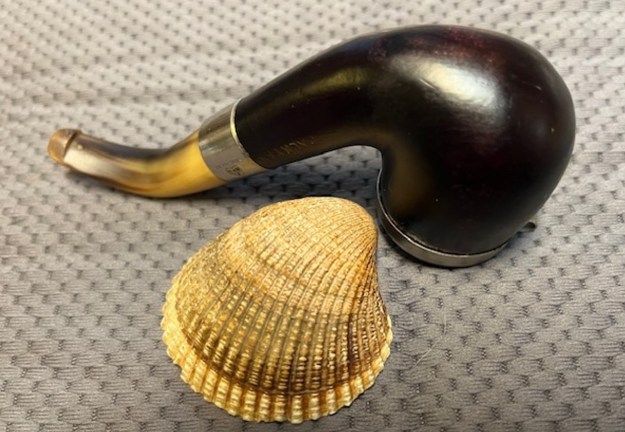
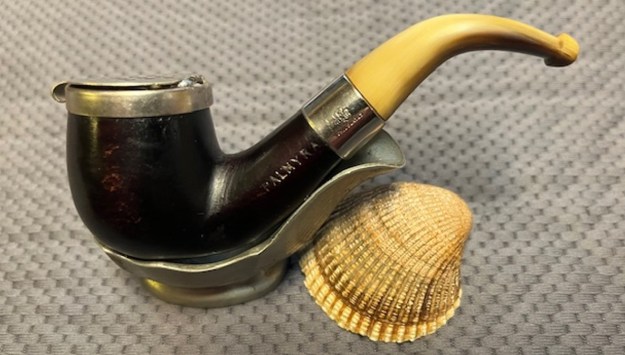
Restoring a KBB Yello-Bole Double Carburetor Bulldog


Blog by Steve Laug

The next pipe I chose to work on came in a recent box from my brother Jeff. It was another pipe he picked on one of the online auctions he frequents. It is interesting triangular shank Bulldog (Rhodesian??) with a smooth finish and twin rings separating the cap from the bowl. It also has twin carburetor’s or air “nipples” on the underside of the bowl. It is a shape I have not seen much of before. The pipe is stamped with the KBB Clover followed by DOUBLE CARBURETOR  over Yello-Bole over Reg US Pat Off.  On the underside of the triangular shank that made the pipe a sitter it is stamped Cured with Real Honey. On the right side of the shank it is stamped with a 4 digit shape number 4982. The grain showing through the grime and dirt is a mix or birdseye, cross and flame grain. It had a rich reddish brown stain and what looked like a varnish coat. There was a thick cake in the bowl and some light lava overflow. The inner beveled edge of the rim and top appeared to have some darkening under the grime. It was a beautiful pipe that was dirty and tired looking. The stem was lightly oxidized with light tooth marks and chatter on the top and underside near the button. The button had some light damage to the sharp edge. Jeff took photos of the pipe before he started his cleanup work on it. Jeff took photos of the bowl and rim top to show the cake in the bowl and the lava build up on the edges of the bowl. It was thick and hard but hopefully it had protected the rim and edges from damage. The inner bevel seems to have some darkening and potentially some burn damage but we would know better once it was reamed and cleaned.Jeff took photos of the sides and heel of the bowl to show the condition of the finish. You can see the nicks and scratches in the grime. The beautiful grain shines through the rough and dirty finish. The photos of the heel and shank show the twin “nipples” or carburetors. They were plugged and did not allow the airflow they were designed for. The final photo of this set is a close up of the underside of the bowl and the carburetors. Jeff took photos of the stamping on the sides of the shank. The stamping was very readable – on the left side it read as noted above. On the right side you can clearly see the shape number. The final photo shows the Cured with Real Honey stamp on the underside of the shank.Jeff took photos of the top and underside of the stem showing the scratching, oxidation and light tooth damage to the stem surface and slight wear to the edges of the button.I decided to pause and do a bit of research on the pipe to figure out when the KBB Yello-Bole Double Carburetor Pipes were carved. The stamping provided many clues that were very helpful in pinning down the date of manufacture. I Googled the brand and line to see what I could find out. Here is what I found.
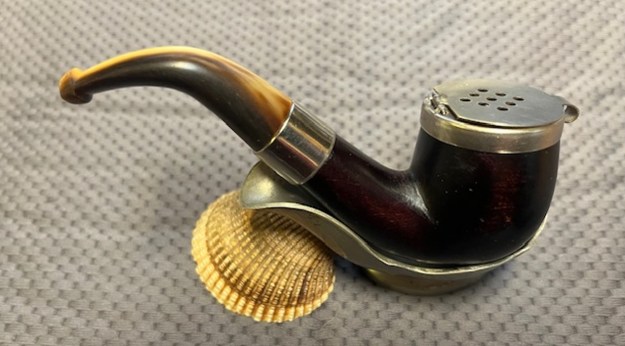
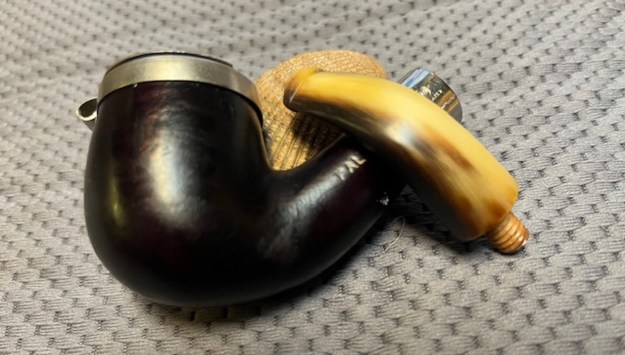
The first link to me to the Kaywoodie Group and a thread on dating this particular pipe. There was a helpful exchange between lifeon2 and Bosun about a pipe that is stamped in a similar manner to the one that I have. Here is a link to the full conversation: https://www.tapatalk.com/groups/kaywoodie/dating-yello-bole-pipes-t86.html

lifeon2 writes: OK so there isn’t a lot of dating information for Yello-Bole pipes but here is what I have learned so far.

  1. If it has the KBB stamped in the clover leaf it was made 1955 or earlier as they stopped the stamping after being acquired by S.M. Frank.
  2. From 1933-1936 they were stamped Honey Cured Briar.
  3. Post 1936 pipes were stamped “Cured with Real Honey”
  4. Pipes stems stamped with the propeller logo they were made in the 30s or 40s no propellers were used after the 40s.
  5. Yello Bole also used a 4 digit code stamped on the pipe in the 30s.
  6. If the pipe had the Yello Bole circle stamped on the shank it was made in the 30s this stopped after 1939.
  7. If the pipe was stamped BRUYERE rather than briar it was made in the 30s.

(Information gathered from Pipedia – https://pipedia.org/wiki/Yello-Bole)

Bosun replies: the one I have is stamped on the left side of shank:

  1. Double Carburetor
  2. yello-bole
  3. u.s.pat.off
  4. with KBB to the left of the above

underside of shank has Cured with Real Honey

right side of shank has 4907

on top of stem is the white circle

lifeon2 replies: According to the list  I have it looks like you have a late 30s model, sweet

I also turned to a blog by Andrew Selkirk on rebornpipes that also added a degree of certainty to the date of manufacture of this pipe (https://rebornpipes.com/2015/05/03/1934-35-yello-bole-carburetor/).

I can say with a fair degree of certainty that this pipe is from 1934 or 35. The carburetor patent was granted in 1935, this pipe is stamped “Pat Applied For.” Interestingly enough, it also has a patent number on the bottom of the shank. Additionally, the four digit number was used by Kaywoodie until 1936. The first two numbers indicate the finish and the second two numbers indicate the shape.

With that information in hand I knew what I was dealing with in terms of age of this pipe. I knew from the information from Pipedia that the KBB in a clover leaf stamp meant that the pipe was made before 1955. The Cured with Real Honey stamp placed the pipe as 1936 or after. The four digit shape code was used until 1936. The shape code on this one was 4982 thus it is another argument for 1936. The patent was given to KBB in 1935 so the stamped “Reg. US Pat. Off also places the pipe after 1935. The information that I have gathered helps me to know with a high degree of certainty that this Double Carburetor pipe was made in 1936. The first two numbers indicate the finish and the second two numbers indicate the shape. Now it was time to work on the pipe.

Jeff cleaned the pipe with his usual penchant for thoroughness that I really appreciate. This one was a real mess and I did not know what to expect when I unwrapped it from his box. He reamed it with a PipNet pipe reamer and cleaned up the reaming with a Savinelli Fitsall Pipe Knife. He scrubbed out the internals with alcohol, pipe cleaners and cotton swabs until the pipe was clean. He scrubbed the exterior of the bowl with Murphy’s Oil Soap and a tooth brush to remove the grime and grit on the briar and the lava on the rim top. The finish looks very good with good looking grain around the bowl and shank. There was still some darkening on the front, rear and left side of the inner edge of the rim. The briar had what looked like a small burn mark on the surface of the left side – the pipe had been laid in an ashtray (I have circled it in red in the first photo below). There was no damage on the inside of the bowl. Jeff soaked the stem in Before & After Deoxidizer to remove the oxidation on the rubber. When the pipe arrived here in Vancouver for the second stop of its restoration tour it looked very good. I took photos before I started my part of the work. I took some close up photos of the rim top and also of the stem surface. I wanted to show what an amazing job Jeff did in the cleanup of the rim top. The rim top looks very good and you can see where I need to deal with the darkening on the inner bevel on the bowl. The bowl looked very good. I also took close up photos of the stem to show how well the cleaning had cleaned up what had appeared to be tooth chatter. There were still some light marks that would be easily polished out. There was not a logo anywhere on the stem and the stem did not have a stinger in the tenon.I started my cleanup on the inner edge of the rim by sanding the bowl and edge with a piece of 220 grit sandpaper wrapped around a dowel. This smoothed out any roughness on the portion that formed the bottom edge of the bevel. I used a folded piece of 220 grit sandpaper to smooth out the rest of the beveled inner edge of the rim and work on darkening present there and on the rim top.I polished the briar and worked on the darkening on the rim top and the burn mark on the left side of the bowl with micromesh sanding pads. I wet sanded with 1500-12000 grit sanding pads and wiped the bowl down with a damp cloth after each pad. I was able to polish out most of the burn mark on the lower left side of the bowl. Once I finished polishing the bowl with micromesh I thought would be a good continuation of my experimentation with a new product from Mark Hoover of Before & After Products – a Briar Cleaner that has the capacity of absorbing grime and dirt from the surface of briar. I rubbed the bowl down with some of his Briar Cleaner to see how it would work in this setting. I rubbed it onto the bowl and rim top with my finger tips and worked it into finish of the bowl. I let it sit on the pipe for about 5 minutes before I rubbed it off with a microfibre cloth. I rinsed it under warm running water to remove the residue. I was pleasantly surprised by how clean the surface on the bowl looked when I was finished. With the pipe clean it was time to move on to rubbing the bowl down with Before & After Restoration Balm. I worked it into the surface of the briar with my fingertips to clean, enliven and protect it. I let the balm sit for a little while and then buffed with a cotton cloth and shoe brush to raise the shine. Mark Hoover’s Balm is a product that I have come to appreciate and one I use on every pipe I have been working on. I set the bowl aside and turned my attention to the stem. The stem was in such great shape that I polished it with micromesh sanding pads – wet sanding it with 1500-12000 grit pads. I wiped the stem down with a damp cloth after each pad. The micromesh took care of the remaining tooth chatter on the stem and button. I further polished it with Before & After Pipe Polish – both Fine and Extra Fine. I wiped it down with a coat of Obsidian Oil and set it aside to dry.  I put the stem back on the bowl and polished the bowl and stem with Blue Diamond polish on the buffing wheel. I gave the bowl and the stem multiple coats of carnauba wax. I buffed the pipe with a clean buffing pad to raise the shine. I hand buffed it with a microfiber cloth to deepen the shine. The shine on it makes the variations of colour really pop. The pipe polished up really well. The polished black vulcanite stem seemed to truly come alive with the buffing. The unique triangular shaped shank and stem fit nicely in my hand and when it warms with smoking I think it will be about perfect. The pipe is a beauty and it must have been a fine smoking pipe judging from the condition it was when we received it. There should be a lot of life left in this 1936 KBB Yello-Bole 4982 Bulldog.  Have a look at it in the photos below. The dimensions are Length: 5 ½ inches, Height: 1 ½ inches, Outside diameter of the bowl: 1 ½ inches, Chamber diameter: ¾ of an inch. Thanks to each of you who are reading this blog. Remember we are not pipe owners, we are pipemen and women who hold our pipes in trust until they pass on into the trust of the next pipeman or woman.