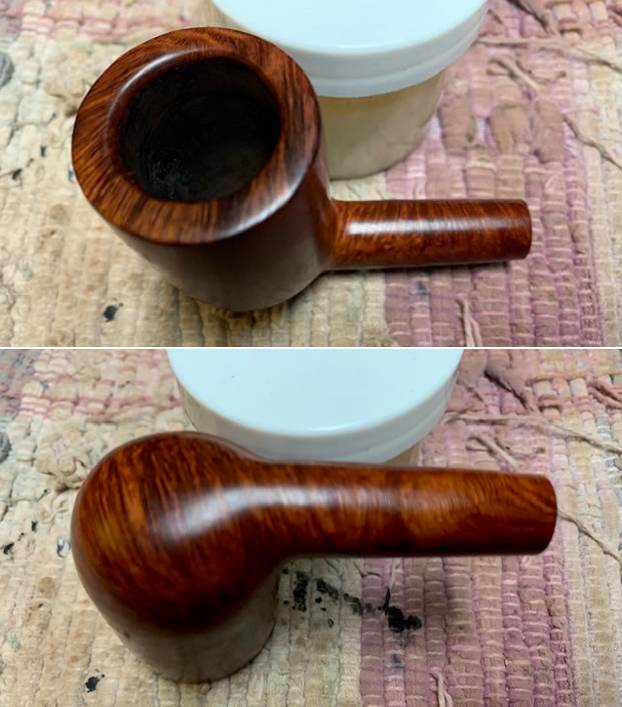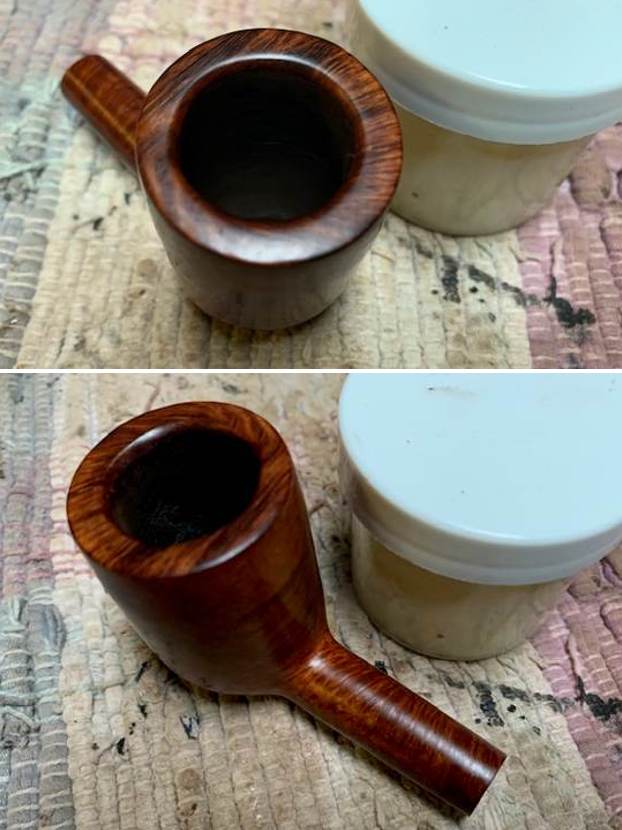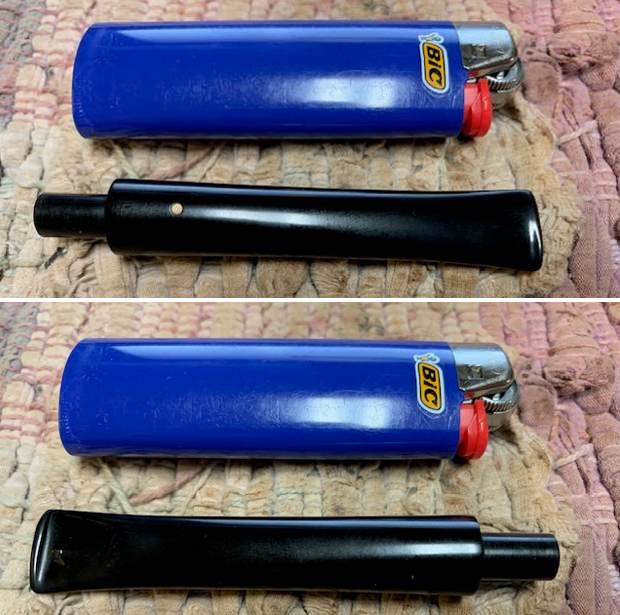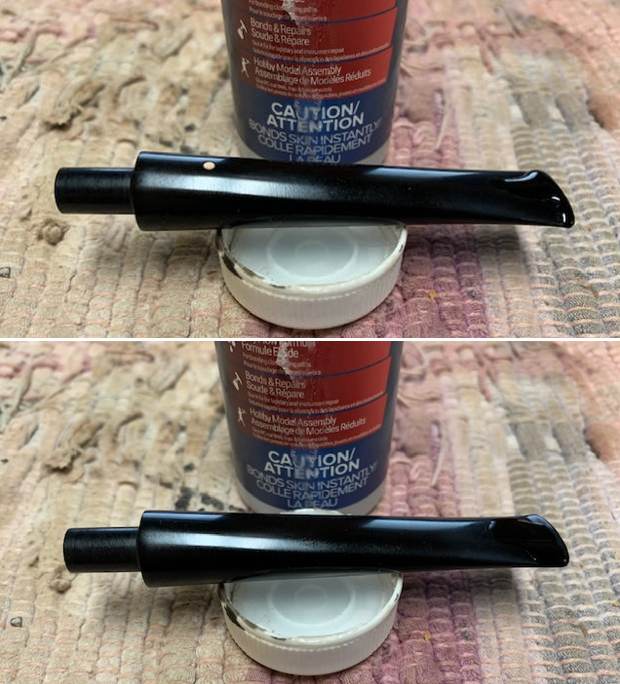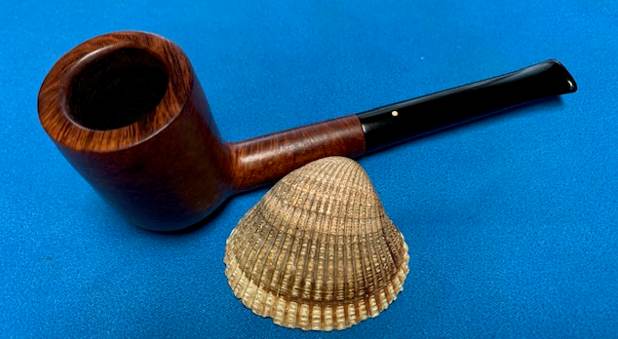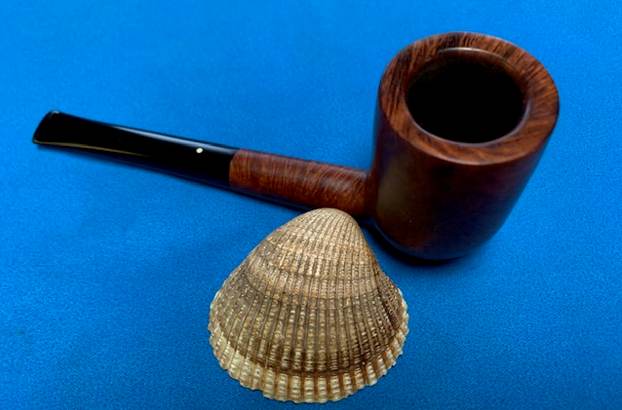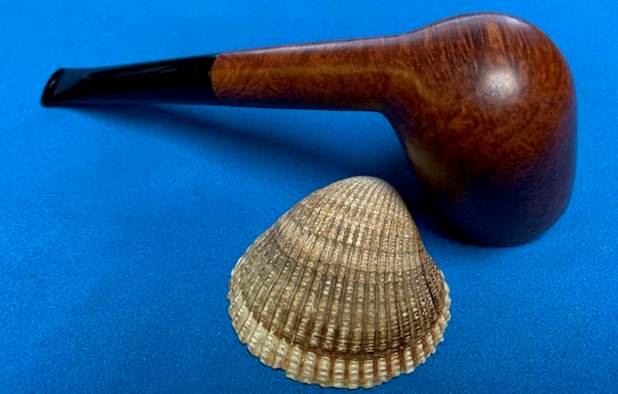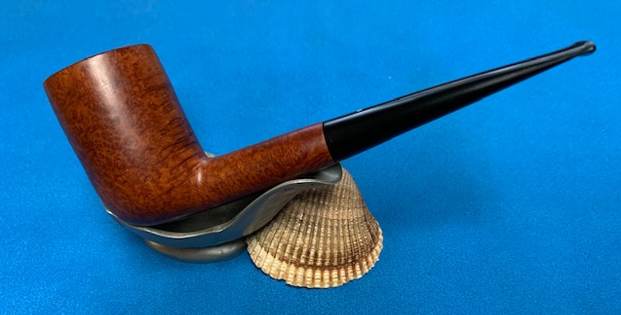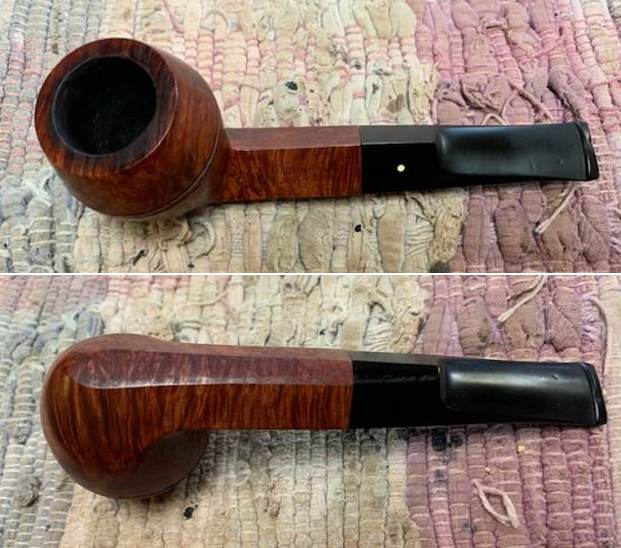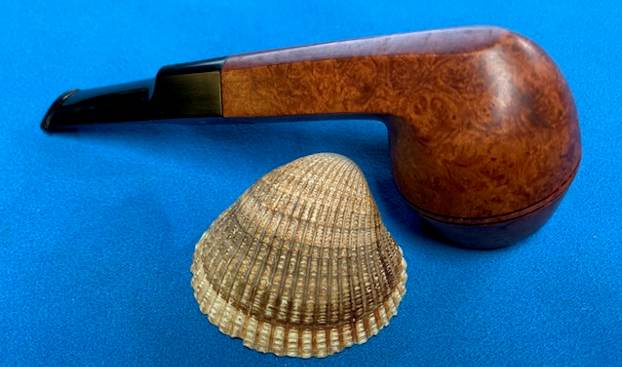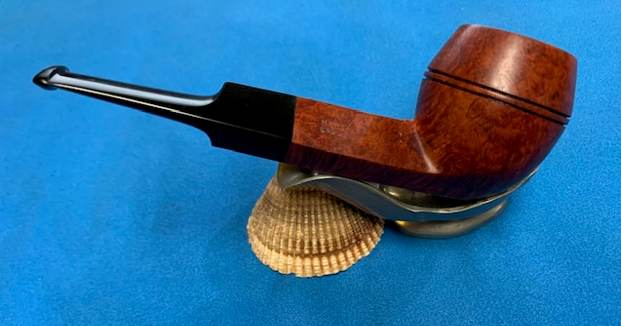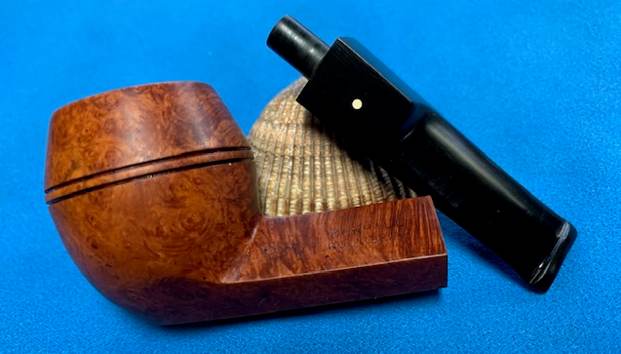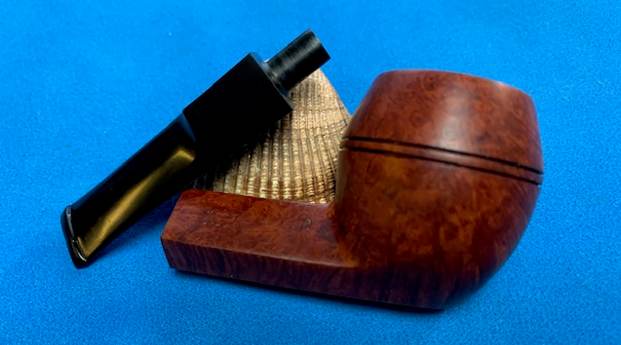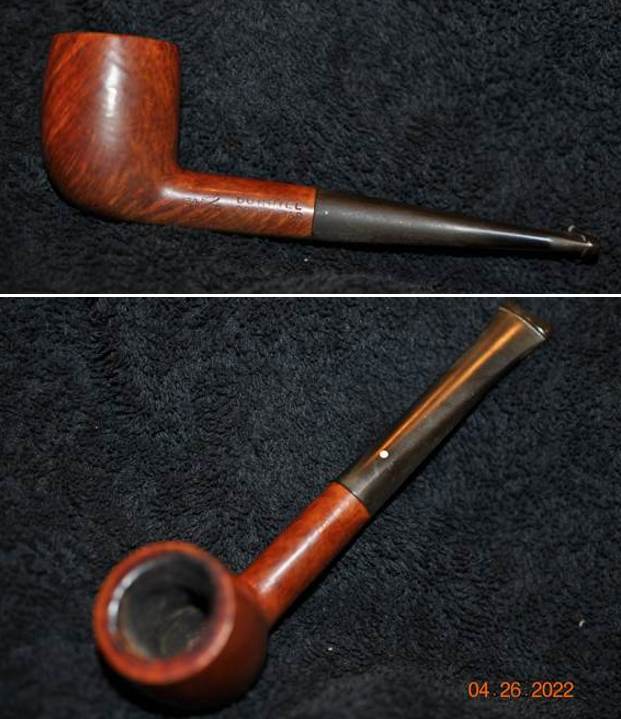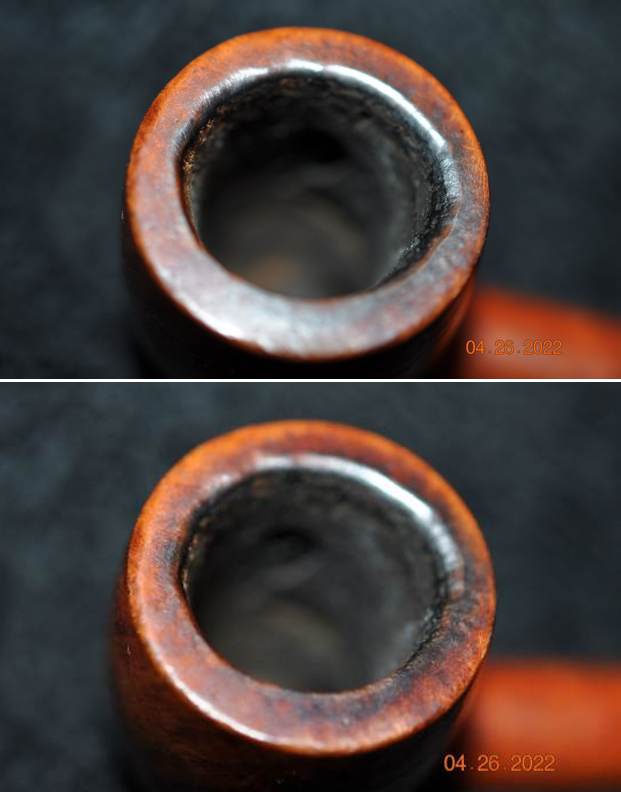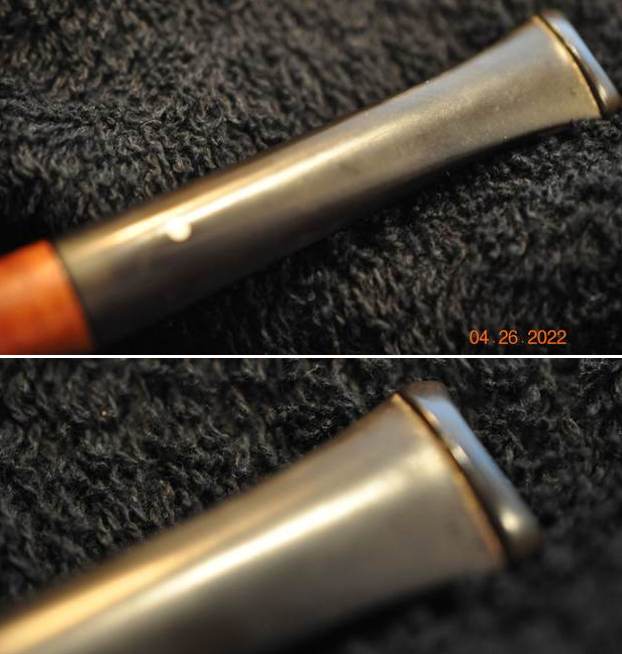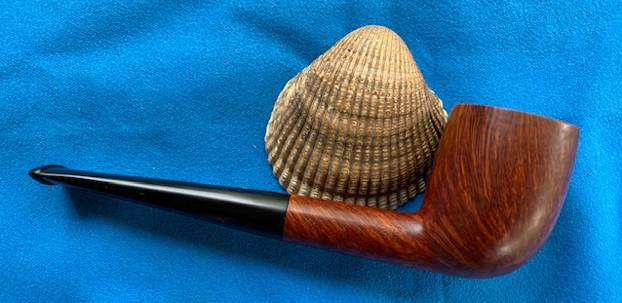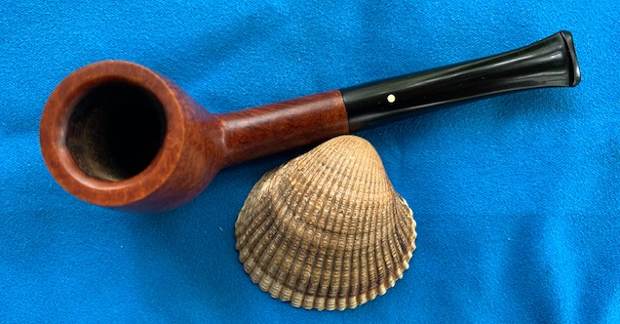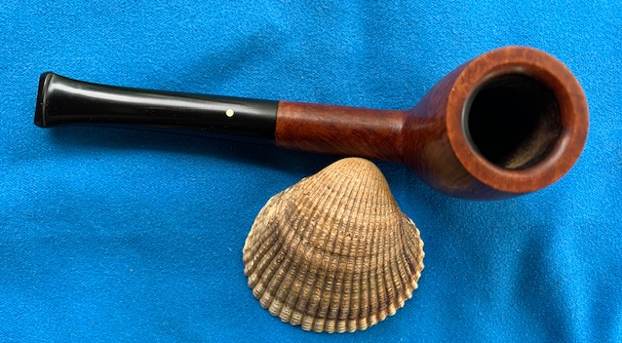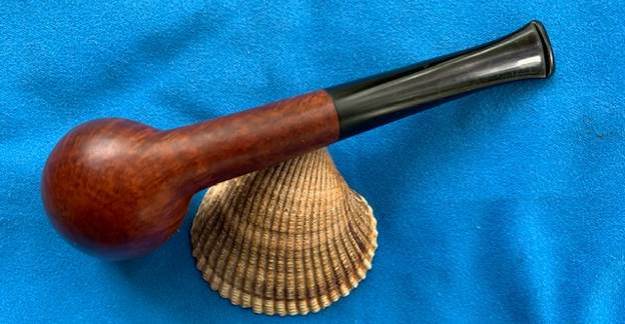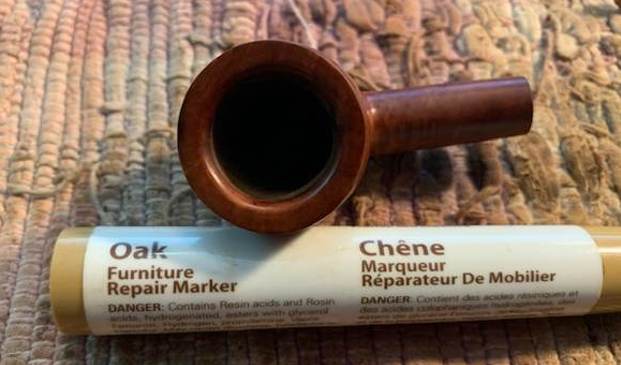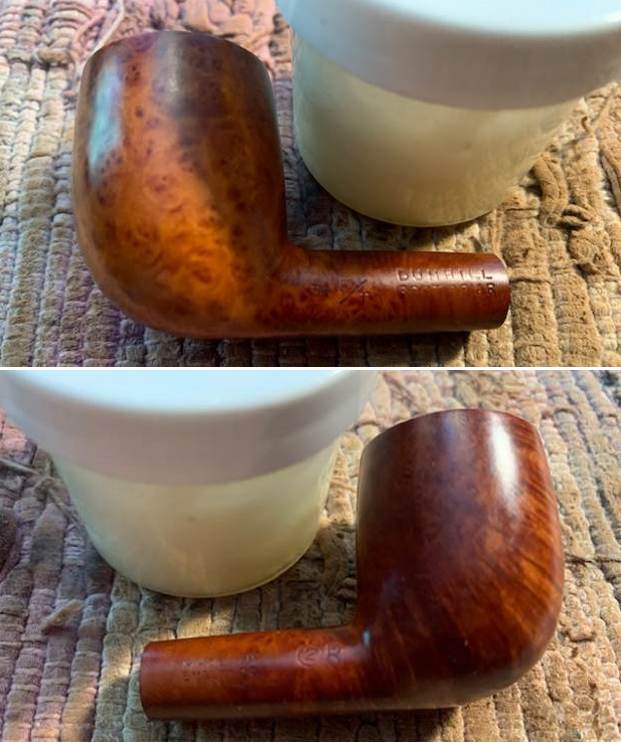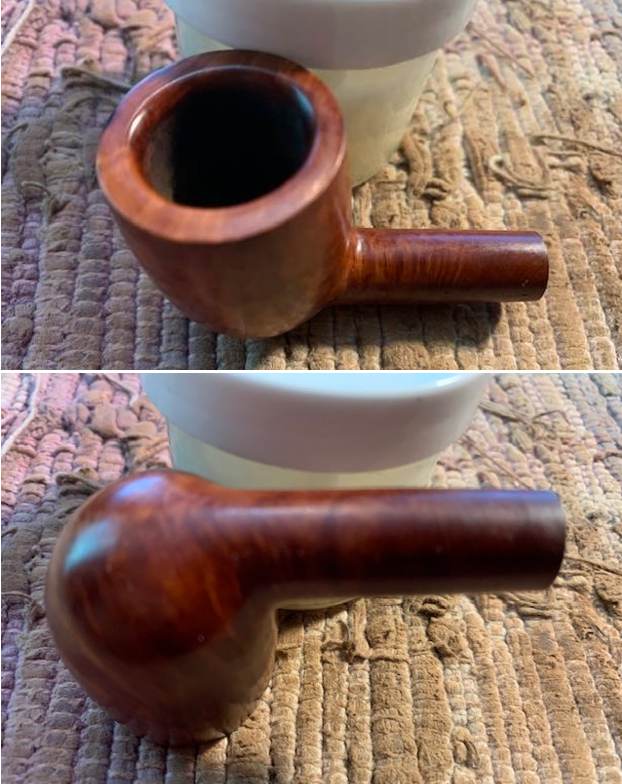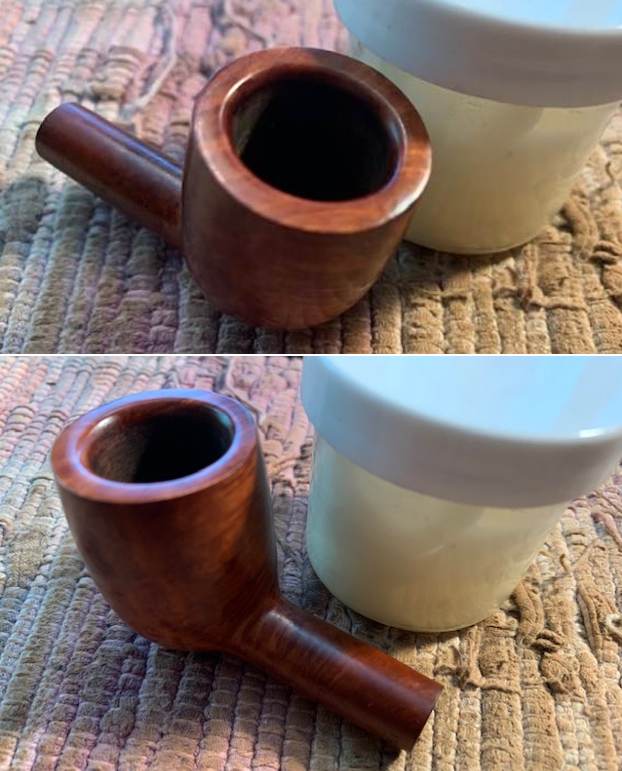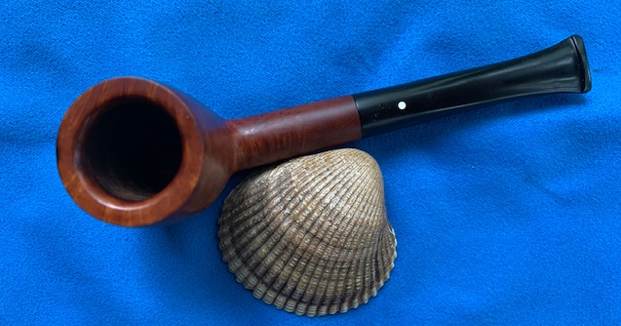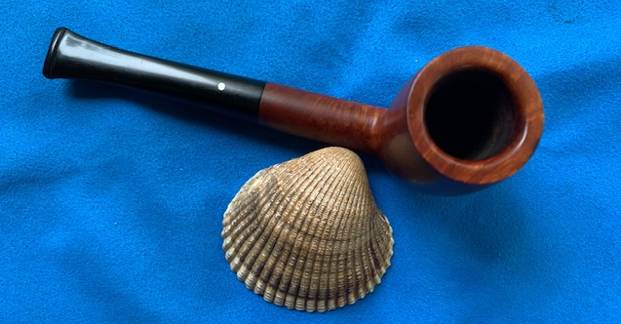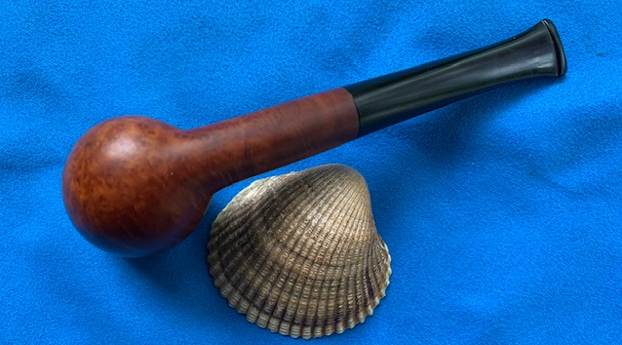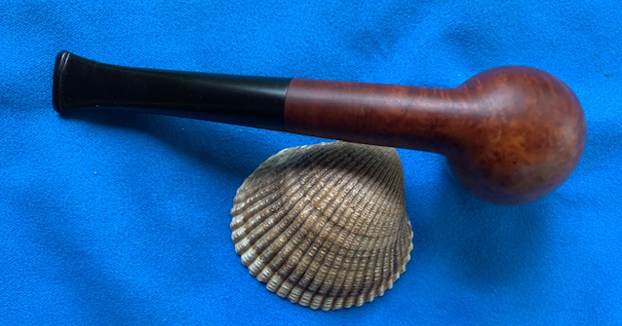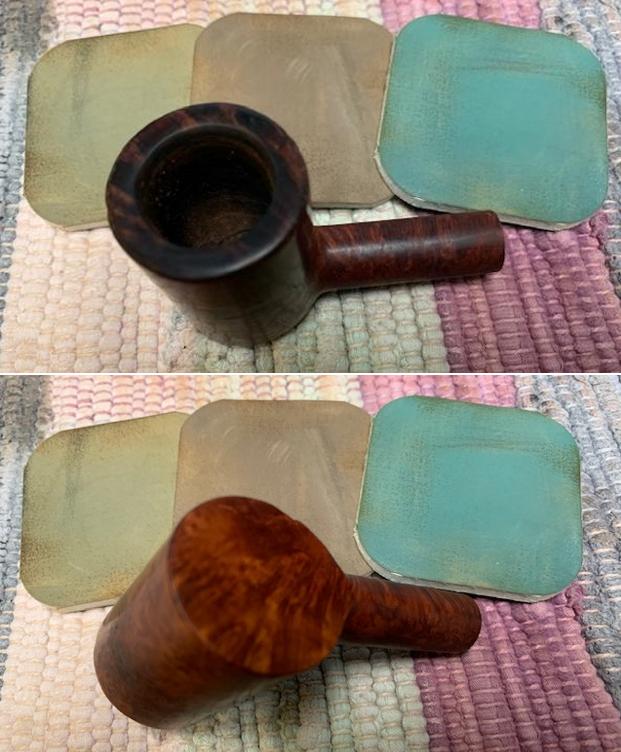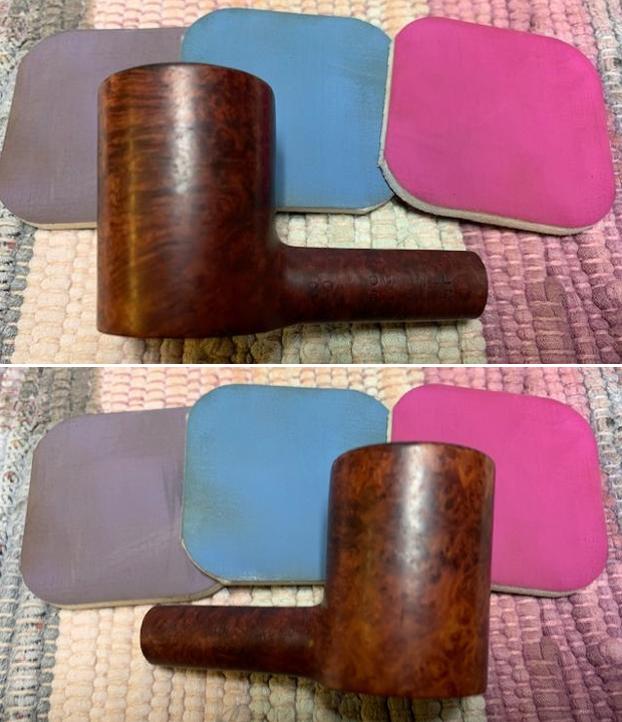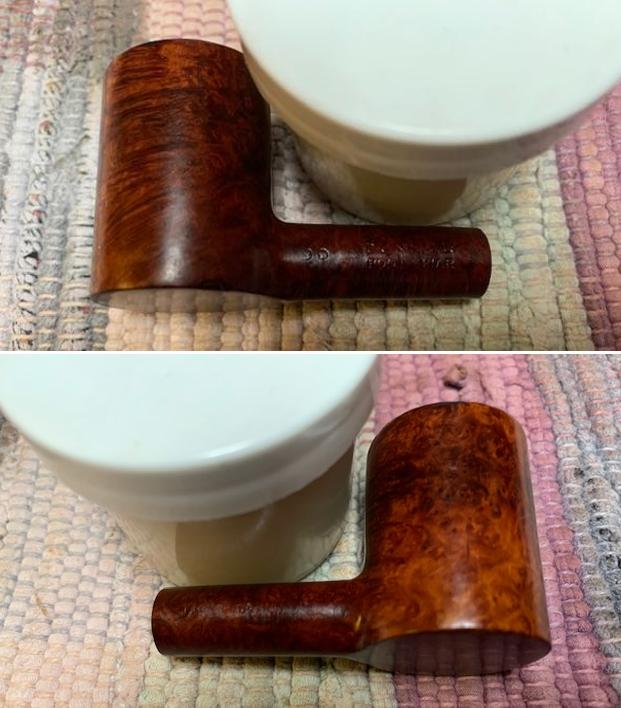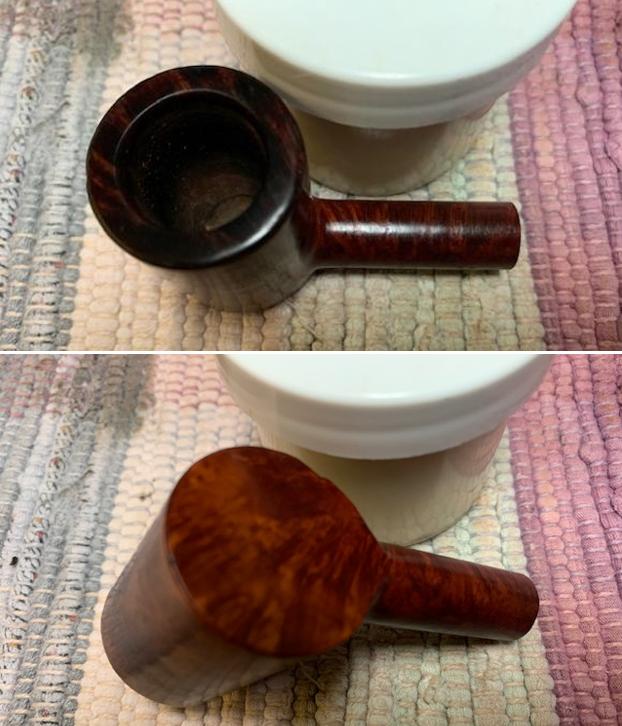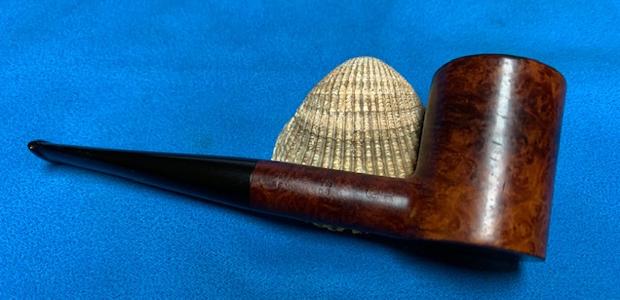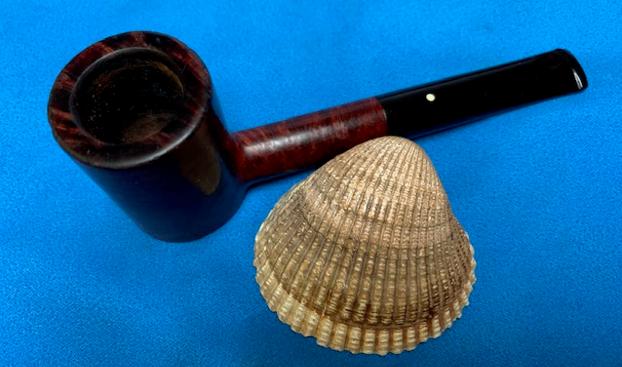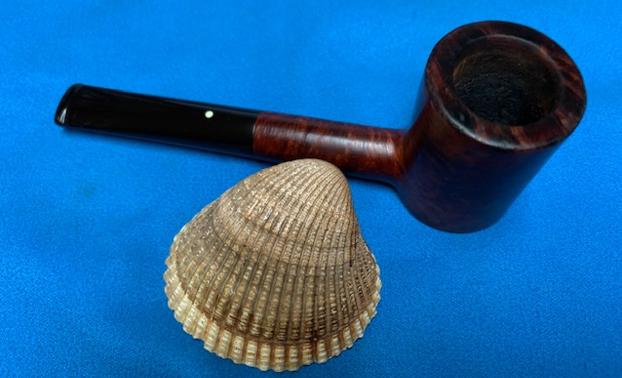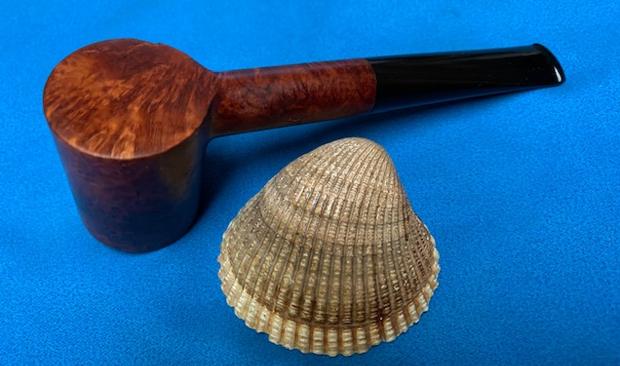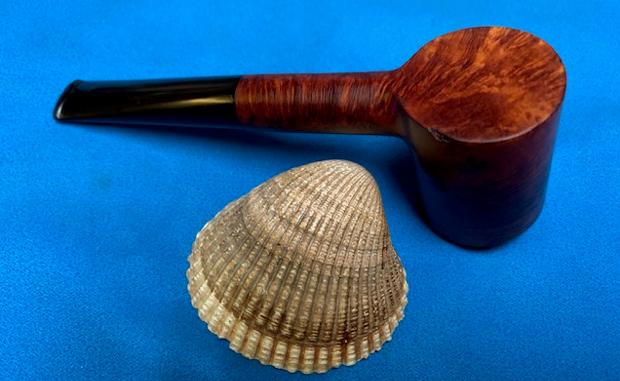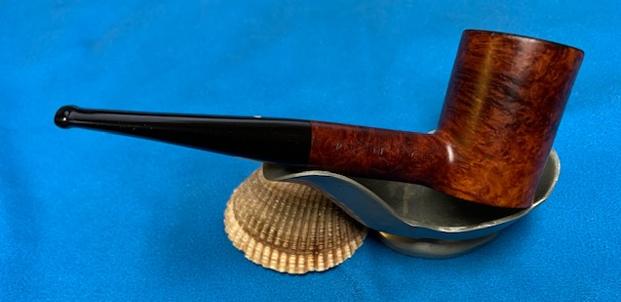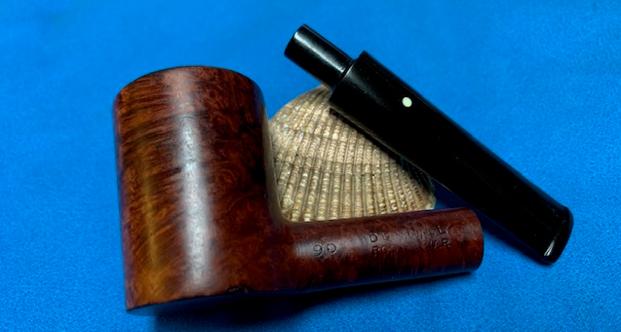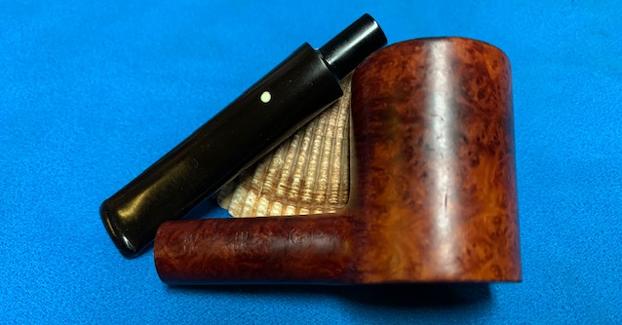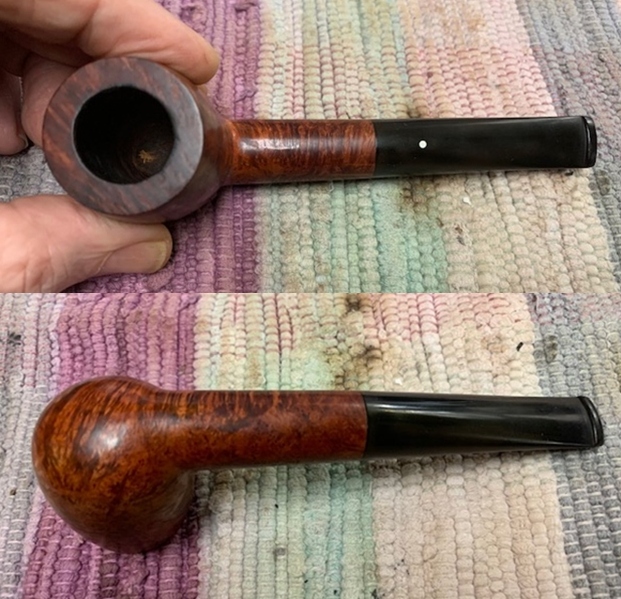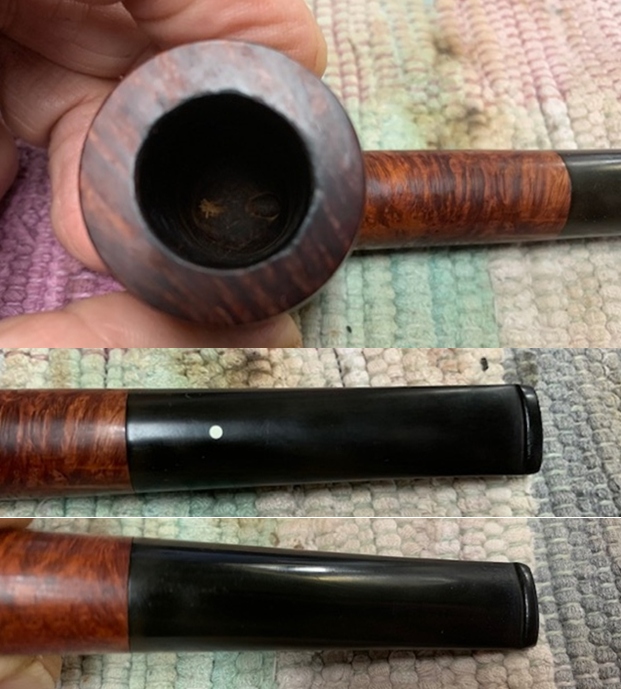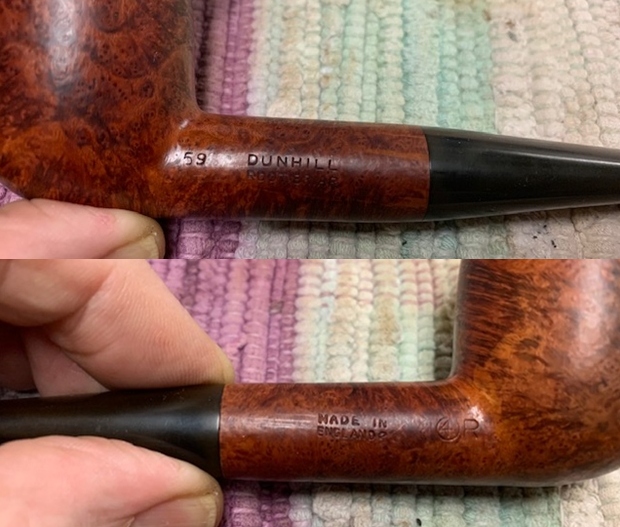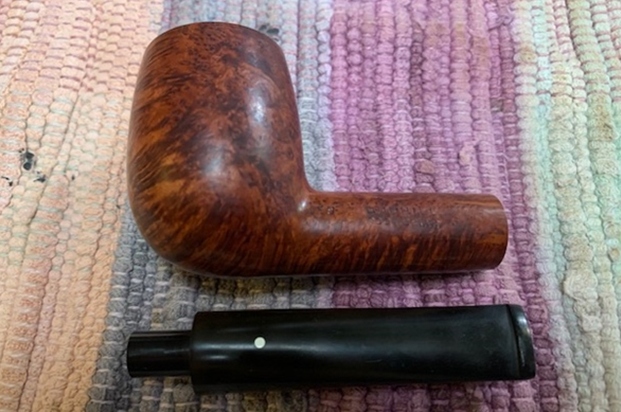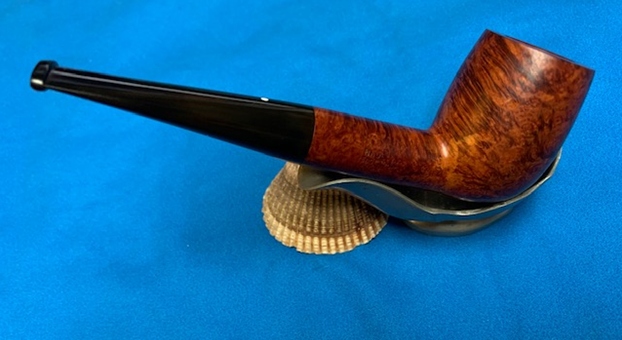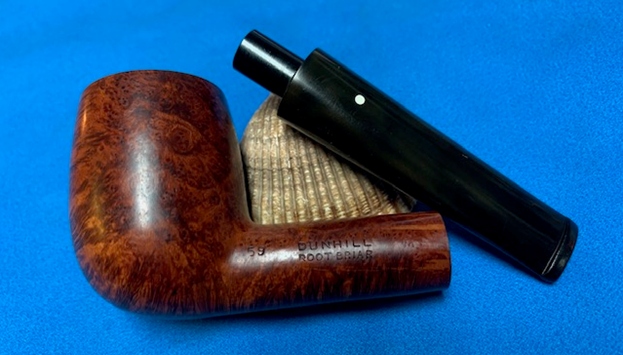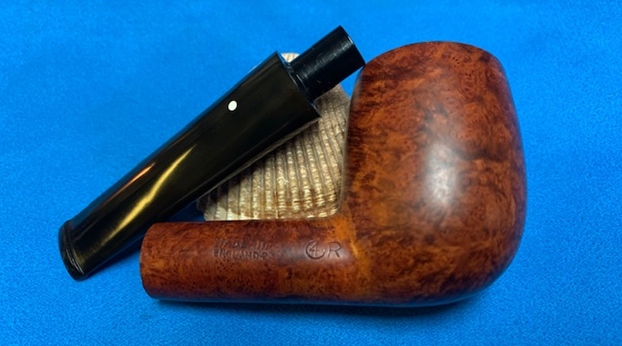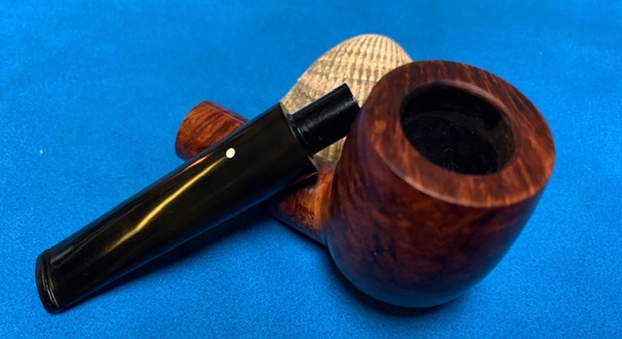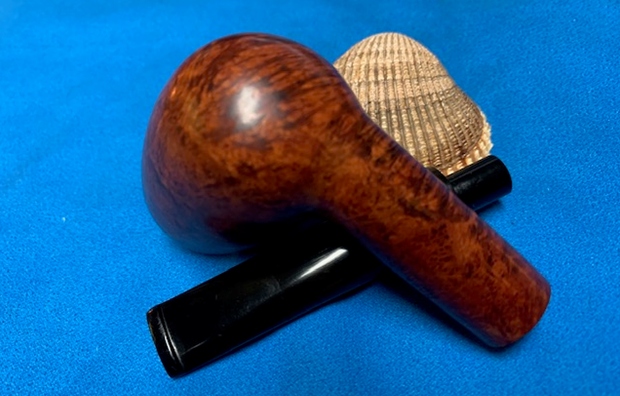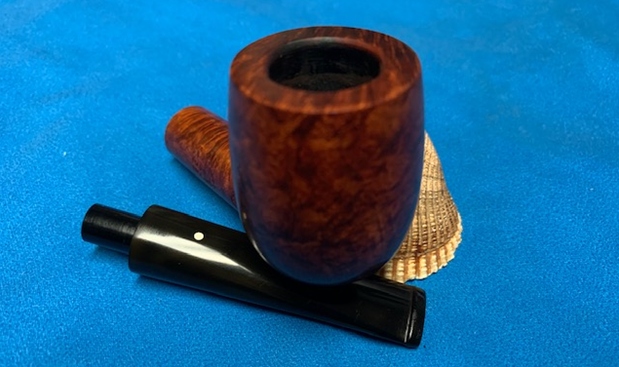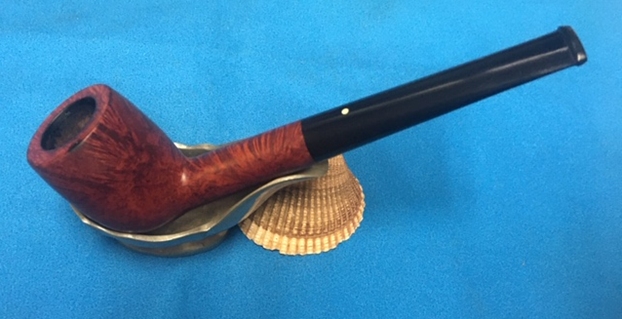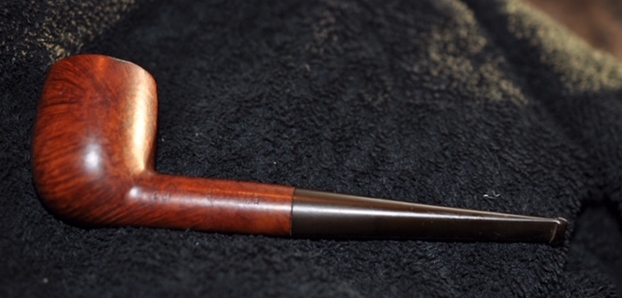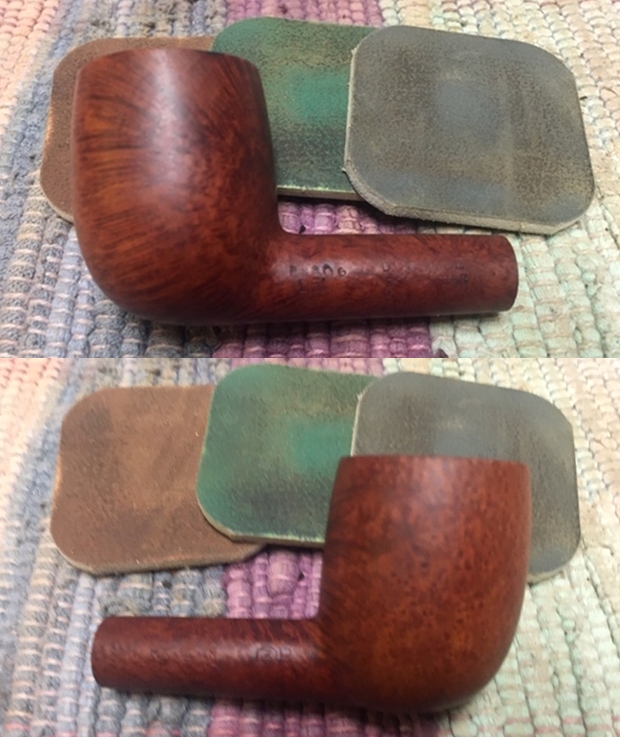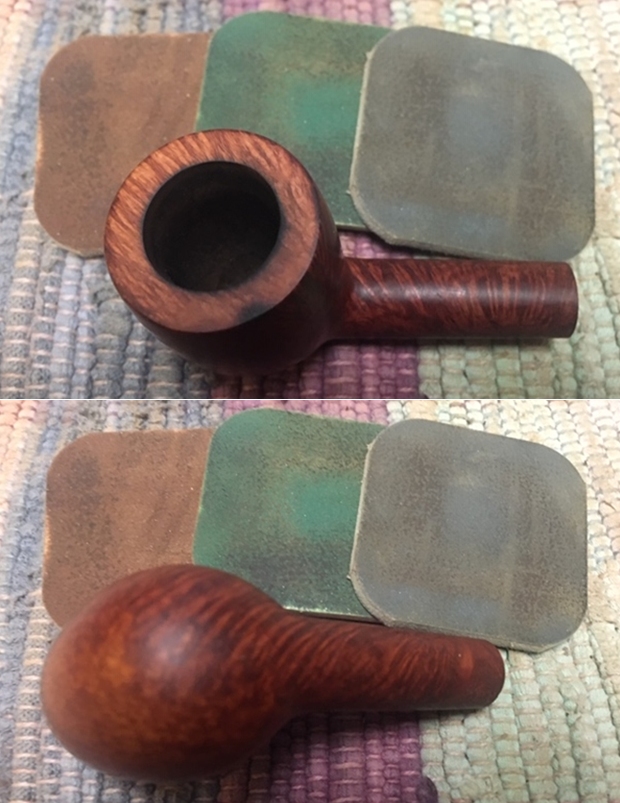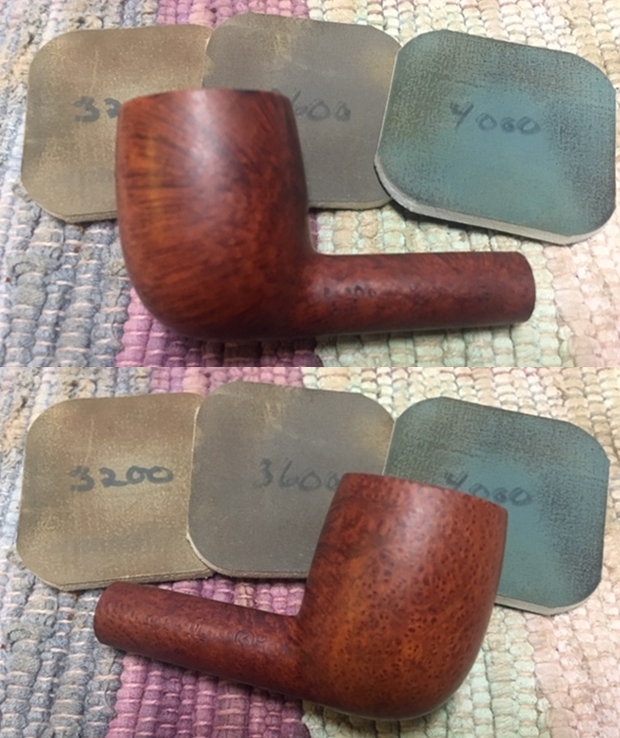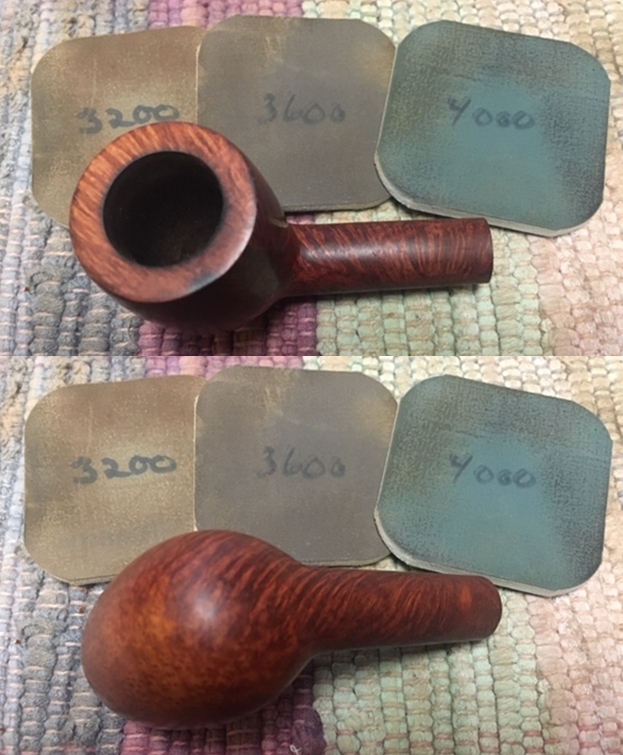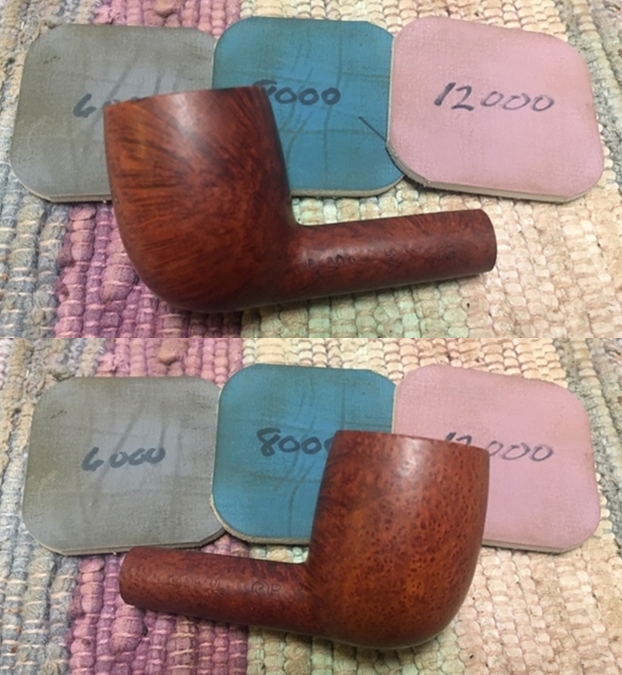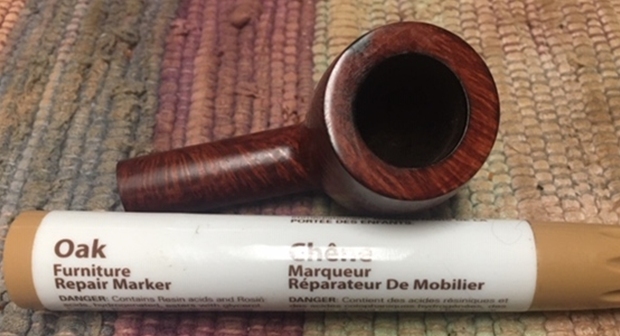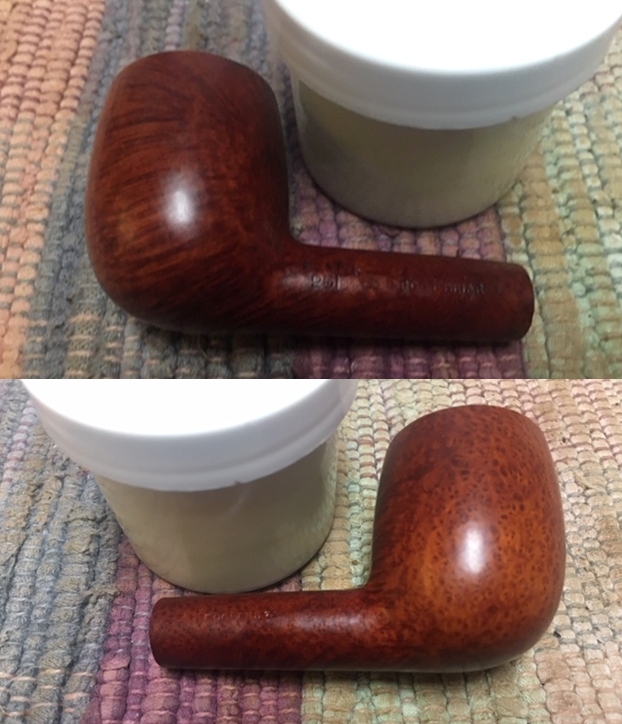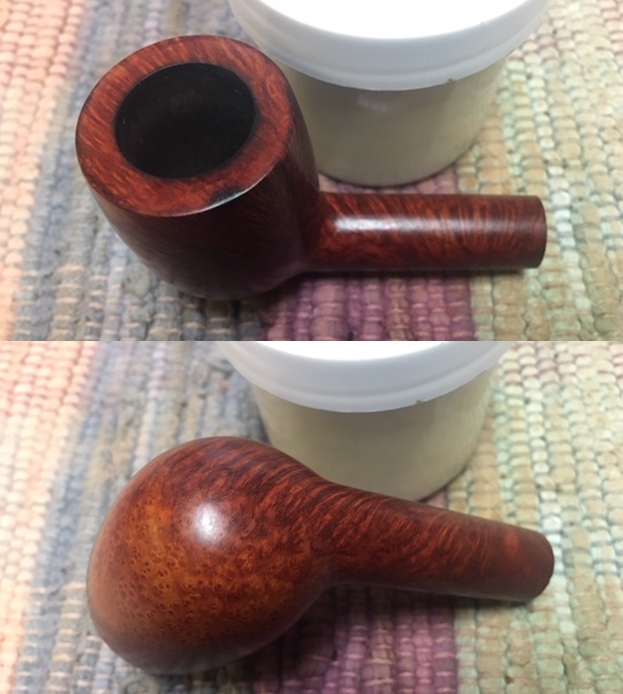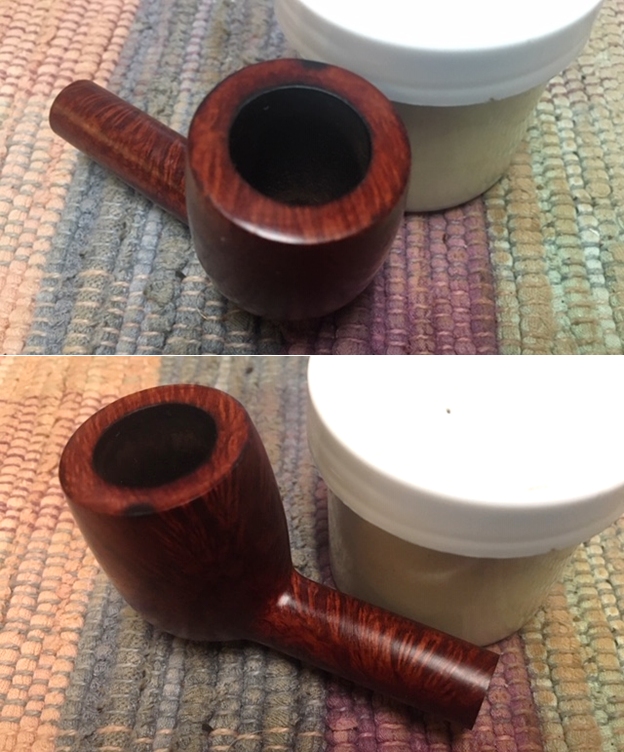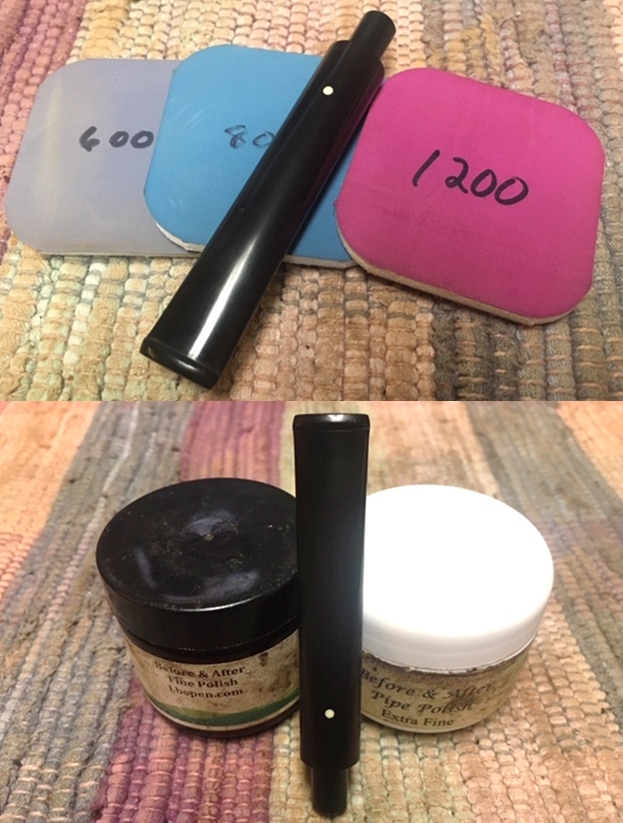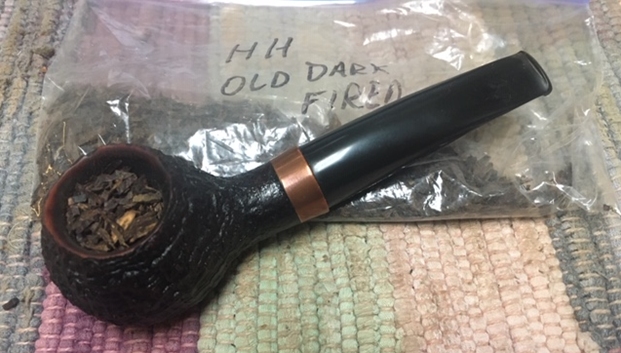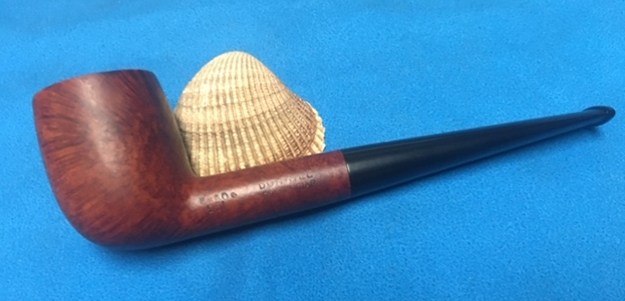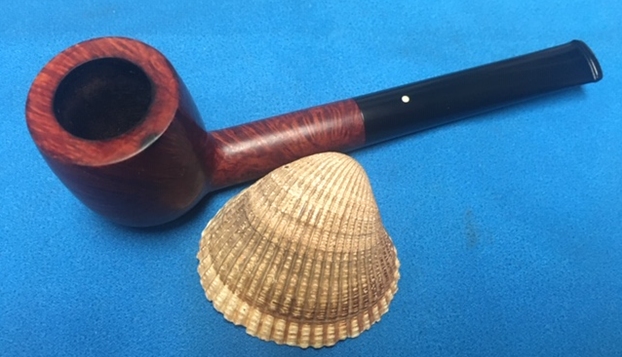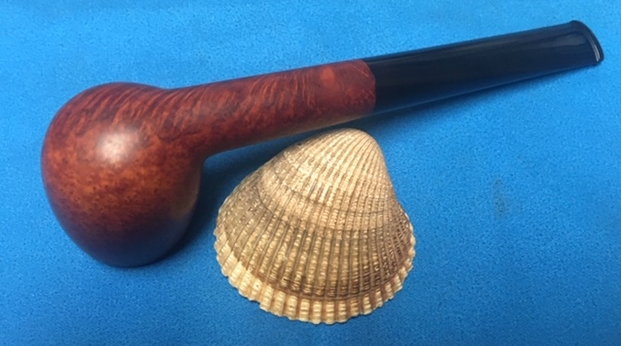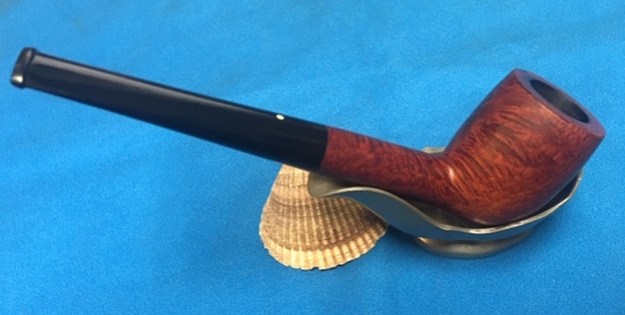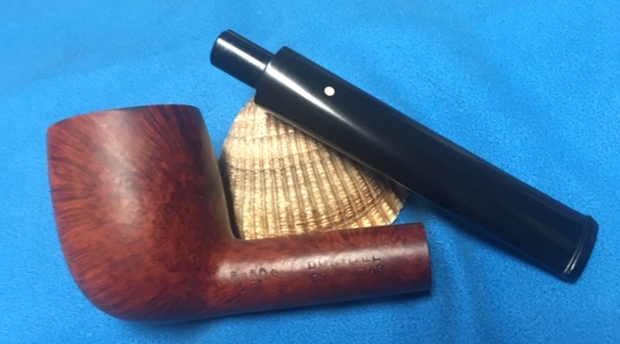
Tag Archives: Dunhill Root Briar Pipes

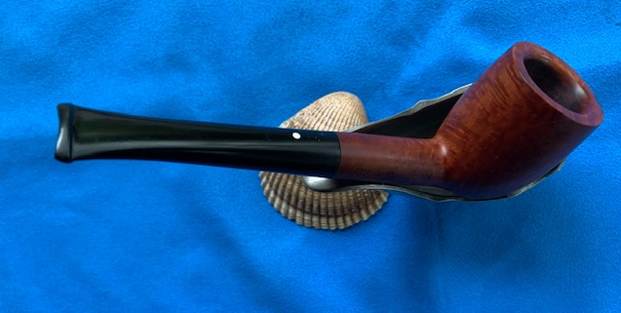
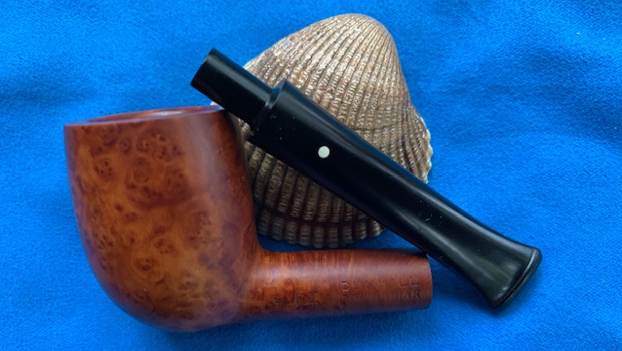
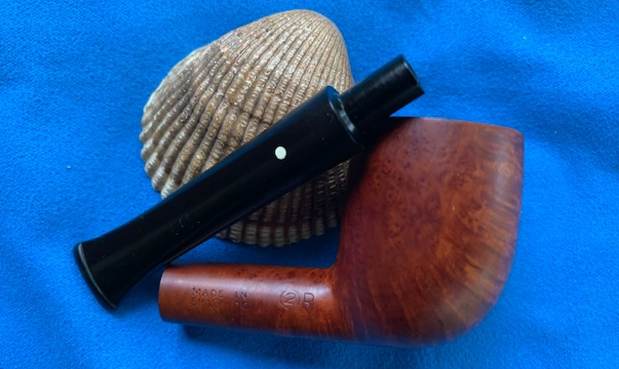
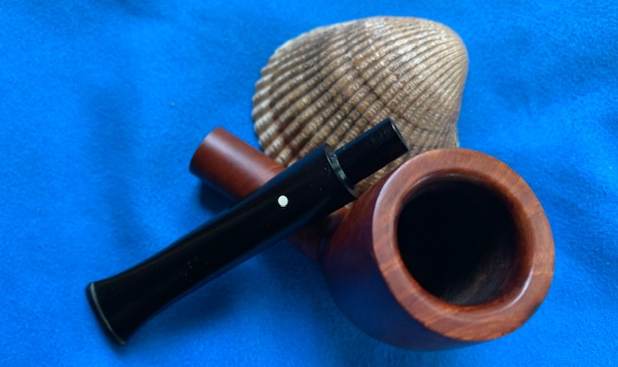
Restoring a Beautiful Dunhill Root Briar 36 F/T Made in England Liverpool


Blog by Steve Laug

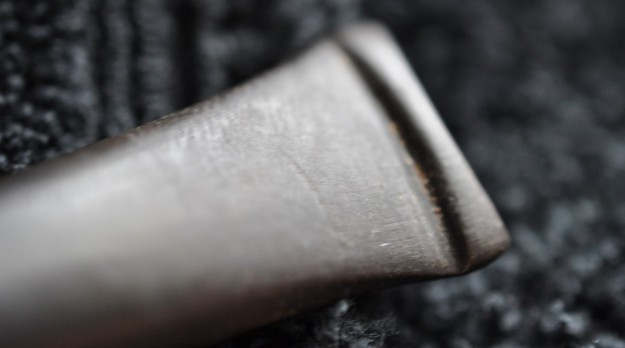
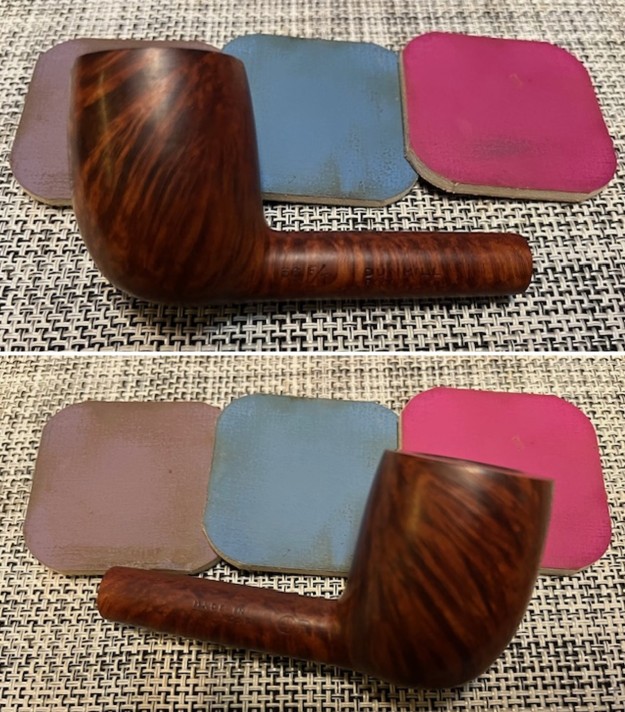
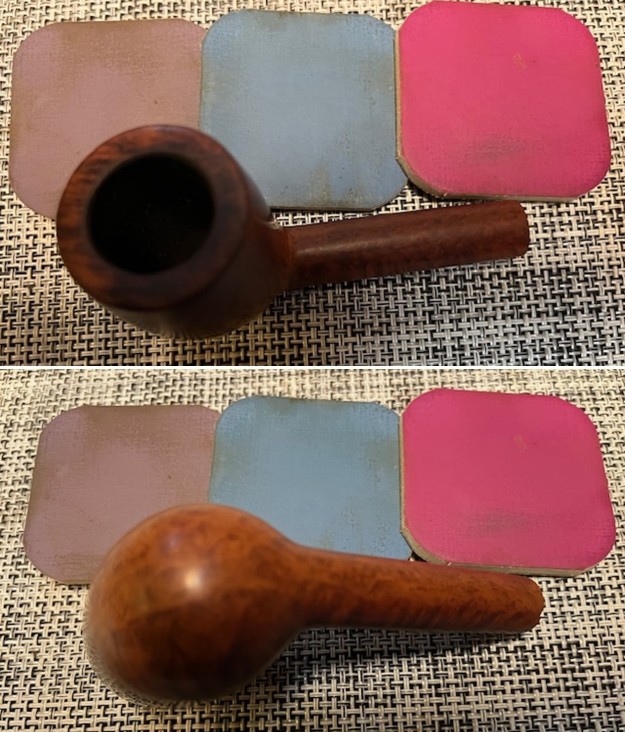
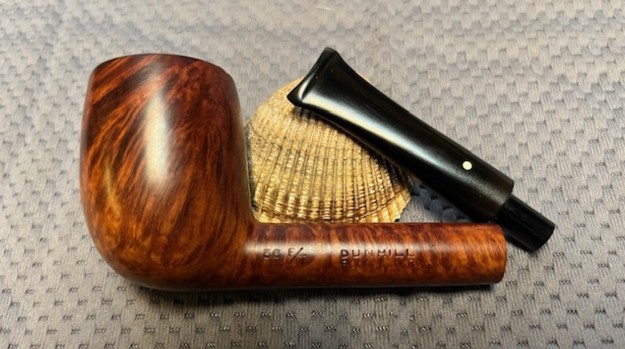
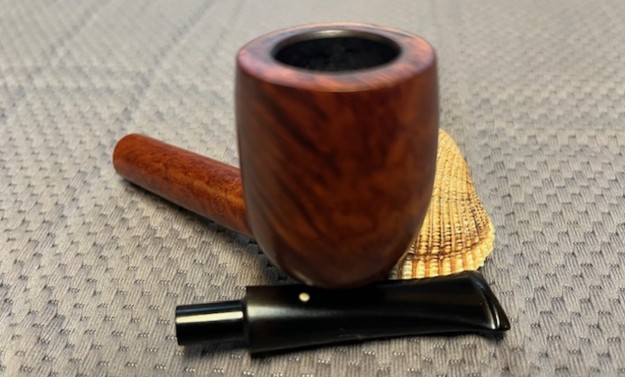
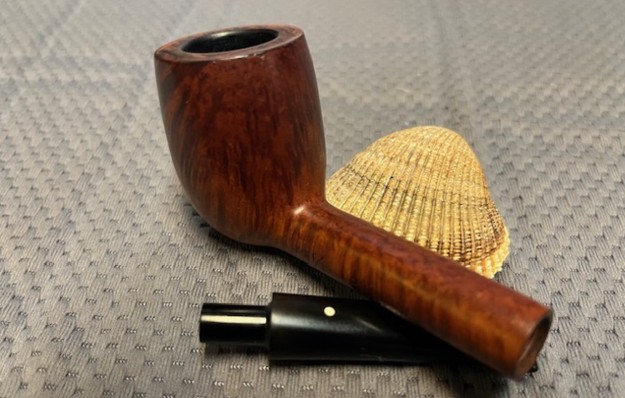
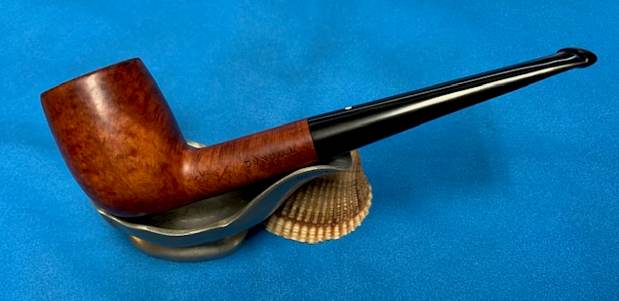
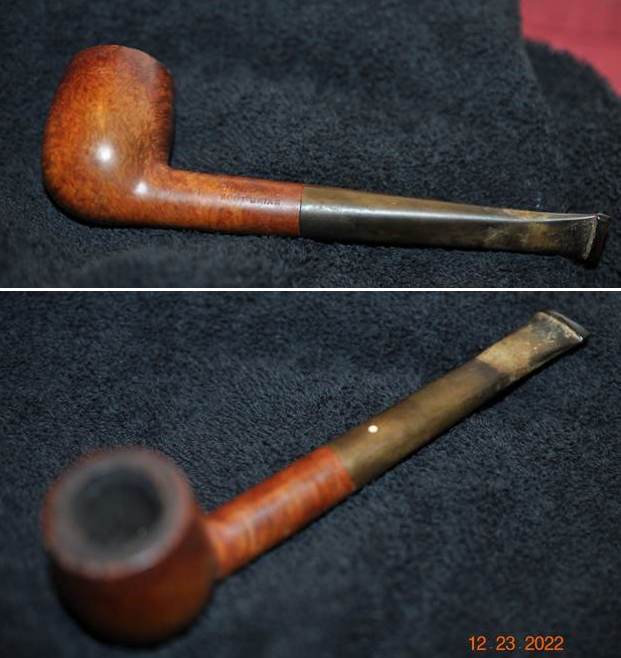
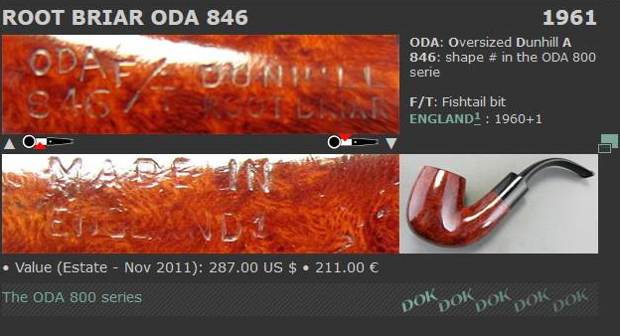
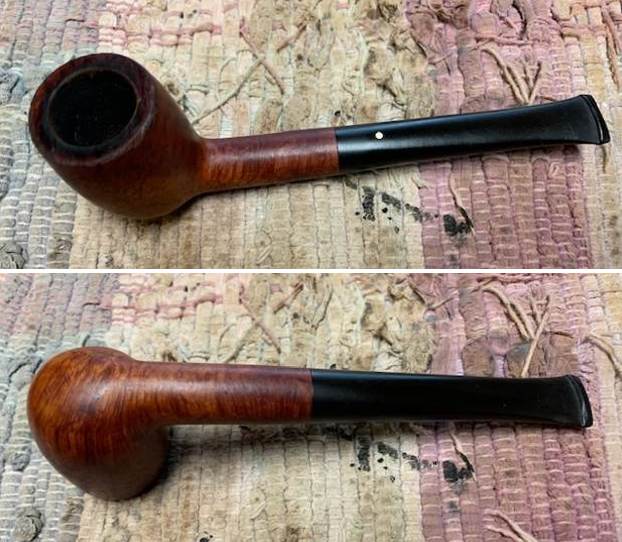
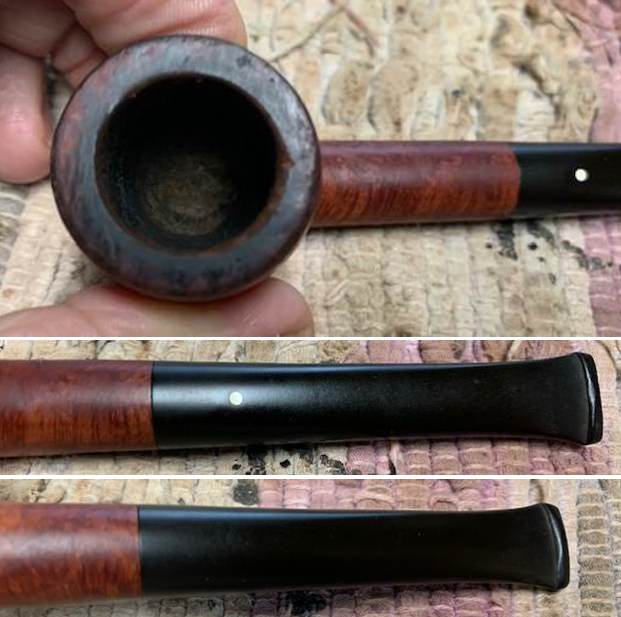
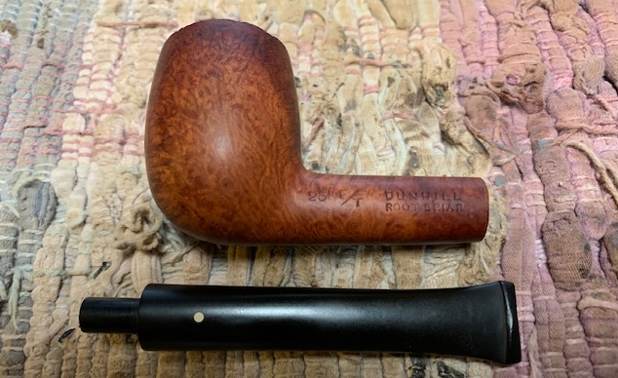
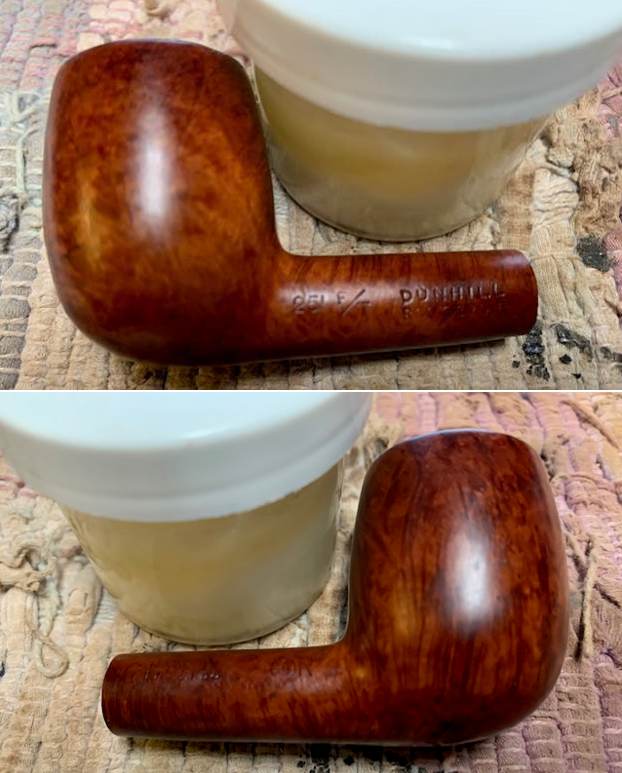
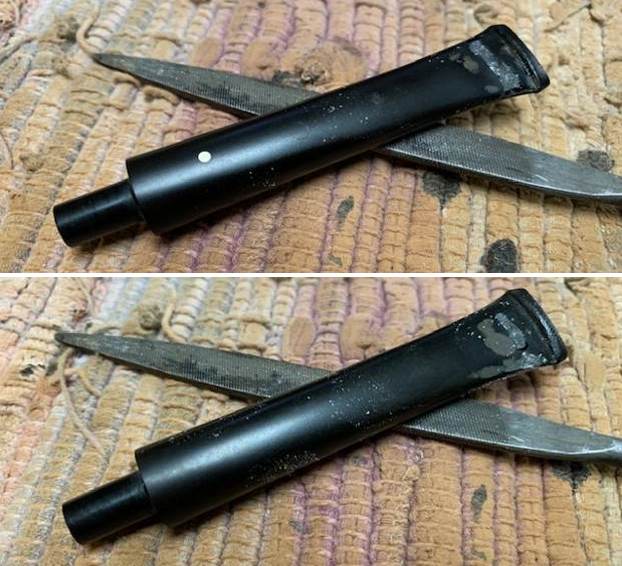
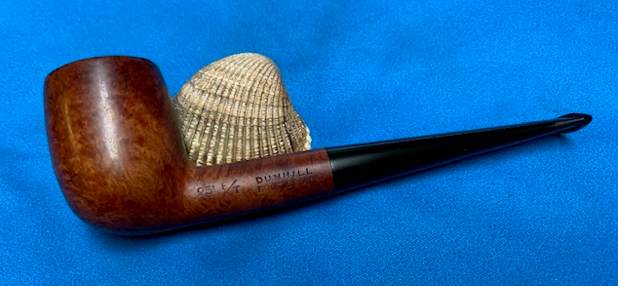
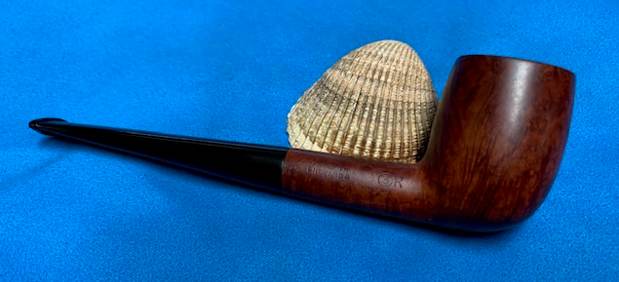
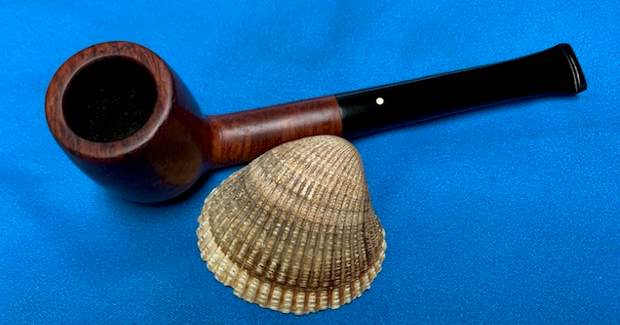
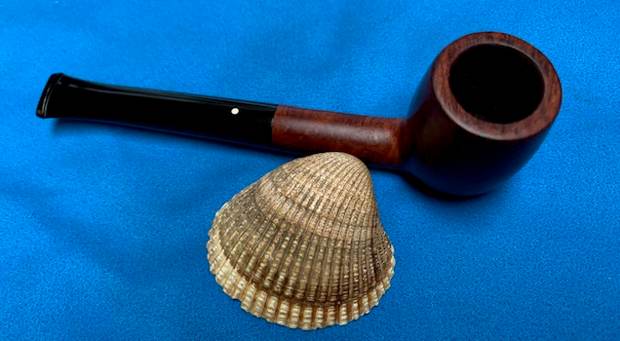
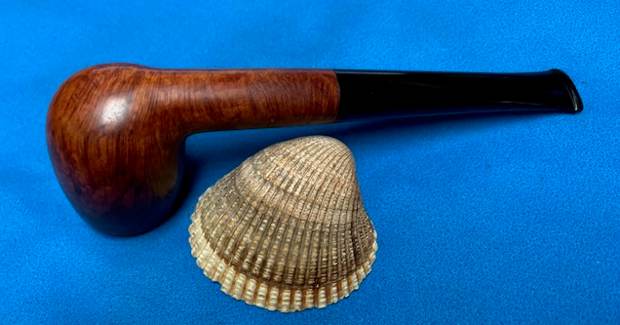
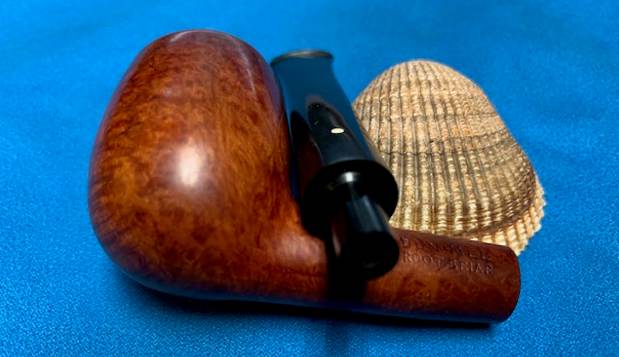
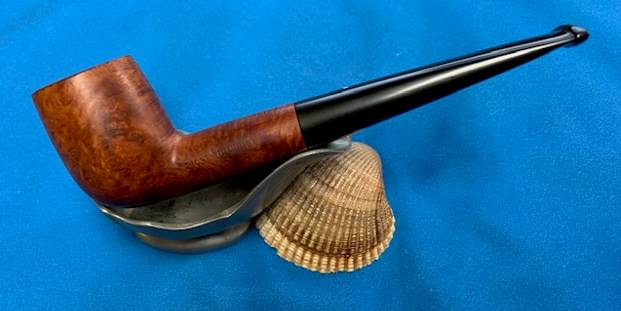
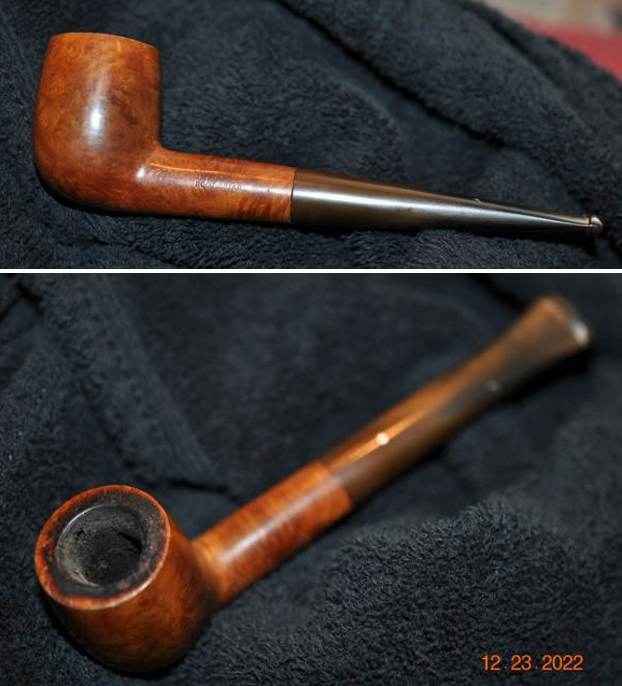
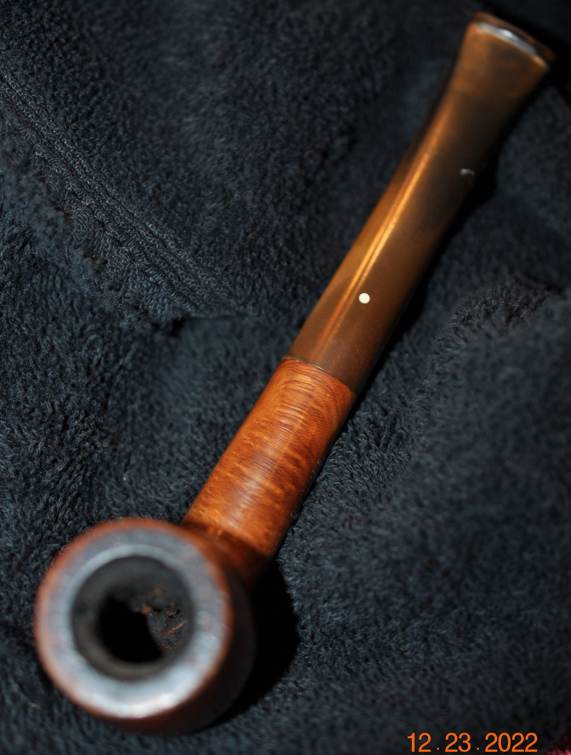
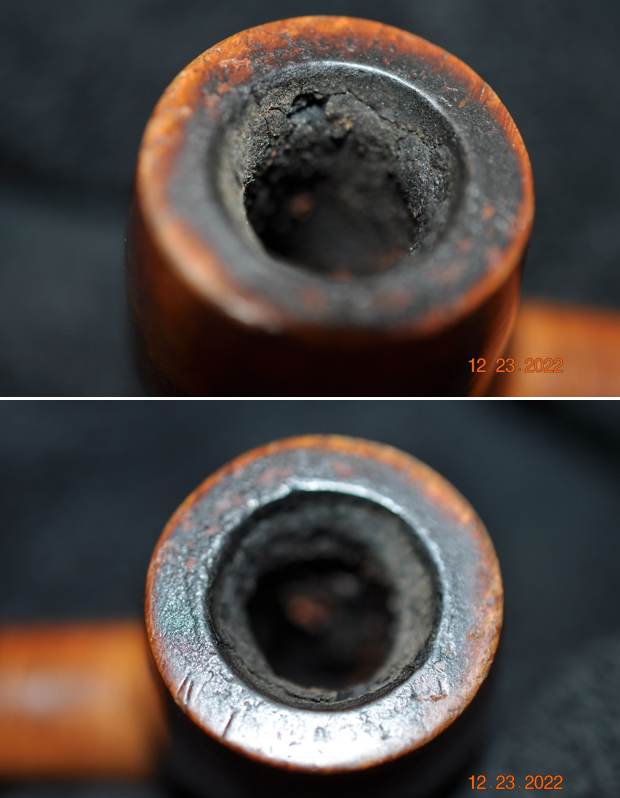
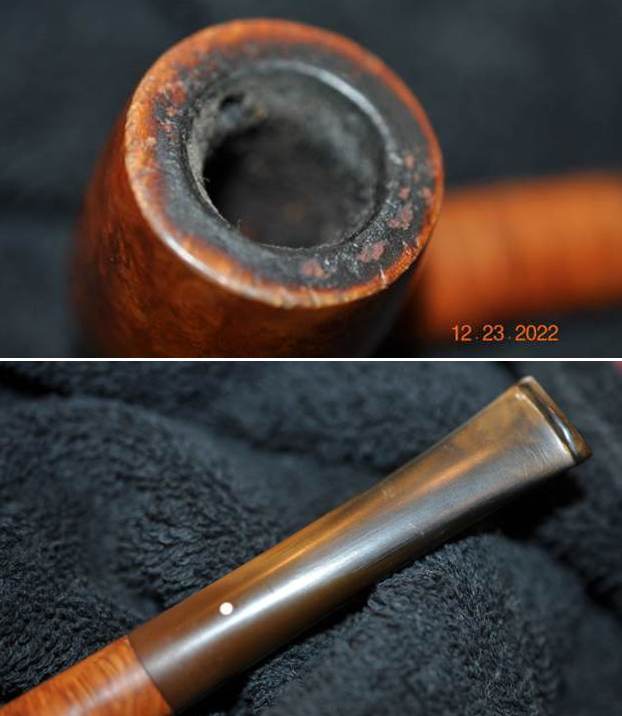
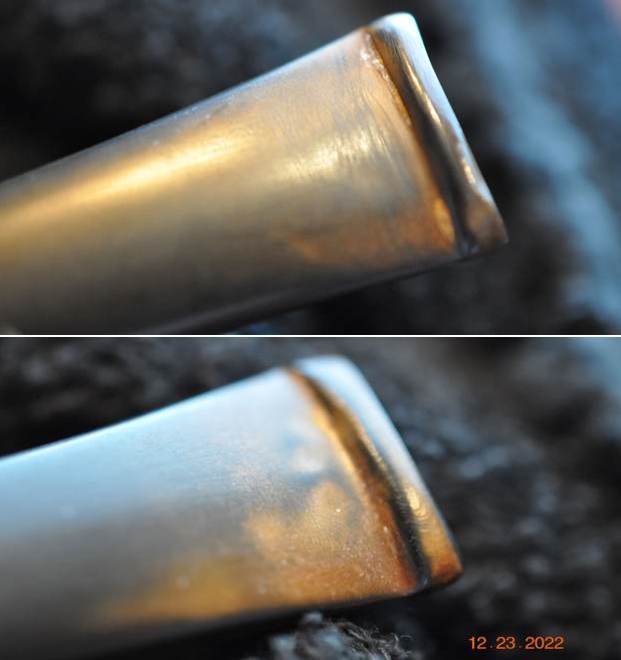
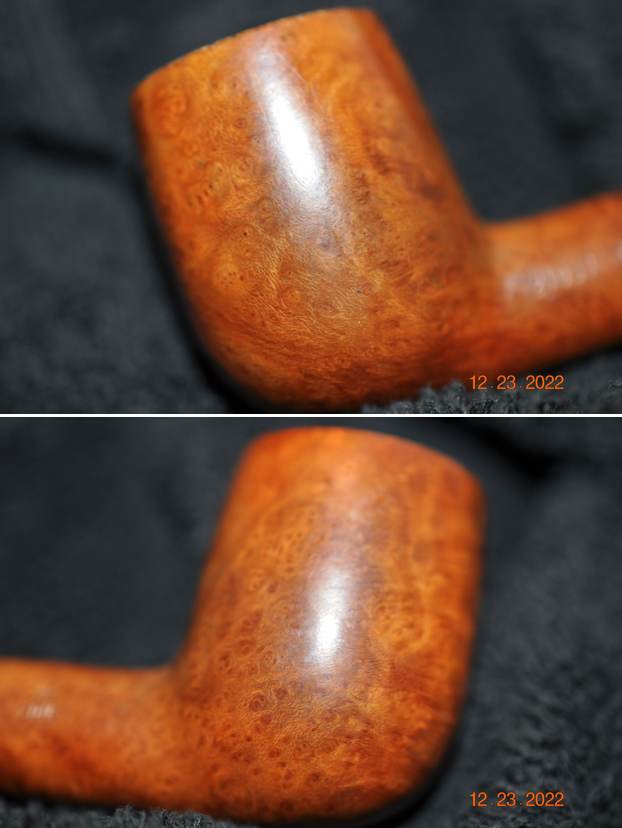
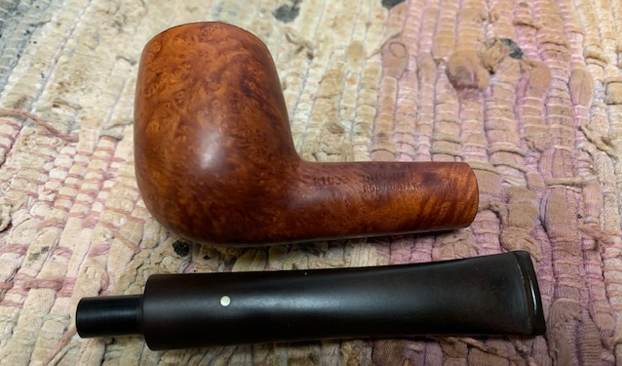
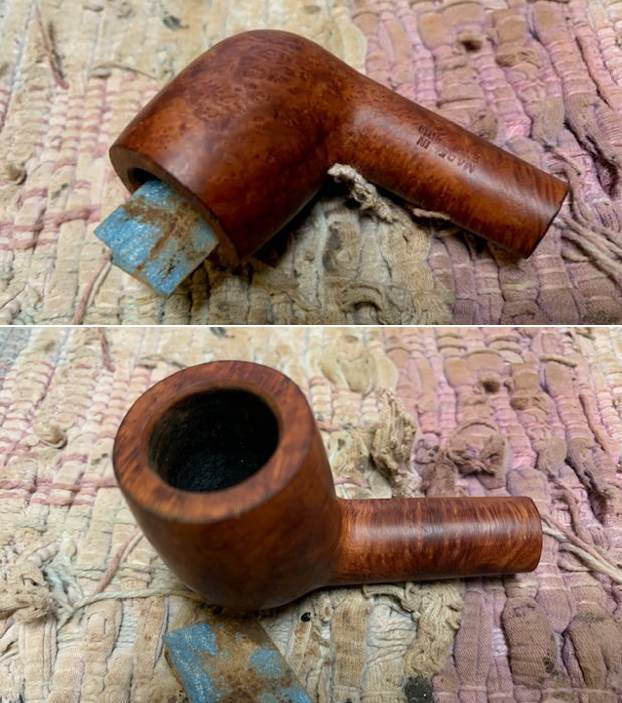
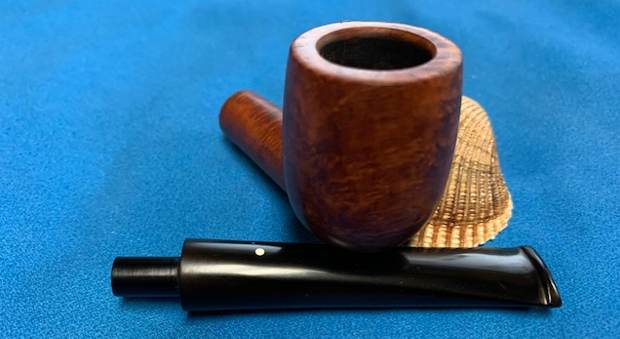
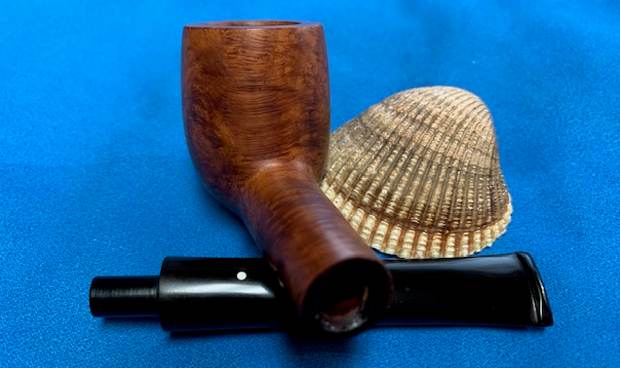
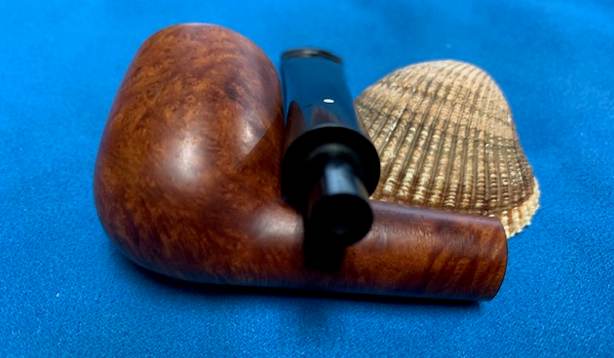
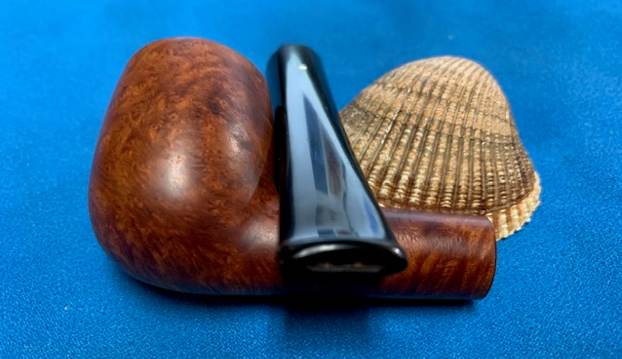
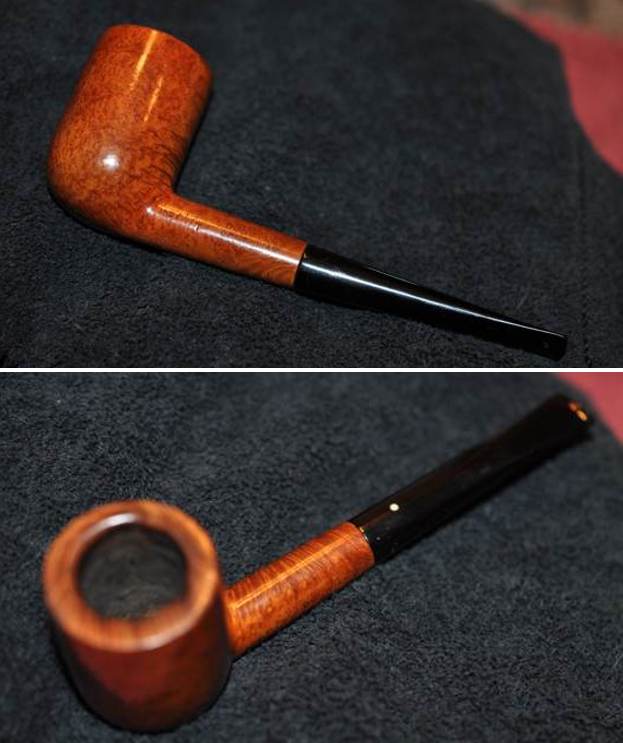
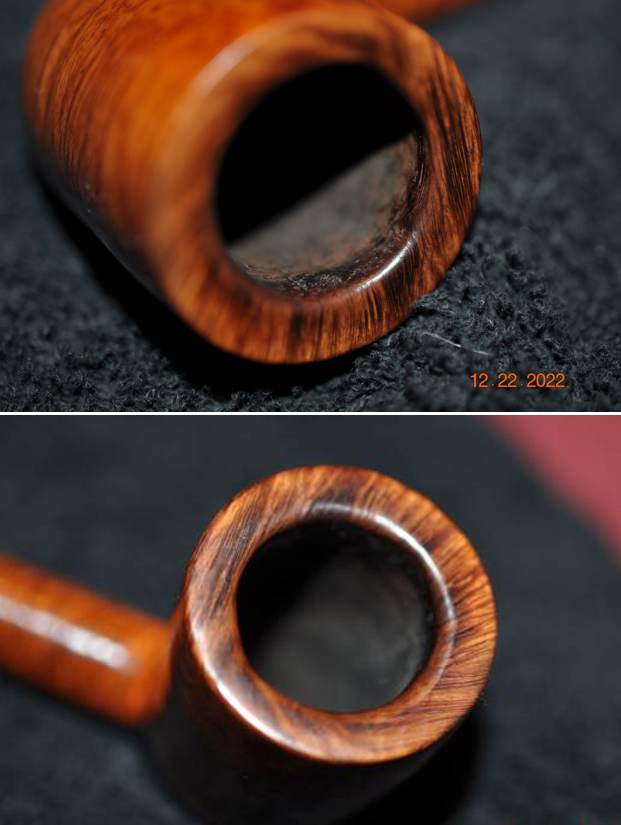
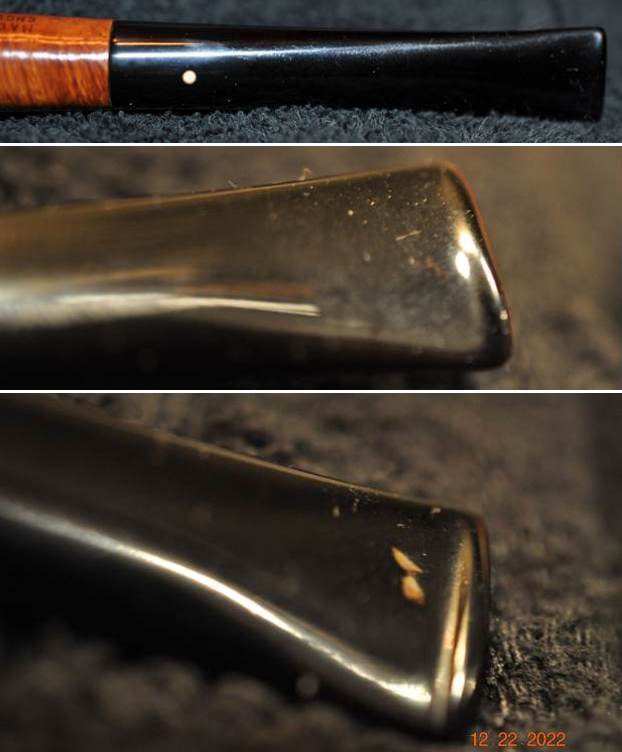
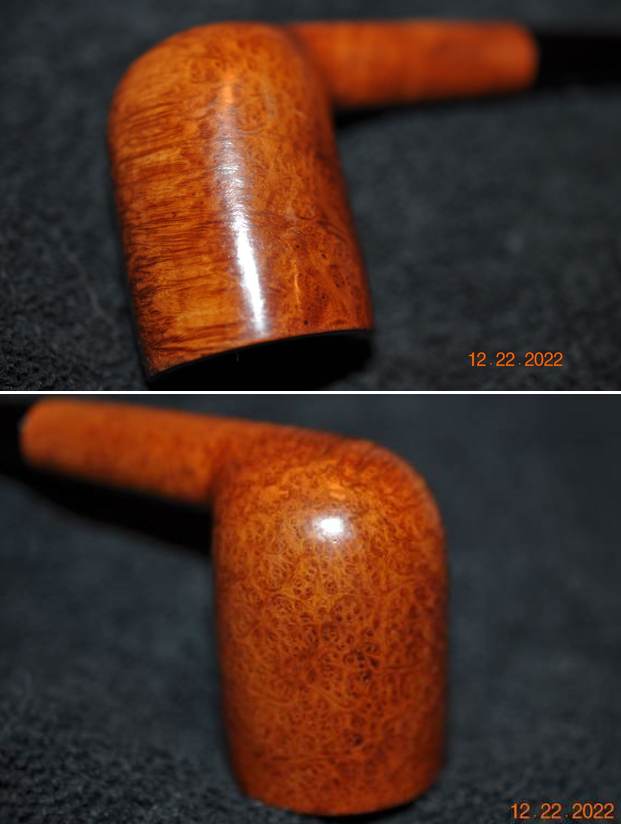
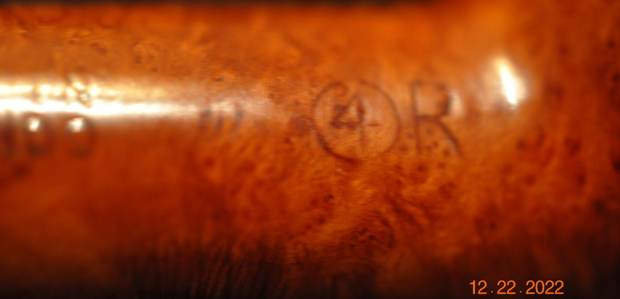
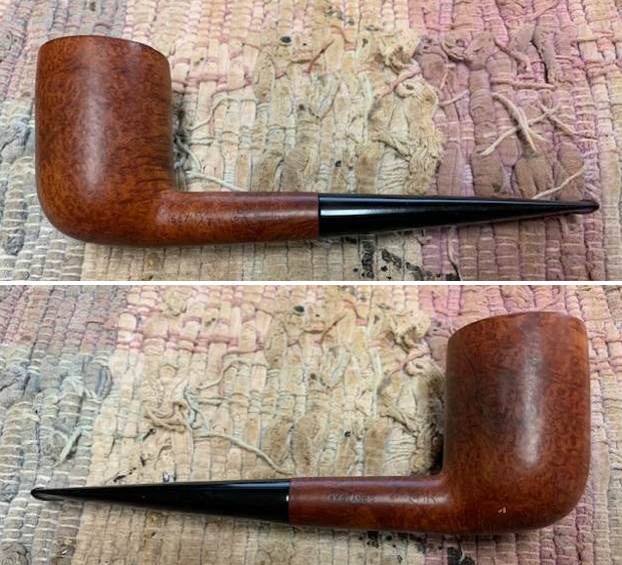
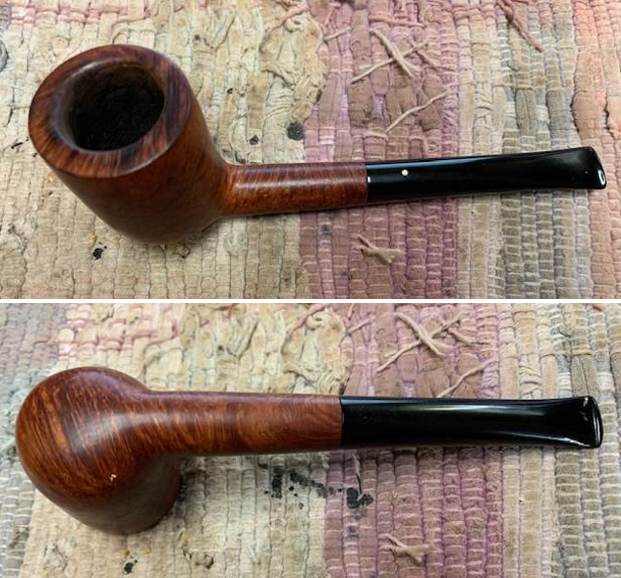
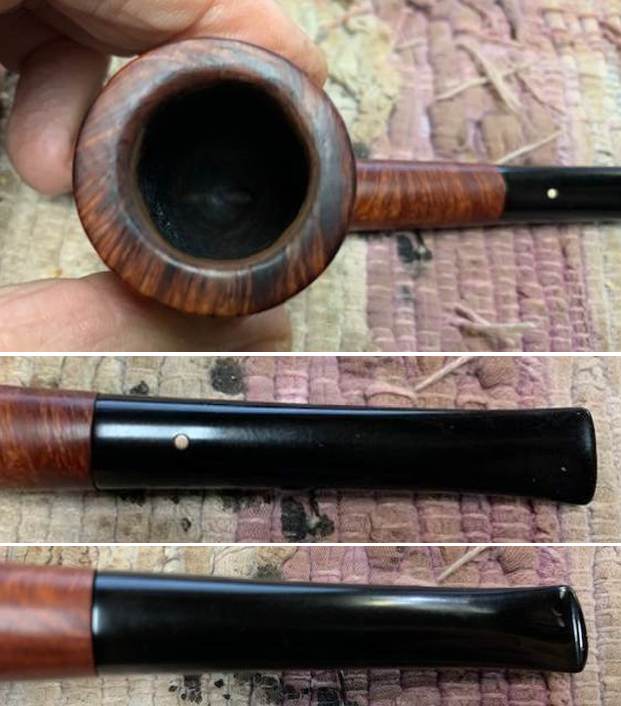
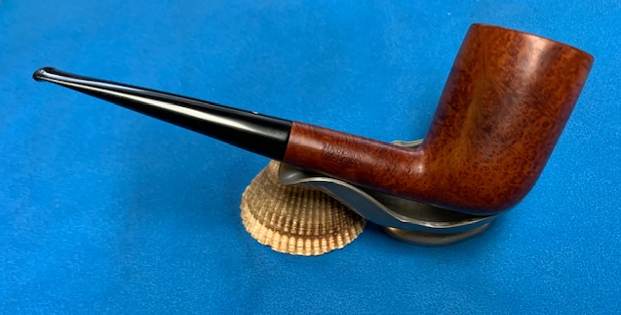
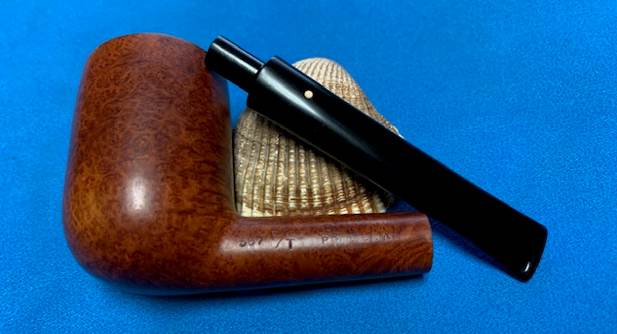
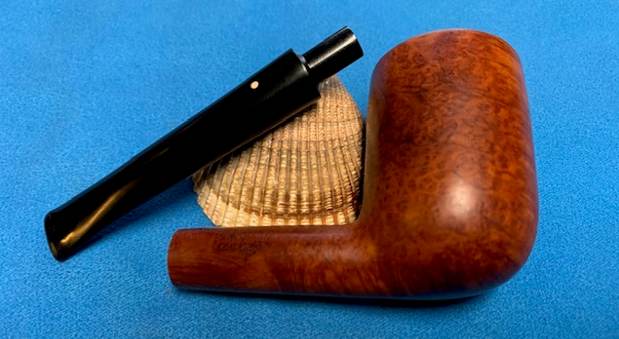
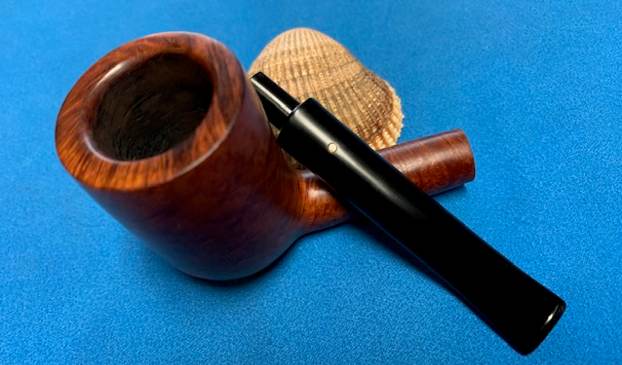
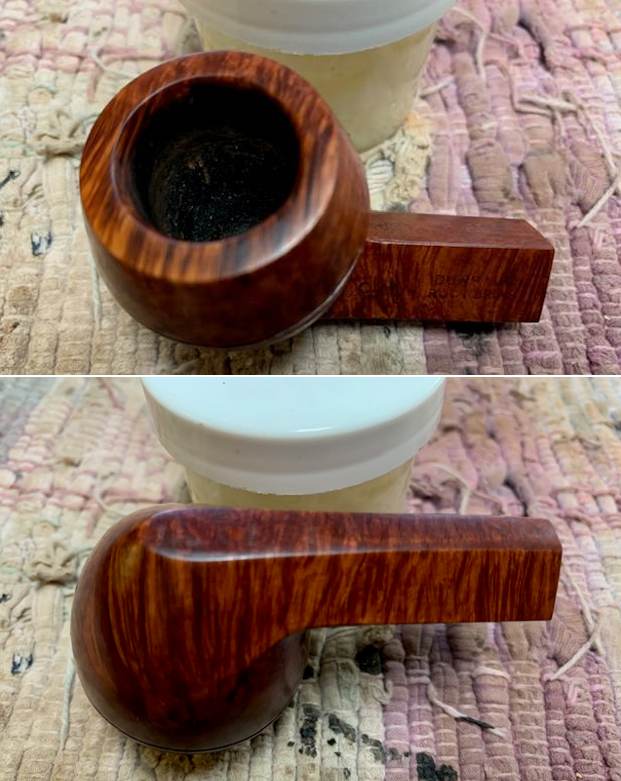
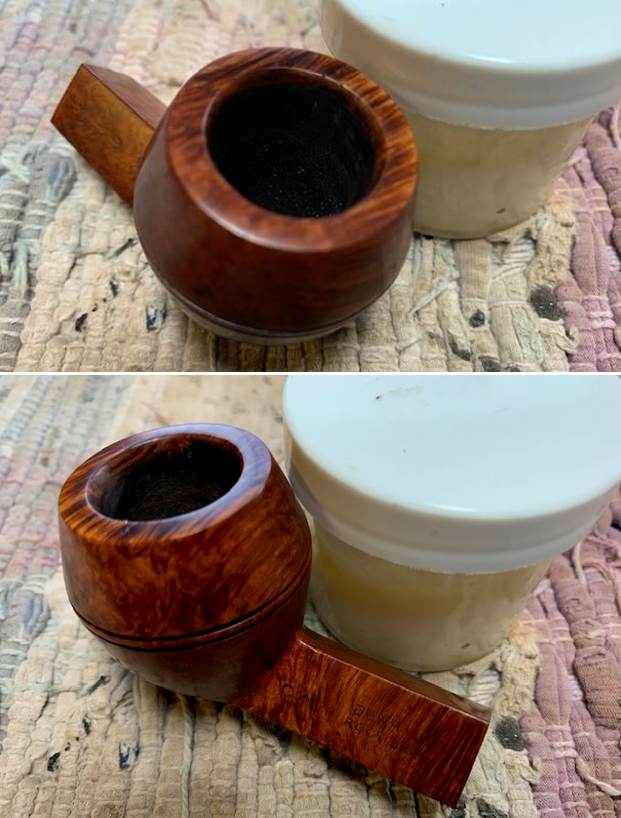
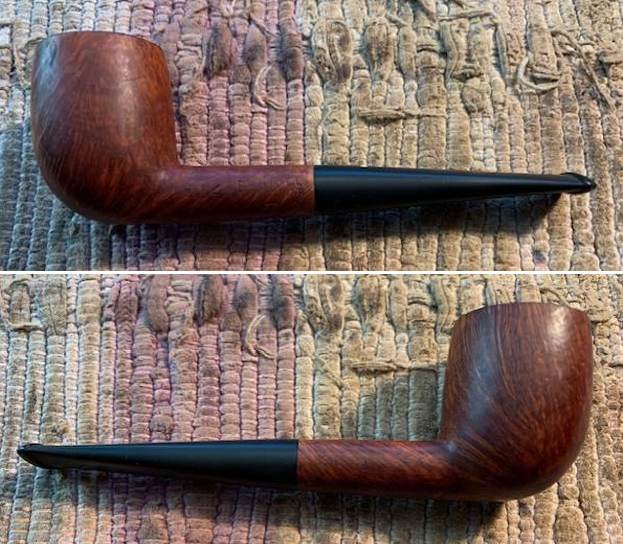
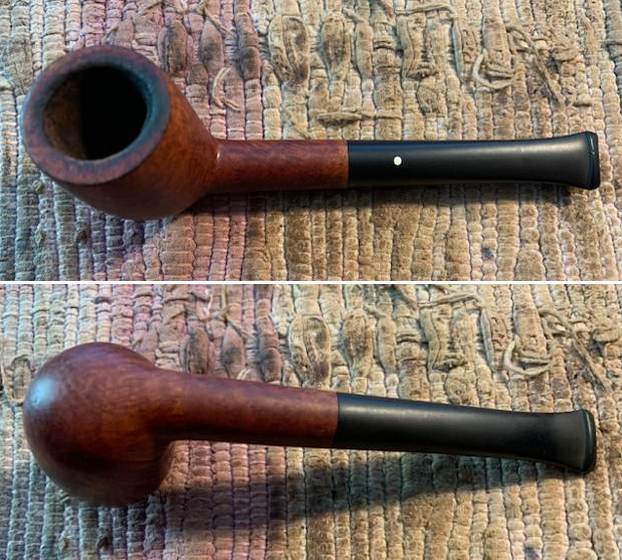
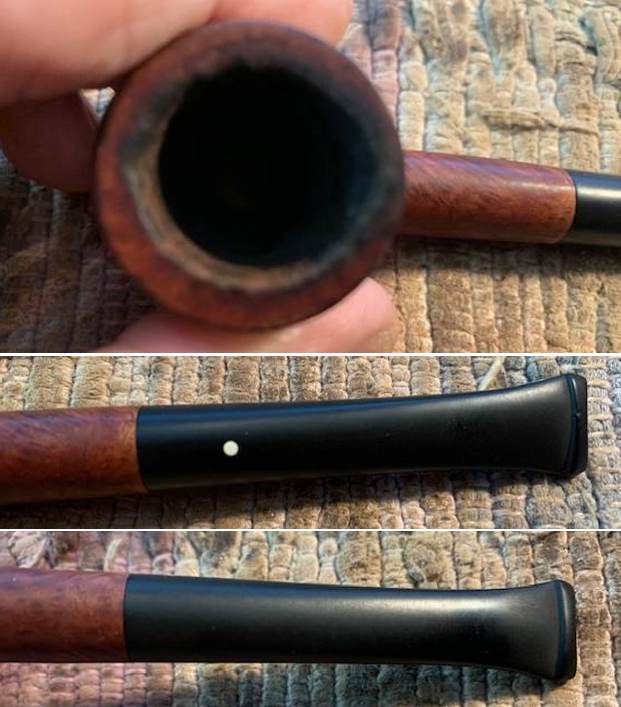
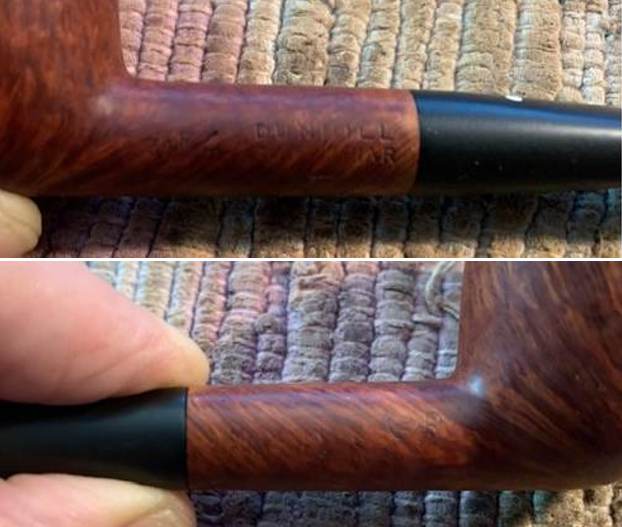
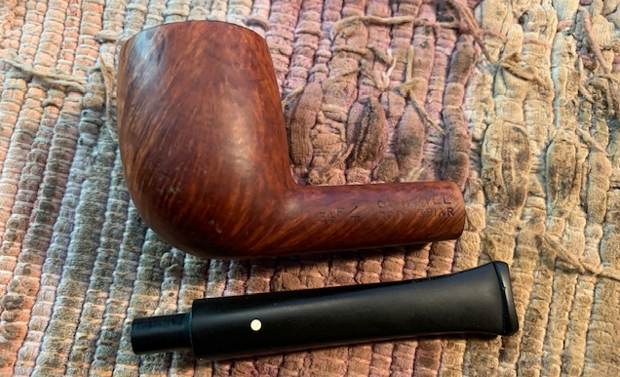
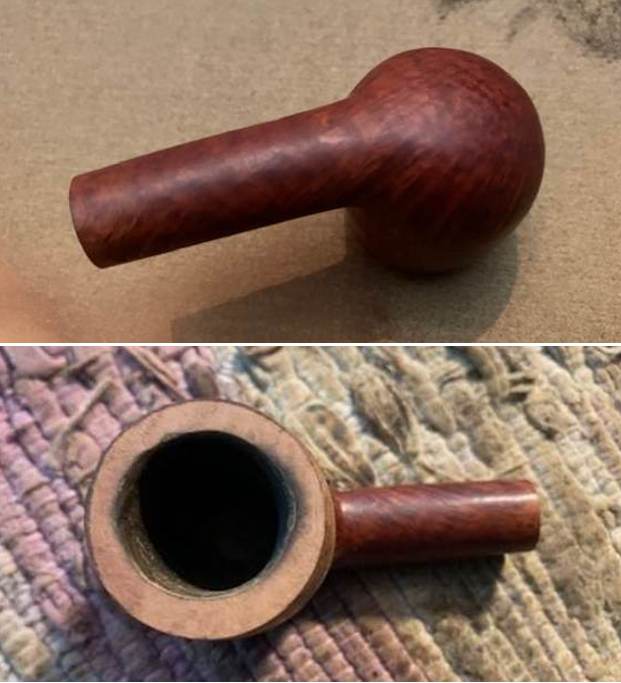
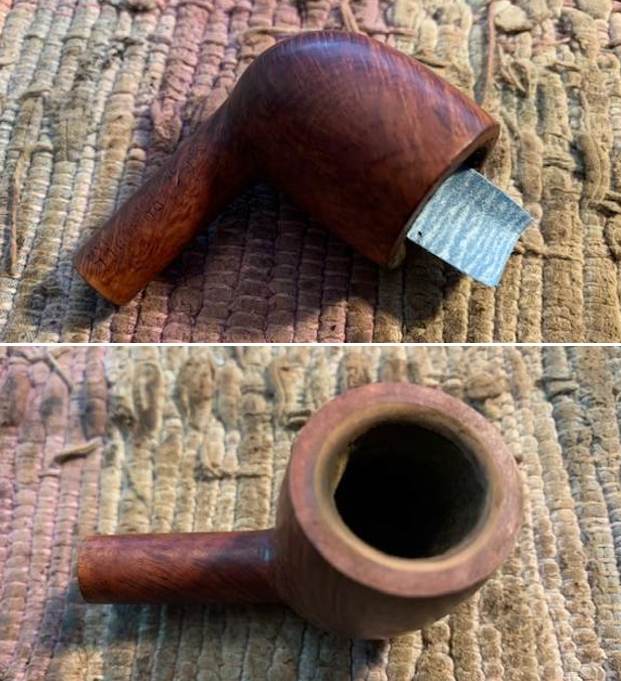
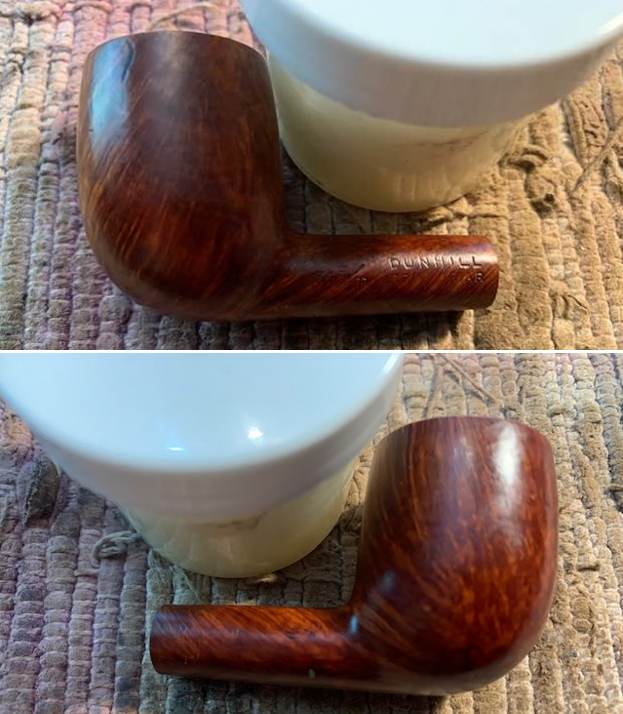
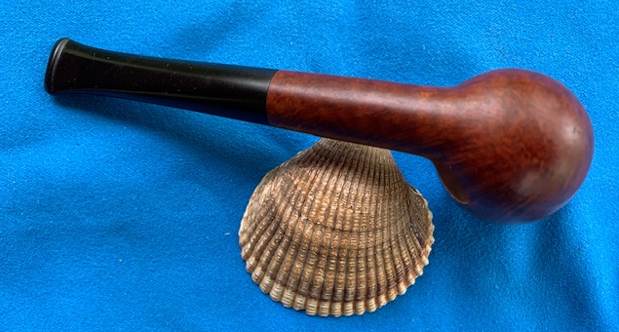
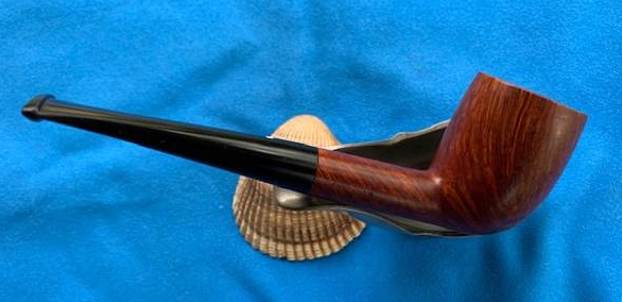
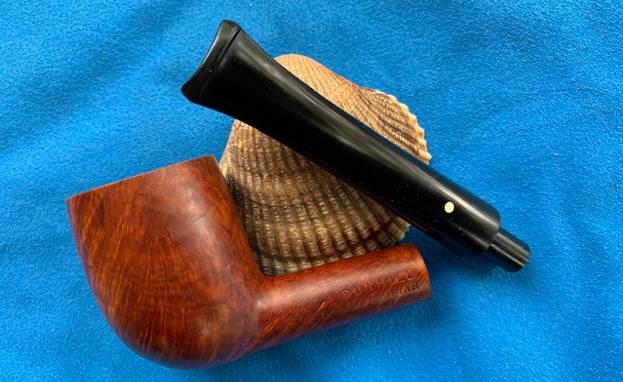
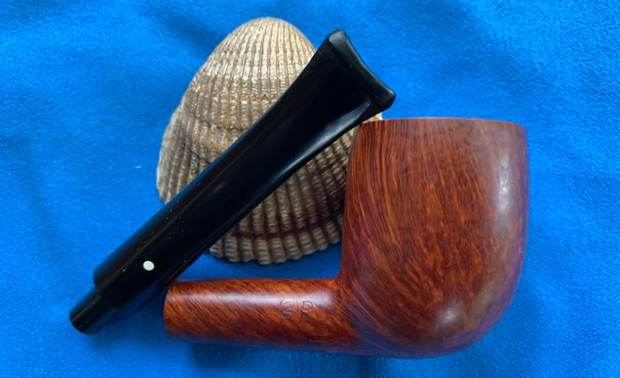
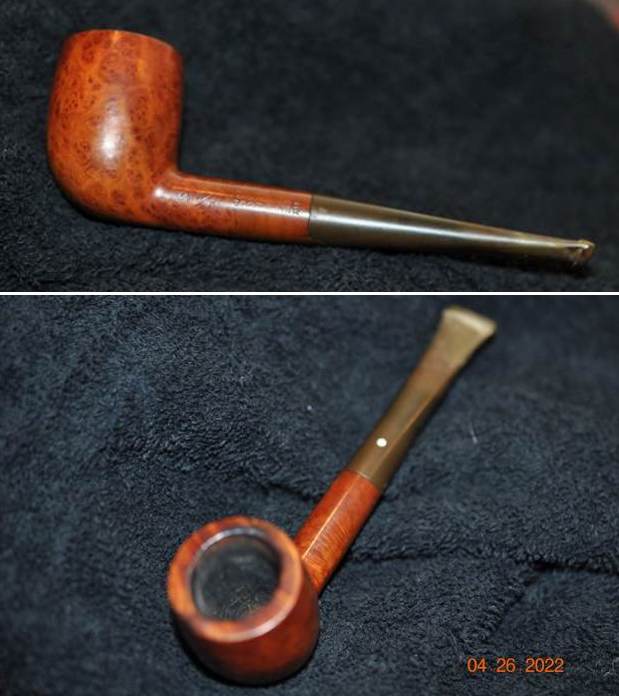
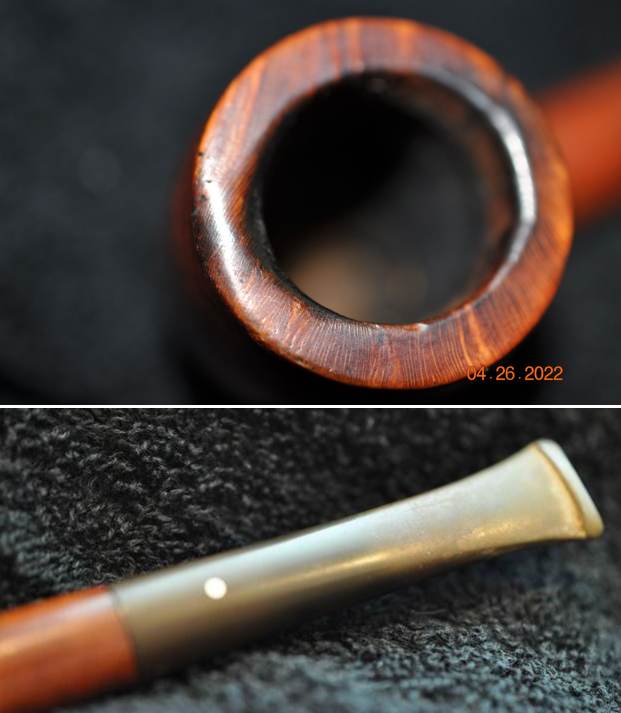
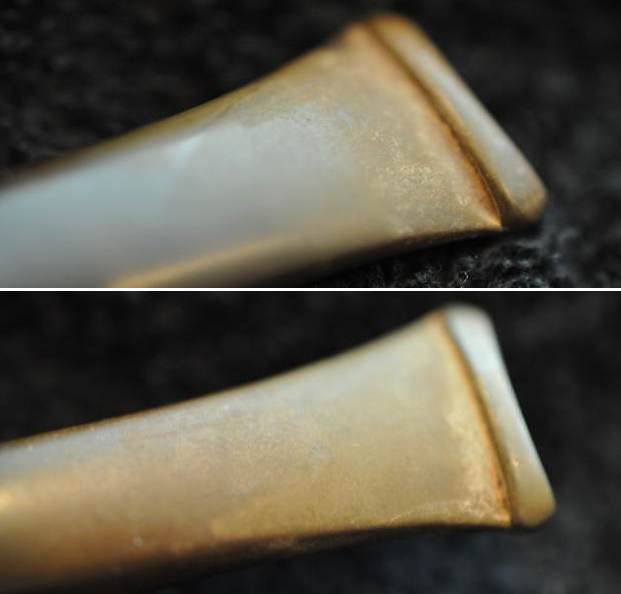
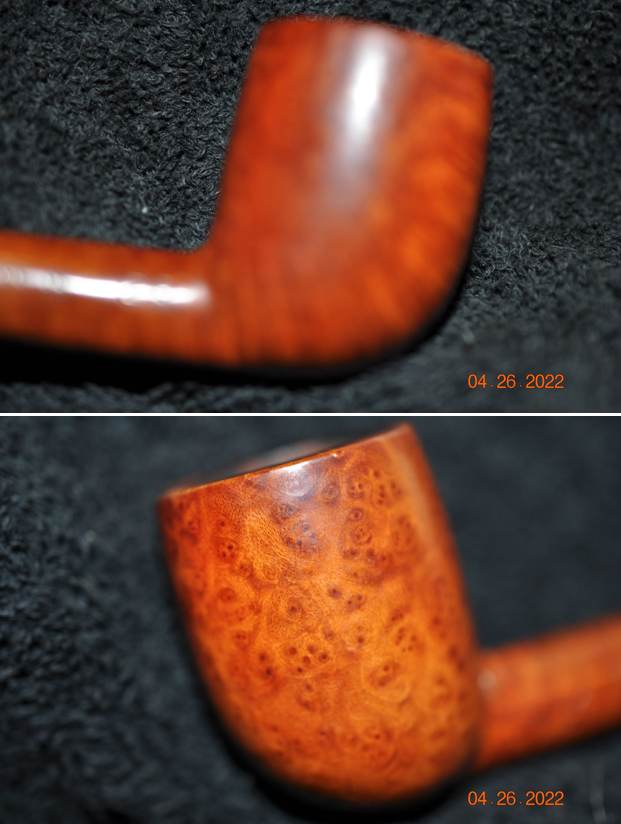
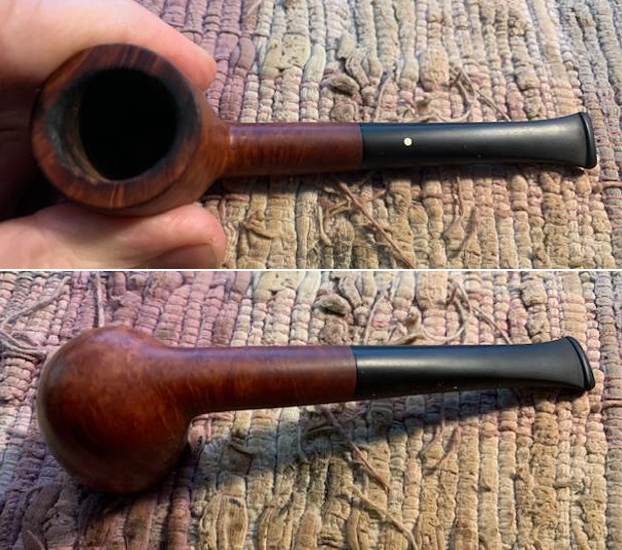
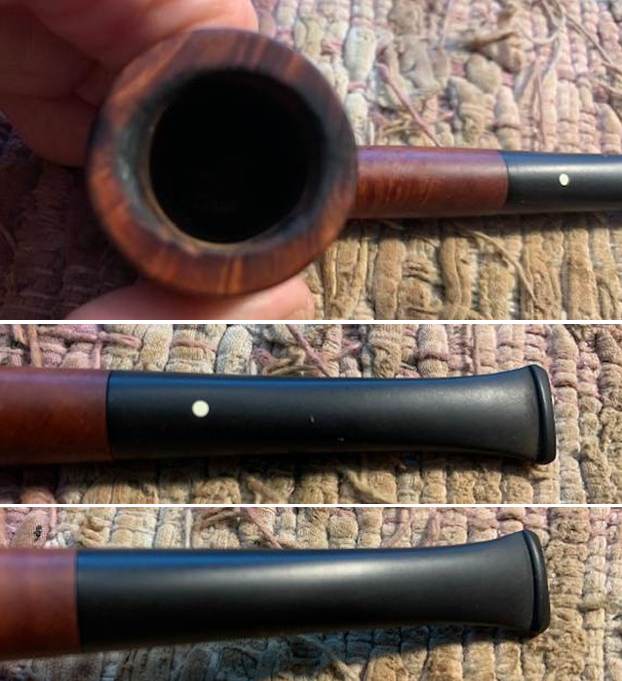
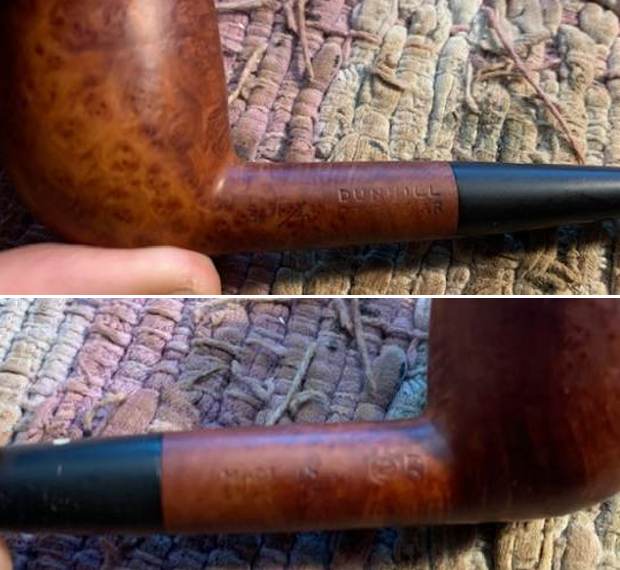
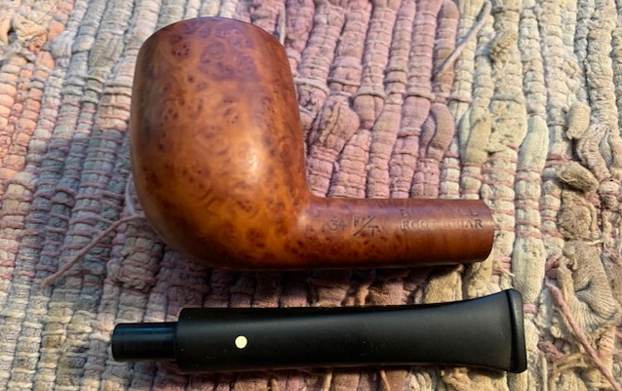
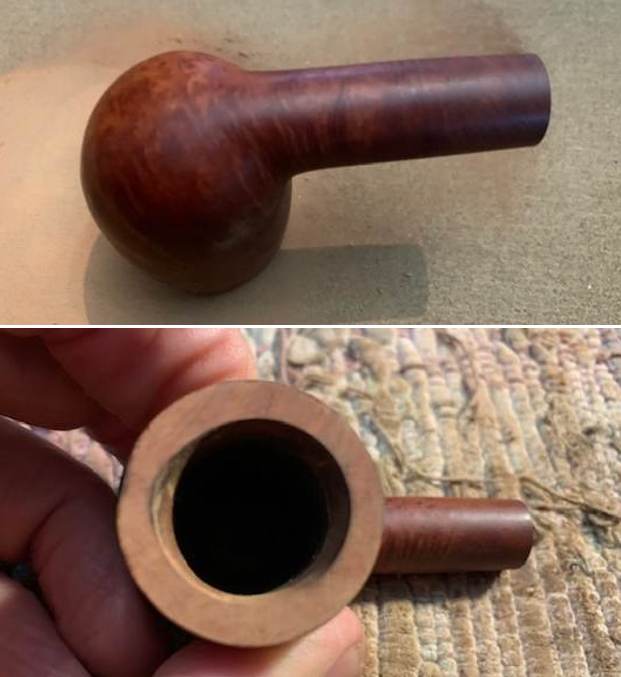
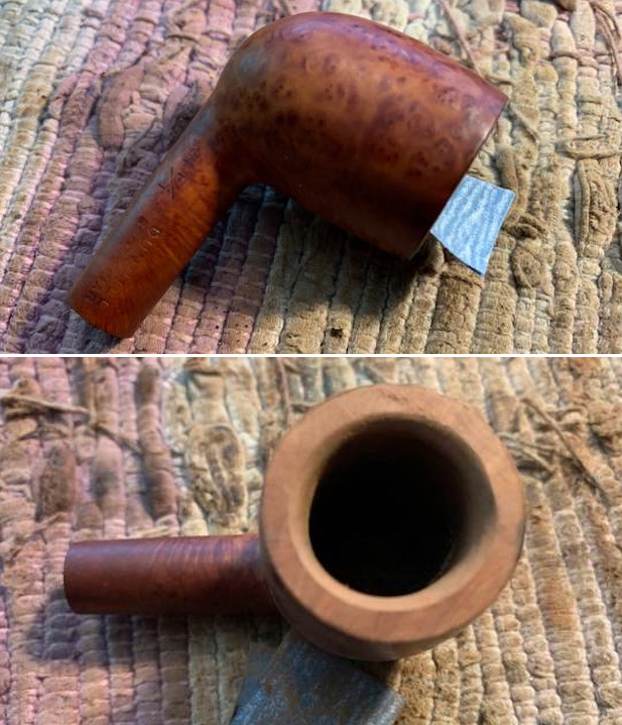
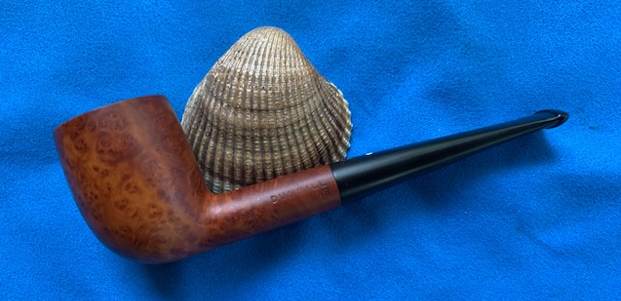
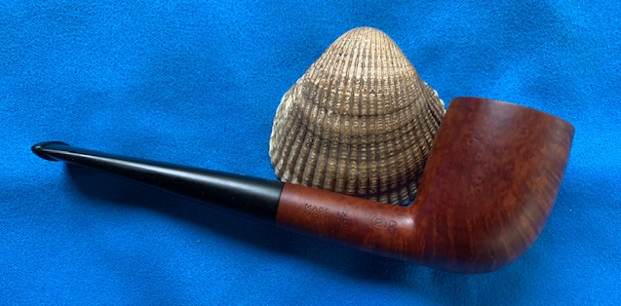
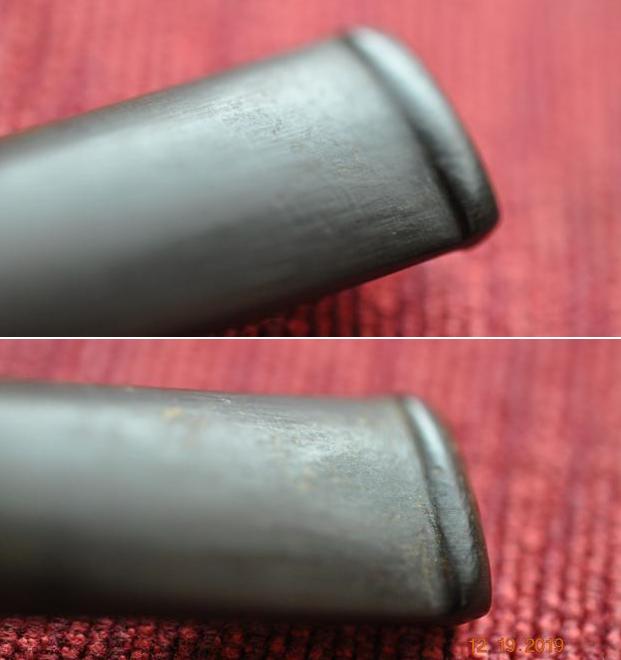
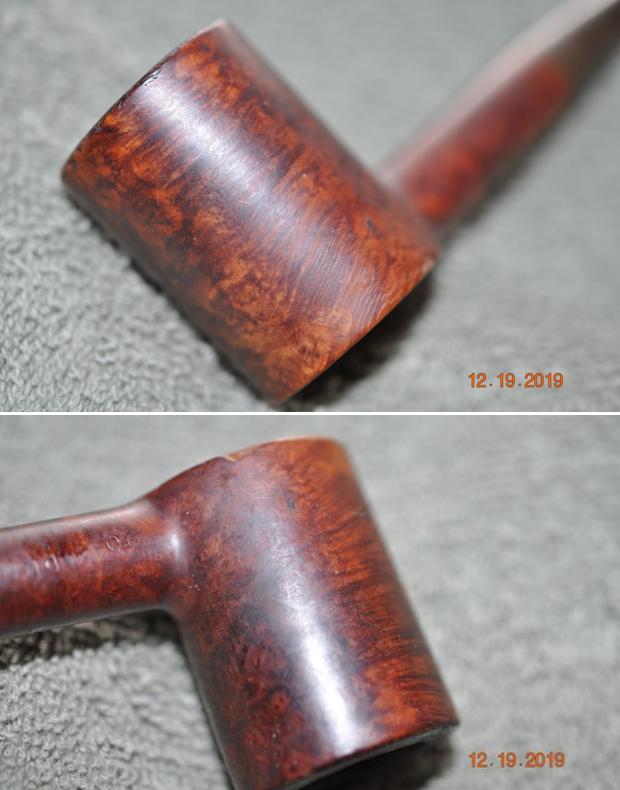
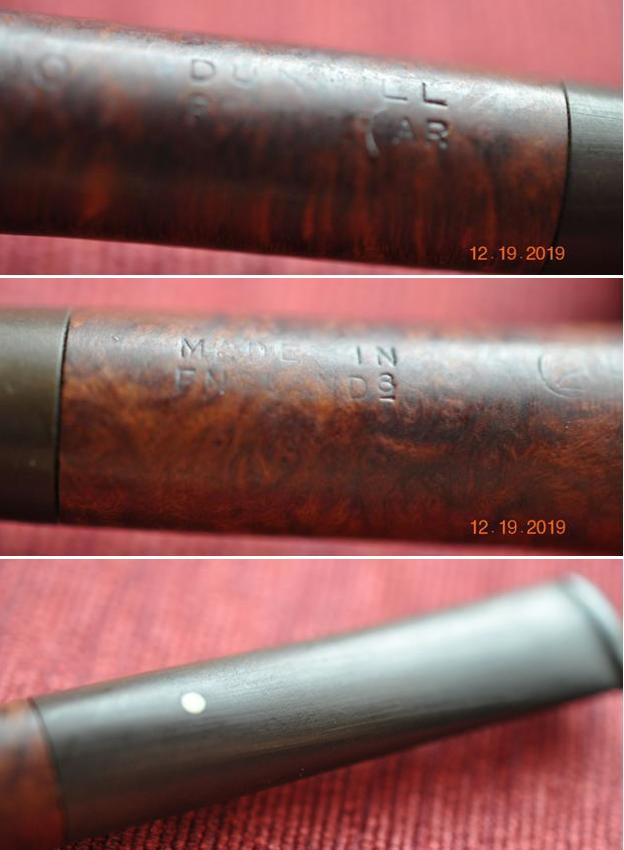
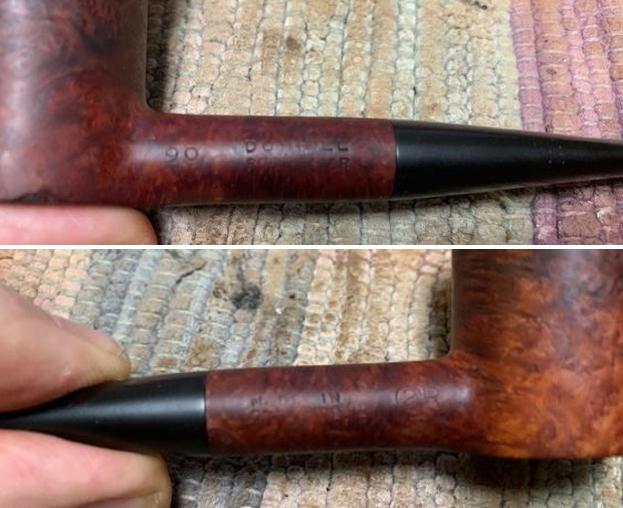
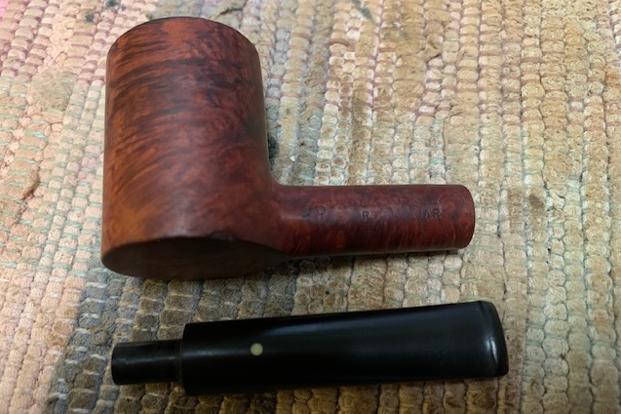
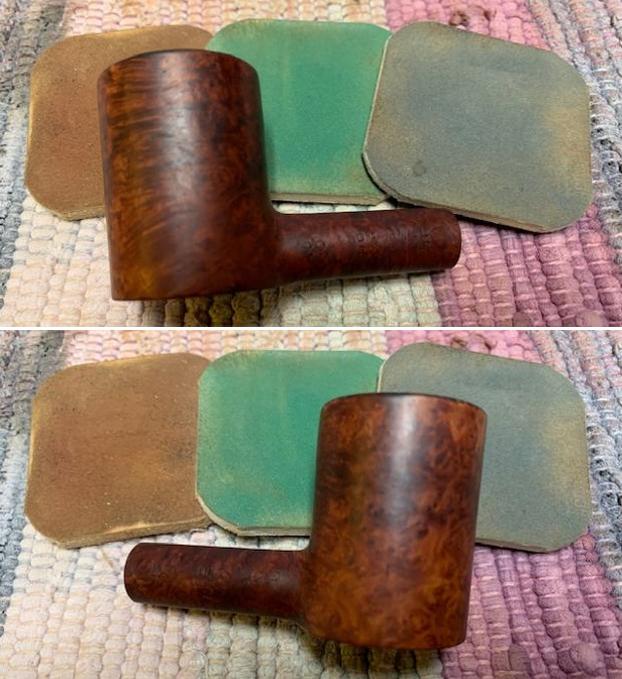
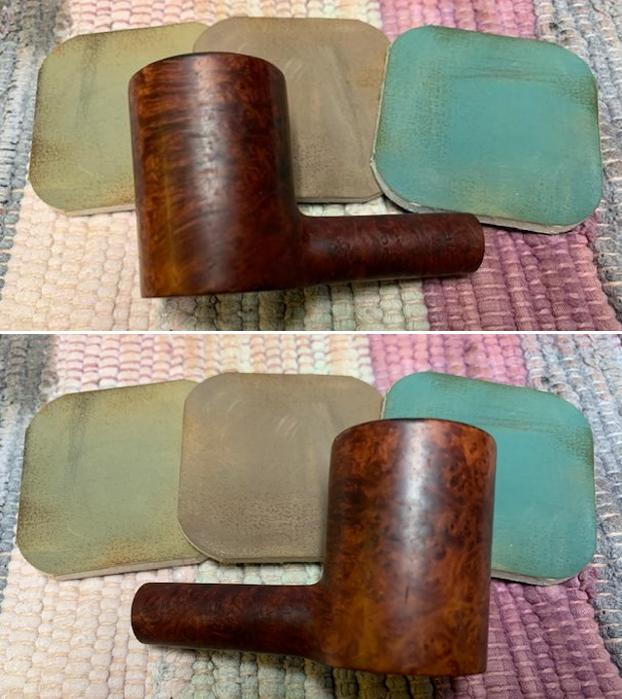
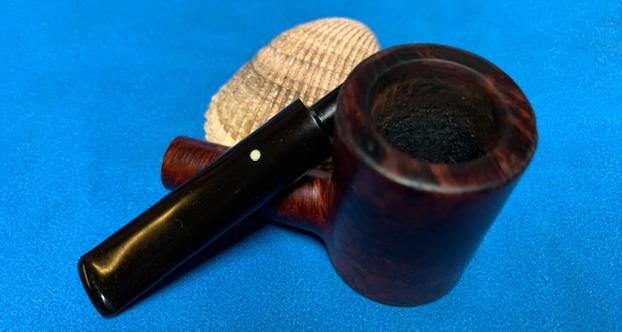
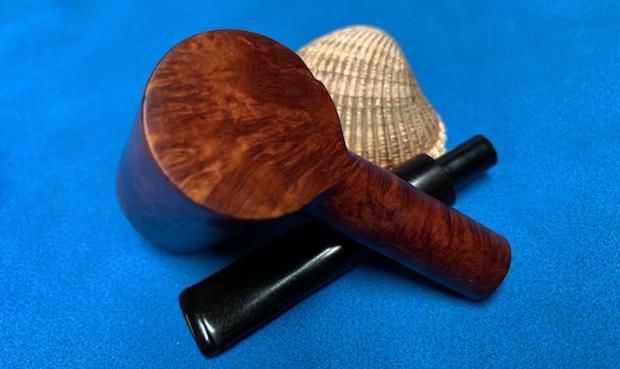
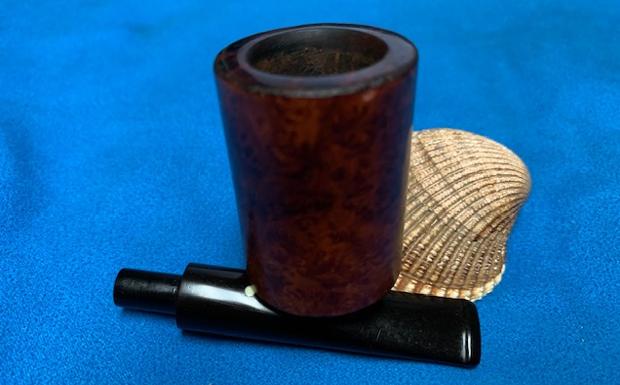
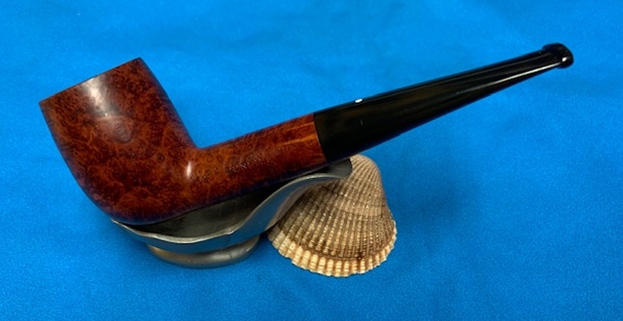
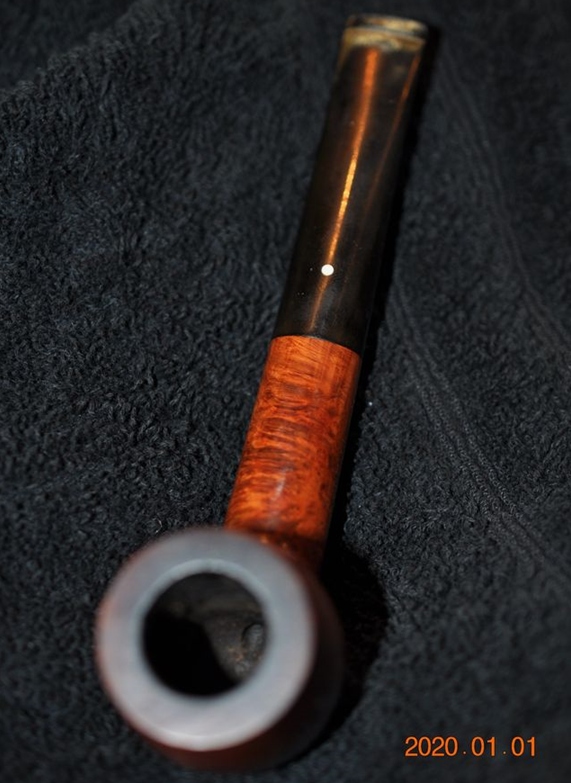
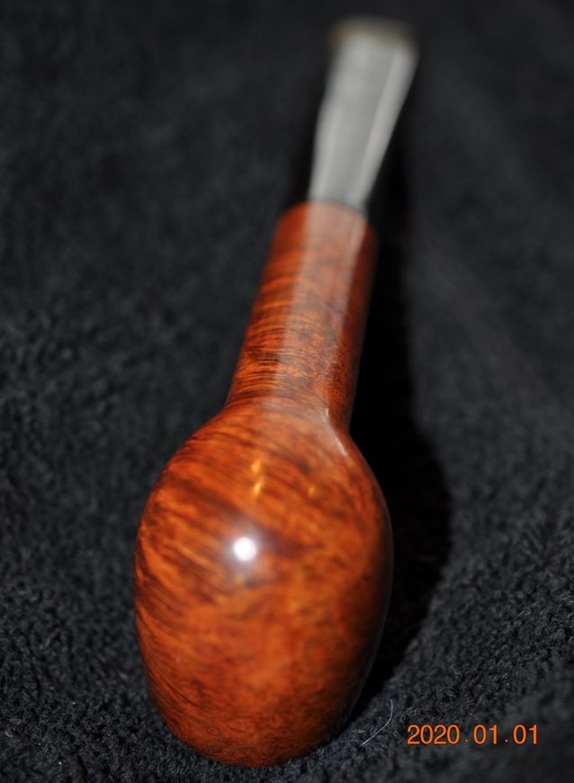
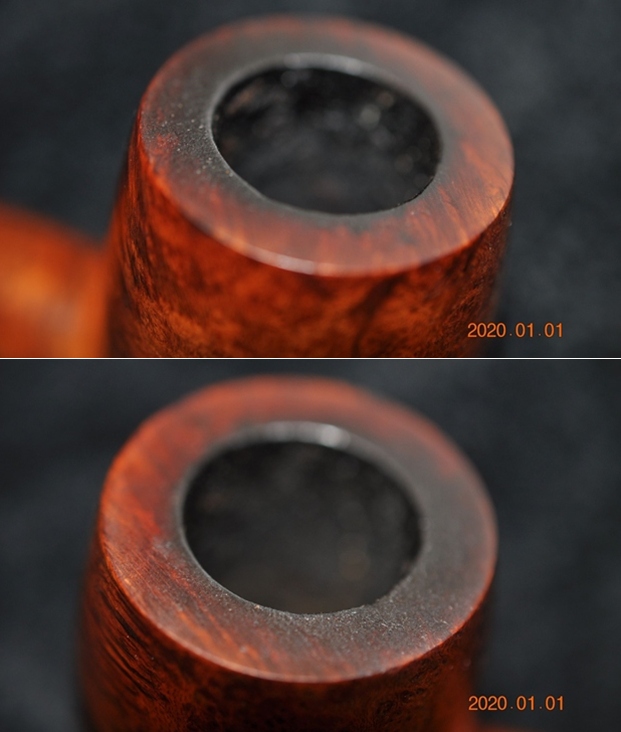
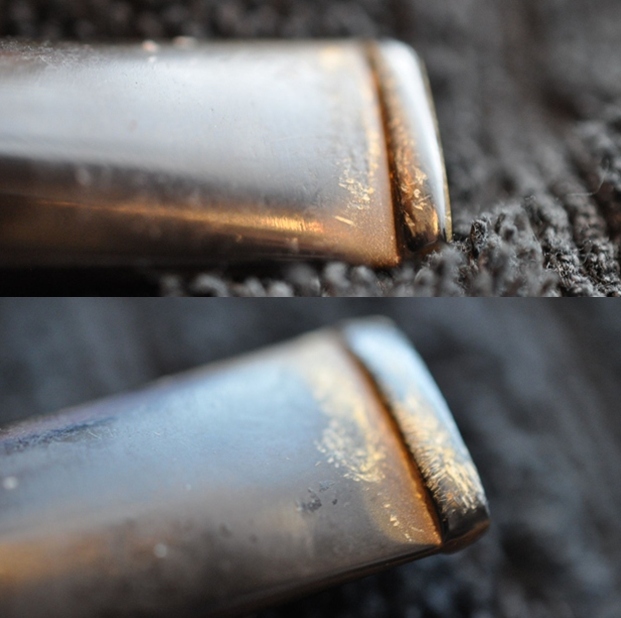
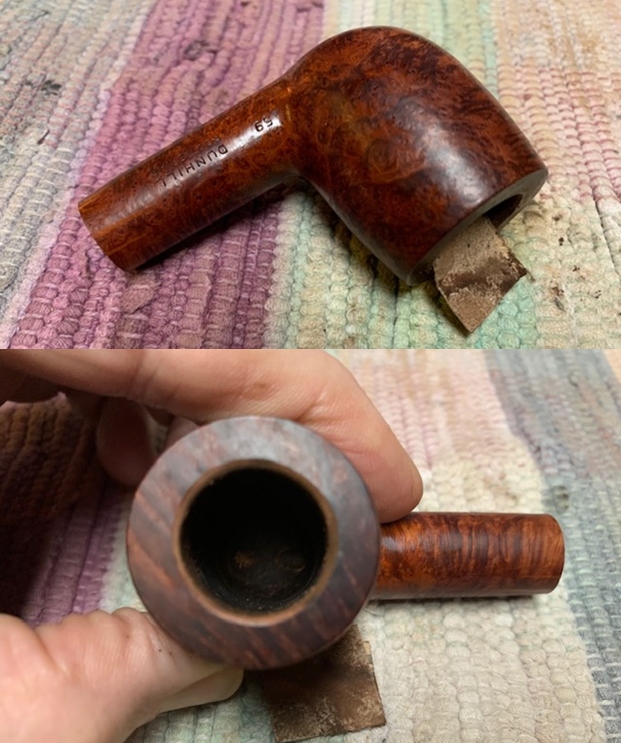
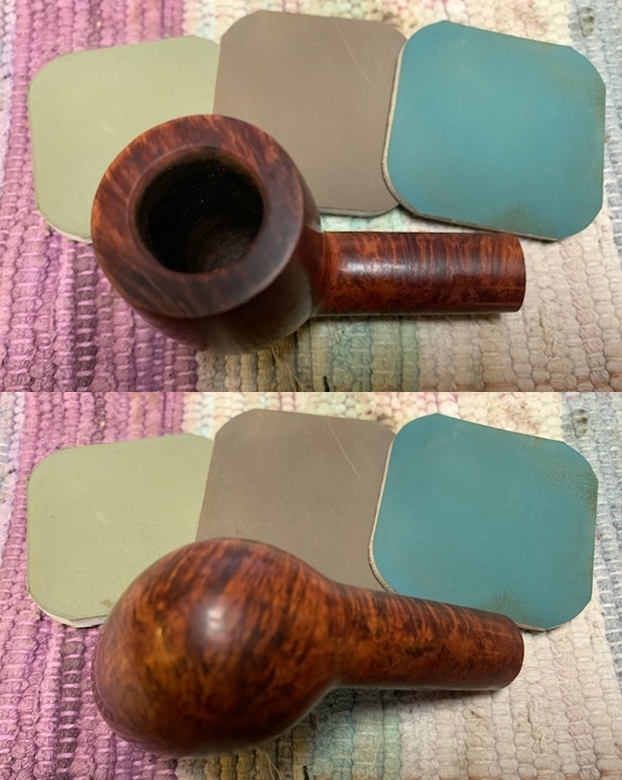
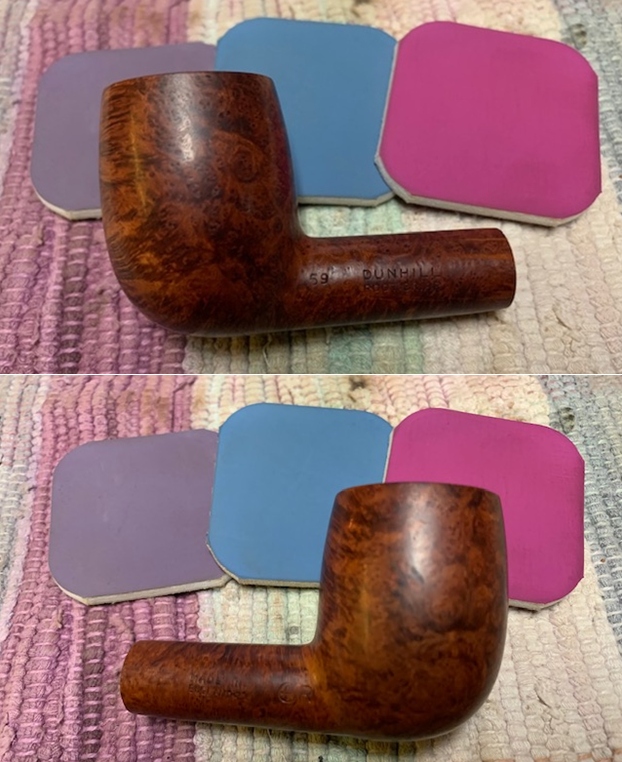
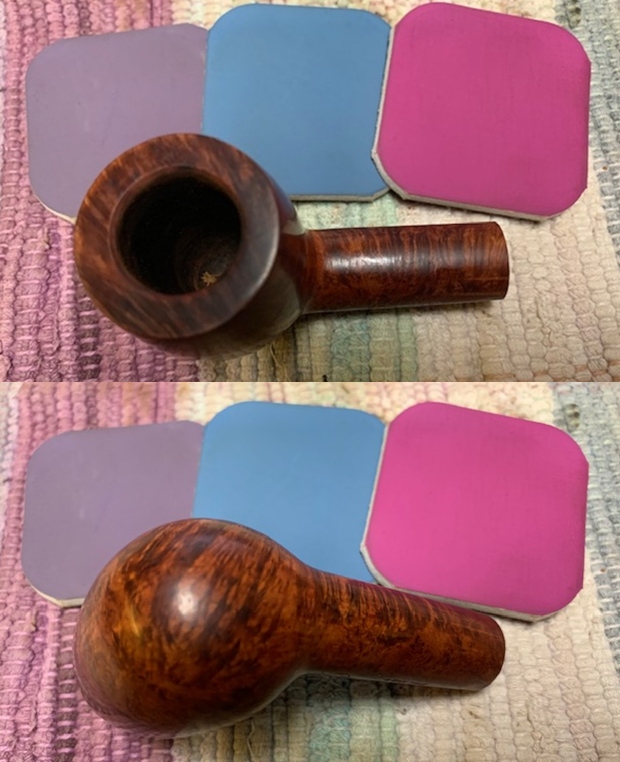
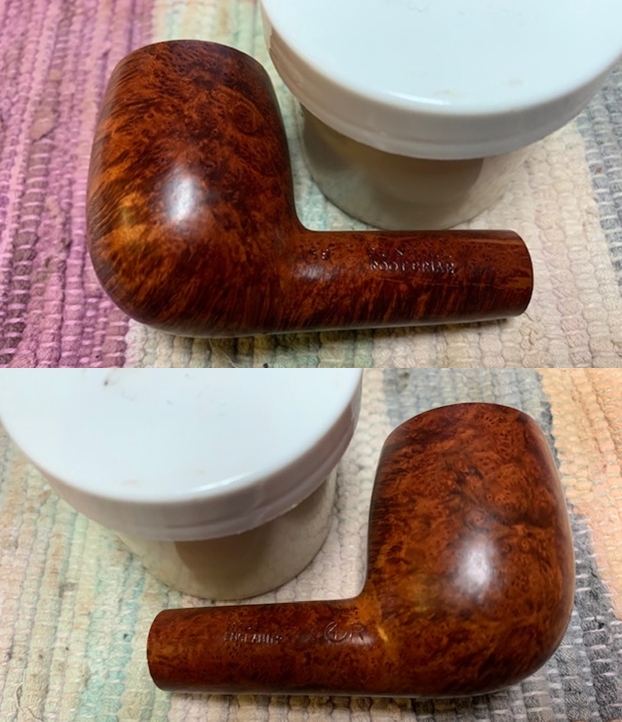
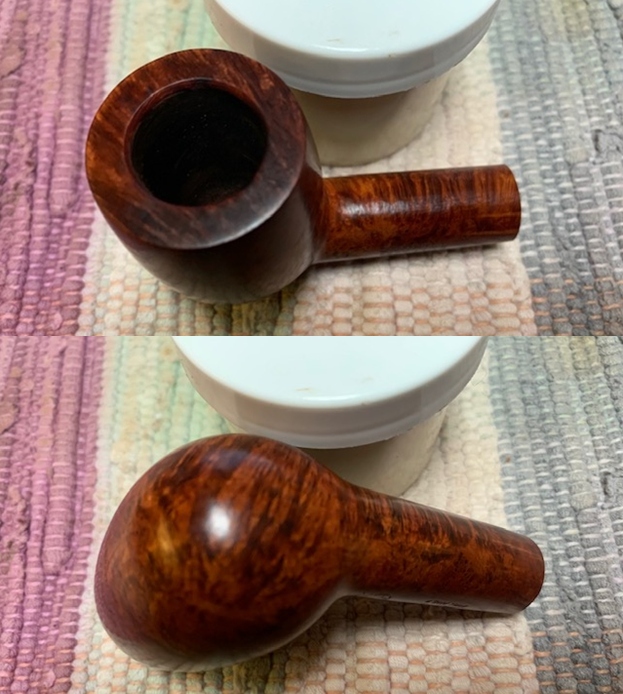
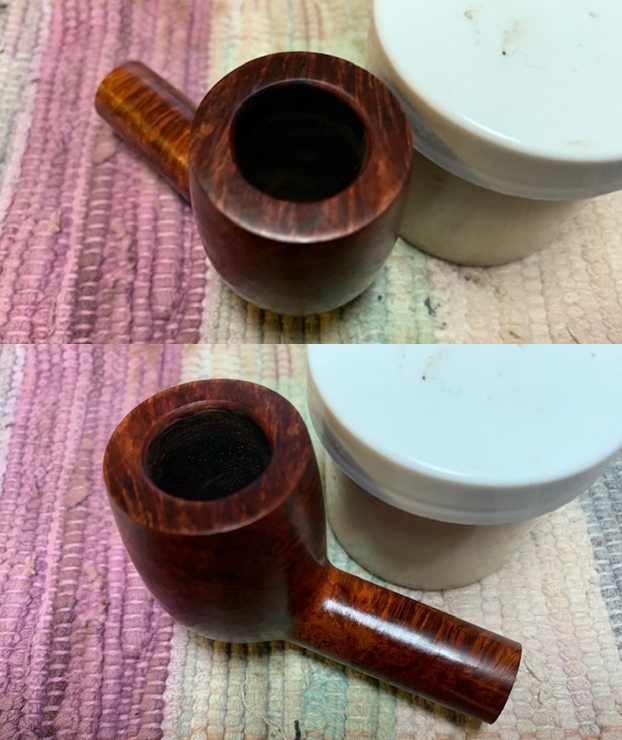
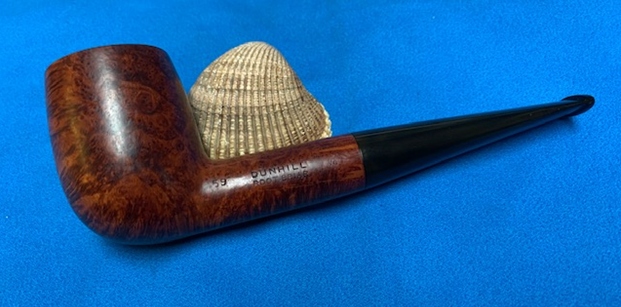
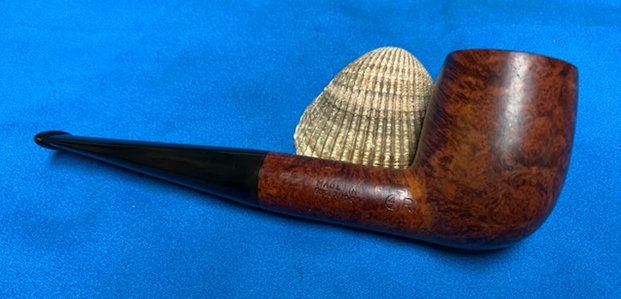
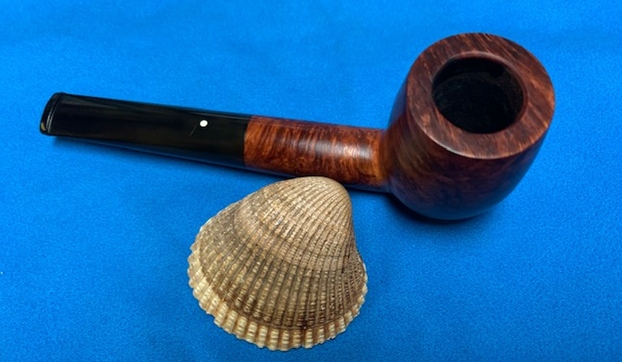
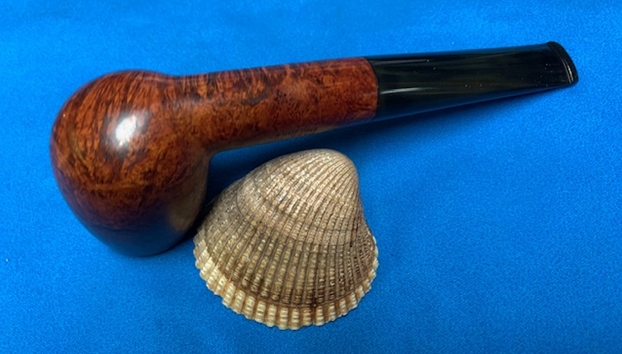
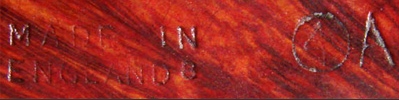
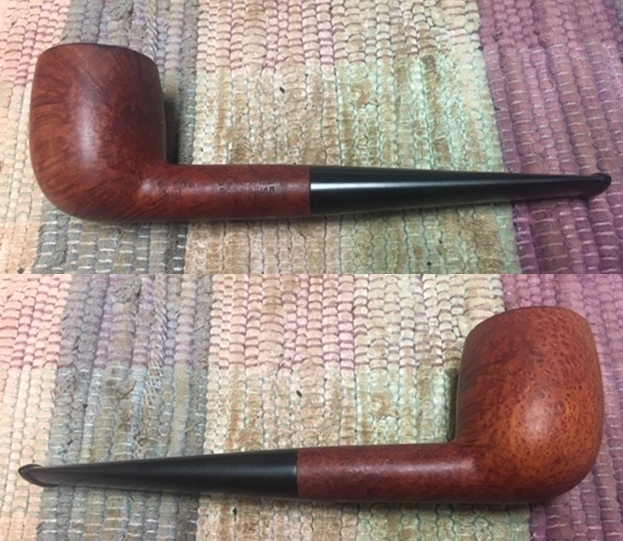
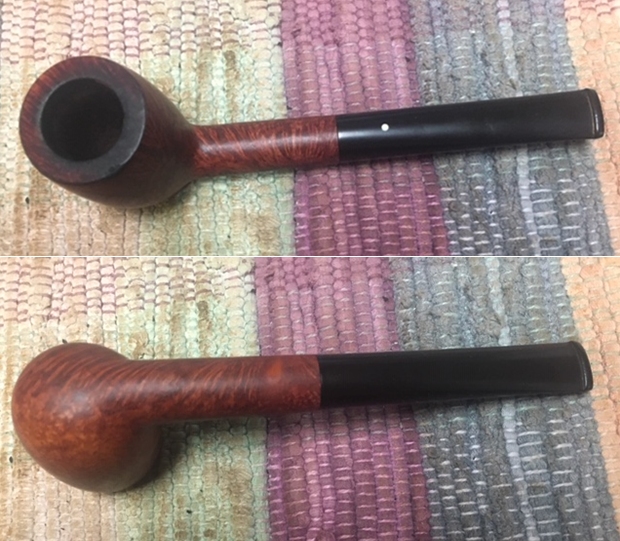
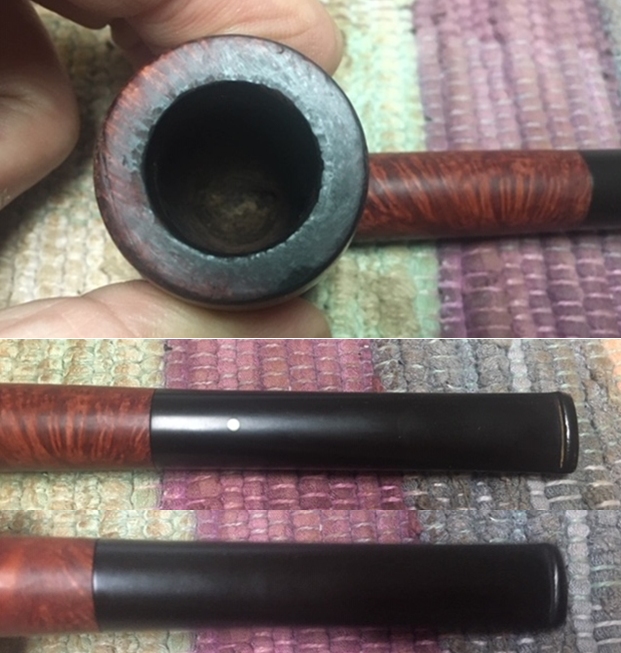
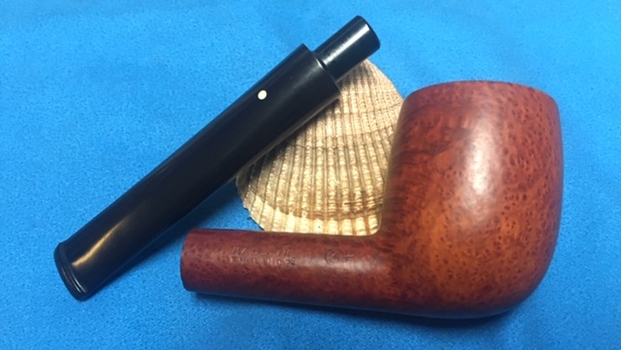
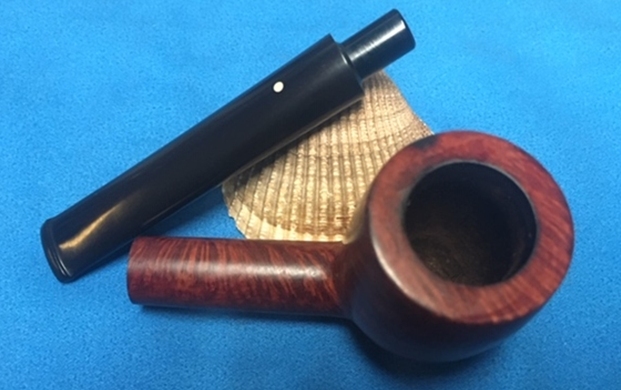
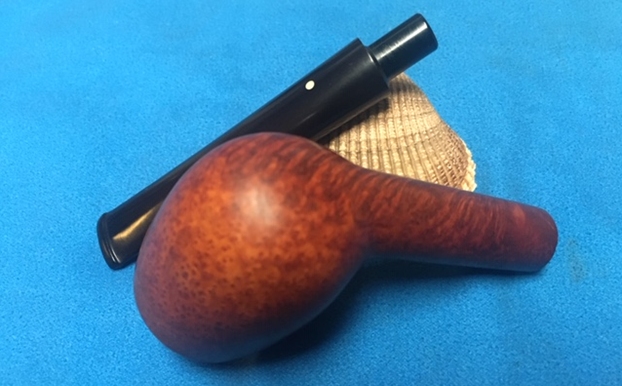
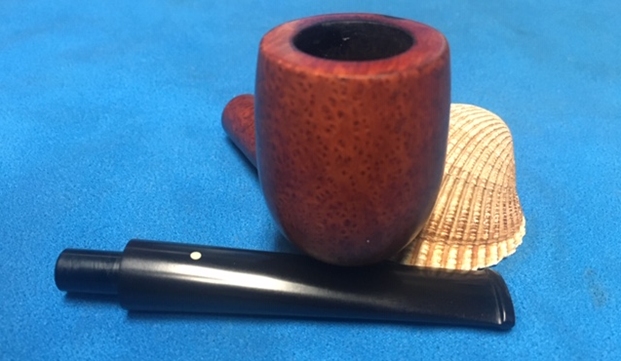
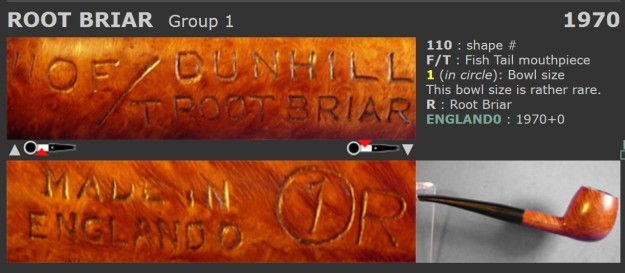
The next pipe that I am working on came from an estate sale in Oregon City, Oregon, USA we purchased on 03/21/24. It was very dirty and rich combination of brown stains when it started. The smooth finish around the bowl was dirty and had hand oils ground into the finish. The bowl had a thick cake and a coat of lava flowing onto the inner edge and the rim top. The classic fishtail stem was very dirty, oxidized and had light tooth marks and chatter on both sides ahead of the button. There was a white spot on the topside of the stem. The fit of the stem to the shank is perfect. The pipe is stamped on the left side of the shank and read 36 F/T followed by Dunhill [over] Root Briar. On the right side it is stamped Made in London [over] England with the number 5 (date stamp) after the D of England. Stamped slightly to the right of the D there is a smaller 6 stamped that gives a secondary date. Typically, the secondary stamp signifies the year that the pipe was sold. That is followed by 4 (size of pipe) in a circle R for Root Briar. Jeff took photos of the pipe so I could have a sense of what it looked like before he started his work on it. Jeff took photos of the bowl and rim top to show the cake in the bowl with remnants of tobacco stuck on the walls of the bowl. There was a lava build up on the top of the rim and the edge of the bowl. The rim top looked pretty good but it was hard to know for sure if there was damage under the lava. Only clean up would tell the full story. Jeff took photos of the top and underside of the stem showing the tooth chatter, scratching and oxidation on the stem. Jeff took photos of the sides and heel of the bowl to show the condition of the finish. You can see the grime in the finish around the sides of the bowl and shank. Even under the dirt and debris of the years it looked very good. Jeff took photos of the stamping on the sides of the shank. The stamping was clear and readable as you can see from the photos. It read as noted above. I wanted to unpack the Dunhill stamping on the shank and work to understand each element of the stamp. I generally use the Pipephil site to gather as much initial information as possible (http://pipephil.eu/logos/en/dunhill/root-briar1.html). The stamping is interpreted as follows: The number 36 the Liverpool shape. The F/T stamp is used to designate Fish Tail stem. The Root Briar stamp refers to the smooth finish. The number 5 following the D of England would give the date the pipe. The number 6 or secondary number would identify the year that the pipe sold for warranty purposes. The Circle 4R shows it is a Group 4 sized pipe and the R is the designation for a Root Briar. The photo below shows a pipe that is stamped similarly to the one that I am working on.
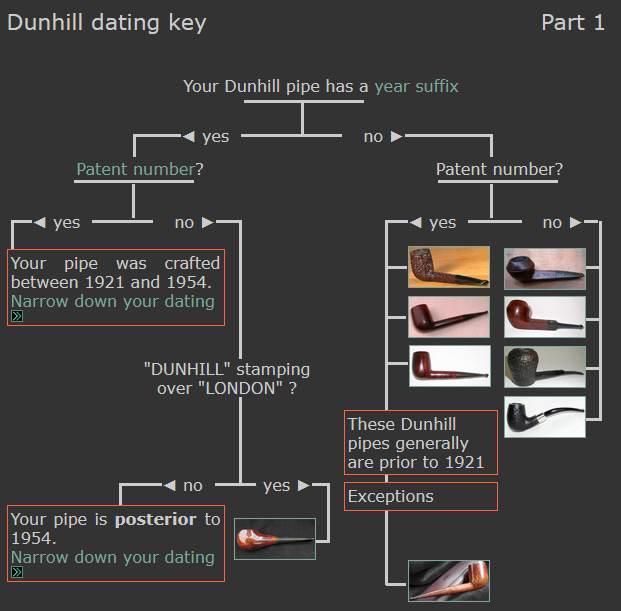
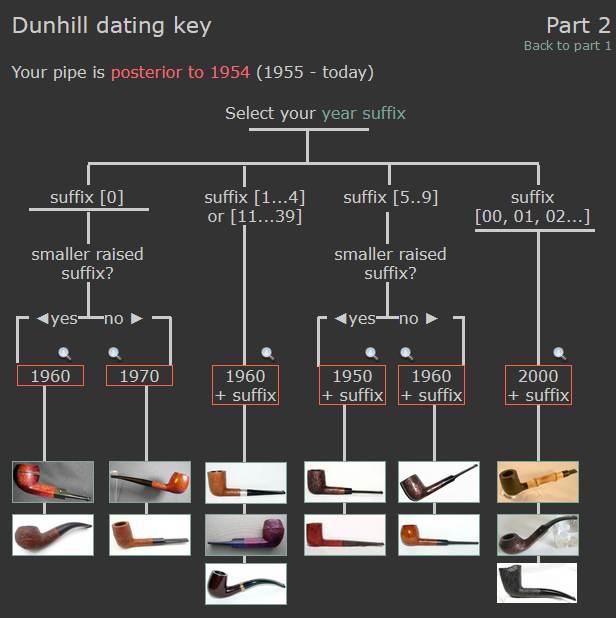
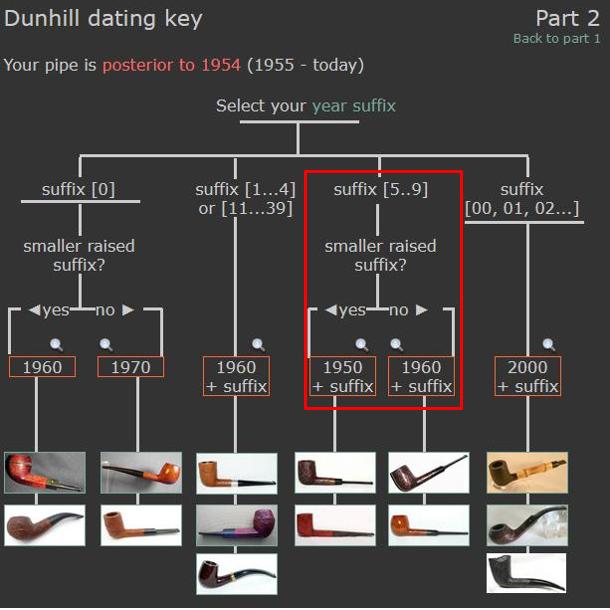
Pipephil also has some helpful dating keys on the site that are basically flow charts that you can walk through to date your pipe (http://pipephil.eu/logos/en/dunhill/cledat-en1.html). I turned to Part 1 of the Dating Key and followed the chart. This pipe has a 5 following the D in England. There was no patent number so that took me to the section on the chart below (column one) which instructed me that the pipe could be dated as being made “posterior to 1954”.I followed the link under “Your pipe is posterior to 1954. Narrow down your dating”. That took me to Page 2 of the dating key (http://pipephil.eu/logos/en/dunhill/cledat-en1a.html). The third column (suffix 5…9) led me to the section with a 5 after the D in England. There was a directive for dating the pipe spelled out as follows: 1960 + suffix 5 which gives the pipe a date of 1965. I believe that the secondary  number 6 refers to the pipe being sold in 1966.I then turned to Pipedia’s section on Dunhill Root Briar to get a bit of background on the Dunhill finishes (https://pipedia.org/wiki/Dunhill#Root_Briar). I quote:

Root Briar

Introduced in 1931 and highly prized because the grain is more pronounced in this finish (usually made using Corsican briar – was made exclusively from that briar into the 60s). The Root Briar finish requires a perfectly clean bowl with excellent graining. Therefore, it is the most expensive of the Dunhill pipes. Corsican briar was most often used for the Root finish since it was generally more finely grained. This is a rare finish, due to the scarcity of briar suitable to achieve it. These pipes are normally only available at Company stores, or at Principle Pipe Dealers. Straight grained pipes were formerly graded A through H, but are now only “Dr’s” and graded with one to six stars, with the letters G and H still used for the very finest pieces.

Dunhill introduced its third major finish, the Root finish, in 1931. Corsican mountain briar is characteristically beautifully grained and the Root was made exclusively from that briar into the 1960s. The pipe was finished with a light natural stain to allow the beauty of the graining to show through. Although always available with a traditional black vulcanite bit, the Root was introduced in either 1930 or more likely 1931 and fitted with a marble brown dark and light grained vulcanite bit that has since become known as the ‘bowling ball’ bit because of the similarity in appearance between the bit’s finish and that of some bowling balls of the time. With the war, however, the bowling ball bit was dropped from production. Through 1954 (and after) the Root pipe nomenclature (including shape numbers) was identical to that of the Bruyere except that instead of the “A” of the Bruyere, the Root was stamped with an “R”. In 1952 when the finish rather then LONDON was placed under DUNHILL, ROOT BRIAR rather then BRUYERE was used for the Root. Loring, J. C., The Dunhill Briar Pipe, The Patent Years and After (self-published, Chicago, 1998).

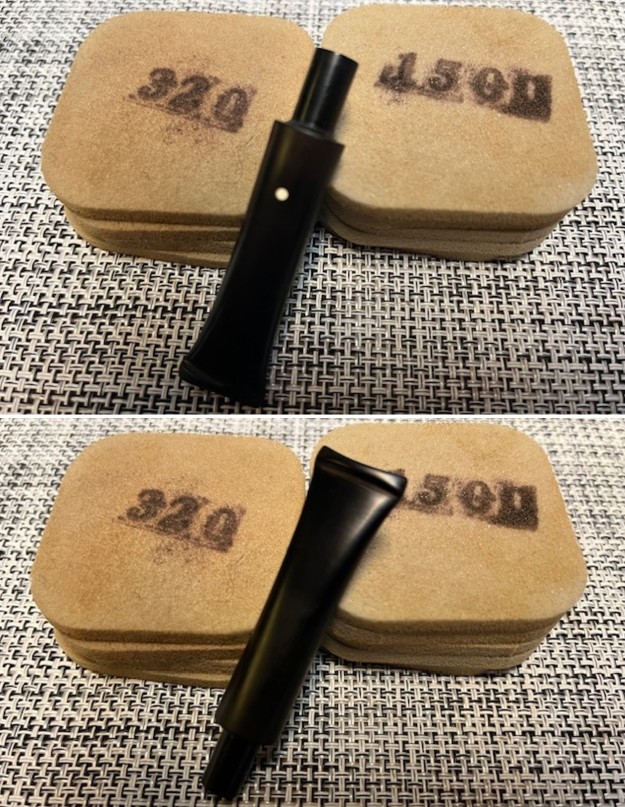
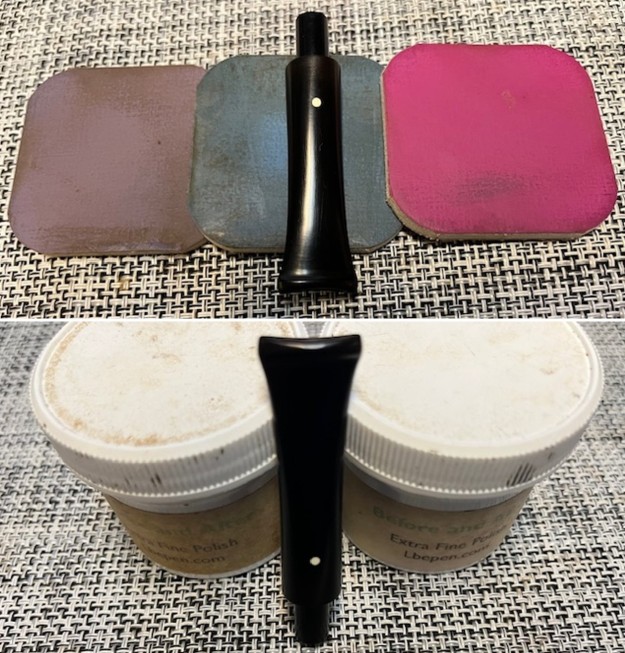
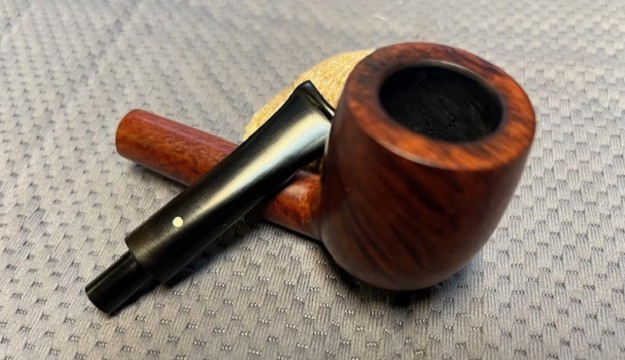
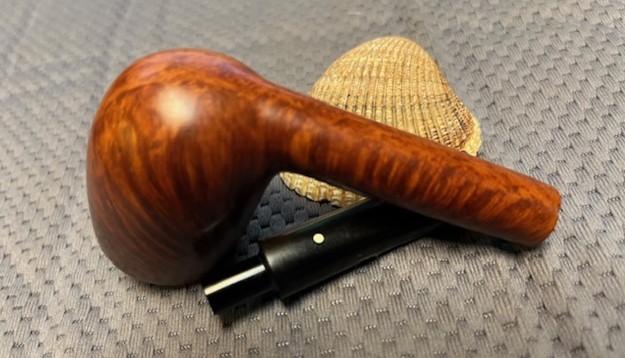
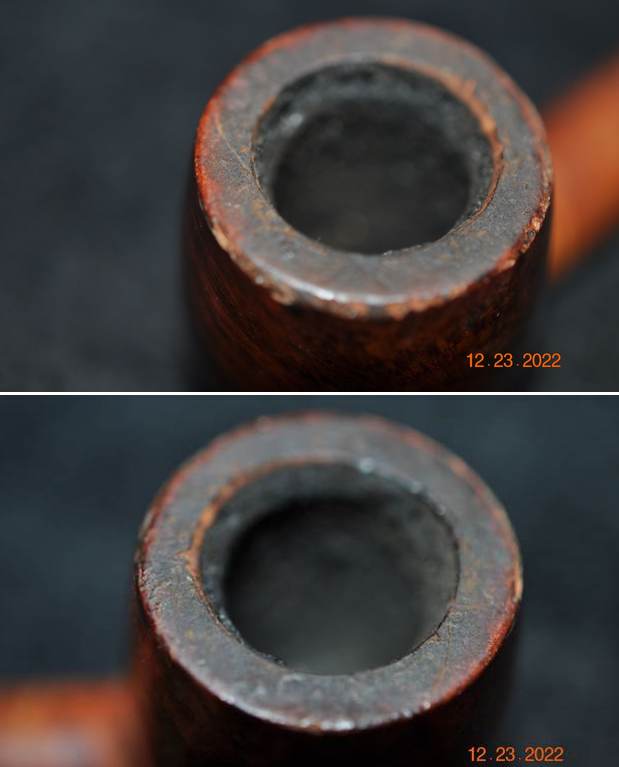
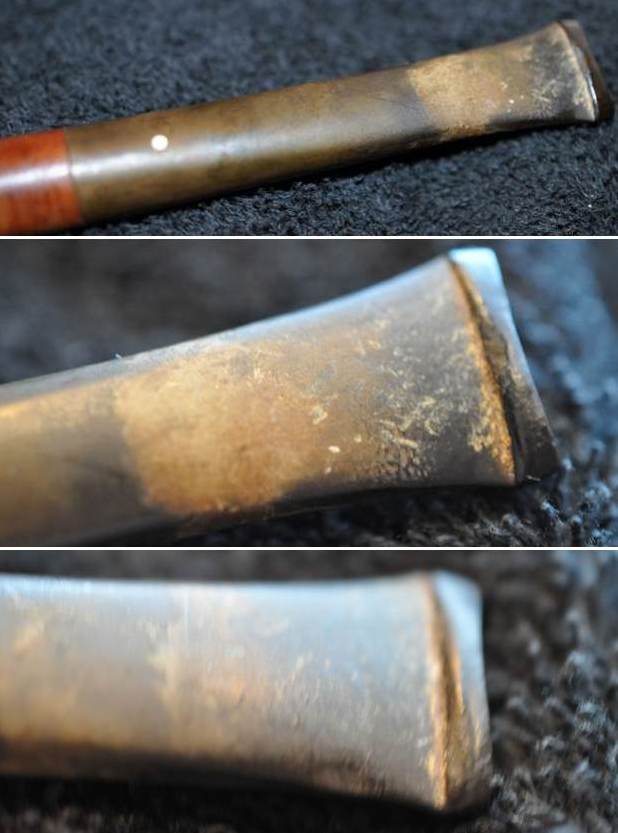
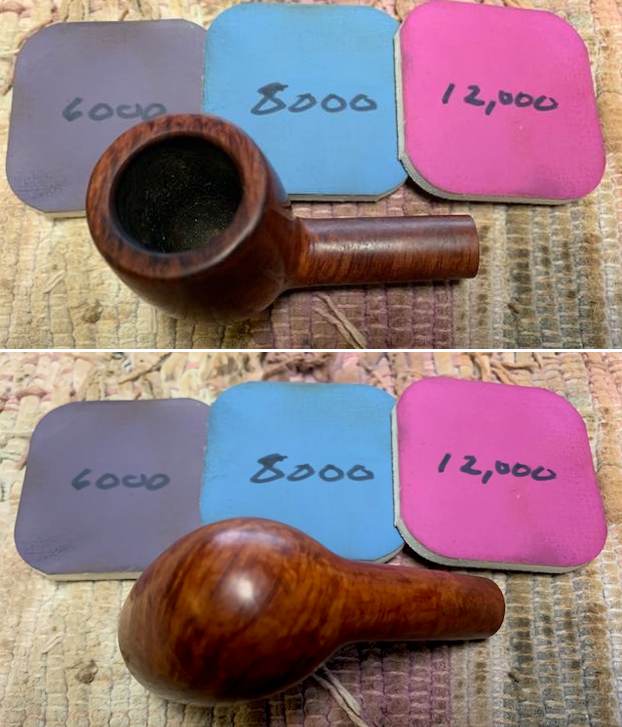
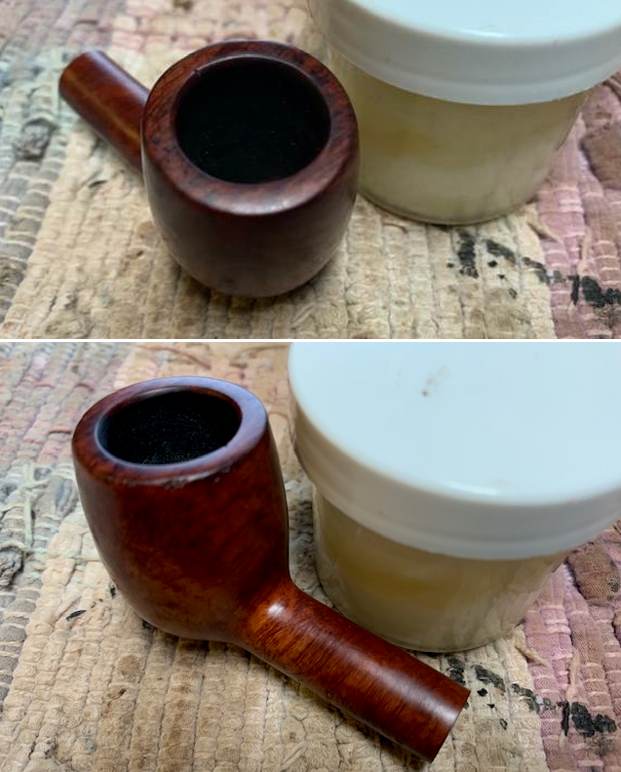
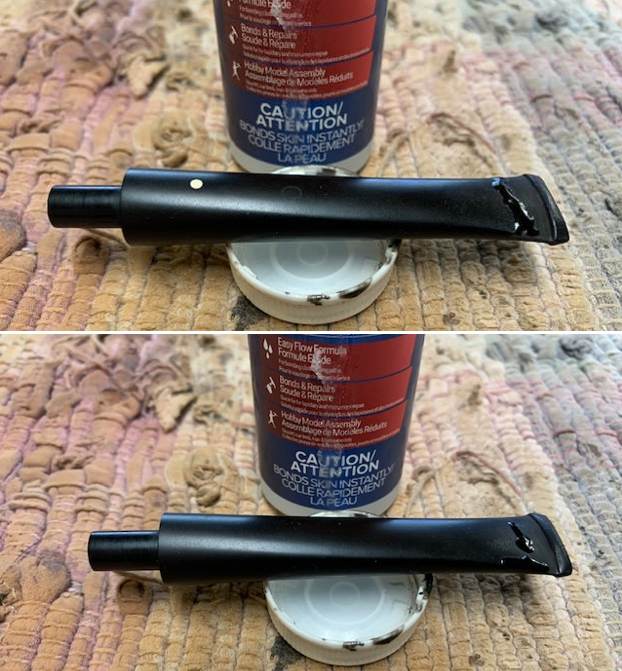
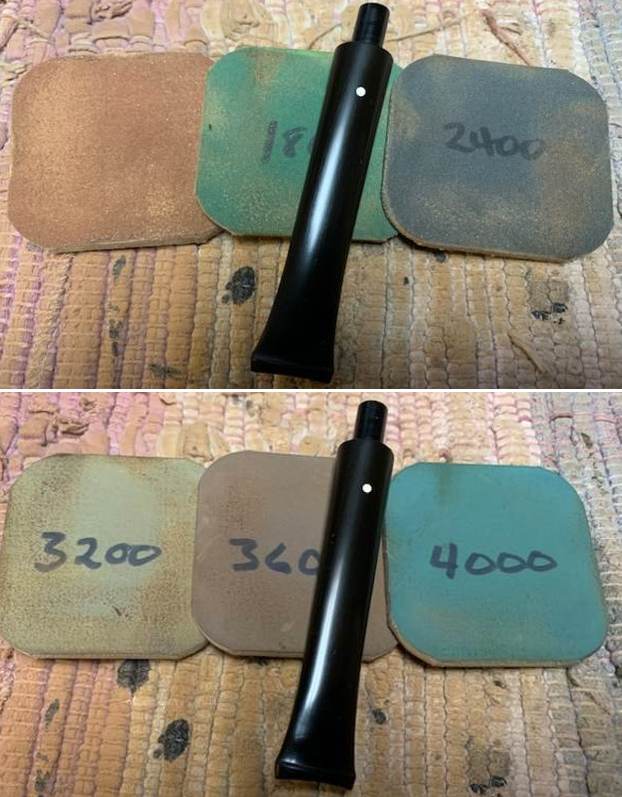
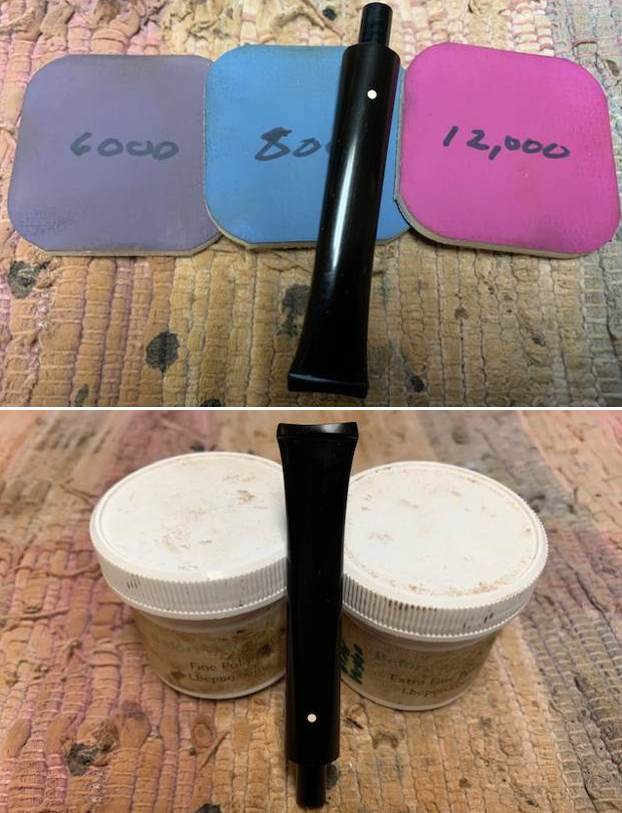
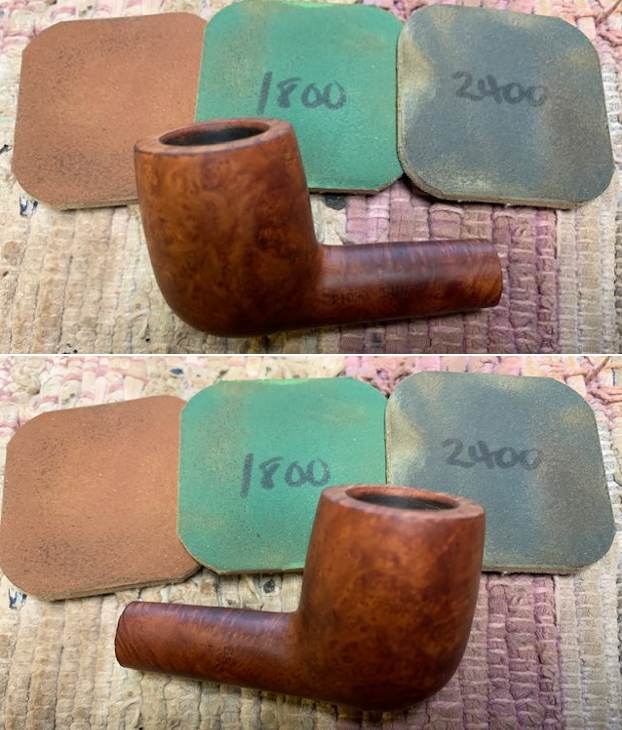
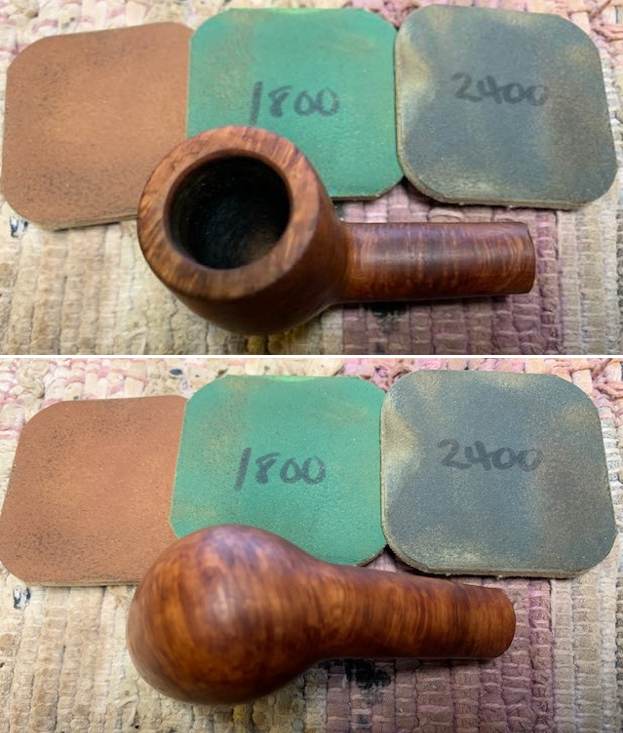
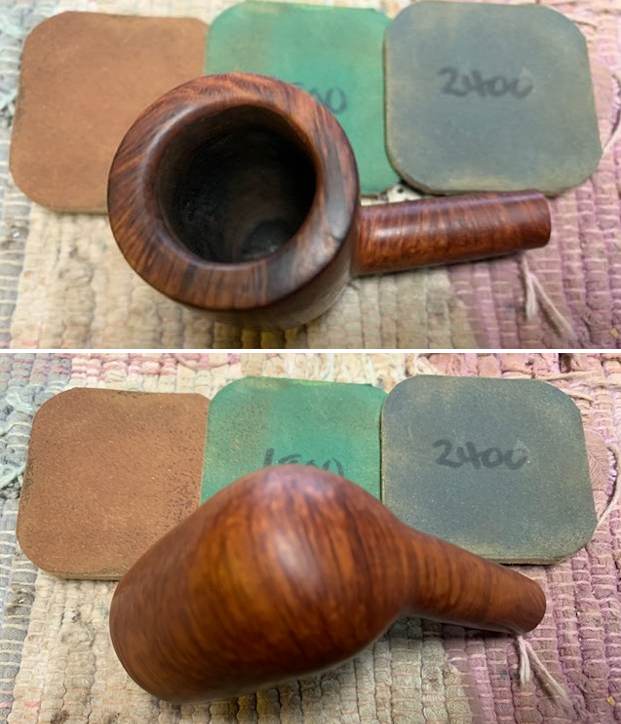
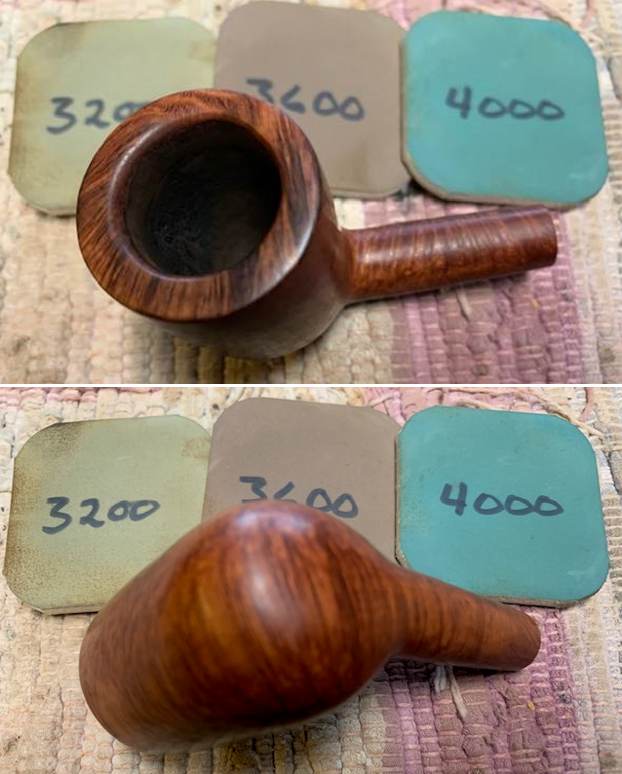
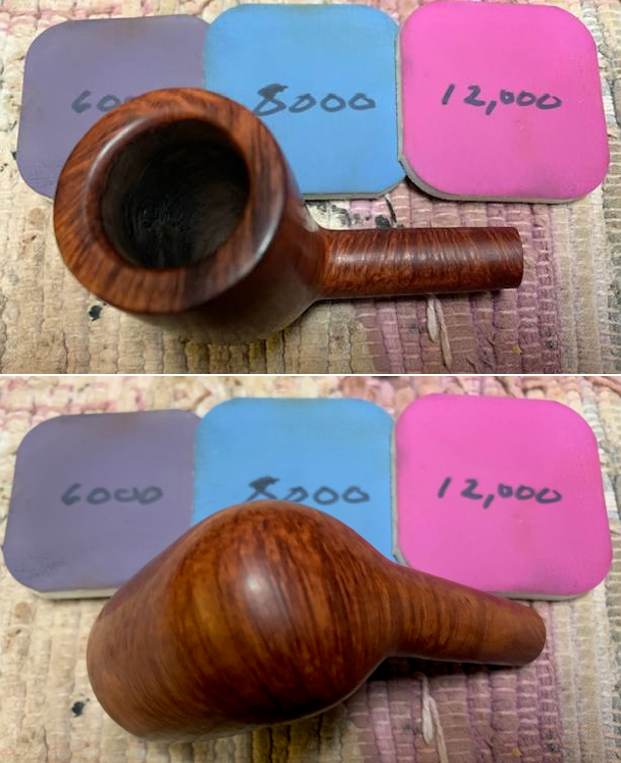
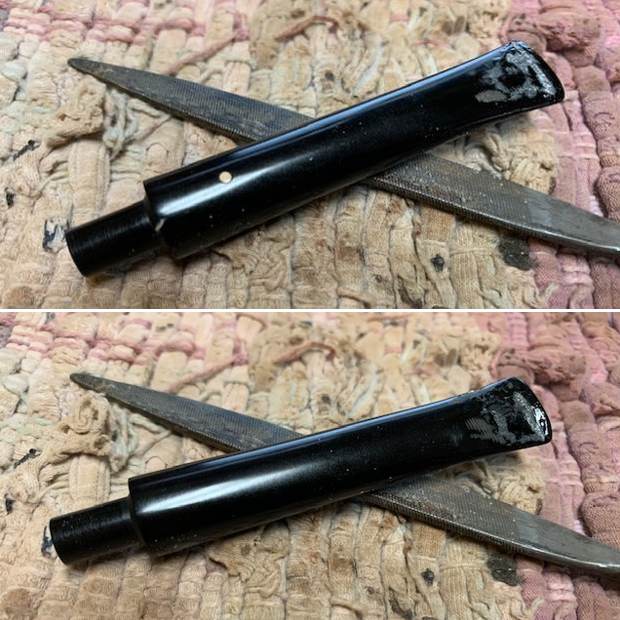
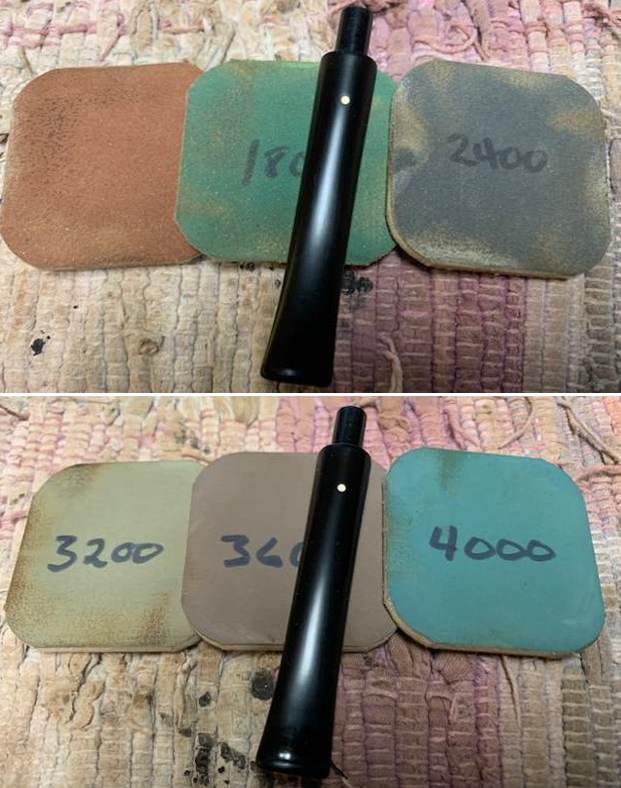
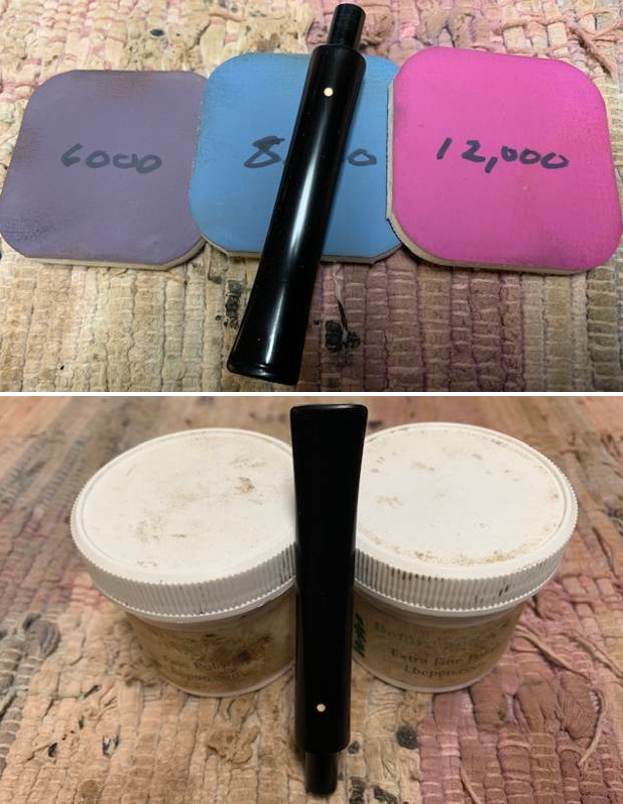
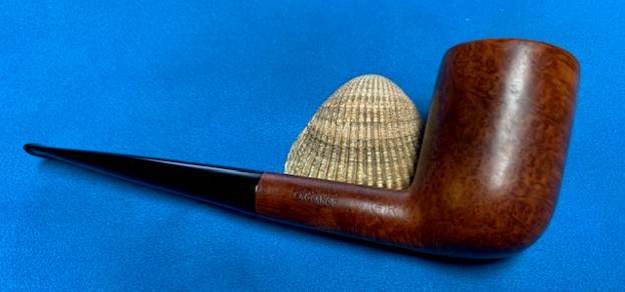
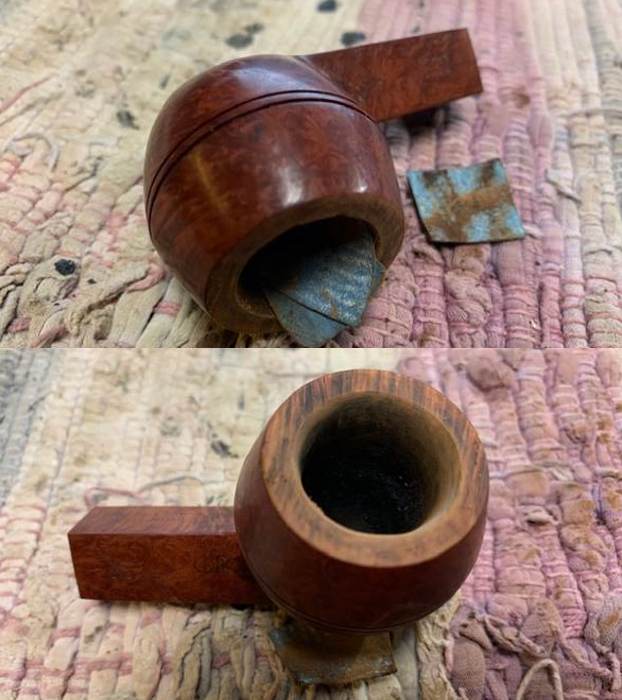
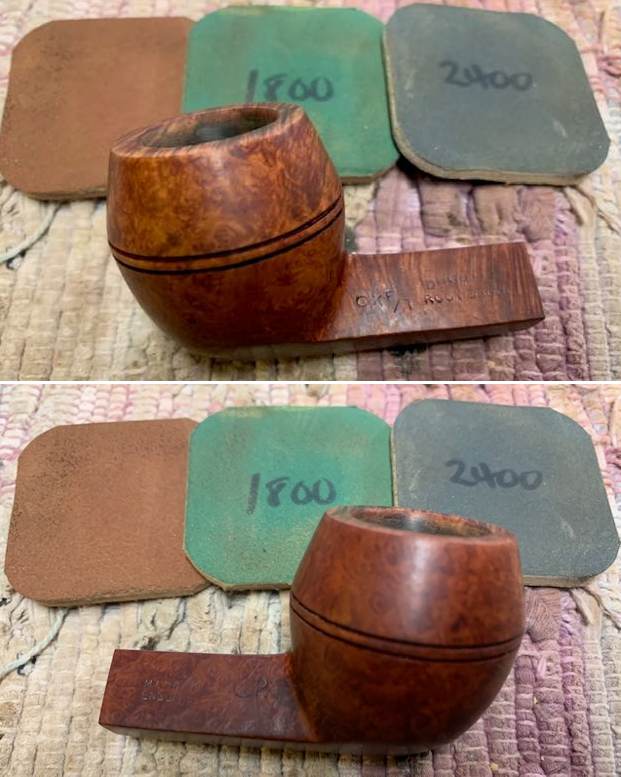
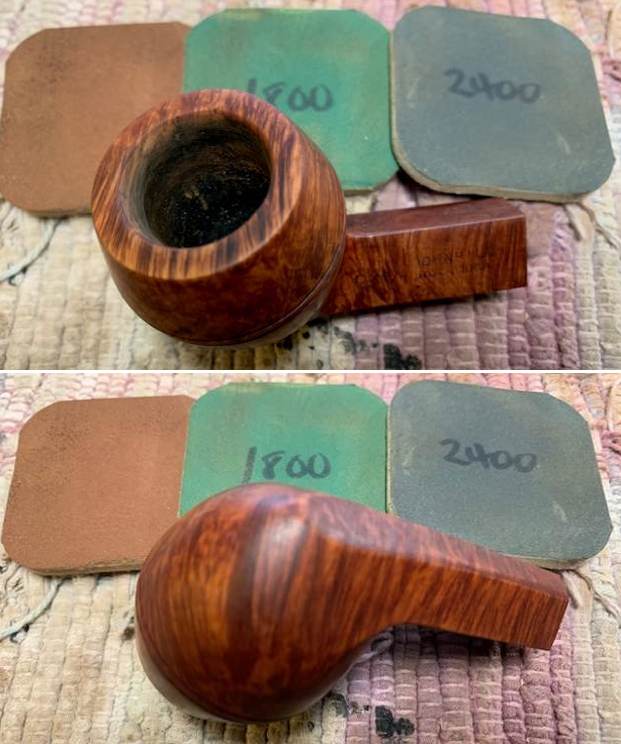
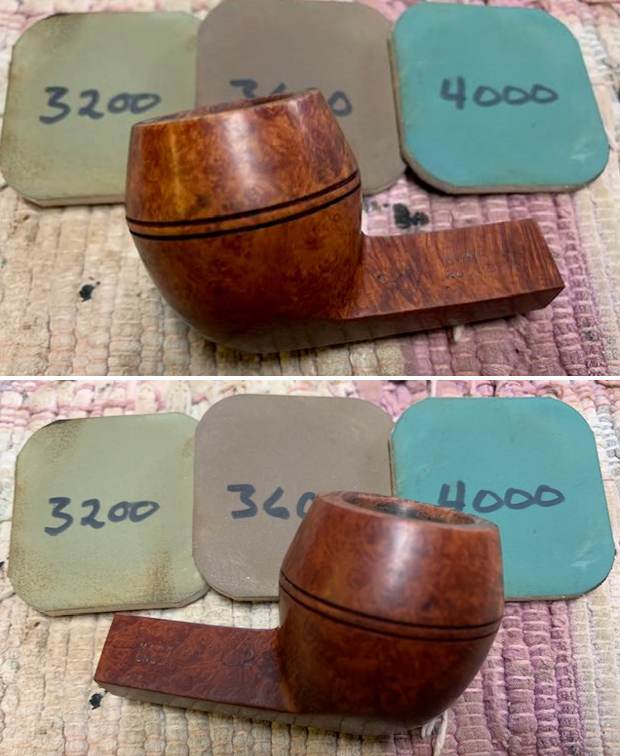
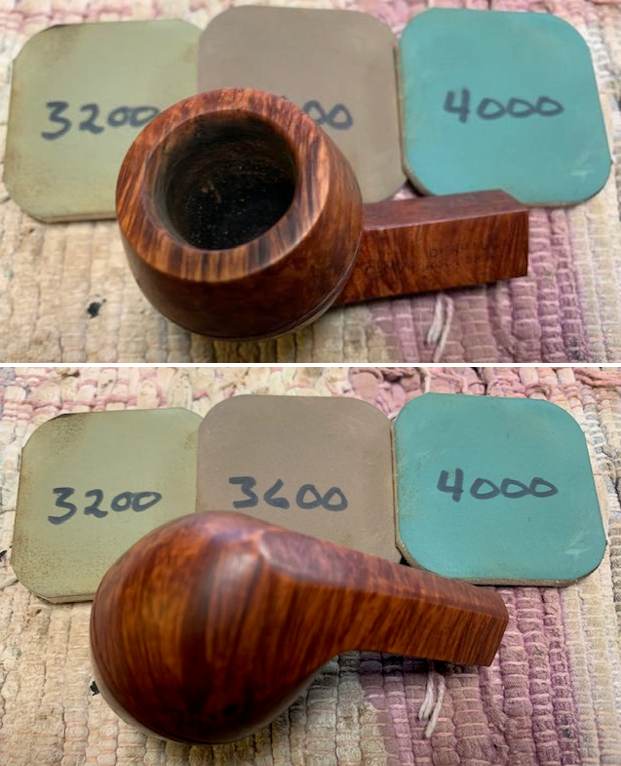
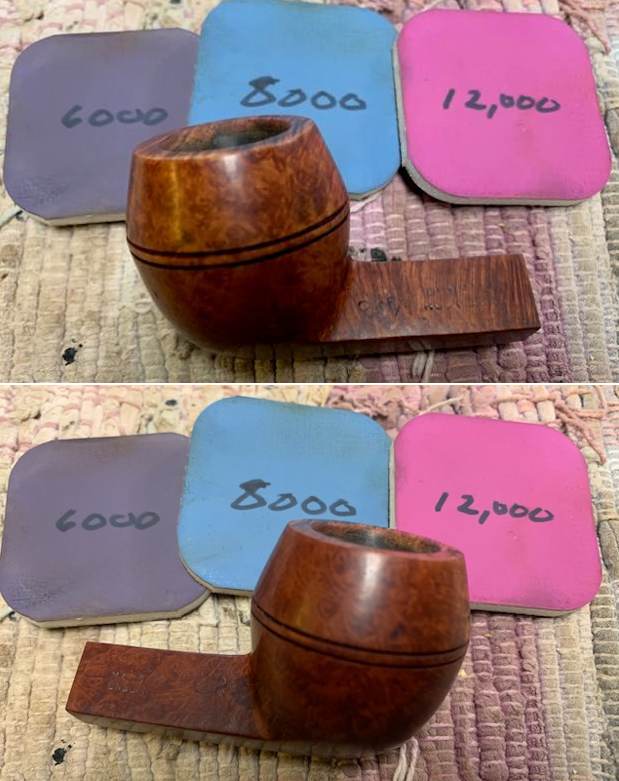
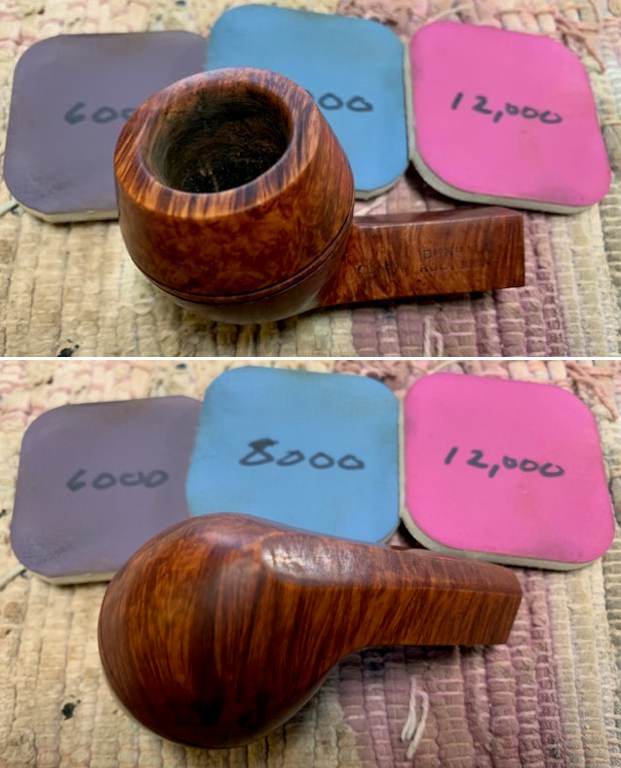
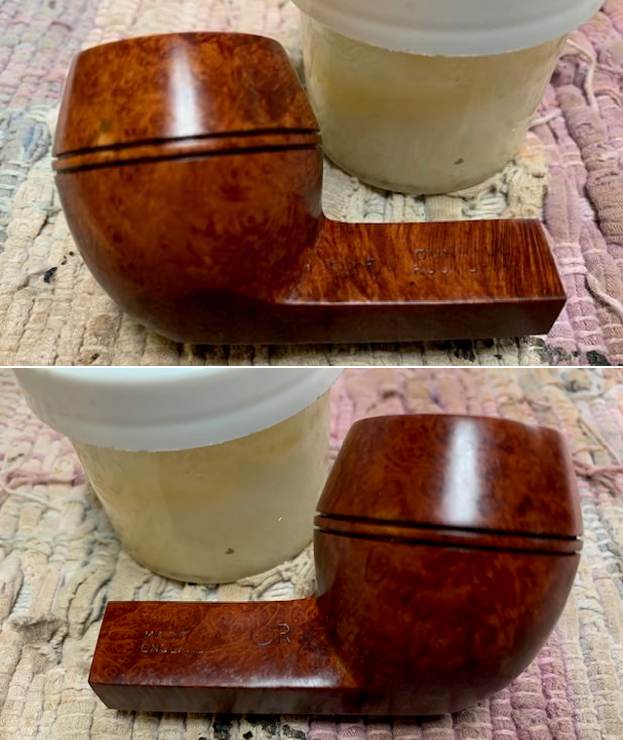
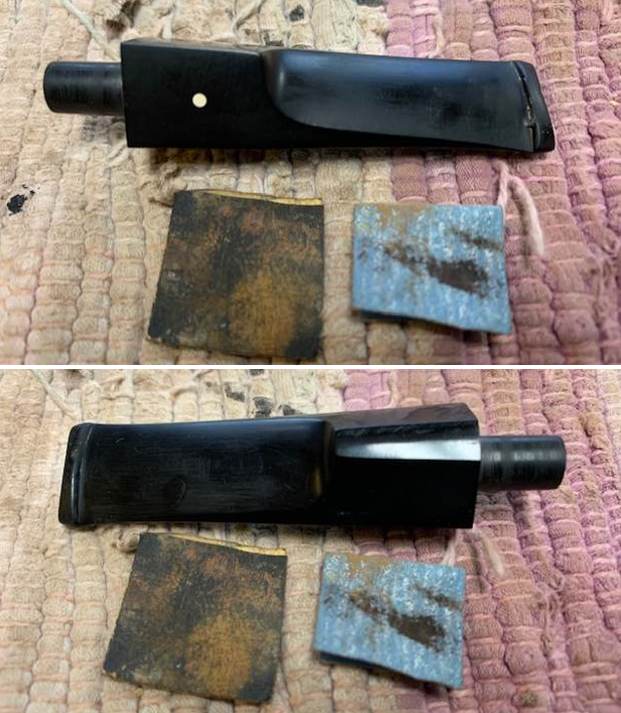
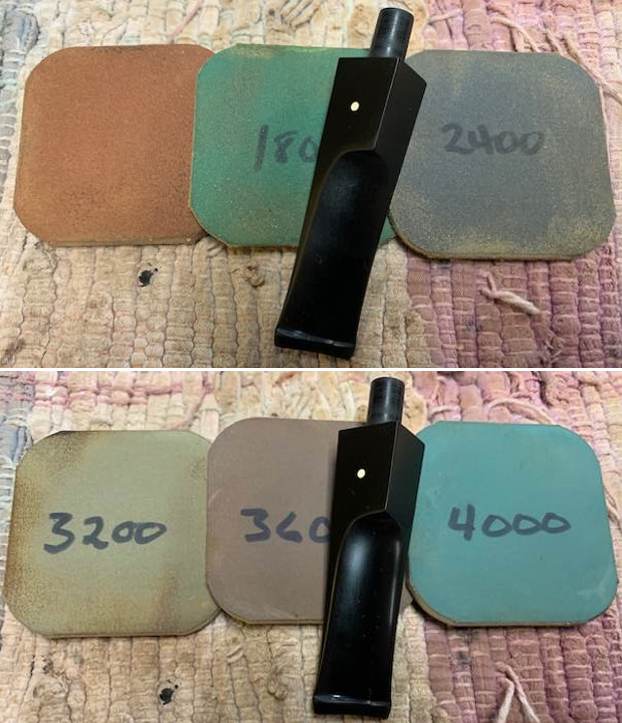
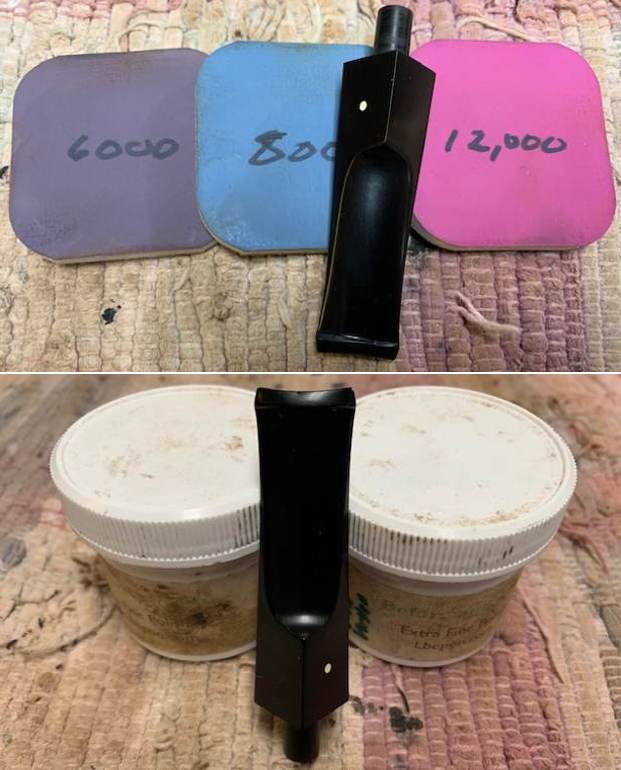
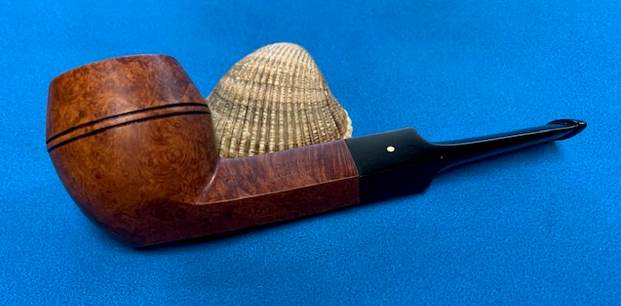
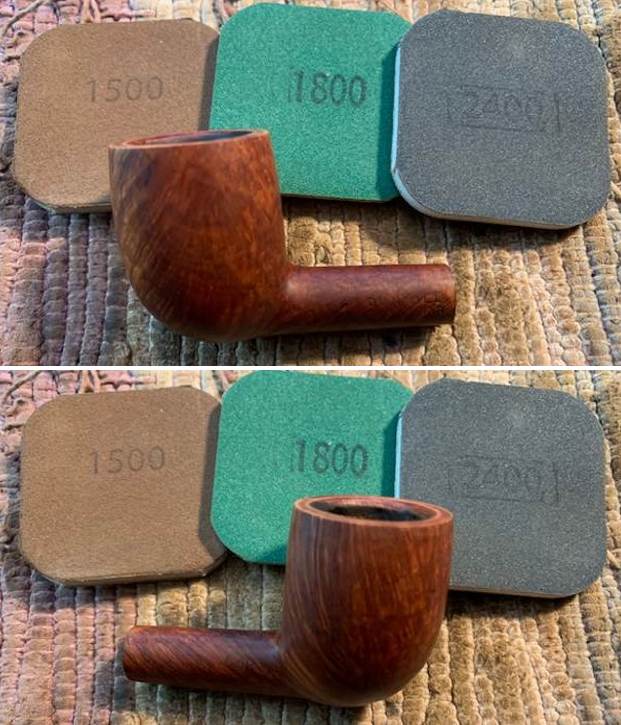
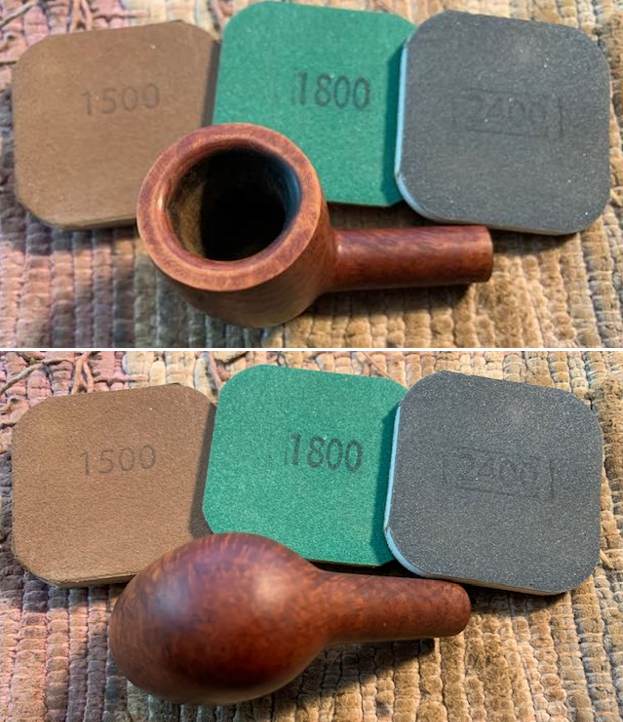
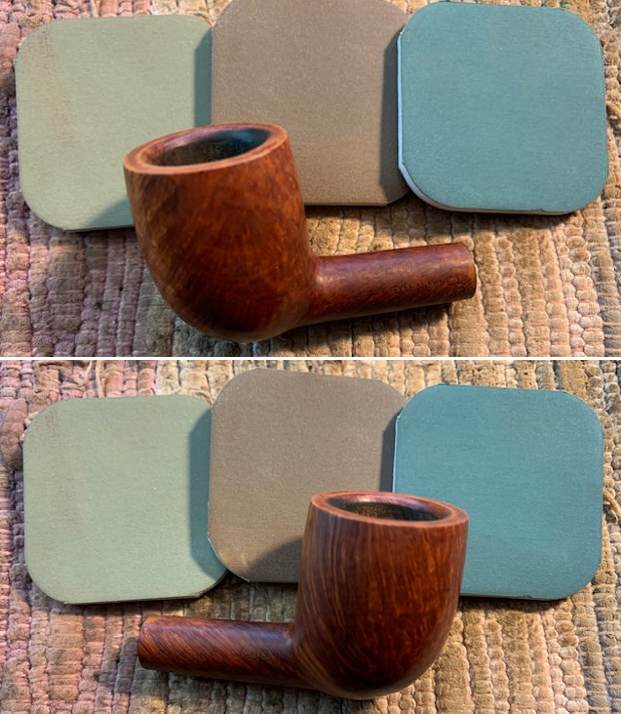
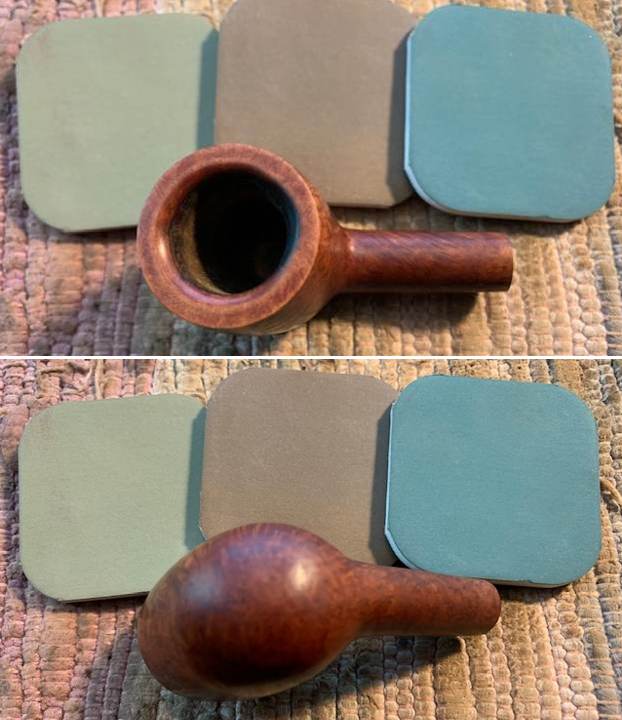
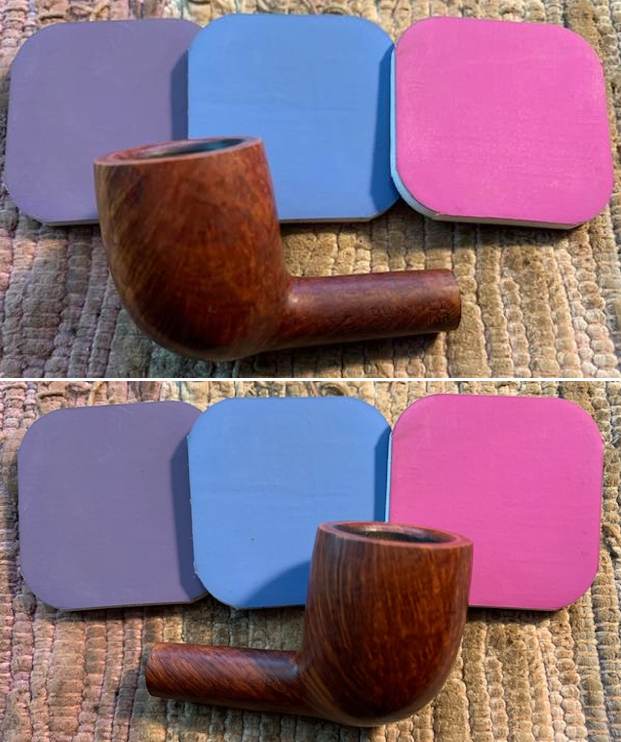
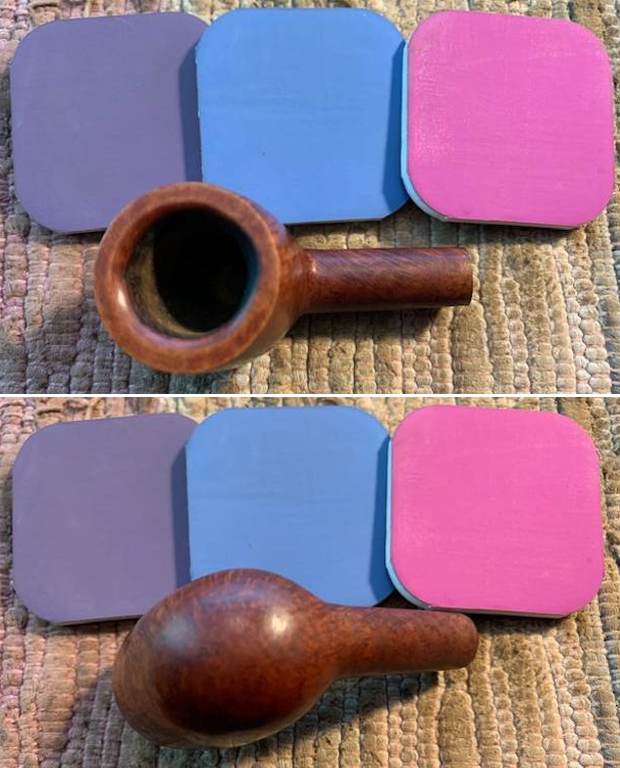
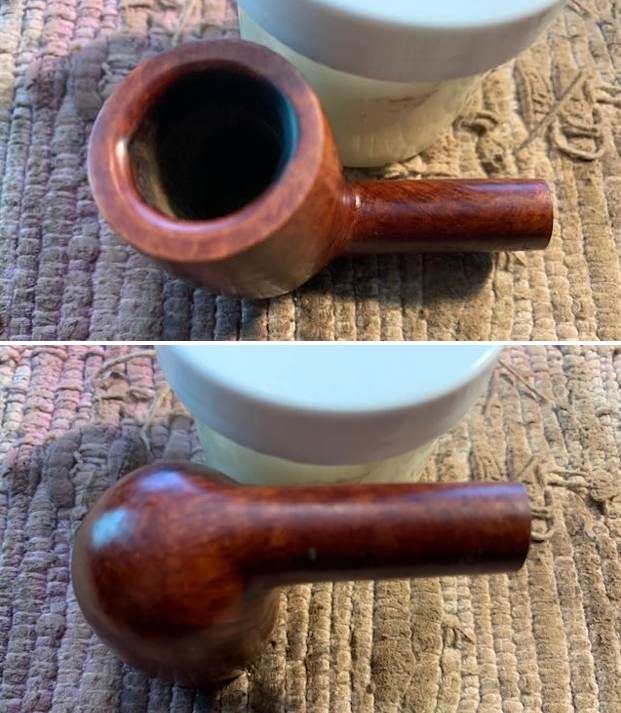
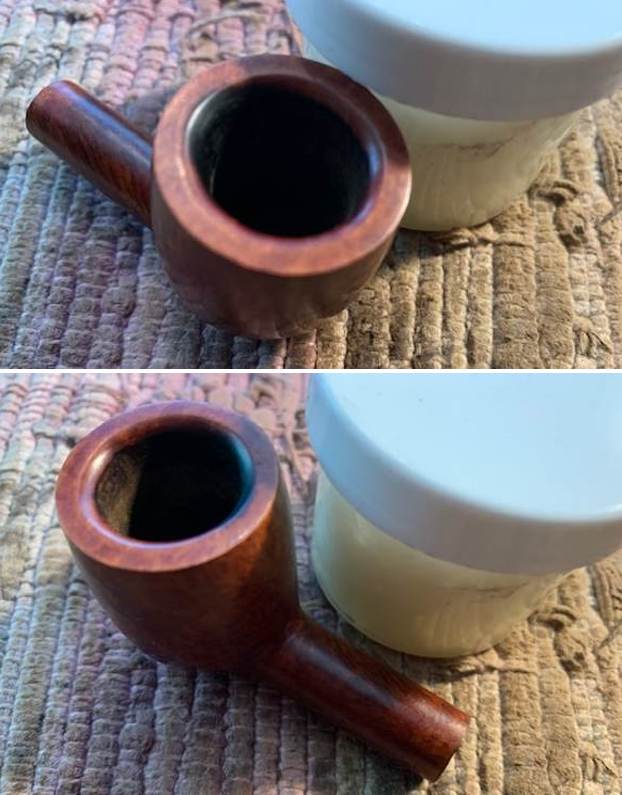
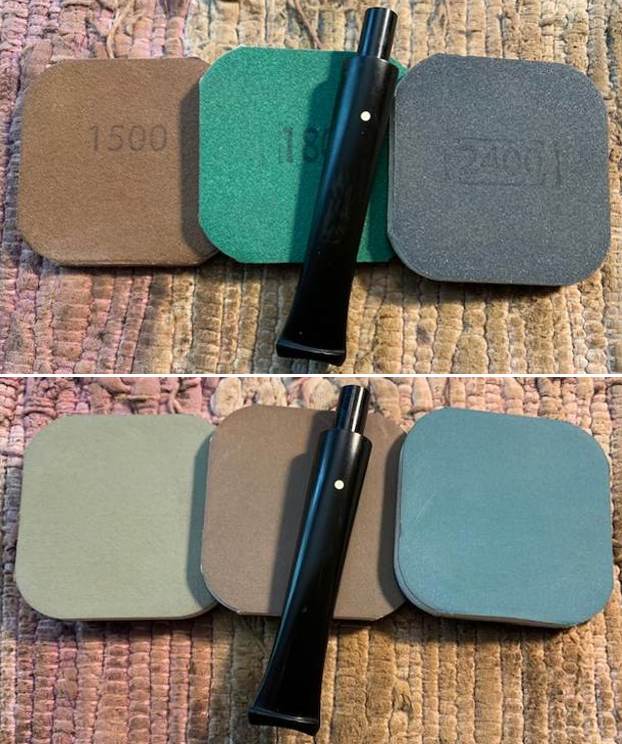
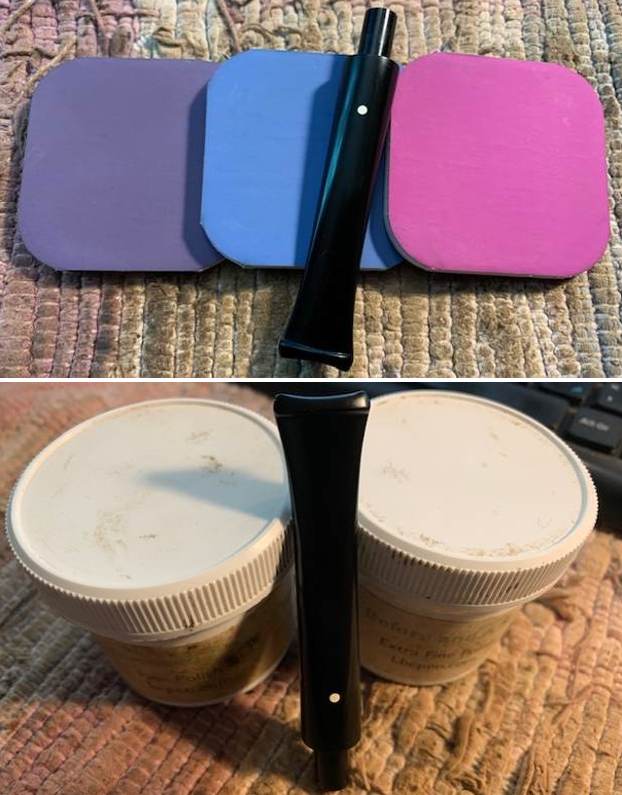
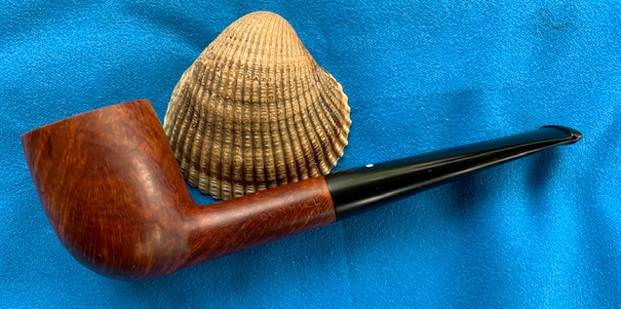
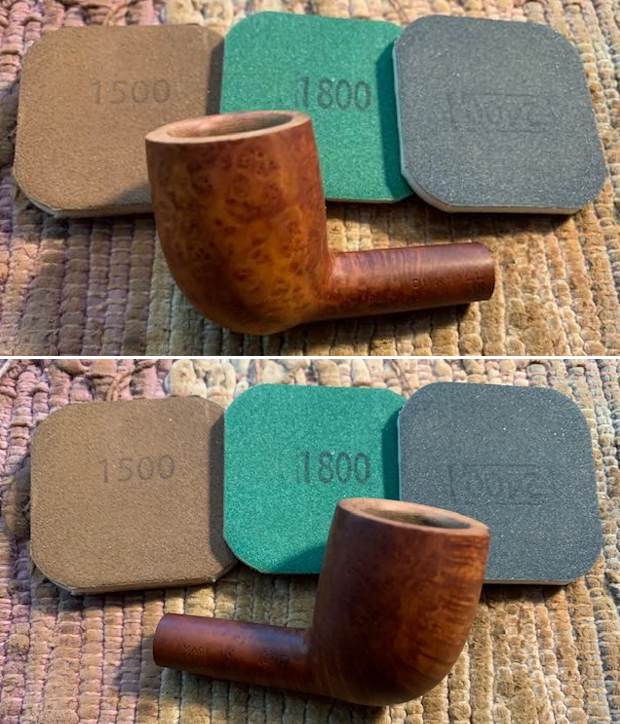
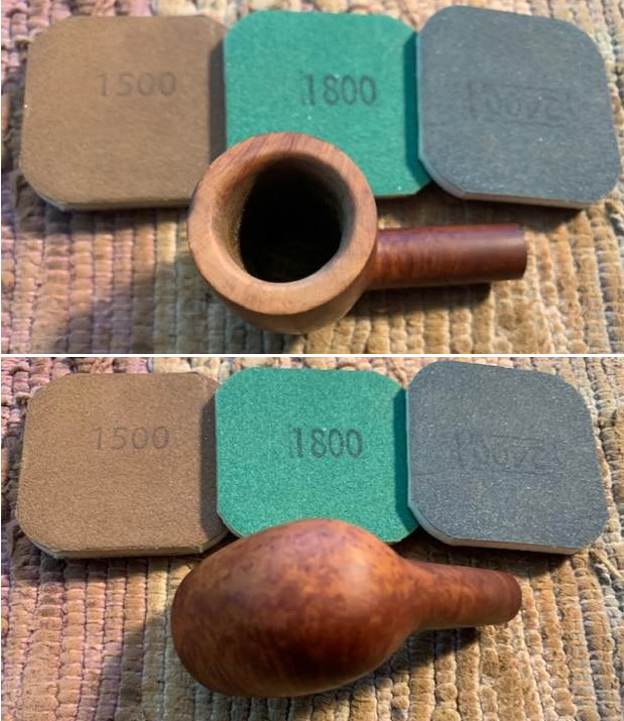
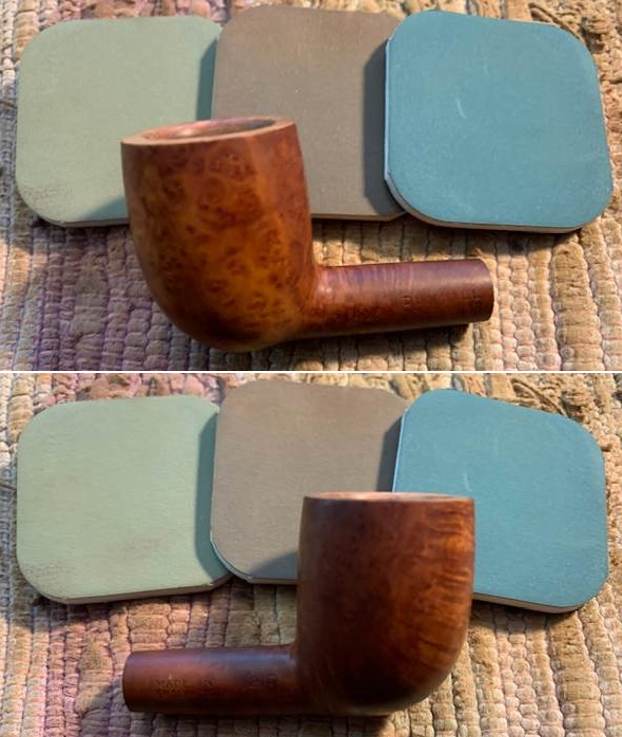
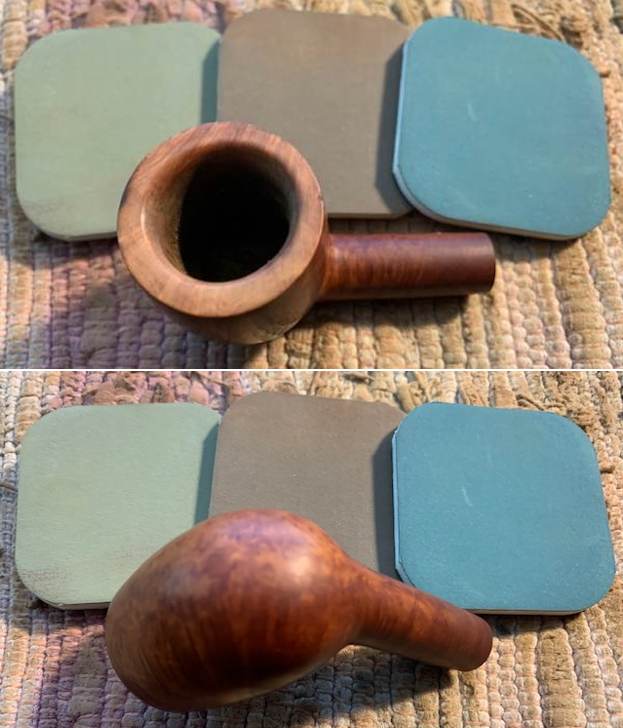
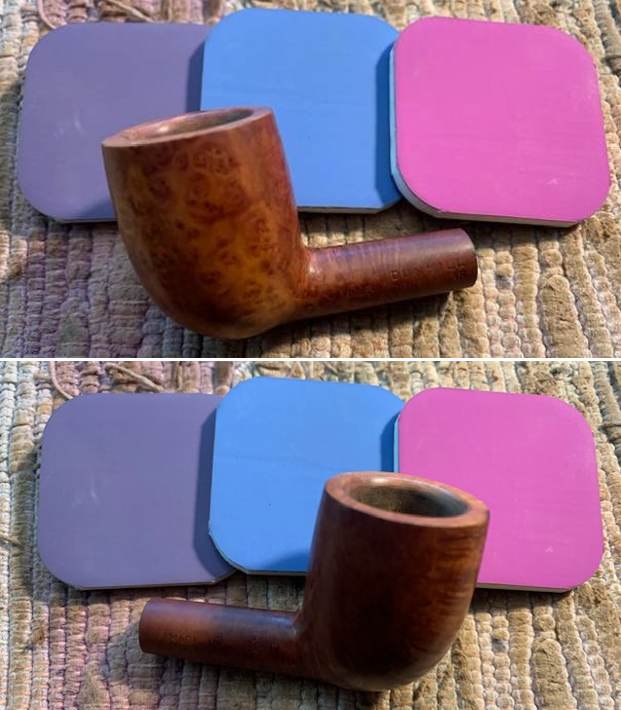
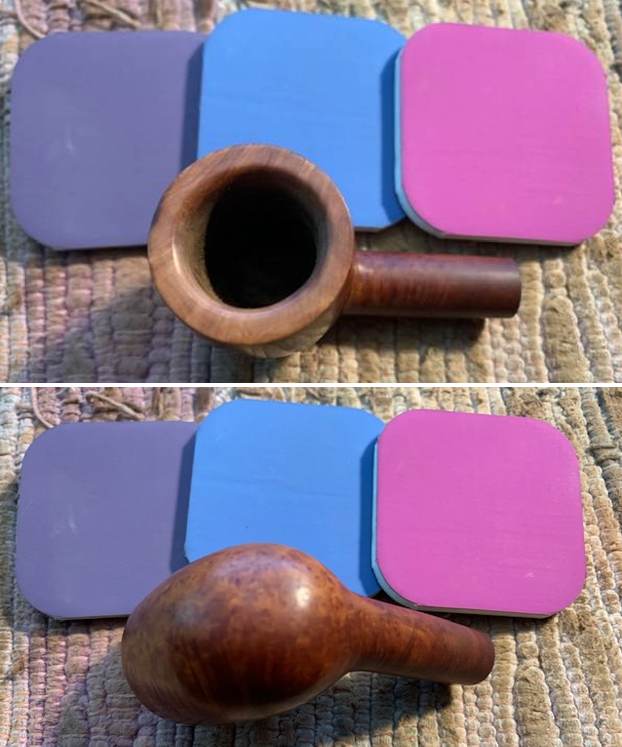
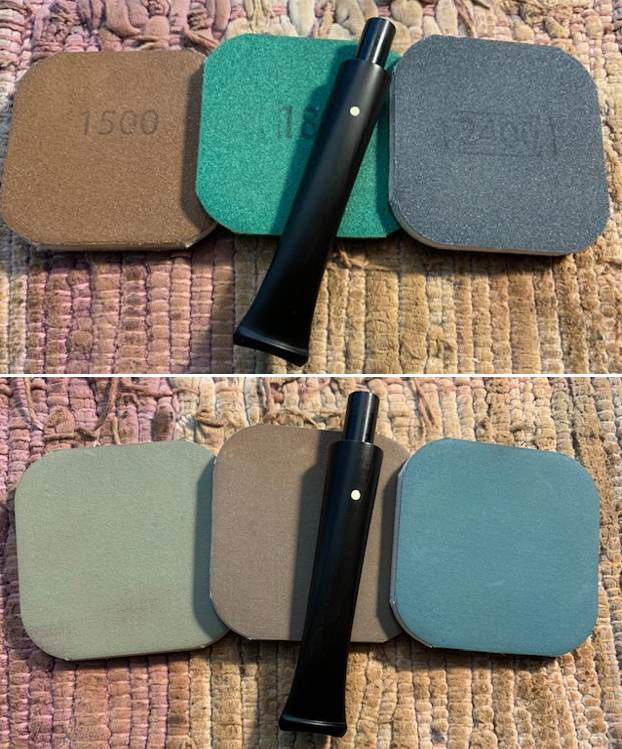
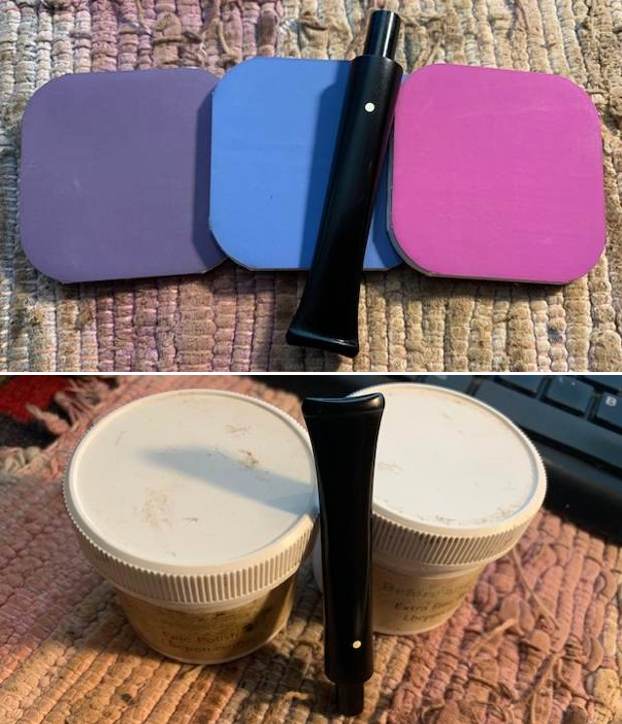
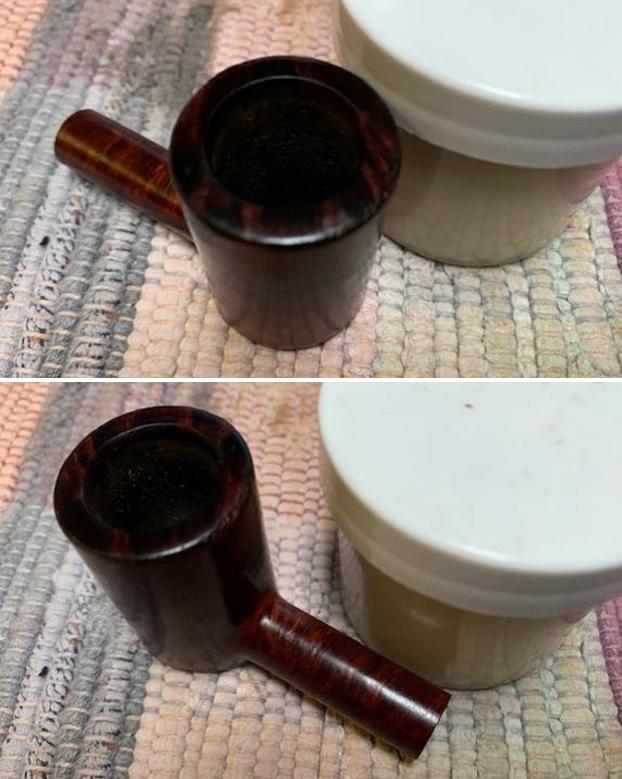
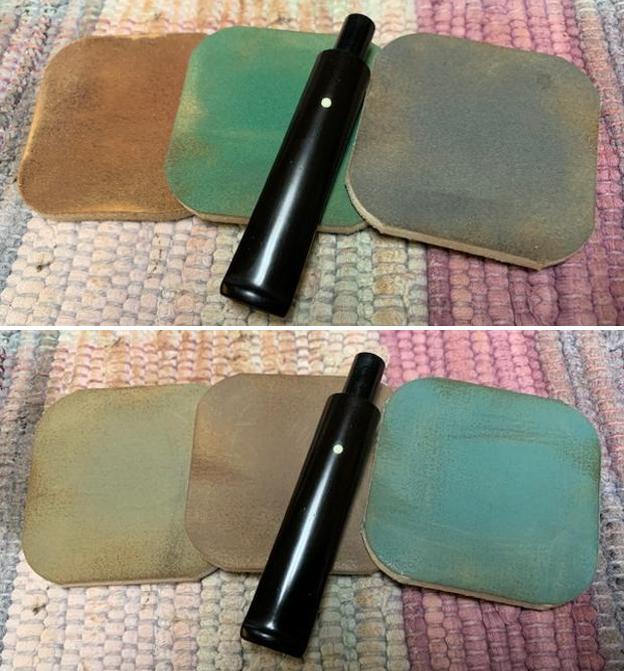
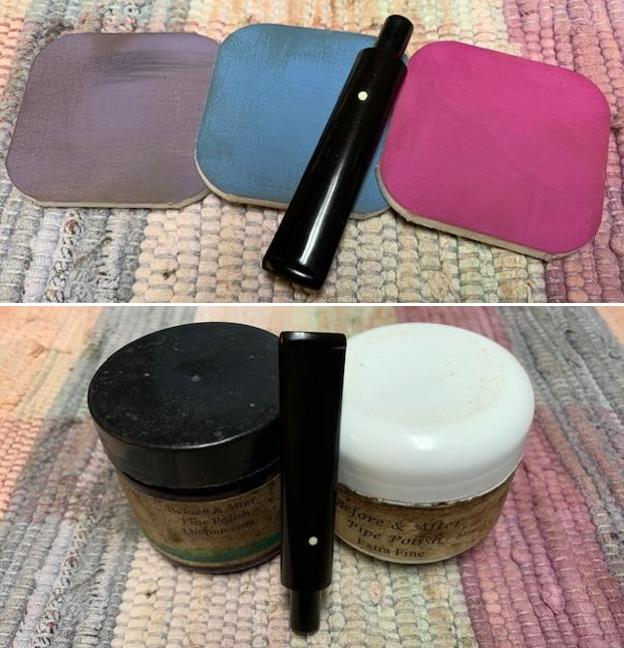
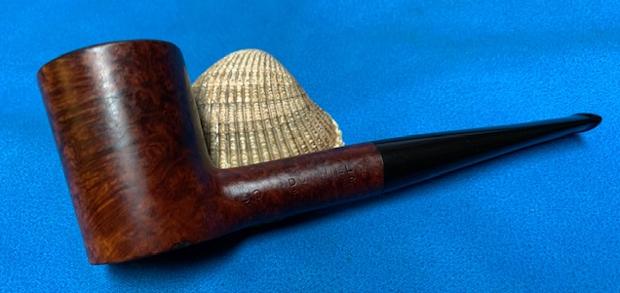
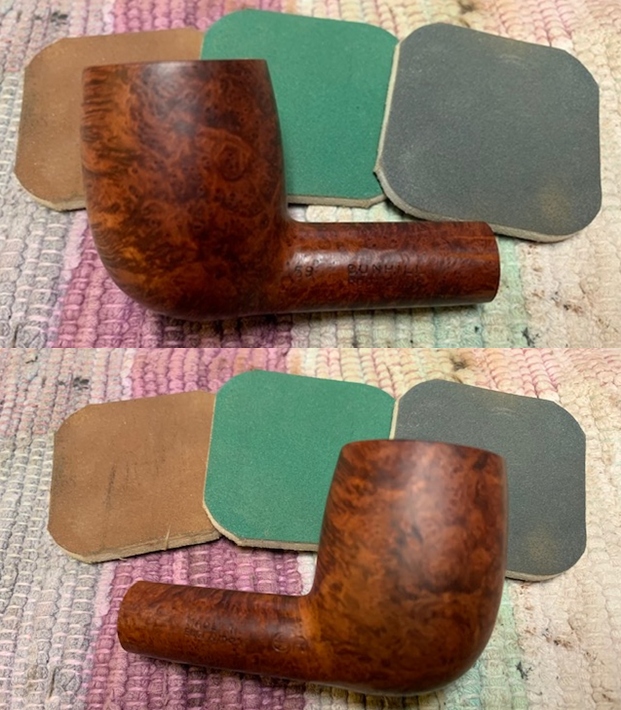
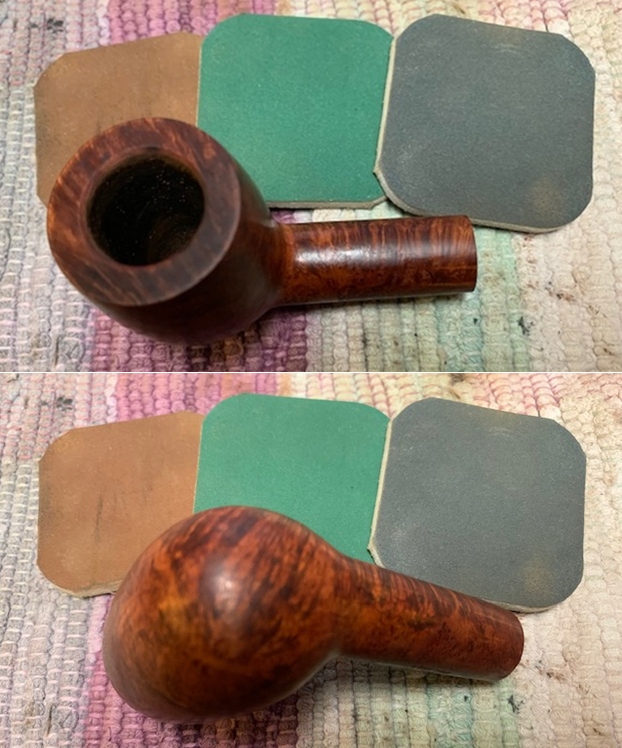
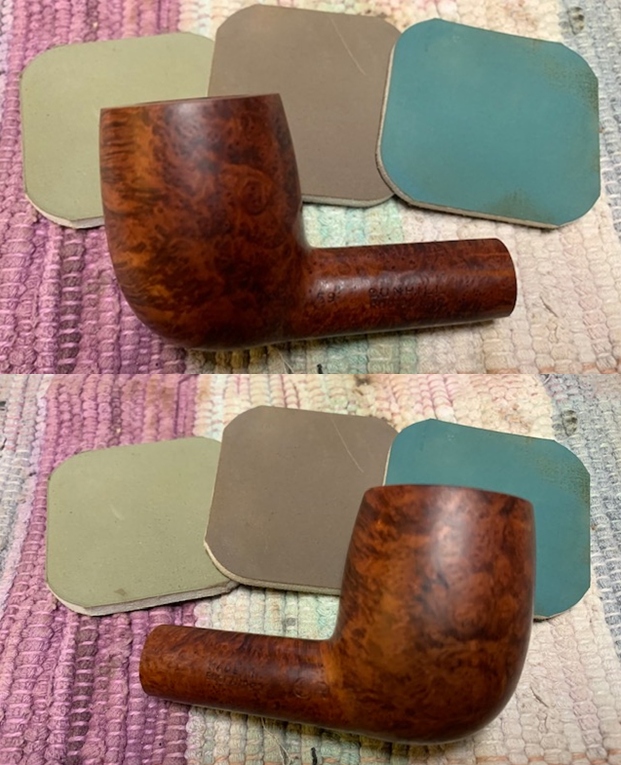
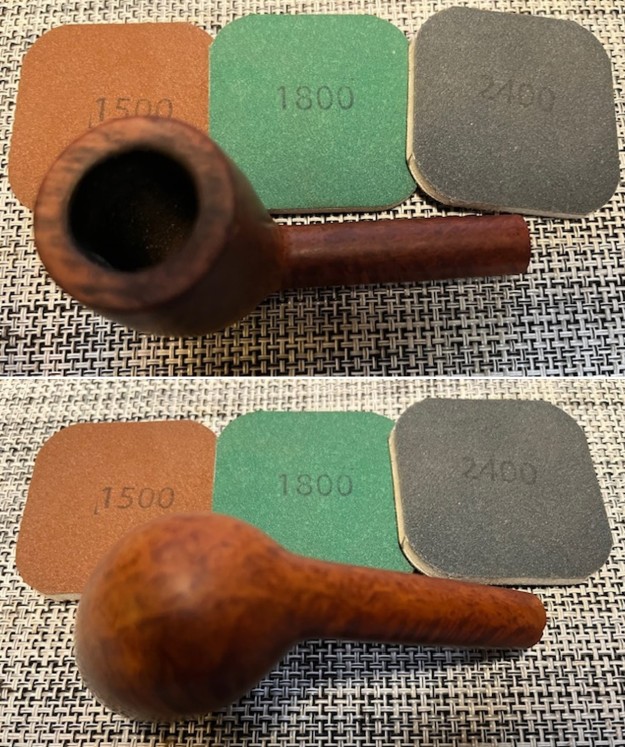
I turned to work on the pipe itself. Jeff had done an amazing cleanup of the pipe. He reamed the cake with a PipNet reamer and cleaned up that with a Savinelli Fitsall Pipe Knife. He scrubbed the internals of the bowl and stem with alcohol, cotton swabs,pipe cleaners and shank brushes. He scrubbed the externals with undiluted Murphy’s Oil Soap and rinsed the bowl off with running water. The rim top had some darkening and there was some damage to the inner edge of the rim. He soaked the stem in Briarville’s Pipe stem Deoxidizer and once it had soaked rinsed it off with warm water to remove the residual solution. He dried it off and rubbed it down to remove any oxidation that was still on the stem. The pipe looked very good when I received it. I took a photo of the rim top to show the condition. You can see the clean bowl. The bowl is in excellent condition and is clean. The rim top and the inner edge show some darkening and damage to the edge. The stem came out looking clean. There were some light tooth marks and chatter on both sides ahead of the button. I took photos of the stamping on the shank. It is faint but still very readable. There was also a very faint stamp on the stem but I am still not certain it is the correct stem because of the fit and shape of the stem. I removed the stem from the shank and took a photo of the pipe parts to show what I was working with. I started my work on the pipe by addressing the damage on the inner edge of the bowl to bring it back to round using a folded piece of 220 grit sandpaper. I gave it a slight bevel to accommodate the damage. The pipe had cleaned up so well that I turned to polish the briar with micromesh sanding pads. I dry sanded it with 1500-12000 grit sanding pads and wiped the bowl down after each pad with a damp cloth. By the final pads the briar really had a shine. I rubbed the briar down with Before & After Restoration Balm. I worked it into the briar with my fingertips. The product works to clean, enliven and preserve the briar. I let it sit for 10 minutes then I buffed it with a cotton cloth to deepen the shine. The briar comes alive with the balm. I set aside the bowl and turned my attention to the stem. I moved on to further smooth out the surface of the vulcanite. I sanded it with 320-3500 grit sanding pads to further clean up the scratches and file marks on the surface of the stem.I polished the vulcanite with micromesh sanding pads – 1500-12000 grit pads. I wiped it down with Obsidian Oil after each sanding pad. I used Before & After Pipe Polish – both Fine and Extra Fine to further polish the stem. It really took on a shine and I knew that once it was buffed it would look amazing. This 1965 Dunhill Root Briar 36 Taper Stem Liverpool has a beautiful, unique Dunhill Root Briar finish that highlights the beautiful grain. The finish highlights some great grain around the bowl and shank. It has the rare finish of a Dunhill Root Briar. The polished black vulcanite taper stem adds to the mix. I put the stem back on the bowl and buffed the pipe with Blue Diamond on the buffing wheel being careful to not buff the stamping. I gave the bowl and the stem multiple coats of carnauba wax on the buffing wheel and followed that by buffing it with a clean buffing pad. I hand buffed the pipe with a microfiber cloth to deepen the shine. The finished Dunhill Root Briar 36 Liverpool is quite nice and feels great in the hand. Give the finished pipe a look in the photos below. The dimensions of the pipe are Length: 5 ½ inches, Height: 1 ¾ inches, Outside diameter of the bowl: 1 ¼ inches, Chamber diameter: ¾ of an inch. The weight of the pipe is 1.27 ounces/35 grams. Thanks for walking through the restoration with me as I worked over another beautiful pipe. If you are interested in adding it to your collection I will be adding it to the British Pipe Makers Section of the rebornpipes store. Thanks for your time.
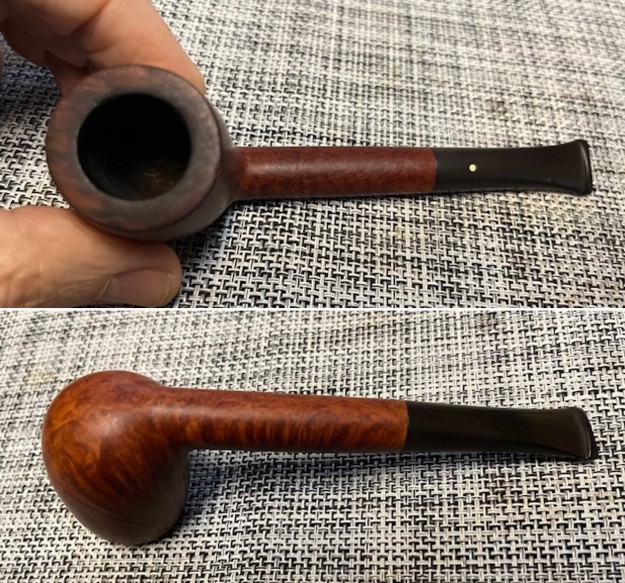
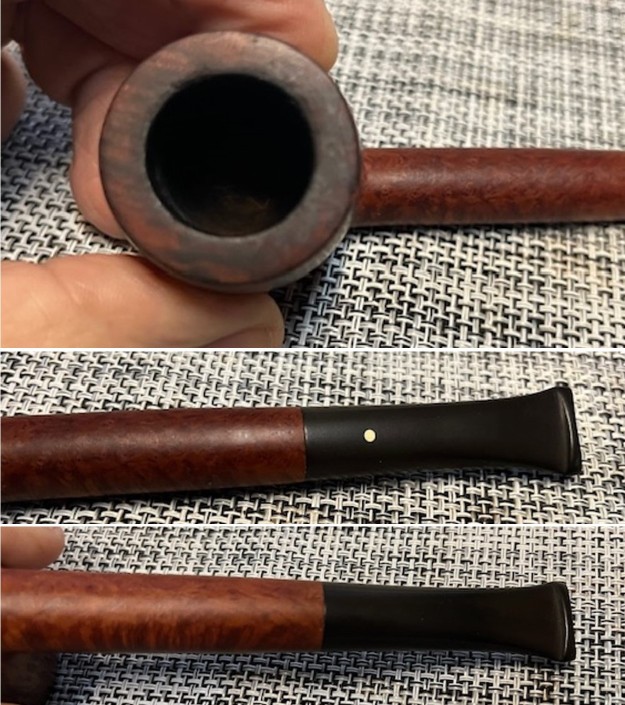
Cleaning up a 1968 Dunhill Root Briar 251 F/T Made in England 8 Taper Stem Billiard


Blog by Steve Laug

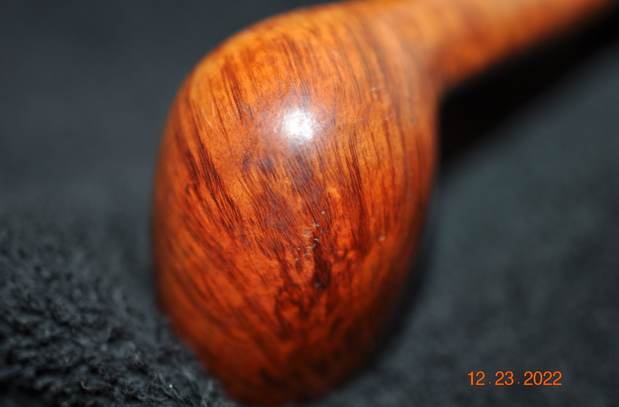
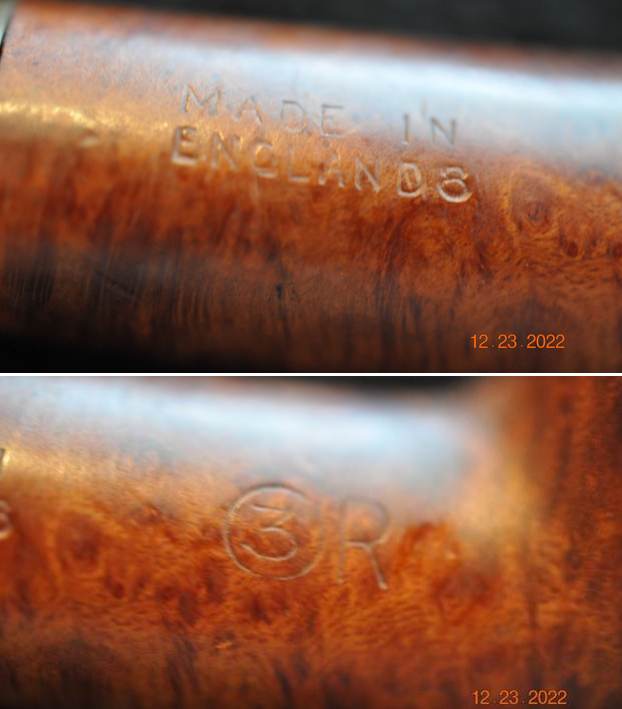
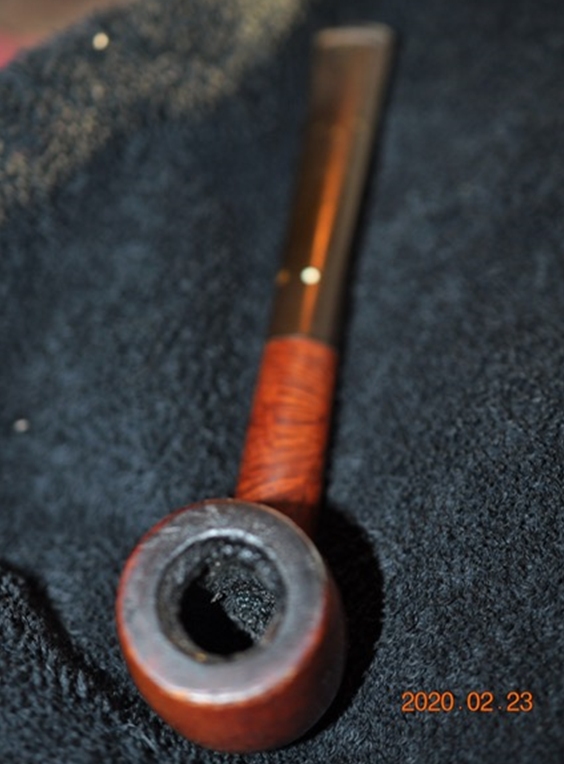
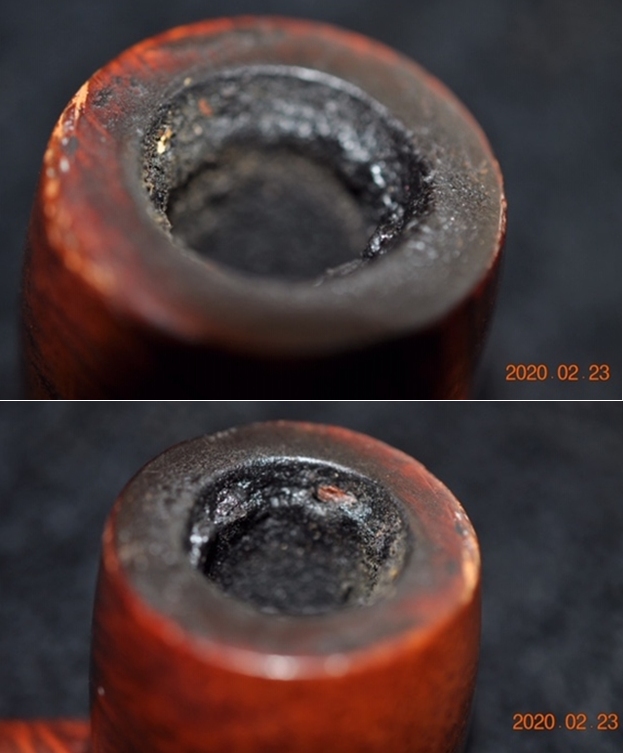
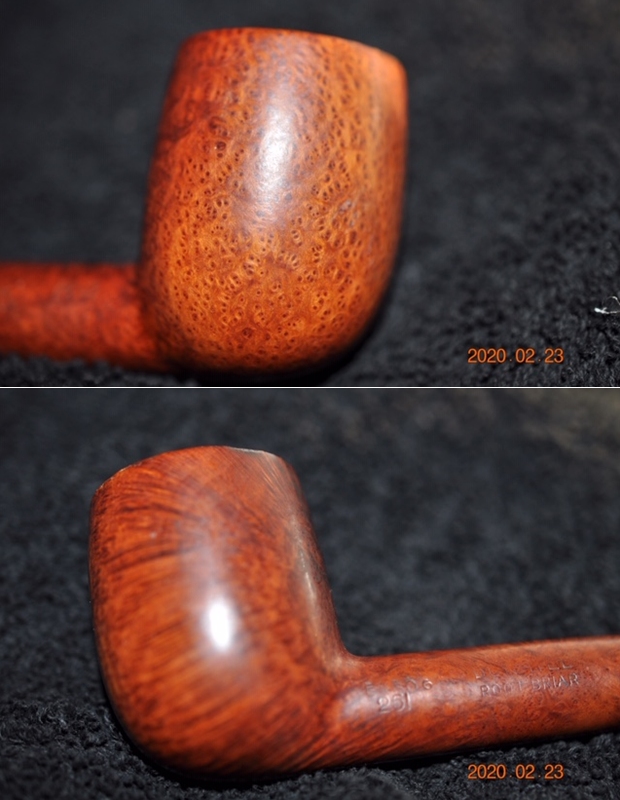
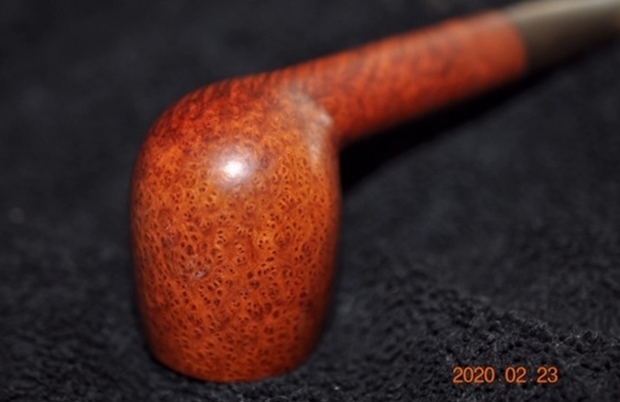
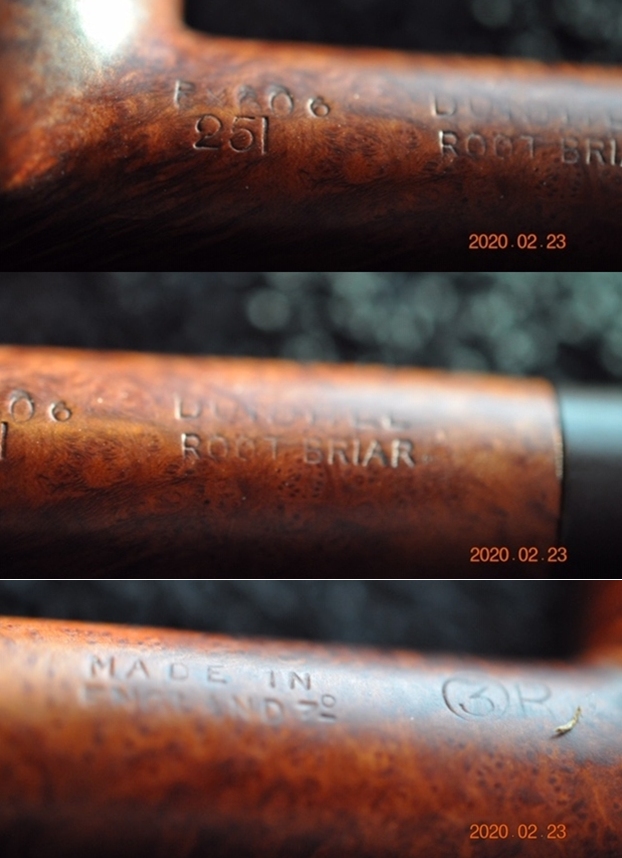
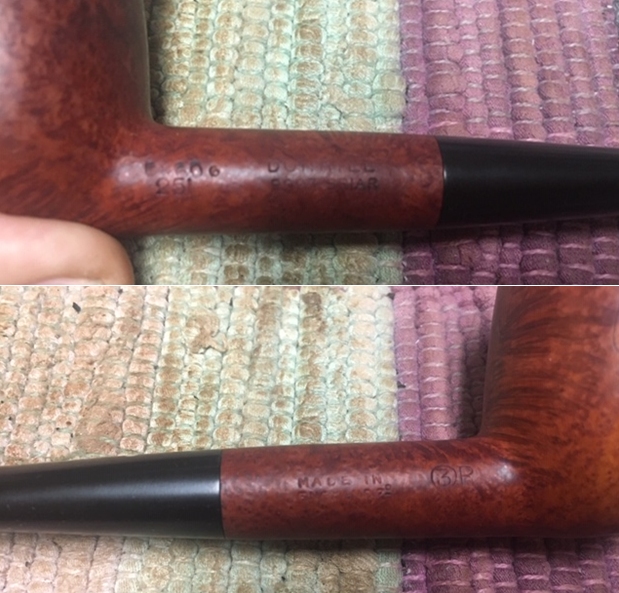
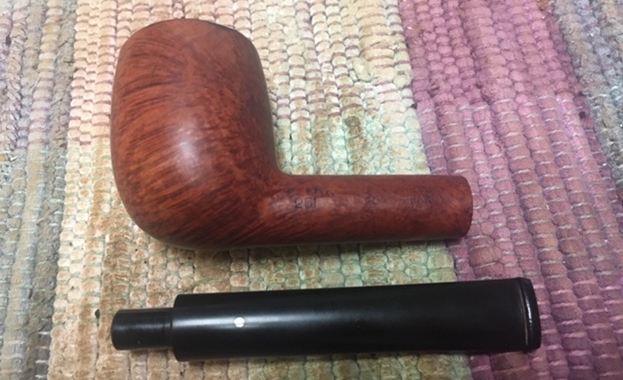
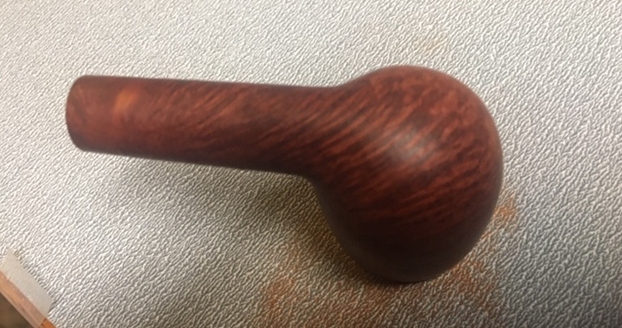
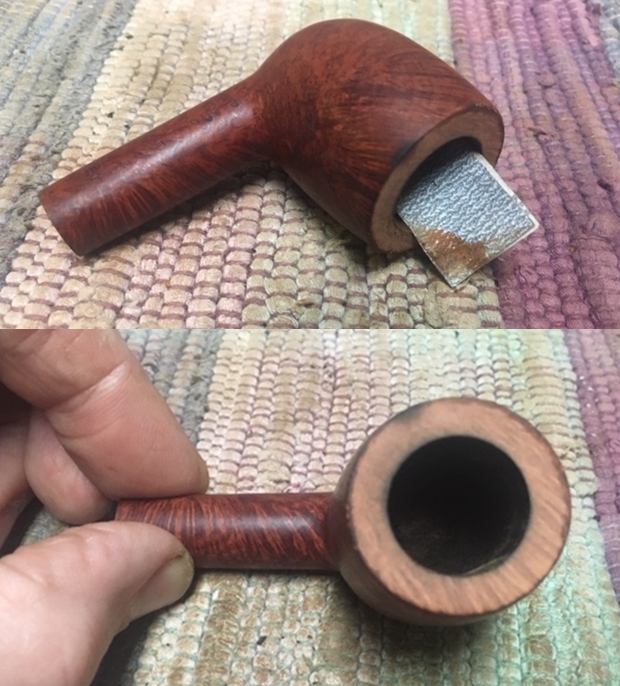
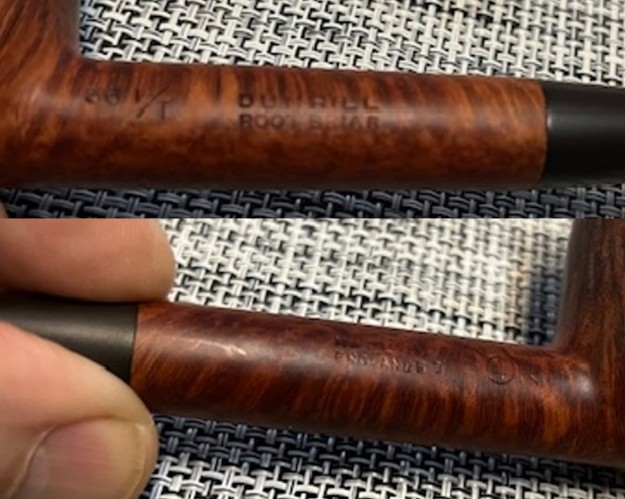
The next pipe on the table is another one that came to us from the group of pipes that Jeff and I purchased on October 16, 2021 from a fellow in Redmond, Oregon who was selling his father’s estate pipes. It is another Dunhill smooth finish pipe that is in rough but workable condition. It is stamped on the left side of the shank with the shape number 251 F/T followed by Dunhill [over] Root Briar. On the right side it is stamped Made in [over] England by the date number 8. Next to the bowl on the right side it is stamped with a 3 in a circle followed by R. The stamping is clear and readable as noted above. The pipe has a mix of brown stains with some amazing grain that the shape follows well. The finish was dusty and oily and the pipe was dirty. The bowl had a thick cake and there was a thick overflow lava and darkening and scratches on the rim top and both the inner and outer edges. The taper stem was in decent condition and was oxidized, calcified and had tooth marks and chatter ahead of the worn button. Jeff took photos of the pipe to show what it looked like before he started working on it. He took photos of the bowl and rim top to show their condition and of the stem to show the condition of both sides of the stem. The photos of the sides and heel of the bowl show beautiful cross and birdseye grain and the Root Briar coloured finish on the pipe. Even under the grime it is a real beauty. The stamping on the sides of the shank are shown in the photos below. It is faint but readable. It reads as noted and explained above. Jeff captured the detail in the photos below. One of the first things I like to do is to unpack the stamping and understand each element in it. I turned to Pipephil’s helpful site (http://pipephil.eu/logos/en/dunhill/root-briar1.html). The stamping is interpreted as follows: The 251 stamp is the shape for a Billiard. The F/T stamp refers to the fishtail stem. The Root Briar stamp refers to the finish. The 8 following the D of England gives the date the pipe. The Circle 3 R refers to the size of the pipe being a Group 3 and the R confirms the Root Briar designation.Pipephil also has some helpful dating keys on the site that are basically flow charts that you can walk through to date your pipe (http://pipephil.eu/logos/en/dunhill/cledat-en1.html). I turned to Part 1 of the Dating Key and followed the chart. This pipe has a 8 following the D in England. It is the same size as the D so that took me to the section on the chart below (column one) which instructed me that the pipe could be dated as being made posterior to 1954. I followed the link following the “Your pipe is posterior to 1954. Narrow down your dating”. That took me to Page 2 of the dating key (http://pipephil.eu/logos/en/dunhill/cledat-en1a.html).   The third column (suffix 5…9) led me to the section with a 8 after the D in England. There was a directive for dating the pipe spelled out as follows: 1960 + suffix which gives the pipe a date of 1968. I then turned to Pipedia’s section on Dunhill Root Briar to get a bit of background on the Dunhill finishes (https://pipedia.org/wiki/Dunhill#Root_Briar). I quote:

Root Briar – Introduced in 1931 and highly prized because the grain is more pronounced in this finish (usually made using Corsican briar – was made exclusively from that briar into the 60s). The Root Briar finish requires a perfectly clean bowl with excellent graining. Therefore, it is the most expensive of the Dunhill pipes. Corsican briar was most often used for the Root finish since it was generally more finely grained. This is a rare finish, due to the scarcity of briar suitable to achieve it. These pipes are normally only available at Company stores, or at Principle Pipe Dealers. Straight grained pipes were formerly graded A through H, but are now only “Dr’s” and graded with one to six stars, with the letters G and H still used for the very finest pieces.

Dunhill introduced its third major finish, the Root finish, in 1931. Corsican mountain briar is characteristically beautifully grained and the Root was made exclusively from that briar into the 1960s. The pipe was finished with a light natural stain to allow the beauty of the graining to show through. Although always available with a traditional black vulcanite bit, the Root was introduced in either 1930 or more likely 1931 and fitted with a marble brown dark and light grained vulcanite bit that has since become known as the ‘bowling ball’ bit because of the similarity in appearance between the bit’s finish and that of some bowling balls of the time. With the war, however, the bowling ball bit was dropped from production. Through 1954 (and after) the Root pipe nomenclature (including shape numbers) was identical to that of the Bruyere except that instead of the “A” of the Bruyere, the Root was stamped with an “R”. In 1952 when the finish rather then LONDON was placed under DUNHILL, ROOT BRIAR rather then BRUYERE was used for the Root. Loring, J. C., The Dunhill Briar Pipe, The Patent Years and After (self-published, Chicago, 1998).

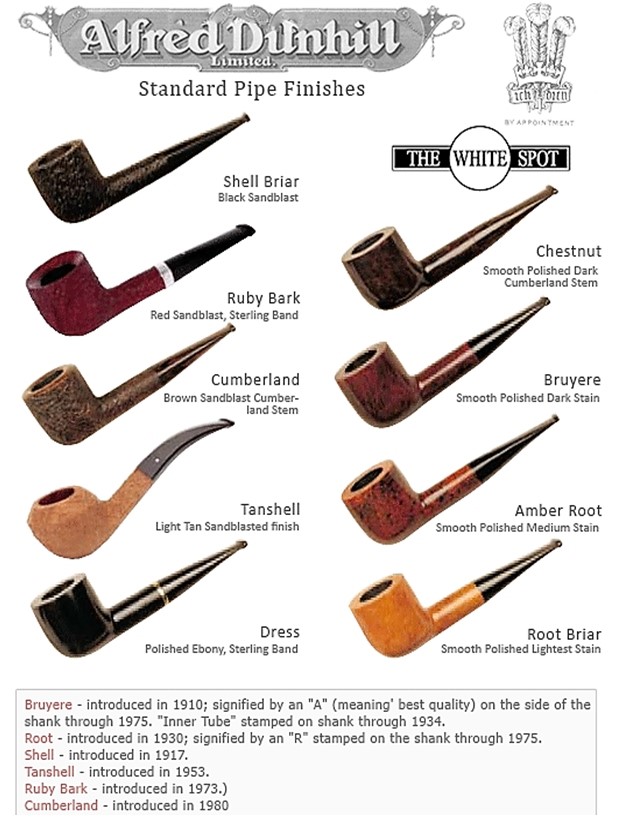
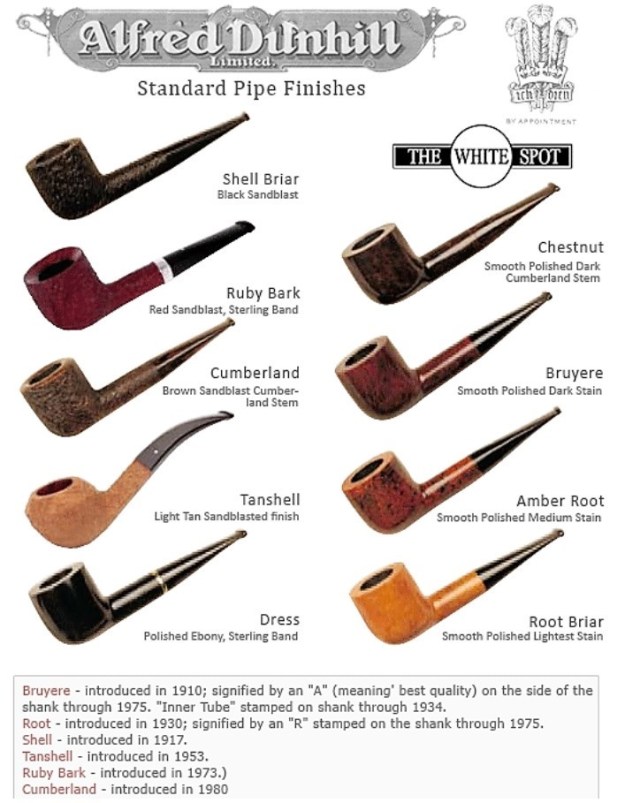
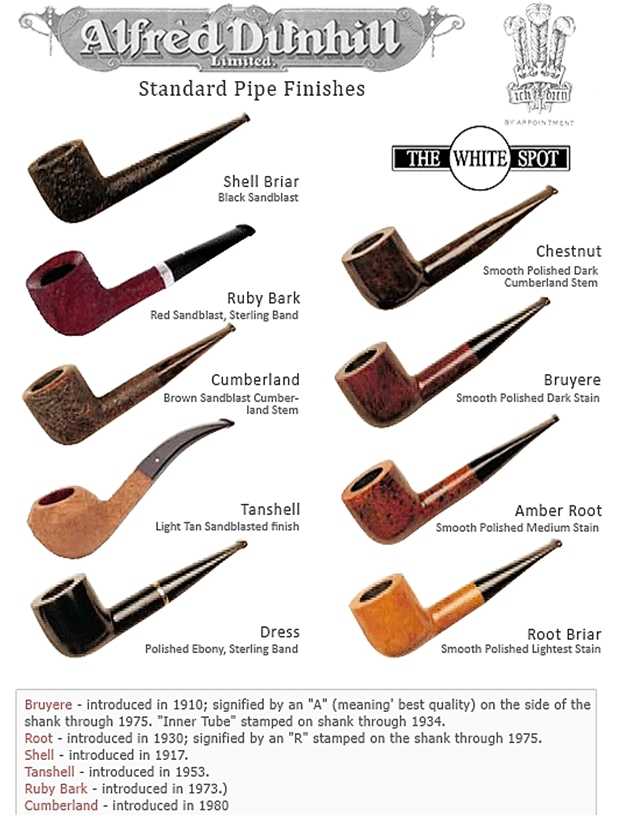
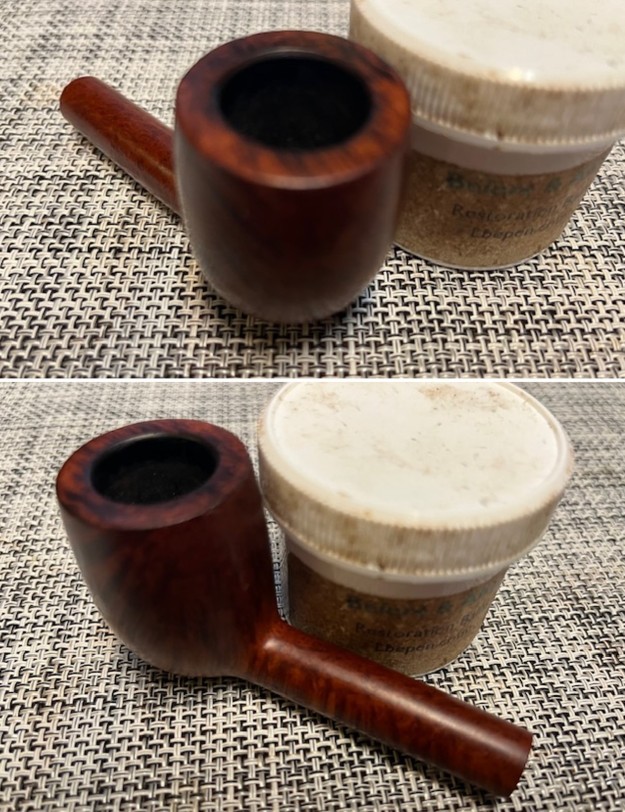
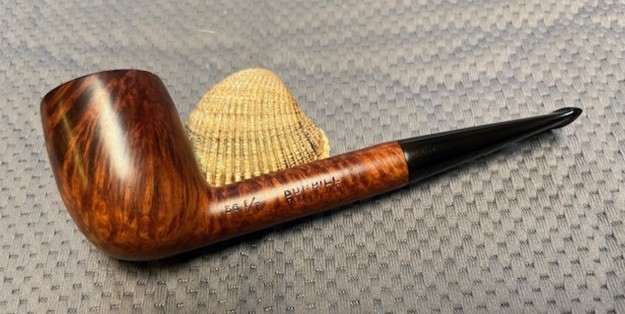
I have also included a chart from the site from Dunhill spelling out the Standard Pipe Finishes and giving short information and a timeline. I turned to work on the pipe itself. Jeff had done an amazing cleanup of the pipe. He reamed the light cake with a PipNet reamer and cleaned up that with a Savinelli Fitsall Pipe Knife. He scrubbed the internals of the bowl and stem with alcohol, cotton swabs and pipe cleaners. He scrubbed the externals with undiluted Murphy’s Oil Soap and rinsed the bowl off with running water. He soaked the stem in Briarville’s Pipe stem Deoxidizer and once it had soaked rinsed it off with warm water to remove the residual solution. He dried it off and rubbed it down to remove any oxidation that was still on the stem. The pipe looked very good when I received it. I took a photo of the rim top to show the condition. You can see the clean bowl and the damage on the rim top and inner edge. The stem came out looking quite good. There are some scratches, tooth marks and chatter on both sides ahead of the button.   I took photos of the stamping on the sides of the shank. The stamping is faint in spots but still very readable. It reads as noted above. I removed the stem from the shank and took a photo of the pipe parts to show what I was working with. It is a nice looking pipe.I worked on both the inside and outside edge and top of the rim with a folded piece of 220 grit sandpaper to clean up the damage. It would take some work but it looked much better.I polished the cleaned up rim top and edges with micromesh sanding pads – dry sanding with 1500-12000 grit pads and wiping the bowl down with a damp cloth to remove the dust. The rim top came out looking very good. I rubbed the briar down with Before & After Restoration Balm. I worked it into the briar with my fingertips. The product works to clean, enliven and preserve the briar. I let it sit for 10 minutes then I buffed it with a cotton cloth to deepen the shine. The briar comes alive with the balm. I set the bowl aside and turned to address the stem issues. I “painted” the surface of the stem with the flame of a Bic lighter. The heat lifted the tooth marks significantly. I filled in the remaining spots with clear CA glue. Once the repairs cured I flattened the with a small file then sanded them with 220 grit sandpaper to blend them into the surface of the stem. I started the polishing with a 400 grit wet dry sandpaper. I polished the vulcanite with micromesh sanding pads – 1500-12000 grit pads. I wiped it down with Obsidian Oil after each sanding pad. I used Before & After Pipe Polish – both Fine and Extra Fine to further polish the stem. This 1968 Dunhill Root Briar 251 F/T Billiard with a Taper Stem has a smooth Dunhill finish that has some great grain. The polished light brown stain highlights some great grain around the bowl and shank. The polished black vulcanite taper stem adds to the mix. I put the stem back on the bowl and buffed the pipe with Blue Diamond on the buffing wheel being careful to not buff the stamping. I gave the bowl and the stem multiple coats of carnauba wax on the buffing wheel and followed that by buffing it with a clean buffing pad. I hand buffed the pipe with a microfiber cloth to deepen the shine. The finished Dunhill Root Briar 251 F/T Billiard is quite nice and feels great in the hand. Give the finished pipe a look in the photos below. The dimensions of the pipe are Length: 5 ¾ inches, Height: 1 ¾ inches, Outside diameter of the bowl: 1 1/8 inch, Chamber diameter: ¾ of an inch. The weight of the pipe is 1.09 ounces/31 grams. Thanks for walking through the restoration with me as I worked over another beautiful pipe. If you are interested in adding it to your collection I will be adding it to the British Pipe Makers Section of the rebornpipes store. Thanks for your time.
Cleaning up a Dunhill Root Briar 21033 Made in England 18 Taper Stem Billiard


Blog by Steve Laug

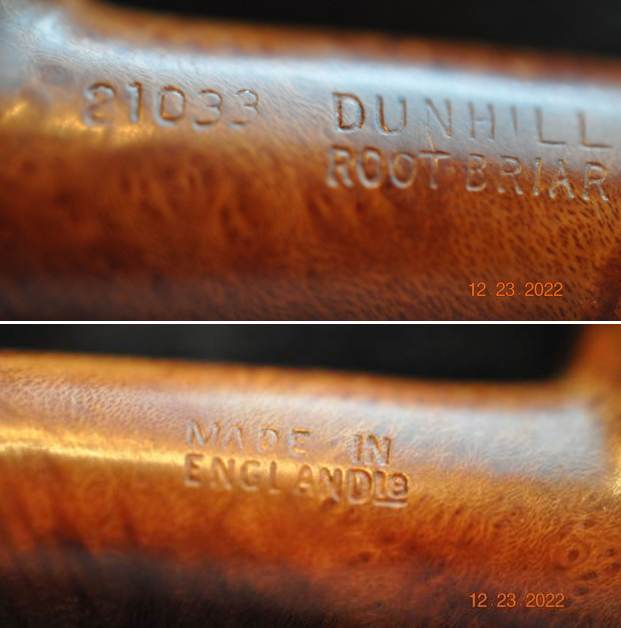
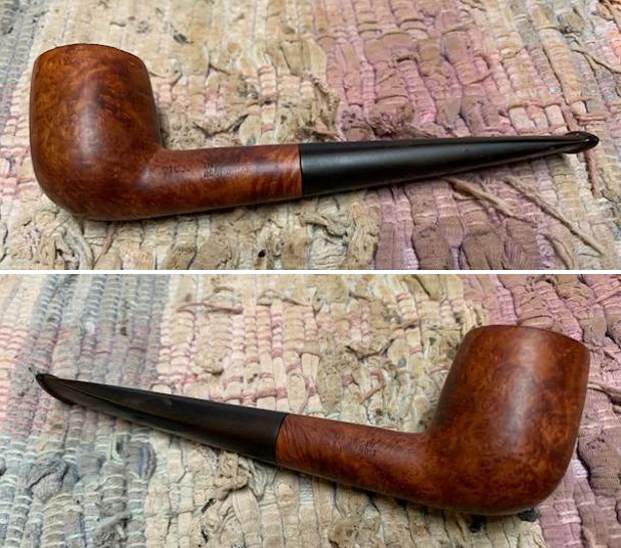
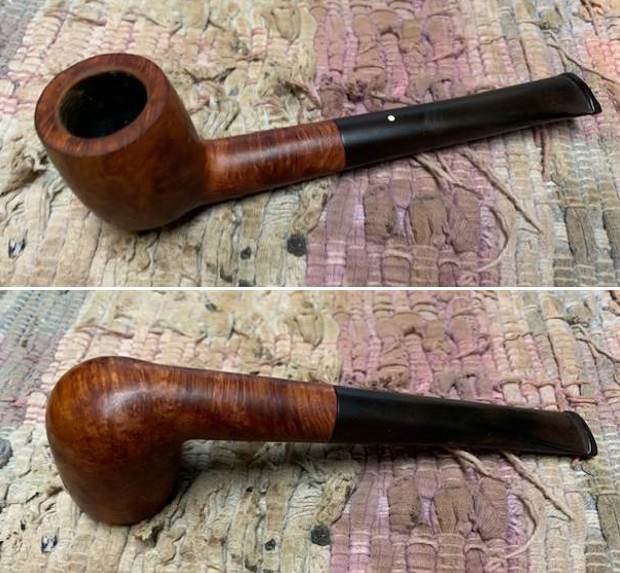
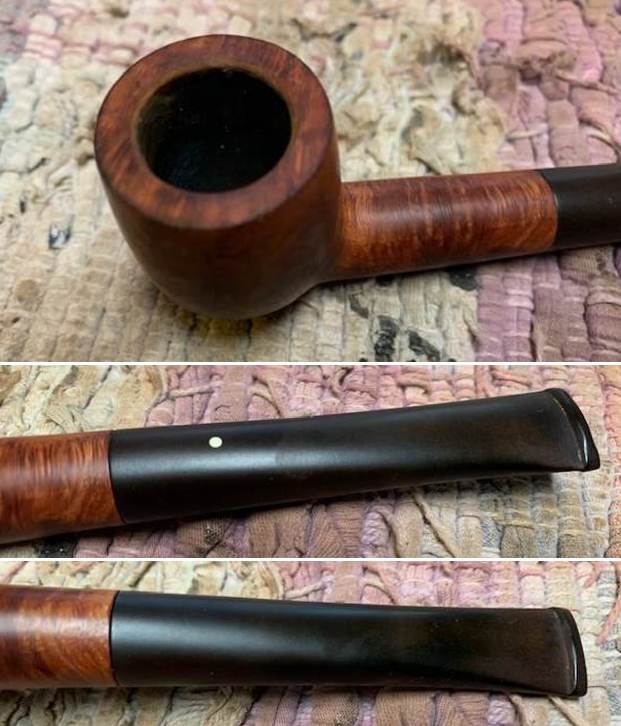
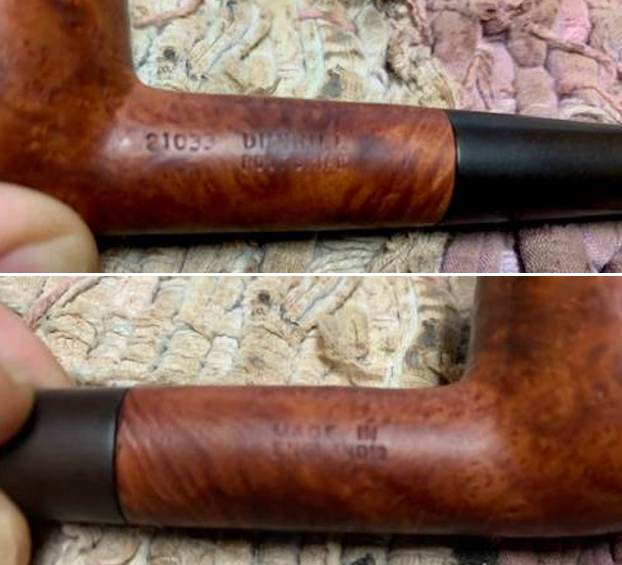
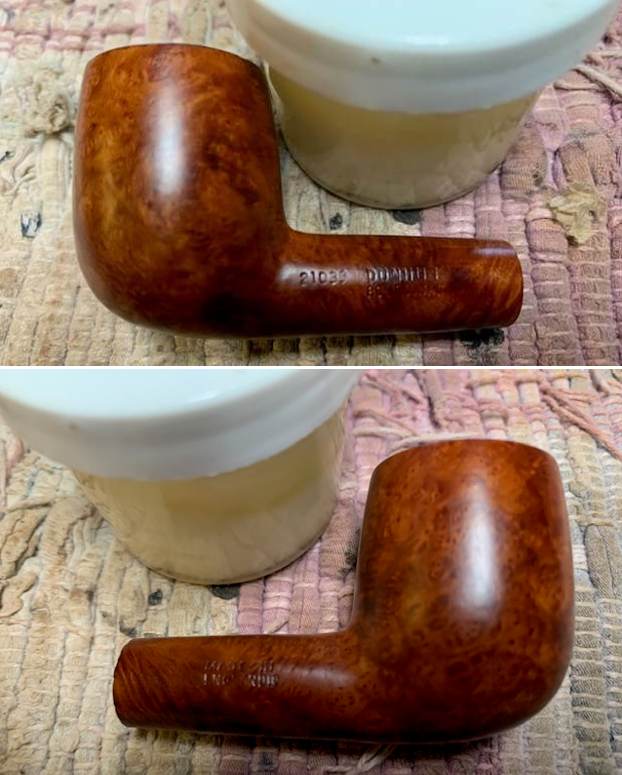
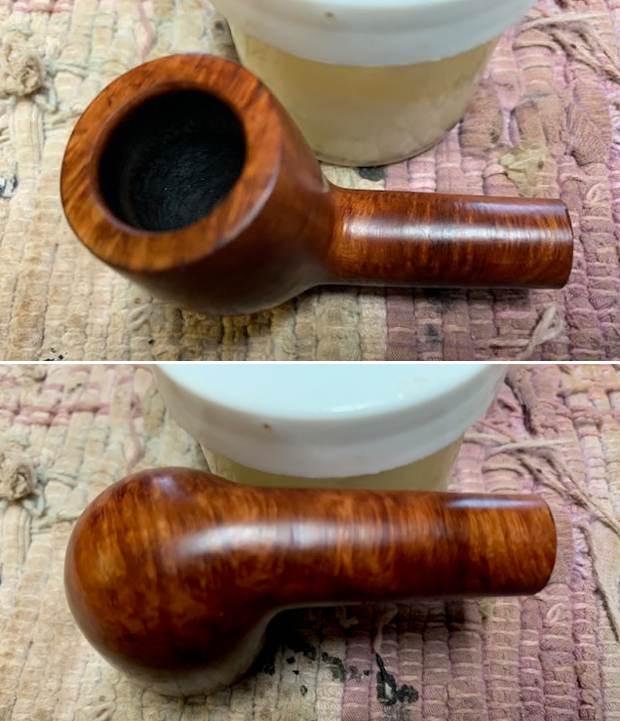
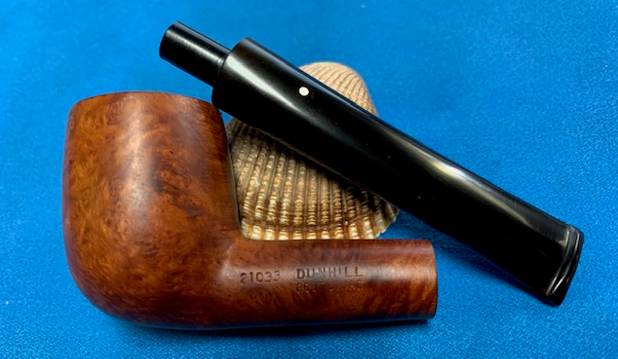
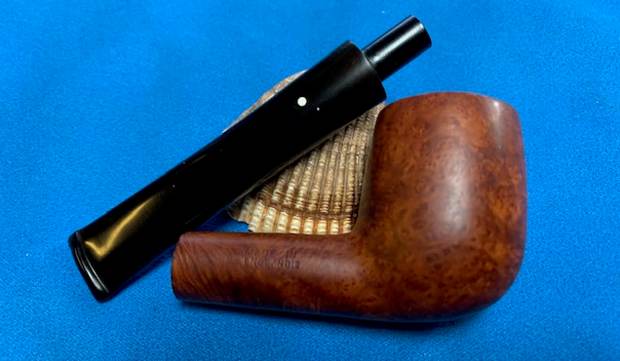
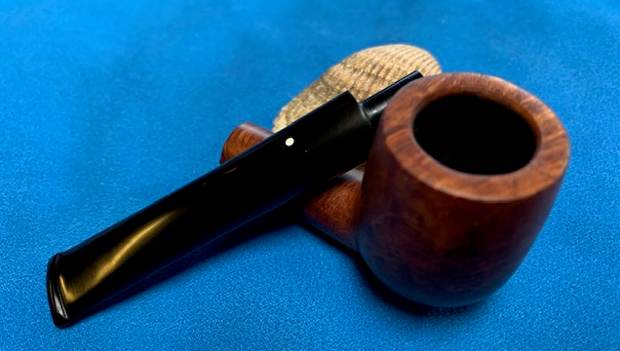
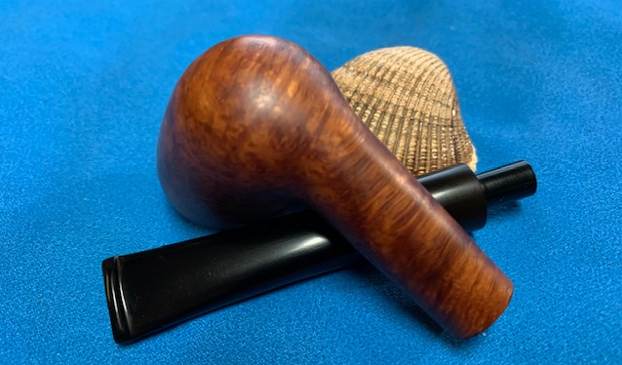
The next pipe on the table is another one that came to us from the group of pipes that Jeff and I purchased from a fellow in Copenhagen, Denmark on November 14, 2022. It is another Dunhill smooth finish pipe that is in good condition. It is stamped on the left side of the shank with the shape number 21033 followed by Dunhill [over] Root Briar. On the right side it is stamped Made in [over] England by the date number 18. The stamping is clear and readable as noted above. The pipe has a mix of brown stains with some amazing grain that the shape follows well. The finish was dusty and oily and the pipe was dirty. The bowl had a thick cake and there was a thick overflow lava and darkening and scratches on the rim top and edges. The taper stem was in decent condition and was oxidized, scratched and had tooth marks and chatter ahead of the worn button. Jeff took photos of the pipe to show what it looked like before he started working on it. He took photos of the bowl and rim top to show their condition and of the stem to show the condition of both sides of the stem. The photos of the sides and heel of the bowl show beautiful cross and birdseye grain and the Root Briar coloured finish on the pipe. Even under the grime it is a real beauty. The stamping on the sides of the shank are shown in the photos below. It is faint but readable. It reads as noted and explained above. Jeff captured the detail in the photos below. One of the first things I like to do is to unpack the stamping and understand each element in it. I turned to Pipephil’s helpful site (http://pipephil.eu/logos/en/dunhill/root-briar1.html). The stamping is interpreted as follows: The 21033 stamp is the shape for a Billiard. Interpreting that number is a matter of breaking down the numbers. The first number 2 is the bowl size (Group 2), The 1 is for a tapered stem. The 03 is the number for a Billiard. The fifth number 3 – indicates the style of the bowl within the group of a similar classification, each identified by the last digit, which could be any number between 1-9. The Root Briar stamp refers to the finish. The 18 following the D of England gives the date the pipe.Pipephil also has some helpful dating keys on the site that are basically flow charts that you can walk through to date your pipe (http://pipephil.eu/logos/en/dunhill/cledat-en1.html). I turned to Part 1 of the Dating Key and followed the chart. This pipe has a 18 following the D in England. It is the same size as the D so that took me to the section on the chart below (column one) which instructed me that the pipe could be dated as being made posterior to 1954. I followed the link following the “Your pipe is posterior to 1954. Narrow down your dating”. That took me to Page 2 of the dating key (http://pipephil.eu/logos/en/dunhill/cledat-en1a.html).   The third column (suffix 5…9) led me to the section with a 18 after the D in England. There was a directive for dating the pipe spelled out as follows: 1960 + suffix which gives the pipe a date of 1978. I then turned to Pipedia’s section on Dunhill Root Briar to get a bit of background on the Dunhill finishes (https://pipedia.org/wiki/Dunhill#Root_Briar). I quote:

Root Briar – Introduced in 1931 and highly prized because the grain is more pronounced in this finish (usually made using Corsican briar – was made exclusively from that briar into the 60s). The Root Briar finish requires a perfectly clean bowl with excellent graining. Therefore, it is the most expensive of the Dunhill pipes. Corsican briar was most often used for the Root finish since it was generally more finely grained. This is a rare finish, due to the scarcity of briar suitable to achieve it. These pipes are normally only available at Company stores, or at Principle Pipe Dealers. Straight grained pipes were formerly graded A through H, but are now only “Dr’s” and graded with one to six stars, with the letters G and H still used for the very finest pieces.

Dunhill introduced its third major finish, the Root finish, in 1931. Corsican mountain briar is characteristically beautifully grained and the Root was made exclusively from that briar into the 1960s. The pipe was finished with a light natural stain to allow the beauty of the graining to show through. Although always available with a traditional black vulcanite bit, the Root was introduced in either 1930 or more likely 1931 and fitted with a marble brown dark and light grained vulcanite bit that has since become known as the ‘bowling ball’ bit because of the similarity in appearance between the bit’s finish and that of some bowling balls of the time. With the war, however, the bowling ball bit was dropped from production. Through 1954 (and after) the Root pipe nomenclature (including shape numbers) was identical to that of the Bruyere except that instead of the “A” of the Bruyere, the Root was stamped with an “R”. In 1952 when the finish rather then LONDON was placed under DUNHILL, ROOT BRIAR rather then BRUYERE was used for the Root. Loring, J. C., The Dunhill Briar Pipe, The Patent Years and After (self-published, Chicago, 1998).

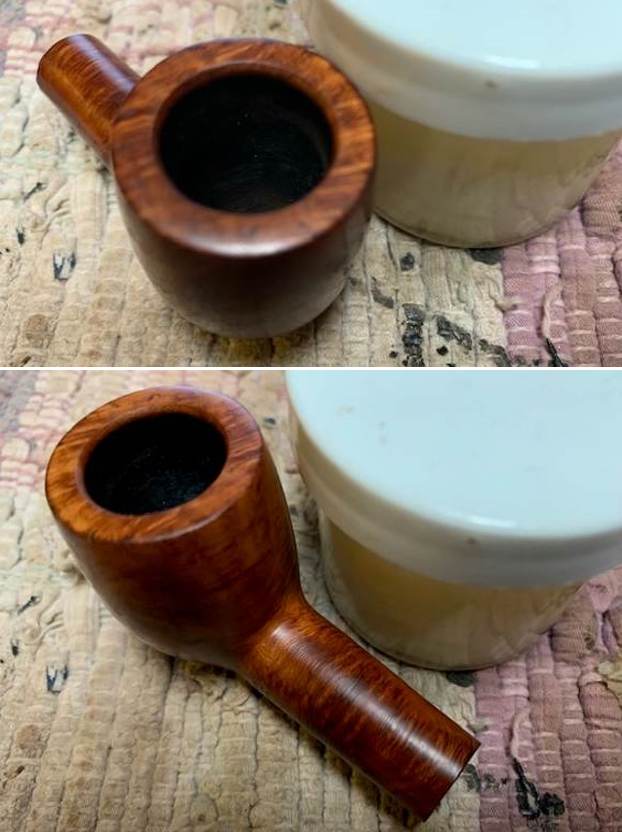
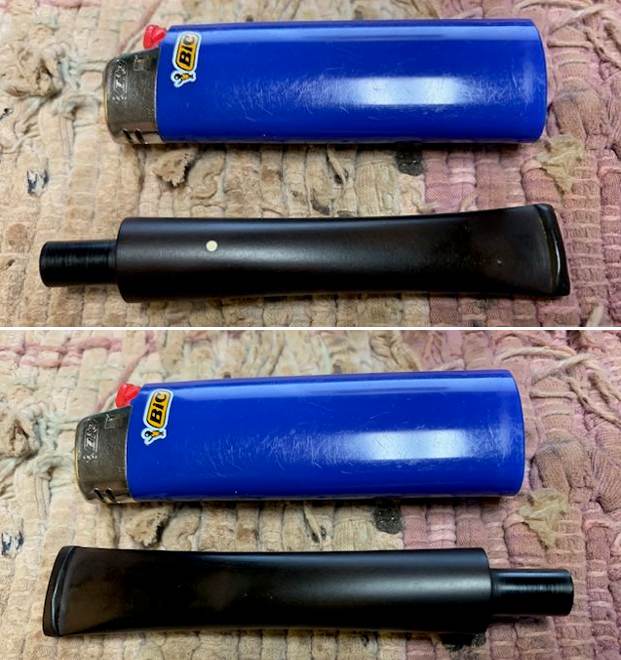
I have also included a chart from the site from Dunhill spelling out the Standard Pipe Finishes and giving short information and a timeline. I turned to work on the pipe itself. Jeff had done an amazing cleanup of the pipe. He reamed the light cake with a PipNet reamer and cleaned up that with a Savinelli Fitsall Pipe Knife. He scrubbed the internals of the bowl and stem with alcohol, cotton swabs and pipe cleaners. He scrubbed the externals with undiluted Murphy’s Oil Soap and rinsed the bowl off with running water. He soaked the stem in Briarville’s Pipe stem Deoxidizer and once it had soaked rinsed it off with warm water to remove the residual solution. He dried it off and rubbed it down to remove any oxidation that was still on the stem. The pipe looked very good when I received it. I took a photo of the rim top to show the condition. You can see the clean bowl and the damage on the rim top and inner edge. The stem came out looking quite good. There are some scratches, tooth marks and chatter on both sides ahead of the button.   I took photos of the stamping on the sides of the shank. The stamping is faint in spots but still very readable. It reads as noted above. I removed the stem from the shank and took a photo of the pipe parts to show what I was working with. It is a nice looking pipe. I worked on the inside edge and top of the rim with a folded piece of 220 grit sandpaper to clean up the damage. It would take some work but it looked much better.I polished the cleaned up rim top and edges with micromesh sanding pads – dry sanding with 1500-12000 grit pads and wiping the bowl down with a damp cloth to remove the dust. The rim top came out looking very good. I rubbed the briar down with Before & After Restoration Balm. I worked it into the briar with my fingertips. The product works to clean, enliven and preserve the briar. I let it sit for 10 minutes then I buffed it with a cotton cloth to deepen the shine. The briar comes alive with the balm. I set the bowl aside and turned to address the stem issues. I “painted” the surface of the stem with the flame of a Bic lighter. The heat lifted the tooth marks significantly. I sanded what remained with 220 grit sandpaper to blend them into the surface of the stem. I started the polishing with a 400 grit wet dry sandpaper. I polished the vulcanite with micromesh sanding pads – 1500-12000 grit pads. I wiped it down with Obsidian Oil after each sanding pad. I used Before & After Pipe Polish – both Fine and Extra Fine to further polish the stem. This 1978 Dunhill Root Briar 21033 Billiard with a Taper Stem has a smooth Dunhill finish that has some great grain. The polished light brown stain highlights some great grain around the bowl and shank. The polished black vulcanite taper stem adds to the mix. I put the stem back on the bowl and buffed the pipe with Blue Diamond on the buffing wheel being careful to not buff the stamping. I gave the bowl and the stem multiple coats of carnauba wax on the buffing wheel and followed that by buffing it with a clean buffing pad. I hand buffed the pipe with a microfiber cloth to deepen the shine. The finished Dunhill Root Briar 21033 Billiard is quite nice and feels great in the hand. Give the finished pipe a look in the photos below. The dimensions of the pipe are Length: 5 ½  inches, Height: 1 ½ inches, Outside diameter of the bowl: 1 1/8 inch, Chamber diameter: ¾ of an inch. The weight of the pipe is 1.06 ounces/30 grams. Thanks for walking through the restoration with me as I worked over another beautiful pipe. If you are interested in adding it to your collection I will be adding it to the British Pipe Makers Section of the rebornpipes store. Thanks for your time.

Cleaning up a Dunhill Root Briar 4R 587 F/T Stack Made in England 9


Blog by Steve Laug

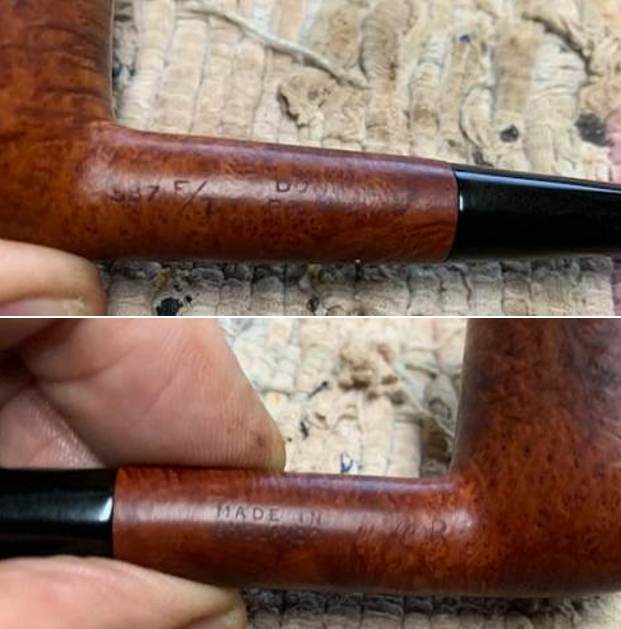
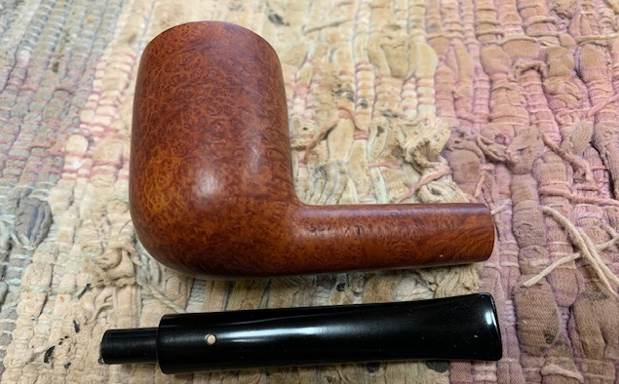
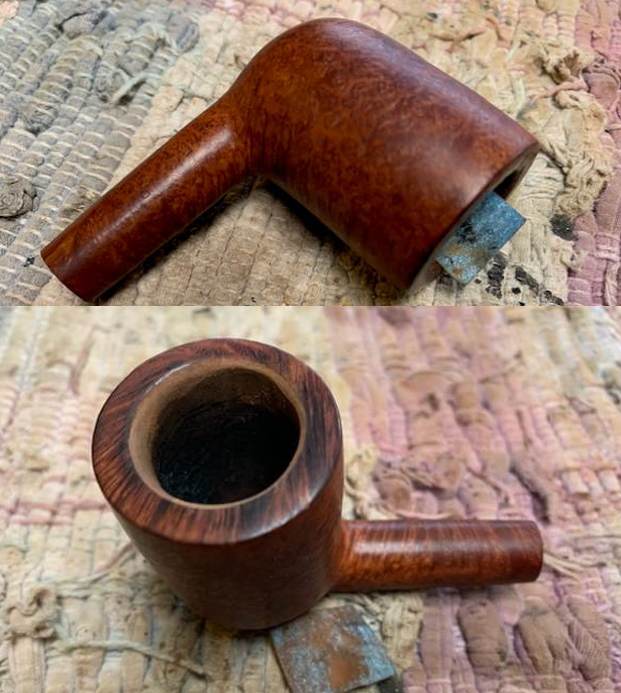
The next pipe on the table is another one that came to us from the group of pipes that Jeff and I purchased from a fellow in Copenhagen, Denmark on October 3, 2022. It is another Dunhill smooth finish pipe that is in good condition. It is stamped on the left side of the shank with the shape number 587 F/T followed by Dunhill [over] Root Briar. On the right side it is stamped Made in [over] England by the date number 9. After that it is stamped with a 4 in a circle [followed by] R for Root Briar. The stamping is clear and readable as noted above. The pipe has a mix of brown stains with some amazing grain that the shape follows well. The finish was dusty and oily but the pipe was fairly clean. The bowl had a moderate cake and there was some light lava and darkening on the rim top and edges. The taper stem looked to be in decent condition and had tooth marks and chatter ahead of the worn button. Jeff took photos of the pipe to show what it looked like before he started working on it. He took photos of the bowl and rim top to show their condition and of the stem to show the condition of both sides of the stem. The photos of the sides and heel of the bowl show beautiful cross and birdseye grain and the Root Briar coloured finish on the pipe. Even under the grime it is a real beauty.  The stamping on the sides of the shank are shown in the photos below. It is faint but readable. It reads as noted and explained above. Jeff captured the detail in the photos below. One of the first things I like to do is to unpack the stamping and understand each element in it. I turned to Pipephil’s helpful site (http://pipephil.eu/logos/en/dunhill/root-briar1.html). The stamping is interpreted as follows: The 587 stamp is the shape for a Stack. The F/T stamp refers to the Fishtail style stem. The Root Briar stamp refers to the finish which is corroborated the R at the end of the stamping. The size of the pipe 4 in a circle is a Group 4. The 9 following the D of England gives the date the pipe.Pipephil also has some helpful dating keys on the site that are basically flow charts that you can walk through to date your pipe (http://pipephil.eu/logos/en/dunhill/cledat-en1.html). I turned to Part 1 of the Dating Key and followed the chart. This pipe has a 9 following the D in England. It is the same size as the D so that took me to the section on the chart below (column one) which instructed me that the pipe could be dated as being made posterior to 1954. I followed the link following the “Your pipe is posterior to 1954. Narrow down your dating”. That took me to Page 2 of the dating key (http://pipephil.eu/logos/en/dunhill/cledat-en1a.html).   The third column (suffix 5…9) led me to the section with a 9 after the D in England. There was a directive for dating the pipe spelled out as follows: 1960 + suffix which gives the pipe a date of 1969.I then turned to Pipedia’s section on Dunhill Root Briar to get a bit of background on the Dunhill finishes (https://pipedia.org/wiki/Dunhill#Root_Briar). I quote:

Root Briar – Introduced in 1931 and highly prized because the grain is more pronounced in this finish (usually made using Corsican briar – was made exclusively from that briar into the 60s). The Root Briar finish requires a perfectly clean bowl with excellent graining. Therefore, it is the most expensive of the Dunhill pipes. Corsican briar was most often used for the Root finish since it was generally more finely grained. This is a rare finish, due to the scarcity of briar suitable to achieve it. These pipes are normally only available at Company stores, or at Principle Pipe Dealers. Straight grained pipes were formerly graded A through H, but are now only “Dr’s” and graded with one to six stars, with the letters G and H still used for the very finest pieces.

Dunhill introduced its third major finish, the Root finish, in 1931. Corsican mountain briar is characteristically beautifully grained and the Root was made exclusively from that briar into the 1960s. The pipe was finished with a light natural stain to allow the beauty of the graining to show through. Although always available with a traditional black vulcanite bit, the Root was introduced in either 1930 or more likely 1931 and fitted with a marble brown dark and light grained vulcanite bit that has since become known as the ‘bowling ball’ bit because of the similarity in appearance between the bit’s finish and that of some bowling balls of the time. With the war, however, the bowling ball bit was dropped from production. Through 1954 (and after) the Root pipe nomenclature (including shape numbers) was identical to that of the Bruyere except that instead of the “A” of the Bruyere, the Root was stamped with an “R”. In 1952 when the finish rather then LONDON was placed under DUNHILL, ROOT BRIAR rather then BRUYERE was used for the Root. Loring, J. C., The Dunhill Briar Pipe, The Patent Years and After (self-published, Chicago, 1998).

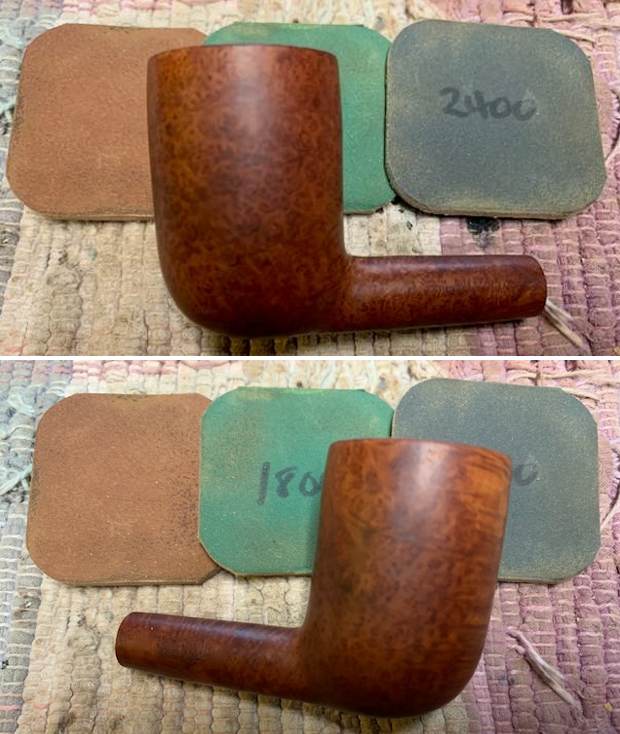
I have also included a chart from the site from Dunhill spelling out the Standard Pipe Finishes and giving short information and a timeline. I turned to work on the pipe itself. Jeff had done an amazing cleanup of the pipe. He reamed the light cake with a PipNet reamer and cleaned up that with a Savinelli Fitsall Pipe Knife. He scrubbed the internals of the bowl and stem with alcohol, cotton swabs and pipe cleaners. He scrubbed the externals with undiluted Murphy’s Oil Soap and rinsed the bowl off with running water. He soaked the stem in Briarville’s Pipe stem Deoxidizer and once it had soaked rinsed it off with warm water to remove the residual solution. He dried it off and rubbed it down to remove any oxidation that was still on the stem. The pipe looked very good when I received it. I took a photo of the rim top to show the condition. You can see the clean bowl and the damage on the rim top and inner edge. The stem came out looking quite good. There are some scratches, tooth marks and chatter on both sides ahead of the button. I took photos of the stamping on the sides of the shank. The stamping is faint in spots but still very readable. It reads as noted above. I removed the stem from the shank and took a photo of the pipe parts to show what I was working with. It is a nice looking pipe. I worked on the inside edge and top of the rim with a folded piece of 220 grit sandpaper to clean up the damage. It would take some work but it looked much better.I polished the cleaned up rim top and edges with micromesh sanding pads – dry sanding with 1500-12000 grit pads and wiping the bowl down with a damp cloth to remove the dust. The rim top came out looking very good. I rubbed the briar down with Before & After Restoration Balm. I worked it into the briar with my fingertips. The product works to clean, enliven and preserve the briar. I let it sit for 10 minutes then I buffed it with a cotton cloth to deepen the shine. The briar comes alive with the balm. I set the bowl aside and turned to address the stem issues. I “painted” the surface of the stem with the flame of a Bic lighter. The heat lifted the tooth marks significantly. I filled in the marks that remained with clear CA glue. Once it cured I used a small file to flatten the repairs. I sanded them with 220 grit sandpaper to blend it into the surface of the stem. I started the polishing with a 400 grit wet dry sandpaper. I polished the vulcanite with micromesh sanding pads – 1500-12000 grit pads. I wiped it down with Obsidian Oil after each sanding pad. I used Before & After Pipe Polish – both Fine and Extra Fine to further polish the stem. This 1969 Dunhill Root Briar 587 F/T Stack with a Taper Stem has a smooth Dunhill finish that has some great grain. The polished light brown stain highlights some great grain around the bowl and shank. The polished black vulcanite taper stem adds to the mix. I put the stem back on the bowl and buffed the pipe with Blue Diamond on the buffing wheel being careful to not buff the stamping. I gave the bowl and the stem multiple coats of carnauba wax on the buffing wheel and followed that by buffing it with a clean buffing pad. I hand buffed the pipe with a microfiber cloth to deepen the shine. The finished Dunhill Root Briar 587 F/T Stack is quite nice and feels great in the hand. Give the finished pipe a look in the photos below. The dimensions of the pipe are Length: 5 ¾ inches, Height: 2 inches, Outside diameter of the bowl: 1 3/8 inch, Chamber diameter: 7/8 of an inch. The weight of the pipe is 1.31 ounces/37 grams. Thanks for walking through the restoration with me as I worked over another beautiful pipe. If you are interested in adding it to your collection I will be adding it to the British Pipe Makers Section of the rebornpipes store. Thanks for your time.
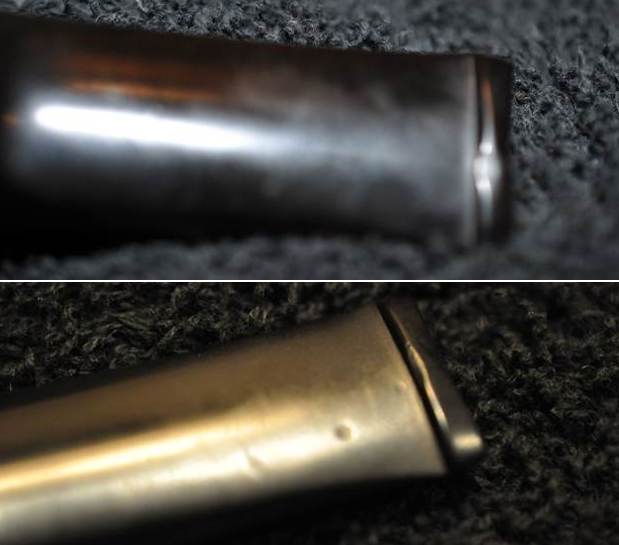
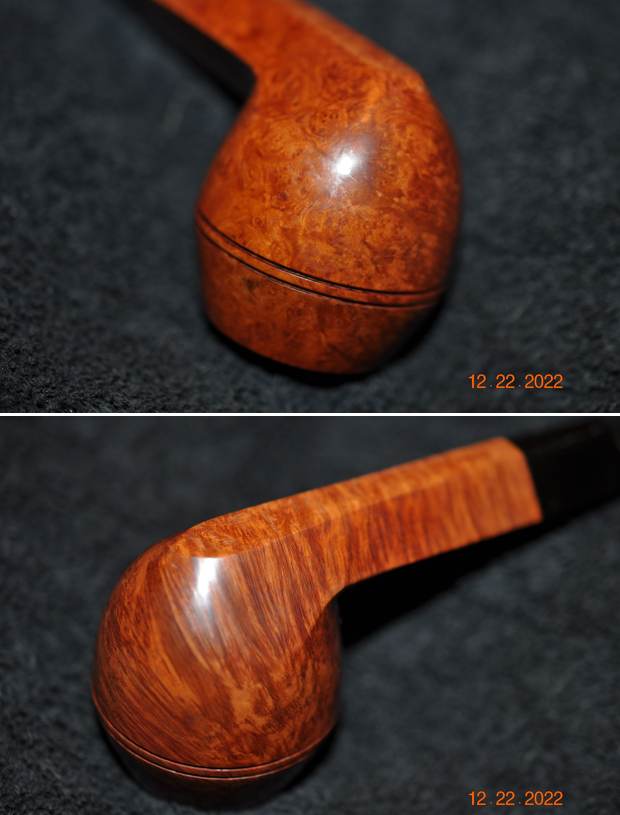
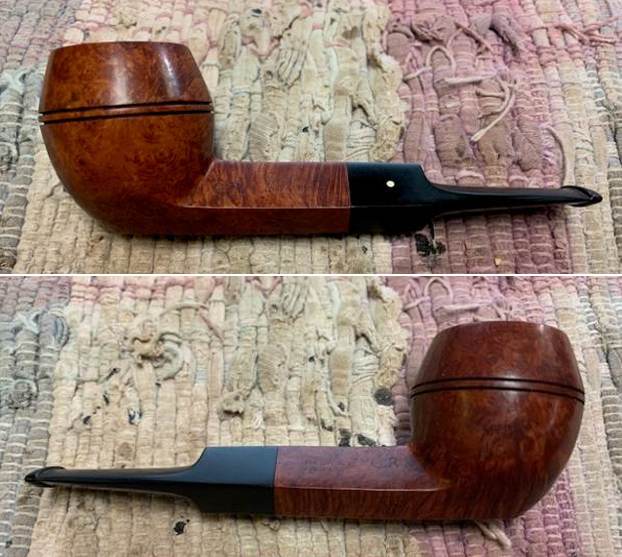
Cleaning up a Dunhill Root Briar 4R OX F/T Bulldog Made in England 6


Blog by Steve Laug

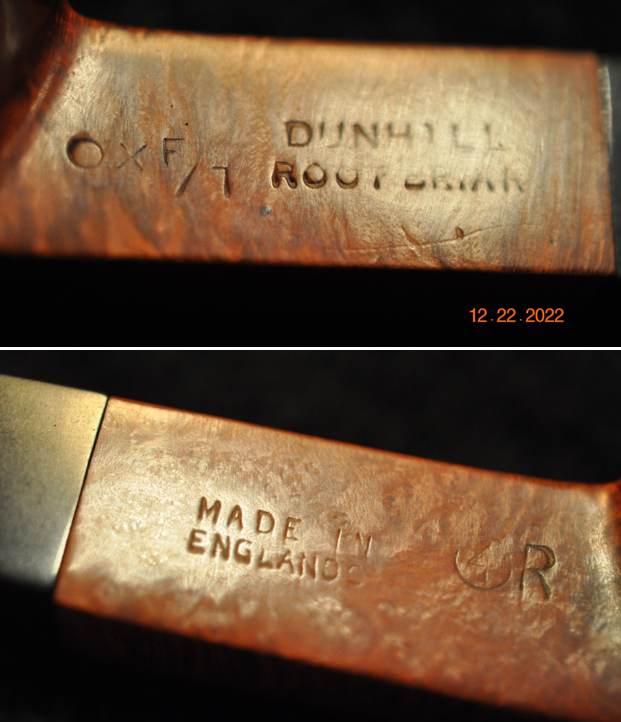
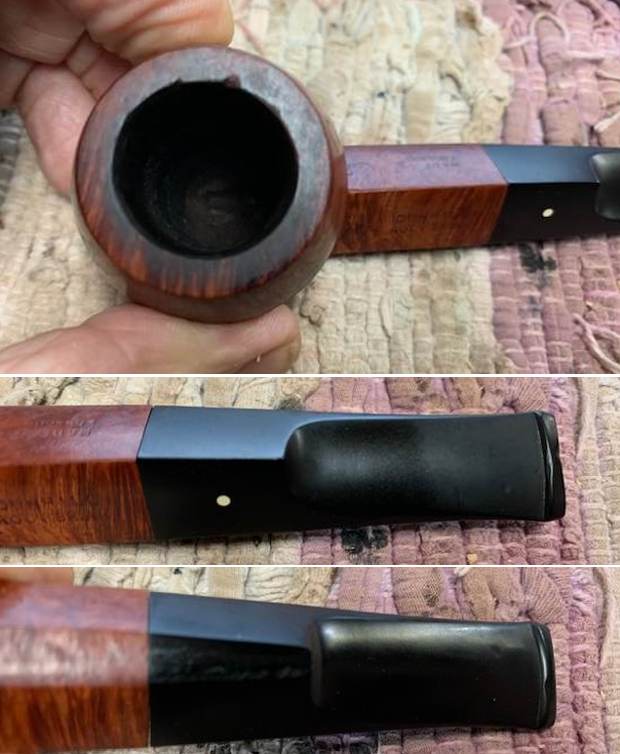
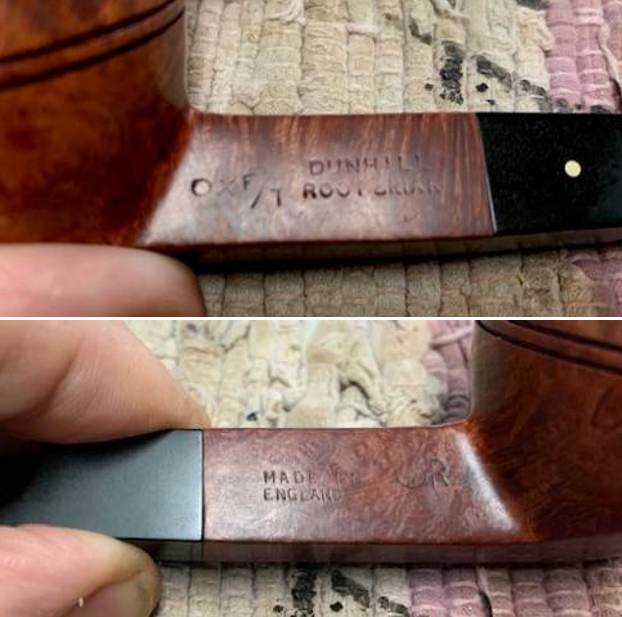
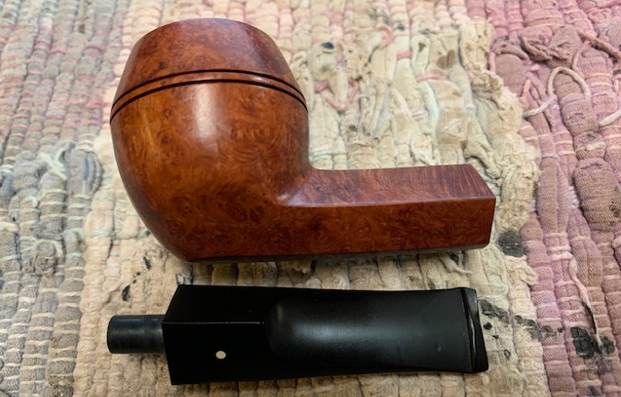
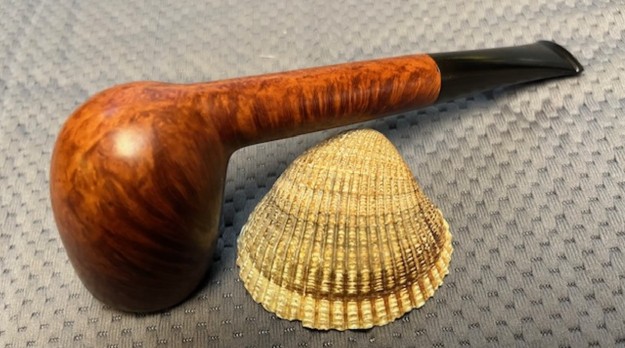
The next pipe on the table is another one that came to us from the group of pipes that Jeff and I purchased from a fellow in Copenhagen, Denmark on October 3, 2022. It is another Dunhill smooth finish that is in good condition. It is stamped on sides of the shank. On the left side it is stamped with the shape number OX followed by F/T. Next to that it reads Dunhill [over] Root Briar. On the right side it is stamped Made in [over] England by the date number 6. After that it is stamped with a 4 in a circle [followed by] R for Root Briar. The stamping is clear and readable as noted above. The pipe has a mix of brown stains that highlight some amazing grain that the shape follows well. The finish was dusty and oily around bowl and shank sides. The bowl had a thick cake and there was heavy lava on the rim top or edges. The filter saddle stem was lightly oxidized and dirty with tooth marks and chatter ahead of the button on both sides. Jeff took photos of the pipe to show what it looked like before he started working on it. He took photos of the bowl, rim top and both sides of the stem to show their condition. The description above gives a clear sense of what we saw. The photos of the sides and heel of the bowl show the amazing grain around the bowl and the colour of the finish on the pipe. Even under the grime it is a real beauty.  The stamping on the sides of the shank are shown in the photos below. They are faint but readable. It reads as noted and explained above. Jeff captured the detail in the photos below. One of the first things I like to do is to unpack the stamping and understand each element in it. I turned to Pipephil’s helpful site (http://pipephil.eu/logos/en/dunhill/root-briar1.html). The stamping is interpreted as follows: The OX stamp is the shape for a Bulldog. The F/T stamp refers to the Fishtail style stem. The Root Briar stamp refers to the finish which is corroborated the R at the end of the stamping. The size of the pipe 4 in a circle is a Group 4. The 6 following the D of England gives the date the pipe.Pipephil also has some helpful dating keys on the site that are basically flow charts that you can walk through to date your pipe (http://pipephil.eu/logos/en/dunhill/cledat-en1.html). I turned to Part 1 of the Dating Key and followed the chart. This pipe has a 6 following the D in England. It is the same size as the D so that took me to the section on the chart below (column one) which instructed me that the pipe could be dated as being made posterior to 1954. I followed the link following the “Your pipe is posterior to 1954. Narrow down your dating”. That took me to Page 2 of the dating key (http://pipephil.eu/logos/en/dunhill/cledat-en1a.html).   The third column (suffix 5…9) led me to the section with a 6 after the D in England. There was a directive for dating the pipe spelled out as follows: 1960 + suffix which gives the pipe a date of 1969.I then turned to Pipedia’s section on Dunhill Root Briar to get a bit of background on the Dunhill finishes (https://pipedia.org/wiki/Dunhill#Root_Briar). I quote:

Root Briar – Introduced in 1931 and highly prized because the grain is more pronounced in this finish (usually made using Corsican briar – was made exclusively from that briar into the 60s). The Root Briar finish requires a perfectly clean bowl with excellent graining. Therefore, it is the most expensive of the Dunhill pipes. Corsican briar was most often used for the Root finish since it was generally more finely grained. This is a rare finish, due to the scarcity of briar suitable to achieve it. These pipes are normally only available at Company stores, or at Principle Pipe Dealers. Straight grained pipes were formerly graded A through H, but are now only “Dr’s” and graded with one to six stars, with the letters G and H still used for the very finest pieces.

Dunhill introduced its third major finish, the Root finish, in 1931. Corsican mountain briar is characteristically beautifully grained and the Root was made exclusively from that briar into the 1960s. The pipe was finished with a light natural stain to allow the beauty of the graining to show through. Although always available with a traditional black vulcanite bit, the Root was introduced in either 1930 or more likely 1931 and fitted with a marble brown dark and light grained vulcanite bit that has since become known as the ‘bowling ball’ bit because of the similarity in appearance between the bit’s finish and that of some bowling balls of the time. With the war, however, the bowling ball bit was dropped from production. Through 1954 (and after) the Root pipe nomenclature (including shape numbers) was identical to that of the Bruyere except that instead of the “A” of the Bruyere, the Root was stamped with an “R”. In 1952 when the finish rather then LONDON was placed under DUNHILL, ROOT BRIAR rather then BRUYERE was used for the Root. Loring, J. C., The Dunhill Briar Pipe, The Patent Years and After (self-published, Chicago, 1998).

I have also included a chart from the site from Dunhill spelling out the Standard Pipe Finishes and giving short information and a timeline. I turned to work on the pipe itself. Jeff had done an amazing cleanup of the pipe. He reamed the light cake with a PipNet reamer and cleaned up that with a Savinelli Fitsall Pipe Knife. He scrubbed the internals of the bowl and stem with alcohol, cotton swabs and pipe cleaners. He scrubbed the externals with undiluted Murphy’s Oil Soap and rinsed the bowl off with running water. He soaked the stem in Briarville’s Pipe stem Deoxidizer and once it had soaked rinsed it off with warm water to remove the residual solution. He dried it off and rubbed it down to remove any oxidation that was still on the stem. The pipe looked very good when I received it. I took a photo of the rim top to show the condition. You can see the clean bowl and the damage on the rim top and inner edge. The stem came out looking quite good. There are some scratches, tooth marks and chatter on both sides ahead of the button.I took a photo of the stamping on the sides of the shank. The stamping is faint in spots but still very readable. It reads as noted above. I removed the stem from the shank and took a photo of the pipe parts to show what I was working with. It is a nice looking pipe. I worked on the inside edge and top of the rim with a folded piece of 220 grit sandpaper to clean up the damage. It would take some work but it looked much better.I polished the cleaned up rim top and edges with micromesh sanding pads – dry sanding with 1500-12000 grit pads and wiping the bowl down with a damp cloth to remove the dust. The rim top came out looking very good. I rubbed the briar down with Before & After Restoration Balm. I worked it into the briar with my fingertips. The product works to clean, enliven and preserve the briar. I let it sit for 10 minutes then I buffed it with a cotton cloth to deepen the shine. The briar comes alive with the balm. I set the bowl aside and turned to address the stem issues. I filled in the deep tooth marks in the vulcanite with clear CA glue. Once it cured I used a small file to flatten the repairs. I sanded them with 220 grit sandpaper to blend it into the surface of the stem. I started the polishing with a 400 grit wet dry sandpaper. I polished the vulcanite with micromesh sanding pads – 1500-12000 grit pads. I wiped it down with Obsidian Oil after each sanding pad. I used Before & After Pipe Polish – both Fine and Extra Fine to further polish the stem. This 1969 Dunhill Root Briar OX F/T Bulldog with a Saddle Stem has a smooth Dunhill finish that has some great grain. The polished light brown stain highlights some great grain around the bowl and shank. The polished black vulcanite saddle stem adds to the mix. I put the stem back on the bowl and buffed the pipe with Blue Diamond on the buffing wheel being careful to not buff the stamping. I gave the bowl and the stem multiple coats of carnauba wax on the buffing wheel and followed that by buffing it with a clean buffing pad. I hand buffed the pipe with a microfiber cloth to deepen the shine. The finished Dunhill Root Briar OX F/T Bulldog is quite nice and feels great in the hand. Give the finished pipe a look in the photos below. The dimensions of the pipe are Length: 5 ½ inches, Height: 1 ¾ inches, Outside diameter of the bowl: 1 ¼ inch, Chamber diameter: 7/8 of an inch. The weight of the pipe is 1.55 ounces/44 grams. Thanks for walking through the restoration with me as I worked over another beautiful pipe. If you are interested in adding it to your collection I will be adding it to the British Pipe Makers Section of the rebornpipes store. Thanks for your time.
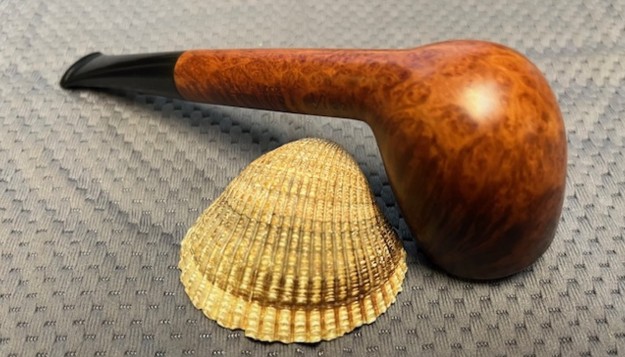
Restoring Another Lovely 1958 Dunhill Root Briar 34F/T 2R Billiard


Blog by Steve Laug

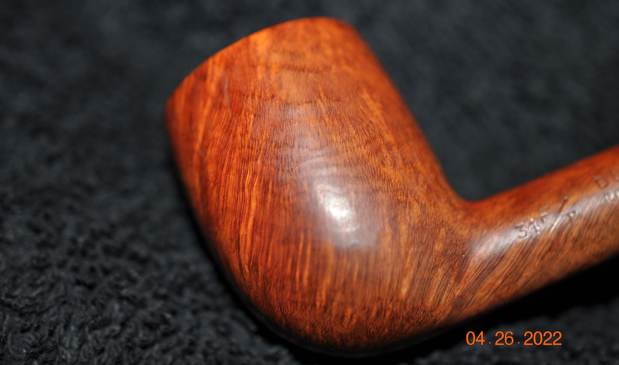
The next pipe on the table is another Dunhill group 2 sized Billiard. It is a small Root Briar Billiard that is proportionally well done. It has a two digit the shape number that I will define below. It is identical in stamping, shape, size and condition to the previous Root Briar 34F/T I worked on yesterday (https://rebornpipes.com/2022/05/27/168579/). Jeff and I purchased the pipes on 04/26/2022 from a woman who contacted us from Cleveland, Ohio, USA. We spent time chatting with her and arrived at a price and she sent the pipes to Jeff. It included 28+ pipes along with this one.

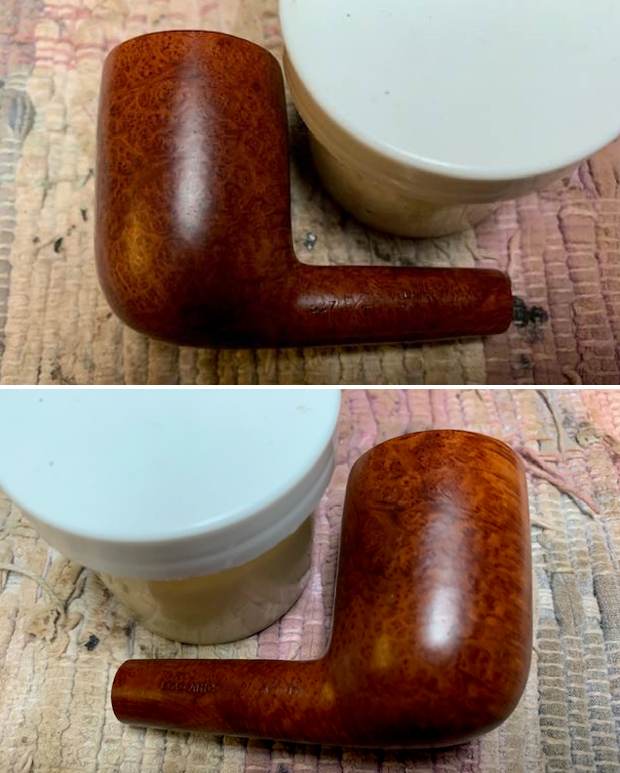
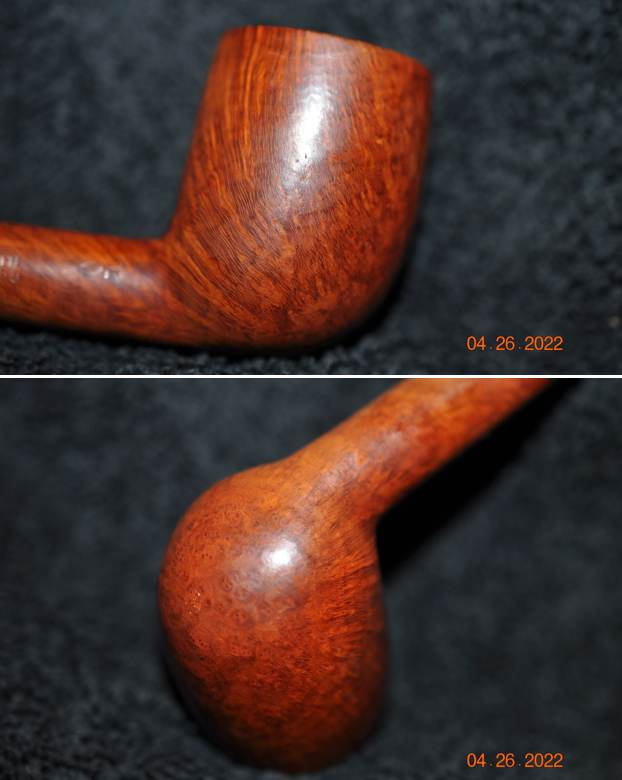
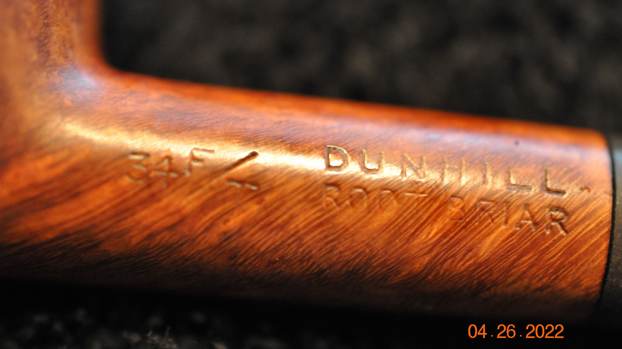
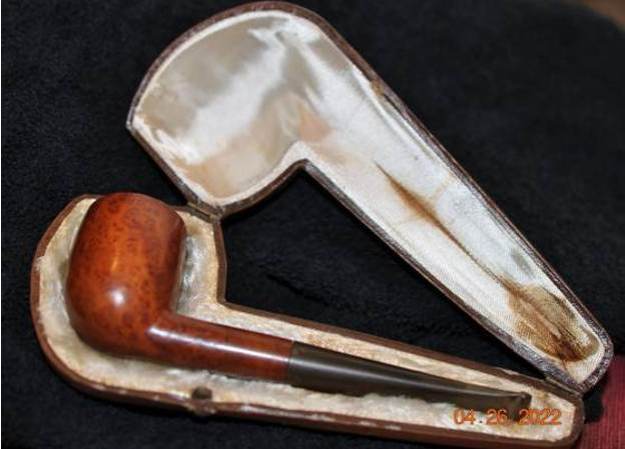
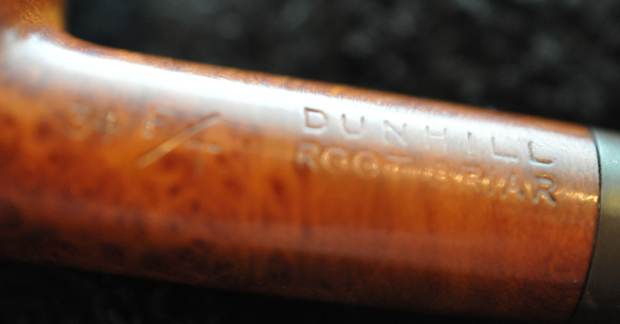
This Dunhill Billiard is stamped on the left side and reads 34 F/T followed by Dunhill over Root Briar and on the right side is stamped Made in England8 (two lines) followed by a circle 2 followed by R. The numbers and stamping tell me that the pipe is a Root Briar and the size is a Group 2. The F/T refers to the Fish Tail style stem. The finish was very dirty with spots of grime and debris stuck on it. The bowl had a thick cake in the bowl and heavy lava overflowing onto the rim top. The rim top had burned area on the left front top and inner and outer edges. There was darkening and burn damage on the inner edge all the way around. There were burn marks toward the back of the rim top. The stem had calcification, oxidation and tooth marks and chatter on both sides ahead of the button. The button itself appeared to be in good condition. The pipe came to us in a meerschaum pipe case (just like is twin). The case was not original. Jeff took photos of the pipe before he started his clean up work on it. He took photos of the bowl and rim top to show the condition. You can see the thick cake in the bowl and the burn damage on the rim top and edges of the bowl. It is the kind of damage that come from repeated lighting in the same place. The stem was heavily oxidized, calcified and has tooth marks and chatter on both sides ahead of the button. Overall the pipe is a real mess. Jeff took photos of the grain and finish around the bowl sides and heel. It was nice looking if you can see through the grime ground into the finish. He took a photo of the stamping on the left side of the shank. There is no photo of the right side stamping that gives the Made in England date code. The stamping is readable but filthy.Now it was time to begin to work on the stamping on the pipe. Because I had just finished working on a twin to this pipe I used the information that I had dug up on that one. I quote below.

Pipedia had some great information on the Root Briar finish and dates and how the finish was made (https://pipedia.org/wiki/Dunhill#Bruyere). The first quote below give the short version of the finish. I quote from both below.

Root Briar – Introduced in 1931 and highly prized because the grain is more pronounced in this finish (usually made using Corsican briar – was made exclusively from that briar into the 60s). The Root Briar finish requires a perfectly clean bowl with excellent graining. Therefore, it is the most expensive of the Dunhill pipes. Corsican briar was most often used for the Root finish since it was generally more finely grained. This is a rare finish, due to the scarcity of briar suitable to achieve it. These pipes are normally only available at Company stores, or at Principle Pipe Dealers. Straight grained pipes were formerly graded A through H, but are now only “Dr’s” and graded with one to six stars, with the letters G and H still used for the very finest pieces.

“Dunhill introduced its third major finish, the Root finish, in 1931. Corsican mountain briar is characteristically beautifully grained and the Root was made exclusively from that briar into the 1960s. The pipe was finished with a light natural stain to allow the beauty of the graining to show through. Although always available with a traditional black vulcanite bit, the Root was introduced in either 1930 or more likely 1931 and fitted with a marble brown dark and light grained vulcanite bit that has since become known as the ‘bowling ball’ bit because of the similarity in appearance between the bit’s finish and that of some bowling balls of the time. With the war, however, the bowling ball bit was dropped from production. Through 1954 (and after) the Root pipe nomenclature (including shape numbers) was identical to that of the Bruyere except that instead of the “A” of the Bruyere, the Root was stamped with an “R”. In 1952 when the finish rather then LONDON was placed under DUNHILL, ROOT BRIAR rather then BRUYERE was used for the Root.” Loring, J. C., The Dunhill Briar Pipe, The Patent Years and After (self-published, Chicago, 1998).
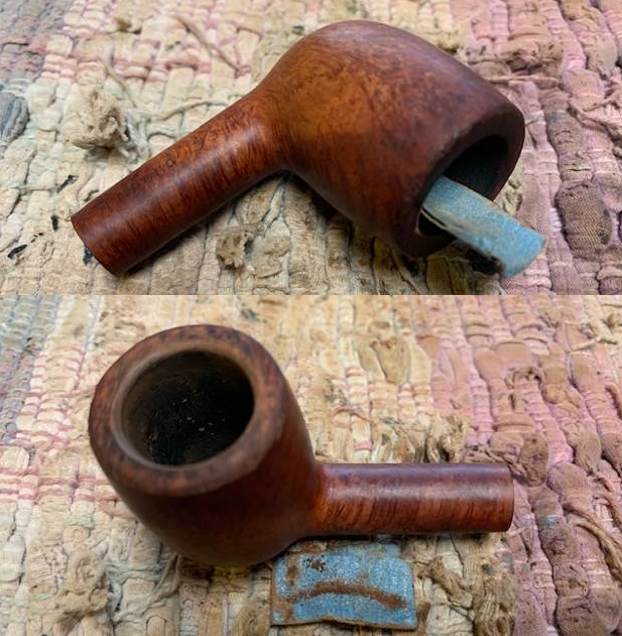
With that information clear for me I wanted to identify the shape number and try to pin that down (https://pipedia.org/wiki/Dunhill_Shape_Chart). I turned to the section on the older 2 digit Shape Numbers and read it. I quote it below and added a chart on the numbers.

The original skus/model numbers from the 1920’s until the early 1970’s stood for very specific shapes and bowls. For example, the codes 31, 34, 59, 111, 113, 117, 196, LB, LBS… were all different types of Billiard shaped pipes and there were about 50(!), such codes for the Billiard shape alone.

There was a link there (https://pipedia.org/wiki/Dunhill_Shapes_List) to a shape list that Eric Boehm put together for Dunhills. It is amazing to see the sheer number of variations on the Billiard shape. I copied the first three in the list as it includes the shape 34 Billiard.

Billiards:

31 Billiard, tapered bit 1 4¾” 1928, 1950 3

32 Billiard, tapered bit 1 5″ 1928, 50, 60, 69 3

34 Billiard, tapered bit (Dental) 2 5½” 1928, 50, 60, 69 3. (This is the pipe I am working on. It is a tapered bit Billiard. It does not have a Dental bit as noted above. Rather than the Dental bit it has a F/T or Fish Tail bit.)

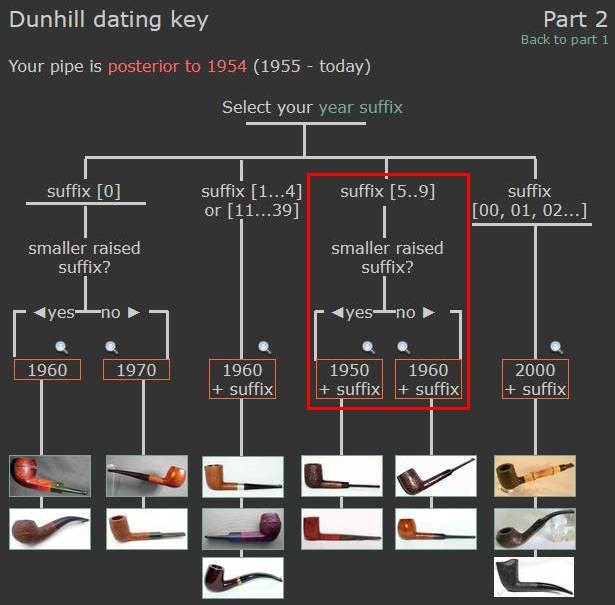
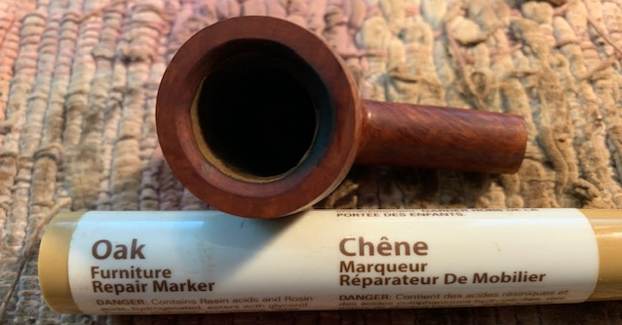
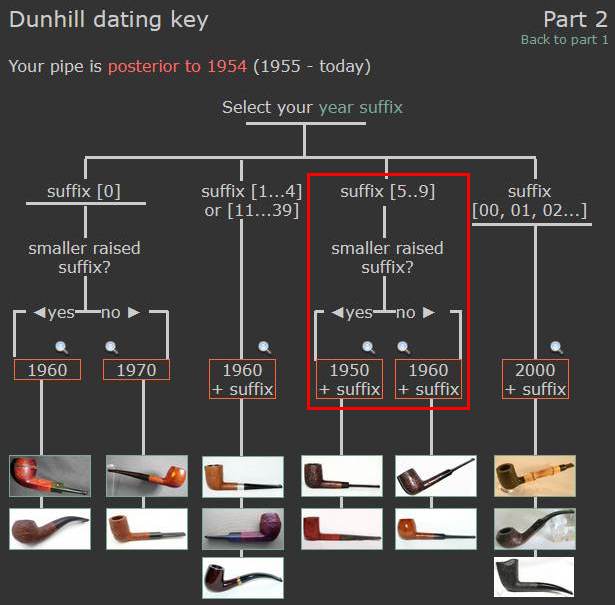
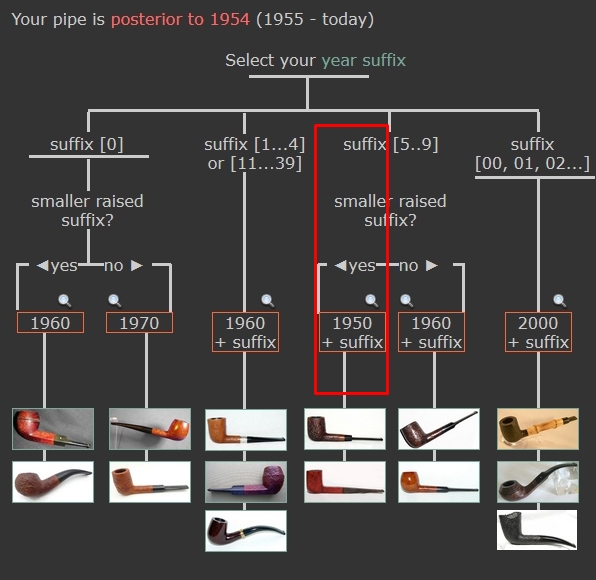
I turned next to dating the pipe. There is a superscript 8 following the D in ENGLAND on the right side of the shank. I turned to the dating chart on Pipephil to pin down the date on this twin (http://pipephil.eu/logos/en/dunhill/cledat-en1a.html). I did a screen capture of Part 2 of the Dunhill Dating Key and included it below. I drew a red box around the section dating this pipe. It is clear that the pipe was made after 1954 so that is why I went to Part 2. Once again, because the year suffix is 8 that tells me that the pipe was made in 1950+8 for a date of 1958.Armed with that information I turned to work on the pipe itself. Before he sent it to me, Jeff had done an amazing job cleaning the pipe. It almost looked like a different pipe after his work. He reamed the pipe with a PipNet pipe reamer and removed the rest of it with a Savinelli Fitsall Pipe Knife.  He scrubbed the bowl with undiluted Murphy’s Oil Soap with a tooth brush. He rinsed it under running warm water to remove the soap and grime. He cleaned out the inside of the shank and the airway in the stem with isopropyl alcohol, cotton swabs and pipe cleaners. He soaked the stem in Briarville’s Pipe Stem Deoxidizer and then rinsed it off with warm water. He scrubbed the stem with Soft Scrub and a tooth brush and rinsed it off with warm water. It looked amazing when I took it out of the package of pipes he shipped me. I took photos of the pipe before I started my part of the restoration work.  The rim top was cleaner and the inner edge of the bowl looked rough. There was burn damage all the way around but heavier on the front and the back of the bowl on the top and inner and outer edges. There was also darkening on the rim top. The stem surface looked good with the oxidation gone and light but visible tooth chatter on either side of the stem. I took photos of the stamping on the sides of the shank. It is clear and readable as noted above.I took the stem off the shank and took a photo of the parts of the pipe. The overall look of the pipe is quite nice.I started my portion of the work on this pipe by addressing the damage to the rim top and inner edge of the bowl. I topped the bowl on a board with 220 grit sandpaper to take down the damage on the top of the rim and outer edges. I used a folded piece of 220 grit sandpaper to smooth out the edge and give it a slight bevel to deal with the chipping and cutting on the inner edge. It cleaned up remarkably well. With polishing and buffing it would look even better. I polished the briar with micromesh sanding pads – dry sanding with 1500-12000 grit pads. I wiped the bowl down with a damp cloth after each pad. The rim top looked very good and the bowl began to take on a rich glow. I used an Oak Stain Pen to restain the rim top and the inner bevel of the rim edge. Once it dried I buffed it with a cotton cloth and the match was very good. There was some darkening on the back inner edge of the bowl but it is in far better condition.The bowl looked very good at this point so I rubbed it down with Before & After Restoration Balm. I worked it into the surface of the bowl and shank with my fingertips to clean, enliven and protect the briar. I let the balm sit for about 10-15 minutes and buffed with a cotton cloth to raise the shine. I set the bowl aside and turned to work on the stem. I polished the vulcanite stem with micromesh sanding pads – 1500-12000 grit pads. I wiped it down with Obsidian Oil after each sanding pad. I used Before & After Pipe Polish – both Fine and Extra Fine to further polish the stem and gave it a final coat of Obsidian Oil to finish it.  This 2nd beautiful 1958 Dunhill Root Briar 34F/T 2R is a great looking pipe now that it has been restored. The rich Root Briar finish that highlights the grain and works well with the polished vulcanite stem. I put the stem back on the bowl and carefully buffed the pipe with Blue Diamond on the buffing wheel using a light touch on the briar. I gave the bowl and the stem multiple coats of carnauba wax on the buffing wheel and followed that by buffing the entire pipe with a clean buffing pad. I hand buffed the pipe with a microfiber cloth to deepen the shine. The finished Dunhill Root Briar Billiard is a small pipe that will be great for sitting and reading. Give the finished pipe a look in the photos below. The dimensions of the pipe are Length: 5 inches, Height: 1 ¾ inches, Outside diameter of the bowl: 1 ¼ inches, Chamber diameter: ¾ of an inch. The weight of the pipe is 27 grams/.95 ounces. I will be adding the pipe to the British Pipemakers Section of the rebornpipes store shortly. If you are interested in adding it to your collection be sure to let me know. I take a moment to remind myself and each of us that we are trustees of pipes that will outlive us and the lives of many other pipe men and women who carry on the trust of their care and use. Thanks for reading this blog and my reflections on the pipe while I worked on it.

Restoring a lovely 1958 Dunhill Root Briar 34F/T 2R Billiard


Blog by Steve Laug

The next pipe on the table is another Dunhill that is a group 2 sized Billiard. It is a small Root Briar Billiard that is proportionally well done. It has a two digit the shape number that I will define below. Jeff and I purchased on 04/26/2022 from a woman who contacted us from Cleveland, Ohio, USA. We spent time chatting with her and arrived at a price and she sent the pipes to Jeff. It included 28+ pipes along with this one.

But now this Dunhill Billiard. On the left side it is stamped 34 F/T followed by Dunhill over Root Briar and on the right side is stamped Made in England8 (two lines) followed by a circle 2 followed by R. The numbers and stamping tell me that the pipe is a Root Briar and the size is a Group 2. The F/T refers to the Fish Tail style stem. The finish was very dirty with spots of grime and debris stuck on it. The bowl had a thick cake in the bowl and heavy lava overflowing onto the rim top. The rim top had burned area on the left front top and inner and outer edges. There was darkening and burn damage on the inner edge all the way around. There were a few burn marks toward the back of the rim top. The stem had calcification, oxidation and tooth marks and chatter on both sides ahead of the button. The button itself appeared to be in good condition. The pipe came to us in a meerschaum pipe case from the owner. It was not original. Jeff took photos of the pipe before he started his clean up work on it. He took photos of the bowl and rim top to show the condition. You can see the thick cake in the bowl and the burn damage on the rim top and edges of the bowl. It is the kind of damage that come from repeated lighting in the same place. The stem was heavily oxidized, calcified and has tooth marks and chatter on both sides ahead of the button. Overall the pipe is a real mess. Jeff took photos of the grain and finish around the bowl sides and heel. It was nice looking if you can see through the grime ground into the finish. He took a photo of the stamping on the left side of the shank. There is no photo of the right side stamping that gives the Made in England date code. It is readable but filthy.Now it was time to begin to work on the stamping on the pipe. I turned first to Pipedia as I remembered they had some great information on the Root Briar finish and dates and how the finish was made (https://pipedia.org/wiki/Dunhill#Bruyere). The first quote below give the short version of the finish. The second link goes into more detail. I quote from both below.

Root Briar – Introduced in 1931 and highly prized because the grain is more pronounced in this finish (usually made using Corsican briar – was made exclusively from that briar into the 60s). The Root Briar finish requires a perfectly clean bowl with excellent graining. Therefore, it is the most expensive of the Dunhill pipes. Corsican briar was most often used for the Root finish since it was generally more finely grained. This is a rare finish, due to the scarcity of briar suitable to achieve it. These pipes are normally only available at Company stores, or at Principle Pipe Dealers. Straight grained pipes were formerly graded A through H, but are now only “Dr’s” and graded with one to six stars, with the letters G and H still used for the very finest pieces.

“Dunhill introduced its third major finish, the Root finish, in 1931. Corsican mountain briar is characteristically beautifully grained and the Root was made exclusively from that briar into the 1960s. The pipe was finished with a light natural stain to allow the beauty of the graining to show through. Although always available with a traditional black vulcanite bit, the Root was introduced in either 1930 or more likely 1931 and fitted with a marble brown dark and light grained vulcanite bit that has since become known as the ‘bowling ball’ bit because of the similarity in appearance between the bit’s finish and that of some bowling balls of the time. With the war, however, the bowling ball bit was dropped from production. Through 1954 (and after) the Root pipe nomenclature (including shape numbers) was identical to that of the Bruyere except that instead of the “A” of the Bruyere, the Root was stamped with an “R”. In 1952 when the finish rather then LONDON was placed under DUNHILL, ROOT BRIAR rather then BRUYERE was used for the Root.” Loring, J. C., The Dunhill Briar Pipe, The Patent Years and After (self-published, Chicago, 1998).
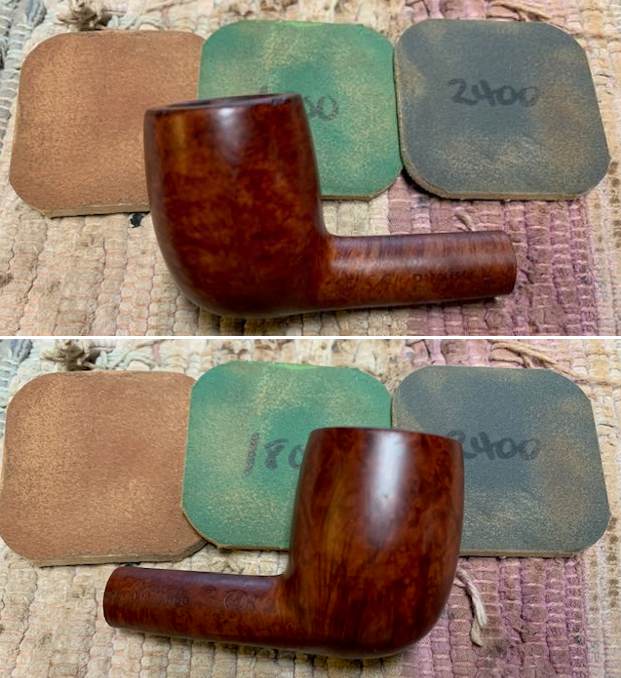
With that information clear for me I wanted to identify the shape number and try to pin that down (https://pipedia.org/wiki/Dunhill_Shape_Chart). I turned to the section on the older 2 digit Shape Numbers and read it. I quote it below and added a chart on the numbers.

The original skus/model numbers from the 1920’s until the early 1970’s stood for very specific shapes and bowls. For example, the codes 31, 34, 59, 111, 113, 117, 196, LB, LBS… were all different types of Billiard shaped pipes and there were about 50(!), such codes for the Billiard shape alone.

There was a link there (https://pipedia.org/wiki/Dunhill_Shapes_List) to a shape list that Eric Boehm put together for Dunhills. It is amazing to see the sheer number of variations on the Billiard shape. I copied the first three in the list as it includes the shape 34 Billiard.

Billiards:

31 Billiard, tapered bit 1 4¾” 1928, 1950 3

32 Billiard, tapered bit 1 5″ 1928, 50, 60, 69 3

34 Billiard, tapered bit (Dental) 2 5½” 1928, 50, 60, 69 3. (This is the pipe I am working on. It is a tapered bit Billiard. It does not have a Dental bit as noted above. Rather than the Dental bit it has a F/T or Fish Tail bit.)

I turned next to dating the pipe as it would be more straightforward than the numbering on the shank. There is a superscript 8 following the D in ENGLAND on the right side of the shank. I turned to the dating chart on Pipephil (http://pipephil.eu/logos/en/dunhill/cledat-en1a.html). I did a screen capture of Part 2 of the Dunhill Dating Key and included it below. I drew a red box around the section dating this pipe. It is clear that the pipe was made after 1954 so that is why I went to Part 2. Because the year suffix is 8 that tells me that the pipe was made in 1950+8 for a date of 1958. Armed with that information I turned to work on the pipe itself. Before he sent it to me, Jeff had done an amazing job cleaning the pipe. It almost looked like a different pipe after his work. He reamed the pipe with a PipNet pipe reamer and removed the rest of it with a Savinelli Fitsall Pipe Knife.  He scrubbed the bowl with undiluted Murphy’s Oil Soap with a tooth brush. He rinsed it under running warm water to remove the soap and grime. He cleaned out the inside of the shank and the airway in the stem with isopropyl alcohol, cotton swabs and pipe cleaners. He soaked the stem in Briarville’s Pipe Stem Deoxidizer and then rinsed it off with warm water. He scrubbed the stem with Soft Scrub and a tooth brush and rinsed it off with warm water. It looked amazing when I took it out of the package of pipes he shipped me. I took photos of the pipe before I started my part of the restoration work.   The rim top was cleaner and the inner edge of the bowl looked rough. There was burn damage all the way around but heavier on the front of the bowl on the top and inner and outer edges. There was also darkening on the back rim top and edge. The stem surface looked good with the oxidation gone and light but visible tooth chatter on either side of the stem.   I took photos of the stamping on the sides of the shank. It is clear and readable as noted above.I took the stem off the shank and took a photo of the parts of the pipe. The overall look of the pipe is quite unique. The stem shorter than the bowl and shank but looks quite good.I started my portion of the work on this pipe by addressing the damage to the rim top and inner edge of the bowl. I topped the bowl on a board with 220 grit sandpaper to take down the damage on the top of the rim and outer edges. I used a folded piece of 220 grit sandpaper to smooth out the edge and give it a slight bevel to deal with the chipping and cutting on the inner edge. It cleaned up remarkably well. With polishing and buffing it would look even better. I polished the briar with micromesh sanding pads – dry sanding with 1500-12000 grit pads. I wiped the bowl down with a damp cloth after each pad. The rim top looked very good and the bowl began to take on a rich glow. I used an Oak Stain Pen to restain the rim top and the inner bevel of the rim edge. Once it dried I buffed it with a cotton cloth and the match was very good.The bowl looked very good at this point so I rubbed it down with Before & After Restoration Balm. I worked it into the surface of the bowl and shank with my fingertips to clean, enliven and protect the briar. I let the balm sit for about 10-15 minutes and buffed with a cotton cloth to raise the shine. I set the bowl aside and turned to work on the stem. I polished the vulcanite stem with micromesh sanding pads – 1500-12000 grit pads. I wiped it down with Obsidian Oil after each sanding pad. I used Before & After Pipe Polish – both Fine and Extra Fine to further polish the stem and gave it a final coat of Obsidian Oil to finish it. This beautiful 1958 Dunhill Root Briar 34F/T 2R is a great looking pipe now that it has been restored. The rich Root Briar finish that highlights the grain and works well with the polished vulcanite stem. I put the stem back on the bowl and carefully buffed the pipe with Blue Diamond on the buffing wheel using a light touch on the briar. I gave the bowl and the stem multiple coats of carnauba wax on the buffing wheel and followed that by buffing the entire pipe with a clean buffing pad. I hand buffed the pipe with a microfiber cloth to deepen the shine. The finished Dunhill Root Briar Billiard is a beauty. Give the finished pipe a look in the photos below. The dimensions of the pipe are Length: 5 inches, Height: 1 ¾ inches, Outside diameter of the bowl: 1 ¼ inches, Chamber diameter: ¾ of an inch. The weight of the pipe is 24 grams/.85 ounces. I will be adding the pipe to the British Pipemakers section of the rebornpipes store shortly. If you are interested in adding it to your collection be sure to let me know. I take a moment to remind myself and each of us that we are trustees of pipes that will outlive us and the lives of many other pipe men and women who carry on the trust of their care and use. Thanks for reading this blog and my reflections on the pipe while I worked on it.
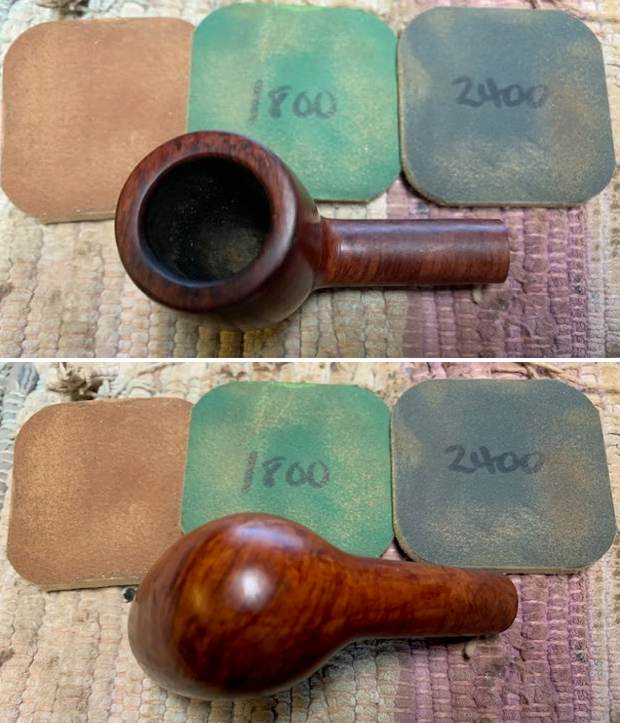
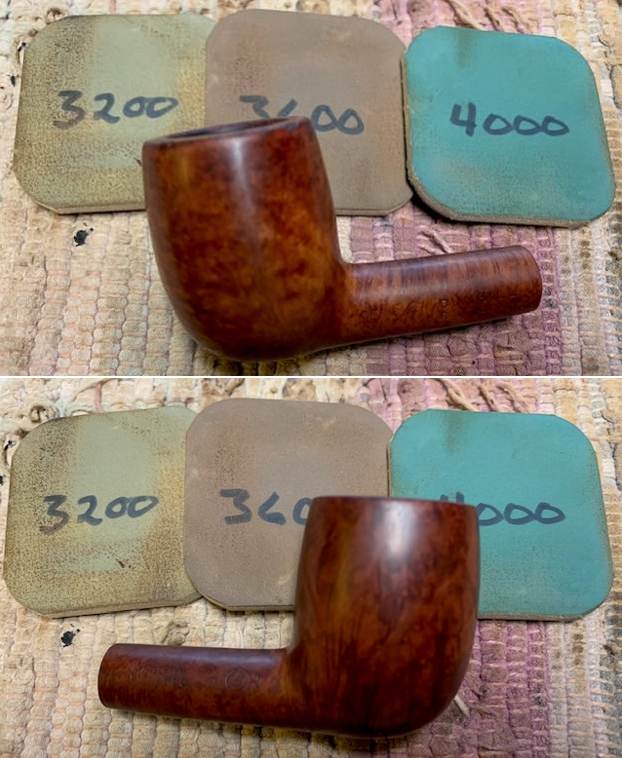
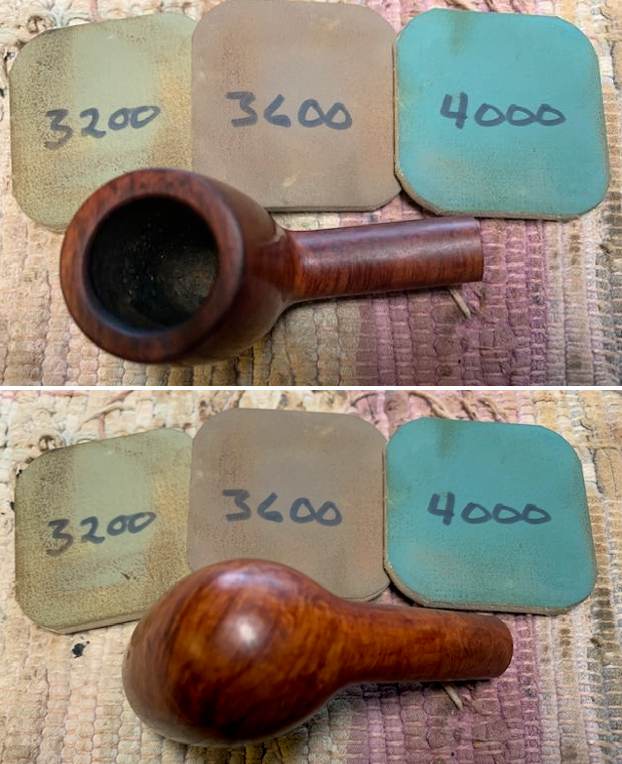
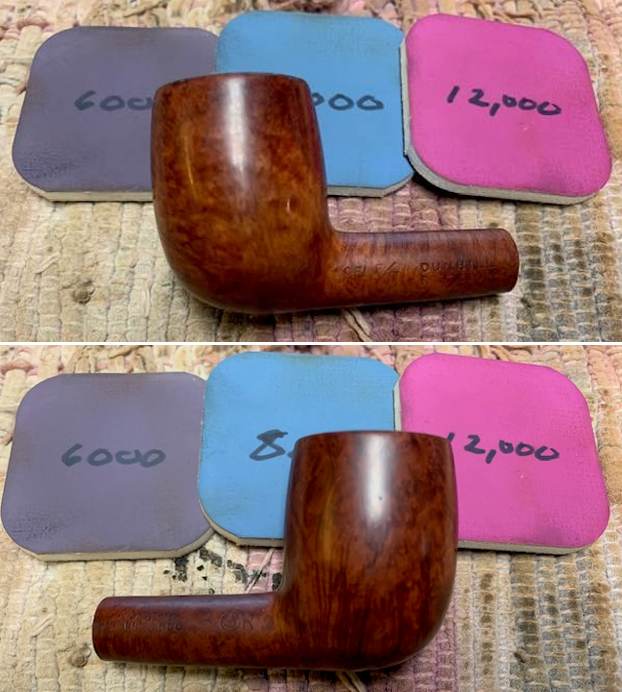
Breathing Life into a 1958 Dunhill Root Briar 90 Group 2R Poker


Blog by Steve Laug

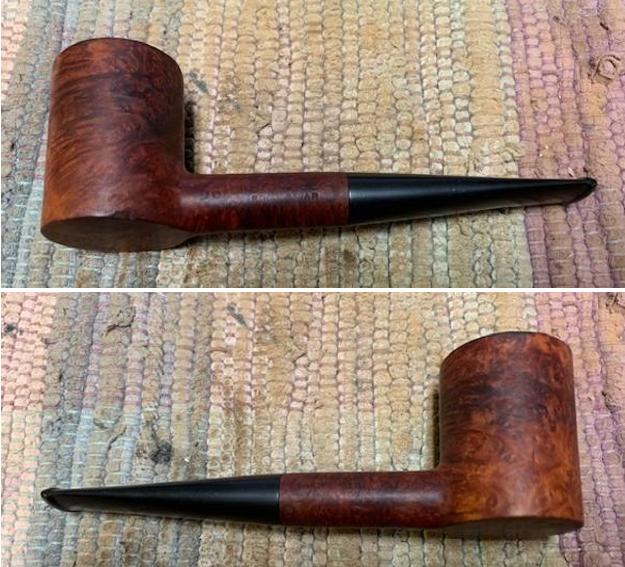
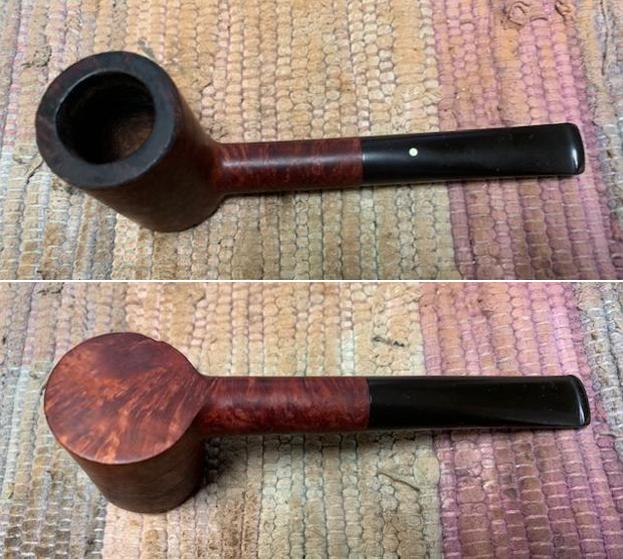
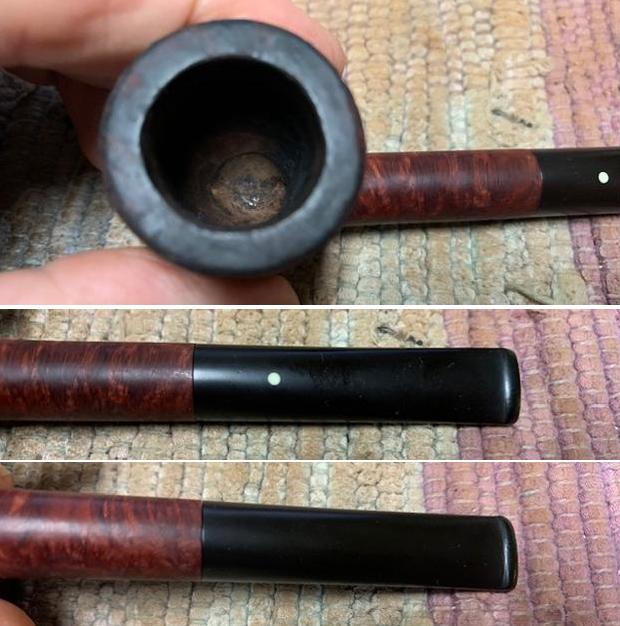
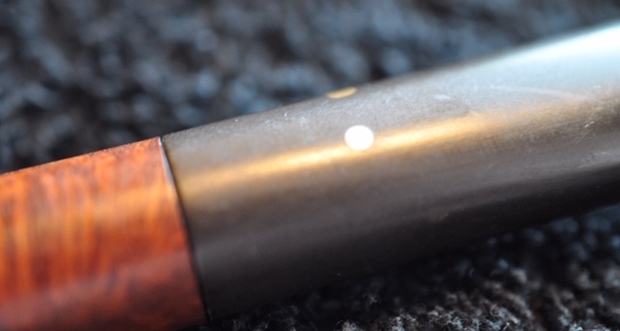
The next pipe on the table came to us in a group of pipes that we purchased from an Antique Mall on the Oregon Coast, Oregon, USA. It is a Dunhill Root Briar Poker/Sitter that is in good condition. It is stamped both sides of the shank. On the left side it is stamped with the shape number 90 followed by Dunhill [over] Root Briar. On the right side it is stamped with 2 in a circle followed by R for Root Briar next to the bowl. That is followed by Made in [over] England8. Interpreting that stamp it is as follows: The 90 is the shape for a Poker. The Dunhill Root Briar is the finish which is corroborated by the R at the end of the stamping. The 8 following the D of England gives the date the pipe was made and identifies it as 1958. The stamping is clear and readable. The age of the pipe and the oils in the finish has given the pipe a rich reddish brown finish. There is also some amazing grain that the shape follows well. The finish was dirty with dust ground into the surface of the bowl and shank. There was a thick cake in the bowl and tobacco debris stuck to the walls of the bowl. The rim top showed darkening and some lava on the surface. The vulcanite taper stem was oxidized, calcified and had light tooth marks and chatter ahead of the button on both sides.  Jeff took photos of the pipe to show what it looked like before he started working on it.  He took photos of the bowl and rim top to show the thickness of the cake and the darkening and lava overflow on the rim top. There were also nicks around the outer edge of the bowl. The photos of the stem show the oxidation, calcification and tooth marks and chatter on the surface on both sides.  The photos of the sides and heel of the bowl show the great grain on the pipe. It is a beauty under the grime and dust.    The stamping on the sides of the shank is shown in the photos below. It looks faint but is still readable. It reads as noted and explained above. The third photo shows the white spot on the stem.      I turned to Pipedia’s section on Dunhill Root Briar Pipes to get a bit of background on the Dunhill finishes (https://pipedia.org/wiki/Dunhill#Root_Briar). I quote:

Root Briar

Introduced in 1931 and highly prized because the grain is more pronounced in this finish (usually made using Corsican briar – was made exclusively from that briar into the 60s). The Root Briar finish requires a perfectly clean bowl with excellent graining. Therefore, it is the most expensive of the Dunhill pipes. Corsican briar was most often used for the Root finish since it was generally more finely grained. This is a rare finish, due to the scarcity of briar suitable to achieve it. These pipes are normally only available at Company stores, or at Principle Pipe Dealers. Straight grained pipes were formerly graded A through H, but are now only “Dr’s” and graded with one to six stars, with the letters G and H still used for the very finest pieces.

“Dunhill introduced its third major finish, the Root finish, in 1931. Corsican mountain briar is characteristically beautifully grained and the Root was made exclusively from that briar into the 1960s. The pipe was finished with a light natural stain to allow the beauty of the graining to show through. Although always available with a traditional black vulcanite bit, the Root was introduced in either 1930 or more likely 1931 and fitted with a marble brown dark and light grained vulcanite bit that has since become known as the ‘bowling ball’ bit because of the similarity in appearance between the bit’s finish and that of some bowling balls of the time. With the war, however, the bowling ball bit was dropped from production. Through 1954 (and after) the Root pipe nomenclature (including shape numbers) was identical to that of the Bruyere except that instead of the “A” of the Bruyere, the Root was stamped with an “R”. In 1952 when the finish rather then LONDON was placed under DUNHILL, ROOT BRIAR rather then BRUYERE was used for the Root.” Loring, J. C., The Dunhill Briar Pipe, The Patent Years and After (self-published, Chicago, 1998).
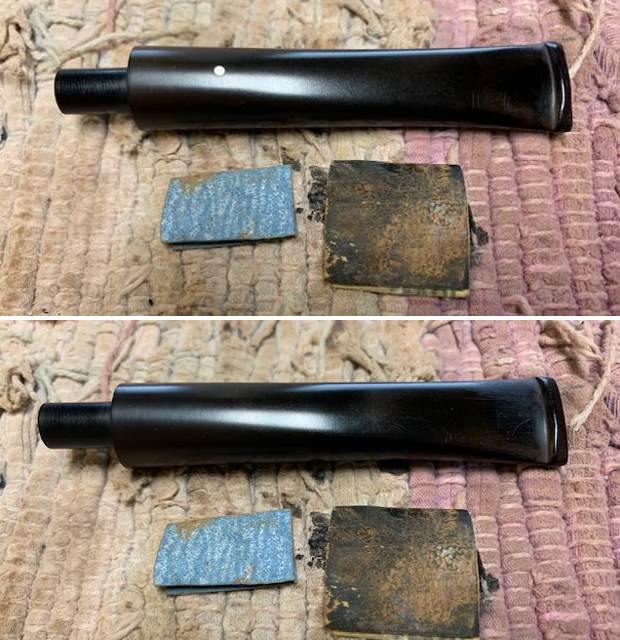
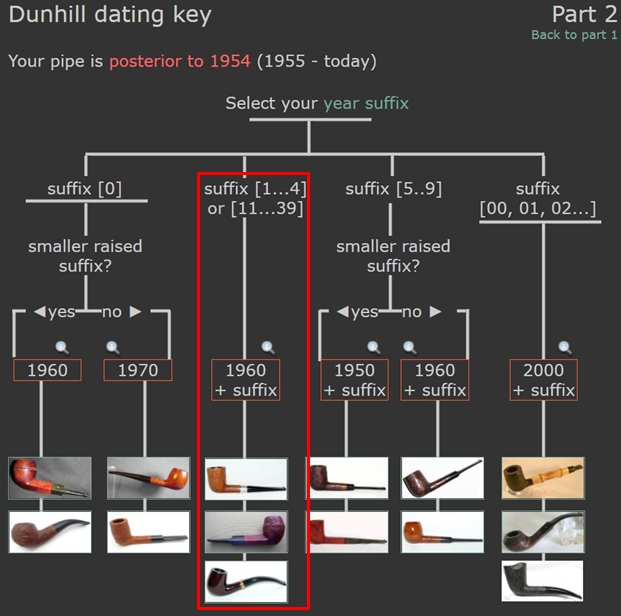
There was also a link to a catalogue page that gave examples and dates that the various finishes were introduced (https://pipedia.org/wiki/File:Dunnypipescatalog-1.png). I turned to Pipephil’s dating guide to show how I arrived at the date of manufacture for this pipe (http://www.pipephil.eu/logos/en/dunhill/cledat-en1a.html). I am including the chart that is provided there for the dating a pipe. I have drawn a red box around the section. Since the pipe I am working on has a suffix 8 that is raised, underlined superscript it points to the 1958 line on the chart below.I now knew that I was working on a Root Briar that came out in 1958. The shape of the pipe was a Poker/Sitter circle 2R in a shape 90 with a taper stem.

I turned to work on the pipe itself. Jeff had carried out his usual thorough cleanup of the pipe. He had reamed it with a PipNet reamer to remove the cake and cleaned the reaming up with a Savinelli Fitsall Pipe Knife. He scrubbed the internals of the bowl and stem with alcohol, cotton swabs and pipe cleaners. He scrubbed the externals with undiluted Murphy’s Oil Soap and rinsed the bowl off with running water. He soaked the stem in Before & After Deoxidizer and once it had soaked rinsed it off with warm water to remove the residual solution. He dried it off and scrubbed it down with Soft Scrub All-Purpose cleaner to remove any oxidation that was still on the stem. The pipe looked very clean when I received it.    I took a photo of the rim top to show the condition. You can see the darkening on the rim top. The bowl is roughened and slightly out of round. The stem came out looking quite good. There are light tooth marks and chatter on both sides near the button but the oxidation was gone.     I took photos of the sides of the shank to show the stamping. It is faint but readable as noted above.      I removed the stem from the shank and took a photo of the pipe parts to show what I was working with. It is a nice looking pipe. I decided to start the restoration on this one by working on the damage on the inner edge of the bowl. It had darkening and some damage to the edge. There were burn and reaming damage marks on the edge from a previous pipeman. I worked it over with a folded piece of 220 grit sandpaper to minimize the damage on the edge. When I finished with it, the bowl and the rim top looked much better.          I polished the rim top and bowl with micromesh sanding pads – dry sanding with 1500-12000 grit sanding pads. I wiped the bowl down with a damp cloth after each sanding pad. The briar began to take on a shine.     With the repair completed I rubbed the briar down with Before & After Restoration Balm. I worked it into the briar with my fingertips. The product works to clean, enliven and preserve the briar. I let it sit for 15 minutes while I worked on the stem. After the time passed I buffed it with a cotton cloth to deepen the shine. The briar really comes alive with the balm.     I set the bowl aside and turned my attention to the stem. I polished the vulcanite with micromesh sanding pads – 1500-12000 grit pads. I wiped it down with Obsidian Oil after each sanding pad. I used Before & After Pipe Polish – both Fine and Extra Fine to further polish the stem.   This Dunhill Root Briar 90 Group 2R Poker from 1958 is a beautiful looking piece of briar that has a shape that follows grain. It is a great looking pipe that came out looking even better after the cleanup. The Root Briar is an early finish that Dunhill specialized in making. The finish on the pipe is in excellent condition. The brown stains on the bowl works well to highlight the grain. The polished black vulcanite taper stem adds to the mix. With the grime gone from the finish and the bowl it was a beauty and is eye-catching. I put the stem back on the bowl and buffed the pipe with Blue Diamond on the buffing wheel being careful to not buff the stamping. I gave the bowl and the stem multiple coats of carnauba wax on the buffing wheel and followed that by buffing it with a clean buffing pad. I hand buffed the pipe with a microfiber cloth to deepen the shine. The finished 1958 Root Briar 90 Poker is quite nice and feels great in the hand. Give the finished pipe a look in the photos below. I can only tell you that like the other pipes I am working that it is much prettier in person than the photos capture. The dimensions of the pipe are Length: 4 ¾ inches, Height: 1 5/8 inches, Outside diameter of the bowl: 1 ¼ inches, Chamber diameter: ¾ of an inch. The weight of the pipe is 27grams/.95oz. It will soon be added to the British Pipe Makers section on the rebornpipes store. Thanks for walking through the restoration with me as I worked over another beautiful pipe. Remember we are not pipe owners; we are pipemen and women who hold our pipes in trust until they pass on into the trust of the next generation.

Breathing Life into a 1962 Dunhill Root Briar 59 Group 4 Billiard


Blog by Steve Laug

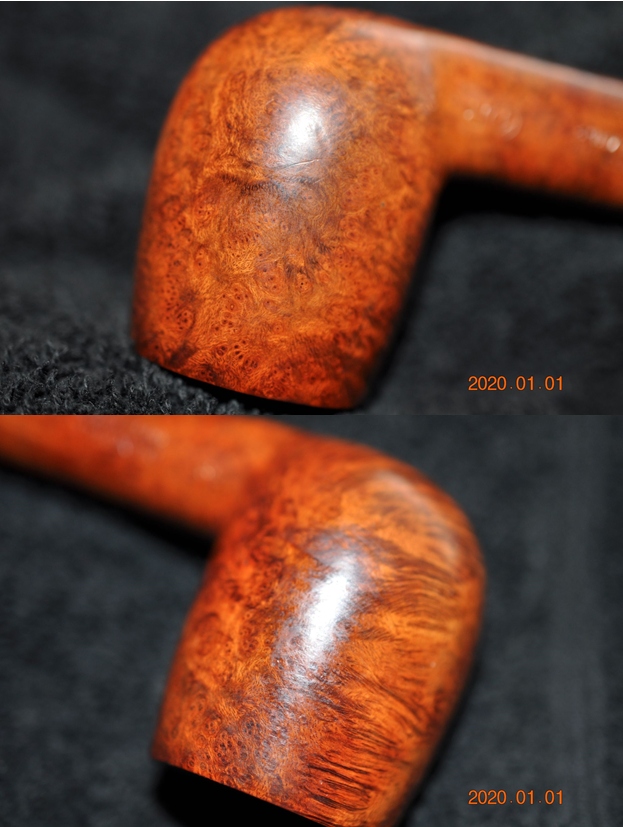
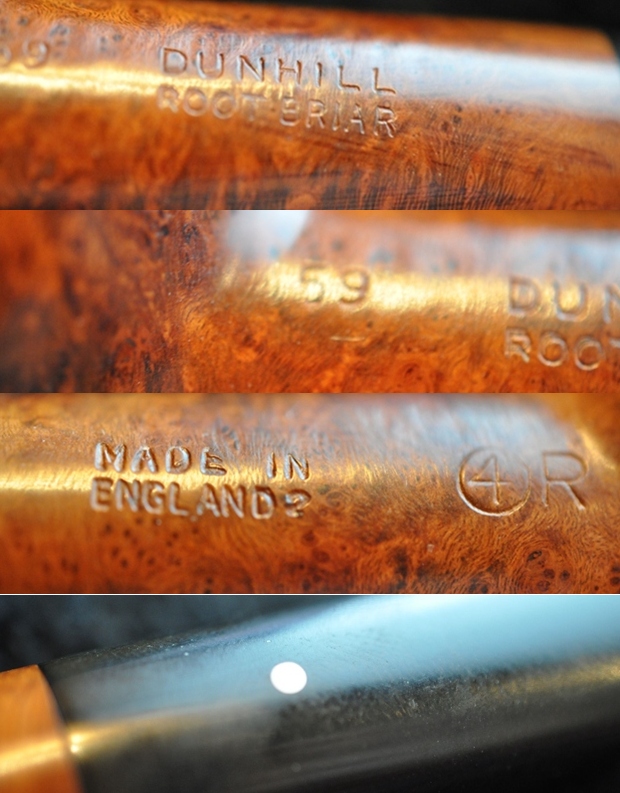
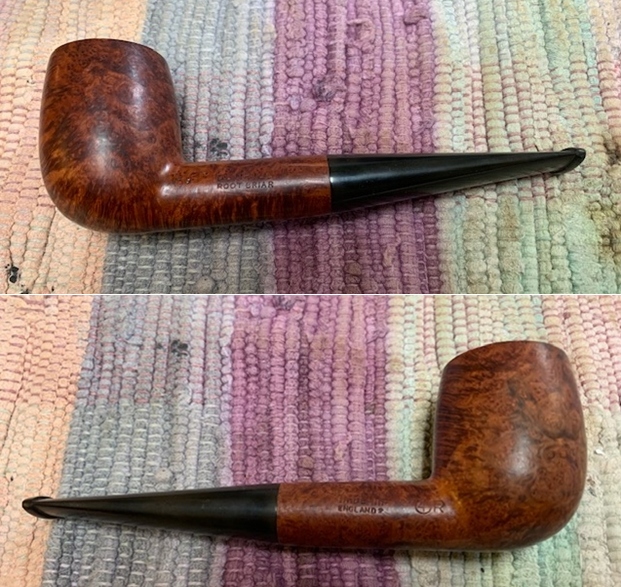
The next pipe on the table came to us in a group of pipes that we purchased from a fellow in Los Angeles, California, USA. It is a Dunhill Root Briar Straight Billiard that is in good condition. It is stamped both sides of the shank. On the left side it is stamped with the shape number 59 followed by Dunhill [over] Root Briar. On the right side it is stamped with 4 in a circle followed by R for Root Briar next to the bowl. That is followed by Made in [over] England2. Interpreting that stamp it is as follows: The 59 is the shape for a straight billiard. The Dunhill Root Briar is the finish which is corroborated the R at the end of the stamping. The 2 following the D of England gives the date the pipe was made and identifies it as 1962. The stamping is clear and readable. The age of the pipe and the oils in the finish has given the pipe a rich reddish brown finish. There is also some amazing grain that the shape follows well. The finish was dirty with dust ground into the surface of the bowl and shank. There was a moderate cake in the bowl and tobacco debris stuck to the walls of the bowl. The rim top showed darkening and some lava in on the surface. The vulcanite taper stem was oxidized, calcified and had light tooth marks and chatter ahead of the button on both sides.  Jeff took photos of the pipe to show what it looked like before he started working on it.  He took photos of the bowl and rim top to show the thickness of the cake and the darkening and lava overflow on the rim top. The photos of the stem show the oxidation, calcification and tooth marks and chatter on the surface on both sides.  The photos of the sides and heel of the bowl show the great grain on the pipe. It is a beauty under the grime and dust.   The stamping on the underside of the shank is shown in the photos below. It looks very good and readable. It reads as noted and explained above. The fourth photo shows the white spot on the stem.   I turned to Pipedia’s section on Dunhill Root Briar Pipes to get a bit of background on the Dunhill finishes (https://pipedia.org/wiki/Dunhill#Root_Briar). I quote:

Root Briar

Introduced in 1931 and highly prized because the grain is more pronounced in this finish (usually made using Corsican briar – was made exclusively from that briar into the 60s). The Root Briar finish requires a perfectly clean bowl with excellent graining. Therefore, it is the most expensive of the Dunhill pipes. Corsican briar was most often used for the Root finish since it was generally more finely grained. This is a rare finish, due to the scarcity of briar suitable to achieve it. These pipes are normally only available at Company stores, or at Principle Pipe Dealers. Straight grained pipes were formerly graded A through H, but are now only “DR’s” and graded with one to six stars, with the letters G and H still used for the very finest pieces.

Dunhill introduced its third major finish, the Root finish, in 1931. Corsican mountain briar is characteristically beautifully grained and the Root was made exclusively from that briar into the 1960s. The pipe was finished with a light natural stain to allow the beauty of the graining to show through. Although always available with a traditional black vulcanite bit, the Root was introduced in either 1930 or more likely 1931 and fitted with a marble brown dark and light grained vulcanite bit that has since become known as the ‘bowling ball’ bit because of the similarity in appearance between the bit’s finish and that of some bowling balls of the time. With the war, however, the bowling ball bit was dropped from production. Through 1954 (and after) the Root pipe nomenclature (including shape numbers) was identical to that of the Bruyere except that instead of the “A” of the Bruyere, the Root was stamped with an “R”. In 1952 when the finish rather than LONDON was placed under DUNHILL, ROOT BRIAR rather then BRUYERE was used for the Root. Loring, J. C., The Dunhill Briar Pipe, The Patent Years and After (self-published, Chicago, 1998).
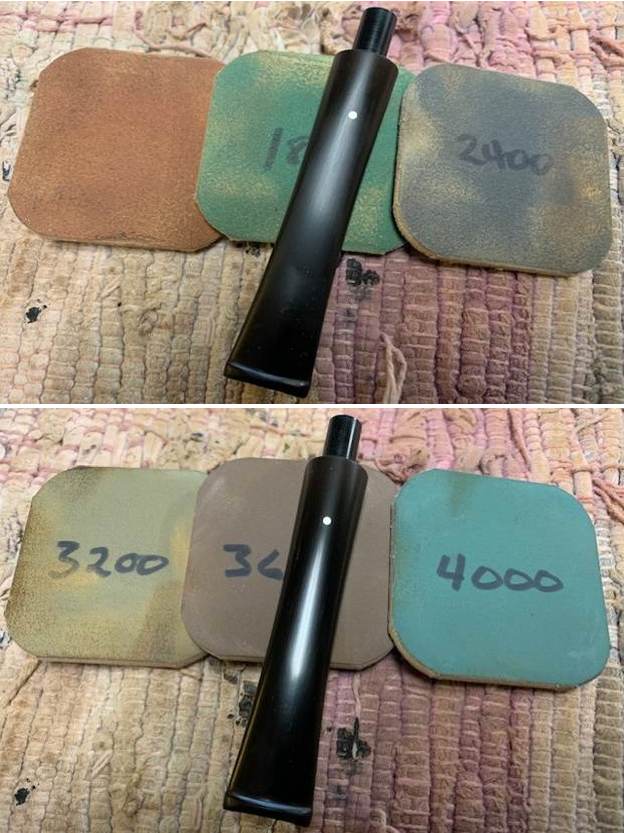
I turned to Pipephil’s dating guide to show how I arrived at the date of manufacture for this pipe (http://www.pipephil.eu/logos/en/dunhill/cledat-en1a.html). I am including the chart that is provided there for the dating a pipe. I have drawn a red box around the section. Since the pipe I am working on has a 2 it points to the 1960+ suffix line on the chart below.I looked at the Dunhill Shape chart on Pipedia to isolate the shape number on this pipe (https://pipedia.org/wiki/Dunhill_Shape_Chart#:~:text=The%20White%20Spot%20Chart%20%20%20Digit%201%3A,%2012%3A%20Chimney%20%208%20more%20rows%20). I quote from the site:

Early Days – 2 digits \ Letters — The original skus/model numbers from the 1920’s until the early 1970’s stood for very specific shapes and bowls. For example, the codes 31, 34, 59, 111, 113, 117, 196, LB, LBS… were all different types of Billiard shaped pipes and there were about 50(!), such codes for the Billiard shape alone.

I now knew that I was working on a Root Briar that came out in 1962. The shape of the pipe was one of many Billiards that Dunhill put out and that the #59 fit the date of the pipe perfectly with the 2 digit shape numbers ending in the early 1970s.

I turned to work on the pipe itself. Jeff had carried out his usual thorough cleanup of the pipe. He had reamed it with a PipNet reamer to remove the cake and cleaned the reaming up with a Savinelli Fitsall Pipe Knife. He scrubbed the internals of the bowl and stem with alcohol, cotton swabs and pipe cleaners. He scrubbed the externals with undiluted Murphy’s Oil Soap and rinsed the bowl off with running water. He soaked the stem in Before & After Deoxidizer and once it had soaked rinsed it off with warm water to remove the residual solution. He dried it off and rubbed it down to remove any oxidation that was still on the stem. The pipe looked very clean when I received it. I took a photo of the rim top to show the condition. You can see the darkening on the rim top on the back right. It is roughened and chipped and out of round. The saddle stem came out looking quite good. There are light tooth marks and chatter on both sides near the button as well as some remaining oxidation.   I took photos of the sides of the shank to show the stamping. It is clear and readable as noted above.  I removed the stem from the shank and took a photo of the pipe parts to show what I was working with. It is a nice looking pipe.I decided to start the restoration on this one by working on the damage on the inner edge of the bowl. It had darkening and some damage to the edge. There were burn and knife marks on the edge from a previous pipeman. I worked it over with a folded piece of 220 grit sandpaper to give the edge a light bevel and remove and minimize the damage on the edge. When I finished with it, the bowl and the rim top looked much better.   I polished the rim top and bowl with micromesh sanding pads – dry sanding with 1500-12000 grit sanding pads. I wiped the bowl down with a damp cloth after each sanding pad. The briar began to take on a shine.   With the repair completed I rubbed the briar down with Before & After Restoration Balm. I worked it into the briar with my fingertips. The product works to clean, enliven and preserve the briar. I let it sit for 15 minutes while I worked on the stem. After the time passed I buffed it with a cotton cloth to deepen the shine. The briar really comes alive with the balm.     I set the bowl aside and turned my attention to the stem. I polished the vulcanite with micromesh sanding pads – 1500-12000 grit pads. I wiped it down with Obsidian Oil after each sanding pad. I used Before & After Pipe Polish – both Fine and Extra Fine to further polish the stem.   This Dunhill Root Briar 59 Group 4 Billiard from 1962 is a beautiful looking piece of briar that has a shape that follows grain. It is a great looking pipe that came out looking even better after the cleanup. The Root Briar is an early finish that Dunhill specialized in making. The finish on the pipe is in excellent condition. The oils off the smoker’s hands and the brown stain on the bowl works well to highlight the grain. The polished black vulcanite taper stem adds to the mix. With the dust gone from the finish and the bowl it was a beauty and is eye-catching. I put the stem back on the bowl and buffed the pipe with Blue Diamond on the buffing wheel being careful to not buff the stamping. I gave the bowl and the stem multiple coats of carnauba wax on the buffing wheel and followed that by buffing it with a clean buffing pad. I hand buffed the pipe with a microfiber cloth to deepen the shine. The finished 59 Root Briar Billiard is quite nice and feels great in the hand. Give the finished pipe a look in the photos below. I can only tell you that like the other pipes I am working that it is much prettier in person than the photos capture. The dimensions of the pipe are Length: 5 ½ inches, Height: 2 inches, Outside diameter of the bowl: 1 ¼ inches, Chamber diameter: ¾ of an inch. The weight of the pipe is 41grams/1.45oz. Thanks for walking through the restoration with me as I worked over another beautiful pipe. Remember we are not pipe owners; we are pipemen and women who hold our pipes in trust until they pass on into the trust of the next generation.

Breathing Life into a 1957 (or is it a 1967) Dunhill Root Briar 251 EX606 Billiard


Blog by Steve Laug

The next pipe on the table came to us from one of Jeff’s pipe hunts on the Oregon Coast. It is a Dunhill Root Briar Billiard that is in decent condition. It is stamped EX606 over 251 which is the shape number followed by Dunhill over Root Briar on the left side of the shank. On the right side it is stamped with the 3R (which is the Group size and the R for Root Briar) and to the left is reads Made in England with what looks like a 7 superscript to me and 0 which gives the date the pipe was made. The stamping is clear and readable. The pipe has a medium brown finish and some amazing grain that the shape follows well. The finish was very dirty with grime ground into the grain around bowl sides. The bowl had a thick cake in the bowl and a heavy lava overflow on the top and the inner edge of the top. There was a burn mark on the left outer edge of the bowl. It was hard to know the overall condition of the rim top and edges because of the grime. The stem was dirty, oxidized and had some calcification around the button. There was light tooth chatter and marks on the stem near the button on both sides. The stem has the Dunhill White Spot logo on the top of the taper stem. Jeff took photos of the pipe to show what it looked like before he cleaned it up. Jeff took photos of the rim top to show the thick cake in the bowl and the lava overflow on the top and damage to the outer edge of the rim. The photos show the rim top and bowl from various angles.Jeff took some photos of the bowl sides and heel to show the nice grain that was on this bowl. It is a quite beautifully grained pipe. The stamping on each side of the shank is shown in the photos below. They look very good and readable. Here is where the question comes in on the date – is the 7 after the D in England on the third photo below a superscript or is it the same as the D. To me it is a superscript. You can also see the White Spot on the top of the taper stem in the last of the four photos below. The stem was a very good fit to the shank. It was oxidized, calcified and had debris stuck to the surface of the vulcanite. There was tooth chatter and marks on both sides of the stem and on the button surface.    I turned to Pipedia’s section on Dunhill Root Briar to get a bit of background on this particular Duhill finish (https://pipedia.org/wiki/Dunhill#Root_Briar). I quote:
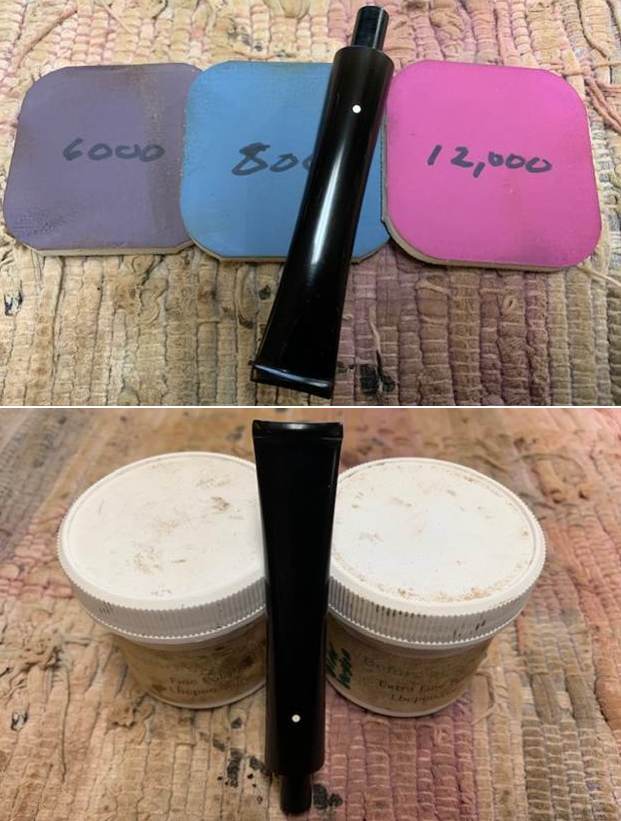
Introduced in 1931 and highly prized because the grain is more pronounced in this finish (usually made using Corsican briar). The Root Briar finish requires a perfectly clean bowl with excellent graining. Therefore, it is the most expensive of the Dunhill pipes. Corsican briar was most often used for the Root finish since it was generally more finely grained. This is a rare finish, due to the scarcity of briar suitable to achieve it. These pipes are normally only available at Company stores, or at Principle Pipe Dealers. Straight grained pipes were formerly graded A through H, but are now only “Dr’s” and graded with one to six stars, with the letters G and H still used for the very finest pieces.

The article also cited a section from John Loring confirming the above information and giving a bit more colour to the information.

“Dunhill introduced its third major finish, the Root finish, in 1931. Corsican mountain briar is characteristically beautifully grained and the Root was made exclusively from that briar into the 1960s. The pipe was finished with a light natural stain to allow the beauty of the graining to show through. Although always available with a traditional black vulcanite bit, the Root was introduced in either 1930 or more likely 1931 and fitted with a marble brown dark and light grained vulcanite bit that has since become known as the ‘bowling ball’ bit because of the similarity in appearance between the bit’s finish and that of some bowling balls of the time. With the war, however, the bowling ball bit was dropped from production. Through 1954 (and after) the Root pipe nomenclature (including shape numbers) was identical to that of the Bruyere except that instead of the “A” of the Bruyere, the Root was stamped with an “R”. In 1952 when the finish rather than LONDON was placed under DUNHILL, ROOT BRIAR rather than BRUYERE was used for the Root.” Loring, J. C., The Dunhill Briar Pipe, The Patent Years and After (self-published, Chicago, 1998).
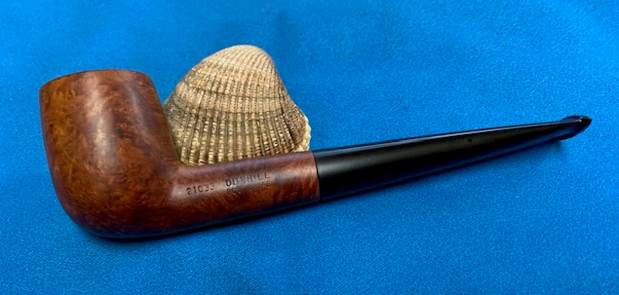
I have also included a chart from the site from Dunhill spelling out the Standard Pipe Finishes and giving short information and a timeline.
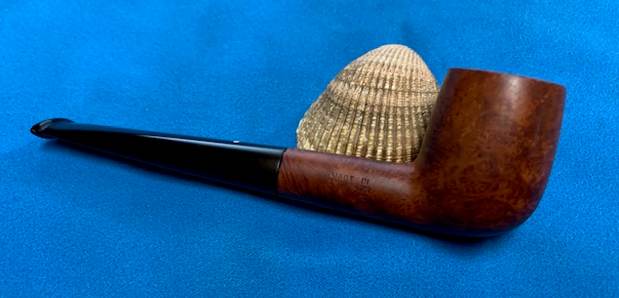
I also wanted to understand the additional stamps on the shank. There were two I wanted to clarify. One the left side there was the EX606 over the shape number. On the right side there was the superscript Date code and a second number – an underlined 0. I continued to search the connected pages on Dunhill. There was a specific page or section on the Dunhill Additional Stamps that helped some (https://pipedia.org/wiki/Dunhill_Additional_Stamps).
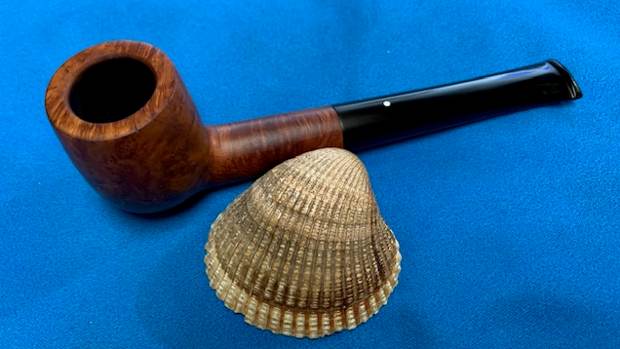
“The reason for dating a pipe was due to a one-year-guarantee offered by Dunhill, that they would replace a pipe if it had any issues in its first year. Sometimes, a pipe would be made and stamped, yet wouldn’t leave the factory until the next year or even later, when it would then receive a current extra date-code. Due to this, there are several examples of pipes with double, triple, or even quadruple date-codes stamped onto them.” Steven Snyder.

These additional codes were added by the retail stores – that’s why they were not uniform. For example, situations that the pipes were not sold in the same year of production, it was a way to establish a new warranty period. In cases where the customer requested a F/T stem (for example) or some minor cosmetic issue was found, the pipe returned to the factory and, in some cases, received a new coverage date. In these situations the extra date-code is uniform.

“It might have been added by the point-of-sales (shop, when the pipe was actually sold, so the guarantee period was easier to identify.” Hener, K. S., Product Line Director – The White Spot Smoker’s Accessory Division and Walthamstow site.

There is a bit of question as to the date on this pipe. I have had people on the various groups on Facebook say it is a 1957 sold in 1960 pipe and others say it is a 1967 sold in 1970 pipe.  All of the dating is dependent on how you see the 7 after the D in England. I turned to Pipephil (http://www.pipephil.eu/logos/en/dunhill/cledat-en1a.html) to see what I could find out. Here is the chart I used and I have drawn a red box around the portion I used.I also captured the stamping on two separate pipes to show my conclusion. The first one shows the stamp on a 1967 pipe with the 7 being essentially the same size as the D in England. The second one is a 1958 pipe with a smaller superscript that is in the same placement as the 7 on the pipe that I have in hand. So I am pretty confident that the double date stamp was the year the pipe was made and the year that it sold. In this case it was a 1957 pipe that sold in 1960.

I turned to Eric Boehm’s part of the article on the Pipedia section on the Dunhill shapes. I found the listing for the Billiard that I was working on but still no information on the EX 606 number above it (https://pipedia.org/wiki/Dunhill_Shapes_List). I quote:

251 Billiard, tapered bit (Relief bit) 3 5¾” 1950 3

That fits this pipe perfectly – a billiard with a tapered stem with a length of 5 ¾ inches. First used in 1950 in a Group 3 size.

I posted a question on the stamping on the Tobacco Pipe Restorers Group on Facebook and got this response from Alfredo Baquerizo:

This is a Root Briar from 1957 shape 251, group 3 and the R is for root. It’s an EX an exchange pipe by warranty Dunhill system. The 606 I think that is the exchange pipe number, I’m not sure.

I also posted on the Vintage Dunhill Pipes Group on Facebook and enjoyed the responses. One of the posters there, Jean-Paul Varon gave this information.

Ex606 = exchange of a pipe under guarantee.

That was the extent of the information that I could find at this point. It seems likely that the EX is the Dunhill Exchange Warranty system and the 606 could well be the Exchange pipe number. Is it possible that the EX606 could also include a date code in it? Possibly being the year 1960 and the sixth pipe of the year that was a replacement?

I turned to work on the pipe itself. Jeff had done a great job cleaning up the pipe as usual. He reamed the pipe with a PipNet reamer and cut back the cake back to the bare briar. He cleaned up the walls with a Savinelli Fitsall Pipe Knife. He scrubbed the interior of the bowl and shank with pipe cleaners, cotton swabs and alcohol to remove the tars and oils. He scrubbed the exterior of the pipe with Murphy’s Oil Soap and a tooth brush to remove the grime from the finish. He worked on the rim top lava and darkening with the soap and tooth brush. He scrubbed the inside of the stem with alcohol and pipe cleaners. He scrubbed the exterior with Soft Scrub and then soaked it in Before & After Deoxidizer. He washed it off with warm water to remove the deoxidizer. The pipe looked far better. I took photos of the pipe when I received it before I started working on it. I took photos of the bowl and rim top as well as the stem to show their condition. You can see the damage to the rim topo and inner edge. There a nicks and chip on the edge and top there is a burned area on the rear left outer edge. There is generally some heavy darkening on the top.  The stem on the other hand looks very good in the photos. I took photos of the stamping on the sides of the shank. The stamping is clear and readable as noted above.   I took a photo of the pipe with the stem removed to show the overall look of stem, tenon and profile of the pipe.I decided to start my work on the pipe by addressing the darkening and damage on the rim top and edges of the top. I lightly topped the bowl to remove the damage on the top and the inner edge of the rim. It also helped with the damage to the outer edge as well. I used a folded piece of 220 grit sandpaper to work on the inner edge a bit more. It took work but I was able to remove the majority of it. There was still one spot of burn damage on the left rear outer edge but it was smaller than when I had started.   I polished the briar with micromesh sanding pads – dry sanding with 1500-12000 grit pads and wiping the bowl down with a damp cloth after each pad.   I stained the polished rim top with the lightest coloured stain pen I have – Oak and was able to blend it into the overall colour of the bowl. The rim top looked amazingly better than when I started and has some great grain that is parallel to that on the heel of the bowl.I rubbed the briar down with Before & After Restoration Balm. I worked it into the briar with my fingertips. The product works to clean, enliven and preserve the briar. I let it sit for 10 minutes while I worked on the stem. After the time passed I buffed it with a cotton cloth to deepen the shine. The briar really comes alive with the balm.  I set the bowl aside and turned my attention to the stem. Because it was in such good condition I polished the vulcanite with micromesh sanding pads – 1500-12000 grit pads. I wiped it down with Obsidian Oil after each sanding pad. I used Before & After Pipe Polish – both Fine and Extra Fine to further polish the stem.   I decided to pause and go sit in the yard in the shade and enjoy a bowl of MacBarens HH Old Dark Fired in my Downie Pipe before I polished the Dunhill. Need a bit of a break!This uniquely stamped Dunhill Root Briar 251 Billiard is a piece of Dunhill’s Warranty History – made in 1957 and sold or exchanged in 1960 at least that is my call though others have seen it as made in 1967 and sold in 1970. It is a great looking pipe in spite of the remaining burn mark on the rim. The Light Brown stain highlights some great grain around the bowl sides and the heel. It has some of the most stunning birdseye grain I have seen in a while on the right side of the bowl. The finish on the pipe is in excellent condition and the stain works well to highlight the grain. The polished black vulcanite taper stem adds to the mix. With the grime and debris gone from the finish and the bowl it was a beauty and is eye-catching. I put the stem back on the bowl and buffed the pipe with Blue Diamond on the buffing wheel being careful to not buff the stamping. I gave the bowl and the stem multiple coats of carnauba wax on the buffing wheel and followed that by buffing it with a clean buffing pad. I hand buffed the pipe with a microfiber cloth to deepen the shine. The finished 251 Billiard is quite nice and feels great in the hand. Give the finished pipe a look in the photos below. I can only tell you that like the other pipes I am working that it is much prettier in person than the photos capture. The dimensions of the pipe are Length: 5 ¾ inches, Height: 1 ¾ inches, Outside diameter of the bowl: 1 ¼ inches, Chamber diameter: ¾ of an inch. Thanks for walking through the restoration with me as I worked over another beautiful pipe. This pipe will be added to the British Pipe Makers section of the rebornpipes store soon. If you want to add it to your collection send me an email or a message! Thanks for your time.