Tag Archives: bowl topping

A Challenging Restoration of Vintage Era First Choquin “A Metz”


Blog by Paresh Deshpande

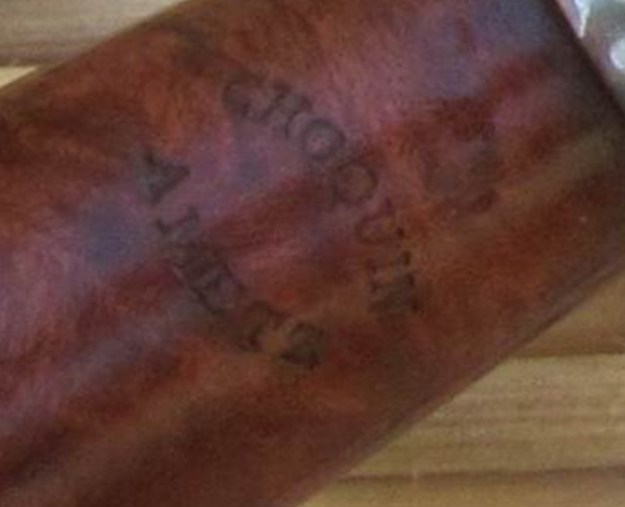
I had been on a short leave to my home town last month and that is where this happened!!!!! Even though there are still a number of pipes from the two of the three inherited boxes of pipes waiting their turn for restoration, curiosity got the better of me and I could not resist the temptations of opening the third box. What happened thereafter is that I had to unpack all the pipes earmarked to accompany me to my work place for restoration in my free time which in turn invited the wrath of my wife who had helped in packing in the first place, and repack the newly selected pipes from the third box!!!!!! In addition to the regular collection of Barling’s, Charatan’s, Comoy’s and other assorted collection, I came across two pipes which caught my fancy!!!!!The pipe on the left bears a football stamp that reads “CHOQUIN” over “A METZ” and the one on the right side simply reads “GBD”  (there are other stampings on the silver ferrule, details of which will be highlighted when it comes up for restoration). Both these pipes looked vintage and unique enough that I immediately Facetimed with Mr. Steve of rebornpipes. His admission that he is willing for a trade with me for these two pipes was an indication enough for me to know and understand their uniqueness!!! Thus these two pipes moved to the top of my unorganized and chaotic list of restoration.

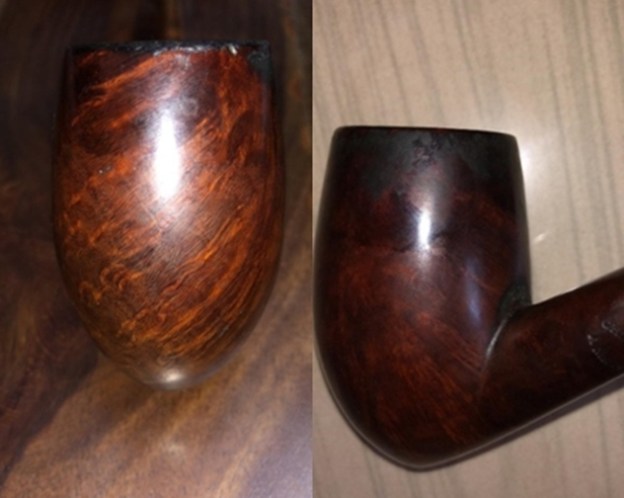
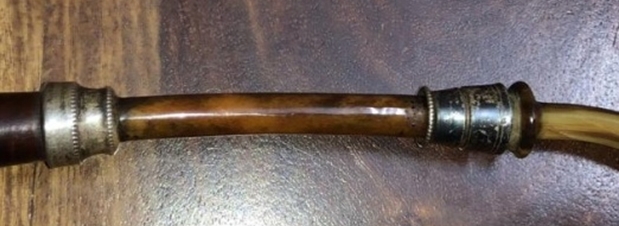
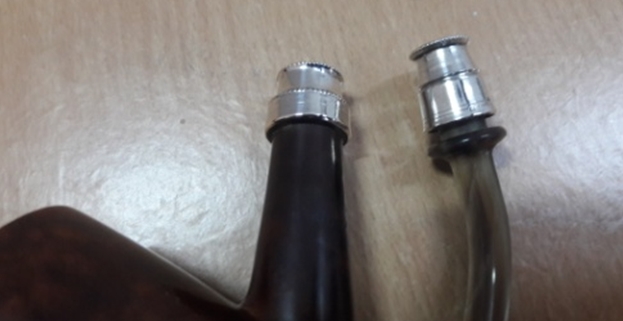
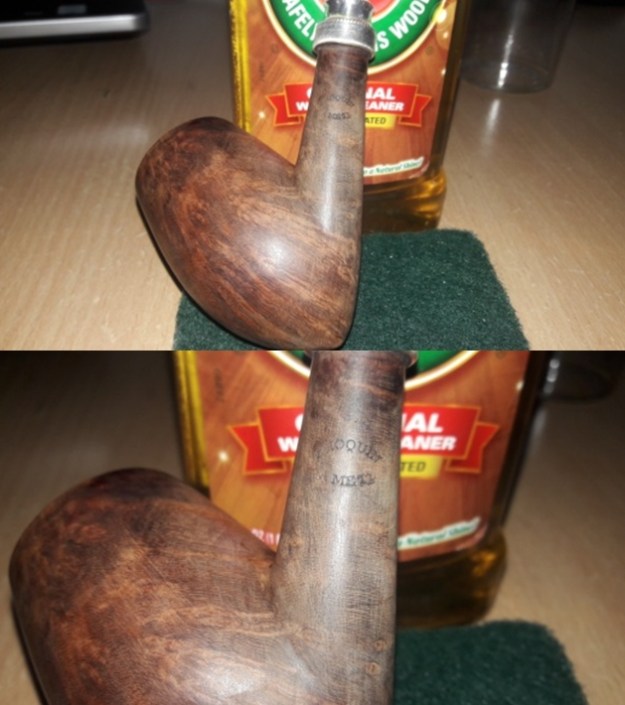
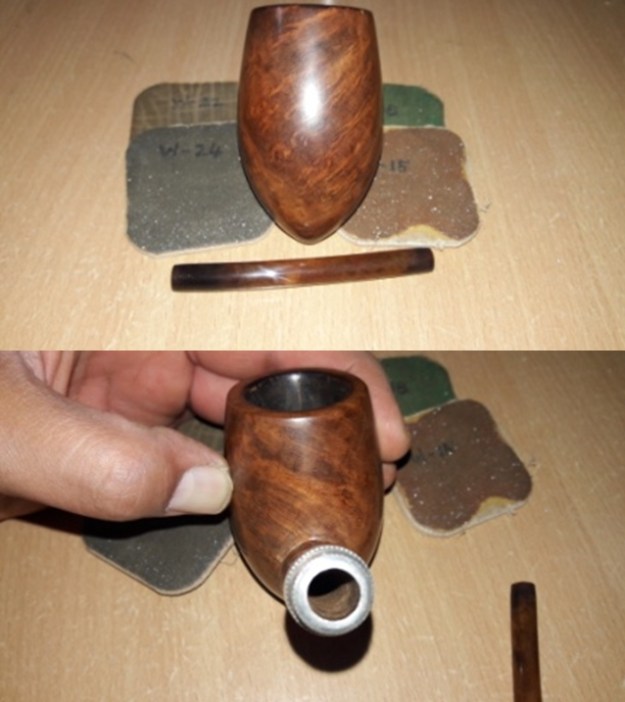
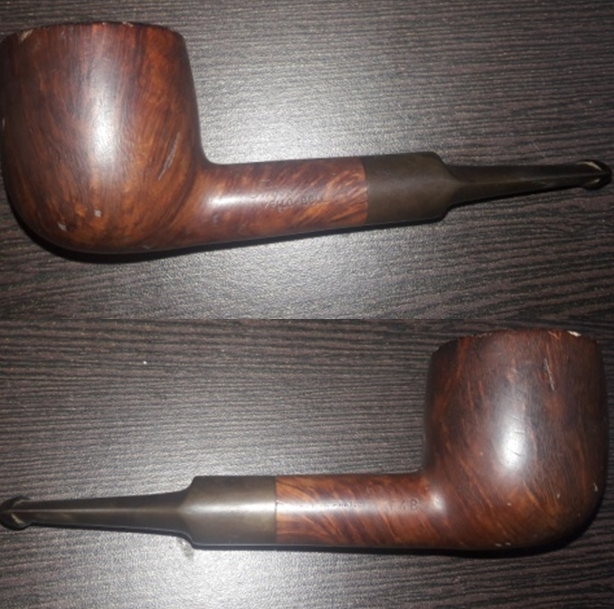
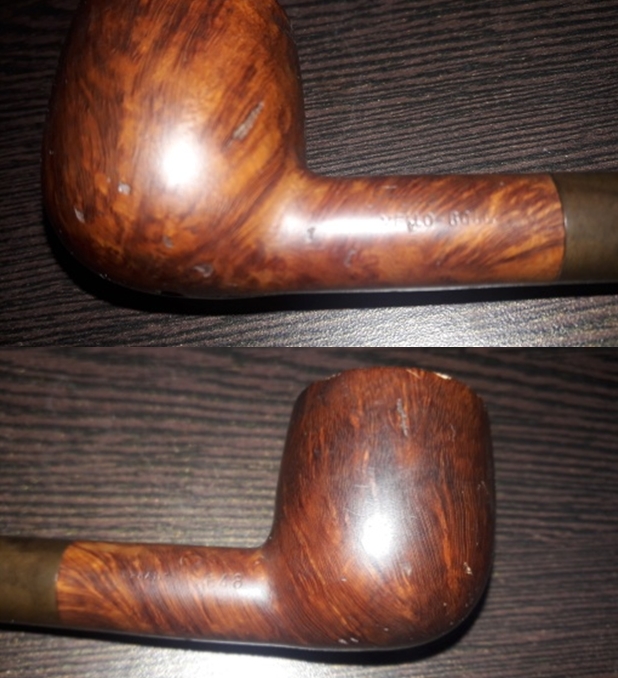
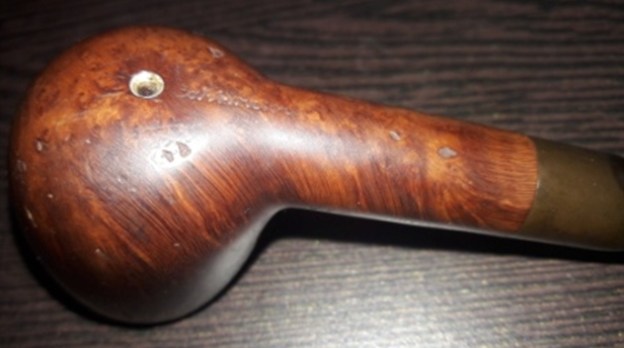
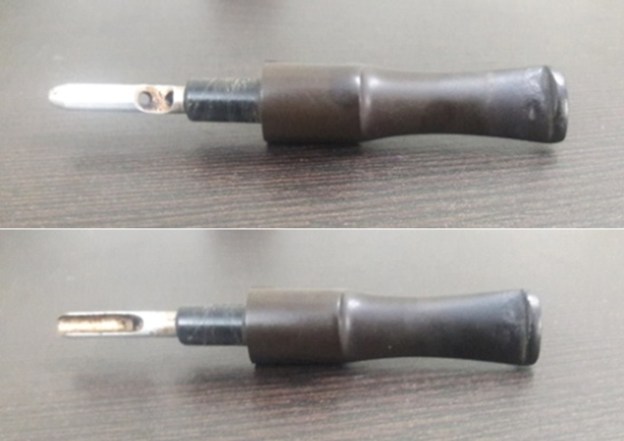
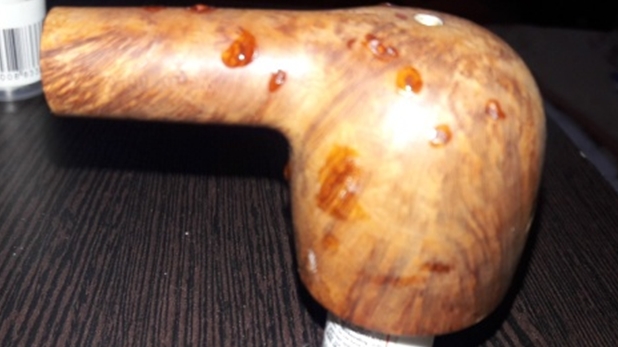
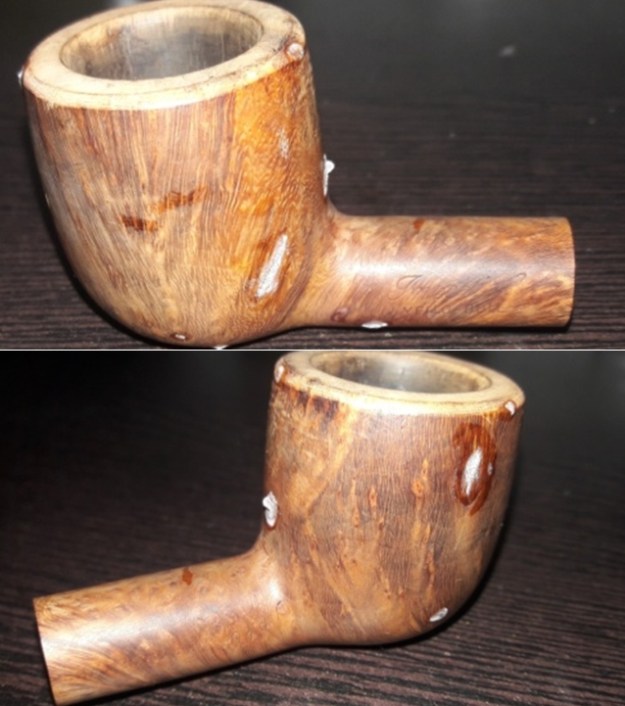
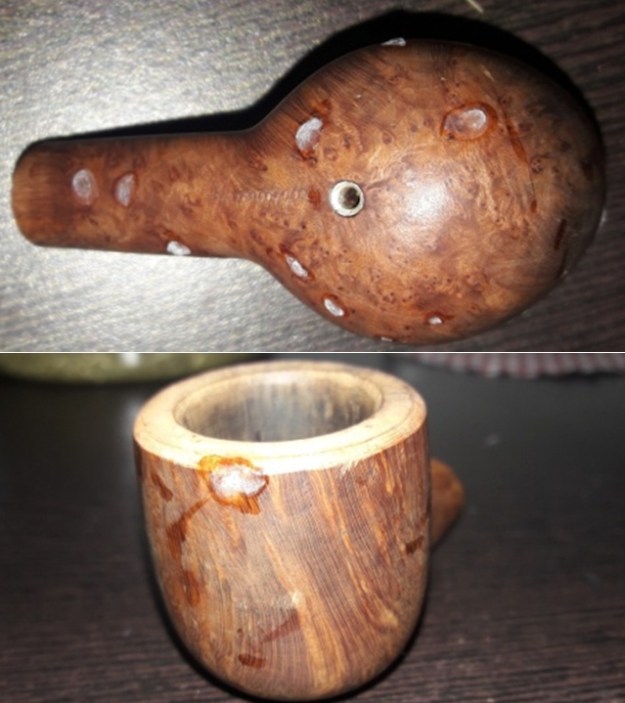
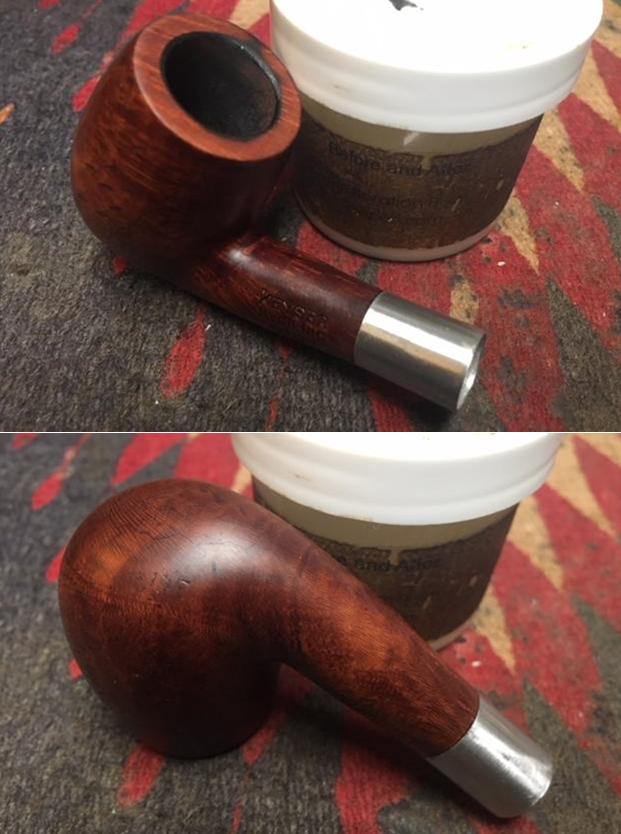
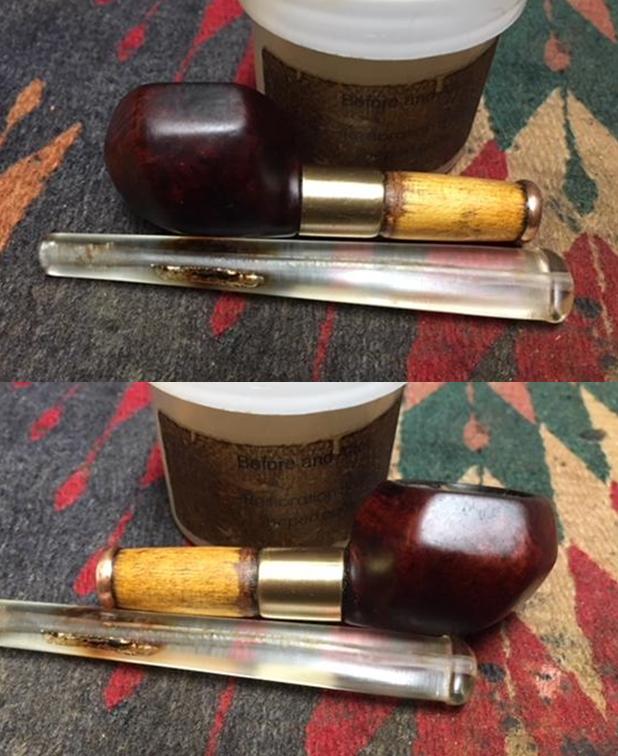
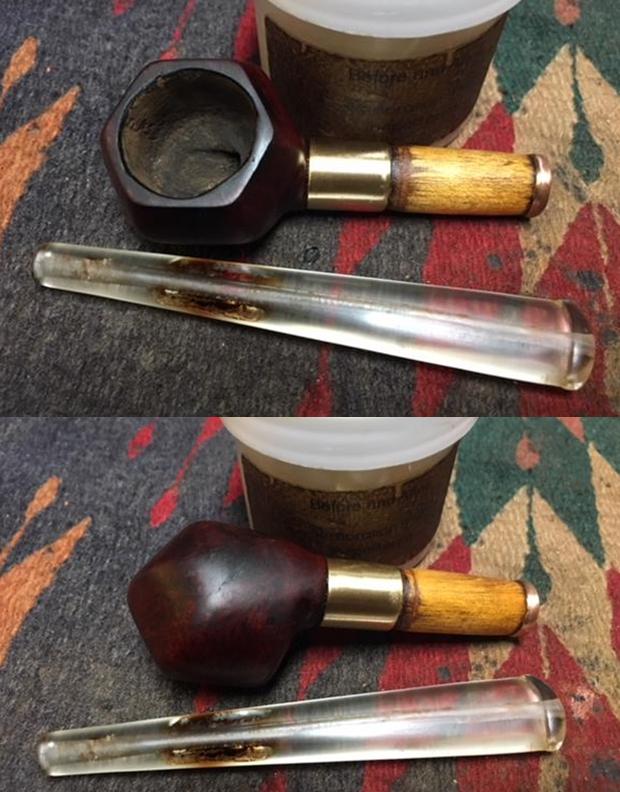
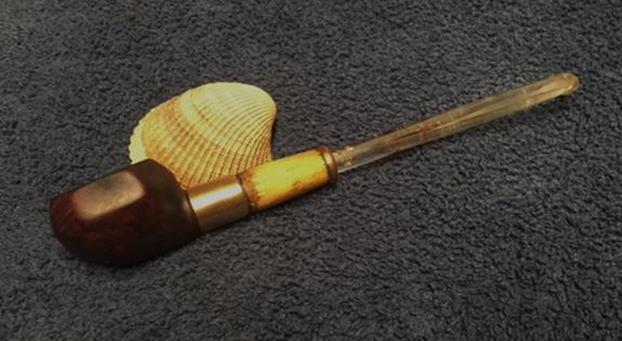
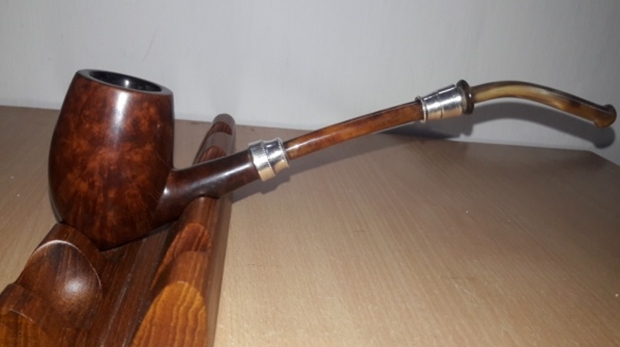
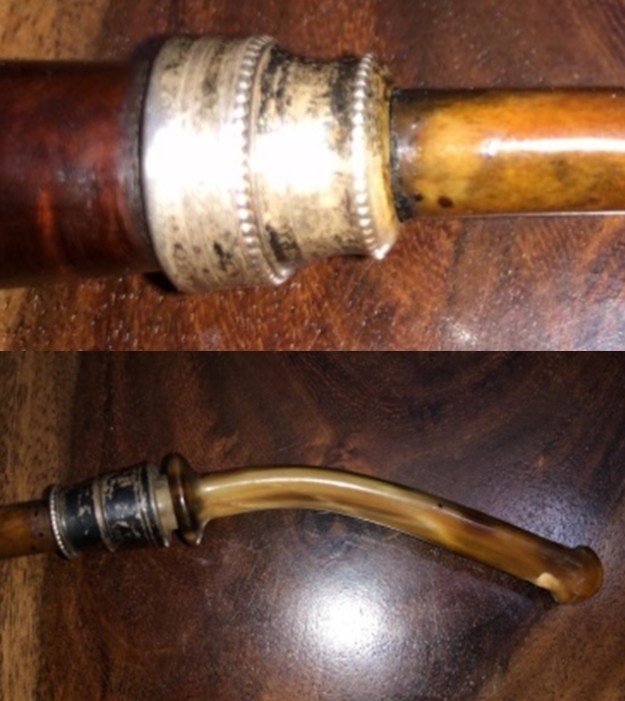
The pipe first on my work table is the CHOQUIN. It is a huge pipe with a humongous acorn shaped smooth briar bowl with a steeply raking shank, the end of which is adorned by a fixed sterling silver ornamented ferrule. This similarly designed sterling silver also masks the tenon of the horn stem.The shank and the horn stem are connected by a push-fit type bone extension. The huge acorn bowl shows beautiful, large and loosely packed birdseye grain on the right side while mixed grain adorns the left side. The stummel on the front, back and the shank displays densely packed straight grains. The only stamping that is seen on this pipe is the football stamp on the left side of the shank and reads “CHOQUIN” over “A METZ”. For its age, the stamping is crisp and clear.This time around, before commencing the restoration process, I posted the pictures of this pipe on the Tobacco Pipe Restorers group on Facebook as my next project. In addition to input from my mentor, Mr. Steve, I collected a lot of valuable information from all the knowledgeable stalwarts. From all the input that I have gathered, the flat bottom bowl, the stamping, the sterling silver adornments, the bone shank extension and horn stem, I can safely place this piece as being one of the first A Metz pipes from the 1858 era!!!!!
INITIAL VISUAL INSPECTION
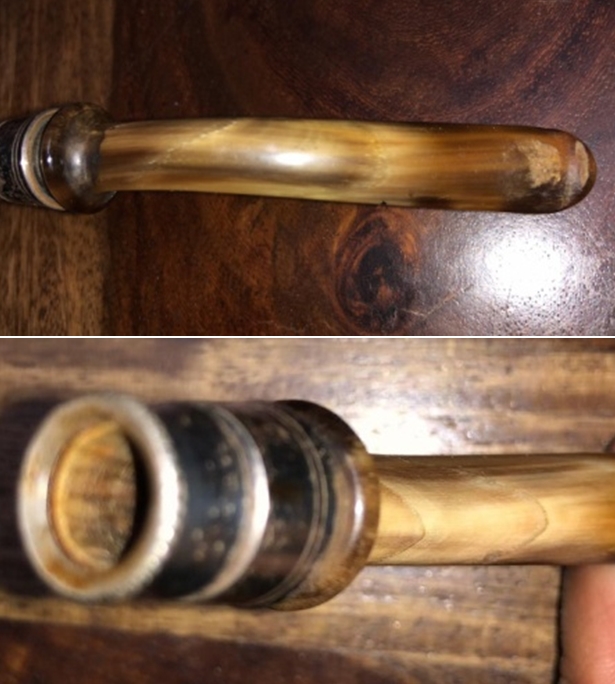
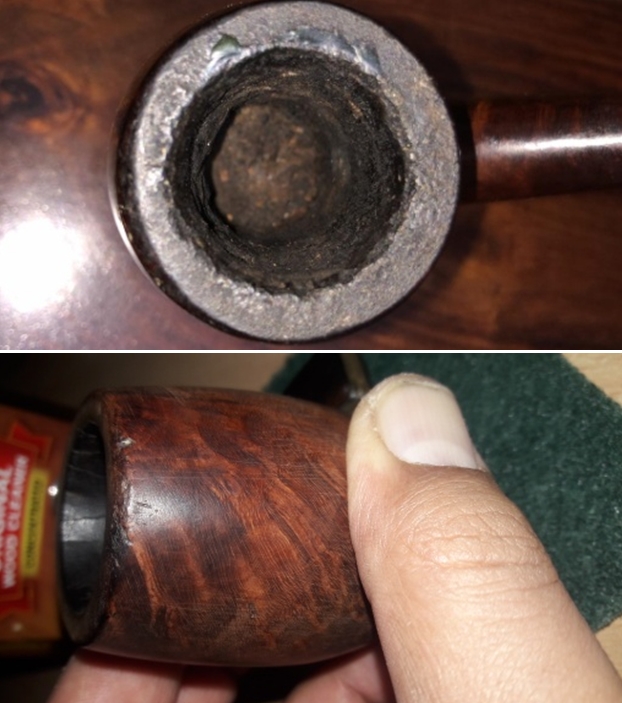
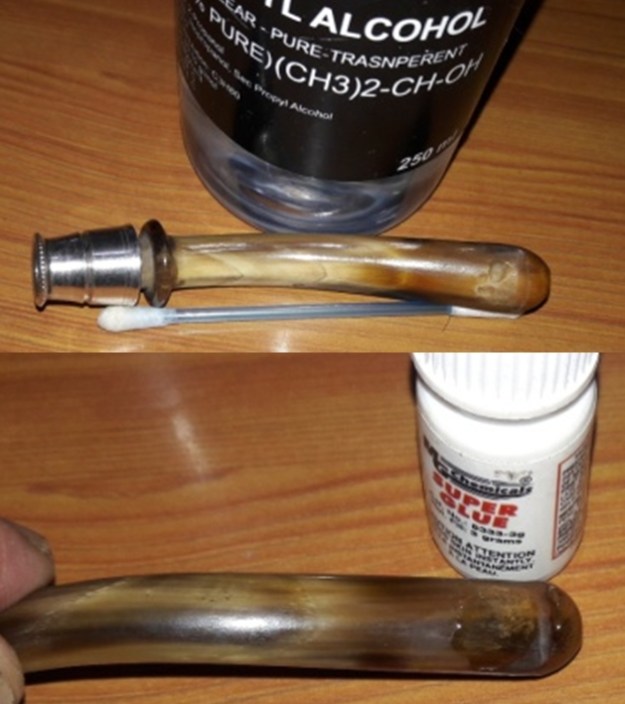
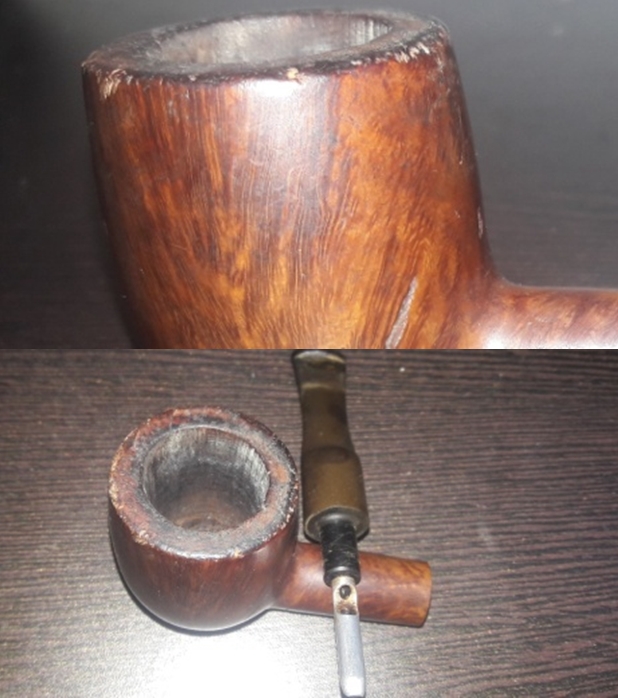
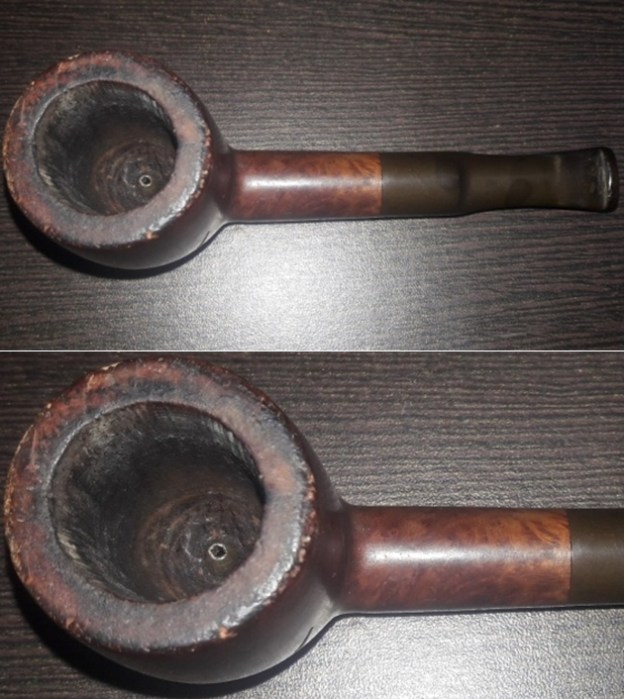
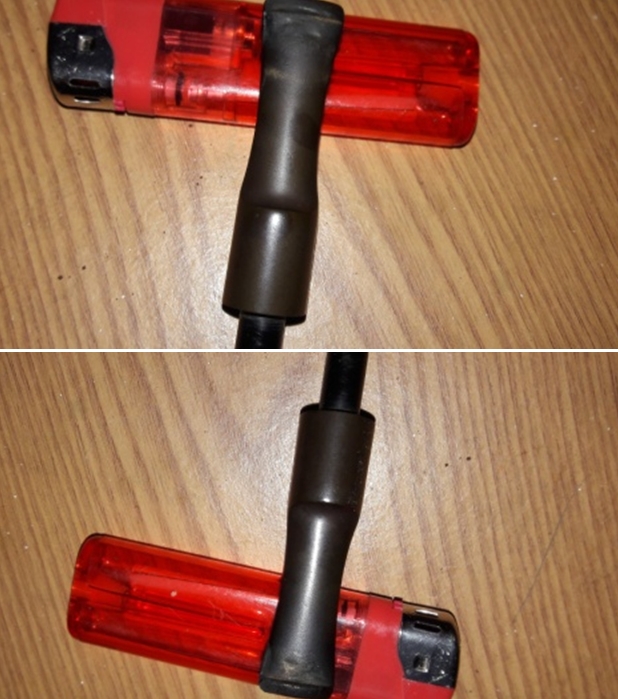
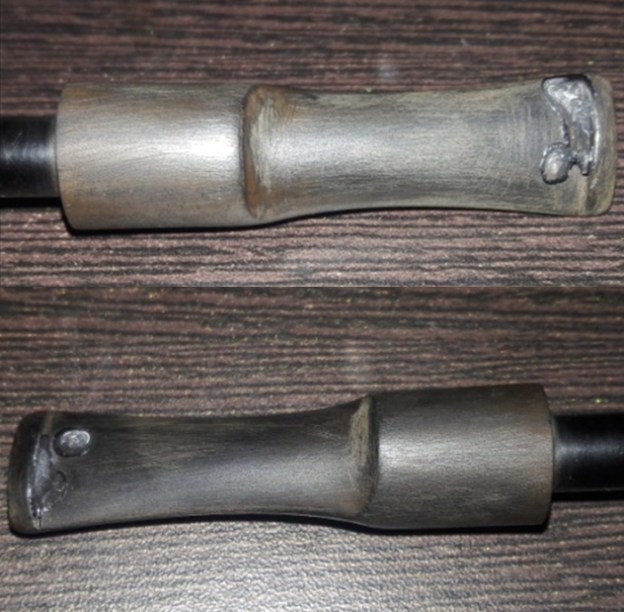
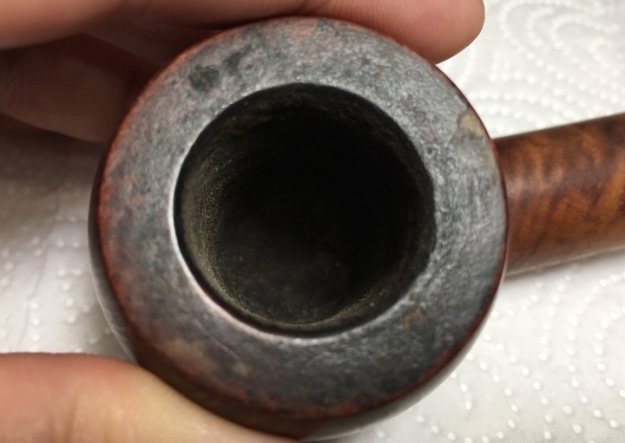
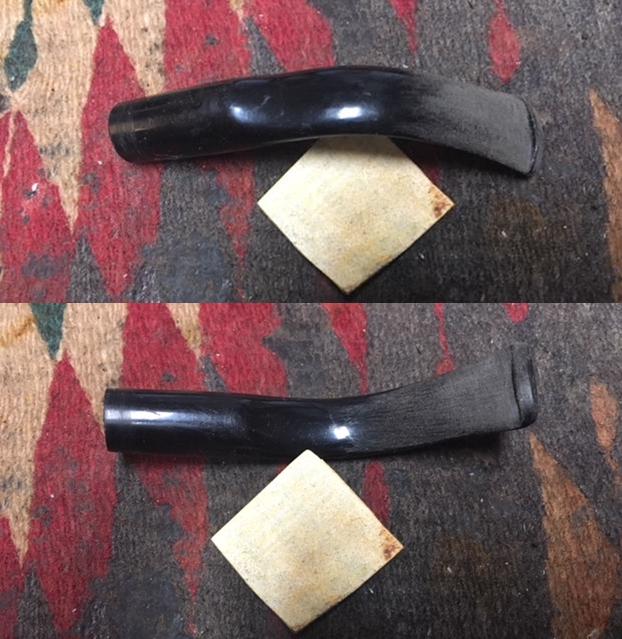
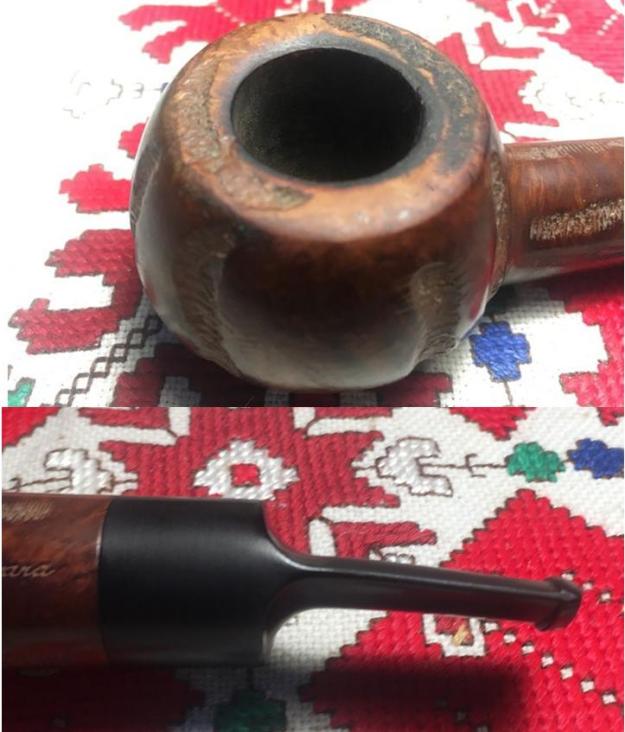
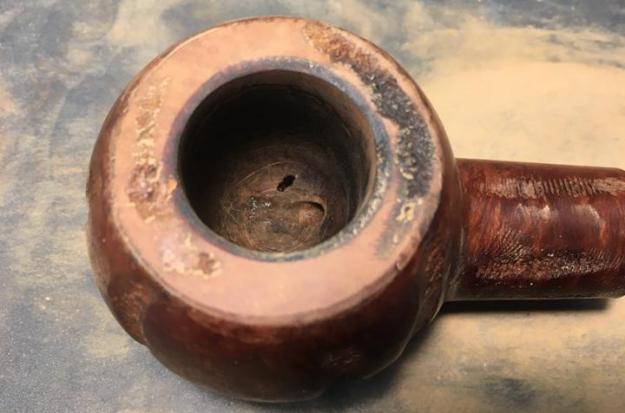
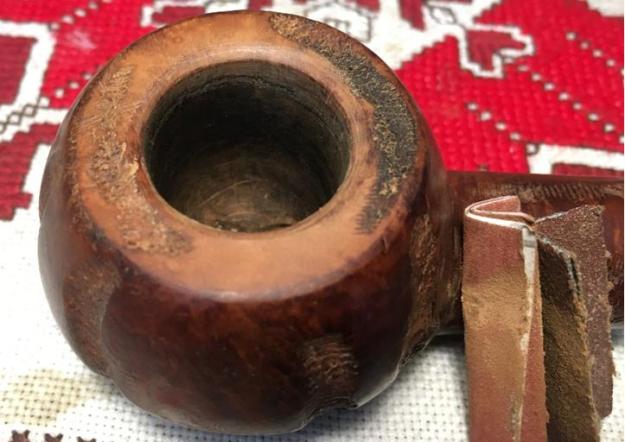
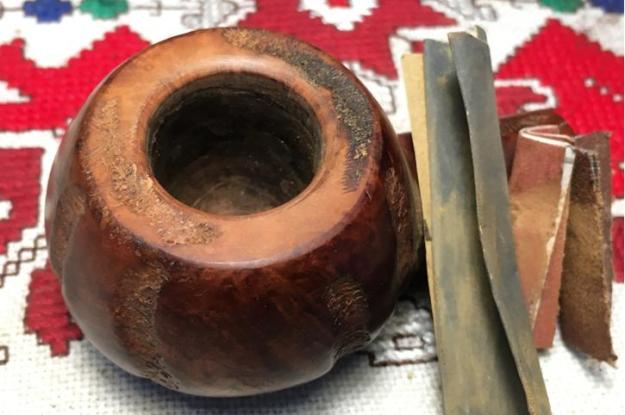
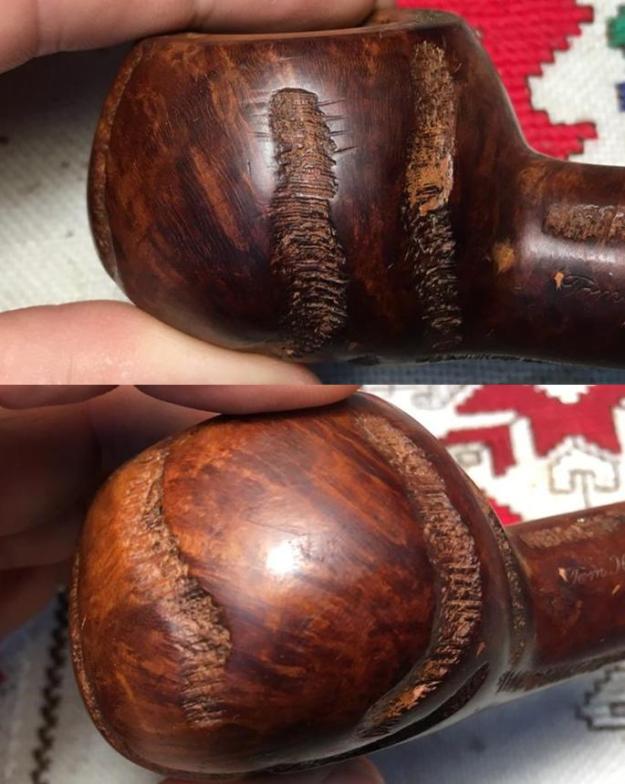
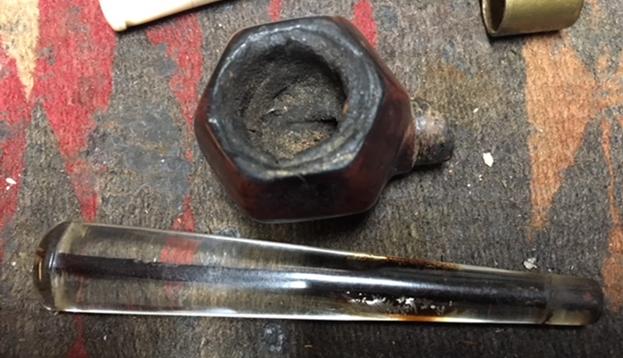
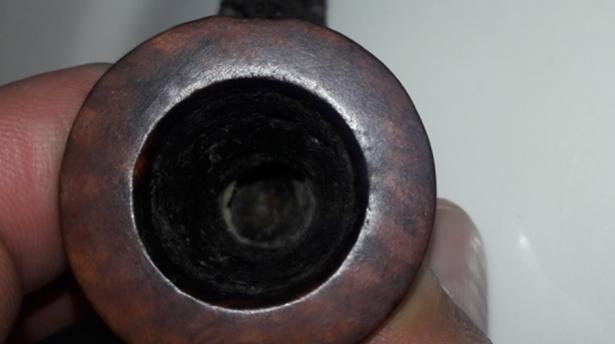
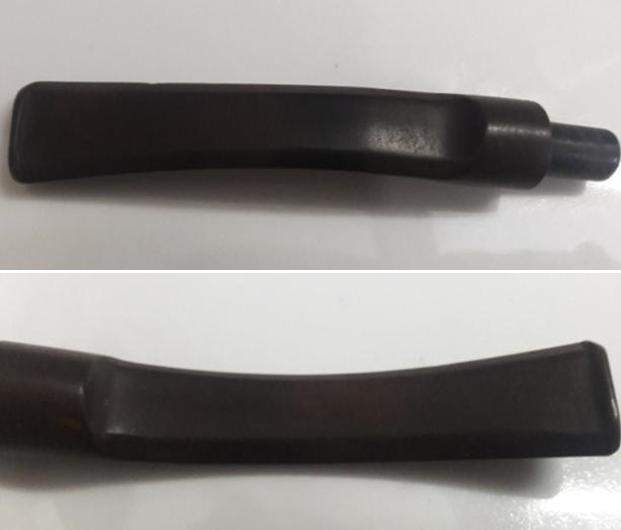
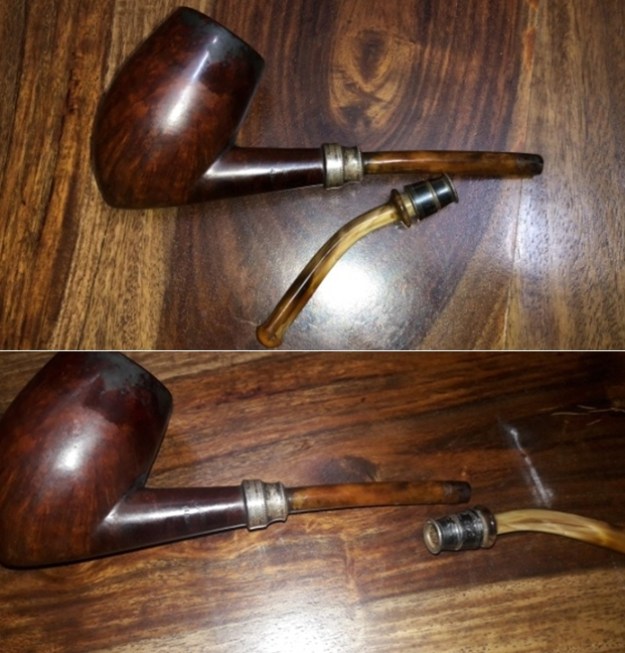
Well, even before I could start my initial visual inspection, I faced the first of the many numerous hurdles that I had to overcome during the restoration of this pipe. The shank extension and the stem would not budge even a millimeter to separate from the shank and the bone extension respectively. I remembered Mr. Steve referring to the technique of freezing the stuck parts in the freezer for a couple of hours for easy separation. I followed his advice and had to put the complete pipe in the freezer for a couple of hours as it could not be dismantled. True enough, the horn stem separated from the shank extension with the application of a little force, but the extension would not budge from the shank!!!! So I went back to Mr. Steve to tap in to his wealth of knowledge and experience. He suggested that I should apply the method of “Hot and Cold” shock treatment in which you gently and carefully heat the stuck part using a heat gun and then get it back in to the freezer. This process may need to be repeated a number of times before the parts separate. Well, I did exactly that, albeit heating with a hair dryer as I did not have a heat gun, and after 3/4 attempts, the extension finally separated from the shank!!!!The first thing that I noticed was that the shank extension and the mortise were completely filled with oils, tars and grime. The shank extension was filled to an extent that a pipe cleaner would not pass through!!!! How very much typical of my Old Man!!!!!!! Through all this muck, just a swipe of the bone extension with a cotton swab dipped in isopropyl alcohol revealed no apparent damage to the shank extension. Cleaning this would need to be a very careful, meticulous, time consuming and a tedious process given the delicate structure of such a vintage bone. Likewise, the tenon also was filled with oils and grime. Air flow through the stem was laborious to say the least!!! Both the upper and lower surface of the horn stem shows significant damage. The lower surface is peppered with 3-4 worm holes with one significantly larger than the other. Thankfully, it had not migrated through the upper surface!!!! The tenon is completely and permanently encased in the sterling silver ornament. The condition of the stummel was an equally horrendous story. Firstly, the rim top is heavily covered in overflowing lava. The overflow is so heavy that it has accumulated over the rim surface in blobs of dried tar and tobacco oil which can be seen in the subsequent pictures. This overflow had not restricted itself to accumulation on the rim top, but has spilled on to the stummel surface covering the stummel in sticky grime which has attracted more dirt and dust giving the stummel a dull and lackluster appearance. The overflowing lava has even accumulated in the junction where the shank and bowl are joined.  Some dents and dings are seen on the surface through the overflow and I do not envisage any major issue like the ones I faced while working on an Imperial Yello-Bole Carburetor that I had I restored. However through all this dirt, tar, oil, grime and damage, lovely grains can be seen on the sides and the shank. It will be a challenge to address these issues and make the grains to reveal themselves in all glory. The chamber is no different story!!! There is a thick build up of cake in the chamber. The inner edge of the rim is covered under the thick cake and as such, its condition can be commented upon only after the cake has been scrapped. The outer edge of the rim, however, shows significant damage in the form of dents, dings and deep scratches to the front in 12 o’clock direction. The cause for this damage is….. Oh, forget it, let’s not even go there!!!! The condition of the inner walls of the chamber can be ascertained only after the chamber has been completely reamed devoid of any cake, but I do not foresee any major damages here as the stummel feels solid to the touch and this huge solid piece of briar can sustain some serious damage. You have to feel the stummel in your hand to understand what I am trying to write. It is one heavy and handful of a pipe!!!!The sterling silver ferrule and tenon ornament was black as is typically seen in heavily oxidized silver. However through all this discoloration, delicate, intricate decorative design can be appreciated. This is another pointer towards the vintage of this pipe.THE PROCESS
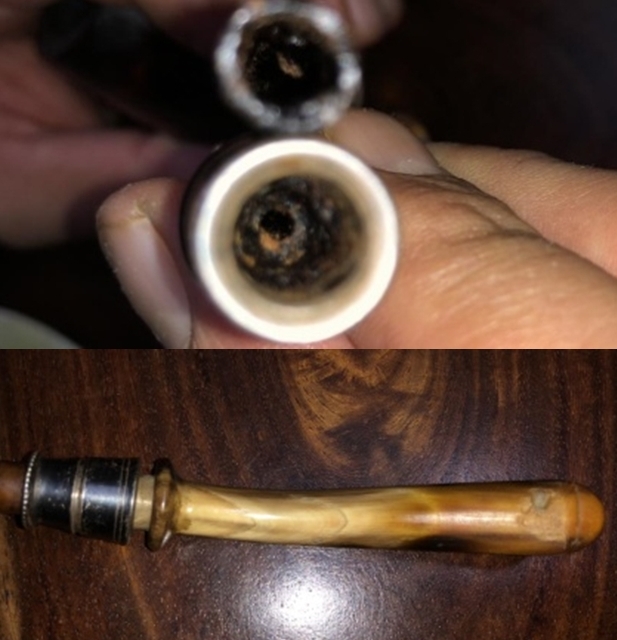
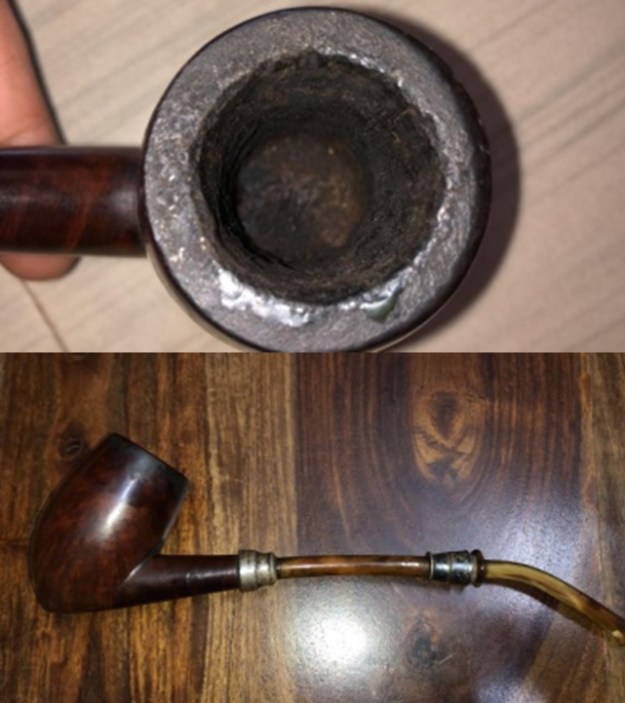
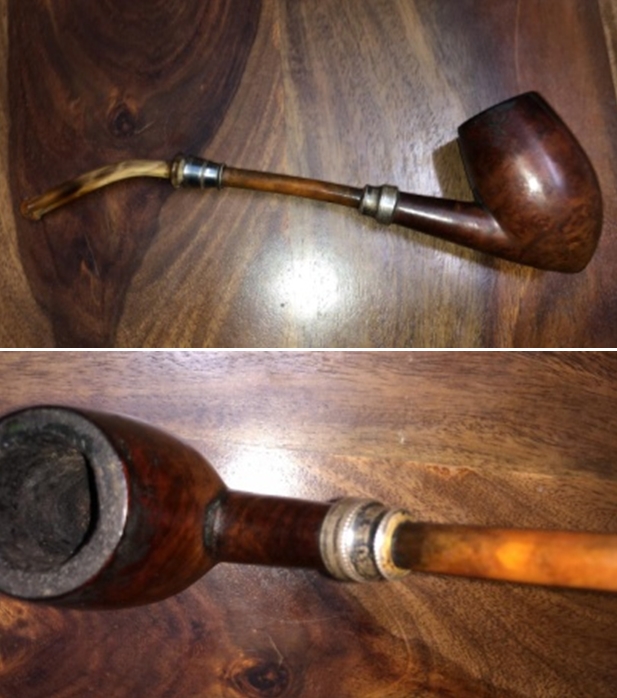
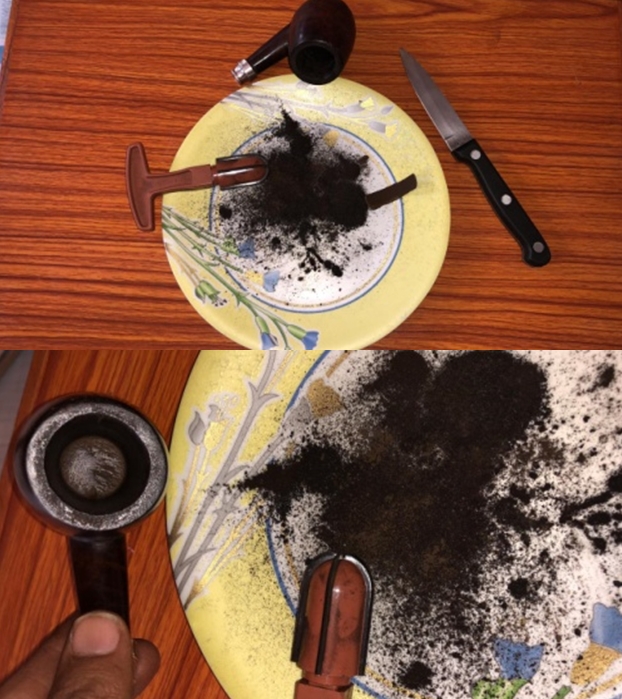
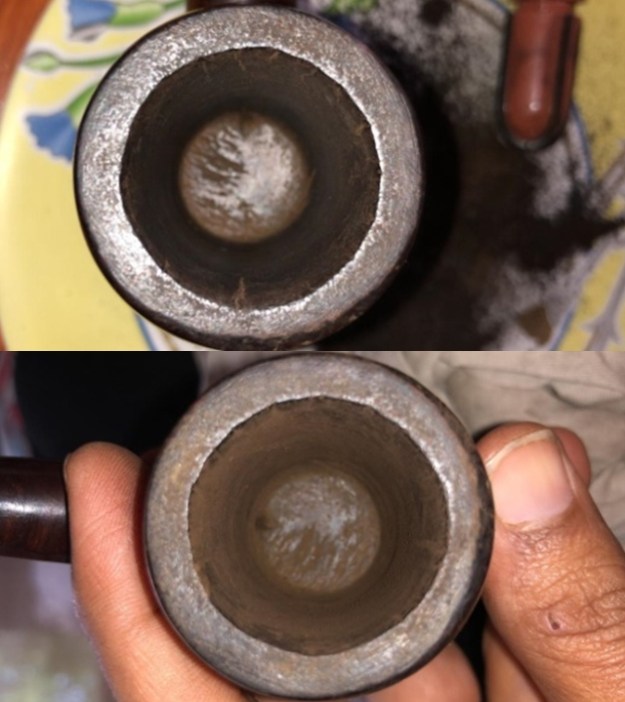
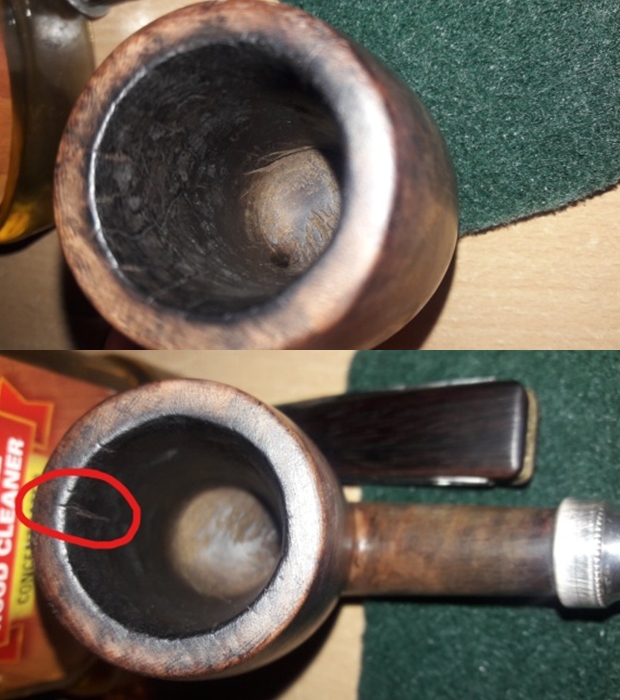
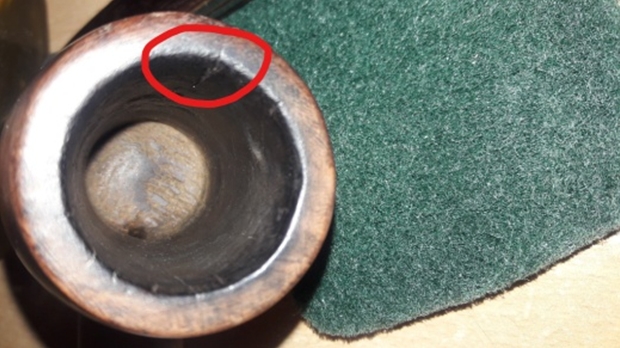
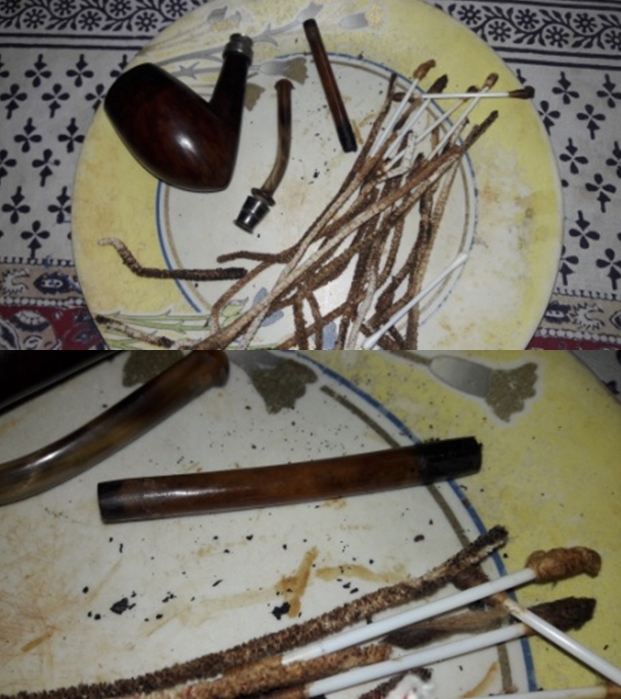
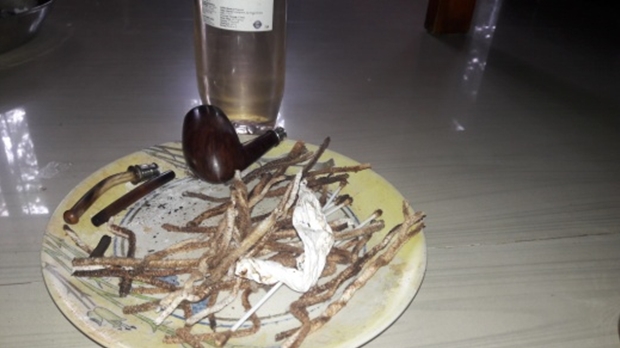
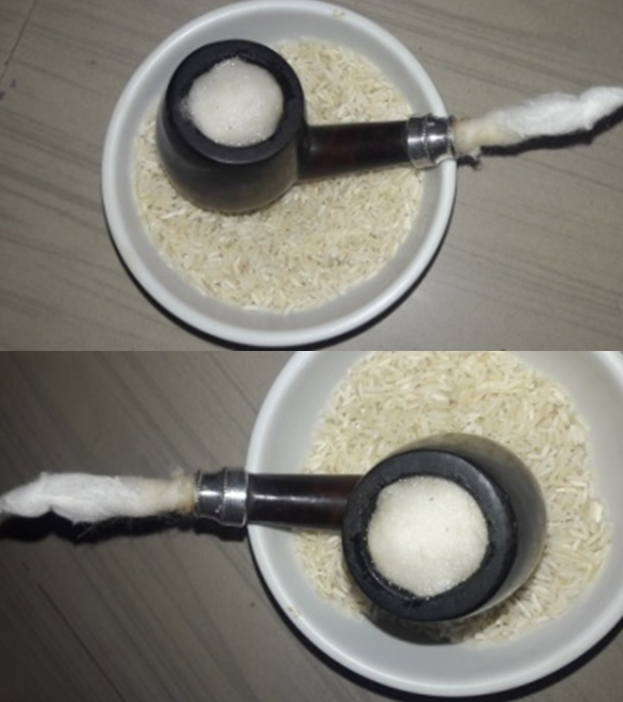
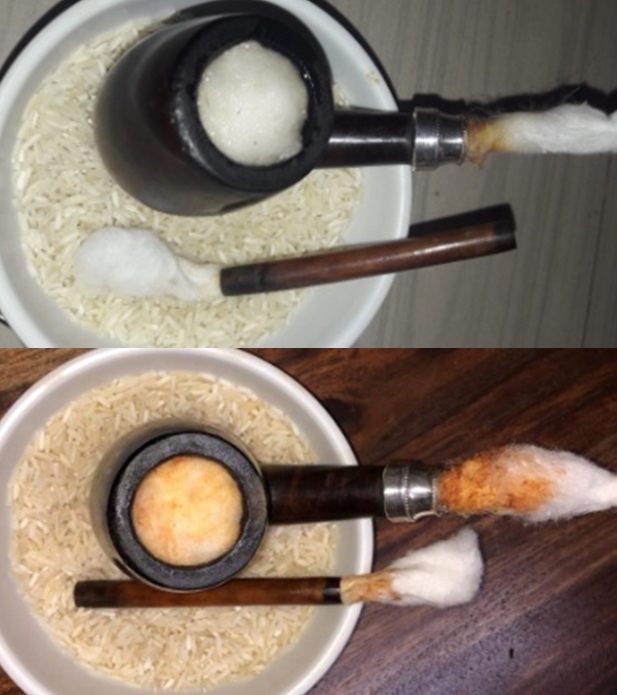
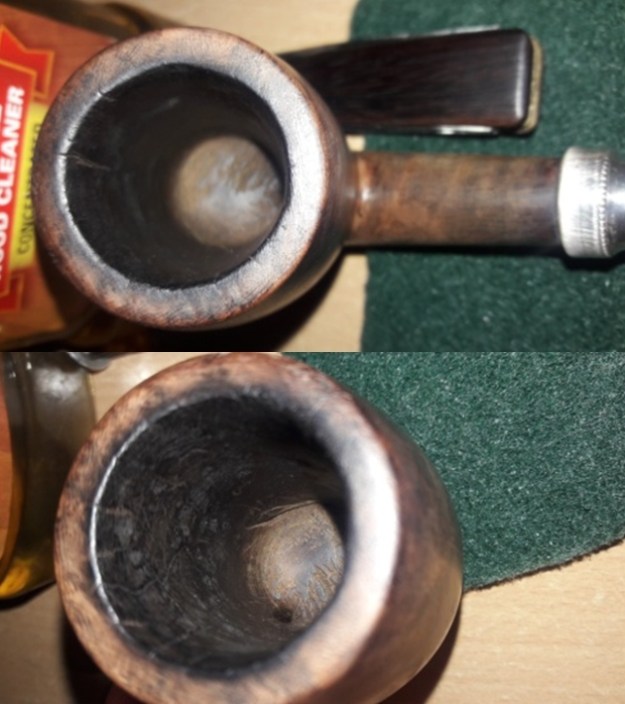
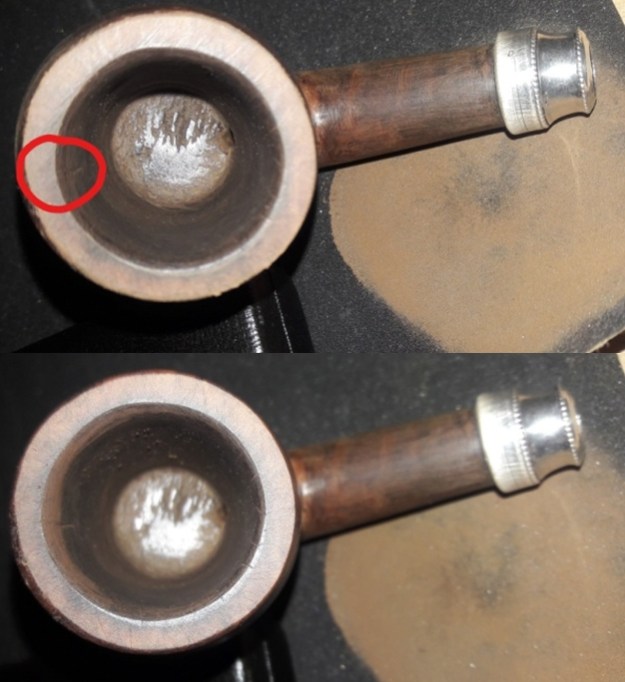
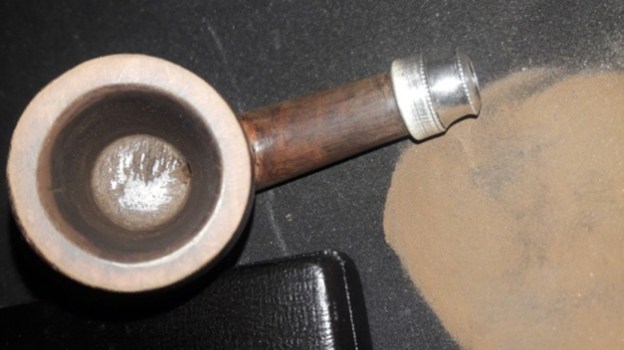
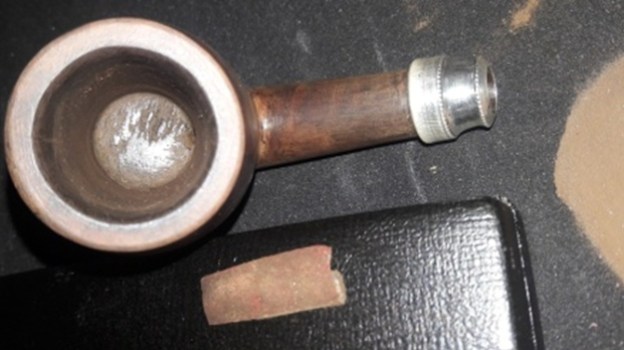
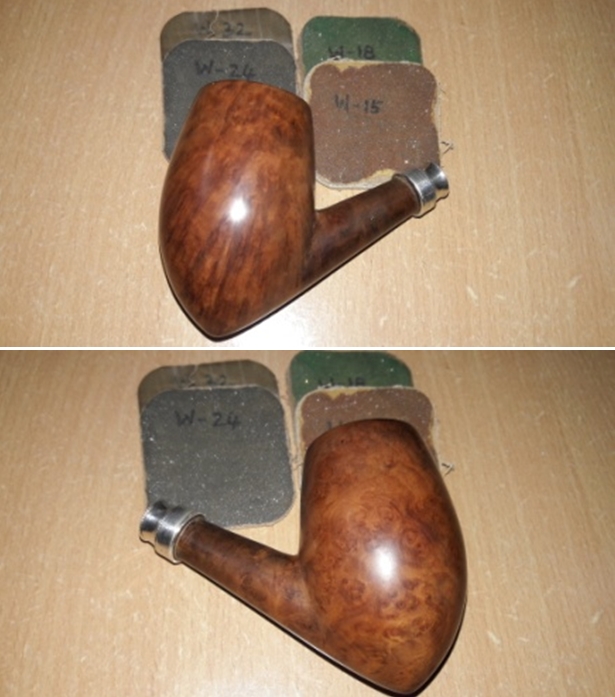
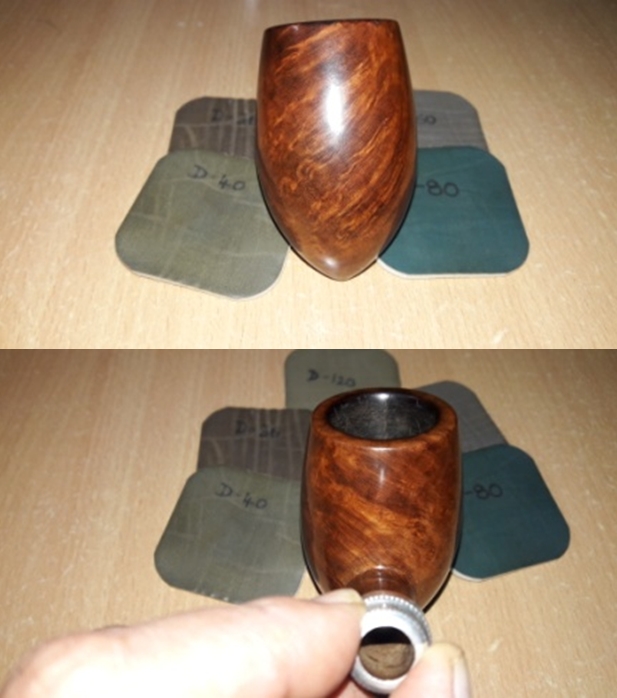
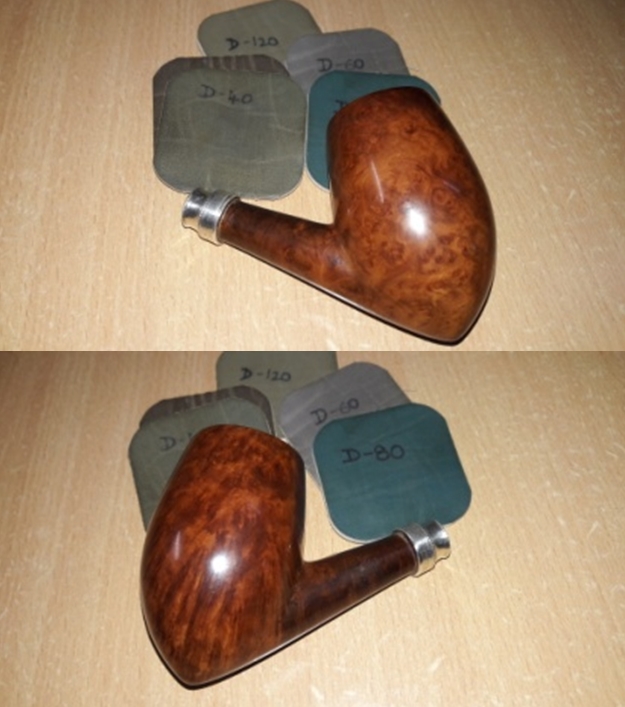
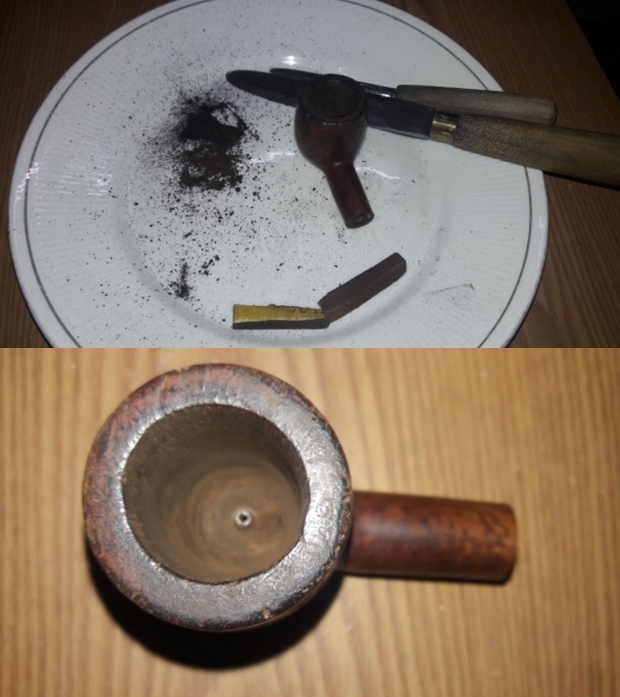
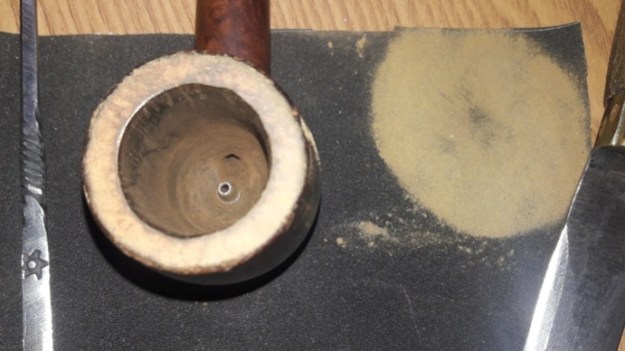
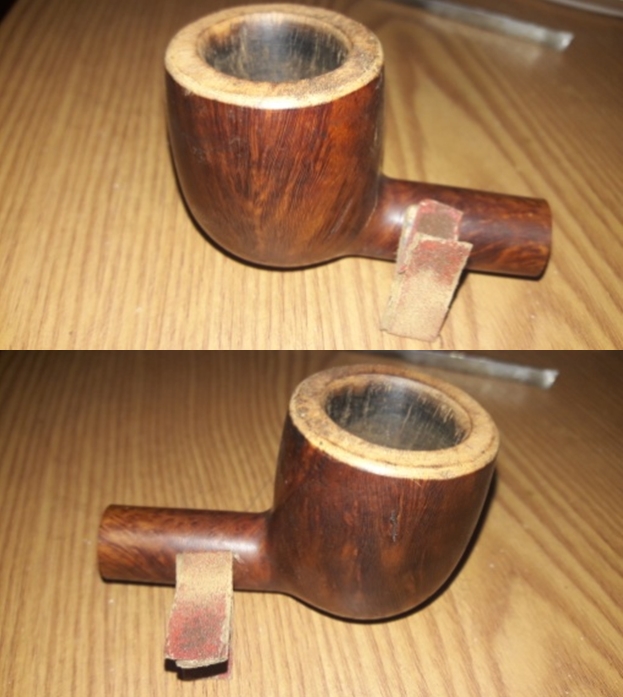
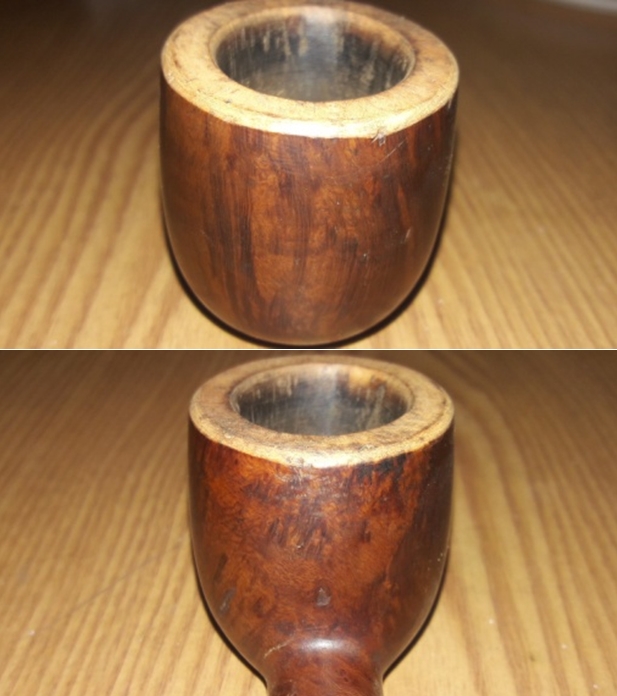
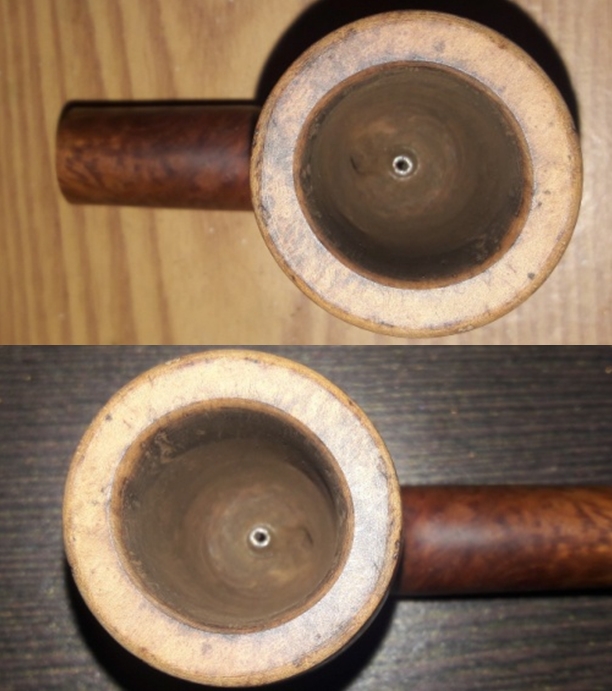
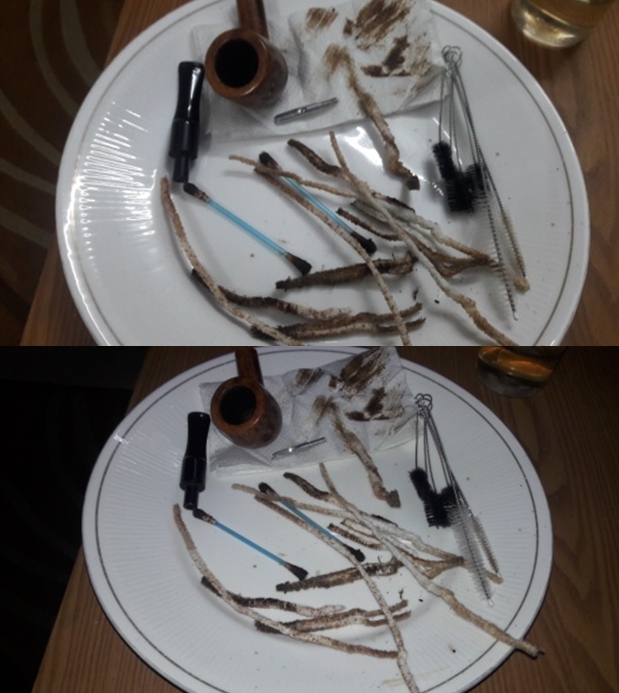
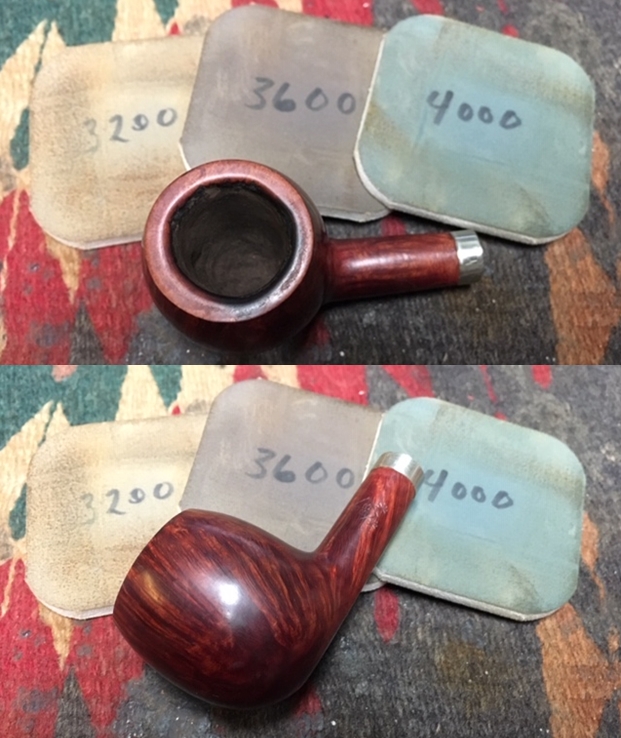
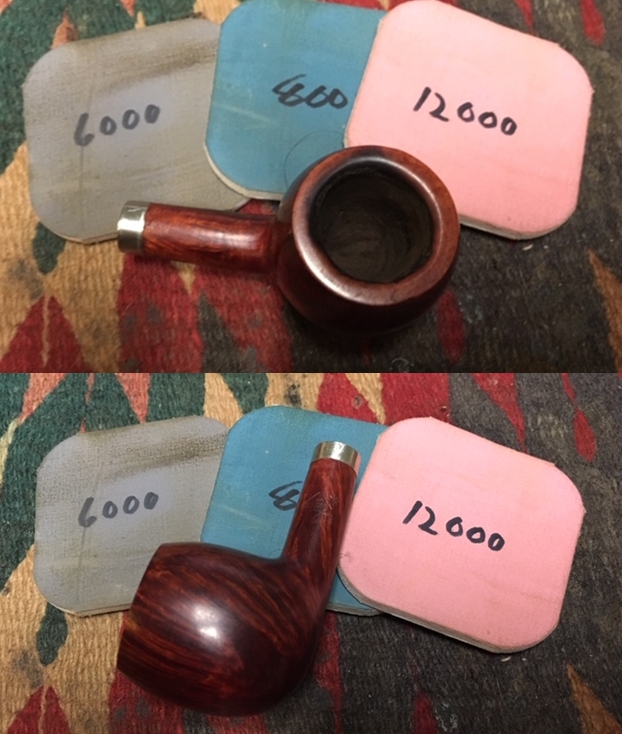
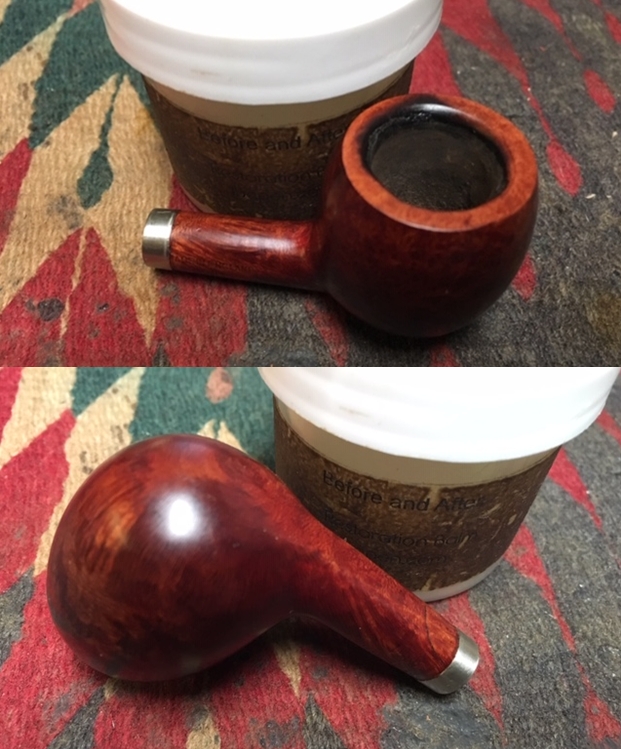
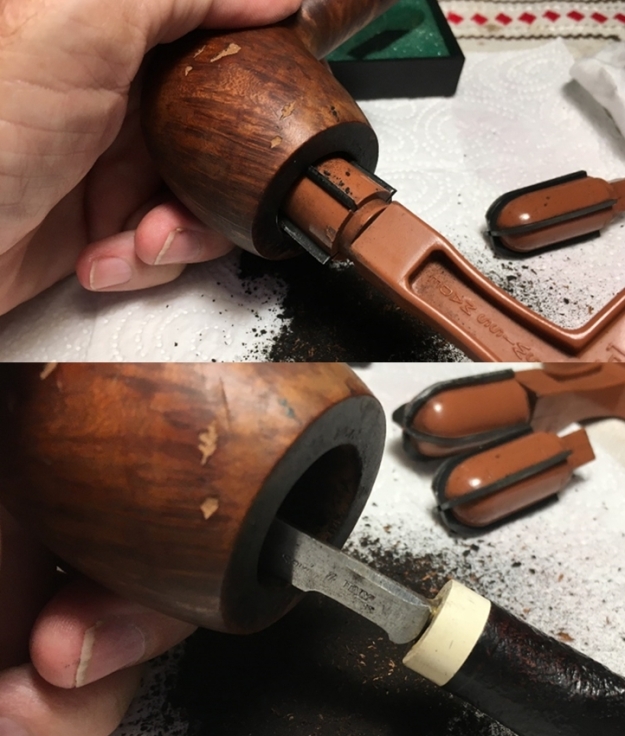
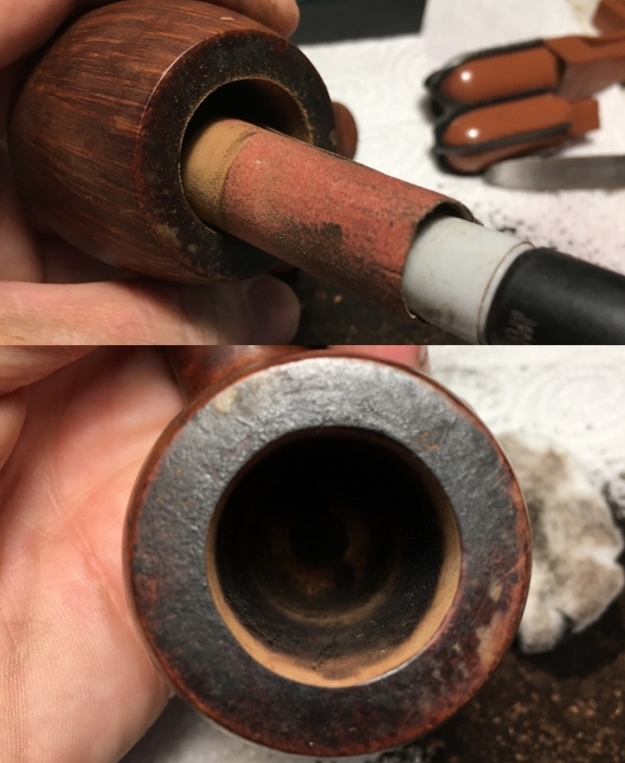
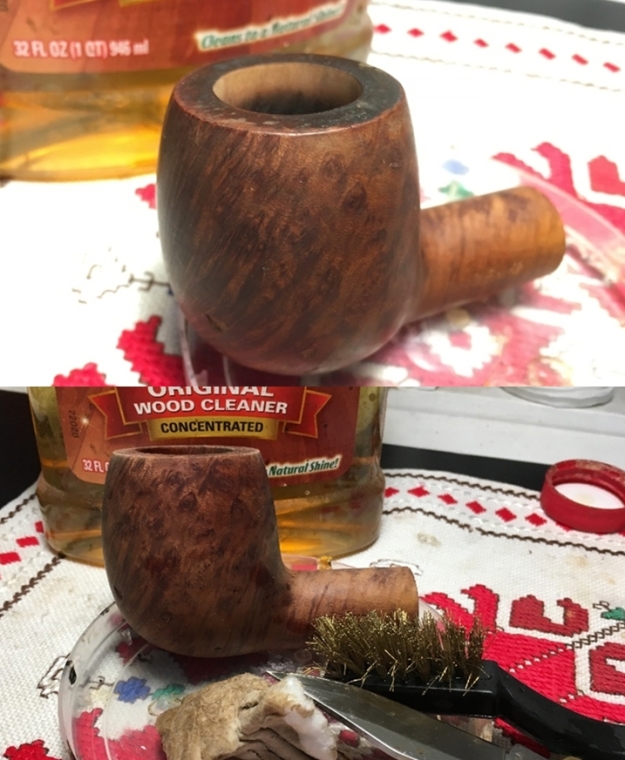
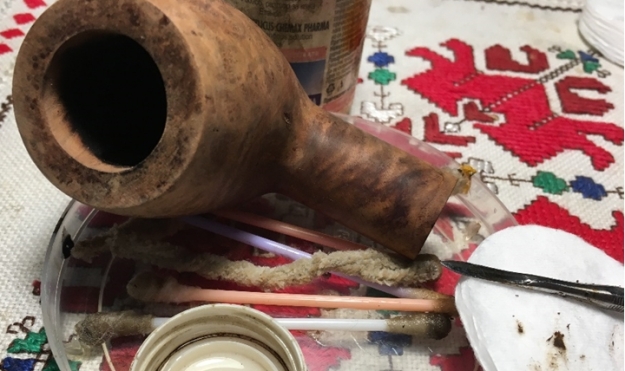
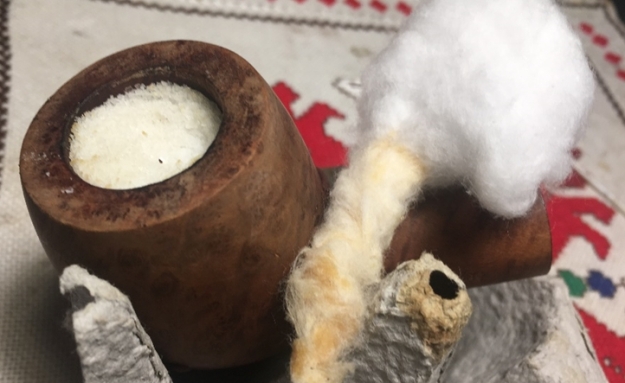
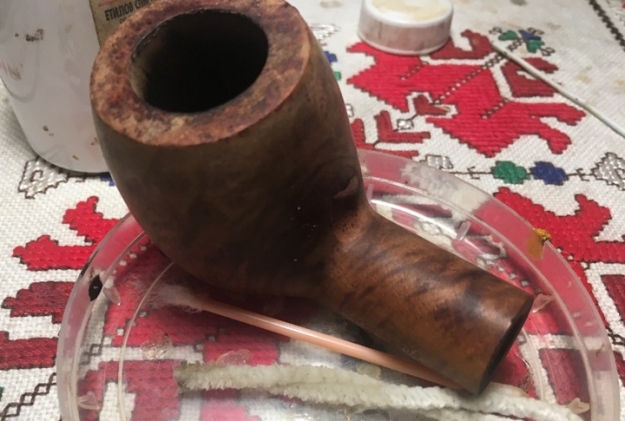
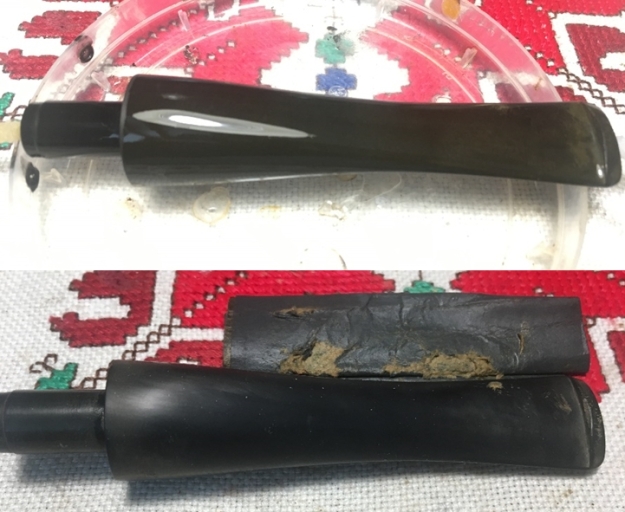
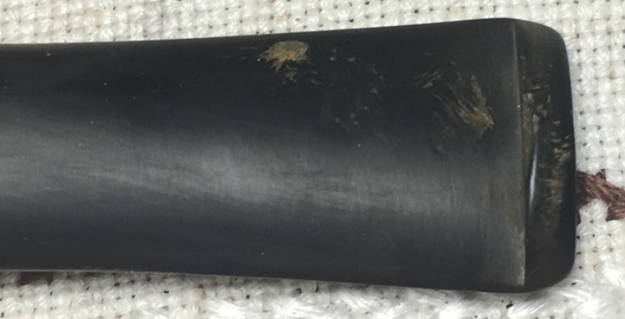
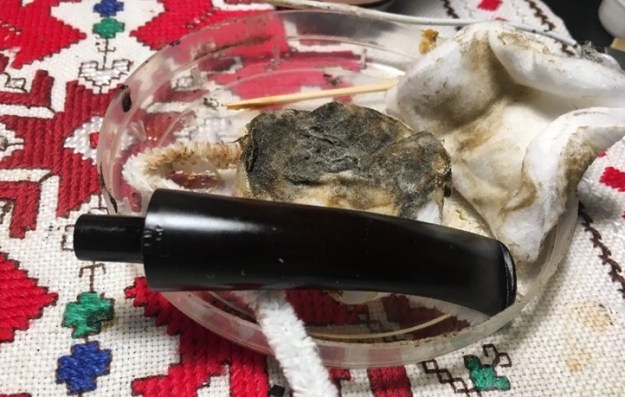
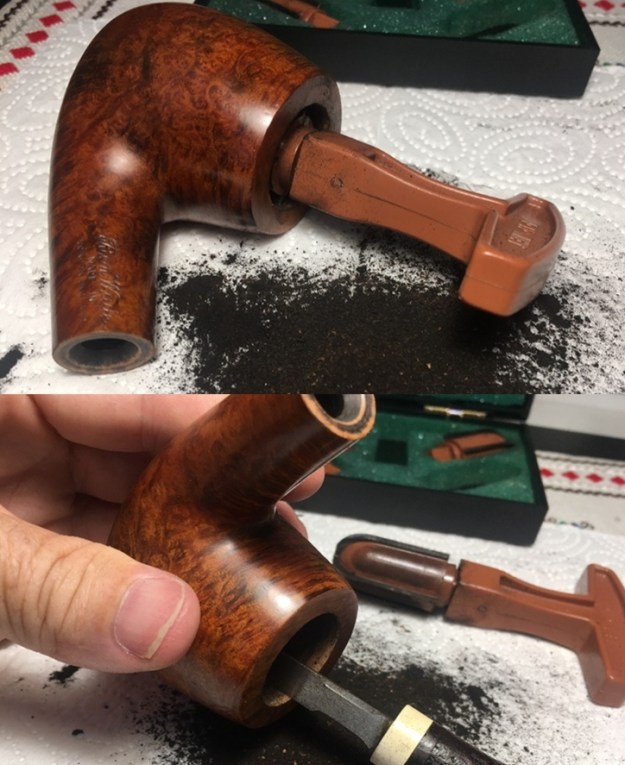
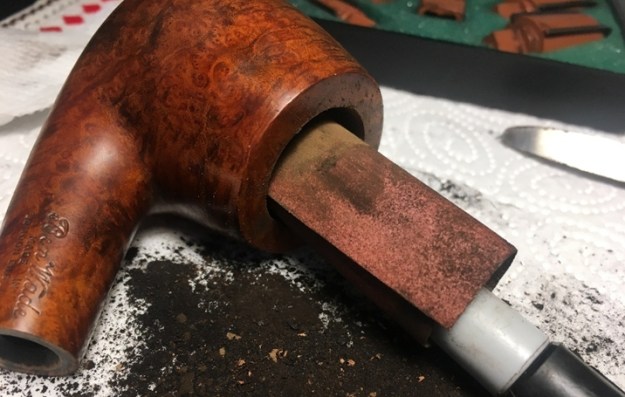
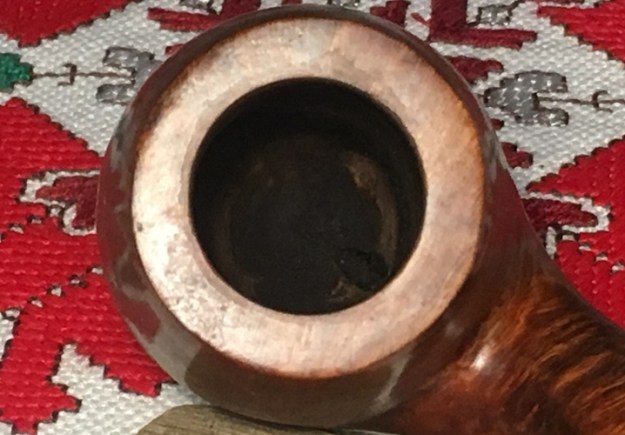
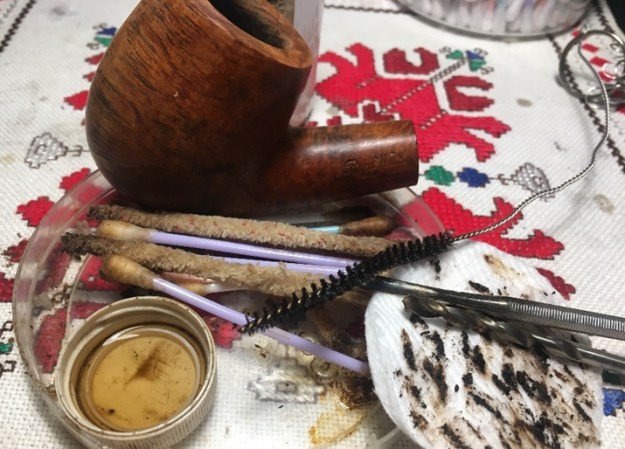
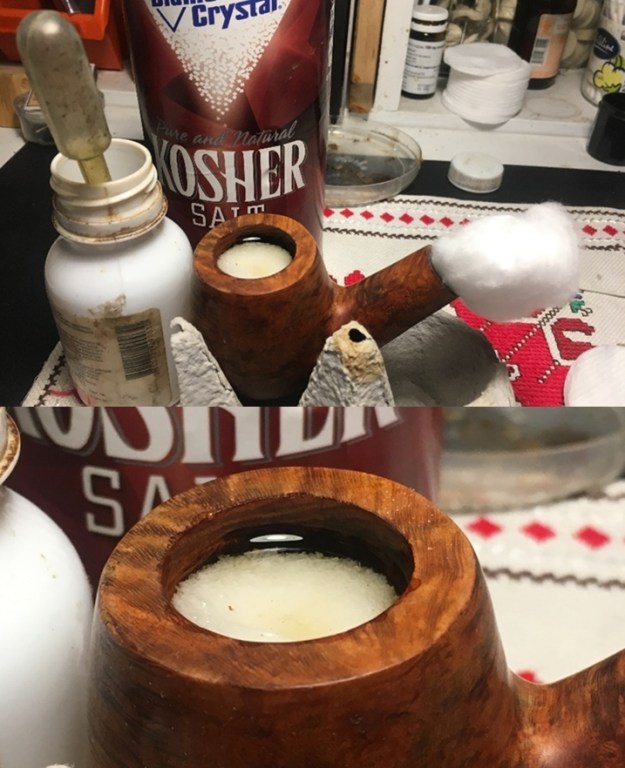
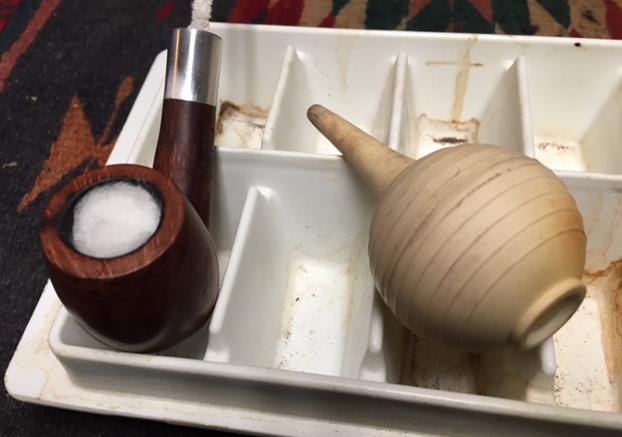
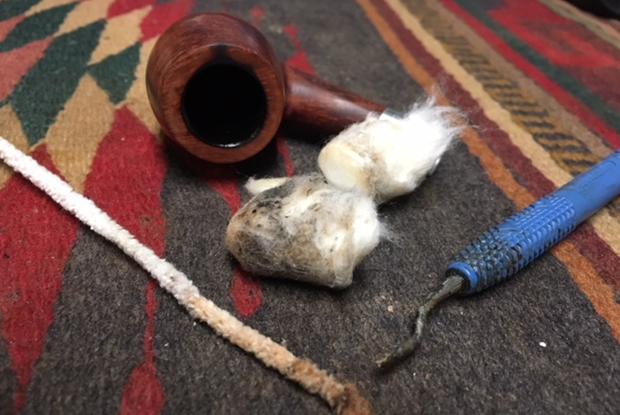
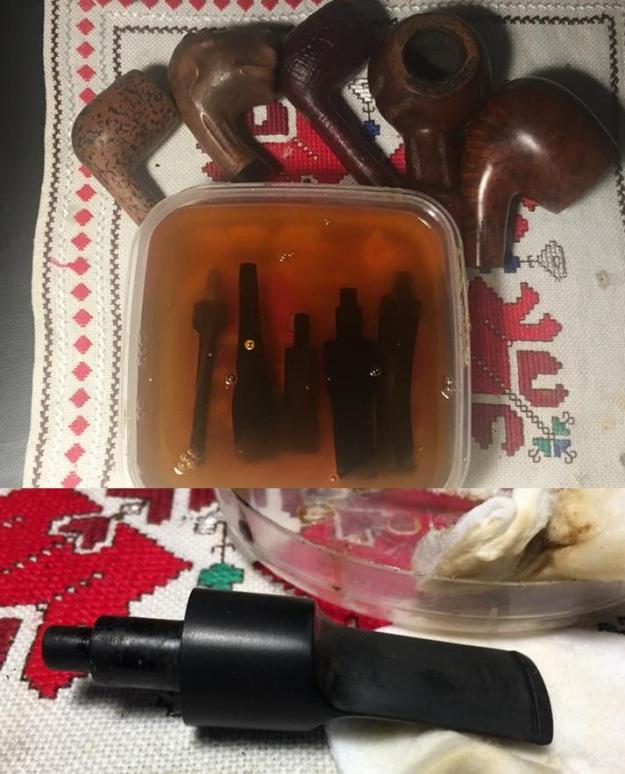
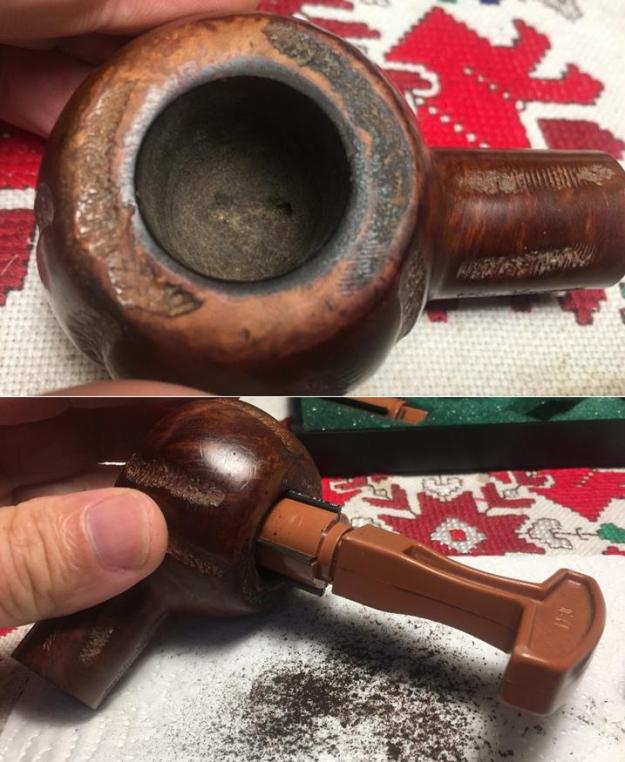
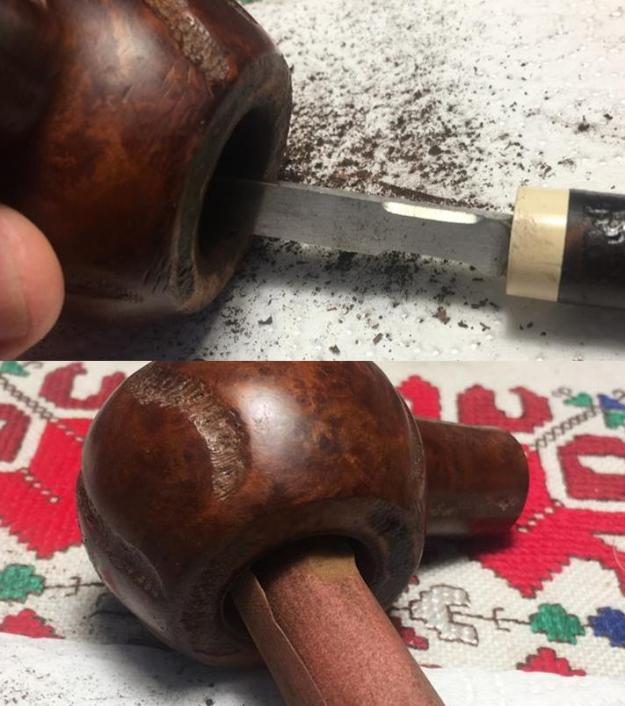
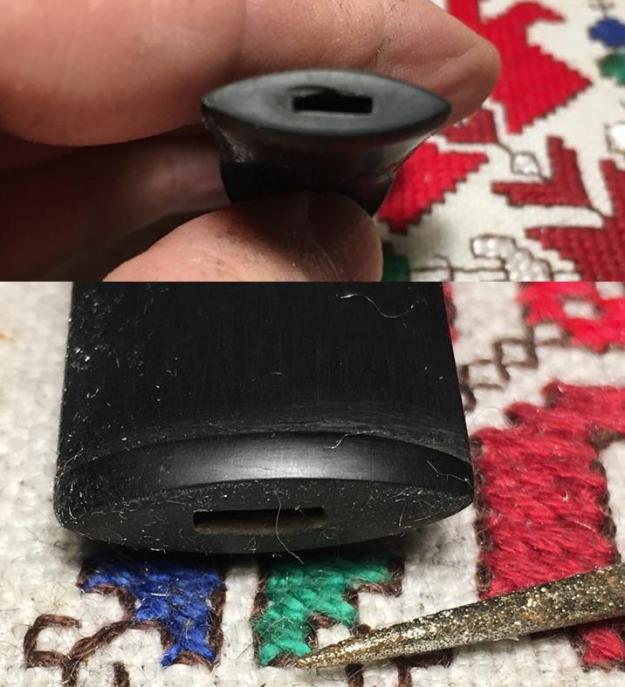
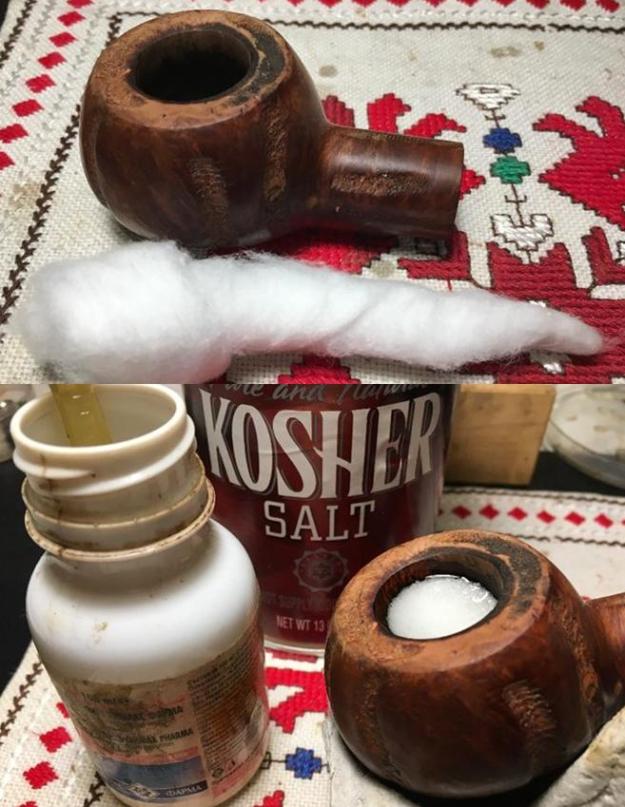
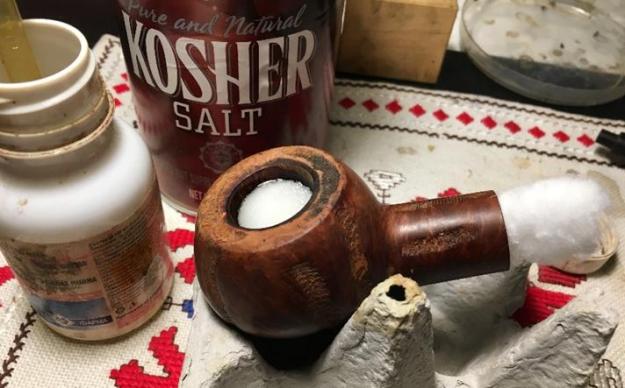
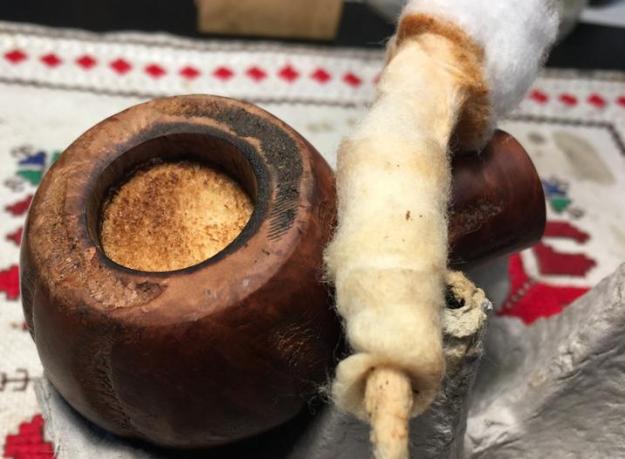
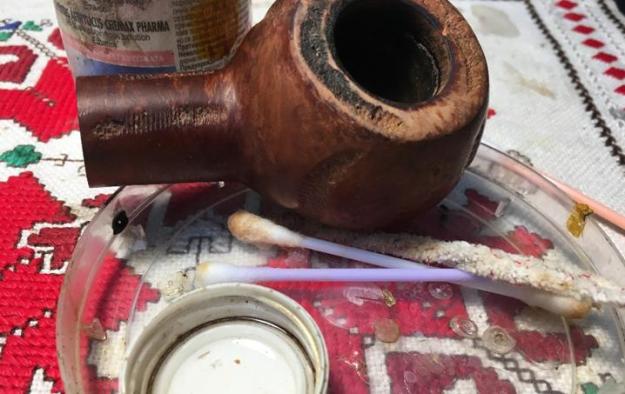
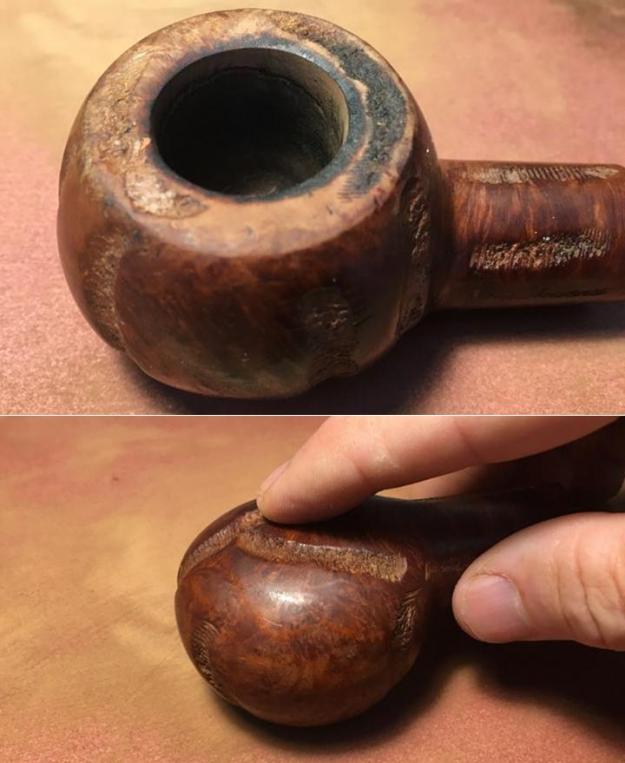
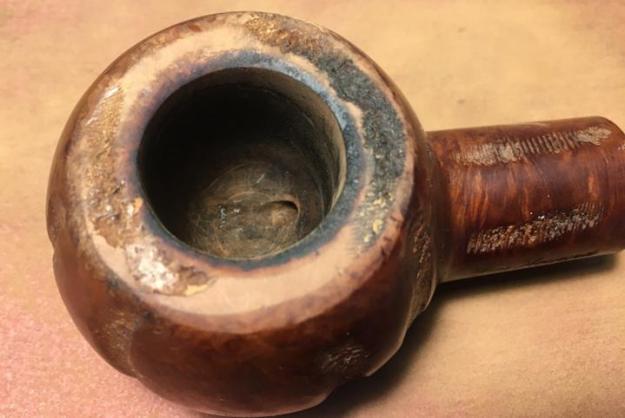
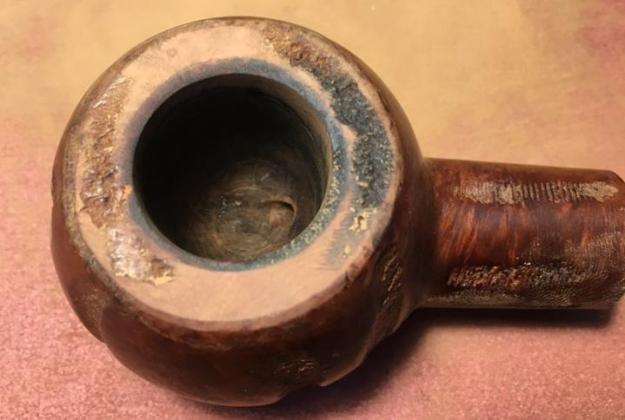
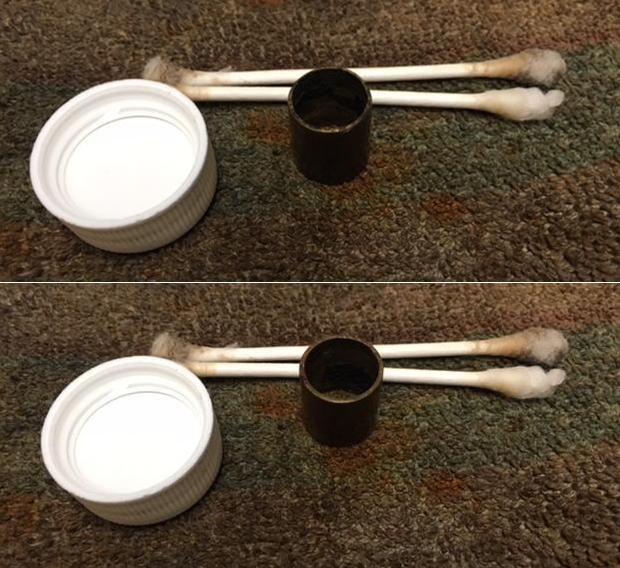
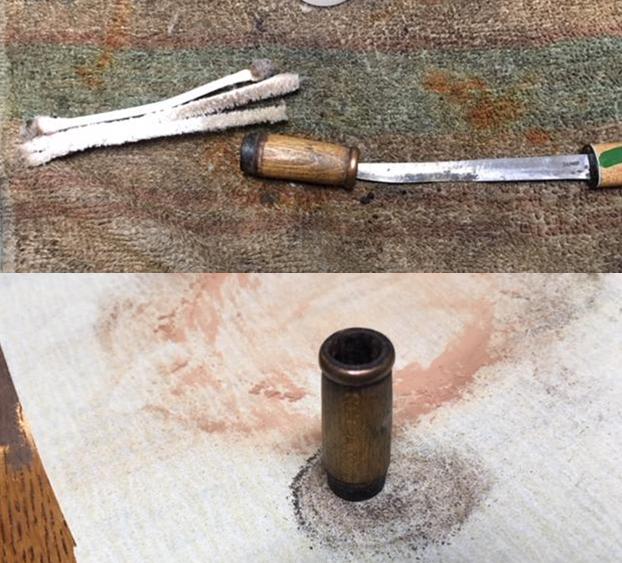
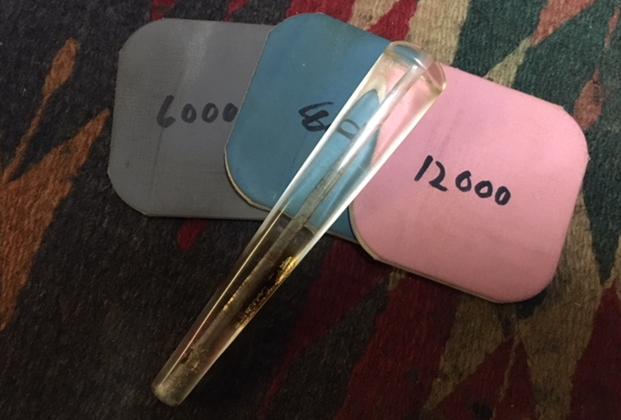
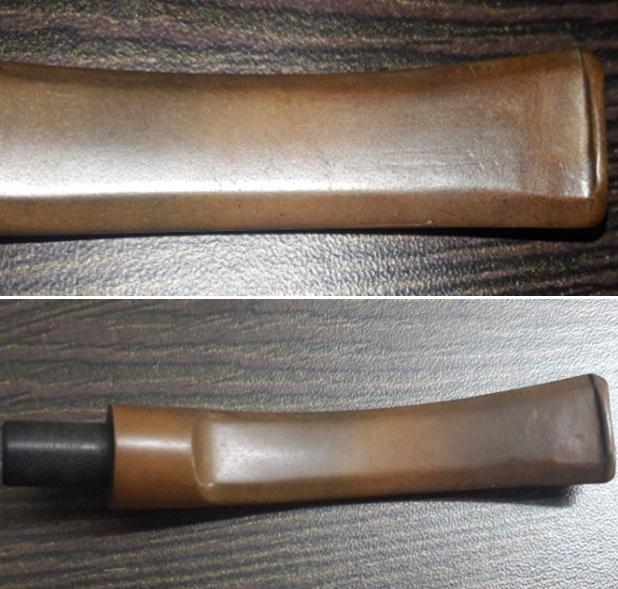
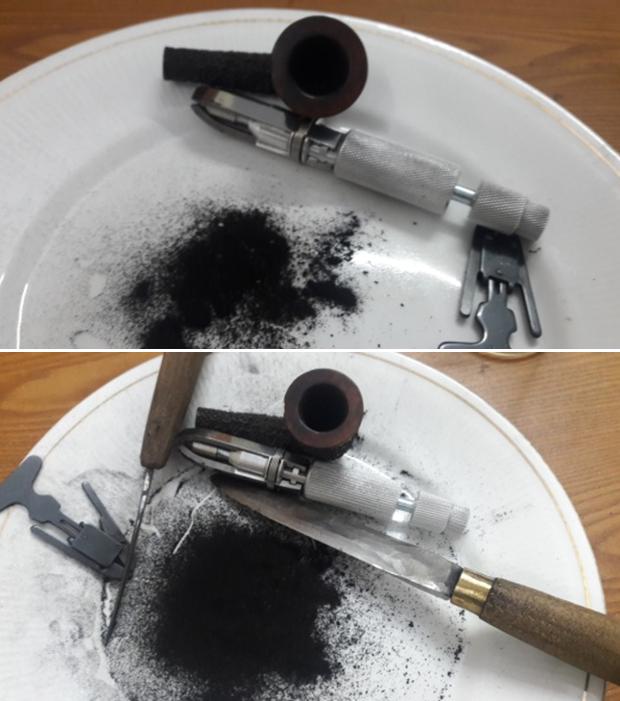
I started the process of restoration by polishing the sterling silver ornaments at the shank end and tenon with pipe ash as suggested by Mr. Steve. This was followed by reaming the chamber with size two of the PipNet reamer head and progressing through to size four. Yes Sirs, there is no typo error!!! It is indeed PipNet and not a Kleen Reem reamer as you have gotten used to reading in my write ups !!!!!! Mr. Steve has sent me a set along with some beautiful pipes that I had got from him. I followed up the reaming with scrapping the remnants of the cake from the walls, flat bottom of the chamber and the rim top surface with my fabricated knife (Oh, how I long for a Sav Fitsall reaming knife!!! Hope you are reading this Steve Sir). The cake was so hard, that I invariably ended up scratching the flat bottom surface while scraping. Once the cake was reamed back to the bare briar, I used a 150 grit sand paper followed by 220 grit sand paper to remove all the traces of remaining cake and also to smooth the inner walls of the chamber surface. Finally, to remove the carbon dust, I wipe the chamber with a cotton pad wetted with isopropyl 99%. I gently scrapped the rim top surface with a sharp knife. Removing all the cake from the chamber and rim top revealed that firstly, the rim was out of round and secondly was a web of fissures along the internal walls. There was one crack, which showed prominently after a cleanup with Murphy’s oil soap, bothered me and can be seen in the pictures below which has been highlighted by a red circle. I shared these images with Mr. Steve and Mr. Dal Stanton for their opinion as to the extent of damage and further repairs. They too expressed fears that the crack may have migrated through the stummel. Mr. Steve suggested picking the crack on the top of the rim using a toothpick and filling it with CA superglue. I decided that I would address this issue later after further investigations. I cleaned the internals of the shank, shank extension and the stem using hard bristled and regular pipe cleaners, q-tips, shank brushes, all generously dipped in isopropyl alcohol. I had never used such drastic measures like initially cleaning the bone shank extension by carefully inserting a round needle file for creating an opening through which pipe cleaners could pass through for subsequent cleaning. The heap of pipe cleaners and q-tips that are seen in these pictures are just the proverbial tip of the iceberg. I must have gone through an entire packet of 50 of both types of pipe cleaners, in addition to the q-tips and brush cleaning!!!!! To further deep clean and refresh the internals, I used cotton and alcohol soaks. Using a cotton ball to create a wick, I inserted it through the mortise and into the airway. I then stuffed the bowl with tightly packed cotton balls and placed it in bowl filled with rice grains to provide stability. Similarly I made a tight cotton wick and inserted it through the bone shank extension to further remove all the oils, tars and smells. With a large eye dropper, I then filled the bowl and the bone shank extension with isopropyl 99% until it surfaced over the cotton. I refilled the alcohol in a few minutes after it was absorbed into the cotton balls. I put the stummel and the bone shank extension aside for several hours to soak. After some time, the cotton and the wick were soiled. I discarded the expended cotton and wiped the bowl and the bone shank extension with paper towel. To make sure all was clean, I used a cotton bud and pipe cleaner dipped in isopropyl 99% and they came out clean. I cleaned the stummel with undiluted Murphy’s oil soap and Scotch- Brite pad and rinsed the stummel under running tap water. This cleaning helps in bringing to the fore any other damage which could be hidden under all the dirt and grime. Fortunately, there were no major dents, dings or gouges to the stummel. There were a few minor ones which I think would be addressed when I would sand the stummel surface and subsequent micromesh polish. I dried the bowl with a paper towel and soft cotton cloth. Initially I had decided that I would not be topping the rim top and maintain its original profile. However, in order to ascertain if the crack had migrated through the stummel, I decided to top the rim surface. This would also help to address the numerous dents, dings and scratches on the rim’s top surface and also to remove traces of lava overflow. I topped the rim surface on a 220 grit sand paper. Though it is recommended to have a wooden board with the 220 grit sand paper firmly fixed over it, I just keep the sand paper on a flat table top, holding it firmly with my left hand and rotating the stummel rim top over it with my right hand. I have come to realize that this set up gives me lot more freedom of movement, better control and convenience of storage. Fortunately, it was revealed that the supposed crack was superficial and had not migrated through. Staying with the rim, the next issue that I addressed was the inner rim edge. With a folded piece of 180 grit sand paper pinched between my thumb and fore finger, I created a light bevel on the inner edge. This addressed the issue of uneven and out of round inner edge. The damage to the outer edge was addressed to a great extent when I had topped the rim top surface. Whatever little dents and nicks that remained on the outer edge were very minor, though visible, and I decided to let them be.I sand the stummel surface with a 220, 320, 600 and 1000 grit sand paper, in that order, to remove the minor scratches and marks on the rim and stummel surface. I frequently wiped the sanded surface with a moist cloth to remove the briar dust and also to check the progress of my work. Once I was satisfied with the match, I followed it up by micromesh polishing pads, wet sanding with 1500 to 2400 grit pads. Again, I wiped the bowl with a moist cotton cloth after each pad. I used the 3200 to 12000 grit pads to dry sand the stummel to a nice shine. I was disappointed when after all my efforts up to this stage; there were some very minute chips that were visible in pictures. But overall, at this stage of restoration, the entire bowl, rim top surface and shank is looking fresh and clean. Even though some of the dents and chips could not be completely addressed and are visible only on very close visual scrutiny, in my view, they lend this pipe a battle scarred warrior like a character. I rubbed a small quantity of “Before and After Restoration Balm” with my fingers deep in to the stummel surface. What this balm does is it revitalizes the briar wood and breathes a new life in to the briar. It’s amazing to see the transformation as the balm works its magic on the briar wood. I further buff it with a horse hair shoe brush. Turning my attention to the horn stem, I cleaned the stem surface, including the worm holes, with q-tips dipped in isopropyl alcohol to remove all the dirt and dust before the fill. I filled the worm hole on the bottom and top surface with clear CA superglue and set it aside to cure.  Once the superglue had cured, I sanded the fills with a flat head needle file. To further match the fills with the surface of the stem, I sanded it with 220, 320, 600 and 1000 grit sand paper. I wiped the stem with cotton pad dipped in alcohol to remove the resultant dust. I rubbed some extra virgin olive oil in to the stem and set it aside to be absorbed in to stem. A few minutes later, I polished the stem and also the bone shank extension with micromesh pads, wet sanding with 1500 to 2400 grit pads and dry sanding with 3200 to 12000. I rubbed a little extra virgin olive oil in to both after every three pads. The stem is now nice, smooth and shiny while the extension though smooth and shiny, still had the golden brownish hues of the tobacco oils and tars. I was wondering as to next course of action, Mr. David Goostree, an experienced member from The Tobacco Pipe Restorer group on FB, provided valuable information that the bone is similar to a Meer and absorbs oils from the tobacco and colours just like a meerschaum. Another issue taken care of!!! To finish the restoration, I mounted a cotton cloth buffing wheel to the Dremel (actually it is not the brand machine, but a local machine which is similar).  I set the speed at about 40% full power and applied White Diamond compound to the entire pipe.  Afterwards, I wiped/ buffed the pipe with a soft cotton cloth to clear it of any leftover compound dust. I then mounted another cotton cloth wheel to the polishing machine, maintaining 40% speed and applied several coats of carnauba wax.  I finished the restoration by giving the entire pipe a rigorous hand buffing using a microfiber cloth to raise the shine further. In my excitement mixed with apprehension in using the polishing and waxes for the first time, I completely missed out on taking any pictures. The completed pipe looks lovely, fresh and vibrant. Thank you for having the patience to reach this far while reading the write up. Your comments are of utmost importance to me for improving my skills in restoration process as well as writing about it. Cheers!!!!!

PS: – During this journey of restoring this beauty, I had, on occasions felt low and demoralized as issues kept cropping up like the supposed crack to the stummel, the shank extension not supposedly cleaning up as I had incorrectly anticipated and the 2/3 occasions when the my polishing machine slipped on the surface and caused very minor scratches on the stummel. However, my Guru and mentor, Mr. Steve was always around with his words of wisdom and encouragement to egg me on towards completing this project. Thank you once again, Mr. Steve. I would like to thank all the esteemed members of “The Tobacco Pipe Restorer” group on FB for their interest and valuable inputs, which made this project interesting.

Reclaiming a Yello-Bole “Imperial Carburator” Vest Pipe


Blog by Paresh Despande

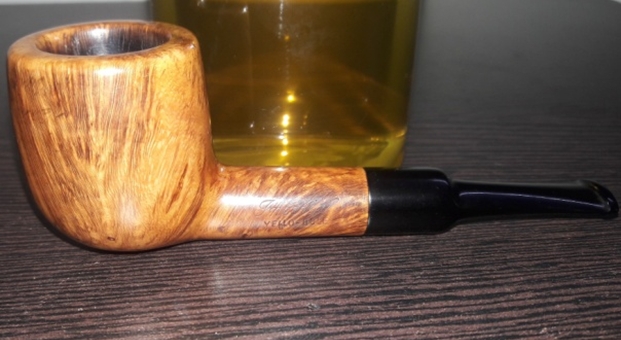
Having worked on the four Free Hand pipes that I had purchased on eBay, it was time again to work on one of my grandfather’s pipe from my inheritance. I chose to work on the second “Imperial Yello-Bole Carburetor” from his collection. The first had a cracked shank and was restored by my Guru and mentor, Mr. Steve of rebornpipes, here is the link for the write up (https://rebornpipes.com/2018/04/15/pareshs-grandfathers-pipe-2-a-yello-bole-carburetor-4522-billiard/).

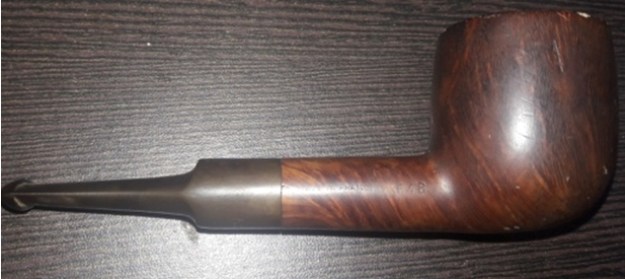
This particular pipe was in a battered condition with significant damage to the inner and outer edges of the rim, a large number of chips, dents and dings to the bowl and shank, two deep gouges to the bowl and a heavily oxidized stem. I was not very sure if at all I should attempt at its restoration as I knew that to mask the repairs/ fills to the gouges and chips on the bowl and the shank, I would need to stain it with a darker stain followed by a delicate polish to make the grains pop and here I was, with neither materials nor experience to carry out staining and subsequent polishing. However, Mr. Steve encouraged me to go ahead and restore it nevertheless and keep the natural finish of the pipe and the scars of the repairs as a testimony of the pipe’s journey till date!!!! Well, it always pays to follow the advice of your mentor and I embarked upon this journey to give a fresh lease of life to this old and battered war-horse!!!

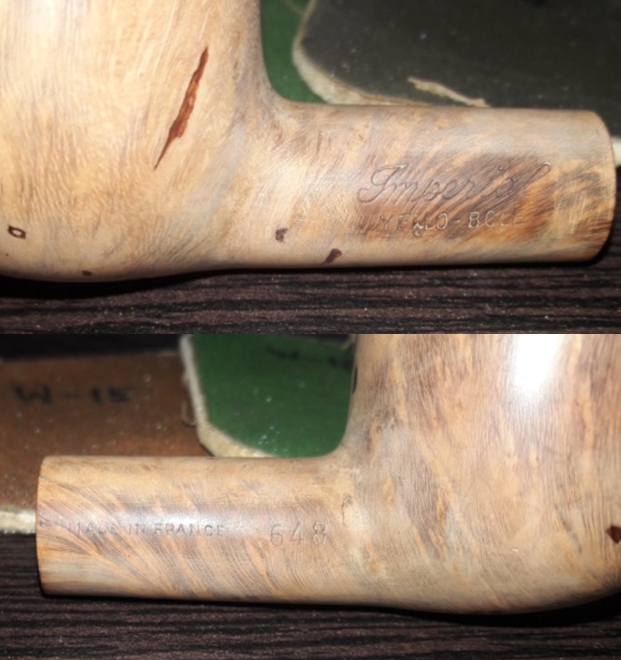
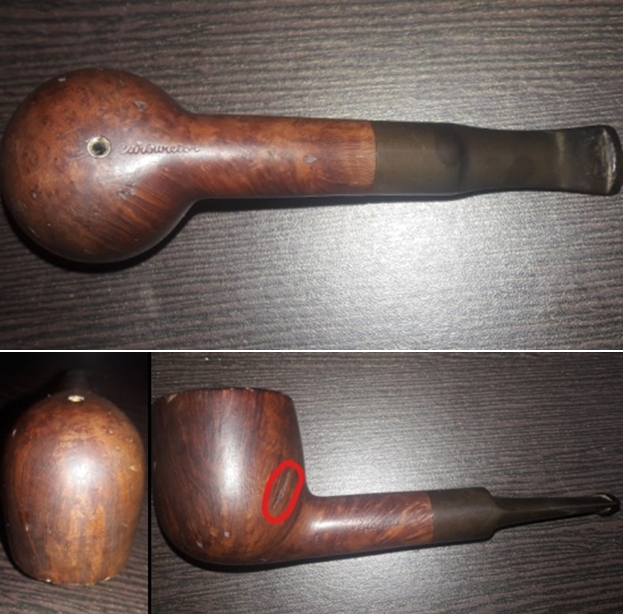
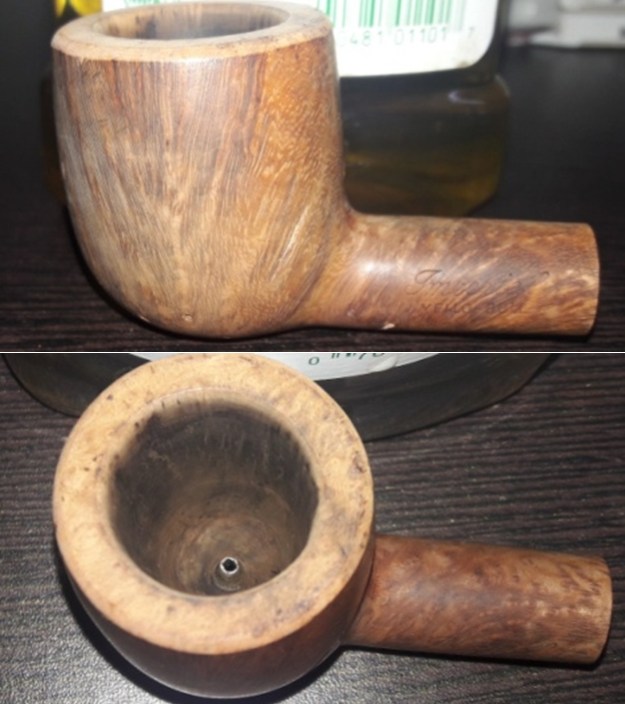
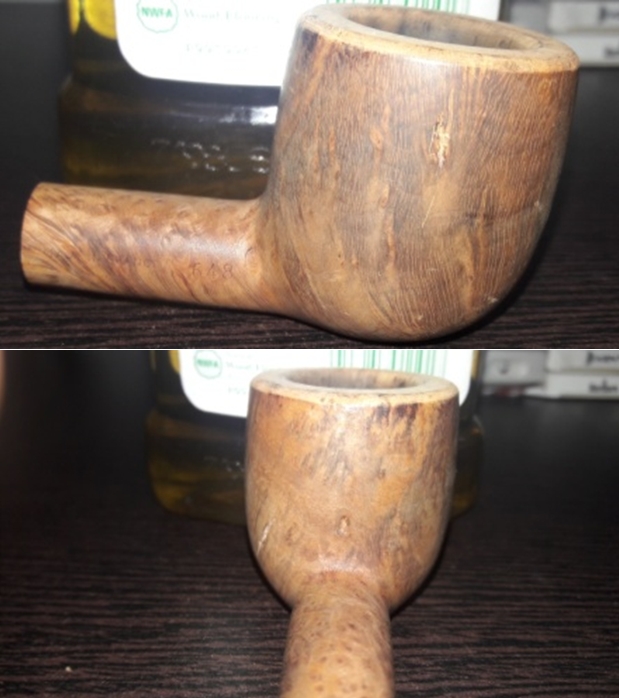
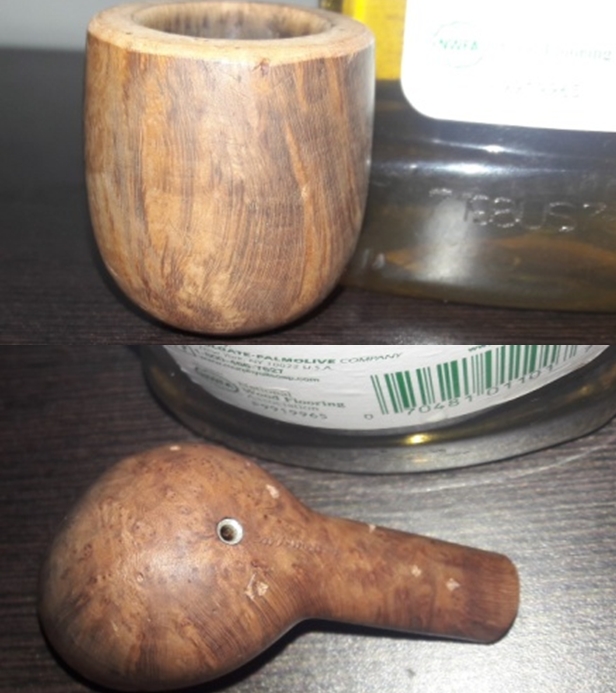
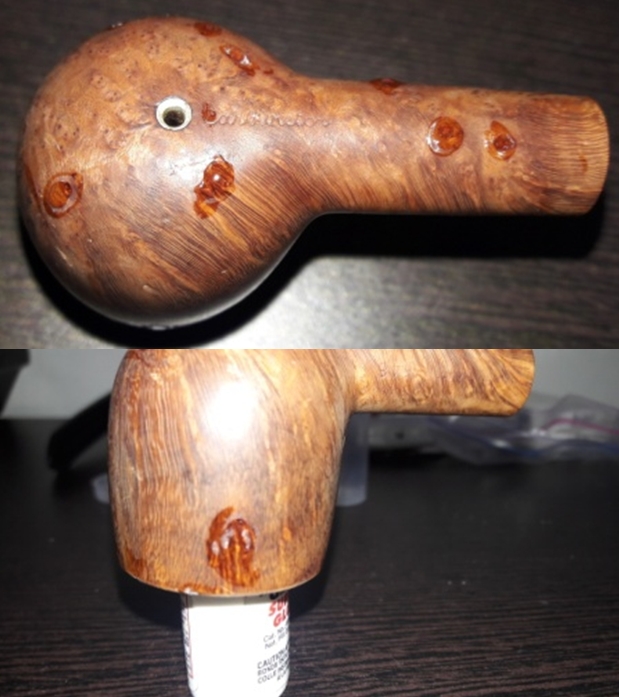
The pipe is stamped on the left side of the shank as “Imperial” in fancy cursive hand over “YELLO-BOLE” in block letters while the right side of the shank bears the stamp of “MADE IN FRANCE” starting from the shank end towards the bowl and followed by the model(?) number “648” or is it “64 B”? I have this doubt since I could find a match to this shape and size during my research as per the latter stamp, but the stamp appears as former to my eyes!!!! The center bottom of the pipe has a single hole, lined by an aluminum cone, open at both ends, which protrudes into the chamber. This is followed by “carburetor” in fancy cursive small letters. The stem is devoid of any stampings or logo. Before commencing the restoration, I decided to refresh my memory about Yello-Bole pipe brand and in particular, the Carburetor model, by visiting the blog written by Mr. Steve while restoring my first Yello-Bole. The first thing that struck me as odd was the difference in stampings seen on the pipe which is on my work table!!! The pipe currently on my work table is sans the stamp of KBB in clover leaf, U.S. patent number details, Cured with real honey, stem logo of a yellow circular ring and has shape number in three digits as against four on the one restored by Mr. Steve. However, the biggest and most significant difference which has me flummoxed was the stamping “MADE IN FRANCE”!!!!!!! No amount of research and surfing the internet provided me any clue as regards the origin and dating of this piece of briar.

INITIAL VISUAL INSPECTION
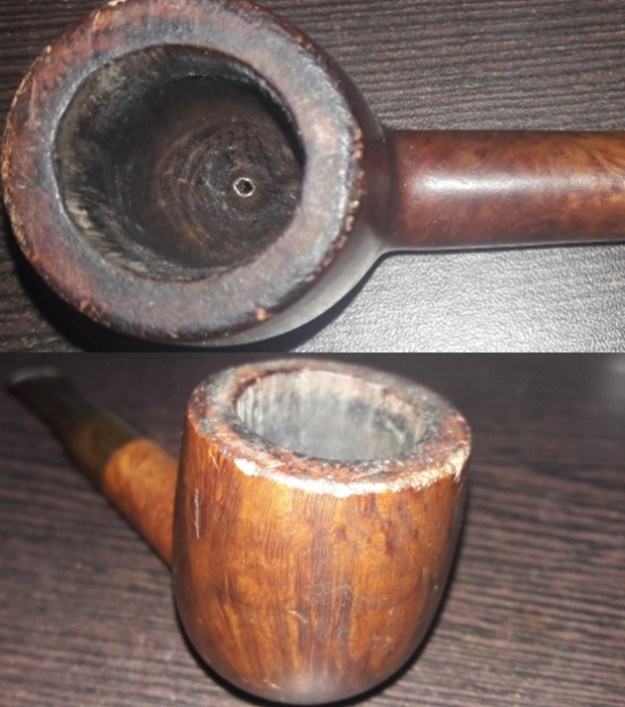
The first and foremost significant visual damage is seen to the rim top, inner and outer edges. It appears that the rim has been repeatedly banged against a hard surface to remove residual dottle over a prolonged period of time!!!! The damage to the rim top is in the form of dings and scratches while significant chipping and cinching is seen on the outer edge. The inner edge of the rim is out of round, apparently caused by use of a knife to remove the carbon cake. The overflow of lava from the rim top appears to be removed by scrapping the surface with a knife and in the process causing all the scratches and dings to the surface. There is a thin layer of cake on the bottom half of the chamber and appears to be a victim of over reamed chamber. The carburetor hole at the bottom of the chamber is clogged and will require to be cleaned. The condition of the inner walls of the chamber will be ascertained only after the chamber has been stripped completely of the existing cake layer.The second most significantly damaged part of the pipe is the stummel. It is covered in oils, dirt and grime of all these years of smoking and subsequent uncared for storage. The stummel surface is sticky to the touch, giving the stummel a dull, lifeless and lackluster appearance. It is peppered with a large number of chips, dents and dings. There are two significant gouges on the stummel; one on the left hand side towards the bottom and the second one is one the right hand side about an inch below the rim top. Overall, the stummel has sustained massive damage over the years due to both, rough usage and careless storage. However through all this dirt, tar, oil, grime and damage, lovely densely packed straight grains can be seen on the sides and shank. It will be a challenge to address these issues and make the grains to reveal themselves in all glory. The shank too is peppered with numerous minor dents and chips on the bottom surface as well as on the right side of the shank. The mortise is clogged and the air flow is constricted and the draw is laborious. This will need to be addressed by thorough cleaning of the same. The saddle stem is heavily oxidized with bite marks on both upper and lower surface of the stem. The lip too shows bite marks and will need to be redefined. The aluminum stinger is firmly attached inside the tenon and could not be removed. It is covered in oils, tars and grime from all the years of smoking and it appears that it has hardened, fixing the stinger inside the tenon.THE PROCESS
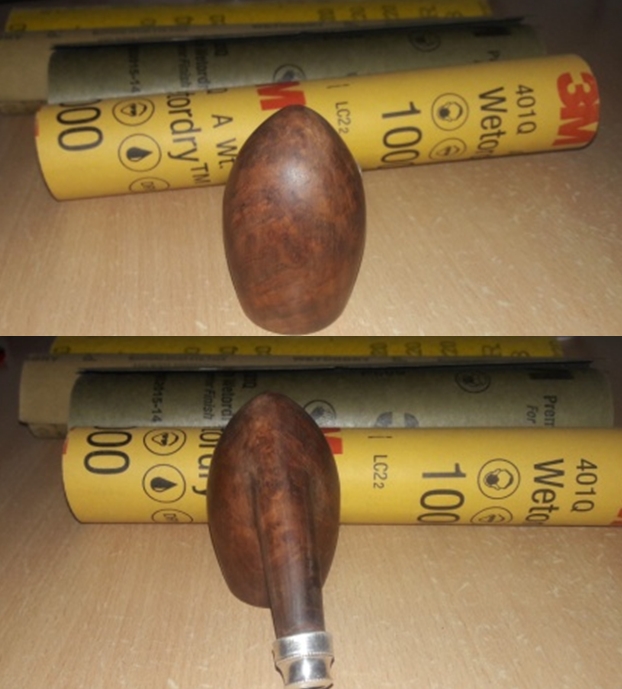
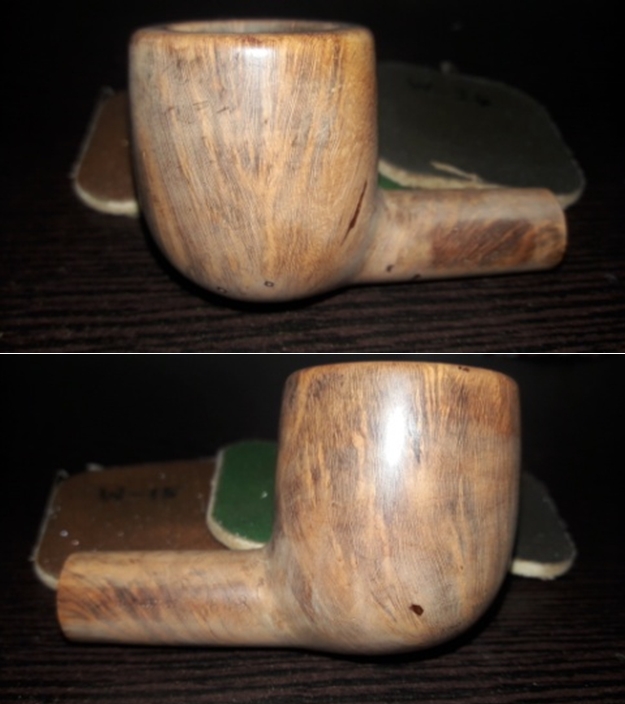
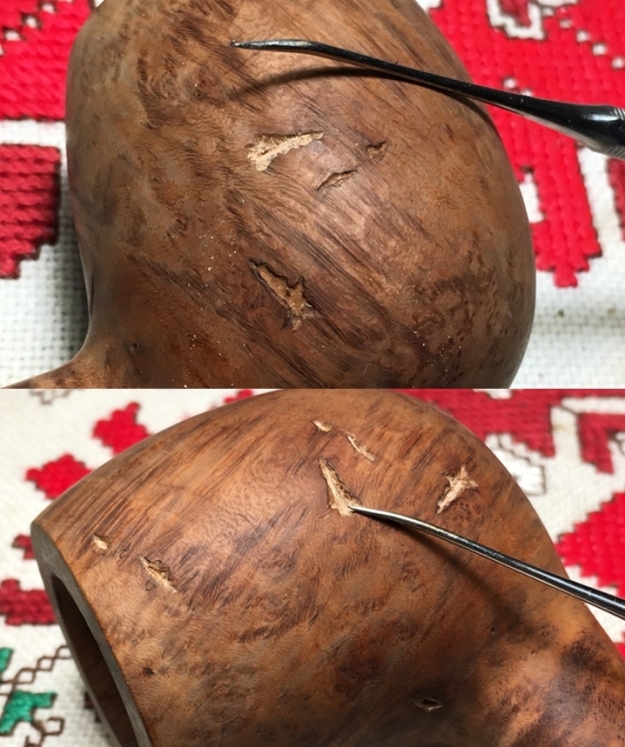
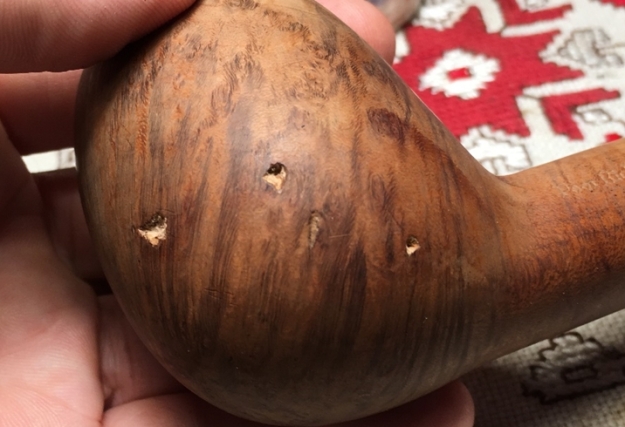
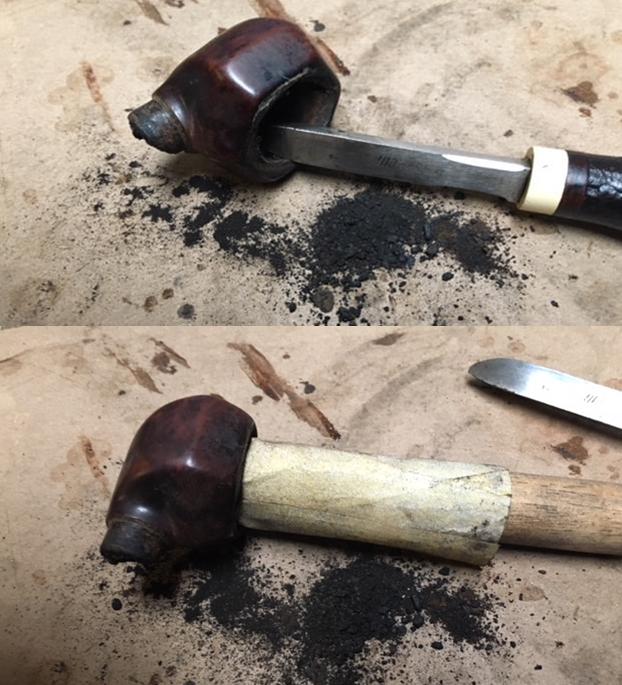
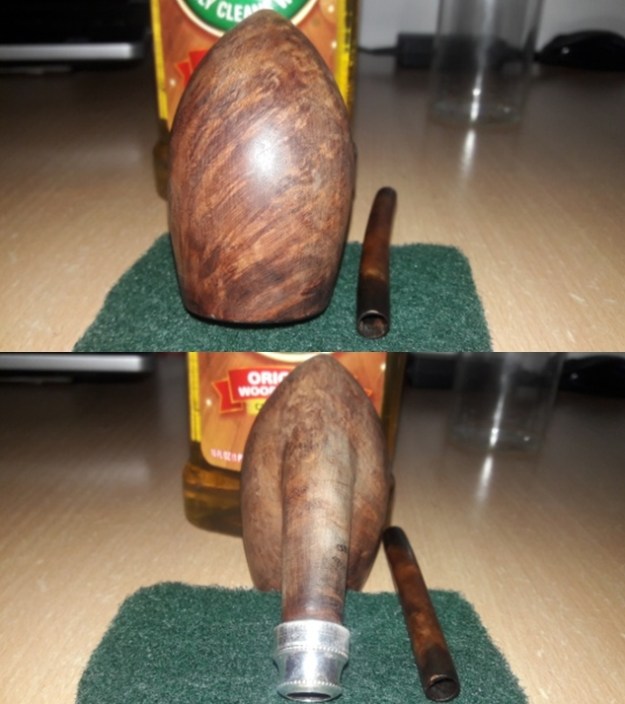
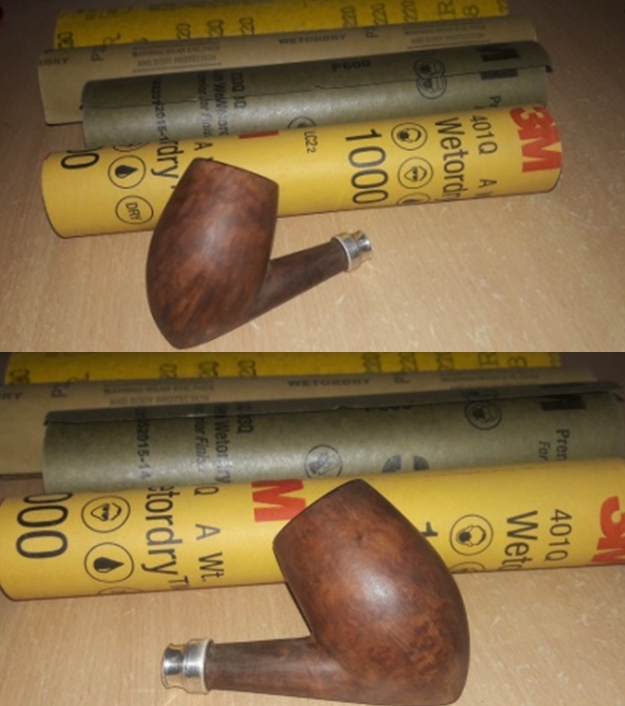
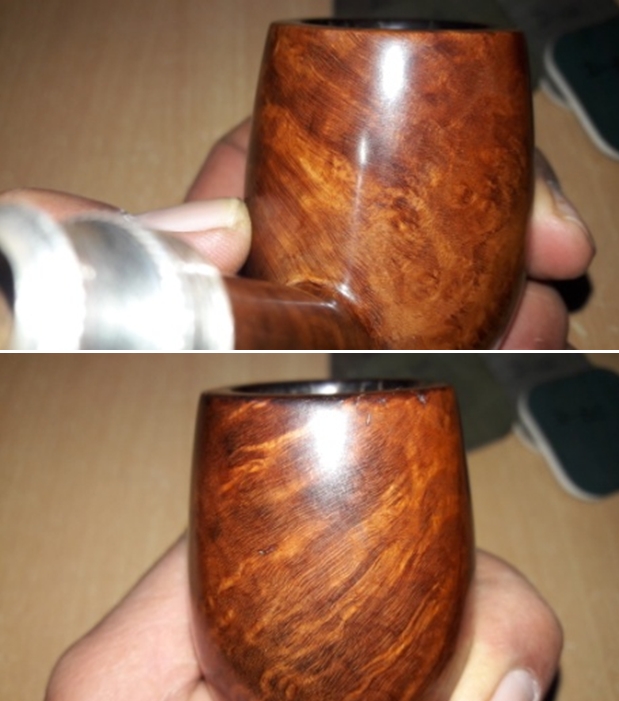
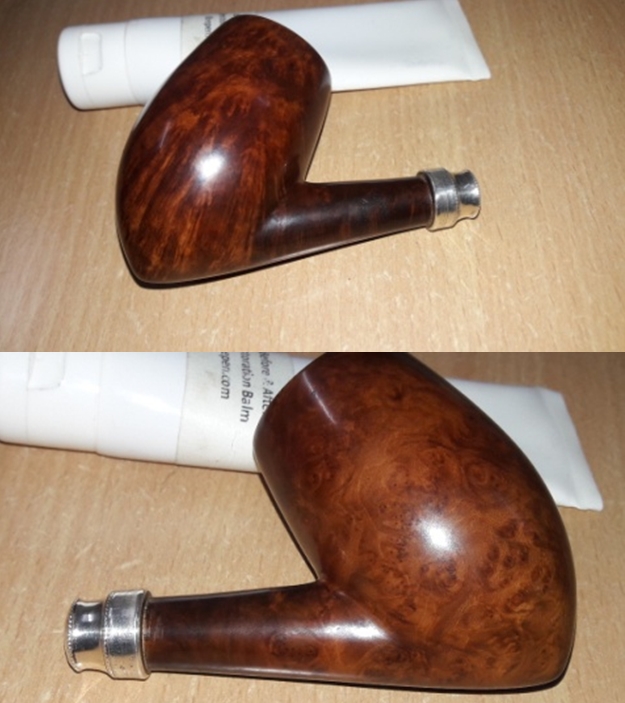
I started the process of restoration by reaming the chamber with my fabricated knife as the protruding aluminum cone of the carburetor prevented use of the Kleen Reem pipe reamer. Once the cake was reamed back to the bare briar, I used a 150 grit sand paper followed by 220 grit sand paper to remove all the traces of remaining cake and also to smooth the inner walls of the chamber surface. It was a big relief to note that there was no issue of heat fissures or cracks seen on the surface.To address the numerous dents, dings and scratches on the rim’s top surface and also to remove traces of lava overflow, I topped the rim surface on a 220 grit sand paper. Since the damage to the rim top was significant, I had applied more pressure than usual. Though it is recommended to have a wooden board with the 220 grit sand paper firmly fixed over it, I just keep the sand paper on a flat table top, holding it firmly with my left hand and rotating the stummel rim top over it with my right hand. I have come to realize that this set up gives me lot more freedom of movement, better control and convenience of storage.Staying with the rim, the next issue that I addressed was the rim edges, both inner and outer. With a folded piece of 180 grit sand paper pinched between my thumb and fore finger, I created a bevel on the inner edge. This addressed the issue of uneven and out of round inner edge. For addressing the outer edge, I had two options; first was to top the rim surface till the entire damaged outer rim surface was sanded out, maintaining the straight rim edge profile of the stummel. The disadvantage of this would be a significant loss of briar estate!!! The second (and easier too!!!) option was to create a bevel on the outer edge, sacrificing the original profile of the stummel. However, I envisaged that the bevel to the outer edge would add a new depth and dimension to the profile of the pipe while saving loss of briar. That decided, I created a bevel on the outer edge. Both the inner and outer edges now look much better and add a new dimension to the otherwise plain-Jane billiard shape of the bowl. I cleaned the stummel with Murphy’s oil soap and hard bristled toothbrush and rinsed the stummel under running tap water. This cleaning helps in bringing to the fore any other damage which could be hidden under all the dirt and grime. I dried the bowl with a paper towel and soft cotton cloth. With a thin, sharp and pointed knife, I cleaned out all the fills and gouges. I scrubbed the stummel surface clean with isopropyl alcohol to have a clean surface for a fresh fill. I decided to move ahead with only CA superglue for filling the chips and gouges. I spot filled these chips and gouges with superglue and set it aside for curing. Turning my attention to the stem, I flamed the surface with a Bic lighter to raise the tooth chatter and deeper bite marks to the surface as much as is possible. I followed it up with sanding the stem surface with a 220 grit sand paper to match the raised bite marks with the stem surface and also remove the oxidation before the fill. The deeper bite marks were filled with CA superglue and set aside to cure. After the fills on the stummel had completely cured, I sanded these with a flat head needle file to match them with the stummel surface. This was followed by sanding the fills and the stummel surface to achieve a match as well as remove the minor scratches and cinches on the surface. I frequently wiped the sanded surface with a moist cloth to remove the briar dust and also to check the progress of my work. Once I was satisfied with the match, I followed it up by micromesh polishing pads, wet sanding with 1500 to 2400 grit pads. Again, I wiped the bowl with a moist cotton cloth after each pad. I used the 3200 to 12000 grit pads to dry sand the stummel to a nice shine. At this stage of restoration, the entire bowl, rim top surface and shank is now looking fresh and clean with beautiful densely packed straight grains popping out in all their glory!!!! Even though the fills are prominently visible, in my view, they lend a battle scarred warrior like character to the pipe. While I worked the stummel, the fillings in the stem had cured. I sanded the fills with a flat head needle file. To further match the fills with the surface of the stem, I sanded it with 220, 400 and 800 grit sand paper. I wiped the stem with cotton pad dipped in alcohol to remove the resultant dust. I rubbed some extra virgin olive oil in to the stem and set it aside to be absorbed in to stem. I polished the stem with micromesh pads, wet sanding with 1500 to 2400 grit pads and dry sanding with 3200 to 12000. I rub a little extra virgin olive oil in to the stem after every three pads. I finish the polishing of the stem by rubbing a small quantity of Paragon wax and giving it a final polish with a soft cotton cloth. The stem is now nice, smooth and shiny. Now with the external restoration and cleaning of both the stummel and the stem completed, I proceeded to cleaning the internals of the stem and the shank. As I had observed during my initial visual inspection, the stinger was very firmly attached inside the tenon. To clean the stem air way, I had to separate the stinger from the tenon. I was certain that the stinger was a push-fit type and much easy to deal with. I carefully heated the stinger with the flame of a Bic lighter and wrapping a cloth on the stinger, with careful anti-clock wise rotations, dislodged the stinger from the tenon. I cleaned the internals of the shank with cue-tips, regular and bristled pipe cleaners dipped in alcohol. The mortise was cleaned using a shank brush. With a fabricated dental spatula, I scrapped the walls of the mortise and further cleaned with pipe cleaners till they came out white. Similarly, I cleaned the air way in the stem with pipe cleaners and alcohol. I cleaned the stinger of all the accumulated oils and tars with paper towels after soaking the stinger in isopropyl alcohol and reattached it in the tenon. The internals are now clean and the draw is full, easy and open. I was really not surprised at how dirty were the internals of the shank and stem as can be seen from the condition of the pipe cleaners in these pictures. To finish the restoration, I rub a small quantity of “Before and After Restoration Balm” in to briar and let it rest for a few minutes. The balm almost immediately works its magic and the briar now has a nice vibrant appearance. I further buff it with a horse hair shoe brush. Using a cotton cloth and brute muscle power, I gave it a final polish. I re-attach the stem with the stummel. The completed pipe looks lovely, fresh and vibrant; the photographs speak for themselves. Thank you for having the patience to reach this far while reading the write up. Your comments are of utmost importance to me for improving my skills in restoration process as well as writing about it. Cheers!!!!!
A Tiny 2 Star BBB 8881 Apple/Globe Provided An Interesting Challenge


Blog by Steve Laug

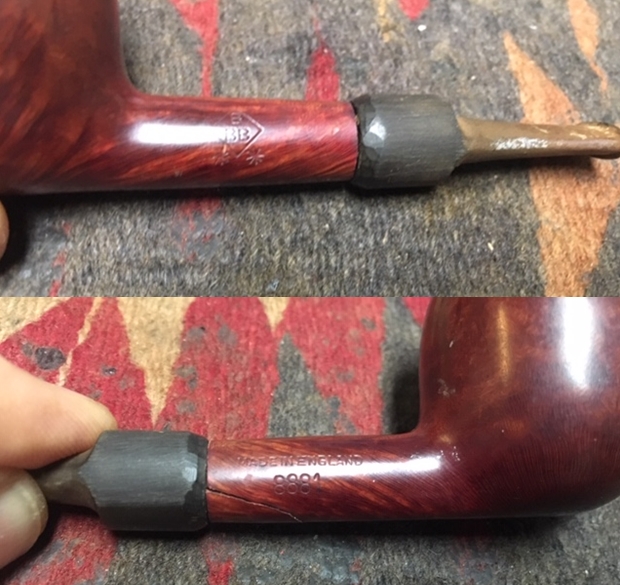
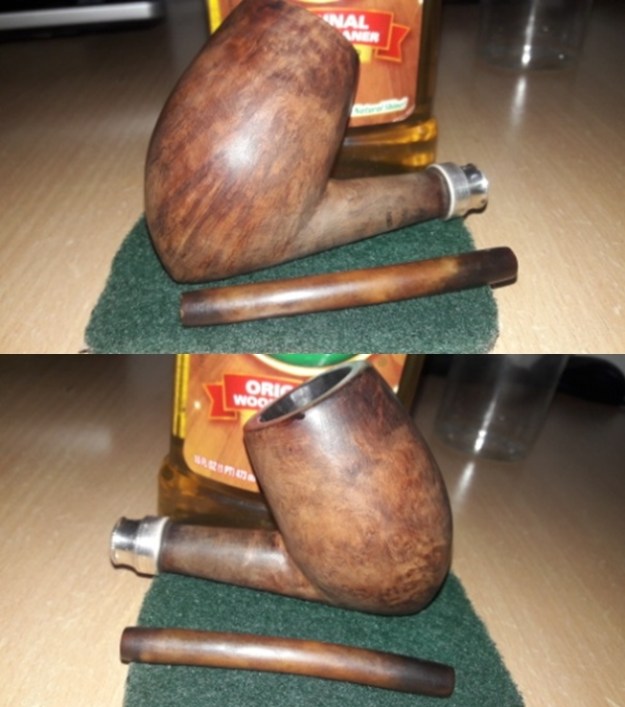
When I spoke with a fellow here in Vancouver who had a pipe that he wanted me to fix it sounded like a simple repair. He said that it had a very loosely fitting stem. He asked if he could drop by to show it to me and see if I could fix it. From past experience I have learned to never jump to conclusions about what sounded like an easy repair. When he arrived he showed me his GBD Faux Spigot. It turned out to need far more work than just tightening a loose stem. I wrote about that restoration in a previous blog (https://rebornpipes.com/2018/11/03/redoing-a-poorly-restored-ebay-gbd-super-q-9436/). We talked about his GBD for a bit and he made the decision to have me do a restoration on it. Then he reached into his pocket and pulled out a small plastic bag with a little BBB 2 Star apple of globe shaped pipe. It was stamped BBB in a diamond on the left side of the shank with two ** – one on either side of the diamond. ON the right side it was stamped Made in England over the shape number 8881. He said that he had found it at his parents’ house and really no one there knew where it came from.

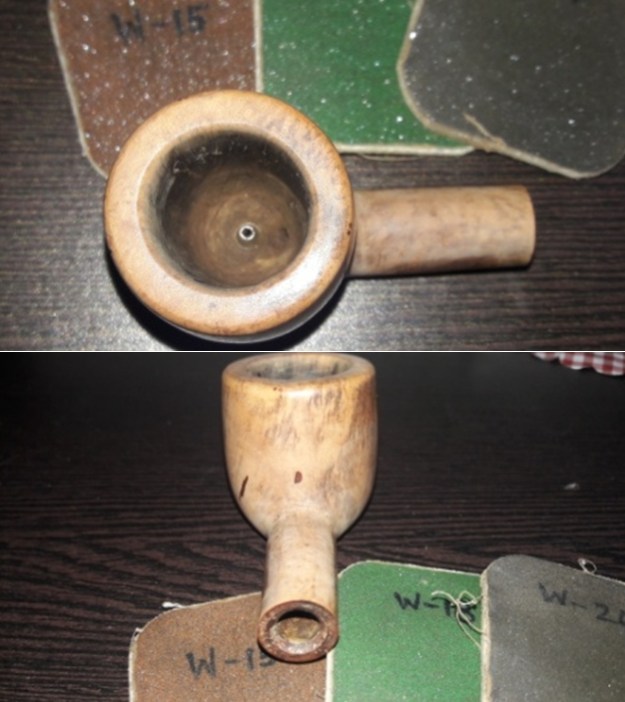
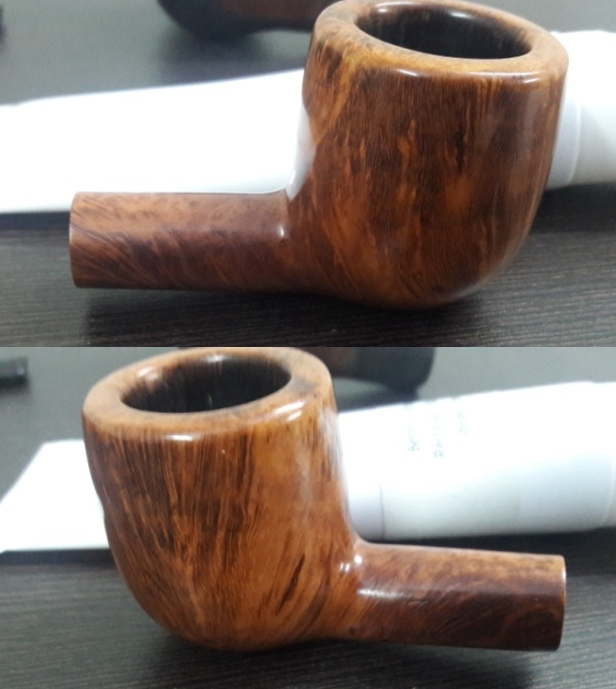
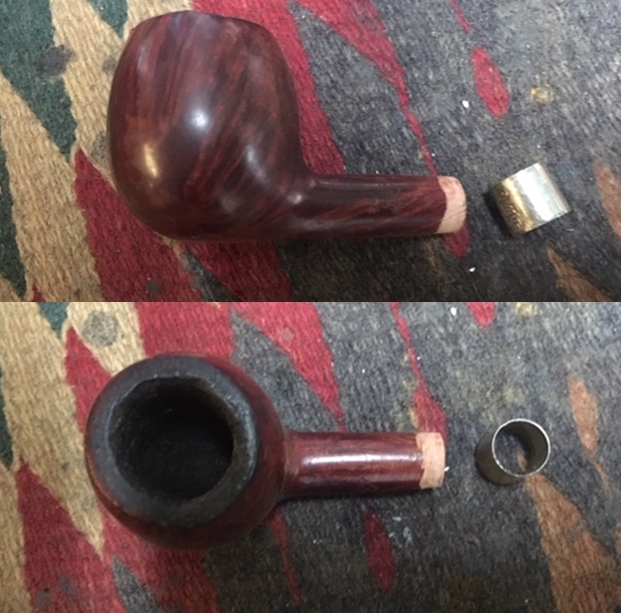
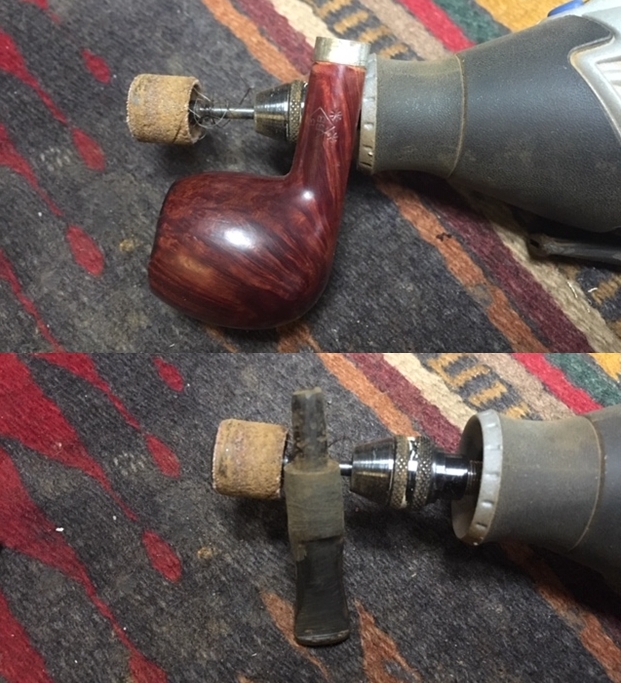
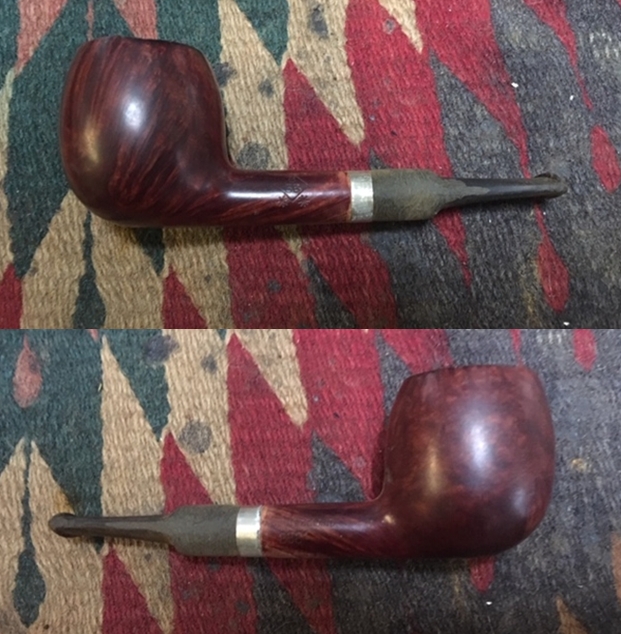
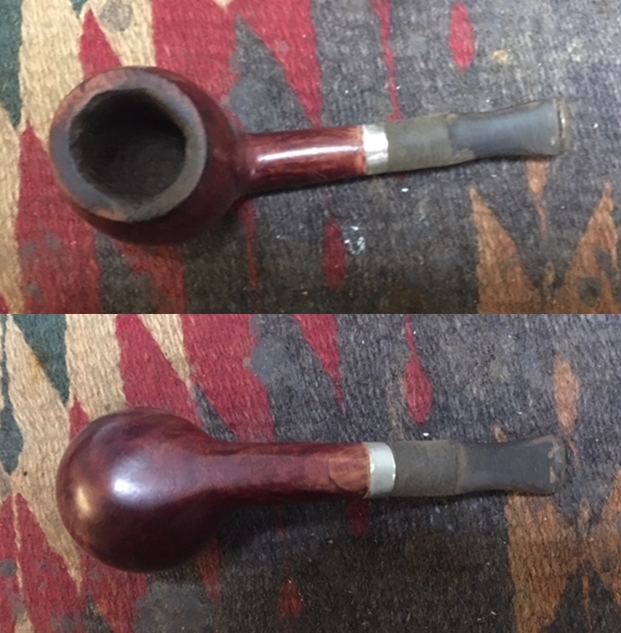
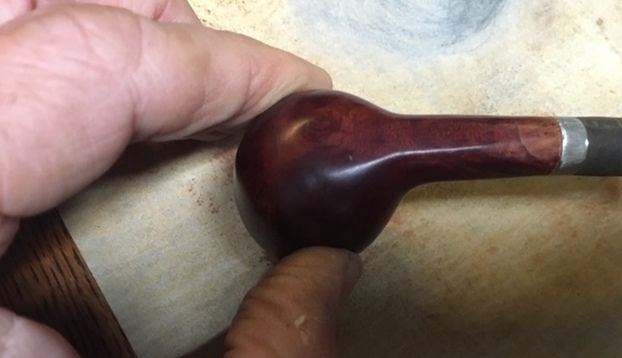
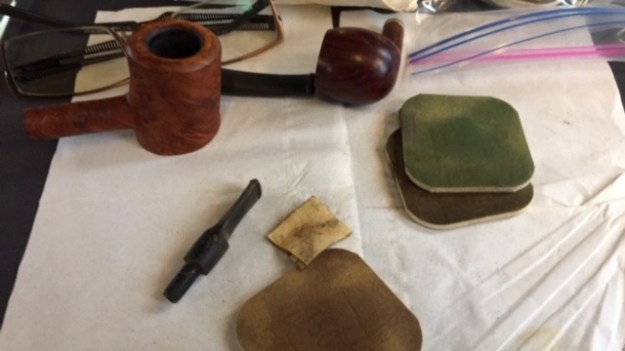
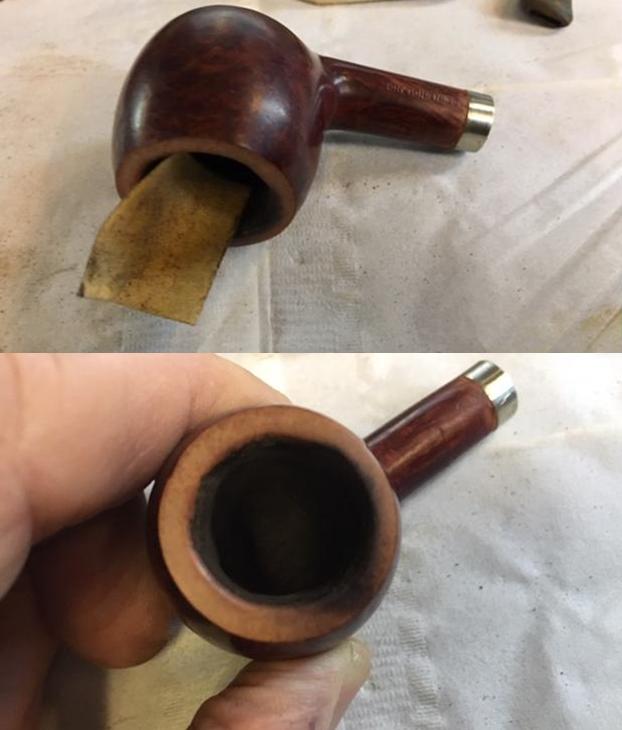
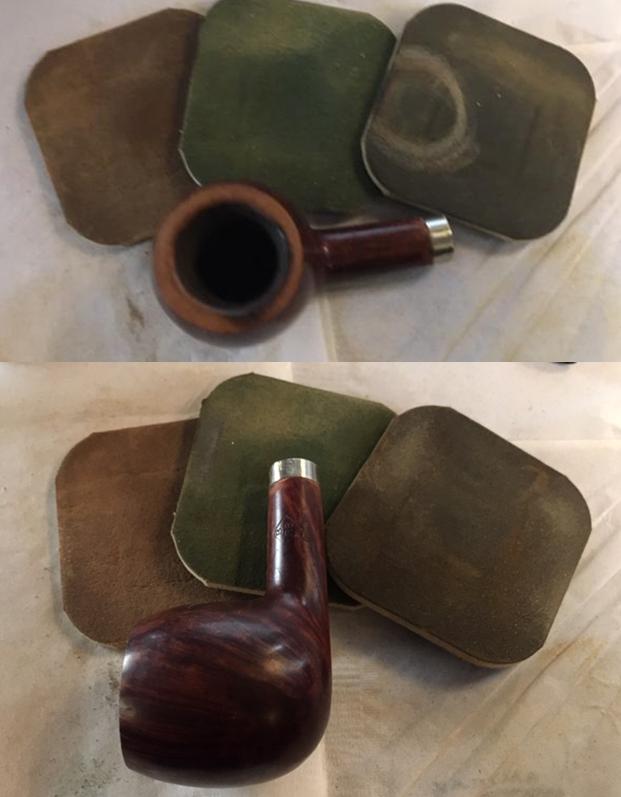
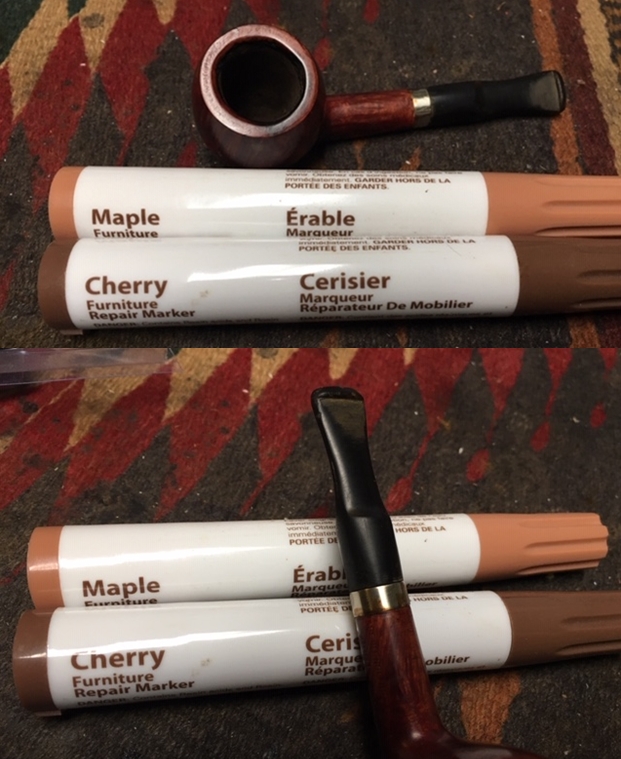
Here is what I saw. Starting with externals. The pipe was small – kind of a pocket pipe. The grain on the bowl was quite stunning – a mix of flame and birdseye all around the bowl and shank. The rim top was coated with a thick lava coat and it went into the bowl. The inner edge of the bowl was in rough shape having been hacked clean with a knife. There was a crack on the right side of the shank curving to the underside. It looked to me it was made by the poorly made stem being shoved into the shank. The stem was larger in diameter than the shank and had been rounded over with a file. There were deep bite marks on the surface ahead of the button on both sides. Moving to the internals. The end of the tenon was carved with a knife to make it fit the mortise in the small shank. The inside of the shank was dirty but less so than I expected. The inside of the bowl had a light cake but most of that was gone from the knife job that had left a wounded inner edge on the rim. Looking at the pipe I explained what I would have to do to bring it back to life and restore it to use. It would need, cleaning, reshaping on the rim, a band on the cracked shank that would leave the stamping readable, and a reworking of the stem to make it a fitting addition to the lovely briar of the bowl. The pipe was going to be a fun challenge. I took these photos to give you an idea of what I saw. The previous pipeman who had fit a new stem to an old favourite pipe had done a functional job but it looked rough. It was pretty clean on the inside so it was cared for. It must have been a great smoking pipe for him to fit a new stem and not give up on it when the previous one broke or was lost. It was smokable. I took a close up photo of the rim top to show the condition. It is hard to see but the rim top was not smooth. The lava build up was pretty thick and there were some deep nicks and chips in the flat top. The close up photos of the stem reveal the scratches in the vulcanite, the tooth marks and the worn and ill-defined button.  The oversized diameter – prettified to look nice is clear in the photos. I took photos from the side of the pipe to show the stamping on the shank and the prettified stem. In the second photo you can see the crack in the shank curving downward to the underside.I decided to address the cracked shank first. With the crack as large as it was and movable I did not want to further damage it when I worked on the stem and fit of the tenon. I knew that it needed to be banded but that would cover the stamping on the shank so adjustments would have to be made. I used a Dremel and sanding drum to reduce the size of the shank to fit the band I had chosen. I did not take of too much briar and I only damaged the M in Made In England as part of it would end up being covered by the band.I repaired the crack in the shank with super glue and pressure fit the band onto the shank to the point of the end of the sanded portion. I used a Dremel and sanding drum to cut back the band to the width that I wanted. Compare the photos above with the one below to see how much I took off of the band. I topped the band on a topping board with 220 grit sandpaper and smooth out the sharp edge with 1500 grit micromesh. I decided that since I was already working with the Dremel and sanding drum that I would take down the excess diameter on the stem as well. I reduced it to sit snugly against the band giving the pipe a classy look.I cleaned up around the inside edge of the band and edge on the shank with a folded piece of 2220 grit sandpaper to smooth things out and make the fit and transition smooth. I lightly sanded the blade portion of the stem and the area of the tooth marks next to the button with 220 grit sandpaper to remove the oxidation and clean it up. I fit the stem in the shank and took a photo of the pipe at this point in the process. It was beginning to look like a classic BBB to my eye. With the stem roughly fit to the shank it was time to address the bowl top. I topped it on a topping board with 220 grit sandpaper. At that point I called it a night. I had to catch a train down to the southern part of Washington from Vancouver in the morning so I thought I would bag up a couple of pipes I was working on and take them with me.I caught the train south from Vancouver, BC at 6:30am. Once we had our seats we were in for an 8 hour train ride. I figure it would be a good opportunity to work on these two pipes. You can see my work table in the photo below. I used the fold down table. It had a lip around it so I spread out a couple of napkins for the dust and went to work on the pipes.I started working on the BBB by addressing the damage to the inner edge of the rim. It was significant with cuts and burns. My topping worked had helped with the top damage and smoothed that out but I need to work on the rim edge. I used a folded piece of 220 grit sandpaper to smooth out the sharp edges and bring the bowl back to round. Once I had the rim as round as I could get it and smoothed out the damaged edge I polished it with micromesh sanding pads. I polished the bowl and the rim at the same time. I wet sanded with 1500-2400 grit micromesh sanding pads and dry sanded with 3200-12000 grit pads. I wiped the bowl down with a damp napkin after each pad. I touched up the stain around the front of the band and stained the rim top and inner edge with Maple and Cherry stain pens. Together the two stains matched the rest of the bowl.I rubbed down the briar with Before & After Restoration Balm. I worked it into the smooth surface of the briar with my fingertips to clean, enliven and protect it. I let the balm sit for a little wall and then buffed with a cotton cloth to raise the shine. The following photos show the bowl at this point in the restoration process. The rim matches well but still needs to be polished and buffed to raise a shine on it. I used a folded piece of 220 grit sandpaper to reshape the button and also to smooth out the marks left by the Dremel when reducing the diameter of the stem. I sanded the tooth marks near the button on each side of the stem to smooth them out.I polished the stem, tenon and metal work with micromesh sanding pads – wet sanding with 1500-2400 and dry sanding with 3200-12000 grit pads. I wiped the stem down with Obsidian Oil after each sanding pad. I was able to remove the damage on the tenon and polish out the dripping varnish on the metal adornment. The stem looked much better at this point in the process. I the polished stem and bowl with Blue Diamond to polish out the remaining small scratches and raise the shine. I gave the bowl and the stem several coats of carnauba wax and buffed the pipe with a clean buffing pad to raise the shine. I hand buffed it with a microfiber cloth to deepen the shine. The pipe polished up pretty nicely. This turned out to be a beautiful little pocket pipe in terms of shape and finish. The new nickel band adds a touch of class in my opinion and gives the pipe a new elegance. I look forward to hearing what the fellow who dropped it off for repair thinks of it once he has it in hand and is smoking it. The finished pipe is shown in the photos below. The dimensions are Length: 4 inches, Height: 1 3/8 inches, Outside diameter of the bowl: 1 inch, Chamber diameter: 3/4 of an inch. Thanks for walking through the restoration with me.

Salvaging a ‘Really’ Poor Richard’s of Italy Giant Billiard


Blog by Dal Stanton

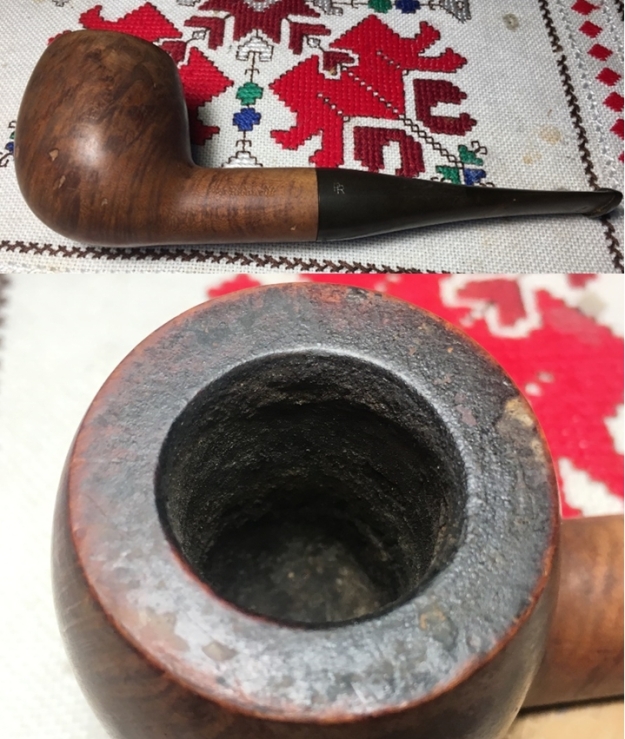
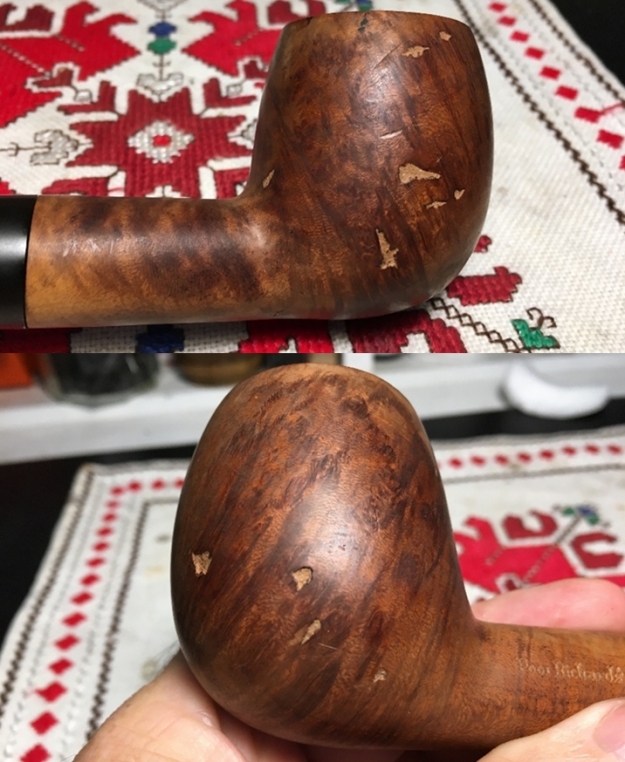
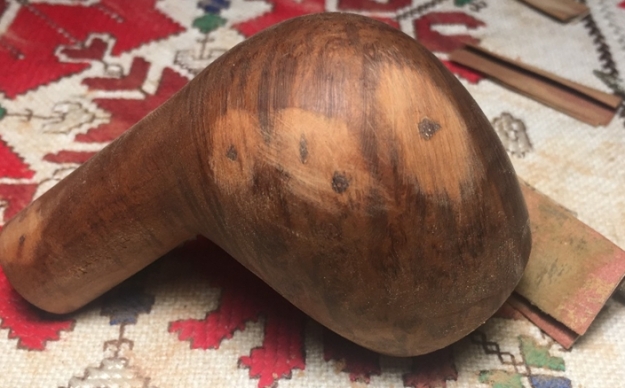
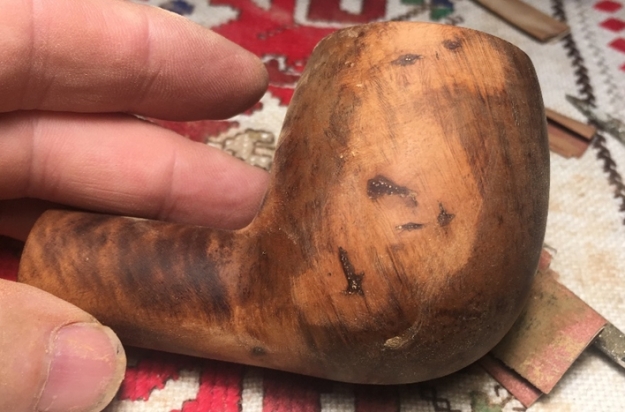
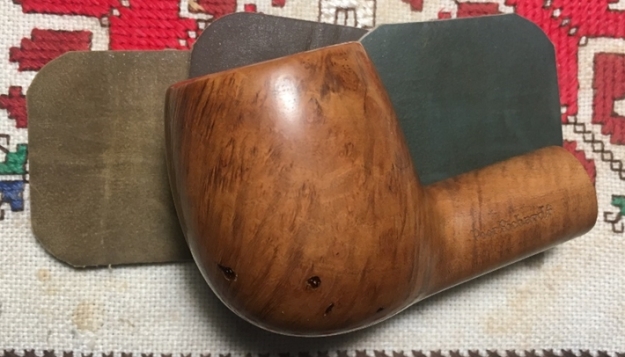
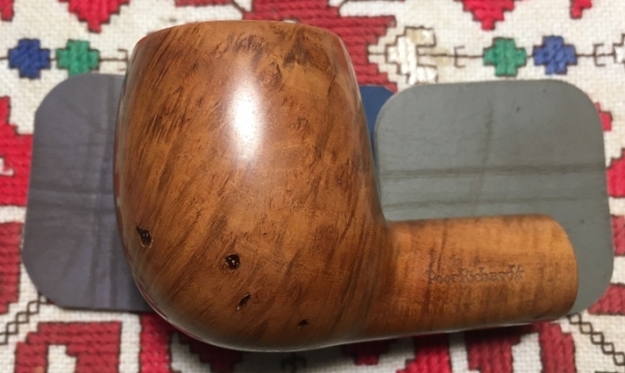
Let’s be honest. When I saw this Poor Richard’s on the eBay auction block I thought the name was a joke by the seller.  He WAS huge (L: 6 3/4”, H: 2 1/8”, Rim W: 1 1/2″, Chamber W: 7/8”, Chamber D: 1 7/8”, Weight: 74gr), no doubt, but his condition could qualify him for the title: King of the Basket Pipe Realm.  His condition was indeed poor and adding to the ‘joke’ was that he was displayed on satiny royal purple material.  But the clincher was coming. Adding insult to injury, the seller’s byline description under Poor Richard’s picture was: Poor Richard’s Classic Bulldog Large Estate Pipe Beautiful !!!  Nice  !!!  Bulldog?  I felt sorry for him.  I placed a bid and when the auction ended, it was no surprise that mine was the only bid seeking a new life for Poor Richard’s.  My wife’s response when she first saw Poor Richard’s was that Poor Richard’s dog got a hold of him!  Here are the pictures I saw. After bringing Poor Richard’s back to Bulgaria, I put him on my website in the For ‘Pipe Dreamers’ Only! section where my friend and fellow Pipe Dreamer from India, Paresh, saw him.  Poor Richard’s became the fourth pipe Paresh commissioned – all of them on the larger side and each one of them advancing our work here in Bulgaria benefiting the Daughters of Bulgaria, helping women and girls who have been trafficked and sexually exploited.

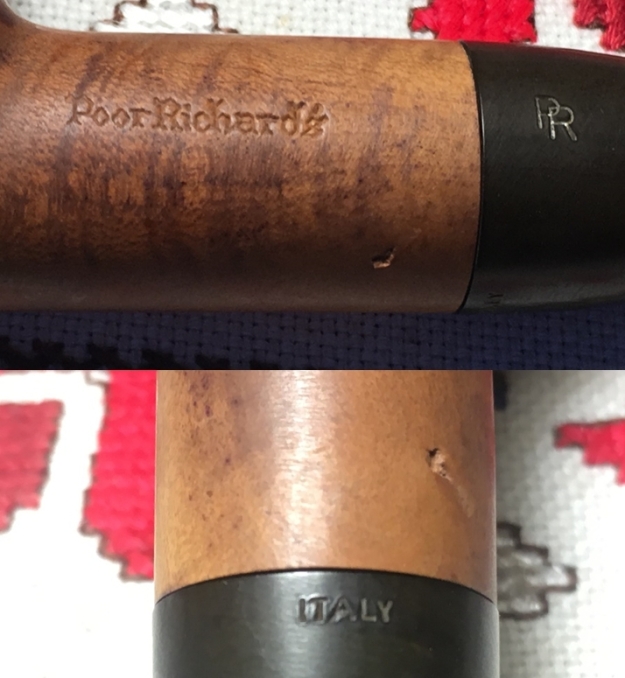
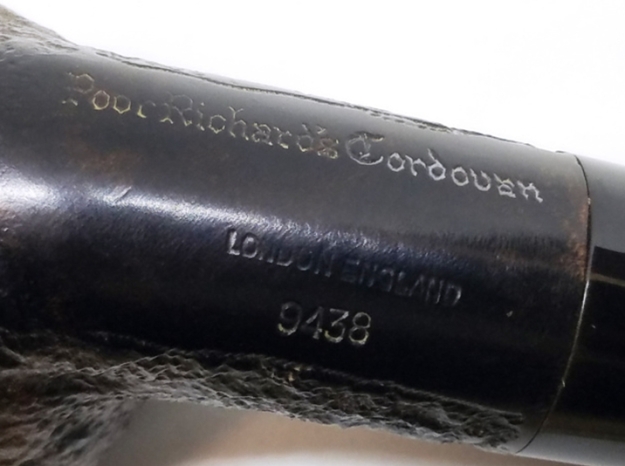
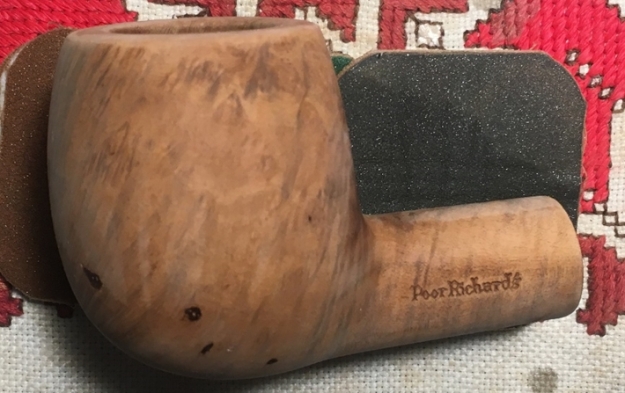
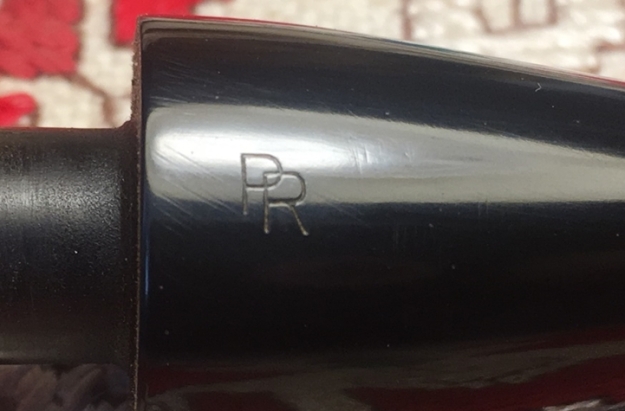
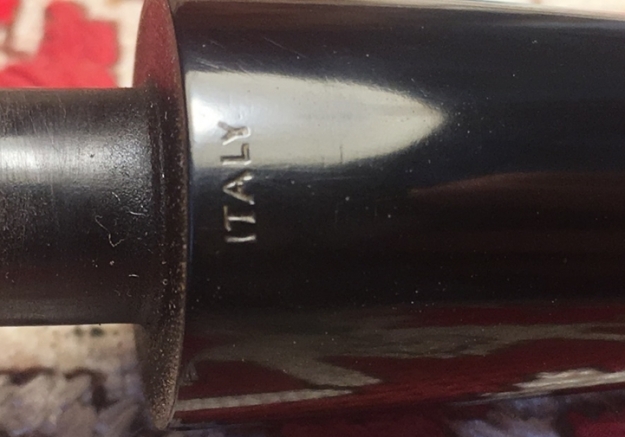
Taking more pictures on my worktable on the 10th floor of a formerly Communist ‘Block’ apartment building, the nomenclature on the left shank is ‘PoorRichard’s’ in what I call an ‘Old World’ script.  There are no other markings on the shank.  The stem is stamped with an interlocking ‘PR’.  The bottom of the stem is stamped with the COM, Italy.When I began doing the research on this Poor Richard’s, I recalled that rebornpipes’ contributor, Al Jones (aka: Upshallfan), had recently posted a restoration of a Poor Richards 9438 Cordovan Rhodesian shape.  Reading Al’s write-up was helpful because it clued me into the ‘mystery’ surrounding the origins of the Poor Richard’s name.  I noticed that our pipes shared the ‘Old World’ script nomenclature as well as the interlocking ‘PR’ stem stamp.  The obvious difference was the COMs – his, London, England and mine, Italy and his included a shape number, and mine, without.As I’ve done in the past with much benefit, I wrote to Al asking about the differences between our Poor Richard’s and what to make of the differing COMs?  His response was helpful:

Dal

Unfortunately, there is nothing but speculation about these Poor Richard pipes.  The one shop here, with that name, can’t even conclusively determine if they had shop pipes.

I suspect it was a shop pipe, made by various makers for this shop.  But a shop in Montana having shop pipes doesn’t exactly make sense either.  Usually shops with their own pipes were larger, and in metro areas, not out in the wilderness of Montana.

Poor Richard pipes are not listed in “Who Made That PIpe”, so my guess is still a shop pipe.  Perhaps that Montana shop was bigger than I presumed. 

I suspect Italian companies, like GBD made shop pipes as well.  Perhaps that one was made by Savinelli or other?  Without a shape number, it’s impossible to determine.

Have fun restoring it!

Al

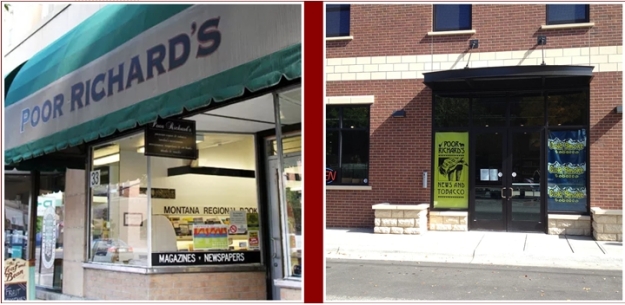
Al referenced the pipe shop in Montana that in a subsequent email he referenced that Steve had also worked on a Poor Richard’s attributed to the ‘Poor Richard’s’ pipe and tobacco shop in Bozeman, Montana. However, Al said that Steve’s Poor Richard’s pipe had a totally different nomenclature with Montana stamped on the pipe.  I found this write up on Rebornpipes and what a write up!  It was one of Steve’s and Charles Lemon’s classic collaborations including a pinning tutorial.  When these two masters get together, its fun to see the wonders happen!  (See this post which is worth the read:  A Humpty Dumpty Cross Canada Project – Could this Poor Richards Select Square Shank Billiard 9489 ever be whole again?)  Steve’s research on the Montana shop is good and saved me time and steps.  Since Steve’s write up in 2016, the website had changed and a description of Poor Richard’s history beginning in 1962 can be found here: History.  The following pictures show the shop early on and what it is today.Even with the mystery and the discrepancies with the nomenclatures, in researching different pipe shop pipes in the past (L. J. Peretti, Pipe Pub), I found that it’s common to have pipes manufactured in various places.  Another indicator that the Poor Richard’s nomenclature refers to a shop is simply because it is possessive – Richard’s, pointing to something else.  Whether there’s another Poor Richard’s shop other than the one in Bozeman, I don’t know.  This question has been lost to history.

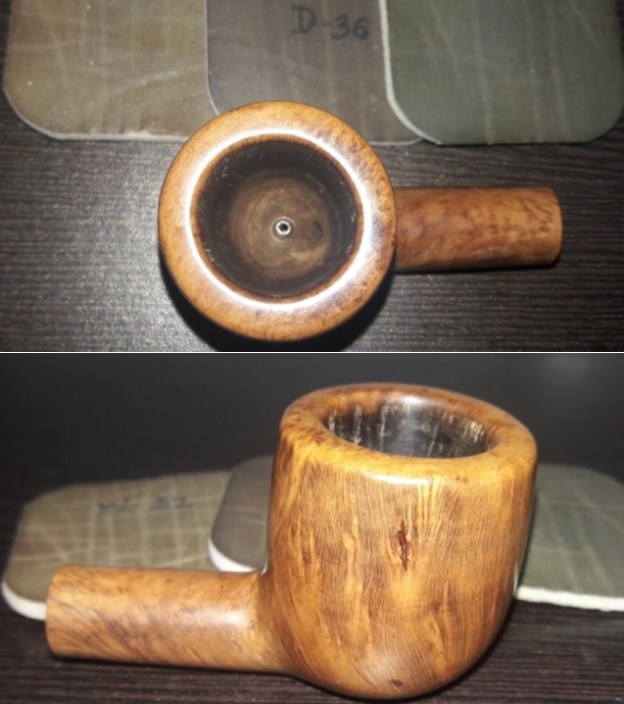
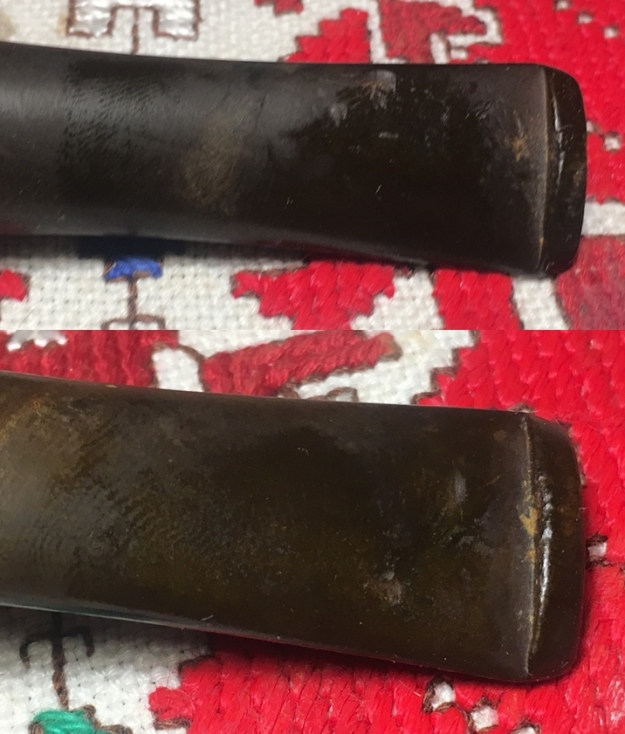
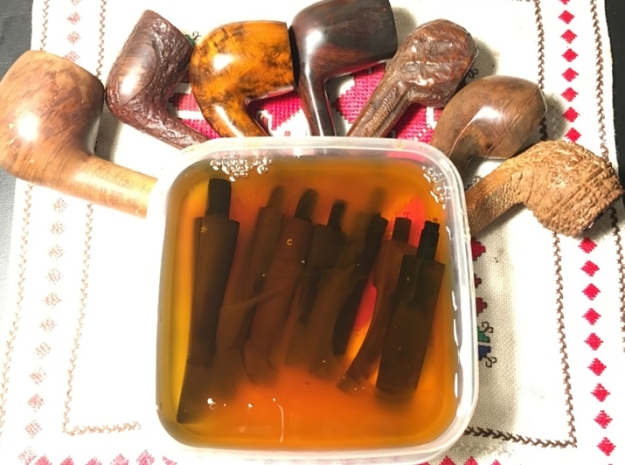
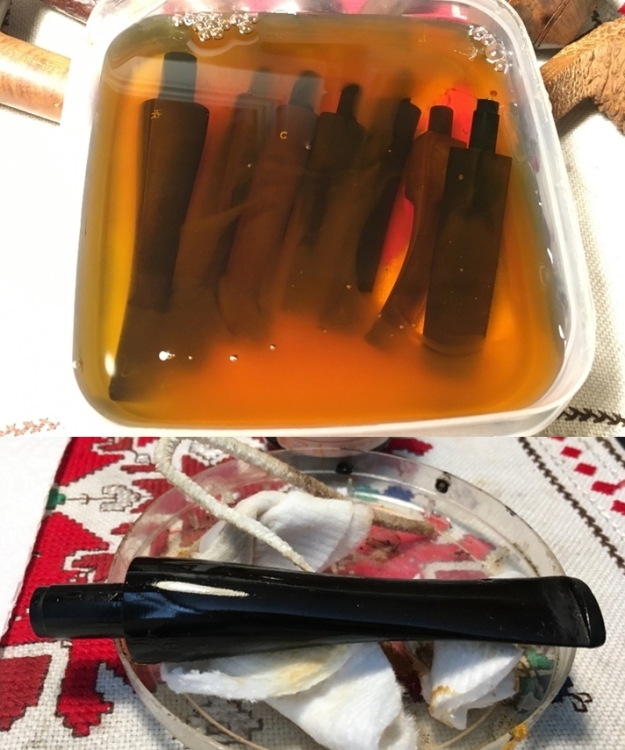
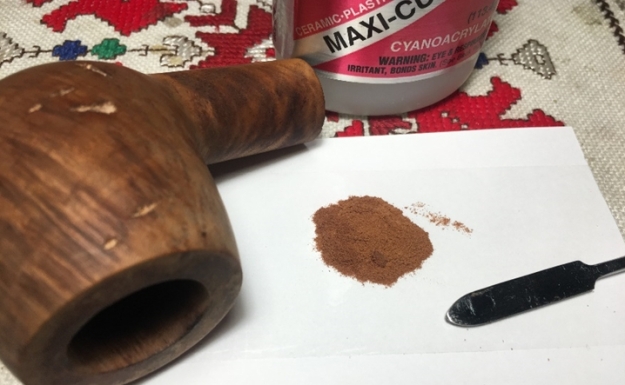
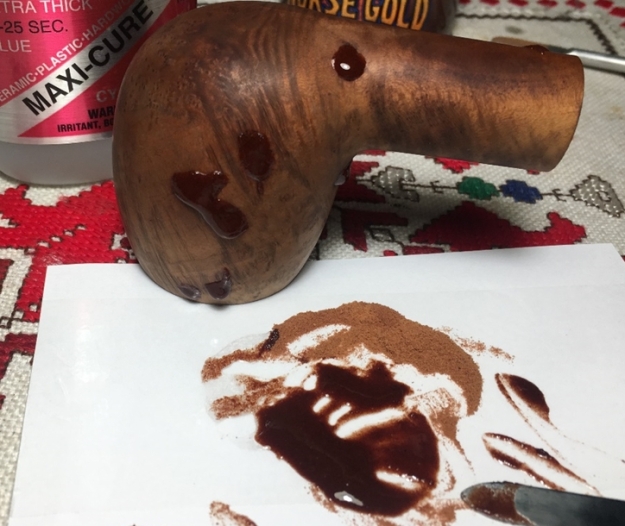
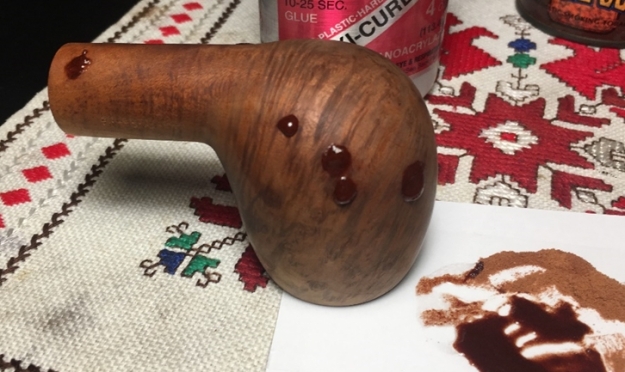
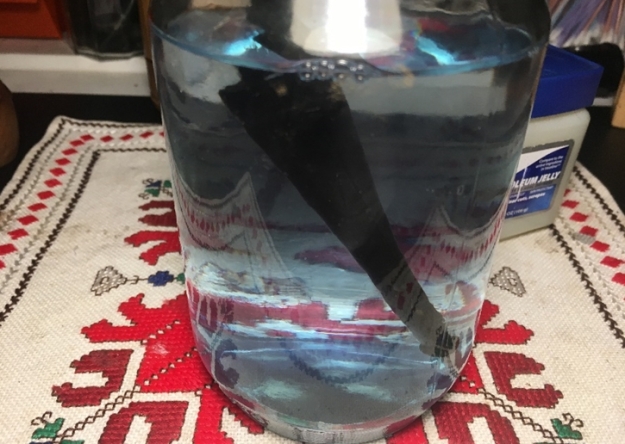
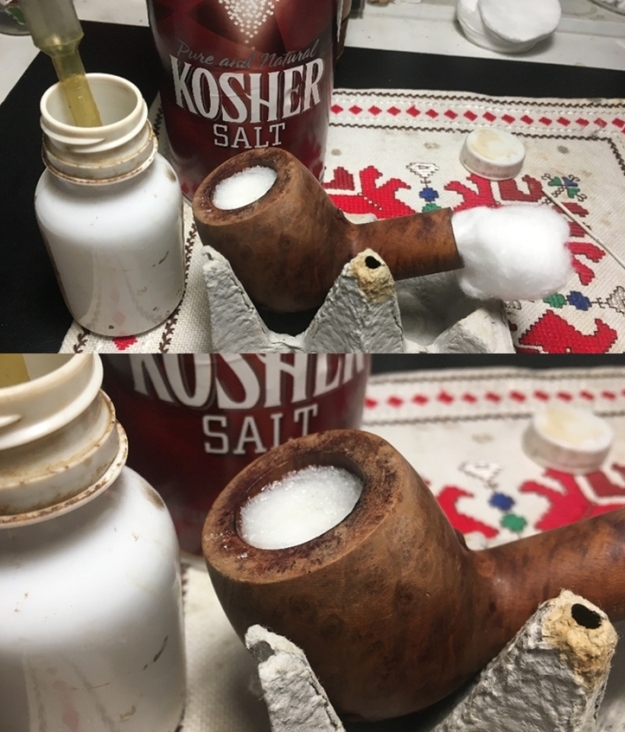
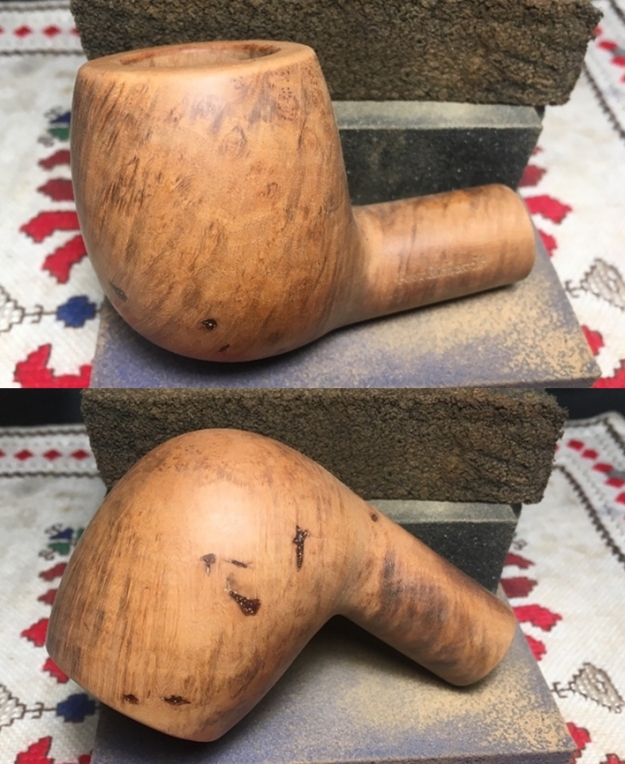
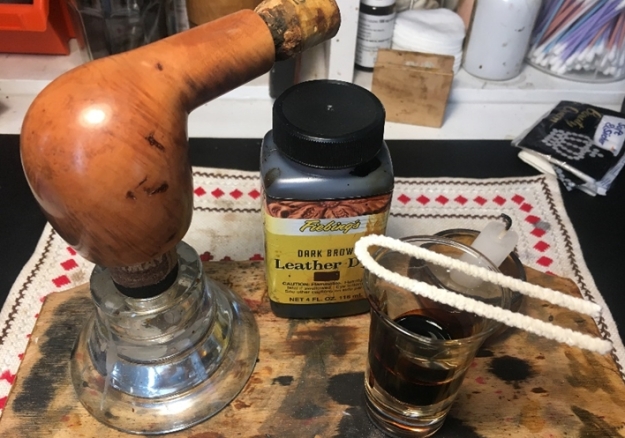
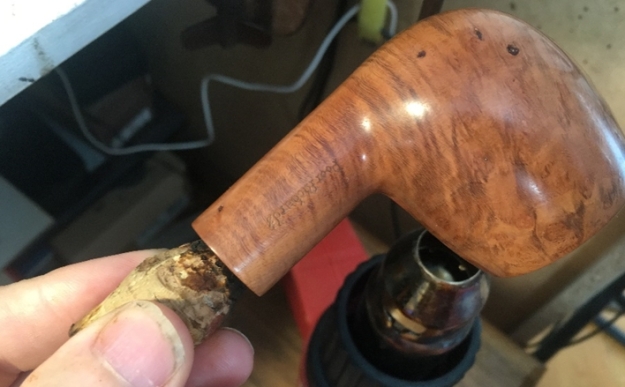
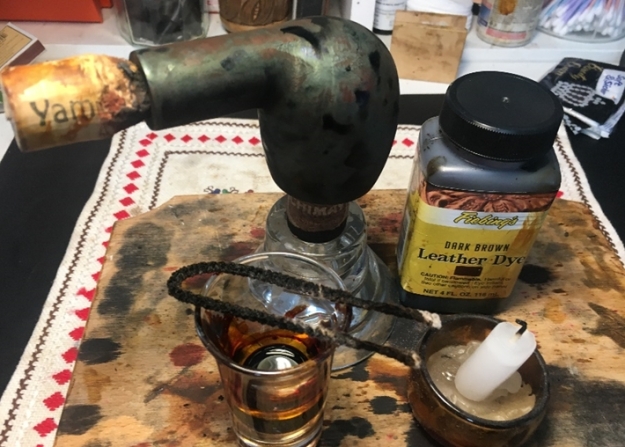
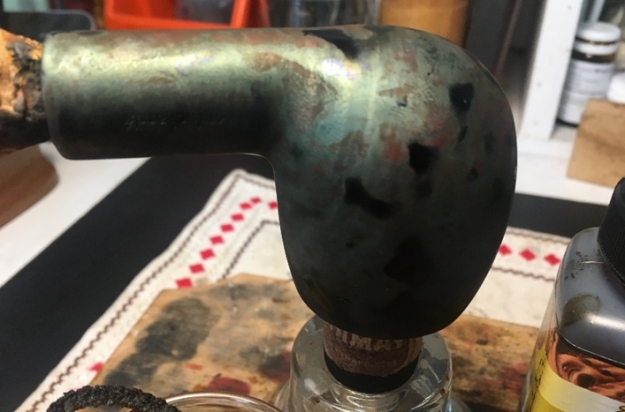
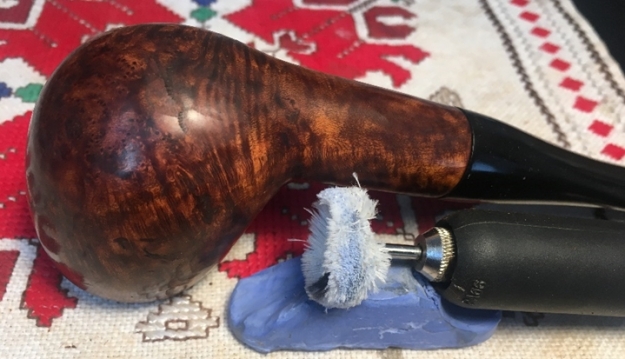
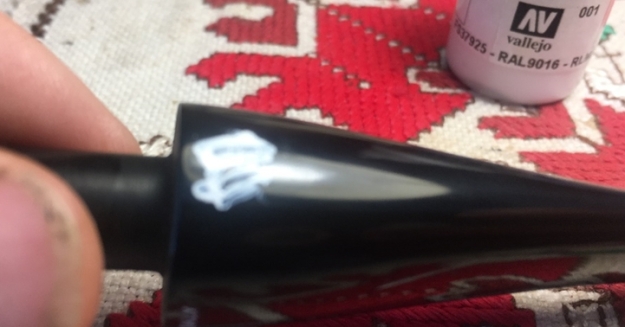
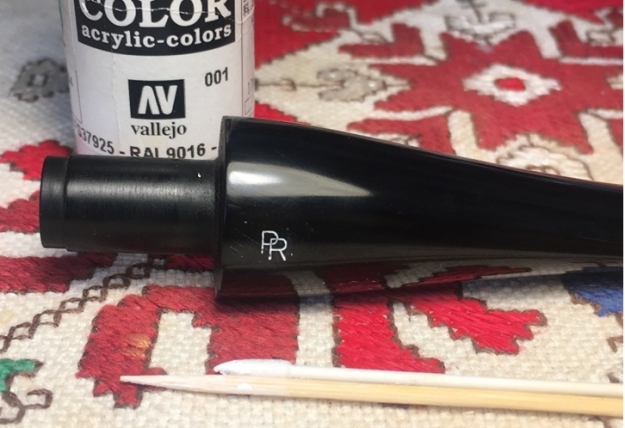
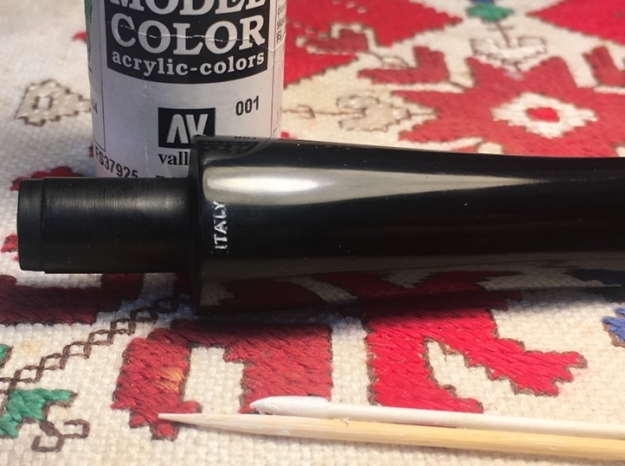
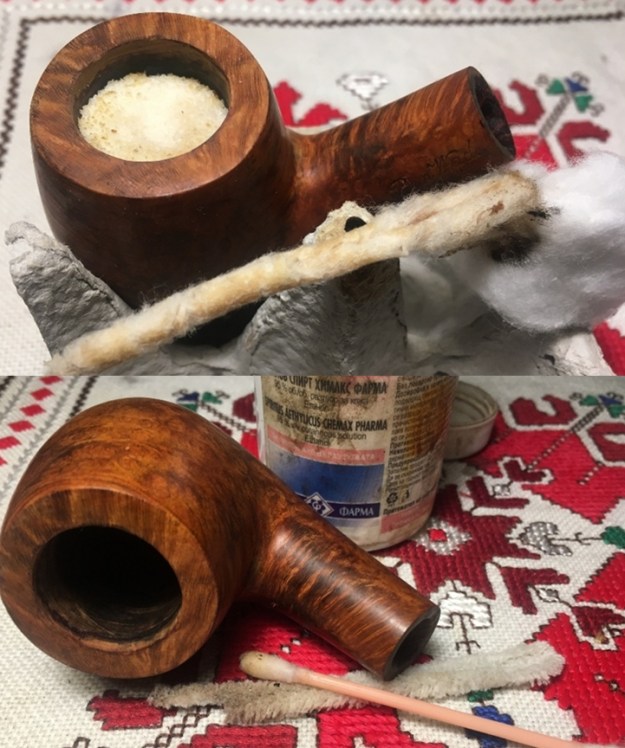
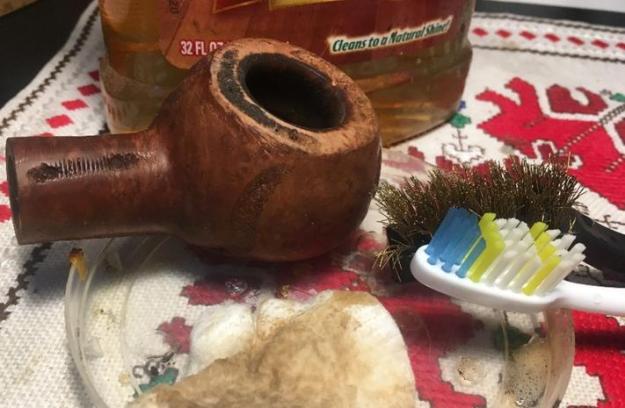
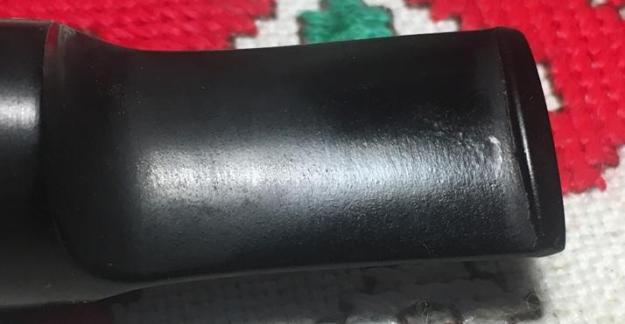
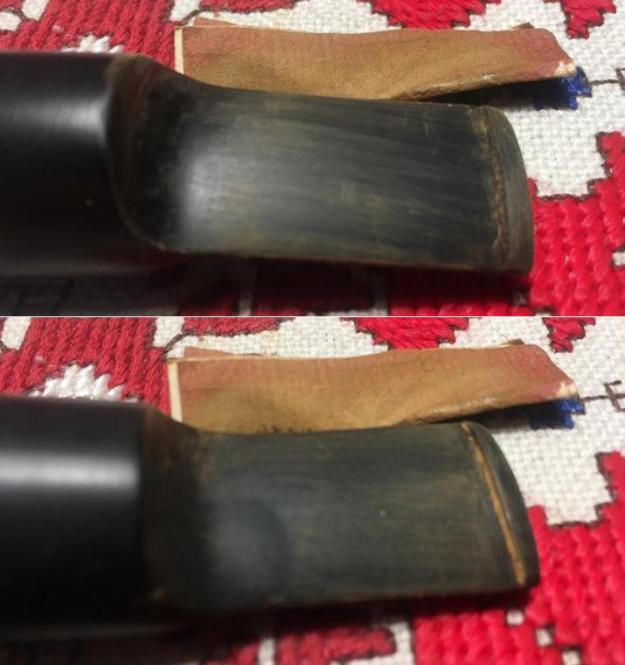
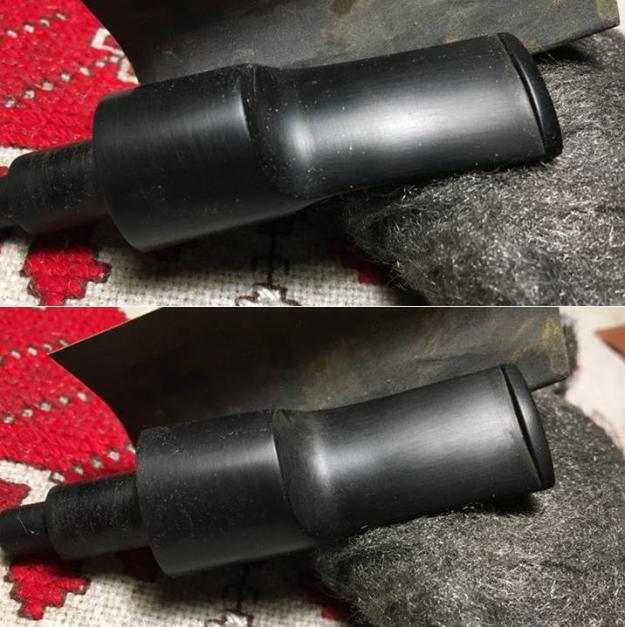
The condition of the giant Poor Richard’s before me now is poor. I take more pictures to take a closer look. The chamber has moderate cake build up that needs to be removed to inspect the condition of the chamber.  The lava flow on the rim is thick.  The stummel surface reminds one of a moonscape with all the craters in need of attention!  Along with the pits and holes there are dents and scrapes.  The oxidation on the stem is joined by bites and compressions on the lower and upper bit.  With a better understanding of the Poor Richard’s name, I begin the salvage of the giant Billiard by running pipe cleaners dipped in isopropyl 95% through the stem and then adding it to a soak of Before & After Deoxidizer along with several other commissioned pipes in the queue.  The Poor Richard’s stummel and stem are first on the left.  After letting it soak overnight, I fish out the Poor Richard’s stem and let the fluid drain off.  I then push a pipe cleaner through it to help remove the Deoxidizer.  I then wipe the stem with cotton pads wetted with isopropyl 95% to remove the raised oxidation from the vulcanite stem.  After wiping off with the alcohol, I then wipe again using a cotton pad and light paraffin oil (mineral oil) to clean and condition the stem further.  Finally, I run another pipe cleaner through the stem dipped in isopropyl 95%.  The pictures show the process. Taking the stummel, I use the Pipnet Reaming Kit to clean the chamber.  After putting paper towel down on the table for easier clean up, I start reaming using the third largest blade head since the chamber is so large.  I also use the fourth and largest blade to ream.  Following the reaming, I use the Savinelli Fitsall Pipe Tool to scrape the chamber walls removing additional carbon cake – especially down in the floor of the chamber with the difficult angles.  Then, after wrapping 240 grit paper around a Sharpie Pen, I sand the chamber walls removing additional carbon and smoothing the chamber surface.  I clean the chamber next using a cotton pad wetted with isopropyl 95%.  While inspecting the chamber, I do see some hairline heat cracks that are very small, but not serious enough to warrant repair.  Next, using undiluted Murphy’s Oil Soap I work on the external briar surface using a cotton pad.  I also use a brass wire brush on the rim to remove the lava and follow by carefully scraping the rim surface with a flat knife edge.  After scrubbing, I rinse the stummel in the sink with cool tap water.Turning to the internals, I use pipe cleaners and cotton buds dipped in isopropyl 95% to clean the mortise and airway. I also use a small dental spatula tool to scrape tars and oils off the mortise walls.  The cleaning wasn’t too bad. Later, I’ll continue cleaning the internals with a kosher salt and alcohol soak.With the internals cleaned, I now look at the stummel surface.  I have several fills to dig out and to fill.  My main tool in doing this is a sharp dental probe.  The goal is to only have a solid base in the holes – either old filler material or briar.  It takes quite a bit of time, but I move from fill to fill doing the needed excavation work. With the holes excavated, I prepare a batch of briar dust and CA glue patch to apply to the problem areas.  I scoop briar dust in a small mound on an index card and put a glob of thick CA glue next to the briar dust.  Using a dental spatula, I mix briar dust into the CA glue until I reach a thicker consistency, like molasses.  I then trowel the patch mixture into each of the holes leaving excess to be sanded down after cured.  The pictures show the process. With the Briar Dust patches curing, I turn to the stem.  After the soak in the Before & After Deoxidizer, much of the oxidation was removed.  But looking more closely, there remains oxidation but it’s much subdued. I decide to place the stem in another soak – this time with OxiClean.  I put a pipe cleaner through the stem and put it in the OxiClean to let it soak overnight.With the day ending, I continue the cleaning and refreshing of the stummel internals.  To do this I employ a kosher salt and alcohol soak.  First, I form a wick by stretching and twisting a cotton ball and with a stiff piece of wire, I stuff it down the mortise and airway.  It will serve to draw out tars and oils.  Then I fill the bowl with kosher salt and place the stummel in an egg crate to keep it stable.  With a large eyedropper, I fill the bowl with isopropyl 95% until it surfaces over the salt.  After a few minutes, I top off the alcohol as it is absorbed and turn out the lights.The next morning, there isn’t too much discoloration of the salt which means I didn’t put in enough alcohol or that the internals are clean.  The wick is darker.  I toss the expended salt into the waste, wipe the bowl with paper towel and blow through the mortise to remove remaining salt crystal.  I then use a shank brush on both the bowl and the mortise – blowing again.  Finally, to make sure all is clean and ready to go, I wet a cotton bud and pipe cleaner with isopropyl 95% and run them through the mortise and airway.  They come out clean and it’s time to move on. I put the stem in an OxiClean soak through the night and it’s time to fish it out.  I take a picture of the additional oxidation that has been raised and I take the stem to the sink and wet sand the stem with 600 grade paper to remove the oxidation.  It looks cleaner now after sanding.Looking more closely now at the bit area, there are good sized compressions.  The button also has some bite marks.  The first step is to use the heating method to see if it will expand the vulcanite reducing the severity of the compressions.  I use a Bic lighter and paint the upper- and lower-bit areas. The areas were lessoned, but not erased by heating the vulcanite. I then use 240 grade paper and sand the upper- and lower-bit areas as well as redefine the button with a flat needle file.  I take pictures of each step. First, the upper bit progress:After heating:After 240 sanding and filing:Progression of the lower bit area:After heating:After 240 sanding and filing: I’ve sanded out as much as will sand and now I will patch the areas that did not sand out.  I first wipe the stem with alcohol to clean the area.  I then apply black CA glue to the areas.  And I wait, and wait, and wait….  Well, I just discovered that Black CA glue can go flat and lose its ability to bond.  Reading the directions, is says to refrigerate to prolong shelf life.  Well, the shelf life must have been reached.  I wipe the old CA glue off and thankfully, I had purchased another bottle of Hyper Bond Black Rubber Reinforced CA glue.  I discover that the bottle mouth is larger than the squirt spouts that I have so I end up troweling a small bit of the glue on the end of a pointed dental spatula and apply it to the spot.  It works!  To advance the curing time I spray the upper and lower patches with an accelerator which does the trick.  The first picture, upper that didn’t cure and the new glue on the lower.  New bottle of glue is heading for the fridge! Next, taking a flat needle file I start filing the black CA patches staying on top of the glue mounds.  I then follow by using 240 grade sanding paper to bring the excess CA glue to flush with the vulcanite surface.  First, pictures showing the upper bit: The next step with the stem is to wet sand it with 600 grade paper then I follow by buffing the stem with 0000 steel wool to prepare the vulcanite surface for the micromesh pad phase of sanding.  The patches on the bit blended very nicely.I put the stem aside because I’m anxious to get started on the Poor Richard’s stummel.  I decide to start from the top and work down.  I will establish fresh lines for the rim and remove the surface scratches by topping the stummel.  I first use 240 grade paper on the chopping board and invert the stummel and rotate the stummel over the paper. After the 240 paper, I use 600 grade paper for another few rotations.  It looks good. To dress this Poor Richard’s up a bit, I create an internal bevel.  To me, an internal bevel softens the rim lines and is a classy touch.  I cut the bevel initially using a rolled piece of coarse 120 grade paper then follow with 240 and 600.  I simply pinch the rolls of sand paper under my thumb and rotate around the internal circumference of the rim.  I like it. Now, time to work on filing and sanding all the briar dust putty patches all over the stummel surface.  I use the flat needle file to work the mounds down to near the briar surface then I finish off with 240 grit paper, bringing the patch flush with the surface.  The pictures show the process.  Lots of filing and sanding! With the patches all repaired, I use sanding sponges to sand the entire stummel to remove additional nicks and scratches and to blend the patch areas.  I start with a coarse sponge, follow with a medium then light sponges. I like the way sponge sanding cleans up a rough bowl.Moving on to the micromesh stage, I wet sand the stummel with pads 1500 to 2400 then dry sand with pads 3200 to 4000 and 6000 to 12000.  I love the way the micromesh process teases out the briar grain. This Poor Richard’s is looking good! To mask the plethora of fills scattered on this Italian Poor Richard’s stummel, I will give him a dark stain.  I use Fiebing’s Dark Brown Leather Dye to do the job.  With it being an aniline based dye, later I can wipe the bowl with alcohol to blend and lighten as I choose.  I assemble the components used in applying dye on my worktable.  I mount a cork in the mortise to act as a handle and I pour the dye into a shot glass.  I use a folded pipe cleaner to apply the dye and a lit candle to flame the aniline dye.  I begin by wiping the stummel with alcohol to clean the surface.  I then warm the stummel using a hot air grain. This expands the briar grain aiding in it being more receptive to the dye.  Using the pipe cleaner, I then apply dye liberally to the entire stummel making sure to cover the rim well.  I then ‘flame’ the stummel with the lit candle and the alcohol immediately combusts leaving the pigment sealed in the grain.  After letting the stummel ‘rest’ a few minutes, I repeat the process of applying dye and flaming.  I then put the stummel aside to rest for several hours helping to assure that the dye is set and will not rub off later on hands when the pipe is put back into service.  The pictures show the process. With the flamed stummel resting, I turn again to the stem.  Using micromesh pads 1500 to 2400, I wet sand the stummel.  Following this, I dry sand using pads 3200 to 4000 and 6000 to 1200.  After each set of three micromesh pads, I apply a coat of Obsidian Oil to the stem to revitalize the vulcanite.  The stem is looking good. The stained stummel has rested for about 24 hours and it’s time to unwrap the flame crust. After mounting a 1 inch felt buffing wheel on the Dremel, I set the speed to the lowest RPM and apply the more abrasive compound, Tripoli, to remove the crust revealing the newly stained briar surface.  As I have refined my technique using the Dremel during the compound phases, I’ve learned that using a felt buffing wheel and Tripoli allows me to have more control over the degree of opaqueness allowed through the stain, especially when using darker stains like with this Poor Richard’s.  When I begin removing the crust with the felt wheel and the coarser Tripoli compound, the initial pass of the buffing process removes the top crusty layer, but thick, ‘blotched’ stain remains.  These blotches, or darker patches of stain hide the grain underneath.  After this first pass, my practice is to purge the wheel quickly on the side of the chopping board that is on my lap, providing the work platform for all the buffing.  After I purge the wheel of the thick stain residue from the flaming, I load more Tripoli to the felt wheel and then begin additional passes over the same area – frequently purging and reloading the felt wheel with Tripoli.  Through this process I can determine how the grain is presented.  More Tripoli buffing, the lighter hues are raised in the grain, giving more definition.  When I’m working an area where a patch is located, I tend to allow it to remain darker to enhance the masking.  After staining, I would say that this phase applying the Tripoli is the most critical for the finished look of the grain.  Why?  The coarse Tripoli combined with the coarser felt wheel does the heavy lifting by increasing the opaqueness of the stain when desired which sets the stage for the finished look.  The following less coarse compounds, such as Blue Diamond, and using the cotton wheel, provides more buffing of what is there rather than remove it.  The pictures below give a hint of what I’m describing.  For those who use a Dremel, I hope this is helpful. To blend the stained finish, I lightly wipe the stummel with a cotton pad wetted with alcohol.  I don’t need to lighten the stummel, only blend.After wiping down the stummel with the cotton pad, the Tripoli with felt wheel had lightened more than I wanted in order to provide a darker shading to blend and to mask the fills.  I decide to stain the stummel again, but the second time around, I use a cotton cloth buffing wheel and Tripoli instead of the more aggressive felt wheel.  Saving on pictures repeating the same process, here is the stummel after the second staining and flaming.  Again, I wait several hours allowing the stain to rest.Following the Tripoli compound, I mount another cotton cloth buffing wheel in the Dremel, increase the speed to about 40% full power, and apply Blue Diamond compound to both the stem and stummel which I reunite.  After completing the application of Blue Diamond, I wipe/buff the pipe with a felt cloth to remove the residual compound dust in preparation for the wax application.Before applying wax, I refresh the Poor Richard’s stem stamping, the interlocking ‘PR’ and the country of manufacturing stamp, ‘Italy’.  Using white acrylic paint, I use a pointed cotton tip to apply paint to the stamps.  While still wet I lightly wipe the excess paint off leaving the stamps filled.  It works well, and the Poor Richard’s is shaping up well! To finish the buffing stage, I mount another cotton cloth wheel to the Dremel, leaving the speed at 40%, and I apply carnauba wax to stem and stummel.  I follow by giving the pipe a rigorous hand buffing with a microfiber cloth.

I’m pleased with the transformation of the Poor Richard’s.  The dark brown dye helped to mask the repairs done to the stummel and it looks great.  This straight Billiard is a classic shape and as large as this Poor Richard’s is, I believe it will serve its new steward well.  Paresh commissioned him from the For ‘Pipe Dreamers’ Only! section on The Pipe Steward site.  He will have first opportunity to acquire the Poor Richard’s from the The Pipe Steward Store which benefits the Daughters of Bulgaria – helping women and girls who have been trafficked and sexually exploited.  Thanks for joining me!

Recommissioning a Hefty Ben Wade Bent Billiard Made in London England


Blog by Dal Stanton

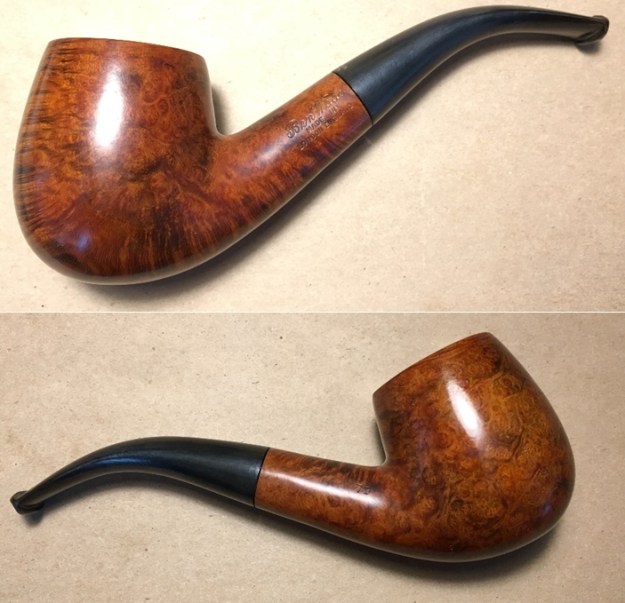
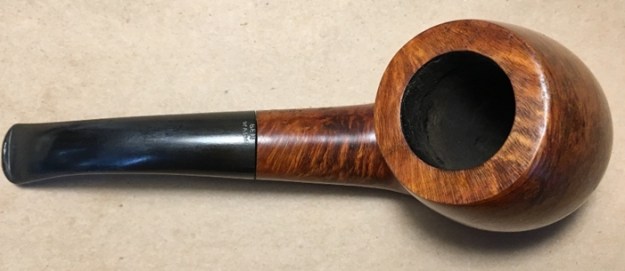
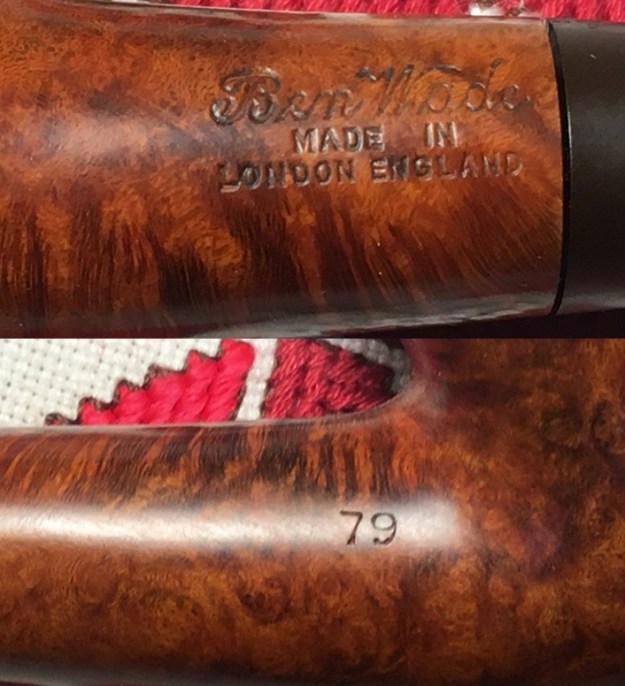
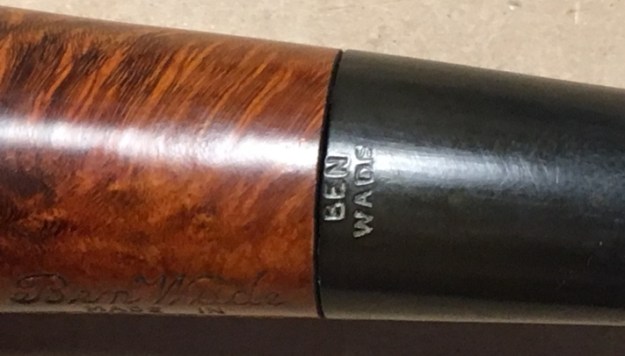
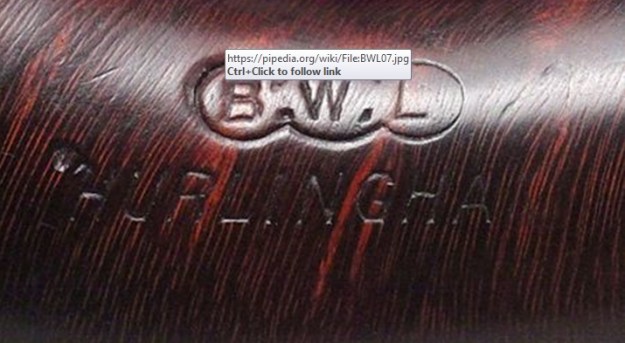
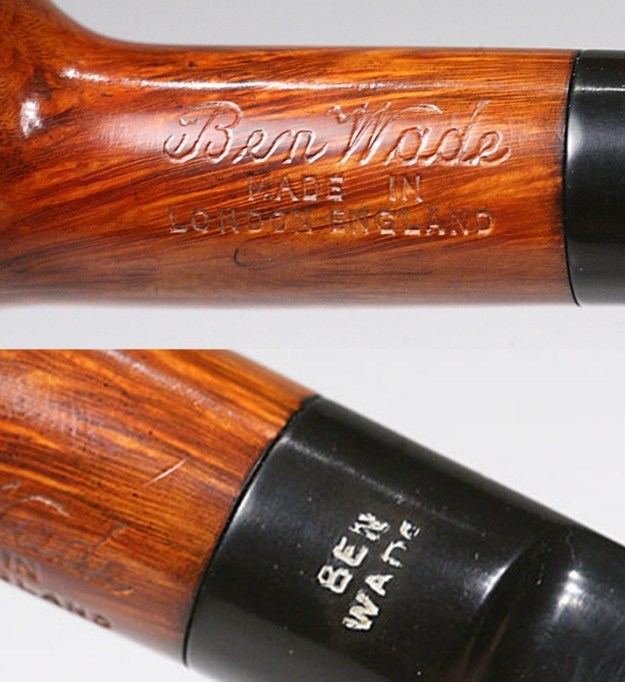
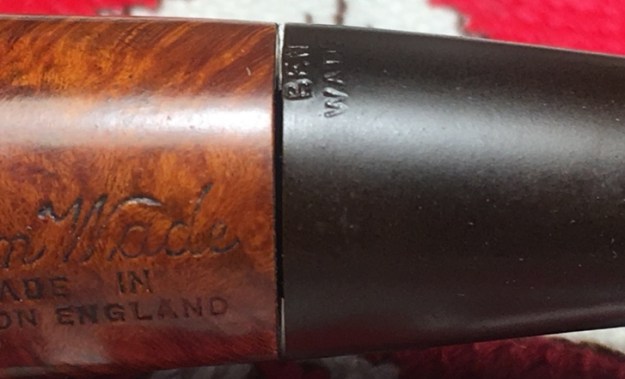
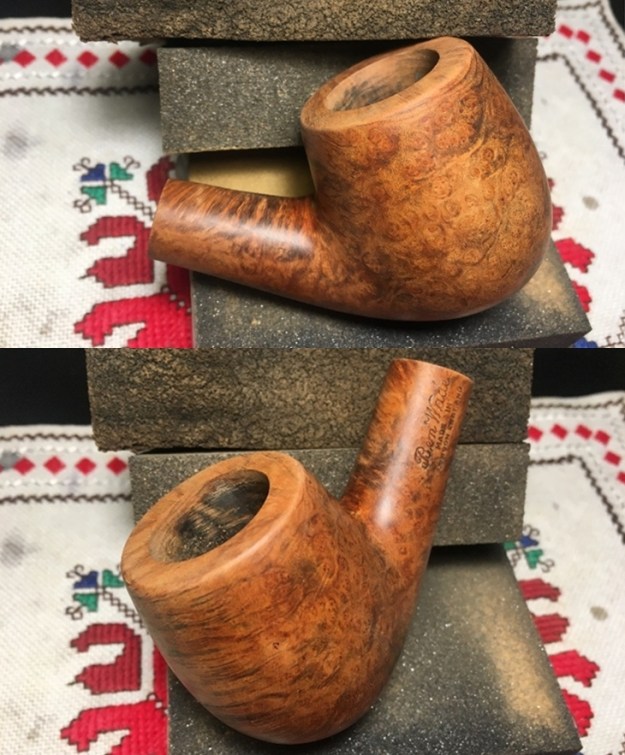
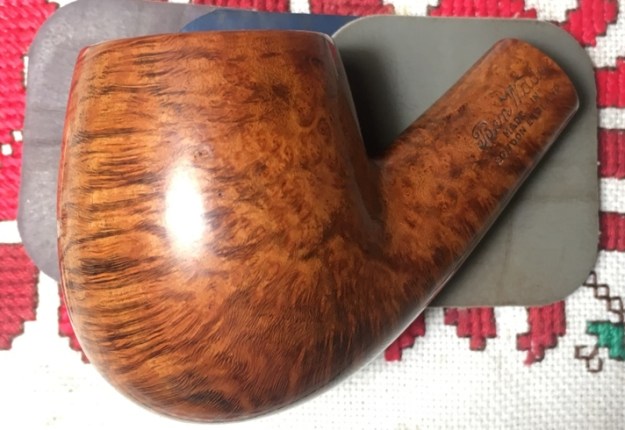
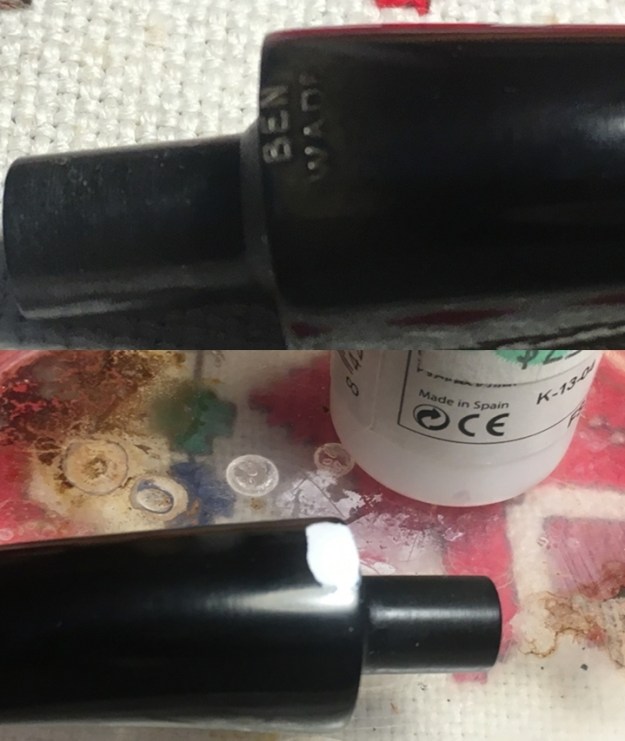
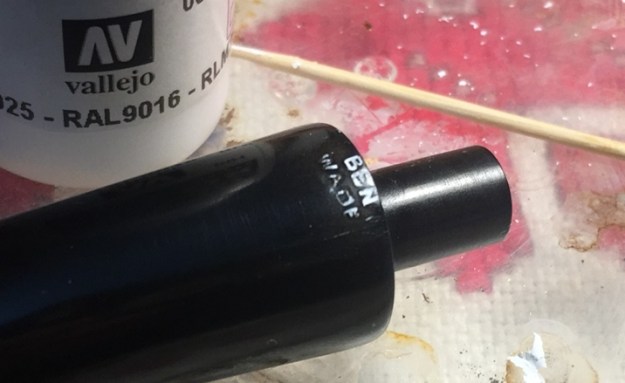
I saw this large Ben Wade Bent Billiard on the eBay auction block a few years ago and secured it with the winning bid.  This was the first time I had acquired a Ben Wade, so my initial thought was to add it to my own collection.  I noticed that Ben Wade stamped pipes usually attracted more than usual bidding attention and so I was looking forward to restoring it and learning more about the name.  In the end, I put him in the For ‘Pipe Dreamers’ Only! section on the Pipe Steward site and this is where Paresh saw it and commissioned it to add to his collection and this benefits the Daughters of Bulgaria.  The Ben Wade, without question, fits the profile of being a ‘hefty’ pipe fitting well in the hand.  Here are some of the pictures that got Paresh’s attention: I take some additional pictures on my work table in Sofia, Bulgaria, looking at the stamping.  On the left shank is ‘Ben Wade’ in cursive script over MADE IN [over] LONDON ENGLAND.  The right shank side has 79 stamped – I’m assuming a shape number. The stem also has a BEN WADE stamp. Pipedia’s article on Ben Wade is interesting and very helpful in explaining the history.  The ‘Family Era” (1860 to 1962) is described as the ‘hay day’ of the British pipe maker:

The company was founded by Benjamin Wade in 1860 in Leeds, Yorkshire, where it was located for over a century. Ben Wade started as a pipe trader, but yet in the 1860’s he established a workshop to produce briar pipes. The pipes were made in very many standard shapes – always extensively classic and “very British”. Many models tended to be of smaller dimensions. Ben Wade offered a very high standard of craftsmanship and quality without any fills. Thus, the pipes were considered to be high grade and a major competitor to other famous English brands.

Along with most pipe manufacturers, the Second World War was a difficult time for Ben Wade.  German air raids destroyed the factory in Leeds, but the Ben Wade Co., quickly rebuilt after the war.  The Pipedia article gives several examples of the Ben Wade based in Leeds nomenclature during the Family Era (courtesy of Doug Valitchka):The ’Family Era’ ended when the business was sold in 1962:

…the owner family decided to leave pipe business and sell off the firm. The family went into negotiations with Herman G. Lane, president of Lane Ltd. in New York at about the same time as the Charatan family. Lane Ltd. bought both firms in 1962. Herman G. Lane had been Charatan’s US sole distributor since 1955 and Charatan always remained his pet child. But Ben Wade was treated in another way by its new owner. The fabrication of pipes was reduced and the factory in Leeds was closed in 1965 finally.  So this was the end of Ben Wade pipes stamped “Made in Leeds, England”.

The ‘Lane Era’ is described as a time when the historic quality of Ben Wade declined to a ‘second’ with reference to the production of standard shapes:

Alas the “new” Ben Wades were quite usual series pipes, copies of well-known standard shapes. The pipes often showed hardly masqued fillings and were processed quite coarsely with hardly polished pre-moulded Ebonite stems. Therewith Ben Wade degenerated definitively to a second brand.

According to the Pipedia article, after the death of Herman G. Lane, the business was sold to Dunhill Pipes Limited in 1978 and the new owner had no need to produce ‘seconds’ coming from the acquisition.  The Ben Wade Bent Billiard on my work table comes from the ‘Lane Era’ produced between 1965 and 1978 matching the nomenclature during this period.  “Made in London England” or just “London” replaced “Leeds” with the characteristic cursive script and ‘Ben Wade’ stem stamp (again courtesy of Doug Valitchka):I had one other question regarding the name ‘Ben Wade’ – the Danish connection? In 1971, the young, Danish pipe maker, Preben Holm, came to Lane with financial difficulties and in need of a new US distributer of his pipes made in Denmark.   The new partnership put the Ben Wade name on the Freehand production coming from the Danish factory into the burgeoning US ‘Freehand’ market with a commitment to quality rather than quantity.  The market grew through the 70s until 1985, when the market for these pipes fell resulting in the downsizing of the factory in 1986 but the production of Danish Ben Wade pipes came to an end in 1989 after the death of Preben Holm.  The Pipedia article concludes by describing the status of the Ben Wade name.  Duncan Briars purchased rights to the Ben Wade name from Dunhill Pipes in 1998 and continues to produce pipes at the same factory where Dunhill pipes are made:

The bowls are carved at the world famous 32 St. Andrews Road, Walthamstowe pipe factory, in London, England. The same factory where Dunhills are made. Every pipe is drilled spot on and exhibits a good blast and all have high quality German Vulcanite mouthpieces. Every pipe is stamped “Ben Wade, Made in London, England”. The craftsmanship and smokability have always been superb.

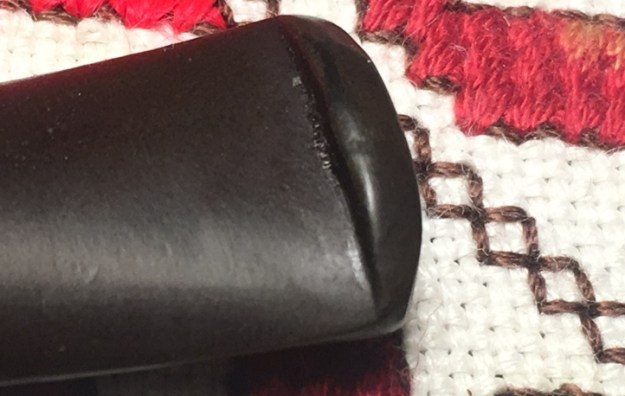
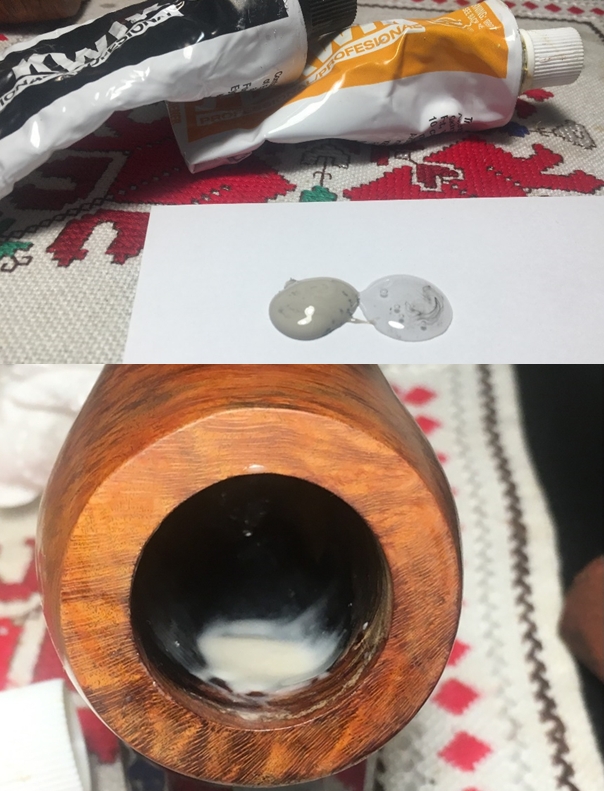
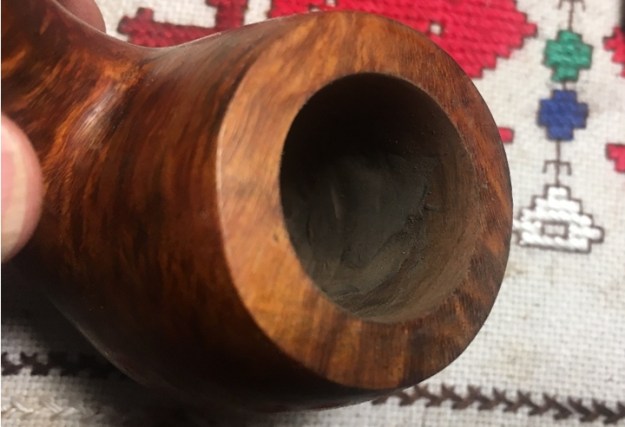
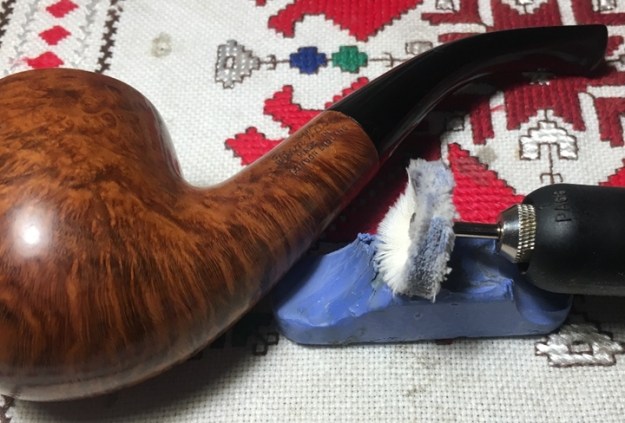
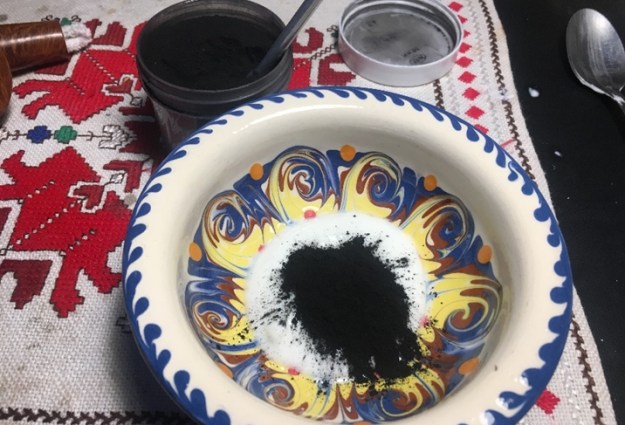
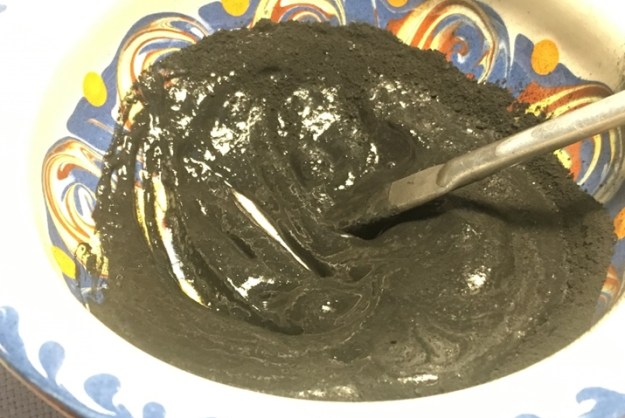
With a greater appreciation for the Ben Wade name, I take another look at the Ben Wade Bent Billiard on my worktable.  Even though the Pipedia article gave more of a negative view of traditional shapes of Ben Wades produced in the Lane Era, the pipe I’m looking at doesn’t reflect this.  The grain is beautiful, and I see no fills on the surface.  The chamber appears to have been cleaned and the briar surface is clean as well showing normal nicks and scratches.  The stem does have some minor oxidation and tooth dents on the button.  I also detect that there is a gap between the shank and stem – I’ll see if cleaning might correct this.  I take some close ups of these issues. To begin the cleanup of the Ben Wade, I run a pipe cleaner dipped in isopropyl 95% through the stem.  Then, along with other pipes in the queue, I put the stem in a soak of Before & After Deoxidizer to remove the oxidation.  After a few hours, I remove the stem and wipe off the raised oxidation using cotton pads and light paraffin oil – mineral oil.  I also run another pipe cleaner through the airway to remove Deoxidizer. Turning to the stummel, I remove the very light cake in the chamber. With the chamber so large, I jump to the largest blade head from the Pipnet Reaming kit.  I follow this by using the Savinelli Fitsall Pipe Tool and scraping the chamber walls further.  I finish by sanding the chamber wall using 240 grit paper wrapped around a Sharpie Pen.  To remove the carbon dust residue, I wipe the chamber with a cotton pad wetted with isopropyl 95%.  The pictures show the progress. One of the purposes of removing the old cake to bring the chamber down to the briar, is not only for a fresh start.  When the carbon is removed the chamber can be inspected for problems usually pertaining to heat fissures and potential burn throughs.  Inspecting the Ben Wade, I detect on the forward part of the chamber a sloping indentation that is a little to pronounced to ignore.  Using the Savinelli Fitsall Tool again, I scrape carbon out of the indentation to make sure I’m getting down to the briar.  This reveals the full extent of the abnormal burning.  I take pictures to show what I see, but the picture doesn’t do too well.  Changing the aperture, the picture is lightened, and I outline the perimeter of the indentation in the final picture below.  I need to address this budding burn through later after cleaning the stummel.  Next, I clean the external stummel surface using undiluted Murphy’s Oil Soap and a cotton pad.  The stummel cleans up well but reveals a tired, lackluster, thin finish. I then clean the internals of the stummel using cotton buds and pipe cleaners dipped in isopropyl 95%.  The grunge is thick, so I also employ a dental spatula to scrape the mortise walls as well as a drill bit to hand turn down the airway to excavate the old tars and oils.  To save on pipe cleaners I also utilize a long shank brush to scrub the airway.  Eventually, the tide begins to turn, and the buds and pipe cleaners are emerging less soiled.   I take a picture of the tools I use.To continue cleaning the internals, I use a kosher salt and alcohol soak.  I like to do this additional step in cleaning to further clean the tars and oils out of the internal briar and to freshen the pipe.  I use kosher salt because it doesn’t leave an aftertaste.  I stretch and twist a cotton ball to form a wick that I then insert down the mortise and airway pushing it with a straight, stiff wire.  I then fill the bowl with kosher salt and place the stummel in an egg crate to keep it stable.  With a large eyedropper, I fill the bowl with isopropyl 95% until it surfaces over the salt.  I put the stummel aside to soak for several hours.Again, I look closely at the stem that had already soaked in the Before & After Deoxidizer and I see that there remains deeper oxidation.  Instead of going directly to sanding out the oxidation, I decide to put the stem in the OxiClean bath to let it soak overnight – to see if more oxidation would be raised.  I put a small bit of petroleum jelly over the Ben Wade stem stamping and I put the stem in the OxiClean and turned out the lights.  Another day is finished.The next morning the soak had done the job. After tossing the expended salt in the waste, I wipe the chamber with paper towel and blow through the mortise to clear any residual salt crystals. I also use a long shank brush down the mortise.  To make sure the internals are clean, I finish by using a cotton bud and pipe cleaner dipped in isopropyl 95% down the mortise and airway.  They come out clean.Next, I fish the stem out of the OxiClean where it has been soaking through the night.  More oxidation has surfaced.  I begin sanding the entire stem using 240 grit paper careful to protect the Ben Wade stamping and shouldering the stem.  I focus on the bit area removing the minor tooth chatter.  Using a flat needle file, I freshen the button edges.  I follow by wet sanding with 600 grit paper and then 0000 steel wool.  The oxidation appears to be removed for the larger part except for some around the Ben Wade stamping which I won’t sand for the sake of preserving the stamp. Taking it one step further, using Before & After Fine and Extra Fine Polish, I rub each into the vulcanite in succession.  Putting some on my finger, I work the polishes into the vulcanite and let the stem sit for a time to absorb the polish.  The polishes are advertised not only to revitalize vulcanite but also to continue to remove the oxidation.  After each polish is absorbed, I then wipe the stem down with a cotton pad.  The pictures show the progress.Putting the stem aside for now, I work on the budding burn through in the chamber.  Previously, I dug out any remaining charring in the indentation.  To make sure the area is fully clear, I sand the area again and wiped the chamber with a cotton pad wetted with isopropyl 95% to clean the chamber.  As far as chamber burn throughs go, this one is minimal.  It has not progressed far and the size and the thickness of the bowl means that there was never any imminent danger.  Yet, for the long-term view and use of this beautiful Ben Wade Bent Billiard, I repair the problem where it is before it grows and becomes a worse problem.  I mix a small batch of J-B Kwik Weld on an index card.  After combining the two components, ‘Steel’ and ‘Hardener’, I have about 4 minutes to apply the mixture before it starts setting. I use a flat dental spatula as a trowel and apply the J-B Weld to the indentation in the chamber.  I put the stummel aside to allow the J-B Weld to thoroughly cure. After it cures, I use a sanding drum mounted on the Dremel to sand the excess.  I follow this using the Sharpie Pen wrapped with 240 grit paper to leave the chamber smooth and shaped. I’m pleased with the results and glad I went the extra mile to arrest the potential burn through.  Later, I’ll apply a coat of activated charcoal and sour cream mixture to the chamber wall to improve the aesthetics and to aid formation of a new protective cake. Before continuing, I reunite the stem and stummel to examine the shank junction.  Earlier I saw a gap between the shank and the stem.  Often, after cleaning these problems are resolved.  I find that this indeed was the case as the stem is now seated as it should be.  Pictures are before and after.With the stem now properly seating, I turn again to the stem and using micromesh pads 1500 to 2400 I wet sand the stem.  Following this, I dry sand using pads 3200 to 4000 and 6000 to 12000.  Following each set of three pads, I apply a coat of Obsidian Oil to revitalize the stem.  I love the glassy pop of a micromeshed stem! Turning now to the external surface of the stummel, I take a closer look at the condition of the briar.  I identify some very small fills which are solid except for one, which is pitted.  Along with normal dents and scratches from wear, there is a small skin mark on the forward outer lip of the rim.  For the pitted fill, I dig out more of the old fill with a sharp dental probe.  Since I will put clear CA glue on the pitted fill, I color the fill with a walnut dye stick to aid in blending.  I then spot drop CA glue on the area and set the stummel aside allowing the glue to cure. After a full work day, the CA glue patch I applied this morning is fully cured.  I remove the CA glue mound starting with a flat needle file.  The key is to stay on the mound and gradually bring it down close to the briar surface.  I don’t want to impact any surrounding briar.  I follow the filing by using a tightly rolled piece of 240 grit paper to bring the glue down until it’s flush with the briar surface.  My rule of thumb is to sand until I can feel no roughness.  The patch looks good – blending well with the briar.To address the rim nicks, I decide to give the rim a very light topping.  Using a chopping board as my topping board, I place a sheet of 240 grade paper on the board.  Inverting the stummel, I rotate the stummel a few times on the board to freshen the rim lines and remove the nicks.  I follow with a few rotations on 600 grade paper.  The pictures show the progress. Next, to address the briar surface, I use in succession rough, medium and light grade sanding sponges to work out the cuts and nicks in preparation for the micromesh pads.  I find that using sanding sponges on smooth briars helps clean the surface of the old, tired finish without being greatly invasive.  The sponges also smooth and soften the rim lines after the topping.  I enjoy watching the grain begin to take center stage through the process.Next, using micromesh pads 1500 to 2400 I wet sand the stummel.  I follow by dry sanding with pads 3200 to 4000 and 6000 to 12000.  I forgot to take a picture of the first set of 3 pads.  The grain is coming through nicely. Rejoining stem and stummel, I mount a 1-inch cotton cloth buffing wheel to the Dremel set at about 40% full power and apply Blue Diamond compound to the entire pipe.Before applying carnauba wax to the stem and stummel, I need to touch up the Ben Wade stem stamping with the hope there’s enough tread left in the ‘Wade’ portion of the stamp to hold the paint.  Using white acrylic paint, I apply paint over the stamping and sponge off the excess while still wet and allow the paint to dry. After dry, I gently scrape the excess with the flat edge of a toothpick.  I’m less than satisfied.  I try reapplying more paint and wiping while still wet.  After working with it for some time, I’ve come to the best I can do.  The ‘Wade’ part of the stamping simply does not have enough depth left to fully hold paint.  The picture shows my less than hoped for results. One more project to finish before the final waxing.  After completing the chamber repair using J-B Weld and sanding, to aid the aesthetics and to provide a starter layer for developing a protective cake, I mix together sour cream or natural yogurt with activated charcoal to form an application to cover the walls of the chamber.  When I first heard about this mixture from Steve on rebornpipes, I was a bit doubtful then, but no longer.  I have used this application many times and after applying and drying, the result is a very sturdy layer.  After the pipe goes into service, the only caution is when cleaning out the bowl after use do not scrape the chamber with a pipe tool.  I simply use a folded bristled pipe cleaner to scrape the wall after dumping the ash.  This has worked well for me.  I place a pipe cleaner in the draft hole to keep the airway open.  Here in Bulgaria, yogurt is very plentiful, so I scoop some natural yogurt in a small bowl and add some activated charcoal powder and mix it.  After it mixes and thickens enough so it won’t be runny, I trowel the mixture into the chamber with a pipe nail tool and spread it evenly.  After it’s distributed well, I set the stummel aside for a time to allow the charcoal/yogurt mixture to cure. After the Charcoal/Yogurt coating sets, I reunite stem and stummel.  Using the Dremel, I mount another cotton cloth wheel, leaving the speed at about 40% and apply carnauba wax.  After a few coats of wax, I give the pipe a rigorous hand buffing with a microfiber cloth to raise the shine.

This hefty Ben Wade Made in London England Bent Billiard turned out very well.  The horizontal grain on the huge stummel flows in a striking picture and is joined by large bird’s eye pools. The bowl rests very nicely in the palm and will provide its new steward with much enjoyment. Paresh commissioned this Ben Wade and will have the first opportunity to acquire it from The Pipe Steward Store.  This pipe benefits the Daughters of Bulgaria – helping women and girls who have been trafficked and sexually exploited.  Thanks for joining me!


Restoring a Keyser Hygienic Patent from a Garden Shed in England


Blog by Steve Laug

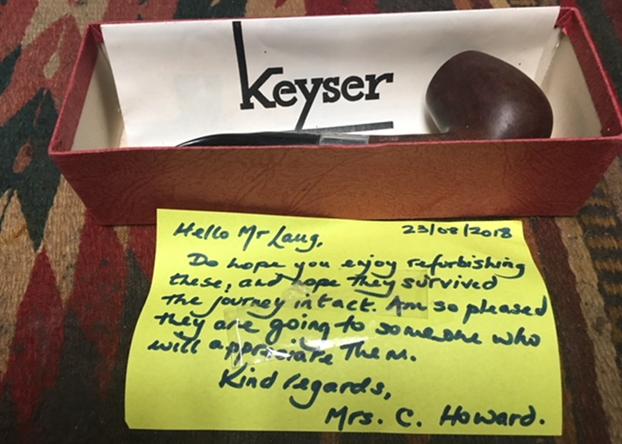
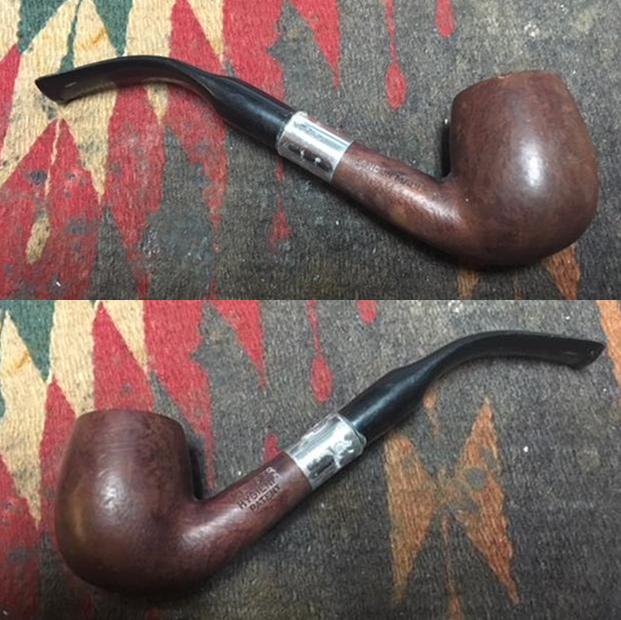
Not too long ago I received an email from through the rebornpipes site. I am actually getting quite a few emails each week which I find a pleasure to read and answer. They range from questions on restoration to those regarding estate pipes. This one was interesting to me in that it was about a brand of pipes that I have worked on and enjoyed in the past. I have included the initial email and subsequent ones below to give you the context of the ongoing interaction on this pipe. I thoroughly enjoyed the interchange with Mrs. C. Howard and look forward to being able to send her photos of the restored pipe.

Hello. Clearing out our shed today my husband came across a couple of old pipes, one of which is a Keyser Hygienic, which I have now read about, on your website, how you clean and refurbish them. For my husband and his crewmate in the London Ambulance Service in the 70’s, smoking a pipe was just another one of their fads (with motorbikes at that time, they rather fancied themselves, too, as facsimiles of Starsky & Hutch!) so although tooth-marked, not badly for the amount of time they were in use, I would think. My husband’s reaction to ‘turfing out’ unwanted things is to take it all to the dump, whereas mine is to locate useful ‘homes’ for items that are still serviceable and would serve a useful purpose. I see that you are on the look-out for Keyser pipes and wondered if you would like this one. It would only go to charity anyway and I would rather donate it to you – it would be no difficulty for me to post, if you wanted it. I also have a Duncan Mini Dent pipe; if you would like this also I could send it at the same time. I have washed both of them but, obviously, your attention to that aspect would be done best by you. I look forward to hearing from you. – Yours sincerely – Mrs. C. Howard

I immediately wrote her back and told her I would be delighted to receive the pipes and would gladly pay her for the postage from England to Canada. She replied:

Hello Mr Laug,

I was very pleased to hear your response and will post both pipes to you as soon as I’ve wrapped them.  There will be no need for a refund of postage; I’ll be happy just to know the pipes are being re-located from my shed, ignored and unloved, to a good home where they will get both!

My husband and I loved Vancouver when we visited, particularly enjoying the trip over to Vancouver Island to see Mrs. Butchart’s Gardens and where my aunt and uncle had moved to years ago.  We especially, too, liked the laid-back nature of the Canadian people.

However, I shall get these pipes posted asap and hope you enjoy the final result of your labours in refurbishing them. With best wishes – Mrs. C. Howard

Once again I replied thanking her for her kindness in gifting and sending the pipes to me. I looked forward to receiving them from her and working on them to restore them to their former glory.

Hello Mr Laug,

Just to let you know that you should be receiving the pipes in the not-too distant, since I posted them off yesterday, the 23rd. Optimistically, it won’t be too long before they arrive at your door.  I hope I don’t sound like an Amazon rep, although I rather fall down on being able to provide you with parcel tracking details, et al! – Kind regards. Mrs. C. Howard

To me this kind of information is priceless and gives me the background on the pipes when I work on them. I like to picture in my mind the pipe man who smoked them. In this case the information made me wonder how many more pipes are sitting in garden sheds around the world, having been discarded when the pipesmoker decided to lay them down. Thank you Mrs. C. Howard for the foresight you had in rescuing these pipes.

When the box arrived in Vancouver I wrote Mrs. C. Howard and let her know they arrived safely. I opened her parcel and found the contents were well wrapped and had come undamaged. The Keyser Hygienic pipe that I am working on came in its original box shown below. At this point I did not have any idea of either the shape or the condition of the pipe but I had never seen a boxed version so I was excited to see what was inside.I opened the box to find a bent billiard, the original Keyser Brochure and a nice note from Mrs. C. Howard. I include her note in the photo below.I took the pipe out of the box to have a look at it. It was worn but in decent condition. The finish was faded and the grain barely visible but underneath it looked to be interesting. The rim top was coated with a thick coat of lava and the bowl had a cake. The aluminum shank end was coated with what looked like silver polish and it was on the briar as well. The stem was clean but had tooth chatter and some deeper tooth marks on the underside near the button. I took photos of it before I started my work on the pipe. I took photos of the stamping on both sides of the shank. It was in great condition and very readable. You can also see the polish on the aluminum and in the letters of the stamp. The left side reads Keyser Hygienic over Patent. The right side reads London Made.I took close up photos of the rim/bowl and the stem to show the condition of the pipe when it arrived.The stem was tightly inserted in the stem and the polish and grime held it firmly in place. I carefully twisted the stem while holding tightly onto the aluminum ferrule. It came out with a bit of effort. I took a photo of the pipe at this point and also of the shank and stem end to show the apparatus inside and the condition of the interior of the pipe.I set the pipe aside and took photos of the brochure that was packed with the pipe in the box. The front page of the piece was interesting in both the advertising speak and the cutaway diagram of the pipe. The first photo shows the overall look of the brochure cover while the two that follow that show the details. I opened the brochure and found a great shape chart of the options available for the smoker who purchased a Keyser Hygienic pipe. I have not seen one of these before. I will try to scan the entire brochure soon and post it on the blog separately.On the backside of the brochure were instructions on the care of the pipe.It is quintessential British and reads:

Smoked by Connoisseurs.

The Care of the pipe.

The following suggestions will enable the owner of a KEYSER HYGIENIC PIPE to obtain the best results.

In the early stages it is advisable to only half fill the bowl and smoke slowly, increasing the amount of the charge after the first few pipefuls. Never refill on top of a half smoked charge. Always allow the bowl to cool before refilling.

As a wet heel does not form in the bowl of a KEYSER HYGIENIC PIPE it is recommended that each charge is smoked right to the bottom, allowing the bowl to carbon evenly and preventing waste of tobacco.

It is inadvisable to allow carbon to become more that 1/8 inch in thickness, as expansion of carbon when hot may result in cracking the bowl. When the carbon lining becomes too thick, reduce it, but do not remove it entirely; leave a carbon lining of about 1/16 inch.

The trap of the Keyser Hygienic Pipe should be emptied frequently; hold the pipe in a vertical position, remove vulcanite and pour out the moisture. The pipe should be cleaned regularly with ordinary pipe cleaners, and the vulcanite only should be rinsed occasionally with a non-flammable cleaning fluid and dried off with a pipe cleaner; on no account should water or steam be used.

The practice used by our forefathers of treating their clay pipes with alcohol and other liquids  should not, on any account, be used on a briar pipe as it has a serious detrimental effect upon the smoking qualities and life of briar and may result in cracking the bowl.

The KEYSER HYGIENIC PIPE is designed to prevent moisture, tobacco and ash being drawn into the mouth and to prevent, also, moisture entering the bowl and a wet wad of tobacco forming which is always wasted.

It is due to the patent stem – fitted exclusively to the KEYSER HYGIENIC PIPE – that the whole of the tobacco can be smoked, thereby preventing waste and showing a considerable saving. The absence of moisture permits the bowl to carbon right to the bottom, ensuring a sweet, clean, wholesome smoke, free from the moisture with which pipe smoking is usually accompanied.

Each pipe is produced individually and is an outstanding example of a product upon which Engineers and Pipe Craftsman work in harmony.

MANUFACTURED BY
MERTON PIPES (LONDON) LTD
UNIT 17, 784/792 HIGH ROAD
LONDON N17 0DA, ENGLAND
AND KEYSER MANUFACTURING CO

Scientifically designed – Made by British Craftsmen Printed in England

Over the past years I have picked up quite a few Keyser Hygienic pipes. As you can see from the above information they are made in England. I had read that the pipes were sold exclusively in South Africa. They were designed to be virtually indestructible for farmer pipe smokers in SA. All versions of the pipe have the same stem – one size fits all. I had thought that they were made of nylon and rubber or some combination that is a proprietary form of vulcanite developed by Keyser Manufacturing Co. They are tough and take tooth wear very well but are hard to buff as the heat from a buffer can easily melt the stem surfaces.

In my previous restorations I included the photo below. It came from the web and pictures a cutaway picture of the pipe and the unique condensing chamber that makes up the patented portion of the pipe. The shank has an aluminum condensing chamber with a tube in the centre that lines up with the tube inside the stem. It is pointing downward (or in the case of this pipe to the left side so that the air swirls around in the chamber formed by the military bit stem and the shank. Moisture is trapped and the smoke is cool and dry without loss of flavour.After processing all of the information that came with the Keyser Hygienic Pipe I thought I would “be manly! Restore a pipe! I started by reaming the bowl with a PipNet reamer working my way through the first two cutting heads to take the cake back to bare briar. I really wanted to see the bowl walls and check them for damage. I cleaned up the walls with a Savinelli Fitsall Pipe Knife and then wrapped 220 grit sandpaper around a dowel and sanded the walls of the bowl. The inside walls were in excellent condition. I examined the rim surface and saw burn marks on the inner and outer edges as well as some nicks and damage to the briar. I decided to lightly top the bowl on a topping board with 220 grit sandpaper. It did not take much to remove the damaged areas and burned edges. The second photo below shows the cleaned rim top.I wiped down the surface of the bowl to remove some of the opacity of the stain. The stain appeared to be a dark to medium brown but what wiped off was oxblood or cordovan. I would never have guessed that looking at the pipe. Underneath there were what looked like nicks on the left side of the bowl but turned out to be small fills. There was some beautiful grain on the pipe that I wanted to highlight. With the exterior and the bowl clean it was time to address the condenser chamber in the shank and stem. It took some maneuvering to get the pipe cleaners through the aluminum tubes in the shank and the stem but I was successful in removing the tars and oils that had built up in both spots. There was still a musty garden shed smell to the pipe so I kept cleaning until it was fresh. Later I would do a cotton ball and alcohol soak to further remove that smell.I rubbed down the exterior of the bowl and rim with Before & After Restoration Balm. I have been using this product for about ½ a year now and really like the way it cleans, enlivens and protects the briar. I rubbed it on with my finger tips and worked it into the finish of the briar. I set the bowl aside for about 10 minutes while I did other things and then buffed it off with a soft cloth. The state of the bowl can be seen in the photos below. After buffing off the balm I could see that the rim needed some more work but decided to address the remnants of the garden shed smell first. I filled the bowl with cotton balls, stuffing them deep in the bowl. I inserted a pipe cleaner in the tube in the shank to wick out the oils and filled the bowl with 99% isopropyl alcohol to draw out the oils and tars in the briar. I used an ear syringe to fill the bowl. I know if you read the brochure from KEYSER HYGIENIC above it said not to use alcohol, but I have found over the last 20+ years of pipe cleaning that it does a great job. I set the bowl aside in an old ice-cube tray, much stained from years of abuse and let the alcohol and cotton balls do their magic.I came back to the pipe several hours later and the cotton balls had absorbed a lot of tars and oils. You can see the effect in the cotton in the picture below. The pipe cleaner had wicked out some more of the tar from the tube as well. The pipe smelled fresh and clean with the garden shed smell removed for good.I cleaned up the darkening and burn mark on the inner edge of the rim with 220 grit sandpaper. I gave the edge a slight bevel to blend in the damaged area on the rim. I like the look a slight bevel gives a bowl.I used 220 grit sandpaper to sand out the tooth marks and chatter on both sides of the stem near the button.I polished the stem with micromesh sanding pads – wet sanding with 1500-2400 grit pads and dry sanding with 3200-12000 grit pads. I wiped the stem down after each pad with Obsidian Oil. I polished it with Before & After Pipe Stem Polish – both fine and extra fine and buffed it with a cotton pad. I gave it a final coat of Obsidian Oil and set it aside to dry. I carefully polished stem with Blue Diamond to polish out the remaining small scratches. I used a very light touch so as not to damage the stem. I buffed the bowl with Blue Diamond as well – a bit more vigorously. I gave the bowl and the stem multiple coats of carnauba wax. I buffed the pipe with a clean buffing pad to raise the shine. I hand buffed it with a microfiber cloth to deepen the shine. The pipe polished up pretty nicely. What remained of the original colour came alive with the buffing and works well with the polished aluminum ferrule and the polished black vulcanite stem. Altogether the pipe has a rich look. The finished pipe is shown in the photos below. The shape, finish and flow of the pipe and stem are very well done. The dimensions are Length: 6 inches, Height: 1 3/4 inches, Outside diameter of the bowl: 1 1/8 inches, Chamber diameter: 5/8 of an inch. Not sure what I am going to do with this one – probably enjoy it but keep an eye open because it well could end up on the store. Thanks for walking through the restoration with me as I worked over this well-made Keyser Hygienic Bent Billiard Patent pipe.

The Vintage Notoriety of Tom Howard and his Jumbo Squat Rustified Tomato


Blog by Dal Stanton

I’ve never restored a pipe where the person who made it had more notoriety than the pipe name itself.  The Tom Howard Jumbo Squat Rustified Tomato came to me along with several others from a good friend I worked with in Ukraine several years ago.  Dave Shain is also a fellow pipe man and restores pipes and has a great website, www.ThePipery.com.  In 2017, Dave won the Master of Pipes award from the Chicago Pipe Collectors Club for his work and charitable activities through The Free Pipe Project where Dave spearheads a program to send quality restored pipes to servicemen serving their country.  I visited Dave where he lives near Atlanta, Georgia, and we had a great time renewing our relationship.  He showed me his workshop, pipe and tobacco collections, and of course, we settled down in the ‘Barn’ flanked by a vintage Ford pickup – his Man Cave, to share a bowl or two.  It was a fun reunion!  I left with a tin of his aged Escudo and several pipes he wanted me to restore for the Daughters of Bulgaria, which I was more than happy to do.  Thanks Dave!The Tom Howard is now on my worktable because another pipe man, Paresh, saw it on The Pipe Steward site in my section, For ‘Pipe Dreamers’ Only!  This is where I post pipes that are in my electronic ‘Help Me!’ basket that others can commission to add to their collections.  Like me, through rebornpipes’ Steve Laug’s encouragement and tutelage, Paresh started restoring some of his own pipes in India, where he lives, and publishing his write ups on rebornpipes.  This LINK will take you to his restorations published on rebornpipes – he does a great job!   After seeing some of my restorations online, Paresh visited The Pipe Steward and saw some pipes that chose him – like Harry Potter and the wizard’s wands!  One thing I’ve learned in my growing relationship with Paresh as we’ve communicated back and forth between Bulgaria and India, is that he doesn’t like large pipes – he LOVES large pipes!  And this Tom Howard Jumbo Squat Rustified Tomato got his attention – here are the pictures he saw in For ‘Pipe Dreamers’ Only!The pipe is marked on the left shank with ‘Tom Howard’ in cursive script and ‘Imported Briar’ on the right shank side in the same script.  For a Squat Tomato, I’ve labeled it a ‘Jumbo’ because it has a definite stout presence in the palm.  The dimensions of the bowl give you an understanding of Tom Howard’s presence: Length: 5 5/16 inches, Height: 1 1/2 inches, Bowl width: 2 1/8 inches, Rim width: 1 1/2 inches, Chamber width: 7/8 inches, Chamber depth: 1 1/4 inches.I had never heard of a Tom Howard stamp on a pipe and after I put the name in search tool on Pipedia I was surprised to find what I found.  Tom Howard was a vintage celebrity in America during the 1940s and 50s.  Here’s the Pipedia said about Tom Howard the man:

Tom Howard was a popular comedian and personality in the 1940s/50s, known for vaudeville stage and radio work. But he also was a skilled pipe maker. In a Popular Mechanic article from 1947 he is written up as the “Hobbyist of the Month, Tom Howard.” He made pipes in his workshop outside his home in Red Bank, NJ. starting about 1939 and looks like into the late 1940’s or later. He purchased briar blocks by the bag as well as stem blanks, and in his well-equipped shop he handcrafted his pipes, in about three hours on average. He was a true craftsman, also specializing is intricate model boats, trains and brass canons, all built to scale.

I was intrigued – this vaudeville and stage comedian made pipes and this pipe came from his workshop made by his hands.  How cool is that?  Desiring to find out more about Tom Howard the man, I searched Wikipedia and found a fun and informative article about his professional life and how he hosted a I was intrigued – this vaudeville and stage comedian made pipes and this pipe came from his workshop made by his hands.  How cool is that?  Desiring to find out more about Tom Howard the man, I searched Wikipedia and found a fun and informative article about his professional life and how he hosted a zany Q&A game show that was spoofing the ‘serious’ Q&A game shows.  It was called “It Pays to Be Ignorant”.   Here is what the Wikipedia article said:

It Pays to Be Ignorant was a radio comedy show which maintained its popularity during a nine-year run on three networks for such sponsors as Philip MorrisChrysler, and  DeSoto. The series was a spoof on the authoritative, academic discourse evident on such authoritative panel series as Quiz Kids and Information Please, while the beginning of the program parodied the popular quiz show, Doctor I.Q. With announcers Ken Roberts and Dick Stark, the program was broadcast on Mutual from June 25, 1942 to February 28, 1944, on CBS from February 25, 1944 to September 27, 1950 and finally on NBC from July 4, 1951 to September 26, 1951. The series typically aired as a summer replacement.

Snooping a bit more, I found an online site that had the July 5, 1951 episode of ‘It pays to Be Ignorant’ available for viewing.  I watched it and it was like I was in a time machine!  The video also included period advertising for cars and tobacco and Tom Howard in form, dawning a professorial gown and a gravelly 1950s vaudeville tin can voice.  It’s great! I clipped a picture of the episode.  If you want to see it yourself, here’s the link:  The Internet Archive.

The Pipedia article I included above, referenced one more source to learn a bit more about Tom Howard.  In a 1947 Popular Mechanics edition he was named ‘Hobbyist of the Month’ – but it didn’t say which month!  With a little bit of help from Google, I found Archive.org that housed old editions of many periodicals including Popular Mechanics.  I started in January and started searching – thankfully they had a search tool I utilized for each month.  Finally, I found the article in the Popular Mechanic 1947 June’s edition.   For the absolute nostalgia of it, and for the interesting information it adds about Tom Howard and especially his pipe production, I’m including the pages here for you to read – including the cover page!  I couldn’t pass it up!   With a greater appreciation for the pipe man, Tom Howard, I take another look at the Jumbo Squat Rustified Tomato before me and based upon the articles above the dating of this pipe could range from the late 1930s to the early 50s as Tom Howard died in 1955 at the age of 70 according to Wikipedia.  The chamber has very little cake buildup.  The rim is worn and the rustification on the rim is filled or simply worn down – I’ll need to clean this to see.  The inner lip of the rim is darkened by scorching.  The rustified stummel is attractive – it has scratches and blemishes from use.  The smooth briar around the rustification is nice looking – I think it will look very nice after cleaned and spruced up some.  The stem has some oxidation and the bit shows minor tooth chatter.  I notice too, that Tom Howard but a subtle bend on the saddle stem to give the stem a definite orientation – nice touch and it looks good too.I begin the restoration by cleaning the internal airway of the stem using a pipe cleaner dipped in isopropyl 95% and then adding it to a soak of Before & After Deoxidizer along with other stems of pipes in queue to be restored.  After a few hours I remove the stem from the bath and wipe it down with a cotton pad wetted with light paraffin oil (mineral oil) removing the light oxidation that was raised from the vulcanite.Turning now to the stummel, to remove the light cake in the chamber I use the Pipnet Reaming Kit.  Even though the cake is light, I want to give the chamber a fresh start.  I jump right to the 3rd largest blade head and finish using the largest.  I follow the reaming blades by using the Savinelli Fitsall Pipe Tool to scrape the chamber wall further, then finish by sanding the chamber with 240 grit paper wrapped around a Sharpie Pen.  To clean the carbon dust, I wipe the chamber with a cotton pad wetted with isopropyl 95%.  I inspect the chamber wall and it looks good – no cracks or heat fissures.  The pictures show the process. To clean the external surface of the stummel, I use undiluted Murphy’s Oil Soap and cotton pads.  I also utilize a bristled tooth brush to clean the rustification as well as a brass bristled brush to work on the rim and the dark scorching on the inner lip. Turning to the internals, I use cotton buds and pipe cleaners with isopropyl 95% to clean. I also employ dental spatulas to scrape the mortise walls as well as a drill bit to clean the airway.  I sized a bit just large enough to fit the airway and hand-turn the bit to clean the tars off the walls.  After some time, the cotton buds and pipe cleaners start coming out cleaner.  Later, I will continue the internal cleaning by giving the internals a kosher salt and alcohol soak.Turning to the stem, I use 240 grit paper to sand out the roughness and tooth dent in the bit area – upper and lower.  I follow this by wet sanding the entire stem with 600 grit paper.  I then use 0000 grade steel wool to sand/buff the stem.  The pictures show the progress. While I was sanding, I notice that the draft hole in the button is not shaped well – a bite compression or something.  I use a sharp needle file to even the opening and I repeat the sanding process for the button end – 240, 600 and 0000 steel wool.With my day ending, I continue the cleaning of the stummel internals by utilizing a kosher salt and alcohol soak.  I create a ‘wick’ by pulling and twisting a cotton ball.  I then insert it and stuff it down the mortise into the airway as much as it will allow.  I then fill the chamber with kosher salt – why kosher?  It will not leave a residue taste as iodized salt.  I place the stummel in an egg cart to keep it steady and fill the bowl with alcohol using a large eye dropper until it surfaces over the salt.  After a few minutes I top it off once more – and turn off the lights. The next morning, the kosher salt/alcohol soak had done its job.  The salt and wick are soiled by drawing out more tars and oils.  I throw the used salt in the waste and wipe the bowl with paper towel and blow through the mortise to dislodge any remaining salt.  I then use a few more cotton buds and pipe cleaners dipped in isopropyl 95% to make sure.  All is good – clean – and I move on! Looking at the stummel, I see several scratches on the smooth briar surrounding the rustification.  The rim isn’t even and it is worn.  I decide to freshen the rim by topping the stummel but only lightly – I don’t want to erase the rustification that Tom Howard placed there many years ago!  Using 240 grade paper on a chopping board, I invert the stummel and give it a few rotations and look.  I do this a few times and decide I’ve taken off enough.  It looks good and the rustification remains intact.  I then switch to 600 grade paper on the topping board and give the stummel a few more rotations.  This erases the rougher 240 scratches and smooths the rim surface.  The pictures show the topping process from the start to finish. Darkened briar remains on the inner ring of the rim from scorching (picture above).  To address this, I introduce a gentle internal bevel using 120 grade paper, followed by 240, then 600.  With each paper grade, I roll the piece of sanding paper into a tight roll and rotate it around the circumference of the internal lip by pinching the paper with my thumb.  This allows a uniform beveling to emerge.  The pictures show the progression. Now to the briar surface.  The smooth briar has a lot of small scratches and rough places throughout.  The first picture below also shows an example of Tom Howard’s rustification processes not contained to the rustification areas. I will spot sand these areas. First, I sand out the overrun rustification marks with 240 and 600 paper.  And then, to address the smooth briar of the entire stummel, I use a rough grade sanding sponge to remove the scratches and blemishes.  I then follow with a medium grade sponge then a light grade sponge.  Taking the stummel to the next step, I wet sand it with micromesh pads 1500 to 2400, then dry sand with pads 3200 to 4000 and 6000 to 12000.  All I can say is, ‘Wow!’  I love watching the grain emerge through the micromesh pad regimen.  Each pad teases out the grain a bit more.  The pictures show the progression. I put the stummel aside and pick up the Tom Howard stem and using micromesh pads 1500 to 2400, I wet sand.  Then I dry sand using pads 3200 to 4000 and 6000 to 12000.  Between each set of three pads, I apply a generous coating of Obsidian Oil that revitalizes the vulcanite stem.  The result is the glossy pop we all expect! Looking again at the stummel, there are some pinhead fills on the left shank side that need to be addressed as well as the worn rustification cuts that have fill material visible and generally, is lighter than desired.  I take some pictures of the different things I see.In the Pipedia article of Tom Howard, there were several pictures of his pipes that were provided courtesy of Doug Valitchka, which give an idea of the original motif used when Tom Howard rustified his pipes.  The picture below shows a dark shaded rustification, though it appears that Mr. Howard put a dye on this stummel to give it a more reddish hue.  Using this picture as a guide, I use a walnut dye stick to color and blend the pinhead fills and to redefine the rustification, yet I prefer the natural briar hue of this Tom Howard Squat Tomato and will not stain the stummel. Now, to ‘rough up’ the rustification, I mount the Dremel with a more abrasive felt buffing wheel set at 40% full power and apply Tripoli compound to the rustification.  The effect is that this softens the hue – blends it more so that it doesn’t look painted.  I think it does the job and I like the blending!I buff the stummel with a felt cloth to remove leftover compound and I apply Before & After Restoration Balm to the stummel.  This Balm works well to bring out the deep hues of the natural briar.  I squeeze some Balm on my finger and I work it into the stummel and rustification.  The Balm begins as a light oil texture then thickens as it’s works into the briar.  I let is set for several minutes then I wipe/buff the Balm residue off with a microfiber cloth. I then reunite stem and stummel and mount a cotton cloth buffing wheel to the stummel, maintain a 40% full power speed, and apply Blue Diamond compound to both stem and stummel.  As before, using a felt cloth, I buff the pipe to remove compound dust left behind before waxing.  I then mount another cotton cloth buffing wheel onto the Dremel, maintain the same speed, and apply carnauba wax to the entire pipe.  I finish by giving the pipe a good hand-buffing with a microfiber cloth to raise the shine of the briar even more.

I’m pleased with the results of the Tom Howard Jumbo Rustified Squat Tomato.  I’m pleased with the textured blending of the rustification with the backdrop of beautiful smooth briar.  The contrast between the two is attractive.  I’m thankful to Dave Shain for giving me this Tom Howard to restore for the Daughters.  I’m also thankful for having discovered through the research the story of an interesting man.  Tom Howard was an accomplished comedian and stage person during his time.  But most interesting to me was his pursuits at home – in his workshop making quality pipes – not on a factory production line, but one pipe at a time with his own hands.  His love of pipes and placing them in other’s hands reminds me somewhat of my own worktable – the love of restoration and passing pipes on to others.  Paresh commissioned this Tom Howard and he will have the first opportunity to acquire him in The Pipe Steward Store.  This pipe will also benefit the Daughters of Bulgaria – our work helping women and girls who have been trafficked and sexually exploited.  Thanks for joining me!

Whatever it takes to make a pipe usable – A Creative WWII Trench Repair


Blog by Steve Laug

I was on Facetime recently with Paresh and Abha in India, talking about pipe restoration and what they were currently working on together. Paresh showed me some of the pipes that they were working on as well as several that he wanted to send to me to work on. One of them was a pipe that had come to him from a family friend who told him it came from WW2 and had belonged to a German soldier. He was not sure what to do with this one and almost felt that it was not worth working on. A piece with that kind of story attached is always interesting to me and I wanted to see it and also work on restoring it. Paresh brought the metal box that the pipe came to him in and the assortment of pieces that made up the pipe to the table to show me what was there. It had what looked like two stem options with it. The one that looked right was a Perspex stem. He was able to remove the brass shank extension from the bowl while were talking and thought he had broken it. I did not think so but underneath the brass there was a broken shank. The brass had been slipped over the broken shank as an extension. The pieces could all be combined to make a functional pipe. I was excited to get this pipe and work on it. Here are some photos of the pipe box. It bears the initials CK and a raise pipe on the cover. When the box was opened the pipe parts were scattered in the larger compartment. There was a bent wire in the box as well. I have a theory how that was used and will talk about it shortly. It is obvious that the box was made to fit a pipe in the upper compartment and tobacco and lighting material in the lower portion. There is a fabric piece fixed to the lid that keeps the pipe from moving around the box.Paresh kept the box in India and mailed the pipe parts to me to see what I could do with them. It took a long time for the pipe to arrive in Vancouver from India. I would have forgotten about it if Paresh had not sent me WhatsApp messages to see if it had made it here. Finally there was a parcel notice hanging on my door when I came home from work. The postie had written that a package was at the post office and I could pick it up the next day after 1pm. I picked it up the next day after work and brought it home. I carefully unwrapped the plastic sleeve that enclosed the box. I cut the tape that held the box closed. Inside were the pipes that Paresh wanted me to work on. The “War” pipe was in a plastic bag and wrapped in bubble wrap. I carefully took it out of the wrappings and put it on the desk. I took the following photos to show the condition of all the parts before I started the cleanup and restoration.I examined the pieces carefully to see if I could come to any conclusions about the provenance of the pipe as it now stood. The bowl was in rough condition but I thought it could be cleaned up to at least carry on the trust of a pipeman from the past. The brass was very interesting and had been cut off on one end. Each end had a different diameter. One end was the size to fit on the broken shank and the other fit the wooden extension. The wooden extension appeared to be oak or a like hard wood. The inside appeared to have been burned and was darkened on each end. It had a copper ring around the end where the stem went. The ring had been hammered smooth and worked onto the shank end to keep it from splitting when the stem was inserted. The two stems were interesting. The white one looked like a cigarillo holder to me and probably was the first stem to be used on the pipe. It could possibly fit over the wooden extension prior to the addition of the copper ring. That leaves me to assume that the clear stem was a later addition and the ring was added to make sure that it did not split the wood when inserted. All parts were very dirty but I could see how they went together to make a smokeable pipe. We talked about the background of the pipe on Facetime and also on WhatsApp several other times and he told me the story that had been passed on to him by the friend of his family. I wrote to Paresh and asked if he could give me a summary about the pipe – write down some of what he had told me in our conversations. This is what he wrote to me.

This WWII pipe was handed over to me by one of my best buddies who has a family tradition of serving in the Army. This pipe once belonged to his eldest maternal Uncle who had participated in WW II as a Sepoy (an Indian soldier serving under British or other European orders) and later during the war rose to become a Junior Commissioned Officer. He had participated in the Operations in North Africa as part of a British Indian Division. It was during one of the battles at El Agheila during November – December 1941 that he had picked this up this pipe with its case from one of the overrun German trenches as a souvenir and had been with him since…. – Regards, Paresh

That was the information that I was looking for about this pipe. It is one thing to assume that the pipe was a War Memorabilia but another thing to get the history behind it. Thanks Paresh. Now I knew that I was dealing with a German soldier’s pipe and pipe case that had been left behind either when he was killed or when he abandoned German trenches in haste fleeing the British Indian Division. His friend’s uncle had picked up the case from the trench as a souvenir. It had remained in the family in the case in parts since that time.

This is where my imagination took over and tried to figure out how the pipe had come to its current state. I wonder what was in the mind of the pipeman who put the pieces together. So I took what I could see and imagined the following scenario from the parts.

Somewhere along the journey of the soldier CK and his pipe he had broken the shank on what must have been his only pipe. It was broken and either could be thrown away as garbage along the way or perhaps he could rebuild it. The broken shank was the impetus for repairing the pipe and the way it was done was highly creative.

The remnant of the shank was carefully modified with a knife judging from the way the broken shank end was carved. The pipe man had used his knife to create a ledge around the broken part where it connected to the bowl. A brass shell casing was cut and modified to fit on the shelf that had been carved thus repairing and lengthening the shank. The shell casing was pressed onto the carved shank until it was almost flush with the back side of the bowl. A piece of wood – branch or an oak stick was “drilled out” by heating the bent wire in the box until it was red hot and then inserting it repeatedly down the middle of the wood branch until there was an airway burned into the center. You can still see the burn marks on the inside.

The one end of the shank was drilled out and inserted into the small diameter end of the shell casing. The other end, the shank end of the piece of was carved out with a knife to receive a stem. There was a hammered copper ring that had been crafted and pressed onto the stem end of the shank. The box contained two different stems with the pipe. The first was a cigarette or cigarillo holder that could have been fit over the top of the dowel. Not very pretty and not very functional as it did not fit well. The second stem was a Perspex stem that was quite long. It obviously was the one used with the pipe as the airway was very dirty. There was also some internal burning in the stem itself that is odd. I wonder if the soldier who fashioned the pipe did not put a burning wire up the stem to open it as well and damage the internals of the stem.

I probably will never know the story behind the pipe for sure but what I have imagined is certainly a very real possibility. Whatever the story is the pipe is a fascinating piece of WWII memorabilia.

With the imagination satisfied and combined with the story that came with the pipe I examined the pipe parts to see what I was dealing with. It was obvious that the pipe was smoked a lot. It was probably the soldier’s only pipe and it rarely sat unlit by the looks of it. The bowl was thickly caked and damaged the externals were worn. It appeared that the pipe had been dropped a few times as there were deep gouges in the briar on the heel of the pipe. The finish on the briar was worn out and dark but underneath there were remnants of what looked like nice grain. The rim top was damaged and the inner edge of the bowl was rough. The bowl appeared to have been repeatedly reamed with a knife. The airway entering the bottom of the bowl was also worn from the piece of wire in the pipe case. I would clean up the pipe and leave the character intact. Many would have left the pipe as it was but to me the work that the original pipeman did to keep the pipe useable made me want to carry on his legacy and give Paresh a chance to at least smoke it.

I decided to clean up all of the parts individually. I scraped out the brass shell casing with a small pen knife and then scrubbed the inside with cotton swabs and isopropyl alcohol until the inside was as clean as the shiny brass exterior. The first photo shows the cut edge that the wooden extension inserted into. The second photo shows smooth edge that sat on the carved ledge against the bowl and the other edge was the cut edge. I cleaned the wooden extension next, scraping the grit and tars that had built up on the inside. The end that fit toward the bowl had an airway drilled through from the other end. It looked to me that the airway had been burned through with a hot wire. It was darkened from being inserted into the brass and as it had oxidized it had coloured the wood. The end that held the stem was carved to receive the tenon. It had been banded with a copper ring to stabilize the wood. I used a pen knife to scrape the grime out of the extension and then cleaned it with pipe cleaners, cotton swabs and alcohol. I used the topping board and 220 grit sandpaper to smooth out the insert end and remove some of the damage to the wood.With the brass and wooden shank extensions cleaned it was time to clean the bowl. I took a photo of the bowl to show the thickness of the cake on the walls and the trough that had been carved in the bottom of the bowl to the airway leaving the bowl. It looks to me that the trough has been gouged out over time by cleaning the pipe with the wire that was in the box. The cake on bowl walls was thick and uneven all the way around. It was also quite crumbly and soft. The pipe smelled musty from the years that it had been sitting since the war. Once it was removed there would be work to be done to smooth out the walls of the bowl. There are spots that appear quite thin and there will need to be at least a bowl coating done to protect the bowl.I carefully removed the cake from the bowl with a Savinelli Fitsall Pipe Knife, scraping it from the walls. You can see from the photos how crumbly and soft the carbon chunks were. I wrapped some 220 grit sandpaper around a piece of dowel and sanded the walls to remove the remaining cake.I used a dental spatula to rebuild the inside back edge of the bowl rim with clear super glue and briar dust. This was just the first step in the process that would take a lot more work to bring it back to a useable condition.I lightly topped the bowl on a topping board with a piece of 220 grit sandpaper. I did not want to remove much of the briar, just smooth out the damage. The first photo shows the topping and the second the rim after topping.I filled in the divots in the bottom of the bowl and carefully repaired what looked like a crack in the briar with clear super glue and briar dust. Once the repair had cured I sanded the repair smooth with 220 grit sandpaper to blend it into the surface of the briar. I carefully sanded the bowl and rim with micromesh sanding pads. I set the bowl aside and worked on putting the parts of the shank extension back together. I heated the brass shell casing with a Bic lighter to expand it enough to be pressed on to the wooden shank tube. I scrubbed the tube with Before & After Pipe Balm and lightly sanded the extension with 220 grit sandpaper. I polished the brass and copper band with micromesh sanding pads.I cleaned out the inside of the newly reassembled shank with alcohol, pipe cleaners and cotton swabs. I cleaned out both ends of the new shank.I cleaned out the broken shank on the bowl with pipe cleaners, cotton swabs and alcohol in preparation for gluing on the shank extension. I dried it out and coated the shelf with white all-purpose glue. Once the glue was in place I pressed the shank extension onto the bowl. I wiped away the excess glue. Once the glue had set I took pictures of the pipe at this point in the process. To match the stain remaining on the bowl I used the mislabeled tan aniline stain. It is a reddish-brown almost cordovan coloured. I figured it would match the existing colour very well. I applied the stain with a dauber and flamed it with a lighter to set it in the grain. I repeated the process until the coverage on the bowl was even.I wiped the bowl down with alcohol on a cotton pad to even out the coverage and make the stain more transparent. I wanted the grain to show through the finish. I used a folded piece of 220 grit sandpaper to smooth out the inner edge of the rim and the inside of the bowl.I set the bowl aside and turned my attention to the stem at this point in the process. It was truly a mess. There were tars and oils lining the airway making it almost black and there was damage to the interior of the stem material around the airway. I started the cleaning process using liquid cleanser and pipe cleaners to remove some of the tars. I was able to get a lot of the stuff out of the airway.I used a small round needle file to further clean out the airway. I sanded the interior of the airway to smooth out the surface of the drilled area. I ran alcohol dampened pipe cleaners through after the files to clean out the dust. The stem was finally getting clean. I took some close up photos of the stem to show the airway after filing. The photos also show the internal damage to the stem from what looks like fire. I polished the stem with micromesh sanding pads – wet sanding with 1500-2400 grit pads and dry sanding with 3200-12000 grit pads. I wiped the stem down after each pad with Obsidian Oil. I rubbed down the briar and the oak shank extension with Before & After Restoration Balm. I worked it into the smooth surface of the briar and oak with my fingertips to clean, enliven and protect it. I let the balm sit for a little while and then buffed the bowl with a cotton cloth to raise the shine. The following photos show the bowl at this point in the restoration process. The grain is really starting to stand out. I polished stem and bowl with Blue Diamond to polish out the remaining small scratches. I gave the bowl and the stem multiple coats of carnauba wax. I carefully buffed the pipe with a clean buffing pad to raise the shine. I hand buffed it with a microfiber cloth to deepen the shine. The pipe polished up pretty nicely. The newly stained finish works well when polished to really highlight the variety of grains and mask the damage around the bowl and shank. The polished Perspex stem works together with the beautiful grain in the briar and the brass and oak shank extension to give the pipe a rich look. The finished pipe is shown in the photos below. The shape, finish and flow of the pipe and stem demonstrate the creativity of the German soldier CK who left it in the trenches of North Africa. The dimensions are Length: 7 inches, Height: 1 inch, Outside diameter of the bowl: 1 1/4 inches, Chamber diameter: 3/4 inches. The pipe is ready to head back to Paresh in India once I finish the other ones he sent to me. This pipe has really travelled – from Germany to North Africa to India to Canada and back to India. I wish it could tell its own story. Thanks for walking through the restoration with me as I worked over this interesting piece of memorabilia. 

Restoring an Old-Vic 8523


Blog by Paresh Deshpande

The next pipe that I decided to work on is a smallish beautiful bent Dublin shape with unique hexagonal  giving the appearance of a honey collection cell in a beehive. These are definitely not hand crafted rustication as the perfect geometry, details and alignment of these tiny hexagons is difficult to achieve by hand. But, nevertheless, it is one handsome looking pipe!!!!

As described above, this dude has these rustication all over the stummel and over the round shank, save for a smooth portion on the bottom of the shank which bears all the identification marks of this pipe and the rim top which looks amazing. It is stamped on the left corner of the shank with “Old-Vic” in with old style curls. The end of the letter “c” curves back in a linear fashion and underlines up to the letter “d” in the name Old , before fading off gradually. Old-Vic is followed by “# 8523”. Just below the number and starting from the end of the letter “c” in Old-Vic, it is stamped as “CENTURY OLD” over “BRIAR ITALY”. Towards the right end of the shank and mid way, it bears the stamp “BURL GRAIN” in an arch over a very faint stamp which I could not make out. The vulcanite saddle stem is of high quality and is stamped on the left side of the saddle with “OLD-VIC”.Not much is known about this brand other than that these were made by LORENZO and hence the Italian connection. I have to concede that Italian pipes are very desirable looking with perfect proportions and beautifully crafted. I had even made an attempt to know more about this line of Lorenzo pipes by emailing Lorenzo’s American distributors, but have no response from them since last 15 days. Mr. Dal Stanton, if you are reading this piece, please enlighten me with your MANTRA for making these guys respond!!!!!!!!!!!

INITIAL VISUAL INSPECTION
As is commonly seen on rusticated or sandblasted pipes with some serious age on them, the crevices in these are always filled with dust, dirt, oils, tars and grime from all the years of smoking and storage. This Old-Vic is no exception to this observation. The small hexagonal pockets are filled with dust while the smooth bottom of the shank is covered in dust and sticky grime. The fact that the hexagonal patterns are dirty and filled with dirt is accentuated more due to a very dark reddish brown stain on the stummel and the shank. The briar is looking lifeless and bone dry and has taken black hues. The bowl is narrow and tapers down towards the draught hole. The chamber is so filled with cake that I am unable to reach the bottom of the bowl with my little finger. The build-up of the cake is more heavy in the bottom half of the bowl. The mortise is full of oils and gunk and air flow is restricted. The rim top is smooth and the grains are accentuated with a lighter stain, which can be seen through the overflowing lava. The inner and outer edge of the rim is in pristine condition with no dings or dents. The vulcanite stem is so heavily oxidized that it appears brown in color!!!! Some light tooth chatter is seen on both surfaces of the stem towards the lip. This issue should not be a major headache to address. The lip edge on both side is crisp and without any damage. The quality of vulcanite is good. THE PROCESS
I started this project by removing the cake from the chamber and cleaning it. However, no sooner did I start, I realized that my Kleen Reem pipe reamer would not fit in the chamber. The cake was so densely packed and thick that my British Buttner reamer could get damaged. So, the only option left was my fabricated knife!!!!  It was laborious, but the task was accomplished. I found the chamber to be solid and without any heat fissures or cracks. To finish the chamber, I used a folded piece of 150 grit sand paper to sand the inner walls. This was followed by 220 and 400 grit sand paper and now we have a smooth and even surface on the walls of the chamber, ready for taking on a fresh layering of carbon cake!!!!! I wiped the rim top with a cotton pad dipped in isopropyl alcohol. This helped me to get rid of all the overflow of lava as well as the dirt and dust that had accumulated on the rim surface. This was followed by cleaning the mortise with cue tips, pipe cleaners and shank brush dipped in isopropyl alcohol. This further eliminated all the traces of old smells from previous usage. Now, it was the turn of the stummel to get cleaned up. Using a hard bristled tooth brush dipped in undiluted Murphy’s oil soap, I very deliberately scrubbed through all the hexagonal patterns, cleaning them thoroughly. I cleaned the rim too. The stummel and rim top was dried using paper napkins and soft cotton cloth. I set the stummel aside to dry out naturally.While the stummel was drying, I worked the stem. In order to address the minor tooth chatters, I flame the surfaces of the stem with a Bic lighter. This brings most of the tooth chatter to the surface. For a better blending, I further sanded the entire stem with 220 followed by 400 and 800 grit sand paper. This helps to reduce the sanding marks left behind by the more abrasive 220 grit paper. To bring a deep shine to the vulcanite stem, I went through the complete set of micromesh pads, wet sanding with 1500 to 2400 grit pads and dry sanding with 3200 to 12000 grit pads. I wiped the stem with alcohol after each pad and rubbed it down with Extra Virgin Olive oil. The internals of the stem was cleaned out using alcohol and pipe cleaners. The finished stem is shown below. I wanted to highlight the grains on the rim top as well as enhance the contrast with the rest of the pipe. To achieve this aim, I sand down the rim top using micromesh pads, wet sanding with 1500 to 2400 grit pads and dry sanding with 3200 to 12000 grit pads. The rim top now has a deep shine with grains popping out and now with a magnificent contrast with rest of the stummel. Once I was satisfied with the stem and rim top restoration, I started work on the stummel which has dried by now. I rub a small quantity of “Before and After Restoration Balm” in to briar and let it rest for a few minutes. The balm almost immediately works its magic and the briar now has a nice vibrant appearance. I further buff it with a horse hair shoe brush. To finish, using a cotton cloth and brute muscle power, I gave it a final polish. I re-attach the stem with the stummel. The completed pipe looks lovely, fresh and vibrant; the photographs speak for themselves. Thank you for having the patience to reach this far while reading the write up.

Kathy’s Dad’s Pipes – Restoring a Barontini De Luxe Brandy


Blog by Steve Laug

The next pipe on the work table is also from George Koch’s estate. It is a Barontini De Luxe Brandy shaped pipe with a quarter bend. The pipe was one of many that came to my brother and me in several shipments of pipes from George’s daughter Kathy. When Jeff got each box the pipes were well wrapped and packed. Jeff unwrapped them and took the following photo to give an idea of the volume of the pipes that we purchased. The Barontini came in mixed in a box of pipes much like the one below.In each of the previous blogs that I have written on the restoration of George’s pipes I have told his story. To me it is important to keep the story attached to the pipes that came from his collection. Each pipe I work on I remind myself of the man and in the work give a remembrance to the pipeman who owned these pipes. Having held a large number of his pipes in my hand and having a pretty good feel for the shapes, colour and stems that he liked, I can almost imagine George picking out each pipe in his collection at the Malaga shop in Michigan. I am including Kathy’s brief bio of her father and a photo of her Dad enjoying his “Malagas”. Here is George’s bio written by his daughter.

Dad was born in 1926 and lived almost all his life in Springfield, Illinois. He was the youngest son of German immigrants and started grade school knowing no English. His father was a coal miner who died when Dad was about seven and his sixteen year old brother quit school to go to work to support the family. There was not much money, but that doesn’t ruin a good childhood, and dad had a good one, working many odd jobs, as a newspaper carrier, at a dairy, and at the newspaper printing press among others.

He learned to fly even before he got his automobile driver’s license and carried his love of flying with him through life, recertifying his license in retirement and getting his instrumental license in his seventies and flying until he was grounded by the FAA in his early eighties due to their strict health requirements. (He was never happy with them about that.) He was in the Army Air Corps during World War II, trained to be a bomber, but the war ended before he was sent overseas. He ended service with them as a photographer and then earned his engineering degree from University of Illinois. He worked for Allis Chalmers manufacturing in Springfield until the early sixties, when he took a job at Massey Ferguson in Detroit, Michigan.

We lived in Livonia, and that’s where his love for Malaga pipes began. After a few years he returned to Allis Chalmers and we moved back to Springfield. I remember that when we went back to Michigan to visit friends, Dad had to go to the Malaga store and acquire a few new pipes. Many a year I wrote to Malaga and they picked out a pipe for me to purchase that I could give Dad for a Christmas or birthday present. He was always pleased. His favorites were the straight stemmed medium sized bowl pipes, but he liked them all. 

He had some other pipes, but the Malagas were his favorites. I remember him smoking them sitting in his easy chair after work, with feet up on the ledge by the fire burning in the fireplace.  Growing up it was my job to clean them and he liked the inner bowl and stem coated with Watkins vanilla, leaving a little of that liquid in the bowl to soak in when I put them back on the rack. Dad quit smoking later in life and so they’ve sat on the racks for many years unattended, a part of his area by his easy chair and fireplace. Dad passed when he was 89 years old and it finally is time for the pipes to move on. I’m very happy they are being restored by you and your brother and hope they find homes who enjoy them as much as Dad did. Thank-you for your care and interest. — Kathy, the oldest daughter

Each blog I have posted I thank Kathy for providing this beautiful tribute to her Dad. Jeff and I appreciate your trust in allowing us to clean and restore these pipes. We are also trusting that those of you who are reading this might carry on the legacy of her Dad’s pipes as they will be added to the rebornpipes store once they are finished.

The next the pipe is a nicely shaped Barontini Brandy with an acrylic stem. It has beautiful grain all around the bowl – straight, flame and birdseye that is highlighted by the rich reddish brown stain. The top of the bowl is had some burn marks and some damage. The stamping on the top side of the shank read Barontini over De Luxe. On the underside it has the shape number 702 and Italy at the shank/stem junction. The gold and brown, swirled, pearlized Lucite stem had light tooth dents and chatter on the top and the underside of the stem. The interior of the pipe was caked and had cobwebs. Jeff took these photos before he started the cleanup work on the pipe. Jeff took a close up photo of the bowl and rim to show the condition of the pipe before he started his cleanup work. The rim top had some light lava overflow and some darkening. There appeared to be some rim damage on the inner edge toward the front of the bowl. You can see the wear on the rim top, the cake and remnants of tobacco in the bowl. It also looks like there are some cobwebs in the bowl. The pipe is dirty but in good condition.  He also took photos of the sides and bottom of the bowl and shank from the side to show the grain on this pipe. The finish is very dirty but this is a beautiful pipe. Jeff took some photos to capture the stamping on the top and underside of the shank. The first photo shows the top side of the shank with the stamping Barontini De Luxe and the second shows the shape number 702 on the underside. The third photo shows the ITALY stamping on the underside near the stem. There is also a B stamped on the acrylic stem.The next two photos show the stem surface. There are tooth marks and chatter on both sides near the button. There is also some wear on the sharp edge of the button.I looked up some information on the brand on the Pipephil website to get a quick overview of the history (http://www.pipephil.eu/logos/en/logo-b2.html). I did a screen capture of the listing for the brand. The fascinating thing that I learned in this quick overview was the connection to the entire Barontini family and to other companies like Aldo Velani. It is interesting to see the breadth of the brand in the following screen capture. The  pipe I am working on it stamped like the third photo down – the Classica and the B on the stem is identical to that pipe’s stamping.Pipedia gives further history of the brand (https://pipedia.org/wiki/Barontini,_Ilio) under the listing for Ilio Barontini. I quote that article in full as it has the connection to the De Luxe pipe that I am working on.
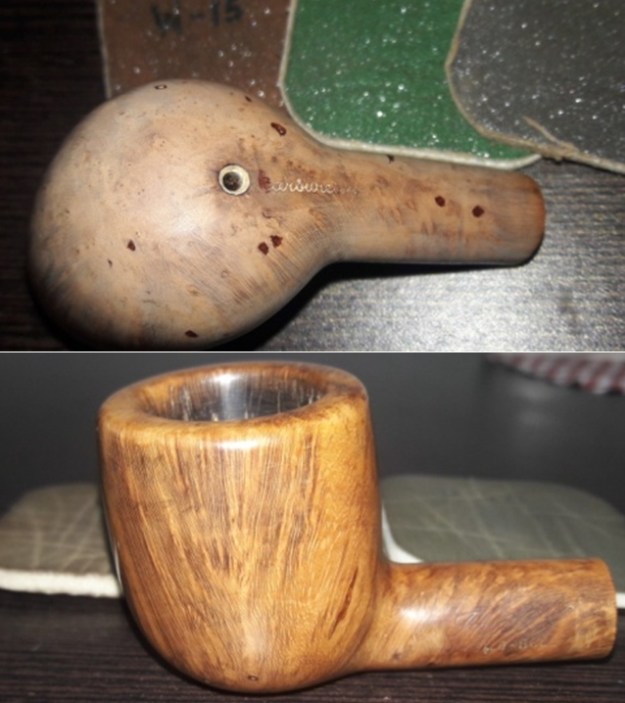
Cesare Barontini, who was in charge of the Barontini company since 1955, helped his cousin Ilio Barontini to establish a pipe production of his own.

Ilio started to produce machine-made series pipes of the lower to the middle price categories. Fatly 80% of the pipes went to foreign countries, the bulk being produced for various private label brands. Some of the own lines like “de Luxe”, “Etna” or “Vesuvio” gained a certain popularity. Citation: “Next to excellent craftsmanship Ilio Barontini pipes offer a wood quality, that is almost unrivalled in this price category!”.

The pipes being around still there were some unconfirmed utterances that Ilio Barontini brand has been absorbed by Cesare Barontini or even Savinelli. Who knows?

Now I had some idea of the maker of this Barontini. It appears to be one of the machine made Barontinis in the De Luxe line. Fueled by that information it was time to get working on the pipe itself and see what I had to do with it.

Jeff had reamed the bowl with a PipNet pipe reamer and followed up with a Savinelli Fitsall pipe knife to remove the cake. He scrubbed out the mortise and the airway in the shank and the stem with alcohol, cotton swabs and pipe cleaners. He scrubbed the exterior of the bowl, rim, shank and stem with a tooth brush and Murphy’s Oil Soap to remove the oils and tars on the rim and the grime on the finish of the bowl. He rinsed it under running water. He dried it off with a soft cloth. The rim was thoroughly cleaned and the damaged areas were obvious. Without the grime the finish looked really good. The Lucite stem would need to be worked on but I really like the profile it cast. I took photos of the pipe to show its condition before I started my work on it.   I took close up photos of the bowl and rim top as well as the stem. You can see the condition of the rim top and bowl in the first photo. Jeff was able to remove all of the tar and oils but you can now see the damaged areas on the surface clearly. There are damaged spots on the front inner edge and the back inner edge. There are also some deep dents and nicks in the flat surface of the rim. The acrylic/Lucite stem had tooth chatter and some light tooth marks on the top and underside of the stem just ahead of the button. There was one deeper tooth mark on the underside near the button.I decided to address the damage to the rim top first. I topped the bowl on a topping board using 220 grit sandpaper. I removed the damaged surface of the rim and made it smooth once again.I used a folded piece of 220 grit sandpaper to smooth out the inner edge of the rim. The rim top is looking far better at this point.I polished the rim top with micromesh sanding pads – wet sanding with 1500-2400 grit pads and dry sanding with 3200-12000 grit pads. I wiped the rim off after each sanding pad to remove the dust. The rim really shone once it was polished. Once it was polished the rim was ready to be stained. I started by using stain pens. I used a Maple stain pen to match the colour of the bowl. It was the closest I could get to matching the bowl. Once it cured it was streaked and not quite a match. The first photo below shows the rim after the stain pen.I carefully wiped the rim down with some isopropyl alcohol to smooth out the stain. Once it was smooth I restained it with some Fiebing’s aniline stain. I used a tan coloured stain and flamed it once I had stained the rim. I repeated staining and flaming until the coverage on the rim matched the bowl sides. The second photo below shows the look of the rim after this staining. I rubbed down the briar with Before & After Restoration Balm. I worked it into the smooth surface of the briar with my fingertips to clean, enliven and protect it. I let the balm sit for a little wall and then buffed with a cotton cloth to raise the shine. The following photos show the bowl at this point in the restoration process. The rim matches well but still needs to be polished and buffed to raise a shine on it. There were some tooth marks and chatter on the top and more chatter and a deeper tooth mark on the underside of the acrylic stem at the button. I cleaned off the surface of the stem with alcohol and filled in the deep tooth mark with clear super glue. Once it cured, I sanded both sides smooth with 220 grit sandpaper to blend the tooth chatter and the repair into the surface of the stem. It did not take too much sanding to remove the marks and smooth out the stem surface. When it was sanded it was smooth and the marks were gone. I polished the acrylic stem with micromesh sanding pads – wet sanding with 1500-2400 grit sanding pads and dry sanding it with 3200-12000 grit sanding pads. I wiped it down after each sanding pad with a damp cloth. I the polished stem and bowl with Blue Diamond to polish out the remaining small scratches and raise the shine. I gave the bowl and the stem several coats of carnauba wax and buffed the pipe with a clean buffing pad to raise the shine. I hand buffed it with a microfiber cloth to deepen the shine. The pipe polished up pretty nicely. This turned out to be a beautiful pipe in terms of shape and finish. This is the thirteenth pipe that I am restoring from Kathy’s Dad’s collection. I am looking forward once again to hearing what Kathy thinks once she sees the finished pipe on the blog. The finished pipe is shown in the photos below. The dimensions are Length: 6 inches, Height: 2 inches, Outside diameter of the bowl: 1 3/8 inches, Chamber diameter: ¾ of an inch. Thanks for walking through the restoration with me as I worked over this Barontini Brandy from George’s estate. More will follow in a variety of brands, shapes and sizes. I will be adding it to the rebornpipes store shortly so if you are interested in adding it to your collection and carrying on the trust from her father send me an email or a message on Facebook. Thanks for looking.