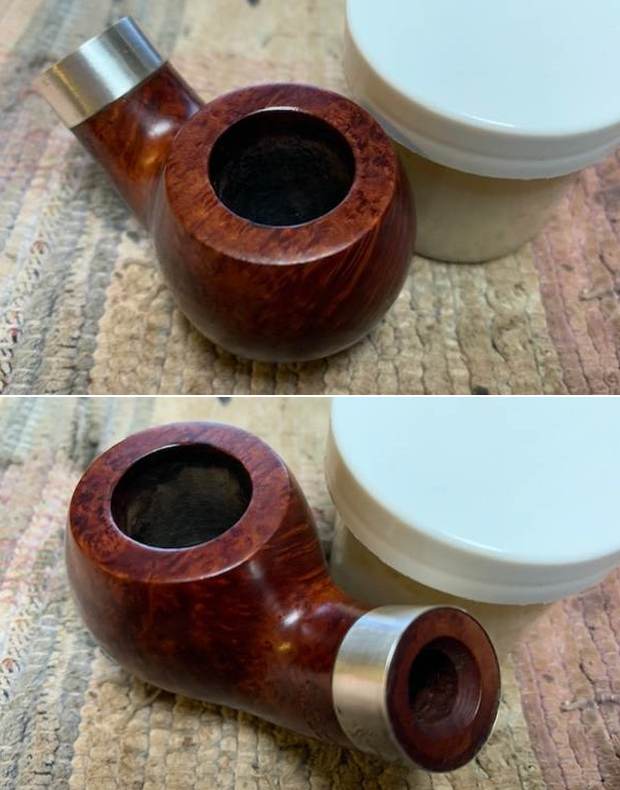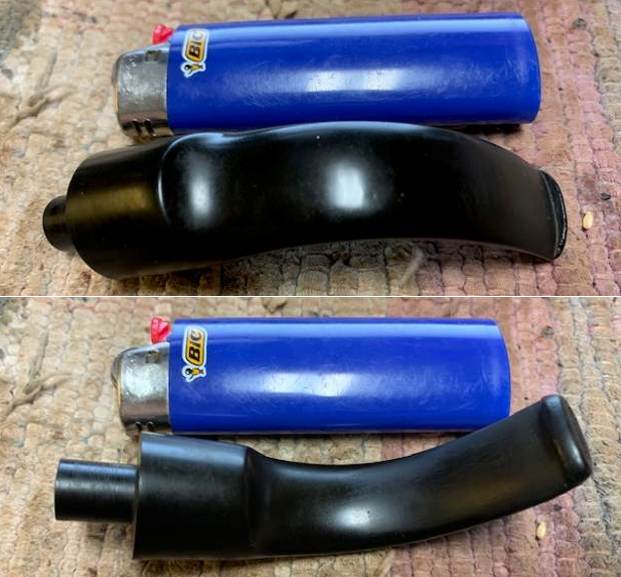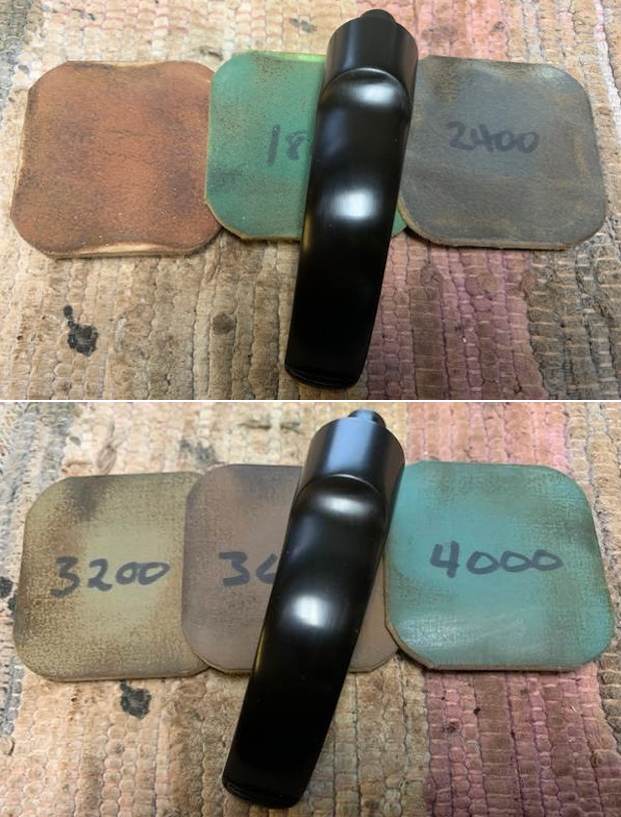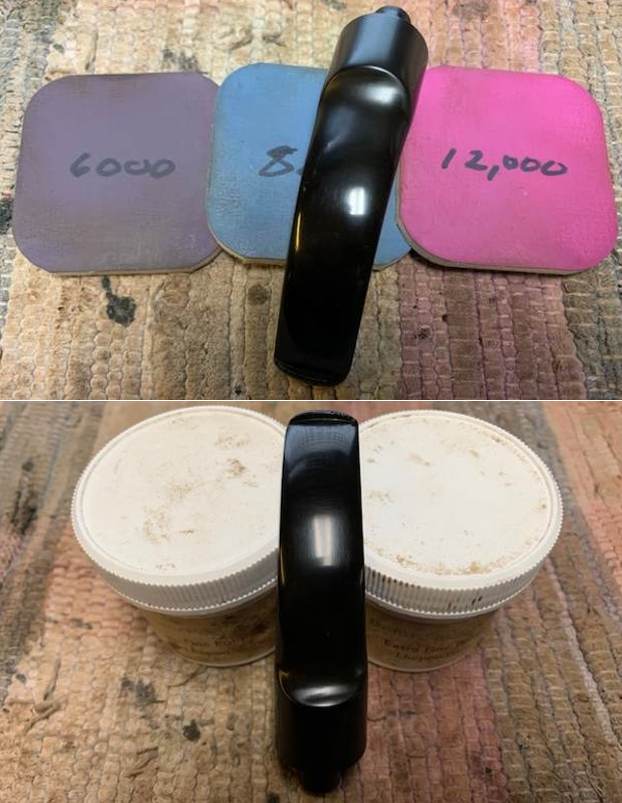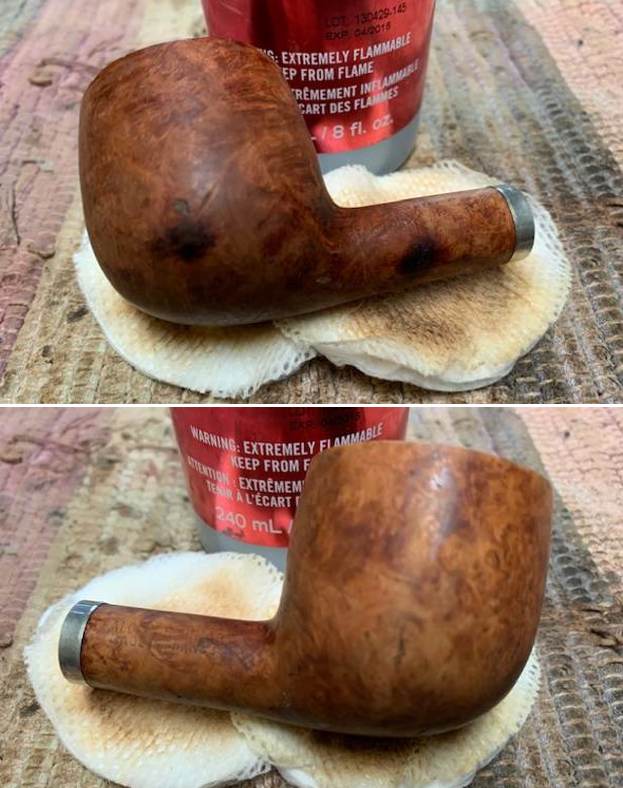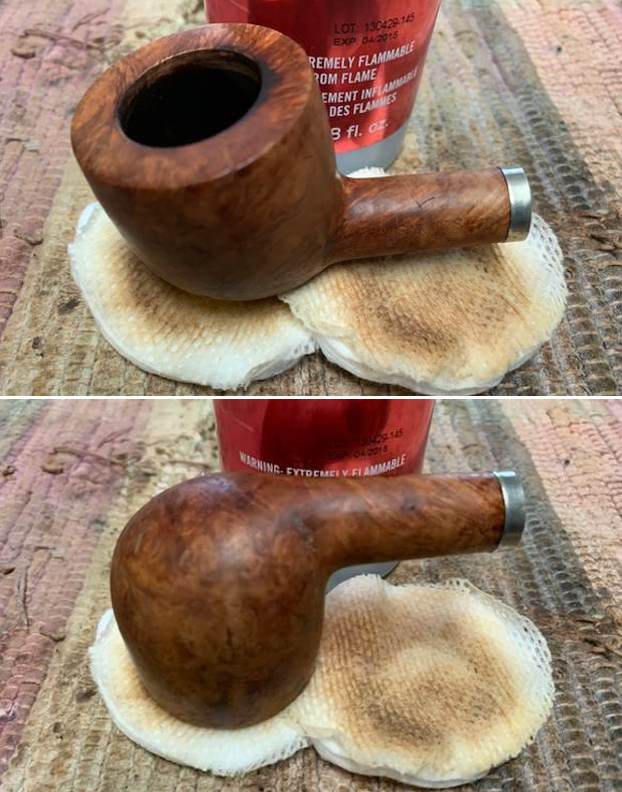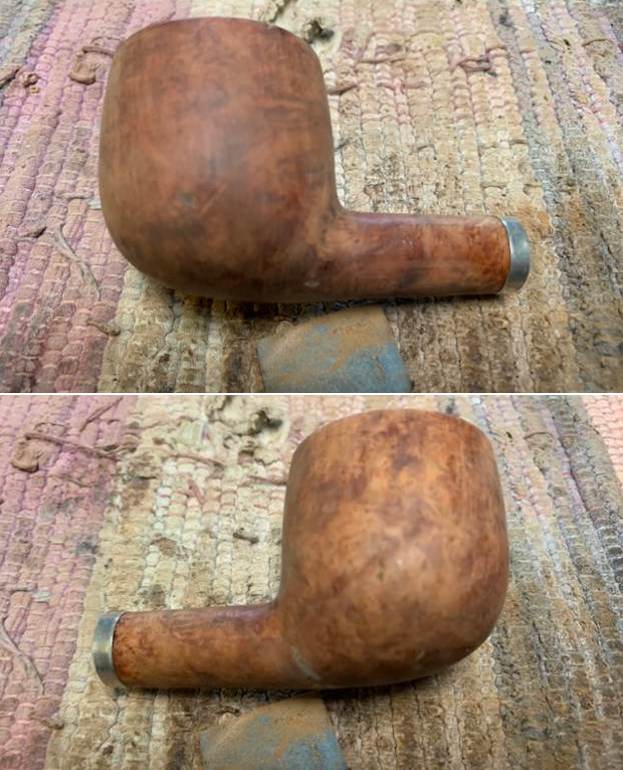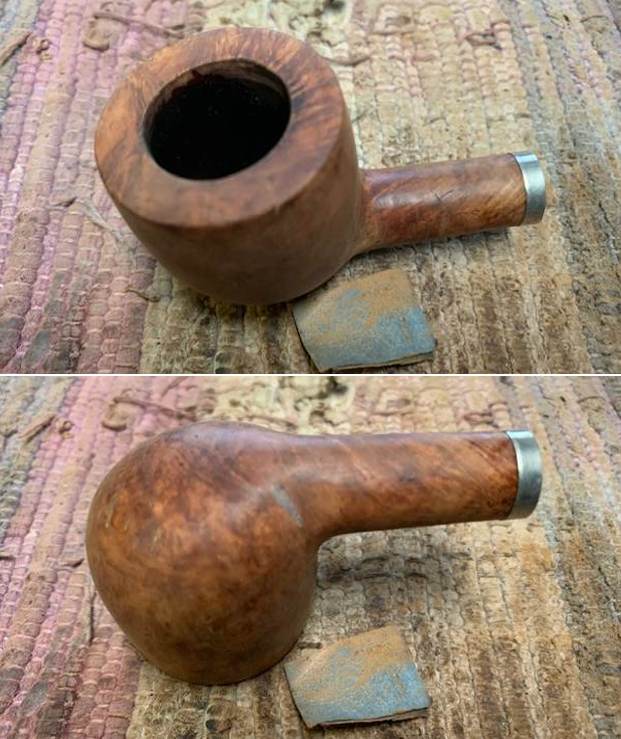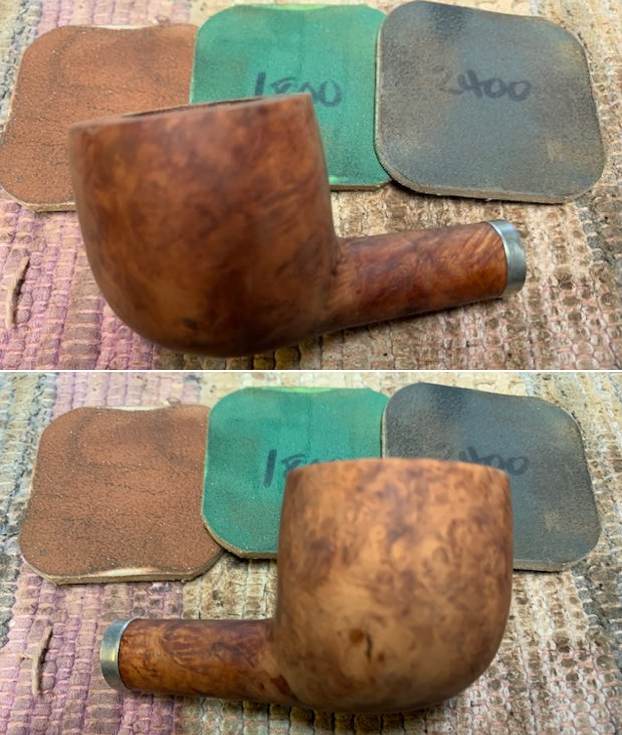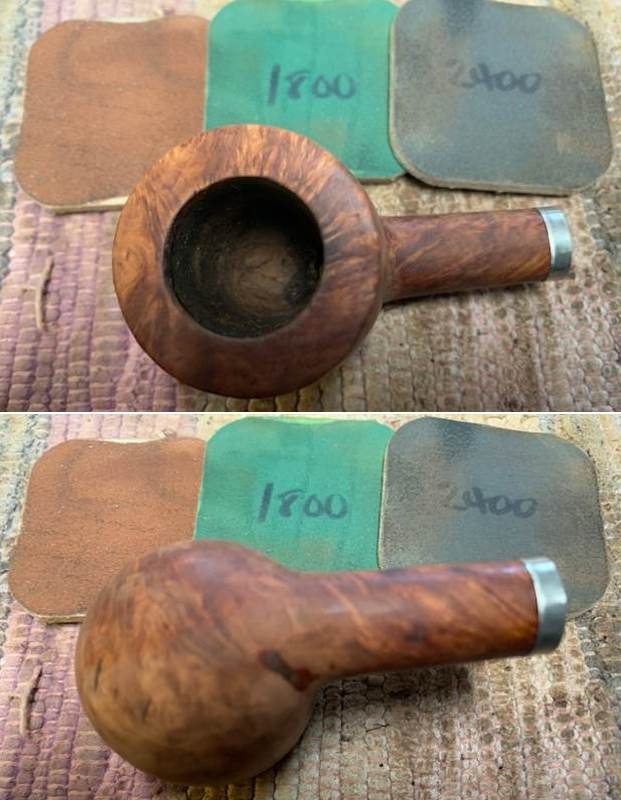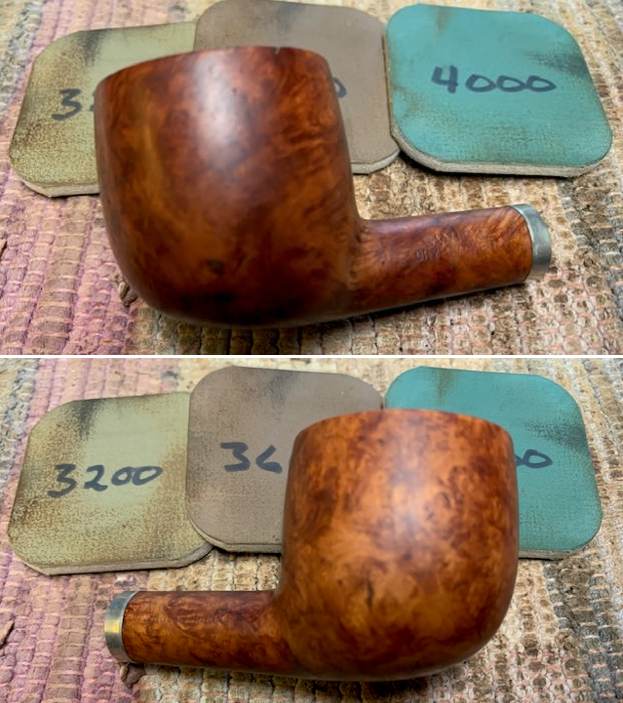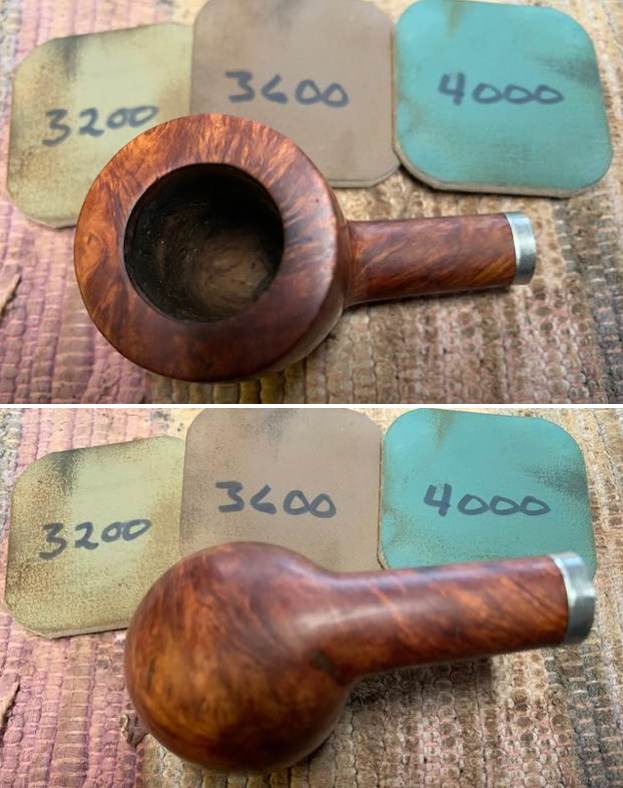
Tag Archives: Bowl – finishing

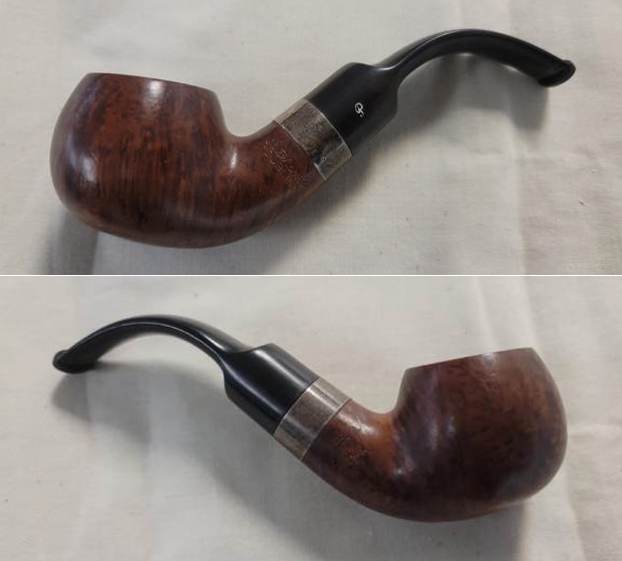
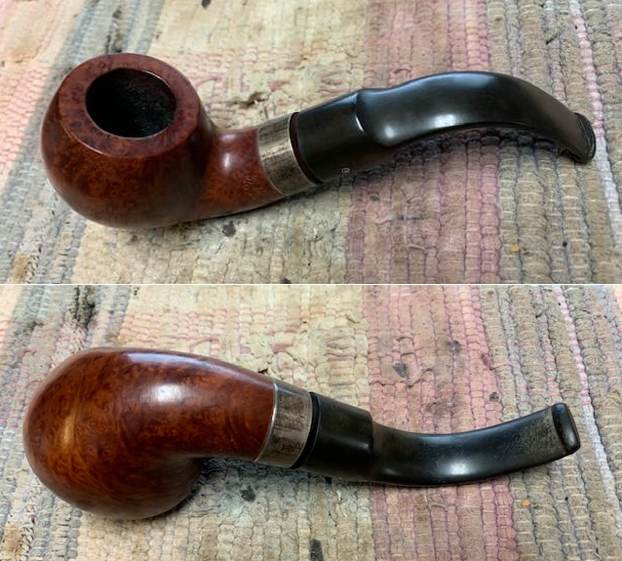
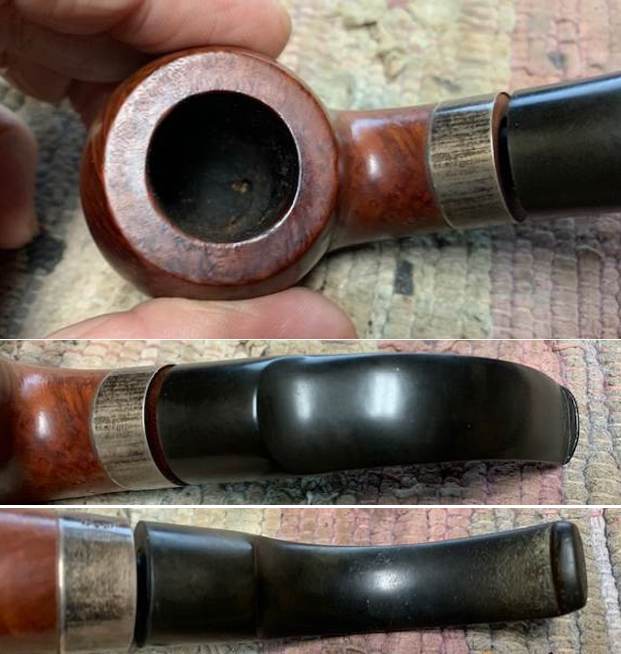
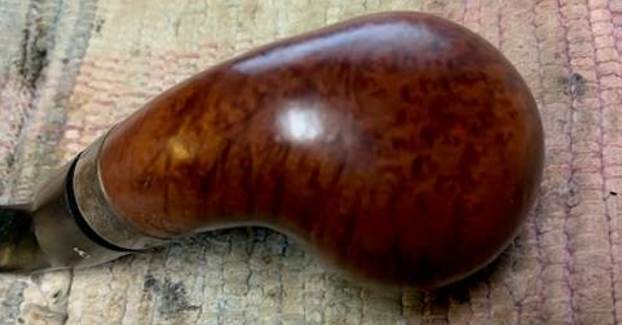
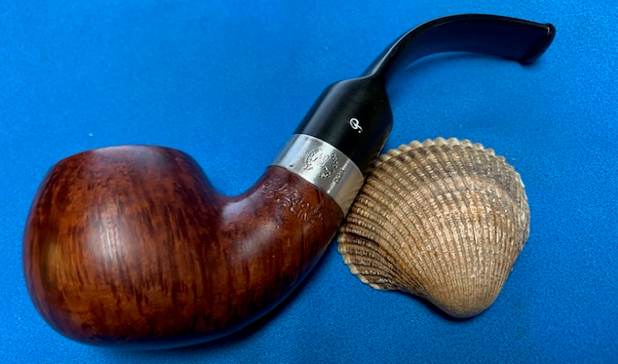
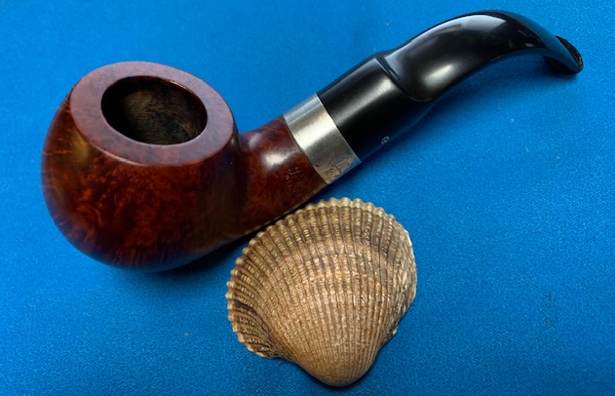
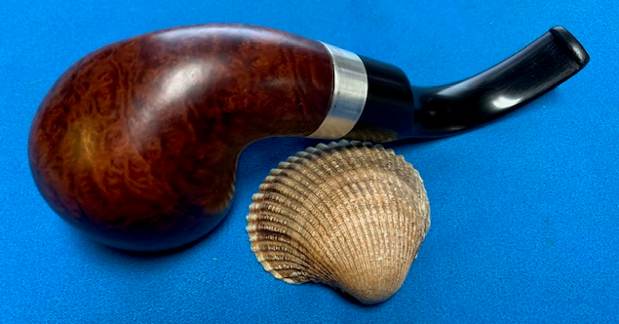
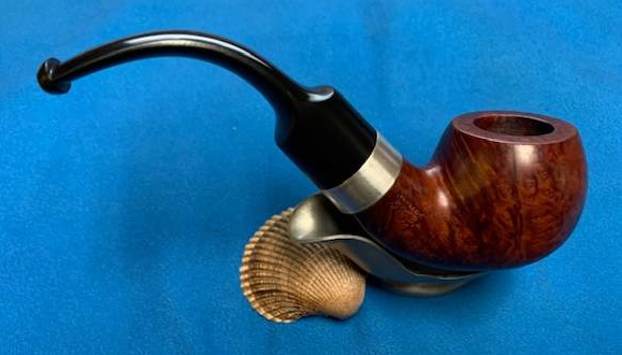
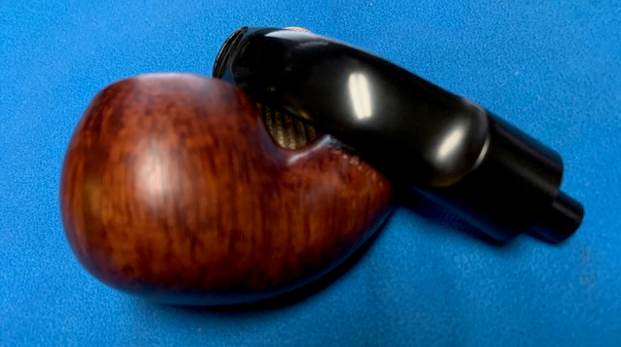
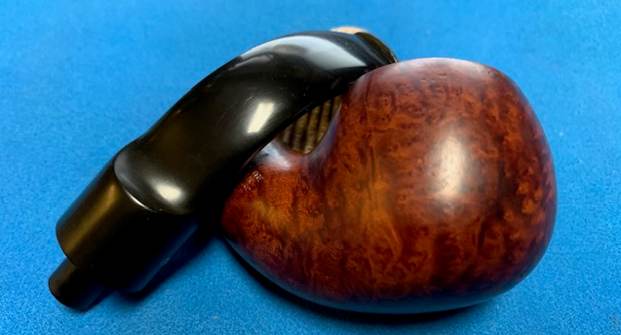
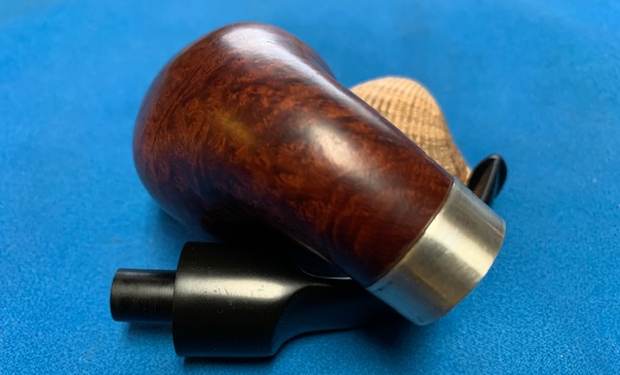
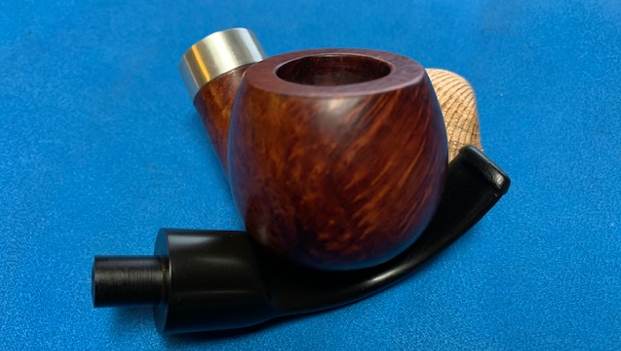
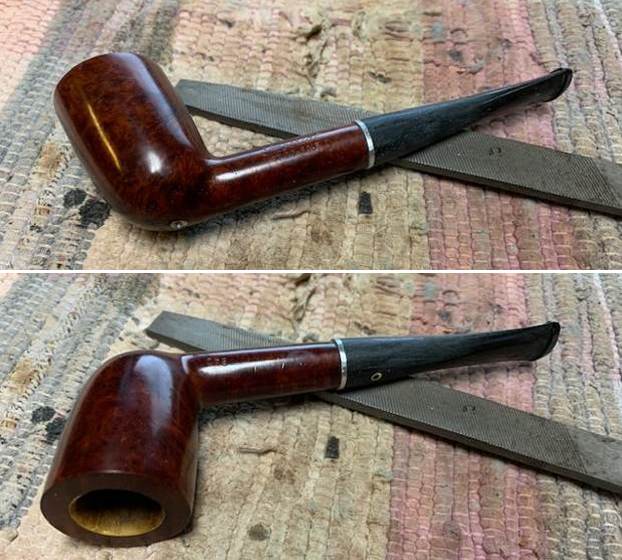
Breathing New Life into a Peterson of Dublin Dalkey 221 Chunky Bent Billiard


Blog by Steve Laug

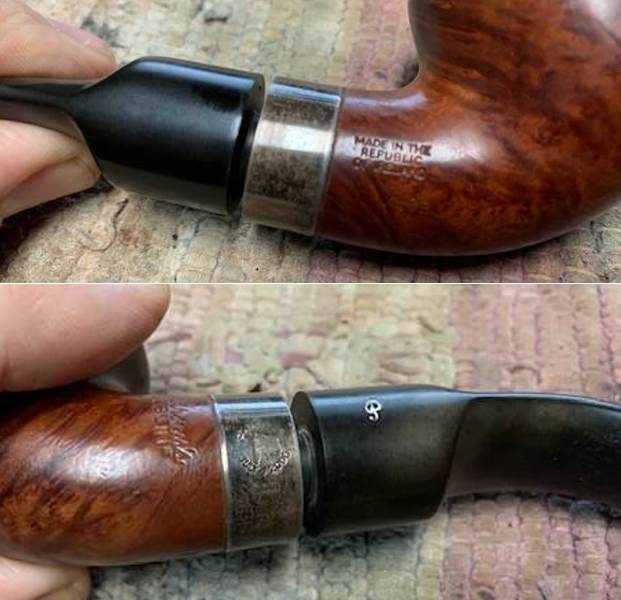
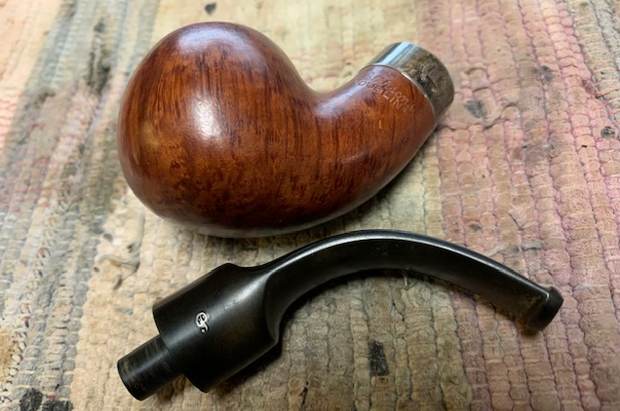
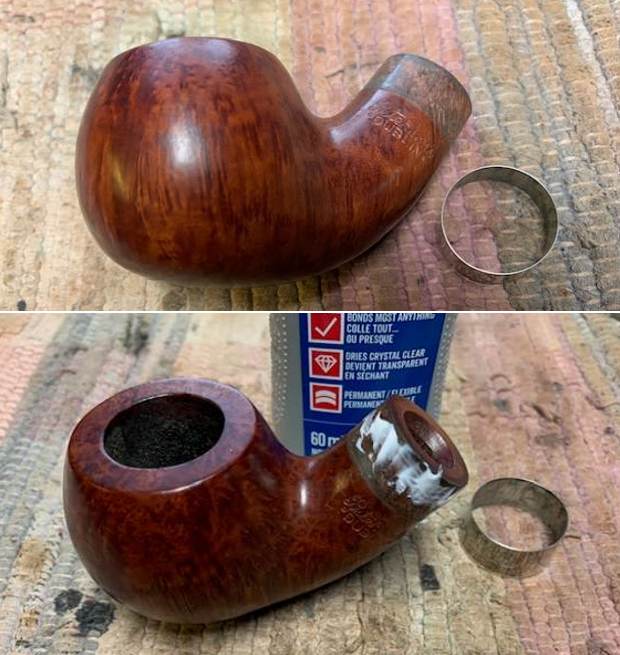
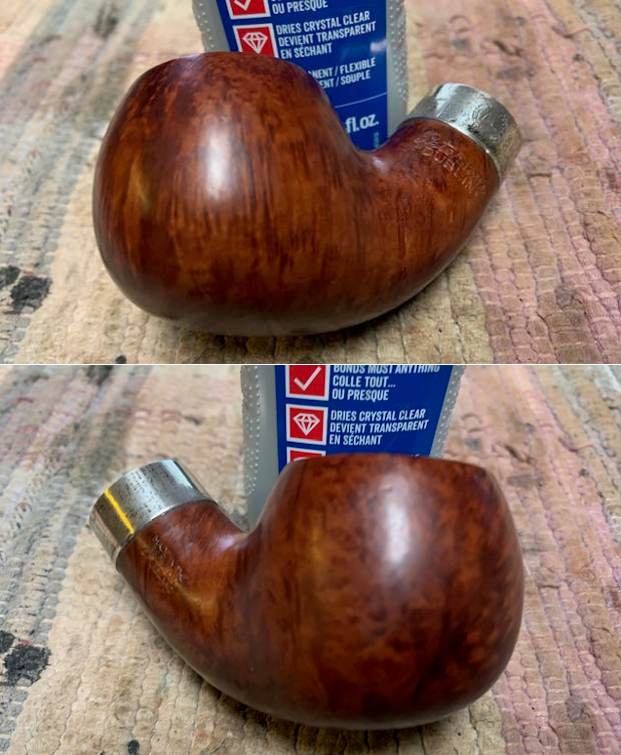
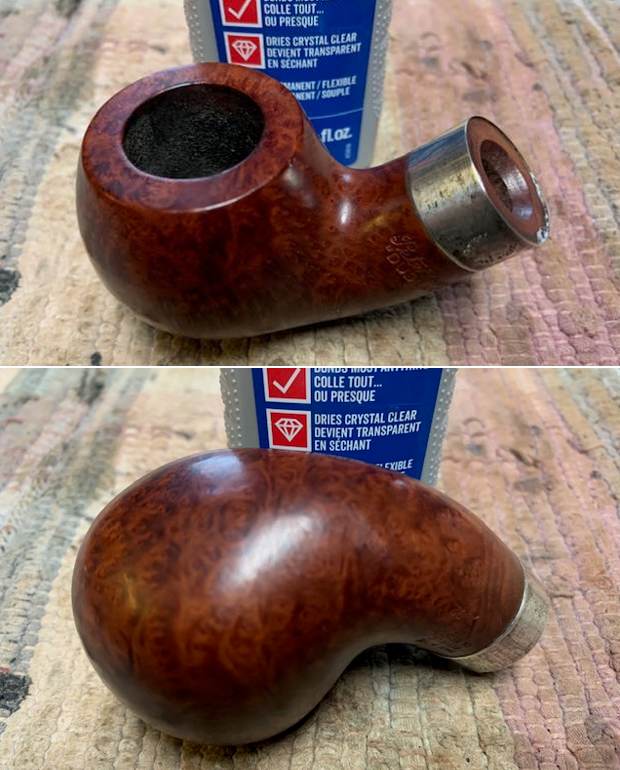
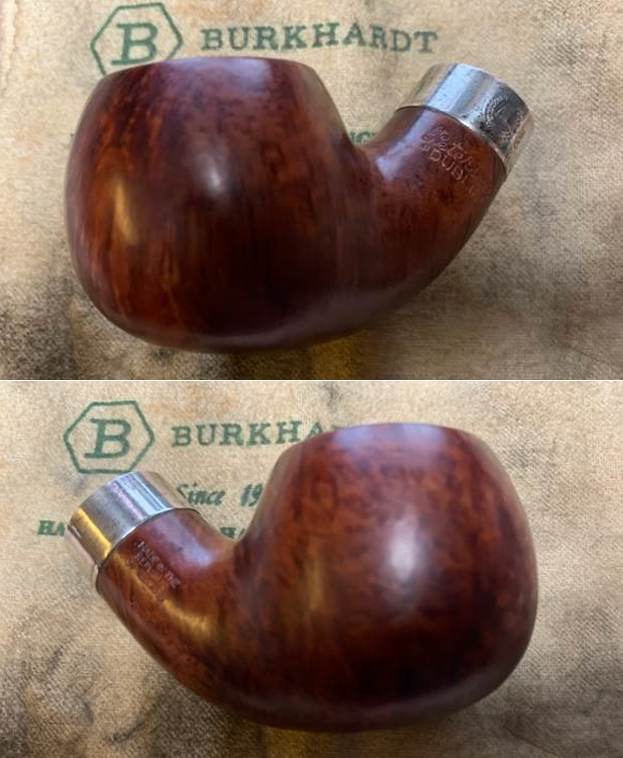
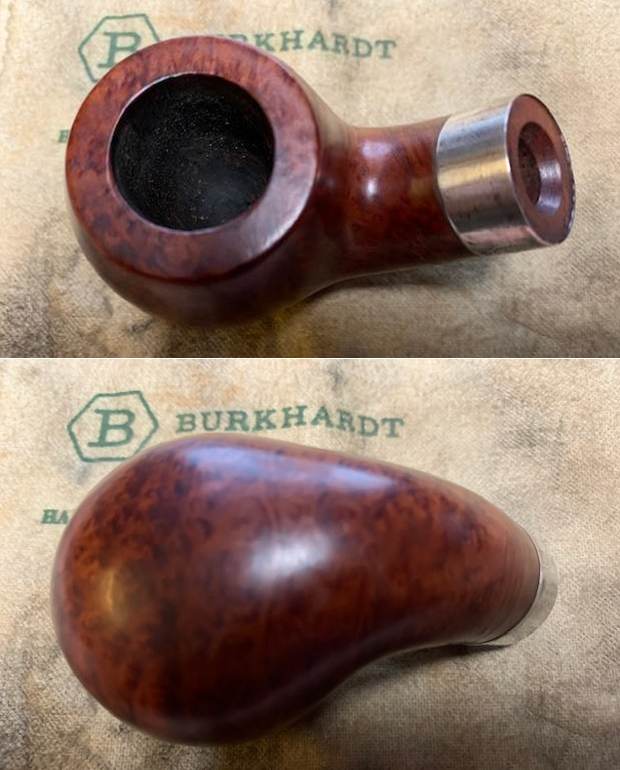
The next pipe I brought to the table was another Peterson that Jeff purchased off eBay on 11/19/17 from Fort Meyers, Florida, USA. It has been sitting here in Vancouver awaiting my contribution to the restoration. It is a nicely shaped pipe with a chunky shank and feel in the hand. The finish is a walnut stain that gives a sense of rich brown. It is stamped on the left side of the shank and reads Peterson [arched over] of Dublin [over] Dalkey (in block print). On the right side there is the shape number 221 in the center of the and no other stamping. The bowl had a thick cake and a heavy overflow of lava on the rim top. The front outer edge of the rim had been beat against a hard surface and had a lot of damage and roughness across the bowl front. The rim top was also damaged with scratches and nicks in the surface that looked like it had been used as a hammer. The rest of the finish on the bowl was quite clean. The twin silver bands separated by an orange acrylic band on the stem is dirty but in good condition. The fishtail stem was oxidized, calcified and had light tooth chatter on both sides ahead of the button. The “P” stamp on the side of the saddle stem and readable and painted white. Jeff took photos of the pipe before he started his clean up work. He captured the cake in the bowl and the debris and lava on the rim top and edges in the next photos. It was very clear that it was an exceptional smoker! The damage on the front of the rim edge and the rim top is visible even under the heavy lava on the top and edges. The stem is oxidized, calcified and shows the tooth marks and chatter on both sides ahead of the button. Jeff captured some of the beauty of the shape and the grain in the next photo. The mix of grains on the front of the bowl and heel are quite lovely as can be seen in the photo below.He took photos of the stamping on the sides of the shank. It is clear and readable as noted above. He also took a photo of the  P logo stamp on the left side of the stem. I decided to check out both the Pipephil and the Pipedia sites for information on the Dalkey line. Both sites did not have any specific information. I then did a quick Google search for the Peterson Dalkey. The first link took me to smokingpipes.com (https://www.smokingpipes.com/pipes/estate/ireland/moreinfo.cfm?product_id=332074) to a pipe that had been sold there. I have included the information I found below:

While the bent Billiard is a classic shape, rendered by countless companies, Peterson’s “221” iteration is readily recognized as the work of the Irish marque because of the added visual weight attributed to the shank and transition. Such extra heft stretches the heel and provides more palm-filling substance. It makes for an eye-catching, muscular form in profile yet remains well balanced thanks to the curled transition and bent stem out back. Here it’s presented in the Dalkey finish, with a warm hazelnut stain and nickel-and-acrylic band.

The second link took me to pipesandcigars.com (https://www.pipesandcigars.com/p/peterson-dalkey-pipes/2000657/).I quote the following from the introduction to the line:

Peterson Dalkey Pipes come in an assortment of classic Peterson shapes. The finish is a warm brown tone, mated to black stems, and finished with a gold and orange triple trim ring. These pipes are not only handsome, but they’re among the most affordable smooth finished pipes that Peterson makes.

I then turned to The Peterson Pipe by Mark Irwin and Gary Malmberg and looked up the listing in the book for Dalkey. I quote what I found there.

Dalkey (2010-) Dark stained smooth finish line with a band of orange acrylic sandwiched between nickel bands, white P stamped on a fishtail mouthpiece.

Now I knew I was dealing with a pipe made after 2010 and the dark stained finish (to me it is a dark walnut). The shank band looks amazing with the stain on the finish. Now it was time to work on the pipe.

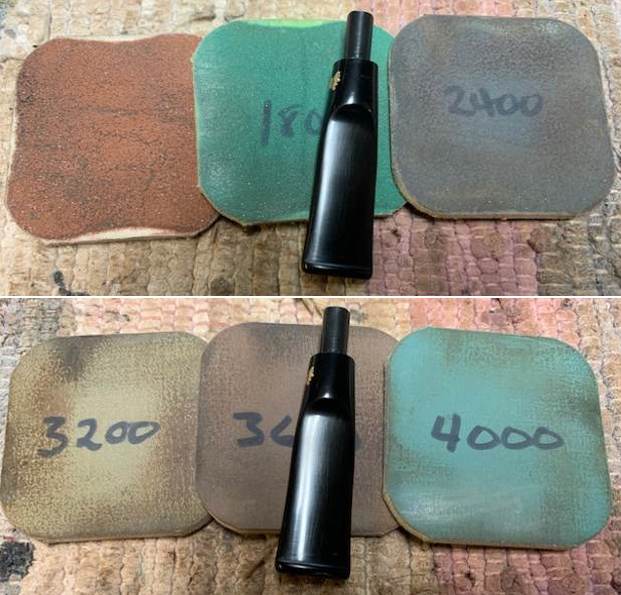
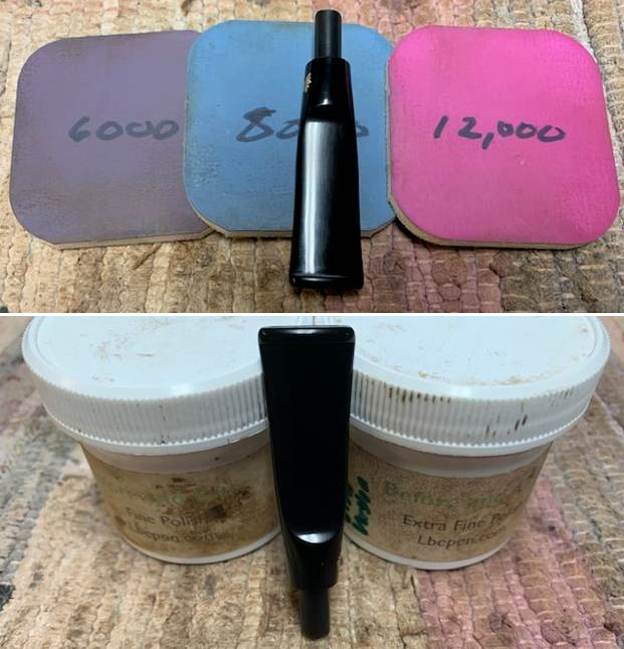
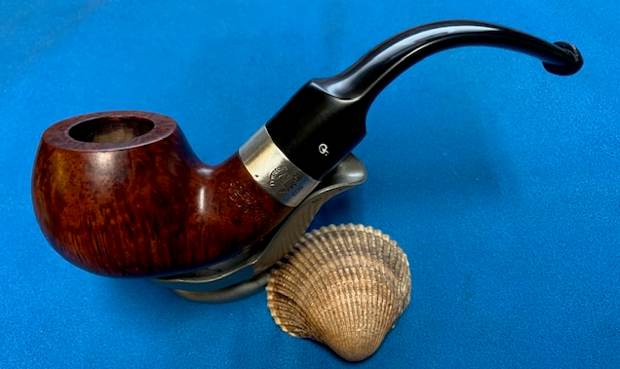
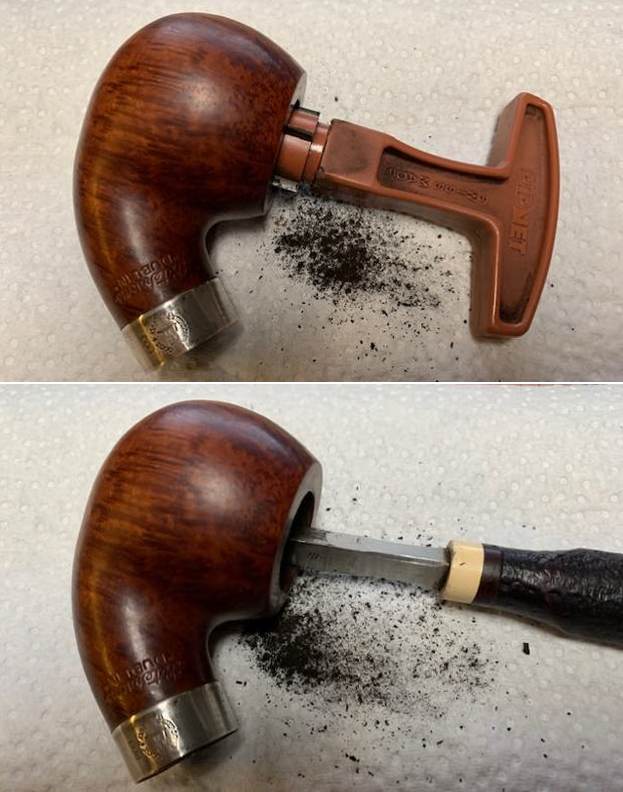
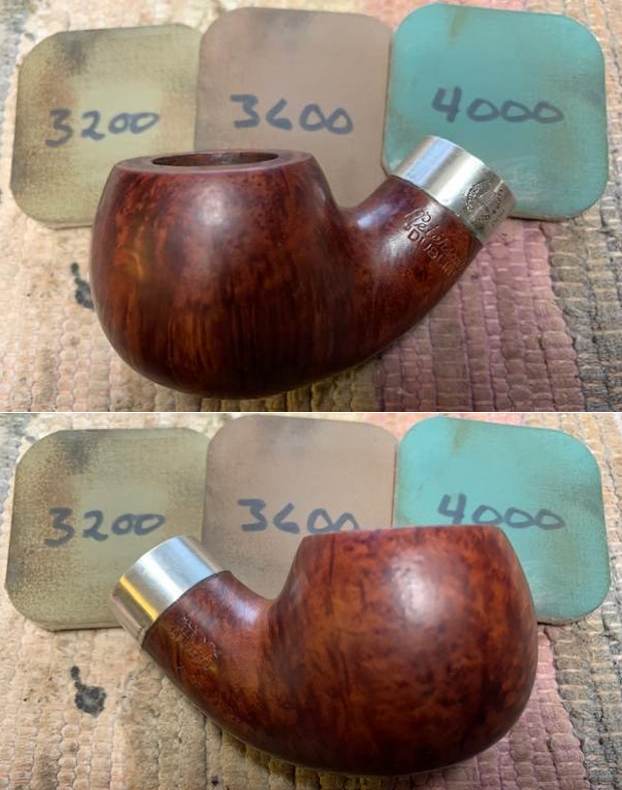
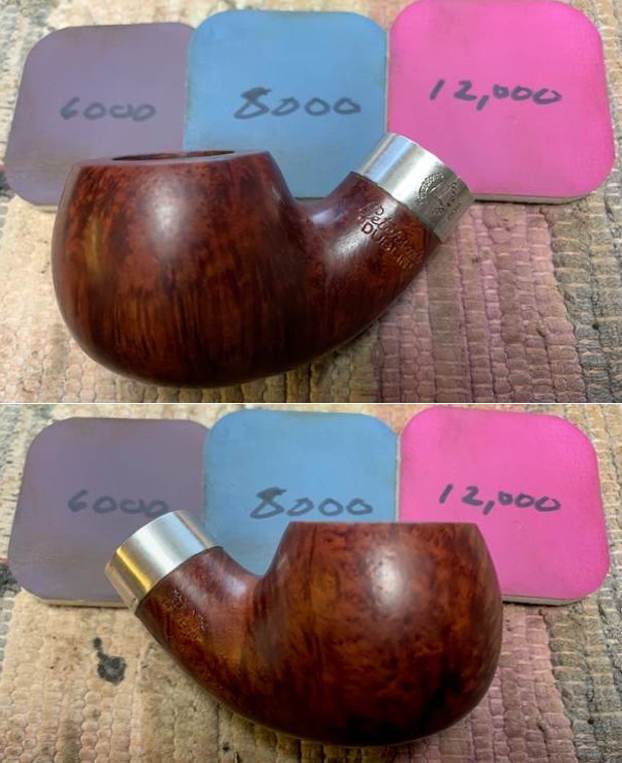
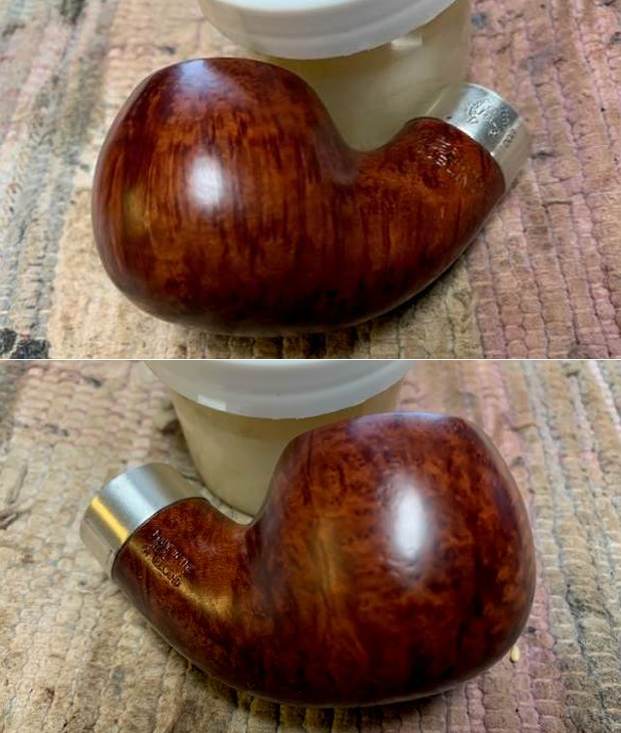
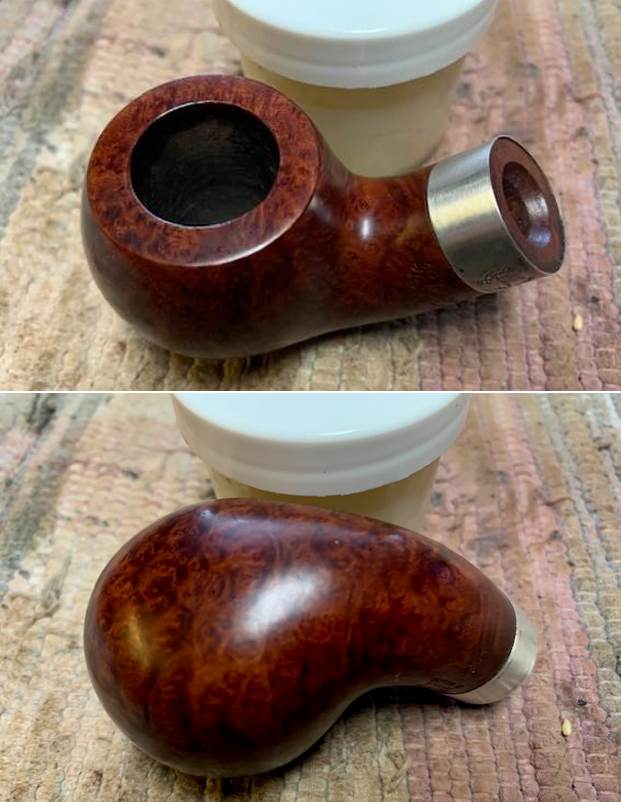
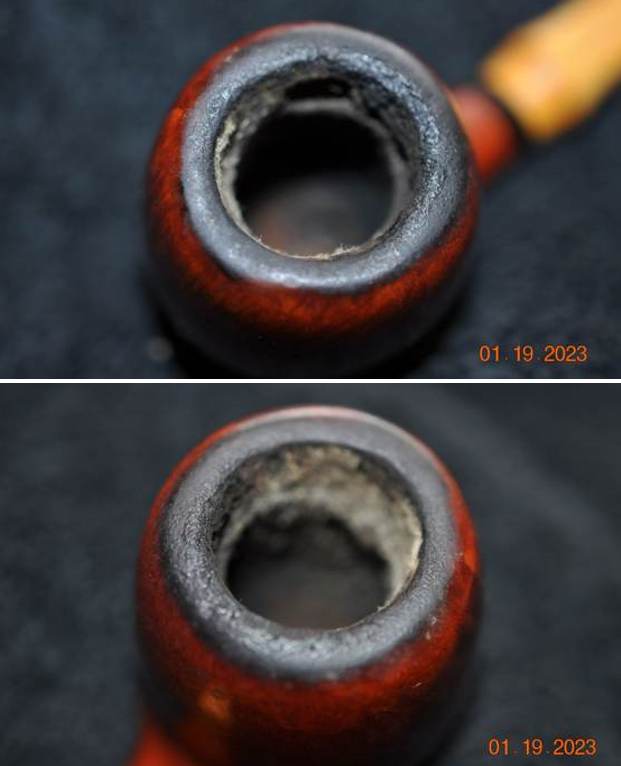
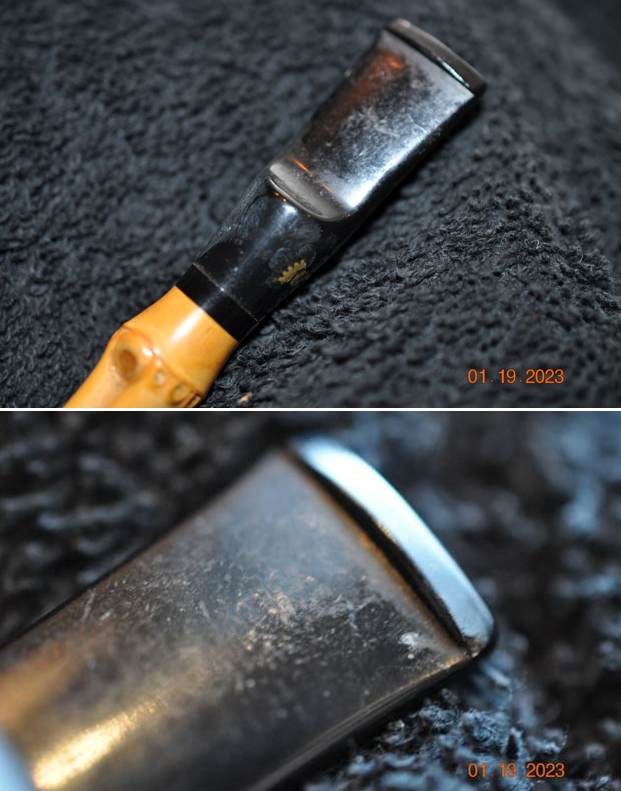
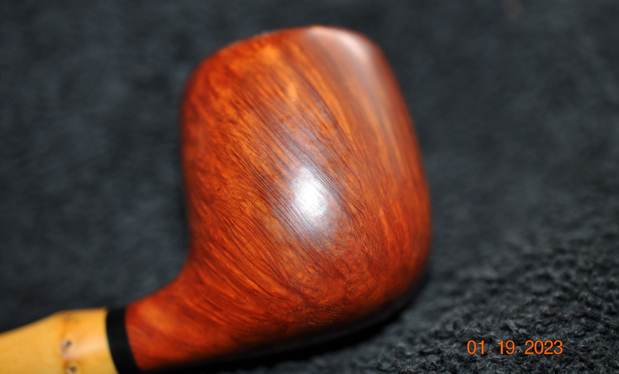
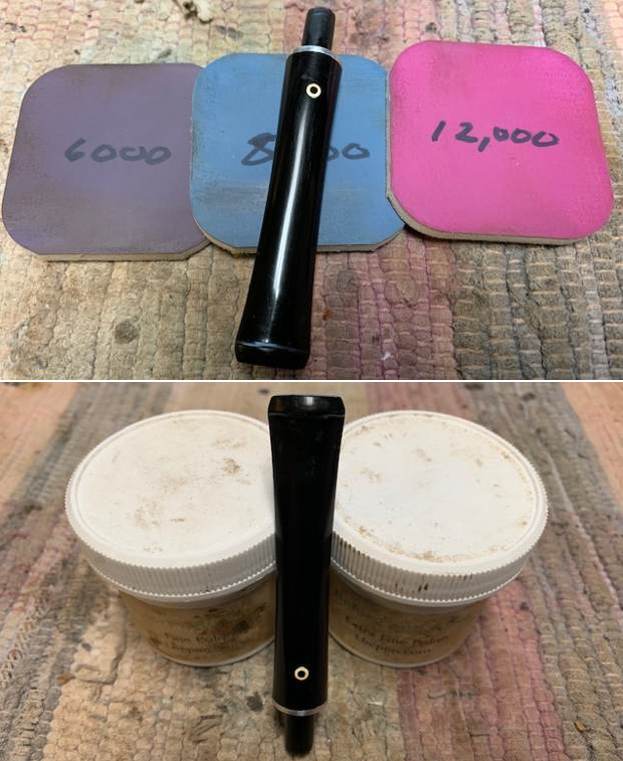
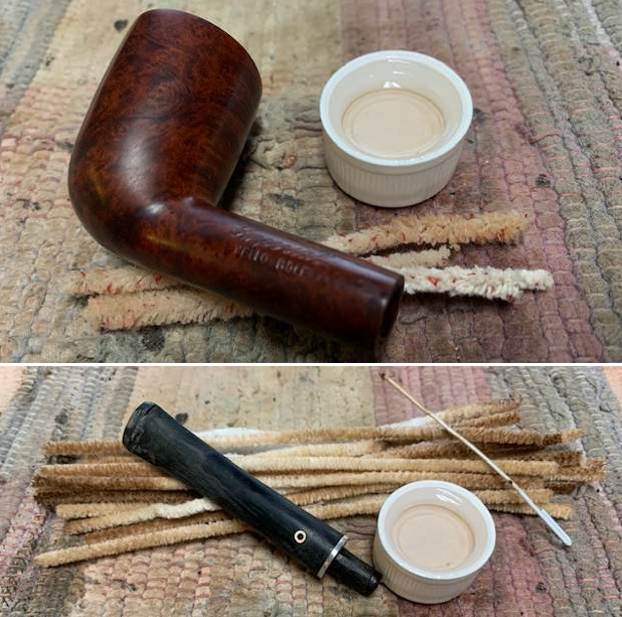
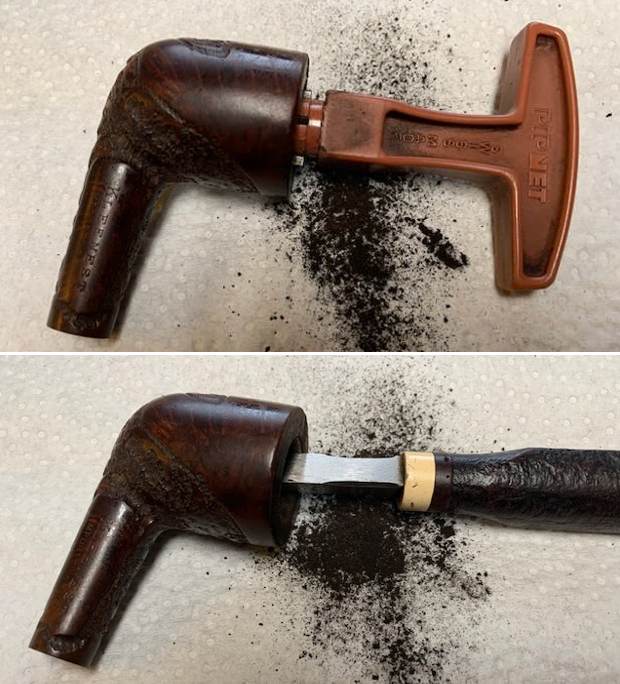
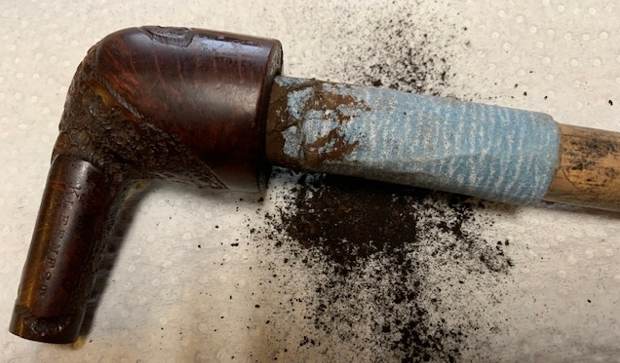
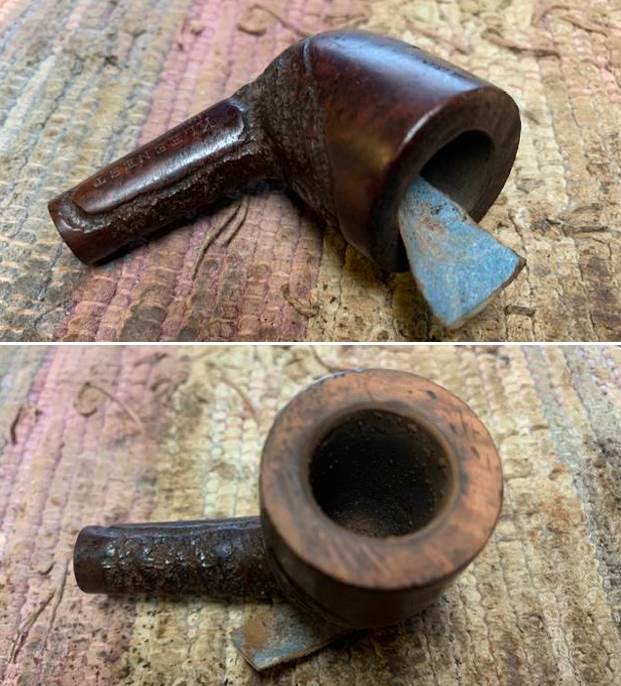
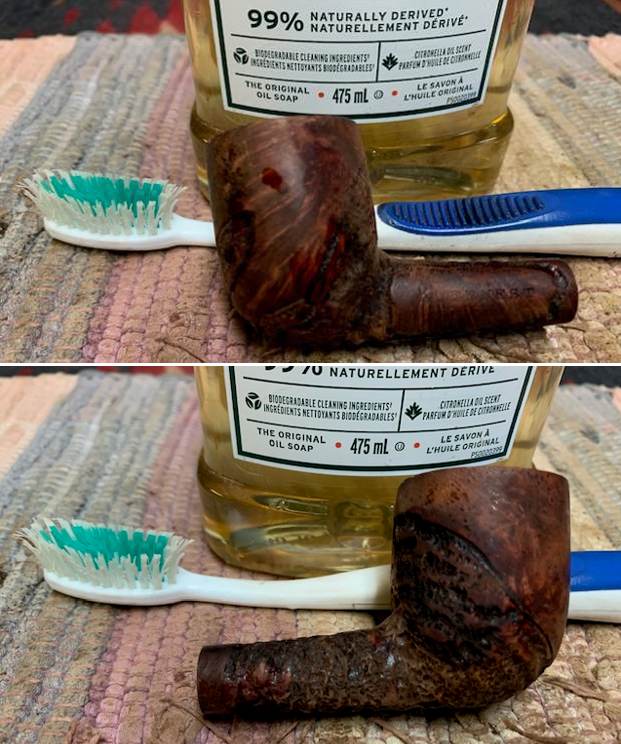
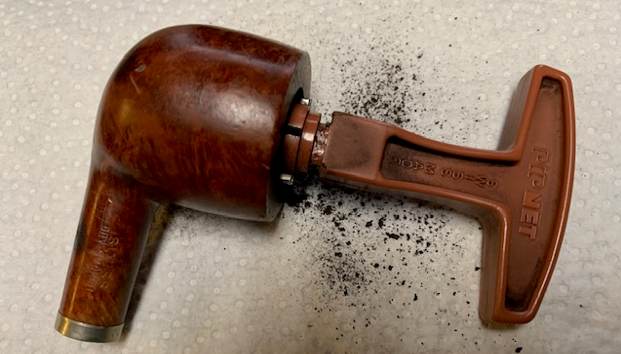
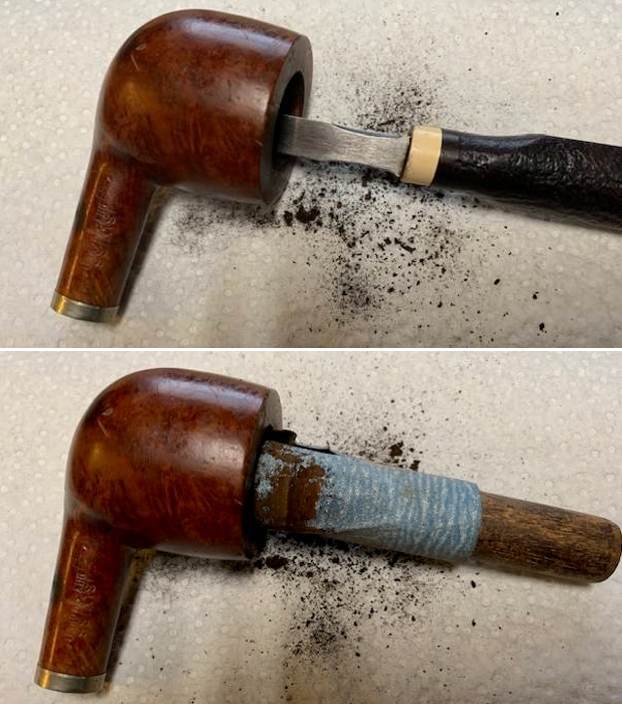
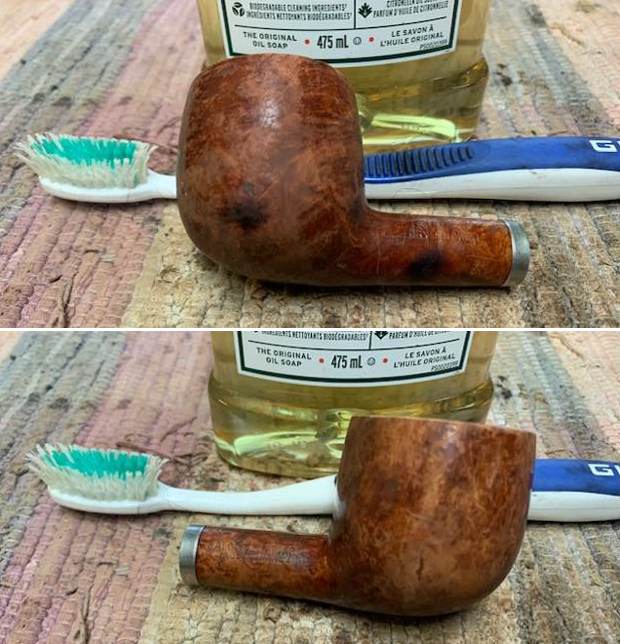
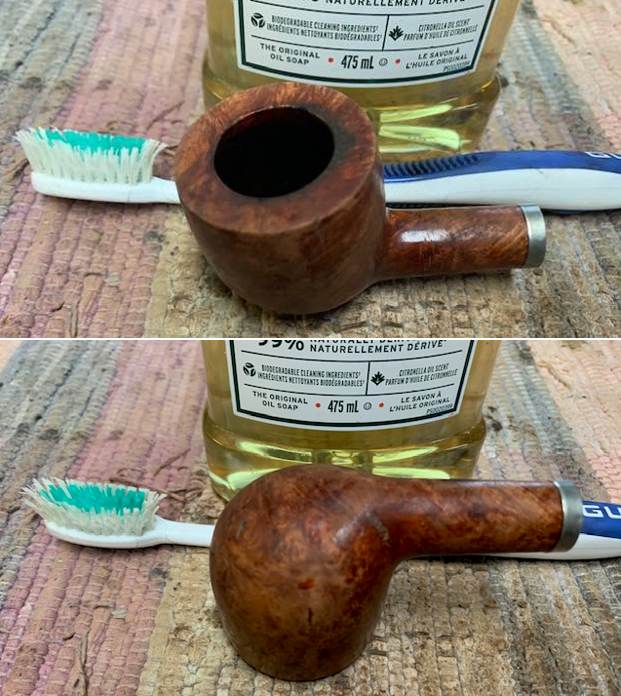
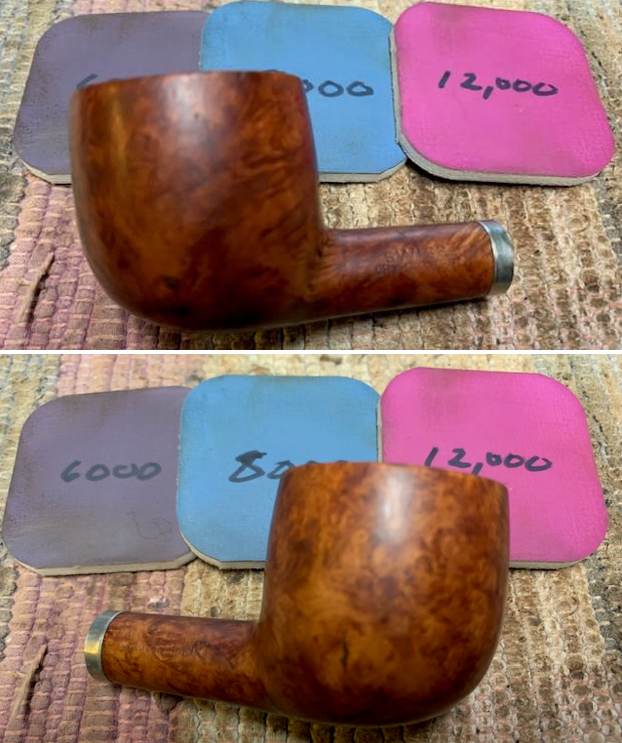
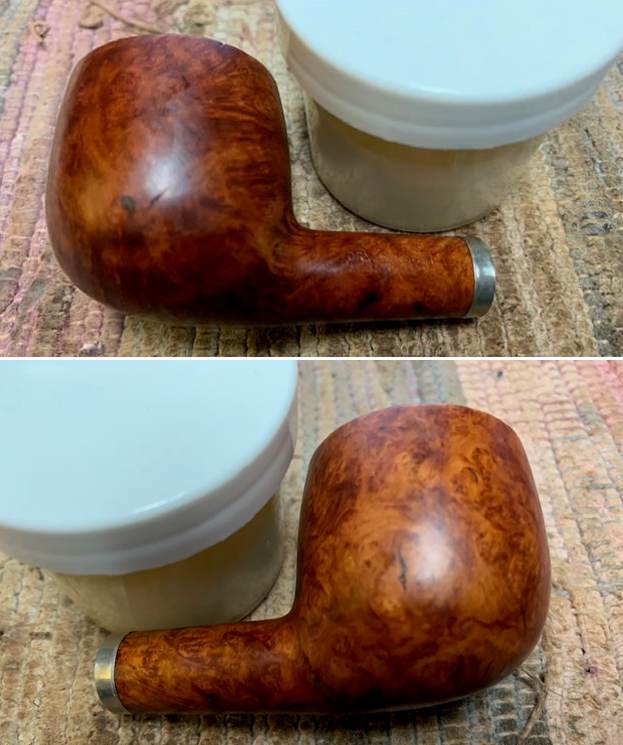
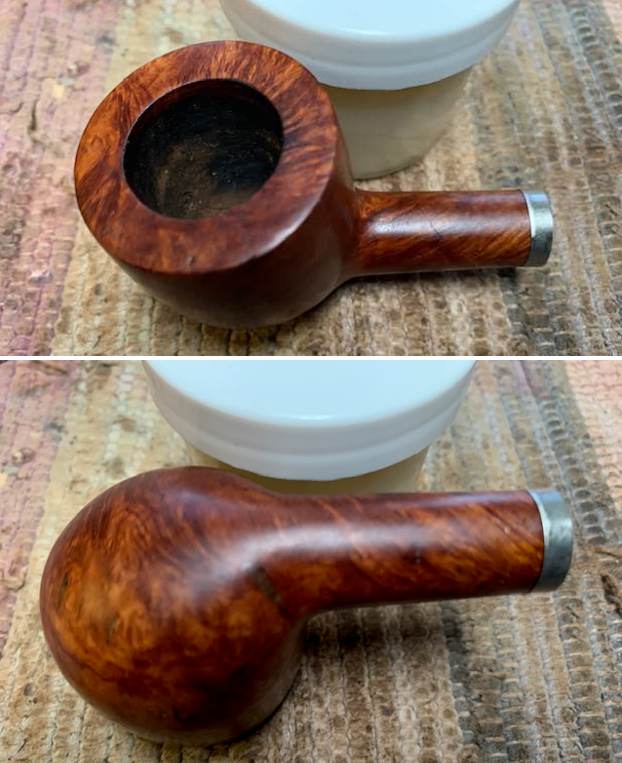
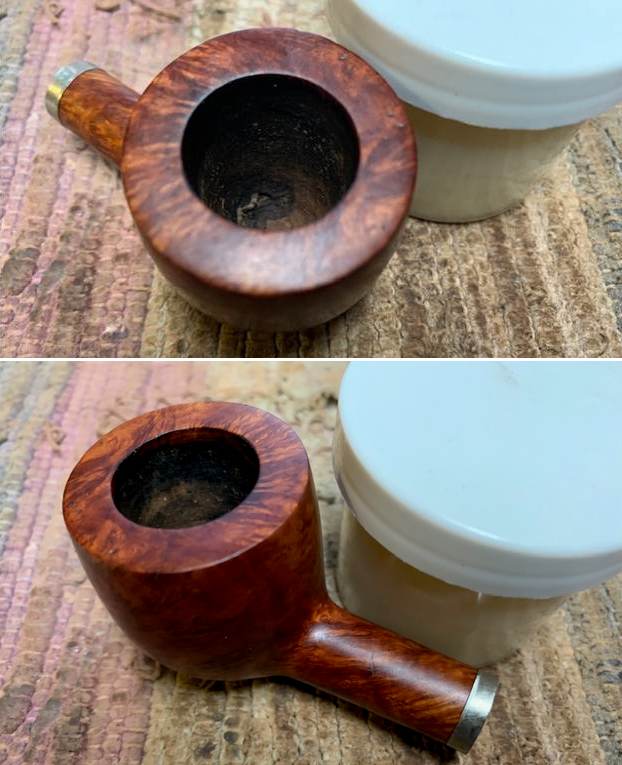
Jeff had done a great cleanup on the pipe. He reamed the bowl with a PipNet pipe reamer and followed up with a Savinelli Fitsall pipe knife to remove the cake. He scrubbed out the mortise and the airway in the shank and the stem with alcohol, cotton swabs and pipe cleaners. He scrubbed the bowl exterior with a tooth brush and Murphy’s Oil Soap to remove the grime on the finish of the bowl and the lava from the rim top. He rinsed it under running water. One of the benefits of this scrub is that it also tends to lift some of the scratches and nicks in the surface of the briar. He dried it off with a soft cloth. He cleaned the internals of the shank/mortise and stem with alcohol, pipe cleaners and cotton swabs. He soaked the stem in Briarville’s Pipe Stem Deoxidizer and rinsed it off with warm water and cleaned out the airway in the stem with alcohol, pipe cleaners and cotton swabs. I took photos of the pipe as I saw it when I finally brought it to my work table.   I took photos of the rim top and stem to show the condition. The rim top and edges were in very rough condition. You can see the damage to the top all the way around and to the outer edge on the bowl front. It really very rough to the touch. The stem was vulcanite and there were light tooth marks and chatter on both sides ahead of the button. I took photos of the stamping on the sides of the shank. They are clear and readable as noted above. The “P” logo on the stem is faint but is still quite readable.   I removed the stem from the shank and took a photo of the pipe to give a sense of the proportions of the bowl and stem.I took photos of the damage on the rim top and the front edge to show how beat up it was. The roughness is very tangible when I touched it. I dripped some clear CA glue on the front edge of the bowl so I could rebuild it. I then dipped it into some briar dust to build it up. I cleaned up and reshaped the edge with 220 grit sandpaper. I topped the bowl with a topping board and 220 grit sandpaper to smooth out the damage to the rim top. When I was finished it looked much better. With the rim top smooth it was now time to give the inner edge a bevel. I used a wooden ball and 220 grit sandpaper to shape the edge. I wrapped the ball with the sandpaper and worked on the edge. It took a bit of work to smooth it out and give it a bevel. I smoothed out the bevel with a folded piece of 220 grit sandpaper. The rim top came out looking very good at this point. I stained the rim top and the inner and front outer edges with an oak stain pen to match the colour of the stain around the bowl and shank.I decided to start with polishing the briar with micromesh sanding pads. I dry sanded it with 1500-12000 grit pads. I wiped the bowl down after each pad with a damp cloth. The bowl began to take on a rich shine and grain was beginning to stand out.   At this point the bowl was polished and clean. I rubbed down with Before & After Restoration Balm. I worked it into the surface of the bowl sides and shank with my fingertips to clean, enliven and protect the briar. I let the balm sit for 10 minutes, then buffed with a cotton cloth to raise the shine. The Balm did its magic and the grain stood out on the briar.   I set the bowl aside and turned my attention to the stem. I polished the stem with micromesh sanding pads – 1500-12000 grit pads. I wiped it down with Obsidian Oil after each sanding pad. I finished the polishing with Before & After Polishes – both Fine and Extra Fine. I gave it a final rub down with Obsidian Oil and set it aside to dry. I repainted the “P” logo stamp on the left side of the saddle stem with some white acrylic nail polish. I worked it into the stamp with a tooth pick. Once it dried I scraped of the excess and lightly polished it with a 1500-2400 grit micromesh sanding pad. This Peterson of Dublin Dalkey 221 Bent Billiard with a vulcanite taper stem has a smooth reddish finish. The rich browns of the stain make the grain come alive with the polishing and waxing. I put the vulcanite stem back on the bowl and carefully buffed the pipe with Blue Diamond on the buffing wheel using a light touch on the briar. I gave the bowl and the stem multiple coats of carnauba wax on the buffing wheel and followed that by buffing the entire pipe with a clean buffing pad. I hand buffed the pipe with a microfiber cloth to deepen the shine. The finished Peterson’s Dalkey 221 Bent Billiard really is a great looking and fits nicely in the hand and looks very good. Give the finished pipe a look in the photos below. The dimensions of the pipe are Length: 5 ½ inches, Height: 1 ¾ inches, Outside diameter of the bowl: 1 ¼ inches, Chamber diameter: ¾ of an inch. The weight of the pipe is 1.62 oz./46 grams. This pipe will soon be on the Irish Pipe Makers Section of the rebornpipes store if you would like to add it to your collection. Thanks for reading this blog and my reflections on the pipe while I worked on it.
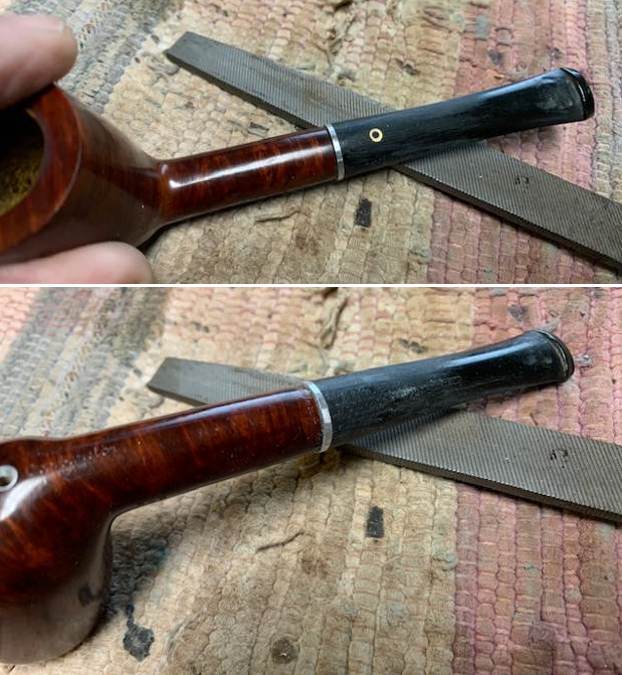
Fresh Life for Peterson of Dublin Killarney 87 Straight Apple


Blog by Steve Laug

This is another one of those pipes that has been here for a long time and I have no memory where it came from. I might have taken it in on a trade for work. It has not been cleaned up all. It is a apple shaped pipe with an almost Cherry red finish (little darker but to me it is that red). It is stamped on the left side of the shank and reads Peterson [over] of Dublin [over] Killarney in block print. On the right side there is the shape number 87 near the bowl and no other stamping. The bowl had a thin cake and some overflow of lava and darkening on the rim top. The finish on the bowl was quite clean. The twin silver bands separated by a black acrylic band on the stem is dirty but in good condition. The stem was oxidized, calcified and had tooth chatter on both sides ahead of the button. The mortise was so dirty that the tenon would not fit in the shank all the way. It was very tight and almost stuck in the front of the shank. I took photos of the pipe before I started cleaning up the pipe. I took close up photos of the bowl and the stem. You can see the bowl and the lava and darkening on the rim top and the back edge. The stem surface was lightly oxidized, calcified and there were light tooth marks and chatter on both sides on and ahead of the button. I took photos of the stamping on the sides of the shank. It is clear and readable as noted above. There is also a “P” stamp on the right side of the taper stem. I removed the stem from the shank and took a photo to give a sense of the proportions of the pipe. It is really quite nice looking.I am including the information from Pipedia’s article on Peterson pipes. It is a great read in terms of the history of the brand (https://pipedia.org/wiki/Peterson)

I turned to “The Peterson Pipe” by Mark Irwin and Gary Malmberg to get some background on the Killarney Pipe. On page 306 it had the following information on the pipe.

Killarney (1949-) Entry line with smooth finish and P-Lip mouthpiece. May have either a K or P stamped on the mouthpiece; may have aluminum stinger (not to be confused with the tenon extension tube found on straight System pipes). 1949-c.1957 examples made for the US market may have any of the following COM stamps: MADE IN IRELAND (forming a circle), “A PETERSON’S PRODUCT” over MADE IN IRELAND or LONDON MADE over ENGLAND. Some early specimens stamped KILLARNEY over NATURAL (a higher grade) have MADE IN IRELAND (forming a circle). Examples c. 1986-90 feature a nickel band, which was replaced in ’91 with a shank extension of nickel band with black acrylic inlay. Fishtail  mouthpiece from ’86 although P-Lip is sometimes seen. For the current German market, the Killarney is stamped CONNEMARA

I knew that I was dealing with a pipe made in 1991 or after due to shank extension of nickel and black acrylic inlay. It has the “P” stamp on the stem side and a P-lip mouthpiece. Now it was time to work on the pipe.

I reamed the bowl with a PipNet pipe reamer and removed the cake from the walls. I followed up with a Savinelli Fitsall pipe knife to remove the remnants of the cake still in the bowl. I sanded the bowl walls with 220 grit sandpaper wrapped around a piece of dowel to smooth out the surface. I scrubbed the bowl exterior and rim top with a tooth brush and undiluted Murphy’s Oil Soap to remove the grime on the finish of the bowl and the lava from the rim top. I rinsed it under running water. I dried it off with a soft cloth. I cleaned the internals of the mortise, shank and stem with alcohol, cotton swabs and pipe cleaners to remove the grime. Once it was clean I was able to fit the stem in the shank. I removed the stem from the shank and worked on the rim top and edges with 3000 and 4000 grit micromesh sanding pads and saliva. I was able to remove the remaining lava on the bowl. There was some darkening remained but it looked much better.I rubbed down the bowl with Before & After Restoration Balm. I worked it into the surface of the bowl sides and shank with my fingertips to clean, enliven and protect the briar. I let the balm sit for 10 minutes, then buffed with a cotton cloth to raise the shine. The Balm did its magic and the grain stood out on the briar.   I set the bowl aside and turned my attention to the stem. I sanded off the calcification and oxidation along with the chatter and tooth marks with a folded piece of 220 grit sandpaper. I started polishing it with 400 grit wet dry sandpaper.  I polished the stem with micromesh sanding pads – 1500-12000 grit pads. I wiped it down with Obsidian Oil after each sanding pad. I finished the polishing with Before & After Polishes – both Fine and Extra Fine. I gave it a final rub down with Obsidian Oil and set it aside to dry. This Republic Era Peterson Killarney 87 Straight Apple with a vulcanite taper stem has a smooth reddish finish. The rich reds and blacks of the contrasting stain makes the grain come alive with the polishing and waxing. I put the vulcanite stem back on the bowl and carefully buffed the pipe with Blue Diamond on the buffing wheel using a light touch on the briar. I gave the bowl and the stem multiple coats of carnauba wax on the buffing wheel and followed that by buffing the entire pipe with a clean buffing pad. I hand buffed the pipe with a microfiber cloth to deepen the shine. The finished Peterson’s Killarney 87 Apple really is a great looking even with the bit of darkening on the rim top toward the backside. It is a good looking apple and it fits nicely in the hand. Give the finished pipe a look in the photos below. The dimensions of the pipe are Length: 5 ¾ inches, Height: 1 ¾ inches, Outside diameter of the bowl: 1 ¼ inches, Chamber diameter: ¾ of an inch. The weight of the pipe is 1.41 oz./40 grams. This pipe will soon be on the Irish Pipe Makers Section of the rebornpipes store if you would like to add it to your collection. Thanks for reading this blog and my reflections on the pipe while I worked on it. There are many more to come!
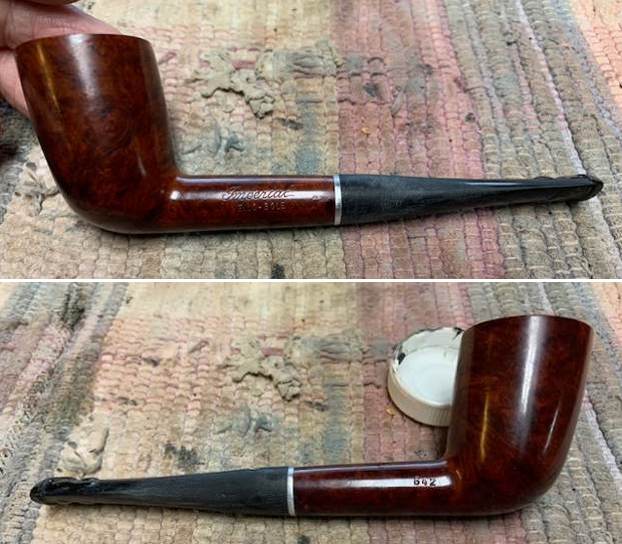
Restoring a Republic Era Peterson’s “Kildare” 120 Dublin


Blog by Steve Laug

This is another one of those pipes that has been here for a long time and I have no memory where it came from. I had been cleaned somewhere along the way so I am guessing that Jeff had cleaned it. The bowl had been reamed somewhere in the journey and was quite clean inside. The shank and internals had all been cleaned and there was no residual stench to the pipe. The smooth rim top had some damage and darkening. The inner edge had some damages by burning and the bowl was slightly out of round. The smooth finish was quite clean other than the dust of sitting in my box. The stamping on the shank is clear and readable. The left side is stamped Peterson’s [over] “Kildare”. On the right side it was stamped Made in the Republic of Ireland (3 lines) and near the bowl it is stamped with the shape number 120. The stem was lightly oxidized and has light tooth marks and chatter on both sides ahead of the button. I took some photos of the pipe before I started my work on it. I took close up photos of the bowl and the stem. You can see the reamed bowl and the darkening on the rim top and the back edge. The stem surface was clean but there are tooth marks and chatter on both sides on and ahead of the button.I took a photo of the stamping on the sides of the shank. It is clear and readable as noted above. There is also a “P” stamp on the right side of the taper stem.I removed the stem from the shank and took a photo to give a sense of the proportions of the pipe. It is really quite nice looking.I am including the information from Pipedia’s article on Peterson pipes. It is a great read in terms of the history of the brand (https://pipedia.org/wiki/Peterson). I have included a bit of the pertinent history here.

1950 – 1989 The Republic Era  – From 1950 to the present time, the stamp for this era is “Made in the Republic of Ireland” in a block format generally in three lines but two lines have been used with or without Republic being abbreviated.

During the 1950’s and 60’s the Kapp & Peterson Company was still in the ownership of the Kapp family. However 1964 saw the retiral of the company Managing Director Frederick Henry(Harry) Kapp.

I turned to “The Peterson Pipe” by Mark Irwin and Gary Malmberg to get some background on the Peterson’s System Line. On page 314 it had the following information.

Kildare (1965-) First issue of line with matte-finish in Classic Range shapes, P-Lip and fishtail mouthpiece. Second issue C.1979 as Kildare Patch, with rusticated patches on pipe surface. Third issue 2010, matte-brown, P-Lip or fishtail mouthpiece, no band. Fourth issue 2011-, burgundy sandblast finish, nickel army mount, fishtail mouthpiece, exclusive to smokingpipes.com.

Judging from the description above I believe that I am working on a First Issue of the line in the time period of 1965-1979. It is a late Republic Era Classic Shaped pipe with a matte-finish and a P-Lip stem. Now it was time to work on the pipe.

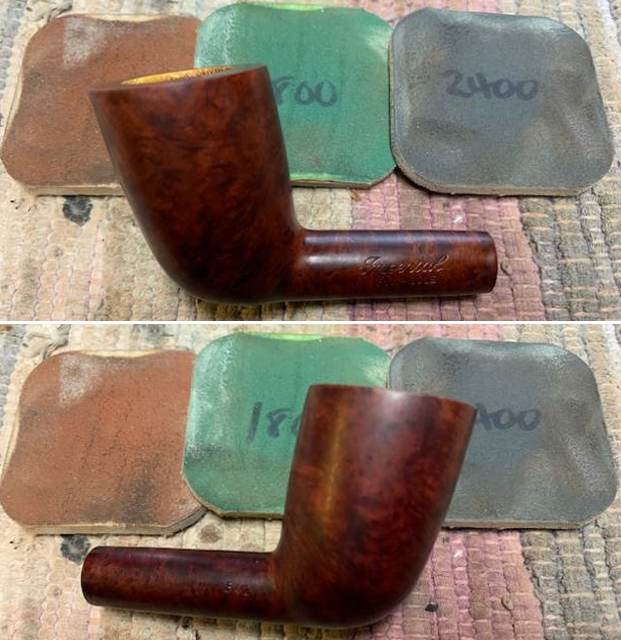
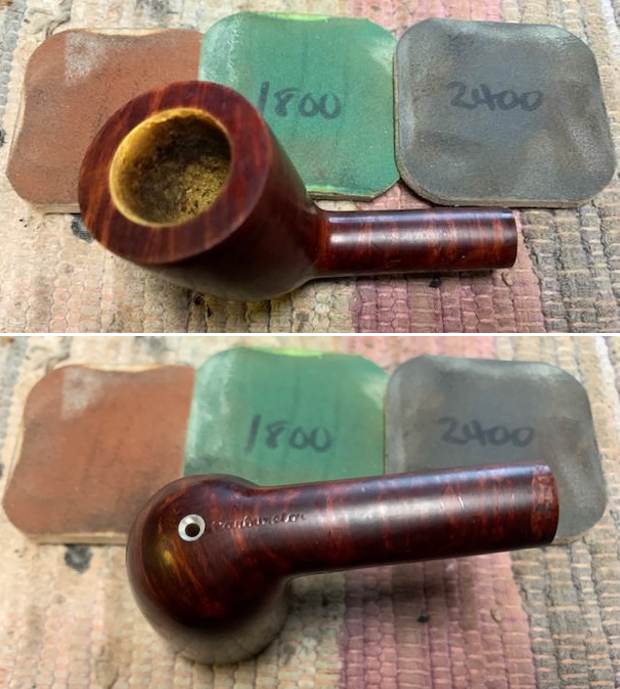
I decided to address the damage to the back rim top and inner edge of the bowl first. I used a folded piece of 220 grit sandpaper to give the inner edge of the bowl a slight bevel on the inner edge to remove burned areas and blend them into the surrounding briar. I lightly topped the bowl on a topping surface with 220 grit sandpaper to remove the damage to the rim top. The rim looks much better at this  point. I polished the rim top with 1500-2000 grit micromesh pads and then restained the rim top with a Cherry and a Maple stain pen. The combination matched the colour of the rest of the bowl and shank. I polished the rim top ad the rest of the briar with micromesh sanding pads – dry sanding with 1500-12000 grit sanding pads. I wiped the bowl down with a damp cloth after each sanding pad. I worked some Before & After Restoration Balm into the surface of the briar with my fingertips. It works to clean, enliven and protect the briar. I let it sit for 15 minutes then buffed it off with a soft cloth and raised the shine. The bowl looks great at this point.   I set the bowl aside and turned my attention to the stem. I “painted” the stem and button surface with the flame of a lighter to lift the tooth marks. It worked amazingly well and I was able to lift them significantly. I filled in those that remained with clear CA glue and set it aside for the glue to cure. I used a small file to smooth out the repairs and reshape the button edges. I sanded what remained with 220 grit sandpaper to blend them into the surface of the vulcanite. I started polishing the stem by wet sanding it with 400 grit wet dry sandpaper. I polished the stem with micromesh sanding pads – dry sanding it with 1500-12000 grit pads. I wiped the stem down with Obsidian Oil after each pad. I polished it with Before & After Pipe Polish – both Fine and Extra Fine and gave it a final coat and set it aside to dry. I touched up the “P” stamp on the stem with white acrylic fingernail polish. I pushed it into the stamp with a tooth pick to get it deep in the stamp. I scraped off the excess acrylic and polished the stamped area with a 1500 grit micromesh sanding pad.  I am excited to finish this Republic Era Peterson’s “Kildare” 120 Dublin. I put the pipe back together and buffed it with Blue Diamond on the buffing wheel. I gave the bowl and the stem multiple coats of carnauba wax. I hand buffed the pipe with a clean buffing pad to raise the shine. It is fun to see what the polished bowl looks like with beautiful flame grain all around it. Added to that the black vulcanite stem was beautiful. This smooth Classic Peterson’s “Kildare” 120 Dublin is great looking and the pipe feels great in my hand. It is light and well balanced. Have a look at it with the photos below. The dimensions are Length: 6 inches, Height: 1 ¾ inches, Outside diameter of the bowl: 1 ¼ inches, Chamber diameter: ¾ of an inch. The weight of the pipe is 38 grams/1.34 ounces. It is a beautiful pipe and I will soon be putting it on the rebornpipes store in Irish Pipe Makers Section. If you are interested in adding it to your collections let me know. Thanks for walking through the restoration with me as I worked over this pipe. Thanks to each of you who are reading this blog.

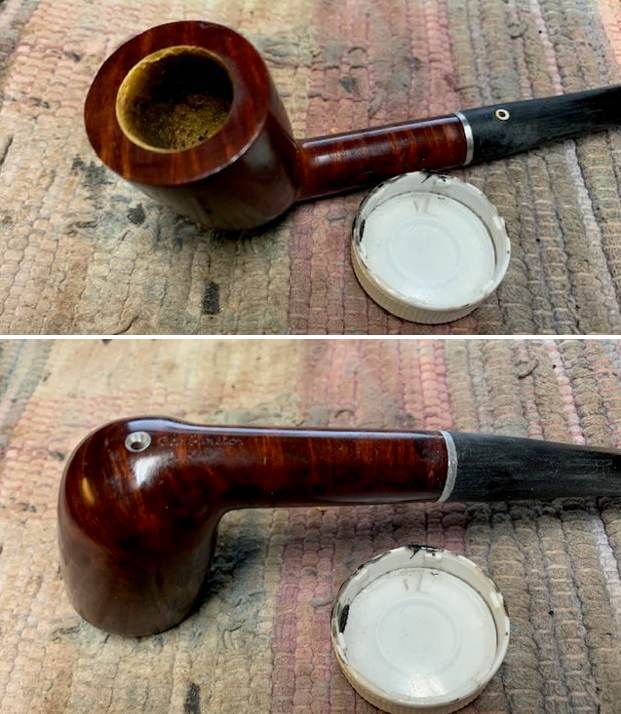
Restoring and Restemming an Interesting Nording F Freehand


Blog by Steve Laug

It was time to turn back to another one of the pipes that Jeff and I picked up. Neither of us had any memory of where this pipe came from but it is another interesting geometrically shaped Freehand with a variety of angles in the carving in the bowl and shank that really follow the grain on this piece of briar. The rim top and shank end is plateau and is stained black. You can see the flow of mixed grain around the bowl and shank. It is stamped on the underside of the shank F over NORDING over MADE IN DANMARK just before the plateau end of the shank. There is no other stamping on the pipe. The stem was missing and the tenon was broken off in the shank. Jeff had definitely cleaned up the pipe sometime along the way. He had reamed the bowl with a PipNet pipe reamer and cleaned it up with a Savinelli Fitsall Pipe Knife. He scrubbed the exterior with Murphy’s Oil Soap and a tooth brush to clean off lava on the rim top and shank end. He had cleaned up the internals of the shank, mortise and stem with pipe cleaners, cotton swabs and alcohol to remove all of the oils and tars in the pipe. I would need to pull the broken tenon and fit a new stem to the shank but it was a nice bowl. I took photos of the rim top and shank to show the condition of the pipe before I started working on it. You can see the condition from the bowl and rim top in the first photo. The inner edge of the bowl was in very good condition and was smooth to the touch. The second photo show the shank end plateau. It also looked very good. I took a photo of the stamping on the underside of the shank. It was faded but still readable as noted above.Before I started my work on the pipe I wanted to learn more about where this pipe fit into the Nording lines so I turned to the first of two sites that I always check to gather information on a brand. I turned first to Pipedia (https://pipedia.org/wiki/N%C3%B8rding). Nording’s were exclusively freehand shapes, graded from A, B, C, D, up to its highest grade, extra. Later an “F” grade was added—less expensive than the “A.” I could find no other information on the rest of the stamping on the pipe.

I did find a great collage of photos of Erik Nording that I have included below. I turned to the second information site – Pipephil’s (http://www.pipephil.eu/logos/en/logo-n2.html) did not find any more helpful information on the Nording Danmark stamp.

Armed with the information on the F stamp being a lower end midgrade Freehand, I knew a bit about the pipe at hand. I turned to address the pipe itself. When it arrived here in Vancouver it was a clean pipe and I knew what I had to work with. To begin my work on it, I removed the broken tenon from the shank with a drill bit turned into the shank on low speed. I took a photo of the broken tenon once I had it removed. I went through my can of stems and found this straight acrylic stem that had been partially turned for another pipe somewhere along the way. It would need some work but the fit was close. I sanded the tenon end of the new stem to get a strong fit in the shank of the pipe. I would need to refine the fit but it was looking quite good. I would also need to heat and bend the stem for a proper fit. I used a heat gun to bend the stem to match the flow of the stem. I used the lowest setting on the heat gun and bent the stem at the proper angle. I put it in the shank and took photos of the newly restemmed pipe. It is looking good at this point. I polished the briar with micromesh sanding pads. I wet sanded it with 1500-12000 grit pads. I wiped the bowl down after each pad with a damp cloth. The bowl began to take on a rich shine and grain was beginning to stand out. I rubbed the bowl and shank down with Before & After Restoration Balm to deep clean the finish on the bowl and shank. The product works to clean, enliven and protect the briar. I worked it in with my fingers to get it into the briar. I used a horsehair shoe brush to work it into the plateau top and shank end. After it sat for a 15 minutes I wiped it off and buffed it with a soft cloth. The briar really began to have a rich shine. I took some photos of the bowl at this point to mark the progress in the restoration. It is a beautiful bowl. I set the bowl aside and worked on the stem at this point in the process. I sanded the tenon area to shape the fit in the shank with 220 grit sandpaper fit snugly in the shank. I started polishing the stem with 400 grit wet dry sandpaper.  I polished the stem with micromesh sanding pads – wet sanding with 1500-2400 grit pads and dry sanding with 3200-12000 grit pads. I wiped the stem down after each pad with a damp cloth to remove the sanding dust. I used the Before & After Pipe Polish to remove the small minute scratches left in the acrylic even after the micromesh regimen. I finished by wiping the stem down with a final coat of Obsidian Oil and set it aside to dry. I put the stem back on the pipe and took the pipe to the buffer. I buffed the bowl and stem with Blue Diamond to polish the briar and the acrylic. Blue Diamond does a great job on the smaller scratches that remain in both. I gave the bowl and the stem several coats of carnauba wax and buffed the pipe with a clean buffing pad to raise the shine. I hand buffed it with a microfiber cloth to deepen the shine. The pipe polished up really nicely with a great contrasting stain look to the briar. The finished pipe is shown in the photos below. This is a unique Nording Freehand for me – the amber acrylic stem and plateau shank end gives the pipe a different look. The polished acrylic   stem looks really good with the reds and blacks standing out in the grain. The dimensions of the pipe are Length: 7 inches, Height: 2 inches, Outside diameter of the bowl: 2 inches wide x 2 ½ long, Chamber diameter: 3/4 of an inch. The weight of the pipe is 93 grams/3.28 ounces. This is another pipe that I will be putting it on the rebornpipes online store shortly, if you are interested in adding it to your collection. Thanks for walking through the restoration with me on this beauty!

Restemming and restoring a Vauen Dr. Perl 5049 Dublin


Blog by Steve Laug

This past weekend a fellow stopped by on a recommendation from a local pipe shop about my restemming a couple of pipes that he purchased on Ebay. Both of the pipes were Vauen pipes and both were sandblasted with P-lip style stems. The stems had the additional feature of being 9mm filter pipes. The second of these I chose to work on was the sandblast Dublin with a beautiful and deep blast. The stem was worn on the edge of the P-lip and had tooth marks on both sides. I believe it was a vulcanite stem as it showed oxidation on the P-lip surface itself. The rim top was quite clean and the blast and beveled inner edge looked very good. The finish was dirty but had a charm that was characteristic of older sandblast pipes. The pipe was stamped on the underside of the shank logo like figure that did not look like the crossed pipes I was accustomed to. That was followed by the words Vauen [over] Dr. Perl. That was followed by the shape number 5049. It was quite lightweight and would clean up quite nicely. In chatting with the fellow on Sunday he was clear that he wanted to get rid of the p-lip stem altogether and have an acrylic fishtail style stem in the same shape made for a 9mm filter tenon. I took photos of the pipe before I started working on it. I took photos of the rim top and the top and underside of the stem that came with the pipe. You can see how it fit against the shank and you can see the light cake in the bowl. It is a nice looking pipe.The next photo shows the stamping on the underside of the shank. It is clear and readable as noted above.I removed the stem from the shank and took a photo of the parts to give a sense of the overall look of the pipe. It is really a nicely designed looking bent Dublin that will look great once it is cleaned up.I wanted to get some background on the Dr. Perl pipe by Vauen. I turned first to Pipephil’s site (http://pipephil.eu/logos/en/logo-v1.html). I did a screen capture of the information on the site. There was a great sidebar that gave some history of the brand. I include both of them below. There was also a note at the bottom of the screen capture below that has a link to the Vauen Dr Perl variant on the P-Lip pipe.In 1848, Karl Ellenberger and his partner Carl August Ziener establish a pipe factory in Nuremberg. In 1901 they merge with Gebhard Ott an other factory in town and they create a firm named Vereinigten Pfeifenfabriken Nürnberg (abbreviated : VPFN*). Shortly after Ernst Eckert, a member of the Ott family became manager of the society. During the 20th century Adolf, Ernst (jr) and Alexander Eckert (CEO in 2012) followed one another at Vauen’s head.* VPFN : “V” is said VAU in German (pronounce faou) and “N” becomes EN. Hence VAUEN.

I followed that link on the bottom of the photo above (http://pipephil.eu/logos/en/infos/p-lip-en.html). I found that there was description of the Vauen Dr. Perl that had the same style stem as the pipe I was working on. I have included a screen capture of the Dr. Perl pipe below:I could not find anything in the information to help establish the date for the pipe but it is fascinating to see the look of the P-lip.

I also turned to a blog written on rebornpipes by Dal Stanton (Pipesteward.com) that I quote a section from the blog below that gives a great sense of the history of the German brand and some photos from the website (https://rebornpipes.com/2021/04/27/breathing-new-life-into-a-german-vauen-6294-p-lip-saddle-billiard-for-a-special-young-lady/).

… I turn to the question of the history of the VAUEN name? I look to the History section of the VAUEN website and again, I am impressed with the presentation. Whenever I work on a pipe, and especially when a pipe name is new to me, I enjoy looking at its history to appreciate the pipe more fully now on my worktable. From VAUEN’s website:Quality and a wealth of ideas have a long tradition at VAUEN. 160 years of VAUEN: that means 160 years of skilled workmanship and modern technology and 160 years of experience in fulfilling the individual wishes of today’s pipe lovers, and those of tomorrow.

In Nuremberg in 1848, Karl Ellenberger and his partner Carl August Ziener turned an idea into reality: Germany’s first pipe manufacturer produced tobacco pipes for connoisseurs around the world using a selection of the best wood. In an amalgamation with the Gebhard Ott pipe factory, which was founded in 1866 in Nuremberg, the Vereinigten Pfeifenfabriken Nuremberg (United Pipe Factories Nuremberg, or VPFN) was born in 1901.  Under the management of Ernst Eckert, a descendent of the founding Ott family, a company was born whose products and services would shape the tobacco and smoking culture in Europe and overseas for the next 160 years and counting.

The question about the name, VAUEN, not being a name of a person and why it is capitalized throughout is explained:

In his search for a name that would be easily remembered by all pipe lovers, Ernst Eckert’s son, Adolf Eckert, coined a new name for the company in 1909: VAUEN – a composition of the first letters V (pronounced vow) of Vereinigte Pfeifenfabriken and N (pronounced en) of Nuremberg. A brand for the future was born.

Now it was time to work on the pipe itself. In chatting with the pipeman who brought me the pipe we decided to add a small thin brass band for decorative purposes. I went through my bands and found one that was a perfect fit and matched the one I put on the billiard. I put a thin band of glue around the inside edge of the band and pressed it into place. I took photos of the new look of the pipe. I really like the looks of the band in place. I cleaned out the thin cake on the bowl walls with a Savinelli Fitsall Pipe Knife. I sanded the walls smooth with 220 grit sandpaper wrapped around a piece of dowel. I cleaned out the mortise and airway into the bowl and the stem with cotton swabs, pipe cleaners and isopropyl alcohol until they came out clean. I rubbed the bowl and shank down with Before & After Restoration Balm. I worked it into the finish with my fingers and used a shoe brush to press it deep into the crevices of the sandblast. The product works to deep clean the finish on the bowl and shank and enliven and protect the briar. After it sat for 15 minutes I wiped it off with a soft cloth. The briar really came alive with a rich shine. I took some photos of the bowl at this point to mark the progress in the restoration. It is a beautiful bowl.   I set the bowl aside and turned my attention to the stem. I went through my collection of stem and found an acrylic stem with a fishtail end that was a perfect replacement. It would need to be cleaned up and polished but it would look good with the bowl. I sanded out the light remaining tooth marks and chatter in the surface of the stem with 220 grit sandpaper and started polishing it with 400 grit wet dry sandpaper. I polished the stem with micromesh sanding pads – dry sanding with 1500-12000 grit pads. I wiped the stem down after each pad with Obsidian Oil to remove the sanding dust. I used the Before & After Pipe Polish to remove the small minute scratches left in the vulcanite. I finished by wiping the stem down with a final coat of Obsidian Oil and set it aside to dry.  As usual at this point in the restoration process I am excited to be on the homestretch. I look forward to the final look when it is put back together, polished and waxed. I put the bowl and stem back together. I polished the bowl and stem with Blue Diamond to polish out the scratches in the briar and the acrylic.  I gave the bowl and the stem multiple coats of carnauba wax. I buffed the pipe with a clean buffing pad to raise the shine. I hand buffed it with a microfiber cloth to deepen the shine. The pipe polished up pretty nicely. The grain really pops with the wax and polish. The shiny black acrylic stem is a beautiful contrast to the browns of the bowl and thick shank. This Sandblast Vauen Dr. Perl 5049 Bent Dublin  was another fun pipe to work on. It really is a quite stunning piece of briar whose shape follows the flow of the grain on the briar. The pipe is comfortable pipe to hold in the hand. The finished pipe is shown in the photos below. The dimensions of the pipe are Length: 5 ¾ inches, Height: 2 inches, Outside diameter of the bowl: 1 ½ inches, Chamber diameter: ¾ of an inch. The weight of the pipe is 1.55 ounces/ 44 grams. This is the second of the Vauen Dr. Perl Pipes that were dropped off for me to clean up and restem. I will be sending the pair back to the pipeman who dropped them off. Thanks for reading my reflections on the pipe while I working on it.

Restemming and restoring a meerschaum lined Vauen Dr. Perl 1242 Billiard


Blog by Steve Laug

This past weekend a fellow stopped by on a recommendation from a local pipe shop about my restemming a couple of pipes that he purchased on Ebay. Both of the pipes were Vauen pipes and both were sandblasted with P-lip style stems. The stems had the additional feature of being 9mm filter pipes. The first of these I chose to work on was the sandblast billiard that had a meerlined bowl. The tenon had snapped in the shank in the process of the shipping and the thin filter stem was stuck in the shank. The meerlined bowl was also dirty and had a light to moderate cake on the walls. The rim top was stain dark from use and was much the same colour as the stain on the bowl. The finish was dirty but had a charm that was characteristic of older sandblast pipes. The pipe was stamped on the underside of the shank and read Vauen [over] Dr. Perl. That was followed by the shape number 1242 followed by the crossed pipes Vauen logo. It was quite lightweight and would clean up quite nicely. In chatting with the fellow on Sunday he was clear that he wanted to get rid of the p-lip stem altogether and have an acrylic fishtail style stem in the same shape made for a 9mm filter tenon. I took photos of the pipe before I started working on it. I took photos of the snapped tenon on the stem to show how close to the shank it had broken. The broken tenon was tight in the shank and would be difficult to remove.I took a photo of the meerschaum insert in the bowl. It looks good in the photo below. It is smooth and shows some darkening on the top of the insert where it seems to almost blur into the surround briar.The next photo shows the stamping on the underside of the shank. It is clear and readable as noted above.I wanted to get some background on the Dr. Perl pipe by Vauen. I turned first to Pipephil’s site (http://pipephil.eu/logos/en/logo-v1.html). I did a screen capture of the information on the site. There was a great sidebar that gave some history of the brand. I include both of them below. There was also a note at the bottom of the screen capture below that has a link to the Vauen Dr Perl variant on the P-Lip pipe.In 1848, Karl Ellenberger and his partner Carl August Ziener establish a pipe factory in Nuremberg. In 1901 they merge with Gebhard Ott an other factory in town and they create a firm named Vereinigten Pfeifenfabriken Nürnberg (abbreviated : VPFN*). Shortly after Ernst Eckert, a member of the Ott family became manager of the society. During the 20th century Adolf, Ernst (jr) and Alexander Eckert (CEO in 2012) followed one another at Vauen’s head.* VPFN : “V” is said VAU in German (pronounce faou) and “N” becomes EN. Hence VAUEN.

I followed that link on the bottom of the photo above (http://pipephil.eu/logos/en/infos/p-lip-en.html). I found that there was description of the Vauen Dr. Perl that had the same style stem as the pipe I was working on. I have included a screen capture of the Dr. Perl pipe below:I could not find anything in the information to help establish the date for the pipe but it is fascinating to see the look of the P-lip.

I also turned to a blog written on rebornpipes by Dal Stanton (Pipesteward.com) that I quote a section from the blog below that gives a great sense of the history of the German brand and some photos from the website (https://rebornpipes.com/2021/04/27/breathing-new-life-into-a-german-vauen-6294-p-lip-saddle-billiard-for-a-special-young-lady/).

… I turn to the question of the history of the VAUEN name? I look to the History section of the VAUEN website and again, I am impressed with the presentation. Whenever I work on a pipe, and especially when a pipe name is new to me, I enjoy looking at its history to appreciate the pipe more fully now on my worktable. From VAUEN’s website:Quality and a wealth of ideas have a long tradition at VAUEN. 160 years of VAUEN: that means 160 years of skilled workmanship and modern technology and 160 years of experience in fulfilling the individual wishes of today’s pipe lovers, and those of tomorrow.

In Nuremberg in 1848, Karl Ellenberger and his partner Carl August Ziener turned an idea into reality: Germany’s first pipe manufacturer produced tobacco pipes for connoisseurs around the world using a selection of the best wood. In an amalgamation with the Gebhard Ott pipe factory, which was founded in 1866 in Nuremberg, the Vereinigten Pfeifenfabriken Nuremberg (United Pipe Factories Nuremberg, or VPFN) was born in 1901.  Under the management of Ernst Eckert, a descendant of the founding Ott family, a company was born whose products and services would shape the tobacco and smoking culture in Europe and overseas for the next 160 years and counting.

The question about the name, VAUEN, not being a name of a person and why it is capitalized throughout is explained:

In his search for a name that would be easily remembered by all pipe lovers, Ernst Eckert’s son, Adolf Eckert, coined a new name for the company in 1909: VAUEN – a composition of the first letters V (pronounced vow) of Vereinigte Pfeifenfabriken and N (pronounced en) of Nuremberg. A brand for the future was born.

Now it was time to work on the pipe itself. I needed to pull the broken tenon from the shank but it was harder than I thought it would be. I tried to drill it out but it would not move. I painted it with alcohol to try to soften the grime on it but again no movement. I was nervous about putting it in the freezer because of the meerlining so I was left to other methods. I finally used a knife to scrape away as much of the tenon as possible. I finally used a small file and was able to pull out the last piece of the broken tenon. With it gone I sanded the mortise smooth with a rolled piece of 220 grit sandpaper until the fit in the shank was smooth.I examined the bowl and saw that the meerschaum insert ended just above the entrance of the airway. It is a meerschaum sleeve rather than a bowl insert. The bottom of the bowl is still briar. I carefully scraped out the cake on the meerschaum walls with a Savinelli Fitsall Pipe Knife. I sanded it with a piece of 220 grit sandpaper wrapped around a piece of dowel to make it smooth.I cleaned out the mortise and airway into the bowl and the stem with cotton swabs, pipe cleaners and isopropyl alcohol until they came out clean. In chatting with the pipeman who brought me the pipe we decided to add a small thin brass band for decorative purposes. I went through my bands and found one that was a perfect fit. I put a thin band of glue around the shank edge and pressed the band into place. I took photos of the new look of the pipe. I really like the looks of the band in place.  I restained the briar portion of the rim top and edges with a combination of Black and Walnut stain pens to match the colour around the bowl sides. It looked much better. I polished the meerschaum portion a bit as well but it has some great colour to it.I rubbed the bowl and shank down with Before & After Restoration Balm. I worked it into the finish with my fingers and used a shoe brush to press it deep into the crevices of the sandblast. The product works to deep clean the finish on the bowl and shank and enliven and protect the briar. After it sat for 15 minutes I wiped it off with a soft cloth. The briar really came alive with a rich shine. I took some photos of the bowl at this point to mark the progress in the restoration. It is a beautiful bowl.   I set the bowl aside and turned my attention to the stem. I put it in a cup of water and boiled the water to straighten out the new stem. Heated the stem and the water in the microwave for 2 minutes until the material became flexible. I straightened it out and set the stem shape with cold running water.I sanded out the light remaining tooth marks and chatter in the surface of the stem with 220 grit sandpaper and started polishing it with 400 grit wet dry sandpaper. I polished the stem with micromesh sanding pads – dry sanding with 1500-12000 grit pads. I wiped the stem down after each pad with Obsidian Oil to remove the sanding dust. I used the Before & After Pipe Polish to remove the small minute scratches left in the vulcanite. I finished by wiping the stem down with a final coat of Obsidian Oil and set it aside to dry.  As usual at this point in the restoration process I am excited to be on the homestretch. I look forward to the final look when it is put back together, polished and waxed. I put the bowl and stem back together. I polished the bowl and stem with Blue Diamond to polish out the scratches in the briar and the vulcanite. I gave the bowl and the stem multiple coats of carnauba wax. I buffed the pipe with a clean buffing pad to raise the shine. I hand buffed it with a microfiber cloth to deepen the shine. The pipe polished up pretty nicely. The grain really pops with the wax and polish. The shiny black vulcanite stem is a beautiful contrast to the browns of the bowl and thick shank. This Meerschaum Lined Vauen Dr. Perl 1242 Billiard was another fun pipe to work on. It really is a quite stunning piece of briar whose shape follows the flow of the grain on the briar. The pipe is comfortable pipe to hold in the hand. The finished pipe is shown in the photos below. The dimensions of the pipe are Length: 6 inches, Height: 2 inches, Outside diameter of the bowl: 1 ¼ inches, Chamber diameter: ¾ of an inch. The weight of the pipe is 1.48 ounces/42 grams. The first of two Vauen Dr. Perl Pipes that were dropped off for me to clean up and restem. Once the second is finished, I will be sending them back to the pipeman who dropped them off. Thanks for reading this blog and my reflections on the pipe while I working on it.

Restoring an Imported Briar Made in Italy Bent Apple


Blog by Steve Laug

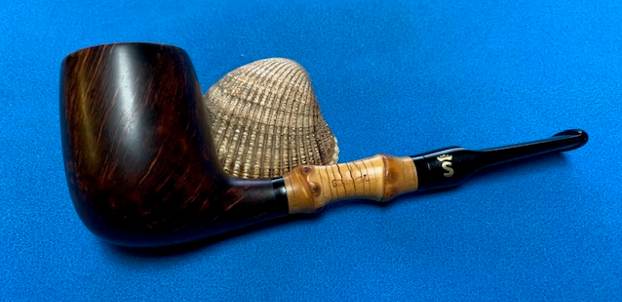
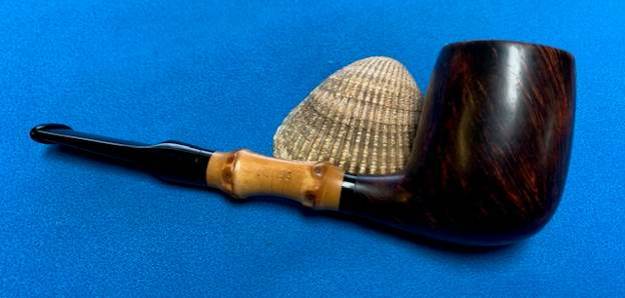
The next pipe on my work table is a nicely rusticated Bent Apple shaped one. It is stamped on the left side of the shank and reads Imported Briar [over] Made in Italy. The stamping is clear and readable on a smooth patch on the shank side. While it does not tell me who made it, it does tell me that is was made for the American market. This is yet another one that Jeff and I have no recollection of where we picked this one up but I know it has been here for a long time. The bowl had been reamed and cleaned and the shank and airways were very clean. The rim top showed darkening on the rim top and around the inner edge most of the way around the bowl. The outer edges were clean. There were a few small nicks in the briar but otherwise it was in good condition. The hard rubber older style stem had some light oxidation and some deep tooth marks on the top and underside near the button. There were gouges in the left side of the stem at the middle. There was not identifying logo or stamp on the sides of the stem. I took photos of the pipe before I started the next portion of the work on the pipe. It is truly interesting looking pipe. I took a close up photo of the rim top, edges and the top and underside of the stem. The inner edges and the rim top of the bowl showed wear and darkening. It would take a bit of work to bring it back and clean it up. The stem surfaces showed light tooth marks on both sides ahead of the button. I took photos of the stamping on both sides of the shank. They are clear and readable as noted above. I took the pipe apart and took a photo of the parts to show the proportions of the pipe. It is a beauty.I worked on the rim top and beveled inner edges of the rim with a folded piece of 220 grit sandpaper. I also smoothed the top of the rim to remove the rest of the darkening. It looked much better than when I started. I filled in a deep chipped area on the back left side of the outer rim with CA glue and briar dust. I smoothed out the repair with a brass bristle wire brush and smoothed out the repairs with 220 grit sandpaper. I polished the briar with micromesh sanding pads – polishing it with 1500-12000 grit pads. By the time I was finished the briar had a great shine. The grain on the pipe is quite beautiful.  I rubbed the bowl and shank down with Before & After Restoration Balm to deep clean the finish on the bowl and shank. The product works to clean, enliven and protect the briar. I worked it into the finish with my fingers. After it sat for 15 minutes I wiped it off with a soft cloth. The briar really came alive with a rich shine. I took some photos of the bowl at this point to mark the progress in the restoration. It is a beautiful bowl. I “painted” the surface of the stem with the flame of a Bic lighter to lift the tooth marks. I was able to lift them a bit and then filled in those that remained with clear CA Glue. Once it cured I used a small file to recut the edge and flatten the repairs. I sanded the surface with 220 grit sandpaper and started polishing it with 400 grit wet dry sandpaper. I filled in some gouges and marks on the right side of the stem surface with clear CA glue. Once the repairs cured I sanded them with 220 grit sandpaper to blend them into the surface.  I polished the stem with micromesh sanding pads – dry sanding with 1500-12000 grit pads. I wiped the stem down after each pad with Obsidian Oil to remove the sanding dust. I used the Before & After Pipe Polish to remove the small minute scratches left in the hard rubber. I finished by wiping the stem down with a final coat of Obsidian Oil and set it aside to dry.  As usual at this point in the restoration process I am excited to be on the homestretch. I look forward to the final look when it is put back together, polished and waxed. I put the bowl and stem back together. I polished the bowl and stem with Blue Diamond to polish out the scratches in the briar and the hard rubber. I gave the bowl and the stem multiple coats of carnauba wax. I buffed the pipe with a clean buffing pad to raise the shine. I hand buffed it with a microfiber cloth to deepen the shine. The pipe polished up pretty nicely. The grain really pops with the wax and polish. The shiny black hard rubber stem is a beautiful contrast to the browns of the bowl and thick shank. This Italian Made Imported Briar Bent Apple was another fun pipe to work on. It really is a quite stunning piece of briar whose shape follows the flow of the grain on the briar. The pipe is comfortable pipe to hold in the hand. The finished pipe is shown in the photos below. The dimensions of the pipe are Length: 5 inches, Height: 1 ½ inches, Outside diameter of the bowl: 1 1/8 inches, Chamber diameter: ¾ of an inch. The weight of the pipe is 1.73 ounces/49 grams. I will be putting this pipe in the Italian Pipemakers section of the rebornpipes store if you wish to add it to your collection. Thanks for reading this blog and my reflections on the pipe while I worked on it.
Restoring a Peterson’s Republic Era Galway 502 Apple


Blog by Steve Laug

The next pipe on my work table is a nicely grained Apple shaped one. It is stamped on the left side of the shank and reads Peterson’s [over] Galway. On the right side of the shank it is stamped Made in the [over] Republic [over] of Ireland followed by the shape number 502 next to the bowl shank joint. The stamping is clear and readable. Jeff and I have no recollection of where we picked this one up but I know it has been here for a long time. The bowl had been reamed and cleaned and the shank and airways were very clean. The rim top showed darkening on the back side edges and rim top. There was also some darkening around the inner edge most of the way around the bowl. The outer edges were clean. There were a few small nicks in the briar but otherwise it was in good condition. The stem had some light oxidation and tooth marks on the top and underside near the button. There is a P logo stamp on the left side of the saddle stem. I took photos of the pipe before I started the next portion of the work on the pipe. It really is a great looking pipe. I took a close up photo of the rim top, edges and the top and underside of the stem. The inner edges and the back top of the bowl showed wear and darkening. It would take a bit of work to bring it back and clean it up. The stem surfaces showed light tooth marks on both sides ahead of the button.I took photos of the stamping on both sides of the shank. They are clear and readable as noted above.I took the pipe apart and took a photo of the parts to show the proportions of the pipe. It is a beauty.Before I moved on to work on the pipe I did a bit of reading to see if I could gather some details on the Galway Line. I looked at both Pipephil and Pipedia to see if I could find any photos of information on the line on them. There was nothing of note on either site. There was a lot of historical information that I always enjoy reading. I turned then to the book, The Peterson Pipe by Mark Irwin and Gary Malmberg. There on page 300 there was a description of the line that I quote in full below.

Galway (1950-87, 2006-10) First issued as a high grade line just below Dublin & London, walnut-stained smooth finish, white P stamped on P-lip or fishtail mouthpiece. Second issue in ’69, with a sterling band added. Third issue in’86, when band replace with briar band insert into vulcanite p-lip  mouth piece. Discontinued in ’87. Fourth issue for the Italian market (c 2006-10) with lower bowl rusticated up to the beading around the top of the bowl, in standard and B shapes. Same desin and finishing made for the US market for Cupojoes.com with addition of sterling band and hot foil P on the stem.

I believe I am working on the First Issue of the Galway Line – a high grade just below the Dublin and London line. It is described as a walnut stained smooth finish with a P-lip or fishtail mouthpiece. The pipe I have definitely fits that description perfectly. It has a smooth walnut finish and also a P-lip stem. The stem was supposed to have a white P stamped on the left side of the stem.

I worked on the rim top and inner edges of the rim with a folded piece of 220 grit sandpaper. I gave the rim a slight bevel to remove the darkening on the edges and blend them into the briar. I also smoothed the top of the rim to remove the rest of the darkening. It looked much better than when I started.I polished the briar with micromesh sanding pads – polishing it with 1500-12000 grit pads. By the time I was finished the briar had a great shine. The grain on the pipe is quite beautiful. I rubbed the bowl and shank down with Before & After Restoration Balm to deep clean the finish on the bowl and shank. The product works to clean, enliven and protect the briar. I worked it into the finish with my fingers. After it sat for 15 minutes I wiped it off with a soft cloth. The briar really came alive with a rich shine. I took some photos of the bowl at this point to mark the progress in the restoration. It is a beautiful bowl.   I “painted” the surface of the stem with the flame of a Bic lighter to lift the tooth marks. I was able to lift most of them and sanded out the light remaining tooth marks and chatter in the surface with 220 grit sandpaper and started polishing it with 400 grit wet dry sandpaper. I touched up the “P” stamp on the left side of the saddle stem with white acrylic fingernail polish I scraped off the excess and left the stamp looking very good.I polished the stem with micromesh sanding pads – dry sanding with 1500-12000 grit pads. I wiped the stem down after each pad with Obsidian Oil to remove the sanding dust. I used the Before & After Pipe Polish to remove the small minute scratches left in the vulcanite. I finished by wiping the stem down with a final coat of Obsidian Oil and set it aside to dry.  As usual at this point in the restoration process I am excited to be on the homestretch. I look forward to the final look when it is put back together, polished and waxed. I put the bowl and stem back together. I polished the bowl and stem with Blue Diamond to polish out the scratches in the briar and the vulcanite. I gave the bowl and the stem multiple coats of carnauba wax. I buffed the pipe with a clean buffing pad to raise the shine. I hand buffed it with a microfiber cloth to deepen the shine. The pipe polished up pretty nicely. The grain really pops with the wax and polish. The shiny black vulcanite stem is a beautiful contrast to the browns of the bowl and thick shank. This Republic Era Peterson’s Galway 502 Apple was another fun pipe to work on. It really is a quite stunning piece of briar whose shape follows the flow of the grain on the briar. The pipe is comfortable pipe to hold in the hand. The finished pipe is shown in the photos below. The dimensions of the pipe are Length: 5 ½ inches, Height: 1 ¾ inches, Outside diameter of the bowl: 1 ¼ inches, Chamber diameter: ¾ of an inch. The weight of the pipe is 1.34 ounces/38 grams. I will be putting this pipe in the Irish Pipemakers section of the rebornpipes store if you wish to add it to your collection. Thanks for reading this blog and my reflections on the pipe while I worked on it.
Fresh Life for “A Peterson’s Product” Republic Era Killarney 69 Bent Billiard


Blog by Steve Laug

Jeff purchased this pipe off eBay on 12/06/2016 from Aurora, Colorado, USA. It has been sitting here in Vancouver awaiting my contribution to the restoration. It is a nicely shaped pipe with an almost Cherry red finish (little darker but to me it is that red). It is stamped on the left side of the shank and reads Killarney in script with the tail of the Y underlining the whole stamp. On the right side there is the shape number 69 near the bowl followed by “A Peterson’s Product” [over] Made In The Rep. [over] Of Ireland (three lines). The bowl had a thick cake and a heavy overflow of lava on the rim top. The finish on the bowl was quite clean. The twin silver bands separated by a black acrylic band on the stem is dirty but in good condition. The stem was oxidized, calcified and had tooth chatter on both sides ahead of the button. Jeff took photos of the pipe before he started his clean up work. He captured the cake in the bowl and the debris and lava on the rim top and edges in the next photos. It was very clear that it was an exceptional smoker! The stem is oxidized, calcified and shows the tooth marks and chatter on both sides ahead of the button. Jeff captured some of the beauty of the shape and the grain in the next photo. The mix of grains on the front of the bowl and heel is quite lovely as can be seen in the photo below.He took photos of the stamping on the sides of the shank. It is clear and readable as noted above. He also took a photo of the  P logo stamp on the left side of the stem. Jeff had done a great cleanup on the pipe. He reamed the bowl with a PipNet pipe reamer and followed up with a Savinelli Fitsall pipe knife to remove the cake. He scrubbed out the mortise and the airway in the shank and the stem with alcohol, cotton swabs and pipe cleaners. He scrubbed the bowl exterior with a tooth brush and Murphy’s Oil Soap to remove the grime on the finish of the bowl and the lava from the rim top. He rinsed it under running water. One of the benefits of this scrub is that it also tends to lift some of the scratches and nicks in the surface of the briar. He dried it off with a soft cloth. He cleaned the internals and externals of the stem with alcohol, pipe cleaners and cotton swabs. He soaked the stem in Briarville’s Pipe Stem Deoxidizer and rinsed it off with warm water and cleaned out the airway in the stem with alcohol, pipe cleaners and cotton swabs. I took photos of the pipe as I saw it when I put it on the table.   I took photos of the rim top and stem to show the condition. The rim top and beveled edge looked amazing. The stem was vulcanite and there were tooth marks and chatter on both sides ahead of the button.   I took photos of the stamping on the sides of the shank. They are clear and readable as noted above. The P logo on the stem is also quite readable.   I removed the stem from the shank and took a photo of the pipe to give a sense of the proportions of the bowl and stem.The bowl was in excellent condition so I rubbed down with Before & After Restoration Balm. I worked it into the surface of the bowl sides and shank with my fingertips to clean, enliven and protect the briar. I let the balm sit for 10 minutes, then buffed with a cotton cloth to raise the shine. The Balm did its magic and the grain stood out on the briar.   I set the bowl aside and turned my attention to the stem. I “painted” the tooth marks with the flame of a lighter and was able to lift all of them. I sanded out the remaining chatter with a folded piece of 220 grit sandpaper and then started polishing it with 400 grit wet dry sandpaper.  I polished the stem with micromesh sanding pads – 1500-12000 grit pads. I wiped it down with Obsidian Oil after each sanding pad. I finished the polishing with Before & After Polishes – both Fine and Extra Fine. I gave it a final rub down with Obsidian Oil and set it aside to dry. This “A Peterson’s Product” Republic Era Killarney 69 Bent Billiard with a vulcanite taper stem has a smooth reddish finish. The rich reds and blacks of the contrasting stain makes the grain come alive with the polishing and waxing. I put the vulcanite stem back on the bowl and carefully buffed the pipe with Blue Diamond on the buffing wheel using a light touch on the briar. I gave the bowl and the stem multiple coats of carnauba wax on the buffing wheel and followed that by buffing the entire pipe with a clean buffing pad. I hand buffed the pipe with a microfiber cloth to deepen the shine. The finished Peterson’s Killarney 69 Bent Billiard really is a great looking and fits nicely in the hand and looks very good. Give the finished pipe a look in the photos below. The dimensions of the pipe are Length: 5 ½ inches, Height: 1 ¾ inches, Outside diameter of the bowl: 1 ¼ inches, Chamber diameter: ¾ of an inch. The weight of the pipe is 1.66 oz./46 grams. This pipe will soon be on the Irish Pipe Makers Section of the rebornpipes store if you would like to add it to your collection. Thanks for reading this blog and my reflections on the pipe while I worked on it. There are many more to come!
Repairing and Restoring a Nording Nord-Coat Denmark 125 Oval Shank Billiard


Blog by Steve Laug

The next pipe on the table is one I have had for quite a while in a drawer here with meerschaum pipes. Jeff and I are not certain where we picked it up as neither of us have any memory of its purchase or where we found it. I had always assumed that it was a meerschaum as well until I started working on it this afternoon. The pipe looks like a meer with some fluming around the top of the bowl and shank bottom and end. It has some coloring that looks like a meerschaum. Once I started working on it I was not so sure. It is stamped on the underside and reads NORDING [over] NORD-COAT [over] DENMARK. On the shank end it was stamped 125 which is the shape number. The pipe is a classic shaped oval shank Billiard. The orange acrylic stem was in a bag with it and had a broken tenon. The tenon itself was missing so I was not certain of the fit. I took photos of the pipe when I took it out of the bag. It was dirty and the rim top was dirty. I took a photo of the stamping on the underside of the shank. It was stamped as noted above and was clear and readable.Now I knew that the pipe I was working on was a Nording that had been given a special coat called a NORD-COAT. Now I wanted to know what that was. Was it a meerschaum? I did not think so and in fact that NORD-COAT stamp made me pretty certain that it was not. It was rather coated with some kind of finish to give the pipe the look of a meerschaum. I wanted to know more so I did a quick search on the web for NORDING NORD-COAT. I am quoting what I found below.
The first link I found was to a thread on Pipesmagazine.com forum where a person was seeking information on the pipe(https://pipesmagazine.com/forums/threads/nordcoat-by-nording.15584/). I quote:

pipesharkOct 10, 2012 Bounced around a bit after I saw this, and apparently this is something that is supposed create a life lasting coating that will color similar to meerschaum but not lose it’s color for any reason. Supposedly all Nordcoat pipes should have the big man’s signature on them, and the hubbub is that if they don’t, they may be seconds. According to another post, there was a page on the Nording site some years ago that “guaranteed these pipes to color like meerschaum and provide a great cool smoke”. I read on post that claimed to have one of these pipes from 30 years ago, so they must have been around for some time. Maybe Storient or another meer expert has heard of coatings like these before. I didn’t see anything about the pipes being lower quality briar as such, but I have just discovered the subject and will continue the search. I must say that I have not substantiated this with any official sites or sources, this is just what I have seen on multiple threads of blog/forum postings, some claiming to have checked it out, but yea… I will post again if I find anything more.

That pretty much settle whether the was meerschaum or not. It clearly was not. It had a coating on the briar that would colour like meerschaum and permanently hold its colour. Nording had guaranteed  that they would colour like meer and provide a cool smoke.
I turned to a second link that was on the Google search that was on smokingpipes.com. (https://www.smokingpipes.com/pipes/estate/denmark/moreinfo.cfm?product_id=404914). I quote from the description that was there.

It’s presented in a sandblasted, virgin finish with darkened portions along the rim and shank end meant to emulate the look of a weathered patina. Erik designed these pipes with patinating in mind, meant to emulate the look of meerschaum

I turned to Pipedia (https://pipedia.org/wiki/N%C3%B8rding) and read the background info on the brand. It is a great read. There was also an example of the NORD-COAT pipe and nomenclature. I have included the photo below.I then turned to a last listing on the brand on Worthpoint – an online site that auctions of pipes (https://www.worthpoint.com/worthopedia/estate-clean-erik-nording-nord-coat-140692535). I quote:

Estate restored Erik Nording Nord-coat #2 #109 sandblasted imported briar pipe. Made by master artisan pipe maker Erik Nording in Denmark. This premium beauty is hued to look like a meerschaum pipe. This is a very collectable great smoking briar pipe.

Now it was time to work on the pipe itself. I decided to replace the broken tenon the acrylic stem that had come with the pipe. I went through my box of tenons and found a white threaded tenon that would work with a slight adjustment in length for the shank and fitting it into the stem. The white tenon would work well with the opaque colour of the stem once it was glued in place. I took photos of the tenon with the pipe and stem and have included them below.  I drilled out the airway in the stem with gradually increasing sized drill bits to open it up to take the threaded end of the new tenon. I find that working from a bit slightly larger than the airway in the stem to one that is the correct size for the tenon keeps it from chipping or breaking the acrylic stem. I used my Dremel and sanding drum to reduce the diameter of the tenon, shorten its length and remove the colour between the smooth and threaded portion of the tenon. I tried the fit in the stem and it worked perfect. I took a photo of before putting it in the stem and after. I also fit it in the shank as well. Once the fit was correct I glued it in place with clear CA glue.  I set the stem aside to let the glue cure on the tenon insert. I turned my attention to the bowl. I scrubbed it with a tooth brush and undiluted Murphy’s Oil Soap. I rinsed it off with running warm water. I dried it off with a soft cloth. The grime in the finish came off quite easily and the pipe looked significantly better. The grime was clear in the sandblast grooves around the bowl and shank as well as the rim top. I put the stem in the mortise and took photos to show the slight difference in the diameter of the stem and the shank. I am pretty sure it is original as there is a faint N on the top of the stem. It was not much but it bugged me and left a bit of lip that I did not like. I took photos of the fit and have included them below.    I went through some of my Sterling Silver Bands and found one that I think will work for the pipe and the stem. It is a nice oval silver band that I will fit on the shank. I slipped the band on the shank and put the stem in place see the fit and feel of the new look of the stem. While it covers the shape number, I still like it a lot!   I touched up the rim top stain with a black Sharpie pen. I was able to blend it into the rest of the rim top and edges of the bowl. It looked much better at this point.I glued the band in place on the shank end with some Weld Bond all purpose glue. I coated the shank end with the glue and pressed the band onto the shank. I aligned the stamping on the top of the band with the shank top.I scraped out the thin cake in the bowl with a Savinelli Fitsall Pipe Knife. It did not take too much to clean out the bowl. I then cleaned the shank and the airway in the stem with pipe cleaners and isopropyl alcohol.   I rubbed the bowl and shank down with Before & After Restoration Balm to deep clean the finish on the bowl and shank. The product works to clean, enliven and protect the briar. I worked it into the finish with my fingers and a horse hair shoe brush. After it sat for 15 minutes I wiped it off with a soft cloth. The Nord-Coat really began to have a rich shine and some colour. I took some photos of the bowl at this point to mark the progress in the restoration. It is a beautiful bowl.  I sanded out the tooth marks and chatter in the stem with 220 grit sandpaper and started polishing it with 400 grit wet dry sandpaper. I polished the stem with micromesh sanding pads – dry sanding with 1500-12000 grit pads. I wiped the stem down after each pad with a damp cloth to remove the sanding dust. I used the Before & After Pipe Polish to remove the small minute scratches left in the acrylic. I finished by wiping the stem down with a final coat of Obsidian Oil and set it aside to dry.   As usual at this point in the restoration process I am excited to be on the homestretch. I look forward to the final look when it is put back together, polished and waxed. I put the bowl and stem back together. I polished the bowl and stem with a light touch of Blue Diamond on the wheel. I polished the Silver Band with a jeweler’s cloth. I gave the bowl multiple coats of Conservator’s Wax and the stem multiple coats of carnauba wax. I buffed the pipe with a clean buffing pad to raise the shine. I hand buffed it with a microfiber cloth to deepen the shine. The pipe polished up pretty nicely. The sandblast really pops with the wax and polish. The shiny orange variegated acrylic stem is a beautiful contrast to the meerschaum like colour of the bowl and shank. This Nording Nord-Coat Oval Shank 125 Billiard was another fun pipe to work on. The Sterling Silver Band that I added adds a nice contrast between the acrylic stem and the Nord-Coat briar and binds it all together. It really is a quite stunning pipe whose shape follows the flow of the sandblasted briar. The pipe is comfortable pipe to hold in the hand. The finished pipe is shown in the photos below. The dimensions of the pipe are Length: 5 ½ inches, Height: 1 ¾ inches, Outside diameter of the bowl: 1 1/8 inches, Chamber diameter: ¾ of an inch. The weight of the pipe is 1.52 ounces/43 grams. This beautiful pipe will be going online on the rebornpipes soon in the Danish Pipe Makers section. If you want to add it to your collection let me know. Thanks for reading this blog and my reflections on the pipe while I worked on it.