Tag Archives: article by Robert M. Boughton

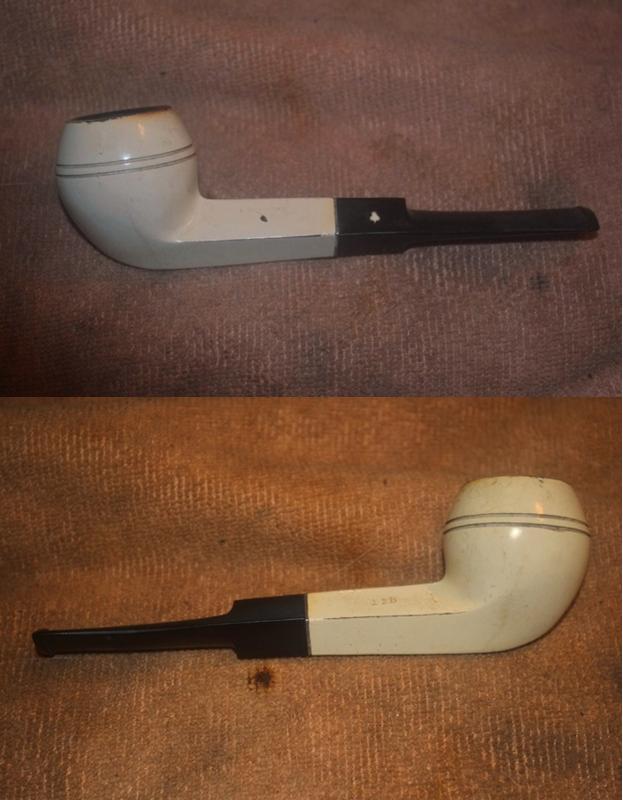
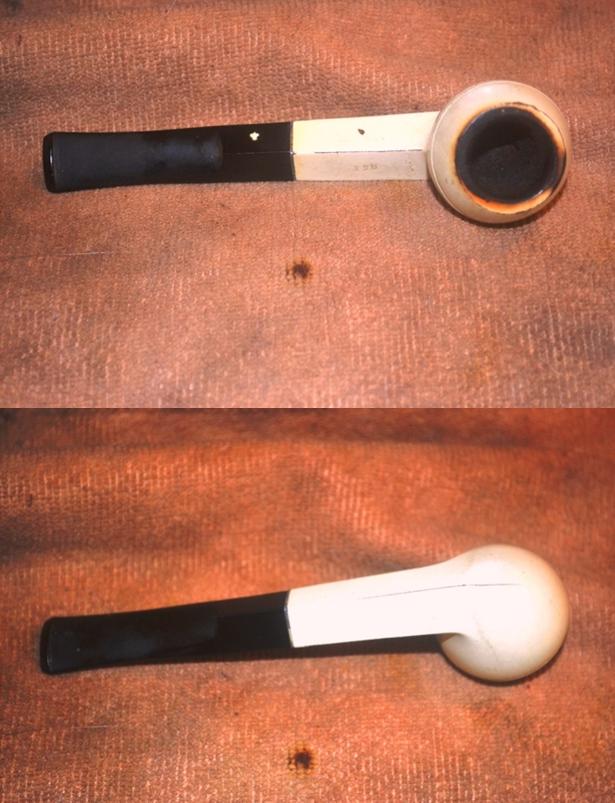
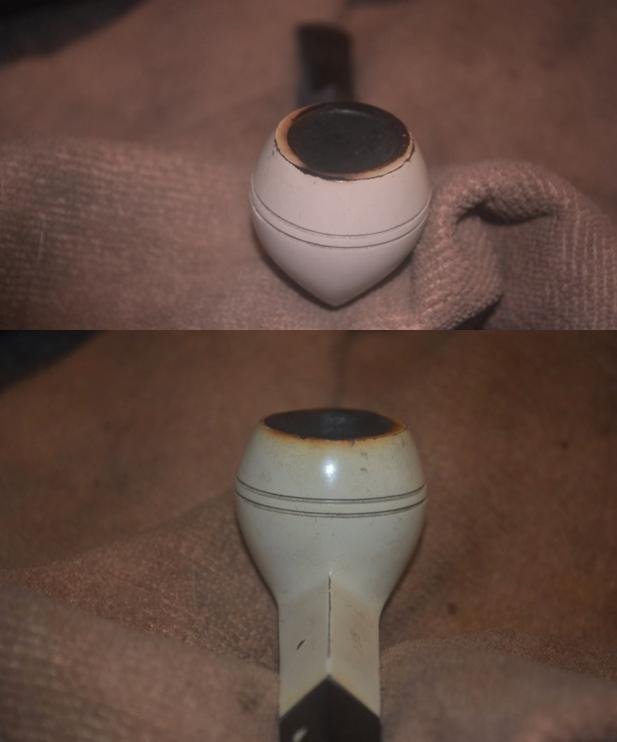
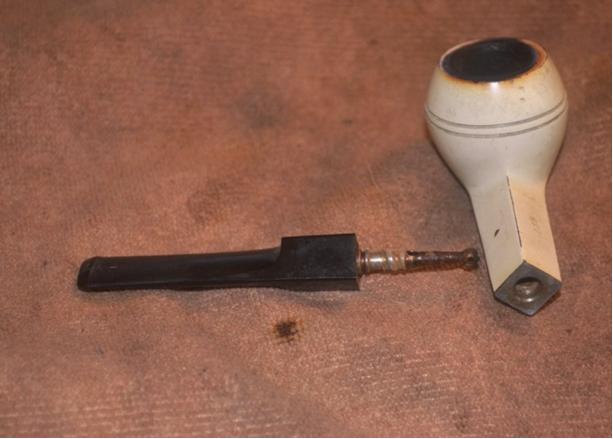
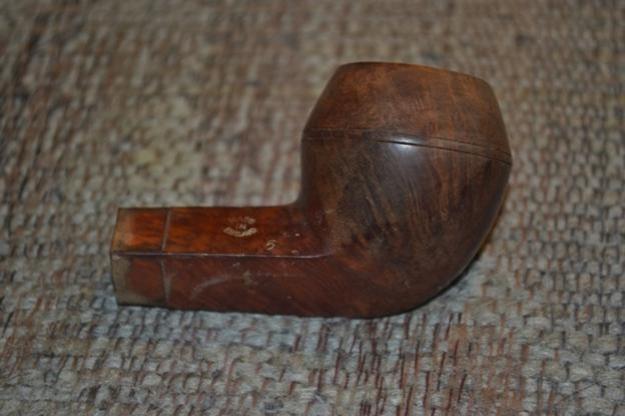
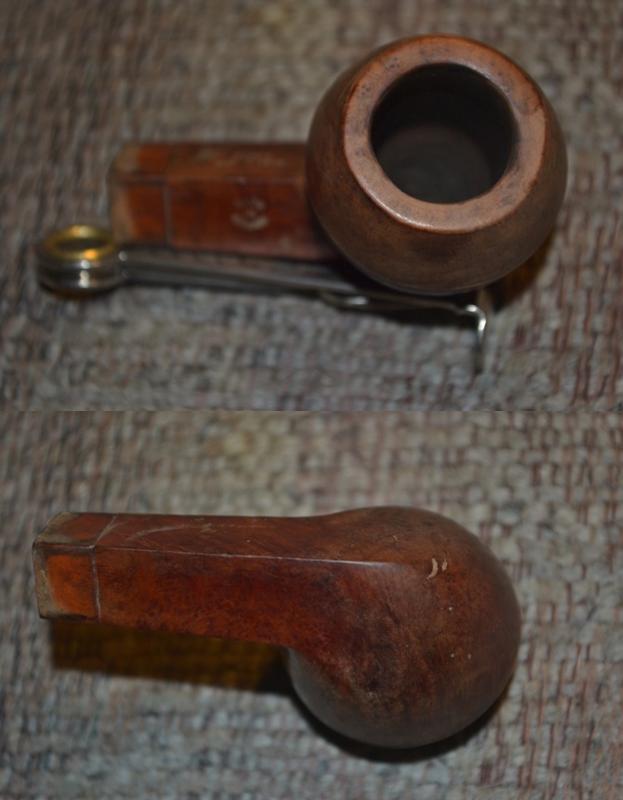
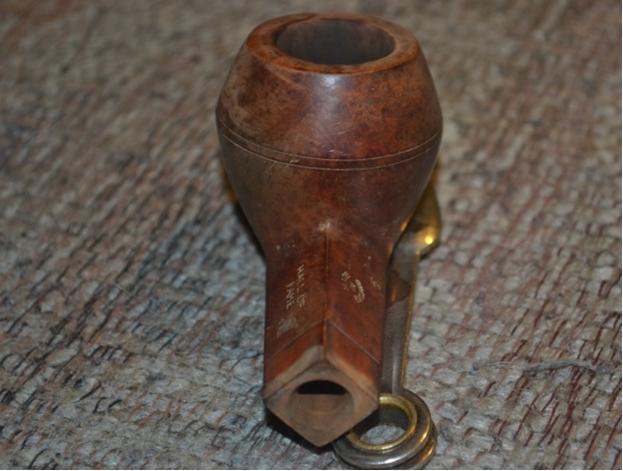
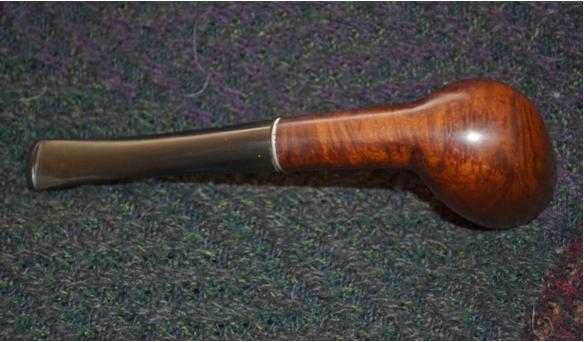
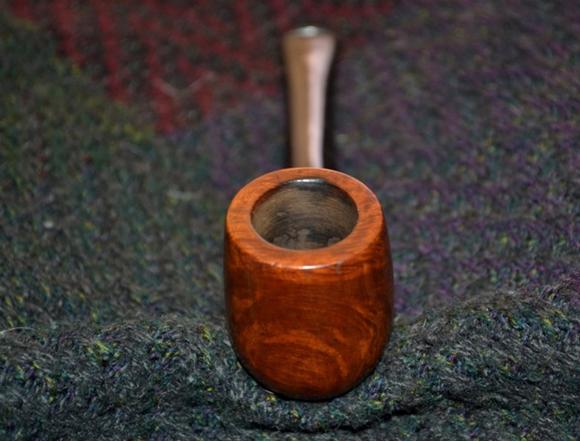
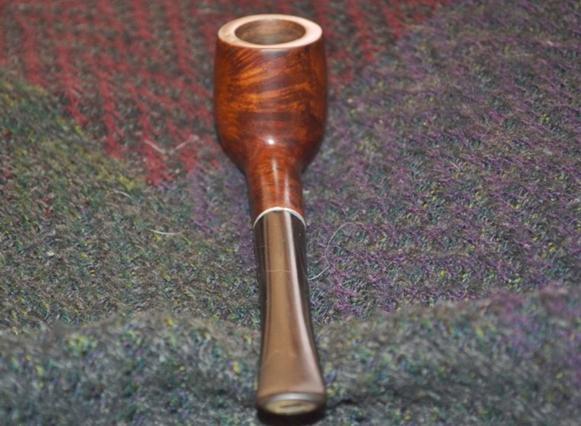
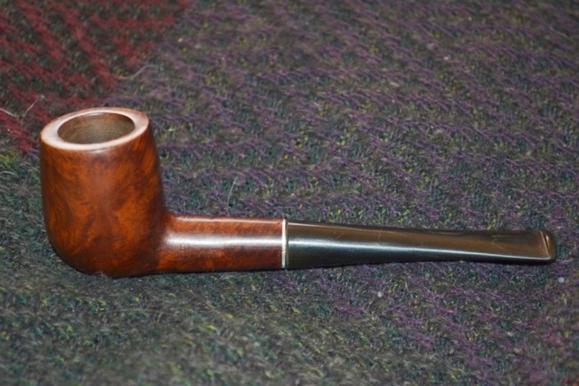
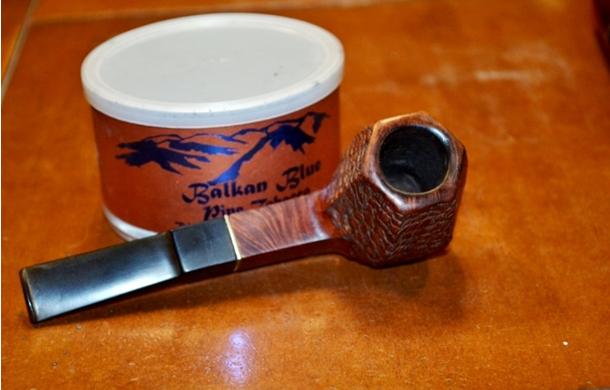
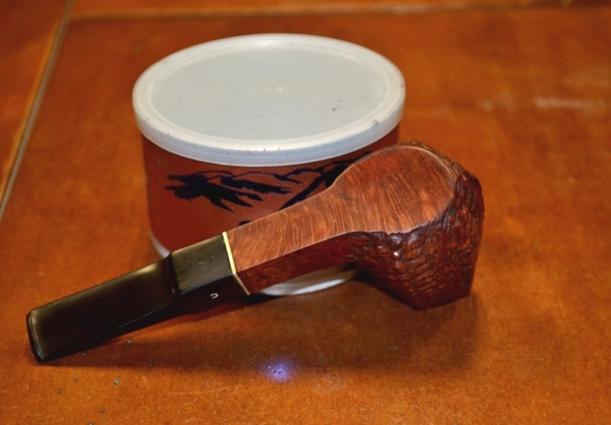
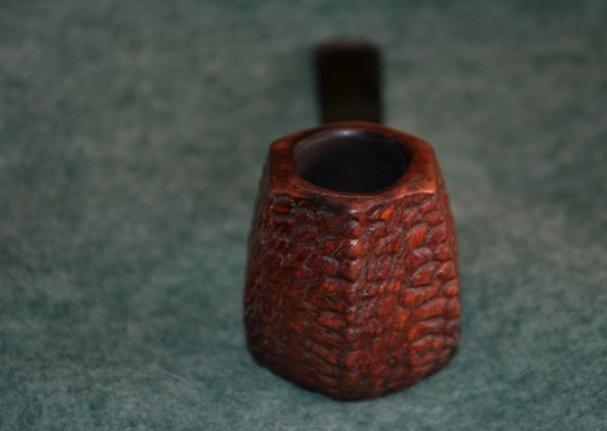
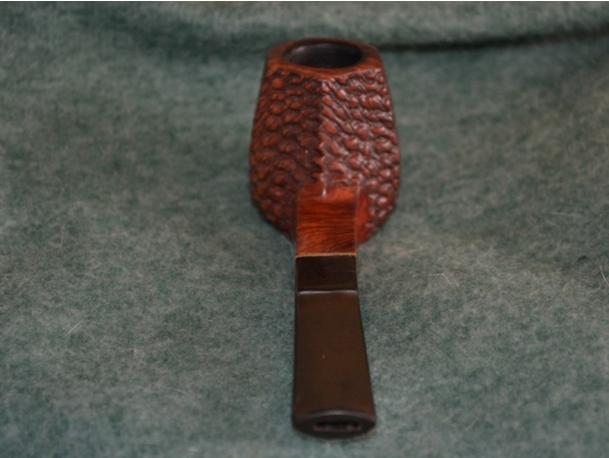
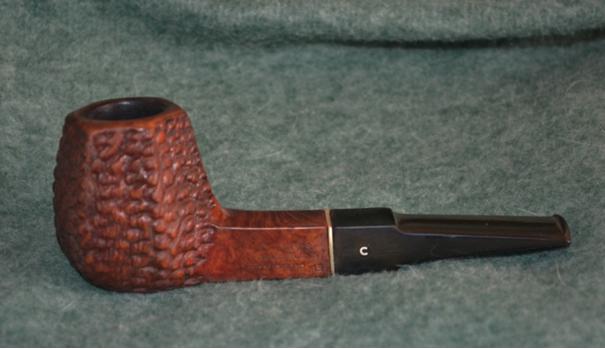
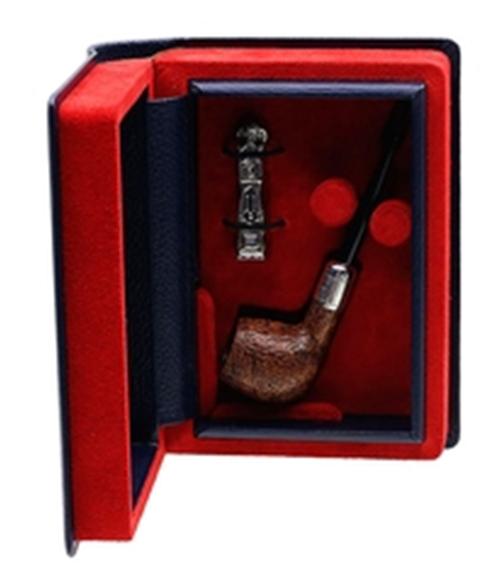
Kaywoodie White Briar Bulldog 12B


Guest Blog by Robert M. Boughton
Member, International Society of Codgers
Member, North American Society of Pipe Collectors
http://www.naspc.org
http://www.roadrunnerpipesnm.biz
http://about.me/boughtonrobert
Photos © the Author

INTRODUCTION
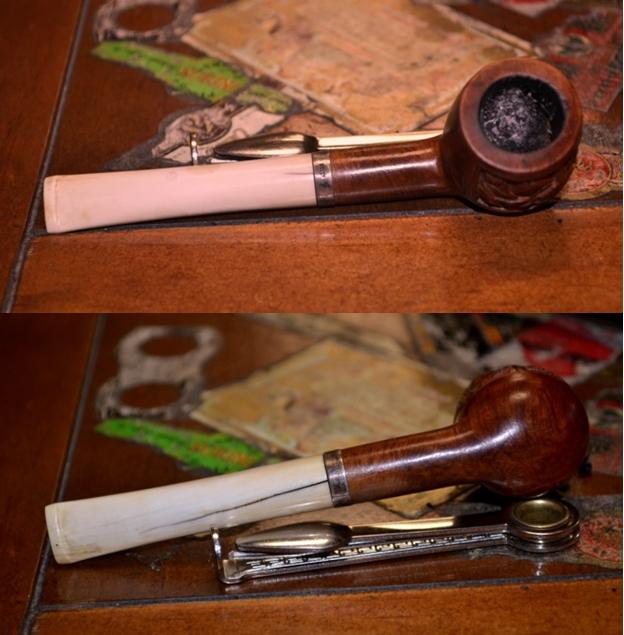
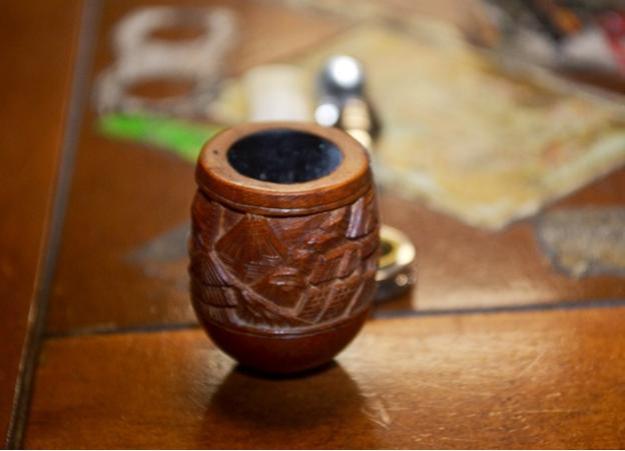
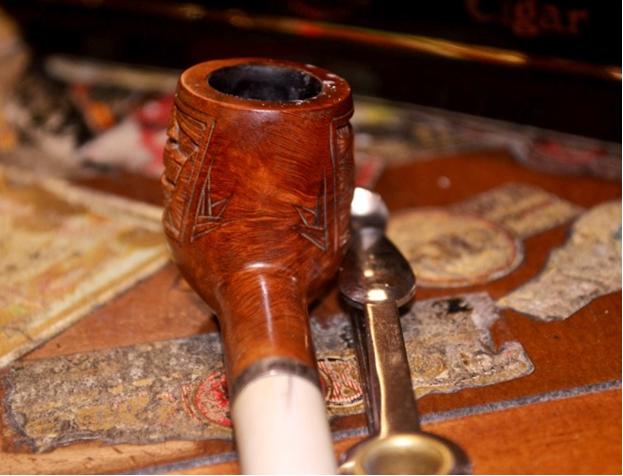
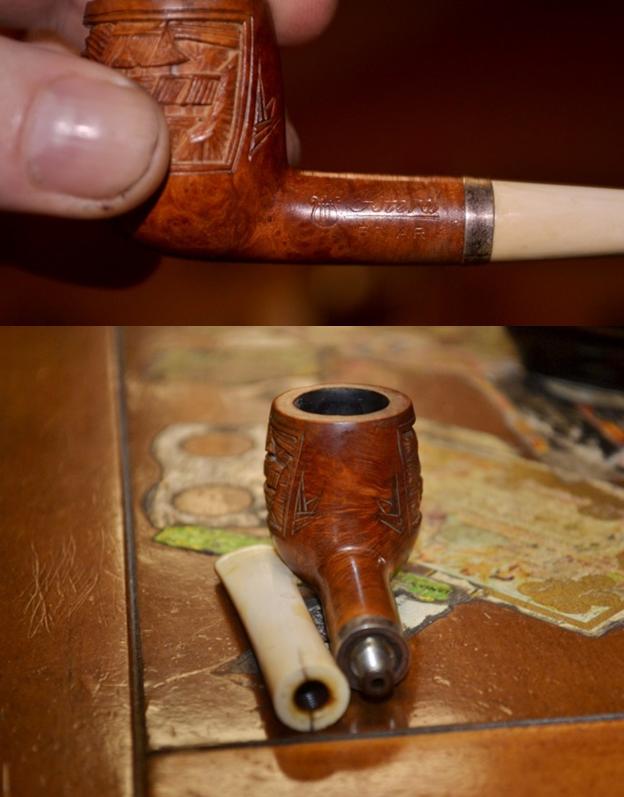
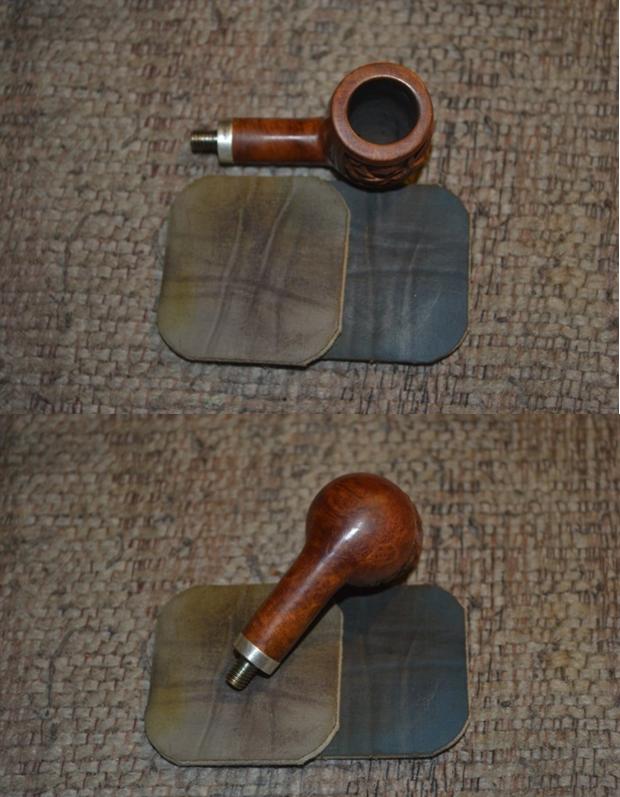
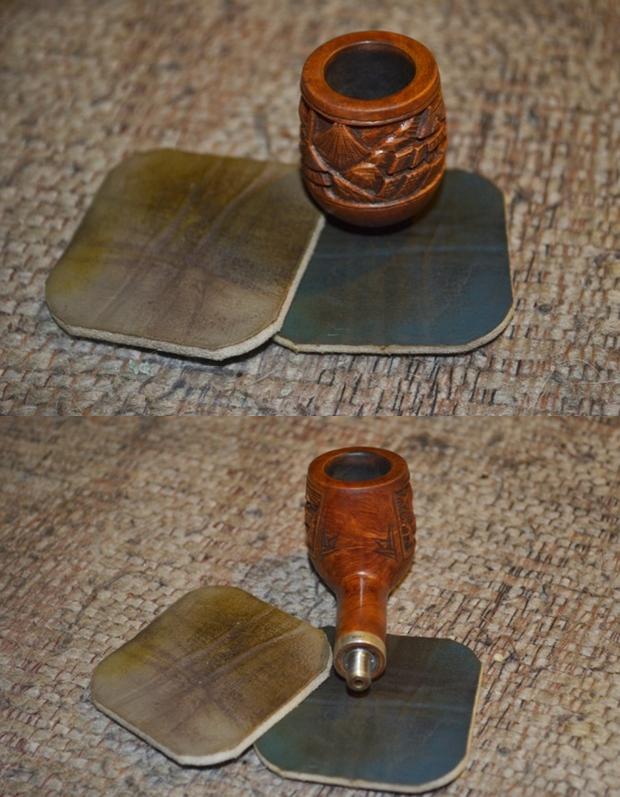
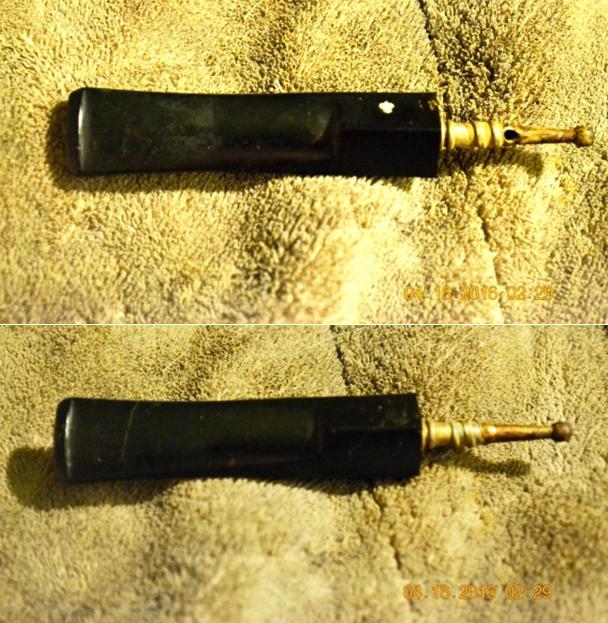
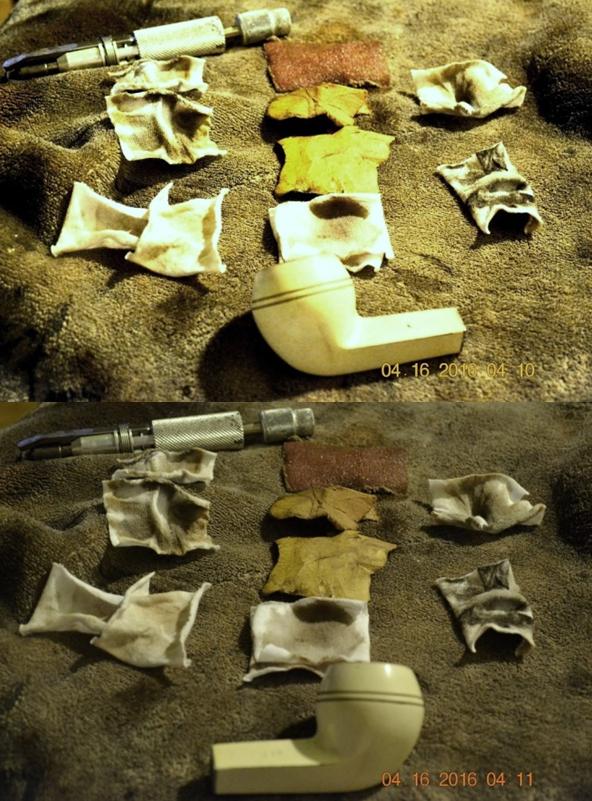
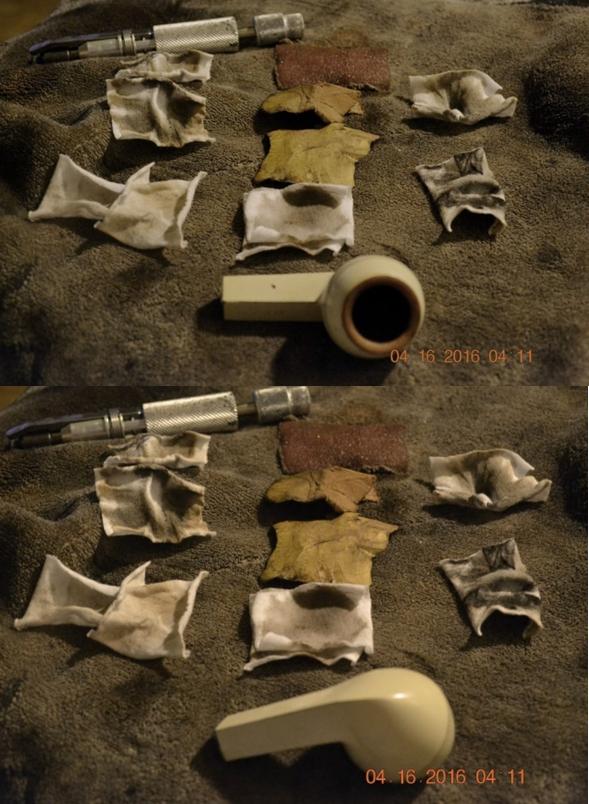
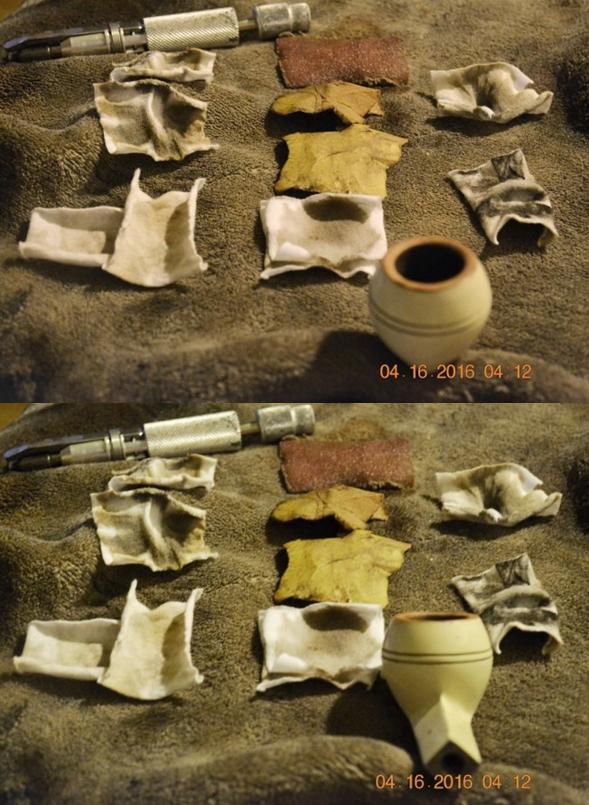
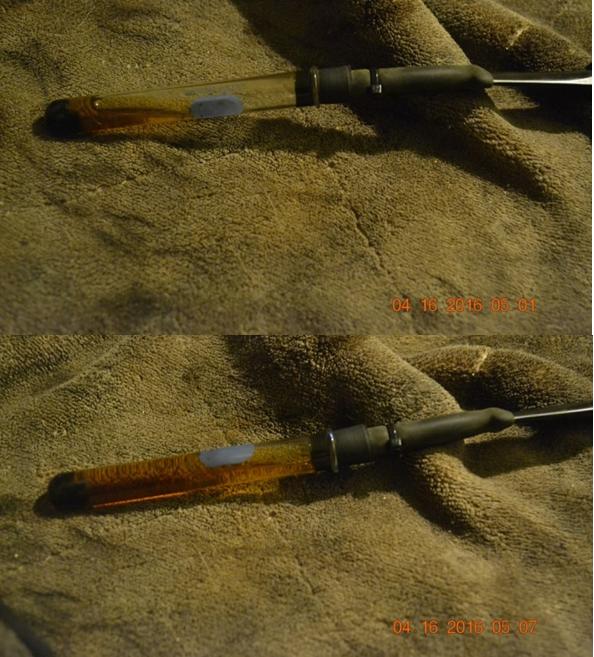
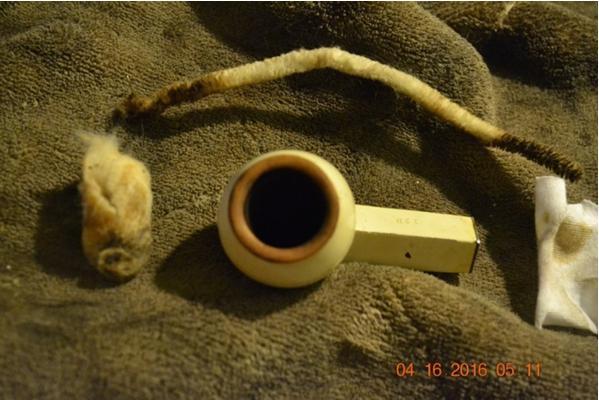
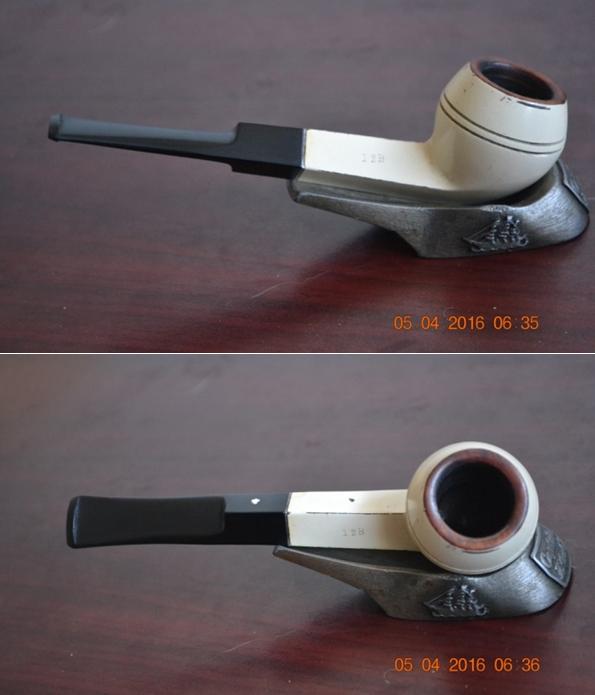
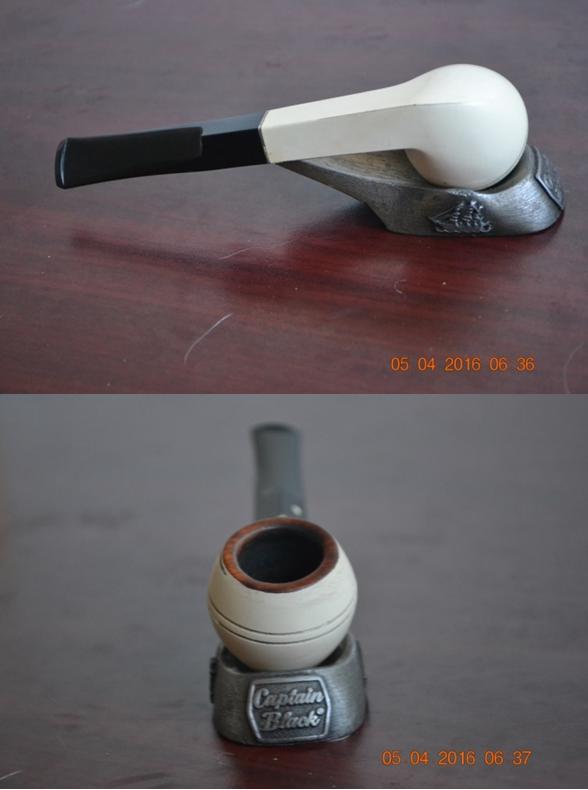
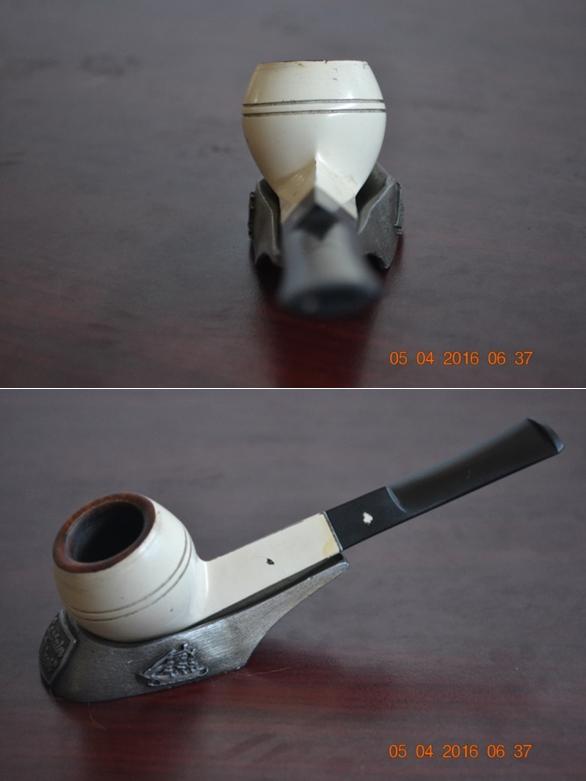
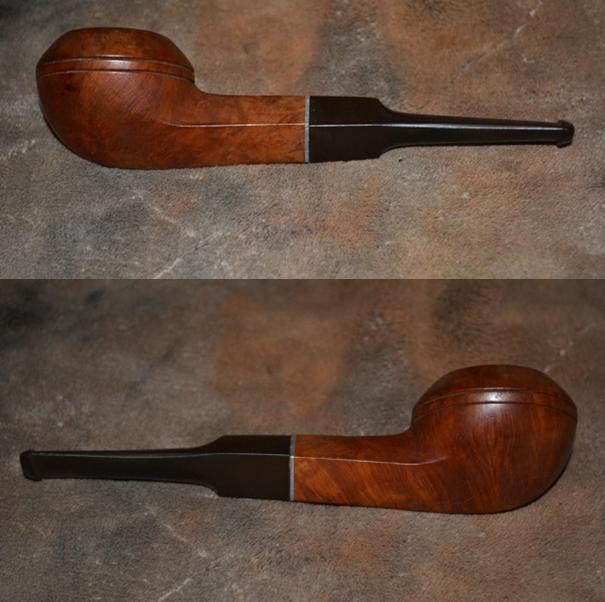
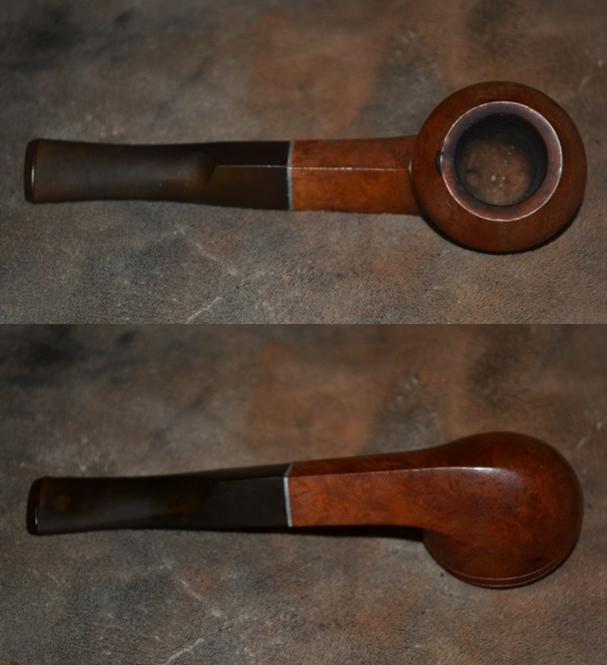
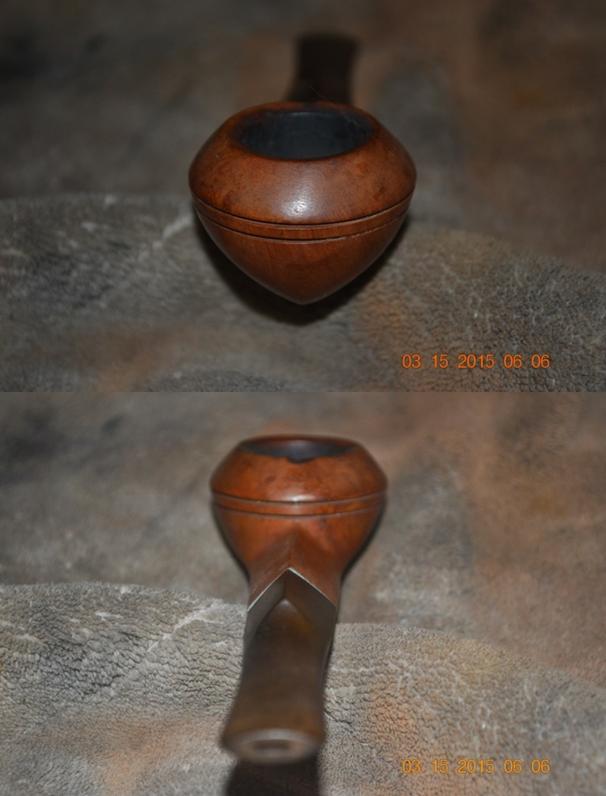
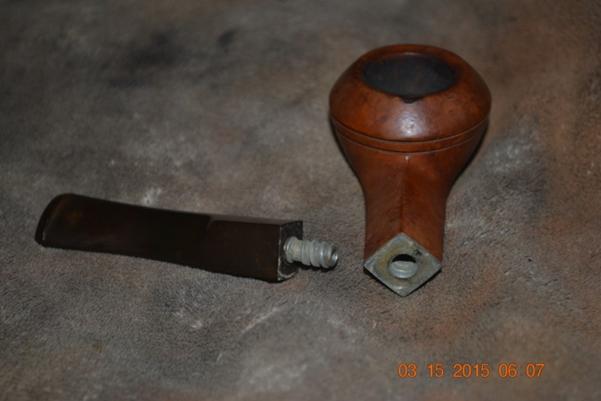
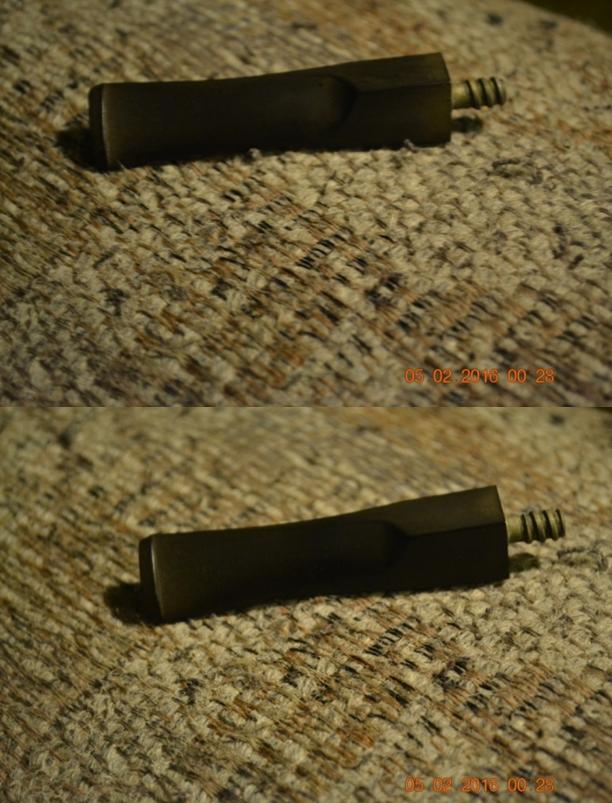
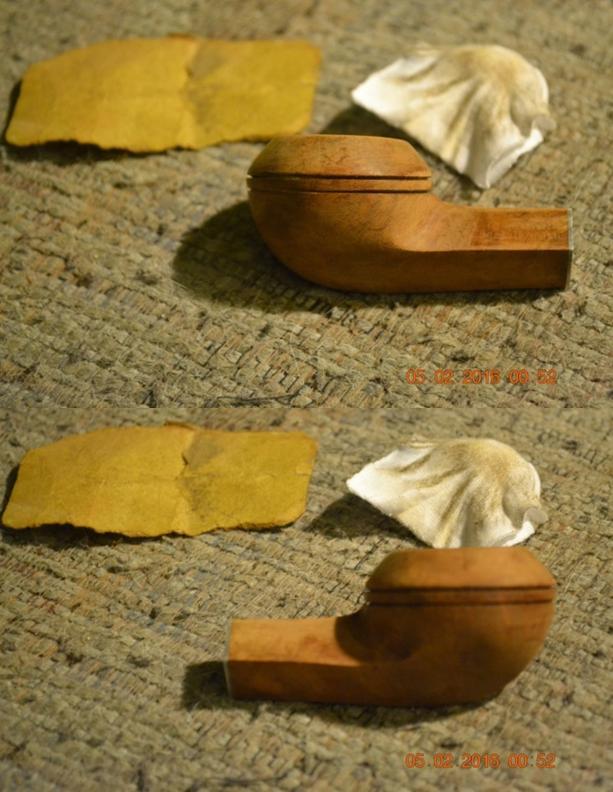
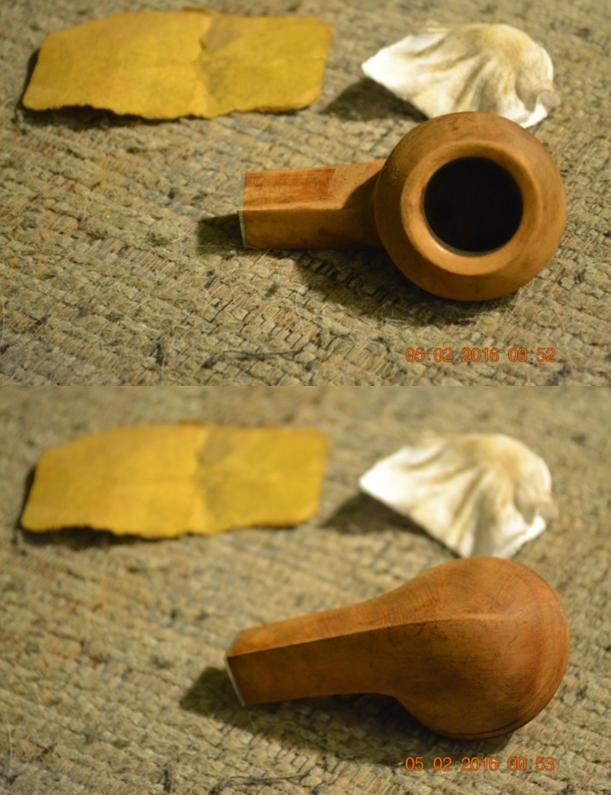
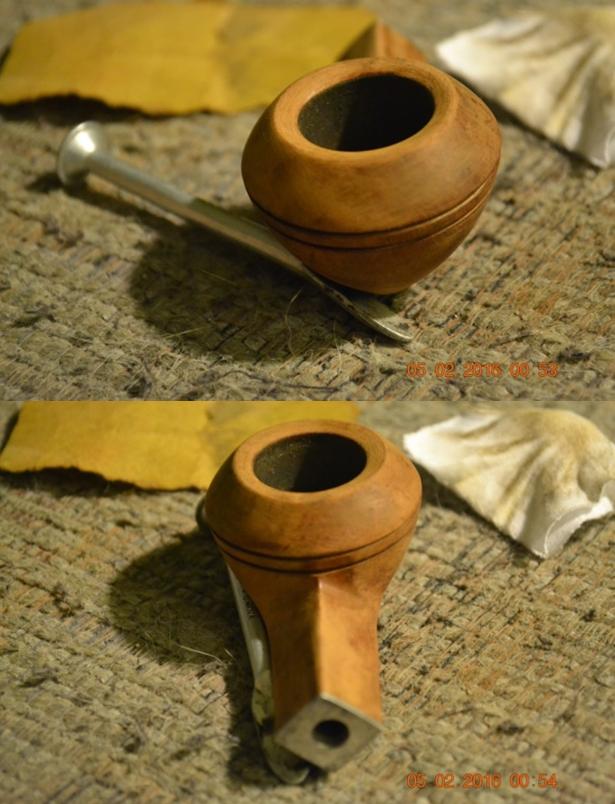
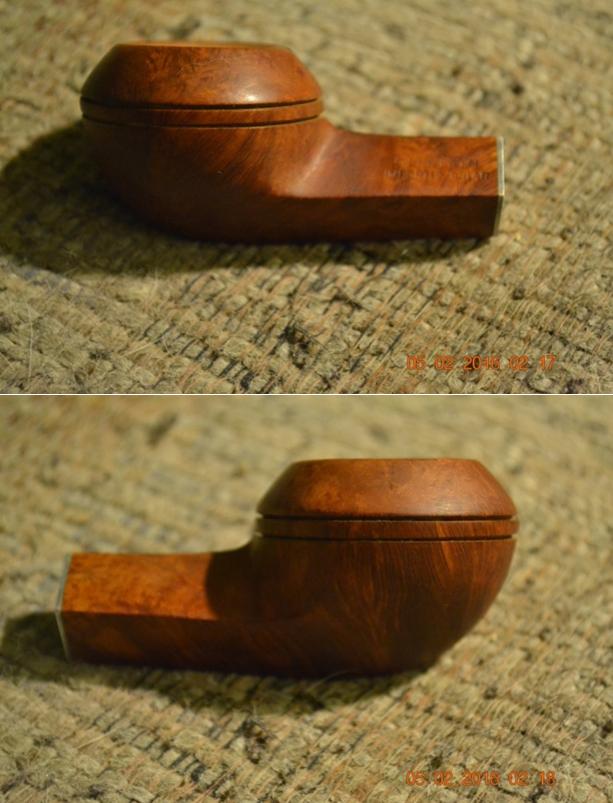
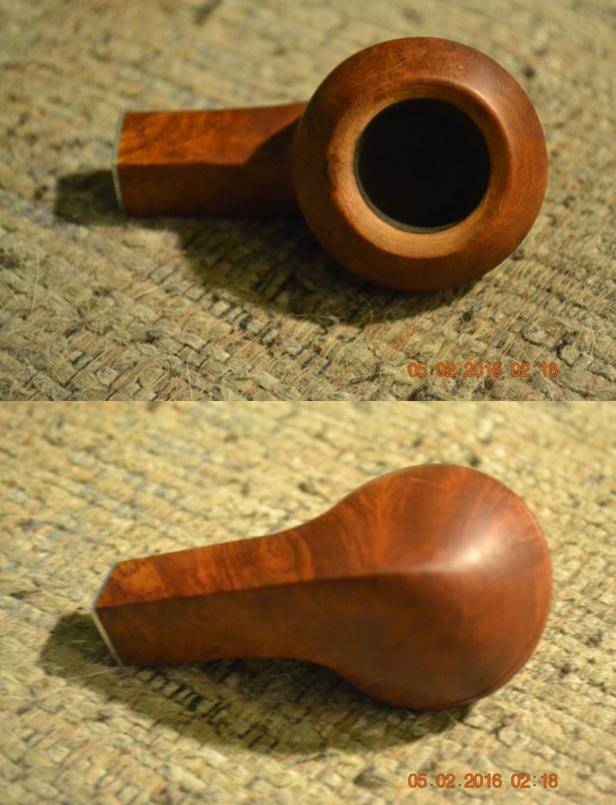
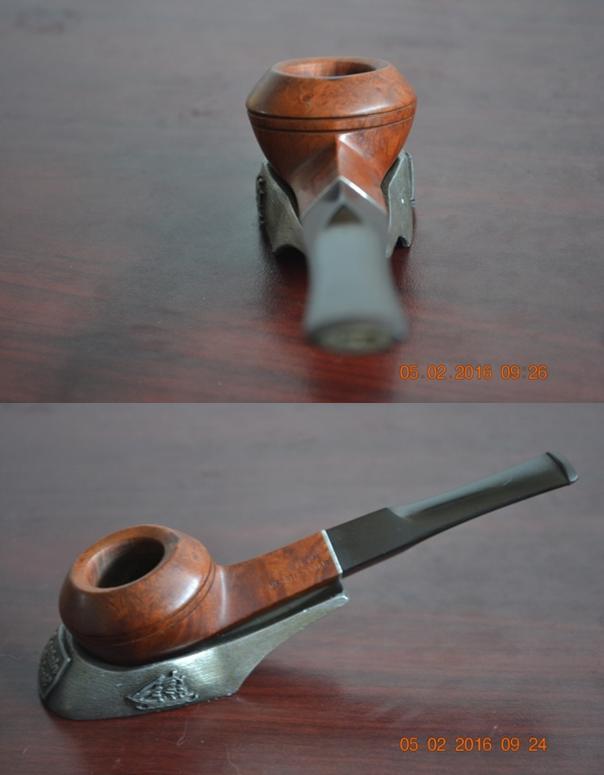
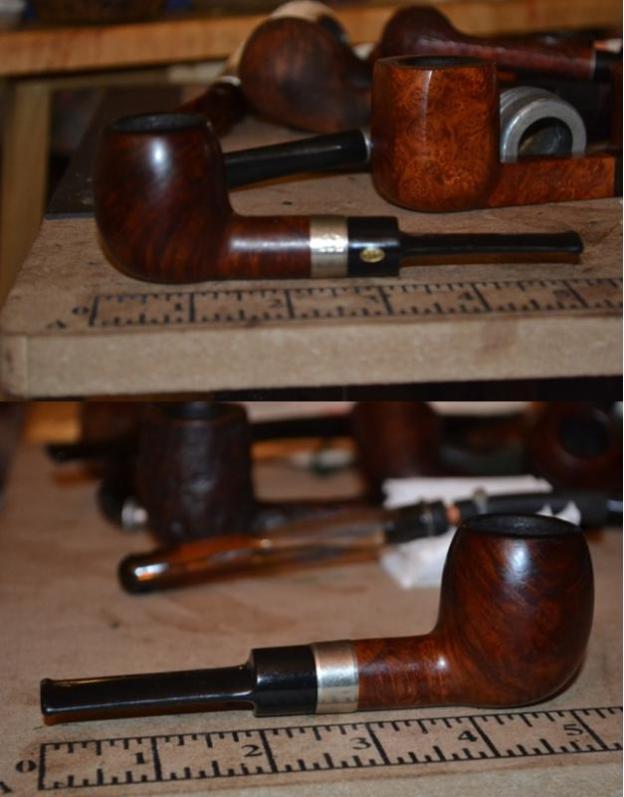
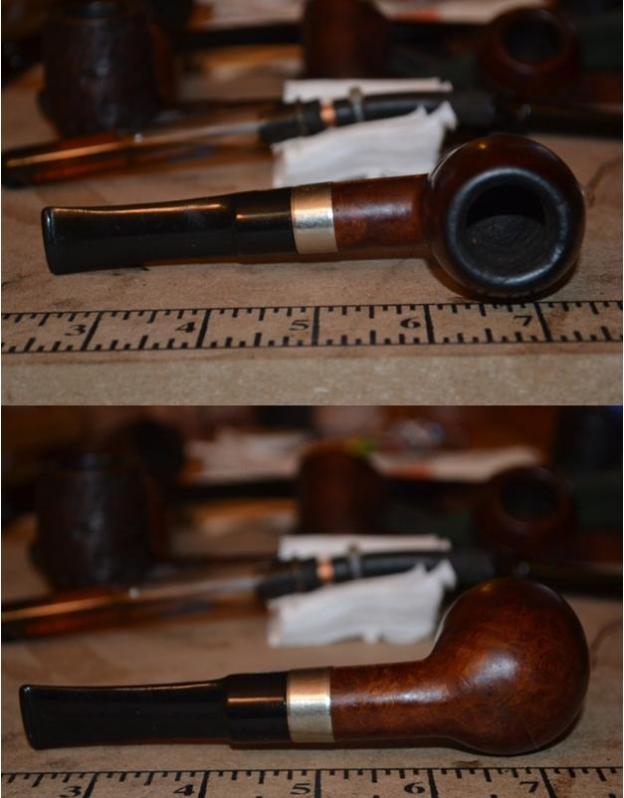
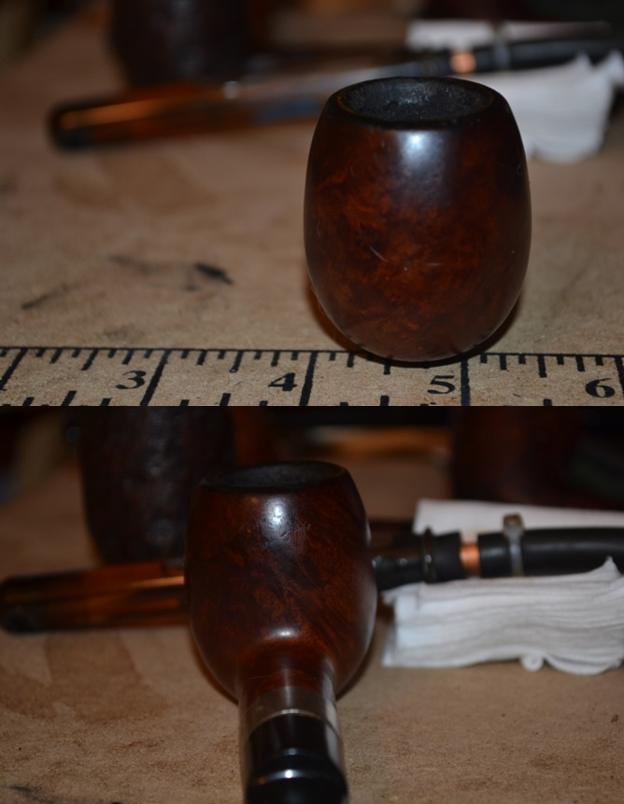
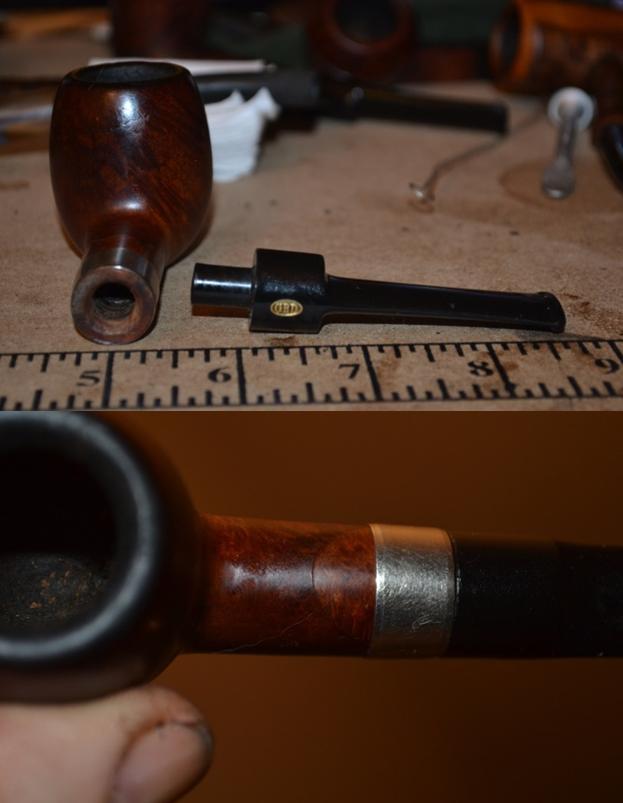
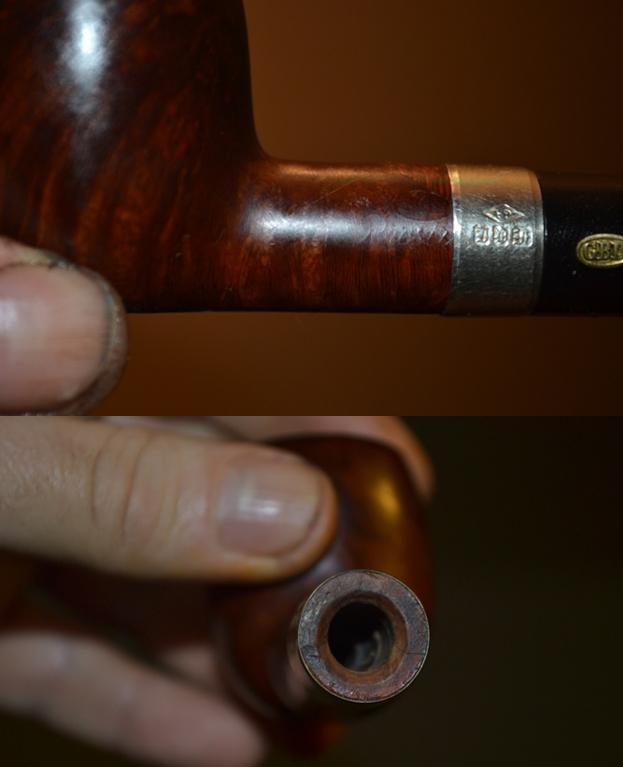
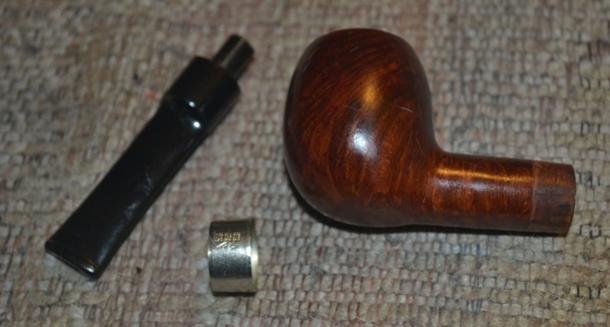
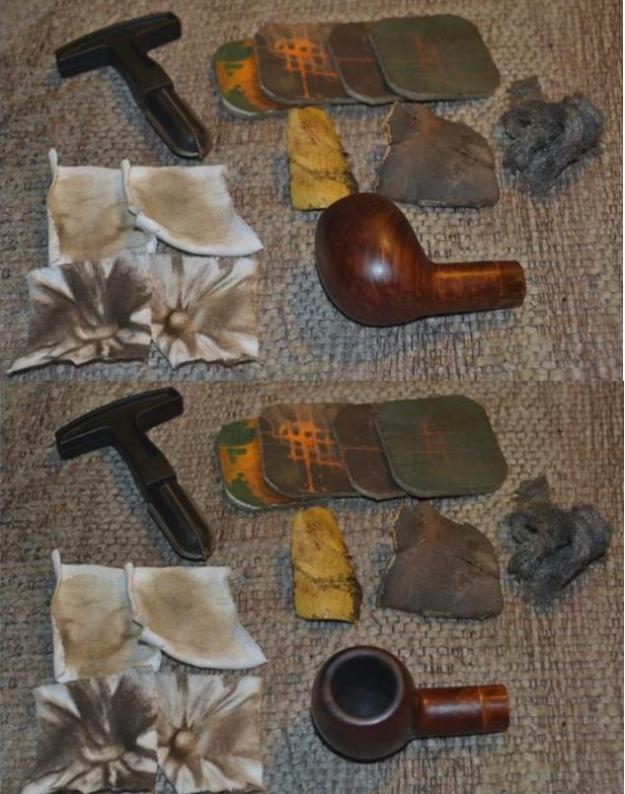
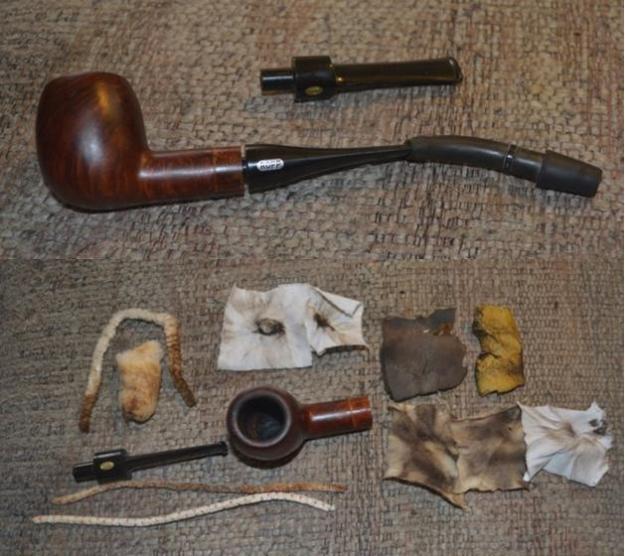
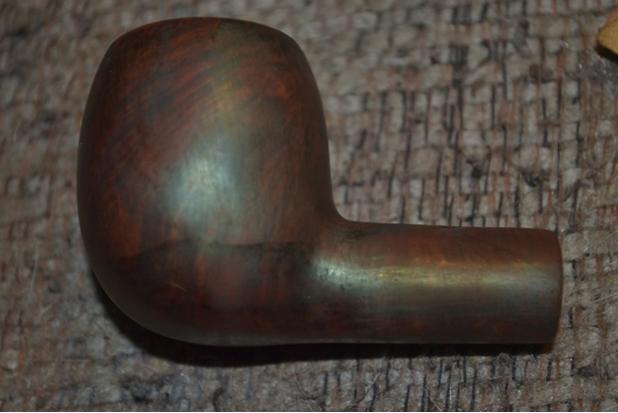
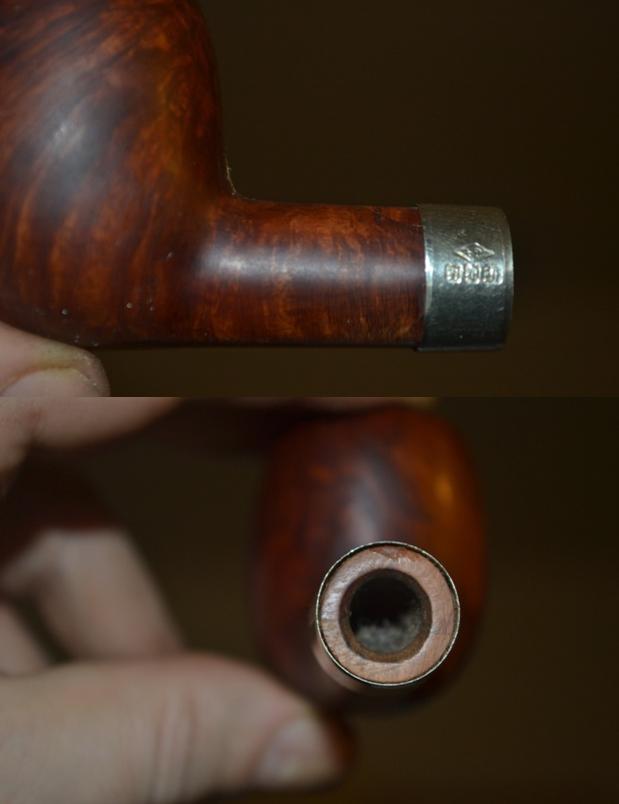
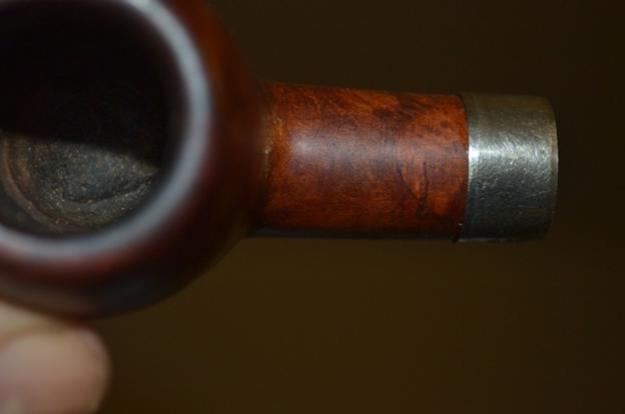
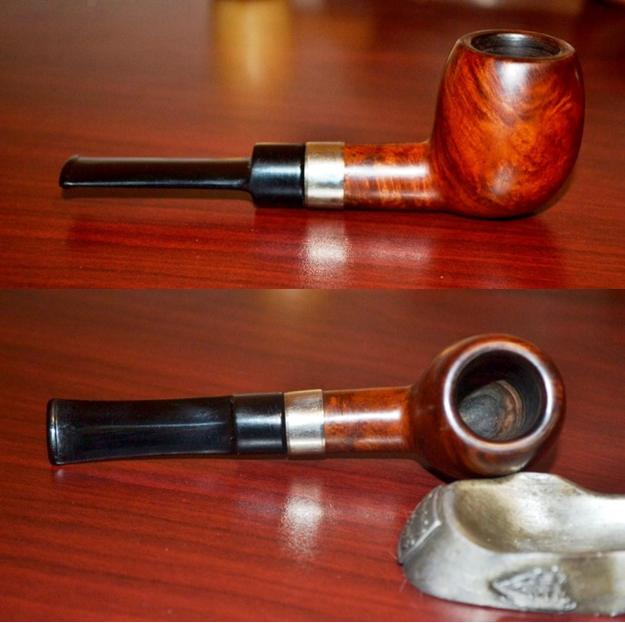
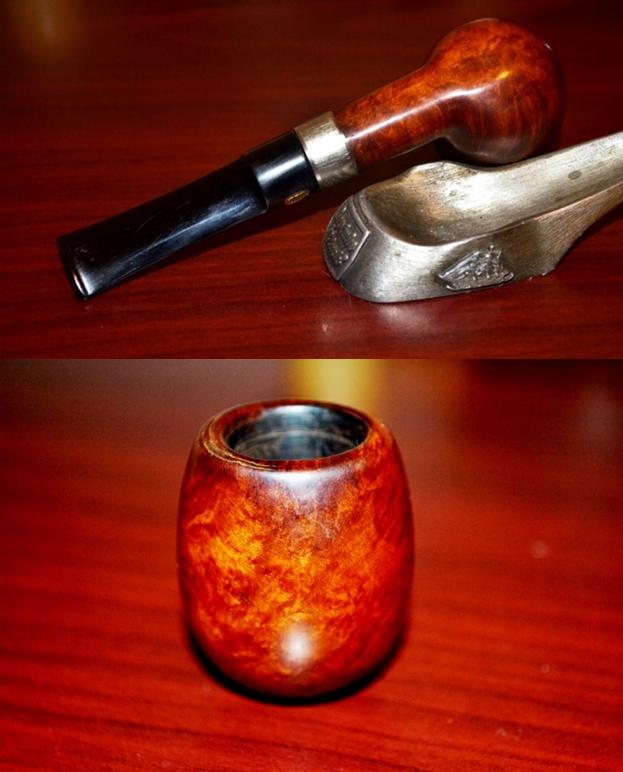
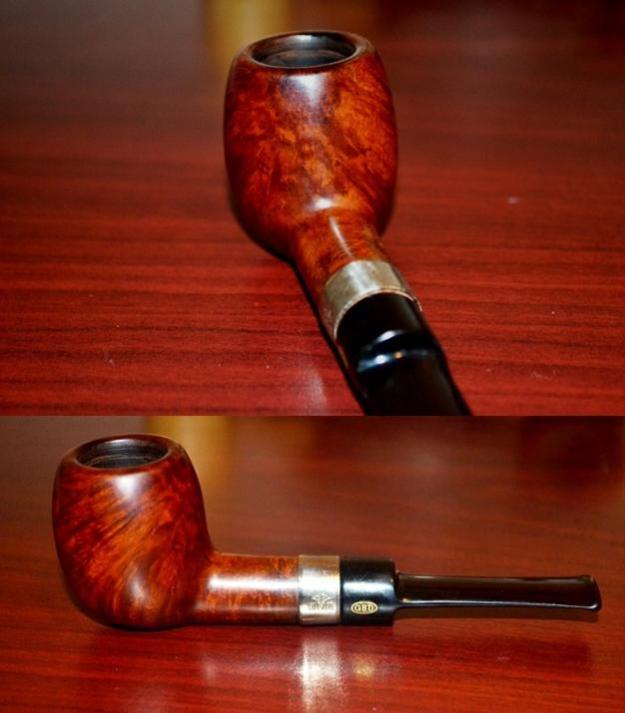
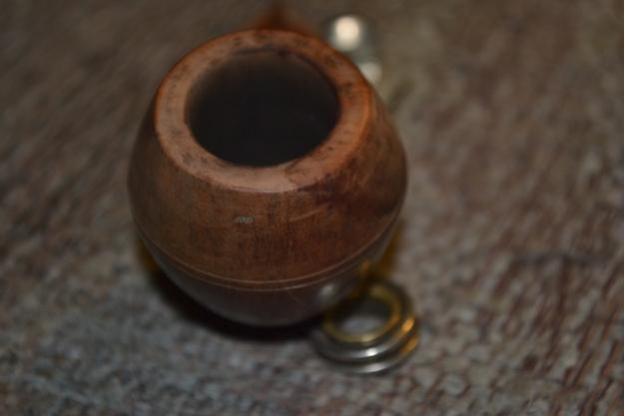
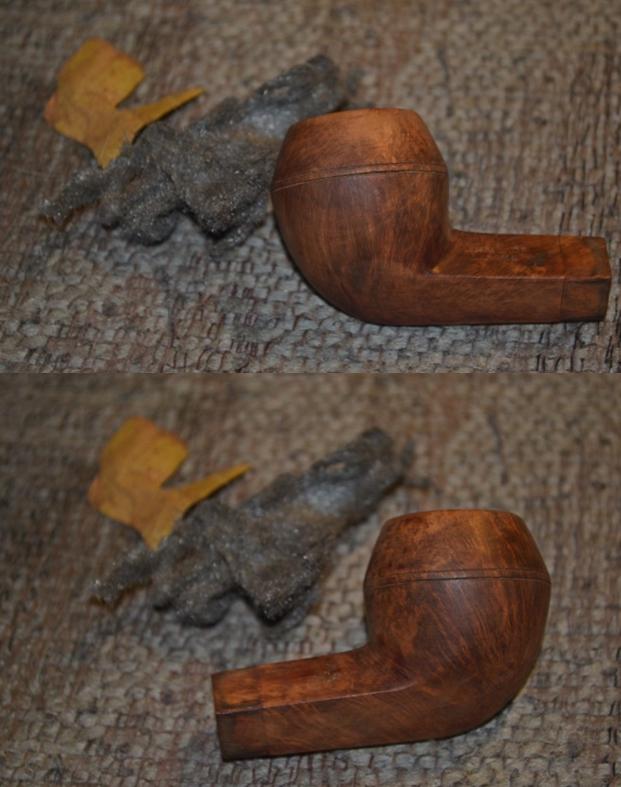
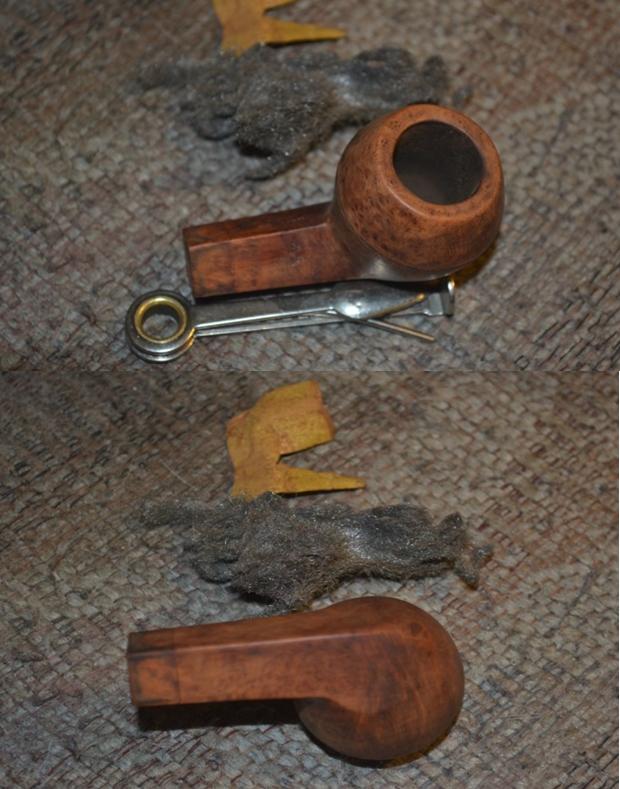
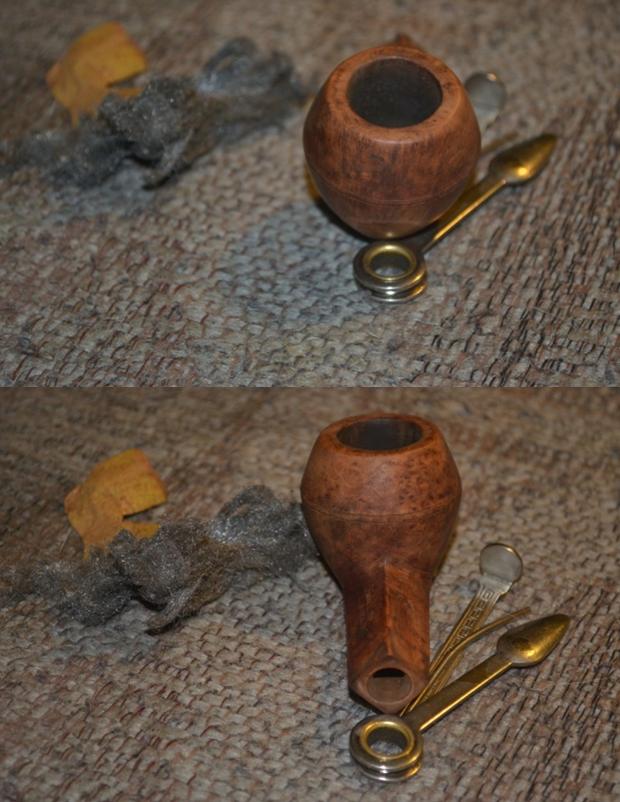
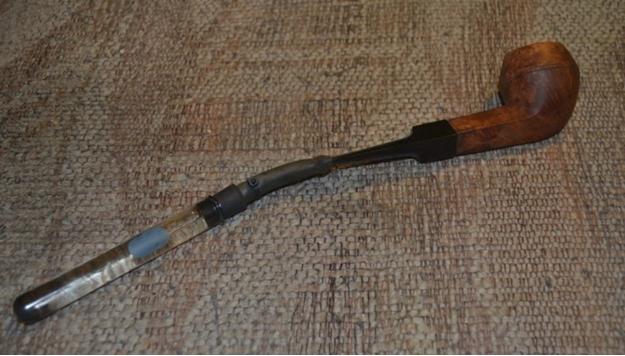
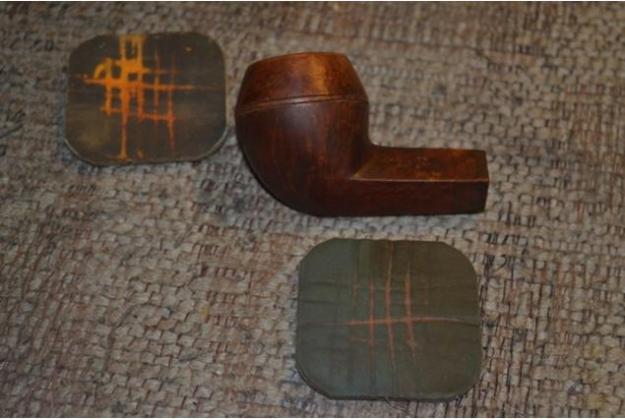
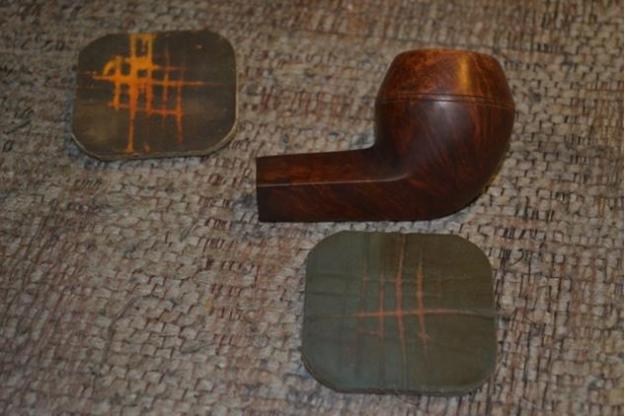
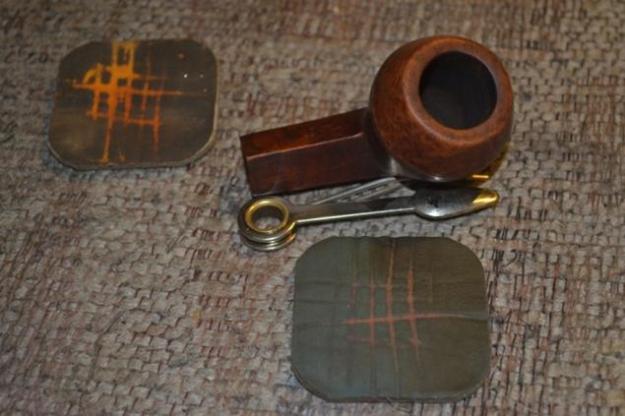
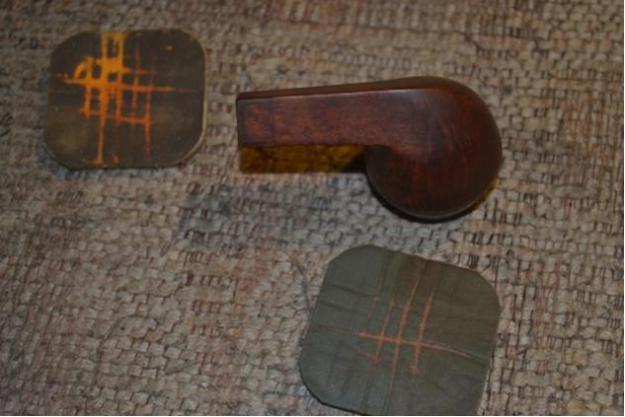
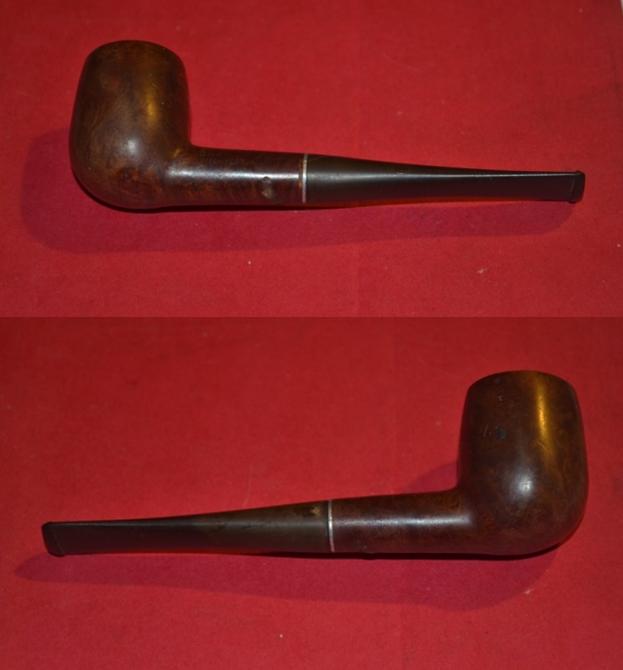
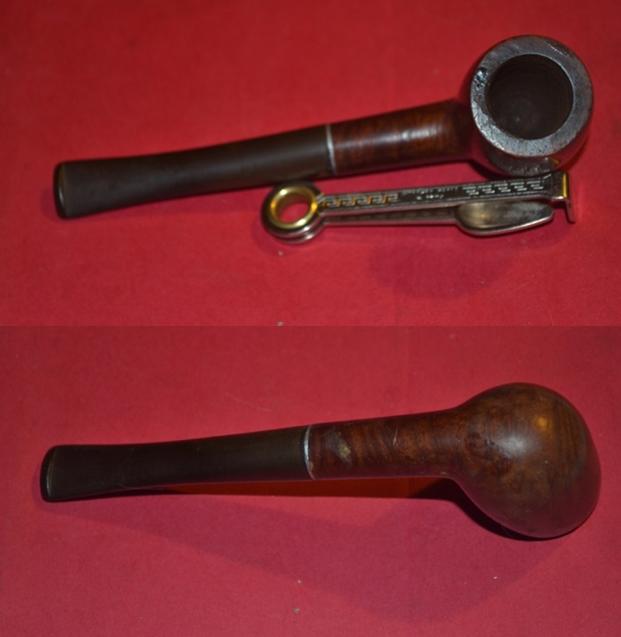
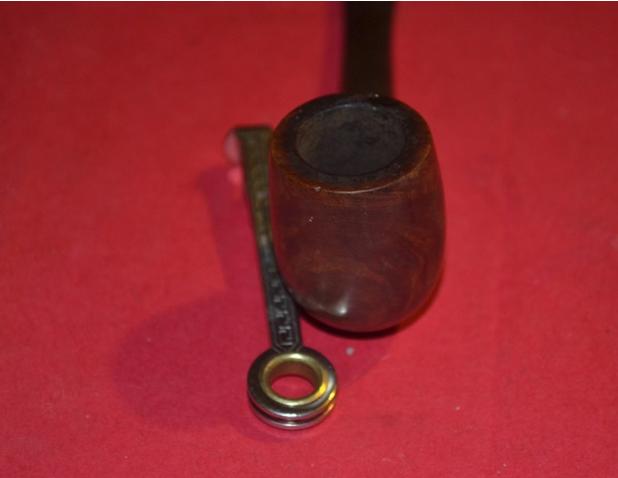
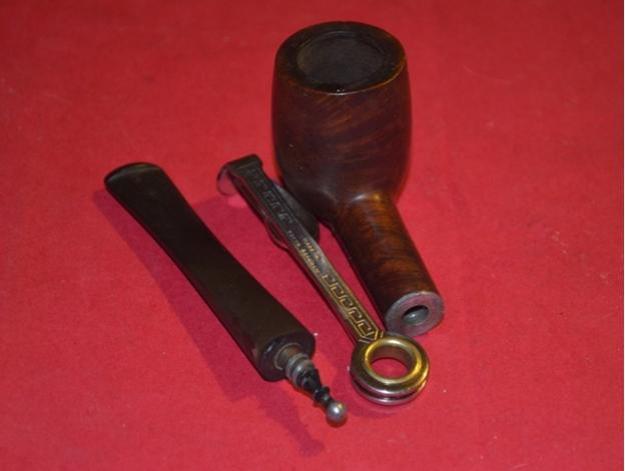
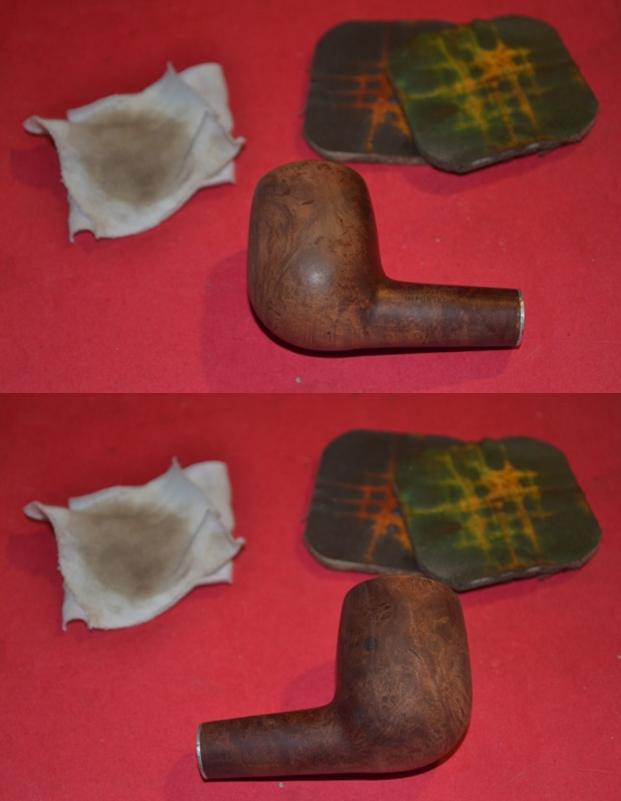
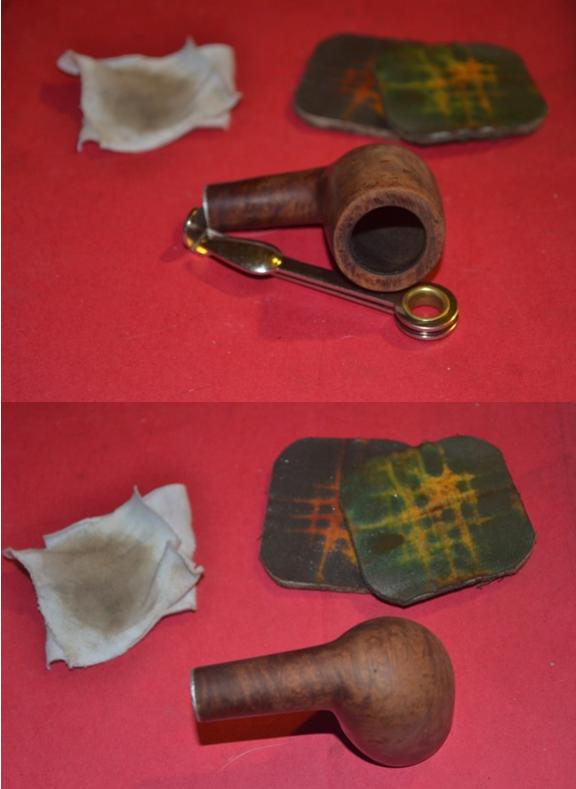
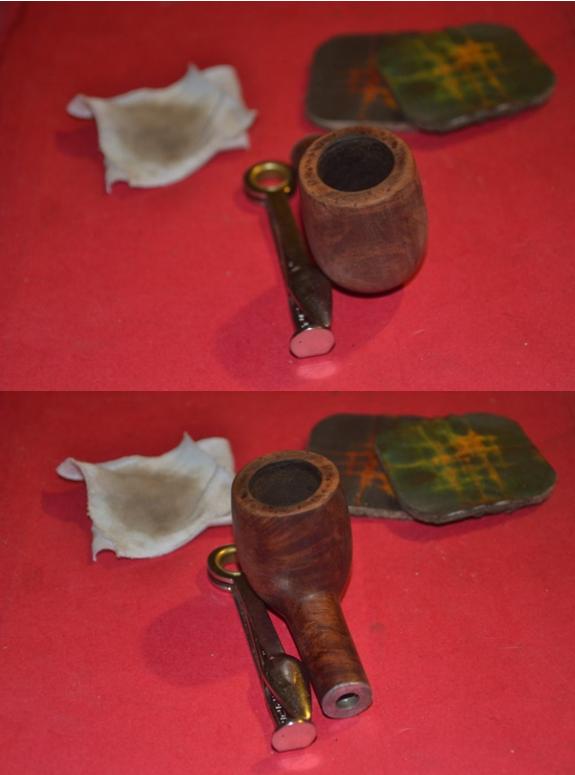
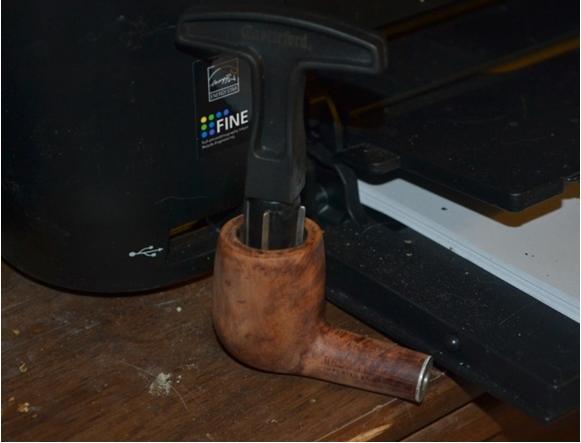
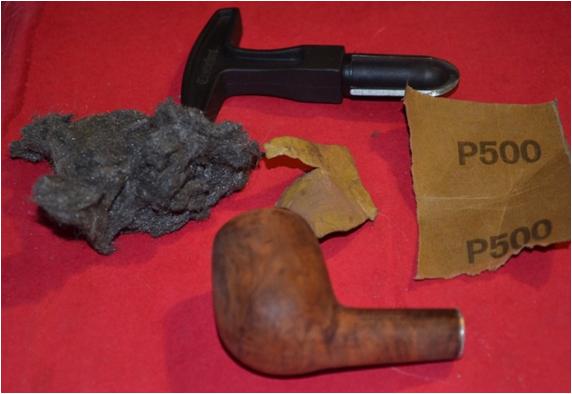
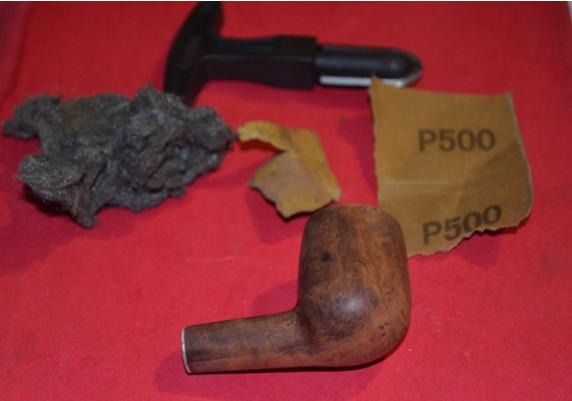
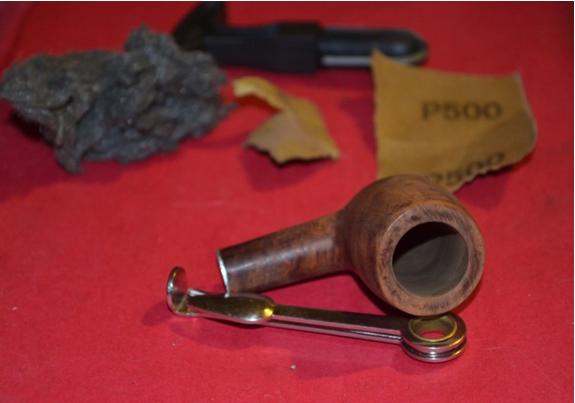
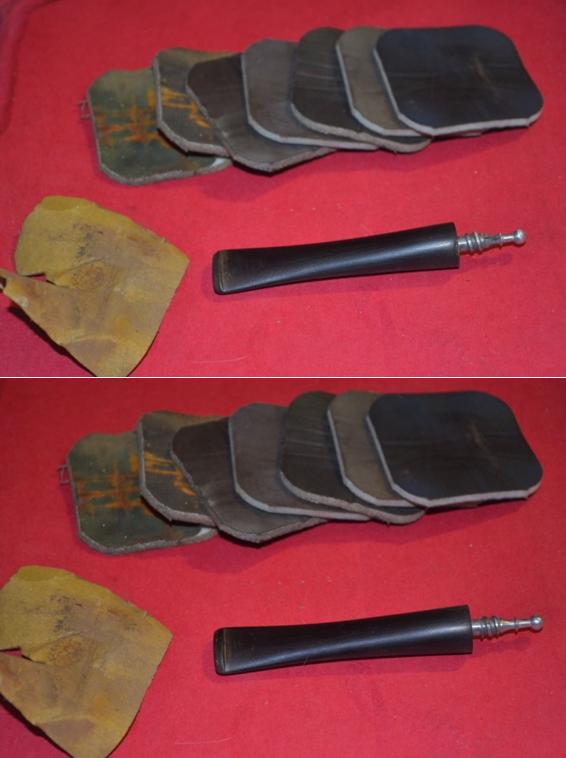
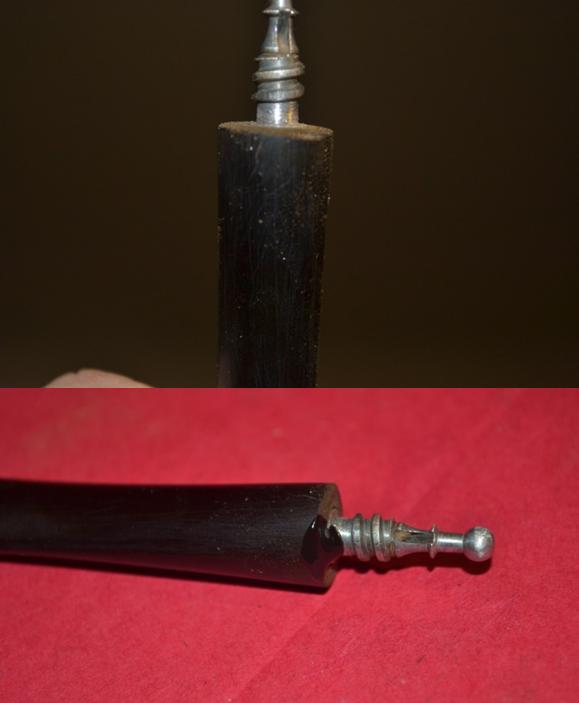
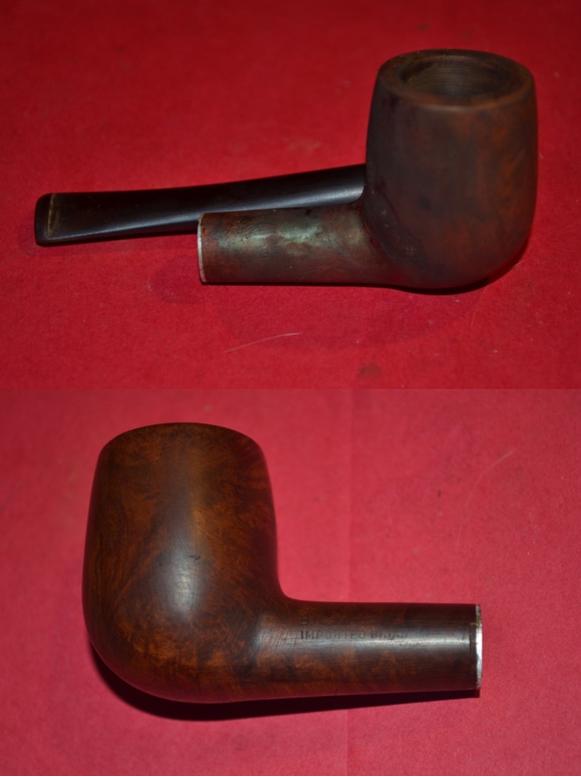
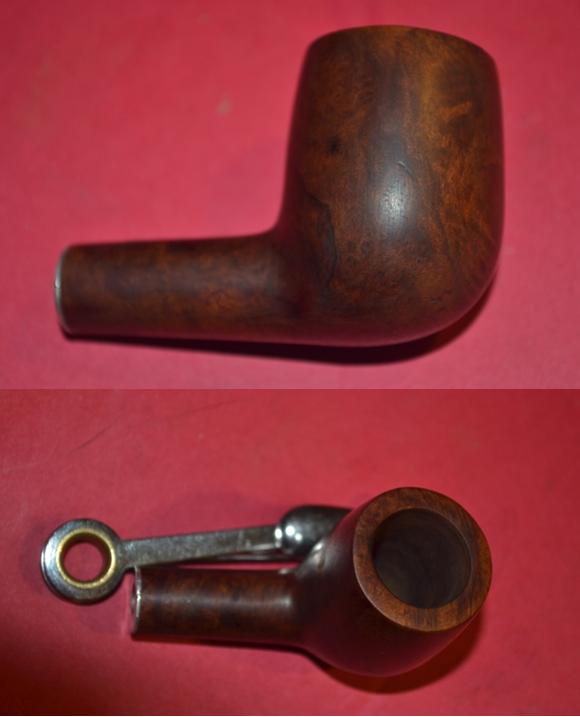
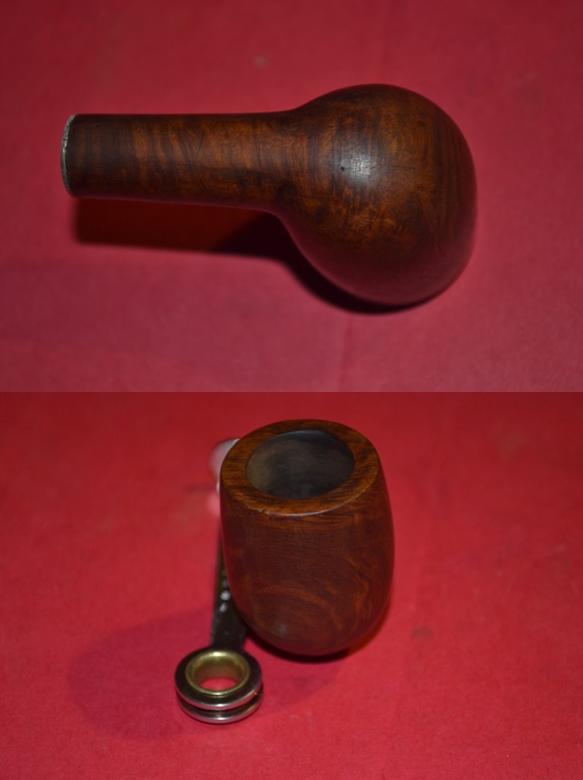
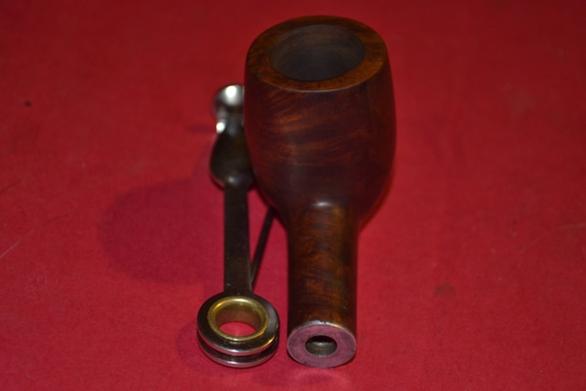
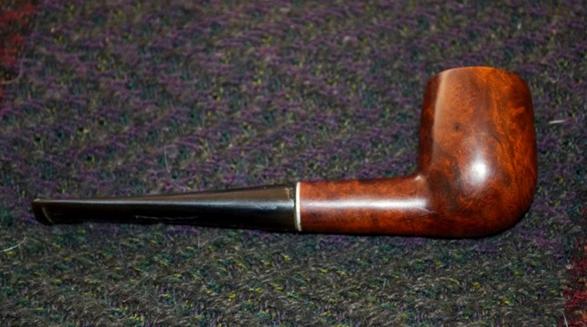
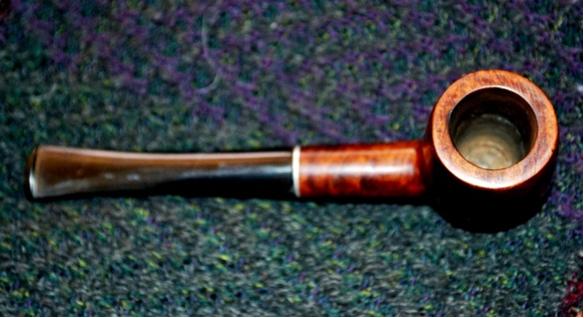
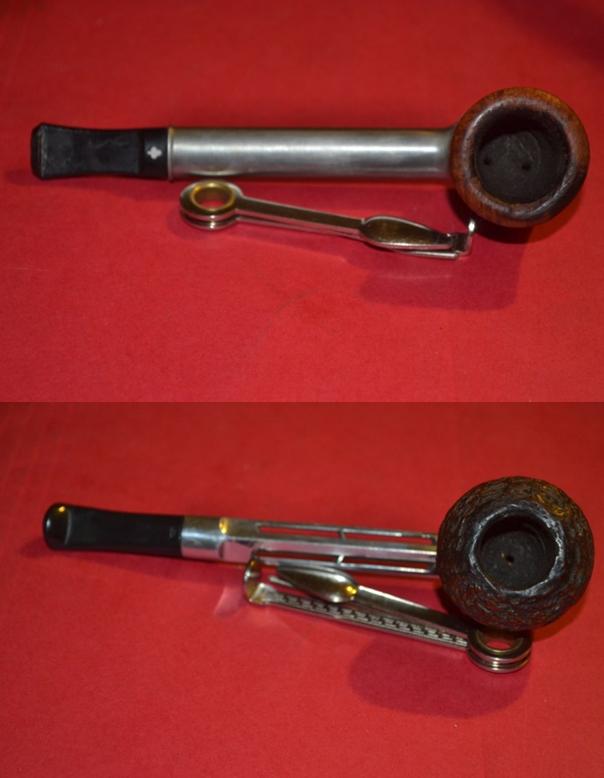
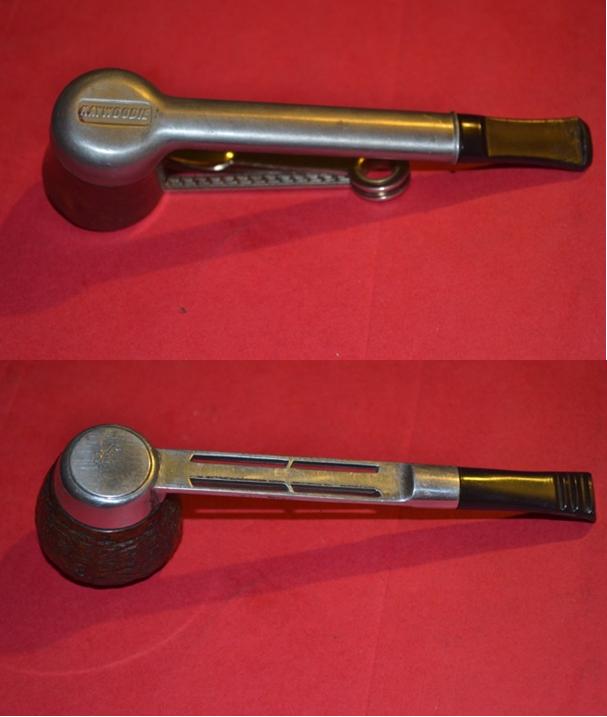
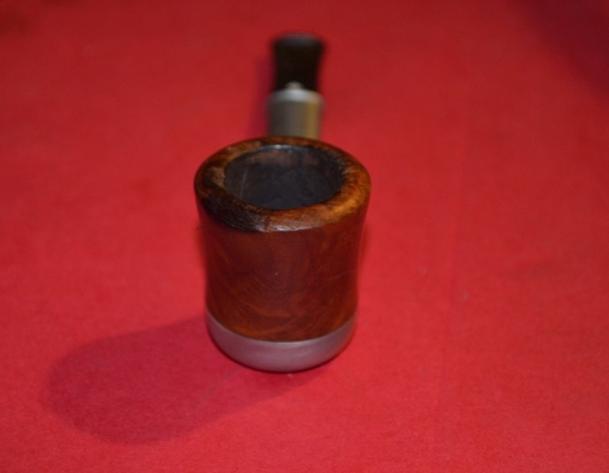
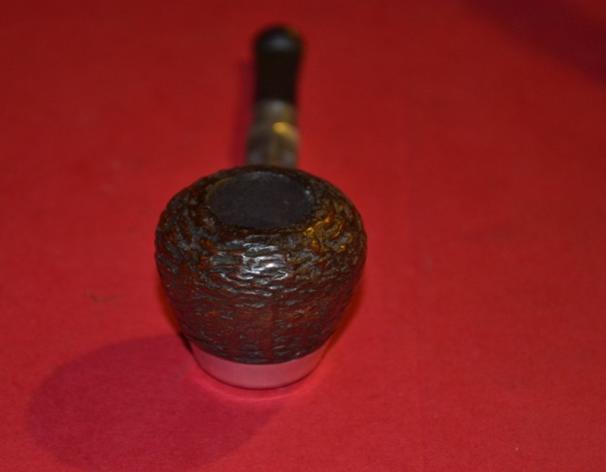
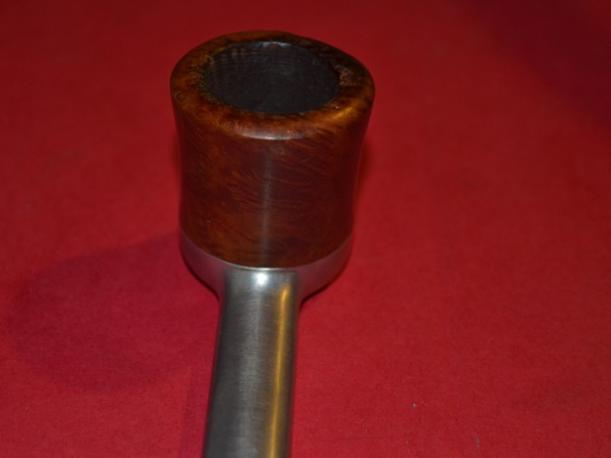
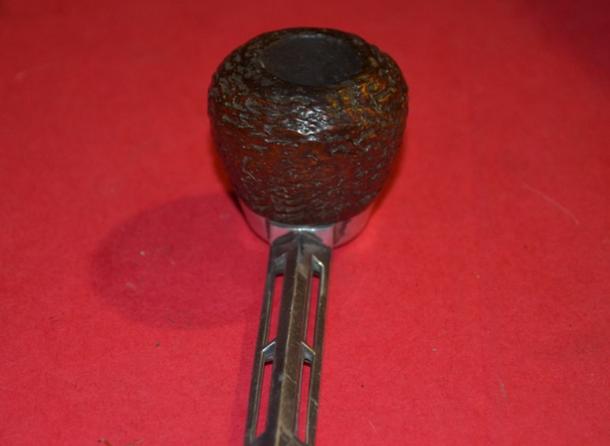
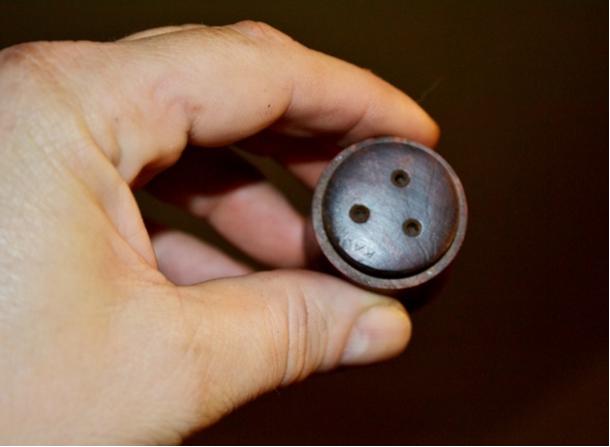
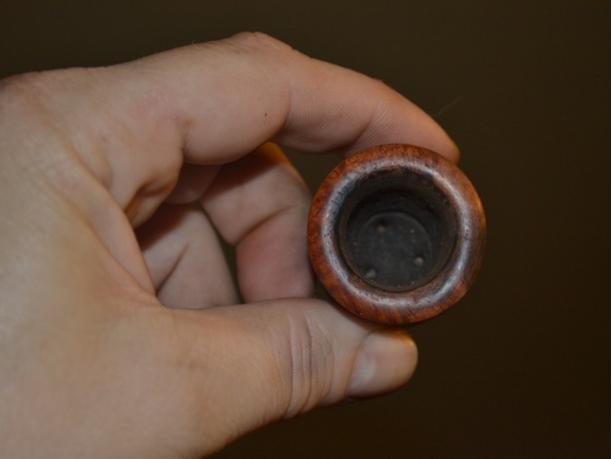
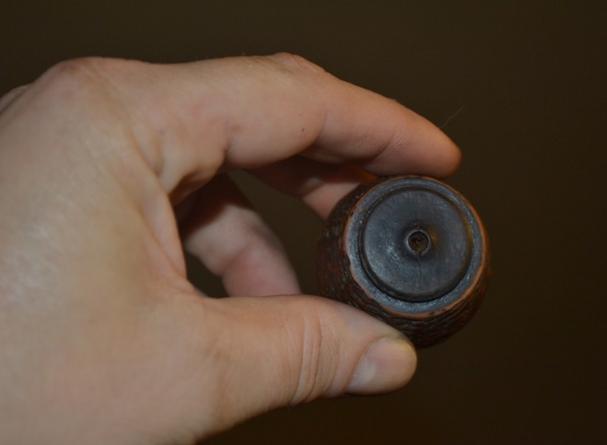
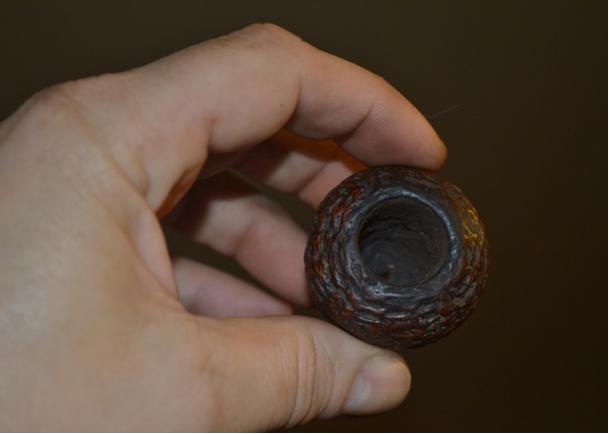
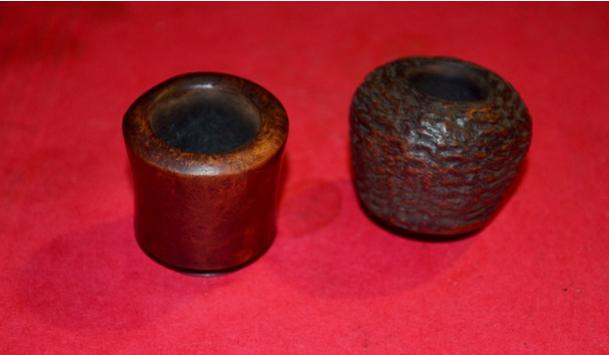
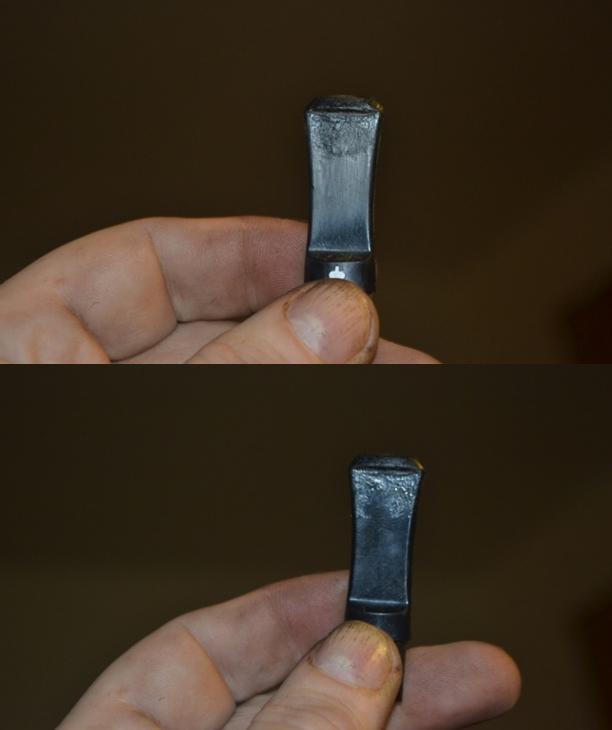
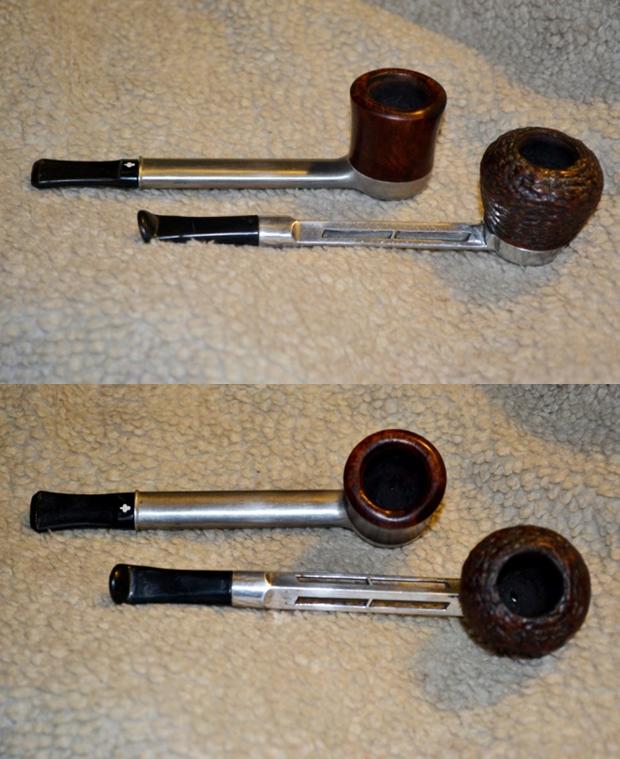
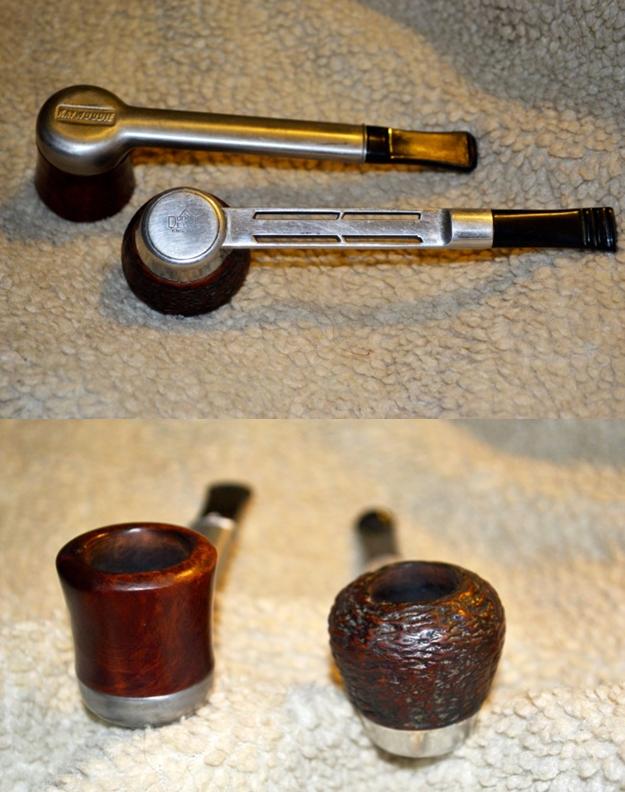
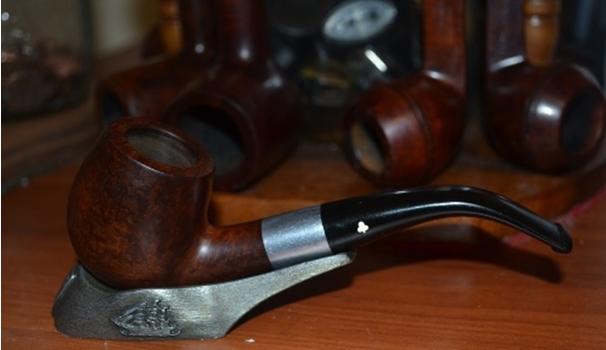
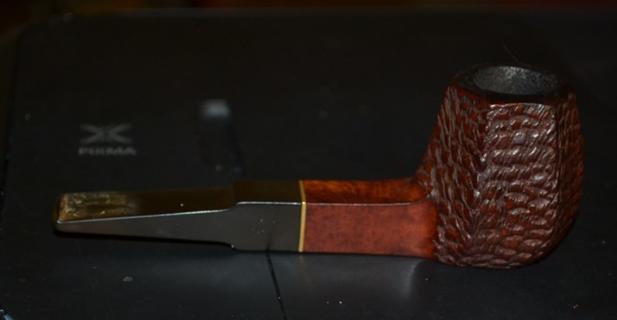
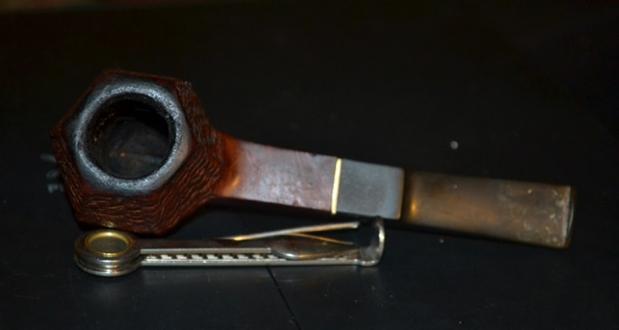
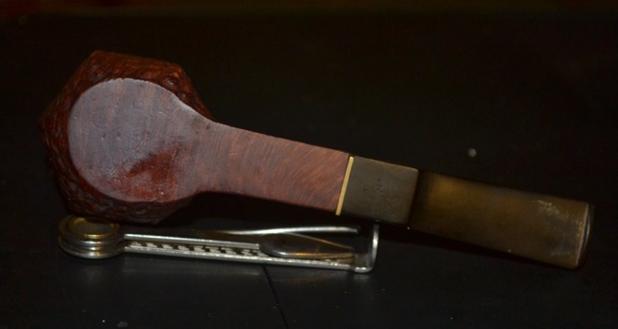
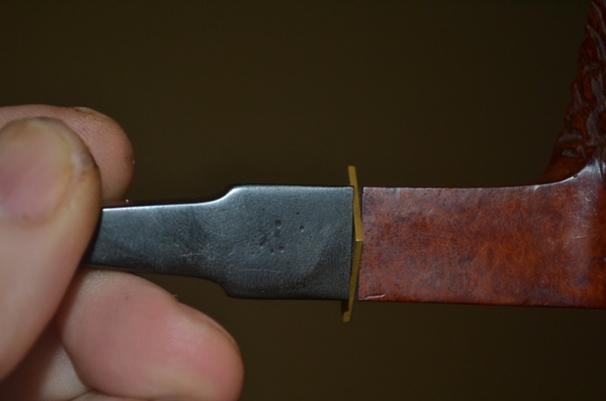
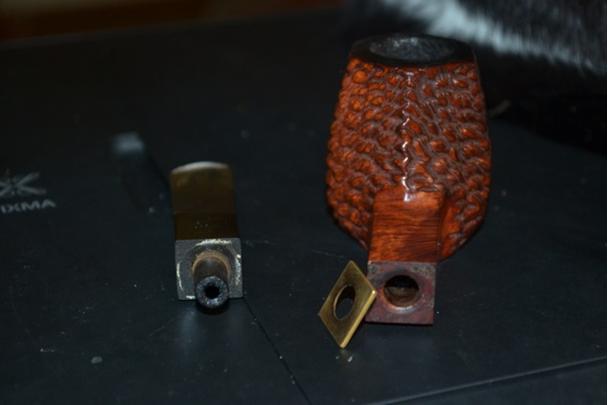
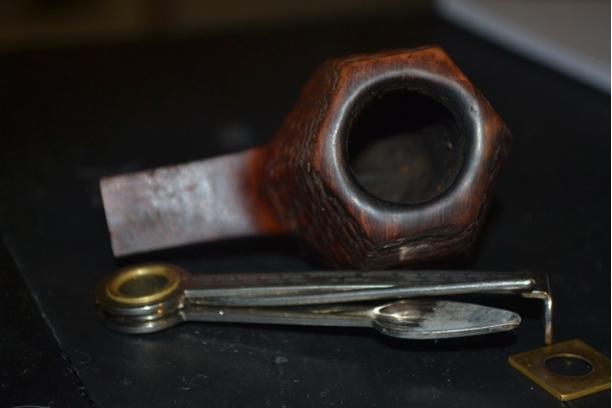
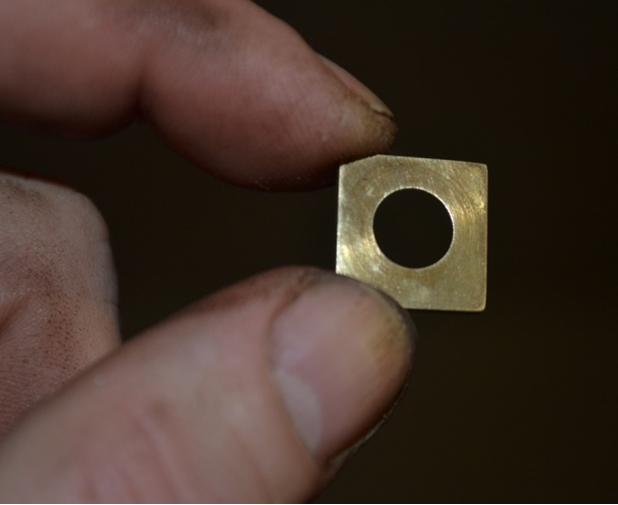
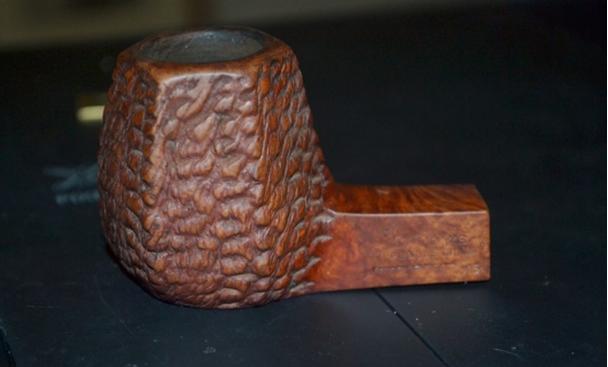
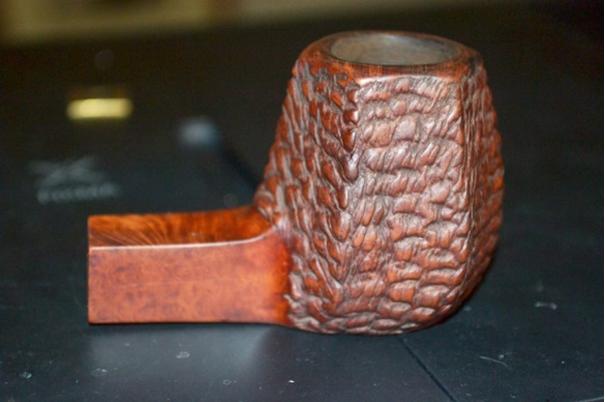
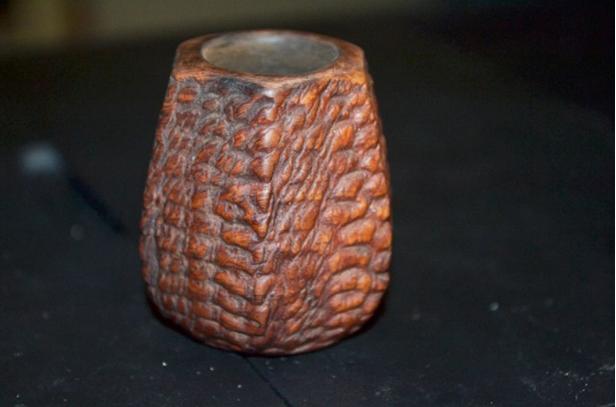
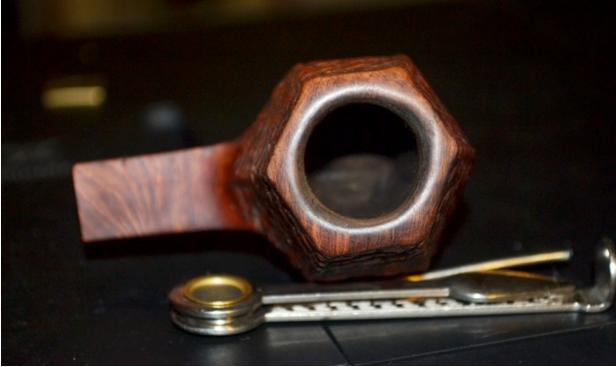
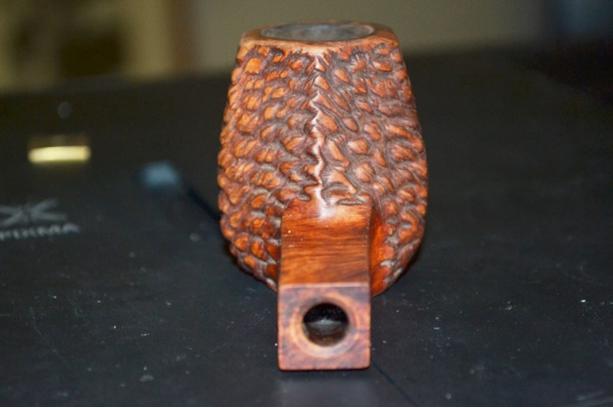
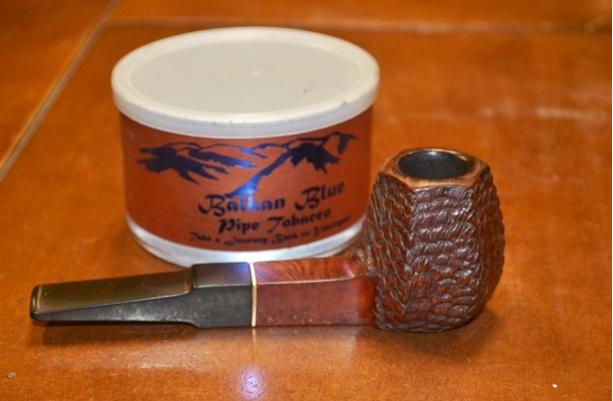
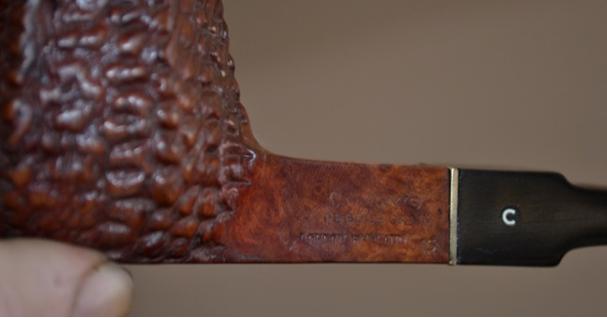
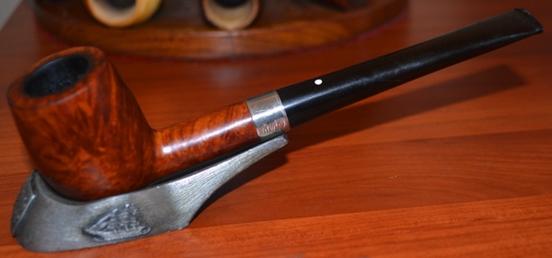
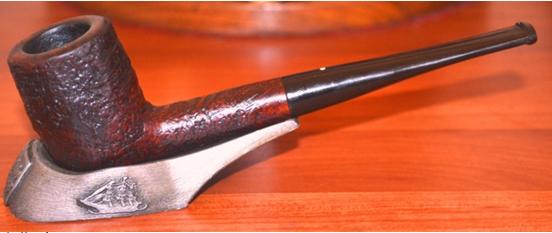
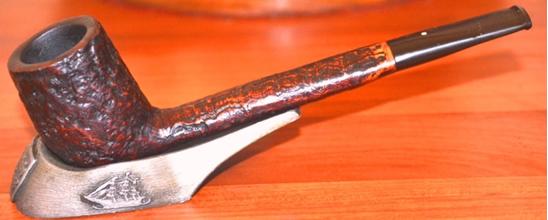
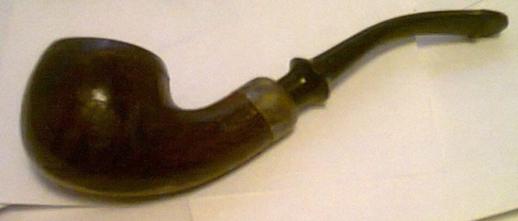
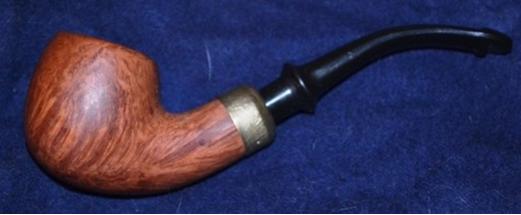
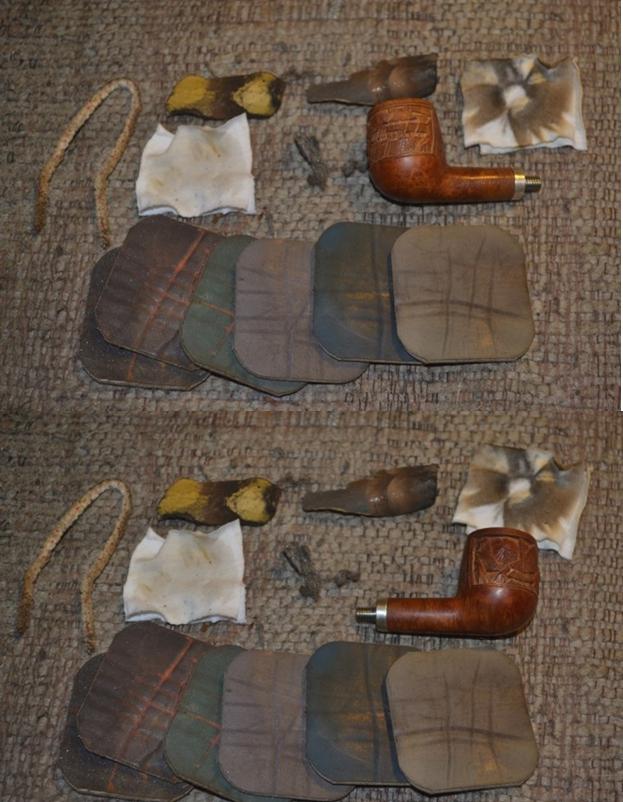
The Kaywoodie White Briar line lasted from 1951-1989. Some elusive quality, including perhaps its rough condition and the fact that I can’t find the same shape shown anywhere online, makes me suspect my bulldog is c. 1960-1970. It’s alright, I’m aware of the virtual non sequitur I just committed, and stand by it as a sort of literary tool if nothing else. Call it a hunch. Maybe I’m just a romantic. No doubt about the last part, at least.KW1 KW2 KW3 KW4RESTORATION
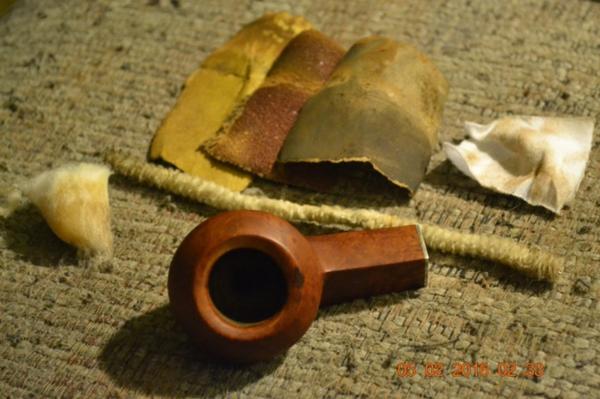
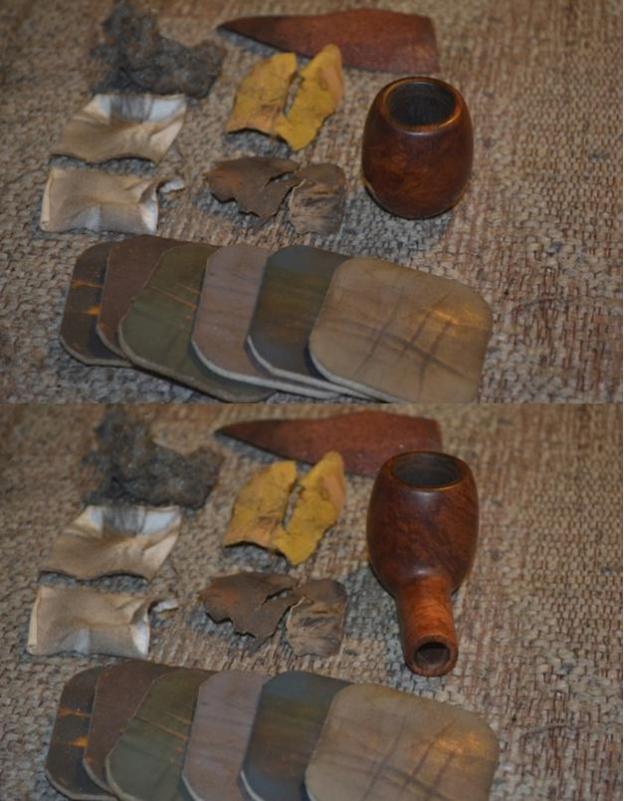
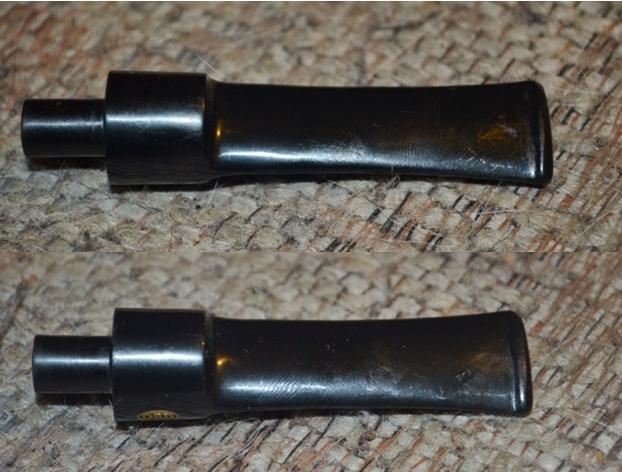
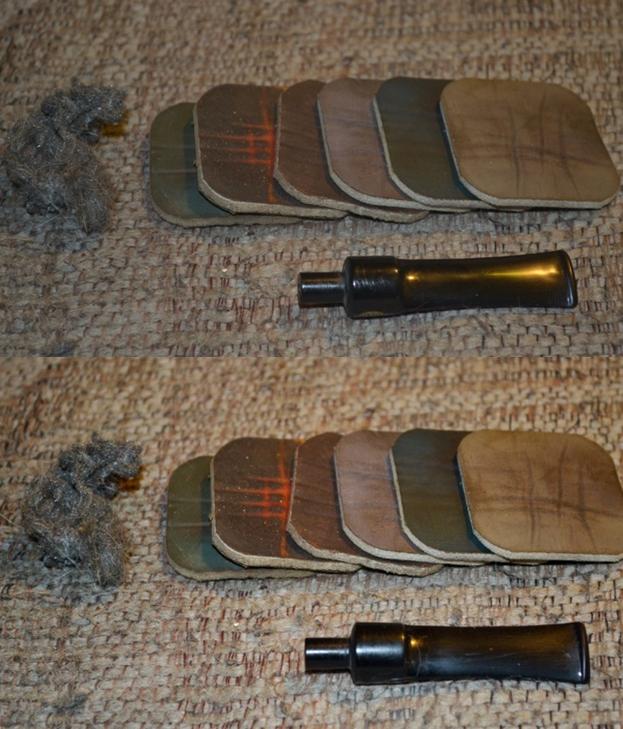
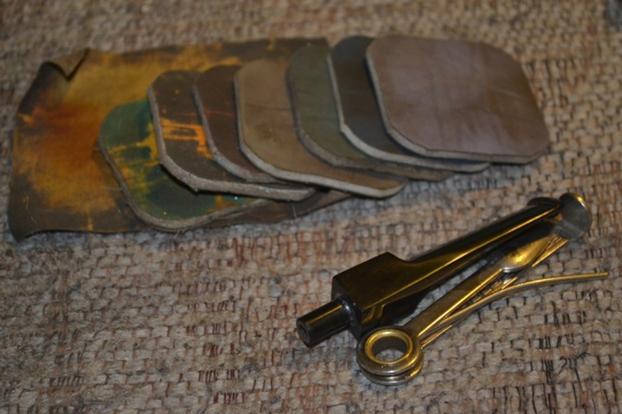
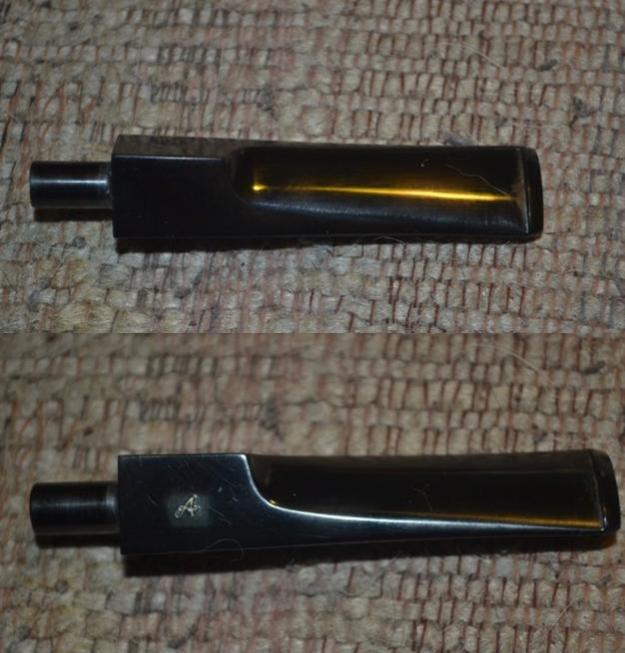
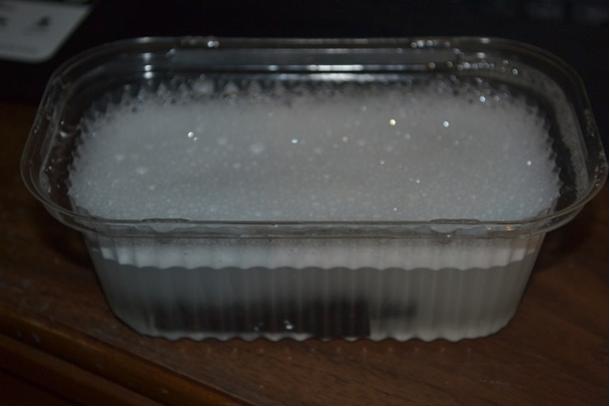
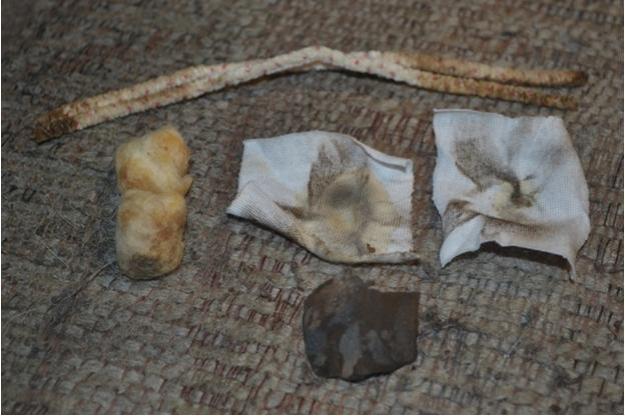
The bit was mostly just dirty.KW5I put it in an OxiClean bath and began the process of cleaning the rest of the pipe by using my Senior Reamer to remove the fair amount of char from the chamber. I followed the reamer with 150-, 200- and 320-grit papers, and removed the excess soot with soft cotton cloth squares soaked in purified water. Then I applied a little purified water to the outside of the stummel with more soft cotton cloth squares, getting rid of considerable grime.

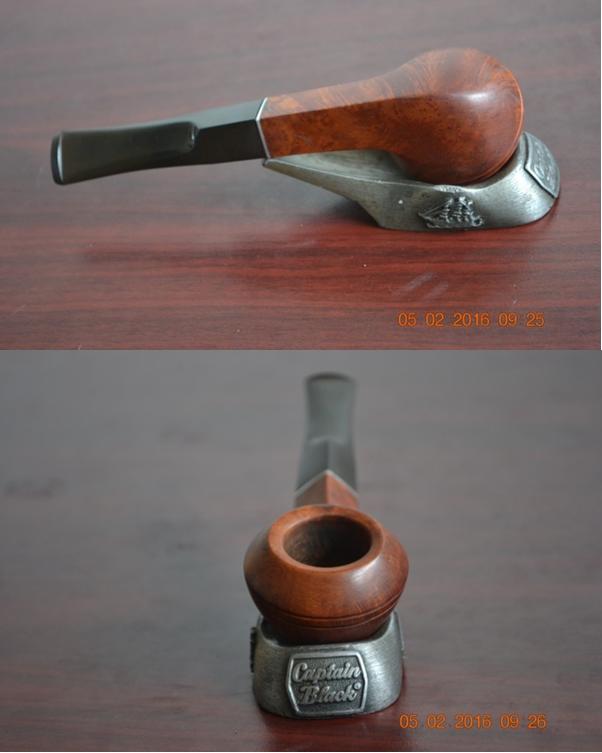
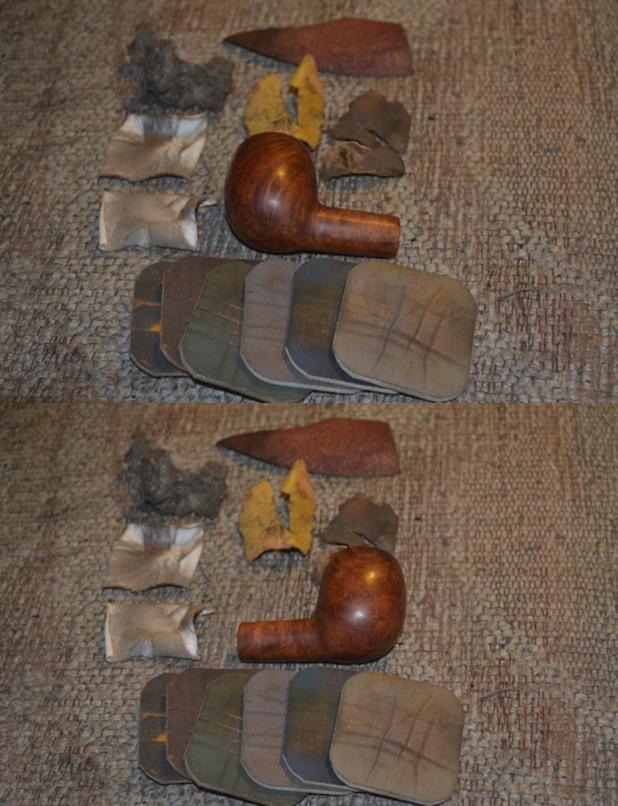
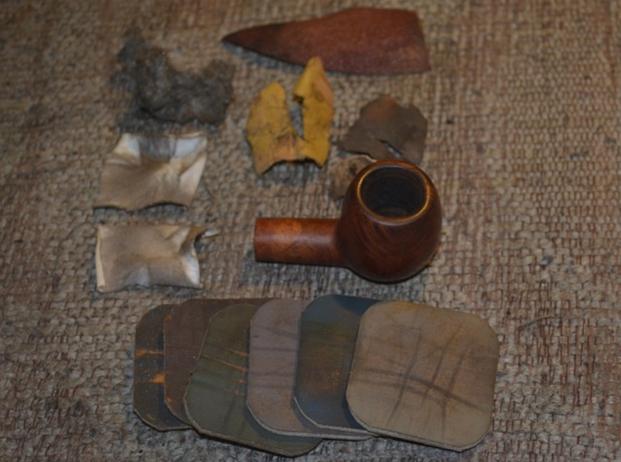
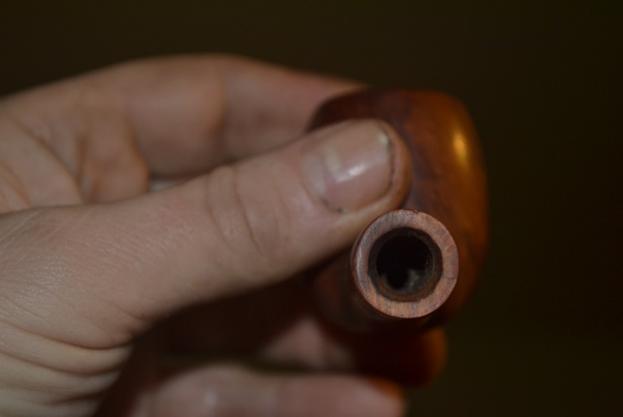
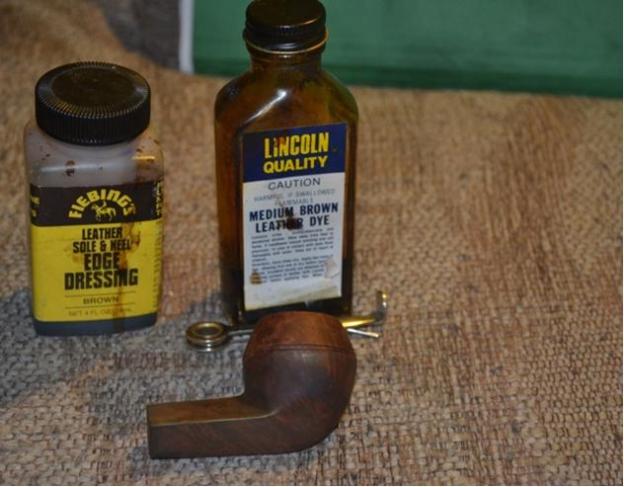
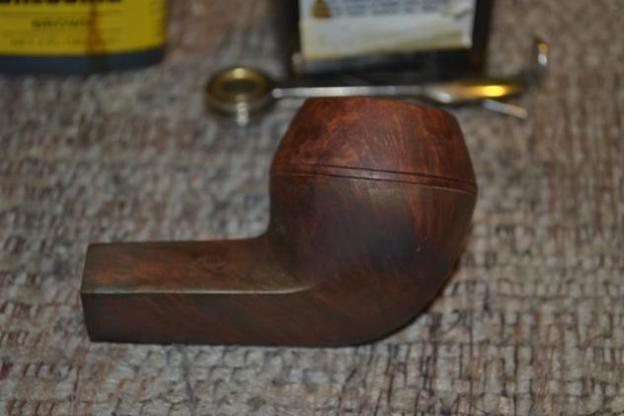
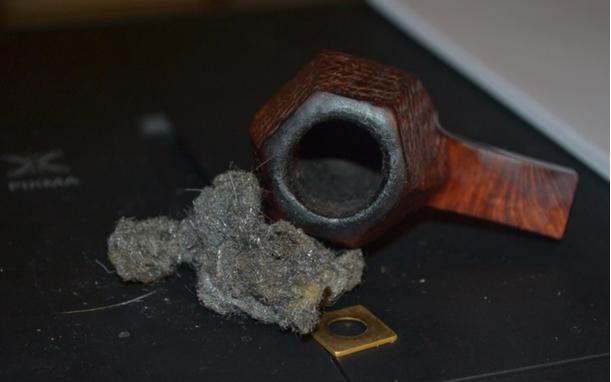
My main concern was the rim, which appeared to be scorched to the point of no return. I used still more soft cotton cloth squares with purified water to work away at the char before switching to 1800, 2400 and 3200 micro-mesh – and just as I thought it was coming clean realized to my horror that the blackened parts of the rim, which had turned a creamy brown color, were down to the briar! In hindsight, I don’t know if I should have left the tiny amount of the original finish that was left on the rim as it was, but I saw no reason. With sadness and reluctance, I removed it for uniformity.KW6 KW7 KW8I replaced the bit, which I had removed from the OxiClean bath and used wet micro-mesh from 1500-12000 to return to a nice black smoothness, and retorted the pipe.KW9 KW10All that was left to do was an unexpected stain of the rim using Feibing’s Brown and flaming it, then buffing with white Tripoli, White Diamond and Carnauba. I buffed the bit as usual, with red and white Tripoli, White Diamond and Carnauba.KW11 KW12 KW13CONCLUSION
I’m always willing to face the music as far as responsibility for mistakes goes, but I honestly don’t know if the “mishap” I had with the rim is common with white briar restores. I didn’t use sandpaper – not until after it was already too late. But it was my restore, and so I will own it. As well as the pipe, most likely, unless anyone out there wants a good deal on a unique Kaywoodie White Briar Bulldog 12B with a brown briar rim!

Fixing a Citation Squat Bulldog


Guest Blog by Robert M. Boughton
Member, International Society of Codgers
Member, North American Society of Pipe Collectors
http://www.naspc.org
http://www.roadrunnerpipesnm.biz
http://about.me/boughtonrobert
Photos © the Author

INTRODUCTION
I thought I found the maker of this Citation on Pipephil, but should have taken a closer look at the nomenclature. As it turns out, the cursive style used by the U.S. manufacturer was a clear mismatch for the block letters on my squat bulldog. For now, I’m stumped. Here is the pipe as I received it.Citation1 Citation2 Citation3 Citation4The unusual cleanliness of the pipe tends to hide the need for serious work on the entire surface of the stummel, in particular a bad ding in the rim.Citation5RESTORATION
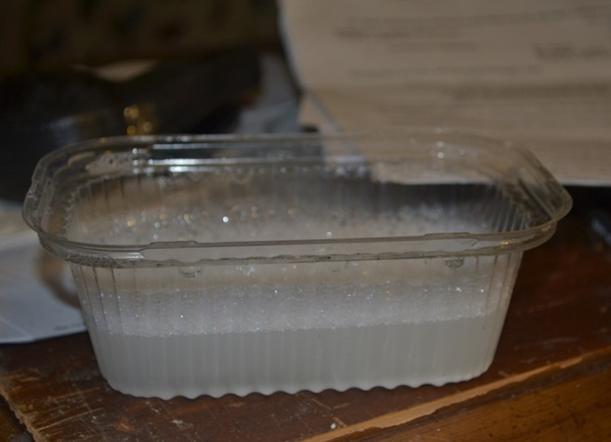
First, I tossed the bit in an OxiClean bath.Citation6While it started soaking, I used 150-grit paper evenly around the curved rim until the ding was gone and it was even all around. I also smoothed a rough spot on the right side of the top curve of the shank.Citation7Continuing just below the rim with 320-grit paper, I almost immediately realized the scratches were so pervasive and the grain so clear and fill-free that an Everclear strip was warranted. After the bit had soaked about 30 minutes, I dumped the OxiClean, rinsed the bit and ran a cleaner through it. Then I poured a jar of used Everclear in the Tupperware tub and dunked the stummel in.Citation8 Citation9

The bit was in good shape, and wet micro-mesh from 1500-12000 made it black and smooth again.Citation10I removed the stummel from the Everclear when it had soaked for an hour and wiped the chamber with a cotton cloth square before sanding the dried alcohol from the wood with 200-grit paper.Citation11 Citation12 Citation13Although I can’t explain how it works, my experiences stripping pipes with Everclear and then sanding and micro-meshing them had prepared me for the radical change in color I would notice after the full scale of micro-mesh.Citation14 Citation15 Citation16

Still, this is the first time I can remember where the grain was good enough that I didn’t need to use any stain. All I needed to do was sand the chamber and retort the pipe, the latter of which proved almost unnecessary.Citation17This is the finished pipe, after buffing with white Tripoli, White Diamond and Carnauba. I used red and white Tripoli, White Diamond and Carnauba on the bit.Citation18 Citation19 Citation20

CONCLUSION
Bulldogs always sell fast, even no-names or relatively unknown brands. But I still don’t know why I put off restoring this pipe for so long. Working on it was a real pleasure, and I did it overnight.

A Challenging Restoration of a Tsuge Second Small Billiard


Guest Blog by Robert M. Boughton
Member, International Society of Codgers
Member, North American Society of Pipe Collectors
http://www.naspc.org
http://www.roadrunnerpipesnm.biz
http://about.me/boughtonrobert
Photos © the Author

“You will never learn enough looking for only the good things in life; you will always be a pupil.”
― Japanese proverb
“Ay, now the plot thickens very much upon us.”
― Bayes, a playwright within the play “The Rehearsal” (1671), a satirical mockery of heroic plays, by Sir George Villiers (1628-1687), 2nd duke of Buckingham, de facto King of England during the end and the beginning of two rightful monarchs, debaucher, poet, playwright

INTRODUCTION
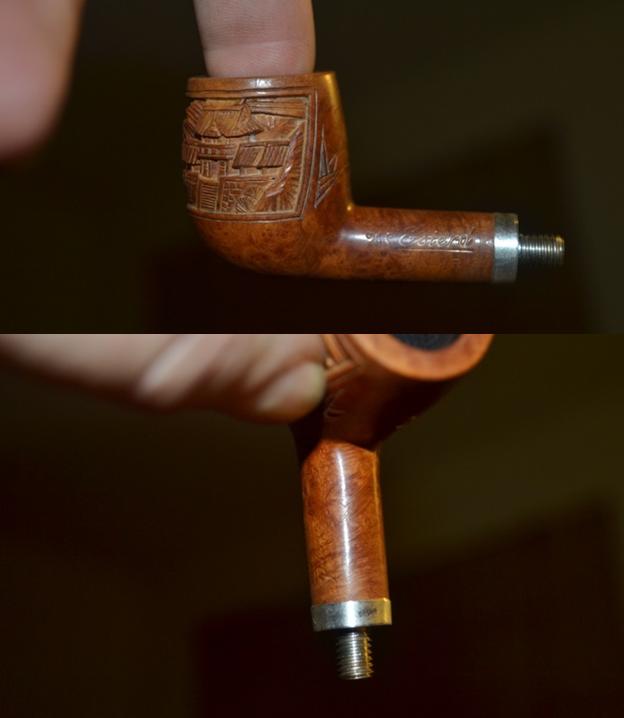
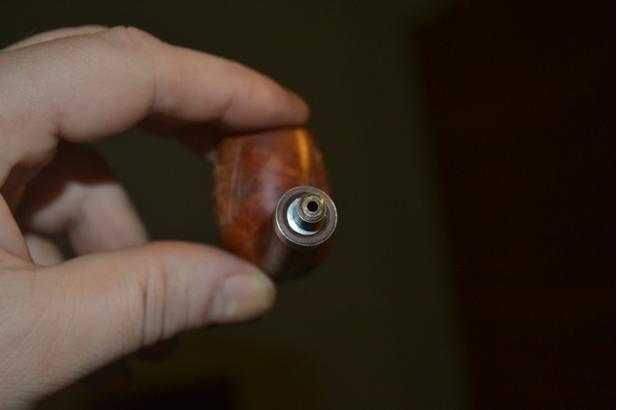
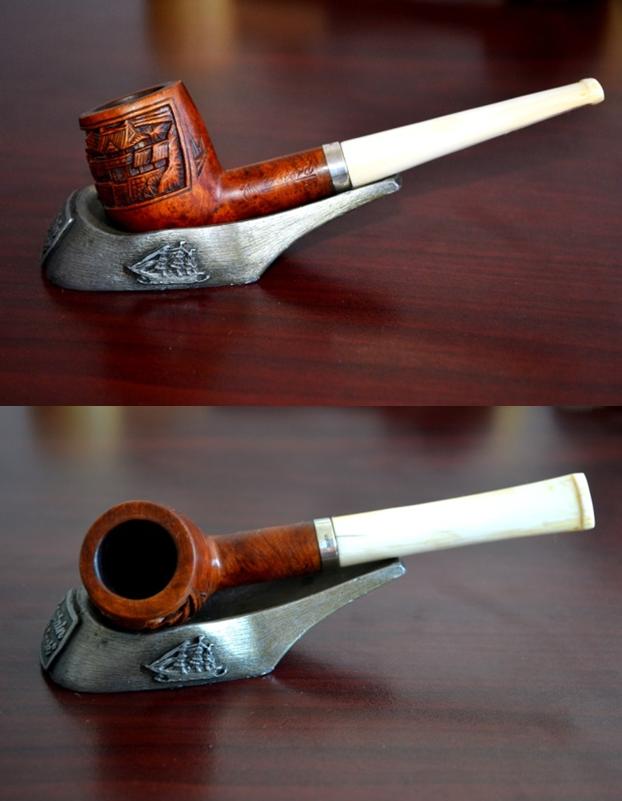
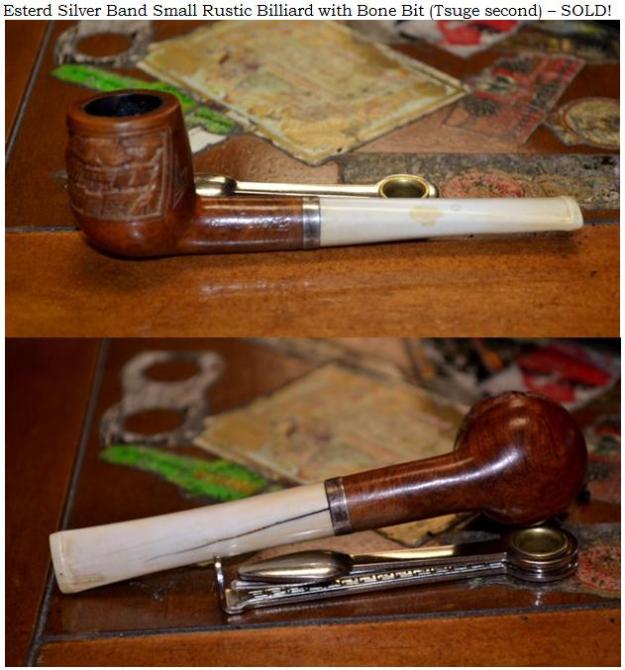
This Esterd silver banded small billiard with a bone bit that screws onto a metal shank insert was another inexplicable find on eBay. The seller had listed it as a vintage hand-carved pipe with a silver band and horn bit, and believed it might have been made in the Philippines. The starting bid was $9.99, with nobody biting. Tempted to enter the fray based only on the elegant design – intricate, carved images of an old, Oriental-style house or palace on the left side, mountains on the front, another landscape of some sort on the right with four tiny marks that could be a language, and two reversed images on the back, maybe symbolic – I exercised control over my index finger that likes to click the Place Bid Now button on its own and opened a new window to browse to pipephil.eu.

Pipephil is good, but it doesn’t list every brand. Although Esterd is but one of thousands of names of which I have never heard, I was prepared not to find a match. Nevertheless, there it was: Esterd, Tsuge second. Here’s where the inexplicable, if not outright spooky, aspect of the find comes in. I reviewed one of the Tsuge non-aromatic lines of pipe tobaccos not long ago on the Smokers Forums UK. Tsuge Pipe Company of Japan, having ultimate control over its tobaccos, nixed milder, less flavorful versions of the blends that are made by “Drew Estate, Tsuge and Daughters & Ryan in North Carolina…[e]xclusively for Tsuge.” The operative name in the list is D&R, and it was Mark Ryan’s blend that was approved by Tsuge.

Looking into the tobacco brand, I discovered the existence of the Tsuge Pipe Company, founded in Japan in 1936 after a grueling 25-year apprenticeship in pipe crafting by Kyoichiro Tsuge. The company makes very fine, hand-crafted pipes of various designs and using different materials. Some of them are priced in what I consider the middle range ($200-$300), but many excellent examples of the craftsmanship that goes into their construction are on the end that is more affordable to most of us. Tsuge, translated to English, means box tree or boxwood, and is also the name of an old Samurai family from which the father of Kyoichiro was descended.Esterd1
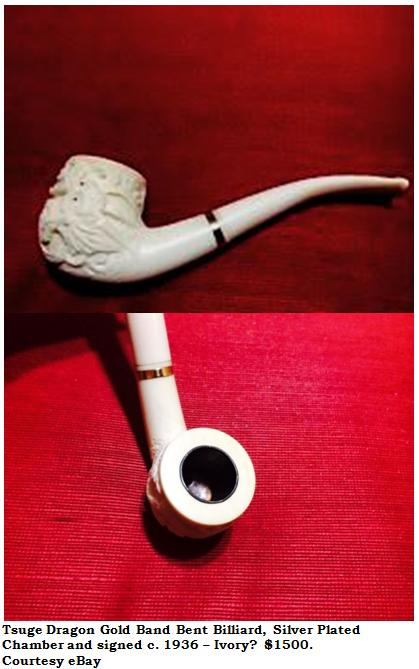
Esterd2 Of course, I returned to eBay, where I had no further qualms bidding for the wonderful pipe at such a low price. At the time, two days remained for bidding, but no one else seems to have gotten past the seller’s unfortunate description of the pipe’s construction and origin with a simple Google search for the brand. As a result, I won it for $14 with S&H.

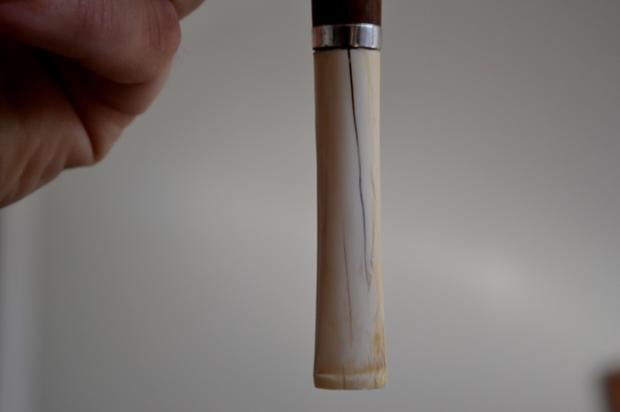
I was aware of the evil crack on the bottom of the bit, but figured I had nothing to lose at that price. I expected to list it on my site for $100 after restoring and fixing the crack that my friend and mentor, Chuck Richards, assured me could be repaired with an unusual process that would leave the bit looking like new. Instead, I made my first ever sale of a pipe before I restored it, to a friend in my pipe club who held the Esterd in his hands with an unmistakable flush of longing on his face, in particular the eyes that were fixed on the delicate beauty. Ah, how well I know that look!

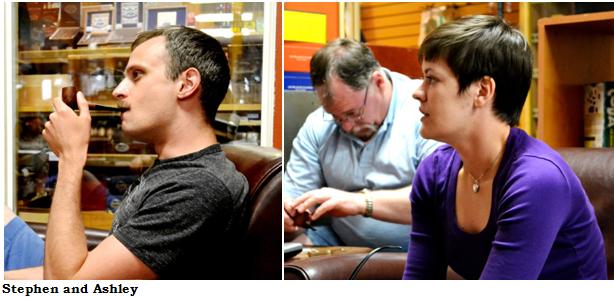
Familiar with the deserved reputation of Tsuge pipes, my friend, Stephen, said he has always wanted one but never found any he could afford. He asked in a somewhat faltering voice how much I would sell it for. Teasing him, perhaps with a bit too little shame, I mentioned the anticipated list price, and watching his eyes saw I could get that much from him. But Chuck’s unparalleled generosity in offering his restored pipes at fantastic deals rubbed off on me, and I told Stephen he could have the work of art (I didn’t put it that way) for $50. He was so surprised that he looked to his wife, Ashley (of course), for approval. She just said, “You have the card, don’t you?” Stephen reached in his pocket to get it, amazing me with his clear intention to buy it right there. [Ashley, by the way, was in my first blog on Reborn Pipes, about a unique Chinese churchwarden that I found in a – ahem – head shop. When the cheap bit broke as I was savoring the great taste of my first chamber-full in it, I was not yet aware I could buy a replacement bit and instead chose a replacement for the pipe, which in fact was cheaper, anyway. But that bit broke also, leading to a friendly competition between Chuck and me, although there was little doubt his restore of one for me would be better than mine, which I gave to Ashley.]

I reminded Stephen it still needed a light cleaning and serious restoration, but he wanted to make sure it would go to him when it was ready and insisted on paying up front. And so I reached for my cell phone, which I had left at home since it is not working, and then attempted to find a way to download the PayPal Here app onto my laptop. This endeavor failed. Therefore, I went to my website editor and listed the pipe so that he could purchase it online. I encountered yet another obstacle when I found that my store, set up to accept PayPal, for some reason only allowed members to use it, unlike my previous site which permitted guests to use the service. Stephen drew the line at having to sign up for PayPal.

Therefore, the transaction was not finalized until two days later, last Saturday, after I copied and pasted the necessary HTML code into my site’s store page and got ahold of Stephen using my friendly neighbor’s cell phone. I would not have been so eager had I not needed the money to buy the key material in Chuck’s instructions to make the bit like new, not to mention less important things like food and gas. I told Stephen to let me know by email if he had any problems navigating the PayPal system to the newly-added guest mode, but before I read his reply saw that the payment had gone through on PayPal.Esterd3 In his email, Stephen told me not to rush the restore for him. I replied that my desire to start it right away was for my own eagerness to see Chuck’s promise of excellent results come true. This blog, therefore, will show the real-time steps I need to take to prepare the lovely Tsuge second to a condition worthy of handing over to its buyer.
RESTORATION

SATURDAY

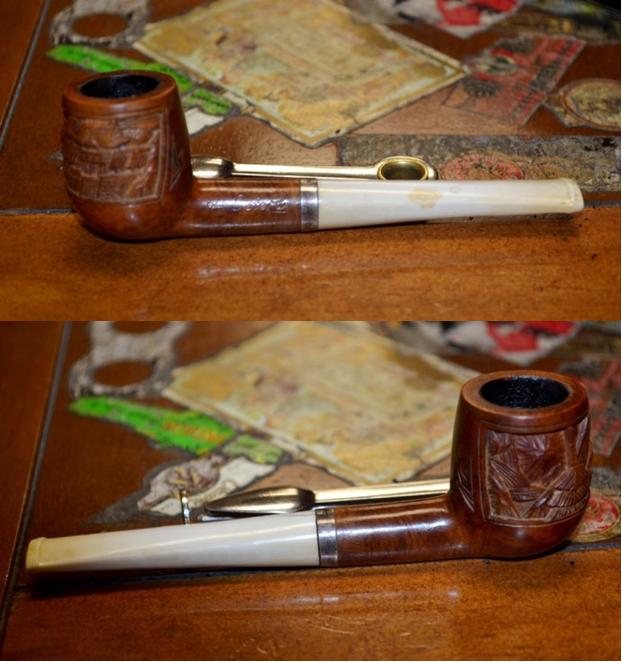
I place an order on eBay for the uncommon special something I will need for the completion of this task I am about to begin. The much anticipated package is due to arrive, via First Class Mail, in several days if I’m lucky and literally God knows when if the USPS conducts business as usual. Therefore, I await it with all of the patience and faith I have, and open my photo files to the Esterd folder, where I find the original shots of it I took at my favorite tobacconist when it came in the mail, far faster than usual with Priority Mail 1-Day Delivery.Esterd4
Esterd5

Esterd6

Esterd7

Esterd8

Esterd9 Clearly, as shown by the presence of tobacco in the chamber in the third photo above, the Esterd was so clean upon arrival that I was forced to sample some good tobacco in it – and then, amazed by the mellowness and great flavor of the one tobacco, I had to test it with another. Both tries get the highest rating I can give any pipe.

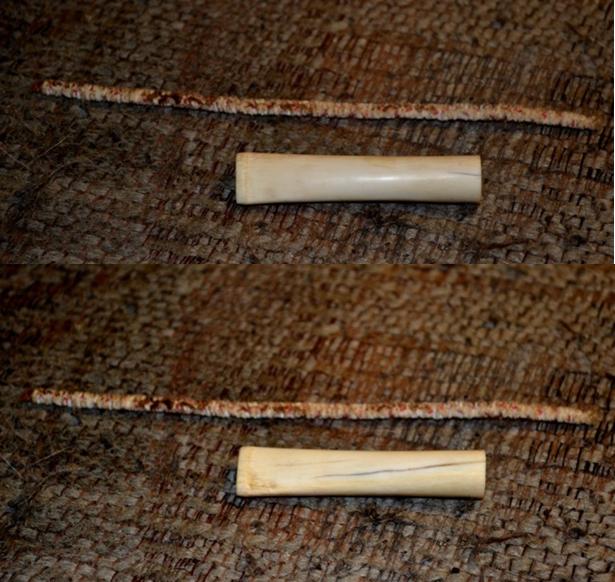
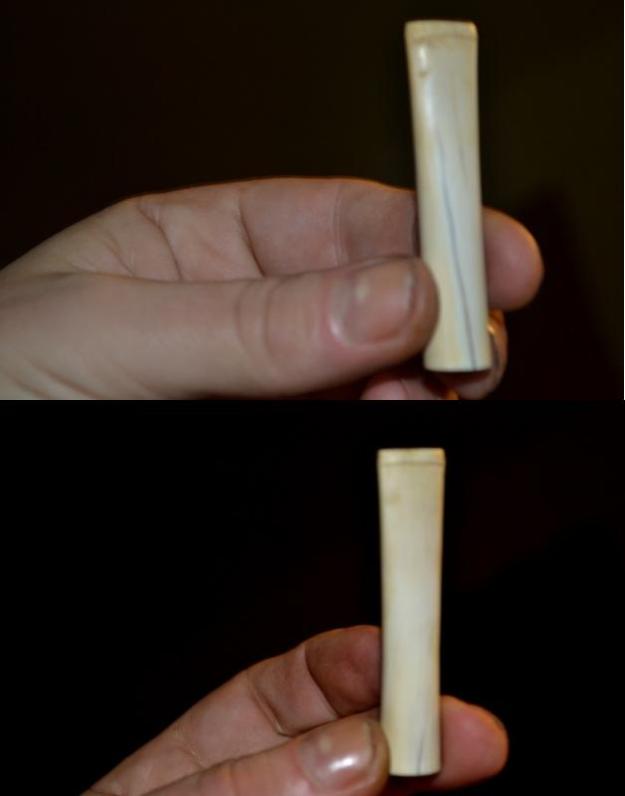
As the bit is the only difficult part of this restore, I start with it. Chuck has already talked me through the peculiar process for fixing the bit, telling me to soak it in a solution first to clean it, inside and out. Knowing he has his own formula, I asked if the OxiClean I use would be okay. He said that would be fine but emphasized that the entire pipe had to be thoroughly clean before the bit repair could begin.Esterd10 I remove the bit from the OxiClean after a long bath, rinse and wipe it dry, run a bristly cleaner through the air hole and let it dry more.Esterd11 The next step is to use an old toothbrush on the crack. I am uncertain how to go about this, but I give it the old college try, deciding on two toothbrushes, one firmer than the other, and also to employ a very fine fingernail file from an old, unused package of every kind of device for nail care. I throw in a 12000 micromesh pad as an afterthought.Esterd12 After alternating between both brushes, trying from every direction to work the little pieces into the big crack on the bottom of the bit and where they extend to the open end, I begin to be able to see all the way through the wider part of the crack. I use the fingernail brush on the more difficult dental chatter on the lip and below it – as well as to remove as much of the nice patina that has developed considering the ultimate mystery step I will need to take to put the final touch on this project – and then clear the fine dust from the soft bone with a toothbrush again. I finish this step with the micromesh to make the entire surface ultra-smooth again. By George, the old fart was right!Esterd13 Instead of proceeding to the next of Chuck’s stated steps with the bit, I switch to the easy stummel cleaning and preparation. I wipe a miniscule amount of dirt from the outside of the briar with a couple of soft, white, cotton gun cleaner cloths and purified water. Next I use a tiny piece of superfine steel wool on the rim, which has minor scratches, and the full range of micromesh pads on the entire wooden surface. Finally, I clean the chamber with 320- and 500-grit paper and remove the excess carbon with alcohol-soaked cotton cloths.Esterd14
Esterd15

Esterd16

Esterd17

Esterd18 The retort of this pipe is going to be very difficult as I cannot, under and circumstances, run Everclear through the bit, as usual, and I possess no other that will connect to the unique threaded shank connector. I must do something. But what? Aha! My synapses snap, and I devise a scheme to make a try at it without a bit at all – filling the test tube with Everclear, plugging it with the rubber tube, and then placing the small open end of the tube over the metal shank connector just-so. I set everything down for a moment to get my big cotton cloth and wrap a corner of it over the rubber tube-covered shank connector. Pinching it as tightly as I can with three fingers, no matter how hard I try (and believe me I did my darndest), I can’t manipulate a fourth finger to hold the final side of the tube, under the cloth, shut. Go ahead and try it. Oh, well, I’m not about to give up now. Never surrender!

In this bizarre fashion, I flick my Bic with my free hand and light the flame of a small candle. With both hands occupied beyond their design, I hold the rounded end of the test tube above the flame, having to contort still more to balance the side of my left arm against the small table in order to stop the shaking of the Pyrex tube that keeps almost snuffing out the flame. At last I have it under full control. If anyone believes that, as George Strait sings it, I’ve got some ocean front property in Arizona for sale. Honestly, I’m reminded of certain scenes from “Fear and Loathing in Las Vegas,” with Johnny Depp as the late great though drug and alcohol synergized Hunter S. Thompson, and, I am forced to admit, a memorable scene or two from the 1931 classic “Frankenstein,” with Colin Clive as the unstable doctor and of course Boris Karloff as his Monster.

My only regret is that I have but two hands to give to this effort at snapping a shot of the spectacular scene! In my fervor to record the feat, I even consider asking my good neighbor with the cell phone to come in and catch the unprecedented event with my Nikon – but it is a bit late, and he might not appreciate the request, not to mention what he should think of me if he catches sight of what I am doing in my living room.

Thus, two test tubes full of Everclear later, the rag somewhat wet with alcohol that didn’t reach its destination, the ordeal of the Retort of the Esterd is behind me, and the stummel is clean.Esterd19 Yes, there are still times in life when even I am flabbergasted by my ruthless determination to do something. I have not sold a briar pipe un-retorted since I learned my lesson on that score the hard way some time ago, and I’ll be tarred and feathered and run out of town on a rail if I ever will. I rest my case on this point with the above photo.
I seem to recall writing something earlier about the easy clean-up of the stummel. Perhaps I was mistaken a tad.

Now, I can sleep.

SUNDAY

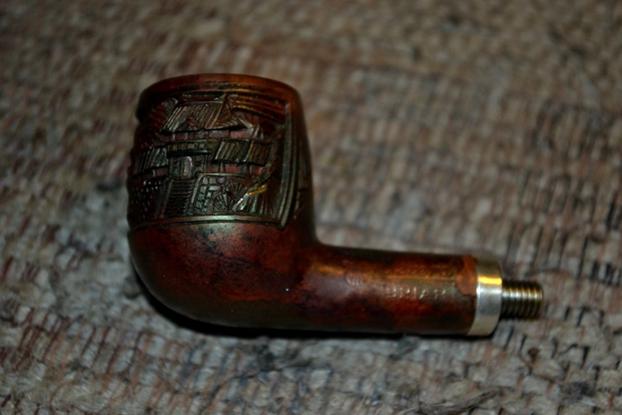
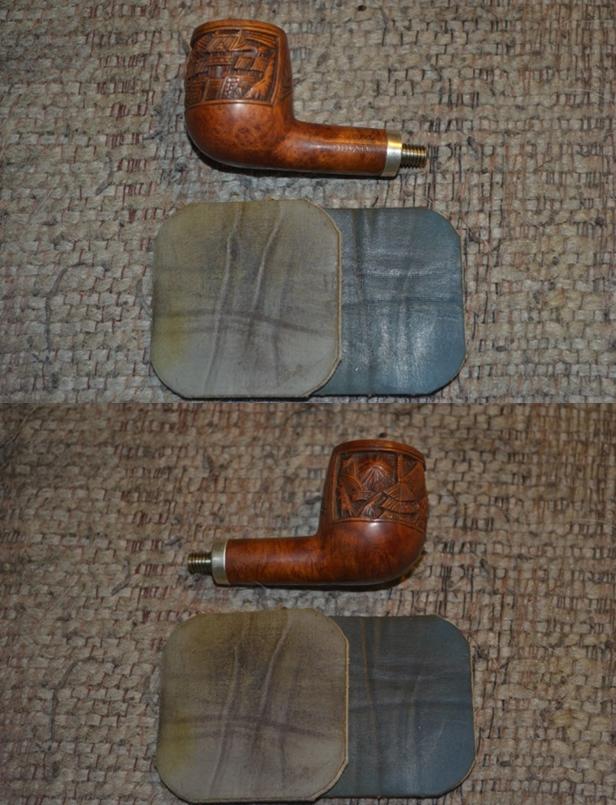
Regarding the dainty stummel, deftly crafted by loving hands unknown years ago, I see that the carved areas are all faded. I’ve been mulling over what I thought might turn into an option between re-staining or not and now know I’ll have to do the former, but what color? I dismiss Lincoln burgundy as too dark almost before the thought occurs to me, and consider lighter or darker brown. Mentally flipping a coin, I choose the darker, Lincoln Medium Brown, and apply a coat, brushing it with special attention into the tiny grooves of the carving. I flame it straight away, enjoying the puff of blue flame that envelops the stummel and dissipates, fixing the color into the wood and leaving only a light, even coat of char behind. I set it aside to cool.Esterd20 A few minutes have passed. I choose 8000 and 12000 micromesh for the gentle removal of the char and use first the lower number, then the higher. Still, the color is too dark. I take out the 3200 pad and rub the smooth surface of the stummel, which lightens nicely, and for the artwork use another small piece of superfine steel wool, first over the raised areas and then focusing with necessarily more pressure into the difficult grooves. It’s amazing how many there are in this testimonial to the mastery Japanese artists have over such detailed work.Esterd21
Esterd22

Esterd23 I must have put away the steel wool for the photos above, but trust me, I didn’t make the carved parts of the stummel so light without it. It is time to coat the briar with a small finger of Halcyon II wax and set it aside awhile to dry.Esterd24 When the Halcyon II has set into the smooth and carved areas of this excellent small billiard (it measures 4¾” in length with a chamber diameter of ⅝” x 1”), I buff it by hand with a clean cotton rag and set it aside, with the utmost care, where the cats will not disturb it. I will wait until later to photograph the finished pipe as a whole. I have completed the stummel and now have only the bit to restore to vibrant life.
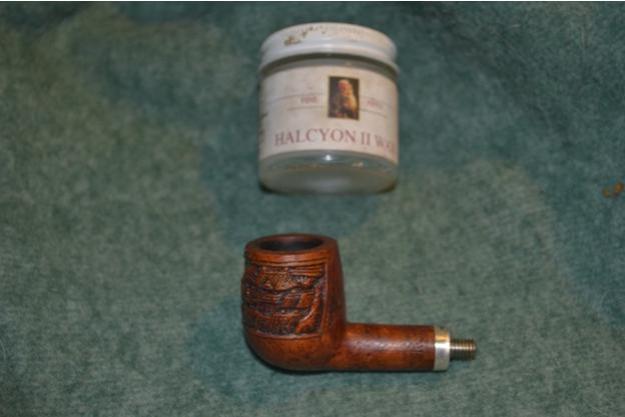
Only the bit! Again I have reached a critical stage of this wholly strange process that hinges on the successful “removal,” or more aptly, mending and covering of the creeping cracks in the shank. I freely confess my justified fear of blowing this all-important feature of the restoration. After all, it is the only real challenge I face with the Esterd, and if I botch it, I will have to reverse the next step and try again, a prospect I do not at all relish. Ultimate failure is not possible, I know, because I will do it as many times as it takes to get it right.

I take a break. After a moment’s thought I choose, with a weird and flippant flair I do not begin to feel in my stomach, the GBD Prestige Apple, which caused so much heartache and twisting difficulty in my previous, dubious trip through the sometimes treacherous and bewitched path of pipe restoring. I decided to keep the GBD as much as a reminder of my mistakes as anything else. I savor some Gawith Bracken Flake, an intact tin of which I bought about two years ago and put in my cellar after rehydrating and trying two tins that were popped open at my occasional secondary tobacconist here, and which the young son of the owner, the heir to the family operation, had the business acumen to give to me. At my preferred tobacco shop, I like to refer to the competition as “the Tobacconist that Must Not Be Named” when it needs to be mentioned at all.

Not impressed with the first two tins that rehydrated well enough but still had something missing, like Frankenstein’s Monster reanimated, I have many times almost donated the last tin to my pipe club for the monthly raffle. Something stayed the urge, and when I at last popped the tin open and uncovered the moist, rich, dark brown Kentucky burley and Virginia flakes, the flecks of crystallized white sugar suggested it was packaged well before I bought it two years ago. This break, it appears, is a desperate attempt to chill out, as my generation calls the often difficult discipline of relaxing.

Nevertheless, the magic that is the essence of pipe enjoyment begins to pervade my body and mind as the rich flavor and pleasant wreaths of smoke envelop me. My mind drifts to the meaning of bracken. In terms of the tobacco in my GBD, it is a reference, not to the wild ferns that grow freely in some places of the world, but to the “shade of brown resembling the colour of turning brown; a warm orangey-brown.” (I like the repetition there and have looked it up in the OED to be sure.)

Okay, then. With that thought, I am heartened to return to the bit. I should get on with the next and cardinal phase of the Esterd restoration. I collect the tools I will need.Esterd25 Indeed, the plot thickens, so to say. Here is the first true step in repairing the pipe: applying regular, clear Super Glue into the large crack on the bottom of the bit and over the smaller one on the top that is just forming, as well as both of their beginnings on the open end of the bit. Although the task may sound easy, it is not. Aware of the risk of smearing the quick-drying stuff where it is not needed – beyond the lines of the cracks – and the equal need to avoid, above all, allowing the glue to seep inside the threaded opening, I did procrastinate the unavoidable step as long as I could.
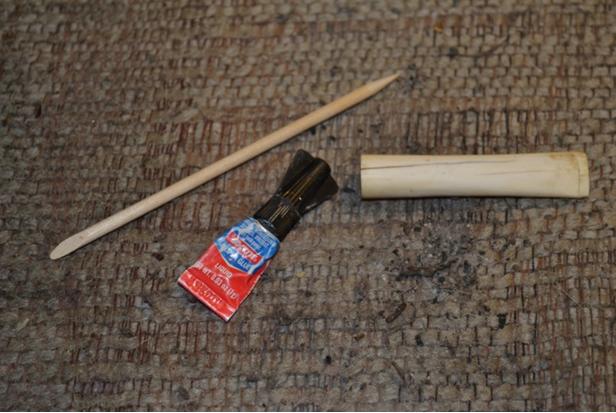
And so, facing the music – another interesting phrase probably originating from the centuries old practice of disgraced officers being drummed out of their regiments – I approach my duty with the soldier’s wise combination of trepidation and exhilaration. I choose the single weapon that seems best suited for the battle, a short wooden fingernail care pick with one pointed end and the other chisel-edged. I feel somewhat as a young boy with a tiny toy quarterstaff harkening back to medieval England.

First addressing the primary targeted weakness of the bit, the long crack in its armor, using the pointed end of my pick tipped with a small squeeze of the Super Glue, I lay down a line of the sticky stuff, following as closely as I can the uneven course of the wound. Then, spinning the pick around to its dry, chisel-edged side, I poke it deftly into the widest part of the gap at the open end of the bit and scrape the excess glue from the sides of the fissure and running down into the still-sealed but breaching length to halt any future attack from that end. I survey the inner bit, focusing on the corresponding fault along the threads, and note that light no longer shows through, but it is still not sealed.

Daring not to venture inside the bit, I opt for a compromise, adding more glue to the pointed edge of the pick and capping off both short lines on the round end of its entrance. Returning to the front line, I repeat the same process as before, and in checking the interior of the bit am gratified by the apparent victory within sight. The glue has crept all the way to the inside boundary of the threads and halted, already firming up against any future onslaught by the enemy.

I turn the bit top up to coat the short, closed line of early crack formation there with a preemptive strike against further growth. The Super Glue seal is almost imperceptible in the photos below, but it is looking strong to my eyes.Esterd26 Now begins the two-day siege as I must wait and see if my blows to the enemy fortify and take hold.
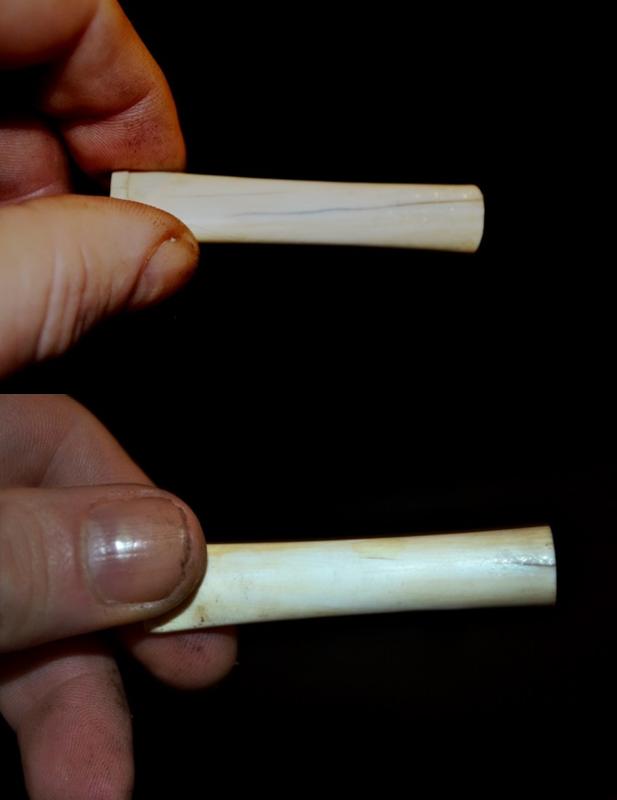
TUESDAY

The clear instructions from Chuck, my warlord, were to retreat and wait a full 48 hours after the Super Glue assault before returning to the scene of the battle. I followed his orders to the letter and briefed him on the situation earlier tonight at his HQ. He reaffirmed the last step I must take before the final death blow, the ammunition for which still has not arrived in the mail. This time, however, when I mention making the bit pure white, Chuck added, “You do the best you can.” Ignoring this modifier at the moment, I return home and with stealth take the bit in hand to gloat over the impending unconditional victory.

In final preparation for the extreme but morally justified coup de grâce I hope to deliver tomorrow, should the required reinforcement arrive by then, I clean up the battlefield, again using the very fine fingernail smoother to remove the minimal amount of Super Glue that has dried and hardened on the top and bottom of the bit, over and surrounding the sealed cracks.Esterd27
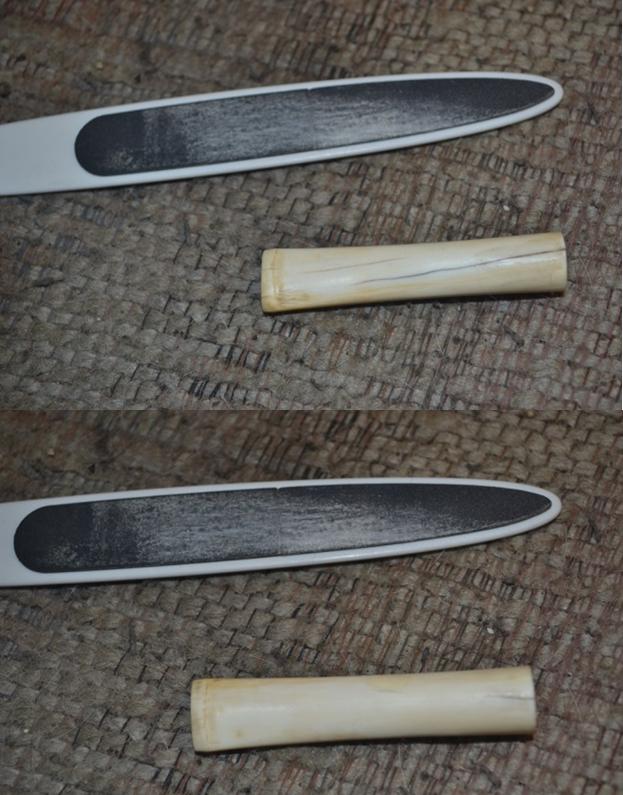
Esterd28 For the last, uncertain time, I can only await the arrival of the final weapon. War, indeed, is not Hell, but Purgatory.

THURSDAY – 4:30 p.m.

The state of the USPS being as it is, the package I have awaited, I see online by checking the Tracking Number, has arrived this day. I pick it up and make a pit stop at my tobacconist.Esterd29 The special weapon: white jeweler’s rouge, which Chuck tells me – and I confirm online, not with unbecoming doubt of my mentor’s knowledge but so that I can cite a second authority in my table of Sources below – is vital because of its lack of oils used in regular pipe waxes. Oil-based waxes will not hold to the surface of the bone, and thus, with my anxious hope, render the bit pure white again and remove any appearances of cracks. We shall soon see, together.

8:00 p.m.

Vancouver, there’s been a problem here. I have turned on my electric buffer with the so-called “clean wheel” and applied enough of the jeweler’s rouge to make it nice and white. This is not what Chuck told me to do. Aware of my barely adequate set-up, he said gently, “You will probably want to clean one of your buffers if not get a new one entirely before you put the rouge on.”

I have already admitted that is not what I did and prefer not to dwell on it. Needless to say, when I buff the bit, the jeweler’s rouge does the best it can by bringing most of the bone to an intense white shine. But despite my frantic attempts – extending to using every angle and side of the buffer, turning the small bit lengthwise and doing the same (in the process almost burning my fingers on the high-speed cloth), and even going so far as to rub the block of rouge by hand directly to the bit and then pressing it in with a cotton cloth – of course I am unable to cover the Super Glued and micro-meshed seals of the cracks completely.

This, I confess to myself, is what I deserve for trying to do something my own way. And so I am forced, almost at the point of kicking and screaming, to delay this paramount stage of my progress at least another day as I give the “clean buffer” a soak in hot water before removing it, squeezing out as much of the wetness as I can and placing it near the bottom of the single gas heater in my living room.

FRIDAY

The buffer, amazingly enough, is clean and dry by late morning. With baited breath I return to my office/workshop proper and reattach the cloth to the machine. I plug it in again, having taken the prudent precaution of disconnecting the electrical source lest some crazy but in my experience still possible freak accident occur. I am not willing to risk losing part of a finger or worse for this or any other pipe.

Taking another of many deep breaths in this project and exhaling, I push the switch that restores life to the machine and apply the white jeweler’s rouge to the cloth spinning in a blur on the wheel. With confidence, I first pick up the little stummel to polish the silver band still more, as I noticed in the description of the polishing compound its usefulness in working on metals as well. This task ends well with a lustrous band.

Now the ultimate moment of truth has arrived. I put the elegant and fragile piece of bone to the buffer once more, aspiring for the best results but emotionally prepared for a lesser return on my attempts.

My late roommate, who possessed an unwavering confidence in the supernatural that I truly admired, would have blamed the ensuing conclusion on my incomplete conviction. I want to believe, as Mulder’s poster on “The X-Files” reads, but it is not enough. The bone bit, though strengthened by my meticulous best efforts to make it so, is indeed structurally sound again and burnished. Nevertheless, the cracks still show. The harshest analysis reveals the bit’s integrity, but the ensured durability is still betrayed by faint traces of its incorrigible flaws.Esterd30
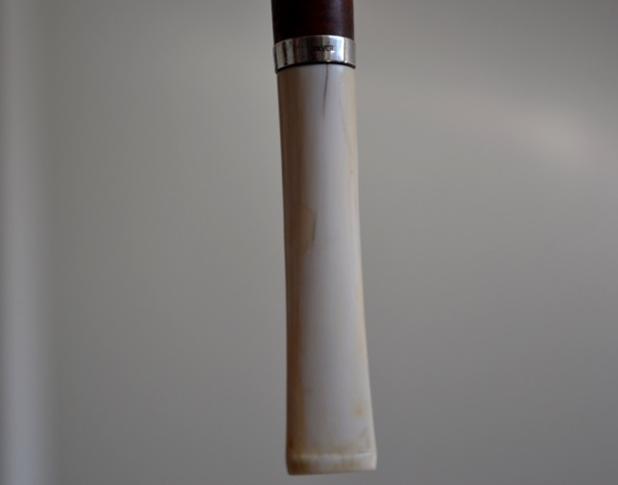
Esterd31

Esterd32

Esterd33

Esterd34
CONCLUSION
I am disappointed, to say the least, with the less than perfect closure of this arduous restoration, but I take solace from the Japanese tradition in artwork, which they call Wabi-Sabi, to leave one flaw in any endeavor. The Buddhist author, Taro Gold, describes it as “the appreciation of the value and beauty of imperfection.” Okay, so my work shows more than one flaw. No doubt the Japanese would do better. This is not Chuck’s fault. Maybe he could make it right, also, but I am at peace.

A distant part of my brain assumes someone, surely, must have expressed the same thought I wrote at the close of Tuesday, about war not being Hell but Purgatory. I Google the words and find I am correct. Drat! Keith Staskiewicz of “Entertainment Weekly,” reviewing Kevin Powers’ Iraq War novel, “The Yellow Birds,” wrote: “Powers effectively shows how, for these soldiers, war isn’t hell. It’s purgatory.” So he didn’t capitalize hell and purgatory and put a period in between. Ah, well! All’s fair in love and war. I’ll have to read that book. Or maybe I’ll see the movie, due out this year.

SOURCES
http://www.slate.com/blogs/browbeat/2014/03/12/_the_plot_thickens_the_phrase_s_etymology_and_origin_at_the_request_of_grand.html
http://www.enotes.com/topics/george-second-duke-buckingham-villiers
http://www.pipephil.eu/logos/en/logo-e4.html Esterd
https://translate.google.com/translate?hl=en&sl=ja&tl=en&u=http%3A%2F%2Fwww.tsugepipe.co.jp%2F Tsuge Pipe Co.
http://www.ebay.com/itm/RARE-Collectible-Vintage-TSUGE-Signed-Carved-DRAGON-Tobacco-Pipe-/351638968227?hash=item51df50d7a3:g:lOIAAOSw4HVWEv6T Tsuge Dragon Gold Band Bent Billiard
https://www.smokingpipes.com/pipes/new/tsuge/ Tsuge Pipes
https://avaiaartisticjewelry.wordpress.com/2011/08/07/how-to-care-for-organic-bone-jewelry/ Polishing bone materials
http://www.phrases.org.uk/meanings/face-the-music.html
http://www.medievalwarfare.info/weapons.htm Re: quarterstaves

http://www.imdb.com/title/tt3739110/ Yellow Birds movie
http://www.tarogold.com/2008/02/13/living-wabi-sabi/

UPCOMING RESTORES
Esterd35

Esterd36

Esterd37

A Sad Lesson from a Botched GBD Repair (by Someone Else) I Tried to Mend


Guest Blog by Robert M. Boughton
Member, International Society of Codgers
Member, North American Society of Pipe Collectors
http://www.naspc.org
http://www.roadrunnerpipesnm.biz
http://about.me/boughtonrobert
Photos © the Author

If it ain’t broke, don’t fix it.
― Thomas Bertram “Bert” Lance (1931-2013), U.S. bank teller to president and Director of the Office of Management and Budget under President Jimmy Carter, in the May 1977 issue of “Nation’s Business” magazine

INTRODUCTION
This is a sad tale for all involved: the eBay seller from whom I purchased the GBD straight apple sitter this blog concerns, for $39.99 in April of last year, which the good lady in England refunded five days later; me, as the buyer who requested the refund after receiving the pipe and finding that the photos posted by the seller did not reveal the hidden nomenclature from a previous silver banding to fix an apparent crack in the shank, and at last, in a very real way, the person or persons unknown responsible for the banding itself that, nine months later, I have only just discovered was unnecessary. At least the last of the concerned parties is/are blithely unaware.

That’s right, you read correctly. Although I was justified in asking for the refund, and intended to pay the high postage required to return it to the seller beforehand, she responded, to my gentle but detailed account of the reasoning, with a message that can only be described as hysterical from an obvious sense of unjustified guilt for having “falsely advertised” the GBD. I never used that phrase in my request.

As I recall – though I can’t locate the exchange of emails between the Englishwoman and me that followed my awaiting the arrival of the GBD, with great expectations that were dashed by its clear flaws upon receipt – she wrote back that I should not bother returning it at all, but instead that she would promptly refund my money and I should “keep it, sell it for whatever you can, or throw it away, I don’t care.”

At that point, I was filled with remorse over the anguish in the tone and content of her message that literally rang in my ears, even without an exclamation point. I nevertheless attempted, in a final, unanswered message, to express my intent merely to let her know, in order to sell this pipe or any other (they are not her specialty), that she only needed to add a brief note of the band work and its effect on the nomenclature, as these are important details to collectors and sellers, and perhaps lower her asking price.

After showing the pipe to Chuck Richards, my good friend and mentor, before the emails described above and allowing him to discover on his own the same flaws I detected, he concluded that if I paid more than $10 for it, I should immediately ask for a refund, as I had bought it for my own estate pipe business with the prospect of a quick clean-up for resale. When I told Chuck the actual amount I had shelled out, he was speechless for a moment before all but insisting I seek the refund.

I have been unable to get the shame-riddled emailed words of the kind seller, who as far as I’m concerned made an honest mistake and acted, throughout the transaction, in absolute good faith, out of my mind ever since. I have entertained various options concerning the ultimate disposition of the pipe’s rightful ownership. Of course, I could (A) keep the still beautiful pipe and restore it as best I could to put in my own collection or sell with appropriate disclaimers; (B) clean it up and return it, like a good gentleman, to the grief-stricken lady, with the emphatic suggestion that she give it to a friend who enjoys pipes and would likely treasure this one, if she still didn’t wish to sell it on eBay with a lower price and notices, or (C) complete the work that could be done to fix the damages wrought on the hapless GBD, keep it or sell it but under no circumstances toss it in the trash as the seller advocated, and write the blog now presented as a full and sincere apology to the lady, with the intent of depositing the refunded money back into her PayPal account and forwarding her the link to the blog.

With great effort, I at last located the transaction numbers and dates of the original purchase and refund, and with them was able to obtain the lady’s name and email address.

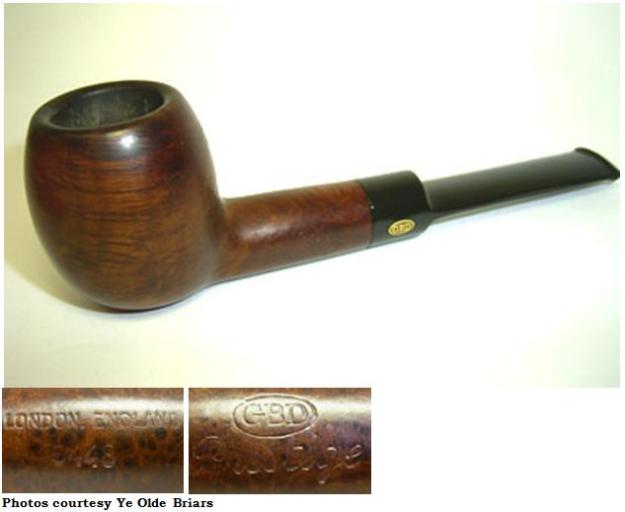
I will save my final decision for later in this account of the restoration of the GBD Prestige straight apple sitter, which research has disclosed was made prior to the acquisition of GBD (an abbreviation of the three founders of the brand in 1850 in Paris – Ganneval, Bondier and Donninger) by Cadogan of the Oppenheimer group in the 1970s. The imprint “London England” in a straight line on the right side of the shank, almost half of which was obliterated by the band, narrowed the pipe to the pre-Cadogan era and also signified that it might have been made in France despite the nomenclature. GBD was last taken over in 1981 by Comoy’s.

The other nomenclature on the Prestige was critically faint, before I started work on it, and included on the left shank the small letters GBD in an oval, barely visible beside the band, and the model name in cursive that took hours to decipher enough to make out the first uncovered letters, “Prest,” which led the excellent Englishwoman to suspect Presto, but I Googled and found the full correct name. On the right shank, equally as light as the left and below “on England,” were three numbers for the shape, 448, which I understood was 9448. Here is what another version of the pipe looked like.GBD1 The apple of my eyes in this blog is remarkably similar, discounting the nomenclature.

RESTORATION
GBD2

GBD3

GBD4

GBD5

GBD6 [Note the unusual, perfect, pale half oval indentation in the top of the shank in the sixth photo above: I have.no rational explanation for the presence of this mark other than the appearance that it is neither a natural aspect of the wood nor any type of damage, such as a crack. I believe the previous restorer attempted to use a self-made metal band, with the idea of reinforcing the top of the shank without covering any of the nomenclature. If this admittedly crazy-sounding guess is correct, the restorer likely intended to do the same on the bottom of the shank but aborted the idea altogether after failing with the top piece. Call me nuts, but this mark is not an accident.]

Already considering re-banding the apple with a shorter sterling variety, I tugged at the one used in the first place, without much hope that it might be loose, and was surprised when it flew off of the shank and onto my lap.GBD7 Now that was fortunate indeed, for, upon closer inspection, I was able to see that the tiny line in the shank’s opening, which ignited some daft restorer’s passion to fix something that wasn’t broken, was a mere blemish that led nowhere and, in fact, disappeared with a few seconds of sanding. I have to add an acknowledgement of my simultaneous relief that the shank was not cracked and disgust with the previous restorer who desecrated the otherwise weathered but fine pipe by ruining so much of the invaluable nomenclature. The only remaining imprints were the indentations left from the hallmarks and sterling silver designation on the once tight band. I scoffed out loud after my brain digested this enormous error in judgment that more or less ended any real value – and prestige, so to say – this GBD might have had.

Not yet wanting to deal with the majority of the stummel’s outer area, I decided to start by removing the years of accumulated dirt and whatnot from the wood with small soft white pieces of cotton gun cleaner cloths and much of the rim char with wet micromesh pads and a light touch of superfine steel wool. I followed those tasks by clearing the small amount of excess carbon in the chamber with a 19mm reamer and 200- and 500-grit paper, swabbing with Everclear-soaked cotton cloth pieces, and a retort of the pipe.

The retort turned out to be the hardest part of these preliminary steps, as neither of the two rubber tubes that span the few inches from the boiling Everclear to the lip of the bit would fit the extra wide mouthpiece that was part of the GBD. And so, ad-libbing somewhat, I sought out another bit from my collection with a tenon that fit the GBD and a lip that matched the rubber tube. Of course, the last possible pipe I checked was a match – or closely enough. It was from a favorite Ropp. I had no trouble cleaning the metal inlaid GBD bit with a couple of alcohol-soaked bristly cleaners.GBD8

GBD9

GBD10 The photos above show the surprising cleanliness of the well-worn sitter, and by inference, the degree of care its fortunate owner once accorded the bijou. The later of two test tubes full of Everclear used in the retort was almost clear, with only a few small, solid pieces of flotsam at the bottom.

Here, alas, is where I erred, and will have to accept the consequences, until the day I die, for the heartbreaking lesson they provided. In hindsight, I suppose I might, at this critical stage, have sought the guidance of Chuck or Steve (my second if unofficial mentor in this ever-evolving process of learning). But, as Jesse Eisenberg’s character in “Zombieland,” Columbus (for the city in Ohio where he was born), repeated slowly as a sort of mantra: “Shoulda-coulda-woulda.” Much as Columbus had come up with rules for surviving a zombie apocalypse, so have I adopted a set of guidelines, from my own experiences and those of others, for pipe restoring.

Sometimes I ignore one of these, for the most part with success, and sometimes I have to learn the hard way, on my own. Still, as I type this, I find myself experiencing emotions I prefer to avoid. Recognizing my harshness with the previous restorer, and my own share of fault for the apple’s present condition, I nevertheless tell myself I did my best, alone, to return the splendid pipe to its potential glory. My mistake, although unintentionally made in the pursuit of correcting one more egregious that I believed necessitated my next step, is on me.

To the point, and in spite of a note in my previous blog that I try my best to avoid full stripping of a pipe’s original stain and waxes with an Everclear bath, that is what I did.GBD11

GBD12

GBD13 These photos show two things: the wonderful success in removing the remaining rim char and reducing the wood to its natural smoothness, and, as an unexpected result of the latter, also eliminating almost every vestige of the remaining nomenclature. Anyone who loves pipes with all of his heart, as I do, will comprehend the complete hollowness, in the pit of my stomach and consuming my mind, I experienced upon seeing with my own eyes the gaff I had committed. I sat there on my couch awhile, stunned, until I forced myself to snap out of the melancholy reverie and get on with it.

Flashing on memories of a few pipes restored by Chuck, and which I bought despite the blemishes I detected and wondered why he let them remain, I knew the full answer he omitted, in his enigmatic way, when I asked him. Some flaws, as battles, are better left unfought. Before I reached this conclusion – as my mind was still rampaging with thoughts of how I should have approached the same notion of stripping the original stain and waxes from just the bowl and chamber, or could have accomplished the goal better, or would have saved the fragile markings that could now be visible – I had to suffer the unavoidable fact of my misdeed. Shoulda-coulda-woulda.

Thus I embarked on the only course of action I had left – to re-smooth and finish cleaning the chamber with 150-, 200- and 500-grit papers followed by small cotton cloths soaked with alcohol, and returning the sheen of the wood using superfine steel wool and then 3600-12000 micromesh pads. I then re-stained the briar, first trying Lincoln Medium Brown leather dye and flaming it before buffing with 6000 and 8000 micromesh.GBD14

GBD15

GBD16

GBD17

GBD18 I saw that the clear, pale half-oval shape, from the suspected attempt by the previous restorer to use an adornment band to fix the misperceived shank crack, remained stubbornly. And so, having nothing to lose, I sanded the open end of the shank with 150-, 200-, 320- and 500-grit papers before micro-meshing and staining again. I’ll tell you straight out, this was not the end of the struggle to fix the single blemish.GBD19 Of course, I buffed off the char from flaming the end of the shank with 6000 and 8000 micromesh, and reattached the bit to the shank with the band removed, to check the fit. The bit was still a match with the shank!GBD20 Grateful to have something go right, I turned in that direction and went after the bit. The photos below show before, as it arrived in the mail, and after I worked on it with the tools displayed.GBD21

GBD22 This blog is nothing if not a cautionary tale about the horrors of reversing someone else’s mistakes – of which mine, unfortunately, cannot be undone. I return to the battle of the pernicious, aborted oval pipe band, at the very moment I concluded that maybe a darker staining, adding Lincoln’s version of burgundy red to the medium brown I applied earlier, would help me be out, out with the foul spot. I was wrong, but here’s what it looked like after flaming the alcohol out of the stain.GBD23 However, this was, at least, a step in the right direction. I concluded that, despite my deepest desire not to be forced to re-shackle the apple sitter with the excellent but unnecessary sterling band that caused this ruckus in the first place, I had no choice. I Super Glued the band firmly back onto the shank, with the hallmarks on the left side, and it did serve to obscure most of the oval shape. Before I snapped the next photos, I added another spot stain using more of the medium brown, flamed it and buffed with 8000 micromesh. That was pretty much the end of the oval spot!GBD24

GBD25 At long last, I was ready for the final buffing on my electric wheels, which as always involved the clean buffer after each of the waxes. For the bit, I used the regular red and white Tripoli and White Diamond. Having let every other convention fly in the wind, the thought occurred to me to wax the stummel with the red Tripoli as well as white, followed by White Diamond and a slow double-coat of carnauba.GBD26

GBD27

GBD28
CONCLUSION
The foul spot still remains enough for a good eye to catch, if not the camera for once. I’m going to sum this up with the note that I sincerely hope I succeeded in creating a final result that, despite its one glaring disaster, reveals a more beautiful grain than the original darker version. And one more thing: I have decided to return the money the Englishwoman who gave me this fine GBD refunded to me last April, and then forward the link to this explanation. At this point in the whole experience with the cursed and enchanted apple sitter, I am happy to take a loss for once, and will try to sell the pipe for $25. I have no doubt the lady in England is lovely. How could she not be, given her obvious love of pipes that equals mine?

SOURCES
http://www.pipephil.eu/logos/en/logo-gbd.html
http://yeoldebriars.com/gbd013.html
https://www.youtube.com/watch?v=LPIuIfAywvY Zombieland Rules (AC, AL, GL, V)

UPCOMING RESTORES
GBD29

GBD30

GBD31

GBD32

Celebrating the Re-Opening of My Store with a Restoration


Guest Blog by Robert M. Boughton
Member, International Society of Codgers
Member, North American Society of Pipe Collectors
http://www.naspc.org
http://www.roadrunnerpipesnm.biz
http://about.me/boughtonrobert
Photos © the Author

“The people like to be humbugged.”
“Unless a man enters upon the vocation intended for him by nature, and best suited to his peculiar genius, he cannot succeed.”
“Nobody ever lost a dollar by underestimating the taste of the American public.”
“The noblest art is that of making others happy”

― Phineas Taylor Barnum (1810-1891), U.S. showman, businessman, politician, celebrated hoaxer and founder of the Barnum & Bailey Circus

INTRODUCTION
P.T. Barnum was a man of contradictions, as the quotes above suggest, making him an obvious two-time Republican candidate for state legislator in the Connecticut General Assembly, both of which races (at different periods of his eventful life) were successful. Business, however, was always his first love, and by the age of 12, in Bethel, Connecticut, he earned enough money selling snacks and homemade cherry rum to buy his own livestock. By 21, he owned a general store and a newspaper called “The Herald of Freedom,” and ran a small lottery.

The Greatest Showman on Earth, who insisted his customers were willing participants in his obvious pranks and hoaxes, never said the line most attributed to him: “There’s a sucker born every minute.” Hence the first quote above. Barnum’s fame began with the 1835 purchase of a blind slave named Joice Heth, whom he advertised, in one of his greatest hoaxes, as being 161 years old and the one-time nurse of George Washington. During her tour of New York City and New England, throngs of gawkers paid to hear the old woman spin tale of “dear little George.” To heighten the already wild frenzy around Heth, Barnum later spread the rumor that she was, in fact, an automaton manipulated by ventriloquists. At Heth’s autopsy in 1837 – to which Barnum sold tickets – medical examiners determined that she was probably 80 at the oldest.

Despite his purchase of a slave, to whom he no doubt gave far better treatment than her former owners, as a legislator in later years Barnum was a strong advocate of equal rights for African-Americans. And likewise, giving up all liquor, including the cherry rum that started his long run in business, Barnum became a devout supporter of the Temperance Movement and remained committed to it until he died.

Other than Heth, three of Barnum’s best-known “exhibits” were a child dwarf he called General Tom Thumb, who was even granted a royal audience by England’s Queen Victoria; the Fejee Mermaid [see “The X Files,” S2, E20, “Humbug”], or the top half of a dead monkey sewn to the lower part of a fish, and his giant, six-ton African elephant named Jumbo, which was bought under wide protest from the London Zoölogical Society and led to the adjective jumbo, or large.

There are far too many more titillating examples of Barnum’s contradictory exploits and far too little space to go into any of them here, but you get the point. At least I hope you do. In a market-driven economy, advertising, publicity and flair are everything, and they form the unabashed purpose of this blog: to celebrate the grand re-opening of my online pipe restoration and sales business with the latest addition to its stock.

The selection has diminished in size during the past few months that the webstore was down, due both to continuing sales the old-fashioned way – hand-to-hand – and a plethora of personal issues, including moving again and several pressing legal matters in which I am prevailing through appeals despite being up against real attorneys, that have until recently eaten away at the time I prefer to devote to pipe work.

As the Steve Miller Band might have sung had they been writing of my better spent daily life:

This here’s a story about Bobby Mike and his stew,
One young lover with nothin’ better to do
Than sit around the house, smoke his pipes, and watch the tube
And here is what happened when he decided to cut loose….

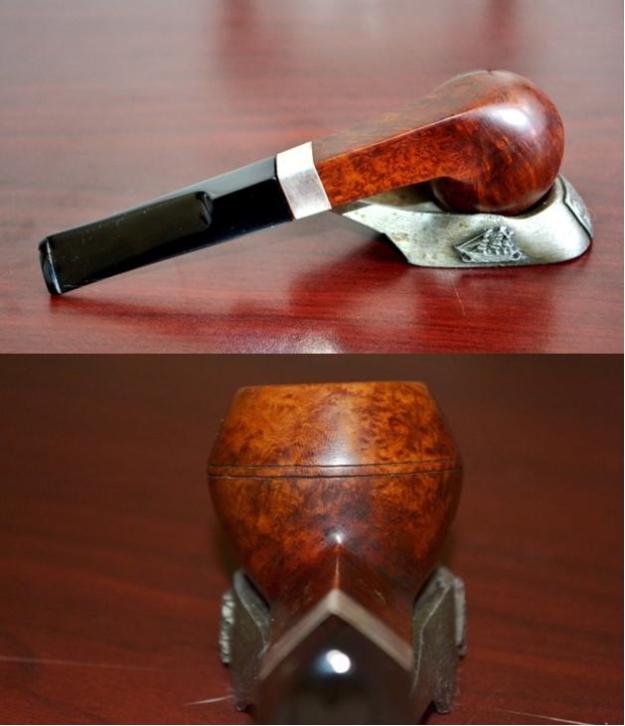
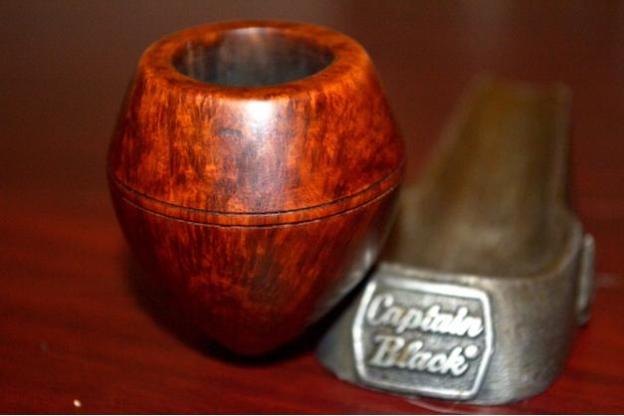
With no further ado, I am pleased to call out in a booming voice, though it be in written words, “La-dies and gen-tle-men, who are children of all ages, welcome to the greatest, most amazing, daring, thrilling and spectacular show on Earth! The circus known round the world as pipe restoration! And now…in the Center Ring…turn your eyes toward the wonderful and awe-inspiring silver-banded bulldog ! All the way from England, measuring an astonishing six inches in length and a 6/8” x 5-1/4” chamber diameter, and called the Atwood Hall of Fame Natural #5, of the world-renowned Comoy’s family!”

RESTORATION
Rob1

Rob2

Rob3

Rob4

Rob6

Rob7

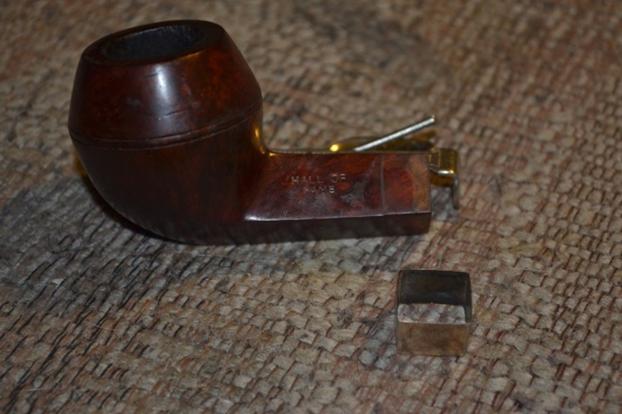
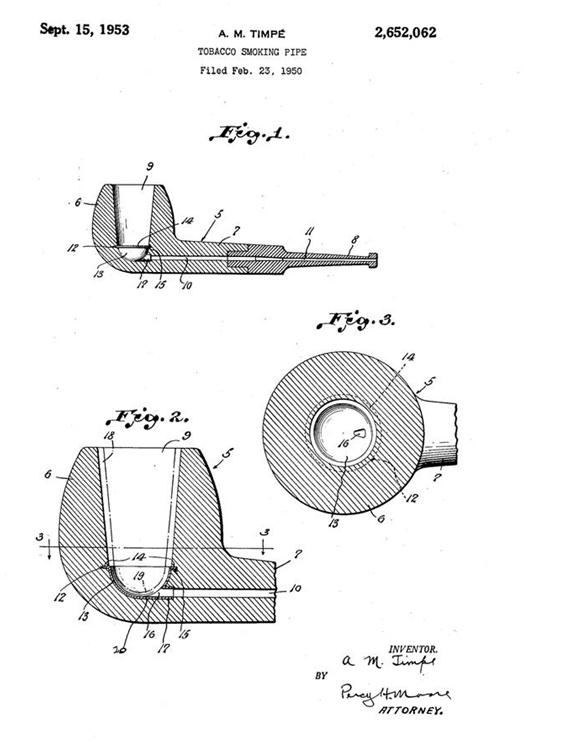
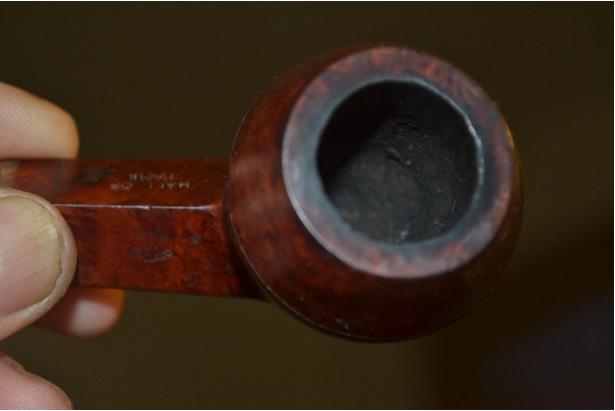
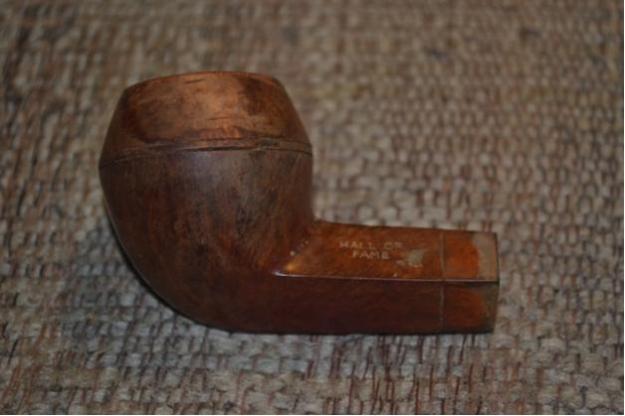
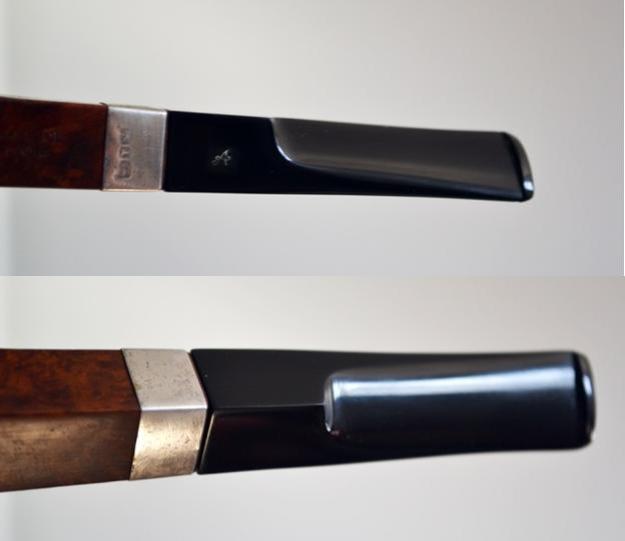
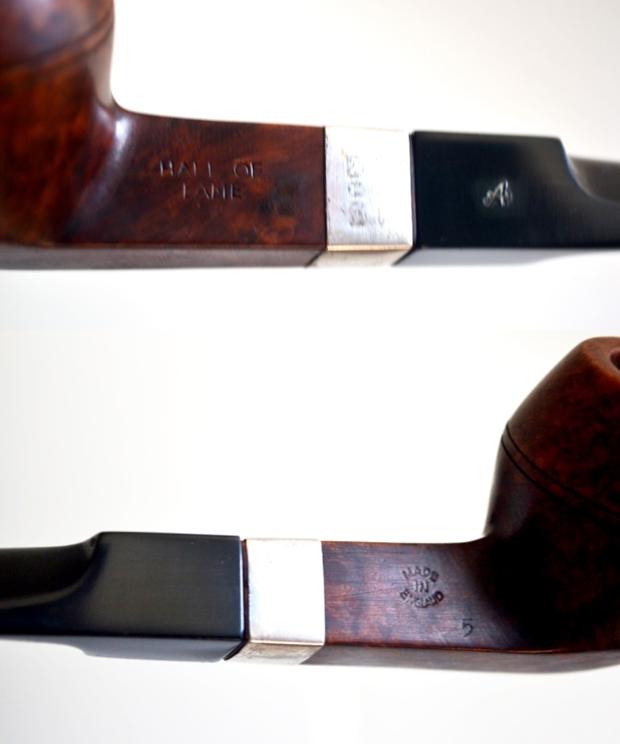
Rob8 Sixty-three years after it was made and, my intuition tells me, loved by a single owner, there are numerous signs of wear and tear. Still, scratches on almost every inch of the stummel and bit, not to mention a few outright dings, are the pith of the blemishes, not counting the almost inevitable loose sterling silver band. These flaws are negligible considering the venerable pipe’s age and obvious regularity of use. Even the band – which, given the thinness of the inherently fragile material itself, invites heavy tarnish, bending and total obliteration of any hallmarks or stampings – was almost pristine, and is once more, still showing showing the single word of its substance, STERLING, and by more careful examination three hallmarks – something I can’t make out following by a T and a 5. Here is the first page of the original (and apparently only) Atwood U.S. Patent, showing the same design of the Hall of Fame 1953 Brandy.

AtwoodAtwood pipes came with “a permanent aluminum cup at the base of the chamber, with a bore hole.” [http://www.pipephil.eu/logos/en/logo-a9.html] The cup and bore hole, after cleaning, indeed are intact.

Although, by virtue of Atwood being a Comoy’s second, I was not over-concerned with the possibility of finding fills in the wood if I were forced to strip the original polish and stain, but I nevertheless took every measure I could conceive to avoid that step. At worst, I was convinced, the reason for the oppressive stain was to hide unfortunate grain. As will be shown, this proved to be the case.

I began by removing almost all of the rim burn with concerted rubbing using 2400 and 3200 micromesh freshly cleaned by a long soak in purified water.Rob9 An unsuccessful but still incomplete attempt to fix the remaining rim burn and scratching led me to an acceptance at that point of the fact that, though I might otherwise rid the rim of the remaining char, the remaining scratches, not just on the rim but everywhere else on the stummel, were sufficient to necessitate a low enough grit of sandpaper to take it down to bare wood. Having learned that sandpapering the entire wooden surface of a pipe can and often does lead to more problems, I chose the more efficient and reparable measure of an Everclear bath.Rob10

Rob11

Rob12

Rob13

Rob14 The Everclear was a complete success in revealing that there were, indeed, no fills, but even finer scratches than even my minute examination of the briar beforehand, using a jeweler’s magnifier headset, had caused me to suspect could exist. And so I tried the superfine 0000 steel wool first, which at least took off the rest of the old artificial color and some of the less pernicious scratches. But 200-grit paper was unavoidable, in careful spot sanding, to banish the rest of the marks and pocks, followed by another soft buffing with the steel wool.Rob15

Rob16

Rob17 The next steps seemed to be an easy crank or two of a 21mm reamer in the chamber followed by 320-grit and 500-grit paper, and a retort.Rob18

Rob19

Rob20 The retort required two test tubes full of Everclear, but only because of the way the first tube-full always seems to remain in the pipe’s inner bowels after a few boils. At any rate, immediately following the retort, I ran a bristly cleaner through the bit’s air hole, which came out remarkably light, and used both ends of a fluffy pipe cleaner on the inner shank to soak up the wet residue of various accretions still in the shank. I removed the cotton ball from the chamber and swabbed it thoroughly with small white cotton gun cleaning cloths. Then I finished the chamber with a final wipe using 500 paper and more thin cotton swabs soaked in Everclear. The chamber was silky smooth.

“This pipe is clean!” I said to myself, out loud in fact, thinking of the tiny lady of “Poltergeist” fame, who sought out and did her best to dispel dead but still malicious souls.Rob21 At last, I turned my attention to the bit. It was in pretty good shape, but notice the bad scratch in the second photo below.Rob22 Every micromesh pad I have, still damp after the soaking from which I removed them some time earlier, was employed to make the bit shine again.Rob23

Rob24 The distinctive A for Atwood was perfectly ingrained and intact. I had made the rounded top of the bulldog bowl lighter than the rest of the stummel on purpose, and as the time for re-staining had come, I chose Fiebing’s Brown leather stain for the top and Lincoln Medium Brown (darker) for the rest.Rob25 Applying the Fiebing’s with care to the top, I flamed it with my Bic, then did the same to the rest of the stummel with the Lincoln.Rob26 After a short sit to cool off (both the wood and me), I gently buffed the whole surface with 3000 and 6000 micromesh.Rob27

Rob28

Rob29

Rob30

Rob31

Rob32 The final step before buffing was re-attaching the band to the shank, mindful of placing the STERLING/SILVER stamp in small letters on the upper left side, where it had been.Rob33 Oh, glorious moment! The time was nigh to retire to my office, wherein rests my electric buffers. Observing the clock on the wall, which told me it was already 2 a.m., I considered the neighbors opposite that side of the apartment and, understanding the way my building is laid out, realized they would hear nothing from their bedroom. I used the customary red and White Tripoli on the bit, with the clean buffer between each, and white Tripoli, White Diamond and carnauba on the stummel, again separating each with the clean buffer. For the band, I used a very fast turn on the clean buffer.Rob34

Rob35

Rob36

Rob37

Rob38

Rob39
SOURCES
http://www.history.com/news/10-things-you-may-not-know-about-p-t-barnum
http://www.azlyrics.com/lyrics/stevemillerband/takethemoneyandrun.html
https://en.wikipedia.org/wiki/Ringmaster_(circus)

UPCOMING RESTORES
Rob40

Rob41

Rob42Rob43Rob44

Another Brewster That Looks Better Now Than When It Was Made


Guest Blog by Robert M. Boughton
Member, International Society of Codgers
Member, North American Society of Pipe Collectors
http://www.naspc.org
http://www.roadrunnerpipesnm.biz (Coming Soon)
http://about.me/boughtonrobert
https://roadrunnerpipes.wordpress.com/2016/01/13/about-the-author/
Photos © the Author

Everything has beauty, but not everyone sees it.
― Kong Qui (Confucius), 551-479 BC, Chinese philosopher, teacher and political figure

INTRODUCTION
This Brewster Billiard arrived in one of the many pipe lots I bought online the year before last, at which time I apparently dismissed it as a common Dr. Grabow that could be put off until I had nothing better to clean or restore. Nevertheless, despite the oppressive grime and weariness that lay upon the wretched pipe like a veil of black magic – or maybe because of this gloomy aspect, as a good friend once remarked with acerbic nonchalance that I seem to be attracted to wounded things (his exact words, all the more angering because I knew he was right) – my eyes returned to it many times since it came in the mail. On every occasion except the last, a week or so ago, I made the mental Dr. G. connection and passed it by.

I’m not saying all Dr. G. pipes are worthless; I just seem to be happier when they’re not cluttering up my own collection. But the two I do own are excellent and exceptional, not counting three unusual beauties that were given to me by my friend and mentor, Chuck Richards and which I expect to sell.Brew1

Brew2

Brew3

Brew4

Brew5

Brew6 There is a good reason for all of this talk about Dr. G. pipes, which might seem to some as nothing more than pointless rambling. As I already noted, all but the last time I considered this pipe, I was so certain it was a Dr. G. that I didn’t even bother with more than a glance. Then, not more than 10 days ago, for some reason I will never understand, I picked it up and squinted at the left side of the shank to check the brand. The pipe was so filthy and sticky (remember that last word) that it might have fallen out of a pig farmer’s bib overalls and smack into the trough. It was so bad, at any rate, that I had to take it into the living room where I keep my jeweler’s magnifier headset to begin to decipher the name, which I could see began with a B. Even then some hard rubbing with a thumb was necessary to break on through to the other side.

When I at last made out the word Brewster, all that came to mind was a great old movie, “Brewster’s Millions,” from 1945. Go figure! And so, of course, I took a seat on the couch and consulted my laptop, clicking the speed dial to pipephil.eu. There, sure enough, was Brewster. Made in Italy. Unknown maker. What kind of hogwash was this? I Googled “brewster tobacco pipes” and found only a few identical references. Well, I said to myself, I’m not about to let any lack of preliminary intel stop me from making this wounded or perhaps birth defected little thing better.

Only when I was gearing up for the restoration, and happened to visit my local tobacconist, did I chance to notice a new estate pipe put out by Chuck. You guessed it: a Brewster, made in Italy. What were the odds, I wondered, laughing so loudly that the young lady behind the counter, Candice, looked at me in surprise. I explained myself.

But the real shock came a few days later, when I was nearly done with the restoration and started wondering (worrying is more like it) how I was going to write a blog about a pipe with a clear name on it of which several experts in the pipe community had heard but still had no clue who made it. Being a somewhat persistent little bugger, however, I returned to Google, this time expanding my search to “brewster tobacco smoking pipes.” I will never cease to be amazed how sometimes the computer knows exactly where I’m going with a search and even comes up with the right suggestion, and others it’s a swing and a miss. This time it was out of the ballpark.

The very first link, at the top of the page, was to – where else? BREWSTER PIPES/ REBORN PIPES, https://rebornpipes.com/tag/brewster-pipes/. To say I was beside myself is an idiom that doesn’t begin to describe my sense of amazement. As I wrote to Steve in an email, the Brewster triangle was complete. And there, in the most vindicating black and white letters I have ever read, were the words, “The thread pattern and the look of the metal fitment looked exactly like a Dr. Grabow set up.”

Anyway, the bizarre connection between Brewster and Dr. G. is so thoroughly Italian (read “Machiavellian”) that I haven’t quite processed all of it yet. But it’s all there in Steve’s blog, blow by brutal blow, and as far as I can tell, it’s a Reborn Pipes exclusive. I’m sure those who are interested in the grizzly details will follow the link above. I am not about to try to paraphrase Steve’s incredibly detailed research. All I can say is that congratulations on an investigative job worthy of Woodward and Bernstein are in order. For once I will exercise the better part of valor in not going into details that already took up pages of Steve’s blog.

I will comment that Steve’s history of the Brewster includes one hilarious section on a blunder involving a large shipment of pipes to Mastercraft which were stained but not cured with a drying agent. Hence they remained sticky to the touch for years before they were eventually “fixed.”

RESTORATION
Brew7

Brew8

Brew9

Brew10

Brew11 The first order of business, if only so that I could handle the clinging pieces of wood and Vulcanite, was to clean the outside. I did this with a couple of white cotton gun cleaner cloths and purified water, and while I was at it applied 1800 and 2400 micromesh. Wetting the micromesh pads, I was able to remove all of the char on the rim. The stummel had so many scratches and dings that I doubted the micromesh would be enough, but the immediate difference was striking.Brew12

Brew13

Brew14 Next I chose a fixed, 21mm reamer, 320-grit and 500-grit paper for the chamber, and seeing I was correct about the scratches on the stummel, I tried super fine steel wool, the same sandpaper and steel wool again to work away more of the blemishes. This was an ongoing process.Brew15

Brew16

Brew17

Brew18

Brew19

Brew20

Brew21 An OxiClean bath, for the first time in my experience, was enough to work out all of the mess inside the bit air hole, which, judging from the used, sudsy, murky water, had been somewhat bad.Brew22 I used 320 paper followed by the full gamut of micromesh on the bit, and thought I was done.Brew23 Now, I didn’t actually notice the problem at this stage, but for the sake of uniformity I’ll add it here. In fact, only after I had completed the remainder of the restoration did I notice the turn of the bit was off. Examining the tenon end of the bit, which should have been flat, I saw it had a chip that I hoped – notice I don’t say thought – I could remedy with a little sanding. Luckily I stopped that madness before it was too late. Yes, I’ve utterly destroyed a few bits in my short experience with the treacherous objects, and I’ve learned my lesson! Turning to Black Super Glue, I dabbed a little over the weak spot and let it sit overnight.Brew24 Staining the stummel with Lincoln medium brown boot stain (which is really pretty dark), I flamed it, set it aside to cool, and buffed lightly with 4000 and 6000 micromesh.Brew25

Brew26

Brew27

Brew28 The next day, with the stummel already buffed on the wheels, I had to re-do the entire bit to remove scratches left from my aborted attempt to sand down the lip, and to even out the Black Super Glue. I also heated the tenon, threw a cotton rag over it and clamped it with my grip pliers and turned. It was close, but no cigar, so I repeated the process with less force, and the bit was flush with the shank.

Well, now I looked the two pieces over and was happy with the bit, but there were still fine lines on the wood that I didn’t care for at all. And so, not liking the idea, I used 1800 micromesh to smooth it out, then had to re-buff with white Tripoli, White Diamond and carnauba, and the clean wheel between each.  That did the trick.Brew29

Brew30

Brew31

Brew32

Brew33

Brew34 CONCLUSION
The most difficult part of this task, surprisingly, was the bit, from which, after bringing it to a high shine the first time, I didn’t expect any further problems. It’s taken some time, but I’m finally getting the hang of bits. The easy part of the restore was making the sweet little billiard look better than I expect it ever did out of the factory in Italy, with everyone involved in its creation doing his best to hide the fact!

I Got the Kaywoodie-Delta Blues


Guest Blog by Robert M. Boughton
Member, International Society of Codgers
Member, North American Society of Pipe Collectors
http://www.naspc.org
http://www.roadrunnerpipesnm.biz (Coming Soon)
http://about.me/boughtonrobert
Photos © the Author

The Delta blues is a low-down, dirty shame blues. It’s a sad, big wide sound, something to make you think of people who are dead or the women who left you.
― David “Honeyboy” Edwards (1915-2011), U.S. Delta blues guitarist and singer

INTRODUCTION
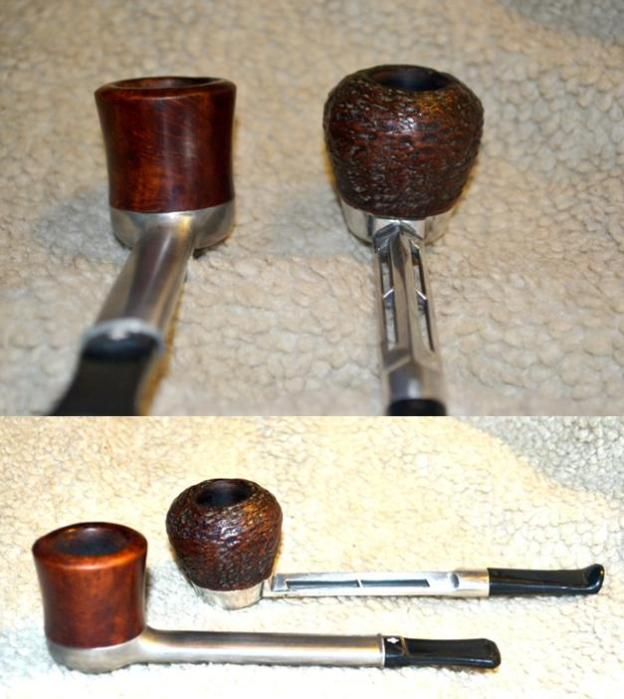
I’ve been sitting on these two nice metal pipes, different brands but modeled after the original of their kind, designed by Frederick Kirsten, a U.S. professor of electrical engineering at the University of Washington who was transferred to the aeronautics department and promptly changed the course of aviation history with the creation of the Kirsten Wind Tunnel for subsonic aerodynamic testing. He also upended the tobacco pipe industry and generally rocked the world of pipe enjoyers with his 1936 invention of a sleek aluminum radiator frame with interchangeable bowls. The patented revolution in a box was more or less a way to quit cigarettes by exercising his boundless creativity. He puffed cigars as well.

Maybe I’m just not as daring as the good professor. Whenever I find myself on the edge of pipe restoration territory I haven’t charted, I hesitate. I don’t panic or freeze in terror. I just pause to survey the terrain and get my bearings; to triangulate my coordinates, find my footing, and then one day, as if on an impulse but really because I’m good and ready, I take the next leap, with some faith.

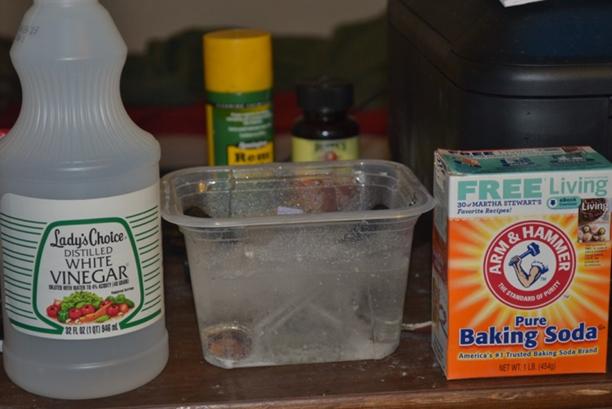
And so it was last night that I looked at the Kaywoodie Smooth Billiard and Duncan Delta Rusticated Brandy with a dental lip – again – and without thinking grabbed them. The next thing I knew, I was looking around for the implements of cleaning and restoring I might need for the combined tasks and remembered another aluminum pipe I fixed up once, an Aristocob, and how I used a solution of white vinegar and baking soda to soak the metal. Although I had bought enough of each for a lifetime when I did the Aristocob, I discovered they were lost in my latest necessarily hasty move.Delta1 The nearest Walmart would close in about a half-hour, at midnight. All of Sam Walton’s children here used to stay up round the clock, but now there are less than a handful that do, and only one within any kind of reasonable distance. They had too many problems with thievery and other shenanigans, you see, mostly through the dock doors, if you follow me. I armed myself against the natives, threw on a coat, petted my cats as they were curious about the sudden hullabaloo and hurried out the door. I was back before the witching hour.

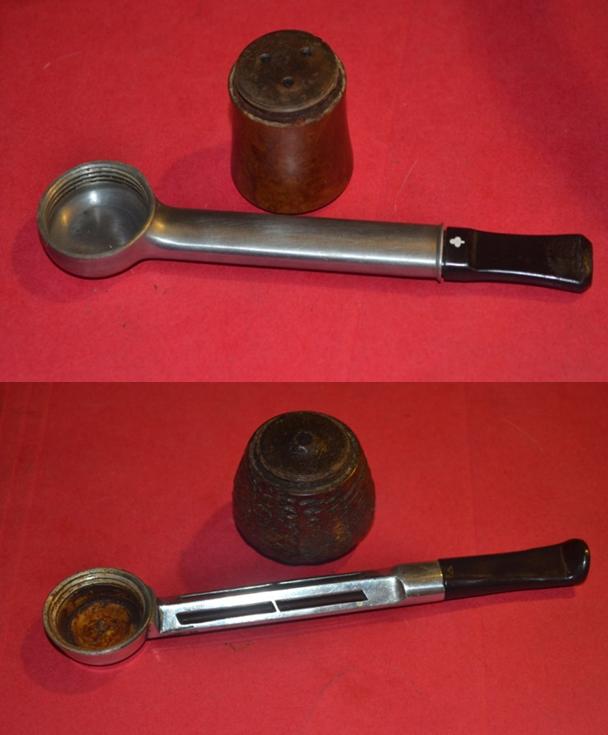
As part of the map checking I did in comforting if only perceived preparation for these restorations, I noted that the Duncan Delta, of the English metal genre, as it were, came with a non-removable bit, as did the two Falcons in my personal collection. At this point I made that greatest of mistakes: I assumed there were no exceptions to the rule.Delta2

Delta3 To be fair to myself, I showed the Kaywoodie and Duncan Delta to my friend and mentor, Chuck Richards, who is usually infallible, and asked how the bits come off for cleaning. In hindsight and an extended spirit of fairness, I’m not sure he looked all that closely at them.

“They don’t,” he said, with a certain amused grin he has. “You just have to work through them.” Or something to that effect.Delta4 Taking a seat on the couch with the supplies I would need to proceed, I had no idea what I was in for. I can’t wait to show Chuck the mind-boggling discovery I tripped over, figuratively speaking – about halfway through the restorations. To those in the audience who know the astonishing secret of a certain rare Kaywoodie metal pipe made from 1955-1959, with this particular surprise only included during the first year or so of that period, Shhhh! Don’t spoil the revelation for others when it comes, in good time.

RESTORATIONS
Delta5

Delta6

Delta7

Delta8

Delta9

Delta10

Delta11

Delta12

Delta13 I had prepared an empty macaroni salad tub, by cleaning it with scalding water and dish soap, for the vinegar-baking soda soak of the aluminum pipe bodies. It was the widest container I had but also deeper than it needed to be. Into the tub I measured about a tablespoon of baking soda, then added the vinegar and watched it fizz madly until the powder dissolved. I placed the two parts in the mix and added more vinegar until they were almost covered. Considering the possible effects on the bits, I spontaneously chose the bolder path and pushed down a little on each one until they were submerged. The bubble action was really something to see – much more active of an interaction than an OxiClean bath – but I had other things to do.Delta14 The bowls needed cleaning in the worst way, the bases in particular. The moisture from tobacco creates steam, and Kirsten’s system, which is used in metal pipes still today, traps and cools the steam in the stem. Much of the resulting very sticky, cloying gunk ends up on the bottoms of the bowls and can be cleaned in seconds by anyone who enjoys these pipes. But as Steve put it perfectly in one of his blogs on a particularly messy Generation 1 Kirsten A, I’ll just quote him: “The cleaning in seconds must not have been something that the previous owner of this pipe ever read or understood.” https://rebornpipes.com/tag/kirsten-pipes/

Taking also from this great blog the idea that metal pipes are, for the most part, sturdy things that can outlive generations of a single family of pipe enjoyers, I launched a three-pronged assault on the bottoms of the bowls alone. First I swabbed them and the rest of the bowls’ exteriors with cotton gun cleaning squares soaked with purified water; then the same with Everclear swabs, and next superfine steel wool on the bases and rims. The Delta base, being metal and somewhat pocked with corrosion, needed a little more work with sandpaper before another round of steel wool.Delta16

Delta17

Delta18

Delta19 An odd trick of sight makes the rusticated Duncan bowl, which indeed has a wider outer diameter than the smooth Kaywoodie (about 5” compared to 4-3/8), appear as if it would need a bigger reamer to clean out most of the excess cake. But the Duncan only took a 19mm fixed reamer while the Kaywoodie held a 21mm.Delta20 I smoothed the chambers with 320-grit paper followed by 200, followed by long and careful consideration of the next step. While I started restoring pipes with the habit of stripping the old finish completely, I have taken to avoiding that step for the most part on different levels of thinking, primarily two. One, I never know for sure what I’ll find beneath the finish that might have been better left uncovered, and two, I have become more purist in my approach, liking the idea of imitating the original.

Nevertheless, I concluded I just didn’t care for the light brown shade of the Kaywoodie or the dark brown of the Duncan. As the former was of U.S. origin and the latter of British make, I reasoned, that would make them cousins, as some folks on either side of the Pond refer to each other. But I wanted them to be more like brothers. Therefore, “Off with their stains!” I heard a voice cry in my head, and dunked both bottoms up into an Everclear bath, careful to leave the bases above the alcohol level.Delta21 While the 190-proof alcohol changed from clear to something else, I removed the frames from their long vinegar-baking soda soak, rinsed them thoroughly and began to “work through” the Duncan frame with pipe cleaners dipped in more Everclear, still shocked, as always, at the filth that came out. Seriously, how hard is it to run a cleaner through your pipe now and then? Are restorers the only people who do it? Deep breath; exhale. I suppose that’s a rant better left for my upcoming Encyclopedia of Pipe Trips. Still, seven bristly cleaners through the frame later, and three swabs soaked with alcohol to clean out most of the mess in the round bowl connector, not to mention having to use my wire cleaner to dig out the muck in the grooves of said connector, I thought I was finished with that part.Delta22 But now, looking at the photo above, I see it needs a little more work. I’m going to soak the connector in Everclear and scrub it some more. Give me a few minutes to make it shine better, and I’ll be right back with another picture.Delta23 There. That was easy, and I for one feel better. Plus the picture tells the whole story!

Anyway, enough time had passed to take the bowls out of the Everclear and scrub them cleaner and dry inside-out with more cotton swabs.Delta24 I used the steel wool again on both, lightly on the Kaywoodie to make it shine before heightening the effect with a micromesh progression, and vigorously to take the finish of the rusticated Duncan down still more until it was actually reddish, for which I had hoped.Delta25 Re-staining both with Lincoln Marine Cordovan (Burgundy) boot stain, I flamed them with my Bic and set them aside.Delta26 Now, at last, I near the dramatic moment I know you have all been waiting for! Is that the faint fade-in of a drum roll I hear, or an auditory hallucination? Due to my slight deviation from following the restorations of each pipe part by part – starting when I cleaned the Duncan frame and instead of moving on to the Kaywoodie, continued to the bowls – I did not learn the wonderful nature of the Kaywoodie until I attempted to work through it with bristly cleaners as I had the Duncan…

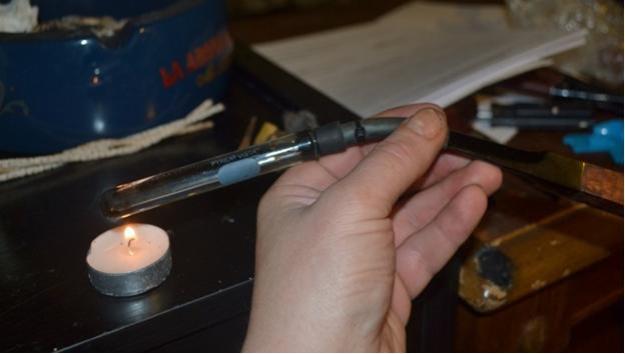
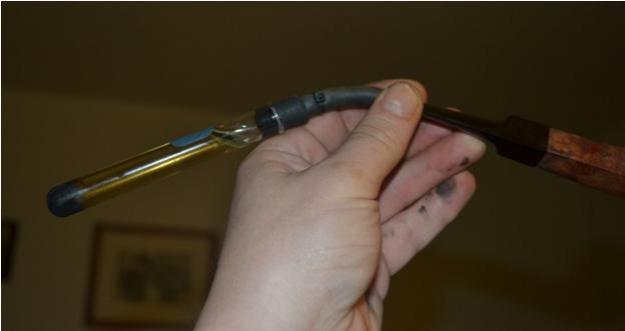
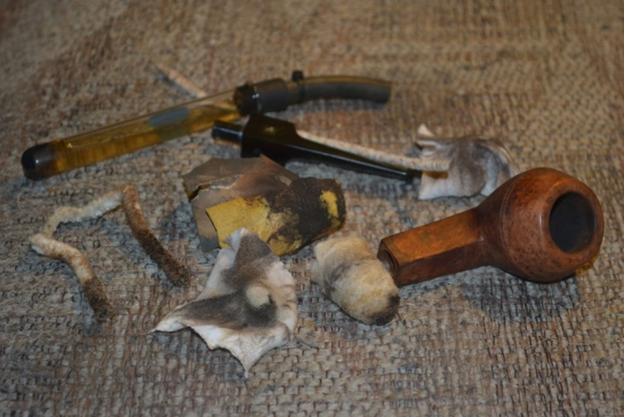
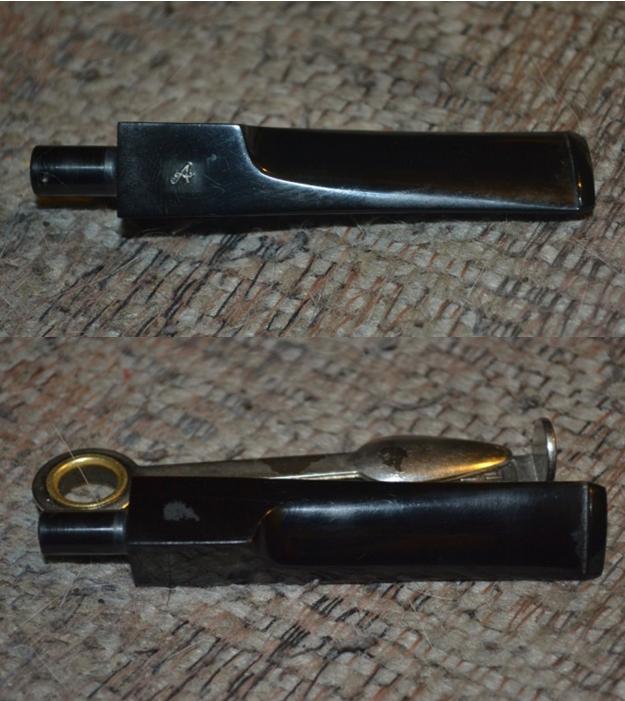
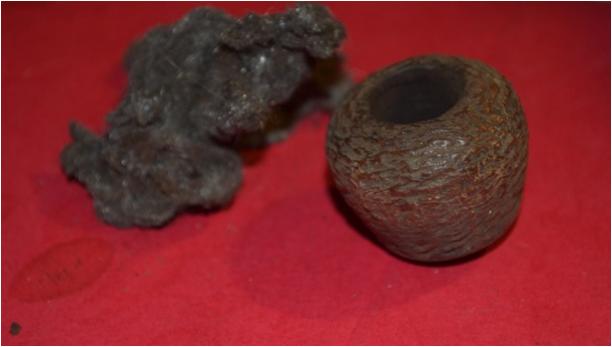
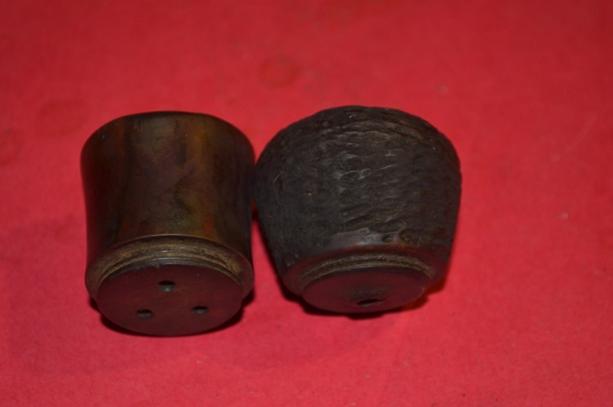
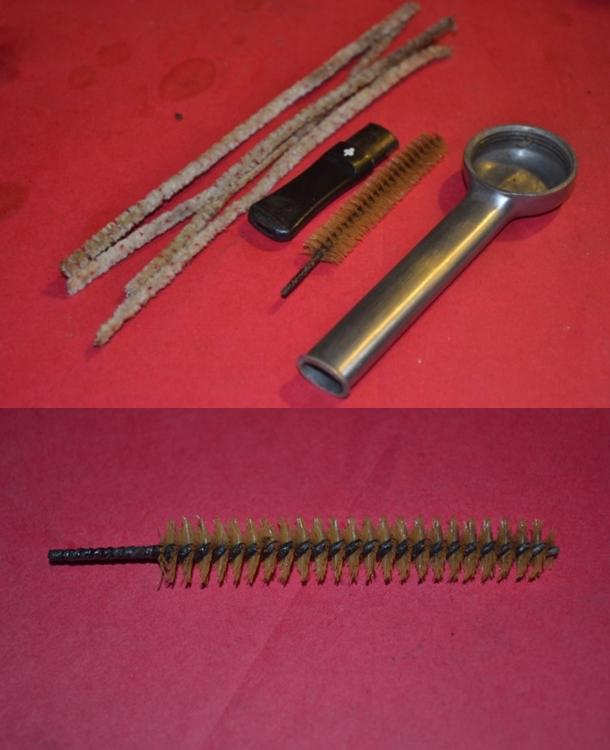
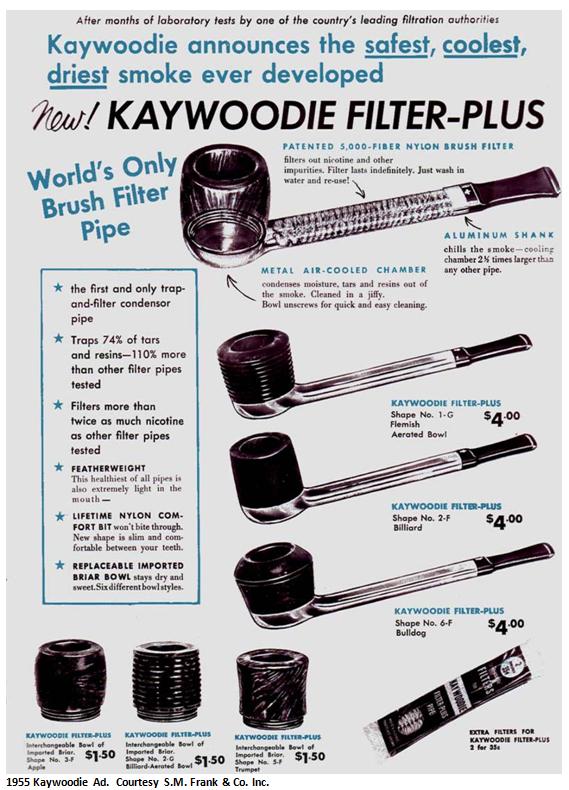
…and the whole thing came apart in my lap! There were the bit that wasn’t supposed to come off and some bizarre, vile, noxious looking thingamabob that looked like a wire brush. I picked it up with distaste and tossed the whole dark, stained mess in the leftover Everclear from stripping the bowls. I knew that would clean it up somewhat, and it did. With the brush out of the Kaywoodie frame, by the way, the metal was quite easy to clean. That should have been a clue, but my first thought was that someone had stuck the brush inside the frame as a makeshift filter. (It is truly scary how close and yet so far from the truth I can be sometimes in my denser moments.)Delta27 At least I had the sense to recognize that the resulting hole in the frame was gaping wide, and turned to pipephil.eu for help, which I found as I almost always do. It was the second metal “filter” pipe in the Kaywoodie models A-K section, the Filter Plus, made from 1955-1959. A convenient link to Smoking Metal led me to the rest of the story. http://www.smokingmetal.co.uk/pipe.php?page=133

As it turns out, the brush is not a fluke, of course, but an original Kaywoodie nylon brush filter that was only included with the pipe during the first year or so of its four-year run. The filter brush has 5,000 fibers. Now, I want y’all to think on that fer a spell. Finding a pipe with one at all, much less intact, is a miracle. It’s no wonder Bill Feuerbach, president of S.M. Frank & Co. Inc., owner of Kaywoodie, is quoted at the link above as saying of the Filter Plus, “It is one of the most indestructible and durable pipes I have ever run across.”

Check out the advertisement below from the first year the Filter Plus was made. Considering how easy it was to clean the frame of the pipe itself, despite (or because of) the dirty condition of the filter brush, it’s a shame they stopped making them. As the ad shows, the pipe cost $4, or $35.42 in today’s money. http://www.usinflationcalculator.com/. Replacement or additional bowls were $1.50 ($13.28), and two-packs of the filter brushes were 35 cents ($3.10).Delta28 Getting close to the finish line always makes my blood start to race! I buffed the two bowls with 4000 and 6000 micromesh.Delta29 Then there was the Kaywoodie bit, which was looking a little rough.Delta30 I sanded it with 200- and 320-grit paper before working my way up the micromesh trail, and moved on to putting a little Halcyon II wax on the Duncan. During a few of the 15 minutes or so it set in, I took the Kaywoodie Filter Plus billiard bowl and the bit (which indeed is removable) into my office. I buffed the bit with red and white Tripoli, then White Diamond, using the clean wheel between each; then the bowl with white Tripoli, White Diamond and a good coat of carnauba, again using the clean wheel in between.

Really only ten minutes more passed, at most, as I sat back on my couch, screwing the Kaywoodie bowl in and out of the frame threads and wiping it down, over and over, because it seemed like the minute hand on the clock was stuck there to spite me! Maybe that’s because I kept eyeballing it. But the time did pass, and I carried the Duncan bowl into the office for a quick spin on the clean wheel only. That was my reward for being so patient and all.Delta31

Delta32

Delta33 CONCLUSION
Well. Now that it’s all said and done, all I really have to add is that this pair of restorations was just plain fun. And full of surprises. And I learned a few new things I never imagined, too, and can’t wait to show Chuck!

ADDITIONAL SOURCE
https://www.reddit.com/r/PipeTobacco/comments/3a5hf9/info_on_falcon_pipe_markings/ Info on FD18 stamp

Pipe Tripping


Guest Trip by Robert M. Boughton
Member, International Society of Codgers
Member, North American Society of Pipe Collectors
http://www.naspc.org
http://roadrunnerpipes.biz (Coming Soon!)
http://about.me/boughtonrobert

‘Curiouser and curiouser!’ cried Alice (she was so much surprised, that for the moment she quite forgot how to speak good English); ‘now I’m opening out like the largest telescope that ever was! Good-bye, feet!’ (for when she looked down at her feet, they seemed to be almost out of sight, they were getting so far off). ‘Oh, my poor little feet, I wonder who will put on your shoes and stockings, for you now, dears? I’m sure I shan’t be able! I shall be a great deal too far off to trouble myself about you: you must manage the best way you can; –but I must be kind to them,’ thought Alice, ‘or perhaps they won’t walk the way I want to go! Let me see: I’ll give them a new pair of boots every Christmas.’ — From “Alice’s Adventures in Wonderland,” Ch. 2 (1865), by Charles Lutwidge Dodgson under the pseudonym Lewis Carroll [1832-1898], English mathematician, noted photographer, essayist, poet and novelist

FOREWORD
Pipe1The origination of tobacco in the Americas and Australia is not as common knowledge as, say, that Columbus didn’t actually discover America, but then, there are stranger facts associated with the leafy plant’s history. Certain forms of tobacco were – and likely still are – used in the spiritual practices of various native populations to produce reactions that, by newer and more close-minded cultures, are called hallucinogenic. While there is no evidence to support the idea, and I am not suggesting a serious connection, Lewis Carroll (as the brilliant author will always be remembered) could have been under the influence of tobacco hallucinogens when he wrote the above masterpiece and its sequel.

To be fair and clear, however, Carroll’s unique composition style was the result of the Universal Impetus Theory (UIT) for all great literary innovators: having a gift as an ingenious raconteur able to choose and order his words in a precise, inimitable form, and the good fortune of living in the right time. Carroll also had an unparalleled knack for the creation and blending of words. Of course, the fact that he was a good friend of the British lexicologist Henry George Liddell, after whose daughter the timeless Carroll classic was named – and at whose insistence he committed his oral tales to paper, leading to its publication – no doubt played a part in the use of combined and nonce-words (those created for the moment, or nonsensical) and complex sentence structure by the mathematician turned writer. Coining the word galumph, for example, which means “to bound or move clumsily or noisily” (OED), Carroll blended gallop and triumphant. His works still thrill children and adults alike.

Pipe2Consider this. Without Carroll, we would not have fantastic, imaginative and endearing verbs, adjectives and nouns such as galumph as well as chortle, frabjous, mimsy, vorpal, snark and, last but not least, jabberwocky. The colloquial term snarky, for irritable or short-tempered, was adapted by Edith Nesbit, in her 1906 novel “Railway Children,” from the name of a variety of disconcerting creatures introduced to the world in Carroll’s poem, “The Hunting of the Snark.” As a hopeful point of interest, my spellchecker recognized chortle, galumph and jabberwocky, so accepted in the English lexicon they have grown. And as I added the rest to my Word dictionary, should I ever have occasion to use them again, they will appear without the annoying red, squiggly underlines. What’s more, thanks to the periodic transmission of these additions to Microsoft, where they will undergo due consideration by vorpal, slithy folk whose job it is to determine their worthiness, perhaps someday the perspiration-coated toilers over such heady decisions will make it possible for Carroll’s now-real words never to trouble other users of the magical expressions.

Now, lately I’ve been thinking about pipes and tobacco in a different frame of mind. Those who know me best seem to agree that my arguably Byzantine cognitive processes can be scary or even stupefying, if not downright dangerous, depending on the attention level of the person listening to or reading my discourses. Nevertheless, these commentaries often made off-the-cuff and on diverse topics, when joining a conversation, tend to come together with certain cogency, the suddenness of which is a bit like the epiphanic ending of a Faulkner novel.

At any rate, my musings of late, at least in my own mind, have produced some unusual notions, some of which have even made me laugh out loud. That’s LOL, for those young enough to have been raised in the Cyber Age and have forgotten what the three letters even abbreviate. These ponderings, reflections or reveries, or whatever else anyone might choose to label them, up to and including absurdities and/or deliriums, grew curiouser and curiouser the further I allowed them to metastasize within my psyche, and have now reached the point where I am compelled to share them, for better or worse.

RANDOM PIPE TRIPS TO CONSIDER
In the beginning, as far as pipe tobacco goes, there was a peculiar plant of the genus Nicotiana, from the nightshade family, called N. tabacum. The simple fact that our revered tobacco derives from Deadly Nightshade – or belladonna , the black berries of which are frightful in their toxicity – should be enough to give pause to all of us who, with regularity, take such special pains to pack our pipes just so with the stuff, so that it might burn all the longer and thoroughly. But of course this knowledge, even if acquired by some readers who just now digested the previous sentence, will have no such effect.

PIPE TRIP #1
Let’s start this silly exercise with an image, stemming from the relationship, however distant, of tobacco to Deadly Nightshade, and which appeals to my admittedly perverse, at times, sense of humor. Conceive, if you can, how many hapless, hungry and heedless berry-pickers perished from eating the wild belladonna back in the day when people didn’t know better than to pluck such frabjous-looking things without care and pop them into their mouths; or, if the victim of eating the fruit of the somewhat drab green and weed-like flora were spared death and merely rendered howling mad, attempt to visualize the resulting hallucinations that are so vivid the sufferer has no grasp of reality whatsoever. Whichever outcome presents, it is just because of the berries appearing so plump and pretty and sweet, and impulsive human nature.

Then the kicker: one day, someone came along and experienced the brainstorm to toss the berries aside and turn the unattractive green leafs into something that could much more safely be ingested by somehow cultivating, processing and at last chopping up into suitable pieces for placing in a crude bowl with a similar stem (perhaps in the botanical sense) for the purpose of igniting and inhaling them.Pipe3The worst part of this opening cogitation is the rare but continuing incidences of accidental poisoning from these lovely though heartless elements of nature. Take, for example, the case of a very large American (naturally). He measures 6’ 3” in height and 220 pounds in width. Wandering through the wilds of Germany late this very year, he spies the shiny, luscious appearing fruit on a plant he mistakes for elder berries. He gobbles 20-30 of them despite their semi-sweetness with bitterness from the seeds, and not feeling quite himself, promptly decides to take a nap right there in the woods. His sleep is frequently interrupted by a nagging need to urinate, which is difficult because nothing seems to want to come out except small, forced amounts of clear liquid with a strange blue tint which the tourist has just enough sense left to be unsure if it might not be a hallucination.

After giving up the nap idea, his mouth becomes dry and his throat sore. Then his vision goes blurry, and he decides it’s time to see his doctor, who happens to notice the patient’s pupils are dilated to the max and unresponsive to any safe and sane stimuli. The physician thinks it best for the man to be taken to the hospital. During the ensuing drive, the hallucinations commence. A single hedgehog appears as thousands, and deer are kangaroos. The poor fellow arrives at the hospital a mere four to five hours after scarfing down so many of the marvelous berries, and all the hospital staff can do is observe him – intensely – for several days that seem like an eternity to the man.

The situation rapidly escalates to seeming insanity filled with hideous, terrifying visions and other misperceptions of reality, like a singularly bad LSD trip, prompting a transfer to the psych unit. This is just the beginning of the trip down the rabbit hole, but at last he does begin to get better. As soon as he is able to comprehend the words, he is told how lucky he is to be so large, as anyone smaller would surely have died. Recovering even now, the man still is not his old self again.

You see, this is a true story, and not in the sense of the often misleading tags at the beginnings of movies. Heaven knows I didn’t make it up! I strongly suggest reading the full account at http://www.thepoisongarden.co.uk/blog2/blog281115.htm for a jolly good first-hand account of the ordeal.

PIPE TRIP #2
The interior of the bowl of a pipe, where we cram or methodically place the tobacco, is called the chamber, yet one never seems to hear a pipe smoker refer to settling down in his easy chair to enjoy a good chamber of whatever blend has been chosen for the occasion to contemplate life. Could this habit derive from the alternate definition of chamber as a room, as in a chamber of horrors? Or might it be a subconscious aversion to a comparison of the pipe’s chamber to the part of a gun that renders the weapon armed or not? I mean, think of it! What merry piper would want to sit in a dreadful chamber or put a chambered gun in his mouth? Just food for thought, nothing more.

PIPE TRIP #3
The bit is almost universally referred to as the stem. What in the name of all that’s holy is the problem with calling the thing by its proper name? Honestly, I want to know when and where this convention began, and who started the confusion! Yes, I want nothing less than the time, location and name of the guilty party.

Heaven help us if this ruddy awful vacillation stems (pun intended) from some sorry fellow’s fear of comparing the bit of his pipe to the past tense form of bite, all for the day when he was a wee little tyke and a dog bit him, which seminal event has bitten (past participle) his worldview forever.

Then again, maybe the dither is about Man’s eternal fear of karmic payback, in this case for the long, shameful practice of abusing others of God’s finer creations, such as horses, in place of his own back-breaking labor, by placing metal bits in the sad creatures’ mouths and then whipping them onward to finish tilling the fields we humans might just have had to work a bit harder to accomplish ourselves.

I ask, what’s the point of the evasion in the first place? After all, our worldwide band of brothers and sisters, in pursuit of the pleasures and comforts of a nice, relaxing smoke, seem to have no qualms referring to the often sharp but excellent bite of a bit of a strong mixture of a VaPer or other coarser, non-aromatic blend that can become an acquired taste and lead, at worst, to a case of Tobacco Acquisition Disorder (T.A.D.).

PIPE TRIP #4
While that last note is fresh in the mind, I’ll leap at the opportunity to address the use of the word disorder in T.A.D. and its mates, Pipe Acquisition Disorder (P.A.D.) and Accessory Acquisition Disorder (AAD). Who on Earth dreamed up these ostensible maladies? Surely nobody accredited within the medical community! My guess is some lone pipe smoker with Obsessive-Compulsive Disorder (OCD), a genuine and serious and hardly uncommon psychological irregularity that can easily lead to an overspending problem, started the whole thing, and others jumped on the old bandwagon and added the others. I can just see all of them waking up with cold sweats in the middle of the night who-knows-when with the realization that, once again, they’d gone and spent their entire grocery budgets along with half the rent on one of the three categories of pipe expenditures described above.

What’s more, I’ll bet each and every one of them reached for his ever-handy Merck Manual to self-diagnose himself so he could tell his local candy doctor just what pill he needed to overcome the dread “disorder.” My gosh, the measures people will take to get a new drug! Why, it’s scary even to contemplate. I thank the stars I’m not that bad off, you know I do! I mean, sure, I’ve been late with the rent or cable bundle bill, or paying for my cell phone – maybe, on rare occasions, all three – but I swear I do not have any kind of disorder! Well, other than Attention Deficit Disorder (A.D.D.) and Post-Traumatic Stress Disorder (PTSD), not to mention chronic migraines and – oh, yes – agoraphobia. But those trifles are all under strict control, and you may take my word on that to the bank!

PIPE TRIP #5
Last but not least is the odd practice of the average piper, who will speak in calm, even tones of smoking his pipes – with utter disregard for all of the expression’s negative connotations. After all, where there is smoke, there is fire. Picture yourself in any of Dante Allighieri’s infernal nine circles of Hell on Earth leading, with fervent thirst, for ultimate eternal salvation. Do we really want to go there? Let’s not. Dante already did the great favor of doing so for us! Just say no, as Nancy Reagan did to drugs. Instead, join me in the somewhat troublesome practice, I admit, of enjoying a pipe. I picked up this routine after reading an excellent essay last year concerning positive methods of writing and speaking of the multi-faceted pleasures associated with tobacco pipes, by a member of the North American Society of Pipe Collectors in its magazine (they insist on calling it a newsletter ), “The Pipe Collector.”

Seriously, if I can do it, you can, even if in our hearts we are thinking of Lady Mary Wroth’s 1621 controversial and groundbreaking literary work, “The Countess of Montgomery’s Urania,” and one line from it: “Those loose and wicked enjoyings which we coveted.”

AFTERWORD
This little exercise in writing is at best an essay, and at worst a work of fiction, lest anyone who failed to grasp my attempts at satire walk away from the experience with the notion that I might in any way have been serious.

I welcome, more than usual, any responses with contributions of other examples of pipe trips (or, for that matter, alternative critical thoughts), with the hope of someday compiling an Encyclopedia of Pipe Trips.

My Courtship of a Comoy’s Pebble Grain Panel Brandy


Guest Blog by Robert M. Boughton
Member, International Society of Codgers
Member, North American Society of Pipe Collectors
http://www.naspc.org
http://www.roadrunnerpipes.biz (Coming soon)
http://about.me/boughtonrobert
Photos © the Author

For there are moments in life, when the heart is so full of emotion,
That if by chance it be shaken, or into its depths like a pebble
Drops some careless word, it overflows, and its secret,
Spilt on the ground like water, can never be gathered together.

― From “Priscilla” in The Courtship of Miles Standish (1858), by Henry Wadsworth Longfellow (1807-1882), U.S. poet and author

INTRODUCTION
I suppose I should consider myself fortunate to have had many such moments in life as Longfellow described, and can only hope to be blessed with frequent more, yet when each occurs, the awareness never fails to strike like a suffering pleasure. Call me a sentimentalist, or a romanticist as were the poets who influenced Longfellow, or make of it what you will.

Several years ago, when I first began buying up numerous fine examples of restored pipes by my friend and mentor, Chuck Richards, I fell in love with the beautiful Comoy’s Pebble Grain Panel featured in this exercise in refurbishing. As I might as well admit at this point, my reaction to the coloring and fine pebbles adorning the panels and the unusual shapeliness of the pipe itself was as the great American poet described. Many other works of art created for the enjoyment of pipe tobacco, some of which I have had the pleasure of acquiring and quite a few more remaining on my wish list, affected my sensibilities (in the philosophical sense) in a similar manner.

Still, the persistence of my attraction to this singular pipe has never lessened. Perhaps this reaction was a result of the fact that, in a moment of largess, I promised the special pipe to a friend who prefers cigars but was interested in taking up the fairer form of smoking – and on frequent occasions since then, I have been able to appreciate its allure, albeit in the hands of another man.

With that chemistry in mind, I have on a few occasions, with permission from my friend of course, again held the full-figured darling in my own appreciative embrace to ensure that she has been given the care and respect deserved. I am happy to report that the lovely creature has received excellent if frequent attention.

That said, and recognizing that when I first cleaned the Comoy’s a few years back for my friend, Mike Brasel, I knew even less about restoration and refurbishing than I do now, I knew I could make the lovely pipe better than when I gave it away. If anyone detects a touch of regret in those last words, it is only because… well, it’s the truth! There. I got that confession out of the way. I also had taken no photos of the pebble grain before I turned it over to the care of Mike, and concluded that one easy way to correct that mistake was to get it back in my hands long enough to give the pipe a little needed cleaning. Machiavellian? Somewhat. Sneaky? Definitely. Regrets? None.

My primary solace for the loss of the pebble grain is two-fold: other than getting to see it on a regular basis, I can observe its regular upkeep. I knew Mike was in the good habit of running bristly cleaners through it but had no idea he must do so after every smoke until I at last was able to convince Mike to entrust me with the Comoy’s a few days ago. He actually paid me for a sweet, vintage Kaywoodie Signet bent smooth billiard I restored about a year ago (my first experience cleaning a pipe properly with a retort). I believe it dates to the 1960s if not a little earlier. Mike therefore had a substitute to use in the other pipe’s absence.

The reason I chose the Comoy’s for Mike in the first place was his comment that he had been unable to find a big, thick, sturdy enough pipe that would never overheat at a price he could afford. I knew the pebble grain would be perfect for his needs and fit his personality at the same time. But based on his standards for appreciating the thick-skinned Comoy’s, I was surprised and more than a little concerned when he picked the Kaywoodie from my restores available for sale. Nevertheless, while enjoying his first bowl of McClellands 2015 Christmas Cheer in his new Signet, Mike told me it smokes great and is easier to control without holding. The photo below was snapped just as he was about to remove it from his mouth.

Mike trying out his Kaywoodie the first time

Mike trying out his Kaywoodie the first time

Mike’s new pipe

Mike’s new pipe


REFURBISH
Comoys3

Comoys4

Comoys5

Comoys6

Comoys7

Comoys8

Comoys9 AN ASIDE
I see Mike at our local tobacconist almost every time I’m there, and for the most part he smokes the cigars he still loves. On occasion, I’ll even buy one and light it up myself. It’s true, I enjoy a good candela on special occasions, in particular when I can get my hands on a genuine Havana, which is a treat I have savored only five times: twice on trips to visit my mother when she lived in Cozumel, Mexico; once with another onto which I slipped a Nicaraguan band and smuggled back to the States (although the Customs agents at the border picked it right out from the little humidor box I handed them, which otherwise had legal varieties, and smiled at each other before letting me get away with my attempt at subterfuge); again with a gift from a former co-worker in grocery store deli merchandising, this one being, I was certain, a fake – until I held it and noted the unique paleness and skin-like suppleness of the green wrapper, and the last that I bought from a friend in England who was a true gentleman to mail to me along with three more I purchased for Mike and a couple of other cigar aficionados I know. All of the Cubans I’ve smoked required hours to finish and left me with an almost illicitly pleasant, light-headed giddiness.

BACK TO THE REFURBISH
And so I was somewhat amazed to see from tell-tale signs on the Comoy’s that it had been used far more often than I suspected. The rim, of course, was the first hint, blackened as it was. Then there were the slight dents on both sides of the top of the shank, visible in the third photo above, and some minor scratches on the rest of the wood. However, the most revealing symptoms of frequent use were the general grime on the outer briar and the lip end of the bit. I also discovered, without even removing the bit from the shank, that the thin brass band that had been connected to the bit had come loose.Comoys10

Comoys11

Comoys12 That was a repair I never had to ponder before. Tossing the bit into an OxiClean solution for a nice long soak, I decided to tackle the rim first. I was able to remove the majority of the charring safely with superfine steel wool before shifting to micromesh, using 1800, 2400 and 3200. The rim as shown in the last shot below, I knew, was not finished, but more about that later, in its order.Comoys13

Comoys14

Comoys15 Removing the bit from the OxiClean wash, I rinsed it and with haste, while it was still wet, started micro-meshing, from 1500-12000. There was no need for sandpaper, other than the narrow edge around the tenon where the thin brass band still needed to be replaced. To eliminate the residue of the original adhesive, I made fast work of it with 150-grit paper followed by 320, then micro-meshed all the way through my pack of pads. Not having to sand any of the regular surface of the bit was such an extremely rare event that I was truly struck by Mike’s high degree of care for the Comoy’s. Here is the band before I cleaned it up easily with my steel wool, and after I reattached it with a small amount of Super Glue.Comoys16

Comoys17 Less than a minute’s more work with the steel wool made the tenon opening like new.

I considered the bowl and shank and how to clean them. Six small, thin cotton squares, used two-ply and wetted with purified water, took off much of the dirt with serious scrubbing both vertically and horizontally to get around the pebbles as thoroughly as possible, but that was not enough. With the wood wet, I returned to the three micromesh pads and made more progress, but the task called for something else. After serious consideration, I opted to go all-out with a couple more two-plies using Everclear, again rubbing both directions. At last I found the exact lighter shade I sought.

At this point, I finished the rim, using 320-grit paper with two of the gentlest swipes possible, one around the top and the other covering the rounded inside where it borders with the beginning of the actual chamber. I finished that step with the same micromesh progression as before.

While I still had the 320-grit paper and micromesh pads out, I saw no reason not to tackle the two dings in the shank and the sundry scratches. Again, most of these blemishes were mended with the micromesh. Almost all of the very slight imperfections remaining came off with light, focused application of the 320-grit followed by – you probably guessed – the same three micromesh pads. With an uncommon sense of caution, given that this pipe already belonged to my friend Mike – someone I had reason to suspect I never want to see really mad – I settled for the results I had achieved, except for a quick turn or two of 150-grit paper followed by 320-grit on some excess cake buildup in the chamber, and to clean out the loose soot from the sanding, a wipe with another cotton cloth piece wet with purified water.Comoys18

Comoys19

Comoys20

Comoys21

Comoys22

Comoys23 I only needed a few seconds to consider a retort and dismiss the notion, realizing it would remove too much of the cake that I had promised Mike I would not ruin. But I did dip a bristly cleaner in Everclear and ran it through the shank, turning it briskly as I did so, and saw it came out filthy. After using a dry cleaner that brought out more grime, I repeated the process, still finding some unnecessary old smoke, tobacco and other accreted matter. The third cleaner soaked with Everclear was almost white.

I left the shank as it then was and proceeded to the bit’s air hole, at which point I was amazed to find that one alcohol-soaked cleaner came back with minimal blackness. One more dry cleaner paved the way for another dipped in Everclear, which was clean, ending that step.

The hard parts of the job complete, the time came to open my jar of Halcyon II wax and dip a finger in for a dab of the stuff. The single dab was enough to coat the bowl and shank until they shone with a wet brightness and set it aside for about 15 minutes while it soaked into the smooth rim, bottom of the bowl and shank, and every crevice of the pebbled area.

When I could stand the wait no longer, I carried the two pieces of the pipe into the spare bedroom of my new apartment that I will use as an office/shop when it is furnished. Of course, I had already set up my buffers on their sturdy stand and had only to plug them in for the first time in that setting. I buffed the bit with red Tripoli, white Tripoli and White Diamond, using the clean cloth wheel after each, and wiped it down with a big soft cotton cloth. Setting it aside and taking a deep breath, exhaling slowly, I stuck my left index finger in the chamber and, with complete calm and a firm grip on the precious briar, buffed the Halcyon II on the clean wheel. Rubbing it down with the cotton cloth, I concluded a final run with the carnauba wheel and then the clean buffer was in order.

Studying every angle of the briar while I rubbed it with the cloth, I was a tad disappointed that the waxing and buffing process had made it almost as dark as it started. I had wanted to finish with a lighter shade of wood and a high sheen of wax, but decided against another coat of Halcyon II.Comoys24

Comoys25

Comoys26

Comoys27

Comoys28

Comoys29

Comoys30 CONCLUSION
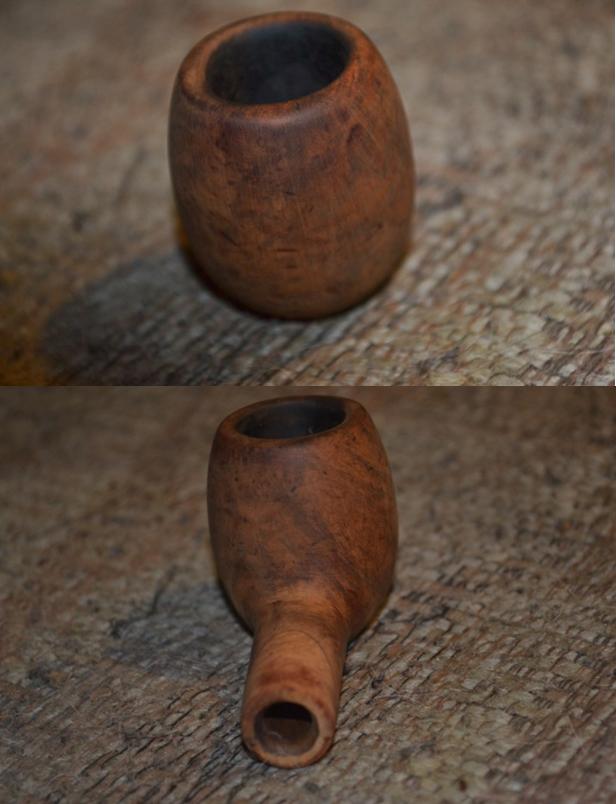
A few words about why the first three photos of the finished Comoy’s Pebble Grain have a different background: when I went to the tobacconist to see if Mike was there, he wasn’t, and I sat down to enjoy a bowl while I took the pipe out for what I thought would be a final quick exam. I was horrified to see what appeared to be bad blemishes on the right side of the bit and shank, and on the top and bottom of the bit. Fortunately, I had my cotton cloth with me and discovered that the problems were only smudges of excess wax. And so I wrapped the rag around the entire pipe and gently turned it round and round for five minutes or so, while I puffed away at one of the tobacco samples on hand.

When I at last stopped rubbing the pipe, I handled the pipe as I would if I were checking out a new purchase, and found no more smudges. Relieved, I wiped it quickly one last time before taking the pictures of the first three angles again.

Knowing I couldn’t take it home with me, I put it back in the leather pouch I included for Mike, so that he could carry it with him with added protection, and left the Comoy’s of which I remain so fond with Chuck at the counter.Comoys31 Cheers, then, old gal.

An Admitted Relative Beginner’s Utterly Subjective Review of Pipes


Guest Blog by Robert M. Boughton
Member, International Society of Codgers
Member, North American Society of Pipe Collectors
http://www.naspc.org
http://www.roadrunnerpipes.com
http://about.me/boughtonrobert
Photos © the Author

CRITIC: n. A person who boasts himself hard to please because nobody tries to please him. ― From “The Devil’s Dictionary” (compiled 1881-1906), by Ambrose Bierce (1842-1913), U.S. printer’s devil, Union soldier [private-first lieutenant], Civil War hero, Federal Treasury agent and other low-pay money transport jobs, newspaper-magazine columnist, short story writer, fabulist, satirist, heavy drinker, brawler, daredevil

OPENING REMARKS
In a word, Ambrose Bierce was a gun-toting card, in the sense of a character, one-of-a-kind, clever or audacious; or, as one might say nowadays, a sociopath. I suspect Bierce would have approved of the latter term, and he is one cultural/historical figure I would like to meet if I could somehow arrange an interview – although, given his mercurial proclivities, I doubt I would want the rendezvous to occur in the region of the Hereafter where he might very well find himself. Besides, Bierce almost certainly would consider me too daring (“one of the most conspicuous qualities of a man in security,” meaning safety) for his tastes, wherever he is now.

Neither Bierce’s definition of critic, nor the long-standing common misconception that to criticize necessarily implies a negative bent, applies to this humble attempt to categorize my own personal favorites from among some of the pipe brands I have tried and collected. Call this a critique, then, to clarify my well-intended endeavor to review, based on my experiences, limited lists of brands in general and individual pipes.

I will be the first to admit the present list is somewhat meager, in particular considering my impossible dream of someday acquiring every pipe suggested to me by a wildly out of control case of Pipe Acquisition Disorder. In fact, I am already certain I will, maybe sooner than later, look back on this patently subjective exercise with the shiver of self-censure usually reserved for old drafts of literary attempts.

Then again, I’ve never been one to retreat from a challenge, even when I’m the one to throw down the gauntlet. Therefore, do not be surprised to find your own choices way out of order, so to speak, if not missing altogether. There are countless brands and styles I want to try, many of which are difficult to find outside of the high three-digit or even into the four and five figure price range. To those in that rarefied category of collecting, I can only say, more power to you, and may you enjoy your prizes for many years to come. I will provide more on a few of these hopeful future acquisitions later.

Which brings me to my next point: the origins of some of the pipes I have appreciated most, and indeed have come to cherish more as time passes, have proved to be untraceable, despite my concerted and ongoing efforts. A few – dare I say it? – can only be categorized as no-names. In other words (as I often find myself counseling clear newcomers to the thrilling world of pipe enjoyment, online at my own restored pipe sales business or even at my local tobacconist when opportunity knocks), the price tag is irrelevant.

STANDARDS OF REVIEW
My simple standards of review, by necessity, will rely on the following qualities.

• Is the pipe well-engineered? This refers not only to the alignment of the bit’s smoke channel, through the shank’s mortise and draught hole and ending flush with the bottom of the chamber; it includes construction elements such as materials used, bowl thickness, design and various factors effecting the ability to enjoy a good, thorough smoke without overheating, and the attendant tobacco performance issues of that problem.
• Does the pipe reflect my own sense of identity? Only a few times since I first smoked a pipe in 1989, when I was a non-traditional undergrad at New Mexico State University, have I been told by a fellow local club member that a particular pipe “looks good on me.” Now, there’s an interesting misnomer! I try not to end up wearing a pipe, though I have dropped more than a few with red-hot ashes in my lap and even scorched a shirt or two when a loose bit ran amok. One of these appreciated comments, as I recall, concerned a BBB Special Make 1982 Christmas Pipe, and another referred to a Peterson’s Sherlock Holmes Baskerville. Based on those two, I have to assume that a sturdier bent briar pipe looks good on me. But the fact is that most of the pipes I go back to over and over are straight, but I have to say the above complimented members of my growing collection are among my favorites, which vary in shape and from briar to meerschaum and other materials.
• Is the pipe comfortable in my mouth and hand?

I think that about covers that, although in no vital order.

FAVORITES BY BRAND – IN A SORT OF ORDER
Again, I feel a need to qualify this list as being based on the sheer numbers and relatively consistent qualities of the products made by these crafters. There are, to be sure, exceptions. Each brand is followed by its country or countries of origin and/or various manufacturing, and the year or approximation of establishment.

1. SAVINELLI (IT, 1876): Call it luck or what you may, but as Will Rogers suggested, I have never met a pipe created by this legendary maker that I didn’t like. That is to say, every Savinelli I ever smoked performed with excellence in engineering and taste.

2. PETERSON (IE, 1865): First Kapp Brothers, then Kapp & Peterson and finally its present incarnation, Peterson pipes by any name are almost tied with the second largest part of my collection, the other being meerschaums that I can’t include as a brand but would if there were any way I could rationalize doing so. I am quite fortunate to have chosen my Petersons well over the years from estate pipes restored by my good friend and mentor, Chuck Richards, as well as some used collector’s editions I bought from other restorer friends. Of course, there are also those I bought on eBay and cleaned up myself, and some choice new models pre-checked for perfect engineering by Chuck. The results have almost always been top-notch, despite the fact that each year when the time rolls around to examine all 120 or so pipes supplied to our tobacconist by its Peterson supplier for the annual Christmas sale, Chuck returns a surprising number. Some of these, he says, are defects in drilling; others are from the wear and tear of salesmen’s car trunks. Either way, the lesson I’ve learned is to check out pipes carefully whenever possible before paying.
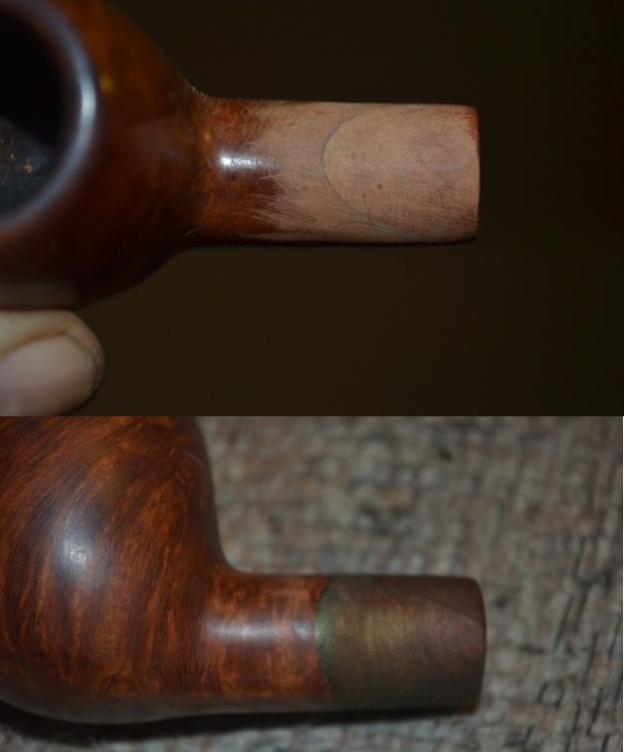
3. KAUFMAN BROTHERS & BONDY (US, 1851): Creator of the Kaywoodie line in 1919 and Yello-Bole in 1932, KB&B has been an innovator of premier pipes for almost 165 years.
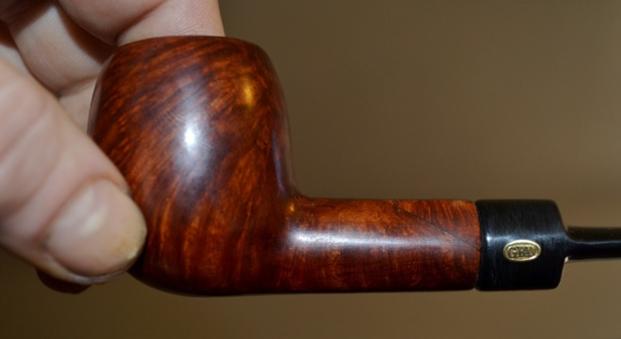
4. KAYWOODIE (US, 1919): From a 1930s Super Grain Lovat to some beautiful meerschaums, Kaywoodie has never disappointed me.

5. BUTZ-CHOQUIN (FR, 1858): While aware of fluctuations in quality throughout the history of BC, I have found none that isn’t an excellent example of everything a pipe should be, including a huge gourd calabash church with cork lining in the chamber and an exquisite meerschaum bowl insert. I concede that one is high-maintenance as far as cleaning is concerned.

6. BEN WADE (UK, 1800s, DK, c. 1989): What can I say? I just love Ben Wades, again choosing with care. My absolute favorites of these are a Town & Country Bent Dublin with a Barling Cross gold band accidentally placed on it in the factory, and a gorgeous Preben Holm Danish freehand made on the sly for Ben Wade.

7. STANWELL (DK, 1942): Whenever I look at these or find one in my rotation – the bamboo shank cherry wood, the Kyringe No. 1 beech wood Bulldog Commemorative or the Billiard #88 with tortoise shell ferrule, for example – I can’t imagine the collection I’ve cobbled together so far without them.

8. COMOY and CHAPUIS-COMOY (UK, 1825 and 1925, respectively): Say what you will about some of these pipes, I have yet to experience problems, not even with the splendid orange pebbled London made Panel I have often regretted gifting to a friend.

9. DUNHILL (UK, c. 1902-1907): Undoubtedly one of the greatest if at times inconsistent brands

10. GBD (UK, 1850): Named for three gentlemen who designed the original (Ganneval, Bondier and Donninger), GBD was begun by Chapuis-Comoy. This is a very popular brand, and from my dabbling with it I understand.

11. KARL ERIK (DK, 1965-1966): In my opinion, this is one of the most under-rated lines of mostly free-hands. Maybe now that he passed on, they will come to be admired more.

12. ROPP (FR, 1890): I happen to be an unabashed fan of the natural cherry wood line of Ropps (the thicker the bowl, the better – all of which smoke cool and are versatile with tobaccos. I also adore my old Eug. Ropp Signature that was one of my best restorations.

13. FALCON (metal – US, 1936, UK): I doubt I will meet much resistance with this brand, other perhaps than its placement on my list! Since Kenley Bugg invented this metal system pipe in the U.S. in 1936, it has sold tens of millions worldwide, not counting the spin-offs.
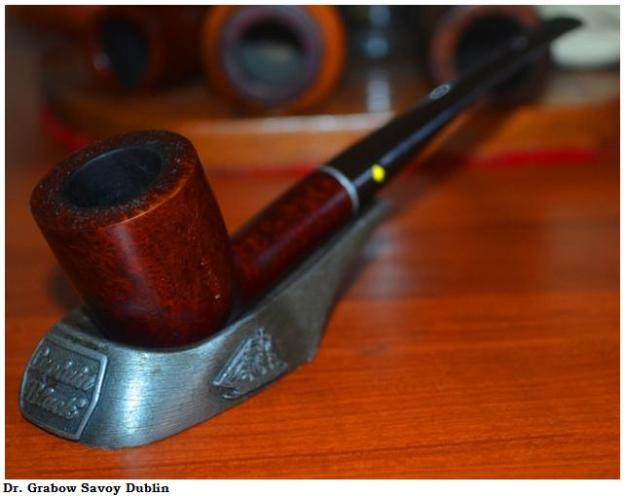
14. BEST BRITISH BRIAR (UK, 1847): Anything with three initials – BBB, LHS, KB&B – seem to fly off of my virtual sales shelves, and I can appreciate the reasons.

15. L&H STERN (US, 1911): Founded in NYC, this venerable pipe maker moved to a permanent Brooklyn factory in 1925 until it dissolved in 1960, and is still regarded as one of the best. I have to agree.
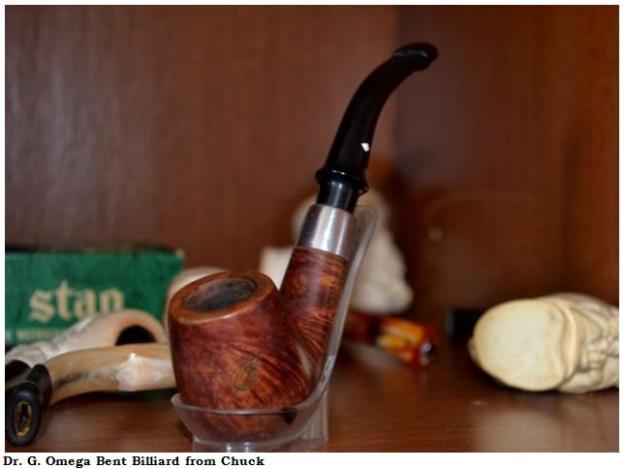
16. JOBEY (US, FR, DK, UK): This name may not be a smoker’s household word, but I’ve had good luck with them…and they sell well, too.

17. EHRLICH (US), 1868: Another lesser-known brand, Ehrlich makes great pipes with consistent quality. The company closed in its centennial year, 1968.

18. PARKER (UK, 1926): Dunhill seconds, these pipes may actually be more consistent than their famed creator.

19. RIMKUS PIPES (US, c. 2007): I know Victor Rimkus from my local pipe club in Albuquerque, New Mexico and have purchased four pipes from him (three of them early works and the fourth a commissioned double-chamber). Victor, being a perfectionist who constantly hones his innate talent crafting blocks of briar into works of art enhanced by his long experience as an engineer, discredits his earlier efforts at pipe making, but I can attest that even they are among the finest pipes I have ever smoked. He fashions everything, the wood and bits, by hand, employing tasteful additions including turquoise, bamboo and varied ferrule materials. The grain of his natural pipes is exquisite, and his finish work makes the final products stunning. Shapes include traditional, unique and variations on the two. One of Victor’s engineering standards allows for the ability to insert a cleaner with ease all of the way through the assembled pipe, from the hole in the lip of the bit and always ending up flush with the bottom of the chamber. The only reason I add Rimkus Pipes to the end of my favorites list is that they remain relatively unknown to the pipe world as a whole, although he is well-known at all of the major pipe shows and to discerning collectors of American pipes. But the fact remains they are among the very best. http://rimkuspipes.com/index.html. By the way, Victor’s son, Nathan, following his own path, also makes exquisite pipes. I’m still hoping he will craft a double-bowl pipe for me and presently have first right of refusal when he decides to take me up on the commission offer! http://www.nwrpipes.com/index.html.

20. Don Warren Pipes (US, ?): Another Albuquerque master and friend from our club, Don’s original website notes that his pipes – briar, cherry, morta, hickory, maple, pecan, oak and walnut – are designed in the Danish freehand tradition, but really, many of them transcend that description. Unfortunately, I only own one of Don’s works (which he calls a Fine Figured Maple Gilpin), and look forward to buying many more of his unique and finely-engineered works. Other Don Warren products include bowls for Kirsten metal pipes. For basic information, see his old site at http://dwpipes.com/index.html. He now sells at https://www.etsy.com/shop/DonWarrenPipes, http://stores.ebay.com/dwpipes/_i.html?_dmd=1&_sid=122905250&_sop=10 and http://donwarrenpipes.com/html/pipes_4_sale.html.

Oh, I can hear the uproar, grumbling and outright scoffing starting now. Look at all the missing giants! And what kind of order is this, in the name of all that’s holy! I can only ask by way of defense that the reader give me time. I’ll get there, and hopefully make updates as I progress! Also, after the top four, I found it very difficult to assign a number to most of these brands. Don’t get me wrong. I love and enjoy each and every one of the pipes I own, including my five Dunhills, four of which are especially prized if only for the sentimental value associated with the genuine old codger who gifted them to me. But mine do tend to smoke a bit hot.

SIDEBAR
Larry – as I will refer to my Dunhill benefactor due to his desire to keep professional details of his life separate from personal web information such as this – at age 91 chose, with great sadness but the better part of valor, to give up the pipe instead of the ghost just after his cardiologist threw a conniption fit when he found out my good friend had taken up his pipes again despite a genuine predisposition for heart disease. Larry (see https://rebornpipes.com/2014/09/16/ponderings-on-an-almost-lost-generation-of-pipe-smokers-with-a-restoration-thrown-in-robert-m-boughton/) experienced his first taste of the briar social elixir, as in “the quintessence or soul of a thing” [OED], when he was 18 and FDR was president. That’s a boggling idea for most of us to wrap our minds around, even those who know what FDR stands for.

I called Larry on Friday to see how he is doing, and he was as spry and full of good humor as ever. I told him I was getting constant questions about him and that everyone missed his warm personality and wonderful humor. He quipped, “You miss me for my wisdom!” and offered to drop by that night’s pipe meeting, as an emeritus (my word). Larry’s 92nd birthday was the next Monday, November 30, and I greatly admire his eventful, fascinating life so far. Sadly, we were the only two people there other than Candace, who was on duty, but we had a very pleasant chat with much humor. When Larry promised to return a week later, I knew I could count on him, and again look forward to the event.

I received the four lovely Dunhills, wrapped tightly in a plain brown paper bag, waiting for me at the tobacconist almost a year ago when I arrived for the regular weekly meeting and learned that Larry would no longer be able to attend. I procrastinated a serious attempt to date them until this writing, but never forgot the clear facial indications of shocked awe on those in my pipe club who know pipes far better than I, as they examined them when I passed the quartet around the large group. More telling was the general agreement that I should consider selling them! My eyes actually watered up at the mere notion of such a betrayal, not to mention the unending sense of guilt and loss I would experience. That is the despicable sort of habit I fell into before I began to recover from alcoholism coming up on 28 years ago.

At any rate, taking advantage of my private audience with Larry this Friday past, I asked if he had any idea how old they were. He told me three were from the 1970s, and one from the ’30s.

As was true with this blog, when I write I tend to make mental notes to return to parts that need additions. And so when I inserted the photos below with the models’ basic descriptions, I determined to date them no matter what it took. At last finding a reliable way to accomplish the task on my own, I used the two-digit year code usually found just to the right of the D in ENGLAND, or after the Patent Number. http://www.pipephil.eu/logos/en/dunhill/cledat-en1.html.
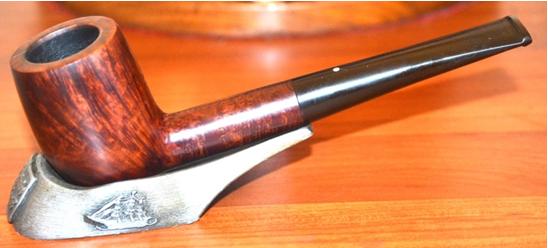
A Dunhill Inner Tube, 1912, Courtesy of Pipephil.eu

A Dunhill Inner Tube, 1912, Courtesy of Pipephil.eu

As it turned out, I tentatively guessed the pipe made in the 1930s but was flabbergasted by my full findings. I just emailed Larry my discovery.
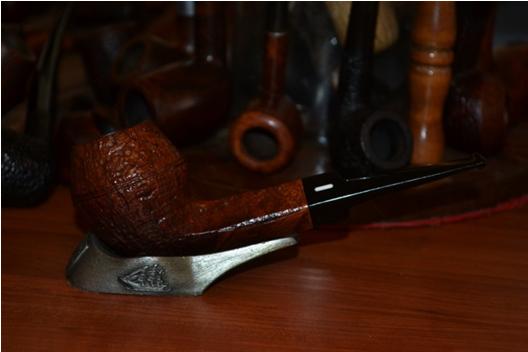
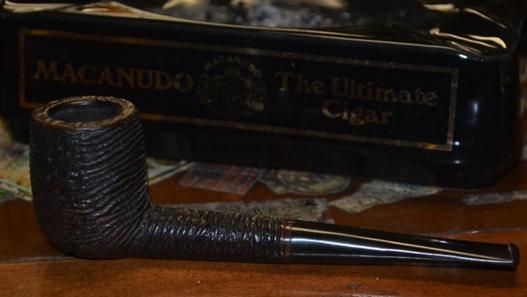
Root Briar #433 – 1916

Root Briar #433 – 1916

Shell Briar #114 – 1917

Shell Briar #114 – 1917

Bruyere #4103 – 1925

Bruyere #4103 – 1925

Shell Briar Canadian #34 – 1934

Shell Briar Canadian #34 – 1934

As I already clarified, I value these Dunhills above almost all of my other pipes, and with more virtuous motivations than their extreme age and potential resale value. I would never consider parting with them because of how they came to me. Still, as they are my only experiences with the Dunhill brand and all seem to smoke on a notably hot side, I have to be practical and as unbiased as possible in my judgment – which perception a little voice in my ear whispers is most liable to change with more exercise of my P.A.D. Still, #9 isn’t shoddy!

INDIVIDUAL FAVORITES
For those who enjoyed my favorite brands list, the subjectivity of this part should come as a real treat. (That’s semi-facetious!) However, on the plus side is that a far greater number of pipes, brands, shapes and materials will be represented, and by the very nature of that variety, the potential for redeeming the very possible negative perception of my judgment will be decided. And so, for better or worse, here they are.

1. Cavicchi 4C Silver Band Freehand (IT)rob6
2. Castello Old Antiquari KKKK (IT)rob7
3. Sasieni Four-Dot Rustic (IT)rob8
4. Savinelli Autograph Grade 4 Rusticated Bottom (Restore) (IT)rob9
5. Savinelli deluxe Milano Panel #515KS (Restore) (IT)rob10
6. CANO A. OZGENER (CAO) Silver Band Lattice Meerschaum (US)rob11
7. Barling Special Make 1982 Christmas Pipe (UK)rob12
8. Butz-Choquin Meer Insert Gourd Calabash Church (FR)rob13
9. BC Regence Extra Curved Billiard (FR)rob14
10. Ben Wade Town & Country Dublin with Gold Barling Cross Band (UK)rob15
11. BW Preben Holm Danish Freehand (DK)rob16
12. Comoy’s Satin Matte (Restore) (UK)rob17
13. GBD Super Q Bent #9456 (UK)Rob18
14. Kaywoodie Vintage Small Meer Billiard (Restore) (US)rob19
15. Rusticated Red/Brown Meerschaumrob20
16. The Doodler (Restore) (US)rob21
17. No-Name Italian German Folk Wine Pipe (Restore) (IT)rob22
18. La Grande Bruyere Vintage Mini (CZ)
My first restore before:rob23
After:rob24
19. No-Name “The Beak” (Restore) (IT)rob25
20. Peterson Sherlock Holmes Baskerville (Restore) (IE)rob26
21. Stanwell Kyringe Beech Wood Bulldog #1 Commemorative (DK)rob27
22. V. Rimkus Double Chamber (US)rob28
23. Sjoborg Danish Panel (Restore) (DK)rob29
24. WDC Wellington Custom Deluxe Pot (Restore) (US)rob30
25. Lepeltier Glazed Ceramic (US)rob31
26. Jobey Rustic Apple (Restore) (US)rob32
27. Johs Semi-Rustic Danish Billiard (DK)rob33
28. Dr. Grabow WWII Era Birch Dublin (US)rob34
29. Kaywoodie Super Grain 1930s Lovat (Restore) (US)rob35
30. Ser Jacopo Maxima Delecta Fatta a Mano (IT)rob36
31. Stefano FX Bean Pot (IT)rob37
32. Royal Goedwagen Ceramic Billiard (Restore) (NE)rob38
33. Don Warren Fine Figured Maple Gilpin (US)rob39
34. Playboy African Meer (Restore) (UK?)rob40
35. Falcon, c. 1930s-1940s (US)rob41

WHEN I’M RICHER
These are a few of the more expensive pipes on my wish-list. The two Russian pipes shown had no price, but the styles and quality usually have four-digit tags.

1. Buddha Bamboo Shank Pipe – Doctor’s Pipes (RU)add1

2. Evgeniy Looshin Pipe (RU)add2

3. Dunhill Christmas Pipe 2015 Kit — $2,150Add3

CLOSING REMARKS
I could go on and on with photos of my favorite individual pipes, but I think I demonstrated that my tastes are at least eclectic if not fully satisfied. With hope, they never will be.