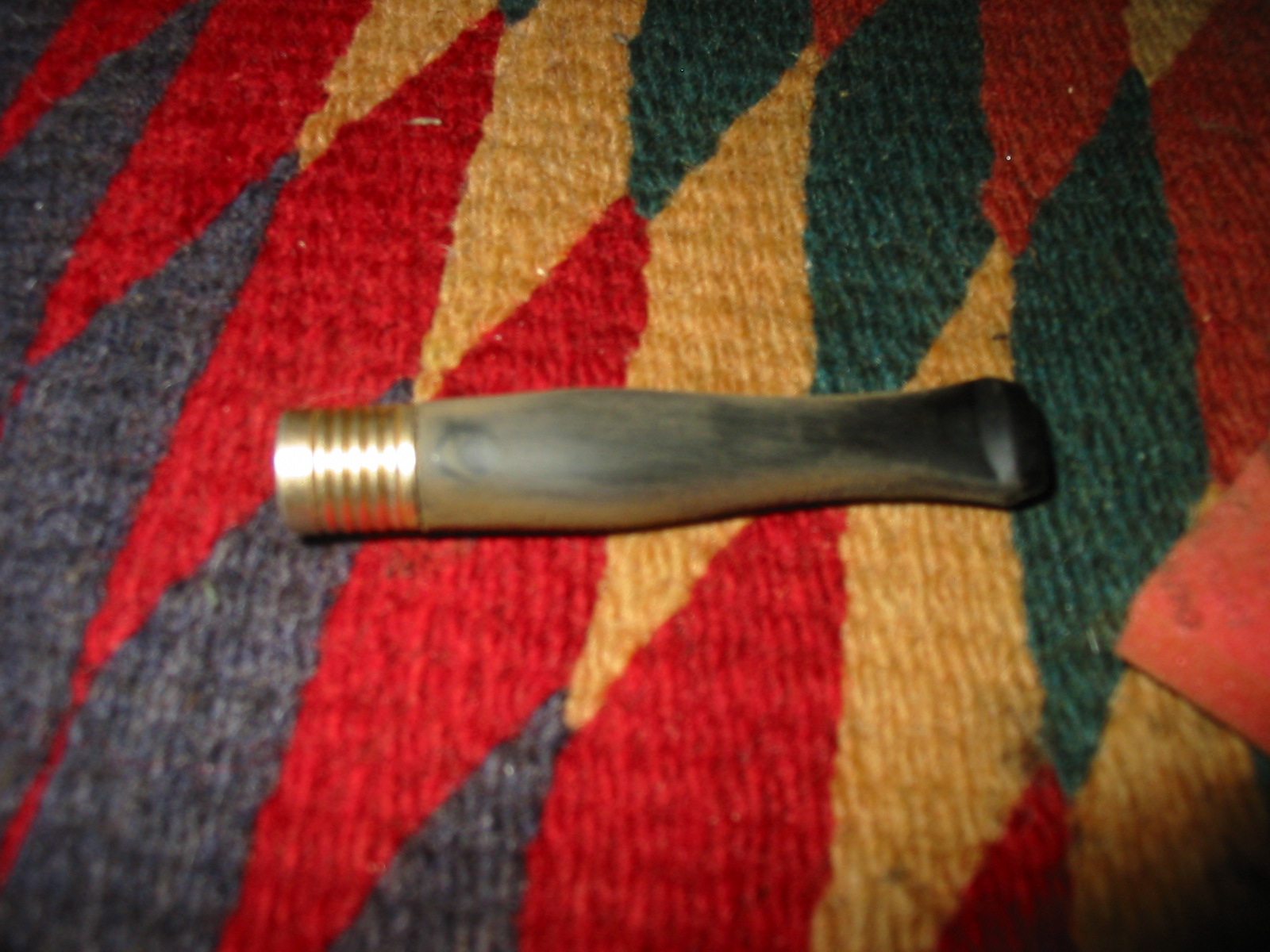
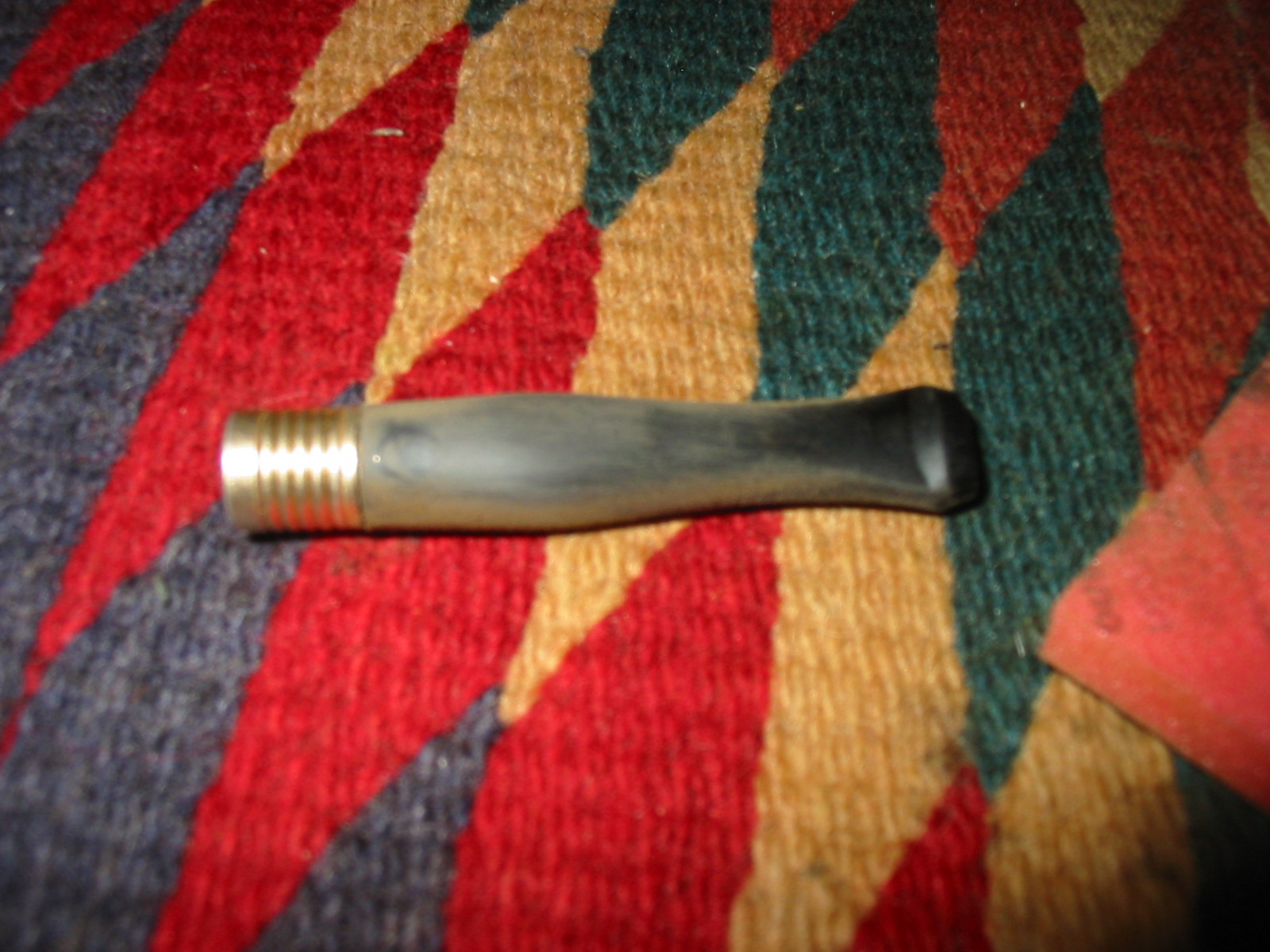
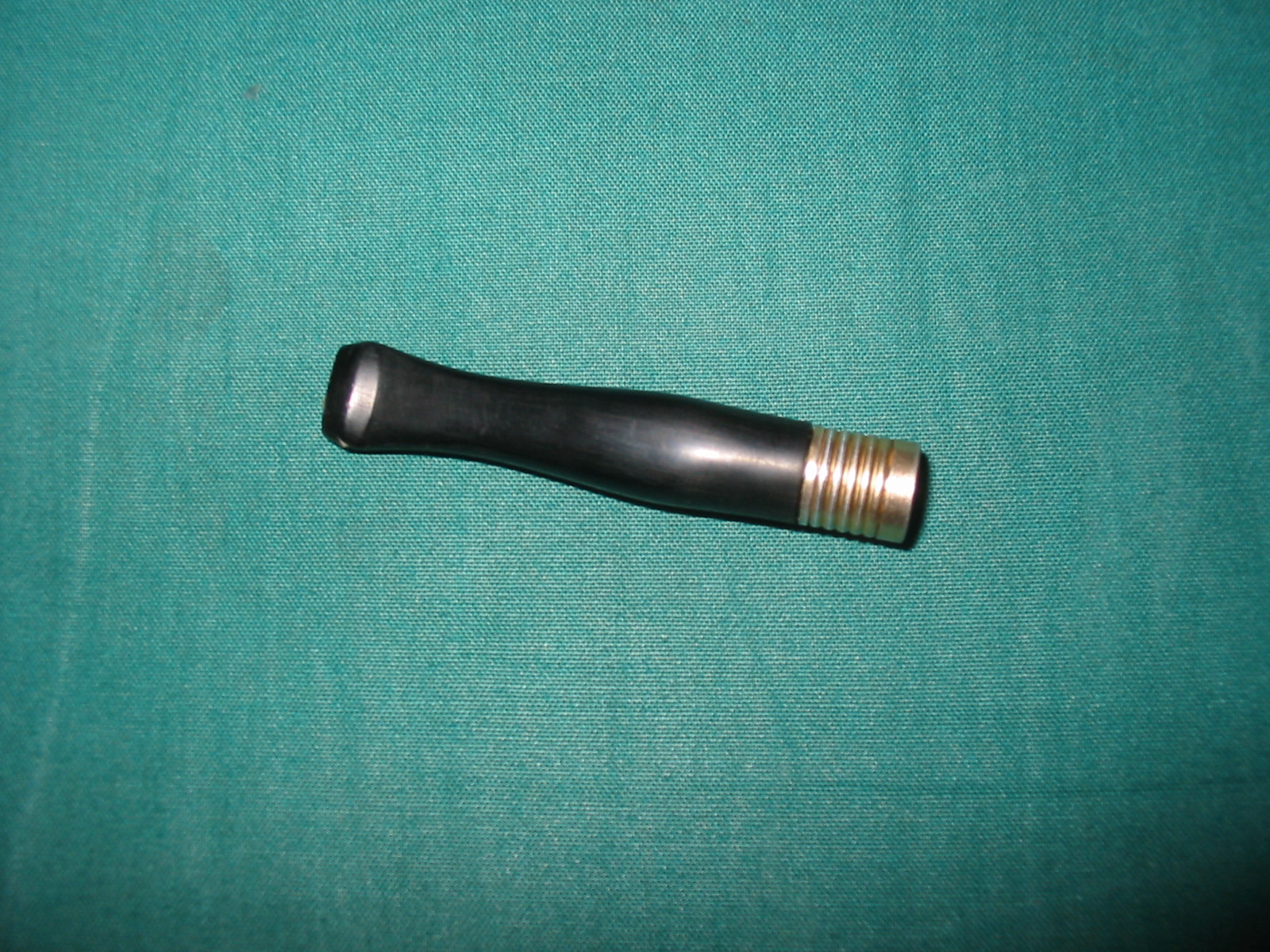
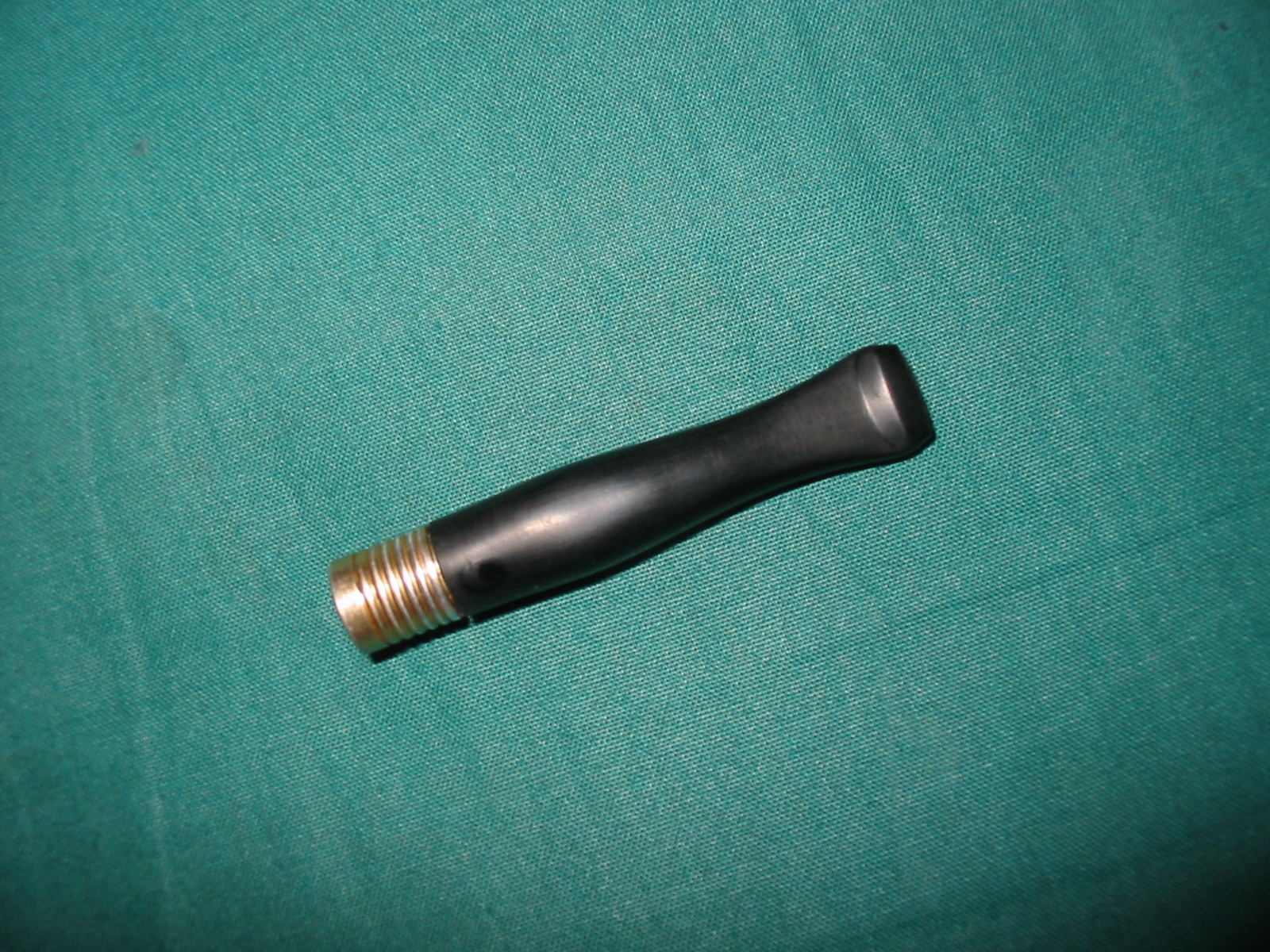
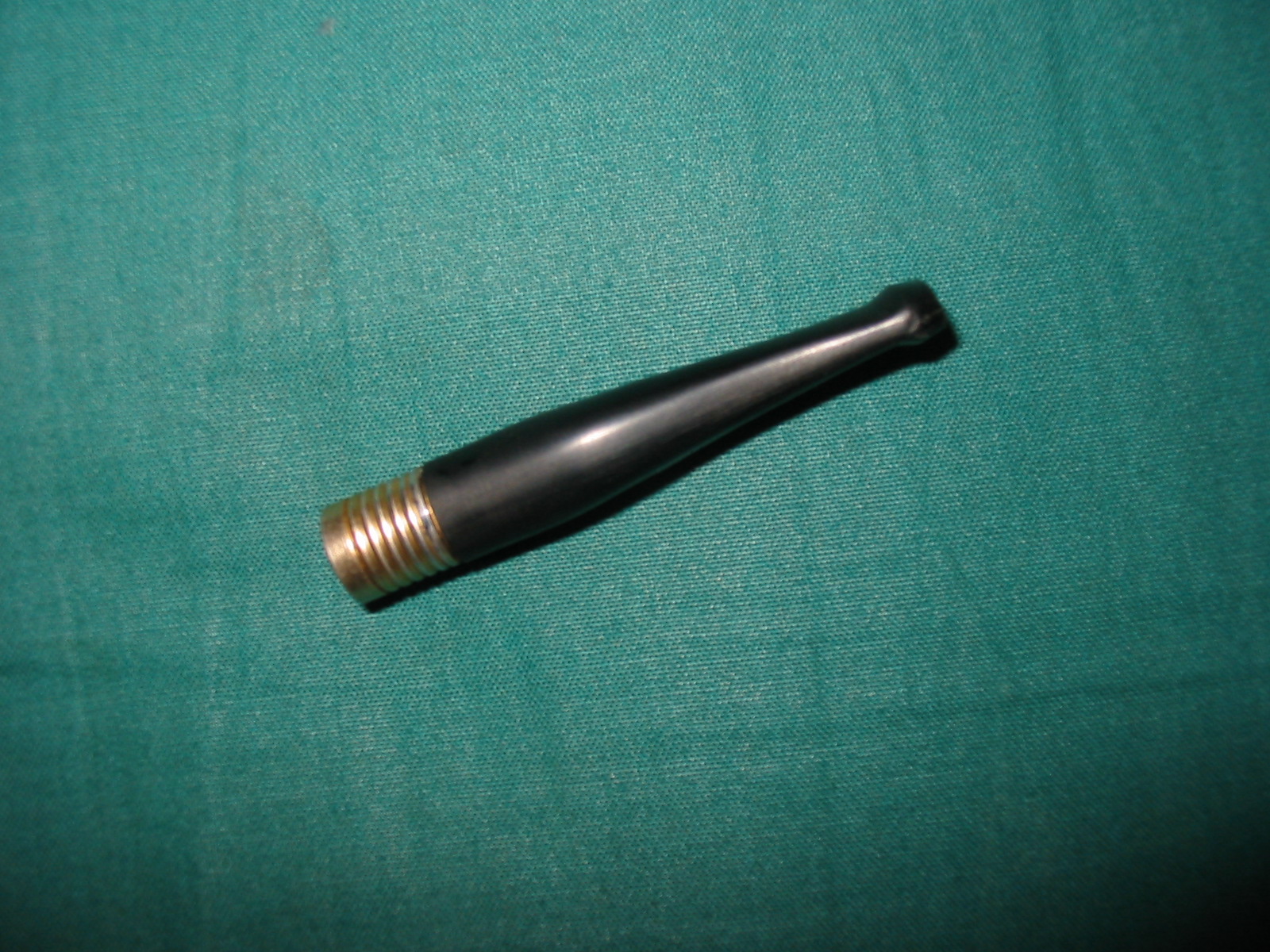
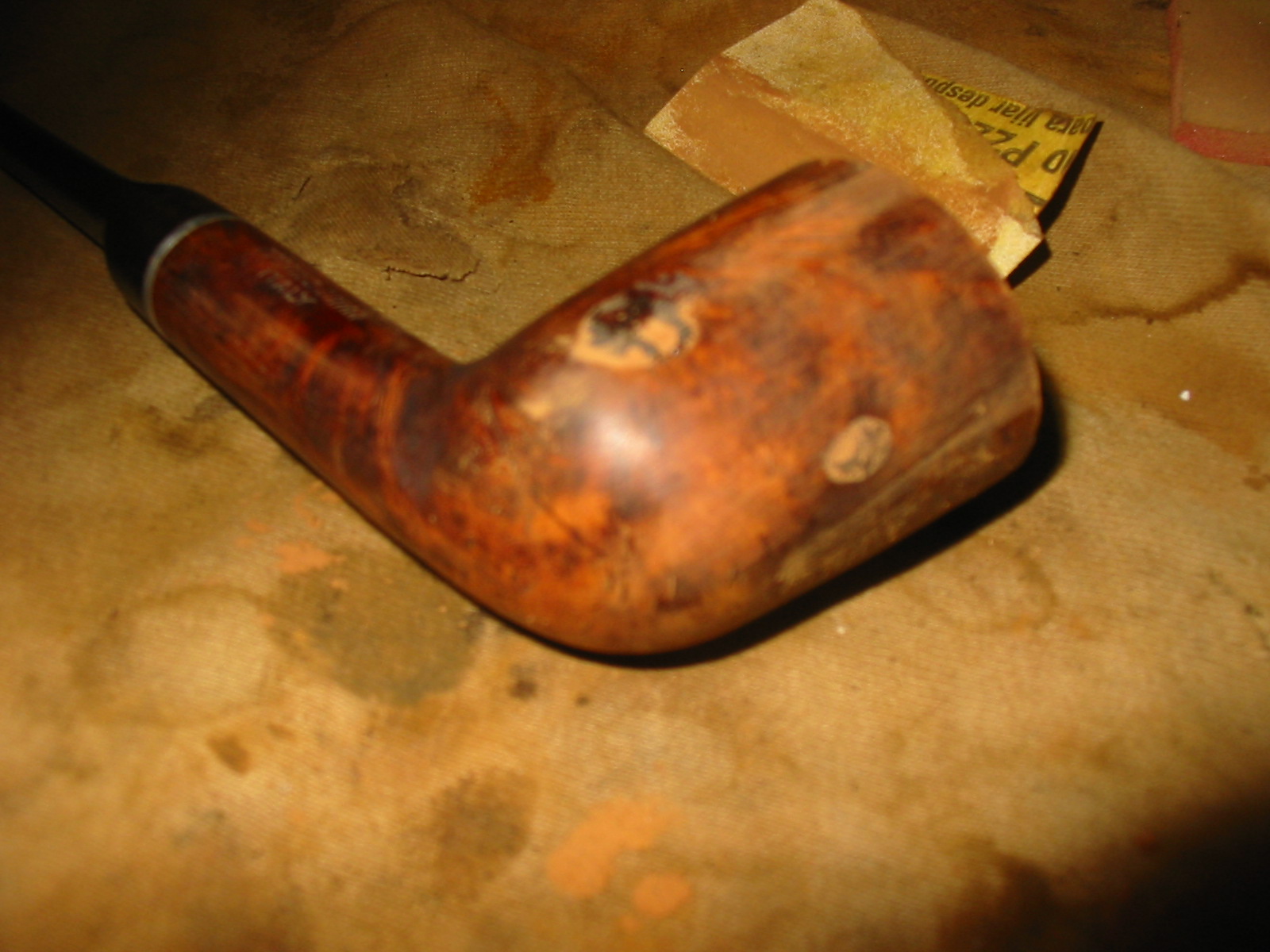
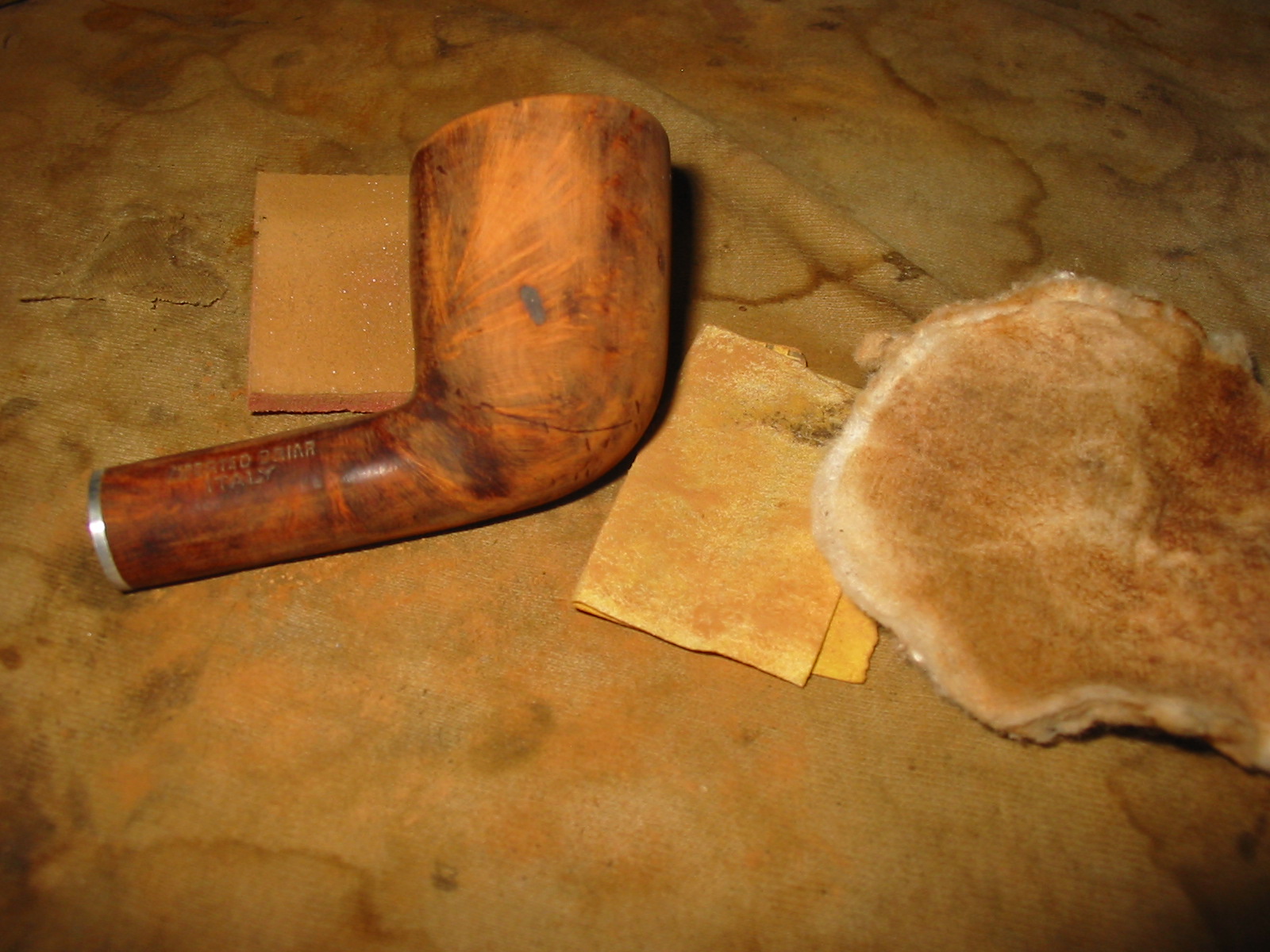
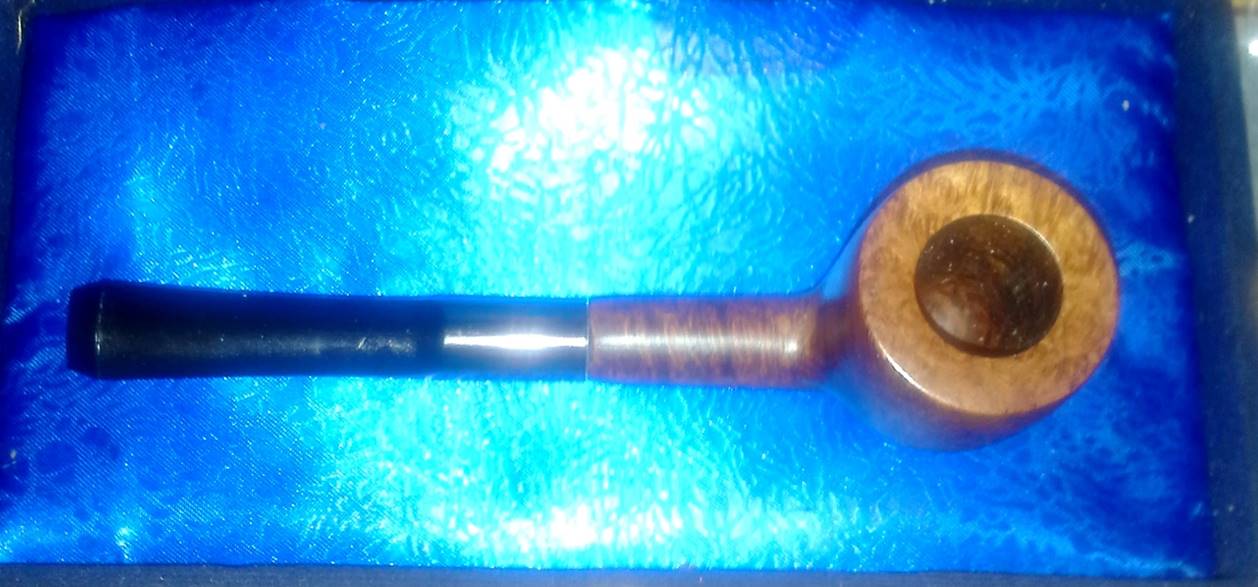
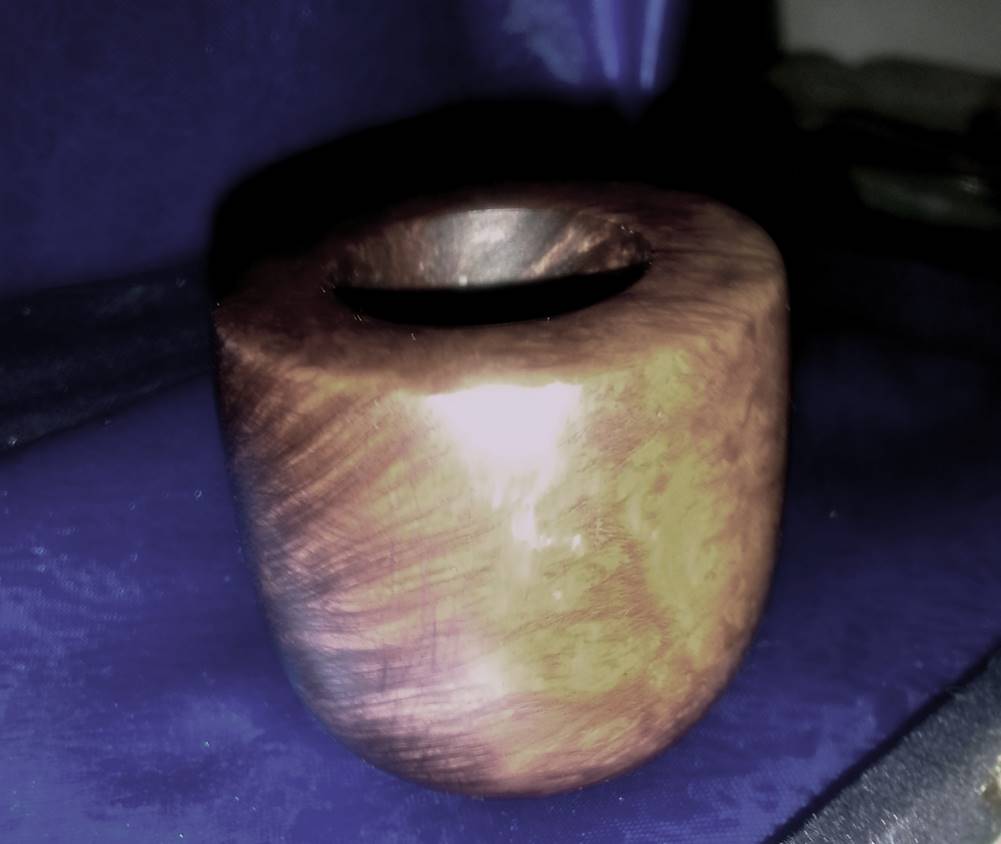
A Piece of Tobacciana – Restoring an Old Nylon Cigarette Filter/Holder


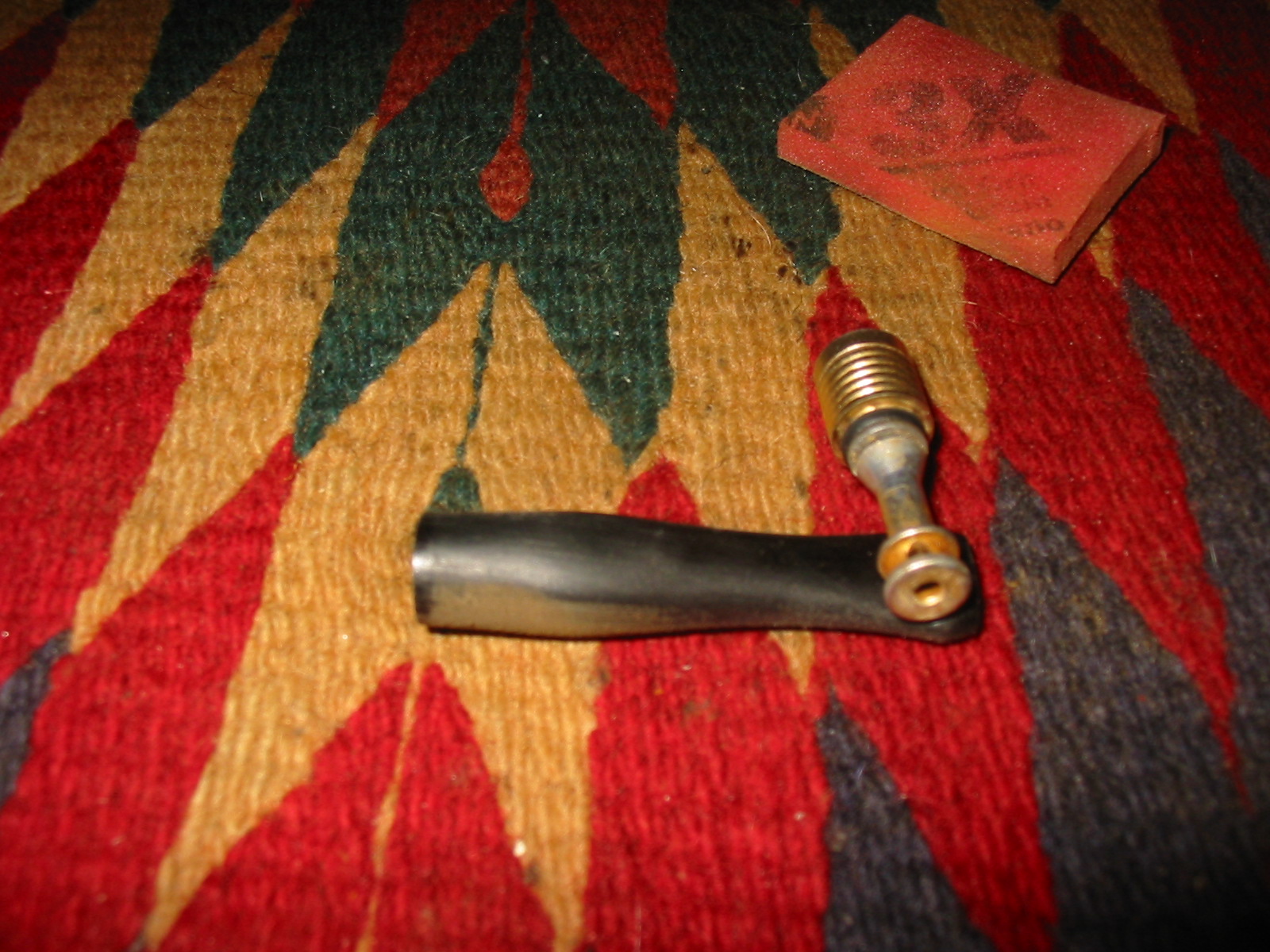
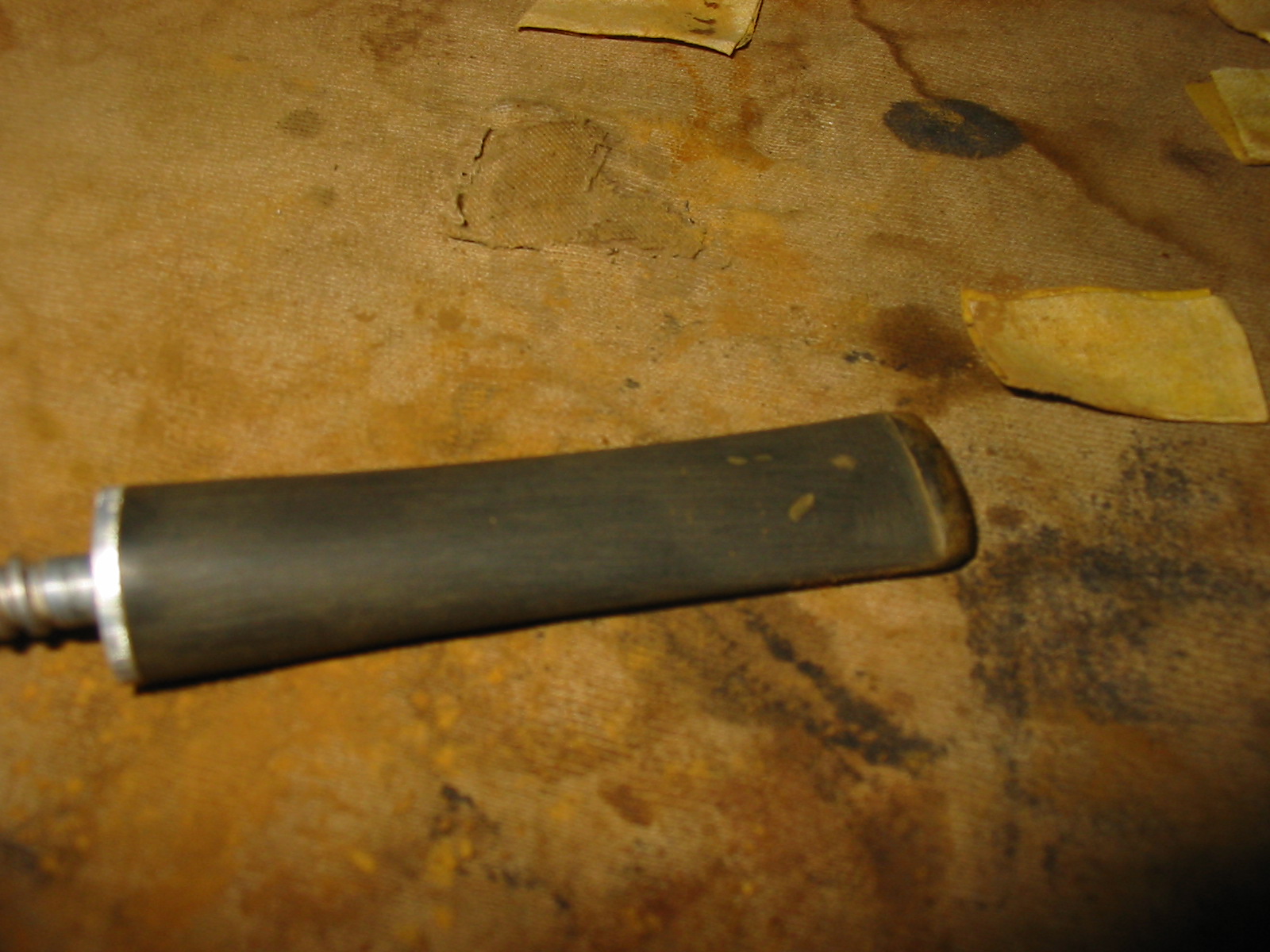
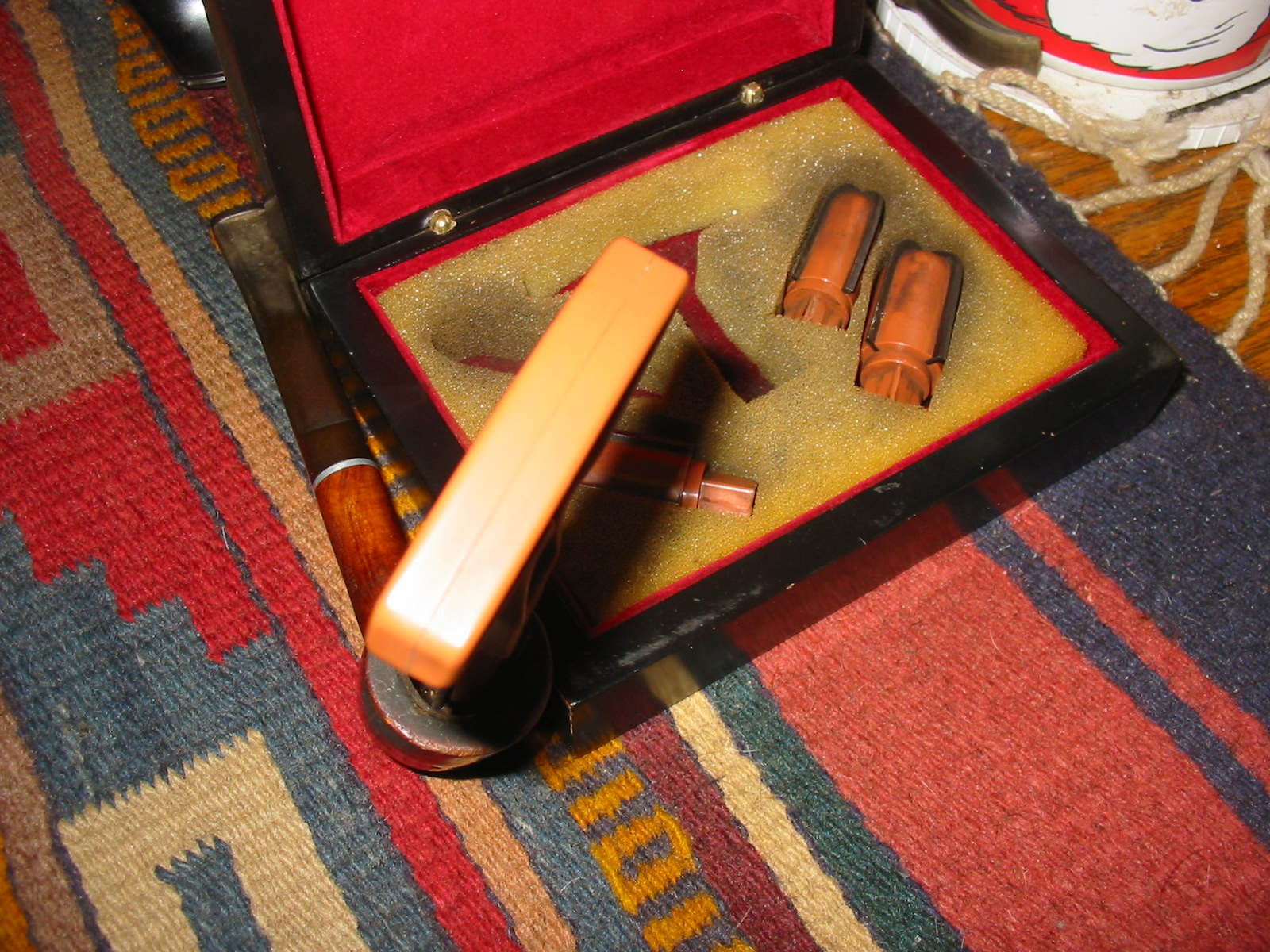
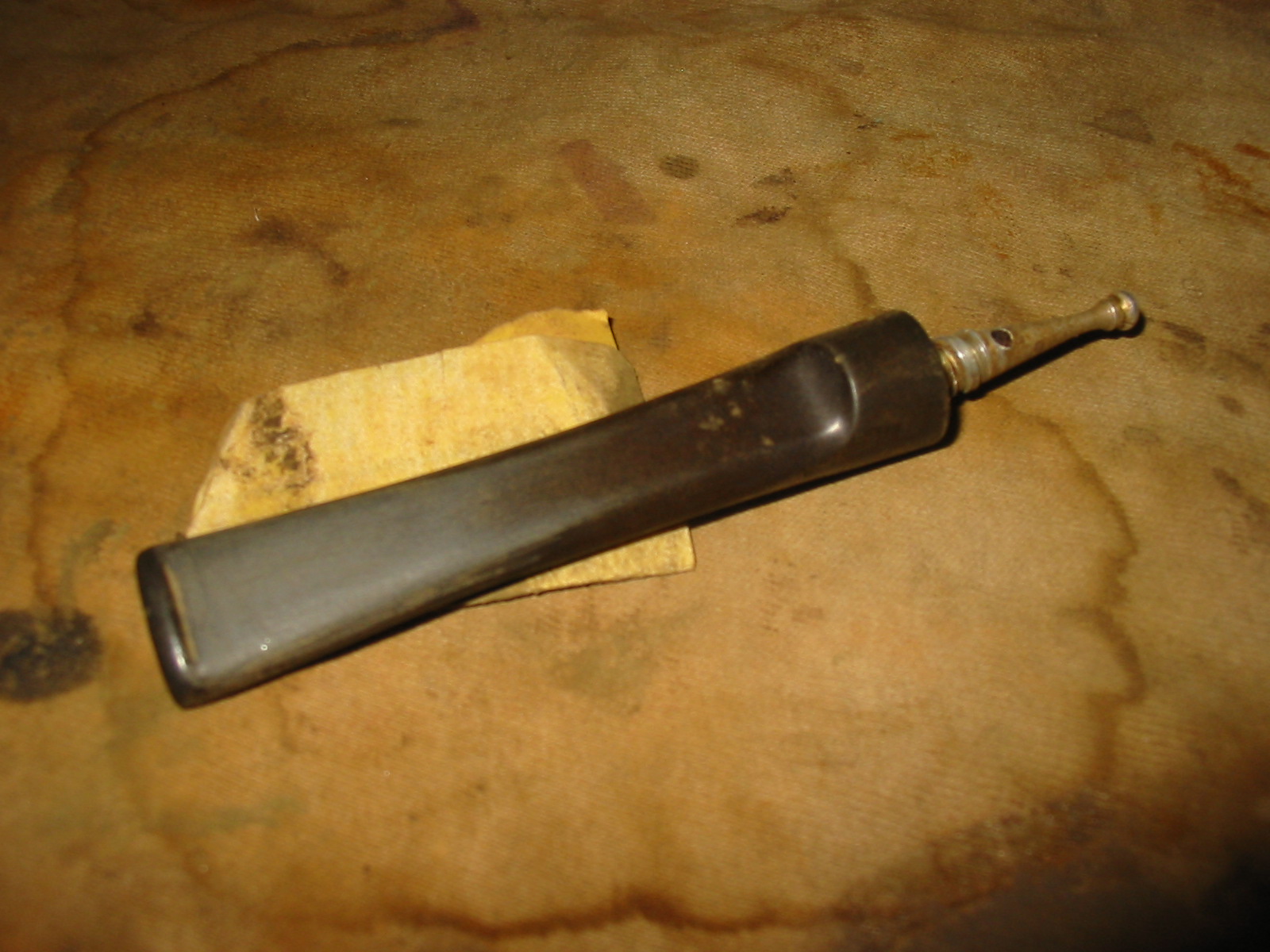
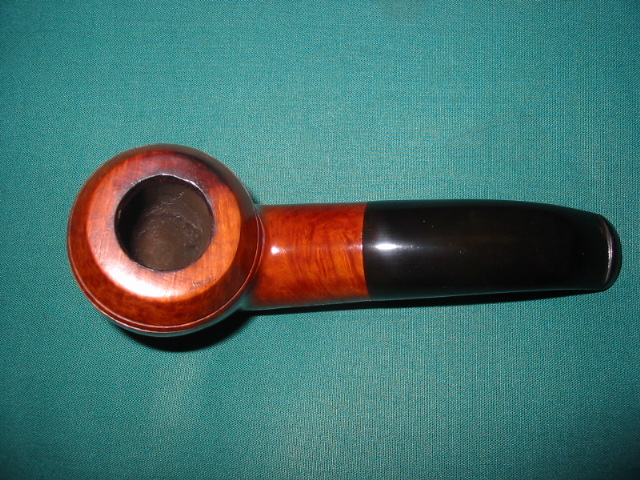
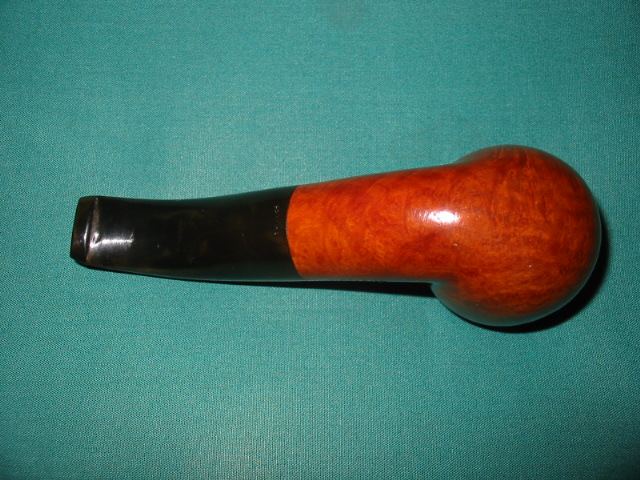
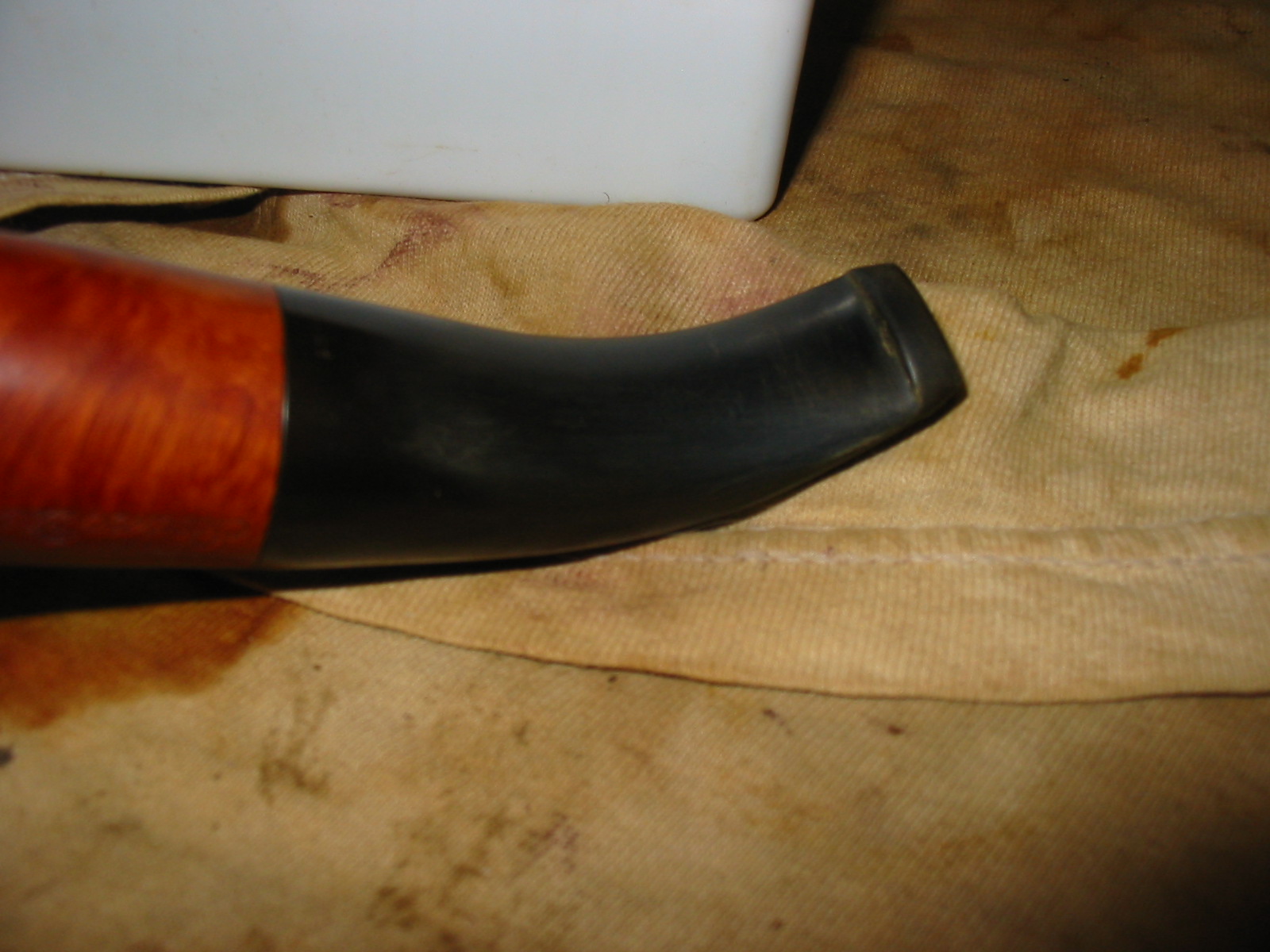
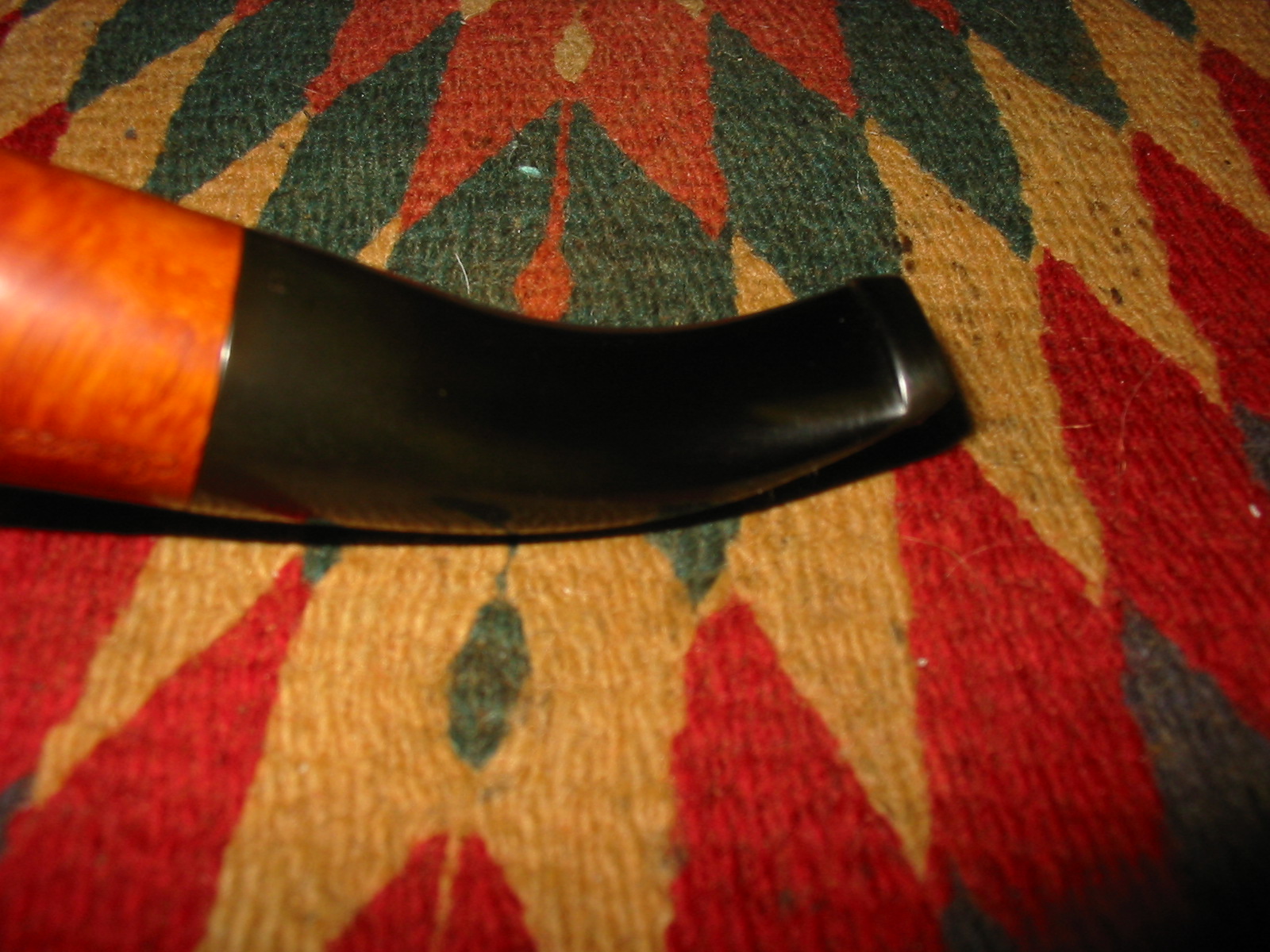
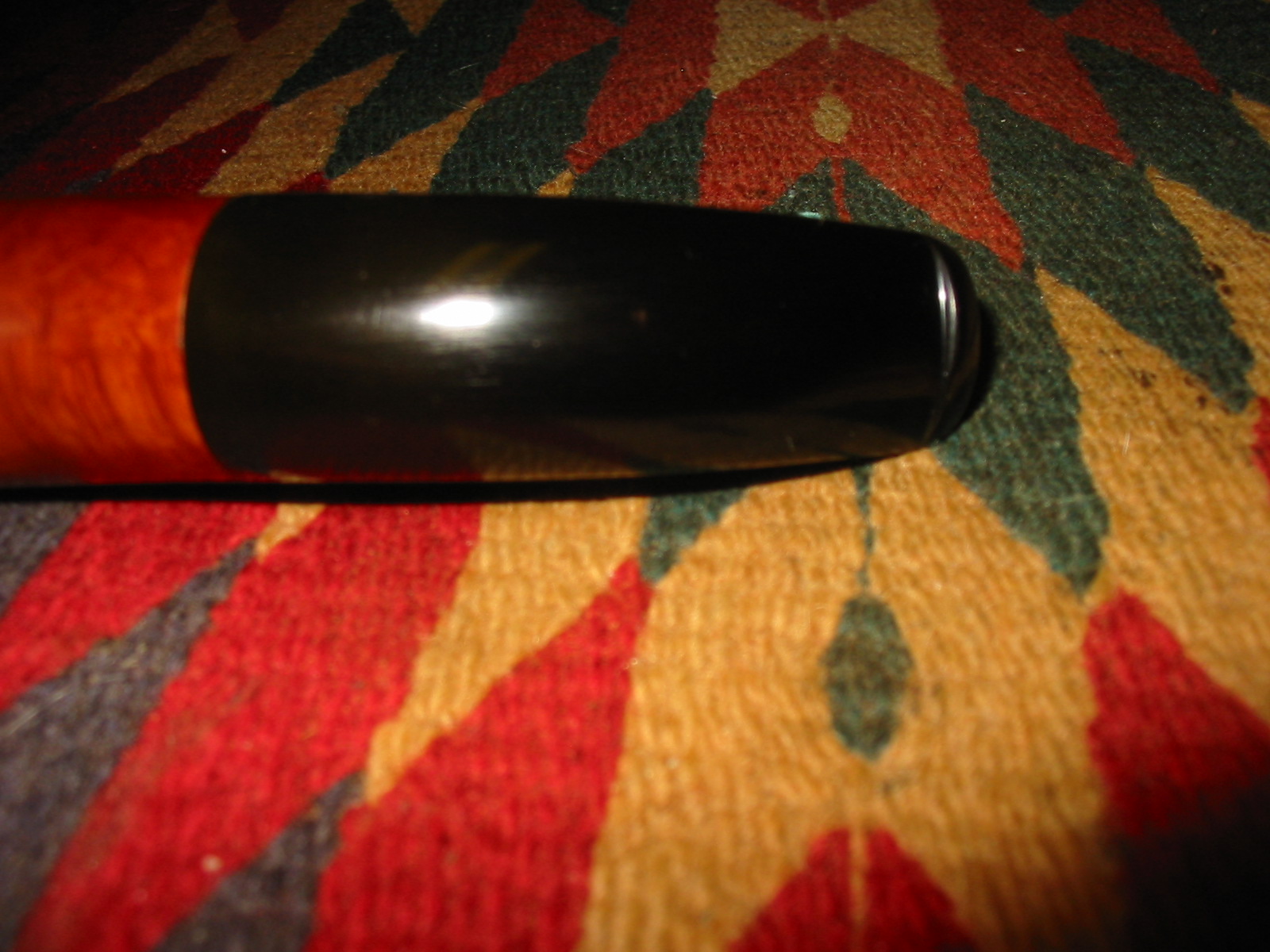
Somewhere along the way in one of the pipe lots I bought off EBay this old cigarette holder was included as a pipe stem. I put it in a drawer and forgot about it for several years at least. The other evening I was cleaning out a drawer of pipes that I had already refurbished getting them ready for my daughter to catalogue and came across the old holder. At first glance it appeared to be a cigarette holder. There was no filter apparatus present and the mouthpiece was short and condensed so I did not think there would be one inside the stem itself. I sanded down the casting marks on the side of the stem and also cleaned the stem of debris. There was one burn spot on the underside of the stem near the metal holder end. The metal holder was brass and quite clean with a slight nicotine and tar build up on the inside. The airway on the stem was plugged and no air could pass through it.
IMG_3182

IMG_3183

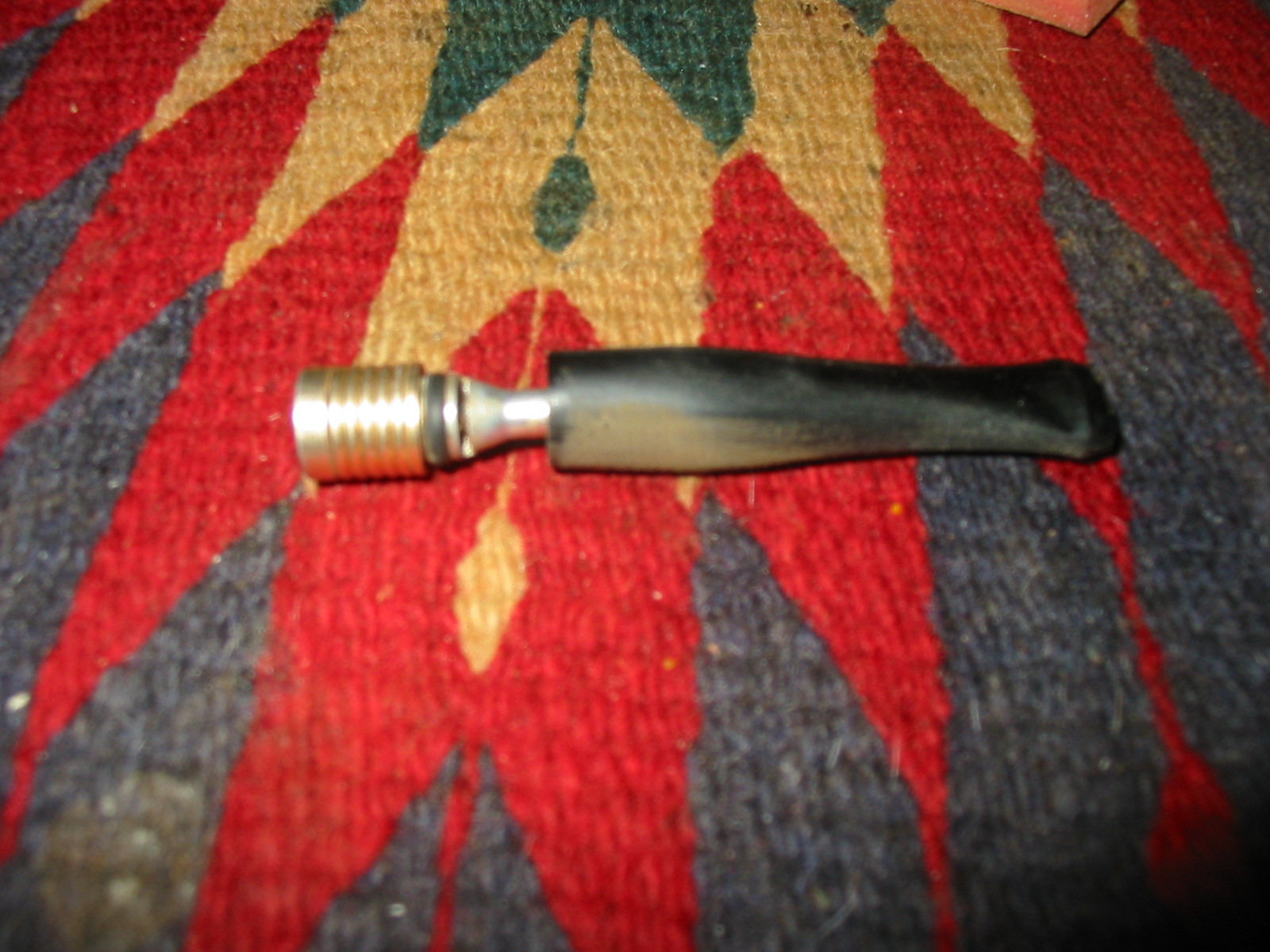
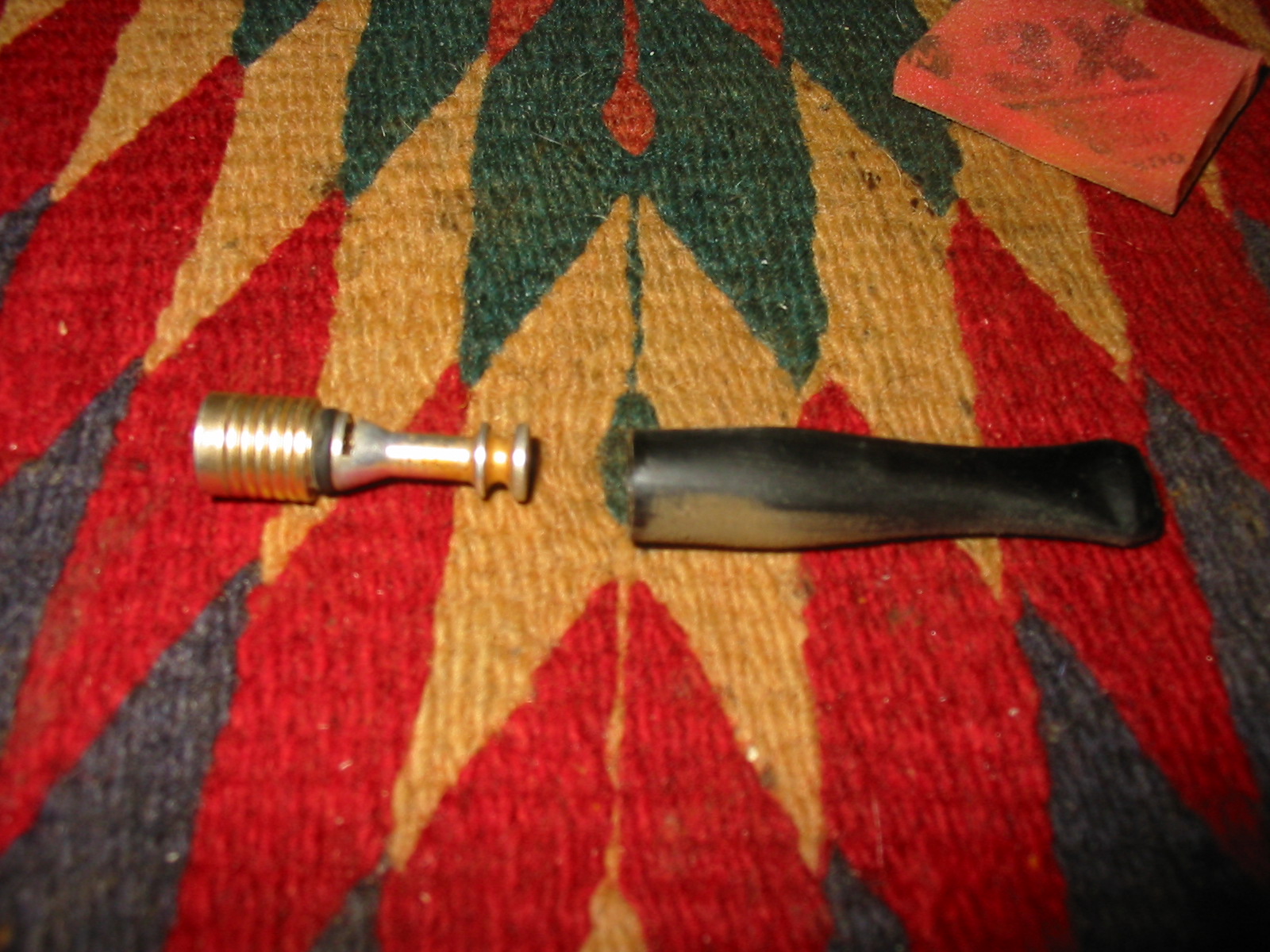
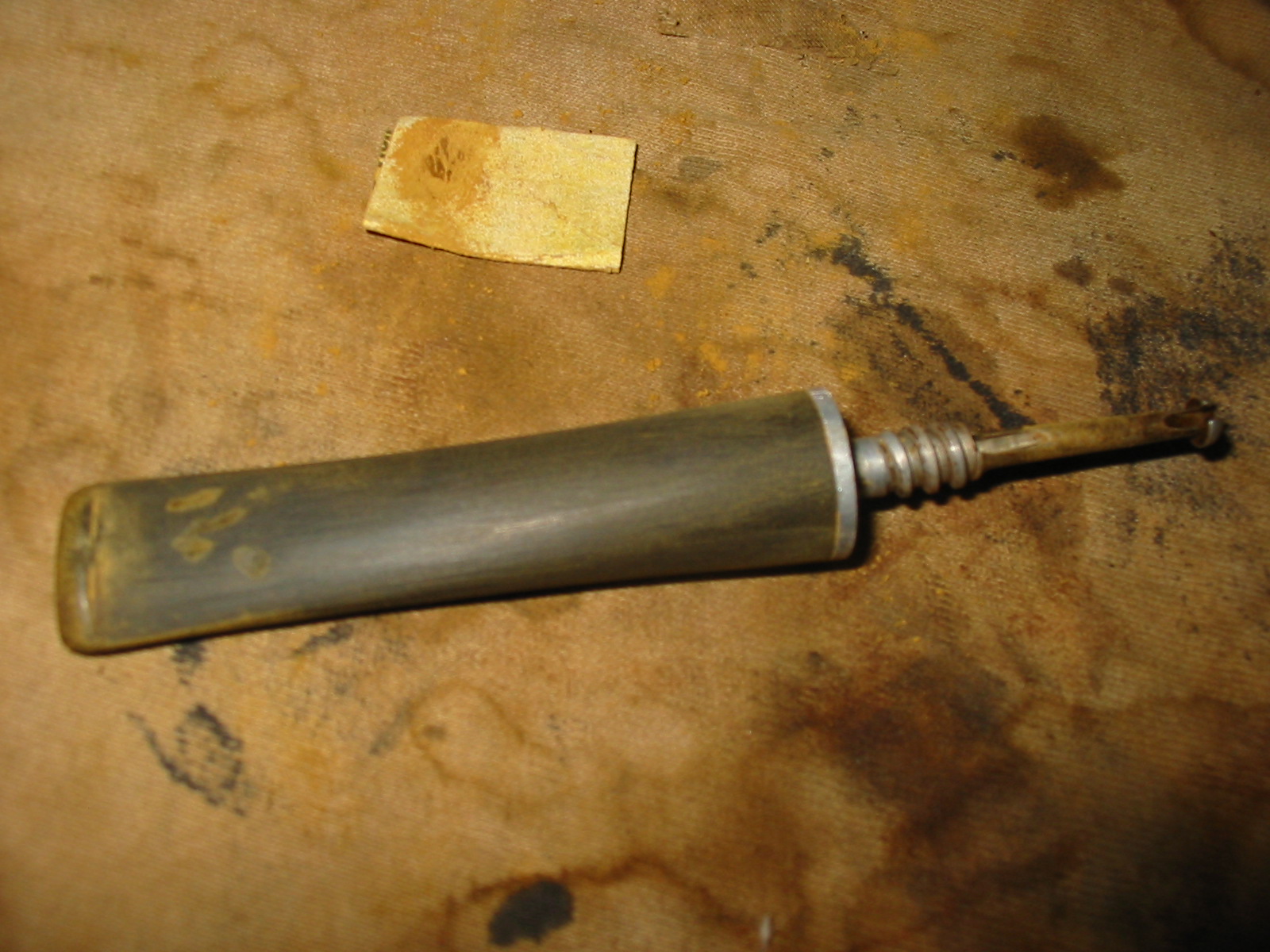
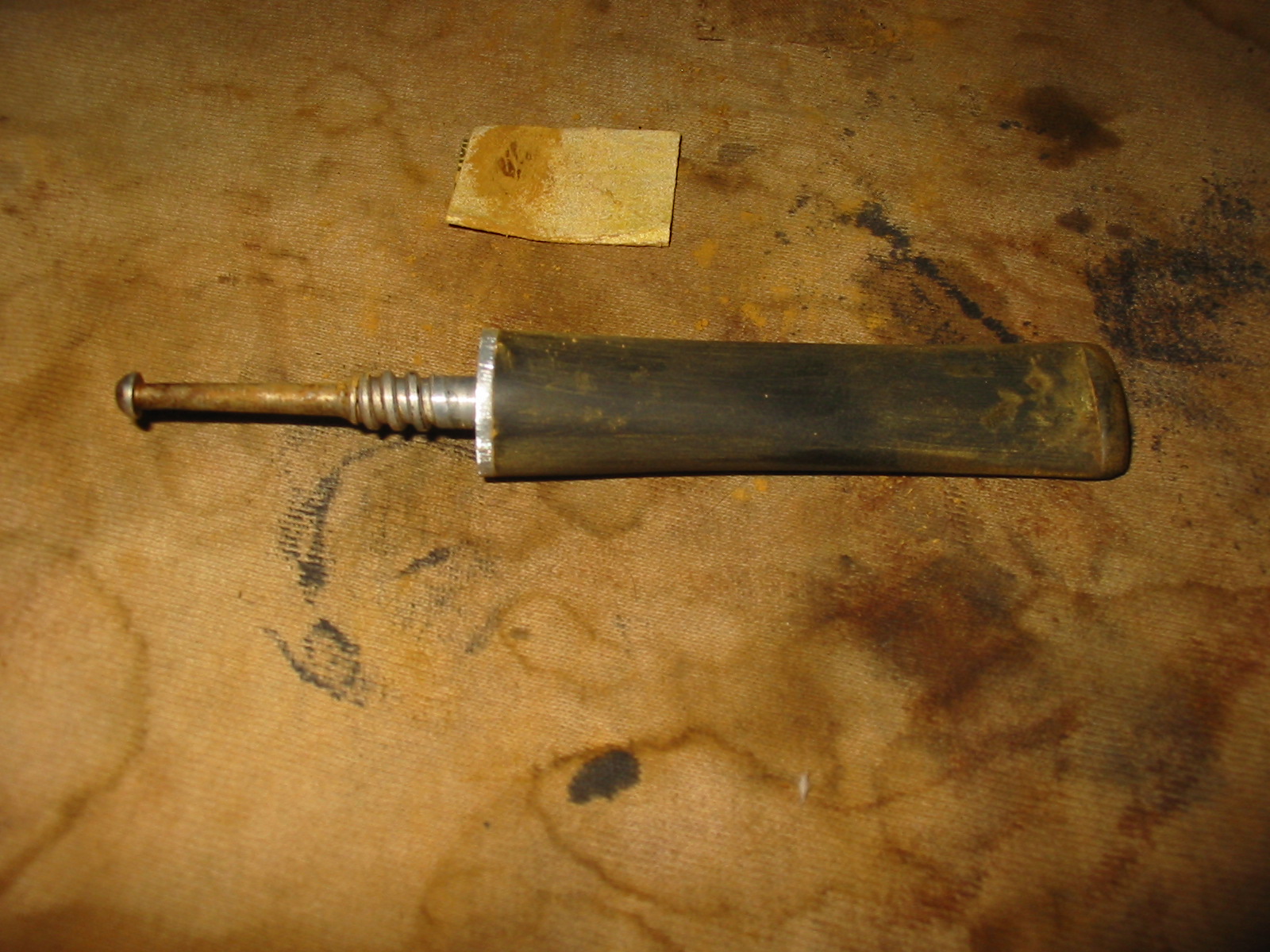
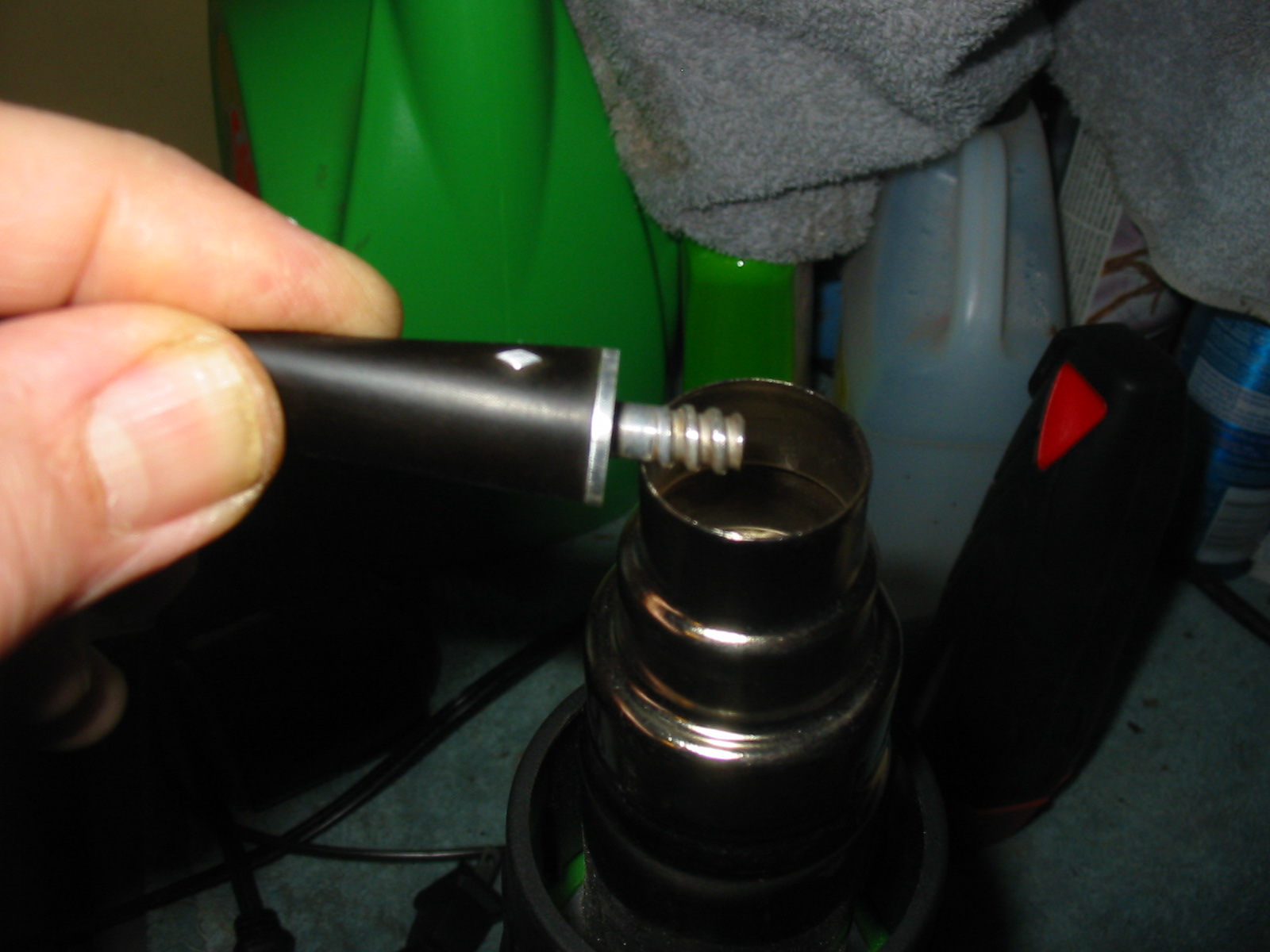
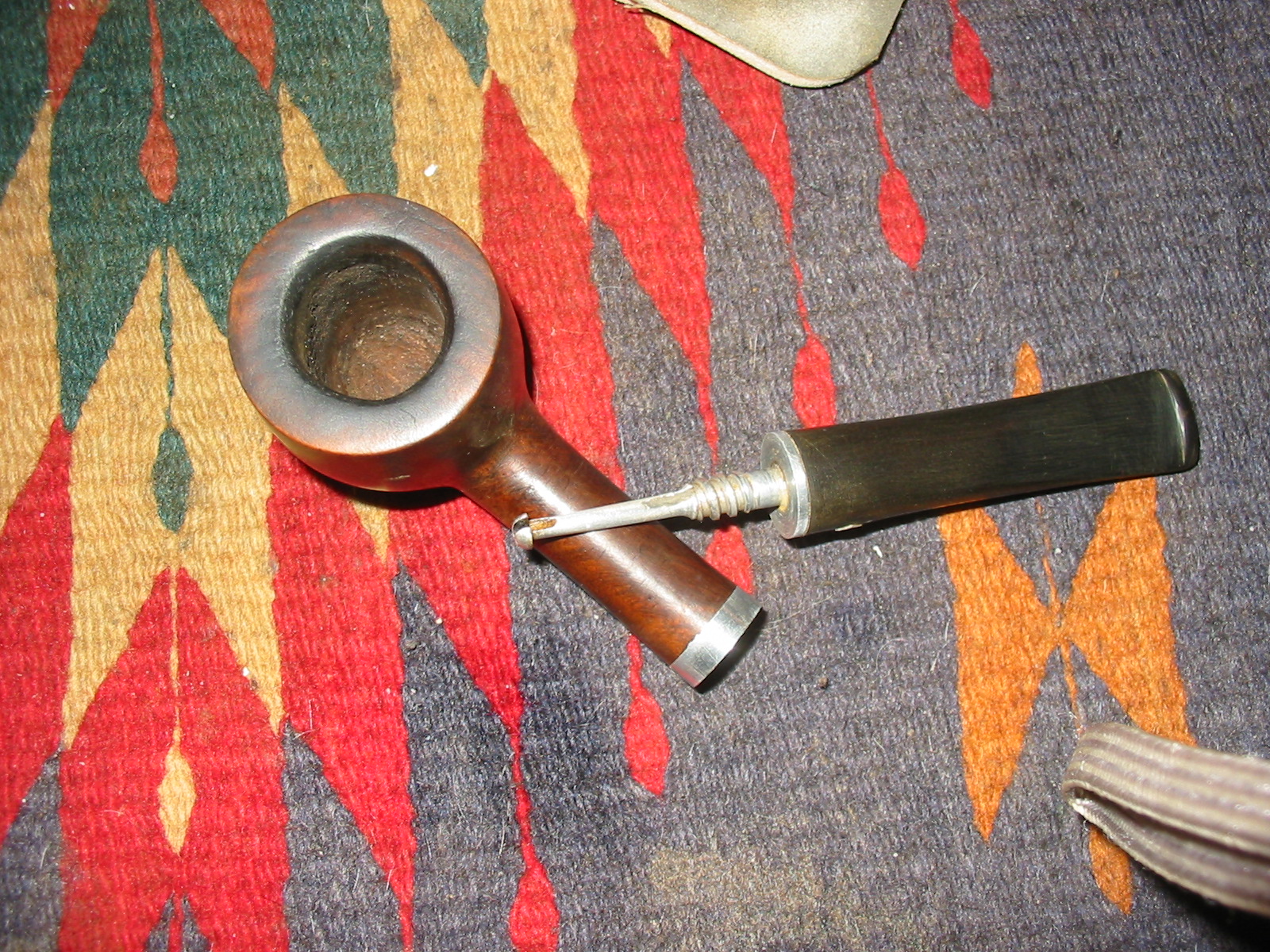
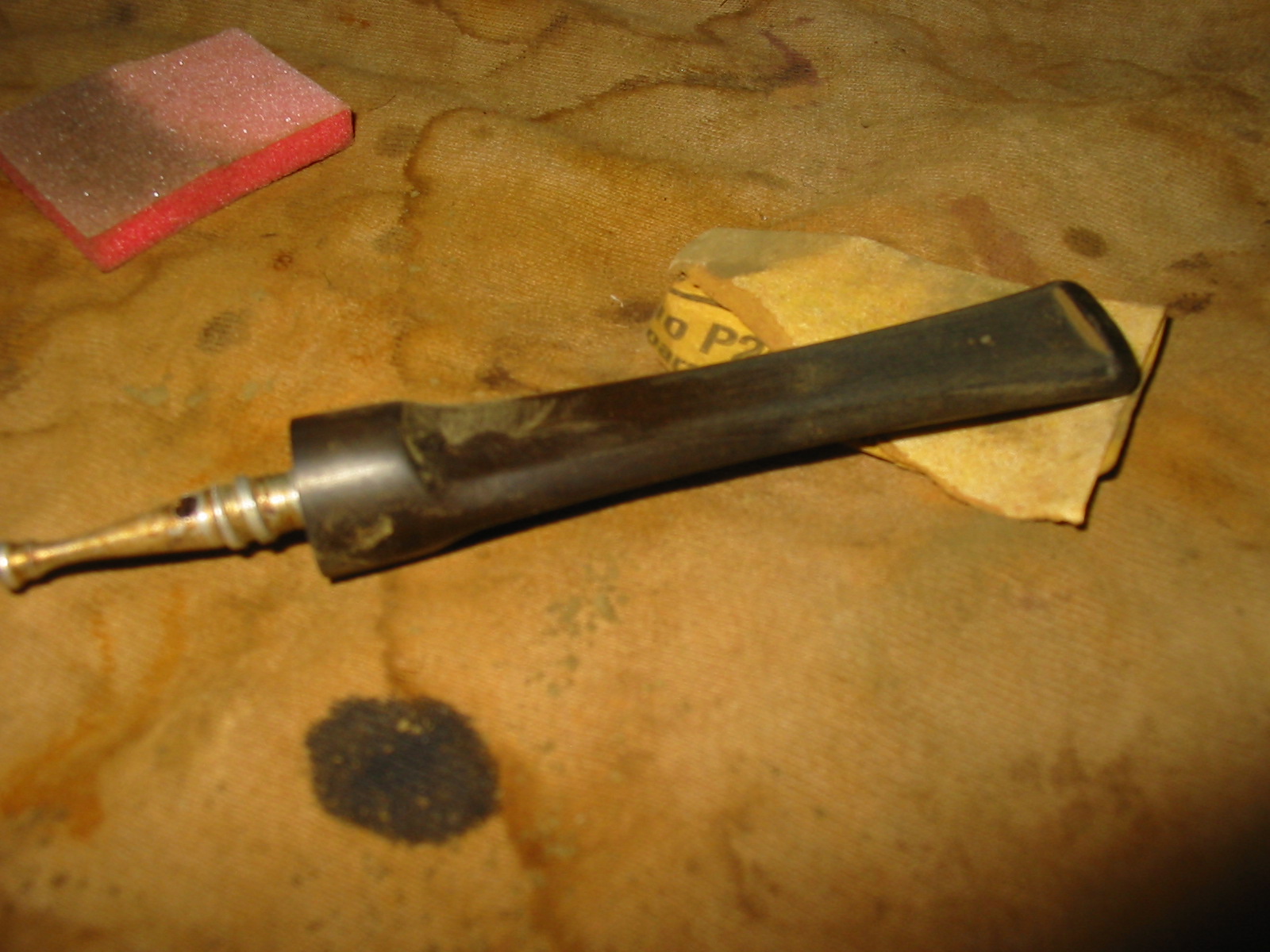
I twisted the end cap and it came free from the stem itself. Inside was a filter apparatus similar to the different stingers that one finds in American made pipes of days gone by. This apparatus was a single unit. There was a rubber o-ring around the top just below the holder top. This held the cap unit snugly in place in the stem.
IMG_3181

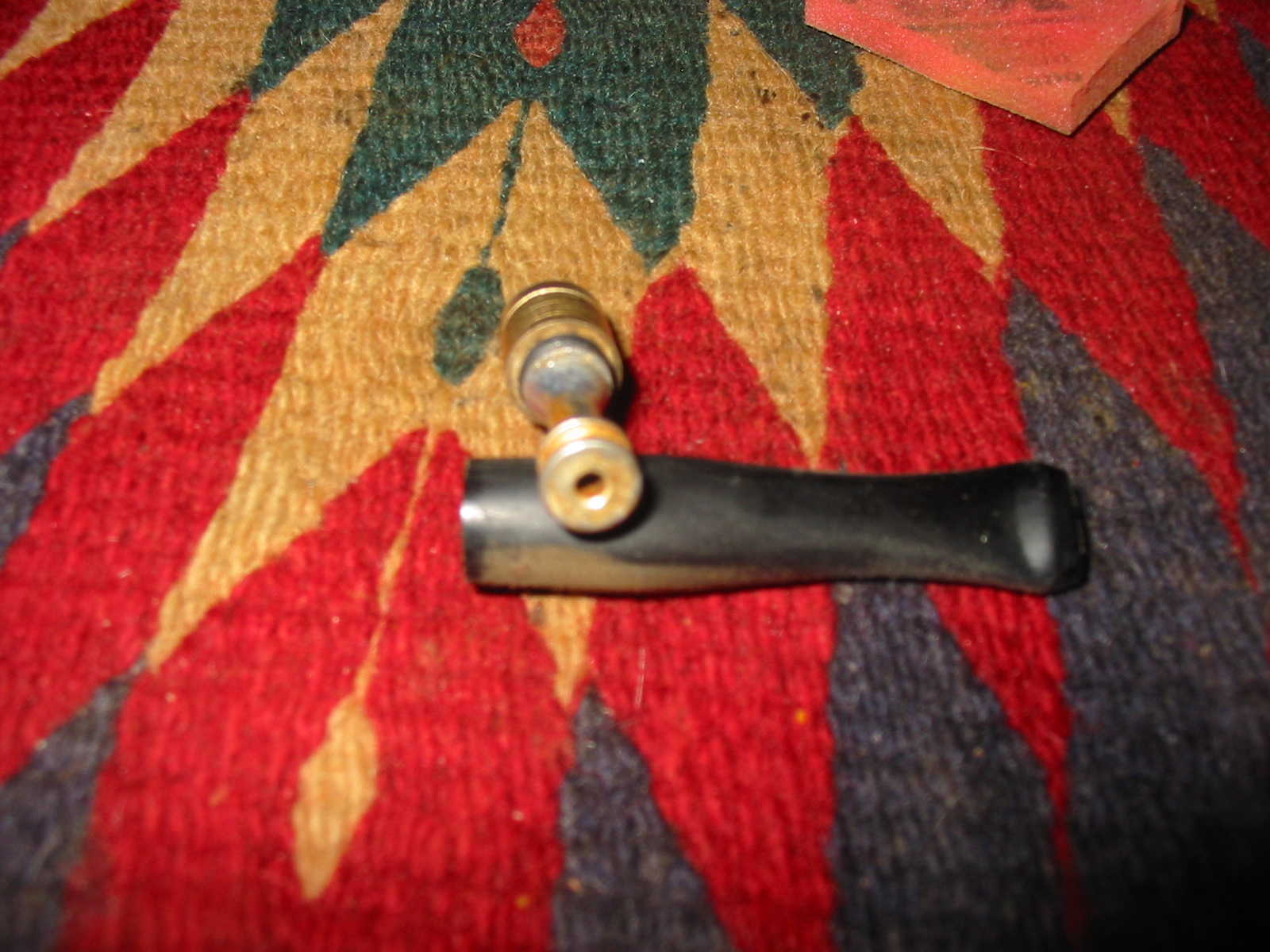
Once I had removed the apparatus from the stem the stinger design was visible. It extended half way down the shank of the stem. Behind the o-ring was a cut/slit half way through the aluminum of the stinger. It was clogged with tars and oils. In the middle of the slit was an opening. One on the o-ring side and one on the stem side of the slit. The aluminum then funneled down to tube that at first glance appeared to be solid. At the end of the tube were two solid rings around the tube. Between the rings there were holes on two sides in the groove. When it was inserted and clear the air would be pulled through the holder and into the stinger slit. It would circulate in the stem to cool and then move through the slit and down the tube and out the two holes. These would then disperse the smoke through the remainder of the stem and out the slot in the button. In many ways it was like an inverted stinger in shape and function to those found on pipes.
IMG_3177

The hole in the end of the stinger does not go through the stinger but rather is like a small cup on the end. It was for collecting moisture and tars if the grime buildup was any indication.
IMG_3178

IMG_3180

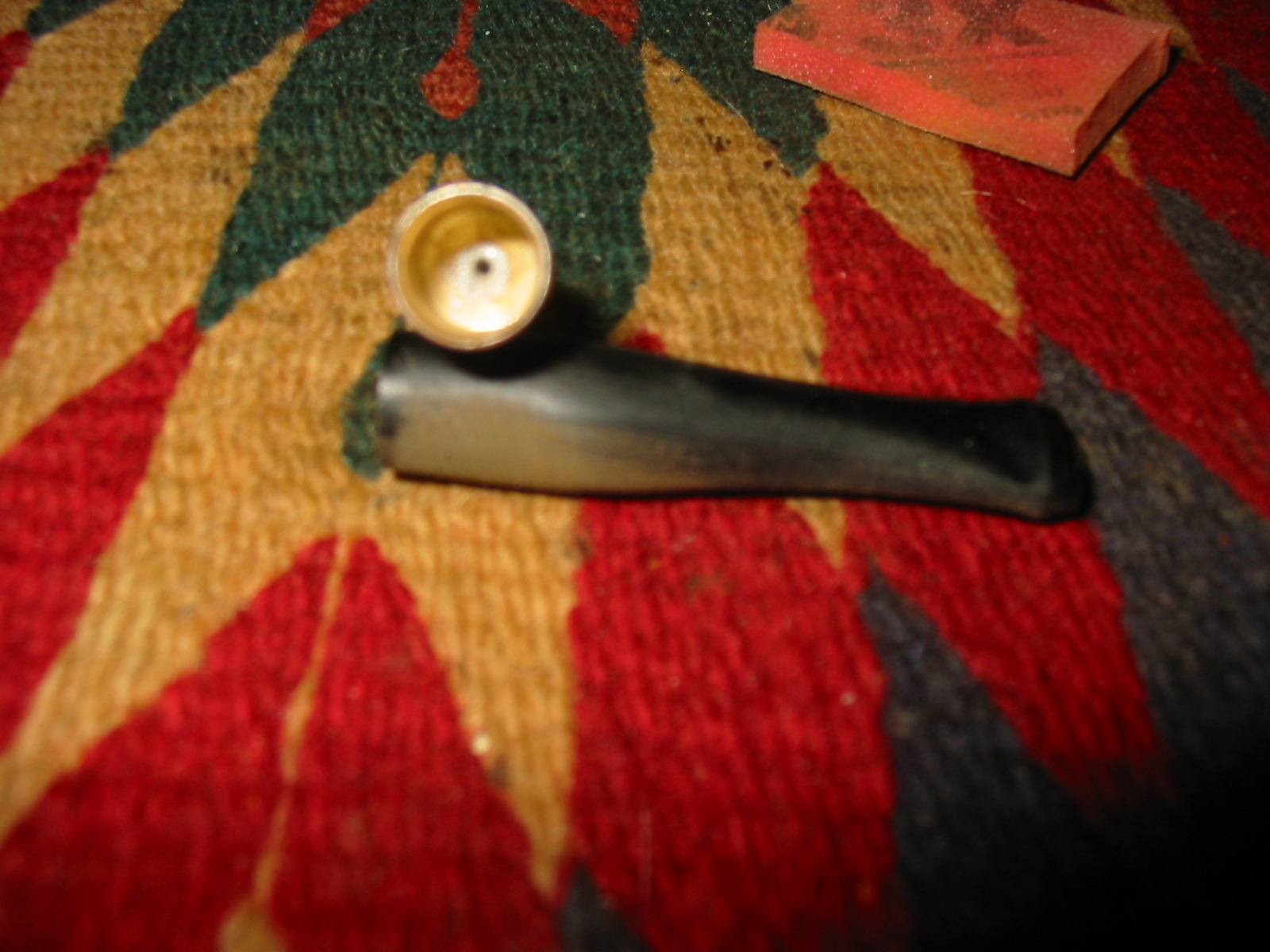
The holder cap pictured in the photo below is the depth of the filter on a modern cigarette and also the dame diameter as the end of the cigarette. I cleaned the entire apparatus and soaked it in a bath of Everclear to try to open the airway. I was able to clean out the cut in the aluminum, the holes in the end and in the cut itself using a dental pick. I scrubbed down the apparatus with a tooth brush and Everclear. I was unable to get air to pass through due to a clog in the end of the holder. In the photo below it is visible as a small hole in the bottom of the cup. It was plugged and the dental pick was too thick to go through it. I tried a thin paper clip and a needle with no success. I finally was able to open it with a tiny micro drill bit on the Dremel and pushed it through at a very slow speed. The bit came with a plastic guide that fit inside the cup perfectly and kept the drill straight as it opened the airway. Once it pushed the clog through I cleaned the inside of the airway with Everclear and was able to push air through with no effort.
IMG_3179

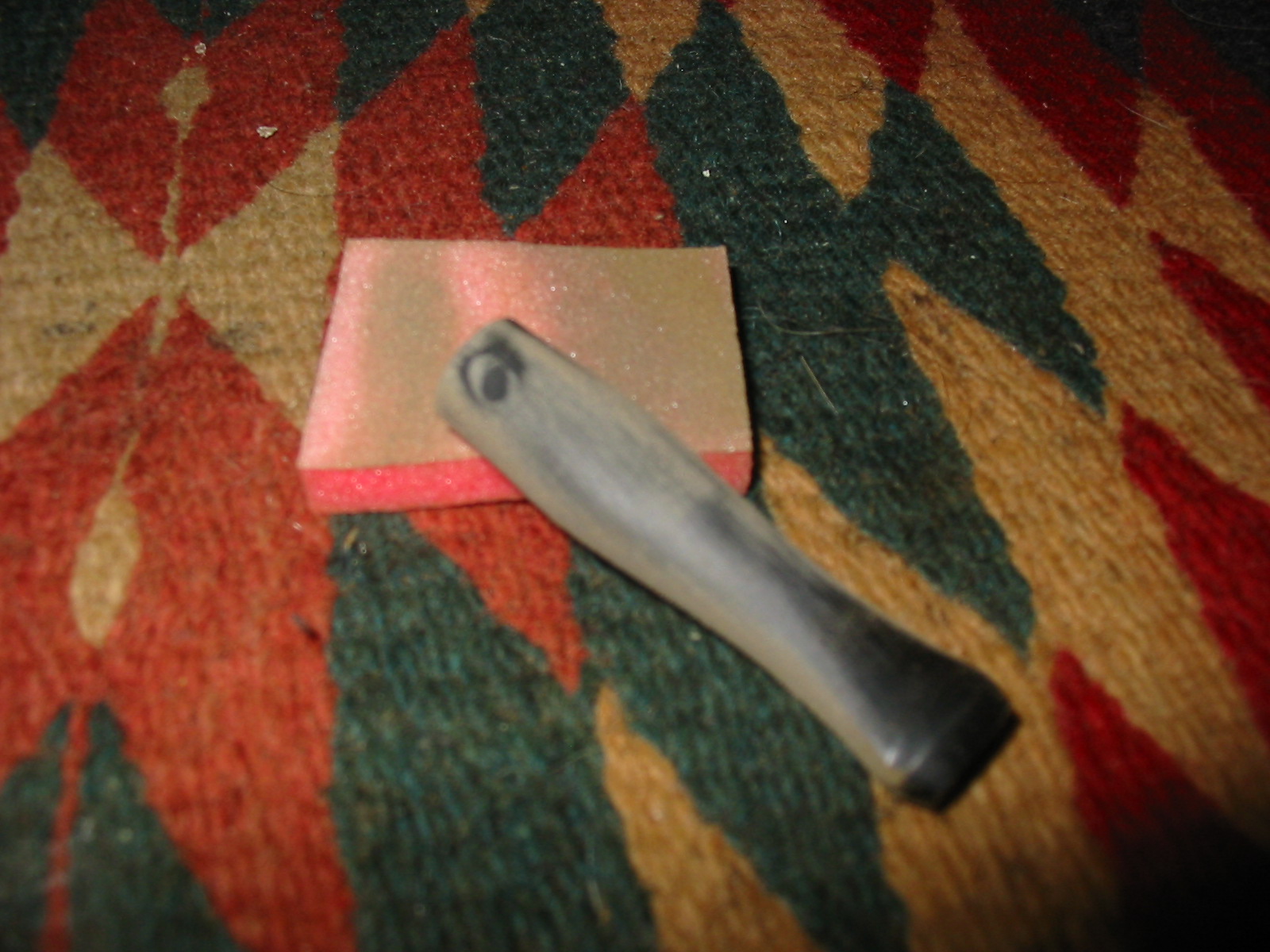
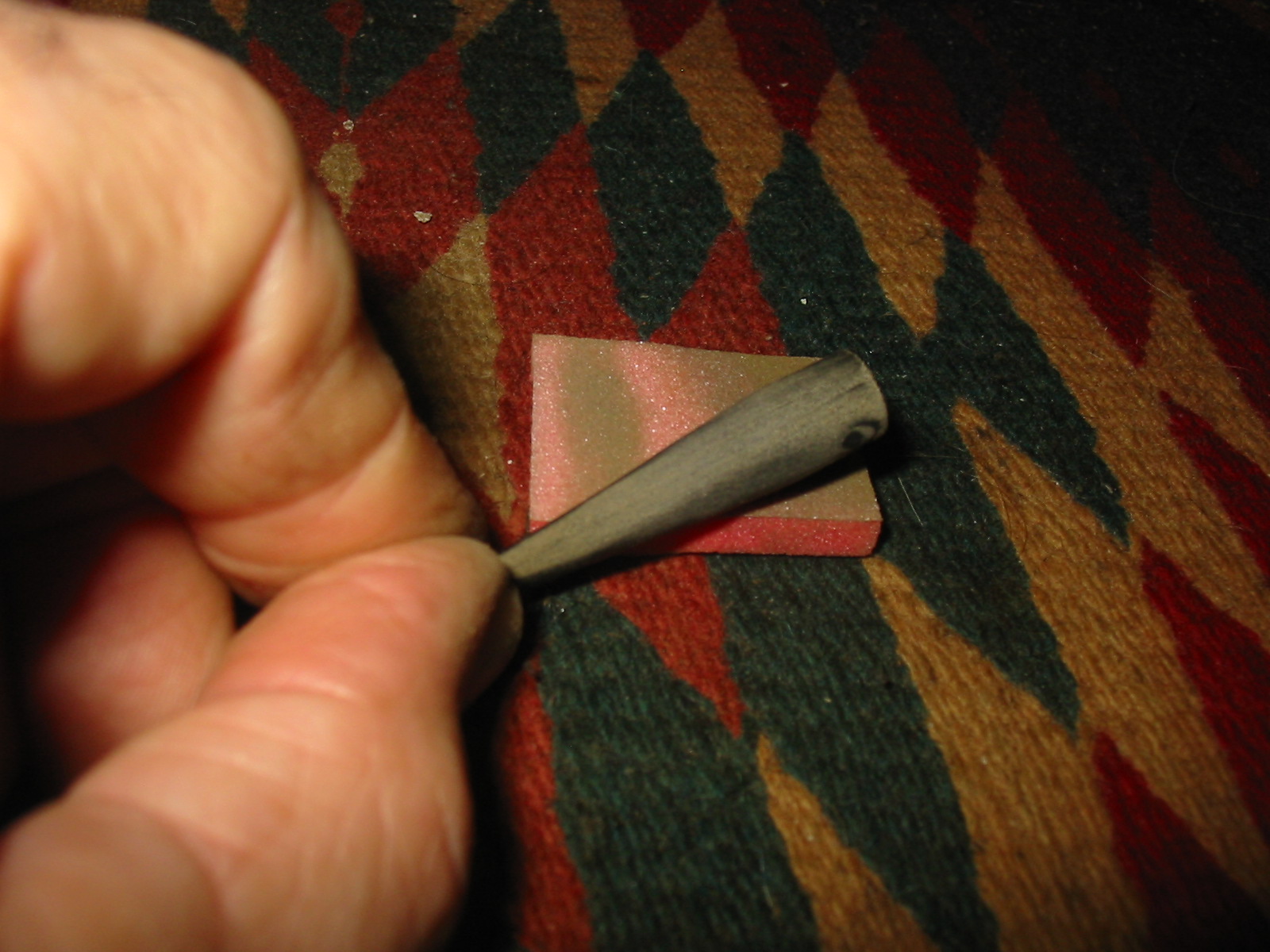
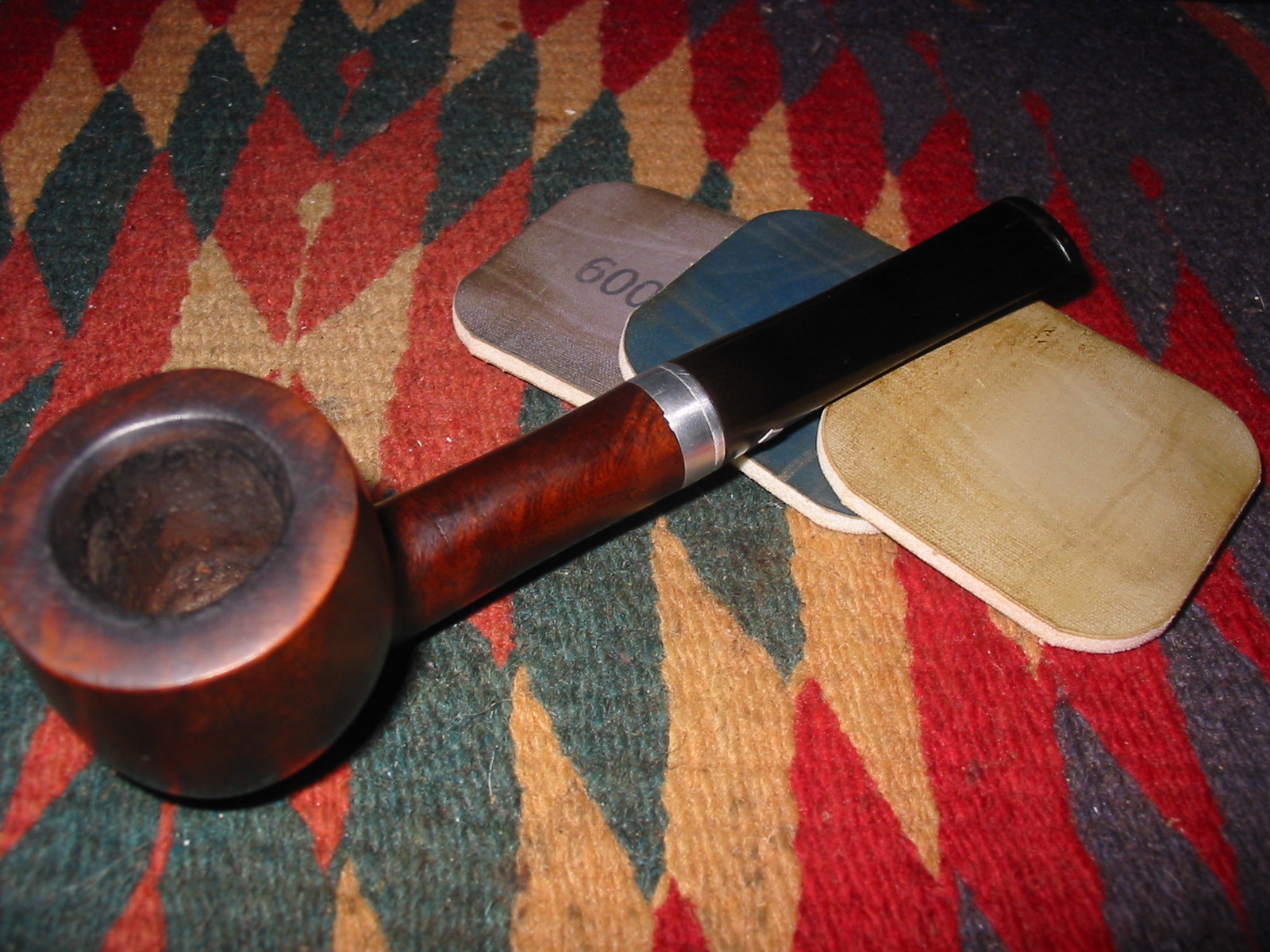
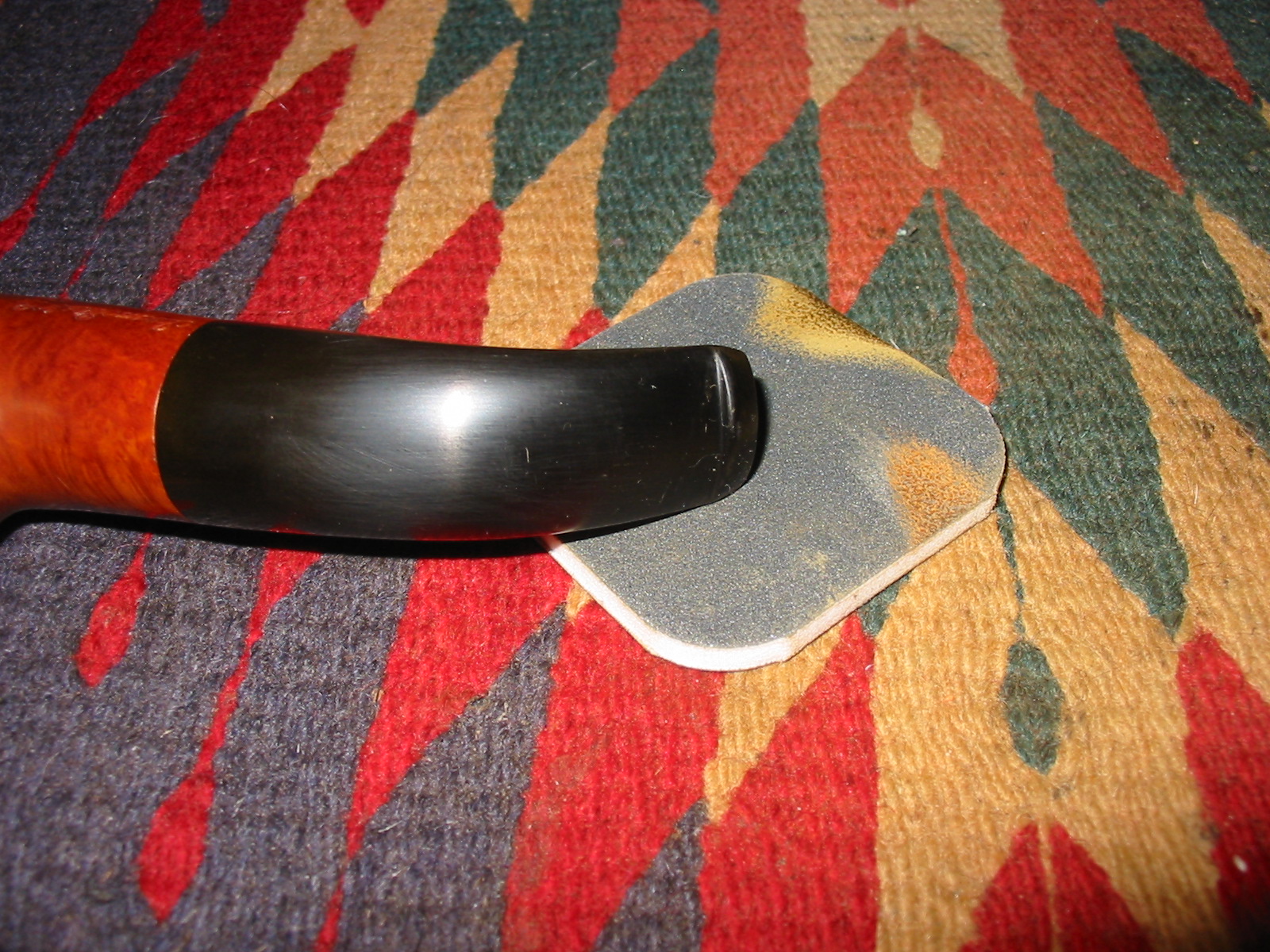
I repaired the burned spot on the stem with superglue and sanded the stem until the patch blended with the rest of the stem surface. I sanded the stem with 220 grit sandpaper and then with a medium grit sanding sponge to smooth out the scratches in the surface of the nylon stem.
IMG_3135

IMG_3136

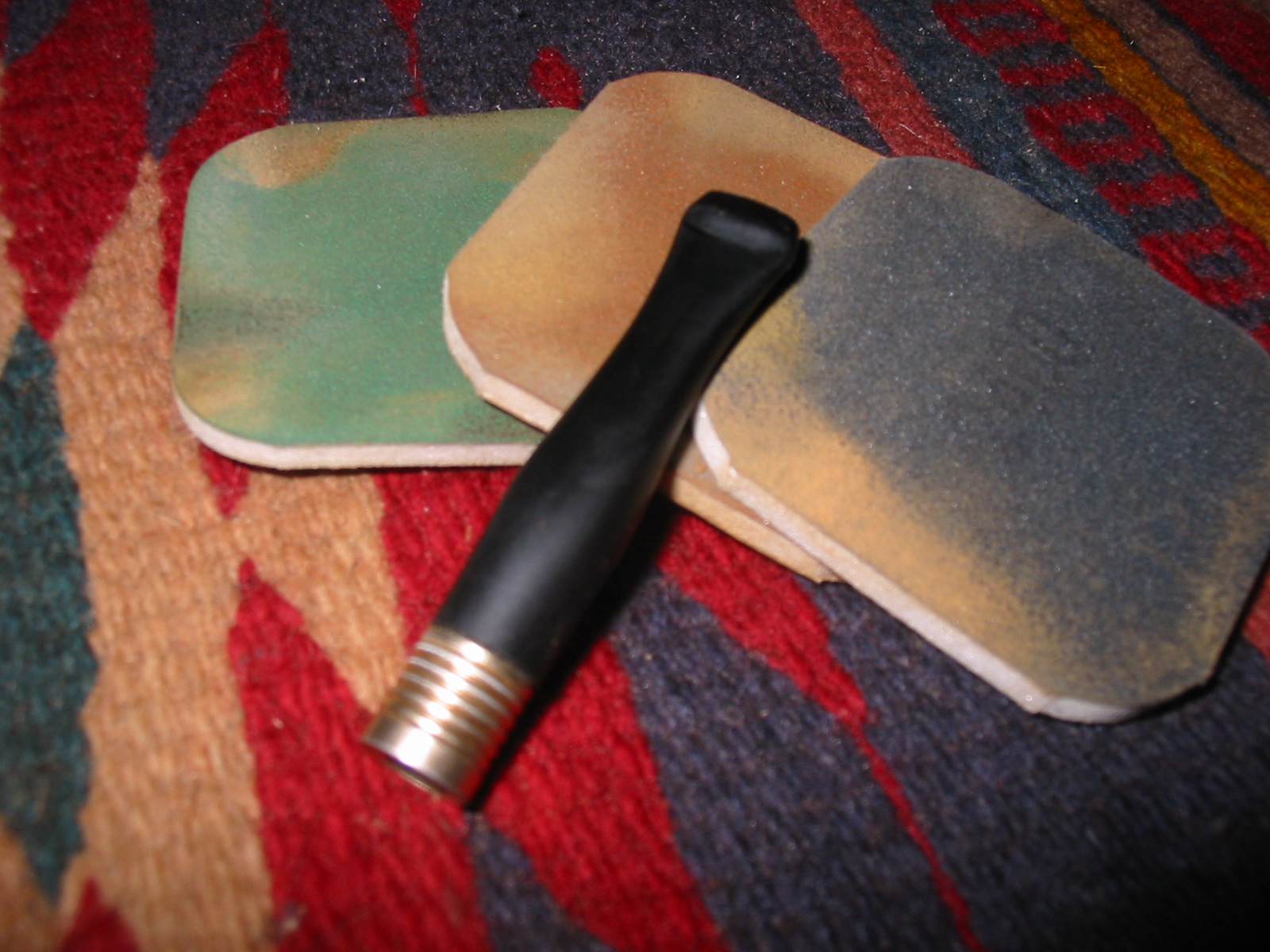
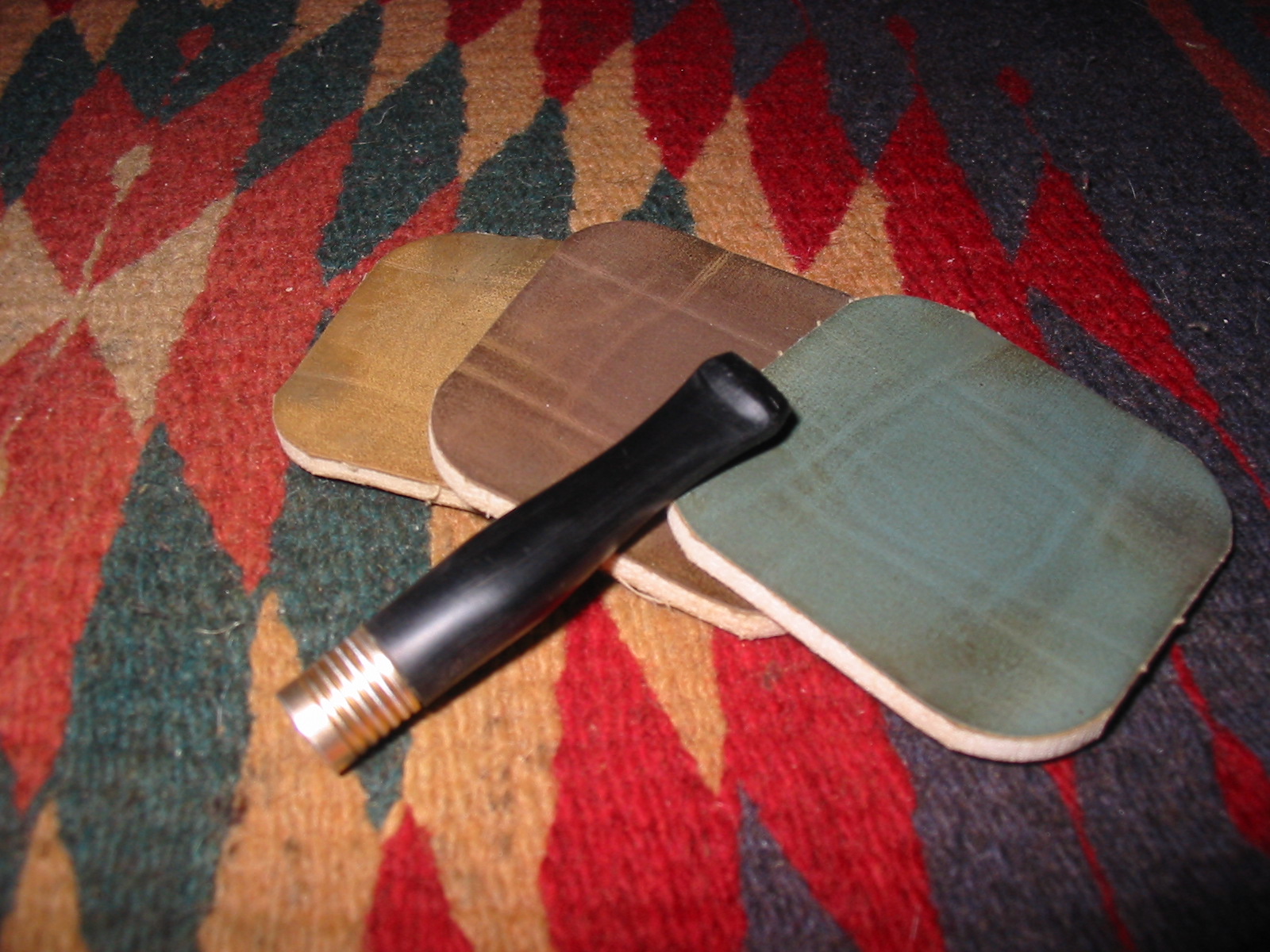
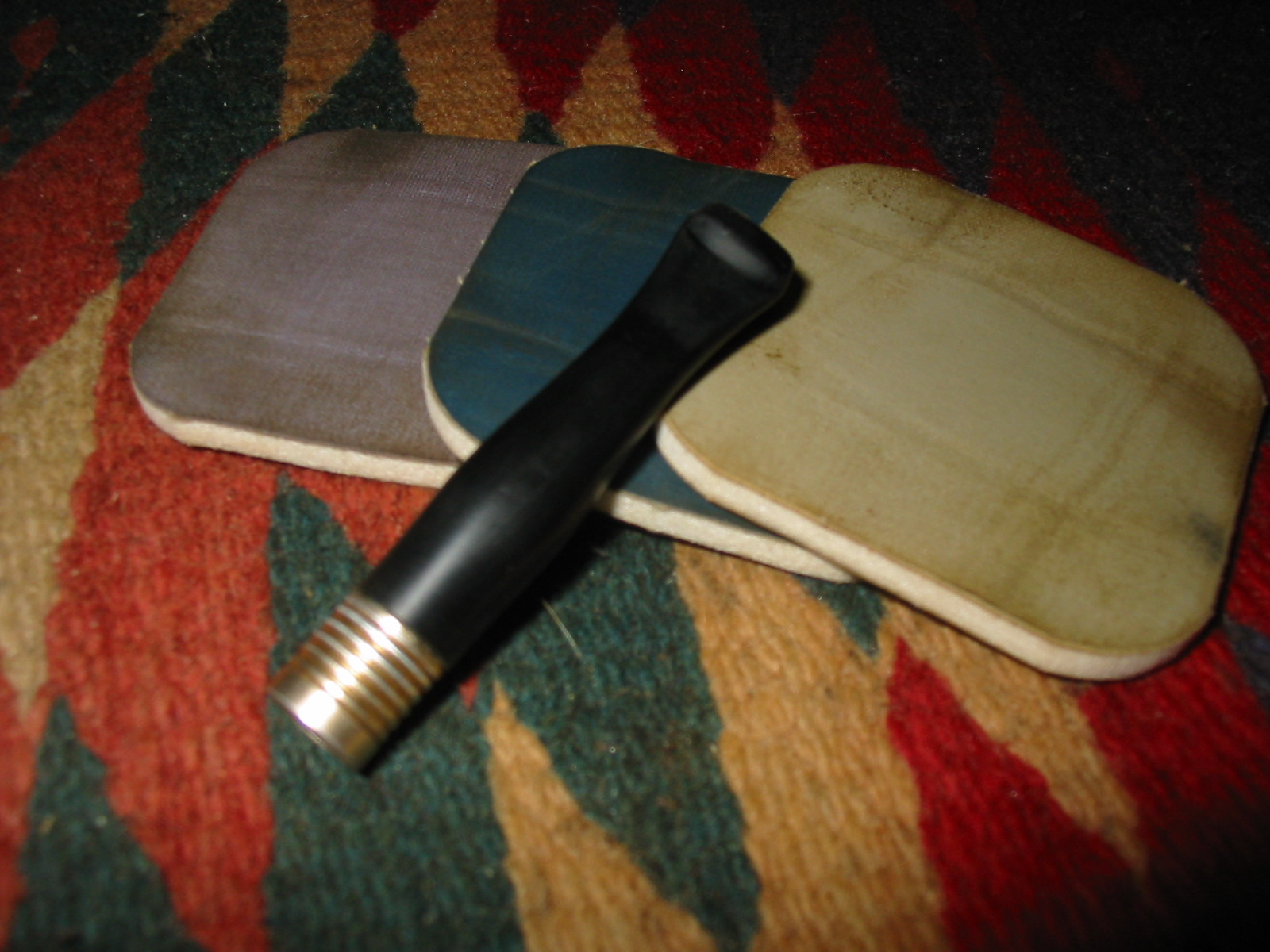
I wet sanded the stem with micromesh sanding pads from 1500-2400 grit and then dry sanded with 3200 – 12,000 grit sanding pads. I used a plastic polish to further shine the stem once I was finished with the micromesh pads.
IMG_3184

IMG_3185

IMG_3187

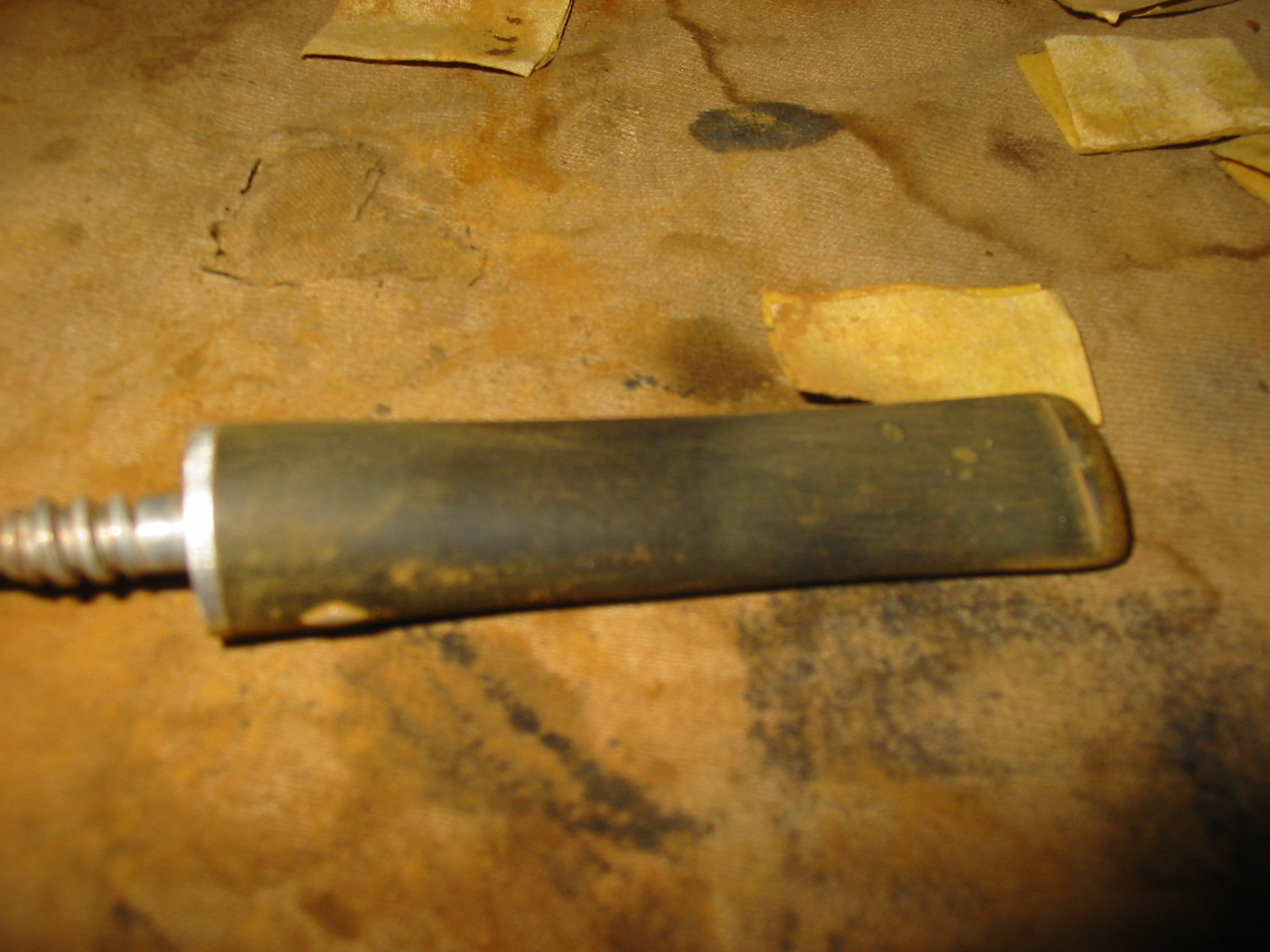
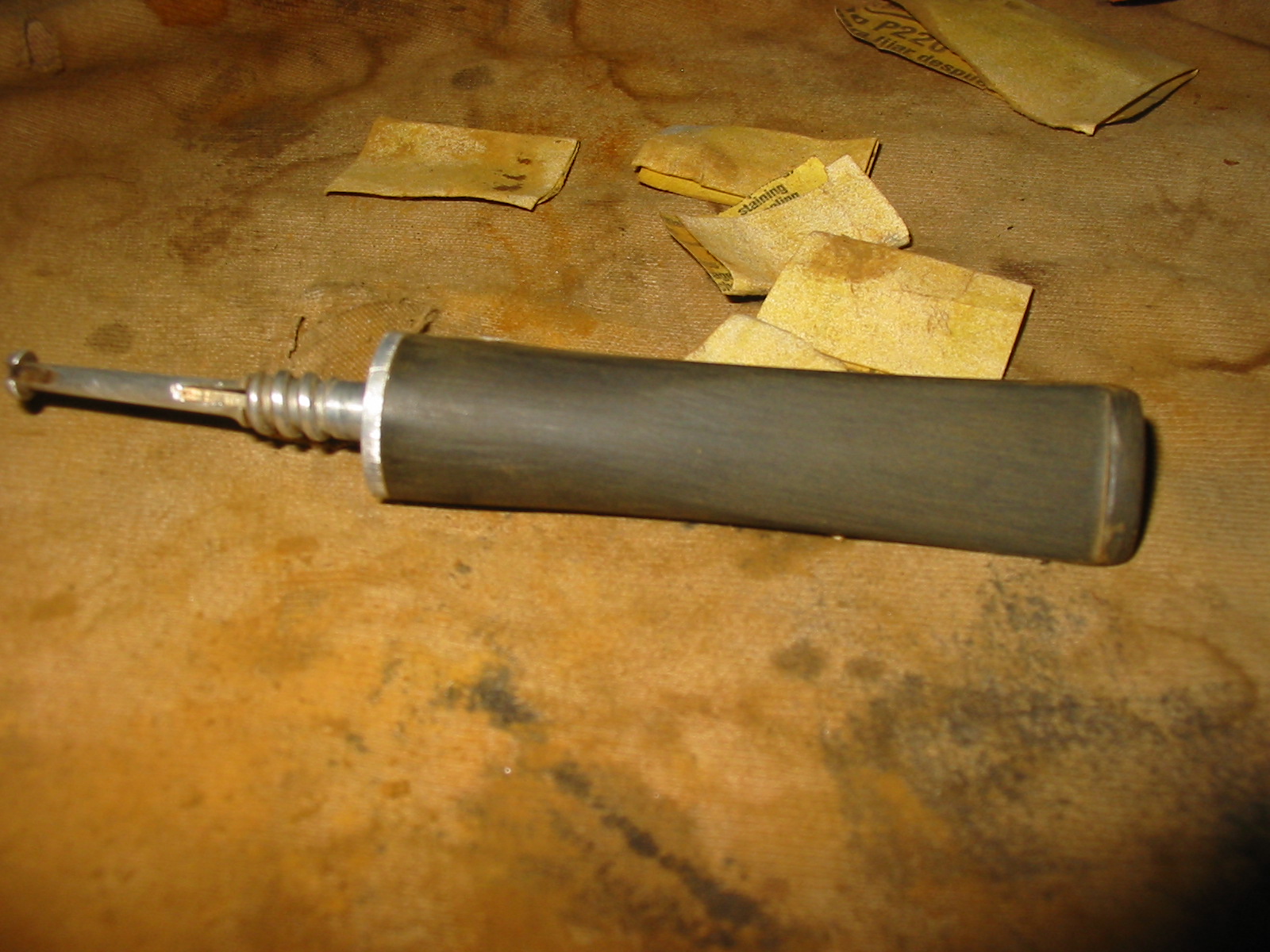
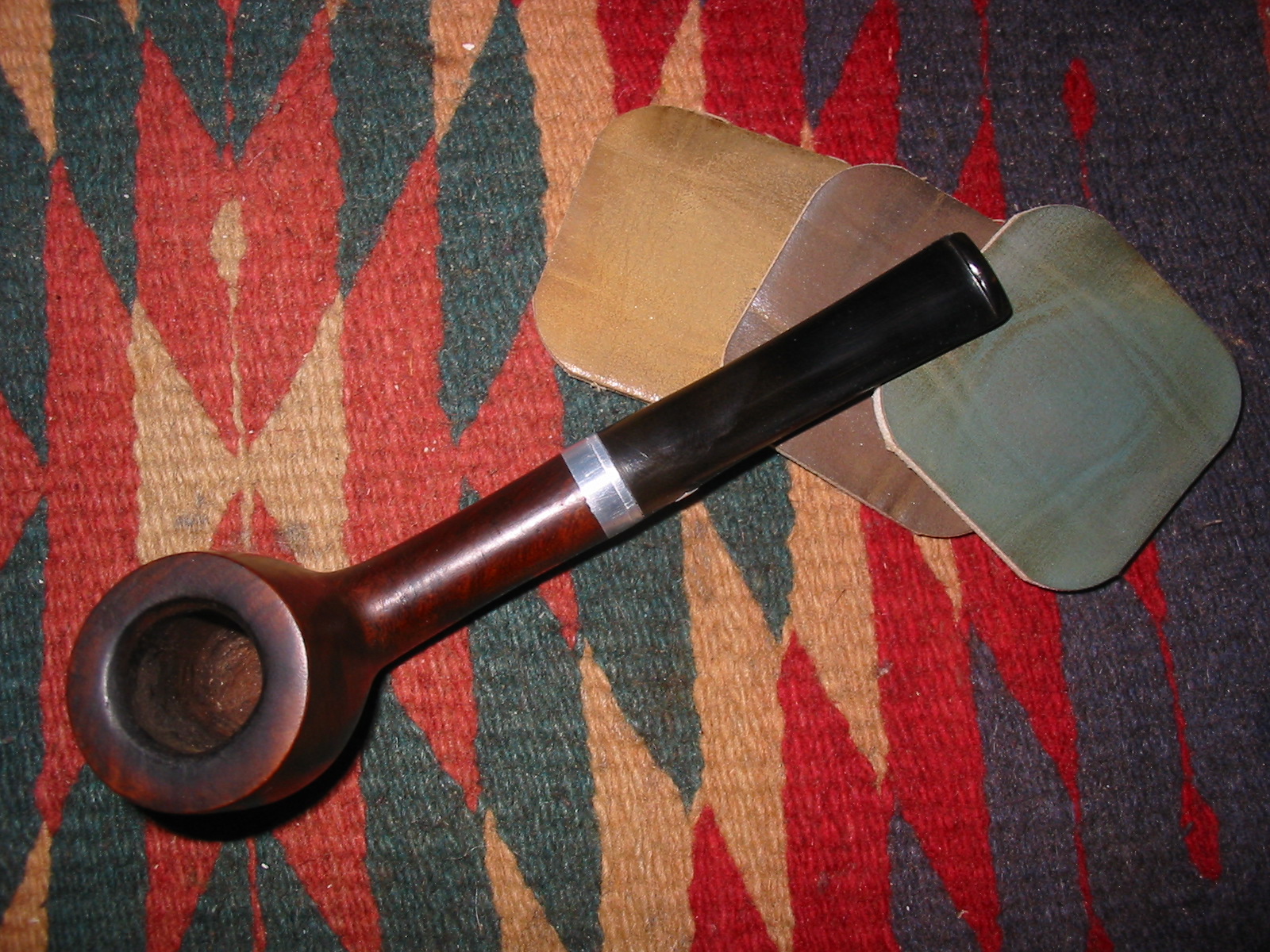
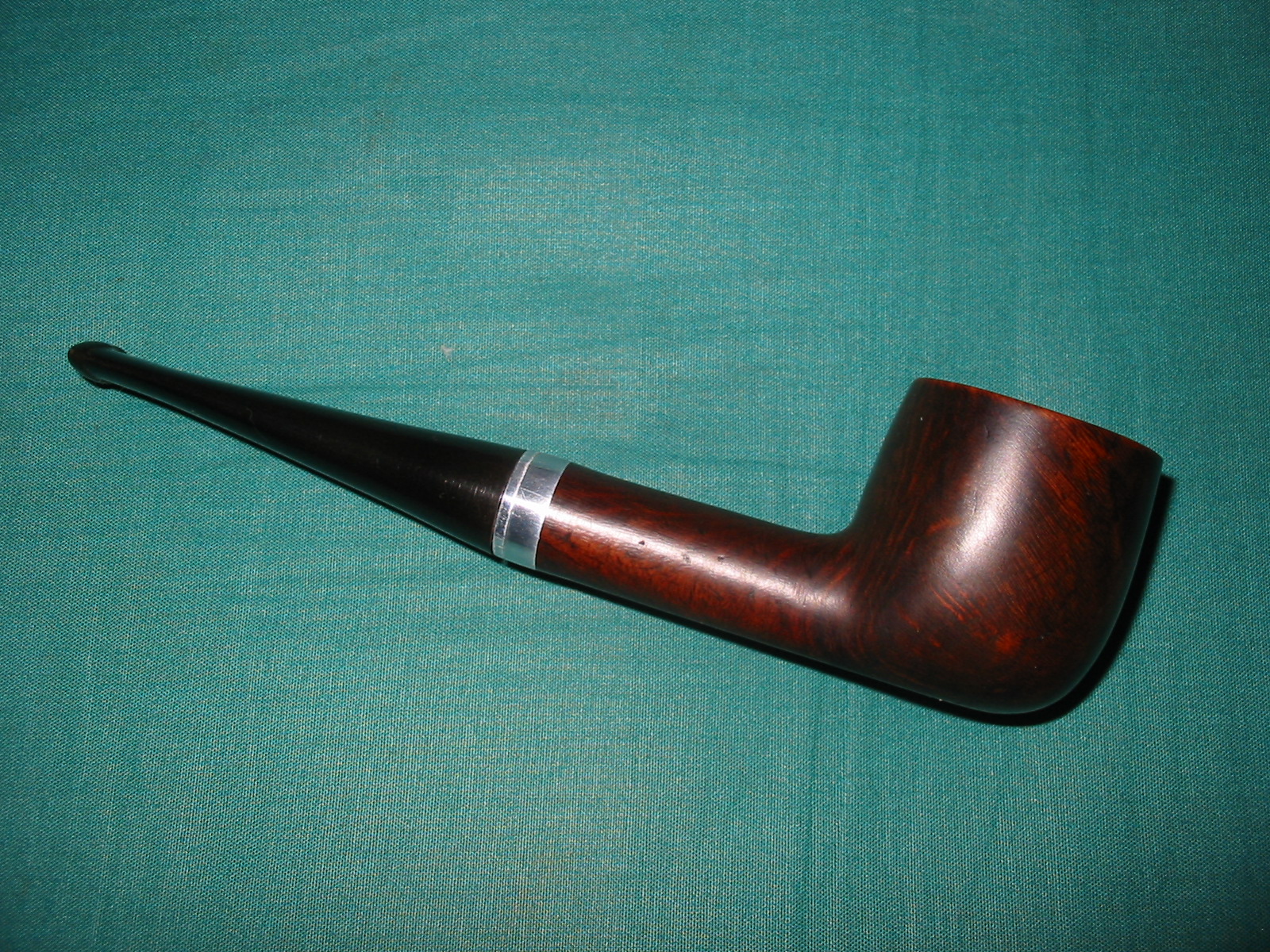
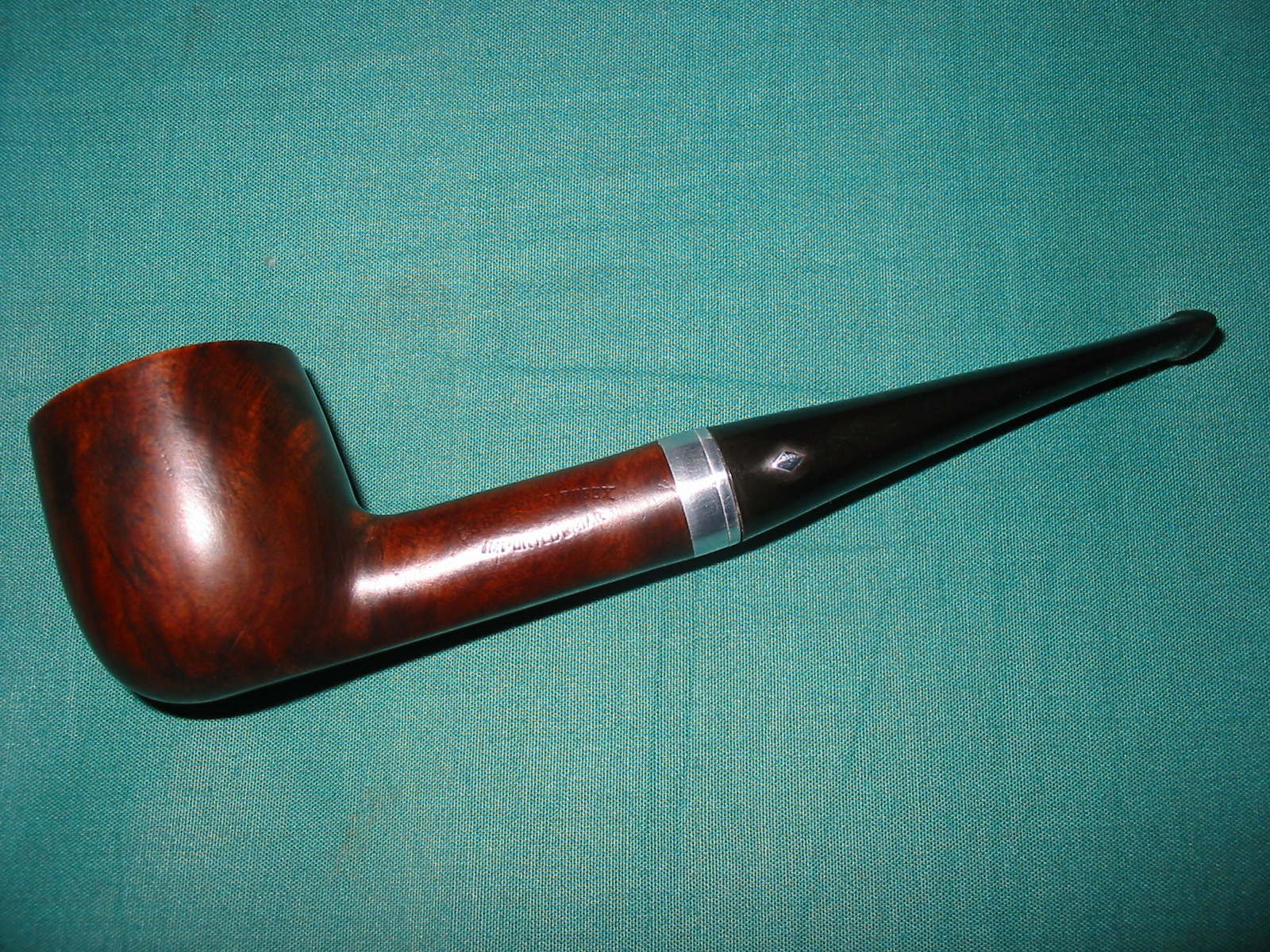
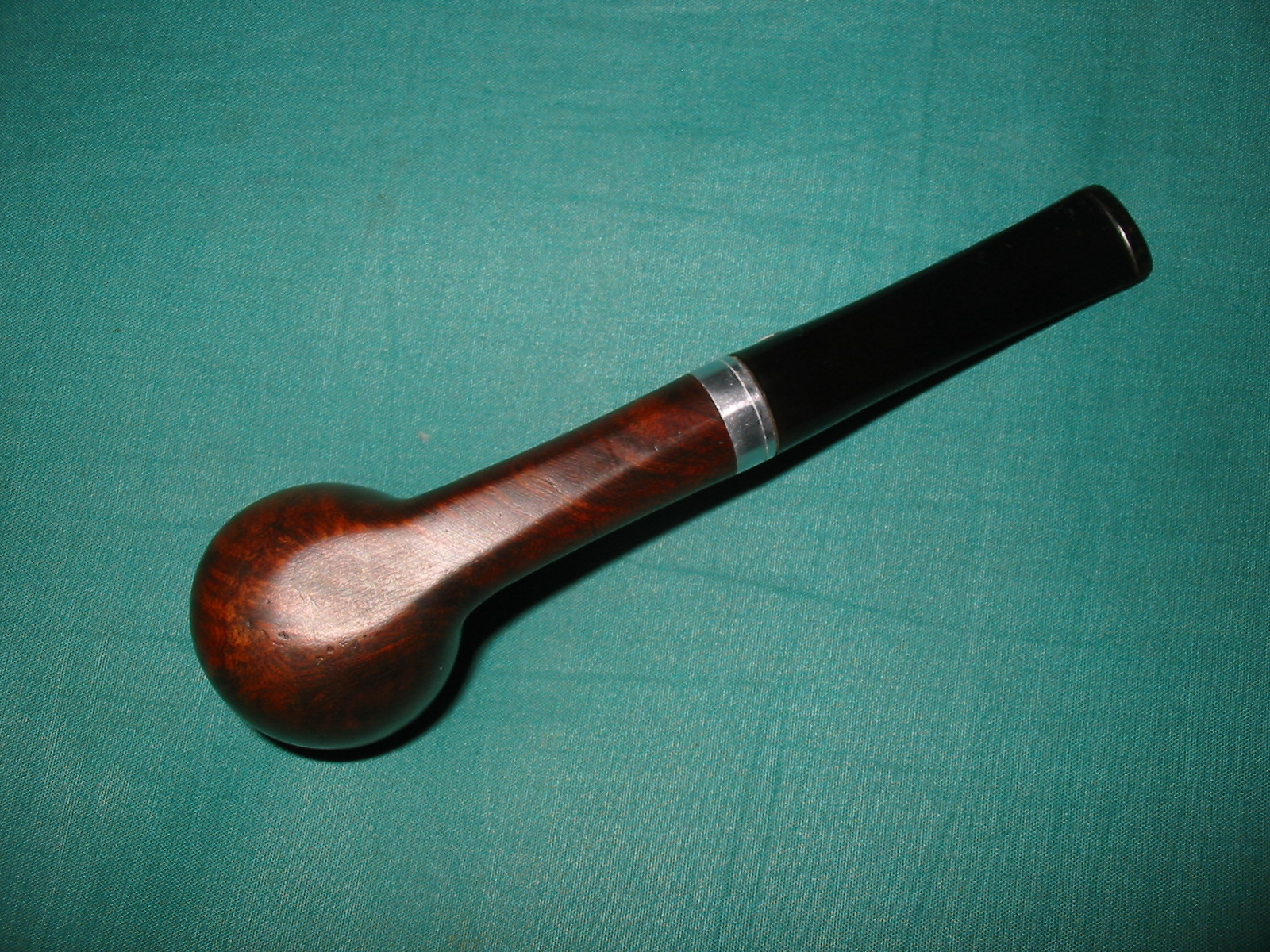
I rubbed down the stem with Obsidian Oil and gave it a very light buff with White Diamond. You have to exercise a very light touch when buffing nylon as it melts with the heat of the buffing wheel. I finished by giving the stem multiple coats of carnauba wax to give it a shine. I hand buffed the shine with a soft cotton cloth. The finish filter is pictured below in the final three photos. It is not something I will ever use but it is an interesting piece of tobacciana for the collection. I have no idea of the maker of the piece or of the age but I am fascinated by the ingenuity of the product.
IMG_3188

IMG_3189

IMG_3190

Restoring an LHS Certified Purex Pot


Blog by Steve Laug

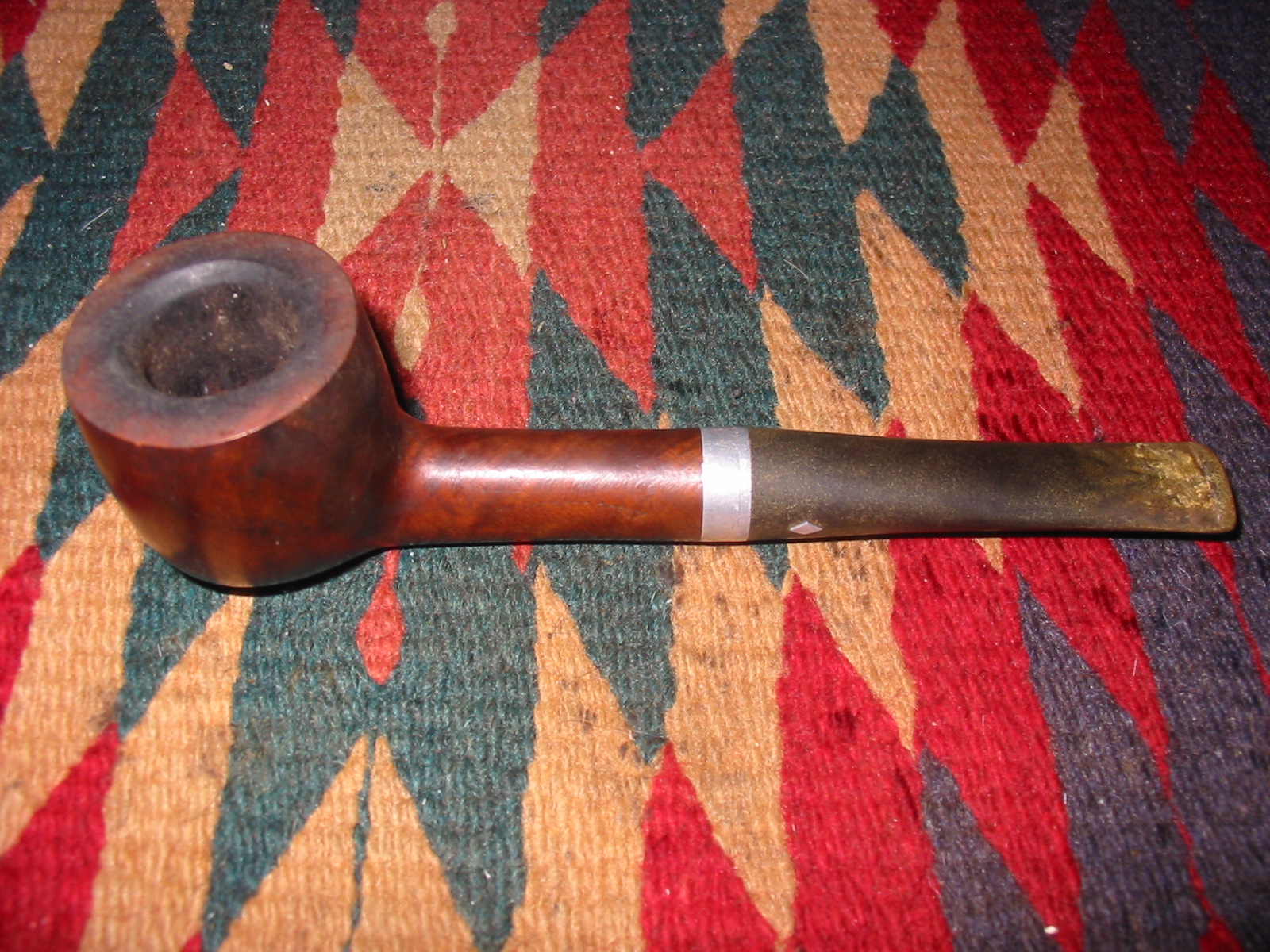
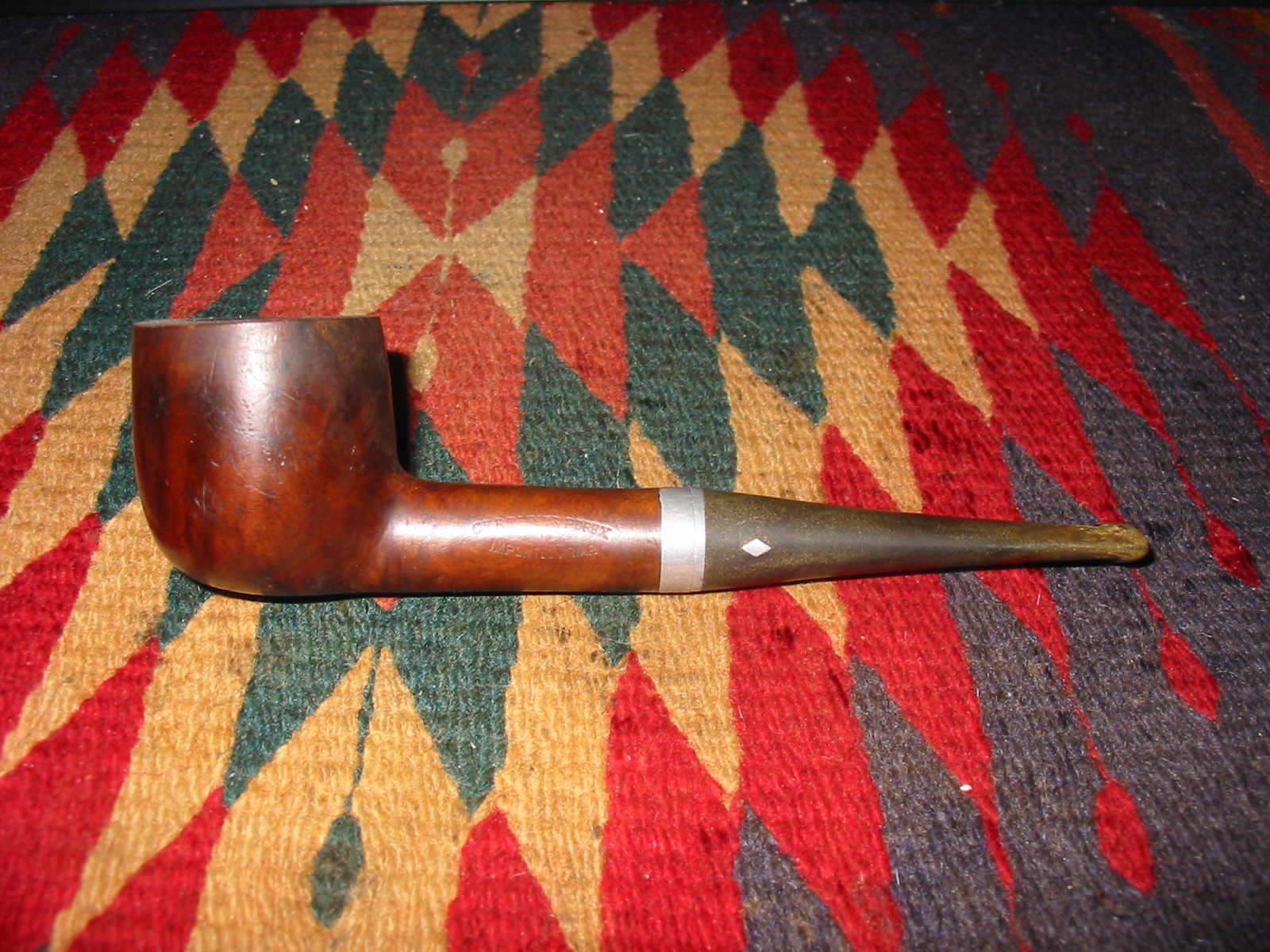
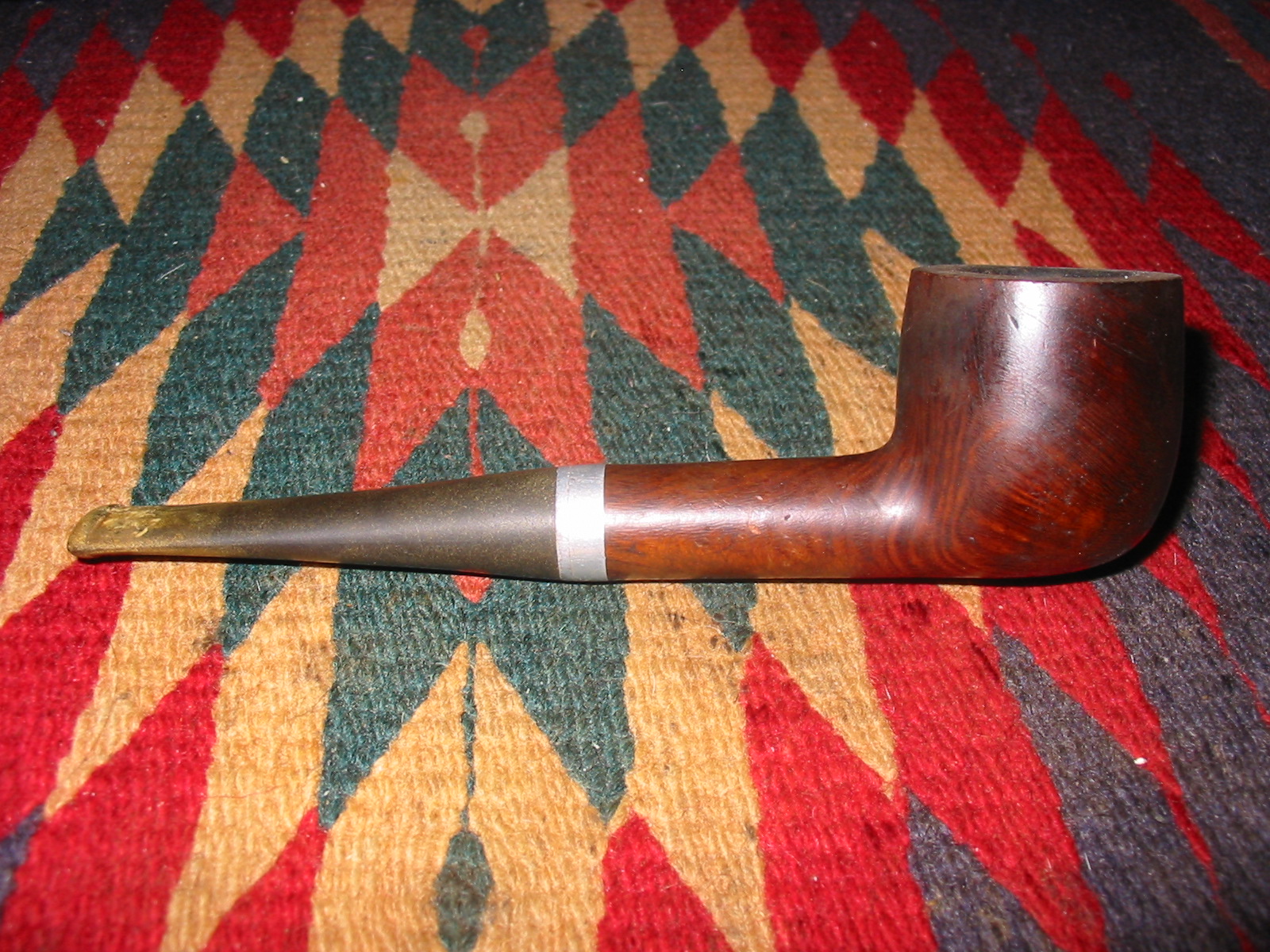
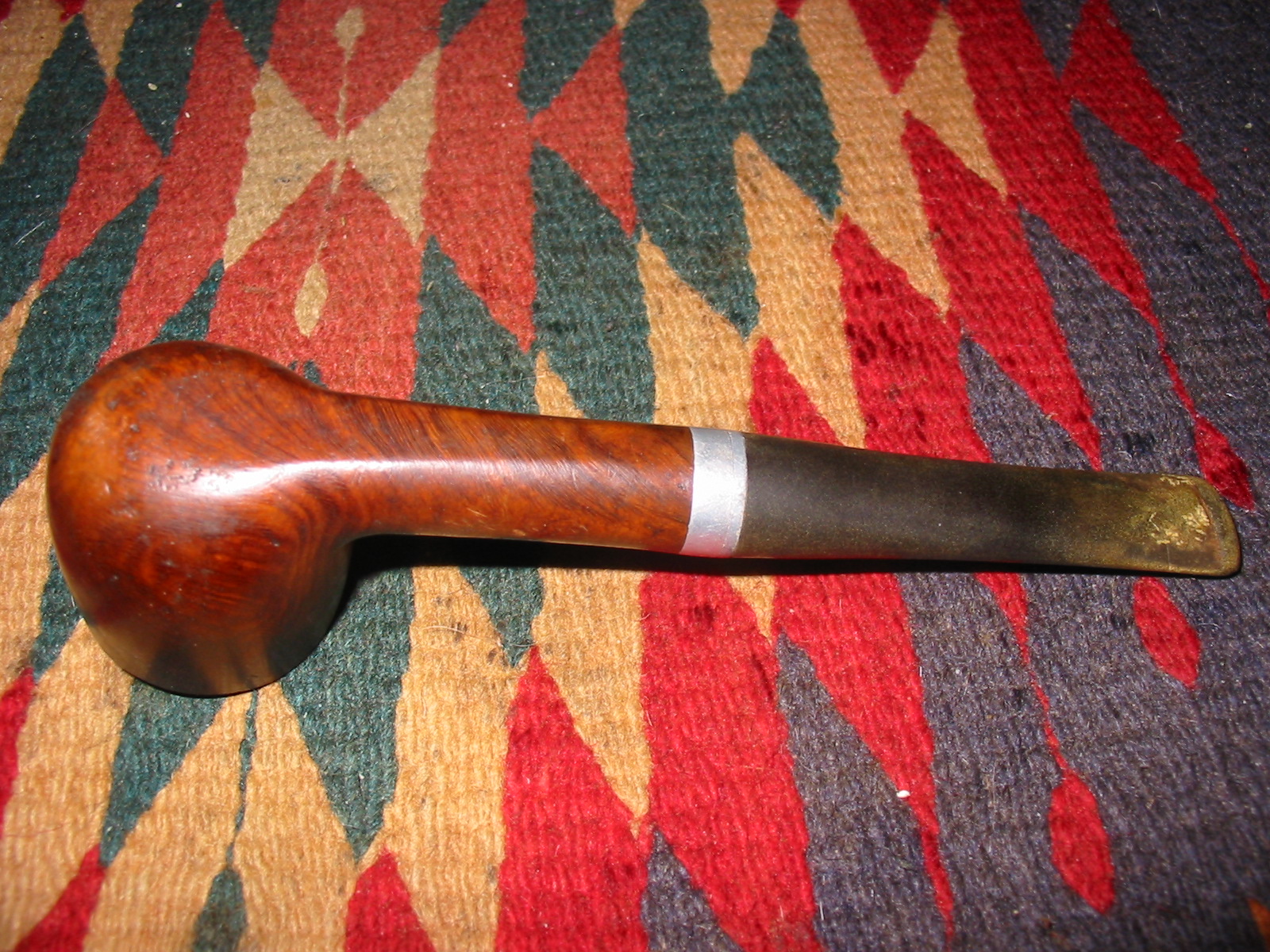
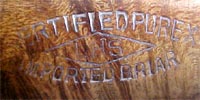
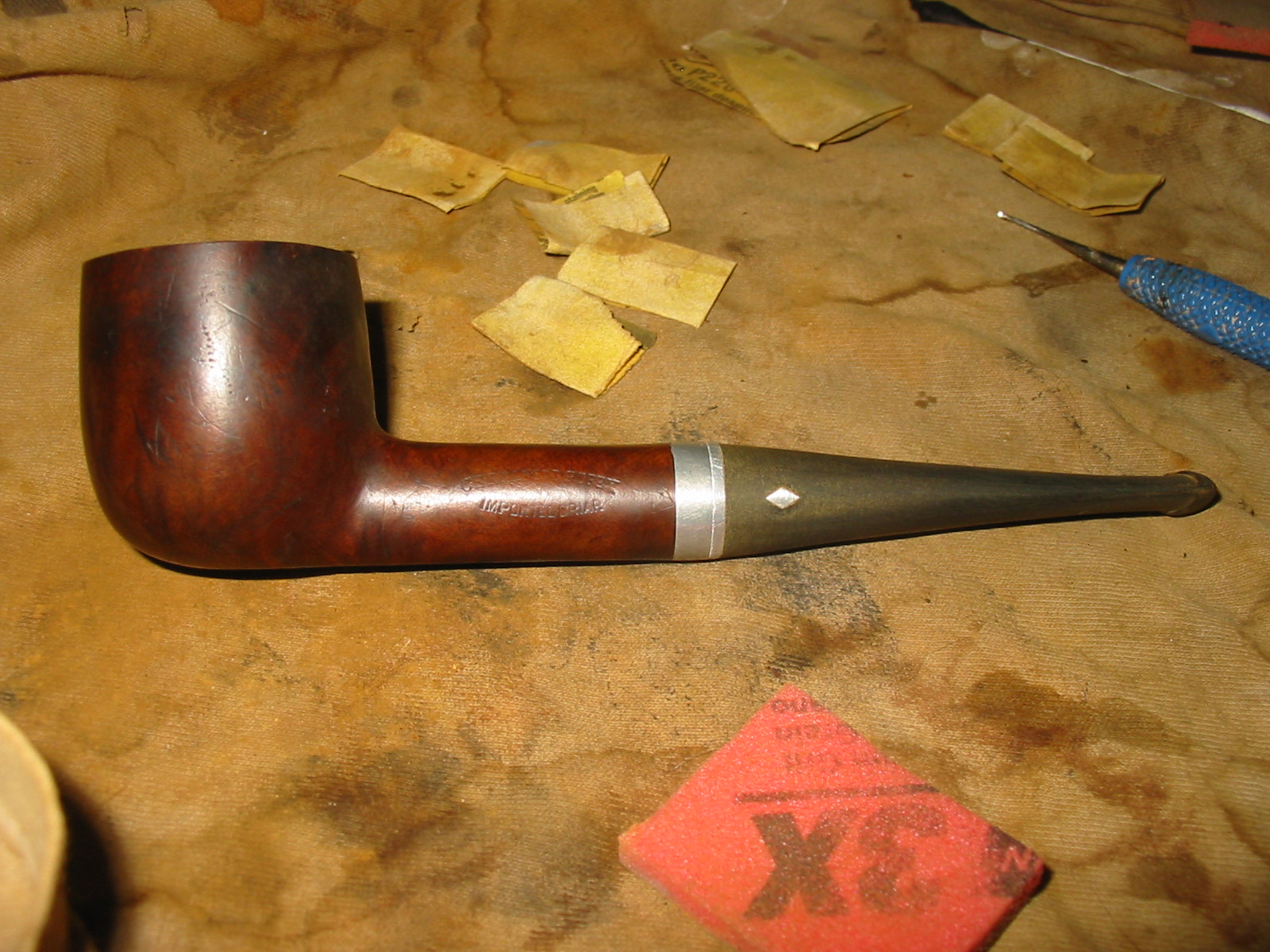
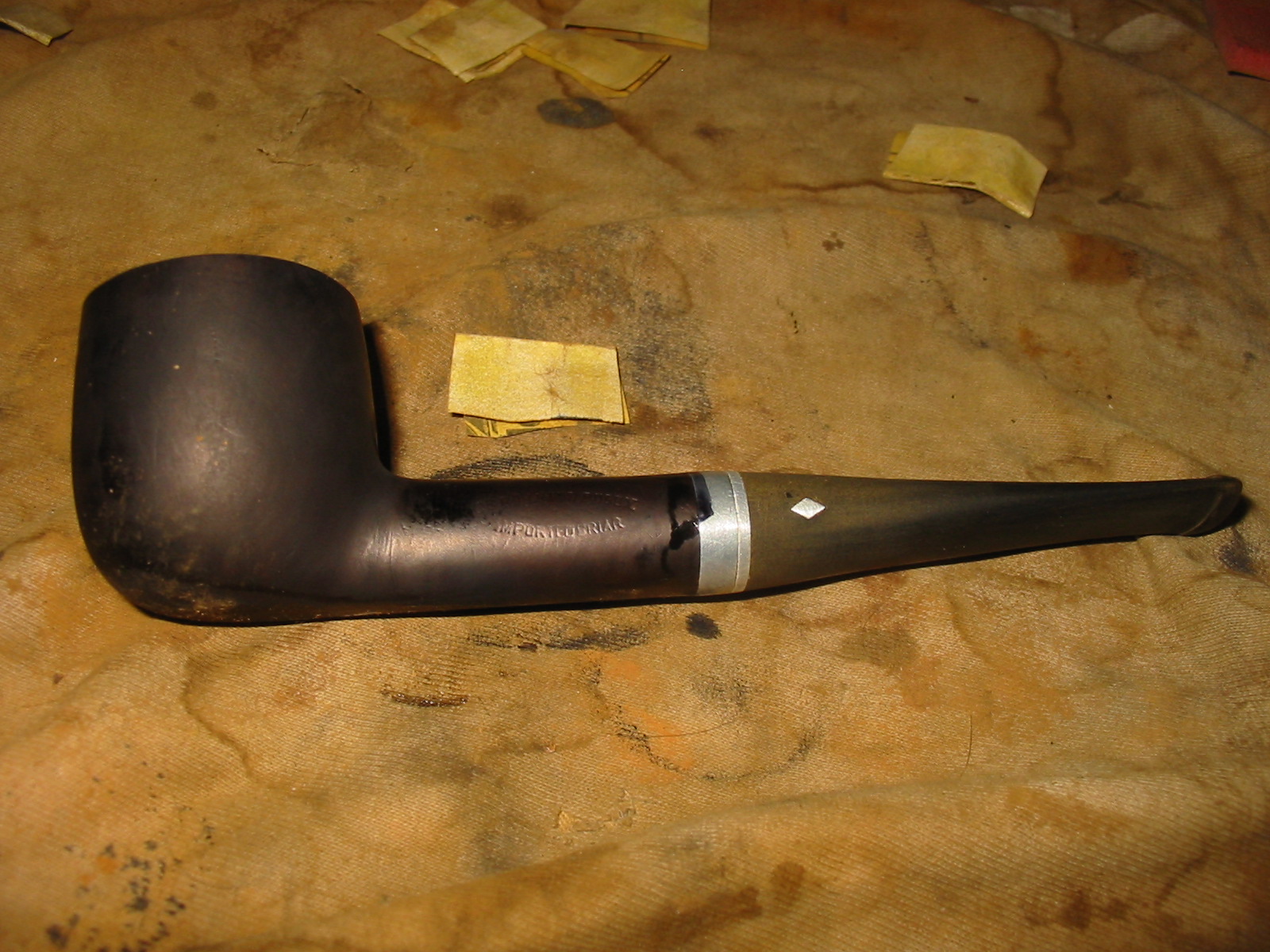
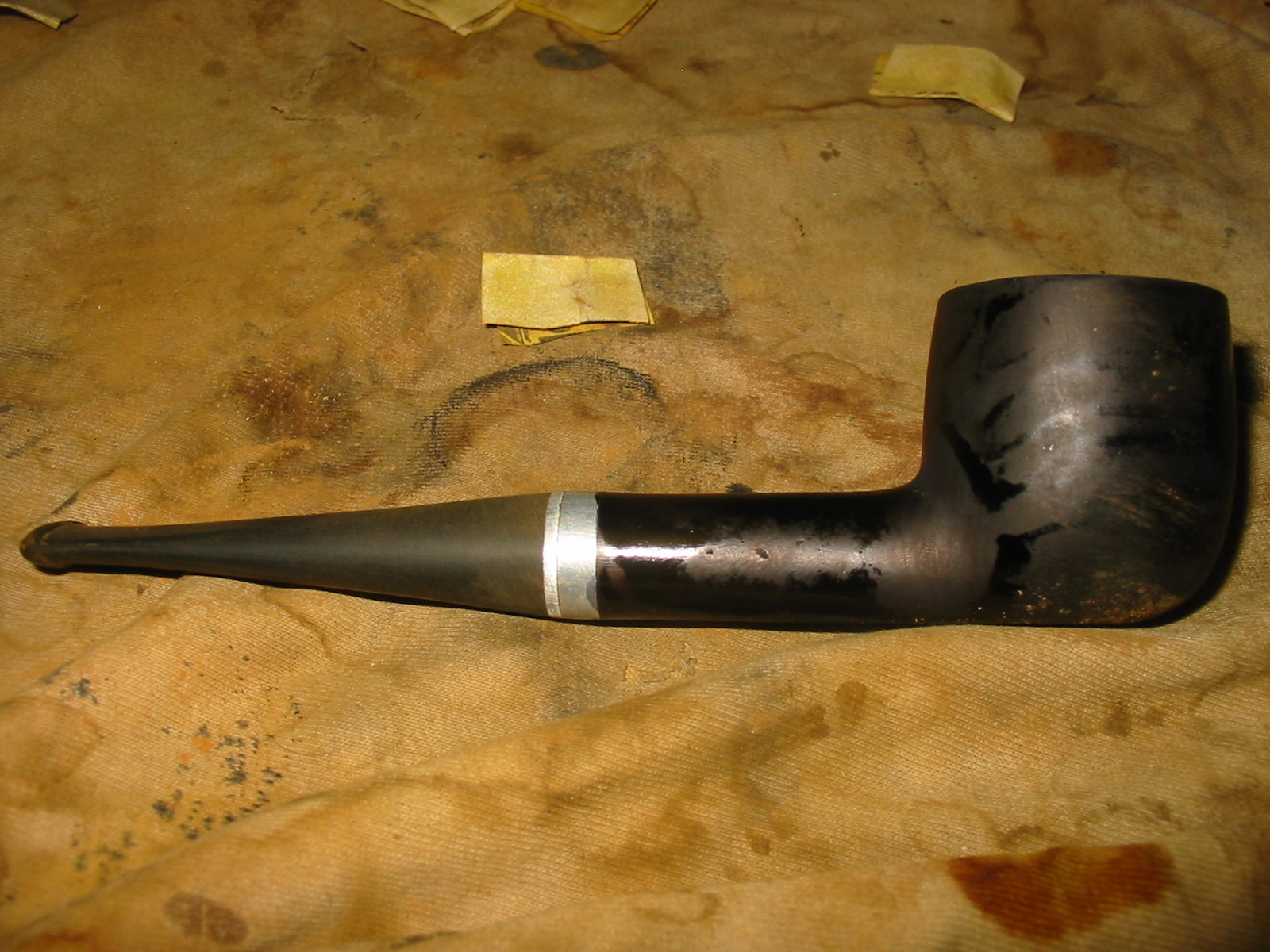
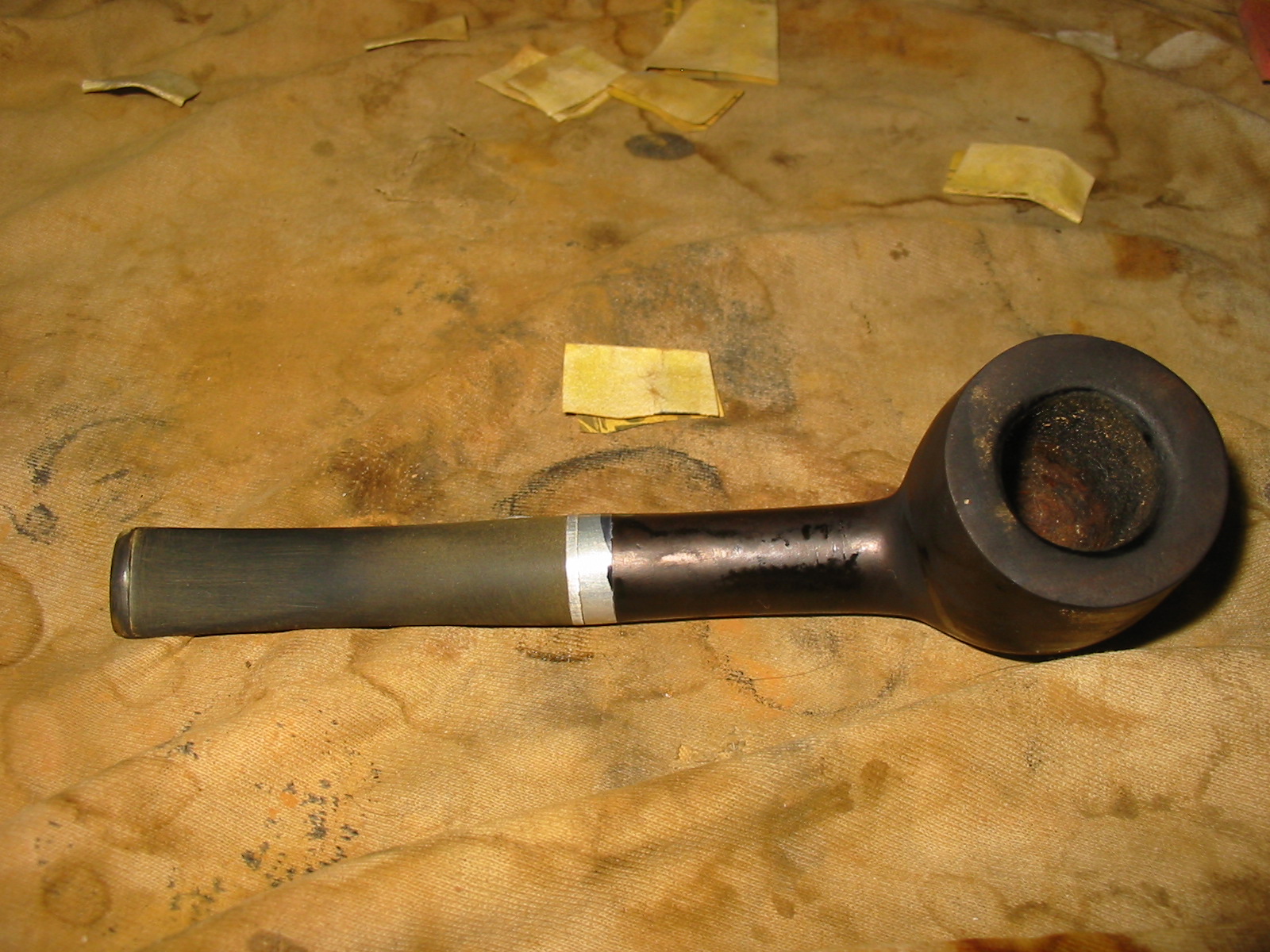
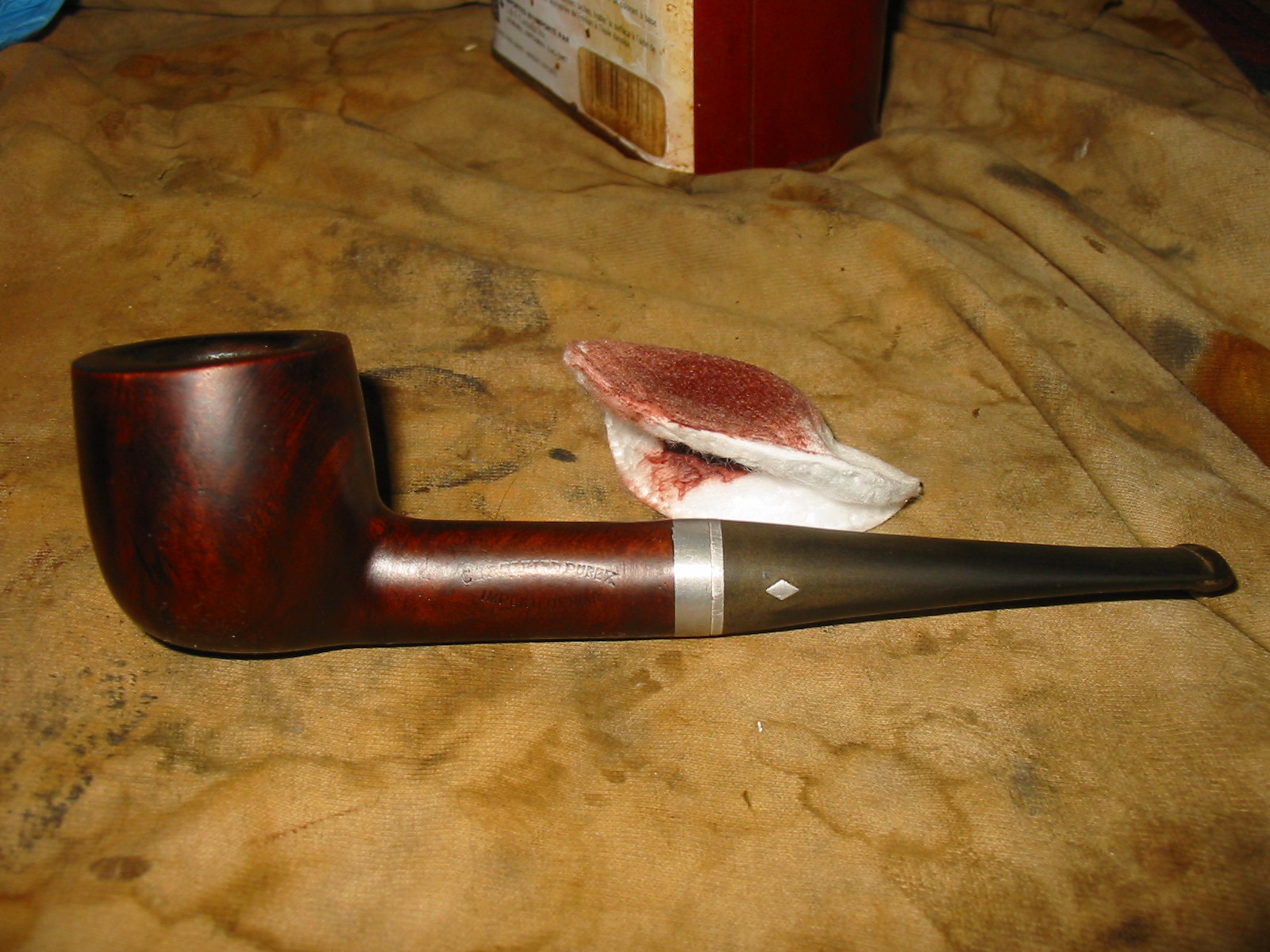
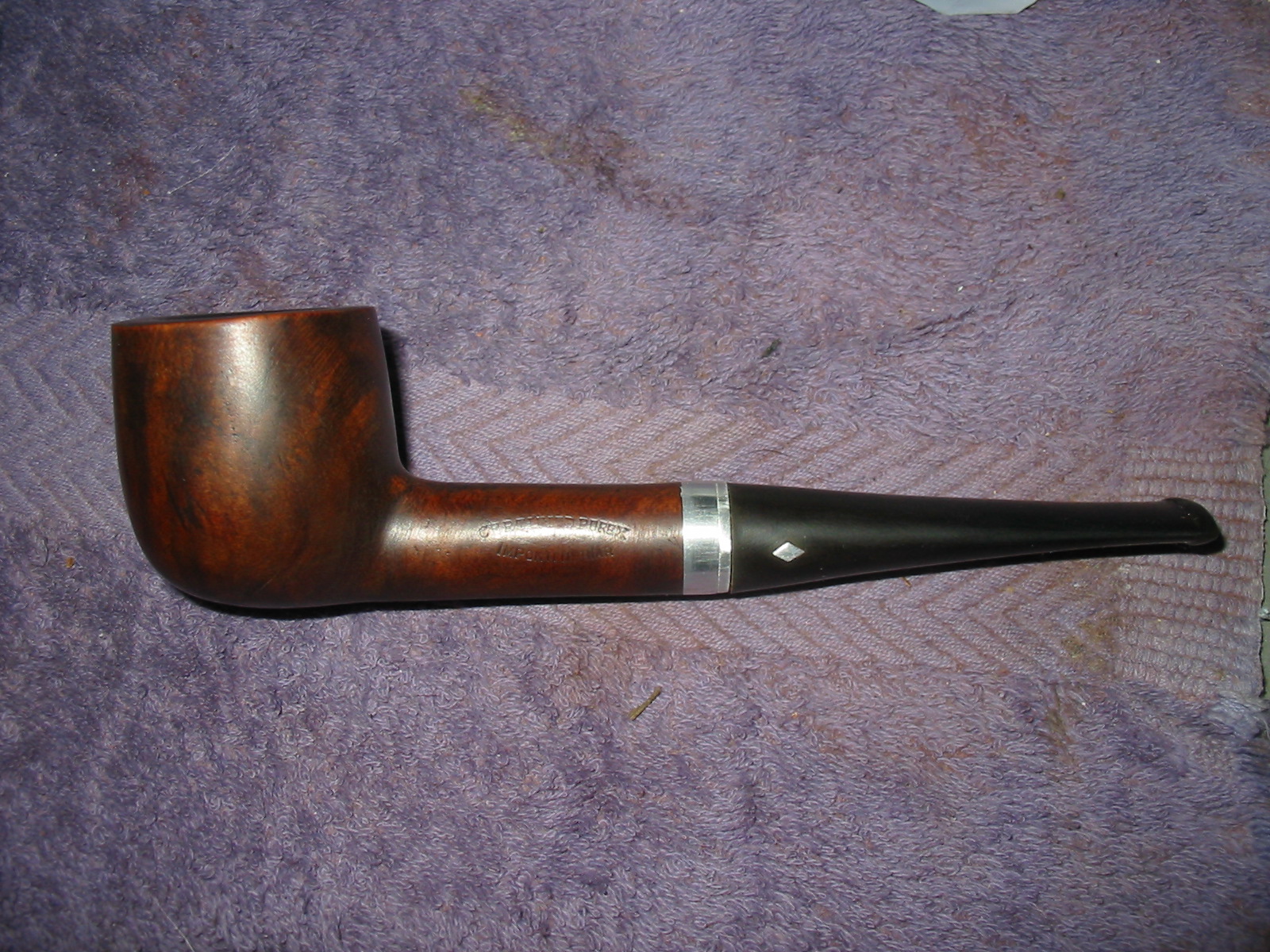
This LHS pot was another gift from a friend in exchange for restemming his pipe. It is stamped on the left side of the shank Certified Purex in a convex arc and underneath is a concave arc stamped Imported Briar. In the middle the stamping is very faint but using a magnifying lens the remnants of a diamond with the letters LHS are barely visible. The finish was very dirty and the rim was blackened but not burned. The bottom of the bowl near the front was covered with dents and pin pricks like the pipe had been tapped or dropped on concrete. There was very little cake in the bowl. The stem had a screw mount tenon with an aluminum receptor on the end of the shank. The stem itself had an aluminum end on it with a push in stinger apparatus. The stem had deep tooth marks on the top and the bottom sides and was oxidized. On the left side of the stem was an aluminum diamond that was inserted in the stem.
IMG_3137

IMG_3138

IMG_3139

IMG_3140

I looked up LHS Certified Purex pipes on Google and found the following information. The first comes from http://www.pipephil.eu/logos/en/logo-lhs.html#certifiedpurex . Phil has a page on the LHS pipes. The L&H Stern Inc. was established by Ludwig Stern (1877-1942) in 1911. His brother Hugo (1872-?) acted as vice-president & secretary. The firm moved to 56 Pearl St. Brooklyn in 1920. It closed down in the 1960s. LHS was one of the main pipe suppliers for US soldiers during WWII. LHS had several seconds lines, two of which are the London Royal and the Stanhope. Phil included the two photos below. The first is of the diamond insert on the stem. The one I am refurbishing has the same diamond. The second is of the stamping on the pipe. The top photo which is a picture of the stamping reads Certified Purex over Imported Briar with the LHS in a Diamond inside the two arcs. This stamping matches the pipe I worked on.
lhs5blhs3a Pipedia also had information on the pipes from which I summarize some additions that were not included above. L & H Stern (LHS) of Brooklyn, New York. The company’s famous logo is in a diamond. These pipes are high quality production pipes. A popular and moderately priced pipe made from 1896 through the 1960’s by the L&H Stern Company of Brooklyn, New York. Many of their later Sterncrest pipes featured silver bands and some were made with 14kt. gold bands as well. The “Diamond” series appears to be their high-end line. They had a different logo which was 3 diamonds in a row, larger in the middle. They also had Allbriar models (stem and bowl both made of briar) in the Diamond line, and these tended to have a screw type fitment with stinger, like Kaywoodie or Dr. Grabows.

With this information I took the Purex pot to my work table. I took off the stem and dropped the bowl into an alcohol bath to soak while I worked on the stem. It sat in the bath for about an hour while I addressed the issues on the stem.
IMG_3141

I sanded the stem with 220 grit sandpaper to remove the calcification around the button and up the stem for about ½ inch. I also wanted to clean up around the tooth dents to see what I would have to do to fix them. In the next two photos below the dents in the stem are clearly visible on the top and the underside of the stem. Removing the calcification made the dents very clear.
IMG_3142

IMG_3143

After examining them with a magnifying glass I could see that they were dents. I was able to heat them and lift them to some degree and then sanded what remained after heating. The next three photos show the removal of the dents and remaining marks with the sandpaper.
IMG_3144

IMG_3145

IMG_3147

I sanded the stem with a medium grit “pink” sanding sponge that is visible in the photos below. This removed the scratches left behind by the 220 grit sandpaper. In these photos the dents are no longer visible. The sanding also removed the majority of the oxidation on the stem.
IMG_3148

IMG_3150

IMG_3151

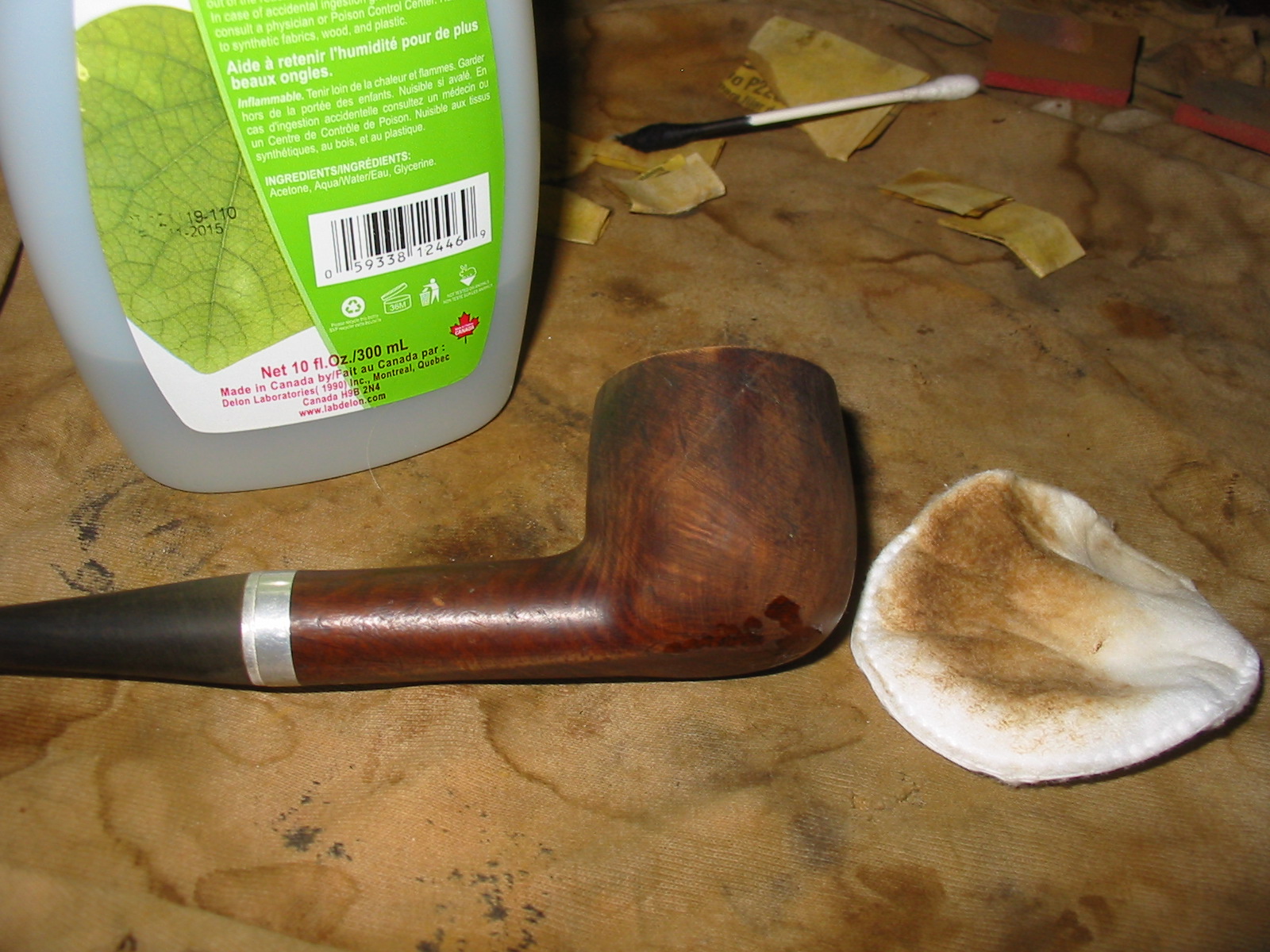
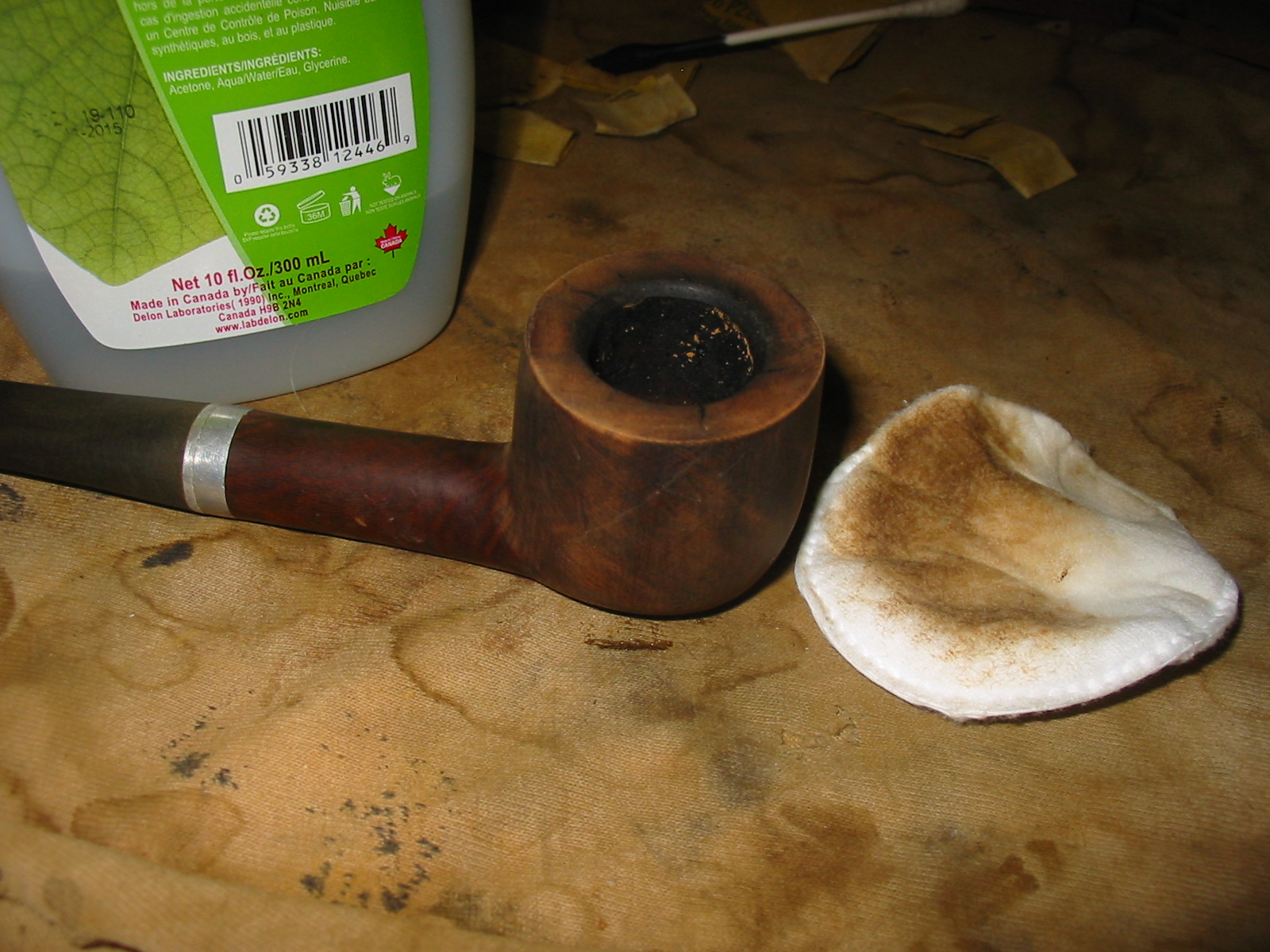
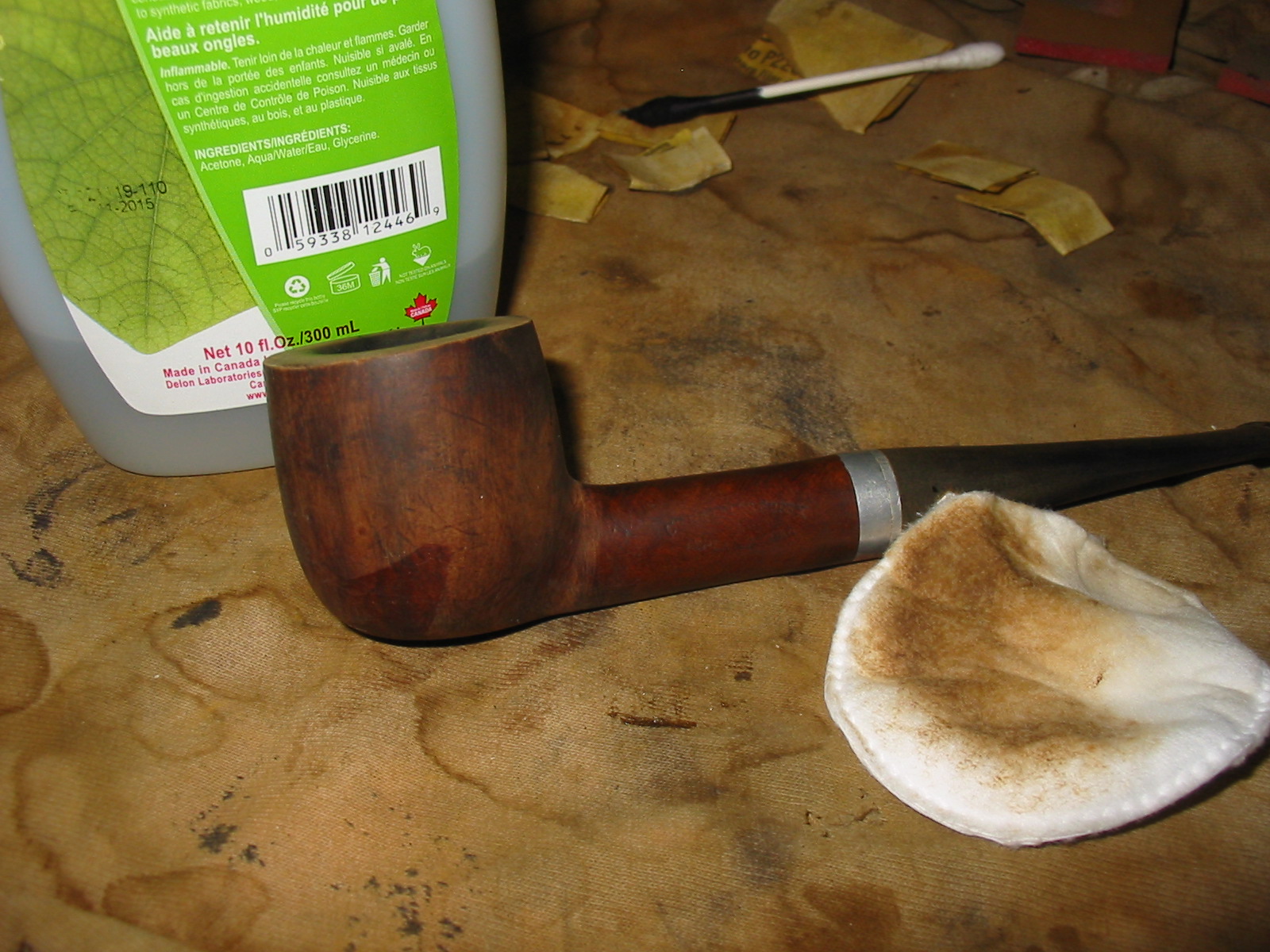
I wiped the bowl down with acetone on a cotton pad to remove the finish before I worked on the pitting and marks on the bottom of the bowl. I steamed the dents and then filled the remaining marks with superglue to smooth them out. I sanded the superglue with 220 grit sandpaper to remove the slight bubble on the super glue and also followed up that with a medium grit sanding sponge. I wet sanded the bowl with 1500-2400 grit micromesh sanding pads.
IMG_3152

IMG_3153

IMG_3154

I stained the bowl with black aniline stain and flamed it to set it deep in the grain. I repeated the staining and flaming to make sure I got a smooth and even coverage on the undercoat of stain. The black understain does a great job in hiding the small fills that were in the bottom of the bowl.
IMG_3155

IMG_3156

IMG_3157

IMG_3158

I wiped down the stain with acetone to remove the topcoat and to highlight the dark grain pattern that remained. The dents on the bottom of the bowl are not visible in the fourth photo below. The grain shows through nicely. I sanded the bowl with 1800-2400 micromesh sanding pads to remove the scratches that were still visible in the finish.
IMG_3159

IMG_3160

IMG_3161

IMG_3162

I then stained the pipe with a oxblood stain for a finish coat. I applied the stain, flamed it and reapplied it and flamed it repeatedly until I had the coverage I wanted on the pipe. The next three photos show the rich overstain. The repairs to the pits on the bottom of the bowl are no longer visible.
IMG_3163

IMG_3164

IMG_3165

The stem had been slightly overturned so I needed to heat the tenon and turn it clockwise on the shank until it lined up again. I removed the stinger and then heated the tenon over a heat gun to loosen the glue in the stem. Once it was heated I screwed it into the shank of the pipe until it was aligned again.
IMG_3166

IMG_3167

I put the stinger back in place and wet sanded the stem with 1500-2400 grit micromesh pads and then dry sanded with 3200-12,000 grit pads.
IMG_3169

IMG_3170

IMG_3171

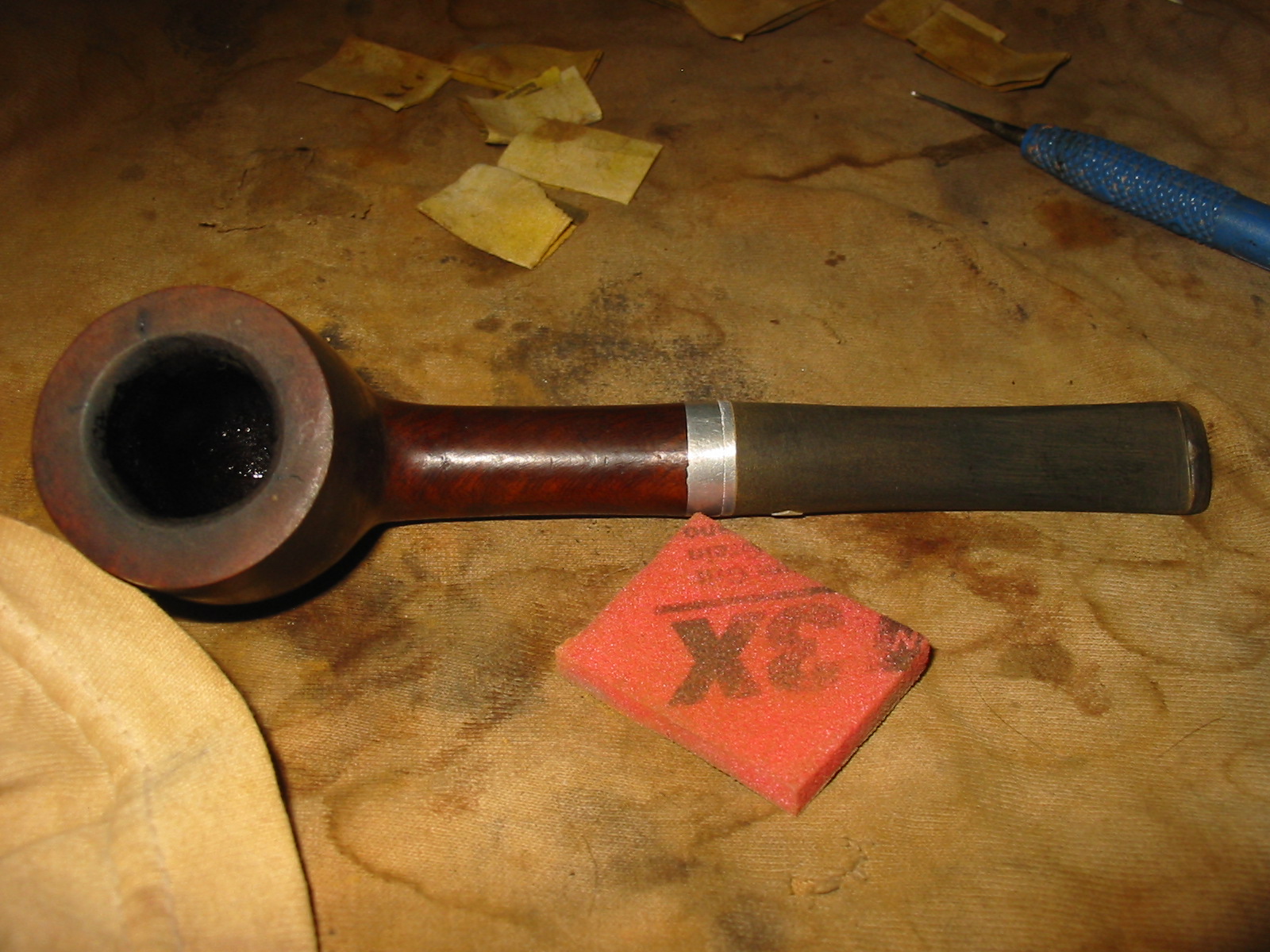
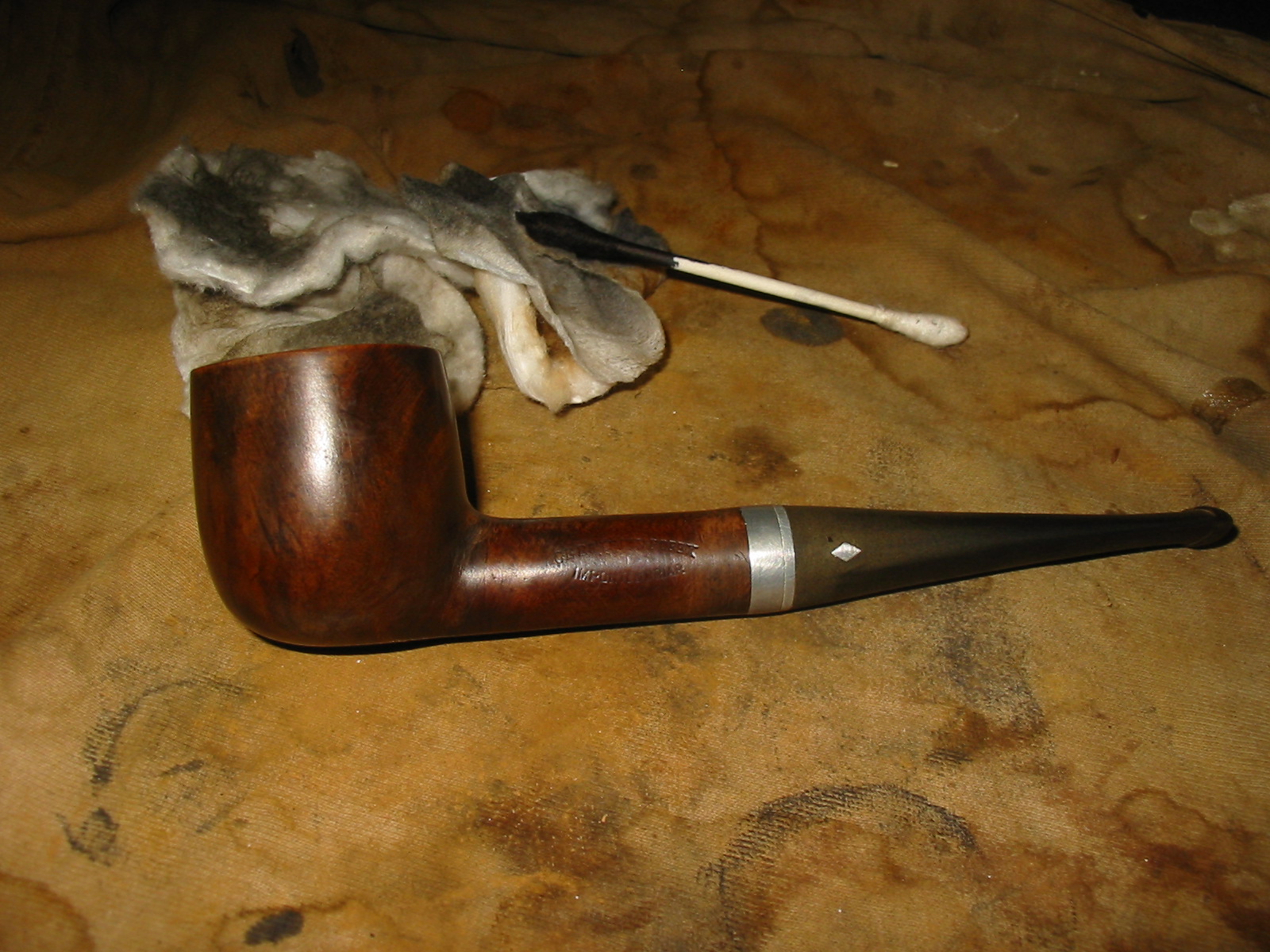
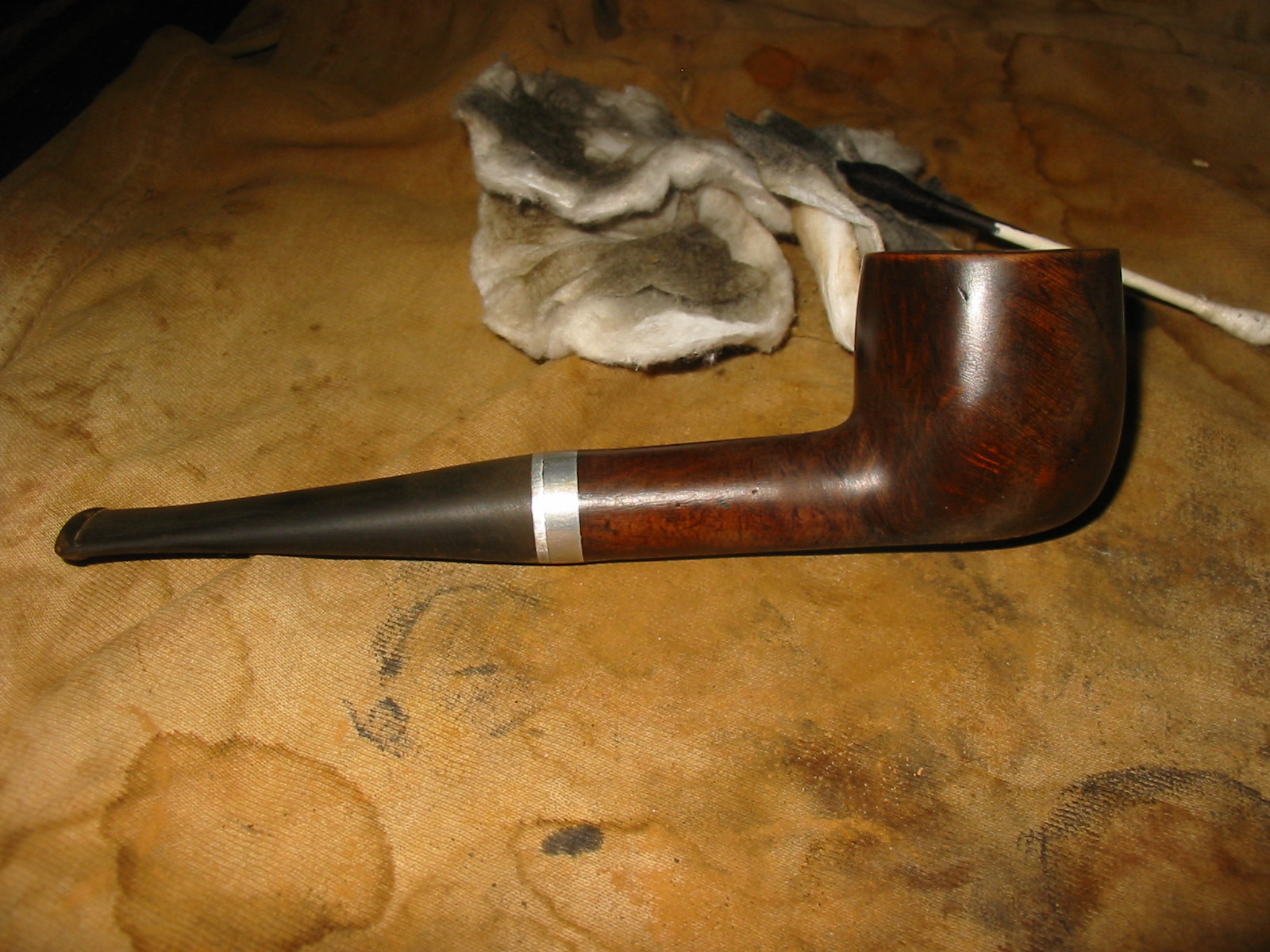
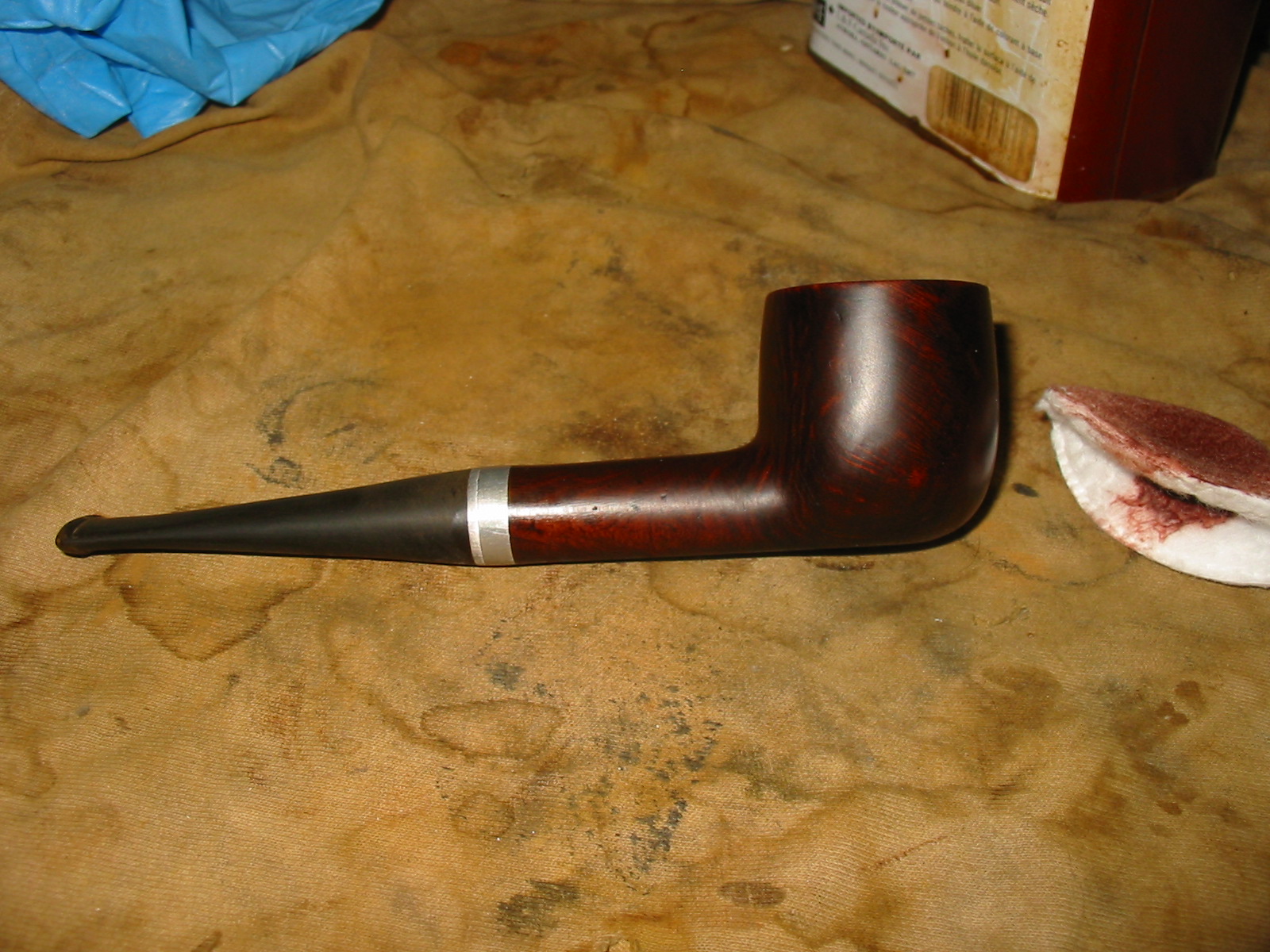
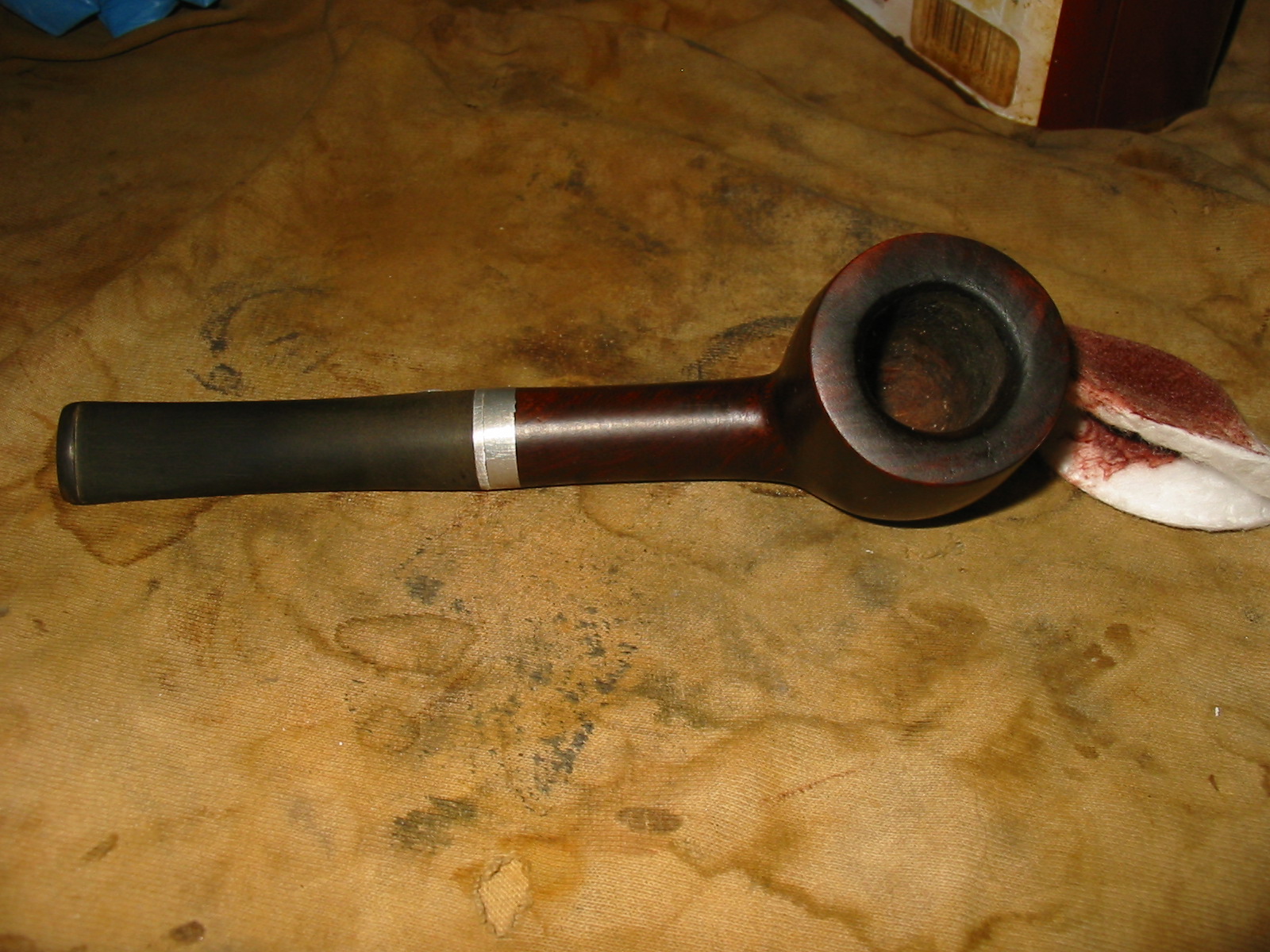
Once I finished sanding the stem I wiped it down with Obsidian Oil and rubbed it into the vulcanite. I polished the aluminum on the shank and the stem with the higher grits of micromesh and then with silver polish. I then took the pipe to the buffer and buffed the pipe and stem with White Diamond and then with multiple coats of carnauba wax to polish and protect it. The finished pipe is pictured below.
IMG_3173

IMG_3174

IMG_3175

IMG_3176

The Building Of A Buffing Station Part 1 – Alan Chestnutt


This afternoon I received an email from Alan Chestnutt of reborn briar sigpic573_1.gif regarding a post he made on Pipe Smokers Unlimited regarding a new buffing setup he had put together. He gave permission to post it here for folks to read about and also use for their own buffing stations. Thanks Alan for your work on this and for writing it up for us to read and see. It is much appreciated. Alan has a website http://www.estatepipes.co.uk/ where he sells some of the beautiful pipes he refurbishes. Have a look at the work he does. He also is available for working on pipes that you may not want to tackle on your own. Without further introduction here is Alan’s post.

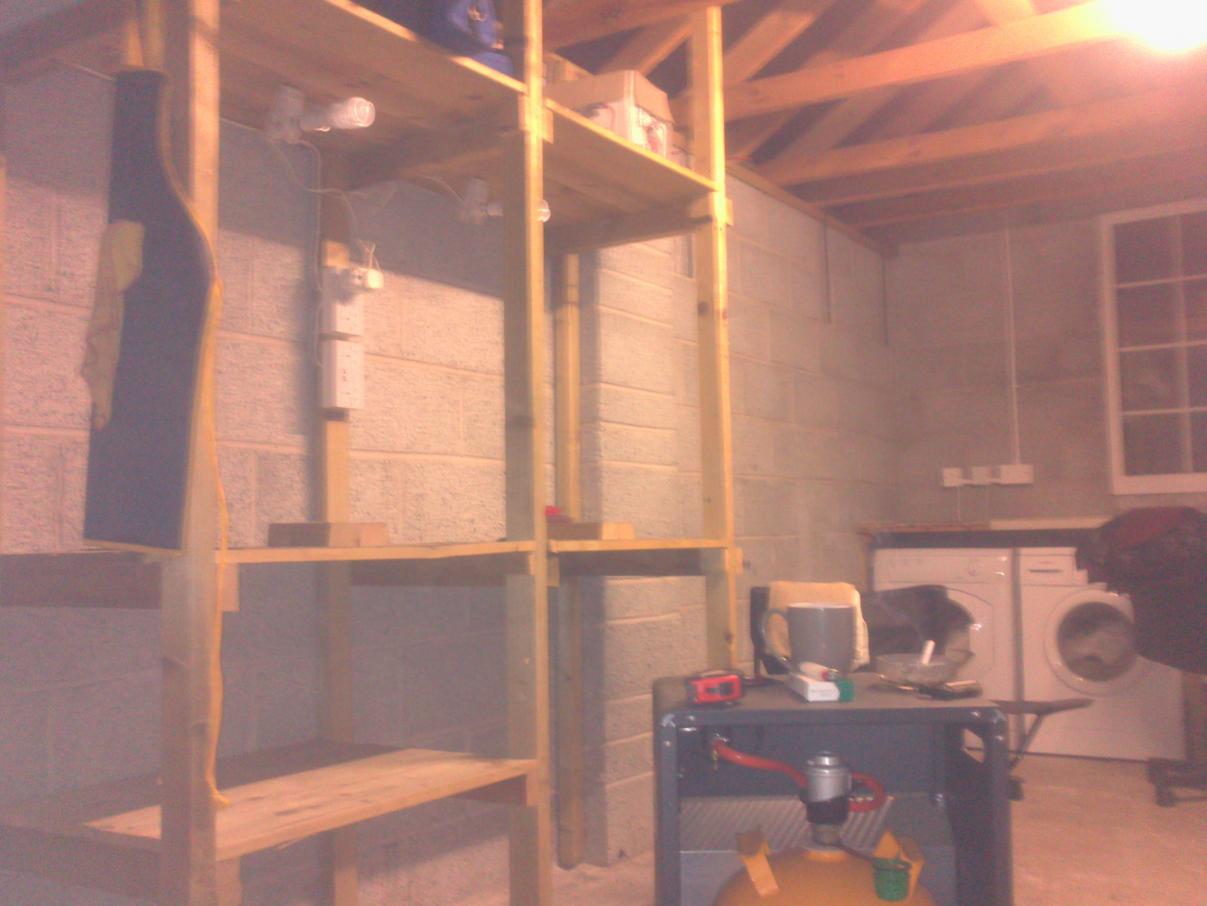
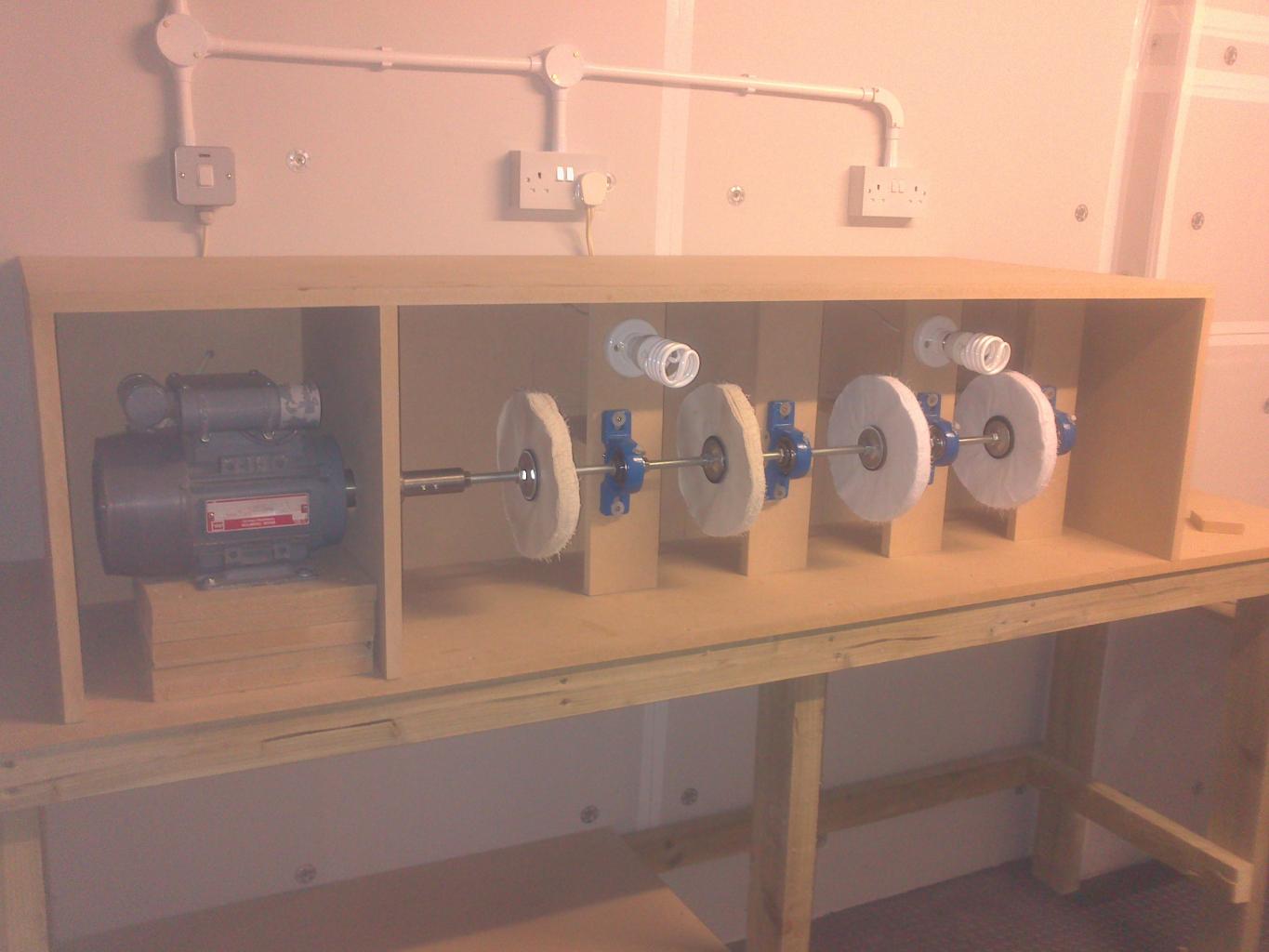
My workshop is in the garage of the house which is detached. It is a concrete block build with a tiled roof. Inside is the bare concrete block, a concrete floor, and it is open to the roof. Not a very pleasant place to be in the winter! Last winter the cold was unbearable, and even though I had a gas heater on full set beside me, it could not warm the garage. The buffing polish blocks were rock hard and virtually unusable, as were my hands at the buffing wheels! So this year I had to make some changes and install some insulation. Here is a picture before the work started:
alan1

Alan2

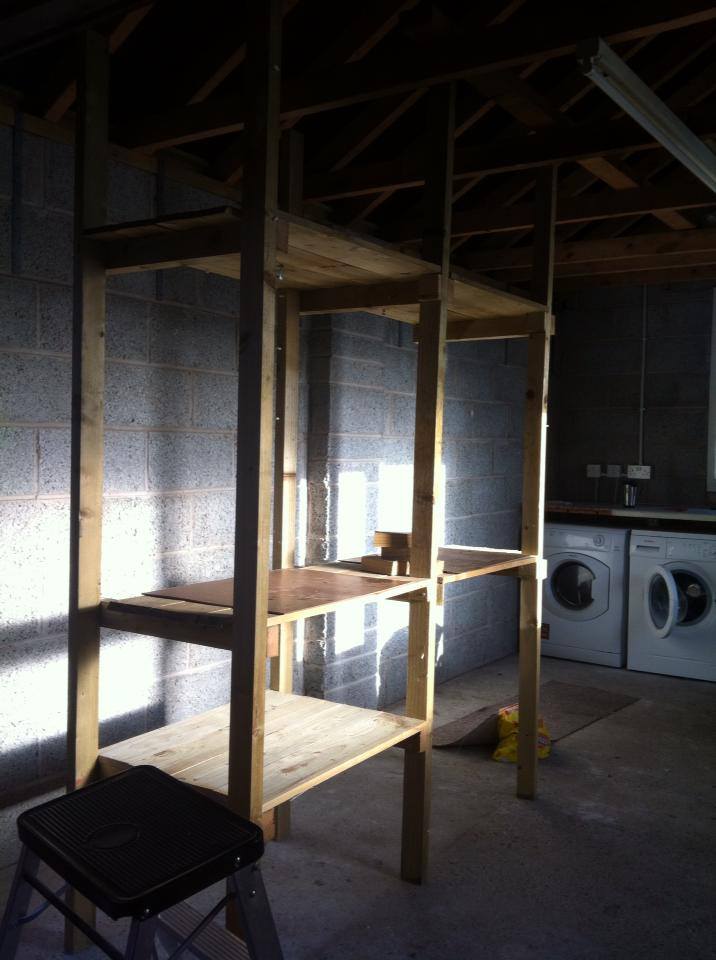
The workbench was secured to the wall plate and the rafters, to provide storage shelves above. The vertical uprights were a bit of a nuisance, so the plan was to extend the workbench space down the entire side towards the washer and dryer. On each side of the old workbench below the lights, I had set up 2 bench grinders with tapered pigtail adapters for the buffing wheels. While the work was being completed, I wanted to install a custom buffing station driven by a motor.

The first task was the insulation of the garage and installation of the workbenches. Having spoken with a local handyman, he advised the easiest method was to use thermal insulated backed plasterboard. Next is a picture after the insulation work was completed. The plasterboard has 2 inches of special thermal insulation attached to the back, and this was able to be attached directly to the concrete blocks. The same material was used to block in the roof cavity. The floor has been laid with interlocking rubber foam tiles and the benches have been started to be put in place.
alan3

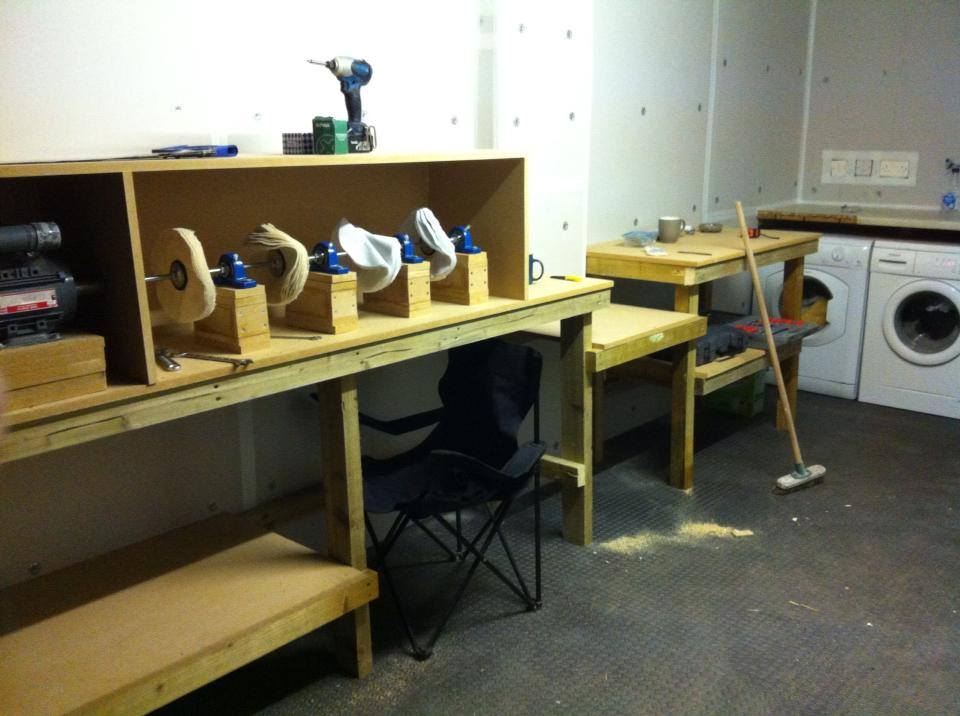
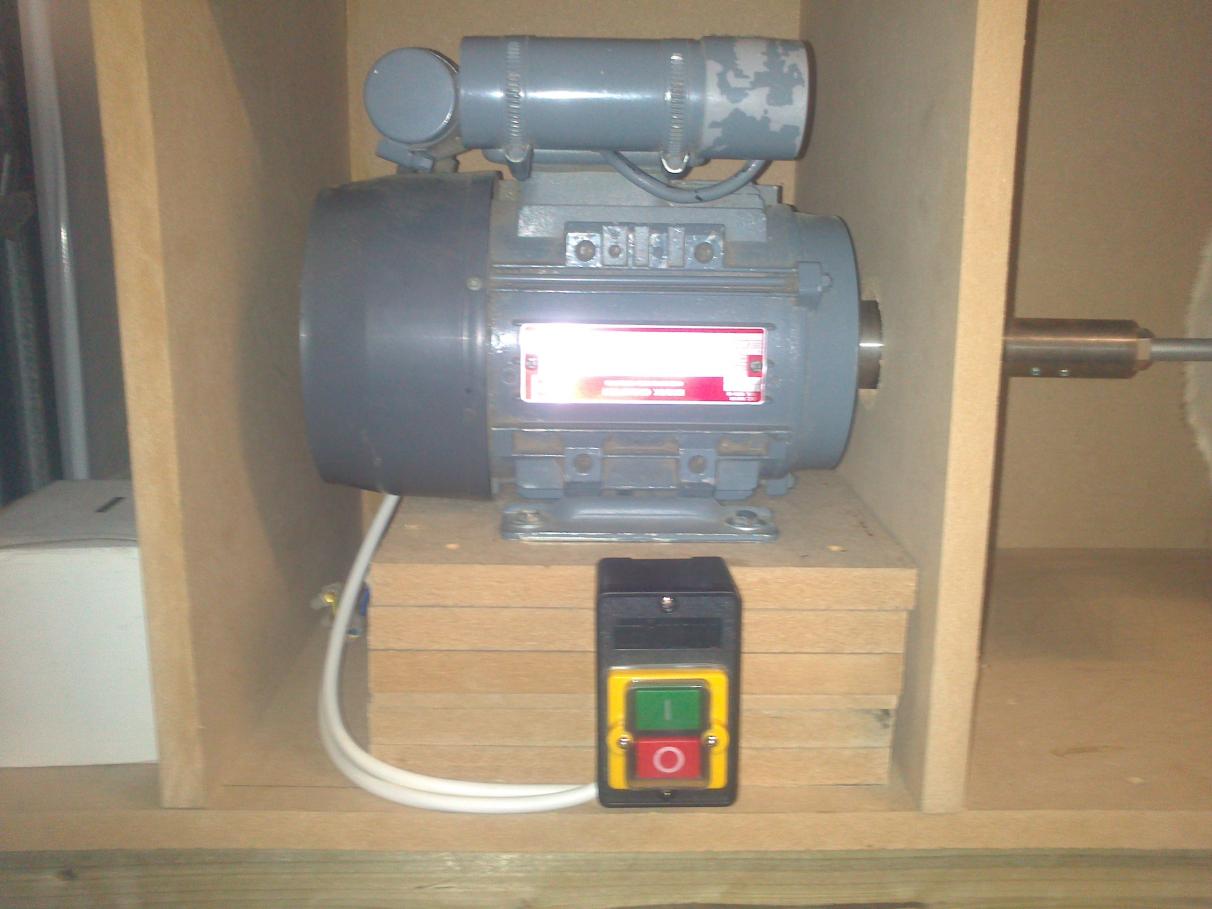
The idea for my buffing station was to drive 4 buffing wheels from a single motor. I picked up a second hand motor from eBay for £30. It is a 1hp single phase motor running at 1400rpm. I wanted the area around the buffing wheels to be boxed in to catch and reduce the dust created with the idea of eventually installing dust extraction. The buffing wheels were to be mounted on 12mm threaded steel rod. The wheels would be 8 inch by 1/2 inch. I had been using 1 inch wheels before, but whilst this can speed up the process, they are not good for buffing into the bend of bent pipes. The 1/2 inch wheels make this area much more accessible. I had a motor arbor made locally which would attach to the shaft of the motor with a 12mm tapped hole. The drive shaft would screw into this providing a direct link to the motor. It was going to take a 1m length of drive shaft for the 4 buffing wheels. I decided to get 4 lengths of 250mm rod, so that it would be easier to dismantle and change a buffing wheel. The buffing wheels come with thick leather washers, which when drilled to 12 mm will thread unto the rod. They are then clamped each side with the large cup washers that came with the angle grinders holding on the grinding wheels. The sections would be joined together with 12mm threaded bushes with a 25mm outer diameter. Each of these bushes would be supported in a block bearing. Everything would be locked in place using locking nuts at each side of the bushes and each side of the buffing wheels.

Now whilst this idea was all in my head, it was a work in progress to see how it would work, as I have no particular engineering background. The handyman got to work under my instructions. The motor was mounted to the correct height to leave plenty of working space, and also the block bearings were mounted to the same height from the workbench. The motor itself was also boxed off from the buffing wheels to reduce dust contamination. The lower central section of the workbench is a place where I can sit while working on pipes. The far end is for my future work. I would like to move on to start making pipes and this area will be for the additional machinery. Here is Mark I of the buffing station.
alan4

Before even using the new buffing station, I knew there would be a problem. The blocks on which the bearings were mounted were going to be an obstacle when buffing the pipes. We put our heads together to think of a solution. We then decided to install vertical mounts which would be secured to the back of the boxed area and the bearings would be attached to these, leaving the front of the buffing wheels unfettered.

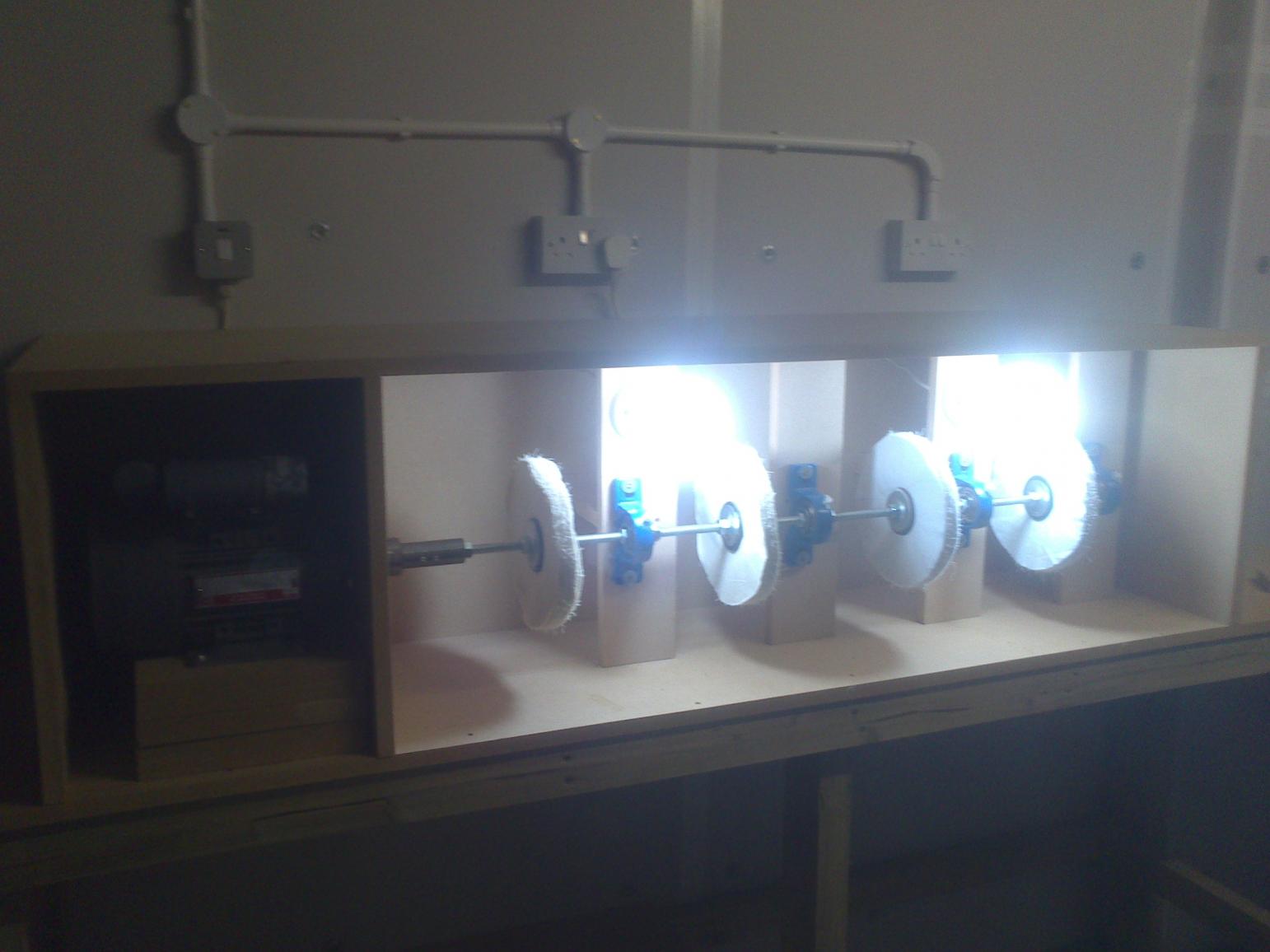
Here is the result after the rearrangement. The wiring has been completed and the lights installed with daylight bulbs for good vision.
Alan5

Alan6

The whole thing runs like a dream. I have since installed a machine switch below the motor and will also install an emergency stop button. After getting the feel of buffing at a slower speed, the only further change I will make is to upgrade to 10 inch wheels when the current ones need replaced. I can now run the heater on 1 bar from the far side of the garage and it heats up the room beautifully and retains the heat. This year I will be able to work in comfort.
alan7

Part two can be read at this link: https://rebornpipes.wordpress.com/2014/01/07/the-building-of-a-buffing-station-part-2-alan-chestnutt/

Reworking a Stetson Sport Zulu


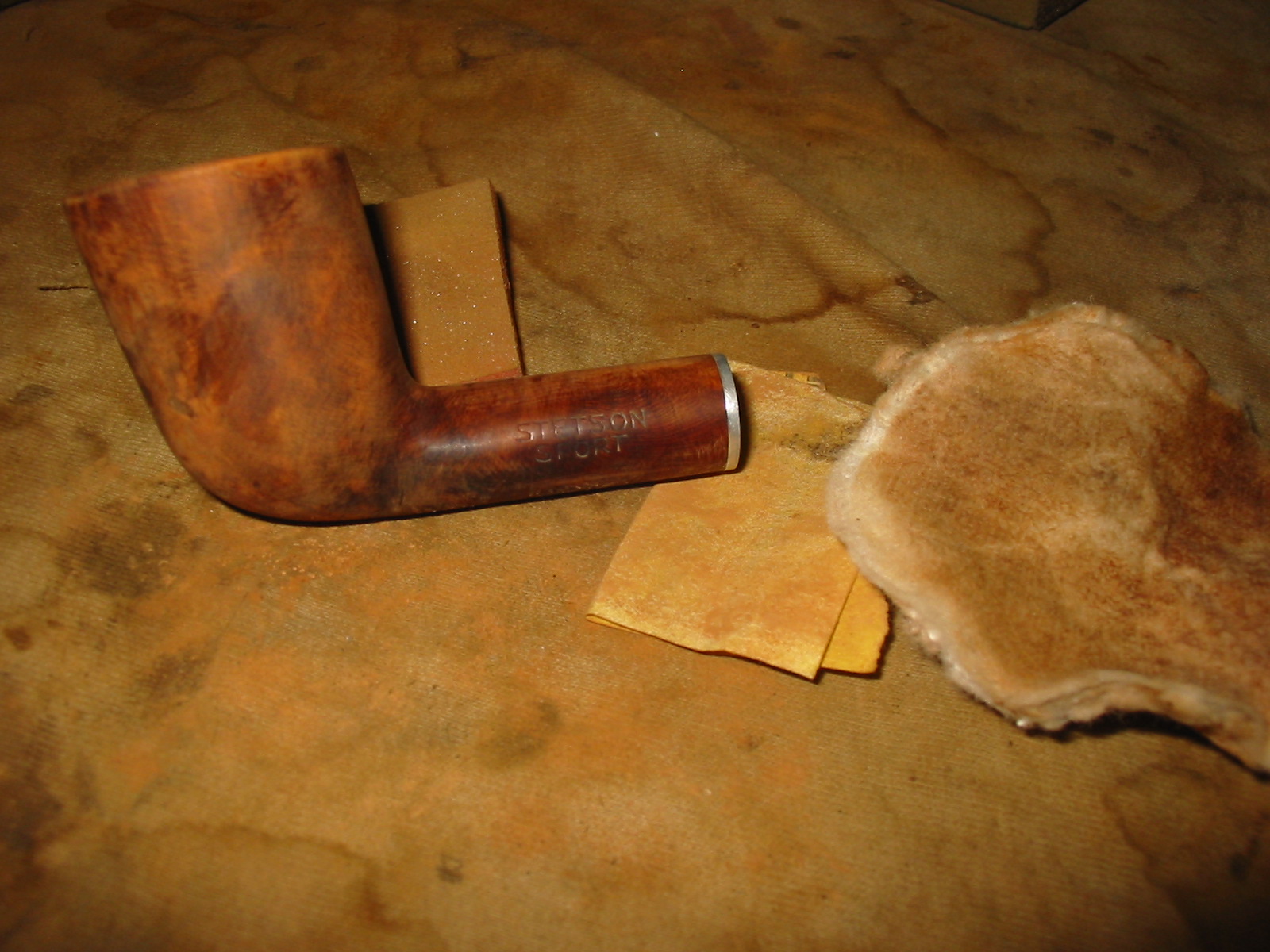
This pipe was gifted to me in exchange for a bit of stem work that I did recently for a friend of mine. It came in a box with the pipe to be repaired and two others. It was a brand that I knew absolutely nothing about. The pipe was obviously American made and had a coat of thick varnish on the bowl that was beginning to flake and peal. I decided to do a bit of research on the brand to see if I could find any information on it.
IMG_3100

I found a document online for the John B. Stetson Company. Stetson is the manufacturer of Western hats but I was not aware that they also made pipes. One source seemed to point to the fact that the pipes were made by Marxman Pipe Company and branded with the Stetson name.

The document was written as a brand page for the company in application for a trademark. I have included that document below as I find the historical detail quite interesting. The source of the information is this website: http://www.legalforce.com/stetson-78583631.html I quote the following information in part from that site.

John B. Stetson Company

Absorbent paper for tobacco pipes, ashtrays not of precious metal, chewing tobacco, cigar bands, cigar cutters, cigar humidifiers, cigar tubes, cigarette cases not of precious metal, cigarette lighters not of precious metal, cigars, cigarillos, hand-rolling tobacco, humidors, match boxes not of precious metal, match holders, matches, non-electric cigar lighters not of precious metal, pipe pouches, pipe tampers, pipe tobacco, tobacco, rolling papers…

This is a brand page for the STETSON trademark by John B. Stetson Company in Mt. Kisco, NY, 10549. Write a review about a product or service associated with this STETSON trademark. Or, contact the owner John B. Stetson Company of the STETSON trademark by filing a request to communicate with the Legal Correspondent for licensing, use, and/or questions related to the STETSON trademark.

On Wednesday, March 09, 2005, a U.S. federal trademark registration was filed for STETSON by John B. Stetson Company, Mt. Kisco, NY 10549. The USPTO has given the STETSON trademark serial number of 78583631. The current federal status of this trademark filing is ABANDONED – NO STATEMENT OF USE FILED. The correspondent listed for STETSON is BARRY A. COOPER of GOTTLIEB, RACKMAN & REISMAN, P.C., 270 MADISON AVE FL 8, NEW YORK, NY 10016-0601. The STETSON trademark is filed in the category of Smoker’s Products . The description provided to the USPTO for STETSON is Absorbent paper for tobacco pipes, ashtrays not of precious metal, chewing tobacco, cigar bands, cigar cutters, cigar humidifiers, cigar tubes, cigarette cases not of precious metal, cigarette lighters not of precious metal, cigars, cigarillos, hand-rolling tobacco, humidors, match boxes not of precious metal, match holders, matches, non-electric cigar lighters not of precious metal, pipe pouches, pipe tampers, pipe tobacco, tobacco, rolling tobacco, smokeless tobacco, smoking pipe cleaners, sm.”

I also found the following stamping photos on Pipephil’s Stamping and Logos site: http://www.pipephil.eu/logos/en/logo-s12.html
Stetson

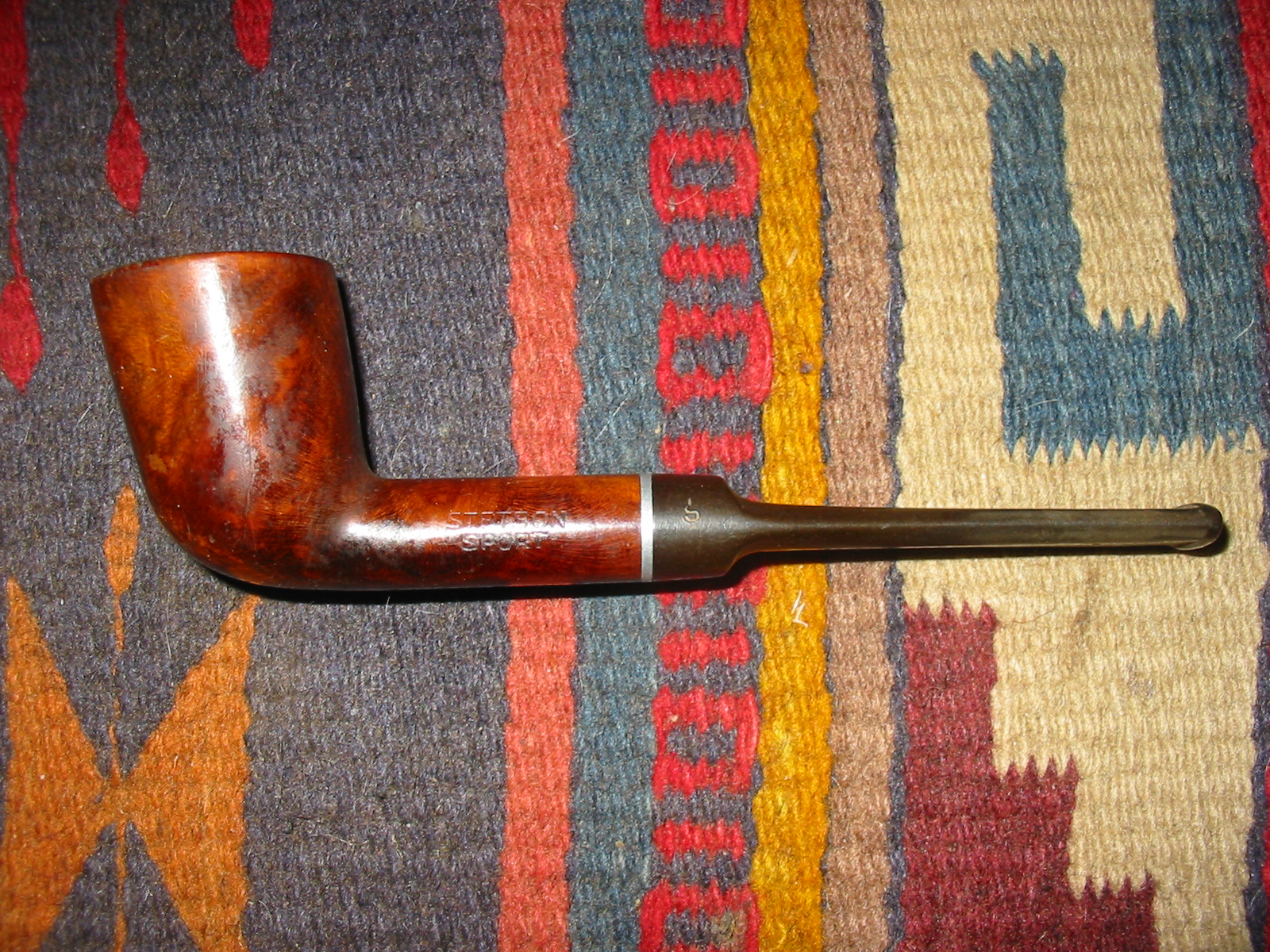
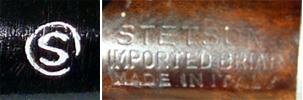
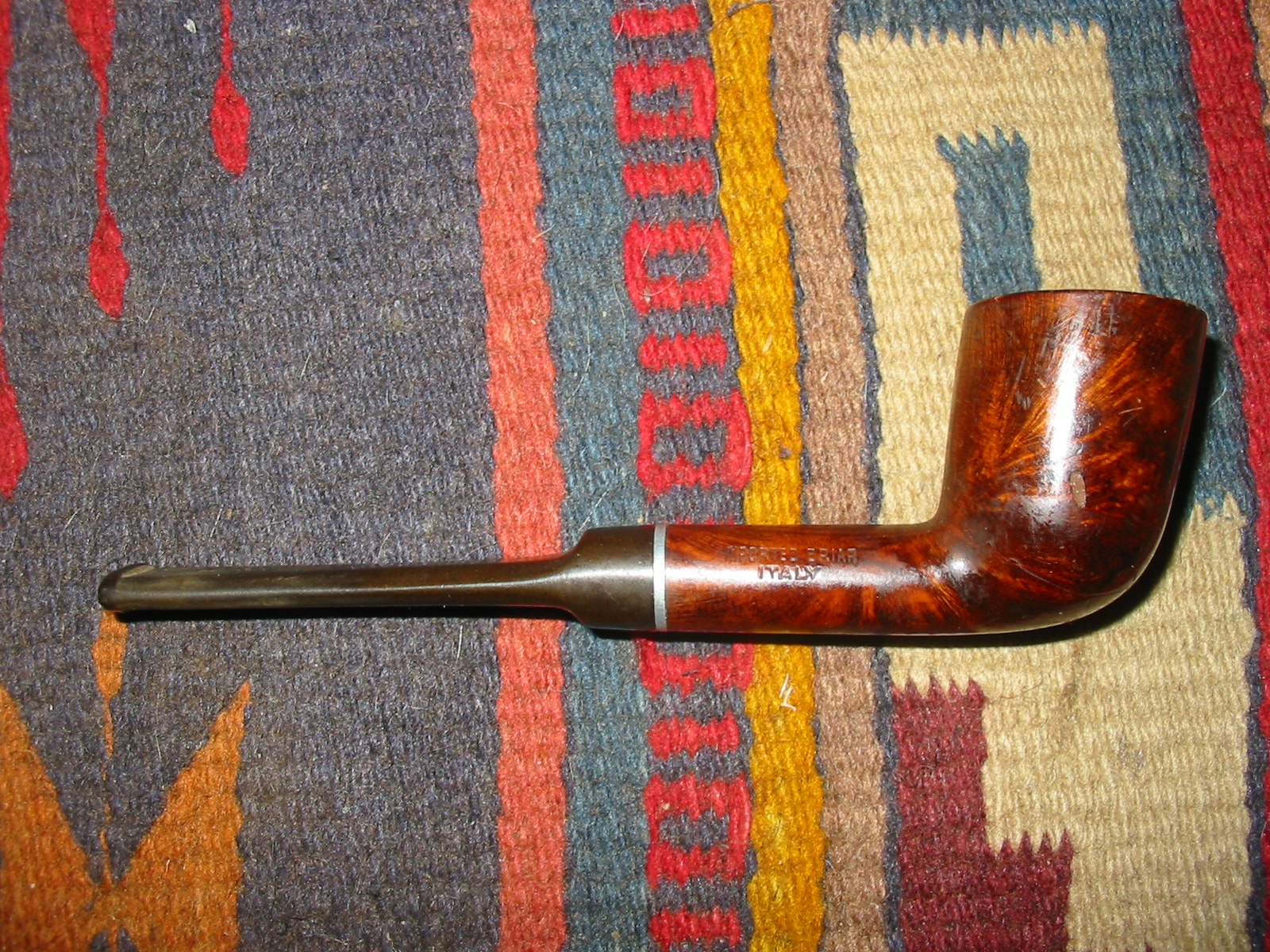
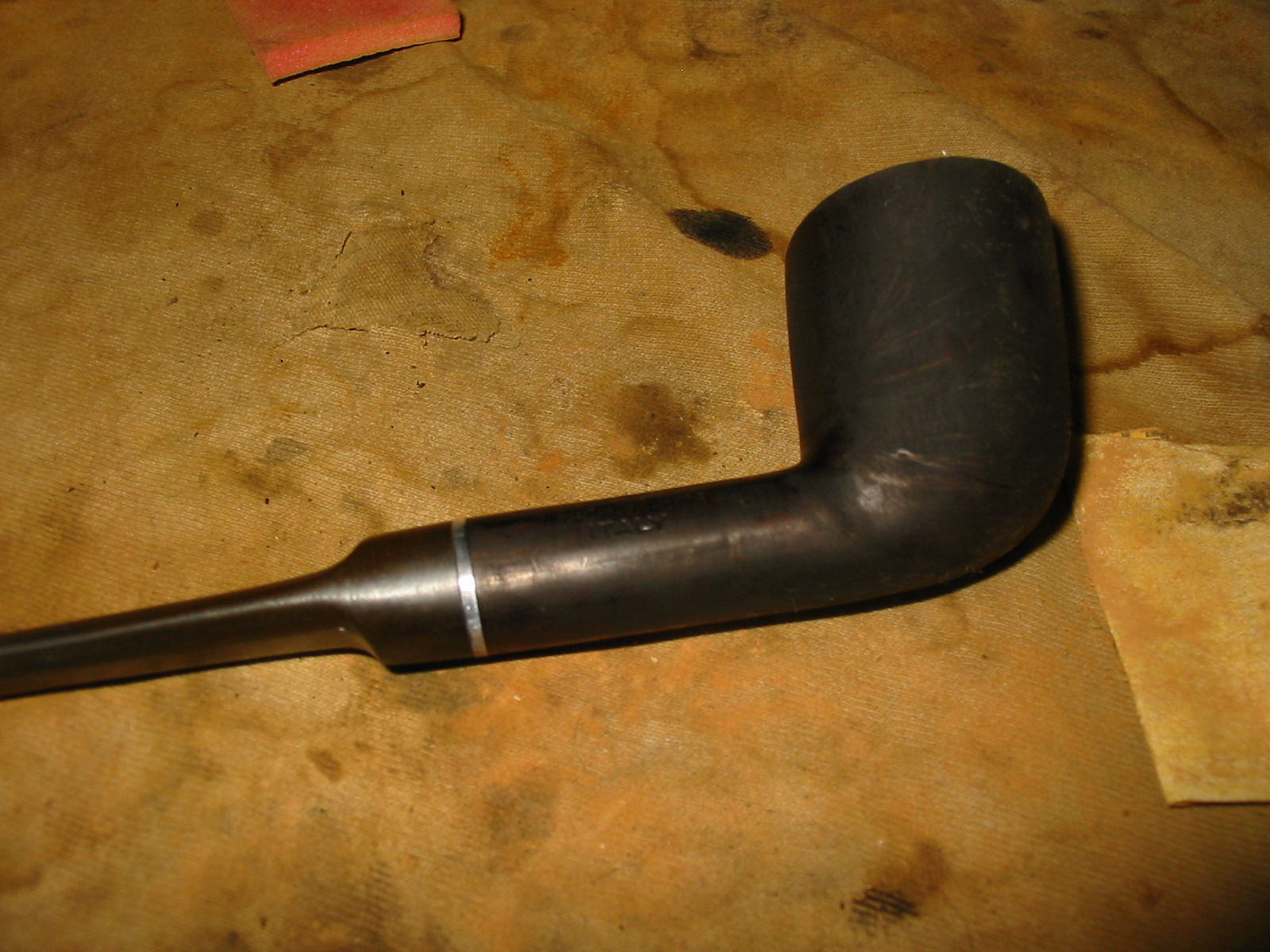
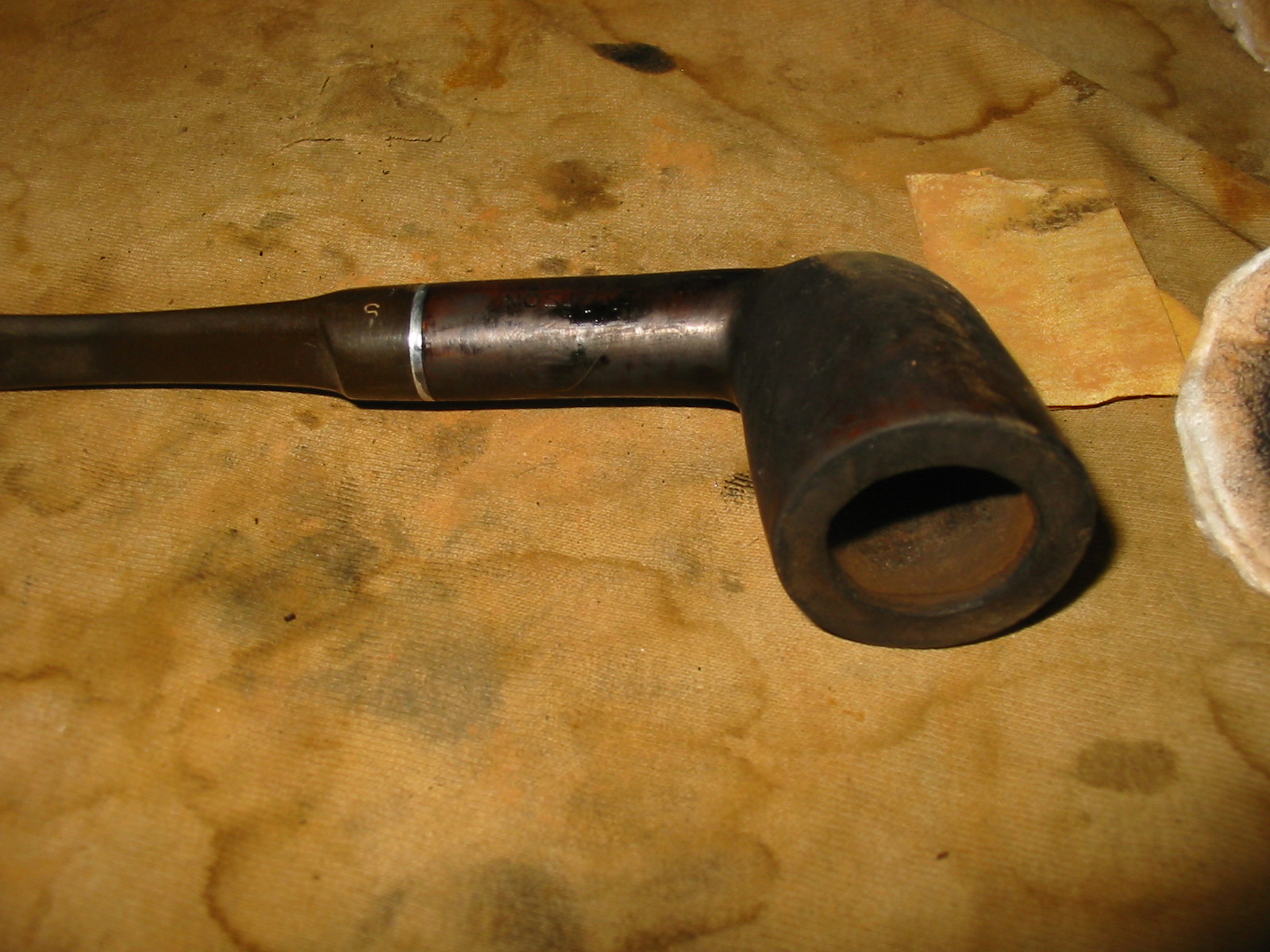
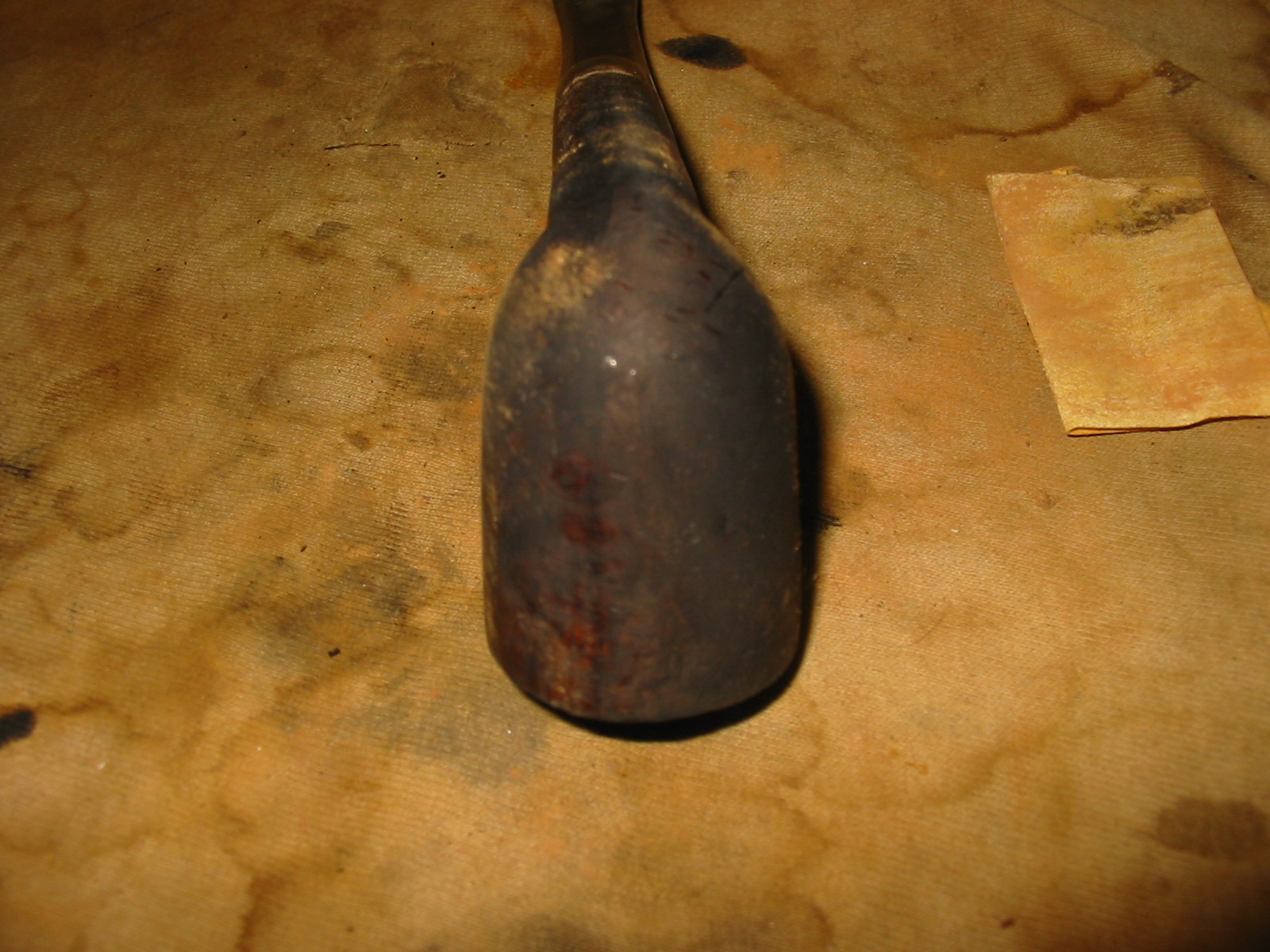
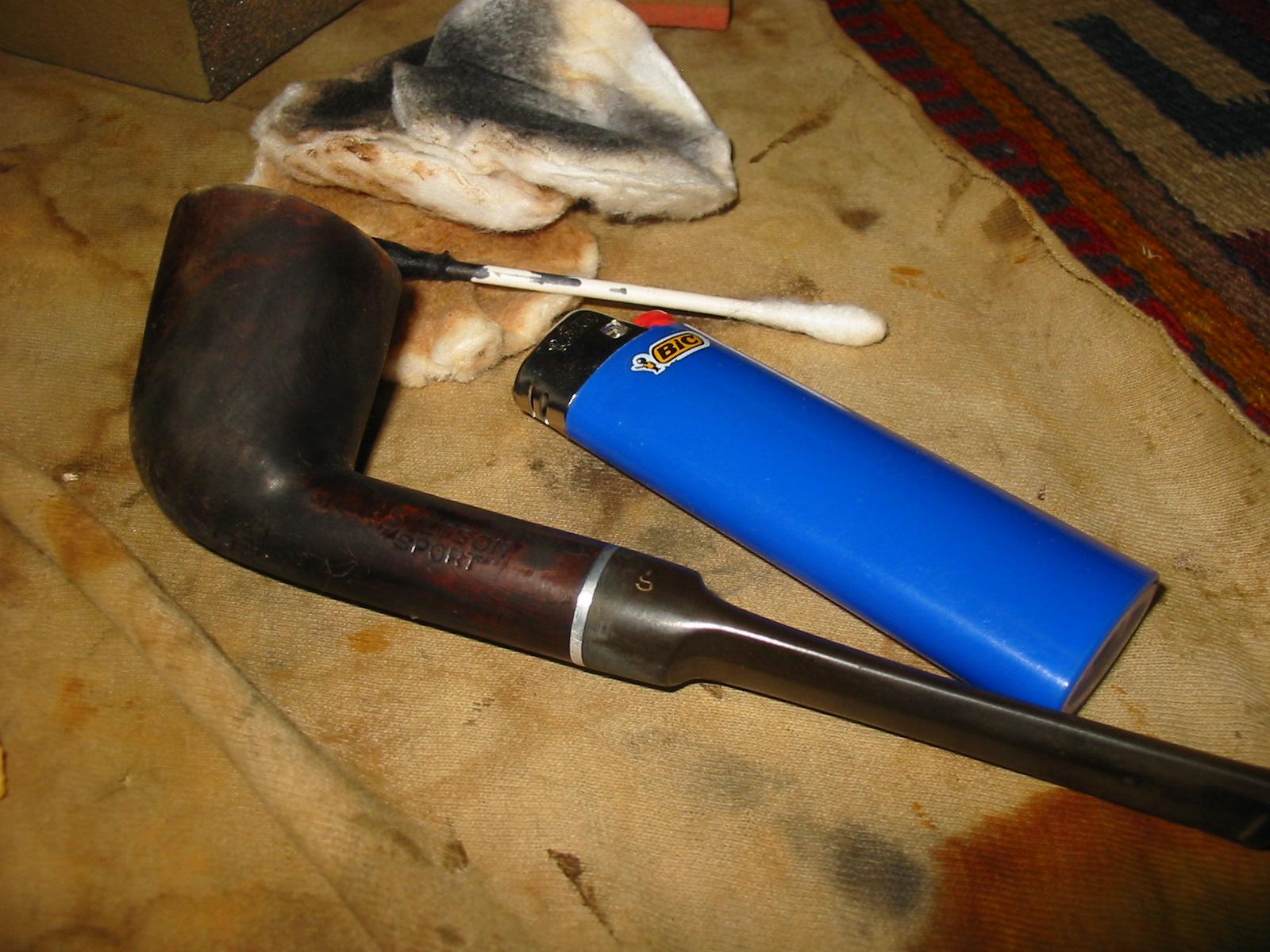
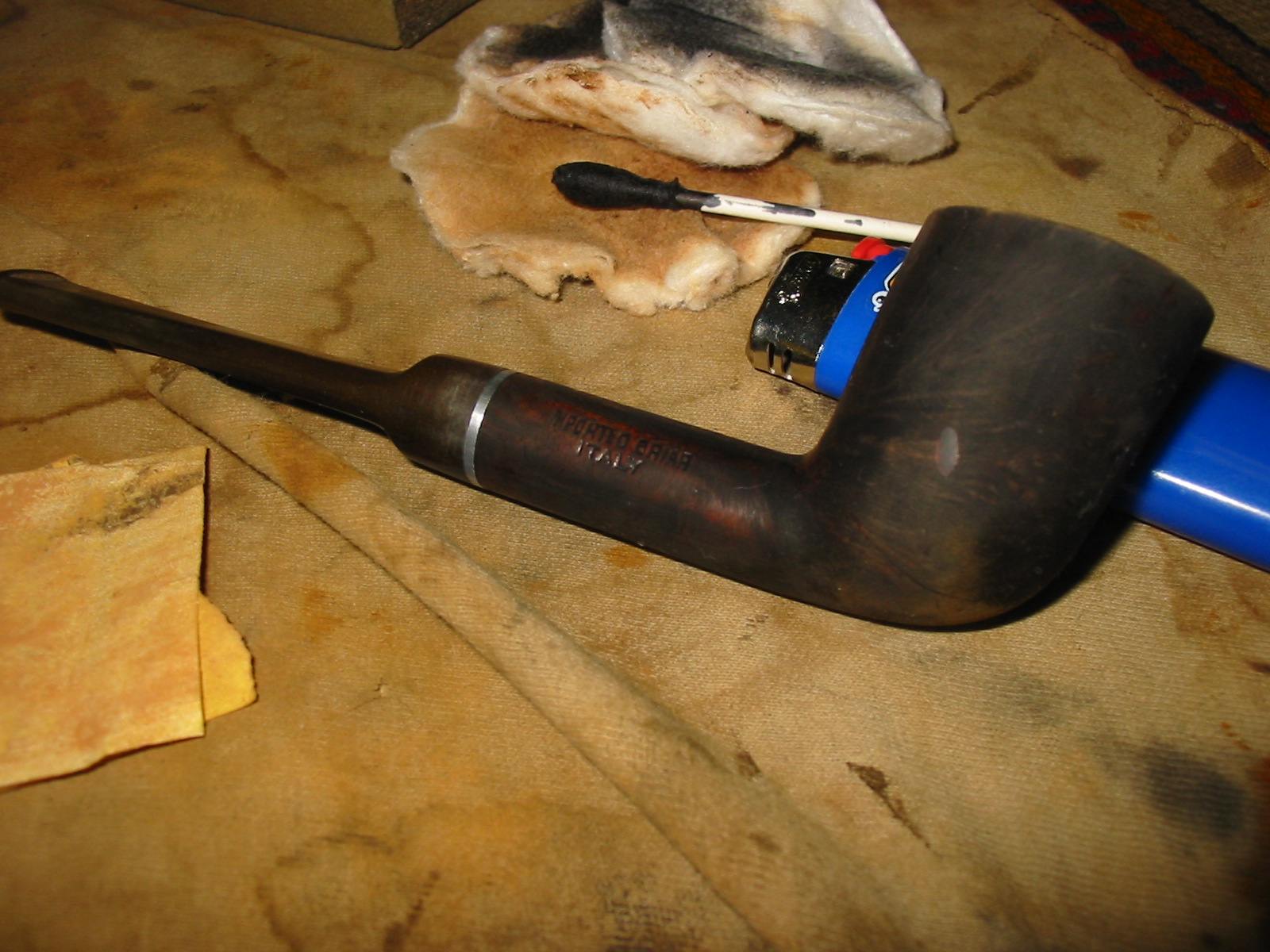
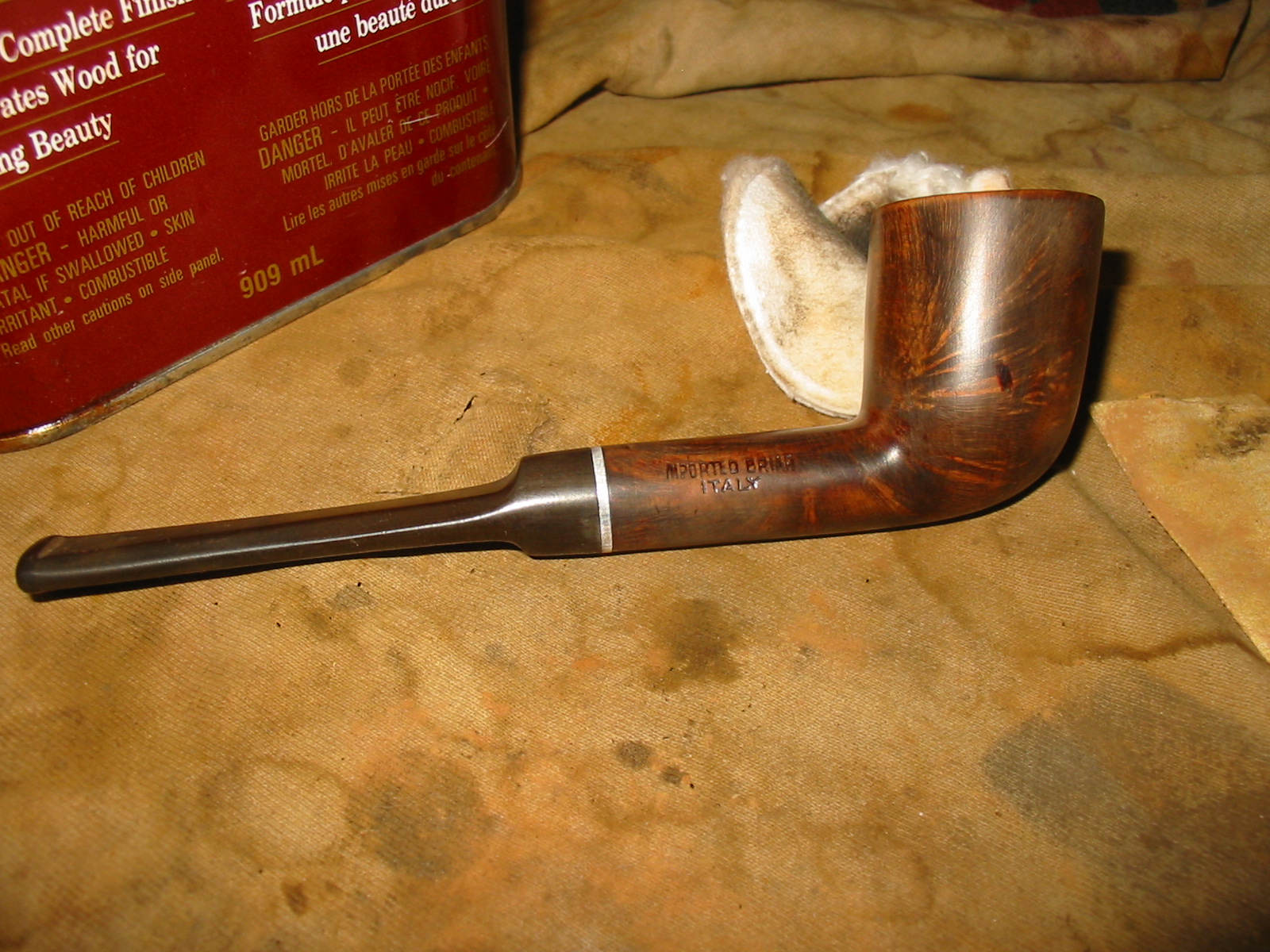
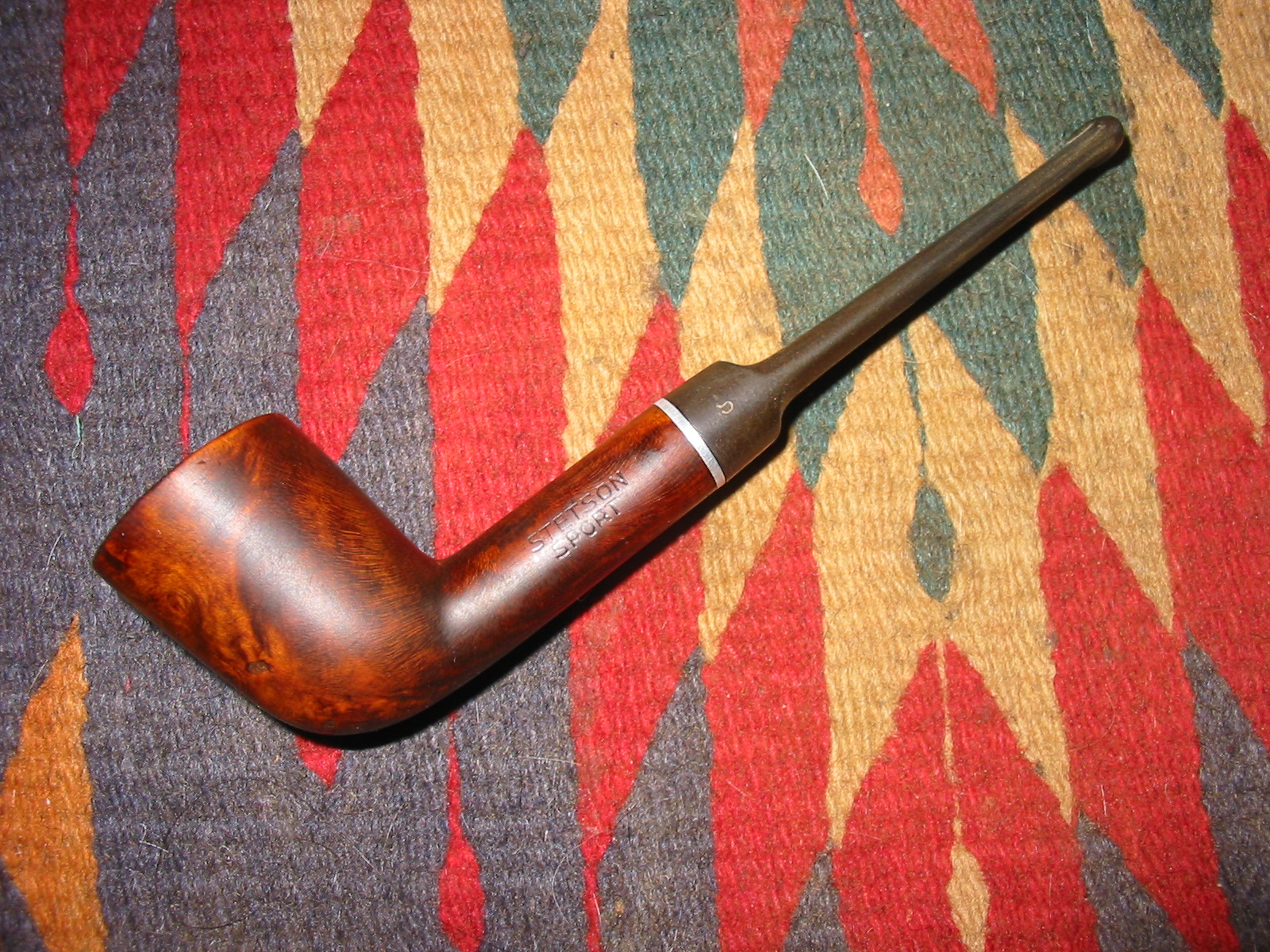
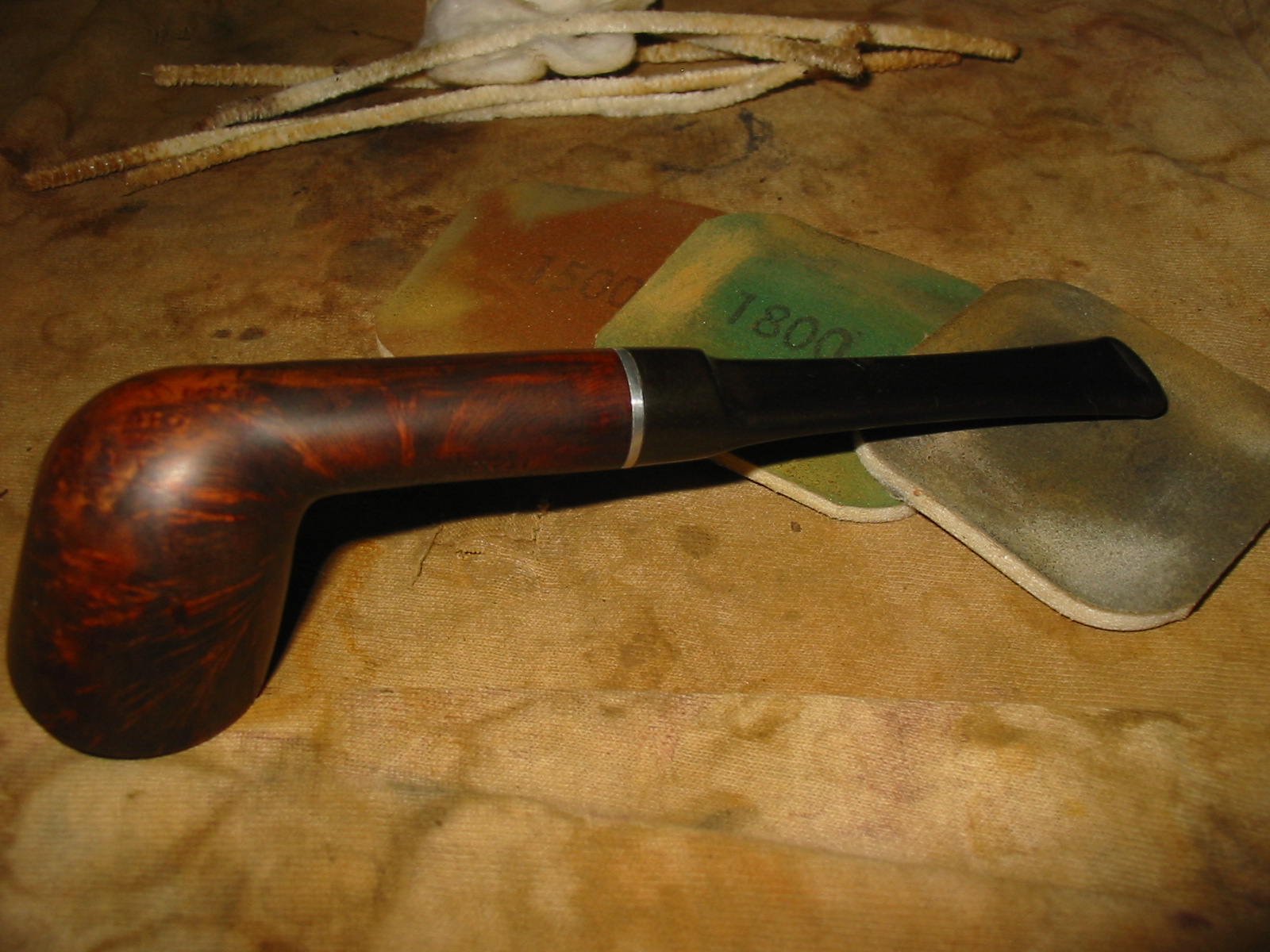
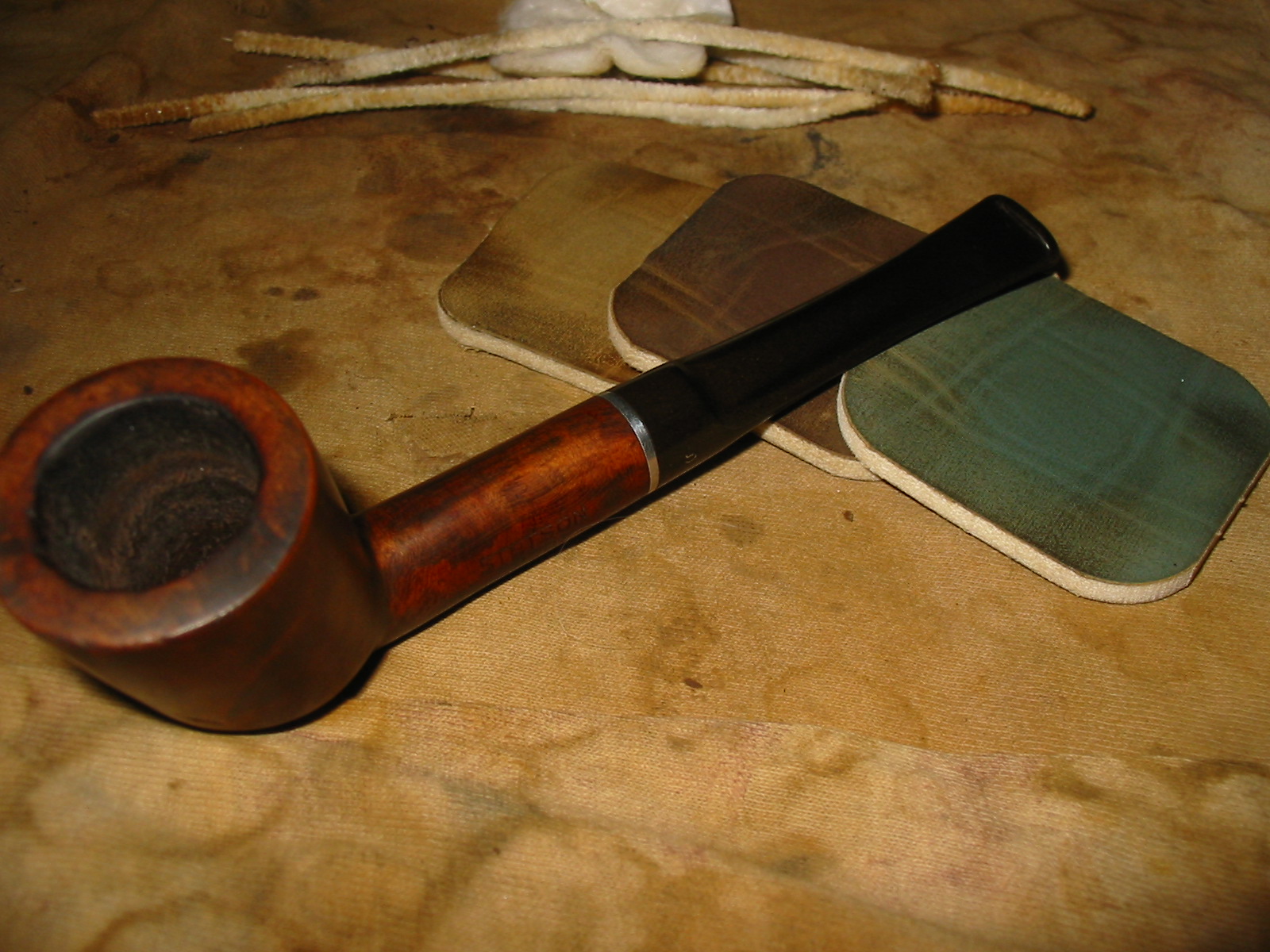
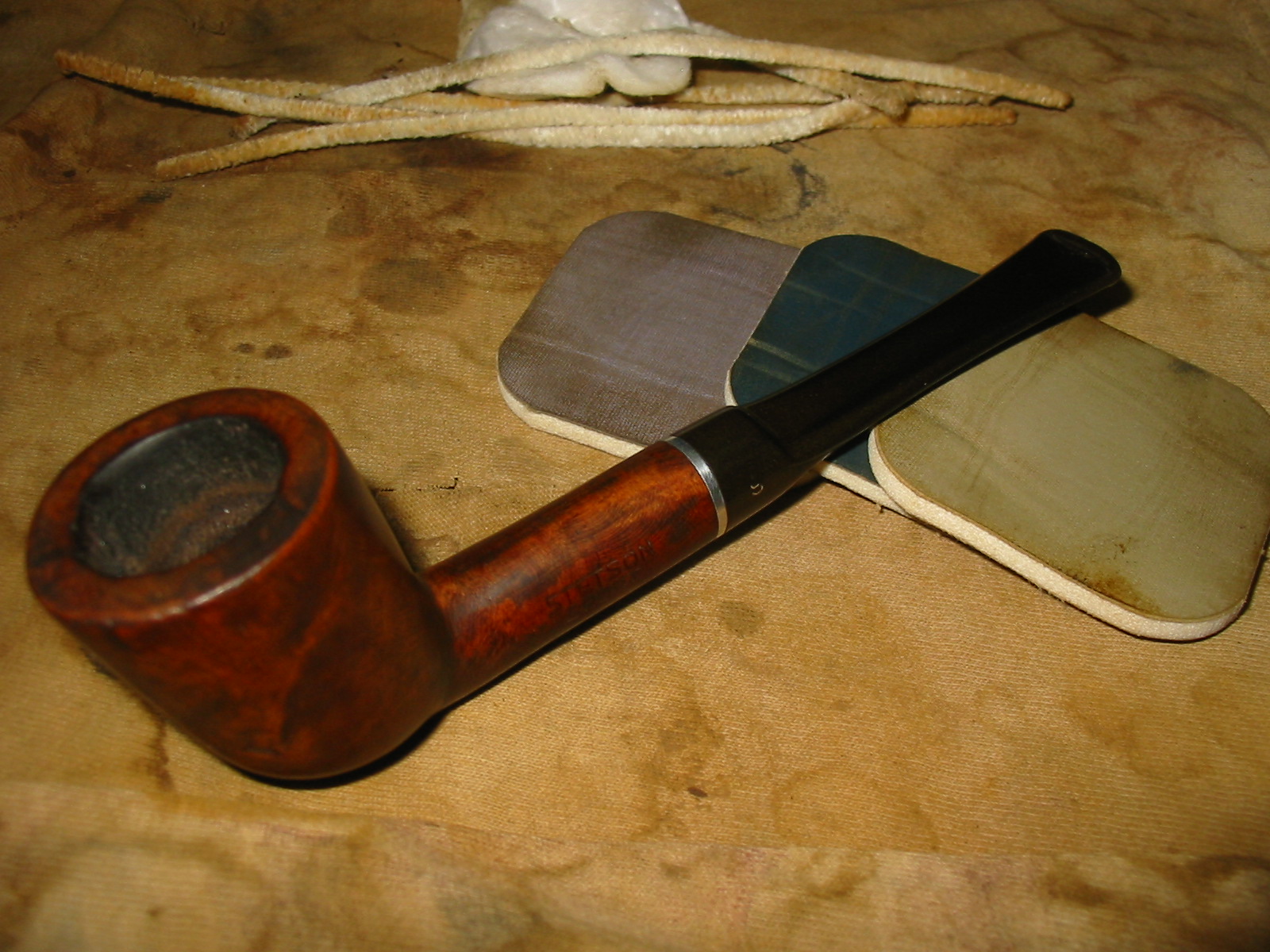
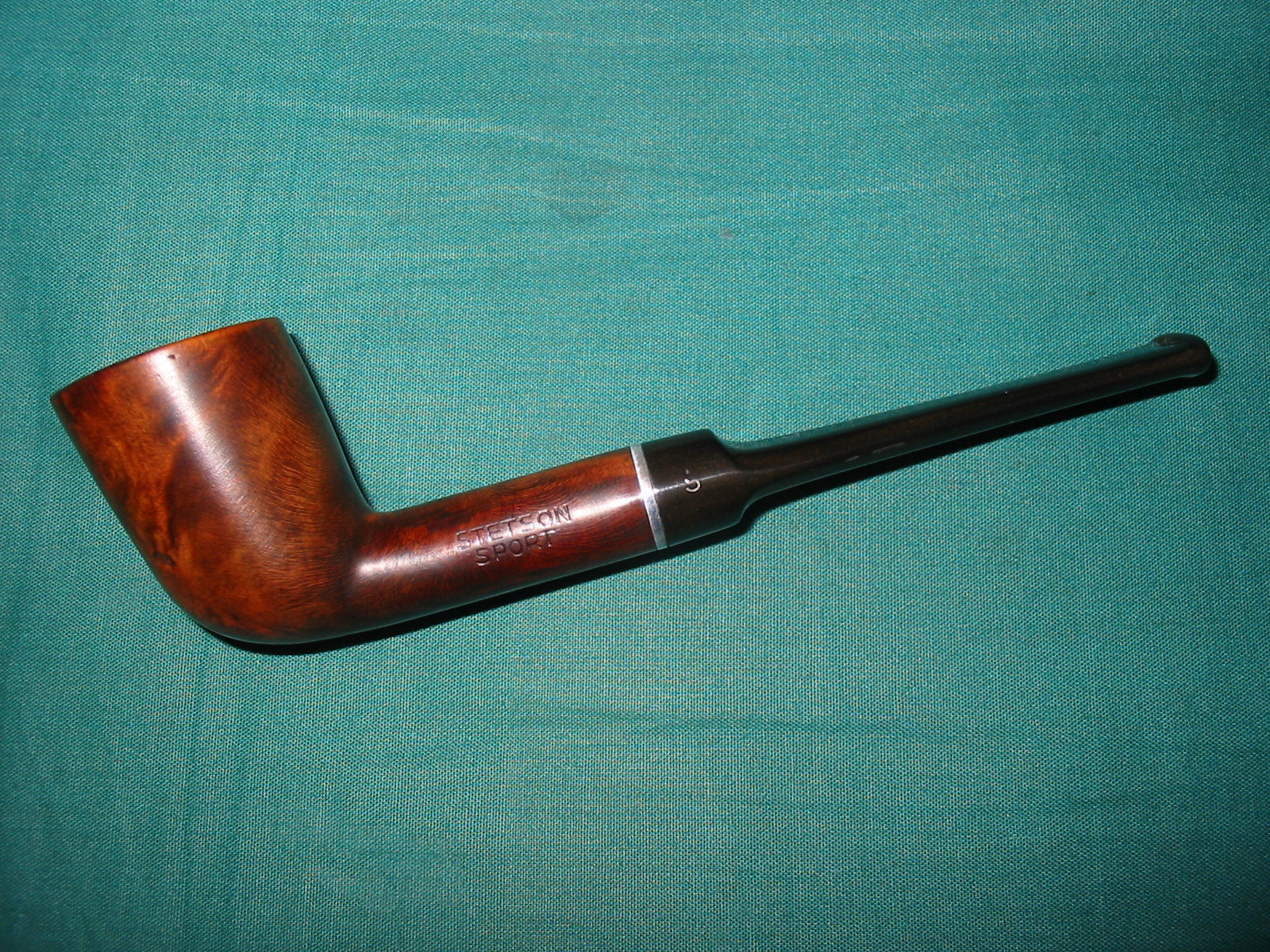
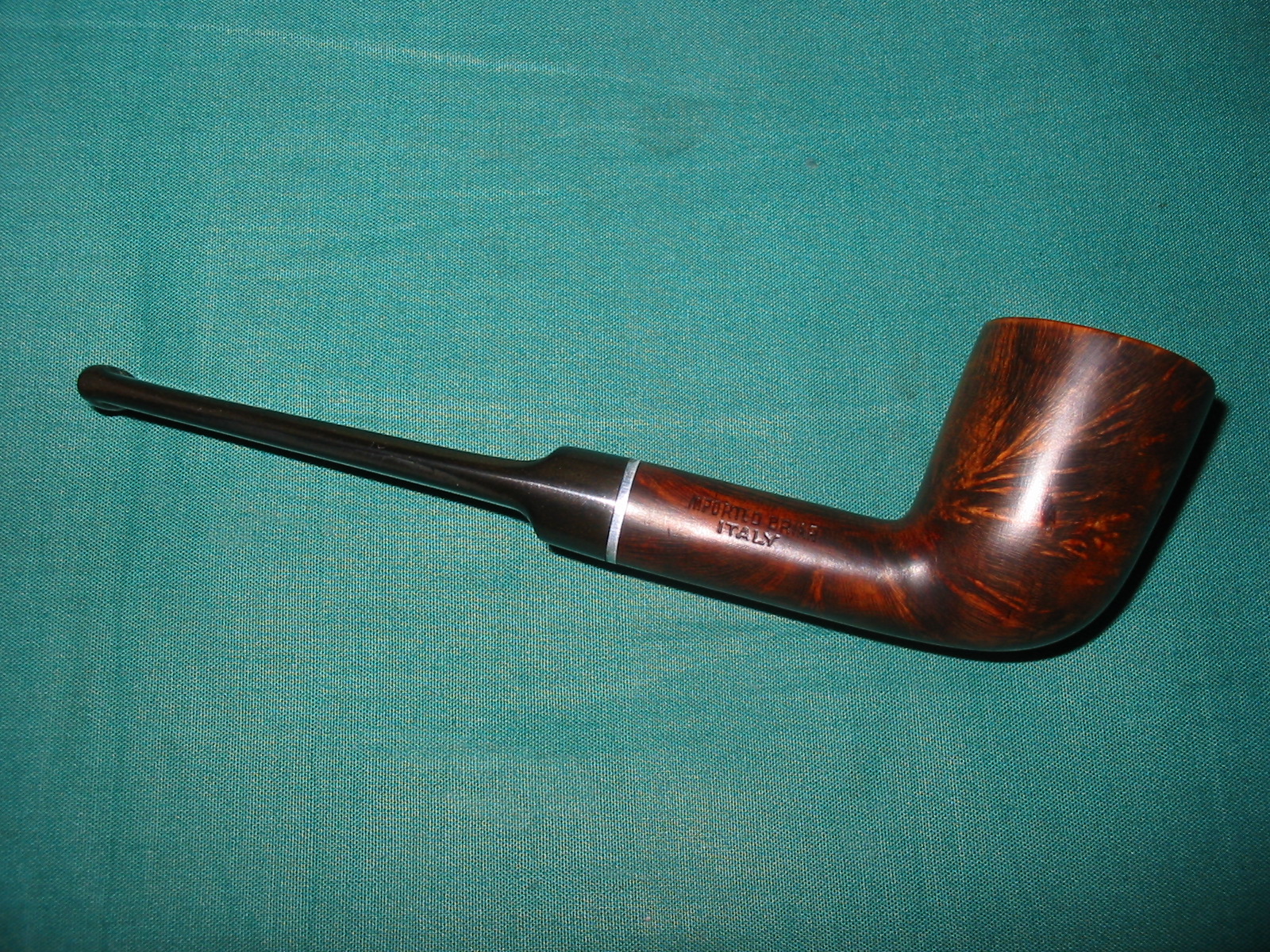
Armed with the information I found I tackled the cleanup and restoration of this American Pipe from John B. Stetson! The pipe is stamped Stetson over Sport on the left side of the shank and Imported Briar over Italy on the right side of the shank. The finish was very rough and peeling off the surface of the briar on the bowl where the hands held it. The rim had a thick cake of tars and oils. The inner edge of the rim was nicked and burned and was slightly out of round. The bowl was heavily caked with a soft carbon cake that was crumbling in places. The stem had screw on tenon and was over turned to the right. It had tooth marks on the top and the bottom side of the stem and oxidation on the entirety. There was an S logo stamped in the left side of the saddle. The stinger apparatus in the stem was tarred and dirty and the inside of the stem was slightly clogged with tars.
IMG_3099

IMG_3101

IMG_3102

I reamed the bowl with a PipNet reamer to take the cake back to bare wood. The crumbling cake toward the bottom of the bowl made this necessary so that the next owner can build up their own hard cake.
IMG_3103

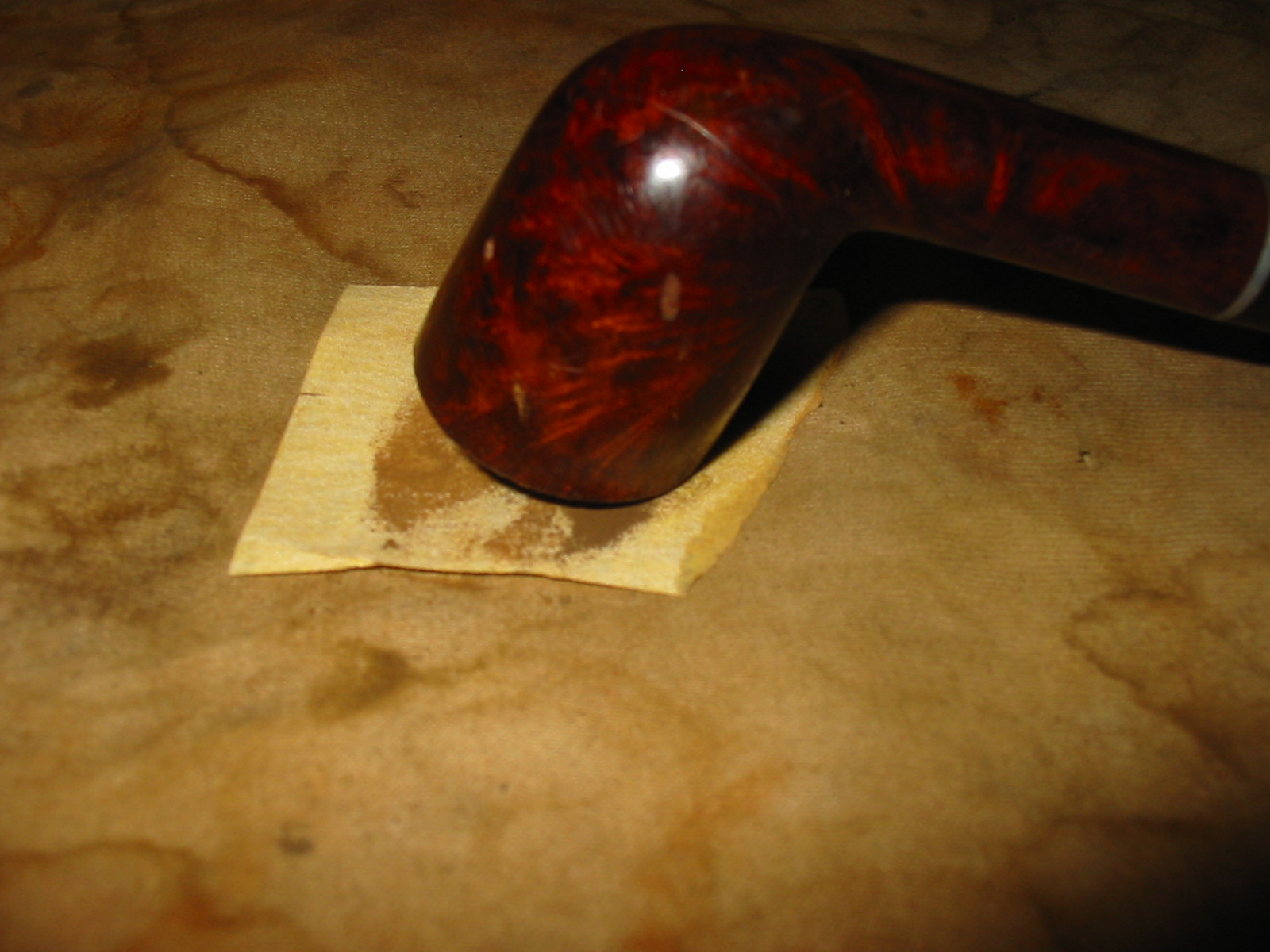
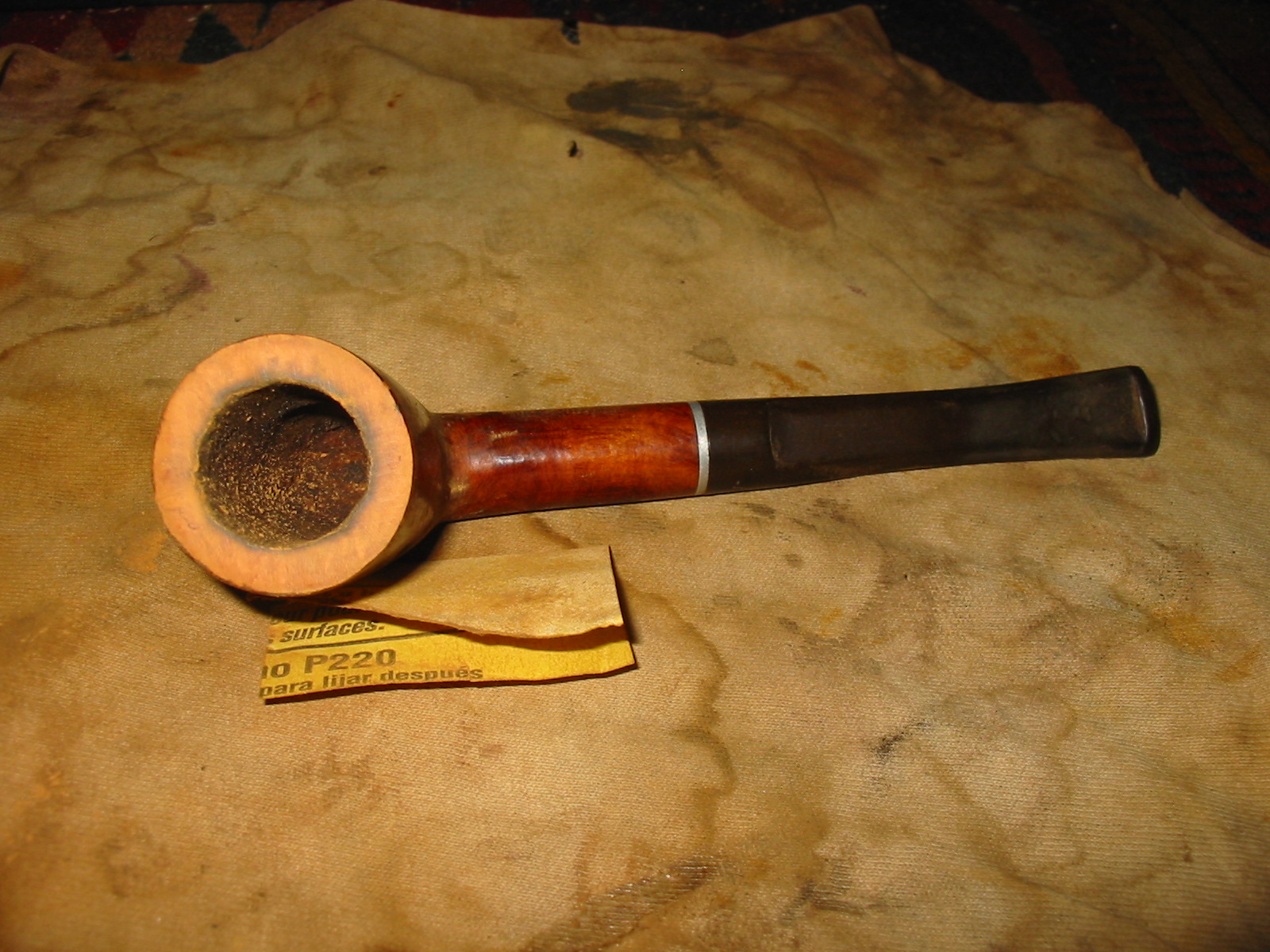
I topped the bowl with 220 grit sandpaper on a board and took off the damaged surface of the rim. I also cleaned up the inner edge of the rim with a folded piece of sandpaper. I wanted to smooth out the damage to the inner edge and repair the out of round shape of the bowl.
IMG_3104

IMG_3105

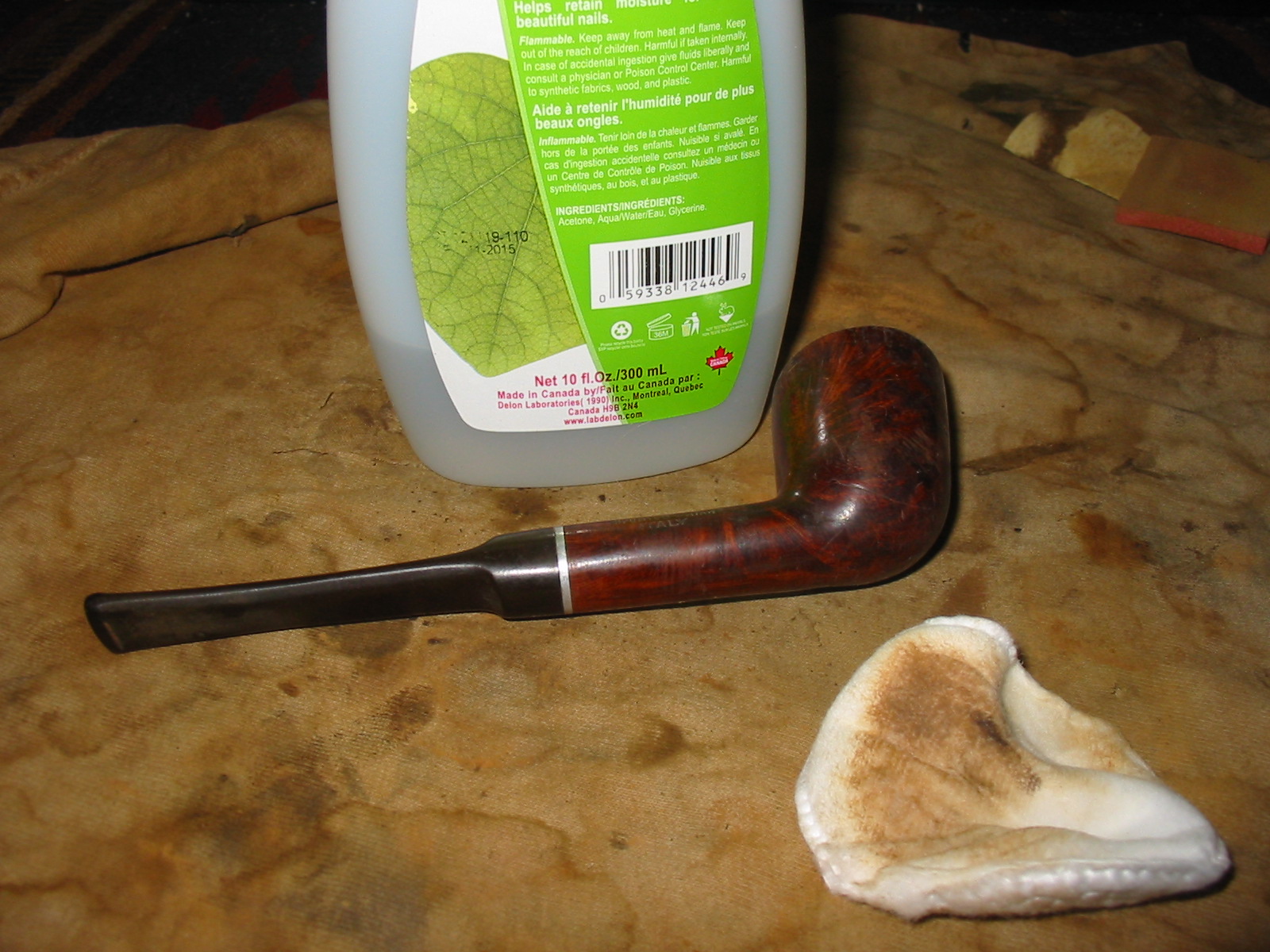
I wiped the bowl down with acetone on a cotton pad. The thick coat of varnish was hard to break down with the acetone. I wiped it until I had softened the varnish and then sanded the bowl and shank with the 220 grit sandpaper and then a sanding sponge. The putty fills were shrunken and formed small divots in the bowl. I filled these with superglue and briar dust and then sanded them down when I sanded the bowl. After sanding the bowl down I wiped it again with acetone to remove the sanding dust.
IMG_3106

IMG_3107

IMG_3108

IMG_3109

I sanded the bowl with a fine grit sanding sponge and then wet sanded it with 1500 and 1800 grit micromesh sanding pads. Once I had a smooth surface to work with I stained the bowl with a black aniline stain and then flamed it with a lighter. I wanted to set the stain deep in the grain.
IMG_3110

IMG_3111

IMG_3112

When the stain was dry I wiped the bowl down with acetone on a cotton pad to remove the excess stain. I wanted the black to remain in the grain and highlight that while masking the fills.
IMG_3113

IMG_3115

I sanded the stained bowl with a medium grit sanding sponge to remove the excess. The next two photos show the bowl after sanding and then buffing with red Tripoli and White Diamond. The grain is standing out nicely from the black stain.
IMG_3116

IMG_3117

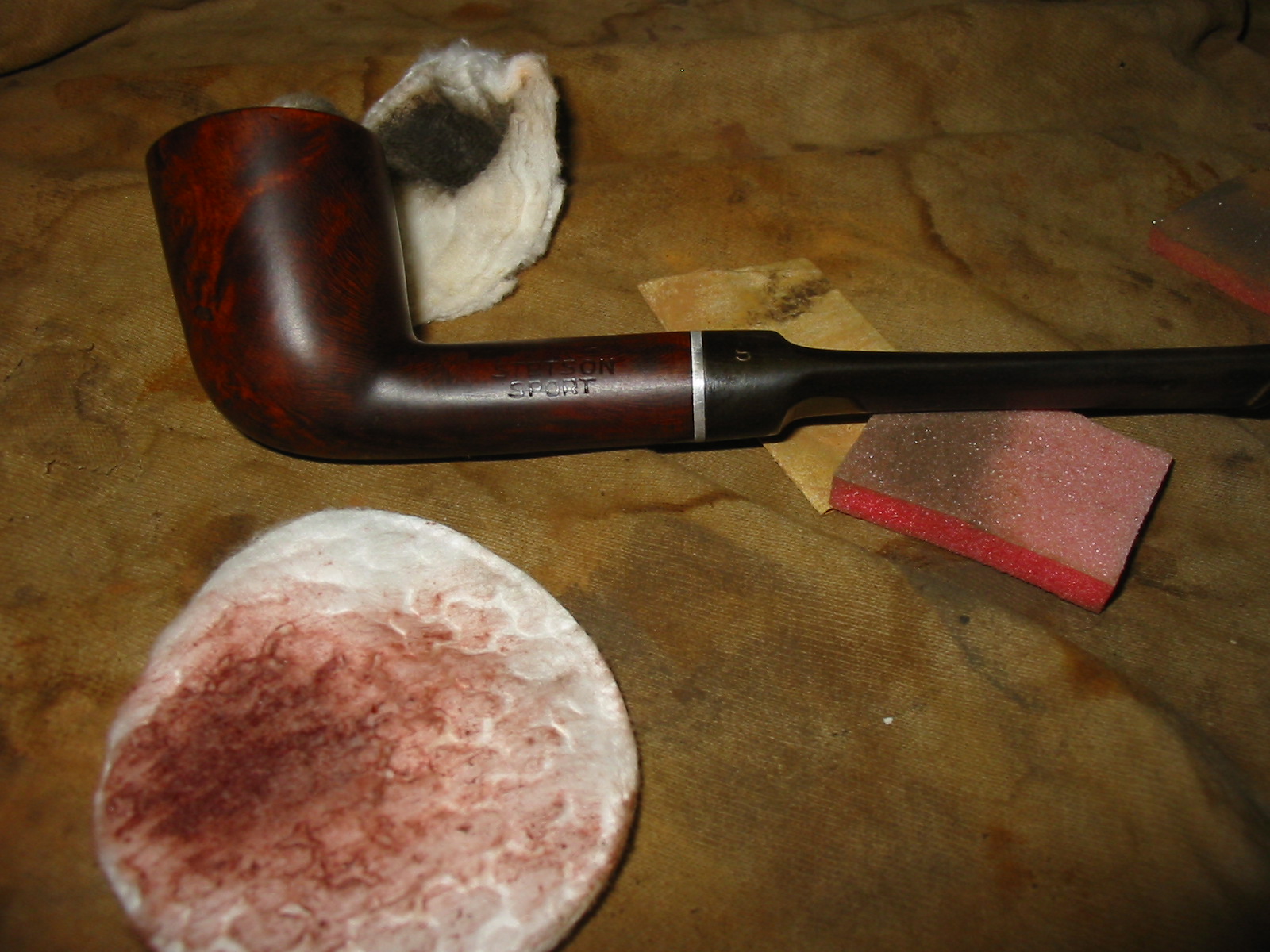
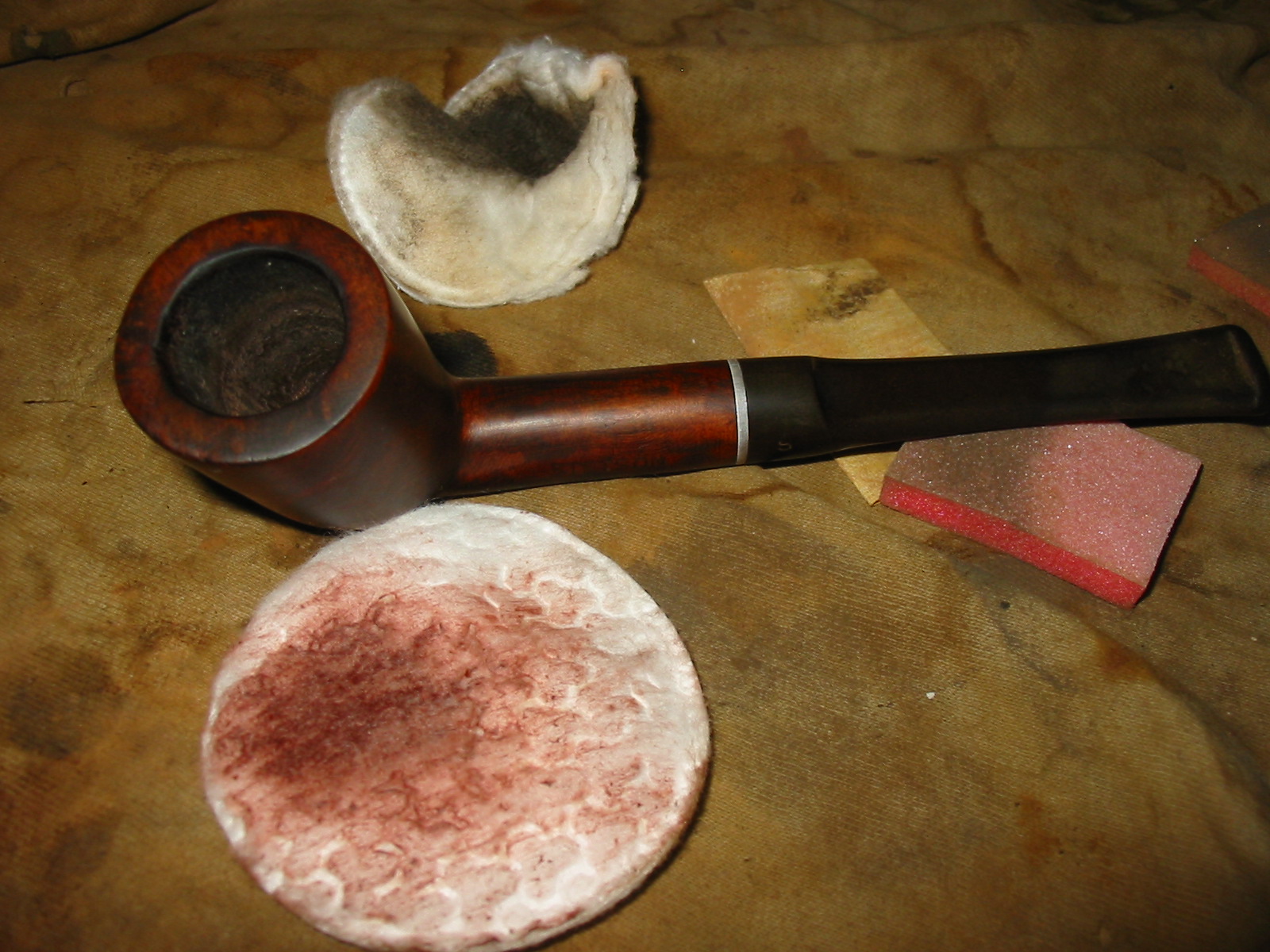
I restained the bowl with an oxblood coloured aniline stain and flamed it. I repeated the process until I had an even coverage on the bowl and shank. The next three photos show the bowl after staining with the oxblood.
IMG_3118

IMG_3119

IMG_3120

I sanded the stem with 220 grit sandpaper to remove the tooth marks on the top and bottom side of the stem. I followed that by sanding with a medium grit sanding sponge to remove the scratches left behind by the sandpaper.
IMG_3121

IMG_3122

IMG_3123

I put the stem back on the pipe and took it to the buffer and buffed it with Tripoli. I buffed the bowl and stem with White Diamond. The next photos show the pipe after the initial buffing.
IMG_3125

IMG_3126

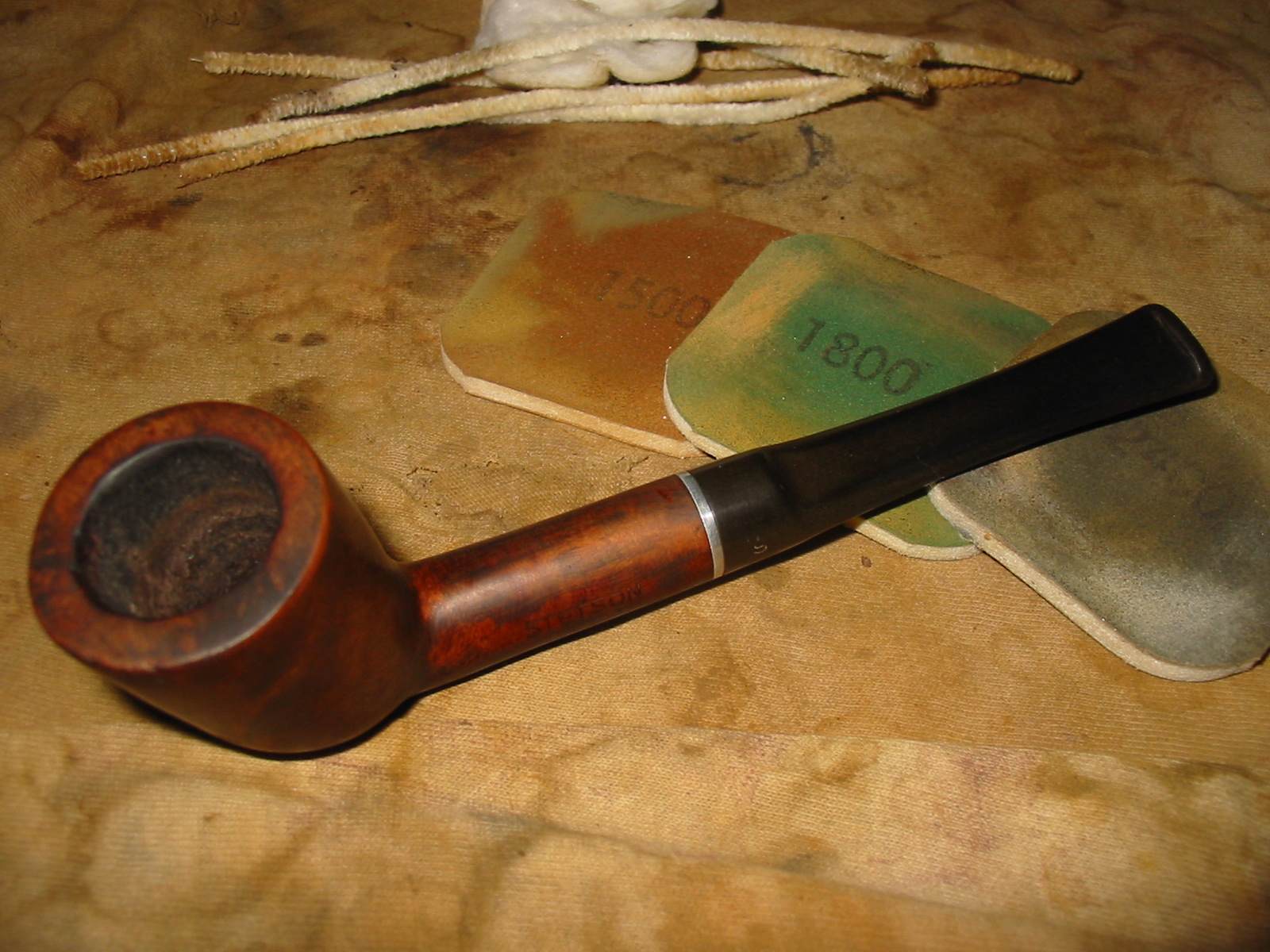
I wet sanded the stem with 1500, 1800 and 2400 grit micromesh sanding pads and then dry sanded with the remaining grits from 3200-12,000. I rubbed the stem down with Obsidian Oil and the waited for it to soak in. Afterwards I hand buffed with carnauba wax.
IMG_3127

IMG_3128

IMG_3129

IMG_3130

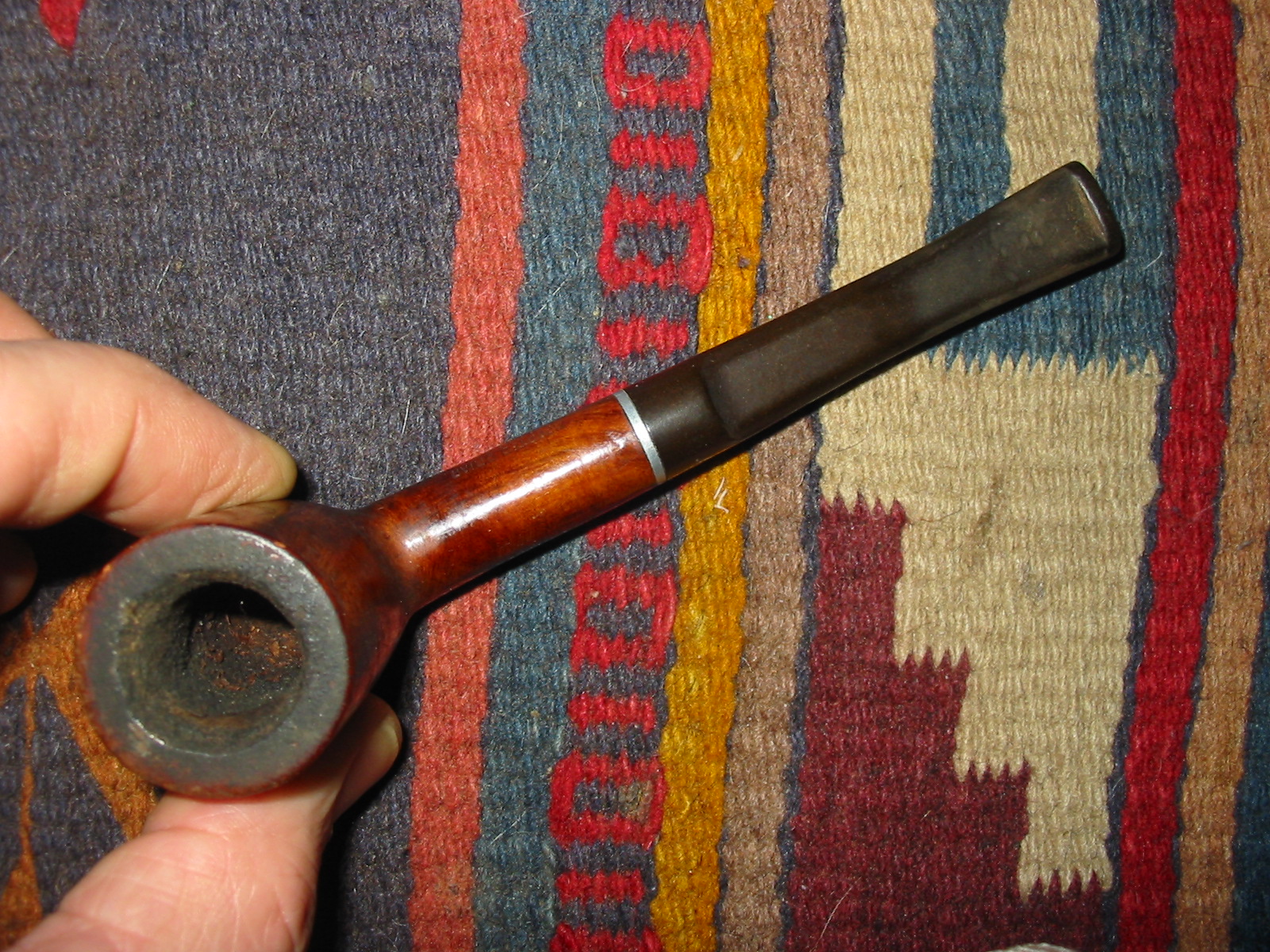
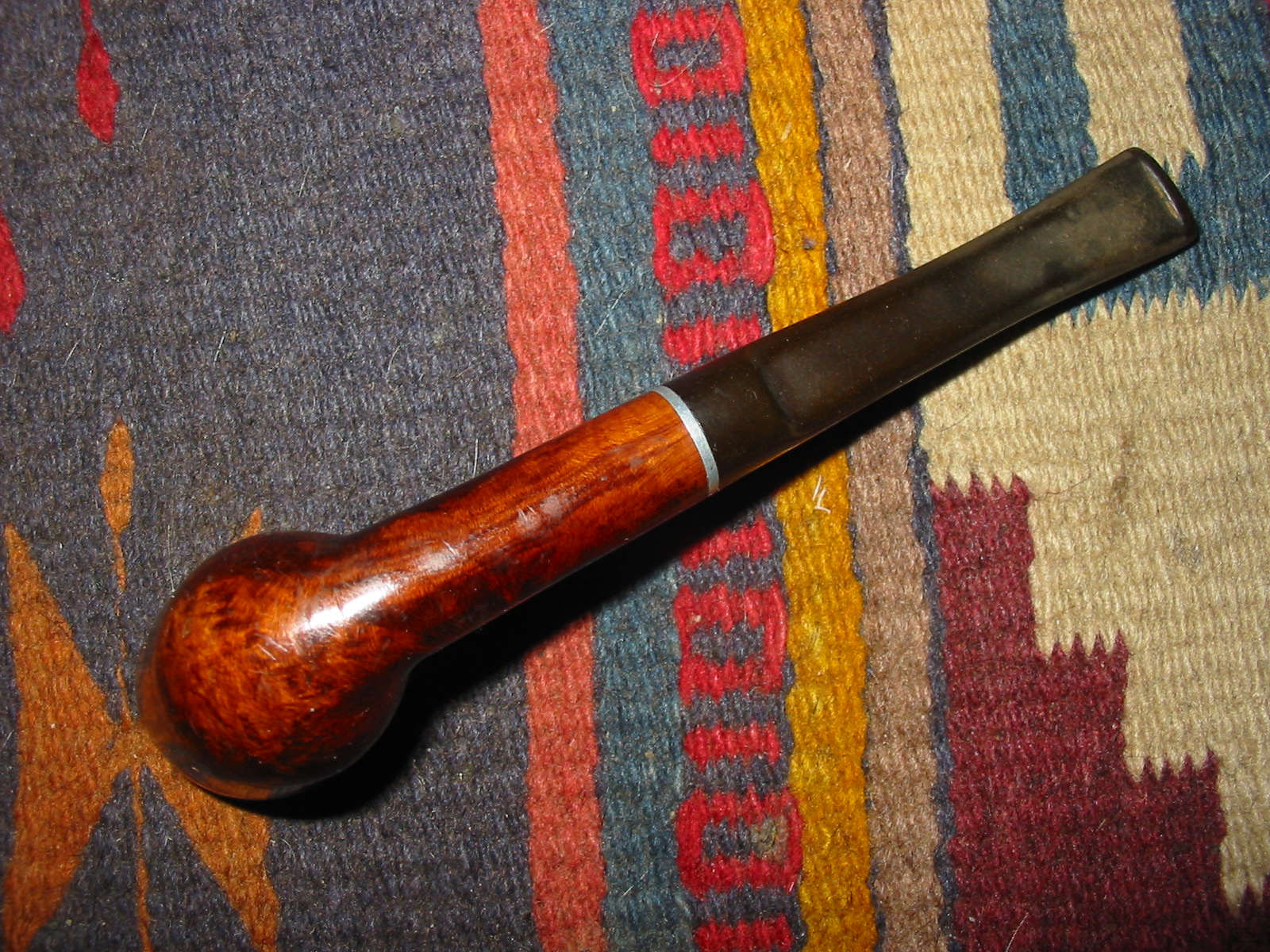
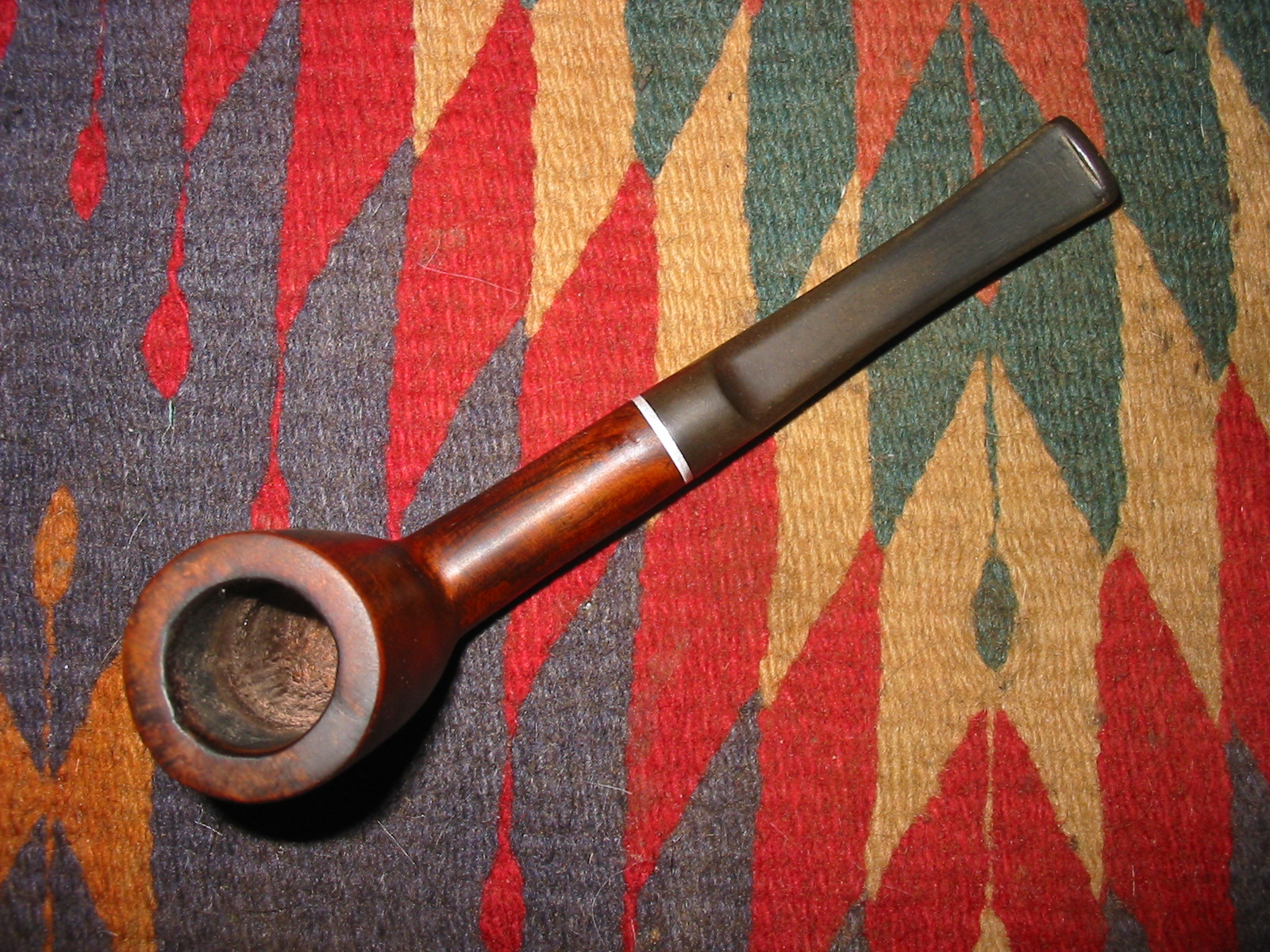
The next series of four photos show the finished pipe. The interior is shiny and new looking and the pipe bowl has a good contrast stain. The stem is shinier and the oxidation is pretty well gone. The photo of the stem looking down on the top shows a little oxidation around the saddle area. That area has been problematic on this pipe. In the daylight the stem looks better than this night photo with lights. My guess is that the oxidation is still there and in the glare of the flash it is very visible. This pipe will make a nice addition to someone’s rotation.
IMG_3131

IMG_3132

IMG_3133

IMG_3134

A Review – Michael Parks Pencil Shank Cutty


I have had this pipe around for a while now, in fact long enough that I don’t remember when I bought it. I believe I purchased it from another member on Smoker’s Forums a few years ago. After reading about the Vancouver Pipe Club Christmas Party which featured Michael as the guest speaker I decided to take this pipe out of the cupboard for a smoke. I am not sure why but I have often forgotten I had it there. It has just escaped my notice. I remember smoking it quite a bit when I got it but have not picked it up for a long time. I do remember that it delivers a good cool smoke and that I used it for English and Balkan blends.
IMG_3073

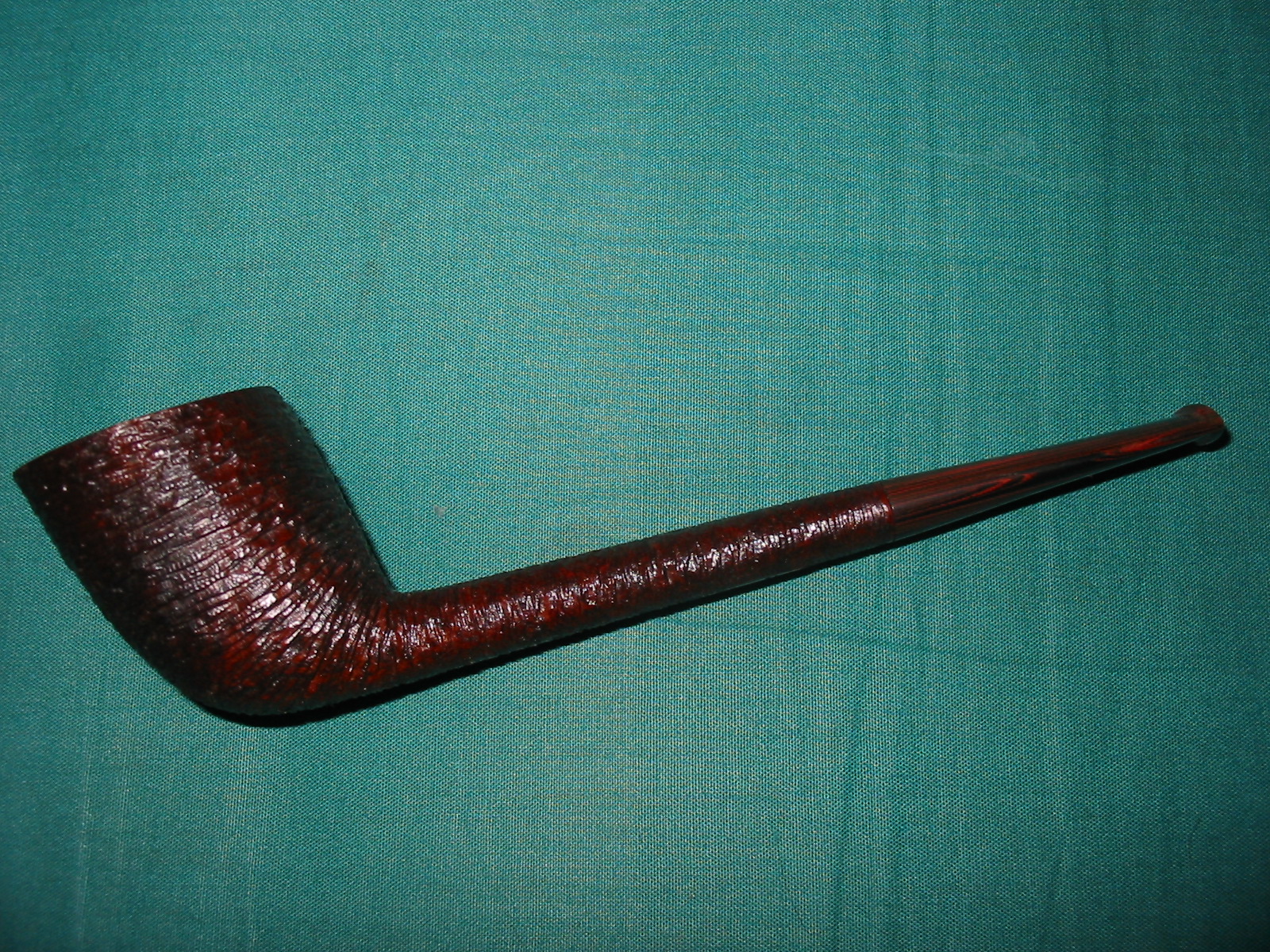
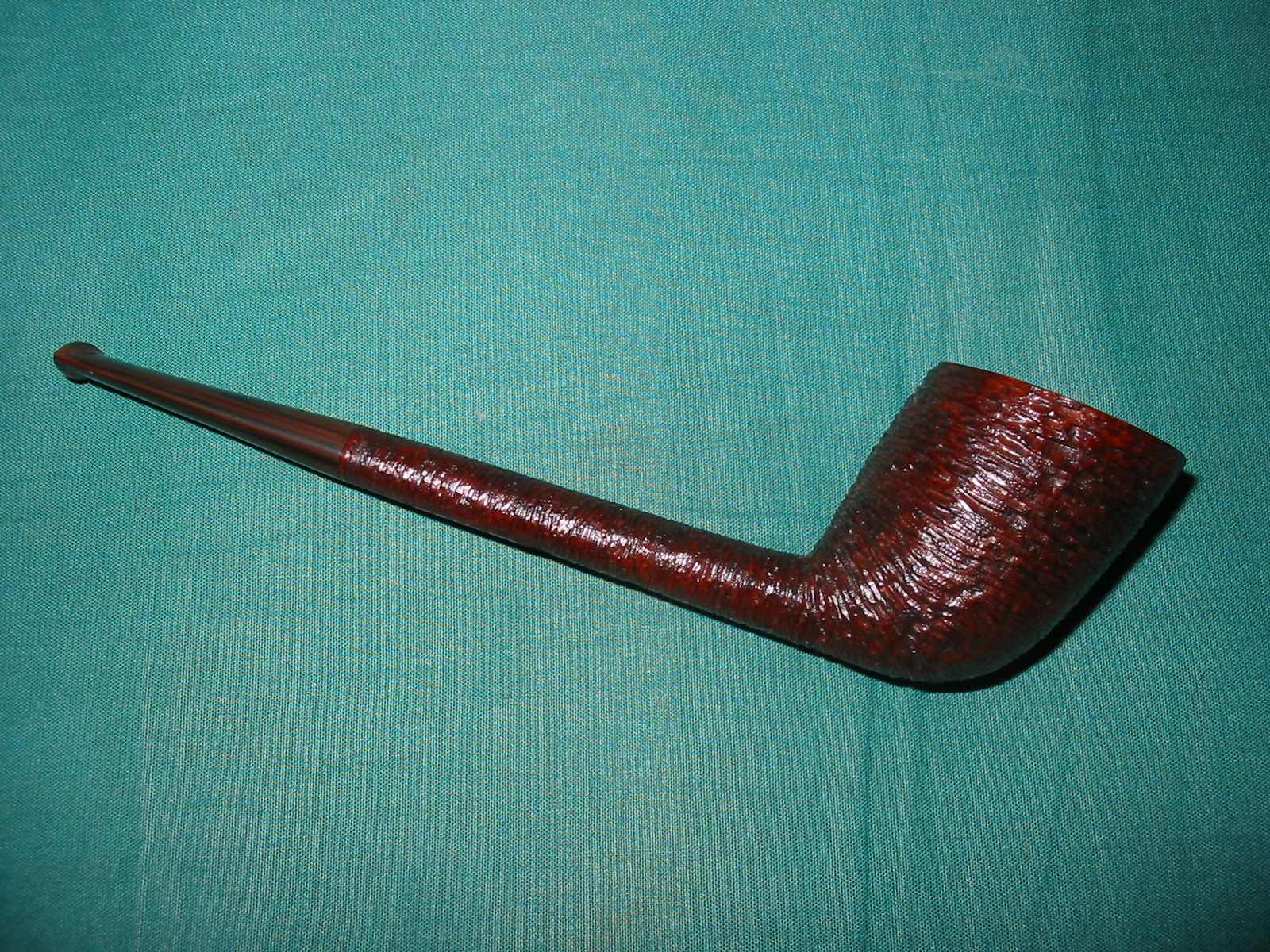
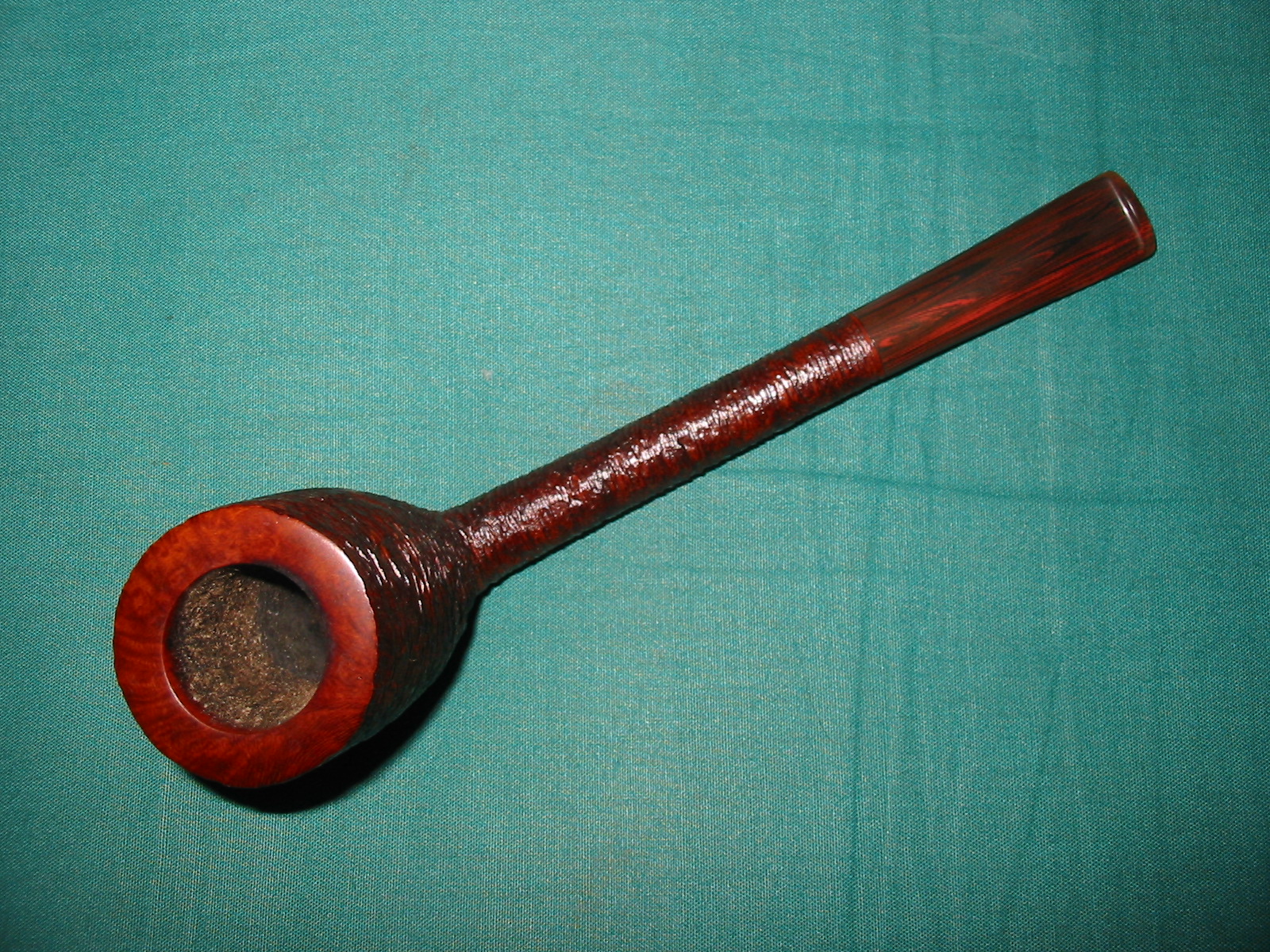
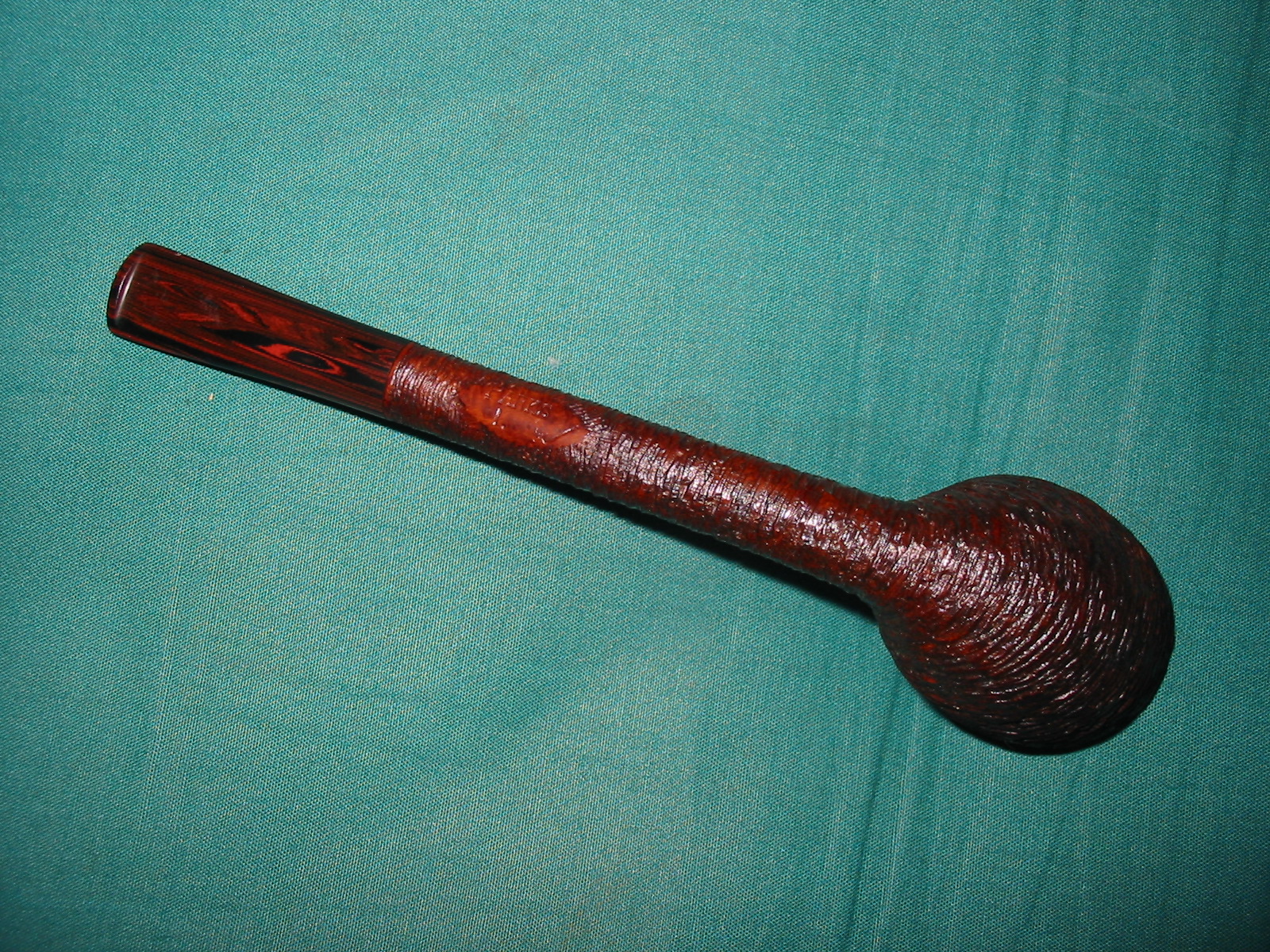
It truly is a beautiful and delicate feeling pipe. It is very different from most of the other pipes in my collection. Many of them are fat and stubby with thick shanks and Rhodesian or billiard bowls. This one is nothing like those. The finish is a striated rustication that follows around the bowl and down the shank to the stem. It is stained with an oxblood coloured aniline stain that really sets of the pipe and matches the Cumberland stem very well. The shank is the delicate part of the pipe – it is a pencil shank that extends with a very gentle taper from the bowl to the stem. The rim is smooth as is a small oval on the bottom of the shank that sports the stamping PARKS over 1. While the pipe is delicate looking it is a fairly large pipe. Its length is 6 inches from the tip of the bowl to the end of the button. The height of the bowl is 1 ¾ inches and the diameter of the bowl is 1 3/8 inches. The tobacco chamber’s diameter ¾ inches and the bowl depth is 1 1/8 inches.
IMG_3074

The stem is hand cut from Cumberland rod stock and the fit to the shank is impeccable. The red lines in the Cumberland match the colour of the stain of the pipe perfectly. The stem tapers from the junction at the shank to a thin comfortable bit at the end. The button is thin and comfortable and the oval slot in the end of the stem. Michael’s finish on the stem is like glass. My photos do not do the fine craftsmanship of the stem proper justice. It is very well done. The tenon is turned from the Cumberland and is a clean and tight fit to the shank. There is no funnel at the end of the tenon but it lines up precisely with the airway in the end of the mortise.
IMG_3076

The internal mechanics of this pipe are very well done. The airway enters the bowl at the bottom and is centered. The drilling the shank is straight and centered in the mortise. The inside of the shank is smooth and there is nothing to impede the airflow from the bowl to the stem. The drilling the stem is also clean and smooth. The slot is oval and funneled into the stem, flattening out the airway leaving it consistent from the tenon back to the slot. The bowl is drilled at the same angle as the slope of the bowl. The pipe came to me pre-smoked so I do not know if the bowl had any bowl coating when it was new. It does not appear to have had any.
IMG_3077

The pipe is very light – I do not have a scale so I am not certain of its weight. It is comfortable to hold in the hand and the mouth. The rustication gives it a very tactile feel as it heats up during a smoke. It delivers a flavourful and effortless smoke with a free and open draught just as I had remembered. When the pipe came to me it had been dedicated to English and Balkan blends and I have continued to use it for those blends. It is a great pipe that I will not let sit as long between the next smokes. Michael is a master at pipemaking and delivers a superior product in terms of fit and finish. Have a look at his website, http://www.parkspipes.com/ and I am sure you will enjoy the artful pipes that he has carved and continues to carve.

Reworking A Previous Refurbishment – A Genod Rhodesian


In photographing my Rhodesian pipes last evening I was examining this pipe and decided to work it over again. It is stamped Genod on the left side of the shank and Iwan Ries & Co. on the right side. I wrote about the work on it in this previous blog post: https://rebornpipes.wordpress.com/2012/09/04/reviving-a-genod-shaped-like-a-9242-gbd/ I think I worked on it the first time quite a few years ago and have learned a few more tricks since I did that old pipe.

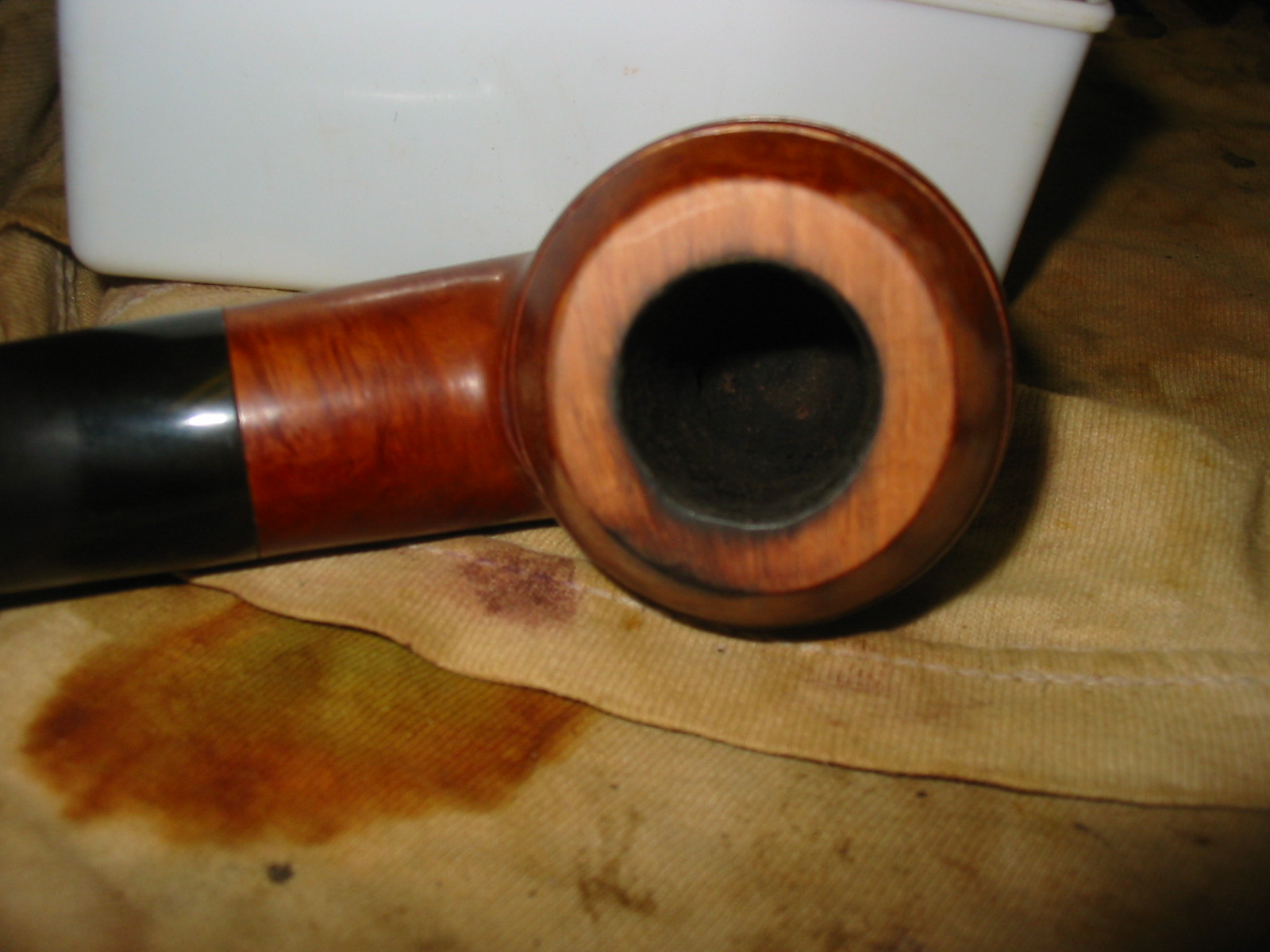
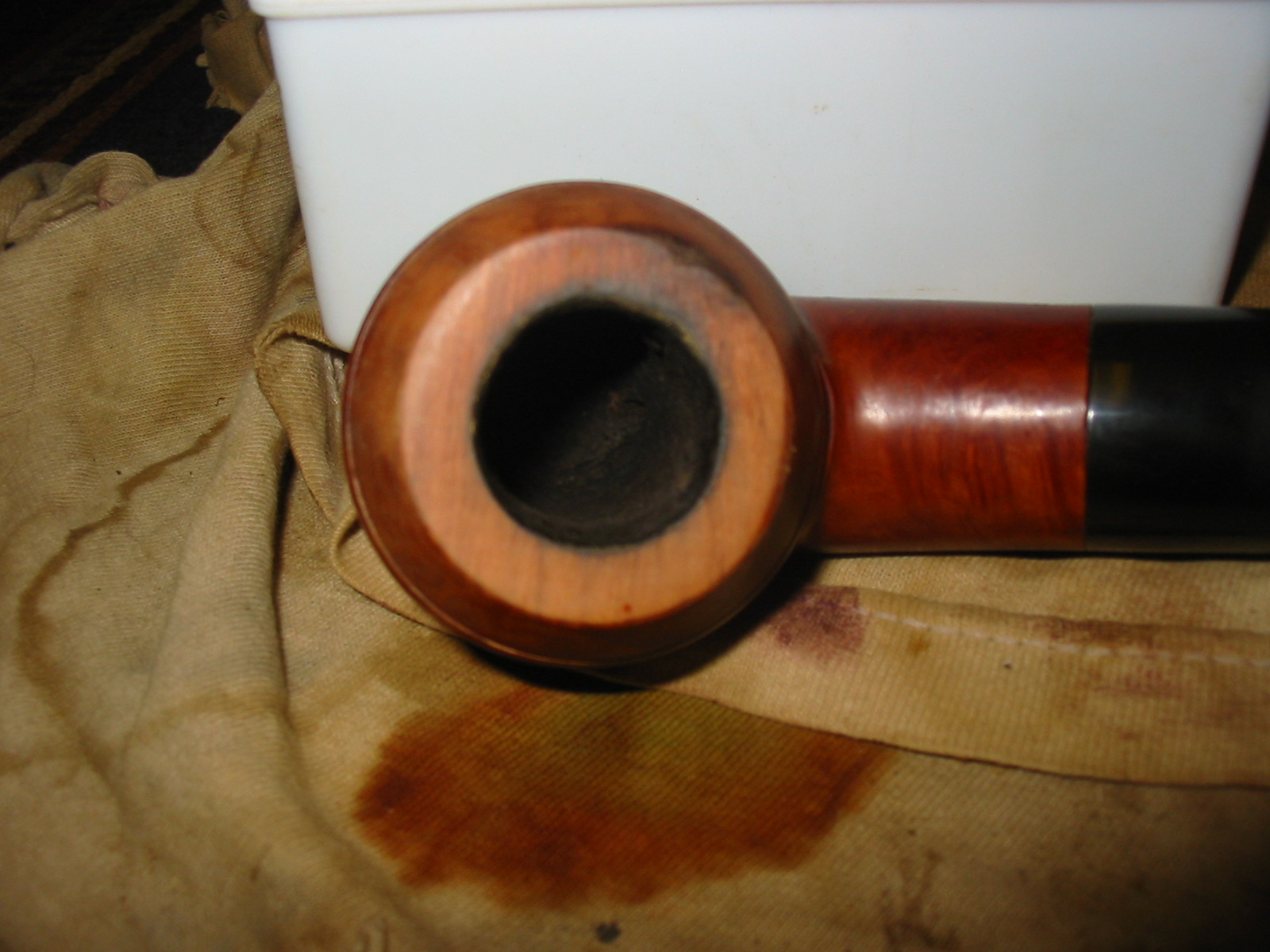
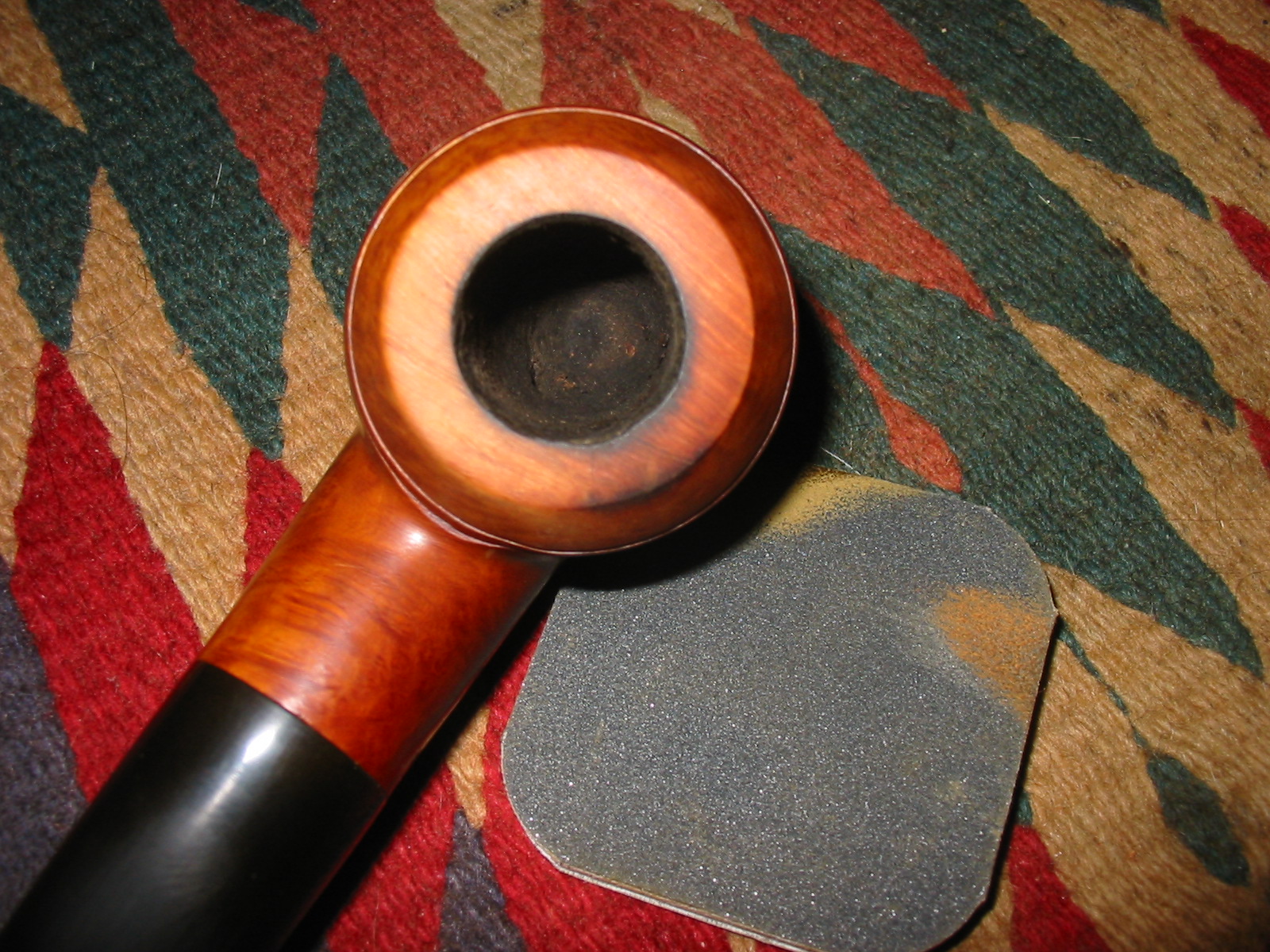
The four photos below show what it looked like when I started this time around. The burn mark on the top and side of rim was quite prominent. There was a slight dip in the outer rim edge of the burn. The stem had some tooth damage as can be seen in the last two photos.

Image

Image

Image

Image

The stem had some bite marks next to the button on the top and the bottom and there was oxidation along the edges. The angle of the button was not clean and had scratches and marks as well. I sanded the stem with 220 grit sandpaper, medium grit sanding sponge and micromesh sanding pads from 1500-12,000 grit. I wet sanded with the 1500-2400 grit and dry sanded with the the remaining grits through 12,000 grit. I buffed the stem with White Diamond and then rubbed it down with Obsidian Oil.
IMG_3080

IMG_3081

IMG_3088

IMG_3089

IMG_3090

IMG_3091

The rim was damaged from a burn and I had not done much with it above so I decided to gently top the bowl and sand the burn mark to try and minimize its extent. I sanded entire crown around the bowl above the two lines. Once the burn mark was a minimize as I could make it I sanded it with a medium grit sanding sponge and then with micromesh sanding pads. I restained the pipe with an oxblood aniline stain thinned 2:1 with isopropyl to get the colour I wanted for the bowl. I buffed it and waxed it first with White Diamond and then carnauba.
IMG_3082

IMG_3083

IMG_3084

IMG_3085

IMG_3086

IMG_3087

I reinserted the stem and buffed the whole pipe with White Diamond a final time and then gave the entirety several coats of carnauba wax. The photo below shows the finished pipe. It is far better looking now after the rework than when I took it from the cupboard.
IMG_3092

IMG_3093

IMG_3094

IMG_3095

My GBD 9438 Saddle Stems and Tapered Stem Rhodesians


Blog by Steve Laug

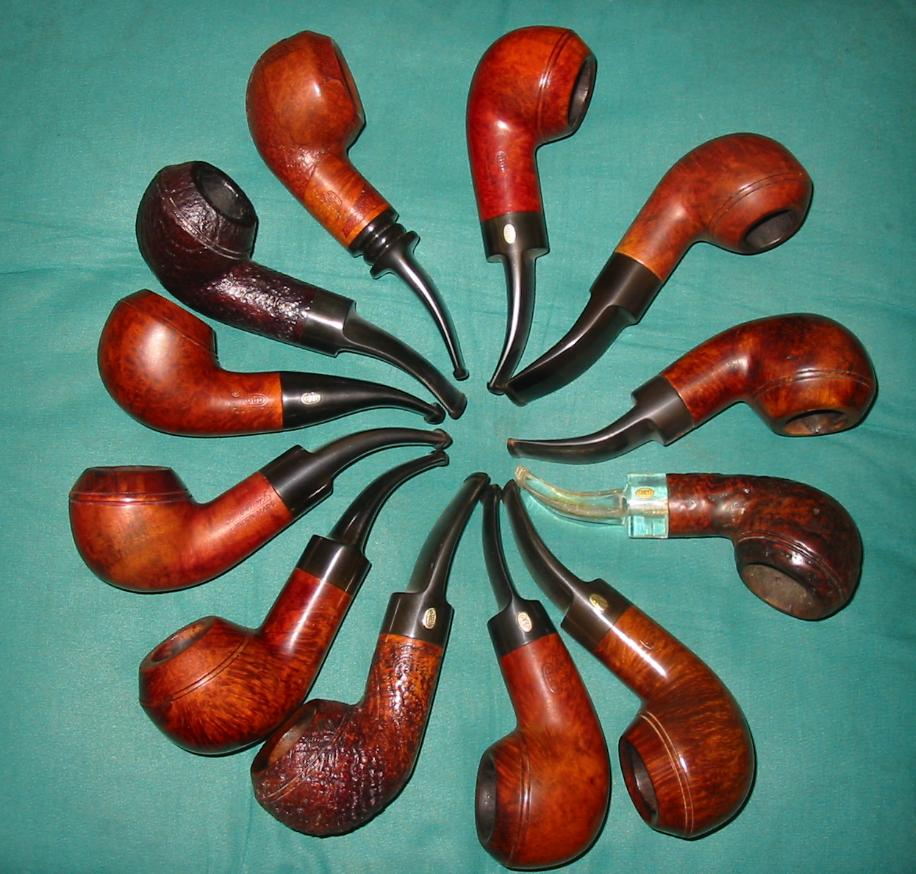
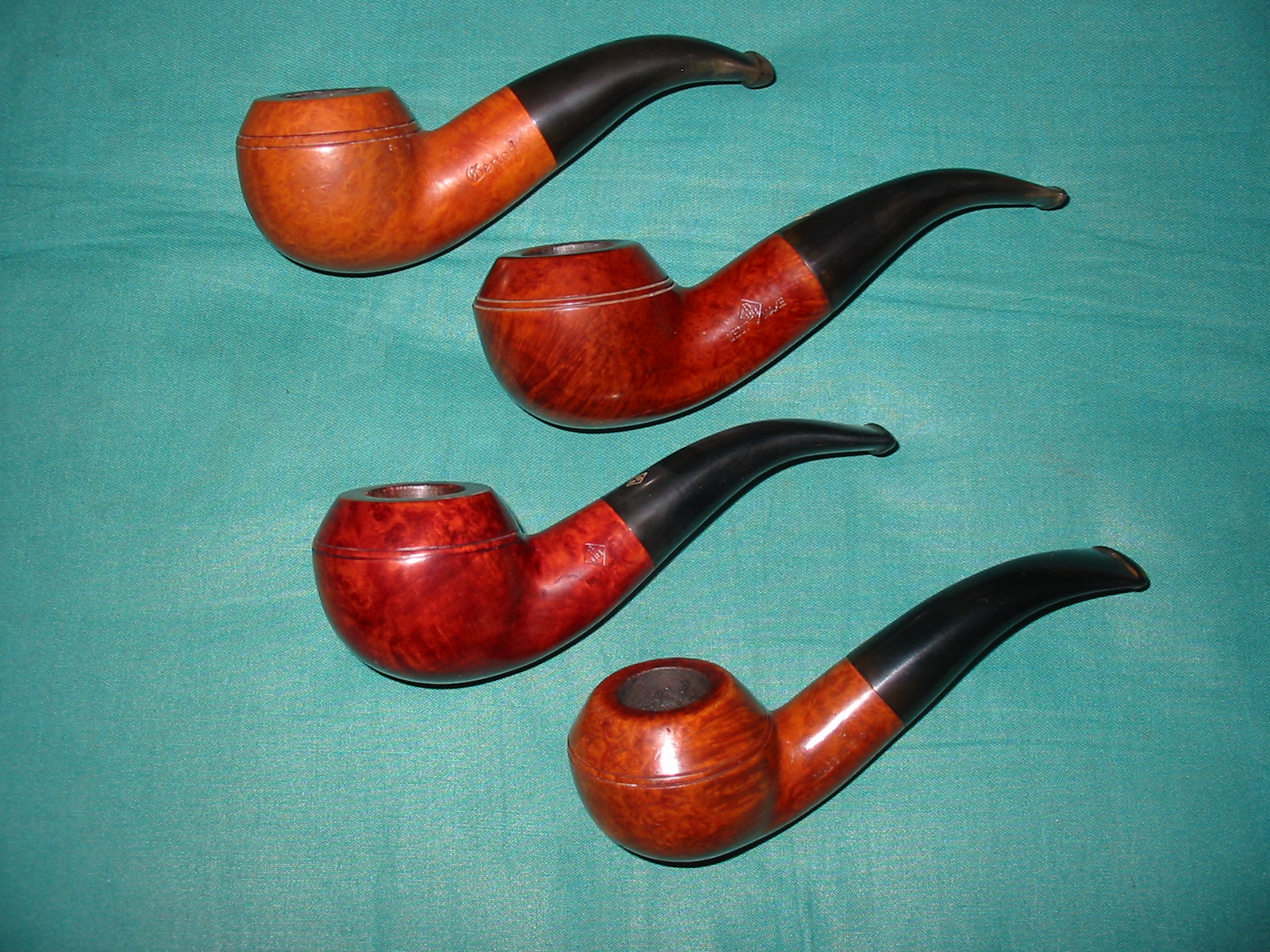
I have been collecting the GBD 9438 pipes for quite awhile now. They have always been a shape that is a favourite of mine and one that I think GBD did perfectly. I began to pick them up on EBay long before they began to sell for the prices they list at now. I have twelve pipes in total. I have taken a photo of them in a circle like a clock. Each position on the clock is filled by another 9438. They are identified as follows:

1:00 GBD Virgin
2:00 Dr. Plumb (GBD seconds line)
3:00 GBD Prehistoric with a Perspex stem (this is one that I had to cut back the stem and reshape the button).
4:00 GBD Flame Grain
5:00 GBD Gold Label Made in France
6:00 Prehistoric with a vulcanite stem
7:00 Huckster
8:00 Dr Plumb
9:00 GBD Quantum (restemmed with a tapered stem)
10:00 GBD ***
11:00 GBD Tapestry
12:00 GBD New Standard

GBD94382
Each one is slightly different in shape, length, bowl size but all of them bear the 9438 stamping on the right side of the shank. I am always on the prowl for different lines of the shape and also for better examples of each shape.

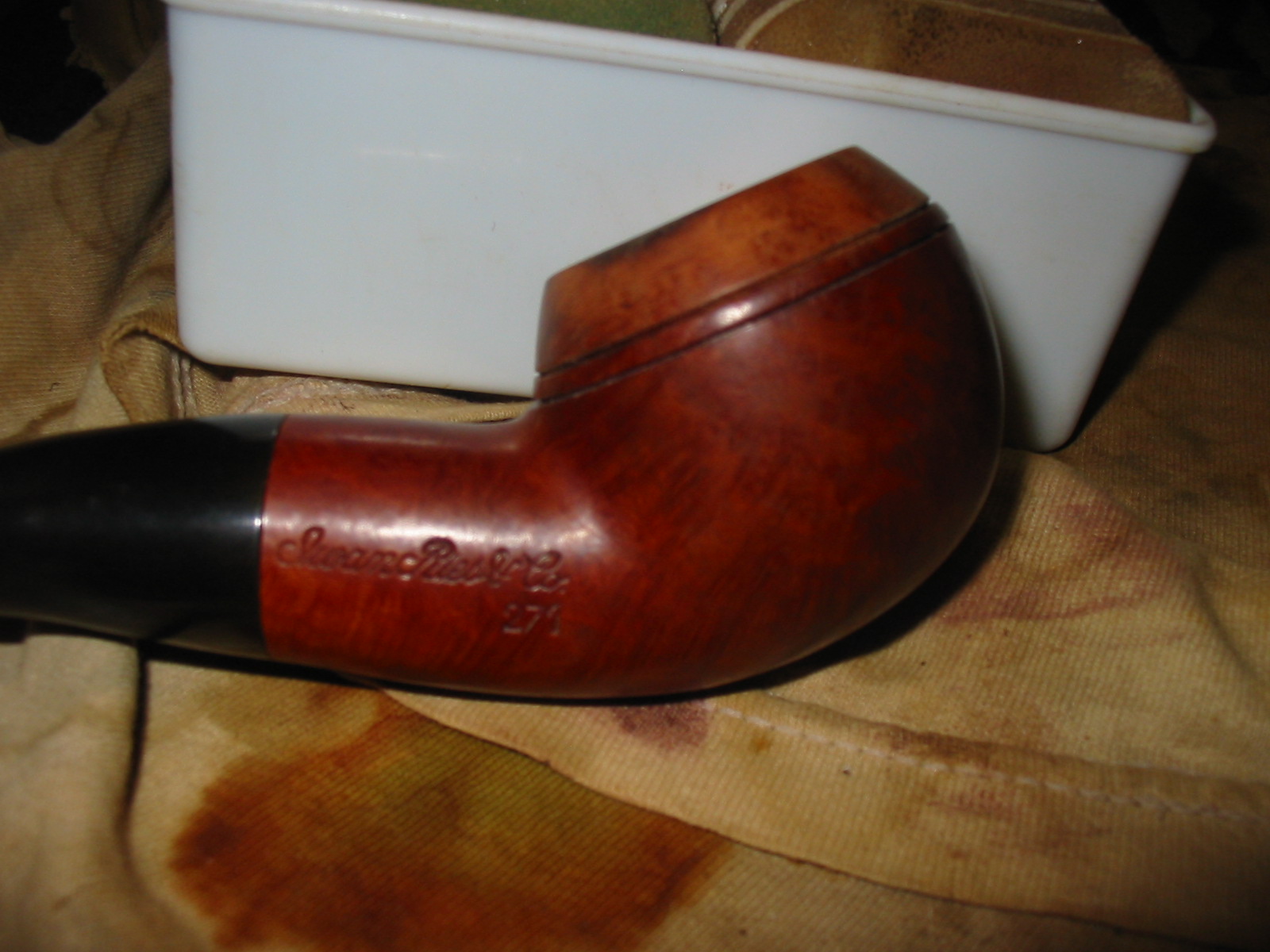
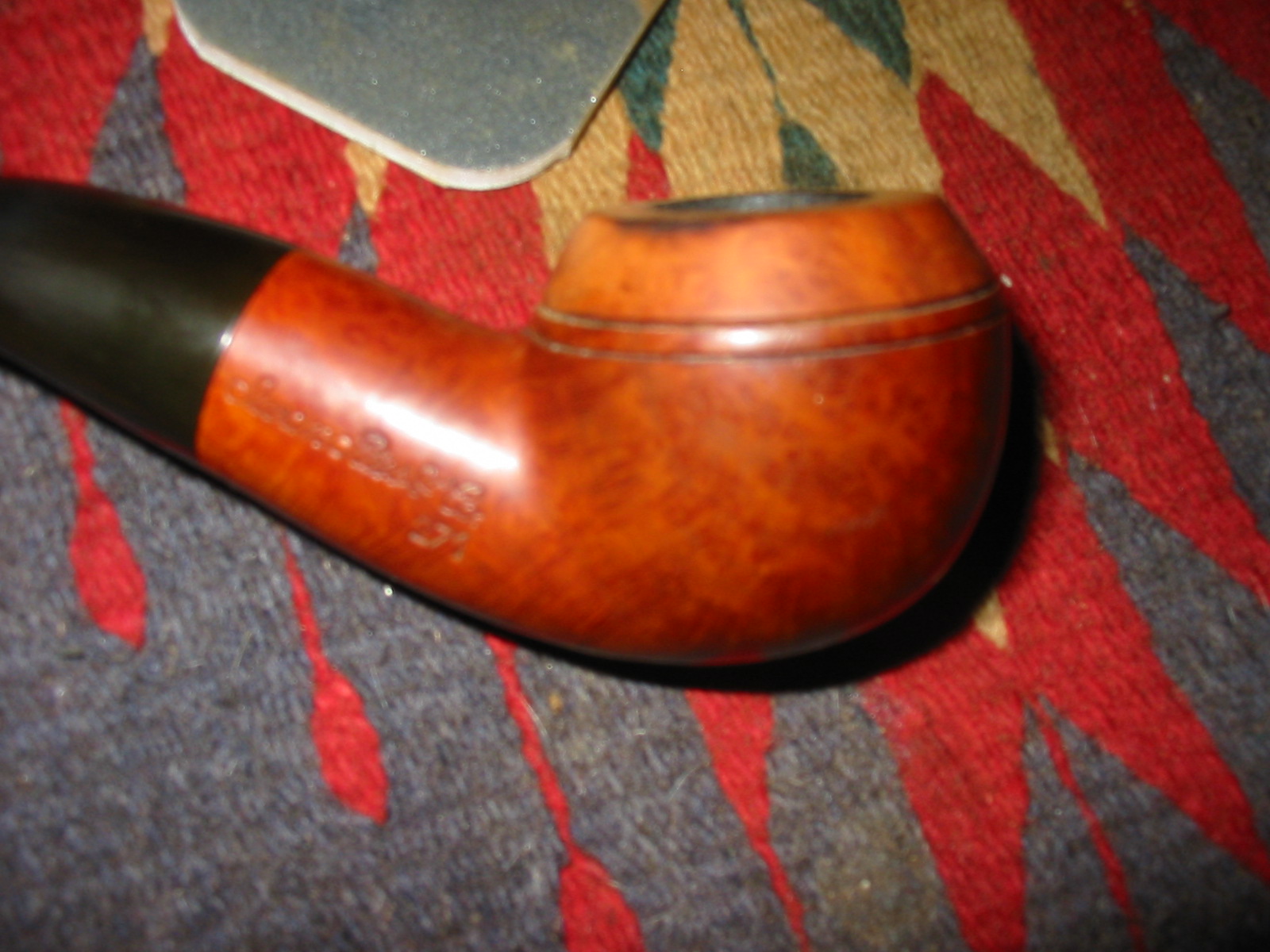
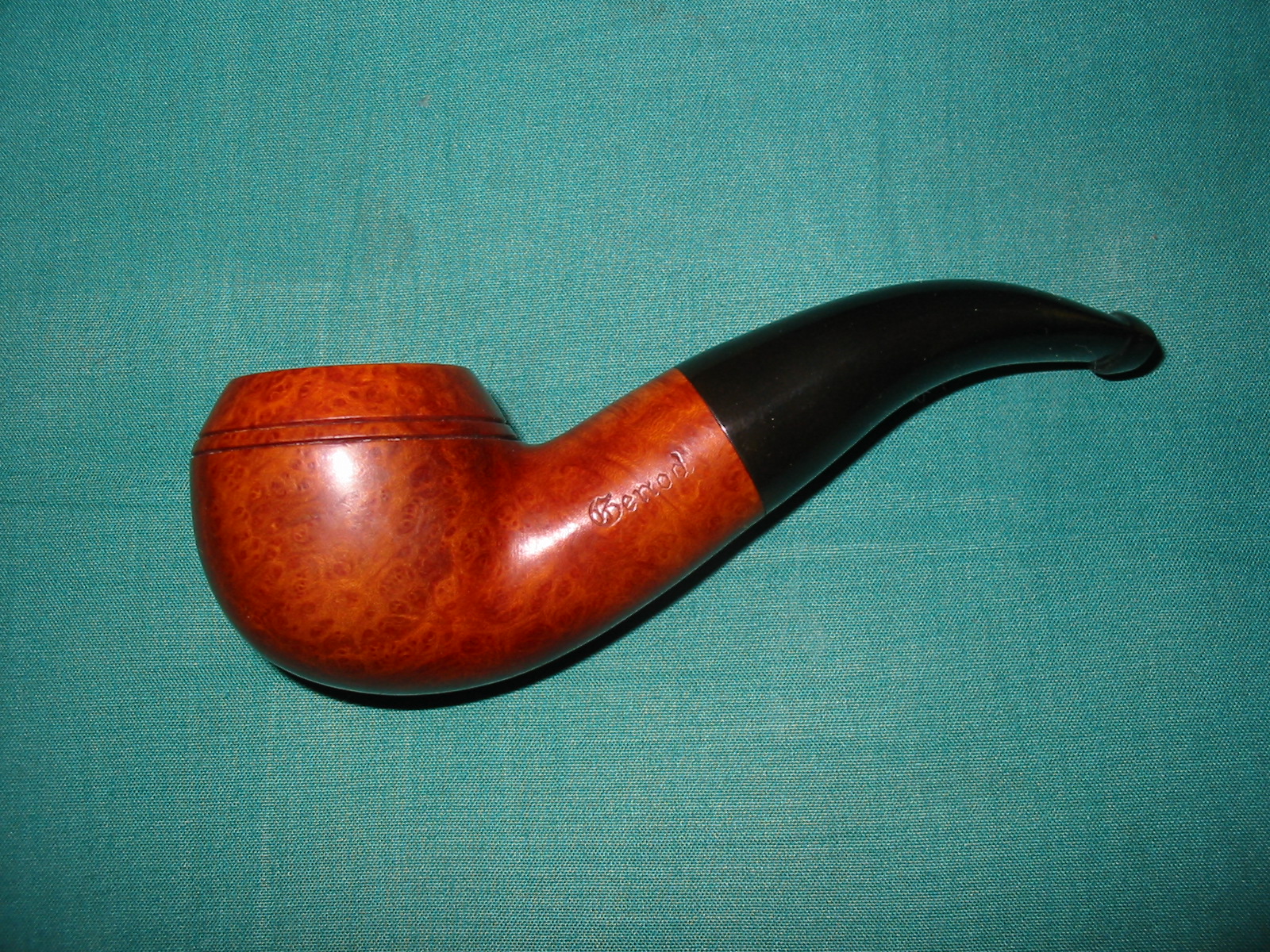
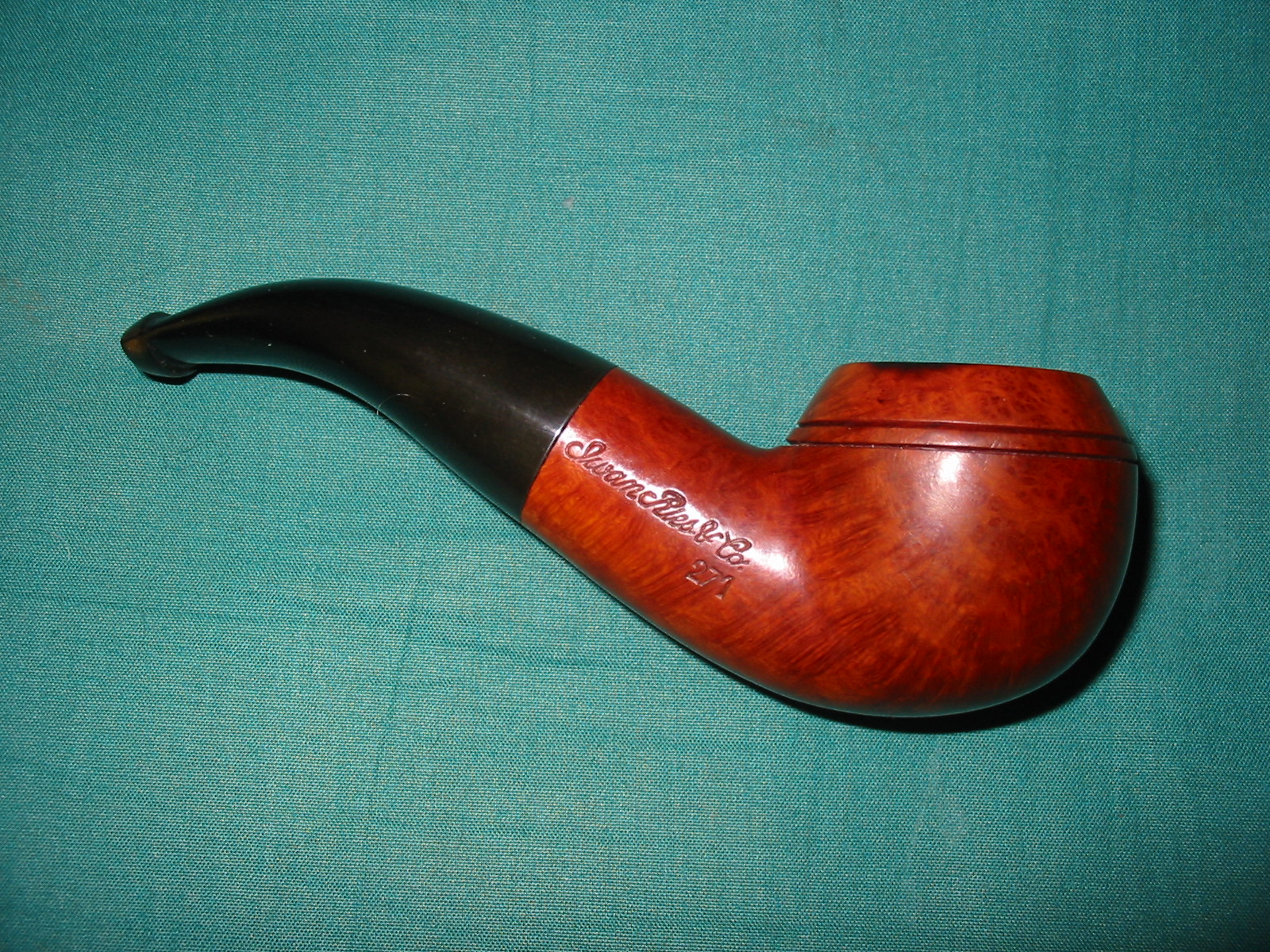
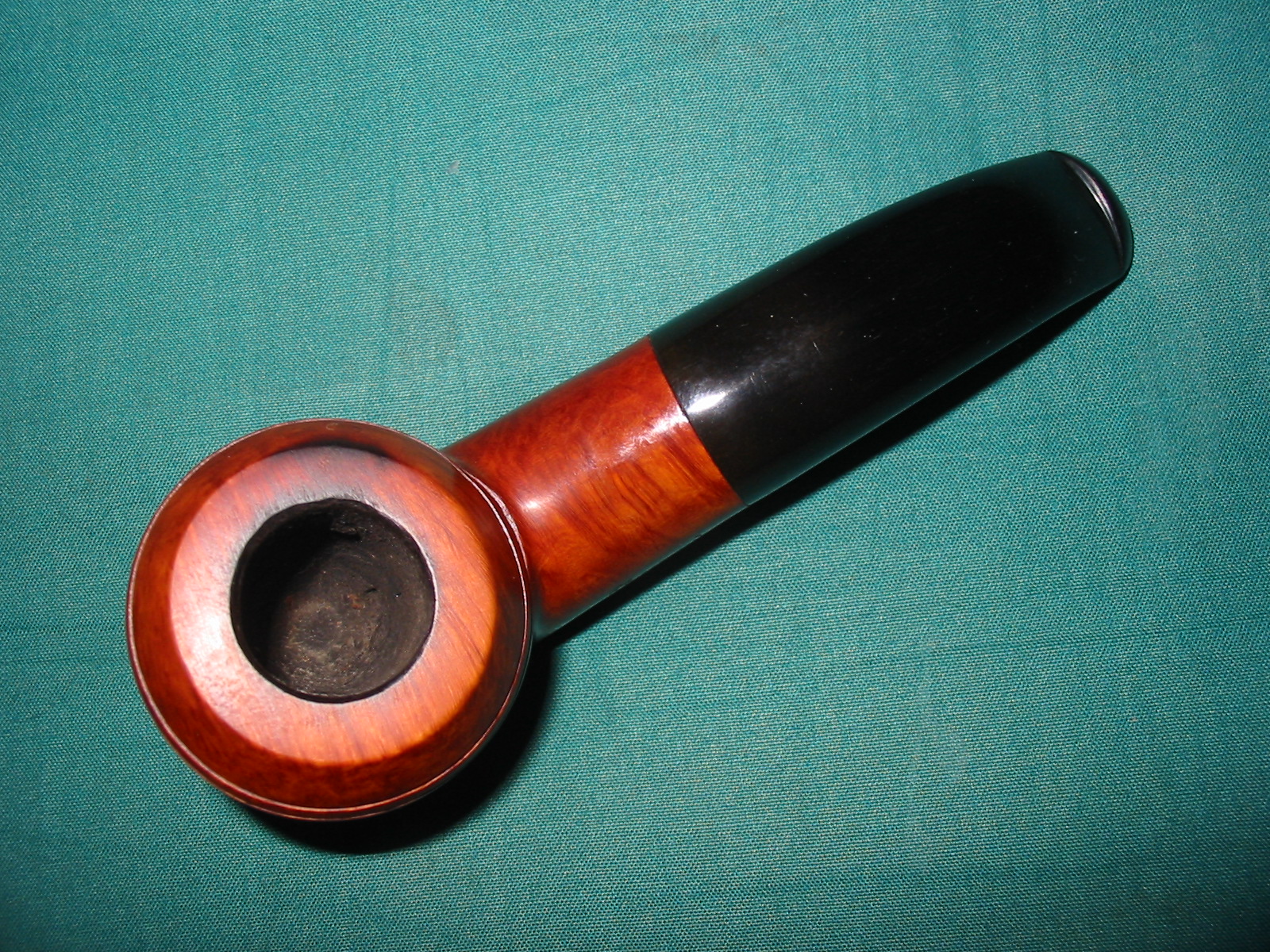
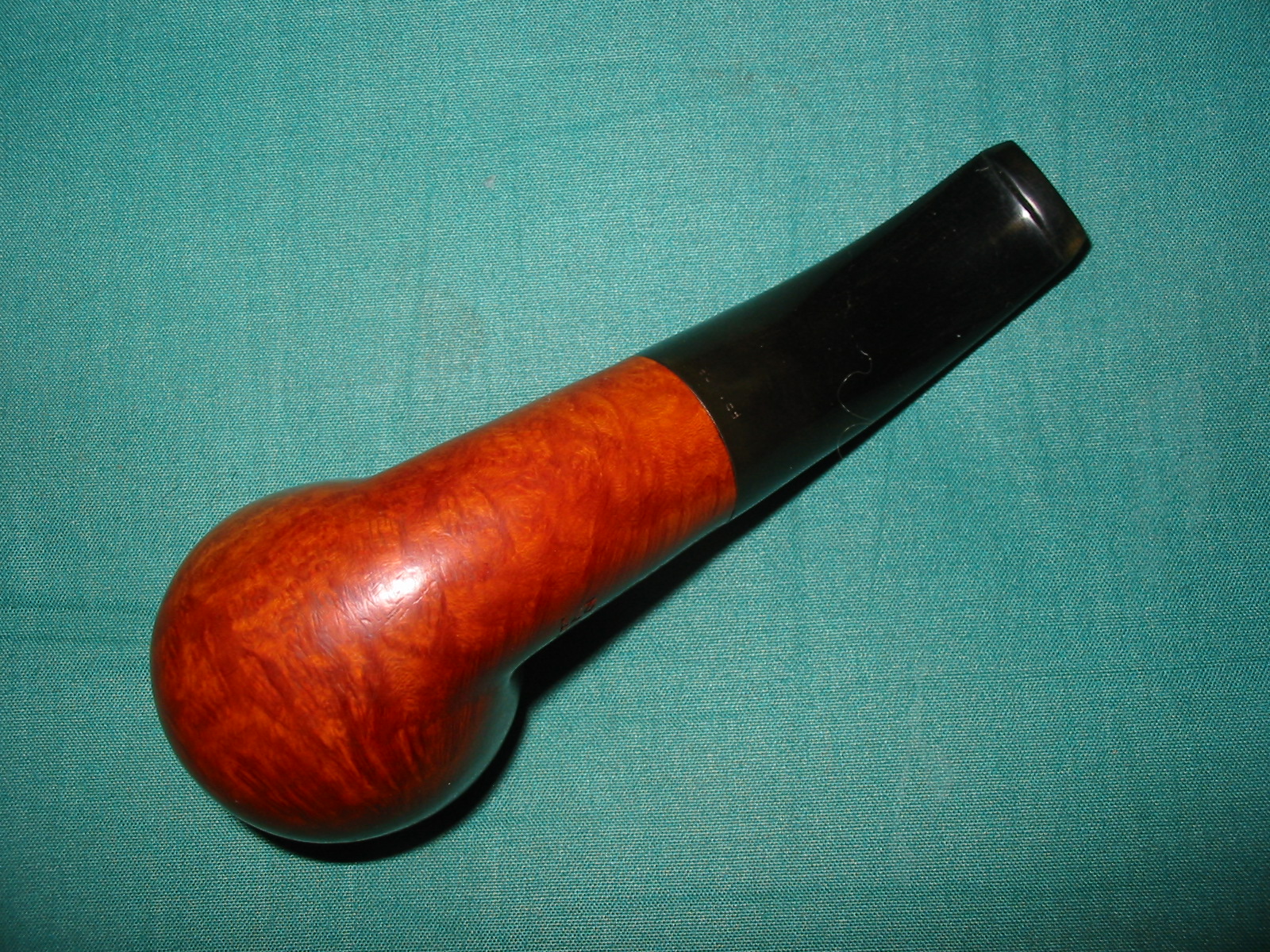
I also really like tapered stem Rhodesians but so far have not been able to pick up a GBD version of this. It is basically the same shape as the 9438 but has a different number – 9242 I believe. I would love to add one of those to the collection. But have four different versions made by other pipe manufacturers. The top pipe is stamped Genod on the left side of the shank and Iwan Ries & Co. 271 on the right side. This is a pipe that I have yet to restore. I cleaned it up and smoke it but I have not cleaned up the rim and the stem sufficiently. Both the second pipe and the third are BBB Rhodesians. The second is stamped BBB Best Make and, the third BBB Ultonia. The fourth is stamped Made in England with the stamping of the brand so faint that it is illegible.
IMG_3071

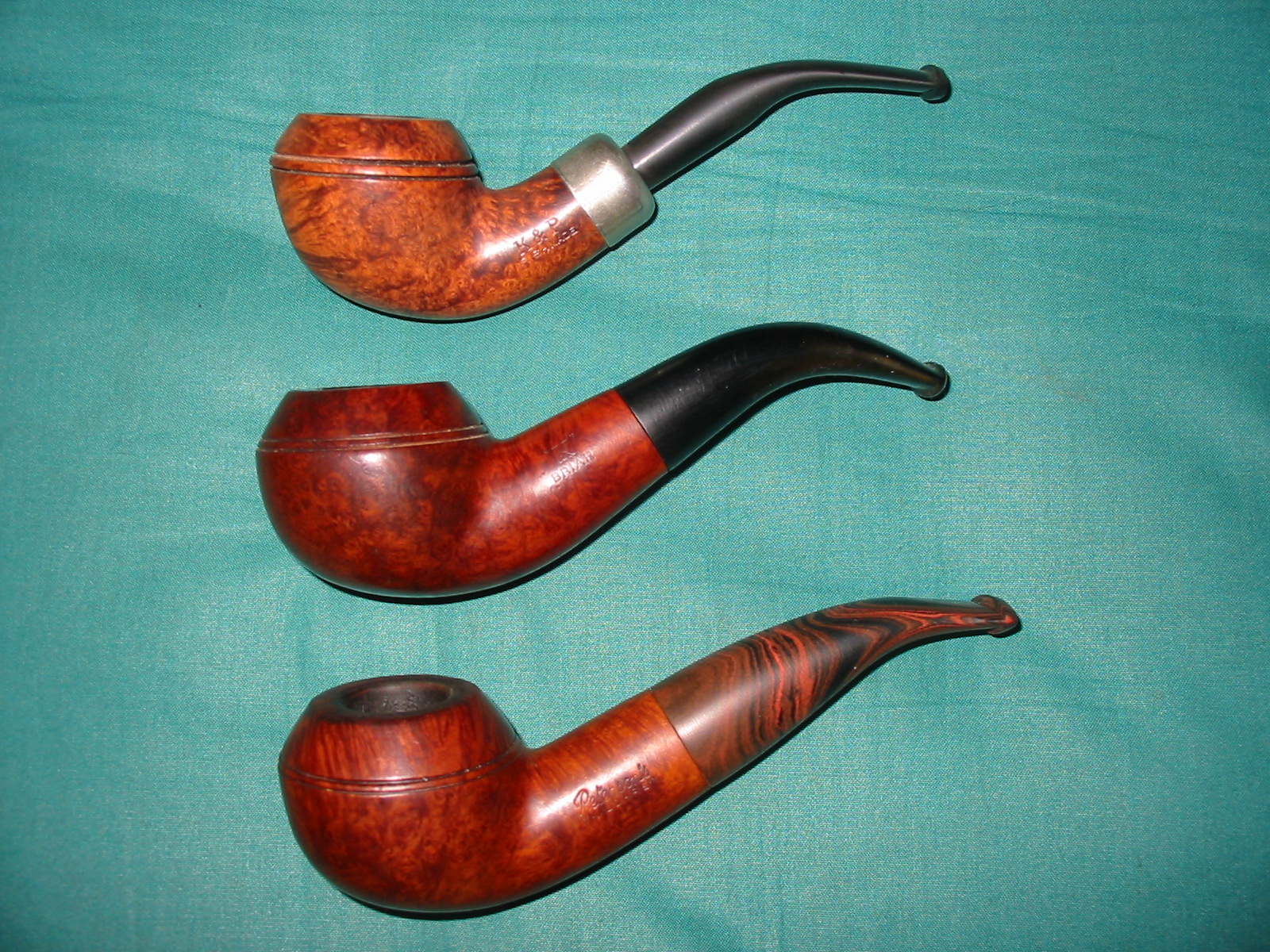
You can see that the shape occupies a fair amount of space in my collection. Some additional brands also offer their takes on the shape. One of the brands that I have started adding recently is the Peterson 999 – especially chubby shanked older versions. In the photo below the second and third pipe are older while first one is their new take on the shape. The first pipe is a military mount K&P Irish Made 999. The second pipe is a “K” Briar 999 and the third is a Peterson’s Kildare that I refinished and restemmed with a Cumberland stem shaped from rod stock.
IMG_3072

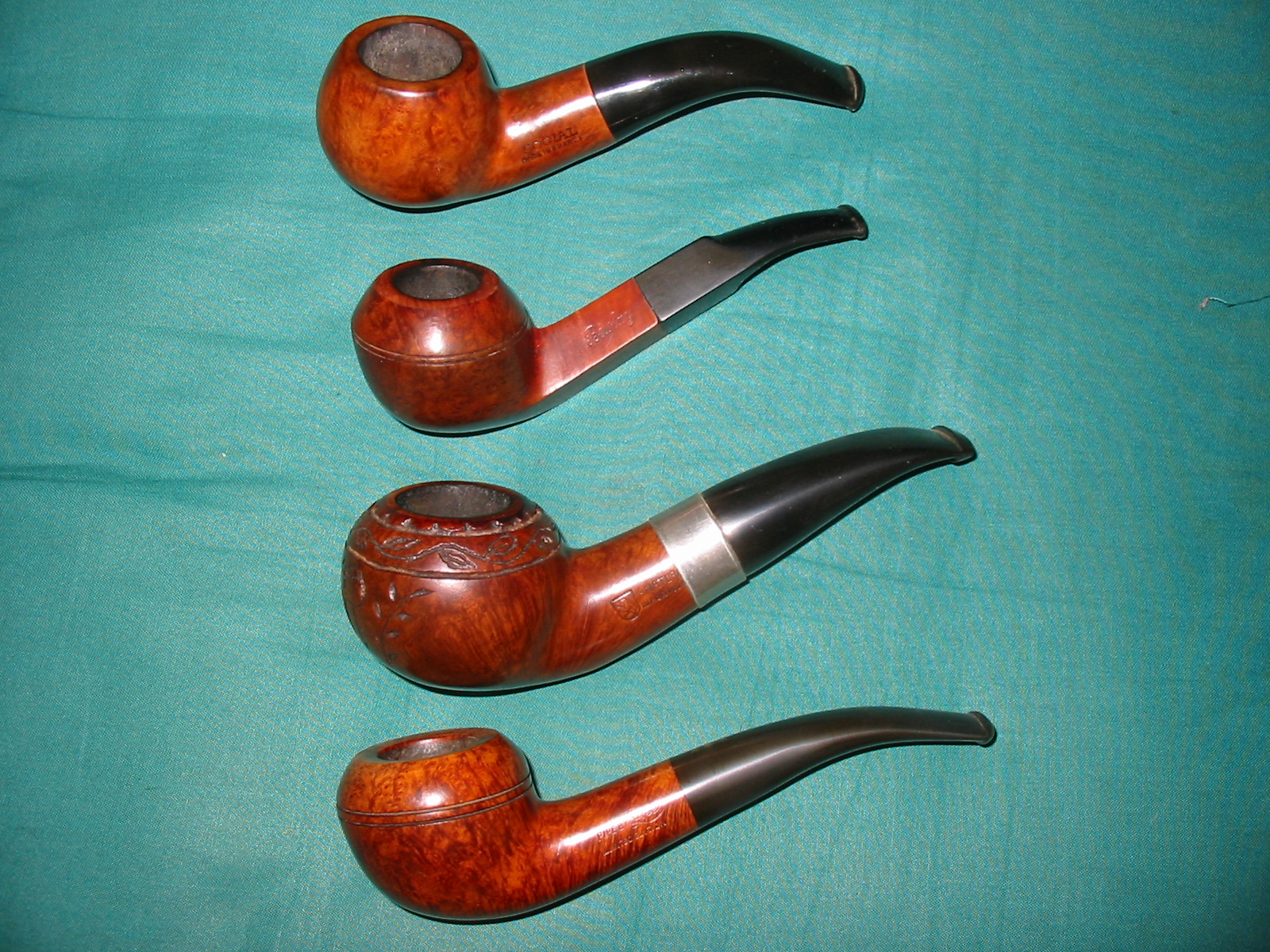
In addition to those standards in my collection are a few that also fit the shape but are from brands that I do not normally come across in my search for the shape. The photo below shows four of them that are slight variations on the Rhodesian shape. The first one could also be called an apple as it is missing the two scribed lines around the bowl top though it still has a comparable shape. It is a Comoy’s Social (a seconds line of Comoy’s). The second pipe is a diamond shanked Rhodesian stamped Bewlay 013. The third is a Savinelli stamped Natural. This one is quite unique in that somewhere along its journey one of its owners did some custom carving on the bowl. It is a simple folk art style that is carved into the bowl. There is a vine carved around the rim between the scribed lines and two vines with the Germanic Script CP on the front of the bowl (I restemmed this one and added the nickel band). The fourth pipe is a thin shanked Pipe By Lee 3 star Limited Edition.
IMG_3079

That is the status of my current collection of Rhodesians. I am sure that over the years ahead I will add more examples of the shape and replace some of them with better examples of the brand and the shape.

A Review – An Oliver Camphausen Paneled Horn


A while ago I worked a trade with a fellow pipe smoker on one of the online forums for this beautiful cross-grained horn-shaped pipe from German pipe maker Oliver Camphausen. I had heard of Oliver’s work but had not held one in my hands before. When I received the pictures of the pipe and the offer for a trade I was struck by the shape and the grain. Though I am not a big fan of horn-shaped pipes there was something about this beauty that just grabbed my attention. With little ado the deal was done and the pipe was on its way to Canada.

I did a bit more digging into information about the carver while I waited for the pipe to arrive. There were various European sites that listed a few of his pipes, there were several on EBay available from some of the high-end sellers but I could not find a web site on the carver. I found that. Oliver Camphausen is considered one of the bright new stars to emerge from Germany’s pipe carving scene. His work bears strong resemblance to that of Karl Joura, yet his designs are totally different. I also found out that Pipes and Tobaccos Magazine did a report on him in the Spring 2006 issue.

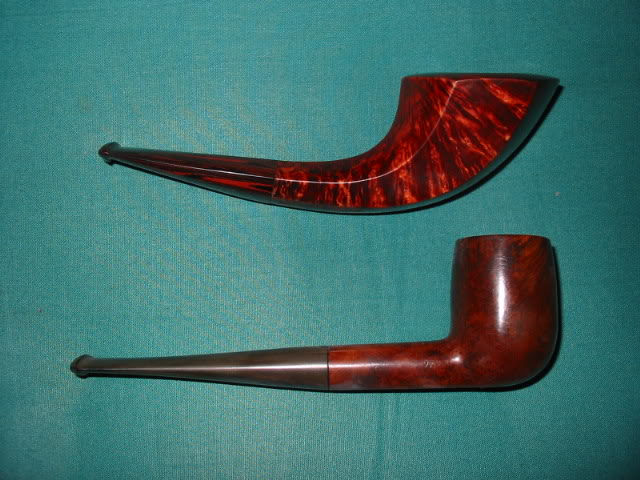
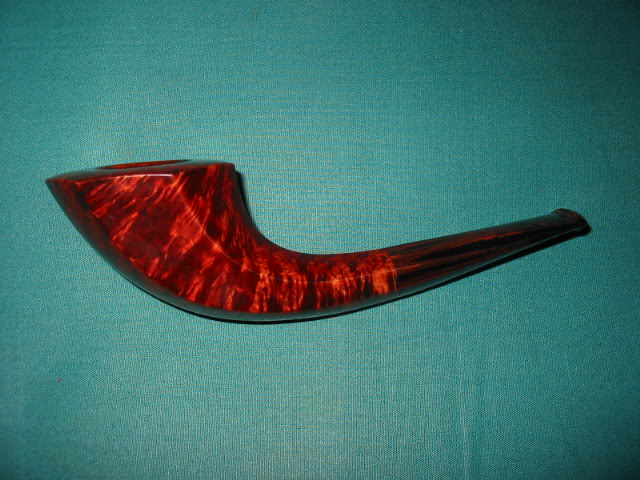
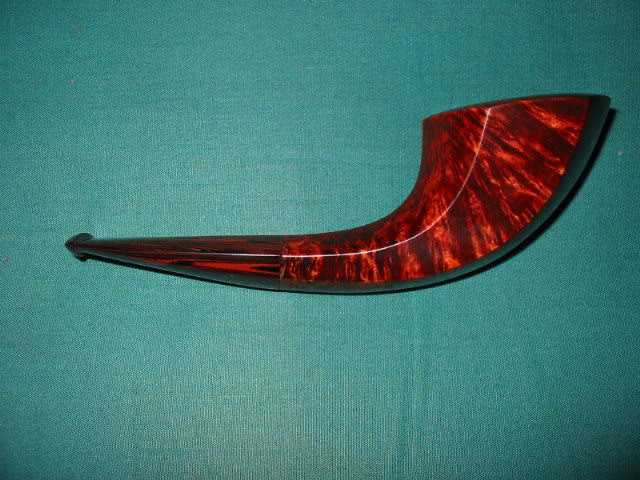
This particular pipe is gorgeous and gracefully shaped and displays a beautiful “sunburst” cross grain pattern that runs down the sides of the bowl and the shank. The symmetrical grain is terminated with a panel of dense birdseye grain that flows down the front panels and the top and bottom of the shank. It is very comfortable in the hand and the balance is about perfect.The overall length is 5 3/4″. The bowl height measures about 1 3/4″. The tobacco chamber is 7/8″ in diameter and an angled inner depth of 1”. To give an idea of the size I photographed it with a Group 3 sized billiard. The bowl height and the length of the pipe match the billiard very closely.
Camphausen1

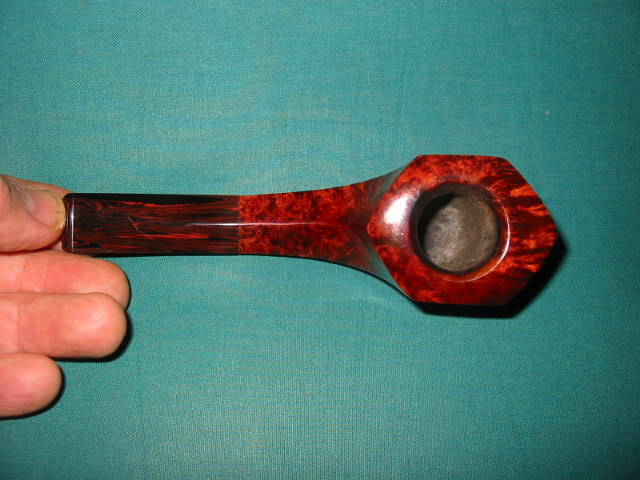
The finish on the pipe is very well done. There is a dark understain, either black or dark brown that brings out the cross grain on the side panels and the rings of the birdseye on the front and the back panels. The red oxblood stain serves as a top coat and matches the red in the Cumberland stem. The finish is smooth and there are no sanding marks or scratches in the bowl. It is definitely well finished. The six sides of the panels line up very well and the slightly crowned top on the bowl gives fullness to the look of the rim and top. The curves and angles all are aligned and there is a flow and grace to the lines of the pipe. The inner edge of the rim is chamfered inward and stained to give a finished look to the top of the pipe. The end of the shank is countersunk to give a tight fit for the stem against the shank.
Camphausen2

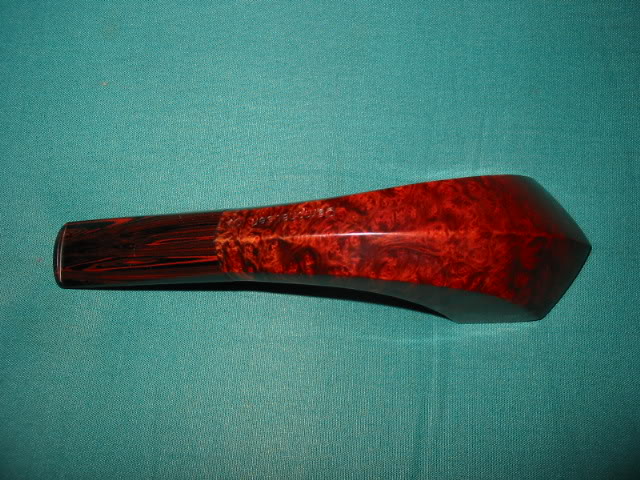
The stem is hand carved out of Cumberland and matches the colour of the stain well. The stem is six-sided to match the panels on the bowl at the shank end and then all panels blend into a taper from the middle of the stem back to the button. The tenon is Delrin and is perfectly installed into the stem. The tenon fits perfectly against the end of the stem. The tenon is countersunk on the end to give a funneled end where it sits in the mortise. The inside of the stem is smooth with no roughness in the transition between the Delrin tenon insert and the Cumberland stem. Shining a light down the airway in the stem shows a smooth shiny surface with nothing to impede the airflow in the stem.The finish on the Cumberland is glass like and smooth. The fit against the shank is tight three-quarters of the way around the pipe. There is a slight gap on the right side where it does not sit tightly and light can be seen when it is held up to the light. It is not too problematic in that it is only visible against the light.
Camphausen3

The mechanics are excellent. The airway in the shank is centered in the end of the mortise and the tenon sits neatly against the end of the mortise. The curve of pipe made drilling a straight airway a slight challenge. There is a small divot out of the bottom of shank end of the mortise that allowed for a straight shot to the bowl. The end of the airway where it enters the bowl is slightly opened and flared give a smooth transition for the smoke to travel to the mouthpiece. The inside of the mortise and airway is also smooth with no roughness. There is nothing in the airway of the pipe from stem to bowl that would cause impedance in air flow. A fluffy pipe cleaner easily slides the length of the pipe with no snags along the way.
Camphausen4

The pipe came to me pre-smoked so there was no need to break it in as a new pipe. There was already a light cake forming on the walls of the bowl. From what I can see there was no bowl coating used on the inside of the bowl. The cake is hard and smooth on the walls. The previous pipeman smoked English/Balkan tobaccos in the pipe so I have continued that tradition with some aged Rattrays Red Raparee that I have. It smokes very well and is truly an effortless smoke. I was concerned that the walls of the bowl toward the bottom might heat up during smoking as they are not as thick as the upper portion of the bowl. However, I have smoked it for quite a while and the heat is not an issue. The bowl is warm to the touch but never hot.

I am well pleased to have one of Oliver’s pipes in my collection. It is a good smoking pipe and certainly one that is well finished. It remains a pipe that I pick up again and again and turn over in my hands to enjoy the grain – both cross grain and birdseye. The beauty of the colours and subtle shifts in the way the light dances off the grain make it ever-changing and delightful to me. I would gladly purchase another one of Oliver’s pipes should one come by that catches my eye. If you have not had the opportunity to try one I would encourage you to find one and give his work a try. I don’t think you will be disappointed.
Camphausen5

A Review – A Commissioned Alan Stevenson Hand Made Apple


For those who are unfamiliar with Alan Stevenson, a pipemaker from Wisconsin, I am including some information regarding him taken from Pipedia. I think it will be helpful for you to get a feel for the pipe maker before you read my review of his pipe.

“Alan Stevenson is known for his high quality handmade pipes in classic shapes. His trademark hand cut Cumberland stems are a favorite among those who own one or more of his finely crafted pipes. His pipes have a reputation for being some of the best smoking pipes available and their quality is well above their selling price. Alan is a rather modest individual when it comes to his pipe crafting skills, as evidenced from his quote below.” – Pipedia

Quoted from the Alan himself: “My Name is Alan Stevenson and I live in Wausau, WI. I am a very late bloomer for a pipe maker. Have been smoking a pipe since college in 1966. I have always wanted to try making a pipe, so after 30+ years in industry I have retired to my little corner of the garage. Pipemaking for me has really involved a steep learning curve which I have only begun to climb. My background is math, physics and chemistry; I had never touched a wood or metal lathe in my life. Starting at nearly 60 is tougher than most would think.

In 2004 I had tried my hand at a couple of kits from Mark Tinsky and enjoyed working on them. So I paid the kindly Mr. Tinsky a visit in Helena. Mr. Rad Davis was there at that time as well and for a few days I had the privilege of learning a little about pipemaking from these two gentlemen. I left Helena with a couple of pipes, a bunch of briar and some stems and returned to finish working on them in my shop. About 2 years ago I got my nice metal lathe and set about learning how to hand cut a stem. If I ever learn to do that correctly then I might consider that I am a pipemaker. Till that time I am still learning.” – Pipedia

Several years ago I contacted Alan regarding a commissioned pipe that I wanted him to make for me. Earlier I had been gifted one of Alan’s rejects and had stemmed it myself and I loved the finish and feel of that pipe. He had done a great job in laying out the cut of the pipe with the grain of the briar on the reject stummel I had so I wanted to see his magic on a full pipe. I gave him a call and asked if he would carve a pipe for me. My request was pretty simple in that what I wanted was roughly an apple shaped pipe that had a smooth finish. I did not specify colour or finish or even the lay of the grain. I also did not specify a shank extension or the wood that he would use in it. I pretty much left all of the artistry up to Alan to work his magic.
Stevenson1

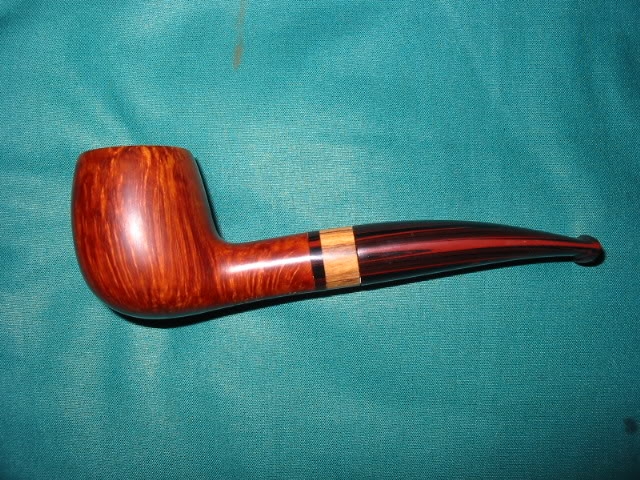
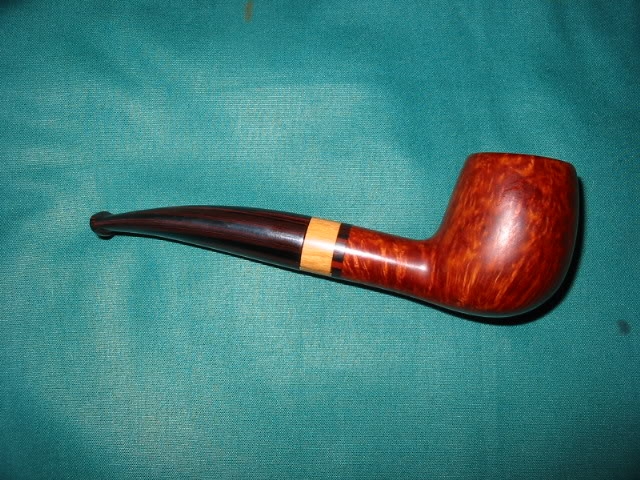
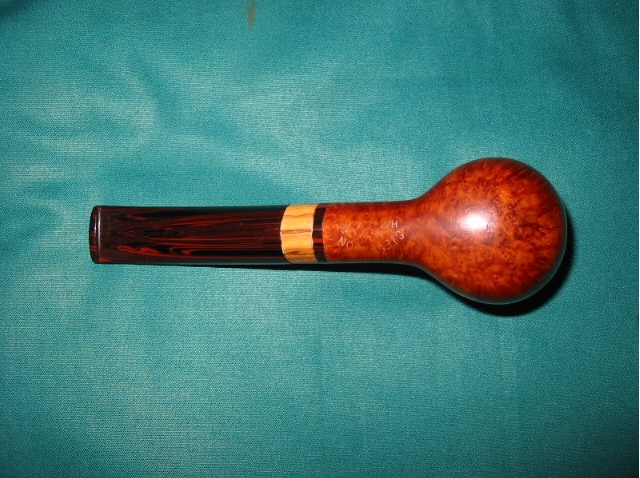
When the pipe arrived and I have to tell you the shape and finish went beyond what I had in mind when I commissioned it from Alan. It was and is beautiful. The length of the pipe is 5 inches and the bowl height is 1 5/8 inches. The bowl diameter is 1 1/4 inches. The chamber diameter is 7/8 inches and depth is 1 1/4 inches. The lay of the shape to the grain is superb. The sides bear a mix of straight grain and flame. There are spots on the front and back of the bowl which have mediocre grain but Alan did a good job of working that into the finish. The rim, the bottom of the bowl and the top and bottom of the shank have some nice birdseye grain. There is one slight flaw in the briar at the front toward the bottom of the bowl that he blended into the grain of the briar nicely. It looks to me that he used a dark brown stain on the undercoat to highlight the grain and then a tan or light brown stain to cover that and give the pipe a warm hue. He made a shank extension that combines a thin band of Cumberland and a wider band of olive wood. The olive wood is also stained with the tan stain and looks good. The stem is Cumberland and matches the band. The overall flow of the bowl and shank is brilliant and the colours are beautifully matched from rim to the end of the shank.
Stevenson2

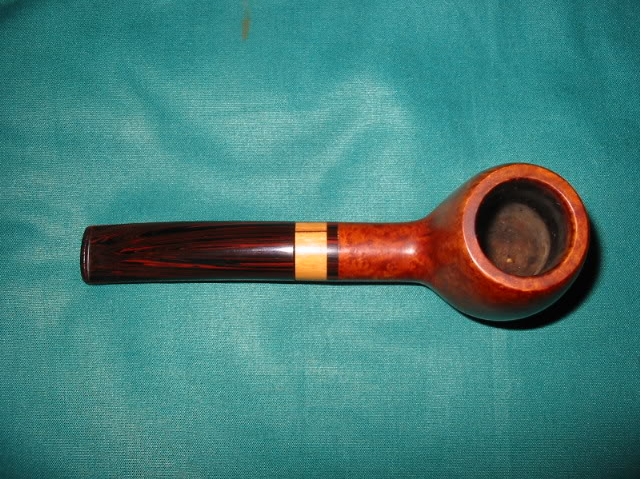
Alan did an excellent job on the inner mechanics of the pipe with drilling that is perfectly executed from the shank and into the bowl – coming out exactly centre in the bottom of the bowl. The airway and the inside of the bowl were very smooth with no rough spots left by the drill bit in the bowl or shank. There was no bowl treatment or coating so just a good smooth briar. He had sanded the inside of the bowl and there were no hidden flaws or surprises.

The stem itself is hand cut out of Cumberland. It has a gentle taper from the shank to the button. It has a slight bend to it that gives it a stylized look. Alan did a great job shaping the stem and capturing a shape that really works with this pipe. The stem is nicely finished with no marks or scratches in the Cumberland. The tenon is integrated with the stem and cut into the Cumberland. The fit in the mortise and against the shank is snug. He countersunk the end of the mortise to make for a snug fit of the stem to the shank. There appears to be a slight gap where it meets the shank but as I examine it with a light I think that it is a problem with the stem being slightly larger in diameter than the shank. The end of the tenon is funneled slightly for a smooth transition from the mortise when it is in place. There is a very minimal gap between the end of the tenon and the base of the mortise. The airway is smooth from the entry of bowl airway all the way to the button. The draught is unrestricted and open from the bowl to the tip of the stem. The button is perfect to my liking and very comfortable in the mouth and teeth. The edge is narrow and well shaped. The slot in the mouthpiece is fanned out and is oval in shape. The airway is thus consistent in size from the tenon to the slot. There is no whistle or noise when the air is drawn through the pipe.
Stevenson3

The overall construction of this pipe is very well done. It is light in the hand and in the mouth. It is well balanced and has a shape that fits well in my hand. There are some slight details in the finish of the pipe that in no way affect its smoking ability. They are truly cosmetic in nature. I list them at this point only because to me they are there and others will see them. The first involves the shank extension. There are some spots on the underside of the shank where the epoxy squeezed out between the Cumberland and the olive wood. The second involves the fit of the stem being slightly off. There appears to be gap at the junction as noted above. However, in examining the stem and shank and measuring the diameter of each it is clear that the problem is not a gap but that the stem is slightly larger in diameter than the shank. This could easily be corrected but I have not done so yet. The third issue may appear to be a finicky one to be sure, but it is there nonetheless. The Cumberland of the band and the stem seem to come from different pieces of stock and thus the lines/striations do not line up. This issue does not bother me but some would find it troublesome. Apart from those very simple cosmetic issues the pipe is well made and is a smoking machine.

I have been smoking it for a few years now and after breaking it in with what has become my first love in tobacco, McClelland’s 5100 it has become a great Virginia smoking pipe. It has always delivered a good smoke from the first smoke to the present. It draws well; the lighting has never been a problem. It seemed to take very little time to break it in and continues to be an effortless smoke.
Stevenson4

Thanks Alan for delivering a well made pipe at a great price. It remains a very good smoking pipe through the years since I purchase it. I do not know whether Alan continues to craft his fine handmade pipes but if he does they are worth considering. I see them come up on EBay periodically and one day I will pick another one up. If anyone knows if he continues to make pipes I would love to hear from them. You cannot go wrong with a Stevenson Handmade Pipe.

The Peculiar Particulars of the Pre-formed Pipe, and the Pleasures It Provides – Robert Boughton


Thanks to Robert Boughton for his newest contribution to rebornpipes. It is always a pleasure to read about Robert’s work. He not only reworks old pipes but also does research to provide the historical background of the pipes – something I always have found fascinating.

This subject, that of the little-known unfinished, or pre-formed, pipe having nagged at me for some time to approach but for thinking I lacked suitable samples of previous completed efforts of the same type, which proved erroneous, and for assorted other excuses, all of these being of the good type (as if there were such an animal), at last I find the time to take a holiday, it seems, from my mounting responsibilities, to write it all out.

Guest Blog by Robert M. Boughton
Photos © by the Author

“Who be ye smokers?”
A bewildered crew member in Melville’s Moby Dick (1851), upon
going above-deck to find Ismael and Queequig smoking a peace
pipe (quoted with a nod to our good host, Steve)


Introduction

Let there be no misconception, from the commencement of this essay, as to the precise meaning of the modifier unfinished as I apply it to pipe. To be sure, I do not refer to the stylish, branded varieties sometimes called unfinished pipes in reference to certain fine lines – Savinelli and Baronet, to name a couple – whose pipes of that description are more akin to natural versions of pipe craft, and hence the term natural often applied to them. No, the unfinished, or natural, pipe by any brand name lacks only the final glaze and buffing with waxes with which to complete the process, and also sell for much more than that which I shall discuss with as much brevity as possible. Also, the variation of unfinished pipe of which I will soon find my way to addressing should by no means whatsoever be confused with pipe kits, those more typical introductions to the art of pipe making that involves chunks of briar, in general, with pre-drilled stems that the novice pipe maker then saws, chisels, sands, micro-meshes, buffs, stains, waxes and otherwise lovingly transforms from a veritable lump of wood to a finished mode of partaking of all the world’s smoking tobaccos, the degree of excellence depending on the innate talent of the individual woodworker and maybe some amount of luck.

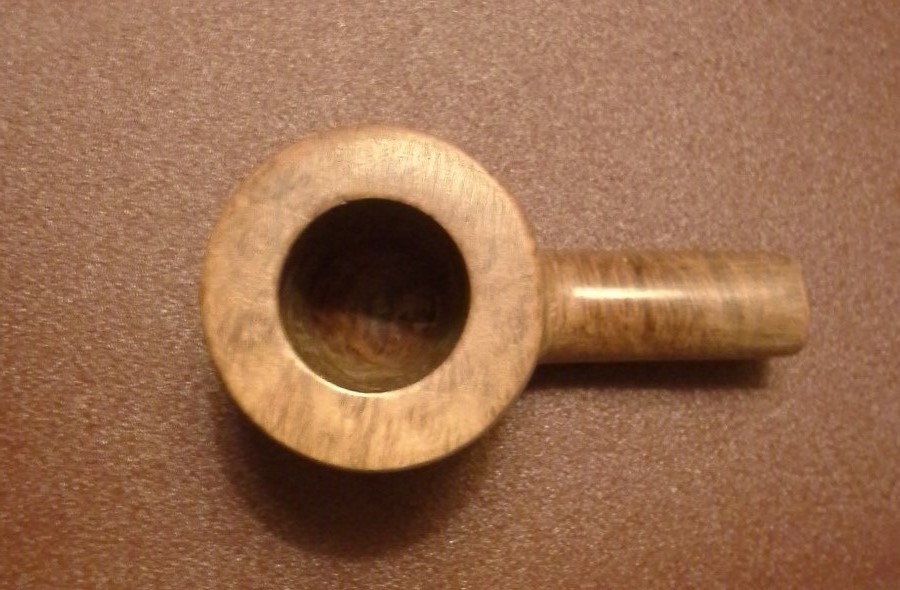
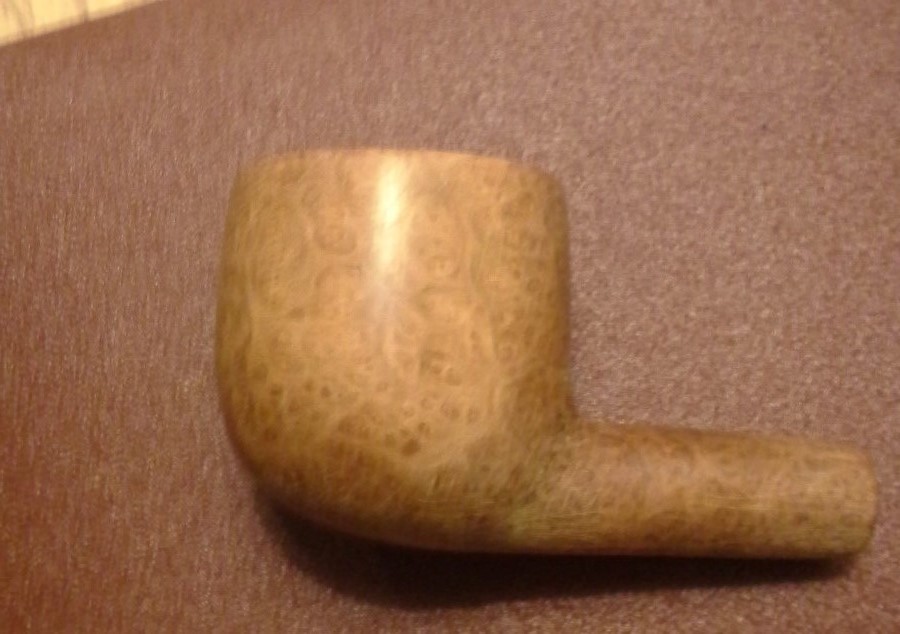
Therefore, having discussed what I do not mean by unfinished pipe, I will re-name the oddity a pre-formed pipe. In this context, the difference between anything finished by minimum standards and the opposite, the mere basic elements to build one’s own pipe all but from scratch, is easier to comprehend. Thus, my meaning of pre-formed pipe is simply a pre-shaped piece of briar, un-sanded, un-glazed, un-waxed or polished or even showing the grain, in many instances – but with a stem, which may or may not fit as attached. Therein resides the fun and challenge for someone a step or two shy of ready to tackle the difficult enough task presented by even a pipe kit, but prepared to refinish, with considerable detail and elbow work, a pre-formed pipe in the rough.

The owner of my local tobacconist of most frequent choice is good enough to offer a small but ever changing selection of these pre-formed pipes for $12.50 each, with a nice variety of shapes from which to choose, even if those available often defy identification on any official chart of pipe shapes. To me, at least, that is just another part of the charm of these raw pipes in transition from mere rough wood and dull stems to greater things of beauty, regardless of how much or little work is invested by the restorer on the sample. The owner, by the way, tells me her supplier (whom she somewhat enigmatically declines to identify) calls these rough-hewn pipes “stubs,” which in an online search for “smoking pipe stubs” brings up such disparate references as the habit of some pipe smokers to stick a cigar stub in the bowl and puff on it, the usually distasteful dottle of wet, unsmoked tobacco remaining at the bottoms of wet smokers’ bowls, and, yes, Melville’s likeable character in the above quoted novel – which is as massive as the Great White Whale itself – Stubbs (whose greatest sign of character is his large collection of pipes). Again, thanks are due to Steve for pointing this out in an emailed attempt by me to determine the origin of the term stubs in relation to pipes, for upon further thought I recalled the other pipe-smoking characters in Moby Dick adopting the habit of shortening the lengths of their stems, as much as possible in order to tolerate the horrendous stench of rotted fish, through the closer proximity of the pipe smoke to their noses. Perhaps by coincidence, most of the samples of the pre-formed pipes I have seen are indeed on the short side.
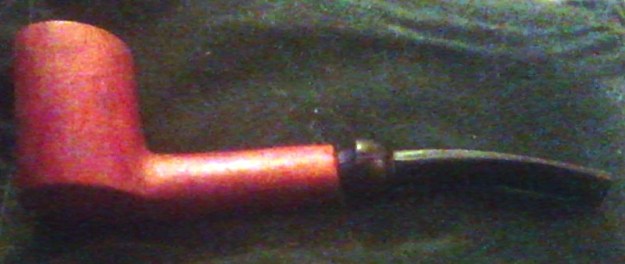
broughton1

broughton2

And so, before our weekly meeting Friday night, I once again plumbed the dædal depths of Chuck Richard’s knowledge of pipe lore, and in so doing learned far more than I had anticipated – indeed, everything but a tag better than unfinished or pre-formed, although those adjectives turn out, in a vaguely sad way, to be far too apt: the unfortunate truth of the matter is that the German factory of their origin had never intended to leave these pipe shapes in any condition but complete to a degree noted to that European country. The factory, it seems, simply went belly-up in the 1970s with thousands of the pre-formed specimens sitting there, where most of them were at some point picked up by a U.S. distributor who continues to market them as-is, but not to individuals. (Aha! Thus, the tobacconist owner’s reluctance to disclose the name of her supplier thickens.) Later, a few German pipe interests procured the remainder of the lot and ever since have been selling them to anyone, for the most part in the European Community, who will bite. All of these unfinished pipes, therefore, were cut from decent briar that has aged in the 40-some years since the end of their official production – and are now perfectly suited for the consummation of the process. Perhaps these pre-formed pipes can, as a result, be compared to a fine wine that is left open to breathe. Based on the four or five of these finish-yourself pipes that I have now practiced the art of restoration, this example being the only one I can now document in full (although I am attempting to leave this latest restore pristine), they smoke wonderfully no doubt with or without any further work. But that would not only take away from the ultimate enjoyment of this likely unique and limited edition of unfinished pre-forms, barring the unlikely enthusiasm of a reader to strike out upon the task of building a finish-yourself pipe business; it would also deprive me of the opportunity to get on with the remainder of my tale.

And Now, for Page Two…
As anyone who has ever restored a pipe knows, there are restores, and then there are restores. In any case involving one of these unusual pre-forms, the only real tasks are choosing one with signs of good grain and lack of flaws such as cracks or fillings. In other words, to re-state a theme common to me, somewhat after the old man in Mrs. Robinson advised a memorably disinterested Dustin Hoffman, I have one word for you: sanding!

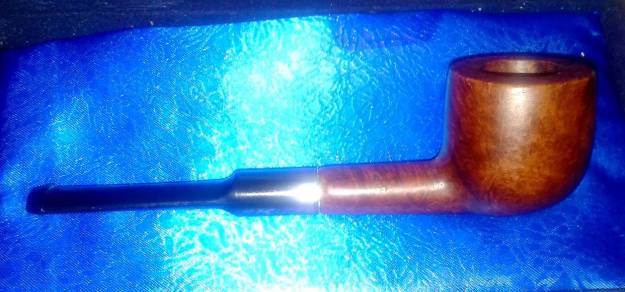
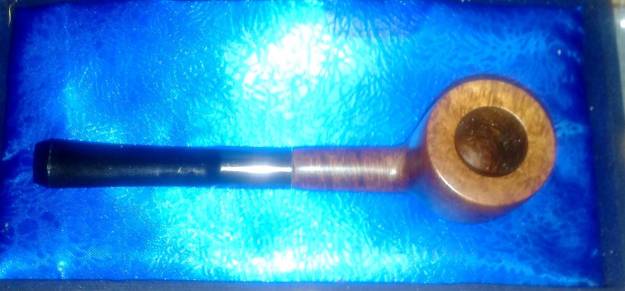
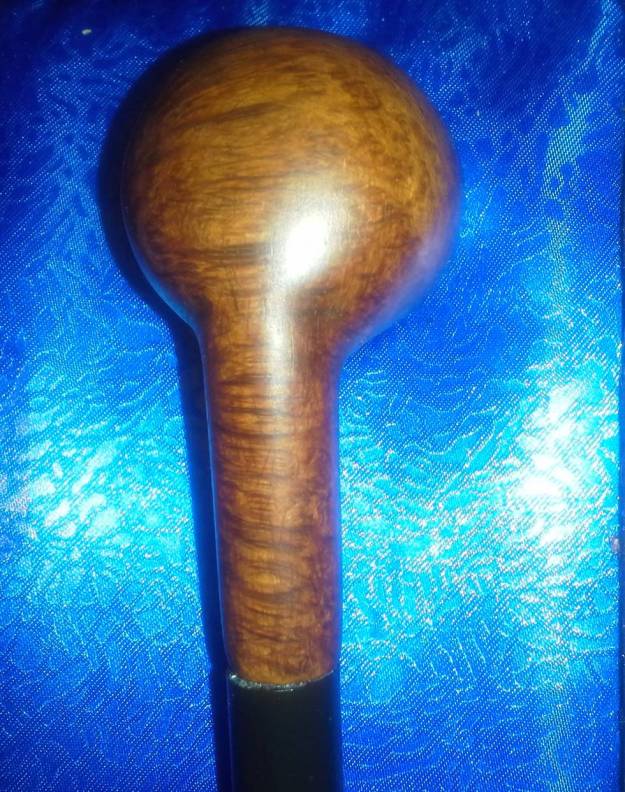
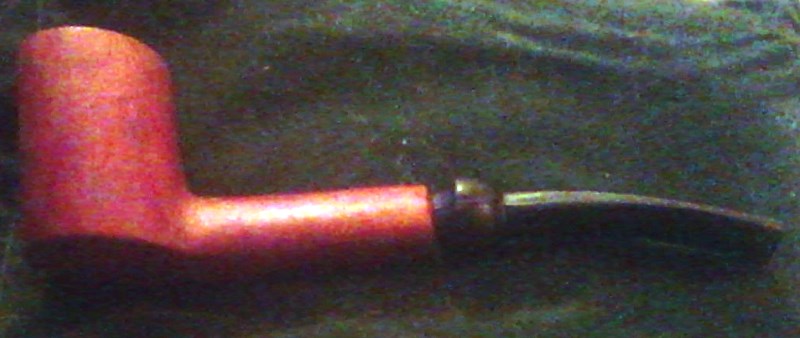
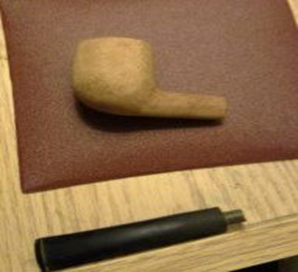
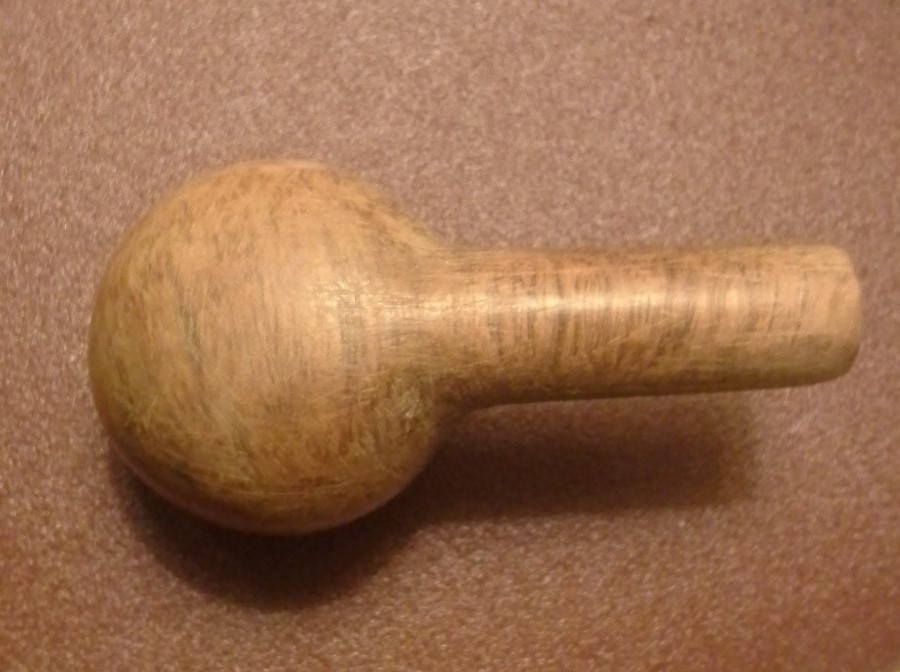
Here was my little pre-formed pot as I first saw it.
broughton3 broughton4 broughton5

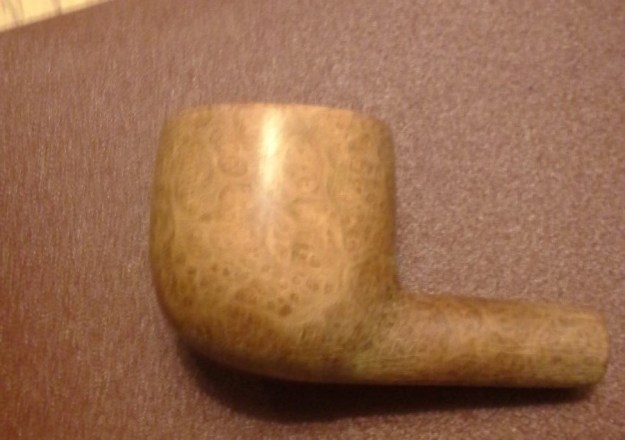
Unfortunately, I was forced to use my cell phone camera to snap these shots and the others that will follow, and so the clarity of the roughness of the plain briar, with bumps and pits and discolorations a-plenty, is somewhat wanting. But I hope you can see enough to get the general condition of my little pot. Again, I chose it over the assortment of others in more exciting shapes for the beauty of the grain I could hardly make out, and the lack of real blemishes.

Of course, after rigorous sanding – with 80-grit paper followed by 150 – I saw the beautiful grain for which I had purchased this particular pipe, in some places elegantly lined and others more spotted, but overall a clear potential for finishing. Then I used some micro-meshes, starting with 1500, then 2400 and at last 12000.

At that point, I was at a quandary. Should I use a stain, or skip it? The natural beauty of the pale briar attracted me very much. Still, I opted to use an alcohol-based shoe stain of a light brown color, which, as it was almost dry, I held a gentle match flame under the bowl and was gratified with the brief poof of blue as the alcohol in the stain ignited and dissipated.

The next step was an easy buff of Tripoli White Wax. Wow! was my initial thought after my first experience applying Tripoli. The immediate soft luster the preliminary wax bestowed upon the previously smooth but somehow flat bowl and shank gave the wood real dimension.

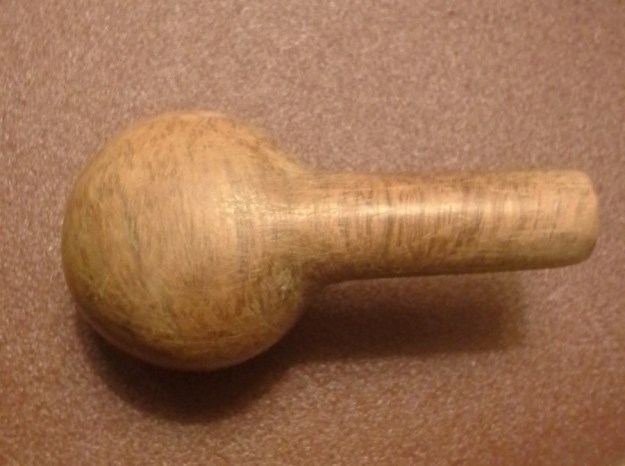
Again, I pondered long and hard on the idea of adding a coat of Tripoli Red, and during that pause remembered more of Chuck’s words to me before our Friday meeting: “Sometimes a little Red Tripoli on the wood is just what you need, especially to give it deeper color.” Still with more than a little flip-flopping in my stomach, I went for it:
broughton8

broughton7

broughton6

Wow! was my initial thought after my first experience applying Tripoli Wax. The immediate soft luster the preliminary wax of Tripoli White bestowed upon the previously smooth but flat bowl and shank gave the wood real dimension. But my gentle blessing of the Tripoli Red gave the old briar absolute radiance.

Suddenly, all that remained were a buff with my new stick of carnauba and – come to think of it – quite a bit of work yet to go before the stem would be in order. I don’t know about the rest of you (and I know this places me with the troops in the rear as far as experience goes), but I have developed an undeniable case of what might only be apt to call stem loathing, if I may possibly coin a phrase. I just hate the buggers, as my British friend and fellow pipe smoker Leigh might say, if he didn’t have the habit of speaking the Queen’s English, and even in the tone and style of William, or His Royal Highness the Duke of Cambridge KG KT.

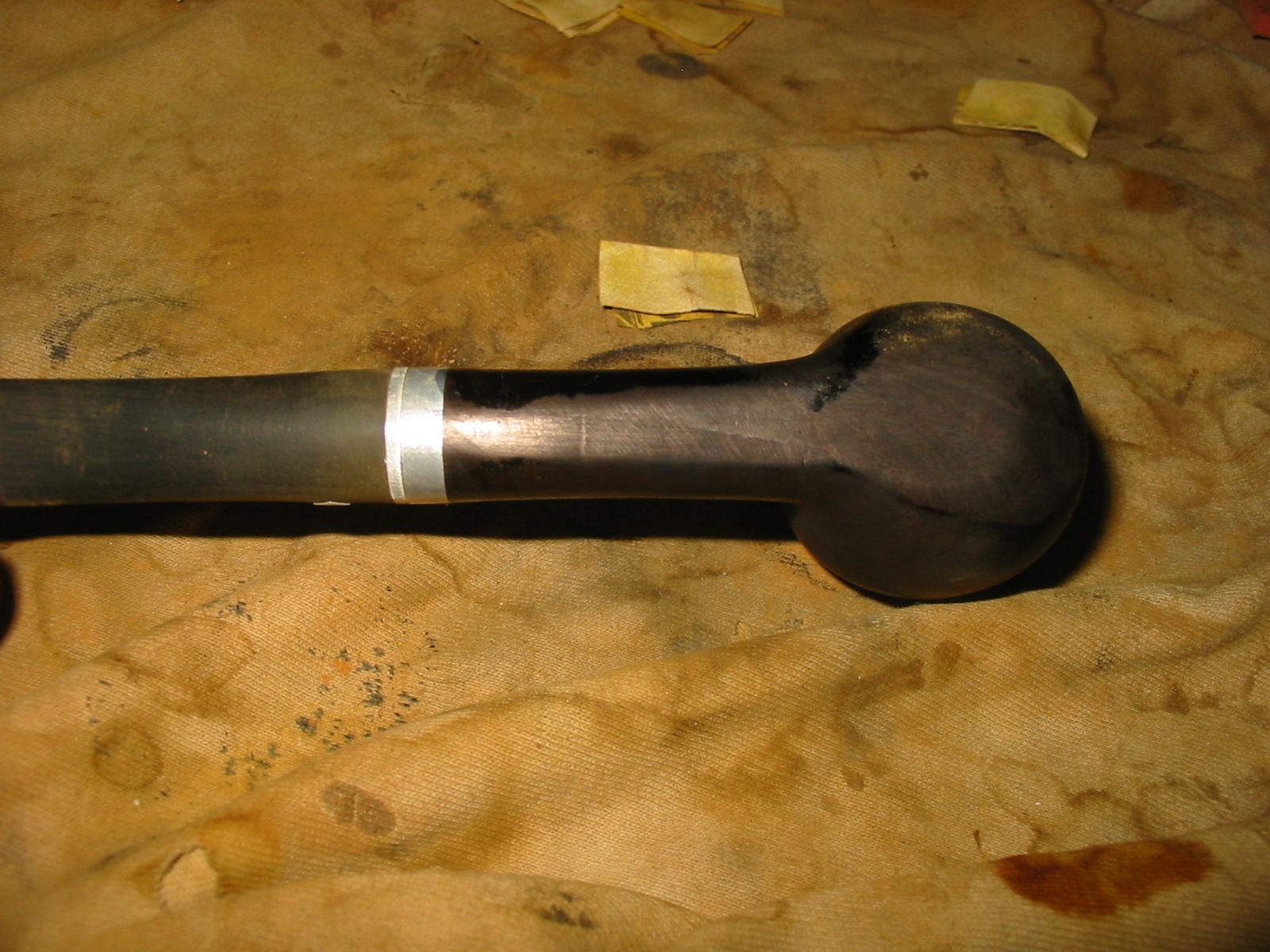
At any rate, with no way around the dirty deed, I went all-in, setting about the task of reducing a downright humongous overhang of the stem where it must, I repeat, must at all costs end up smooth and flush with the shank opening. I tried to be patient with the wretched thing, you see, I really did. Nevertheless, after a day of patiently trying the coarsest micromesh in my trusty box, getting nowhere with that approach and wearing my entire left arm, hand, four fingers and thumb into spasms of pain, there began to creep into my mind more direct and effective means of accomplishing the necessary duty. With far more grace and good sense than I in fact felt, I returned to the 80-grit sandpaper for a quick adjustment of the problem…and the approach actually worked!

That was about the time I realized I had another, nice and shiny, short straight stem I had stashed away with my spare pipe parts, assorted bowls needing serious work and assorted detritus. At the same time, I flashed on a diminutive Chinese pipe given to me by a friend as a joke owing to my known appreciation of certain specimens of that origin. That pipe, which had been covered in gaudy varnish and appeared at first touch to be made of balsa, would be a perfect match for the longer, curved stem I had adjusted as already described. Still, I finished repairing the original stem, micro-meshing away the rough surface where I had brutishly employed the bully force of abrasions, and then applying a good buff with Tripoli Red. But there I go again, off on a tangent, and when this initially homely Chinese pipe might be the subject of a forthcoming blog.

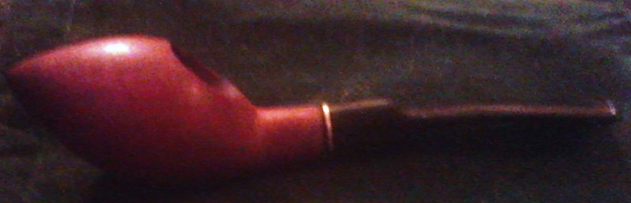
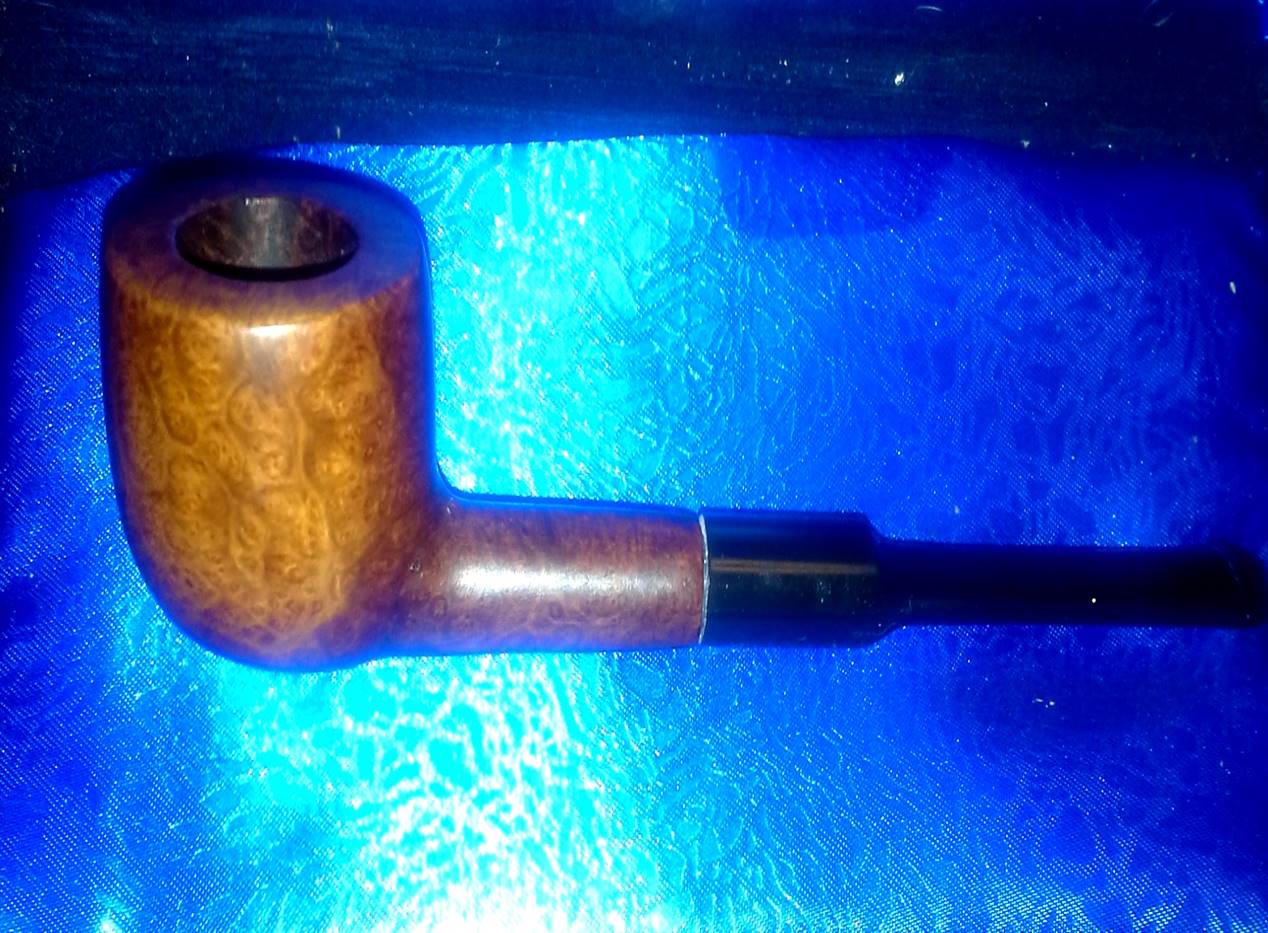
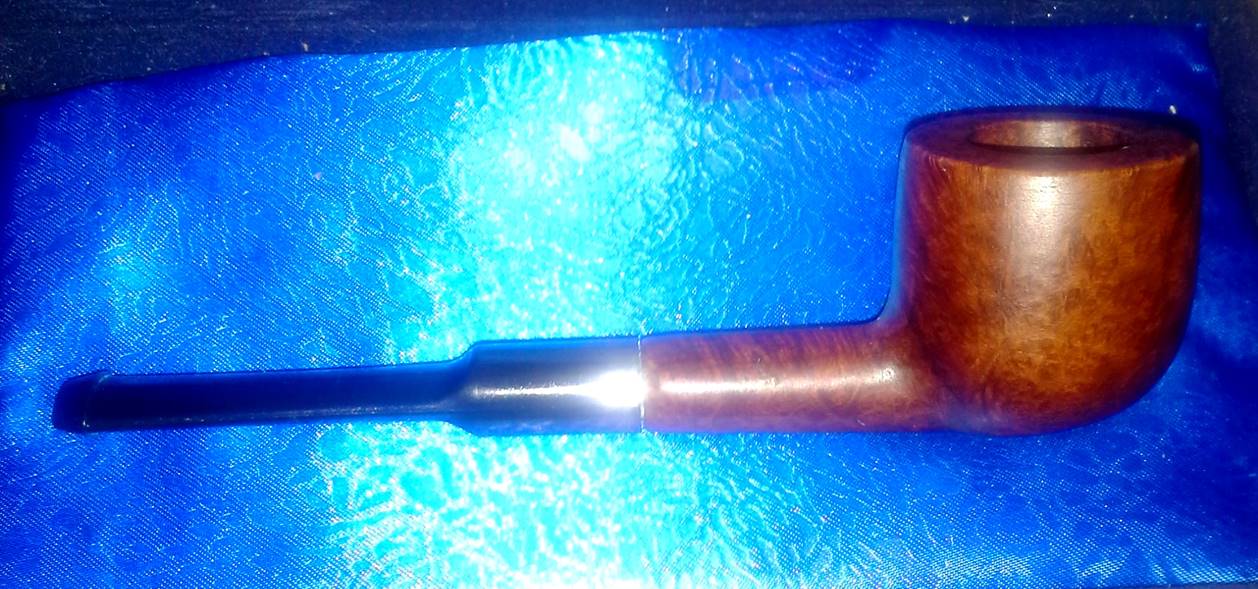
Without further delay, therefore, here are the final results:
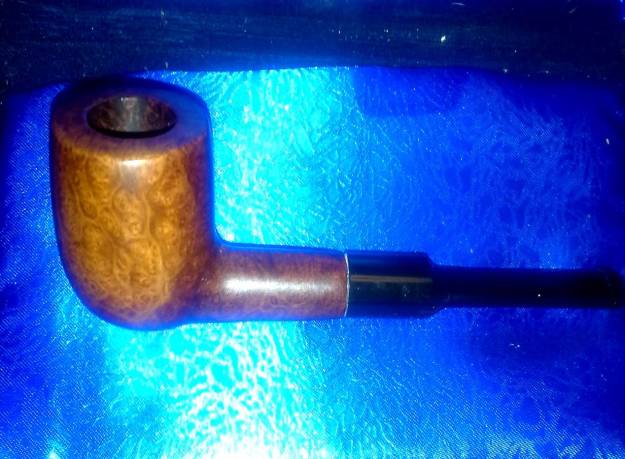
image002

image003

image004

image005

image006

Conclusions
The more I practice restoration as a fledgling, or novice, the higher level of understanding I acquire as to the years required to achieve anything close to master level. At least I am getting quicker on the uptake of that which I now comprehend is limitless information.
What more can I add, except the usual well-deserved thanks to my mentor, Chuck, and my sometime adviser and friend in pipe appreciation, Steve… and everyone else who holds any stock in my ability to learn.