Category Archives: Pipe Refurbishing Essays

Essays and pictorial essays on the art of refurbishing

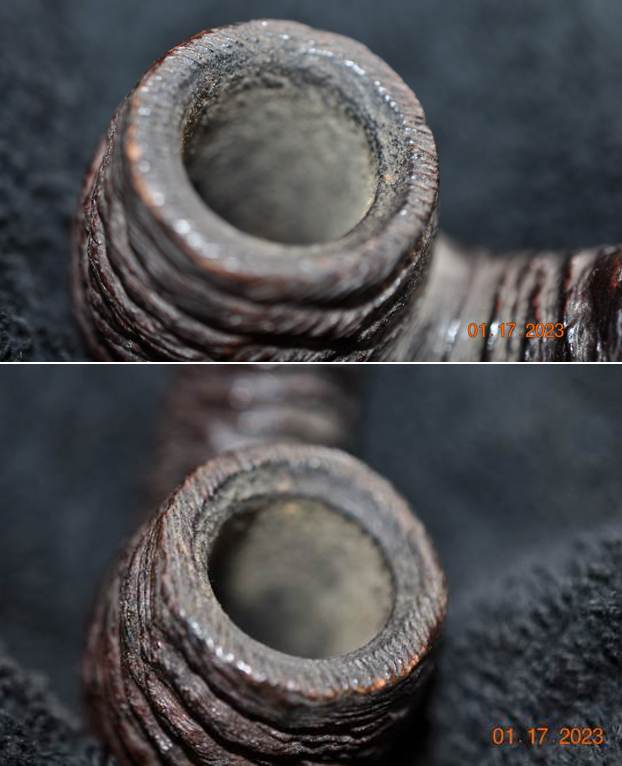
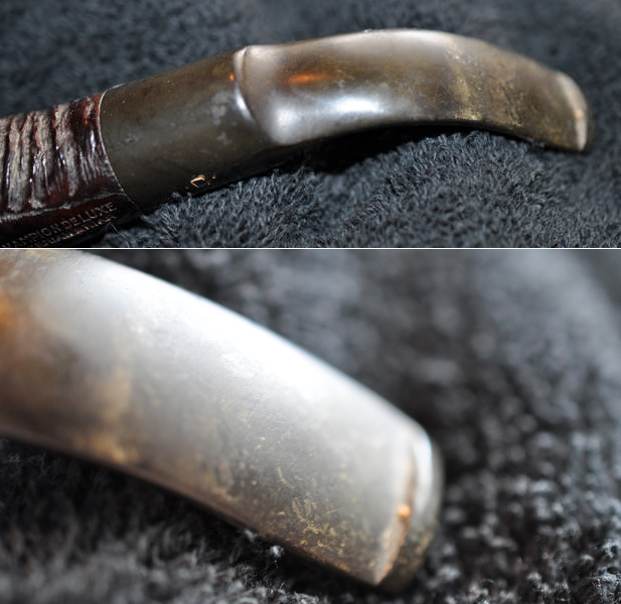
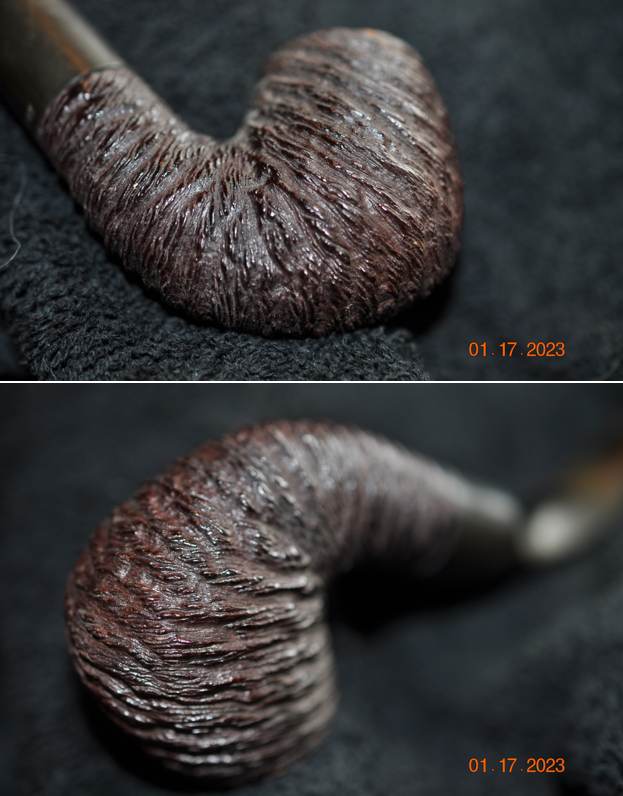
A Dunhill Cumberland 31031 Sandblast Billiard with a Story to Tell


Blog by Steve Laug

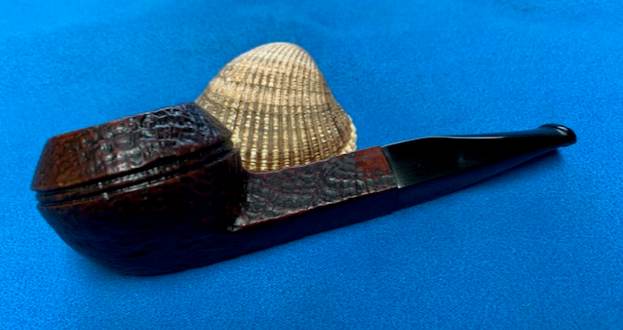
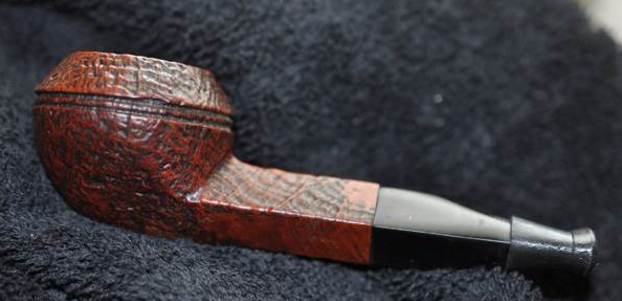
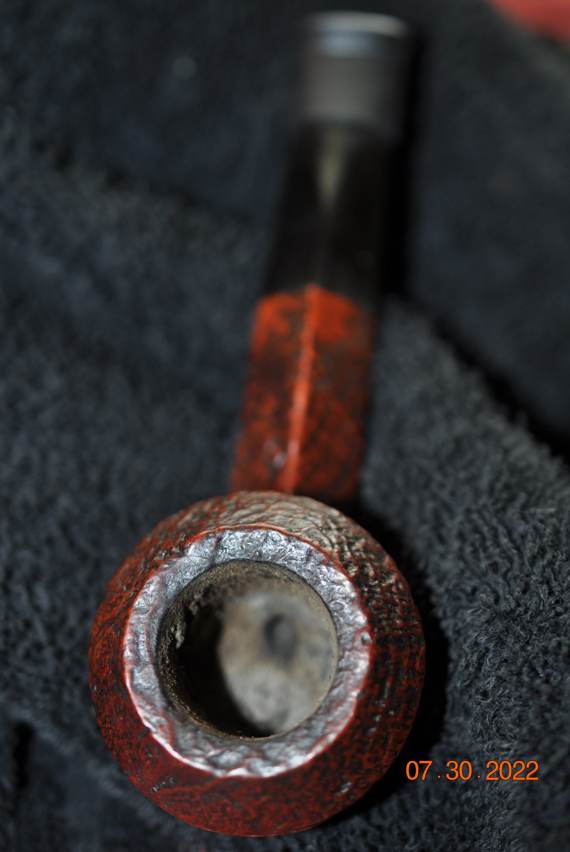
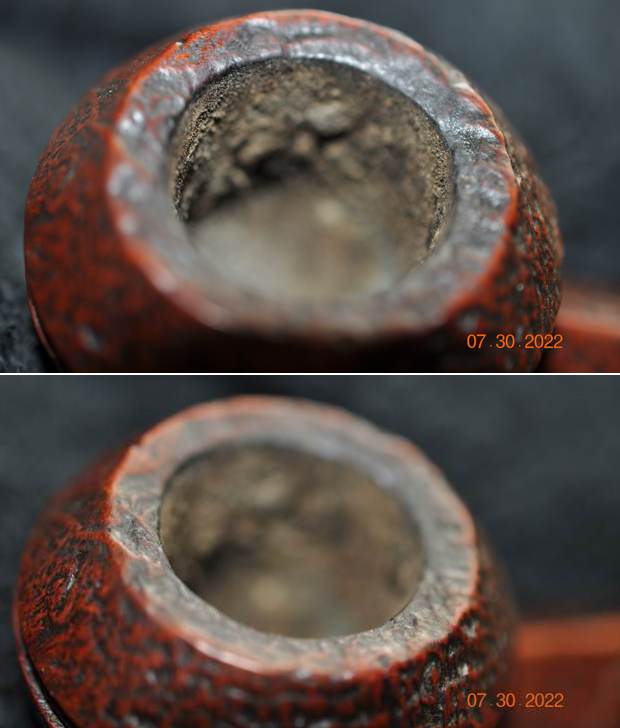
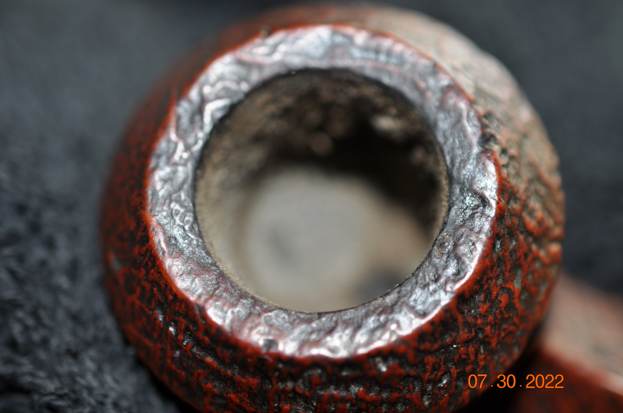
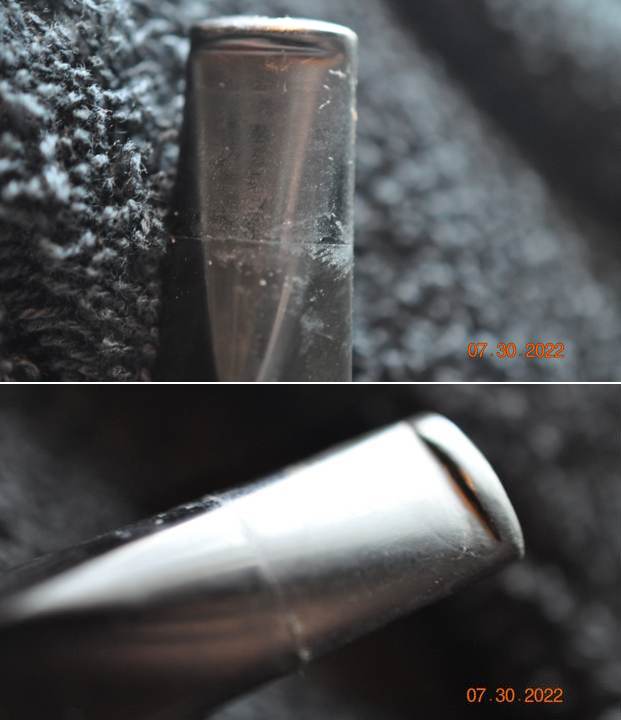
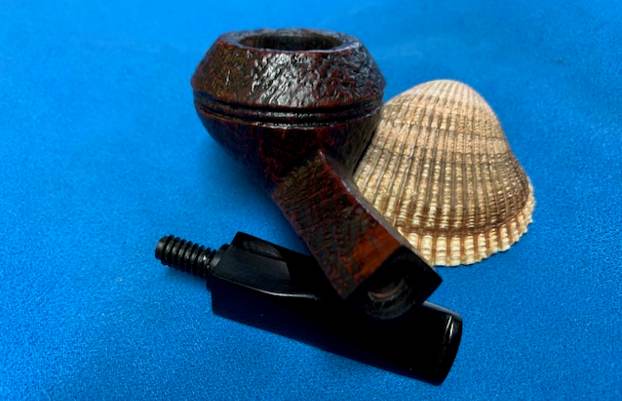
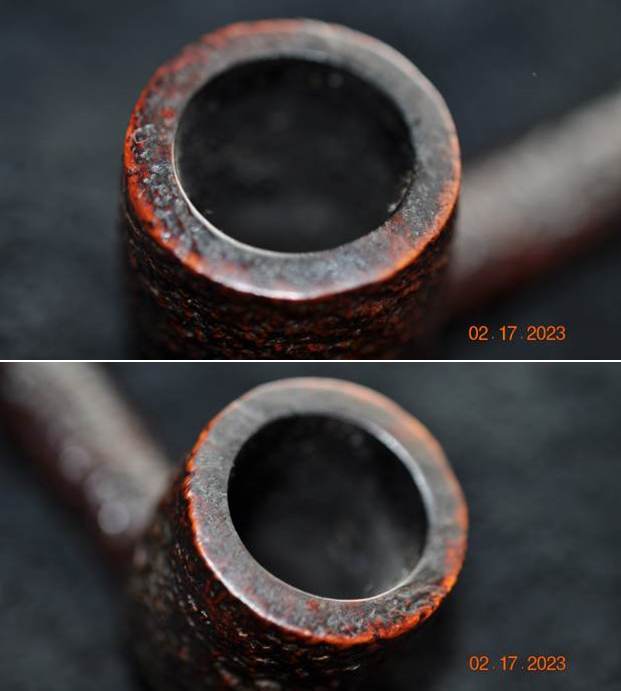
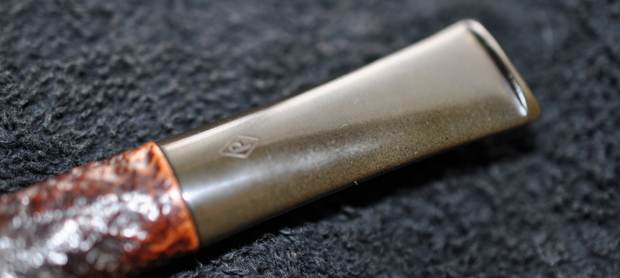
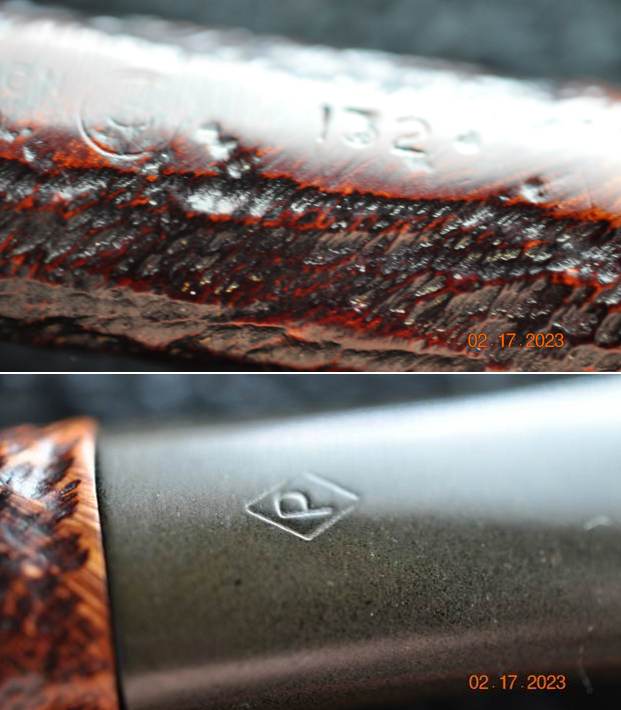
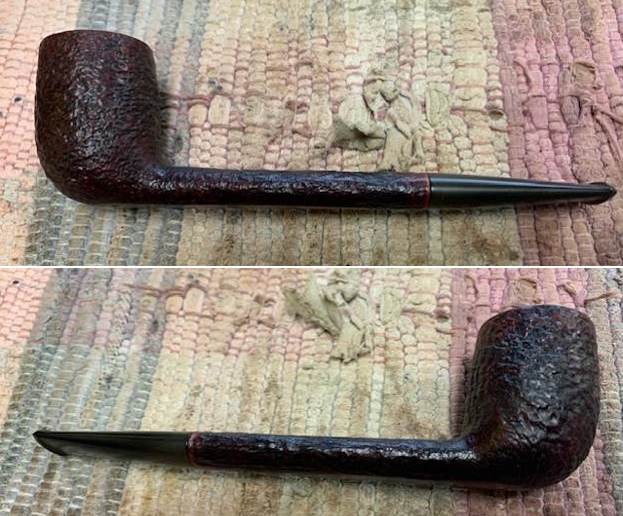
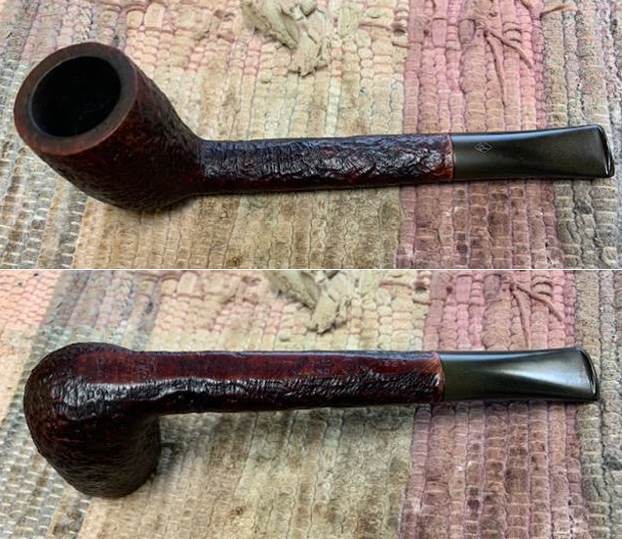
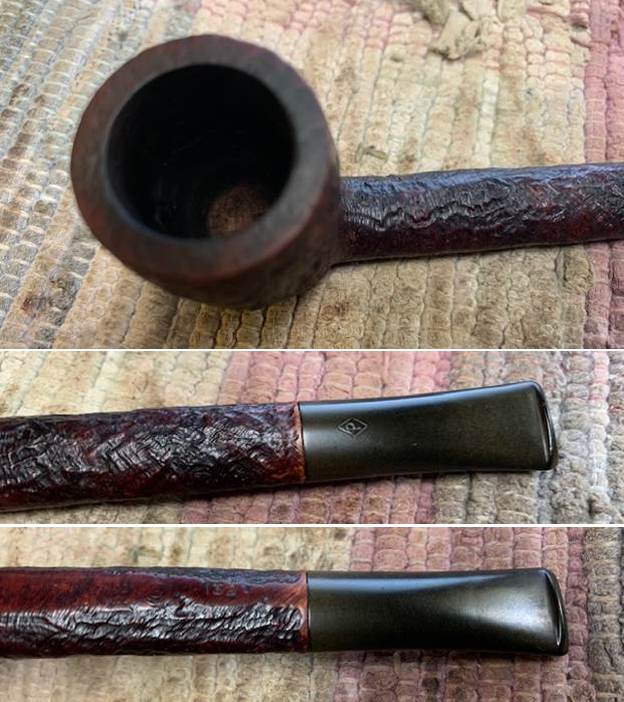
Sometimes when I am working on pipes I wish that they could talk and tell their own story. The pieces that make up this interesting sandblast Billiard have much to tell us if they could talk. How they all came together in one pipe remains shrouded in mystery but I like the final product even in its dirty state. The pipe was in a group of pipes we purchased from the fellow in Copenhagen, Denmark. It is another Dunhill… one of a kind as far as I can tell. It is stamped with the shape number 31031 (a billiard) on the heel of the bowl followed by Dunhill Cumberland [over] Made in England with a Date number after the D. It is partly covered with the silver band. The first number uncovered is a superscript 2. The band is where the story takes an unexpected turn. The Sterling Silver band is stamped S. Bang [over] 925. Which makes me perk up with interest. The stem is definitely not the original Cumberland one that would have been on the pipe when it left England but it is a Dunhill stem. The story we got from the person who sold the lot was that the owner took in a bunch of his  pipes to the S. Bang shop in Copenhagen, Denmark and had them put Silver Bands on each of them. He was enamored with the bling of the silver and with the opportunity to have specially fitted bands by S. Bang who can blame him. While there he obviously had the pipe restemmed at the same time. So in a real sense I am working on a Dunhill Cumberland with a Sterling Silver Band and a stem fitted by S. Bang. I like the sense of mystery that the back story adds to this pipe. Jeff took these photos of the pipe before he cleaned it. The pipe was dirty and there was a light cake in the bowl. There was some darkening on the rim top and crowned edges at the front of the bowl. The stem was spotted and dirty but had only light tooth chatter and marks on both sides. Jeff took photos of the bowl and rim top to show their condition and of the stem to show the condition of both sides of the stem. The photos of the sides and heel of the bowl show the deep sandblast grain and the unique Cumberland coloured finish on the pipe. Even under the grime it is a real beauty.  The stamping on the underside of the shank is shown in the photo below. It looks very good and faint but readable. It reads as noted and explained above. Jeff captured the detail in the photos below. I wanted to unpack the first part of the mystery – the Dunhill stamping on the shank and work to understand each element of the stamp. I generally use the Pipephil site to gather as much initial information as possible (http://pipephil.eu/logos/en/dunhill/cumber1.html). The stamping is interpreted as follows: The number 31031 is the shape number that unpacks as follows: the 3 is the bowl size, 1 is the identifier for a taper stem, 03 is the shape designation – a billiard. The additional 1 does not have any clear information though I wonder if it could be a designation for a Cumberland stem. The Cumberland stamp refers to the finish. The superscript 2 and a second number hidden under the Sterling band following the D of England would give the date the pipe.Pipephil also has some helpful dating keys on the site that are basically flow charts that you can walk through to date your pipe (http://pipephil.eu/logos/en/dunhill/cledat-en1.html). I turned to Part 1 of the Dating Key and followed the chart. This pipe has a superscript 2x (second number is covered by the silver band) following the D in England. There was no patent number so that took me to the section on the chart below (column one) which instructed me that the pipe could be dated as being made “posterior to 1954”.I followed the link under “Your pipe is posterior to 1954. Narrow down your dating”. That took me to Page 2 of the dating key (http://pipephil.eu/logos/en/dunhill/cledat-en1a.html). The second column (suffix 1…4) or (11…39) led me to the section with a 2x after the D in England. There was a directive for dating the pipe spelled out as follows: 1960 + suffix which gives the pipe a date of 198? (last digit hidden by the band). From that I knew that the pipe was made sometime in the 1980s but since the last digit was covered I could not identify the exact year.I then turned to Pipedia’s section on Dunhill Cumberland to get a bit of background on the Dunhill finishes (https://pipedia.org/wiki/Dunhill#Root_Briar). I quote:

Cumberland

Introduced in 1979. Cumberland is another sandblast with a brown stain and a brindle stem (the material is more commonly called ‘Cumberland’ these days, thanks to Dunhill’s influence and the success of the finish over the past quarter-century). Originally, the Cumberland always featured a smooth brown rim, but in the current production the rim is sometimes smooth, sometimes sandblasted. Occasionally, a straight grain blast is finished with a Cumberland stain and a “Shilling Grain,” similar to the “Ring Grain,” resulting in a new variation on the traditional sandblast. The Shilling series is named for the British coin: the sandblast looks like a stack of shillings. Named after the warehouse on Cumberland Road. The old pipes that inspired this finish were found there.

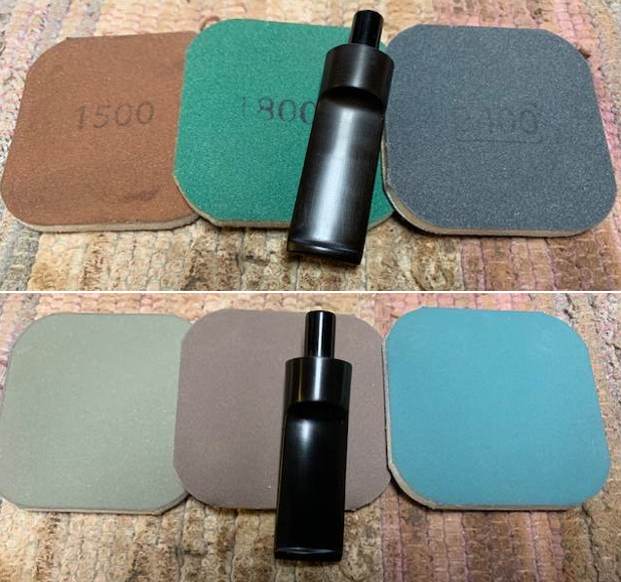
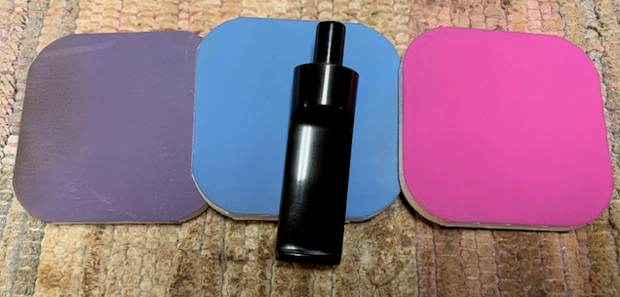
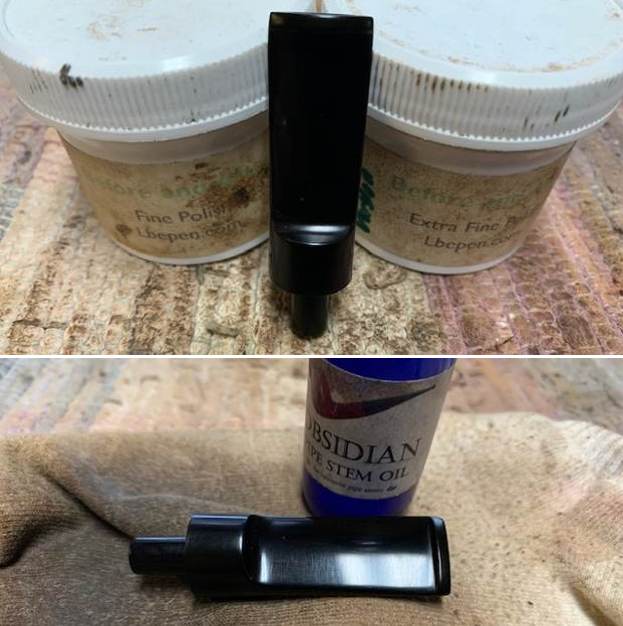
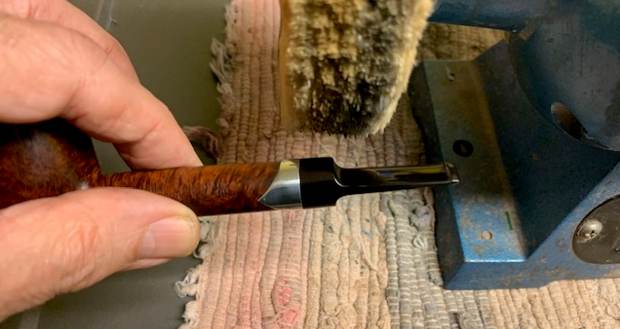
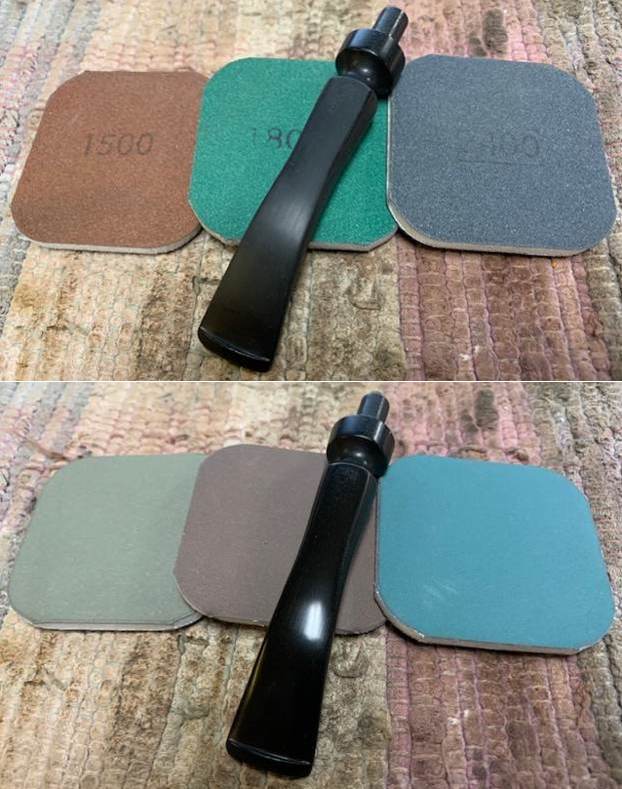
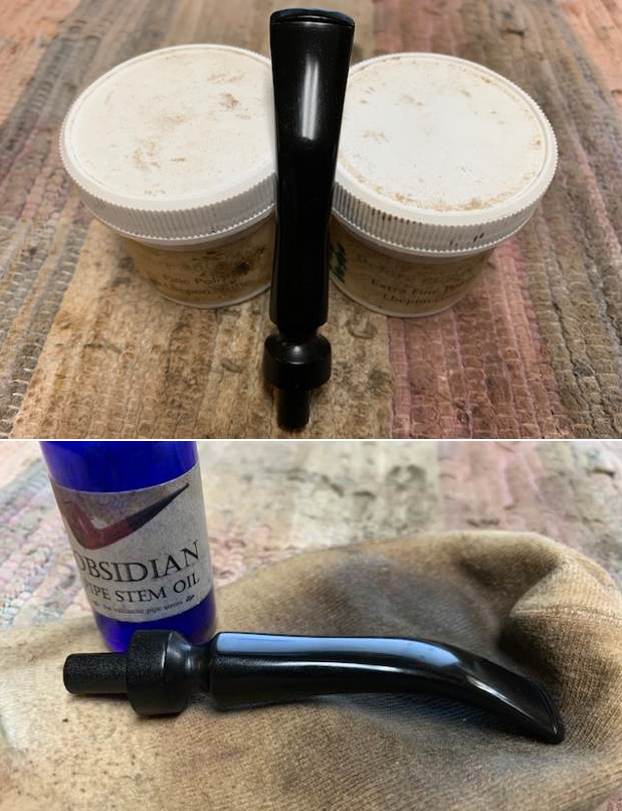
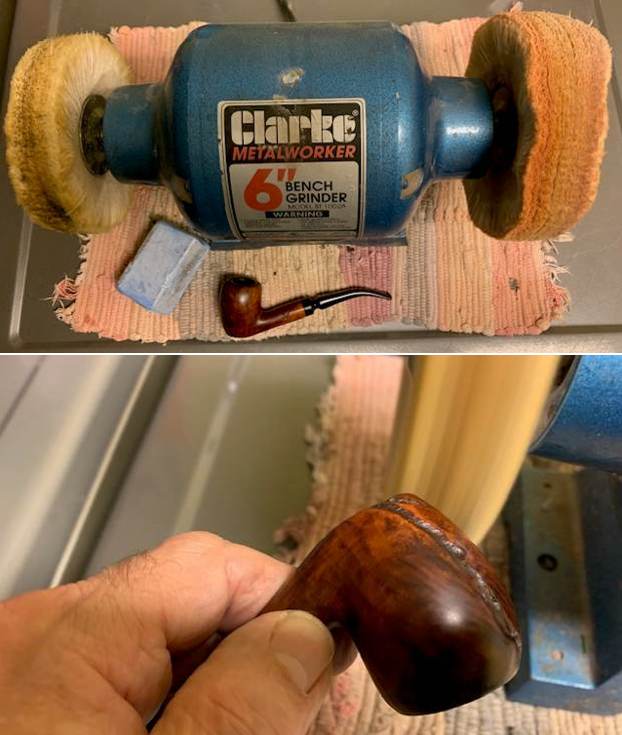
I have also included a chart from the site from Dunhill spelling out the Standard Pipe Finishes and giving short information and a timeline. You can see that the Cumberland Finish was introduced in 1980 so this is definitely from the early releases of that finish from the factory.I turned to work on the pipe itself. Jeff had done an amazing cleanup of the pipe. He reamed the light cake with a PipNet reamer and cleaned up that with a Savinelli Fitsall Pipe Knife. He scrubbed the internals of the bowl and stem with alcohol, cotton swabs and pipe cleaners. He scrubbed the externals with undiluted Murphy’s Oil Soap and rinsed the bowl off with running water. He soaked the stem in Briarville’s Pipe stem Deoxidizer and once it had soaked rinsed it off with warm water to remove the residual solution. He dried it off and rubbed it down to remove any oxidation that was still on the stem. The pipe looked very good when I received it. I took a photo of the rim top to show the condition. You can see the clean bowl. I worked it over lightly with a piece of 220 grit sandpaper before I took the photo. Then stopped and took it! The stem came out looking quite good. There are some scratches, light tooth marks and chatter on both sides ahead of the button.  I took a photo of the underside of the shank to show the stamping. The photo shows the stamping and is actually more readable in person.I removed the stem from the shank and took a photo of the pipe parts to show what I was working with. It is a nice looking pipe. I worked on the inside and top of the rim with a folded piece of 220 grit sandpaper to minimize the darkening and burn damage. It would take some work but this was a good start.I polished the cleaned up rim top and edges with micromesh sanding pads – dry sanding with 1500-12000 grit pads and wiping the bowl down with a damp cloth to remove the dust. The rim top came out looking very good. I rubbed the briar down with Before & After Restoration Balm. I worked it into the briar with my fingertips and a horsehair shoe brush to work it into the nooks and crannies of the sandblast finish. The product works to clean, enliven and preserve the briar. I let it sit for 10 minutes then I buffed it with a cotton cloth to deepen the shine. The briar really comes alive with the balm. I set the bowl aside and turned to address the stem issues. I polished the vulcanite with micromesh sanding pads – 1500-12000 grit pads. I wiped it down with Obsidian Oil after each sanding pad. I used Before & After Pipe Polish – both Fine and Extra Fine to further polish the stem. This 1980s Era Dunhill Cumberland 31031 Billiard with an S. Bang Silver Band and vulcanite taper Stem has a beautiful, unique Dunhill Sandblast finish that is very deep and craggy. The Cumberland reddish brown finish highlights some great grain around the bowl and shank. It has a unique sandblast that Dunhill specialized in making. The polished black vulcanite taper stem adds to the mix. I put the stem back on the bowl and buffed the pipe with Blue Diamond on the buffing wheel being careful to not buff the stamping. I gave the bowl multiple coats of Conservator’s Wax and the stem multiple coats of carnauba wax on the buffing wheel and followed that by buffing it with a clean buffing pad. I hand buffed the pipe with a microfiber cloth to deepen the shine. The finished Dunhill Cumberland 31031 Billiard is quite nice and feels great in the hand. Give the finished pipe a look in the photos below. The dimensions of the pipe are Length: 4 ¾ inches, Height: 1 ½ inches, Outside diameter of the bowl: 1 inch, Chamber diameter: ¾ of an inch. The weight of the pipe is .92 ounces/26 grams. Thanks for walking through the restoration with me as I worked over another beautiful pipe. I am torn about this pipe. The story intrigues me enough that I am going to keep it here – at least for a while to enjoy. Thanks for your time.

Cleaning up Another Dunhill Tanshell – a 577 Made in England 2 Saddle Stem Billiard


Blog by Steve Laug

The next pipe on the table is another one that came to us from the group of pipes that Jeff and I purchased from a fellow in Copenhagen, Denmark on October 3, 2022. It is another Dunhill sandblast that is in good condition. It is stamped on a smooth panel on the underside of the shank with the shape number 577 followed by Dunhill [over] Tanshell. Next to that it is stamped Made in [over] England by the date number 2. After that it is stamped with a 2 in a circle [followed by] T for Tanshell. The stamping is clear and readable as noted above. The pipe has a mix of brown stains on a sandblast finish and some amazing grain that the shape follows well. The finish was dusty and oily around the nooks and crannies of the sandblast but otherwise fairly clean. The bowl had a moderate cake and there was some light lava on the sandblasted rim top or edges. The saddle stem was oxidized, calcified, dirty and had scratches, tooth marks and chatter ahead of the button. Jeff took photos of the pipe to show what it looked like before he started working on it. He took photos of the bowl and rim top to show their condition and of the stem to show the condition of both sides of the stem. The photos of the sides and heel of the bowl show the deep sandblast grain and the unique Tanshell coloured finish on the pipe. Even under the grime it is a real beauty.  The stamping on the underside of the shank is shown in the photo below. It looks very good and faint but readable. It reads as noted and explained above. Jeff captured the detail in the photos below. One of the first things I like to do is to unpack the stamping and understand each element in it. I turned to Pipephil helpful site (http://pipephil.eu/logos/en/dunhill/tanshell1.html). The stamping is interpreted as follows: The number 577 is the shape number for a Billiard. The Tanshell stamp refers to the finish which is corroborated the T at the end of the stamping. The size of the pipe 2 in a circle is a Group 2. The 2 following the D of England gives the date the pipe.Pipephil also has some helpful dating keys on the site that are basically flow charts that you can walk through to date your pipe (http://pipephil.eu/logos/en/dunhill/cledat-en1.html). I turned to Part 1 of the Dating Key and followed the chart. This pipe has a 2 following the D in England. It is the same size as the D so that took me to the section on the chart below (column one) which instructed me that the pipe could be dated as being made posterior to 1954. I followed the link following the “Your pipe is posterior to 1954. Narrow down your dating”. That took me to Page 2 of the dating key (http://pipephil.eu/logos/en/dunhill/cledat-en1a.html).   The second column (suffix 1…4) led me to the section with a 2 after the D in England. There was a directive for dating the pipe spelled out as follows: 1960 + suffix which gives the pipe a date of 1962.I then turned to Pipedia’s section on Dunhill Root Briar to get a bit of background on the Dunhill finishes (https://pipedia.org/wiki/Dunhill#Root_Briar). I quote:

Tanshell

The first lot was distributed in 1952 (usually made using Sardinian briar). The prototype was called “Root Shell “, produced in 1951. The Tanshell is a light tan sandblast. Sardinian briar was used for this sandblast. There is a distinct contrast in the sandblasts using Sardinian as opposed to Algerian briar. The Sardinian is much denser and much harder. The resulting pattern, when blasted, is far more even and regular both in terms of the surface texture and the finish.

The TanShell was Dunhill’s fourth finish and its first major post-war line addition. Introduced in 1951/1952 the TanShell was a naturally stained sandblasted pipe made exclusively from Sardinian briar through the 1960s. The TanShell apparently was not simply a light stained Shell but rather was also the product of “certain processes [unrevealed] not previously employed.” Initially, it appears that the pipe was to be named the Root Shell and a stamp to that effect was ordered and received by Dunhill in May 1951. Ultimately, however, the name TanShell was settled upon but the stamp for the TanShell name was not received by Dunhill until the beginning of December. Thus while the Tanshell was in production in 1951 it appears that most if not all TanShells made in that year did not enter into retail distribution until 1952 and were given a 1952 date code. Loring, J. C., The Dunhill Briar Pipe, The Patent Years and After (self-published, Chicago, 1998).

I have also included a chart from the site from Dunhill spelling out the Standard Pipe Finishes and giving short information and a timeline. I turned to work on the pipe itself. Jeff had done an amazing cleanup of the pipe. He reamed the light cake with a PipNet reamer and cleaned up that with a Savinelli Fitsall Pipe Knife. He scrubbed the internals of the bowl and stem with alcohol, cotton swabs and pipe cleaners. He scrubbed the externals with undiluted Murphy’s Oil Soap and rinsed the bowl off with running water. He soaked the stem in Briarville’s Pipe stem Deoxidizer and once it had soaked rinsed it off with warm water to remove the residual solution. He dried it off and rubbed it down to remove any oxidation that was still on the stem. The pipe looked very good when I received it. I took a photo of the rim top to show the condition. You can see the clean bowl. The stem came out looking quite good. There are some scratches, tooth marks and chatter on both sides ahead of the button. I took a photo of the underside of the shank to show the stamping. The photo shows the stamping and is actually more readable in person. I removed the stem from the shank and took a photo of the pipe parts to show what I was working with. It is a nice looking pipe.The bowl was in such good condition that I had to do some minimal work with it. I rubbed the briar down with Before & After Restoration Balm. I worked it into the briar with my fingertips and a horsehair shoe brush to work it into the nooks and crannies of the sandblast finish. The product works to clean, enliven and preserve the briar. I let it sit for 10 minutes then I buffed it with a cotton cloth to deepen the shine. The briar really comes alive with the balm. I set the bowl aside and turned to address the stem issues. I “painted” the surface of the stem with the flame of a Bic lighter. The heat lifted the tooth marks significantly. I filled in the marks that remained with clear CA glue. Once it cured I used a small file to flatten the repairs. I sanded them with 220 grit sandpaper to blend it into the surface of the stem. I started the polishing with a 400 grit wet dry sandpaper. I polished the vulcanite with micromesh sanding pads – 1500-12000 grit pads. I wiped it down with Obsidian Oil after each sanding pad. I used Before & After Pipe Polish – both Fine and Extra Fine to further polish the stem. My daughter’s dog Frankie came for a visit this afternoon and took up his chair next to my desk. He is my little buddy and loves to hang out and watch me work on the pipes. As I turned my attention to finishing up this one he came to supervise!This 1962 Dunhill Tanshell 577 Billiard with a Saddle Stem has a beautiful, unique Dunhill Sandblast finish that is very deep and craggy. The reddish brown finish highlights some great grain around the bowl and shank. It has some great rugged sandblast that Dunhill specialized in making. The polished black vulcanite taper stem adds to the mix. I put the stem back on the bowl and buffed the pipe with Blue Diamond on the buffing wheel being careful to not buff the stamping. I gave the bowl multiple coats of Conservator’s Wax and the stem multiple coats of carnauba wax on the buffing wheel and followed that by buffing it with a clean buffing pad. I hand buffed the pipe with a microfiber cloth to deepen the shine. The finished Dunhill Tanshell 577 Billiard is quite nice and feels great in the hand. Give the finished pipe a look in the photos below. The dimensions of the pipe are Length: 5 inches, Height: 1 ½ inches, Outside diameter of the bowl: 1 1/8 inch, Chamber diameter: ¾ of an inch. The weight of the pipe is .85 ounces/24 grams. Thanks for walking through the restoration with me as I worked over another beautiful pipe. If you are interested in adding it to your collection I will be adding it to the British Pipe Makers Section of the rebornpipes store. Thanks for your time.

Cleaning up A Dunhill Tanshell Briar 250 F/T Made in England 4 Taper Stem Billiard


Blog by Steve Laug

The next pipe on the table is another one that came to us from the group of pipes that Jeff and I purchased from a fellow in Copenhagen, Denmark on October 3, 2022. It is another Dunhill sandblast that is in good condition. It is stamped on a smooth panel on the underside of the shank with the shape number 250 F/T followed by Dunhill [over] Tanshell. Next to that it is stamped Made in [over] England by the date number 4. After that it is stamped with a 2 in a circle [followed by] T for Tanshell. The stamping is clear and readable as noted above. The pipe has a mix of brown stains on a sandblast finish and some amazing grain that the shape follows well. The finish was dusty and oily around the nooks and crannies of the sandblast but otherwise fairly clean. The bowl had a thick cake and there was some lava on the sandblasted rim top or edges. The taper stem was oxidized, calcified, dirty and had scratches, tooth marks and chatter ahead of the button. Jeff took photos of the pipe to show what it looked like before he started working on it. He took photos of the bowl and rim top to show their condition and of the stem to show the condition of both sides of the stem. The photos of the sides and heel of the bowl show the deep sandblast grain and the unique Tanshell coloured finish on the pipe. Even under the grime it is a real beauty.   The stamping on the underside of the shank is shown in the photo below. It looks very good and faint but readable. It reads as noted and explained above. Jeff captured the detail in the photos below. One of the first things I like to do is to unpack the stamping and understand each element in it. I turned to Pipephil helpful site (http://pipephil.eu/logos/en/dunhill/tanshell1.html). The stamping is interpreted as follows: The number 250 is the shape number for a Billiard. The F/T identifies the stem as a Fishtail. The Tanshell stamp refers to the finish which is corroborated the T at the end of the stamping. The size of the pipe 2 in a circle is a Group 2. The superscript 4 following the D of England gives the date the pipe.Pipephil also has some helpful dating keys on the site that are basically flow charts that you can walk through to date your pipe (http://pipephil.eu/logos/en/dunhill/cledat-en1.html). I turned to Part 1 of the Dating Key and followed the chart. This pipe has a 7 following the D in England. It is the same size as the D so that took me to the section on the chart below (column one) which instructed me that the pipe could be dated as being made posterior to 1954. I followed the link following the “Your pipe is posterior to 1954. Narrow down your dating”. That took me to Page 2 of the dating key (http://pipephil.eu/logos/en/dunhill/cledat-en1a.html).   The second column (suffix 1…4) led me to the section with a 4 after the D in England. There was a directive for dating the pipe spelled out as follows: 1960 + suffix which gives the pipe a date of 1964.I then turned to Pipedia’s section on Dunhill Root Briar to get a bit of background on the Dunhill finishes (https://pipedia.org/wiki/Dunhill#Root_Briar). I quote:

Tanshell

The first lot was distributed in 1952 (usually made using Sardinian briar). The prototype was called “Root Shell “, produced in 1951. The Tanshell is a light tan sandblast. Sardinian briar was used for this sandblast. There is a distinct contrast in the sandblasts using Sardinian as opposed to Algerian briar. The Sardinian is much denser and much harder. The resulting pattern, when blasted, is far more even and regular both in terms of the surface texture and the finish.

The TanShell was Dunhill’s fourth finish and its first major post-war line addition. Introduced in 1951/1952 the TanShell was a naturally stained sandblasted pipe made exclusively from Sardinian briar through the 1960s. The TanShell apparently was not simply a light stained Shell but rather was also the product of “certain processes [unrevealed] not previously employed.” Initially, it appears that the pipe was to be named the Root Shell and a stamp to that effect was ordered and received by Dunhill in May 1951. Ultimately, however, the name TanShell was settled upon but the stamp for the TanShell name was not received by Dunhill until the beginning of December. Thus while the Tanshell was in production in 1951 it appears that most if not all TanShells made in that year did not enter into retail distribution until 1952 and were given a 1952 date code. Loring, J. C., The Dunhill Briar Pipe, The Patent Years and After (self-published, Chicago, 1998).

I have also included a chart from the site from Dunhill spelling out the Standard Pipe Finishes and giving short information and a timeline. I turned to work on the pipe itself. Jeff had done an amazing cleanup of the pipe. He reamed the light cake with a PipNet reamer and cleaned up that with a Savinelli Fitsall Pipe Knife. He scrubbed the internals of the bowl and stem with alcohol, cotton swabs and pipe cleaners. He scrubbed the externals with undiluted Murphy’s Oil Soap and rinsed the bowl off with running water. He soaked the stem in Briarville’s Pipe stem Deoxidizer and once it had soaked rinsed it off with warm water to remove the residual solution. He dried it off and rubbed it down to remove any oxidation that was still on the stem. The pipe looked very good when I received it. I took a photo of the rim top to show the condition. You can see the clean bowl. The stem came out looking quite good. There are some scratches, tooth marks and chatter on both sides ahead of the button. I took a photo of the underside of the shank to show the stamping. The photo shows the stamping and is actually more readable in person. I removed the stem from the shank and took a photo of the pipe parts to show what I was working with. It is a nice looking pipe.The bowl was in such good condition that I had to do some minimal work with it. I rubbed the briar down with Before & After Restoration Balm. I worked it into the briar with my fingertips and a horsehair shoe brush to work it into the nooks and crannies of the sandblast finish. The product works to clean, enliven and preserve the briar. I let it sit for 10 minutes then I buffed it with a cotton cloth to deepen the shine. The briar really comes alive with the balm. I set the bowl aside and turned to address the stem issues. I “painted” the surface of the stem with the flame of a Bic lighter. The heat lifted the tooth marks enough that I sanded out the remnants of the tooth marks on both sides of the stem with 220 grit sandpaper to blend it into the surface of the stem. I started the polishing with a 400 grit wet dry sandpaper. I polished the vulcanite with micromesh sanding pads – 1500-12000 grit pads. I wiped it down with Obsidian Oil after each sanding pad. I used Before & After Pipe Polish – both Fine and Extra Fine to further polish the stem. This 1964 Dunhill Tanshell 250 F/T Billiard with a Taper Stem has a beautiful, unique Dunhill Sandblast finish that is very deep and craggy. The reddish brown finish highlights some great grain around the bowl and shank. It has some great rugged sandblast that Dunhill specialized in making. The polished black vulcanite taper stem adds to the mix. I put the stem back on the bowl and buffed the pipe with Blue Diamond on the buffing wheel being careful to not buff the stamping. I gave the bowl multiple coats of Conservator’s Wax and the stem multiple coats of carnauba wax on the buffing wheel and followed that by buffing it with a clean buffing pad. I hand buffed the pipe with a microfiber cloth to deepen the shine. The finished Dunhill Tanshell 250 F/T Billiard is quite nice and feels great in the hand. Give the finished pipe a look in the photos below. The dimensions of the pipe are Length: 5 ¾ inches, Height: 1 ¾ inches, Outside diameter of the bowl: 1 1/8 inch, Chamber diameter: ¾ of an inch. The weight of the pipe is .95 ounces/27 grams. Thanks for walking through the restoration with me as I worked over another beautiful pipe. If you are interested in adding it to your collection I will be adding it to the British Pipe Makers Section of the rebornpipes store. Thanks for your time.

Cleaning up A Dunhill Shell Briar 53 Made in England 7 Filter Bent Billiard


Blog by Steve Laug

The next pipe on the table is another one that came to us from the group of pipes that Jeff and I purchased from a fellow in Copenhagen, Denmark on October 3, 2022. It is another Dunhill Shell Briar that is in good condition. It is stamped on a smooth panel on the underside of the shank with the shape number 53 followed by Dunhill [over] Shell Briar. Next to that it is stamped Made in [over] England by the date number 7. After that it is stamped with a 3 in a circle [followed by] S for shell. The stamping is clear and readable as noted above. The pipe has a mix of black, cordovan and brown stains on a sandblast finish and some amazing grain that the shape follows well. The colour is very similar to the previous Shell Briar pipes I have been restoring. The finish was dusty around the nooks and crannies of the sandblast but otherwise fairly clean. The bowl had a thick cake and there was some lava on the sandblasted rim top or edges. The taper stem was oxidized, calcified, dirty and had scratches, tooth marks and chatter ahead of the button. Jeff took photos of the pipe to show what it looked like before he started working on it. He took photos of the bowl and rim top to show their condition and of the stem to show the condition of both sides of the stem. The photos of the sides and heel of the bowl show the deep sandblast grain on the pipe. It is a beauty.   The stamping on the underside of the shank is shown in the photo below. It looks very good and faint but readable. It reads as noted and explained above. Jeff captured the detail in the photos below. One of the first things I like to do is to unpack the stamping and understand each element in it. I turned to Pipephil helpful site (http://pipephil.eu/logos/en/dunhill/shell-briar1.html). The stamping is interpreted as follows: The number 53 is the shape number for a Bent Billiard. The Shell Briar is the finish which is corroborated the S at the end of the stamping. The size of the pipe 3 in a circle is a Group 3. The 7 following the D of England gives the date the pipe.Pipephil also has some helpful dating keys on the site that are basically flow charts that you can walk through to date your pipe (http://pipephil.eu/logos/en/dunhill/cledat-en1.html). I turned to Part 1 of the Dating Key and followed the chart. This pipe has a 7 following the D in England. It is the same size as the D so that took me to the section on the chart below (column one) which instructed me that the pipe could be dated as being made posterior to 1954. I followed the link following the “Your pipe is posterior to 1954. Narrow down your dating”. That took me to Page 2 of the dating key (http://pipephil.eu/logos/en/dunhill/cledat-en1a.html).   The third column (suffix 5…9) led me to the section with a suffix the same size as the D in England. There was a directive for dating the pipe spelled out as follows: 1960 + suffix which gives the pipe a date of 1967.I then turned to Pipedia’s section on Dunhill Root Briar to get a bit of background on the Dunhill finishes (https://pipedia.org/wiki/Dunhill#Root_Briar). I quote:

Shell
A deep craggy sandblast with a black stain finish (usually made using Algerian briar) – the color of the stain used has varied over the years. Although there is some doubt as to them being the first to sandblast pipes, Dunhill’s Shell pipes, and the sandblasting techniques developed to create them are considered one of Dunhill’s greatest and most lasting contributions to the art of pipe making.

The documented history of Dunhill’s inception of the Shell is largely limited to patent applications — there are no catalog pages or advertisements promoting blasted pipes at the time. The preliminary work on the English patent (No. 1484/17) was submitted on October 13, 1917. The patent submission was completed half a year later, on April 12, 1918, followed by the granting of the English patent on October 14, 1918. This was less than a month before the end of The Great War on November 11th.

In 1986 Dunhill released a line of premium Shell finish pipes – “RING GRAIN”. These are high-quality straight grain pipes which are sandblasted. Initially only Ring Grain, but now in two different finishes. In 1995 the “Shilling” was introduced with Cumberland finish – it is an extremely rare series. These pipes exhibit a deeper blast characteristic of that of the 1930’s – mid-1960’s (and the limited ‘deep blast’ pipes of the early 1980s) and show a fine graining pattern. These are considered the best new Dunhills by many enthusiasts today and are very rare. The finish is sometimes described as tasting like vanilla at first, with the taste becoming more normal or good as the pipe breaks in.

I have also included a chart from the site from Dunhill spelling out the Standard Pipe Finishes and giving short information and a timeline. I turned to work on the pipe itself. Jeff had done an amazing cleanup of the pipe. He reamed the light cake with a PipNet reamer and cleaned up that with a Savinelli Fitsall Pipe Knife. He scrubbed the internals of the bowl and stem with alcohol, cotton swabs and pipe cleaners. He scrubbed the externals with undiluted Murphy’s Oil Soap and rinsed the bowl off with running water. He soaked the stem in Briarville’s Pipe stem Deoxidizer and once it had soaked rinsed it off with warm water to remove the residual solution. He dried it off and rubbed it down to remove any oxidation that was still on the stem. The pipe looked very good when I received it. I took a photo of the rim top to show the condition. You can see the clean bowl. The stem came out looking quite good. There are some scratches, tooth marks and chatter on both sides ahead of the button. I took a photo of the underside of the shank to show the stamping. The photo shows the stamping and is actually more readable in person. I removed the stem from the shank and took a photo of the pipe parts to show what I was working with. It is a nice looking pipe.The bowl was in such good condition that I had to do some minimal work with it. I rubbed the briar down with Before & After Restoration Balm. I worked it into the briar with my fingertips and a horsehair shoe brush to work it into the nooks and crannies of the sandblast finish. The product works to clean, enliven and preserve the briar. I let it sit for 10 minutes then I buffed it with a cotton cloth to deepen the shine. The briar really comes alive with the balm. I set the bowl aside and sanded out the scratches and tooth marks on both sides of the stem with 220 grit sandpaper to blend it into the surface of the stem. I started the polishing with a 400 grit wet dry sandpaper. I polished the vulcanite with micromesh sanding pads – 1500-12000 grit pads. I wiped it down with Obsidian Oil after each sanding pad. I used Before & After Pipe Polish – both Fine and Extra Fine to further polish the stem. This 1967 Dunhill Shell Briar 53 Bent Billiard with a Taper Stem has a beautiful, unique Dunhill Sandblast finish that is very deep and craggy. The dark mixed black/brown/red finish highlights some great grain around the bowl and shank. It has some great rugged sandblast that Dunhill specialized in making. The polished black vulcanite taper stem adds to the mix. I put the stem back on the bowl and buffed the pipe with Blue Diamond on the buffing wheel being careful to not buff the stamping. I gave the bowl multiple coats of Conservator’s Wax and the stem multiple coats of carnauba wax on the buffing wheel and followed that by buffing it with a clean buffing pad. I hand buffed the pipe with a microfiber cloth to deepen the shine. The finished Dunhill Shell Briar 53 Bent Billiard is quite nice and feels great in the hand. Give the finished pipe a look in the photos below. The dimensions of the pipe are Length: 5 inches, Height: 1 ½ inches, Outside diameter of the bowl: 1 inch, Chamber diameter: ¾ of an inch. The weight of the pipe is 1.09 ounces/31 grams. Thanks for walking through the restoration with me as I worked over another beautiful pipe. If you are interested in adding it to your collection I will be adding it to the British Pipe Makers Section of the rebornpipes store. Thanks for your time.

A Very Spiffy Peterson Kildare Bent Bulldog


Blog by Kenneth Lieblich

How fine it is to come across a pipe as comely as this. I found this republic-era Peterson bent bulldog at a local antique fair and I was charmed by it right away. There is a feeling of satisfaction in just looking at it and a feeling of comfort with it in hand. Despite its rather shabby appearance when I found it, the pipe held great promise – and I was sure that I could tease out its beauty with a little TLC. Let’s have a closer look. This Peterson pipe has the classic bulldog shape: diamond shank and tapered stem. In this case, it also had a very nice bend and the traditional Peterson P-lip stem. The markings on the left side of the shank are Peterson’s [over] “Kildare”. The right side of the shank showed Made in the [over] Republic [over] of Ireland. Further along the right side of the shank was the shape number: 80S. Naturally, the Peterson logo “P” was engraved on the stem. I know something about Peterson pipes, but little about the Kildare line, so I went over to Pipedia to have a look. Obviously, there is a long and very good article about Peterson – here is the link. Here is a brief quotation about the republic-era pipes:

1950 – 1989 The Republic Era – From 1950 to the present time, the stamp for this era is “Made in the Republic of Ireland” in a block format generally in three lines but two lines have been used with or without Republic being abbreviated. During the 1950’s and 60’s the Kapp & Peterson Company was still in the ownership of the Kapp family. However, 1964 saw the retiral of the company Managing Director Frederick Henry (Harry) Kapp.

No mention was made of the Kildare line there, but Mark Irwin and Gary Malmberg’s book, The Peterson Pipe: The Story of Kapp & Peterson, did make mention of it:

Kildare (1965–) First issue of line with matte-finish in Classic Range shapes, P-Lip and fishtail mouthpiece. Second issue C.1979 as Kildare Patch, with rusticated patches on pipe surface. Third issue 2010, matte-brown, P-Lip or fishtail mouthpiece, no band. Fourth issue 2011-, burgundy sandblast finish, nickel army mount, fishtail mouthpiece, exclusive to smokingpipes.com.So? Does this mean I have a First Issue Kildare or a Third Issue Kildare (it’s clearly not Second or Fourth). Truth be told: I don’t know for sure. But the First Issue is the only one that specifically mentions the Classic Shapes, of which the 80S is one. So I have no reason to think that this isn’t from the earliest (1965-79) range. I am more than happy to be corrected by someone who knows more than I do!

Let’s have a closer look at this pipe. Someone had clearly attempted to clean the pipe in the past. Their cleaning job was mediocre, but better than nothing. The near side of the rim of the bowl had a clear burn mark. Mercifully, the burn looks quite superficial. The stummel has a couple of small nicks, which are not a big deal. The two grooves which wrap around the bowl were fairly grungy and would need to be cleaned. Fortunately, the stem was in good shape – just some oxidation to address. There was an inner tube in this pipe and it needed to be cleaned. I threw it in some lemon-infused isopropyl alcohol and let it soak for a while. I took it out, cleaned with some SoftScrub, gave it a rinse, and gave it a polish. Much better.Stem next. As usual, I cleaned the insides with lemon-infused isopropyl alcohol and some pipe cleaners. Fortunately, it wasn’t too dirty inside. Then I wiped down the outside of the stem with Murphy’s Oil Soap on some cotton rounds – that removed some exterior dirt. Then, of course, I stuck it in the deoxidizing solution overnight. The next day, I scrubbed it down with some SoftScrub on cotton rounds. Before moving on to sanding, I wanted to restore the stylized “P” logo on the stem. I could see that the impression was shallower at the bottom than at the top. I painted that “P” in white and let it dry. I then used all nine Micromesh pads (1,500 through 12,000 grit) to bring out the lovely black lustre on the stem. I also used Obsidian Pipe Stem Oil in between each pad scrubbing (from 3,600 on). Setting aside the stem, I grabbed the stummel and started on that. Fortunately, this pipe didn’t need to be reamed, but other cleaning still needed to be done. Just like the stem, I cleaned the insides with lemon-infused isopropyl alcohol and some pipe cleaners and Q-tips. One has to keep cleaning until the pipe cleaners no longer show any interior filth.Since I wasn’t sure what was done in the previous owner’s cleaning job, I decided that a de-ghosting session would be sensible. I thrust cotton balls into the bowl and the shank and saturated them with 99% isopropyl alcohol. I let the stummel sit overnight. This caused the oils, tars and smells to leach out into the cotton. The bowl was nice and clean after this. I then took some 400-grit sandpaper and gently sanded down the inside edge of the bowl. I wanted to remove any remaining detritus. Following that, I grabbed a dental tool and dug out the muck that filled the two grooves on the bowl. I was actually surprised how much stuff was in there. Once done, I thoroughly cleaned the outside with Murphy’s on cotton rounds. I gently “topped” the pipe in order to safely remove the burn on the rim. The burn was very slight, so it didn’t take much. The pipe was really beginning to look beautiful. I followed that up by cleaning the insides of the stummel with some dish soap and tube brushes.Almost forgot the little dents on the underside of the bowl! Those were easily repaired with cyanoacrylate adhesive and briar dust. After this, I used all nine Micromesh pads (1,500 through 12,000 grit) to sand the stummel smooth. I then applied some Before & After Restoration Balm which I massaged into the wood and let sit for 20 minutes or so. After that, I rubbed it with a microfiber cloth. The balm brings out the best in the beautiful wood. It makes things shine and really shows the lustre. Finally, I took it to the buffer and used some White Diamond and a few coats of carnauba wax.This Peterson Kildare really came out well. I am proud of the work and I’m sure the new owner will love it! I am pleased to announce that this pipe is for sale! If you are interested in acquiring it for your collection, please have a look in the ‘Irish’ pipe section of the store here on Steve’s website. You can also email me directly at kenneth@knightsofthepipe.com. The approximate dimensions of the pipe are as follows: length 5⅜ in. (136 mm); height 1¾ in. (45 mm); bowl diameter 1⅝ in. (41 mm); chamber diameter ¾ in. (19 mm). The weight of the pipe is 1¼ oz. (39 g). I hope you enjoyed reading the story of this pipe’s restoration as much as I did restoring it. If you are interested in more of my work, please follow me here on Steve’s website or send me an email. Thank you very much for reading and, as always, I welcome and encourage your comments.
Cleaning up A Dunhill Shell Briar 463 F/T Made in England 5 Pot


Blog by Steve Laug

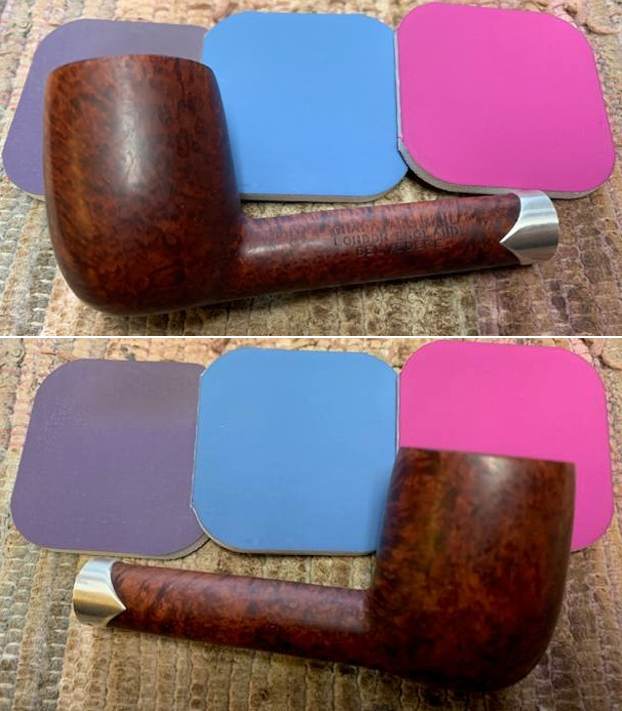
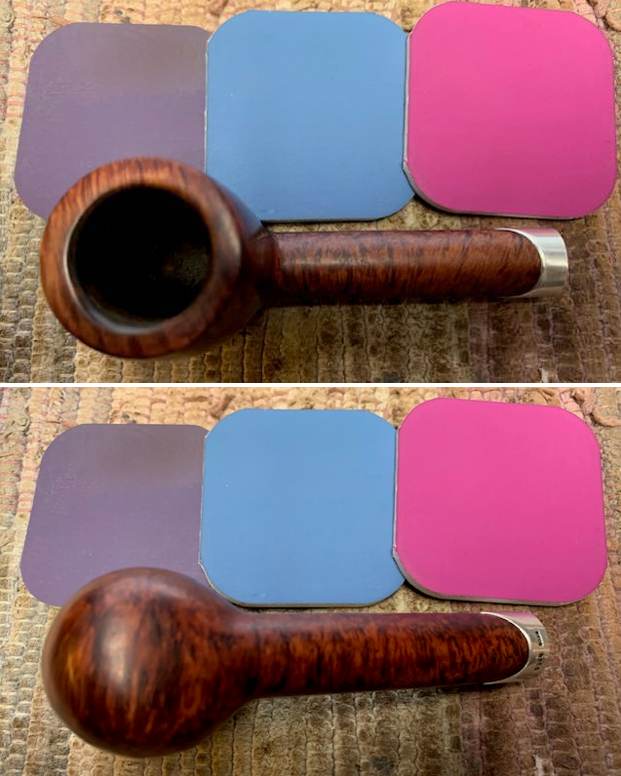
The next pipe on the table came to us from a group of pipes that Jeff and I purchased from a fellow in Copenhagen, Denmark on October 3, 2022. It is a Dunhill Shell Briar Pot that is in good condition. It is stamped on a smooth panel on the underside of the shank with the shape number 463 F/T followed by Dunhill [over] Shell Briar. Next to that it is stamped Made in [over] England by the date number 5. After that it is stamped with a 2 in a circle [followed by] S for shell. The stamping is clear and readable as noted above. The pipe has a mix of black, cordovan and brown stains on a sandblast finish and some amazing grain that the shape follows well. The colour is a bit more brown than the previous Shell Briar pipes I have been restoring. The finish was dusty around the nooks and crannies of the sandblast but otherwise fairly clean. The bowl had a thick cake and there was some lava on the sandblasted rim top or edges. The taper stem was oxidized, calcified, dirty and had tooth marks and chatter ahead of the button. Jeff took photos of the pipe to show what it looked like before he started working on it. He took photos of the bowl and rim top to show their condition and of the stem to show the condition of both sides of the stem. The photos of the sides and heel of the bowl show the deep sandblast grain on the pipe. It is a beauty. The stamping on the underside of the shank is shown in the photo below. It looks very good and faint but readable. It reads as noted and explained above. Jeff captured the detail in the photos below. One of the first things I like to do is to unpack the stamping and understand each element in it. I turned to Pipephil helpful site (http://pipephil.eu/logos/en/dunhill/shell-briar1.html). The stamping is interpreted as follows: The number 463 is the shape number for a Pot. The F/T is the designation for a fishtail stem. The Shell Briar is the finish which is corroborated the S at the end of the stamping. The size of the pipe is a Group 2. The superscript 5 following the D of England gives the date the pipe.Pipephil also has some helpful dating keys on the site that are basically flow charts that you can walk through to date your pipe (http://pipephil.eu/logos/en/dunhill/cledat-en1.html). I turned to Part 1 of the Dating Key and followed the chart. This pipe has a suffix of 5 following the D in England. It is the same size as the D so that took me to the section on the chart below (column one) which instructed me that the pipe could be dated as being made posterior to 1955. I followed the link following the “Your pipe is posterior to 1954. Narrow down your dating”. That took me to Page 2 of the dating key (http://pipephil.eu/logos/en/dunhill/cledat-en1a.html).   The third column (suffix 5…9) led me to the section with a smaller raised suffix. There was a directive for dating the pipe spelled out as follows: 1950 + suffix which gives the pipe a date of 1955.I then turned to Pipedia’s section on Dunhill Root Briar to get a bit of background on the Dunhill finishes (https://pipedia.org/wiki/Dunhill#Root_Briar). I quote:

Shell
A deep craggy sandblast with a black stain finish (usually made using Algerian briar) – the color of the stain used has varied over the years. Although there is some doubt as to them being the first to sandblast pipes, Dunhill’s Shell pipes, and the sandblasting techniques developed to create them are considered one of Dunhill’s greatest and most lasting contributions to the art of pipe making.

The documented history of Dunhill’s inception of the Shell is largely limited to patent applications — there are no catalog pages or advertisements promoting blasted pipes at the time. The preliminary work on the English patent (No. 1484/17) was submitted on October 13, 1917. The patent submission was completed half a year later, on April 12, 1918, followed by the granting of the English patent on October 14, 1918. This was less than a month before the end of The Great War on November 11th.

In 1986 Dunhill released a line of premium Shell finish pipes – “RING GRAIN”. These are high-quality straight grain pipes which are sandblasted. Initially only Ring Grain, but now in two different finishes. In 1995 the “Shilling” was introduced with Cumberland finish – it is an extremely rare series. These pipes exhibit a deeper blast characteristic of that of the 1930’s – mid-1960’s (and the limited ‘deep blast’ pipes of the early 1980s) and show a fine graining pattern. These are considered the best new Dunhills by many enthusiasts today and are very rare. The finish is sometimes described as tasting like vanilla at first, with the taste becoming more normal or good as the pipe breaks in.

I have also included a chart from the site from Dunhill spelling out the Standard Pipe Finishes and giving short information and a timeline. I turned to work on the pipe itself. Jeff had done an amazing cleanup of the pipe. He reamed the light cake with a PipNet reamer and cleaned up that with a Savinelli Fitsall Pipe Knife. He scrubbed the internals of the bowl and stem with alcohol, cotton swabs and pipe cleaners. He scrubbed the externals with undiluted Murphy’s Oil Soap and rinsed the bowl off with running water. He soaked the stem in Briarville’s Pipe stem Deoxidizer and once it had soaked rinsed it off with warm water to remove the residual solution. He dried it off and rubbed it down to remove any oxidation that was still on the stem. The pipe looked very good when I received it. I took a photo of the rim top to show the condition. You can see the clean bowl. The bowl is slightly out of round on the right front inner edge but otherwise looks good. The stem came out looking quite good. There are some light tooth marks and chatter on both sides ahead of the button.  I took a photo of the underside of the shank to show the stamping. The photo clearly shows the stamping and is actually more readable in the photo than in person. I removed the stem from the shank and took a photo of the pipe parts to show what I was working with. It is a nice looking pipe.The bowl was in such good condition that I had to do some minimal work with it. I rubbed the briar down with Before & After Restoration Balm. I worked it into the briar with my fingertips and a horsehair shoe brush to work it into the nooks and crannies of the sandblast finish. The product works to clean, enliven and preserve the briar. I let it sit for 10 minutes then I buffed it with a cotton cloth to deepen the shine. The briar really comes alive with the balm. I set the bowl aside and “painted” the stem surface with the flame of the lighter. I was able to lift most of the marks a significant measure. I filled in what remained with black superglue. I flattened the repairs with a small flat file and sanded it with 220 grit sandpaper to blend it into the surface of the stem. I started the polishing with a 400 grit wet dry sandpaper. I polished the vulcanite with micromesh sanding pads – 1500-12000 grit pads. I wiped it down with Obsidian Oil after each sanding pad. I used Before & After Pipe Polish – both Fine and Extra Fine to further polish the stem. This 1955 Dunhill Shell Briar 463 Taper Stem Pot has a beautiful, unique Dunhill Sandblast finish that is very deep and craggy. The dark mixed black/brown/red finish highlights some great grain around the bowl and shank. It has some great rugged sandblast that Dunhill specialized in making. The polished black vulcanite taper stem adds to the mix. I put the stem back on the bowl and buffed the pipe with Blue Diamond on the buffing wheel being careful to not buff the stamping. I gave the bowl multiple coats of Conservator’s Wax and the stem multiple coats of carnauba wax on the buffing wheel and followed that by buffing it with a clean buffing pad. I hand buffed the pipe with a microfiber cloth to deepen the shine. The finished Dunhill Shell Briar 463 Pot is quite nice and feels great in the hand. Give the finished pipe a look in the photos below. The dimensions of the pipe are Length: 5 ½ inches, Height: 1 ¼ inches, Outside diameter of the bowl: 1 ¼ inches, Chamber diameter: ¾ of an inch. The weight of the pipe is .81 ounces/23 grams. Thanks for walking through the restoration with me as I worked over another beautiful pipe. If you are interested in adding it to your collection I will be adding it to the British Pipe Makers Section of the rebornpipes store. Thanks for your time.

Cleaning up A Dunhill Shell Briar 36 Made in England 2 Liverpool


Blog by Steve Laug

The next pipe on the table came to us from a group of pipes that Jeff and I purchased from a fellow in Copenhagen, Denmark on October 3, 2022. It is a Dunhill Shell Liverpool that is in good condition. It is stamped on a smooth panel on the underside of the shank with the shape number 36 followed by Dunhill [over] Shell Briar. Next to that it is stamped Made in [over] England by the date number 2. After that it is stamped with a 4 in a circle [followed by] S for shell. The stamping is clear and readable as noted above. The pipe has a mix of black, cordovan and brown stains on a sandblast finish and some amazing grain that the shape follows well. The finish was dusty around the nooks and crannies of the sandblast but otherwise fairly clean. The bowl had a thick cake and there was some light lava on the sandblasted rim top or edges. The taper stem was oxidized, calcified, dirty and had tooth marks and chatter ahead of the button. Jeff took photos of the pipe to show what it looked like before he started working on it.He took photos of the bowl and rim top to show their condition and of the stem to show the condition of both sides of the stem. The photos of the sides and heel of the bowl show the deep sandblast grain on the pipe. It is a beauty. The stamping on the underside of the shank is shown in the photo below. It looks very good and faint but readable. It reads as noted and explained above. Jeff captured the detail in the photos below. One of the first things I like to do is to unpack the stamping and understand each element in it. I turned to Pipephil helpful site (http://pipephil.eu/logos/en/dunhill/shell-briar1.html). The stamping is interpreted as follows: The number 36 is the shape number for a Liverpool. The Dunhill Shell Briar is the finish which is corroborated the S at the end of the stamping. The size of the pipe is a Group 4. The superscript 2 following the D of England gives the date the pipe.Pipephil also has some helpful dating keys on the site that are basically flow charts that you can walk through to date your pipe (http://pipephil.eu/logos/en/dunhill/cledat-en1.html). I turned to Part 1 of the Dating Key and followed the chart. This pipe has a suffix of 9 following the D in England. It is the same size as the D so that took me to the section on the chart below (column one) which instructed me that the pipe could be dated as being made posterior to 1954. I followed the link following the “Your pipe is posterior to 1954. Narrow down your dating”. That took me to Page 2 of the dating key (http://pipephil.eu/logos/en/dunhill/cledat-en1a.html).   The third column (suffix 1…4) led me to the section with no raised suffix. There was a directive for dating the pipe spelled out as follows: 1960 + suffix which gives the  pipe a date of 1962.I then turned to Pipedia’s section on Dunhill Root Briar to get a bit of background on the Dunhill finishes (https://pipedia.org/wiki/Dunhill#Root_Briar). I quote:

Shell
A deep craggy sandblast with a black stain finish (usually made using Algerian briar) – the color of the stain used has varied over the years. Although there is some doubt as to them being the first to sandblast pipes, Dunhill’s Shell pipes, and the sandblasting techniques developed to create them are considered one of Dunhill’s greatest and most lasting contributions to the art of pipe making.

The documented history of Dunhill’s inception of the Shell is largely limited to patent applications — there are no catalog pages or advertisements promoting blasted pipes at the time. The preliminary work on the English patent (No. 1484/17) was submitted on October 13, 1917. The patent submission was completed half a year later, on April 12, 1918, followed by the granting of the English patent on October 14, 1918. This was less than a month before the end of The Great War on November 11th.

In 1986 Dunhill released a line of premium Shell finish pipes – “RING GRAIN”. These are high-quality straight grain pipes which are sandblasted. Initially only Ring Grain, but now in two different finishes. In 1995 the “Shilling” was introduced with Cumberland finish – it is an extremely rare series. These pipes exhibit a deeper blast characteristic of that of the 1930’s – mid-1960’s (and the limited ‘deep blast’ pipes of the early 1980s) and show a fine graining pattern. These are considered the best new Dunhills by many enthusiasts today and are very rare. The finish is sometimes described as tasting like vanilla at first, with the taste becoming more normal or good as the pipe breaks in.

I have also included a chart from the site from Dunhill spelling out the Standard Pipe Finishes and giving short information and a timeline. I turned to work on the pipe itself. Jeff had done an amazing cleanup of the pipe. He reamed the light cake with a PipNet reamer and cleaned up that with a Savinelli Fitsall Pipe Knife. He scrubbed the internals of the bowl and stem with alcohol, cotton swabs and pipe cleaners. He scrubbed the externals with undiluted Murphy’s Oil Soap and rinsed the bowl off with running water. He soaked the stem in Briarville’s Pipe stem Deoxidizer and once it had soaked rinsed it off with warm water to remove the residual solution. He dried it off and rubbed it down to remove any oxidation that was still on the stem. The pipe looked very good when I received it. I took a photo of the rim top to show the condition. You can see the clean bowl. The bowl is slightly out of round on the right front inner edge but otherwise looks good. The stem came out looking quite good. There are some light tooth marks and chatter on both sides ahead of the button.  I took a photo of the underside of the shank to show the stamping. The photo clearly shows the stamping and is actually more readable in the photo than in person. I removed the stem from the shank and took a photo of the pipe parts to show what I was working with. It is a nice looking pipe.I worked on the inner edge of the bowl to bring it back to round using a folded piece of 220 grit sandpaper. I gave it a slight bevel to accommodate the damage. I stained the edge of the bowl with a Mahogany stain pen to match the rest of the bowl. The bowl was in such good condition that I had to do some minimal work with it. I rubbed the briar down with Before & After Restoration Balm. I worked it into the briar with my fingertips and a horsehair shoe brush to work it into the nooks and crannies of the sandblast finish. The product works to clean, enliven and preserve the briar. I let it sit for 10 minutes then I buffed it with a cotton cloth to deepen the shine. The briar really comes alive with the balm. The stem marks were light enough that I polished the vulcanite with micromesh sanding pads – 1500-12000 grit pads. I wiped it down with Obsidian Oil after each sanding pad. I used Before & After Pipe Polish – both Fine and Extra Fine to further polish the stem. This 1962 Dunhill Shell Briar 36 Taper Stem Liverpool has a beautiful, unique Dunhill Sandblast finish that is very deep and craggy. The dark mixed black/brown/red finish highlights some great grain around the bowl and shank. It has some great rugged sandblast that Dunhill specialized in making. The polished black vulcanite taper stem adds to the mix. I put the stem back on the bowl and buffed the pipe with Blue Diamond on the buffing wheel being careful to not buff the stamping. I gave the bowl multiple coats of Conservator’s Wax and the stem multiple coats of carnauba wax on the buffing wheel and followed that by buffing it with a clean buffing pad. I hand buffed the pipe with a microfiber cloth to deepen the shine. The finished Dunhill Shell Briar 36 Liverpool is quite nice and feels great in the hand. Give the finished pipe a look in the photos below. The dimensions of the pipe are Length: 5 ½ inches, Height: 1 ¾ inches, Outside diameter of the bowl: 1 ¼ inches, Chamber diameter: ¾ of an inch. The weight of the pipe is 1.09 ounces/31 grams. Thanks for walking through the restoration with me as I worked over another beautiful pipe. If you are interested in adding it to your collection I will be adding it to the British Pipe Makers Section of the rebornpipes store. Thanks for your time.

Cleaning up A Dunhill Shell Briar 252 Made in England Billiard


Blog by Steve Laug

The next pipe on the table came to us from a group of pipes that Jeff and I purchased from a fellow in Copenhagen, Denmark on October 3, 2022. It is a Dunhill Shell Billiard that is in good condition. It is stamped on a smooth panel on the underside of the shank with the shape number 252 F/T followed by Dunhill [over] Shell Briar. Next to that it is stamped Made in [over] England by the date number 9. After that it is stamped with a 4 in a circle [followed by] S for shell. The stamping is clear and readable as noted above. The pipe has a mix of black, cordovan and brown stains on a sandblast finish and some amazing grain that the shape follows well. The finish was dusty around the nooks and crannies of the sandblast but otherwise fairly clean. The bowl had a thick cake and there was some lava on the sandblasted rim top or edges. The taper stem was oxidized, calcified, dirty and had tooth marks and chatter ahead of the button. Jeff took photos of the pipe to show what it looked like before he started working on it.He took photos of the bowl and rim top to show their condition and of the stem to show the condition of both sides of the stem. The photos of the sides and heel of the bowl show the deep sandblast grain on the pipe. It is a beauty.  The stamping on the underside of the shank is shown in the photo below. It looks very good and faint but readable. It reads as noted and explained above. Jeff captured the detail in the photos below. One of the first things I like to do is to unpack the stamping and understand each element in it. I turned to Pipephil helpful site (http://pipephil.eu/logos/en/dunhill/shell-briar1.html). The stamping is interpreted as follows: The number 252 is the shape number for a Billiard. The F/T is the designation for a Fishtail stem. The Dunhill Shell Briar is the finish which is corroborated the S at the end of the stamping. The size of the pipe is a Group 4. The 9 following the D of England gives the date the pipe.Pipephil also has some helpful dating keys on the site that are basically flow charts that you can walk through to date your pipe (http://pipephil.eu/logos/en/dunhill/cledat-en1.html). I turned to Part 1 of the Dating Key and followed the chart. This pipe has a suffix of 9 following the D in England. It is the same size as the D so that took me to the section on the chart below (column one) which instructed me that the pipe could be dated as being made posterior to 1954. The date stamp 9 which made the pipe a 1969 Shell Briar.I followed the link following the “Your pipe is posterior to 1954. Narrow down your dating”. That took me to Page 2 of the dating key (http://pipephil.eu/logos/en/dunhill/cledat-en1a.html).   The third column (suffix 5…9) led me to the section with no raised suffix. There was a directive for dating the pipe spelled out as follows: 1960 + suffix which gives the  pipe a date of 1969.I then turned to Pipedia’s section on Dunhill Root Briar to get a bit of background on the Duhill finishes (https://pipedia.org/wiki/Dunhill#Root_Briar). I quote:

Shell
A deep craggy sandblast with a black stain finish (usually made using Algerian briar) – the color of the stain used has varied over the years. Although there is some doubt as to them being the first to sandblast pipes, Dunhill’s Shell pipes, and the sandblasting techniques developed to create them are considered one of Dunhill’s greatest and most lasting contributions to the art of pipe making.

The documented history of Dunhill’s inception of the Shell is largely limited to patent applications — there are no catalog pages or advertisements promoting blasted pipes at the time. The preliminary work on the English patent (No. 1484/17) was submitted on October 13, 1917. The patent submission was completed half a year later, on April 12, 1918, followed by the granting of the English patent on October 14, 1918. This was less than a month before the end of The Great War on November 11th.

In 1986 Dunhill released a line of premium Shell finish pipes – “RING GRAIN”. These are high-quality straight grain pipes which are sandblasted. Initially only Ring Grain, but now in two different finishes. In 1995 the “Shilling” was introduced with Cumberland finish – it is an extremely rare series. These pipes exhibit a deeper blast characteristic of that of the 1930’s – mid-1960’s (and the limited ‘deep blast’ pipes of the early 1980s) and show a fine graining pattern. These are considered the best new Dunhills by many enthusiasts today and are very rare. The finish is sometimes described as tasting like vanilla at first, with the taste becoming more normal or good as the pipe breaks in.

I have also included a chart from the site from Dunhill spelling out the Standard Pipe Finishes and giving short information and a timeline. I turned to work on the pipe itself. Jeff had done an amazing cleanup of the pipe. He reamed the light cake with a PipNet reamer and cleaned up that with a Savinelli Fitsall Pipe Knife. He scrubbed the internals of the bowl and stem with alcohol, cotton swabs and pipe cleaners. He scrubbed the externals with undiluted Murphy’s Oil Soap and rinsed the bowl off with running water. He soaked the stem in Briarville’s Pipe stem Deoxidizer and once it had soaked rinsed it off with warm water to remove the residual solution. He dried it off and rubbed it down to remove any oxidation that was still on the stem. The pipe looked very good when I received it. I took a photo of the rim top to show the condition. You can see the clean bowl. It almost looks as if it was never smoked to the bottom of the bowl. The stem came out looking quite good. There are some tooth marks and chatter on both sides ahead of the button.  I took a photo of the underside of the shank to show the stamping. The photo clearly shows the stamping and is actually more readable in the photo than in person. I removed the stem from the shank and took a photo of the pipe parts to show what I was working with. It is a nice looking pipe.The bowl was in such good condition that I had to do some minimal work with it. I rubbed the briar down with Before & After Restoration Balm. I worked it into the briar with my fingertips and a horsehair shoe brush to work it into the nooks and crannies of the sandblast finish. The product works to clean, enliven and preserve the briar. I let it sit for 10 minutes then I buffed it with a cotton cloth to deepen the shine. The briar really comes alive with the balm. I “painted” the stem surface on both sides to lift the dents. The heat lifted the ones on the top completely and the ones on the underside for the most part. I filled in the two small remaining marks on the underside of the stem with clear CA glue. Once it cured I sanded repairs out with 220 grit sandpaper and started the polishing with 400 grit wet dry sandpaper. I polished the vulcanite with micromesh sanding pads – 1500-12000 grit pads. I wiped it down with Obsidian Oil after each sanding pad. I used Before & After Pipe Polish – both Fine and Extra Fine to further polish the stem. This 1969 Dunhill Shell Briar 252 F/T Taper Stem Billiard has a beautiful, unique Dunhill Sandblast finish that is very deep and craggy. The dark mixed black/brown/red finish highlights some great grain around the bowl and shank. It has some great rugged sandblast that Dunhill specialized in making. The polished black vulcanite taper stem adds to the mix. I put the stem back on the bowl and buffed the pipe with Blue Diamond on the buffing wheel being careful to not buff the stamping. I gave the bowl multiple coats of Conservator’s Wax and the stem multiple coats of carnauba wax on the buffing wheel and followed that by buffing it with a clean buffing pad. I hand buffed the pipe with a microfiber cloth to deepen the shine. The finished Dunhill Shell Briar 252 F/T Billiard is quite nice and feels great in the hand. Give the finished pipe a look in the photos below. The dimensions of the pipe are Length: 5 ¾ inches, Height: 1 ¾ inches, Outside diameter of the bowl: 1 ¼ inches, Chamber diameter: ¾ of an inch. The weight of the pipe is 1.23 ounces/35 grams. Thanks for walking through the restoration with me as I worked over another beautiful pipe. If you are interested in adding it to your collection I will be adding it to the British Pipe Makers Section of the rebornpipes store. Thanks for your time.

Restoring a Kaywoodie Churchwarden


Blog by Kenneth Lieblich

Next on the chopping block is a charming and looooong Kaywoodie Dublin churchwarden (twelve inches long), commissioned by the daughter of a friend, for her fiancé. She was determined to get her beau a churchwarden as a gift. Fortunately, I was able to lay my hands on one and did a nifty restoration job on it. This pipe was made by the well-known American pipe company, Kaywoodie. The markings on the left side of the shank read Super Grain [over] Kaywoodie. On the right side of the shank is the shape number: 95. The left side of the stem has the traditional Kaywoodie logo, a club: ♣.   I went over to Pipedia, in order work out a rough date for this pipe. I know that the very old Kaywoodies have four-digit shape numbers – and this pipe obviously only has two digits. On the list of Kaywoodie shape numbers, the following information was shown:

Shape #                 Description                                                         Years Produced

95                           Extra Long Dublin Churchwarden              1932-1937, 1947-1972

So, at its youngest, this pipe is a minimum of 50 years old. Having said that, however, I think it’s older because the scant information I could find suggests that the 95 was not produced in Super Grain from at least 1968. I also don’t feel that this pipe falls into the earlier year ranges. My best estimate is that this pipe dates from the period of 1955 to 1968. Sadly, I cannot be more precise than that. The following photo shows the pipe in question from a 1955 Kaywoodie catalogue:The pipe was in decent condition. The pipe had been well-smoked add the bowl and shank were quite dirty, but nothing outlandish. The bowl had notable cake on the inside and some lava on the rim. I felt that some burning was possibly there too. Similarly, the stem was relatively clean – not much oxidation to speak of, and what I would describe as “typical” tooth marks on the bit. The stem was somewhat bent out of shape (in the yaw, pitch, and roll axes) and would need to be corrected. Finally, some previous owner had decapitated the drinkless filter system. Time to get to work. The stem was first on my list. I wiped the outside down with Murphy’s Oil Soap on some cotton pads. I cleaned out the insides with lemon-infused isopropyl alcohol and some churchwarden pipe cleaners. I also took a BIC lighter and ‘painted’ the stem with its flame to lift the few bite marks and dents. This was reasonably successful in raising the damage. It wasn’t perfect, but it was improved.

As I mentioned, the stinger thing had been lopped off. There was no repairing it – and I didn’t want to anyway! What I did do, however, was to gently sand down the cut edge with metal sandpaper in coarse, medium and fine grits. This worked beautifully and I was pleased with the results. I cleaned off the end with some alcohol on a cotton pad and gave the metal a quick polish. I then heated the stem with my heat gun and gently worked the twisted stem back into place. I have bent many stems before, but this one was by far the trickiest – perhaps because it was so long. There was considerable resistance in the stem and, after correcting the yaw and roll axes, I opted to leave some of the pitch – figuring that discretion was the better part of valour. Or, rather, I didn’t want to break the darn thing!

Fortunately, the stem was in good enough shape that it didn’t need a soak in the Pipe Stem Oxidation Remover. I simply scrubbed and scrubbed with SoftScrub on some cotton pads. I built up the remaining marks on the stem with black cyanoacrylate adhesive and then cured it with the aid of some CA glue accelerator. I then carefully sanded the adhesive down with 220-, 400-, and 600-grit sandpapers to meld seamlessly into the stem. I then used all nine Micromesh pads (1,500 through 12,000 grit) to bring out the lovely black lustre on the stem. I also used Obsidian Pipe Stem Oil in between each pad scrubbing (from 3,600 onward). Now for the stummel. I decided to ream out the bowl. I used the PipNet reamer to remove the built-up cake and followed that with 220-grit sandpaper taped to a dowel to eliminate as much as I could. I took the chamber down to bare briar, as I wanted to ensure there were no hidden flaws in the wall. Fortunately, there were none.   I then proceeded to clean out the insides of the shank with Q-tips, pipe cleaners, and lemon-infused isopropyl alcohol. There was quite a bit of filth inside this stummel and it took a fair amount of cotton to get it clean. I used cotton rounds and some Murphy’s Oil Soap to scrub the outside of the stummel. I soaked the rim of the pipe in Murphy’s in order to soften the lava. This worked well, but burn marks remained on the wood of the rim. I followed that up by cleaning the insides of the stummel with some dish soap and tube brushes. Next, I decided to de-ghost the pipe in order to remove any lingering smells of the past. I thrust cotton balls into the bowl and the shank and saturated them with 99% isopropyl alcohol. I let the stummel sit overnight. This caused any remaining oils, tars and smells to leach out into the cotton. The bowl was nice and clean after this. Often, to remove burn marks, I use oxalic acid, but, in this case, the burning was too extensive. I should say that the burning wasn’t severe or deep – just wide. In order to safely remove the burns on the rim, I “topped” the pipe – that is to say, I gently and evenly sanded down the rim on a piece of 220-grit sandpaper. This effectively removed the damage, without altering the look of the pipe.Before sanding, I applied some Before & After Restoration Balm and let it sit for 20 minutes or so. It does lovely things to the wood. Once I polished it with a microfibre cloth, I sanded the stummel down with all nine Micromesh pads (1,500 through 12,000 grit). Finally, I applied some more Before & After Restoration Balm and buffed it with a microfiber cloth a second time. I then took the pipe to my bench polisher and buffed it with White Diamond and a few coats of carnauba wax. Wow – the pipe really looks lovely. My friend’s daughter presented her fiancé with the pipe and he seemed quite pleased with it. I met the lucky fellow myself and I know that he will enjoy smoking it for many years to come. I hope you enjoyed reading the story of this pipe as much I as I did restoring it. If you are interested in more of my work, please follow me here on Steve’s website or email me directly at kenneth@knightsofthepipe.com. Thank you very much for reading and, as always, I welcome and encourage your comments.

Surprised by a French Made ‘Hetre’ Panel – Made of Beech Wood


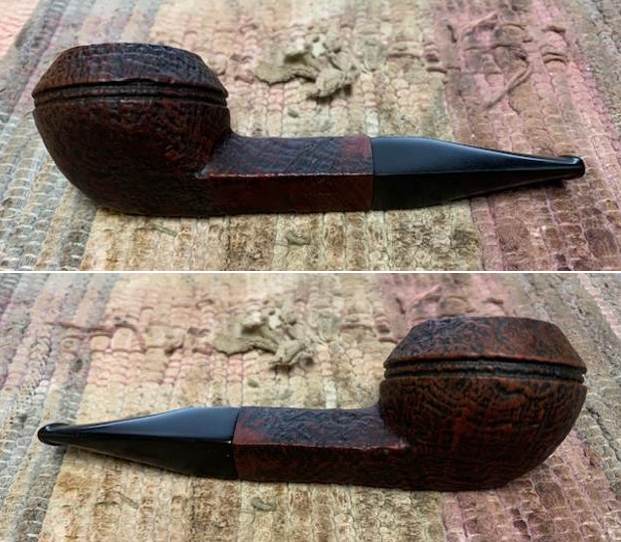
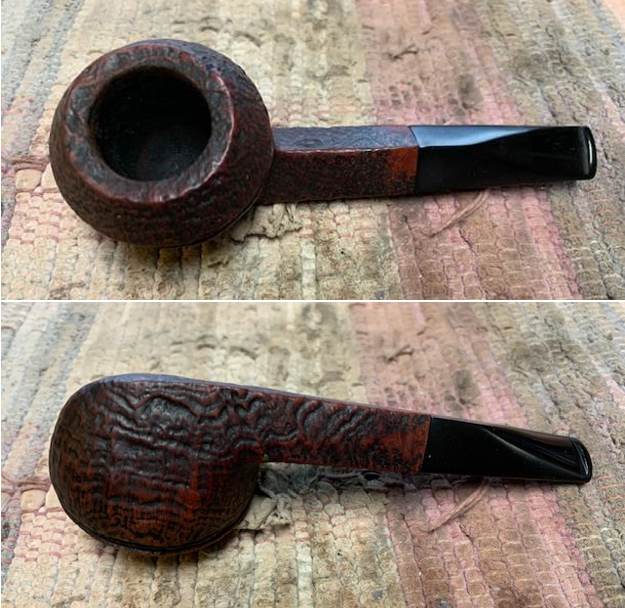
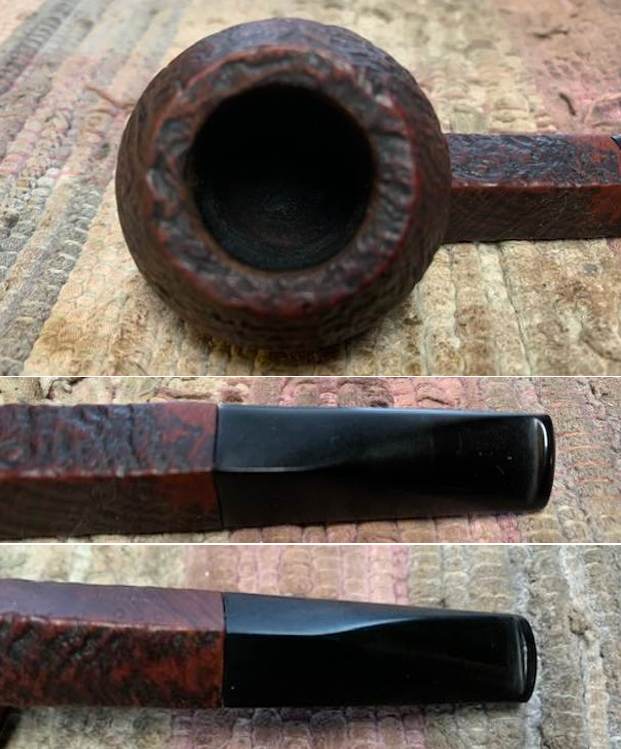
First of all, I’m guessing that this interesting hexagonal Panel shape is French made.  I acquired it from a seller in Paris in August of 2018.  It …

Surprised by a French Made ‘Hetre’ Panel – Made of Beech Wood

The stain job on the pipe came out very well. Nice job.