Monthly Archives: March 2017

Who would have guessed that there was a Beauty in this Beast


Blog by Steve Laug

Sometimes you have to look past the state of a pipe to really see what could be present underneath all of the layers of dirt and grime. You have to have the right perspective as well. You need to be able to see these pipes as well loved rather than abused; as a favourite pipe rather than a neglected one. This the context in which the next pipe that crossed my worktable is to be viewed. Here is the back-story. Not too long ago I received an email from a friend of mine named Jim, whose pipes I have worked on in the past. He had an interesting story to tell me and a request. I thought rather than tell the story for him I would let him tell it himself. Here is his email in full:

Hey Steve,

I have been hunting about 1200 acres of Farm and Woodland Property owned by an area farmer and old friend of mine named Stephen Lehner. Steve knows I am a pipe aficionado, and approached me the other day with a pipe that had belonged to his father. I was able to get a little history of how this pipe came to be in this abysmal condition. Steve’s father was rather hard on his pipes. As the original owner of this pipe, Steve said his dad, in the latter years of his life, was not given to cleaning his pipes. His cleaning routine, if you could call it that, consisted of digging any ash and unburnt tobacco from the bowl with a pocket knife, then grasping the pipe by the stem, toward the mouthpiece/lip area, and banging it violently against any nearby hard object – trees, brick walls, car mirrors. It was hard enough that Steve’s son, Shawn, remarked that the old man actually damaged the mirrors on his trucks! Mr. Lehner’s pipes were so abused, that he routinely broke stems, necessitating that he acquire new stems – some of which were not well fitted.

In any case, Steve handed me this pipe, stating that it is one of a very few connections he has to his late father, and asked if I could do a cursory cleaning so he could display it as a keepsake (He is not a pipe smoker). I thought the pipe was interesting, if in bad condition. I cannot clearly make out any markings. On one side, there is a partially legible stamping, “…vage” with some cursive writing below it which I cannot make out. On the other side, I can read the number “75.”  I think it is a bulldog style. The tenon will not enter all the way into the mortise, and I am not sure if that is because there is so much crud inside or because it is not the correct bit.  The bowl is heavily caked and cracked. It also looks as though there was some ad hoc rustication on the bowl, as well. The bowl shows a distinct area of impact where it was banged during cleaning as well.

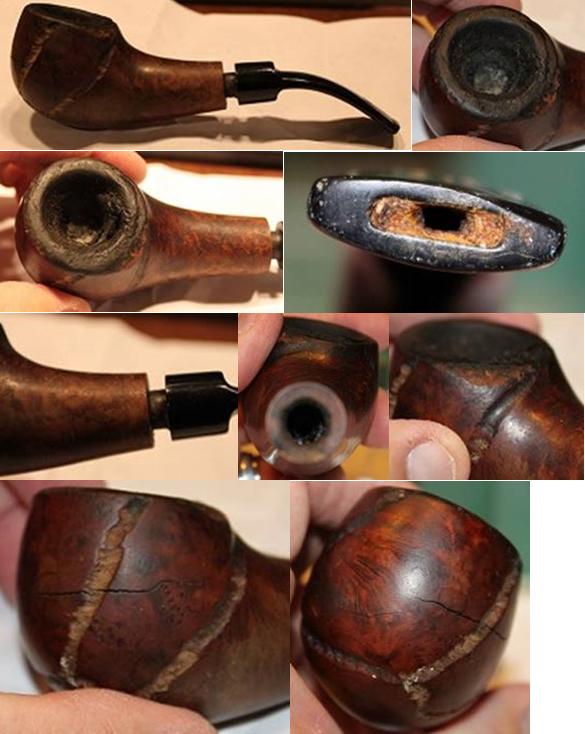
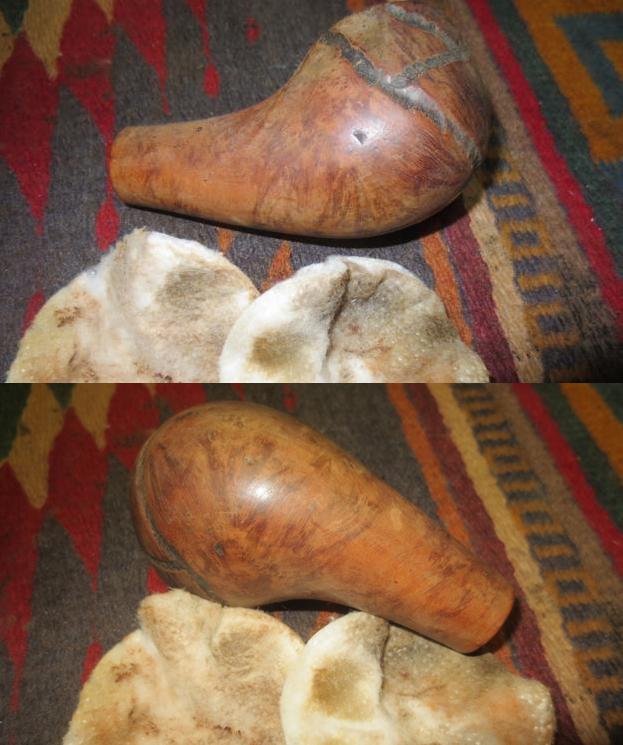
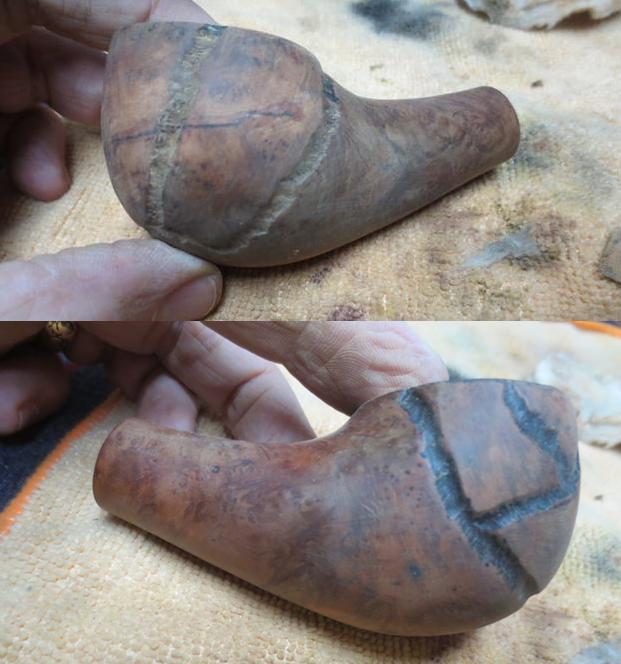
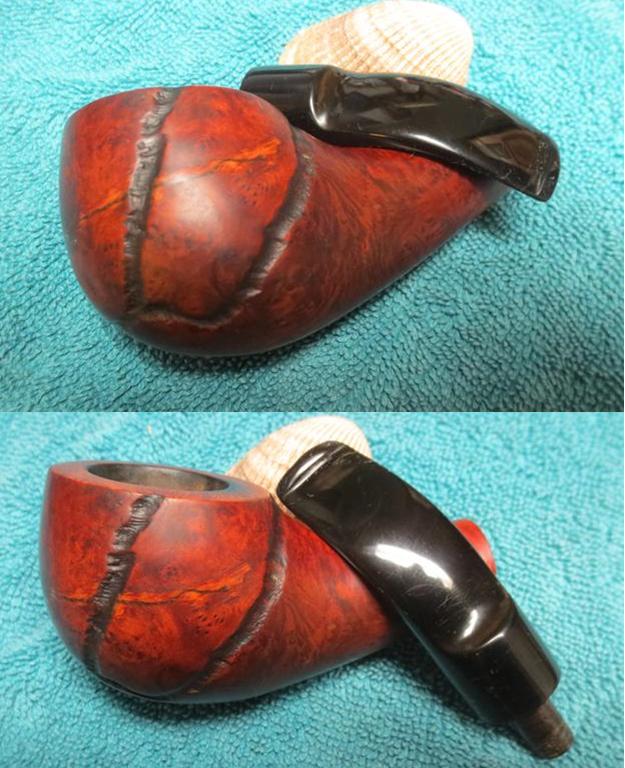
I attached some pix so you could behold this wonder:Once I saw the pictures I was quite taken back by the sheer beastly look of this old pipe. It had quite literally been beaten to death. The bowl was cracked on the outside of the bowl that started at the front of the bowl and extended to almost the back side. There was a second crack below that on the front of the bowl extending from the bottom of the first crack and extending toward the other side of the bowl. The bowl was so badly caked that I could not even get my pinky finger in the bowl. I tried to blow through the end of the shank and I was unable to get any air through the bowl. The finish was dirty and sticky to touch. The worm trail rustication ran over the bowl surface but was filled in with dirt and grit. From the photos it appeared that the shank inside was incredibly dirty. I think that it is fair to say this pipe was a stranger to pipe cleaners. The stem that was in the shank was not a fit. It was of smaller diameter than the shank. The slot in the stem was almost clogged.
After reading his email and looking over the photos I wrote back to my friend. I was pretty certain from the look of the rustication and the shape number he gave me that the pipe was a GBD. The three letters that he could read on the left side of the shank were age. That led me to look in the GBD list I have and concluded that the pipe was a GBD Sauvage. I looked up some information on a chart I have of GBD lines and knew that the pipe was originally sold with a light brown stain, smooth bowl with deep carved lines to hide flaws. It was similar to a Savinelli Sherwood, but much deeper carved lines. The GBD shape number 75 was a Rhodesian with a1/4 Bent Saddle stem. While this old pipe was a mess it was awfully hard to tell if it ever was a Rhodesian. I sent him this information in my reply.

He wrote back and said he wondered if I would be willing to tackle the restoration on this one. If so he would send it to me. I wrote back and said I would do the work. I guess I will find out if my guesses on the brand of this pipe were correct. I would know more once it arrived.

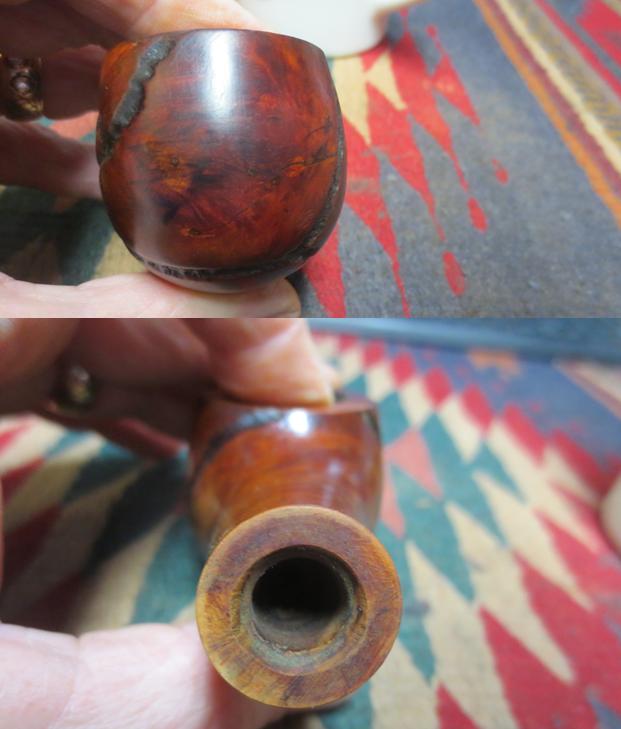
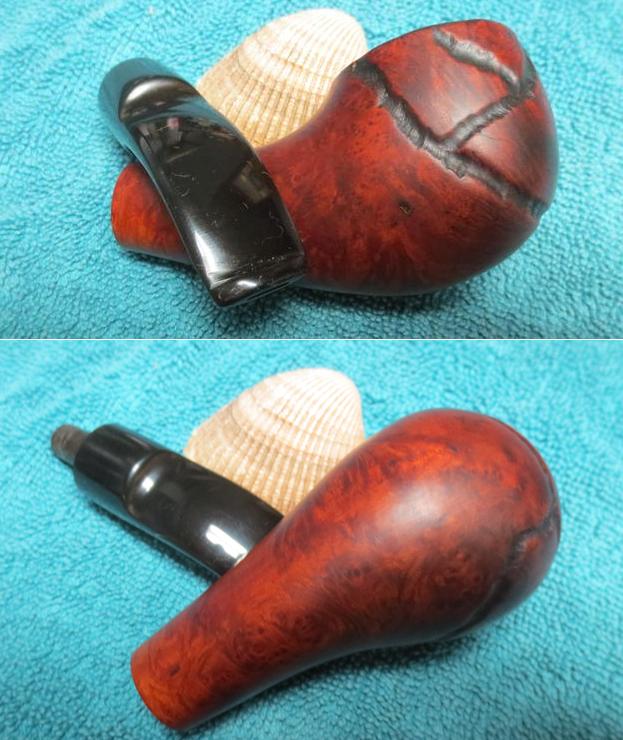
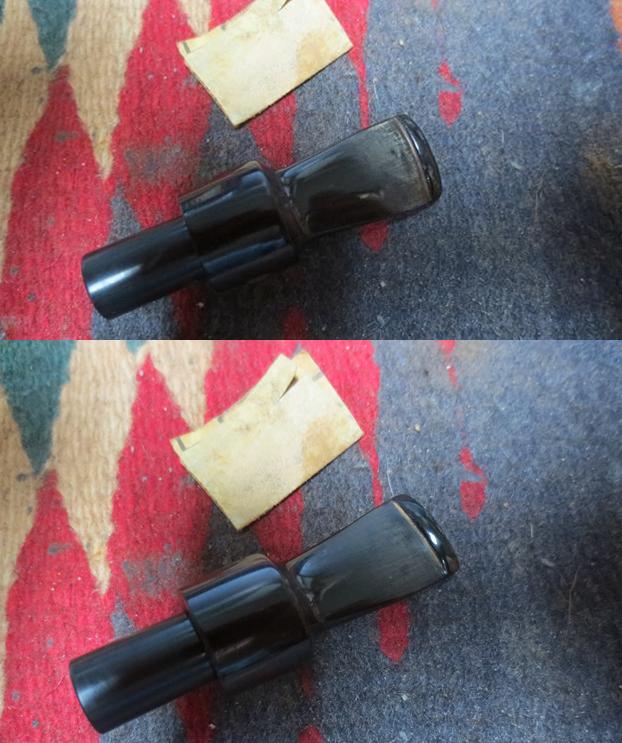
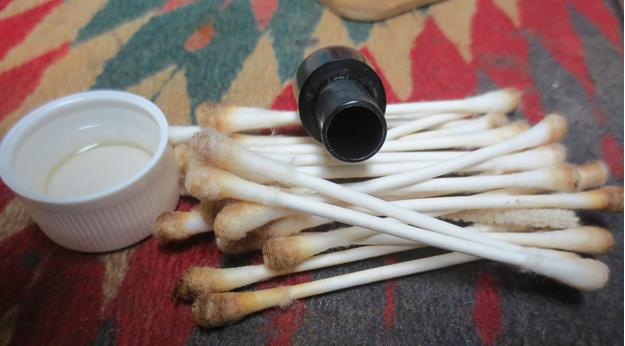
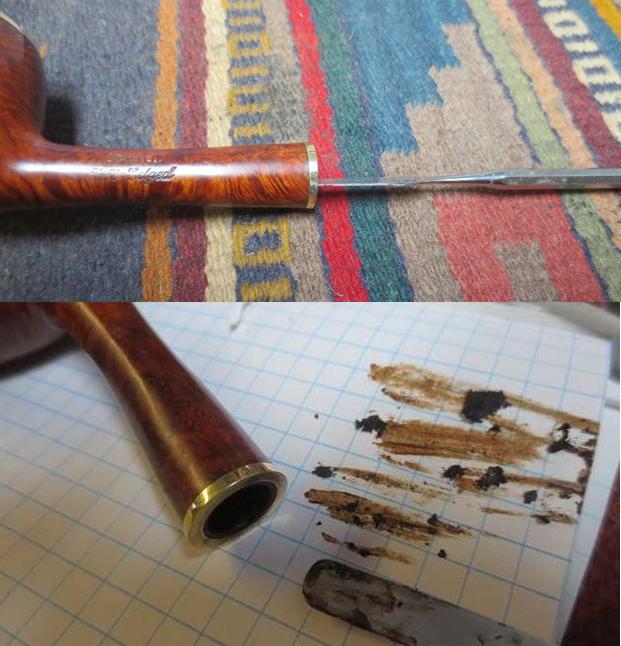
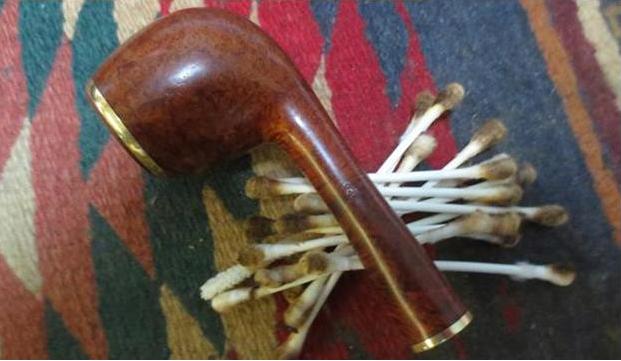
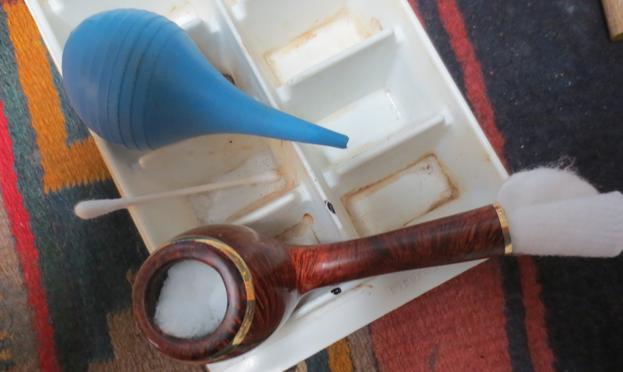
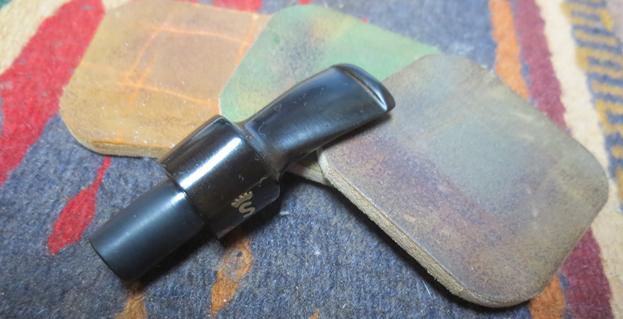
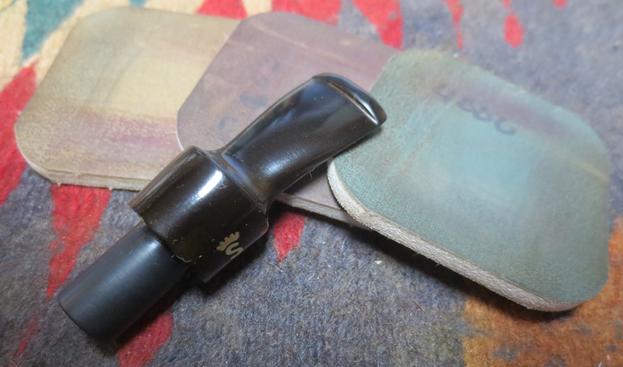
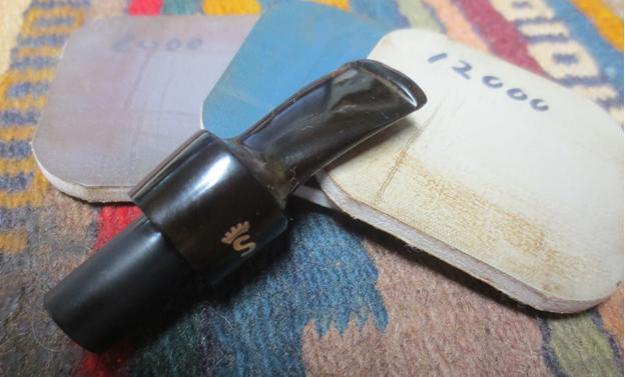
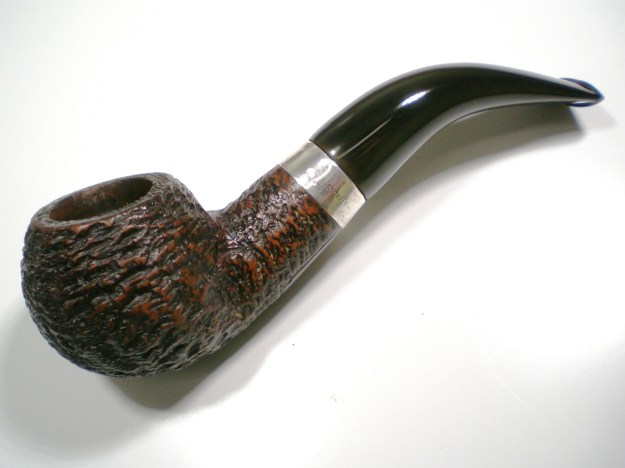
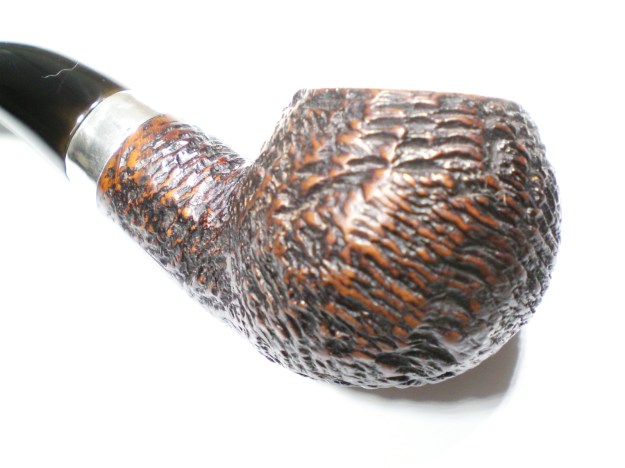
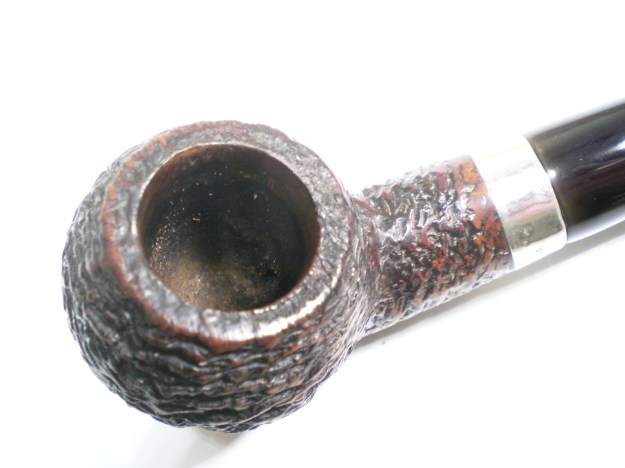
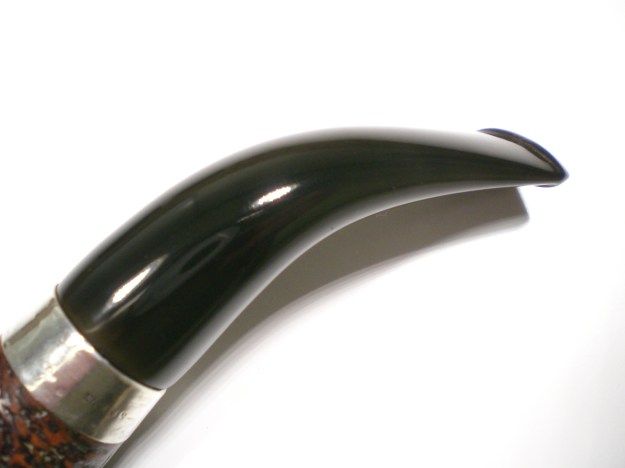
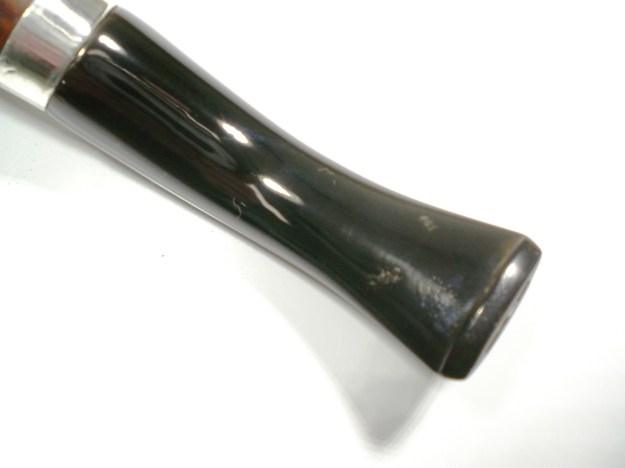
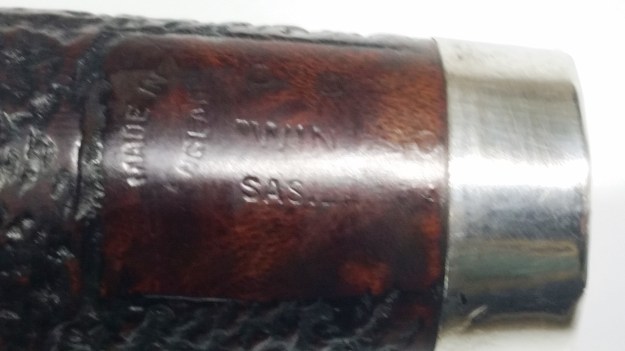
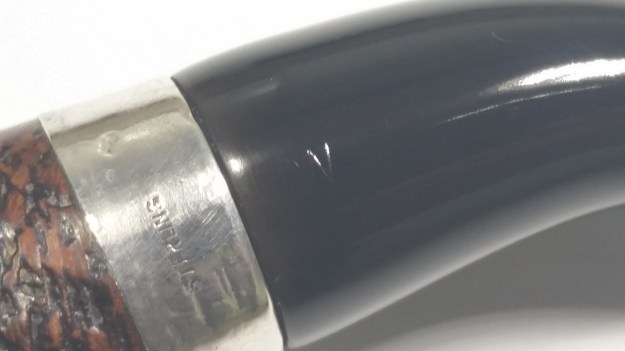
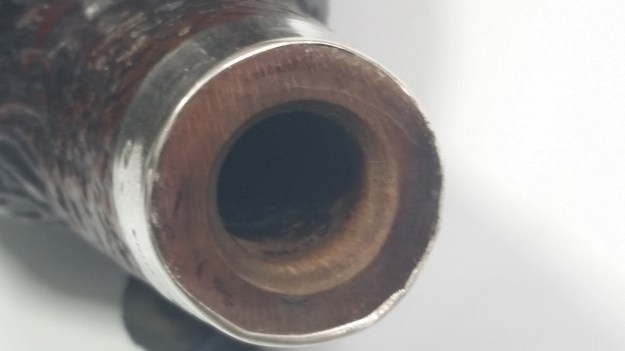
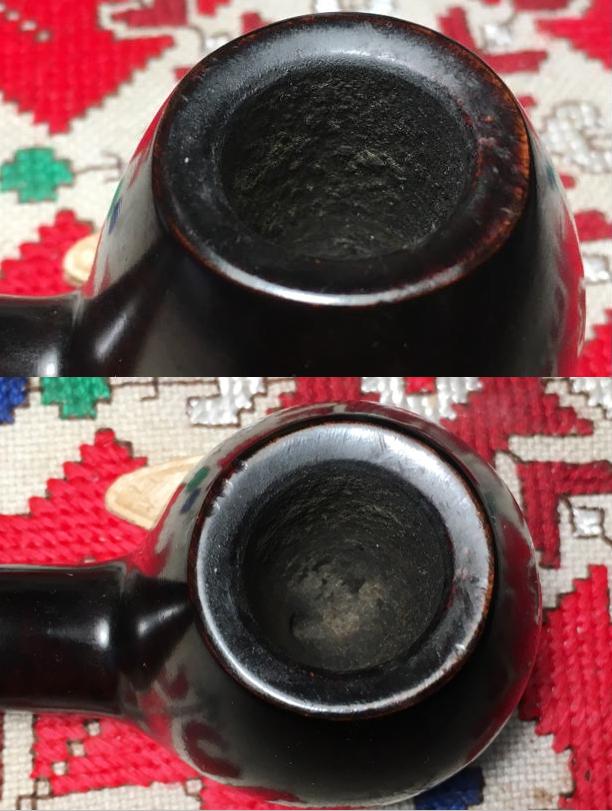
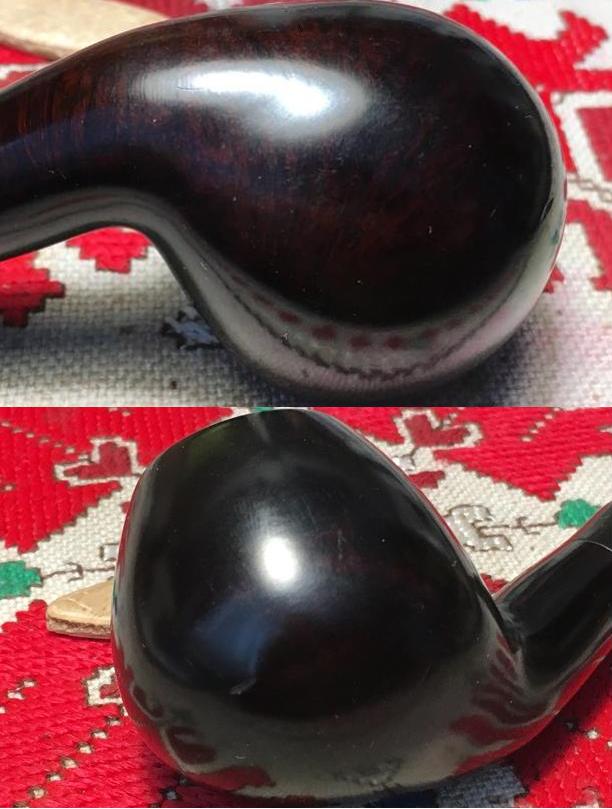
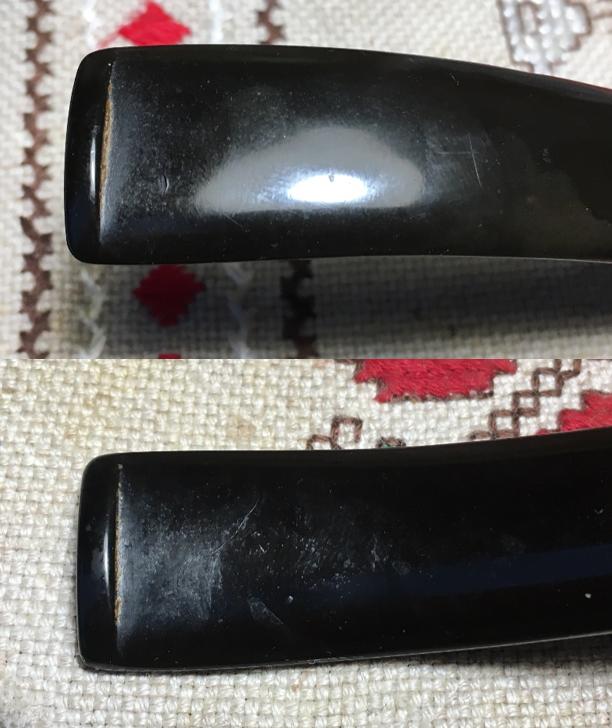
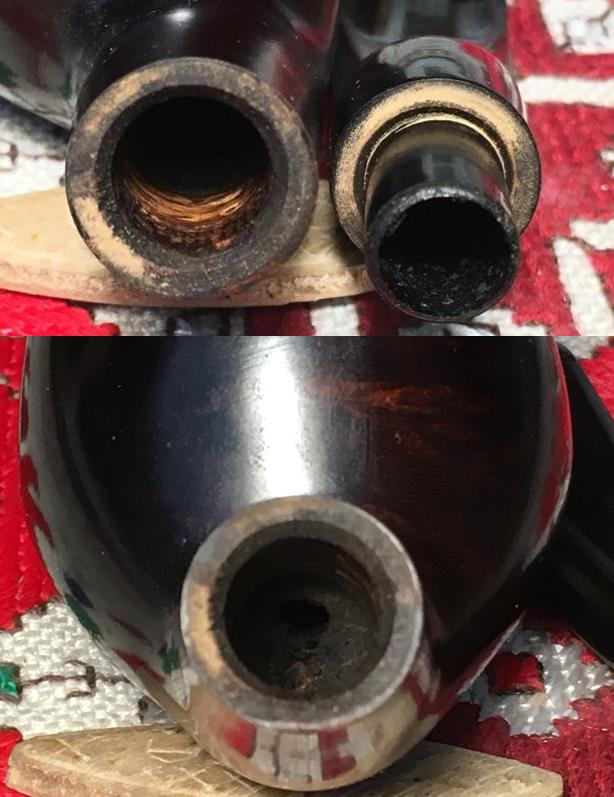
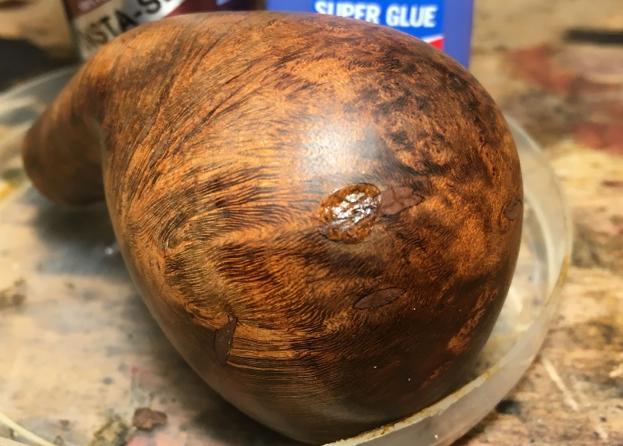
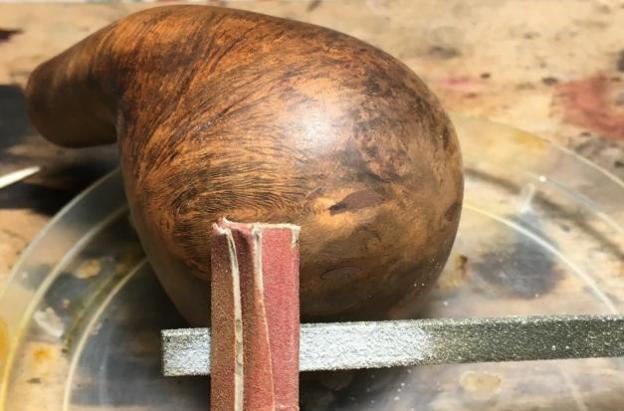
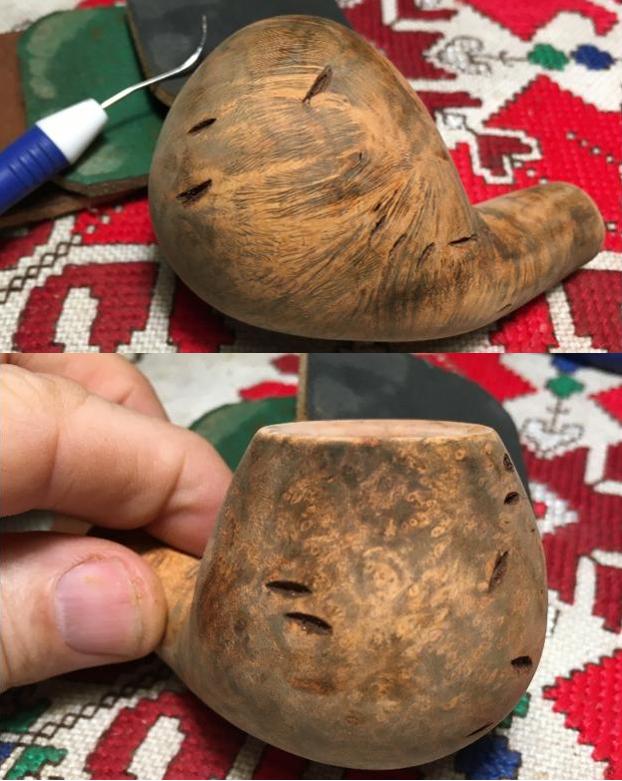
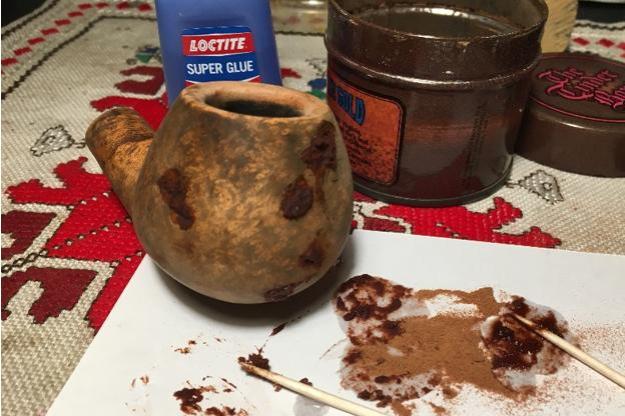
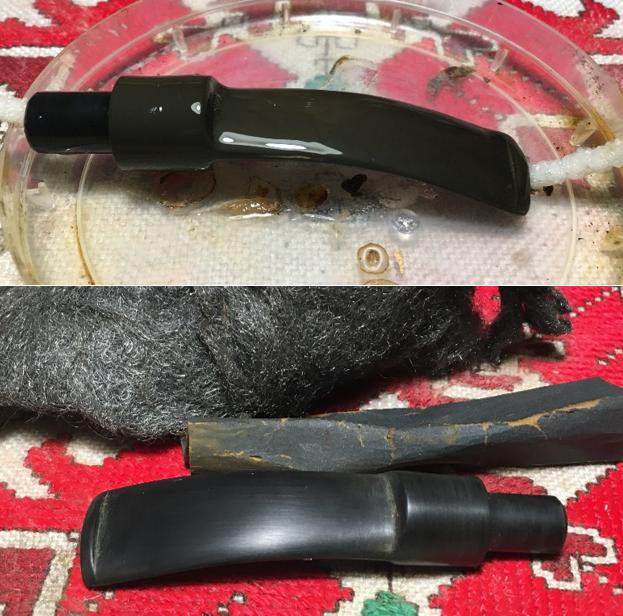
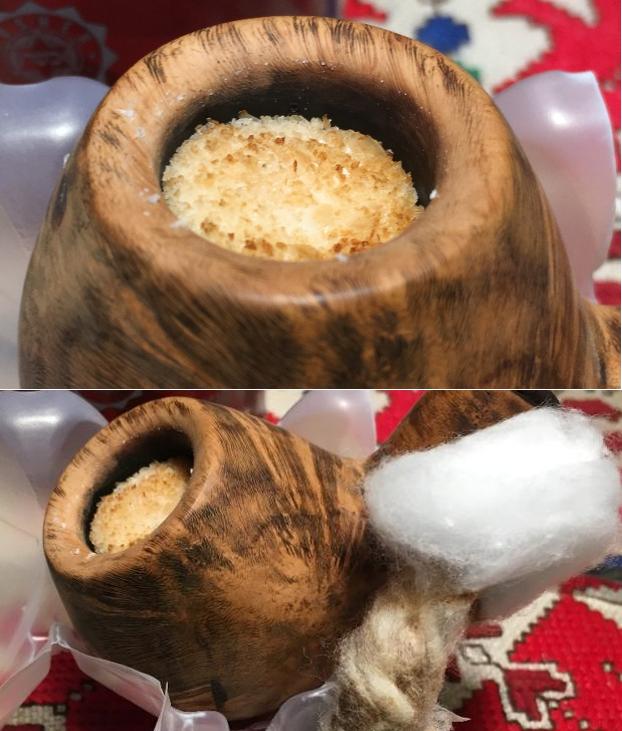
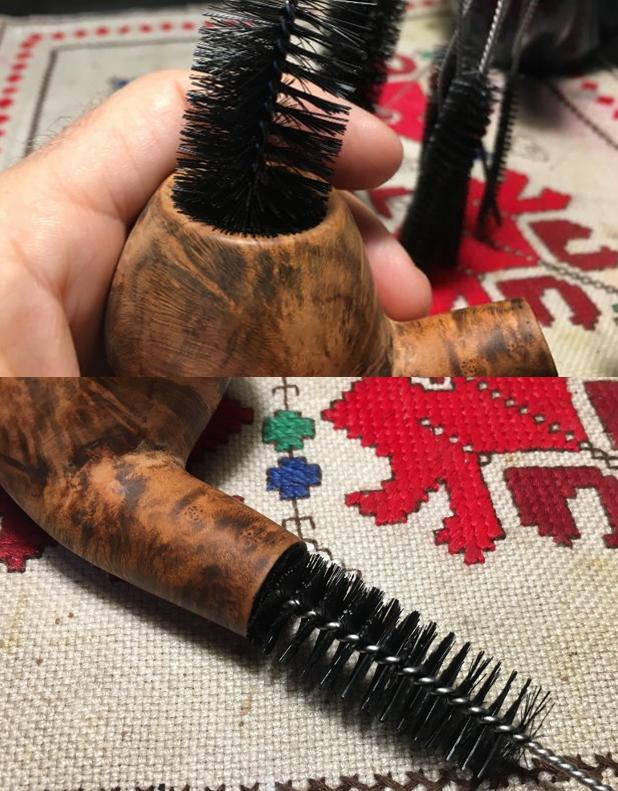
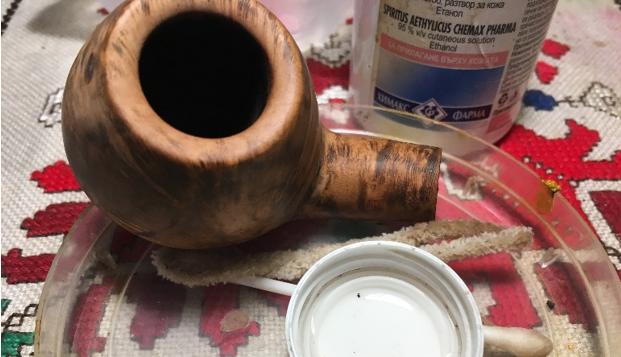
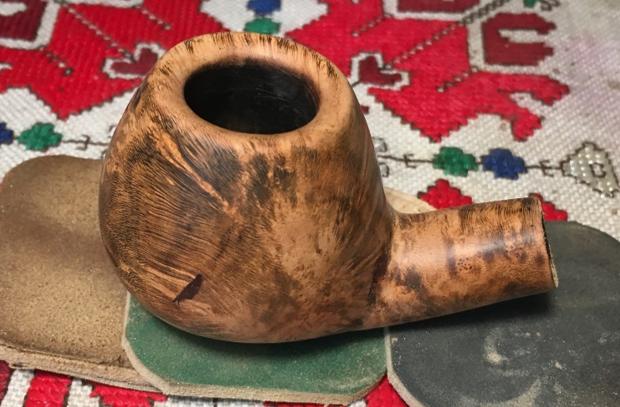
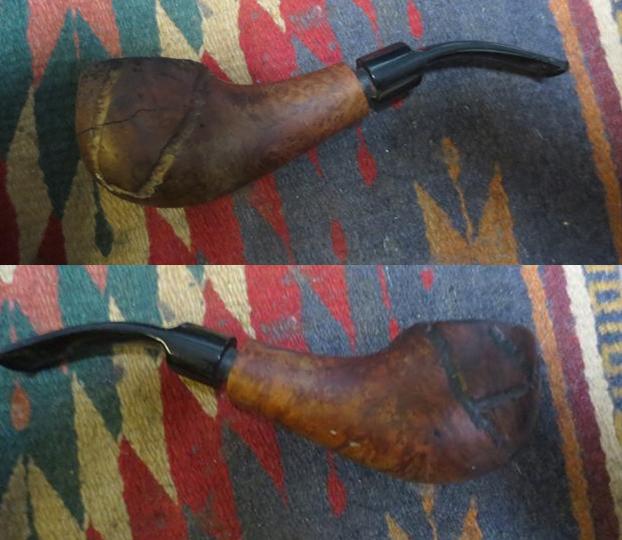
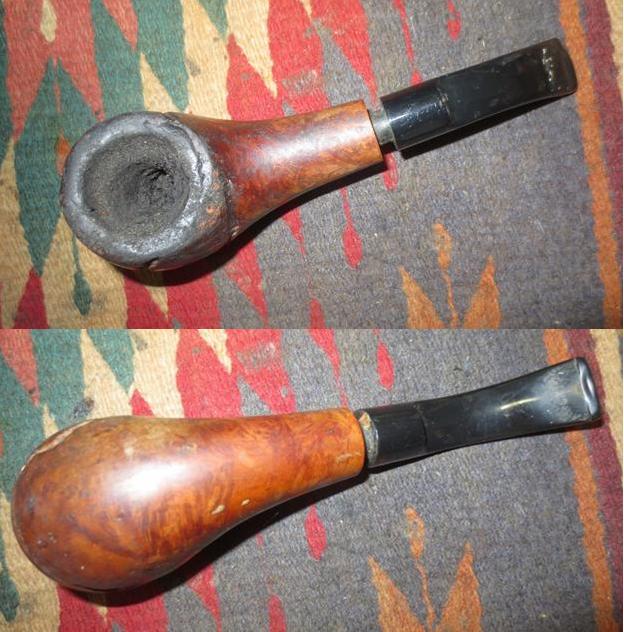
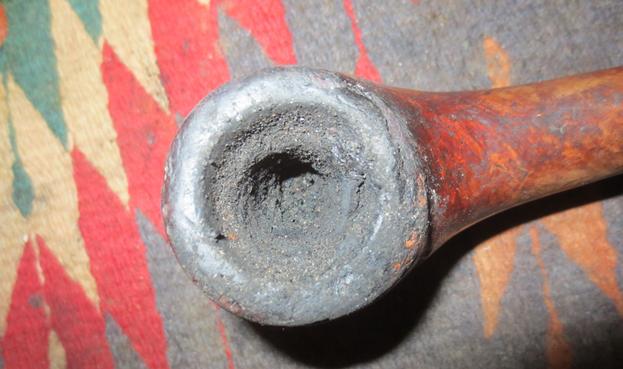
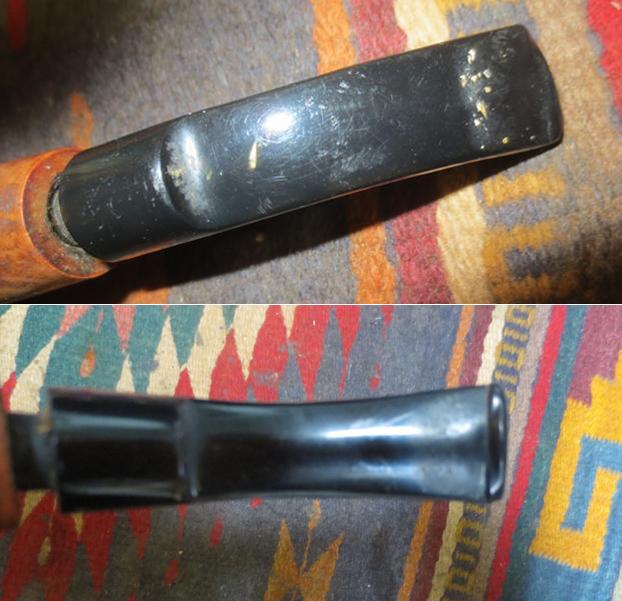
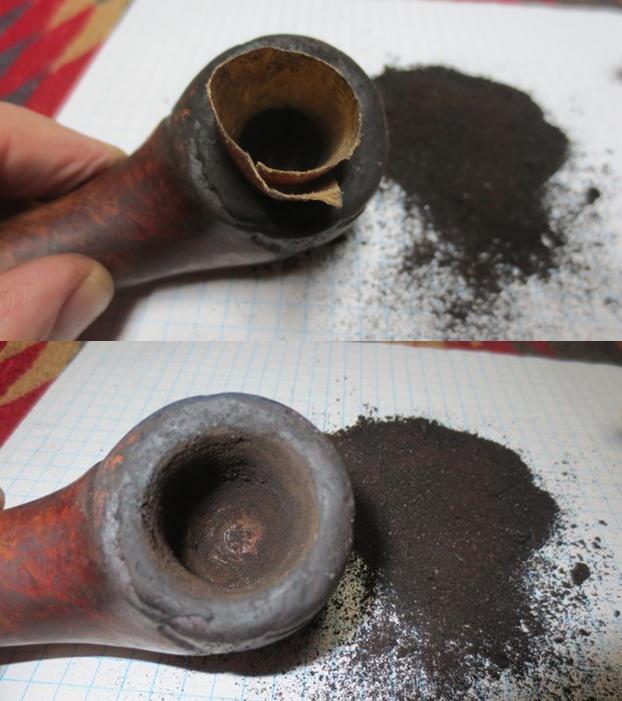
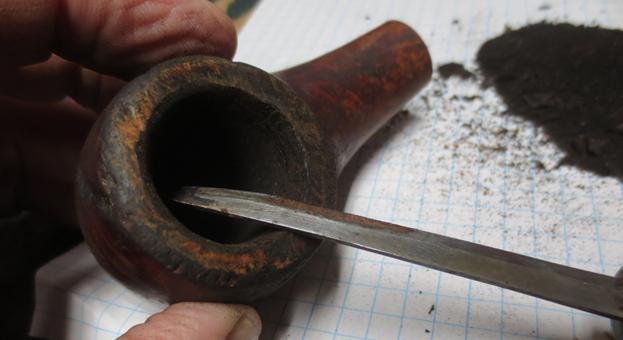
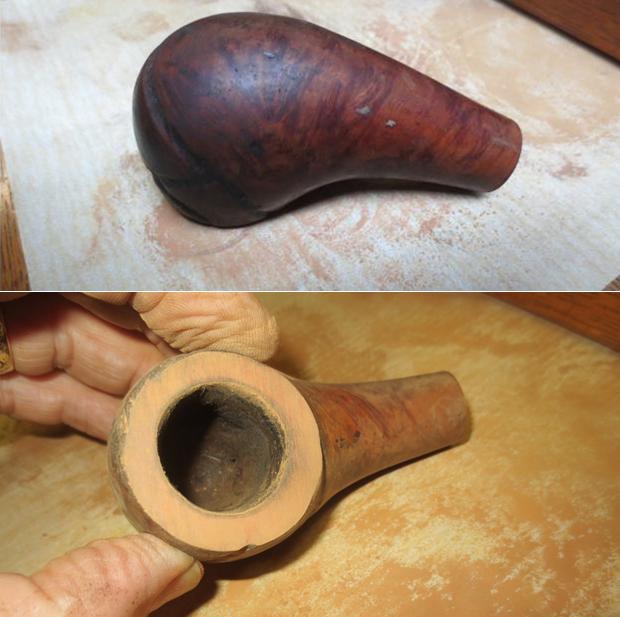
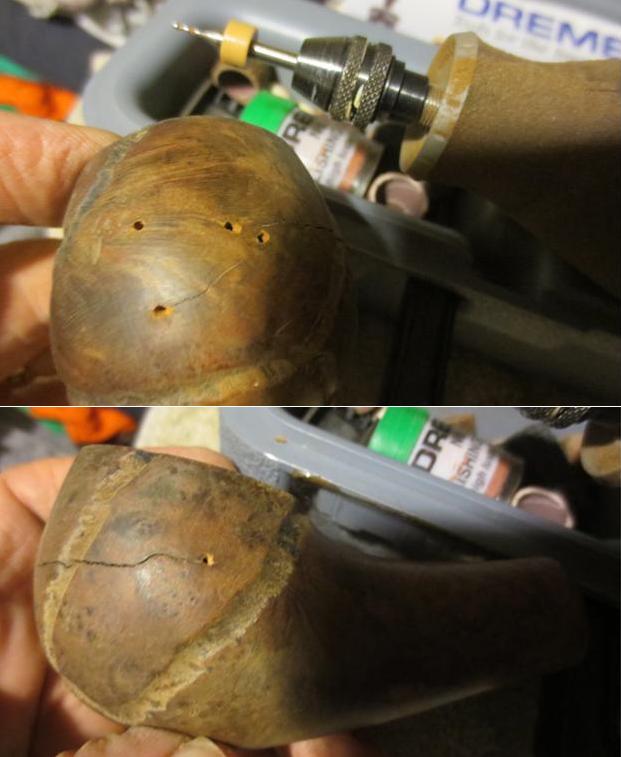
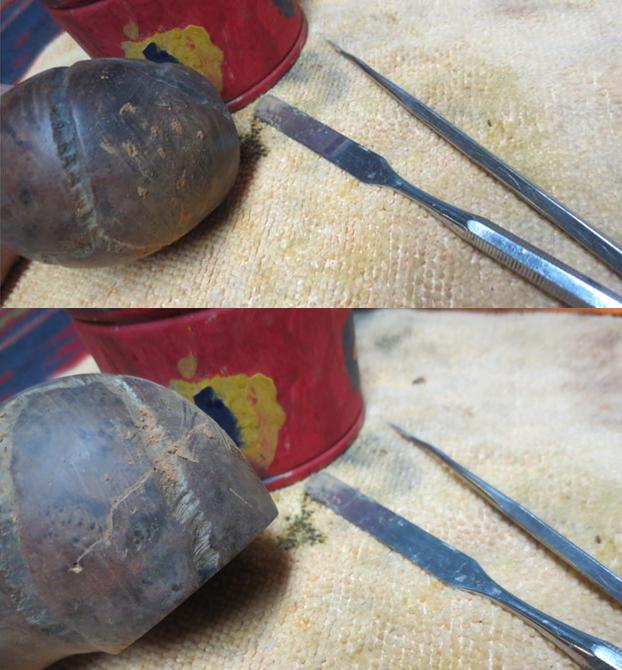
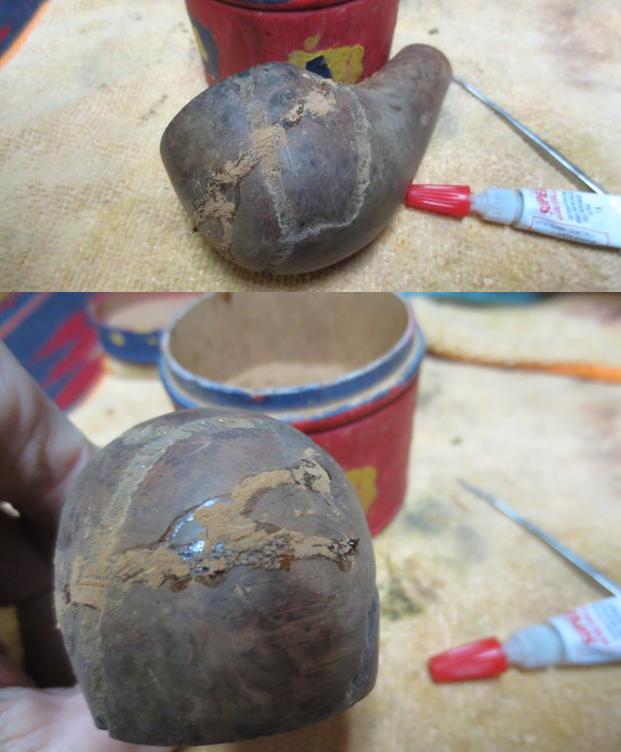
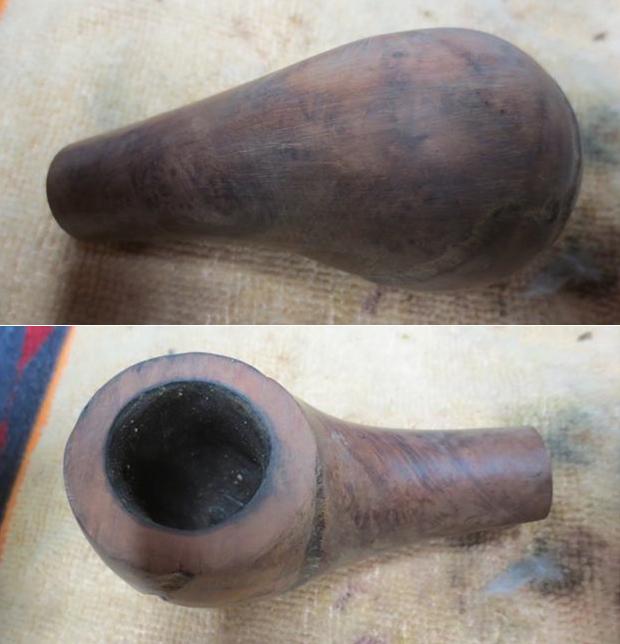
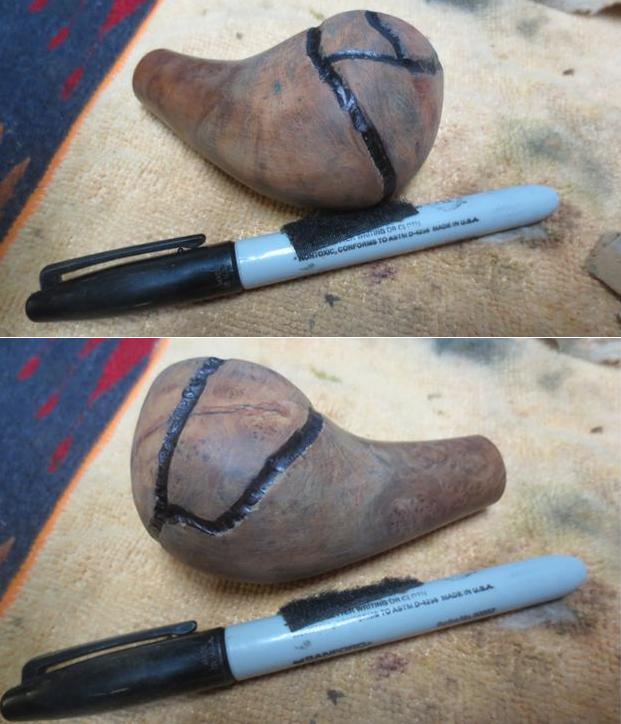
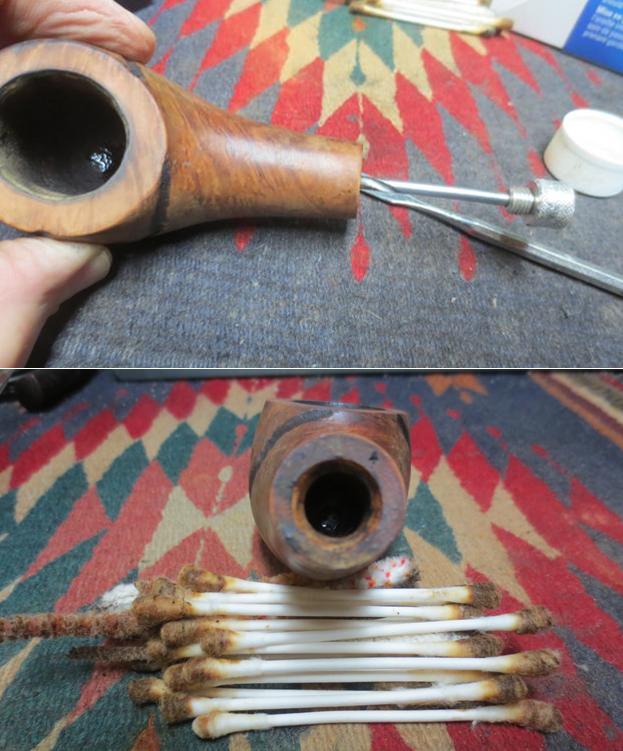
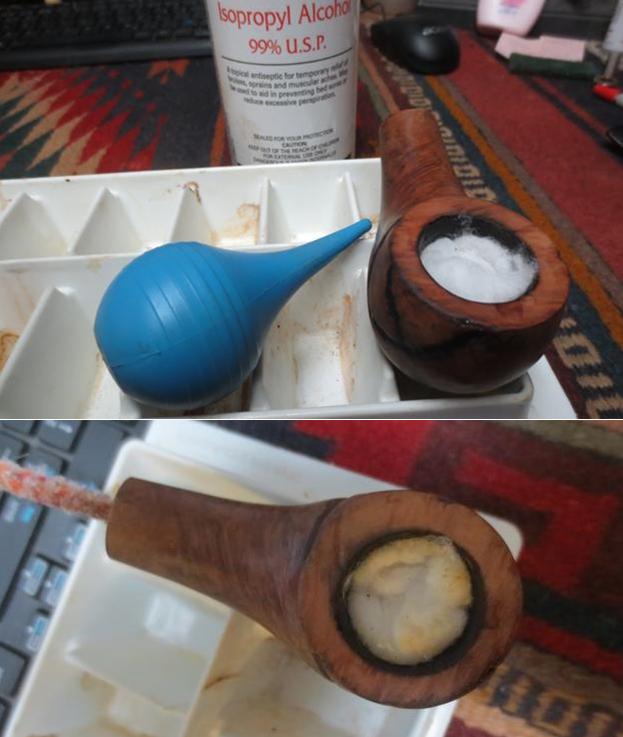
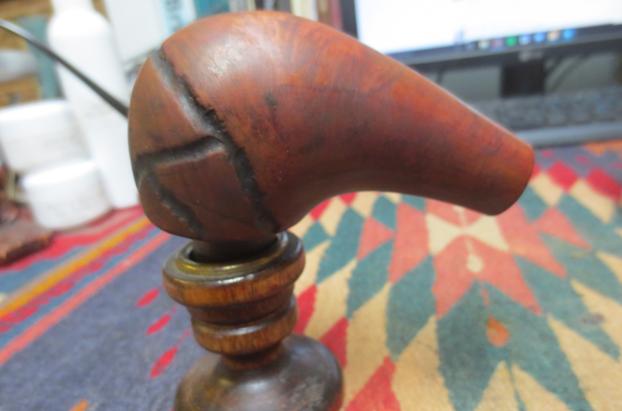
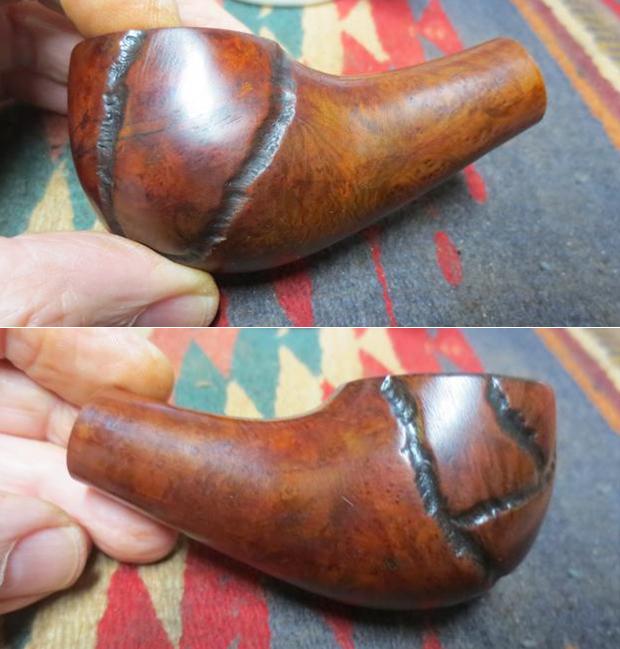
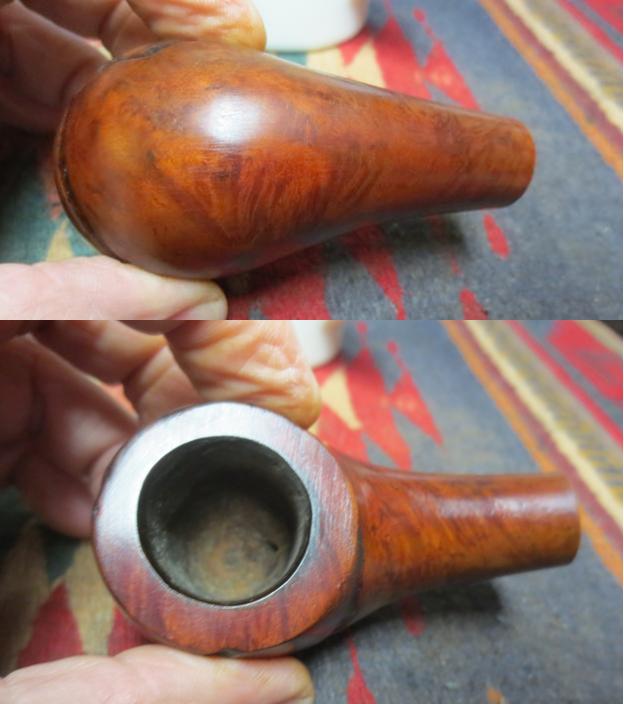
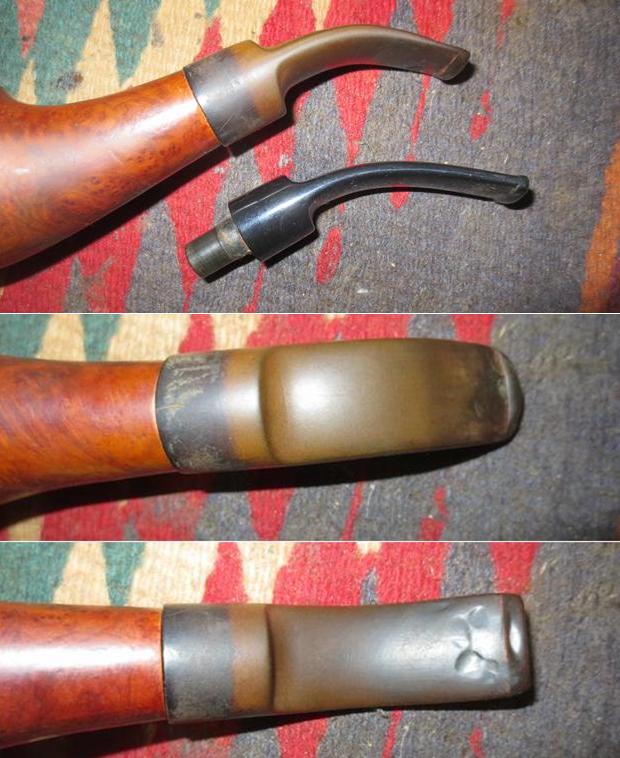
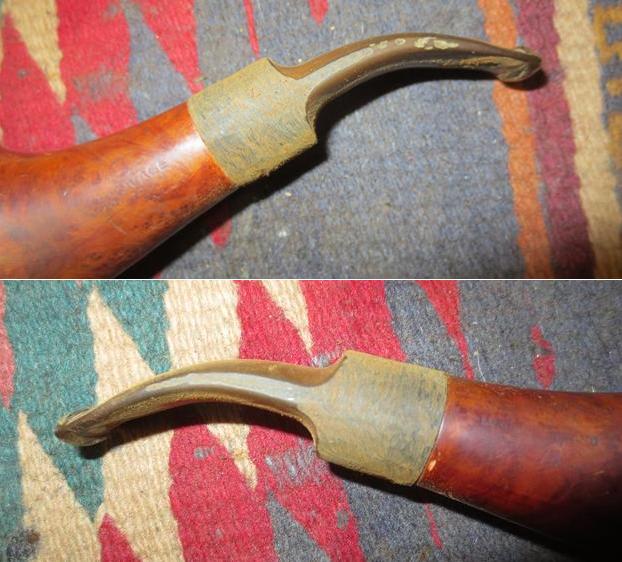
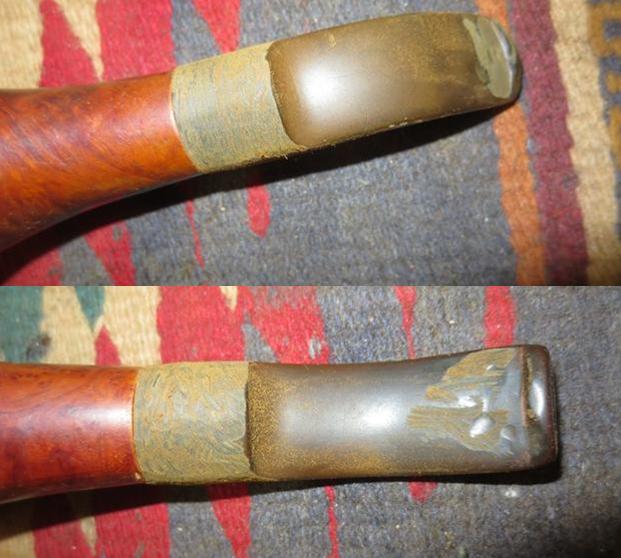
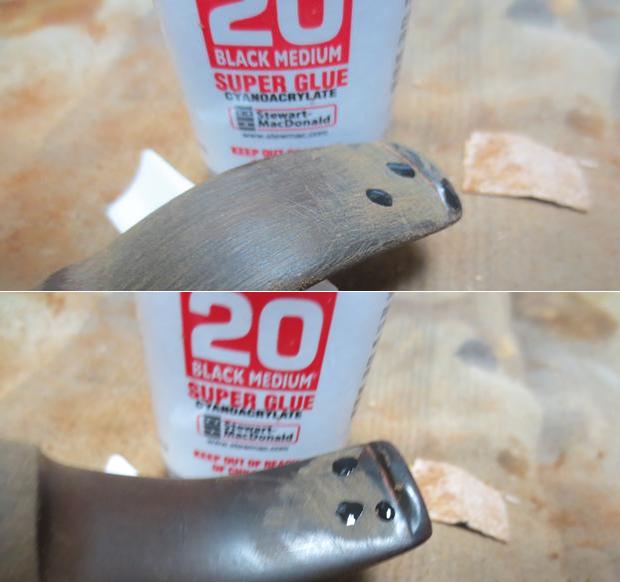
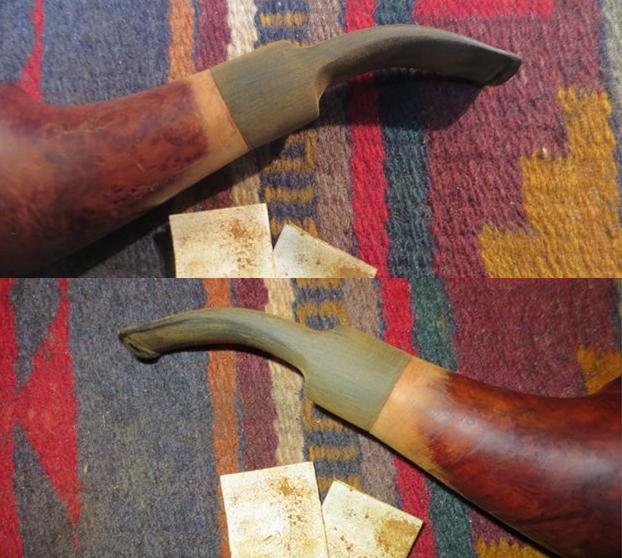
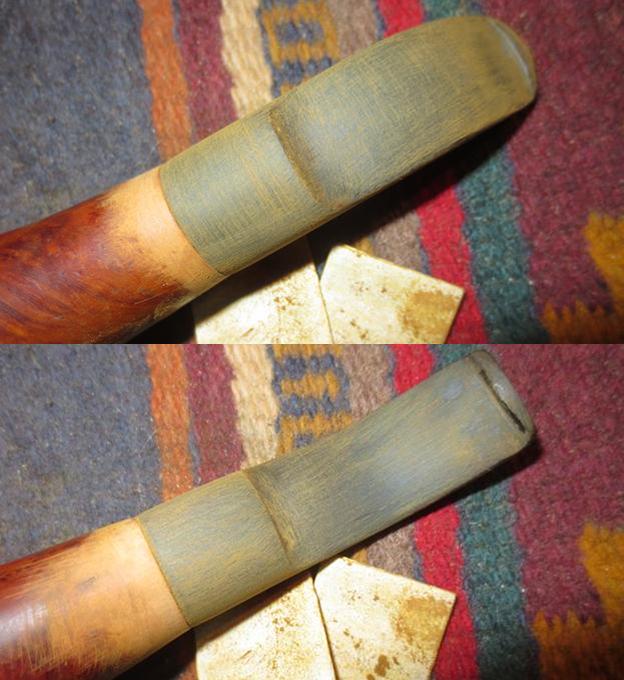
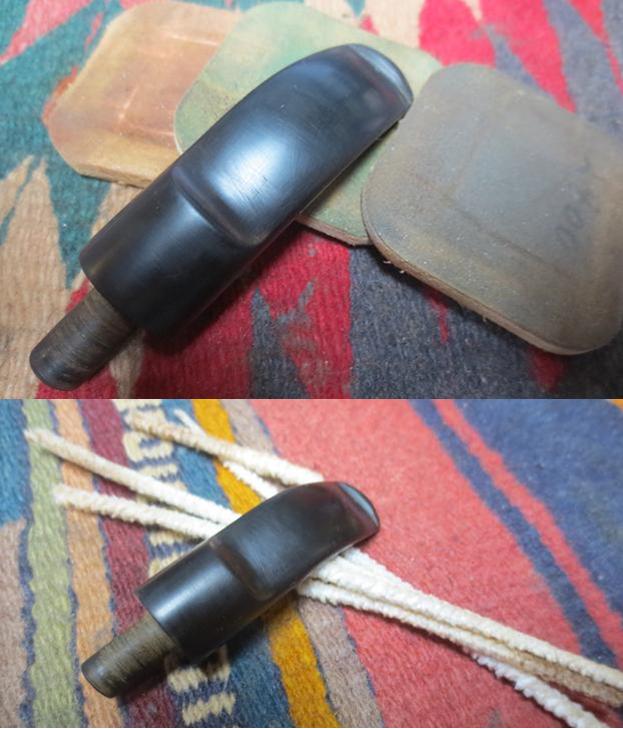
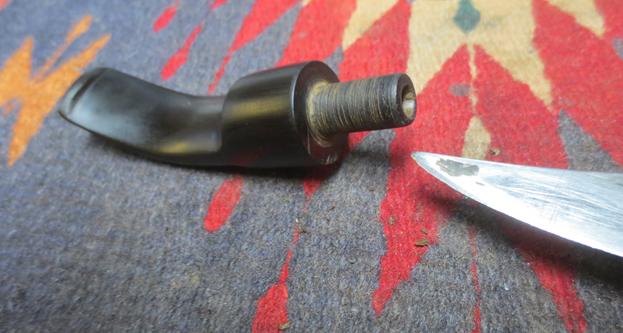
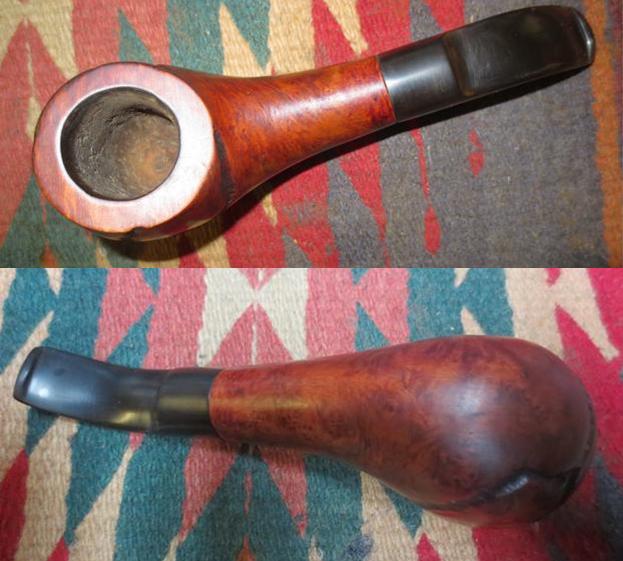
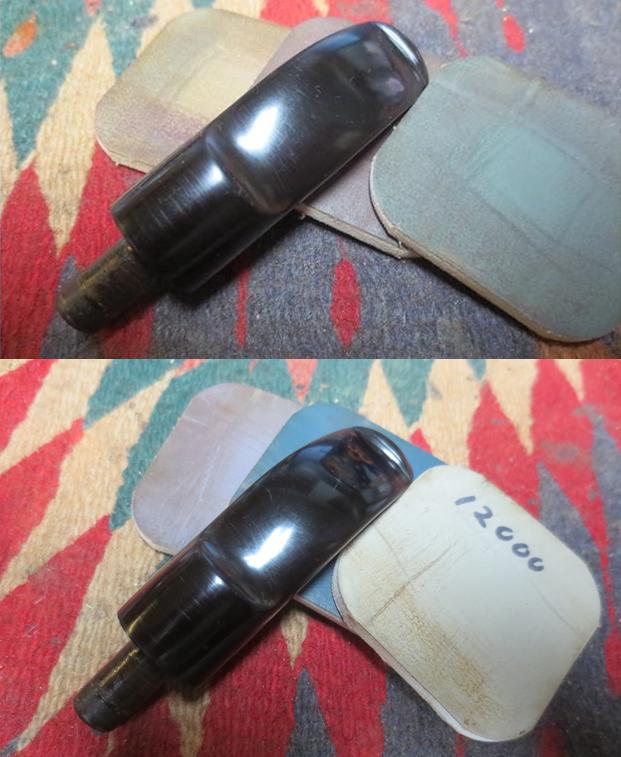
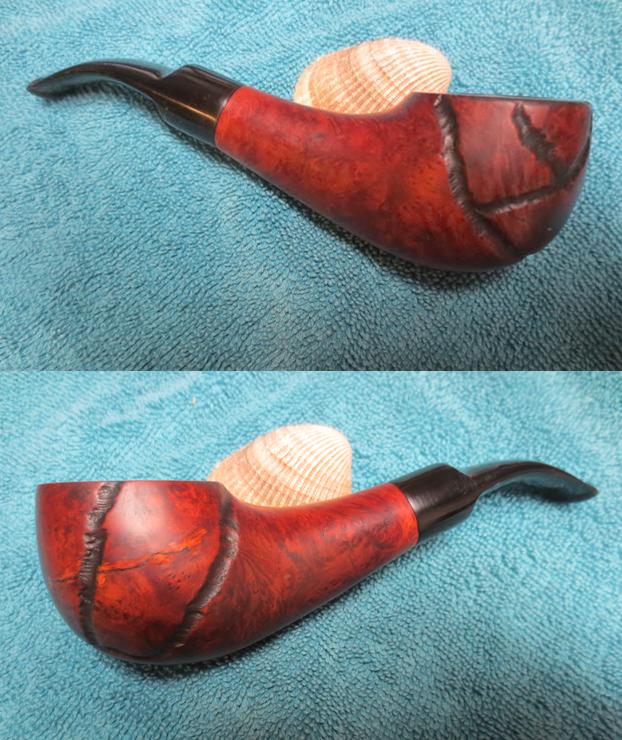
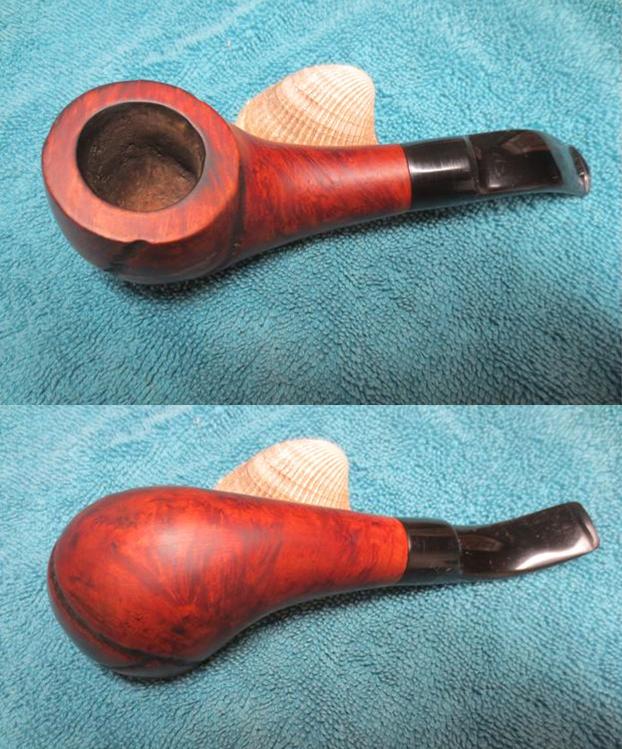
The pipe arrived and it was indeed a mess. On top of the beat up old pipe, the reek of Middleton’s Cherry pipe tobacco filled the room when I opened the box. My daughters immediately commented on how strong the smell was. I examined the pipe with a lens to see if I could identify the pipe. It was stamped on the left side of the shank with the GBD logo in an oval over Sauvage over Collector in script. On the right side of the shank it is stamped Made in England over 75 which is the shape number. The next photos show what the pipe looked like when I received it. I took a close up photo of the rim to show the absolute dreadful condition this pipe was in when it arrived. The bowl had a thick cake that still reeked of the aroma of burnt Middleton’s Cherry pipe tobacco. The rim had been hammered to what looked like the point of no return – though I would not know for sure until I had removed the cake and the buildup on the rim top. The stem was a replacement one and it was obviously a poor fitting one. The diameter of the stem and the shank were not a match and the tenon could not be pushed into the shank because of the grit and tar built up inside. The button had been flattened by biting and there were tooth dents on it and also on the top and bottom sides. I would definitely need to make a new stem for the pipe. I decided to start by reaming the bowl back to bare wood. I wanted to see if the cracks on the outside continued into the bowl. I fully expected the bowl to fall apart once the carbon was removed and ceased to hold everything together. I started reaming with the smallest cutting blade on the PipNet pipe reamer and worked up to the largest cutting head. I finished reaming the bowl with a Savinelli Fitsall Pipe Knife.I rolled a piece of 80 grit sandpaper on my index finger and sanded the inside of the bowl. I wanted to be able to clearly see if the cracks on the outside continued into the bowl. The second photo below shows the inside of the bowl. The crack on the left side of the bowl did not seem to show through inside. The one on the front of the bowl still needed some more work to be certain but it also looked like it did not show through. Notice the buildup on the rim it probably protected the top of the bowl to a large degree.I scraped the rim with a pen knife to peel off the cake that overflowed on the top. I carefully held the blade against the surface of the rim and scraped it slowly until all of the buildup was gone. Underneath all of the buildup the rim was in rough shape. It had been beaten pretty hard and the damage was quite extensive. The rim top showed signs of being knocked about hard against that truck mirror mentioned above. If this pipe could have talked I would love to hear the stories it could tell.I topped the bowl on the topping board using 220 grit sandpaper. I decided that I would sand it until the top of the rim was smooth and the damage on the outer edge of the rim was minimized.With the rim topped and smooth I wiped the bowl down with acetone on cotton pads to remove the grime and clean up the surface so I could assess the next steps in dealing with the external cracks on the left side and bowl front. I used a microdrill bit on my Dremel to drill pin holes at each end of the cracks in the bowl. The length of the bit ensures that I will not be able to drill too far and go into the bowl itself. There were five distinct ends to the series of cracks in the briar.I used a dental pick to clean out the cracks with surprisingly had closed tighter once the cake was removed from the bowl releasing the pressure. Once they were clean I pressed briar dust into the crack surfaces and the drill holes in the bowl. I dripped clear super glue on the cracks and into the plugs in the drill holes. I gave the repair several more coats of briar dust and super glue until the surface was filled. The pictures tell the story. I sanded the dried repair and the rest of the bowl with 220 grit sandpaper to remove the excess briar dust and glue. I wiped the bowl down with alcohol on a cotton pad. I used a Black Sharpie pen to colour in the worm trail rustication around the bowl sides. I had done some research and found that the rustication on the Sauvage line had been darker than the stain on the bowl.I used the drill bit from the KleenReem Pipe reamer to drill out the buildup in the airway from the mortise to the bowl. It was thick and hard so the drill bit took several passes through the airway to clean it out. I used a dental spatula to scrape out the thick, hard tars that lined the walls of the mortise. I scrubbed out the mortise and airway with alcohol, cotton swabs and pipe cleaners until the internals were clean.I stuffed the bowl with cotton balls until they were just below the edge of the rim. I put a pipe cleaner in the airway to wick the alcohol into the shank. I used an ear syringe to fill the bowl and shank with alcohol. I set the bowl upright in an ice cube tray and let it sit over night to draw the oils out of the briar. In the morning I took a photo of the darkened cotton balls. I used a dental pick to pull them out of the bowl. I cleaned out the shank and the bowl with cotton swabs to remove all the excess alcohol. I let the bowl dry.I stained the bowl with a dark brown aniline stain thinned 50/50 with alcohol to make it more transparent. I flamed the stain and restained it. I repeated the process of staining and flaming the surface until the briar had even coverage. I buffed the bowl with Blue Diamond on the buffing wheel and then took the following photos to send to Jim to show him the state of the bowl at this point in the process. There were still scratches in the finish that would need to be polished out but the bowl was showing promise and beauty was emerging from the beast. I left the pipe on my work table while I traveled to Idaho for my mom’s 90th birthday. I stay with my brother Jeff when I am there and as usual he had a batch of pipes for me. There were some amazing pipes there but what caught my eye this time was the stem I needed for this Sauvage. It was slightly bigger in diameter than the shank but it would not take much to fit it to the pipe. When I got home I lightly sanded the tenon with a Dremel and sanding drum until it fit snugly into the mortise. I took the photo below to show the new stem and the one that was with the pipe when it arrived. I took photos of the stem to show the difference in diameters of the shank and the stem. You can also see the deep tooth marks in the top and bottom sides of the stem near the button.I sanded the diameter with a sanding drum on the Dremel. I do this with the stem inserted in the mortise so that I can remove as much of the excess vulcanite as possible without damaging the briar on the shank. I nicked the edged of the briar but fortunately the nick was not deep. I also lightly sanded the top and underside of the stem with the Dremel and minimized the tooth marks. I sanded the areas on the stem where the tooth marks had damaged the vulcanite with 180 grit sandpaper and smoothed out the surface damage. What remained were the deeper tooth marks. I wiped down the surface of the stem with alcohol on a cotton pad to remove the debris and dust from the tooth marks. I filled the remaining tooth marks with black super glue and set the stem aside to dry.When the repairs had cured I sanded them with 180 grit sandpaper to blend them into the surface of the stem. I sanded the saddle portion of the stem to remove the marks left behind by the sanding drum.I put the stem in the shank and sanded the stem and shank with 220 grit sandpaper to make the transition really smooth. I could have done this differently but there was enough damage to the shank that the sanding would smooth out the briar as well. I wet sanded the stem and shank with 1500-2400 grit micromesh sanding pads to smooth out the scratches on the briar and the vulcanite. I was able to remove most of the scratches. The rest would come out with more elbow grease. I cleaned out the inside of the stem with pipe cleaners and alcohol until they came out clean. I used a sharp knife to bevel the airway into the stem. I have found that doing this directs the airflow from the bowl to the button. I put the stem in the shank and took the following photos. There is still a lot of polishing to do but the pipe is beginning to look pretty decent. I continued sanding with the 3200-12000 grit micromesh sanding pads to polish the stem. After each set of three pads I rubbed it down with Obsidian Oil and sanded some more. After the last pad I gave it a final coat of the oil and let it sit to dry.I buffed the bowl and stem with Blue Diamond on the buffing wheel and then gave both the bowl and the stem multiple coats of carnauba wax. I buffed it with a clean buffing wheel to raise the shine and hand buffed it with a microffibre cloth to deepen it. The finished pipe is shown in the photos below. I am repairing and refitting the original stem to send back with the pipe as well. Once it finished I will buff the two stems and finish removing any scratches that can still be seen in the pipe and then send it back for the surprise that Jim has in mind for it. Thanks for looking.
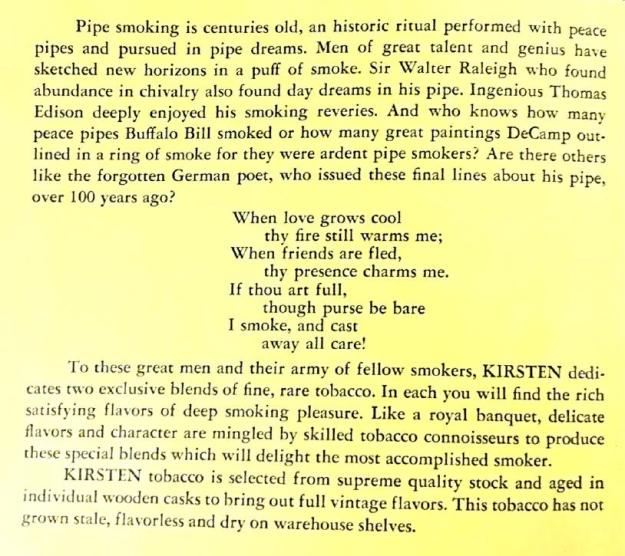
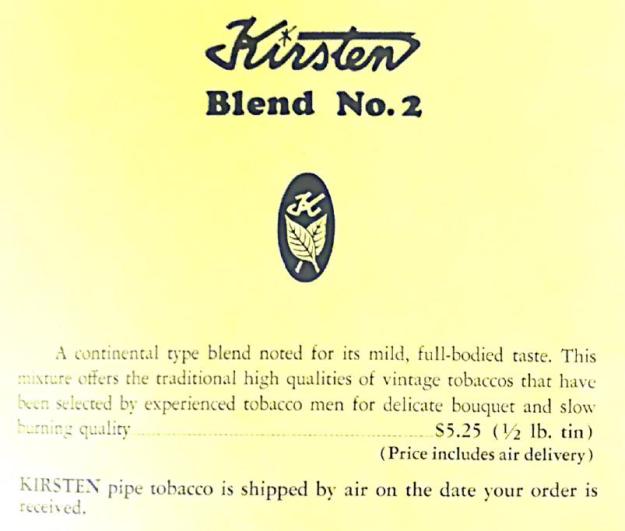
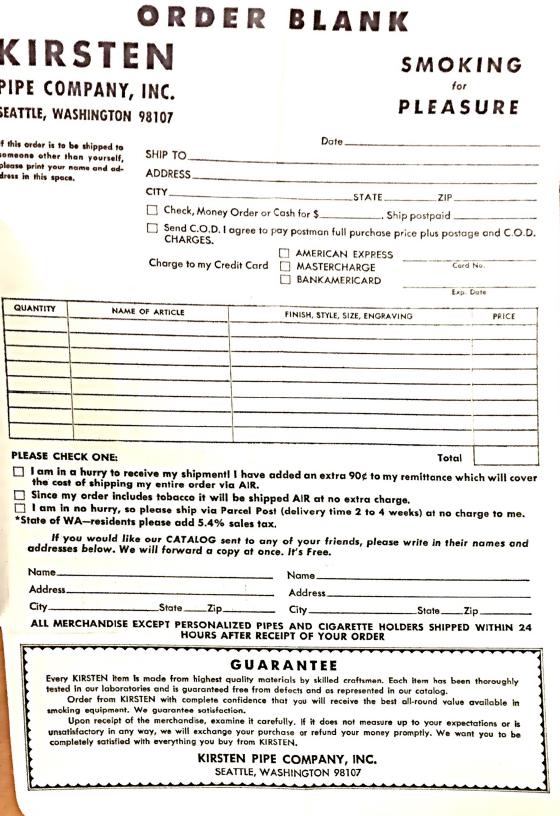
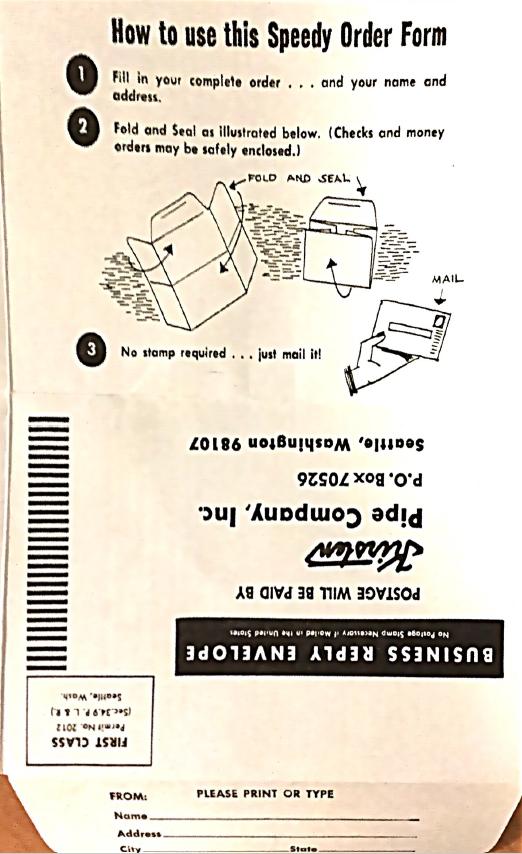
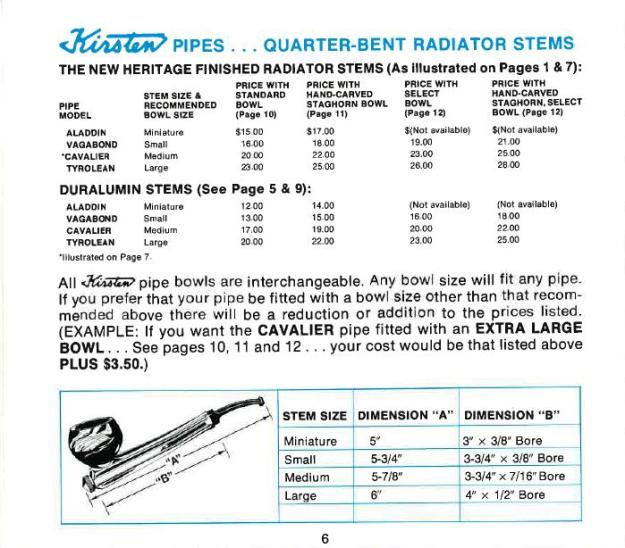
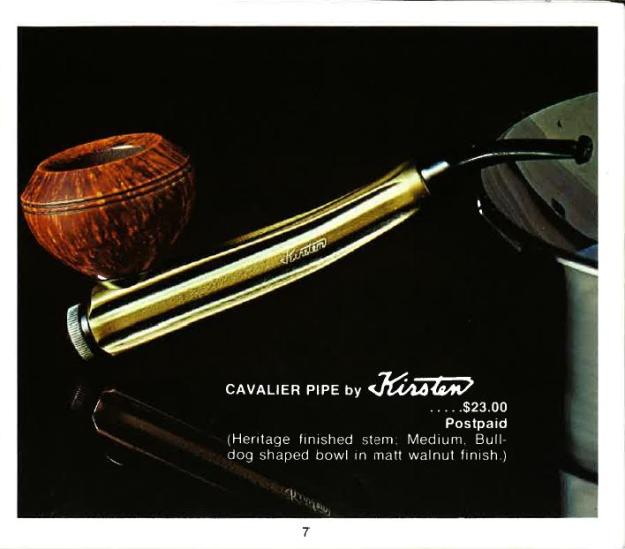
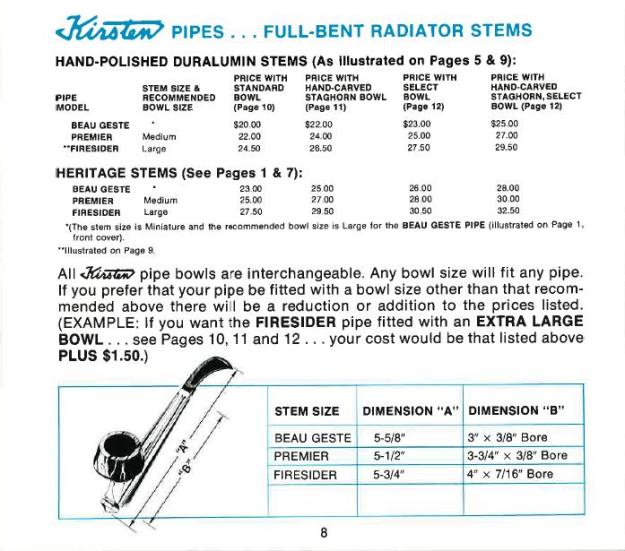
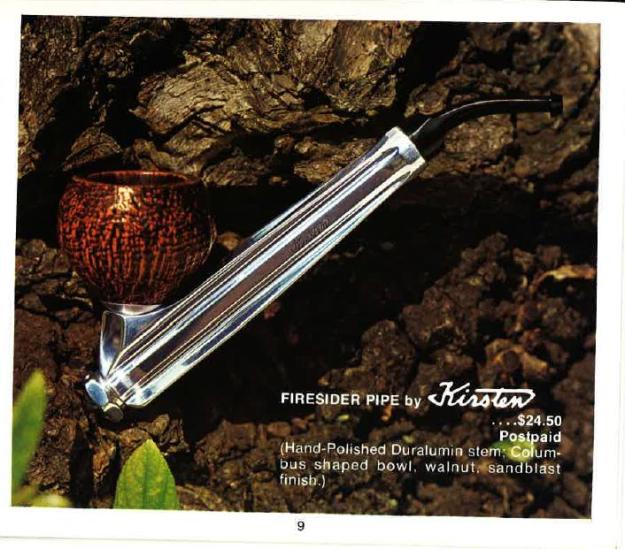
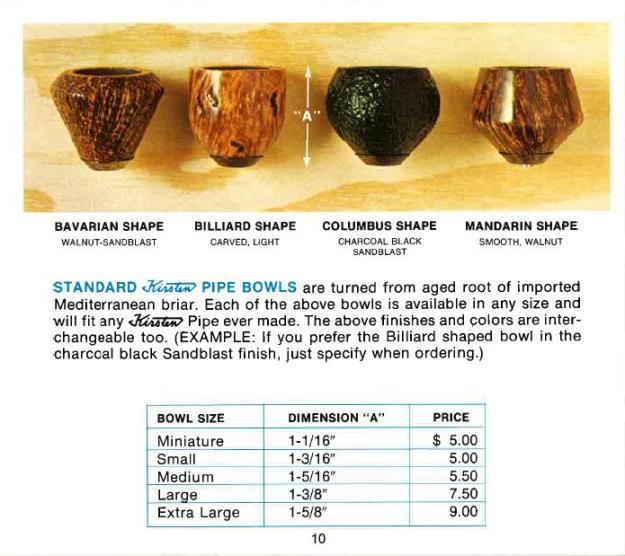
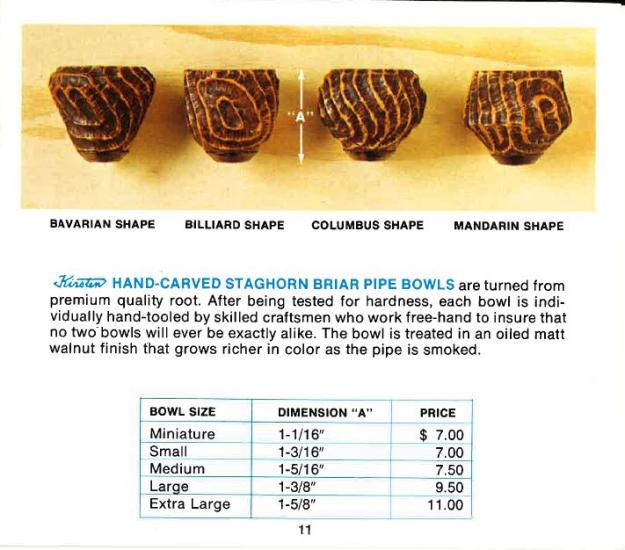
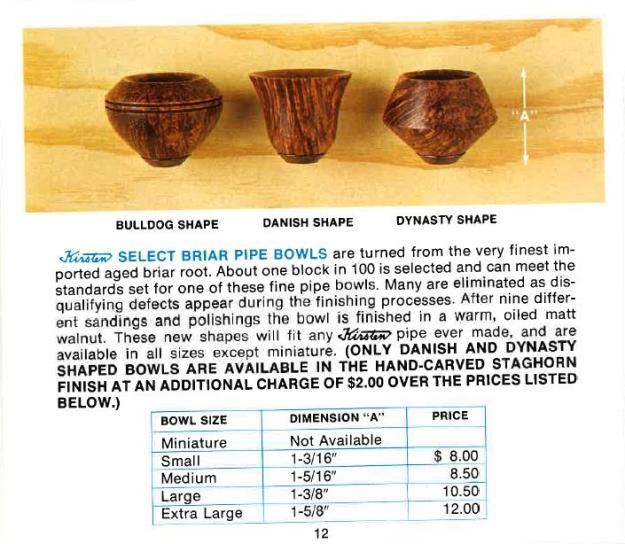
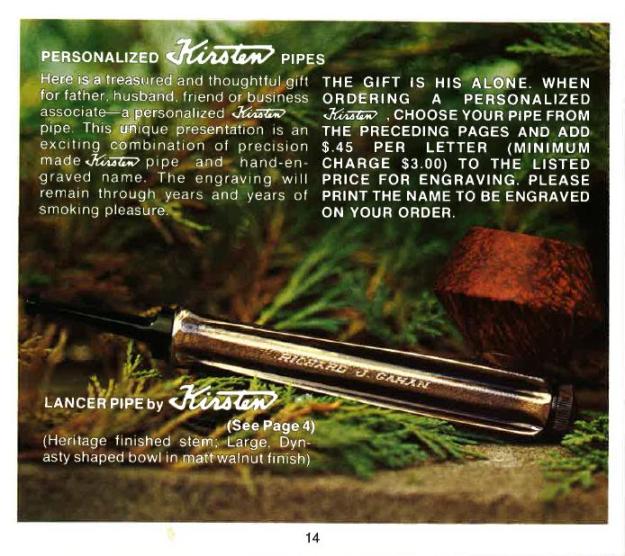
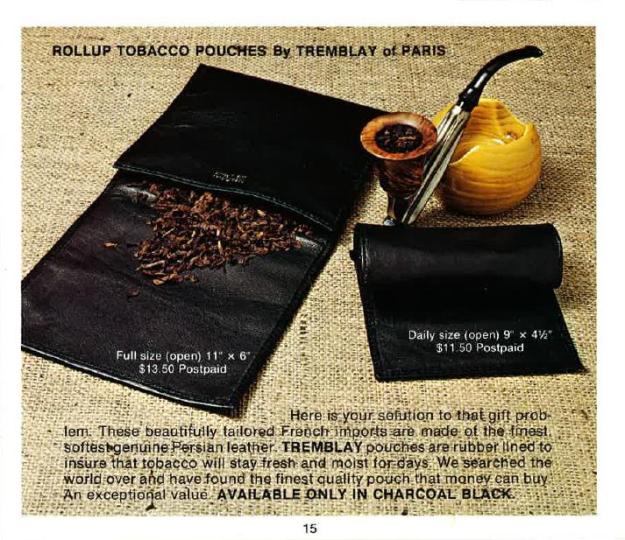
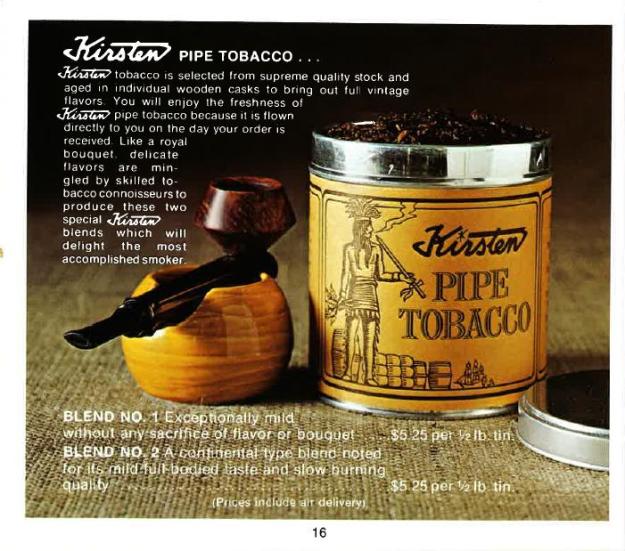
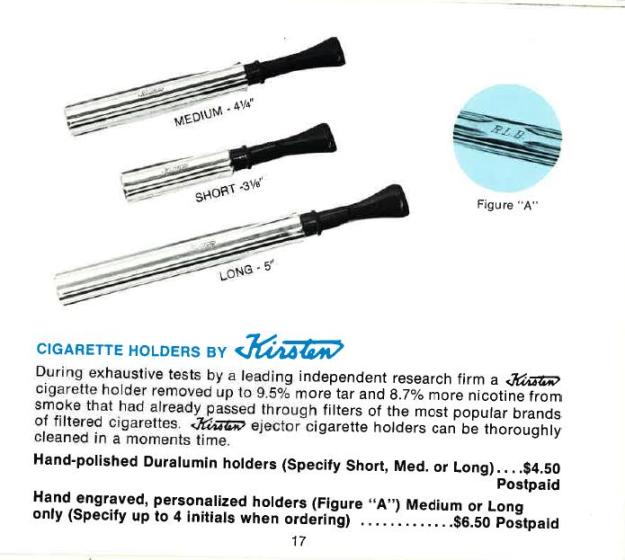
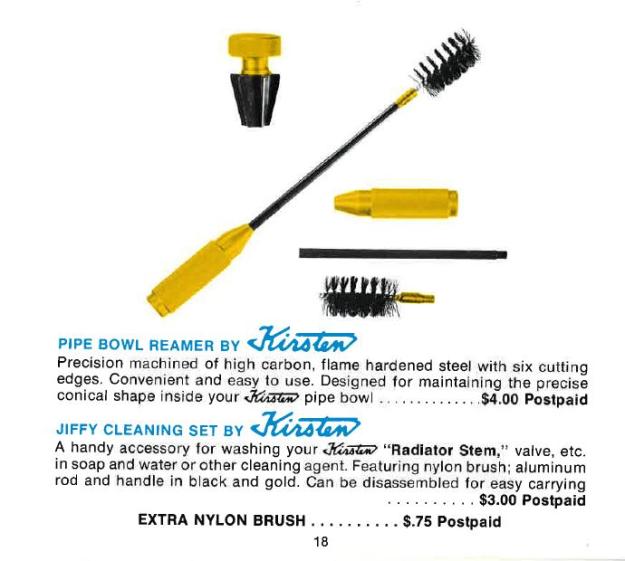
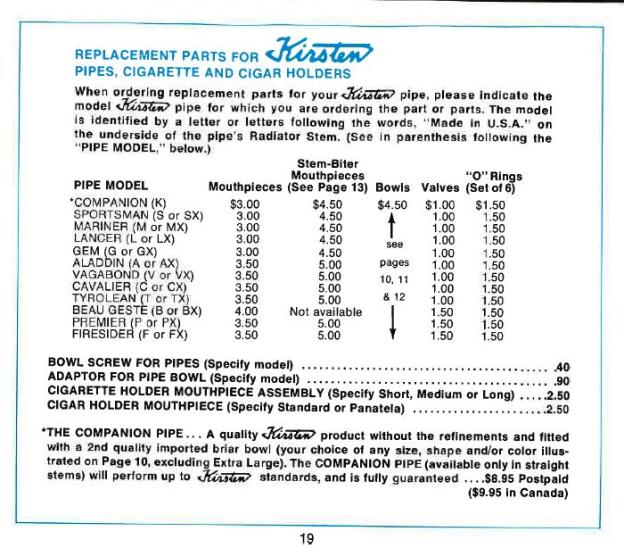
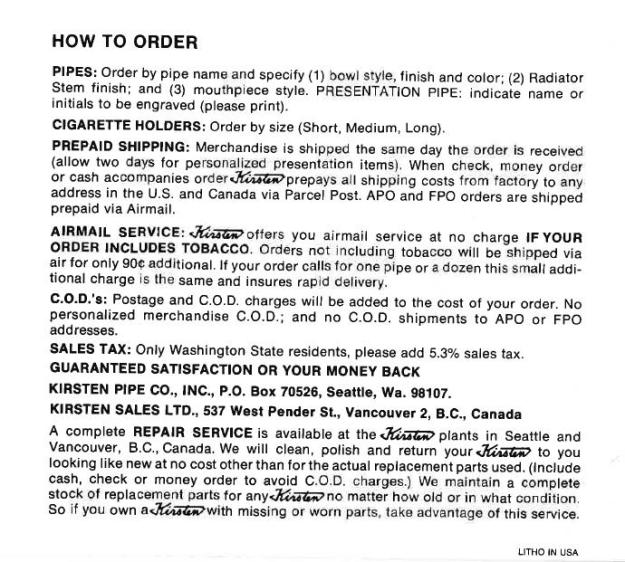
1974-1975 Kirsten Pipe Tobacco Flyer


This flyer came to me in the lot of Kirsten pipes that I purchased recently. I find these old flyers fun to read and get a flavour of the marketing and also of the prices and items available in days gone by. Enjoy the read.


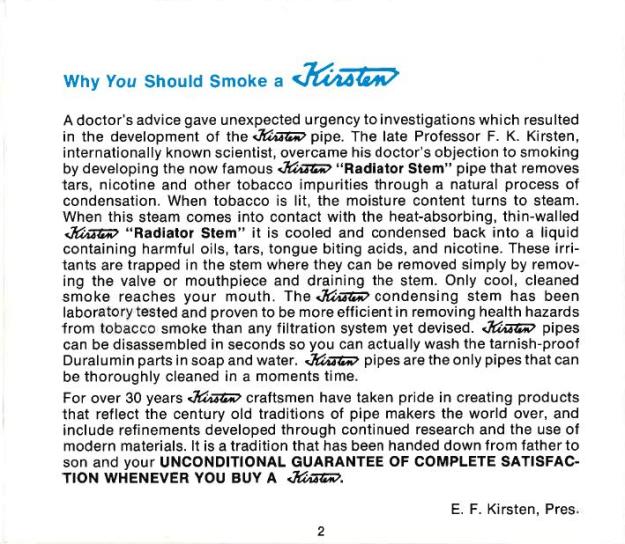
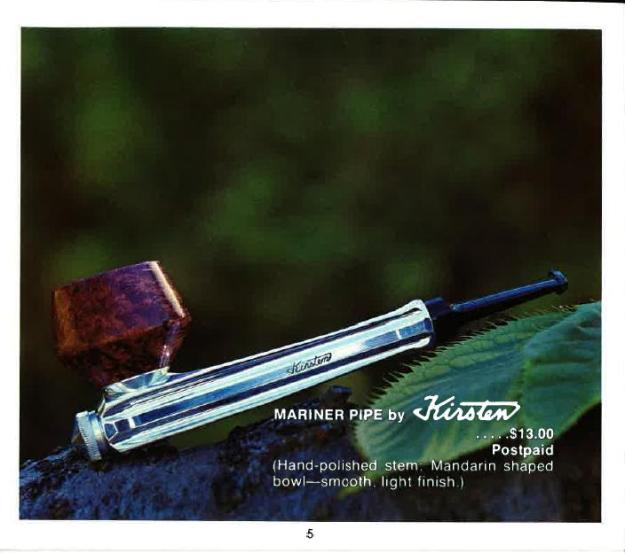
1974-1975 Kirsten Pipe Company Catalog


I received an email while I was traveling to my mom’s 90th birthday from a reader who was selling 6 Kirsten pipes and wanted to know if I was interested in buying them. He sent a photo and to my surprise they included not only the pipe but some parts, boxes, extra bowls and some catalogs. This is the first of them – a 1974-1975 Catalog. I thought you all might be interested in having a look.


Peterson 999 Meerschaum (Sterling) Restoration


By Al Jones
al_pipes_-85

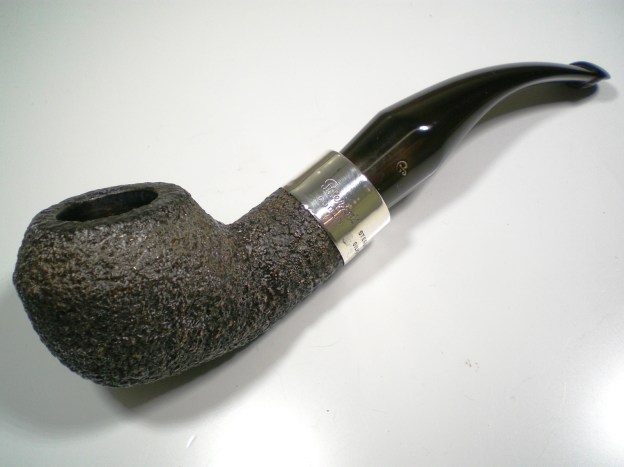
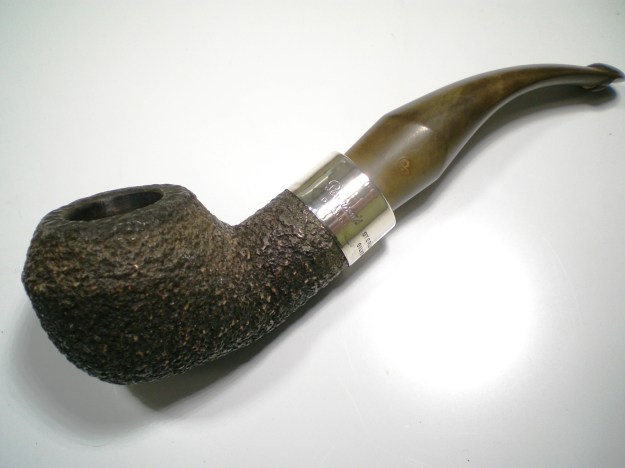
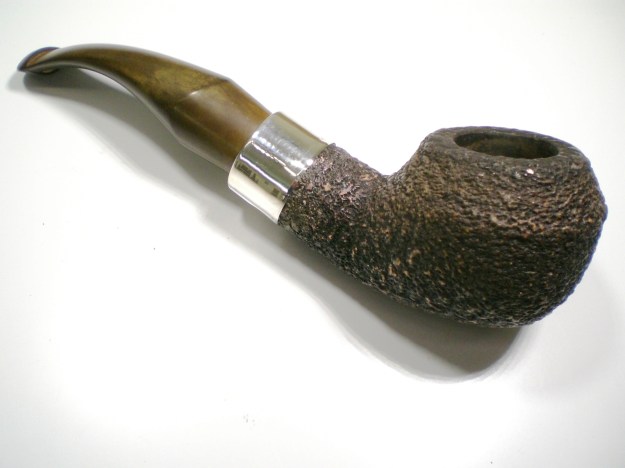
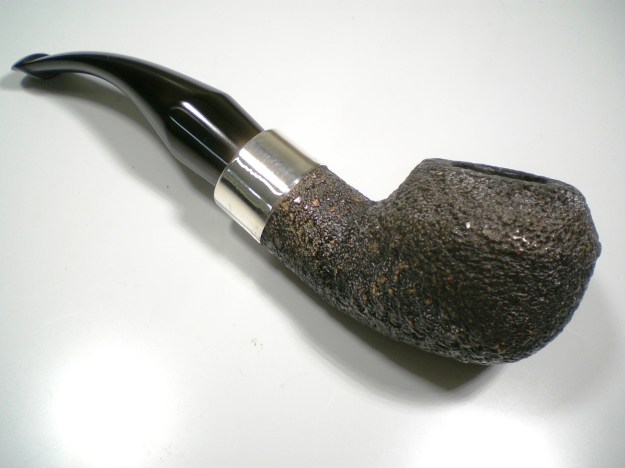
This unusual Peterson came via Ebay. It wasn’t listed as a meerschaum pipe, but from the appearance, I thought it was from made from that material. The stem was mildly oxidized. Other than that, it appeared to have been only used lightly. To this point, I’ve not seen a Peterson 999 in this shape and meerschaum finish.

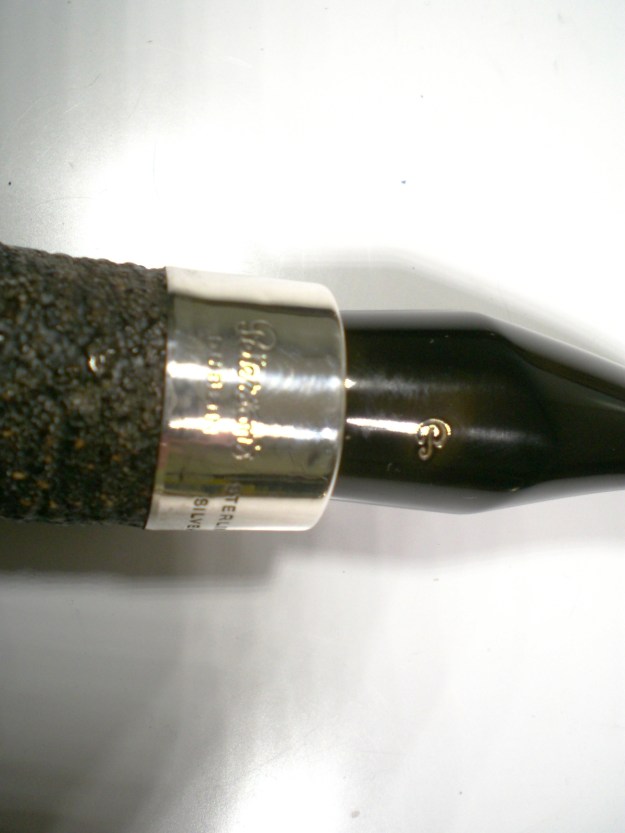
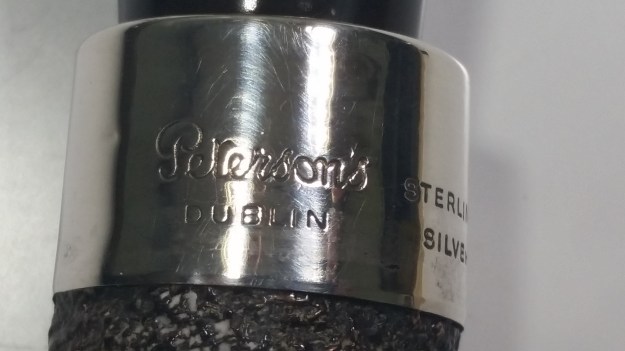
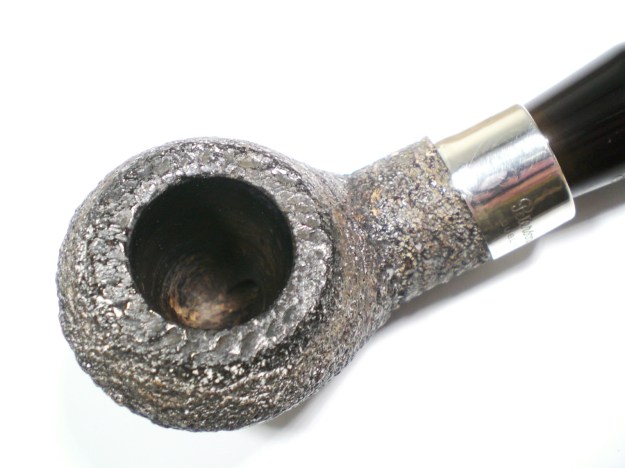
As always, Peterson authority Mark Irwin had some helpful comments about this piece. Mark told me that the pipe was African block meerschaum, made by Manxman on the Isle of Man, for Peterson. Peterson eventually bought out Manxman and moved production to Dublin. The hallmarked Sterling band (italicized, lower case h for 1975) denotes a quality piece, made during the Isle of Mann era. I found this on the Peterson Pipedia page:

The Peterson Manx (Laxey) Isle of Man factory partnership ceased operation about 1981 and the production of all African Meerschaum pipes was moved to Dublin and continued there until 1986.

Here’s the pipe as received.

peterson_999_sterling_meer_before-1

peterson_999_sterling_meer_before-2

I put a dab of grease on the stamped P stem logo and soaked it in a mild Oxy-Clean solution. I used the cleaning tutorial by Fred Bass, which is available on this blog entry:

Fred Bass’ Tutorial – Cleaning Estate Meerschaum Pipes

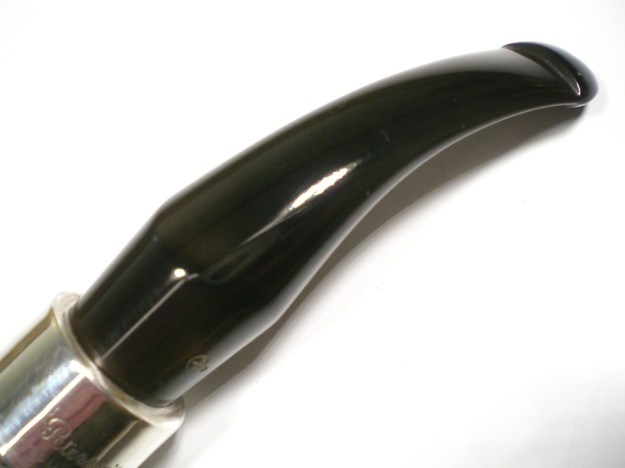
The oxidation on the stem was removed with 800, 1,000 and 2,000 grade wet sandpaper, followed by 8,000 and 12,000 Micromesh sheets. The stem was then buffed with White Diamond and Meguiars Plastic Polish. The Sterling band was brightened with a silver polish cream and a cotton cloth.

Following Fred’s instructions, I rubbed on some beeswax and melted it into the meerschaum with a heat gun.

Below is the finished pipe. I’m not a meerschaum pipe fan, so this one is available at the PipesMagazine.com Buy/Sell/Trade section.

peterson_999_sterling_meer_finish-1

peterson_999_sterling_meer_finish-4

peterson_999_sterling_meer_finish-5

peterson_999_sterling_meer_finish-2

peterson_999_sterling_meer_finish-6

peterson_999_sterling_meer_finish-3

peterson_999_sterling_meer_finish-8

peterson_999_sterling_meer_finish-9

Refreshing a Stanwell Gilt Edged 124 Ivarsson Design


Blog by Steve Laug

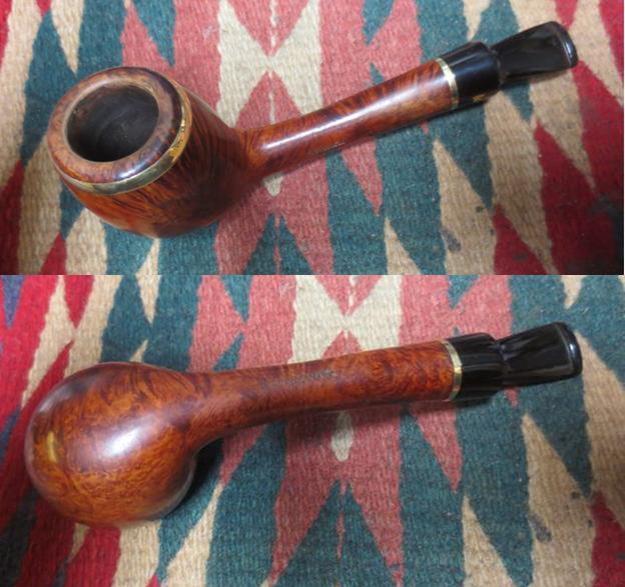
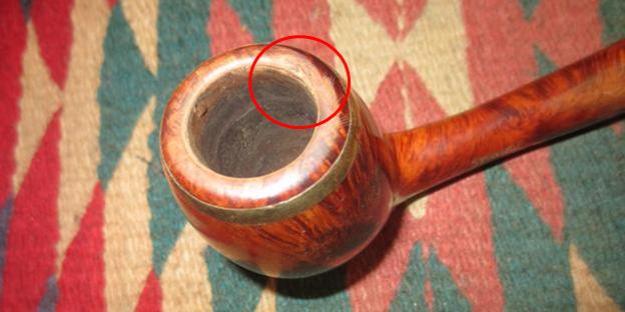
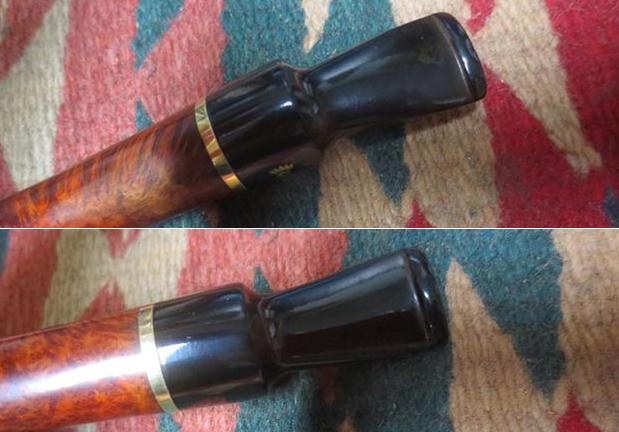
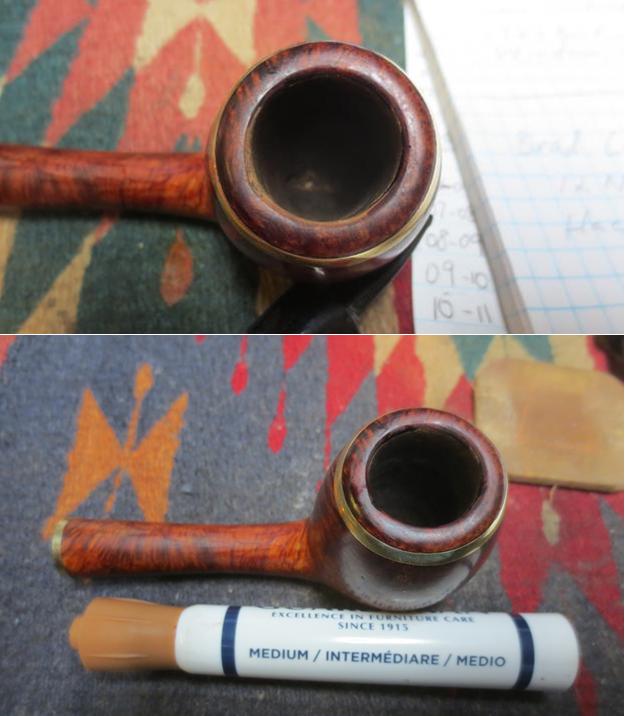
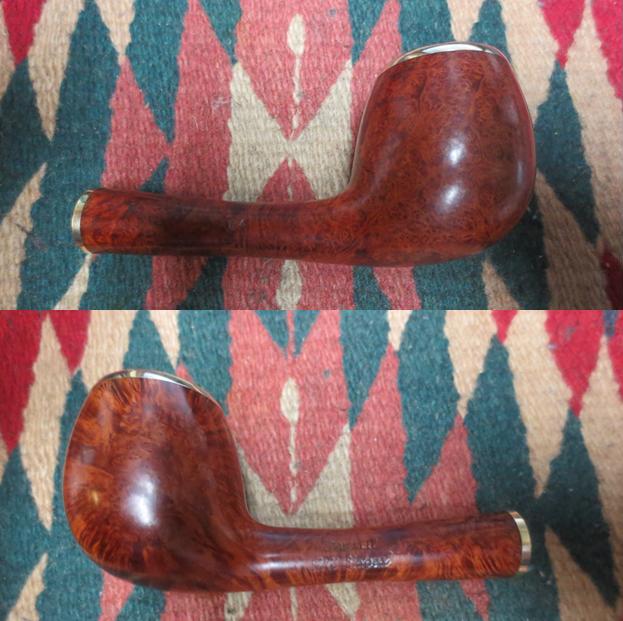
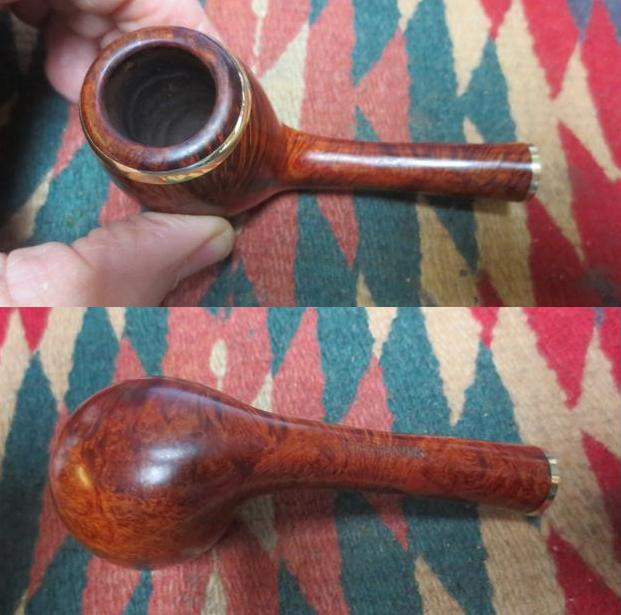
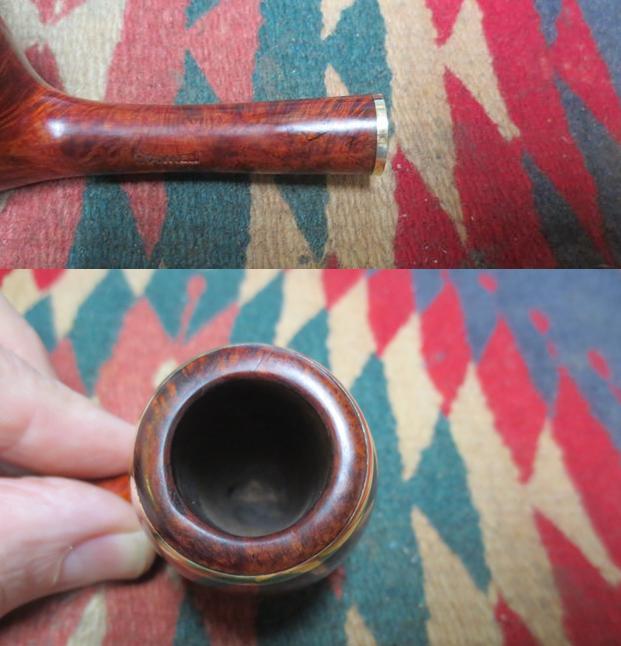
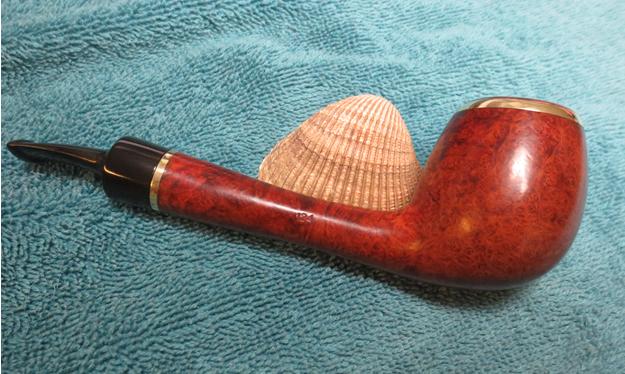
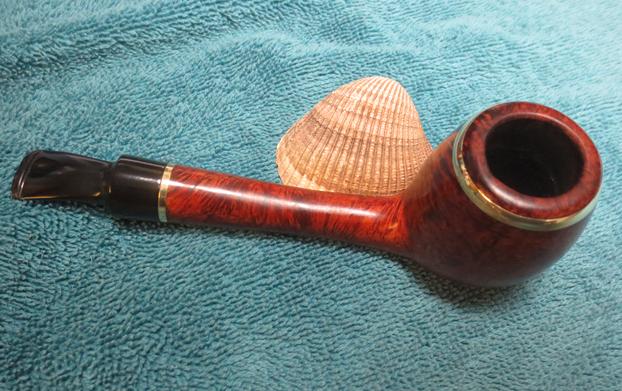
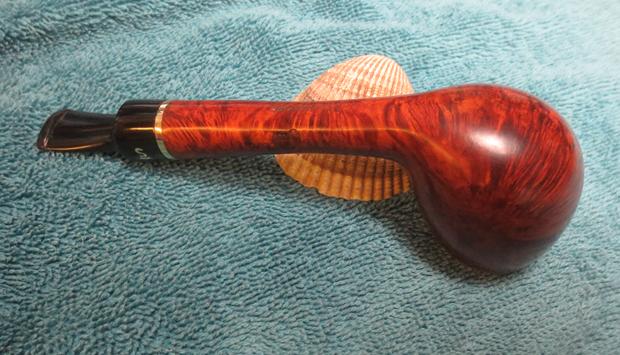
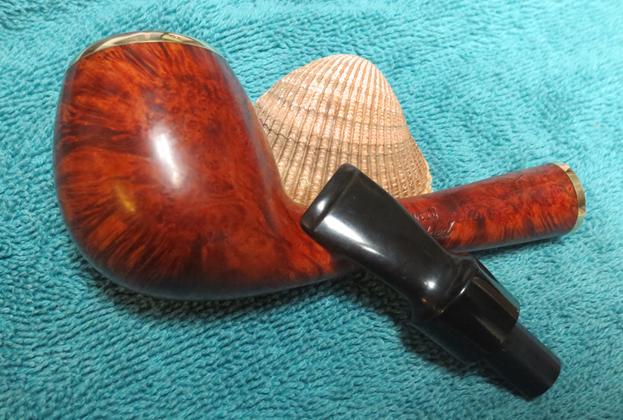
I received an email a few weeks ago from Mario. He has been following the blog for some time now and had enjoyed reading the posts. He wrote that he had purchased a pipe on Ebay for a good price. He attached some photos of the crack in the shank and wondered if I would be willing to take it on. I wrote back and asked for some photos so he sent me the following two photos. The first shows what appears to be a crack in the shank just ahead of the gold band between the shank and the stem. I have circled the damaged area in red in the photo below.stan1The second photo shows the shank end of the pipe. The band wraps over the end of the shank which was a plus to my mind. The band was tight on the shank according to the seller. My thinking was that the band would hold the crack together and it would be easier to work with. (The tenon on the stem is also a 9mm filter stem).stan2I wrote back and told him I would be glad to work on it. He wrote back when the pipe arrived at his place. As he looked it close up he wrote that the crack did not look as bad as he had expected. It appeared to be possibly a flaw in the briar. He also wrote that the end of the flaw near the band did extend to the edge of the band. He packed up the pipe and sent it to me in Vancouver. When it arrived I loved the look and shape of the pipe. The long shank and the shape of the bowl work well together. The gilt ring around the outer edge of the bowl and around the shank is what gave the pipe its name. It is stamped Stanwell of Gilt Edged on the left side of the shank. On the underside it reads Made in Denmark. On the right side of the shank it reads 124 which is the Stanwell Shape number. According to information compiled by the late Bas Stevens regarding Stanwell shapes the 124 is a freehand, long conical shank, with a short saddle mouthpiece. It was designed by Sixten Ivarsson. Here is the link to the full blog post that Bas gave permission to post on rebornpipes: https://rebornpipes.com/2013/09/03/stanwell-shapes-compiled-by-bas-stevens/

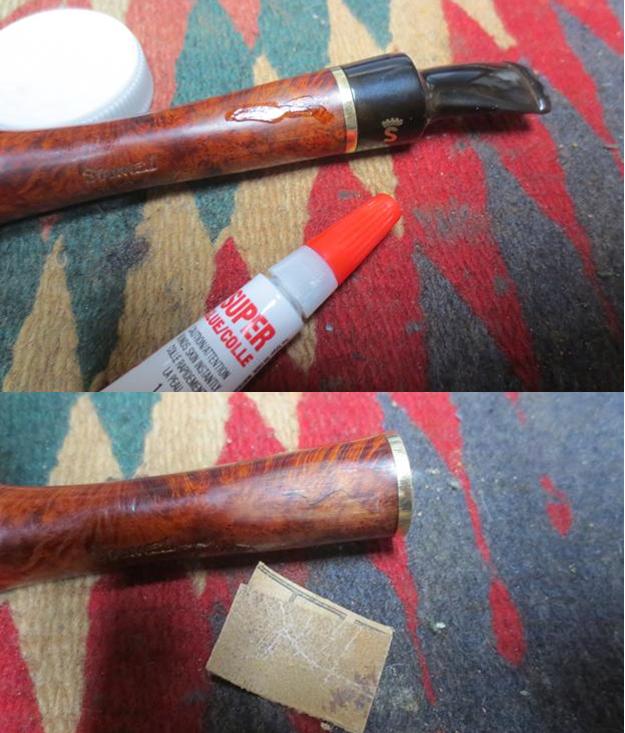
I took the following photos of the pipe when it arrived and before I started to work on it. You can see the damage to the rim – including both dents and a slight burn on the back inner edge toward the right side. There were also some dents on the top of the shank just ahead of the crack in the briar. The pipe was sold as clean and restored but it was far from clean by the smell of tobacco and the oils in the shank and stem.stan3 stan4There was some tar and oil on the top of the rim so I wiped it off with a cotton pad and took the following close up photo. It is hard to see but there were light dings in the rim top and the damage at the rear which I have circled in red.stan5The stem was clean on the surface but there were ripples and ridges from buffing as well as some slight tooth indentations on both sides near the button and on the button.stan6I sanded the damaged/flawed area on the top of the shank and probed it with a dental pick. Interestingly if it was a crack it was sealed tightly and there were no soft spots in the surface. It also appeared that the top finish had run slightly leaving a sag mark on the shank. I examined it with a bright light and lens and could see that the flaw ended a good 1/8th inch before the band and that the other ended. I decided to not drill the ends of the crack because it was a tight fit and also because when I looked at the inside I could see no trace of the crack coming through. I filled it in with clear super glue and when it dried I sanded it smooth with 220 grit sandpaper.stan7I cleaned up the rim top with 220 grit sandpaper and lightly beveled the inner edge to clean up the burned spot. I did not want to bevel it too much but only enough to match the rest of the rim bevel. When I finished shaping it I sanded it with 1500-2400 grit micromesh sanding pads to remove any scratch marks. I steamed out the dents on the top of the shank and polished them and the repair with micromesh sanding pads. I stained the rim edge and repair with a medium brown stain pen. I used a black Sharpie pen to continue the grain marks through the repair on the shank.stan8I buffed the pipe with Blue Diamond on the buffing wheel and hand buffed it with a microfibre cloth. I took the following photos of the pipe and sent copies to Mario. We are both really pleased with the way the pipe has come out to this point.stan9 stan10Here are some close up photos of the shank repair and the rim clean up. It looks much better than when I began the work.stan11I set the bowl aside and started to work on the stem. I sanded both sides with 220 grit sandpaper and took the photos to show the marks, ripples and dents on the surfaces.stan12I cleaned out the tenon area with alcohol, cotton swabs and pipe cleaners to remove all of the oils and tars in airway and the area where the filter would have been. It took a lot of pipe cleaners and cotton swabs to remove all of the debris. The next photo shows about half of the cotton swabs and pipe cleaners that I used on the stem.stan13I examined the inside of the mortise and airway with a pen light and could see that the shank was thickly caked with a hard coat of tars. I used a dental spatula to scrape away the debris in the mortise. It took a lot of scraping to remove the buildup to see the briar. I cleaned out the shank and airway with alcohol, cotton swabs and pipe cleaners until it was clean. The pipe smelled much cleaner though still smoky.stan13a stan14I pressed cotton balls into the bowl and rolled a cotton pad and inserted it in the shank. I used an ear syringe to fill the bowl with alcohol. I tipped it so that the alcohol ran into the shank. I filled it until the cotton was covered in the bowl. I set the bowl aside to let the alcohol do its work in drawing the oils out of the briar. I set the bowl aside and turned to the stem.stan15I finished sanding it with the 220 grit sandpaper to remove all of the ripples and dents in the stem surface. I polished the stem with micromesh sanding pads – wet sanding it with 1500-2400 grit pads and dry sanding it with 3200-12000 grit pads. After each set of three pads I rubbed the stem down with Obsidian Oil. After the last rubdown of oil I set the stem aside and let it dry.stan16 stan17 stan18I let the cotton balls and alcohol sit in the bowl for 6 hours. I took the following photo of the darkened cotton balls. I removed the cotton balls and cleaned out the shank, airway and bowl with cotton swabs and pipe cleaners. I was able to remove a lot more of the tars in the shank.stan19Once the shank was clean and the walls were clean and had dried I put the stem in place on the shank. I buffed the pipe and stem with Blue Diamond on the buffing wheel. I gave the bowl and stem several coats of carnauba wax and buffed it with a clean buffing pad. I hand buffed the pipe with a microfibre cloth. The finished pipe is shown in the photos below. The stem is smooth and glassy, the rim is much better and looks smooth, and the flaw/crack in the shank is smooth to touch and virtually invisible.  It will be heading back to Mario this week and I look forward to hearing what he thinks of his pipe now. Thanks for walking along with me through this restoration.stan20 stan21 stan22 stan23 stan24 stan25 stan26 stan27 stan28 stan29

Windsor Ashford Restoration ( Sasieni 2nd)


By Al Jones
al_pipes_-85

This pipe was listed as a Sasieni and indeed it had the Sasieni “Made in England” football COM stamp. Because of the rustification style, I knew it was a 2nd line from Sasieni. Of course it also didn’t have a Sasieni two or four Dot stem logo. The brand name wasn’t shown and it appeared similar to a “Shashar” I restored a few months ago. The Sterling silver band was not factory and I didn’t know what damage it might be hiding. The Sasieni Ashford is shape 88 in their catalog and this one was stamped 688, typical for a Sasieni 2nd’s line. The Ashford shape evolved through the different era’s of Sasieni and this one had the sharper bend that is usually seen on Patent era pipes.

Below is the pipe as delivered.

wingate_688_before-1

wingate_688_before-2

I posted a few pictures of the pipe in the British section of the PipesMagazine.com forum. Not surprisingly, Dave Cuneo was the first to respond. Dave is a moderator on the Pipe Smokers Unlimited forum and a frequent contributor to all things British on the PipesMagazine forum. Over the years, Dave has sent me various ebay links for pipes that I’ve added to my collection and he has a keen interest and expertise in the history of these storied brands. Dave has a theory on the unique rustication technique used by Sasieni:

The most interesting thing about this pipe is the rustication. During most of the pre-war period, all of the “seconds” were smooth pipes, but at some point Sasieni began to experiment with rusticated finishes on some of their seconds, finally ending up in the post-war period with the rusticated finish on the Old England line. Having seen a few of these, I would date the pipe to somewhere between the late 1930’s ~ 1950. The stem also has that classic “chubby” pre-war look.

Upon receipt, and under magnification, I could see that the name started with a W. The letters IN and the word Sasieni are also legible. Not much else was legible and the silver band obscured the final letters. Curiously, the shank didn’t appear to have cracks and it didn’t appear to have been added for a repair. The stem was heavily oxidized but in pretty good shape. The bowl was in great shape and overall, I’d say the pipe didn’t see heavy use. Like most Ashfords, this one weighed 45 grams.

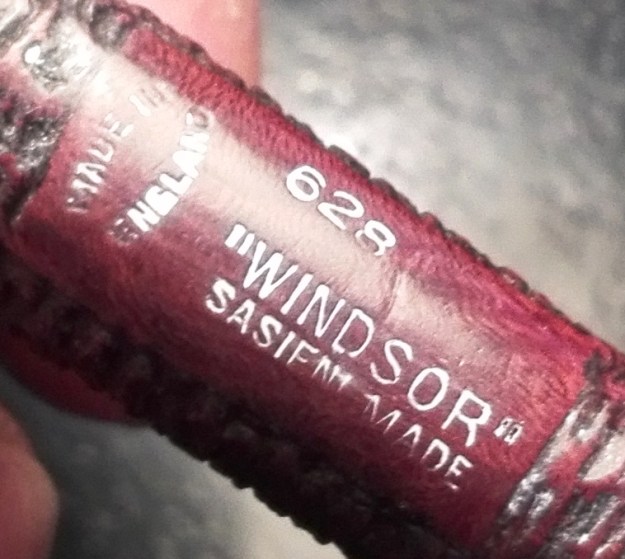
Update:  A Pipesmagazine.com forum member sent me a picture of the nomenclature for a Windsor.  After seeing this, I’m fairly certain that this is the brand.

windsor-stamp

The stem was soaked in a mild solution of Oxy-clean. While it was soaking, I reamed the bowl and soaked it with alcohol and sea salt. I removed the layer of oxidation first with 800 gri paper, then 1,000 and 2,000 grades. I then used 8,000 and 12,000 grade micromesh paper. AT this time, I discovered that the stem had a faint capital W stamp. Sasieni made no less than nine 2nd line pipes that started with a W. The best guess I can make is that it is a Wingate.

I hand waxed the bowl with Halycon wax and polished the silver band with some silver polish cream. The stem was then buffed with White Diamond and Meguiars Plastic polish.

Below is the finished pipe. Dave expressed interest in the pipe and I was happy to make him the next owner.

wingate_688_finish-1

wingate_688_finish-4

wingate_688_finish-8

wingate_688_finish-9

wingate_688_finish-3

wingate_688_finish-5

wingate_688_finish-2

wingate_688_finish-6

?

?

wingate_688_finish-11

wingate_688_finish-12

Brandy Bent Unmarked – another ‘Hole in the Wall’ Find


Blog by Dal Stanton

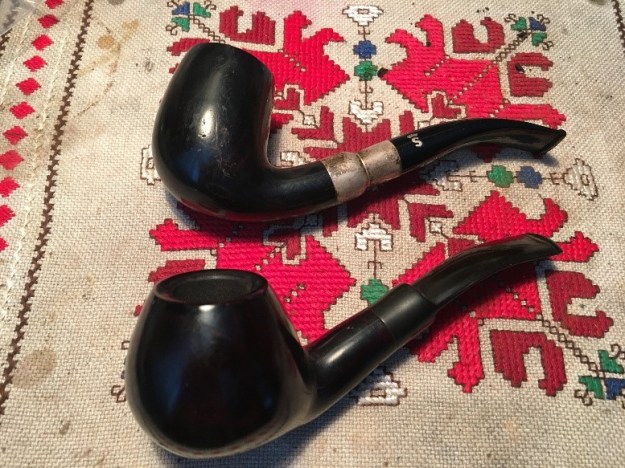
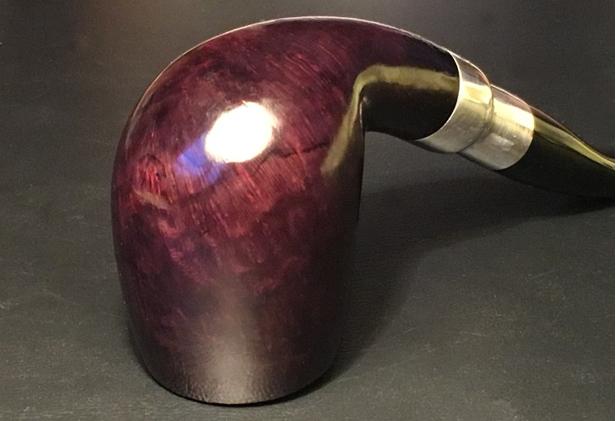
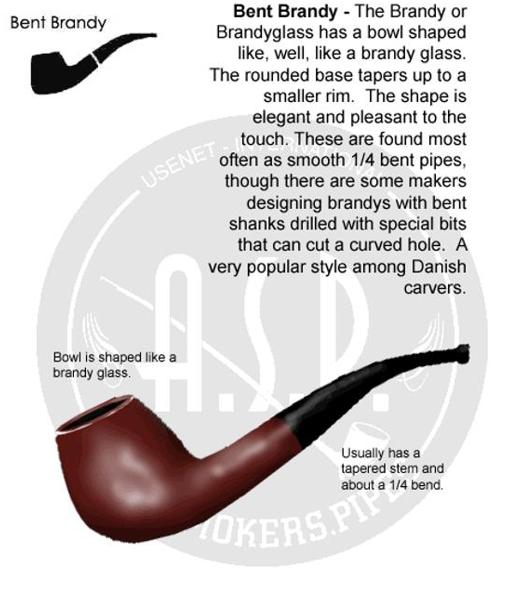
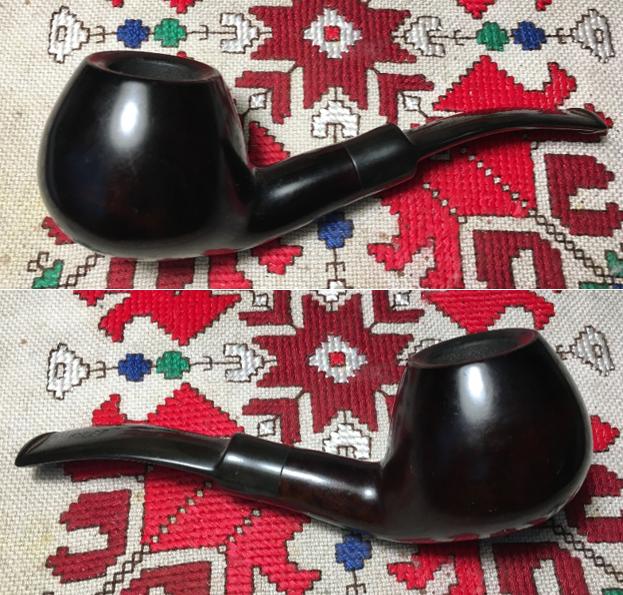
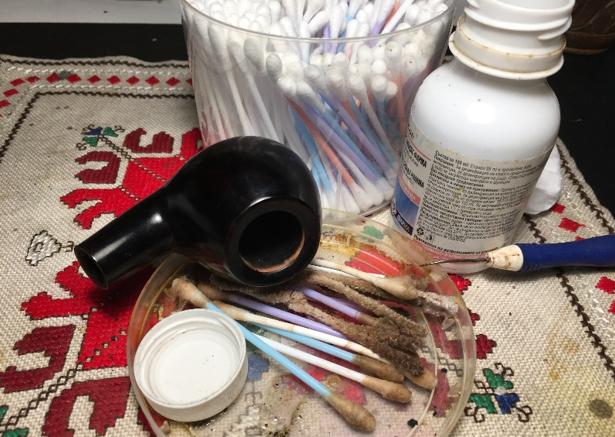
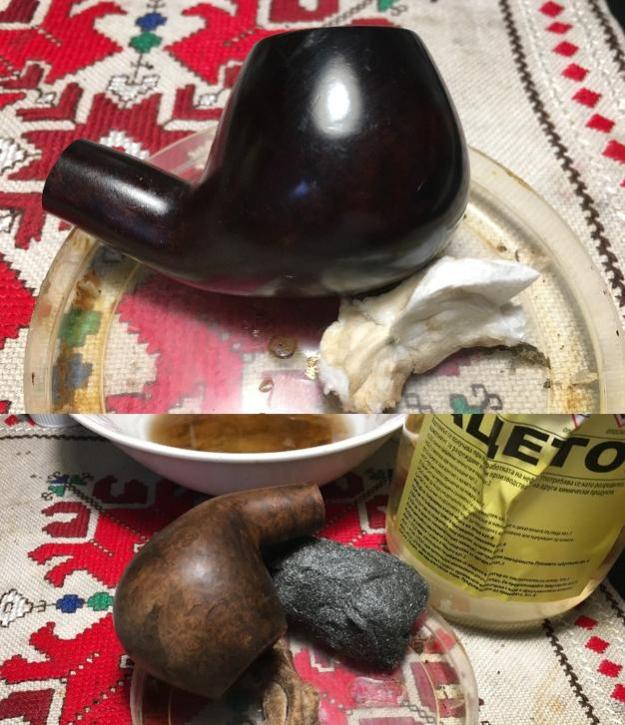
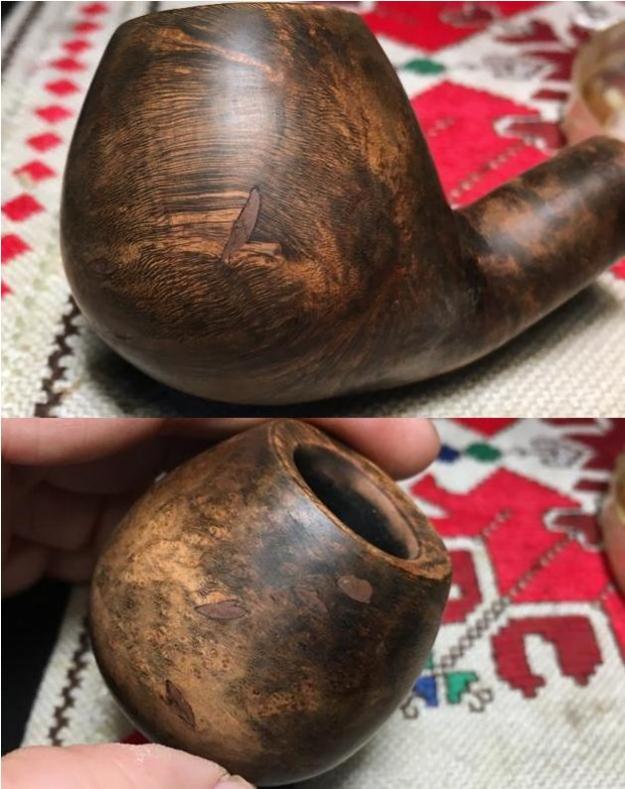
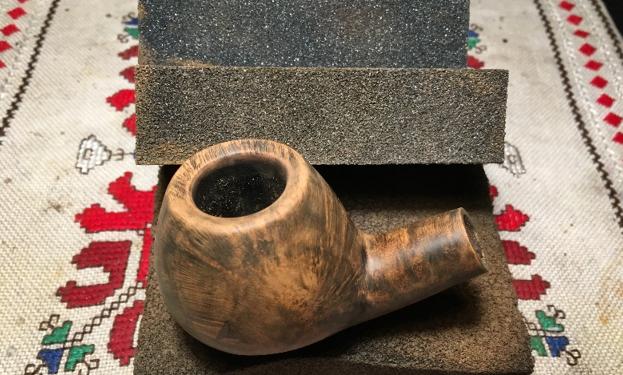
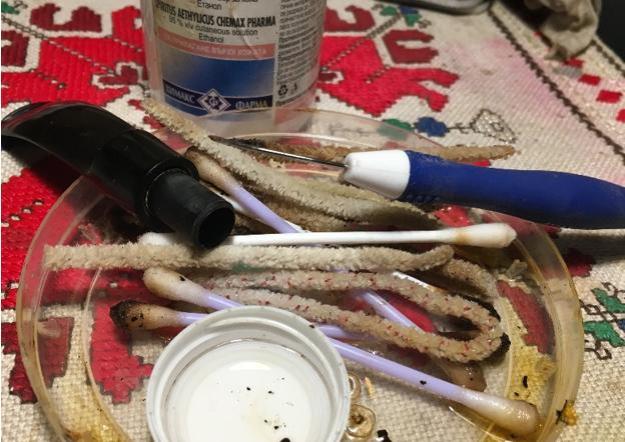
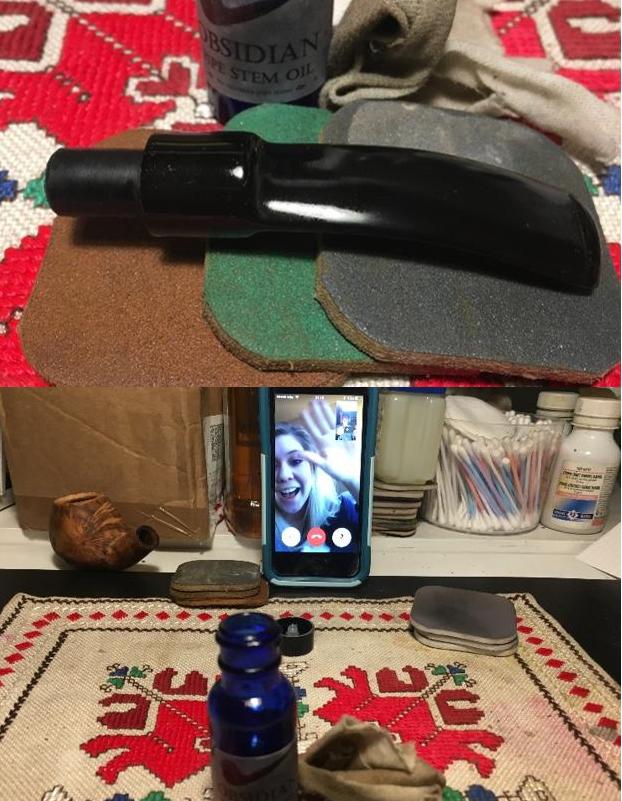
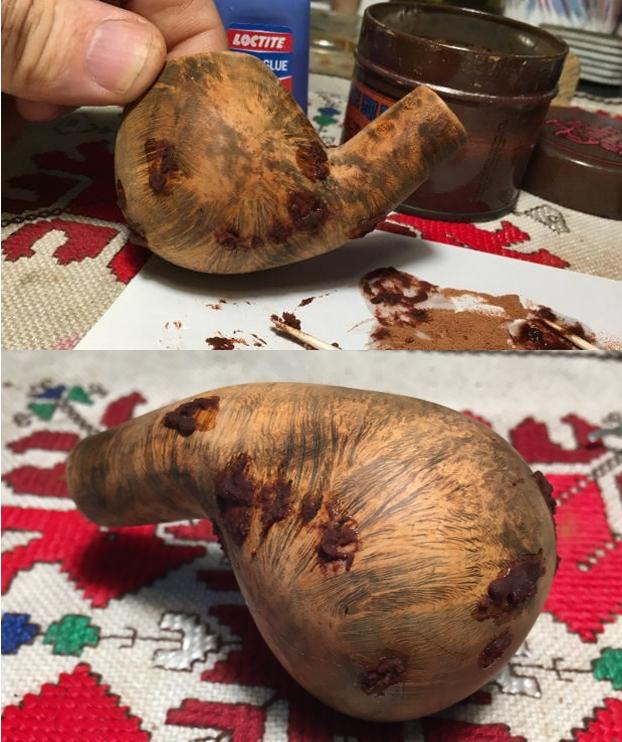
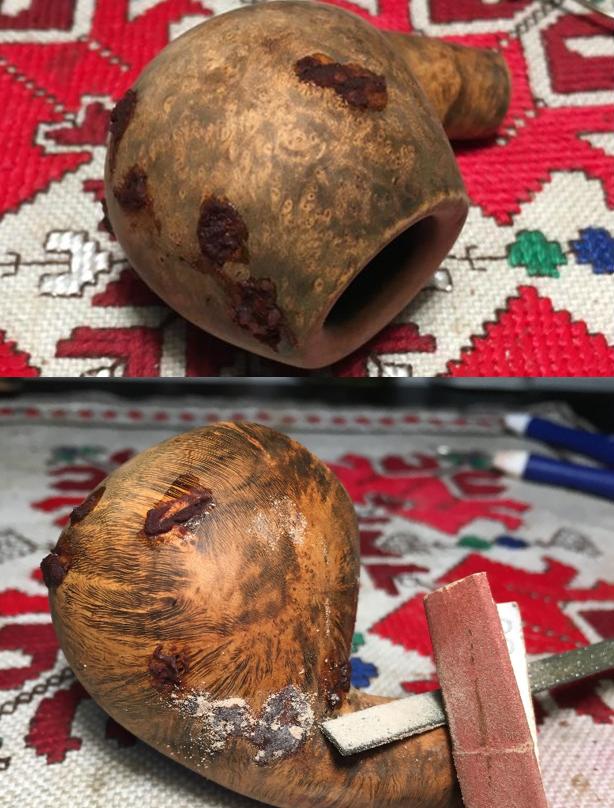
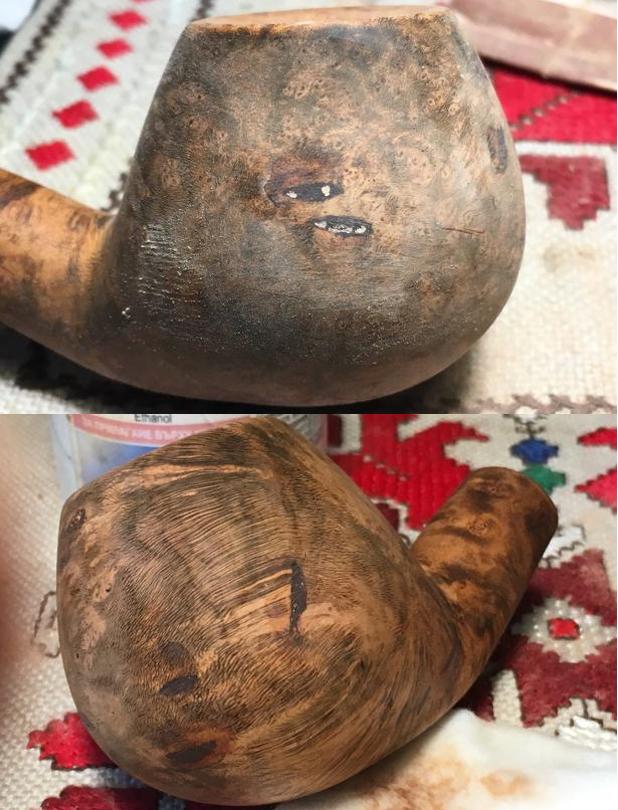
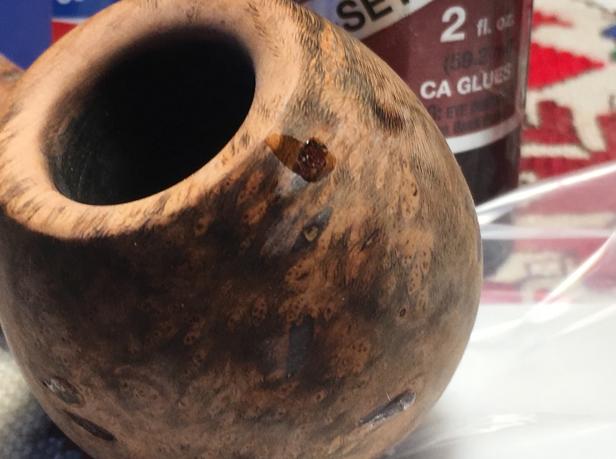
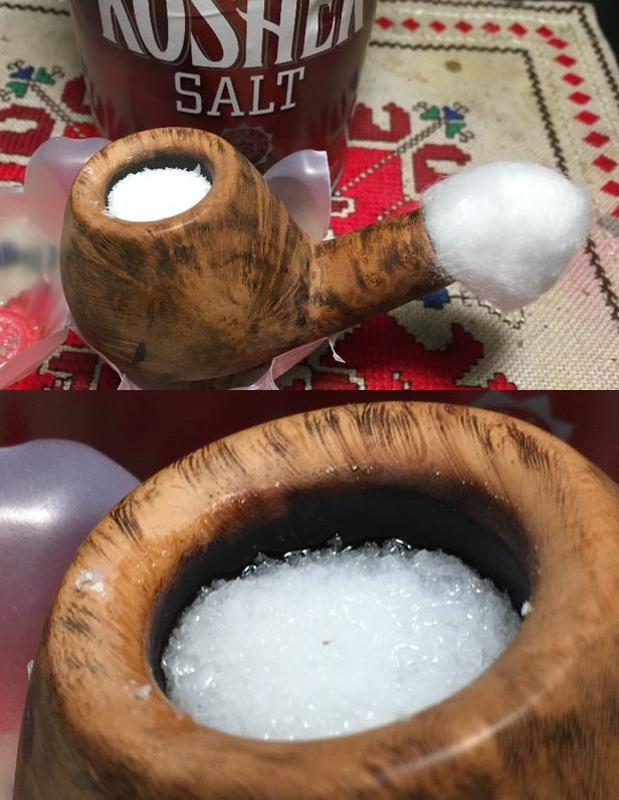
The Brandy before me now was a very nicely bundled pipe when I recently purchased the Stanwell Silver Mount which I’ve already restored (See HERE).  I landed these pipes at the treasure trove I call the ‘Hole in the Wall,’ an antique shop in the center-city of Sofia, Bulgaria.  My sites were on the Stanwell which was the prize, with its silver and class, but when I saw the Brandy, I plucked it out of the basket to bundle with the Stanwell – hopefully to land a more favorable purchase price for the pair.  The Stanwell and Brandy came home with me that day, and the picture I took below commemorated that day’s finds.  The next picture shows the results of the Stanwell Silver Mount’s restoration – a beautiful, dressy pipe.brandy1 brandy2The Brandy drew my attention as well because the bowl is a significant presence in the palm as I cradled the expansive bowl.  When I first saw it, I thought it might be a Volcano shape because of the hefty, expansive base of the stummel and the tightly restrained cone moving upwardly culminating in the rim. Yet, looking at Pipedia’s Pipe’s Chart by Bill Burney (see below), my later thoughts were confirmed that this indeed is a Brandy – actually, the first in my collection.  The stummel measures 1 3/4 inches in diameter at the broadest point of the ‘brandy glass’ bulge and the stummel tightens to the rim which measures 1 1/4 inches.  The height of the stummel is 1 7/8 inches.  This bowl is nicely shaped and proportioned – I like it!brandy3I take more pictures when I take the Brandy out of the ‘Help Me!’ basket and place him on my work table.brandy4 brandy5 brandy6 brandy7 brandy8With the stem in the Oxi-Clean, I continue with the clean-up of the stummel internals using cotton swabs and pipe cleaners dipped in isopropyl 95%.  After moderate resistance, pipe cleaners and cotton swabs started coming out cleaner.  Later, I will give the bowl a kosher salt/alcohol soak to further clean and freshen the internals and readying it for a new steward.brandy12With the internals cleaned with the frontal approach, I now look at the external surface.  I first scrub the rim and entire stummel with undiluted Murphy’s Oil to see if it makes much of a dent on the cloudy finish.  I have my doubts.  Well, after scrubbing the surface with Murphy’s Soap and I can see my reflection on the surface, I know that I’m dealing with an acrylic finish – the candy wrapper finish.  For manufacturers of pipes that put this kind of finish on a pipe, I can only think of two reasons to do so – it is a more cost-effective mass application of shininess – a chemically produced sheen that takes minimal time and man-hours, and to hide imperfections in the briar.  Switching to acetone to remove the finish, first, I use cotton pads, then the more persuasive help of 0000 steel wool.  The finish comes off with little effort and I begin to see why the finish is dark – there are several fills that the dark stain was masking.   I have no problems with darker hues to mask fills and imperfections, but I do not like the acrylic shine finish.  Pictures show the progress and the surface revealed.brandy13 brandy14 brandy15Before dealing with the fills, I sand the outer surface of the stummel and rim with a course grade sanding sponge to remove the superficial nicks and damage.  This works well.  I follow with a medium grade then a light grade sanding sponge to smooth and clean the surface of imperfections.brandy16I take a close look at the fills on the surface of the stummel and scrape them with a sharp dental probe to find out whether they are solid or if they are in danger of pitting.  Generally, they seem to be in good condition.  I do detect one pit and I drop-spot some super glue and apply an accelerator to cure the glue rapidly.  When the superglue is fully cured, I use a flat needle file to file it down near to the briar surface, then I use a rolled piece of 240 grit paper to sand it down to the surface, removing all the excess glue.  Then I use 600 grit paper just to smooth the surface of the patch.brandy17 brandy18Sanding with the sanding sponges removed most of the dents I detected earlier on the rim.  I want to freshen the inwardly sloped bevel to improve the lines of the rim.  I first cut an inner bevel with a rolled piece of coarser 120 grit paper.  Then I follow this by using 240 and 600 grit paper over the entire surface of the rim from the lower inner lip to the higher rim edge.  The result is a more tapered and sloped bevel and a crisper rim edge as the lower bevel blends into the upper slope.  The pictures show the progress.brandy19Next, I wet sand the stummel with micromesh pads 1500 to 2400 and when I complete this cycle, what I see I am not expecting.  Every fill on the stummel had softened and some had come out.  Apparently, the fill was not glue based, but simply a colored wood putty that would sit underneath the acrylic finish.  I haven’t seen anything like this up to this point.  Oh well….  I take the sharp dental probe and continue to dig out all the old filler putty and clean the holes left behind.  This restoration is taking an unexpected turn and it will take a bit of time to fill and sand down each of these 16 fill spots.  With briar dust and superglue, I mix a batch of putty and apply putty to each hole.  I leave excess over each fill area to be able later to sand each fill down flush to the briar surface.  I put the stummel aside for the patches to cure for about 12 hours.  The pictures show the digression.brandy20 brandy21With the putty patches curing, I take the stem out of the Oxi-Clean bath and take a picture of the oxidation raised on the stem.  I then wet sand the stem with 600 grit paper followed by 0000 steel wool to remove the raised oxidation from the stem.  The stem is looking good.brandy22Before I proceed with the micromesh pad sanding, I clean the internals of the stem using pipe cleaners and cotton swabs dipped in isopropyl 95%.  Using a sharp dental probe, I also dig out gunk from the slot.  The stem internals were dirty but pipe cleaners eventually prevailed.brandy23I then begin the micromesh cycle by first wet sanding with pads 1500 to 2400, followed by dry sanding with pads 3200 to 4000, then 6000 to 12000.  After each set of 3, I applied Obsidian Oil to the stem to revitalize the vulcanite.  The pictures show the progress, and a slight interruption when my daughter FaceTime’s me from Nashville between cycles – the pictures also show this wonderful interruption!   With the stem looking good, I put it aside and return to the stummel.brandy24 brandy25After the briar dust patches cure on the stummel surface, I begin the long process of filing and sanding the excess putty off the patches to bring the putty flush with the briar surface.  I first use a flat needle file to bring the excess almost to the surface and then I use 240 grit paper to smooth further, blending the patch with the surface.  With as many fills that I had, it provided ample practice to perfect my approach!  After smoothing all the briar dust putty patches, I find that some patches have small air-pockets revealed as I sand.  With these, I spot-drop some superglue, apply an accelerator to rapidly cure the glue, then re-sand those areas until the patches blend with the surface.  The pictures slow the slow progress.brandy27 brandy28 brandy29 brandy30With my day ending, I decide to clean the stummel internals further with a kosher salt and alcohol soak.  This cleans further as well as freshen the stummel for a new steward.  I stretch and twist a cotton ball to create a ‘wick’ to insert down the mortise.  This helps draw out the oils and grime.  Then I place the stummel in an egg carton for stability and fill the chamber with kosher salt.  The kosher salt is without iodine which can leave a taste.  I shake the stummel a bit with my palm over the chamber to displace the salt in the mortise a bit.  I then fill the fire chamber with isopropyl 95% until it rises a bit over the salt.  I then put the stummel aside for the night allowing the salt and alcohol to do the work.brandy31The next morning, the salt and cotton ‘wick’ had darkened signifying the job of drawing out tars and oils was achieved.  I dump out the expended salt by thumping the stummel on the palm and tossing the wick. I wipe the chamber with paper towel, and then use multi-sized round bristled brushes in the chamber and mortise to rid the stummel of residue salt.  I complete the cleaning job by plunging a few more cotton swabs and pipe cleaners into the mortise and draft hole and find that all the tars and oils have been removed.  I determine the Brandy’s cleaning, ‘Completed’!  The pictures show the progress.brandy32 brandy33 brandy34I turn again to the briar surface of the stummel.  With all the patch work done, I make a quick inspection of the surface looking for little shiny spots which would indicate that some residue excess of superglue was remaining on the briar surface.  I quickly address these with a rapid sanding with 240 grit paper.  From there, I return to a light grade sanding sponge and re-sand the entire surface aiming to help the blending with the plethora of patches and the briar surface.  brandy35I then proceed through the cycles of micromesh pads, 1500 to 12000.  The volatile nature of the grain in this block of briar becomes evident – it is evident that the block was taken from the upper or outer regions of the briar bush’s ‘burl’.  Its grain is more turbulent than you would find deeper inside the burl, where grains are a spectrum of non-existent to orderly currents of grain.  This excerpt from an article from Pipes & Tobaccos (1999) about briar grains from R. D. Field, I found very helpful in understanding briar grains:
Any burl, whether it be 30 years old or 130, does not possess what we call grain in its totality. When a burl is split in half a variety of patterns are able to be discerned in that: The center of the burl has no grain. The center, or heart, contains all the liquid held in the burl which is red in color and is known as blood. The wood surrounding this blood is also of a reddish tint and is devoid of capillaries as the water has got to where it was meant to be for storage.  Capillaries surround the center and, depending on the growing pattern of the burl and how it was split, can take the shape of straight grain, cross grain, flame grain, mixed grain, etc.

As we approach the upper part of the burl from where the branches emerge a pattern known as “branch wood” can be seen. Because the branches of the shrub actually start their growth within the burl the wood in these portions takes on some of the characteristics of the emerging branch. To look upon a swirling piece of briar devoid of other grain character (whether in a finished pipe or as part of the burl) is to look upon branch wood.

The many fills in this piece of briar I believe is due to it being an example of a block taken at a ‘branch wood’ formation seen in the pictures below.  The pictures show the progression through the micromesh pad cycles.brandy36 brandy37

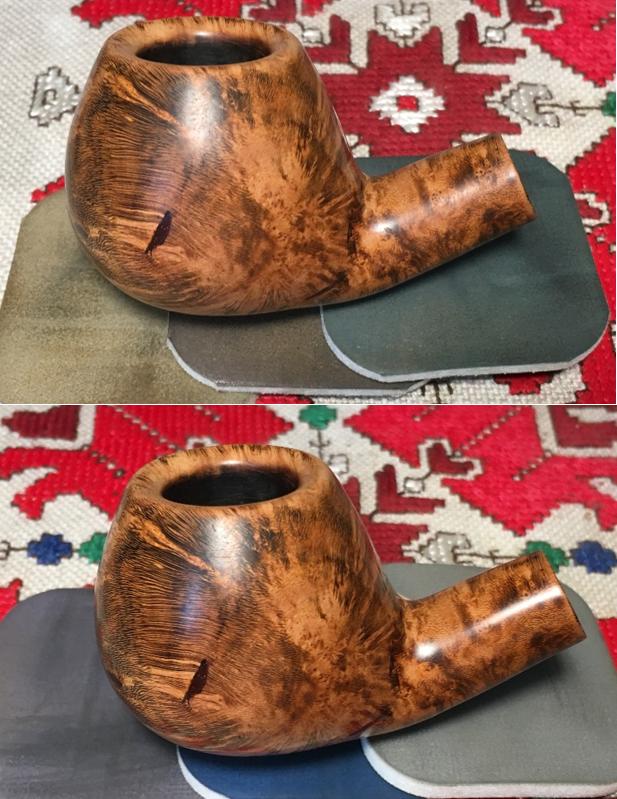
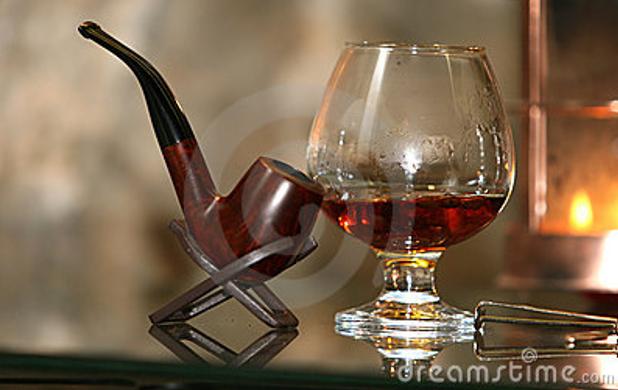
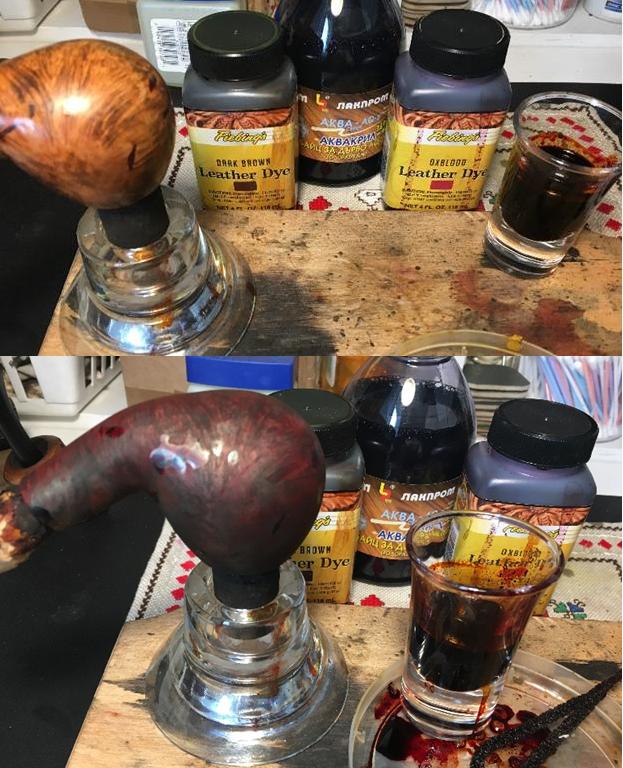
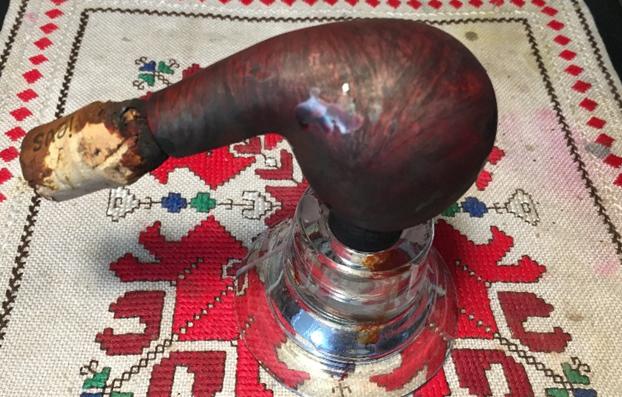
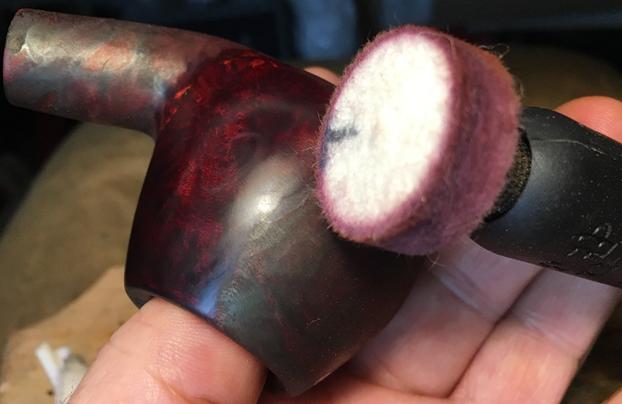
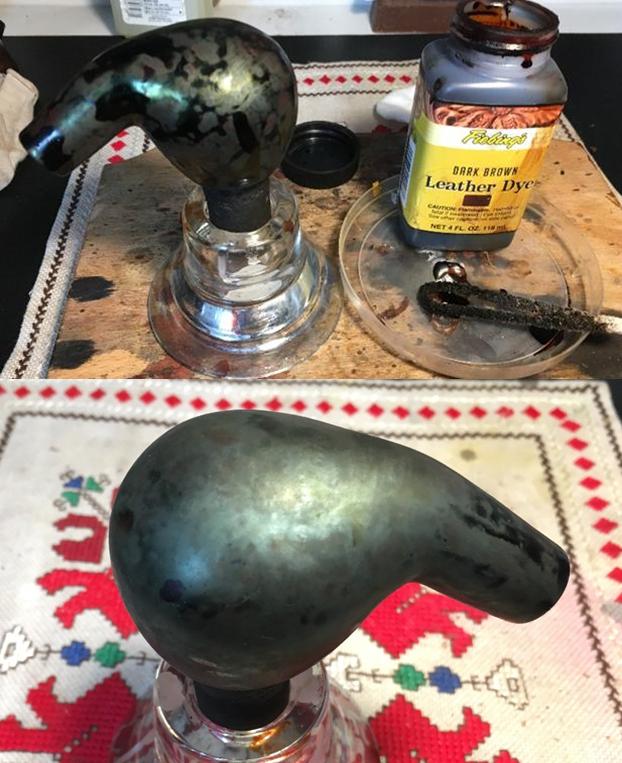
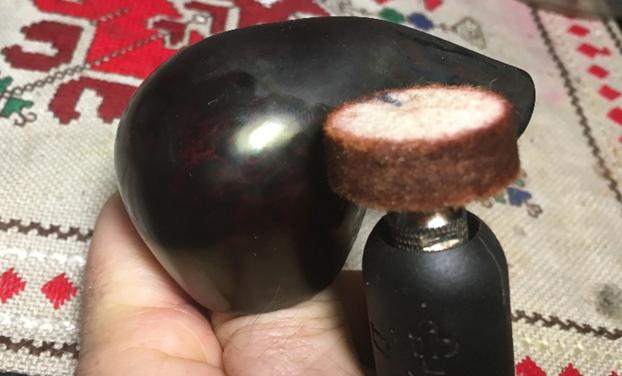
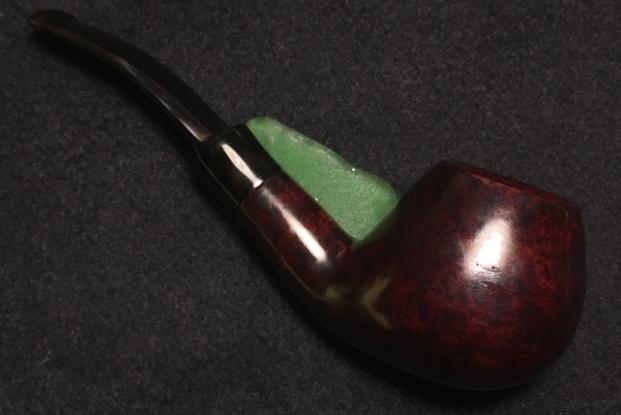
The next step in the project is to stain the stummel.  I will aim for a darker hue but I want to contextualize this Brandy by bending the hue toward the reds using Fiebing’s Oxblood Leather Dye mixed with Fiebing’s Dark Brown Leather Dye including a hint of black, non-aniline dye.  I found a picture on the internet (below) that envisions the perfect ambiance for this Brandy after he’s restored and recommissioned! I’m aiming for the darker hue of the brandy that is displayed.  Dreamstime is doing a good job promoting the brandy glass, but truth be known, the Brandy shaped pipe I have would have been a better choice for display!  Acknowledging a totally unscientific approach to the mixture, if I find the results too red, I will probably follow by a straight application of Fiebing’s Dark Brown Leather Dye as an overcoat.brandy38After the dyes are mixed in a shot glass, I heat the stummel with an air gun to expand the grains to absorb the dye more efficiently.  Then, using a bent-over pipe cleaner, I apply the dye mixture liberally over the surface, utilizing a cork inserted into the mortise as a handle.  When applied, I fire the stummel with a lit candle, and the alcohol in the dye immediately burns off and sets the dye in the grain.  To make sure I’ve achieved total coverage, I repeat the process again, finishing by firing the dye, and putting the stummel aside to rest for several hours.  The pictures show the staining process.brandy39 brandy40A little anxious to unwrap the flamed dye crust, my impatience wins out and I mount the felt wheel on the Dremel high speed rotary tool.  I set the speed to the slowest available and using Tripoli compound I begin removing the crust to reveal the briar underneath.  Then, using a cotton cloth wheel, I apply Blue Diamond compound to the stummel, also using the slowest speed available.  After the Blue Diamond, I’m seeing two things – the hue is a bit redder than I wanted and I am seeing light spots that need darkening.  I use a mahogany dye stick and darken the light areas to blend.  Then, I take out the Fiebing’s Dark Brown Leather Dye, and set up for another application of dye to the stummel. With a folded pipe cleaner I apply Fiebing’s Dark Brown Leather Dye two times, as before, flaming after each application, then setting the stummel aside to rest.  Pictures tell the story.brandy41 brandy42After a few hours, I repeat the process of applying both Tripoli and Blue Diamond compounds to the stummel surface.  Following the compound application I hand buff the stummel with a flannel towel to remove the residue compound dust on the stummel.  I do this before applying the carnauba wax.  Changing to the cotton cloth wheel on the Dremel, I increase the speed to 2, the second slowest speed of 5 – being the fastest.  I reattach the stem and stummel and apply to both several coats of carnauba wax and then give the pipe a rigorous hand buff with a micromesh cloth to bring out the shine.brandy43This Brandy Bent Unmarked had a lot going against it after I discovered the multitude of fills necessary to restore and recommission this pipe.  Considering the odds against it, I think it looks very good.  The grain is very expressive.  I like the dark brown finish as the overcoat of the oxblood – it fits well the Brandy shape.  I sell my restorations with the profits helping the work we do with the Daughters of Bulgaria – those sexually exploited and trafficked.  This Brandy is ready to serve a new steward.  If you’re interested in adopting him and helping the Daughters, check out The Pipe Steward Store.  Thanks for joining me!brandy44 brandy45 brandy46 brandy47 brandy48 brandy49 brandy50
The Berwyck Poker Compromise


Blog by Aaron Henson

Last summer’s tip to Dallas netted me several great pipes. One of which was my first poker.  It was in a basket in an out of the way corner of a second hand store.  Very dirty and grimy but I could tell the grain underneath was beautiful with a nice contracting stain.  The stem was broke off about half way but I thought I could turn it into a nice stubby.  I looked forward getting it home and start working on it.ber1 ber2The stem had a heavy amount of oxidation and a buildup of white near the broken end.  This leads me to guess that the previous owner had used a softy bit to compensate for the broken stem.  I set the stem to soak in a mild Oxi-clean bath to raise the oxidation. After 24 hours I removed the oxidation with a magic eraser and an application of Walker Briar Works Pipe stem cleaner.ber3 ber4I wiped down the outside of the stummel with 91% on a cotton pad to remove the dirt and oils.  I was looking for any hidden issues that might be need to be addressed.  Thankfully there were none just a few handling dents/scuffs.  In fact, there weren’t even any fills.  The grain was beautiful and the existing contracting stain really made it stand out.

There was a healthy buildup of tars on the rim but not a lot of cake in the bowl.  What little cake there was came out easily with my reaming tool.  I smoothed out the interior of the bowl with 80-grit paper wrapped around a ½ inch dowel.ber5I like to clean the inside of the pipe before working on the outside so next came the interior of the shank. Lots of cotton swabs dipped in alcohol eventually saw it clean.

Next, I finished the bowl by doing a salt and alcohol soak.  I plugged the shank with a cotton swab and filled the bowl with salt.  Sometimes I use cotton balls but this time I chose salt – no reason why.  I filled the bowl to the top with grain alcohol and let it soak 24 hours.  This leached out a lot of the leftover tars and removed the smell of the old tobacco from the bowl.

Not wanting to top the bowl, I tried something new.  I placed a little Oxi-clean powder on a green pad in a shallow dish of water. Inverting the bowl, I worked it in a circular motion on the pad.  This had the desired effect and only a little bit of sanding was required on the rim.ber6Returning to the stem I began work on a new button. I taped off the end and mixed up a slurry of black super glue and charcoal powder using a tooth pick to apply it to the stem.  Several coats of slurry were needed to build up the button.ber7 ber8After the slurry dried, I used a flat file to rough out the shape of a new button.  Trying it out, I realized that the stem was too thick and narrow to be comfortable.  So I began to file the top and bottom of the stem to make it a more comfortable fit.  But as I did so, I had another revelation: the Berwyck was a filtered pipe.  The filter chamber extends back to where I was trying to shape a flat spot in the stem. ber9While I didn’t file into the airway I decided not to continue for fear that I would.  It was at this point that I decided to abandon the idea of a stubby and start looking for a replacement stem.  I figured I had a few of options: 1) I could buy an old stem that matched, 2) I could make my own stem using the tenon of the old stem, 3) I could splice a fish tail onto the existing stem (this would allow me to keep the spade trademark – thank you, Dal for this idea), or 4) I could try Dr. Grabow and see if the factory could supply me with a new stem.

I started with the last option first.  I figured if I was willing to buy and old stem, why not buy a new stem with a better chance of a good fit.  I sent an email off to International Pipes & Accessories, the Dr. Grabow factory in Sparta, North Carolina, but received a disappointing response.  So my next course of action was to begin a search online for someone with an old stem to sell that would fit.  I eventually posted the story of my quest on the Dr. Grabow Collectors Facebook page.  It was not long before I was contacted by Joe Mansueto, the moderator for the Dr. Grabow Collectors Forum.  Joe very kindly offered to use his contacts at International Pipes and too my surprise he was told that I should send the pipe to them.

I had not completed the work on the stummel and I wanted to have it at the 95% complete point before sending to the factory.  So, steamed out the dents using a wet terry cloth rag and my wife’s clothes iron.  Next came a light sanding with 1500-3200 grit micro mesh pads.

The rim was is in need of some stain and I had just received a set of Guardsman stain pens I bought from Amazon.  This was my chance to try the out.  I was very happy with the way they worked.  I have used other stain pens in the past but with less than satisfactory results.  Blending the three pens I got a good color match with the rest of the stummel.

With the stummel done, I packaged up the pipe with a hand written letter describing the situation and my connection with Joe.  I included a $15 check ($12 for the stem and $3 for return shipping) and sent the pipe off to Sparta.  The pipe left on a Thursday and arrived in North Carolina on Monday.  I had no idea what to expect for timing so I determined to wait as patiently as I could, figuring it would be 3-4 weeks.

To my pleasant surprise it was just a week and a half later.  I was on the road in Texas again when my son told me that a package had arrived from Dr. Grabow.  When I got home I was like a kid at Christmas wanting to get the pack open and see what Santa sent me.  I was not disappointed.  The new nylon stem looked great.  It returned all the grandeur and dignity that the pipe once had.  I was glad now that the stubby conversion had not worked out.

Although I am not a big fan of nylon stems, mostly to the fact that they are a pain to repair, clean and polish.  But this one being new was not a problem.  I did polish the stem using 6000-12000 grit micromesh.  The stem also needed a little deburring at the air hole and smoothing out on the face of the button.  All of which was done in short order.

I finished the pipe at the buffing station while smoking a bowl of McClelland’s Stave Aged in a Yello-bole Chesterfield – a previous repair.  I started with red diamond rouge on a rag wheel then finished with three coats of carnauba wax.  I could not be happier with the results.  Thank you for taking the time to read this.ber10 ber11 ber12