Monthly Archives: October 2015

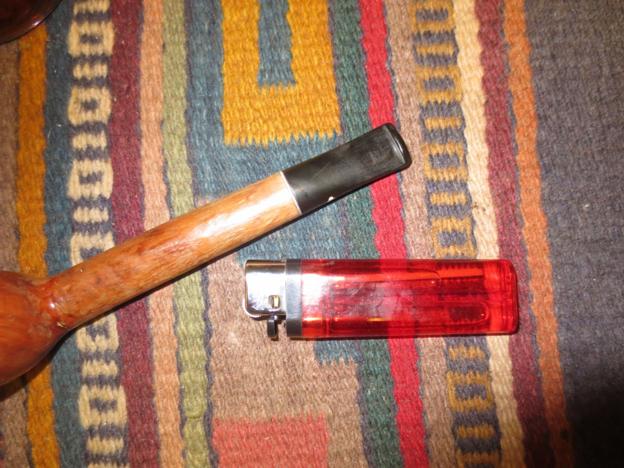
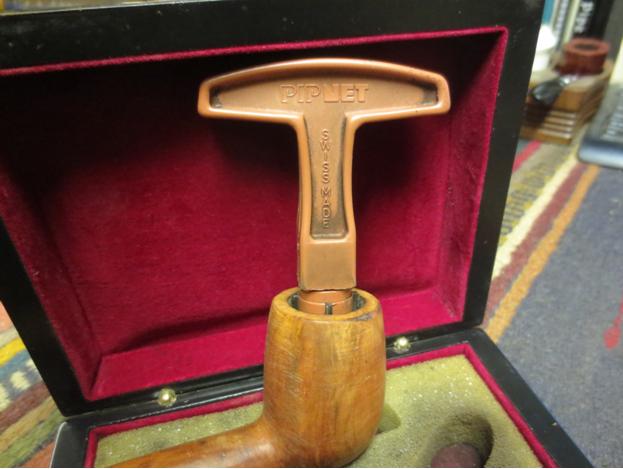
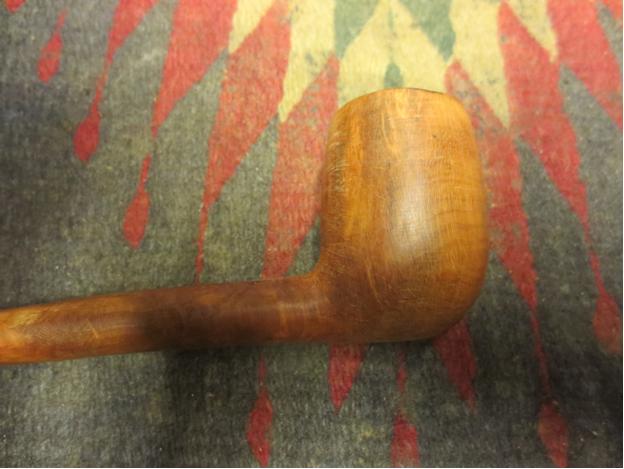
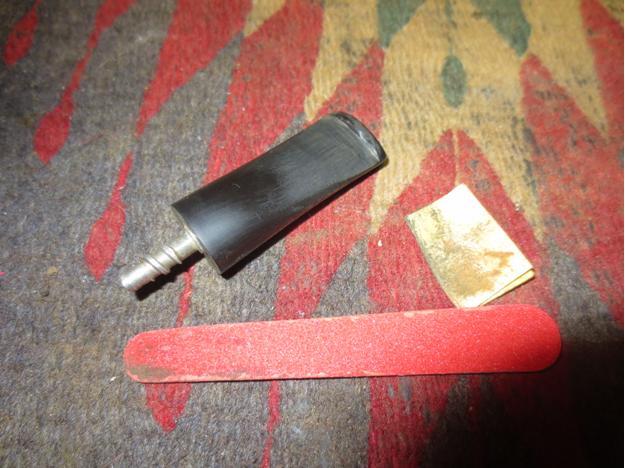
Large Fills and Stem Work on a Small Well Pipe Bent


I love the ways the stain job subdued the look of the many fills in this little bent pipe. Really nice work.

Charles Lemon's avatar

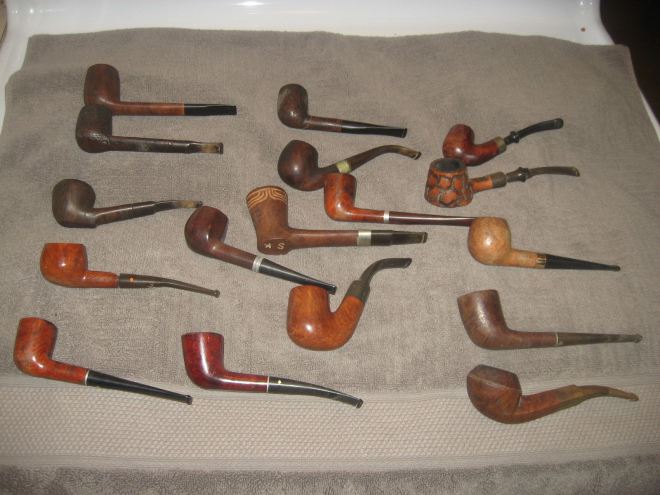
This is one of the last pipes from my first estate lot purchase to hit my work table. It’s in the top right corner of the pipe lot pic below. Even from this poor shot, you can see that the stem needs some tweaking.

Estate Pipe Lot

The pipe appeared to be in halfway decent condition when I pulled it from the refurb box – a bit of rim tars and surface grime on the stummel, but nothing major. The stem turned out to be a replacement, well fitted to the military-style mortise, but still showing the lines up the sides from the molding process. The amount of tooth chatter on the stem points to a DIY repair job – it was as if whoever had done the repair was only interested in making the pipe functional again, and left the stem in mostly its raw state. It can’t have been that comfortable…

View original post 996 more words

Will it still be there next time: Memories of the Pipetorium in Budapest Hungary


Blog by Steve Laug

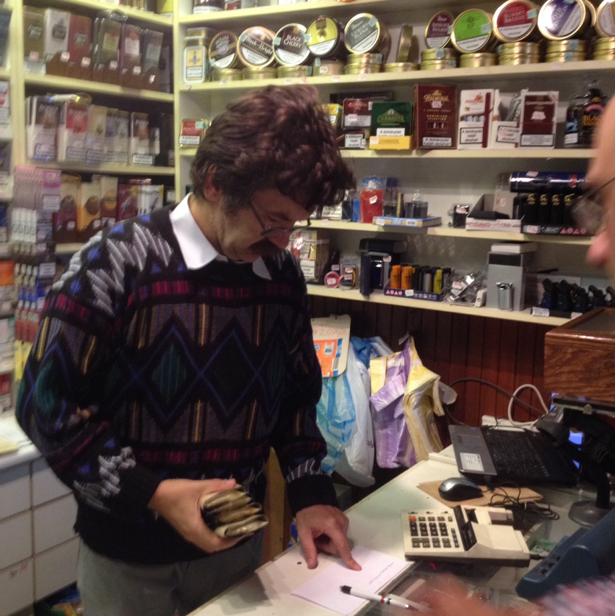
When I got opportunity to return to Budapest for work I was excited to revisit several of the pipe shops that I had “found” the last time I was there in October 2010. By far the one that I wanted to visit the most was the one where the owner and I had communicated through broken English and lots of gestures. I had come away with a Hungarian made pipe and some good tobaccos to sample. To me it was the epitome of the old European Tobacco Shop. It was small and packed with all kinds of pipes and pipe accessories. The back walls behind the counter were packed with tins and pouches of tobaccos and pipe cleaners and tampers and… the list could go on. Everything one needed for smoking – pipes, tobacco, cigars, cigarettes, even books for teaching how to use your pipe lined the shelves. The owner was a hobbitlike fellow that obviously enjoyed his shop and had a keen eye for all things pipe. If you could not figure out what you needed he was a master at it. Along the walls and in the display window were pieces of pipe history from a far removed time period that gave you a glimpse of the way things once were. It was the oldest independent pipe shop in Hungary founded in 1933 and still in operation when I was there in 2010. It was located at József krt. 38, Budapest, Hungary 1085 and was open from 10am to 6pm during the week. My hope was that the shop would still be there.

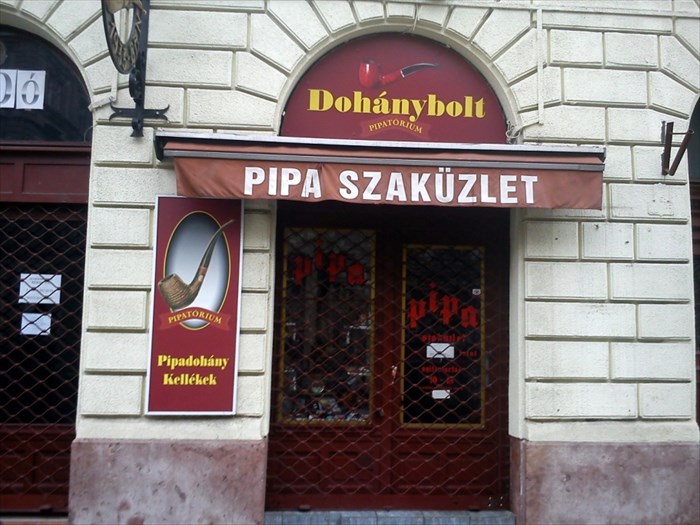
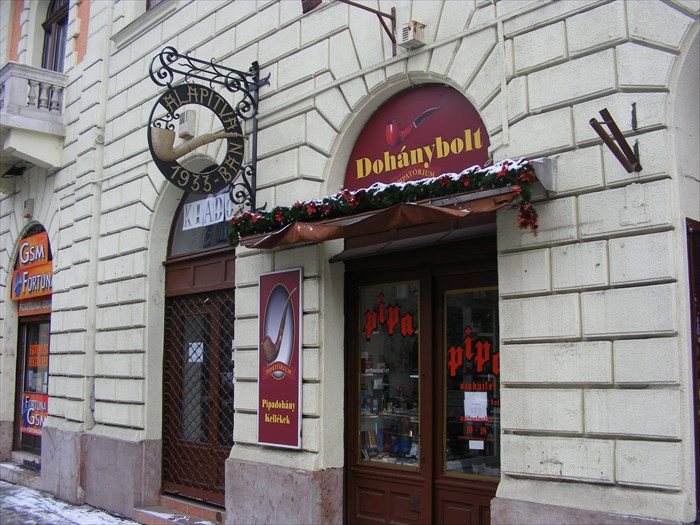
I arrived in Budapest and worked hard all week until Friday afternoon. Finally I had time to go and check out the Pipetorium. One of my Hungarian colleagues, who is also a pipe smoker was working with me and I asked him if the shop still existed. He said of course – it was his favourite pipe shop. It turned out to be a short walk from where our meetings were held. I could not wait to get to the shop and this time I was armed with my own Hungarian interpreter so we would have a great visit. For me this shop will always be a sweet memory to me of my last visit to Budapest. As we walked along I kept pestering my friend with questions about the shop and the owner. I had already had the disappointment of visiting the Galwitz Pipe Shop and seeing that the memories I had of that shop dashed as it was a mere shell of its previous glory. I was hoping that the unique little shop with its hobbit like shop keeper had not changed. The following three photos are pictures of what the shop looked like the last time I visited Budapest.

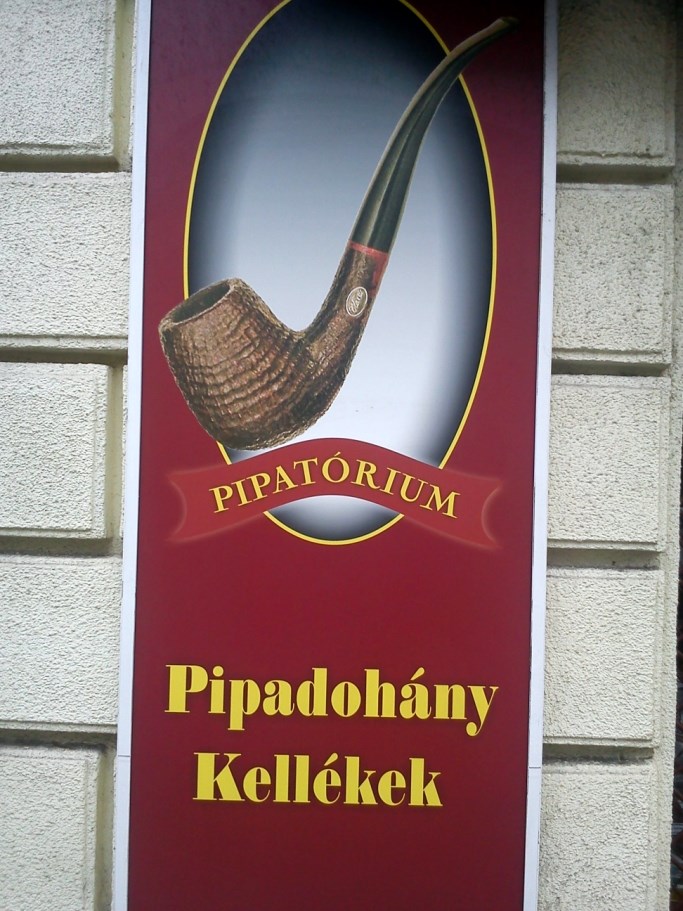
The building was cut stone and the arched doorway had the words Dohanybolt over the door. There was an awning that had flowers and copper tiles. When I had been there the first time in October 2010 the awning looked as it is in the first photo below. Before I left Budapest I went back for a visit and it was more like the second photo but still had the garland of flowers. The door itself occupied the right side of the archway and had the words PIPA painted on the glass. The left side of the archway was a display window that I spoke of above. There were pipes and racks, old tins and pouches and pipes from days gone by that I had never seen the likes of. There were old meerschaum and briars and decorative tins and jars of tobacco that no longer was sold. To the left side of the door on there was a rich red sign with a pipe in an oval that had the words Pipetorium across the bottom.Pipetorium3

Pipetorium1

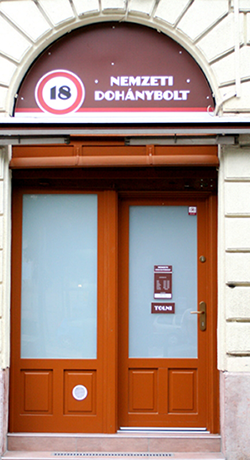
Pipetorium4 Above the Pipetorium sign on the wall was an elaborate sign that stood out from the wall on wrought iron braces. It was in Hungarian but left little doubt as to its meaning. The pipe in the middle made it clear that it was a pipe shop and the date at the bottom made clear the date it had been established. To me that sign became the singular memory that stuck in my mind of the outside of the shop. I was hoping it would still be there. My friend would not confirm that it was still there. All he said was that the owner had been going through a lot of struggles with is shop in light of the new laws regarding the sale of tobacco and the signage and frontage of tobacco shops. That made me wonder all the more as I had already visited several of the government sanitized shops and I was hoping that somehow this landmark spot for me still existed.Pipetorium2Pipetorium5 We turned the corner on József krt came to the location of the shop. I was surprised. If I had come by myself hunting for the shop I would easily have walked right by without knowing that I had missed it. All of the unique, classic pipe signage was gone. The circular pipe sign and the rich red Pipetorium sign had been removed and in their place was the circular government tobacco shop sign. The display window to the left of the door and the window on the door itself had been painted over. The front of the shop looked like the photo below.Pipetorium6I don’t know about you but the sanitized look was lacking all of the previous charm of the original shop. From the outside there was no reason to believe that the shop of my memories was still there. Everything I loved about the curb appeal of the place had been removed and in its place was this cold sanitized looking frontage. Even the awning had been removed and in its place above the door a motorized metal shutter had been installed so that when the shop was closed even the door disappeared and in its place was a steel door that made the place not only “safe” in the eyes of the government but also made it disappear. I just paused and shook my head trying to fathom the loss of another of my memories. All that I had been hoping for was shaken. I wondered what was behind the door. My friend just looked at me pushed open the door so we could enter.

Honestly, I was expecting the worst. Would the inside of the shop be but a memory of my last visit, like the Gallwitz shop? Would the sanitizing hand of governmental bureaucracy have even stripped away the inside of the shop too? I was not sure. The painted windows and door had darkened the inside but thankfully the rest of the shop remained much the same. I breathed a sigh of relief as my eyes adjusted to the dimly lit interior of what had once been a bright hobbit hole of a shop. I looked at the wall to the right of the counter – yes, it still had the display cases packed full of pipes. I looked at the one to the right and saw that the shelves of older pipes and museum like pieces were still present.

The hobbitlike owner who I had met previously still sat behind his counter. The difference this time is that I had a Hungarian with me so we could actually visit. The previous time we had managed with few words. This time we visited and talked about the state of his shop. He told me that he was saddened by the changes that had been forced upon him by the government regulations. He said that he was still surviving. I shared with him my memories of the way the shop had looked when I had been there previously and the special place it occupied in my mind from that first visit. I could tell that he too missed those days. Sitting in the darkened shop with none of the charm that drew people like me into it interior must have been very difficult. There was really nothing on the outside that said it was a pipe shop. He told me he had expanded onto the web and sold pipes and accessories there and that helped him keep the shop open. He was manufacturing pipe cleaners now so I purchased some pipe some of them to replenish my supply and I added some tobaccos to pass on to friends when I got home. before leaving the shop.Pipetorium1

Pipetorium2

As I made my way back to the door and out to city beyond I took another look around at the interior of the shop. I took in the displays of pipes and tobaccos and wondered if this would be the last time I came to this shop. If things continued as they had in the previous five years then who could truly say if the marvelous Pipetorium would be here the next time I came to Budapest. Time would tell.

Reborn Pipes – Looking back 3 years ago to June 24, 2012


Blog by Neill Archer Roan

This piece originally was posted on Neill’s Blog – A Passion for Pipes (http://www.apassionforpipes.com/neills-blog/2012/6/24/reborn-pipes.html) not long after I had started rebornpipes. I had no idea that he was going to write this or what he would say. I was quietly starting the blog and the readership was really low. I did not know what I was doing I only knew that I wanted an online presence to put the pieces that I had written on refurbishing pipes and the extra ones that would come. I also wanted it to be a place that others could contribute to and share their work. I wanted a virtual community of amateur and otherwise pipe refurbishers. Now looking back three years or more after rebornpipes began I want to take time to thank Neill for his jump-start for rebornpipes. It was his publication of this piece on A Passion for Pipes that opened up a broader readership very quickly. I have read Neill’s blog for a long time now and when I read this piece he wrote it actually brought tears to my eyes. He got the point of rebornpipes. I can honestly say that it was his encouragement then and now that keeps me going. I want to take this venue to publicly thank you once again Neill. Your encouragement has meant the world to me. Thank you very much
RebornPipes As of my last researching the number, there are over 150 million blogs out there on the internet. By the time I finish typing this sentence there will probably be 160 million. It’s amazing how many people blog these days.

Steve Laug at breakfast at the Chicago Pipe Show

Steve Laug at breakfast at the Chicago Pipe Show

There is one new pipe blog out there that deserves your attention: Reborn Pipes, written by the Vancouver, BC pipe man Steve Laug. It is better than good. It is wonderful. Truly wonderful.

I became acquainted with Steve Laug through the popular Smokers Forums, an online pipes and tobacco forum. Steve serves as a moderator on that forum. Subsequent to my online introduction, I met Steve in real time at the Chicago Pipe Show quite a few years ago. I had already intuited Steve’s kindness and generosity; these things can be experienced in an online environment, but they are amplified in real time.

In real life, Steve is a member of the clergy. He is the sort of man whose flock I would immediately join if he lived within driving distance of my home. Thoughtful, quiet, and warm, Steve is, to my mind, an old-fashioned ministerial type in that his ministry emerges from serving others. I once learned of him bringing a homeless stranger back to his home and table for Thanksgiving dinner, an event inside his life that is probably so routine as to seem unremarkable. I’m sure he will be embarrassed to read these words, assuming he ever does. In other words, he actually lives the example of Jesus Christ as opposed to preaching the example.

I bring this up because that spirit of service comes across authentically in his writing.
In his pipe life, Steve brings homeless pipes to his workbench – pipes that have seen better days. In most cases, these are unremarkable pipes in brand or collectible terms. The one thing they seem to share is that they were once loved by someone. Most of them have had the tarnation smoked out them. As we would say of this kind of horse in Wyoming where I grew up, they were “rode hard and put away wet.”
Taking a gander at these pipes in Steve’s “before” pictures, most people would muse, “Why bother?” Why indeed?

It only takes looking at the “after” pictures to answer the question. When Steve applies his considerable refurbishment skills to these pipes, they are, in fact, reborn. Steve’s blog is aptly named because these pipes leave Steve’s bench more than refurbished. They are reborn to their purpose, ready to be smoked. Ready to be treasured.

In Reborn Pipes, Steve shares more than his refurbishment process, he shares his patience and his insights.

In practical terms, by reading Steve’s blog, you can learn how to restore your own pipes to their former glory. If you are new to the pipe world, or trying to build your rotation without draining your bank account, you can acquire skills that make it possible for you to buy estate pipes, spiff them up, and then enjoy them. By so doing, you’ll learn that you can buy and smoke much better pipes than you could otherwise afford. Plus, they will be yours – truly yours – in terms that you could never understand if you haven’t gone through this process.

I’ve bought many a fine pipe in my nearly 60 years, many of them high-grade, artisanal pipes. They have come to me in exquisite and pristine condition. It has surprised and perplexed me that a pipe’s beauty is not only an attribute that conjures desire, it can also be a barrier to my enjoyment of the pipe. All that newness, all that perfection defies defilement by putting match to tobacco within its little chamber of perfection. I have pipes in my collection that have remained unsmoked and unenjoyed for over a decade. I own these pipes, but they certainly do not feel like they are mine.

I’ve never felt this way when buying an estate. As I have assembled my Comoy Blue Riband collection, I have wound up with more than few pipes in need of refurbishment. When I’ve finished restoring the pipe, the work has created a bond of affection for that pipe that only time and labor can endow. I appreciate its qualities in deeper, more meaningful ways than I have ever felt for any of my brand-spanking-new treasures because I have had a hand in revealing its better qualities.

If you haven’t sussed out my point by now, let me state it outright: Steve’s blog addresses in metaphorical terms more than the refurbishment of pipes. He reveals that all things under heaven may be reborn through love, and not through love as it is so popularly and shallowly understood, but rather love as it is expressed by the farmer or the gardener.

The farmer and gardener express their love of the land by working it. They endow their land with purpose through the dignity of stewardship. There is not only affection here, but economy, thrift, and satisfaction that comes from the husbandry of more than oneself.

There aren’t many blogs out there that improve oneself by reading them. Reborn Pipes is special in this way. It deserves an audience. I invite you to join me as part of it. Navigate to Reborn Pipes by clickin here.

Article originally appeared on Pipe Blog (http://www.apassionforpipes.com/). Used by permission from the author. See website for complete article licensing information.

Reflecting on the illusive “magic” smoke and what makes it happen


Blog by Steve Laug

Avatar3In between traveling and working I had a day free in Budapest, Hungary. I had finished the work I had gone there to do and had some free time. I needed time alone after several weeks filled with people and meetings so I could recharge and regroup. So, I slept, wandered, ate and took time to write. I wrote a reflection on pipe smoking in Budapest that I posted earlier. I also wrote this reflection on what makes a magic smoke. I sat in a nice sidewalk café near my hotel with a pen and paper and wrote the outline for what later because this piece. I am sure that over the days ahead I will add to the thoughts I am expressing here and certainly invite you who read it to add to it as well using the comments box at the end of the blog.

Much has been written about how drilling and airflow dynamics affect the way a pipe smokes. And while that certainly is true there are other things that also affect a smoke. The reality is that the basic mechanics of a pipe are quite unremarkable. There is a furnace chamber for burning the tobacco and an airway on the bottom side of the bowl with a tube that runs out to a mouthpiece. The tobacco is lit; the air is pulled through the tobacco from the top of the furnace and is drawn through airway into the mouth. Diagramming it is quite simple. Think of a larger U or V with a line running from just above the bottom of the letter (U—–) and you have a pretty good picture of what the general furnace looks like. There are modifications of course such as bent pipes, partially bent pipes, system pipes etc. but even then the basic diagram is accurate.

I have been refurbishing pipes for over 15 years now – slowly, steadily learning more and more about the craft. One thing I have learned is that the basic mechanics of a pipe do not change. The externals may vary from pipe to pipe and maker to maker. The diameter and shape of the bowl differs. The diameter of the airway differs. The configuration of the airway in relation to the bottom of the bowl differs. The fit of the tenon into the mortise will either be tight or loose with arguments for both. However, the basic mechanics remain constant. The changes in bowl size and airway size affect burn and draw rates certainly. The larger the bore of the airway the easier it is to draw the air through the tobacco to the mouth. However the route is the same. I liken it to adjusting the flue on a woodstove. The more open the flue the more quickly and easily the wood burns. The more closed the flue the longer the burn. To some degree this is true of pipes as well. Kirsten pipes for example have a flue system to adjust the airflow in their bowl with a mere turn of the end cap. This controls the burn and openness of the airway.

I would say that while certainly the rate of burn, the flow of air and the ease of draw all contribute to a good smoke they are not alone in defining what makes a great smoke. They merely adjust the rate of burn of the tobacco and the duration of the smoke. Some of you might say that the bellows (the smoker) on the end of the mouth piece end also sets the cadence for the burn and the flow of air through the tobacco and draws the fire down into the bowl. But even this is still part of the mechanics. Think in terms of a bellows that draws air to the fire in a forge and intensifies the burn and the heat of the fire. It is part of the mechanics of the burn.

So if it is not just mechanics that make a good smoke then what is it that makes it happen? Is it the tobacco? Is it the cut and dryness of the leaf and the way the pipe man packs the bowl that makes a great smoke? Certainly these contribute. Add this to the mechanics of the pipe and you have another part of the answer to the question at hand. By itself, it also does not guarantee a good smoke. I am sure that many of us have experienced that accidental great smoke when we paid no attention to the pack of the bowl or to tamping correctly or applying the flame to the leaf. Most of us have experienced that magical smoke even in a poorly drilled and mechanically inferior pipe. So what is the deal? I know that one of my most magical smokes was in an old Medico Brylon billiard sans paper filter which made the draw wide open. I was packing it at a stop light and smoking it while I drove my car and the smoke was like a revelation of why I smoked a pipe. Nothing about the set up or the pipe precluded that I would have a magic smoke. In fact most of us would cynically have bet against it being a good smoke. So what is it that makes the magic? It is not mechanics alone. It is not your method of loading and tending the bowl alone. It is not the quality of the pipe alone. Though all of these contribute to the magic smoke to some degree but none of them, either alone or together, explains it.

I have read some who would say that the magic may reside in the briar or the meerschaum or the qualities of a particular piece of briar or meerschaum that is well seasoned. I am not convinced that this is altogether true. I have had both aged briar and new briar pipes that smoked both poorly and very well with no particular rhyme or reason. I have had the surprise of having Brylon and pressed meer pipes that have smoked really well and certainly a large proportion of them that smoked poorly. I have picked up cheap basket pipes or corn cobs when I was traveling on a short trip and left my pipe at home and found that some of them delivered amazingly great smokes. All of the curing, shaping, drilling did not guarantee a great smoke. I know that an aged piece of briar should deliver a better smoke but I have had older Algerian briar pipes that were well broken in and still burned both hot and sour. At the same time I have picked a newly carved pipe, loaded a bowl and was carried off by the magic. Certainly, quality briar and quality meerschaum that are well carved and well drilled increase the odds of a good smoke but they are not a guarantee.

Along with all of the things another contributing feature that comes to mind from my experience is the setting where I am smoking my pipe. It definitely contributes to the quality of the smoke for me. I know that when I find a good spot where I can relax and either disappear into a reflective state or sit and watch passersby both work well for me and they contribute in different ways to the nature of the smoke. I just came back from Berlin and Budapest where sidewalk cafes are everywhere and the amazing thing about these cafés and terraces is that they are smoker friendly spots. I spent quite a few late afternoons and evenings availing myself of the pleasure of the café. I was able to find the sweet spot on a few of those days and enjoy a magical smoke. In those cases I think I was able to disconnect from my busy day and slowly puff and slide into that space where pipe men go when they are alone with a good pipe. The quality of the smoke was definitely affected by the spot. But I have also enjoyed good smokes slowly walking through a park or down the street by my house as I head to an appointment or a meeting. So it seems that the setting contributes but it is not solely responsible for the moment.

That leads me to the last consideration of elements of the good smoke in this reflection – that of the internal state mind of the pipe smoker. What does it contribute? In my experience, my most magical smokes have oddly occurred during some of the hardest and most troublesome days of my life. The pipe allowed me to disconnect from the heat or weight of the moment and stand apart for a moment. It was that magical disconnect that allowed me to get lost in the smoke. It gave me a moment to move outside of the moment and just get lost in the smoke. In that quiet spot created by the pipe I was able to gain clarity and move forward with decisions and choices that had been weighed and considered with care. I know that some would argue that a calm spirit and quiet heart makes for a better smoke, but in my experience it is the ability of the pipe to take me to that place of calm and quiet that adds to the magic. For me the state of mind seems to come after the smoke has been entered into and not as a per-requisite for making the magic happen. I am sure for others this may well be the case but it alludes me when I seek for it and comes to me when I surrender to the quiet of the pipe.

I am sure there are other contributing features that can be added and certainly would love to have you add your own thoughts to these reflections in the comments section below. All I know is that for me it is that ever illusive but amazing magical smoke that keeps me coming back again and again to my pipe. Regardless of the circumstance I have learned that the mechanics, the tobacco, the setting and the reframed state of mind all contribute their part to the great smoke!

Early Van Roy Arista “Selected Briar” Adjustamatic Refurbish


Great information from Troy on alternative woods used in pipes in the US.

Troy W's avatarBaccy Pipes

I picked up this early Van Roy Arista off Ebay .
Van Roy pipes started around 1944-1945 .They were headquartered out of the Empire State building. They were the first pipe to use the Adjustamatic stem. HL&T (Dr.Grabow ) purchased the company around 1949 and used the Adjustamatic exclusively on the Dr. Grabow pipes. All Van Roy’s after that used a push stem ,so Van Roy Adjustamatics were only made for around 4- 5 years. I could not find out if  Van Roy had their own pipe manufacturing facility . Most likely they had production of the pipes made by different pipe makers like Mastercraft did.
This one i believe is a very early model made at the end of the war, because its a non imprted briar pipe.They must have started production before imported brair was again available to American pipe makers. I would guess my pipe is no…

View original post 849 more words

A Tale of an Ugly Duckling & His Virtually Invisible Swandom


Blog by Steve Laug

All of you are probably familiar with the tale of the ugly duckling. The poor bird hatched from a clutch of duck eggs that came out gangling and very unducklike. His appearance left much to be desired when he walked beside his siblings toward the pond following his “mom’. He was always laughed at and misunderstood. He sat with his head down in shame at how much he did not fit. Each day passed and the down of the ducklings was replaced by feathers. This went on until one day the duckling looked at his reflection in the pond and found that he was not a duck at all but a regal and majestic swan. He had always been a swan inside but the fact of his swandom was not visible to any who beheld him. Instead they saw what they wanted in the misfit duckling and wrote him off as ugly. They never once saw the swan inside until it came out in all of its glory. This tale really captures the pipe that I worked on next.

I have had a really rough older Canadian pipe sitting in the refurb box for a long time now. I have taken it out of the box and looked it over time and again but never took the step of cleaning it up. I have no idea who the maker of this old pipe is but it is a rough piece of wood. I say wood because it is clearly not briar. It is lighter and the grain pattern is quite different from briar. It has a Kaywoodie mortise insert and a Kaywoodie stem that has the stinger clipped off. I don’t know if it came that way or some creative soul made it happen. The wood was roughened and not sanded smooth. It looked as if it was rough shaped with a file or wood rasp and then just smoked. Somewhere along the way someone had put a coat of shiny urethane over the entire pipe. The shine hid none of the flaws but actually accentuated them. It had a significant fissure near the shank bowl joint on the left side that needed attention. The roughened finish had file marks going in every direction. The effect was a mess for a finish. The stem had some cardboard or thread pushed on to the threaded tenon that allowed the stem to line up correctly. I cut off the cardboard or thread washer and the stem was seriously overclocked. The bowl had a cake in it that was crumbly and uneven. The interior edge of the rim was not too badly out of round. The outer edges would need some work to smooth out before I could see if they were in round.Canada1

Canada2

Canada3

Canada4 I took some close-up photos of the bowl and the shank to give more of an idea of the kind of finish that the pipe had when I started. You can see the file marks and lines going in every which direction that were left behind in the initial shaping of the pipe. The overall look was very rustic and actually quite ugly. It was truly an ugly pipe. The beautiful Canadian that resided below the ugly exterior was virtually invisible. It would easily been put up there with “folk art” in terms of the rustic and rough finish to the pipe. Yet there was something about that seemed like raw charm that shone through the mess that sat on my table. This evening when I took it out I took more time to sit and look at it for a while before beginning to work on it. The more I looked at it the more I have to tell you that the second thoughts I was having almost caused me to put off working this old timer and just burying it in the box. I really was unsure whether I could do anything with it or that it would even be worth doing the work. I was not convinced that what I had when I was finished would be worth the time and energy that would go into reworking it.Canada5

Canada6

Canada7

Canada8

Canada9 I cleaned off the debris (cardboard or thread) that was on the tenon and then heated the tenon with a lighter to reclock the stem. I heated the metal carefully keeping the flame away from the vulcanite stem. It did not take long before the heat softened the glue that held the tenon in the stem and I was able to turn the stem back into the shank and twist it until it lined up correctly.Canada10

Canada11 I lightly sanded the bowl surface and then stopped to ream it with a PipNet reamer. I decided to take the cake completely out of the bowl so that I could check for cracks in the walls of the bowl.Canada12

Canada13 With the bowl reamed out I turned my attention to the finish on the exterior. I sanded the bowl and shank with emery paper and with 180 grit sandpaper to remove the roughness of the finish and to sand out the file marks. I wanted to sand the bowl and shank smooth to address the generally poor appearance of the pipe. It took quite a bit of sanding to even start to make a difference in the surface of the pipe. I also sanded it with a rough sanding block to smooth out more of the scratches. I filled the flaw at the union of the shank and bowl on the left side with clear super glue and briar dust. I sanded that repair smooth with 220 grit sandpaper to blend it into the surface of the pipe. There was a dark spot on the outer right edge of the rim that did not seem like a burn. I had the appearance of a stain. It was hard and did not affect the shape of the bowl edge so I left it. I lightly topped the bowl to clean up and flatten out the rim surface.

The more I sanded the grain began to come through the smoother finish of the pipe. It was clearly not briar. My guess is that it is Mountain Laurel or Manzanita. Once I get it sanded smooth and get a better look at the grain and colour I will be able to give a better assessment. The good thing was that a nicely shaped Canadian was emerging from the rough cut pipe that I started with. The shape was well executed and once I finished sanding and smoothing things out this alternative wood Canadian would look really good. My initial reticence gave way to curiosity to see what would emerge when the sanding was finished. You can see for yourself in the next set of photos below what is coming out as it is sanded.Canada14

Canada15

Canada16

Canada17 I continued sanding with 220 grit sandpaper and worked on the shank bowl junction. There were some deep cuts and file marks there that needed to be addressed. I sanded until the surface was smooth to touch. There were still a lot of scratches in the wood but the surface was getting smoother. I sanded it with a coarse and a medium grit sanding block to flatten out the shank and to smooth out the bowl sides, bottom and rim. I used a black permanent mark to cover the fill and line it up with the grain at that point. Once I sanded it more and blended it into the grain of the shank it would become less visible than it is in the photos below. I sanded more with the sanding blocks and then gave the pipe a light coat of olive oil to see what the grain would look like when I was finished. The wood had a red hue to it and some nice looking grain. There is a lot more sanding that needs to be done at this point but it is progressing.Canada18

Canada19

Canada20

Canada21 I have included a few more close-up photos to show the progress of the sanding on the surface of the bowl and shank. There is some nice looking grain coming through in the photos of the bowl sides and shank.Canada22

Canada23 At this point I sanded the bowl and shank with micromesh sanding pads and the oil to give me some traction while sanding. I find that the oil allows the micromesh to cut more deeply and work more effectively. I sanded with older 1500-2400 grit micromesh pads that I reserve for working with oil sanding. Unfortunately I got into the flow of things and did not take photos of this part of the process.

Once I had finished sanding the bowl to this point I worked on the stem. The same file marks went across and the length of the stem. There were gouges and marks and two deep tooth marks near the crease on both the top and bottom of the stem. The next two photos show the scratches and the tooth marks.Canada24

Canada25 I used an emery board to sand out the scratches and the tooth marks. I was able to remove most of the scratches and gouges with the board and then sanded the stem with 220 grit sandpaper to remove some of the deeper scratches and blend in the board marks. I also used the topping board to even out the end of the clipped stinger so that it was not rough.Canada26 The tooth mark on the top needed to be repaired. I cleaned up the sanded area and then filled the remaining tooth mark with clear super glue.Canada27 When the glue dried I used the emery board and the 220 grit sandpaper to blend in the repair with the surface of the stem.Canada28 Once the scratches and marks were gone and the patch smoothed into the surface I went on to wet sand the stem with 1500-2400 grit micromesh sanding pads. I rubbed the stem down with Obsidian Oil and then dry sanded with 3200-4000 grit pads before giving the stem another coat of oil. I finished with 6000-12000 grit pads and then a final coat of Obsidian Oil. I let it dry before taking the pipe to the buffer.Canada29

Canada30

Canada31 I sanded the bowl and shank down with all of the grits of micromesh sanding pads from 1500-12000 grit. By the time I was finished the scratches were virtually gone. The repair on the shank/bowl junction though showing is smooth to the touch. The ugly duckling had become a swan. The Canadian hidden beneath the file marks and rough finish gave way to the beauty of the alternative wood. The finished pipe was truly a thing of beauty.

I buffed the pipe and stem with Blue Diamond Polish on the wheel. I worked it until the remaining scratches disappeared. I gave the bowl and stem several coats of carnauba wax and then buffed the pipe with a soft flannel buff. I finished by hand buffing it with a microfibre cloth. The finished pipe is shown in the photos below. The change in appearance is significant and the feel in the hand is much better. I am still pretty convinced the pipe is Mountain Laurel but could be convinced otherwise if some of you know. Thanks for looking.Canada32

Canada33

Canada34

Canada35

Canada36

Canada37

A Peterson 301 System Pipe Reborn


Blog by Steve Laug

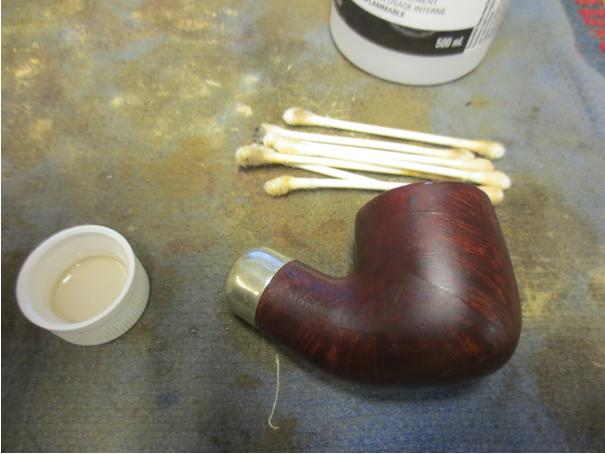
I have this pipe and one other left to clean up of the donated pipes for the benefit of Smokers Forums. This one is a Peterson’s System Standard Bent Pot. It is stamped Peterson’s System Standard on the left side and on the right side it is stamped Made in the Republic of Ireland over 301 which is the shape number. The finish was shot, worn and stained with most of the colour faded out. The nickel ferrule was oxidized and dull. The rim was dirty and nicked on the top surface but undamaged on the inner or outer edge. There were some deep scratches on the underside of the bowl that went across the surface of the briar. They were ragged and I knew that steaming them would not raise them. There was also some road rash on the right side of the bowl where it looked as if the bowl was dropped on concrete. The bowl had a thick cake that was soft and crumbly. The stem was oxidized and dirty with some tooth chatter on the top side and the underside near the p-lip. The interior was also dirty with grit. The inside of the shank/mortise was surprisingly clean with dust and tobacco residue but little tar and oil. The inside of the stem was also dirty. The hole in the end of the button was in great shape.Pete1

Pete2 I took a close up of the rim and bowl to show the thickness of the cake. I reamed the bowl with a PipNet reamer and took the soft cake back to bare briar so that a new hard cake could be developed by the new owner of the pipe.Pete3

Pete4 I sanded out the bowl to remove the ridge that appears in the photo below. You can also see the dents and nicks in the surface of the rim.Pete5 I lightly topped the bowl with a topping board to take out the damaged surface of the rim and clean up the top.Pete6 I wiped down the bowl with acetone on cotton pads to remove the finish and the grime in the grain of the briar.Pete7

Pete8 I filled the deep scratches in the bottom of the bowl with clear super glue and also filled the road rash nicks on the right side of the bowl. I sanded them smooth with 220 grit sandpaper and then sanded them with a medium and a fine grit sanding sponge. I also sanded them with 1500-2400 grit micromesh sanding pads to smooth out the scratches. I stained the bowl with a dark brown aniline stain that I thinned with 3 parts alcohol to 1 part stain. I flamed the stain to set it deep in the grain.Pete9 To make the stain more translucent I scrubbed down the surface with alcohol to lighten the stain and make it more transparent.Pete10 I put a light coat of wax on the bowl to protect it while I cleaned the inside of the pipe. I used pipe cleaners, cotton swabs and alcohol to clean out the shank and mortise area. I polished the nickel ferrule with a silver polishing cloth and was able to remove the oxidation.Pete11

Pete12

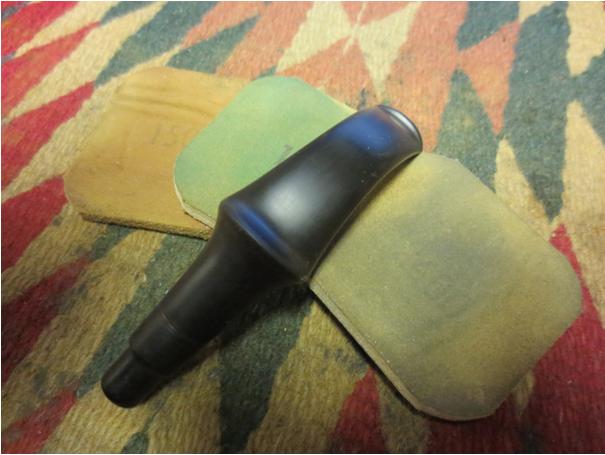
Pete13 I let the stem soak in Oxyclean for several hours while I worked on the bowl and then gave it a vigorous rubdown with coarse cloth to remove the loose oxidation. I then sanded it with 220 grit sandpaper and a medium and a fine grit sanding sponge to further remove the oxidation. Once it was gone I buffed it with red Tripoli and then moved on to sand it with the micromesh sanding pads – wet sanding with 1500-2400 grit pads, rubbing it down with Obsidian Oil and then dry sanding with 3200-4000 grit pads and giving it another rub down. I buffed it with White Diamond and then finished with 6000-12000 grit pads before giving it a final coat of oil and letting it absorb into the stem.Pete14

Pete15

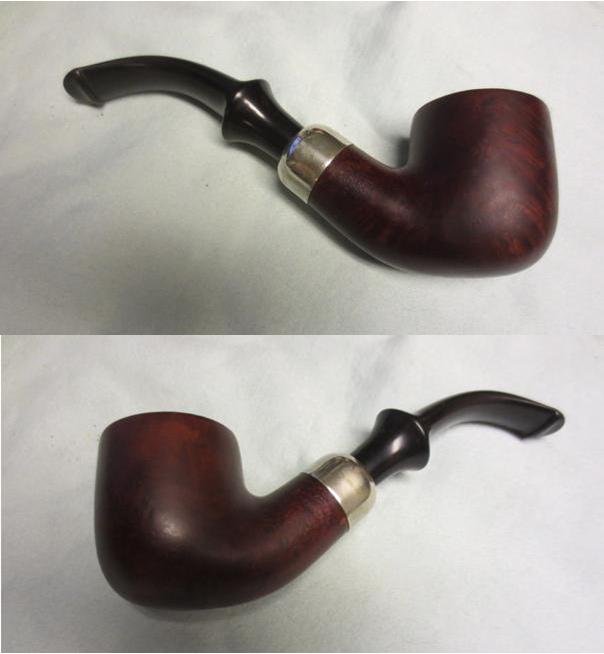
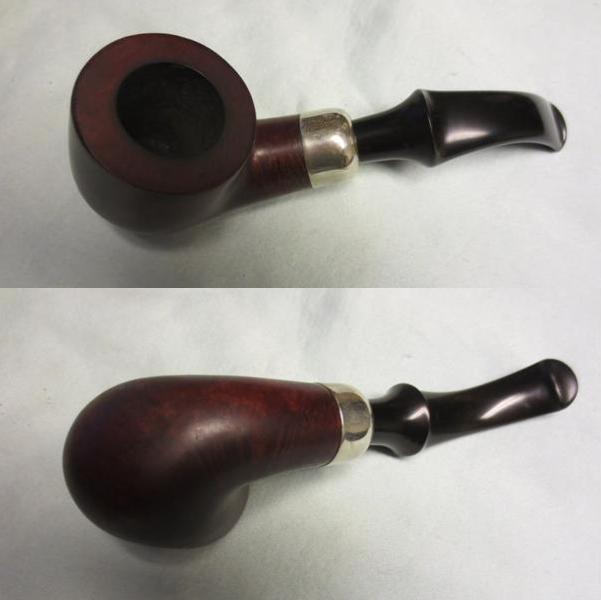
Pete16 I finished by buffing the pipe with Blue Diamond on the wheel and then giving the bowl and stem multiple coats of carnauba wax. I buffed it with a clean flannel buff and then hand buffed with microfibre cloth. The finished pipe is shown below.Pete17

Pete18

Pete19

Pete20

Simple Clean Up And Preservation Of A Kaywoodie 5051 Push Stem Billiard


Kind of miss having Troy’s refurbs posted here so I reblog a few of them to keep them up front.

Troy W's avatarBaccy Pipes

I have been picking up a few older Kaywoodie’s four digits lately and thought i would share this one as the old push stems are pretty scarce.
I was scanning EBAY and saw this come up as a ‘Buy It Now” for a great price plus free shipping , so i purchased it right away.

It was lightly smoked and in excellent shape other than the bite marks and a dent on bottom of shank. I think the previous owner chewed it more than they smoked it.
This is my first shape 51 and i like it quite a bit. Its basically a 05 with a longer shank and shorter stem . I’m a big fan of the 07,05 and 11 shaped billiard’s but i think this might be my new favorite and will be on the lookout for some more.

It was in such great shape for its age…

View original post 306 more words

An Unexpected Gift – An Early Christmas Tale


Blog by Steve Laug

I started this short story last Christmas and never finished it. Over the past months I have taken the time to complete the story and continued to edit it. It has a few twists and turns and a predictable ending I suppose. I post it now as we move ahead toward Christmas.

Matt had tucked the children into bed after giving them each a cup of warm milk and reading them a good story. And now quiet had descended on the house as they were sound asleep. His wife had gone to bed as well after preparing for tomorrow’s Christmas meal. All things being equal that meant Matt had some quiet time to relax and reflect. He poured three fingers of Maker’s Mark neat into his mug and settled into his chair. He loved to sip the smooth bourbon from a mug rather than a glass – it just worked for him. On the side table next to his chair he had strategically placed one of his pipes (chosen for just this occasion), a tin of 2010 Christmas Cheer, a tamper and lighter. There was also a selection of books that he could spend time reading – everything from murder mysteries to autobiographies. There were plenty of options to meet whatever desire struck his fancy.

He took a sip of the Mark and then set it on the table so that he could pack his pipe. He loved the flavour of Christmas Cheer and he always packed it straight from the tin. He rubbed it together to form a ball and then stuffed it into the bowl. He put some of the broken pieces of tobacco on top of the bowl to use for tinder and took a draw on the pipe to make sure it was not too tight. He then let the flame of the lighter dance across the surface of the tobacco as he drew the flame into the bowl. It did not take long before the tobacco ignited. He tamped it lightly and relit. Soon he settled back to puff contentedly on the bowl. The flavours of the Virginia hung in his mouth on his lips and gums. He could taste the sugars. The air around his head was filled with smells of rich Virginia. And even though he had read that you could not smell your own pipe Matt was convinced that he could and savoured every smell.

With the pipe fully lit and smouldering he took another sip of the Mark and swirled it around in his mouth. Makers Mark went exceptionally well with a rich Virginia Flake. And Christmas Cheer was as rich as could be and the combination just worked. He sat quietly thinking about his family in bed in the rooms above his head. He looked at the Christmas tree and the gifts that were placed strategically around its base. He nodded his head and thought how much the kids would enjoy the magic of Christmas morning in just a few hours. He well remembered that they would be up at the crack of dawn and emptying the stockings that hung on the mantle of the fireplace – heavy with goodies and small gifts. He and his wife had devised the stockings as a strategy to give them a bit more time resting while the kids opened the stockings.

The smoke curled around his head and the peacefulness of the moment lent an air of contentment to his heart and mind. He reached for a book he was currently reading – a biography of CS Lewis one of his heroes. He had read all of Lewis’ books and had read the Chronicles of Narnia to his children for many years now. It was almost a yearly event that started every fall and ended about the time the flowers poked out from the ground in the spring. He found that at this particular moment he could not focus on the book at all so he set it aside. He tamped his pipe and slowly puffed on it. He sipped the Mark and leaned back in the chair. He put his feet up on the foot stool and disengaged from the world around him. That was the beauty of a pipe. The ritual of loading, packing, lighting and smoking a pipe had an uncanny way of making the cares of life slip away for the time spent with the pipe. It slowed down time and caused worries to dissipate even if only for a short moment. The respite seemed to make knots untangle and worries not matter as much.

Time seemed to just slip away and Matt was brought back to reality when he heard the grandfather clock strike 12:00. The tobacco had burned down to a light grey ash. The fire in the fireplace had grown cold. The Makers Mark in his mug was gone. He had been lost in the smoke of his pipe and the quiet reflection that seemed to reside in the midst of that smoke. He heard a rustle behind him and wondered what was going on. He thought he must have been hearing something but he stopped nonetheless. There was a rustle of fabric and a slight cough. He sat up straight and peered around the edge of the tree in whose shadow he sat to see who was there. And what to his wondering eye should appear? Who was behind the edge of the tree and his vision? Whose clothes were rustling and who coughed? It was his son Luke. Luke came into the room and climbed up on his dad’s lap. He snuggled in close and Matt laid his finished pipe on the table.

He sat with his young son on his lap in the dark with only the flickering Christmas lights lighting the room. His eyes grew heavy and very soon he was sound asleep with his son on his lap. He never heard the slight rustle in the chimney or the clunk as a pair of boots landed among the cold ashes of the fire. Nor did he move when the fellow quietly went across the room and laid down his sack and arranged his presents under the tree. Once finished the fellow looked at Matt and Luke sitting in the chair and chuckled quietly. His eye took in the pipe on the table next to Matt and the can of Christmas Cheer sitting open next to it. He walked to the table, picked up the tin and took a deep sniff of the tobacco. He took a pipe out of his pocket and loaded a bowl, tamped it with his finger and lit it with the lighter. He sipped the tobacco and as it burned slowly in the bowl he wrote a note for Matt. He set the note next to the tin and replaced the lid on the tin. As he did Luke stirred and his eyes grew large as he took in the fellow smoking a pipe standing in front of him. He wink at Luke and put a finger in front of his mouth. He put a finger next to his nose and in a wink he was gone.

Matt awoke to his son shaking him. His son said nothing but merely pointed to the note next to the tin of tobacco. Matt shook himself awake, picked up the folded paper and read what was written there. Here is what it said:

Hi Matt, I stopped by to leave a few things under your tree. I was so glad to see that you smoked some decent tobacco in your pipe. Christmas Cheer is my favourite blend. I hope you don’t mind but I helped myself to a bowl. You left the lid off so I put it back in place for you. You don’t want that tobacco drying out too much. Oh and just so you know I left a little something from me under the tree. I expect you will enjoy it. Maybe next year you will be awake and we can share a bowl. Merry Christmas! — Nick.

Matt sat stunned for a moment. Then he turned to his son and together they looked at the fireplace and the gifts under the tree. He went to the tree and picked up the small package with his name on it. He knew that it had not been there before. He turned it over in his hands and then opened the package. Inside was a nice tin of 2008 Christmas Cheer, two years older than the one that was on the table. There was a short note under the plastic lid that simply said:

I enjoyed some of your 2010 Cheer so I thought I would share some of mine. Enjoy! – Nick

Who would ever believe this simple tale? But they both knew it was true. Luke had seen the old soul and Matt had the letter and the closed tin of tobacco. They both knew that their guest had been there. Matt could also smell the Virginia smoke in the air. Ah well. They both should head to bed for a few hours of sleep before the rest of the family awoke and the festivities began. He unplugged the lights on the tree and picked up his son. The two of them climbed the stairs. He tucked his son into bed and kissed him good night. He took himself to bed and pulled back the covers. He was asleep as fast as his head hit the pillow. Santa2 October 6, 2015

Restemming a Brian Doran Nosewarmer Poker


Blog by Steve Laug

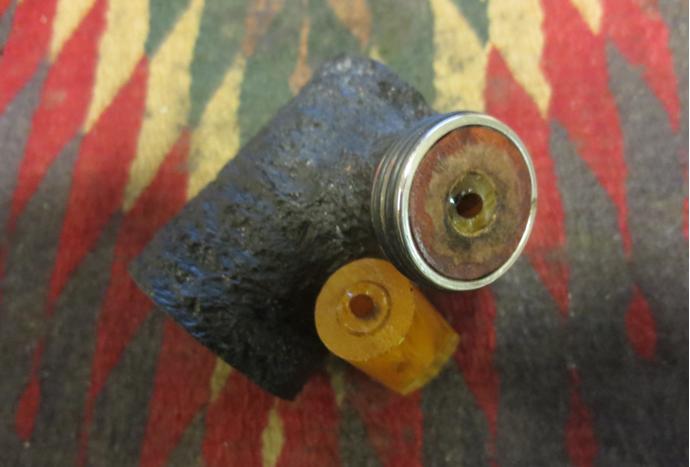
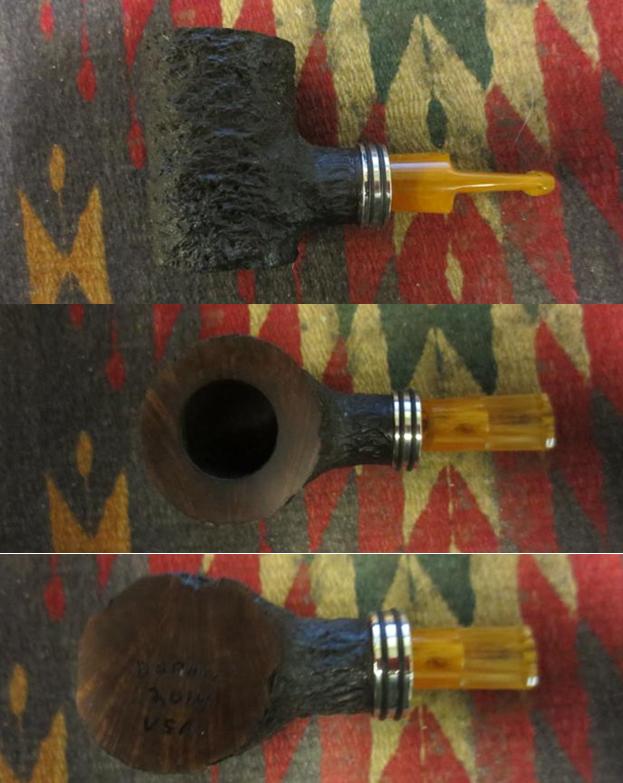
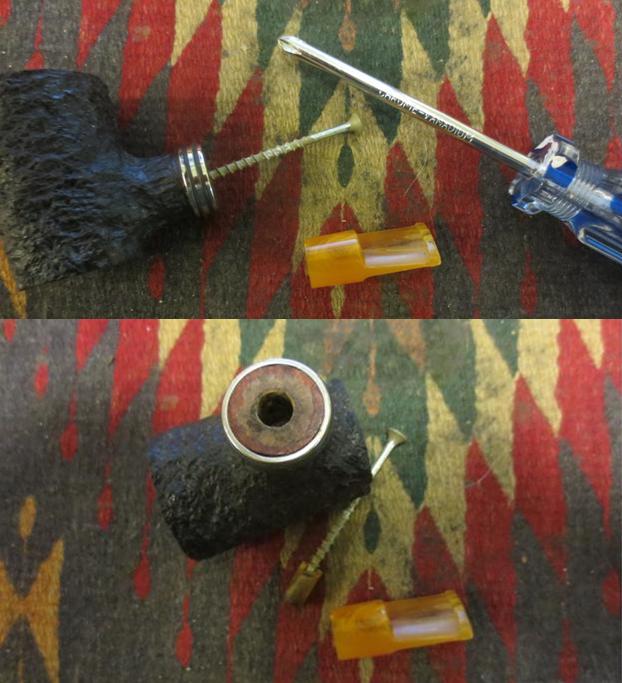
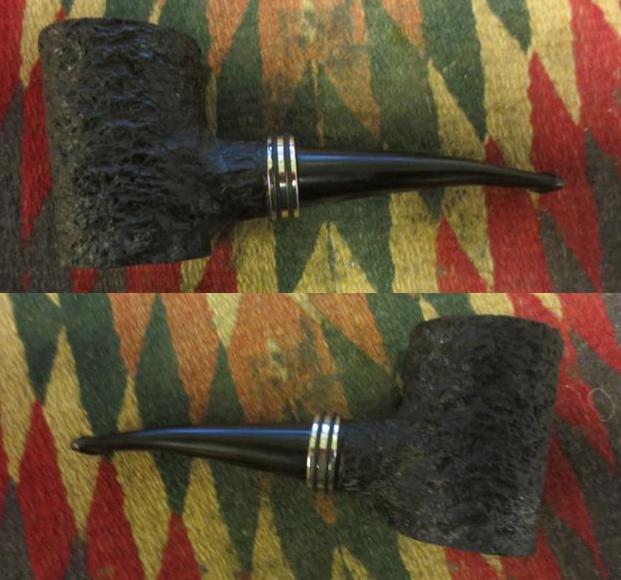
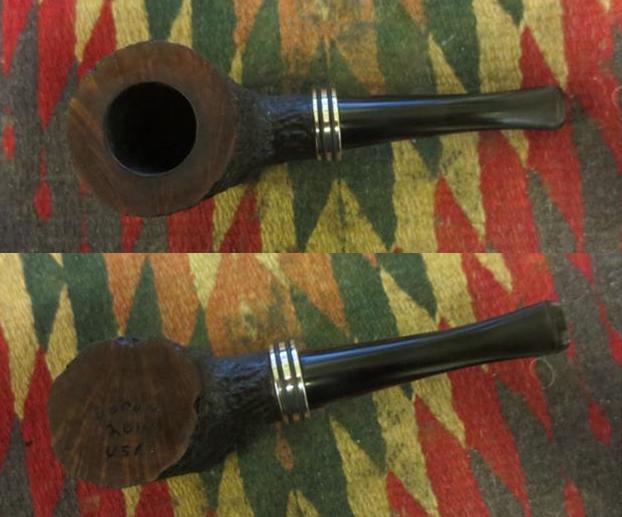
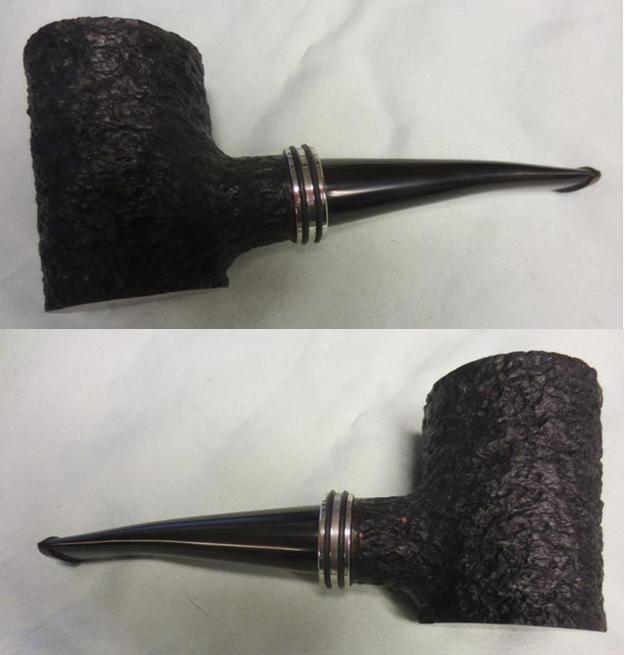
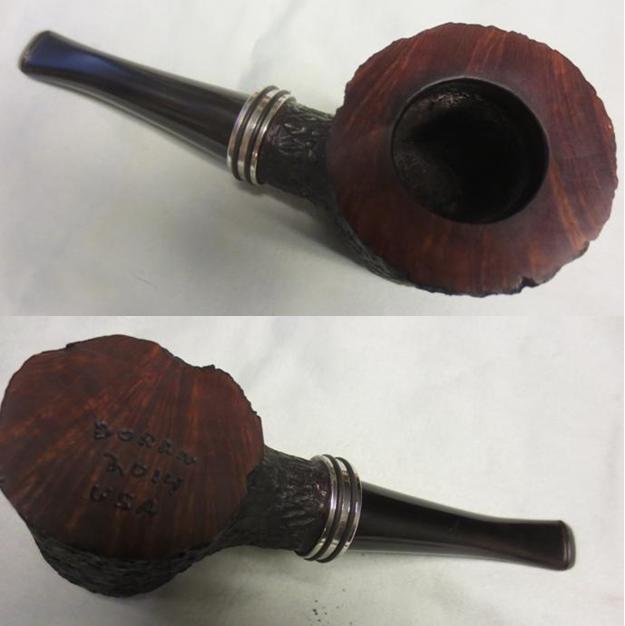
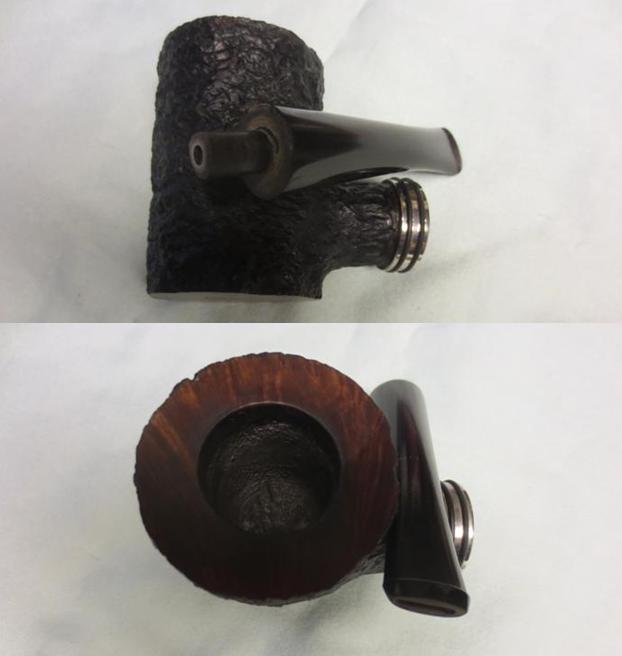
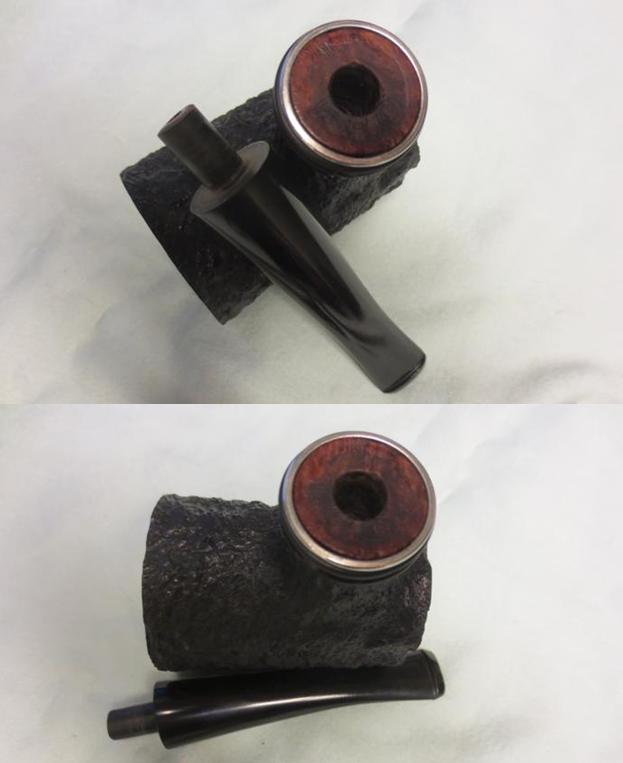
In the gift bag that I received while traveling was a poker made by Brian Doran. I did some reading on Brian’s Facebook page and cannot find out when the pipe was made. I know that this one was originally a nosewarmer poker. I had the pieces of the pipe as it had been dropped by my friend. The tenon broke off in the shank. The tenon would need to be pulled and a new tenon put in the stem or the pipe would need to be restemmed. The bowl was large and the rustication was very nice with a contrasting stain between the rim and bowl. The bowl was a dark brown/black with the smooth rim and bottom stained with a medium brown. The bowl was attractive and the drilling was spot on. There was a large silver band with two black rings around it on the end of the shank that added to the weight of the piece.Doran1 I put the stem up against the bowl to get an idea of how it originally looked before the break. The piece of briar was quite large and heavy and the small mouth piece that had been on it made gripping it a challenge. I could see why my friend had dropped it. The mouth piece itself was smaller in diameter than the shank of the pipe and did not look quite right to me. The button was rough – not sure if it happened during the drop or if it came that way. It had chips out of the edges, top and the face of the button and the inside of the slot was also roughly shaped. The shortness of the blade on the stem did not give much to work with.Doran2 I used a screw to pull the broken tenon out of the shank. I twist it in with a screwdriver until it catches and then wiggle the screw while pulling on it. It generally comes out very easily. I was thankful that this time it came out without a problem. I cleaned up the shank with pipe cleaners, cotton swabs and alcohol.Doran3 With the tenon pulled I needed to make a decision regarding the pipe. After spending some time with the mouth piece I decided that the damage to the button would take more work than I was willing to put into it. I personally did not like the short stem and found that it was uncomfortable in the mouth and the pipe was too heavy to make it practical. That meant that I needed to restem it. I looked at short stems of the same diameter – both saddle and tapered and just did not like the look. I went through my stems and found a saddle stem that was the same diameter as the shank but was not happy with the overall look. Then I found this smaller tapered stem. It was one I had scavenged from somewhere and the tenon was a perfect fit. It sat in the shank just like the little saddle stem had and showed the stained briar ring inside of the silver band. The appearance at the shank was almost the same. It was slightly bent and I would need to straighten it but I kind of liked the look. It would be worth working on. If I should decide otherwise later I can always restem it again. I set up the heat gun and straightened the stem leaving a very slight bend.Doran4 I took the next series of photos to show what the pipe looked like at this point in the process with the longer stem.Doran5

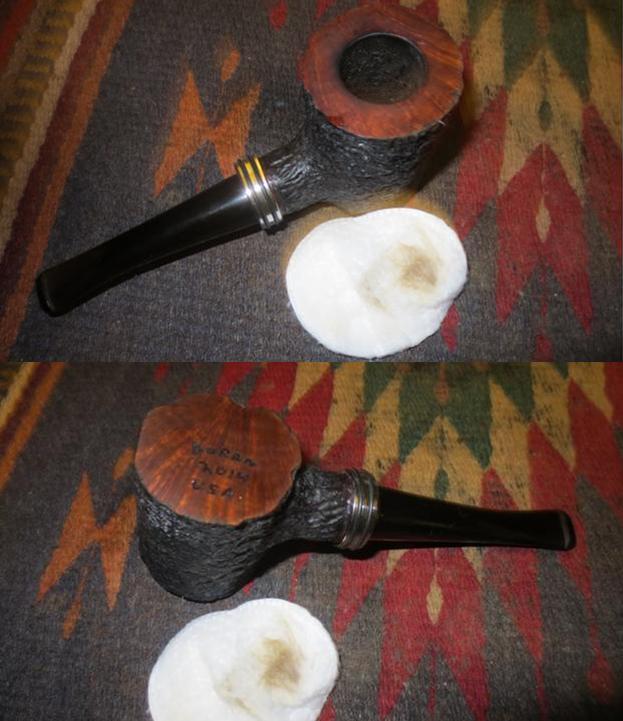
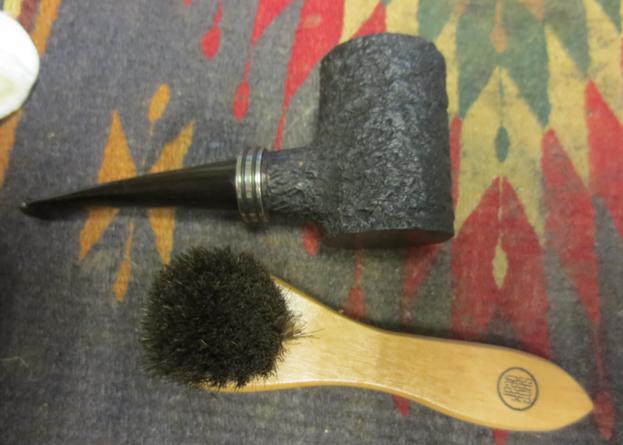
Doran6 I reamed the bowl to take back the uneven cake. I scrubbed the rusticated bowl and the tars on the rim with a tooth brush and Murphy’s Oil Soap. I rinsed the bowl with water and then dried it off with a soft cloth. I further worked on the darkening of the rim with a cotton pad and saliva until I had the majority of it removed. I also scrubbed the bottom of the bowl with the cotton pad and saliva as well.Doran7 I buffed the rustication with a shoe brush to give it a slight shine.Doran8 I gave the bowl a light wipe down with olive oil and hand buffed it with the shoe brush to raise the shine. The stem was in very good shape with no tooth chatter or oxidation so it needed only to be cleaned and polished. I buffed the rim and the base along with the stem with Red Tripoli, White Diamond and Blue Diamond. I then gave the rim, base and stem several coats of carnauba wax and buffed them with a soft flannel buff. I finished by hand buffing with a microfibre cloth. The finished pipe is shown below. I like the new look with the longer stem. The pipe now works as a sitter and balances on the desk with no issues. What do you think?Doran9

Doran10

Doran11

Doran12