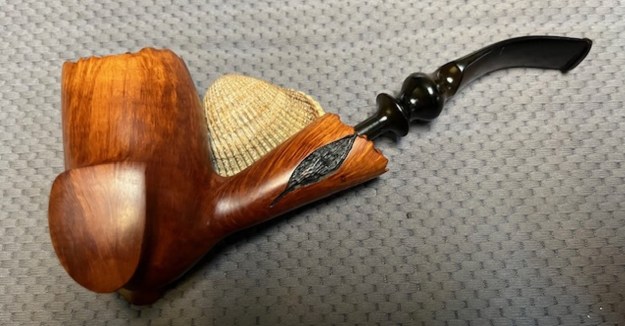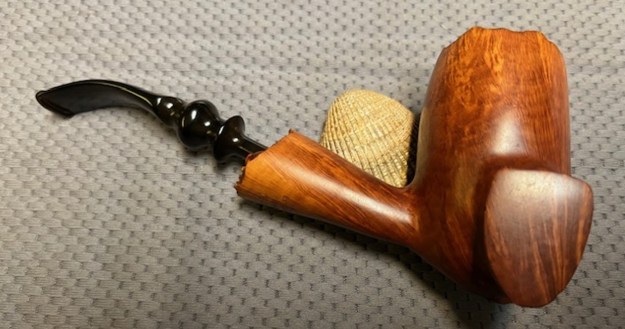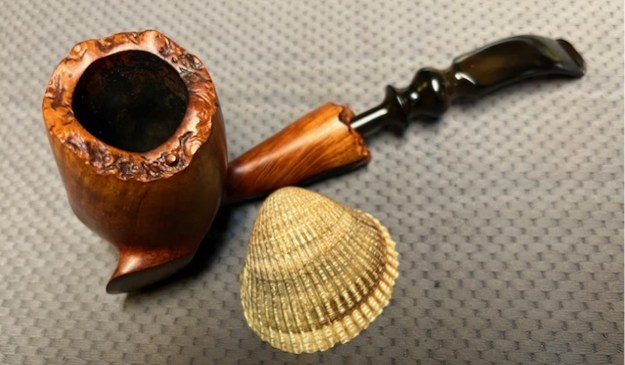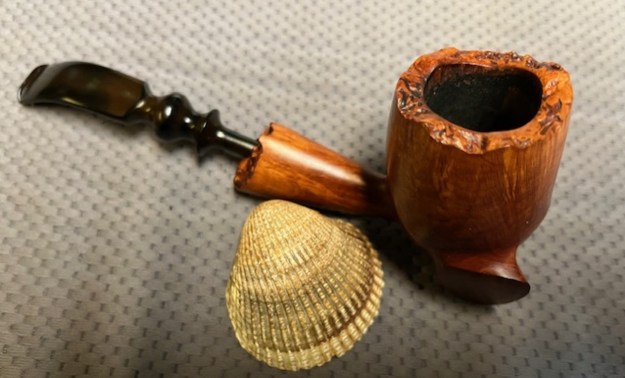
Tag Archives: Soren Freehand Pipes

Restoring Someone’s Favourite Soren Hand-Carved Made in Denmark


by Steve Laug

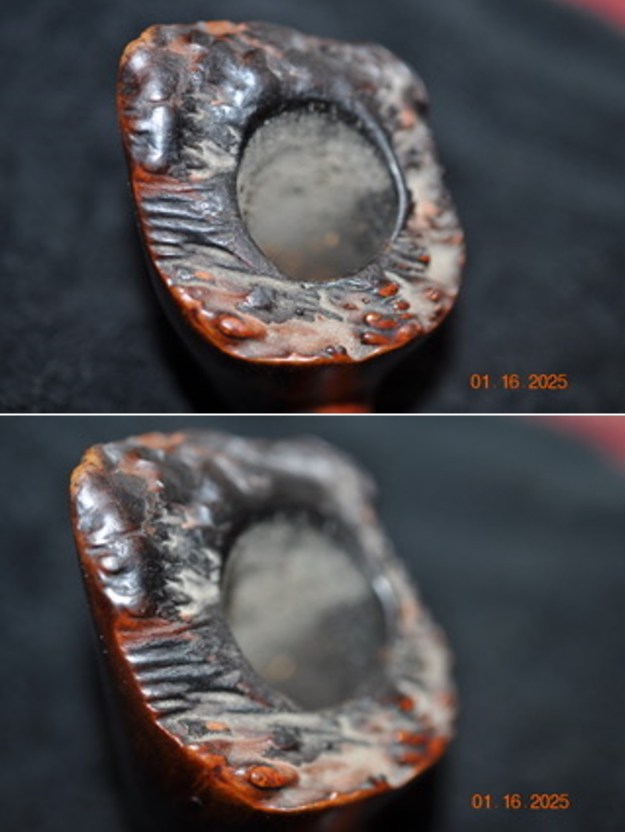
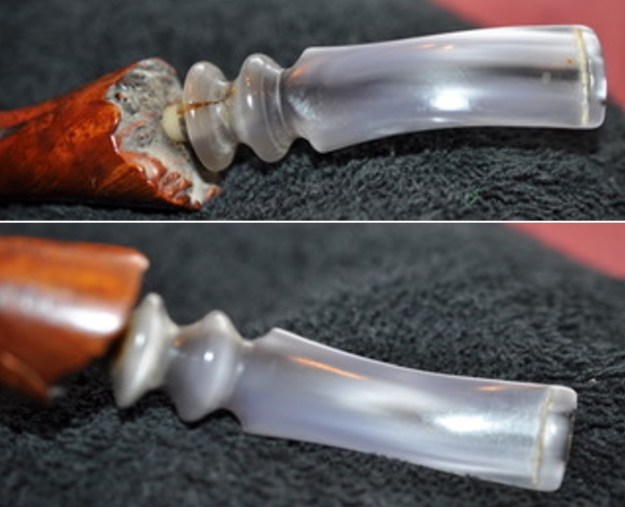
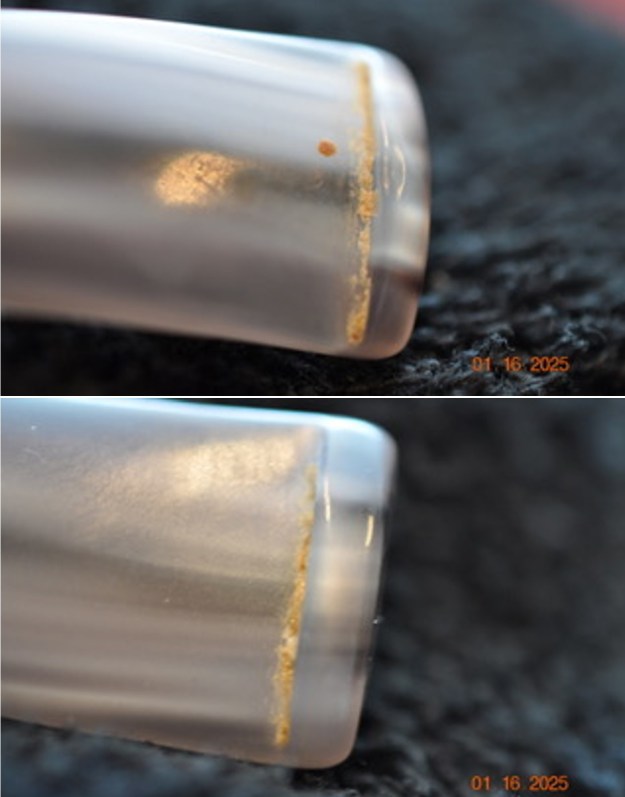
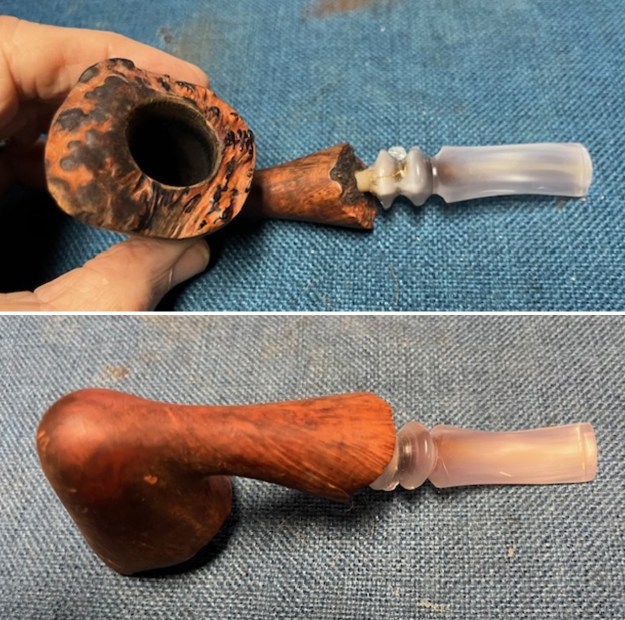
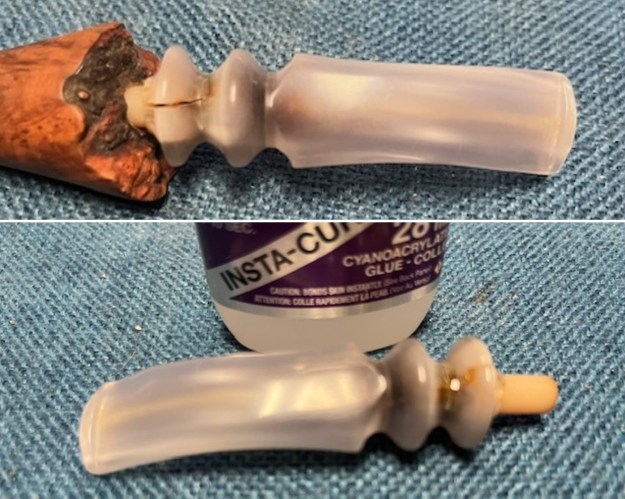
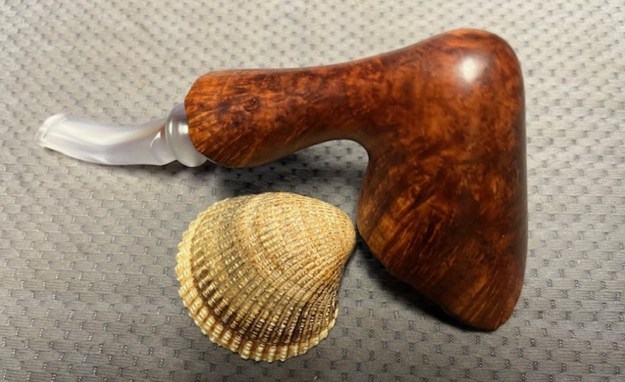
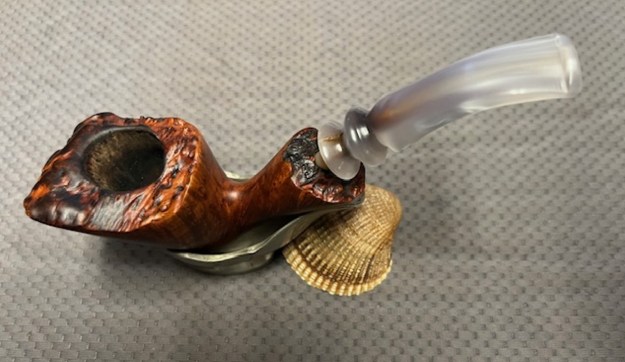
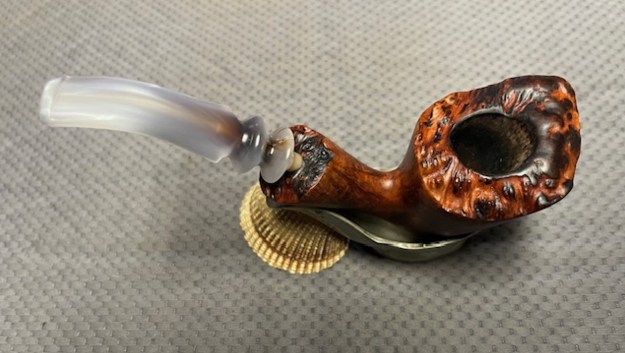
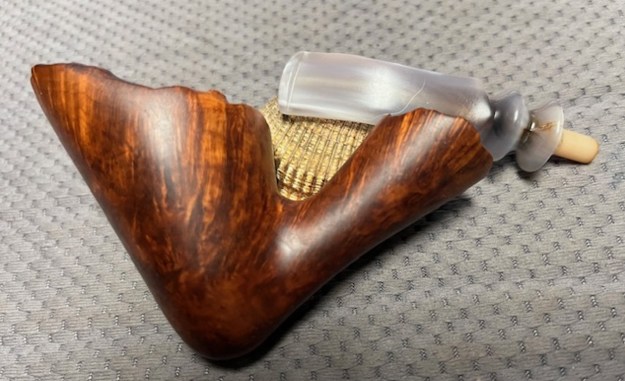
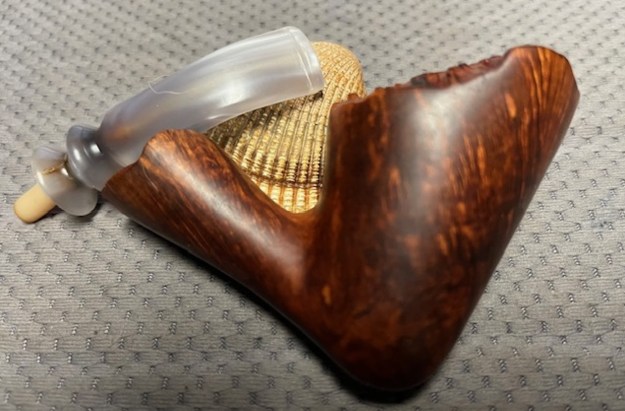
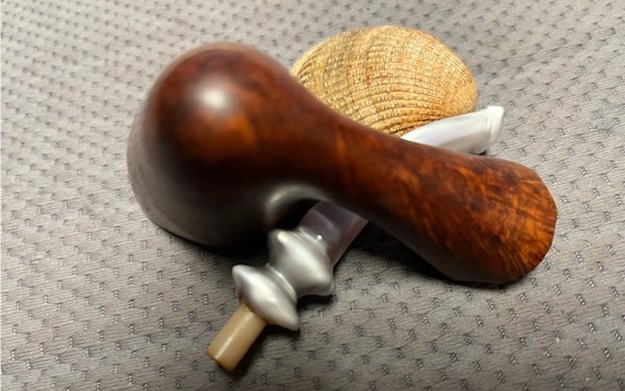
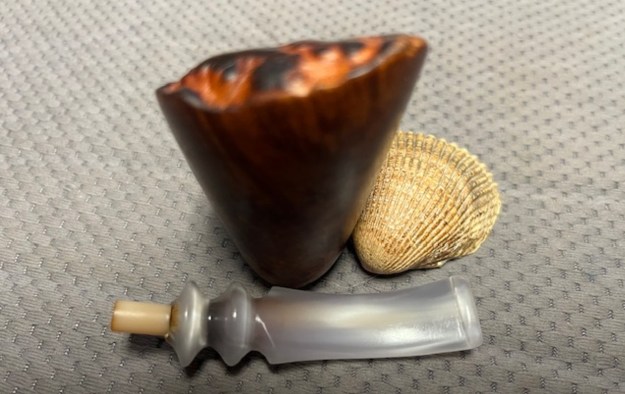
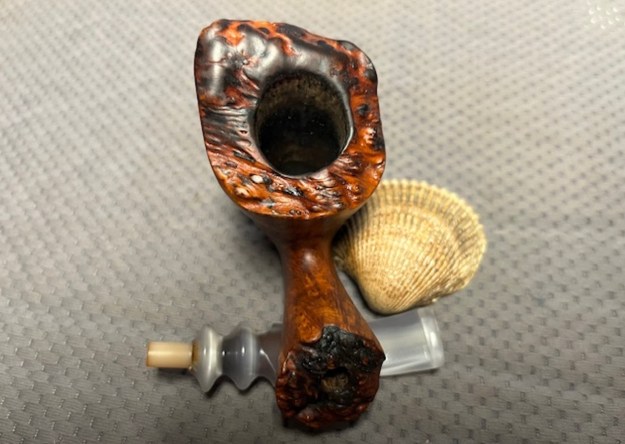
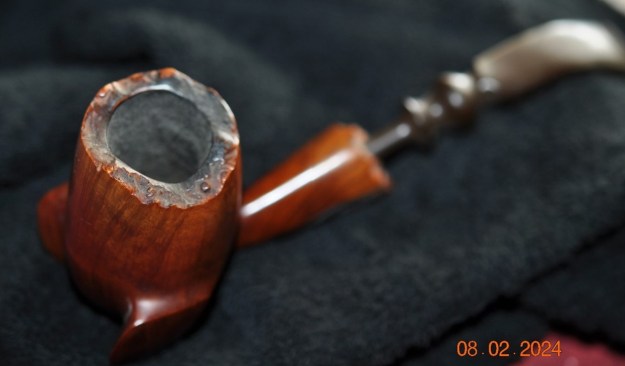
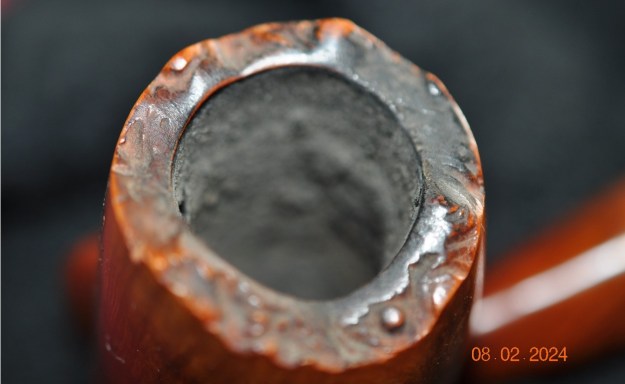
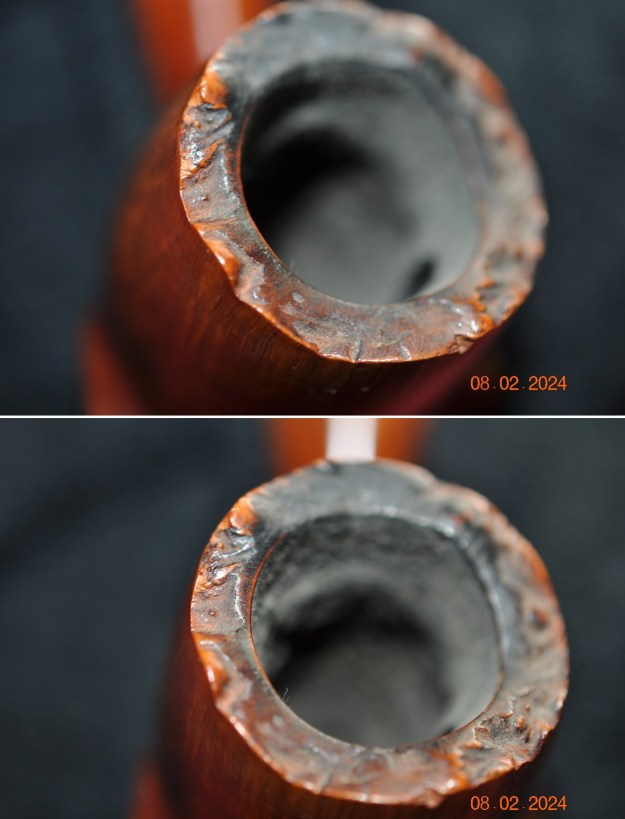
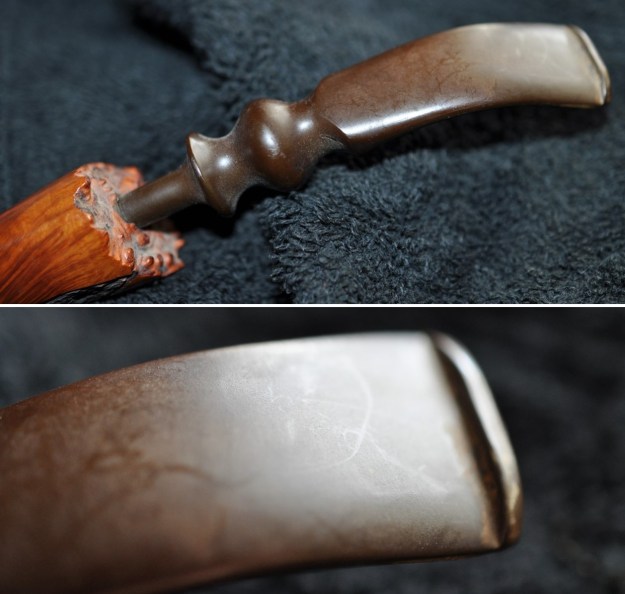
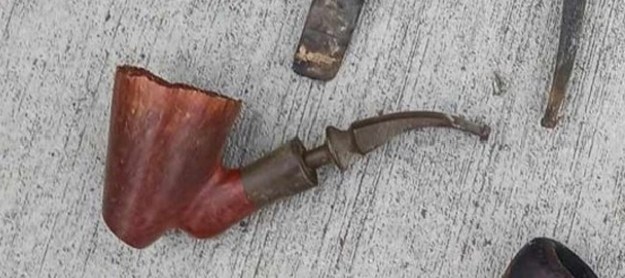
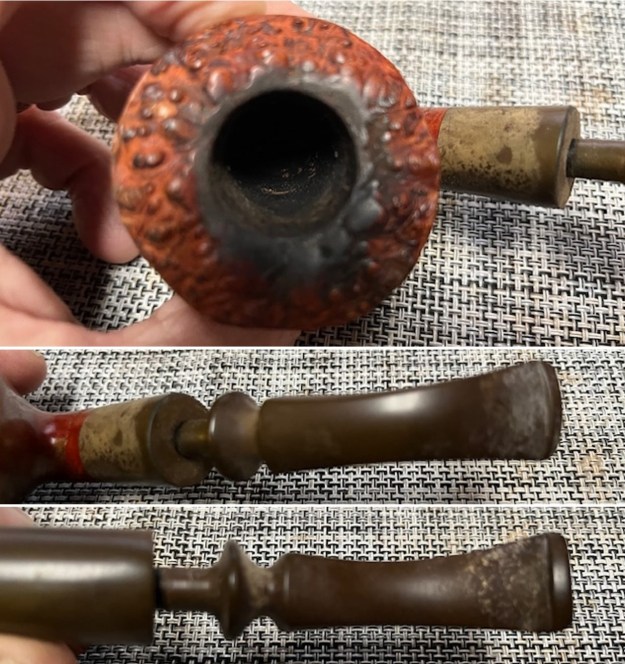
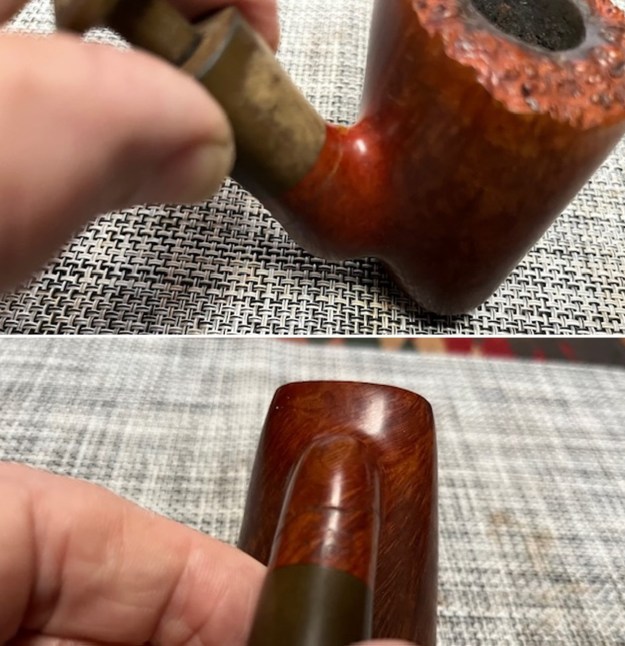
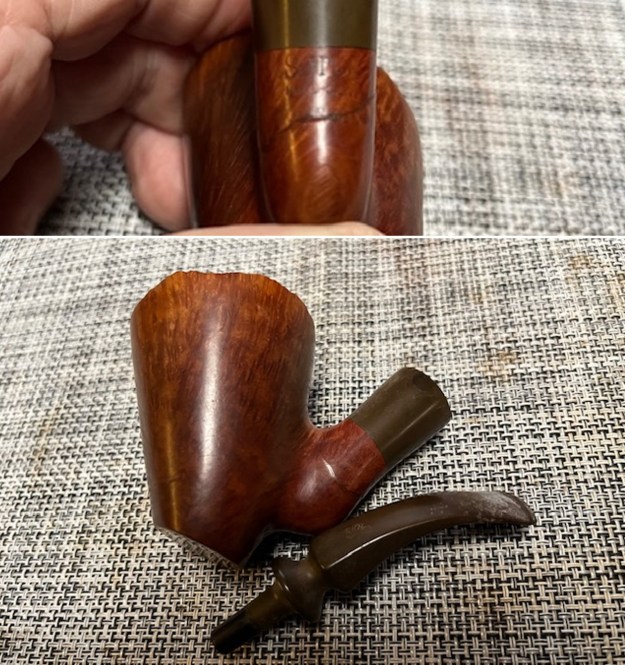
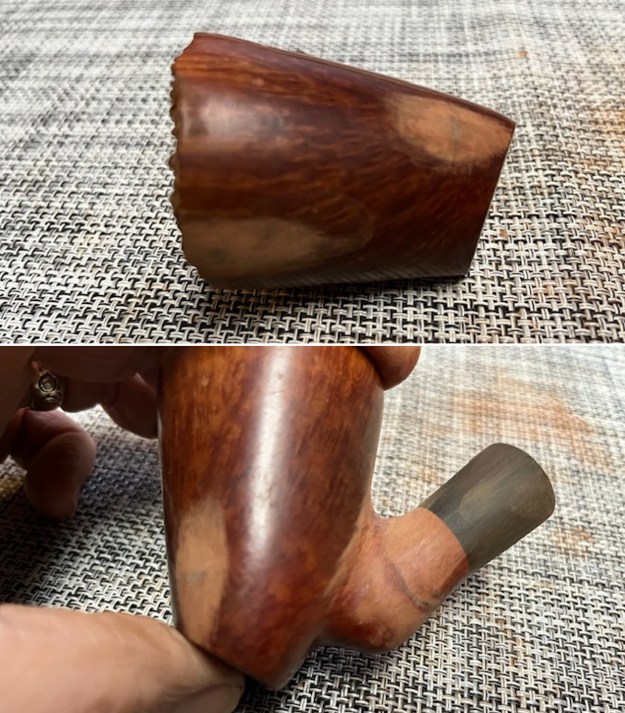
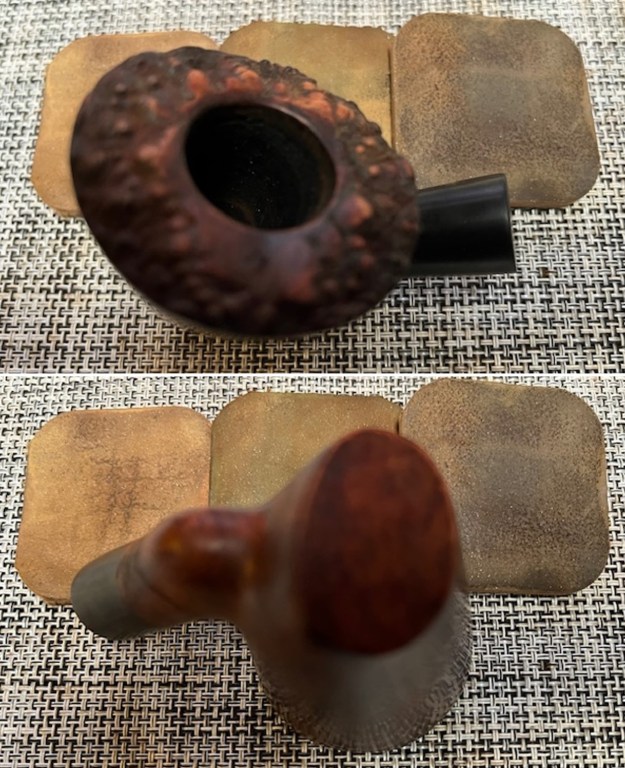
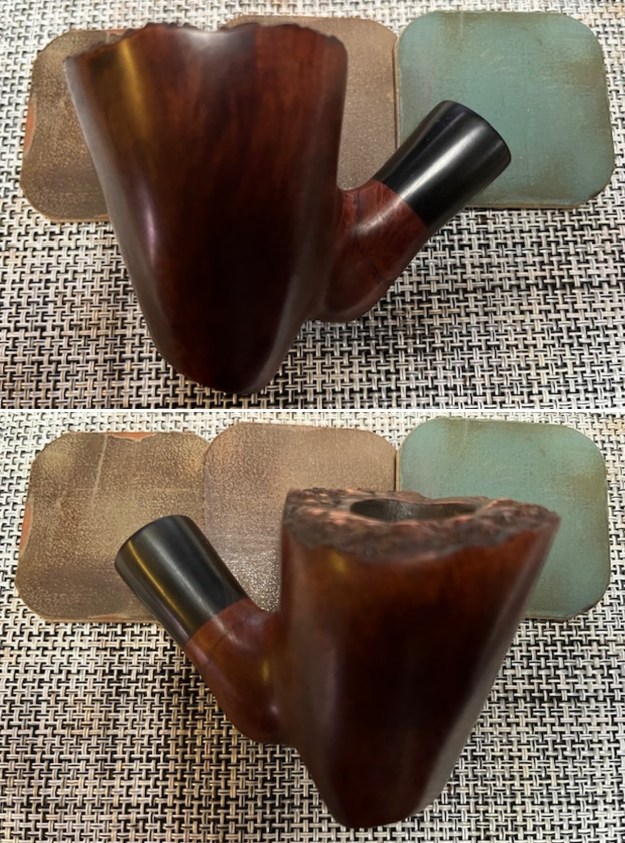
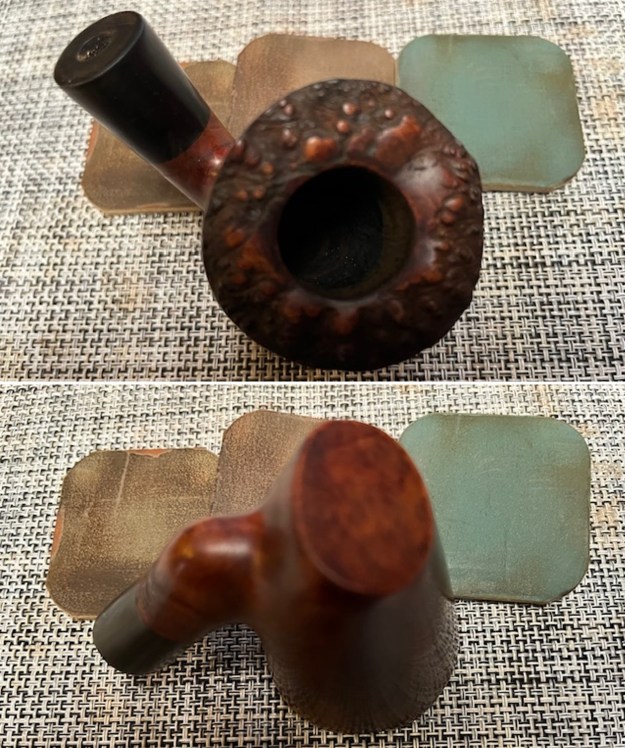
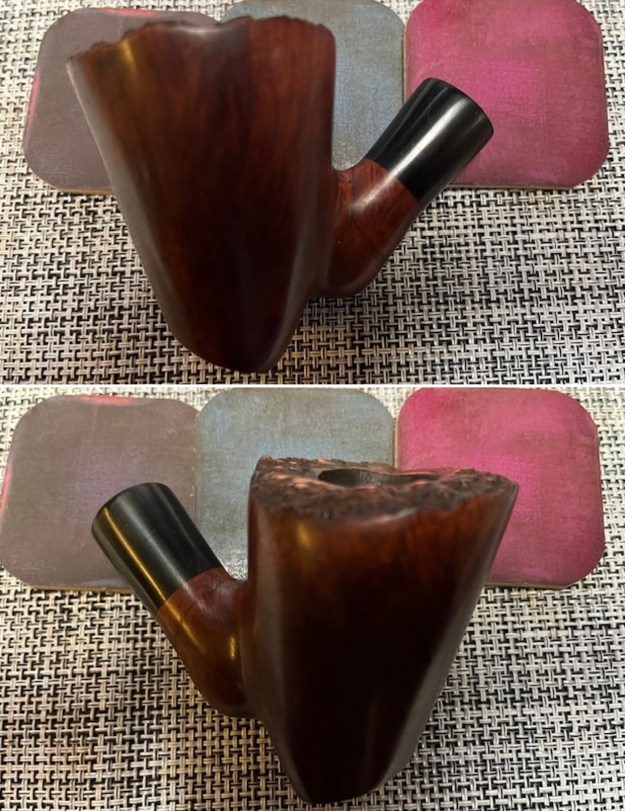
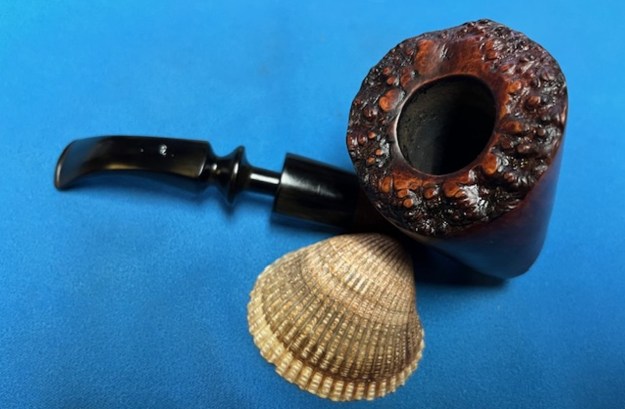
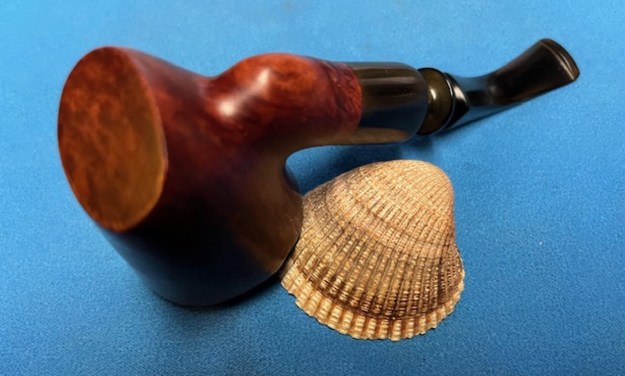
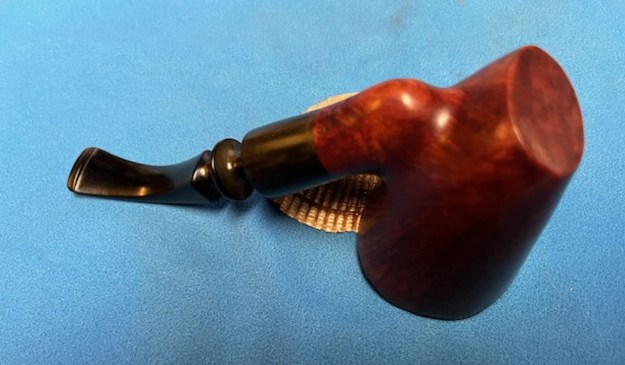
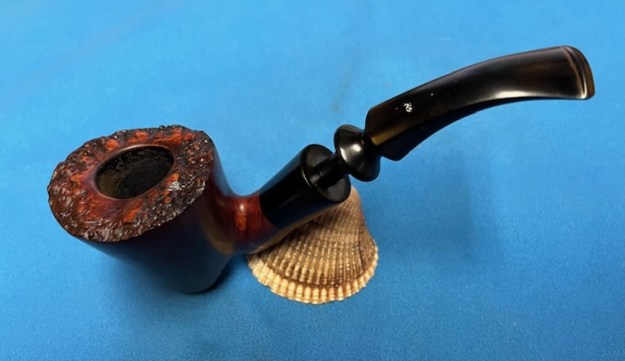
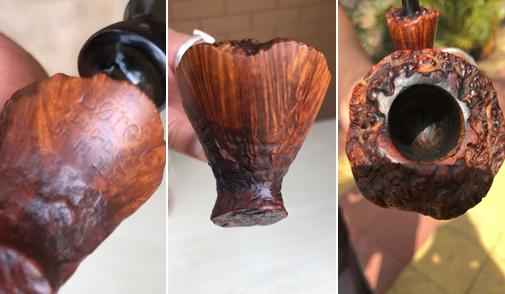
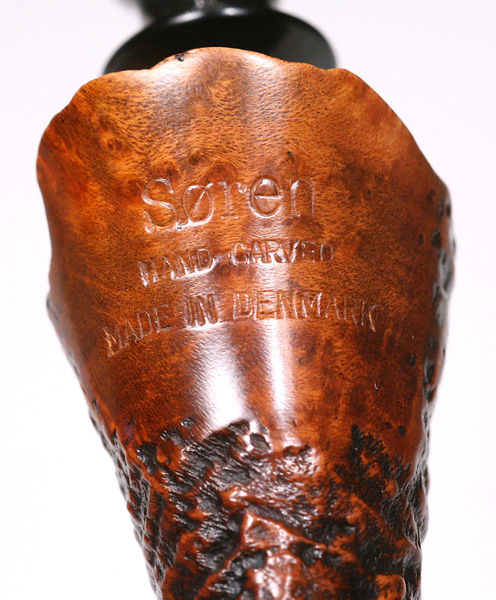
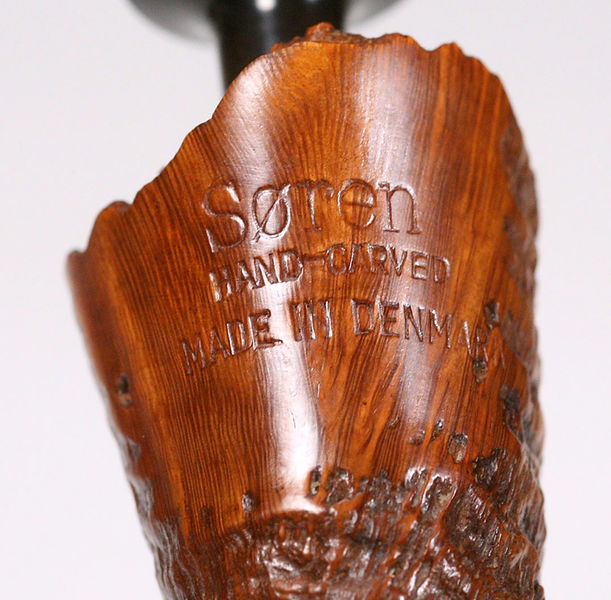
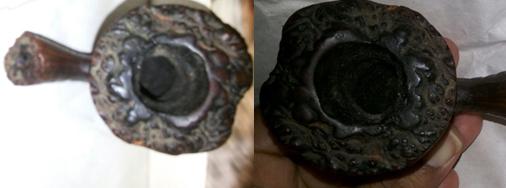
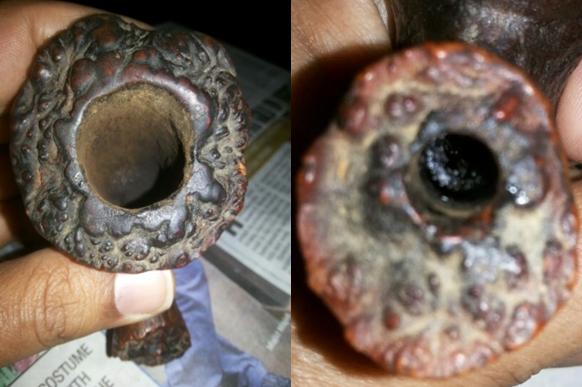
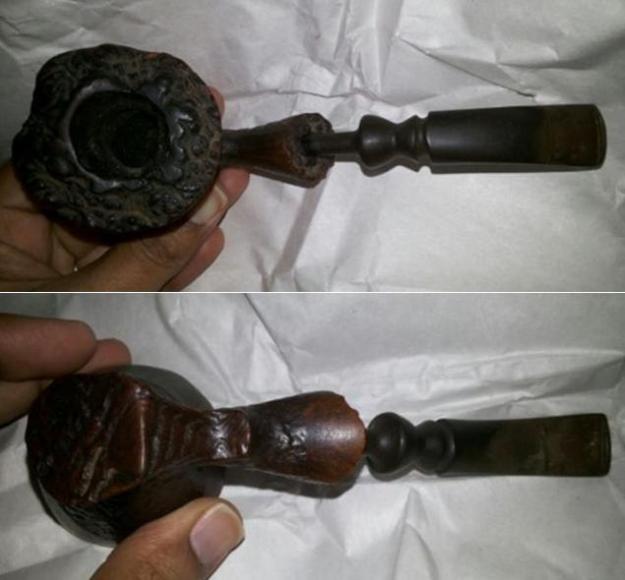
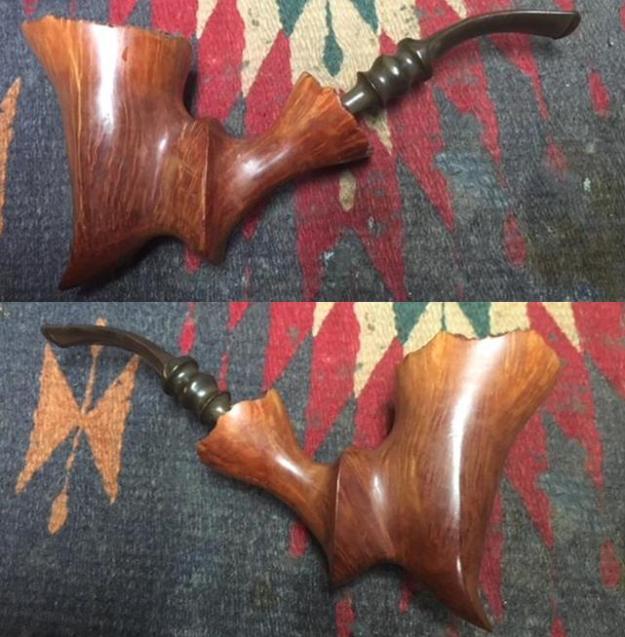
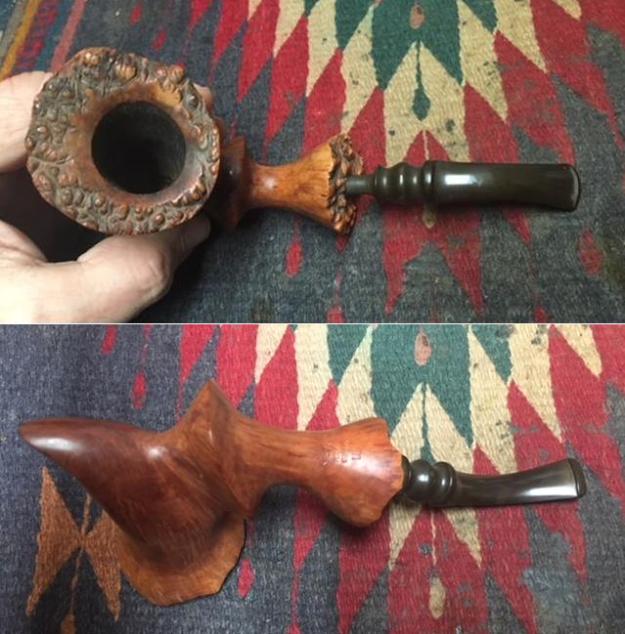
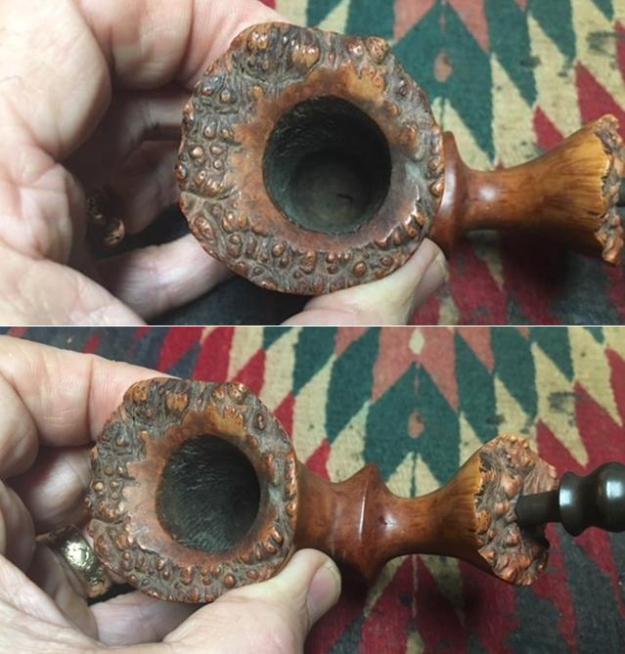
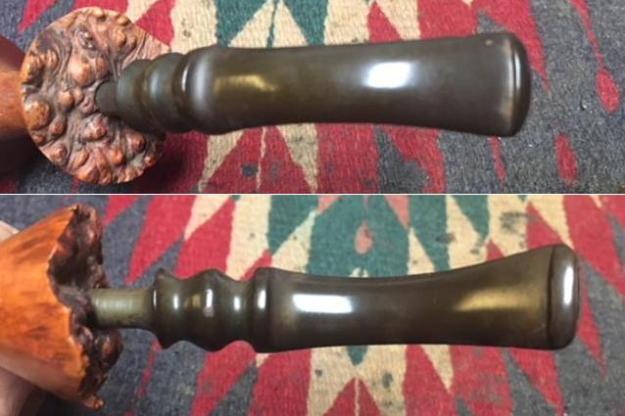
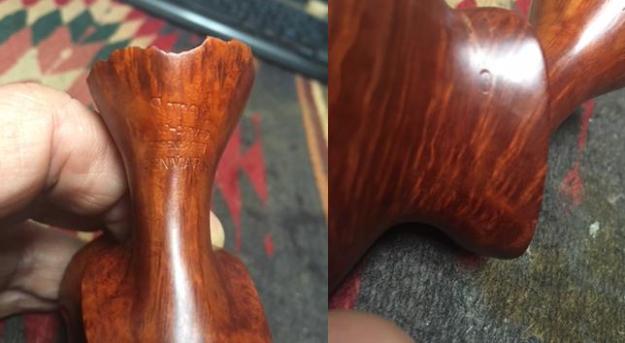
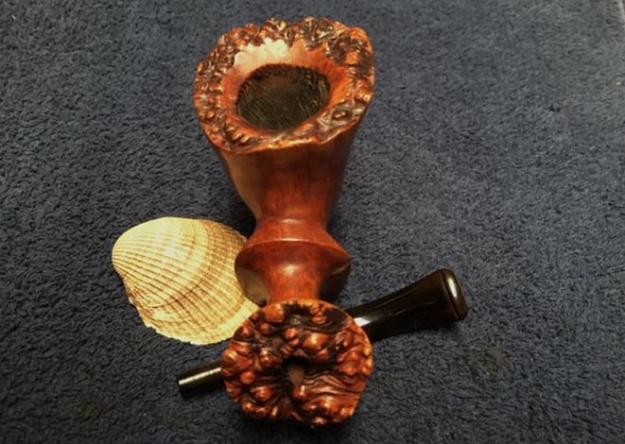
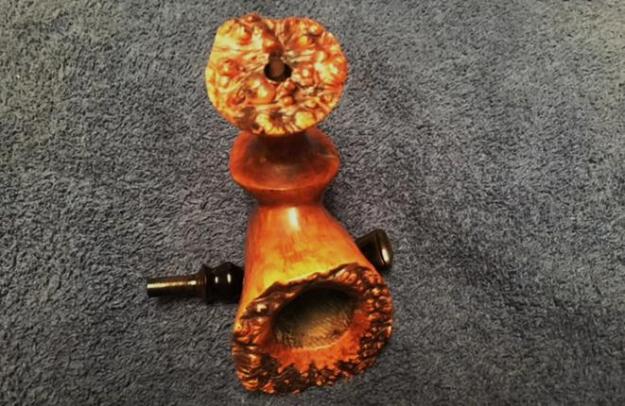
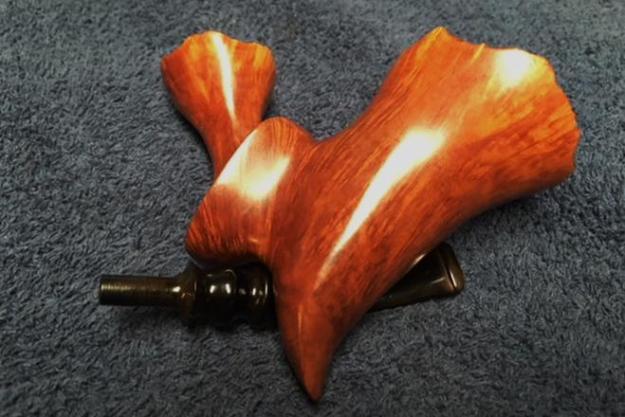
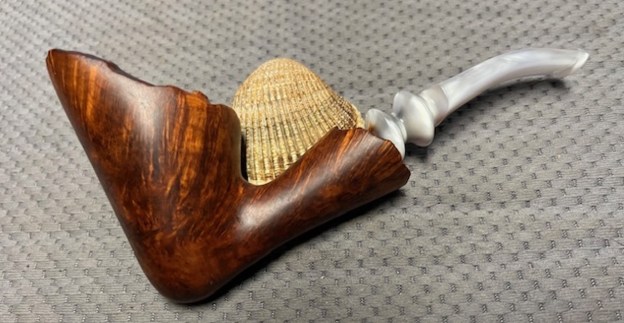
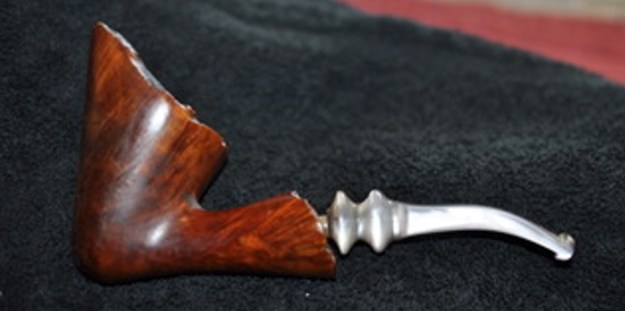
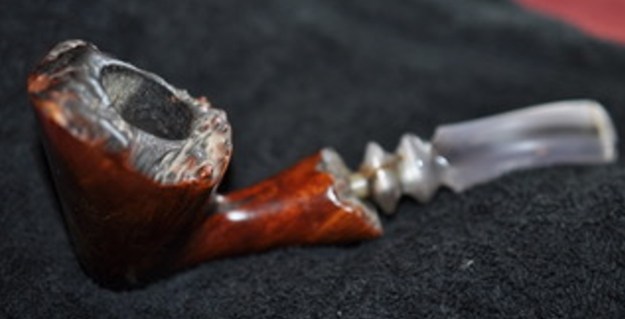
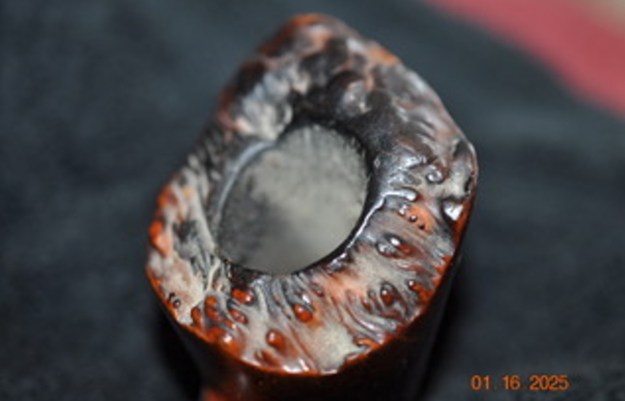
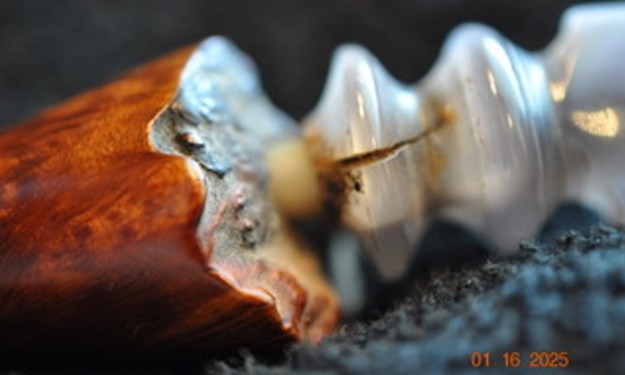
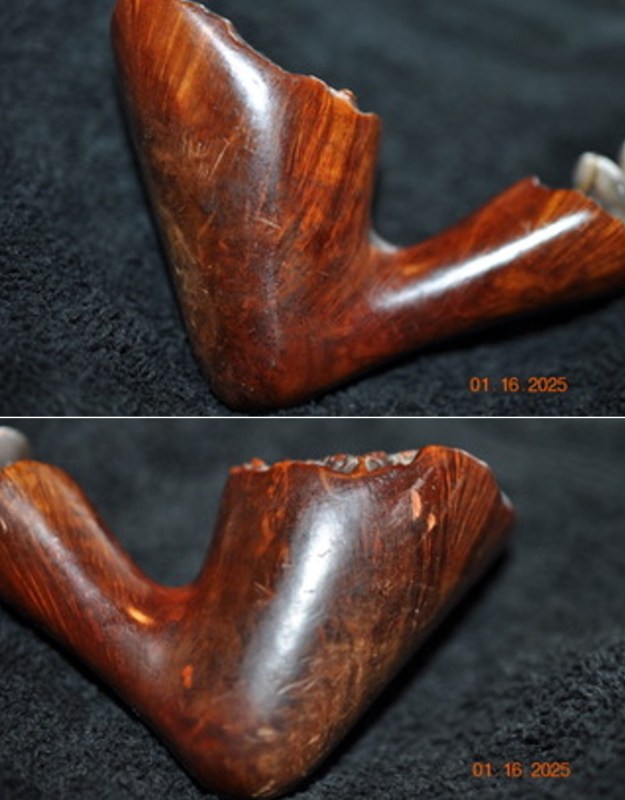
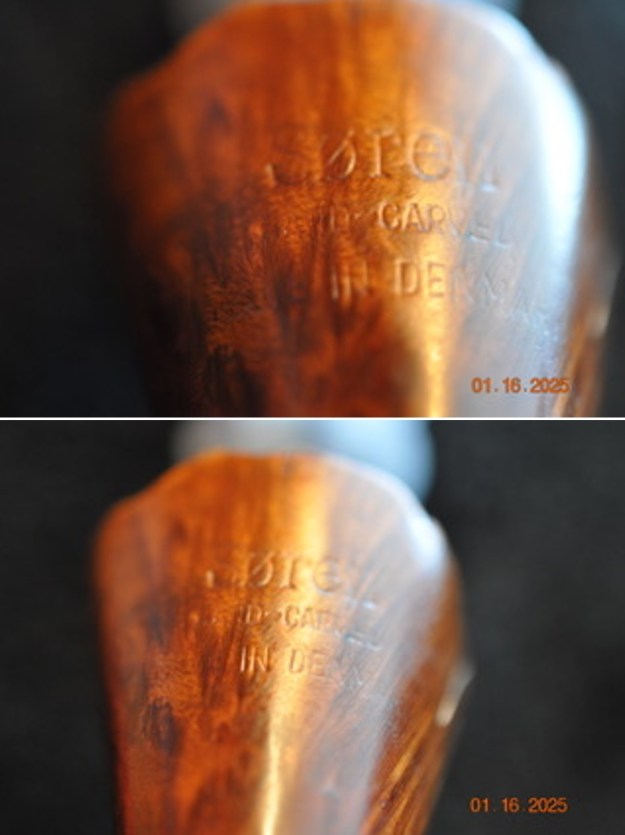
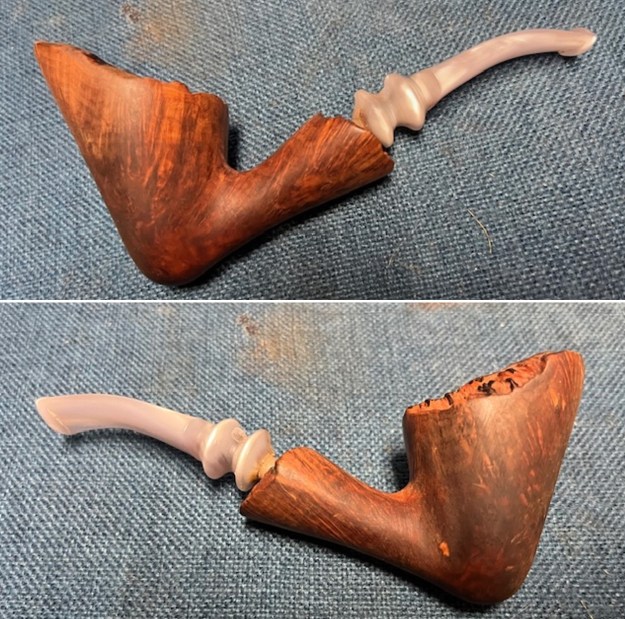
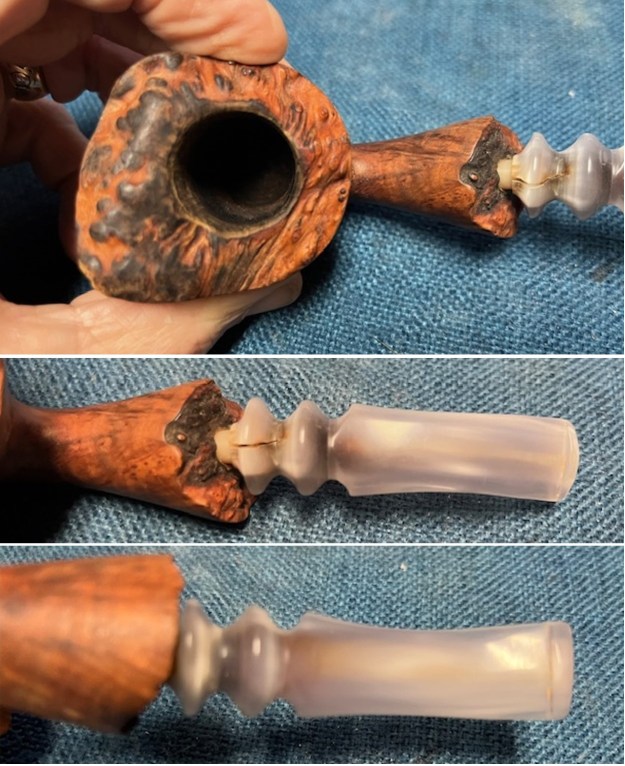
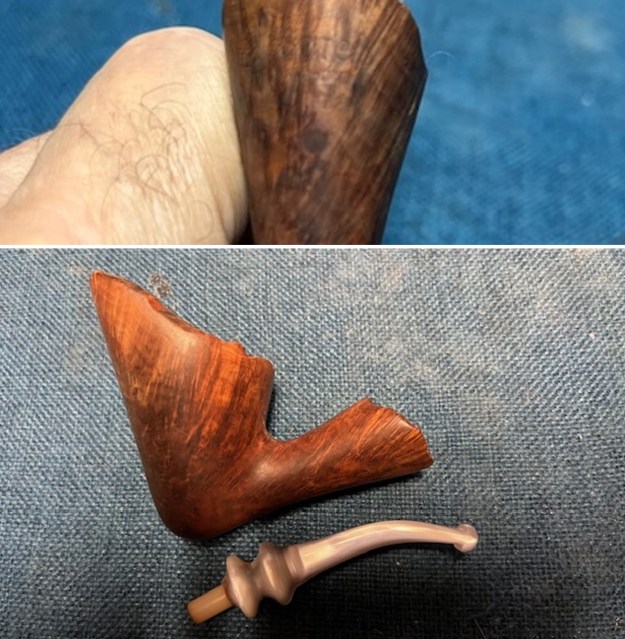
This particular Freehand pipe was purchased from seller Fort Meyers, Florida, USA on 06/13/2022. It really is a great looking Freehand pipe that combines a plateau rim top and shank end with a smooth bowl and shank. It is stamped on a smooth panel on underside of the shank and reads Soren [over] Hand-Carved [over] Made in Denmark. The finish is dirty and darkened with hand oils but that does not hide the beautiful grain around the bowl and shank. The pipe had a thick cake in the bowl and lava overflow on the rim top and inner edge of the bowl filling in some of the plateau. There was grime ground into the smooth finish and dust and debris in the plateau valleys on the shank end. The fancy grey/silver variegated, fancy saddle stem had a crack in the saddle portion that had been repaired. The tenon in the stem is a new one and the crack had been caused by the drilling and repair. It had light tooth marks and chatter on both sides ahead of the button. The pipe must have been a great smoker judging from the condition it came it. Jeff took photos of the pipe before he started his work on it. Jeff took photos of the rim top and the stem to show the condition of the pipe when we received it. You can see the cake in the bowl and the heavy lava and darkening on the plateau rim top and inner edge of the bowl. The turned acrylic stem was dirty and had light chatter and tooth marks on both sides near the button. It also has a repaired crack on the topside of the saddle. Jeff took a photo of the crack in the stem. You can also see the replacement tenon that was inserted in the stem. I believe that it had cracked in the drilling of the stem for the replacement tenon. The new tenon was glued in the stem and some glue had been put in the crack. It had not been filled with glue so the crack gathered debris and had darkened.He took photos of the sides and the heel to give an idea of the shape and the condition of the briar around the bowl. It really is a beautifully shaped pipe highlighted by the plateau finish on the rim top and shank end. The photos show the scratches in the briar as well as some small light coloured fills around the bowl sides and heel. The next photos Jeff took show the stamping on the underside of the shank. It is clear but faint in spots and read as noted above.I went to a previous blog and reread what I had written in order to refresh my memory of the background and information on the Soren pipes (https://rebornpipes.com/2016/09/12/repairing-and-rejuvenating-a-soren-danish-freehand/). I quote from that blog post:
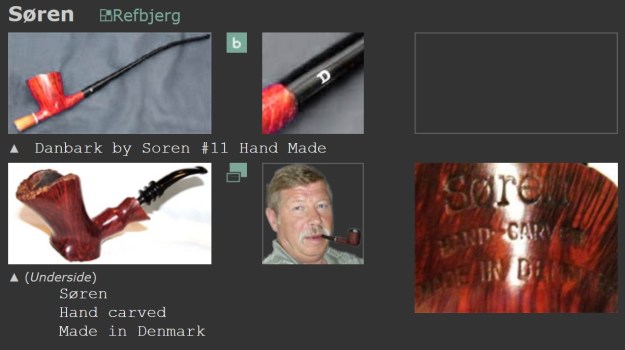
I looked up the brand on Pipephil (http://www.pipephil.eu/logos/en/logo-s10.html) and found that the brand was carved by Søren Refbjerg Rasmussen. Pipes that he made for the European market were mostly stamped “Refbjerg” while those made for the US market were stamped “Soren”. Thus, I knew that one I was working on was imported into the US market. I did a screen capture of the photos of the pipes and stamping that were on the site. I have included it below.I was once again working on a pipe made by Soren Refbjerg Rasmussen for the US market as it was stamped Soren. I continued to do reading on another of my go to websites, Pipedia. Here is the link for the article there. https://pipedia.org/wiki/Refbjerg. I quote some of the more pertinent information.
Søren Refbjerg Rasmussen founded a company in 1969, which employed an average of 8 – 12 craftsmen in the 1970’s. The semi-freehands they produced were traded under his prename Søren. Rasmussen himself finished only the very best pipes. So his way of pipemaking closely resembled the ways of Preben Holm, Karl Erik Ottendahl or Erik Nørding. Altogether more than 1,000,000 pipes were sold.

From that I knew that the pipe in my hands came from the 1970s. It bears the Soren signature stamp which also says that it was made for sale in the American pipe market. Armed with that information I turned my attention to restoring the pipe.

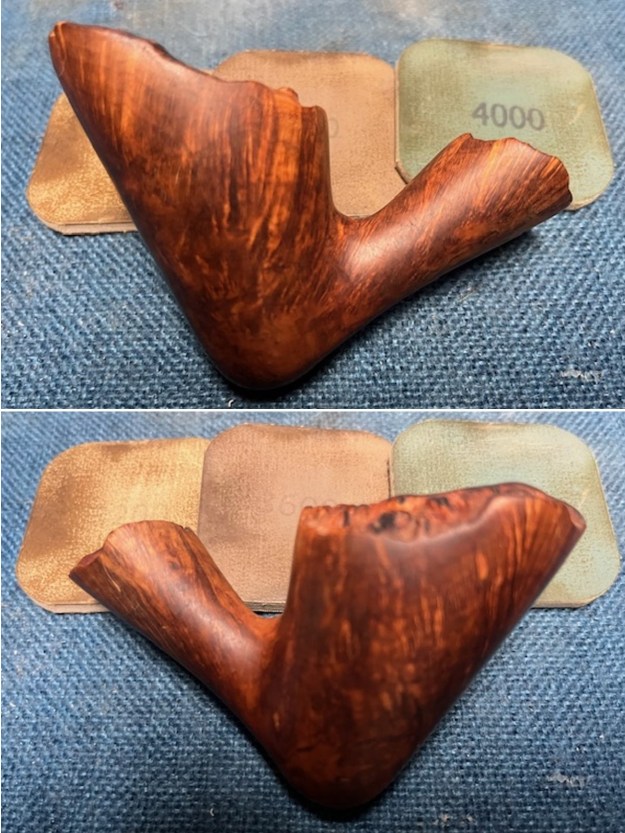
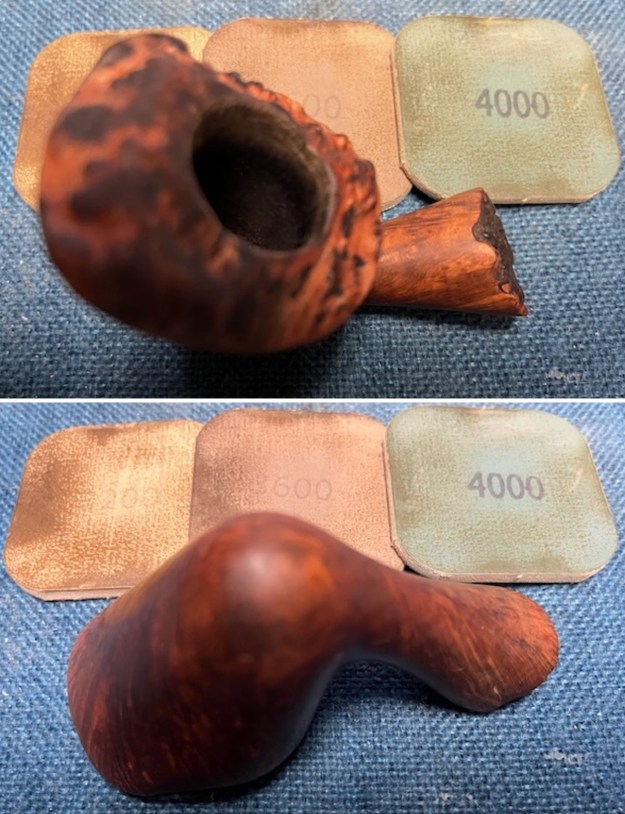
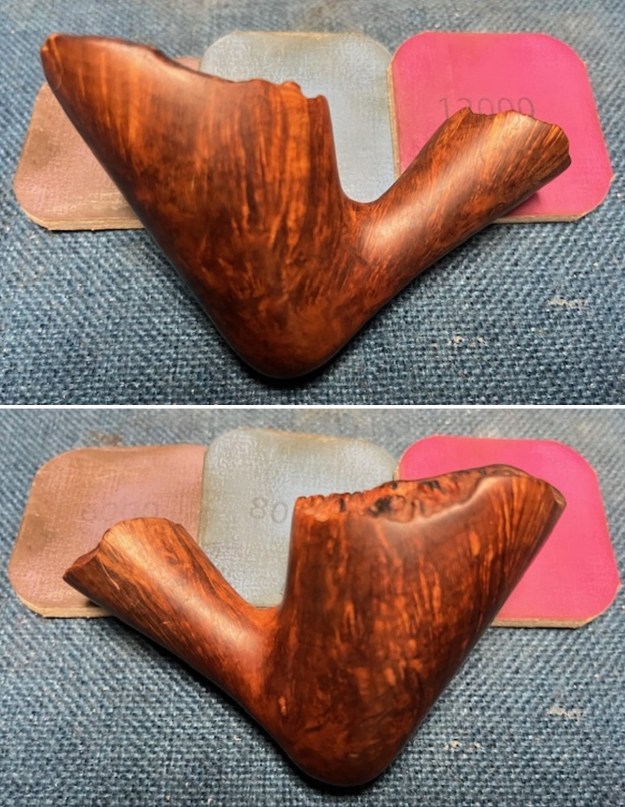
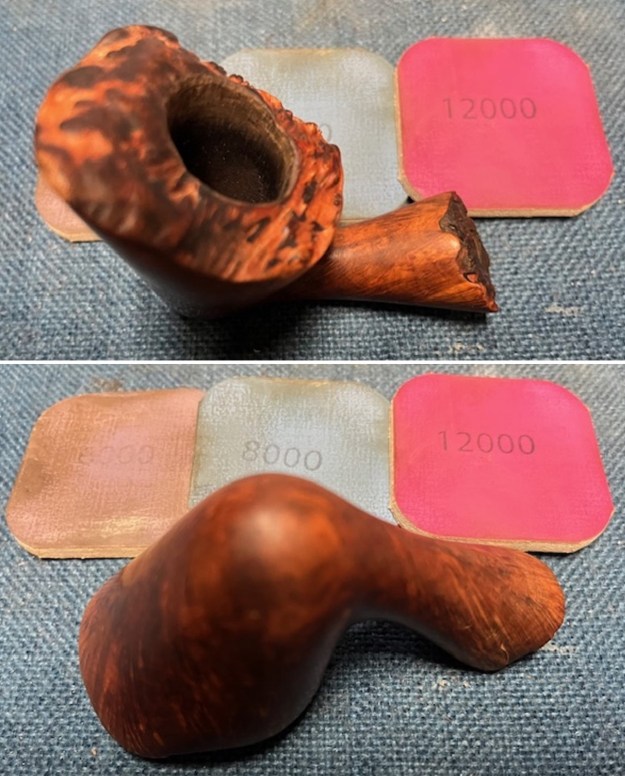
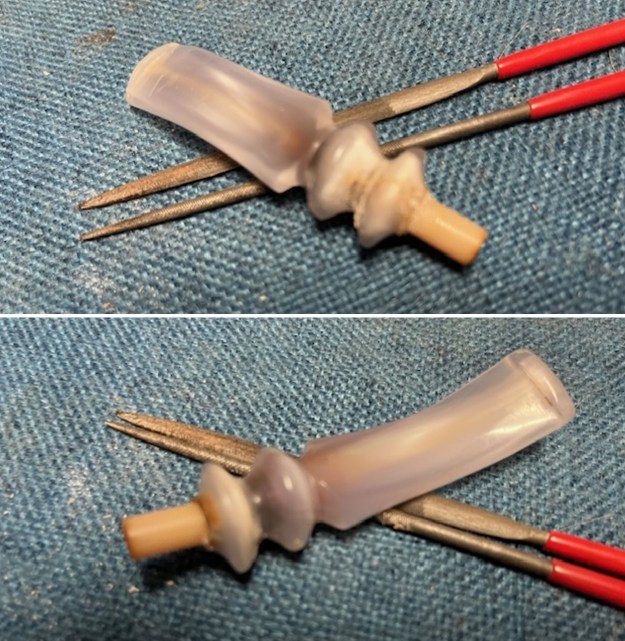
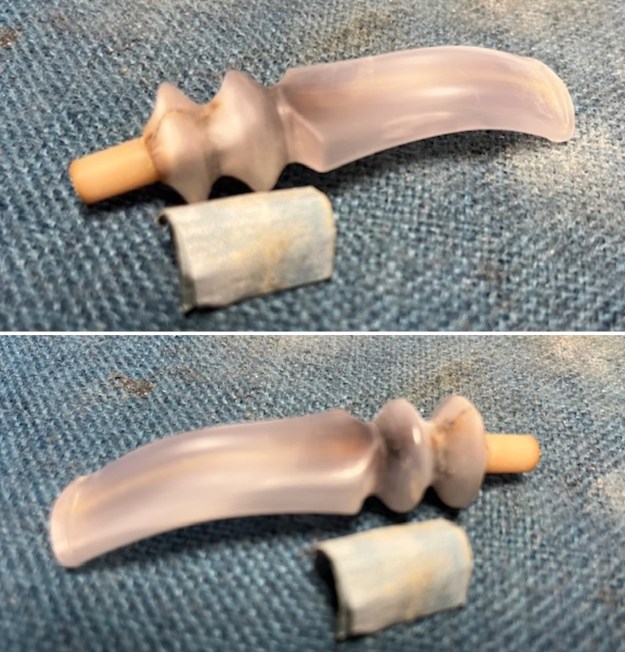
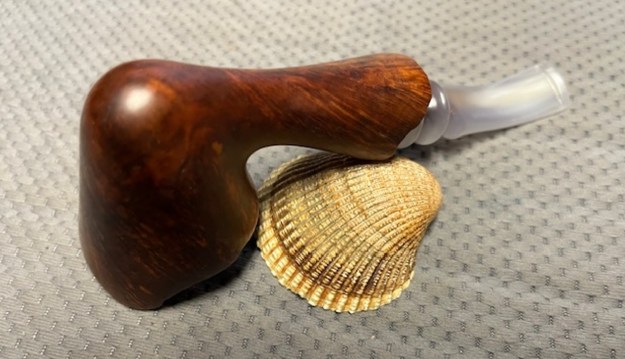
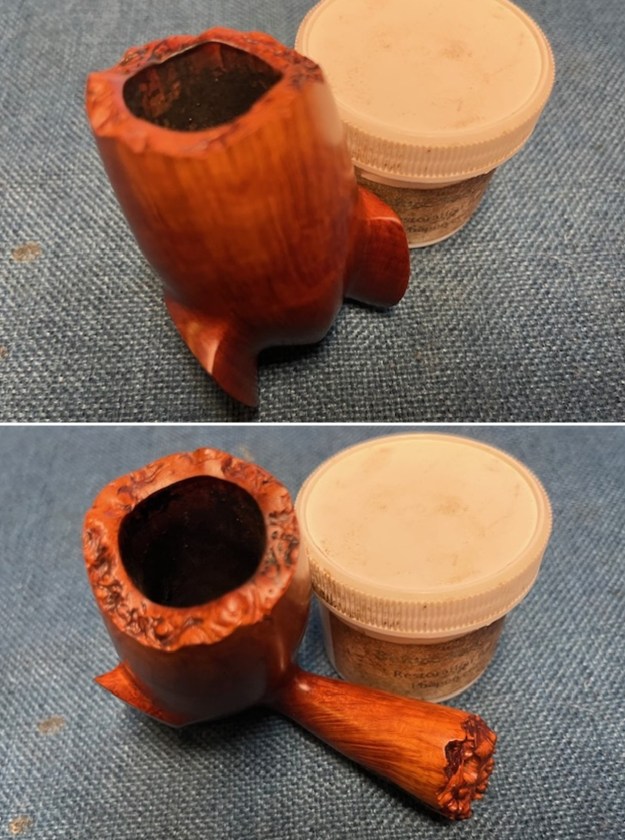
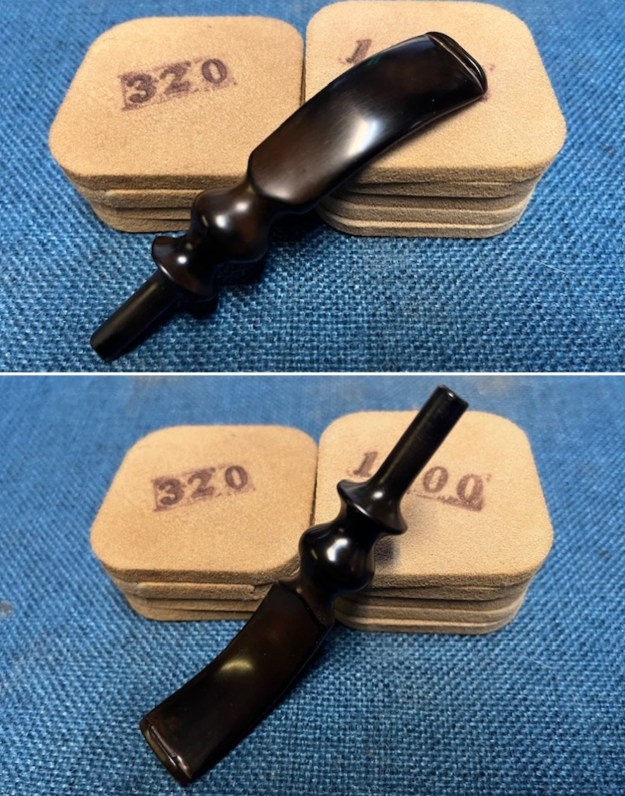
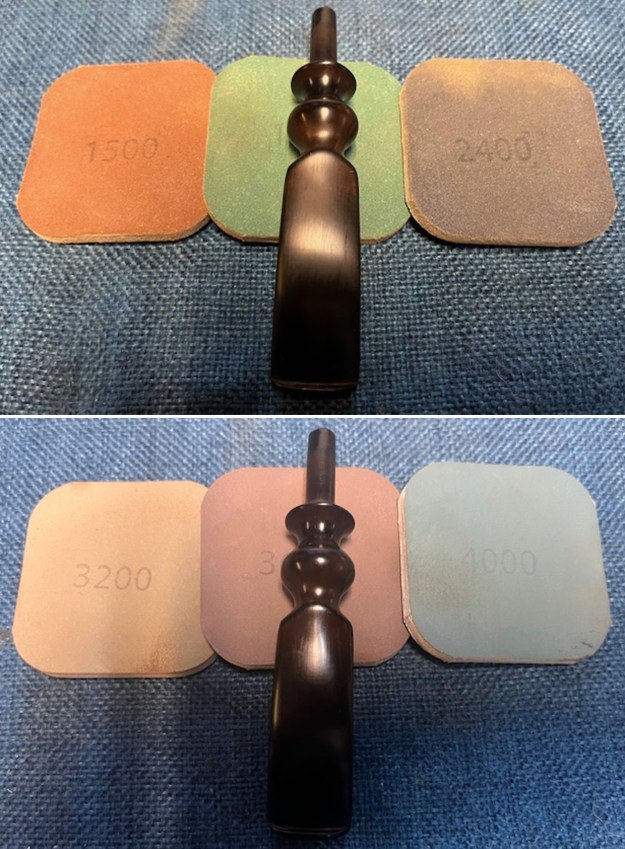
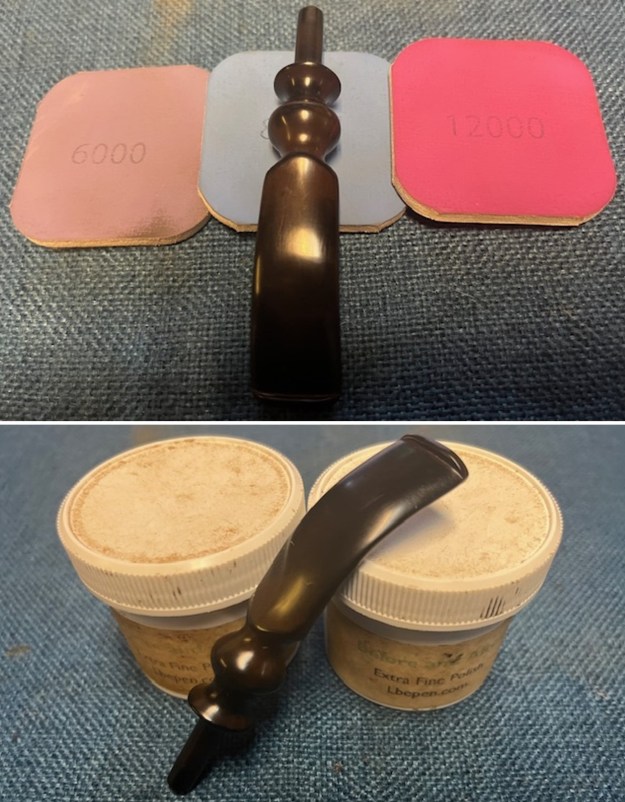
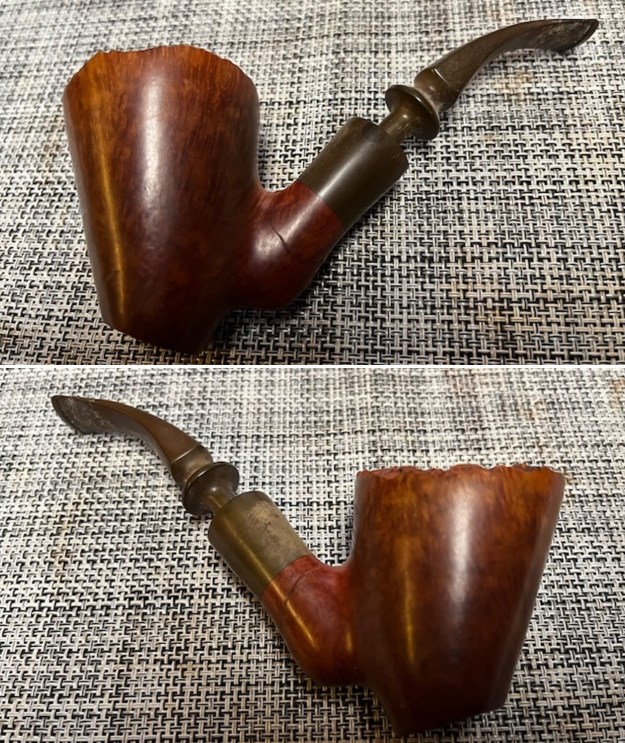
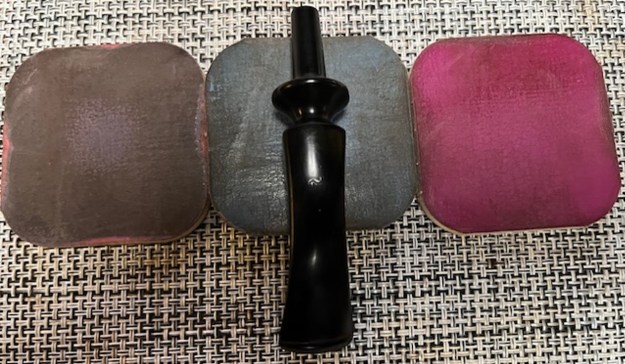
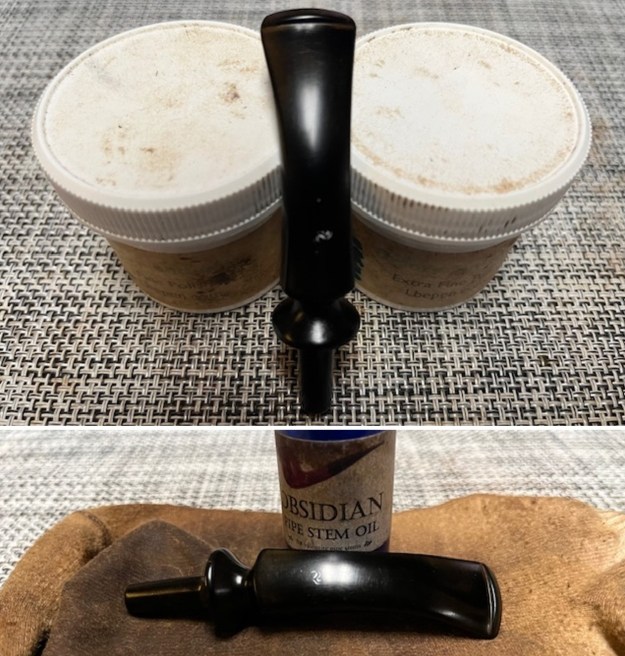
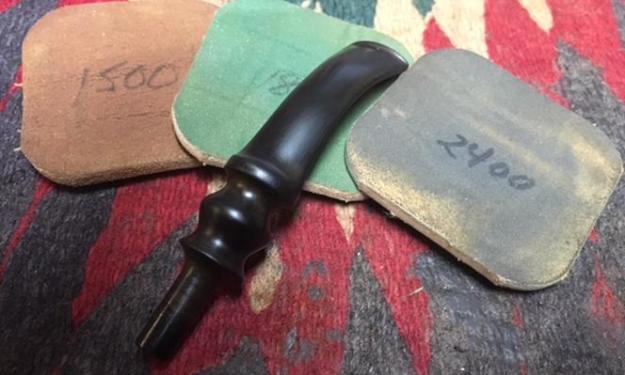
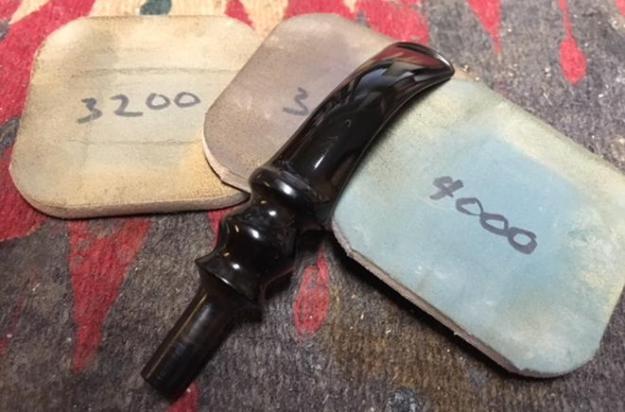
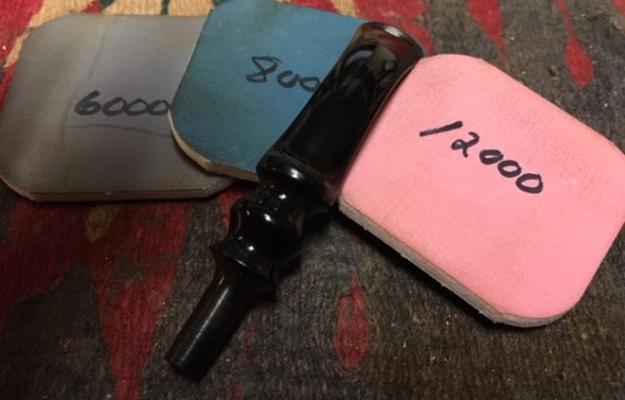
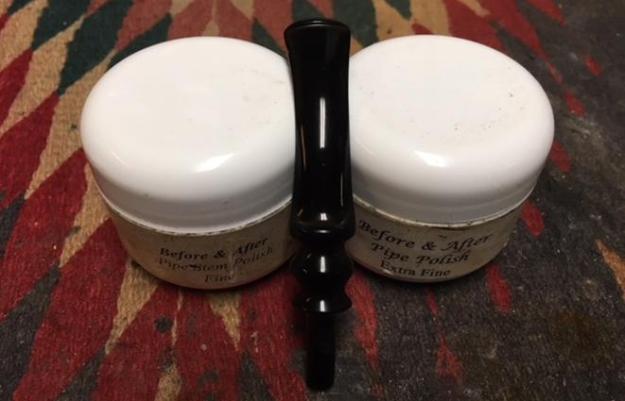
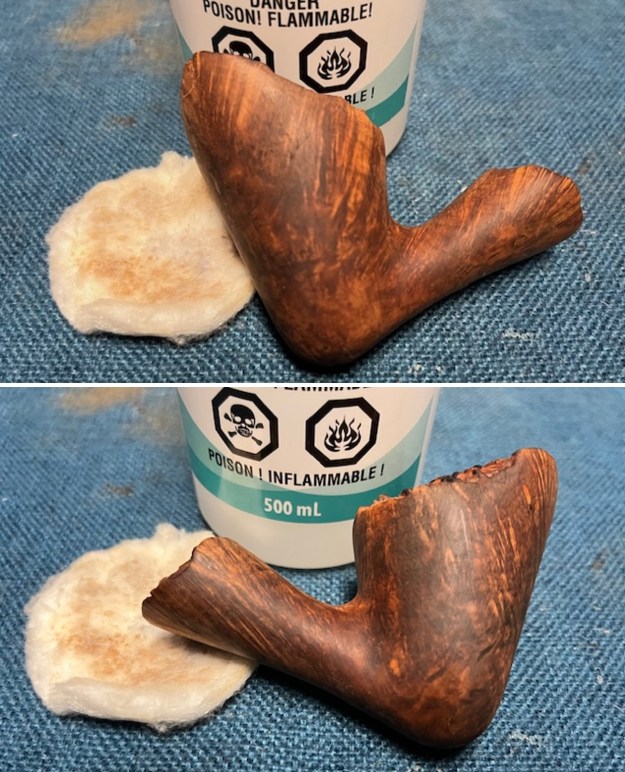
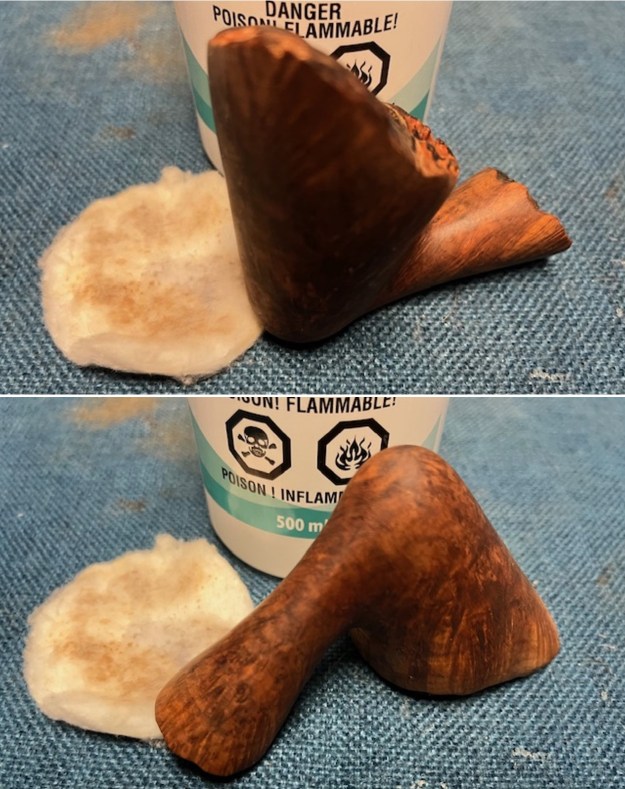
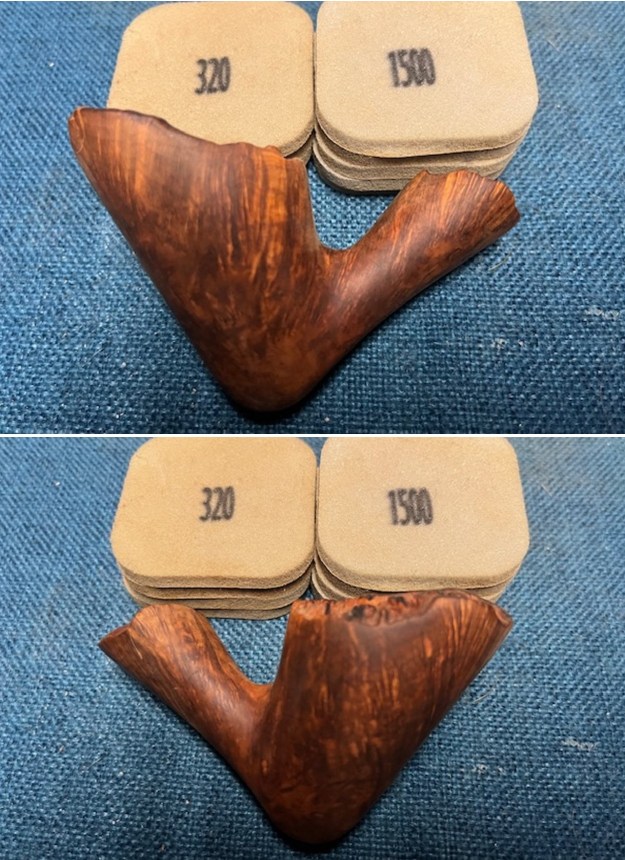
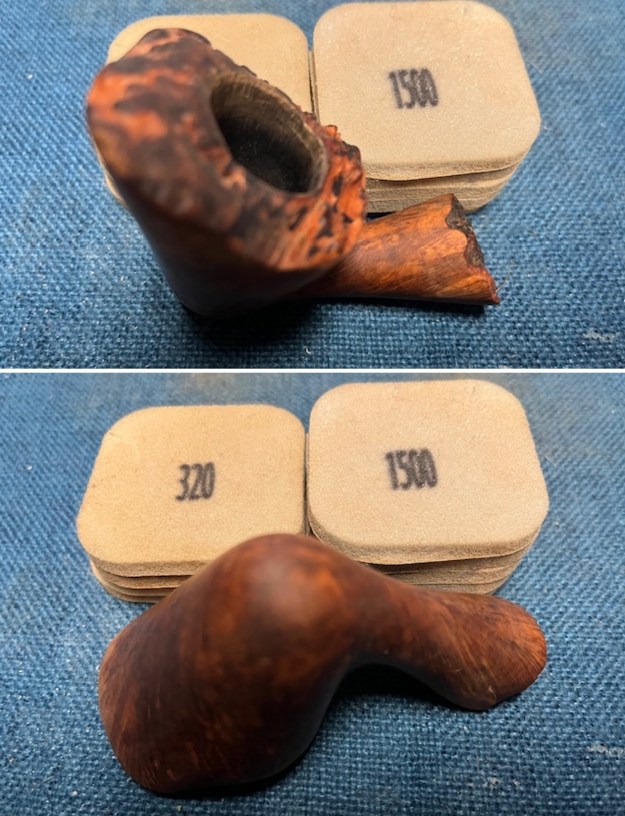
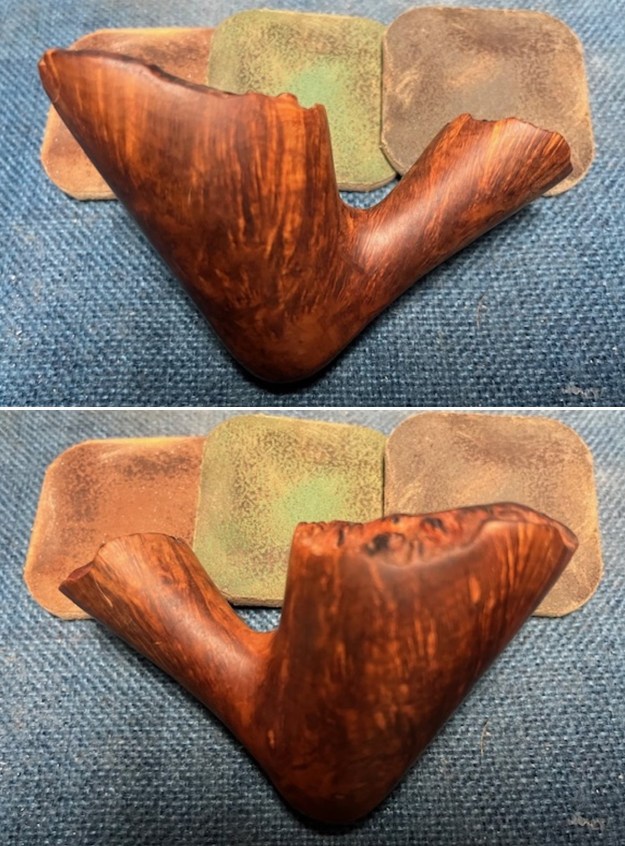
Jeff had cleaned up the pipe following his normal cleaning process. In short, he cleaned up the reaming with a Savinelli Fitsall Pipe Knife.  He scrubbed the bowl with undiluted Murphy’s Oil Soap with a tooth brush. He worked over the lava and debris on the plateau rim top and shank end and was able to remove it. He rinsed it under running warm water to remove the soap and grime. He cleaned out the inside of the shank and the airway in the stem with alcohol, cotton swabs, shank brushes and pipe cleaners. He scrubbed the stem with Soft Scrub and cotton pads to remove the debris and oils on the stem. He soaked it in Briarville’s Pipe Stem Deoxidizer. He rinsed it with warm water and dried it off. I took photos of the pipe once I received it. It really looked good. The crack in the stem around the replacement tenon was clean and the tenon was solid in the drill airway. I took close up photos of the stem and the rim top to show both how clean they were and what needed to be addressed with both. The rim top and bowl still had some minor darkening on the high spots of the plateau top and edges edge. It made me wonder if the darkening had been intentional and that all of them were originally dark. The stem looked better and the cracked area was clean and was ready for repairing and rebuilding. The light tooth marks and chatter were still present. I would need to remove those to bring the stem back.I took a photo of the stamping on the underside of the shank. You can see from the photo that it is faint but readable. It is clearer on the top half of the stamp than the lower but it is still readable. I removed the stem from the bowl and took a photo of the parts to give a sense of the beauty of the pipe.I started my work on the pipe by wiping the bowl down with alcohol on a cotton pad to remove the darkening and oils in the briar. It looked significantly better once it was clean. I started my work on the pipe by wiping the bowl down with alcohol on a cotton pad to remove the darkening and oils in the briar. It looked significantly better once it was clean.I sanded the briar bowl with 320-3500 grit 2×2 inch sanding pads. I wiped the bowl down after each sanding pad with a damp cloth to remove the sanding debris and dust from the clean up. I polished the briar with micromesh sanding pads – 1500-12000 grit pads. I wiped the bowl down with a damp cloth between pads to remove the sanding debris. By the final pad it shone. The bowl looked great after the polishing so I worked some Before & After Restoration Balm into the surface of the briar with my finger tips and a horse hair shoe brush to get into the crevices of the plateau rim top and shank end. The product is incredible and the way it brings the grain to the fore is unique. It works to clean, protect and invigorate the wood. I set the bowl aside and turned my attention to the stem. Jeff had cleaned out the crack in the top of the saddle during his clean up. I filled in the crack with clear CA glue and built up the repair with multiple layers of the glue. I used several small files to flatten out the repairs in the saddle portion of the stem. I followed that up with a rolled piece of 220 grit sandpaper to smooth it out further. I sanded the stem with 320-3500 grit sanding pads to further smooth out the repairs to the saddle portion as well as removing the tooth marks and chatter on the surface ahead of the button. I wiped it down after each pad with an Obsidian Oil cloth. It was looking much better.I polished the stem with micromesh sanding pads – wet sanding it 1500-12000 pads. I wiped it down with a damp cloth after each pad to remove the dust and polishing debris. I polished it with Before & After Pipe Polish – both Fine and Extra Fine. I wiped it down with Obsidian Oil and let it sit and absorb. I polished stem and bowl with Blue Diamond to polish out the remaining small scratches. I gave the bowl and the stem multiple coats of carnauba wax and buffed the pipe with a clean buffing pad to raise the shine. I hand buffed it with a microfiber cloth to deepen the shine. This Soren Hand-Carved Freehand pipe polished up pretty nicely. The plateau on the rim top and shank end and the smooth reddish brown finish works very well with the variegated silver and grey acrylic stem. The cleanup of the previous repair on the replacement tenon and the crack in the saddle worked well and it is solid and unmoveable. The finished pipe is shown in the photos below. I have worked on several Soren pipes by Soren Refbjerg Rasmussen and several Refbjerg pipes over the years and I have always been impressed by his craftsmanship and ability to work a pipe to follow the grain of the briar. He does great work and is quite innovative in terms of shapes, flow and finishes on his pipes. The dimensions of this particular Soren are Length: 6 inches, Height: 2 ½ inches, Outside diameter of the bowl: 1 ¾ inches wide and 2 inches long, Chamber diameter: 7/8 inches. The weight of the pipe is 61 grams/2.15 ounces. It feels great in the hand. This one will be going in the Danish Pipemakers Section on the rebornpipes store. If you wish to add it to your collection let me know. It is a beauty! Thanks for walking through the restoration with me as I worked over this Soren Freehand.
This Odd Looking Pipe Has Fins or maybe Feet – a Soren Hand-Carved Made in Denmark


by Steve Laug

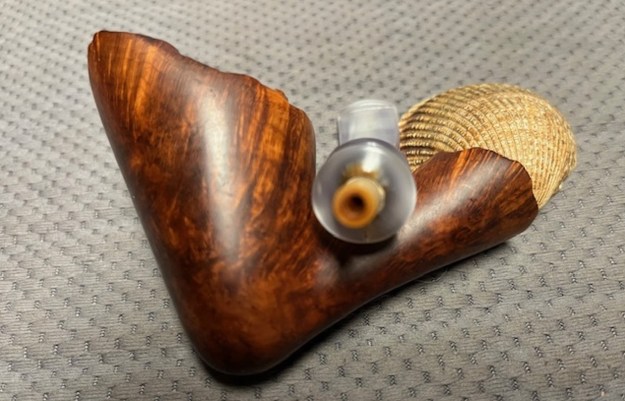
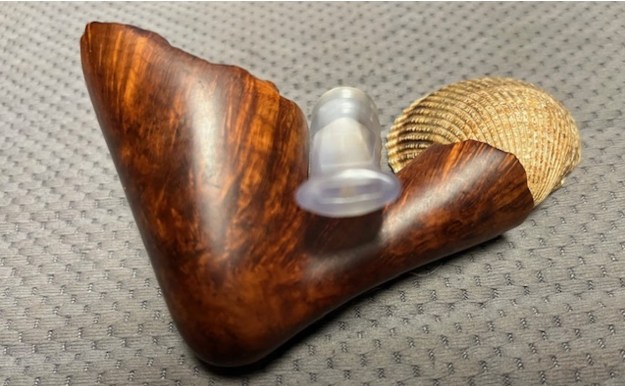
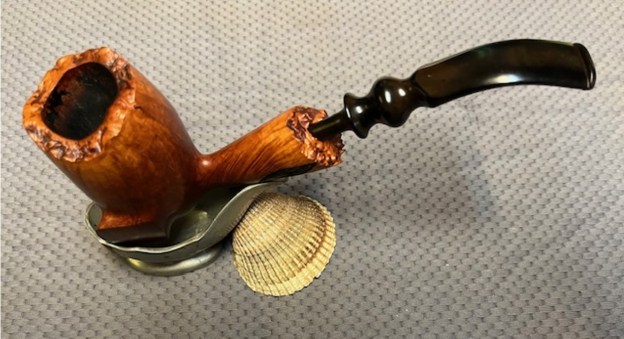
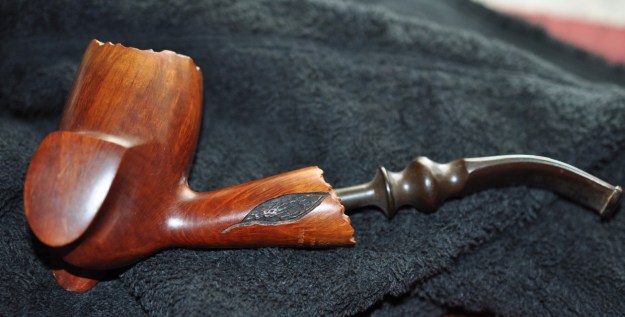
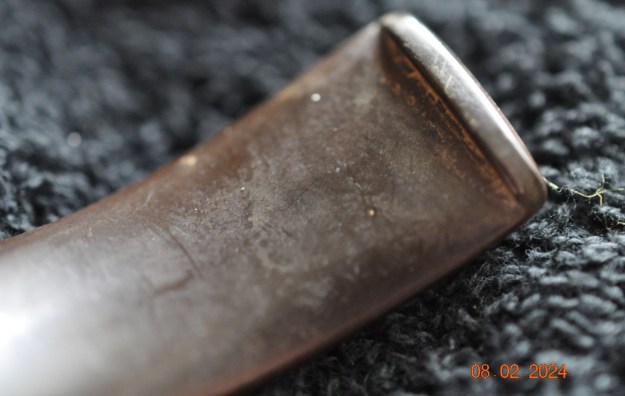
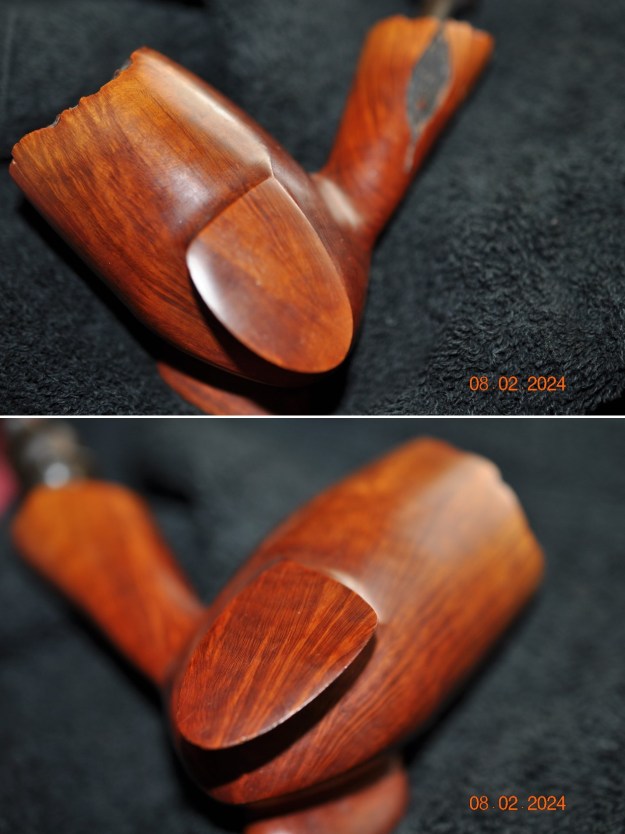
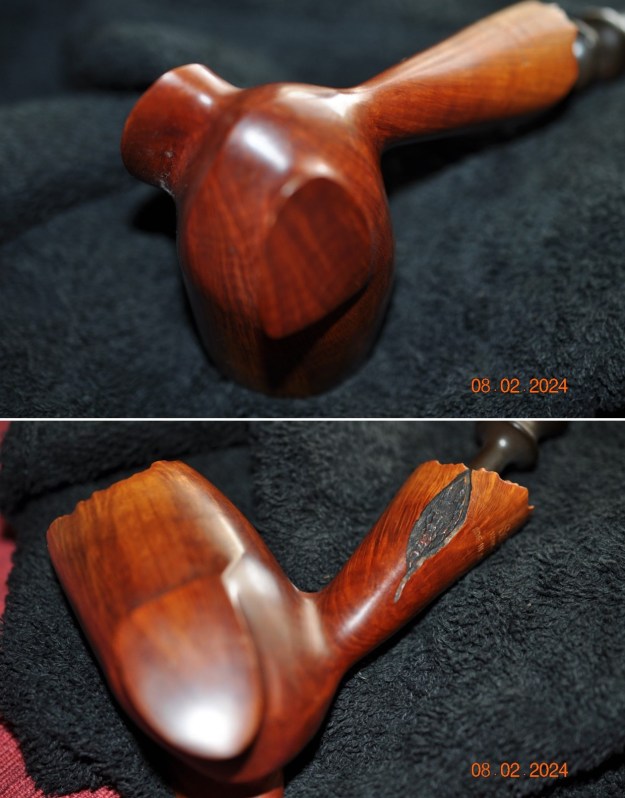
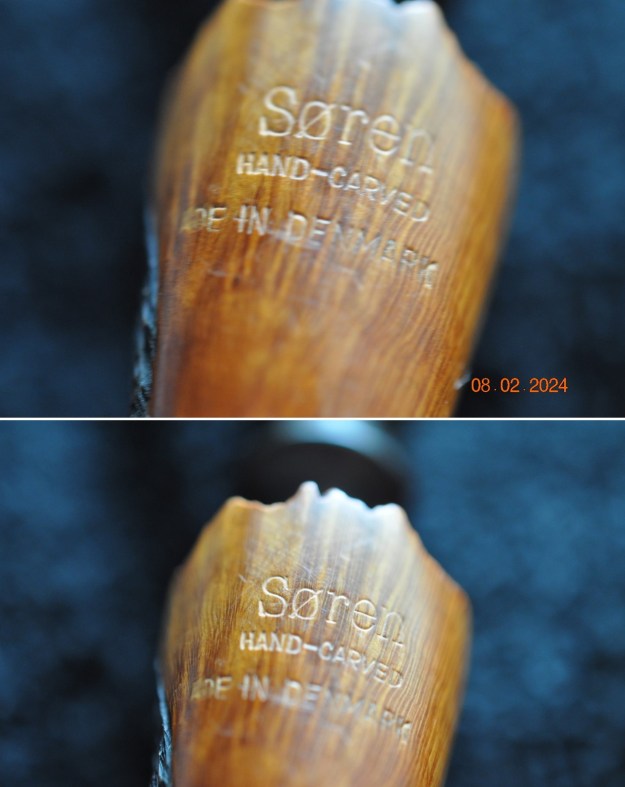
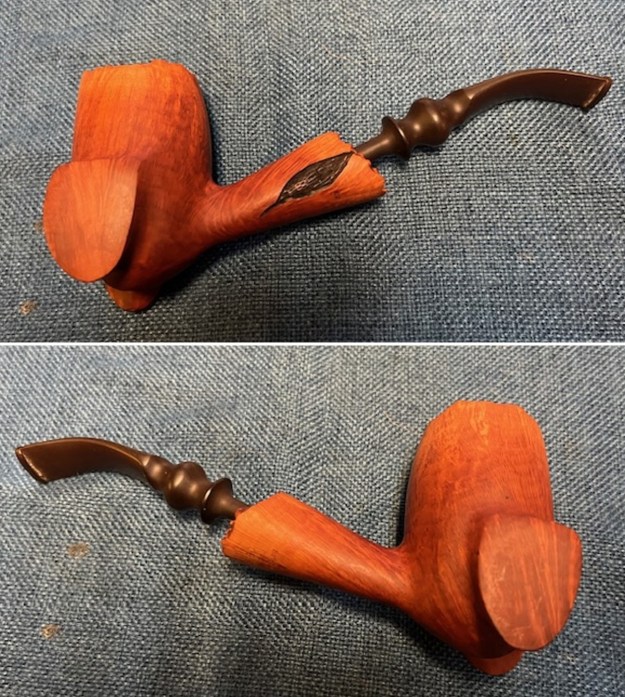
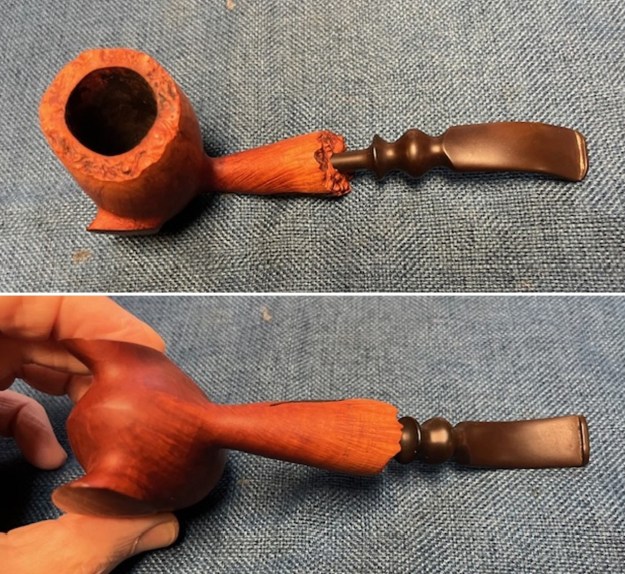
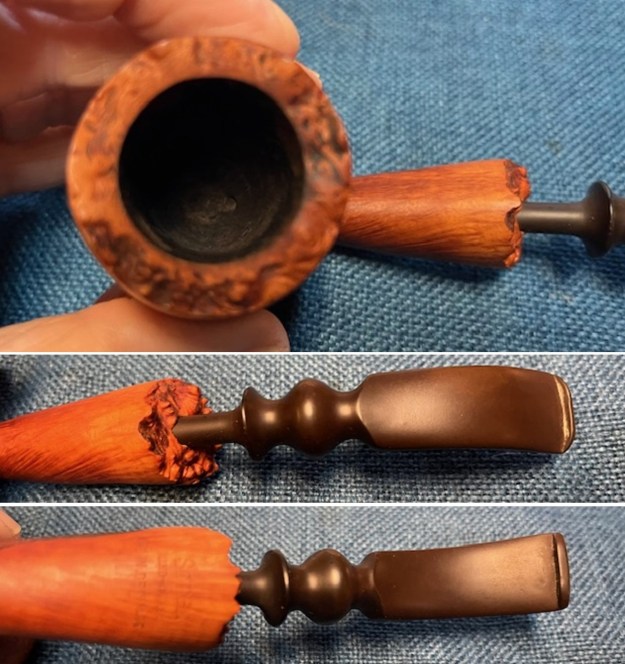
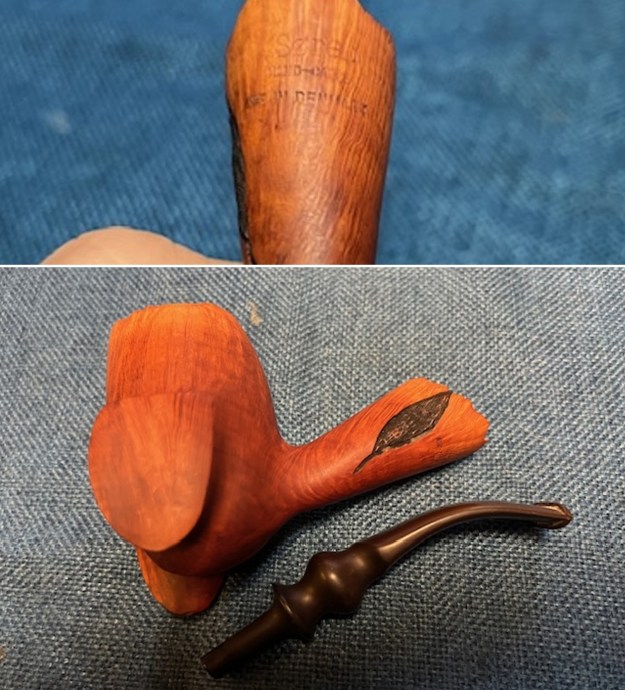
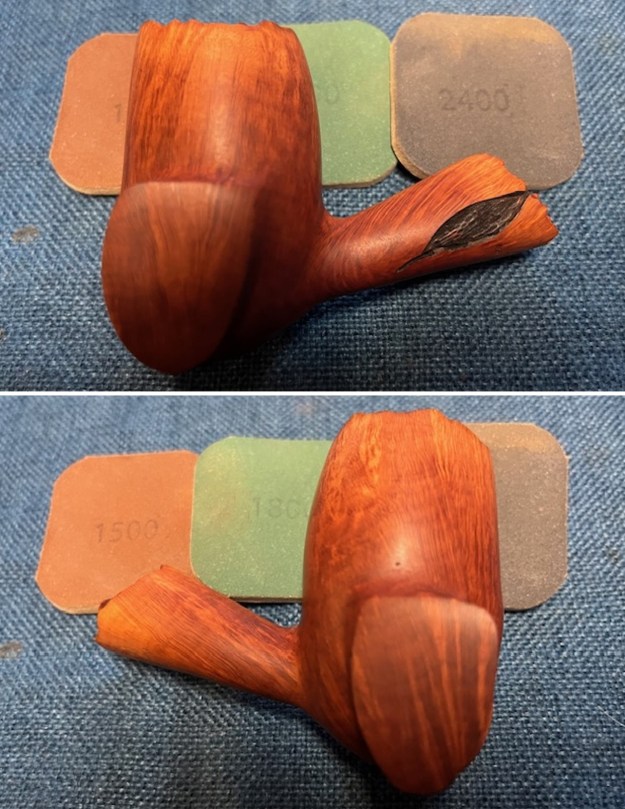
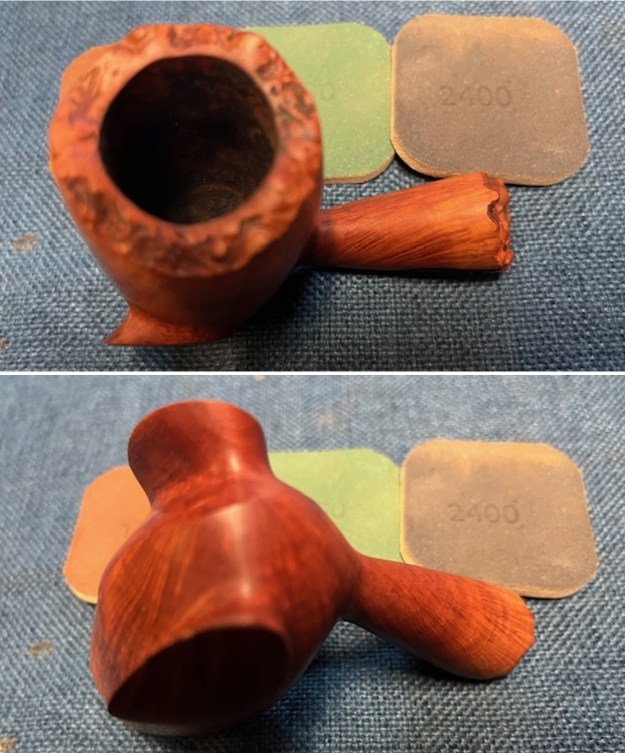
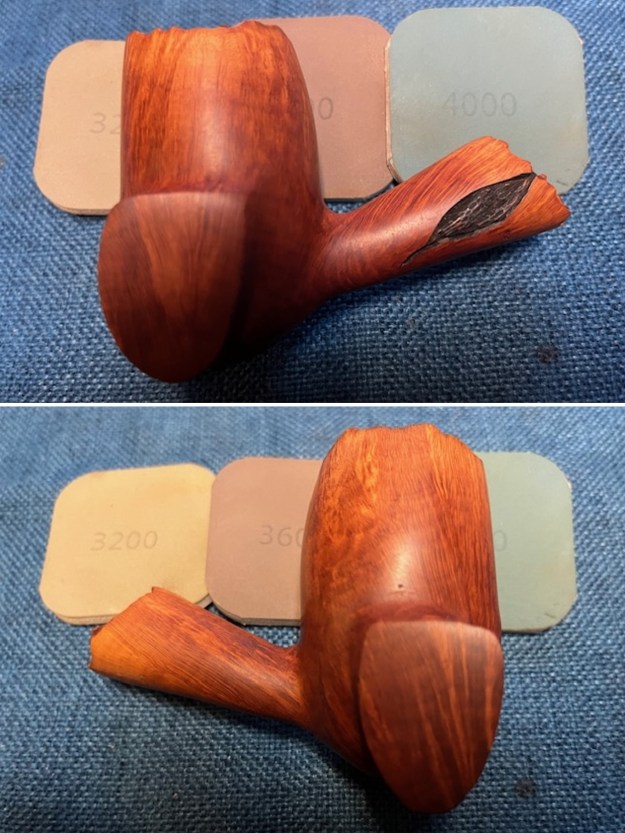
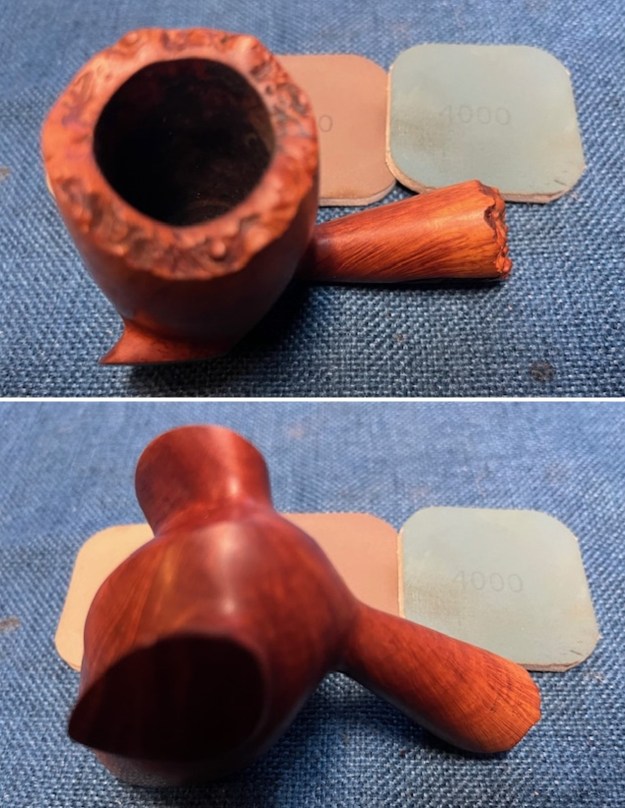
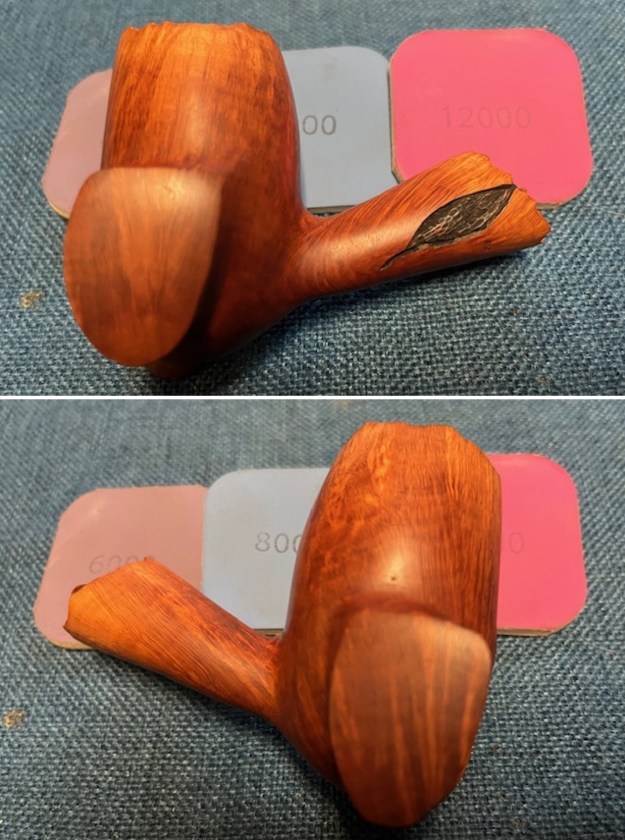
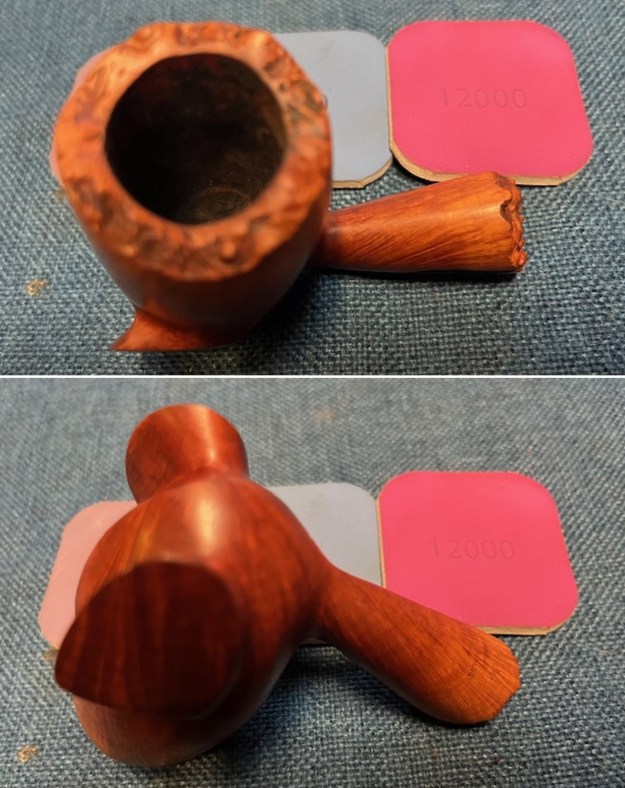
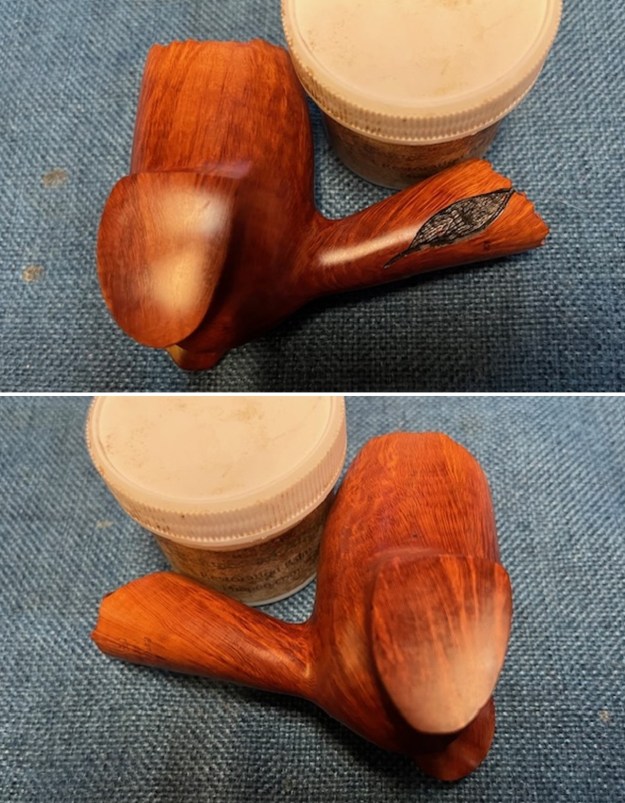
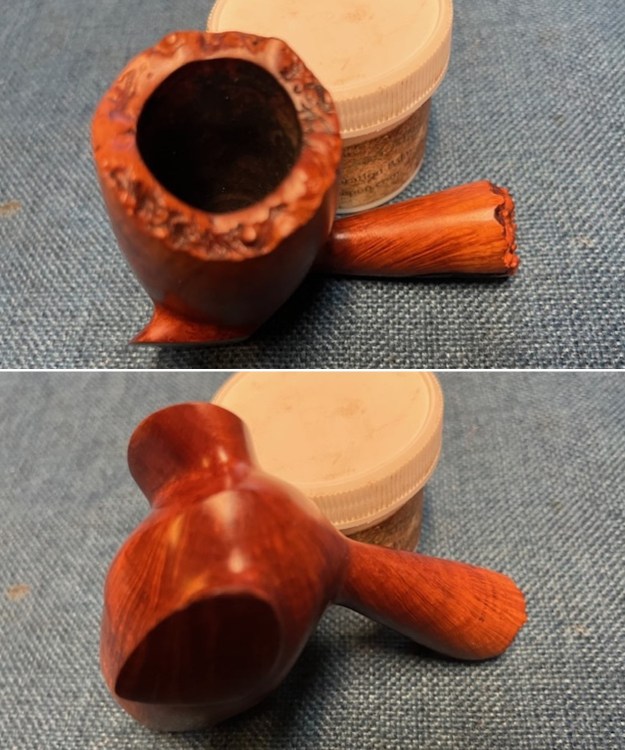
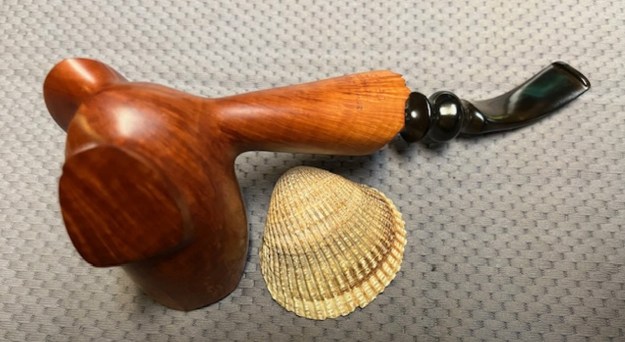
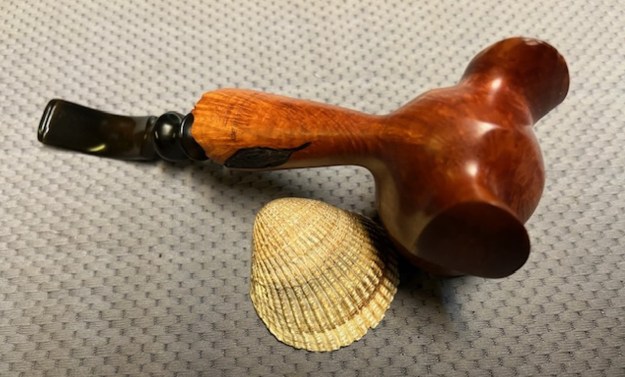
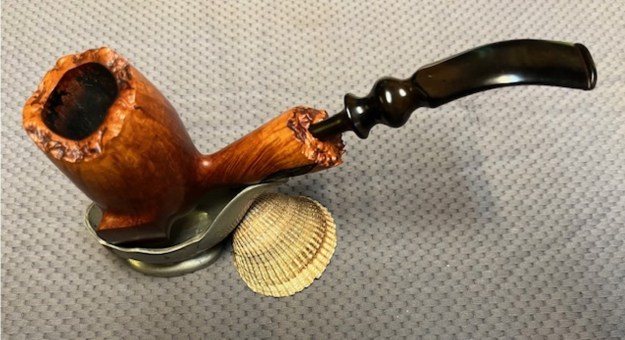
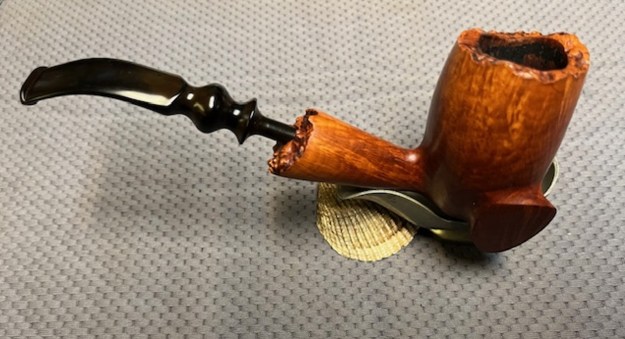
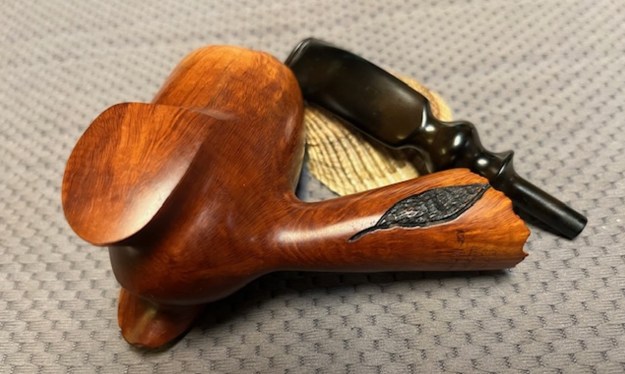
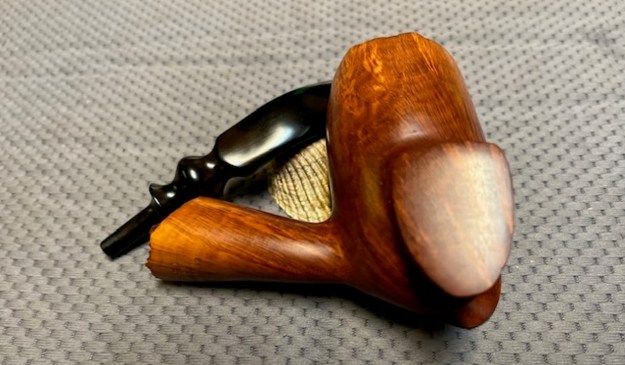
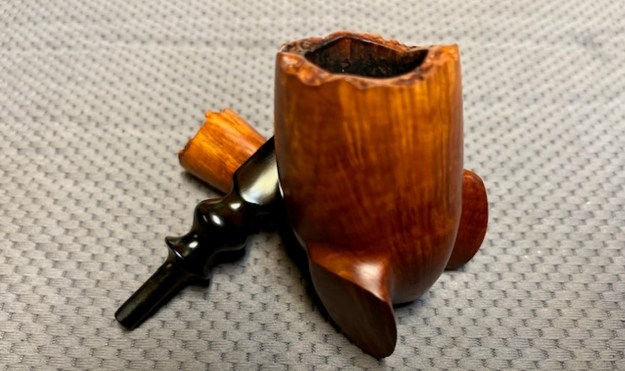
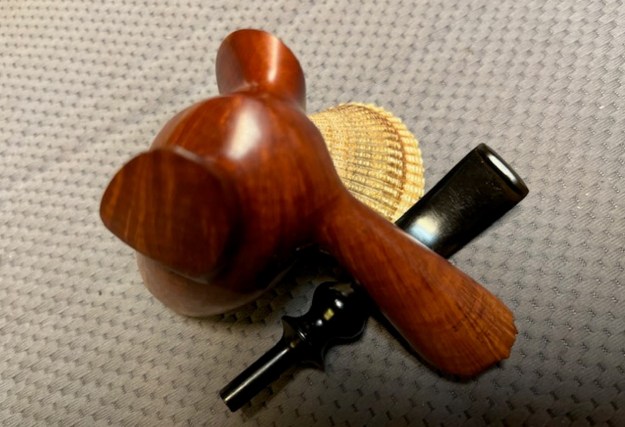
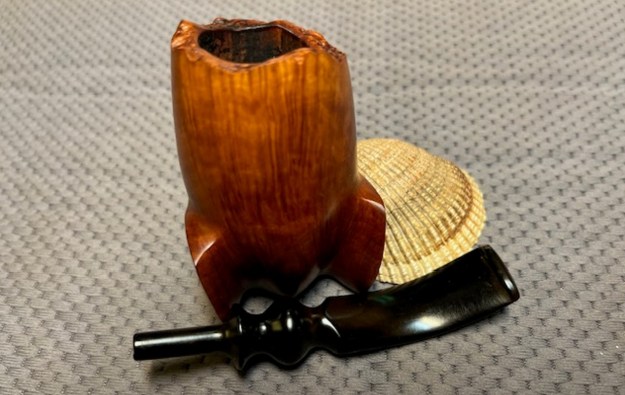
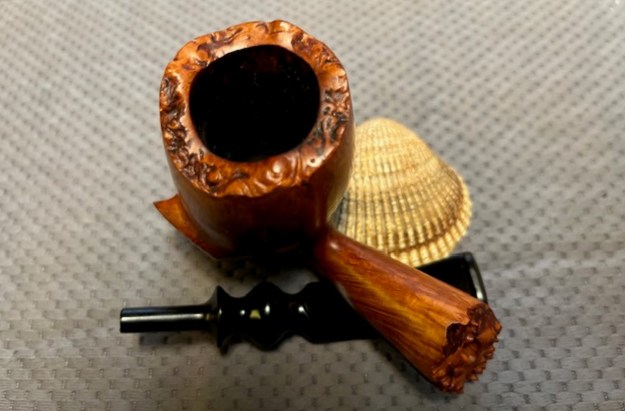
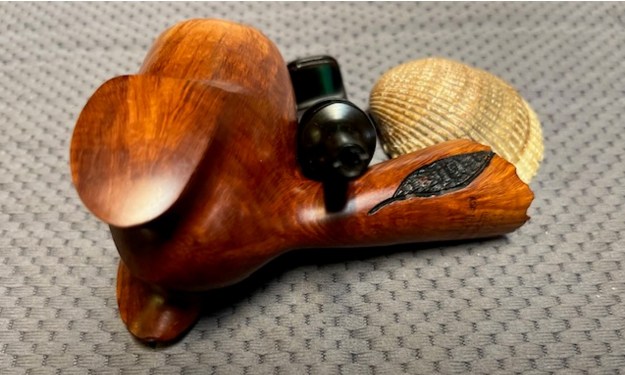
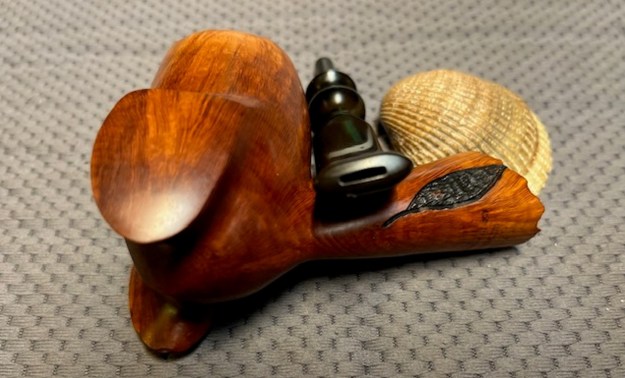
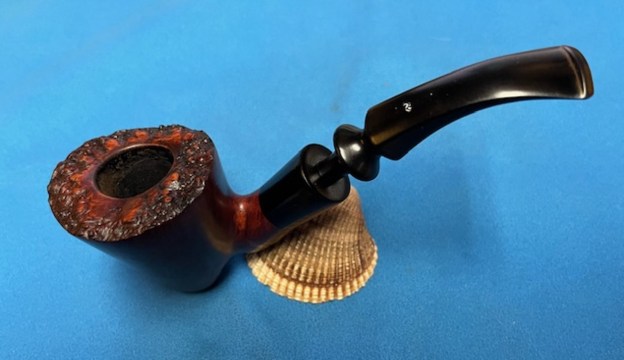
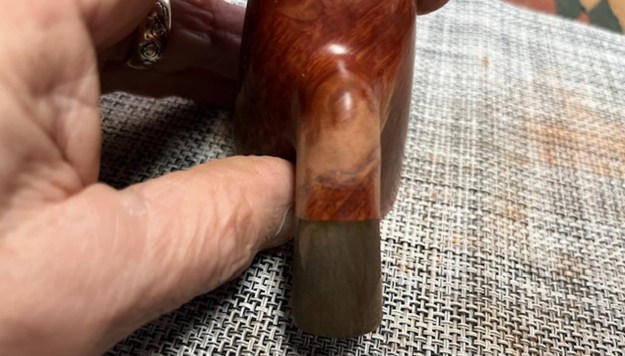
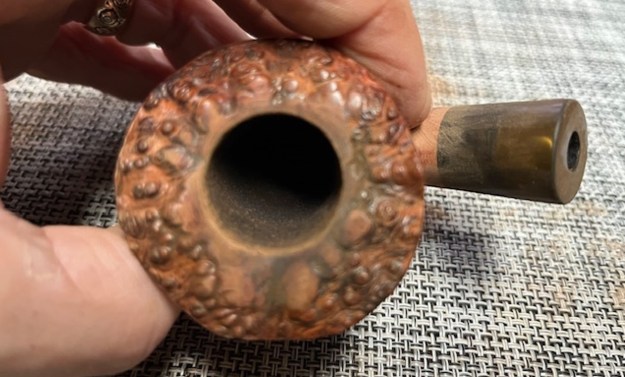
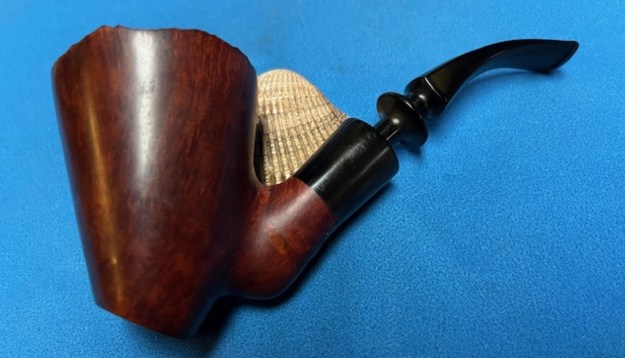
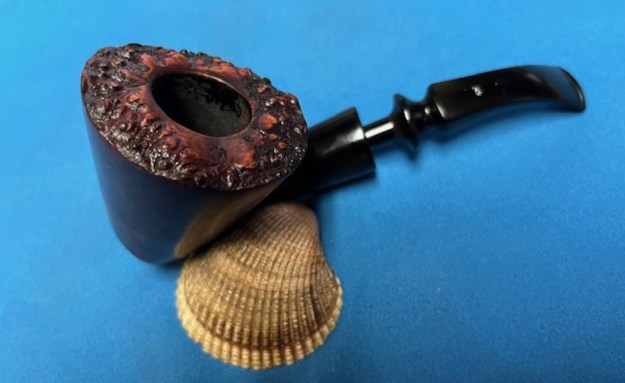
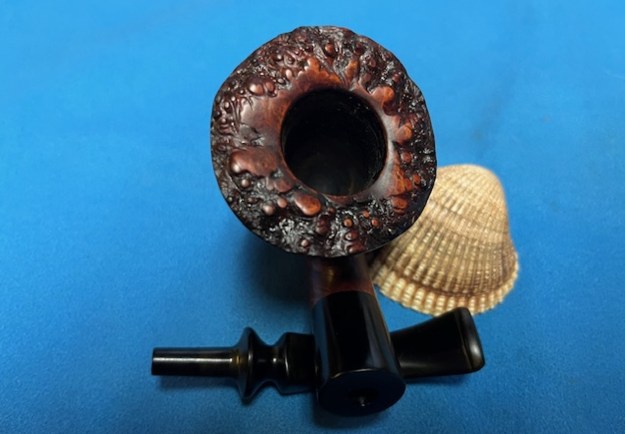
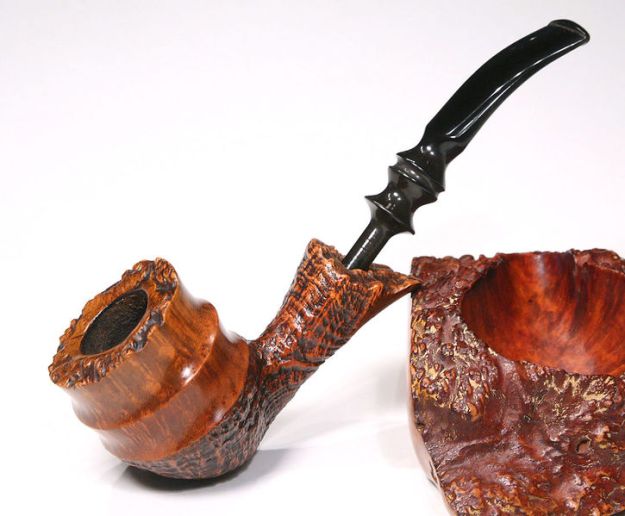
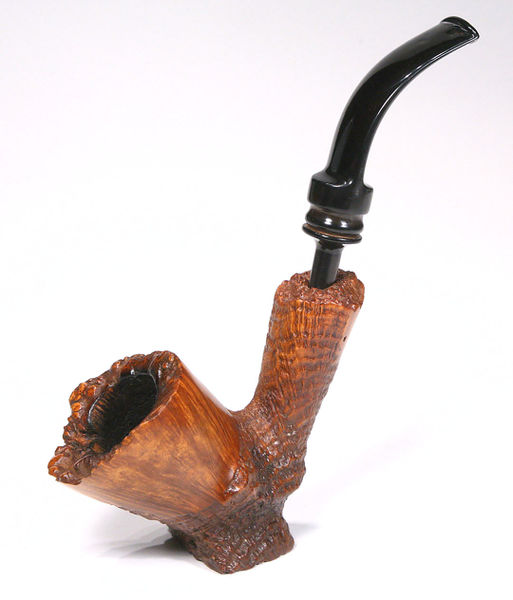
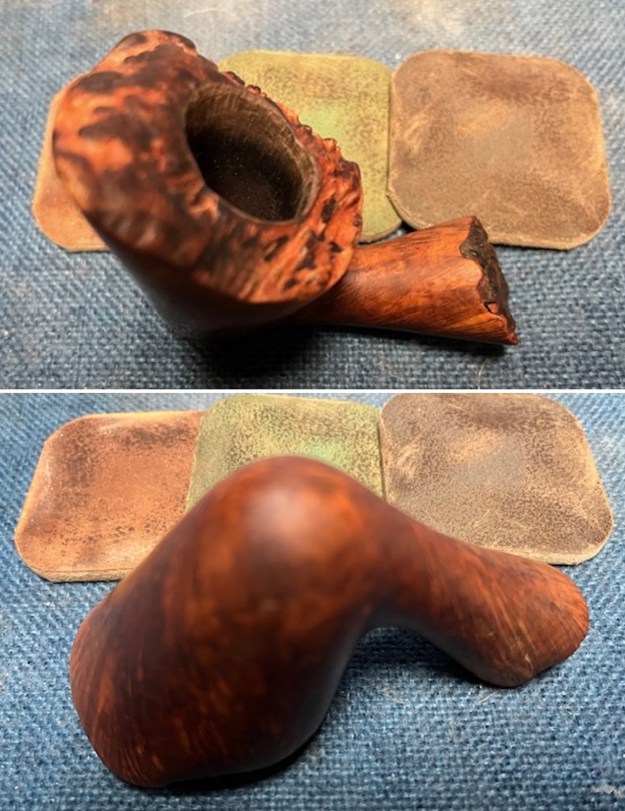
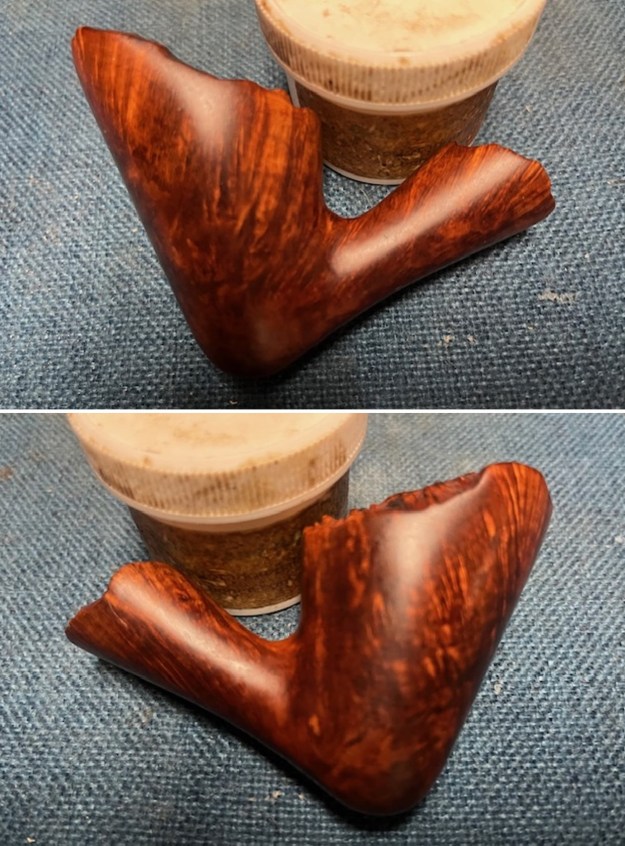
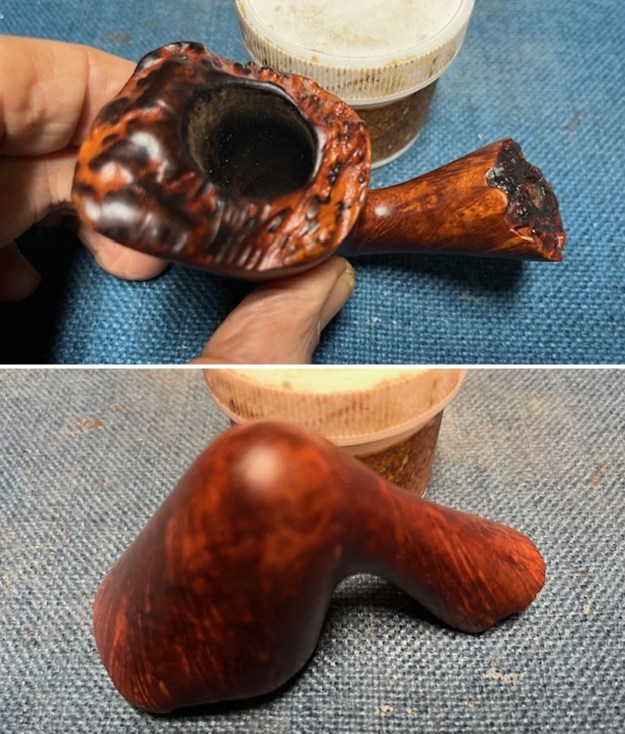
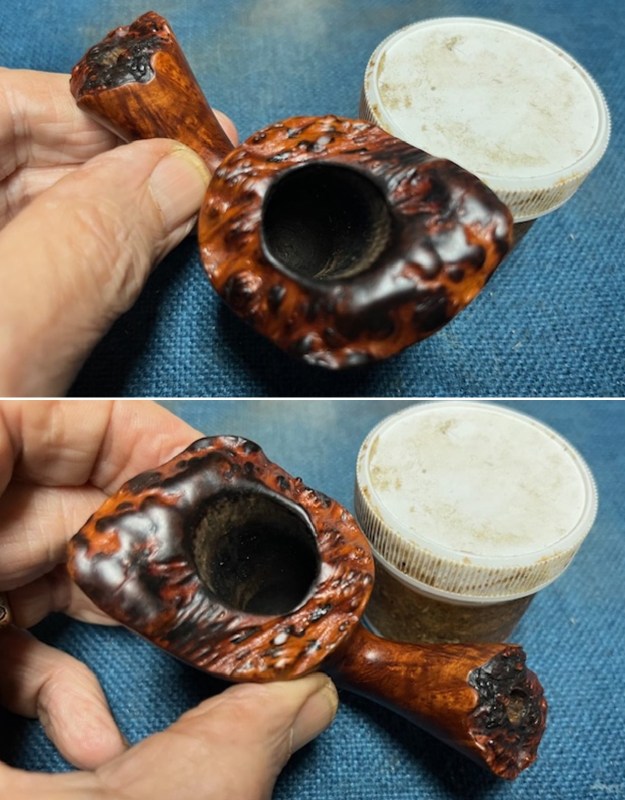
This particular Freehand pipe was purchased as part of a lot from seller in Santa Cruz, California, USA on 05/28/24. It really is an odd Freehand pipe that combines a plateau rim top and shank end with feet like the fins of a rocket on the bottom making it a sitter. There is also a rusticated leaf on the left side of the shank toward the stem end. It is stamped on a smooth panel on underside of the shank and reads Soren [over] Hand-Carved [over] Made in Denmark. The finish is dirty but does not hide the beautiful grain around the bowl and shank. The pipe had a thick cake in the bowl and lava overflow on the rim top and inner edge of the bowl filling in some of the plateau. It is heavier toward the back half of the bowl. There was grime ground into the smooth finish and dust and debris in the plateau valleys on the shank end. The fancy vulcanite saddle was oxidized and had light tooth marks and chatter on both sides near the button. The pipe must have been a great smoker judging from the condition it came it. Jeff took photos of the pipe before he started his work on it. Jeff took photos of the rim top and the stem to show the condition of the pipe when we received it. You can see the cake in the bowl and the lava on the plateau rim top and inner edge of the bowl. The turned vulcanite stem was dirty and had light chatter and tooth marks on both sides near the button. He took photos of the sides and the heel to give an idea of the shape and the condition of the briar around the bowl. It really is a uniquely shaped pipe with the feet or fins on the bottom half of the bowl and the rusticated leaf on the left side of the shank. The next photos Jeff took shows the stamping on the underside of the shank. It is clear but faint and read as noted above. I needed to refresh my memory on the history and background of the Soren pipes so I went to a previous blog and reread what I had written. https://rebornpipes.com/2016/09/12/repairing-and-rejuvenating-a-soren-danish-freehand/. I quote from that blog post: I looked up the brand on Pipephil (http://www.pipephil.eu/logos/en/logo-s10.html) and found that the brand was carved by Søren Refbjerg Rasmussen. Pipes that he made for the European market were mostly stamped “Refbjerg” while those made for the US market were stamped “Soren”. Thus, I knew that one I was working on was imported into the US market.

I was once again working on a pipe made by Soren Refbjerg Rasmussen for the US market as it was stamped Soren. I continued to do reading on another of my go to websites, Pipedia. Here is the link for the article there. https://pipedia.org/wiki/Refbjerg. I quote some of the more pertinent information.

Søren Refbjerg Rasmussen founded a company in 1969, which employed an average of 8 – 12 craftsmen in the 1970’s. The semi-freehands they produced were traded under his prename Søren. Rasmussen himself finished only the very best pipes. So his way of pipemaking closely resembled the ways of Preben Holm, Karl Erik Ottendahl or Erik Nørding. Altogether more than 1,000,000 pipes were sold.

From that I knew that the pipe in my hands came from the 1970s. It bears the Soren signature stamp which also says that it was made for sale in the American pipe market. Armed with that information I turned my attention to restoring the pipe.

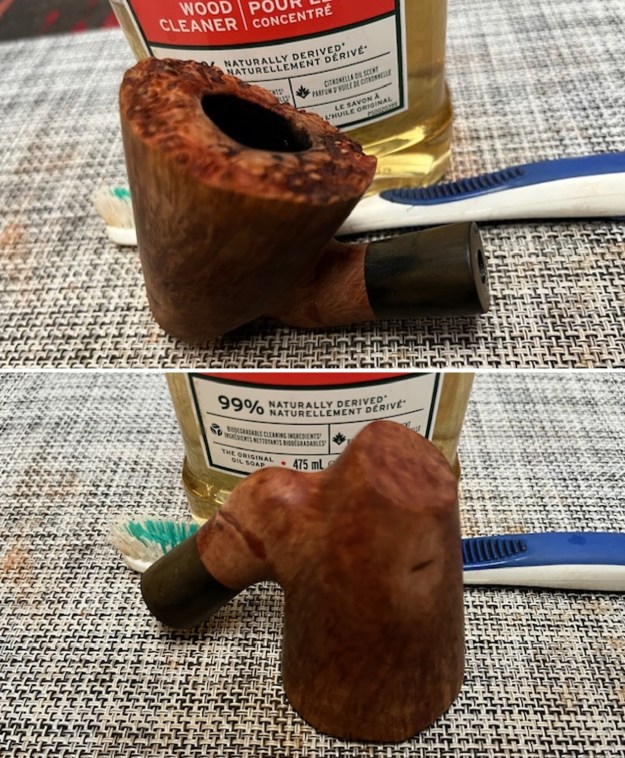
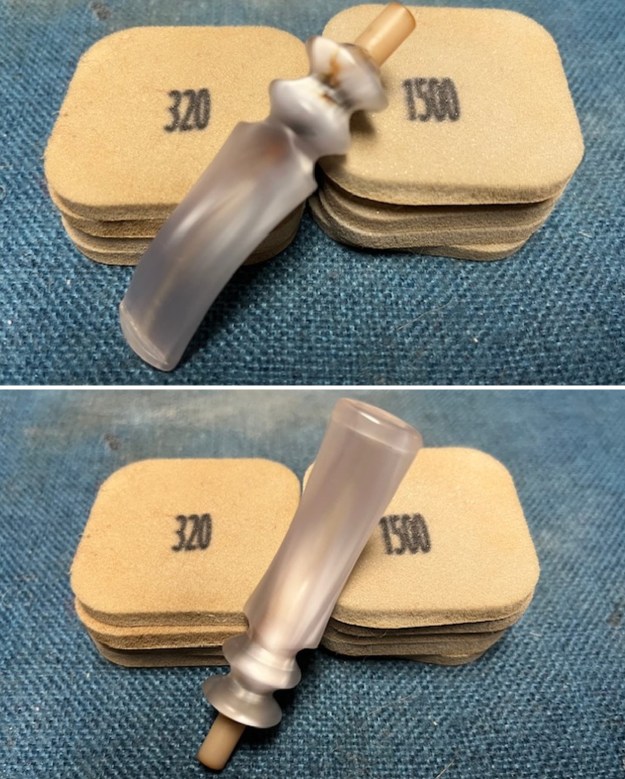
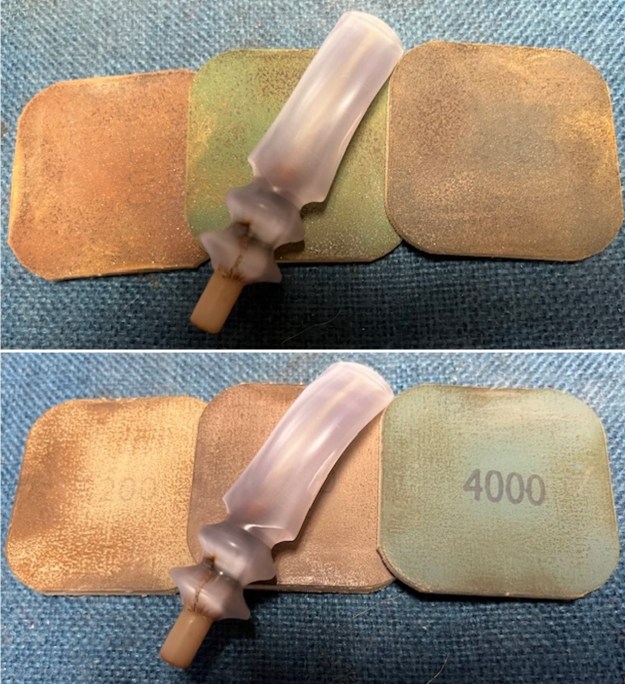
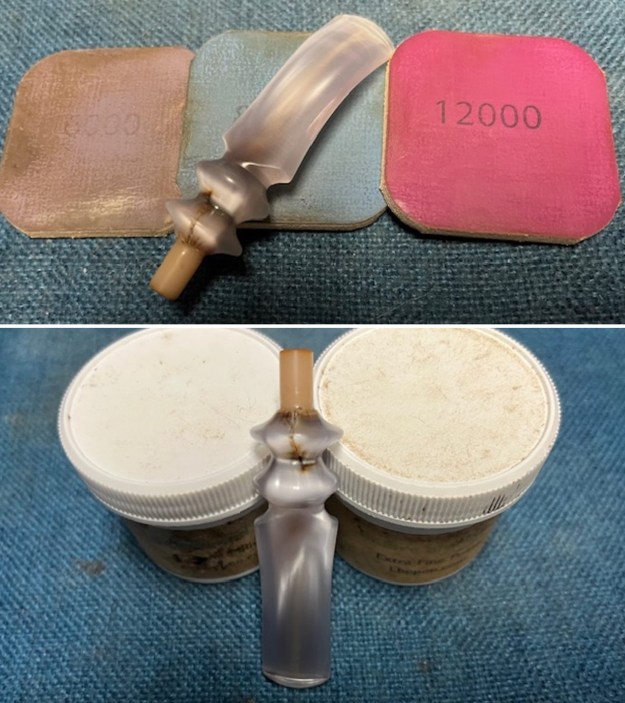
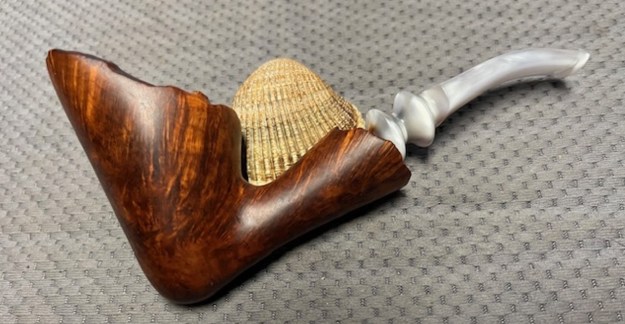
Jeff had cleaned up the pipe following his normal cleaning process. In short, he cleaned up the reaming with a Savinelli Fitsall Pipe Knife.  He scrubbed the bowl with undiluted Murphy’s Oil Soap with a tooth brush. He worked over the lava and debris on the plateau rim top and shank end and was able to remove it. He rinsed it under running warm water to remove the soap and grime. He cleaned out the inside of the shank and the airway in the stem with alcohol, cotton swabs, shank brushes and pipe cleaners. He scrubbed the stem with Soft Scrub and cotton pads to remove the debris and oils on the stem. He soaked it in Briarville’s Pipe Stem Deoxidizer. He rinsed it with warm water and dried it off. I took photos of the pipe once I received it. It really looked good. I took close up photos of the stem and the rim top to show both how clean they were and what needed to be addressed with both. The rim top and bowl still had some minor darkening on the plateau top and edges edge. The stem looked better and the tooth marks and chatter were still present. I would need to remove those to bring the stem back.I took a photo of the stamping on the underside of the shank. You can see from the photo that it is faint but readable. It is clearer on the top half of the stamp than the lower but it is still readable. I removed the stem from the bowl and took a photo of the parts to give a sense of the beauty of the pipe.I started my work on the pipe by polishing the briar with micromesh sanding pads – 1500-12000 grit pads. I wiped the bowl down between pads to remove the sanding debris. By the final pad it was looking very good. The bowl was in such good condition after the clean up that I worked some Before & After Restoration Balm into the surface of the briar with my finger tips and a horse hair shoe brush to get into the crevices of the plateau and sandblast portions. The product is incredible and the way it brings the grain to the fore is unique. It works to clean, protect and invigorate the wood. I set the bowl aside and turned my attention to the stem. I sanded the stem with 320-3500 grit sanding pads to further smooth out the repairs. I wiped it down after each pad with an Obsidian Oil cloth. It was looking much better. I polished the stem with micromesh sanding pads – wet sanding it 1500-12000 pads. I wiped it down with a damp cloth after each pad to remove the dust and polishing debris. I polished it with Before & After Pipe Polish – both Fine and Extra Fine. I wiped it down with Obsidian Oil and let it sit and absorb. I polished stem and bowl with Blue Diamond to polish out the remaining small scratches. I gave the bowl and the stem multiple coats of carnauba wax and buffed the pipe with a clean buffing pad to raise the shine. I hand buffed it with a microfiber cloth to deepen the shine. The pipe polished up pretty nicely. The plateau on the rim top and shank end and the smooth Dark and Medium brown contrast finish work very well with the black vulcanite stem. The finished pipe is shown in the photos below. I have worked on several Soren pipes by Soren Refbjerg Rasmussen and several Refbjerg pipes over the years and I have always been impressed by his craftsmanship and ability to work a pipe to follow the grain of the briar. He does great work and is quite innovative in terms of shapes, flow and finishes on his pipes. The dimensions of this one are quite large but delicate at the same time. The Length: 7 inches, Height: 3 inches, Outside diameter of the bowl: 1 ½ inches wide and 2 inches long, Chamber diameter: 7/8 inches. The weight of the pipe is 79 grams/2.79 ounces. This one will be going on the Danish Pipemakers Section on the rebornpipes store. If you wish to add it to your collection let me know. It is a beauty! Thanks for walking through the restoration with me as I worked over this Soren Freehand.
Restoring well repaired Soren Hand Carved Made in Denmark Freehand


Blog by Steve Laug

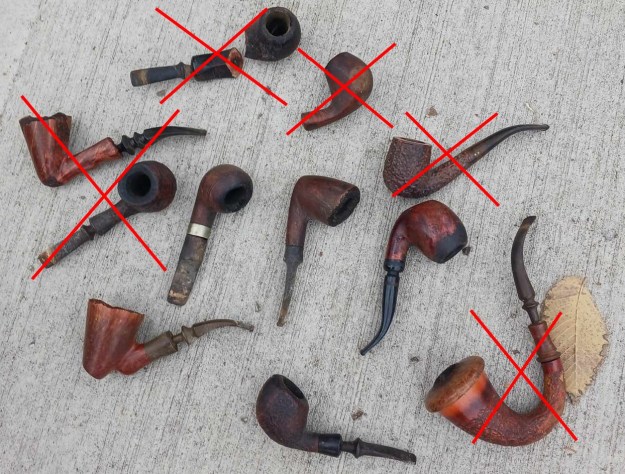
The next pipe I chose to work on came is another one from the lot of 11 pipes I purchased from a lady in Regina, Saskatchewan. She had found them in a house she bought and wanted to know if I wanted them. We struck a deal, I paid for the pipes and shipping and the box arrived while I was traveling in Europe. In the box were 4 Stanwells, 1 Danmore Bowl, 1 Soren Freehand, 1 Calabash with a Briar Bowl, 1 Nording Freehand, 1 Italian Made Bertenetti, 1 Rhodesian with a banded cracked shank, and 1 Brigham. I have restored the Nording, the snapped Stanwell, the Brigham, the Gourd Calabash with the briar bowl, restemmed and restored the Danmore bowl and a Stanwell Ivarsson design 11 Pot. There are blogs on each restoration available. The next pipe on the table is one of the dirtiest pipes in a box full of very dirty pipes. It is stamped on the underside of the shank and reads Soren [over] Hand Carved [over] Made in Denmark. There is no visible model name or shape number stamped on the pipe. The shank had been snapped through the last line of the stamp but it was faint. There was a thick cake in the bowl, debris in the bottom and on the bowl walls and some remnants of tobacco. The airway was plugged and there was no draught on the pipe. There was a heavy lava overflow on the plateau rim top. It was hard to know the condition of the inner edges of the bowl for sure because of the cake. The outer edge actually looked quite good under the grime. The finish was dirty and dusty and there was glue from the shank repair along the repaired shank. The vulcanite shank extension was filthy and oxidized. The stem looked to be in decent condition underneath the calcification and oxidation. The tooth marks and chatter looked minimal. I took photos of the pipe before I started my cleanup work on it. I took a close-up photo of the bowl and the plateau rim top to show the cake in the bowl. The rim top shows some lava on the smooth area around the inner edge of the bowl. The outer edges of the bowl looked good. I took photos of the vulcanite shank extension and the top and underside of the stem surface and button to show its general condition. It looked very good under the spotty oxidation.I took some photos of the repaired crack around the shank. You can see it clearly in the photos below. In spots the glue is higher than the repair and in spots it is lower. I will need to rework the repair surface but the repair itself is very well done. The stamping on the underside of the shank is faint but readable as noted above. You can barely make out the third line of the stamp on underside of the shank but it is present. I took the stem off the shank and took a photo to give a sense of the proportion of the pipe.I needed to refresh my memory on the history and background of the Soren pipes so I went to a previous blog and reread what I had written. https://rebornpipes.com/2016/09/12/repairing-and-rejuvenating-a-soren-danish-freehand/. I quote from that blog post: I looked up the brand on pipephil (http://www.pipephil.eu/logos/en/logo-s10.html) and found that the brand was carved by Søren Refbjerg Rasmussen. Pipes that he made for the European market were mostly stamped “Refbjerg” while those made for the US market were stamped “Soren”. Thus I knew that one I was working on was imported into the US market.

It looked like I was once again working on a pipe made by Soren Refbjerg Rasmussen for the US market as it was stamped Soren. I continued to do reading on another of my go to websites, Pipedia. Here is the link for the article there. https://pipedia.org/wiki/Refbjerg. I quote some of the more pertinent information.

Søren Refbjerg Rasmussen founded a company in 1969, which employed an average of 8 – 12 craftsmen in the 1970’s. The semi-freehands they produced were traded under his prename Søren. Rasmussen himself finished only the very best pipes. So his way of pipemaking closely resembled the ways of Preben Holm, Karl Erik Ottendahl or Erik Nørding. Altogether more than 1,000,000 pipes were sold.

There was also a note from Soren himself regarding the Danbark line of pipes that he made. I think that it is interesting to note that even on these he used the finest Corsican and Grecian briars. I assume that is also true of his other lines as well. I quote the note in full.

“A note from the carver:

I am very proud to introduce my new (!) series of hand-carved Danbark Pipes by Søren. These pipes are crafted from the finest Corsican and Grecian briars. I take a great deal of pride in crafting the Danbark Pipes to be highly functional and so they will provide the smoker with many years of dedicated service. The Danbark Pipes by Søren are available in several different styles and finishes with my personal touch and inspirations. At this time I favor making classic shaped pipes with a slight touch of my own hands and feelings. I do not produce many pipes today but the pipes that I do make available are individually crafted from the finest Corsican and Grecian Briars available to me. I still make free-hand pipes but not as many as I once made. For the past 35 years I have always tried to make good smoking pipes in my workshop located near Copenhagen, Denmark. I have always tried to craft my pipes in such a way as they will be long lasting and best friends with the owners. I take great pride in the shape of my pipes, the drilling of the pipes, and the overall dimensions of the pipes. I enjoy spending my spare time on the very long, rugged coasts of Denmark. I derive much relaxation from being on the coast while angling for Sea Trout with my own hand-tied flies. I find this environment is a great inspiration to me for making pipes. Many times I think to myself, “Inspired by nature, made by me”.  — Happy puffing, Søren”

From that I knew that the pipe in my hands came from the 1970s. It bears the Soren signature stamp which also says that it was made for sale in the American pipe market. Armed with that information I turned my attention to restoring the pipe.

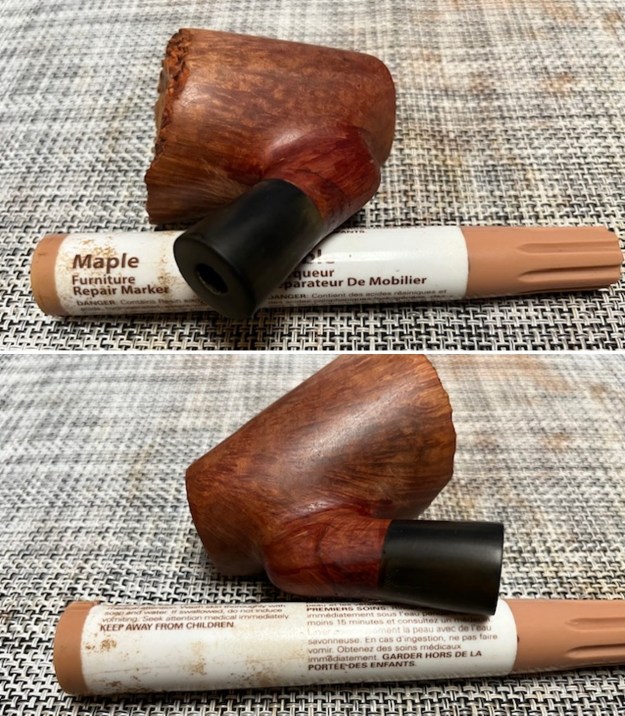
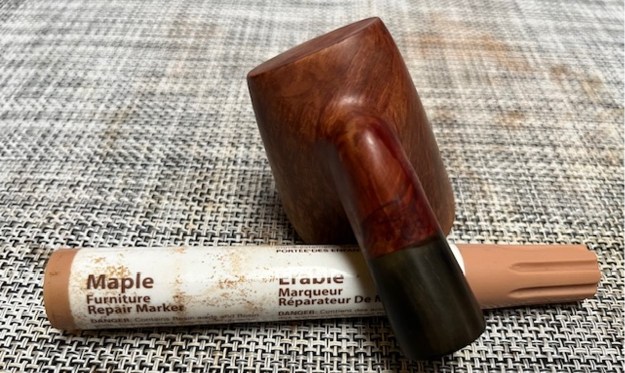
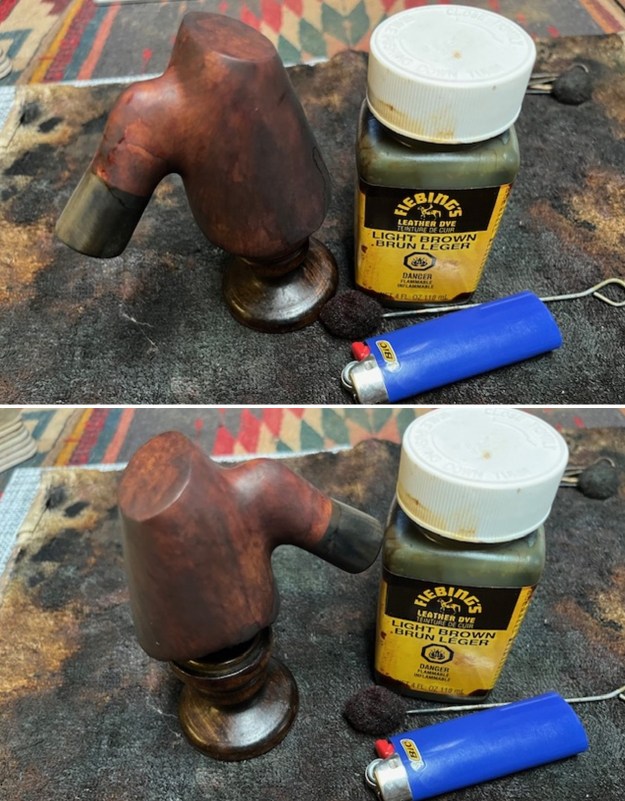
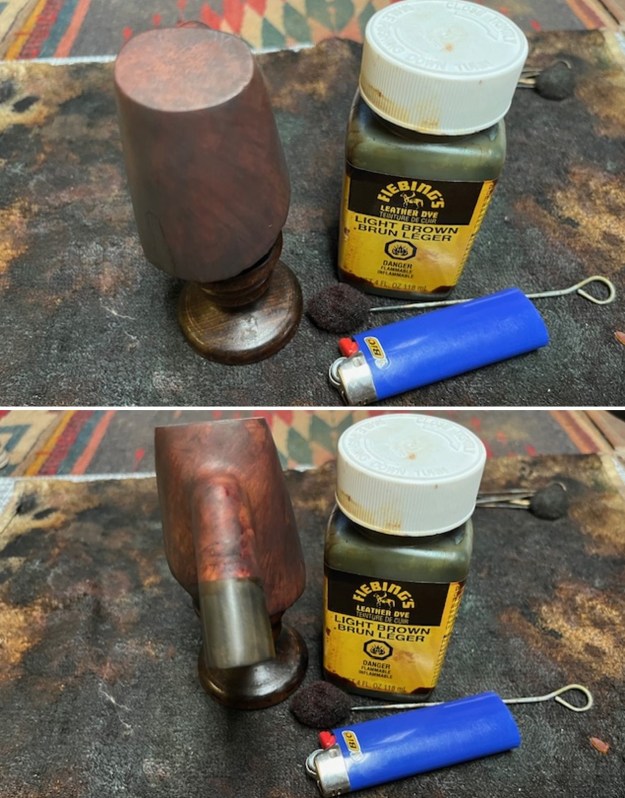
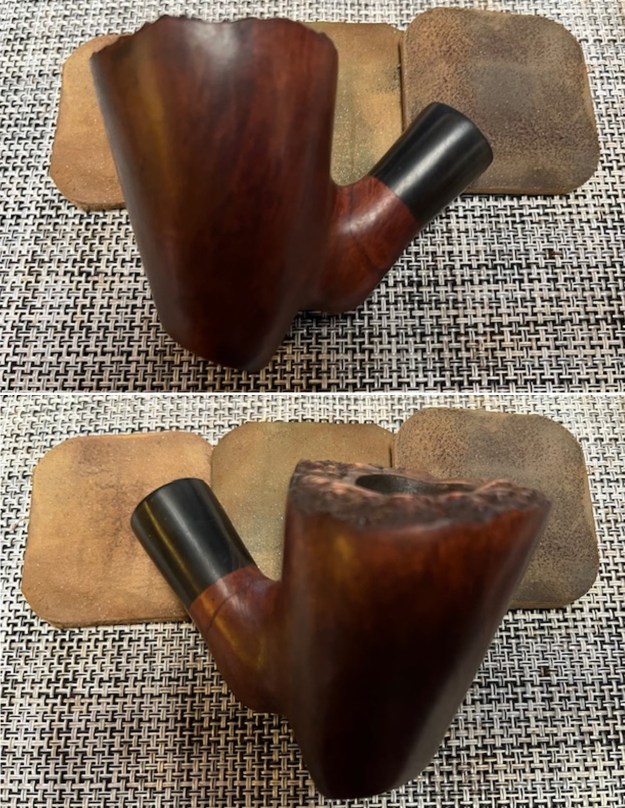
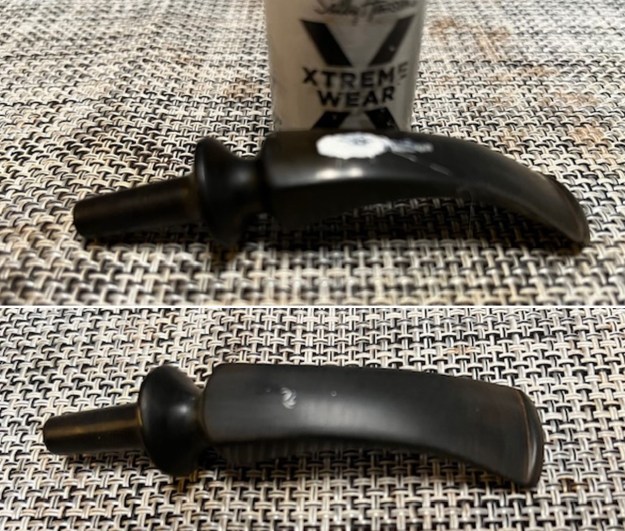
I decided to start my work on the pipe by working on the shank repair issues. I filled in the repair area with clear CA glue and pressed some briar dust into the glue. It took a few layers to smooth it out but the touch up on the repair was effective. I sanded the repaired area on the shank smooth with 220 grit sandpaper to blend it into the surrounding briar. I also sanded the burn mark on the side of the bowl. I wiped the bowl down with a damp cloth to remove the sanding dust. I reamed the bowl with a PipNet pipe reamer using the third cutting head to take the cake back to bare briar. I cleaned up the reaming with a Savinelli Fitsall Pipe Knife. I sanded the walls with a piece of 180 grit sandpaper wrapped around a dowel to smooth them out. I used a brass bristle wire brush to knock off the debris in the plateau on the rim top. It took some work but it cleaned up well. I used a folded piece of sandpaper to clean up the inner edge of the rim and to sand the darkening off the smooth area around rim top. I sanded the vulcanite shank extension at the same time to break the oxidation on the surface. I scrubbed the exterior of the briar with a tooth brush and undiluted Murphy’s Oil Soap. I rinsed it off with warm water to remove the grime and soap. It looked much better and the dust and debris was gone. I dried it with a cotton towel. I touched up the sanded areas on the shank and the bowl spots using a Maple Stain Pen to start the process of blending them into the rest of the bowl. The colour is very close and once I restain the bowl it will work very well. I stained the bowl and shank with a light brown stain wash. I applied it to the surface of the briar with a wool dauber. I flamed it with a lighter flame to set it in the grain. I repeated the process until I was satisfied with the coverage. I polished the vulcanite shank extension and the briar with micromesh sanding pads – dry sanding it with 1500-12000 git sanding pads. I wanted to make the new stain coat a bit more transparent. I wiped it down with a cloth and some Obsidian Oil. I scrubbed out the internals of the pipe with 99% isopropyl alcohol, pipe cleaners and cotton swabs. I cleaned out the airway in the stem as well. I worked on these areas repeatedly until the shank and the airway in all the parts was clean.I worked some Before & After Restoration Balm into the surface of the briar with my fingertips to clean, enliven and protect the briar. I let the balm sit for 15 minutes and then buffed with a cotton cloth to raise the shine. The photos show the bowl at this point in the restoration process. With that done, the bowl was finished other than the final buffing. I set it aside and turned my attention to the stem. I wiped it down with some Soft Scrub to remove the oxidation.I touched up the “S” stamp on the top of the stem with white acrylic nail polish. Once had dried I sanded out the excess with a worn 1500 micromesh sanding pad.I polished the oxidation and tooth chatter on the stem with micromesh sanding pads – wet sanding with 1500-12000 grit sanding pads. I wiped it down after each sanding pad with Obsidian Oil. I finished polishing the stem with Before & After Pipe Stem polish (both Fine and Extra Fine) then wiped the stem down with another coat of Obsidian Oil. I polished finished Soren Hand Carved Danish Freehand with Blue Diamond to polish out the remaining small scratches. I gave the bowl and the stem multiple coats of carnauba wax and buffed the pipe with a clean buffing pad to raise the shine. I hand buffed it with a microfiber cloth to deepen the shine. The pipe polished up pretty nicely. The plateau on the rim top and shank end and the smooth Dark and Medium brown contrast finish work very well with the black vulcanite stem. The finished pipe is shown in the photos below. I have worked on several Soren pipes by Soren Refbjerg Rasmussen and several Refbjerg pipes over the years and I have always been impressed by his craftsmanship and ability to work a pipe to follow the grain of the briar. He does great work and is quite innovative in terms of shapes, flow and finishes on his pipes. The Length: 5 ½ inches, Height: 2 ½ inches, Outside diameter of the bowl: 2 inches, Chamber diameter: 7/8 inches. The weight of the pipe is 73 grams/ 2.57 ounces. I will be putting it on the rebornpipes store in the Danish Pipemakers Section if you would like to add it to your rack and carry on the previous pipeman’s legacy. This is an interesting estate to bring back to life.

As always, I encourage your questions and comments as you read the blog. Thanks to each of you who are reading this blog. Remember we are not pipe owners; we are pipe men and women who hold our pipes in trust until they pass on into the trust of those who follow us.  

This Interesting Soren Hand Carved Freehand Turned Out to be More Work than Expected


Blog by Steve Laug

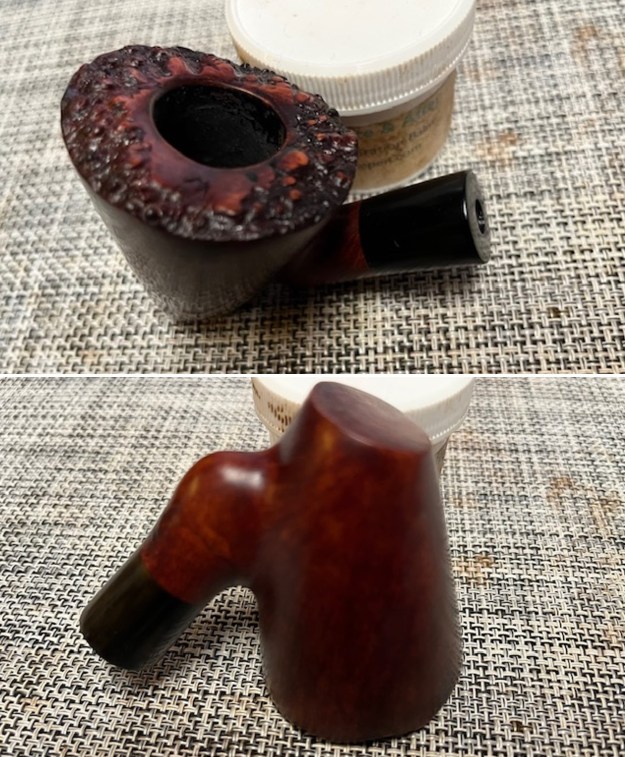
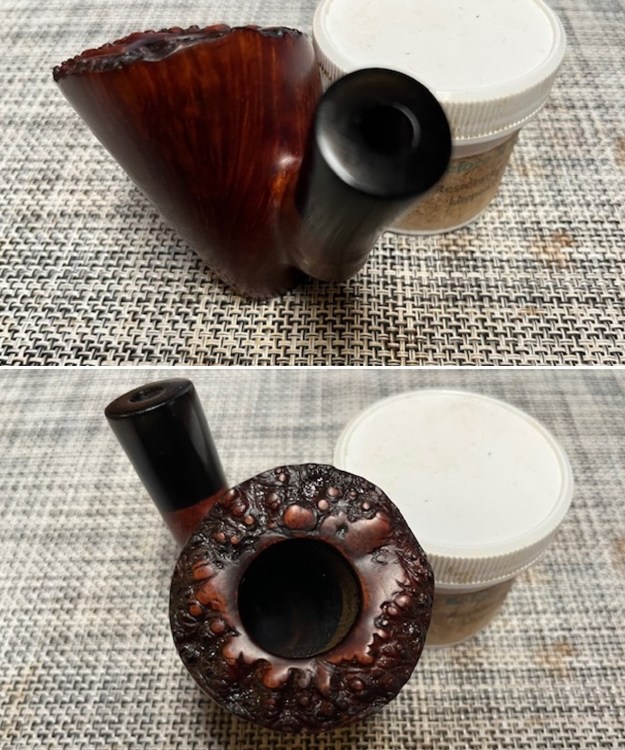
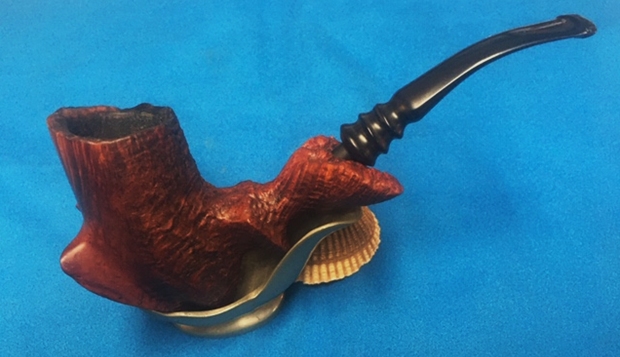
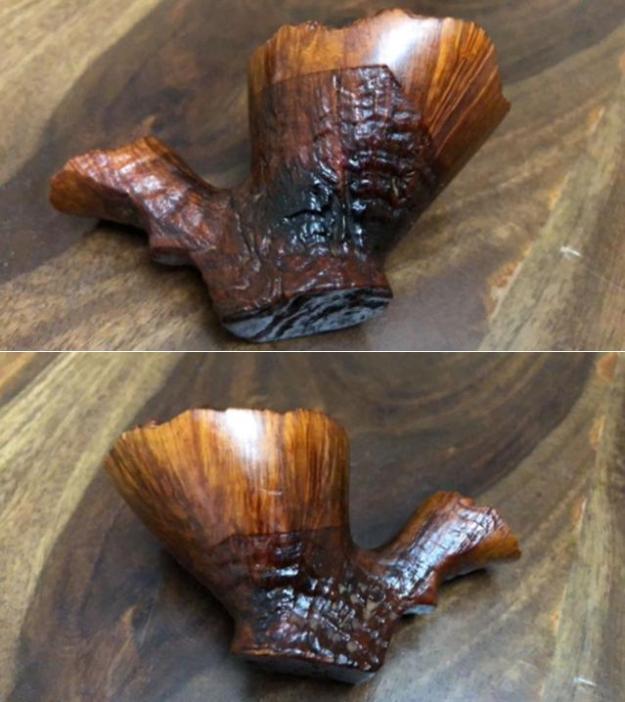
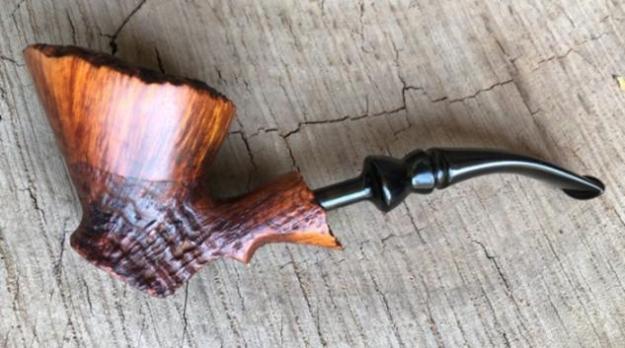
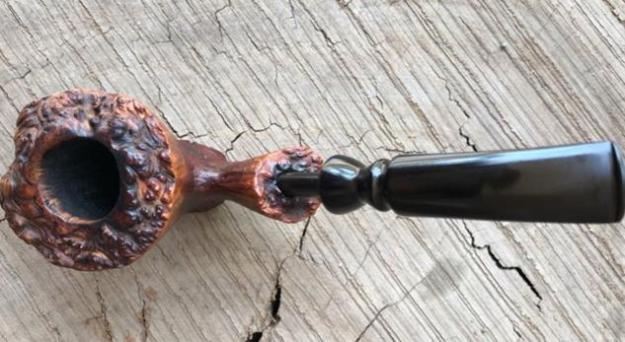
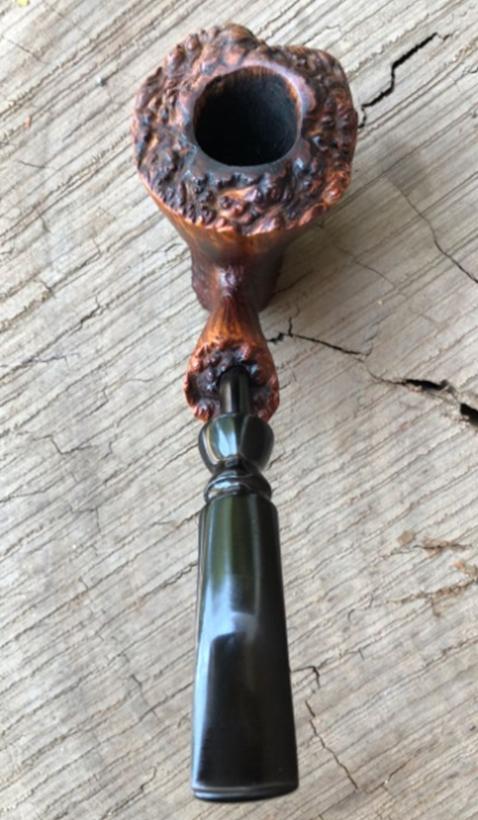
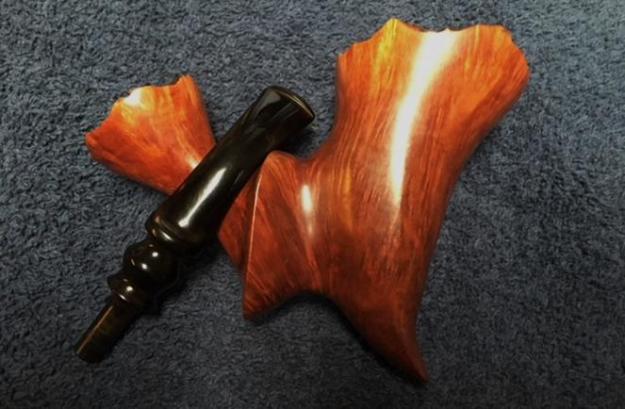
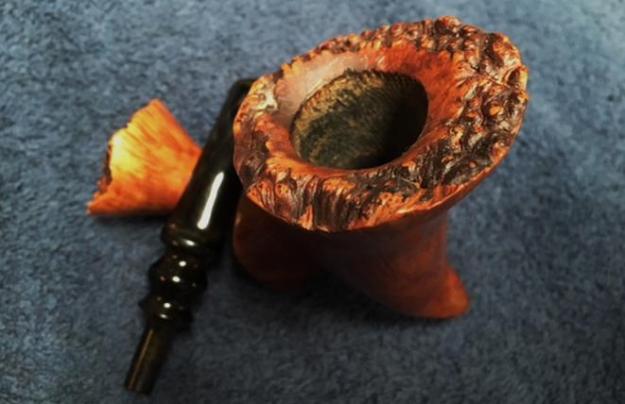
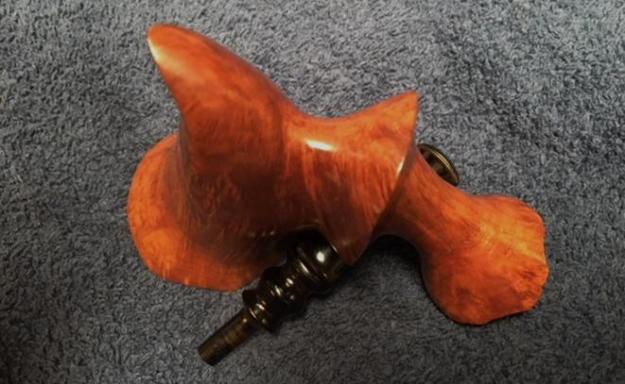
On a recent trip that Irene and I took with Jeff and his wife to the Oregon Coast we managed to do some pipe hunting. We found a few interesting pipes. I was in the mood today to work on a couple of them as a break from the restorations I am doing for others. The second of these is a pipe marked Soren over Hand Carved over Copenhagen over Denmark on the underside of the shank. It is a Freehand with a mix of sand blast and smooth finish on the bowl and shank. There is also plateau on the rim top and shank end. The pipe has a pair of fins on the underside of the bowl that allows the pipe to stand on its own. The bowl was a mess with a thick cake and tar overflow filling in the plateau rim top. There was a lot of dust and grim in the sandblast and buildup on the smooth portions. There were some chips missing on the ends of the fins but they did not detract from the unique beauty of the pipe. At first glance the stem was okay though it has some tooth marks and chatter near the button. There was some calcification and heavy oxidation in all of the turnings and smooth parts of the stem. When I removed the stem there was an issue – the tenon was ragged looking and probably half of it was missing. I took this one home as I decided I wanted to work on it. I took photos of the pipe before starting my cleanup work. I took close up photos of the rim top and bowl to show how clean it was. There is some nice cross grain on the rim top. I also took photos of the stem to show their condition. You can see the oxidation and tooth chatter on it but otherwise it is a pretty straight forward cleanup.I took a photo of the stamping on the underside of the shank. You can see it below and it read as noted above. I looked up the brand on Pipephil (http://www.pipephil.eu/logos/en/logo-s10.html) and found that the brand was carved by Søren Refbjerg Rasmussen. Pipes that he made for the European market were mostly stamped “Refbjerg” while those made for the US market were stamped “Soren”. Thus I knew that one I was working on was imported into the US market.

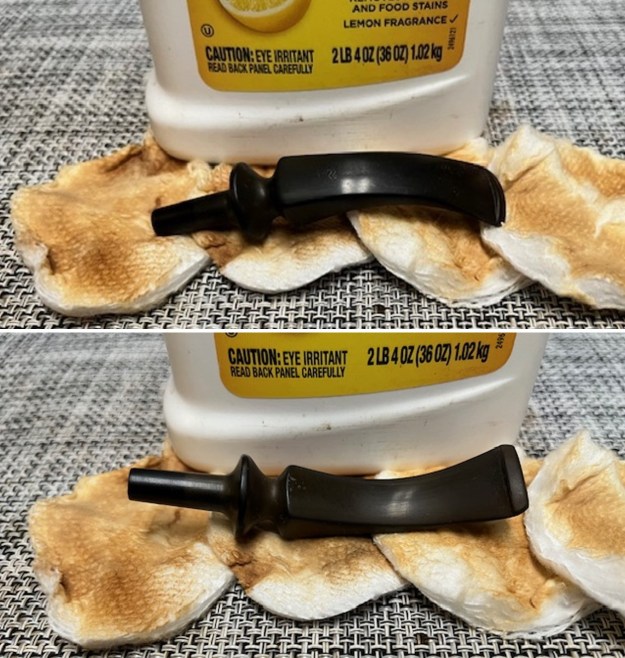
With that information I was clear on the maker of the pipe and I turned to work on the pipe itself. I reamed the bowl with a PipNet pipe reamers using the first three cutting heads to take the cake back to bare briar. I like to have a clear idea of the condition of the inside walls of the bowl before I consider a pipe finished. This one looked very good. I cleaned up the remnants of cake with a Savinelli Fitsall Pipe Knife and sanded the walls with a piece of 220 grit sandpaper wrapped around a dowel. I scrubbed the briar with undiluted Murphy’s Oil Soap, a tooth brush and a wire brush to clean out the grime and dust in the grain of the sand blast and in the plateau on the rim top and shank end. I rinsed soap off the bowl with warm running water and dried off the briar with a soft cloth. I cleaned the surface further with Mark Hoover’s Before & After Briar Cleaner – the Extra strength version. I rubbed it into the surface of the briar with a tooth brush and rinsed it off to remove the grime that it had trapped. I used a folded piece of 220 grit sandpaper to smooth out the damage on the fins. Both sides had small chips in the finish on the end of the fins.I rubbed the briar down with Before & After Restoration Balm. I worked it into the surface of the briar with my fingertips and a horsehair shoe brush. I let it sit for about 10 minutes. I buffed it off with a cotton cloth. You can see how well the product works to clean and enliven the briar and as a bonus it protects it as well. I set the bowl aside and turned my attention to the stem. While I was with Jeff in Oregon I picked up some of the Soft Scrub that he has found very useful in removing oxidation and calcification. I rubbed down the stem with it on a cotton pad. You can see the results on the pads in the photo below.I cleaned out the airway in the shank and stem and the inside of the mortise with pipe cleaners, cotton swabs and alcohol. It was a dirty pipe. The photo of the bowl came out pretty good but the stem photo is out of focus. You get the idea though on how dirty both were.I cleaned off the surface of the stem, painted it with the flame of a lighter to lift the tooth marks and filled in the remaining tooth marks with black super glue. I set the stem aside to let the repair cure overnight. While it cured I mulled over what I was going to do about the short, broken tenon on the stem. I had two options – I could cut off the remaining tenon and replace it or I could replace the stem. I like the fancy stem that was on the pipe so I was more prone to replace the tenon… I would let it sit and make a decision in the morning.When the glue cured and the repair hardened I recut the edge of the button on both sides with a needle file. I gave it more definition and flattened out the repaired areas on the top and underside. I smoothed out top and underside with 180 grit sandpaper.I smoothed out the sanding marks and worked on the oxidation with 220 grit sandpaper. I wiped the stem down afterwards with a damp cloth. Finally I feel like I am making some progress with the stem.I cleaned the stem with cotton swabs, cotton pads and Soft Scrub to remove more of the oxidation on the surface of the rubber. At this point the stem was looking pretty good.I paused at this point and thought about a third option for the tenon – not a replacement and not a new stem. There was another way that I thought might work. I used a needle file to reshape the broken tenon and take away some of the first disk of the turned stem. The photos below show the stem after I had removed some of the material and bought some more length on the tenon. I still need to smooth out the tenon and flatten the end but the fit is much better in the shank and actually looks better. I cleaned up the tenon and the fit is very good now. All that remains is to polish it.I polished the stem with micromesh sanding pads – wet sanding it with 1500-12000 grit pads. I wiped the stem down after each sanding pad with a cotton pad to remove the sanding debris.  I have to tell you I am not sorry to see this restoration come to an end. Generally it is fun to see the part all come together. This time I was glad that I could move on to work on another pipe! I had seen enough of the many issues that came with this pipe. I put the pipe back together and buffed it with Blue Diamond on the buffing wheel. I gave the bowl and the stem multiple coats of carnauba wax. I hand buffed the pipe with a clean buffing pad to raise the shine. It was good to see what the polished bowl looked like with the smooth portions, sandblast portions and the plateau on the rim top and shank end. They contrasted well the polished black vulcanite stem. This Soren Hand Carved in Denmark Freehand is nice looking and feels great in my hand. The pipe has the advantage of being a sitter as well as a Freehand. The fins on the front of the bowl act like legs that hold it upright. It is a very light weight and well balanced pipe. Have a look at it with the photos below. The dimensions are Length: 6 inches, Height: 3 inches, Outside diameter of the bowl: 1 ½ inches, Chamber diameter: 7/8 of an inch. This is a well-traveled pipe – Made in Denmark for an American Market, somehow ending up in Astoria, Oregon in the stall of a seller who bought it at an estate sale and now up to Vancouver, British Columbia in Canada. While the pipe had a lot of challenges they were fun to work on for the most part! Thanks to each of you who are reading this blog. Remember we are not pipe owners; we are pipemen and women who hold our pipes in trust until they pass on into the trust of the next pipeman or woman.

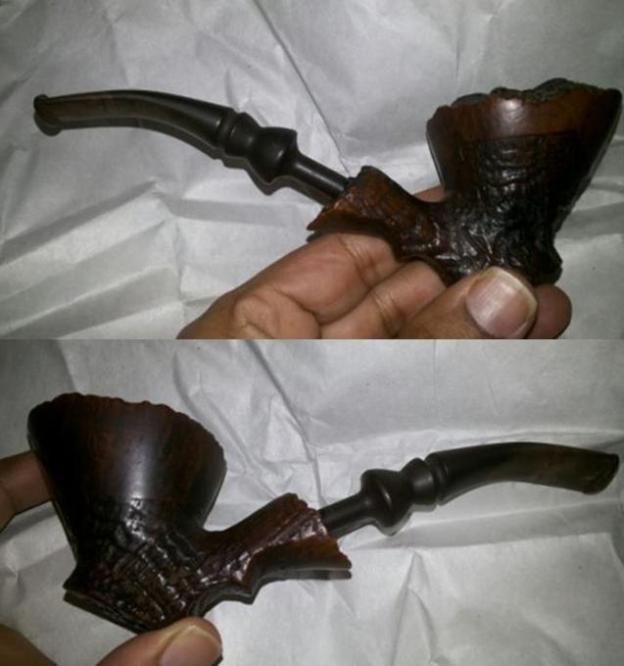
Restoring a Soren Hand- Carved Sitter Pipe


Blog by Paresh Deshpande

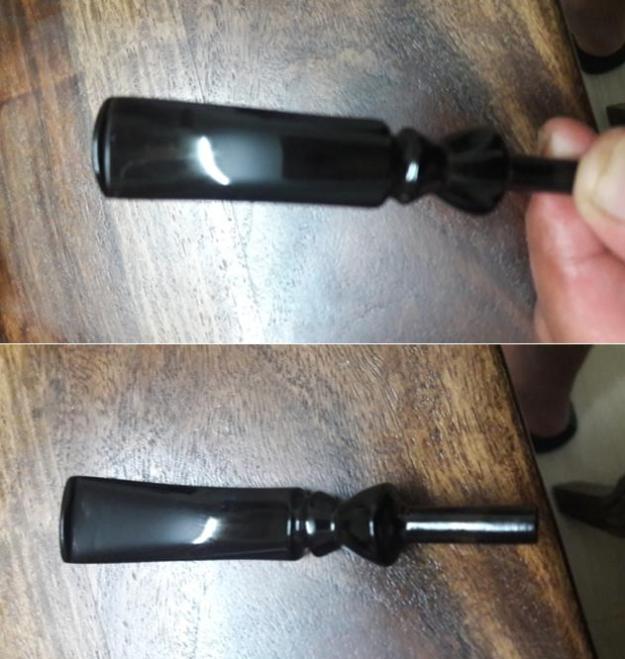
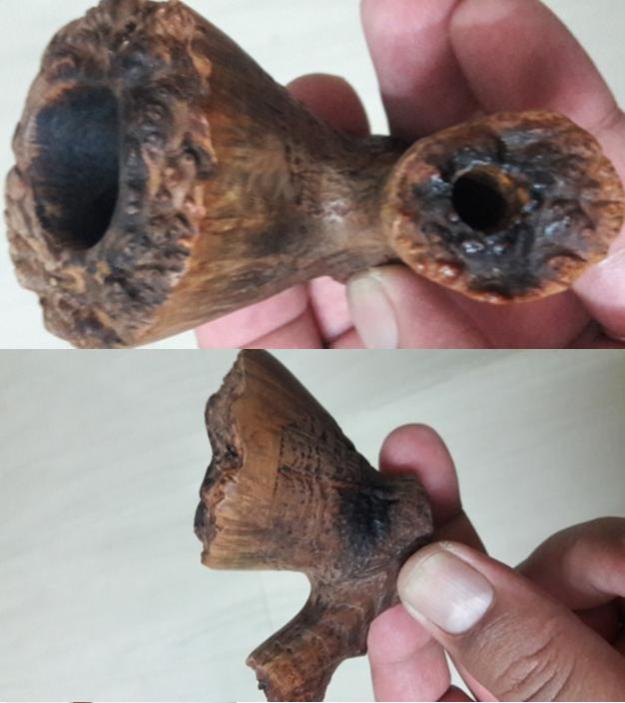
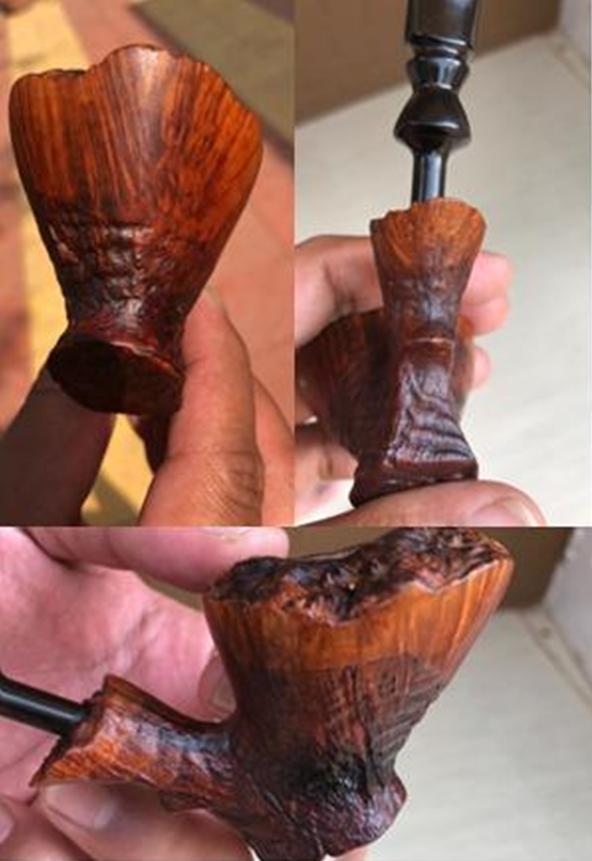
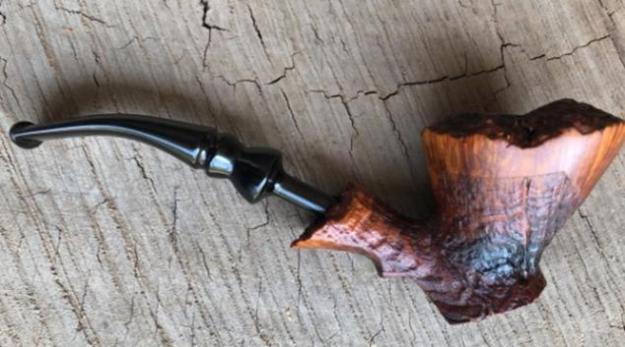
This Soren is the last of the freehand pipes that I had purchased on eBay. Well, this pipe is definitely the smallest of all the four, but it is also the only sitter of this lot!!!!! The medium size of the bowl, angle between the stummel and shank with a fancy stem, lends this pipe a look which is both very attractive and functional at the same time.

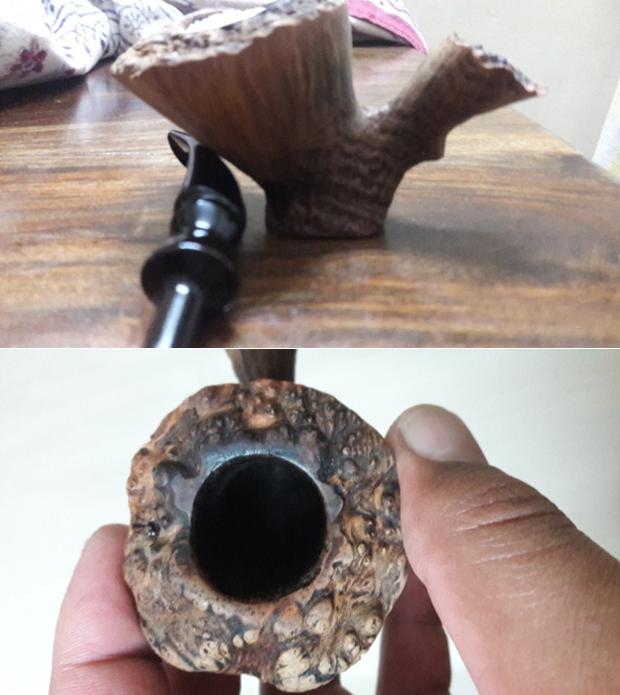
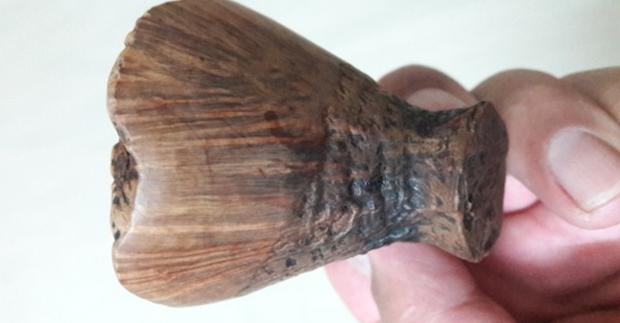
The pipe has a combination of smooth surface and sandblast finishes.  These sandblast portions are seen along the entire length of the shank, save for a small smooth portion on the lower surface at the shank end. This smooth portion bears the only stamping seen on this pipe, “Soren” over “HAND-CARVED” over “MADE IN DENMARK”. The upper portion of the stummel shows irregularly designed straight grained smooth surface while the lower portion and the shank, less the stamped portion,  is sandblasted which give this pipe its unique appearance!!! The plateau rim top has a smooth thin surface very close to the inner edge. I absolutely loved this pipe. I searched the internet for information on this pipe. Pipedia has some interesting snippet of information on the carver of this pipe, which I have reproduced below:

“Søren Refbjerg Rasmussen founded a company in 1969, which employed an average of 8 – 12 craftsmen in the 1970’s. The semi-freehands they produced were traded under his prename Søren. Rasmussen himself finished only the very best pipes. So his way of pipemaking closely resembled the ways of Preben Holm, Karl Erik Ottendahl or Erik Nørding. Altogether more than 1,000,000 pipes were sold.

Today he works alone as Refbjerg and manufactures only a small number of pipes in his workshop in DK-2860 Søborg, which are considered to be tremendously precisely executed. The dimensions mostly range from small to medium sized, corresponding to his personal preferences. The shapes adhere to the classical models, but often he gives them a touch of Danish flair. Refbjerg accepts minor faults but never uses any fillings. “Straight Grain” is the only grading, used for his very best pieces. He likes stem decorations made of exotic woods or metal rings.

As Rainer Barbi once stated “Refbjerg uses only briar from Corsica and more than that, he’s the one and only to import it from there, at least in Europe. He’s supplier to the vast majority of the Danish makers”.

Examples and nomenclature, courtesy Doug Valitchka Initial inspection of the pipe revealed the following
There is a thick layer of cake in the bowl. The external surface of the stummel feels solid to the touch and I think there are no issues with the condition of the chamber. However, there are always surprises when you least expect them!!! I have learnt my lessons!!! Thus, condition of the inner walls of the chamber will be ascertained once the chamber has been reamed and the cake is taken back to the bare briar. The plateau rim top and shank end is covered in the overflow of lava, dirt and grime. This will have to be cleaned. The condition of the inner edge will be determined only after removing the cake. The air way in the shank is clogged with oils and tars and will require a thorough cleaning.The stem is firmly stuck to the shank and will not budge. However, other than heavy oxidation, there are no other issues noticed on the stem. The stummel is covered in dust, dirt, oils and grime. The stummel looks dull and lackluster. The grains on the smooth surface and the sandblast are all covered in tars, oils and grime. To be able to appreciate these grains and sandblast, the stummel will have to be cleaned. THE PROCESS
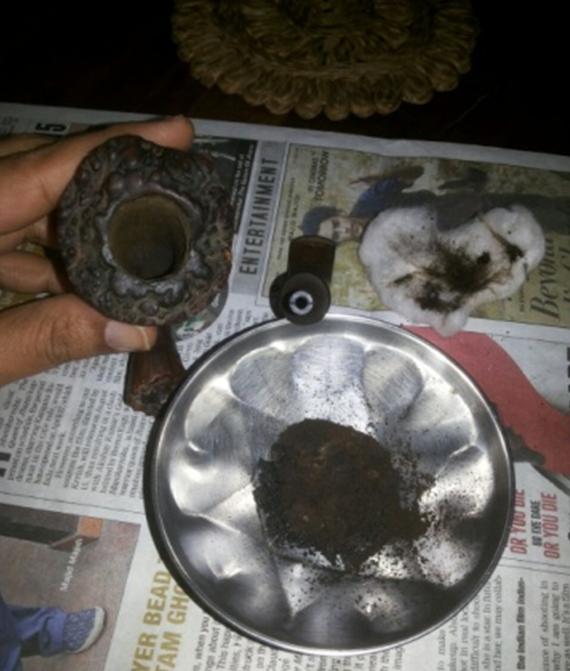
Before I could start the work of cleaning the pipe, I kept it in the freezer for a couple of hours so as to separate the stem from the shank. I removed the pipe from the freezer and tried to remove the stem, but it still did not budge! I let it rest outside for an hour and after applying considerable force, the stem came free. I had followed a YouTube video where the stem was soaked in a solution of hot water and Hydrogen Peroxide in the ratio of 2:1. The stem oxidation had risen to the surface and was much easier to remove. I cleaned the insides of the stem with pipe cleaners and hard bristled pipe cleaners dipped in alcohol. Once the internals were clean and dry, I wiped the stem surface with magic clean sponge and followed it with polishing with micromesh pads. I applied extra virgin olive oil on the stem surface and set it aside to be absorbed by the stem. I am afraid, in my enthusiasm to try out new technique of using Hydrogen Peroxide; I just missed out on taking pictures of each step. Using a Kleen Reem pipe reamer, I removed all the carbon cake from the chamber. This was followed by sanding the inner walls of the chamber with 220 grit sand paper. The internal walls of the chamber were flawless and solid. Thereafter, using Murphy’s oil soap ( undiluted ) and a hard bristled toothbrush on the exterior of the bowl, shank and rim, the pipe was thoroughly cleaned and rinsed under running tap water. I immediately wiped it down with a soft cloth. The sandblast and the smooth surface were now clean and the briar looked clean and solid. I then left the briar to dry out. Once the briar had dried out completely, I rubbed in Before and After Restoration Balm deep into the sandblast as well as the rim top. The bowl was then wiped vigorously with a soft cloth and buffed with a horse hair shoe brush. The result is very pleasing and satisfying to the eyes! I am happy with this progress. This balm is a fantastic product for infusing a nice shine into the briar and giving it a new lease of life.The finished pipe is as shown below. I enjoyed working on this lot of four freehand pipes and each of these pipes has its own individuality and each is beautiful in its own way. I hope you too enjoyed joining me on this wondrous journey of exploring the freehand pipes!!!!!  Thank you for your patience and as always, any suggestions and/ or improvements will help me in learning this art of restoration.

Next on the table – A Soren Hand Carved 3 Freehand


Blog by Steve Laug

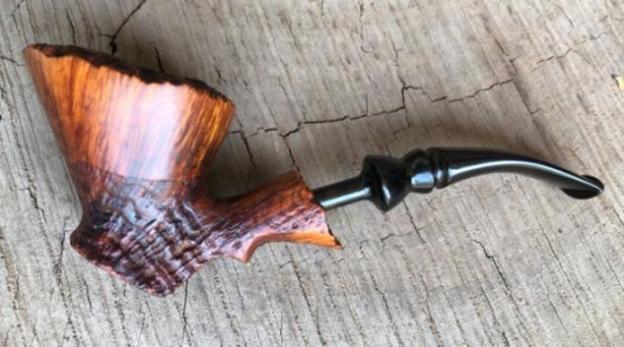
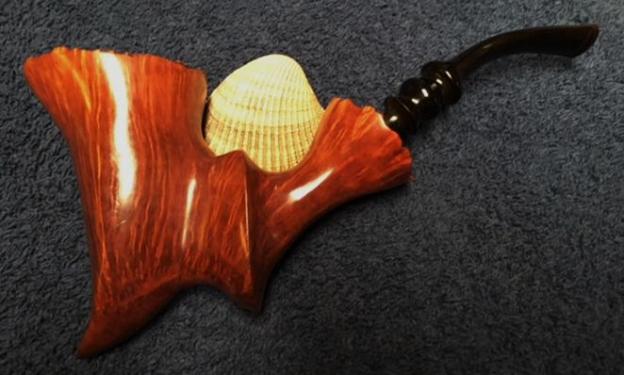
As mentioned in the last few blogs, Jeff picked up some amazing freehand pipes lately. When I was in Idaho for my mom’s funeral I packed and brought them to Canada. There was a Soren Hand Carved, Granhill Signature, Ben Wade Golden Walnut, Veeja 900 C6 and Viggo Nielsen Hand Finished. All were handcrafted and had interesting shapes and finishes. Some had full plateau rims, some partial plateau rim. Tonight I started working on them. The next pipe I chose was a Soren Hand Carved. My brother had done the entire cleanup – reaming, scrubbing the exterior and cleaning the interior. That left me the finishing work. The bowl has a smooth finish with plateau on the rim top and shank end. The pipe is a pick axe shape with an interesting collar then flares toward the plateau on the shank end. The finish on the pipe was in excellent condition. The vulcanite stem had very light tooth chatter on the top and bottom at the button and was lightly oxidized as well. Jeff had cleaned the rim top and removed the debris in the plateau. He had scrubbed the exterior with Murphy’s Oil soap and a tooth brush to remove the dust and grime that had accumulated there. He reamed the bowl with a PipNet reamer and touched it up with a Savinelli Fitsall Pipe Knife. He cleaned the interior of the mortise and the airway in the shank and the stem with alcohol, cotton swabs and pipe cleaners. It came to me clean and ready to touch up and polish. The stem was cleaned but had tooth chatter on the top and underside near the button and on the surface of the button. I took close up photos of the rim top and the shank end to show the condition of the plateau. I also took photos of the stem to give a clear picture of what I had when I started. I took photos of the underside of the shank to show the stamping there. It read Soren over Hand Carved over Copenhagen over Denmark. On the left side of the collar on the shank the number 3 was stamped. I am assuming that may well be a grade stamp.I needed to refresh my memory on the history and background of the Soren pipes so I went to a previous blog and reread what I had written. https://rebornpipes.com/2016/09/12/repairing-and-rejuvenating-a-soren-danish-freehand/. I quote from that blog post: I looked up the brand on pipephil (http://www.pipephil.eu/logos/en/logo-s10.html) and found that the brand was carved by Søren Refbjerg Rasmussen. Pipes that he made for the European market were mostly stamped “Refbjerg” while those made for the US market were stamped “Soren”. Thus I knew that one I was working on was imported into the US market.

It looked like I was once again working on a pipe made by Soren Refbjerg Rasmussen for the US market as it was stamped Soren. I continued to do reading on another of my go to websites, Pipedia. Here is the link for the article there. https://pipedia.org/wiki/Refbjerg. I quote some of the more pertinent information.

Søren Refbjerg Rasmussen founded a company in 1969, which employed an average of 8 – 12 craftsmen in the 1970’s. The semi-freehands they produced were traded under his prename Søren. Rasmussen himself finished only the very best pipes. So his way of pipemaking closely resembled the ways of Preben Holm, Karl Erik Ottendahl or Erik Nørding. Altogether more than 1,000,000 pipes were sold.

There was also a note from Soren himself regarding the Danbark line of pipes that he made. I think that it is interesting to note that even on these he used the finest Corsican and Grecian briars. I assume that is also true of his other lines as well. I quote the note in full.

“A note from the carver:

I am very proud to introduce my new (!) series of hand-carved Danbark Pipes by Søren. These pipes are crafted from the finest Corsican and Grecian briars. I take a great deal of pride in crafting the Danbark Pipes to be highly functional and so they will provide the smoker with many years of dedicated service. The Danbark Pipes by Søren are available in several different styles and finishes with my personal touch and inspirations. At this time I favor making classic shaped pipes with a slight touch of my own hands and feelings. I do not produce many pipes today but the pipes that I do make available are individually crafted from the finest Corsican and Grecian Briars available to me. I still make free-hand pipes but not as many as I once made. For the past 35 years I have always tried to make good smoking pipes in my workshop located near Copenhagen, Denmark. I have always tried to craft my pipes in such a way as they will be long lasting and best friends with the owners. I take great pride in the shape of my pipes, the drilling of the pipes, and the overall dimensions of the pipes. I enjoy spending my spare time on the very long, rugged coasts of Denmark. I derive much relaxation from being on the coast while angling for Sea Trout with my own hand-tied flies. I find this environment is a great inspiration to me for making pipes. Many times I think to myself, “Inspired by nature, made by me”.  — Happy puffing, Søren”

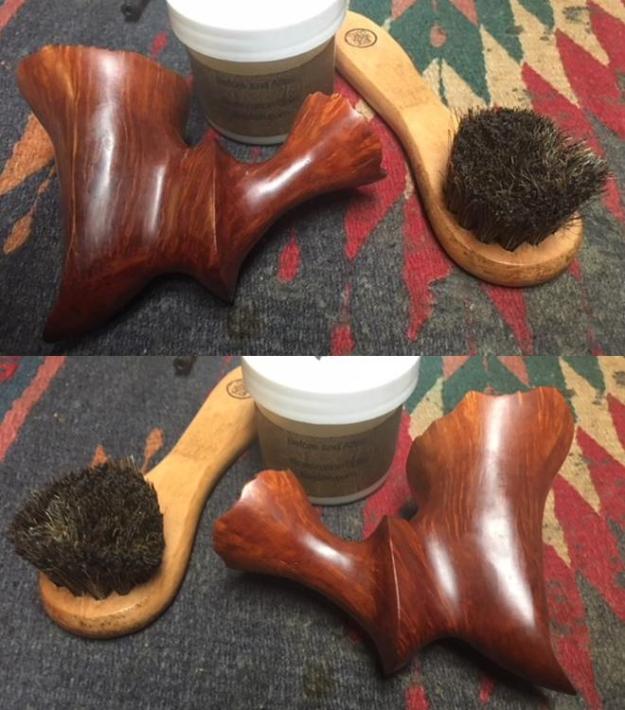
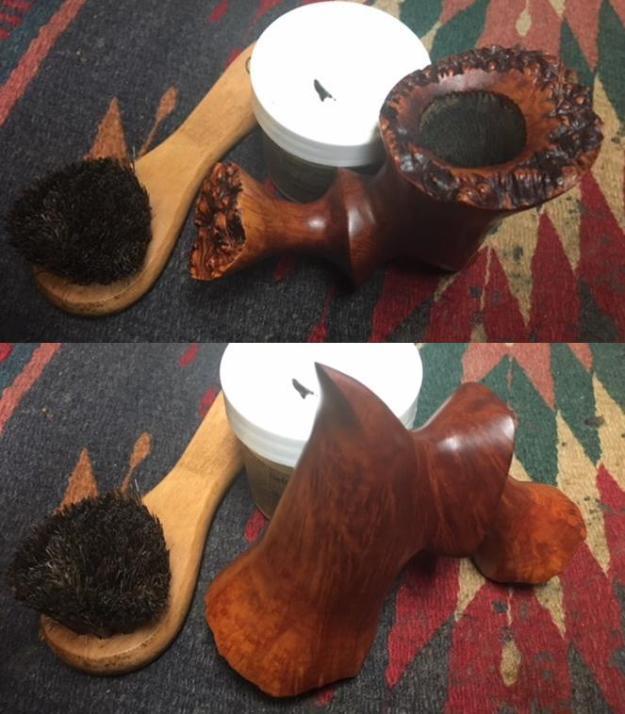
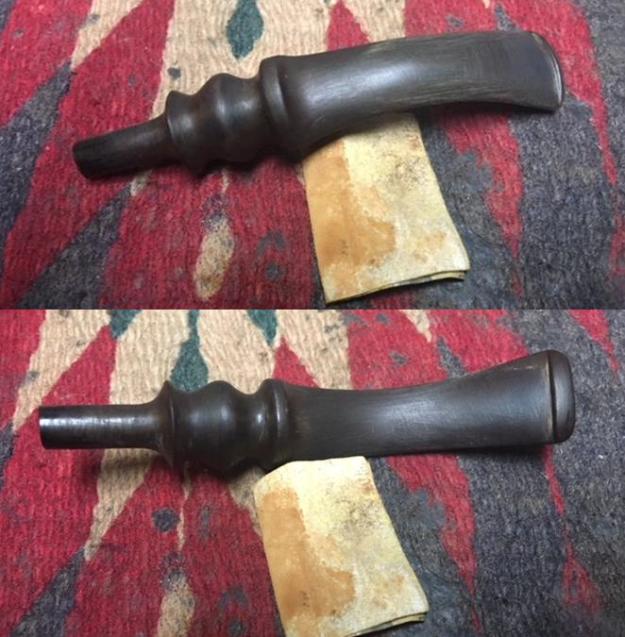
From that I knew that the pipe in my hands came from the 1970s. It bears the Soren signature stamp which also says that it was made for sale in the American pipe market. Armed with that information I turned my attention to restoring the pipe. I started with the clean bowl, I rubbed the bowl down with Before & After Restoration Balm to deep clean the briar bowl and shank. The product works to clean, enliven and protect the briar. I hand rubbed it with my fingers, working it into the exterior of the pipe and working it into the plateau areas with a horsehair shoe brush. I wiped it off and buffed it with a soft cloth to polish it. The pipe really began to have a rich shine. I took some photos of the bowl at this point to mark the progress in the restoration. I set the bowl aside and turned my attention to the stem. I sanded out the tooth chatter out of both sides of the stem with 220 grit sandpaper. I worked over the surface with sandpaper to remove the tooth chatter and the oxidation.I polished the vulcanite stem with micromesh sanding pads – wet sanding with 1500-2400 grit pads and dry sanding with 3200-12000 grit pads. I wiped the stem down after each pad with Obsidian Oil to protect and polish the stem. When I finished with the last pad I rubbed it down with Before & After Pipe Polish – both fine and extra fine. I gave it a final coat of oil and set aside to dry. I polished stem and bowl with Blue Diamond to polish out the remaining small scratches. I gave the bowl and the stem multiple coats of carnauba wax and buffed the pipe with a clean buffing pad to raise the shine. I hand buffed it with a microfiber cloth to deepen the shine. The pipe polished up pretty nicely. The plateau on the rim top and shank end and the smooth Dark and Medium brown contrast finish work very well with the black vulcanite stem. The finished pipe is shown in the photos below. I have worked on several Soren pipes by Soren Refbjerg Rasmussen and several Refbjerg pipes over the years and I have always been impressed by his craftsmanship and ability to work a pipe to follow the grain of the briar. He does great work and is quite innovative in terms of shapes, flow and finishes on his pipes. The dimensions of this one are quite large but delicate at the same time. The Length: 7 inches, Height: 3 1/4 inches, Outside diameter of the bowl: 2 inches wide and 2 inches long, Chamber diameter: 7/8 inches. This one is already sold to Paresh in India who always has an eye out for interesting freehand pipes. I am looking forward to hearing from him once he receives it. It is a beauty! Thanks for walking through the restoration with me as I worked over this Soren Freehand. I have other Freehands that I will be working on in a variety of shapes and sizes in upcoming blogs.  
Repairing and Rejuvenating a Soren Danish Freehand


Blog by Steve Laug

soren1aThe fifth pipe I am working on for Steve in Dawson Creek, British Columbia is a beautiful freehand that is stamped Soren Hand Carved over Made in Denmark on the underside of the shank. The finish is not bad. There were two cracks in the plateau rim top with one of them just on the rim and the other one coming down the left side about ¼ inch. These would need to be repaired. The bowl had a light cake and there was overflow onto the plateau top. This would need to be scraped clean. The shank end was also plateau and it had a lot of dust in the grooves. The finish on the bowl was dirty and there were some small nicks on the sides. It has a diamond-shaped freehand stem that was lightly oxidized and had tooth marks on the top and the underside near the button.soren1I looked up the brand on pipephil (http://www.pipephil.eu/logos/en/logo-s10.html) and found that the brand was carved by Søren Refbjerg Rasmussen. Pipes that he made for the European market were mostly stamped “Refbjerg” while those made for the US market were stamped “Soren”. Thus I knew that one I was working on was imported into the US market.soren2I took a close up photo of the rim and the bowl to show the condition of the pipe when I took it out of the box. The thick cake on the top of the bowl rim filled in much of the plateau surface. You can see the thickness of the cake in the bowl. In the photo you can see that it is thicker at the top than at the bottom of the bowl.soren3I took photos of the stem to show the light oxidation and the scratching and wear to the stem. There were small tooth marks on the top and underside of the stem near the button.soren4I took some photos of the condition of the bowl and the finish before I started cleaning the pipe. I wanted to be able to track the difference in the cleanup of the briar. In the second photo below I used a dental pick to try to pick at the thick cake on the rim. It would not be the way to clean up the rim.soren5I reamed the cake back to bare briar using the Savinelli Pipe Knife. In the photo below you can see the crack on the left side near the rim. I have circled it with red to highlight the crack.soren6I used a microdrill bit to drill a cap hole at the end of the crack to keep it from spreading further down the side of the bowl. The crack was not long so it was an easy fix.soren7I cleaned the top of the rim with a brass bristle brush to clean out all of the grooves and the areas of plateau on top of the bowl. It worked far better than the dental pick to clean off the thick cake on the bowl top. In the photo below you can see the two small cracks. I have circled both of them. I cleaned them out with a dental pick so that they were open. The crack did not go down into the interior of the bowl.soren8I pushed briar dust into the crack and the end cap hole and the put super glue on top of the dust. I put more dust on top of the glue. The three photos below show the repairs.soren9 soren10I sanded the repaired areas with 220 grit sandpaper to remove the excess briar dust and super glue and blend the repairs into the surface of the briar.soren11After sanding the repairs I wiped down the bowl with alcohol to remove the grime on the surface of the briar. I carefully wiped down the area of the repairs.soren12 soren13The next photo shows the repaired area on the side of the bowl toward the top.soren14I touched up the repaired areas with a medium stain pen to blend those lighter areas on the side and on the rim with the colour of the stain.soren15I buffed the pipe with Blue Diamond on the buffing wheel and gave it multiple coats of carnauba wax. I buffed it with a clean buffing pad. I took the next photos of the bowl after buffing.soren16The photo of the top of the bowl shows the newly stained and contrast finish on the rim. I used a black Sharpie pen to colour in the grooves in the top of the rim and the end of the shank. I used the stain pen over that. On the bottom of the bowl the birdseye grain shows some dark stain in the grain.soren17 soren18I cleaned out the mortise and the airway in the shank and the stem with cotton swabs, pipe cleaners and alcohol until they were clean.soren18aI polished the stem with micromesh sanding pads – wet sanding with 1500-2400 grit pads and dry sanding with 3200-12000 grit pads. I rubbed the stem down with Obsidian Oil after each set of three grits. I set the stem aside to dry.soren19 soren20 soren21I buffed the bowl and stem together with Blue Diamond polish and gave it several more coats of carnauba wax. I buffed the pipe with a clean buffing pad and with a microfiber cloth to deepen the shine. The finished pipe is shown in the photos below. It is ready to go back to Steve in Dawson Creek. It is the fifth of the pipes I have been working on for him. I am looking forward to hearing what he thinks of them when he has them in hand. Thanks for looking.soren22 soren23 soren24 soren25 soren26 soren27 soren28 soren29