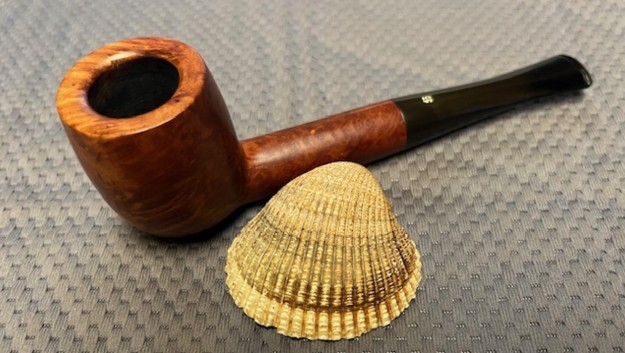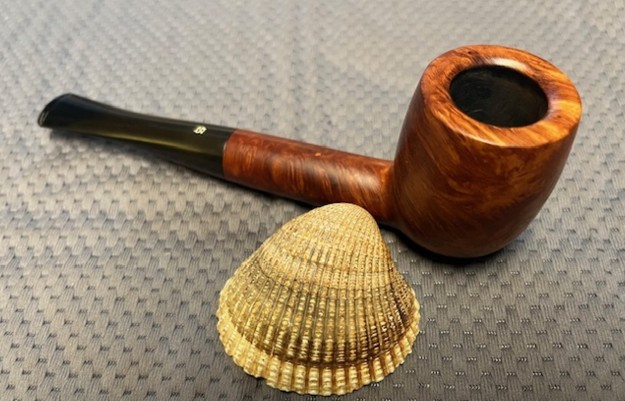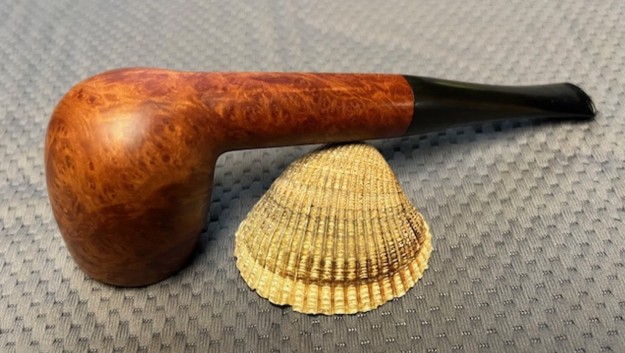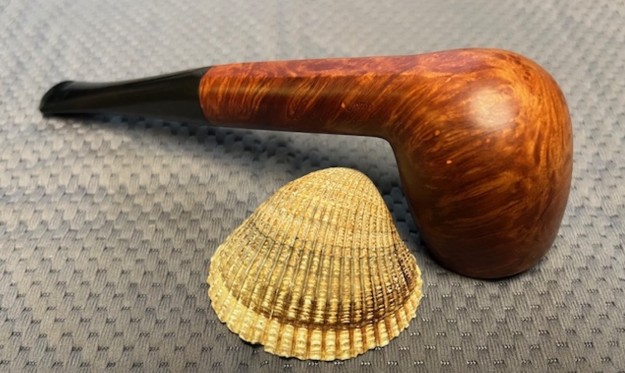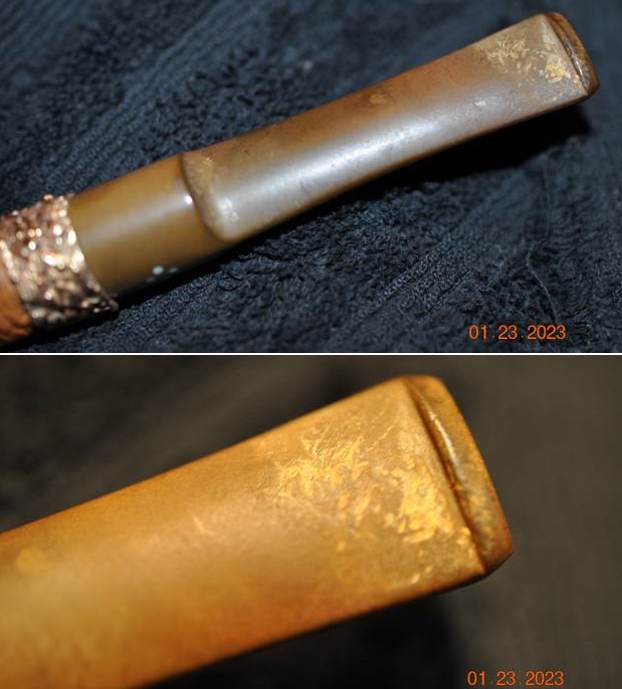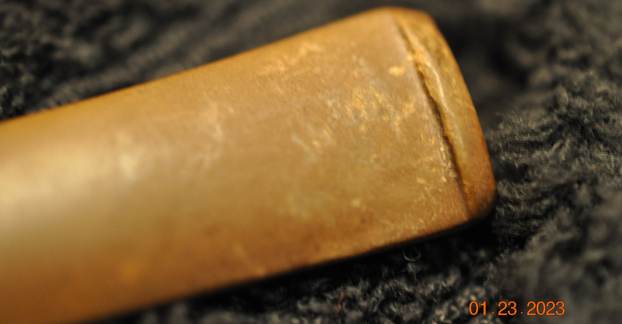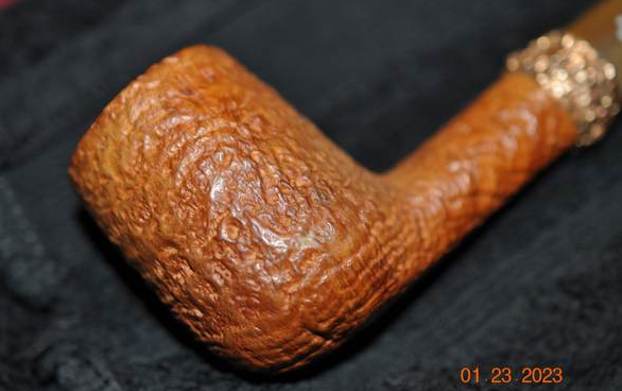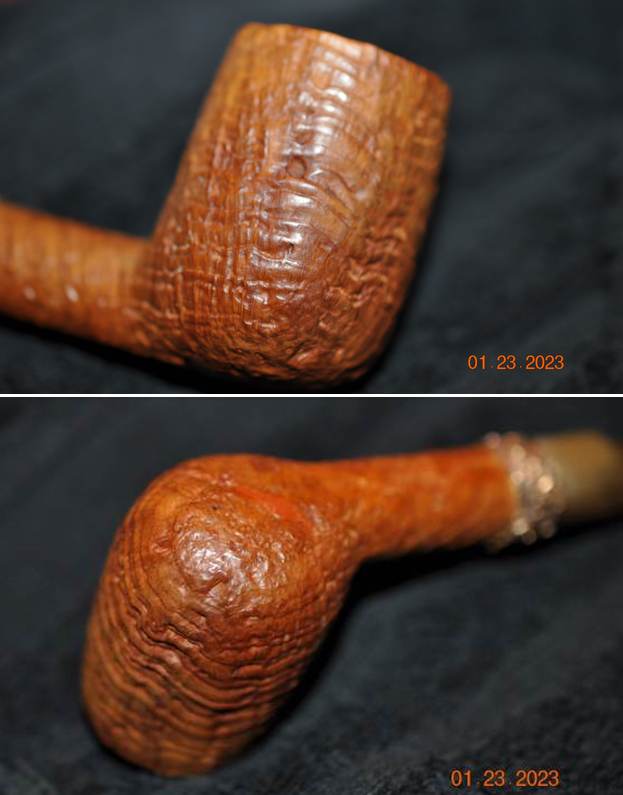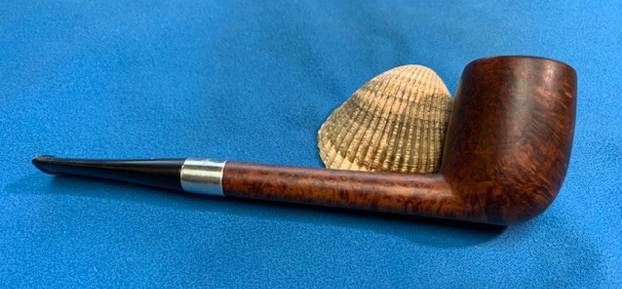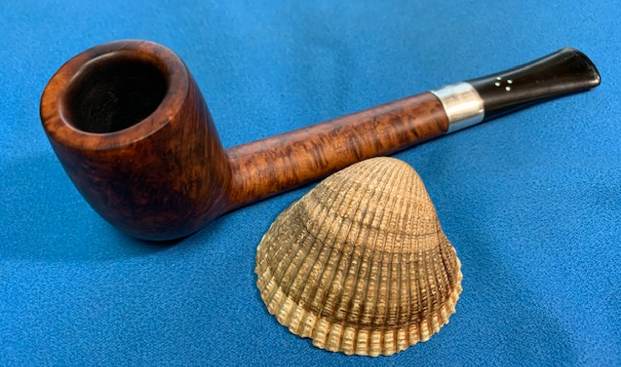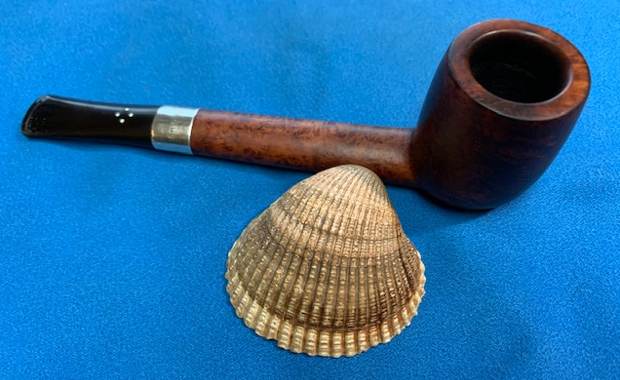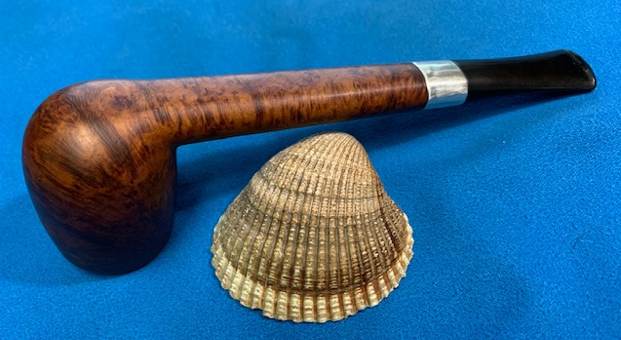
Tag Archives: Sasieni Pipes

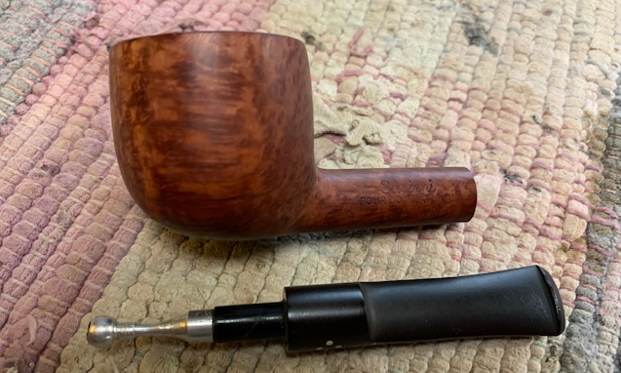
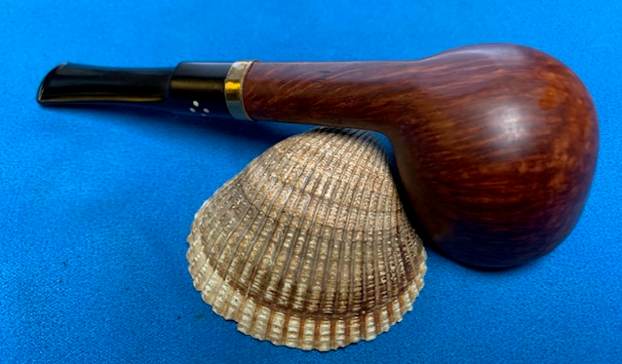
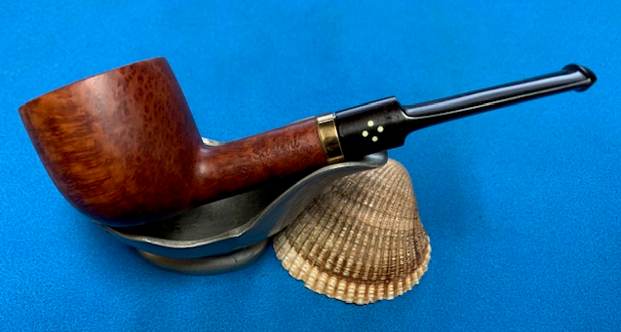
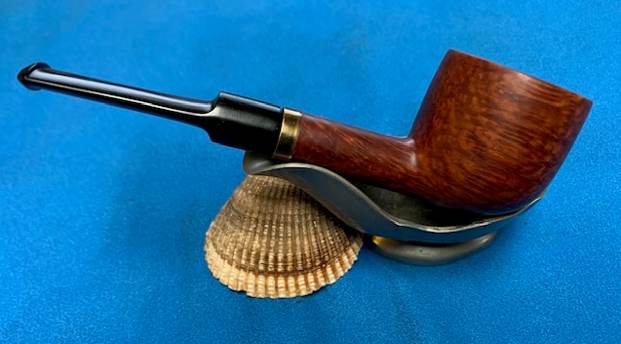
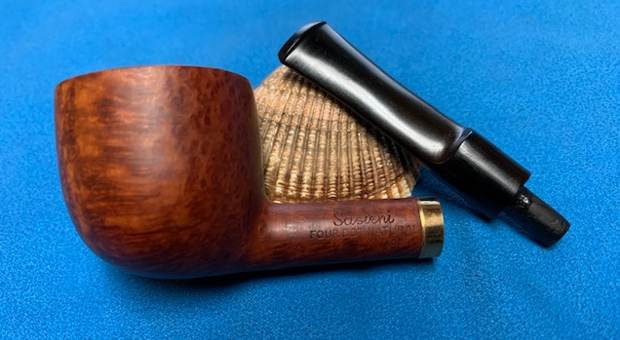
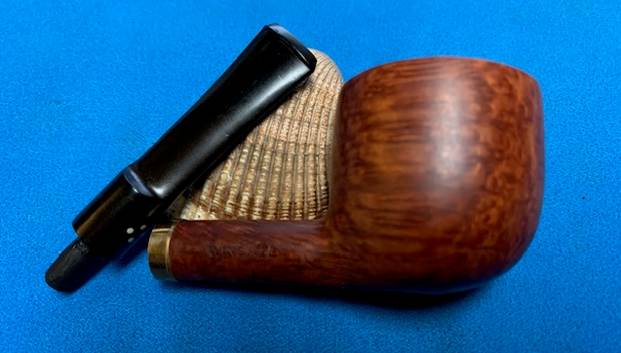
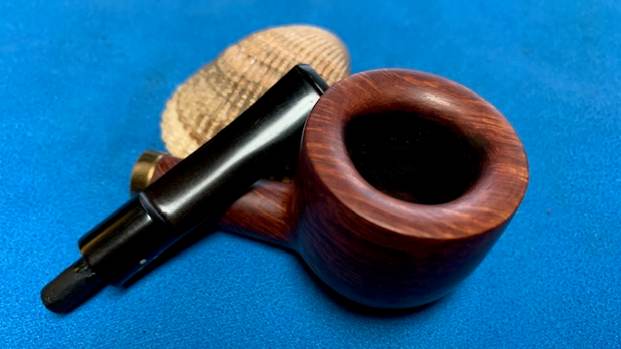
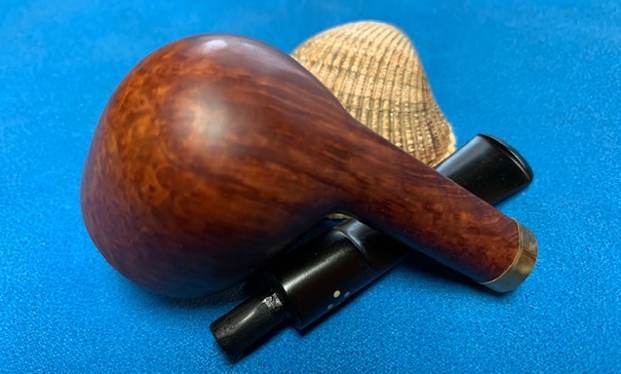
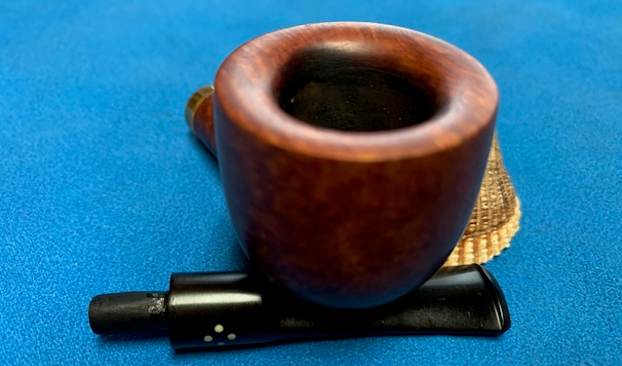
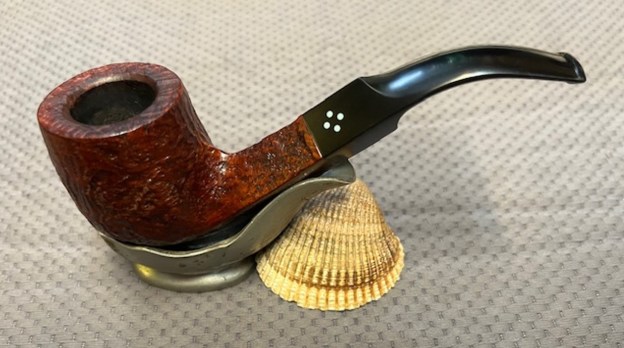
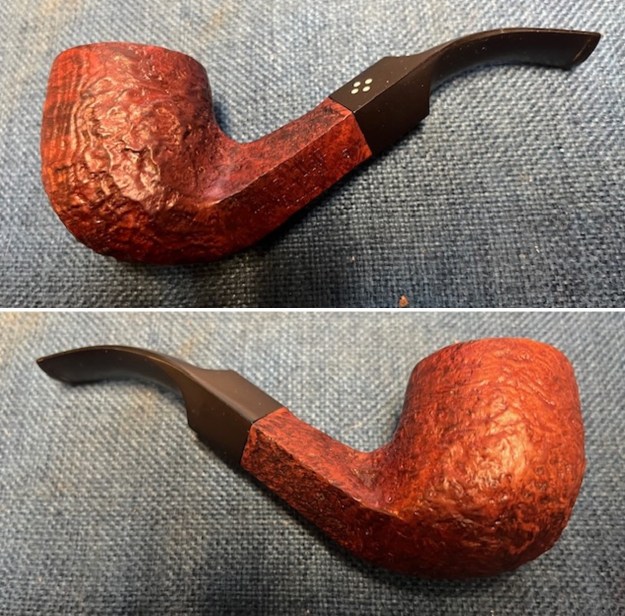
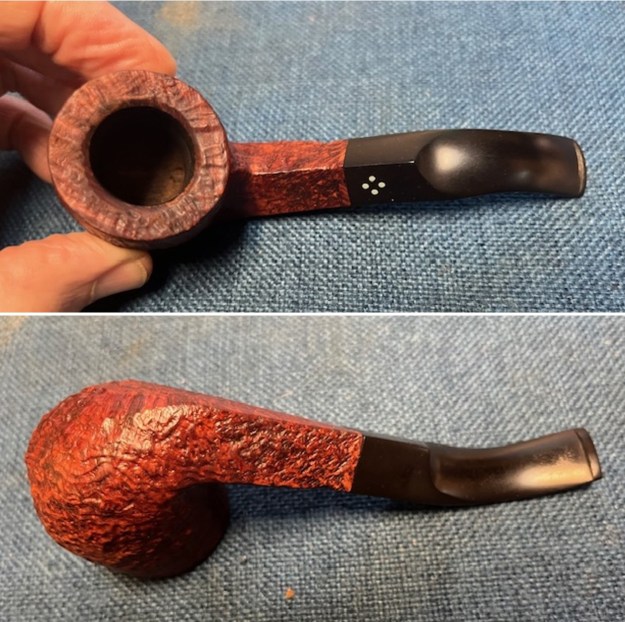
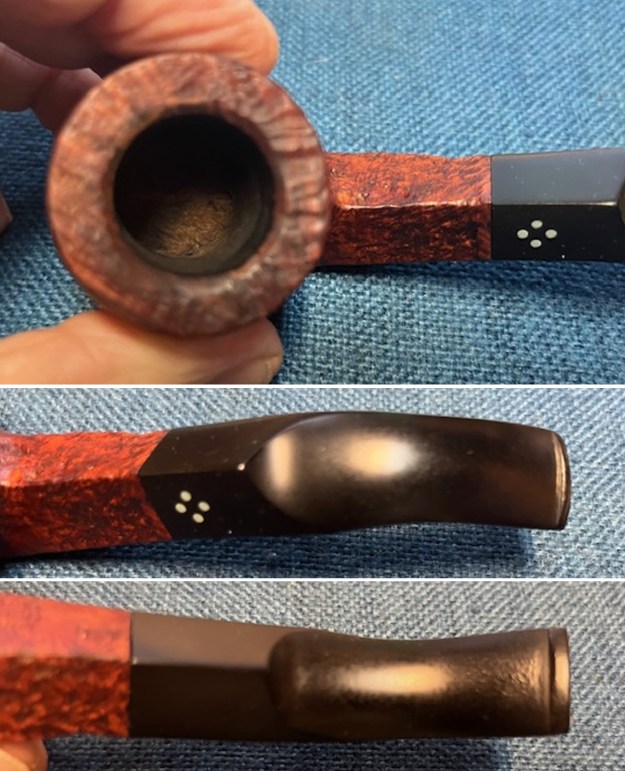
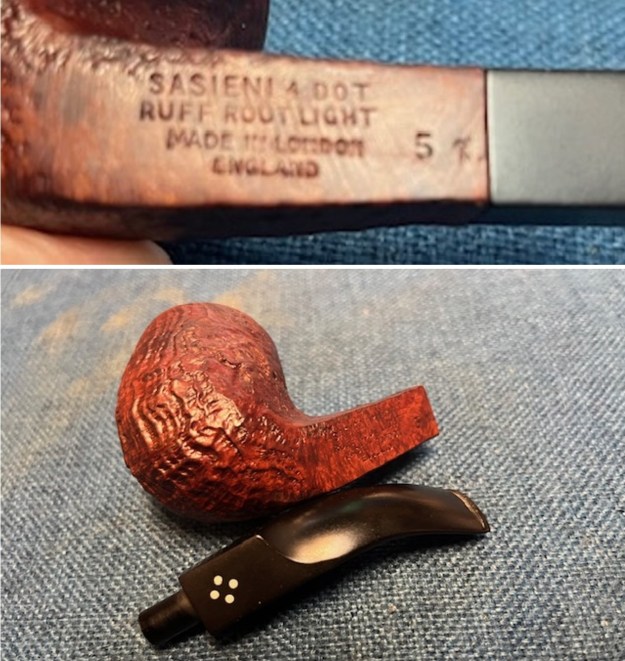
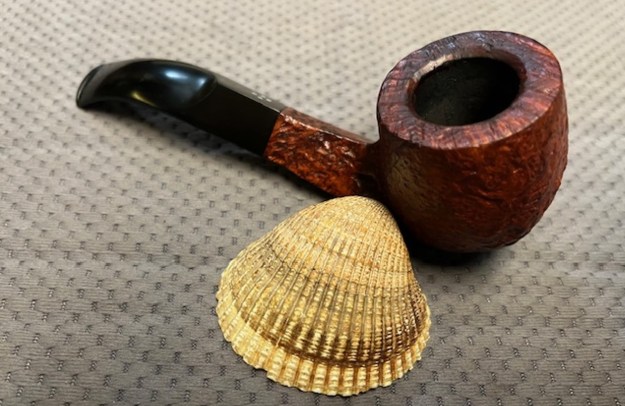
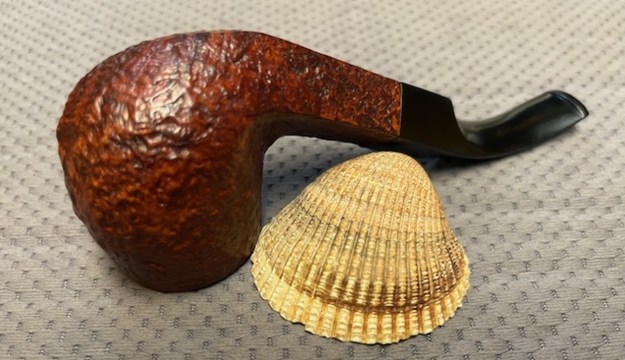
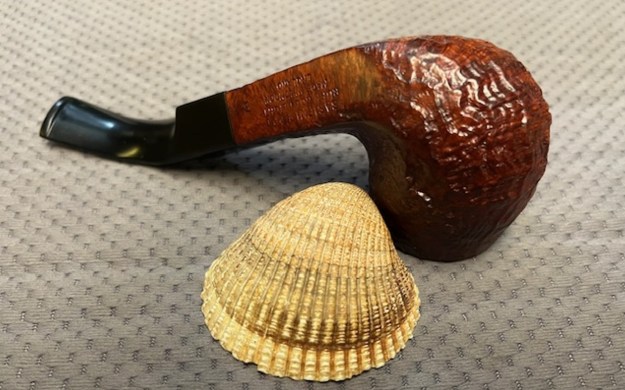
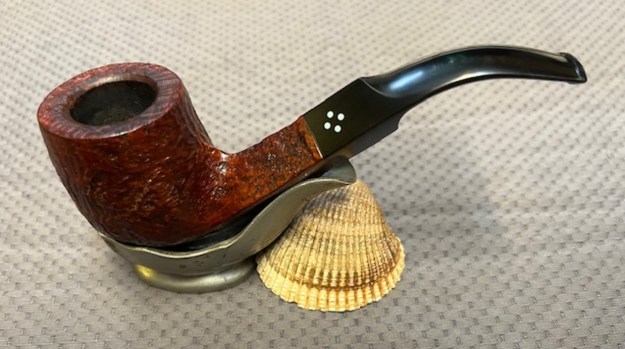
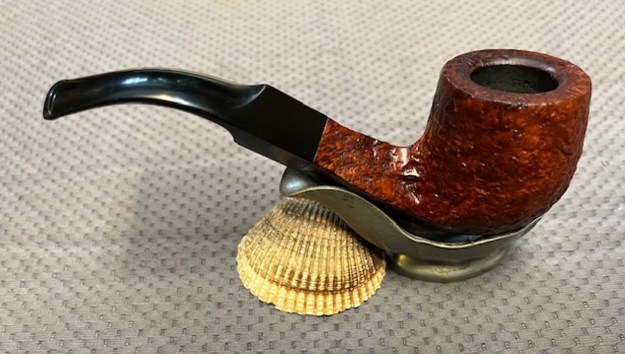
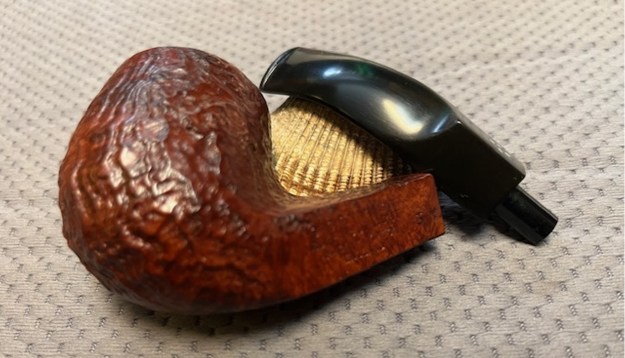
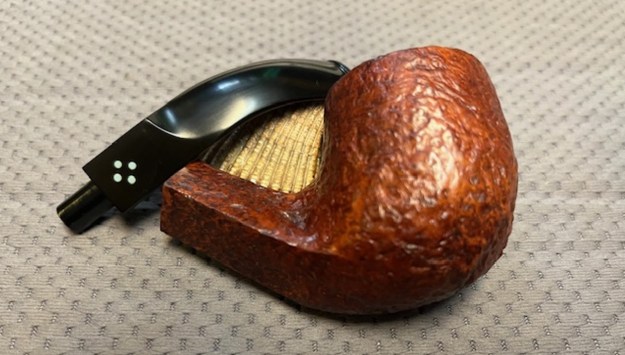
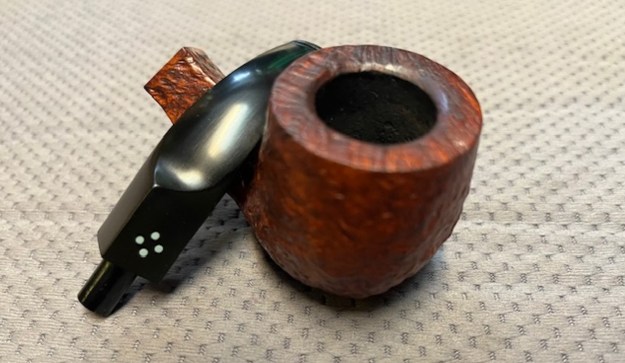
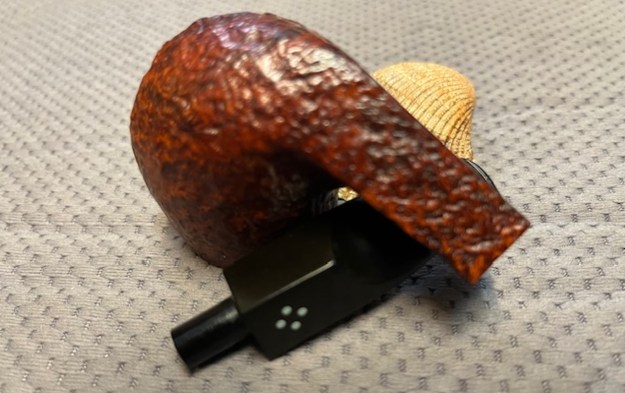
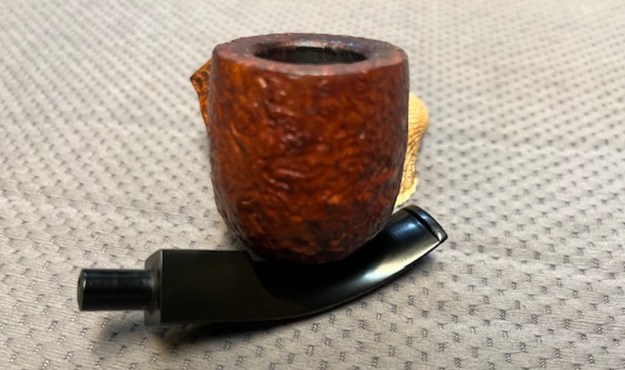
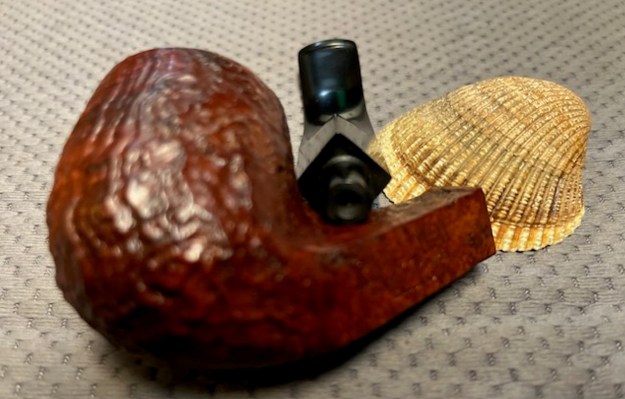
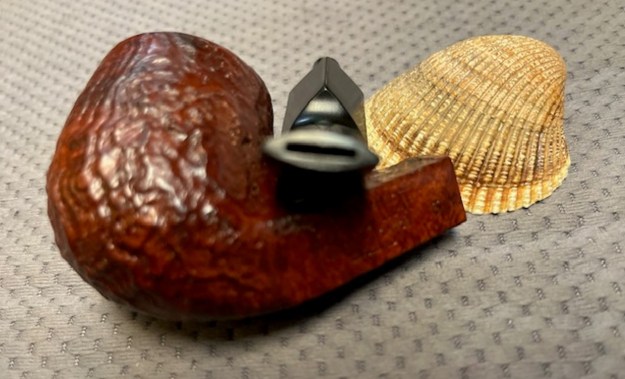
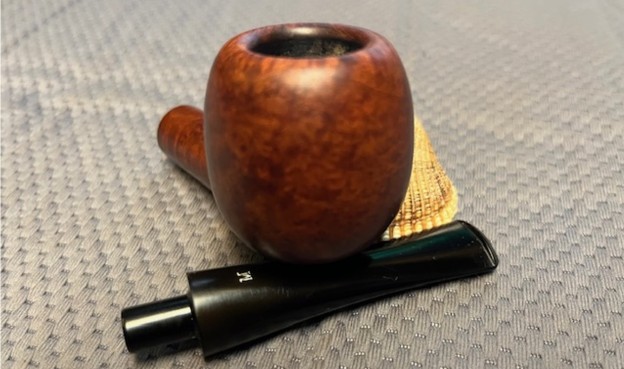
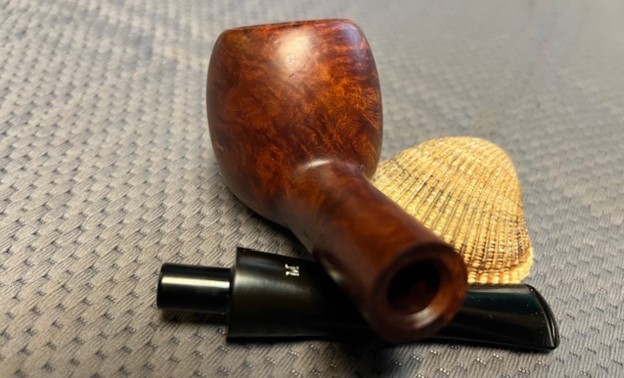
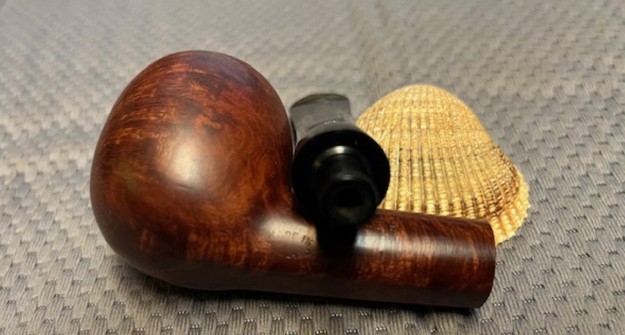
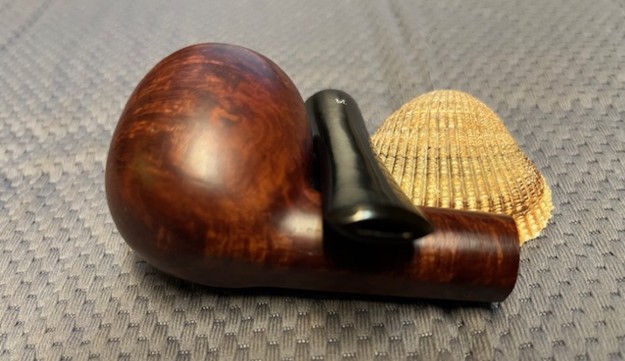
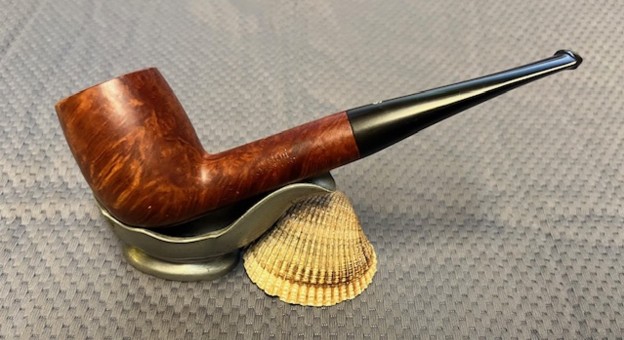
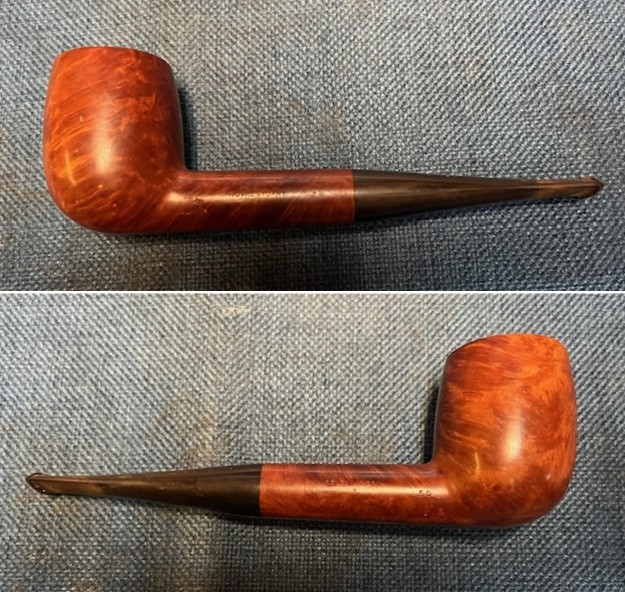
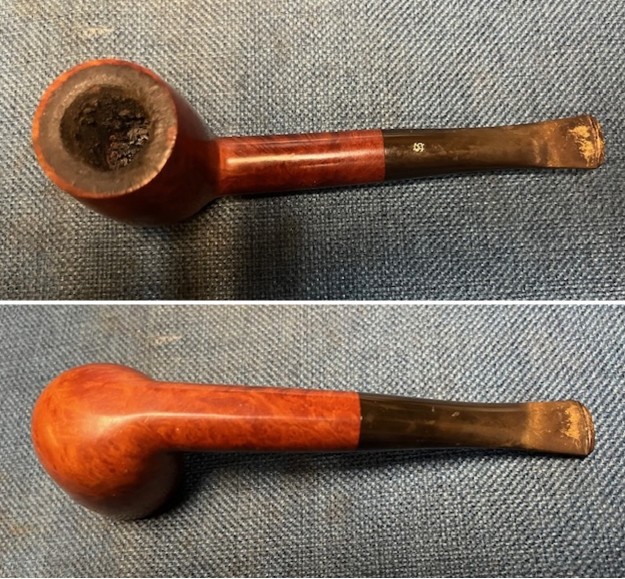
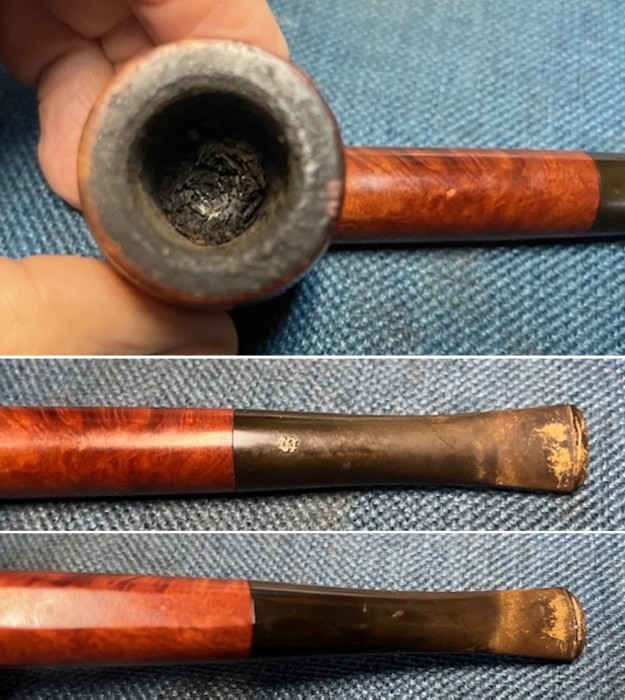
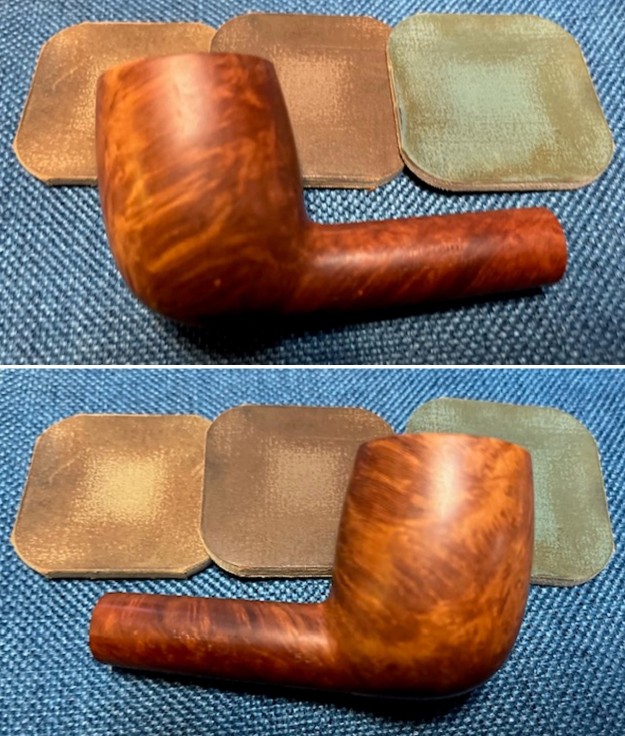
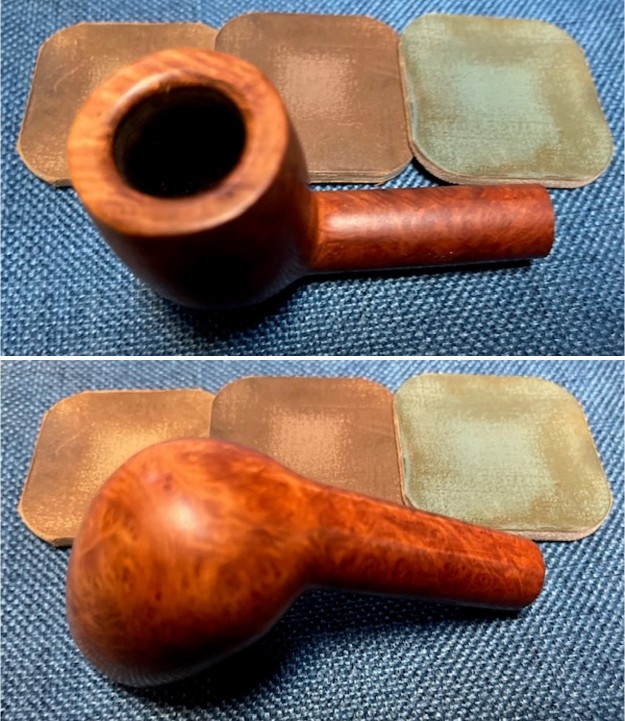
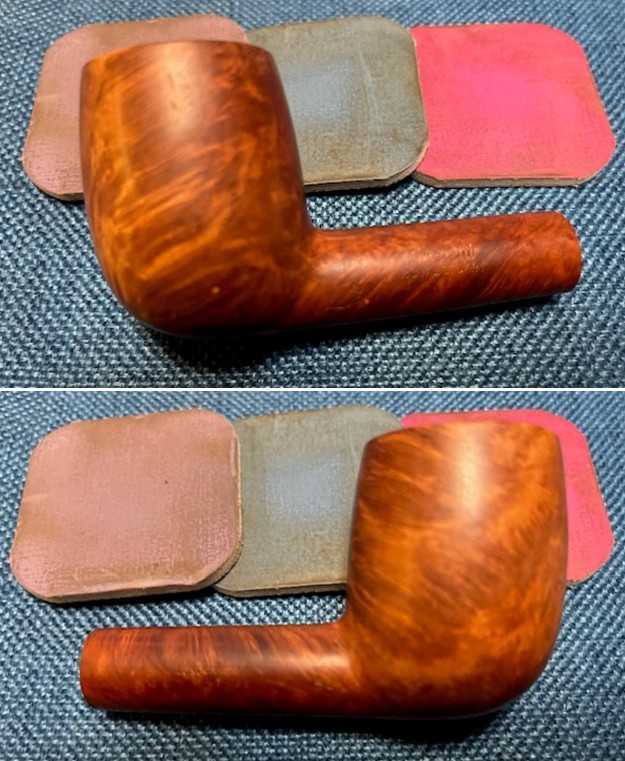
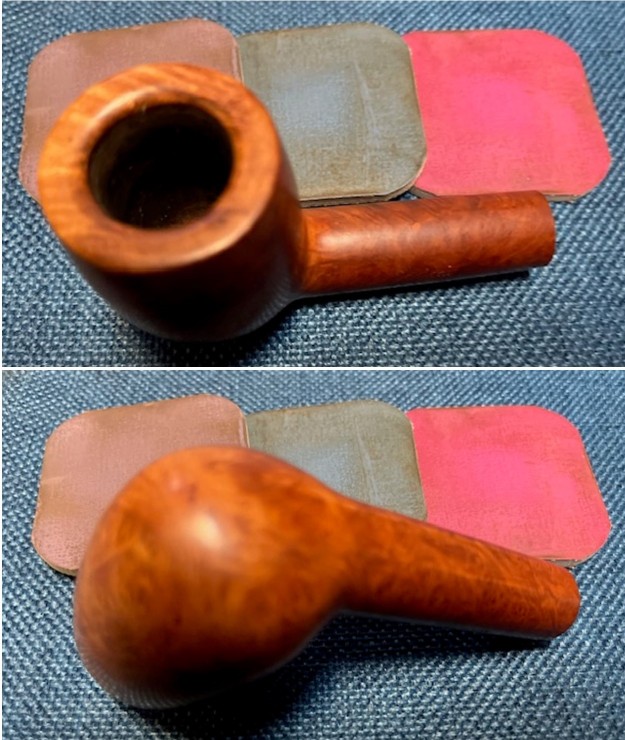
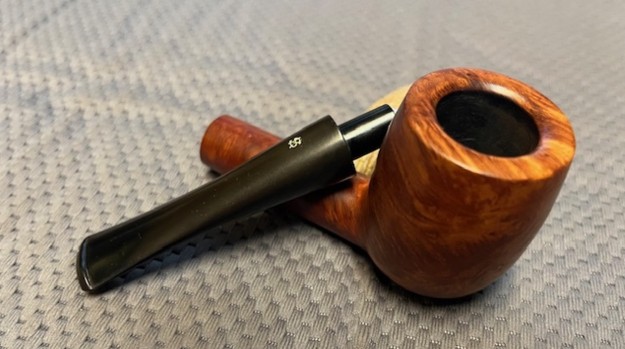
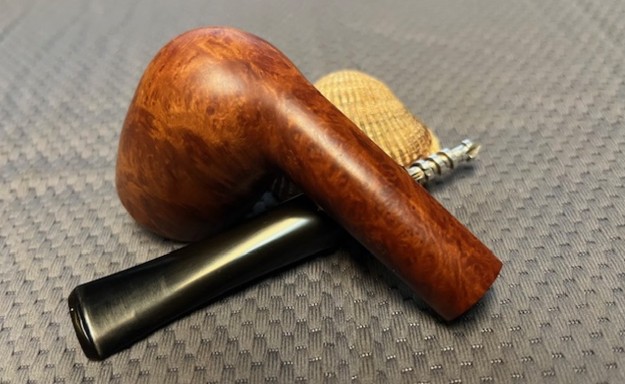
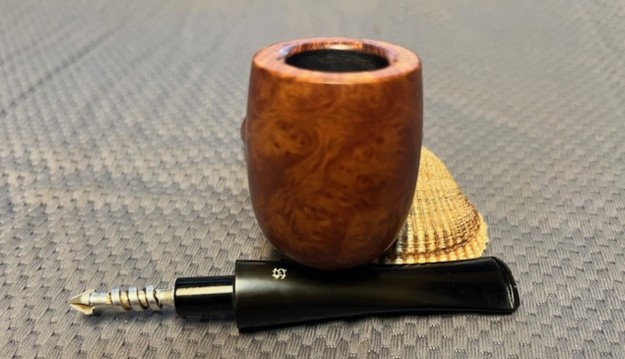
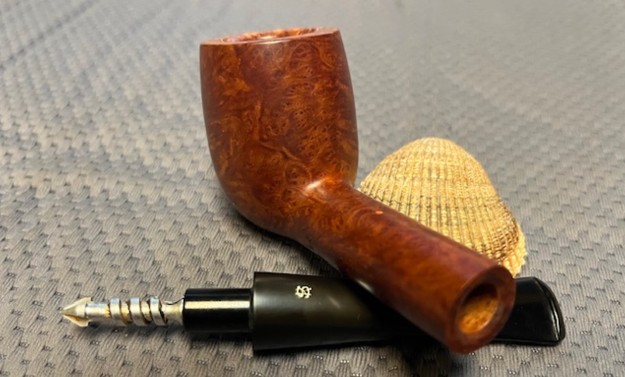
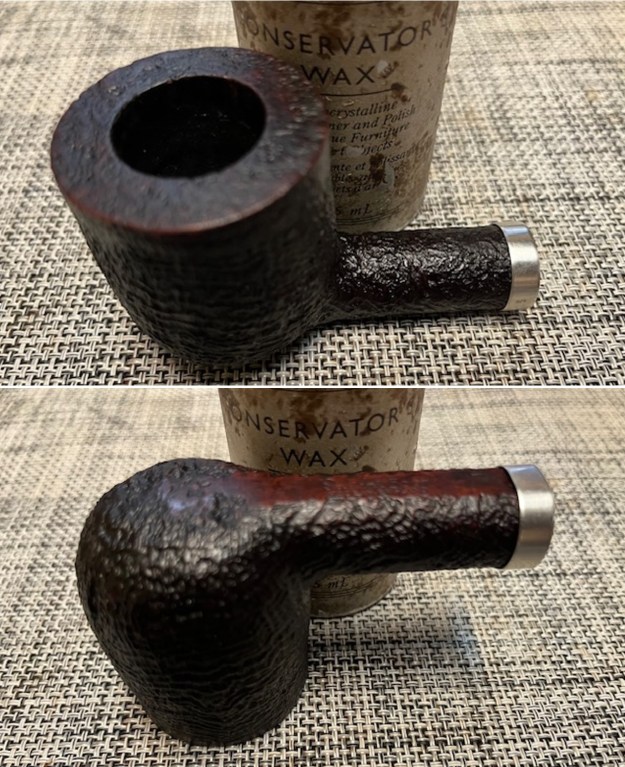
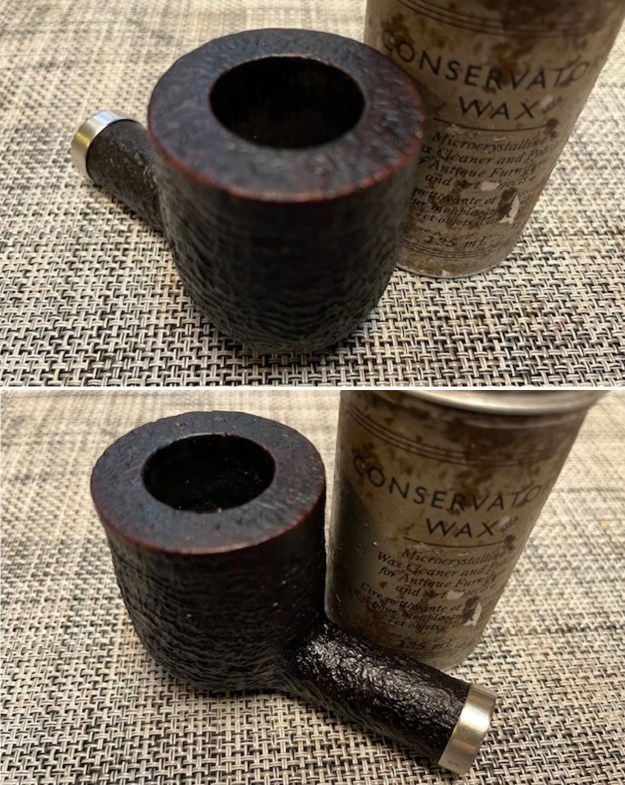
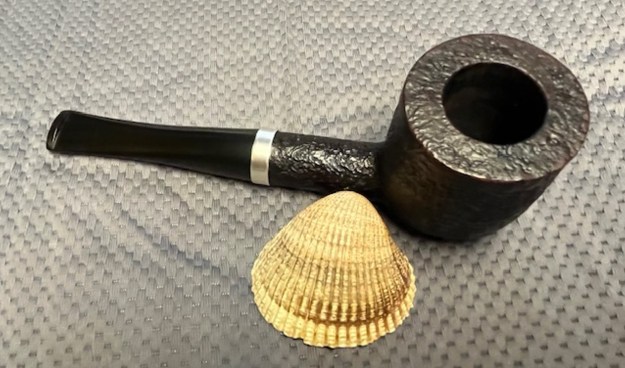
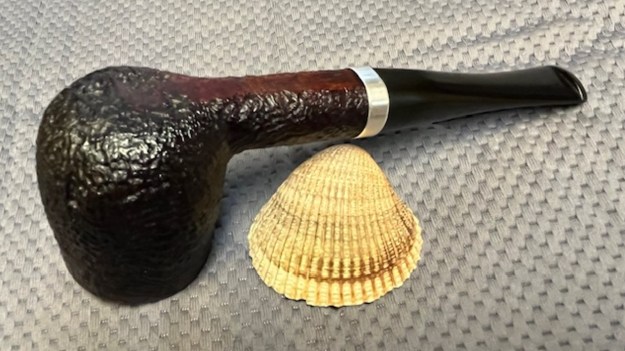
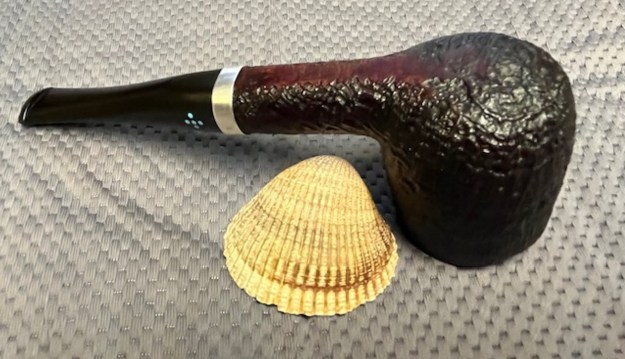
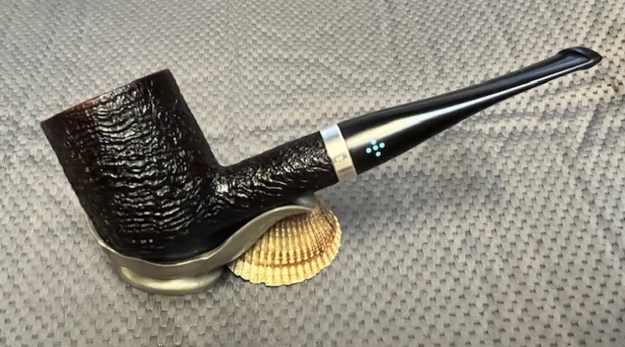
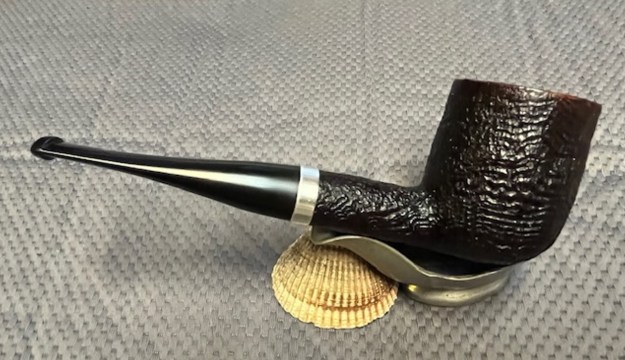
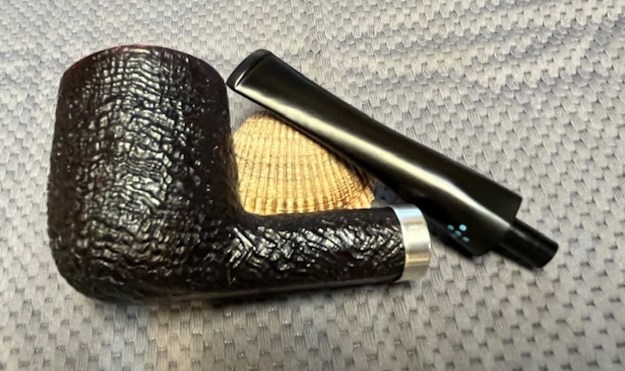
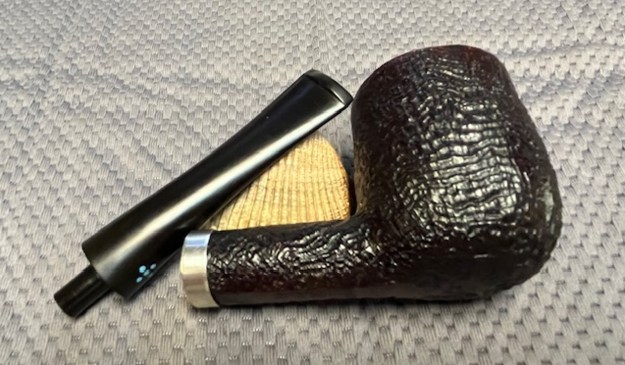
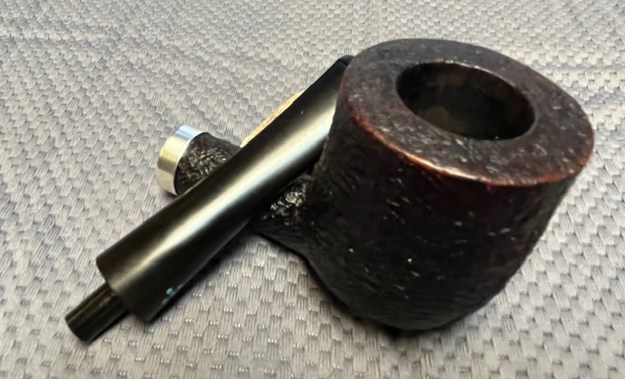
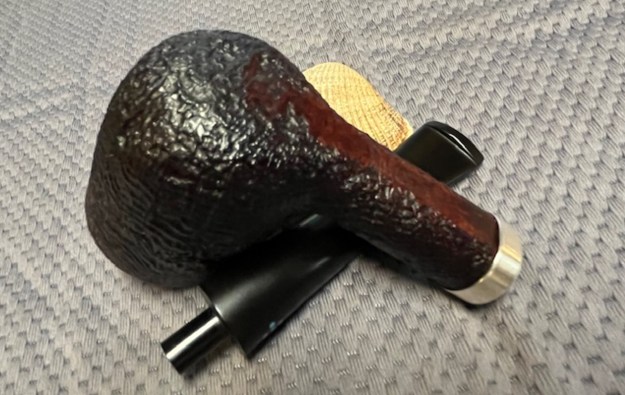
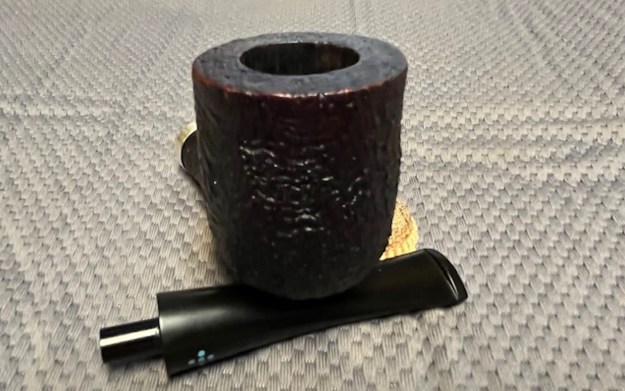
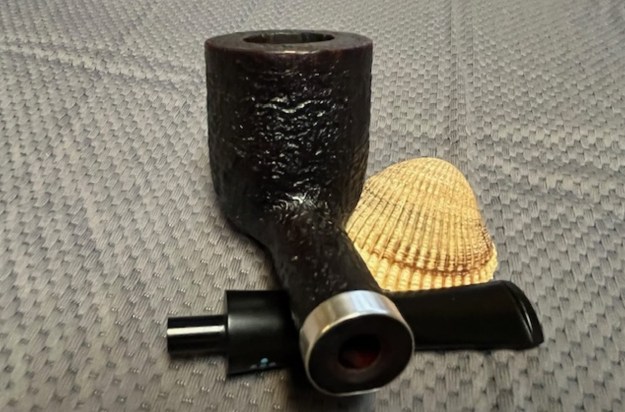
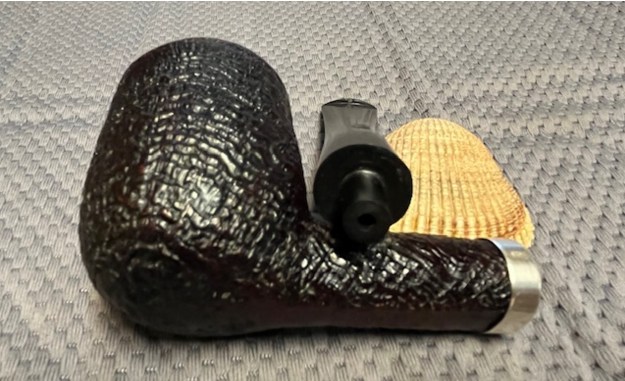
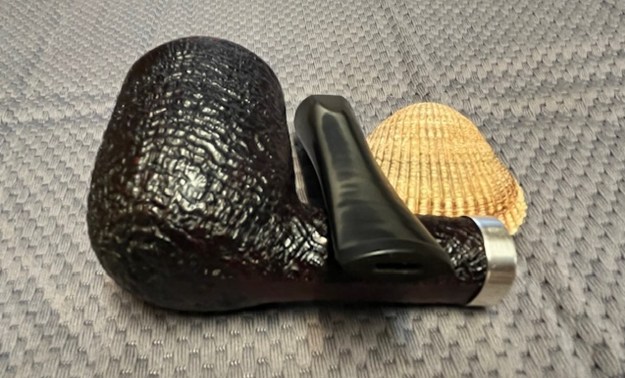
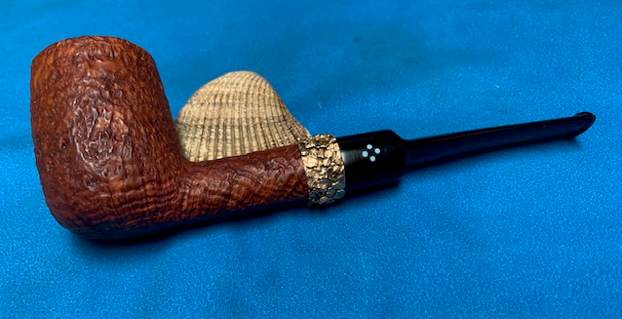
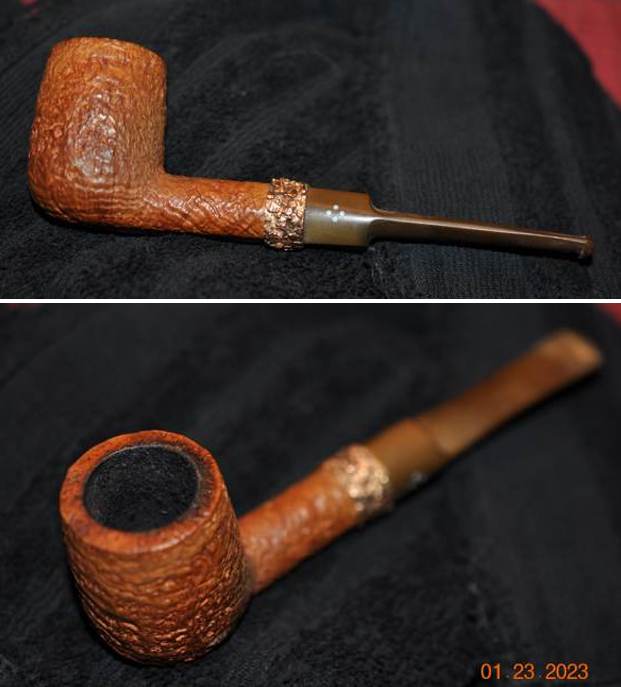
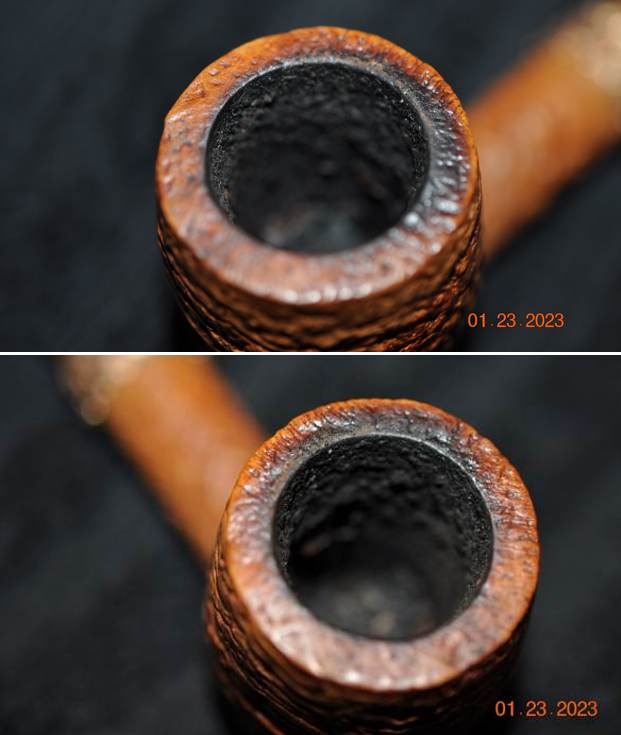
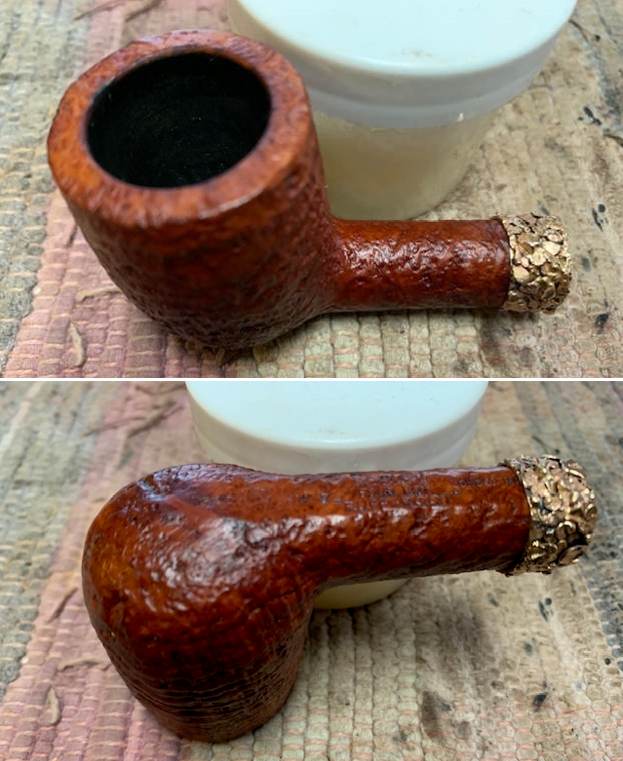
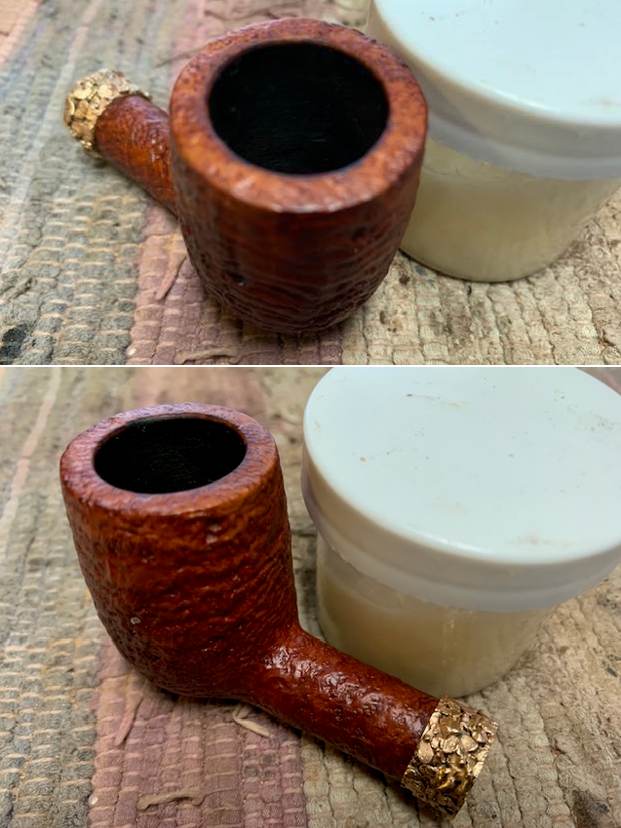
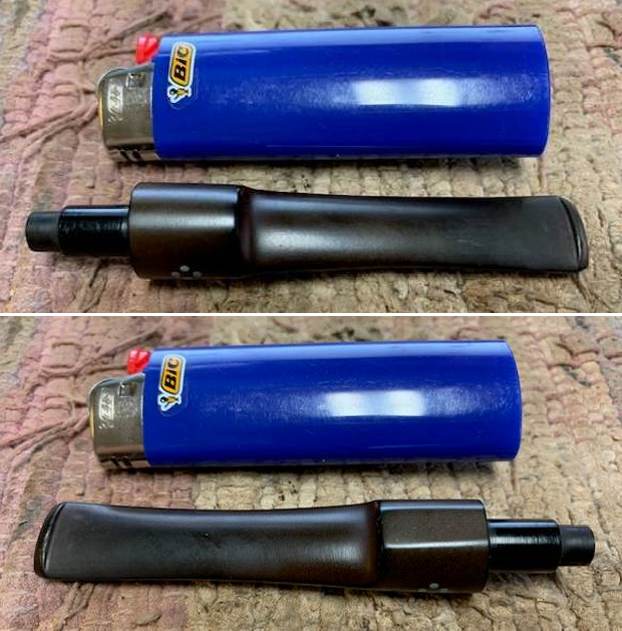
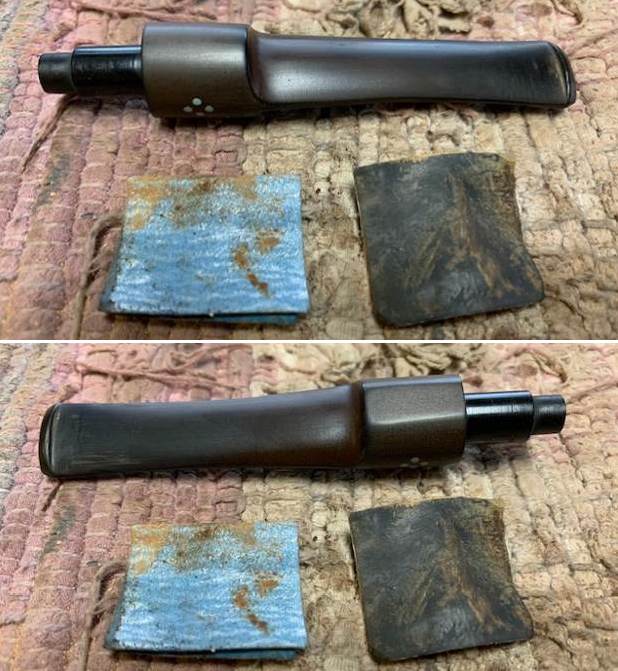
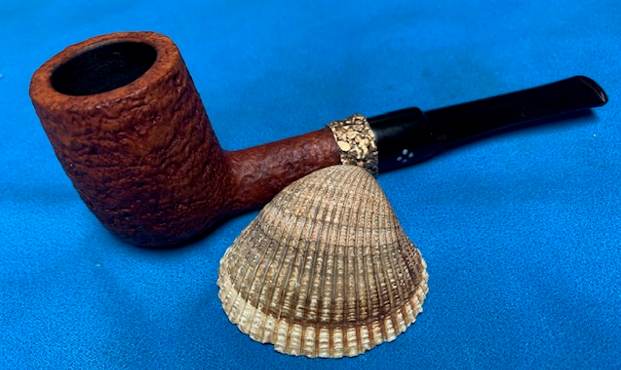
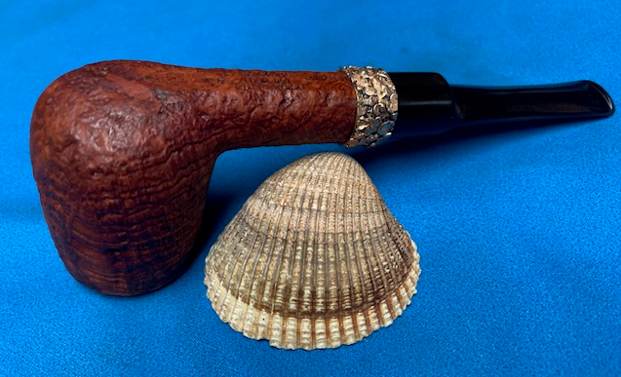
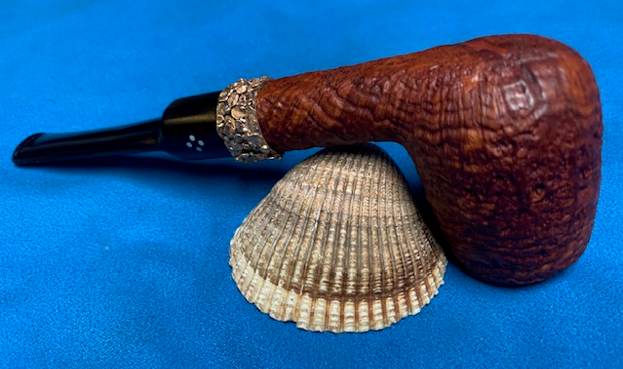
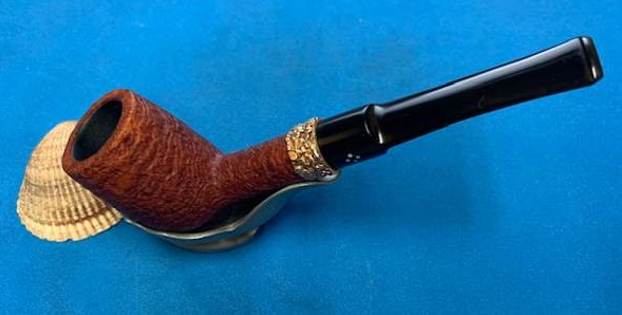
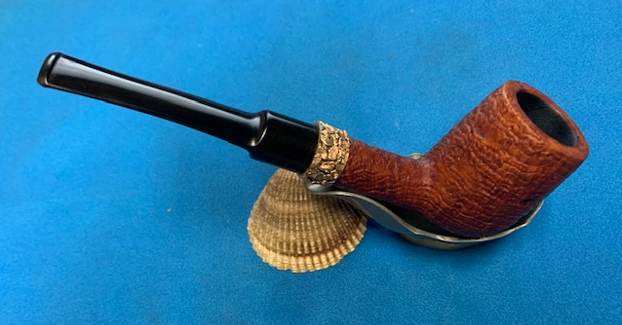
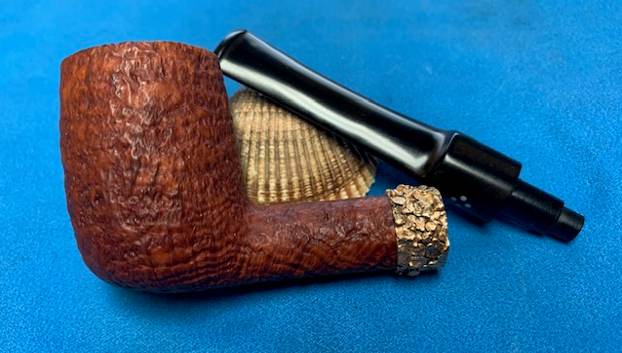
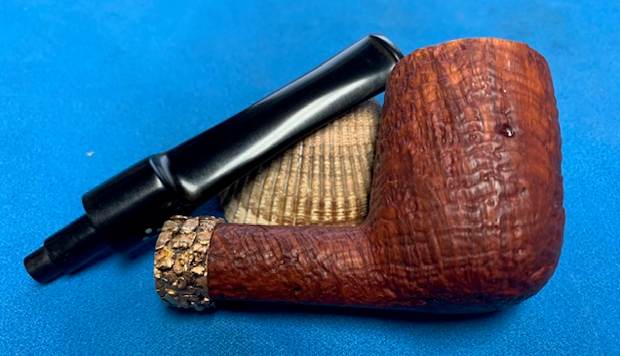
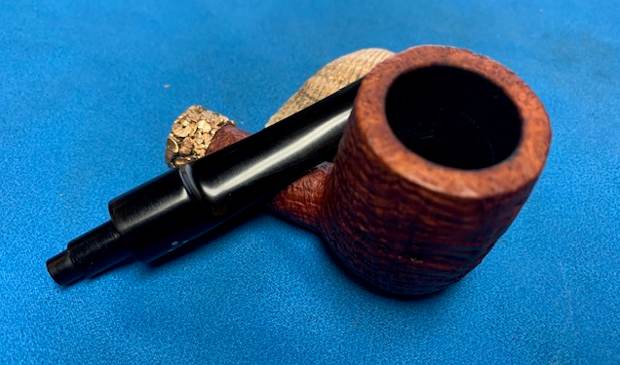
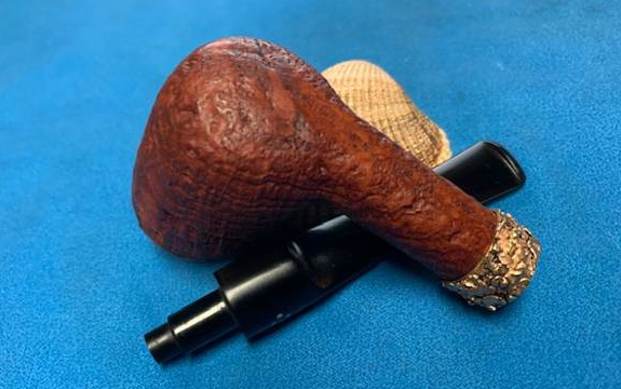
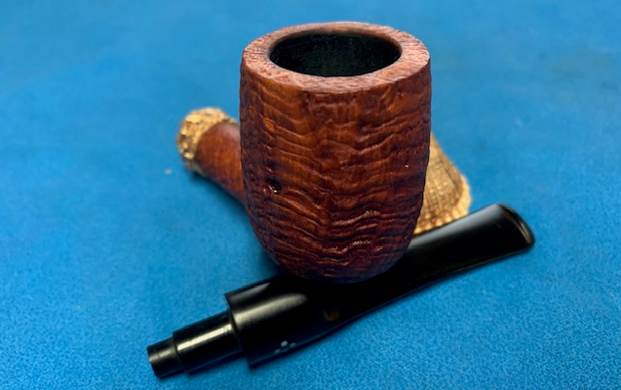
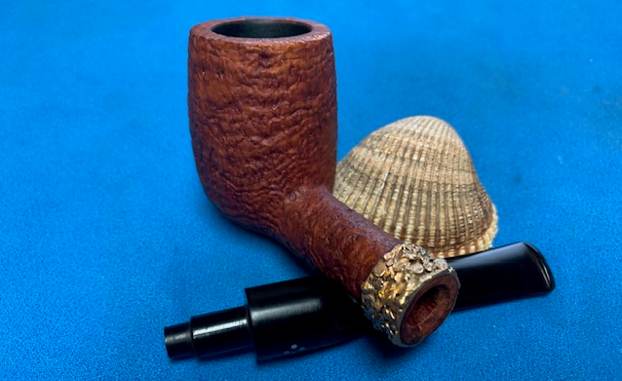
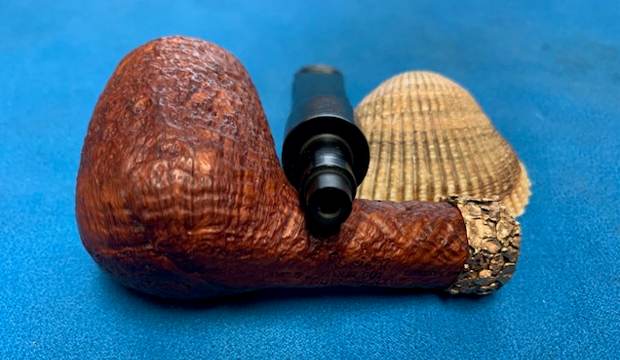
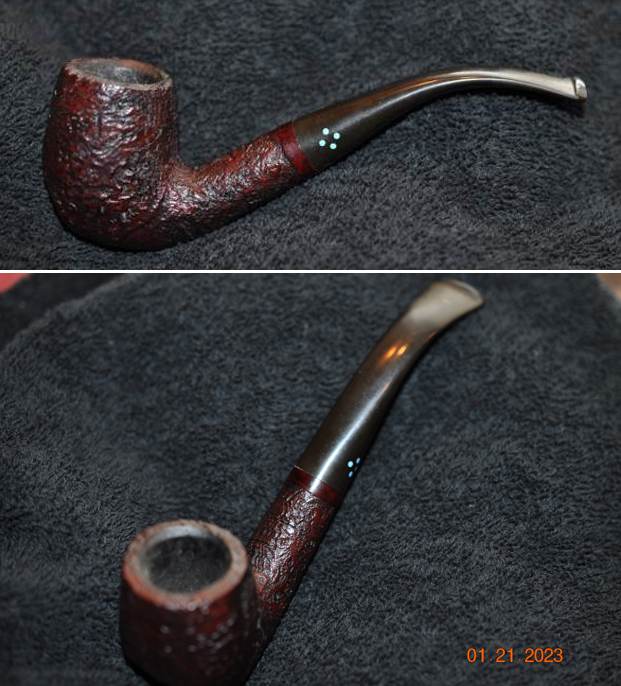
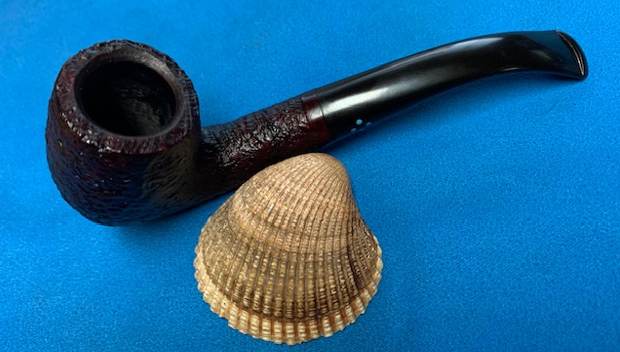
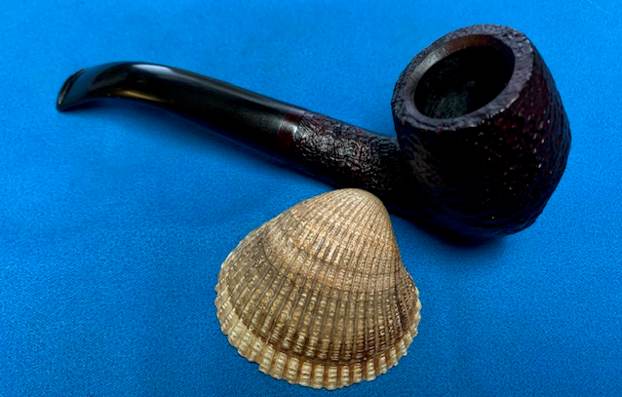
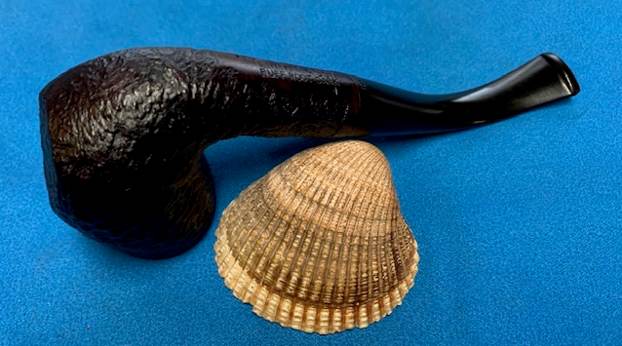
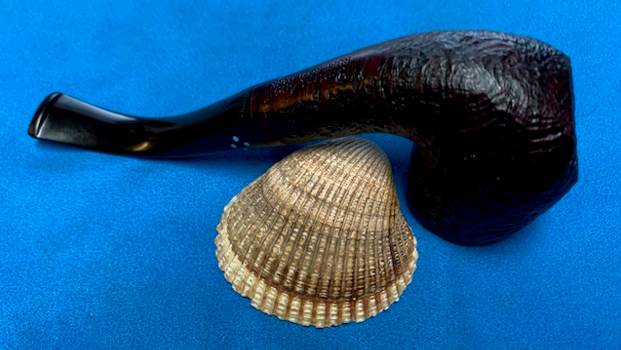
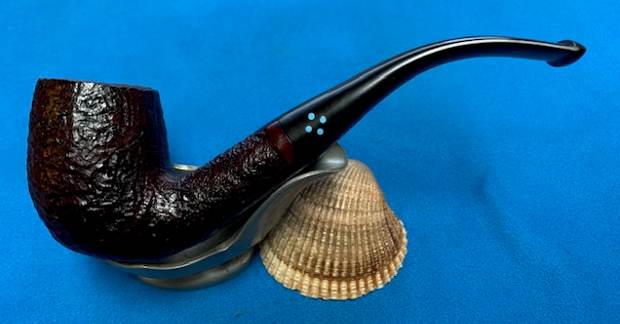
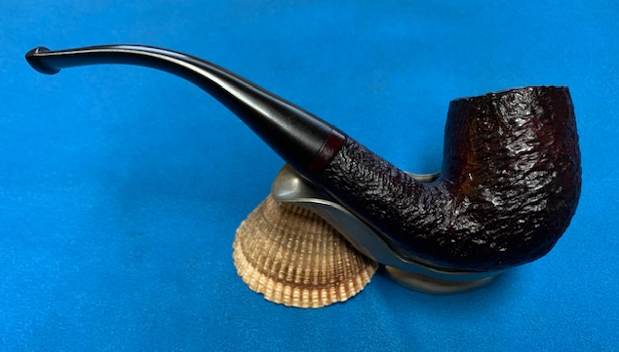
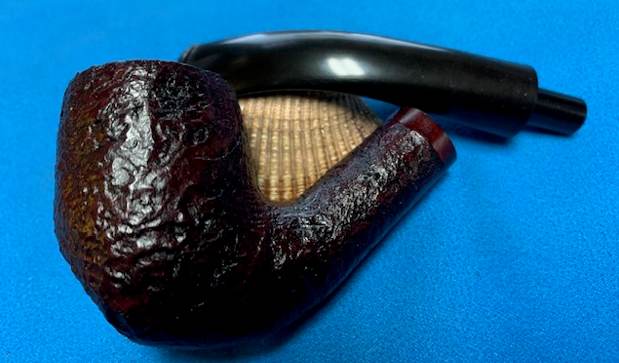
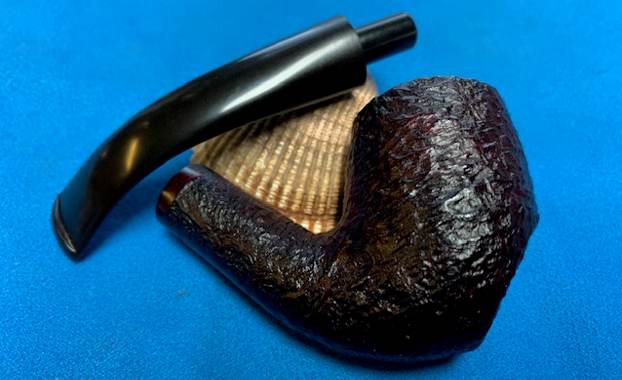
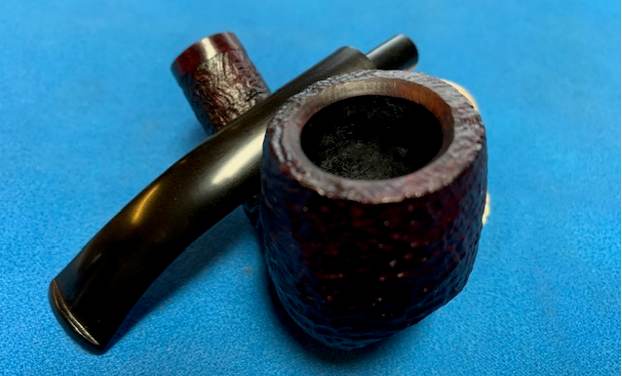
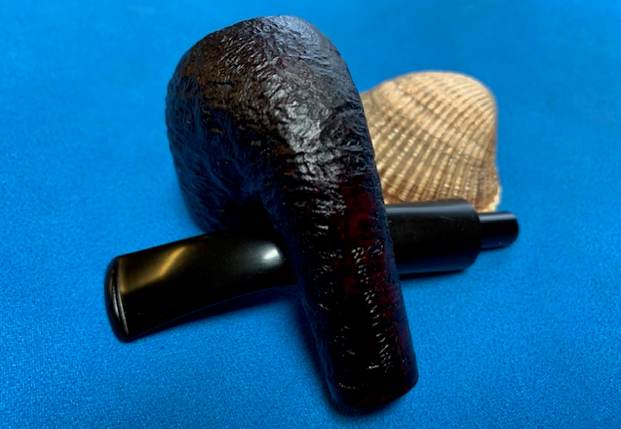
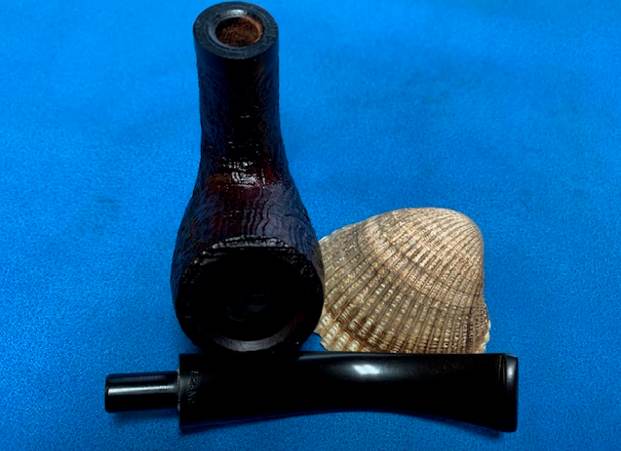
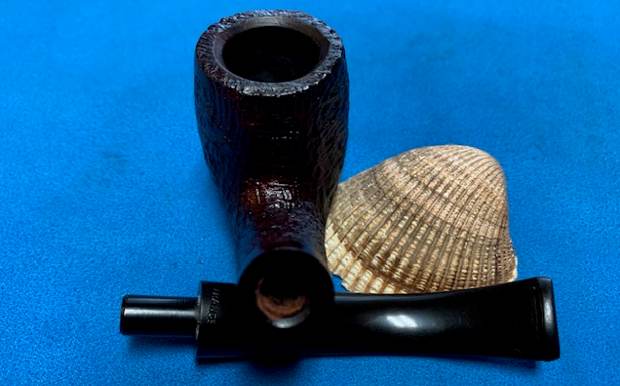
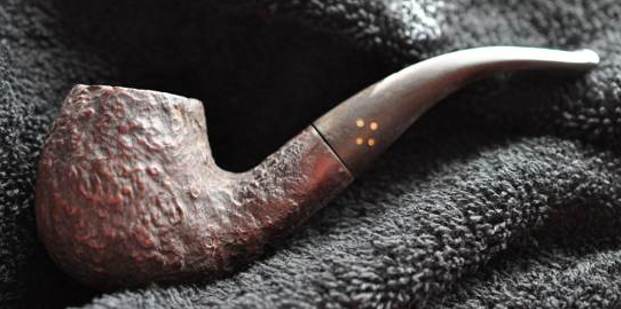
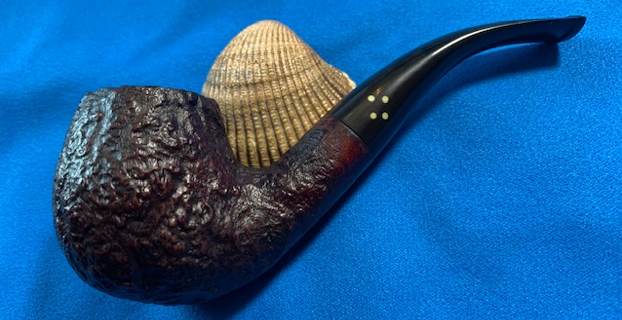
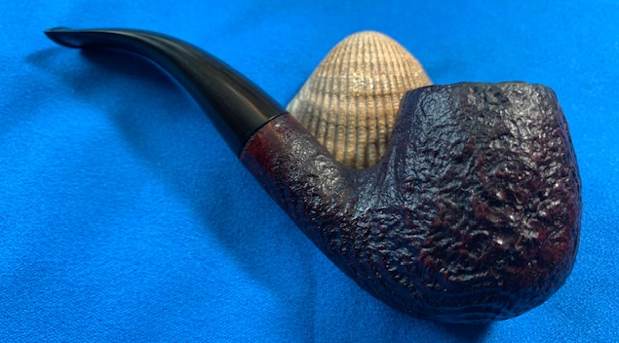
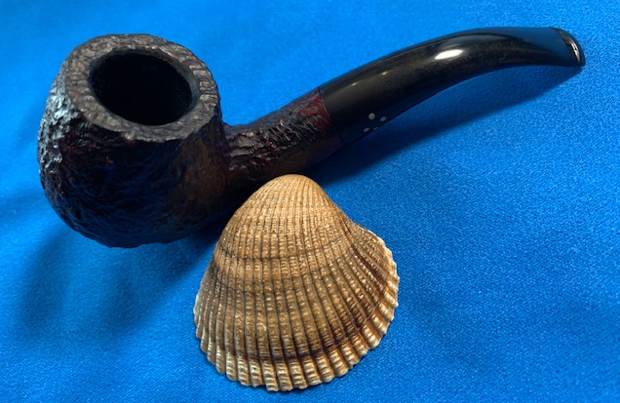
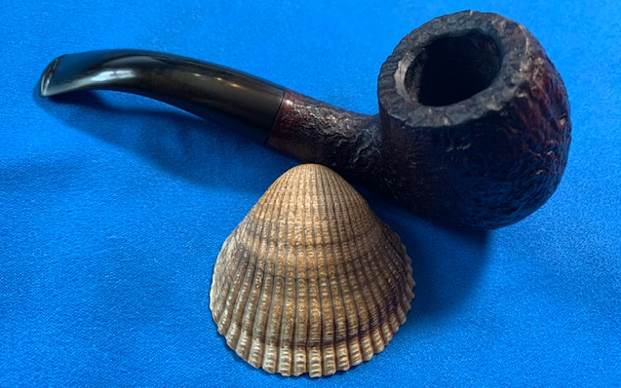
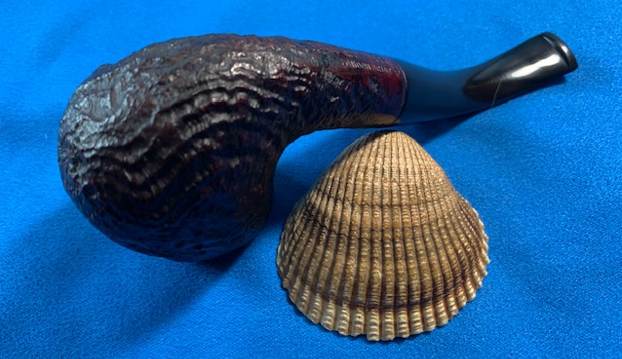
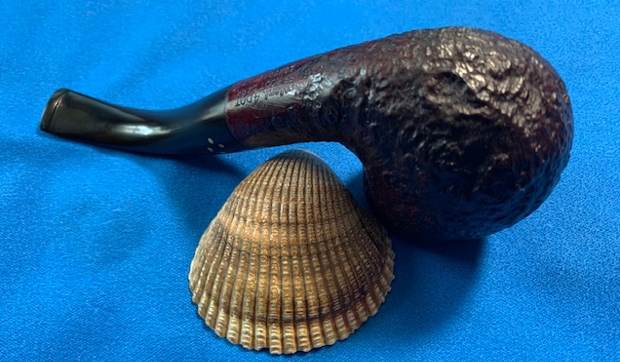
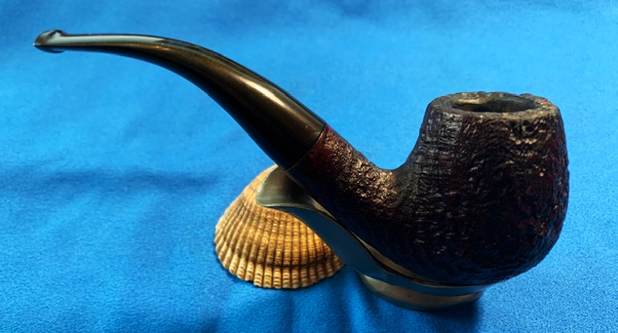
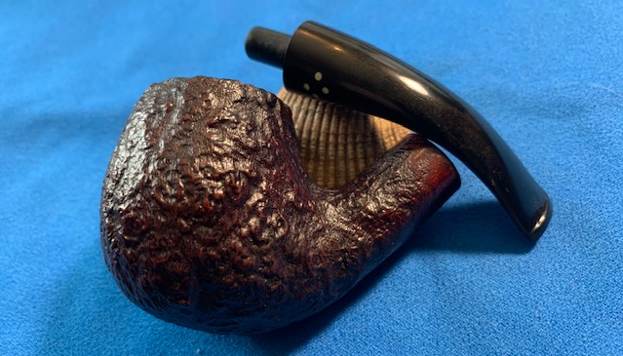
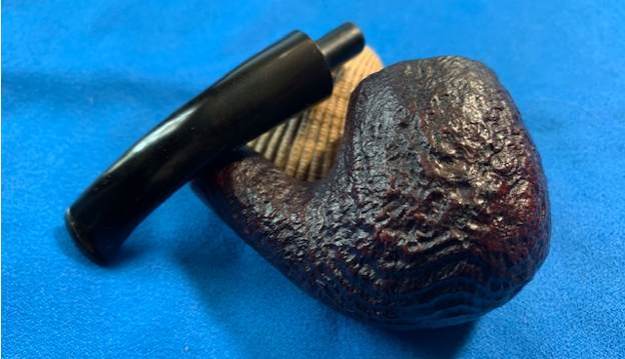
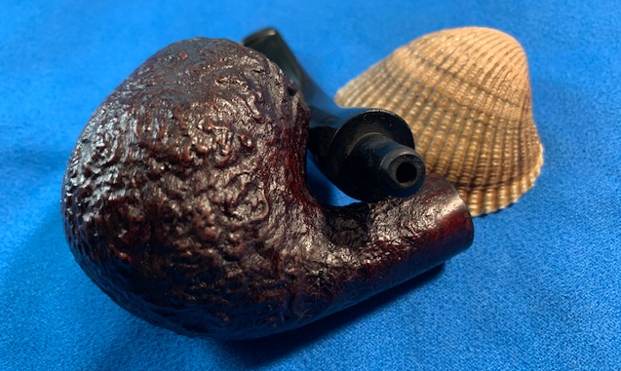
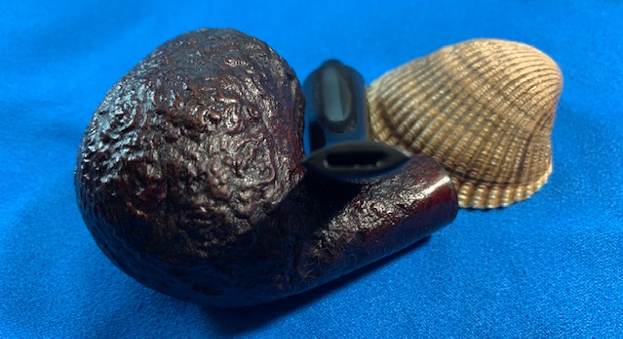
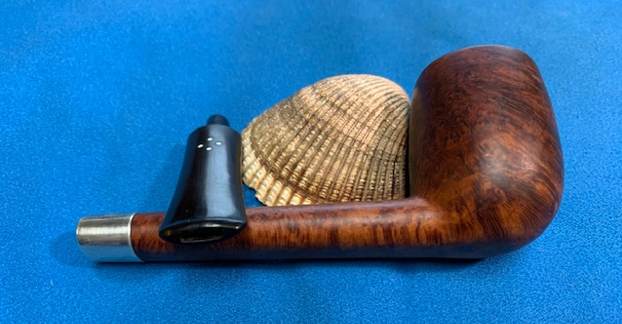
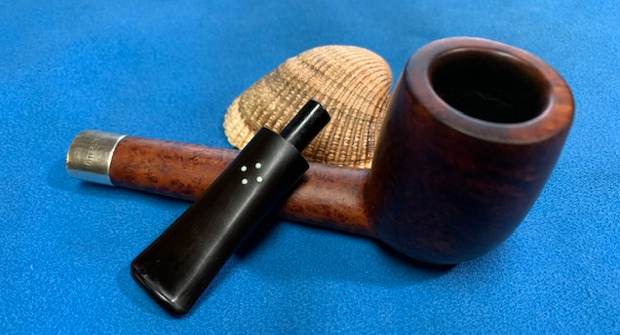
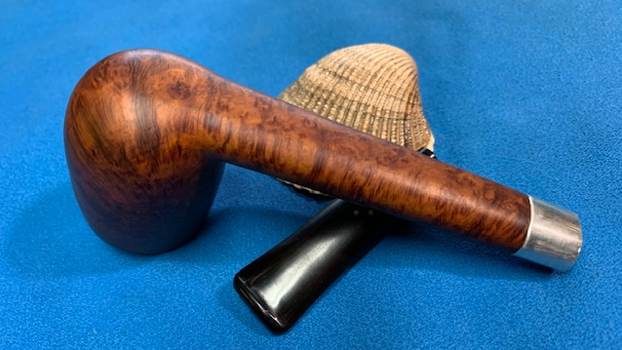
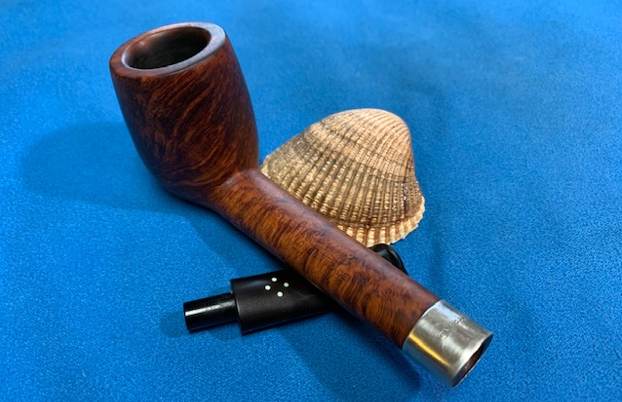
Restoring a beautiful Sasieni 4 Dot Ruff Root Light 5 Diamond Shank Bent Billiard


by Steve Laug

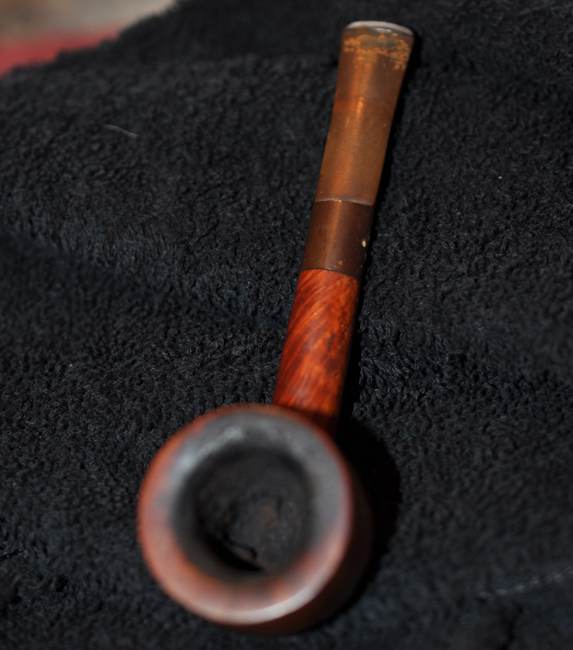
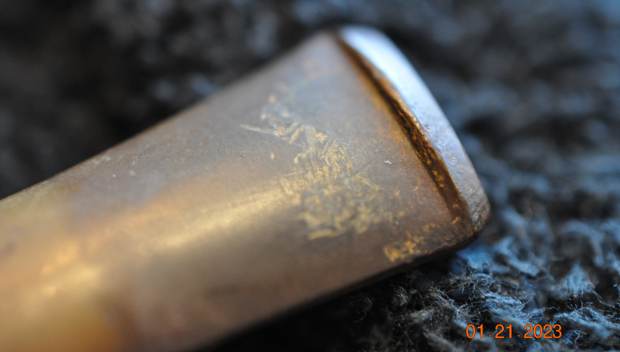
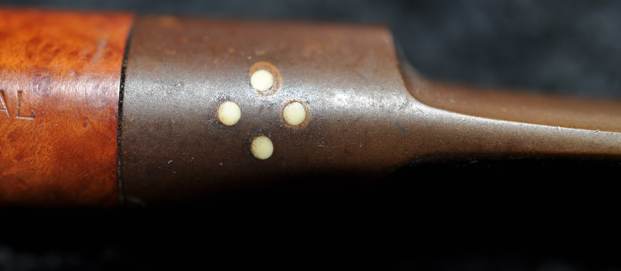
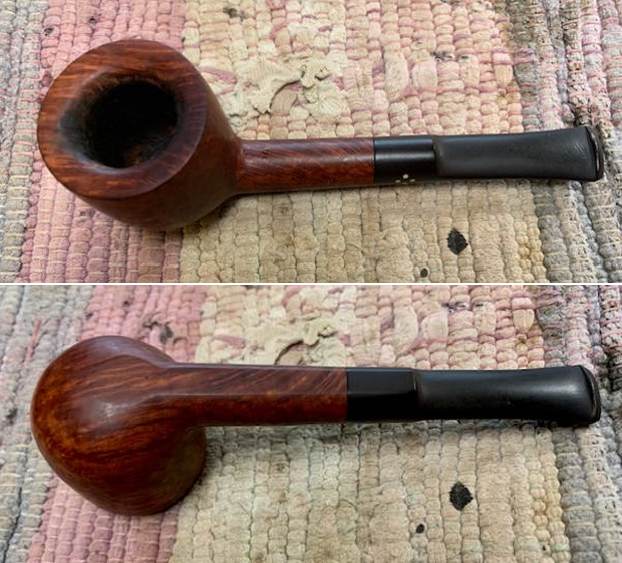
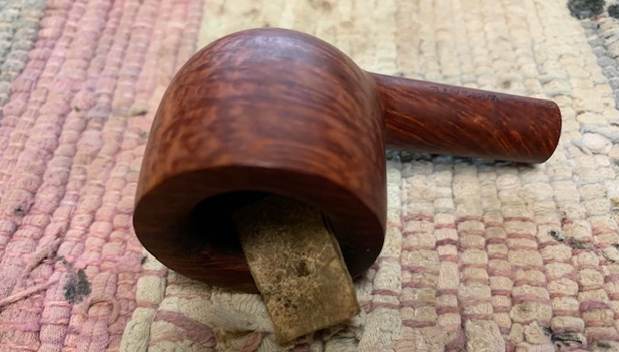
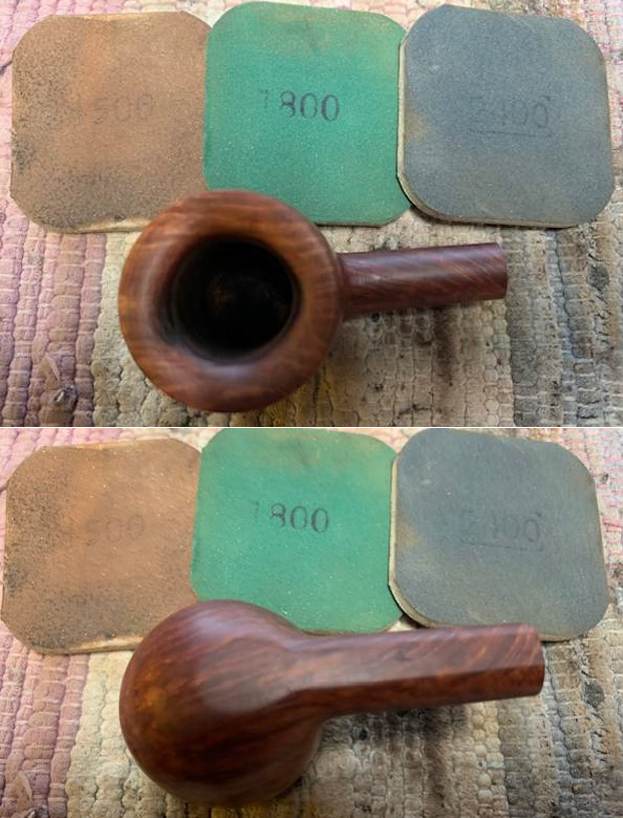
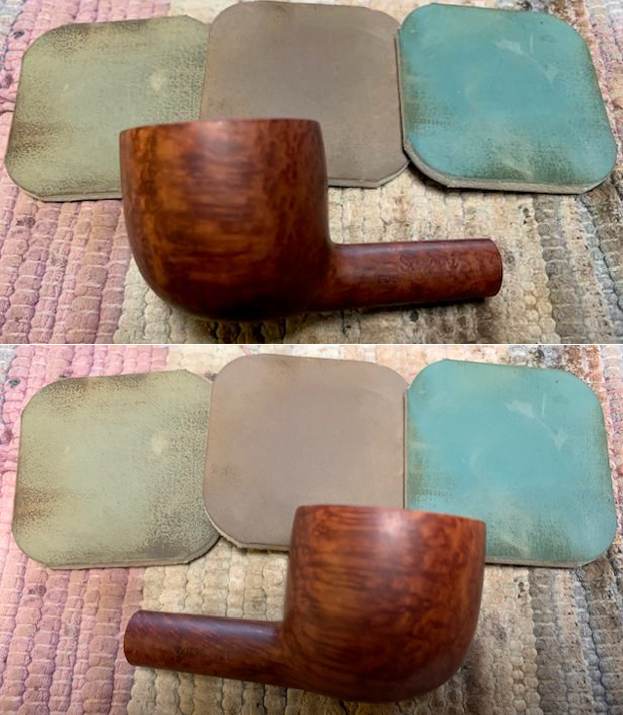
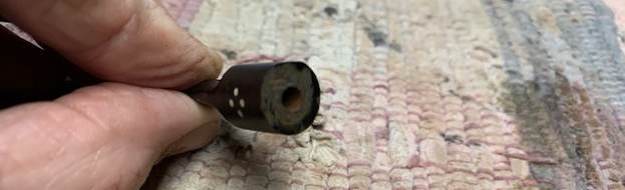
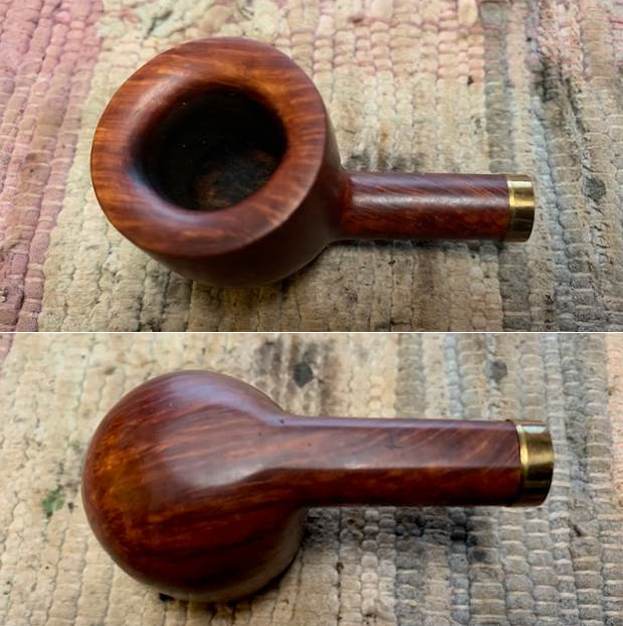
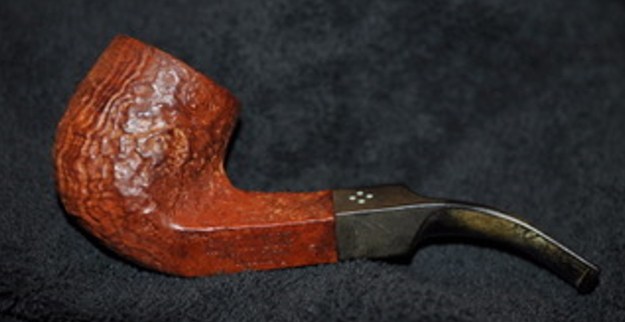
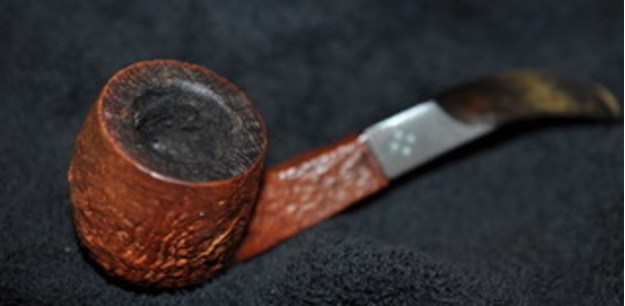
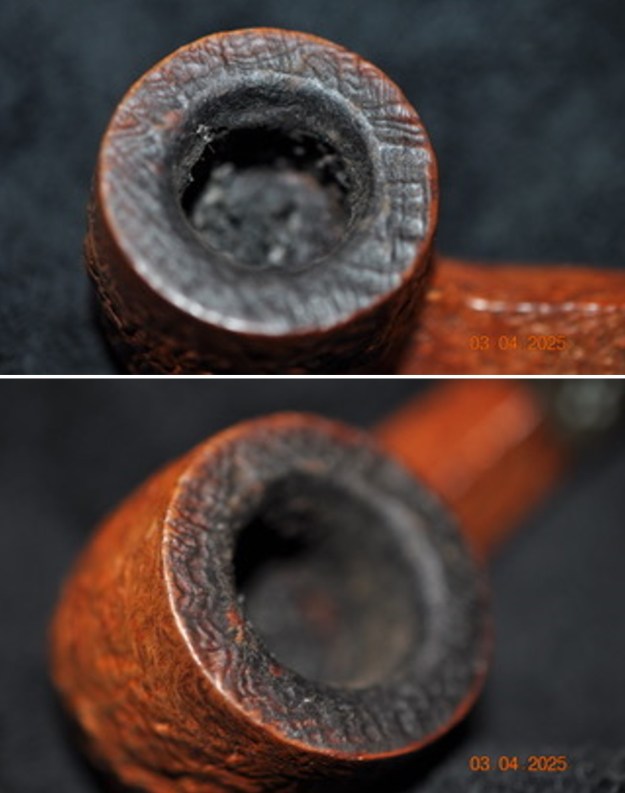
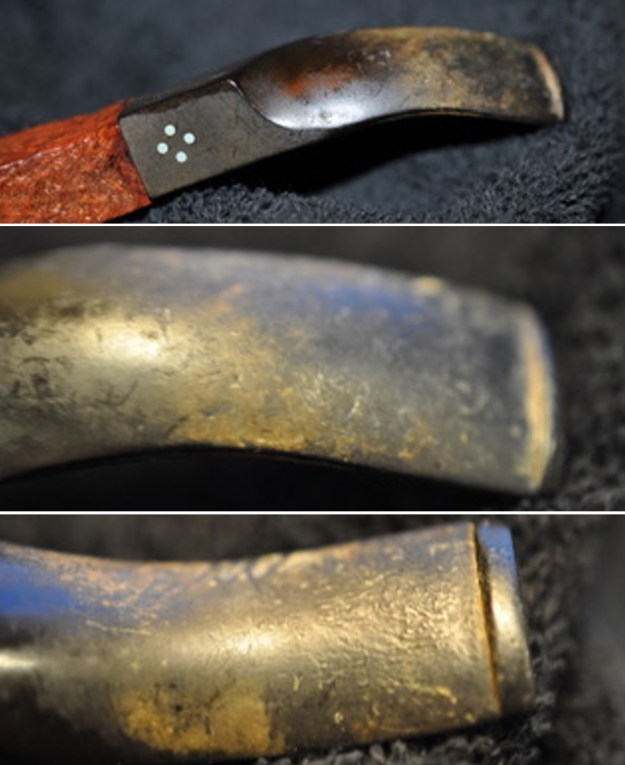
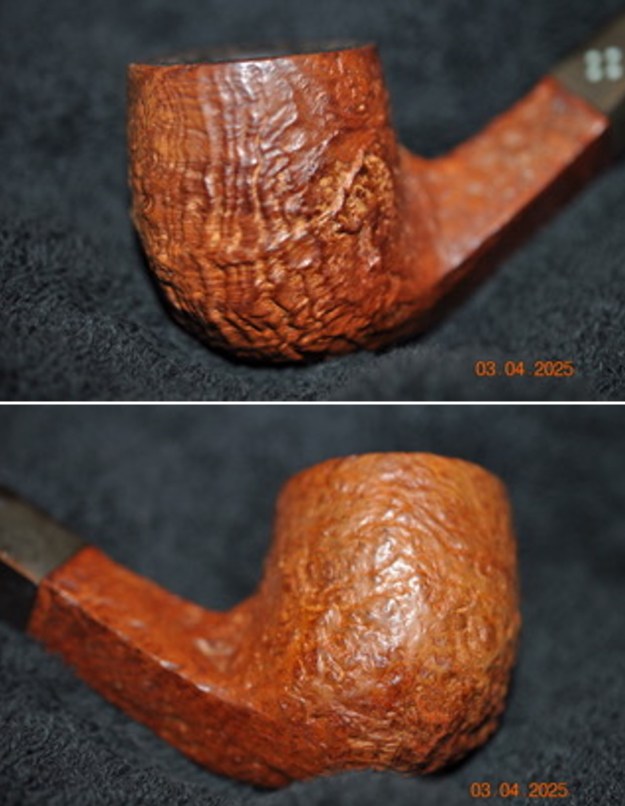
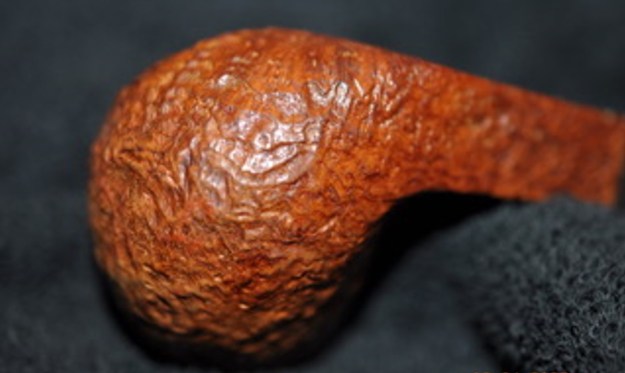
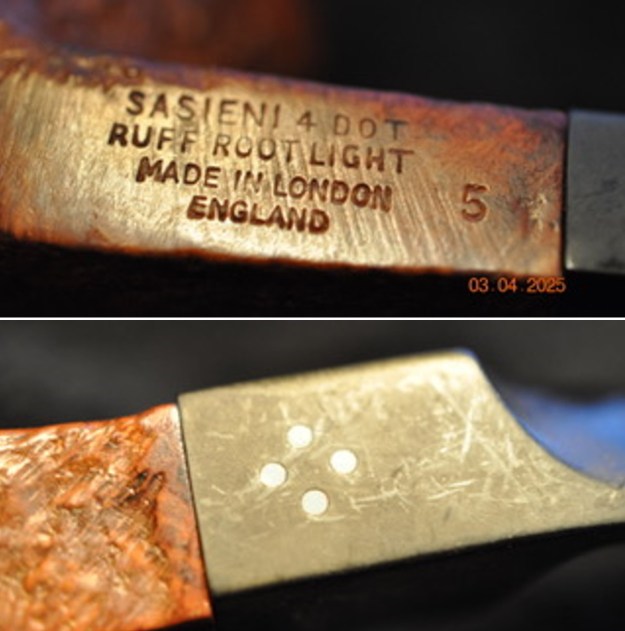
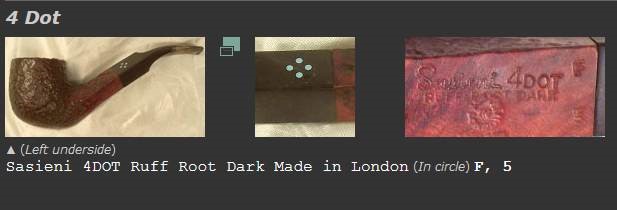
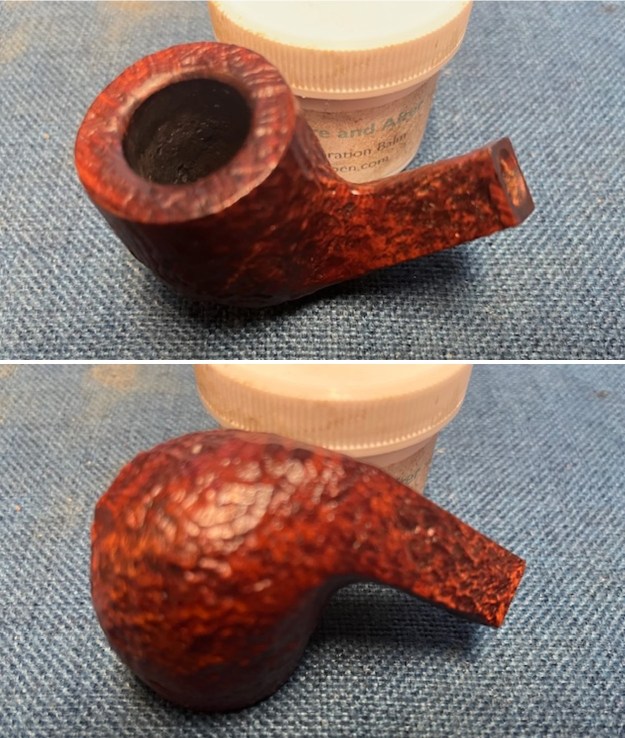
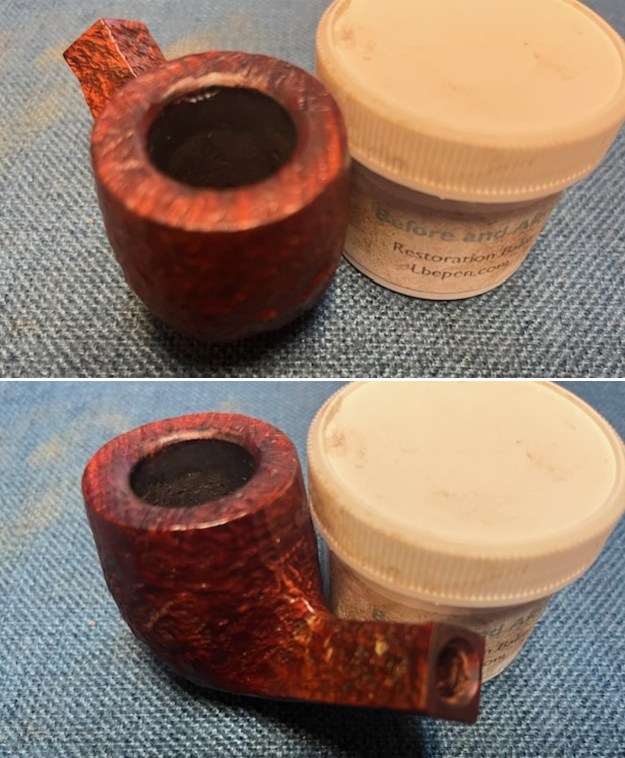
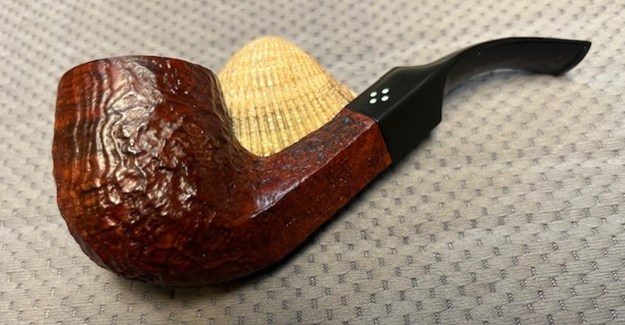
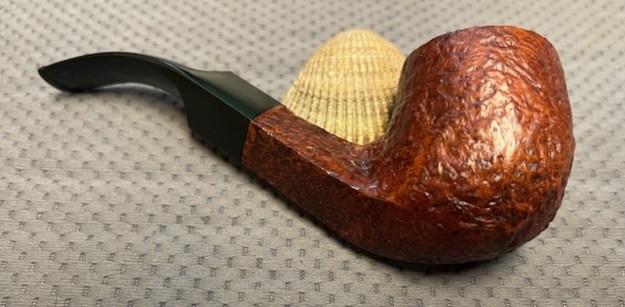
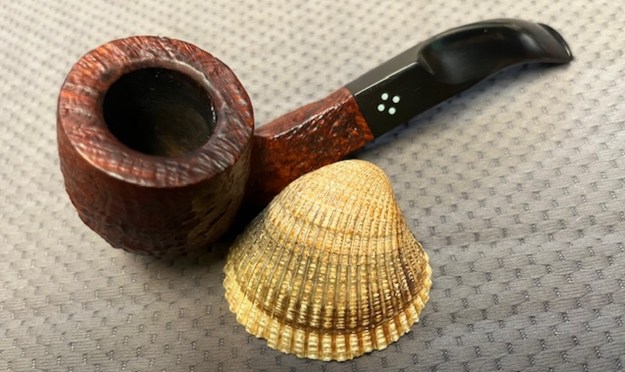
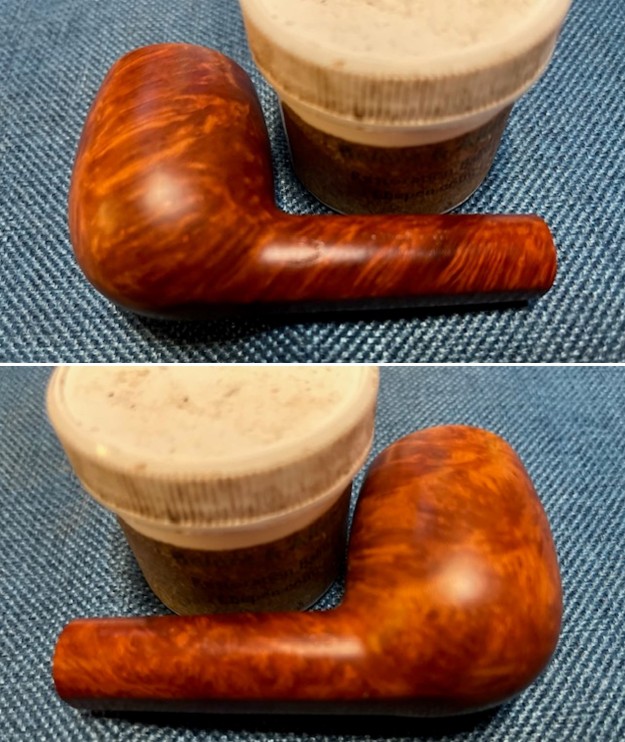
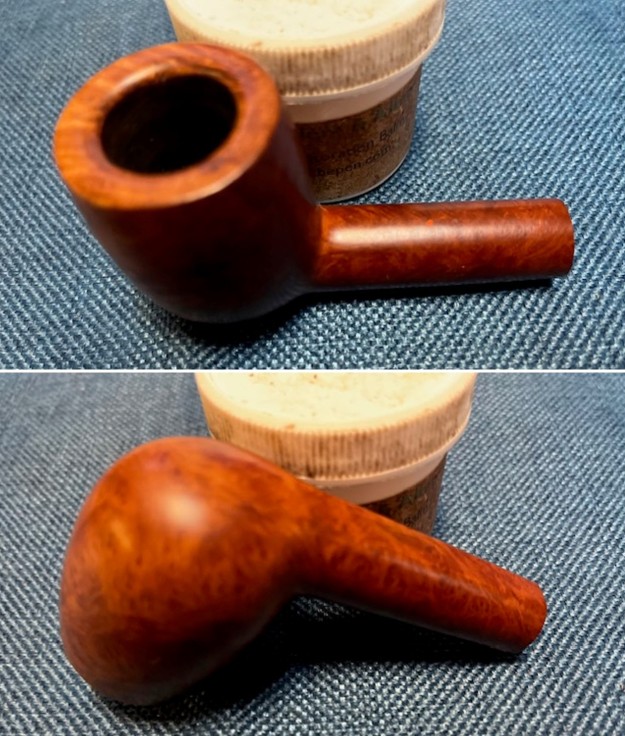
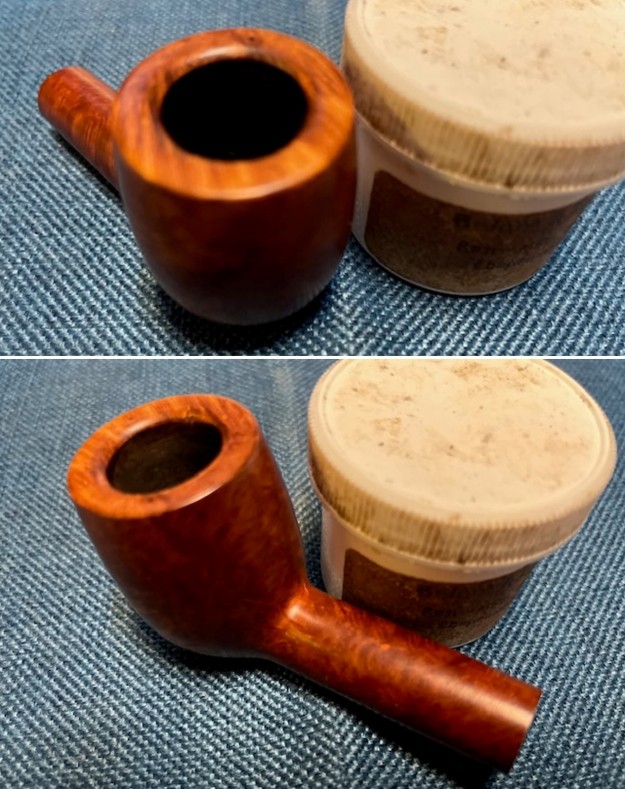
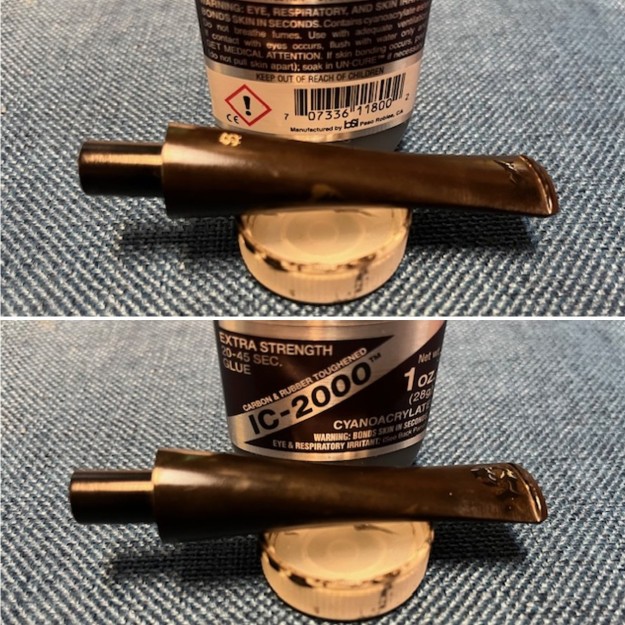
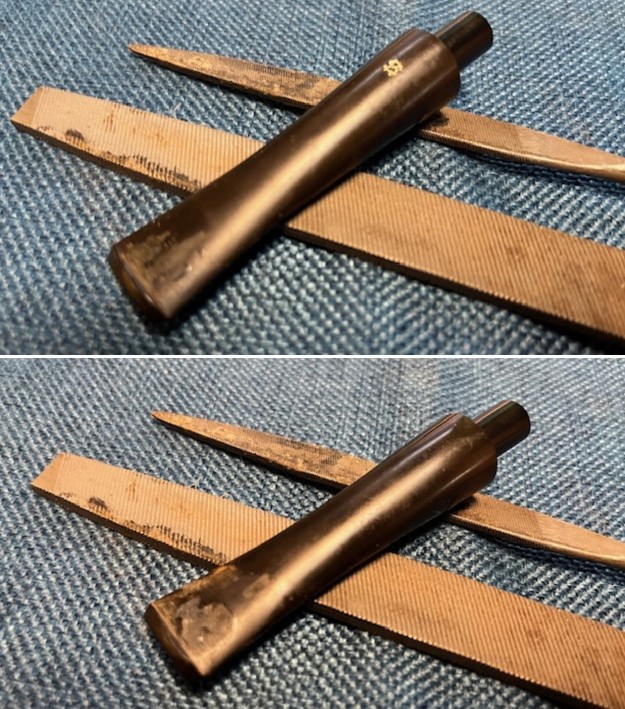
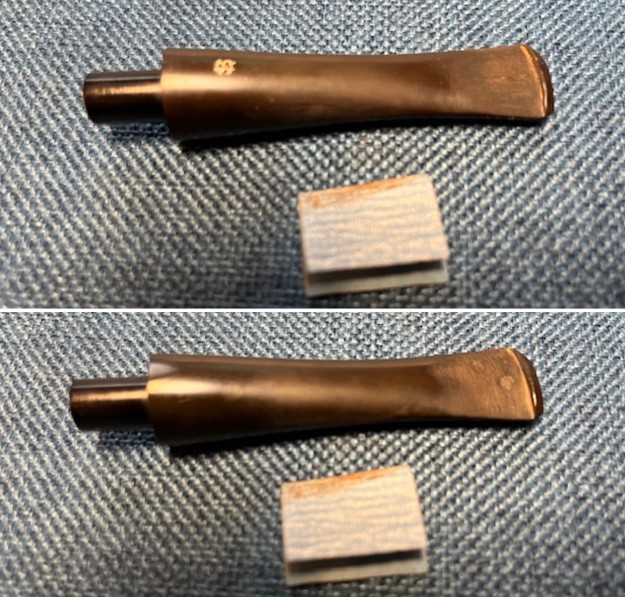
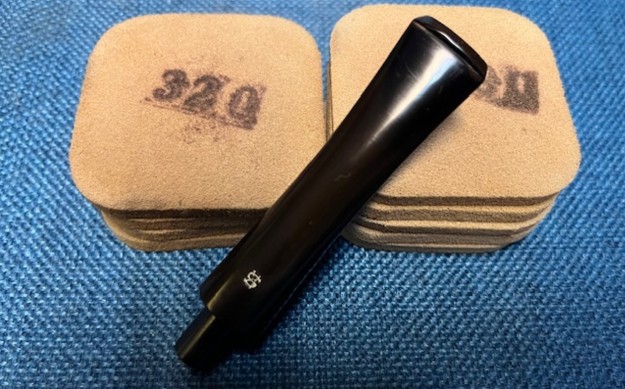
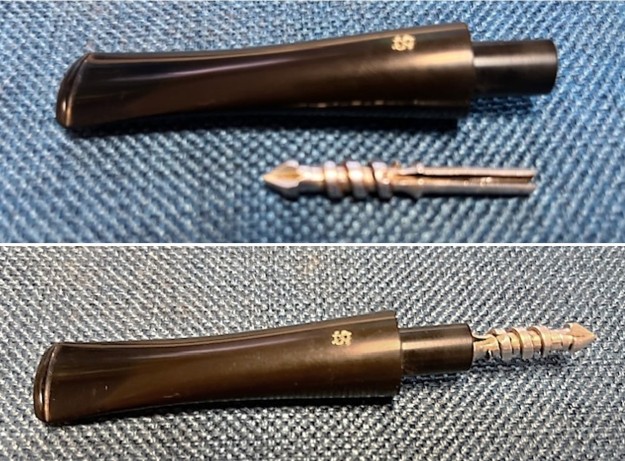
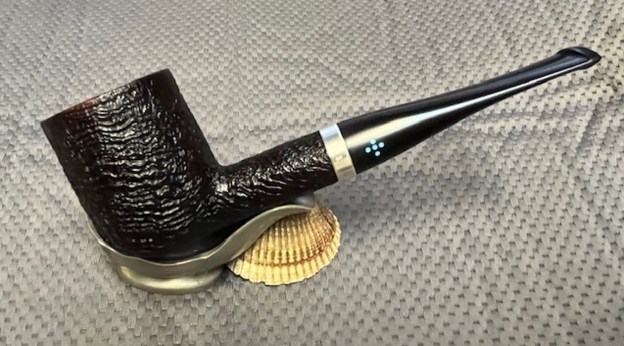
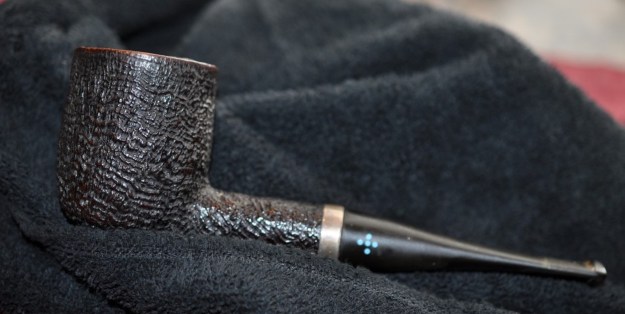
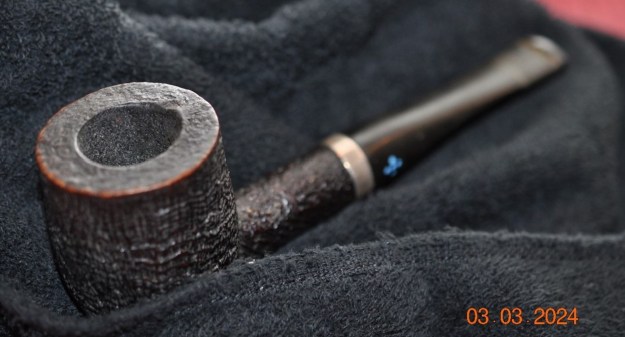
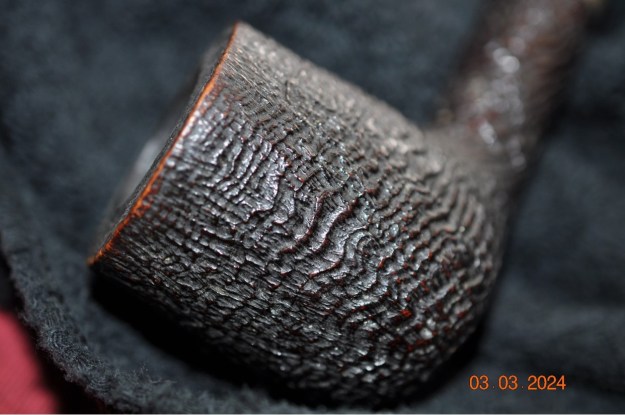
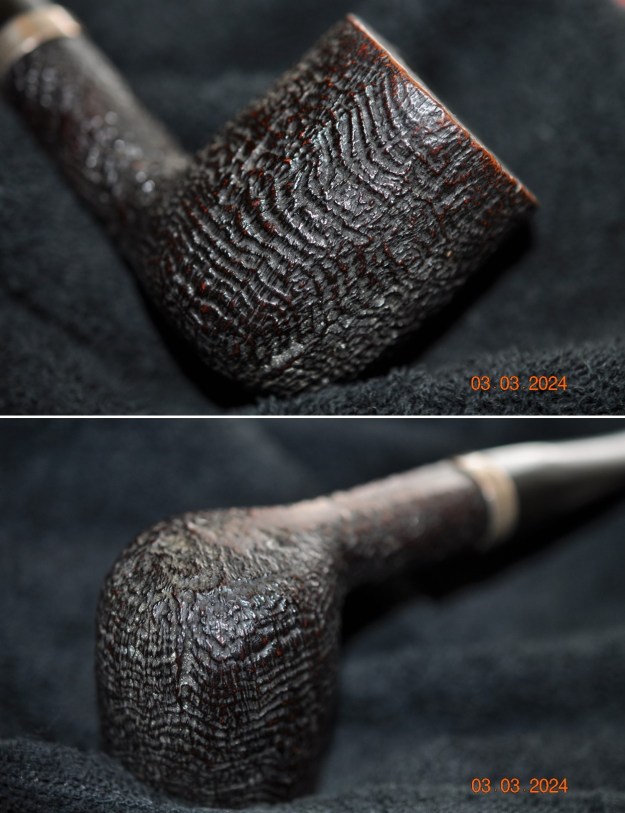
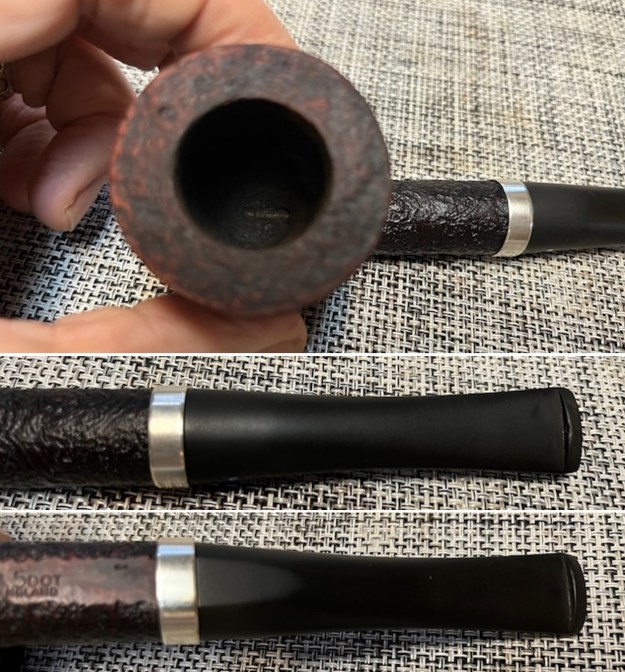
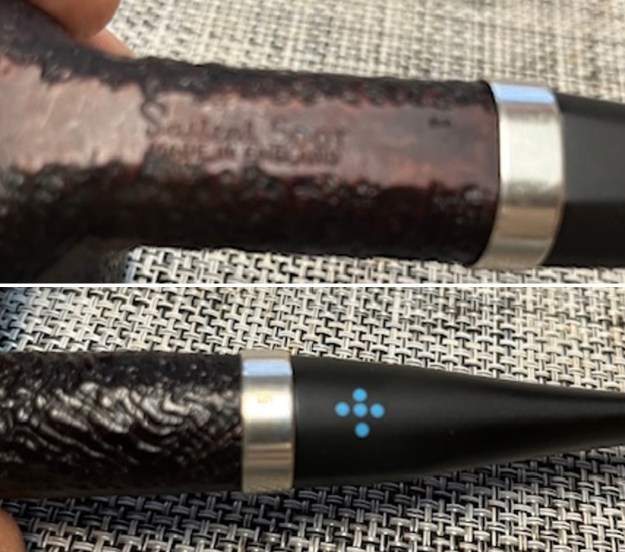
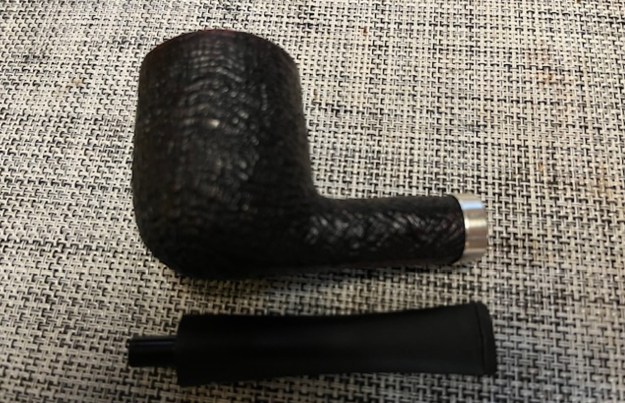
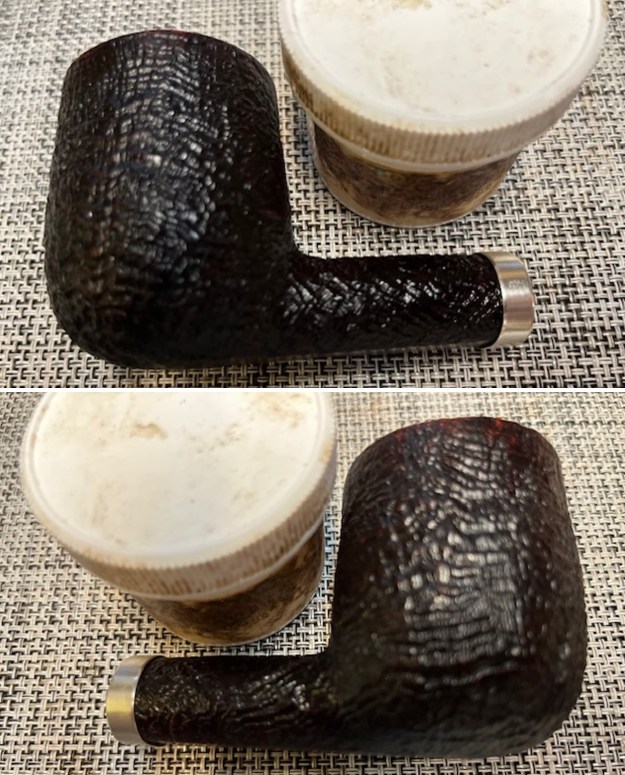
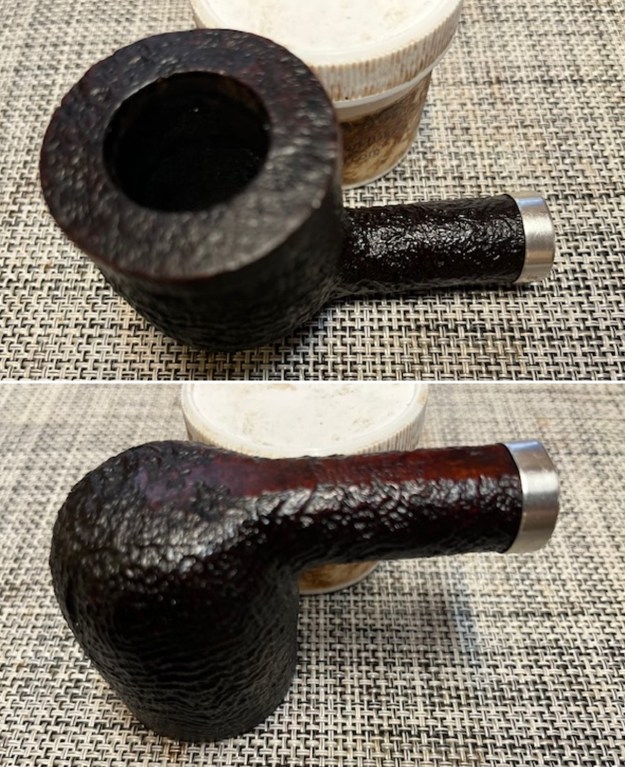
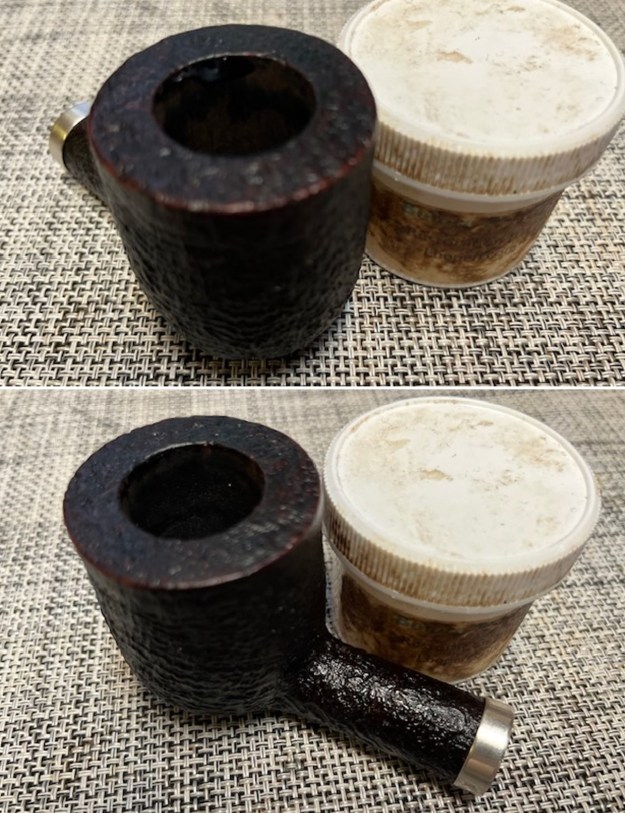
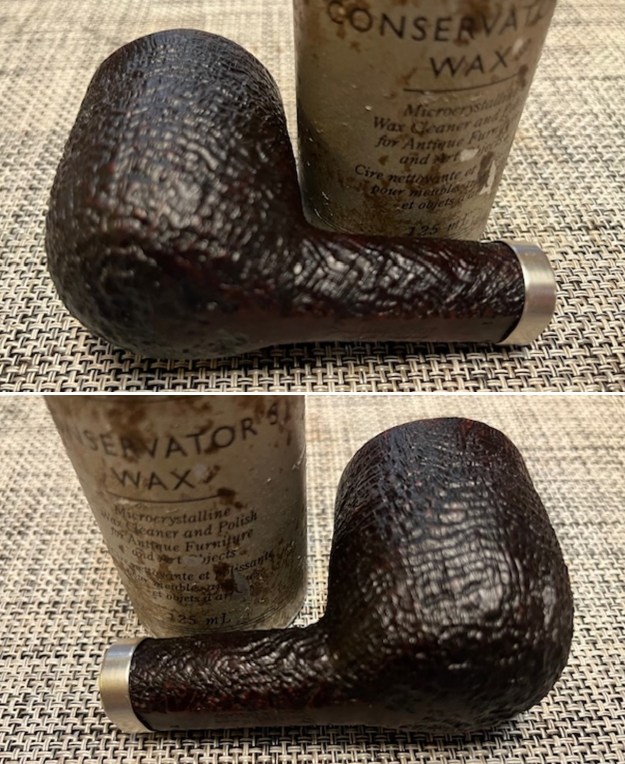
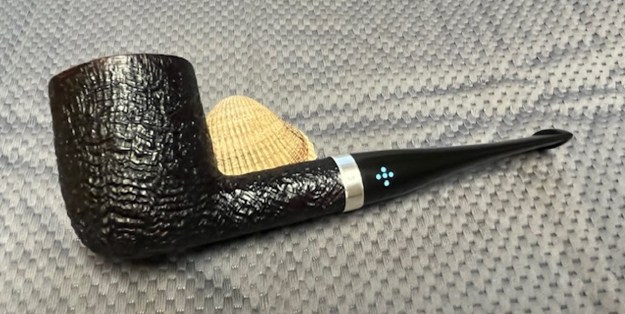
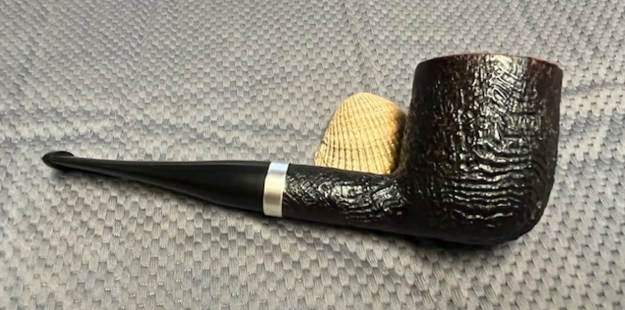
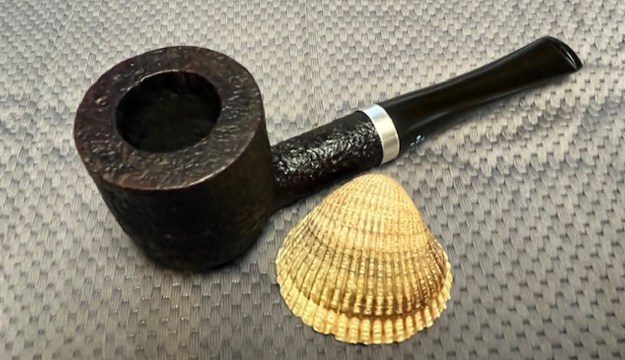
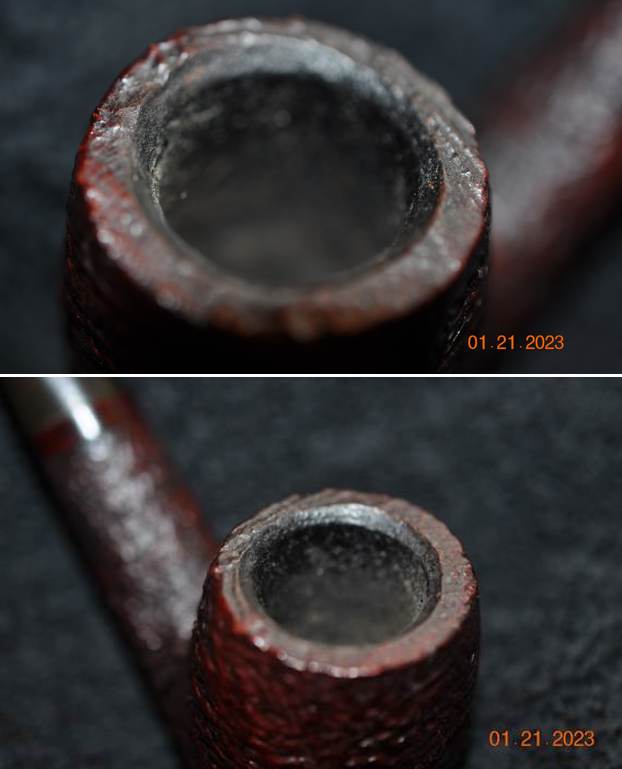
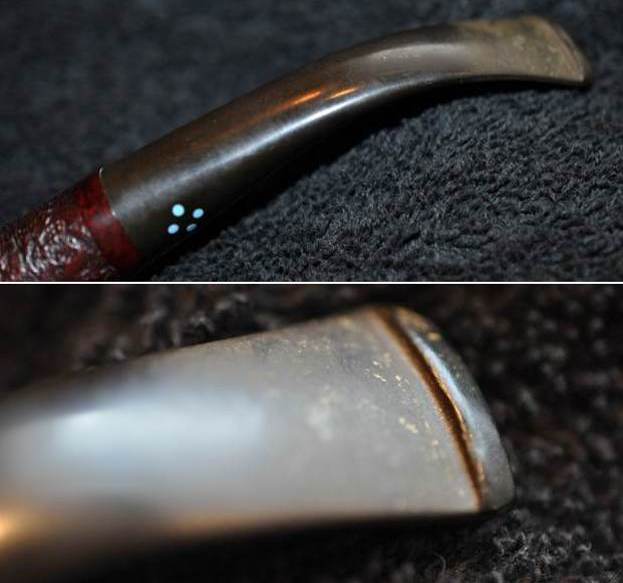
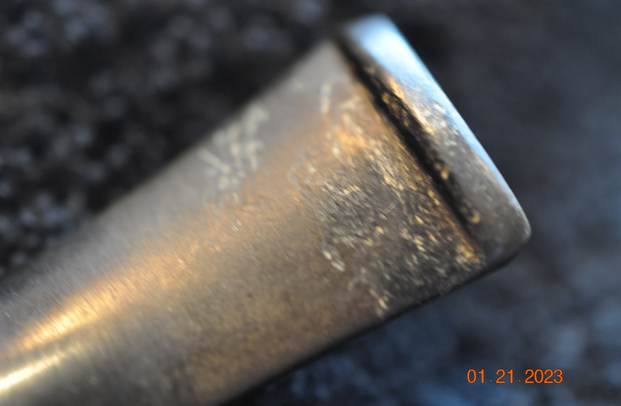
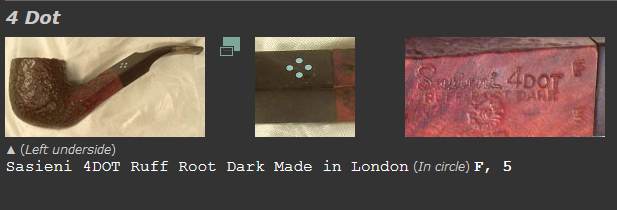
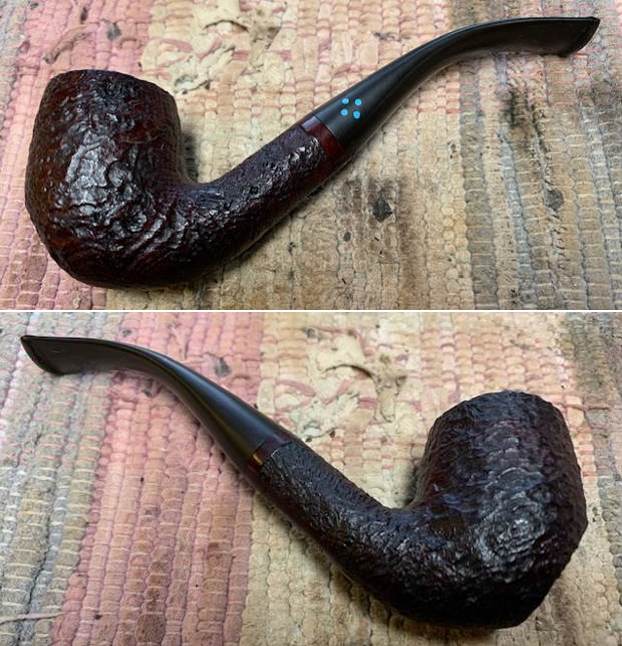
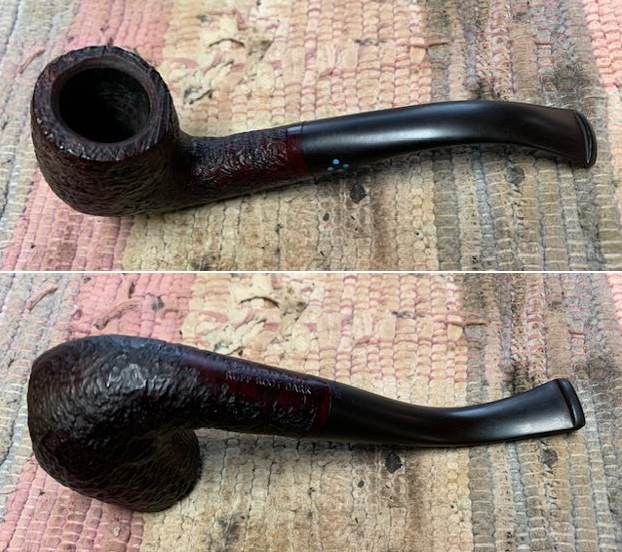
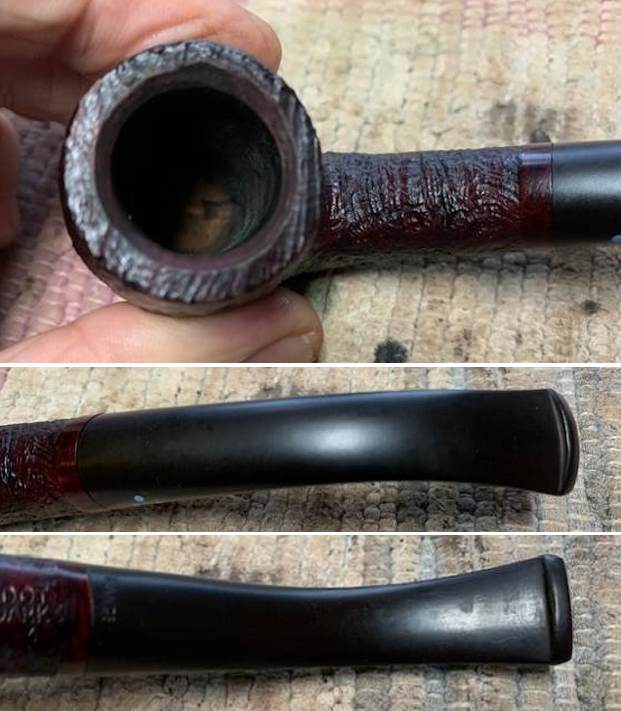
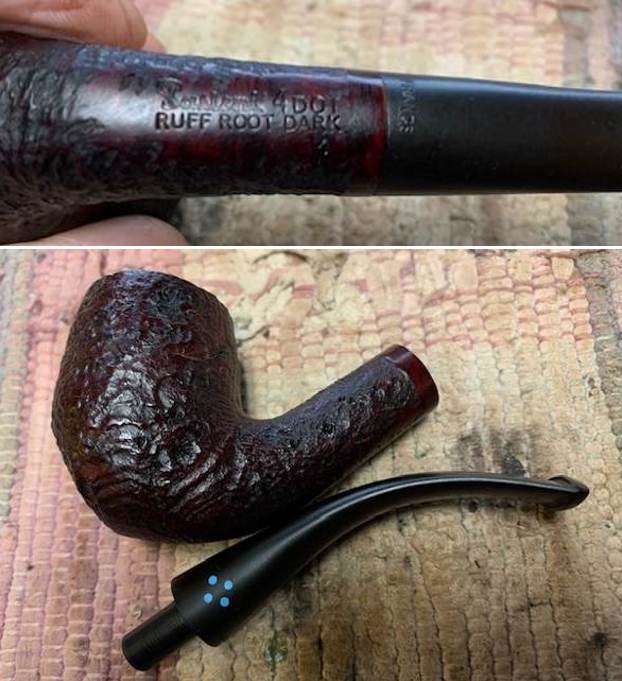
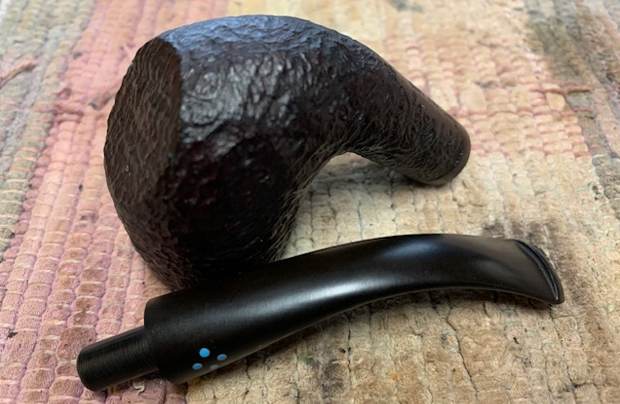
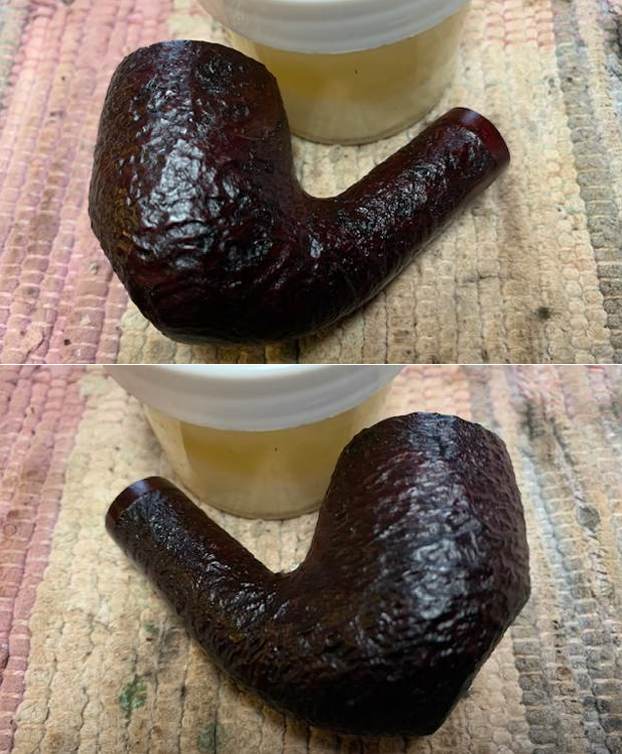
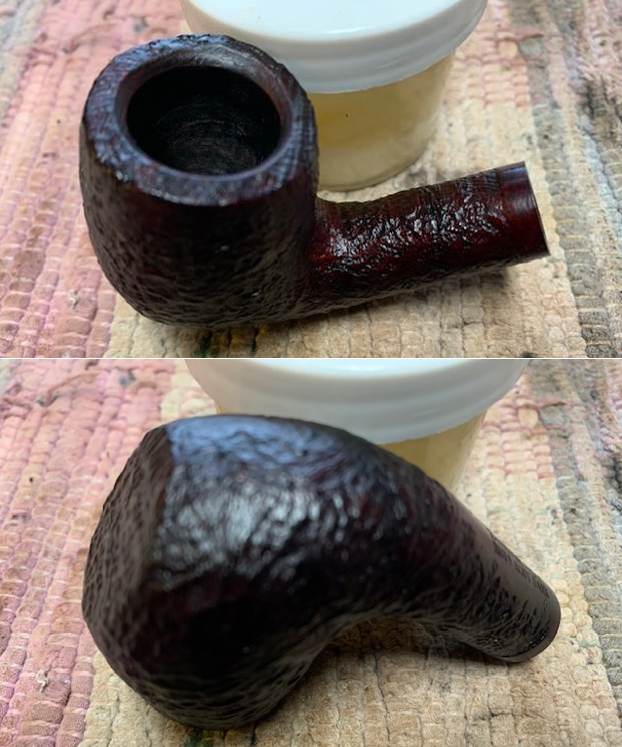
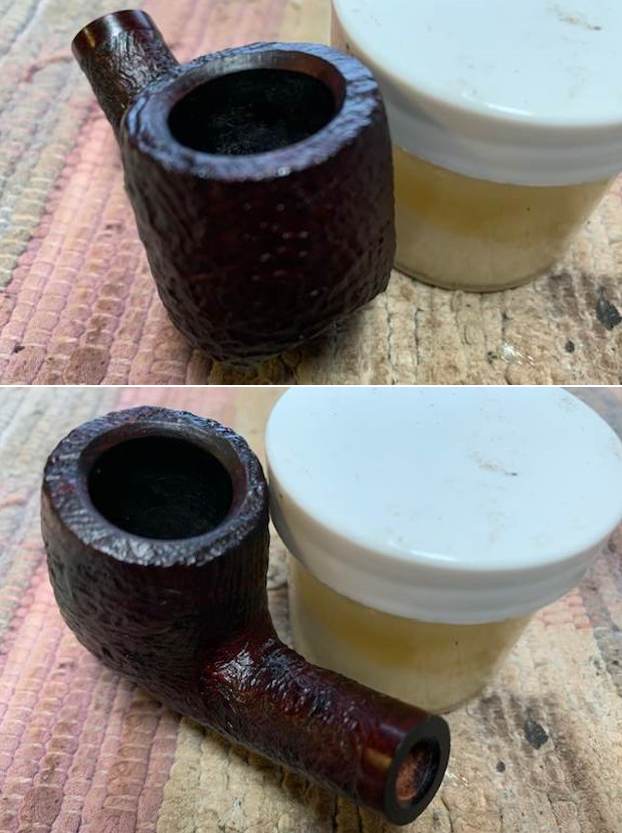
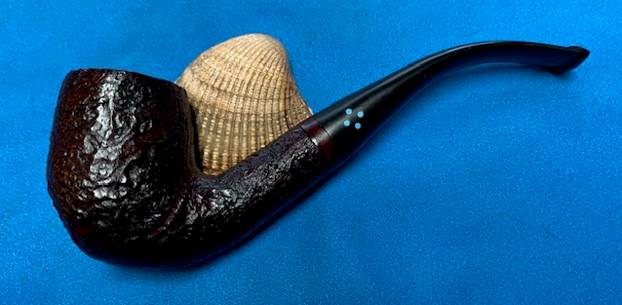
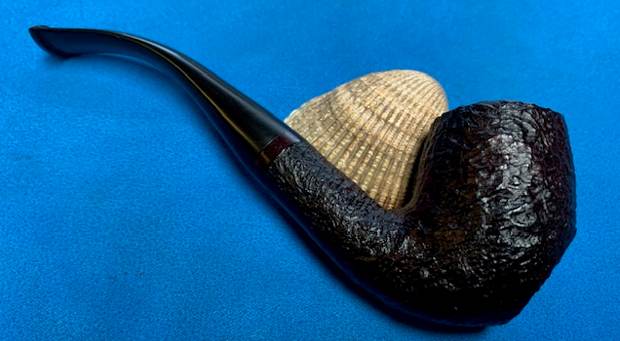
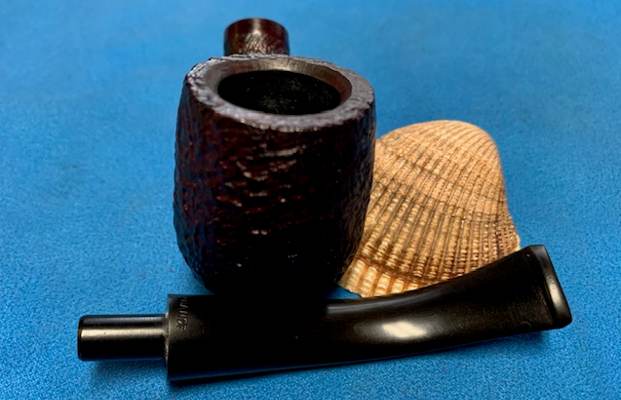
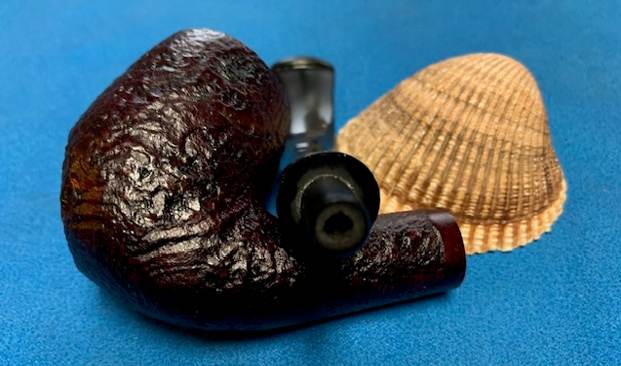
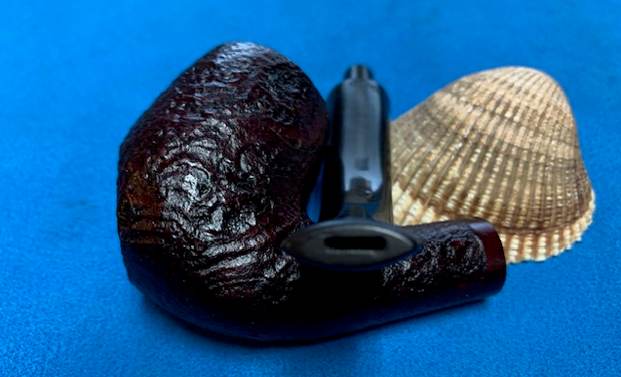
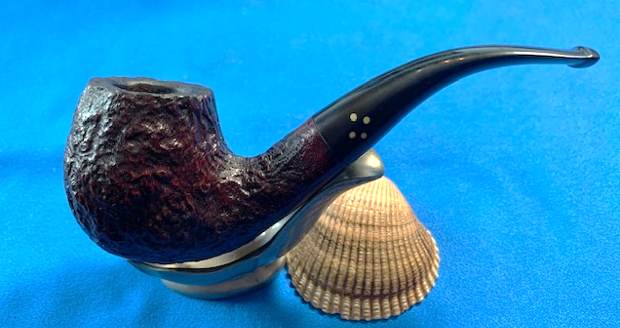
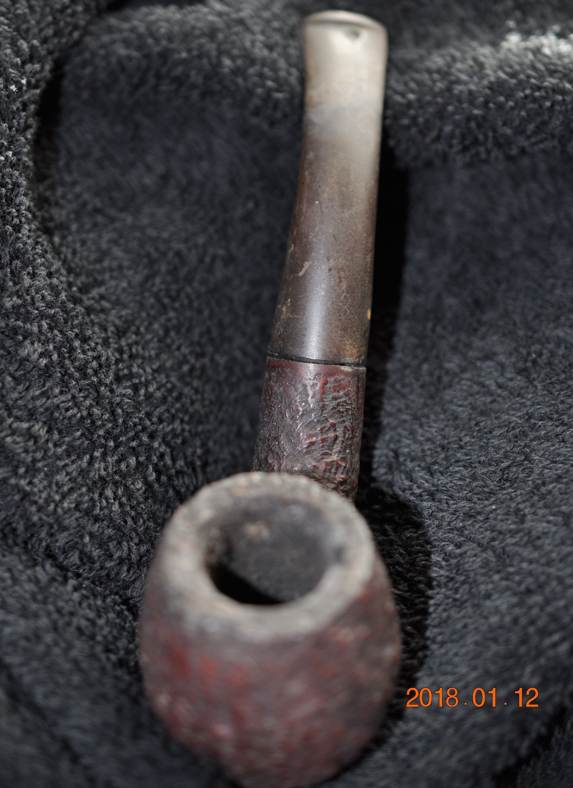
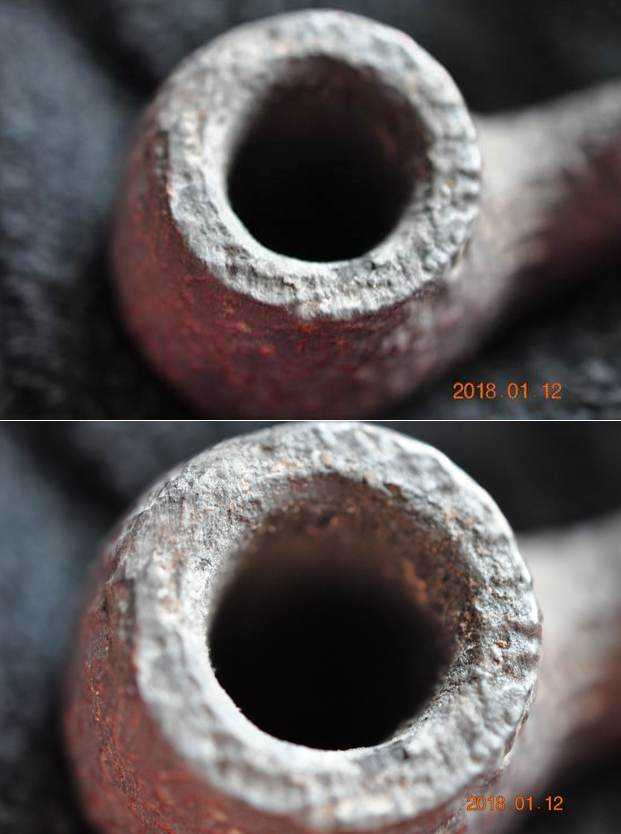
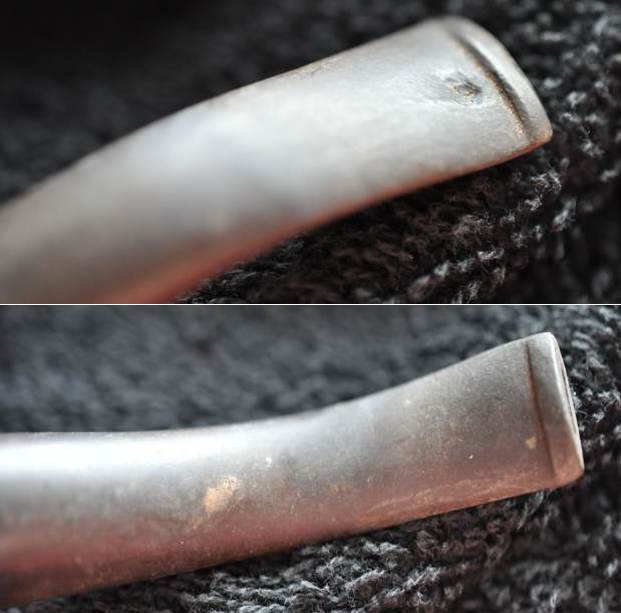
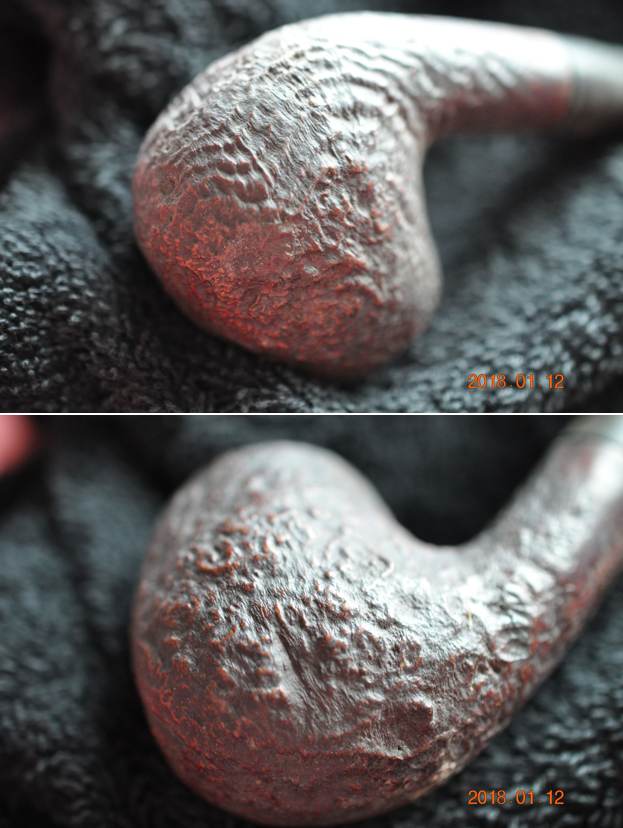
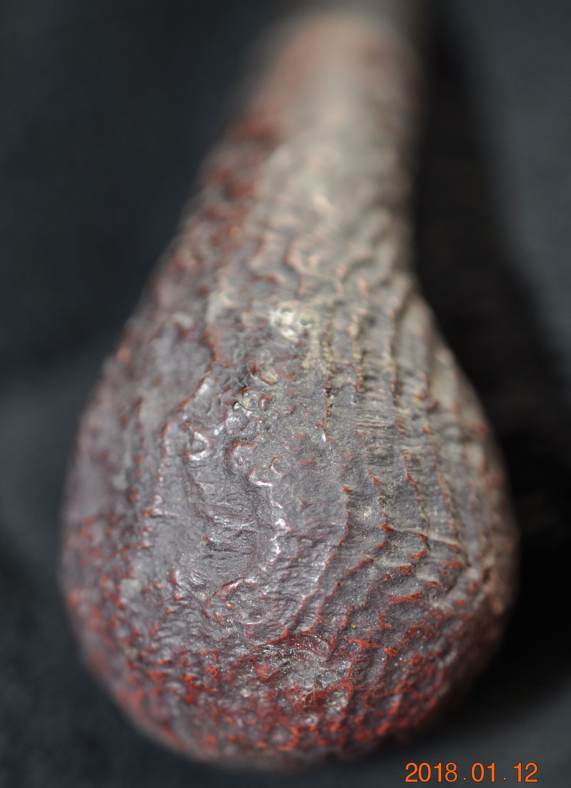
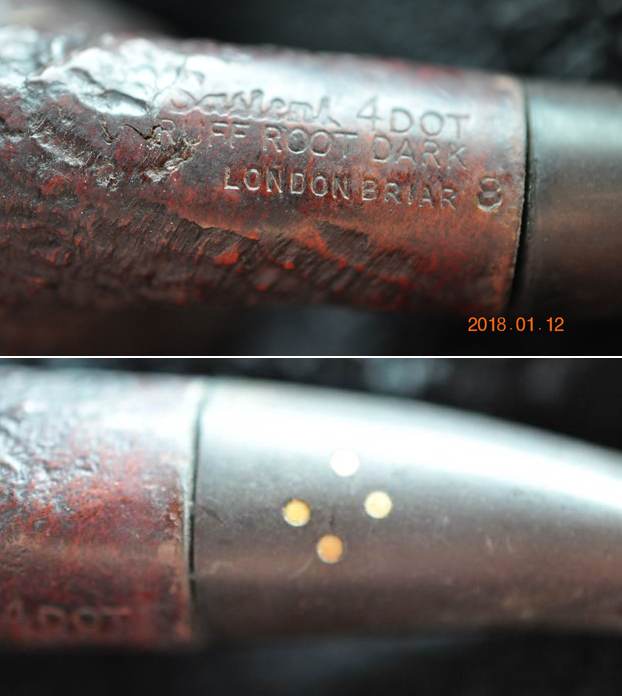
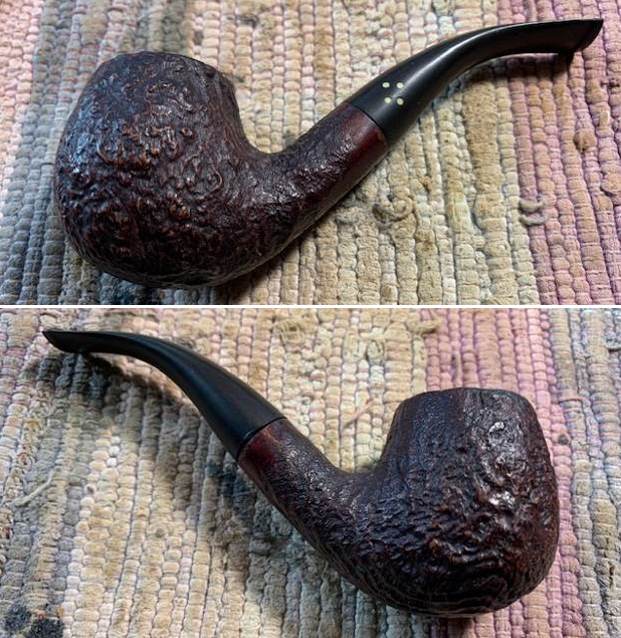
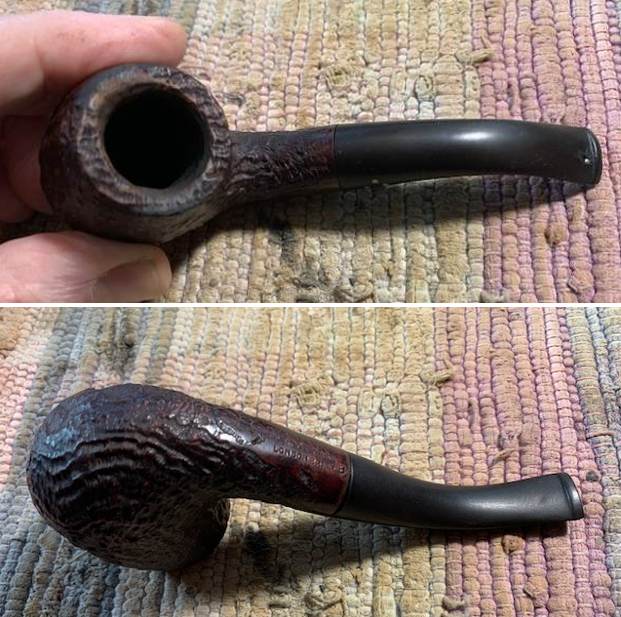
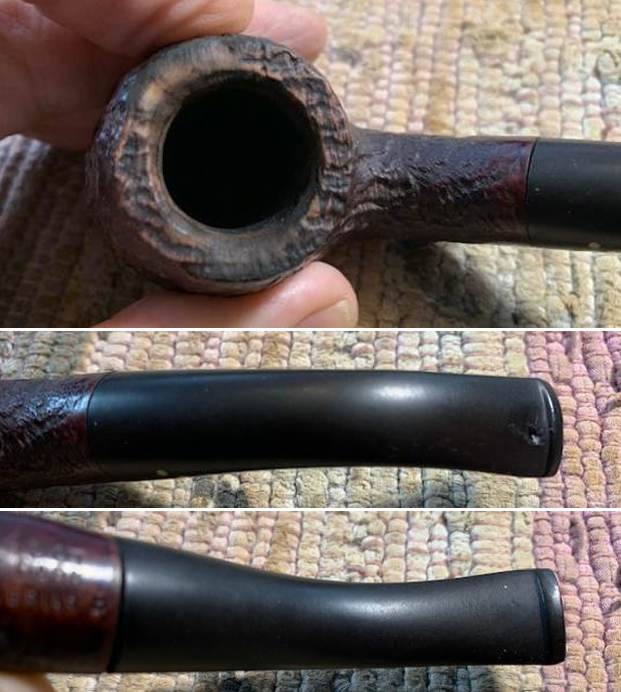
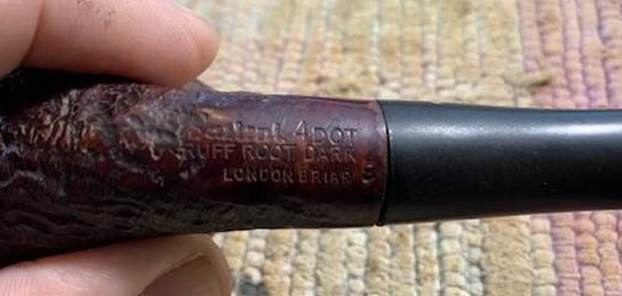
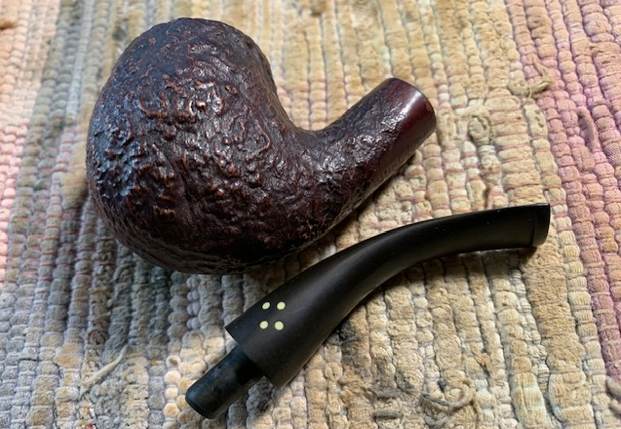
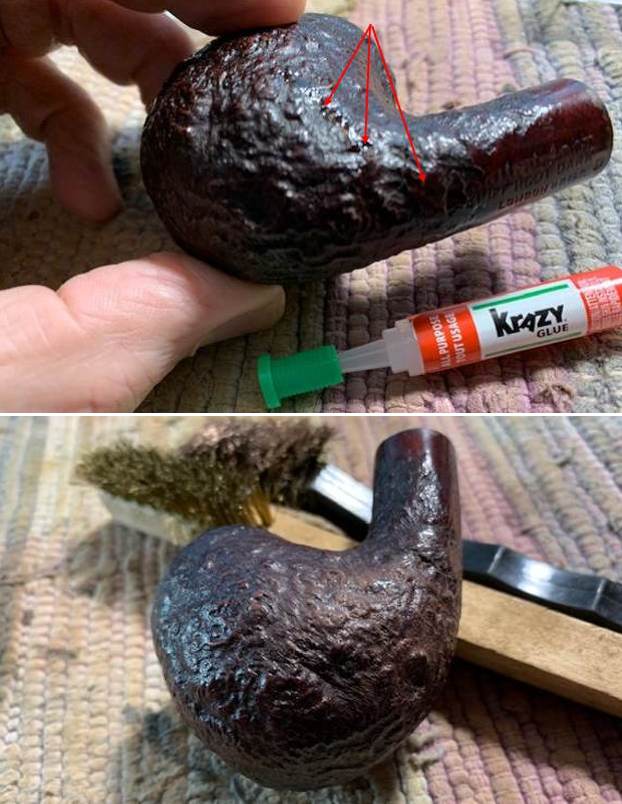
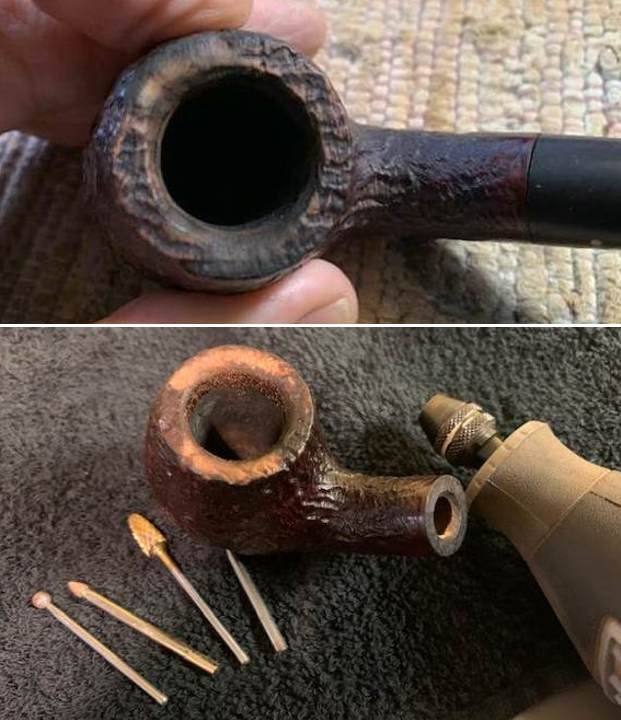
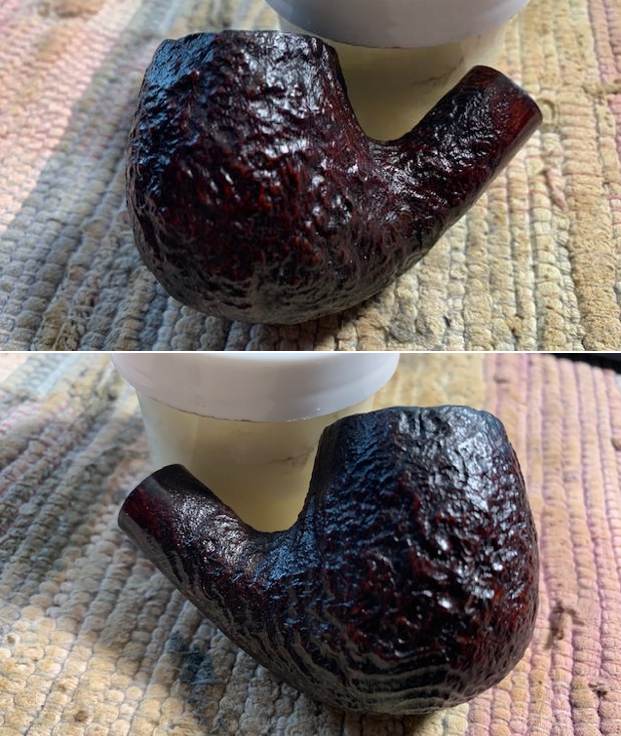
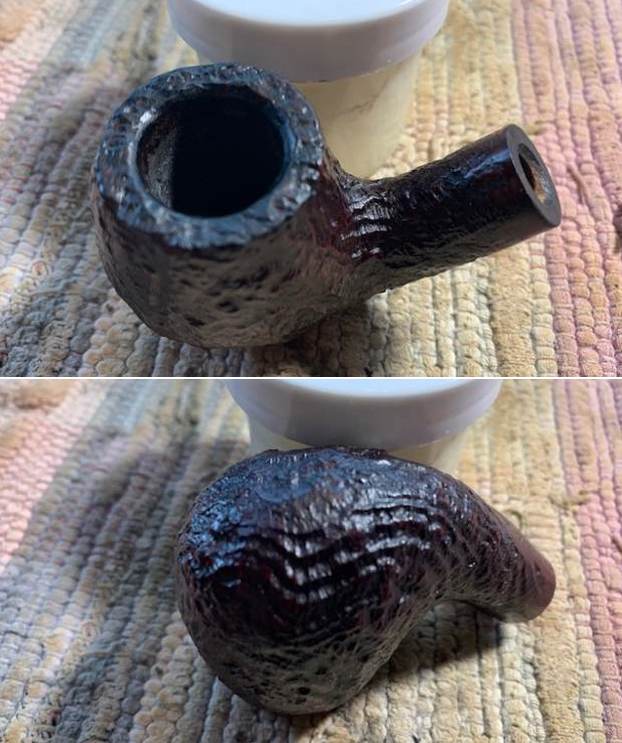
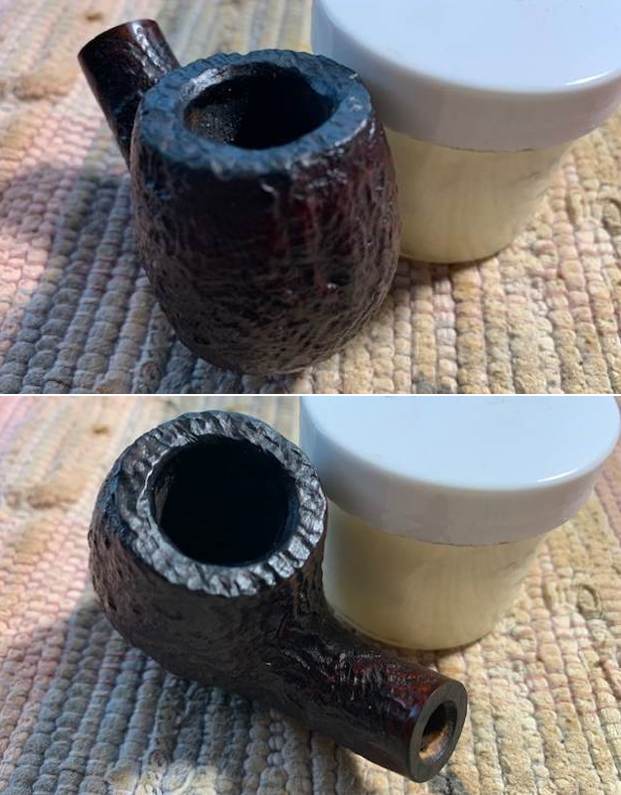
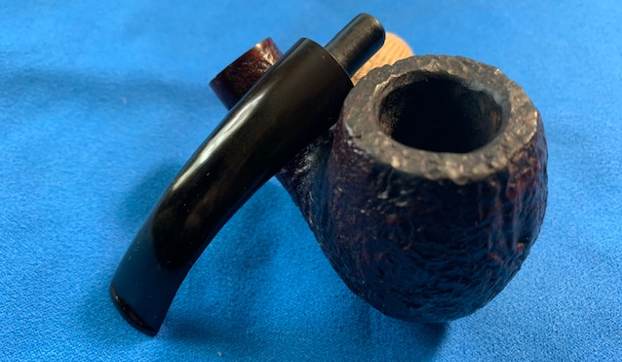
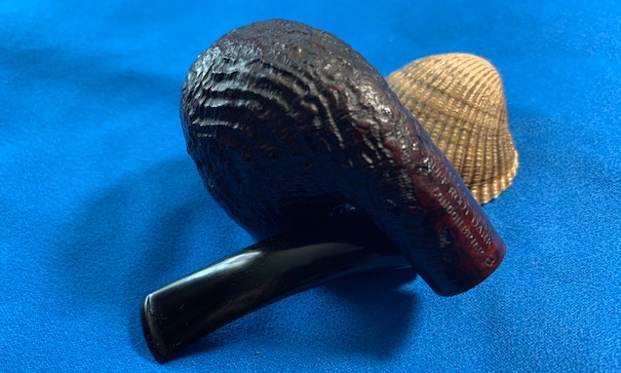
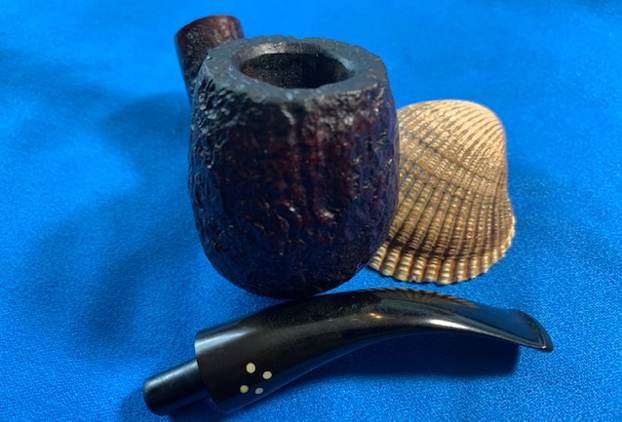
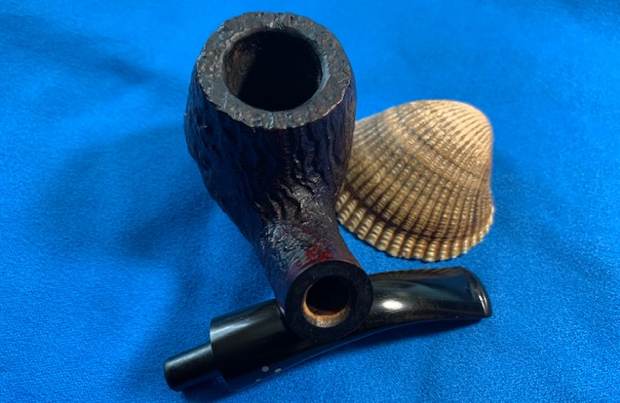
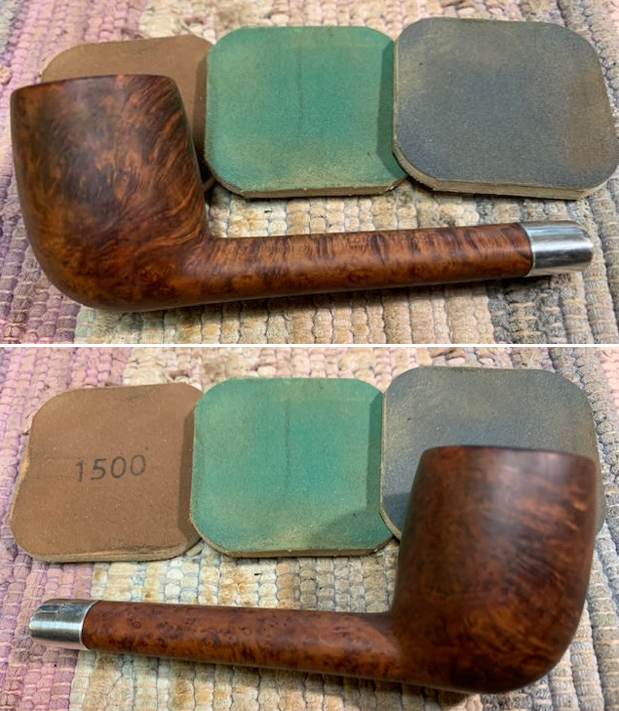
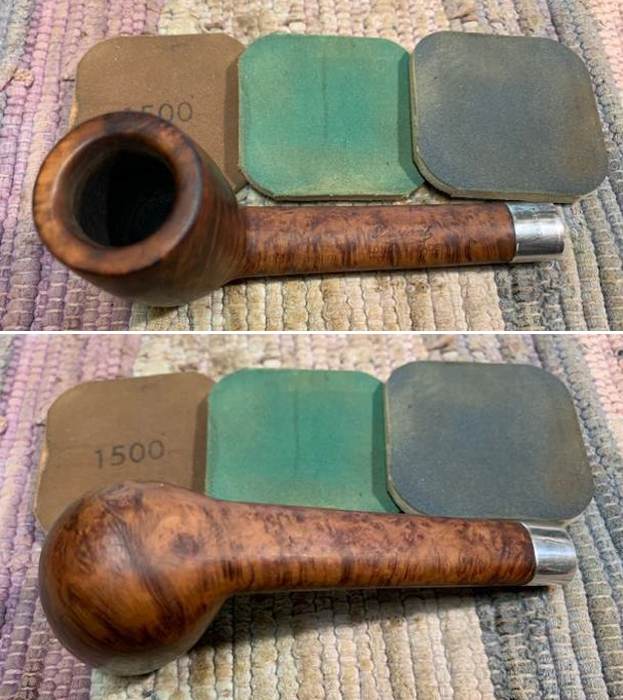
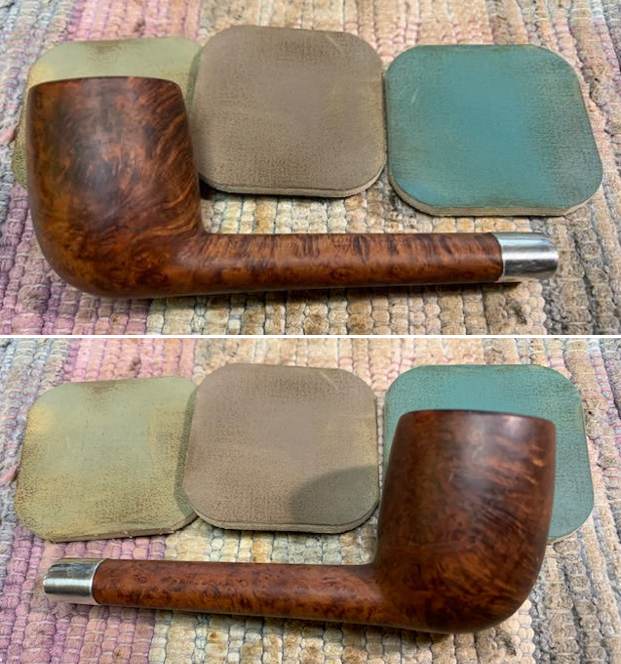
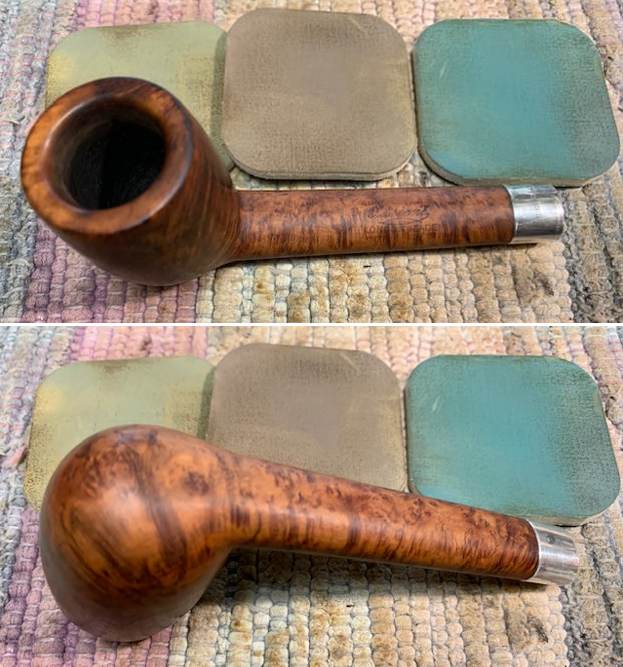
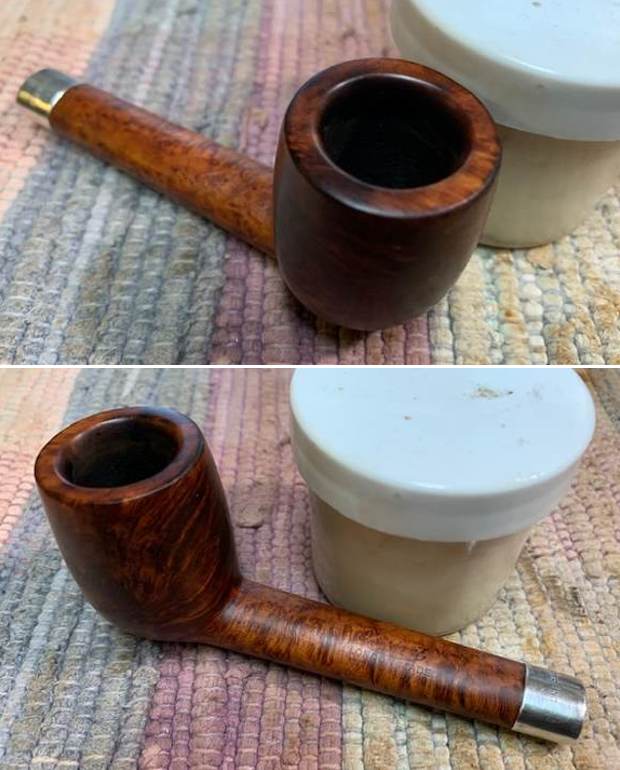
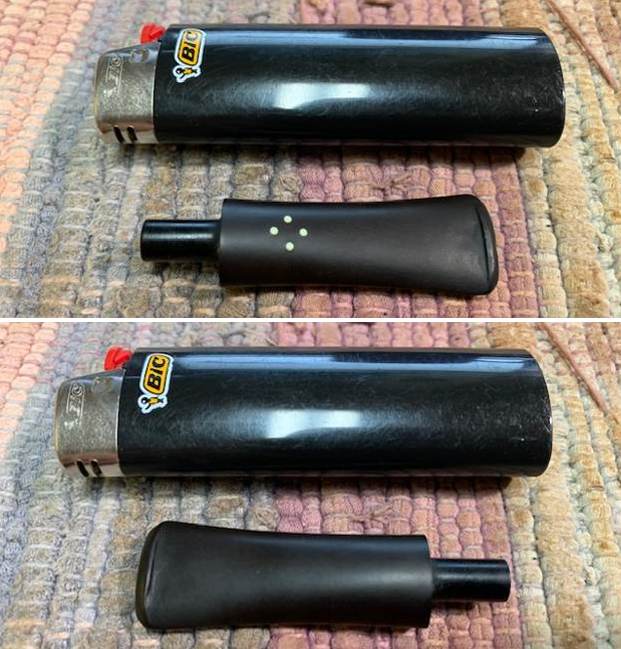
The next pipe on the table is one that we picked up in the lot from an eBay seller in Harrison Township, Michigan, USA on 08/22/2024. The sandblast finish on this English made pipe and the four blue dots on the side of the saddle stem are what caught our eye. It is stamped on the left underside of the diamond shank and reads Sasieni 4 Dot [over] Ruff Root Light [over] Made in London [over] England. That is followed by the shape number 5 or possibly the size number near the stem/shank joint. It has a classic Reddish Brown stain on the sandblast finish that is a stark contrast to the black vulcanite saddle stem. It has a deep sandblast finish on a bent Billiard. The bowl was heavily caked and the inner edge and the top were covered with a thick lava coat in the blast. The stem was oxidized, calcified and had tooth marks and chatter on both sides ahead of the button. The Sasieni 4 Dot four blue dots logo on the left side of the saddle stem looks to be in good condition. Jeff took some photos of the pipe to show the general condition of the pipe before he started his clean up. He took some photos of the rim top and bowl from various angles to give me a clear picture of the condition of the rim top and bowl. The inside of the bowl is heavily caked with lava on the inner edge and in the sandblast on the rim top. He included photos that show the top and underside of the stem. It is as described above. Jeff took some photos of the sides and heel of the bowl to show the condition of the sandblast finish on the pipe. The photos showed some great grain around the bowl and shank even with the grime in the finish. It is a great looking piece of briar. He took a photo of the stamping on the left underside of the diamond shank. It was clear and readable as noted above. He also photographed the 4 dot pattern on the side of the stem.I decided to do some work on the stamping of this pipe to get an idea of the time period it was carved. I turned first to Pipephil’s site to see what I could learn (http://pipephil.eu/logos/en/logo-sasieni.html). I found a pipe that was shaped and stamped similarly to the one I am working on. It is stamped on the underside of the shank and reads like the first two lines on the one in the screen capture photo below. Mine is stamped the same way Sasieni in upper case letters without the flourish. It is followed by 4 DOT [over] Ruff Root Light [over] 5. I included the side bar notes below the picture. From that I knew that the pipe was made during Post-transition Period 1986-today.Post transition, 1986 – today, “4 dot”. Ruff Root Dark: Name for a sandblasted finish. Notice the 4DOT stamping replacing the FOUR DOT from 1986.

I then turned to Pipedia for more detailed information (https://pipedia.org/wiki/Sasieni). I quote a section of that article below. It refers to the Patent Number that is on the pipe I have on the table. The underlined portion below is particular pertinent to this pipe.

To begin with, there are three main elements to dating the Sasieni pipe, the patent number, the style of the name “Sasieni” as it appears on the shank, and the Dots themselves. Naturally, there are exceptions to these rules (this hobby would be boring without them), but for the most part these guidelines apply better than 95% of the time. All Sasieni One, Four, and Eight Dot pipes made before W.W.II and destined for the U. S. market carried a patent number on the shank which usually started with the numbers “15″, with 150221/20 and 1513428 being representative of the group. Also, the name “Sasieni” was stamped on the shank in a very florid manner, with the tail of the last “i” sweeping underneath the name forming a shape which has been compared to a fish by more than one collector. This script was discontinued by Alfred almost immediately after he took over the company, so this alone tells you your pipe is pre W.W.II. Underneath in block lettering are the words “London Made”, with the patent number making the third line…

…The nomenclature changed again in 1986, with the sale of the company to the Post-Transition firm. The three line nomenclature was changed to two lines, with the first reading “Sasieni 4 Dot” and the second identifying the finish, e.g. Natural, Walnut, or Ruff Root. Note how 4 Dot is spelled, using an Arabic numeral 4, as opposed to spelling out the word “four”. This is the easiest way to spot a Post-Transition Sasieni, as the new company has used both script and block lettering to spell the word “Sasieni” on the shank.

The pipe I have is one that does not have a flourished “i” as that was discontinued by Alfred so that confirms that the pipe was made Post-transition, 1986 forward. The stamping shows the Sasieni name and the 4 Dot stamp on one line. Underneath it bears the finish Ruff Root Light stamp. With all that information I knew that my pipe was from the period after the transition (Post Transition) so it was a newer one.

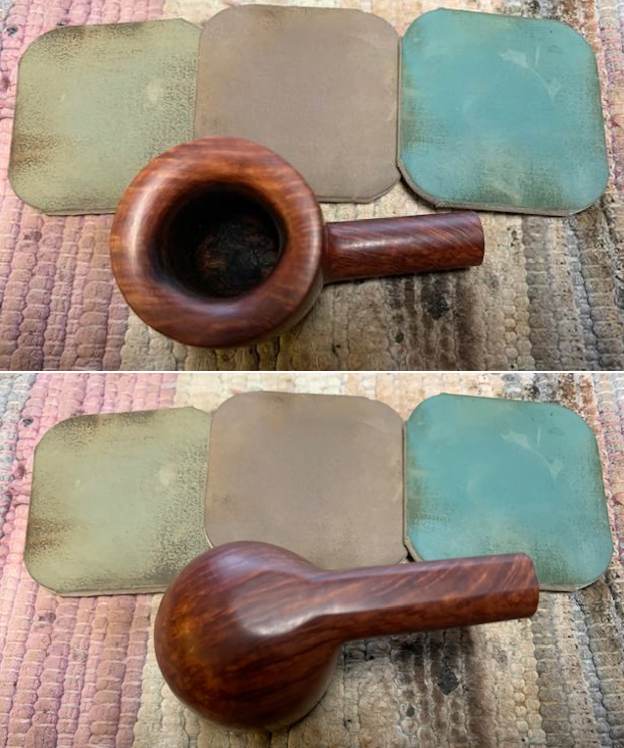
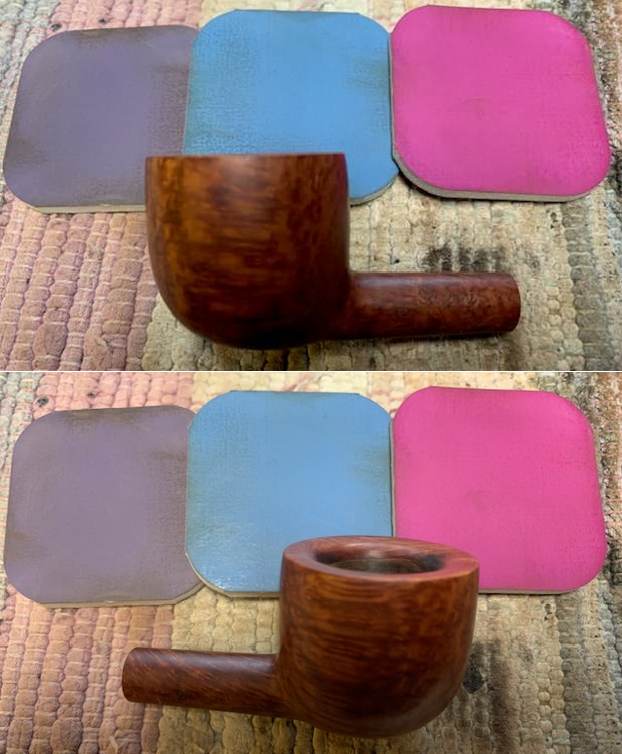
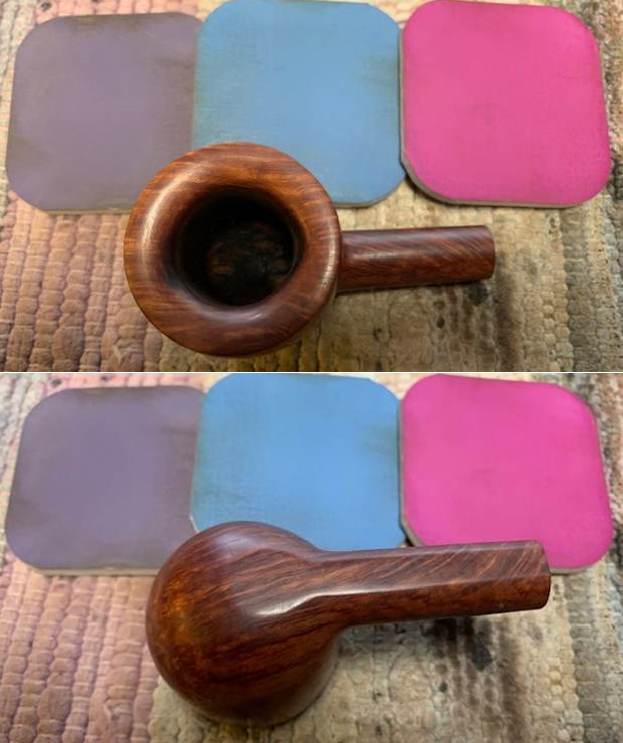
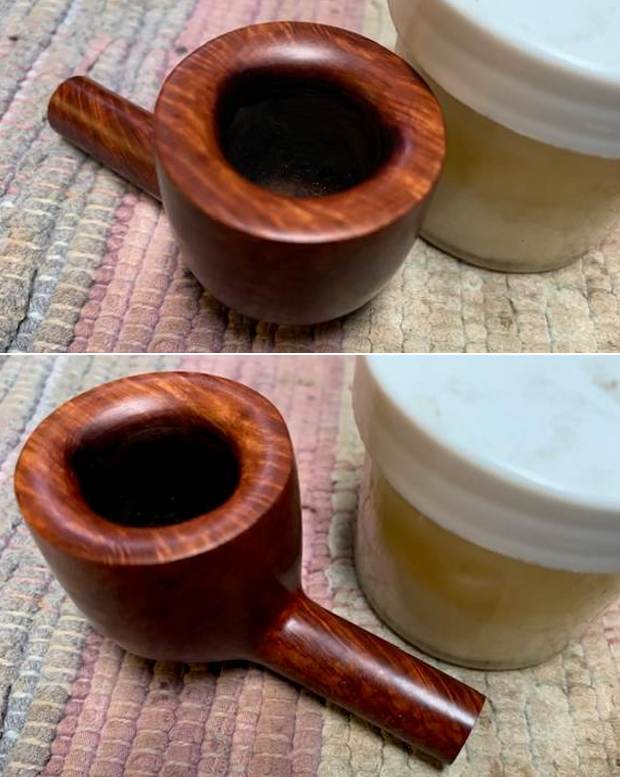
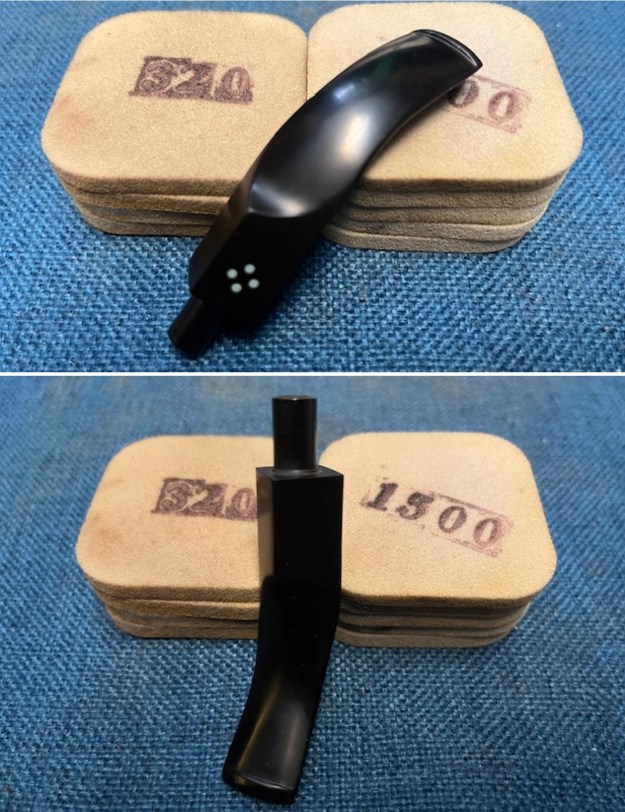
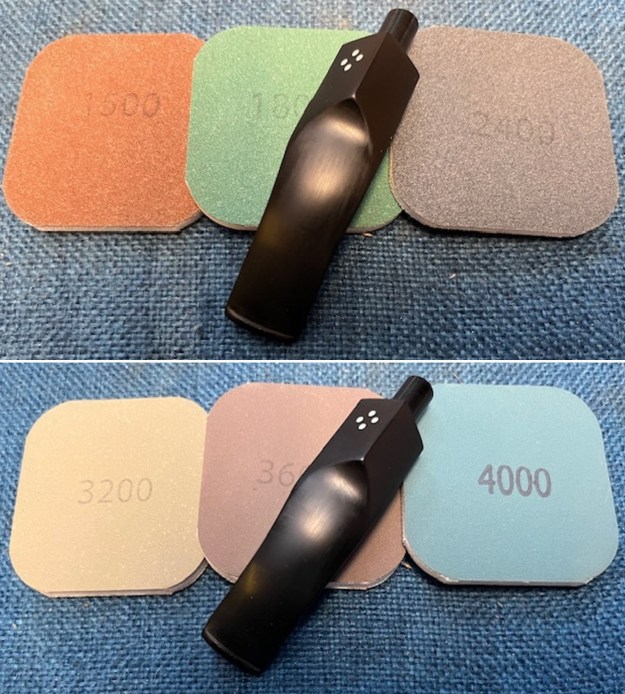
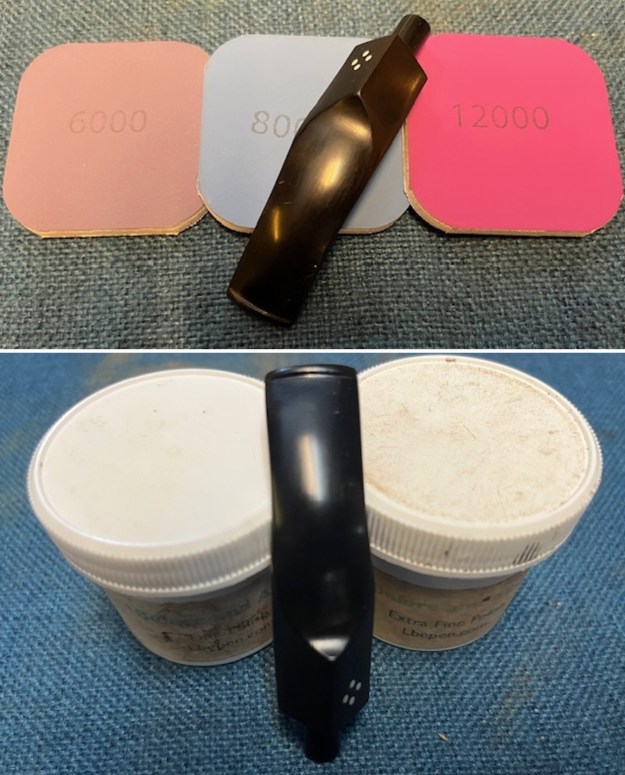
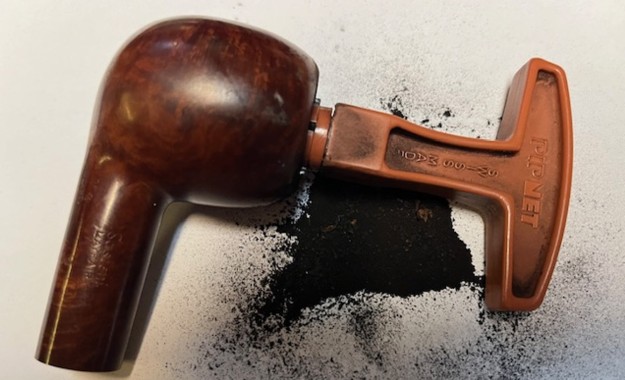
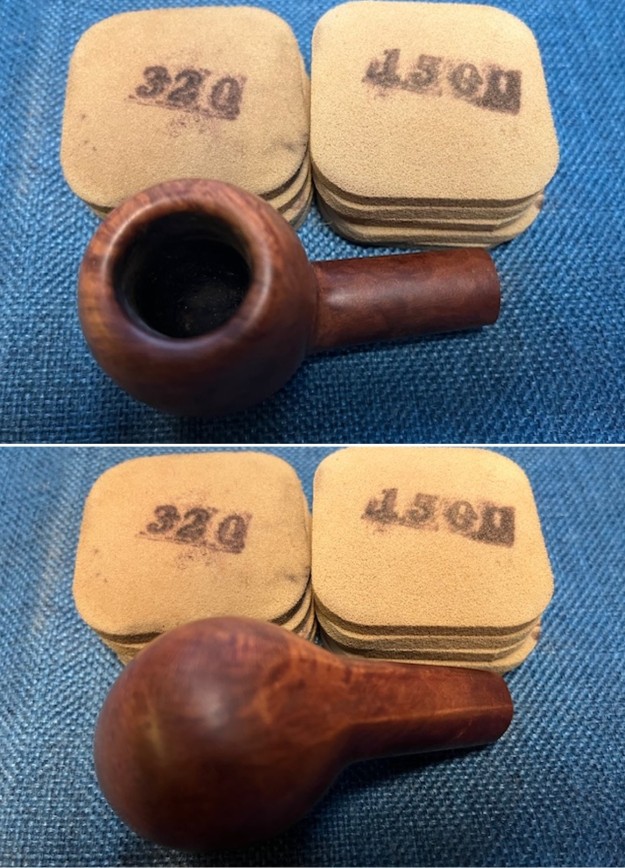
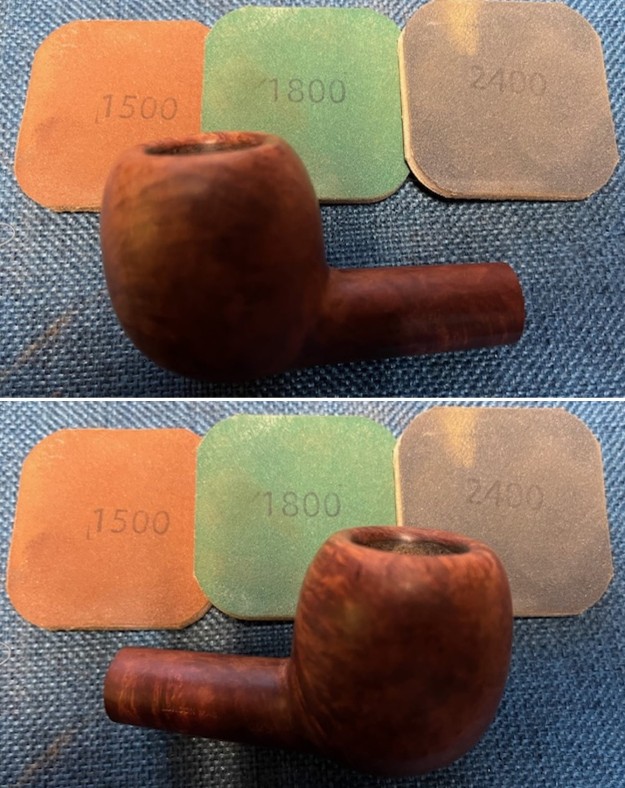
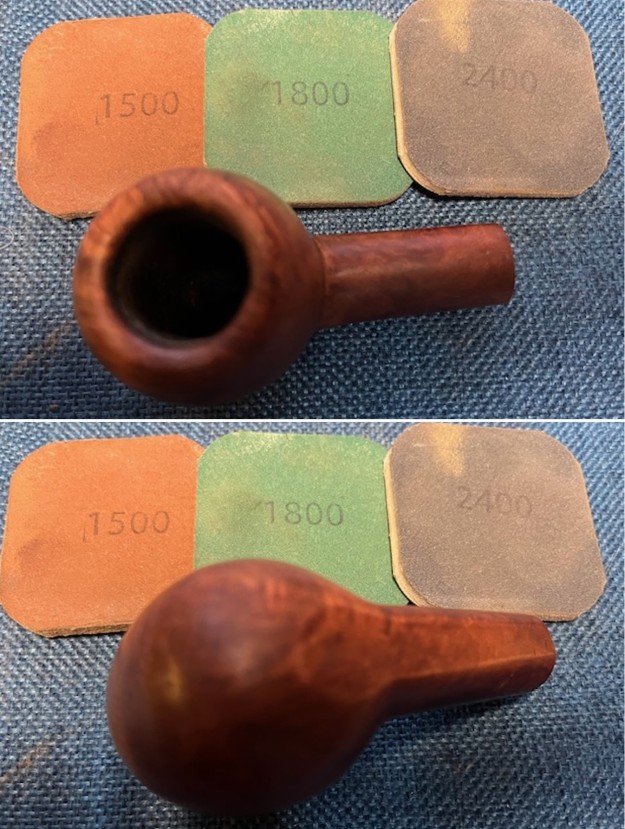
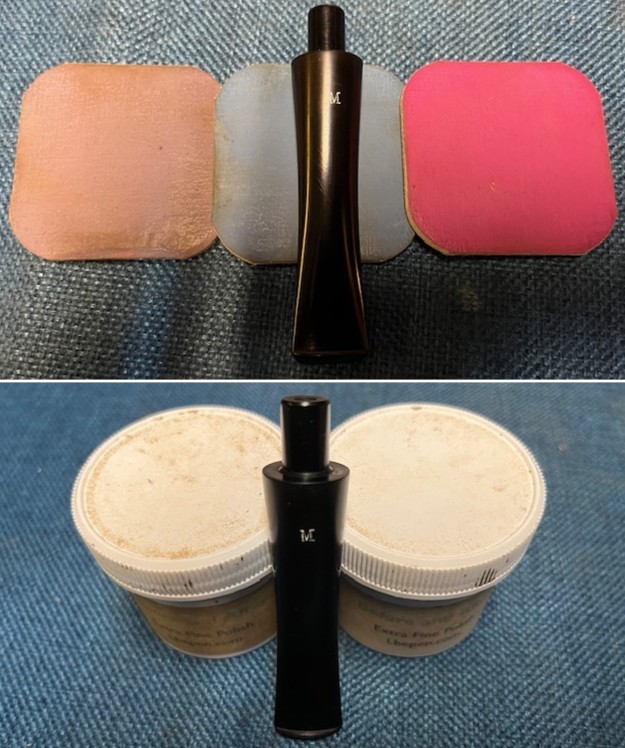
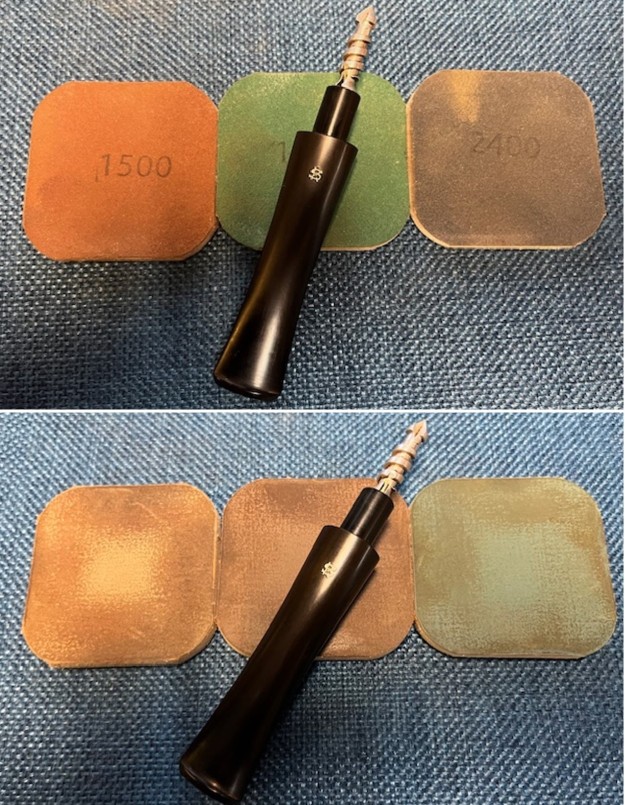
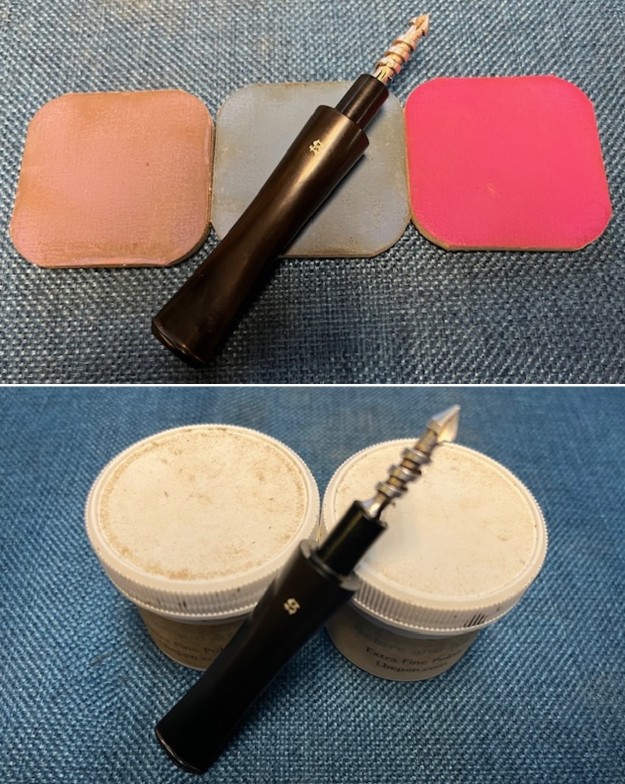
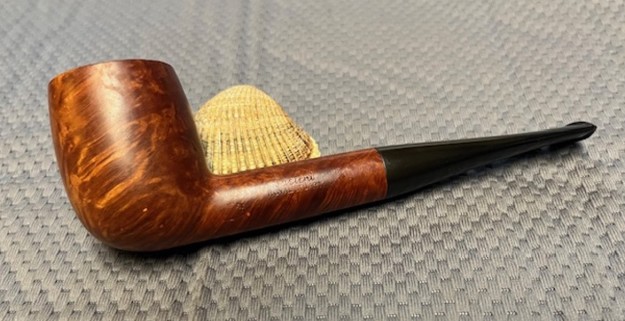
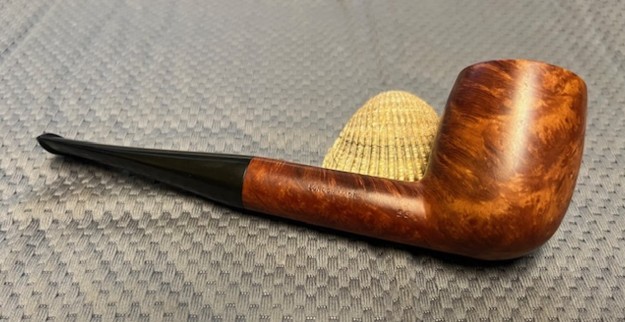
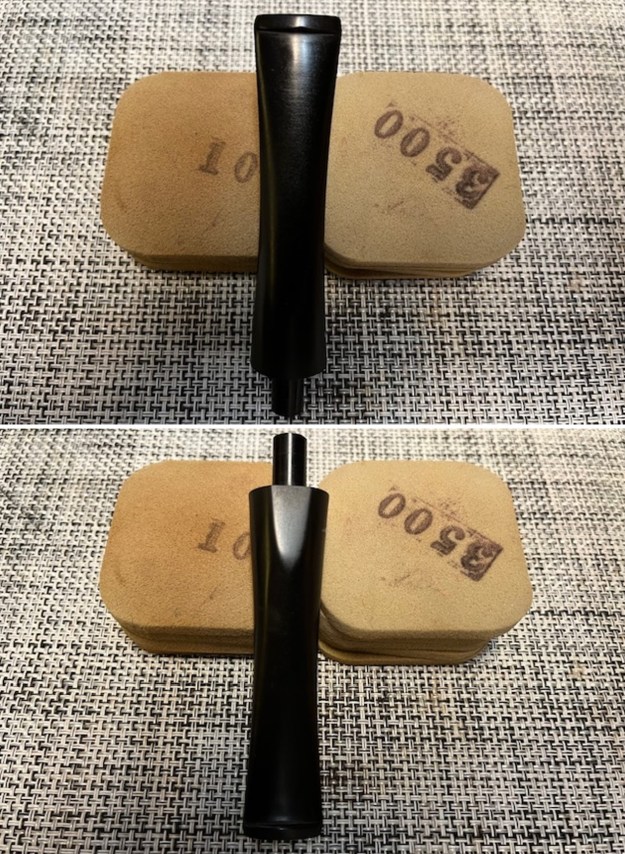
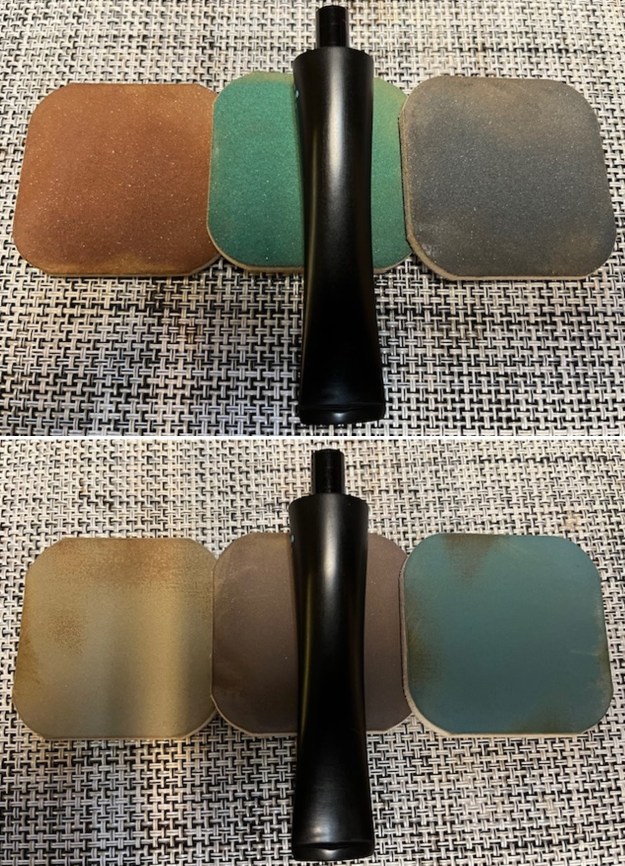
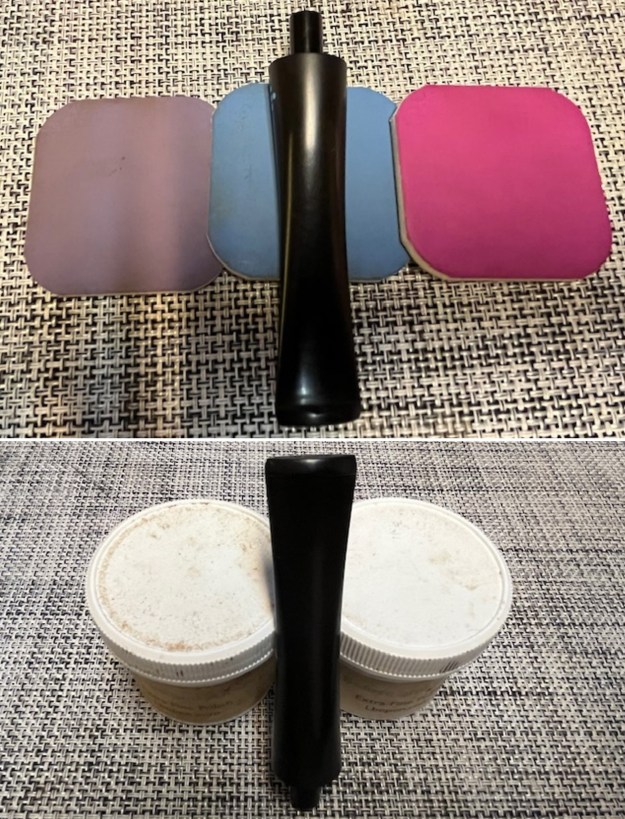
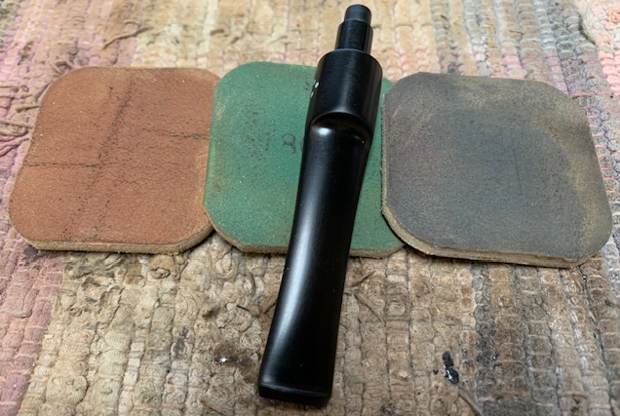
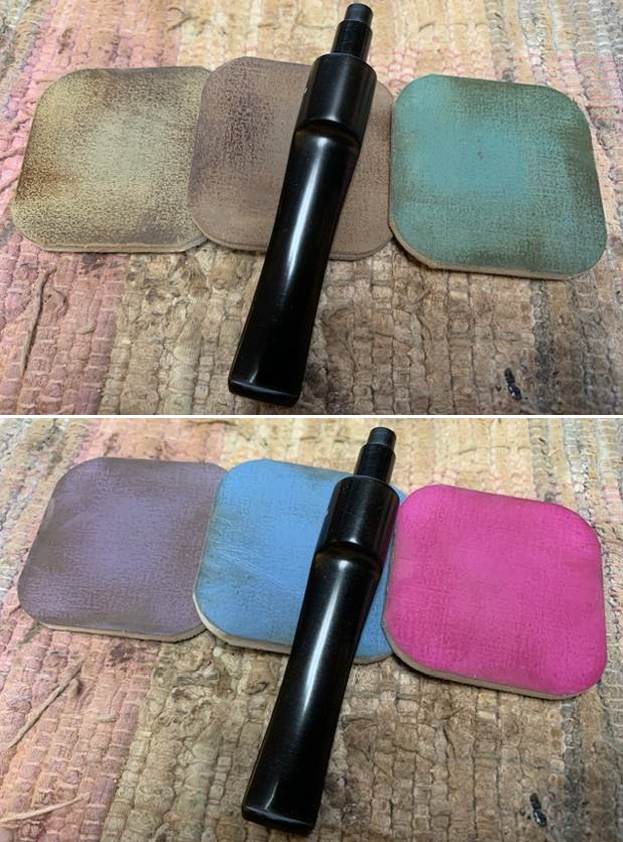
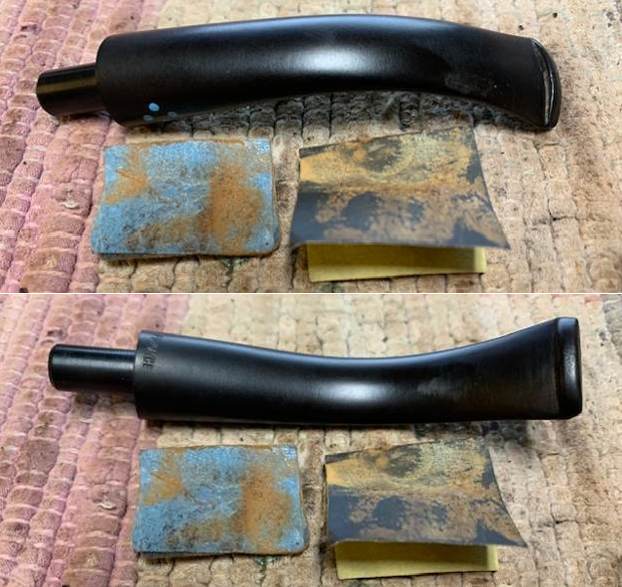
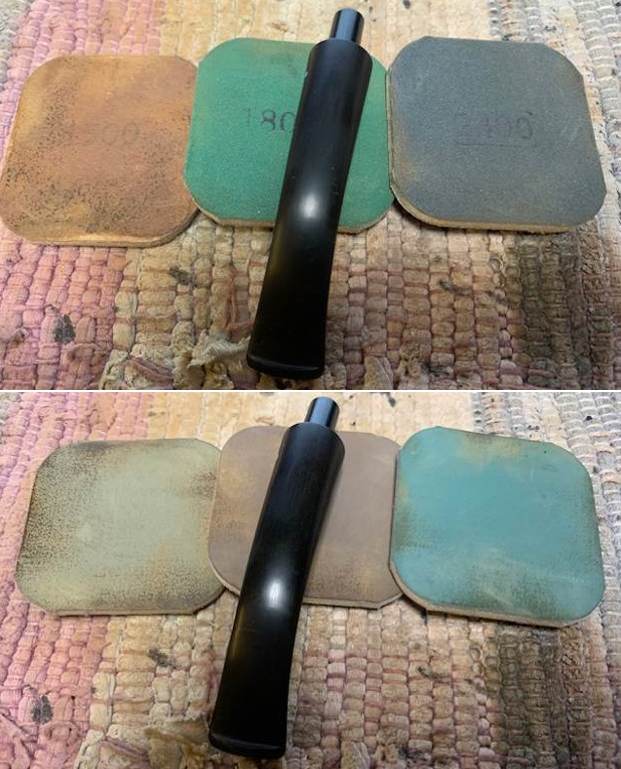
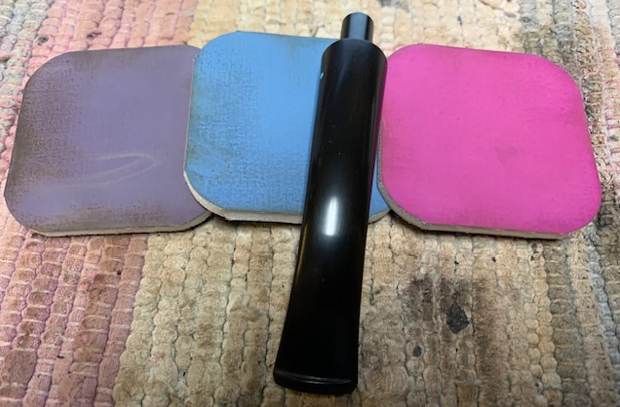
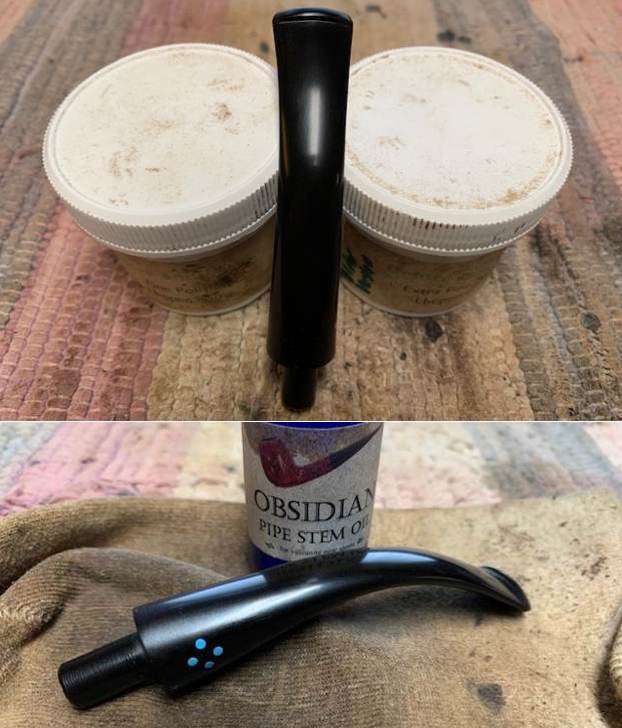
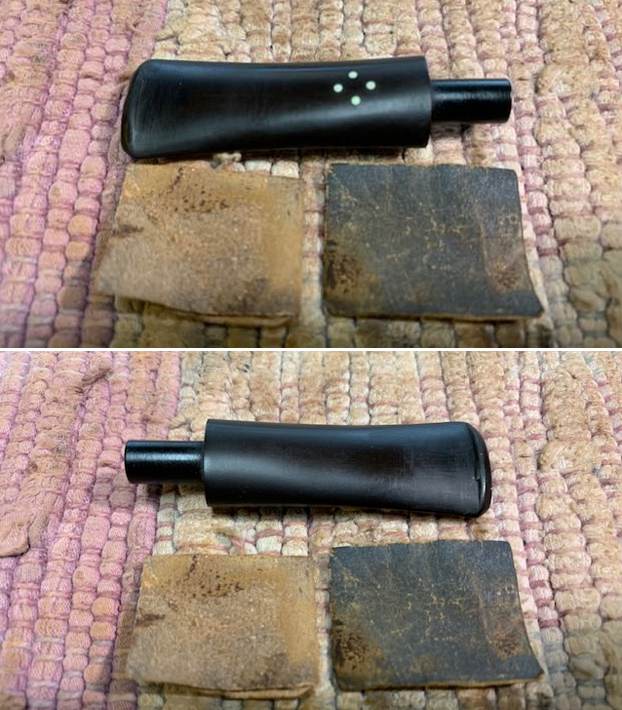
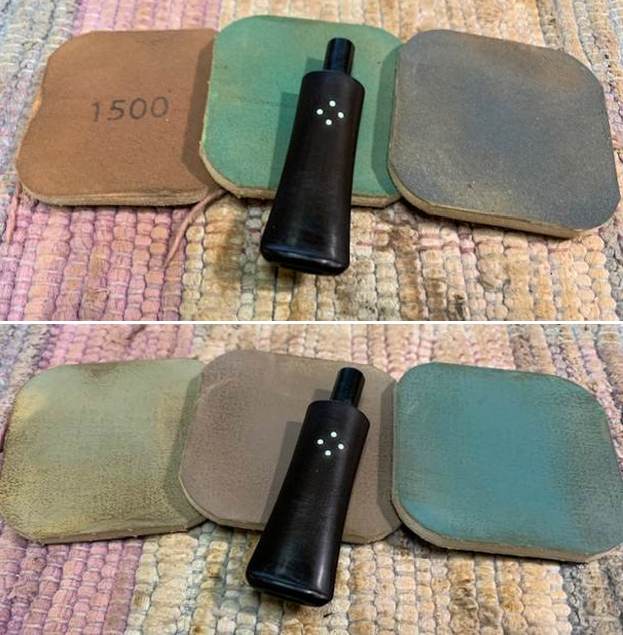
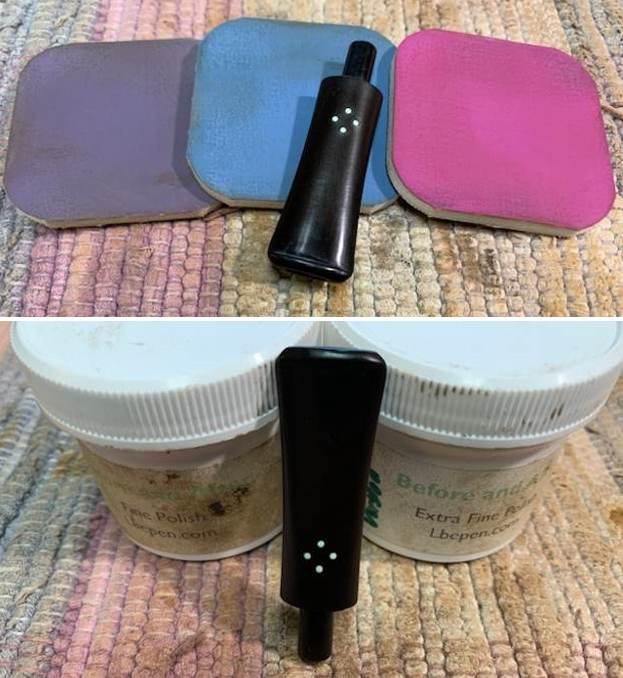
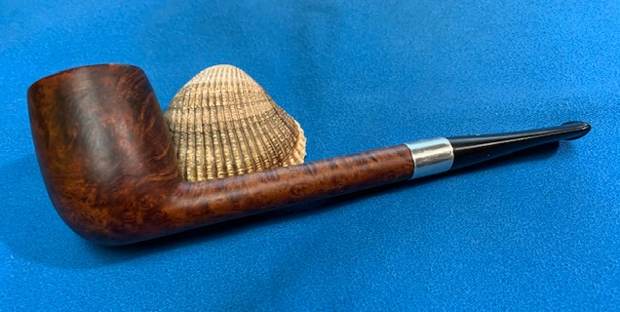
Since Jeff always follows the same pattern of work in his cleanup we do not include photos but rather just a simple summary. Jeff reamed the bowl with a PipNet pipe reamer and followed up with a Savinelli Fitsall pipe knife to remove the cake. He scrubbed out the mortise and the airway in the shank and the stem with alcohol, cotton swabs and pipe cleaners. He scrubbed the exterior of the bowl, rim, shank and stem with a tooth brush and Murphy’s Oil Soap to remove the oils and tars on the rim and the grime on the finish of the bowl. He rinsed it under running water. He dried it off with a soft cloth. He was able to remove the lava build up on the rim top and you could see the damages to the top and edges of the rim. I think this pipe may well been before we worked with Mark Hoover’s Before & After Deoxidizer so he cleaned the internals and externals. The stem was clean but lightly oxidized. I took photos of what the pipe looked like when I brought to my worktable. I took close up photos of the bowl, rim top and stem to show how clean the pipe was. The bowl was clean and the rim top and the inner edge look beautiful. The stem was clean and the tooth marks on the topside are visible. The chatter is light and hardly visible.I took a photo of the stamping on the underside of the left diamond shank. It is very clear and readable and read as noted above. I also removed the stem from the shank and took photos of the pipe to show the look of the parts.The exterior of the bowl looked amazing. I worked some Before & After Restoration Balm into the briar with my finger tips and a shoe brush. I let it sit on the bowl for 10 minutes and then buffed it off with a paper towel and soft cloth. The product is a great addition to the restoration work. It enlivens, enriches and protects the briar while giving it a deep glow. It is a product I use on every pipe I restore. I set the bowl aside and turned to the stem. I sanded the it with 320-3500 grit sanding pads and wiped the stem down after each pad with some Obsidian Oil on a cloth. The shine is coming back beautifully.I polished it with micromesh sanding pads – dry sanding with 1500-12000 grit pads and wiping the surface down with Obsidian Oil after each sanding pad. It is really shining. I polished it further with Before & After Stem Polish – both Fine and Extra Fine. I gave it another coat of Obsidian Oil to finish this step. This Sasieni 4 Dot Ruff Root Light 5 Diamond Shank Bent Billiard with a vulcanite saddle stem is a great looking pipe now that it has been restored. The beautifully grained sandblast finish really works well with the shape and the polished finish is stunning. I put the stem back on the bowl and carefully buffed the bowl and the stem with Blue Diamond on the buffing wheel. I gave the bowl and the stem multiple coats of carnauba wax on the buffing wheel and followed that by buffing the entire pipe with a clean buffing pad. I hand buffed the pipe with a microfiber cloth to deepen the shine. I wiped down the Sterling Silver band with a jeweller’s cloth to protect and polish it. The finished Sasieni 4 Dot Ruff Root Bent Billiard 5 fits nicely in the hand and feels great. Give the finished pipe a look in the photos below. The dimensions of the pipe are Length: 5 ½ inches, Height: 2 inches, Outside diameter of the bowl: 1 ½ inches, Chamber diameter: 7/8 of an inch. The weight of the pipe is 50 grams /1.76 ounces. I will be putting it on the rebornpipes store in the British Pipe Makers Section shortly. Let me know via email or a message if you are interested in adding this pipe to your collection.

As always, I encourage your questions and comments as you read the blog. Thanks to each of you who are reading this blog. Remember we are not pipe owners; we are pipe men and women who hold our pipes in trust until they pass on into the trust of those who follow us.

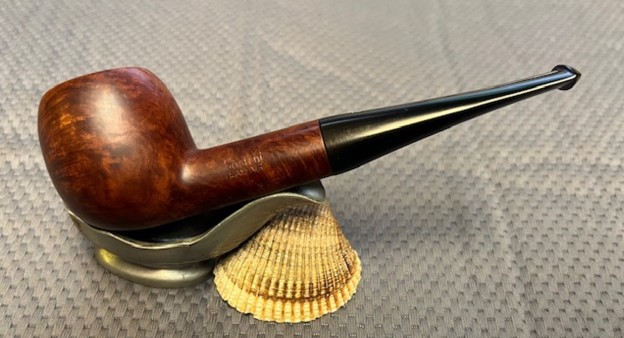
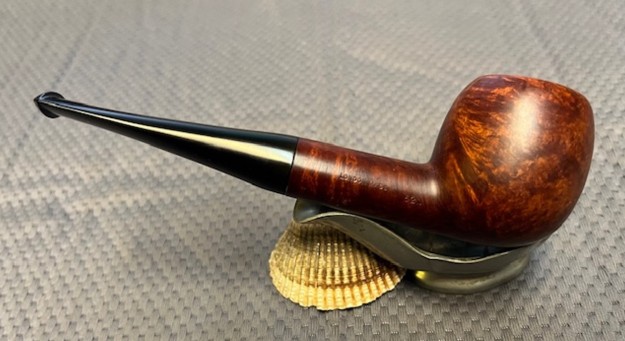
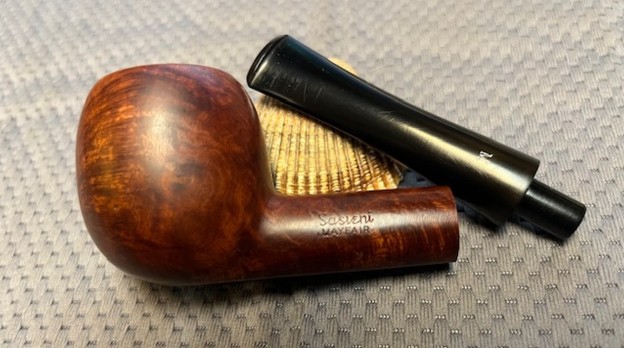
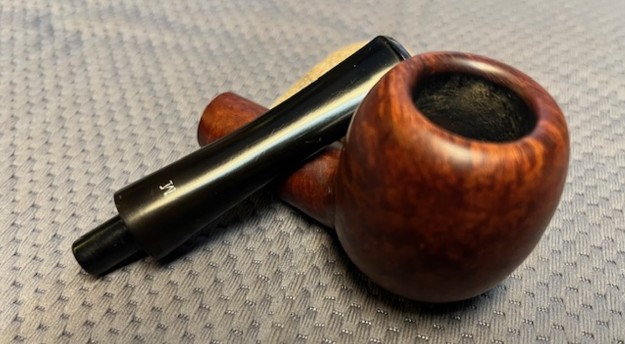
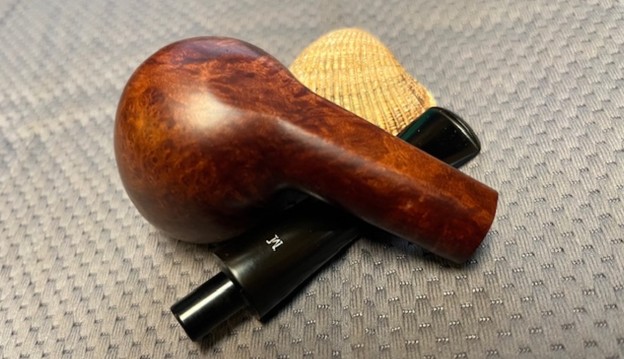
Cleaning up another Bellingham Pipe Hunt Find, a Sasieni Mayfair 52N Apple


By Steve Laug

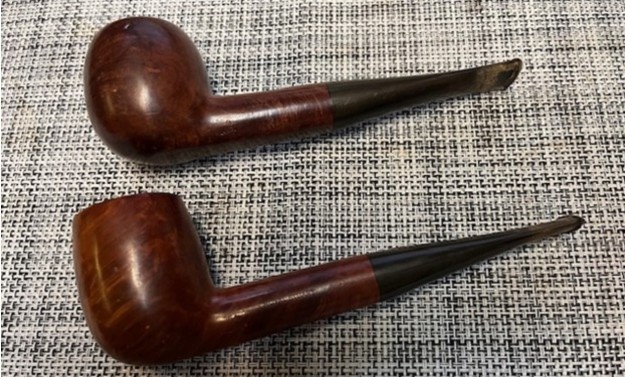
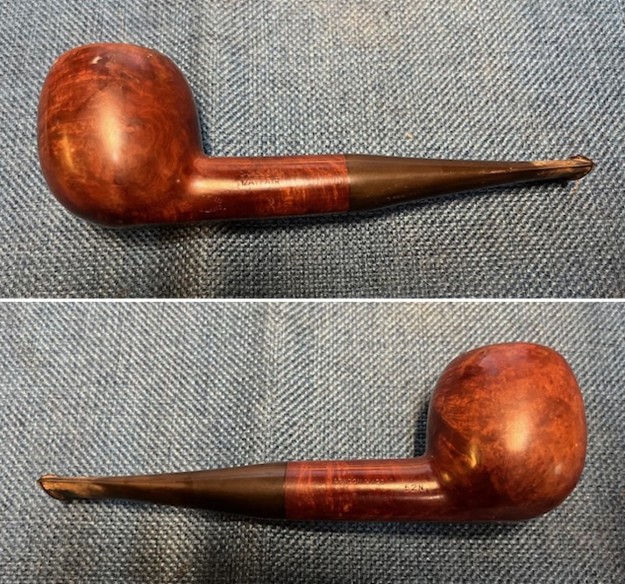
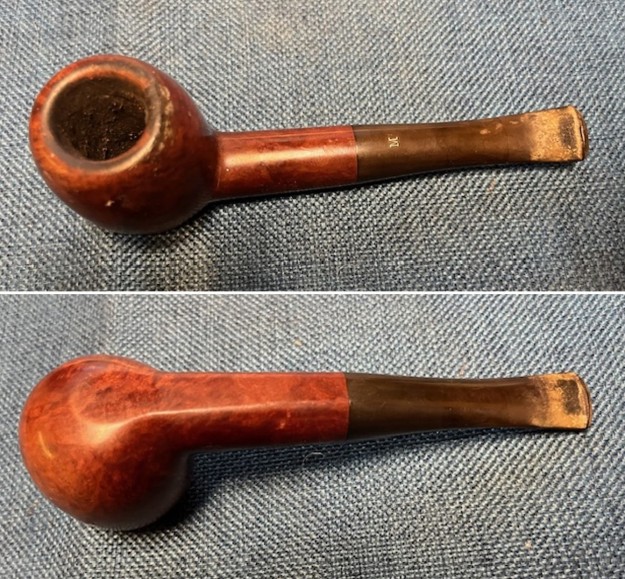
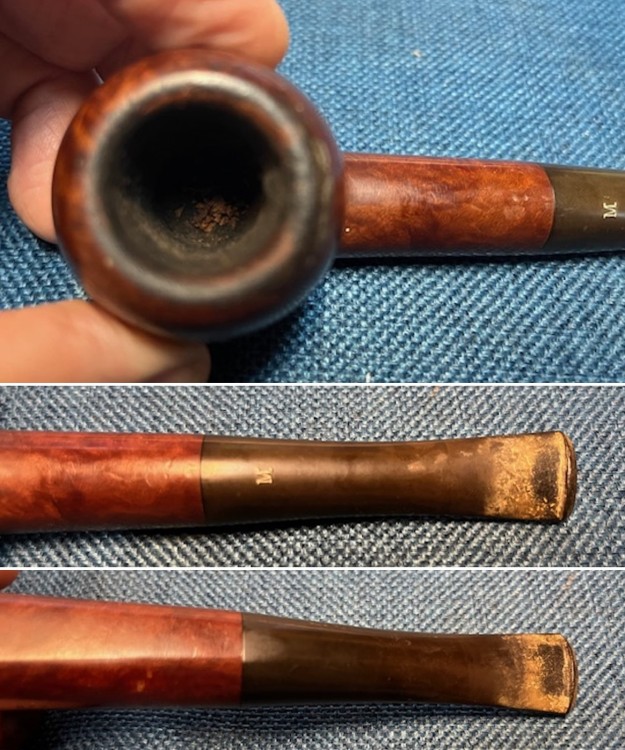
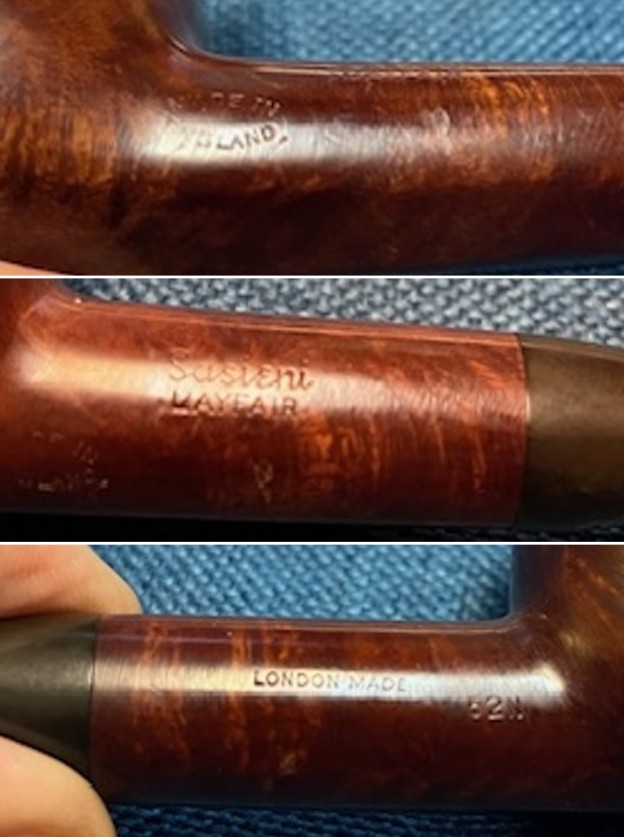
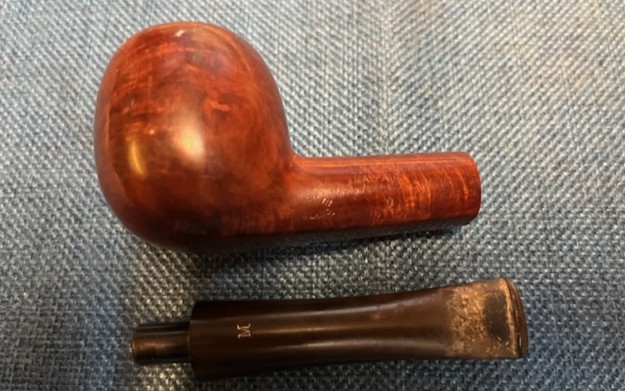
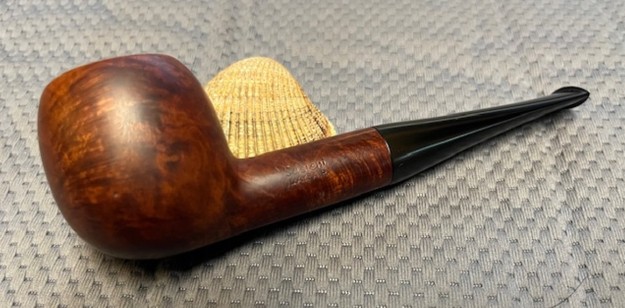
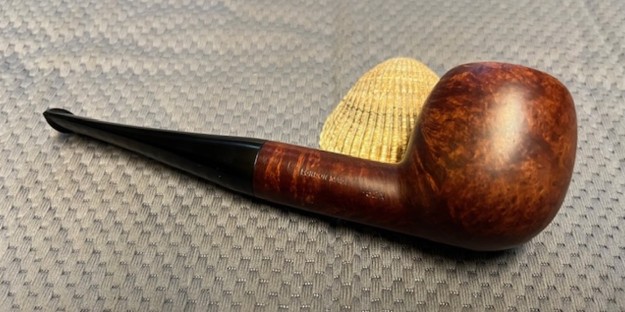
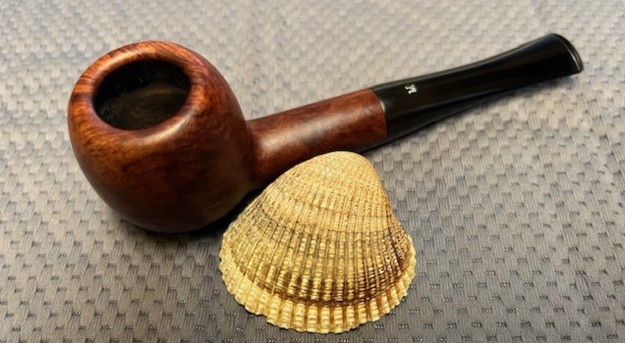
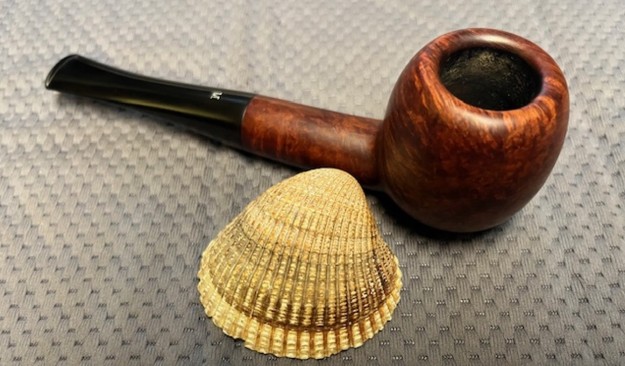
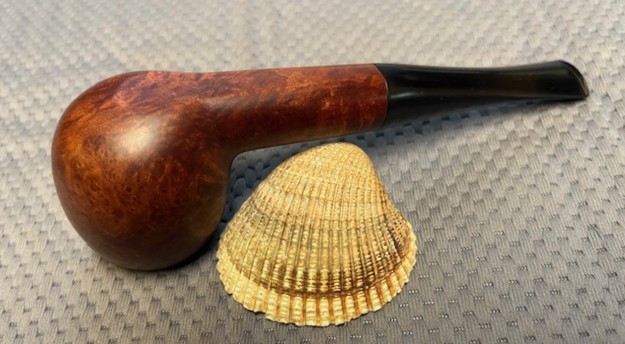
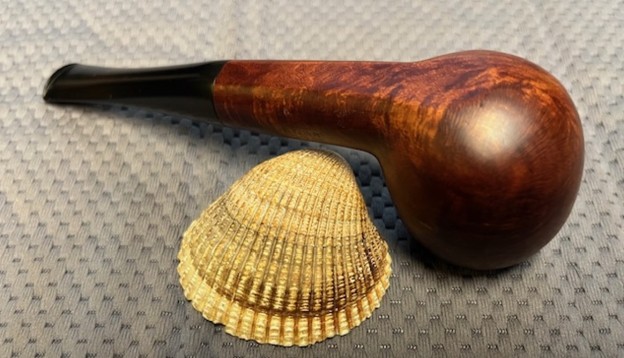
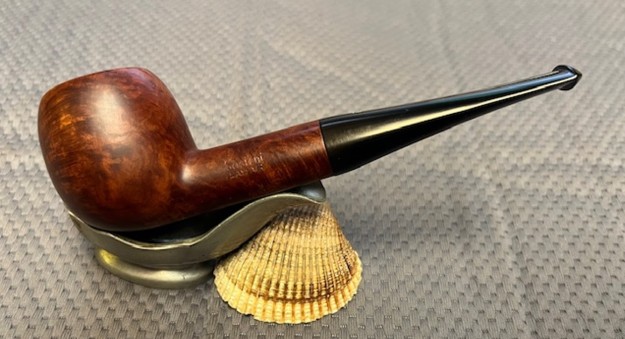
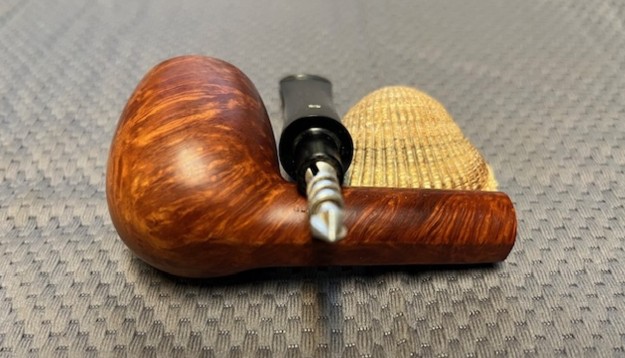
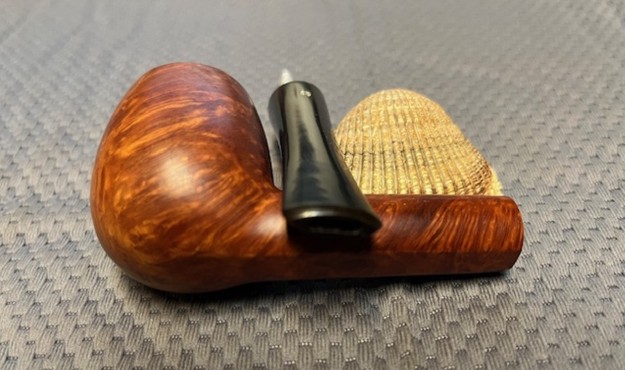
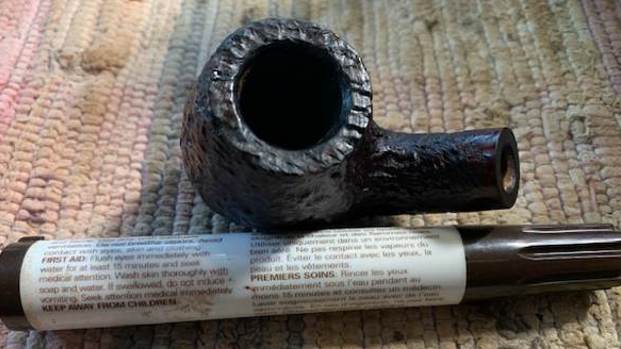
We met up at a local eatery and had a great breakfast together with our aunt. We took her to her residence afterwards and visited with her for most of the morning. Together we headed to Old Town Bellingham to begin our pipe hunt. We visited three of my favourite antique malls and worked out way through the aisles of wares for sale. Jeff and I tend to divide and conquer, each walking through the aisles of the shop looking for pipes. The rest of the family moves through looking for their own treasures. In the first shop there was a rack and in it were two pipes. The first was a Sasieni Royal Stuart Billiard and the second was a Sasieni Mayfair Apple. Both were great and were added to the hunt bag. Here is the link to the blog on the hunt and a photo of the pipes we added (https://rebornpipes.com/tag/bellingham-pipe-hunt/). Both were dirty but both contained the Sasieni Magic – classic shapes and nice briar. The next pipe on the work table is the second Sasieni a Mayfair Apple which is the upper pipe in the photo below. It is stamped on the left side of the shank and has a rugby ball stamp Made in England next to the shank/bowl junction. That is followed by Sasieni [over] Mayfair. On the right side it has the shape number 52N next to the bowl/shank junction followed by London Made stamped mid shank. The stem has an M logo on the topside. The bowl had a thick cake and a thick lava overflow on the rim. It was hard to estimate the condition of the rim top with the cake and lava coat but I was hoping it had been protected from damage. It appeared that the outer edge was in decent condition. The finish was a classic Sasieni smooth. The finish was dusty and tired but had some nice grain under the grime and the finish appeared to be in good condition. There were a few nicks in the surface on the left side of the bowl. A lot would be revealed once I had cleaned it. The stem was dirty, oxidized, calcified and had tooth chatter and tooth marks near the button on both sides. I took photos of the pipe before I stated my cleanup work. I took a close-up photo of the bowl and rim top to show its condition. The bowl had a thick cake in it and an overflow of lava on the top of the rim. The previous pipeman had left a mess for me to clean up. The stem was also is a mess. There was some tooth marks and dents on the top and underside ahead of the button. There was a thick coat of calcification and oxidation on the stem. M logo stamp on top of the stem was clear and readable.I took photos of the stamping on the right and left side of the shank. It is clear and readable as noted above. I removed the stem from the shank and took a photo of the parts. It is a beautiful pipe. The stinger apparatus is missing and the airway in the tenon is the same as the Royal Stuart that I worked on (https://rebornpipes.com/2024/06/16/cleaning-up-another-bellingham-pipe-hunt-find-a-sasieni-royal-stuart-55-billiard/). As is my usual practice I turned to Pipephil (http://www.pipephil.eu/logos/en/logo-sasieni2.html) to look for any information on the Mayfair line. It was not listed in the original Sasieni list but it did come up in the Sasieni Seconds list. It was listed there and I did a screen capture of the section and have included it below. The logo on the pipe stem I was working on is stamped like the third one below. The shank stamp was like the one in the third photo below. From that information I knew that I was dealing with a Family Era Sasieni with the white M logo that was used on these older ones. That placed the date before 1979 when the company was sold.

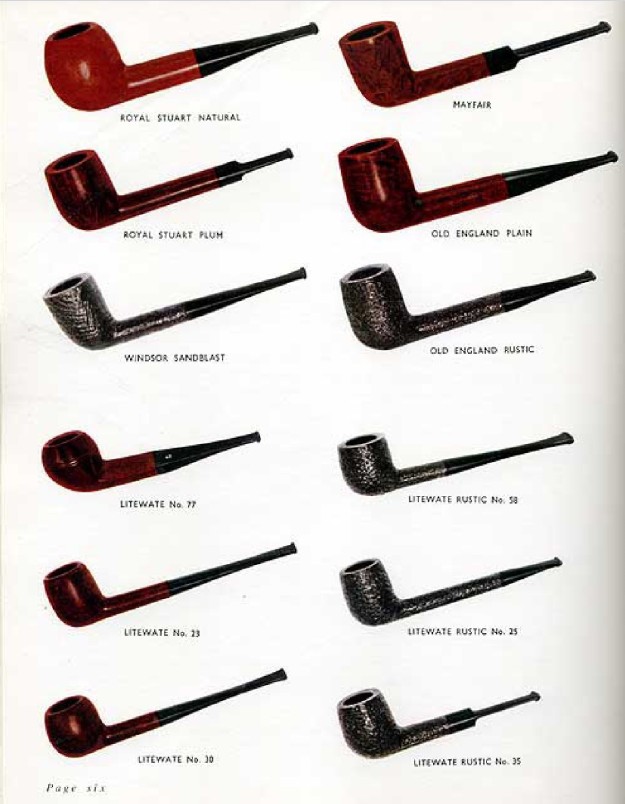
From there I turned to Pipedia and read through the history of the brand. It confirmed the date of manufacture as pre-1979. At the bottom of the Pipedia article there was a 1965 catalogue. I have included the link to the catalogue (https://pipedia.org/images/1/1b/Sasieni_1965.pdf). Page six of the catalogue had a listing of the Sasieni lines and on the top right column the Mayfair was shown.

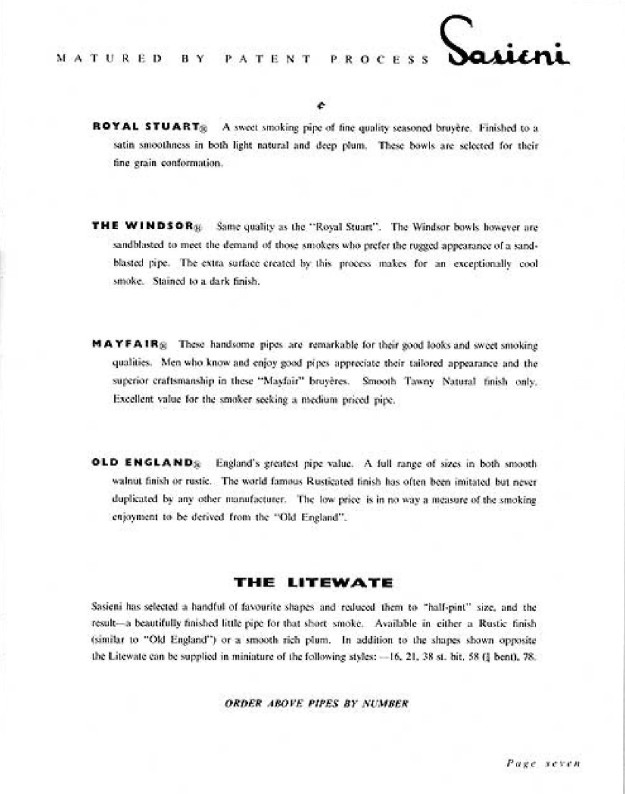
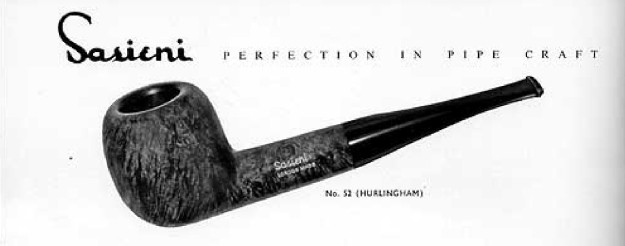
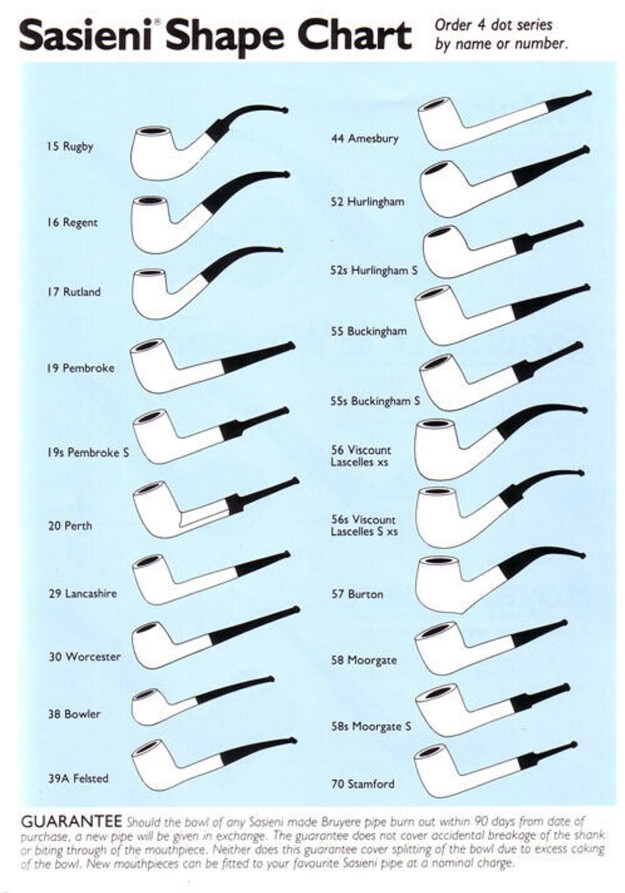
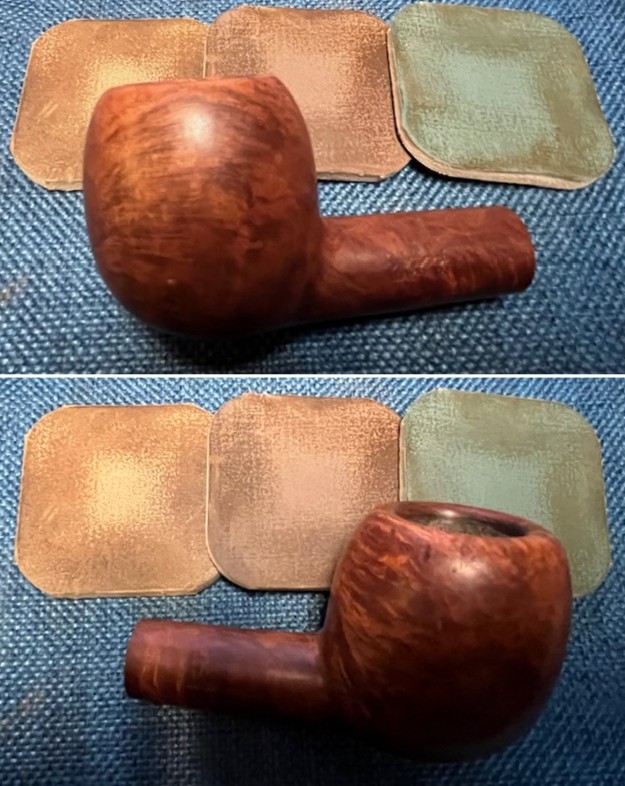
Page seven below gives a great description of the Mayfair line. It reads: Mayfair – these handsome pipes are remarkable for their good looks and sweet smoking qualities. Men who know and enjoy good pipes appreciate their tailored appearance and the superior craftsmanship in these “Mayfair” bruyeres. Smooth Tawny Natural finish only. Excellent value for the smoker seeking a medium priced pipe. Now I knew that is was not a second at all at this point in time. It was rather a well made pipe selected for its tailored appearance and superior craftsmanship on a medium priced pipe. That also pushed the date back to at 1965. The catalogue also had a shape photo that matched the numbers on the pipe I am working on. The shape 52 was known as a Hurlingham and was used in quite a few of the Sasieni lines for that large Apple. I have included a screen capture of the shape photo in the catalogue.There was also a shape chart on Pipedia and I have saved the page that included the shape of the 52N (Hurlingham) (https://pipedia.org/wiki/File:Sasnieni_Shapes.jpg).Now I knew what I was working on. It was a pre-1965 Apple in the Hurlingham shape in an early version of the Mayfair and in Smooth Tawny Natural finish that had taken on some colour through smoking. Now it was time to start my work on it. I reamed the pipe with a PipNet pipe reamer using the second and the third cutting head to take the cake back to bare briar. I cleaned up the remnants of the cake with a Savinelli Fitsall Pipe Knife. I finished the bowl internals by sanding the bowl walls with 220 grit sandpaper wrapped around a piece of dowel. The bowl walls looked very good with no checking or cracking to the walls. I scraped the heavy lava on the rim top with the edge of the Savinelli Fitsall Pipe Knife. I was able to remove the majority of the build up. The rest would come up after I scrubbed the bowl.I decided to scrub the bowl with Mark Hoover’s Before & After Briar Cleaner. He had sent me a sample to try out so this was the first pipe to try it out on. I shook the jar to make sure it was well mixed. I applied it to the surface of the briar bowl and the filthy rim top with my finger tips. I scrubbed it with a tooth brush and wiped it off with a cotton pad to remove the grime and the residual product left on the briar.  It looked much better once I had cleaned it. I rinsed it off with warm water and dried the briar with a cotton cloth. There were still some flecks of paint and debris on the briar and the rim top still had some lava that I needed to remove. I wiped the bowl with a cotton pad and acetone and cleaned off the remainder of the debris and the briar looked very good. With the externals cleaned it was now time to work on the internals of the mortise, shank and airway in the stem. I scraped the walls of the shank with a dental spatula and took a lot of tars and oils out with the spatula. From there I cleaned up the debris with pipe cleaners, cotton swabs and isopropyl alcohol until it was clean and the smell was gone. I cleaned the airway in the stem with alcohol, cotton swabs and pipe cleaners. I used both bristle and fluffy pipe cleaners to clean out the oils and tars. I scoured out the open tenon with a cotton swab. It came out looking much better. I set the stem aside and went back to working on the bowl. I sanded the briar with 320-3500 grit sanding pads. I wiped the briar down after each sanding pad with a damp cloth to remove the debris that was left behind. By the time I finished the last pad the briar was very smooth and clean to the touch. I polished the briar with micromesh sanding pads – dry sanding with 1500-12000 grit sanding pads. I wiped it down with a damp cloth after each sanding pad. The bowl began to really shine with the polishing. I worked some Before & After Restoration Balm into the finish of the briar with my finger tips. The product works well to clean, enliven and protect the briar and really brings it back to life. I have been using it for quite a few years now and really like the way it makes the briar come alive and makes the grain pop. I set aside the bowl and turned my attention to the stem. I “painted” the tooth marks on the surface of the stem and was able to lift them all. I blended the remaining marks into the surface with a folded piece of 220 grit sandpaper. I worked on the oxidation on the stem with Soft Scrub and cotton pads. I find that the product really cut through the deep oxidation and removes it well. I worked on both side of the stem and was pleased that it did no harm the “M” stamp on the topside of the stem.I sanded the stem with 320-3500 grit sanding pads to blend in the scratch marks from the 220 grit sandpaper and to remove the residual oxidation that still remained. I wiped it down after each sanding pad with a damp cloth. By the final 3500 grit sanding pad the stem had a more normal shine and the oxidation, tooth marks and chatter were gone.I decided to touch up the M stamp on the top of the stem at this point. I used an acrylic white fingernail polish and it dries hard and matches very well. I applied it with the brush in the cap and worked it into the stamp with a tooth pick. Once it was cured I lightly sanded it off with a 1500 grit micromesh sanding pad.I polished the vulcanite with micromesh sanding pads – 1500-12000 grit pads. I wiped it down with Obsidian Oil after each sanding pad. I used Before & After Pipe Polish – both Fine and Extra Fine to further polish the stem. This Sasieni Mayfair 52N Apple with a vulcanite taper stem has a beautiful, unique Natural Sasieni finish that has some great grain standing out. The polished vulcanite taper stem adds to the mix. I put the stem back on the bowl and buffed the pipe with Blue Diamond on the buffing wheel being careful to not buff the stamping. I gave the bowl and the stem multiple coats of carnauba wax on the buffing wheel and followed that by buffing it with a clean buffing pad. I hand buffed the pipe with a microfiber cloth to deepen the shine. The finished Made in England Sasieni Mayfair 52N Apple is quite nice and feels great in the hand. Give the finished pipe a look in the photos below. The dimensions of the pipe are Length: 6 inches, Height: 1 ¾ inches, Outside diameter of the bowl: 1 ¼ inches, Chamber diameter: ¾ of an inch. The weight of the pipe is 1.76 ounces/50 grams. Thanks for walking through the restoration with me as I worked over another beautiful pipe. This one will be going on the rebornpipes store in the English Pipe Makers Section. Thanks for your time.

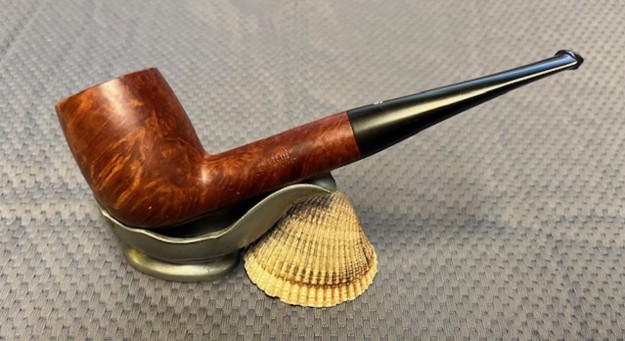
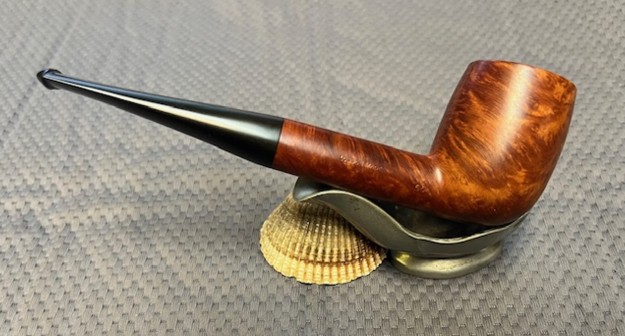
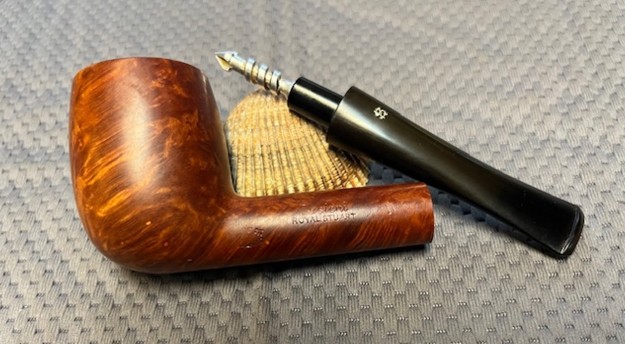
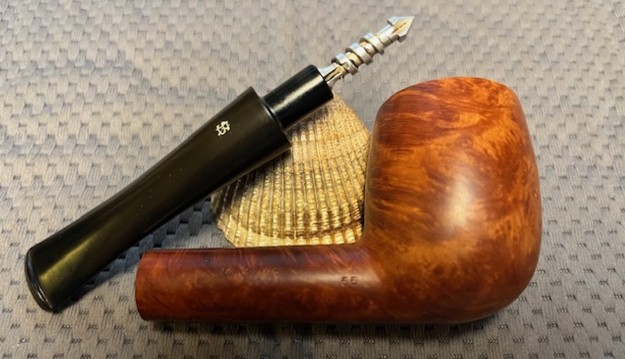
Cleaning up another Bellingham Pipe Hunt Find – a Sasieni Royal Stuart 55 Billiard


By Steve Laug

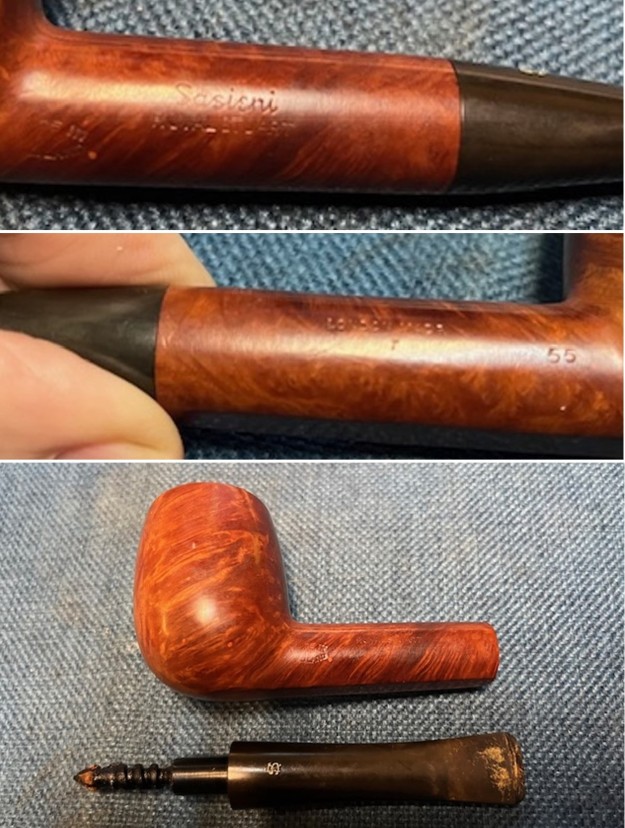
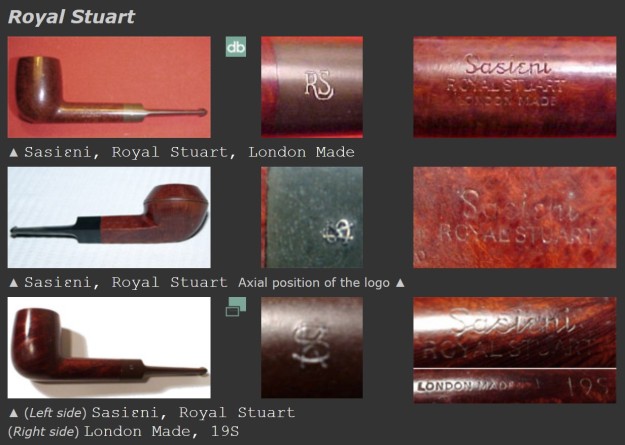
We met up at a local eatery and had a great breakfast together with our aunt. We took her to her residence afterwards and visited with her for most of the morning. Together we headed to Old Town Bellingham to begin our pipe hunt. We visited three of my favourite antique malls and worked out way through the aisles of wares for sale. Jeff and I tend to divide and conquer, each walking through the aisles of the shop looking for pipes. The rest of the family moves through looking for their own treasures. In the first shop there was a rack and in it were two pipes. The first was a Sasieni Royal Stuart Billiard and the second was a Sasieni Mayfair Apple. Both were great and were added to the hunt bag. Here is the link to the blog on the hunt and a photo of the pipes we added (https://rebornpipes.com/tag/bellingham-pipe-hunt/). Both were dirty but both contained the Sasieni Magic – classic shapes and nice briar. The next pipe on the work table is the Sasieni Royal Stuart which is the lower pipe in the photo below. It is stamped on the left side of the shank and has a rugby ball stamp Made in England next to the shank/bowl junction. That is followed by Sasieni [over] Royal Stuart. On the right side it has the shape number 55 next to the bowl/shank junction followed by London Made stamped mid shank. The stem has an RS logo on the topside. The bowl had a thick cake and almost a half bowl of tobacco filling it. There was a thick lava overflow on the rim. It was hard to estimate the condition of the rim top with the cake and lava coat but I was hoping it had been protected from damage. It appeared that the outer edge was in decent condition. The finish was a classic Sasieni smooth. The finish was dusty and tired but had some nice grain under the grime and the finish appeared to be in good condition. A lot would be revealed once I had cleaned it. The stem was dirty, oxidized, calcified and had tooth chatter and tooth marks near the button on both sides. I took photos of the pipe before I started my cleanup work. I took a close-up photo of the bowl and rim top to show its condition. The bowl is over half full with burned tobacco and debris. It is unburned just below the surface of the ash. I always wonder when I find a bowl filled like this what happened to the pipeman who had the pipe before. Was he suddenly called out during a smoke? Did something happen to him after he laid the bowl down that kept him from coming back and finishing his smoke. I guess know one will ever know. It left a mess for me to clean up. The stem was also is a mess. There was some tooth marks and dents on the top and underside ahead of the button. There was a thick coat of calcification and oxidation on the stem. RS logo stamp on top of the stem was clear and readable.I took photos of the stamping on the right and left side of the shank. It is clear and readable as noted above. I removed the stem from the shank and took a photo of the parts. It is a beautiful pipe. The stinger apparatus was filthy and clogged with tar and oils in the spear end and all the spirals. It is aluminum but you would never know that from looking at it.As is my usual practice I turned to Pipephil (http://www.pipephil.eu/logos/en/logo-sasieni2.html) to look for any information on the Royal Stuart line. It was not listed in the original Sasieni list but it did come up in the Sasieni Seconds list. It was listed there and I did a screen capture of the section and have included it below. The logo on the pipe stem I was working on is stamped like the second one below. The shank stamp was like the one in the third photo below. While this was helpful it did not get me any closer to establishing a date for the pipe. I turned to Google and did a quick search there. It came up with a Worthpoint article that I have included along with the photos below (https://www.worthpoint.com/worthopedia/sasieni-family-era-royal-stuart-139465999).This COLLECTIBLE BRIAR PIPE is an OLD “FAMILY-ERA” SASIENI in the CLASSIC CANADIAN Shape!!! It is a Dunhill Group 4 Size. Although like most non-dotted Sasieni’s it does not have a “Town Name” (which Sasieni used in lieu of Shape Numbers), Sasieni connoisseurs will recognize this as the ever-popular “Amesbury” Shape (#44 on the Sasieni Shape Charts)! It comes from one of Sasieni’s oldest and most popular lines – – – the “ROYAL STUART”!!! It is one of the OLDEST ROYAL STUART’s because it has the ORIGINAL “RS” OVERSTAMPED LOGO (with the “R” Stamped over the “S” or vice versa)! For those who have not experienced the quality of Sasieni Pipes, this is an outstanding opportunity that does not require the commitment of a substantial investment as do many higher graded Sasieni’s! In the early Sasieni History after the short reign of the One Dot, Sasieni Eight Dots, the Four Dots became the top-of-the-line throughout most of the “Family Era” (or the time during which the Sasieni Family continued in ownership and operated the company including the quality control). Pipes that were not quite good enough to receive a higher grade became Two Dots or “Claret” One Dots. At the same time and throughout the history of the Company, Sasieni also offered a wide variety of non-dotted pipes beginning with their earliest catalogs. Many of those early lines like “His Royal Highness,” “The Henley Club” and “The Friar” disappeared into the rich lore of Sasieni History. But the “ROYAL STUART” survived the test of time and continued throughout the Family Era. During the “FAMILY ERA,” the finish often became the distinguishing characteristic between lines of “non-dotted” Sasieni’s. Mayfair’s were “Smooth Tawny Natural finish,” and Old England’s started as rusticated pipes while Royal Stuart’s were natural smooth or “deep plum” colored . Their great popularity quickly caused Sasieni to expand the Royal Stuart line to include “carved rusticated finish” pipes, too! And, the Royal Stuart became one of the longest-running “workhorses” among all Sasieni lines! Royal Stuart’s were advertised as an “outstanding quality and rare value” pipe but it was the bowl selection process that separated this line from others. Sasieni explained: “These bowls are selected for their fine grain conformation.” And this Canadian is a good example! Much of the Bowl has BIRDSEYE on the sides with DIAGONAL CROSS GRAIN which is actually more like STRANDS OF FLAME GRAIN on the front and back!!! The FLAME GRAIN continues on both sides of the Shank where it becomes PERPENDICULAR, PARALLEL STRAIGHT GRAIN!!! The NATURAL SMOOTH Finish has mellowed into a LIGHT WALNUT BROWN PATINA and there are NO dents, chips or scratches which detract from the beauty of the finish! A few small sandpits or sandspots keep the Pipe from perfection (and undoubtedly kept it from becoming a “dotted” Sasieni)! NO varnish, lacquer or shellac has been added to improve the finish for the pictures and temporarily conceal scratches and toothmarks! And, NO coating has been applied to the inside of the bowl to hide cracks, heat fissures and even burn-outs! The Pipe shines as it did when it came from the factory! This Canadian is 6″ LONG with a Bowl just OVER 1 3/4″ TALL!!! The nomenclature is crisp and clear: “Sasieni [in script], ROYAL STUART, LONDON MADE, MADE IN ENGLAND [in the classic Sasieni “football” shape], 44N”. The very oldest White Sasieni “RS” Overstamped Logo used on Royal Stuart’s remains mostly visible on the original bit! This is an unusual and collectible old Sasieni that is in PRISTINE CONDITION!!! It is an excellent entry-level Sasieni collectible! If the CONDITION of your eBay purchase is of importance to you, you will not find a better Sasieni Royal Stuart on eBay. Particularly because of its condition, this Royal Stuart is a bargain priced collectible! This Sasieni Canadian has been refurbished and is ready to smoke. There are no toothmarks on the mouthpiece and no carbon build-up on the Rim of the bowl.

From that information I knew that I was dealing with a Family Era Sasieni with the white overstamped RS logo that was used on these older ones. That placed the date before 1979 when the company was sold.

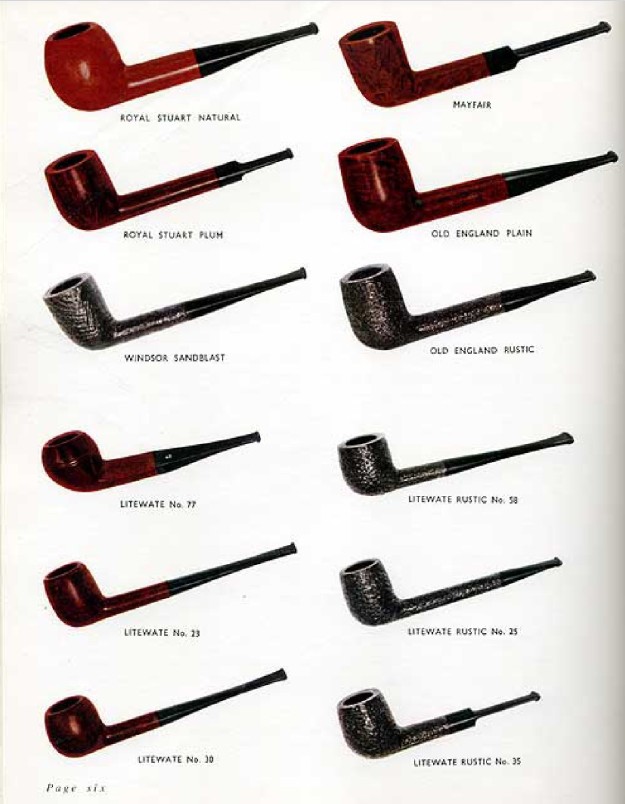
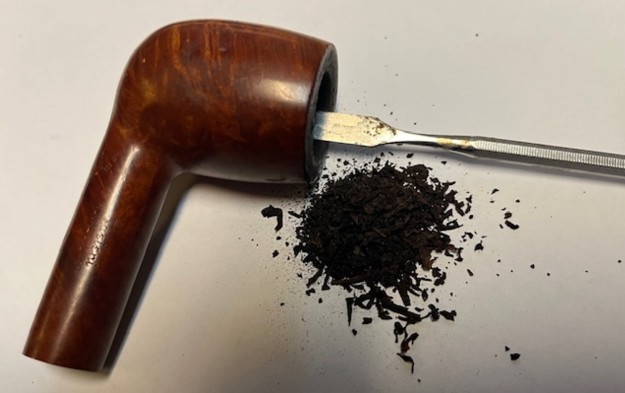
From there I turned to Pipedia and read through the history of the brand. It confirmed the date of manufacture as pre-1979. At the bottom of the Pipedia article there was a 1965 catalogue. I have included the link to the catalogue (https://pipedia.org/images/1/1b/Sasieni_1965.pdf). Page six of the catalogue had a listing of the Sasieni lines and on the top left column the Royal Stuart was shown.

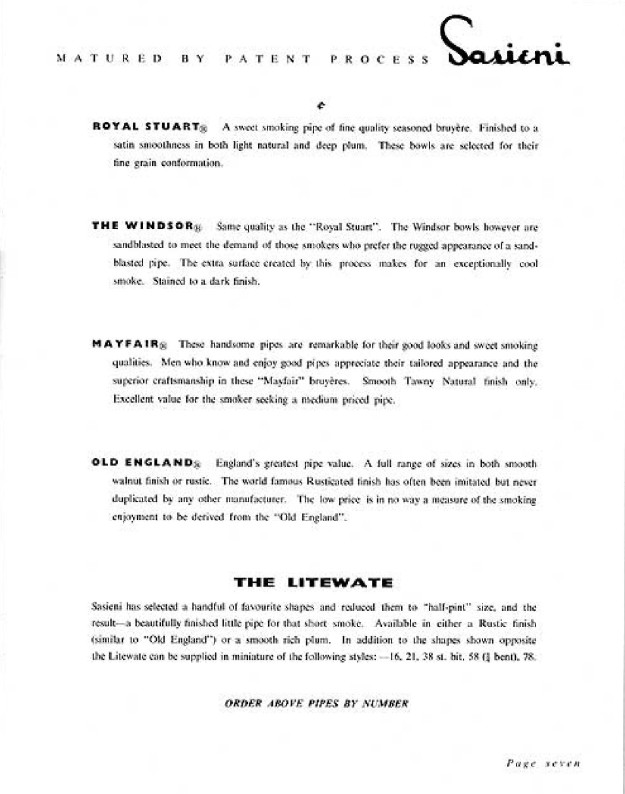
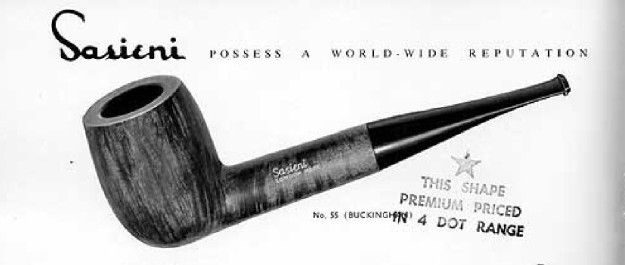
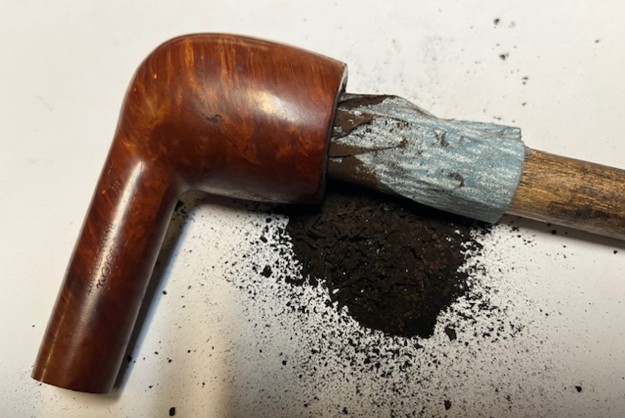
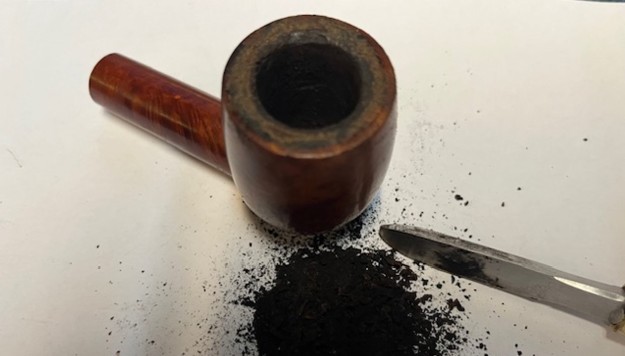
Page seven below gives a great description of the Royal Stuart line. It reads: Royal Stuart a sweet smoking pipe of fine smoking quality bruyere. Finished to a satin smoothness in both light natural and deep plum. These bowls are selected for their fine grain conformation.Now I knew that is was not a second at all at this point in time. It was rather a well made pipe selected for its fine grain conformation. That also pushed the date back to at 1965. The catalogue also had a shape photo that matched the numbers on the pipe I am working on. The shape 55 was known as a Buckingham and was used in quite a few of the Sasieni lines for that large Billiard. I have included a screen capture of the shape photo in the catalogue.There was also a shape chart on Pipedia and I have saved the page that included the shape of the 55 (Buckingham) (https://pipedia.org/wiki/File:Sasnieni_Shapes.jpg).Now I knew what I was working on. It was a pre-1965 Billiard in the Buckingham shape in an early version of the Royal Stuart and in the light Natural finish that had taken on some colour through smoking. Now it was time to start my work on it. I used a dental spatula to remove the dried tobacco in the bottom half of the bowl. It was too dry and to compromised to determine the type of tobacco but I could tell that it was not an aromatic as there was no smell in the tars and oils in the shank and on the stinger.I reamed the pipe with a PipNet pipe reamer using the second and the third cutting head to take the cake back to bare briar. I cleaned up the remnants of the cake with a Savinelli Fitsall Pipe Knife. I finished the bowl internals by sanding the bowl walls with 220 grit sandpaper wrapped around a piece of dowel. The bowl walls looked very good with no checking or cracking to the walls. I scraped the heavy lava on the rim top with the edge of the Savinelli Fitsall Pipe Knife. I was able to remove the majority of the build up. The rest would come up after I scrubbed the bowl.I decided to scrub the bowl with Mark Hoover’s Before & After Briar Cleaner. He had sent me a sample to try out so this was the first pipe to try it out on. I shook the jar to make sure it was well mixed. I applied it to the surface of the briar bowl and the filthy rim top with my finger tips. I scrubbed it with a tooth brush and wiped it off with a cotton pad to remove the grime and the residual product left on the briar.  It looked much better once I had cleaned it. I rinsed it off with warm water and dried the briar with a cotton cloth. There were still some flecks of paint and debris on the briar and the rim top still had some lava that I needed to remove. I wiped the bowl with a cotton pad and acetone and cleaned off the remainder of the debris and the briar looked very good. With the externals cleaned it was now time to work on the internals of the mortise, shank and airway in the stem. I scraped the walls of the shank with a dental spatula and took a lot of tars and oils out with the spatula. From there I cleaned up the debris with pipe cleaners, cotton swabs and isopropyl alcohol until it was clean and the smell was gone. In order to clean out the shank I needed to remove the stinger apparatus from the tenon. I heated the stinger with a lighter and the goo softened enough to be able to remove the singer. I then cleaned the airway in the stem with alcohol, cotton swabs and pipe cleaners. I used both bristle and fluffy pipe cleaners to clean out the oils and tars. I used a tooth brush and a brass bristle wire brush to clean off the stinger at the same time. I scoured out the open tenon with a cotton swab. It came out looking much better. I set the stem aside and went back to working on the bowl. I sanded the briar with 320-3500 grit sanding pads. I wiped the briar down after each sanding pad with a damp cloth to remove the debris that was left behind. By the time I finished the last pad the briar was very smooth and clean to the touch. I polished the briar with micromesh sanding pads – dry sanding with 1500-12000 grit sanding pads. I wiped it down with a damp cloth after each sanding pad. The bowl began to really shine with the polishing. I worked some Before & After Restoration Balm into the finish of the briar with my finger tips. The product works well to clean, enliven and protect the briar and really brings it back to life. I have been using it for quite a few years now and really like the way it makes the briar come alive and makes the grain pop. I set aside the bowl and turned my attention to the stem. I “painted” the tooth marks on the surface of the stem and was able to lift them partially. I cleaned out the tooth marks with alcohol and q-tip then filled in the ones that remained with some rubberized, black CA glue. Once the glue cured I flattened out the repairs and recut the button edge with small files to start the process of blending them into the surface of the vulcanite. I further blended then with a folded piece of 220 grit sandpaper. I sanded the stem with 320-3500 grit sanding pads to remove the varnish coat that covered it. I wiped it down after each sanding pad with a damp cloth. By the final 3500 grit sanding pad the stem had a more normal shine and the varnish, tooth marks and chatter were gone. Once I finished with the sanding pads I reinserted the stinger apparatus in the tenon. I used a small blade to spread the gap in the end of the insertion part and pressed into the tenon. It is really a strange looking piece of aluminum. I polished the vulcanite with micromesh sanding pads – 1500-12000 grit pads. I wiped it down with Obsidian Oil after each sanding pad. I used Before & After Pipe Polish – both Fine and Extra Fine to further polish the stem. This Sasieni Royal Stuart 55 Billiard with a vulcanite taper stem has a beautiful, unique Natural Sasieni Royal Stuart finish that has some great grain standing out. The polished vulcanite taper stem adds to the mix. I put the stem back on the bowl and buffed the pipe with Blue Diamond on the buffing wheel being careful to not buff the stamping. I gave the bowl and the stem multiple coats of carnauba wax on the buffing wheel and followed that by buffing it with a clean buffing pad. I hand buffed the pipe with a microfiber cloth to deepen the shine. The finished Made in England Sasieni Royal Stuart 55 Billiard is quite nice and feels great in the hand. Give the finished pipe a look in the photos below. The dimensions of the pipe are Length: 6 inches, Height: 2 inches, Outside diameter of the bowl: 1 ¼ inches, Chamber diameter: ¾ of an inch. The weight of the pipe is 1.73 ounces/49 grams. Thanks for walking through the restoration with me as I worked over another beautiful pipe. This one will be going on the rebornpipes store in the English Pipe Makers Section. Thanks for your time.

Restoring a Sasieni 5 Dot Billiard with a Taper Stem


Blog by Steve Laug

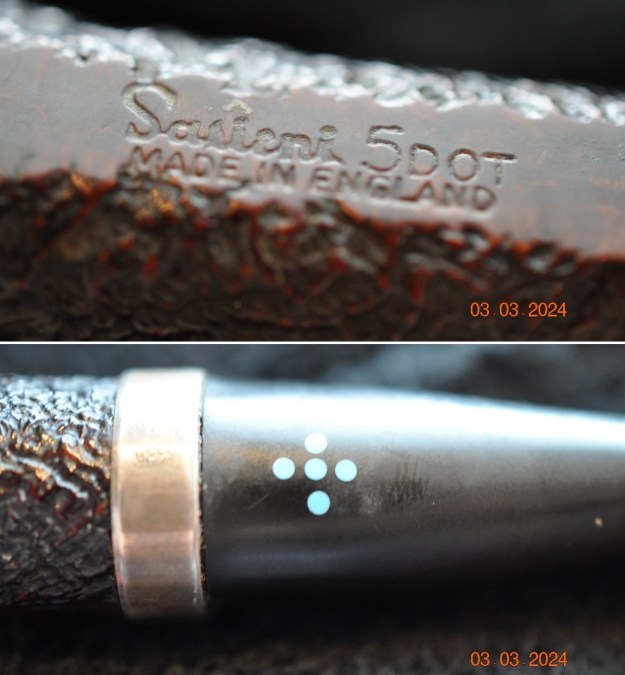
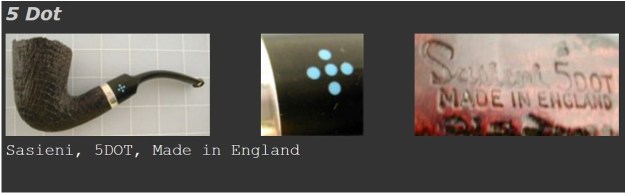
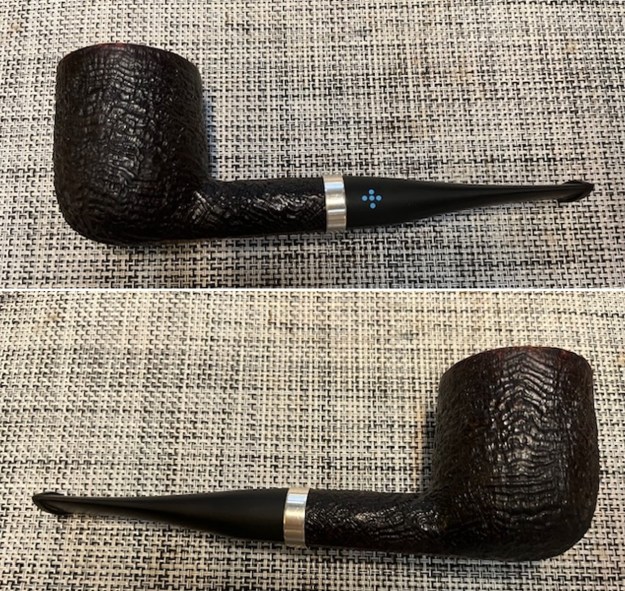
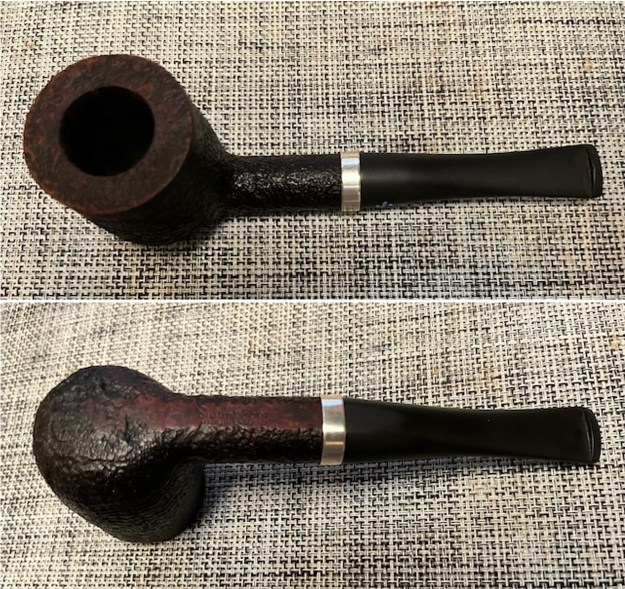
The next pipe on the table is large sandblast Sasieni Pot. We purchased it off eBay from Jordan, Minnesota, USA on 01/22/2024.The pipe is stamped on the heel of the bowl and the underside of the shank on a smooth panel. It reads Sasieni (in script) 5 DOT [over] Made in England. The silver band is stamped 925 on the left side. It is tarnished and dull looking. The taper stem bears the 5 blue Dot pattern of the Sasieni logo on the left side. The pipe had been smoked and there was a thick cake in the bowl with a thick lava overflow in the sandblast on the inner edge and the rim top. There was dust and debris in the sandblast finish around the bowl sides. The stem is oxidized and calcified. It had light tooth marks on both the top and underside of the stem just ahead of the button. Jeff took photos of the pipe before he started his clean up work. I have included them below. Jeff took photos of the rim top, bowl and the surfaces of the stem to give a sense of the condition of the pipe. The walls of the bowl had a thick cake which overflowed over the rim edges and onto the rim top making a mess. The stem is lightly oxidized and there is a mark on the stem where it appears that it had a Softee Bit on the end to protect it. There are light tooth marks on both sides ahead of the button. He took photos of the sides and heel of the bowl to give a clear picture of the depth of the sandblast. It really is a great looking blast that shows the grain underneath very well. He took photos of the stamping on the underside of the bowl and the shank. It is clear and readable and read as noted above. The five dots on the stem are clear and undamaged as is the 925 stamp on the silver band.I turned to Pipephil’s site to see what I could find about the Sasieni 5 Dot pipes and get some idea of where they fit in terms of the hierarchy (http://www.pipephil.eu/logos/en/logo-sasieni.html). I also wanted to know about a potential date for the pipe. I quote below what I found there. I quote from the side bar below and include a screen shot of the 5 Dot:

Post transition, 2001 – today, “5 dot”I Googled for information that I could find and came across some on the smokingpipes.com website (https://www.smokingpipes.com/pipes/estate/england/moreinfo.cfm?product_id=78680). It included several freehand versions of the 5 Dot but I found the description given by them for one of the pipes really informative. I have quoted it below for the information it includes.

The downside to post-transition Sasieni’s is that the once revered Four Dot wound up being applied to briars that never would have made the cut during the family and transition periods. The upside is that unlike some once-grand old marques, not everything went to pieces, standards-wise. This Five Dot (a purely post-transition designation) for example is solid and true: handsomely shaped, drilled out straight as an arrow, and possessed of quite a healthy bit of wild ring grain. – Eric N. Squires

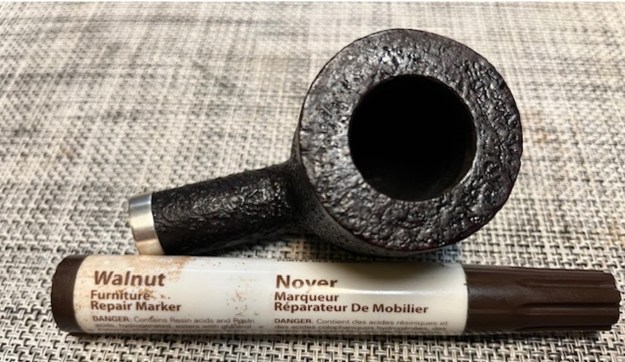
Now it was my turn to work on the pipe. Jeff had done an amazing cleanup of the pipe. He reamed the light cake with a PipNet reamer and cleaned up that with a Savinelli Fitsall Pipe Knife. He scrubbed the internals of the bowl and stem with alcohol, cotton swabs and pipe cleaners. He scrubbed the externals with undiluted Murphy’s Oil Soap and rinsed the bowl off with running water. He soaked the stem in Briarville’s Pipe stem Deoxidizer and once it had soaked rinsed it off with warm water to remove the residual solution. He dried it off and rubbed it down to remove any oxidation that was still on the stem. The pipe looked very good when I received it. I took photos of the bowl and the rim top as well as both sides of the stem to show the condition of the pipe before I started my work. The rim top was very clean and the edges looked good. The clean up had removed some of the stain on the top the outer edges of the bowl. It really looked remarkably good.I took a photo of the stamping on the shank. The photo of the stamping is clear and readable. I also removed the stem and took a photo of the parts of the pipe. It is a unique piece of pipe history. The bowl was in such good condition that I had to do some minimal work with it. I used a Walnut Stain pen to touch up the rim top and edges of the bowl to match the rest of the bowl. I looks amazingly good.I rubbed the briar down with Before & After Restoration Balm. I worked it into the briar with my fingertips and a horsehair shoe brush to work it into the nooks and crannies of the sandblast finish. The product works to clean, enliven and preserve the briar. I let it sit for 10 minutes then I buffed it with a cotton cloth to deepen the shine. The briar really comes alive with the balm. I waxed the bowl down with some Conservator’s Wax and set it aside to let the wax harden. I buffed it with a soft cloth to raise the shine. It is a beautiful sandblast that shows depth in the finish. I set the bowl aside and turned my attention to the stem. I sanded the surface of the stem smooth with 320-3500 grit sanding pads. It worked well to smooth things out and remove remnants of oxidation. When finished the stem looked much better.I polished the vulcanite with micromesh sanding pads – 1500-12000 grit pads. I wiped it down with Obsidian Oil after each sanding pad. I used Before & After Pipe Polish – both Fine and Extra Fine to further polish the stem. This Silver Banded Sasieni 5 Dot Billiard has a beautiful, Sandblast finish that is very tactile. The rich walnut brown/black finish highlights some great grain around the bowl and shank. The polished vulcanite taper stem adds to the mix. I put the stem back on the bowl and carefully buffed the pipe with Blue Diamond on the buffing wheel. It is critical to avoid buffing the stamping and to have a lighter touch on the sandblast briar. I gave the bowl multiple coats of Conservator’s Wax and the stem multiple coats of carnauba wax on the buffing wheel and followed that by buffing it with a clean buffing pad. I hand buffed the pipe with a microfiber cloth to deepen the shine. The finished Sasieni 5 Dot Billiard is quite stunning and feels great in my hand. Give the finished pipe a look in the photos below. The dimensions of the pipe are Length: 6 ½ inches, Height: 2 inches, Outside diameter of the bowl: 1 ¾ inches, Chamber diameter: 7/8 of an inch. The weight of the pipe is 2.82 ounces/80 grams. Thanks for walking through the restoration with me as I worked over another beautiful pipe. I am going to add it to the rebornpipes store in the British Pipemakers Section. If you would like to add it to your collection let me know. Thanks for your time.

Restoring a Sasieni Fantail 93 Stack


Blog by Steve Laug

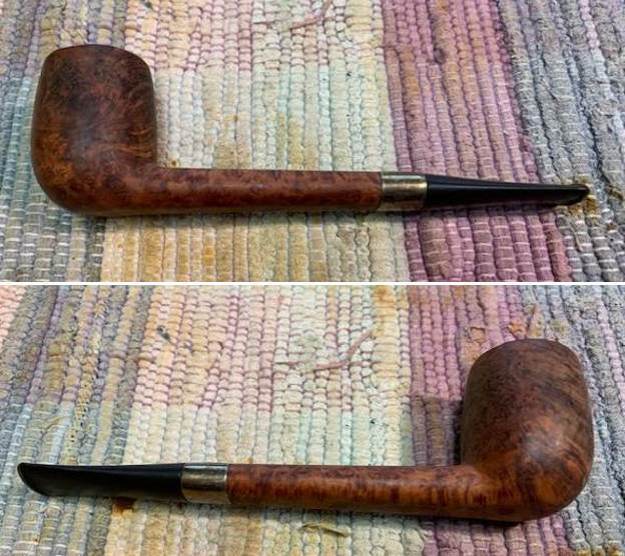
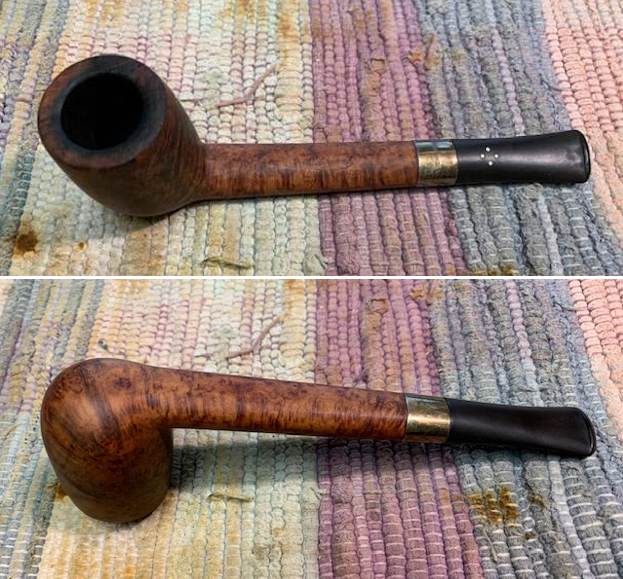
The pipe was purchased on 02/02/22 from an online auction from a seller in Colts Neck, New Jersey, USA. It is a smooth finished Sasieni Stack with a unique shape and smooth finish. It has a Fantail stem that is unique to the Sasieni Fantail line. It is stamped on the left side of the shank next to the bowl/shank junction and has the football shaped Made In London stamp vertically. That is followed by Sasieni [over] Fantail. On the right side of the shank it is stamped London Made and the shape number 93. The stamping around the shank end near the stem reads PATD-170067. The pipe is very dirty with grime ground into the finish of the tall bowl. The bowl was thickly caked with an overflowing lava coat on the top of the rim. The edges looked to be in good condition though I would not know for sure until the bowl and rim had been reamed and cleaned. The stem was oxidized, dirty and had light tooth chatter and marks on the top and underside near the button. The stem had a very lightly stamped “F” on the left side of the fantail stem. The fit of the stem in the shank was tight and clean. The pipe had promise under all of the grime and dirt. Jeff took some photos of the pipe before he started the cleanup work. Jeff took some close up photos of the rim top and the bevelled inner edge of the bowl to give an idea of the condition the pipe when he received it. I am sure glad that this was another one that he worked on. The bowl has a thick cake and the rim top and a lava overflow at the back of the bowl. The stem was lightly oxidized and had tooth marks and chatter on both sides. Jeff took photos of the sides of the bowl and heel to show the finish around pipe. You can see the grime and the oils in the finish that are ground into the bowl. You can also see the scratches and small nicks in the finish. The next series of photos capture the stamping. The stamping is clear and readable as noted above. I have included a screen capture of the pertinent section of the Sasieni section of PipePhil’s Logos and Stamping website and included the link should you want to look at on the site. (http://www.pipephil.eu/logos/en/logo-sasieni2.html). The second pipe in the photo below shows a pipe with the same stamping as the one that I am working on. It reads Sasieni Fantail, London Made, PAT D -170067. The difference is the location of the Patent stamp. On the one that I am working on is around the shank end.I turned to Pipedia and found a patent diagram for the Fishtail stem that Doug Valitchka posted (https://pipedia.org/wiki/Sasieni). I have included that document below. It was filed in 1953 and received the patent July 21, 1953. Which helps to date this pipe as post patent.          That helps to cinch the dating of this pipe as Family Era pipe made somewhere between 1946–1979. The change of “Sasieni” script without the fish-tail initiated by Alfred Sasieni occurred after Second World War. This puts the date of the pipe between 1946 and 1979 – a large spread.

Jeff had cleaned up the pipe with his usual penchant for thoroughness. He reamed the pipe with a PipNet Pipe Reamer and cleaned up the remnants with a Savinelli Fitsall Pipe Knife.  He scrubbed the bowl with undiluted Murphy’s Oil Soap with a tooth brush. He rinsed it under running warm water to remove the soap and grime. He cleaned out the inside of the shank and the airway in the stem with alcohol, cotton swabs and pipe cleaners. He soaked the stem in Before & After Deoxidizer and rinsed it off with warm water. I took photos of the pipe once I received it.   I took close up photos of both the rim top and the stem. Jeff had been able to get the grime and lava out of the plateau on the rim top and it looked pretty incredible. There was some darkening on the high spots on the sandblast rim top and edges. The stem looked very clean. The tooth marks and chatter were minimal and should be easy to remove. The stamping on the shank sides was faint but still readable as noted above. I also took a photo with the stem removed to give an idea of the perspective and design of the pipe. Now it was time to do my work on the pipe. I polished the bowl and rim top with micromesh sanding pads using 1500-12000 grit sanding pads and wiping it down after each sanding pad with a damp cloth to remove the sanding dust and debris. I worked some Before & After Restoration Balm into the finish of the bowl and shank with my fingers. I want the product to go deep into the finish because it works to clean, enliven and protect the briar. Once I was confident that it was deeply worked into the finish I wiped it off and buffed it with a soft cloth to polish it. The pipe really began to have a rich shine. I took some photos of the bowl at this point to mark the progress in the restoration. The grain really stands out on the pipe in the photos below. I set the bowl aside and turned to work on the stem. I painted the tooth marks with the flame of a lighter to lift them. All of the came up slightly. I filled in those that remained with some black rubberized CA glue. I set it aside to cure. Once it had hardened I flattened out the repair areas with a small file. I sanded the repairs with 220 grit sandpaper to blend them into the surface of the stem. I started polishing with 600 grit wet dry sandpaper. I polished the vulcanite stem with micromesh sanding pads – wet sanding it with 1500-12000 grit pads. I wiped it down with Obsidian Oil after each sanding pad. I polished it with Before & After Pipe Polish – both the Fine and Extra Fine polishes. I gave it a final coat of oil and set it aside to dry. This Sasieni Fantail 93 Stack is a beautiful looking pipe. I put the stem back in place in the shank and buffed the bowl and stem lightly with Blue Diamond on the buffing wheel. I gave the bowl and stem multiple coats of carnauba wax on the buffing wheel. I buffed the pipe and stem with a clean buffing pad to raise the shine. I hand buffed the bowl with a microfibre cloth to deepen the shine. The finished pipe is shown in the photos below. The contrast of the dark brown and a medium brown that shines through give the finish a rich patina. The Sasieni Fantail London Made 93 Stack has some amazing grain around the bowl sides and shank. The bowl has been cleaned and the entire pipe is ready to smoke. The stem is in great shape with a few small nicks in the surface of the top and underside. It is a beautiful pipe, just a little big for my liking or I would hang on to it. The dimensions of the pipe are Length: 6 inches, Height: 2 ¼ inches, Outer diameter of the bowl: 1 ¼ inches, Chamber diameter: ¾ inches. The weight of the pipe is 1.59 ounces/45 grams. I will be putting it on the rebornpipes store soon in the British Pipemakers Section. If you are interested in adding it to your collection email me at slaug@uniserve.com or send me a message on Facebook. Thanks for looking.

As always, I encourage your questions and comments as you read the blog. Thanks to each of you who are reading this blog. Remember we are not pipe owners; we are pipe men and women who hold our pipes in trust until they pass on into the trust of those who follow us.

Restoring a Sasieni Buckingham Four Dot Ruff Root Sandblast Billiard with a Craggy Gold Shank Band


Blog by Steve Laug

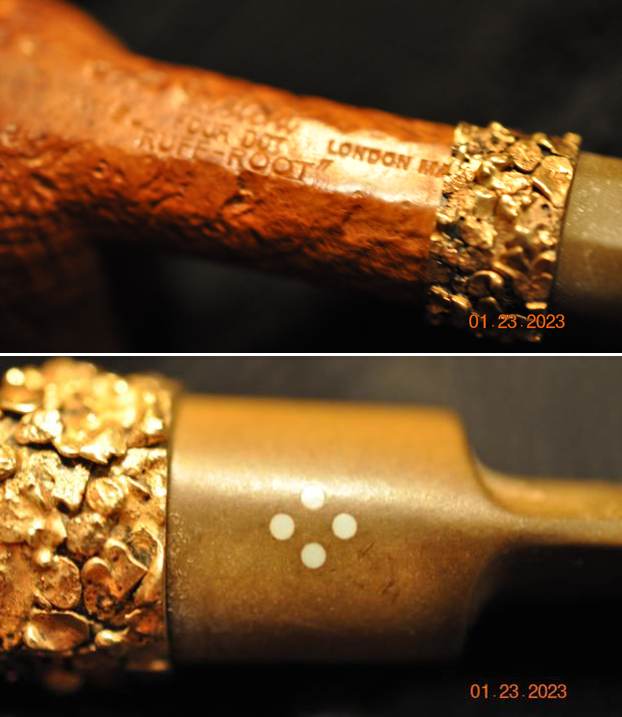
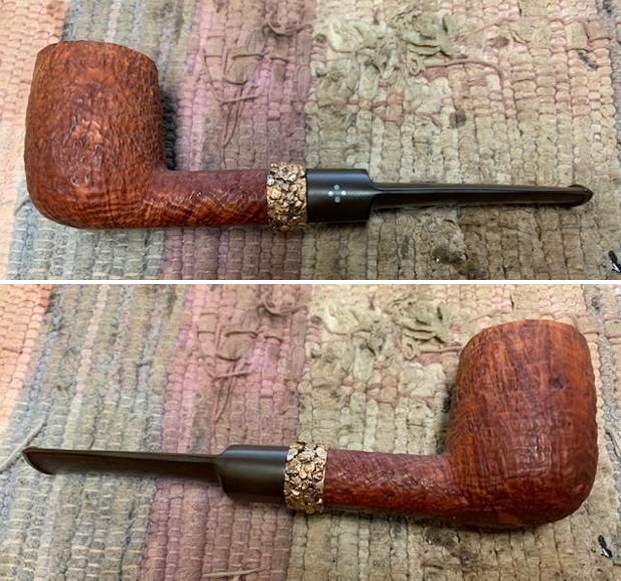
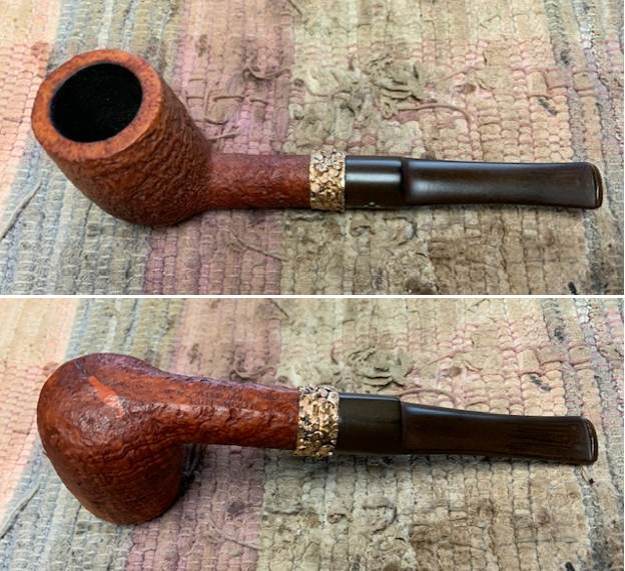
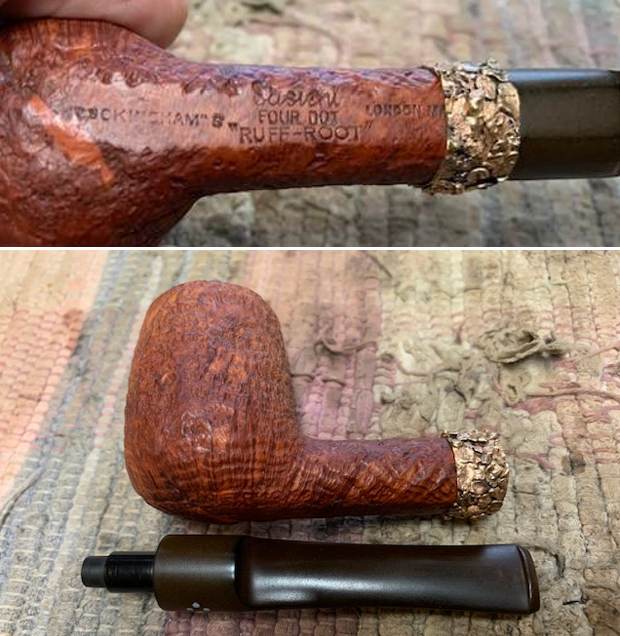
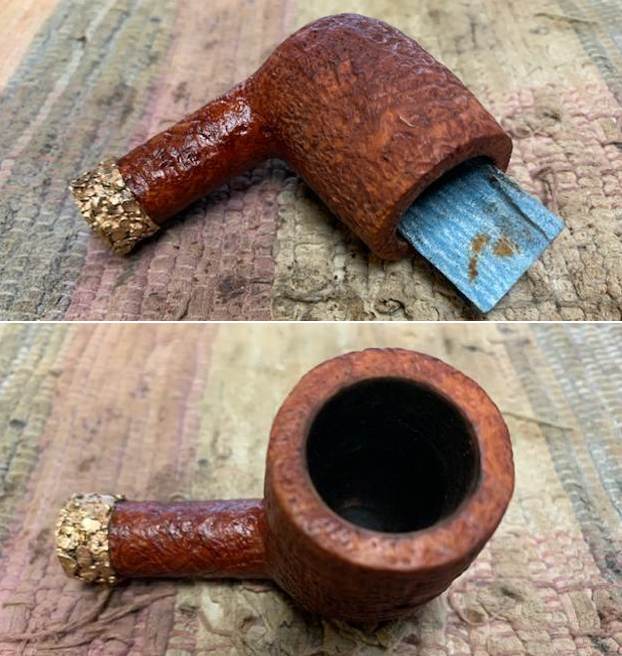
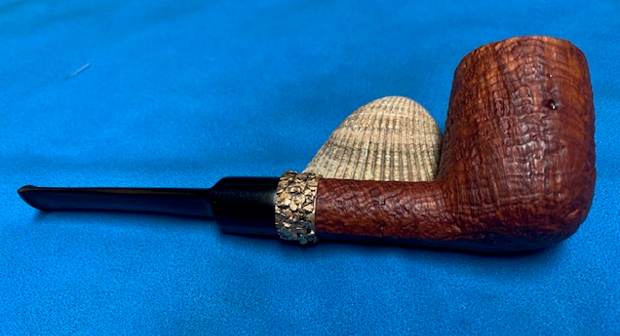
The next pipe I have chosen to work on is a nice looking sandblast straight billiard with a sandblast rim top and a gold band on the shank. The stem is an original saddle stem. We picked it up on 11/18/2021 from a fellow in Gardenia, California, USA. The stamping on the underside of the shank reads “Buckingham” S on the heel of the bowl followed by three lines reading Sasieni [over] Four Dot [over] “Ruff Root”. Next to that stamping there is a single line reading London Made with the chunky gold band covering a portion of the stamping. The vulcanite saddle stem has the four light blue dots on the left side of the saddle. The pipe is a nice looking pipe with a reddish brown finish that highlights the sandblast on the bowl sides and shank. The bottom of the shank and bowl are flattened so that the pipe sits on the desktop. There is a sandpit on the right side of the bowl mid bowl. On the underside there is a putty fill running diagonal across the heel. The vulcanite stem is set apart from the shank by the gold nugget band. It is light weight and comfortable pipe to hold. Jeff sent me the following photos of the pipe to show the condition it was in before he worked on it.

This is what I saw when I looked over the pipe.

  1. The finish shows darkening of hand oils and some thick grime ground into the sand blast finish around the bowl sides. The stain is dull and the grain patterns under the grime are obscured around the bowl sides and shank
  2. The sandblast rim top was very dirty with darkening and lava ground into the blast. It is heavier on the back side. The inner edge of the bowl looks quite good under the tars.
  3. There was a thick cake in the bowl. The bowl itself was very dark and dirty. Once the bowl was cleaned up we could confirm the condition of the bowl walls.
  4. The vulcanite stem was filthy, oxidized and had tooth marks and chatter on both sides. There were some deeper tooth marks on the underside ahead of the button.
  5. There is a standard pattern Sasieni Four Dot logo on the stem that appears to be light blue in colour.

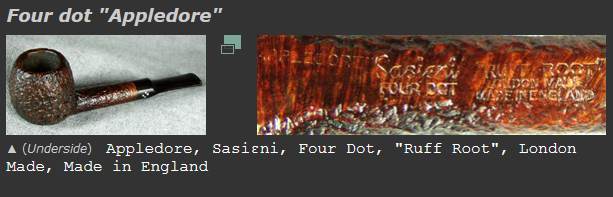
To summarize what I saw – this Sasieni Four Dot Ruff Root Sandblast Billiard is a well made pipe. The bowl and stem are very dirty which says to me that the pipe was someone’s favourite pipe. The look and feel of the pipe in the hand is great. It should clean up very well. Here are photos of the pipe taken before Jeff started the clean up.  Jeff took close up photos so that I could have a clearer picture of the condition of the bowl, rim edges and top. The rim top photos confirm my assessment above. The cake in the bowl is thick – covering the walls of the bowl. The rim top has thick lava coat and has some darkening on the inner edge and is heavier toward the back of the bowl. This is what I look for when assessing a pipe. I look forward to viewing it in person after the clean up work. The stem is dirty, oxidized, calcified and has grime all over the surface as noted in the description above. There are toothmarks and chatter on both sides ahead of the button. Instead of telling you what I see in the next photos of the sides of the bowl and the heel I want to hear from you. Tell me what you see? What does the finish look like to you? Are there any visible problems or issues that stand out to you? Are the cracks or scratches in sandblast finish of the bowl? Are there visible flaws or fissures in the briar? Note the fills that you see in the heel of the bowl. What does the finish look like? Is there a pattern to it? Any visible issues on the heel of the bowl? These questions should help you to see what I am looking for when I see these photos. He took photos of the stamping on the underside of the shank. It is stamped as noted above on the right and the left sides. The stem shows the Sasieni Four Dots in light blue on the left side of the saddle portion of the saddle. What stands out for you in the photos of the stamping? What do you look for in the stamping? It is dirty but what do you see underneath the grime on the surface of the briar? I decided to do some work on the stamping of this pipe to get an idea of the time period it was carved. I turned first to Pipephil’s site to see what I could learn (http://pipephil.eu/logos/en/logo-sasieni.html). I found a pipe that was stamped the same way as the one I am working on. It is stamped on the underside of the shank like the one in the screen capture photo below. Mine is stamped the same way Sasieni in script without the fish tail. Underneath it is stamped FOUR DOT NATURAL [over] London Made. Next to the shank is also the Made In England Stamp like the one below. On the heel of the bowl mine is stamped “Buckingham” S stamp rather than the “Appledore” stamp in the same place. I included the side bar notes below the picture. From that I knew that the pipe was made during Pre-transition Period 1946-1979.Pre-transition, 1946 – 1979. Four dot. Ruff Root is the name for a sandblast finish. “Buckingham” is the shape name (town) that is used on the pipe I have in hand.

I then turned to Pipedia for more detailed information (https://pipedia.org/wiki/Sasieni). I quote a section of that article below. It refers to the Patent Number that is on the pipe I have on the table. The underlined  portion below is particularly pertinent to this pipe.

To begin with, there are three main elements to dating the Sasieni pipe, the patent number, the style of the name “Sasieni” as it appears on the shank, and the Dots themselves. Naturally, there are exceptions to these rules (this hobby would be boring without them), but for the most part these guidelines apply better than 95% of the time. All Sasieni One, Four, and Eight Dot pipes made before W.W.II and destined for the U. S. market carried a patent number on the shank which usually started with the numbers “15″, with 150221/20 and 1513428 being representative of the group. Also, the name “Sasieni” was stamped on the shank in a very florid manner, with the tail of the last “i” sweeping underneath the name forming a shape which has been compared to a fish by more than one collector. This script was discontinued by Alfred almost immediately after he took over the company, so this alone tells you your pipe is pre W.W.II. Underneath in block lettering are the words “London Made”, with the patent number making the third line.

The dots will help you narrow this down further. As we mentioned, the short lived U. S. market One Dot was introduced around 1920, and was replaced by the early to mid 1920’s by the Four Dot. The 1920’s Four Dot is distinguishable by the florid Sasieni script, a patent number, and four blue dots, which are quite small compared to the pipes of post war years. Furthermore, by 1935 Sasieni began stamping pipes, based on the shape, with their own names, which were usually, but not always, English towns. For example, apples were stamped “Hurlingham”, bulldogs were “Grosvenor” or “Danzey”, and panels were “Lincoln”. One rare and interesting variation of this was the large bent, dubbed “Viscount Lascelles”. Even in this soft Sasieni market, these pipes regularly sell for $150 in their rare appearances in mailers.

The pipe I have is one does not have a patent number so it was not made for the US market. The flourished “i” was discontinued by Alfred so that confirms that the pipe was made Pre-transition, 1946 –1979. The third line stamped is London Made in block lettering. With all that information I knew that my pipe was from the period before the transition (Pre Transition) so it was an older one.

I am sure many of you will shake your head and ask maybe even out loud, “Why is he including this again?” However, please remember that the point of these blogs is not to wow your with the work or make you shake your heads but I want you to know the details of the work we do so you can do your own. Back in 2020 Jeff wrote a blog about his cleaning process. I am including a link to that now so you can see what I mean about his process. Do not skip it! Give it a read (https://rebornpipes.com/2020/01/20/got-a-filthy-estate-pipe-that-you-need-to-clean/). Here is the introduction to that blog and it is very true even to this day.

Several have asked about Jeff’s cleaning regimen as I generally summarize it in the blogs that I post rather than give a detailed procedure. I have had the question asked enough that I asked Jeff to put together this blog so that you can get a clear picture of the process he uses. Like everything else in our hobby, people have different methods they swear by. Some may question the method and that is fine. But it works very well for us and has for many years. Some of his steps may surprise you but I know that when I get the pipes from him for my part of the restoration they are impeccably clean and sanitized. I have come to appreciate the thoroughness of the process he has developed because I really like working on clean pipe!

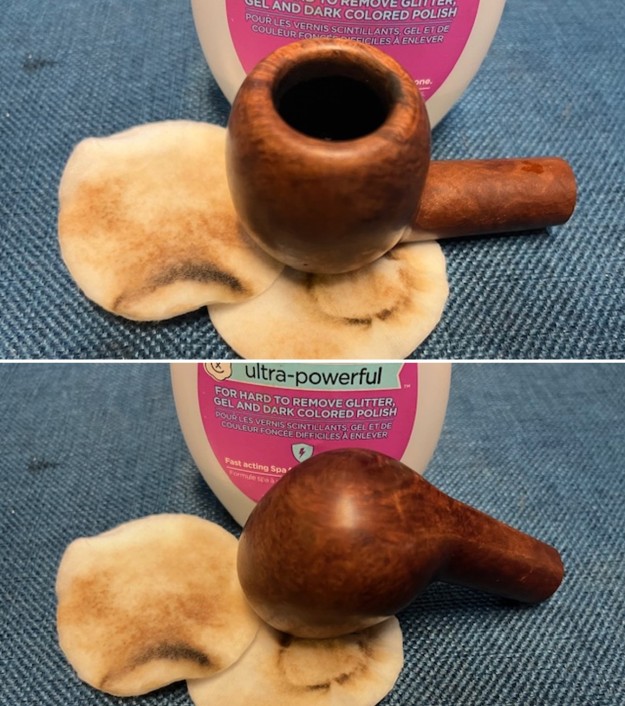
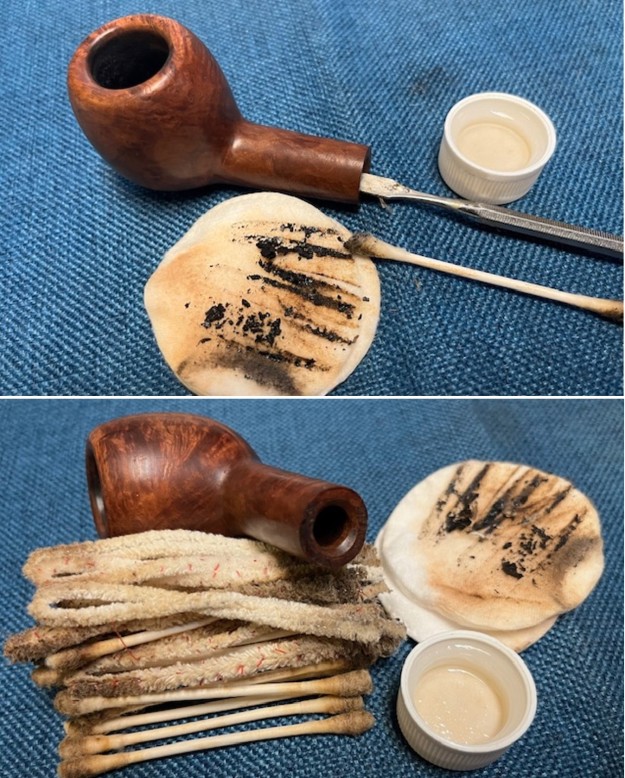
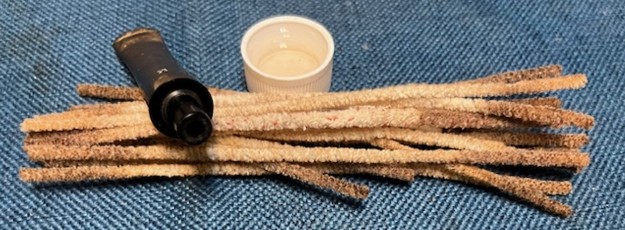
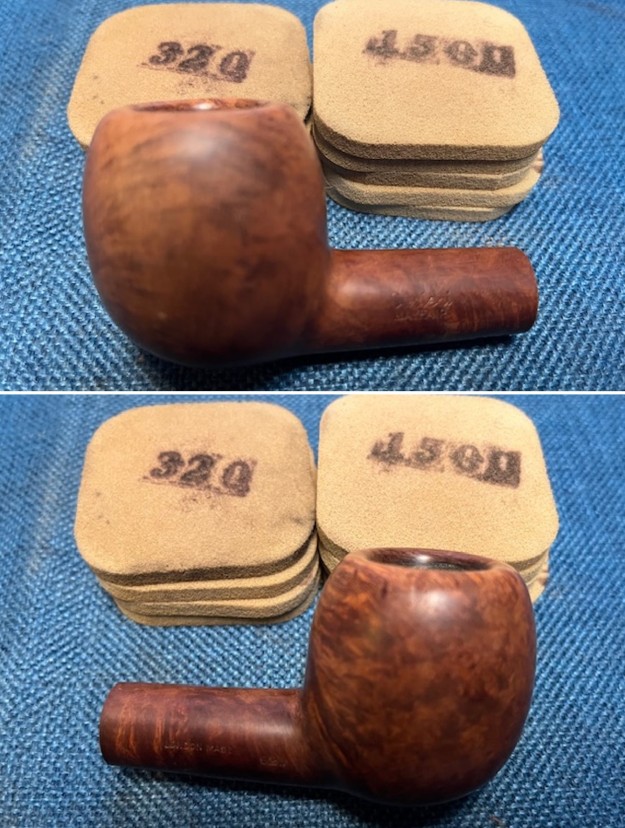
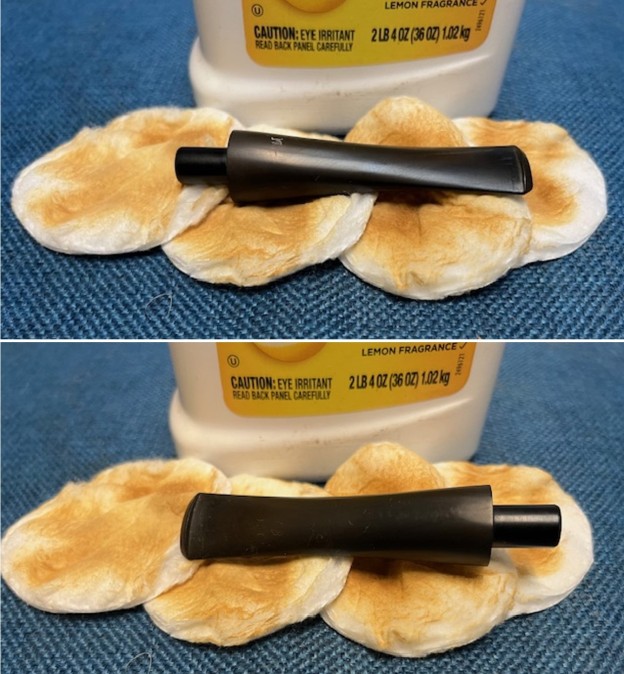
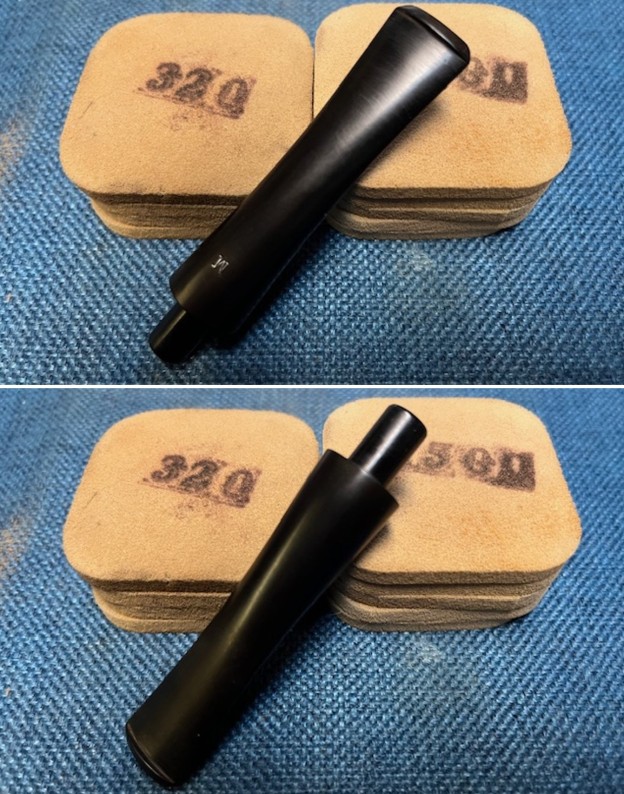
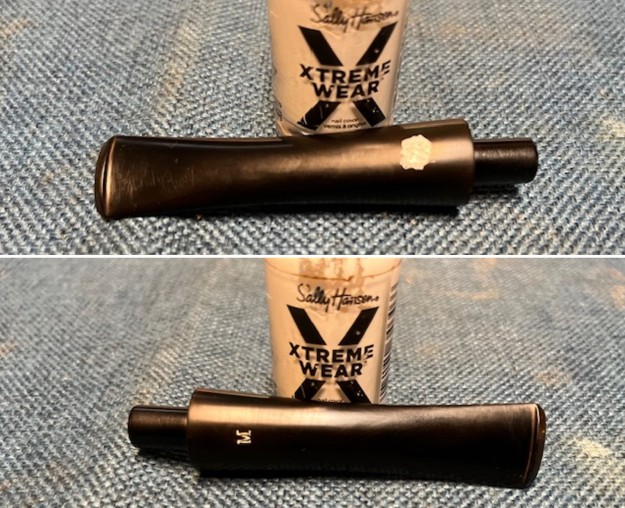
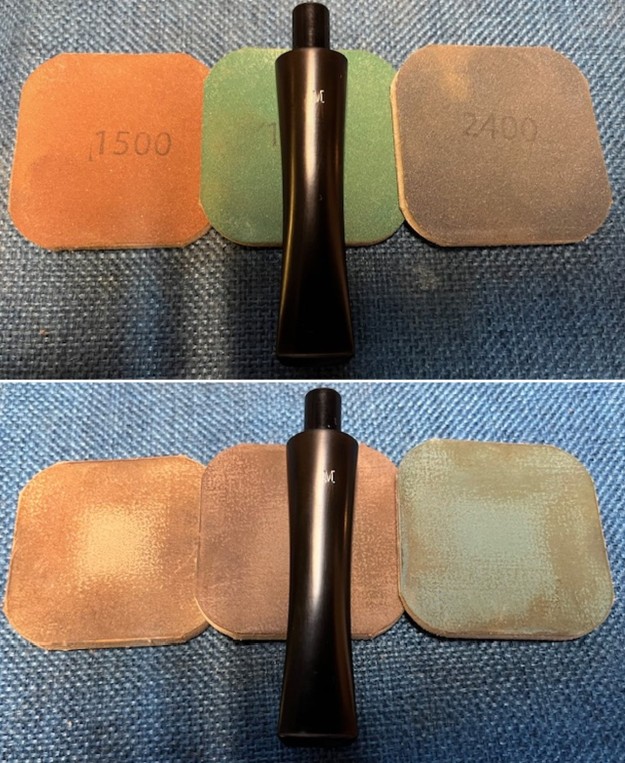
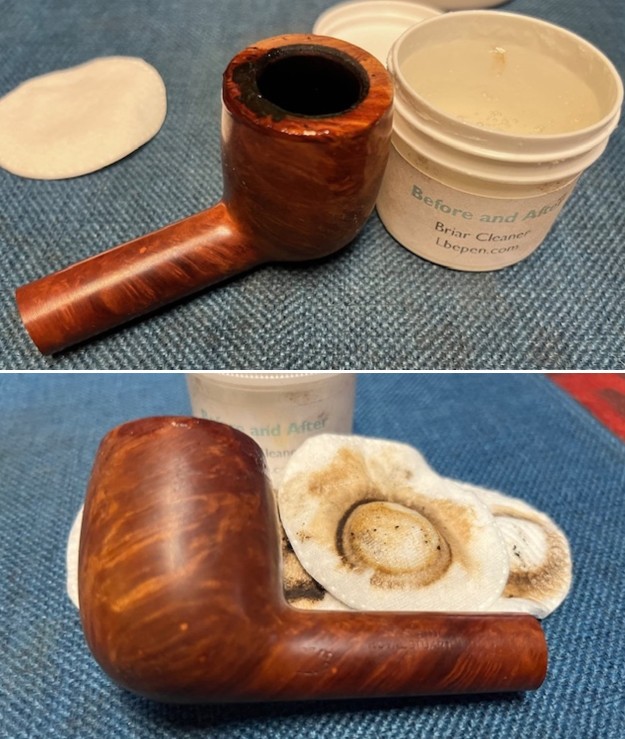
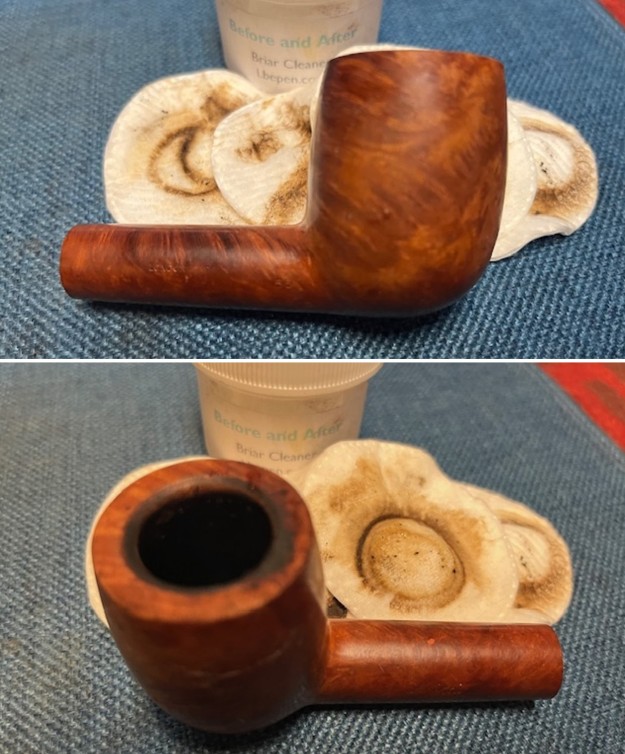
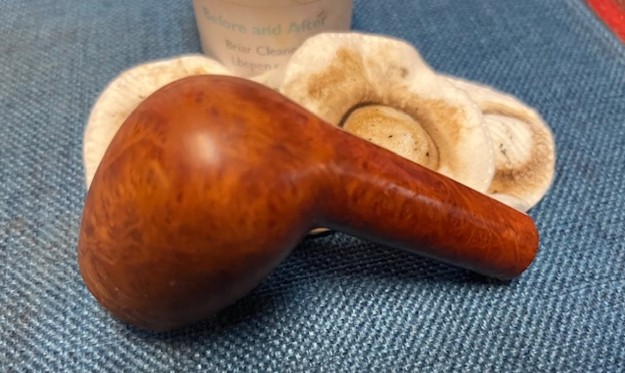
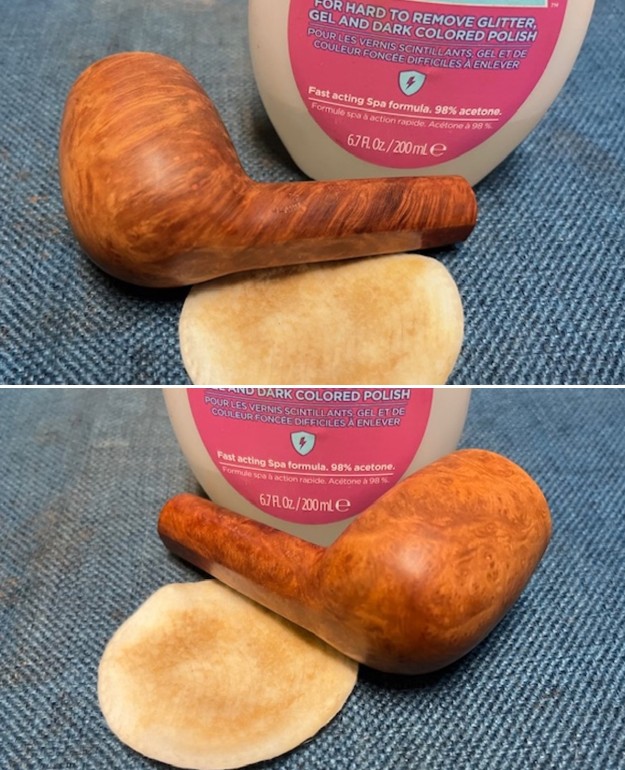
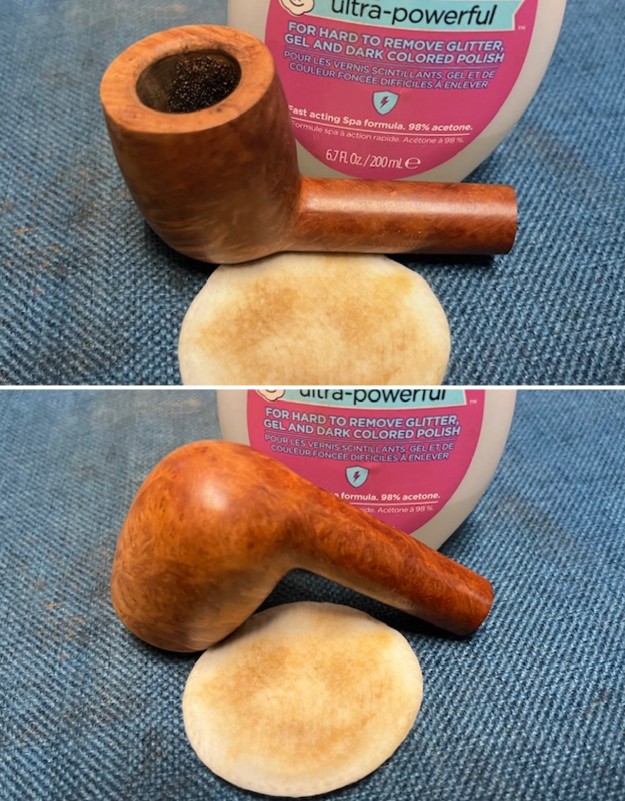
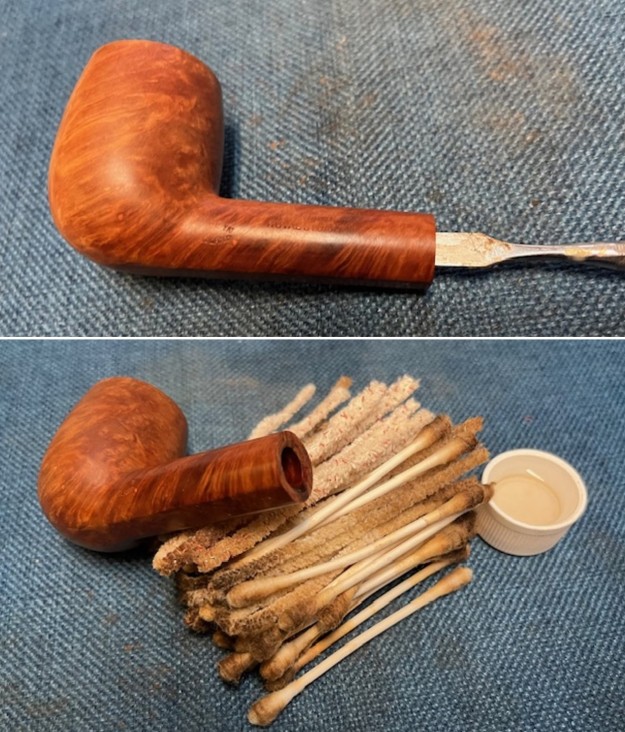
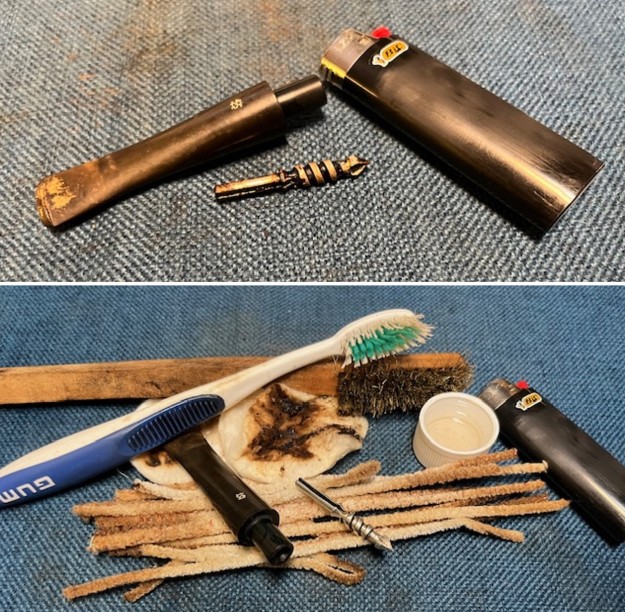
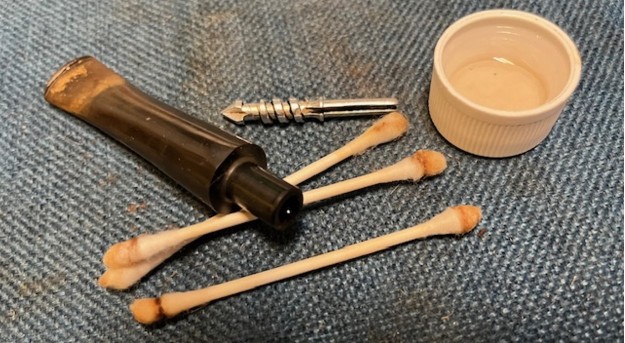
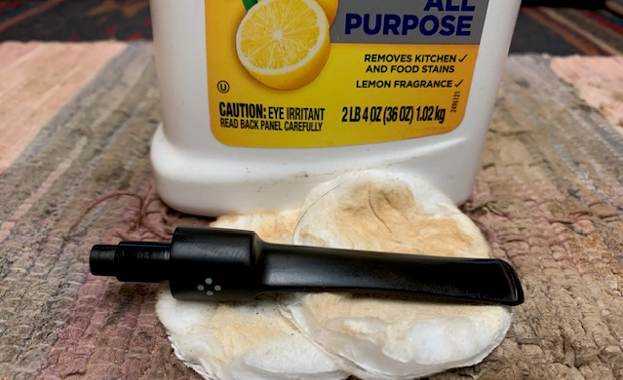
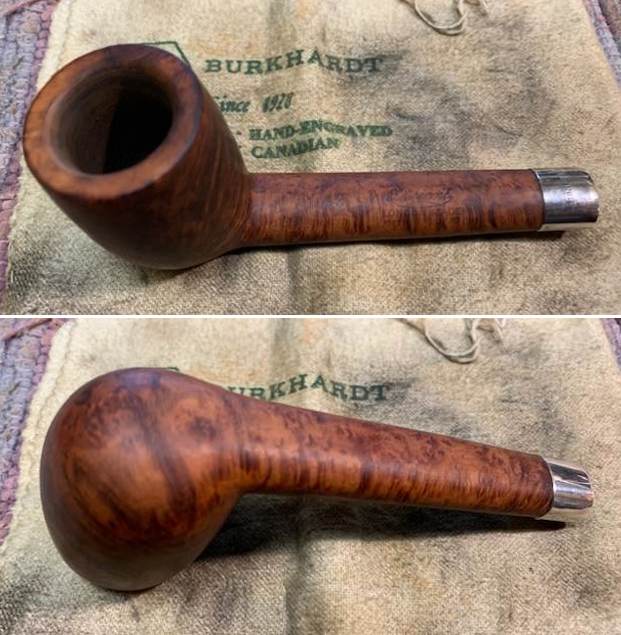
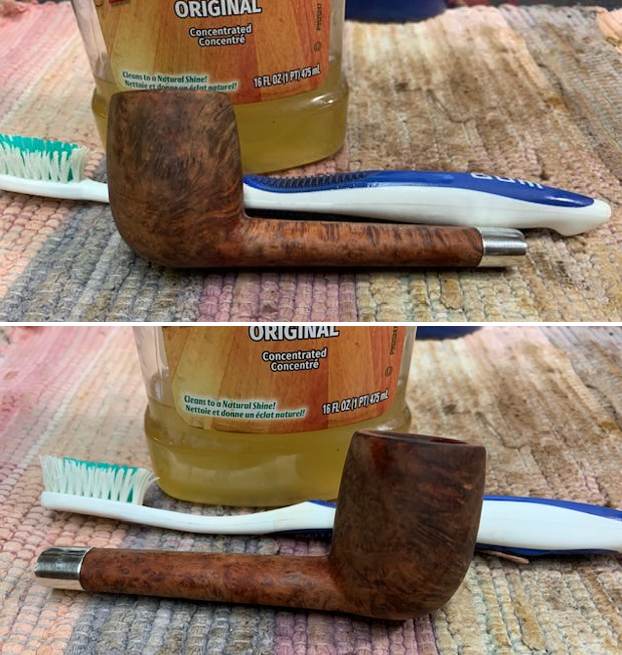
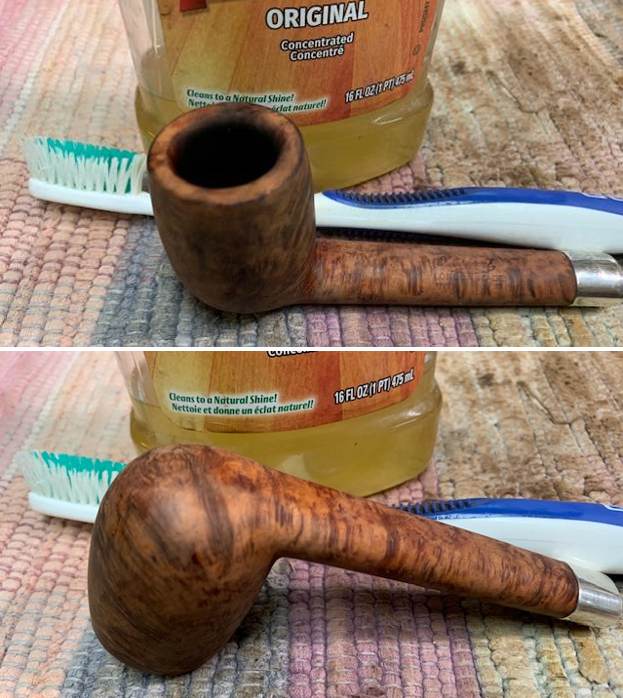
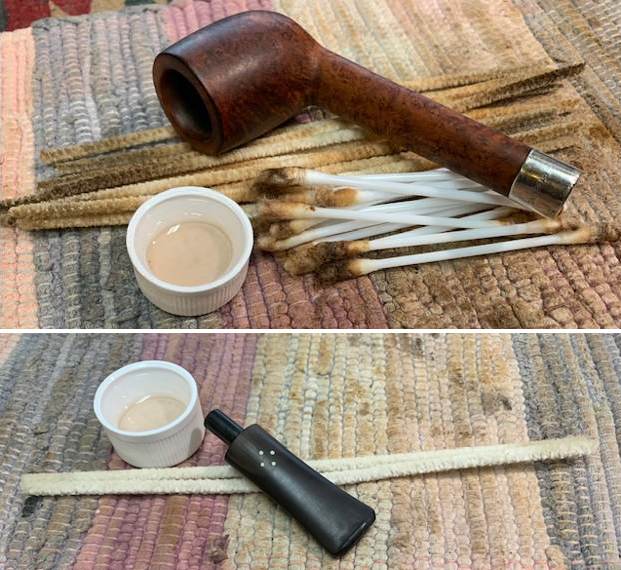
For the benefit of some of you who may be unfamiliar with some of the products he uses I have included photos of three of the items that Jeff mentions in his list. This will make it easier for recognition. These three are definitely North American Products so you will need to find suitable replacements or order these directly on Amazon. The makeup pads are fairly universal as we were able to pick some up in India when we were with Paresh and his family.

In the blog itself he breaks his process down into two parts – cleaning the stem and cleaning the bowl. Each one has a large number of steps that he methodically does every time. I know because I have watched him do the work and I have seen the pipes after his work on them. He followed this process step by step and when the pipe got to me it was spotlessly clean and ready for my work. The inside of the stem, shank and bowl were clean and to me that is an amazing gift as it means that my work on this end is with a clean pipe! I cannot tell you how much difference that makes for my work.

When the pipe arrives here in Vancouver I have a clean pipe and I go over it keeping in mind my assessment shared in the opening paragraph above. Now that I have it in hand I am looking for confirmation of what I saw in the photos as well as any significant structural changes in the bowl and finish as I go over it.

  1. The finish is clean and the oils have been removed from both sides of the bowl. The grime ground into the finish is gone and there is some great grain showing through the sandblast finish around the bowl sides.
  2. The lava coat and darkening on the rim top has been removed and it is very clean. The inner edge also looks very good.
  3. The cake had been totally removed and the walls of the bowl are clean. There is not any checking or burn damage on the interior walls of the bowl.
  4. The vulcanite saddle stem is clean and has light tooth chatter and marks on both sides. There is also some oxidation remaining on the stem surface.
  5. The four blue dots (Sasieni logo) on the left side of the saddle look very good.

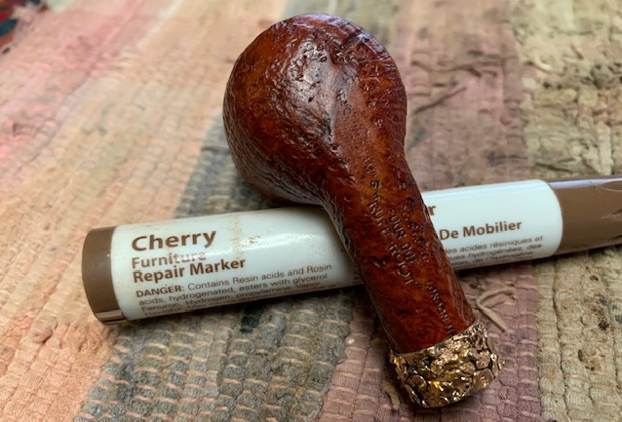
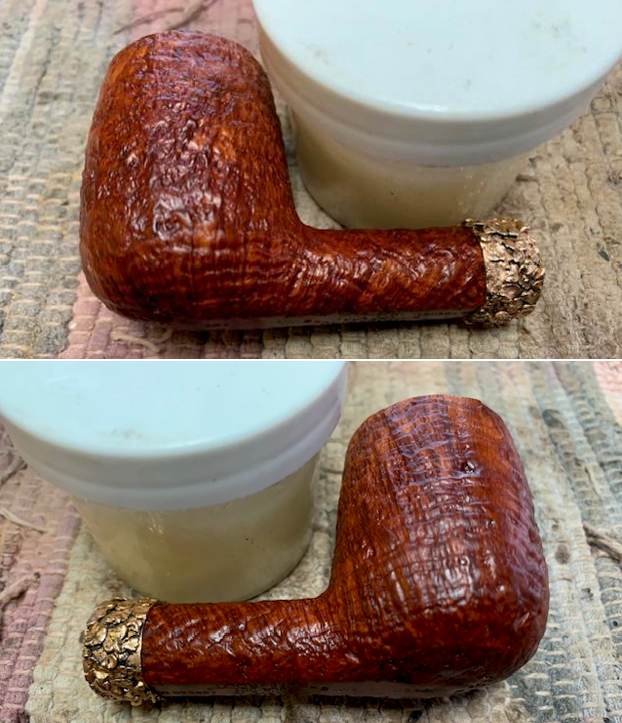
Hopefully the steps above show you both what I look for when I go over the pipe when I bring it to the work table and also what I see when I look at the pipe in my hands. They also clearly spell out a restoration plan in short form. My work is clear and addressing it will be the next steps. I took photos of the whole pipe to give you a picture of what I see when I have it on the table. This is important to me in that it also shows that there was no damage done during the clean up work or the transit of the pipe from Idaho to here in Vancouver.  I carefully went over the bowl and rim top to get a sense of what is happening there. In this case once the lava was removed and the top looked good. There was some darkening around the inner edge, heavier toward the front of the bowl. It is clean but will need to be worked on to bring it back to normal. I also go over the stem carefully. There were some light tooth marks and dents on both sides of the stem. I took photos of the rim top and stem sides to show as best as I can what I see when I look at them.I always check to make sure that the clean up work did not damage the stamping on the shank in any way. It looks good but is faint in some parts – particularly on the heel of the bowl. The putty fill is visible in the photo below. I always appreciate the handiwork of the carvers at Sasieni who turn a piece raw briar into a beautiful pipe. I love just looking at the beauty of the lay of the pipe with the grain and the proportion of the pipes. I like to remove the stem from the shank to get a sense of what was in the mind of the pipe maker when he crafted the pipe. It is a beauty in flow and shape.I started working on this pipe by turning to the bowl. I chose to deal with the darkening on the inner edge of the rim. I used a piece of 220 grit sandpaper to remove the darkening on the inner edge. It took a little work but I was able to remove most of the damage. It looks much better after I worked it over.I used a Cherry Stain Pen to stain the putty fill and blend it into the surface of the sandblast billiard. It looked much better once it had cured.For the past few years now I have been using a product developed by Mark Hoover called Before & After Restoration Balm. It is a paste/balm that is rubbed into the surface of the briar. The product works to deep clean the finish, enliven and protect the briar. I worked it into the briar with my finger tips and a shoe brush and let it sit for 10 minutes to do its work. I wiped it off with a soft cloth then buffed it with a cotton cloth. The briar really began to shine and the grain shone through the blast. The photos I took of the bowl at this point mark the progress in the restoration. It is a gorgeous pipe. I set the bowl aside and turned to the stem. I “painted” the stem surface with the flame of a Bic lighter to lift the tooth marks. I was able to lift them and sanded out what remained with 220 grit sandpaper. I started the polishing of the stem with 600 grit wet dry sandpaper. I wiped the stem down with Soft Scrub cleanser to remove the remaining oxidation on the stem surface. It looked much better. I polished the stem with micromesh sanding pads – 1500-12000 grit sanding pads and water to wet sand the stem. I wiped it down after each sanding pad with Obsidian Oil on a cotton rag after each sanding pads. I know that many say Obsidian Oil does nothing for acrylic stems, but I find it does two things – first it gives some protection to the stem from buildup and second it give the sanding pads bite in the polishing process. After finishing with the micromesh pads I rub the stem down with Before & After Fine and Extra Fine stem polish as it seems to really remove the fine scratches in the acrylic. I rub the Fine Polish on the stem and wipe it off with a paper towel and then repeat the process with the Extra Fine polish. I finish the polishing of the stem down with a final coat of Obsidian Oil and set the stem aside to let the oil absorb. This process gives the stem a shine and also a bit of protection.The final steps in my process involve using the buffer. I don’t buff a sandblast finish on the buffer with polish as it can fill in the deep grooves. I buffed the stem with Blue Diamond to polish out the light scratches in the vulcanite. I gave the bowl multiple coats of Conservators Wax and the stem multiple coats of carnauba wax. I have found that I can get a deeper shine if I follow up the wax buff with a buff with a clean buffing pad. It works to raise the shine and then I hand buff with a microfiber cloth to deepen the shine. It is always fun for me to see what the polished bowl looks like with the polished stem. It really is a nice pipe. The smooth finish around the bowl sides and shank looks great with rusticated plateau style crowned rim. The acrylic stem works well with the pipe. The Sasienin Four Dot Ruff Root Sandblast Billiard with a craggy gold shank adornment feels great in my hand. It is a well balanced pipe. Have a look at it with the photos below. The dimensions are Length: 6 inches, Height: 1 ¾ inches, Outside diameter of the bowl: 1 ¼ inches, Chamber diameter: 7/8 of an inch. The weight of the pipe is 1.62 ounces/46 grams. It is a beautiful pipe that I will soon be adding to the rebornpipes store in the British Pipemakers Section. If you would like to add it to your collection let me know. It should be a great smoking pipe. Hopefully the style of writing of this blog is helpful to you in some way. In it I wanted to show both what I am looking for and how I move forward in addressing what I see when work on a pipe. Let me know if it is helpful to you. It is probably the most straightforward detailed description of my work process that I have done. As always I encourage your questions and comments as you read the blog. Thanks to each of you who are reading this blog. Remember we are not pipe owners; we are pipe men and women who hold our pipes in trust until they pass on into the trust of those who follow us.

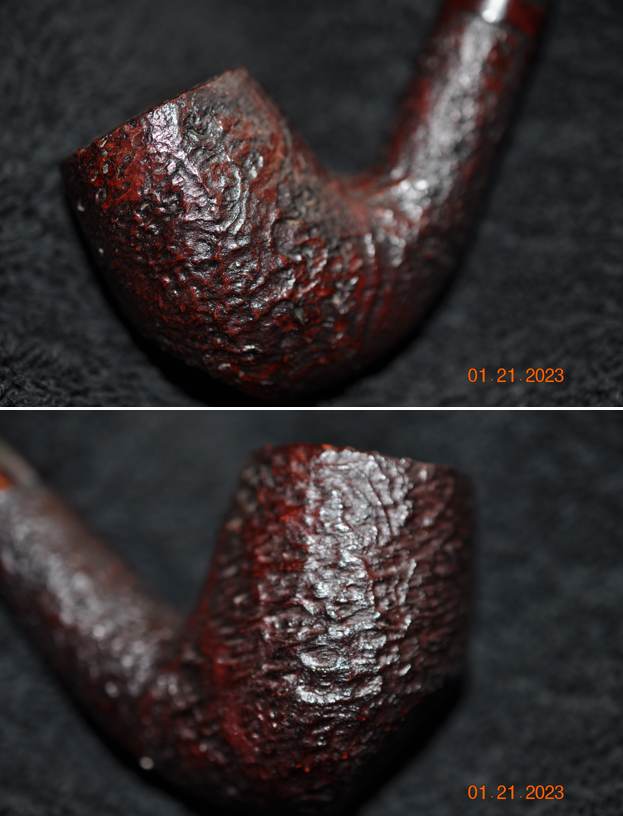
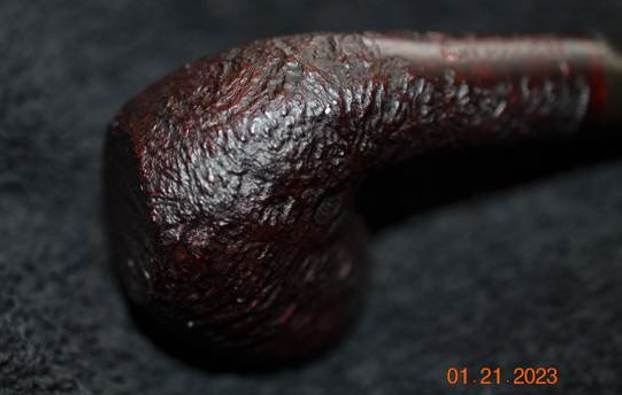
Life for a Sandblast Sasieni 4 Dot Ruff Root Dark 1 Bent Billiard Sitter


Blog by Steve Laug

I thought it might be helpful to take you through my process of working on each pipe that we purchase. Jeff has set up a spread sheet to track where the pipe came from, the date of purchase and what we paid for it so that we know what we have invested in the pipe before we even work on it. This takes a lot of the guess work out of the process. This particular pipe was purchased on 08/06/2022 from a seller in Manorville, New York, USA. I also want you to understand why we take the photos we do. If you have followed for a while then you will see the familiar pattern of the photos we include both in the before and midstream process of working on a pipe. It is not accidental or chance as the photos have been taken to help me make an assessment of the pipe Jeff sees before he starts his clean up work. We do this to record the condition that the pipe was in when received it and to assess what kind of work will need to be done on. When I look at these photos this is what I see.

  1. The first thing I see is the flattened bottom front of the bowl that made it function as a standing sitter. It is well proportioned and well made with a classic English shaped Billiard.
  2. The finish is dirty and there is grime and grit ground into the sides of the bowl. There is grime ground into the finish that fills in much of the sandblast grooves in the finish.
  3. The rim top had a thick lava overflow from the cake in the bowl. The beveled edge and top have a lot of lava in the finish. Sometimes the lava protects the rim top and edges and sometime it hides issues. Its is very dirty looking but cleaning will reveal that.
  4. The bowl has a thick cake in it that hides the walls and the inner edge of the bowl but once it is clean we will know what the edges look like. The outer edges look good and there does not appear to be any obvious burn damage to the top or bowl edges.
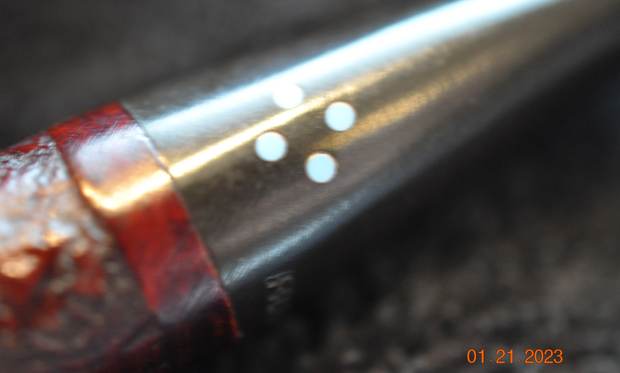
  5. The vulcanite taper stem is in good condition – dirty, oxidized, calcified and has light tooth chatter and marks on both sides. There is a blue Four Dot logo on the left side of the stem.

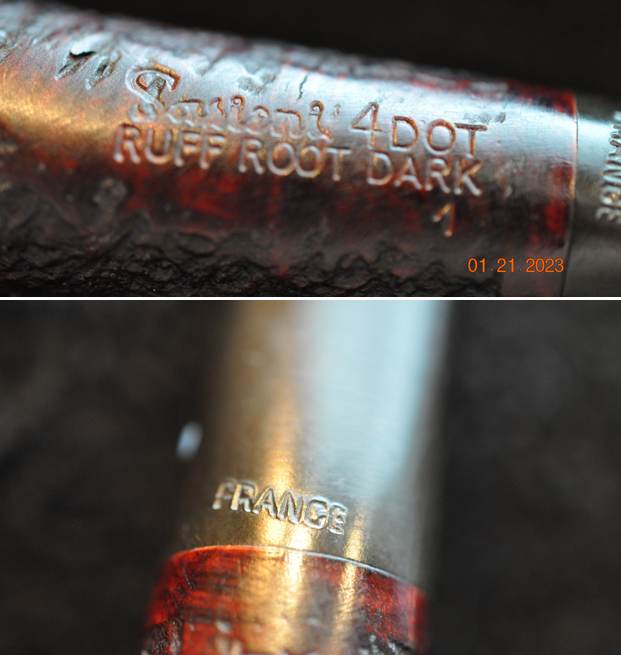
Overall my impressions of this pipe is that it is a beauty that once cleaned up will look pretty amazing. The flattened sitter bottom front of the bowl is something I have not seen before but it is quite interesting. The exterior of the bowl does not show any hot spots or darkening. The pipe is very English looking and is a classic short Bent Billiard shape that I have seen on other Sasieni pipes (without the flattened bowl front). The photos below confirm the assessment above. Jeff took close up photos so that I could have a clearer picture of the condition of the bowl, rim edges and top. The rim top photos confirm my assessment above. The cake in the bowl is quite thick and the rim top has lava and debris on it. You can also see the condition of the outer edge but the inner edge is a bit of a mystery at this point. This is what I look for when assessing a pipe. While there is lava and darkening there is no visible burn damage at this point. The bowl is still fairly round. The photos of the stem surface from various angles confirmed my assessment of its condition. You can see the oxidation and calcification on the stem surface toward the button. The surface though dirty does not appear to have deep tooth marks – chatter yes, but no deep marks. The stem is quite dirty but otherwise undamaged. The next photos show the amazing grain around the heel and the sides of the bowl. Tell me what you see? Are there any visible problems that stand out to you? Are the cracks or scratches? Are there visible flaws or fissures in the briar? What kind of grain stands out around the bowl and heel? Any visible issues on the heel of the bowl? Even the questions should help you to see what I am looking for when I see these photos. You have read it a few times now in the previous blogs. What am I looking for when I look at the shank stamp? In this case it is stamped on a smooth panel on the underside and reads Sasieni 4 Dot [over] Ruff Root Dark [over] 1 in three lines. The underside of the stem is stamped and reads FRANCE. How does the stamping look to you? Is it clear and readable? Is it faint in spots or is it uniform? I know you are looking at photos but so do I at this point in the process. I decided to do some work on the stamping of this pipe to get an idea of the time period it was carved. I turned first to Pipephil’s site to see what I could learn (http://pipephil.eu/logos/en/logo-sasieni.html). I found a pipe that was stamped similarly to the one I am working on. It is stamped on the underside of the shank and reads like the first two lines on the one in the screen capture photo below. Mine is stamped the same way Sasieni in script without the fish tail. It is followed by 4 DOT [over] Ruff Root Dark [over] 1. I included the side bar notes below the picture. From that I knew that the pipe was made during Post-transition Period 1986-today.Post transition, 1986 – today, “4 dot”. Ruff Root Dark: Name for a sandblasted finish. Notice the 4DOT stamping replacing the FOUR DOT from 1986.

I then turned to Pipedia for more detailed information (https://pipedia.org/wiki/Sasieni). I quote a section of that article below. It refers to the Patent Number that is on the pipe I have on the table. The underlined  portion below is particular pertinent to this pipe.

To begin with, there are three main elements to dating the Sasieni pipe, the patent number, the style of the name “Sasieni” as it appears on the shank, and the Dots themselves. Naturally, there are exceptions to these rules (this hobby would be boring without them), but for the most part these guidelines apply better than 95% of the time. All Sasieni One, Four, and Eight Dot pipes made before W.W.II and destined for the U. S. market carried a patent number on the shank which usually started with the numbers “15″, with 150221/20 and 1513428 being representative of the group. Also, the name “Sasieni” was stamped on the shank in a very florid manner, with the tail of the last “i” sweeping underneath the name forming a shape which has been compared to a fish by more than one collector. This script was discontinued by Alfred almost immediately after he took over the company, so this alone tells you your pipe is pre W.W.II. Underneath in block lettering are the words “London Made”, with the patent number making the third line…

…The nomenclature changed again in 1986, with the sale of the company to the Post-Transition firm. The three line nomenclature was changed to two lines, with the first reading “Sasieni 4 Dot” and the second identifying the finish, e.g. Natural, Walnut, or Ruff Root. Note how 4 Dot is spelled, using an Arabic numeral 4, as opposed to spelling out the word “four”. This is the easiest way to spot a Post-Transition Sasieni, as the new company has used both script and block lettering to spell the word “Sasieni” on the shank.

The pipe I have is one that does not have a flourished “i” as that was discontinued by Alfred so that confirms that the pipe was made Post-transition, 1986 forward. The stamping shows the Sasieni name and the 4 Dot stamp on one line. Underneath is bears the finish Ruff Root Dark stamp. With all that information I knew that my pipe was from the period after the transition (Post Transition) so it was a newer one.

I am sure many of you will shake your head and ask maybe even out loud, “Why is he including this again?” However, please remember that the point of these blogs is not to wow your with the work or make you shake your heads but I want you to know the details of the work we do so you can do your own. Back in 2020 Jeff wrote a blog about his cleaning process. I am including a link to that now so you can see what I mean about his process. Do not skip it! Give it a read (https://rebornpipes.com/2020/01/20/got-a-filthy-estate-pipe-that-you-need-to-clean/). Here is the introduction to that blog and it is very true even to this day.

Several have asked about Jeff’s cleaning regimen as I generally summarize it in the blogs that I post rather than give a detailed procedure. I have had the question asked enough that I asked Jeff to put together this blog so that you can get a clear picture of the process he uses. Like everything else in our hobby, people have different methods they swear by. Some may question the method and that is fine. But it works very well for us and has for many years. Some of his steps may surprise you but I know that when I get the pipes from him for my part of the restoration they are impeccably clean and sanitized. I have come to appreciate the thoroughness of the process he has developed because I really like working on clean pipe!

For the benefit of some of you who may be unfamiliar with some of the products he uses I have included photos of three of the items that Jeff mentions in his list. This will make it easier for recognition. These three are definitely North American Products so you will need to find suitable replacements or order these directly on Amazon. The makeup pads are fairly universal as we were able to pick some up in India when we were with Paresh and his family.

In the blog itself he breaks his process down into two parts – cleaning the stem and cleaning the bowl. Each one has a large number of steps that he methodically does every time. I know because I have watched him do the work and I have seen the pipes after his work on them. He followed this process step by step and when the pipe got to me it was spotlessly clean and ready for my work. The inside of the stem, shank and bowl were clean and to me that is an amazing gift as it means that my work on this end is with a clean pipe! I cannot tell you how much difference that makes for my work.

When the pipe arrives here in Vancouver I have a clean pipe and I go over it keeping in mind my assessment shared in the opening paragraph above. Now that I have it in hand I am looking for confirmation of what I saw in the photos as well as any significant structural changes in the bowl and finish as I go over it.

  1. The flattened front of the bowl toward the bottom of the bowl. It does stand like a sitter as I expected. It looks very good and is well proportioned and have a classic English Bent Billiard shape.
  2. The finish is clean and the grime and grit have been removed from the finish on the bowl. There is some great grain showing through in the sandblast.
  3. The lava coat on the rim top has been removed and it looks to be in good condition on the top and edges of the bowl.
  4. The walls of the bowl are clean and I do not see any checking or burn damage. The beveled inner edge of the bowl looks good. The outer edges look good and there does not appear to be any obvious burn damage there.
  5. The vulcanite taper stem is clean and has light tooth chatter and marks on both sides. There is a 4 Blue Dots logo on the left side of the stem are in great condition.

Hopefully the steps above show you both what I look for when I go over the pipe when I bring it to the work table and also what I see when I look at the pipe in my hands. They also clearly spell out a restoration plan in short form. My work is clear and addressing it will be the next steps. I took photos of the whole pipe to give you a picture of what I see when I have it on the table. This is important to me in that it also shows that there was no damage done during the clean up work or the transit of the pipe from Idaho to here in Vancouver.     I carefully went over the bowl and rim top to get a sense of what is happening there. In this case once the lava was removed the rim top and edges looked very good. There was no damage on the edges or the sandblast top of the rim. It is clean should come back to its original beauty quite easily. I also go over the stem carefully. There were no tooth marks or dents in the stem. I took photos of the rim top and stem sides to show as best as I can what I see when I look at them.I always check to make sure that the clean up work did not damage the stamping on the shank in any way. It is in excellent condition and is very clear and readable. I always appreciate the handiwork of the carvers at Sasieni who turn a piece raw briar into a beautiful pipe. I love just looking at the beauty of the lay of the pipe with the grain and the proportion of the hand made pipes. I like to remove the stem from the shank to get a sense of what was in the mind of the pipe maker when he crafted the pipe. I took a photo of the flattened bowl front to show how it is in relation to the rest of the bowl. It is a beauty in flow and shape. By this time you should know that I almost always start with the bowl in my restoration because I truly do not like the tedious work of stem repairs and polishing. I always leave that until last even though I know that it needs to be done. For me the encouragement of seeing a rejuvenated bowl is the impetus I need to attack the stem work.

Today I started working on this pipe by turning to the bowl. It was in good shape and the edges were in excellent condition. The finish was in excellent condition so I started by using Before & After Restoration Balm. It is a paste/balm that is rubbed into the surface of the briar and the plateau. The product works to deep clean the nooks and crannies of finish, enliven and protect the briar. I worked it into the briar with my finger tips and a horsehair shoe brush. I let it sit for 10 minutes to do its work. I wiped it off with a soft cloth then buffed it with a cotton cloth. The briar really began to have a deep shine in the briar and the grain through the blast. The photos I took of the bowl at this point mark the progress in the restoration. It is a gorgeous pipe.  Now it was time to address the part of the restoration I leave until last. I set the bowl aside and turned my attention to the stem. I sanded the stem with 220 grit sandpaper to remove the tooth marks and chatter. I started the polishing of the stem with 600 grit wet dry sandpaper. It looks good!I use micromesh sanding pads and water to wet sand the stem with 1500-12000 grit sanding pads. I wiped it down after each sanding pad with Obsidian Oil on a cotton rag after each sanding pad as I find it does two things – first it protects the vulcanite and second it give the sanding pads bite in the polishing process. After finishing with the micromesh pads I rub the stem down with Before & After Fine and Extra Fine stem polish as it seems to really remove the fine scratches in the vulcanite. I rub the Fine Polish on the stem and wipe it off with a paper towel and then repeat the process with the extra fine polish. I finish the polishing of the stem down with a final coat of Obsidian Oil and set the stem aside to let the oil absorb. This process gives the stem a shine and also a bit of protection from oxidizing quickly. The final steps in my process involve using the buffer. I first buff the stem and the briar with Blue Diamond on the buffing wheel. Blue Diamond is a plastic polish but I find that it works very well to polish out the light scratches in the vulcanite and the briar. I work the pipe over on the wheel with my finger or thumb in the bowl to keep it from becoming airborne. I keep a light touch on the briar so as not to to build up the polish in the blast. It works well and I am able to carefully move forward with the buffing. The briar and stem just shone!

I finished with the Blue Diamond and moved on to buffing with carnauba wax. Once I have a good shine in the briar and vulcanite I always give the bowl multiple coats of Conservator’s Wax and the stem multiple coats of carnauba wax. I have found that I can get a deeper shine if I following up the wax buff with a clean buffing pad. It works to raise the shine and then I follow that up with a hand buff with a microfiber cloth to deepen the shine. It is always fun for me to see what the polished bowl looks like with the polished vulcanite stem. It really is a beautiful pipe. The smooth finish around the bowl sides and shank show the grain shining through the rich brown stains of this Sasieni Post Transition 4 Dot Ruff Root Dark Bent Billiard Sitter. The finished pipe feels great in my hand. It is light and well balanced. Have a look at it with the photos below. The dimensions are Length: 6 inches, Height: 2 inches, Outside diameter of the bowl: 1 ¼ inches, Chamber diameter: ¾ of an inch. The weight of the pipe is 1.41 ounces/40 grams. It is a beautiful pipe and one that I will be putting on the rebornpipes store in the British Pipe Maker section.

Hopefully the shape writing this blog is helpful to you in some way. In it I wanted to show both what I am looking for and how I move forward in addressing what I see when work on a pipe. Let me know if it is helpful to you. It is probably the most straightforward detailed description of my work process that I have done. As always I encourage your questions and comments as you read the blog. Thanks to each of you who are reading this blog. Remember we are not pipe owners; we are pipemen and women who hold our pipes in trust until they pass on into the trust of those who follow us.

New Life for a Petite Sasieni Four Dot Natural London Made Wingate Pot


Blog by Steve Laug

I thought it might be helpful to take you through my process of working on each pipe that we purchase. Jeff has set up a spread sheet to track where the pipe came from, the date of purchase and what we paid for it so that we know what we have invested in the pipe before we even work on it. This takes a lot of the guess work out of the process. This particular pipe was purchased on 04/09/2022 from seller in Cleveland, Ohio, USA. I also want you to understand why we take the photos we do. If you have followed for a while then you will see the familiar pattern of the photos we include both in the before and midstream process of working on a pipe. It is not accidental or chance as the photos have been taken to help me make an assessment of the pipe Jeff sees before he starts his clean up work. We do this to record the condition that the pipe was in when received it and to assess what kind of work will need to be done on. When I look at these photos this is what I see.

  1. The first thing I see is the small/petite Pot shaped pipe with a generous bowl. It is well proportioned and well made with a classic English shape.
  2. The finish is dirty and there are oils from the smoker’s hands on both side of the bowl. There is grime ground into the finish as well but even so there is also some great grain peeking through.
  3. The rim top had a thick lava overflow from the cake in the bowl, particularly thick on the back side of the top. There is some burn damage on the front inner edge and top but it is hard to know if there is darkening or damage under the lava. Sometimes the lava protects the rim top and edges and sometime it hides issues. Its is very dirty looking.
  4. The bowl has a thick cake in it that hides the walls and the inner edge of the bowl but once it is clean we will know what is going on in those spots. There are a some possible nicks in the inner edge of the bowl at the back but that too will become clearer when the pipe is cleaned. The outer edges look good and there does not appear to be any obvious burn damage to the top or bowl edges.
  5. The vulcanite saddle stem is in good condition – dirty, oxidized, calcified and has tooth chatter and marks on both sides. There 4 Dots of the Sasieni Logo are visible on the left side of the saddle.

Overall my impressions of this pipe is that it is a beauty that once cleaned up will look pretty amazing. The exterior of the bowl does not show any hot spots or darkening. The pipe is very English looking and is a classic short Pot shape that I have seen on other Sasieni pipes. The photos below confirm the assessment above. Jeff took close up photos so that I could have a clearer picture of the condition of the bowl, rim edges and top. The rim top photos confirm my assessment above. The cake in the bowl is quite thick and the rim top has lava and debris on it. You can also see the condition of the outer edge but the inner edge is a bit of a mystery at this point. There appears to be some burn damage at front inner edge and rim top. The bowl is still fairly round. This is what I look for when assessing a pipe. The photos of the stem surface from various angles confirmed my assessment of its condition. You can see the oxidation and the fit against the shank end. The stem surface though dirty does not appear to have tooth marks on the bit surface – chatter yes, but no deep marks. There is some damage to the button surface on the top right side and lesser damage on the underside. The stem is quite dirty but otherwise undamaged. The next photos show the amazing grain around the heel and the sides of the bowl. Tell me what you see? Are there any visible problems that stand out to you? Are the cracks or scratches? Are there visible flaws or fissures in the briar? What kind of grain stands out around the bowl and heel? Any visible issues on the heel of the bowl? Even the questions should help you to see what I am looking for when I see these photos. You have read it a few times now in the previous blogs. What am I looking for when I look at the shank stamp? In this case it is stamped on the left side and reads Sasieni[over] Four Dot Natural [over] London Made in three lines. To the left next to the bowl is the classic Sasien Made in England stamp. On the right side it is stamped Wingate. How does the stamping look to you? Is it clear and readable? Is it faint in spots or is it uniform? I know you are looking at photos but so do I at this point in the process. There is also a FRANCE stamp on the underside of the stem. The same questions apply here as well. I decided to do some work on the stamping of this pipe to get an idea of the time period it was carved. I turned first to Pipephil’s site to see what I could learn (http://pipephil.eu/logos/en/logo-sasieni.html). I found a pipe that was stamped the same way as the one I am working on. I is stamped on the left side of the shank like the one in the screen capture photo below. Mine is stamped the same way Sasieni in script without the fish tail. Underneath it is stamped FOUR DOT NATURAL [over] London Made. Next to the shank is also the Made In England Stamp like the one below. On the right side mine does not have the “Danzey” stamp but rather the Wingate stamp in the same place. It also does not have the XS stamp. I included the side bar notes below the picture. From that I knew that the pipe was made during Pre-transition Period 1946-1979.Pre-transition, 1946 – 1979. Four dot. Natural: Name for a smooth finish
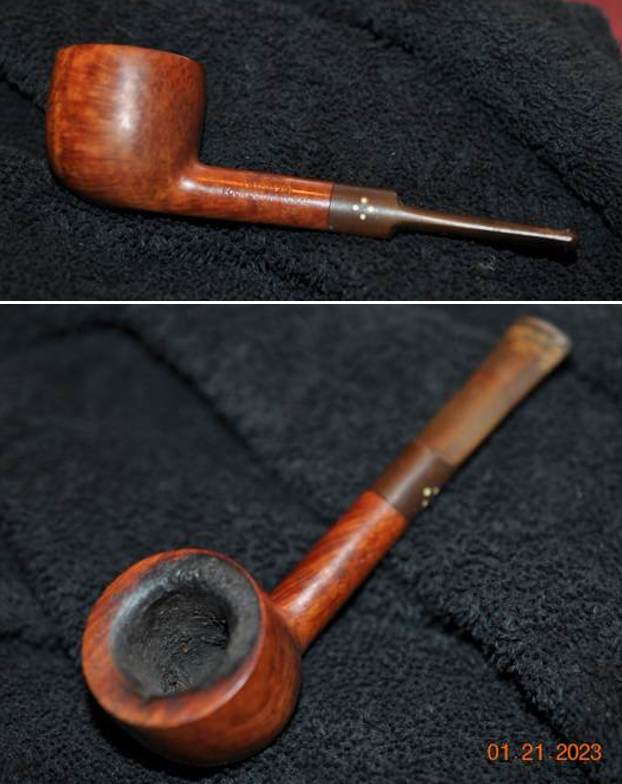
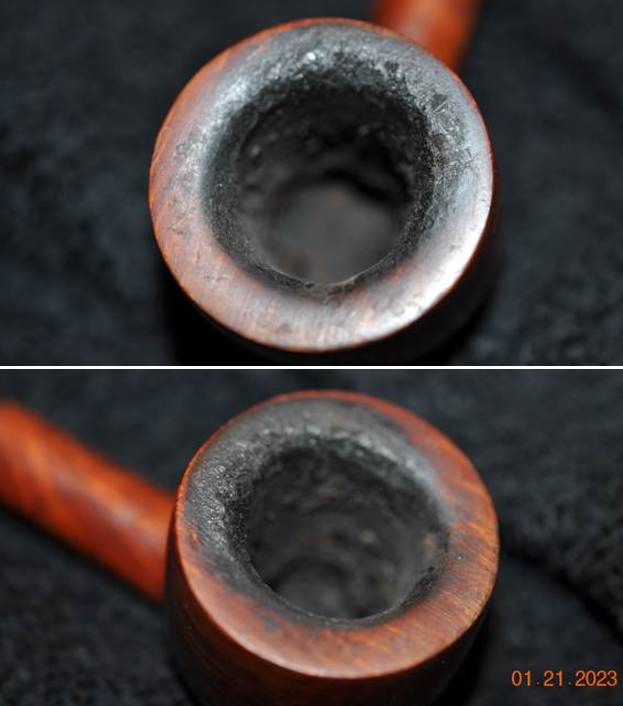
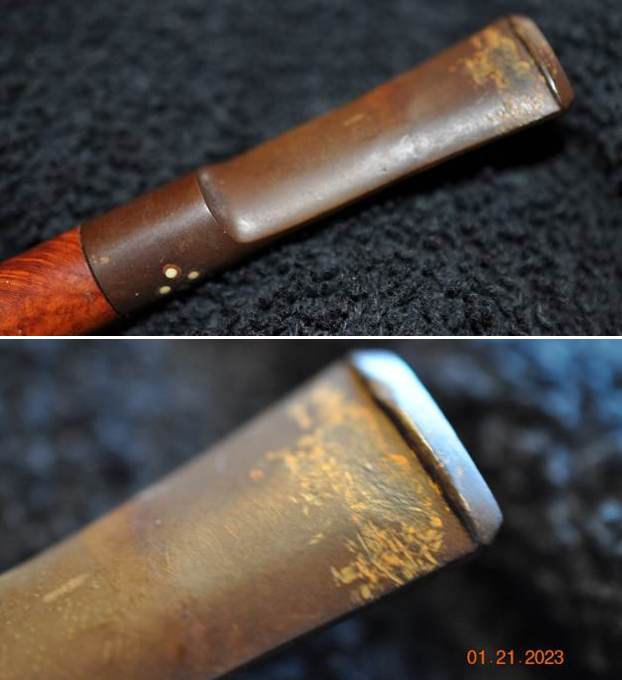
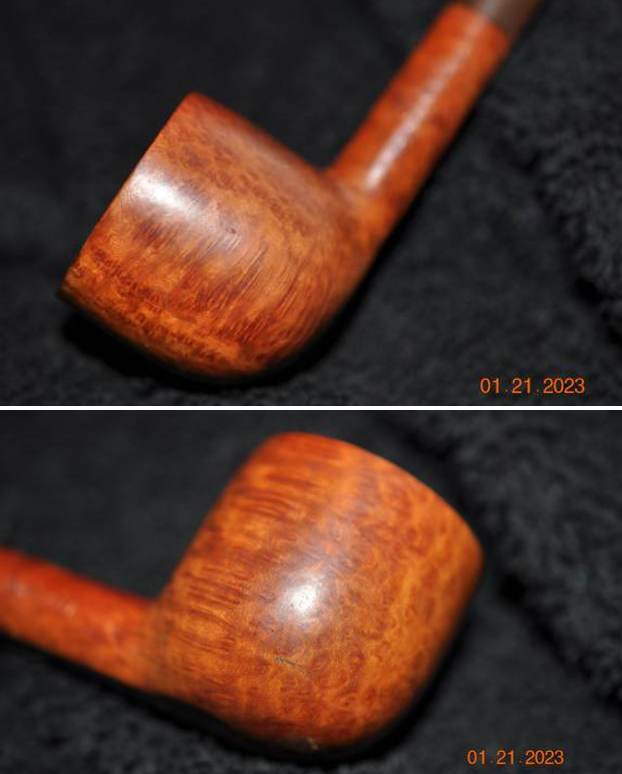
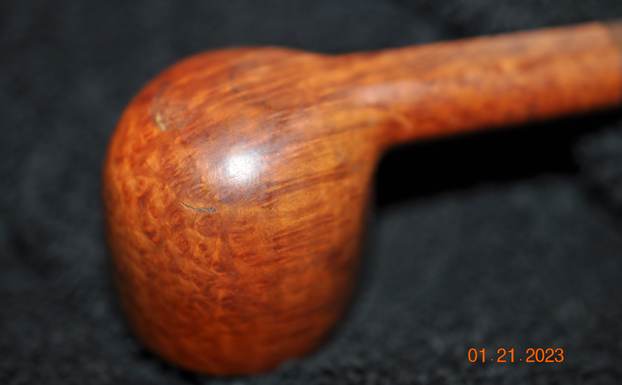
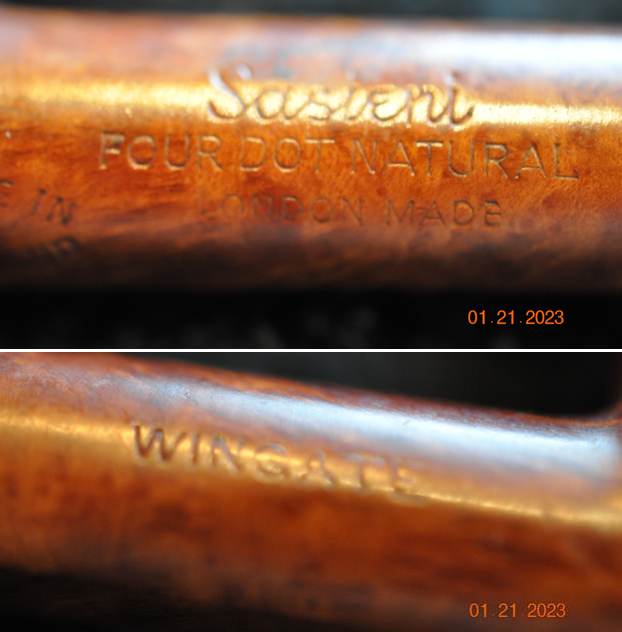
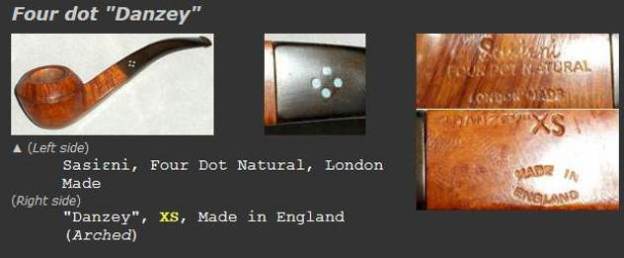
I then turned to Pipedia for more detailed information (https://pipedia.org/wiki/Sasieni). I quote a section of that article below. It refers to the Patent Number that is on the pipe I have on the table. The underlined  portion below is particular pertinent to this pipe.

To begin with, there are three main elements to dating the Sasieni pipe, the patent number, the style of the name “Sasieni” as it appears on the shank, and the Dots themselves. Naturally, there are exceptions to these rules (this hobby would be boring without them), but for the most part these guidelines apply better than 95% of the time. All Sasieni One, Four, and Eight Dot pipes made before W.W.II and destined for the U. S. market carried a patent number on the shank which usually started with the numbers “15″, with 150221/20 and 1513428 being representative of the group. Also, the name “Sasieni” was stamped on the shank in a very florid manner, with the tail of the last “i” sweeping underneath the name forming a shape which has been compared to a fish by more than one collector. This script was discontinued by Alfred almost immediately after he took over the company, so this alone tells you your pipe is pre W.W.II. Underneath in block lettering are the words “London Made”, with the patent number making the third line.

The dots will help you narrow this down further. As we mentioned, the short lived U. S. market One Dot was introduced around 1920, and was replaced by the early to mid 1920’s by the Four Dot. The 1920’s Four Dot is distinguishable by the florid Sasieni script, a patent number, and four blue dots, which are quite small compared to the pipes of post war years. Furthermore, by 1935 Sasieni began stamping pipes, based on the shape, with their own names, which were usually, but not always, English towns. For example, apples were stamped “Hurlingham”, bulldogs were “Grosvenor” or “Danzey”, and panels were “Lincoln”. One rare and interesting variation of this was the large bent, dubbed “Viscount Lascelles”. Even in this soft Sasieni market, these pipes regularly sell for $150 in their rare appearances in mailers.

The pipe I have is one does not have a patent number so it was not made for the US market. The flourished “i” was discontinued by Alfred so that confirms that the pipe was made Pre-transition, 1946 – 1979. The third line stamped is London Made in block lettering. With all that information I knew that my pipe was from the period before the transition (Pre Transition) so it was an older one.

I am sure many of you will shake your head and ask maybe even out loud, “Why is he including this again?” However, please remember that the point of these blogs is not to wow your with the work or make you shake your heads but I want you to know the details of the work we do so you can do your own. Back in 2020 Jeff wrote a blog about his cleaning process. I am including a link to that now so you can see what I mean about his process. Do not skip it! Give it a read (https://rebornpipes.com/2020/01/20/got-a-filthy-estate-pipe-that-you-need-to-clean/). Here is the introduction to that blog and it is very true even to this day.

Several have asked about Jeff’s cleaning regimen as I generally summarize it in the blogs that I post rather than give a detailed procedure. I have had the question asked enough that I asked Jeff to put together this blog so that you can get a clear picture of the process he uses. Like everything else in our hobby, people have different methods they swear by. Some may question the method and that is fine. But it works very well for us and has for many years. Some of his steps may surprise you but I know that when I get the pipes from him for my part of the restoration they are impeccably clean and sanitized. I have come to appreciate the thoroughness of the process he has developed because I really like working on clean pipe!

For the benefit of some of you who may be unfamiliar with some of the products he uses I have included photos of three of the items that Jeff mentions in his list. This will make it easier for recognition. These three are definitely North American Products so you will need to find suitable replacements or order these directly on Amazon. The makeup pads are fairly universal as we were able to pick some up in India when we were with Paresh and his family.

In the blog itself he breaks his process down into two parts – cleaning the stem and cleaning the bowl. Each one has a large number of steps that he methodically does every time. I know because I have watched him do the work and I have seen the pipes after his work on them. He followed this process step by step and when the pipe got to me it was spotlessly clean and ready for my work. The inside of the stem, shank and bowl were clean and to me that is an amazing gift as it means that my work on this end is with a clean pipe! I cannot tell you how much difference that makes for my work.

When the pipe arrives here in Vancouver I have a clean pipe and I go over it keeping in mind my assessment shared in the opening paragraph above. Now that I have it in hand I am looking for confirmation of what I saw in the photos as well as any significant structural changes in the bowl and finish as I go over it.

  1. This small Petite Pot has a generous bowl and the pipe is well proportioned. It has a classic English Sasieni shape.
  2. The finish is clean and the oils have been removed from both sides of the bowl. The grime ground into the finish is gone and there is some great grain around the bowl sides.
  3. The thick lava coat on the rim top has been removed and there is some nicks and burn damage on the top and inner edges of the bowl (particularly toward the front). There is some darkening and damage on the back side of the inner edge and top as well but not as extensive.
  4. The cake had been totally removed and the walls of the bowl are clean. There is not any checking or burn damage on the interior walls of the bowl.
  5. The vulcanite saddle stem is clean and has light tooth chatter and marks on both sides. The four dots (Sasieni logo) on the left side of the saddle look very good. There is also an aluminum stinger in the tenon that is very clean.

Hopefully the steps above show you both what I look for when I go over the pipe when I bring it to the work table and also what I see when I look at the pipe in my hands. They also clearly spell out a restoration plan in short form. My work is clear and addressing it will be the next steps. I took photos of the whole pipe to give you a picture of what I see when I have it on the table. This is important to me in that it also shows that there was no damage done during the clean up work or the transit of the pipe from Idaho to here in Vancouver.    I carefully went over the bowl and rim top to get a sense of what is happening there. In this case once the lava was removed damage to the edge and top was revealed. It is burn damage to the front inner beveled edge and rim top. There is also some damage on the back inner edge and darkening on the rim top. It is clean but will need to be worked on to bring it back to normal. I also go over the stem carefully. There were no tooth marks or dents other than on the button edges on both sides of the stem. I took photos of the rim top and stem sides to show as best as I can what I see when I look at them.I always check to make sure that the clean up work did not damage the stamping on the shank in any way. It looks good but is faint in some parts – particularly the edges of the stamp. I always appreciate the handiwork of the carvers at Sasieni who turn a piece raw briar into a beautiful pipe. I love just looking at the beauty of the lay of the pipe with the grain and the proportion of the pipes. I like to remove the stem from the shank to get a sense of what was in the mind of the pipe maker when he crafted the pipe. It is a beauty in flow and shape. By this time you should know that I almost always start with the bowl in my restoration because I truly do not like the tedious work of stem repairs and polishing. I always leave that until last even though I know that it needs to be done. For me the encouragement of seeing a rejuvenated bowl is the impetus I need to attack the stem work.
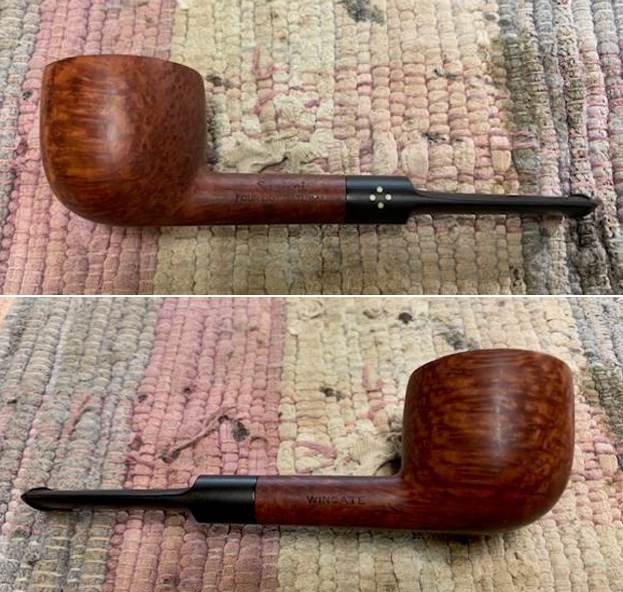
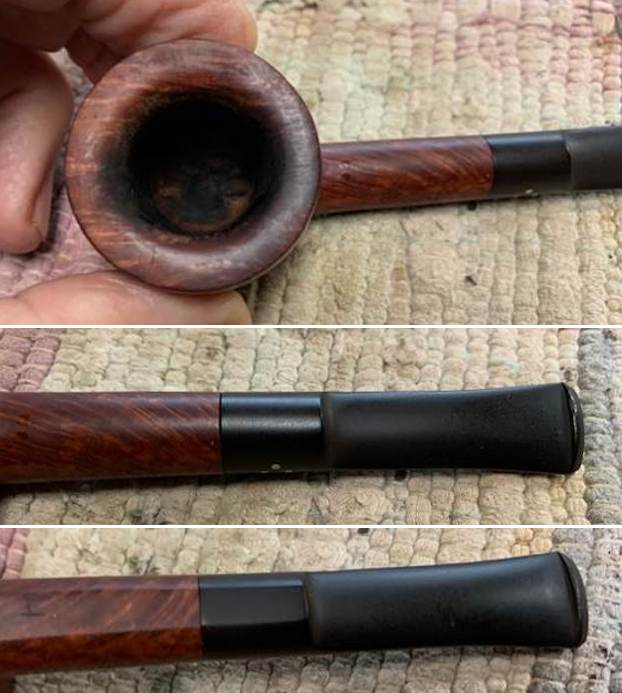
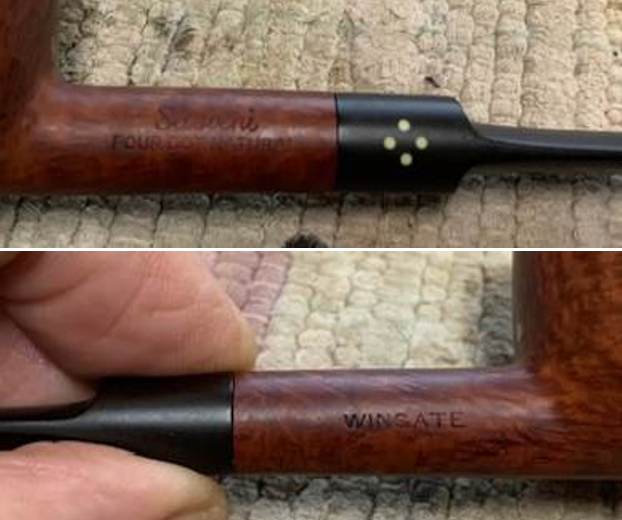
Today I started working on this pipe by turning to the bowl. I chose to deal with the darkening and burn damage on the rim edges and top. I used a piece of 220 grit sandpaper and a wooden sphere to reshape and remove the damage on the top and the inner edge. It took a little work but I was able to remove most of the damage. I used a folded piece of 220 grit paper to work on it some more. There is a little left at the back side of the inner edge. The front edge looks much better. It is a beautiful piece of briar with some great grain.  I forgot to take a photo of the rim top after the clean up but it looked much better. You can see it in the stained rim top photo below. I stained it with an Oak stain pen to match the surrounding briar. I polished the briar with micromesh sanding pads. I choose to dry sand the briar rather than wet sand it. Again it is a matter of personal preference. I prefer to use the pads dry and find they work very well on the briar. I sand with each pad (9 in total) and group them by threes for ease of reference. I also work over the sanded rim top and edges with the pads. I wiped the bowl down after each pad with a damp cloth to remove the sanding debris and check the briar. I love seeing the developing shine on the briar as I move through the pads which is why I include so many photos of this step. For the past few years now I have been using a product developed by Mark Hoover called Before & After Restoration Balm. It is a paste/balm that is rubbed into the surface of the briar. The product works to deep clean the finish, enliven and protect the briar. I worked it into the briar with my finger tips and let it sit for 10 minutes to do its work. I wiped it off with a soft cloth then buffed it with a cotton cloth. The briar really began to shine and the grain shone through. The photos I took of the bowl at this point mark the progress in the restoration. It is a gorgeous pipe. Now it was time to address the part of the restoration I leave until last. I set the bowl aside and turned my attention to the stem. I heated the stinger and removed it from the shank. I would put it back in after clean up. I fit the stem in the shank to take get measurements of the pipe. When I finished I removed the stem from the shank the tenon shattered in the shank and was stuck. This is great – just what I needed. Now I would need to replace the tenon and refit it. I pulled the broken tenon from the shank with a knife blade. I went through my tenons and chose one that was close to the diameter of the broken tenon. I flattened the broken portion on the stem surface with a Dremel and sanding drum. I chose not to drill it out for the stinger as it made the walls of the tenon very thin. I sanded the diameter of the new tenon with a Dremel and sanding drum to reduce it for a snug fit in the shank.I drilled out the stem to receive the new tenon. I used a series of drill bits from one the size of the airway in the stem and up to the point it fit in the stem. I glued it in place in the stem with super glue and set aside to cure. I gave the tenon a light coat of clear CA glue to smooth it out. Once I sanded it would be smooth. I examined the shank end and saw that when the tenon broke it left a nick in the surface of the shank end. I decided to use a thin brass band to flatten the shank end and clean up the fit against the shank. I glued the band on the shank end and it looked very good. The bonus was that the stem fit very well. I stated with the tooth marks. I “painted” the surface dents with a Bic light flame and was able to lift them significantly I paused at this point and put the stem in the shank. It was at this point the tenon broke. With the new tenon in place I sanded the stem with 220 grit sandpaper to further blend them into the vulcanite. I started the polishing of the stem with 600 grit wet dry sandpaper. I use micromesh sanding pads and water to wet sand the stem and tenon with 1500-12000 grit sanding pads. I wiped it down after each sanding pad with Obsidian Oil on a cotton rag after each sanding pad as I find it does two things – first it protects the vulcanite and second it give the sanding pads bite in the polishing process. After finishing with the micromesh pads I rubbed the stem down with Before & After Fine and Extra Fine stem polish as it seems to really remove the fine scratches in the vulcanite. I rub the Fine Polish on the stem and wipe it off with a paper towel and then repeat the process with the Extra Fine polish. I finish the polishing of the stem down with a final coat of Obsidian Oil and set the stem aside to let the oil absorb. This process gives the stem a shine and also a bit of protection from oxidizing quickly.The final steps in my process involve using the buffer. I buff the stem and the briar with Blue Diamond on the buffing wheel. It is a plastic polish but I find that it works very well to polish out the light scratches in the vulcanite and the briar. I work the pipe over on the wheel with my finger or thumb in the bowl to keep the pipe from becoming airborne. I buffed the pipe with multiple coats of carnauba wax. I have found that I can get a deeper shine if I follow up the wax buff with a clean buffing pad. It works to raise the shine and then I follow that up with a hand buff with a microfiber cloth to deepen the shine. It is always fun for me to see what the polished bowl looks like with the polished vulcanite stem. It really is a beautiful pipe. The smooth finish around the bowl sides and shank show the grain shining through the rich brown stains of this Pre-Transition Sasieni Four Dot London Made Wingate Pot. The thin brass band on the shank fits well and looks classy. The finished pipe feels great in my hand. It is light and well balanced. Have a look at it with the photos below. The dimensions are Length: 5 inches, Height: 1 ½ inches, Outside diameter of the bowl: 1 3/8 inches, Chamber diameter: ¾ of an inch. The weight of the pipe is .99 ounces/28 grams. It is a beautiful pipe and one that I will be putting on the rebornpipes store in the British Pipe Maker section.
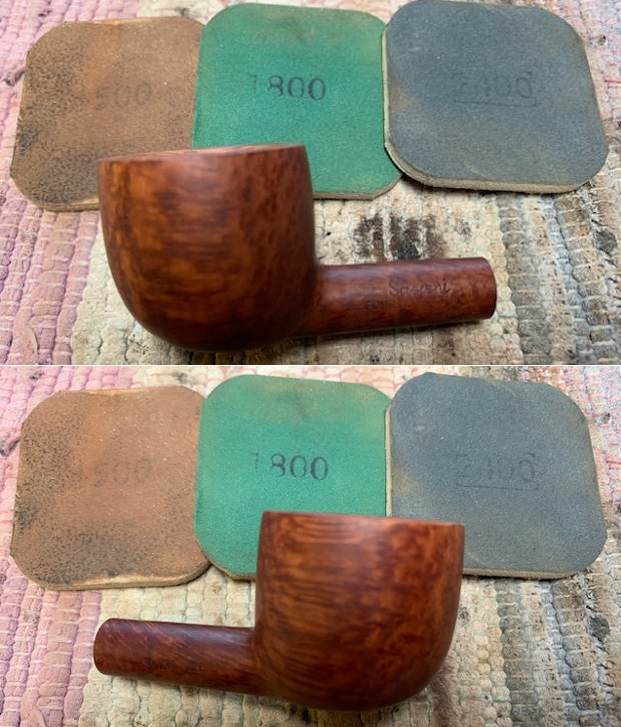
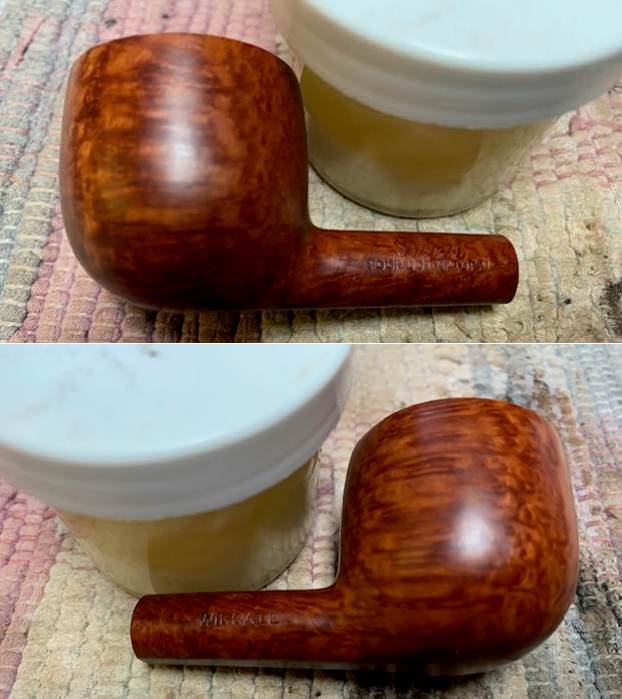
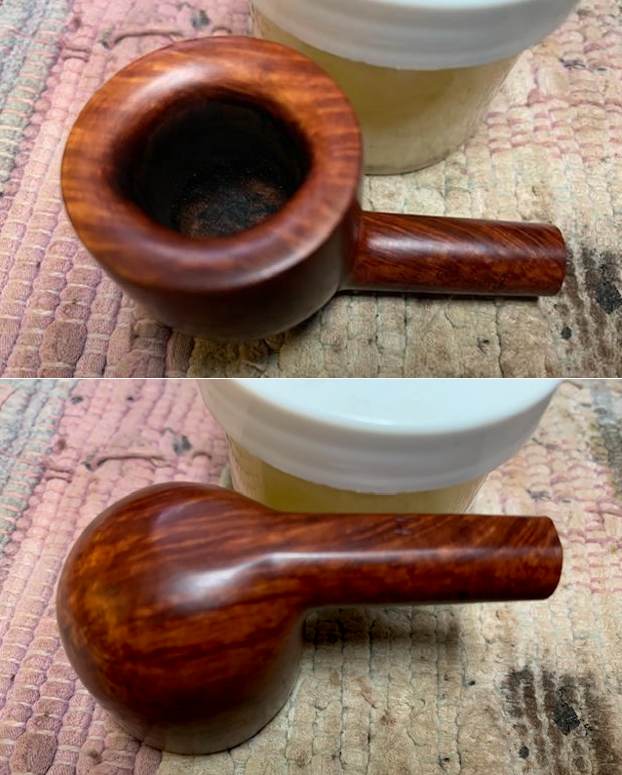
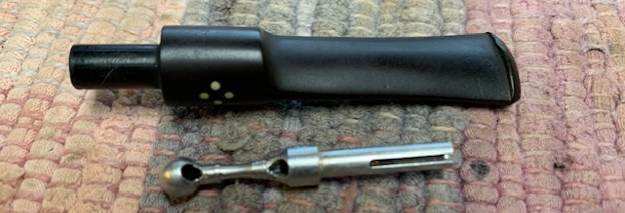
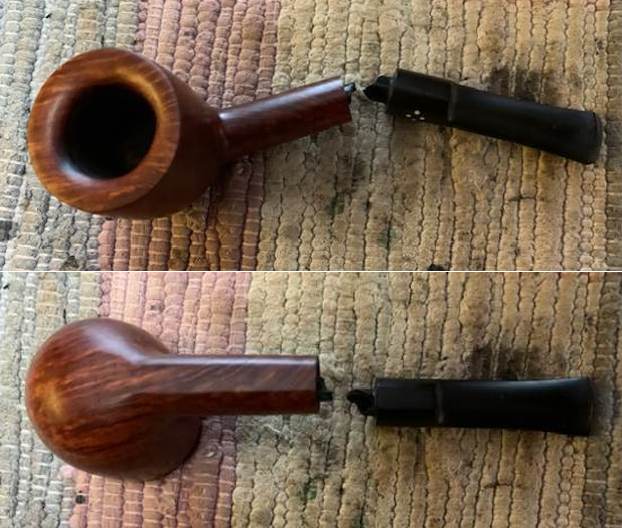
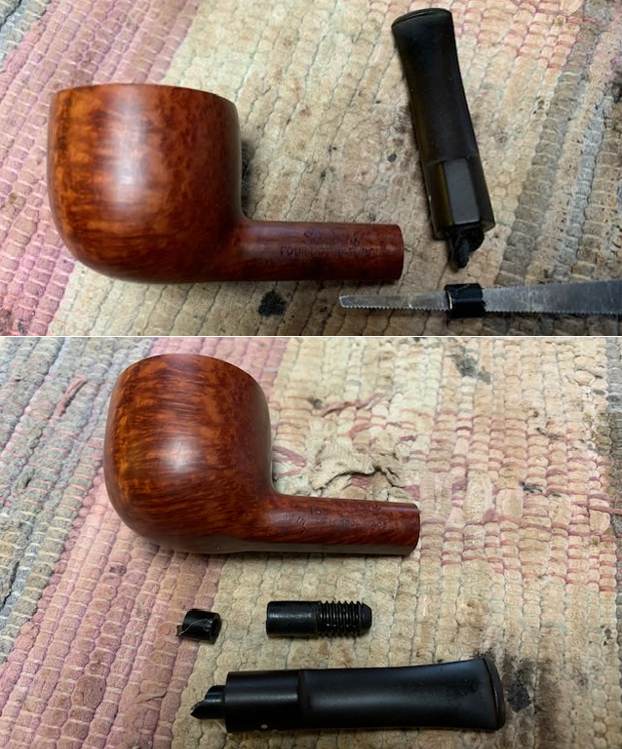
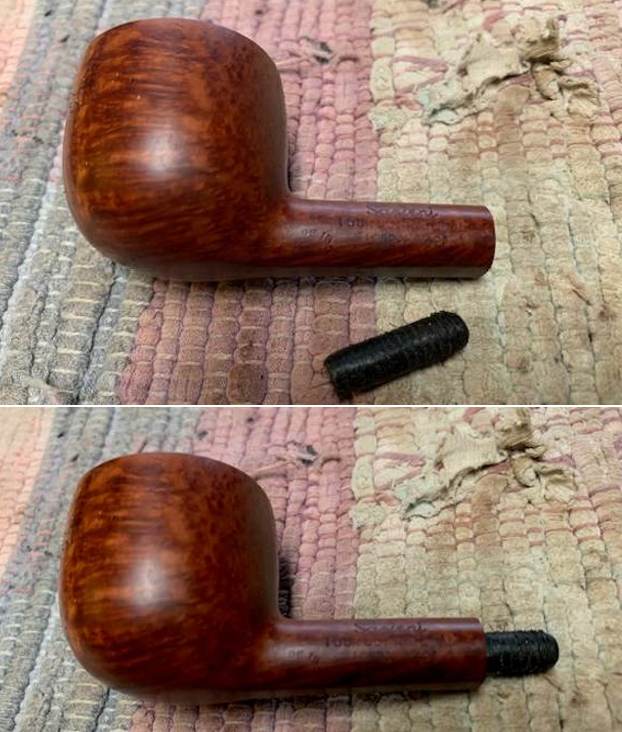
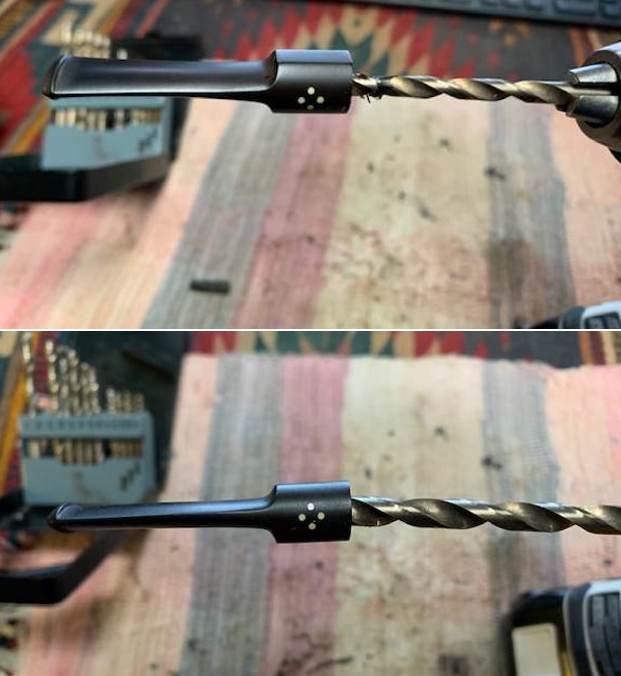
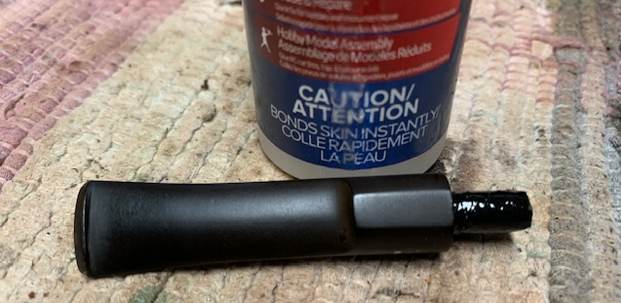
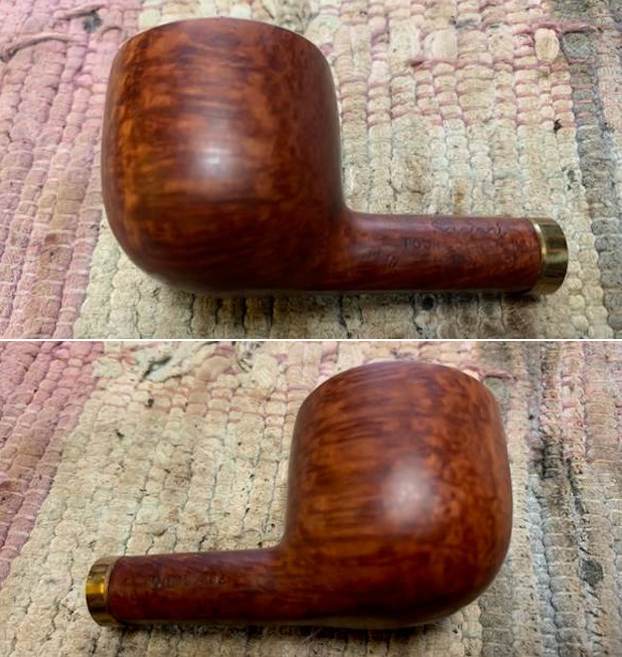
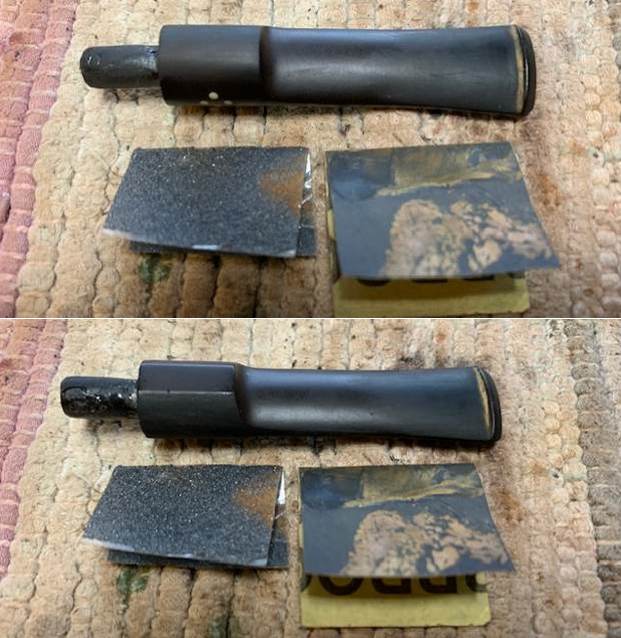
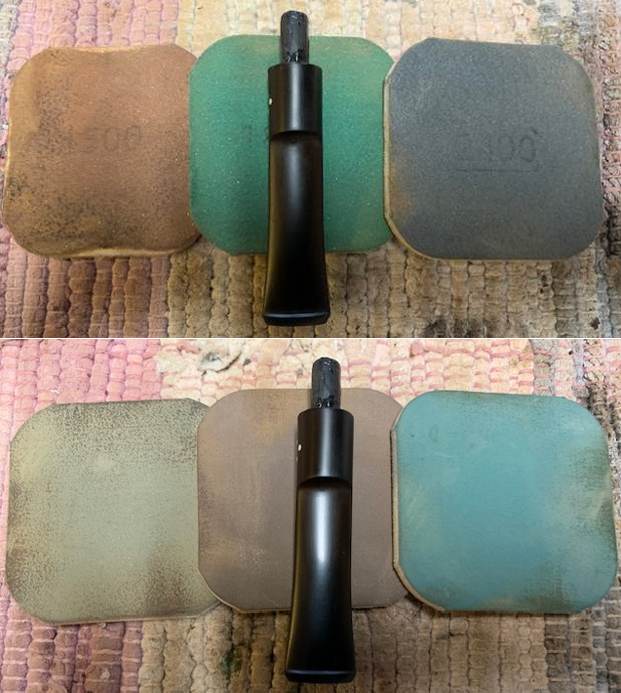
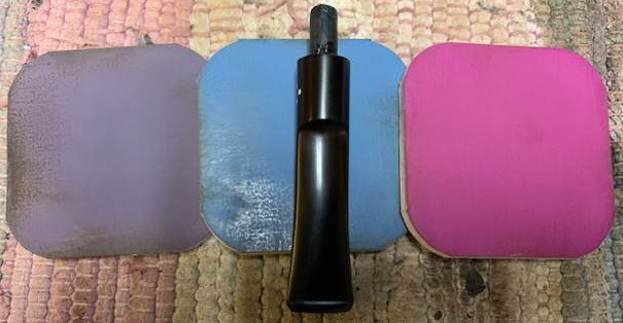
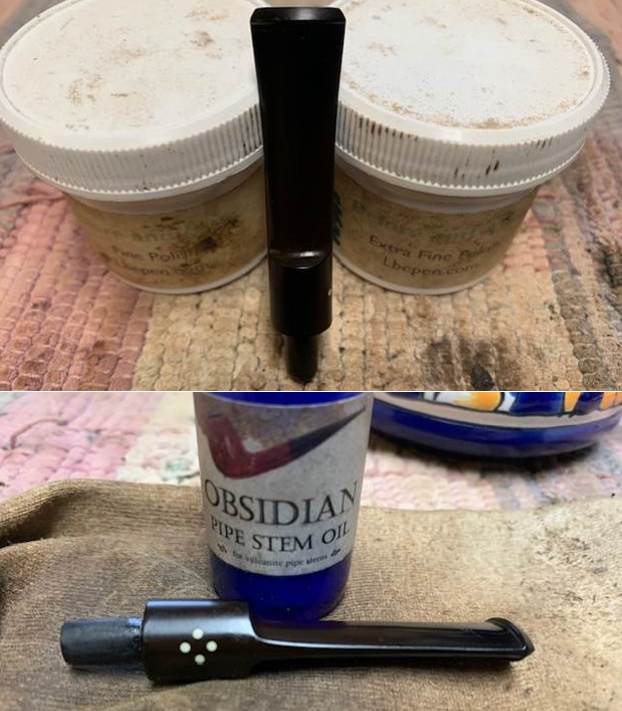
Hopefully the shape writing this blog is helpful to you in some way. In it I wanted to show both what I am looking for and how I move forward in addressing what I see when work on a pipe. Let me know if it is helpful to you. It is probably the most straightforward detailed description of my work process that I have done. As always I encourage your questions and comments as you read the blog. Thanks to each of you who are reading this blog. Remember we are not pipe owners; we are pipemen and women who hold our pipes in trust until they pass on into the trust of those who follow us.
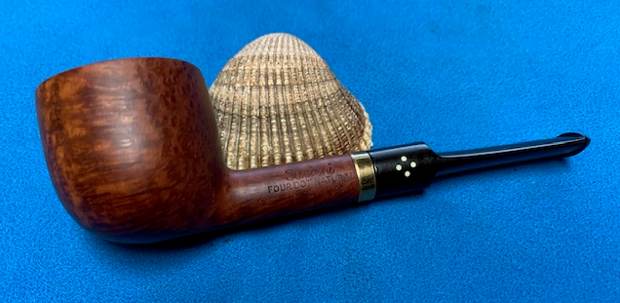
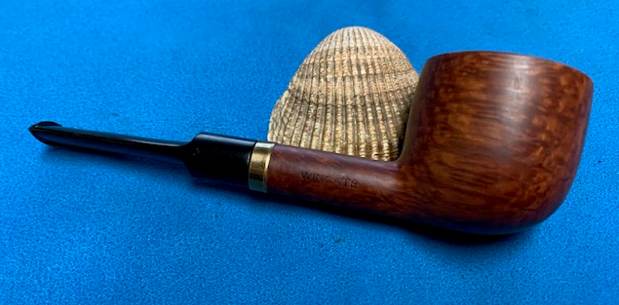
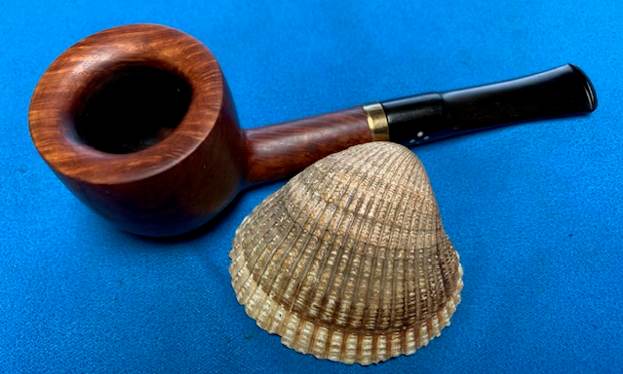
New Life for a Hard Ridden Sasieni 4 Dot Ruff Root Dark 8 Bent Apple


Blog by Steve Laug

The next pipe on the work table has been here for over four years. Sad that there are some that have sat this long or longer before I got to them. But on the other hand I get to look through my boxes and pick out what turns my crank at the moment. This one was a nice sandblast bent apple. We picked it up back in January of 2018 from a seller on EBay from Los Fresnos, Texas, USA. It is stamped on the underside of the shank and reads Sasieni 4 Dot [over] Ruff Root Dark [over] London Briar followed by the number 8 which appears to be the shape number. The poor pipe had obviously been someone’s favourite and must have been a grand smoker. The finish appears to be light brown but the grime and debris in the sandblast lend to that thought. The bowl is heavily caked with a thick lava overflow on the rim top filling in the sandblast. The stem fits with a gap showing that the shank is also heavily tarred. The stem has some oxidation and deep tooth marks on the top and underside near the button. It really was a mess and a stinky one at that! Jeff took pictures of the pipe before he did his clean up work. He took photos of the bowl and rim top to give an idea of the thickness of the cake and the lava on the top. It was quite thick and hard. He took photos of the stem surface to show the oxidation and the tooth marks on them. There was a deep tooth mark on the top of the stem near the button. He took photos of the sandblasted grain around the bowl sides and heel of the bowl. It is a very nice looking blast. Jeff captured the stamping and the placement of the four dots on the stem side. The stamping is clear and readable. You can also see several issues with the pipe in these photos. First, to the left of the stamping (next to Ruff) there is a flaw in the briar. It looks like a crack but it follows the grain of the blast. Second, the fit of the stem to the shank is off which says to me that the tenon is crooked not allowing a fit to the shank end.I remembered that I had worked on a Sasieni Ruff Root Dark in the past – a Canadian if my memory served me right. I did a quick search on rebornpipes and found the Canadian I was remembering and the blog I had written (https://rebornpipes.com/2020/04/19/an-easy-restoration-of-a-sasieni-4-dot-ruff-root-dark-13-canadian/). I had done some research on the stamping and brand for that blog and I am including it below.

When the pipe arrived I turned to Pipephil (http://www.pipephil.eu/logos/en/logo-sasieni.html) to see if he included not only information on this Sasieni 4 Dot Ruff Root Dark Canadian. Sure enough there was some quick information that identified the time frame of this pipe. He dates it as a Post Transition piece 1986-today. The Ruff Root name is what they call a sandblasted finish. He points out that the 4 Dot has replaced the Four Dot from 1986.I turned to Pipedia for more information on 4 Dot line of Sasieni pipes and any information that was added there (https://pipedia.org/wiki/Sasieni). I quote a pertinent paragraph:

The nomenclature changed again in 1986, with the sale of the company to the Post-Transition firm. The three line nomenclature was changed to two lines, with the first reading “Sasieni 4 Dot” and the second identifying the finish, e.g. Natural, Walnut, or Ruff Root. Note how 4 Dot is spelled, using an Arabic numeral 4, as opposed to spelling out the word “four”. This is the easiest way to spot a Post-Transition Sasieni, as the new company has used both script and block lettering to spell the word “Sasieni” on the shank

So I knew that I was dealing with a Post Transition 4 Dot Sasieni that was made after 1986. Now it was time to look at it up close and personal. Jeff had done an amazing job in removing all of the cake and the lava on the rim top. He had reamed the bowl with a PipNet Pipe Reamer and cleaned up the remnants with a Savinelli Fitsall Pipe Knife. He took the cake back to bare briar so we could check the walls for damage. He scrubbed the exterior of the bowl with Murphy’s Oil Soap and a tooth brush to remove the grime on the bowl and rim and was able to remove the lava and dirt. He cleaned out the interior of the bowl and shank with pipe cleaners, cotton swabs and alcohol until they came out clean. He cleaned the stem with Soft Scrub to remove the grime on the exterior. He soaked it in Before & After Pipe Stem Deoxidizer and rinsed it with warm water. He cleaned out the airway with alcohol, cotton swabs and pipe cleaners. I took some photos of the pipe before I started my work on it today. I took a close up photo of the cleaned up rim top. You can see the smoothing out of the top on the right front and the left rear of the bowl. The rest of the rim top has some great sandblast. The inner edge has a slight bevel that should clean up well. The stain is faded on the top. The bowl is spotless. The stem is clean and you can see the tooth marks on both sides ahead of the button. After Jeff had cleaned it the stem fit more snug against the shank end.I took a photo of the stamping on the underside of the shank. It is clear and readable as noted above.I removed the stem from the shank and took a photo to give a sense of the part of this pipe. I think it is going to be a beauty.I put on a magnifying headlamp and traced the flaw in the briar from the edge of the Ruff stamp on the underside of the shank. I filled it in with a thin line of clear CA glue. It was more of a cosmetic fix than a concern about a crack. Once it cured I used several brass bristle brushes I have to blend in the repair to the rest of the sandblast finish.With that cosmetic fix done I decided to address the smooth portions of the rim top. The first photo shows what I am referring to. I have used a series of burrs on my Dremel in the past to rusticate the smooth portions of the damaged top and match the sandblast pattern as much as possible. I have found that it works very well. Once I finished I used a brass bristle brush to knock off the debris and some of the roughness. I stained it with a Walnut stain pen to match the rest of the bowl colour. What do you think? Did it work?I rubbed the bowl down with Before & After Restoration Balm. I worked it into the surface of the briar with my finger tips and a horsehair shoe brush. The product works to clean, restore and preserve the briar. I let it do its magic for 15 minutes then buffed it off with a cotton cloth. The pipe looks incredibly good at this point in the process. With that finished I set the bowl aside and turned to work on the stem. I “painted” the surface of the stem with the flame of a Bic lighter to lift the tooth marks on both sides. I was able to lift them significantly but deep marks still remained on each side. I filled those in with black CA glue and set the stem aside to cure. Once the repair cured I flattened the repair with a small file to start the process of smoothing it out and blending it into the surrounding vulcanite. I sanded the file marks and repairs with 220 grit sandpaper and started polishing the stem with 400 grit wet dry sandpaper. It is starting to look very good. I continued to polish the stem with micromesh sanding pads – wet sanding with 1500-12000 grit sanding pads. I wiped it down after each sanding pad with Obsidian Oil. I polished it with Before & After Pipe Stem Polish – both Fine and Extra Fine. I gave it a final coat of Obsidian Oil and set it aside to cure. This Sasieni Ruff Root Dark 8 Bent Apple is a beauty. I put the pipe back together and lightly buffed it with Blue Diamond on the buffing wheel. I gave the bowl multiple coats of Conservator’s Wax and the stem multiple coats of carnauba wax. I hand buffed the pipe with a clean buffing pad to raise the shine. It is fun to see what the polished bowl looks like with beautiful mixed grain all around it. The polished dark Walnut coloured sandblast has depth and lends to a variation in colour as the bowl is turned. It looks great with the black vulcanite stem. This smooth Sasieni Ruff Root Dark Bent Apple is great looking and the pipe feels great in my hand. It is light and well balanced. Have a look at it with the photos below. The dimensions are Length: 5 inches, Height: 1 ¾ inches, Outside diameter of the bowl: 1 ¼ inches, Chamber diameter: ¾ of an inch. The weight of the pipe is 46 grams/1.59 ounces. It turned out to be a beautiful pipe. I will be putting this pipe on the rebornpipes store in the British Pipe Makers Section. Let me know if you are interested in adding it to your rack and carrying on the trust of this well traveled pipe. Thanks for your time reading this blog and as Paresh says each time – Stay Safe.  
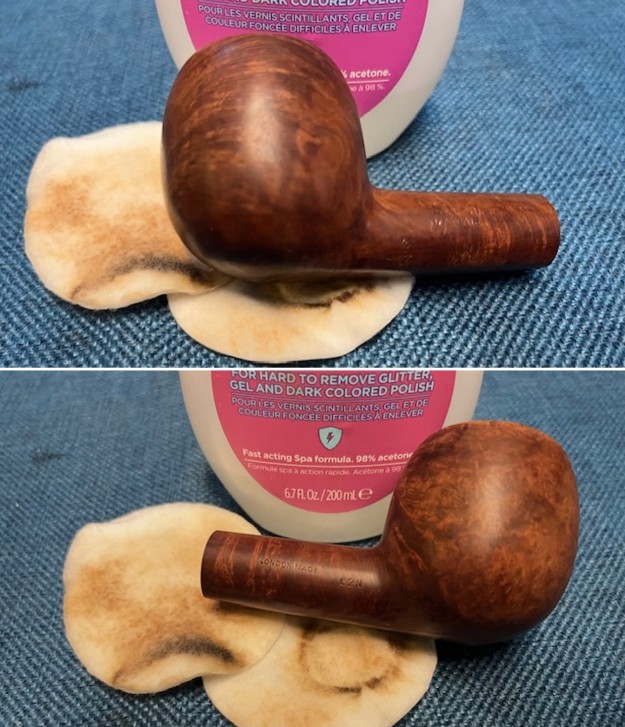
Breathing New Life into Sasieni London Made Patent No. 150221/20 Canadian


Blog by Steve Laug

The next pipe on the work table came to me from either a trade I made (pipes for labour) or a find on one of my pipe hunts. I honestly don’t remember where it came from. It has been around for a while waiting to be worked on. It is an older long shank Canadian with a Sterling Silver band on the shank. It is quite dirty but has some great grain on the shank and stem. The stamping on this Canadian is faint but and readable. It is stamped on the topside of the shank next to the bowl and reads Made in England in an oval. That is followed by Sasieni [over] London Made [over] Pat. No. 150221/20. There is no shape number on the shank that I can see. The pipe had a lot of grime ground into the smooth finish on the bowl. The bowl had been heavily caked but had been reamed somewhere in its journey. The rim top and inner edge had darkening and some burn damage all the way around though heavier on the right and back side. The vulcanite stem was dirty and had light tooth chatter and marks on the top and underside ahead of the button. There were four pale blue dots on the top side of the taper stem that is common on a Sasieni. The pipe had promise but it was very dirty. I took photos of the pipe before I started my cleanup work.   I took photos of the rim top and bowl to give a clear picture of the bowl and the damage on the rim top and edges. The Sterling Silver band is tarnished and black. I also took photos of the top and underside of the stem to show the light chatter and tooth marks. I took photos of the stamping on the top side of the shank. It reads as noted above and is faint but readable. The silver band is stamped Sterling Silver on the top and there are four light blue dots on the top of the taper stem.   I wanted to see if I could narrow down a time frame for this Sasieni London Made Patent pipe so I turned first to Pipephil’s site to get a good overview and see if there were photos of a similar looking stamping on a pipe there (http://www.pipephil.eu/logos/en/logo-sasieni.html). I quote the summary of the history of the brand from the top of the page:

One may distinguish three major periods in the Sasieni brand history:

  • The so called pre-transition period during which the family totally owned the business.
  • The transition period from 1979 to 1986. The corporate has been bought by Ian Chase and a group of South African investors.
  • The post-transition period from 1986 up to the present. At first the corporate has been bought by James B. Russell and after him by Cadogan Investments Ltd (A. Oppenheimer & Co. Ltd).

With that information I scrolled through the photos of shapes and stamping on the pipes shown. The one that bore the same stamping as the Canadian I am working on was a billiard shown below. I did a screen capture to show the stamping look and design. The shape number on the Canadian is obviously buffed off on the pipe I have. From that information I knew that the pipe I had was a Pre-Transition Period pipe made between 1919-1924. This is demonstrated by the style of the Sasieni Stamp (with a flourish) and the rest of the stamping including the  Pat. No.

From there I turned to Pipedia to read more information about the time periods and the stamping on this particular pipe (https://pipedia.org/wiki/Sasieni). I quote a pertinent section below.

To begin with, there are three main elements to dating the Sasieni pipe, the patent number, the style of the name “Sasieni” as it appears on the shank, and the Dots themselves. Naturally, there are exceptions to these rules (this hobby would be boring without them), but for the most part these guidelines apply better than 95% of the time. All Sasieni One, Four, and Eight Dot pipes made before W.W.II and destined for the U. S. market carried a patent number on the shank which usually started with the numbers “15″, with 150221/20 and 1513428 being representative of the group. Also, the name “Sasieni” was stamped on the shank in a very florid manner, with the tail of the last “i” sweeping underneath the name forming a shape which has been compared to a fish by more than one collector. This script was discontinued by Alfred almost immediately after he took over the company, so this alone tells you your pipe is pre W.W.II. Underneath in block lettering are the words “London Made”, with the patent number making the third line.

The dots will help you narrow this down further. As we mentioned, the short lived U. S. market One Dot was introduced around 1920, and was replaced by the early to mid 1920’s by the Four Dot. The 1920’s Four Dot is distinguishable by the florid Sasieni script, a patent number, and four blue dots, which are quite small compared to the pipes of post war years. Furthermore, by 1935 Sasieni began stamping pipes, based on the shape, with their own names, which were usually, but not always, English towns. For example, apples were stamped “Hurlingham”, bulldogs were “Grosvenor” or “Danzey”, and panels were “Lincoln”. One rare and interesting variation of this was the large bent, dubbed “Viscount Lascelles”. Even in this soft Sasieni market, these pipes regularly sell for $150 in their rare appearances in mailers.

Once Alfred took over the company in 1946, these elements changed in fairly rapid succession. The first thing to be changed was the nomenclature itself. In place of the elaborate “Sasieni” stamp of pre war pipes, a simpler, though still script style, “Sasieni” was used. This can be seen on patent pipes which have the small, old style dots.

This further gave me a time period and date for this pipe. It was definitely pre-WWII and probably made between 1919-1924. So it was an older pipe that was in decent condition for a pipe that age.

Now it was time to work on the pipe. I cleaned up the reaming of the bowl with a Savinelli Fitsall Pipe Knife. It did not take too much work to clean it up internally. On a pipe of this age once again I exercised restraint in how far I went to clean up the top. I do not want to change look or feel of a pipe that is at least 100 years old. I then turned my attention to the rim top and edges. I lightly topped the bowl on a topping board and 220 grit sandpaper to remove the damage on the top of the rim. I also worked over the inside edge of the bowl with a folded piece of sandpaper to give it a gentle bevel.      I polished the Sterling Silver shank band with a jeweler’s cloth to remove the tarnish and oxidation. It also works to slow down the tarnish process. I took some photos of the band and bowl after the polishing. I scrubbed the exterior of the bowl and rim top with a tooth brush and undiluted Murphy’s Oil Soap to remove the debris from the finish. I rinsed the bowl with warm water to remove the grime and soap and dried it off with a soft towel.    I cleaned out the mortise and airway in the shank with pipe cleaners, cotton swabs and alcohol. It took quite a few of them to clean out the chamber. I cleaned the stem with pipe cleaners, cotton swabs and alcohol as well. Once finished the pipe smelled far better.      I polished the briar with micromesh sanding pads – dry sanding with 1500-12000 grit pads and wiping it down with a damp cloth after each pad.     I rubbed the bowl and shank down with Before & After Restoration Balm. I worked it into the surface of the bowl sides and shank with my fingertips to clean, enliven and protect the briar. I let the balm sit for a little while and then buffed with a cotton cloth to raise the shine. I really like what I was seeing!   I set the bowl aside to let the wall repairs cure overnight. I turned my attention to the stem. I “painted” the stem surface with the flame of a lighter to lift the tooth marks. It worked quite well but there were some left behind. I filled in the remaining marks with clear CA glue and set it aside to cure.   I used a small flat file to flatten out the repairs and to recut the edge of the button. I sanded the repairs further with 220 grit sandpaper and started the polishing with 400 grit wet dry sandpaper. I polished the vulcanite stem with micromesh sanding pads – 1500-12000 grit pads. I wiped it down with an Obsidian Oil impregnated cloth after each sanding pad. I used Before & After Pipe Polish – both Fine and Extra Fine to further polish the stem. I gave it a final coat of Obsidian Oil. This beautiful Sasieni London Made Pat. No. 150221-20 Canadian with a vulcanite taper stem is a great looking pipe now that it has been restored. The rich brown stain on the bowl allows the grain to really show. It came alive with the polishing and waxing. The silver band is a great transition between the briar and the vulcanite. I gave the bowl and the stem multiple coats of carnauba wax on the buffing wheel and followed that by buffing the entire pipe with a clean buffing pad. I hand buffed the pipe with a microfiber cloth to deepen the shine. The finished Sasieni London Made Canadian is a beauty and fits nicely in the hand and looks very good. Give the finished pipe a look in the photos below. The dimensions of the pipe are Length: 5 ¾ inches, Height: 1 ¾ inches, Outside diameter of the bowl: 1 ¼ inches, Chamber diameter: ¾ of an inch. The weight of the pipe is 32 grams/1.13 oz. I am still figuring out what to do with this one. It may stay here but if I decide to let it go watch for it on the store. Thanks for reading this blog and my reflections on the pipe while I worked on it. There are many more to come!