

Blog by Steve Laug
Last week I received a call from a fellow pipeman, Keith here in Vancouver who had been referred to me by City Cigar, a local pipe and cigar shop in the city. He was a soft spoken gentleman who had a request for me. In January this year his Dad died and he had three of his Dad’s pipes that he wanted restored in memory of his Dad. He also was a pipe smoker so he fully intended to enjoy them for a long time as he smoked them in his Dad’s honour. I told him to send me some photos of the pipes so I would know what I was dealing with.
I received the email below from Keith that included the photos of the pipes that he wanted me to work on. He even went to the trouble of marking the trouble with each of the pipes that needed work.
Hi Steve,
Glad your call back today, my name is Keith, I got your contact from City Cigar. My dad has three pipes include two Dr Plumb DINKY and one not sure brand. My dad passed this year January and I looking for fix those pipes which had broken and cracked, understand they are not expensive pipes but for me is priceless memory…
…Have a wonderful day!
Best regards
Keith
I called him as soon as I received the photos and talked over what I saw when I looked them over. We struck a deal and he dropped them off to me late on Friday afternoon and I started to work on them a bit over the weekend. All three pipes needed varying degrees of work on them. Two were Dr. Plumb Dinky Bent Billiards and one was a Real Briar Dublin. I decided to work on them in the order of the photos that he sent me. I completed the restoration of the first one and posted the blog (https://rebornpipes.com/2021/03/16/repairing-a-trio-of-his-dads-pipes-for-a-fellow-here-in-vancouver-part-one/). Give it a read.
The second Dr. Plum Dinky Bent Billiard was in better shape than the first one. There were no cracks in the bowl or shank. The issues on this pipe were caused when Keith smoked it and lit it with a cigar torch lighter. The rim top was damaged on both the right and the left sides and there was a thick cake in the bowl. In the first two photos show what the pipe looks like as a whole. On the second you can see some darkening on the right side of the outer edge of the rim. It is identical in make and shape to the previous repair. The third photo Keith included show the damage to the rim top – he identifies it as ring damage.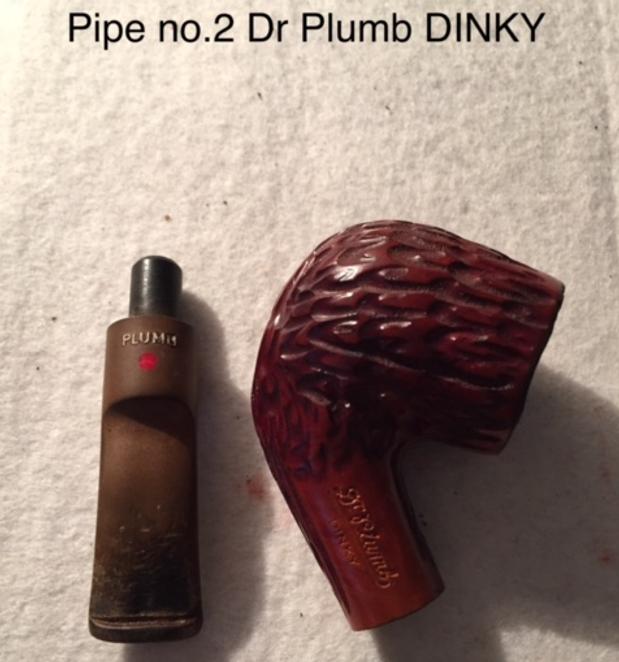

 I took pictures of the pipe when Keith dropped it off before I started my clean up work. It was much dirtier than the first pipe. The bowl had a thick cake in it and the rim top was damaged on both the right and left top and inner edges.
 I took a close up photo of the rim to show the condition of the bowl and the rim. You can see the damage to the rim top and inner edge of the bowl as noted above and shown in the photo below by the red arrows. I also took photos of the stem to show the general condition as noted above. There is also a deep tooth marks on both the top and the underside of the stem near the button.
 I took a photo of the stamping on the left side of the shank – it read the same as the first of the trio that I worked on – Dr. Plumb [over] Dinky and was clear and readable.
 I removed the stem from the shank and took a photo of the pipe. There is something quite winsome about this tiny pipe.
 I have included some information on the Dr. Plumb brand and the history in the previous blog on the first Dinky pipe (https://rebornpipes.com/2021/03/16/repairing-a-trio-of-his-dads-pipes-for-a-fellow-here-in-vancouver-part-one/). Give the blog a read if you are curious about the background.
Now it was time to work on this pipe. It was more used and dirty than the previous pipe and had different issues that I would need to address. I reamed the bowl with a PipeNet pipe reamer to remove the thick cake. I cleaned up the reaming with a Savinelli Fitsall Pipe Knife. It came out looking significantly better. I cleaned the rim top with a cotton pad and alcohol to remove the tars and oils. I rebuilt the inner edge of the bowl and the rim top using clear CA glue and briar dust. I layered it on a layer of glue, a layer of dust and repeated the process until it was even with the rest of the rim top. I used a brass bristle brush while it was still curing to match the rustication on the rest of the rim top and edge. I am happy with the way it turned out. I stained the finished rim top with a Maple stain pen to match the colour on the bowl sides. The CA and briar dust dries darker so the rim top looks darker than the over all bowl in the photos but it is not as dark as it appears.
  I worked some Before & After Restoration Balm into the surface of the bowl and shank with my fingertips and a horsehair shoe brush to clean, enliven and protect the briar. I let the balm sit for 15 minutes and then buffed with a cotton cloth to raise the shine. The photos show the bowl at this point in the restoration process.

 As I looked at these photos it dawned on me at this point that I had not cleaned the shank. I had been so busy working on the rim edge and top that I had not stopped to clean out the bowl and shank. I scrubbed it with 99% isopropyl alcohol, pipe cleaners and cotton swabs. It was quite dirty so I am glad I remembered. I wiped out the bowl with alcohol and cotton pads to remove the briar dust from the repair.
 I set the bowl aside and turned my attention to the stem. I removed it from the deoxidizer bath and it did not really look much better. It had the same heavy oxidation as the previous stem. I scrubbed it down with Soft Scrub and a cotton pad. I found that the oxidation was significantly softer and came off quite easily.
 I scrubbed out the airway in the pipe with alcohol and pipe cleaners until it was clean. It was a well used pipe.
  I “painted” the surface of the stem with the flame of a Bic lighter to lift the tooth dents in the vulcanite. I was able to lift the majority of them and I filled in the remaining marks with clear CA glue. Once the repairs cured I sanded them smooth with a folded piece of 220 grit sandpaper to blend them in the rest of the stem surface. I started polishing the stem with 400 grit wet dry sandpaper.

 I polished the stem with micromesh sanding pads – dry sanding with 1500-12000 grit sanding pads. I wiped it down after each sanding pad with Obsidian Oil. I polished it with Before & After Pipe Stem Polish – both Fine and Extra Fine. I gave it a final coat of Obsidian Oil.
 With the bowl and the stem finished I put the second tiny GBD Made Dr. Plumb Dinky Bent Billiard back together and buffed it on the wheel using Blue Diamond to give it a shine. I gave the bowl multiple coats of Conservator’s Wax and the stem multiple coats of carnauba wax on the wheel. I buffed the pipe with a clean buffing pad to raise the shine. I hand buffed it with a microfiber cloth to deepen the shine. It really is a great looking pipe. The dimensions of the pipe are – Length: 4 inches, Height: 1 ½ inches, Outside diameter of the bowl: 1 inch, Chamber diameter: ¾ inch. The weight of this small pipe is .85 ounces /24 grams. This second small Dr. Plumb Dinky is another great reminder for Keith of his Dad’s Pipe smoking and one that he can enjoy for a long time. Once I finish the last of the pipes I am sure he will be excited to load them with a memorable tobacco and slip back into the memories of his Dad. Thanks for walking through the restoration with me.


 rebornpipes