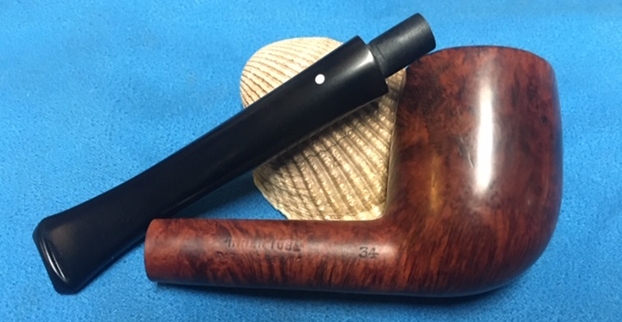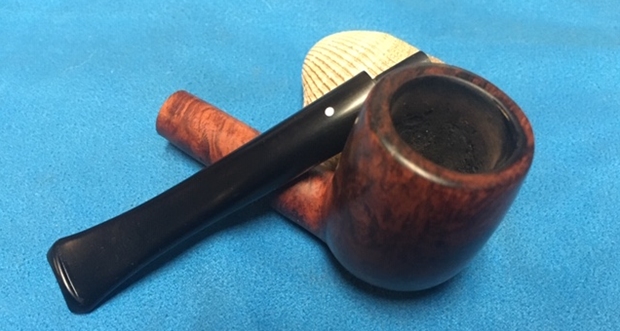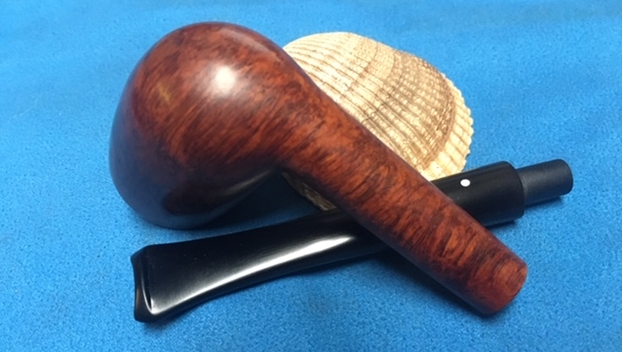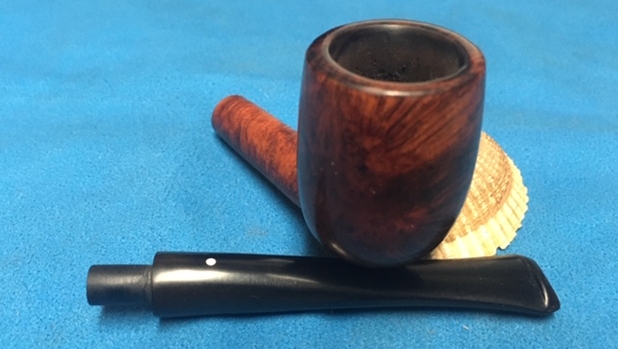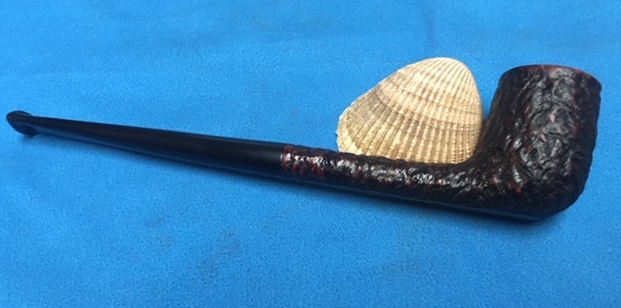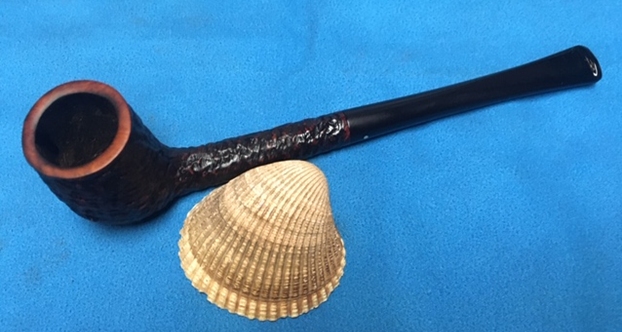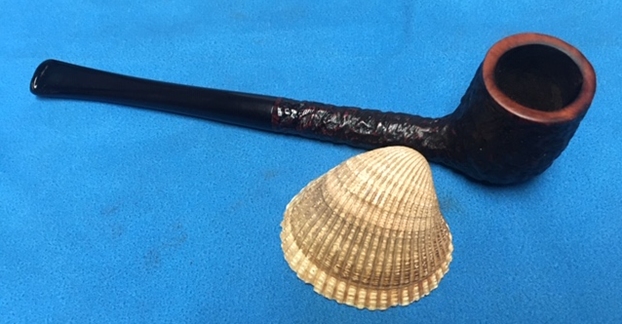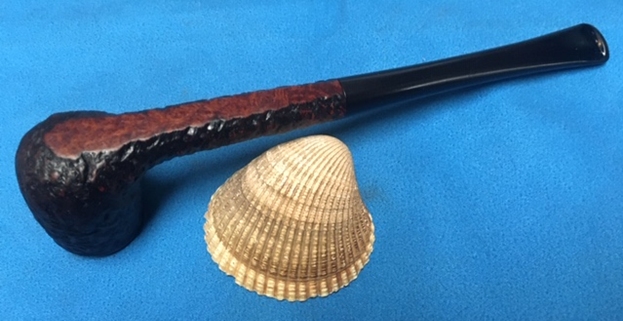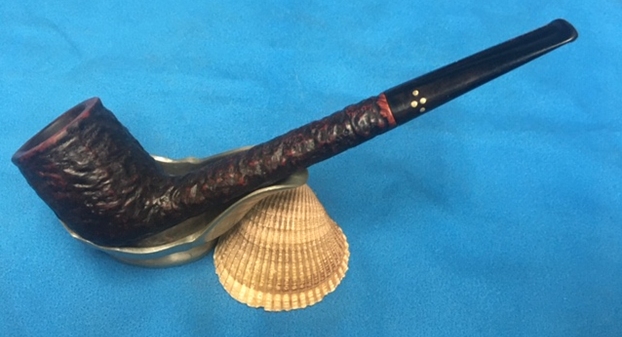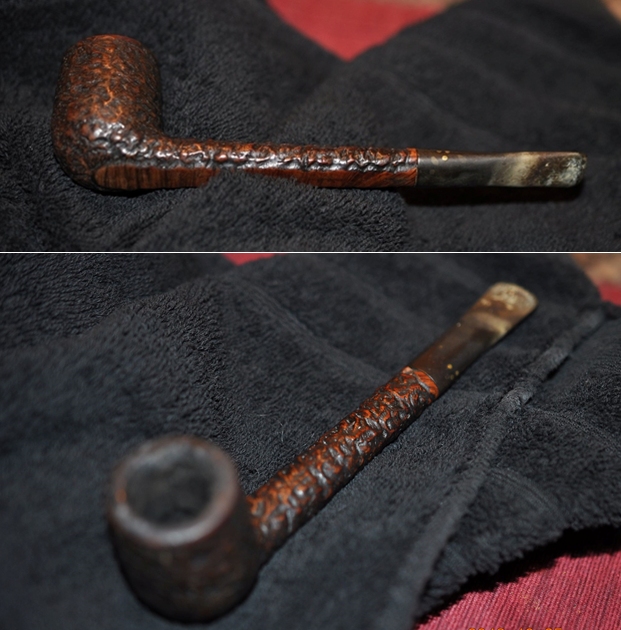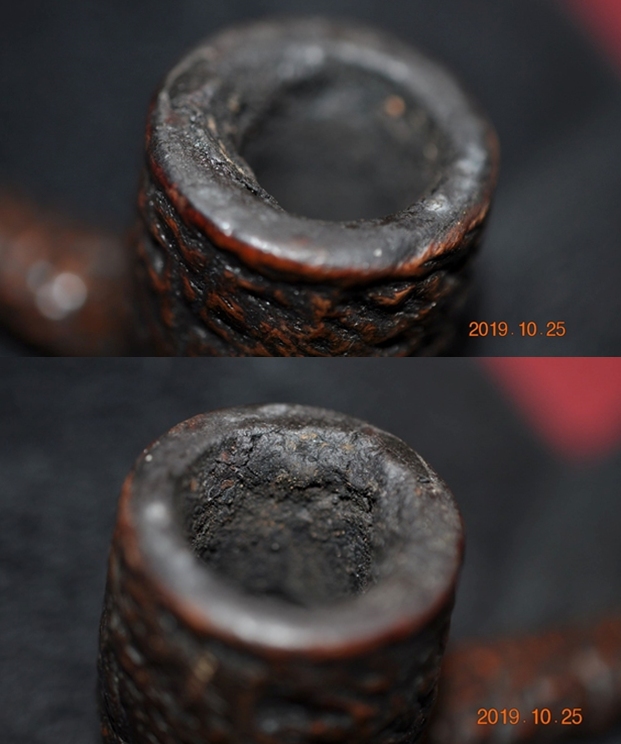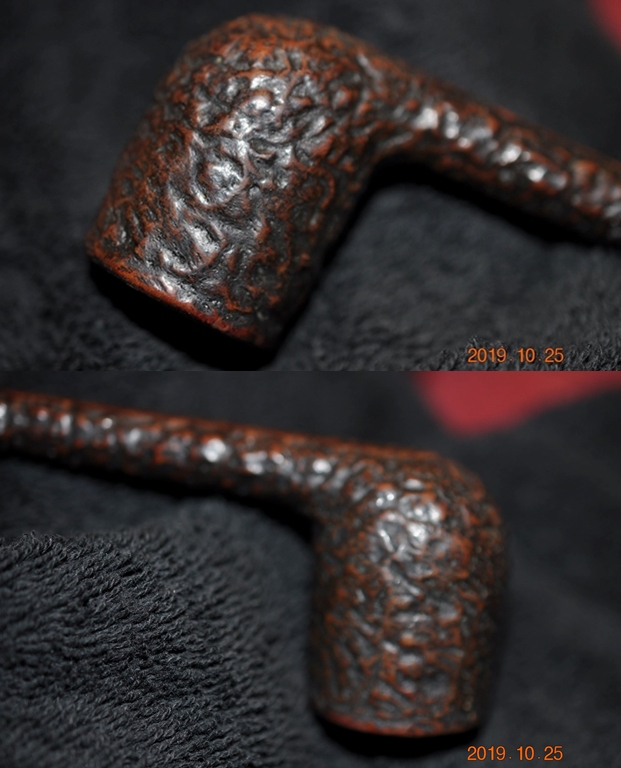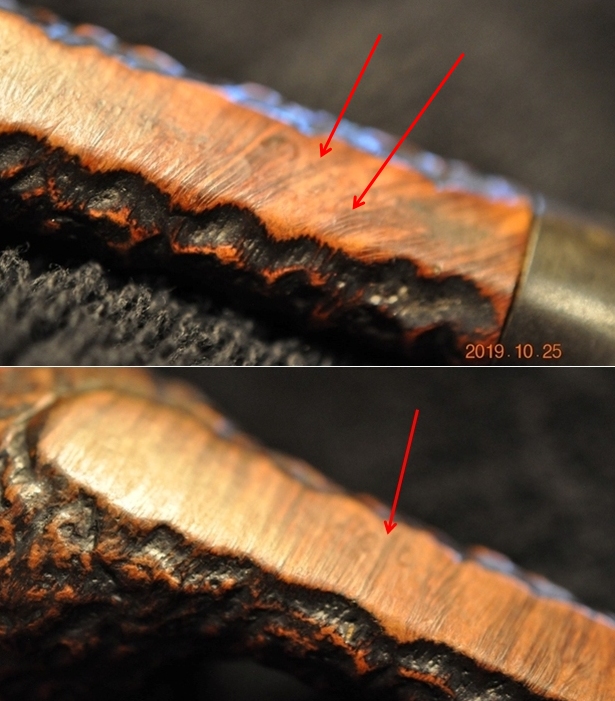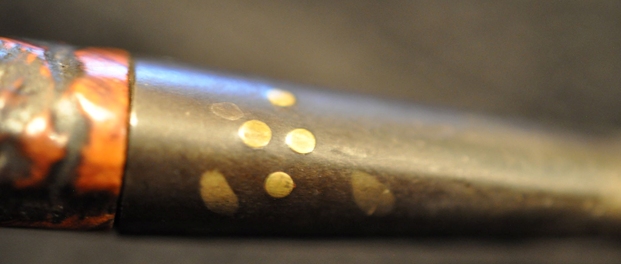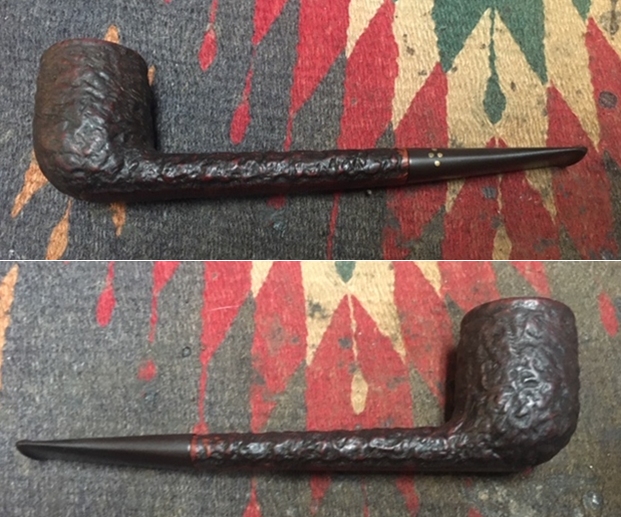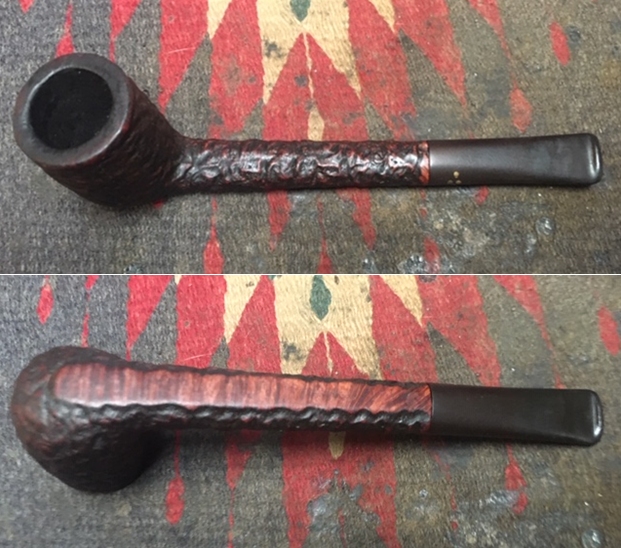
Tag Archives: removing oxidation

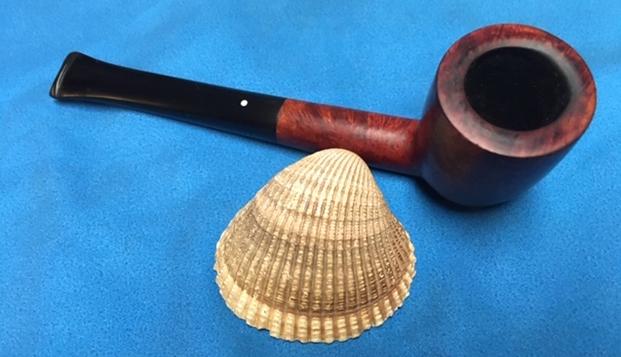
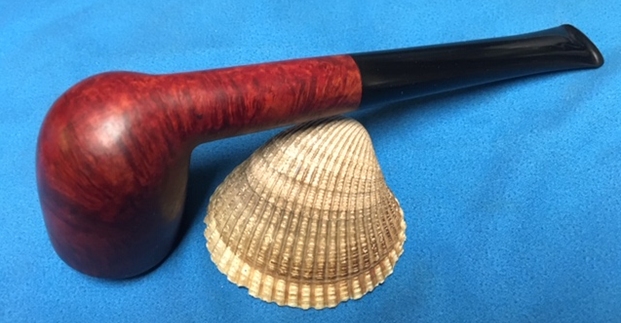
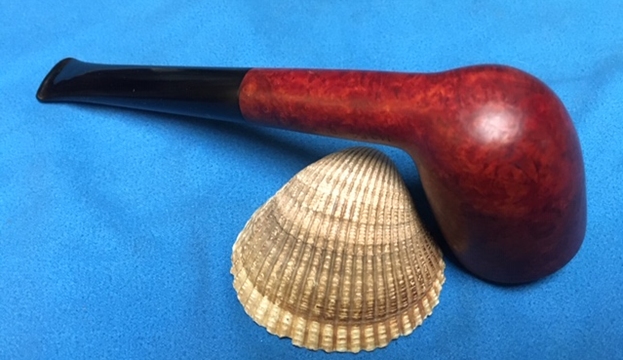
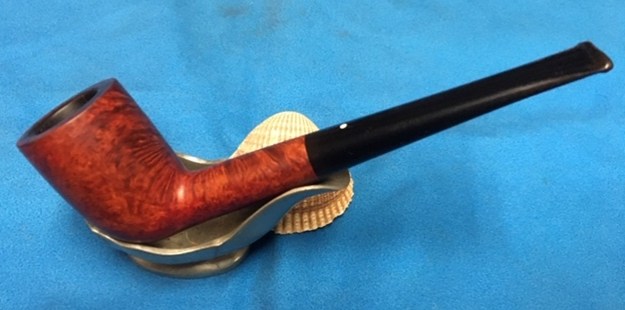
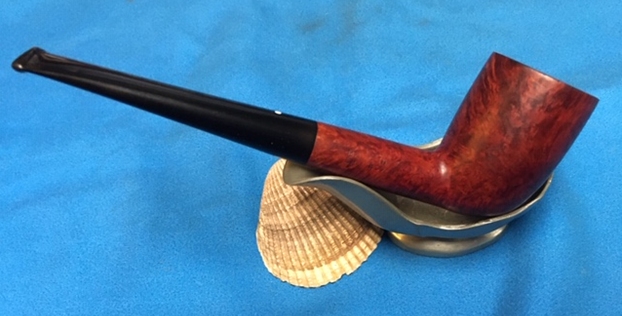
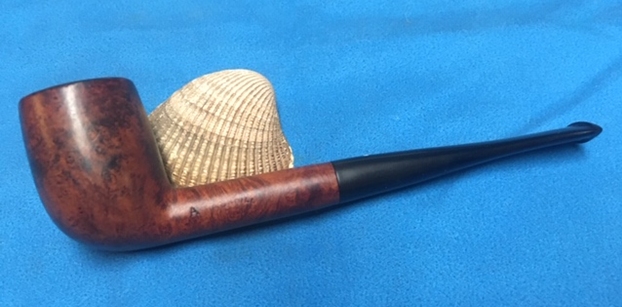
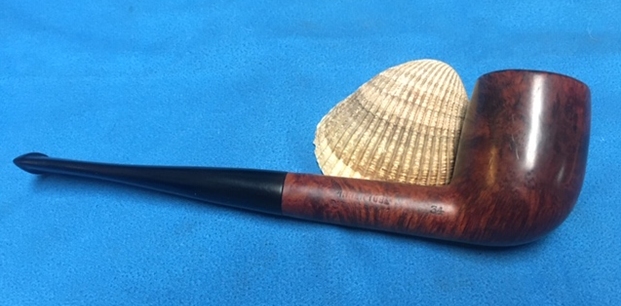
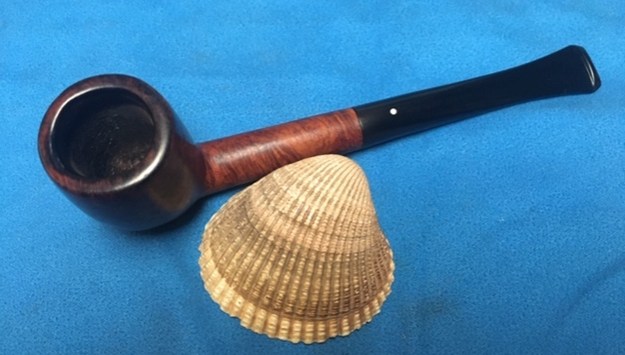
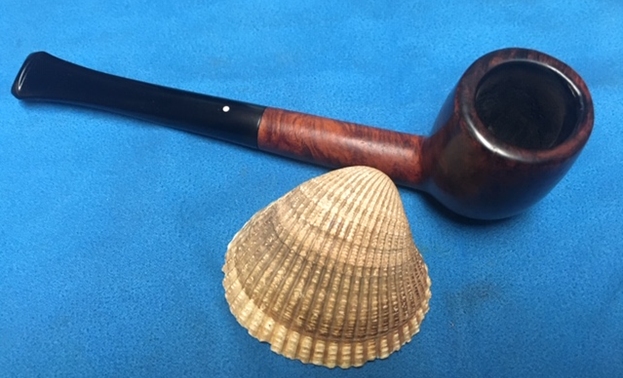
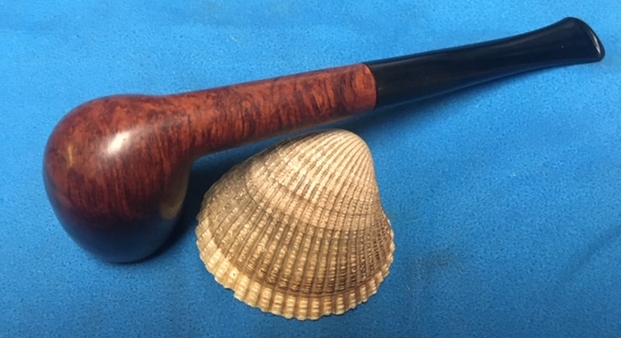
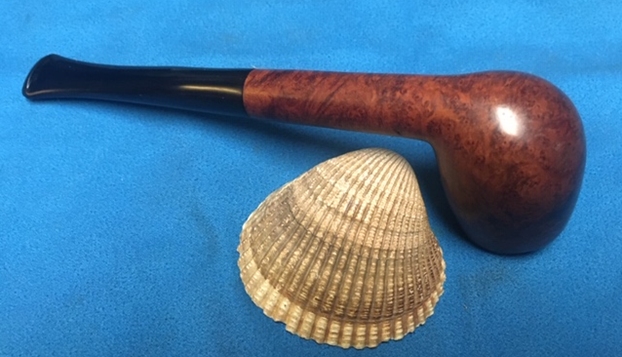
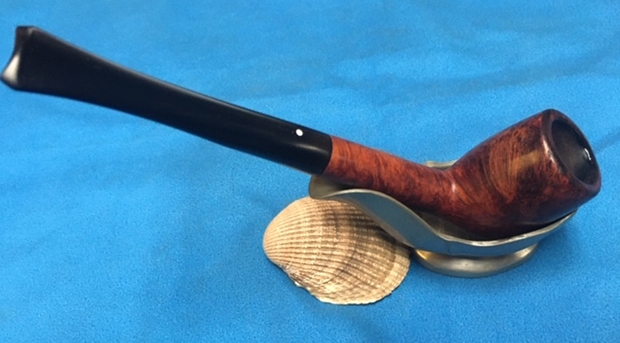
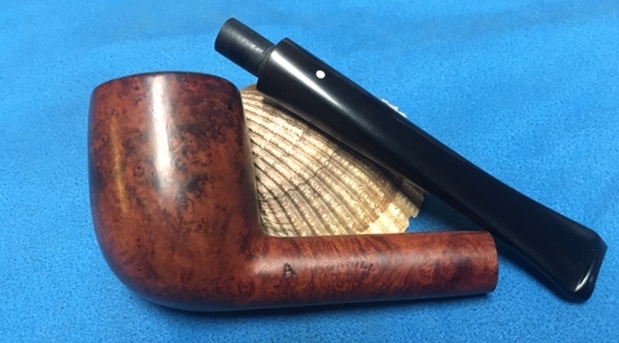
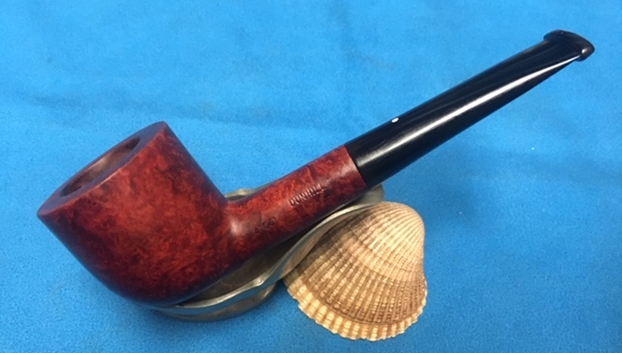
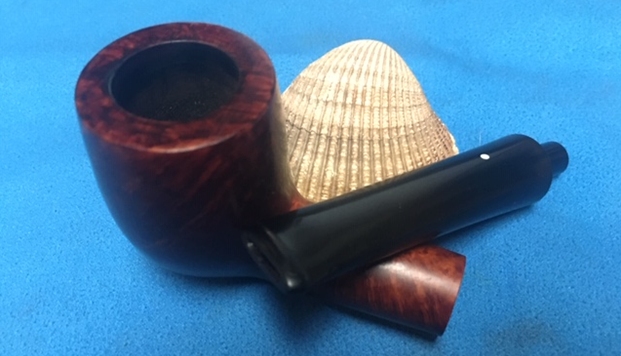
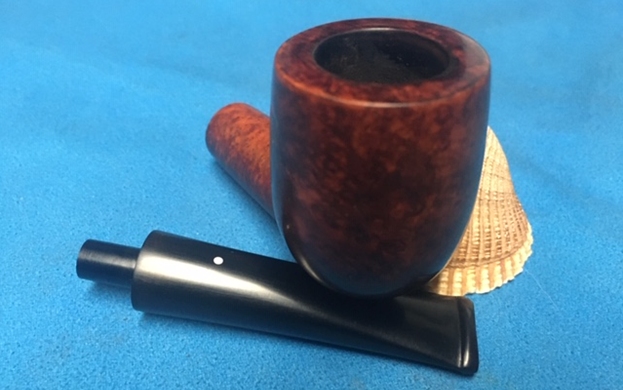
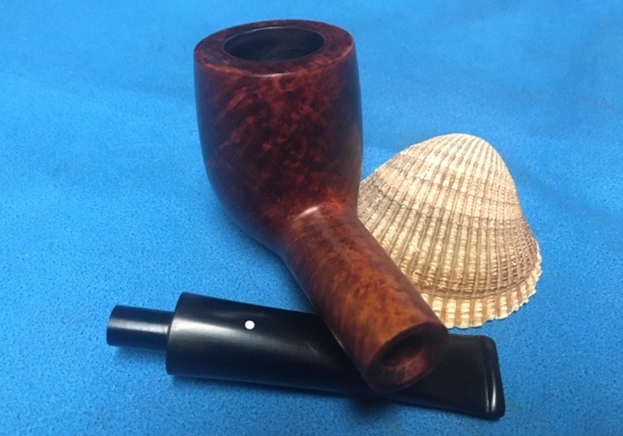
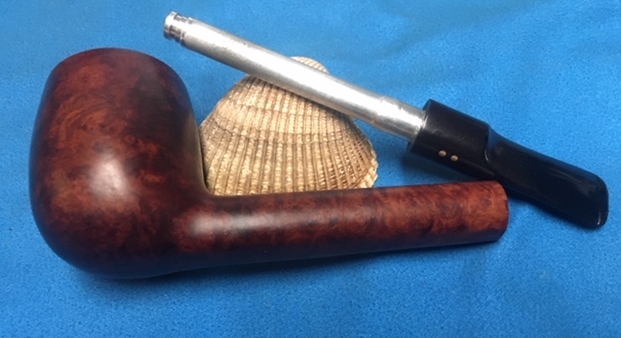
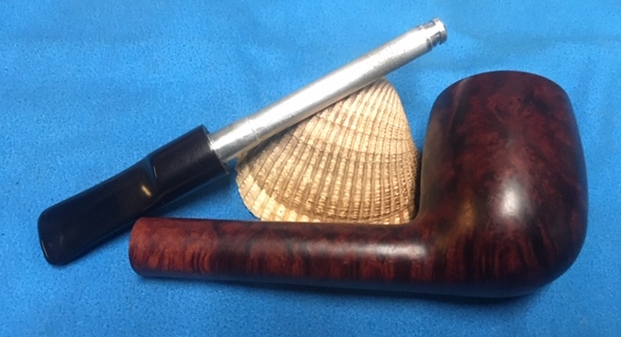
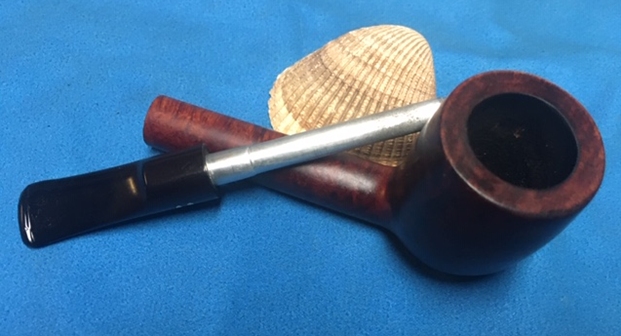
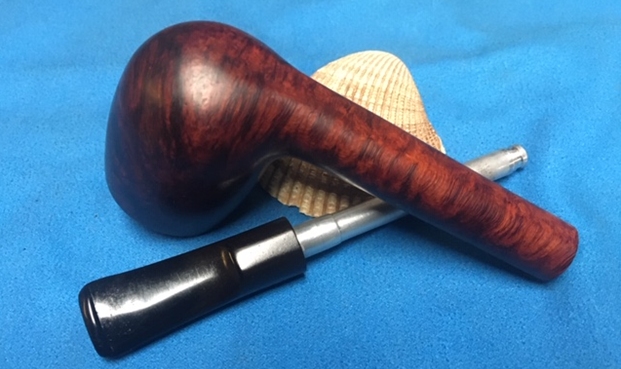
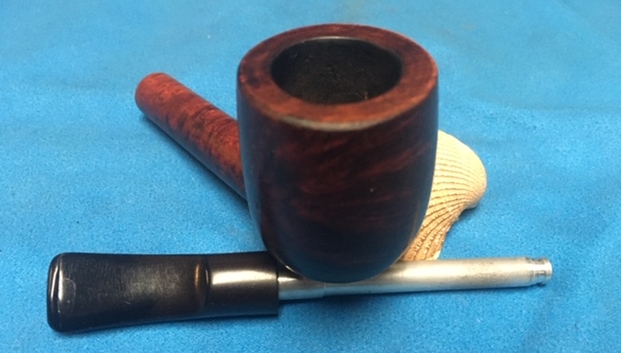
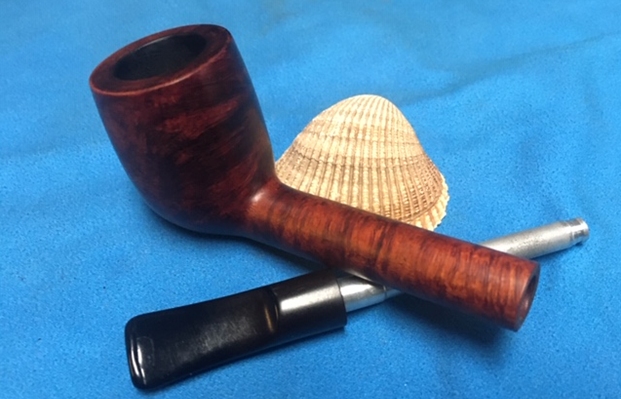
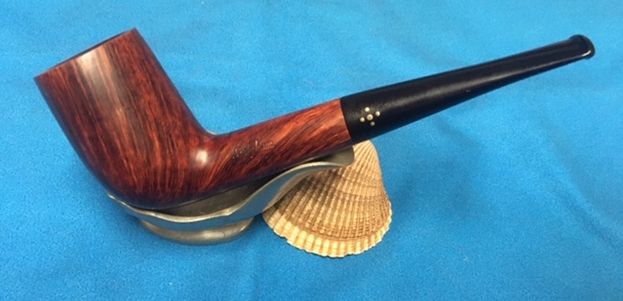
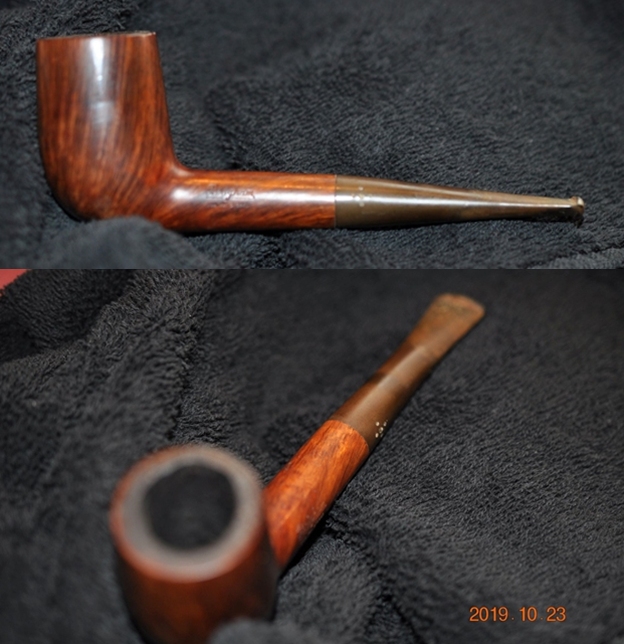
Restoring a 1969 Dunhill Bruyere 112 F/T Apple from Bob Kerr’s Estate


Blog by Steve Laug

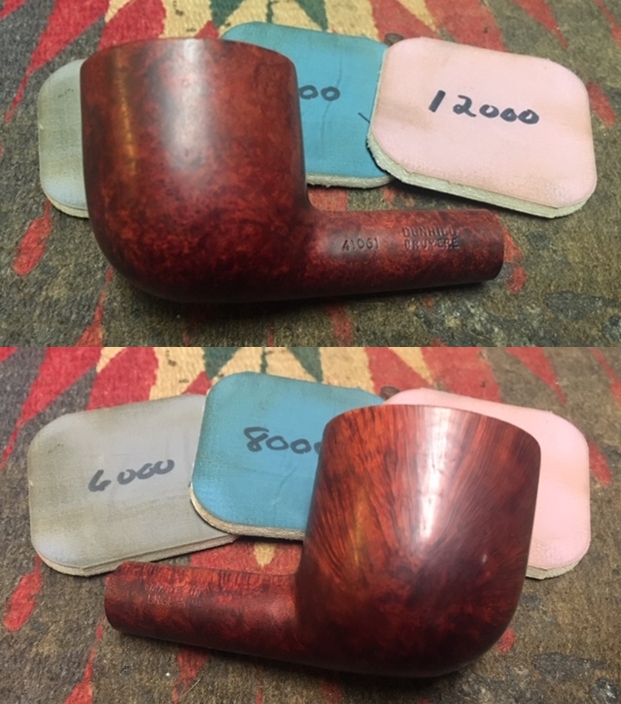
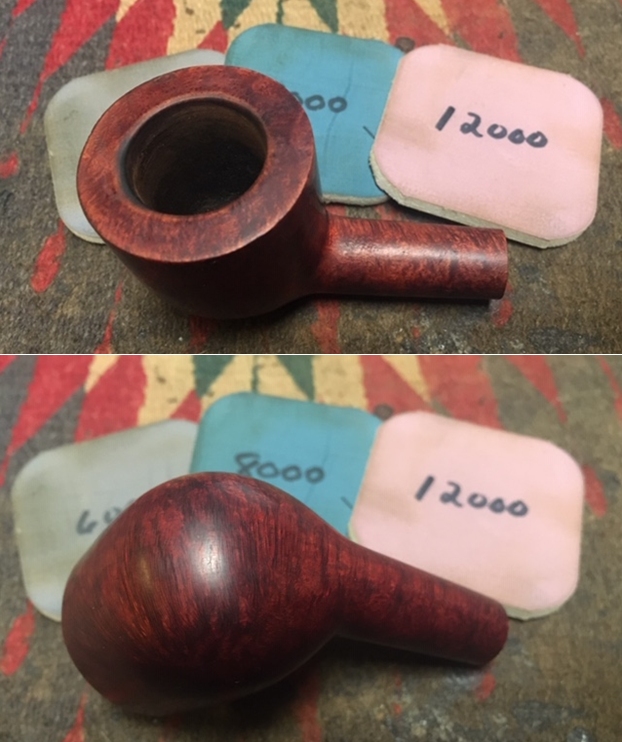
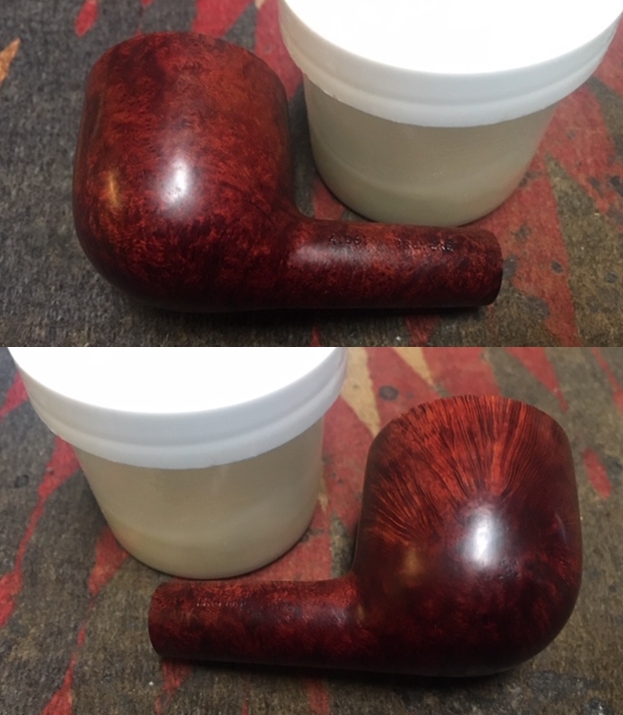
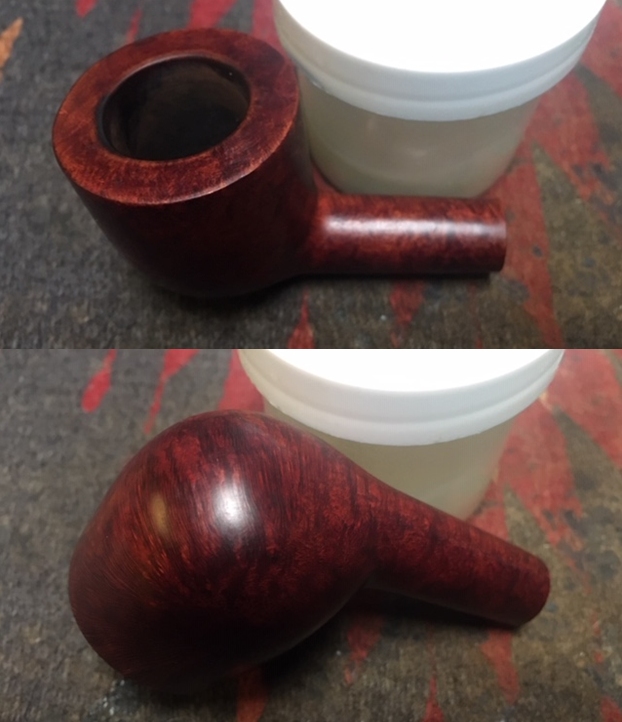
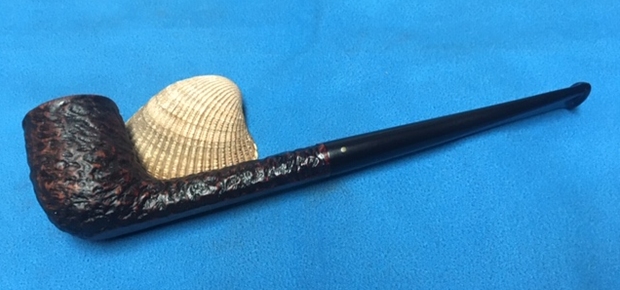
As I continue to work through the pipes in Bob Kerr’s Estate I am enjoying choosing different brands that he had to focus on for a bit. I had eight more from his Dunhill collection that I decided to go back to and finish working my way through that sub collection of the estate. Out of the 8 pipes six were Bruyere finished pipes, one was a Made in London (turns out it is also a Bruyere finished pipe), and one was a Root Briar. What follows is a list of what I saw when I examined the 8 pipes. As I finish the pipes I will include the link to the blog on that particular pipe for easy reference. I have already restored 16 pipes from this subgroup so you can do a quick search to read about the work on the Shell Briars and Tanshell Briars that were in that part of the collection.

  1. Bruyere 656 F/T Made in England 2 Circle 4A – Group 4 size Bruyere made in 1962. Stem is oxidized, tooth marks and chatter near the button, some calcification with damage to the button. Finish is dirty, bowl caked and lava overflow on the rim top. Bowl is out of round, damaged edge.
  2. Bruyere 112 F/T Made in England 9/11 Circle 2A – Group 2 size Bruyere made in 1969 and sold in 1971. Stem is oxidized, tooth marks and chatter near the button, some calcification with damage to the button. Finish is dirty, bowl caked and lava overflow on the rim top. Bowl is out of round, damaged edge.
  3. Bruyere 0333 Made in England 16 made in 1976. Stem is oxidized, tooth marks and chatter near the button, some calcification with damage to the button. Finish is dirty, bowl caked and lava overflow on the rim top. Bowl is out of round, damaged edge.
  4. Bruyere 41061 Made in England 18 made in 1978. Stem is oxidized, tooth marks and chatter near the button, some calcification with damage to the button. Finish is dirty, bowl caked and lava overflow on the rim top. Bowl is out of round, damaged edge. I finished the restoration on it. Here is the link to the blog – (https://rebornpipes.com/2019/12/24/restoring-a-1978-dunhill-bruyere-41061-from-bob-kerrs-estate/).
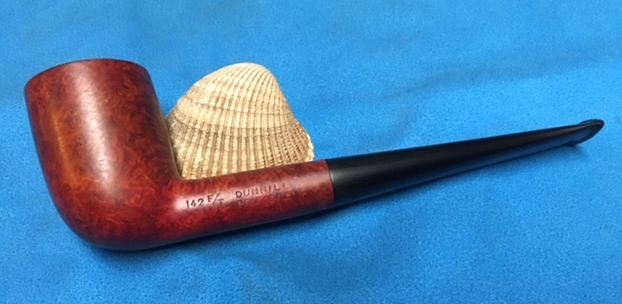
  5. Bruyere 142 F/T Made in England 7/9/11 Circle 4A – Group for size Bruyere made in 1967 and sent out in 1969 or 1971. Stem is oxidized, tooth marks and chatter near the button, some calcification with damage to the button. Finish is dirty, bowl caked and lava overflow on the rim top. Bowl is out of round, damaged edge. I finished the restoration on it. Here is the link to the blog – https://rebornpipes.com/2019/12/27/restoring-a-1967-dunhill-bruyere-142-f-t-billiard-from-bob-kerrs-estate/
  6. (A) Dunill London Inner Tube PAT N°5861/12 Shape 34. Stem is oxidized, tooth marks and chatter near the button, some calcification with damage to the button. Finish is dirty, bowl caked and lava overflow on the rim top. Bowl is out of round, damaged edge. I finished the restoration on it. Here is the link to the blog – (https://rebornpipes.com/2019/12/26/restoring-a-1913-a-dunhill-london-34-billiard-from-bob-kerrs-estate/).
  7. (Ao) Dunhill London 113 Made in England 5 PAT N°158709/14. Stem is oxidized, tooth marks and chatter near the button, some calcification with damage to the button. Finish is dirty, bowl caked and lava overflow on the rim top. Bowl is out of round, damaged rim edges. I finished the restoration on it. Here is the link to the blog – (https://rebornpipes.com/2019/12/25/restoring-a-1925-ao-dunhill-london-113-billiard-from-bob-kerrs-estate/).
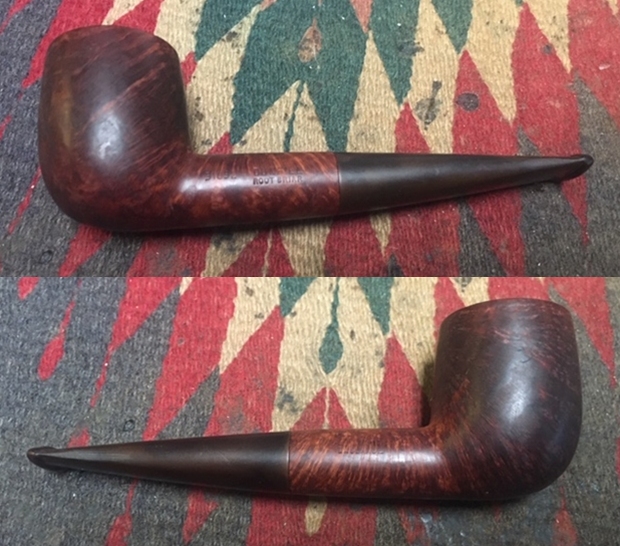
  8. Root Briar 31032 Made in England 18 – made in 1978. Stem is oxidized, tooth marks and chatter near the button, some calcification with damage to the button. Finish is dirty, bowl caked and lava overflow on the rim top. Bowl is out of round, damaged edge. I finished the restoration on it. Here is the link to the blog – (https://rebornpipes.com/2019/12/23/restoring-a-1978-dunhill-root-briar-31032-billiard-from-bob-kerrs-estate/).

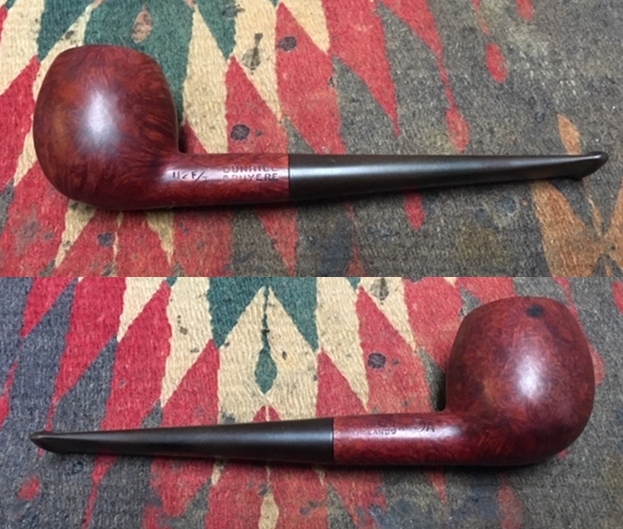
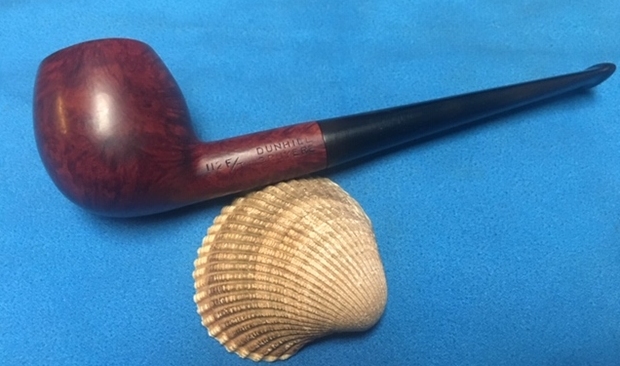
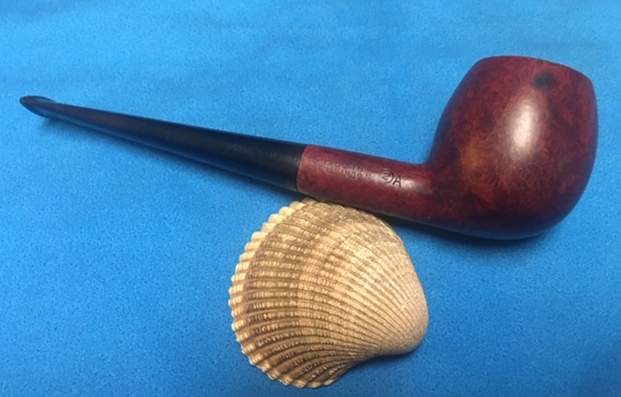
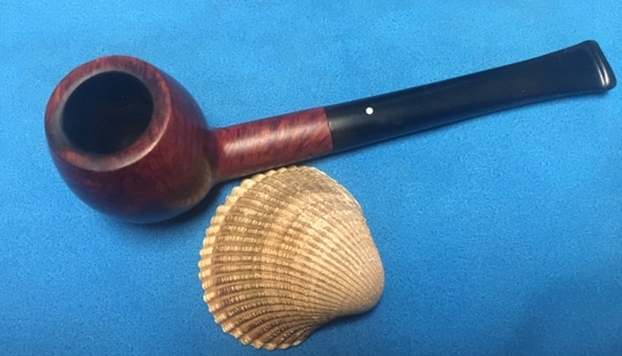
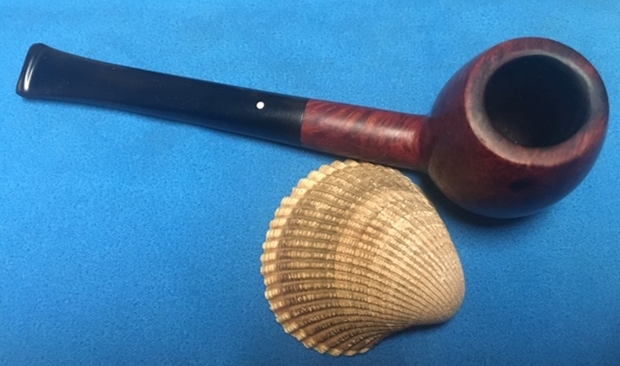
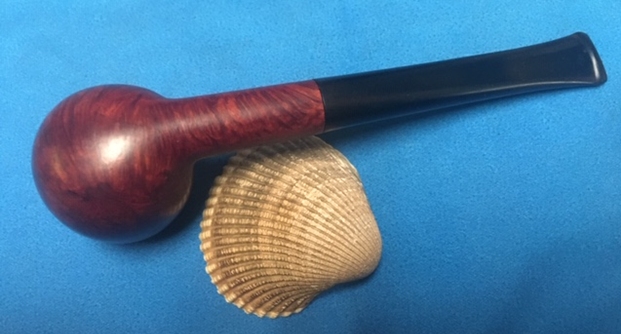
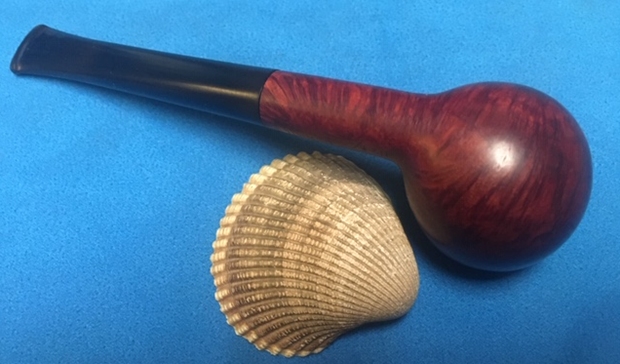
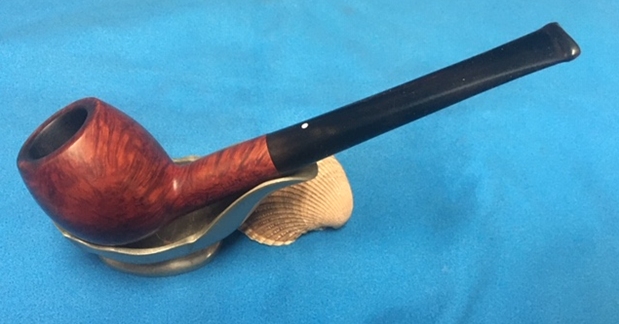
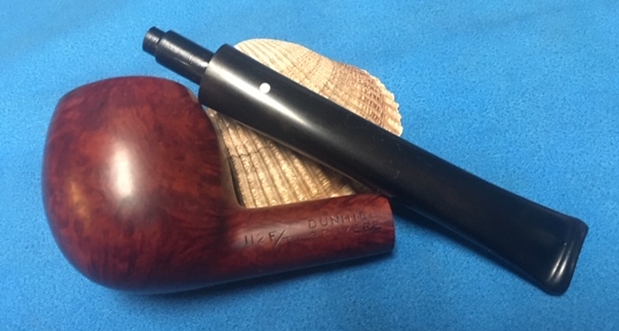
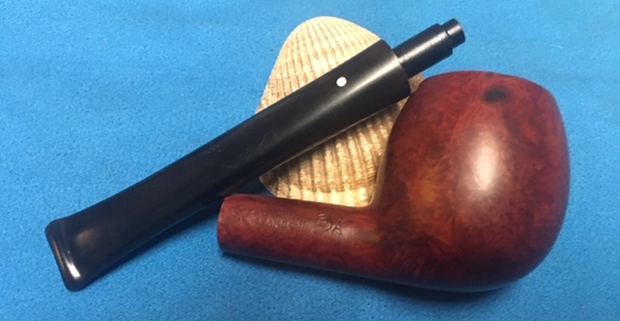
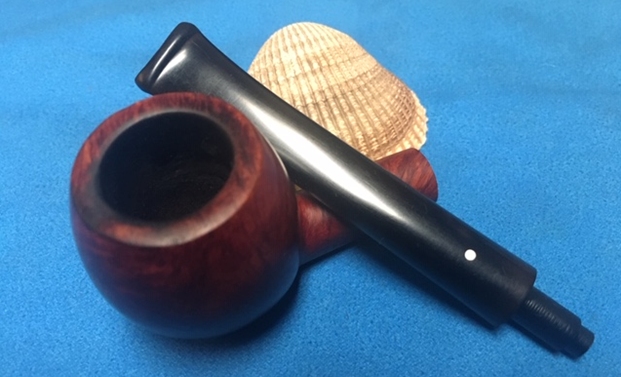
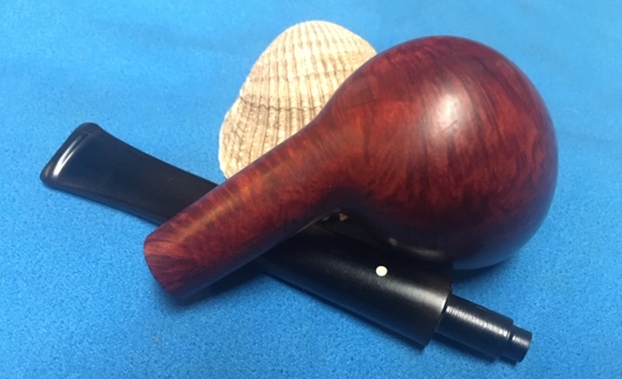
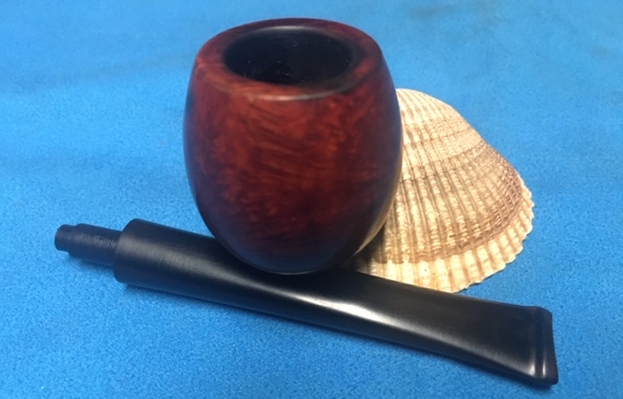
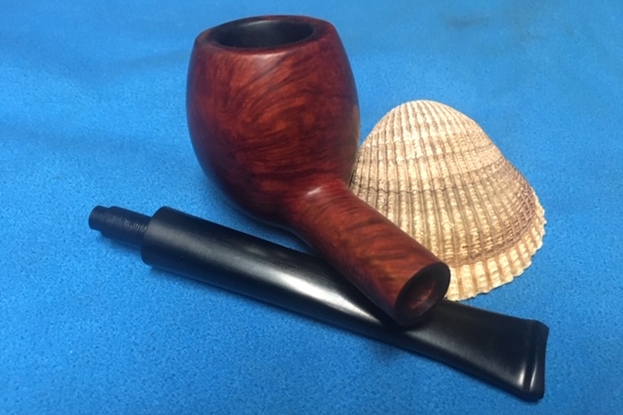
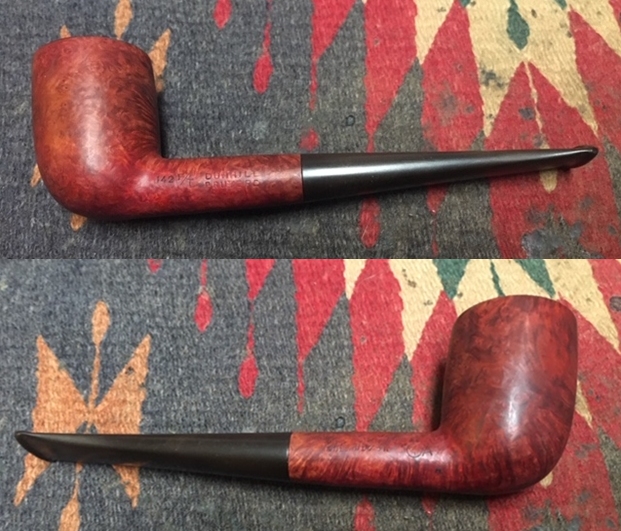
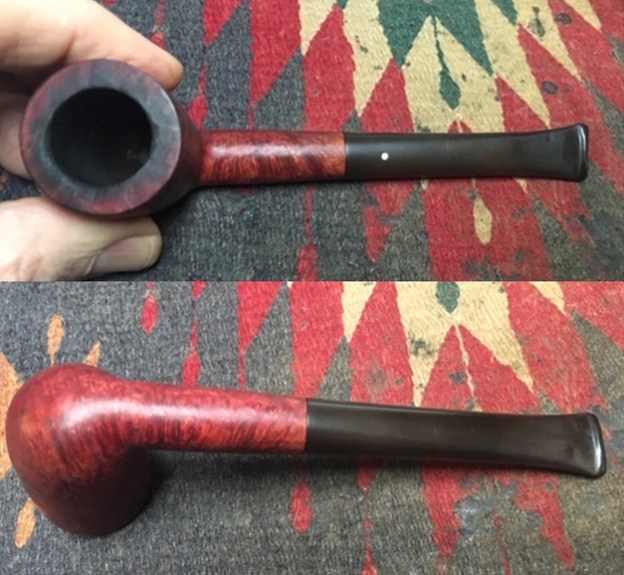
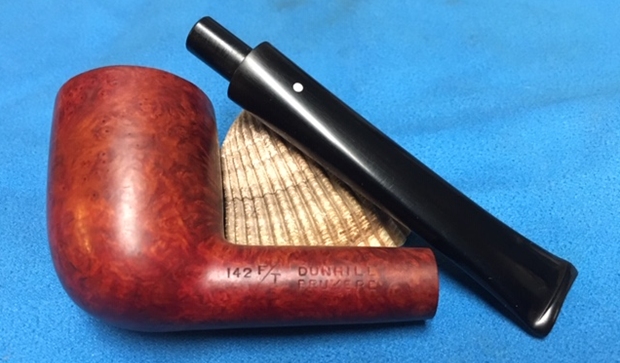
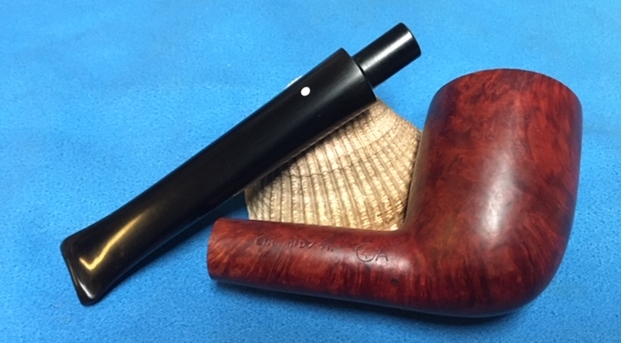
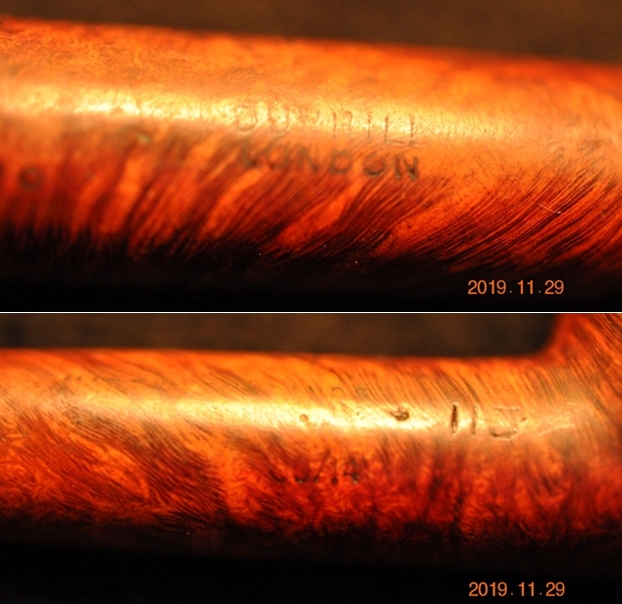
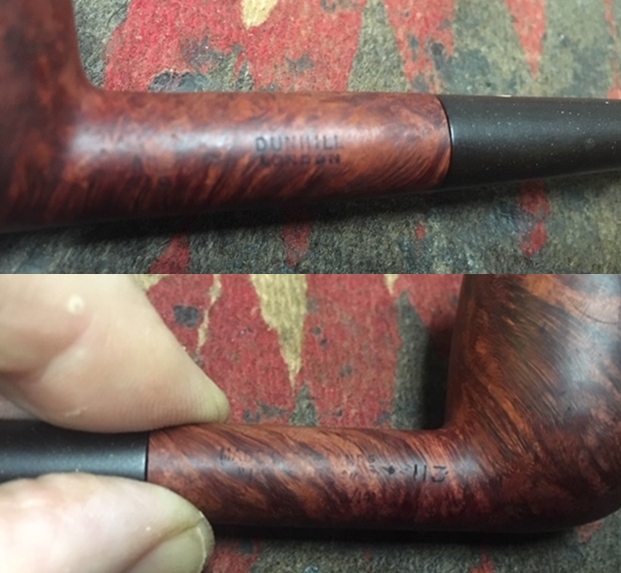
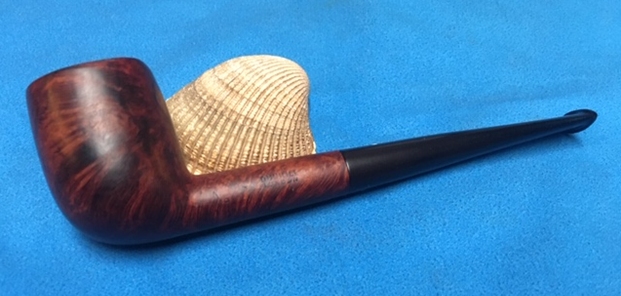
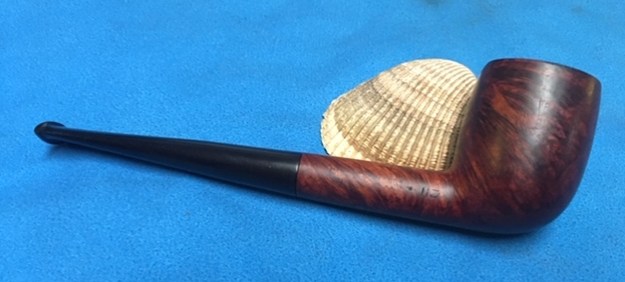
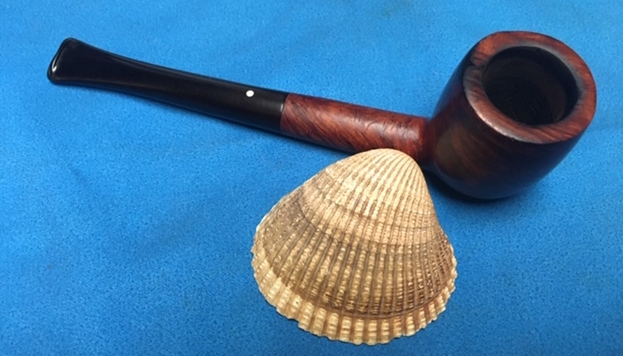
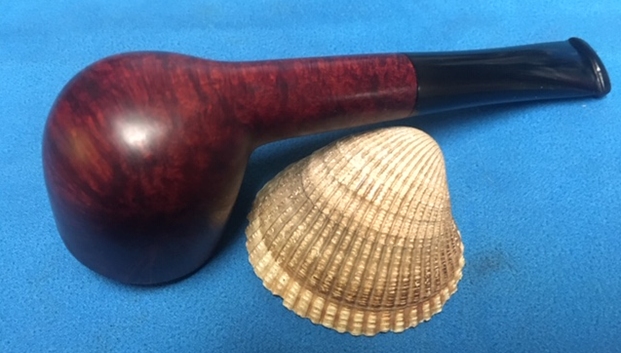
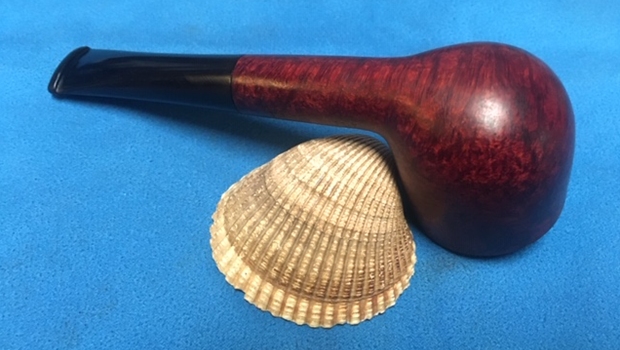
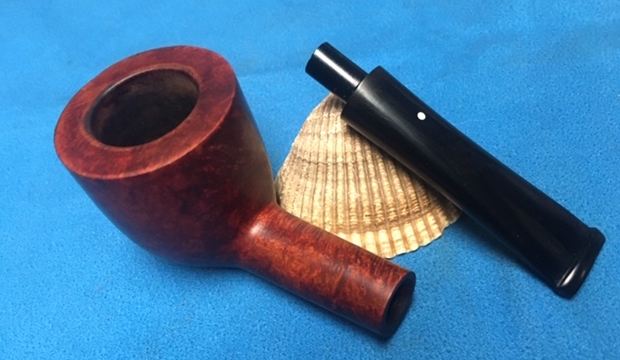
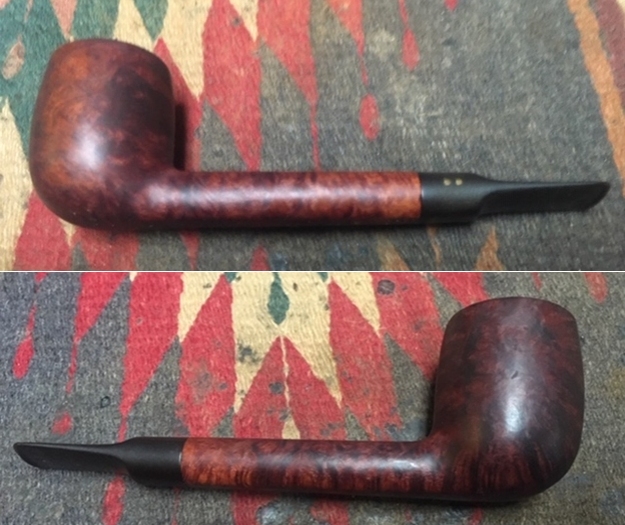
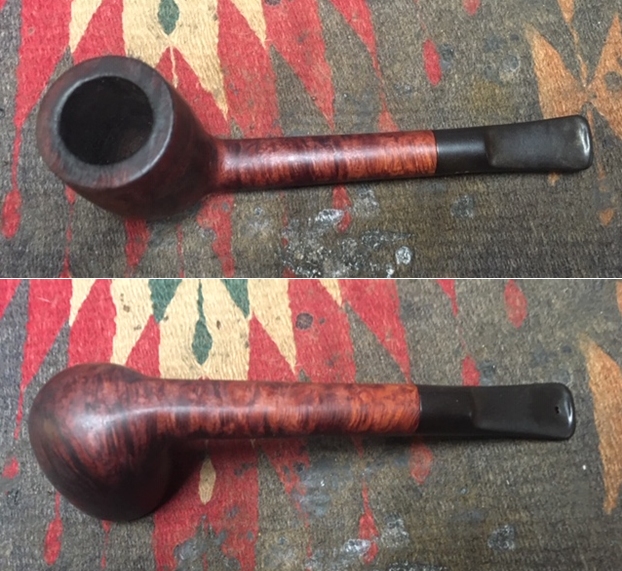
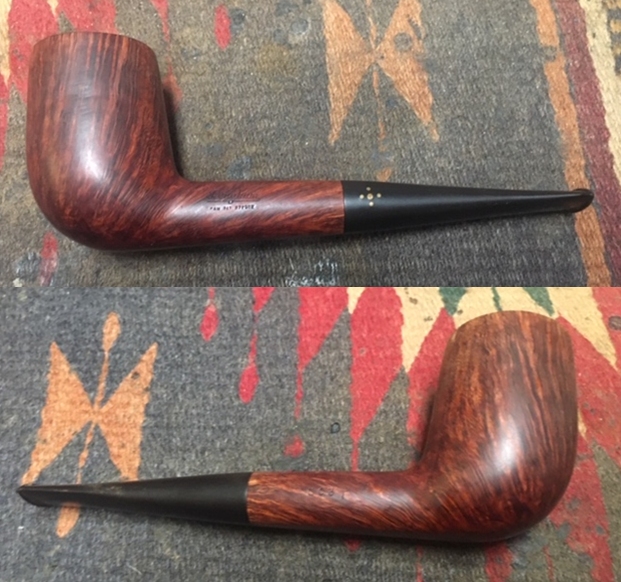
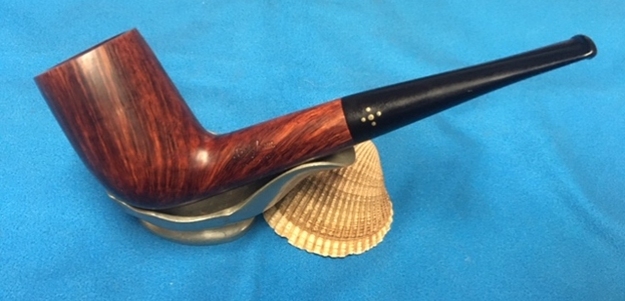
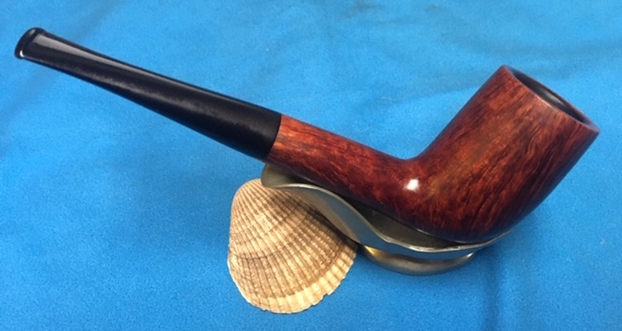
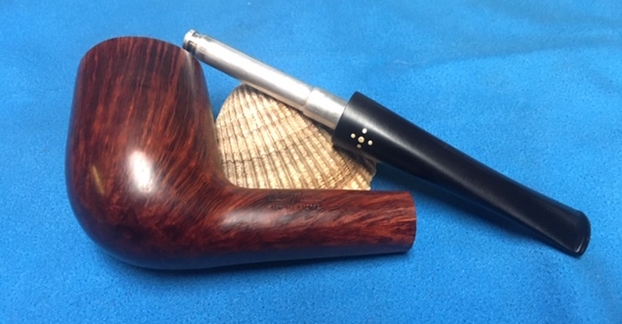
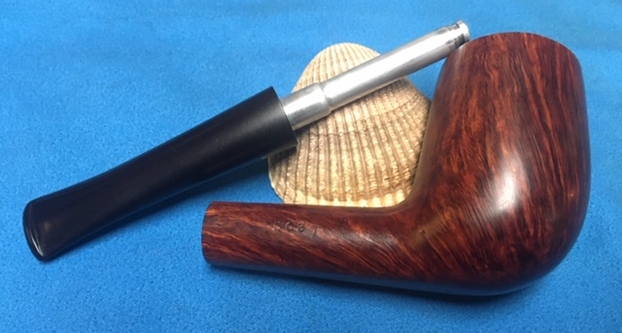
I finished work on #4, #5, #6, #7 & #8 and turned my attention to #2, another heavily used pipe but this time an Apple shaped pipe with a tapered stem. The pipe was stamped on the left side of the shank with the shape number 112 F/T next to the bowl/shank junction. That is followed by Dunhill over Bruyere. On the right side of the shank it is stamped Made in England 9 with a slightly superscript 11 with a Circle 2A. It appears that the pipe stamped as this one is was made in 1969 and shipped or sold in 1971. The 112 F/T is an Apple with a fish tail (F/T) tapered stem. The 2A stamp gives the Group or size number which in this case is a 2. The A stamp denotes a Bruyere pipe. Working on this is a change after the group of billiards I have worked on so far.

I am once again including Chuck Stanion’s eloquent description of the Bruyere on the smokingpipes.com site as follows (https://www.smokingpipes.com/pipes/new/dunhill/moreinfo.cfm?product_id=346421):

The Bruyere was Alfred Dunhill’s original finish upon launching his brand of premium pipes and smoking accessories and was the only Dunhill finish from 1910 until 1917. Even after the addition of other finishes, the Bruyere maintained a high level of popularity, becoming synonymous with what is thought of, even today, as the quintessential pipe. To achieve the iconic, ruby hue and saturation, a skilled craftsman painstakingly layers particular stains in a precise manner, then meticulously polishes the pipe to a high luster. The final result is, simply put, timeless.

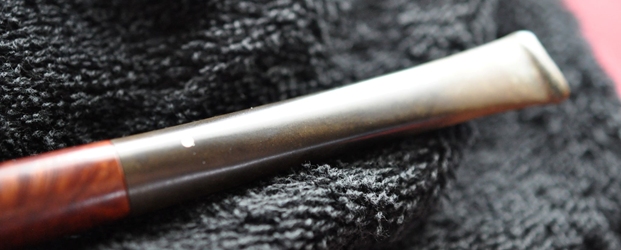
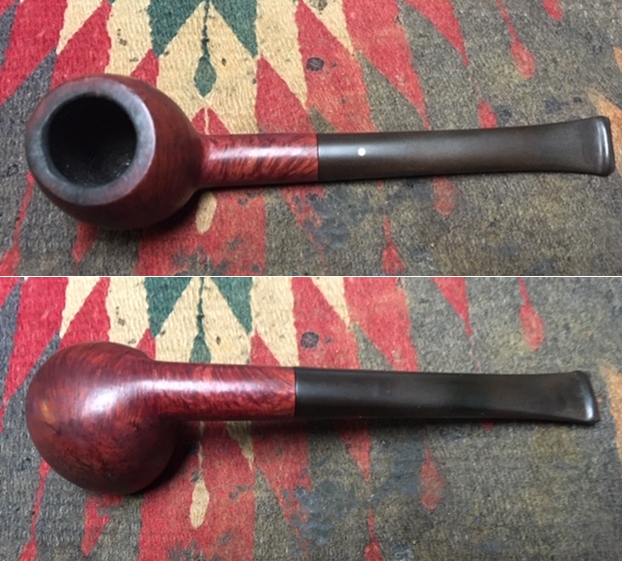
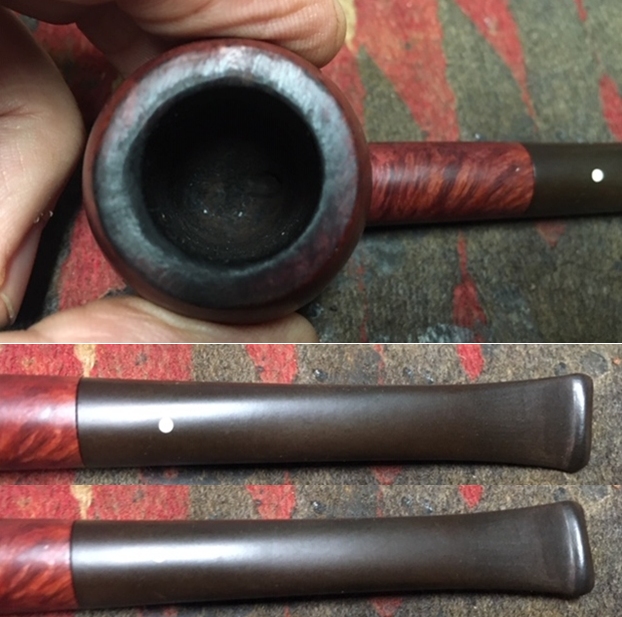
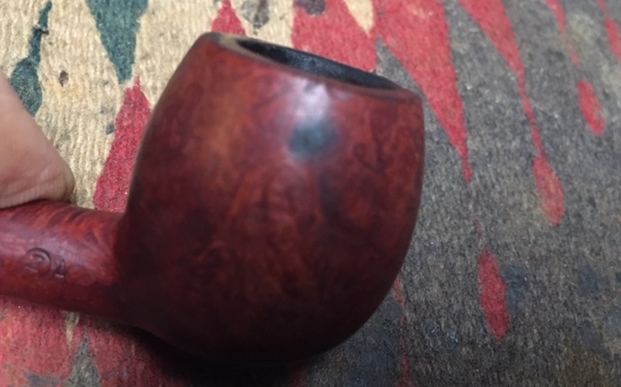
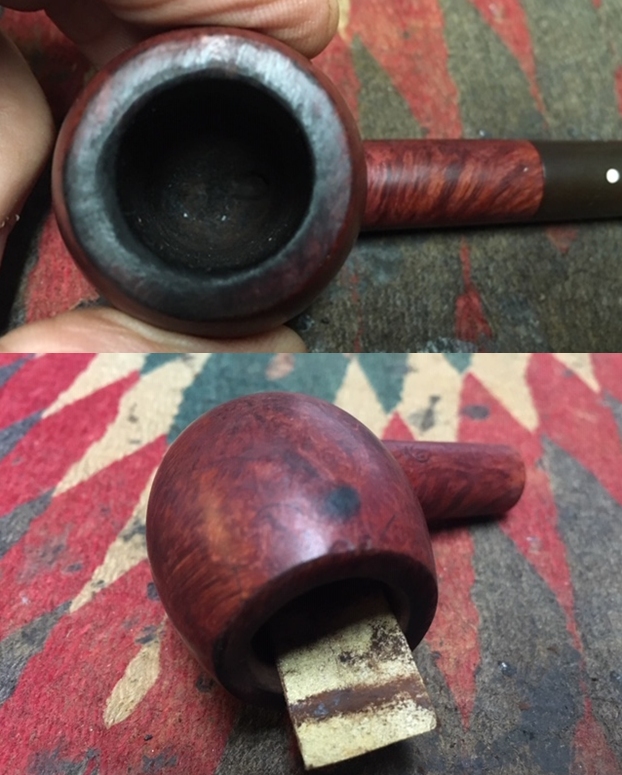
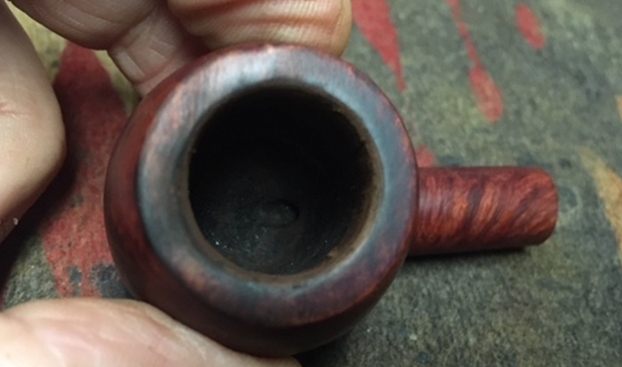
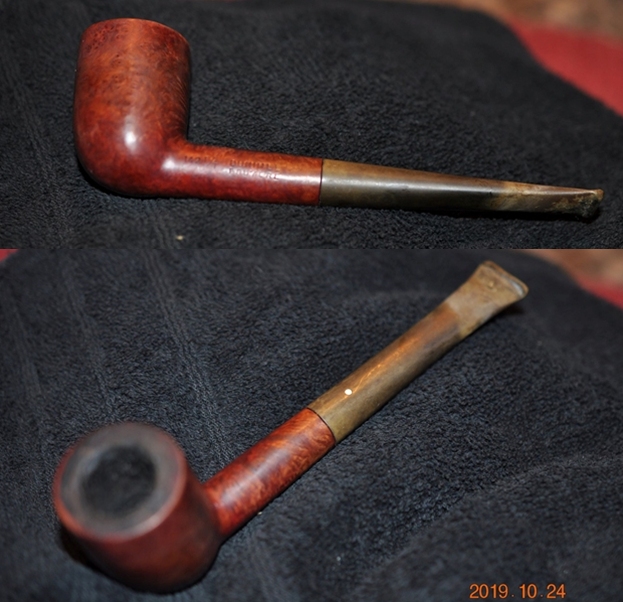
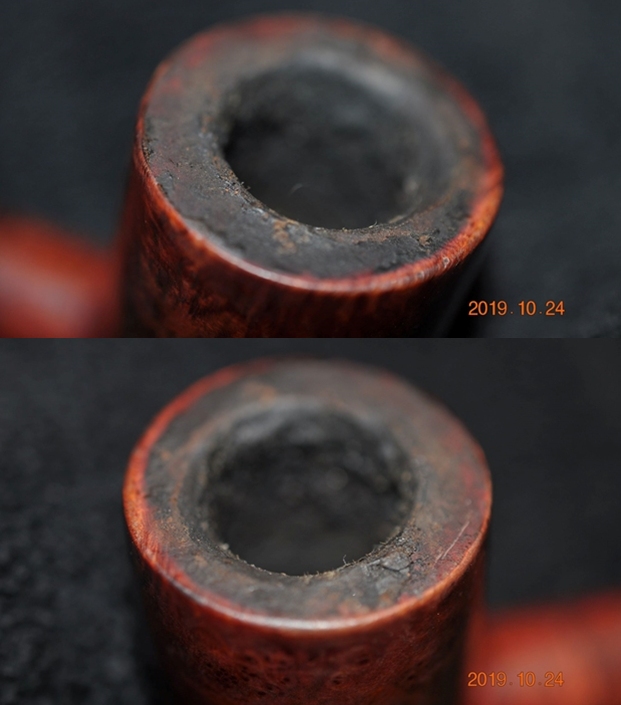
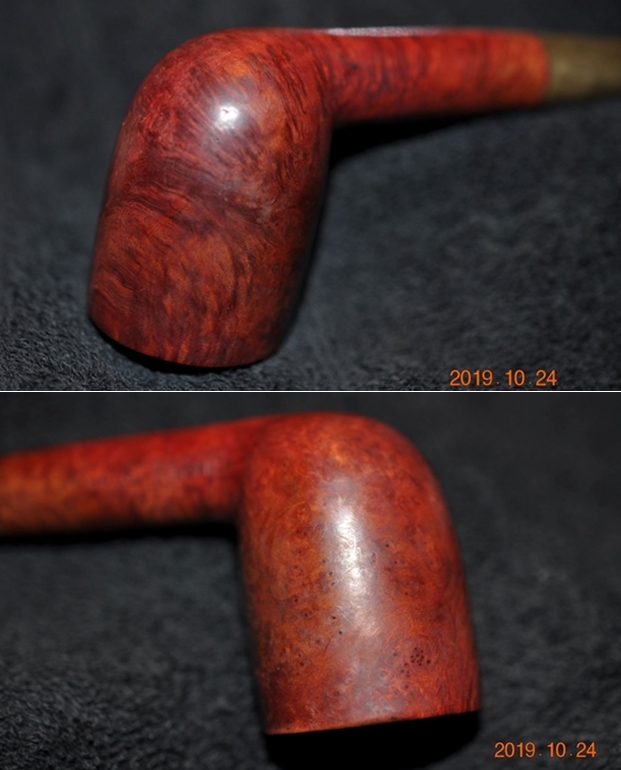
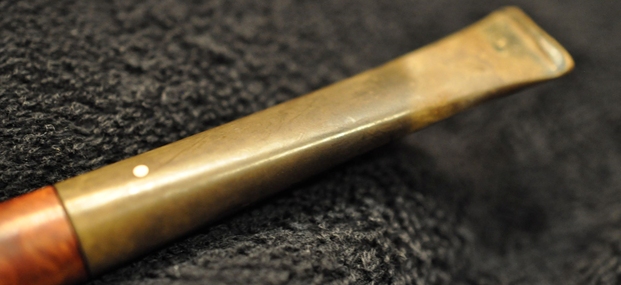
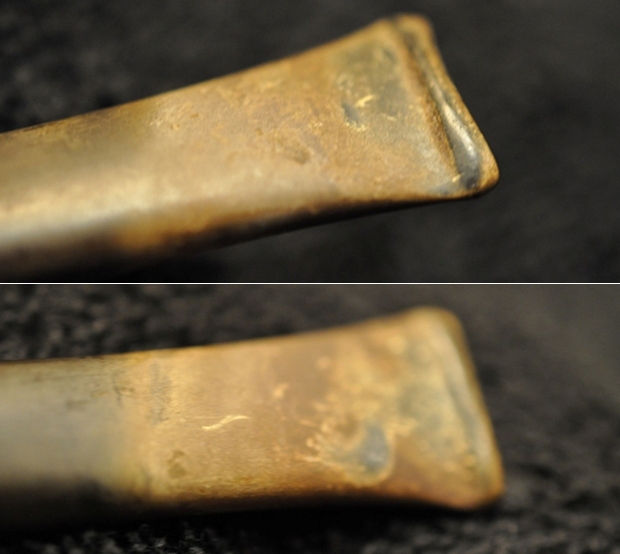
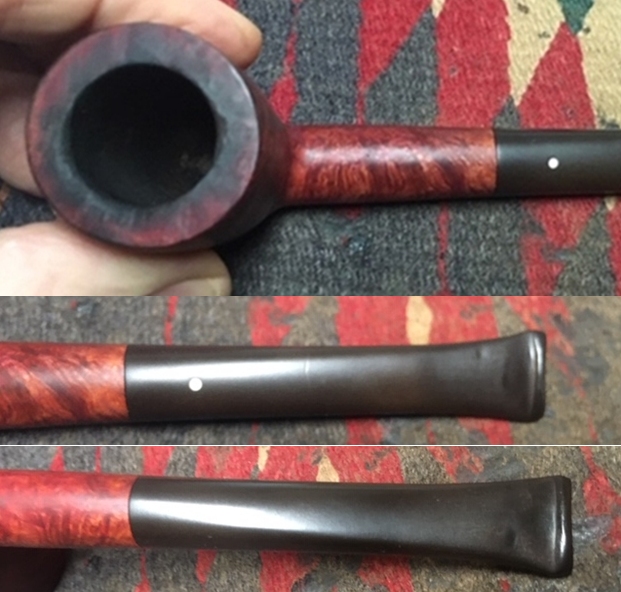
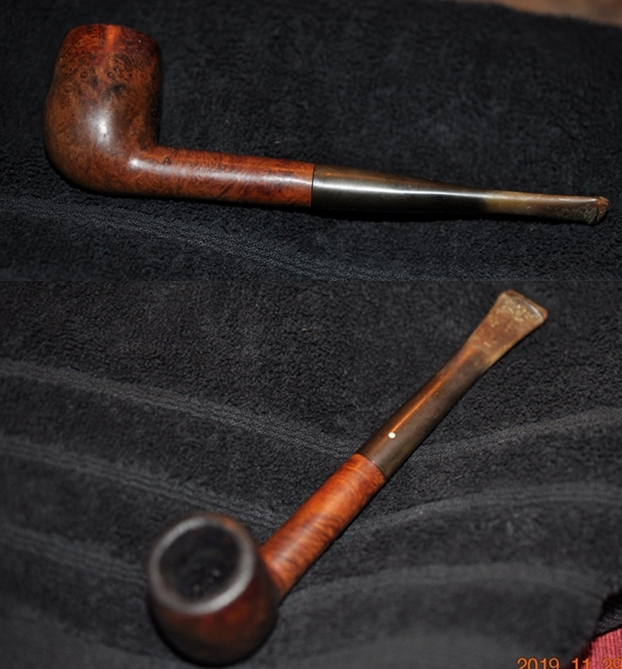
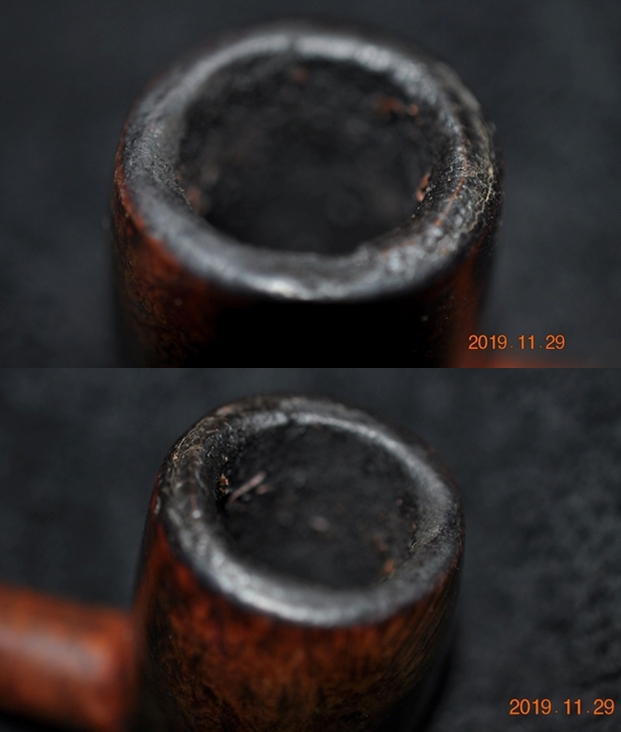
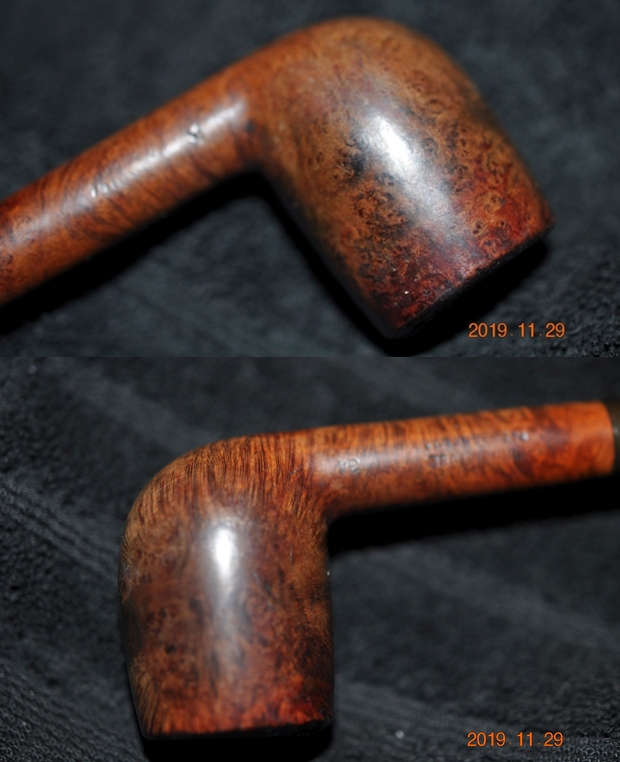
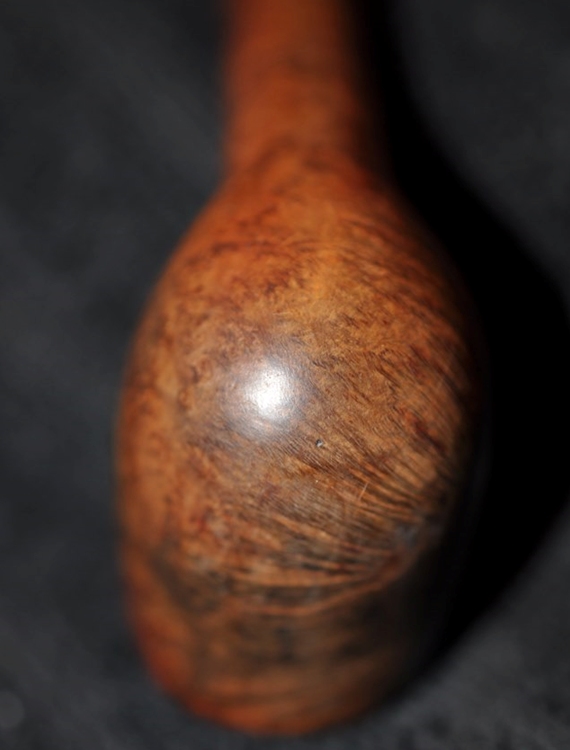
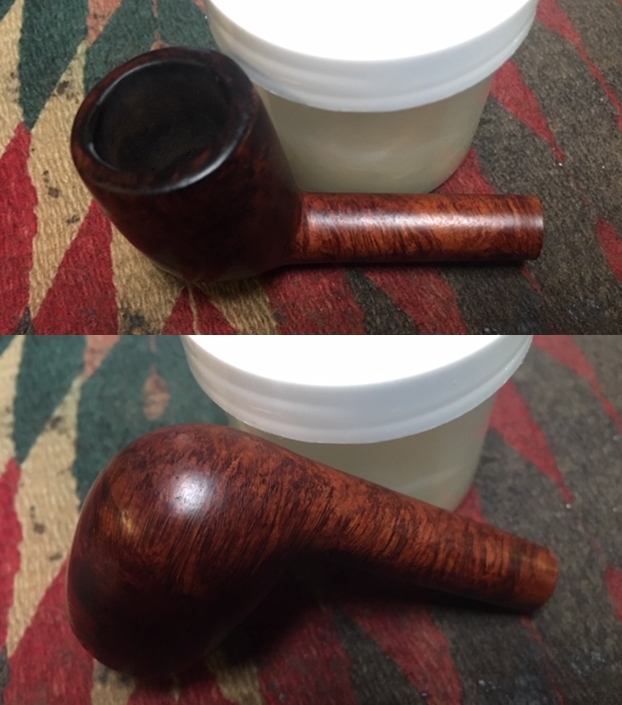
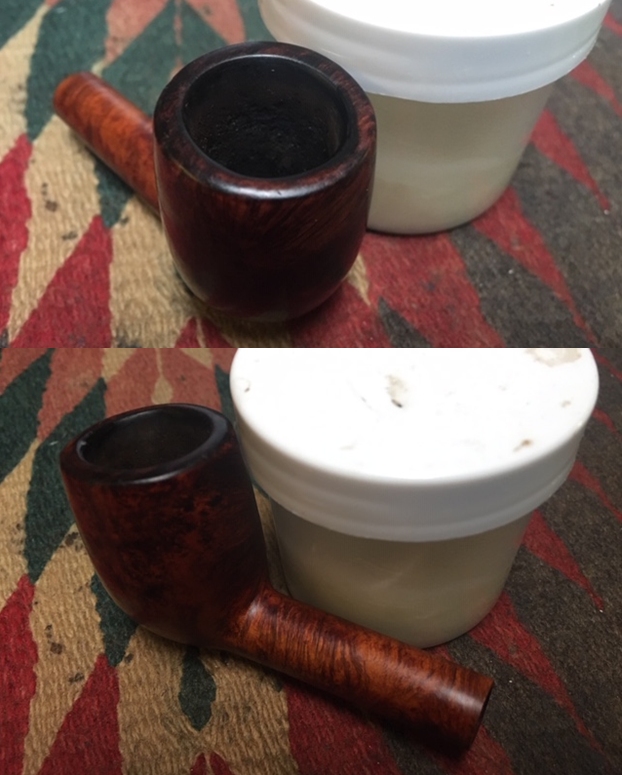
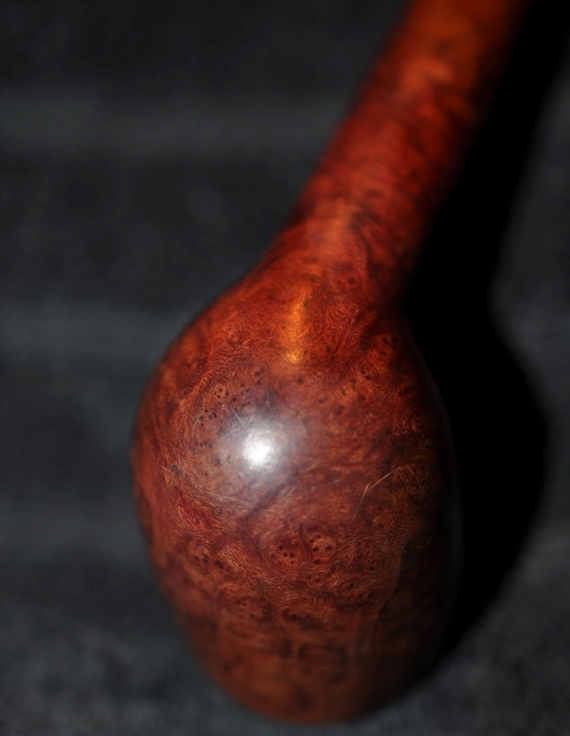
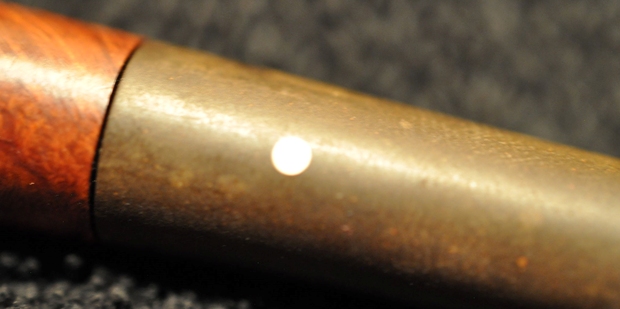
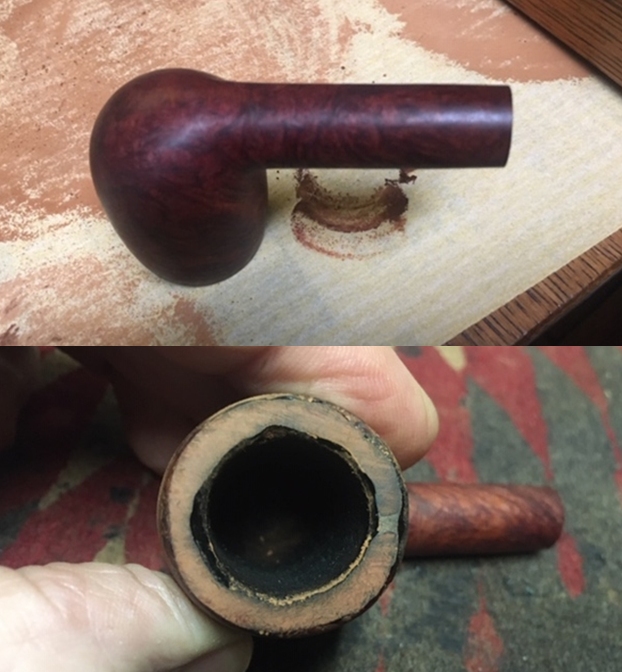
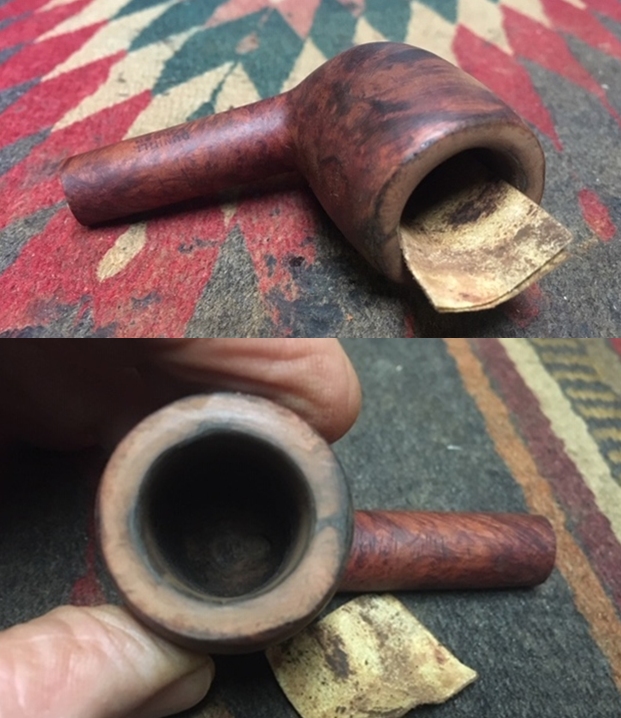
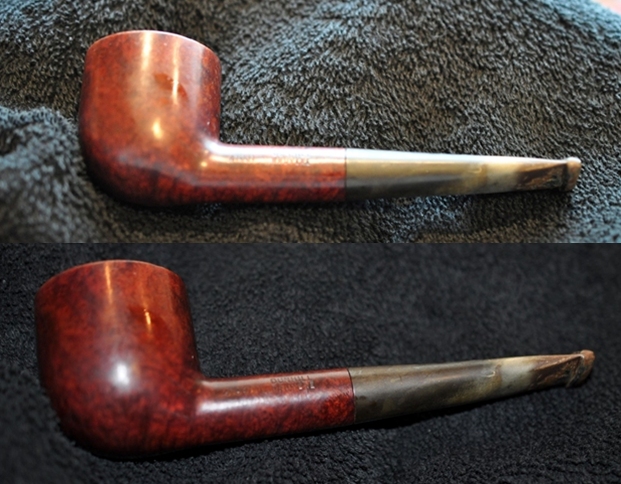
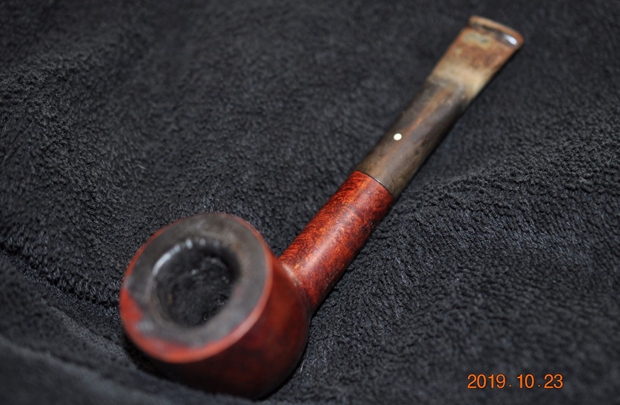
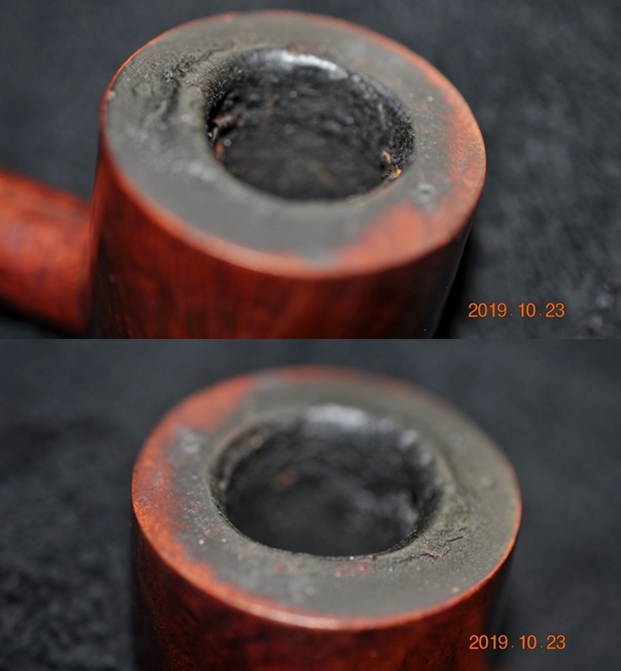
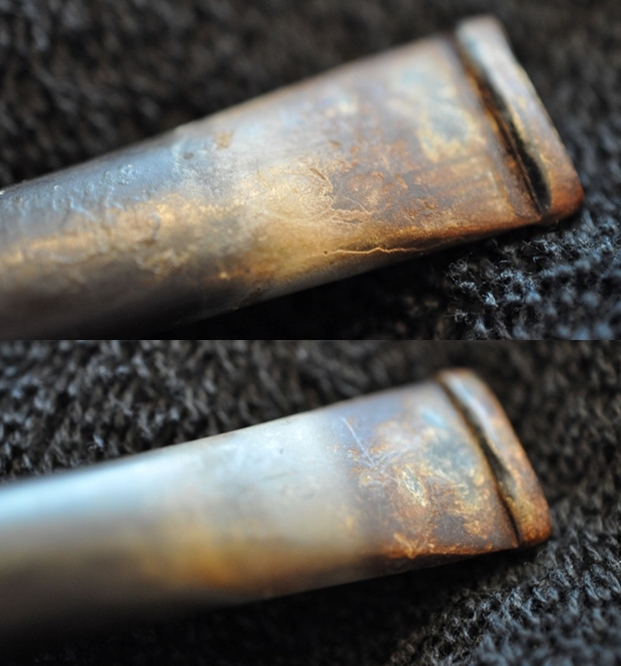
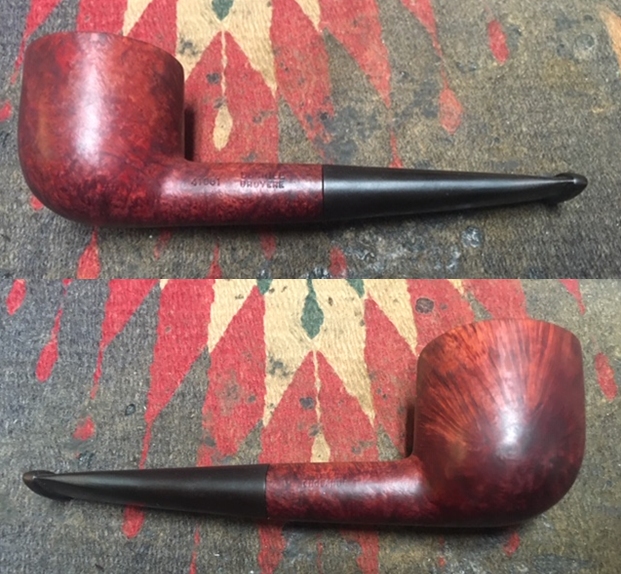
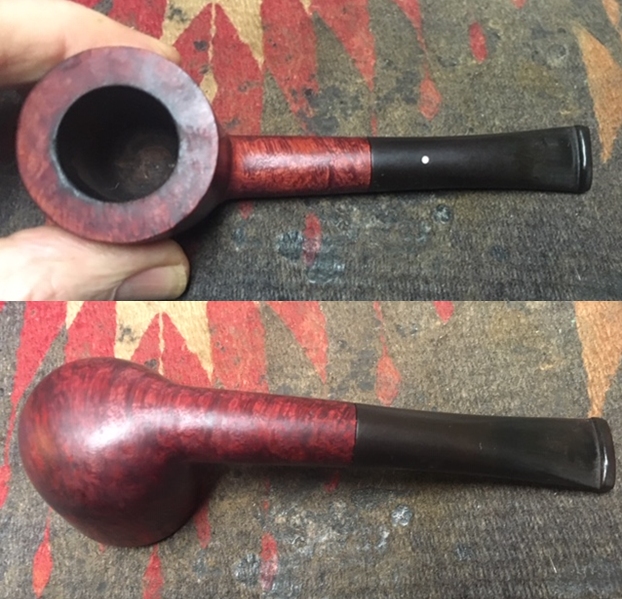
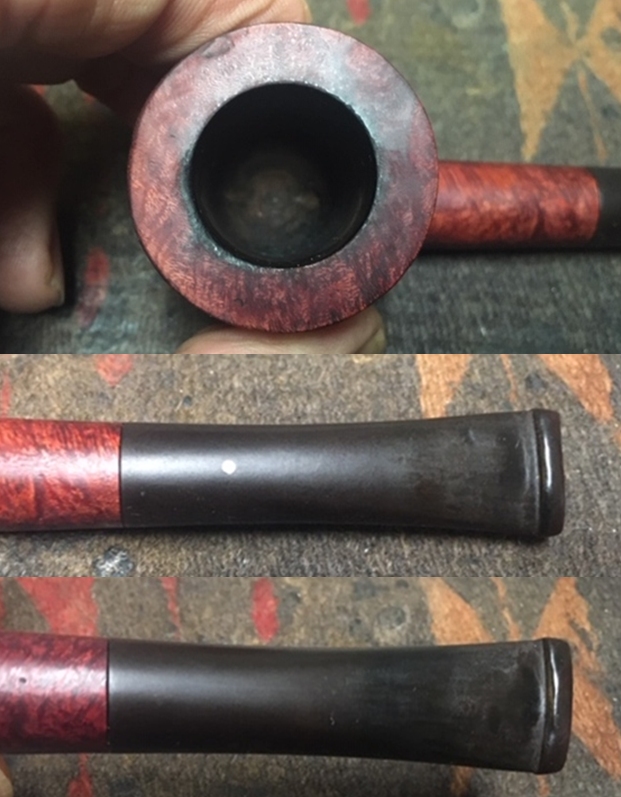
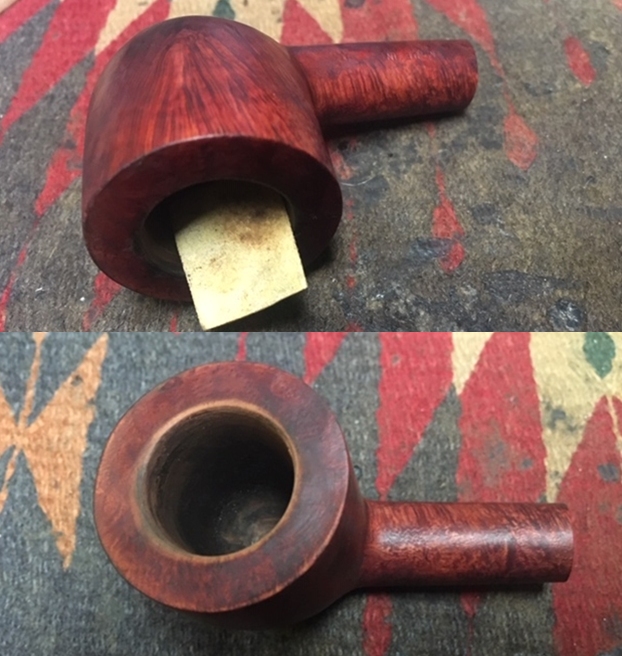
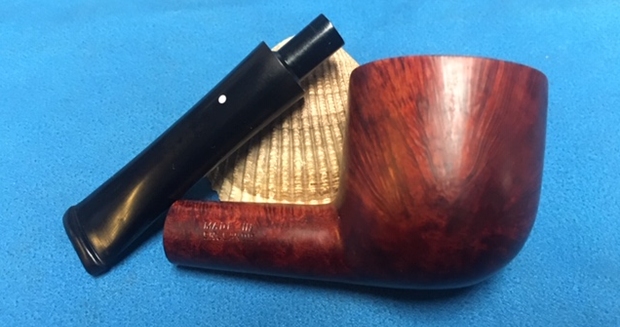
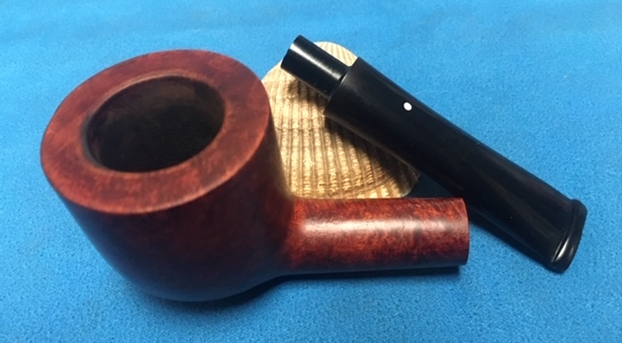
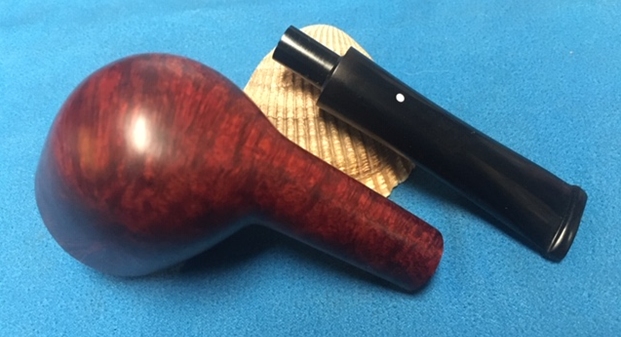
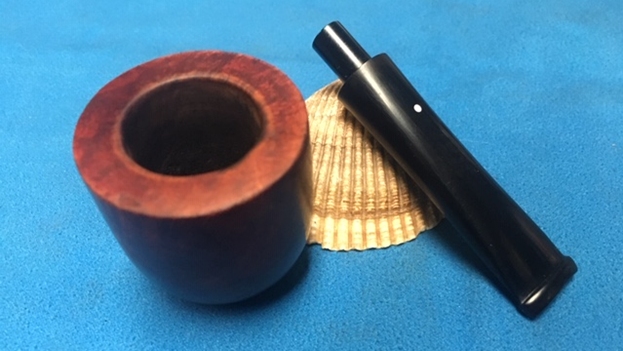
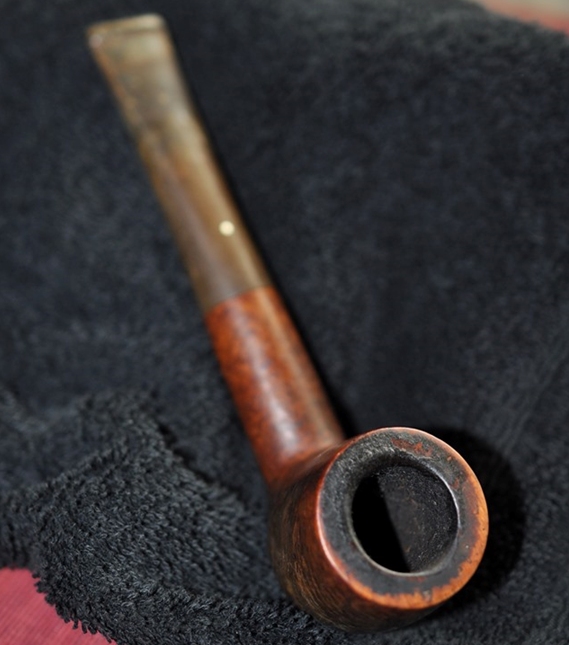
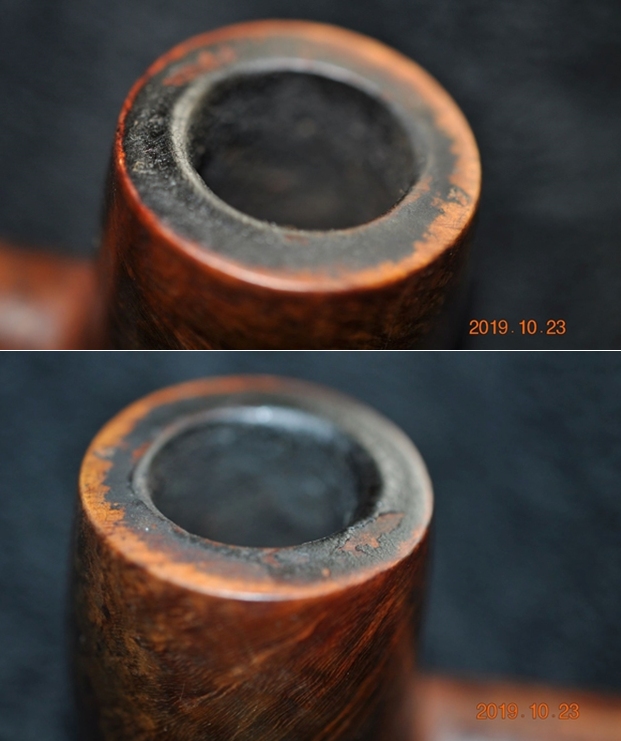
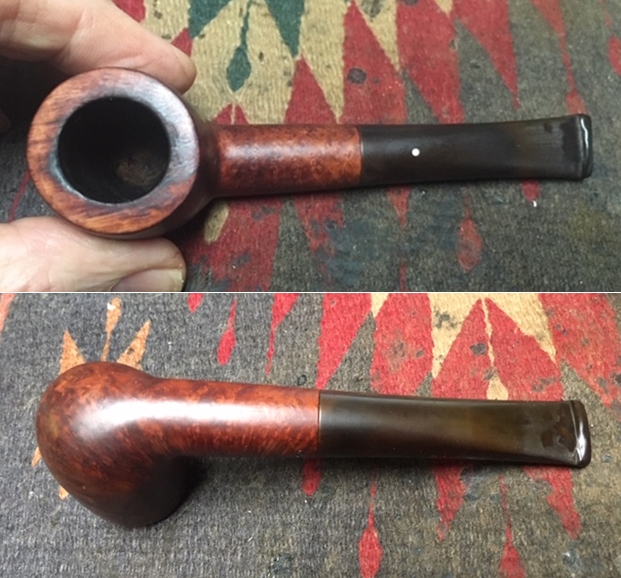
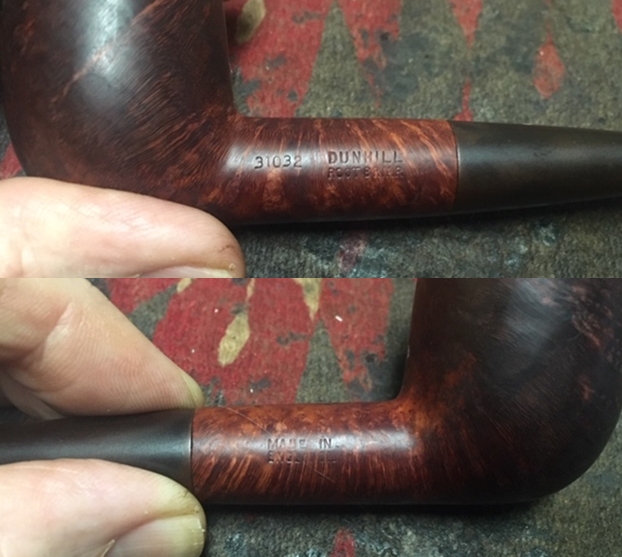
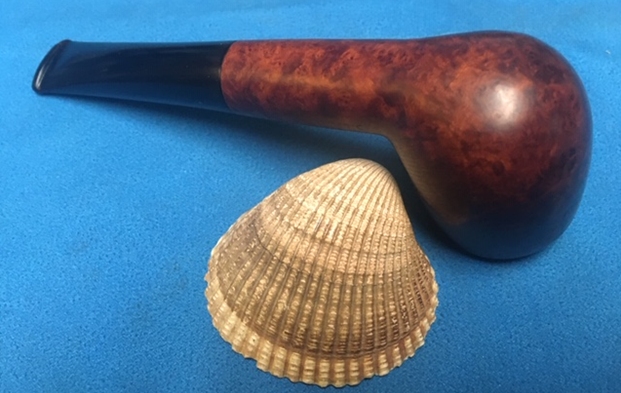
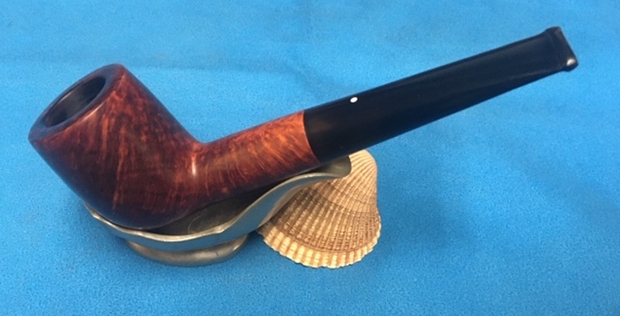
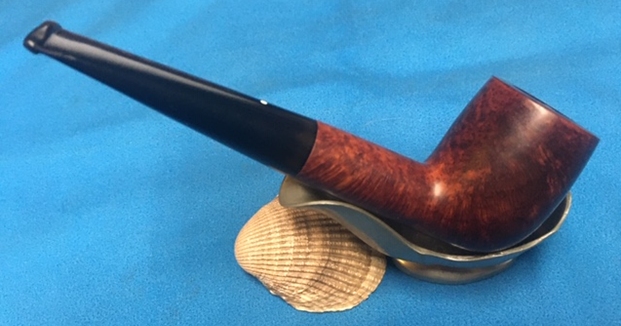
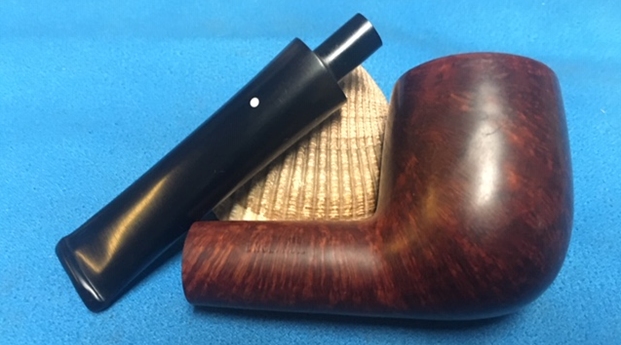
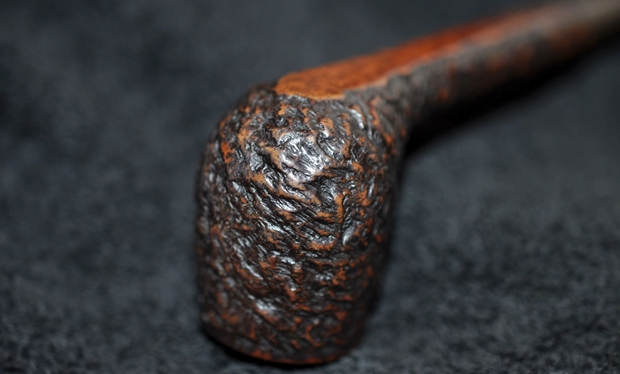
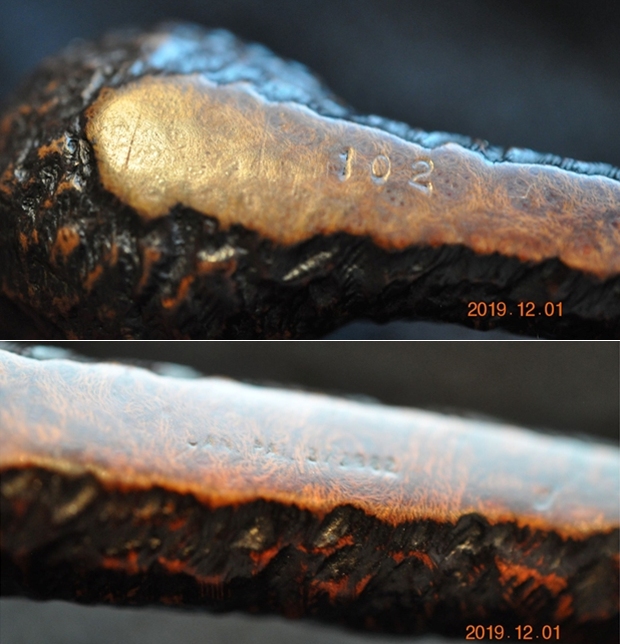
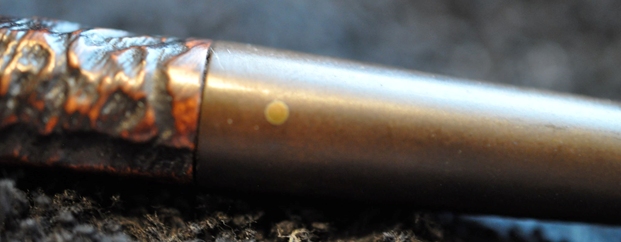
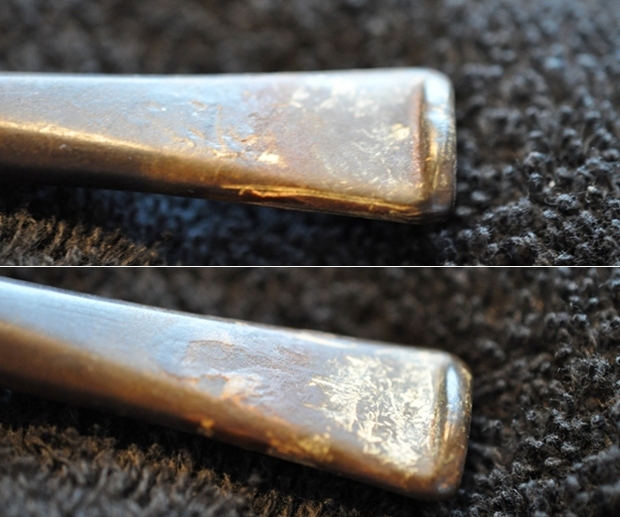
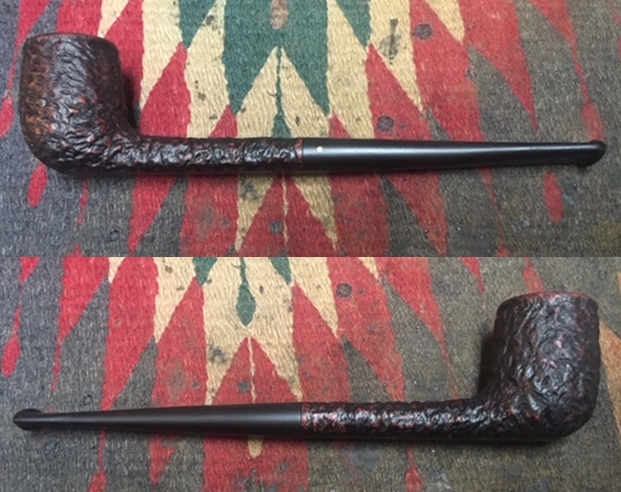
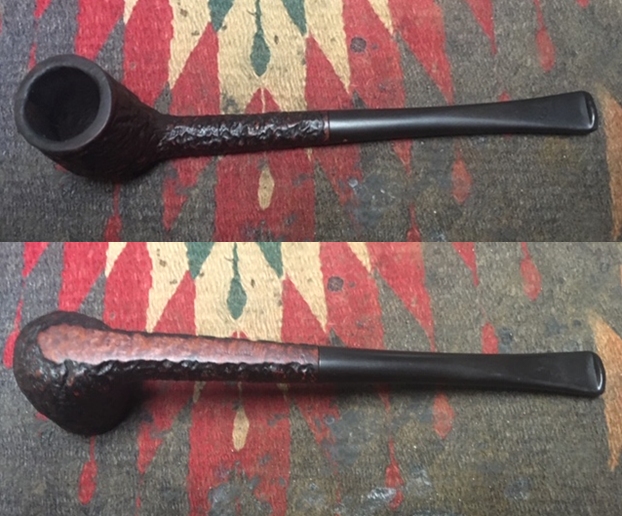
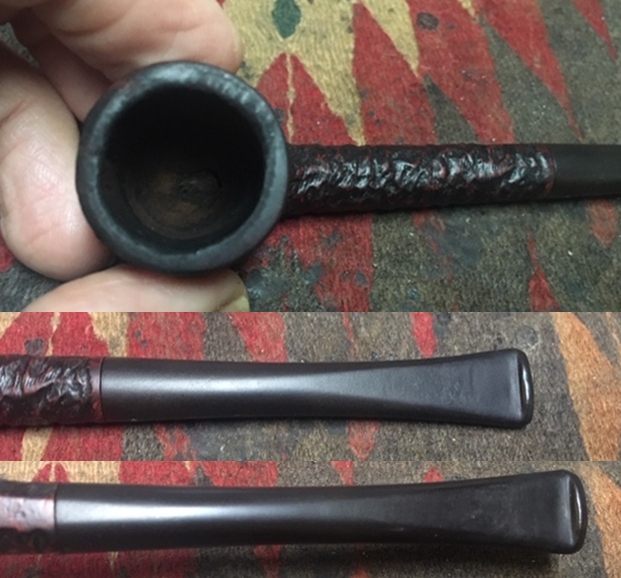
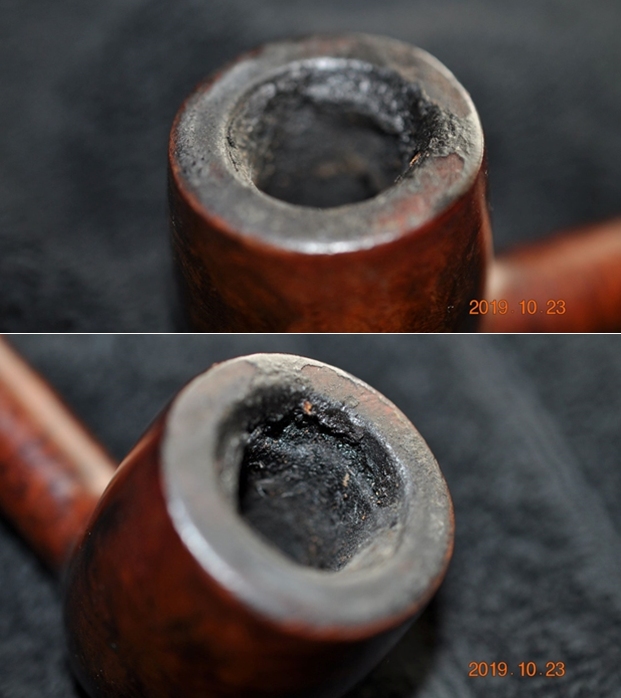
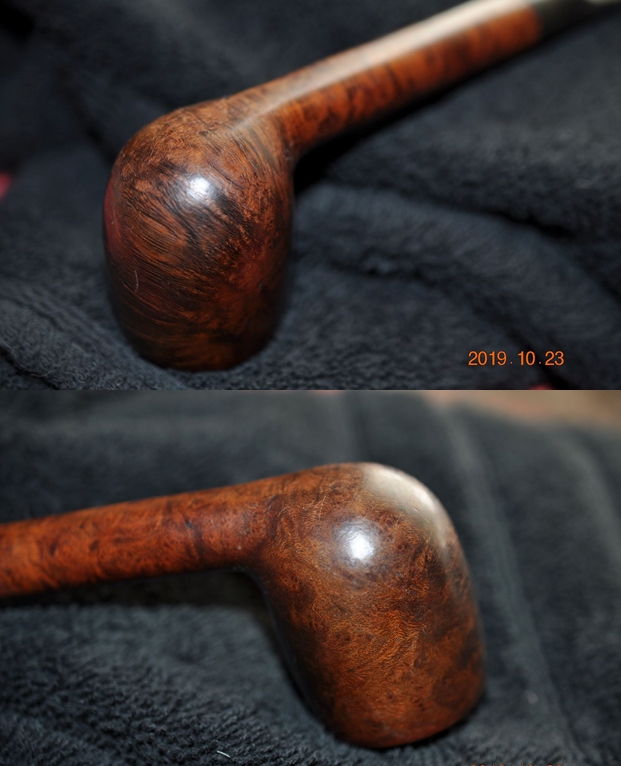
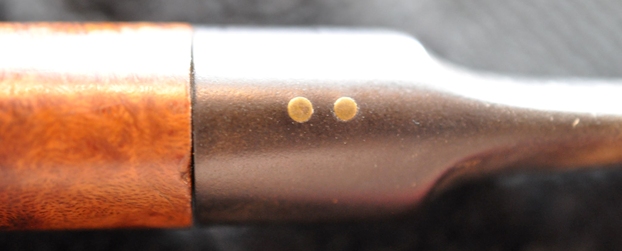
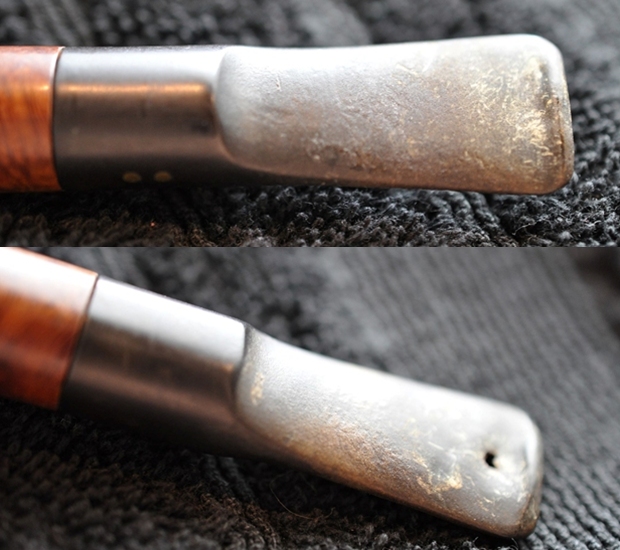
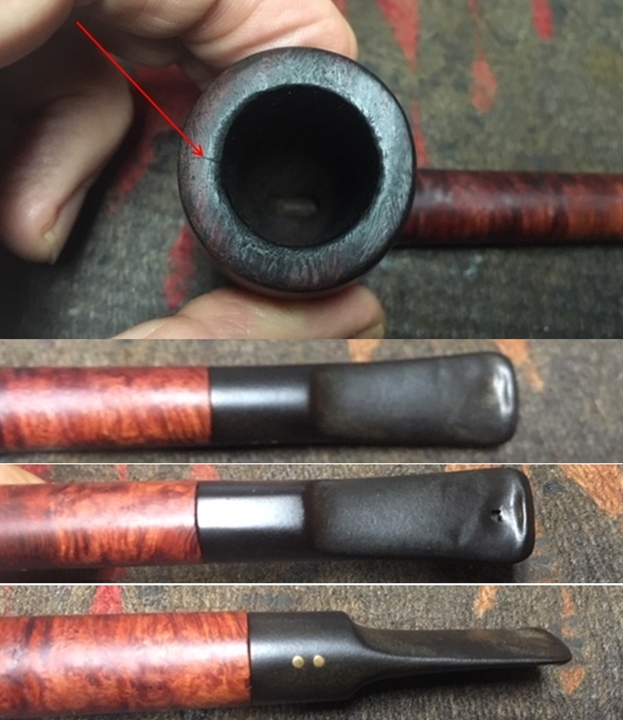
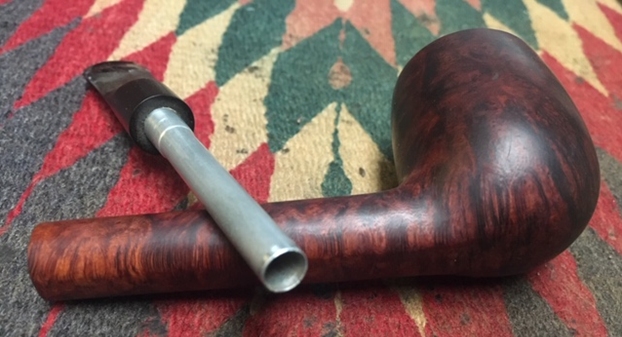
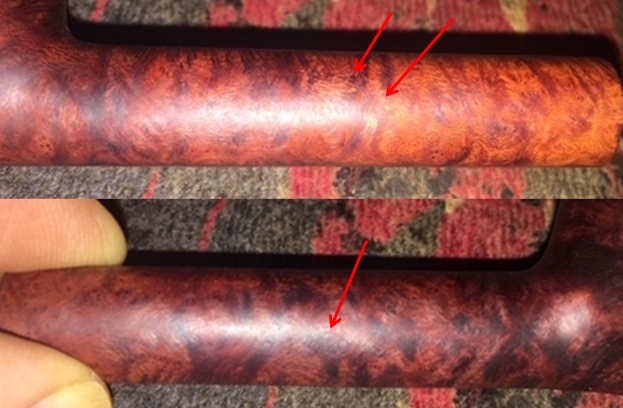
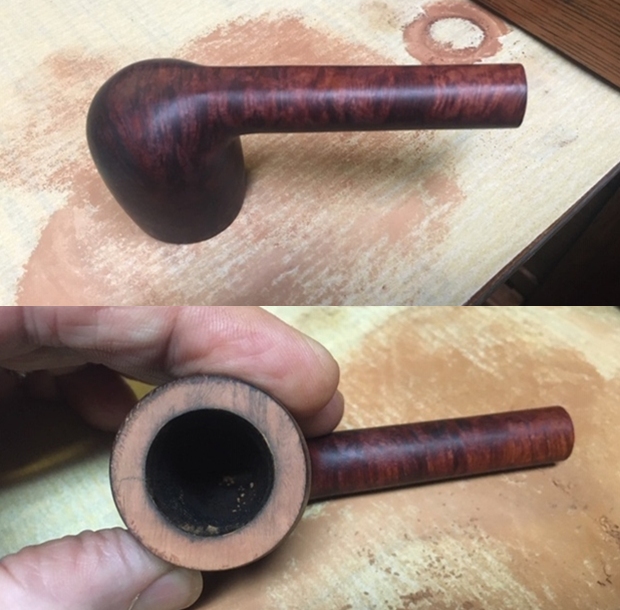
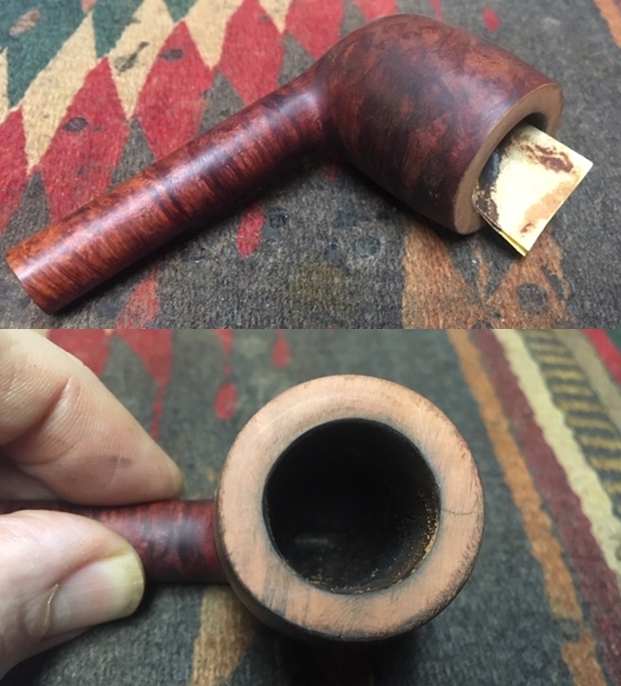
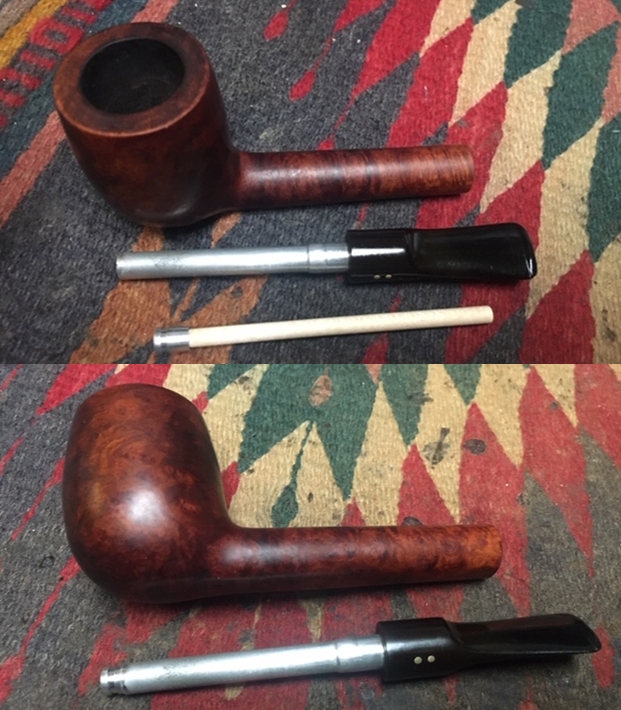
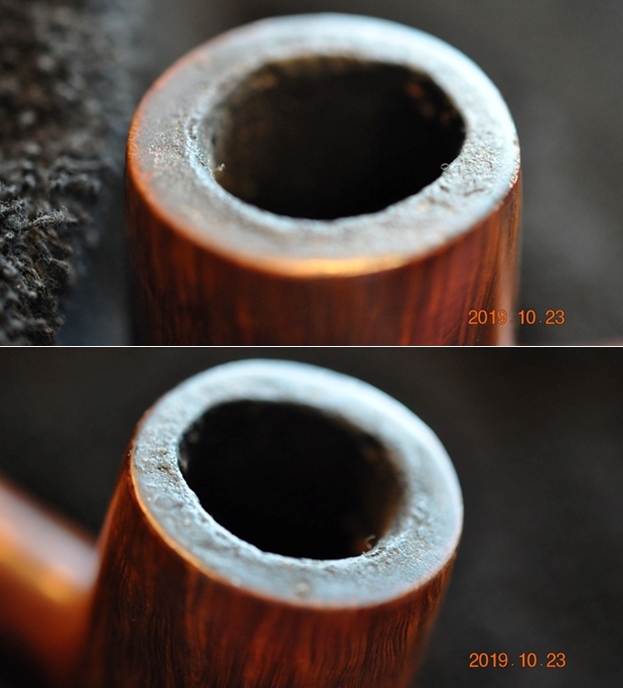
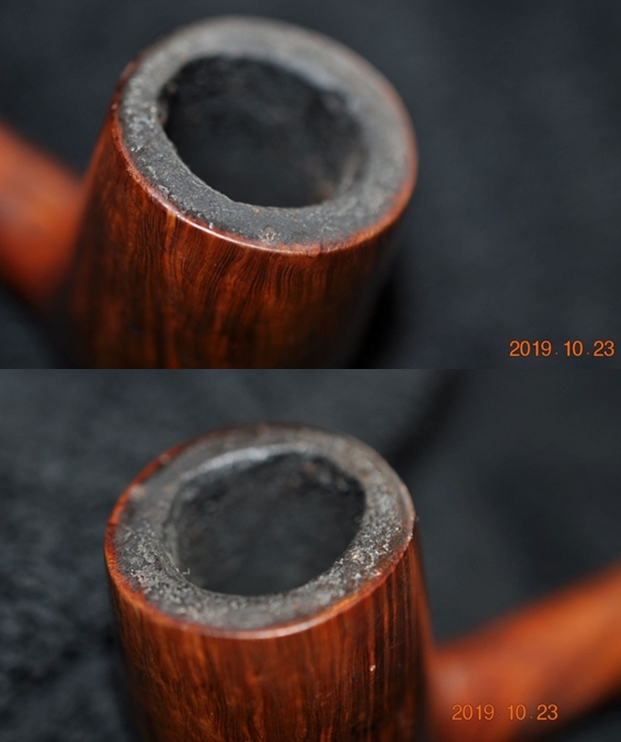
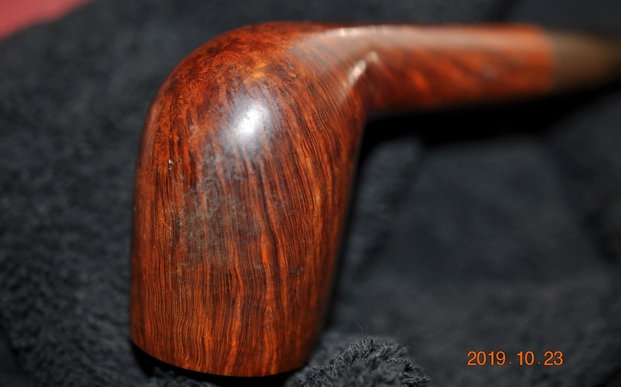
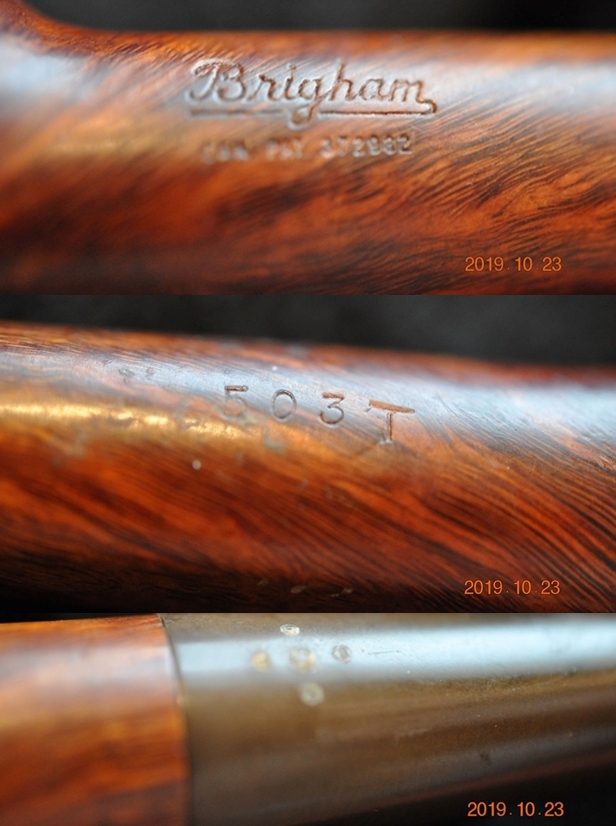
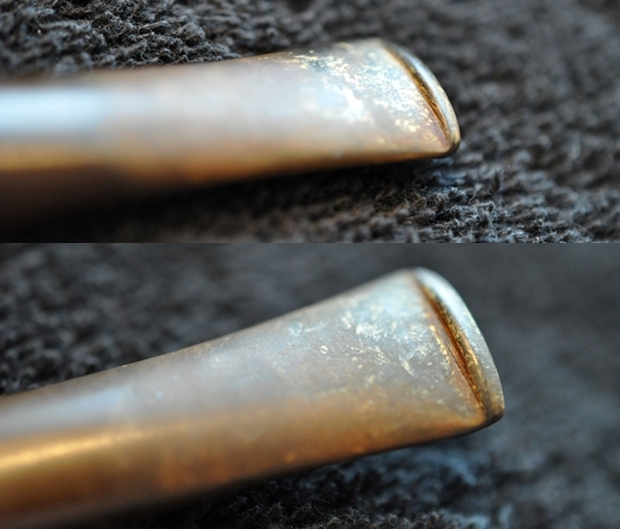
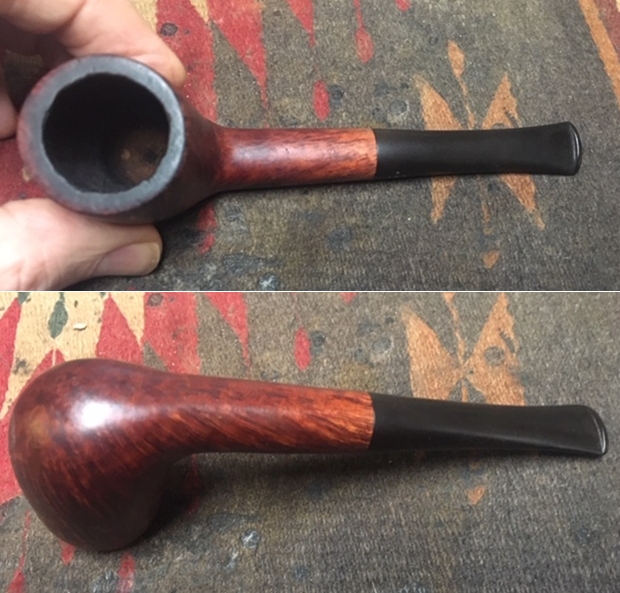
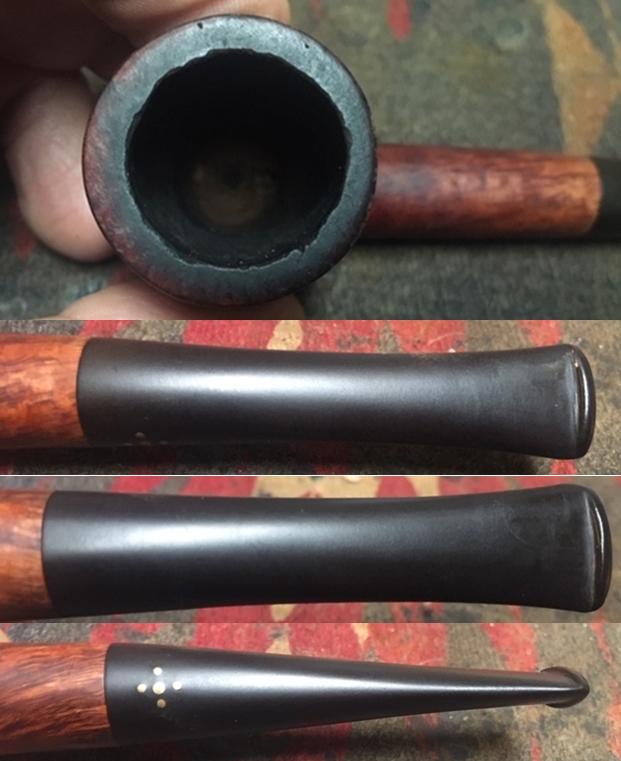
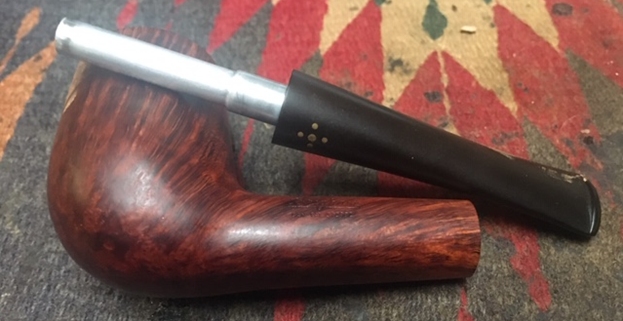
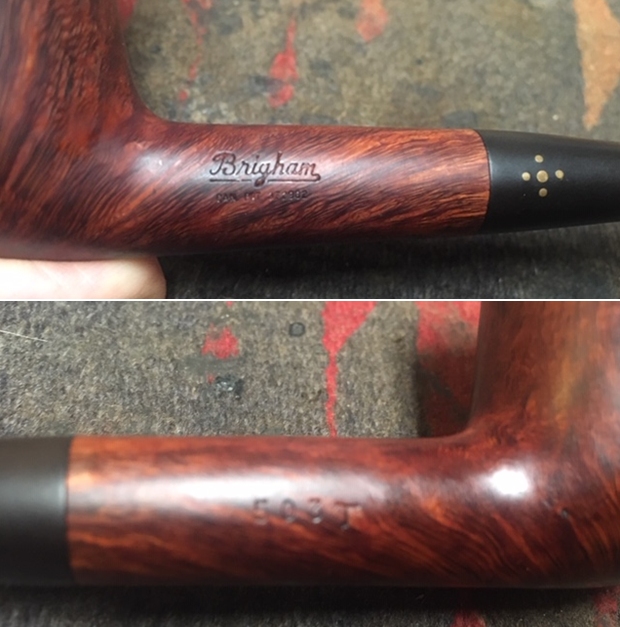
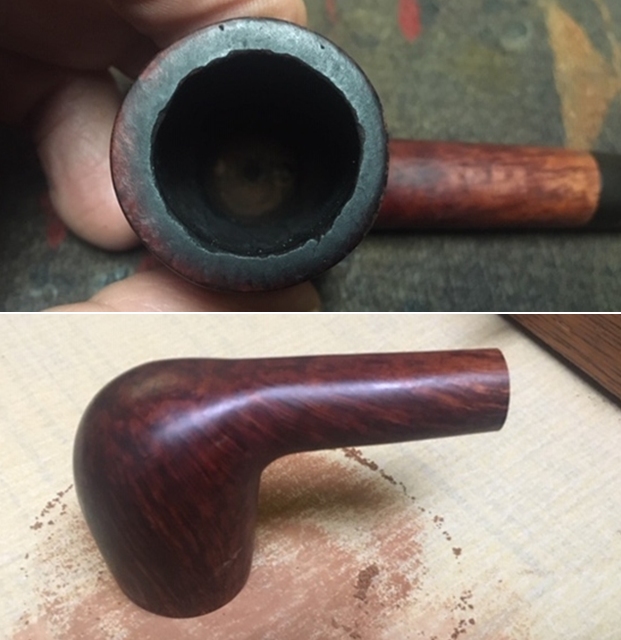
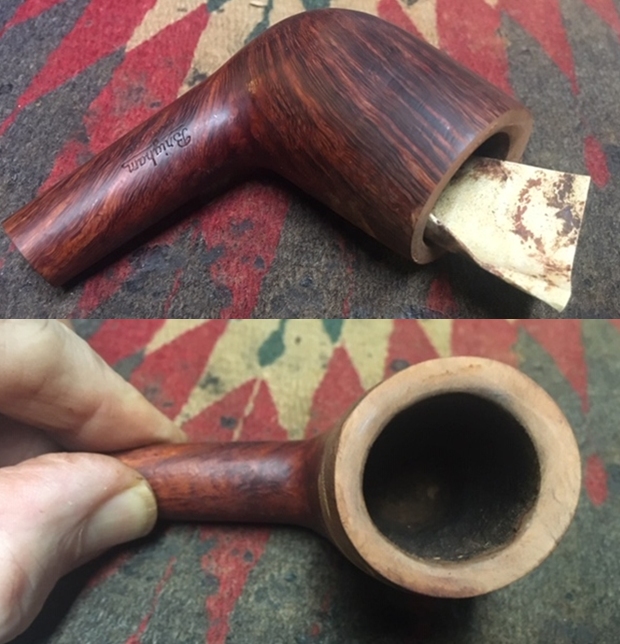
Like Bob’s other Dunhill pipe this one also had a thick cake in the bowl with remnants of tobacco stuck on the walls. There was a lava overflow on the rim so it was hard to know what kind of damage lay beneath the thick covering. Once it was cleaned I would have a better idea of the condition of the rim top. I could see however that there was definitely damage to the front inner edge of the bowl. The grain that is poking through the grime and oils appears to be quite beautiful – birdseye grain on the bowl sides and cross grain on the front and back as well as the heel of the bowl. The stem was oxidized and calcified toward the end with some tooth chatter. There were also some tooth marks on both sides of the stem ahead of the button and on the button itself. There was the classic White Spot on the top of the stem. Jeff took photos of the pipe before he started his cleanup work on it.  Jeff took photos of the bowl and rim top to show the thick, hard cake in the bowl with remnants of tobacco stuck on the walls of the bowl. There was a lava build up on the smooth rim top and the edges of the bowl. The rim top looked pretty good but it was hard to know for sure. It appeared that there was damage on the inner edge. The outer edges looked to be okay other than a few small nicks on the sides.  There was a burn mark on the right side of the bowl from where the pipe had been laid down in an ashtray. It was not deep but it was permanent.Jeff took photos of the sides and heel of the bowl to show the condition of the finish. You can see the beautiful grain patterns around the sides of the bowl and shank. Even under the dirt and debris of the years it looked very good.   The stamping is very readable. On the left side of the shank you can see 112 F/T which is the shape number followed by the F/T for a Fish tail stem. Next to that it is stamped Dunhill over Bruyere. On the right side it reads Made in England 9/11 followed by Circle 2A. Jeff included a pic of the White Spot on the stem.  Jeff took photos of the top and underside of the stem showing the tooth chatter, scratching, calcification and oxidation on the stem surface and wear on the edges of the button.    I can’t begin tell you how great it feels to have Jeff’s help on cleaning up the pipes from Bob’s estate as the 125+ pipes were taking me a long time to do alone. He cleaned this filthy pipe with his usual penchant for thoroughness that I really appreciate. This one was a real mess and I was looking forward to seeing what he had done with this one when I took it out of his box. It looked amazing and CLEAN. He reamed it with a PipNet pipe reamer and cleaned up the reaming with a Savinelli Fitsall Pipe Knife. He scrubbed out the internals with alcohol, pipe cleaners and cotton swabs until the pipe was clean. He scrubbed the exterior of the bowl with Murphy’s Oil Soap and a tooth brush to remove the grime and grit on the briar and the lava on the rim top. The finish looks good with great looking grain around the bowl and shank. The rim top looked better on this pipe. The condition of the inner and outer edges was not too bad. The stem looked a lot better. Jeff soaked the stem in Before & After Deoxidizer to remove the oxidation on the rubber. The pipe was ready for me to carry on the next part of the process. I took some close up photos of the rim top and also of the stem surface. I wanted to show how well it had cleaned up and what needed to be done. The rim top had a worn and burned area on the left front of the inner edge. There was darkening and nicks all around the top of the bowl and on the inner edge. The outer edge looked good.  I also took close up photos of the stem to show the tooth marks and chatter on the stem surface.  I also took a close up photo of the burn mark on the right side of the bowl. The stamping appeared to be as clear as it was before the cleanup work. This is just one of the things I appreciate about Jeff’s cleanup is that he works to protect and preserve the nomenclature on the shank of the pipes that he works on. I took some photos to show the stamping. Bob loved his Dunhill pipes and it was obvious that he enjoyed smoking them. Some appeared to be daily smokes while others he seemed to reserve for special occasions. Some seemed like they must have hung in his mouth while he did his carving while others were smoked in his chair. Having worked on over 60 of his pipes so far I am getting a feel for them. This one is in rough condition and I suppose it might well have been before Bob took up the trust. I suppose I won’t ever know for sure but it certainly has a long and interesting story if it could only tell it.

I am sure that many of you have read at least some of the other restoration work that I have done on previous pipes. You have also read what I have included about Bob Kerr, the pipeman who held these pipes in trust before I came to work on them (see photo to the left). Also, if you have followed the blog for long you will already know that I like to include background information on the pipeman whose pipes I am restoring. For me, when I am working on an estate I really like to have a sense of the person who held the pipes in trust before I worked on them. It gives me another dimension of the restoration work. Bob’s daughter wrote a short tribute to her father. I thank you Brian and tell your wife thank you as well.

I am delighted to pass on these beloved pipes of my father’s. I hope each user gets many hours of contemplative pleasure as he did. I remember the aroma of tobacco in the rec room, as he put up his feet on his lazy boy. He’d be first at the paper then, no one could touch it before him. Maybe there would be a movie on with an actor smoking a pipe. He would have very definite opinions on whether the performer was a ‘real’ smoker or not, a distinction which I could never see but it would be very clear to him. He worked by day as a sales manager of a paper products company, a job he hated. What he longed for was the life of an artist, so on the weekends and sometimes mid-week evenings he would journey to his workshop and come out with wood sculptures, all of which he declared as crap but every one of them treasured by my sister and myself. Enjoy the pipes, and maybe a little of his creative spirit will enter you!

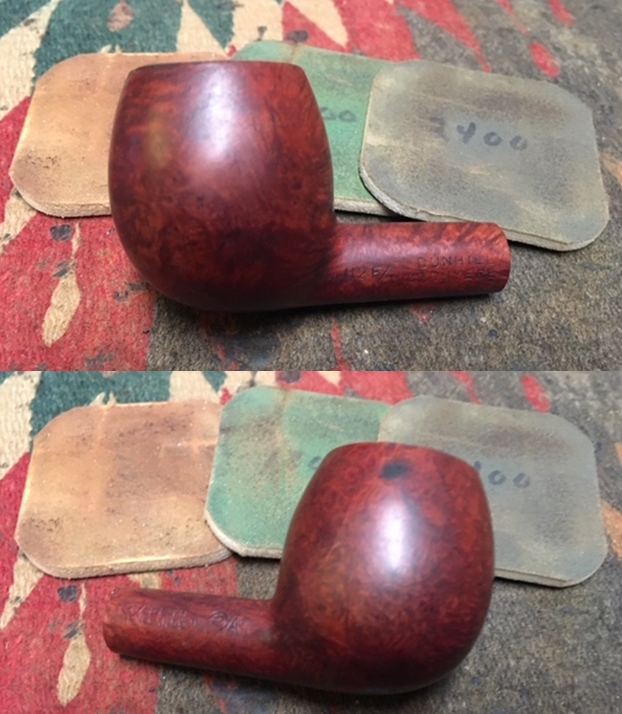
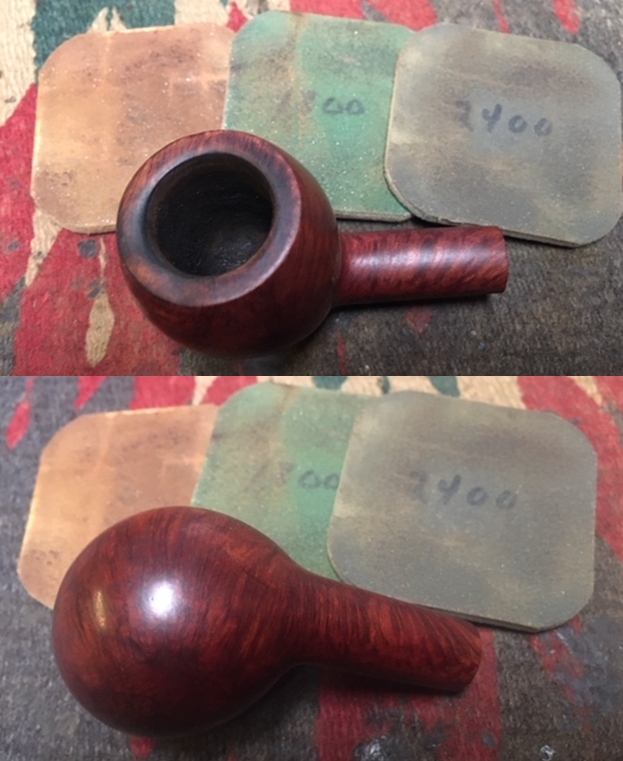
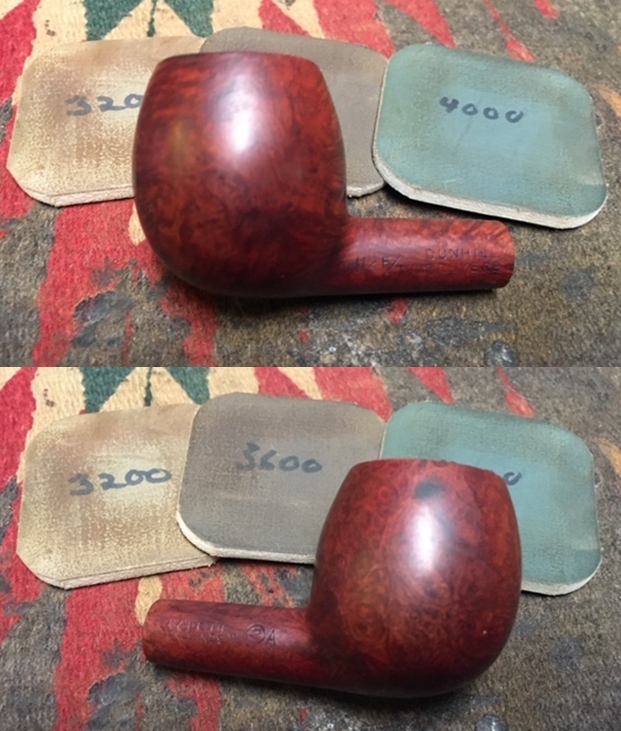
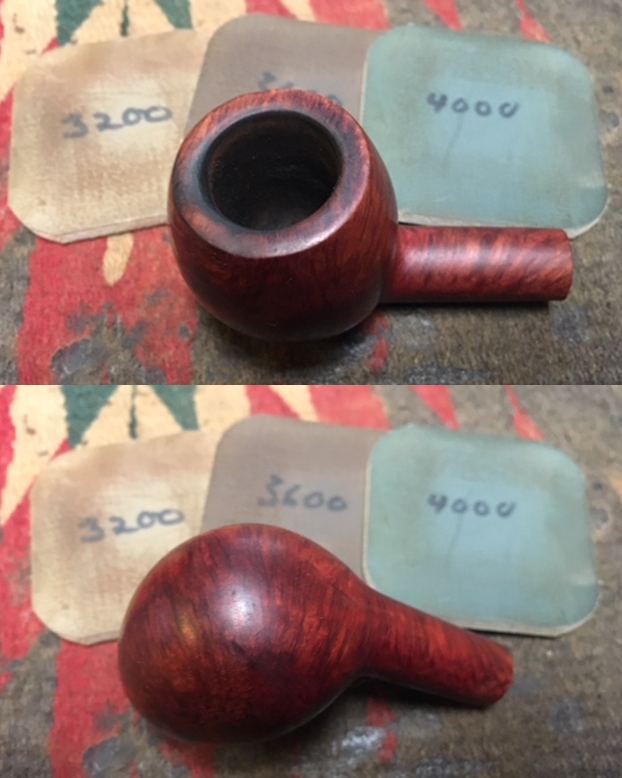
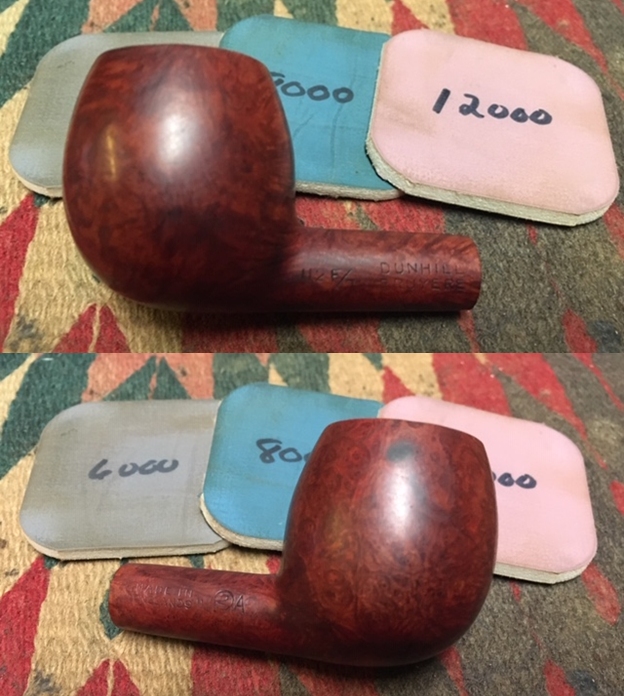
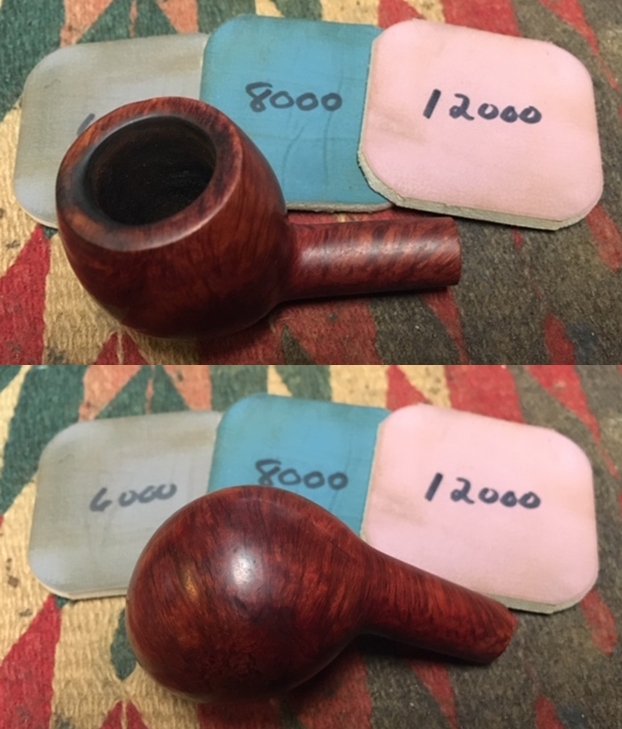
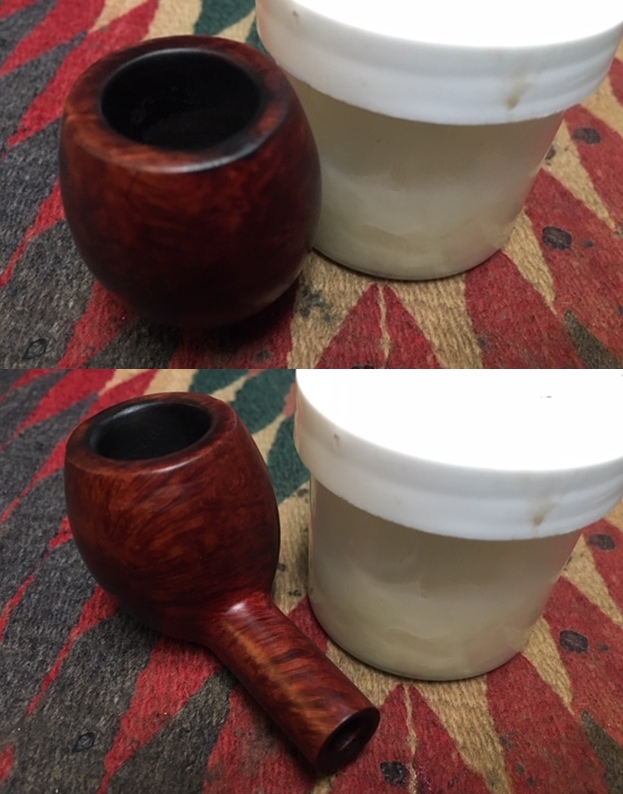
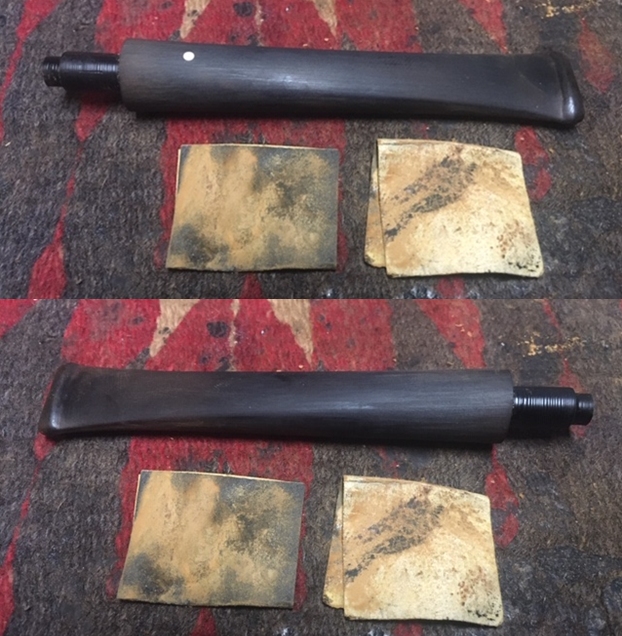
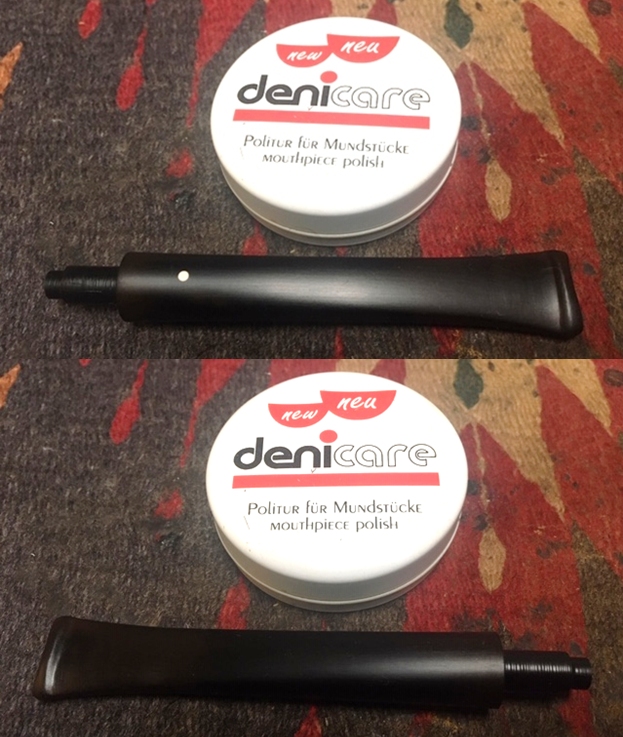
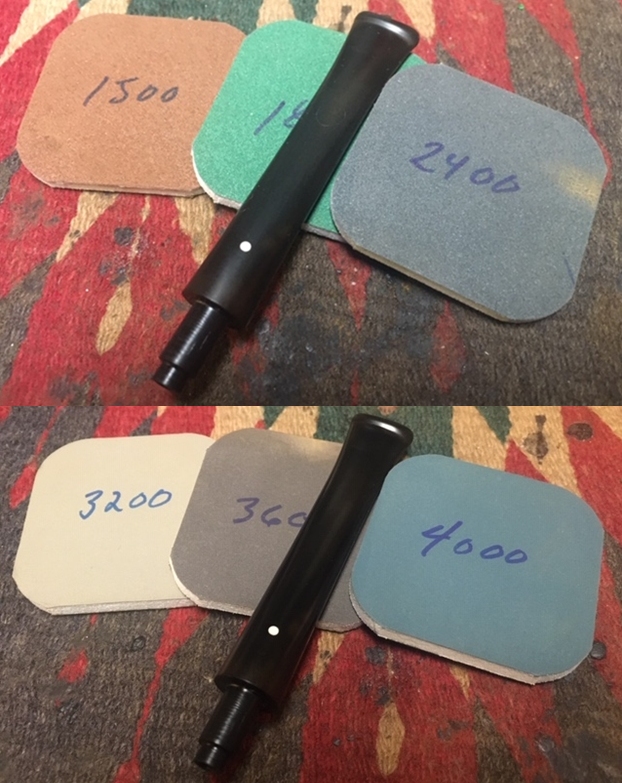
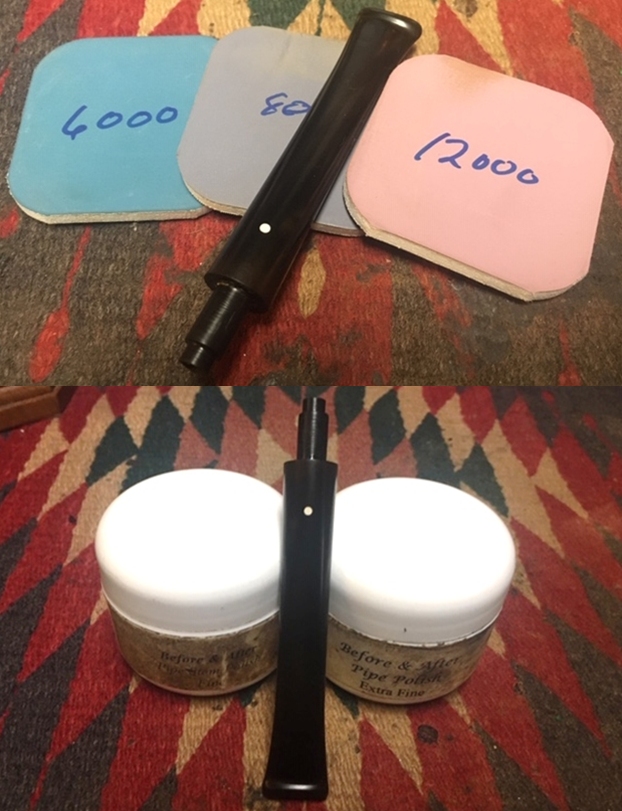
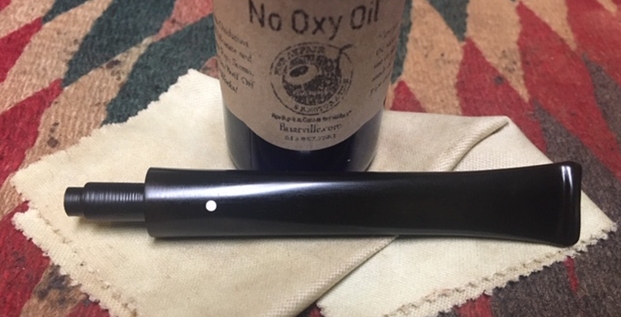
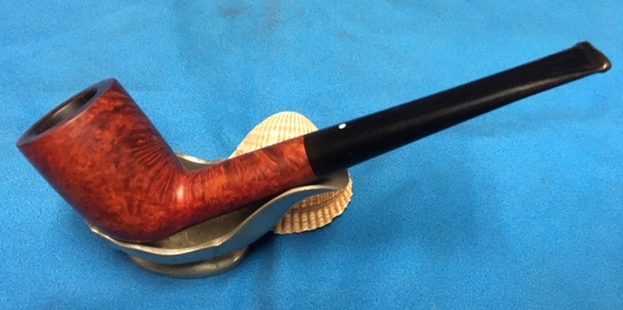
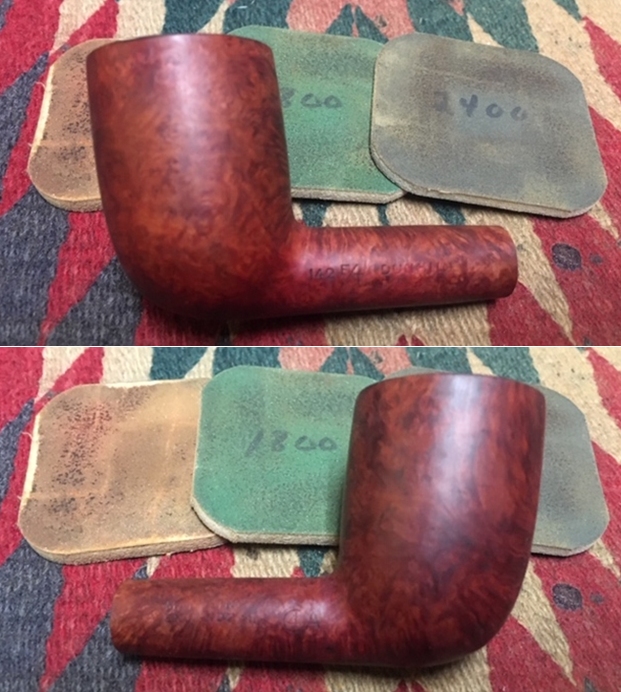
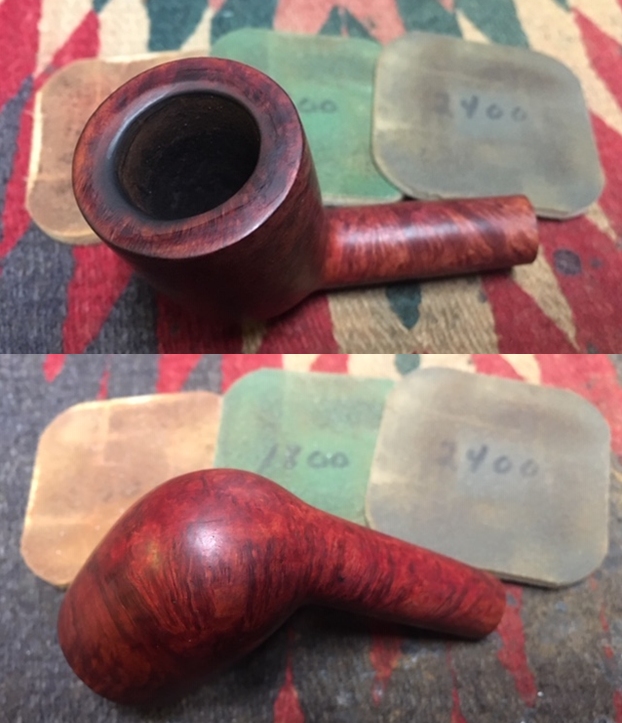
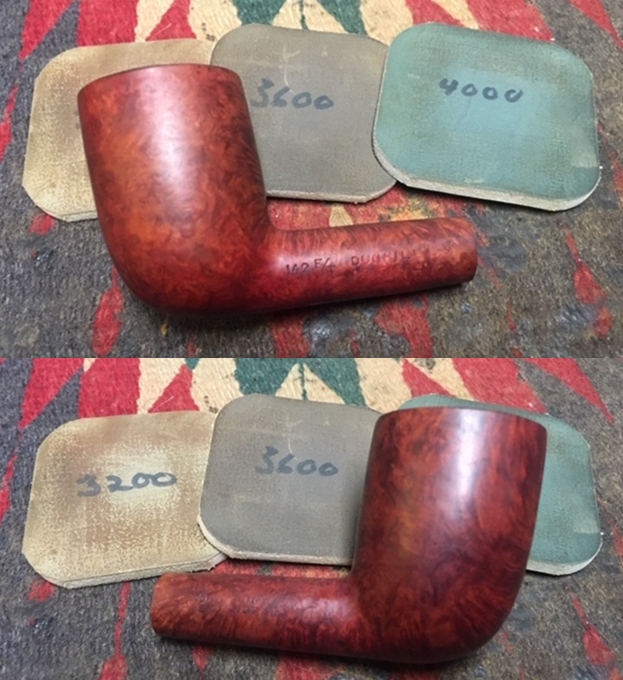
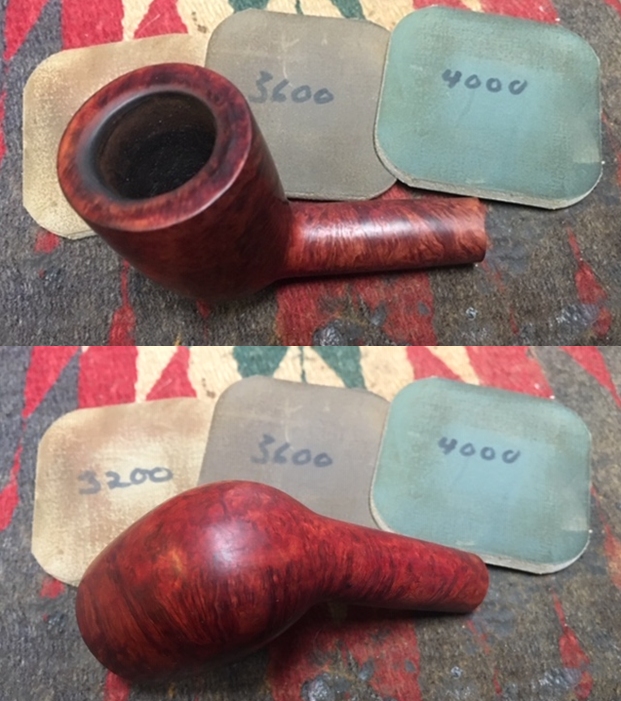
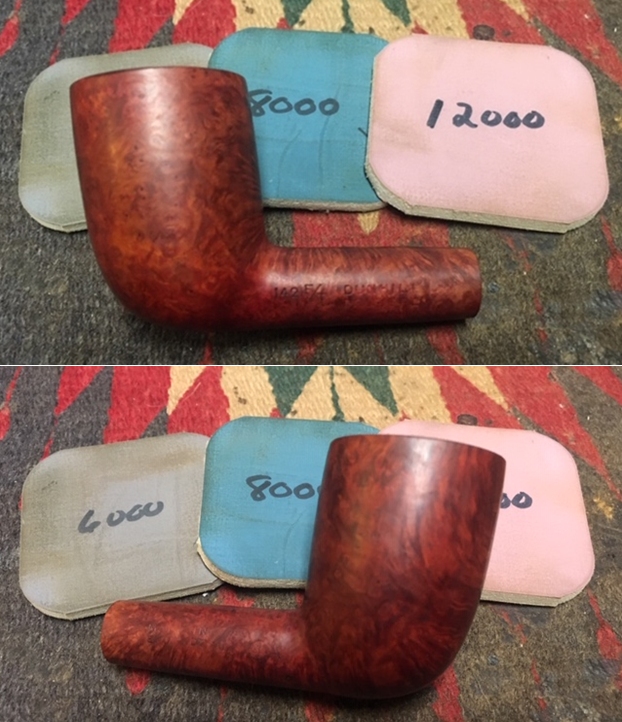
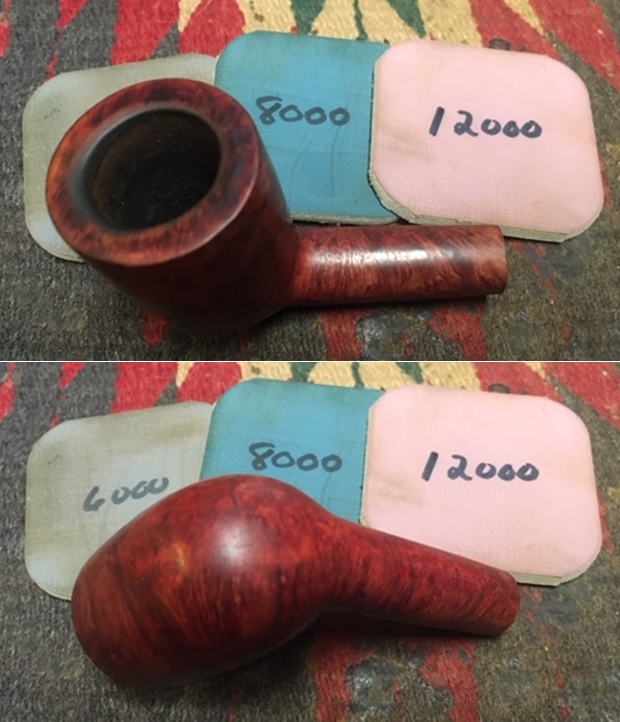
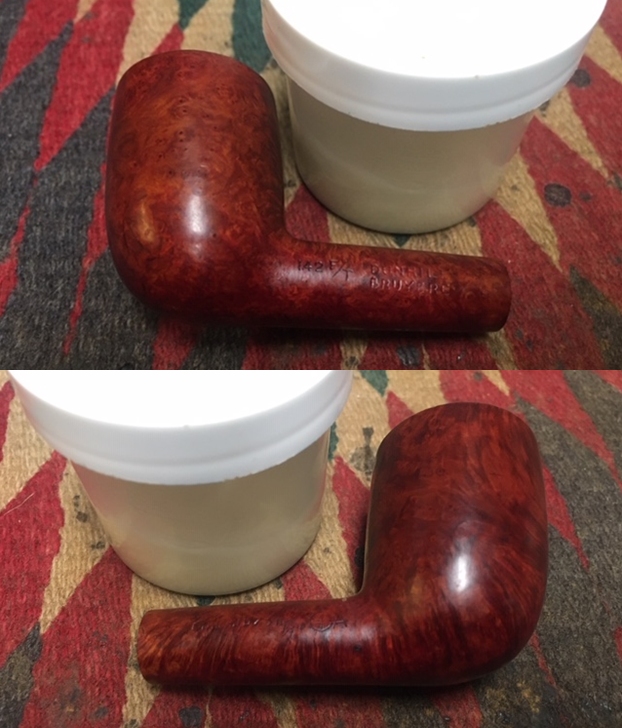
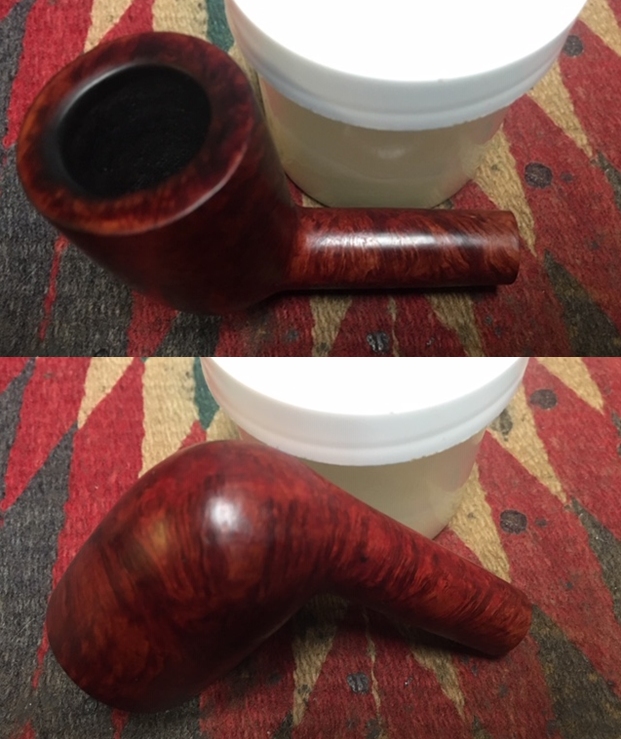
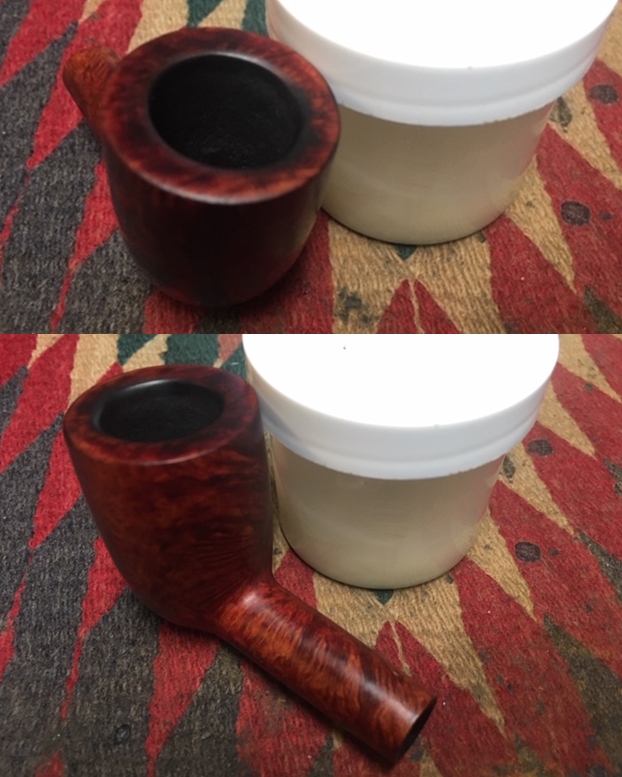
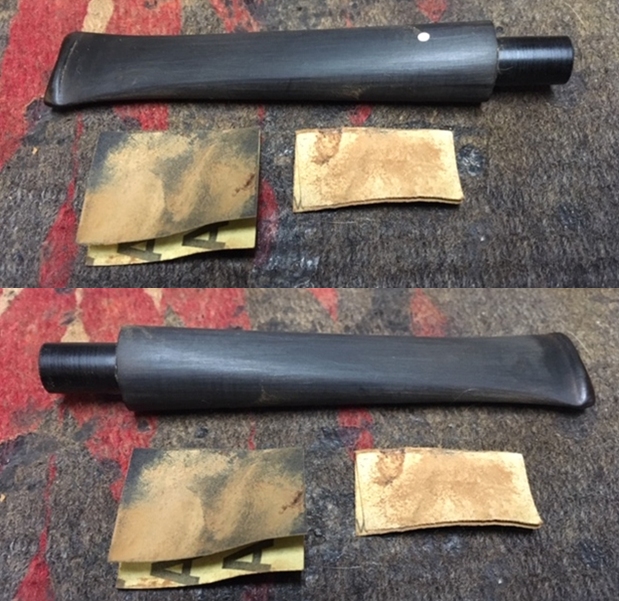
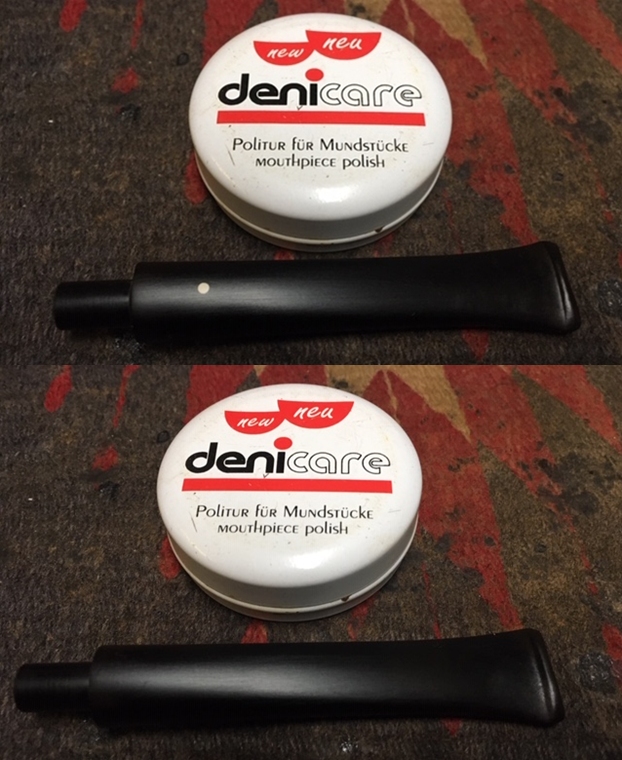
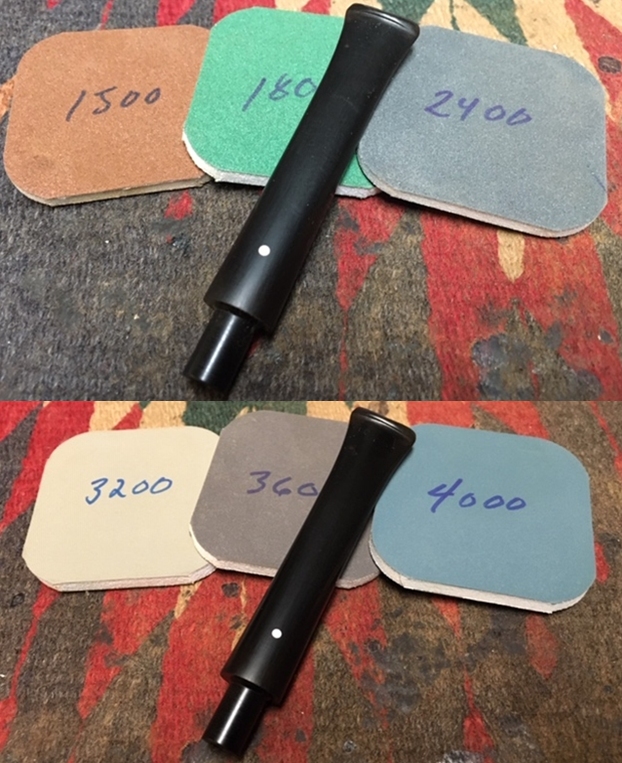
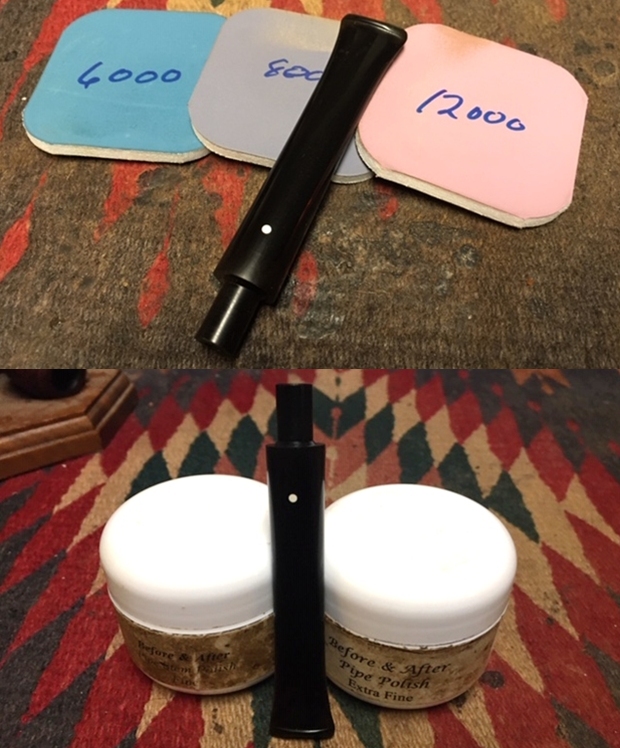
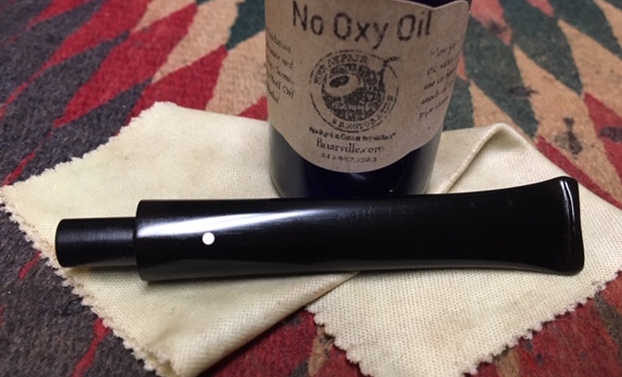
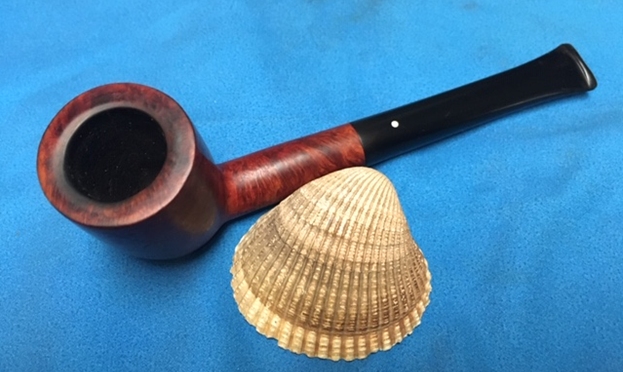
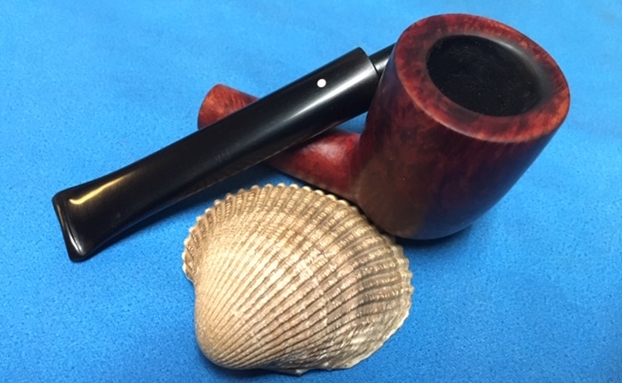
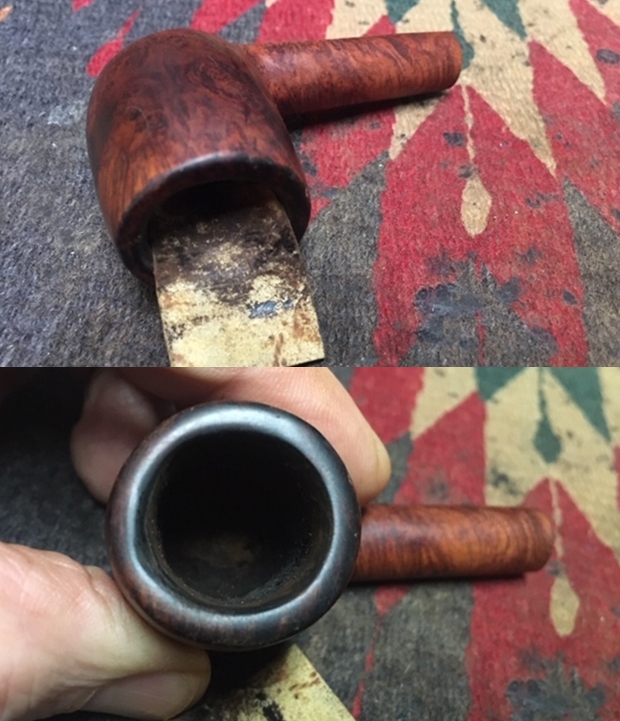
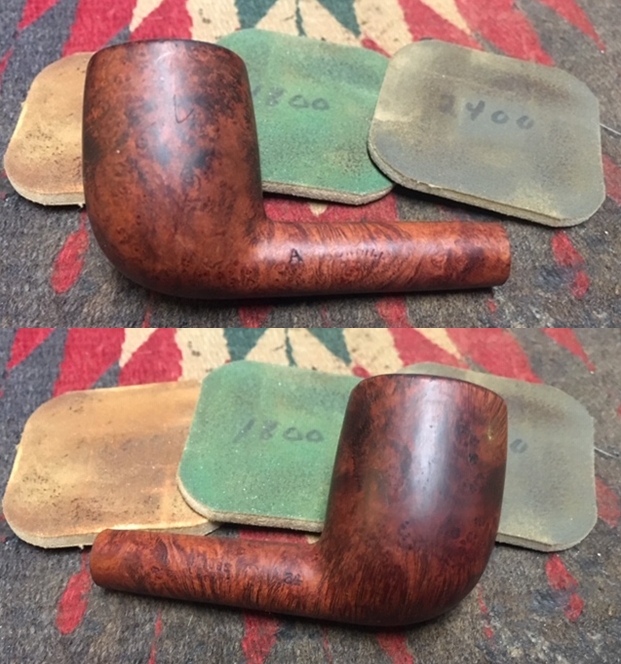
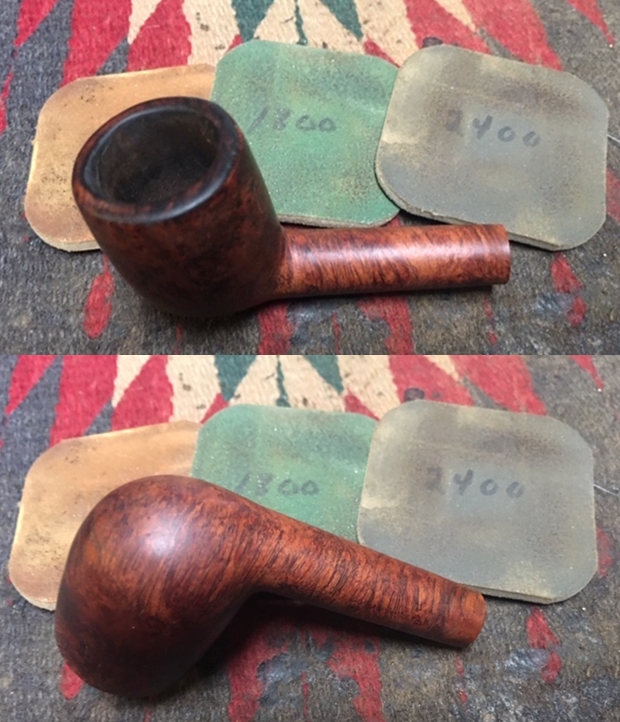
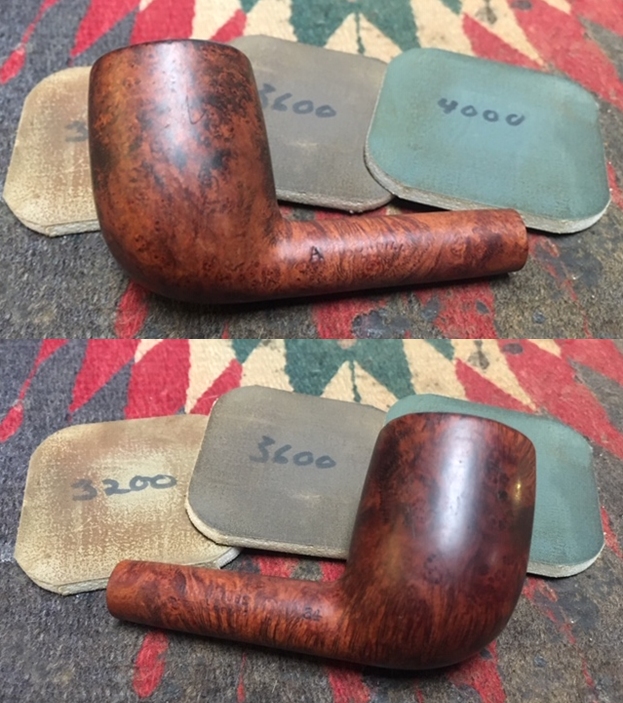
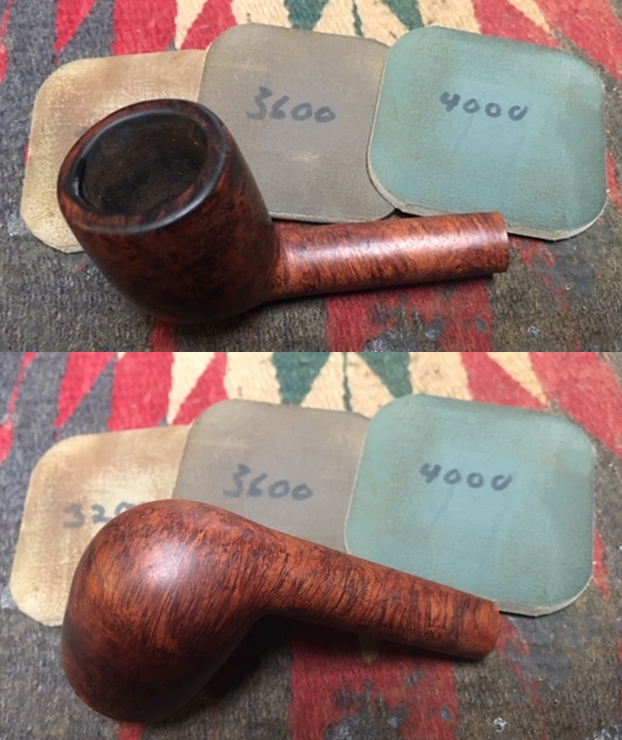
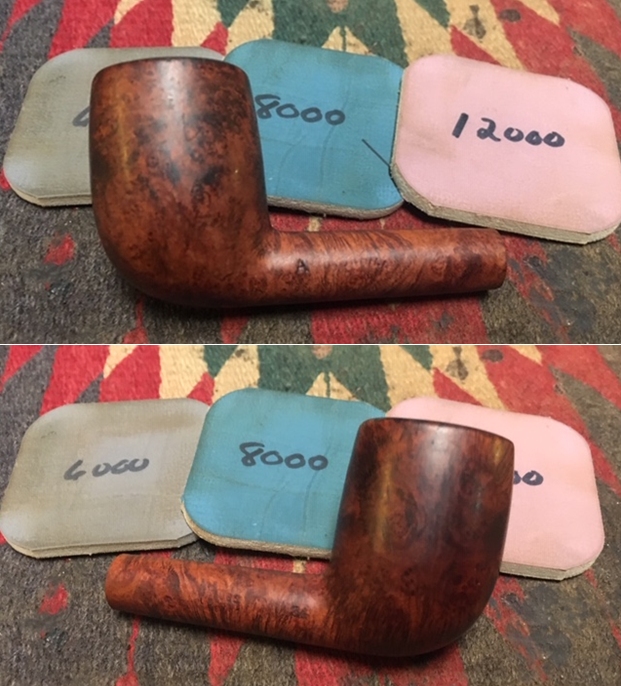
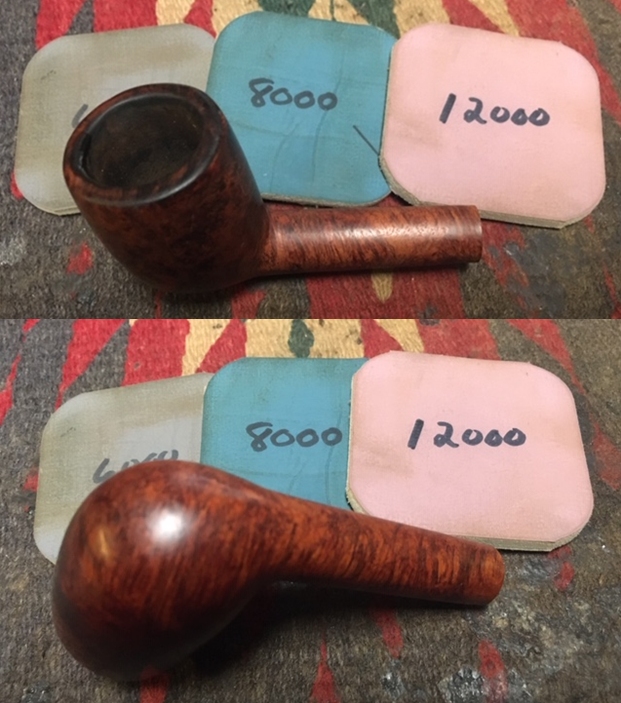
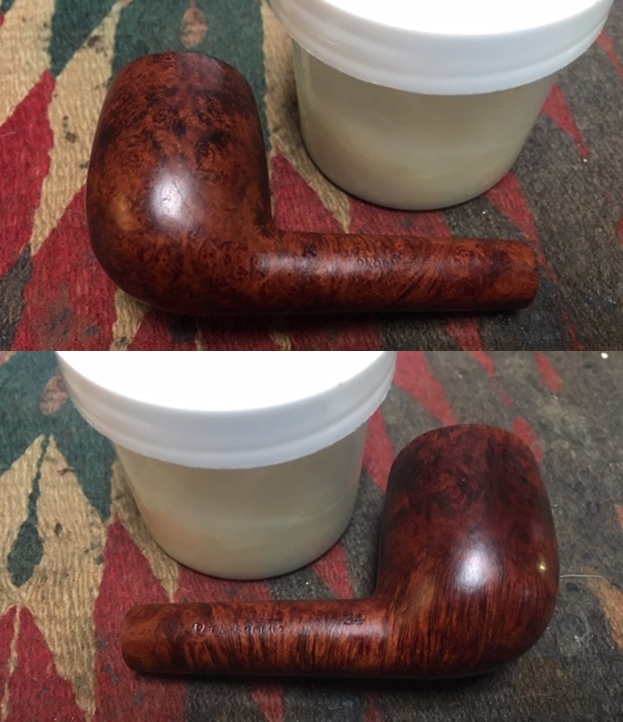
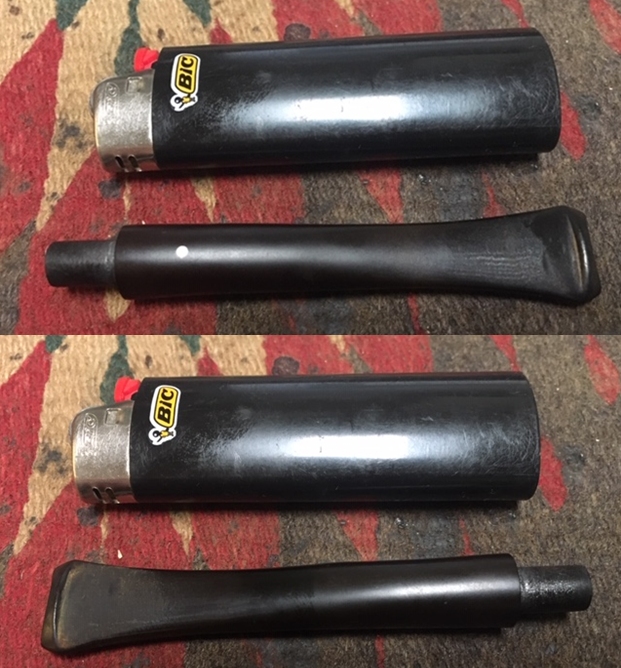
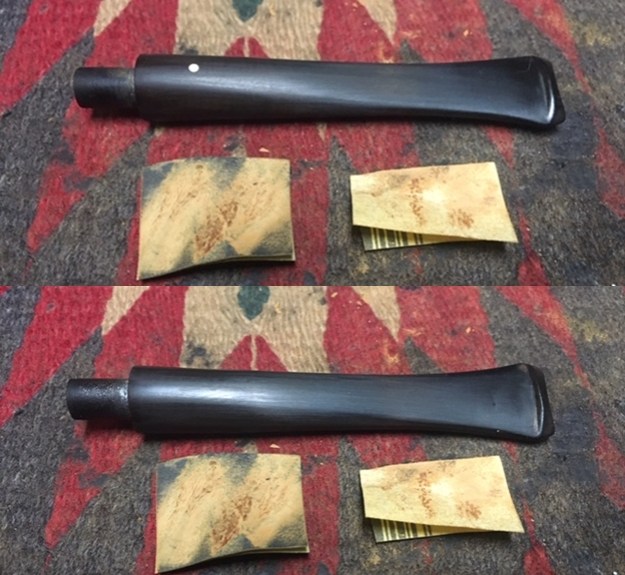
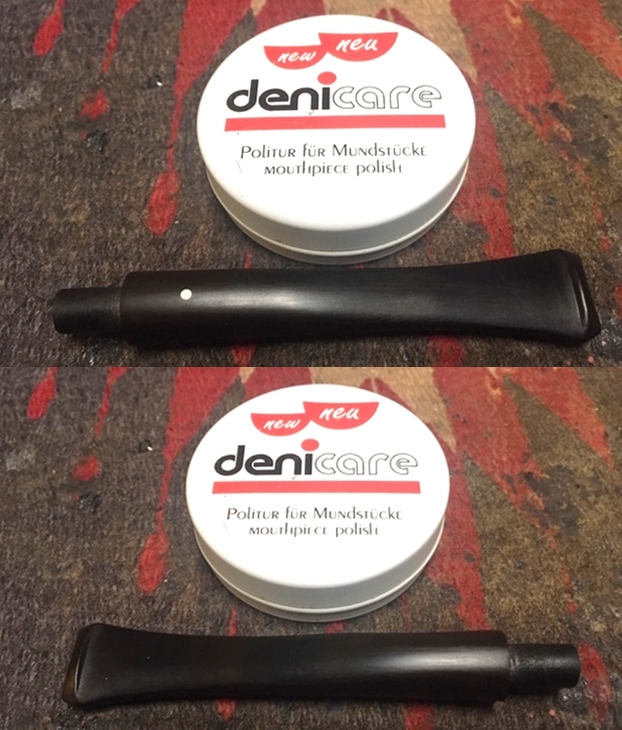
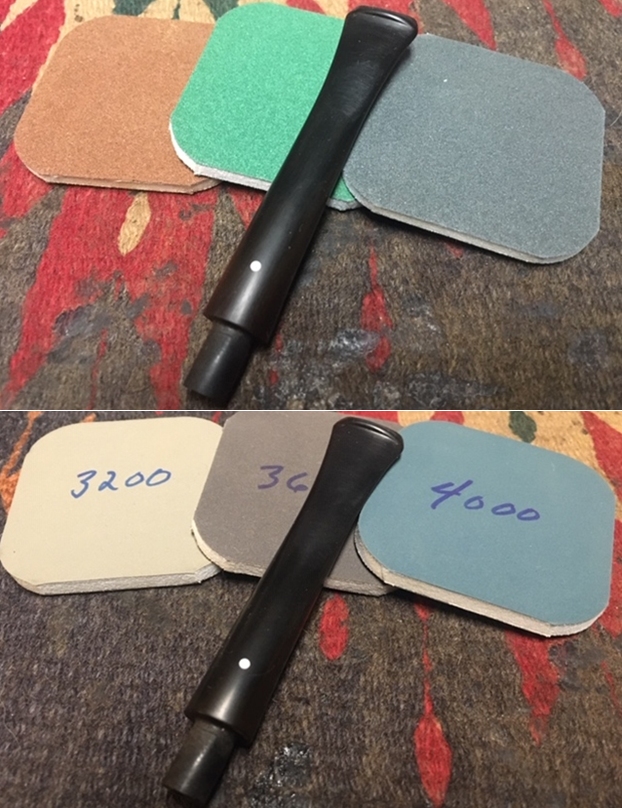
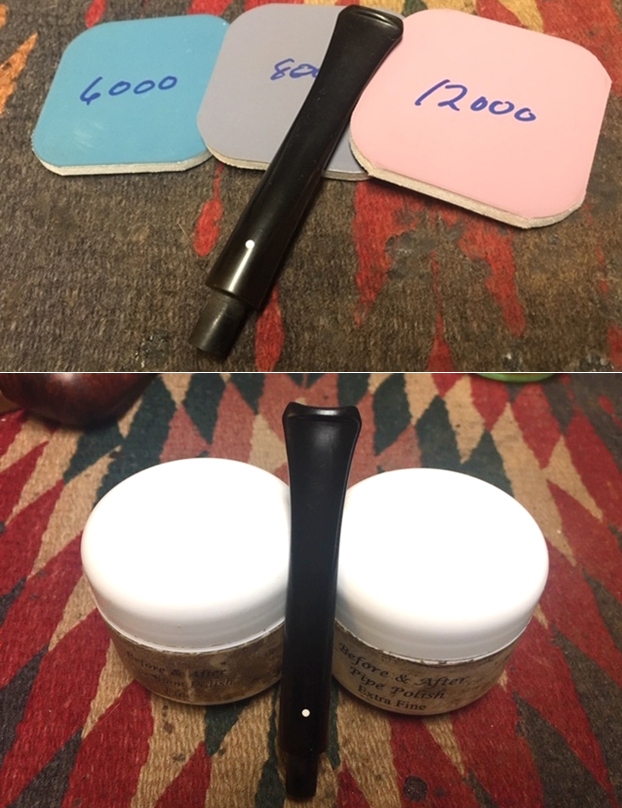
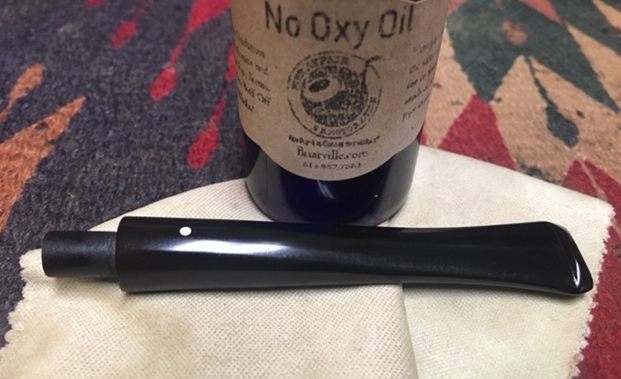
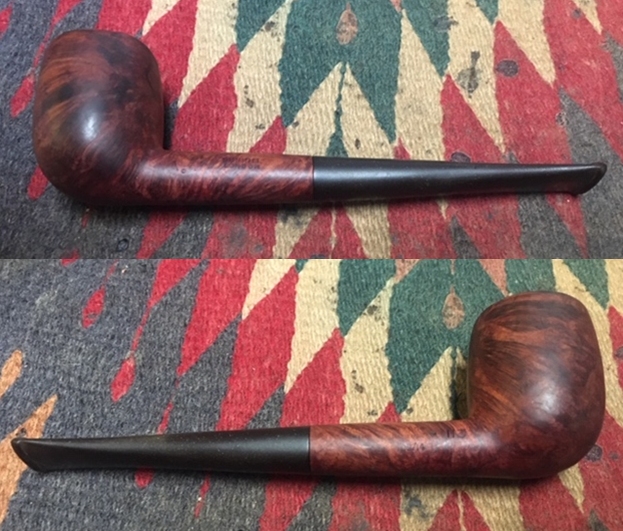
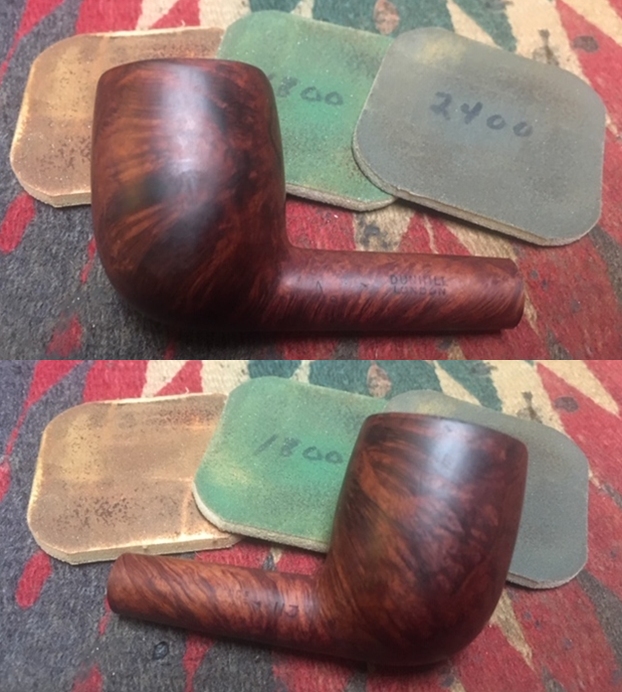
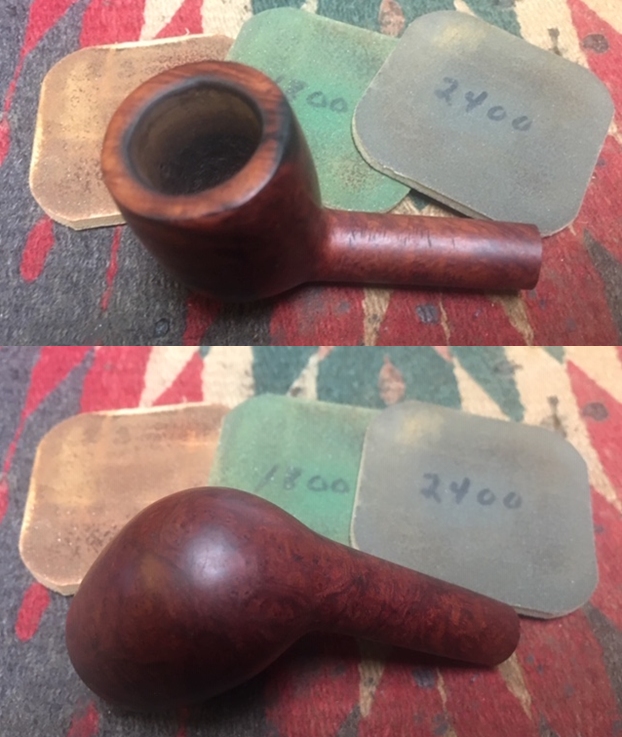
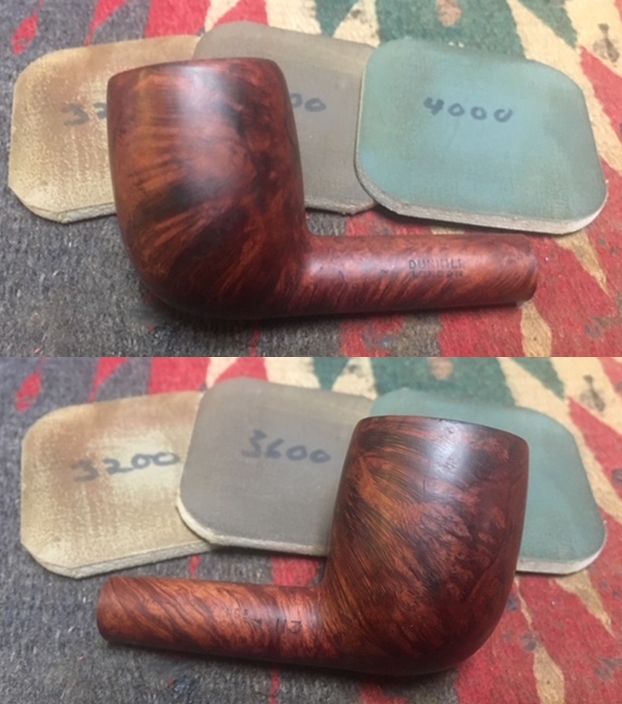
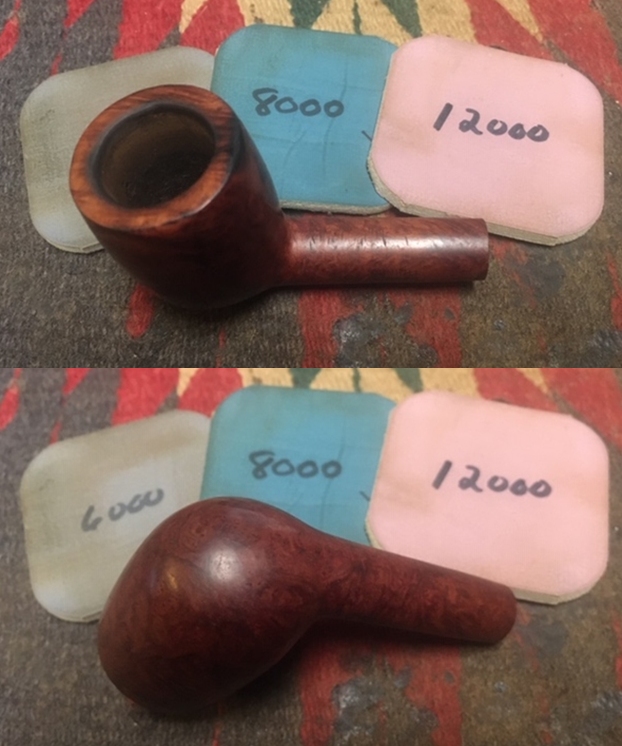
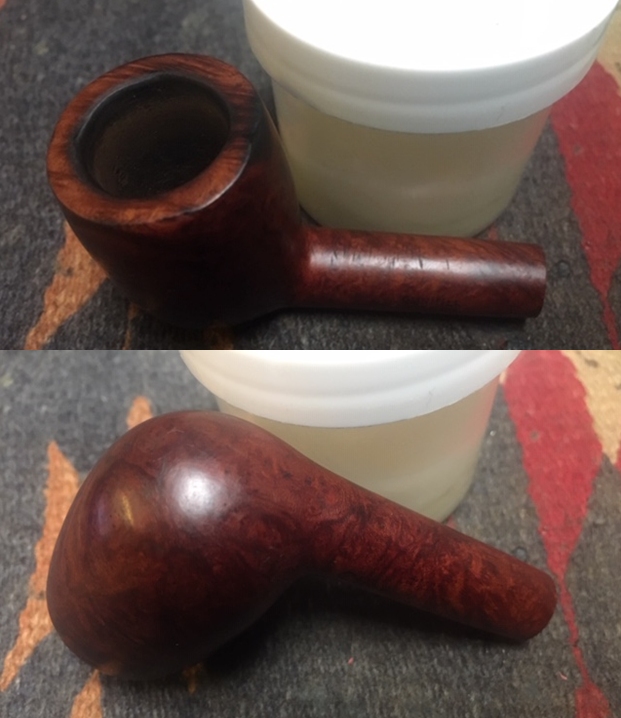
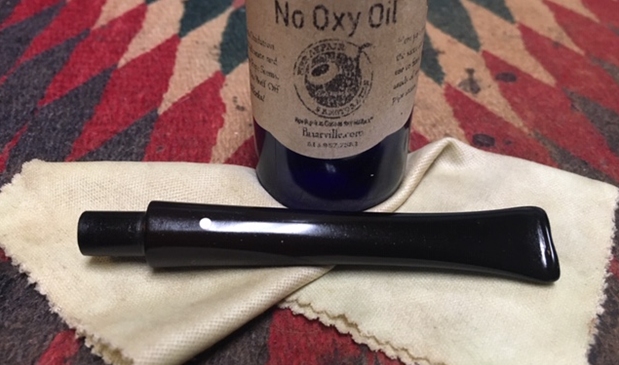
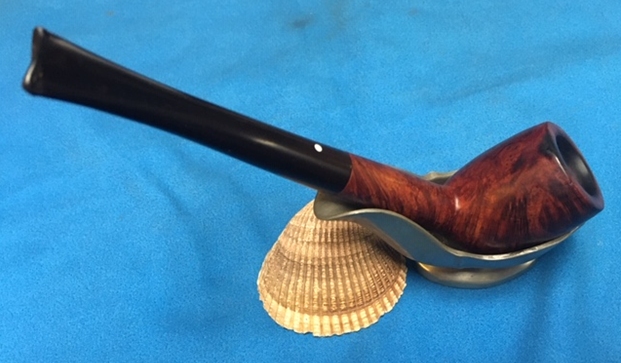
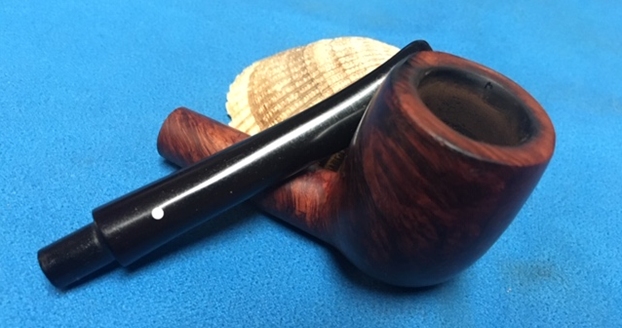
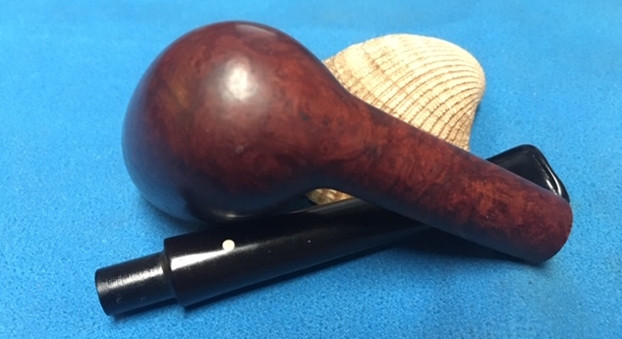
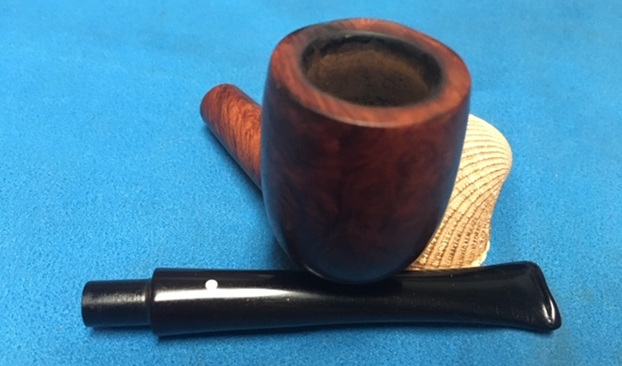
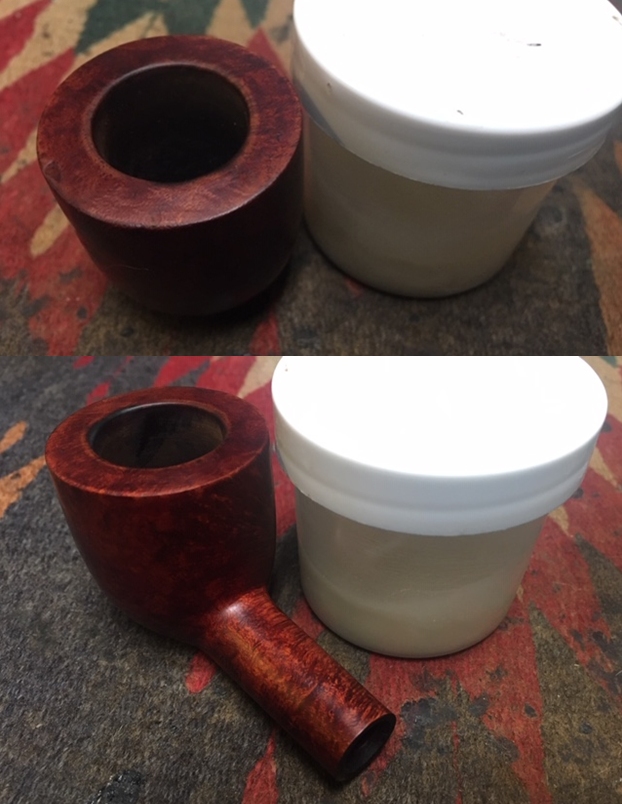
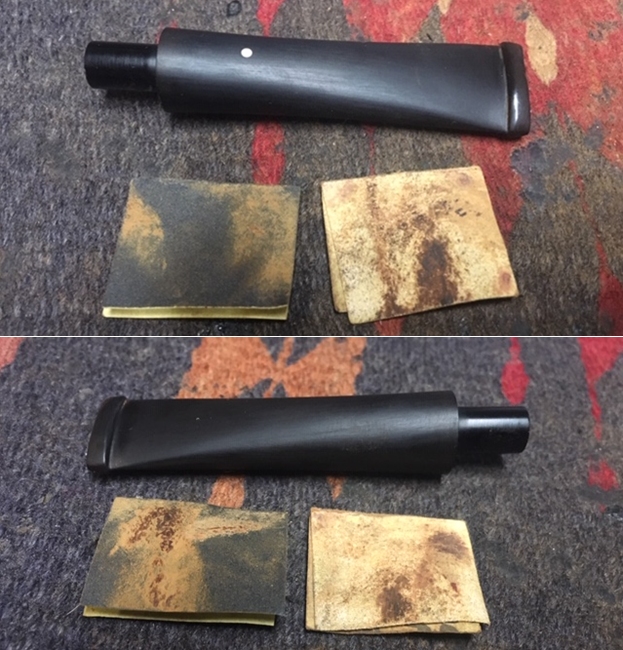
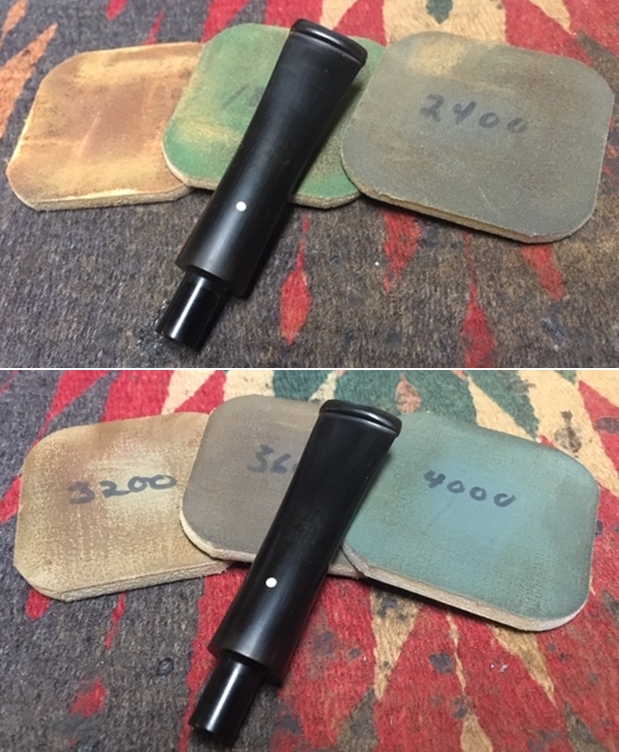
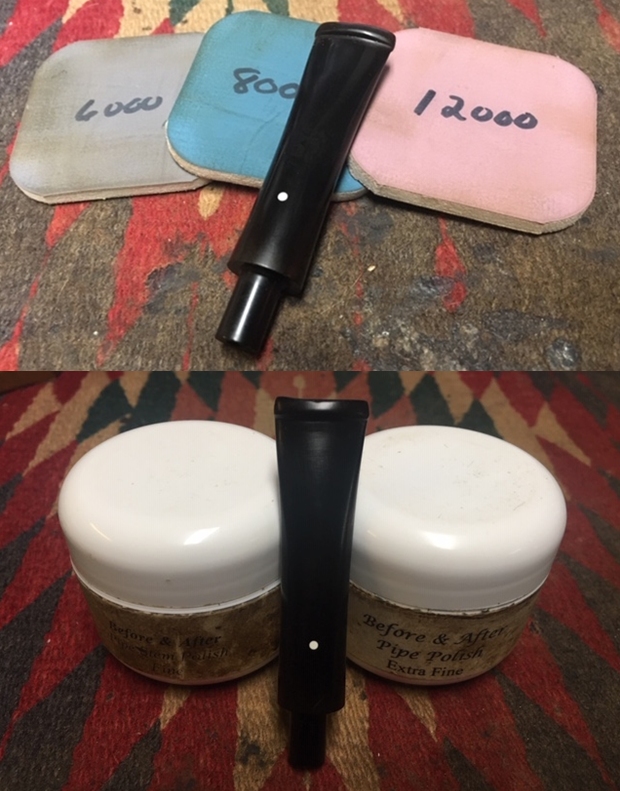
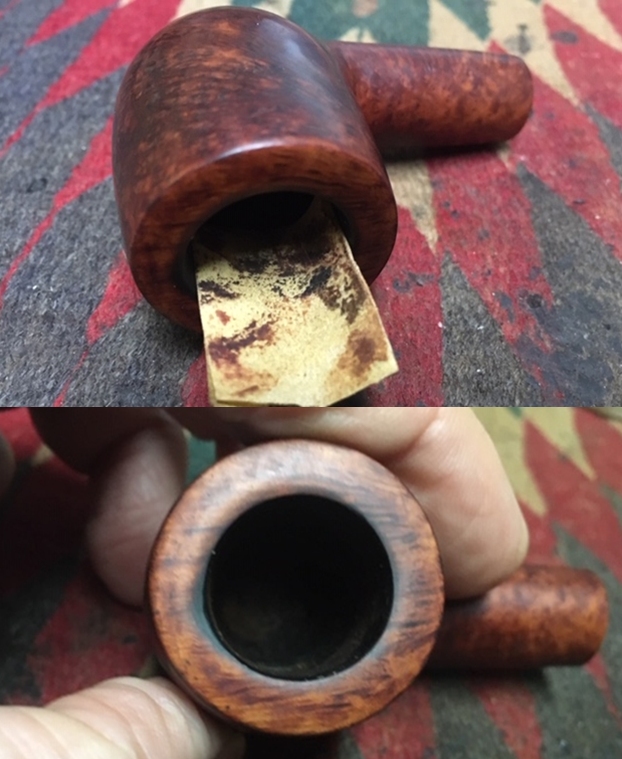
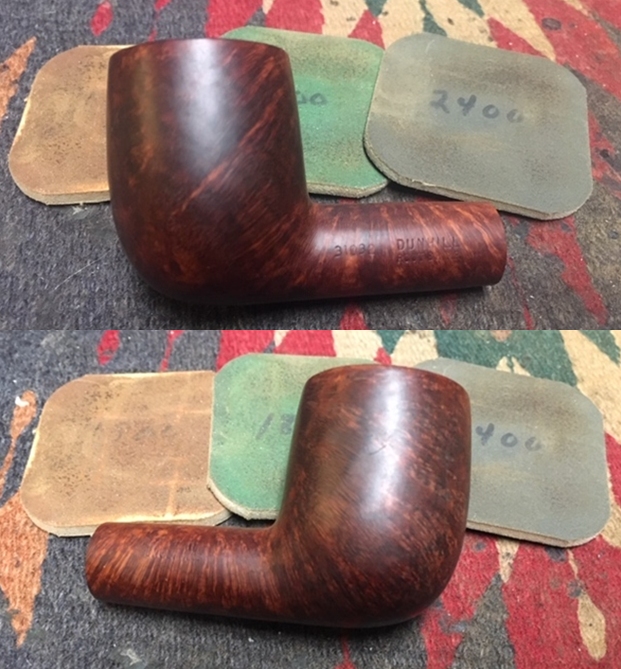
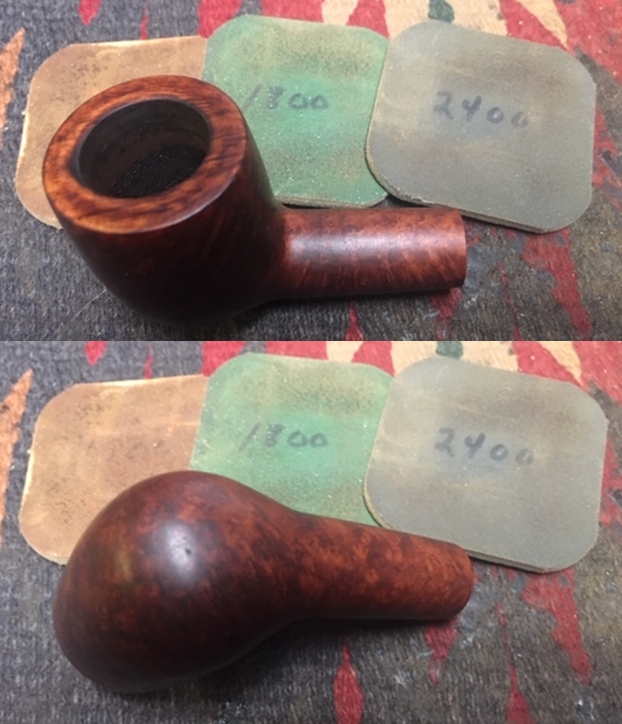
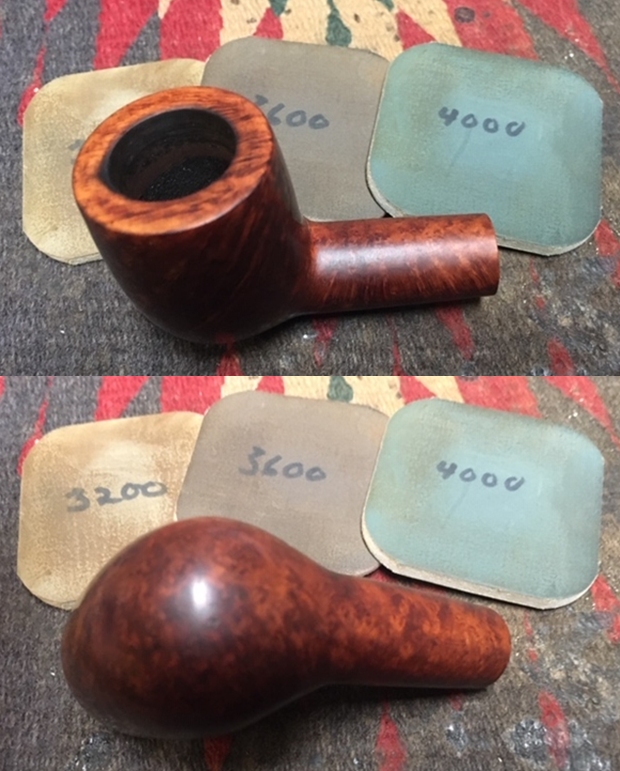
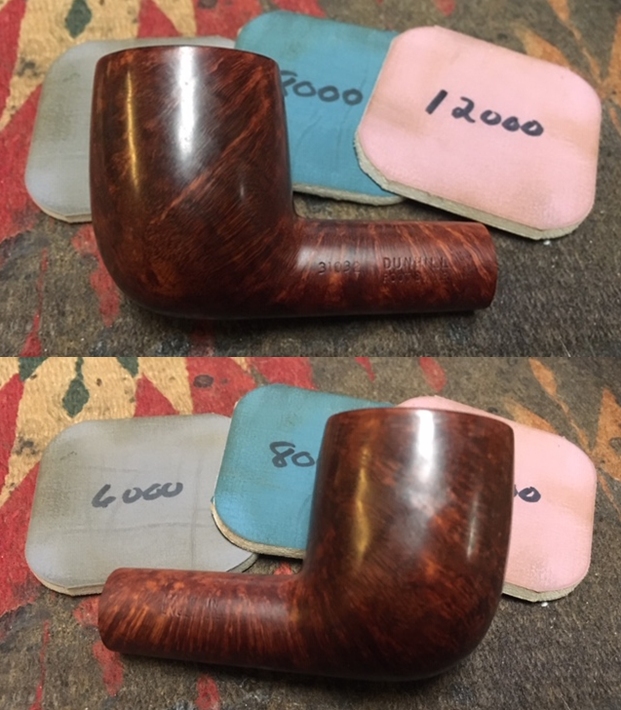
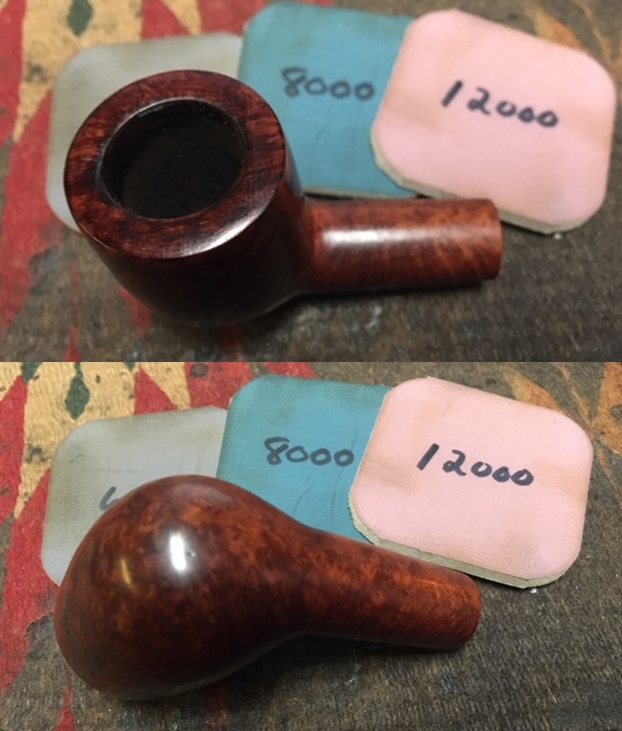
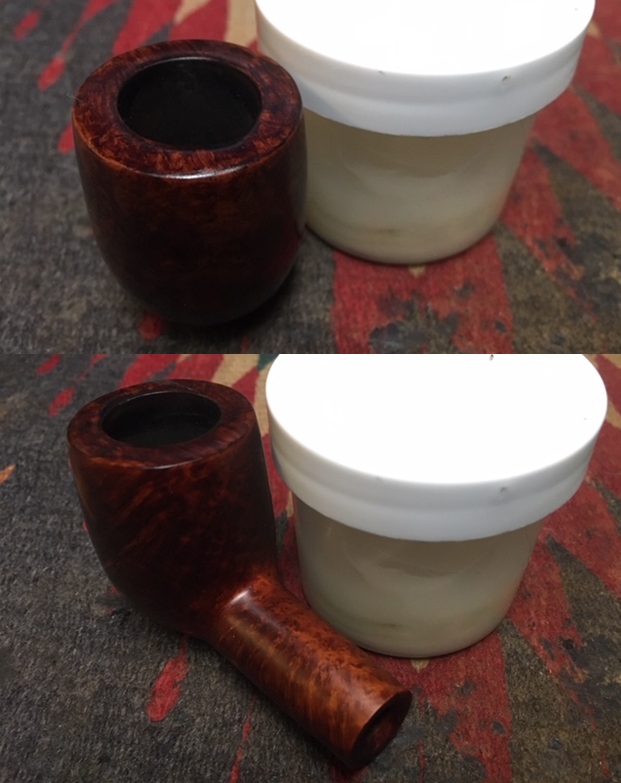
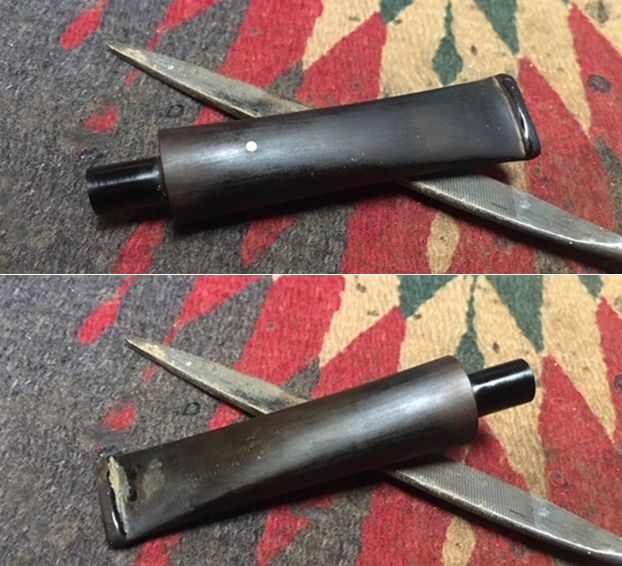
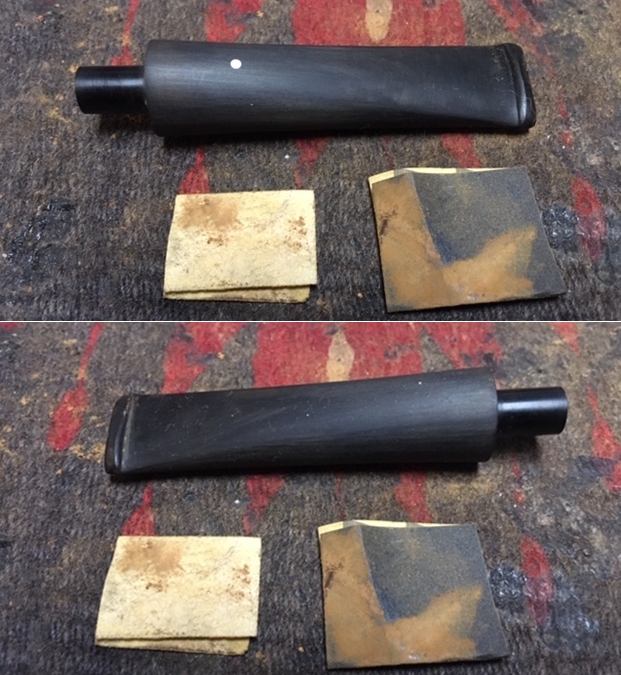
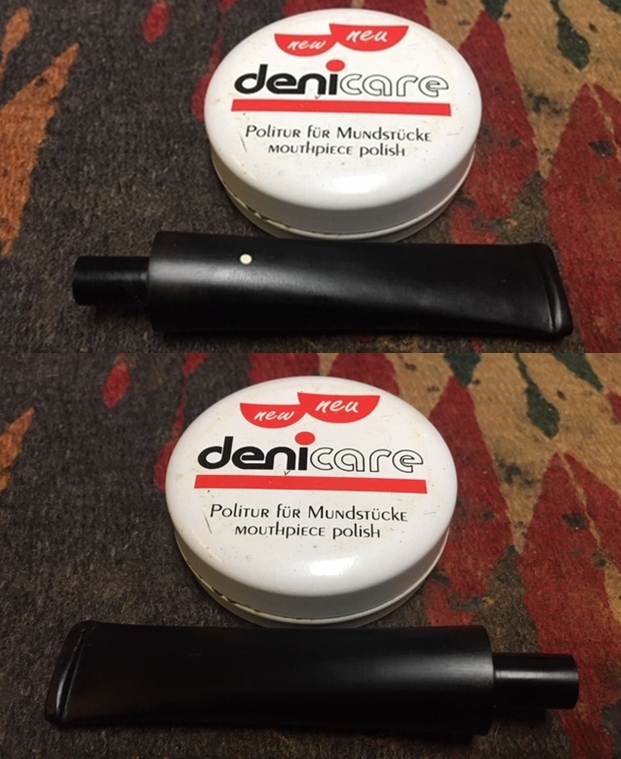
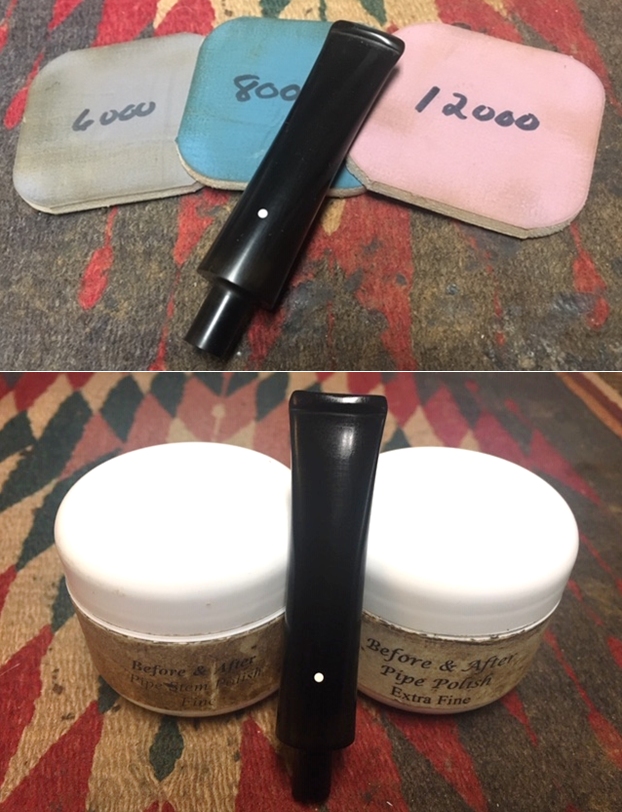
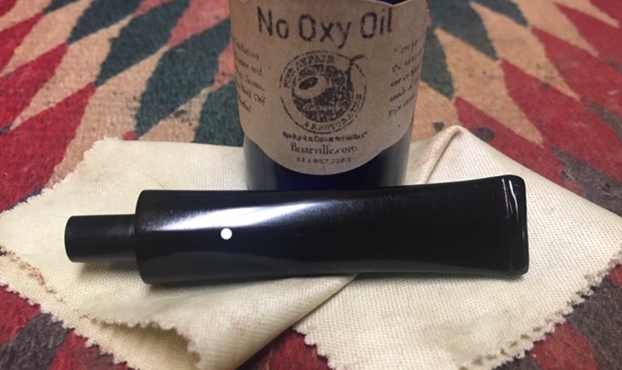
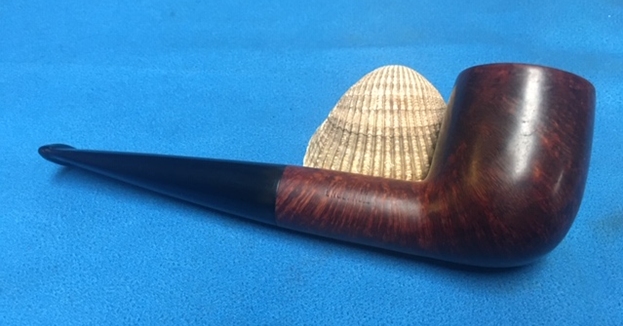
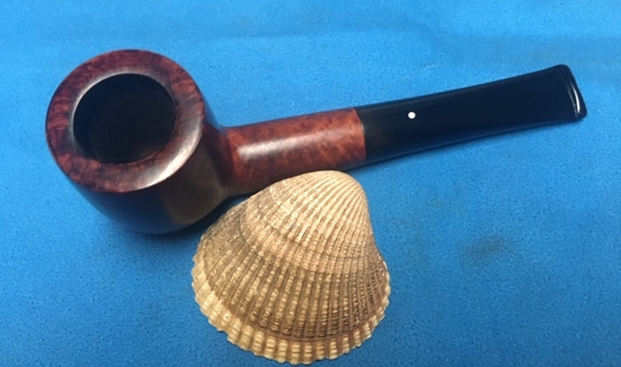
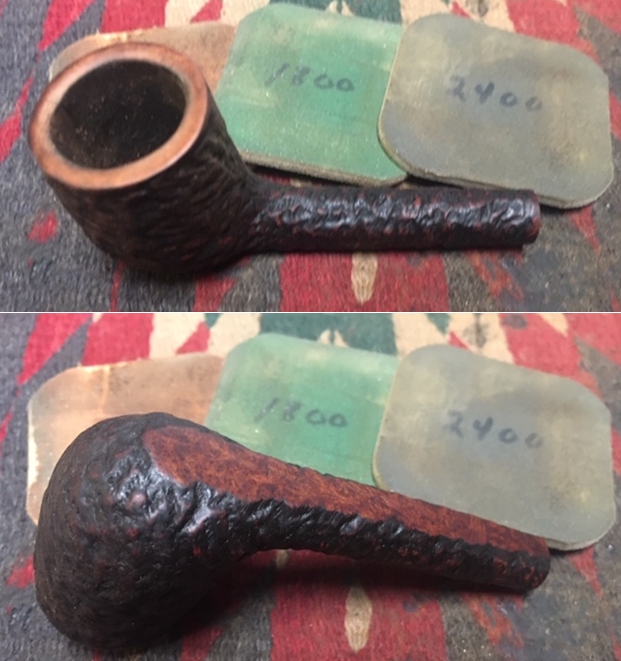
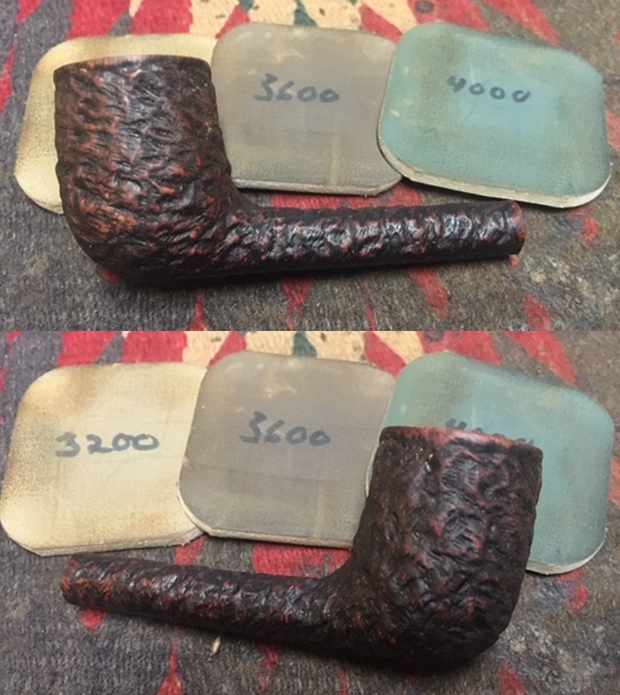
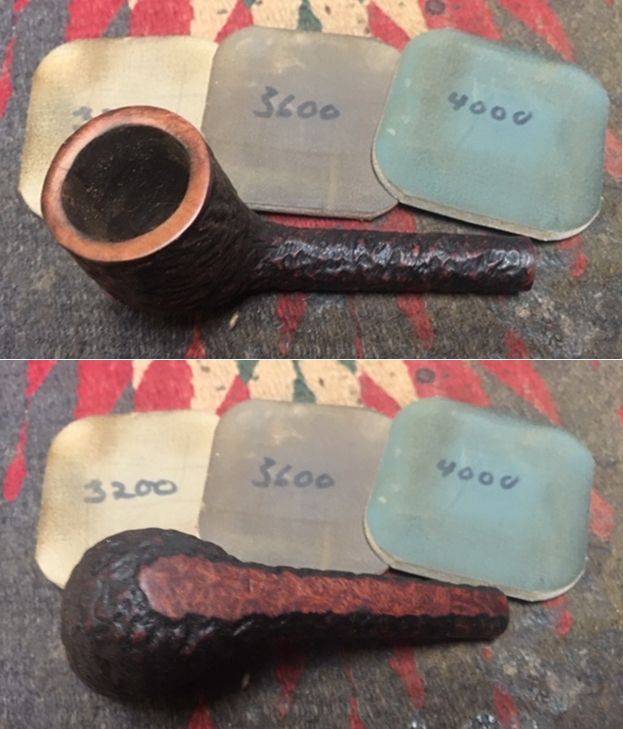
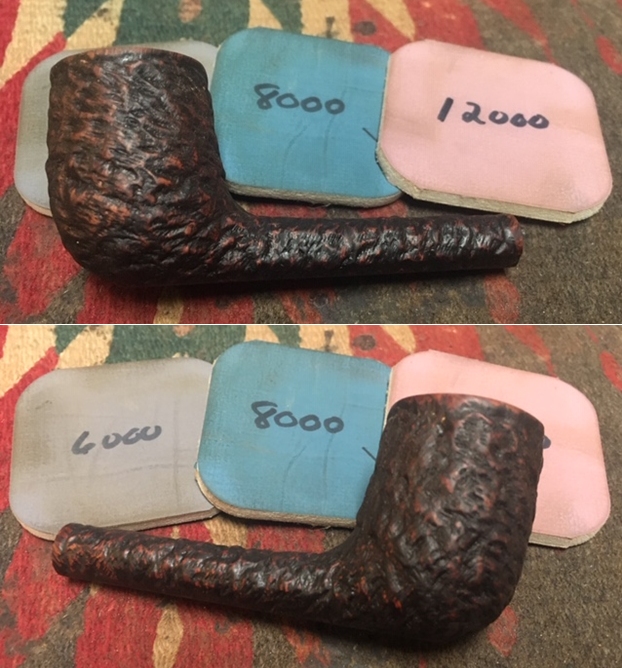
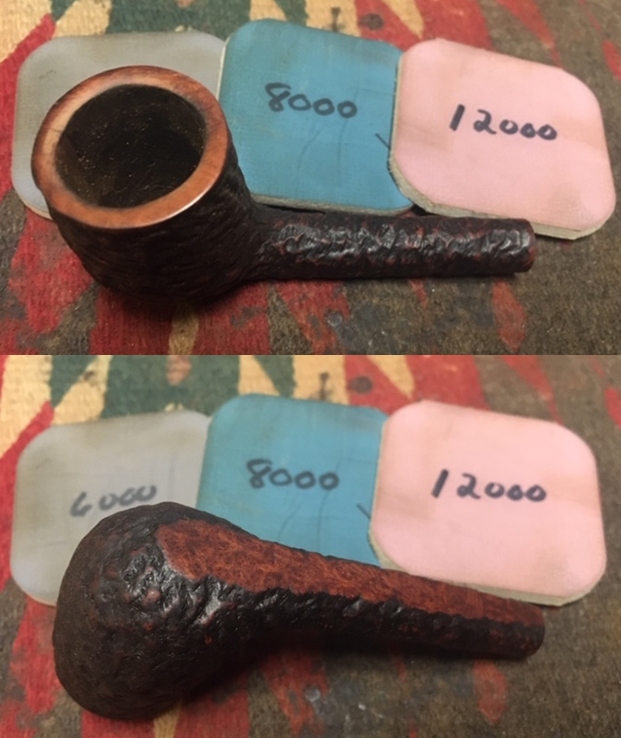
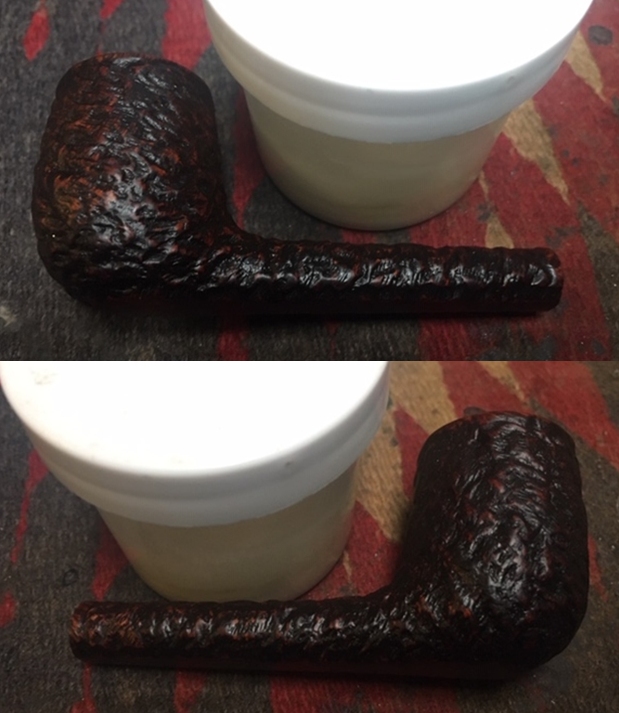
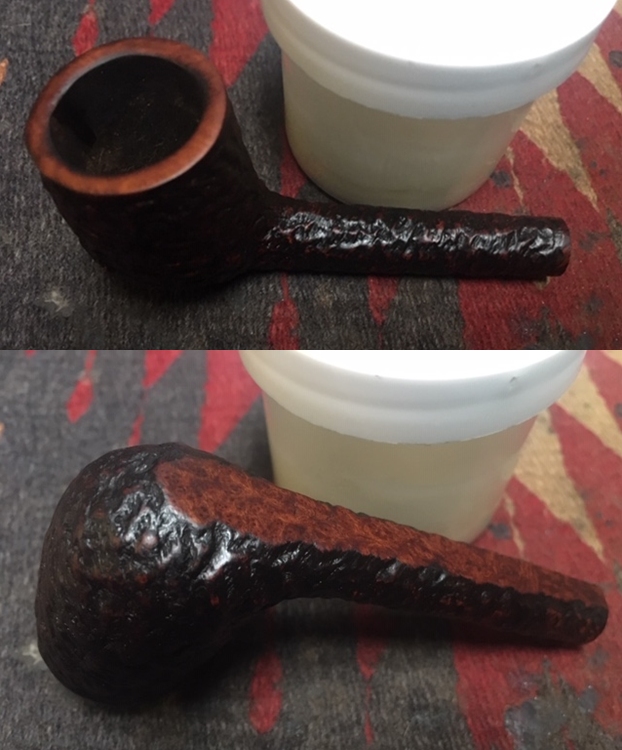
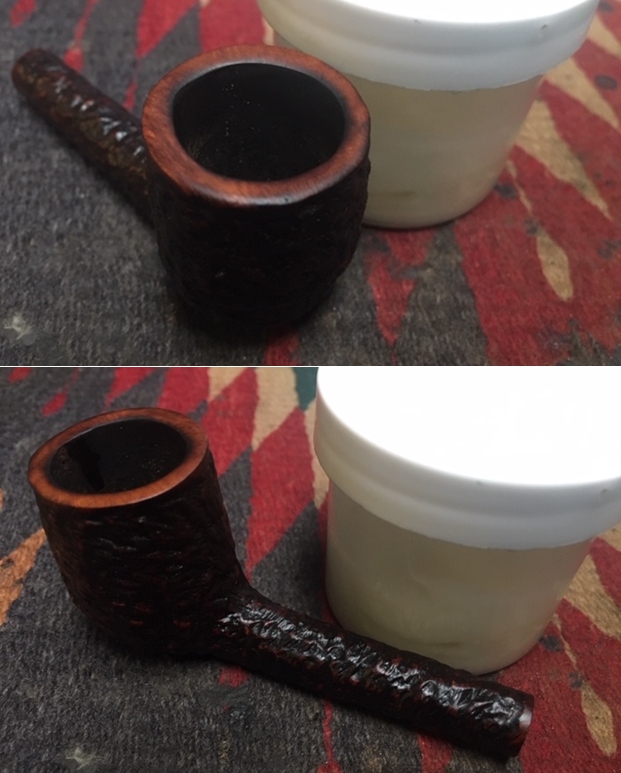
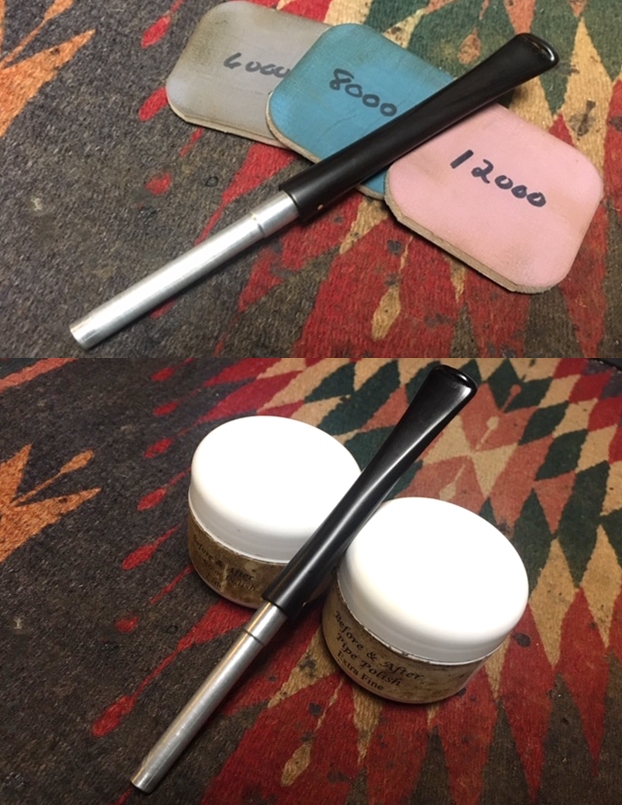
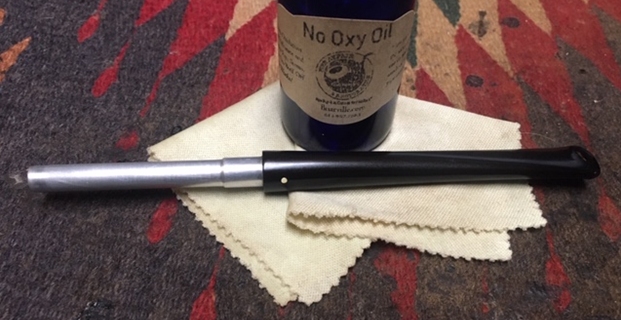
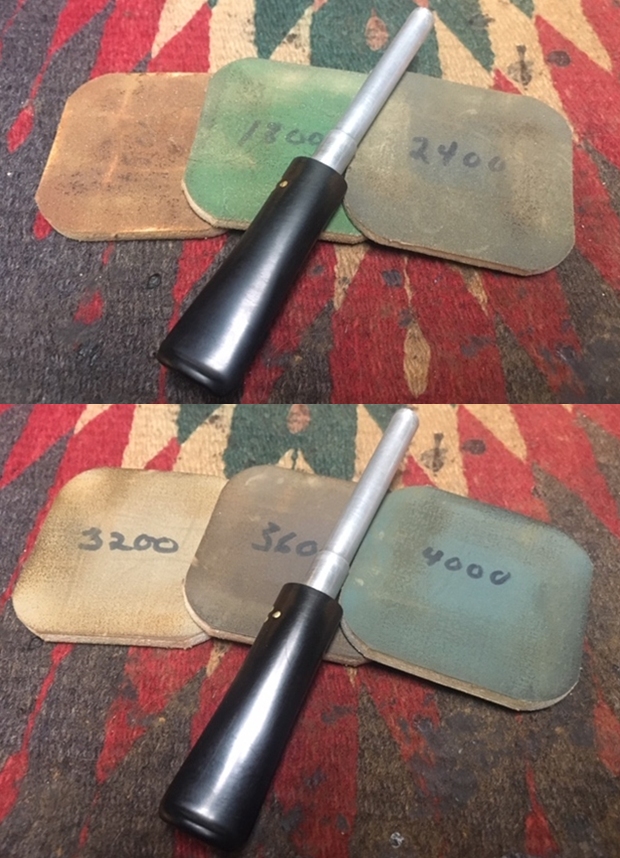
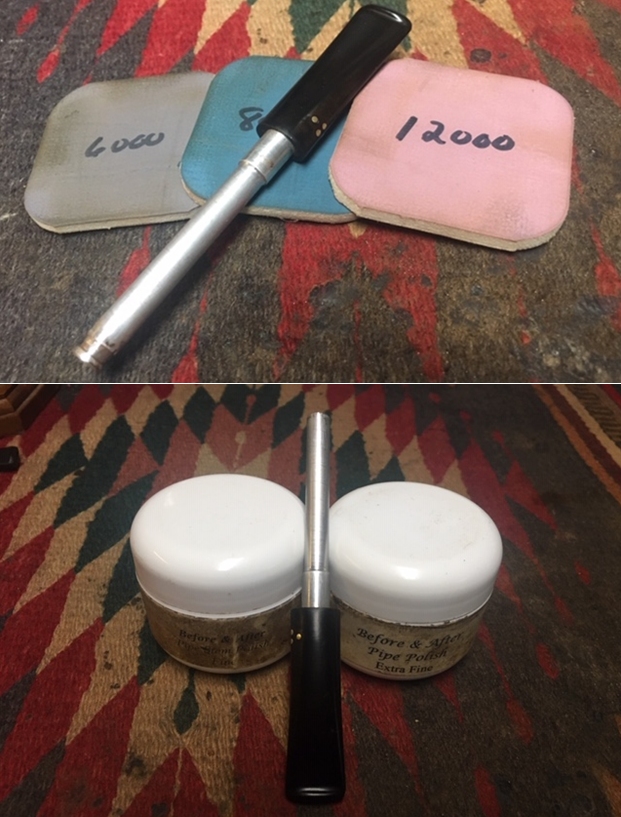
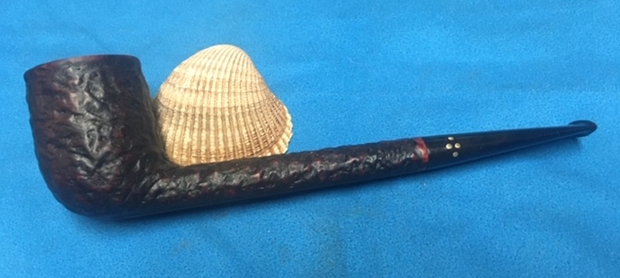
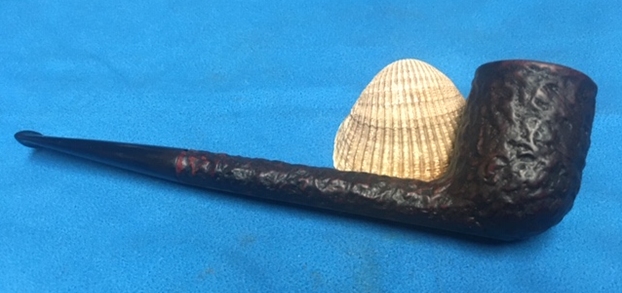
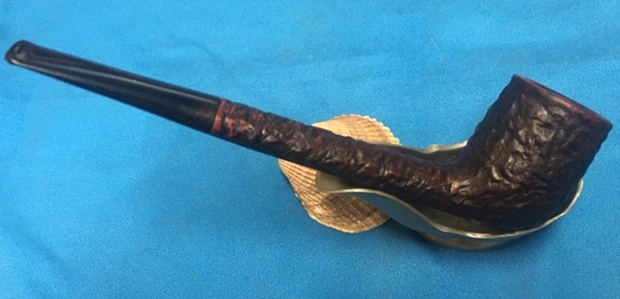
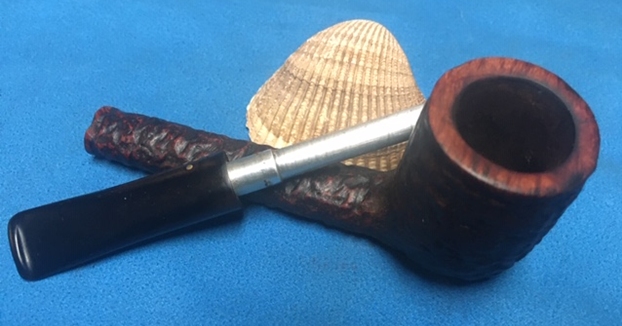
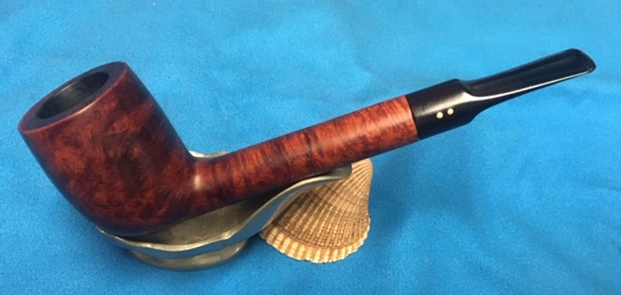
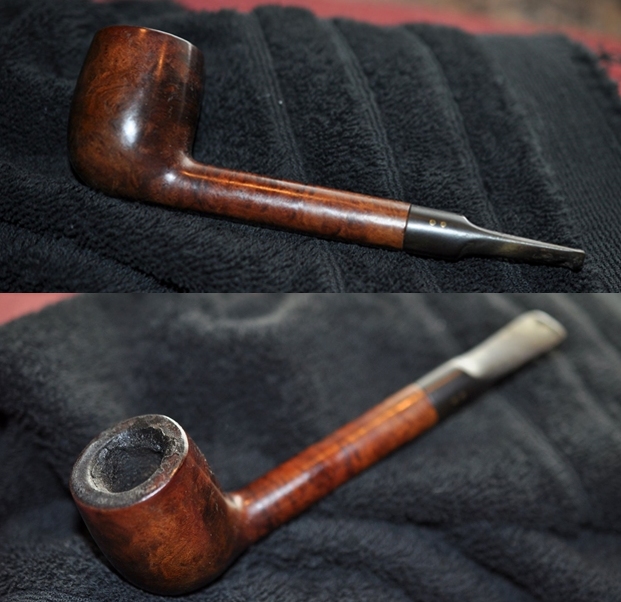
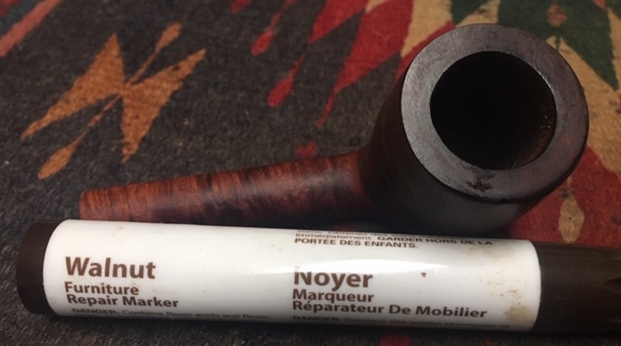
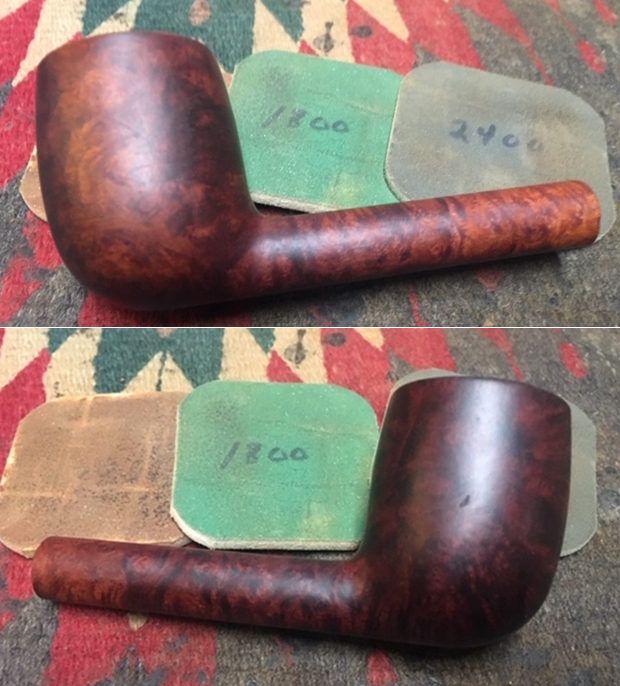
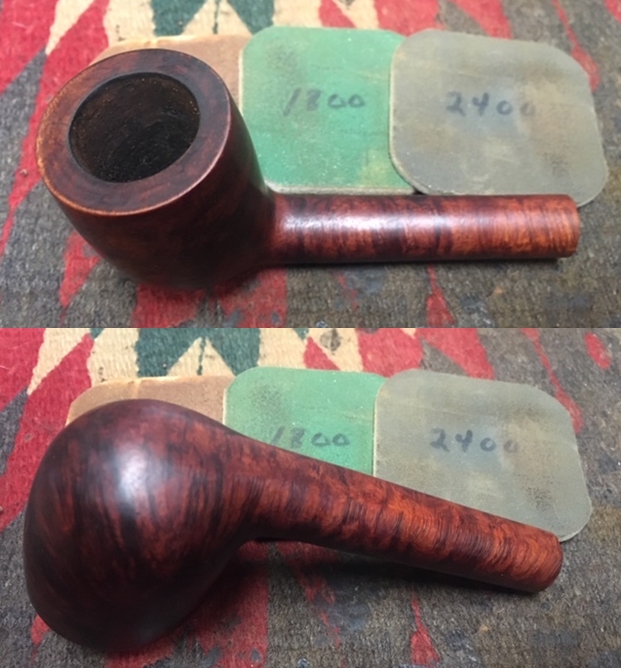
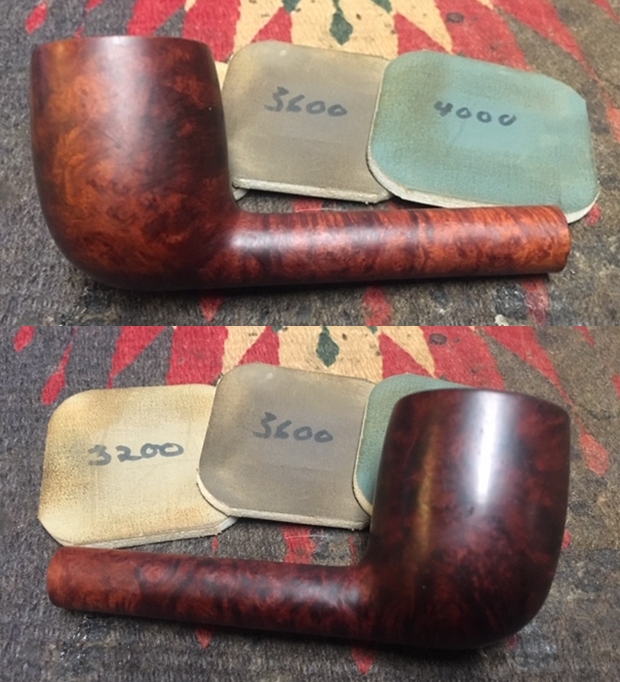
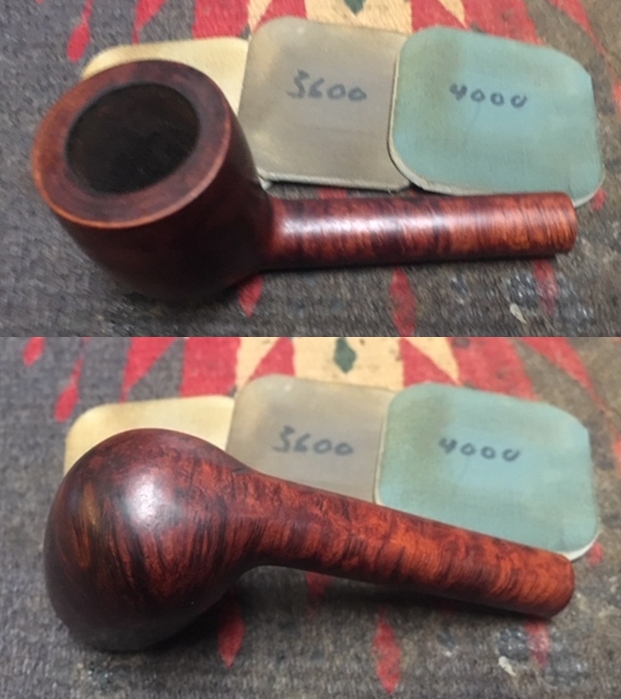
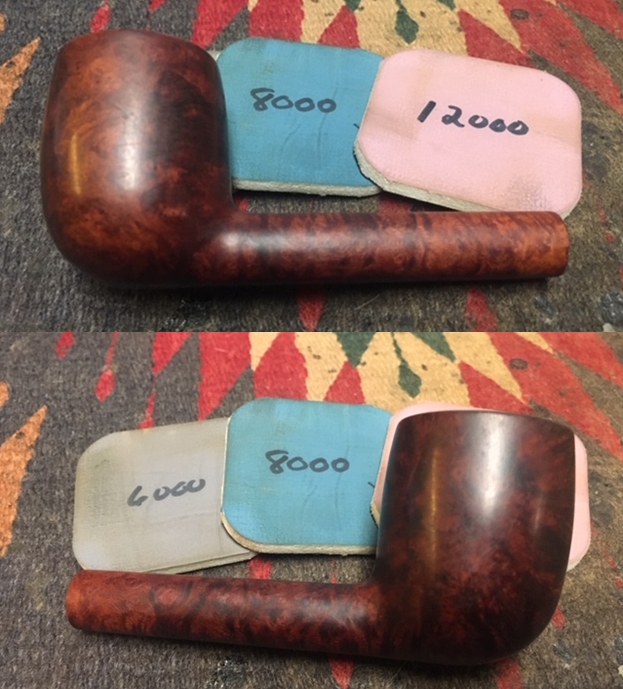
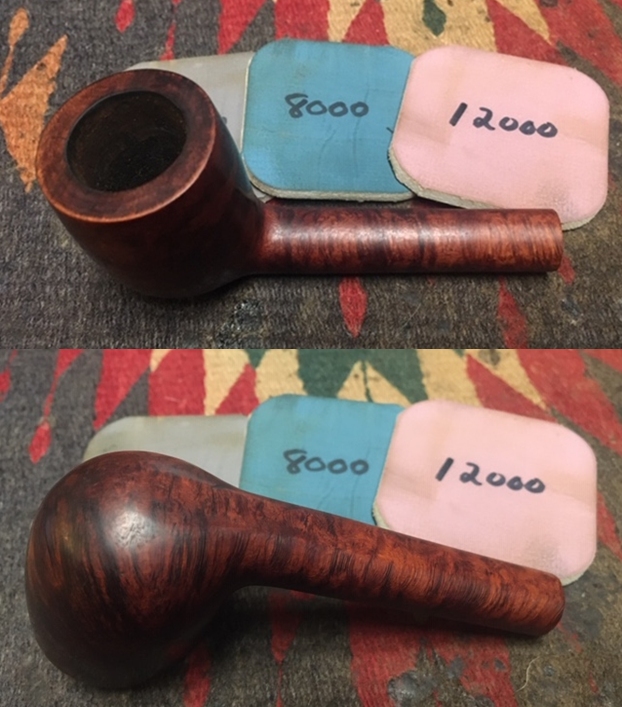
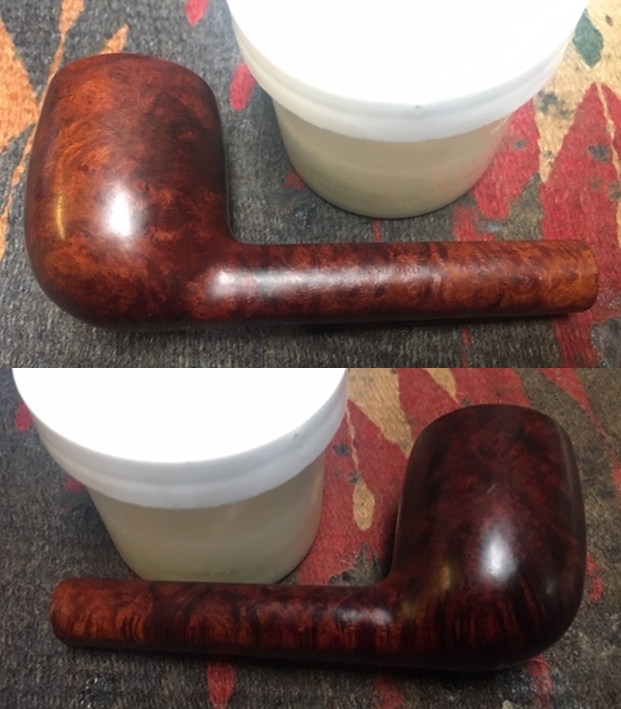
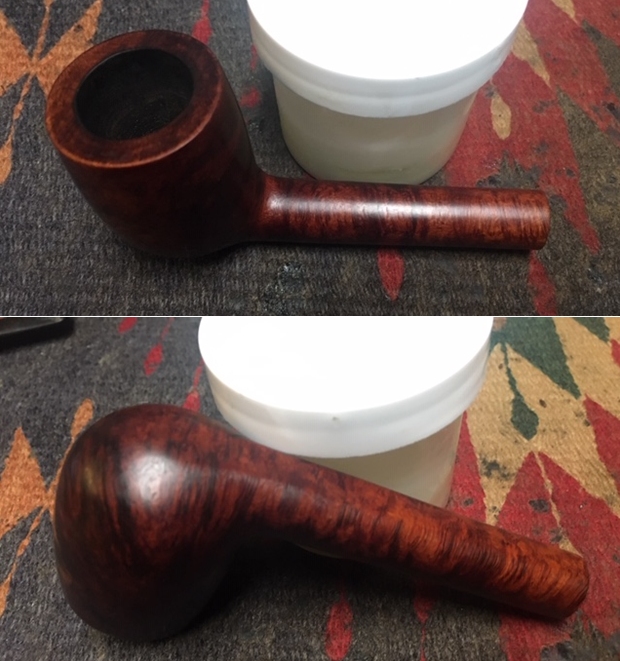
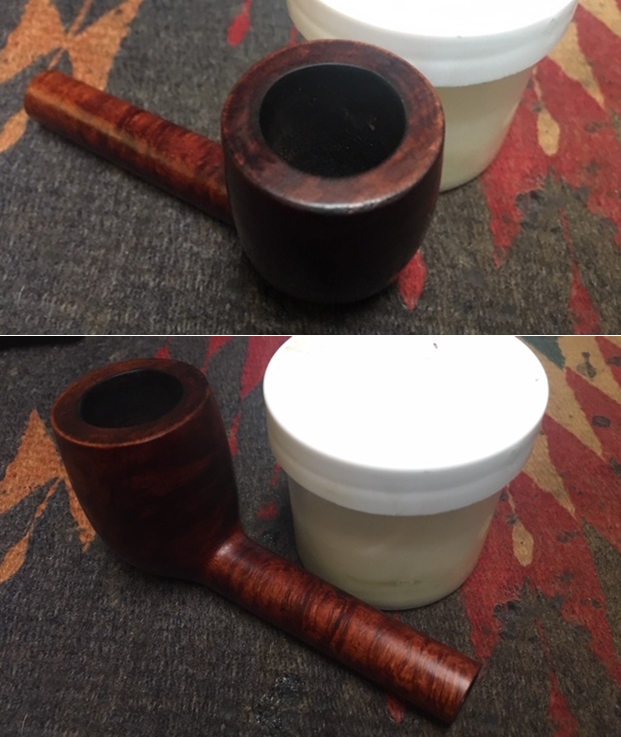
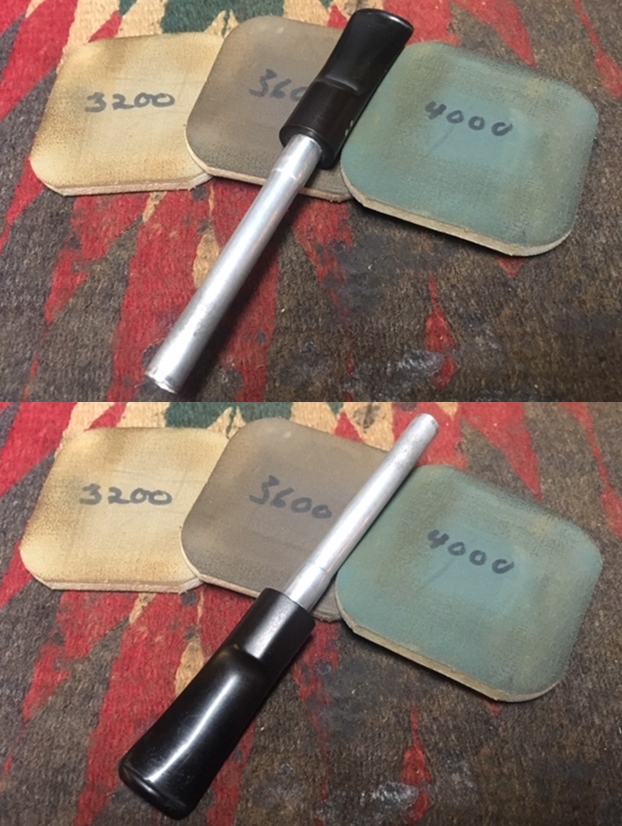
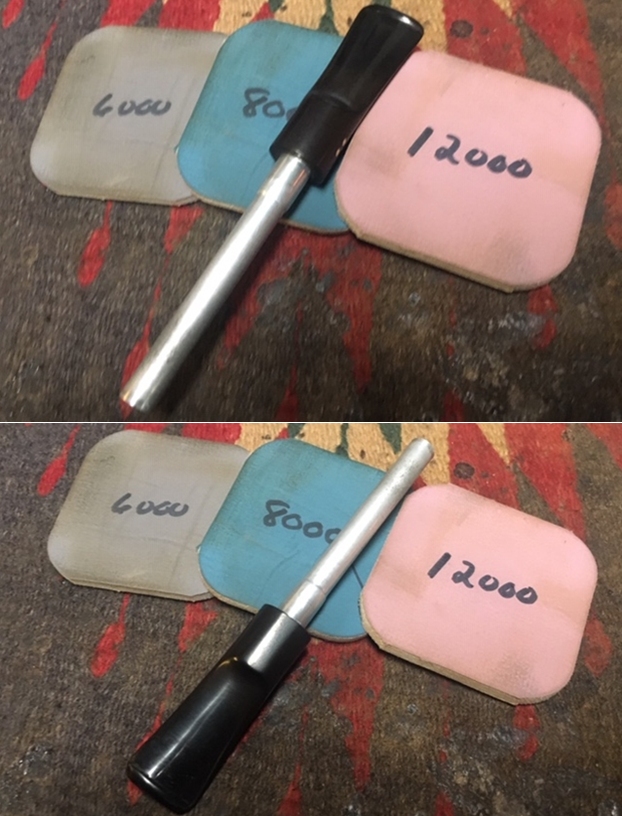
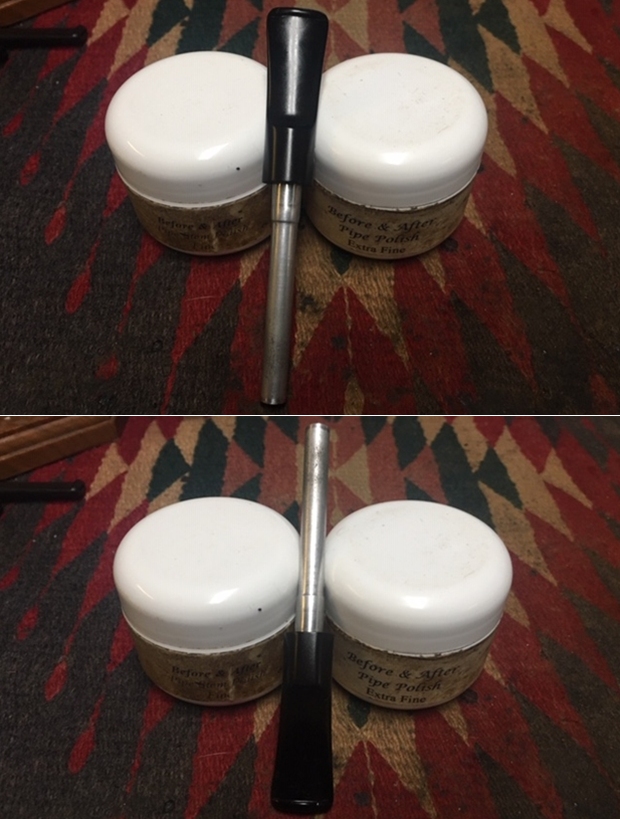
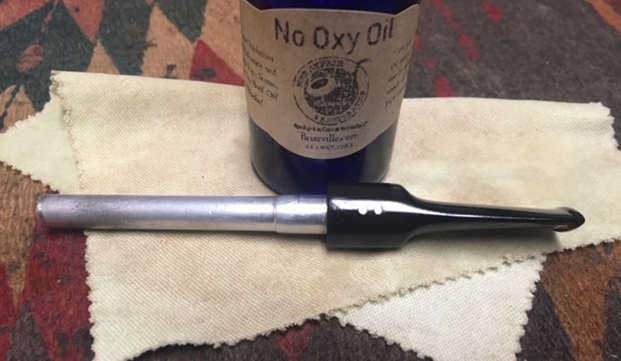
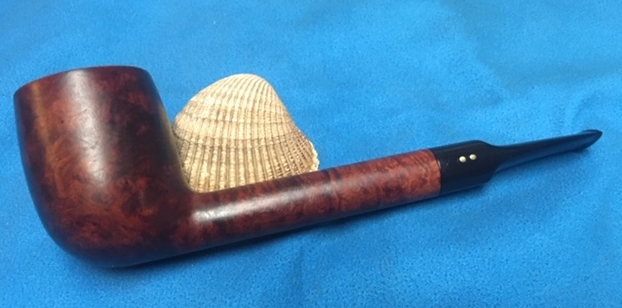
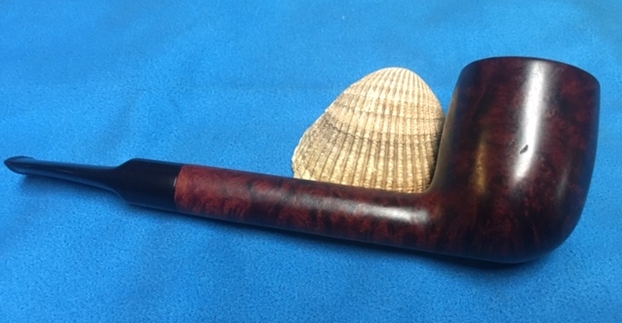
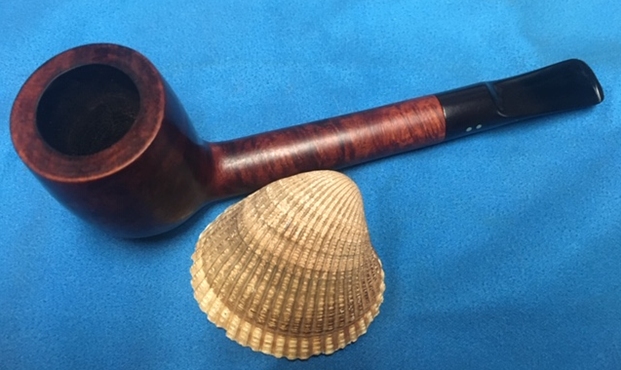
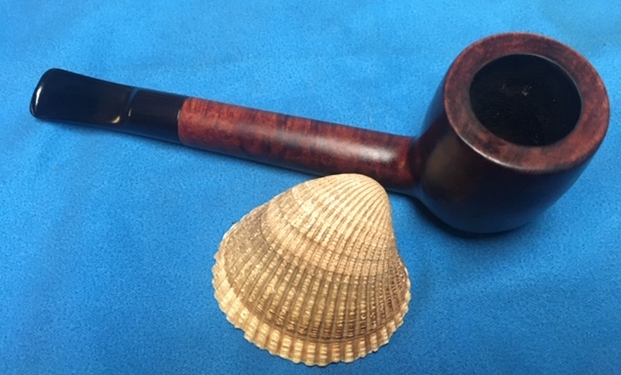
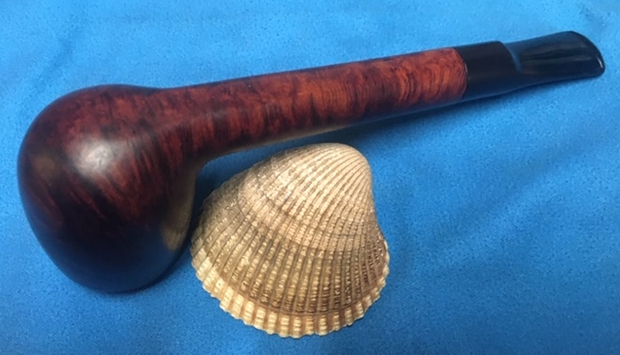
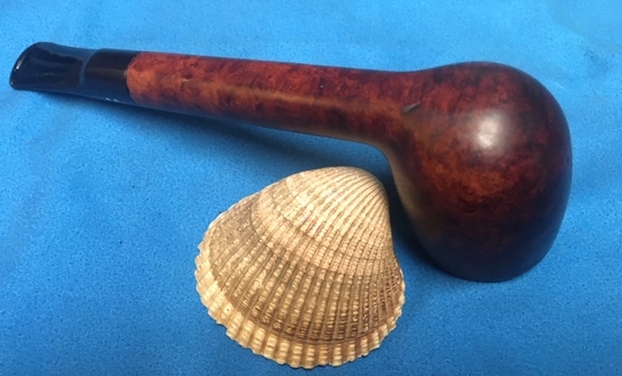
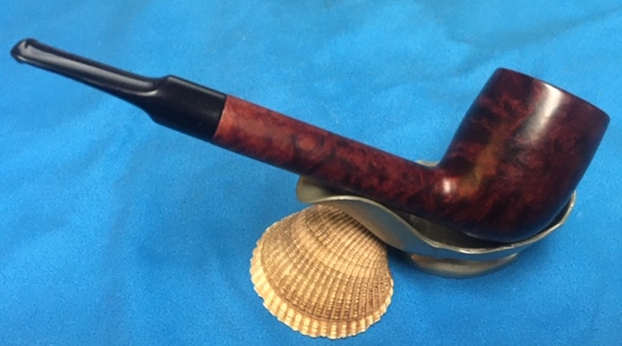
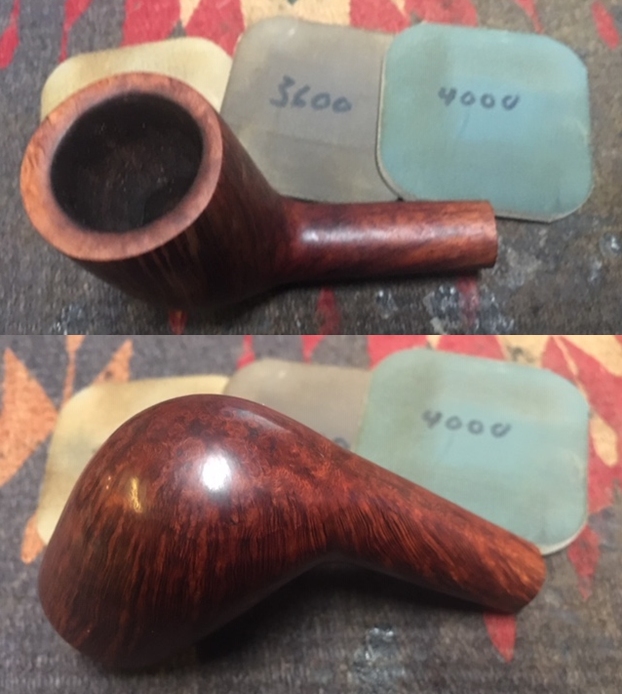
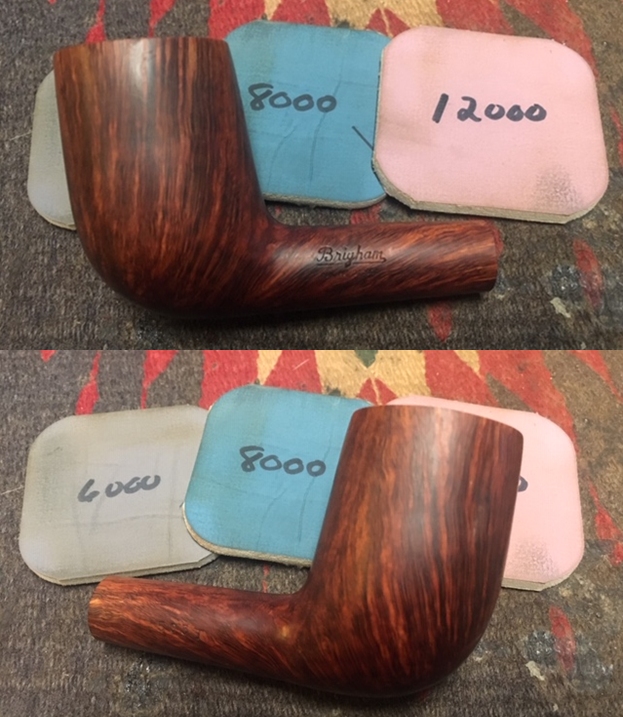
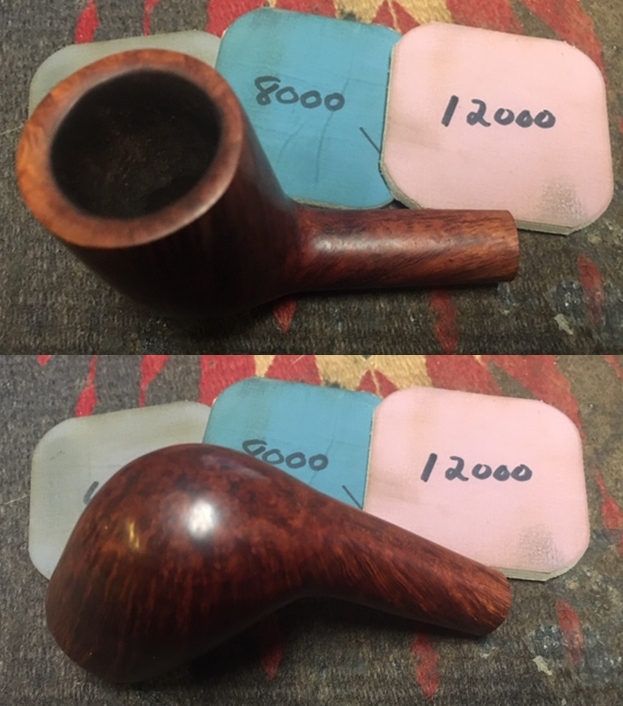
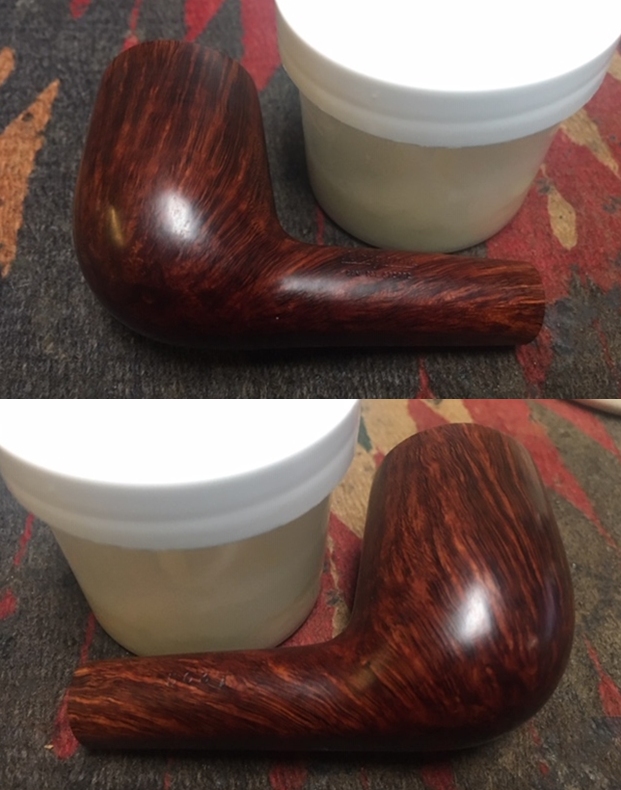
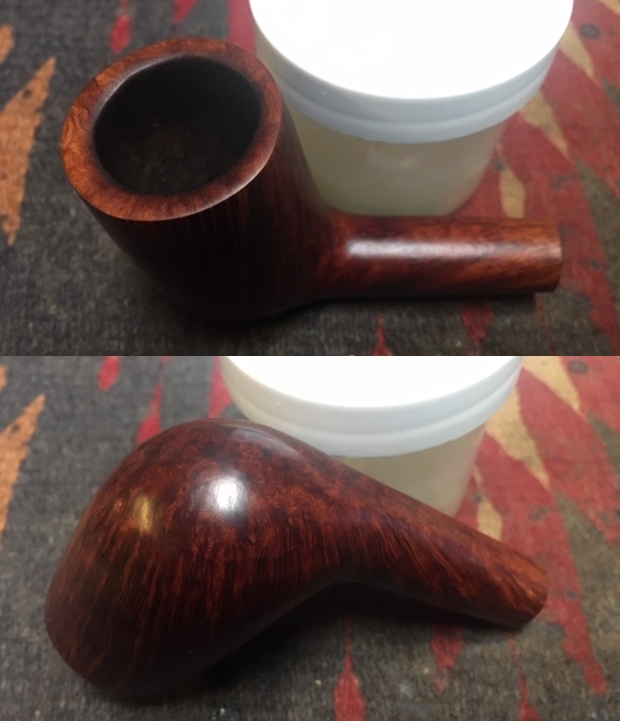
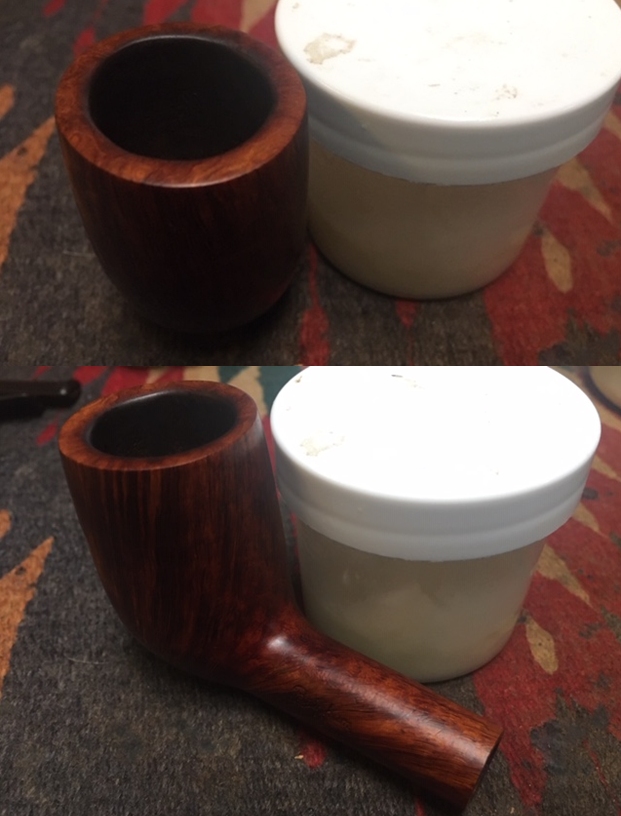
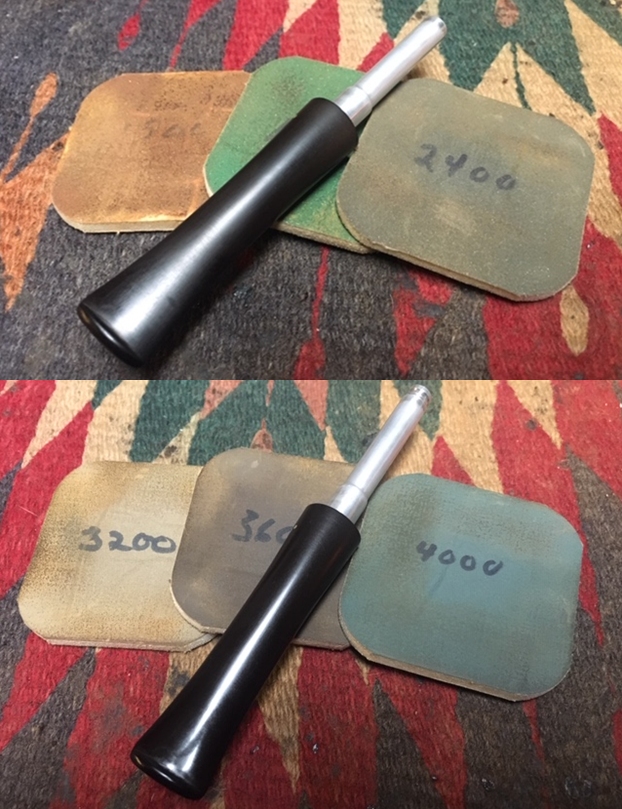
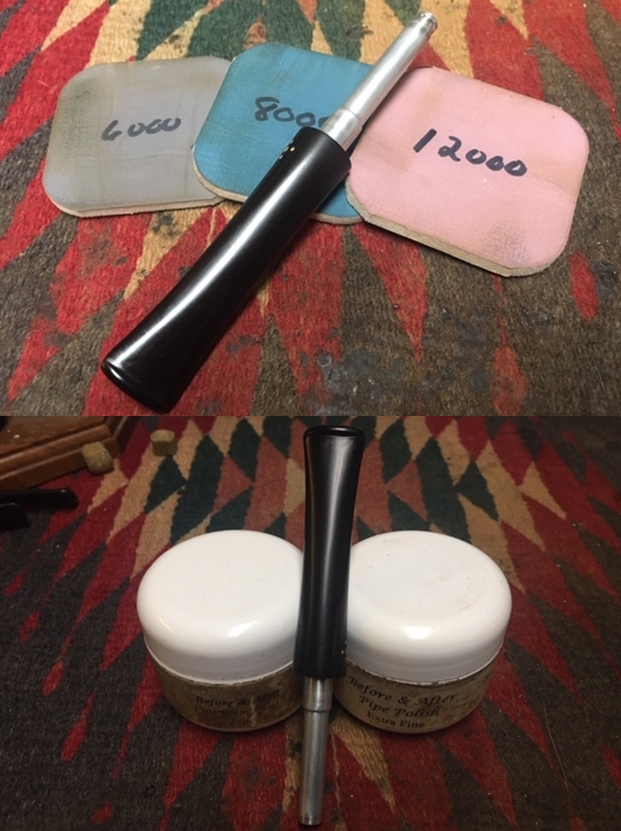
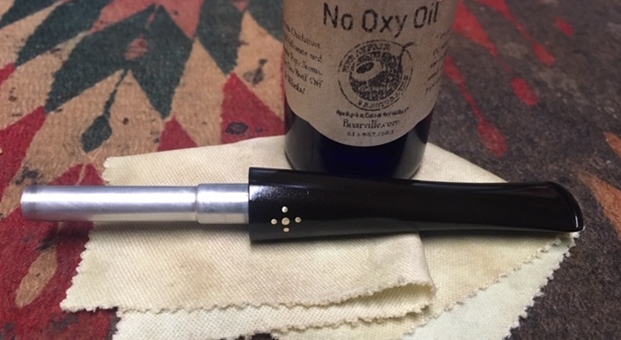
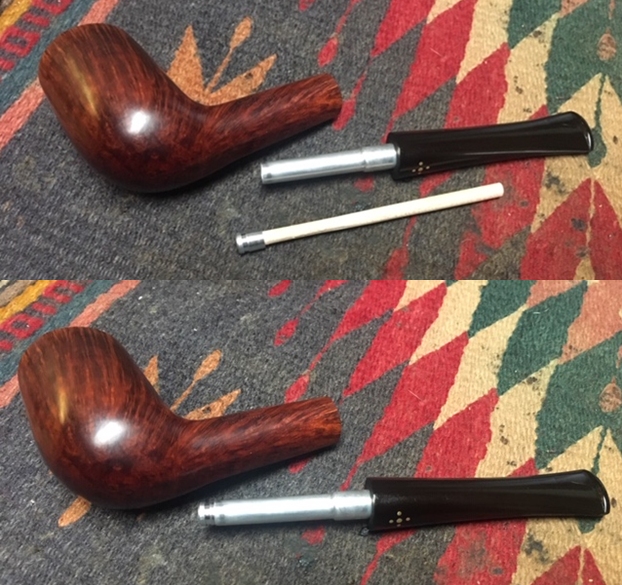
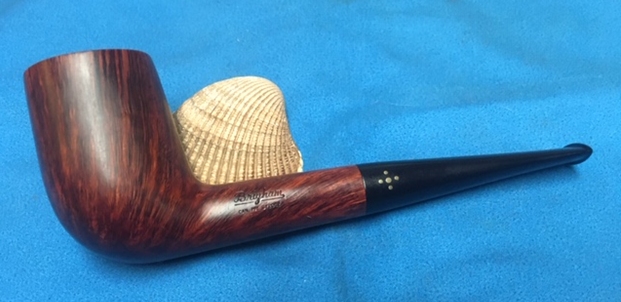
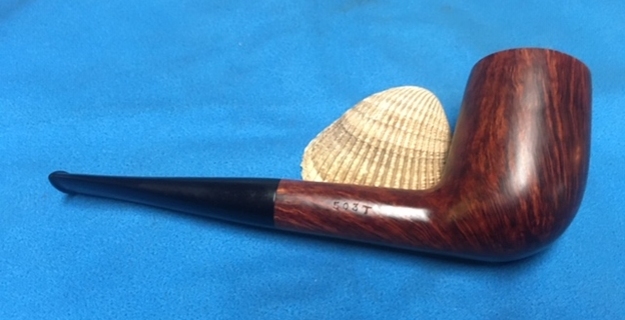
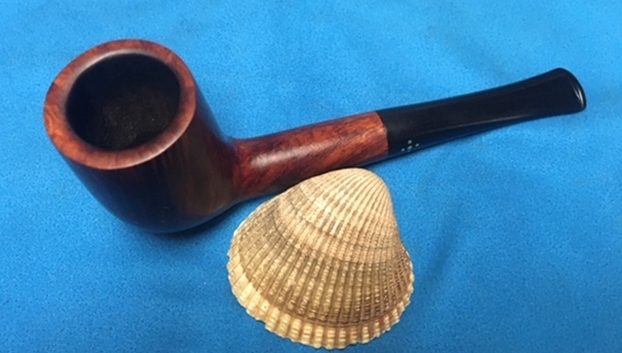
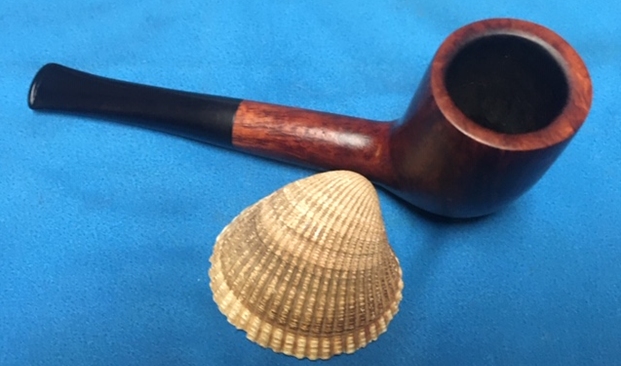
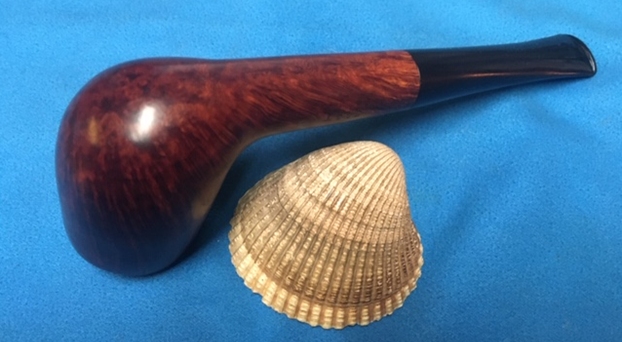
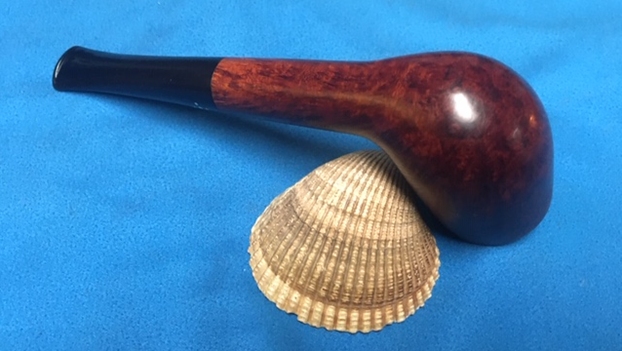
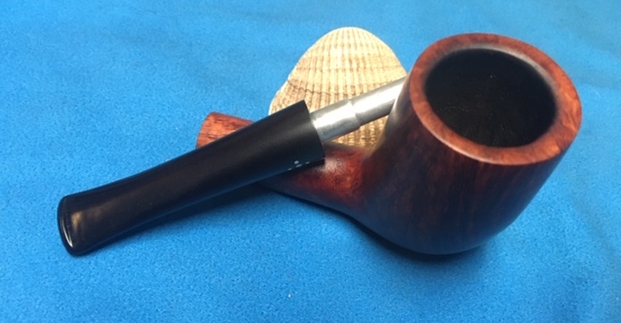
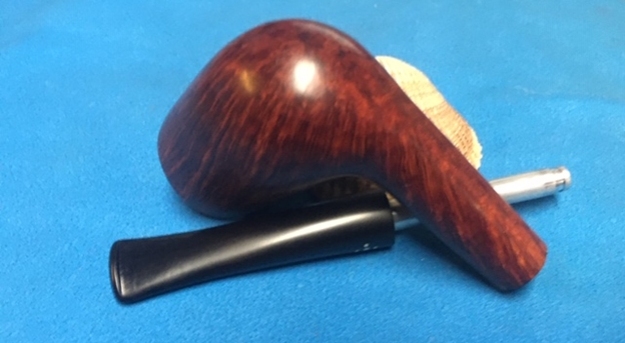
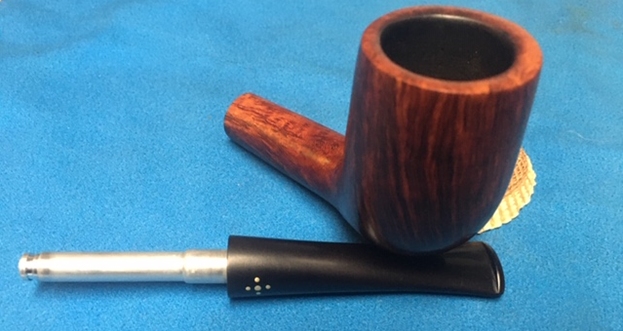
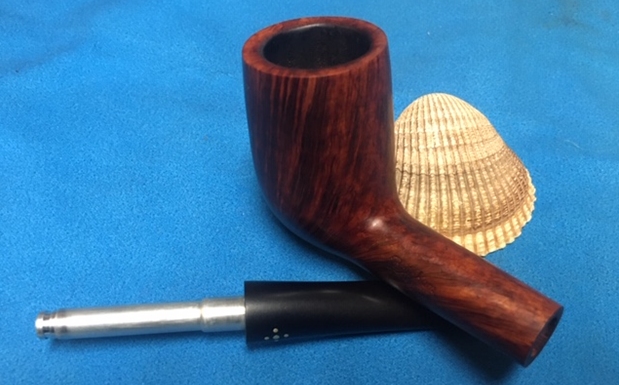
It was time to get on with the restoration of this Dunhill Bruyere 112F/T Apple. It was a bit of a change of pace from the last bunch of billiards that I had worked on. I really need to send a shout out to Jeff for the hard cleanup work that Jeff does on each of these pipes. They were a real mess when I sent them to Jeff and I have to tell you it was great that I can start my part of the process with a clean pipe. I decided to start the process by dealing with the the damage to the inner edge of the bowl. I wanted to minimize the intrusiveness of the work on the rim and focus just on the rim edge. I carefully worked on the inner edge with a folded piece of 220 grit sandpaper and gave it a very slight bevel. I was able to remove much of the darkening and damage. The first photo shows the damaged inner edges of the bowl and the darkening around the full bowl. The second photo below shows the process I used with the folded sandpaper. The third photo shows the rim top and edges after my work on them…though not perfect I think it is an improvement. I polished the briar on the rim top and bowl with worn micromesh sanding pads – wet sanding it with 1500-12000 grit micromesh sanding pads. I wiped it down after each pad with a damp cloth. I find that the worn pads do a great job polishing and still retain the original patina of the pipe. I rubbed the bowl and rim down with Before & After Restoration Balm. I worked it into the surface of the briar with my fingertips to clean, enliven and protect it. I let the balm sit for a little while and then buffed the pipe with a cotton cloth to raise the shine. I really like watching the Balm do its magic and bring the briar alive. With the bowl done it was time to address the stem. The dents in the top and underside were the right depth for me to lift them. I sanded the surface of the stem with 220 grit sandpaper to remove the remaining oxidation in the vulcanite. I polished it with 400 grit wet dry sand paper.  I rubbed the stem down with Denicare Mouthpiece Polish. I have a few tins of this laying around so I am trying to use them up. It does a pretty good job polishing the stem.  I polished the stem with micromesh sanding pads – wet sanding with 1500-12000 grit sanding pads. I wiped it down after each pad with a damp cloth to remove the sanding dust. I polished it further with Before & After Pipe Polish – both Fine and Extra Fine. I finished by rubbing the stem down with some “No Oxy Oil” to protect the vulcanite. I am experimenting with the product from Briarville and tracking how it works so I can write a review of it.   Once again at this point in the restoration process I am excited to be on the homestretch. This is the sixth of the Dunhill smooth pipes in Bob’s estate that I am working on. It is a beautiful Dunhill Bruyere 112 F/T Apple made in 1969 and shipped or sold in 1971. Like each of the pipes in Bob’s estate I really look forward to this point in the process when it is put back together, polished and waxed. I put the bowl and stem back together. I polished the bowl and stem with Blue Diamond to polish out the scratches in the briar and the vulcanite. The nicks on the right outer rim edge and the small burn mark look better – minimized a bit. I gave the bowl and the stem multiple coats of carnauba wax. I buffed the pipe with a clean buffing pad to raise the shine. I hand buffed it with a microfiber cloth to deepen the shine. The pipe polished up pretty nicely. The grain around the bowl and shank really came alive with the wax and polish. The black of the tapered vulcanite White Spot stem is a beautiful contrast to the reds and browns of the finished bowl and shank. This was another Dunhill that was a lot of fun to work on thanks to Jeff’s cleanup work. The pipe is comfortable pipe to hold in the hand. The finished pipe is shown in the photos below. The dimensions of the pipe are Length: 5 ¾ inches, Height: 1 ½ inches, Outside diameter of the bowl: 1 ¼ inches, Chamber diameter: ¾ of an inch. This 1969 Bruyere Apple is a beauty should last for many more years. It is one that will be on the rebornpipes store very soon. If you are interested let me know. I have a lot more of Bob’s estate to work on of various brands. Perhaps one of those will catch your attention. Thanks for reading this blog and my reflections on the pipe while I worked on it. This is an interesting estate to bring back to life.

Restoring a 1967 Dunhill Bruyere 142 F/T Billiard from Bob Kerr’s Estate


Blog by Steve Laug

As I continue to work through the pipes in Bob Kerr’s Estate I am enjoying choosing different brands that he had to focus on for a bit. I had eight more from his Dunhill collection that I decided to go back to and finish working my way through that sub collection of the estate. Out of the 8 pipes six were Bruyere finished pipes, one was a Made in London (turns out it is also a Bruyere finished pipe), and one was a Root Briar. What follows is a list of what I saw when I examined the 8 pipes. As I finish the pipes I will include the link to the blog on that particular pipe for easy reference. I have already restored 16 pipes from this subgroup so you can do a quick search to read about the work on the Shell Briars and Tanshell Briars that were in that part of the collection.

  1. Bruyere 656 F/T Made in England 2 Circle 4A – Group 4 size Bruyere made in 1962. Stem is oxidized, tooth marks and chatter near the button, some calcification with damage to the button. Finish is dirty, bowl caked and lava overflow on the rim top. Bowl is out of round, damaged edge.
  2. Bruyere 112 F/T Made in England 9/11 Circle 2A – Group 2 size Bruyere made in 1969 and sold in 1971. Stem is oxidized, tooth marks and chatter near the button, some calcification with damage to the button. Finish is dirty, bowl caked and lava overflow on the rim top. Bowl is out of round, damaged edge.
  3. Bruyere 0333 Made in England 16 made in 1976. Stem is oxidized, tooth marks and chatter near the button, some calcification with damage to the button. Finish is dirty, bowl caked and lava overflow on the rim top. Bowl is out of round, damaged edge.
  4. Bruyere 41061 Made in England 18 made in 1978. Stem is oxidized, tooth marks and chatter near the button, some calcification with damage to the button. Finish is dirty, bowl caked and lava overflow on the rim top. Bowl is out of round, damaged edge. I finished the restoration on it. Here is the link to the blog – (https://rebornpipes.com/2019/12/24/restoring-a-1978-dunhill-bruyere-41061-from-bob-kerrs-estate/).
  5. Bruyere 142 F/T Made in England 7/9/11 Circle 4A – Group for size Bruyere made in 1967 and sent out in 1969 or 1971. Stem is oxidized, tooth marks and chatter near the button, some calcification with damage to the button. Finish is dirty, bowl caked and lava overflow on the rim top. Bowl is out of round, damaged edge.
  6. (A) Dunill London Inner Tube PAT N°5861/12 Shape 34. Stem is oxidized, tooth marks and chatter near the button, some calcification with damage to the button. Finish is dirty, bowl caked and lava overflow on the rim top. Bowl is out of round, damaged edge. I finished the restoration on it. Here is the link to the blog – (https://rebornpipes.com/2019/12/26/restoring-a-1913-a-dunhill-london-34-billiard-from-bob-kerrs-estate/).
  7. (Ao) Dunhill London 113 Made in England 5 PAT N°158709/14. Stem is oxidized, tooth marks and chatter near the button, some calcification with damage to the button. Finish is dirty, bowl caked and lava overflow on the rim top. Bowl is out of round, damaged rim edges. I finished the restoration on it. Here is the link to the blog – (https://rebornpipes.com/2019/12/25/restoring-a-1925-ao-dunhill-london-113-billiard-from-bob-kerrs-estate/).
  8. Root Briar 31032 Made in England 18 – made in 1978. Stem is oxidized, tooth marks and chatter near the button, some calcification with damage to the button. Finish is dirty, bowl caked and lava overflow on the rim top. Bowl is out of round, damaged edge. I finished the restoration on it. Here is the link to the blog – (https://rebornpipes.com/2019/12/23/restoring-a-1978-dunhill-root-briar-31032-billiard-from-bob-kerrs-estate/).

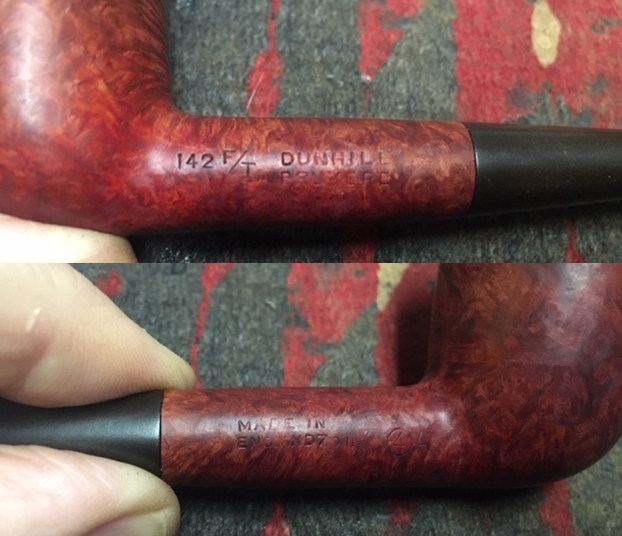
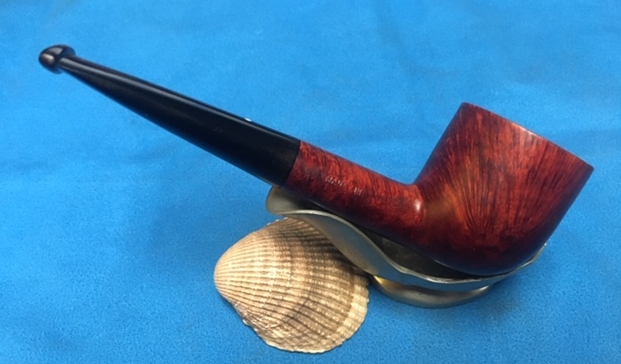
I finished work on #4, #6, #7 & #8 and turned my attention to #5, another heavily used Billiard with a tapered stem. The pipe was stamped on the left side of the shank with the shape number 142 F/T next to the bowl/shank junction. That is followed by Dunhill over Bruyere. On the right side of the shank it is stamped Made in England 7/9/11 with a Circle 4A. It appears that the pipe stamped as this one is was made in 1967 and shipped or sold in 1969 or 1971. The 142 is a Billiard with a tapered stem. The 4A stamp gives the Group or size number which in this case is a 4. The A stamp denotes a Bruyere pipe. Working on this is a change after the two old timers.

I am once again including Chuck Stanion’s eloquent description of the Bruyere on the smokingpipes.com site as follows (https://www.smokingpipes.com/pipes/new/dunhill/moreinfo.cfm?product_id=346421):

The Bruyere was Alfred Dunhill’s original finish upon launching his brand of premium pipes and smoking accessories and was the only Dunhill finish from 1910 until 1917. Even after the addition of other finishes, the Bruyere maintained a high level of popularity, becoming synonymous with what is thought of, even today, as the quintessential pipe. To achieve the iconic, ruby hue and saturation, a skilled craftsman painstakingly layers particular stains in a precise manner, then meticulously polishes the pipe to a high luster. The final result is, simply put, timeless.

Like Bob’s other  Dunhill pipe this one also had a thick cake in the bowl with remnants of tobacco stuck on the walls. There was a lava overflow on the rim so it was hard to know what kind of damage lay beneath the thick covering. Once it was cleaned I would have a better idea of the condition of the rim top. I could see however that there was definitely damage to the front inner edge of the bowl. The grain that is poking through the grime and oils appears to be quite beautiful – birdseye grain on the bowl sides and cross grain on the front and back as well as the heel of the bowl. The stem was oxidized and calcified toward the end with some tooth chatter. There were also some tooth marks on both sides of the stem ahead of the button and on the button itself. There was the classic White Spot on the top of the stem. Jeff took photos of the pipe before he started his cleanup work on it.     Jeff took photos of the bowl and rim top to show the thick, hard cake in the bowl with remnants of tobacco stuck on the walls of the bowl. There was a lava build up on the smooth rim top and the edges of the bowl. The rim top looked pretty good but it was hard to know for sure. It appeared that there was damage on the inner edge. The outer edges looked to be okay other than a few small nicks on the sides.    Jeff took photos of the sides and heel of the bowl to show the condition of the finish. You can see the beautiful grain patterns around the sides of the bowl and shank. Even under the dirt and debris of the years it looked very good. The stamping is very readable. On the left side of the shank you can see 142 F/T which is the shape number followed by the F/T for a Fishtail stem. Next to that it is stamped Dunhill over Bruyere. On the right side it reads Made in England 7 9 11 followed by Circle 4A. He included a pic of the White Spot on the stem.  Jeff took photos of the top and underside of the stem showing the tooth chatter, scratching, calcification and oxidation on the stem surface and wear on the edges of the button.    I am really happy to have Jeff’s help on cleaning up the pipes from Bob’s estate as the 125+ pipes were taking me a long time to do alone. He cleaned this filthy pipe with his usual penchant for thoroughness that I really appreciate. This one was a real mess and I was looking forward to seeing what he had done with this one when I took it out of his box. It looked amazing and CLEAN. He reamed it with a PipNet pipe reamer and cleaned up the reaming with a Savinelli Fitsall Pipe Knife. He scrubbed out the internals with alcohol, pipe cleaners and cotton swabs until the pipe was clean. He scrubbed the exterior of the bowl with Murphy’s Oil Soap and a tooth brush to remove the grime and grit on the briar and the lava on the rim top. The finish looks good with great looking grain around the bowl and shank. The rim top looked better on this pipe. The condition of the inner and outer edges was not too bad. The stem looked a lot better. Jeff soaked the stem in Before & After Deoxidizer to remove the oxidation on the rubber. The pipe was ready for me to carry on the next part of the process. I took some close up photos of the rim top and also of the stem surface. I wanted to show how well it had cleaned up and what needed to be done. The rim top had a small area toward the left front of the inner edge that was worn or burned. There was darkening and nicks all around the top of the bowl and on the inner edge. The outer edge looked good.  I also took close up photos of the stem to show the tooth marks and chatter on the stem surface.  The stamping appeared to be as clear as it was before the cleanup work. This is just one of the things I appreciate about Jeff’s cleanup is that he works to protect and preserve the nomenclature on the shank of the pipes that he works on. I took some photos to show the stamping. Bob loved his Dunhill pipes and it was obvious that he enjoyed smoking them. Some appeared to be daily smokes while others he seemed to reserve for special occasions. Some seemed like they must have hung in his mouth while he did his carving while others were smoked in his chair. Having worked on over 60 of his pipes so far I am getting a feel for them. This one is in rough condition and I suppose it might well have been before Bob took up the trust. I suppose I won’t ever know for sure but it certainly has a long and interesting story if it could only tell it.

I am sure that many of you have read at least some of the other restoration work that I have done on previous pipes. You have also read what I have included about Bob Kerr, the pipeman who held these pipes in trust before I came to work on them (see photo to the left). Also, if you have followed the blog for long you will already know that I like to include background information on the pipeman whose pipes I am restoring. For me, when I am working on an estate I really like to have a sense of the person who held the pipes in trust before I worked on them. It gives me another dimension of the restoration work. Bob’s daughter wrote a short tribute to her father. I thank you Brian and tell your wife thank you as well.

I am delighted to pass on these beloved pipes of my father’s. I hope each user gets many hours of contemplative pleasure as he did. I remember the aroma of tobacco in the rec room, as he put up his feet on his lazy boy. He’d be first at the paper then, no one could touch it before him. Maybe there would be a movie on with an actor smoking a pipe. He would have very definite opinions on whether the performer was a ‘real’ smoker or not, a distinction which I could never see but it would be very clear to him. He worked by day as a sales manager of a paper products company, a job he hated. What he longed for was the life of an artist, so on the weekends and sometimes mid-week evenings he would journey to his workshop and come out with wood sculptures, all of which he declared as crap but every one of them treasured by my sister and myself. Enjoy the pipes, and maybe a little of his creative spirit will enter you!

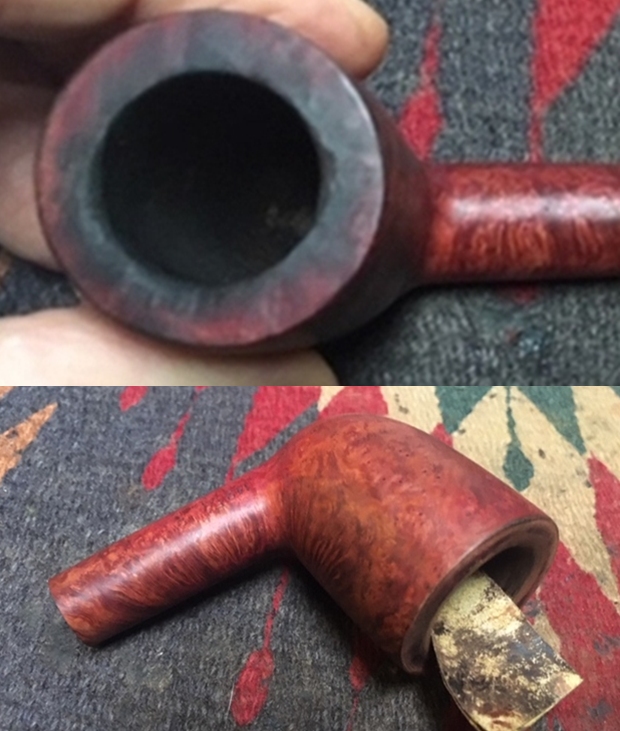
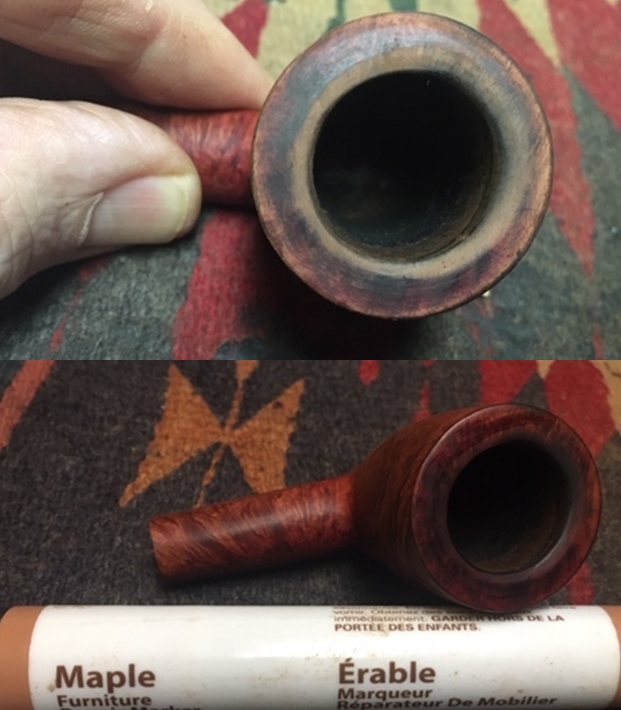
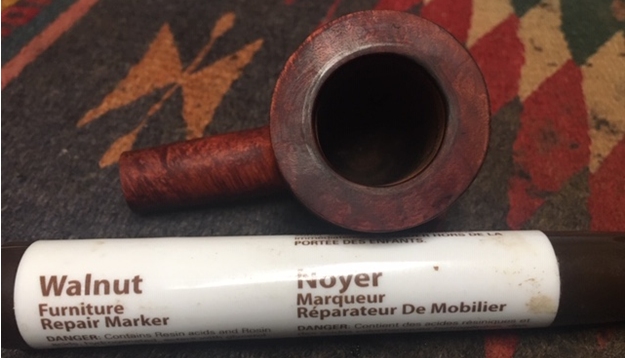
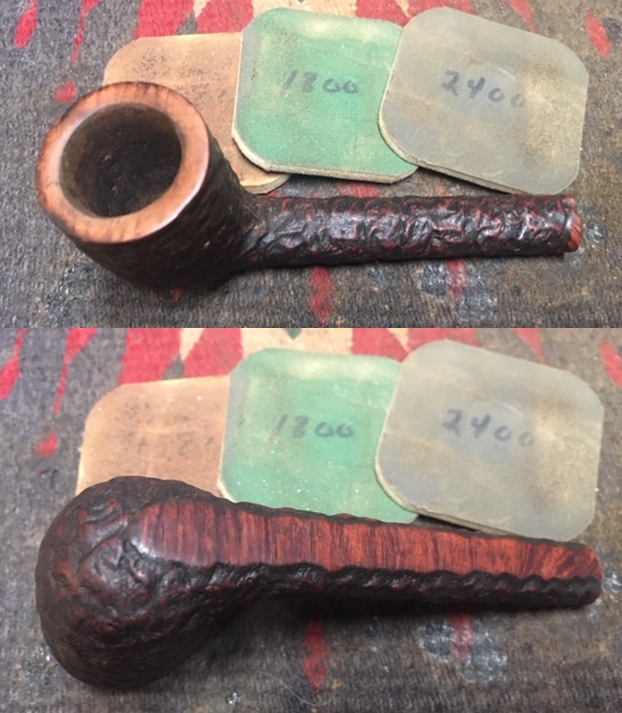
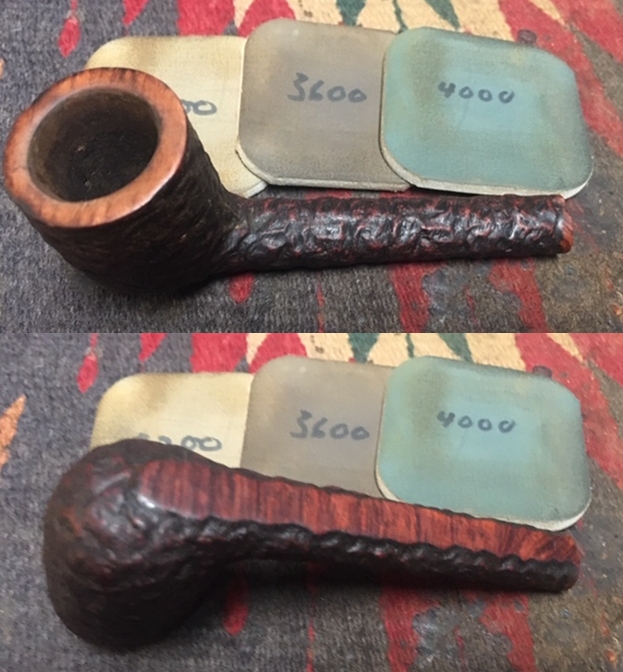
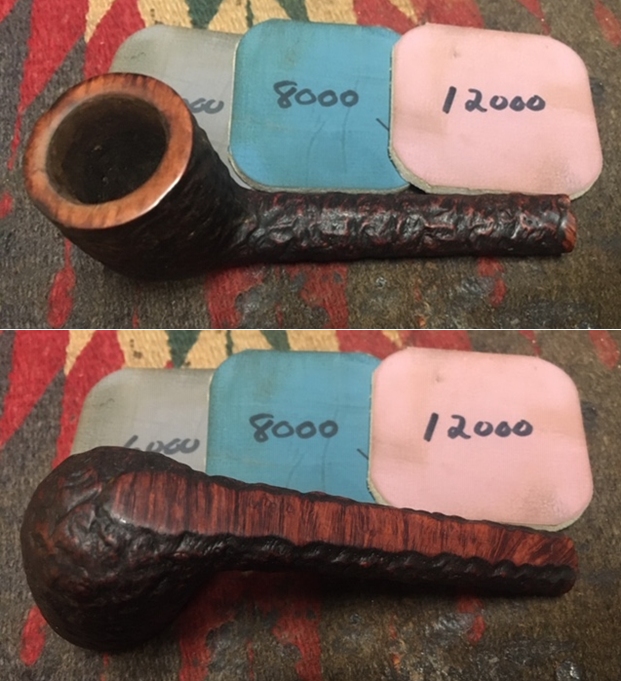
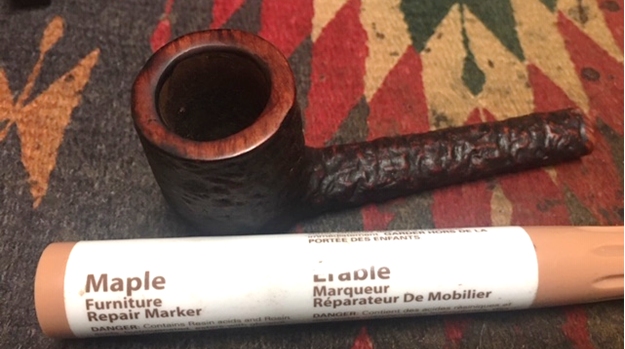
It was time to get on with the restoration of this beautiful Bruyere 142F/T Billiard. I really appreciate the hard cleanup work that Jeff did on each of these pipes. They were a real mess when I sent them to Jeff and I have to tell you it was great that I did not need to clean this pipe. I decided to start the process by dealing with the the damage to the inner edge of the bowl. I worked on the inner edge with a folded piece of 220 grit sandpaper and gave it a very slight bevel. I was able to remove much of the darkening and damage. The first photo shows the damaged inner edges of the bowl and the darkening around the full bowl. The second photo below shows the process I used with the folded sandpaper. The third photo shows the rim top and edges after my work on them…though not perfect I think it is an improvement. I gave the rim top a quick polish with 400 grit wet dry paper and 1500-2400 grit micromesh sanding pads and it brought back some of life to the rim top. I used a Maple stain pen to touch up the edge of the bowl and took a photo to show the work. I polished the briar on the rim top and bowl with worn micromesh sanding pads – wet sanding it with 1500-12000 grit micromesh sanding pads. I wiped it down after each pad with a damp cloth. I find that the worn pads do a great job polishing and still retain the original patina of the pipe.   I rubbed the bowl and rim down with Before & After Restoration Balm. I worked it into the surface of the briar with my fingertips to clean, enliven and protect it. I let the balm sit for a little while and then buffed the pipe with a cotton cloth to raise the shine. I really like watching the Balm do its magic and bring the briar alive.     With the bowl done it was time to address the stem. The dents in the top and underside were the right depth for me to lift them. I sanded the surface of the stem with 220 grit sandpaper to remove the remaining oxidation in the vulcanite. I polished it with 400 grit wet dry sand paper. I rubbed the stem down with Denicare Mouthpiece Polish. I have a few tins of this laying around so I am trying to use them up. It does a pretty good job polishing the stem.  I polished the stem with micromesh sanding pads – wet sanding with 1500-12000 grit sanding pads. I wiped it down after each pad with a damp cloth to remove the sanding dust. I polished it further with Before & After Pipe Polish – both Fine and Extra Fine. I finished by rubbing the stem down with some “No Oxy Oil” to protect the vulcanite. I am experimenting with the product from Briarville and tracking how it works so I can write a review of it. Once again at this point in the restoration process I am excited to be on the homestretch. This is the fifth of the Dunhill smooth pipes in Bob’s estate that I am working on. It is a beautiful Dunhill Bruyere 142 F/T Billiard made in 1967 and shipped or sold in 1969 and/or 1971. Like each of the pipes in Bob’s estate I really look forward to this point in the process when it is put back together, polished and waxed. I put the bowl and stem back together. I polished the bowl and stem with Blue Diamond to polish out the scratches in the briar and the vulcanite. I gave the bowl and the stem multiple coats of carnauba wax. I buffed the pipe with a clean buffing pad to raise the shine. I hand buffed it with a microfiber cloth to deepen the shine. The pipe polished up pretty nicely. The grain around the bowl and shank really came alive with the wax and polish. The black of the tapered vulcanite White Spot stem is a beautiful contrast to the reds and browns of the finished bowl and shank. This was another Dunhill that was a lot of fun to work on thanks to Jeff’s cleanup work. The pipe is comfortable pipe to hold in the hand. The finished pipe is shown in the photos below. The dimensions of the pipe are Length: 6 inches, Height: 1 ¾ inches, Outside diameter of the bowl: 1 ¼ inches, Chamber diameter: ¾ of an inch. This 1967 Bruyere Billiard is a beauty should be able to last for many more years. It is one that will be on the rebornpipes store very soon. If you are interested let me know. I have a lot more of Bob’s estate to work on of various brands. Perhaps one of those will catch your attention. Thanks for reading this blog and my reflections on the pipe while I worked on it. This is an interesting estate to bring back to life.

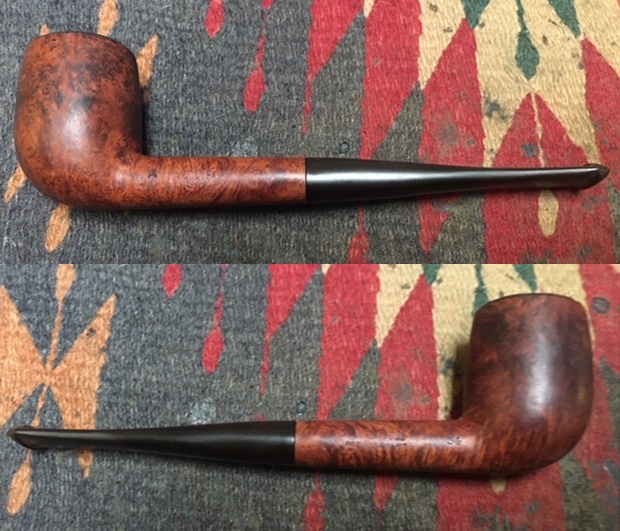
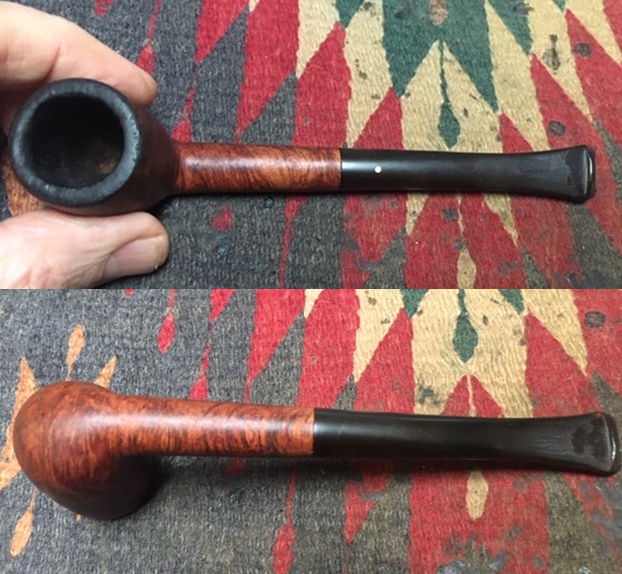
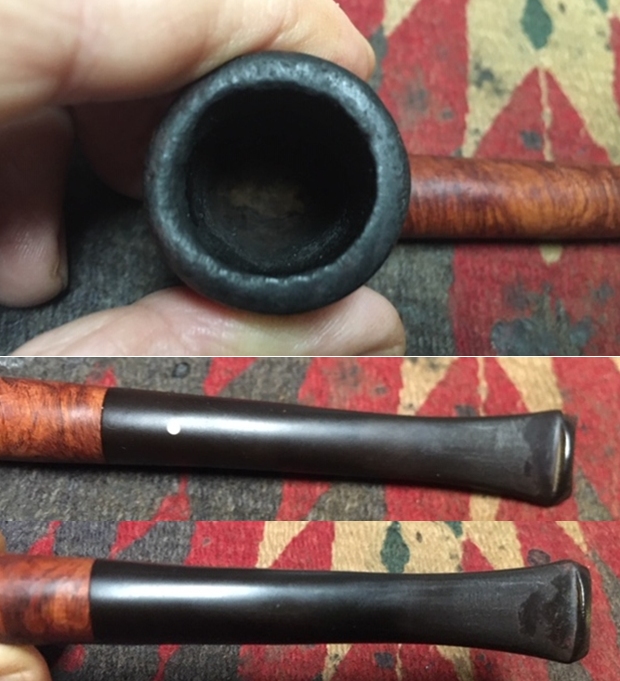
Restoring a 1913 “A” Dunhill London 34 Billiard from Bob Kerr’s Estate


Blog by Steve Laug

As I continue to work through the pipes in Bob Kerr’s Estate I am enjoying choosing different brands that he had to focus on for a bit. I had eight more from his Dunhill collection that I decided to go back to and finish working my way through that sub collection of the estate. Out of the 8 pipes six were Bruyere finished pipes, one was a Made in London (turns out it is also a Bruyere finished pipe), and one was a Root Briar. What follows is a list of what I saw when I examined the 8 pipes. As I finish the pipes I will include the link to the blog on that particular pipe for easy reference. I have already restored 16 pipes from this subgroup so you can do a quick search to read about the work on the Shell Briars and Tanshell Briars that were in that part of the collection.

  1. Bruyere 656 F/T Made in England 2 Circle 4A – Group 4 size Bruyere made in 1962. Stem is oxidized, tooth marks and chatter near the button, some calcification with damage to the button. Finish is dirty, bowl caked and lava overflow on the rim top. Bowl is out of round, damaged edge.
  2. Bruyere 112 F/T Made in England 9/11 Circle 2A – Group 2 size Bruyere made in 1969 and sold in 1971. Stem is oxidized, tooth marks and chatter near the button, some calcification with damage to the button. Finish is dirty, bowl caked and lava overflow on the rim top. Bowl is out of round, damaged edge.
  3. Bruyere 0333 Made in England 16 made in 1976. Stem is oxidized, tooth marks and chatter near the button, some calcification with damage to the button. Finish is dirty, bowl caked and lava overflow on the rim top. Bowl is out of round, damaged edge.
  4. Bruyere 41061 Made in England 18 made in 1978. Stem is oxidized, tooth marks and chatter near the button, some calcification with damage to the button. Finish is dirty, bowl caked and lava overflow on the rim top. Bowl is out of round, damaged edge. I finished the restoration on it. Here is the link to the blog – (https://rebornpipes.com/2019/12/24/restoring-a-1978-dunhill-bruyere-41061-from-bob-kerrs-estate/).
  5. Bruyere 142 F/T Made in England 7/9/11 Circle 4A – Group for size Bruyere made in 1967 and sent out in 1969 or 1971. Stem is oxidized, tooth marks and chatter near the button, some calcification with damage to the button. Finish is dirty, bowl caked and lava overflow on the rim top. Bowl is out of round, damaged edge.
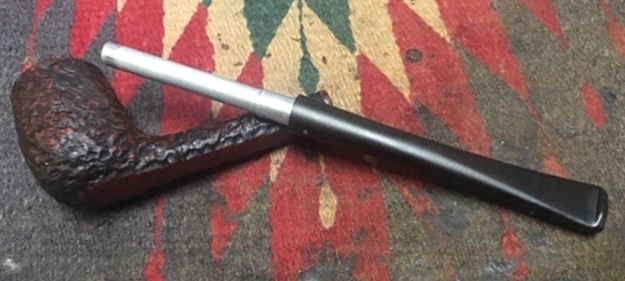
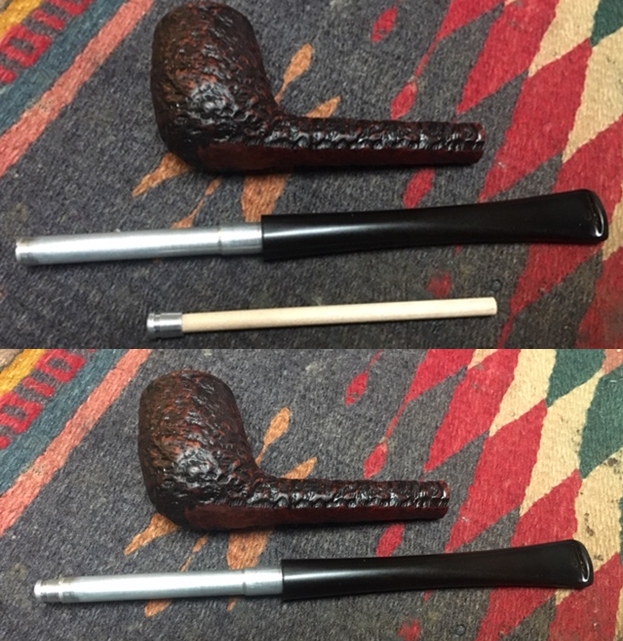
  6. (A) Dunill London Inner Tube PAT N°5861/12 Shape 34. Stem is oxidized, tooth marks and chatter near the button, some calcification with damage to the button. Finish is dirty, bowl caked and lava overflow on the rim top. Bowl is out of round, damaged edge. Missing the inner tube.
  7. (Ao) Dunhill London 113 Made in England 5 PAT N°158709/14. Stem is oxidized, tooth marks and chatter near the button, some calcification with damage to the button. Finish is dirty, bowl caked and lava overflow on the rim top. Bowl is out of round, damaged rim edges. I finished the restoration on it. Here is the link to the blog – (https://rebornpipes.com/2019/12/25/restoring-a-1925-ao-dunhill-london-113-billiard-from-bob-kerrs-estate/).
  8. Root Briar 31032 Made in England 18 – made in 1978. Stem is oxidized, tooth marks and chatter near the button, some calcification with damage to the button. Finish is dirty, bowl caked and lava overflow on the rim top. Bowl is out of round, damaged edge. I finished the restoration on it. Here is the link to the blog – (https://rebornpipes.com/2019/12/23/restoring-a-1978-dunhill-root-briar-31032-billiard-from-bob-kerrs-estate/).

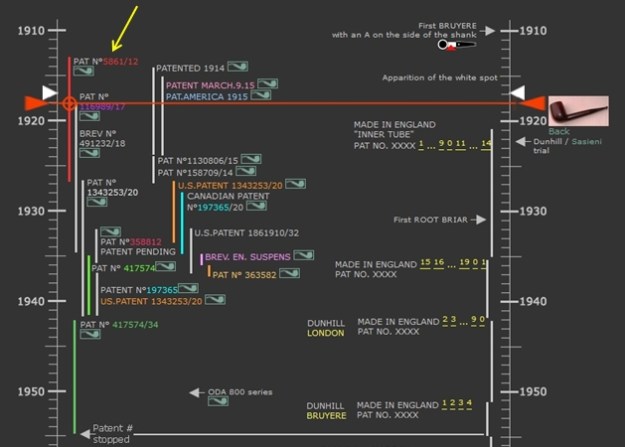
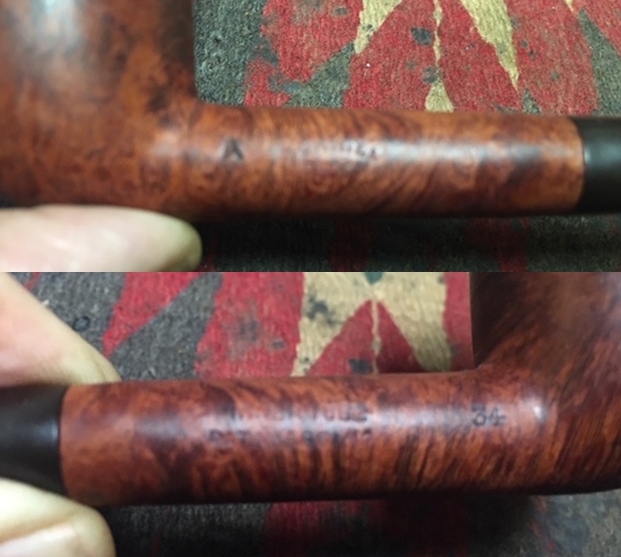
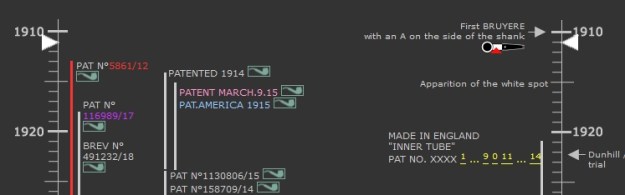
I finished work on #4, #7 & #8 and turned my attention to #6, another heavily used Billiard with a tapered stem. The pipe was stamped on the left side of the shank with the letter A next to the bowl/shank junction. That is followed by Dunhill arched over London. On the right side of the shank it is stamped Inner Tube with PAT N°5861/12 underneath. I turned to the PipePhil website to see if I could pin down the time from for the entrance of the inner tube and also see if I could clear up the date of the patent number on the pipe (http://www.pipephil.eu/logos/en/dunhill/root-bru-guide.html). I did a screen capture of the pertinent info on that below. I inserted a yellow arrow on the top left corner to point out the patent number information.It appears that the pipe stamped as this one is Inner Tube over Pat. No. 5861/12 places this pipe as a 1913 Pipe. I went on to a separate page on the site to see if I could identify the A stamp (http://www.pipephil.eu/logos/en/dunhill/patent1.html#36). From there is appears that the A stamp means that the pipe is a Bruyere from 1913 and that also is attested by the DUNHILL arched over LONDON marking.

I am once again including Chuck Stanion’s eloquent description of the Bruyere on the smokingpipes.com site as follows (https://www.smokingpipes.com/pipes/new/dunhill/moreinfo.cfm?product_id=346421):

The Bruyere was Alfred Dunhill’s original finish upon launching his brand of premium pipes and smoking accessories and was the only Dunhill finish from 1910 until 1917. Even after the addition of other finishes, the Bruyere maintained a high level of popularity, becoming synonymous with what is thought of, even today, as the quintessential pipe. To achieve the iconic, ruby hue and saturation, a skilled craftsman painstakingly layers particular stains in a precise manner, then meticulously polishes the pipe to a high luster. The final result is, simply put, timeless.

On rebornpipes I have a blog by Eric Boehm on Dunhill shape numbers and I turned to that to help identify the shape number on this pipe. Eric notes that the shape number 34 designates a Billiard with a tapered stem. (https://rebornpipes.com/2012/11/01/dunhill-pipe-shapes-collated-by-eric-w-boehm/).

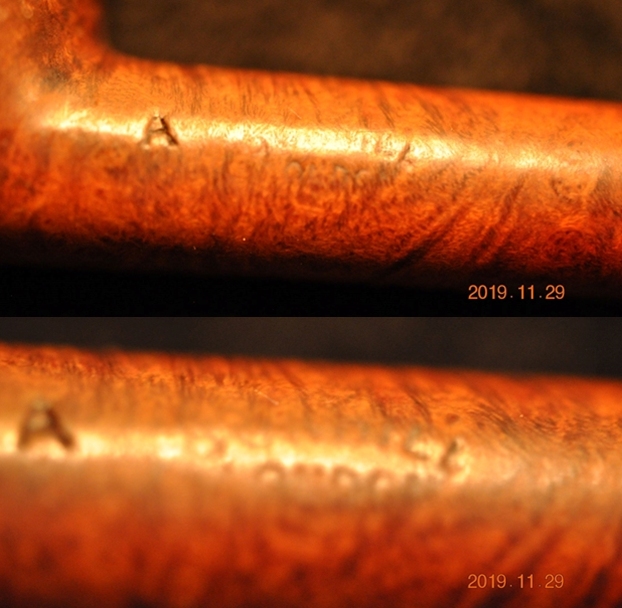
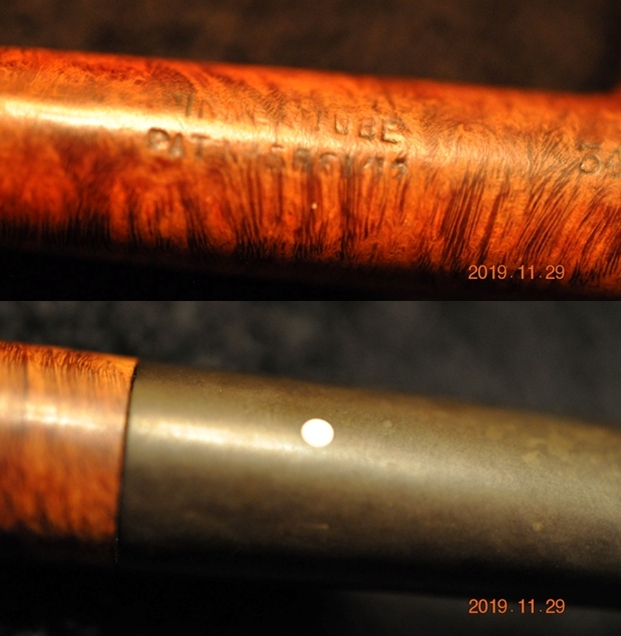
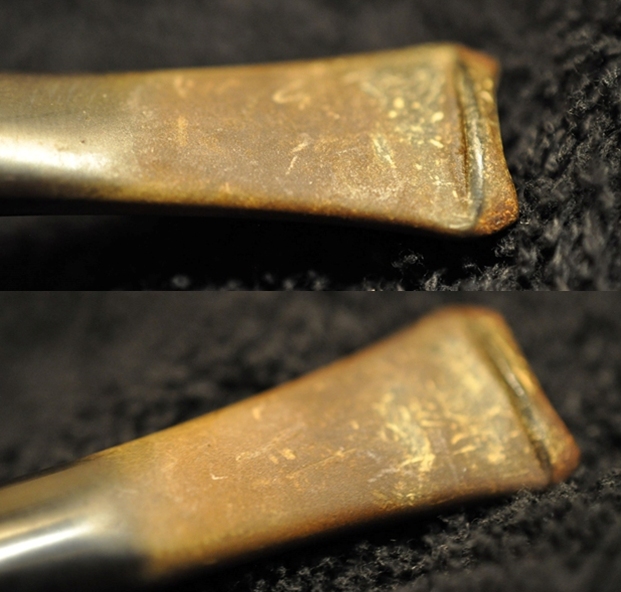
Now I knew I was dealing with another one of Bob’s oldest Dunhill pipes. It was a 1913 Dunhill Bruyere with a Patent Number for the Inner Tube and stamping that established the date for me. It was time to turn to the pipe. There was a thick cake in the bowl with remnants of tobacco stuck on the walls. There was a lava overflow on the rim that filled in all of the damage to the surface of the rim top and edges. Once it was cleaned I would have a better idea of the condition of the rim top. I could see however that there was definitely damage to both the inner and the outer edge of the bowl. The grain that is poking through the grime and oils appears to be quite beautiful –birdseye grain on the bowl sides and cross grain on the front and back as well as the heel of the bowl. The stem was oxidized and calcified toward the end with some tooth chatter. There were also some tooth marks on both sides of the stem ahead of the button and on the button itself. There was the classic White Spot on the top of the stem. Jeff took photos of the pipe before he started his cleanup work on it.  Jeff took photos of the bowl and rim top to show the thick, hard cake in the bowl with remnants of tobacco stuck on the walls of the bowl. There was a lava build up on the smooth rim top and the edges of the bowl. The rim top looked pretty good but it was hard to know for sure. It appeared that there was damage on the inner edge. The outer edges looked to be okay.    Jeff took photos of the sides and heel of the bowl to show the condition of the finish. You can see the beautiful grain patterns around the sides of the bowl and shank. Even under the dirt and debris of the years it looked very good. The stamping is readable with a lens and a bright light. On the left side of the shank you can see A (which turns out to be the designation for a Bruyere finish) followed by Dunhill arched over London. It took 2 photos to catch the faint stamping. On the right side it reads “Inner Tube” over PAT N°5861/12. He included a pic of the White Spot on the stem.  Jeff took photos of the top and underside of the stem showing the tooth chatter, scratching, calcification and oxidation on the stem surface and wear on the edges of the button.    I am really happy to have Jeff’s help on cleaning up the pipes from Bob’s estate as the 125+ pipes were taking me a long time to do alone. He cleaned this filthy pipe with his usual penchant for thoroughness that I really appreciate. This one was a real mess and I was looking forward to seeing what he had done with this one when I took it out of his box. It looked amazing and CLEAN. He reamed it with a PipNet pipe reamer and cleaned up the reaming with a Savinelli Fitsall Pipe Knife. He scrubbed out the internals with alcohol, pipe cleaners and cotton swabs until the pipe was clean. He scrubbed the exterior of the bowl with Murphy’s Oil Soap and a tooth brush to remove the grime and grit on the briar and the lava on the rim top. The finish looks good with great looking grain around the bowl and shank. The rim top looked better on this pipe. The condition of the inner and outer edges was not too bad. The stem looked a lot better. Jeff soaked the stem in Before & After Deoxidizer to remove the oxidation on the rubber. The pipe was ready for me to carry on the next part of the process. I took some close up photos of the rim top and also of the stem surface. I wanted to show how well it had cleaned up and what needed to be done. The rim top had a small area toward the left front of the inner edge that was worn or burned. There was darkening and nicks all around the top of the bowl and on the inner edge. The outer edge looked good.  I also took close up photos of the stem to show the tooth marks and chatter on the stem surface. The stamping appeared to be as clear as it was before the cleanup work. This is just one of the things I appreciate about Jeff’s cleanup is that he works to protect and preserve the nomenclature on the shank of the pipes that he works on. I took some photos to show the stamping. Bob loved his Dunhill pipes and it was obvious that he enjoyed smoking them. Some appeared to be daily smokes while others he seemed to reserve for special occasions. Some seemed like they must have hung in his mouth while he did his carving while others were smoked in his chair. Having worked on over 60 of his pipes so far I am getting a feel for them. This one is in rough condition and I suppose it might well have been before Bob took up the trust. I suppose I won’t ever know for sure but it certainly has a long and interesting story if it could only tell it.

I am sure that many of you have read at least some of the other restoration work that I have done on previous pipes. You have also read what I have included about Bob Kerr, the pipeman who held these pipes in trust before I came to work on them (see photo to the left). Also, if you have followed the blog for long you will already know that I like to include background information on the pipeman whose pipes I am restoring. For me, when I am working on an estate I really like to have a sense of the person who held the pipes in trust before I worked on them. It gives me another dimension of the restoration work. Bob’s daughter wrote a short tribute to her father. I thank you Brian and tell your wife thank you as well.

I am delighted to pass on these beloved pipes of my father’s. I hope each user gets many hours of contemplative pleasure as he did. I remember the aroma of tobacco in the rec room, as he put up his feet on his lazy boy. He’d be first at the paper then, no one could touch it before him. Maybe there would be a movie on with an actor smoking a pipe. He would have very definite opinions on whether the performer was a ‘real’ smoker or not, a distinction which I could never see but it would be very clear to him. He worked by day as a sales manager of a paper products company, a job he hated. What he longed for was the life of an artist, so on the weekends and sometimes mid-week evenings he would journey to his workshop and come out with wood sculptures, all of which he declared as crap but every one of them treasured by my sister and myself. Enjoy the pipes, and maybe a little of his creative spirit will enter you!

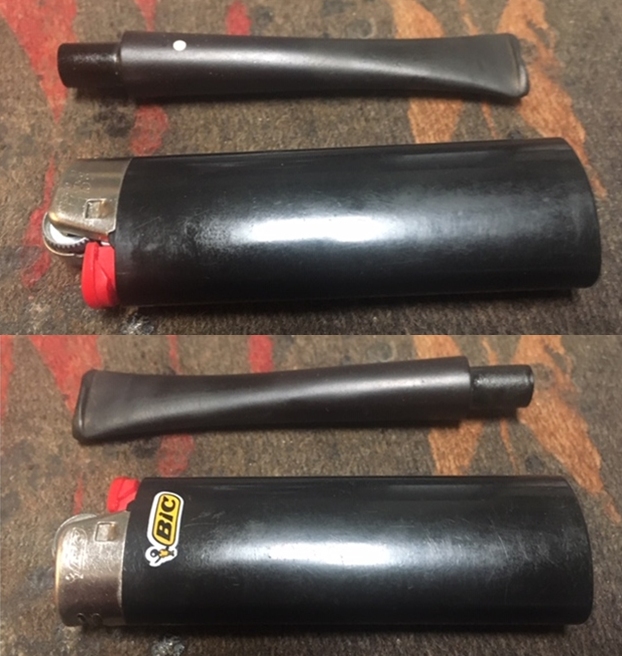
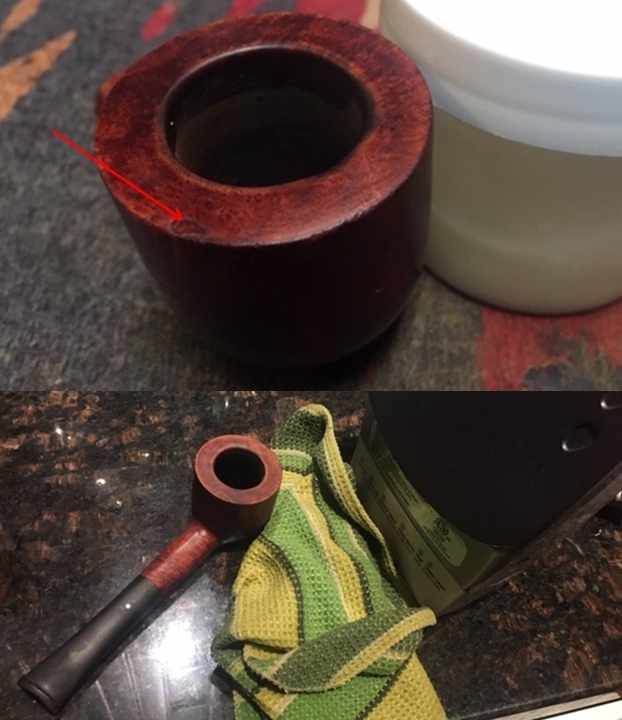
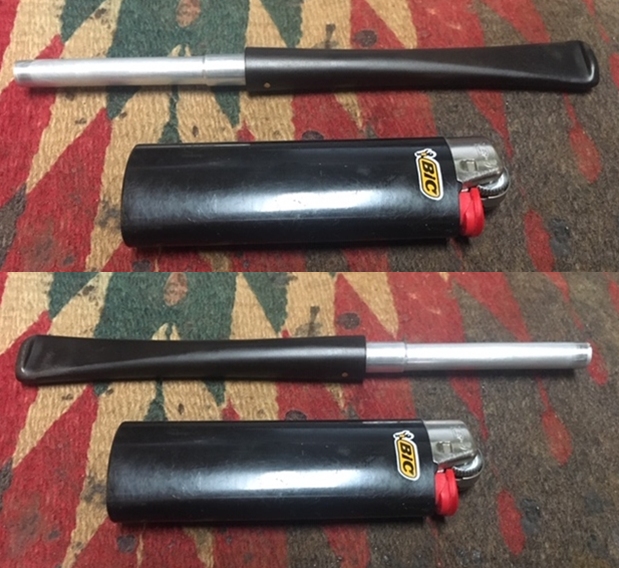
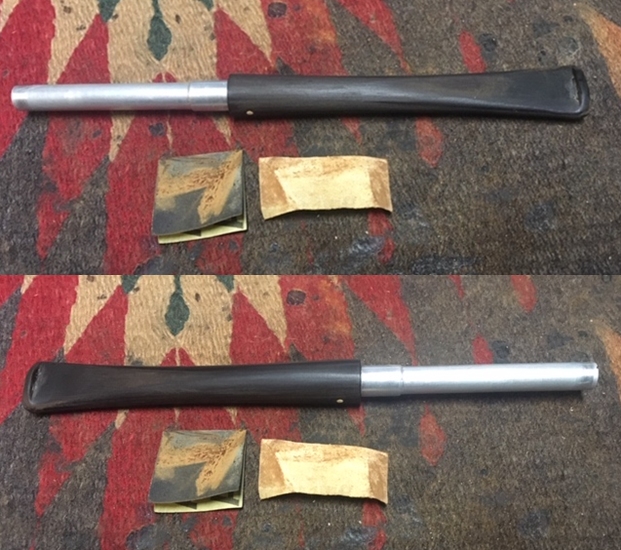
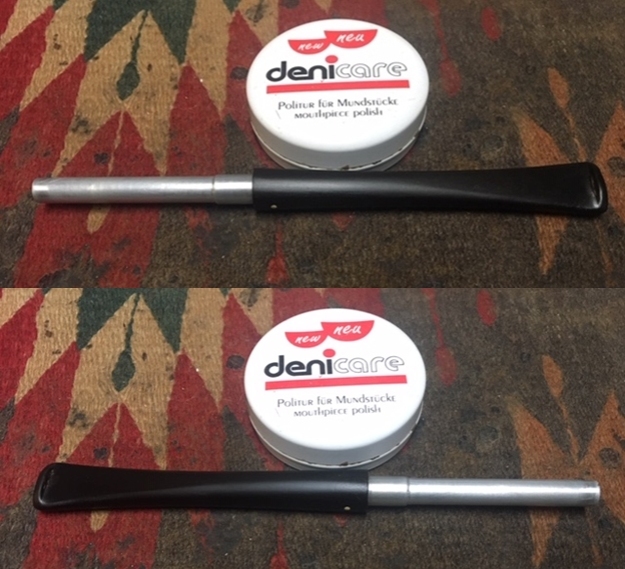
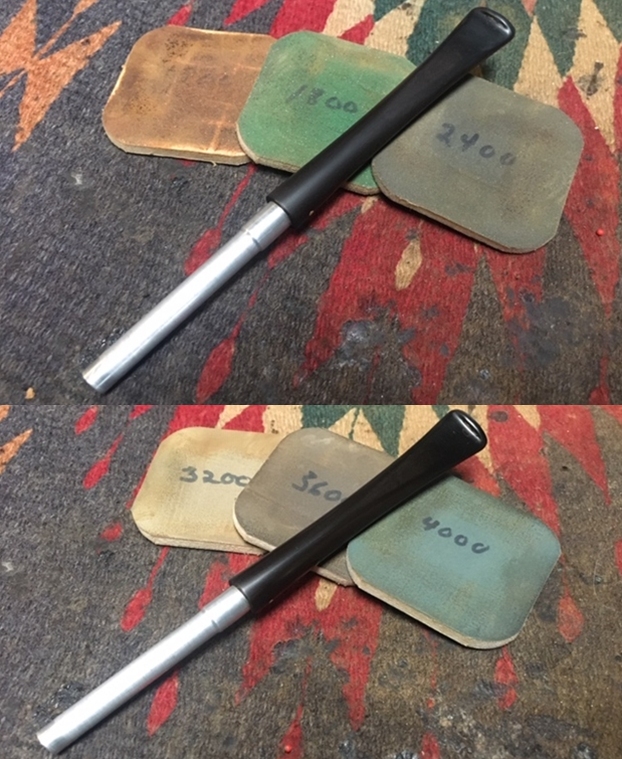
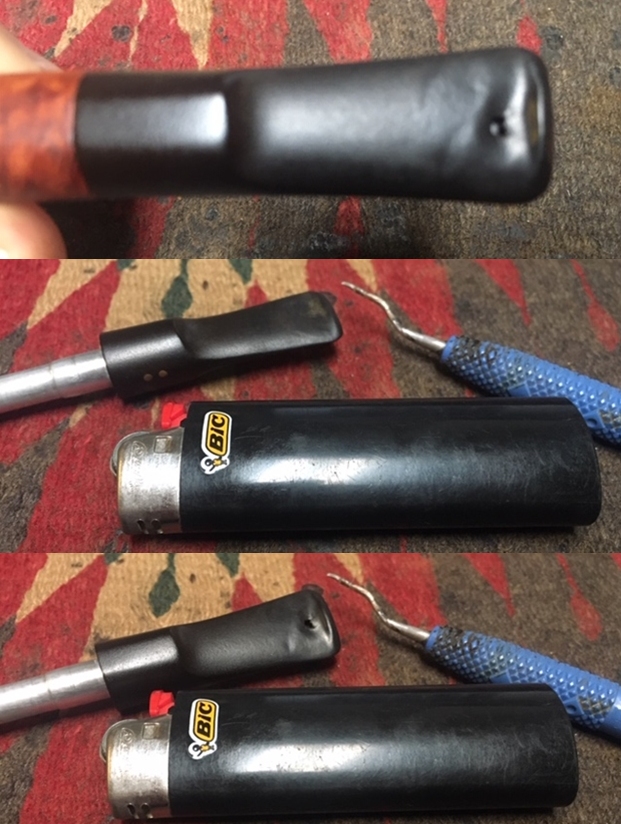
It was time to get on with the restoration of this old and worn 1913 Dunhill Bruyere Patent No. Inner Tube Billiard. I really appreciate the hard cleanup work that Jeff did on these pipes. They were a real mess when I sent them to Jeff and I have to tell you it was great that I did not need to clean this pipe. I decided to start the process by dealing with the the damage to the edges and the rim top of the bowl. I worked on the inner edge with a folded piece of 220 grit sandpaper and gave it a very slight bevel. I was able to remove much of the damage. I used a folded piece of 220 grit sandpaper to smooth out the damage on the outer edge of the bowl as well.  The second photo below shows the rim top and edges after my work on them…though not perfect I think it is an improvement. I was hoping that polishing the rim top and briar would help to blend to the top with the bowl enough that I would not need to stain it. I polished the briar on the rim top and bowl with worn micromesh sanding pads – wet sanding it with 1500-12000 grit micromesh sanding pads. I wiped it down after each pad with a damp cloth. I find that the worn pads do a great job polishing and still retain the original patina of the pipe.   I rubbed the bowl and rim down with Before & After Restoration Balm. I worked it into the surface of the briar with my fingertips to clean, enliven and protect it. I let the balm sit for a little while and then buffed the pipe with a cotton cloth to raise the shine. I really like watching the Balm do its magic and bring the briar alive.    With the bowl done it was time to address the stem. The dents in the top and underside were the right depth for me to lift them. I “painted” the surface of the stem with the flame of a Bic lighter to raise the dents in the surface. I was able to lift  them to the point that sanding the stem would do the job.I sanded the surface of the stem with 220 grit sandpaper to remove the remaining oxidation in the vulcanite. I polished it with 400 grit wet dry sand paper.  I rubbed the stem down with Denicare Mouthpiece Polish. I have a few tins of this laying around so I am trying to use them up. It does a pretty good job polishing the stem.  I polished the stem with micromesh sanding pads – wet sanding with 1500-12000 grit sanding pads. I wiped it down after each pad with a damp cloth to remove the sanding dust. I polished it further with Before & After Pipe Polish – both Fine and Extra Fine. I finished by rubbing the stem down with some “No Oxy Oil” to protect the vulcanite. I am experimenting with the product from Briarville and tracking how it works so I can write a review of it. Once again at this point in the restoration process I am excited to be on the homestretch. This is the fourth of the Dunhill smooth pipes in Bob’s estate that I am working on. It is another one that turned out to be a beautiful 1913 Dunhill London 34 Billiard. It was in pretty amazing condition for 107 year old pipe so I really was looking forward to this point in the process when it is put back together, polished and waxed. I put the bowl and stem back together. I polished the bowl and stem with Blue Diamond to polish out the scratches in the briar and the vulcanite. I gave the bowl and the stem multiple coats of carnauba wax. I buffed the pipe with a clean buffing pad to raise the shine. I hand buffed it with a microfiber cloth to deepen the shine. The pipe polished up pretty nicely. The grain around the bowl and shank really came alive with the wax and polish. The black of the tapered vulcanite White Spot stem is a beautiful contrast to the reds and browns of the finished bowl and shank. This was another older Dunhill that was a lot of fun to work on thanks to Jeff’s cleanup work. The pipe is comfortable pipe to hold in the hand. The finished pipe is shown in the photos below. The dimensions of the pipe are Length: 5 ¾ inches, Height: 1 ¾ inches, Outside diameter of the bowl: 1 1/8 inches, Chamber diameter: ¾ of an inch. This 1913 Bruyere Billiard is a beauty should be able to last another 100+ years. It is another one that I am thinking about hanging onto solely because of the age. I have a lot more of Bob’s estate to work on of various brands. Perhaps one of those will catch your attention. Thanks for reading this blog and my reflections on the pipe while I worked on it. This is an interesting estate to bring back to life.

Restoring a 1925 “Ao” Dunhill London 113 Billiard from Bob Kerr’s Estate


Blog by Steve Laug

As I continue to work through the pipes in Bob Kerr’s Estate I am enjoying choosing different brands that he had to focus on for a bit. I had eight more from his Dunhill collection that I decided to go back to and finish working my way through that sub collection of the estate. Out of the 8 pipes six were Bruyere finished pipes, one was a Made in London (turns out it is also a Bruyere finished pipe), and one was a Root Briar. What follows is a list of what I saw when I examined the 8 pipes. As I finish the pipes I will include the link to the blog on that particular pipe for easy reference. I have already restored 16 pipes from this subgroup so you can do a quick search to read about the work on the Shell Briars and Tanshell Briars that were in that part of the collection.

  1. Bruyere 656 F/T Made in England 2 Circle 4A – Group 4 size Bruyere made in 1962. Stem is oxidized, tooth marks and chatter near the button, some calcification with damage to the button. Finish is dirty, bowl caked and lava overflow on the rim top. Bowl is out of round, damaged edge.
  2. Bruyere 112 F/T Made in England 9/11 Circle 2A – Group 2 size Bruyere made in 1969 and sold in 1971. Stem is oxidized, tooth marks and chatter near the button, some calcification with damage to the button. Finish is dirty, bowl caked and lava overflow on the rim top. Bowl is out of round, damaged edge.
  3. Bruyere 0333 Made in England 16 made in 1976. Stem is oxidized, tooth marks and chatter near the button, some calcification with damage to the button. Finish is dirty, bowl caked and lava overflow on the rim top. Bowl is out of round, damaged edge.
  4. Bruyere 41061 Made in England 18 made in 1978. Stem is oxidized, tooth marks and chatter near the button, some calcification with damage to the button. Finish is dirty, bowl caked and lava overflow on the rim top. Bowl is out of round, damaged edge. I finished the restoration on it. Here is the link to the blog – (https://rebornpipes.com/2019/12/24/restoring-a-1978-dunhill-bruyere-41061-from-bob-kerrs-estate/).
  5. Bruyere 142 F/T Made in England 7/9/11 Circle 4A – Group for size Bruyere made in 1967 and sent out in 1969 or 1971. Stem is oxidized, tooth marks and chatter near the button, some calcification with damage to the button. Finish is dirty, bowl caked and lava overflow on the rim top. Bowl is out of round, damaged edge.
  6. Bruyere A Inner Tube Patent No. 5831412 Shape 34. Stem is oxidized, tooth marks and chatter near the button, some calcification with damage to the button. Finish is dirty, bowl caked and lava overflow on the rim top. Bowl is out of round, damaged edge. Missing the inner tube.
  7. (Ao) London 113 Made in England 5 PAT N°158709/14. Stem is oxidized, tooth marks and chatter near the button, some calcification with damage to the button. Finish is dirty, bowl caked and lava overflow on the rim top. Bowl is out of round, damaged rim edges.
  8. Root Briar 31032 Made in England 18 – made in 1978. Stem is oxidized, tooth marks and chatter near the button, some calcification with damage to the button. Finish is dirty, bowl caked and lava overflow on the rim top. Bowl is out of round, damaged edge. I finished the restoration on it. Here is the link to the blog – (https://rebornpipes.com/2019/12/23/restoring-a-1978-dunhill-root-briar-31032-billiard-from-bob-kerrs-estate/).

I finished work on #8 and turned my attention to #7 a heavily abused Billiard with a tapered stem. The pipe was stamped on the left side of the shank with the Ao number next to the bowl/shank junction. That is followed by Dunhill over London. On the right side of the shank it is stamped Made in England 5 with “Inner Tube” underneath that with PAT N°158709/14 underneath. I turned to the PipePhil website to see if I could pin down the time from for the entrance of the inner tube and also see if I could clear up the date of the patent number on the pipe (http://www.pipephil.eu/logos/en/dunhill/root-bru-guide.html). I did a screen capture of the pertinent info on that below.It appears that the pipe stamped as this one is with the Made in England 5 with “Inner Tube” over Pat. No. places this pipe as a 1925 Pipe. I went on to a separate page on the site to see if I could identify the Ao stamp (http://www.pipephil.eu/logos/en/dunhill/bruyere1.html). From there is appears that the stamp means that the pipe is a Bruyere from 1925and that also is attested by the “DUNHILL over LONDON” marking.

Chuck Stanion eloquently describes the Bruyere on the Smokingpipes.com site as follows (https://www.smokingpipes.com/pipes/new/dunhill/moreinfo.cfm?product_id=346421):

The Bruyere was Alfred Dunhill’s original finish upon launching his brand of premium pipes and smoking accessories and was the only Dunhill finish from 1910 until 1917. Even after the addition of other finishes, the Bruyere maintained a high level of popularity, becoming synonymous with what is thought of, even today, as the quintessential pipe. To achieve the iconic, ruby hue and saturation, a skilled craftsman painstakingly layers particular stains in a precise manner, then meticulously polishes the pipe to a high luster. The final result is, simply put, timeless.

On rebornpipes I have a blog by Eric Boehm on Dunhill shape numbers and I turned to that to help identify the shape number on this pipe. Eric notes that the shape number 113 designates a Billiard with a tapered stem. (https://rebornpipes.com/2012/11/01/dunhill-pipe-shapes-collated-by-eric-w-boehm/).

Now I knew I was dealing with one of Bob’s oldest Dunhill pipes. It was a 1925 Dunhill Bruyere with a patent number and stamping that established the date for me. It was time to turn to the pipe. There was a thick cake in the bowl with remnants of tobacco stuck on the walls. There was a lava overflow on the rim that filled in all of the damage to the surface of the rim top and edges. Once it was cleaned I would have a better idea of the condition of the rim top. I could see however that there was definitely damage to both the inner and the outer edge of the bowl. The grain that is poking through the grime and oils appears to be quite beautiful – diagonal or flame grain and some birdseye grain on the heel of the bowl. The stem was oxidized and calcified toward the end with some tooth chatter. There were also some tooth marks on both sides of the stem ahead of the button and on the button itself. There was the classic White Spot on the top of the stem. Jeff took photos of the pipe before he started his cleanup work on it.  Jeff took photos of the bowl and rim top to show the thick, hard cake in the bowl with remnants of tobacco stuck on the walls of the bowl. There was a lava build up on the smooth rim top and the edges of the bowl. The rim top looked pretty good but it was hard to know for sure. It appeared that there was damage at the back and the front of the inner edge. The outer edges looked good.    Jeff took photos of the sides and heel of the bowl to show the condition of the finish. You can see the beautiful grain patterns around the sides of the bowl and shank. Even under the dirt and debris of the years it looked very good.   The stamping is readable with a lens and a bright light. On the left side of the shank you can see Ao (which turns out to be the designation for a Bruyere finish) followed by Dunhill over London. On the right side it reads Made In England with the date stamp 5 after the D in England underneath that it is stamped “Inner Tube” over PAT N°158709/14. He included a pic of the White Spot on the stem.  Jeff took photos of the top and underside of the stem showing the tooth chatter, scratching, calcification and oxidation on the stem surface and wear on the edges of the button.   I am really happy to have Jeff’s help on cleaning up the pipes from Bob’s estate as the 125+ pipes were taking me a long time to do alone. He cleaned this filthy pipe with his usual penchant for thoroughness that I really appreciate. This one was a real mess and I was looking forward to seeing what he had done with this one when I took it out of his box. It looked amazing and CLEAN. He reamed it with a PipNet pipe reamer and cleaned up the reaming with a Savinelli Fitsall Pipe Knife. He scrubbed out the internals with alcohol, pipe cleaners and cotton swabs until the pipe was clean. He scrubbed the exterior of the bowl with Murphy’s Oil Soap and a tooth brush to remove the grime and grit on the briar and the lava on the rim top. The finish looks very good with great looking grain around the bowl and shank. The rim top was the biggest issue with this pipe. The inner and outer edges were really quite rough and that would need to be dealt with. The stem looked a lot better. Jeff soaked the stem in Before & After Deoxidizer to remove the oxidation on the rubber. The pipe was ready for me to carry on the next part of the process. I took some close up photos of the rim top and also of the stem surface. I wanted to show how well it had cleaned up and what needed to be done. The rim top had a dent on the right outer edge and some darkening toward the back of the bowl and on the inner edge. There was also some burn damage on the front inner edge of the bowl. The outer edge looked very good.  I also took close up photos of the stem to show the tooth marks and chatter on the stem surface.The stamping appeared to be as clear as it was before the cleanup work. This is just one of the things I appreciate about Jeff’s cleanup is that he works to protect and preserve the nomenclature on the shank of the pipes that he works on. I took some photos to show the stamping. Bob loved his Dunhill pipes and it was obvious that he enjoyed smoking them. Some appeared to be daily smokes while others he seemed to reserve for special occasions. Some seemed like they must have hung in his mouth while he did his carving while others were smoked in his chair. Having worked on over 60 of his pipes so far I am getting a feel for them. This one is in rough condition and I suppose it might well have been before Bob took up the trust. I suppose I won’t ever know for sure but it certainly has a long and interesting story if it could only tell it.

I am sure that many of you have read at least some of the other restoration work that I have done on previous pipes. You have also read what I have included about Bob Kerr, the pipeman who held these pipes in trust before I came to work on them (see photo to the left). Also, if you have followed the blog for long you will already know that I like to include background information on the pipeman whose pipes I am restoring. For me, when I am working on an estate I really like to have a sense of the person who held the pipes in trust before I worked on them. It gives me another dimension of the restoration work. Bob’s daughter wrote a short tribute to her father. I thank you Brian and tell your wife thank you as well.

I am delighted to pass on these beloved pipes of my father’s. I hope each user gets many hours of contemplative pleasure as he did. I remember the aroma of tobacco in the rec room, as he put up his feet on his lazy boy. He’d be first at the paper then, no one could touch it before him. Maybe there would be a movie on with an actor smoking a pipe. He would have very definite opinions on whether the performer was a ‘real’ smoker or not, a distinction which I could never see but it would be very clear to him. He worked by day as a sales manager of a paper products company, a job he hated. What he longed for was the life of an artist, so on the weekends and sometimes mid-week evenings he would journey to his workshop and come out with wood sculptures, all of which he declared as crap but every one of them treasured by my sister and myself. Enjoy the pipes, and maybe a little of his creative spirit will enter you!

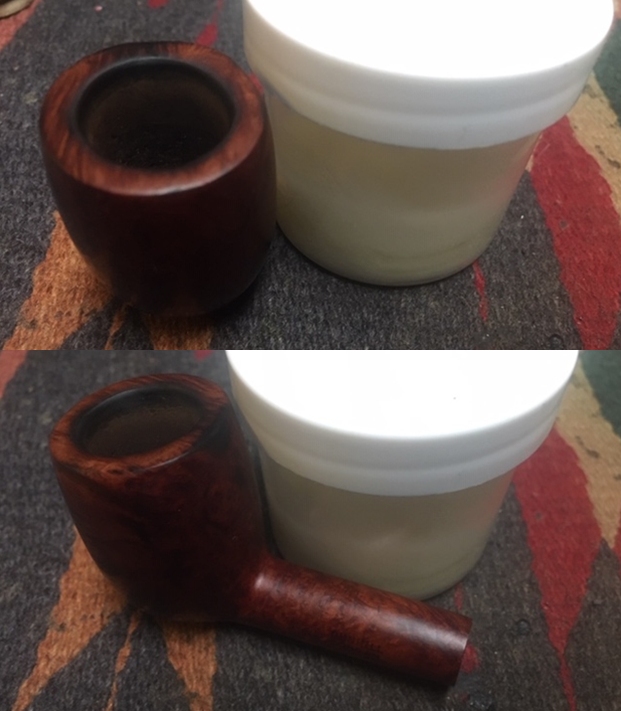
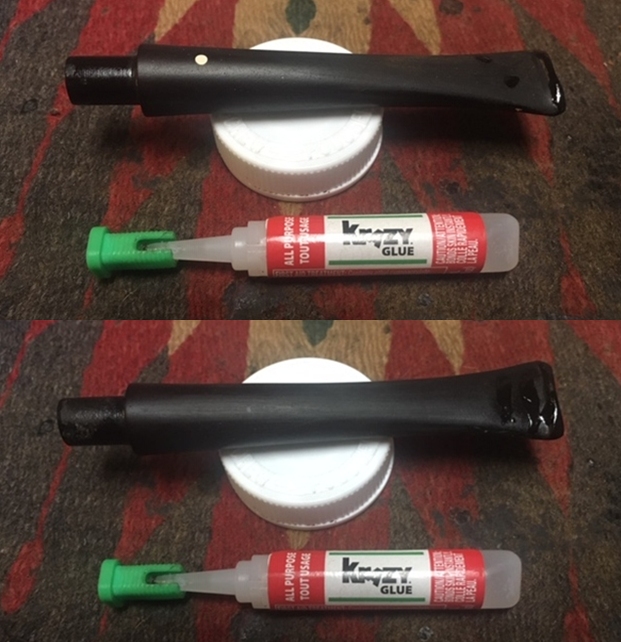
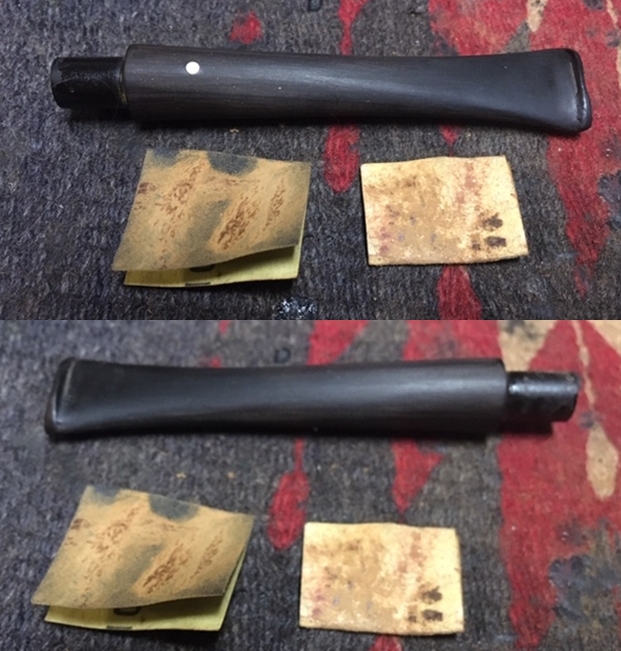
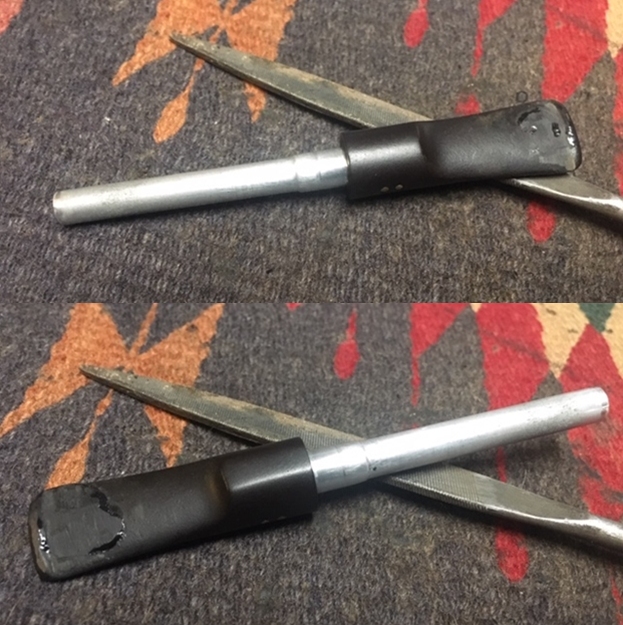
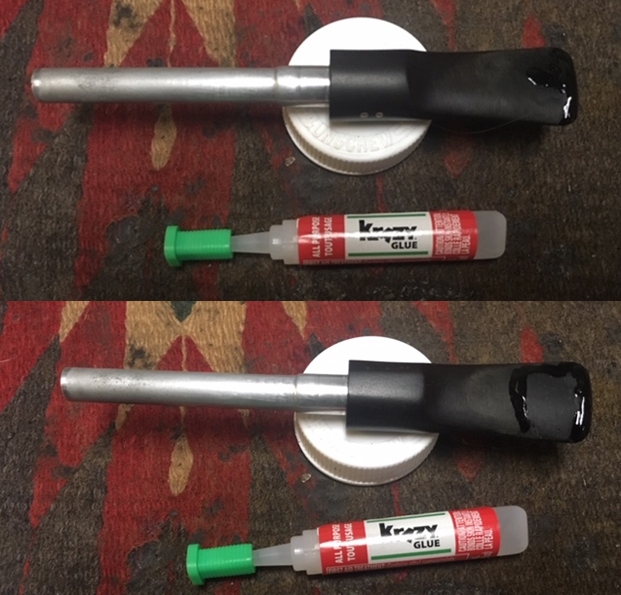
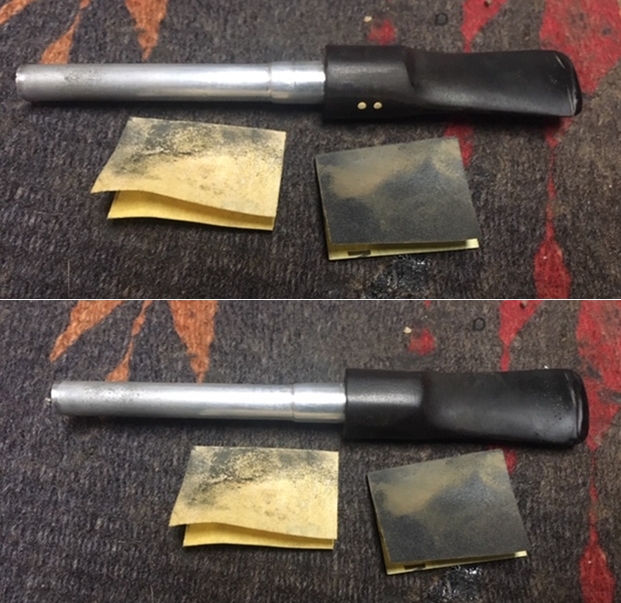
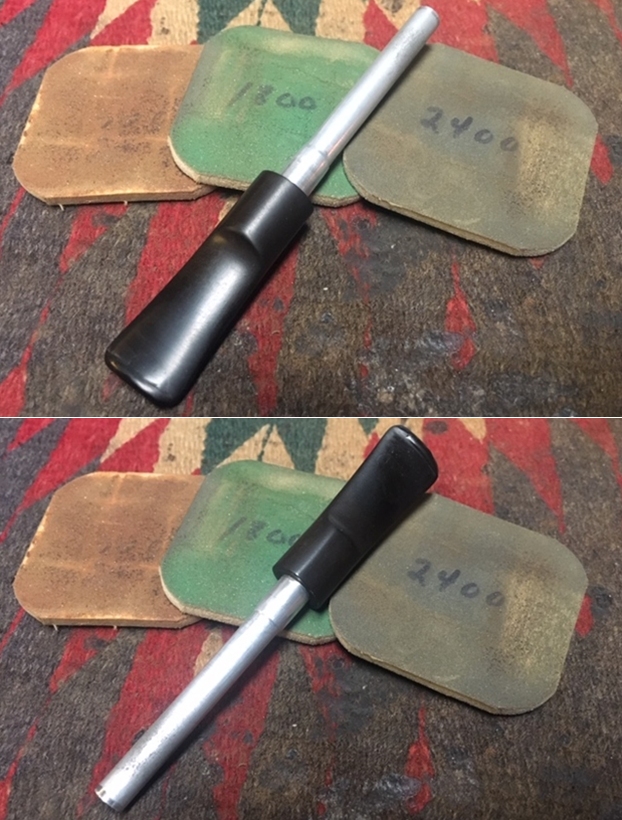
It was time to get on with the restoration of this old and worn 1925 Dunhill Bruyere Billiard. I really appreciate the hard cleanup work that Jeff did on these pipes. They were a real mess when I sent them to Jeff and I have to tell you it was great that I did not need to clean this pipe. I decided to start the process by dealing with the the damage to the edges and the rim top of the bowl. I used some clear Krazy Glue to stabilize the ragged edges of the rim top. You can see the cuts and gouges but there are also some areas that looked like splintering. I spread the glue on the rim top to smooth and bind it all together. Once it cured I lightly topped the bowl to get a flat surface to work with. It looked good once it was cleaned up. It looks like a more radical topping than it actually is. I know some of you would have left it as it stood, but I decided to address the roughness. I was afraid it would splinter out and cause more damage so I chose to minimize the damage as much as possible without radically changing the profile. The inner edge of the rim looked bad at this point. Hacked and carved up. It would take a bit of work to reduce it. The outer edge also had some issues that would need to be addressed. I worked on the inner edge with a folded piece of 220 grit sandpaper and gave it a very slight bevel. I was able to remove much of the damage. I used a folded piece of 220 grit sandpaper to smooth out the damage on the outer edge of the bowl as well.  The second photo below shows the rim top and edges after my work on them…though not perfect I think it is an improvement. I was hoping that polishing the rim top and briar would help to blend to the top with the bowl enough that I would not need to stain it. Remember I said that I gently topped it. When I wet the briar it actually looked very close! Here is hoping! I polished the briar on the rim top and bowl with worn micromesh sanding pads – wet sanding it with 1500-12000 grit micromesh sanding pads. I wiped it down after each pad with a damp cloth. I find that the worn pads do a great job polishing and still retain the original patina of the pipe.  By the time I was finished the rim top was looking very close in colour to the rest of the bowl. I was not going to have to stain it.    I rubbed the bowl and rim down with Before & After Restoration Balm. I worked it into the surface of the briar with my fingertips to clean, enliven and protect it. I let the balm sit for a little while and then buffed the pipe with a cotton cloth to raise the shine. I really like watching the Balm do its magic and bring the briar alive.    With the bowl done it was time to address the stem. The dents in the top and underside were the right depth for me to lift them. I “painted” the surface of the stem with the flame of a Bic lighter to raise the dents in the surface. I was able to lift most of them to the point that a repair would be less complex.   I filled in the damaged areas on the top and bottom button edges and the small remaining dents on both sides of the stem with clear Krazy Glue. I sanded the surface of the stem with 220 grit sandpaper to remove the remaining oxidation in the vulcanite. I polished it with 400 grit wet dry sand paper.    I rubbed the stem down with Denicare Mouthpiece Polish. I have a few tins of this laying around so I am trying to use them up. It does a pretty good job polishing the stem.  I polished the stem with micromesh sanding pads – wet sanding with 1500-12000 grit sanding pads. I wiped it down after each pad with a damp cloth to remove the sanding dust. I polished it further with Before & After Pipe Polish – both Fine and Extra Fine. I finished by rubbing the stem down with some “No Oxy Oil” to protect the vulcanite. I am experimenting with the product from Briarville and tracking how it works so I can write a review of it. Once again at this point in the restoration process I am excited to be on the homestretch. This is the third of the Dunhill smooth pipes in Bob’s estate that I am working on. It is another one that turned out to be a beautiful 1925 Bruyere Billiard. It was in really rough condition so I really was looking forward to this point in the process when it is put back together, polished and waxed. I put the bowl and stem back together. I polished the bowl and stem with Blue Diamond to polish out the scratches in the briar and the vulcanite. I gave the bowl and the stem multiple coats of carnauba wax. I buffed the pipe with a clean buffing pad to raise the shine. I hand buffed it with a microfiber cloth to deepen the shine. The pipe polished up pretty nicely. The grain around the bowl and shank really came alive with the wax and polish. The black of the tapered vulcanite White Spot stem is a beautiful contrast to the reds and browns of the finished bowl and shank. This was another older Dunhill that was a lot of fun to work on thanks to Jeff’s cleanup work. The pipe is comfortable pipe to hold in the hand. The finished pipe is shown in the photos below. The dimensions of the pipe are Length: 5 ½ inches, Height: 1 ¾ inches, Outside diameter of the bowl: 1 ¼ inches, Chamber diameter: ¾ of an inch. This 1925 Bruyere Billiard is a beauty should be able to last beyond the life of the next pipeman or women who carries on the trust. I have a lot more of Bob’s estate to work on of various brands. Perhaps one of those will catch your attention. Thanks for reading this blog and my reflections on the pipe while I worked on it. This is an interesting estate to bring back to life.

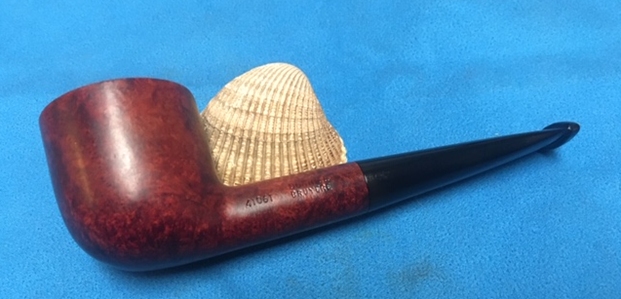
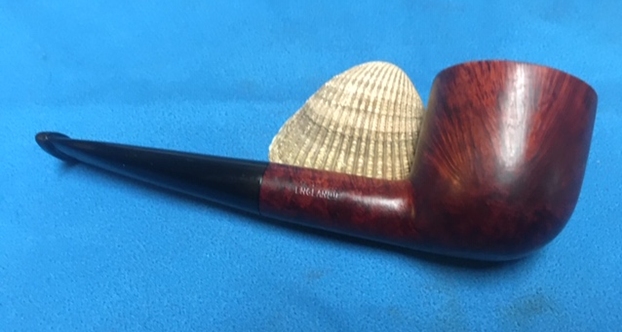
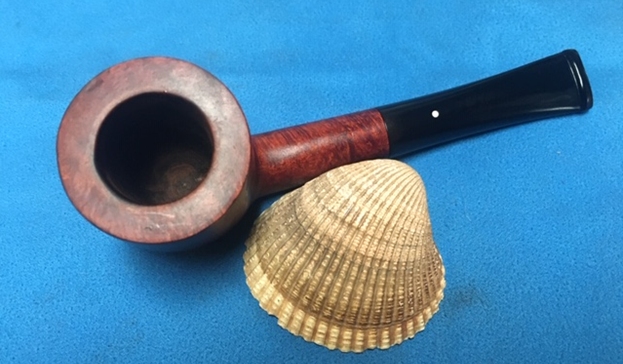
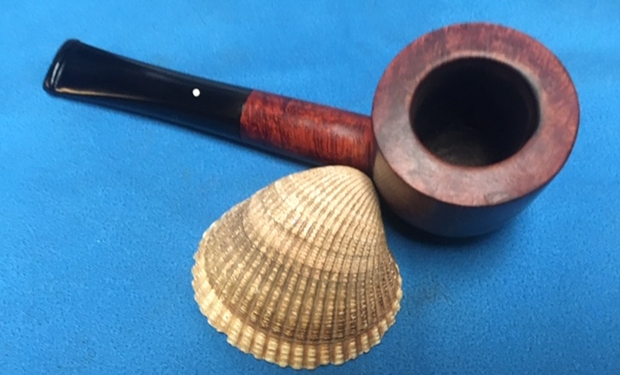
Restoring a 1978 Dunhill Bruyere 41061 from Bob Kerr’s Estate


Blog by Steve Laug

As I continue to work through the pipes in Bob Kerr’s Estate I am enjoying choosing different brands that he had to focus on for a bit. I had eight more from his Dunhill collection that I decided to go back to and finish working my way through that sub collection of the estate. Out of the 8 pipes six were Bruyere finished pipes, one was a Made in London, and one was a Root Briar. What follows is a list of what I saw when I examined the 8 pipes. As I finish the pipes I will include the link to the blog on that particular pipe for easy reference. I have already restored 16 pipes from this subgroup so you can do a quick search to read about the work on the Shell Briars and Tanshell Briars that were in that part of the collection.

  1. Bruyere 656 F/T Made in England 2 Circle 4A – Group 4 size Bruyere made in 1962. Stem is oxidized, tooth marks and chatter near the button, some calcification with damage to the button. Finish is dirty, bowl caked and lava overflow on the rim top. Bowl is out of round, damaged edge.
  2. Bruyere 112 F/T Made in England 9/11 Circle 2A – Group 2 size Bruyere made in 1969 and sold in 1971. Stem is oxidized, tooth marks and chatter near the button, some calcification with damage to the button. Finish is dirty, bowl caked and lava overflow on the rim top. Bowl is out of round, damaged edge.
  3. Bruyere 0333 Made in England 16 made in 1976. Stem is oxidized, tooth marks and chatter near the button, some calcification with damage to the button. Finish is dirty, bowl caked and lava overflow on the rim top. Bowl is out of round, damaged edge.
  4. Bruyere 41061 Made in England 18 made in 1978. Stem is oxidized, tooth marks and chatter near the button, some calcification with damage to the button. Finish is dirty, bowl caked and lava overflow on the rim top. Bowl is out of round, damaged edge.
  5. Bruyere 142 F/T Made in England 7/9/11 Circle 4A – Group for size Bruyere made in 1967 and sent out in 1969 or 1971. Stem is oxidized, tooth marks and chatter near the button, some calcification with damage to the button. Finish is dirty, bowl caked and lava overflow on the rim top. Bowl is out of round, damaged edge.
  6. Bruyere A Inner Tube Patent No. 5831412 Shape 34. Stem is oxidized, tooth marks and chatter near the button, some calcification with damage to the button. Finish is dirty, bowl caked and lava overflow on the rim top. Bowl is out of round, damaged edge. Missing the inner tube.
  7. Made in London 113 539/14. Stem is oxidized, tooth marks and chatter near the button, some calcification with damage to the button. Finish is dirty, bowl caked and lava overflow on the rim top. Bowl is out of round, damaged rim edges.
  8. Root Briar 31032 Made in England 18 – made in 1978. Stem is oxidized, tooth marks and chatter near the button, some calcification with damage to the button. Finish is dirty, bowl caked and lava overflow on the rim top. Bowl is out of round, damaged edge. I finished the restoration on it. Here is the link to the blog – (https://rebornpipes.com/2019/12/23/restoring-a-1978-dunhill-root-briar-31032-billiard-from-bob-kerrs-estate/).

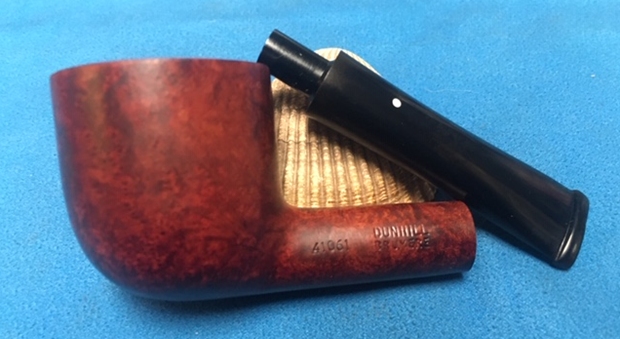
I finished work on #8 and turned my attention to #4 a Bruyere 41061 Pot with a tapered stem.     Chuck Stanion eloquently describes the brand on the Smokingpipes.com site as follows (https://www.smokingpipes.com/pipes/new/dunhill/moreinfo.cfm?product_id=346421):

The Bruyere was Alfred Dunhill’s original finish upon launching his brand of premium pipes and smoking accessories and was the only Dunhill finish from 1910 until 1917. Even after the addition of other finishes, the Bruyere maintained a high level of popularity, becoming synonymous with what is thought of, even today, as the quintessential pipe. To achieve the iconic, ruby hue and saturation, a skilled craftsman painstakingly layers particular stains in a precise manner, then meticulously polishes the pipe to a high luster. The final result is, simply put, timeless.

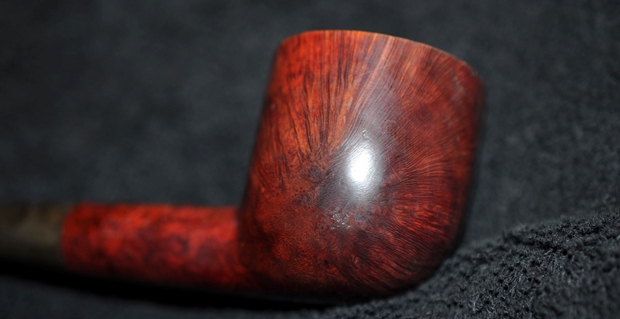
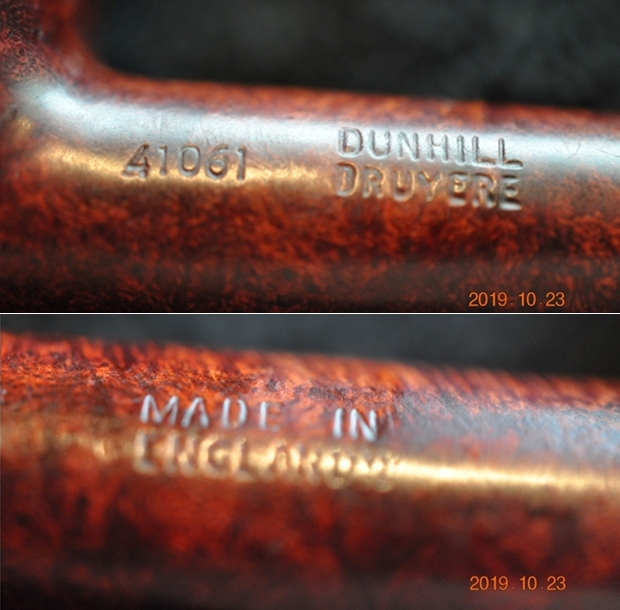
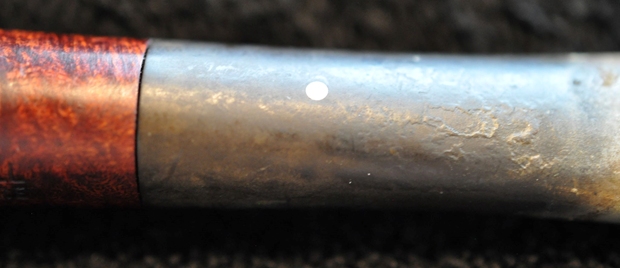
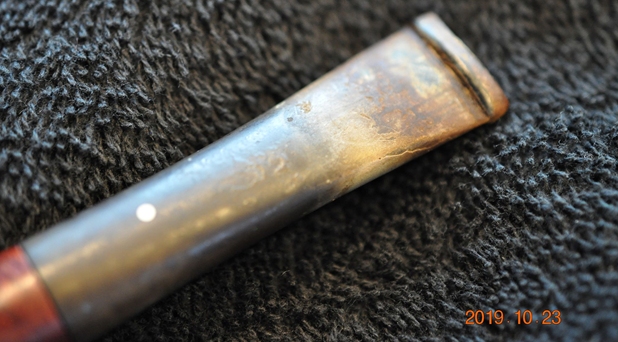
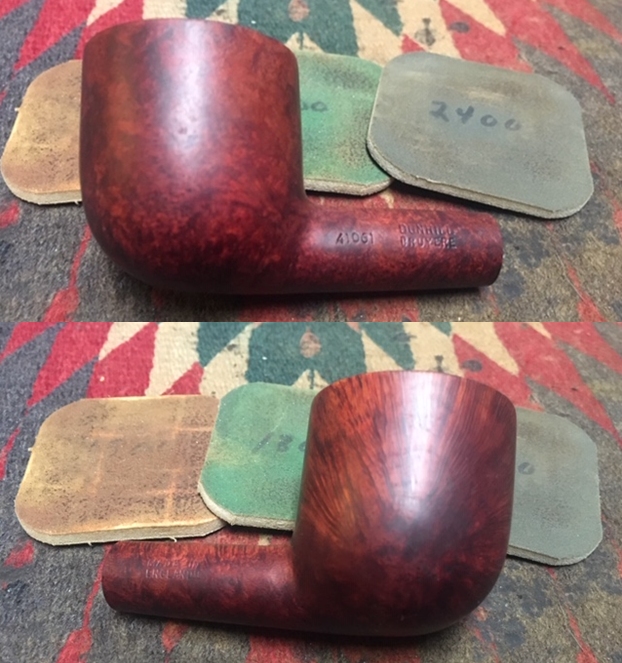
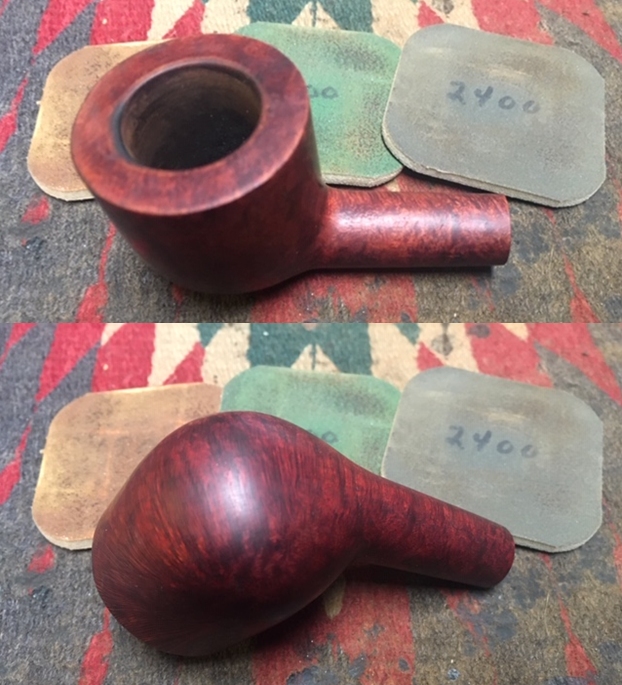
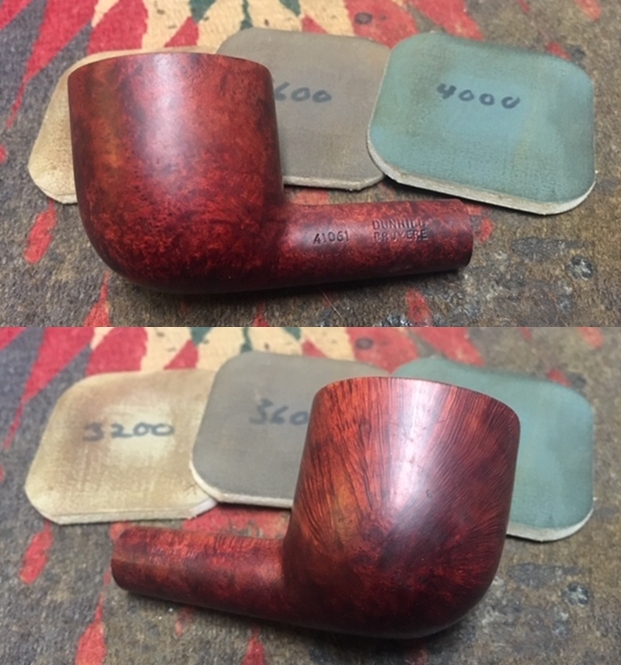
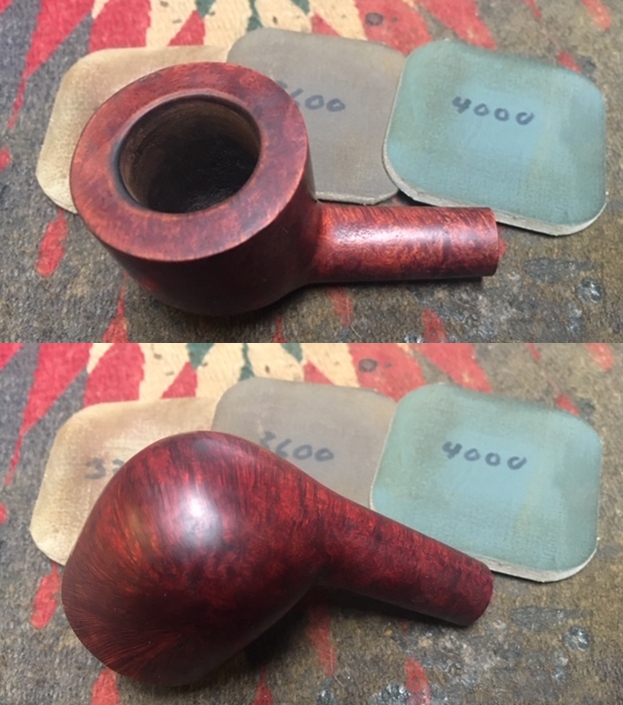
The pipe was stamped on the left side of the shank with the five digit shape number next to the bowl/shank junction. It read 41061. That is followed by Dunhill over Bruyere. On the right side of the shank it is stamped Made in England 18 which would make it a pipe made in 1978. The shape number code can be broken down to give a lot of information. Typically Dunhill pipes are stamped with a four digit code. The first digit (1-6) denotes the group size of the pipe. In this case it is a Group 4 sized pipe. The second digit denotes the style of the mouthpiece (0,1=tapered, 2=saddle). In this case it is a 1 which matches the tapered stem on the shank. The third and fourth digits give the generic shape in the chart below. I have captured part of the chart to identify this pipe as a 06 or a straight Pot. When 5 digits occur, the meaning of the 4 first remains the same (http://www.pipephil.eu/logos/en/dunhill/shapes.html). There was a thick cake in the bowl with remnants of tobacco stuck on the walls. There was a lava overflow on the rim. The top and edges of the rim appear to be in good condition though there appears to be a little burn damage on the left front inner edge of the bowl. The outer edge looks very good. The grain on this is beautiful – diagonal or flame grain and some cross grain on the heel of the bowl. I think that there is a beautiful pipe underneath all of the buildup of years of use. The sides of the bowl had some darkening from oils and tars. The stem was oxidized and calcified toward the end with some tooth chatter. There were also some tooth marks on both sides of the stem ahead of the button and on the button itself. There was the classic White Spot on the top of the stem. Jeff took photos of the pipe before he started his cleanup work on it.  Jeff took photos of the bowl and rim top to show the thick, hard cake in the bowl with remnants of tobacco stuck on the walls of the bowl. There was a lava build up on the smooth rim top and the edges of the bowl. The rim top looked pretty good but it was hard to know for sure. It appeared that there was damage at the back and the front of the inner edge. The outer edges looked good.    Jeff took a photo of the side and heel of the bowl to show the condition of the finish. You can see the beautiful grain patterns around the sides of the bowl and shank. Even under the dirt and debris of the years it looked very good.The stamping is readable and on the left side of the shank you can see the shape number 41061 as noted above followed by Dunhill over Bruyere. On the right side it reads Made In England with the date stamp 18 after the D in England. He included a pic of the White Spot on the stem. Jeff took photos of the top and underside of the stem showing the tooth chatter, scratching, calcification and oxidation on the stem surface and wear on the edges of the button. I am really happy to have Jeff’s help on cleaning up the pipes from Bob’s estate as the 125+ pipes were taking me a long time to do alone. He cleaned this filthy pipe with his usual penchant for thoroughness that I really appreciate. This one was a real mess and I was looking forward to seeing what he had done with this one when I took it out of his box. It looked amazing and CLEAN. He reamed it with a PipNet pipe reamer and cleaned up the reaming with a Savinelli Fitsall Pipe Knife. He scrubbed out the internals with alcohol, pipe cleaners and cotton swabs until the pipe was clean. He scrubbed the exterior of the bowl with Murphy’s Oil Soap and a tooth brush to remove the grime and grit on the briar and the lava on the rim top. The finish looks very good with great looking grain around the bowl and shank. It looked like there were some dents in the briar on the right side of the bowl that would need to be dealt with. The stem looked a lot better. Jeff soaked the stem in Before & After Deoxidizer to remove the oxidation on the rubber. The pipe was ready for me to carry on the next part of the process. I took some close up photos of the rim top and also of the stem surface. I wanted to show how well it had cleaned up and what needed to be done. The rim top had a dent on the right outer edge and some darkening toward the back of the bowl and on the inner edge. There was also some burn damage on the front inner edge of the bowl. The outer edge looked very good.  I also took close up photos of the stem to show the tooth marks and chatter on the stem surface.The stamping appeared to be as clear as ever on the shank sides. This is just one of the things I appreciate about Jeff’s cleanup is that he works to protect and preserve the nomenclature on the shank of the pipes that he works on. I took some photos to show the stamping. Bob loved his Dunhill pipes and it was obvious that he enjoyed smoking them. Some appeared to be daily smokes while others he seemed to reserve for special occasions. Some seemed like they must have hung in his mouth while he did his carving while others were smoked in his chair. Having worked on over 60 of his pipes so far I am getting a feel for them.

I am sure that many of you have read at least some of the other restoration work that I have done on previous pipes. You have also read what I have included about Bob Kerr, the pipeman who held these pipes in trust before I came to work on them (see photo to the left). Also, if you have followed the blog for long you will already know that I like to include background information on the pipeman whose pipes I am restoring. For me, when I am working on an estate I really like to have a sense of the person who held the pipes in trust before I worked on them. It gives me another dimension of the restoration work. Bob’s daughter wrote a short tribute to her father. I thank you Brian and tell your wife thank you as well.

I am delighted to pass on these beloved pipes of my father’s. I hope each user gets many hours of contemplative pleasure as he did. I remember the aroma of tobacco in the rec room, as he put up his feet on his lazy boy. He’d be first at the paper then, no one could touch it before him. Maybe there would be a movie on with an actor smoking a pipe. He would have very definite opinions on whether the performer was a ‘real’ smoker or not, a distinction which I could never see but it would be very clear to him. He worked by day as a sales manager of a paper products company, a job he hated. What he longed for was the life of an artist, so on the weekends and sometimes mid-week evenings he would journey to his workshop and come out with wood sculptures, all of which he declared as crap but every one of them treasured by my sister and myself. Enjoy the pipes, and maybe a little of his creative spirit will enter you!

It was time to get on with the restoration of this beautiful and worn Dunhill Bruyere Pot. I really appreciate the hard cleanup work that Jeff did on these pipes. They were a real mess when I sent them to Jeff and I have to tell you it was great that I did not need to clean this pipe. I decided to start the process by dealing with the the damage to the inner edge of the bowl. I worked on the inner edge with a folded piece of 220 grit sandpaper and gave it a very slight bevel. I was able to remove much of the damage. I gave the freshly beveled edge a stain coat with a walnut stain pen to blend the edge into the rim top finish. There was a large dent in the rim top near the outer edge that I wanted to deal with. You can see on it in the first picture below. I have used a red arrow to clearly identify the issue that I wanted to address. It looks almost like a fill but it is not – just a deep dent.  I set up my wife’s steam iron on the kitchen counter top. I put a damp cloth next over the dent and applied the steam iron to the surface. It took several attempts but the dent raise to the surface.   I polished the briar on the rim top and bowl with worn micromesh sanding pads – wet sanding it with 1500-12000 grit micromesh sanding pads. I wiped it down after each pad with a damp cloth. I find that the worn pads do a great job polishing and still retain the original patina of the pipe.   I rubbed the bowl and rim down with Before & After Restoration Balm. I worked it into the surface of the briar with my fingertips to clean, enliven and protect it. I let the balm sit for a little while and then buffed the pipe with a cotton cloth to raise the shine. I really like watching the Balm do its magic and bring the briar alive.    With the bowl finished I turned my attention to the stem. I sanded the surface of the stem with 220 grit sandpaper to remove the remaining oxidation in the vulcanite. I polished it with 400 grit wet dry sand paper.  I polished the stem with micromesh sanding pads – wet sanding with 1500-12000 grit sanding pads. I wiped it down after each pad with a damp cloth to remove the sanding dust. I polished it further with Before & After Pipe Polish – both Fine and Extra Fine. I finished by rubbing the stem down with some “No Oxy Oil” to protect the vulcanite. I am experimenting with the product from Briarville and tracking how it works so I can write a review of it.  Once again at this point in the restoration process I am excited to be on the homestretch. This is the second of the Dunhill smooth pipes in Bob’s estate that I am working on. It is a beautiful Bruyere 41061 Pot. I always look forward to this point in the process when it is put back together, polished and waxed. I put the bowl and stem back together. I polished the bowl and stem with Blue Diamond to polish out the scratches in the briar and the vulcanite. I gave the bowl and the stem multiple coats of carnauba wax. I buffed the pipe with a clean buffing pad to raise the shine. I hand buffed it with a microfiber cloth to deepen the shine. The pipe polished up pretty nicely. The grain around the bowl and shank really came alive with the wax and polish. The black of the tapered vulcanite White Spot stem is a beautiful contrast to the reds and browns of the finished bowl and shank. This Dunhill was a lot of fun to work on thanks to Jeff’s cleanup work. The pipe is comfortable pipe to hold in the hand. The finished pipe is shown in the photos below. The dimensions of the pipe are Length: 5 ¼ inches, Height: 1 ¾ inches, Outside diameter of the bowl: 1 ½ inches, Chamber diameter: ¾ of an inch. This 78 Bruyere Pot is a beauty that is already spoken for by fellow in the US. I have a lot more of Bob’s estate to work on of various brands. Perhaps one of those will catch your attention. Thanks for reading this blog and my reflections on the pipe while I worked on it. This is an interesting estate to bring back to life.

Restoring a 1978 Dunhill Root Briar 31032 Billiard from Bob Kerr’s Estate


Blog by Steve Laug

As I continue to work through the pipes in Bob Kerr’s Estate I am enjoying choosing different brands that he had to focus on for a bit. I had eight more from his Dunhill collection that I decided to go back to and finish working my way through that sub collection of the estate. Out of the 8 pipes six were Bruyere finished pipes, one was a Made in London, and one was a Root Briar. What follows is a list of what I saw when I examined the 8 pipes. As I finish the pipes I will include the link to the blog on that particular pipe for easy reference. I have already restored 16 pipes from this subgroup so you can do a quick search to read about the work on the Shell Briars and Tanshell Briars that were in that part of the collection.

  1. Bruyere 656 F/T Made in England 2 Circle 4A – Group 4 size Bruyere made in 1962. Stem is oxidized, tooth marks and chatter near the button, some calcification with damage to the button. Finish is dirty, bowl caked and lava overflow on the rim top. Bowl is out of round, damaged edge.
  2. Bruyere 112 F/T Made in England 9/11 Circle 2A – Group 2 size Bruyere made in 1969 and sold in 1971. Stem is oxidized, tooth marks and chatter near the button, some calcification with damage to the button. Finish is dirty, bowl caked and lava overflow on the rim top. Bowl is out of round, damaged edge.
  3. Bruyere 0333 Made in England 16 made in 1976. Stem is oxidized, tooth marks and chatter near the button, some calcification with damage to the button. Finish is dirty, bowl caked and lava overflow on the rim top. Bowl is out of round, damaged edge.
  4. Bruyere 41061 Made in England 18 made in 1978. Stem is oxidized, tooth marks and chatter near the button, some calcification with damage to the button. Finish is dirty, bowl caked and lava overflow on the rim top. Bowl is out of round, damaged edge.
  5. Bruyere 142 F/T Made in England 7/9/11 Circle 4A – Group for size Bruyere made in 1967 and sent out in 1969 or 1971. Stem is oxidized, tooth marks and chatter near the button, some calcification with damage to the button. Finish is dirty, bowl caked and lava overflow on the rim top. Bowl is out of round, damaged edge.
  6. Bruyere A Inner Tube Patent No. 5831412 Shape 34. Stem is oxidized, tooth marks and chatter near the button, some calcification with damage to the button. Finish is dirty, bowl caked and lava overflow on the rim top. Bowl is out of round, damaged edge. Missing the inner tube.
  7. Made in London 113 539/14. Stem is oxidized, tooth marks and chatter near the button, some calcification with damage to the button. Finish is dirty, bowl caked and lava overflow on the rim top. Bowl is out of round, damaged rim edges.
  8. Root Briar 31032 Made in England 18 – made in 1978. Stem is oxidized, tooth marks and chatter near the button, some calcification with damage to the button. Finish is dirty, bowl caked and lava overflow on the rim top. Bowl is out of round, damaged edge.

I chose to work on #8 next, the sole Root Briar pipe remaining in the collection. Paresh had picked up an earlier one that I had finished to add to his collection in India. The highest honor for a Dunhill pipe is to receive the prestigious Root Briar appellation. Root Briars have been coveted by pipesmokers ever since they first debuted in 1931, due to the fact that each pipe must boast briar completely free of even the most minor of blemishes. Dunhill has the strictest of standards and expectations for quality with all of their pipes, and so any block of briar that comes to bear the Root Briar stamp must indeed be superlative.

The pipe was stamped on the left side of the shank with the five digit shape number next to the bowl/shank junction. It read 31032. That is followed by Dunhill over Root Briar. On the right side of the shank it is stamped Made in England 18 which would make it a pipe made in 1978. The shape number code can be broken down to give a lot of information. Typically Dunhill pipes are stamped with a four digit code. The first digit (1-6) denotes the group size of the pipe. In this case it is a Group 3 sized pipe. The second digit denotes the style of the mouthpiece (0,1=tapered, 2=saddle). In this case it is a 1 which matches the tapered stem on the shank. The third and fourth digits give the generic shape in the chart below. I have captured part of the chart to identify this pipe as a 03 or a straight Billiard. When 5 digits occur, the meaning of the 4 first remains the same (http://www.pipephil.eu/logos/en/dunhill/shapes.html). There was a thick cake in the bowl with remnants of tobacco stuck on the walls. There was a lava overflow on the rim. The top and edges of the rim appear to be in good condition though there appears to be a little burn damage on the left front inner edge of the bowl. The outer edge looks very good. The grain on this is beautiful – diagonal or flame grain and some birdseye on the heel of the bowl. I think that there is a beautiful pipe underneath all of the buildup of years of use. The sides of the bowl had some darkening from oils and tars. The stem was oxidized and calcified toward the end with some tooth chatter. There were also some tooth marks on both sides of the stem ahead of the button and on the button itself. There was the classic White Spot on the top of the stem. Jeff took photos of the pipe before he started his cleanup work on it. Jeff took photos of the bowl and rim top to show the thick, hard cake in the bowl with remnants of tobacco stuck on the walls of the bowl. There was a lava build up on the smooth rim top and the edges of the bowl. The rim top looked pretty good but it was hard to know for sure. It appeared that there was damage at the back and the front of the inner edge. The outer edges looked good.    Jeff took photos of the side and heel of the bowl to show the condition of the finish. You can see the beautiful grain patterns around the sides of the bowl and shank. Even under the dirt and debris of the years it looked very good.The stamping is readable and on the left side of the shank you can see the shape number 31032 as noted above followed by Dunhill over Root Briar. On the right side it reads Made In England with the date stamp 18 after the D in England. He included a pic of the White Spot on the stem. Jeff took photos of the top and underside of the stem showing the tooth chatter, scratching and oxidation on the stem surface and wear on the edges of the button.I am really happy to have Jeff’s help on cleaning up the pipes from Bob’s estate as the 125+ pipes were taking me a long time to do alone. He cleaned this filthy pipe with his usual penchant for thoroughness that I really appreciate. This one was a real mess and I was looking forward to seeing what he had done with this one when I took it out of his box. It looked amazing and CLEAN. He reamed it with a PipNet pipe reamer and cleaned up the reaming with a Savinelli Fitsall Pipe Knife. He scrubbed out the internals with alcohol, pipe cleaners and cotton swabs until the pipe was clean. He scrubbed the exterior of the bowl with Murphy’s Oil Soap and a tooth brush to remove the grime and grit on the briar and the lava on the rim top. The finish looks very good with great looking grain around the bowl and shank. It looked like there were some dents in the briar on the right side of the bowl that would need to be dealt with. The stem looked a lot better. Jeff soaked the stem in Before & After Deoxidizer to remove the oxidation on the rubber. The pipe was ready for me to carry on the next part of the process. I took some close up photos of the rim top and also of the stem surface. I wanted to show how well it had cleaned up and what needed to be done. The rim top had some darkening toward the back of the bowl and on the inner edge. There was also some burn damage on the front inner edge of the bowl. The outer edge looked very good.  I also took close up photos of the stem to show the tooth marks and chatter on the stem surface.   The stamping appeared to be as clear as ever on the shank sides. This is just one of the things I appreciate about Jeff’s cleanup is that he works to protect and preserve the nomenclature on the shank of the pipes that he works on. I took some photos to show the stamping. Bob loved his Dunhill pipes and it was obvious that he enjoyed smoking them. Some appeared to be daily smokes while others he seemed to reserve for special occasions. Some seemed like they must have hung in his mouth while he did his carving while others were smoked in his chair. Having worked on over 60 of his pipes so far I am getting a feel for them.
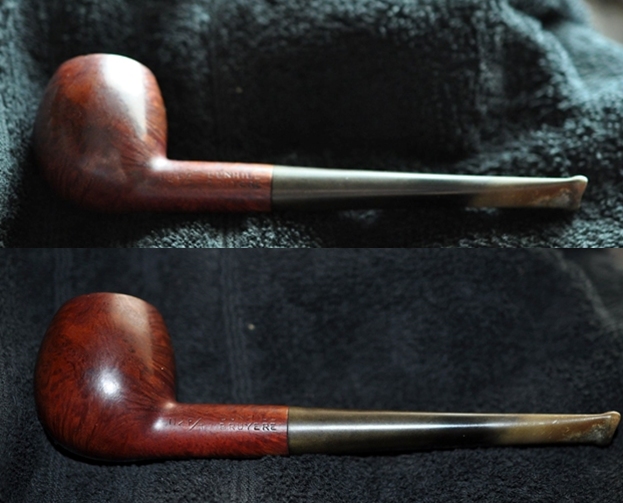
I am sure that many of you have read at least some of the other restoration work that I have done on previous pipes. You have also read what I have included about Bob Kerr, the pipeman who held these pipes in trust before I came to work on them (see photo to the left). Also, if you have followed the blog for long you will already know that I like to include background information on the pipeman whose pipes I am restoring. For me, when I am working on an estate I really like to have a sense of the person who held the pipes in trust before I worked on them. It gives me another dimension of the restoration work. Bob’s daughter wrote a short tribute to her father. I thank you Brian and tell your wife thank you as well.

I am delighted to pass on these beloved pipes of my father’s. I hope each user gets many hours of contemplative pleasure as he did. I remember the aroma of tobacco in the rec room, as he put up his feet on his lazy boy. He’d be first at the paper then, no one could touch it before him. Maybe there would be a movie on with an actor smoking a pipe. He would have very definite opinions on whether the performer was a ‘real’ smoker or not, a distinction which I could never see but it would be very clear to him. He worked by day as a sales manager of a paper products company, a job he hated. What he longed for was the life of an artist, so on the weekends and sometimes mid-week evenings he would journey to his workshop and come out with wood sculptures, all of which he declared as crap but every one of them treasured by my sister and myself. Enjoy the pipes, and maybe a little of his creative spirit will enter you!

It was time to get on with the restoration of this beautiful and worn Dunhill Root Briar Billiard. I really appreciate the hard cleanup work that Jeff did on these pipes. They were a real mess when I sent them to Jeff and I have to tell you it was great that I did not need to clean this pipe. I decided to start the process by dealing with the dents in the briar on both sides of the bowl. I heated a knife with the flame on our gas stove and dampened a cloth. I put the cloth over the dents and applied the hot knife to the surface. The heat generated steam and lifted the dents. I applied the knife several times before I was happy with the look of the bowl. I then went on to address the damage to the inner edge of the bowl. I worked on the inner edge with a folded piece of 220 grit sandpaper and gave it a very slight bevel. I was able to remove much of the damage. There was still a slight “dip” in the edge at the front. The photos show the progress.   I polished the briar on the rim top with micromesh sanding pads – wet sanding it with 1500-4000 grit pads and I wiped the bowl down after each sanding pad with a damp cloth.  The grain progressively stood out as I polished the pipe with the pads.   I paused the polishing to restain the rim top to match the rest of the pipe. I used a walnut stain pen and was able to get the match. The rim top would need to be polished but the colour was right so time would tell.I continued to polish the bowl with 6000-12000 grit micromesh sanding pads. I wiped it down after each pad with a damp cloth.   I rubbed the bowl and rim down with Before & After Restoration Balm. I worked it into the surface of the briar with my fingertips to clean, enliven and protect it. I let the balm sit for a little while and then buffed the pipe with a cotton cloth to raise the shine. I really like watching the Balm do its magic and bring the briar alive.    With the bowl done it was time to address the stem. The dents in the top and underside were the right depth for me to lift them. I “painted” the surface of the stem with the flame of a Bic lighter to raise the dents in the surface. I was able to lift most of them to the point that a repair would be less complex.   I filled in the damaged areas on the button edge and the small remaining dents in the underside of the stem with clear Krazy Glue. Once the repair had cured I used a flat needle file to reshape the button and edges. The stem is starting to take shape.  I sanded the surface of the stem with 220 grit sandpaper to remove the remaining oxidation in the vulcanite. I polished it with 400 grit wet dry sand paper.    I rubbed the stem down with Denicare Mouthpiece Polish. I have a few tins of this laying around so I am trying to use them up. It does a pretty good job polishing the stem.  I polished the stem with micromesh sanding pads – wet sanding with 1500-12000 grit sanding pads. I wiped it down after each pad with a damp cloth to remove the sanding dust. I polished it further with Before & After Pipe Polish – both Fine and Extra Fine. I finished by rubbing the stem down with some “No Oxy Oil” to protect the vulcanite. I am experimenting with the product from Briarville and tracking how it works so I can write a review of it.  Once again at this point in the restoration process I am excited to be on the homestretch. This is the first of the Dunhill smooth pipes in Bob’s estate that I am working on. It is a beautiful Root Briar 31032 Billiard. I always look forward to this point in the process when it is put back together, polished and waxed. I put the bowl and stem back together. I polished the bowl and stem with Blue Diamond to polish out the scratches in the briar and the vulcanite. I gave the bowl and the stem multiple coats of carnauba wax. I buffed the pipe with a clean buffing pad to raise the shine. I hand buffed it with a microfiber cloth to deepen the shine. The pipe polished up pretty nicely. The grain around the bowl and shank really came alive with the wax and polish. The black of the tapered vulcanite White Spot stem is a beautiful contrast to the browns of the finished bowl and shank. This is Dunhill was a lot of fun to work on thanks to Jeff’s cleanup work. The pipe is comfortable pipe to hold in the hand. The finished pipe is shown in the photos below. The dimensions of the pipe are Length: 5 ¼ inches, Height: 1 ¾ inches, Outside diameter of the bowl: 1 ¼ inches, Chamber diameter: ¾ of an inch. This 78 Root Briar Billiard is a beauty that I am still trying to figure out whether to sell it or buy it. It will take a bit of time and once I decide I will either enjoy it or it will be going on the rebornpipes store. I have a lot more of Bob’s estate to work on of various brands. Perhaps one of those will catch your attention. Thanks for reading this blog and my reflections on the pipe while I worked on it. This is an interesting estate to bring back to life.

A Brigham Patent Era Standard 102 Rusticated Crosby from Bob Kerr’s Estate


Blog by Steve Laug

As I continue to work through the pipes in Bob Kerr’s Estate I am enjoying choosing different brands that he had to focus on for a bit. He had six different pipes from Brigham in his collection so I decided to work my way through that sub collection of the estate. Out of the 6 pipes, #5 has a ruined bowl with a crack all the way around it as well as a cut off aluminum tenon. #6 went to Paresh Deshpande in India for his collection. That left behind four pipes for me to restore – #1, #2, #3 and #4. Here is the list of what I saw when I examined the 6 pipes. I have already restored #1, #2 and #3 and included the link to the appropriate blog.

  1. Brigham 503T Can. Pat. 372982 5 Dot Stack. Stem is oxidized, tooth marks and chatter near the button, some calcification with damage to the button. Finish is dirty, thick cake and lava overflow on the rim top. Rim top has is worn and damage on the back edge. I have finished restoring this one. Here is the link: (https://rebornpipes.com/2019/12/21/a-brigham-patent-era-special-grain-stack-from-bob-kerrs-estate/).
  2. Brigham Made In Canada 490 4 Dot Canadian. Stem is oxidized, tooth marks and chatter near the button, some calcification with damage to the button. Finish is dirty, thick cake and lava overflow on the rim top. Rim top is worn and damaged. I have finished restoring this one. Here is the link: (https://rebornpipes.com/2019/12/22/a-brigham-patent-era-director-490-rusticated-canadian-from-bob-kerrs-estate/).
  3. Brigham Made In Canada 2199 2 Dot Club/Lovat. Stem is oxidized, tooth marks and chatter near the button, some calcification with damage to the button. Finish is dirty and worn. Stamping is worn. There is a thick cake and lava overflow on the rim top. Rim top is worn and damaged. I have finished restoring this one. Here is the link: (https://rebornpipes.com/2019/12/21/a-brigham-patent-era-select-601-club-lovat-from-bob-kerrs-estate/).
  4. Brigham Made In Canada 102 1 Dot Bing Crosby Style Pipe/Small Billiard. Stem is oxidized, tooth marks and chatter near the button, some calcification with damage to the button. Finish is dirty, thick cake and lava overflow on the rim top. Rim top is worn and damage on the back edge.
  5. Brigham Made In Canada 6 Dot Bent Billiard. Stem is oxidized, tooth marks and chatter near the button, some calcification with damage to the button. The aluminum tenon has been cut off. Finish is dirty and worn with paint on the bowl. There is a thick cake and lava overflow on the rim top. Rim top has a crack on the right side. CRACKED BOWL
  6. Brigham Made In Canada 4 Dot Canadian. Stem is oxidized, tooth marks and chatter near the button, some calcification with damage to the button. Finish is dirty and stamping is worn. There is a thick cake and lava overflow on the rim top. Rim top is worn and edges are damaged. SENT TO PARESH

I chose to work on #4 next, the second rusticated pipe in the collection. It is a Brigham Rusticated Crosby or what Brigham calls a small billiard. To me the long stem will forever remind me of Bing Crosby and White Christmas. It was stamped on the underside of the shank with faint stamping visible with a lens under light. It reads Brigham over Can. Pat. 372982. On the heel of the bowl it was stamped with the shape number 102. There was a thick cake in the bowl with remnants of tobacco stuck on the walls. There was a lava overflow on the rim. The top and edges of the rim appear to have some damage all the way around the bowl. The rustication was the pattern I have become accustomed to on Brigham pipes. Once again, I think that there was a beautiful pipe underneath all of the buildup of years of use. The stem was oxidized and calcified toward the end with some tooth chatter. There were also some tooth marks on both sides of the stem ahead of the button. There was a pattern of four brass dots on the left side of the tapered stem. Jeff took photos of the pipe before he started his cleanup work on it. Jeff took photos of the bowl and rim top to show the thick, hard cake in the bowl with remnants of tobacco stuck on the walls of the bowl. There was a lava build up on the smooth rim top and the edges of the bowl. The rim top looked pretty good but it was hard to know for sure but it appeared that there was damage all around the inner edge. The outer edges looked good.  Jeff took a photo of the side and heel of the bowl to show the condition of the finish. You can see the beautiful rustication patterns around the side of the bowl and shank. Even under the dirt and debris of the years it looked very good.    The stamping is very faint. With a light and lens the stamping Brigham is visible. The first photo shows the shape number on the heel of the bowl. The second photo shows the Can. Pat. Number that is underneath the Brigham stamp. He included a pic of the 1 brass dot on the stem.  Jeff took photos of the top and underside of the stem showing the tooth chatter, scratching and oxidation on the stem surface and wear on the edges of the button.I am also including the information from Pipedia’s article on Brigham pipes. It is a great read in terms of the history of the brand (https://pipedia.org/wiki/Brigham_Pipes). Charles Lemon (Dadspipes) is currently working on a book on the history of the brand. Until that is complete this article is a good summary. I have included it below.
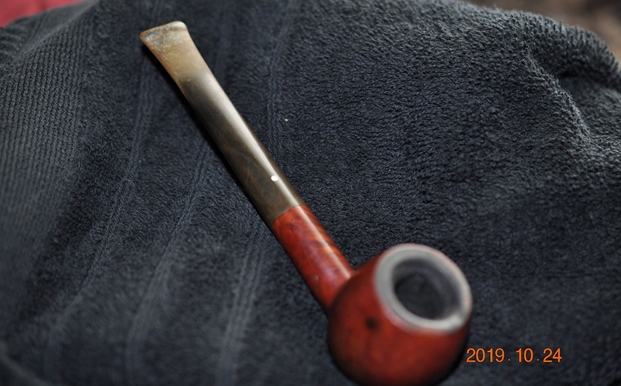
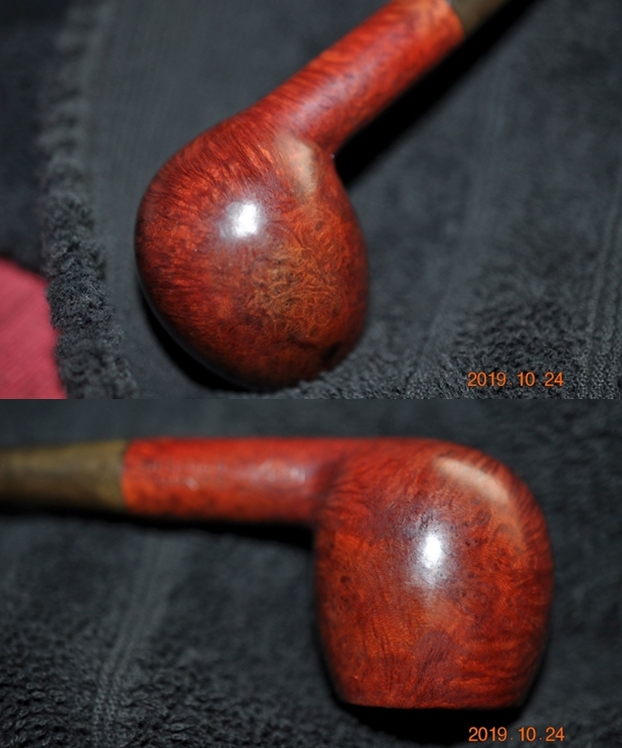
Roy Brigham, after serving an apprenticeship under an Austrian pipesmith, started his own pipe repair shop in Toronto, in 1906. By 1918 the business had grown to include five other craftsmen and had developed a reputation across Canada for the high quality of workmanship. After repairing many different brands of pipes over the years, Roy noted certain recurring complaints by pipe smokers, the most common referred to as “tongue bite”. Tongue bite is a burning sensation on the smoker’s tongue, previously thought to be due to the heat of the smoke (i.e. a “hot smoking pipe”).

He soon began manufacturing his own pipes, which were lightweight, yet featured a more rugged construction, strengthening the weak points observed in other pipes. The problem of tongue bite intrigued him, and he decided to make overcoming it a future goal.

About 1938, Roy’s son Herb joined him to assist in the business. The business barely survived the great depression because pipes were considered to be a luxury, not a necessity, and selling pipes was difficult indeed. In approximately 1937 [1], after some experimentation, Roy and Herb discovered that tongue bite was in fact a form of mild chemical burn to the tongue, caused by tars and acids in the smoke. They found that by filtering the smoke, it was possible to retain the flavour of the tobacco and yet remove these impurities and thereby stop the tongue bite.

Just as Thomas Edison had searched far and wide for the perfect material from which to make the first electric light bulb filaments, Roy & Herb began experimenting with many materials, both common and exotic, in the quest for the perfect pipe filter. Results varied wildly. Most of the materials didn’t work at all and some actually imparted their own flavour into the smoke. They eventually found just two materials that were satisfactory in pipes: bamboo and rock maple. As bamboo was obviously not as readily available, rock maple then became the logical choice.

They were able to manufacture a replaceable hollow wooden tube made from rock maple dowelling, which when inserted into a specially made pipe, caused absolutely no restriction to the draw of the pipe, yet extracted many of the impurities which had caused tongue bite. The result was indeed a truly better smoking pipe…

I wrote to Charles Lemon (Dadspipes) and asked him about the stamping on the pipe. He responded with information on all of the foursome. I am including the information on this particular pipe.

Hey Steve! Good to hear from you.

Lastly, the 102 is a Small Billiard- not the smallest Brigham (the 01 shape is an even smaller billiard) but pretty compact…As these are all Patent pipes, it’s more accurate to refer to their grade by name (the post 1980 grading scheme refers to Dots). Here is the original scheme:With the information from Charles’ message and the chart above that he included I knew what I was dealing with in terms of the stamping and the age of this pipe. I learned that this Patent Era 102 is a Brigham Standard (1-Dot) Small Billiard, though I would call the long shanked bowl a Crosby. It was made between 1938 and 1955. Most of Bob’s pipes were purchased in the 50s and 60s so my guess is that this is fits that time frame well. Now it was time to work on the pipe.

I am really happy to have Jeff’s help on cleaning up the pipes from Bob’s estate as the 125+ pipes were taking me a long time to do alone. He cleaned this filthy pipe with his usual penchant for thoroughness that I really appreciate. This one was a real mess and I did not know what to expect when I unwrapped it from his box. He reamed it with a PipNet pipe reamer and cleaned up the reaming with a Savinelli Fitsall Pipe Knife. He scrubbed out the internals with alcohol, pipe cleaners and cotton swabs until the pipe was clean. He scrubbed the exterior of the bowl with Murphy’s Oil Soap and a tooth brush to remove the grime and grit on the briar and the lava on the rim top. The finish looks very good with great looking grain around the bowl and shank. Jeff soaked the stem in Before & After Deoxidizer to remove the oxidation on the rubber. When the pipe arrived here in Vancouver for the second stop of its restoration tour I was amazed it looked so good. I took some close up photos of the rim top and also of the stem surface. I wanted to show what an amazing job Jeff did in the cleanup of the rim top. The rim top was darkened with nicks and damage to the rim top and inner edge of the bowl. The outer edge looked very good.  I also took close up photos of the stem to show the tooth marks and chatter on the stem surface.I took the stem off the shank to show the aluminum tenon/tube that was used to hold the Brigham Rock Maple Distillator. The original Distillator (filter) had been filthy so after Jeff had cleaned the pipe up he threw it away. I will replace it once I have finished with the restoration.This was a tough pipe to photograph the stamping on because it was very faint. When it starts out faint it is very easy to lose even that remnant of a stamp. But one of the things I appreciate about Jeff’s cleanup is that he works to protect and preserve the nomenclature on the shank of the pipes that he works on. I took some photos to show the stamping. In the first photo shows the shape number on the left side 102 and the Patent number mid shank followed by Brigham. The second photo gives a close-up of the shape number.   Since this is another pipe Bob’s estate I am sure that some of you have read at least some of the other restoration work that has been done on the previous pipes. You have also read what I have included about Bob Kerr, the pipeman who held these pipes in trust before I came to work on them (see photo to the left). Also, if you have followed the blog for long you will already know that I like to include background information on the pipeman whose pipes I am restoring. For me, when I am working on an estate I really like to have a sense of the person who held the pipes in trust before I worked on them. It gives me another dimension of the restoration work. Bob’s daughter wrote a short tribute to her father. I thank you Brian and tell your wife thank you as well.

I am delighted to pass on these beloved pipes of my father’s. I hope each user gets many hours of contemplative pleasure as he did. I remember the aroma of tobacco in the rec room, as he put up his feet on his lazy boy. He’d be first at the paper then, no one could touch it before him. Maybe there would be a movie on with an actor smoking a pipe. He would have very definite opinions on whether the performer was a ‘real’ smoker or not, a distinction which I could never see but it would be very clear to him. He worked by day as a sales manager of a paper products company, a job he hated. What he longed for was the life of an artist, so on the weekends and sometimes mid-week evenings he would journey to his workshop and come out with wood sculptures, all of which he declared as crap but every one of them treasured by my sister and myself. Enjoy the pipes, and maybe a little of his creative spirit will enter you!

Now with all of the background on the line and the background on Bob Kerr it was time to get on with the restoration of this rusticated Brigham Standard Crosby/Small Billiard. I really appreciate the hard cleanup work that Jeff did on these pipes. They were a real mess when I sent them to Jeff and I have to tell you it was great that I did not need to clean this pipe. I decided to start the process by dealing with the damage to the rim top and edges of the bowl. I topped it on a topping board with 220 grit sandpaper. I worked on the inner edge with a folded piece of 220 grit sandpaper and gave it a very slight bevel so that it took care of the damage on the inner edge. The photos show the progress. I polished the briar on the rim top with micromesh sanding pads – wet sanding it with 1500-12000 grit pads and I wiped the bowl down after each sanding pad with a damp cloth.  The grain progressively stood out as I polished the pipe with the pads. I rubbed the bowl and rim down with Before & After Restoration Balm. I worked it into the surface of the briar with my fingertips and a horsehair shoe brush to clean, enliven and protect it. I let the balm sit for a little while and then buffed with a cotton cloth to raise the shine. I really like watching the Balm do its magic and bring the briar alive.  With the bowl done it was time to address the stem. The dents in the top and underside were the right depth for me to lift them. I “painted” the surface of the stem with the flame of a Bic lighter to raise the dents in the surface. I was able to lift them to the point that a repair would be a simple sanding job. I sanded the surface of the stem with 220 grit sandpaper to remove the remaining oxidation in the vulcanite. I polished it with 400 grit wet dry sand paper.   I rubbed the stem down with Denicare Mouthpiece Polish. I have a few tins of this laying around so I am trying to use them up. It does a pretty good job polishing the stem. I polished the stem with micromesh sanding pads – wet sanding with 1500-12000 grit sanding pads. I wiped it down after each pad with a damp cloth to remove the sanding dust. I polished it further with Before & After Pipe Polish – both Fine and Extra Fine. I finished by rubbing the stem down with some “No Oxy Oil” to protect the vulcanite. I am experimenting with the product from Briarville and tracking how it works so I can write a review of it.  With the pipe cleaned and ready to polish I put a new Brigham Distillator filter in the stem. The photos show the Distillator out of the tenon and in place in the tenon. It is a Maplewood tube that collects the moisture from the smoke and delivering a dry, cool smoke sans tongue bite.  Once again at this point in the restoration process I am excited to be on the homestretch. This is the last Brigham from the four that are in Bob’s estate so I look forward to the final look when it is put back together, polished and waxed. I put the bowl and stem back together. I polished the bowl and stem with Blue Diamond to polish out the scratches in the briar and the vulcanite. I gave the bowl and the stem multiple coats of carnauba wax. I buffed the pipe with a clean buffing pad to raise the shine. I hand buffed it with a microfiber cloth to deepen the shine. The pipe polished up pretty nicely. The rustication is worn but still stands out with the wax and polish. The black of the tapered vulcanite stem along with the four brass pins is a beautiful contrast to the browns of the rusticated bowl and shank. This is a beautiful Patent Era Standard Small Billiard/Crosby that was another fun pipe to work on thanks to Jeff’s cleanup work. The pipe is comfortable pipe to hold in the hand. The finished pipe is shown in the photos below. The dimensions of the pipe are Length: 7 inches, Height: 1 ½ inches, Outside diameter of the bowl: 1 1/8 inches, Chamber diameter: ¾ of an inch. This interesting long Crosby will be going on the rebornpipes store very soon. I have a lot more of Bob’s estate to work on of various brands. Perhaps one of those will catch your attention. Thanks for reading this blog and my reflections on the pipe while I worked on it. This is an interesting estate to bring back to life.

A Brigham Patent Era Director 490 Rusticated Canadian from Bob Kerr’s Estate


Blog by Steve Laug

As I continue to work through the pipes in Bob Kerr’s Estate I am enjoying choosing different brands that he had to focus on for a bit. He had six different pipes from Brigham in his collection so I decided to work my way through that sub collection of the estate. Out of the 6 pipes, #5 has a ruined bowl with a crack all the way around it as well as a cut off aluminum tenon. #6 went to Paresh Deshpande in India for his collection. That left behind four pipes for me to restore – #1, #2, #3 and #4. Here is the list of what I saw when I examined the 6 pipes. I have already restored #1 and #3 and included the link to the appropriate blog.

  1. Brigham 503T Can. Pat. 372982 5 Dot Stack. Stem is oxidized, tooth marks and chatter near the button, some calcification with damage to the button. Finish is dirty, thick cake and lava overflow on the rim top. Rim top has is worn and damage on the back edge. I have finished restoring this one. Here is the link: (https://rebornpipes.com/2019/12/21/a-brigham-patent-era-special-grain-stack-from-bob-kerrs-estate/).
  2. Brigham Made In Canada 490 4 Dot Canadian. Stem is oxidized, tooth marks and chatter near the button, some calcification with damage to the button. Finish is dirty, thick cake and lava overflow on the rim top. Rim top is worn and damaged.
  3. Brigham Made In Canada 2199 2 Dot Lovat. Stem is oxidized, tooth marks and chatter near the button, some calcification with damage to the button. Finish is dirty and worn. Stamping is worn. There is a thick cake and lava overflow on the rim top. Rim top is worn and damaged. I have finished restoring this one. Here is the link: (https://rebornpipes.com/2019/12/21/a-brigham-patent-era-select-601-club-lovat-from-bob-kerrs-estate/).
  4. Brigham Made In Canada 1 Dot Bing Crosby Style Pipe. Stem is oxidized, tooth marks and chatter near the button, some calcification with damage to the button. Finish is dirty, thick cake and lava overflow on the rim top. Rim top is worn and damage on the back edge.
  5. Brigham Made In Canada 6 Dot Bent Billiard. Stem is oxidized, tooth marks and chatter near the button, some calcification with damage to the button. The aluminum tenon has been cut off. Finish is dirty and worn with paint on the bowl. There is a thick cake and lava overflow on the rim top. Rim top has a crack on the right side.
  6. Brigham Made In Canada 4 Dot Canadian. Stem is oxidized, tooth marks and chatter near the button, some calcification with damage to the button. Finish is dirty and stamping is worn. There is a thick cake and lava overflow on the rim top. Rim top is worn and edges are damaged.

I chose to work on #2 next as it was the first rusticated pipe in the collection. It is a Brigham Rusticated Canadian. It was stamped on the underside of the shank with faint stamping visible with a lens under light. It reads Brigham over Can. Pat. 372982. On the underside of the bowl it was stamped with the shape number 490. There was a thick cake in the bowl with remnants of tobacco stuck on the walls. There was a lava overflow on the rim. The top and edges of the rim appear to have some damage all the way around the bowl. The rustication was the pattern I have become accustomed to on Brigham pipes. Once again, I think that there was a beautiful pipe underneath all of the buildup of years of use. The stem was oxidized and calcified toward the end with some tooth chatter. There were also some tooth marks on both sides of the stem ahead of the button. There was a pattern of four brass dots on the left side of the tapered stem. Jeff took photos of the pipe before he started his cleanup work on it. Jeff took photos of the bowl and rim top to show the thick, hard cake in the bowl with remnants of tobacco stuck on the walls of the bowl. There was a lava build up on the smooth rim top and the edges of the bowl. The rim top looked pretty good but it was hard to know for sure but it appeared that there was damage all around the inner edge. The outer edges looked good.  Jeff took a photo of the side and heel of the bowl to show the condition of the finish. You can see the beautiful grain around the side of the bowl and shank. Even under the dirt and debris of the years it looked very good.    The stamping is very faint. With a light and lens the stamping Brigham is visible. I have included the first red arrow on the left of the photo below to point out that stamp. The second arrow points to the Can. Pat. Number that is underneath the Brigham stamp. In the second photo I have used a red arrow to point out the shape number 490. He included a pic of the 4 brass dots on the stem. Jeff took photos of the top and underside of the stem showing the tooth chatter, scratching and oxidation on the stem surface and wear on the edges of the button. I am also including the information from Pipedia’s article on Brigham pipes. It is a great read in terms of the history of the brand (https://pipedia.org/wiki/Brigham_Pipes). Charles Lemon (Dadspipes) is currently working on a book on the history of the brand. Until that is complete this article is a good summary. I have included it below.
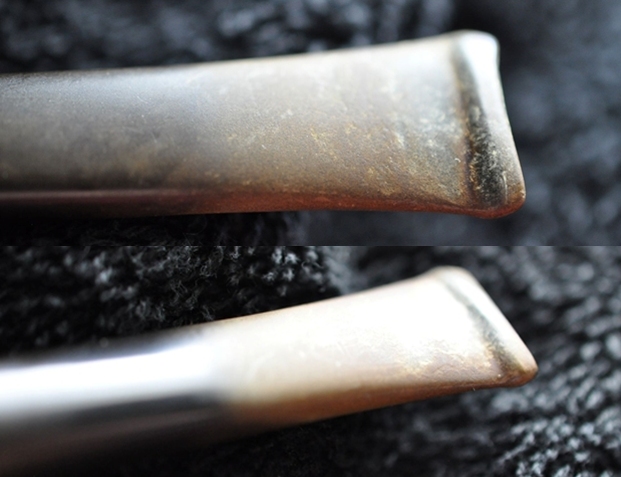
Roy Brigham, after serving an apprenticeship under an Austrian pipesmith, started his own pipe repair shop in Toronto, in 1906. By 1918 the business had grown to include five other craftsmen and had developed a reputation across Canada for the high quality of workmanship. After repairing many different brands of pipes over the years, Roy noted certain recurring complaints by pipe smokers, the most common referred to as “tongue bite”. Tongue bite is a burning sensation on the smoker’s tongue, previously thought to be due to the heat of the smoke (i.e. a “hot smoking pipe”).

He soon began manufacturing his own pipes, which were lightweight, yet featured a more rugged construction, strengthening the weak points observed in other pipes. The problem of tongue bite intrigued him, and he decided to make overcoming it a future goal.

About 1938, Roy’s son Herb joined him to assist in the business. The business barely survived the great depression because pipes were considered to be a luxury, not a necessity, and selling pipes was difficult indeed. In approximately 1937 [1], after some experimentation, Roy and Herb discovered that tongue bite was in fact a form of mild chemical burn to the tongue, caused by tars and acids in the smoke. They found that by filtering the smoke, it was possible to retain the flavour of the tobacco and yet remove these impurities and thereby stop the tongue bite.

Just as Thomas Edison had searched far and wide for the perfect material from which to make the first electric light bulb filaments, Roy & Herb began experimenting with many materials, both common and exotic, in the quest for the perfect pipe filter. Results varied wildly. Most of the materials didn’t work at all and some actually imparted their own flavour into the smoke. They eventually found just two materials that were satisfactory in pipes: bamboo and rock maple. As bamboo was obviously not as readily available, rock maple then became the logical choice.

They were able to manufacture a replaceable hollow wooden tube made from rock maple dowelling, which when inserted into a specially made pipe, caused absolutely no restriction to the draw of the pipe, yet extracted many of the impurities which had caused tongue bite. The result was indeed a truly better smoking pipe…

I wrote to Charles Lemon (Dadspipes) and asked him about the stamping on the pipe. He responded with information on all of the foursome. I am including the information on this particular pipe.

Hey Steve! Good to hear from you.

Shape 490 is actually called a Canadian, and in my opinion is a bit rare. Perhaps due to its prodigious length 😁!…As these are all Patent pipes, it’s more accurate to refer to their grade by name (the post 1980 grading scheme refers to Dots). Here is the original scheme:

With the information from Charles’ message and the chart above that he included I knew what I was dealing with in terms of the stamping and the age of this pipe. I learned that this Patent Era 490 is a Brigham Director (4-Dot) 90 Canadian. Charles said that the shape was pretty rare. It was made between 1938 and 1955. Most of Bob’s pipes were purchased in the 50s and 60s so my guess is that this is fits that time frame well. Now it was time to work on the pipe.

I am really happy to have Jeff’s help on cleaning up the pipes from Bob’s estate as the 125+ pipes were taking me a long time to do alone. He cleaned this filthy pipe with his usual penchant for thoroughness that I really appreciate. This one was a real mess and I did not know what to expect when I unwrapped it from his box. He reamed it with a PipNet pipe reamer and cleaned up the reaming with a Savinelli Fitsall Pipe Knife. He scrubbed out the internals with alcohol, pipe cleaners and cotton swabs until the pipe was clean. He scrubbed the exterior of the bowl with Murphy’s Oil Soap and a tooth brush to remove the grime and grit on the briar and the lava on the rim top. The finish looks very good with great looking grain around the bowl and shank. Jeff soaked the stem in Before & After Deoxidizer to remove the oxidation on the rubber. When the pipe arrived here in Vancouver for the second stop of its restoration tour I was amazed it looked so good. I took some close up photos of the rim top and also of the stem surface. I wanted to show what an amazing job Jeff did in the cleanup of the rim top. The rim top was darkened with nicks and a slight burn mark on the inner edge toward the front of the bowl. The outer edge looked very good.  I also took close up photos of the stem to show the tooth marks and chatter on the stem surface.I took the stem off the shank to show the aluminum tenon/tube that was used to hold the Brigham Rock Maple Distillator. The original Distillator (filter) had been filthy so after Jeff had cleaned the pipe up he threw it away. I will replace it once I have finished with the restoration.This was a tough pipe to photograph the stamping on because it was very faint. When it starts out faint it is very easy to lose even that remnant of a stamp. But one of the things I appreciate about Jeff’s cleanup is that he works to protect and preserve the nomenclature on the shank of the pipes that he works on. I took some photos to show the stamping. In the first photo the arrow on the left is pointed to where Brigham shape number 490 is stamped and the next arrow is pointing to Brigham number. The final arrow points to the Can. Pat. Number. In the second and third photo the arrows point at an enlargement of the same areas as the first.  Thanks Jeff for being so careful in the cleanup. Much appreciated. Since this is another pipe Bob’s estate I am sure that some of you have read at least some of the other restoration work that has been done on the previous pipes. You have also read what I have included about Bob Kerr, the pipeman who held these pipes in trust before I came to work on them (see photo to the left). Also, if you have followed the blog for long you will already know that I like to include background information on the pipeman whose pipes I am restoring. For me, when I am working on an estate I really like to have a sense of the person who held the pipes in trust before I worked on them. It gives me another dimension of the restoration work. Bob’s daughter wrote a short tribute to her father. I thank you Brian and tell your wife thank you as well.
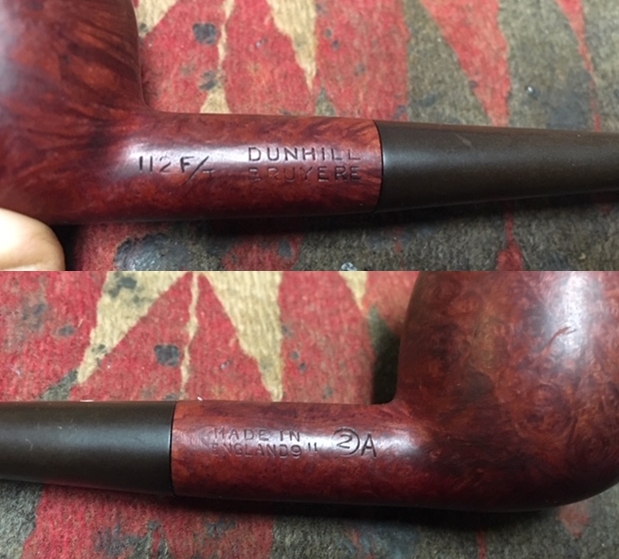
I am delighted to pass on these beloved pipes of my father’s. I hope each user gets many hours of contemplative pleasure as he did. I remember the aroma of tobacco in the rec room, as he put up his feet on his lazy boy. He’d be first at the paper then, no one could touch it before him. Maybe there would be a movie on with an actor smoking a pipe. He would have very definite opinions on whether the performer was a ‘real’ smoker or not, a distinction which I could never see but it would be very clear to him. He worked by day as a sales manager of a paper products company, a job he hated. What he longed for was the life of an artist, so on the weekends and sometimes mid-week evenings he would journey to his workshop and come out with wood sculptures, all of which he declared as crap but every one of them treasured by my sister and myself. Enjoy the pipes, and maybe a little of his creative spirit will enter you!

Now with all of the background on the line and the background on Bob Kerr it was time to get on with the restoration of this rusticated Brigham Director Canadian. I really appreciate the hard cleanup work that Jeff did on these pipes. They were a real mess when I sent them to Jeff and I have to tell you it was great that I did not need to clean this pipe. I decided to start the process by dealing with the damage to the rim top and edges of the bowl. I topped it on a topping board with 220 grit sandpaper. I worked on the inner edge with a folded piece of 220 grit sandpaper and gave it a very slight bevel so that it took care of the damage on the inner edge. The photos show the progress. I polished the briar on the rim top with micromesh sanding pads – wet sanding it with 1500-12000 grit pads and I wiped the bowl down after each sanding pad with a damp cloth.  The grain progressively stood out as I polished the pipe with the pads.  I stained the rim top and edges with a Walnut Stain pen to blend in the colour with the rest of the bowl. It is a good match and once it is polished it will work well!I rubbed the bowl and rim down with Before & After Restoration Balm. I worked it into the surface of the briar with my fingertips and a horsehair shoe brush to clean, enliven and protect it. I let the balm sit for a little while and then buffed with a cotton cloth to raise the shine. I really like watching the Balm do its magic and bring the briar alive.  With the bowl done it was time to address the stem. The dents in the top and underside were the right depth for me to lift them. I “painted” the surface of the stem with the flame of a Bic lighter to raise the dents in the surface. I was able to lift them to the point that a repair would be a simple sanding job. I sanded the surface of the stem with 220 grit sandpaper to remove the remaining oxidation in the vulcanite. I polished it with 400 grit wet dry sand paper.   I polished the stem with micromesh sanding pads – wet sanding with 1500-12000 grit sanding pads. I wiped it down after each pad with a damp cloth to remove the sanding dust. I polished it further with Before & After Pipe Polish – both Fine and Extra Fine. I finished by rubbing the stem down with some “No Oxy Oil” to protect the vulcanite. I am experimenting with the product from Briarville and tracking how it works so I can write a review of it. With the pipe cleaned and ready to polish I put a new Brigham Distillator filter in the stem. The photos show the Distillator out of the tenon and in place in the tenon. It is a Maplewood tube that collects the moisture from the smoke and delivering a dry, cool smoke sans tongue bite.  Once again at this point in the restoration process I am excited to be on the homestretch. This is the third Brigham from the four that are in Bob’s estate so I look forward to the final look when it is put back together, polished and waxed. I put the bowl and stem back together. I polished the bowl and stem with Blue Diamond to polish out the scratches in the briar and the vulcanite. I gave the bowl and the stem multiple coats of carnauba wax. I buffed the pipe with a clean buffing pad to raise the shine. I hand buffed it with a microfiber cloth to deepen the shine. The pipe polished up pretty nicely. The rustication is worn but still stands out with the wax and polish. The black of the tapered vulcanite stem along with the four brass pins is a beautiful contrast to the browns of the rusticated bowl and shank. This is a beautiful Patent Era Director Canadian that was another fun pipe to work on thanks to Jeff’s cleanup work. The pipe is comfortable pipe to hold in the hand. The finished pipe is shown in the photos below. The dimensions of the pipe are Length: 6 ¼ inches, Height: 1 ¾ inches, Outside diameter of the bowl: 1 ¼ inches, Chamber diameter: ¾ of an inch. This interesting and rare according to Charles Lemon will be going on the rebornpipes store very soon. I have a lot more of Bob’s estate to work on of various brands. Perhaps one of those will catch your attention. Thanks for reading this blog and my reflections on the pipe while I worked on it. This is an interesting estate to bring back to life.

A Brigham Patent Era Select 2199 Club (Lovat) from Bob Kerr’s Estate


Blog by Steve Laug

As I continue to work through the pipes in Bob Kerr’s Estate I am enjoying choosing different brands that he had to focus on for a bit. He had six different pipes from Brigham in his collection so I decided to work my way through that sub collection of the estate. Out of the 6 pipes, #5 has a ruined bowl with a crack all the way around it as well as a cut off aluminum tenon. #6 went to Paresh Deshpande in India for his collection. That left behind four pipes for me to restore – #1, #2, #3 and #4. Here is the list of what I saw when I examined the 6 pipes.

  1. Brigham 503T Can. Pat. 372982 5 Dot Stack. Stem is oxidized, tooth marks and chatter near the button, some calcification with damage to the button. Finish is dirty, thick cake and lava overflow on the rim top. Rim top has is worn and damage on the back edge. I have finished restoring this one. Here is the link: (https://rebornpipes.com/2019/12/21/a-brigham-patent-era-special-grain-stack-from-bob-kerrs-estate/).
  2. Brigham Made In Canada 691 3 Dot Canadian. Stem is oxidized, tooth marks and chatter near the button, some calcification with damage to the button. Finish is dirty, thick cake and lava overflow on the rim top. Rim top is worn and damaged.
  3. Brigham Made In Canada 2199 2 Dot Lovat. Stem is oxidized, tooth marks and chatter near the button, some calcification with damage to the button. Finish is dirty and worn. Stamping is worn. There is a thick cake and lava overflow on the rim top. Rim top is worn and damaged.
  4. Brigham Made In Canada 1 Dot Bing Crosby Style Pipe. Stem is oxidized, tooth marks and chatter near the button, some calcification with damage to the button. Finish is dirty, thick cake and lava overflow on the rim top. Rim top is worn and damage on the back edge.
  5. Brigham Made In Canada 6 Dot Bent Billiard. Stem is oxidized, tooth marks and chatter near the button, some calcification with damage to the button. The aluminum tenon has been cut off. Finish is dirty and worn with paint on the bowl. There is a thick cake and lava overflow on the rim top. Rim top has a crack on the right side.
  6. Brigham Made In Canada 4 Dot Canadian. Stem is oxidized, tooth marks and chatter near the button, some calcification with damage to the button. Finish is dirty and stamping is worn. There is a thick cake and lava overflow on the rim top. Rim top is worn and edges are damaged.

I chose to work on #3 next because of the issue with the stem. It is a Brigham Mixed Grain Lovat. It was stamped on the left side of the shank with faint stamping visible with a lens under light. It reads Brigham over Can. Pat. 372982. On the right side of the shank it was stamped with the shape number 2199. There was a thick cake in the bowl with remnants of tobacco stuck on the walls. There was a lava overflow on the rim. The top and edges of the rim appear to have some damage all the way around the bowl. The grain on the shank and bowl was a combination of grains. Once again, I think that there was a beautiful pipe underneath all of the buildup of years of use. The stem was oxidized and calcified toward the end with some tooth chatter. There were also some tooth marks on both sides of the stem ahead of the button. There was a bite through in the underside of the stem next to the button. There was a pattern of two brass dots on the left side of the saddle stem. Jeff took photos of the pipe before he started his cleanup work on it. Jeff took photos of the bowl and rim top to show the thick, hard cake in the bowl with remnants of tobacco stuck on the walls of the bowl. There was a lava build up on the top of the rim and the edges of the bowl. The rim top looked pretty good but it was hard to know for sure but it appeared that there was damage all around the inner edge. The outer edges of the rim looked to be in decent condition.  Jeff took a photo of the side and heel of the bowl to show the condition of the finish. You can see the beautiful grain around the side of the bowl and shank. Even under the dirt and debris of the years it looked very good. The stamping is very faint and cannot be captured even with a flash. He included a pic of the two brass dots on the stem and a few nicks in the shank edge.Jeff took photos of the top and underside of the stem showing the tooth chatter, scratching and oxidation on the stem surface and wear on the edges of the button. The second photo also shows the bite through on the underside near the button.  The third photo shows a close-up of the hole. I am also including the information from Pipedia’s article on Brigham pipes. It is a great read in terms of the history of the brand (https://pipedia.org/wiki/Brigham_Pipes). Charles Lemon (Dadspipes) is currently working on a book on the history of the brand. Until that is complete this article is a good summary. I have included it below.

Roy Brigham, after serving an apprenticeship under an Austrian pipesmith, started his own pipe repair shop in Toronto, in 1906. By 1918 the business had grown to include five other craftsmen and had developed a reputation across Canada for the high quality of workmanship. After repairing many different brands of pipes over the years, Roy noted certain recurring complaints by pipe smokers, the most common referred to as “tongue bite”. Tongue bite is a burning sensation on the smoker’s tongue, previously thought to be due to the heat of the smoke (i.e. a “hot smoking pipe”).

He soon began manufacturing his own pipes, which were lightweight, yet featured a more rugged construction, strengthening the weak points observed in other pipes. The problem of tongue bite intrigued him, and he decided to make overcoming it a future goal.

About 1938, Roy’s son Herb joined him to assist in the business. The business barely survived the great depression because pipes were considered to be a luxury, not a necessity, and selling pipes was difficult indeed. In approximately 1937 [1], after some experimentation, Roy and Herb discovered that tongue bite was in fact a form of mild chemical burn to the tongue, caused by tars and acids in the smoke. They found that by filtering the smoke, it was possible to retain the flavour of the tobacco and yet remove these impurities and thereby stop the tongue bite.

Just as Thomas Edison had searched far and wide for the perfect material from which to make the first electric light bulb filaments, Roy & Herb began experimenting with many materials, both common and exotic, in the quest for the perfect pipe filter. Results varied wildly. Most of the materials didn’t work at all and some actually imparted their own flavour into the smoke. They eventually found just two materials that were satisfactory in pipes: bamboo and rock maple. As bamboo was obviously not as readily available, rock maple then became the logical choice.

They were able to manufacture a replaceable hollow wooden tube made from rock maple dowelling, which when inserted into a specially made pipe, caused absolutely no restriction to the draw of the pipe, yet extracted many of the impurities which had caused tongue bite. The result was indeed a truly better smoking pipe…

I wrote to Charles Lemon (Dadspipes) and asked him about the stamping on the pipe. He responded with information on all of the foursome. I am including the information on this particular pipe.

Hey Steve! Good to hear from you.

Shape 2199 is what most would call a Lovat. Brigham called it a Club for whatever reason- just to be different, perhaps!…As these are all Patent pipes, it’s more accurate to refer to their grade by name (the post 1980 grading scheme refers to Dots). Here is the original scheme:With the information from Charles’ message and the chart above that he included I knew what I was dealing with in terms of the stamping and the age of this pipe. I learned that this Patent Era 2199 is a Brigham Select (2-Dot) 01 Lovat or what they call a Club. It was made between 1938 and 1955. Most of Bob’s pipes were purchased in the 50s and 60s so my guess is that this is fits that time frame well. Now it was time to work on the pipe.

I am really happy to have Jeff’s help on cleaning up the pipes from Bob’s estate as the 125+ pipes were taking me a long time to do alone. He cleaned this filthy pipe with his usual penchant for thoroughness that I really appreciate. This one was a real mess and I did not know what to expect when I unwrapped it from his box. He reamed it with a PipNet pipe reamer and cleaned up the reaming with a Savinelli Fitsall Pipe Knife. He scrubbed out the internals with alcohol, pipe cleaners and cotton swabs until the pipe was clean. He scrubbed the exterior of the bowl with Murphy’s Oil Soap and a tooth brush to remove the grime and grit on the briar and the lava on the rim top. The finish looks very good with great looking grain around the bowl and shank. Jeff soaked the stem in Before & After Deoxidizer to remove the oxidation on the rubber. When the pipe arrived here in Vancouver for the second stop of its restoration tour I was amazed it looked so good. I took some close up photos of the rim top and also of the stem surface. I wanted to show what an amazing job Jeff did in the cleanup of the rim top. The rim top was darkened with nicks and notches around the top and inner edge. There is a deep scratch in the rim top that looks almost like a crack. I have drawn an arrow to the spot on the rim top. The inner edge was a little rough and looked like the bowl had burned at some time in its life. I also took close up photos of the stem to show the tooth marks and chatter on the stem surface. There was a bite through on the underside of the stem near the button.  I took the stem off the shank to show the aluminum tenon/tube that was used to hold the Brigham Rock Maple Distillator. The original Distillator (filter) had been filthy so after Jeff had cleaned the pipe up he threw it away. I will replace it once I have finished with the restoration.This was a tough pipe to photograph the stamping on because it was very faint. When it starts out faint it is very easy to lose even that remnant of a stamp. But one of the things I appreciate about Jeff’s cleanup is that he works to protect and preserve the nomenclature on the shank of the pipes that he works on. I took some photos to show the stamping. In the first photo the arrow on the left is pointed to where Brigham is stamped and the arrow on the right is pointing to the Can. Pat. Number. In the second photo the arrow points at the shape number.  Thanks Jeff for being so careful in the cleanup. Much appreciated.Since this is another pipe Bob’s estate I am sure that some of you have read at least some of the other restoration work that has been done on the previous pipes. You have also read what I have included about Bob Kerr, the pipeman who held these pipes in trust before I came to work on them (see photo to the left). Also, if you have followed the blog for long you will already know that I like to include background information on the pipeman whose pipes I am restoring. For me, when I am working on an estate I really like to have a sense of the person who held the pipes in trust before I worked on them. It gives me another dimension of the restoration work. Bob’s daughter wrote a short tribute to her father. I thank you Brian and tell your wife thank you as well.

I am delighted to pass on these beloved pipes of my father’s. I hope each user gets many hours of contemplative pleasure as he did. I remember the aroma of tobacco in the rec room, as he put up his feet on his lazy boy. He’d be first at the paper then, no one could touch it before him. Maybe there would be a movie on with an actor smoking a pipe. He would have very definite opinions on whether the performer was a ‘real’ smoker or not, a distinction which I could never see but it would be very clear to him. He worked by day as a sales manager of a paper products company, a job he hated. What he longed for was the life of an artist, so on the weekends and sometimes mid-week evenings he would journey to his workshop and come out with wood sculptures, all of which he declared as crap but every one of them treasured by my sister and myself. Enjoy the pipes, and maybe a little of his creative spirit will enter you!

Now with all of the background on the line and the background on Bob Kerr it was time to get on with the restoration of this next mixed grain Brigham Select Lovat or Club as they call the shape. I am really coming to appreciate the hard cleanup work that Jeff did on these pipes. They were a real mess when I sent them to Jeff and I have to tell you it was great that I did not need to clean this pipe. I decided to start the process by dealing with the damage to the rim top and edges of the bowl. I topped it on a topping board with 220 grit sandpaper. I topped it to remove the deep scratch on the surface of the rim at the front. I was able to remove the scratch. What was left behind was a dark mark on the rim top. Once I stained the rim top that should disappear. I worked on the inner edge with a folded piece of 220 grit sandpaper and gave it a very slight bevel so that it took care of the damage on the inner edge. The photos show the progress. I stained the rim top and edges with a Walnut Stain pen to blend in the colour with the rest of the bowl. It is a good match and once it is polished it will work well!I polished the briar with micromesh sanding pads – wet sanding it with 1500-12000 grit pads and I wiped the bowl down after each sanding pad with a damp cloth.  The grain progressively stood out as I polished the pipe with the pads. I rubbed the bowl and rim down with Before & After Restoration Balm. I worked it into the surface of the briar with my fingertips to clean, enliven and protect it. I let the balm sit for a little while and then buffed with a cotton cloth to raise the shine. I really like watching the Balm do its magic and bring the briar alive.  With the bowl done it was time to address the issues with the stem. The deep dents in the top and underside with a bite through in the middle of the underside would make this a stem with multiple issues to deal with. The first photo shows the bite through. I “painted” the surface of the vulcanite to soften the rubber and then used the tip of a needle file to lift the deepest tooth marks and seek to flatten the stem surface (second and third photos). I was able to lift the tooth dents quite a bit on both sides but I would need to build up the stem surface on both sides.To prepare for the repair I wiped down the surface with alcohol on a cotton pad. I folded a pipe cleaner in half and coated it with Vaseline to make sure that the repair would not fill in the airway in the stem. I inserted it in the slot and slid it under the bit through.I mixed batch of charcoal powder and black superglue putty together on a piece of card. I learned from Dal to put a patch of tape on the card first so that the mix would not harden as quickly. It works like a charm by the way. I mixed the powder and black glue together with a dental spatula to get a thick putty/paste. I applied the putty to the top of the stem on both sides and pressed it into the bite through area. I sprayed the repaired areas on both sides of the stem with an accelerator so that the surface of the repair would be hard.  I slid the pipe cleaner out of the airway and set the stem aside to let the glue cure. When the repair had cured I used a needle file to reshape the button and smooth out the repair. More work would need to be done for it to be correct but the bite through was gone!   I sanded the repaired areas smooth with 220 grit sandpaper to blend them into the rest of the stem surface. As I sanded some small air bubbles appeared in the surface of the repair. I filled them in with clear Krazy Glue and once it had cured sanded the surface again. I started the polishing process with 400 grit wet dry sandpaper. It is starting to look pretty good!  I polished the stem with micromesh sanding pads – wet sanding with 1500-12000 grit pads. I wiped the stem down after each sanding pad with Obsidian Oil. I polished it with Before & After Pipe Stem Polish – both Fine and Extra Fine. Once I had finished the polishing I gave it a coat of a new product I am experimenting with from Briarville Pipe Repair. It is called “No Oxy Oil” and it is made to protect the stem from oxidizing. I set it aside to dry. With the pipe cleaned and ready to polish I put a new Brigham Distillator filter in the stem. The photos show the Distillator out of the tenon and in place in the tenon. It is a Maplewood tube that collects the moisture from the smoke and delivering a dry, cool smoke sans tongue bite. Once again at this point in the restoration process I am excited to be on the homestretch. This is the second Brigham from the four that are in Bob’s estate so I look forward to the final look when it is put back together, polished and waxed. I put the bowl and stem back together. I polished the bowl and stem with Blue Diamond to polish out the scratches in the briar and the vulcanite. I gave the bowl and the stem multiple coats of carnauba wax. I buffed the pipe with a clean buffing pad to raise the shine. I hand buffed it with a microfiber cloth to deepen the shine. The pipe polished up pretty nicely. The grain is quite stunning and really pops with the wax and polish. The repair to the stem surface looked really good and blended into the shiny black vulcanite stem. The black of the vulcanite stem along with the two brass pins is a beautiful contrast to the browns of the bowl and shank. This was another fun pipe to work on thanks to Jeff’s cleanup work. It really is a quite stunning piece of mixed grained briar whose shape follows the flow of the briar. The pipe is comfortable pipe to hold in the hand. The finished pipe is shown in the photos below. The dimensions of the pipe are Length: 5 ¾ inches, Height: 1 ¾ inches, Outside diameter of the bowl: 1 ¼ inches, Chamber diameter: ¾ of an inch. This beautiful pipe will be going on the rebornpipes store in the near future. I have a lot more of Bob’s estate to work on of various brands. Perhaps one of those will catch your attention. Thanks for reading this blog and my reflections on the pipe while I worked on it. This is an interesting estate to bring back to life.
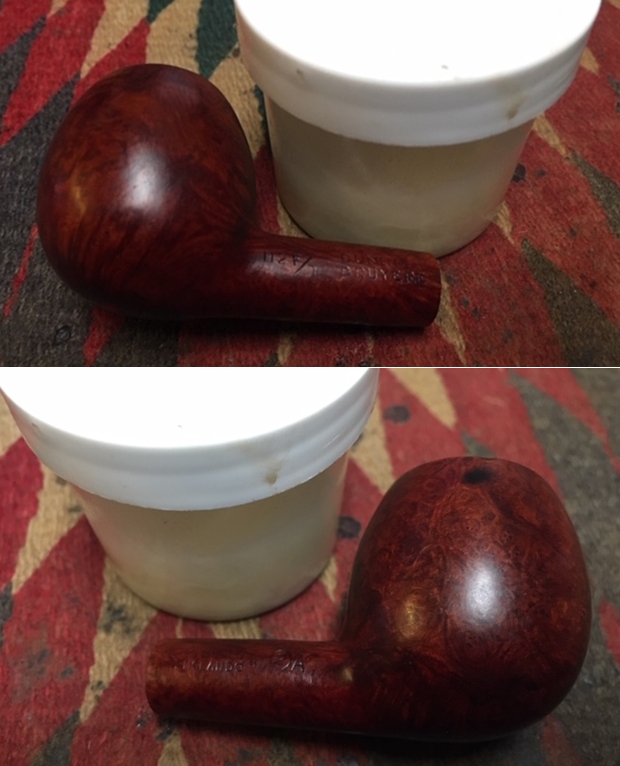
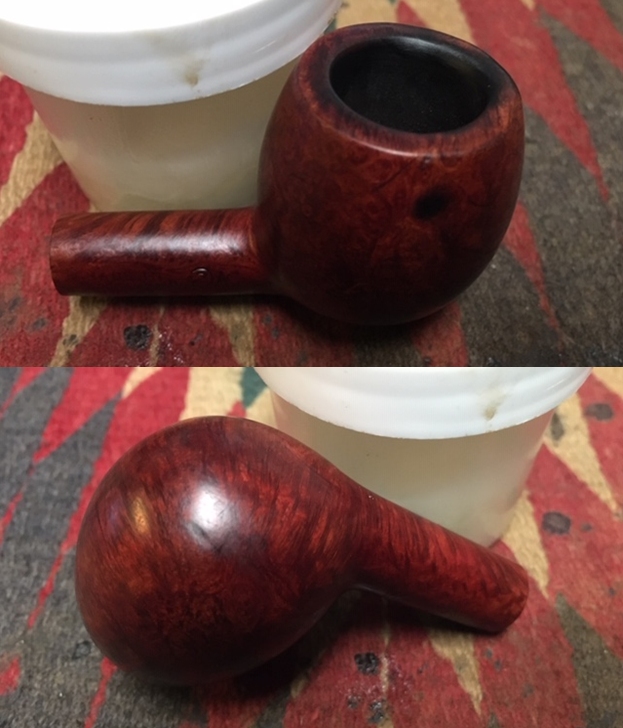
A Brigham Patent Era Special Grain Stack from Bob Kerr’s Estate


Blog by Steve Laug

As I continue to work through the pipes in Bob Kerr’s Estate I am enjoying choosing different brands that he had to focus on for a bit. He had six different pipes from Brigham in his collection so I decided to work my way through that sub collection of the estate. Out of the 6 pipes, #5 has a ruined bowl with a crack all the way around it as well as a cut off aluminum tenon. #6 went to Paresh Deshpande in India for his collection. That left behind four pipes for me to restore – #1, #2, #3 and #4. Here is the list of what I saw when I examined the 6 pipes.

  1. Brigham 503T Can. Pat. 372982 5 Dot Stack. Stem is oxidized, tooth marks and chatter near the button, some calcification with damage to the button. Finish is dirty, thick cake and lava overflow on the rim top. Rim top has is worn and damage on the back edge.
  2. Brigham Made In Canada 691 3 Dot Canadian. Stem is oxidized, tooth marks and chatter near the button, some calcification with damage to the button. Finish is dirty, thick cake and lava overflow on the rim top. Rim top is worn and damaged.
  3. Brigham Made In Canada 601 2 Dot Lovat. Stem is oxidized, tooth marks and chatter near the button, some calcification with damage to the button. Finish is dirty and worn. Stamping is worn. There is a thick cake and lava overflow on the rim top. Rim top is worn and damaged.
  4. Brigham Made In Canada 1 Dot Bing Crosby Style Pipe. Stem is oxidized, tooth marks and chatter near the button, some calcification with damage to the button. Finish is dirty, thick cake and lava overflow on the rim top. Rim top is worn and damage on the back edge.
  5. Brigham Made In Canada 6 Dot Bent Billiard. Stem is oxidized, tooth marks and chatter near the button, some calcification with damage to the button. The aluminum tenon has been cut off. Finish is dirty and worn with paint on the bowl. There is a thick cake and lava overflow on the rim top. Rim top has a crack on the right side.
  6. Brigham Made In Canada 4 Dot Canadian. Stem is oxidized, tooth marks and chatter near the button, some calcification with damage to the button. Finish is dirty and stamping is worn. There is a thick cake and lava overflow on the rim top. Rim top is worn and edges are damaged.

I chose to work on these in the order above. The first pipe I tackled was #1 which was a beautifully grained Brigham 503T Stack. It was stamped on the left side of the shank with clear stamping Brigham over Can. Pat. 372982. On the right side of the shank it was stamped with the shape number 503T. There was a thick cake in the bowl with remnants of tobacco stuck on the walls. There was a lava overflow on the rim. The top and edges of the rim appear to have some damage all the way around the bowl. The grain on the shank and bowl was a combination of flame and straight grain. There was a dent mid bowl on the left side of the bowl. I think that there was a beautiful pipe underneath all of the buildup of years of use. The stem was oxidized and calcified toward the end with some tooth chatter. There were also some tooth marks on both sides of the stem ahead of the button. There was a pattern of five brass dots on the left side of the tapered stem. Jeff took photos of the pipe before he started his cleanup work on it. Jeff took photos of the bowl and rim top to show the thick, hard cake in the bowl with remnants of tobacco stuck on the walls of the bowl. There was a lava build up on the top of the rim and the edges of the bowl. The rim top looked pretty good but it was hard to know for sure but it appeared that there was damage all around the inner edge. The outer edges of the rim had some damage on the back side where it appeared to have been hit against a hard surface and left behind a rough edge.    Jeff took a photo of the side and heel of the bowl to show the condition of the finish. You can see the beautiful grain around the side of the bowl and shank. Even under the dirt and debris of the years it looked very good. Jeff took photos of the stamping on the left side of the bowl and shank. It read Brigham over Can. Pat 372982. The stamp on the right side of the shank read 503T which was the shape number.  The last photo shows the five brass dots on the left side of the tapered stem.  Jeff took photos of the top and underside of the stem showing the tooth chatter, scratching and oxidation on the stem surface and wear on the edges of the button. I am also including the information from Pipedia’s article on Brigham pipes. It is a great read in terms of the history of the brand (https://pipedia.org/wiki/Brigham_Pipes). Charles Lemon (Dadspipes) is currently working on a book on the history of the brand. Until that is complete this article is a good summary. I have included it below.

Roy Brigham, after serving an apprenticeship under an Austrian pipesmith, started his own pipe repair shop in Toronto, in 1906. By 1918 the business had grown to include five other craftsmen and had developed a reputation across Canada for the high quality of workmanship. After repairing many different brands of pipes over the years, Roy noted certain recurring complaints by pipe smokers, the most common referred to as “tongue bite”. Tongue bite is a burning sensation on the smoker’s tongue, previously thought to be due to the heat of the smoke (i.e. a “hot smoking pipe”).

He soon began manufacturing his own pipes, which were lightweight, yet featured a more rugged construction, strengthening the weak points observed in other pipes. The problem of tongue bite intrigued him, and he decided to make overcoming it a future goal.

About 1938, Roy’s son Herb joined him to assist in the business. The business barely survived the great depression because pipes were considered to be a luxury, not a necessity, and selling pipes was difficult indeed. In approximately 1937 [1], after some experimentation, Roy and Herb discovered that tongue bite was in fact a form of mild chemical burn to the tongue, caused by tars and acids in the smoke. They found that by filtering the smoke, it was possible to retain the flavour of the tobacco and yet remove these impurities and thereby stop the tongue bite.

Just as Thomas Edison had searched far and wide for the perfect material from which to make the first electric light bulb filaments, Roy & Herb began experimenting with many materials, both common and exotic, in the quest for the perfect pipe filter. Results varied wildly. Most of the materials didn’t work at all and some actually imparted their own flavour into the smoke. They eventually found just two materials that were satisfactory in pipes: bamboo and rock maple. As bamboo was obviously not as readily available, rock maple then became the logical choice.

They were able to manufacture a replaceable hollow wooden tube made from rock maple dowelling, which when inserted into a specially made pipe, caused absolutely no restriction to the draw of the pipe, yet extracted many of the impurities which had caused tongue bite. The result was indeed a truly better smoking pipe.

As a result, sales of Brigham pipes climbed briskly afterwards, and by the 1960’s there were well over 40 full time production staff. For over four decades now, the company has been the leading Canadian pipe manufacturer, producing more than three quarters of all the pipes made in Canada.

In 1978, Roy’s grandson Mike joined the firm and together with Herb (now in his 80s) they still produce pipes and wooden filters according to long established techniques, resulting in consistently high quality products. Several pipe makers who learned the craft of pipe making here at Brigham went on to make a name for themselves in Canada and internationally including Philip Trypis and Julius Vesz.

I wrote to Charles Lemon (Dadspipes) and asked him about the stamping on the pipe. He responded with information on all of the foursome. I am including the information on this particular pipe.

Hey Steve! Good to hear from you.

The ‘T’ suffix to the Brigham 3-digit shape number indicates a Tall bowl (ie taller than the standard shape). Thus your Patent Era 503T is a Brigham Special Grain Shape 03 (Medium Billiard) with a Tall bowl, made between 1938 and 1955…

…As these are all Patent pipes, it’s more accurate to refer to their grade by name (the post 1980 grading scheme refers to Dots). Here is the original scheme:With the information from Charles’ message and the chart above that he included I knew what I was dealing with in terms of the stamping and the age of this pipe. I learned that the ‘T’ suffix to the Brigham 3-digit shape number indicated a Tall bowl (i.e. taller than the standard shape). This Patent Era 503T is a Brigham Special Grain Shape 03 (Medium Billiard) with a Tall bowl, made between 1938 and 1955. Most of Bob’s pipes were purchased in the 50s and 60s so my guess is that this is fits that time frame well. Now it was time to work on the pipe.

I am really happy to have Jeff’s help on cleaning up the pipes from Bob’s estate as the 125+ pipes were taking me a long time to do alone. He cleaned this filthy pipe with his usual penchant for thoroughness that I really appreciate. This one was a real mess and I did not know what to expect when I unwrapped it from his box. He reamed it with a PipNet pipe reamer and cleaned up the reaming with a Savinelli Fitsall Pipe Knife. He scrubbed out the internals with alcohol, pipe cleaners and cotton swabs until the pipe was clean. He scrubbed the exterior of the bowl with Murphy’s Oil Soap and a tooth brush to remove the grime and grit on the briar and the lava on the rim top. The finish looks very good with great looking grain around the bowl and shank. Jeff soaked the stem in Before & After Deoxidizer to remove the oxidation on the rubber. When the pipe arrived here in Vancouver for the second stop of its restoration tour I was amazed it looked so good. I took some close up photos of the rim top and also of the stem surface. I wanted to show what an amazing job Jeff did in the cleanup of the rim top. The rim top was darkened with nicks and notches around the top and inner edge. The inner edge was very rough and looked like the bowl had been reamed with a knife at some time in its life. I also took close up photos of the stem to show the lack of tooth marks and chatter on the stem surface. It was very clean.I took the stem off the shank to show the aluminum tenon/tube that was used to hold the Brigham Rock Maple Distillator. The original Distillator (filter) had been filthy so after Jeff had cleaned the pipe up he threw it away. I will replace it once I have finished with the restoration.One of the things I appreciate about Jeff’s cleanup is that he works to protect and preserve the nomenclature on the shank of the pipes that he works on. The stamping on this one was very faint to start with so I was worried that it would disappear altogether with the cleanup. He was not only able to preserve it but it is clearer than shown in the earlier photos. I took some photos to show the clarity of the stamping. I have noticed that many restorers are not careful to protect the stamping in their cleaning process and often by the end of the restoration the nomenclature is almost destroyed. I would like to encourage all of us to be careful in our work to preserve this as it is a critical piece of pipe restoration! Since this is another pipe Bob’s estate I am sure that some of you have read at least some of the other restoration work that has been done on the previous pipes. You have also read what I have included about Bob Kerr, the pipeman who held these pipes in trust before I came to work on them (see photo to the left). Also, if you have followed the blog for long you will already know that I like to include background information on the pipeman whose pipes I am restoring. For me, when I am working on an estate I really like to have a sense of the person who held the pipes in trust before I worked on them. It gives me another dimension of the restoration work. Bob’s daughter wrote a short tribute to her father. I thank you Brian and tell your wife thank you as well.

I am delighted to pass on these beloved pipes of my father’s. I hope each user gets many hours of contemplative pleasure as he did. I remember the aroma of tobacco in the rec room, as he put up his feet on his lazy boy. He’d be first at the paper then, no one could touch it before him. Maybe there would be a movie on with an actor smoking a pipe. He would have very definite opinions on whether the performer was a ‘real’ smoker or not, a distinction which I could never see but it would be very clear to him. He worked by day as a sales manager of a paper products company, a job he hated. What he longed for was the life of an artist, so on the weekends and sometimes mid-week evenings he would journey to his workshop and come out with wood sculptures, all of which he declared as crap but every one of them treasured by my sister and myself. Enjoy the pipes, and maybe a little of his creative spirit will enter you!

Now with all of the background on the line and the background on Bob Kerr it was time to get on with the restoration of this beautiful straight grained Brigham Special Grain Tall Billiard. I am really coming to appreciate the hard cleanup work that Jeff did on these pipes. They were a real mess when I sent them to Jeff and I have to tell you it was great that I did not need to clean this pipe. I decided to start the process by dealing with the damage to the rim top and edges of the bowl. I topped it on a topping board with 220 grit sandpaper. I worked on the inner edge with a folded piece of 220 grit sandpaper and gave it a very slight bevel so that it took care of the damage on the inner edge. The photos show the progress. I polished the briar with micromesh sanding pads – wet sanding it with 1500-2400 grit pads and I wiped the bowl down after each sanding pad with a damp cloth. There were some scratches in the bowl on both sides and there appeared to be a dent in the left side mid-bowl.  I interrupted the polishing of the briar to deal with the dent in the bowl side. I heated a knife and used it and a wet cloth to steam the dent out of the surface of the briar. The first photo shows the process while the second shows the bowl after the steaming. The dent is gone.   With the dent removed I went back to polishing the briar with the remaining micromesh sanding pads – wet sanding it with 3200-12000 grit pads and I wiped the bowl down after each sanding pad with a damp cloth.  I rubbed the bowl and rim down with Before & After Restoration Balm. I worked it into the surface of the briar with my fingertips to clean, enliven and protect it. I let the balm sit for a little while and then buffed with a cotton cloth to raise the shine. I really like watching the Balm do its magic and bring the briar alive. The stem was in great condition so I did not need to sand out tooth marks or chatter. I polished the stem with micromesh sanding pads – wet sanding with 1500-12000 grit pads. I wiped the stem down after each sanding pad with Obsidian Oil. I polished it with Before & After Pipe Stem Polish – both Fine and Extra Fine. Once I had finished the polishing I gave it a coat of a new product I am experimenting with from Briarville Pipe Repair. It is called “No Oxy Oil” and it is made to protect the stem from oxidizing. I set it aside to dry.   With the pipe cleaned and ready to polish I put a new Brigham Distillator filter in the stem. The photos show the Distillator out of the tenon and in place in the tenon. It is a Maplewood tube that collects the moisture from the smoke and delivering a dry, cool smoke sans tongue bite. Once again at this point in the restoration process I am excited to be on the homestretch. This is the first Brigham from the four that are in Bob’s estate so I look forward to the final look when it is put back together, polished and waxed. I put the bowl and stem back together. I polished the bowl and stem with Blue Diamond to polish out the scratches in the briar and the vulcanite. I gave the bowl and the stem multiple coats of carnauba wax. I buffed the pipe with a clean buffing pad to raise the shine. I hand buffed it with a microfiber cloth to deepen the shine. The pipe polished up pretty nicely. The grain is quite stunning and really pops with the wax and polish. The shiny black vulcanite stem with the five brass pins is a beautiful contrast to the browns of the bowl and shank. This was another fun pipe to work on thanks to Jeff’s cleanup work. It really is a quite stunning piece of straight and flame grained briar whose shape follows the flow of the briar. The Brigham 503T Patent Era Special Grain Stack is a comfortable pipe to hold in the hand. The finished pipe is shown in the photos below. The dimensions of the pipe are Length: 5 ¾ inches, Height: 2 inches, Outside diameter of the bowl: 1 ¼ inches, Chamber diameter: ¾ of an inch. I am a bit undecided on this pipe. I am thinking of holding onto it for a while but I am still not sure. If I decide to let it go this beautiful pipe will be going on the rebornpipes store. I have a lot more of Bob’s estate to work on of various brands. Perhaps one of those will catch your attention. Thanks for reading this blog and my reflections on the pipe while I worked on it. This is an interesting estate to bring back to life.