Tag Archives: refurbishing

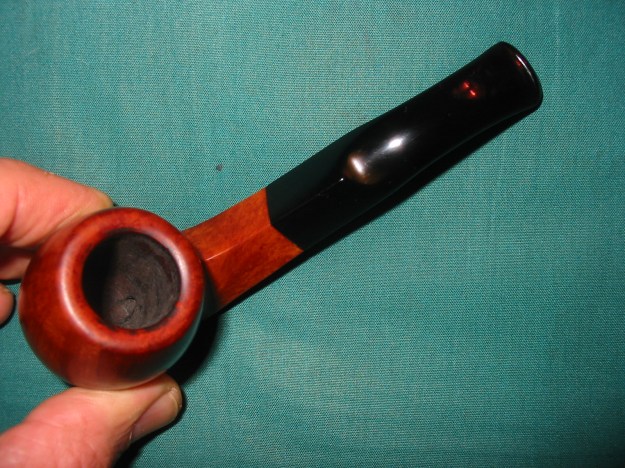
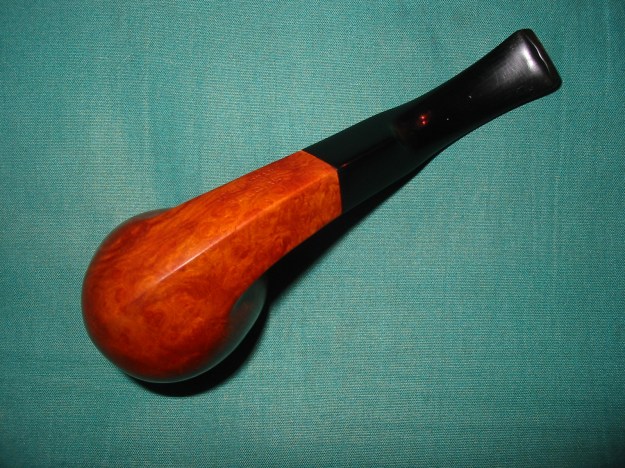
One Just for Fun: A New Frankenpipe – Combining a Few Parts to Craft a Rustic Pipe


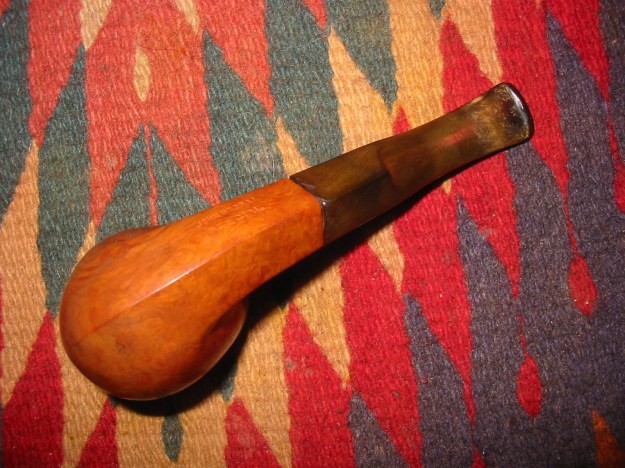
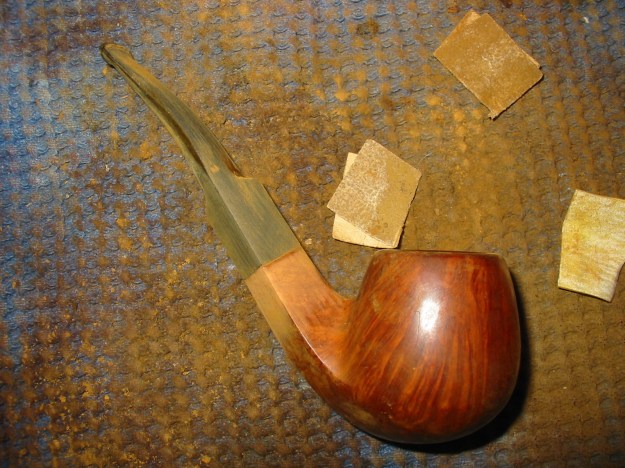
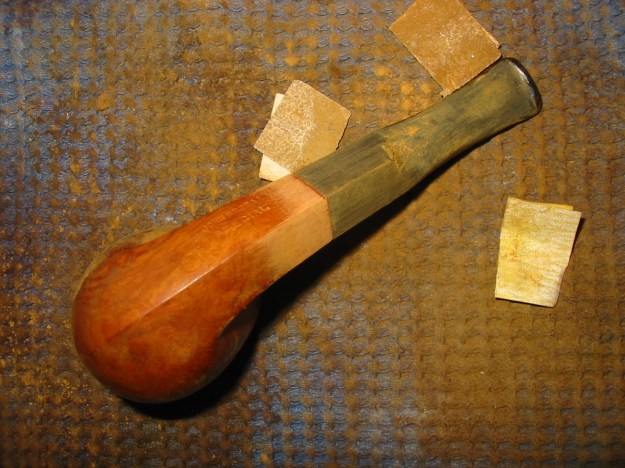
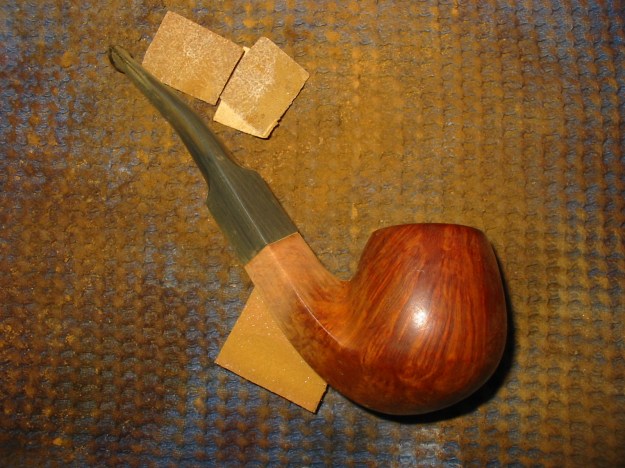
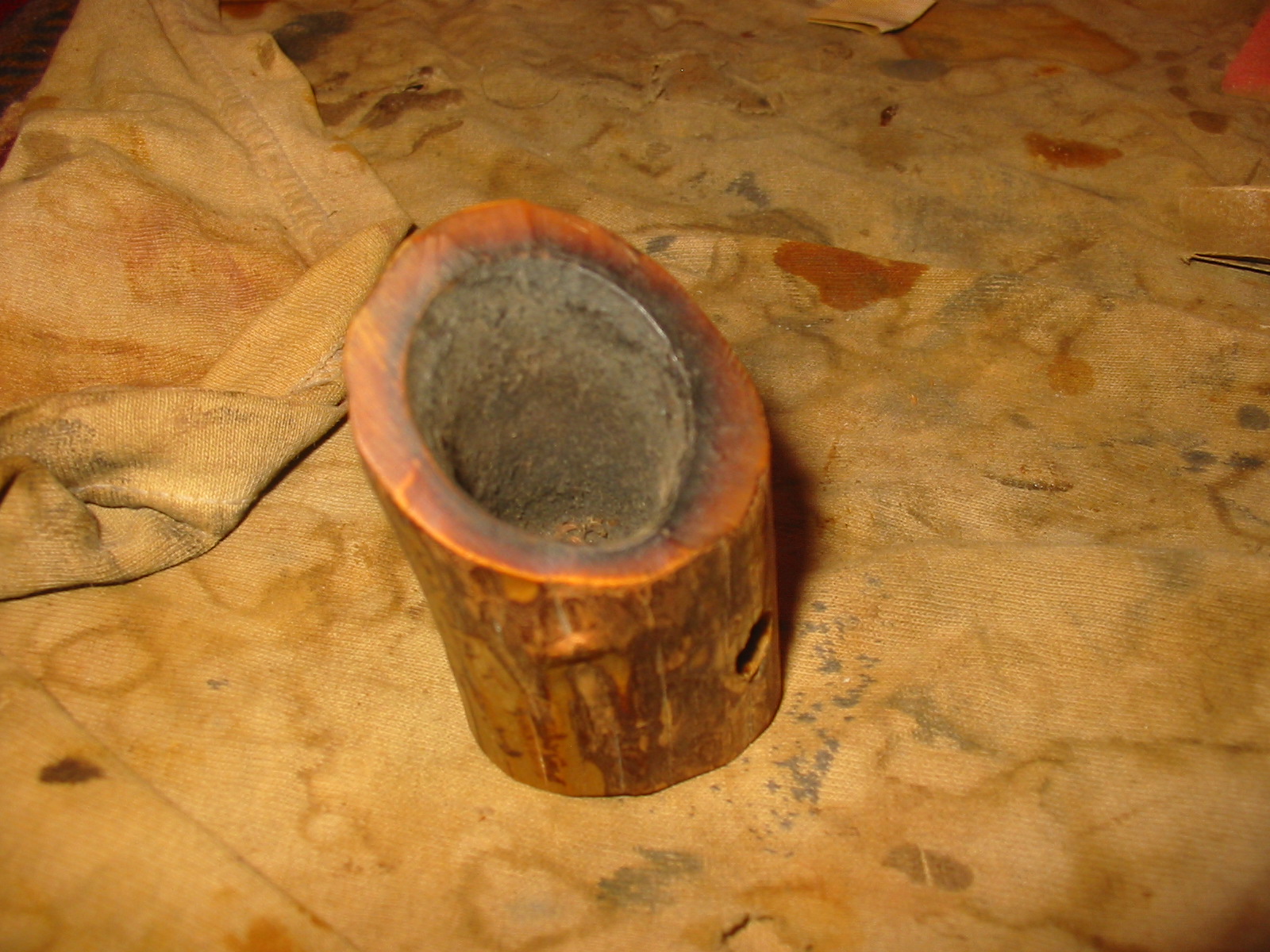
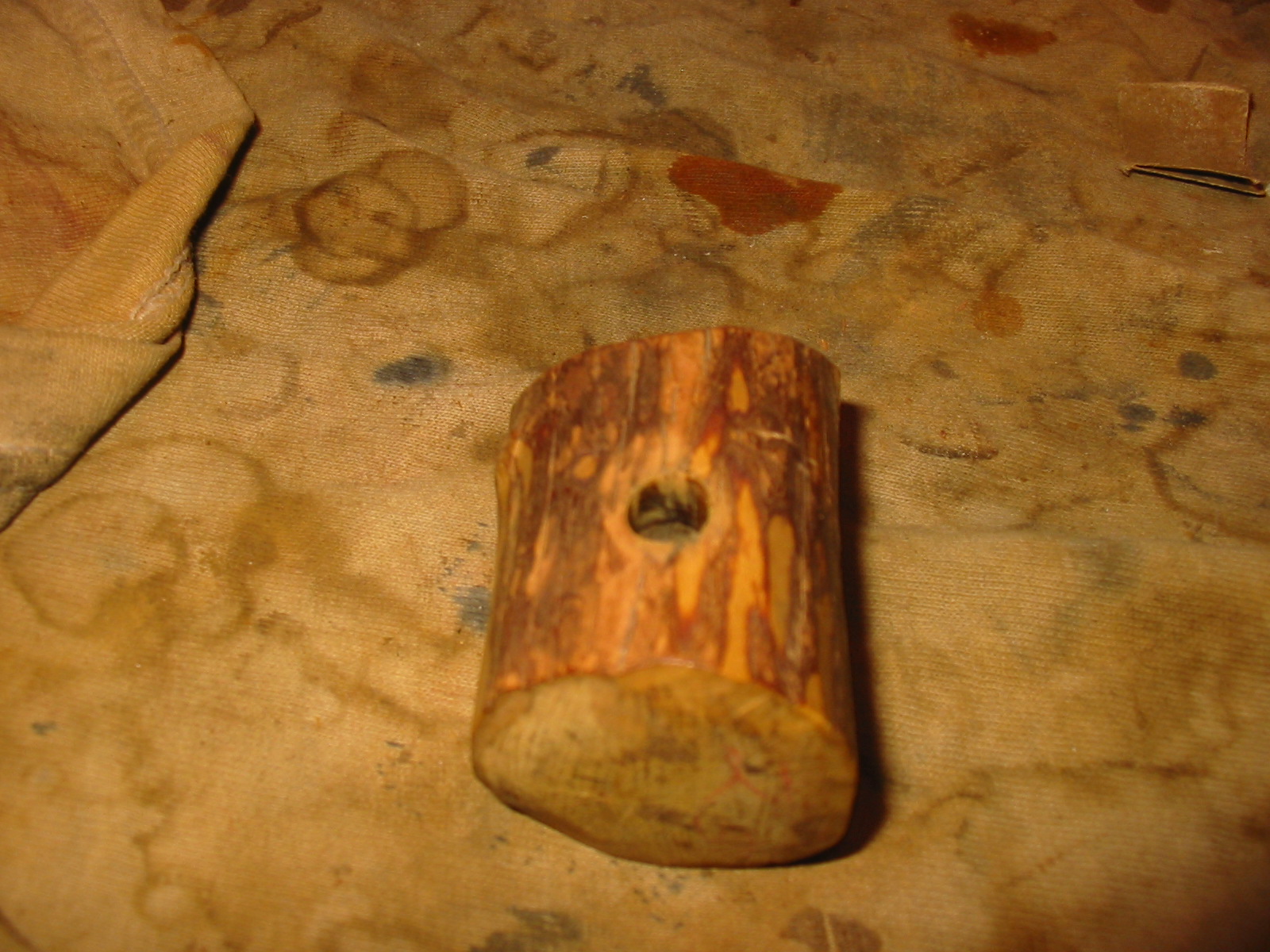
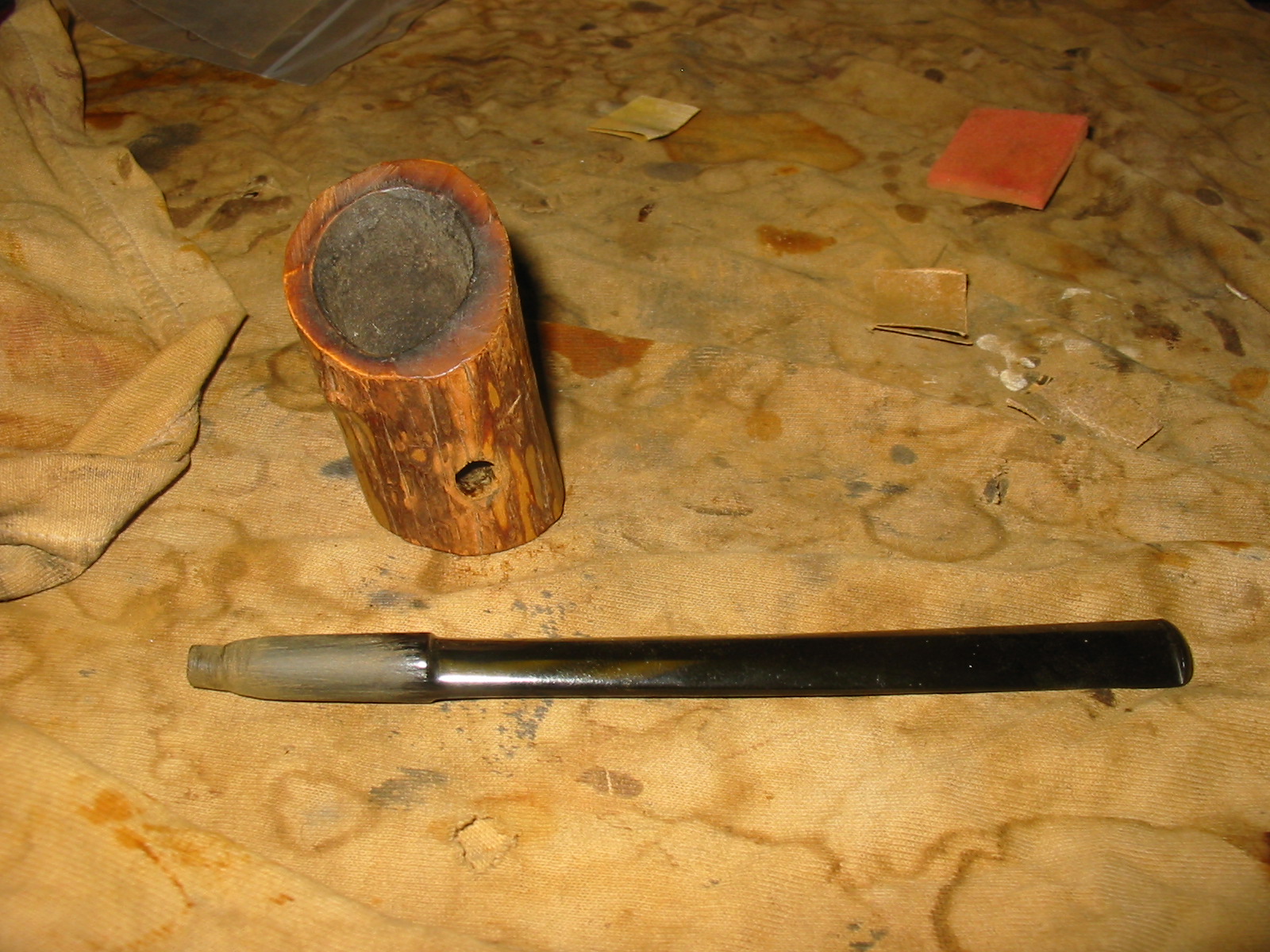
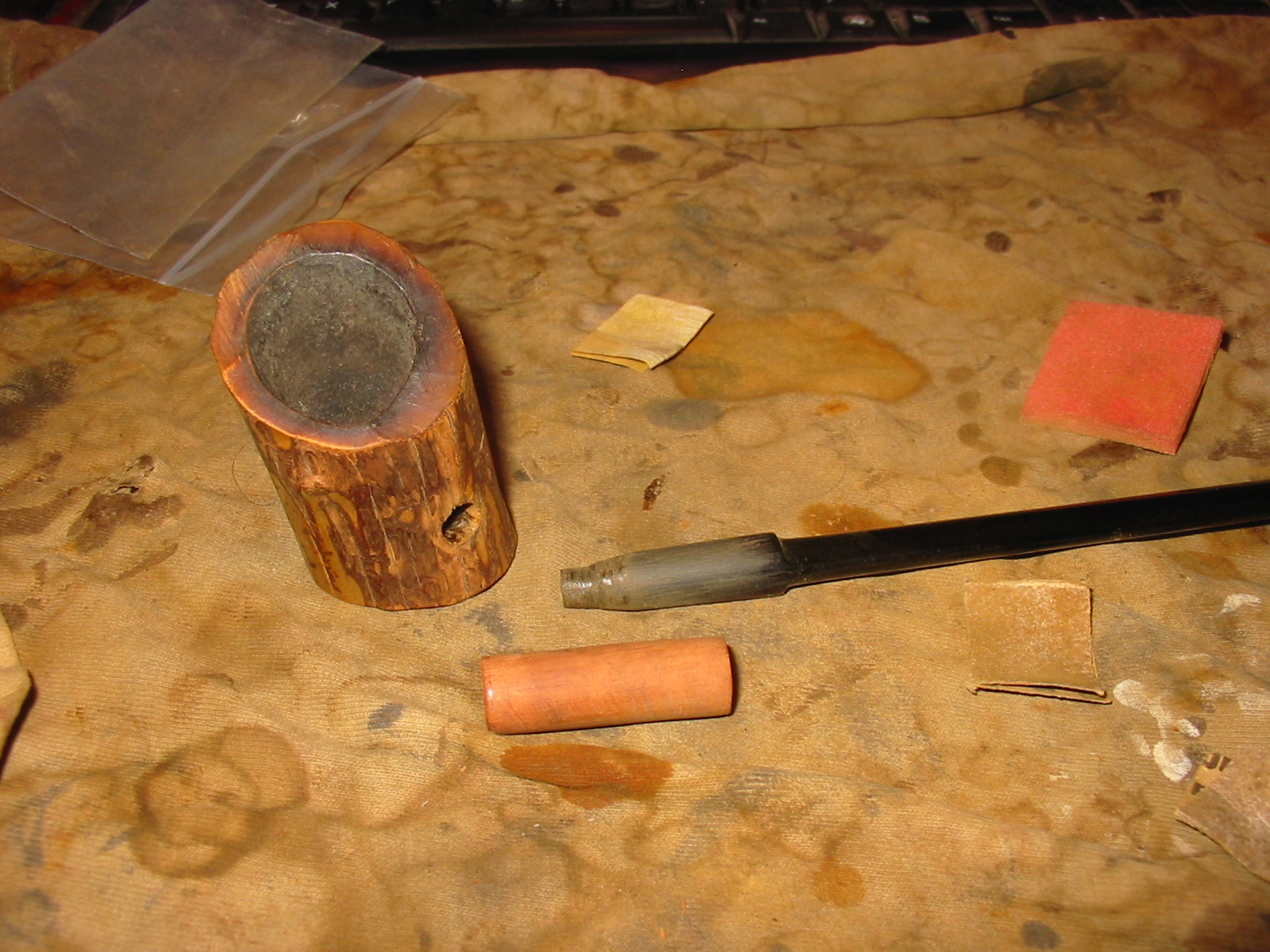
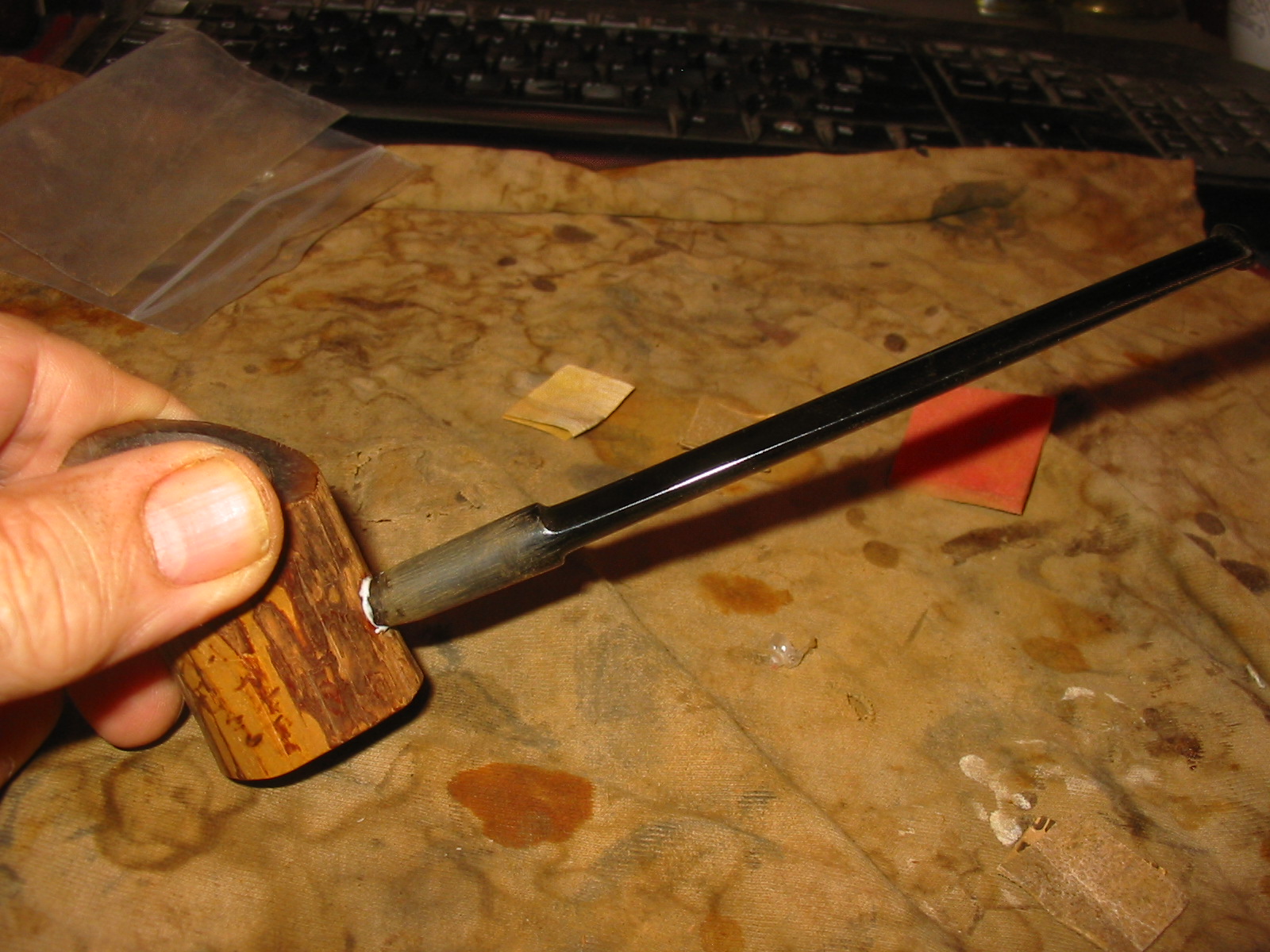
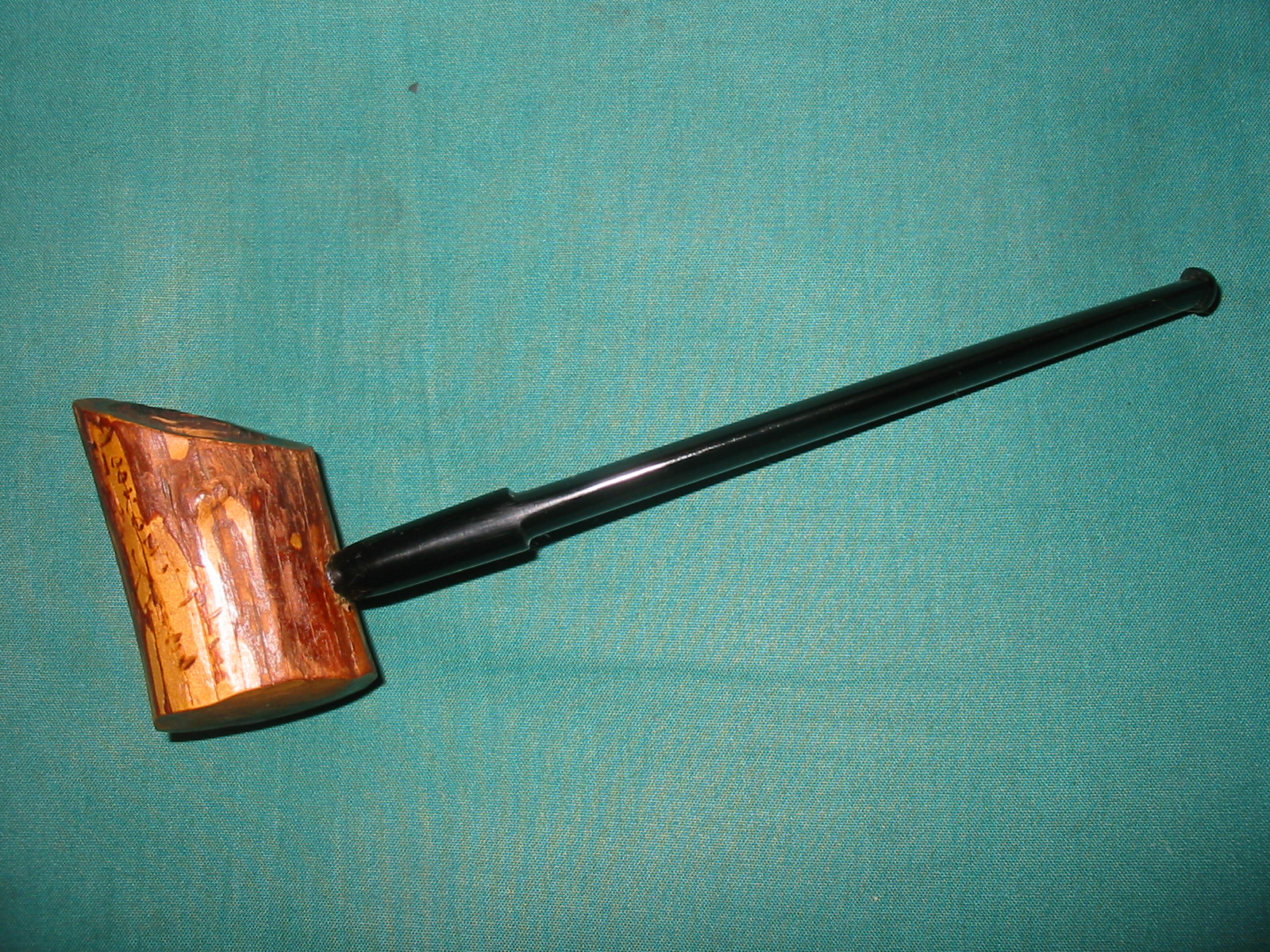
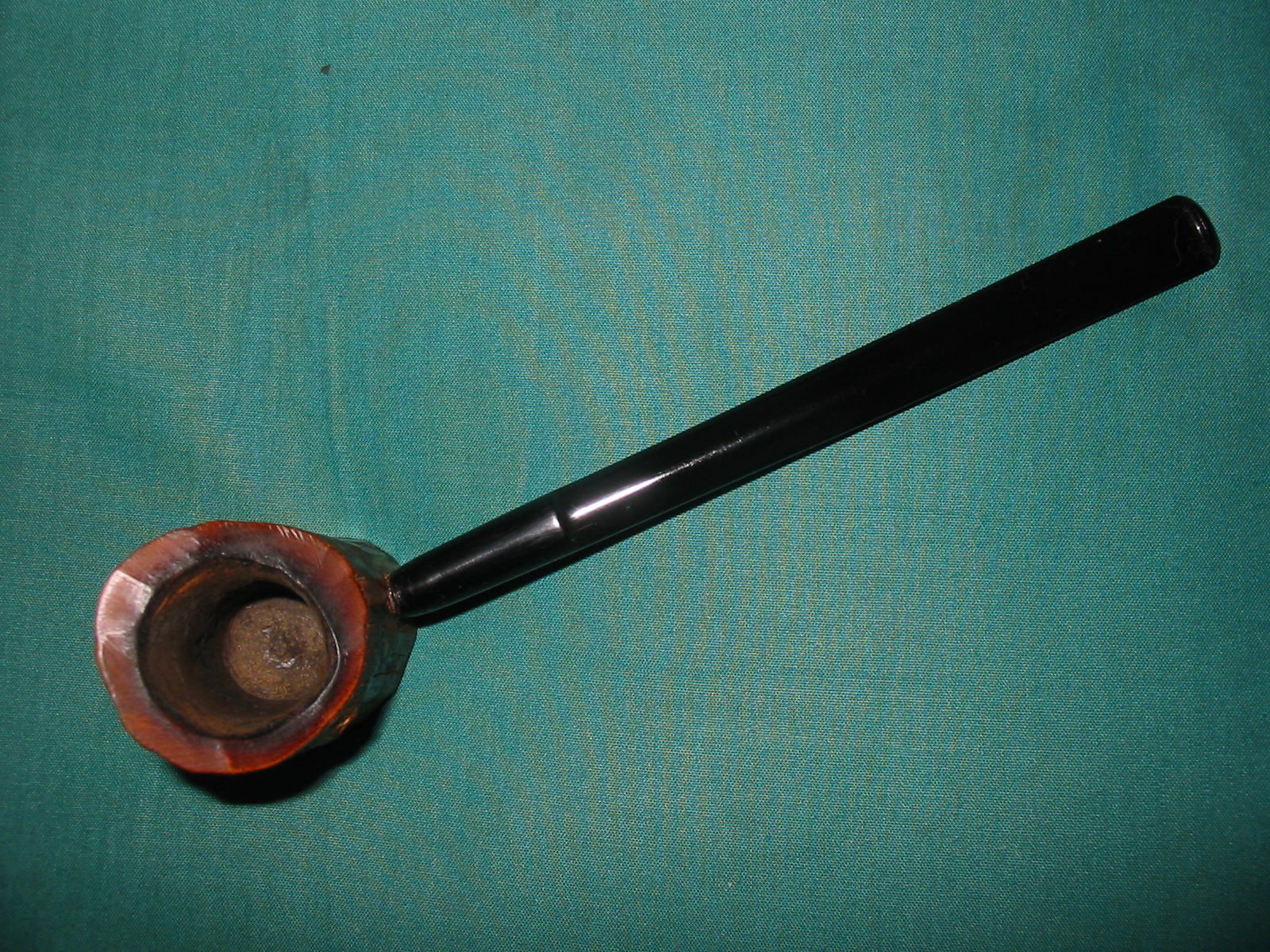
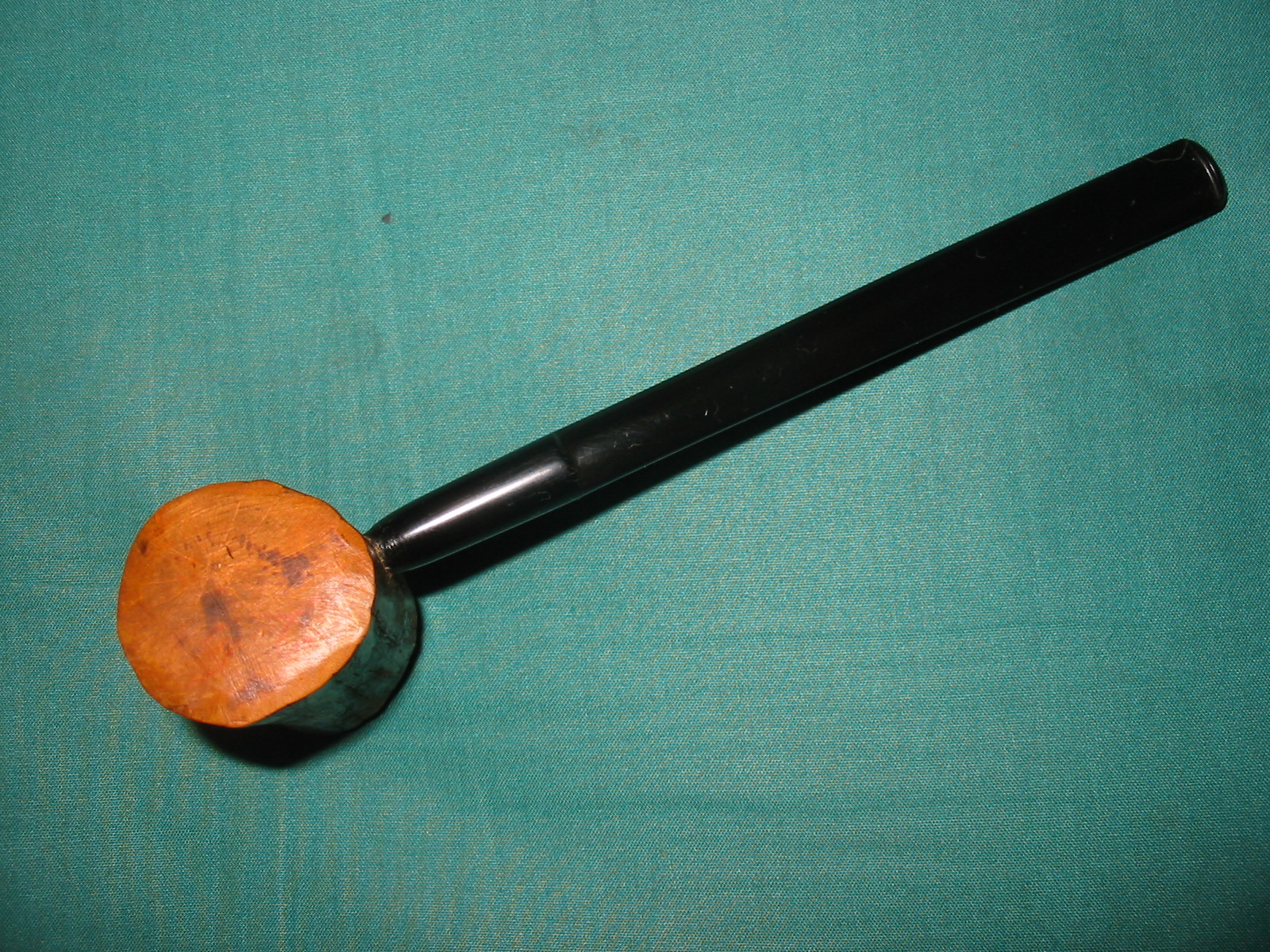
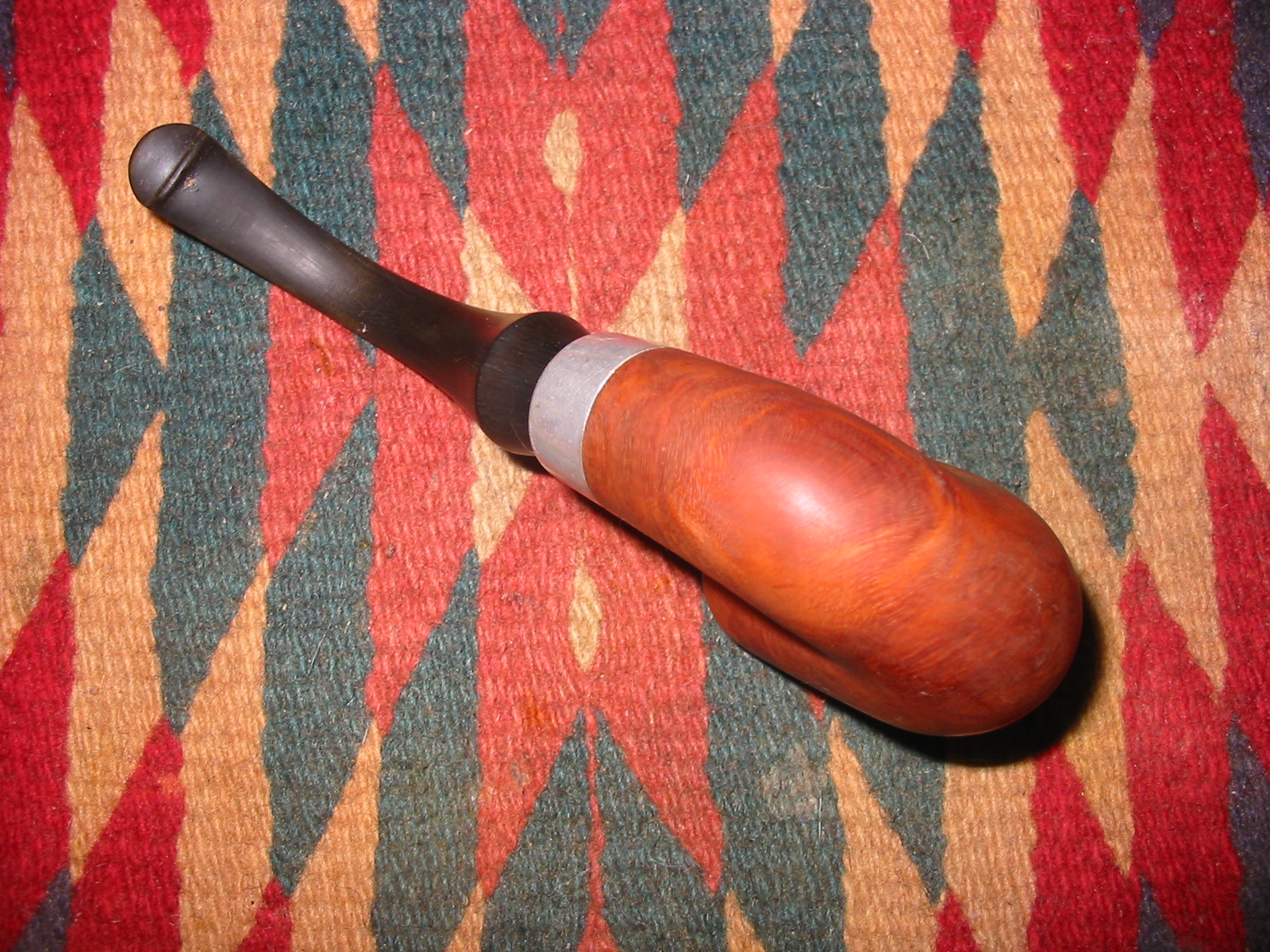
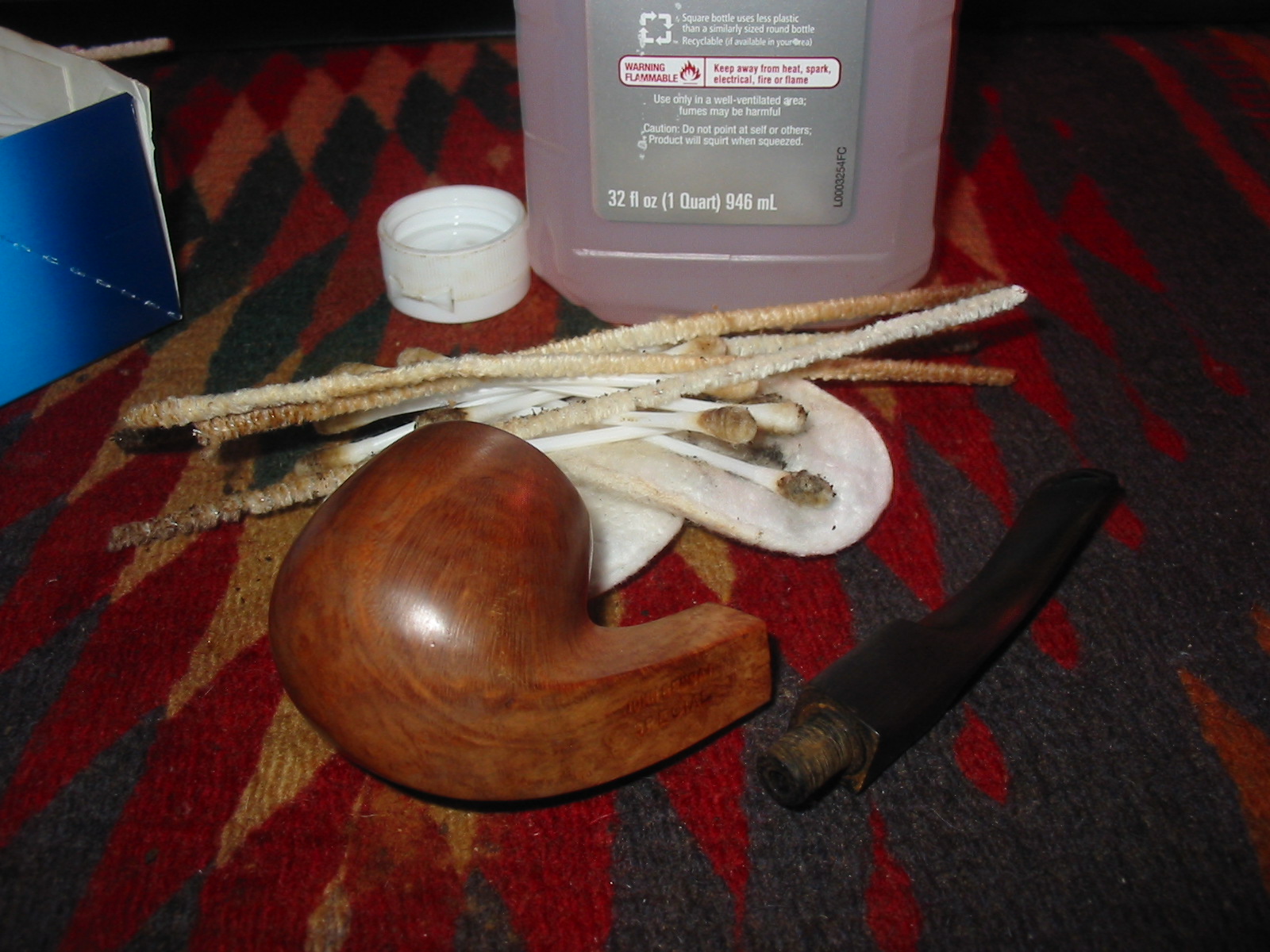
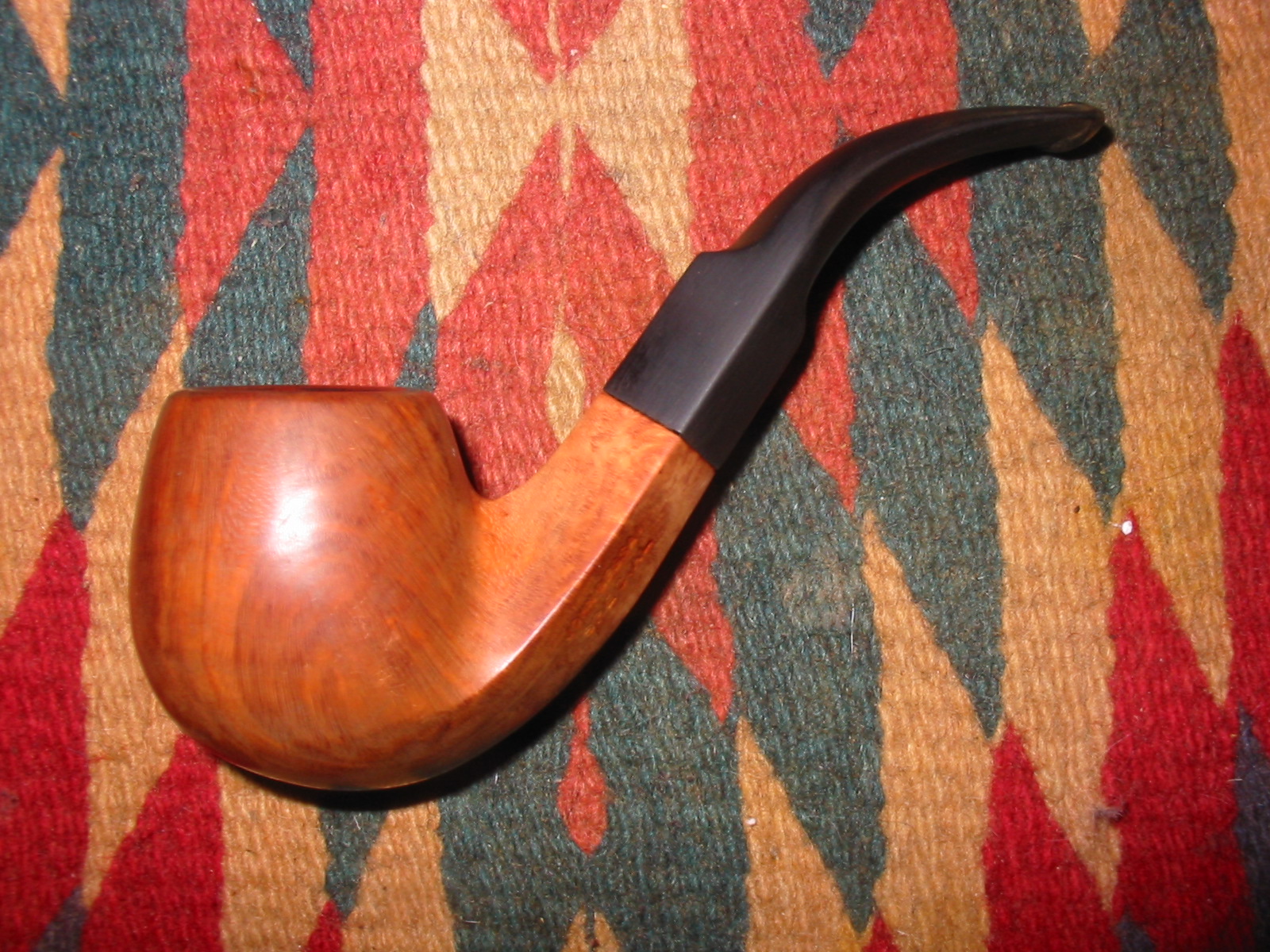
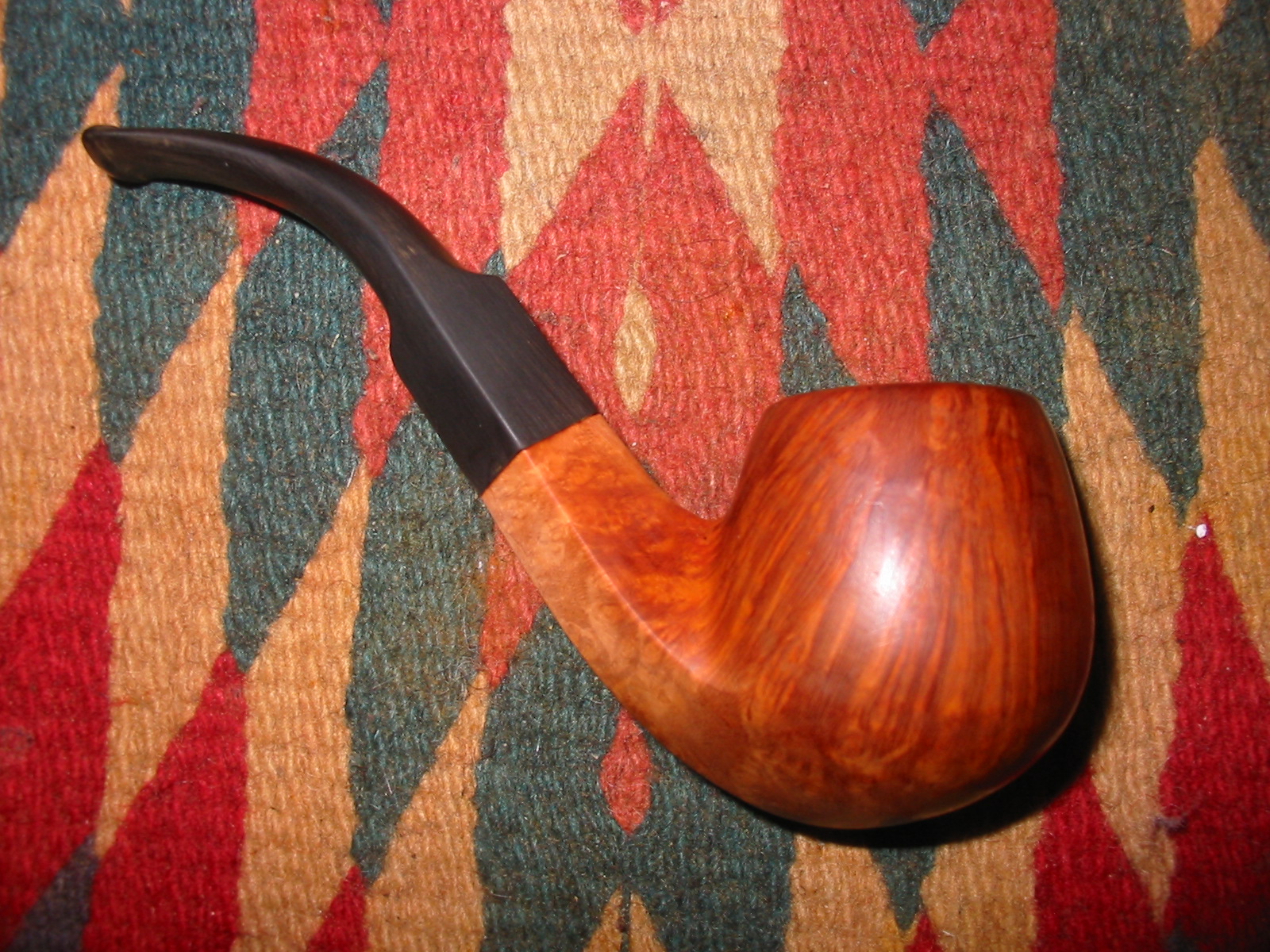
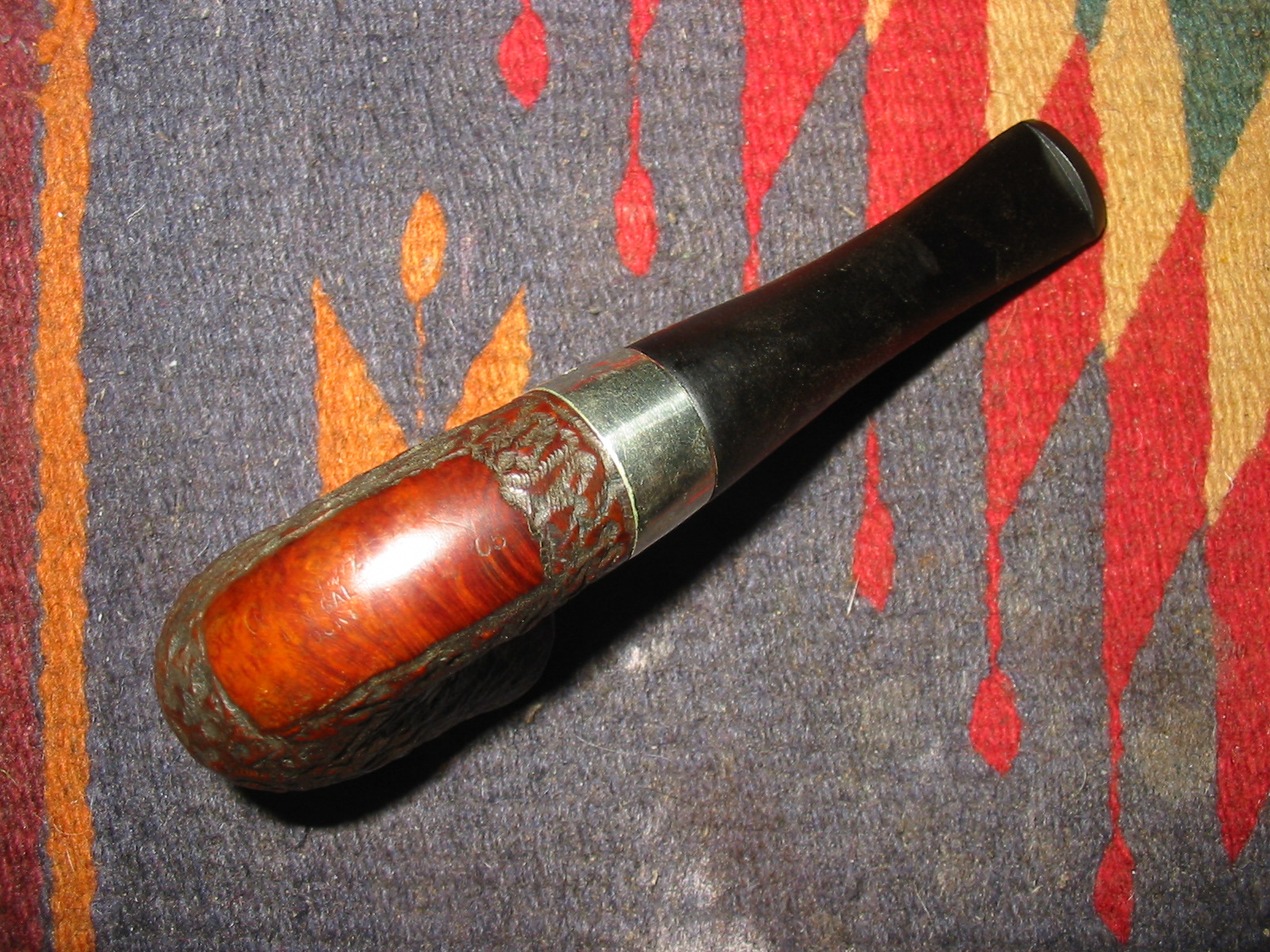
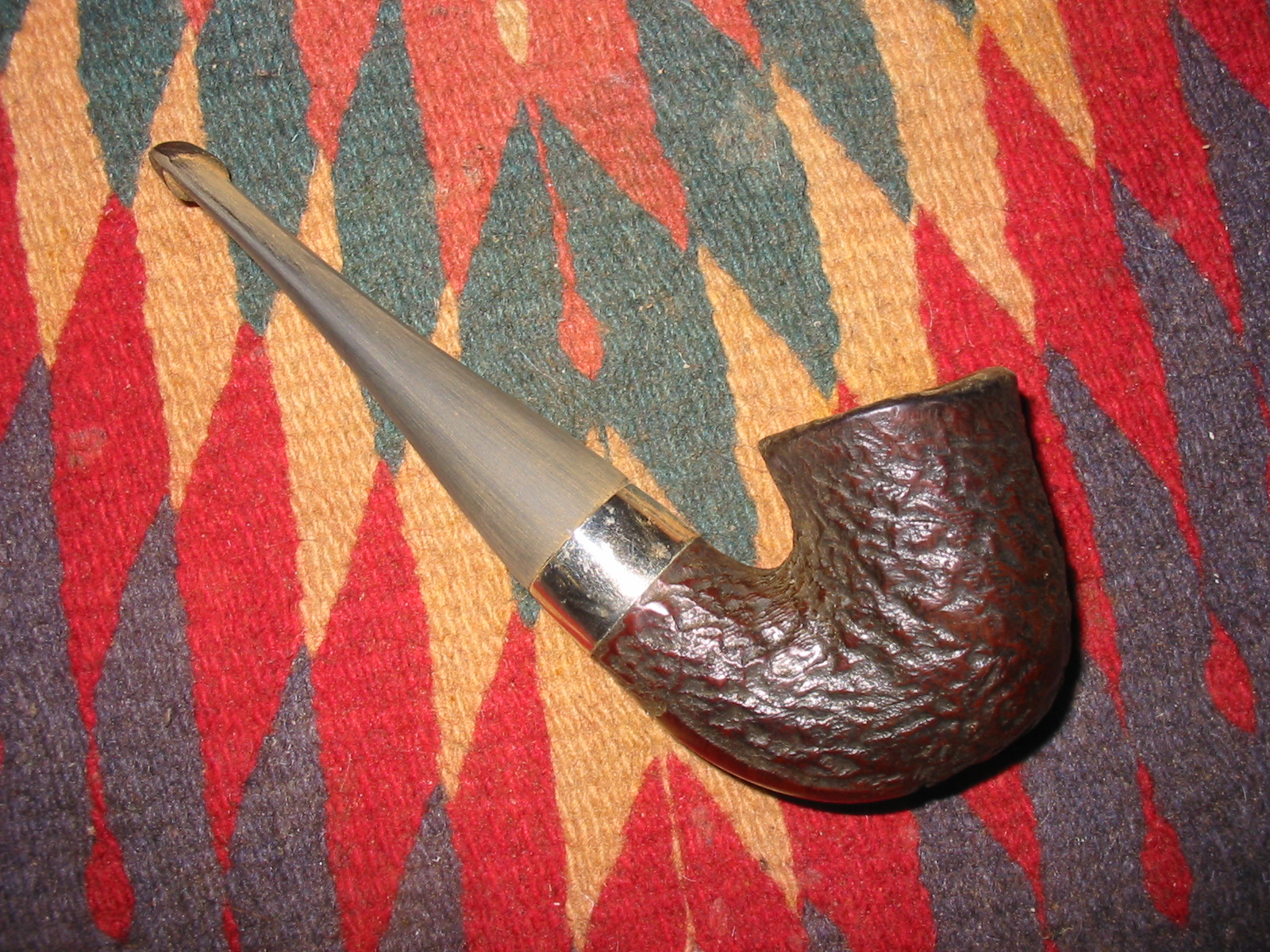
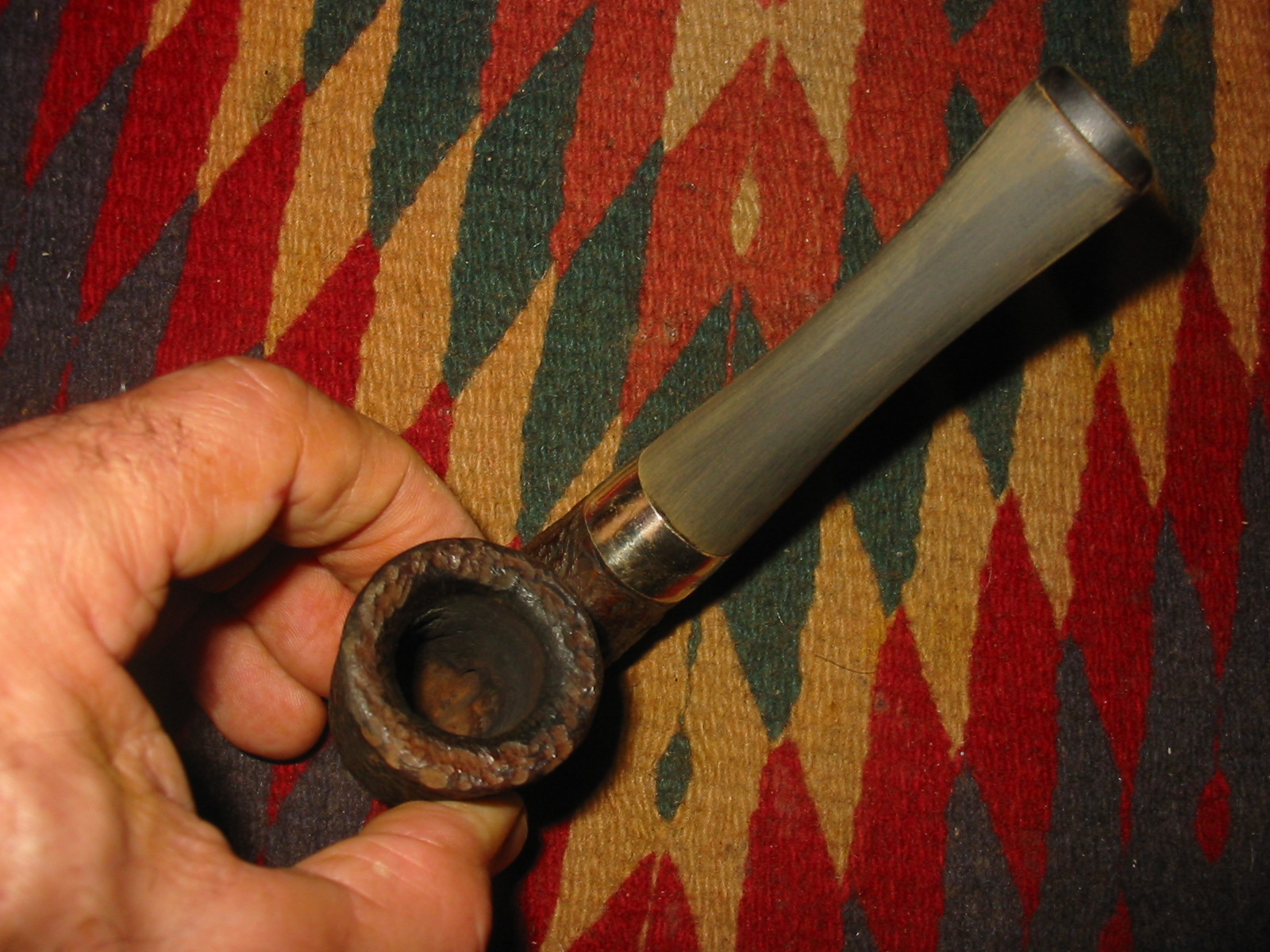
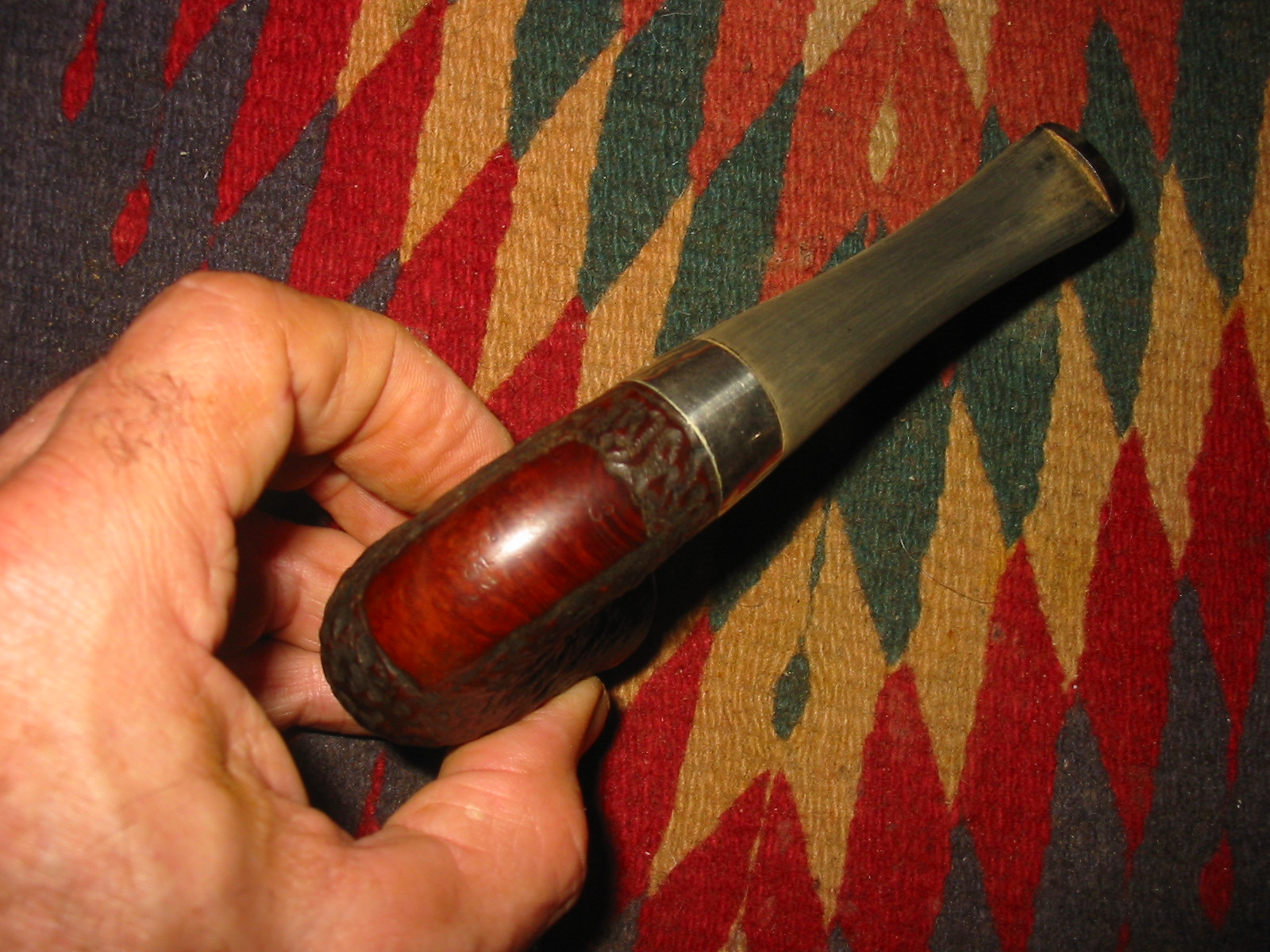
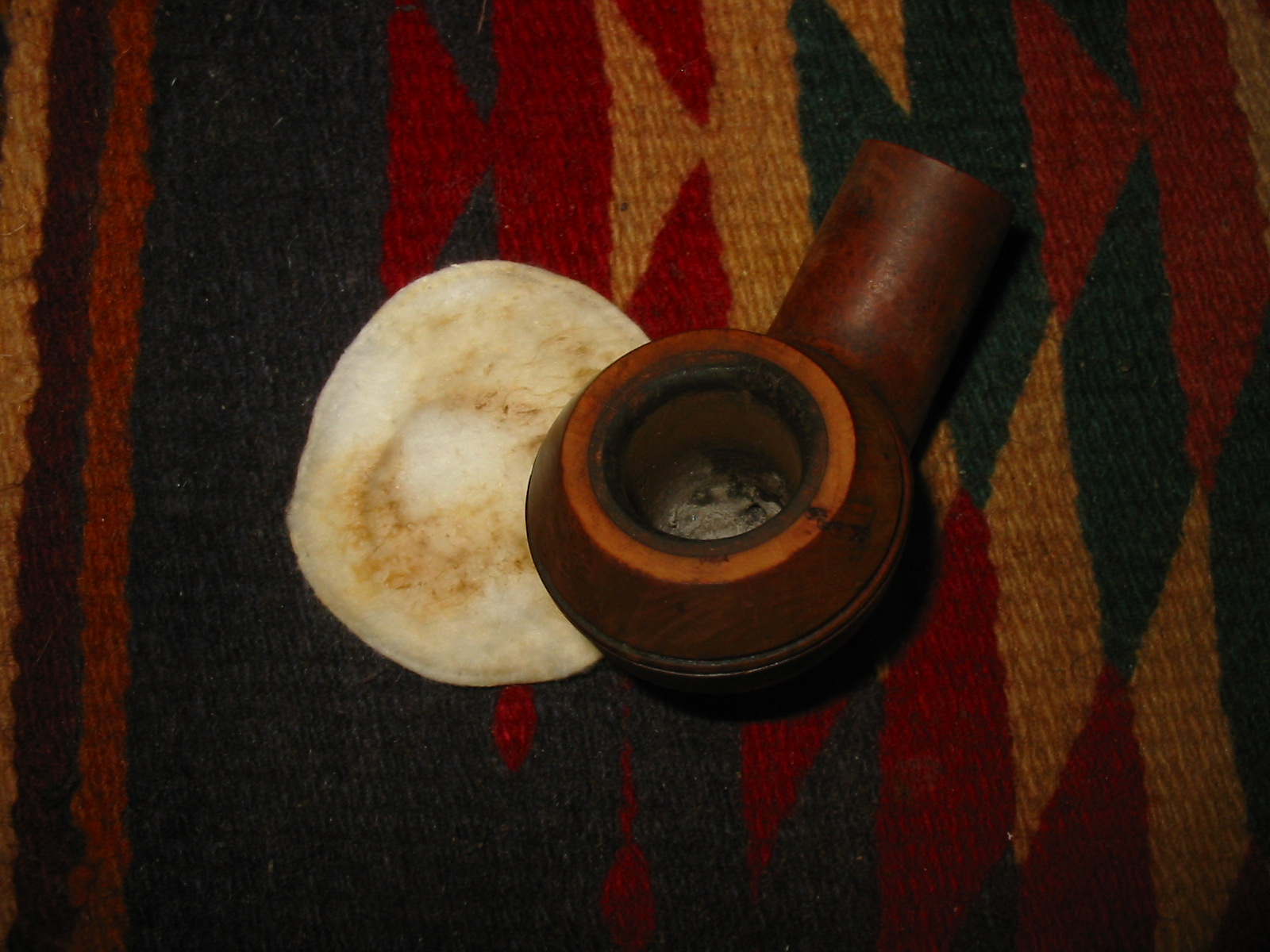
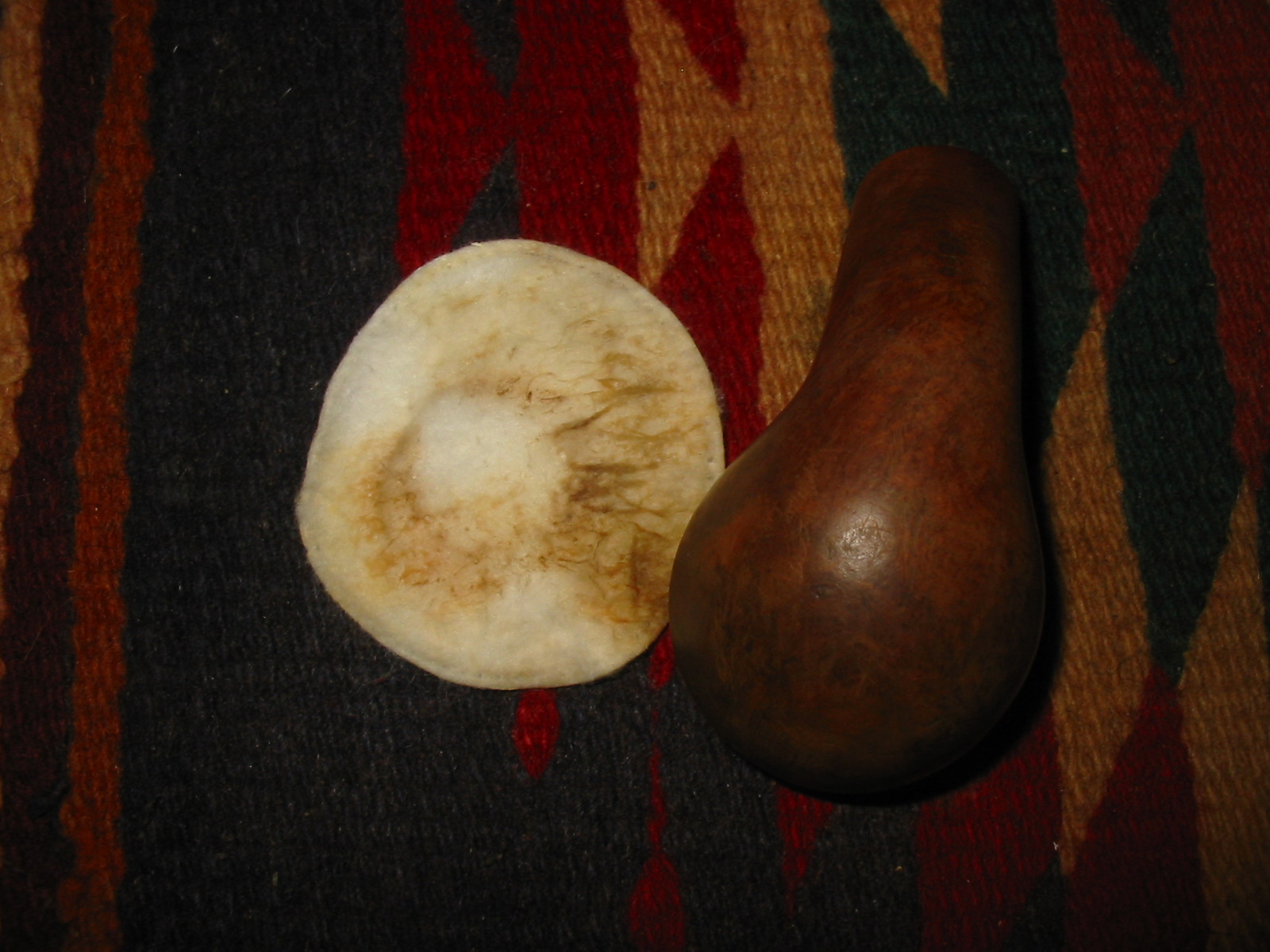
In the box of gift bowls that came to me were a few that I could fiddle with and see what I could come up with. There were no stems for these items so it was a blank slate to work on. The first of these was an old rustic bowl. As I looked at it I could see some possibilities for this old bowl. The bowl had a decent cake on the walls and there were no cracks in the piece of wood. It was like an old branch of cherrywood. The bark had been peeled and the top roughly carved. The bottom of the bowl was rounded. Internally the bowl bottom was flat and sound. The airway entered the bowl precisely on the bottom. There was a drilled airway on the side of the bowl that looked like it probably had a long stick for a shank and stem – possibly a reed stem.
IMG_7394

IMG_7395
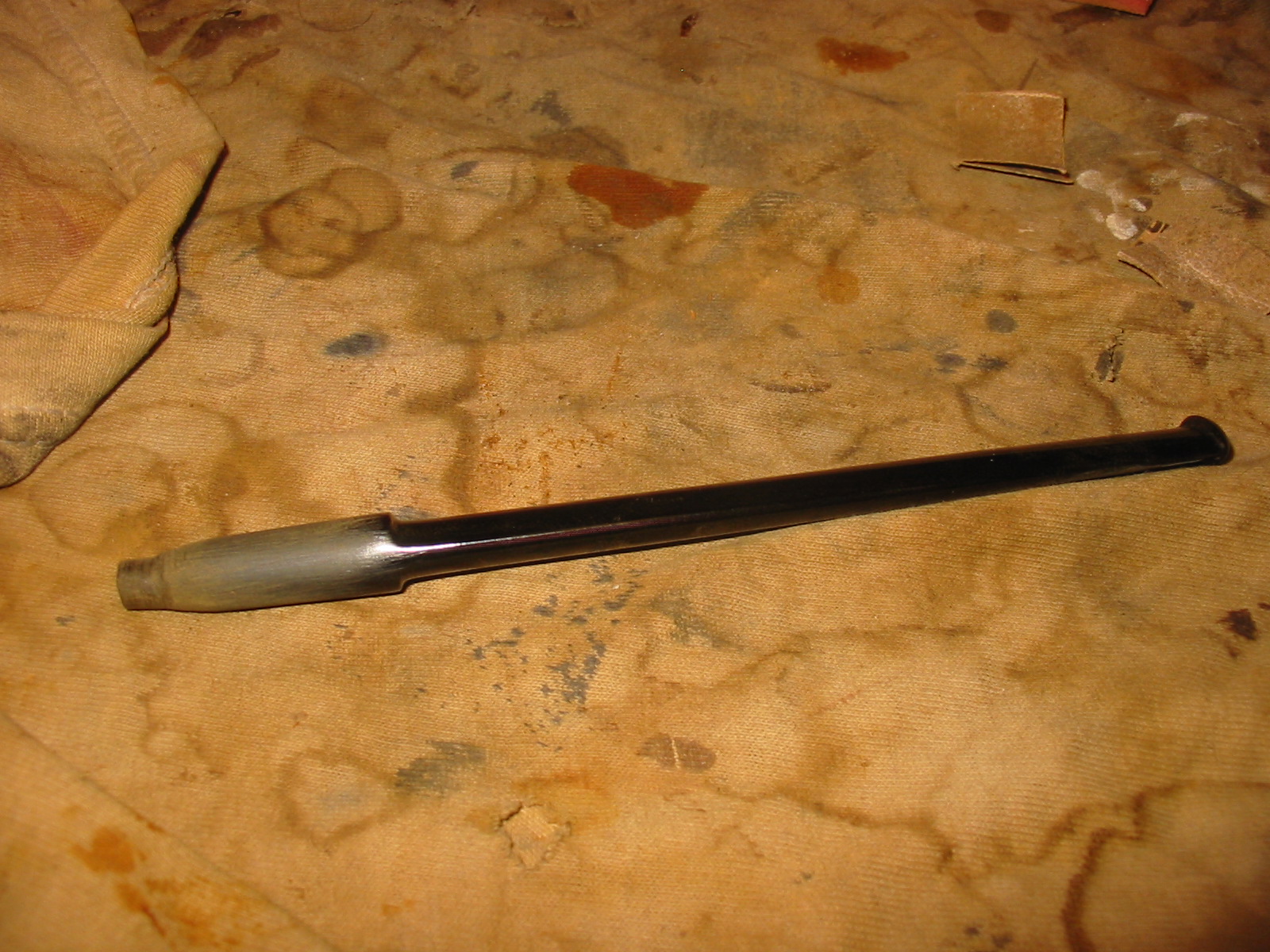
I did not have a reed stem or a wooden shank to insert in the bowl but I did have an old vulcanite long stem that would work. The tenon had been tapered down and it had a slight saddle that gave it a unique look.
IMG_7393
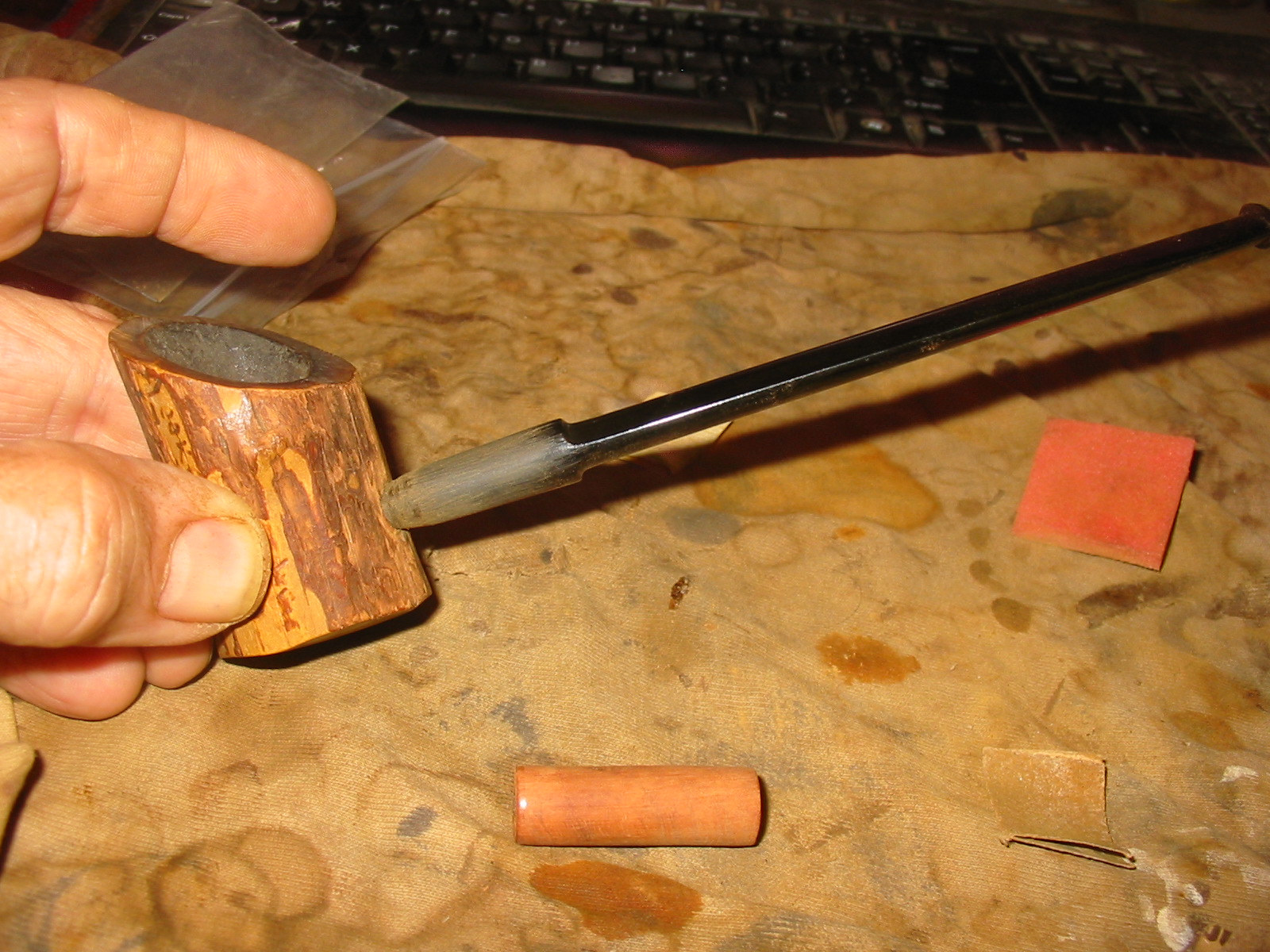
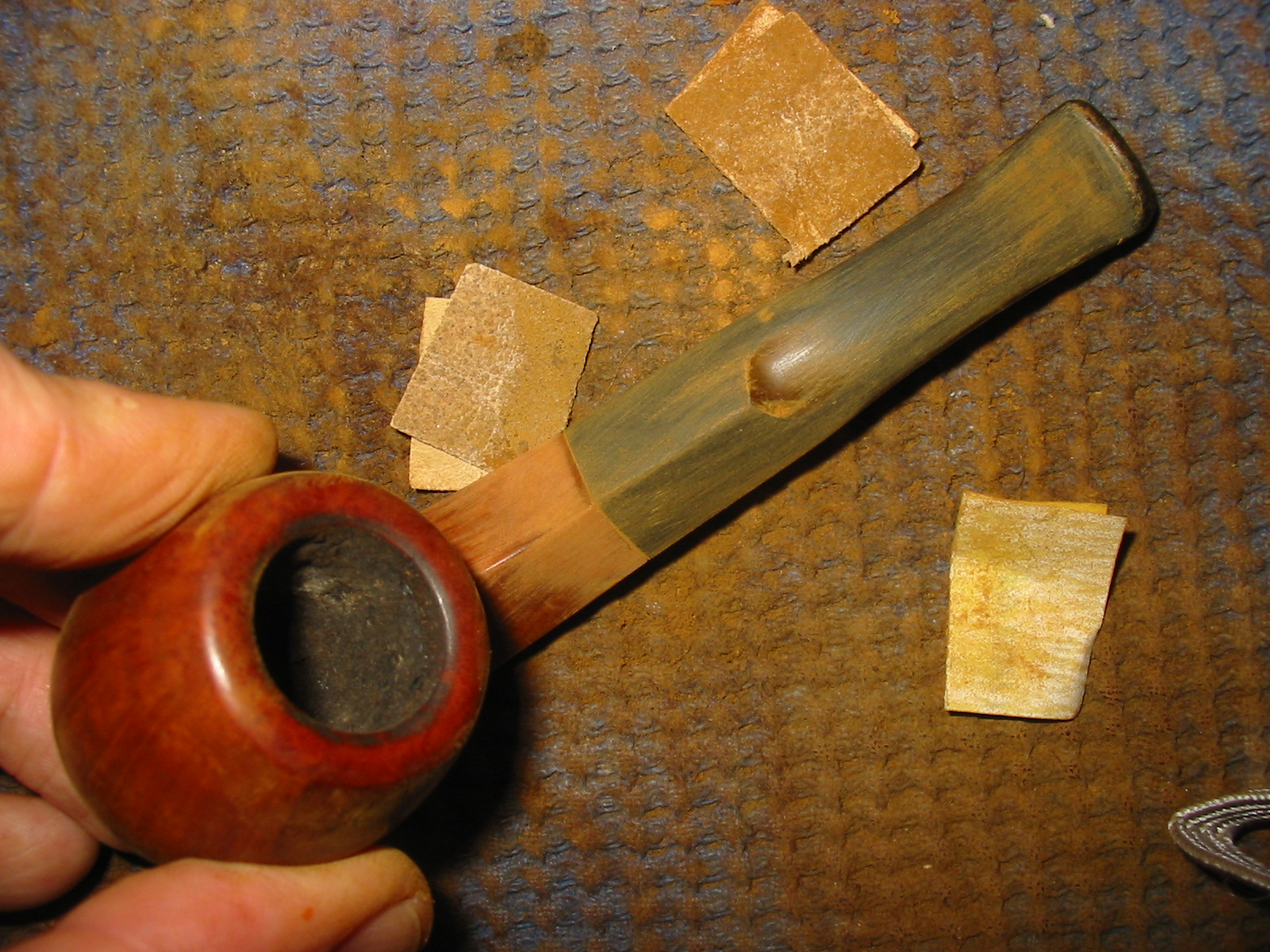
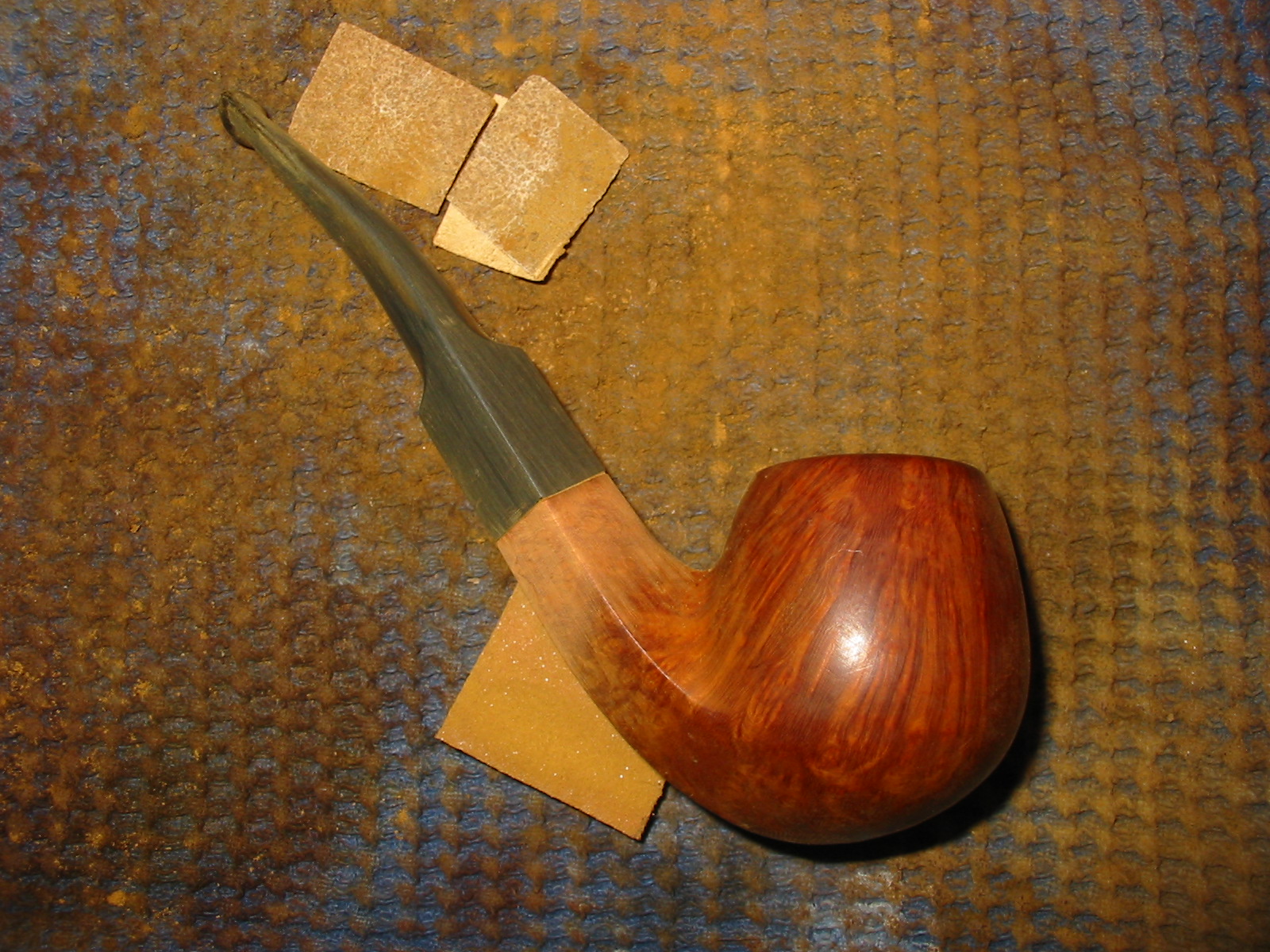
I sanded the taper and reduced the diameter of the end of the stem/tenon. I sanded it until it fit snug in the hole in the bowl. I sanded it with 150 and 220 sandpaper to shape the stem and clean up the fit. I sanded it with a medium and a fine grit sandpaper to remove the scratches left behind by the sandpaper.
IMG_7396
I have a briar shank piece left over from other work I had done and for a short time considered inserting that between the bowl and the stem. I laid it out to see what it would look like and did not like the look so I set it aside for a later project.
IMG_7397
I turned the stem directly into the bowl and checked on the fit. The short tenon end on the stem was the precise depth of the hole in the side of the bowl. That made the fit perfect.
IMG_7398
I decided to glue in the stem with wood glue rather than leaving it a pressure fit stem. I decided the look would be similar to a mini-church warden cob and the fixed stem would work well with this particular bowl. I put the glue on the tenon and pressed it into place. I wiped up the spill over and wiped it down with a cotton pad to clean the briar and vulcanite surfaces.
IMG_7399
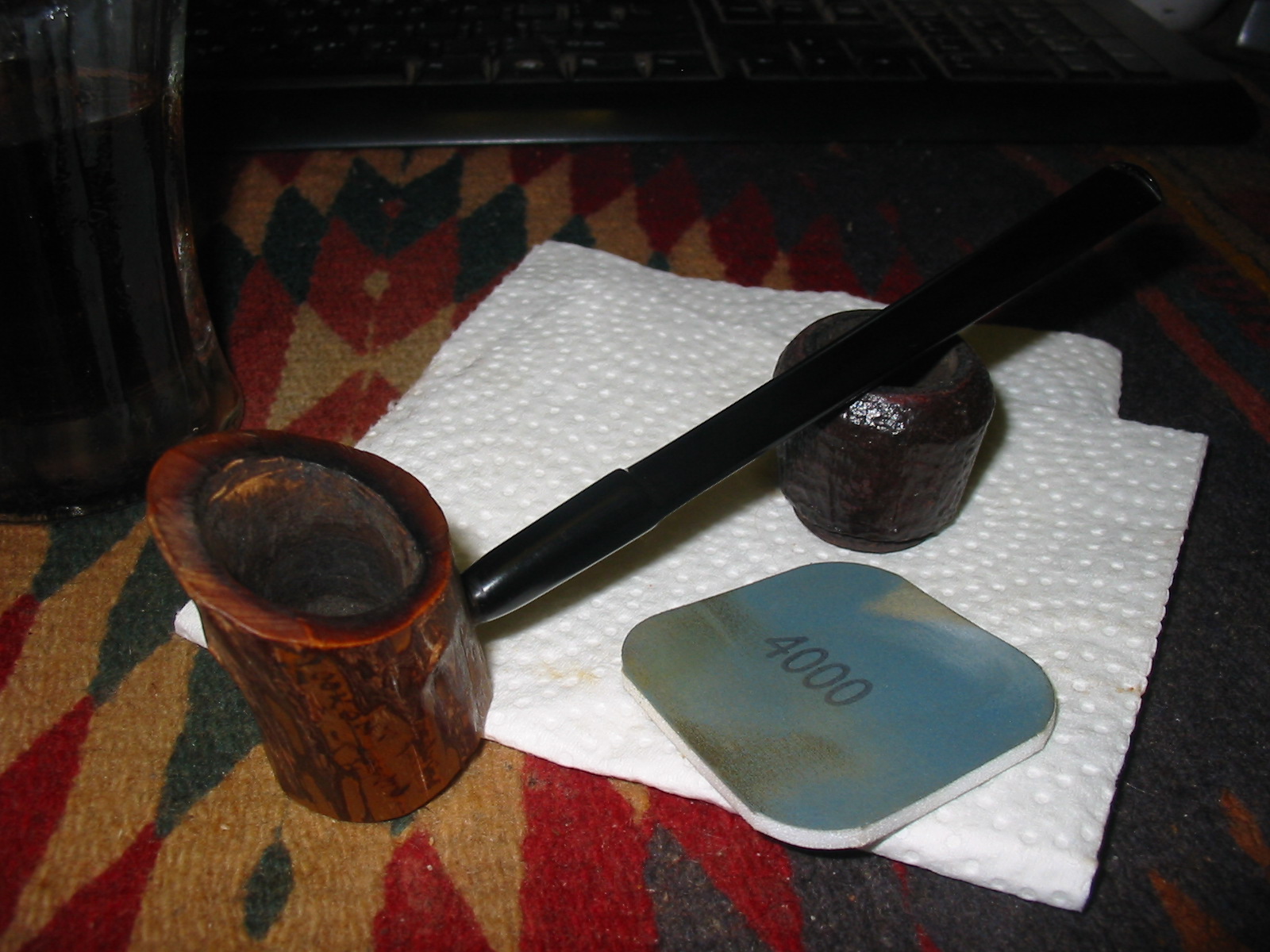
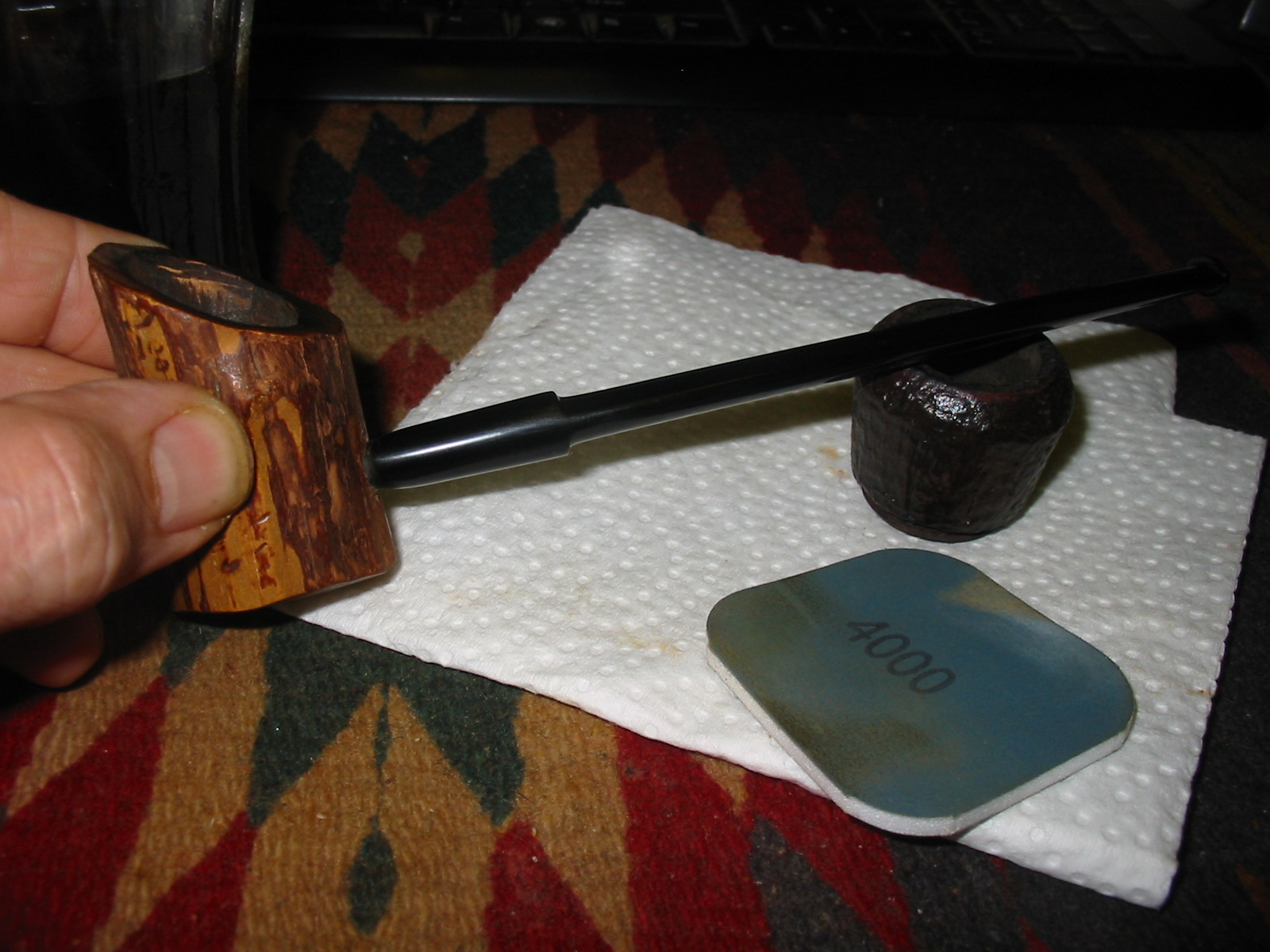
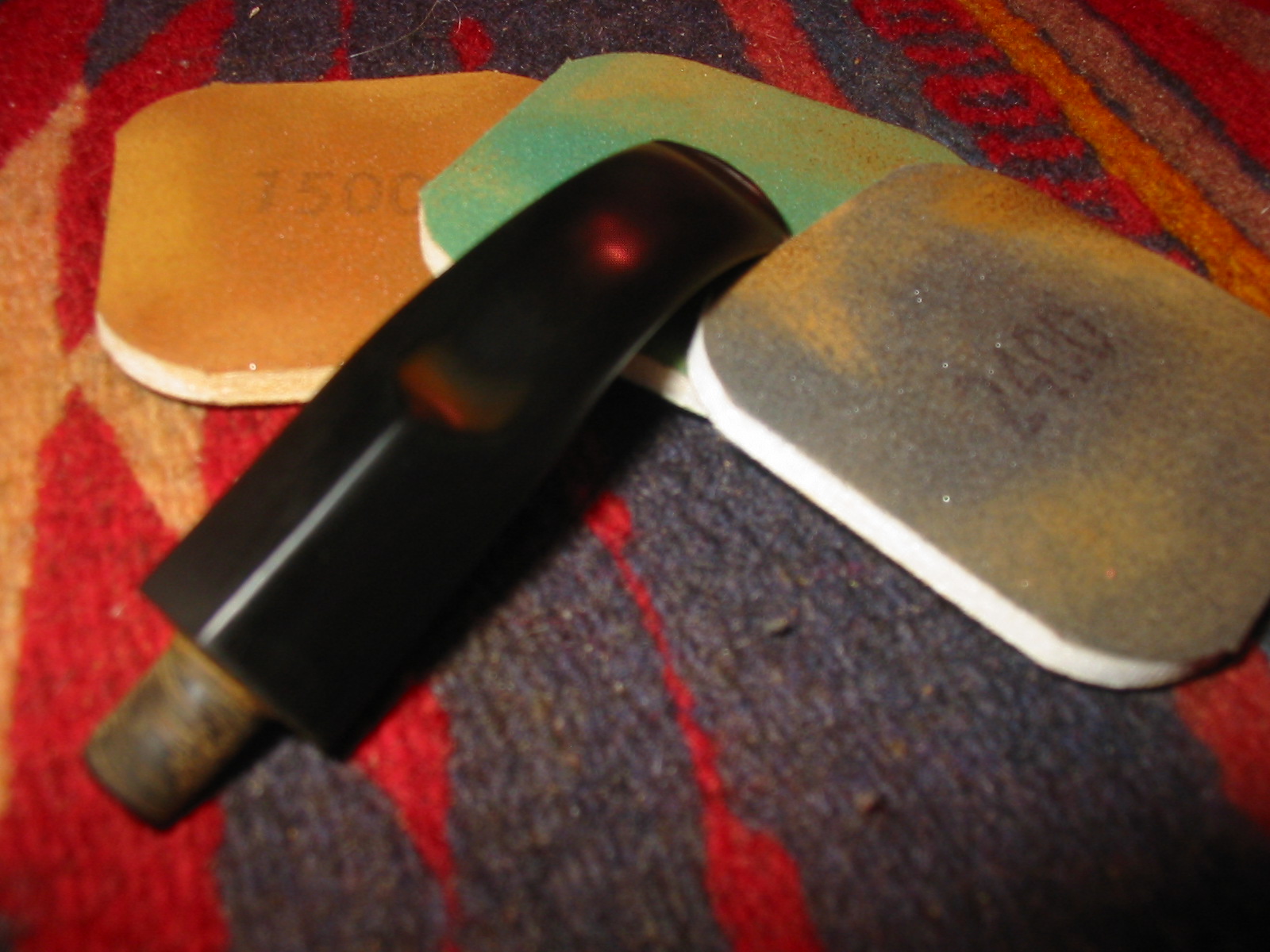
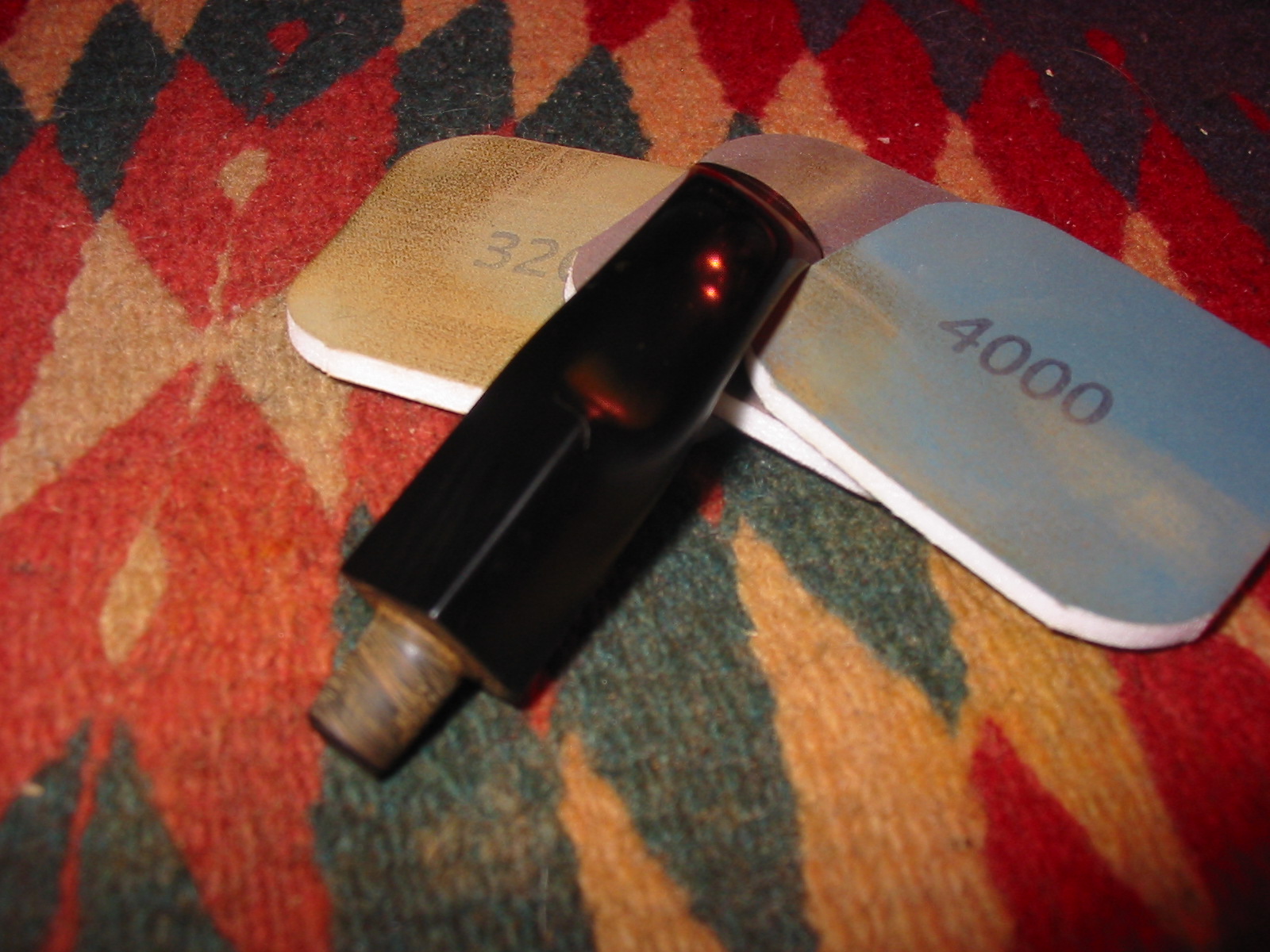
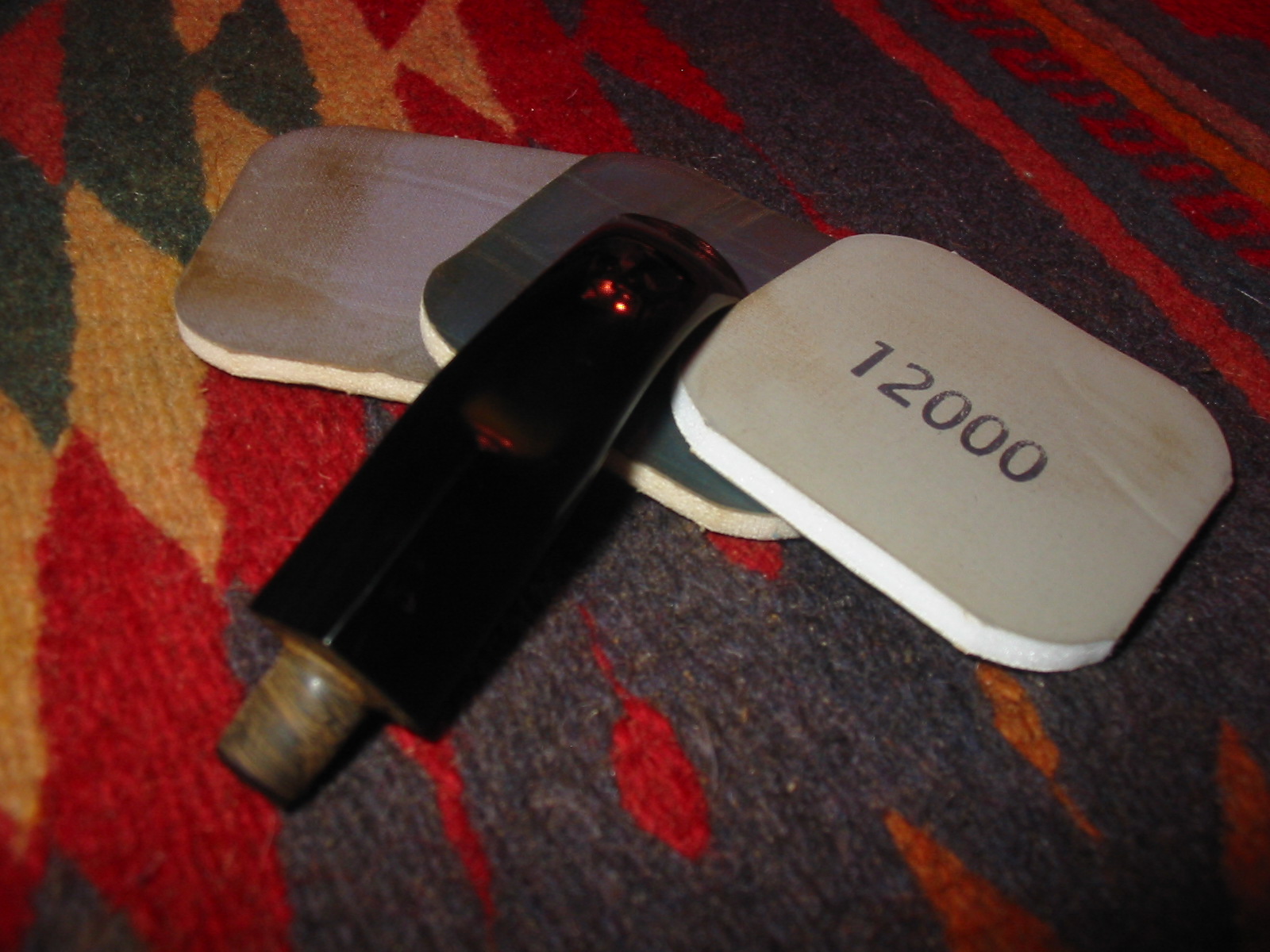
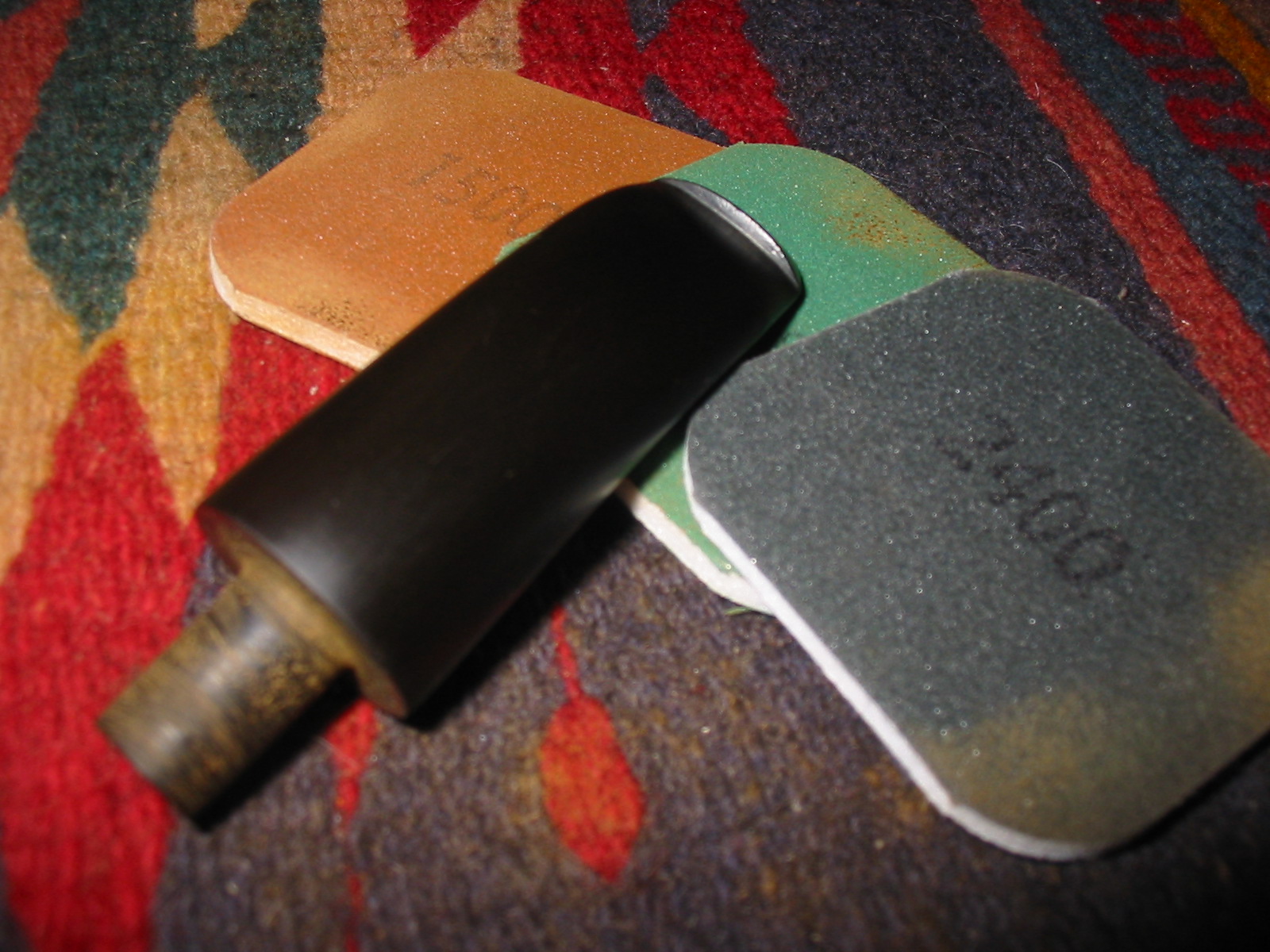
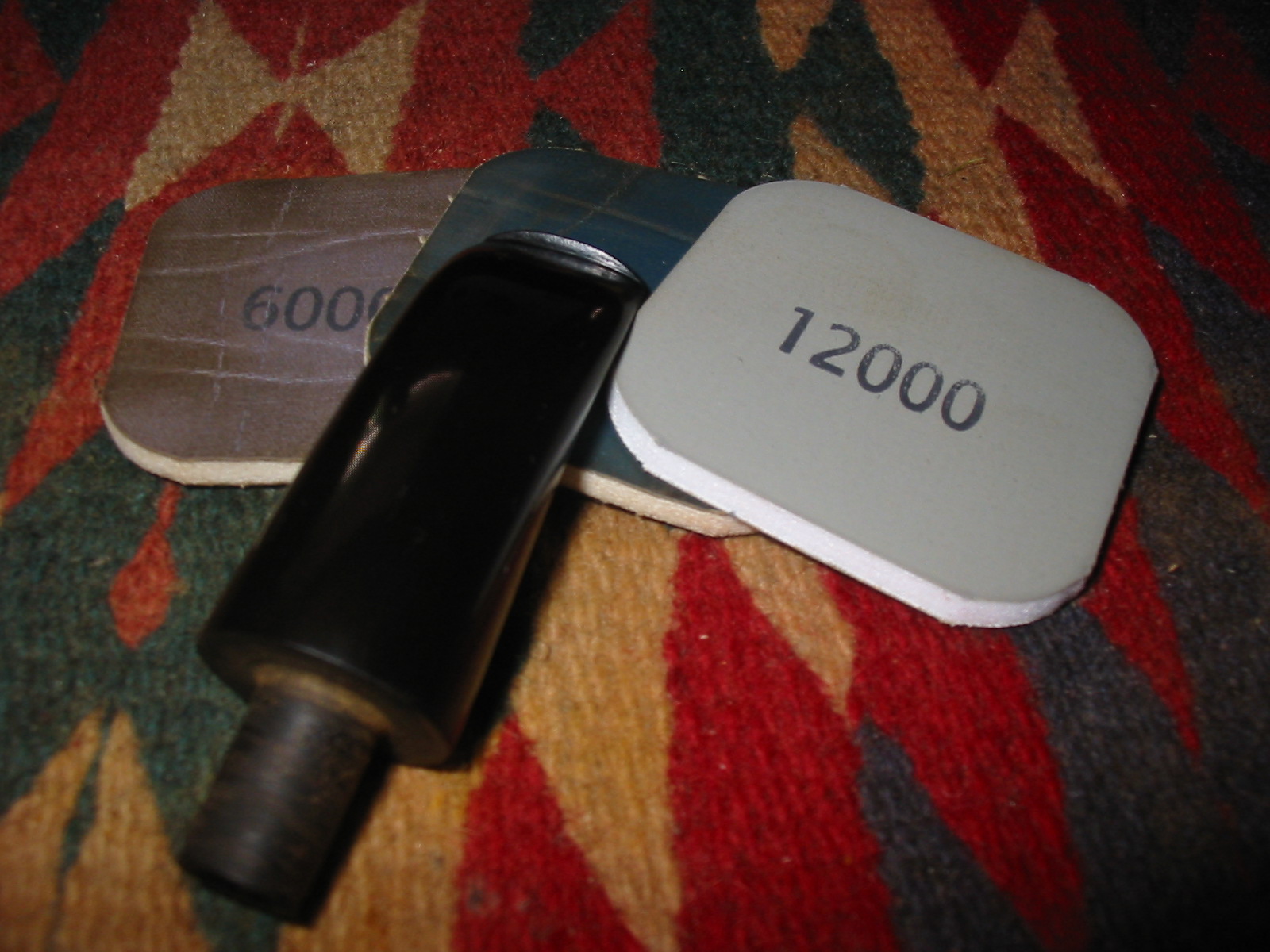
I sanded the stem with micromesh sanding pads – wet sanding with 1500-2400 grit pads and dry sanding with 3200-12,000 grit pads. The look of the pipe was quite acceptable.
IMG_7401

IMG_7402
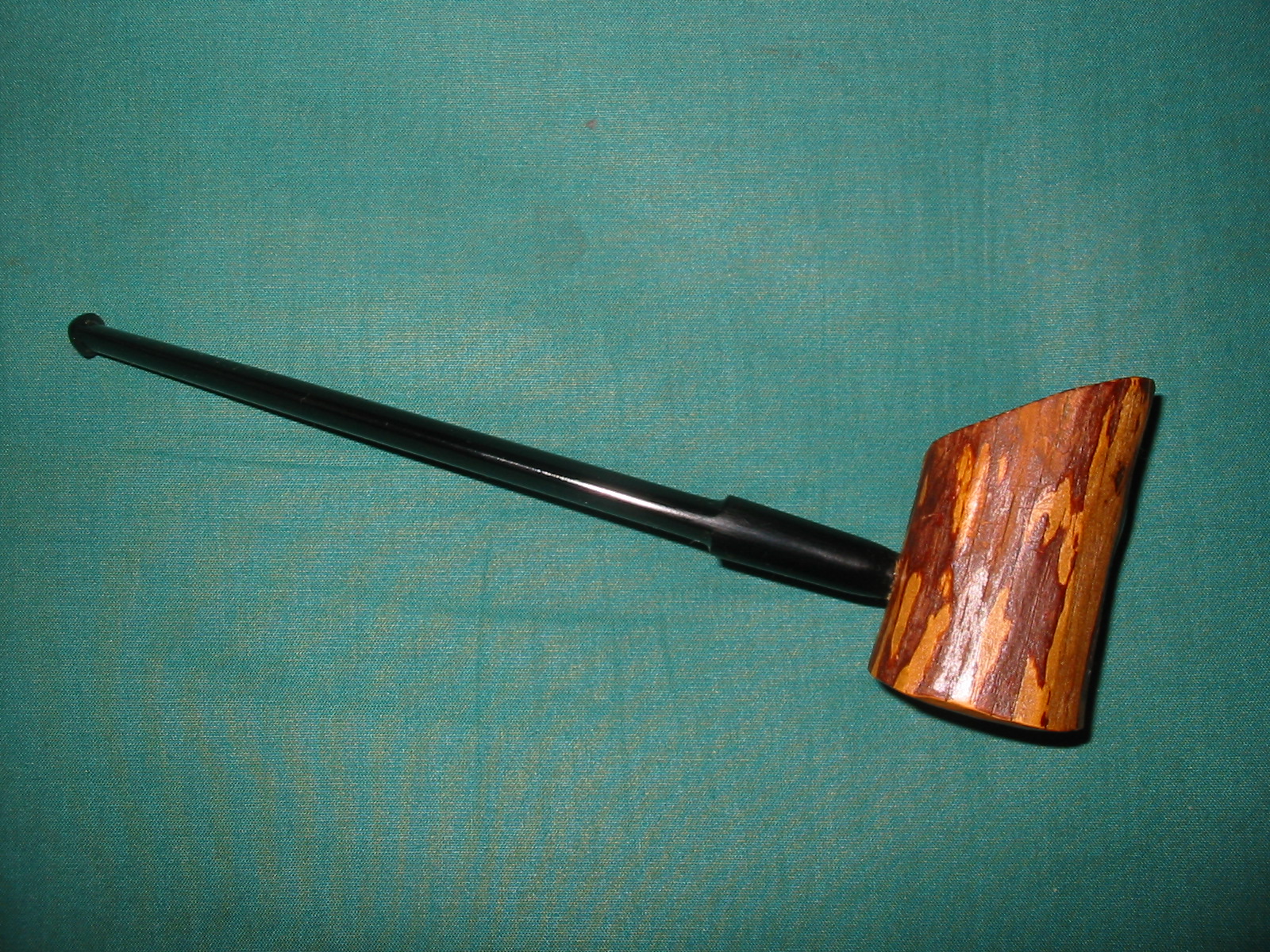
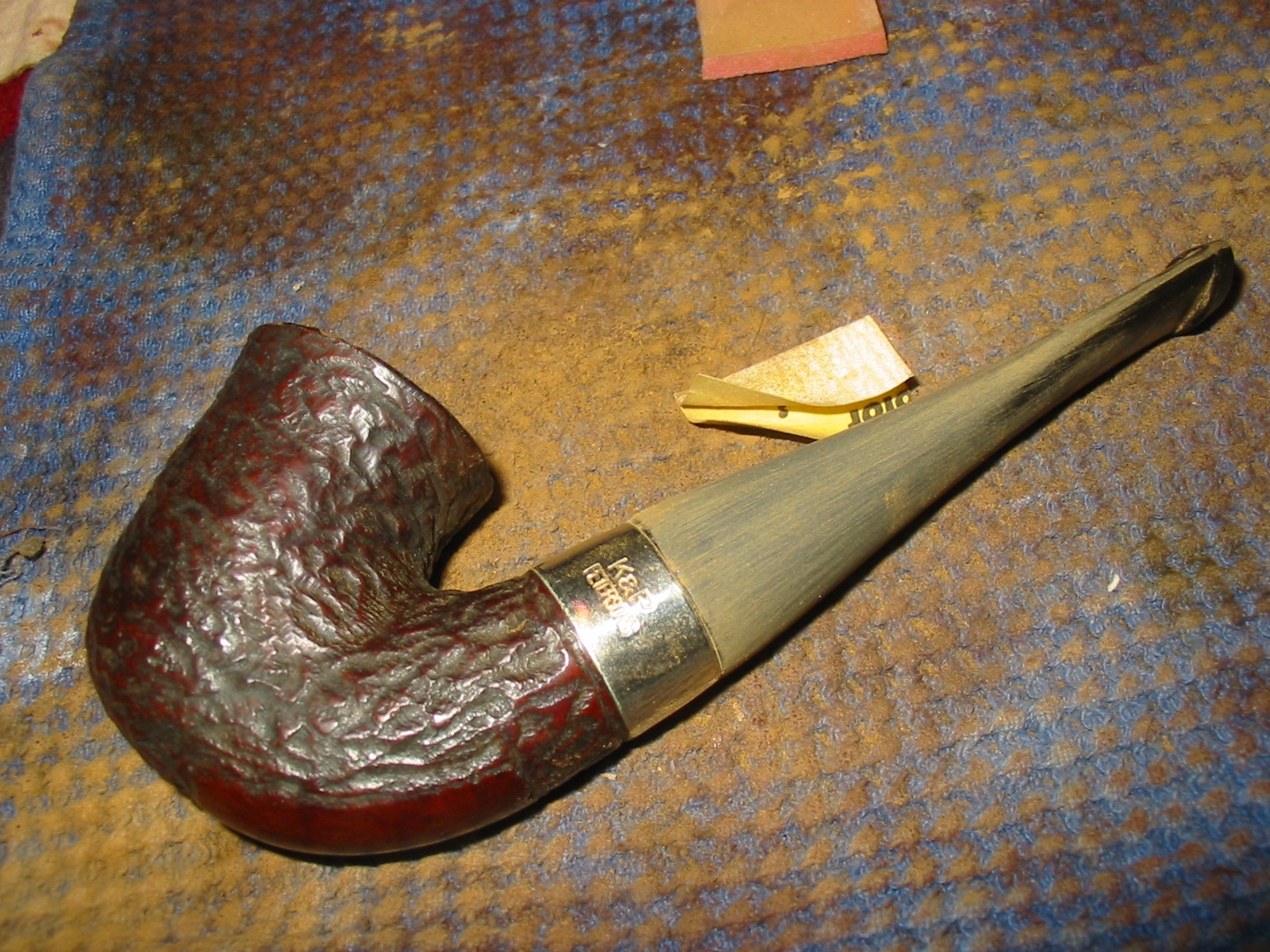
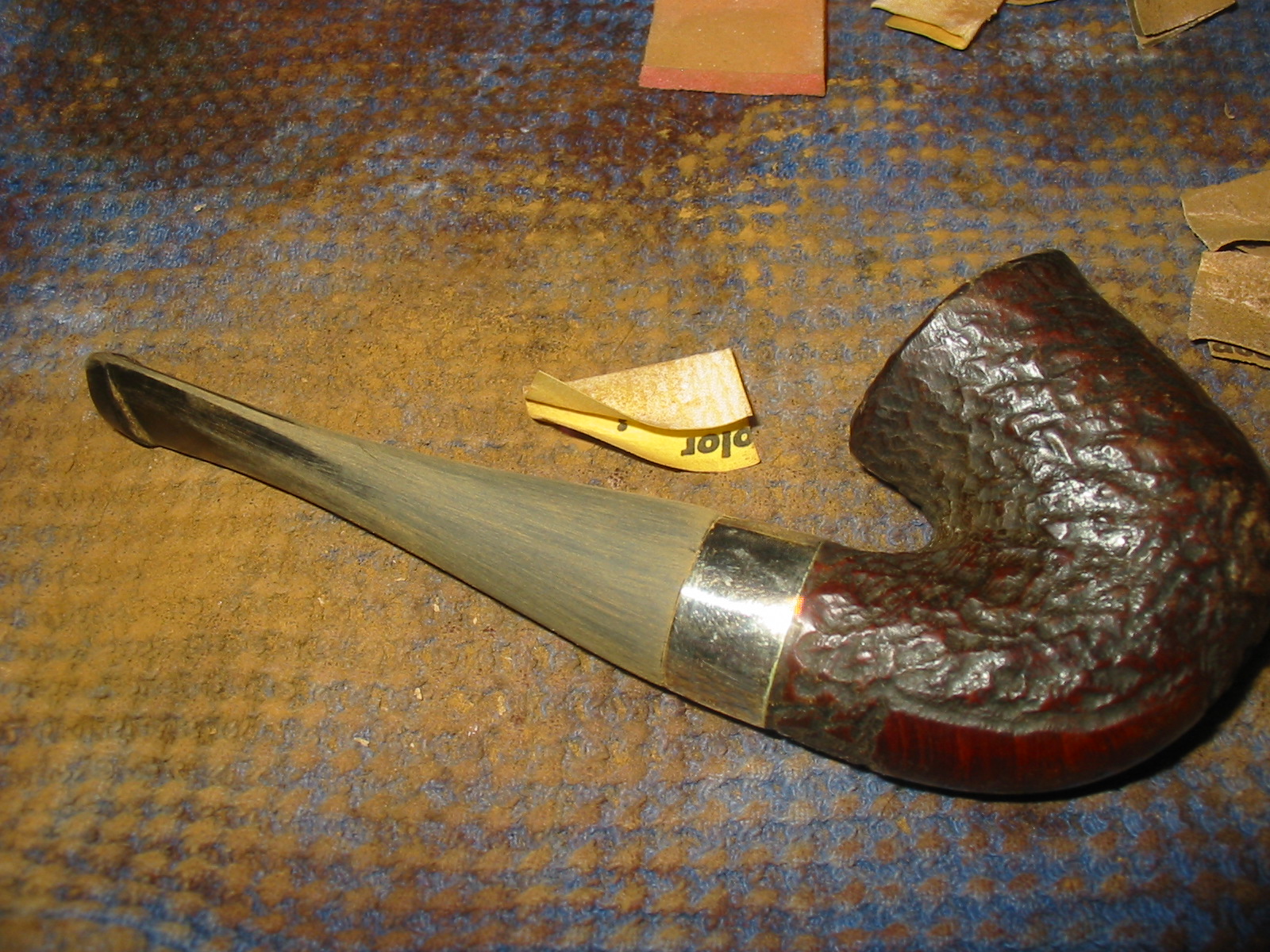
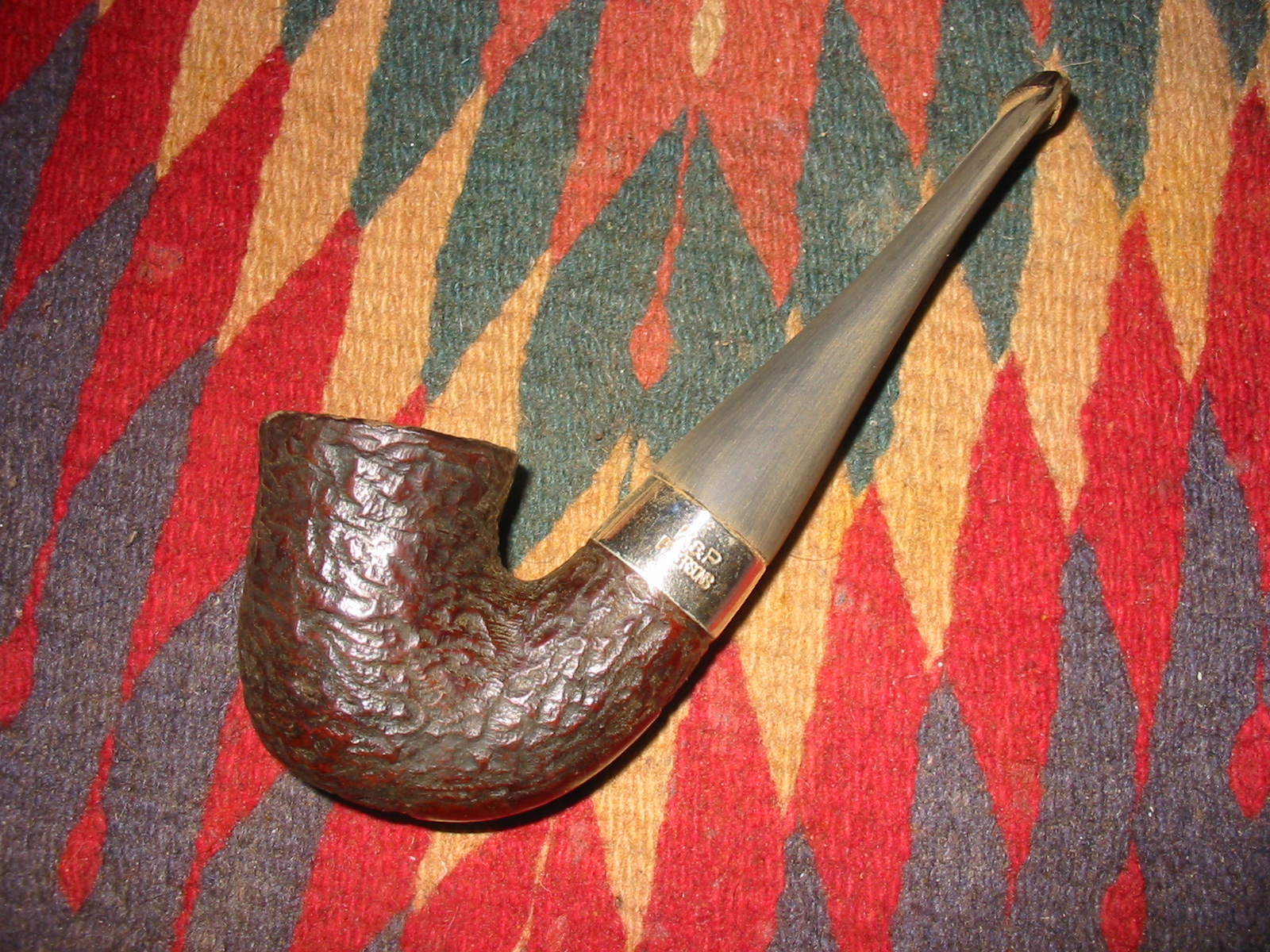
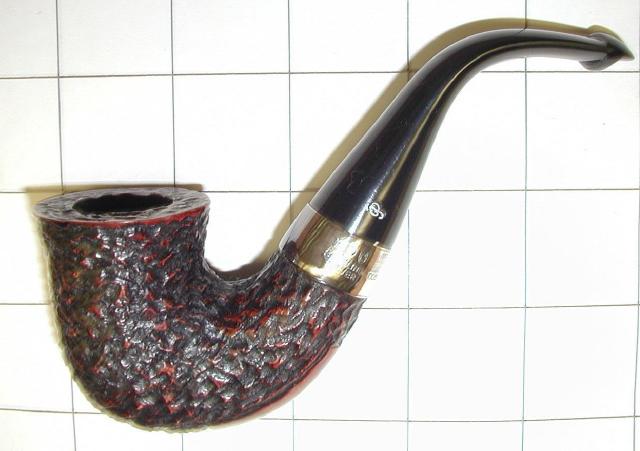
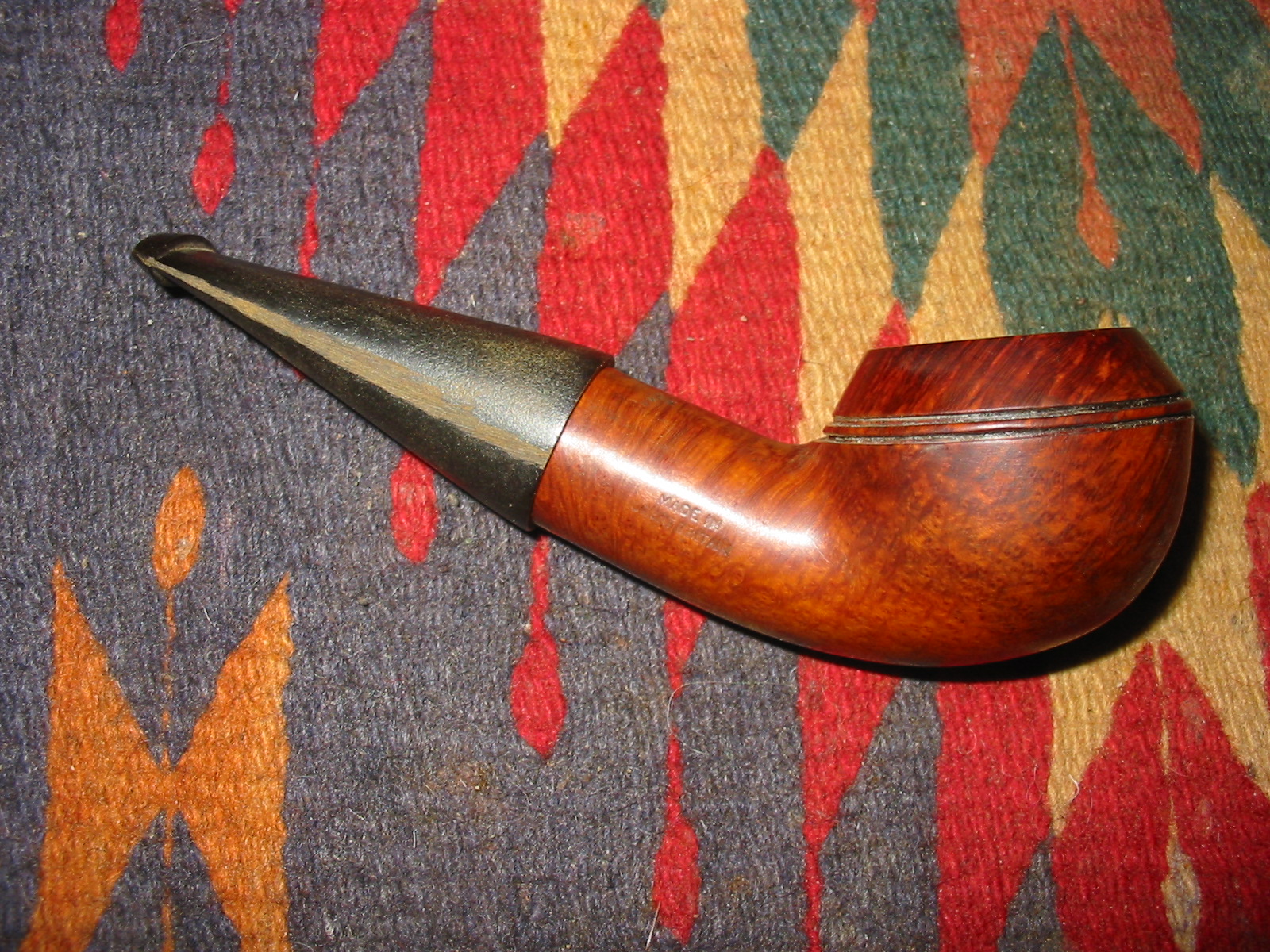
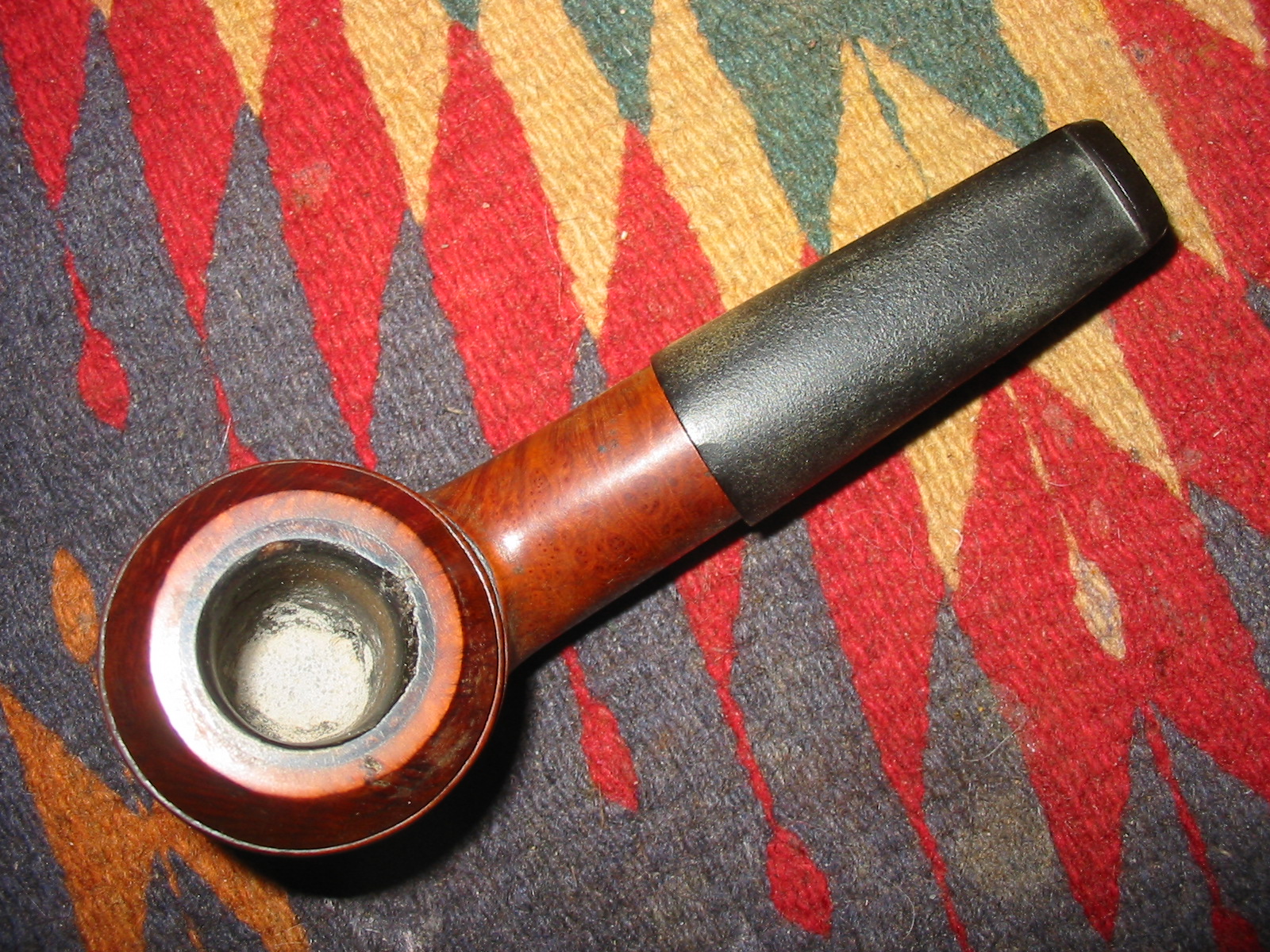
I gave the bowl a thin coat of medium brown aniline stain, flamed it and buffed it. The finished pipe is shown below. Now I need to get a straw hat and use it as a yard pipe. It should work well as a pipe that will not leave any worry when I am working in the garden or mowing the lawn. It will be a good pipe to smoke while sitting and reading on my front porch.
IMG_7414

IMG_7413

IMG_7411

IMG_7412

Reworking a WDC Wellington – Removing a Finish and Restemming the Bowl


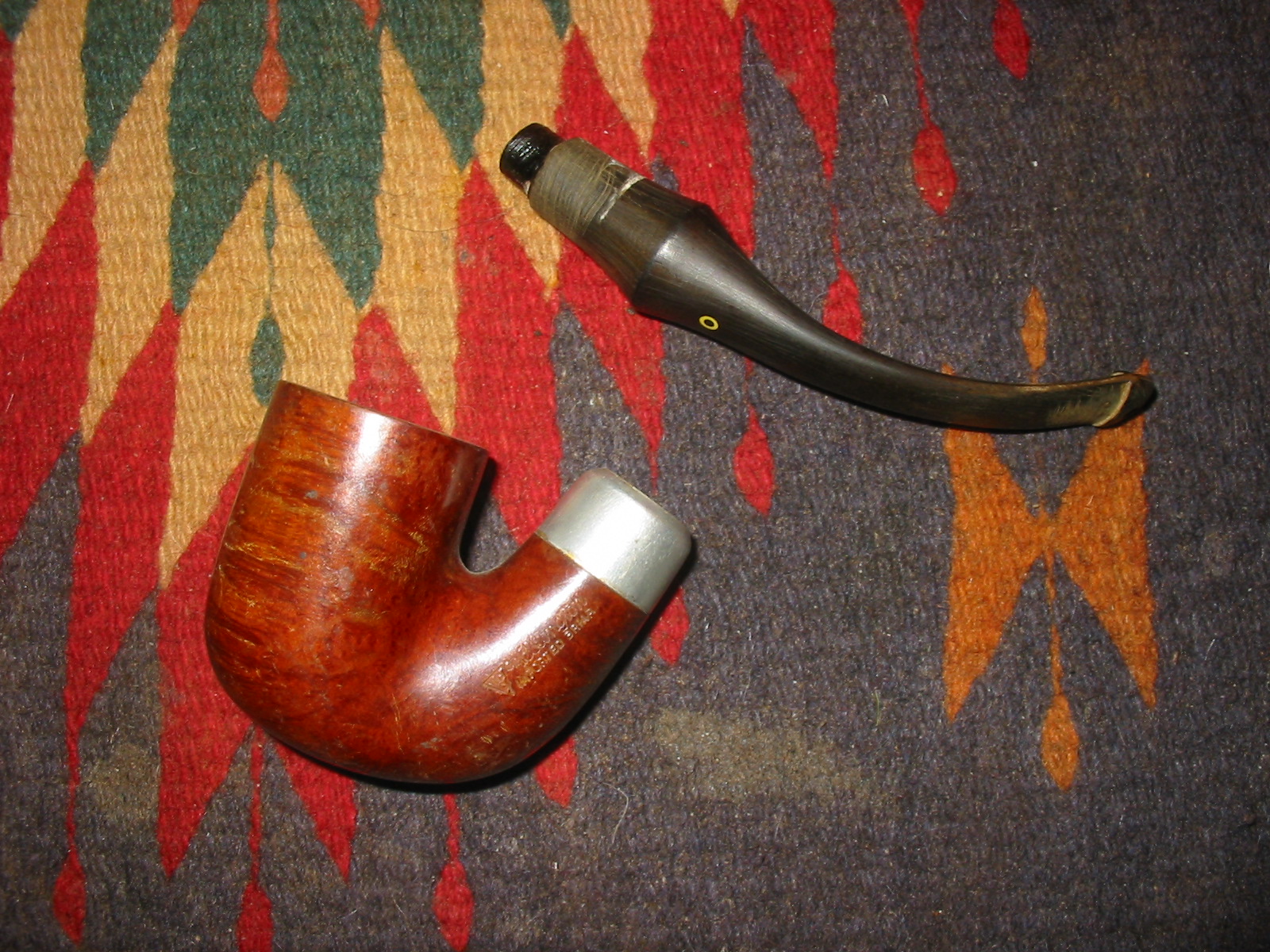
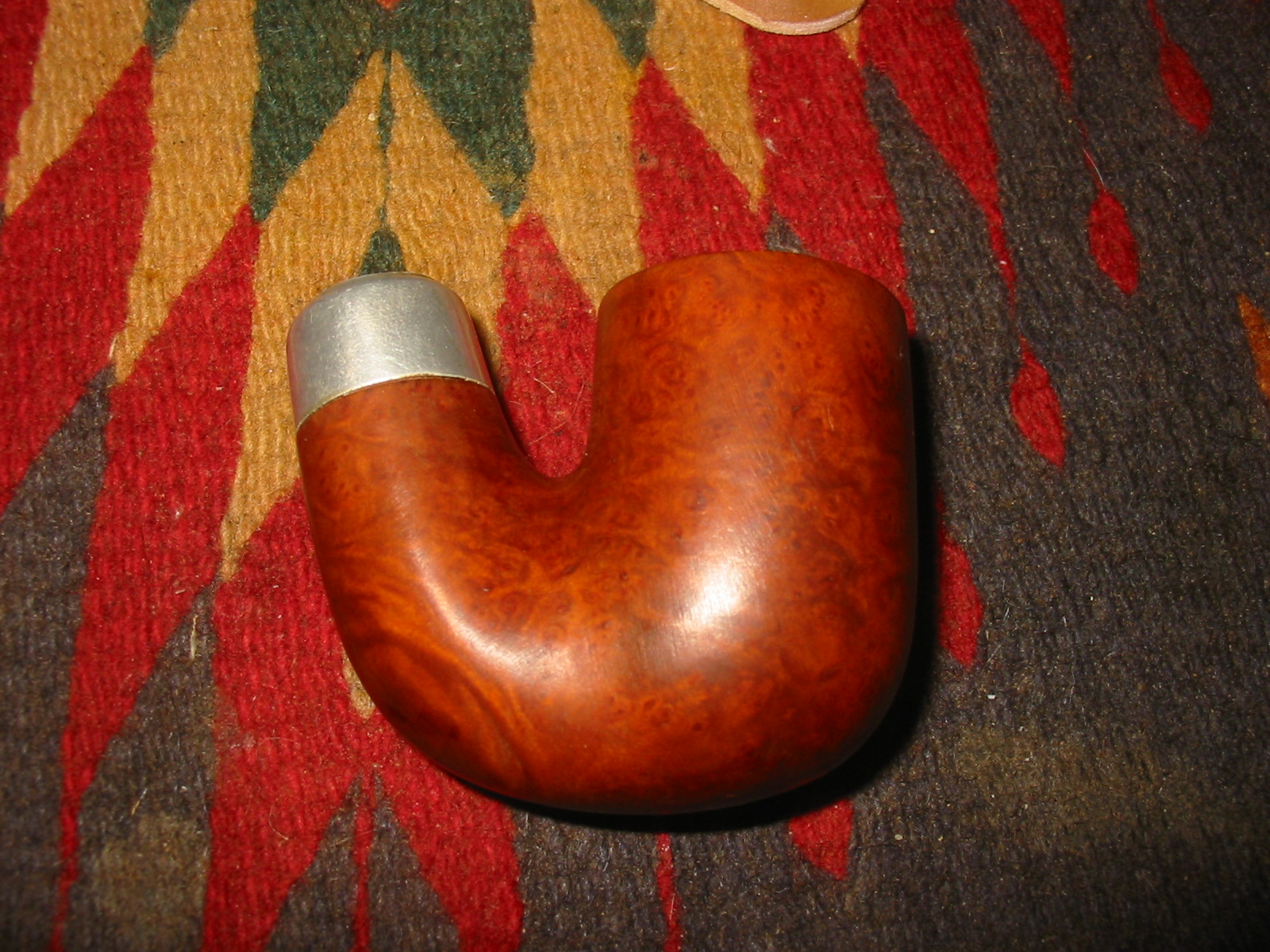
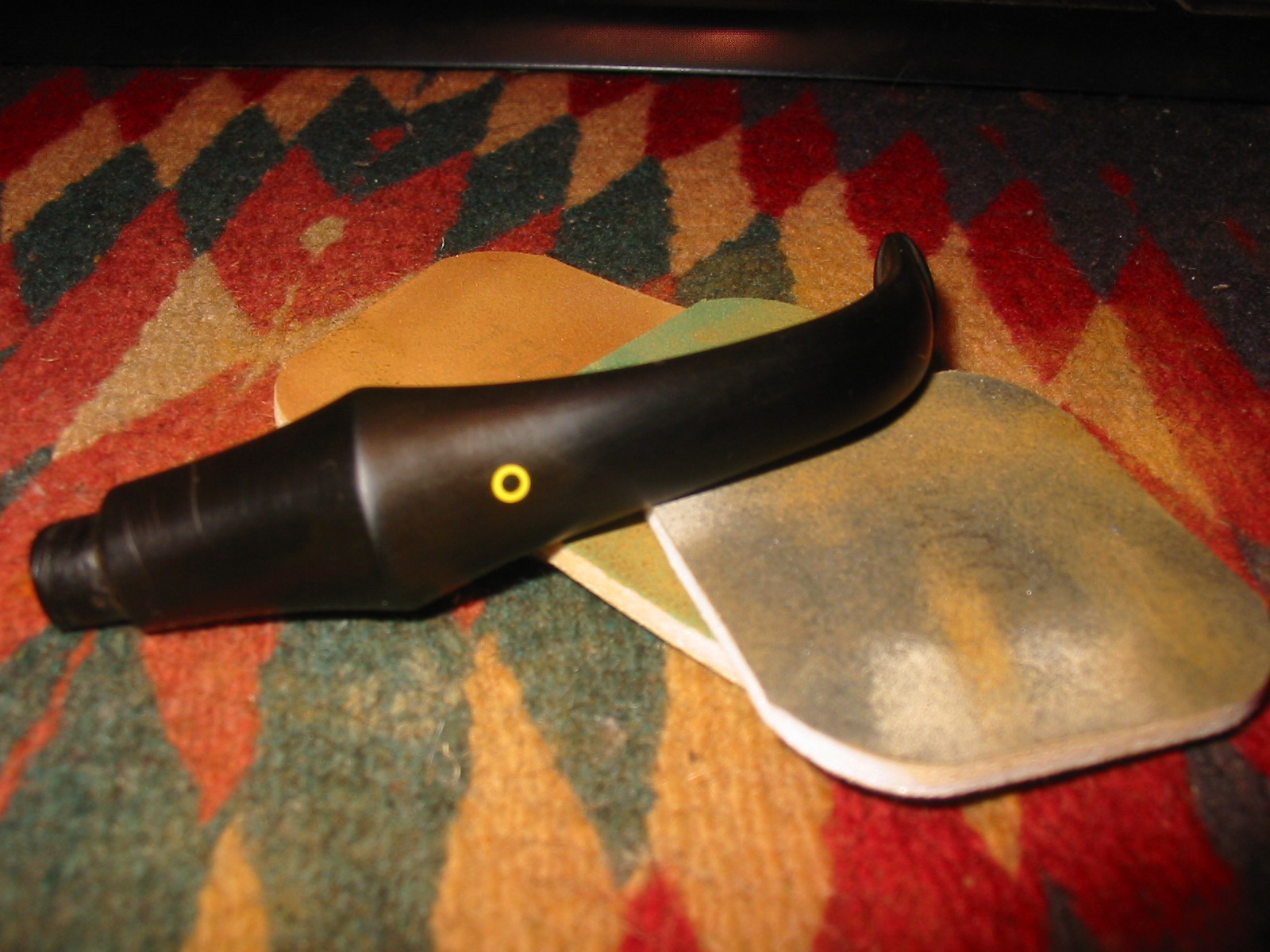
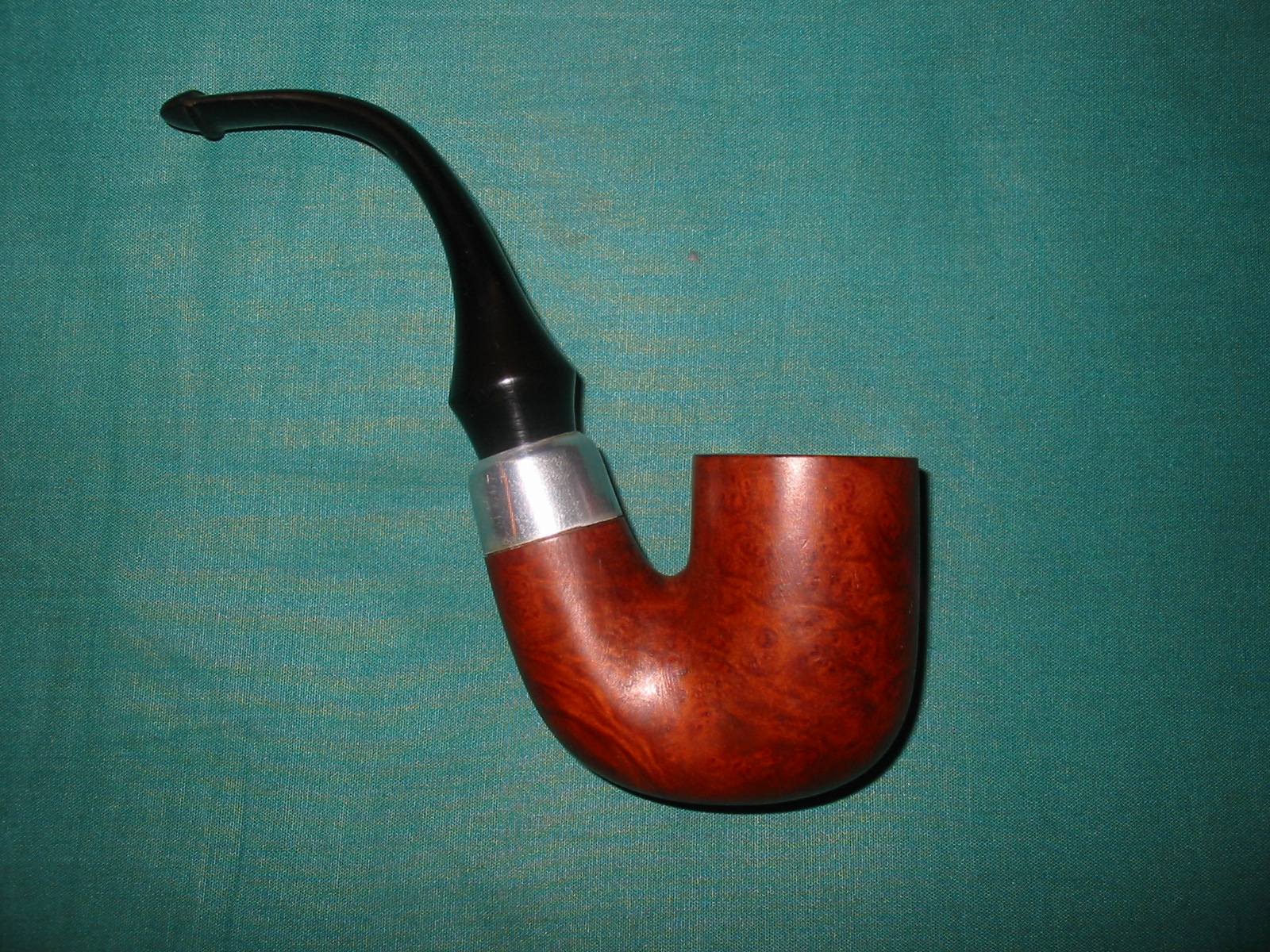
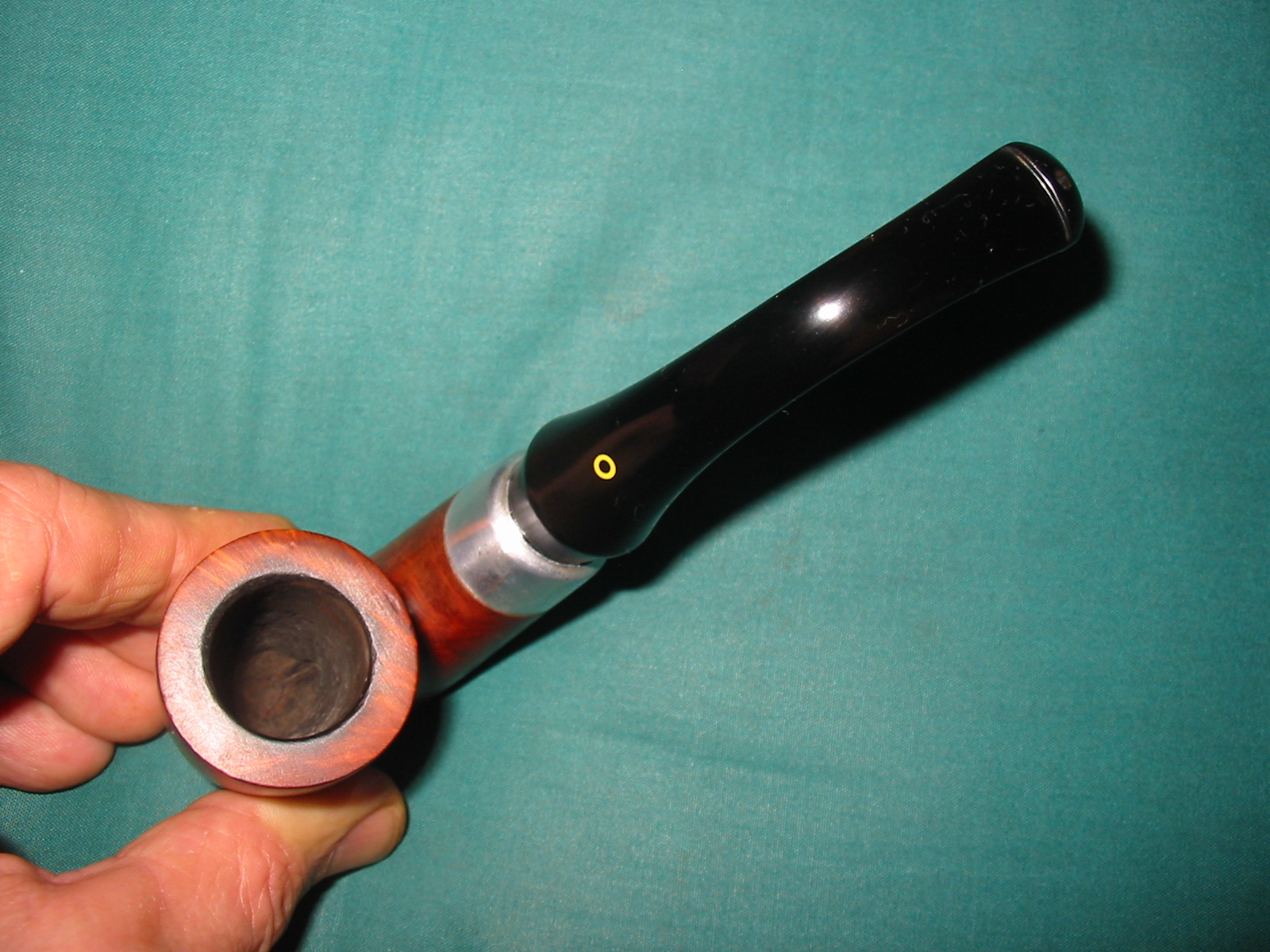
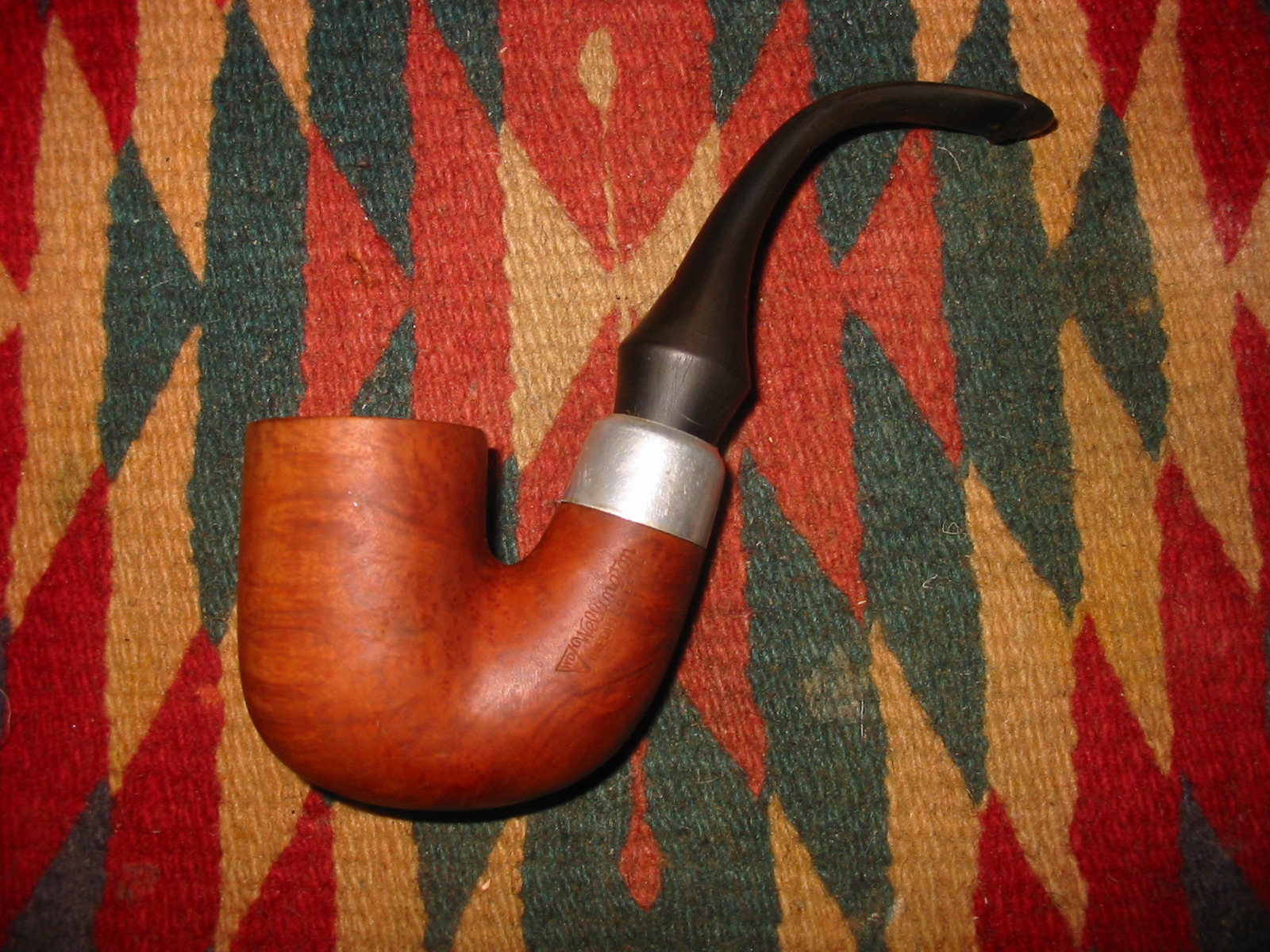
The second bowl I decided to work on from the box of bowls I was gifted was an old Wellington bowl that was actually in decent shape. The bowl is 2 inches tall and 1 3/8 inches in diameter. The bowl has an internal diameter of 7/8 inches. It is quite a large bowl. The nickel ferrule was in good shape but slightly oxidized with a few small nicks and dents. There was an uneven cake in the bowl and the sump area was filled with tars and oils. The finish was varnished but peeling as can be seen in the photo below. The rim had a tar build up and the varnish was peeling under it. The inner edge and outer edge of the rim was in excellent shape. The stamping on the bowl was on the left side of the shank and included the WDC inverted triangle and letters and next to that Wellington in script over the words IMPORTED BRIAR. There was no other stamping on the bowl. The stem did not come with the bowl. I had an old Yello Bole stem from the same era as the Wellington and with the same structure at the tenon and the P-lip. It was scratched and oxidized and had some tooth marks on the top and bottom sides just ahead of the button. The stem has a bright yellow “O” on the top. The bend in the stem had straightened so it would need to be re-bent to work well with the bowl.
IMG_7308
I have several WDC pipes and have done quite a bit of research on the brand that I have written about on the blog. I have even repaired and given away quite a few Wellington’s over the years. This one appeared to be a great piece of briar so I wanted to repair it. I also wanted a quick refresher about this line of WDC pipes and how it fit within the hierarchy of WDC lines. The following is a brief excerpt from the pipedia.org article on WDC pipes.

“William Demuth, a native of Germany, entered the United States at the age of 16 as a penniless immigrant. After a series of odd jobs he found work as a clerk in the import business of a tobacco tradesman in New York City. In 1862 William established his own company. The William Demuth Company specialized in pipes, smoker’s requisites, cigar-store figures, canes and other carved objects.
The Demuth Company is probably well known for the famous trademark, WDC in an inverted equilateral triangle. William commissioned the figurative meerschaum Presidential series, 29 precision-carved likenesses of John Adams, the second president of the United States (1797-1801) to Herbert Hoover, the 30th president (1929-1933), and “Columbus Landing in America,” a 32-inch-long centennial meerschaum masterpiece that took two years to complete and was exhibited at the World’s Columbian Exposition in Chicago in 1893.

The Presidential series was the result of Demuth’s friendship with President James A. Garfield, a connoisseur of meerschaum pipes. Demuth presented two pipes to Garfield at his inauguration in 1881, one in his likeness, the other in the likeness of the President’s wife. Later, Demuth arranged for another figurative matching the others to be added to the collection as each new president acceded to the White House, terminating with President Hoover.

In 1897 Ferdinand Feuerbach joined the Demuth Company and by 1903 had become the production manager. Feuerbach is credited with developing Demuth’s popular Royal Demuth and Hesson Guard Milano pipelines. He left in 1919, when Sam Frank Sr. needed an experienced pipe man to run his pipe factory, located at 168 Southern Blvd., in the Bronx. Feuerbach and Frank had been close friends since Frank started his own business in 1900 and was closely associated with the sales staff of WDC, selling their line of pipes.

In early 1937, the City of New York notified S.M. Frank & Co. of their intent to take by eminent domain, part of the land on which the companies pipe factory was located. This was being done to widen two of the adjacent streets. As a result of this, Frank entered into negotiations to purchase the Wm. Demuth Co.’s pipe factory in the Richmond Hill section of Queens. It was agreed upon that Demuth would become a subsidiary of S.M. Frank and all pipe production of the two companies would be moved to DeMuth factory. New Corporate offices were located at 133 Fifth Avenue, NYC.

Demuth pipes continued to be made at the Richmond Hill plant till December 31, 1972. Then the Wm. Demuth Company met its official end as a subsidiary company by liquidation. Demuth’s mainstay pipe, the Wellington continued to be offered in the S.M. Frank catalog until 1976. In the mid-80’s, the Wellington even made a brief return as a direct to the consumer offer.”

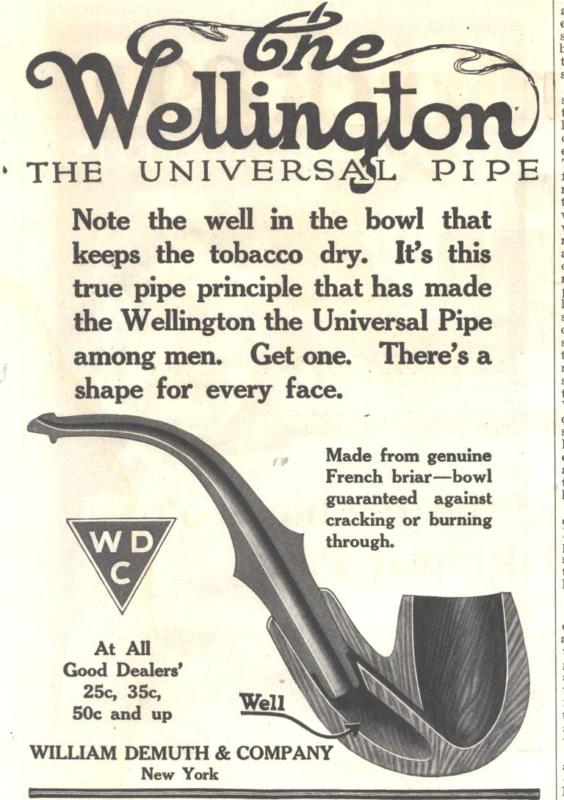
The two leaflets below give some of the details on the Wellington pipe. The first one is a sales leaflet that speaks of the assets of the pipe and what it has to offer the pipe smoker. The second one is a cutaway picture of the Wellington pipe that clearly shows the details of the drilling both of the airway and the sump or well in the heel and shank of the pipe.
wellington1

wellingtonsystem
With the above diagram and information I was better equipped to work on the internals of the pipe and give it a thorough cleaning. I really like digging out the information and some of the diagrams of the pipes that I work on so that I can get a feel for the design and an appreciation for the work.

I fit the stem on the bowl and the overall look and feel was the same as the Wellington. The shoulder or ridge that formed the saddle was not as sharply defined as in the original stem but the look was close. The P-lip was the same and the tenon insert end was a match to the diagram above. Once the stem was re-bent the look would be even closer to the original.
IMG_7312

IMG_7313

IMG_7314

IMG_7315
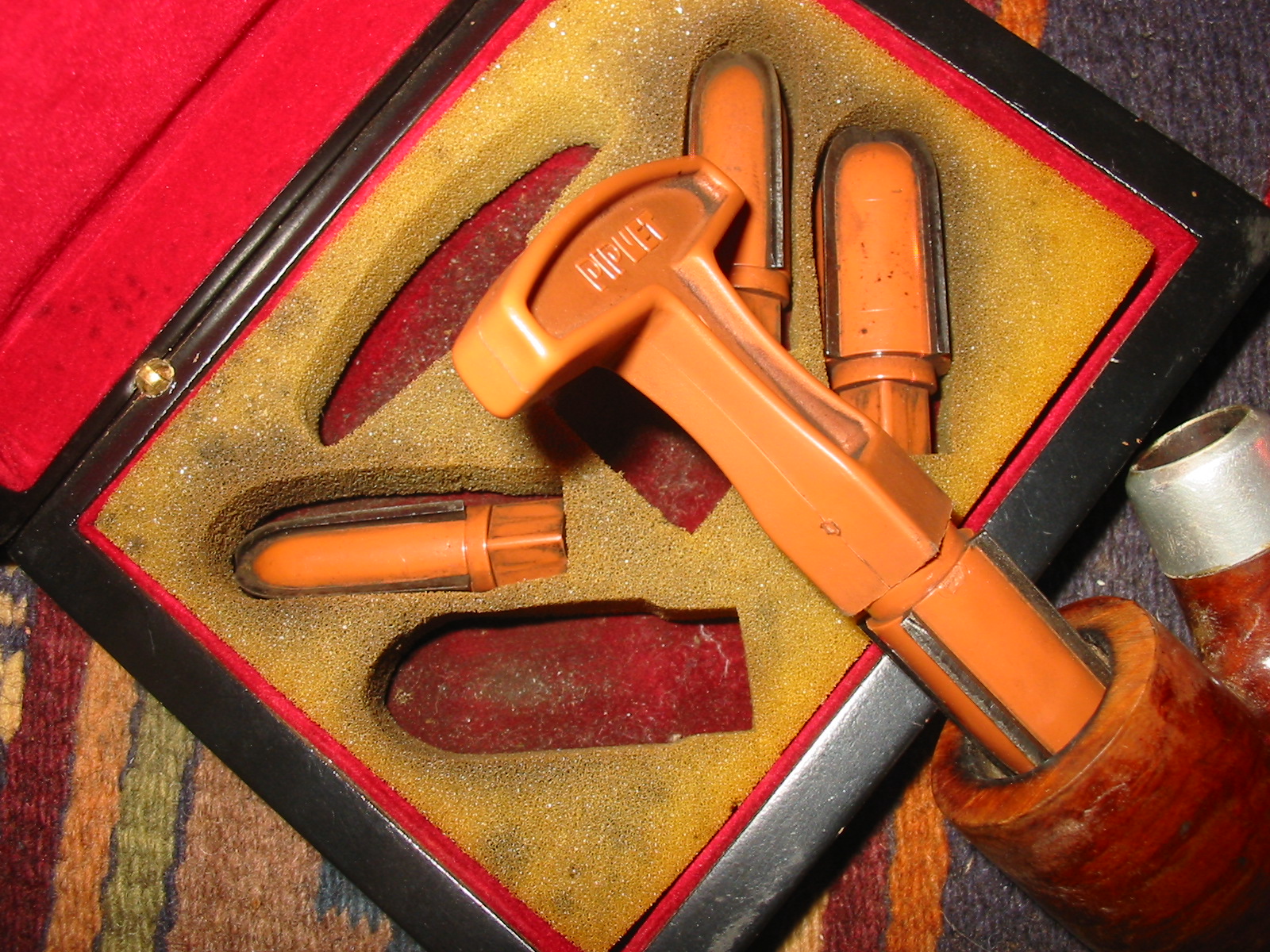
I cleaned the top of the rim with a cotton pad and alcohol to remove the tars and oils. I then reamed the bowl with a PipNet Reamer – a tool that I use on virtually every pipe I work on. The interchangeable heads allow me to use various heads to careful trim back the cake. In this case I took it back to bare wood to clean it up and remove the uneven buildup.
IMG_7351

IMG_7352
I scrubbed down the finish with acetone on cotton pads. The varnish came off with scrubbing. Underneath the peeling varnish the stain was in good shape. The briar was very clean with no fills. The grain was quite nice with a mix of cross grain and birdseye.
IMG_7358

IMG_7359

IMG_7360
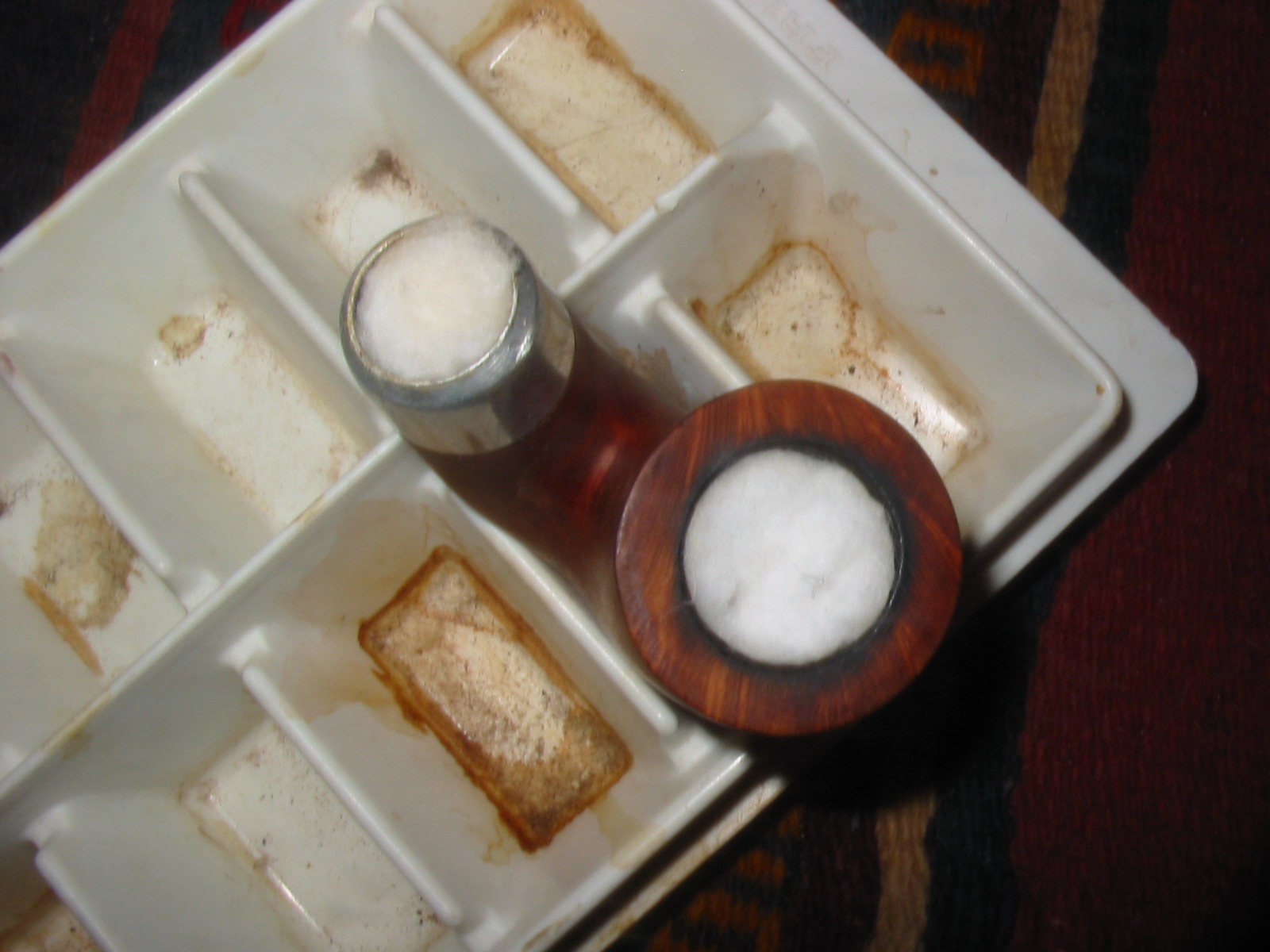
I scrubbed out the sump and the internals of the pipe with cotton swabs, pipe cleaners and isopropyl alcohol. Once the cleaners came out unstained I stuffed cotton balls in the shank and the bowl and then used an ear syringe to fill both with isopropyl alcohol (99%).
IMG_7362

IMG_7361
I put the bowl upright in an ice cube tray that I use for a stand when sweetening the pipes I clean. It works very well in wicking out tars and oils. I let it sit overnight. The first photo below shows the bowl after filling. The second photo below shows the bowl after 12 hours of soaking. Once I remove the cotton and re-clean the bowl and shank the smell of the pipe is fresh and clean.
IMG_7363

IMG_7367
Over the weekend I picked up a few new tools to make the clean up simpler. One set of tools was the sanding sticks shown in the photo below. The various grits are clearly on the sticks. These work exceptionally well in the crease next to the button and on the shelf on the underside of the P-lip stem. I sanded the stem with 220 grit sandpaper and with medium and fine grit sanding sponges.
IMG_7366
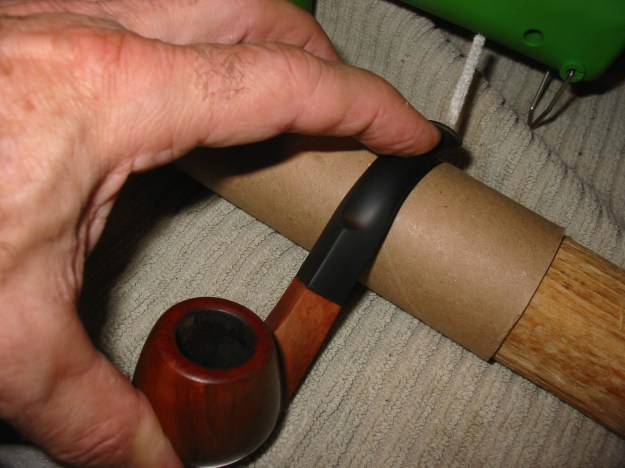
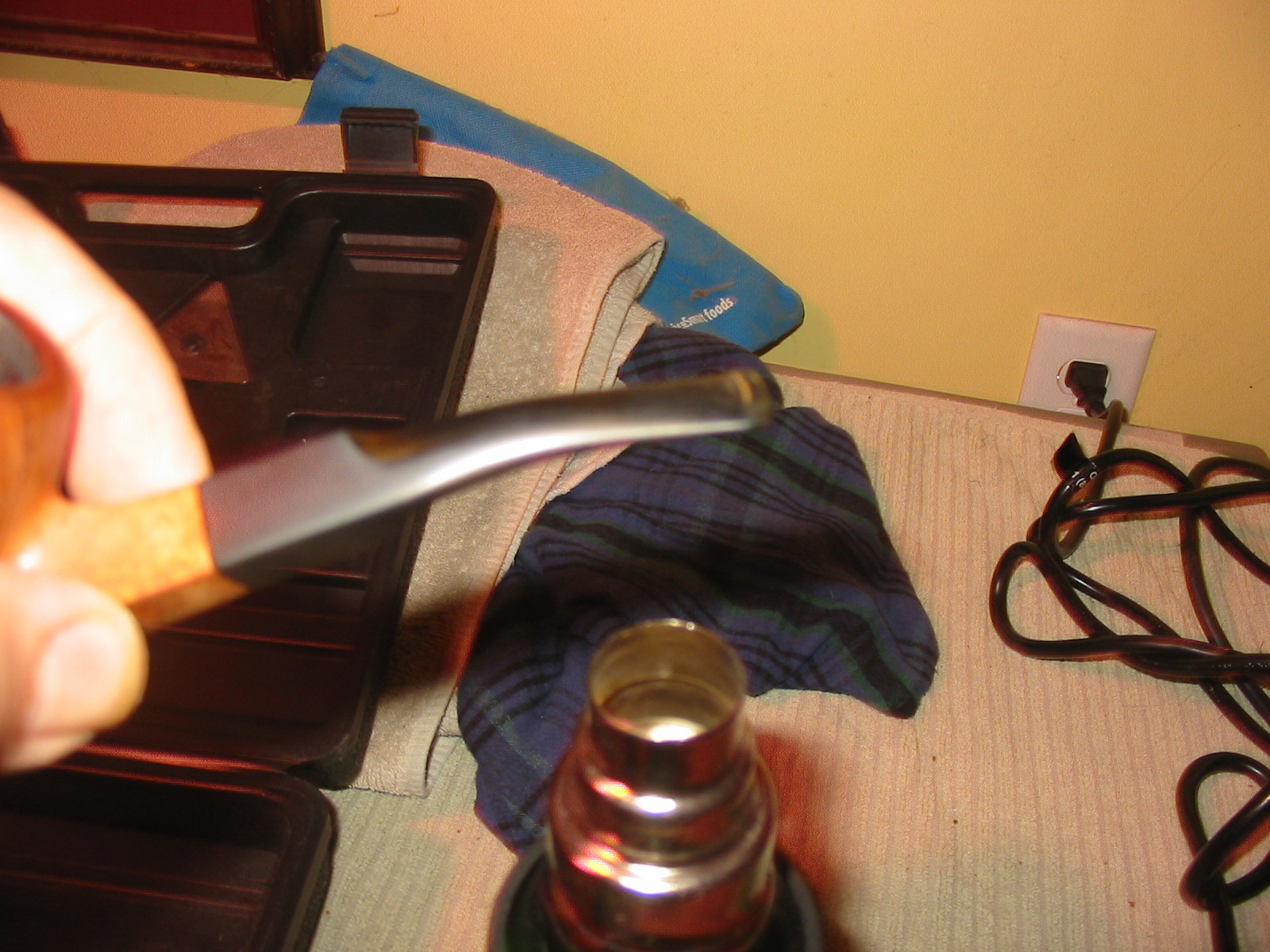
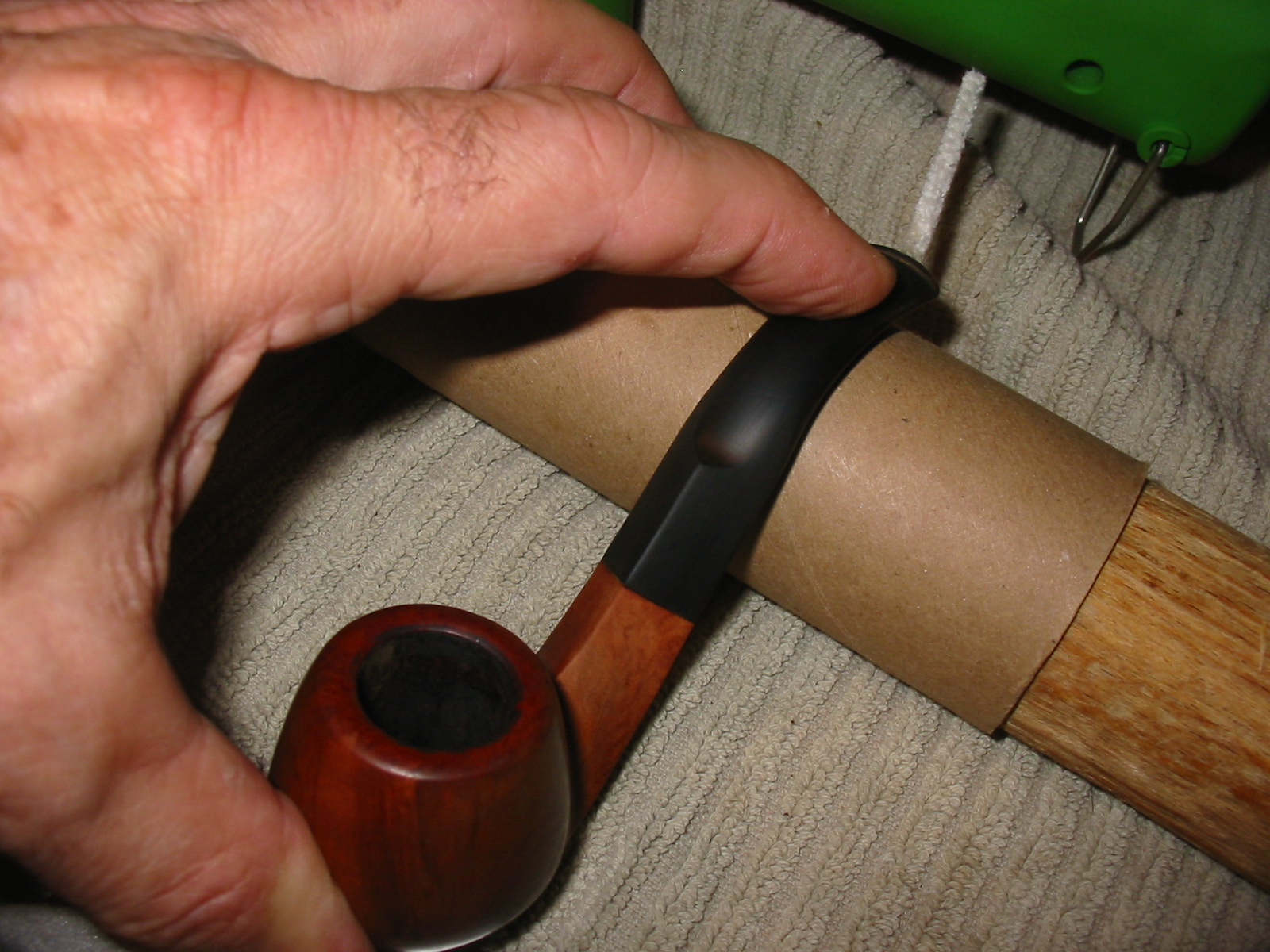
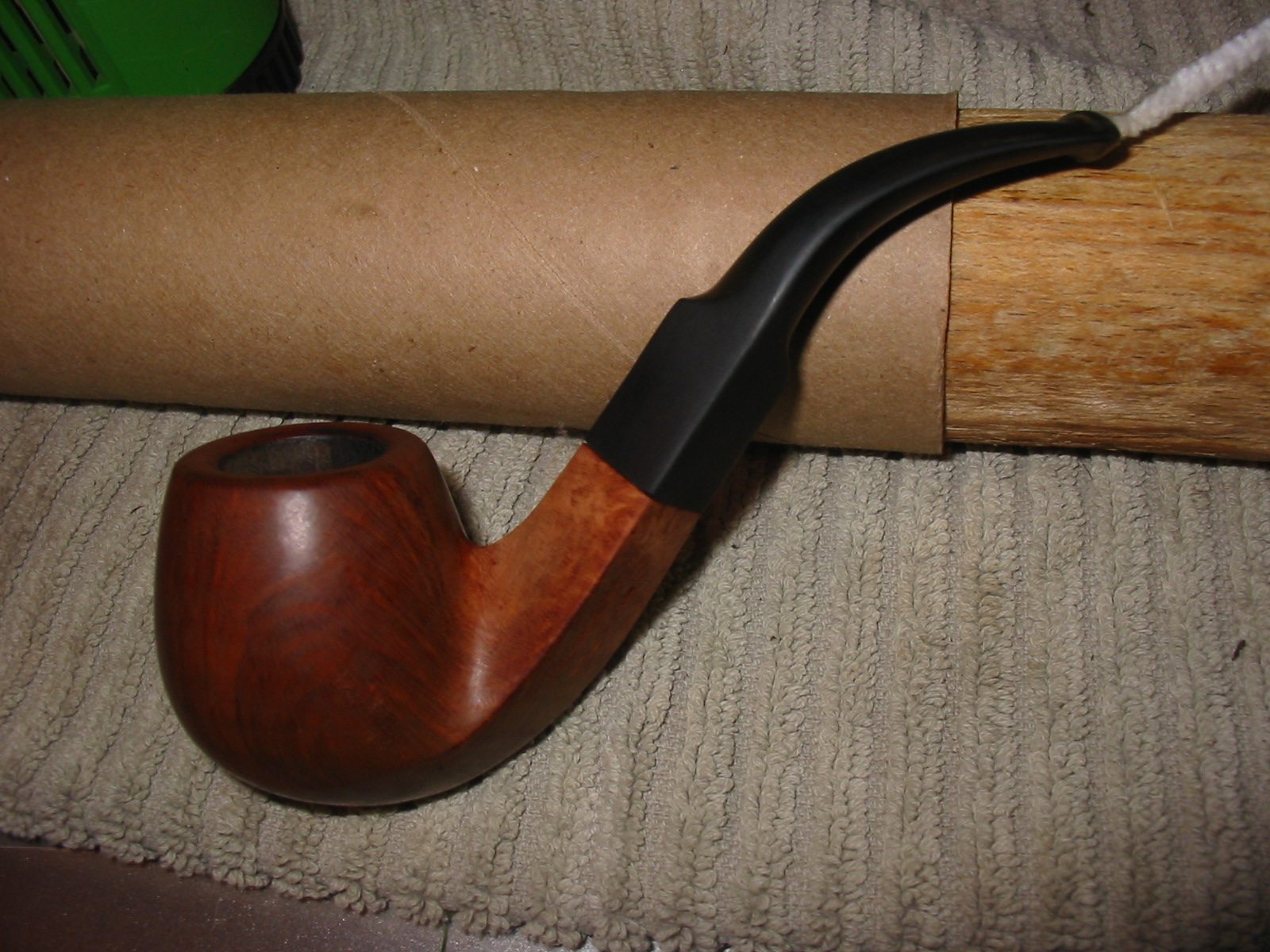
After the initial sanding was finished I used a heat gun to heat the stem and bent it over a rolling pin covered with a thick cardboard tube to give the stem a clean bend and avoid kinking the airway. I have been using this for quite a few years now and have not experienced trouble with damaging the airways in the bending process.
IMG_7371

IMG_7372

IMG_7373
I sanded the stem once again with a fine grit sanding sponge. I generally do this before moving on to the micromesh sanding pads.
IMG_7374

IMG_7375

IMG_7376

IMG_7377
I wiped down the bowl with a damp cloth to remove any dust and to get an idea of whether I would give it a coat of stain. Once it was clean it looked good to me. No stain would be necessary on this old timer. The colouring once it was buffed would be perfect.
IMG_7378

IMG_7379
The rim needed a bit more sanding with the micromesh to clean up the top and then a folded piece of sandpaper on the inner edge to smooth things out.
IMG_7380
I worked on the stem with the micromesh sanding pads. I wet sanded with 1500-2400 grit pads. Afterwards I noticed the oxidation that still remain at the saddle so I sanded it again with the medium and fine grit sanding sponges and repeated the micromesh wet sanding.
IMG_7382
I sanded it with the 3200-4000 grit pads and still saw some oxidation in that area. I repeated the process above with the sanding sponges and the six grits of micromesh to clean it more deeply. I then buffed it with Tripoli and then finished the final three grits of micromesh from 6000-12,000 grit. I buffed it with White Diamond.
IMG_7383

IMG_7384
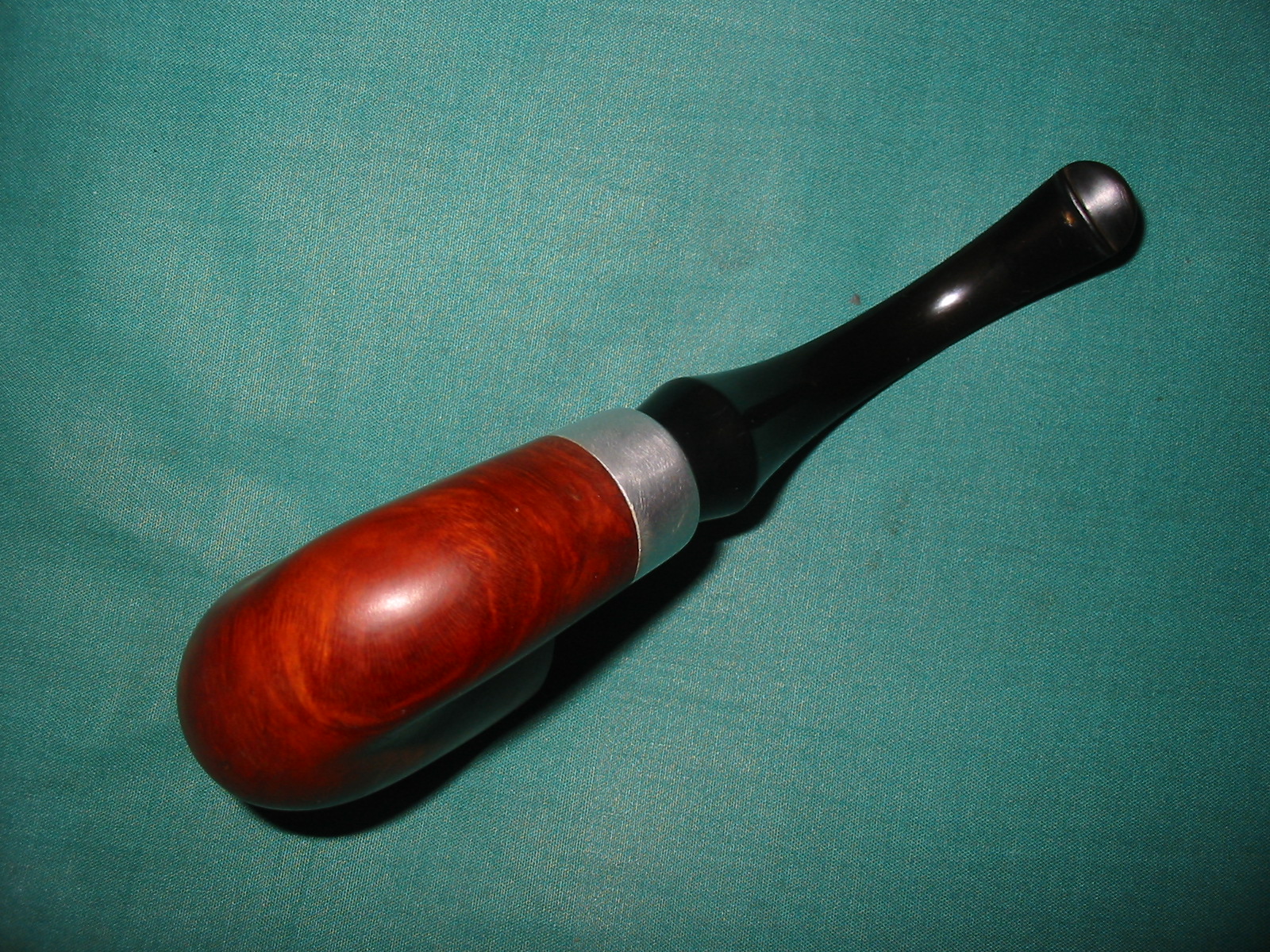
I polished the nickel ferrule with silver polish and a polishing cloth and then buffed the bowl and stem a final time with Whtie Diamond. I gave the entire pipe multiple coats of carnauba wax, buffing in between coats with a soft flannel buff. The finished pipe is shown below. I am quite pleased with the new look. The old Yello Bole stem works well with the pipe.
IMG_7389

IMG_7392

IMG_7390

IMG_7391

Restemming and Restoring a John Bessai Special Diamond Shank Bent Brandy


Blog by Steve Laug

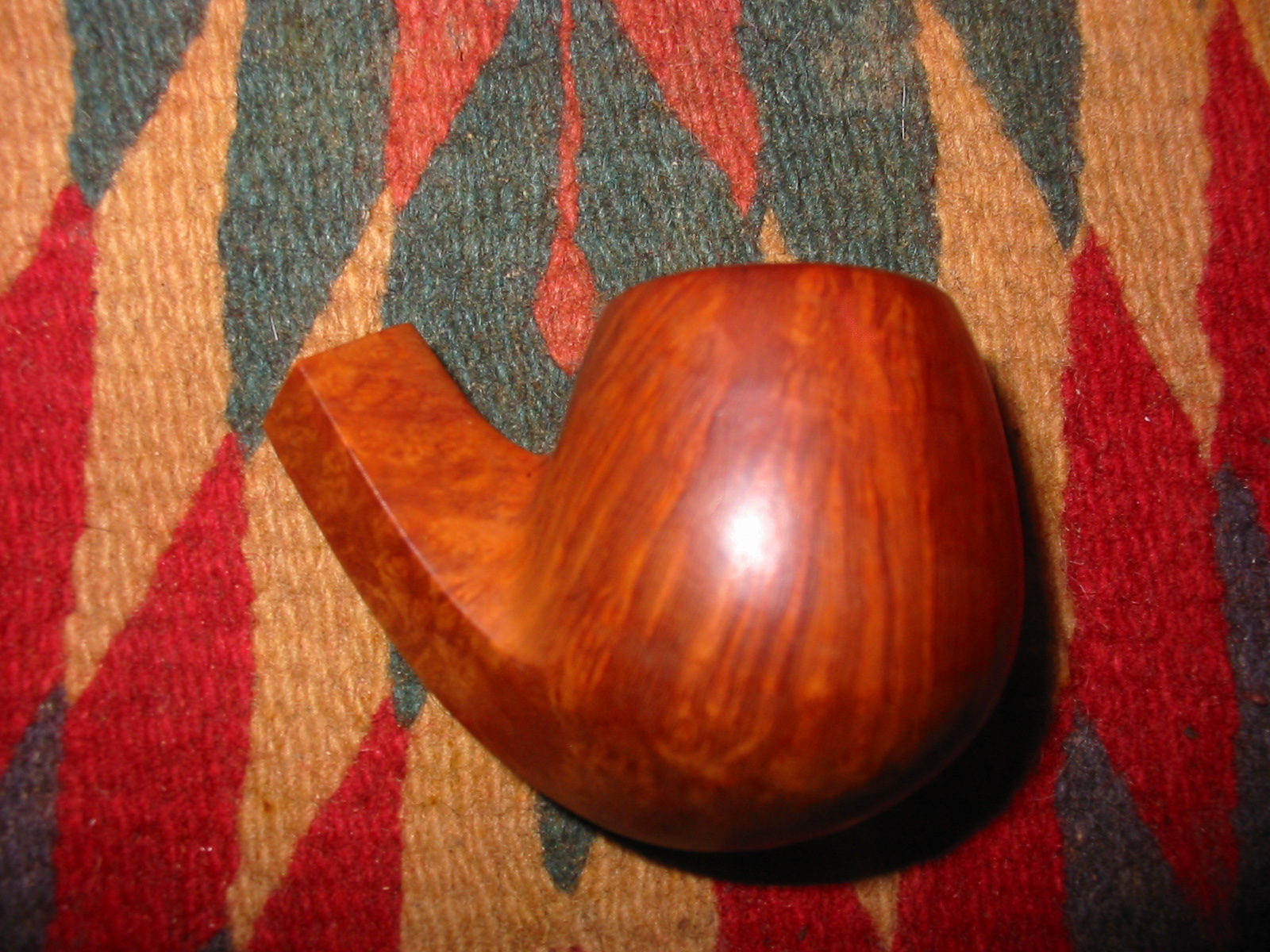
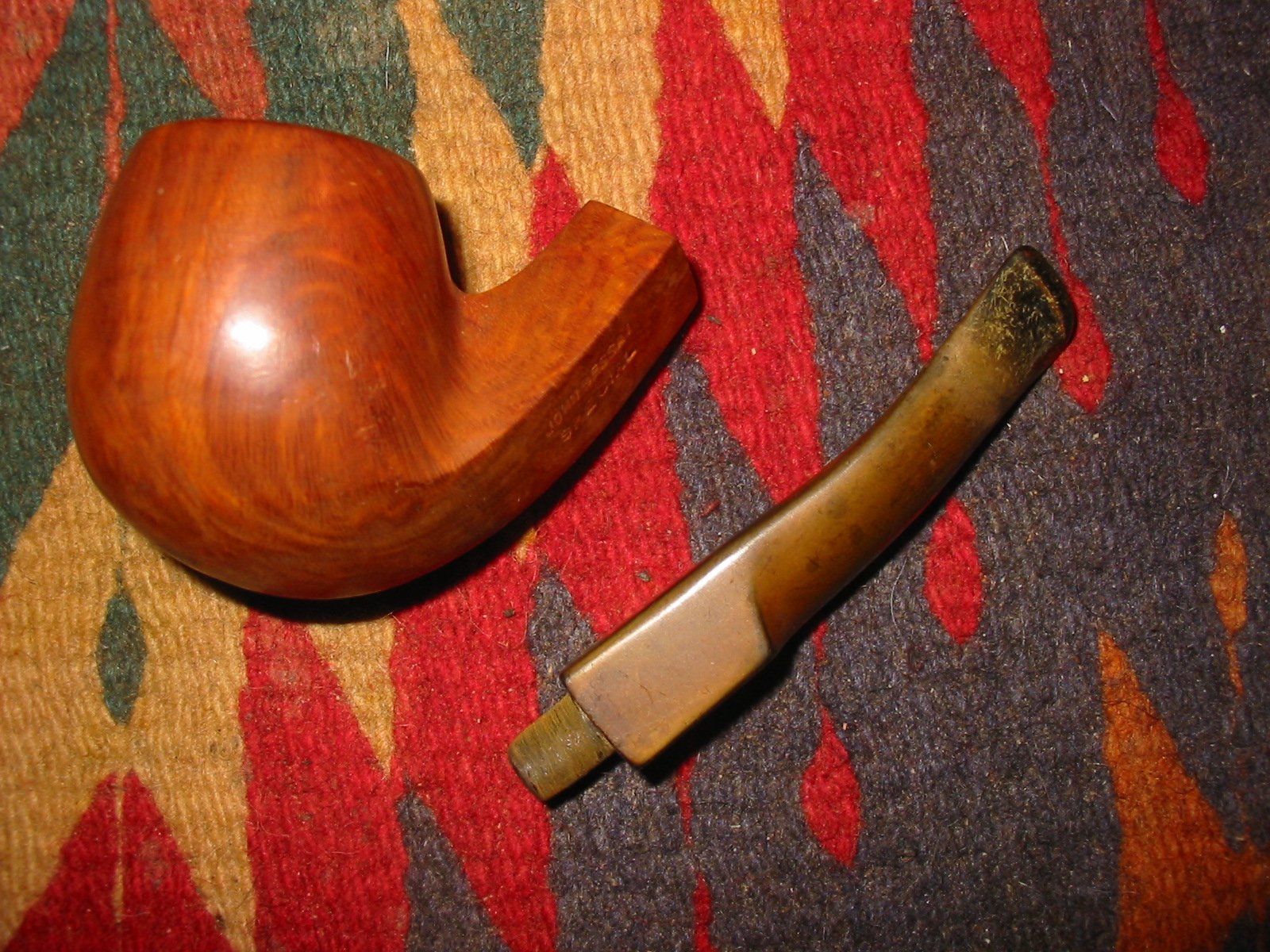
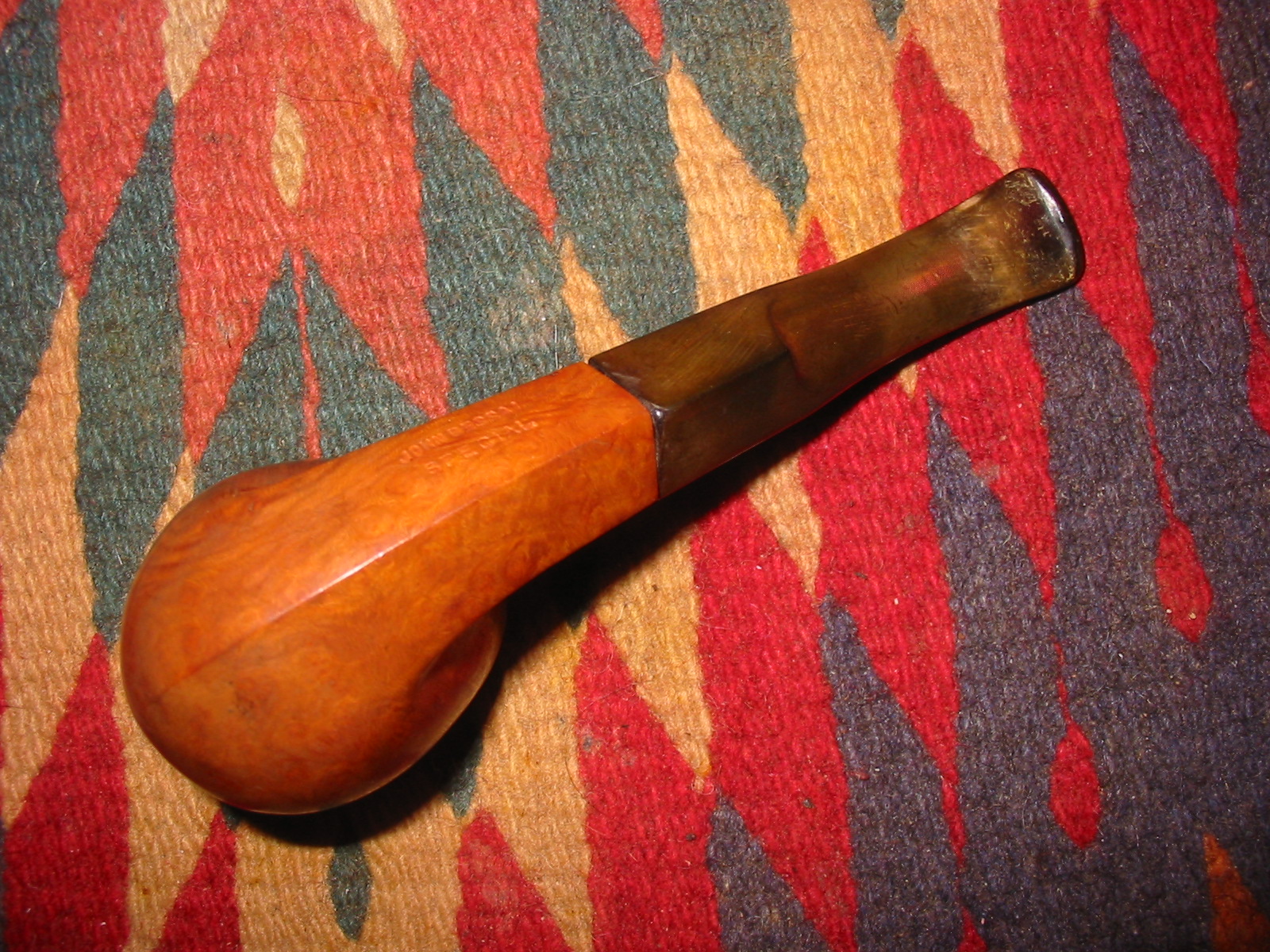
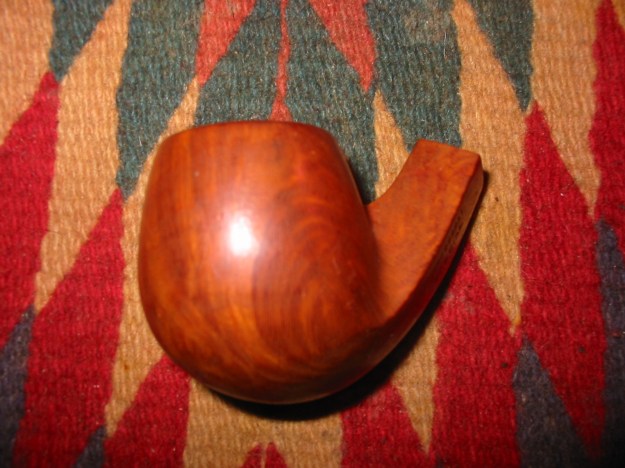
I was gifted a box of pipe bowls that needed varying degrees of work and a few odds and ends of pipe parts that now reside in my cans of parts. The bowls have refilled my refurbishing box. The first of these that I chose to work on is a beautifully grained, flawless piece of briar made into a diamond shank brandy. It is stamped on the left underside of the shank – John Bessai over Special. There is no other stamping on the pipe at all. The rim of the bowl is rounded. The pipe bowl is in excellent condition with no problems with the finish. The bowl needed reaming as it had an uneven cake on one side and on the upper portion. The shank is dirty with tars and oils but otherwise in good shape. The drilling and finish on this pipe is perfect. It is a beauty. From a previous Bessai pipe that I had found nearly three years ago I knew a little bit of history. I had hunted to gather information at that time.
IMG_7318

IMG_7319

IMG_7320

IMG_7321
HISTORY & BACKGROUND
I started out with what I had found previously and written about on the blog. I quote the following paragraph from Pipedia http://pipedia.org/index.php?title=Bessai

1. “John Bessai was a long time pipemaker, repairman and tobacco shop owner who operated his pipe shop at the “Old Arcade” in Cleveland, Ohio. The shop was opened in approximately 1898. It was a small 2-room shop where he hand-crafted his own pipes in the back room and could work when customers were not there. Like so many other shop made brand, John Bessai’s limited production was quickly acquired by regular customers and thus his craftsmanship remained little known outside of Ohio and the Midwest. While his name is known by pipe collectors in the Midwest, his work is seldom seen elsewhere! He died before 1969. Nevertheless, John Bessai left behind a small number of classic shaped pipes; all were made on-site. They are praised worthy of collecting and reflecting skills well beyond most American pipe makers. John Bessai’s logo “JB” appeared as one letter as the “back” of the “J” and the “back” of the “B” share a single line. The logo was stamped on the stem and on the left side of the shank. His son Herb Bessai took over the business and also continued making pipes. He closed the shop in about 1978.”

I suspected that there would be more information three years later. I did some further research and came across the information found in the paragraph below on one of the pipe forums.

2. “John Bessai was located in the Colonial Arcade at least into the late 1980s. After his death, his son Herb ran the shop. It was taken over after Herb’s retirement by a male and then name was changed to “Old Erie Pipes”. This was then located in the Erieview Plaza and when that mall closed, taken over by Cousin’s Cigars which has a store on Euclid Avenue near CSU, and a store on Chagrin Boulevard in Woodmere Village.”

That small quotation gave me a bit more information of the state of the store after John’s death and Herb’s retirement. But I still wanted more information. I wanted to know about the history of the brand and if there was any information on the various grades in the brand and the stamping on the pipes. I wanted to know a bit of a timeline for the brands. Finally my digging paid off. ON one of the pipe forums I came across a link that led me to a gold mine of information gathered by a man after my own heart, Andrew Hross. He has a blog call Classic Pipe Shop on Blogspot. I have included the link below for those who want more information. Andrew has done an amazing job of gathering information on the Bessai Brand so rather than rewrite the history I am quoting portions of Andrew’s work on The John Bessai Pipe Clinic.

http://classicpipeshop.blogspot.ca/2014/04/the-john-bessai-pipe-clinic-information.html

3. The John Bessai Pipe Clinic, 35 Colonial Arcade, Cleveland, OH 44115 – by Andrew Hross
a. Owner(s):
**John Bessai 1920s until his passing in 1969
**Herb Bessai ~1962-1983
**Daniel Gottschall 1984-~1993
**Purchased by Dad’s Smoke Shop / Cousin’s Smoke Shop and rolled into the Old Erie Smoke Shop about 1993.

Cousin’s Cigars purchased the remaining stock of Bessai pipes near after Herb Bessai passed away in 2002.

b. Years of Operation:

1920s (unkown specific date at this time) – 1983. After 1983 the business was sold to Daniel Gottschall who later sold it to Cousin’s Cigar (Euclid Ave) around 1993. The name was changed to “Old Erie Tobacco Company”. They were forced to move to the Galleria when all the tenants of the Old Arcade were cleared out to make room for renovations. Their new address was The Galleria at Erieview, 1301 East 9th Street in Cleveland.

After this move the location wasn’t as busy as they had hoped and Cousin’s moved all the Old Erie Tobacco assets to their Euclid Avenue Store. The store has since moved to a St. Clair location after Cleveland State forced them out due to anti-smoking regulations on campus. Their St. Clair location offers many of John Bessai Pipe Clinic’s old tobacco blends.

Their new store opened in the Merriman Valley area in Akron, Ohio where the store manager John Coleman oversees the day to day operations. John was instrumental in helping me piece together a lot of loose ends during Bessai Pipe Clinic’s transition years.

My father visited their shop several times in the early 60s as he attended Fenn College (now Cleveland State University) as an undergrad before moving on to Ohio State University for his Masters. He’s way smarter than I am so I just go with the flow…

He mentioned meeting John at that time who quickly gave my father some pointers on smoking a pipe and how to take samples from the shop’s expansive sample jar collection. His pipes were on display in the shop although I don’t believe he had a lot of pipes on display at any given time due to production in-shop.

John’s son Herb took over the shop in the early 60s after he graduated from Cleveland State University / Fenn College (unclear) as he is listed as having played Basketball for CSU. Herb was also a helpful, informative and friendly individual. Articles exist from the Herald in 1962 where they interviewed Herb (with photograph) about the state of smoking in the new age of the early 60s. I visited the shop in the late 70s / early 80s with my father during a trip to Cleveland and couldn’t tell you much about the shop other than the guy working was very friendly. Back then it wasn’t unusual to be a kid and walk into a smoke shop with your father. Clearly I didn’t purchase anything but my father probably picked up some tobacco but I remember him looking at pipes displayed on a back wall. The shop was small but impressive.

If anyone has any pictures of the shop or old catalogs, I would love any additional information as it’s tough to come by 30+ years later!

c. Pipes offered by John Bessai Pipe Clinic:
Most of the pipes that were offered by the John Bessai Pipe Clinic were fairly standard in shape… I would say most of the pipes Bessai offered were smooth pipes. My assessment would be 90% smooth and 10% rusticated / sandblasted…

…The story is that John crafted pipes in the back room or off site and finished them in house while the store wasn’t busy. Very little information is available on the accuracy of this statement. Some of his pipes from the late 1960s through the 1970s (John passed away in 1969) I feel were left over stock from previous turnings and sometimes showed fills or sand pits. Some of these pipes even carry Herb’s markings (see below). These pipes still smoke very well but are not as eye-appealing as other earlier pipes from the store’s career.

d. Stampings and rough dating of John Bessai Pipe Clinic Pipes:
Which pipes did John make and which ones did Herb make/finish? All Bessai pipes carry his standard large JB stamp either on the stem or shank or both. Typically the JB on the stem is within a circle.

All pipes created by John Bessai’s hands reportedly contain the miniscule ‘jb’ stamp on the shank or body of the pipe. I have older pipes in my possession that do not contain this stamp (condenser, old stamps, etc) that were clearly shop made pipes. I feel he started using the tiny ‘jb’ stamp in the 50s to early 60s.

An interesting note about John Bessai’s stems – they always clean very nicely and aren’t prone to as much oxidation (that brownish / green color) as most dunhill and Charatan pipes tend to oxidize. His cuts to his stems were very impressive and often transitioned from diamond-shaped shanks almost architecturally. Very comfortable to smoke.

John Bessai Special Pipes:
… I have a couple Bessai Special pipes. These stand out either by large size, graining or possibly shape. Most Specials are unique pipes and are rare to find in comparison to his regular issue pipes.

John Bessai Special X pipes:

I only have one of these and it’s a beauty. This one is a larger bowl (around a group 4 dunhill) with deep colored grain and a hefty substantial shank. Special X pipes are probably the rarest of John Bessai pipes and should be sought out if possible. I’ve smoke mine roughly 4 or 5 times and it performs with the best of my pipes…

Herb Bessai Pipes:
Unfortunately none of these pipes that I’ve seen have astounded me with grain or general appearance. Having said this, these pipes smoke nicely and are a great value if you can find them. I have one that my father found at an Antique Show in the South. There’s another author shape on reborn pipe’s blog that someone refinished because of the amount of fills in the pipe. He also states it’s a wonderful smoker (Editor’s note: This is my pipe and the write up I did on the blog). These pipes are likely from the late 60s through the early 70s. I believe many pipes after this period were created en masse at a factory in the US. It is unclear what stamp was used on these later pipes…

e. Dating / Circa era Bessai Pipes:
If the pipe carries a stamp stating Cleveland, O U.S.A. it’s considered an older production pipe (pre1960s). I’ve not seen any newer pipes with that stamp.

Bullseye stamping usually indicates an earlier pipe as that stamp seems to have been abandoned pre1960 as well.

Most of the earlier Bessai pipes have an unusual ‘stinger’ or condenser at the end of the tenon which is unique to Bessai pipes. They are either a hard plastic or created out of wood. They are typically easy to remove and could have been easily lost if misplaced. These pipes I would consider pre-1960 and possibly 1940s-early 1950s production based on their stamps and patina of the pipes.

1970s 1980s and beyond: My feeling on these pipes after John’s passing is that they purchased finished pipes from a large manufacturer and stamped them with the John Bessai or Bessai stamp (on shank and/or stem). Most of these shapes are standard among many stores from that period and offer less than spectacular grain (and sometimes fills). Stamps on these pipes are probably fairly plain and don’t have the tiny ‘jb’ stamp on the shank indicating it was produced by John Bessai.

RESTORATION
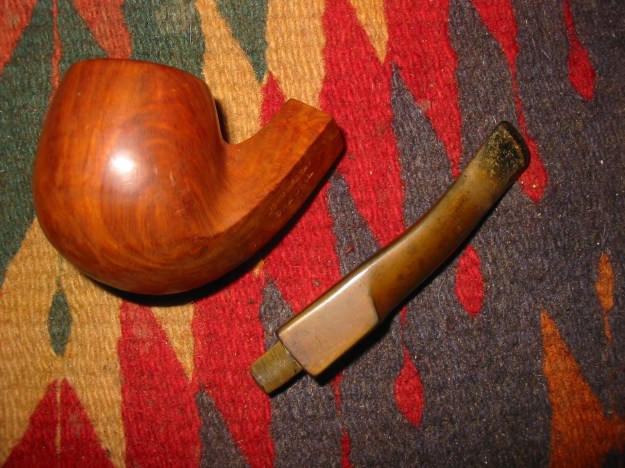
I went through my can of stems and found an older diamond-shaped saddle stem that fit quite well in the shank of the Bessai. The tenon was a little big so I sanded it with the Dremel and sanding drum until it fit snugly in the shank. The stem was an estate stem so it was dirty and had tooth chatter and some small indentations from teeth on the top and bottom of the stem near the button. It was slightly larger than the shank so that it would need to be sanded until it fit the line and shape of the shank.
IMG_7306

IMG_7307

IMG_7317
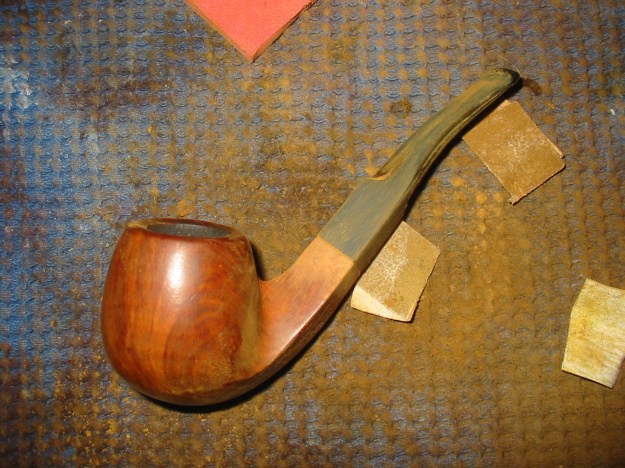
I sanded the stem and shank with 150 and 220 grit sandpaper to bring all sides and angles to match the shank angles and sides. I sanded the stem to remove the tooth marks and the tooth chatter in the process.
IMG_7322

IMG_7323

IMG_7324

IMG_7325
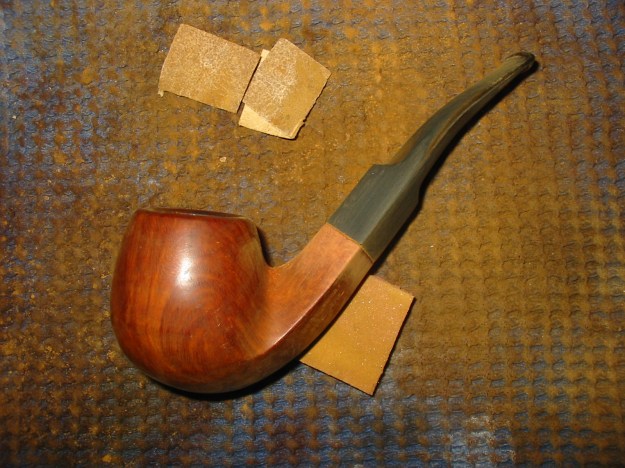
I sanded the stem and shank with a medium and fine grit sanding sponge to remove the scratch marks left behind by the sandpapers.
IMG_7326

IMG_7327
I reamed the bowl with a PipNet reamer to remove the uneven build up of cake in the bowl.
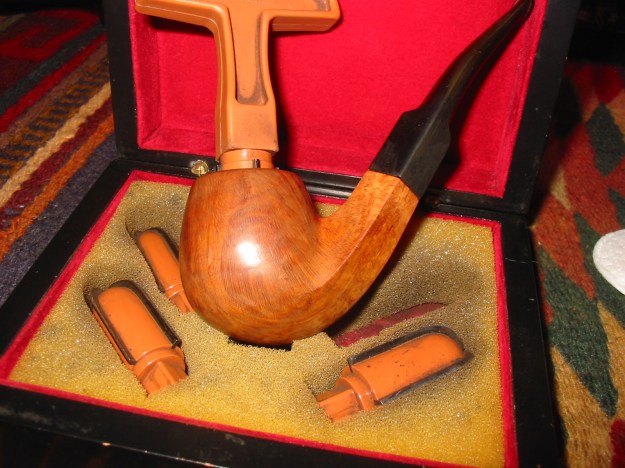
IMG_7328
I wiped down the surface of the briar with acetone on cotton pads to remove the finish on the bowl and make restaining it simpler.
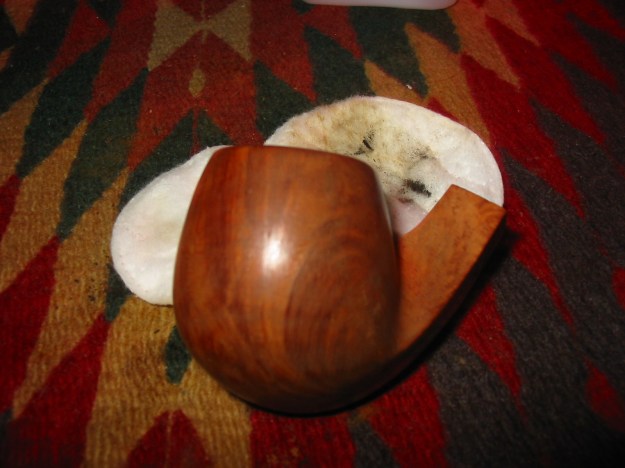
IMG_7329
I cleaned out the bowl and the shank with isopropyl alcohol (99%) on cotton swabs and pipe cleaners until the bowl and shank were clean. I cleaned out the stem with pipe cleaners and alcohol as well. I also beveled the airway on the end of the tenon to make the flow more open.
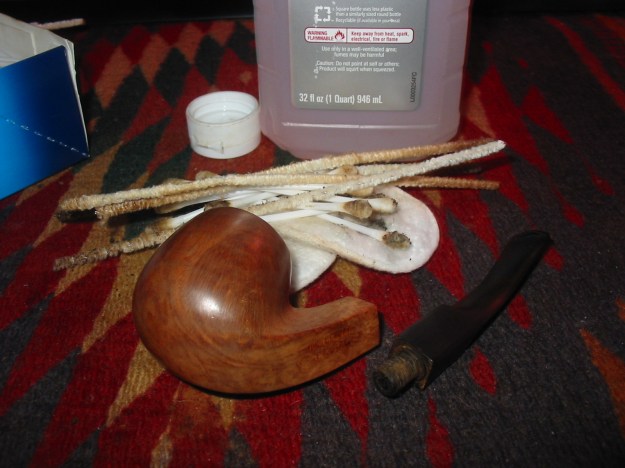
IMG_7330
I set up a heat gun and heated the stem to bend it to fit the shape of the pipe. I inserted a pipe cleaner in the stem and then bent it over a rolling pin and set the bend with cool tap water.
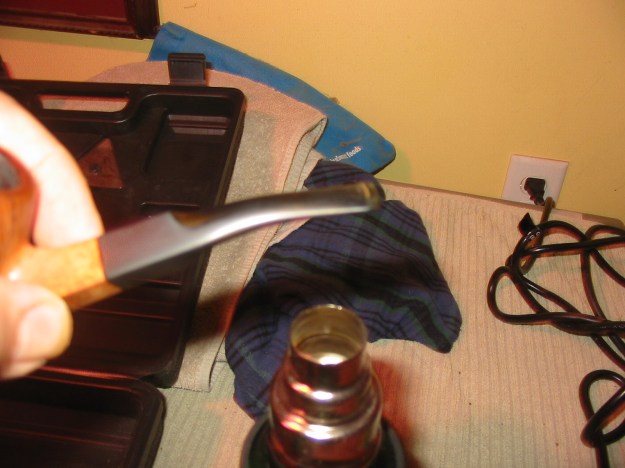
IMG_7331

IMG_7332

IMG_7333
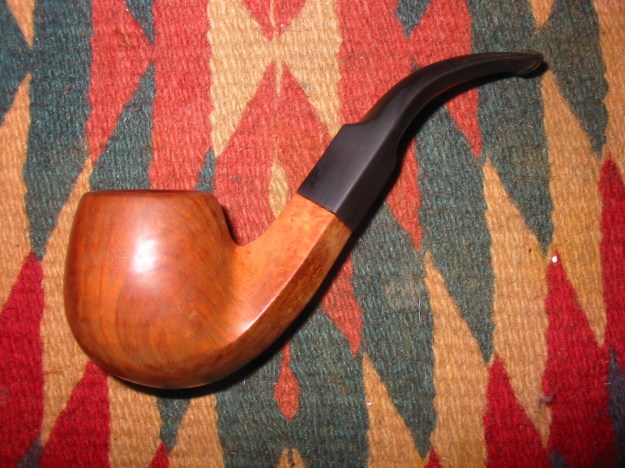
I wiped down the bowl and stem with isopropyl alcohol. The grain on this pipe is quite stunning so once it is restained and the stem finished it will be a beautiful pipe.
IMG_7335

IMG_7339

IMG_7342

IMG_7343
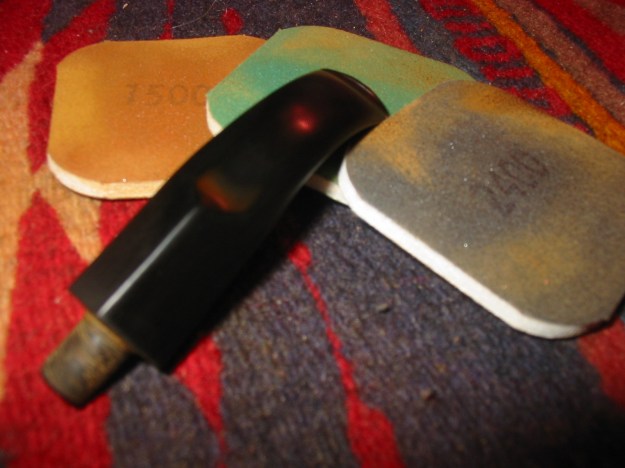
I stained the bowl with a medium brown aniline stain and flamed it, I gave it more stain and flamed it again. I then sanded the stem with medium and fine grit sanding sponges and then with my usual array of micromesh sanding pads. I wet sanded the stem with 1500-2400 grit pads and dry sanded with 3200-12,000 grit pads. Between each set of three pads I rubbed the stem down with Obsidian Oil.
IMG_7344

IMG_7345

IMG_7346
When I finished sanding with the final grits of micromesh I gave it another coat of Obsidian Oil and then buffed the stem and bowl with White Diamond. I gave the bowl and the stem multiple coats of carnauba wax and used a soft flannel buffing pad between coats to polish it. The finished pipe is shown below. The new coat of stain and the shine on the stem give the pipe a new and clean look. It is ready for its inaugural smoke. The background history sets the stage for a deeper appreciation of the pipe once I fire it up. It should smoke very well.
IMG_7347

IMG_7348

IMG_7349

IMG_7350

A Peterson’s Donegal Rocky 05 Reborn


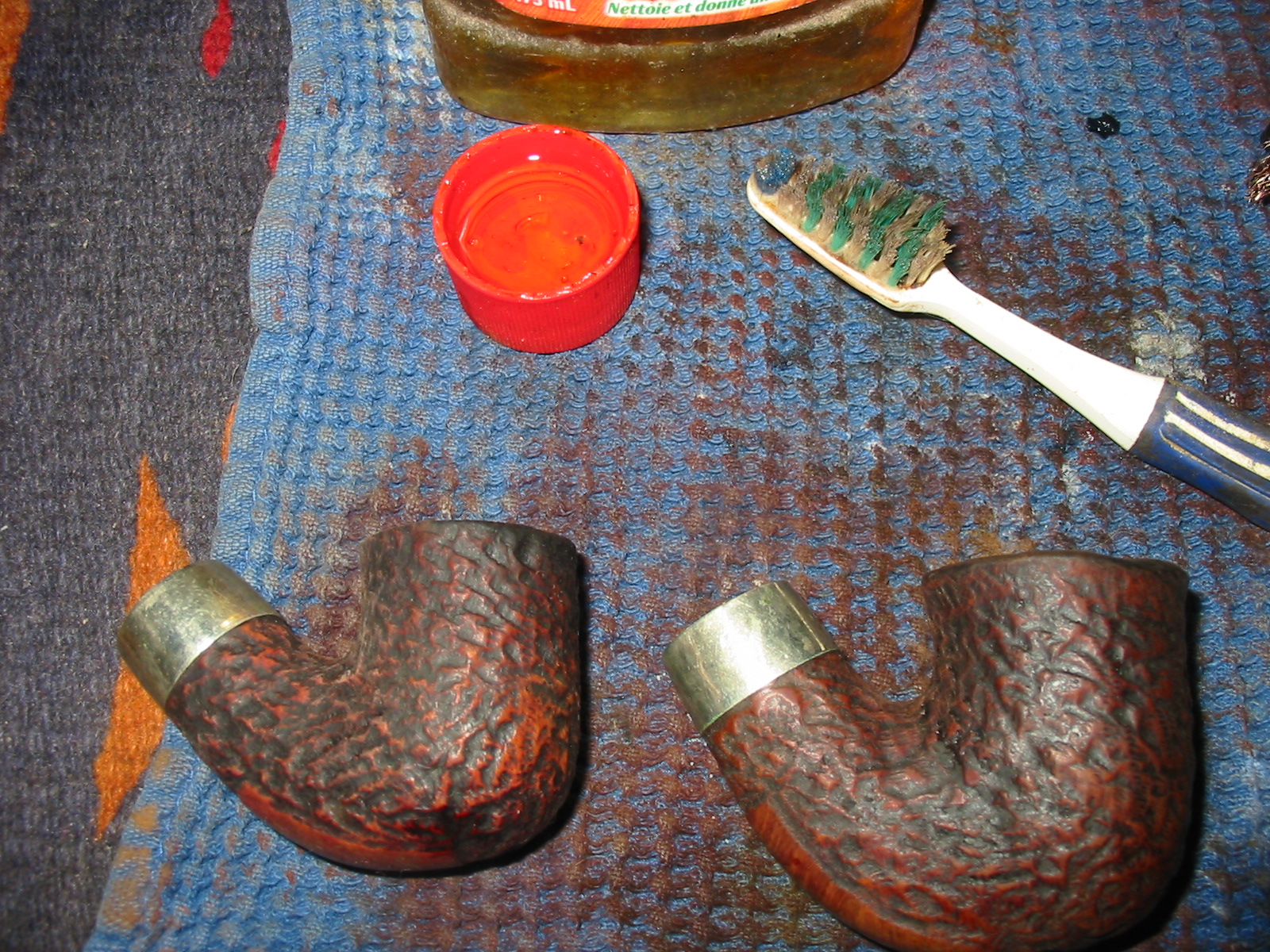
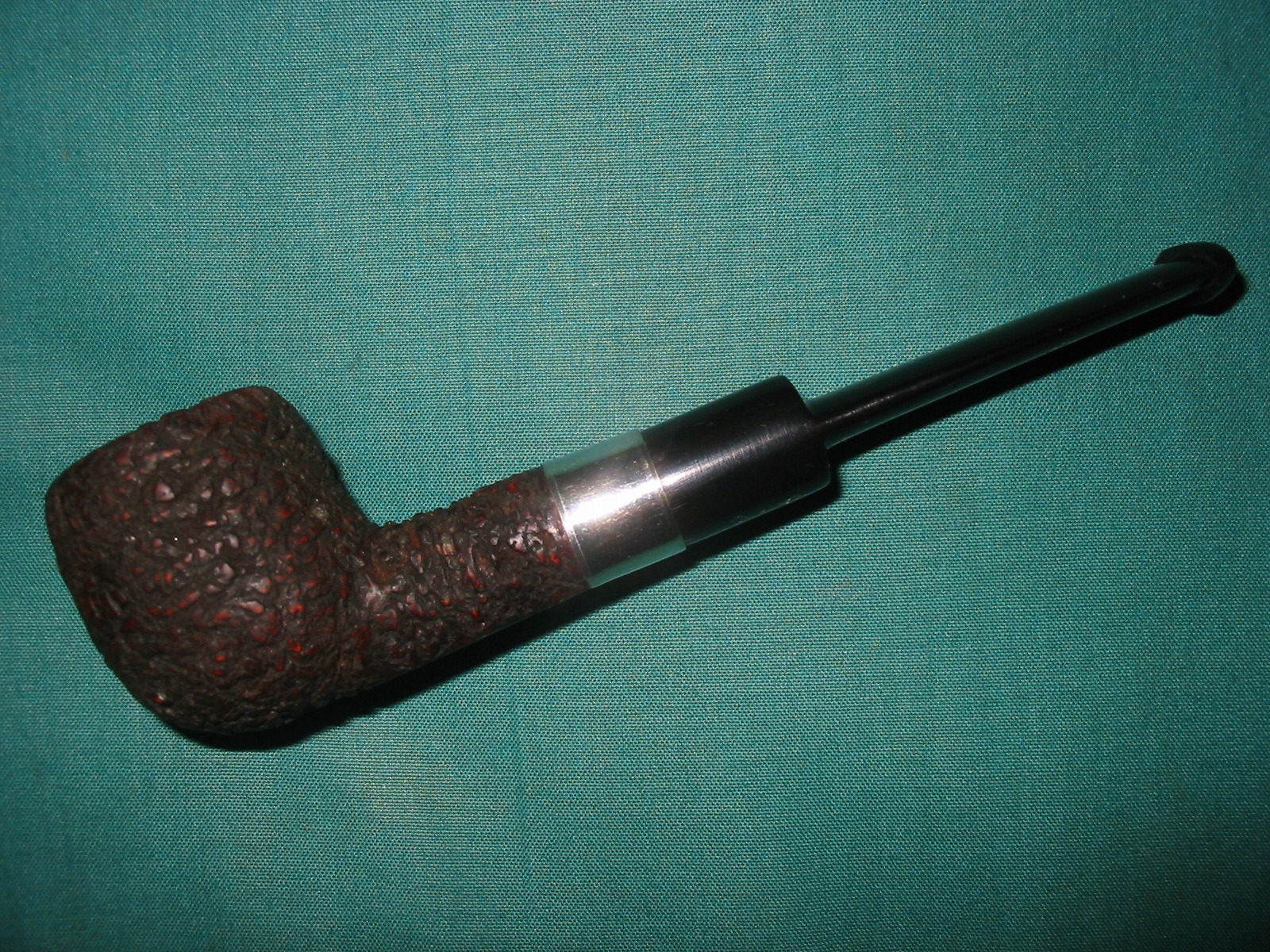
The third pipe in the Peterson trio of pipes shown in the photo below came to the worktable today. It is a Peterson’s Donegal Rocky 05 bent Dublin. It is the second pipe in the photo below. The bowl was badly caked – uneven and broken. The rim had a thick coat of tar and carbon buildup and was damaged on the right front side of the rim. The stem was missing and the nickel band was tarnished but undented. The finish was worn and the grooves of the rustication were filled with grit and grime from years of smoking. Like the other two pipes in this lot it must have been a favourite of the previous owner to be smoked to this degree. The inside of the shank was clogged with thick tars and oils and I was unable to blow air through it.
$_57
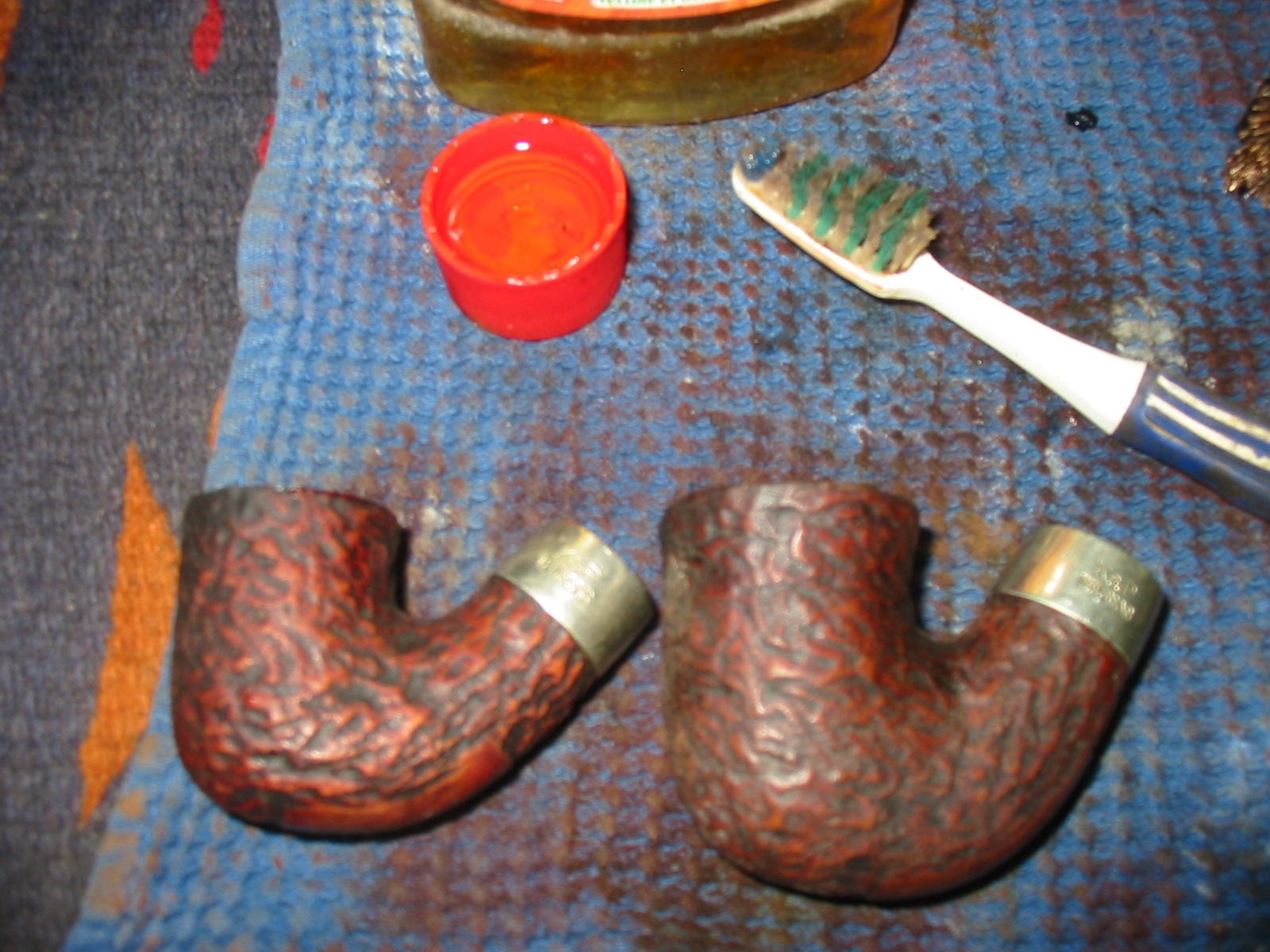
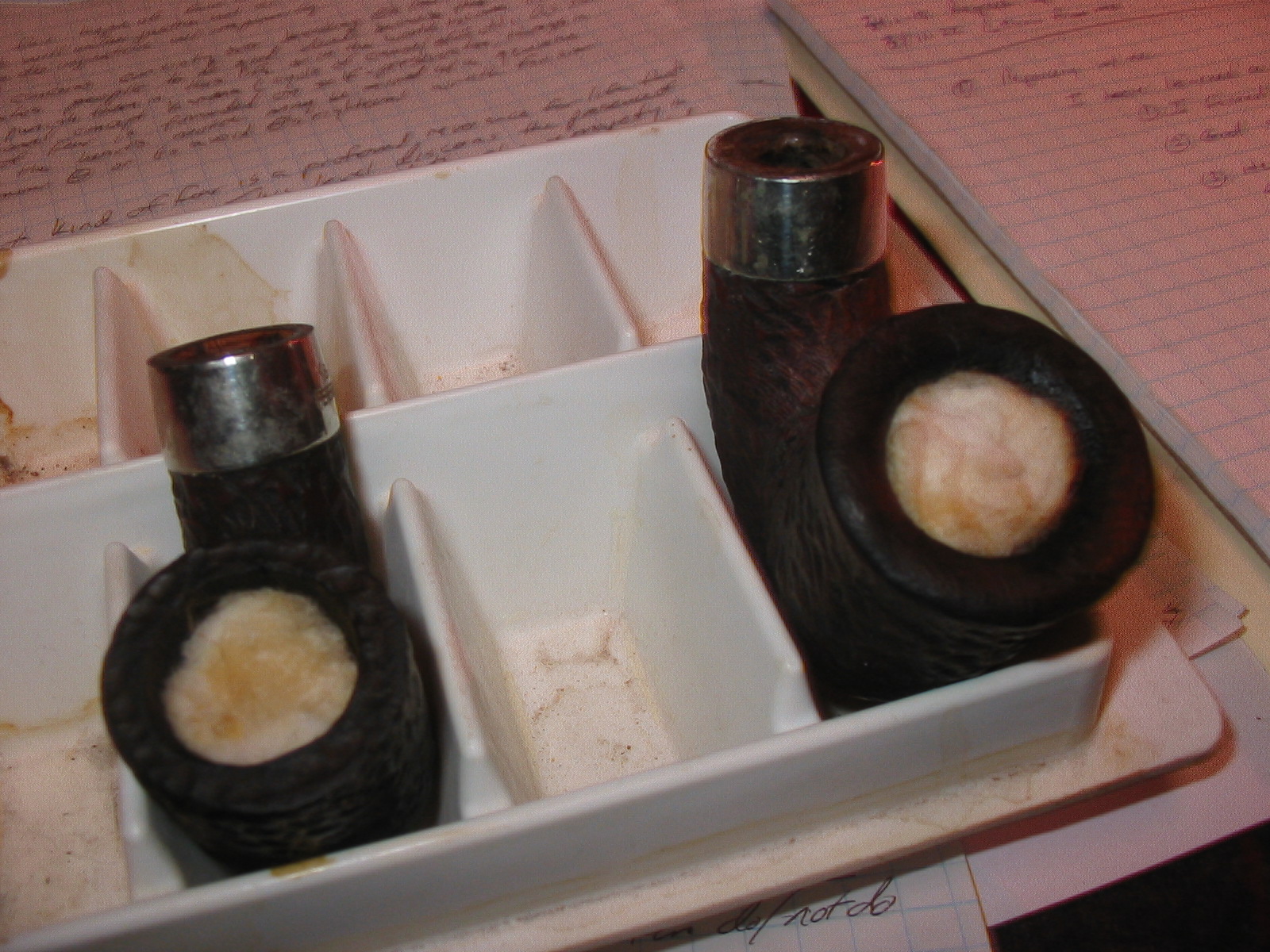
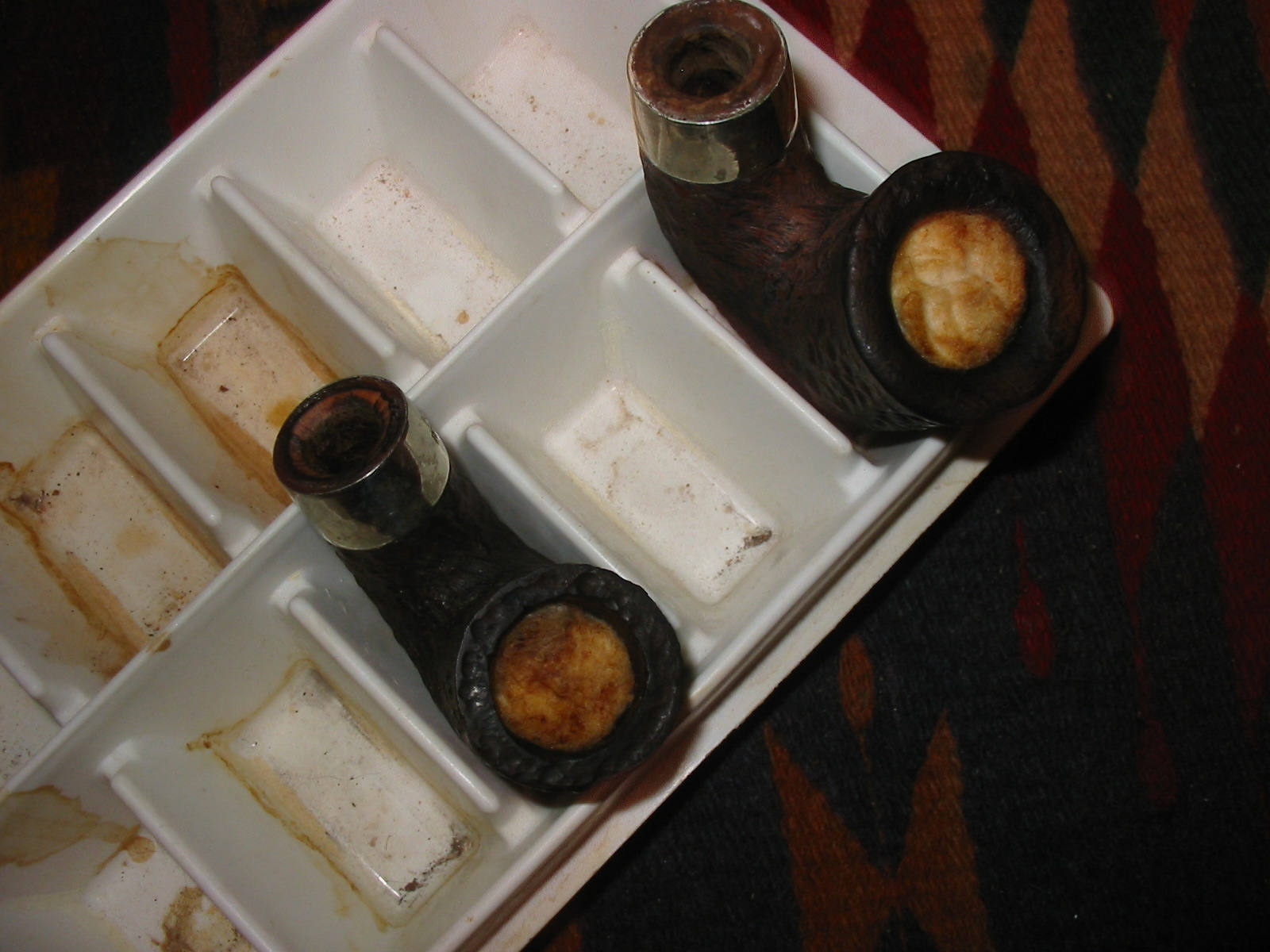
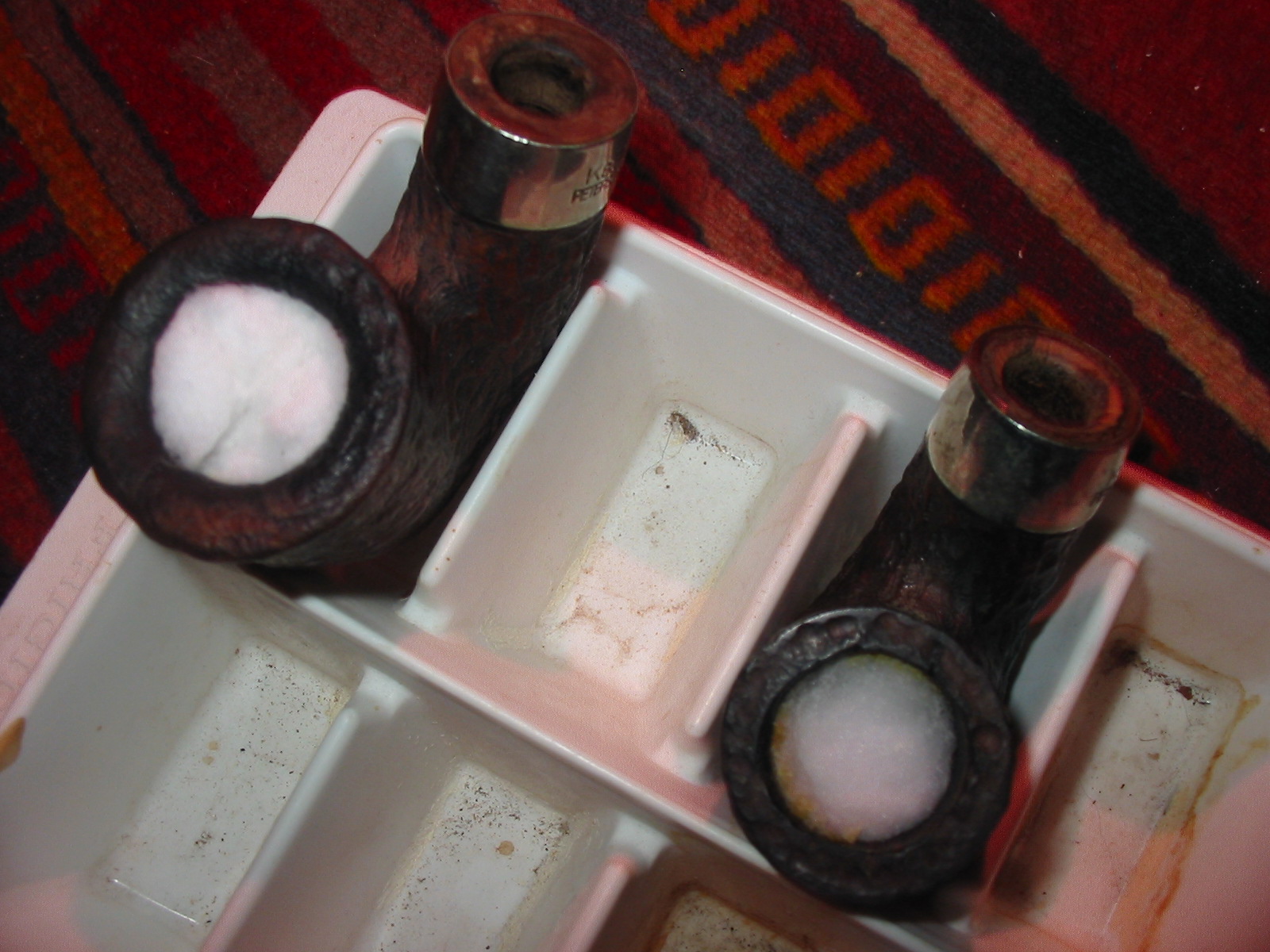
I reamed the bowl with a PipNet reamer until the cake was gone and the bowl was bare wood. My goal was to take back all the cake and rebuild a new smooth one. I pushed a paper clip through the airway to open the clog. I used cotton swabs, shank brushes and a drill bit to remove all of the grime and buildup in the airway and the shank. I scrubbed the exterior of the bowl with a soft bristle tooth brush and Murphy’s Oil Soap. I rinsed it under warm water to remove the soap and patted it dry. Once it was clean I filled the bowl with cotton balls and used an ear syringe to fill the bowl with isopropyl alcohol. I let the bowl sit over night in an ice cube tray to keep it upright. The first photo shows the set up when I first filled it. The second photo below shows the bowl after it had soaked over twelve hours.
IMG_7127

IMG_7152

IMG_7153
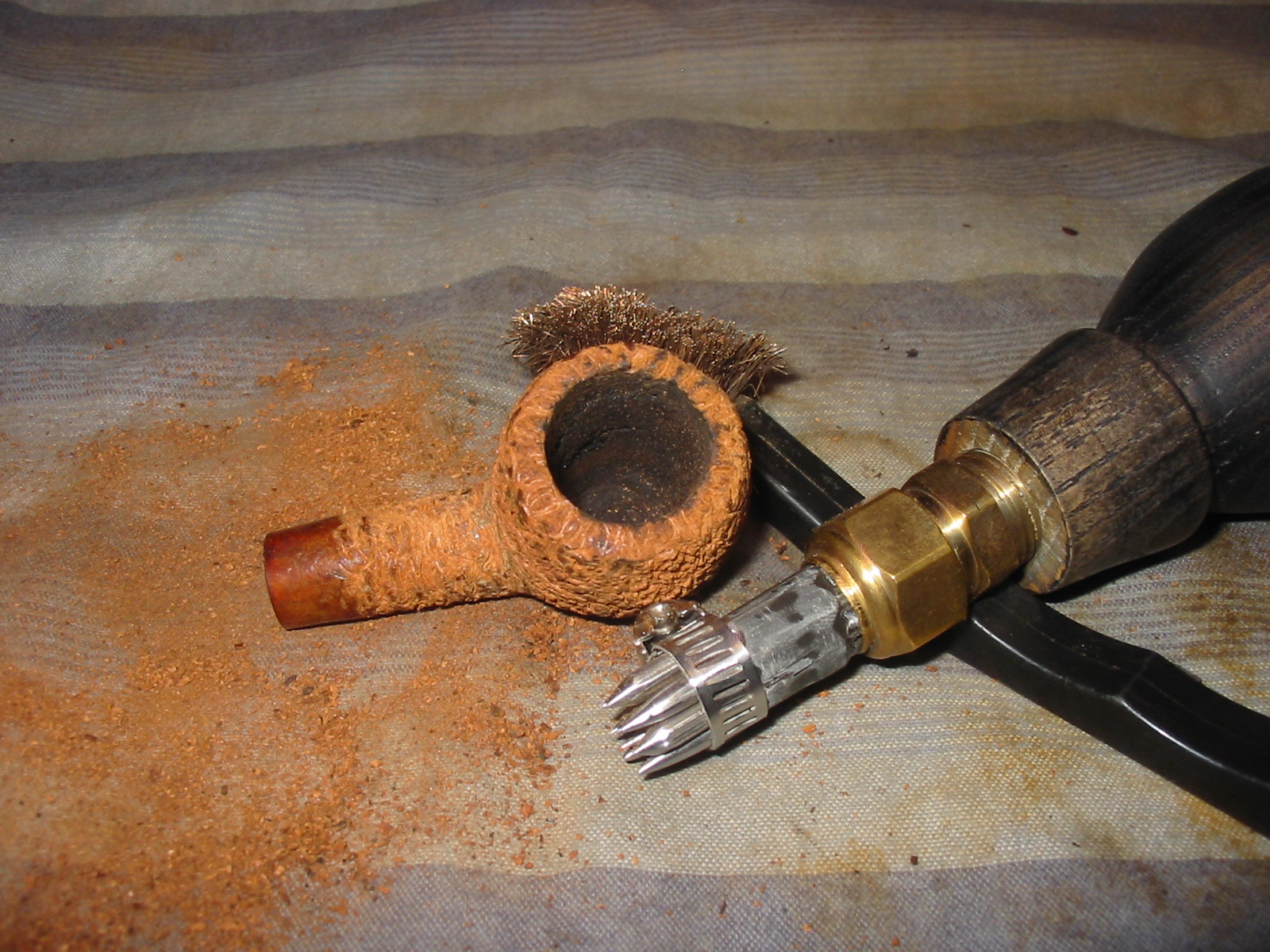
I took the dirty cotton balls out and washed out the bowl and shank with clean isopropyl alcohol and cotton swabs. While it was drying I scrubbed the rim with a brass tire brush to clean off the build up on the rustication. In the photo below the damage to the rustication is very evident. It is burned and worn smooth on the right front and side.
IMG_7173
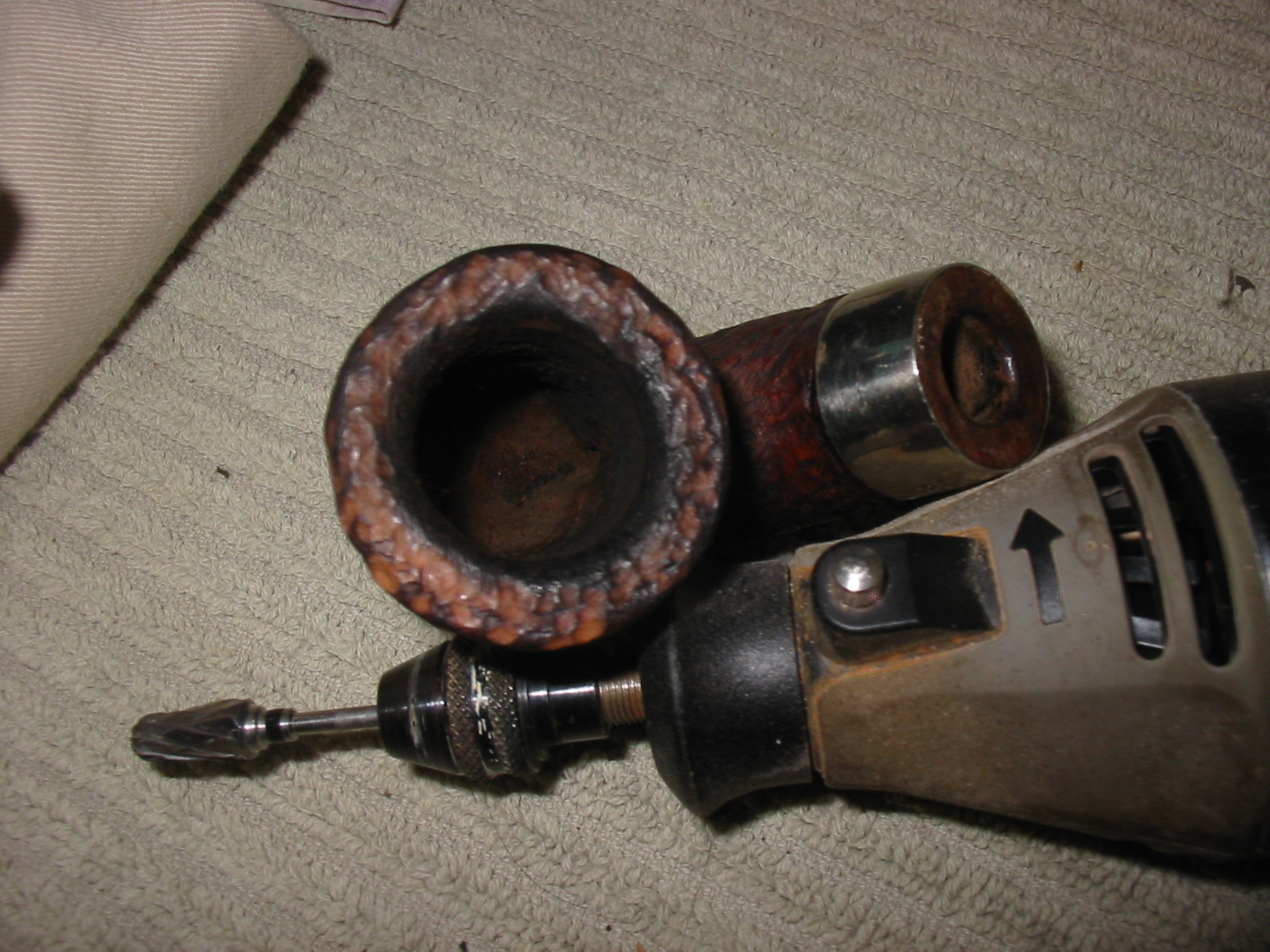
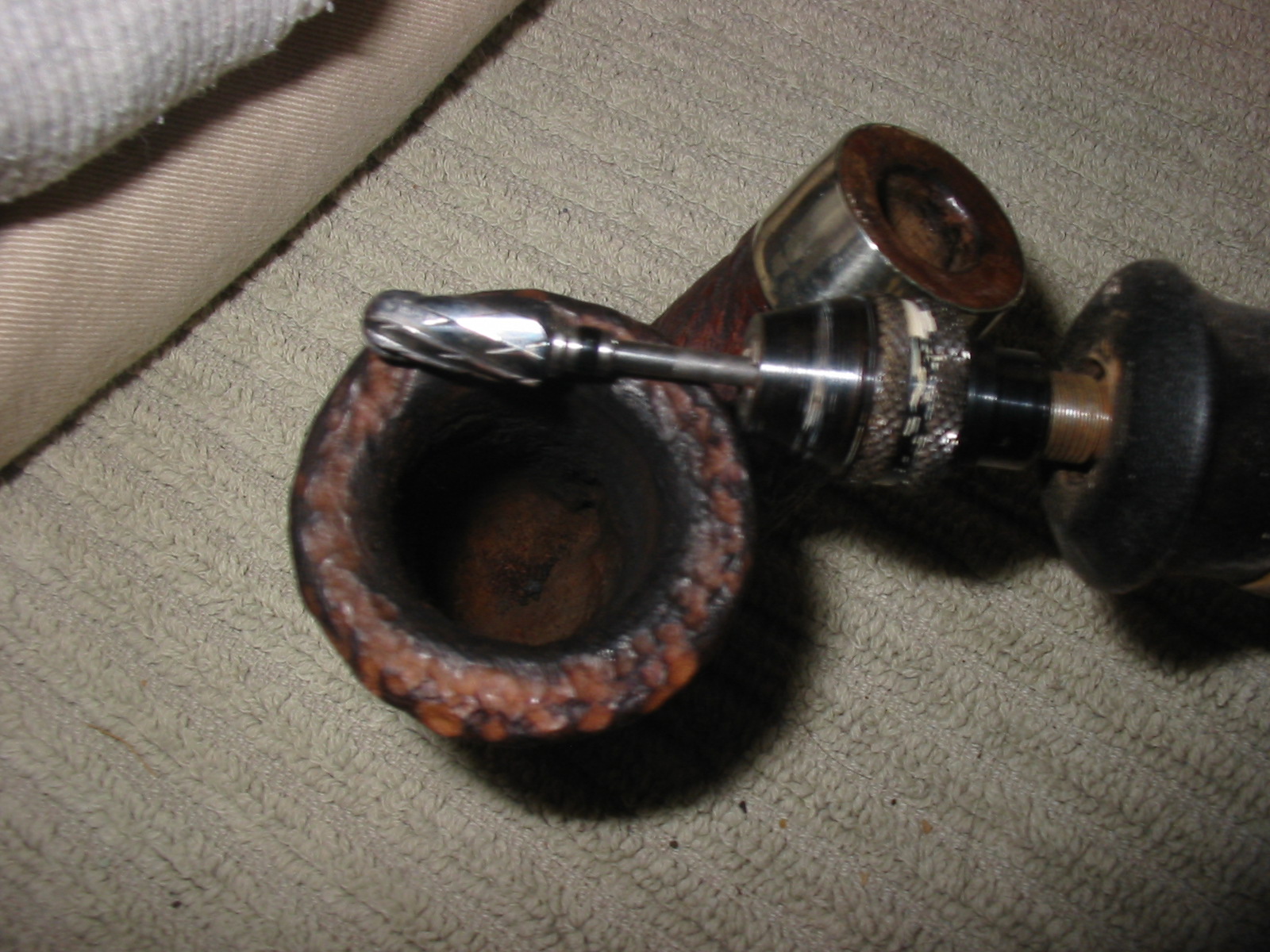
I used the Dremel with one of the burs that Joyal gave me to re-rusticate the rim. I followed the patter on the portions of the rim that were still visible and tried to duplicate them on the rest of the rim.
IMG_7174

IMG_7175
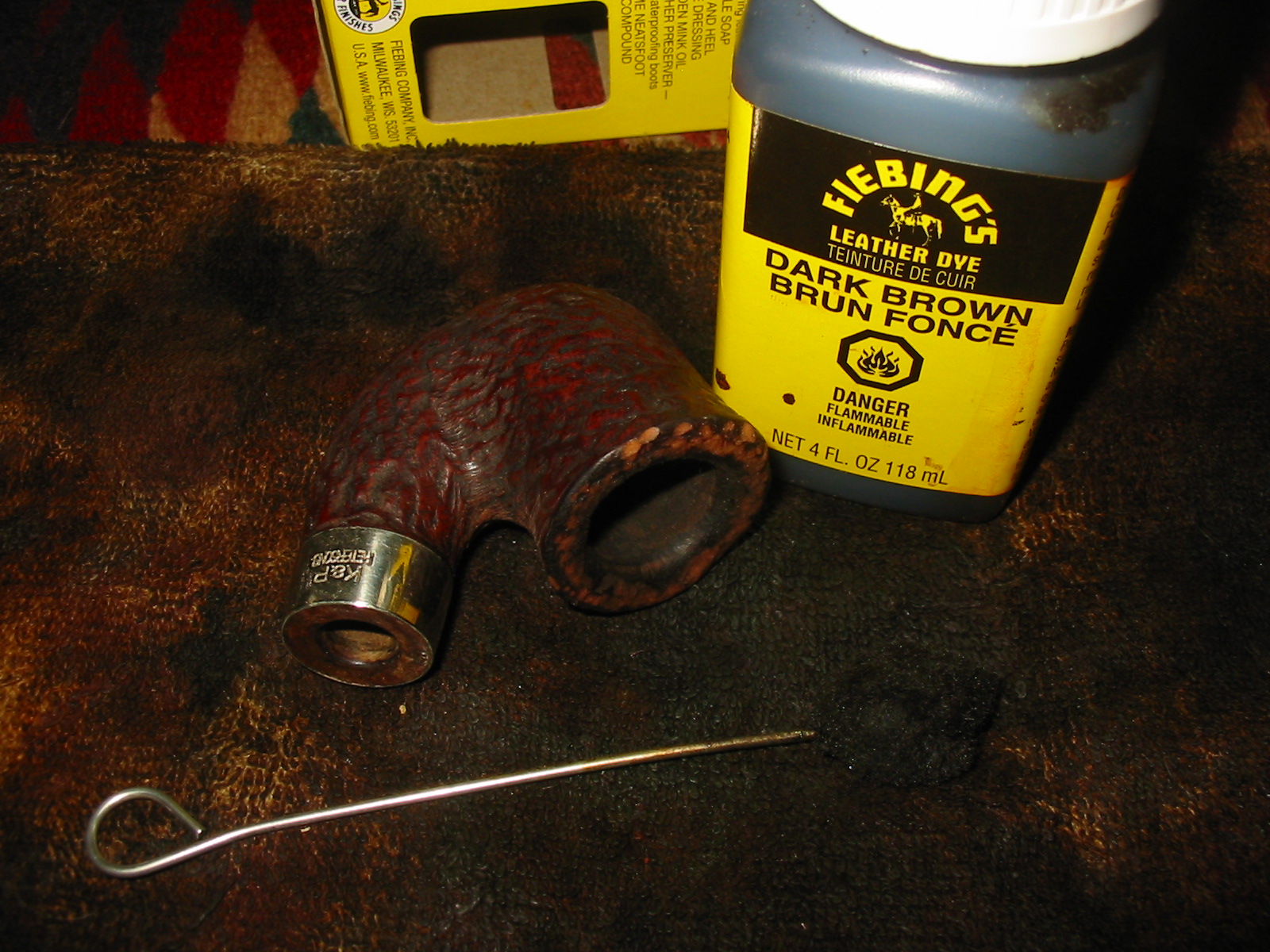
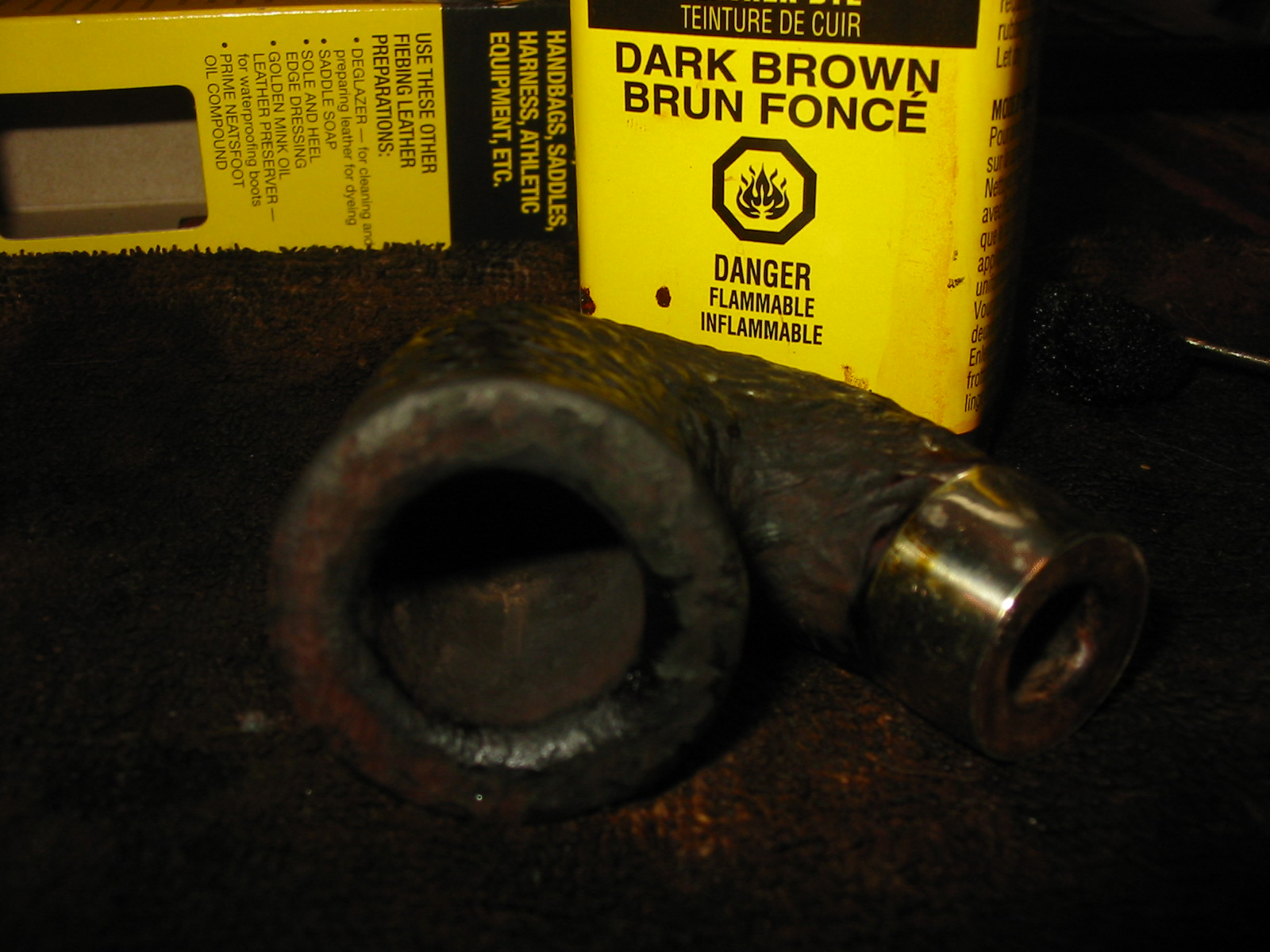
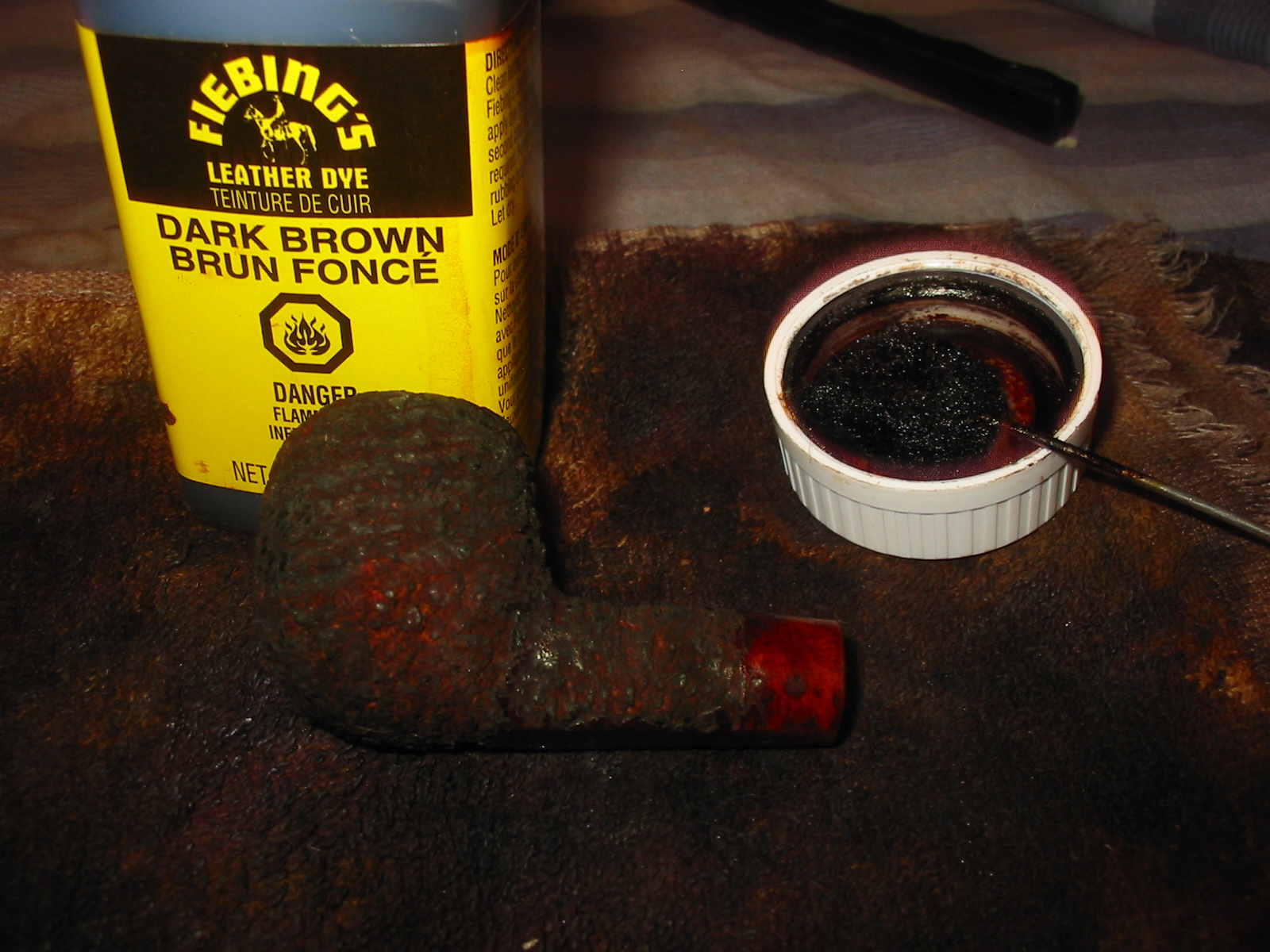
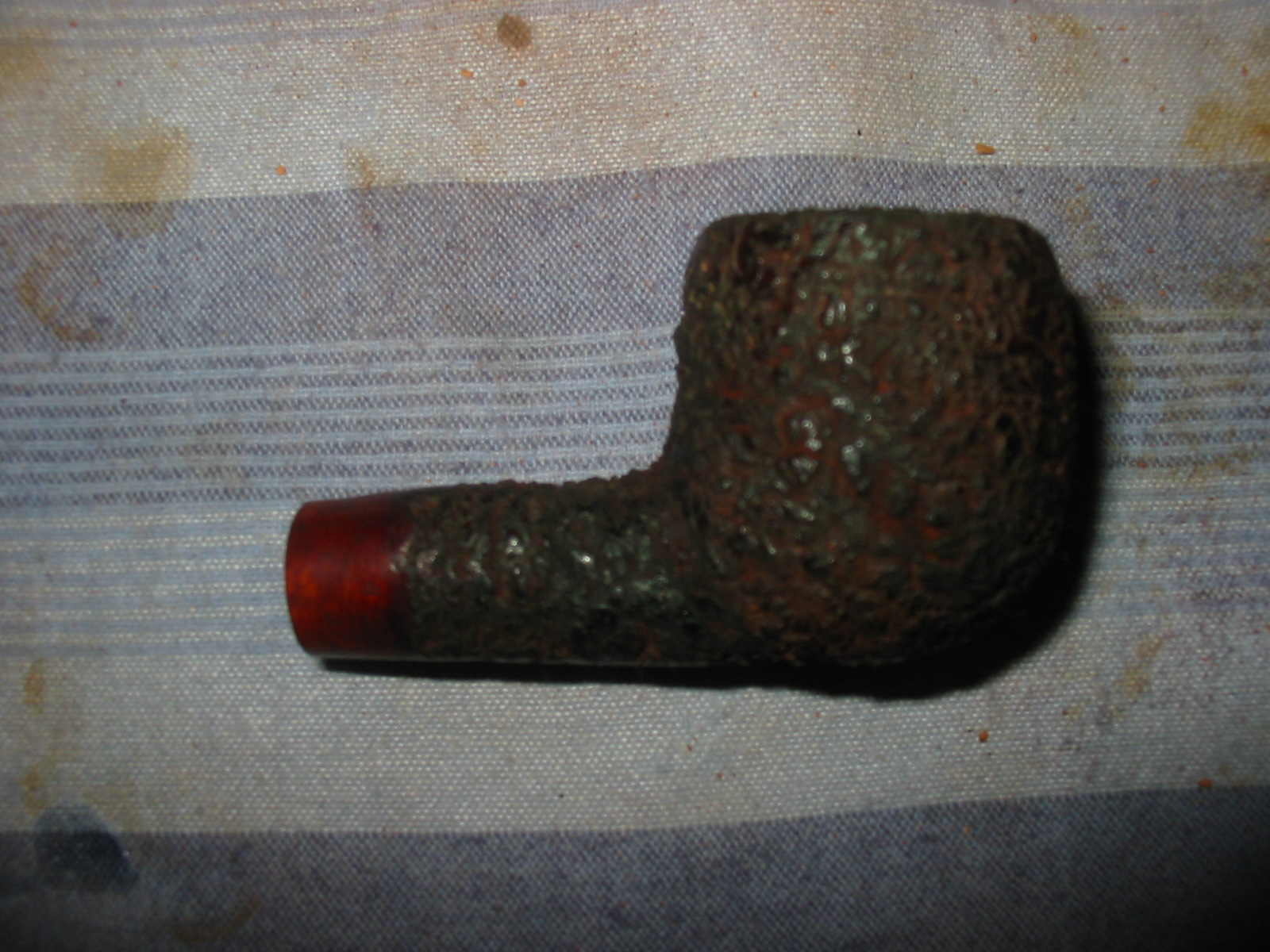
After rusticating the rim I restained it with a dark brown aniline stain. I applied the stain, flamed it and repeated the process until the coverage was even across the rim. I stained the bowl with the dark brown stain as well and flamed it.
IMG_7177

IMG_7178
The brown stain was too opaque and the contrast between the dark in the crevices and grooves of the briar and the lighter brown on the high spots was gone. I wiped the bowl down with acetone on a cotton pad until I had the contrast that I was aiming for.
IMG_7179

IMG_7180

IMG_7183
I ordered some stems that were the correct diameter and length for the 05 from Tim West at J.H. Lowe and Company. They arrived on Friday so I was able to fit one to the shank. I turned the tenon with a PIMO Tenon Turning Tool. The fitting of a tenon to the tapered shank of Peterson pipes takes a little getting used to. I worked to match the taper of the tenon to the taper of the mortise and was able to get a good fit on against the band.
IMG_7236

IMG_7238
I used the sanding drum on the Dremel to remove the casting seams on the sides and the button of the stem.
IMG_7239

IMG_7240

IMG_7241

IMG_7242
I sanded the stem with 150 and 220 grit sandpaper to match the diameter of the shank to the diameter of the band.
IMG_7251

IMG_7252
I sanded the stem with medium and fine grit sanding sponges to remove the scratching left behind by the sandpapers.
IMG_7257

IMG_7258

IMG_7259

IMG_7260
I wanted to bend the stem to match the original stem that would have been on the pipe. I looked up photos on the web of the 05 and copied one of them. I decided to use a fishtail stem instead of the p-lip stem but I was able to use the photo as a template of the bend.
don05
I heated the stem with a heat gun until it was flexible and then bent it over a rolling pin with a cardboard sleeve over it. I have found that the cardboard prevents the hot vulcanite from marring when I bend it. The second photo below shows the first attempt at the bend and the third photo shows it after I reheated it and rebent it to match the template.
IMG_7271

IMG_7275

IMG_7277
I sanded the stem with the medium and fine grit sanding sponges again. At this point in the process the stem was ready for the fine sanding work with the micromesh sanding pads.
IMG_7294

IMG_7295
I sanded the stem with the usual array of micromesh sanding pads – wet sanding with 1500-2400 grit pads and dry sanding with 3200-12000 grit pads. In between each set of three pads (1500-2400, 3200-4000 and 6000-12000) I rubbed the stem down with Obsidian Oil. I let it dry before moving on to the next grit of pads. Once it was finished I rubbed it down with a final coat of Obsidian Oil and when it had dried I buffed the stem with White Diamond. I gave the bowl a coating of Halcyon II wax and hand buffed it with a shoe brush and gave the stem multiple coats of carnauba wax, buffing with a clean flannel buffing pad between applications. The finished pipe is shown below. It too is ready for its inaugural smoke – maybe a bowl of Louisiana Red will start this one off also… anyway, it is ready for the a long life ahead.
IMG_7301

IMG_7302

IMG_7303

IMG_7304

Restoring and Restemming a Peterson’s Kapmeer 999S


Blog by Steve Laug

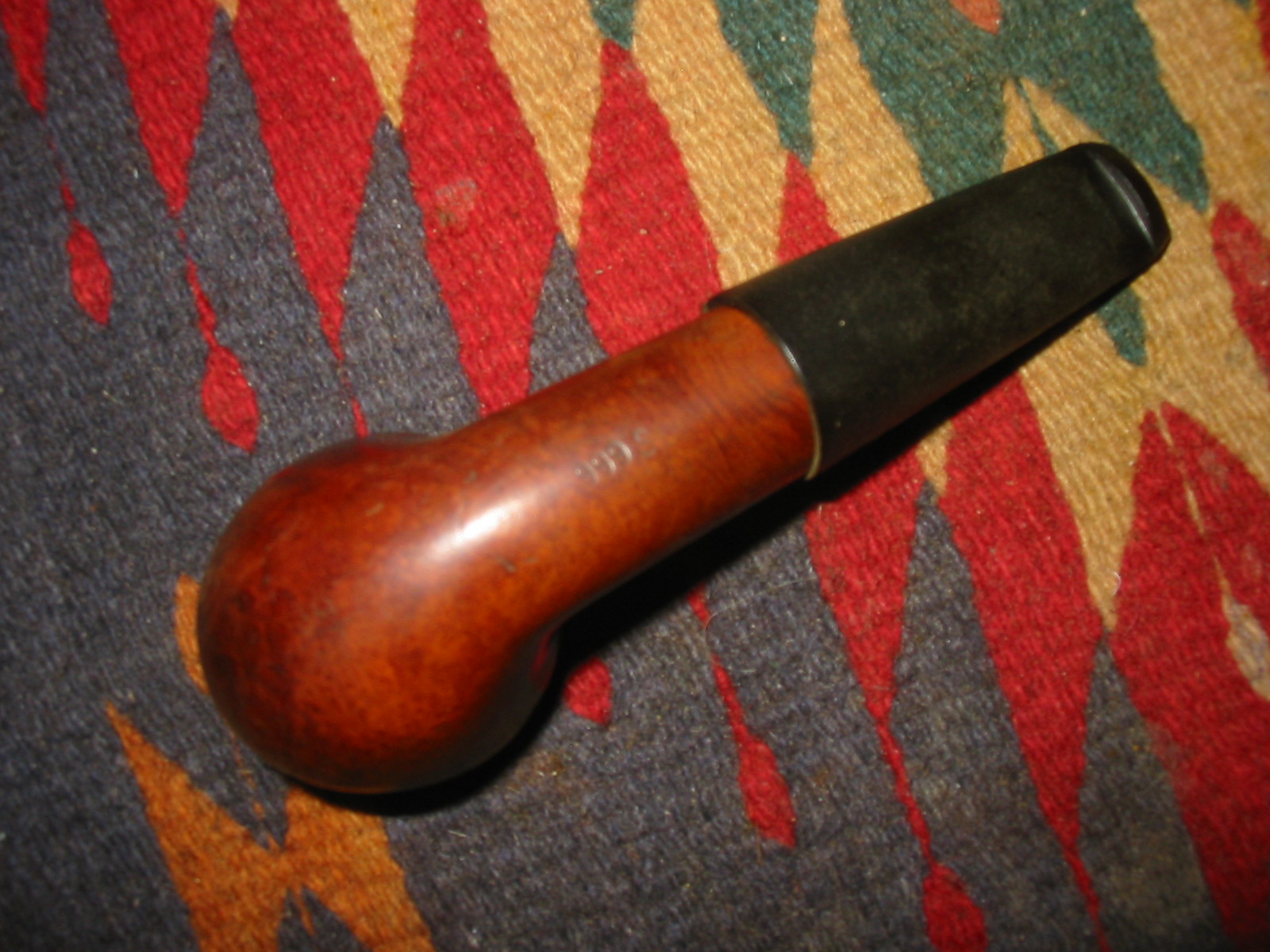
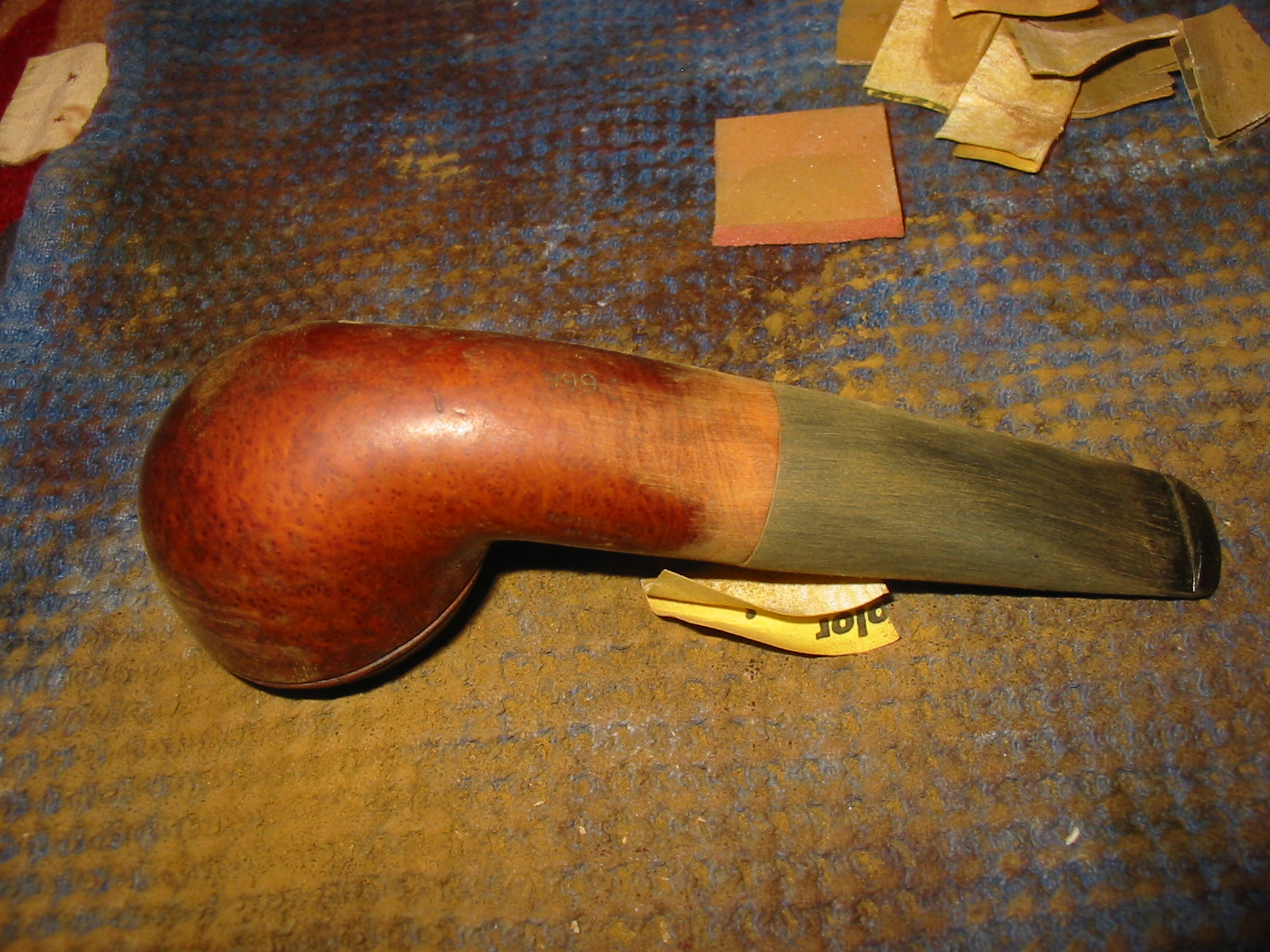
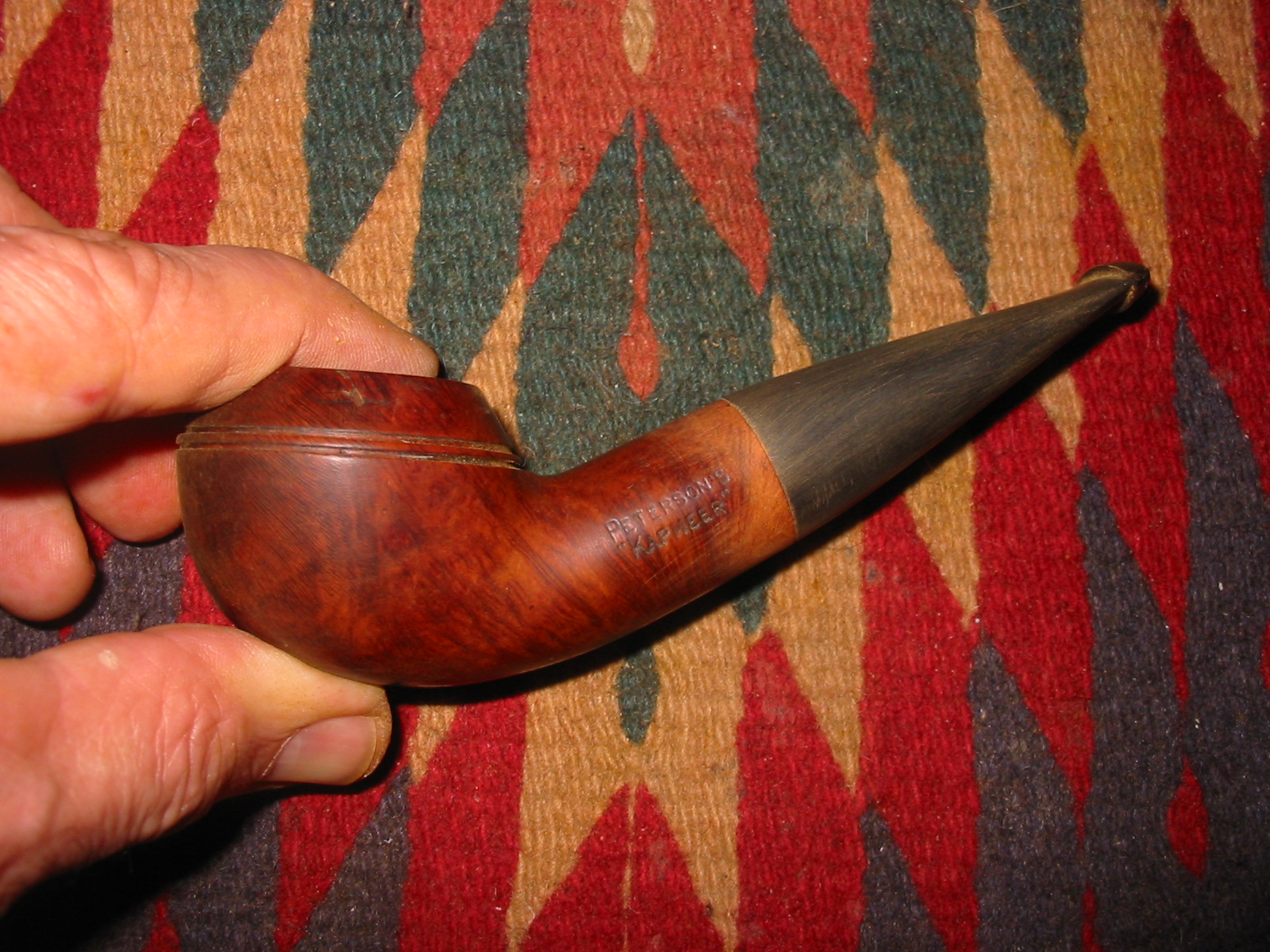
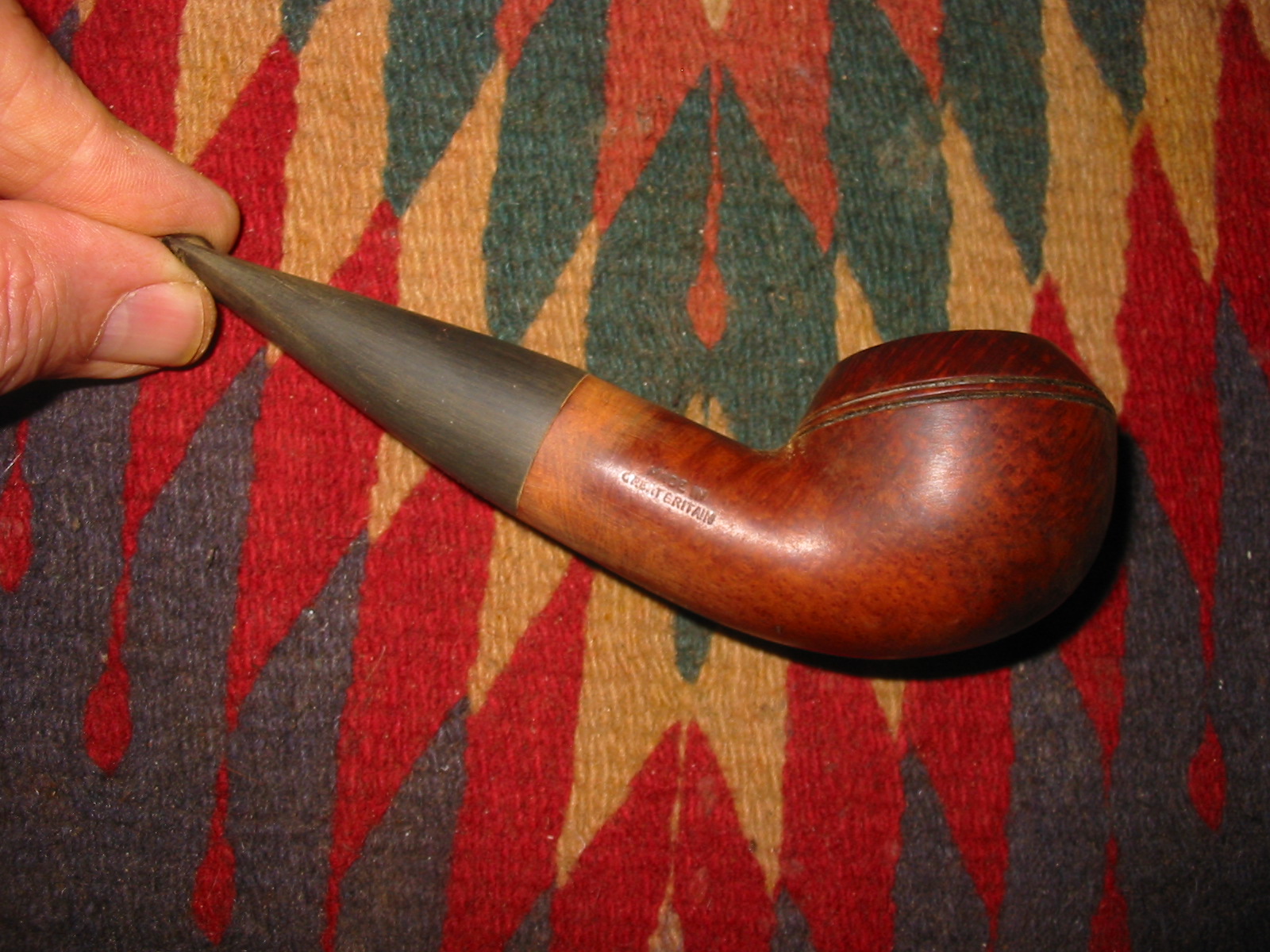
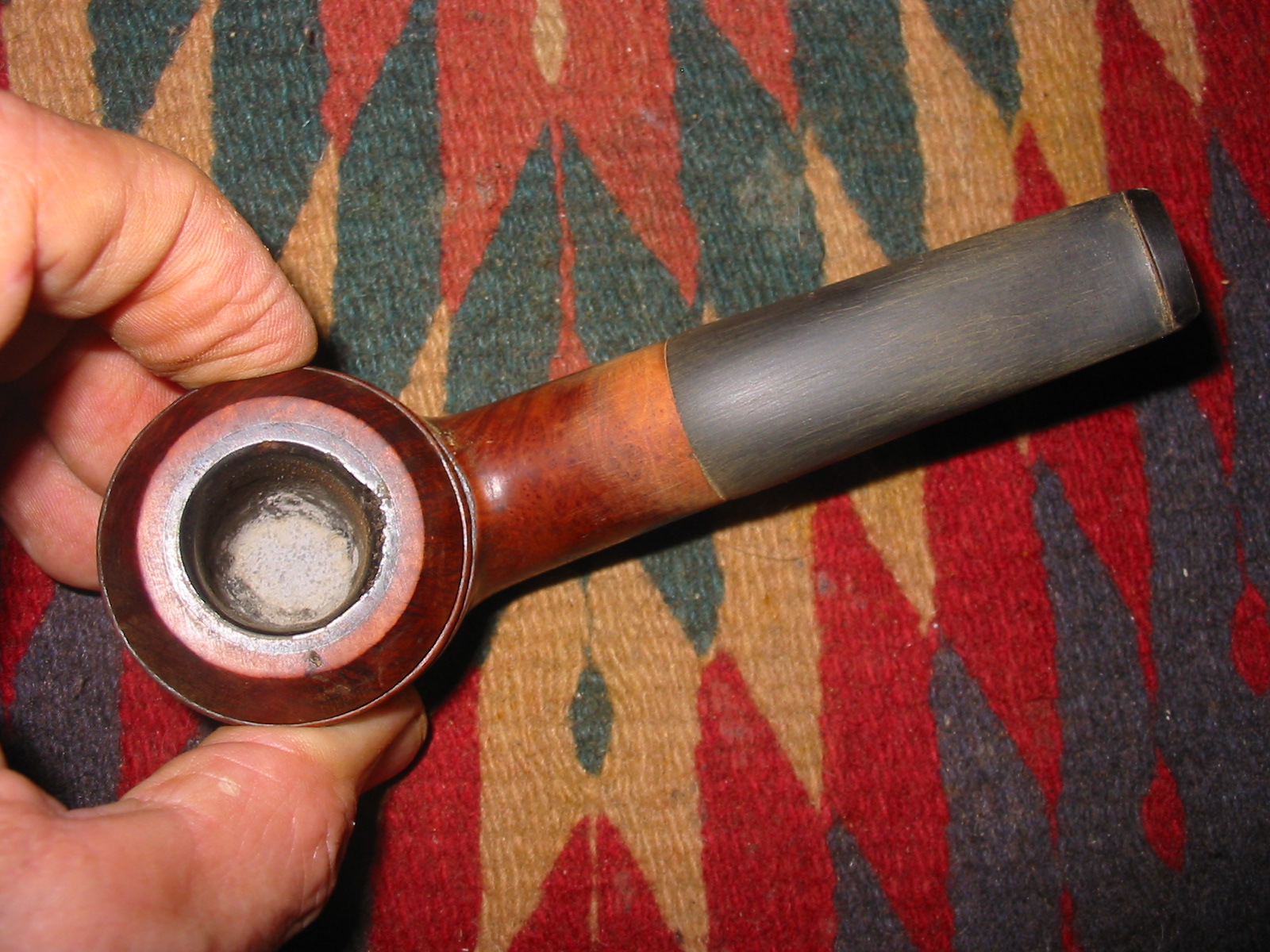
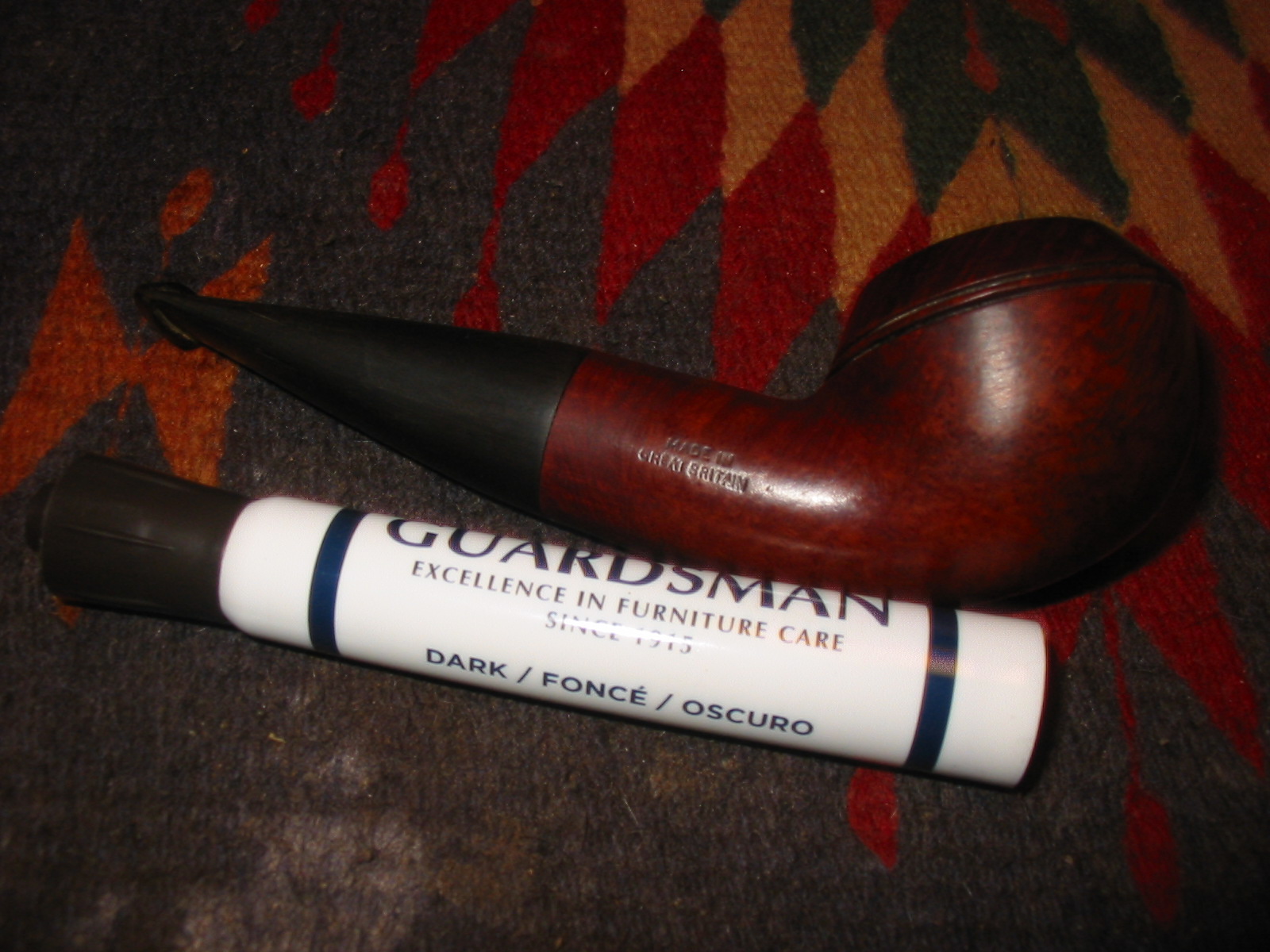
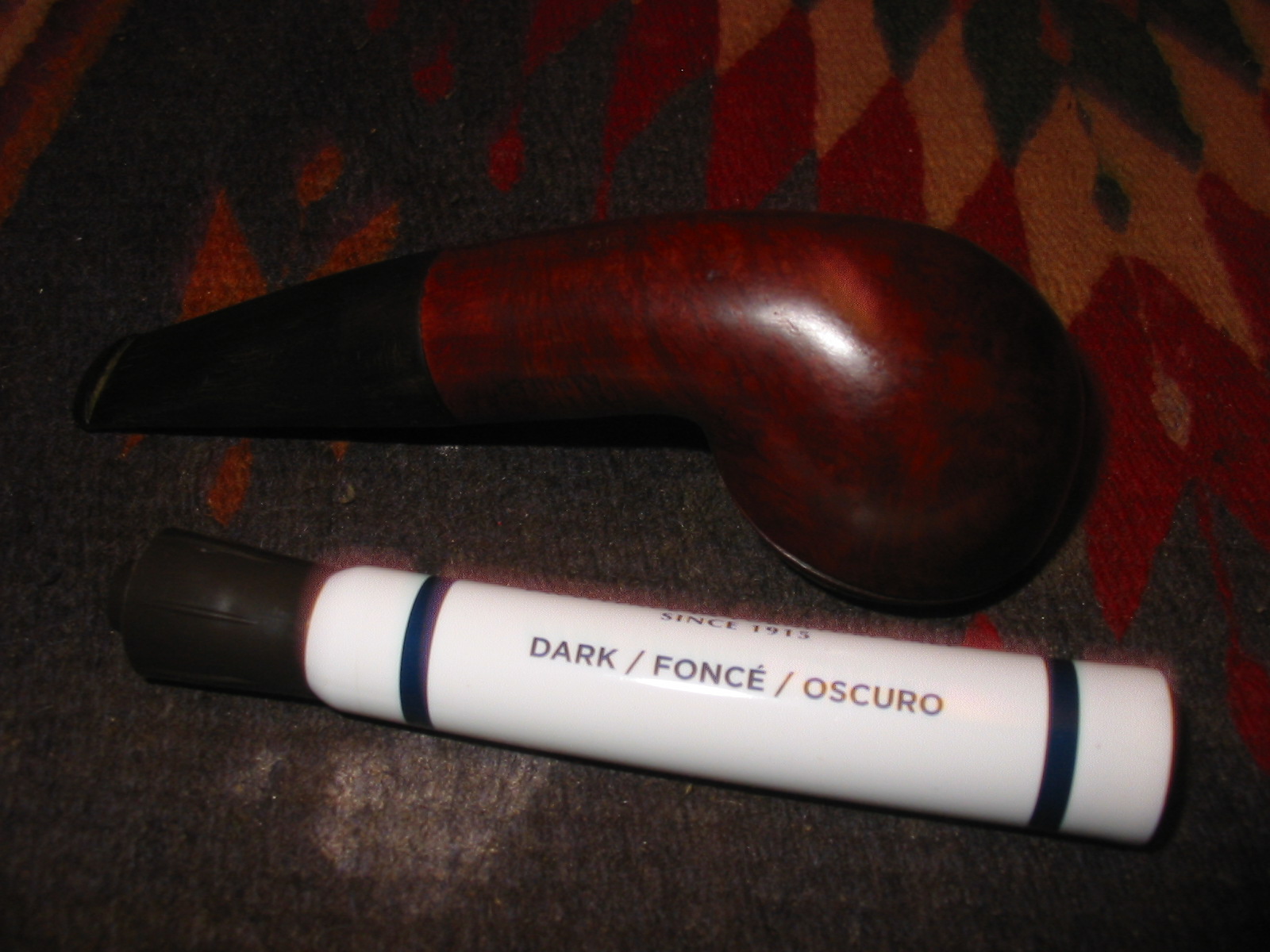
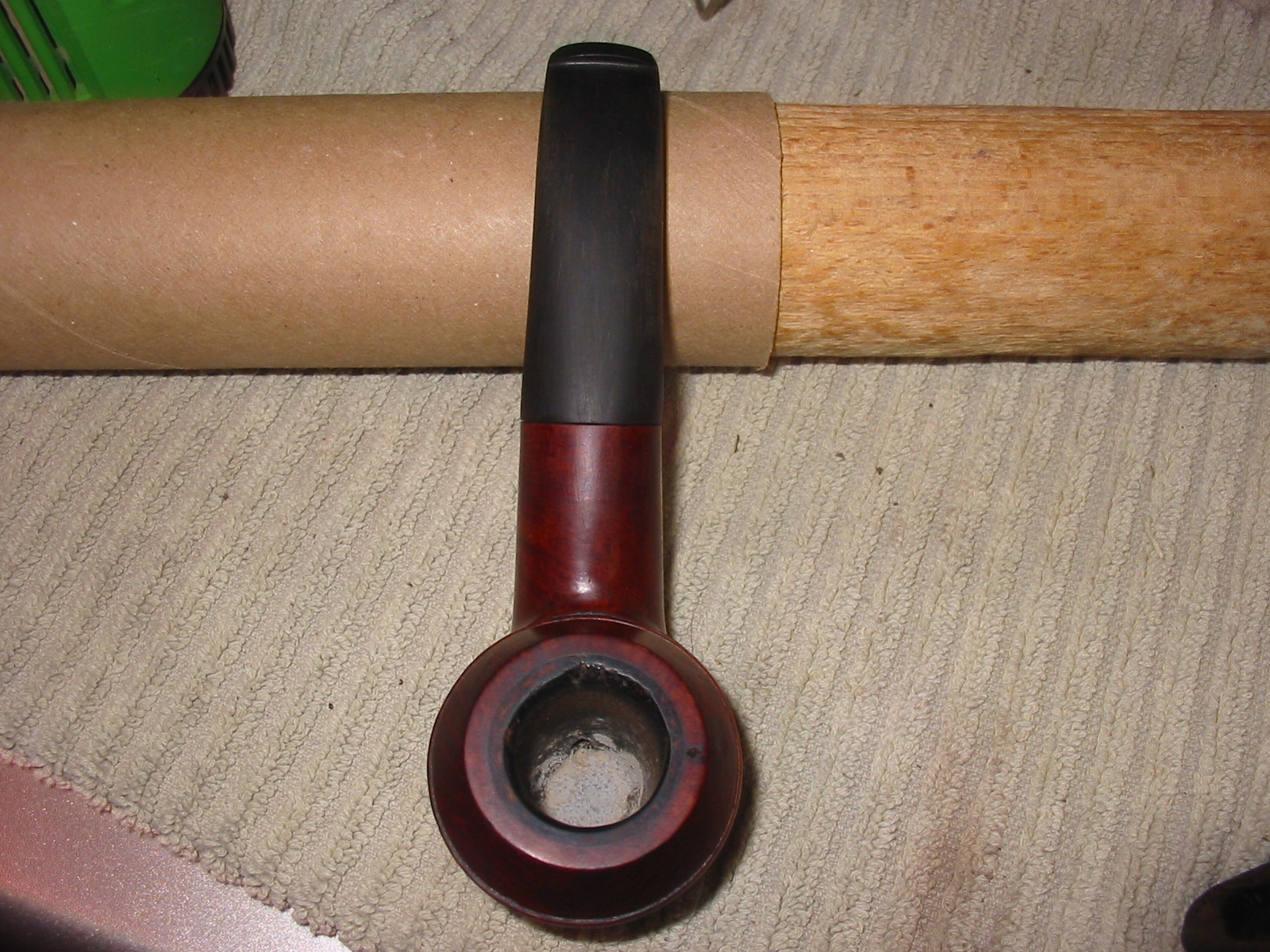
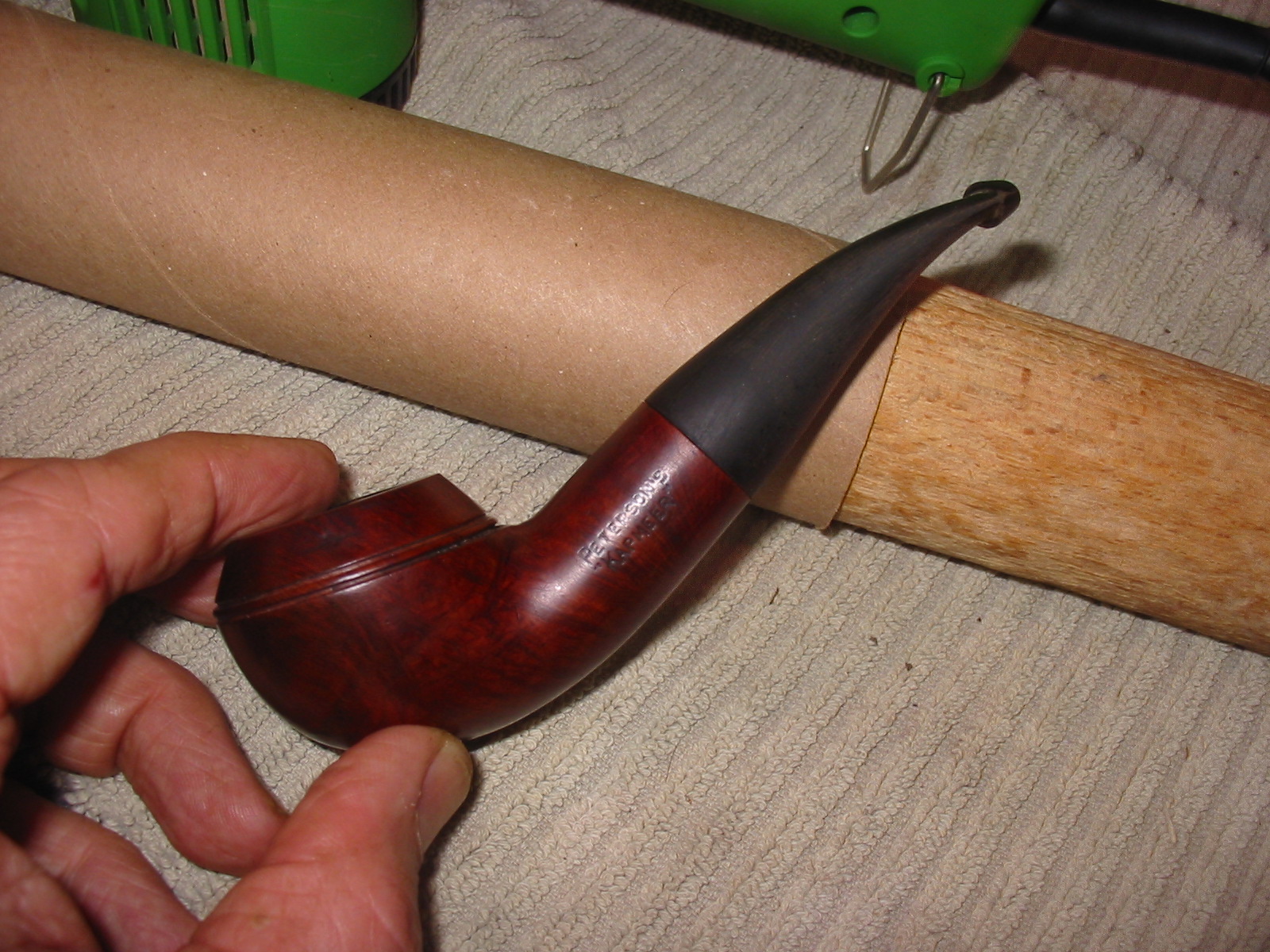
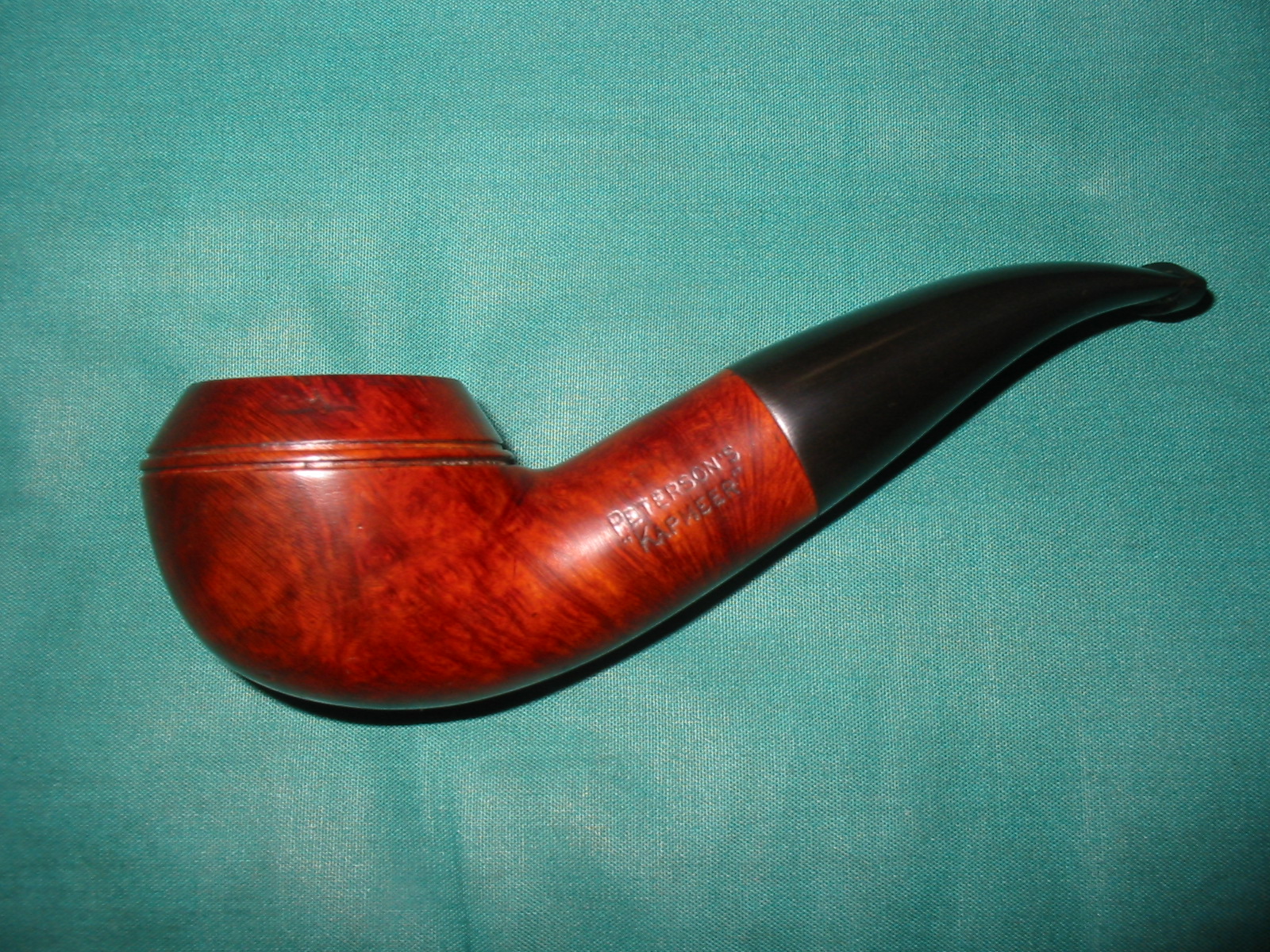
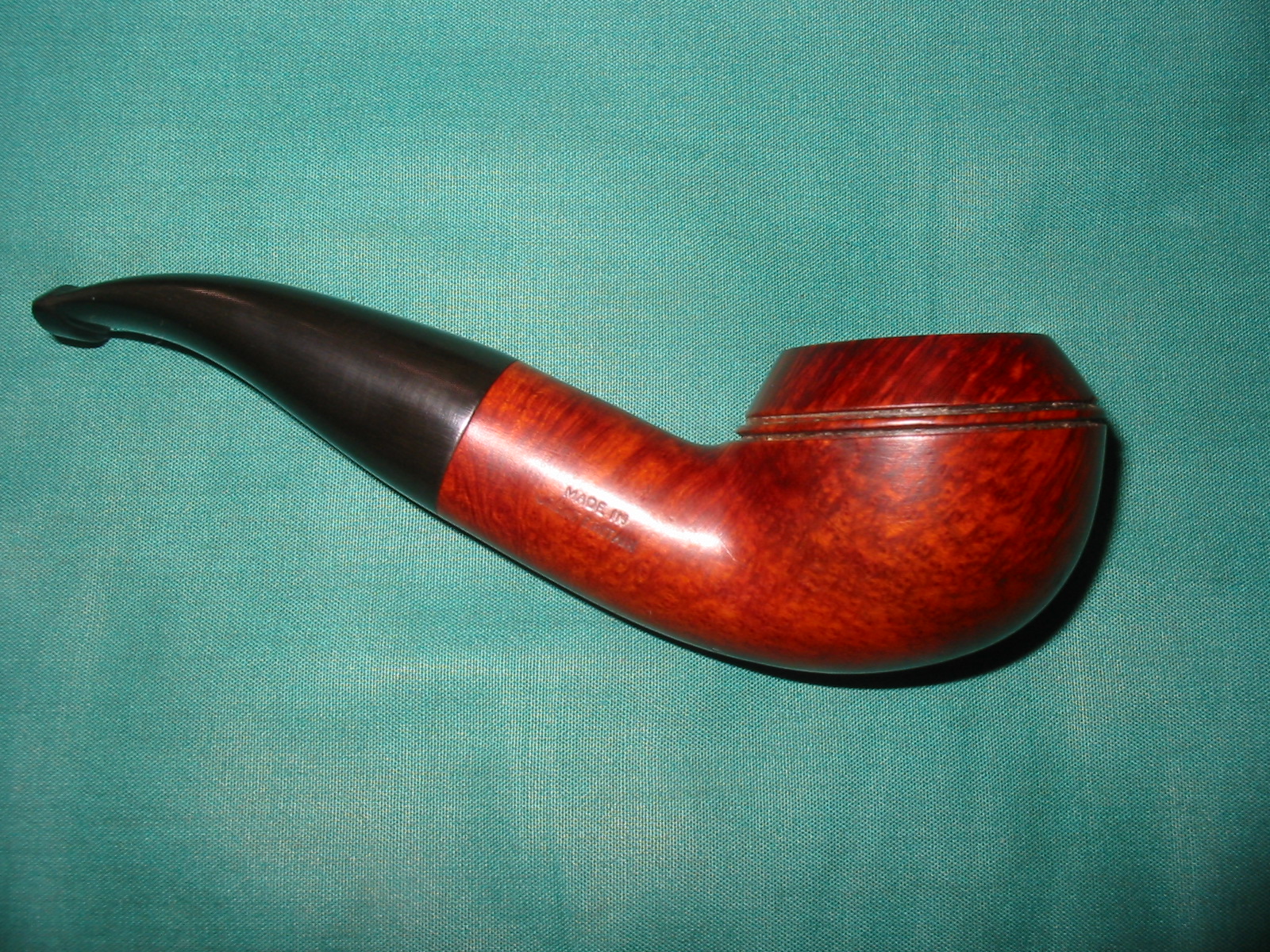
I just finished working on the second of the three pipes that I picked up on Ebay in the lot of three Petersons. It is the third bowl in the photos below. It is stamped Peterson’s over KAPMEER on the left side of the shank, 999S on the underside of the shank and Made in Great Britain on the right side of the shank. It is actually the reason I bid on this lot of pipe bowls. I love the older 999 shape with the thick shank. I like the way it feels in hand and the look of it. As you can see it was in rough shape. There was no stem for it. The finish was rough and worn, the bowl had a thick uneven cake in it and the top of the rim was thick with a cake build up. From what little I knew the KAPMEER was a meerlined pipe. There was something unique about its design but that escaped me at the moment.

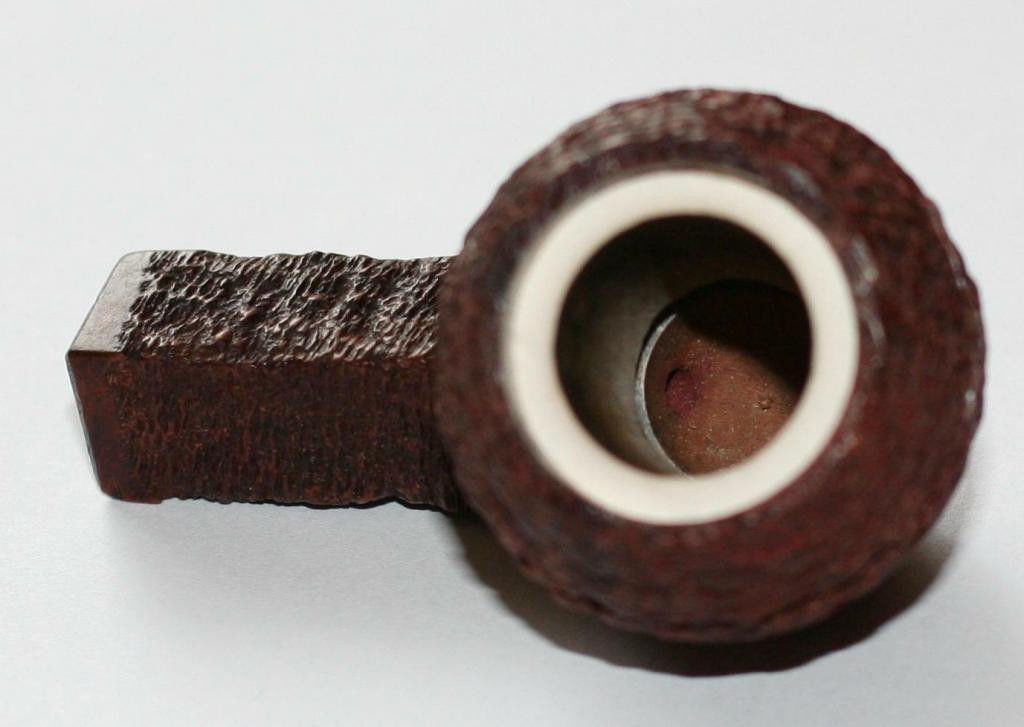
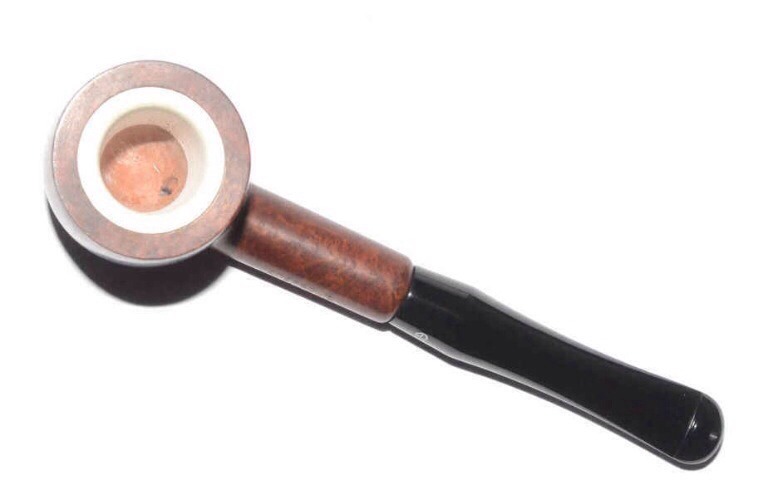
While I waited for it to arrive I did a bit of digging into the KAPMEER line. The first thing I found was a quote that said, “The line was introduced for those who preferred to smoke their tobacco in a meerschaum bowl, but still have the looks and advantages of a briar pipe”. That was not altogether helpful to me. It is much the same advertizing info that is included in most of the sales material for meerlined pipes. What was the difference between those pipes and the KAPMEER? The meerschaum lining ended just before the draw hole, so you do not have the problem of deterioration in the bottom of the meerschaum insert in the tobacco chamber. It was believed that this would reduce the possibility of a burn out on the sides of the bowl. I found the two photos below online that clearly show the design of the KAPMEER bowl. The first photo shows the bottom edge of the insert just above the draught hole. The bowl bottom is briar. The second photo shows the contrast between the meerschaum lining and the briar on the bottom of the bowl. In looking at these photos I think I understand the idea of combining the best of meerschaum and briar pipes. The theory would be that the meerschaum lining would deliver a meerschaum style cool smoke and the briar bottom would give the durability and strength of briar.
Kapmeer bowl top view

tumblr_mw3ugfrLNV1t13exzo2_1280
or early 1970s. The pipe in the second photo is a later design. The early pipes had a regular stem/shank junction rather than the faux military stem. The one that I had came from a period in time where the stem was most likely a tapered stem with an aligned fit. The pipes were made in Great Britain on the Isle of Man. I found out that though Peterson had maintained a factory in London since 1899, the ‘Made in England’ stamp was discontinued with the closing down of the London-based factory (1969/70). That puts my bowl pre-1970 in terms of date. The thick shank on the 999 bowl dates it earlier than that period.

I gently reamed the bowl, being careful to not damage the meer lining. I wanted to take the cake back as far as possible with the reamer and would do the rest with sandpaper. I sanded the meer lining with 220 grit sandpaper until the entire cake was gone and the meer was once again smooth. It was darkened and would not be white again do to use. I gently topped the bowl with a topping board to remove the cake and smooth out the rim damage before working on the rest of the bowl. I wiped the bowl down with acetone on cotton pads, carefully avoiding the meerschaum lining on the top of the rim. The acetone removed the grime and the spotty stain on the bowl and would form the base for restaining the bowl later.

The bottom of the bowl had been over reamed and the briar damaged with deep gouges on the bottom. The bottom was still thick so there were no worries about burn out. I mixed a batch of pipe mud from cigar ash and water and applied it to the bottom of the bowl to bring the bottom up to the airway entrance. I tamped it in place with a pipe nail. I put some mud on the side walls below the end of the meerschaum lining. I set it aside to cure.
IMG_7169

IMG_7170

IMG_7171

IMG_7172
Once the mud had cured I wiped out the inside of the bowl with a damp cotton pad to clean any of the mud that had gotten on the meer lining. I wiped down the outside of the bowl with acetone and cotton pads a final time. I had a stem set aside from my can of stems that would fit the shank once the tenon was turned and the diameter of the stem reduced. I turned the tenon with a PIMO Tenon Turning Tool slowly until it fit the shank. I sanded the tenon with a sanding drum on a Dremel to finish the fit. I sanded the casting marks on both sides of the stem and on the end of the button with the Dremel as well. When all was finished the fit against the shank was snug and clean.

IMG_7243 IMG_7244 IMG_7245 IMG_7246As can be seen from the photos above the diameter of the stem was bigger than that of the shank. I used the sanding drum on the Dremel to take it down as close as possible to the shank diameter without damaging the shank. Once I had it close I did the rest of the work with 150 grit sandpaper and followed that with 220 grit sandpaper. When the transition between the two was smooth to touch I used a medium and a fine grit sanding sponge to remove the scratch marks from the stem. Since I was planning on restaining the pipe I sanded the shank gently to make sure that the transition would be smooth and the flow correct. I have found that this is the only way to keep the stem and shank matching without and shift in height on either material.
IMG_7247IMG_7248IMG_7249IMG_7250I wiped off the sanding dust with a damp cloth and gave the stem a wipe down as well. The photos below show the look of the stem and shank union at this point in the process. I also gave the rim a light sanding with the sanding sponges as well. There is one small sandpit in the top left side of the rim. I decided to leave it rather than fill it.
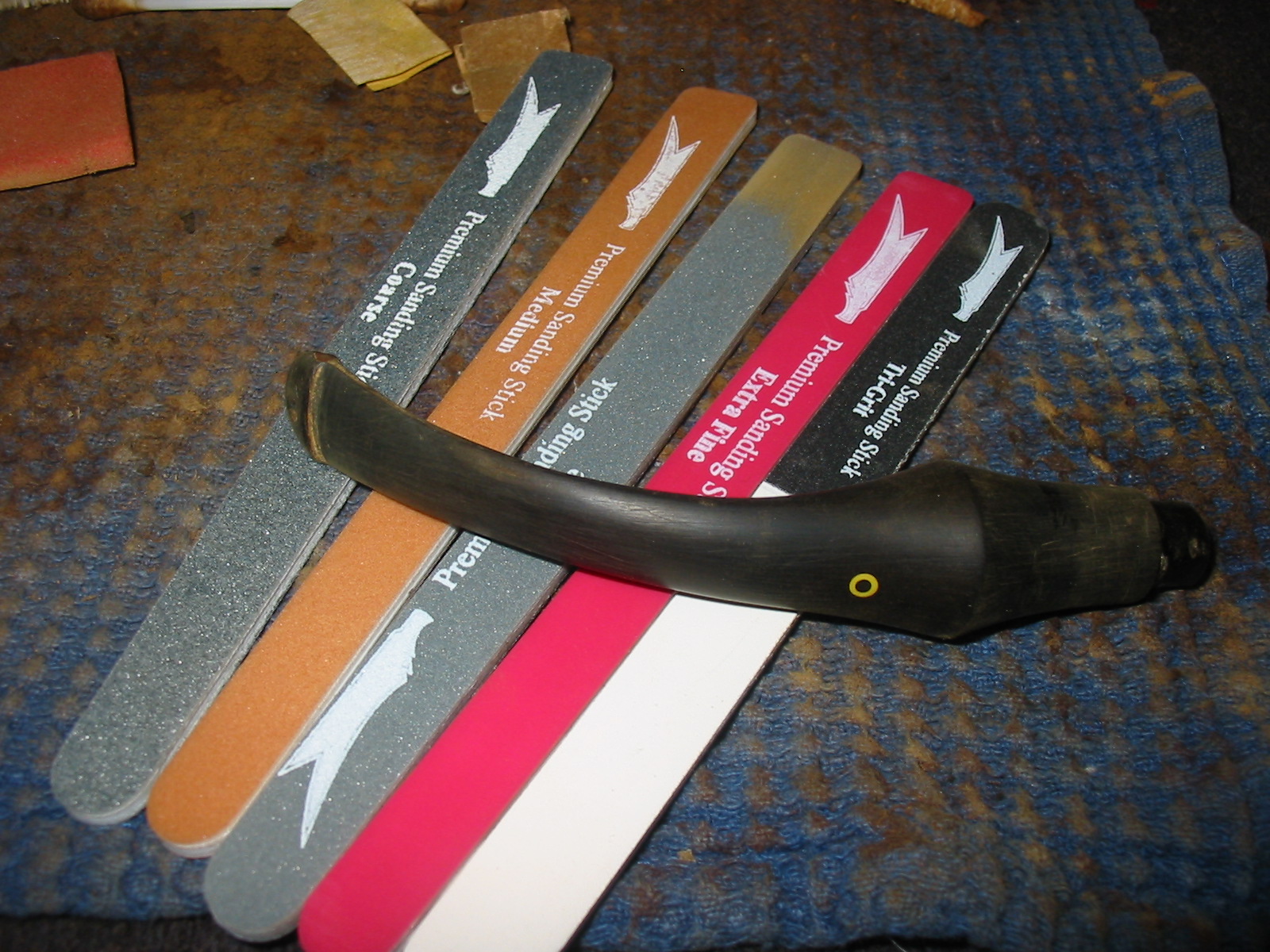
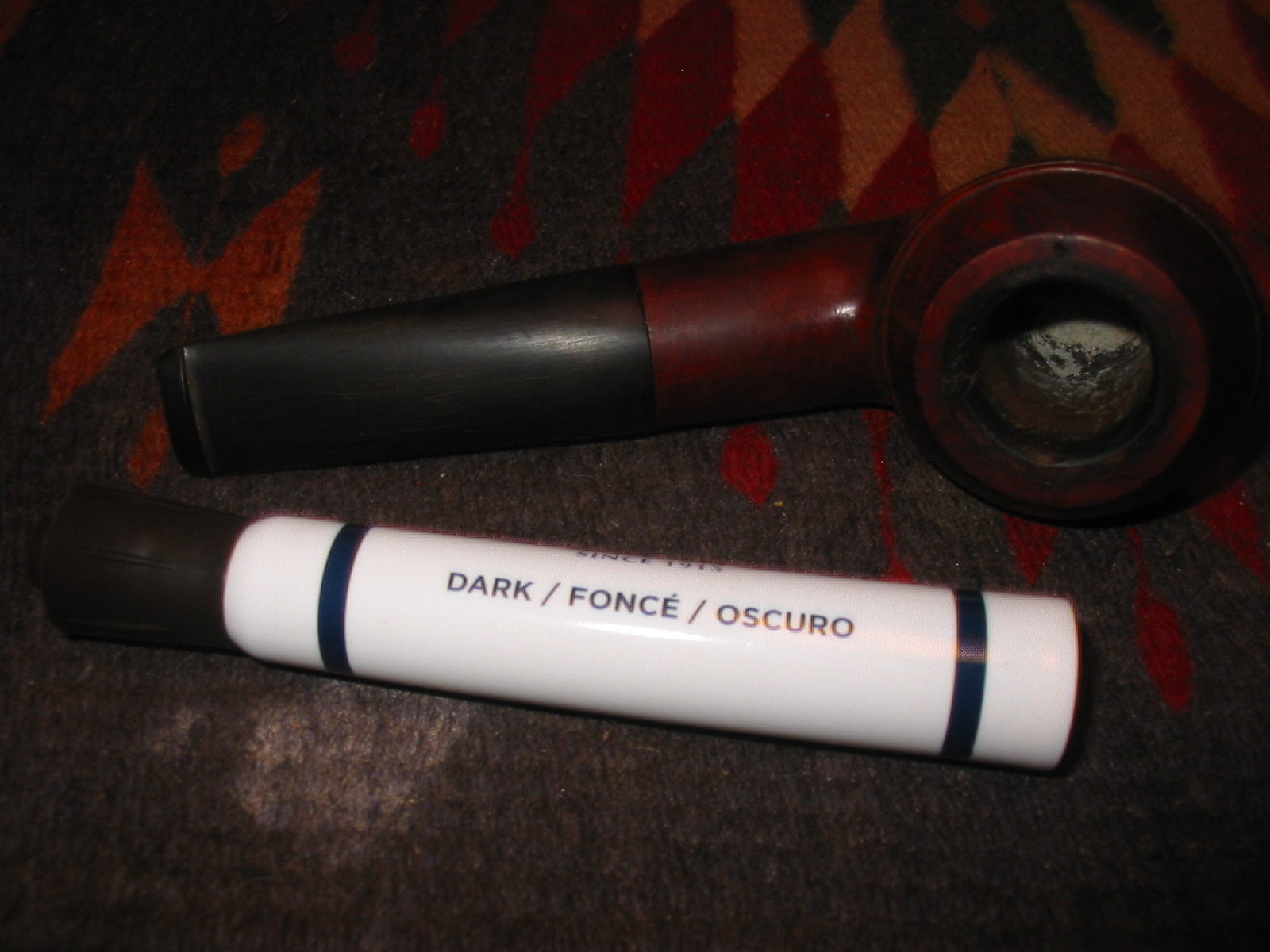
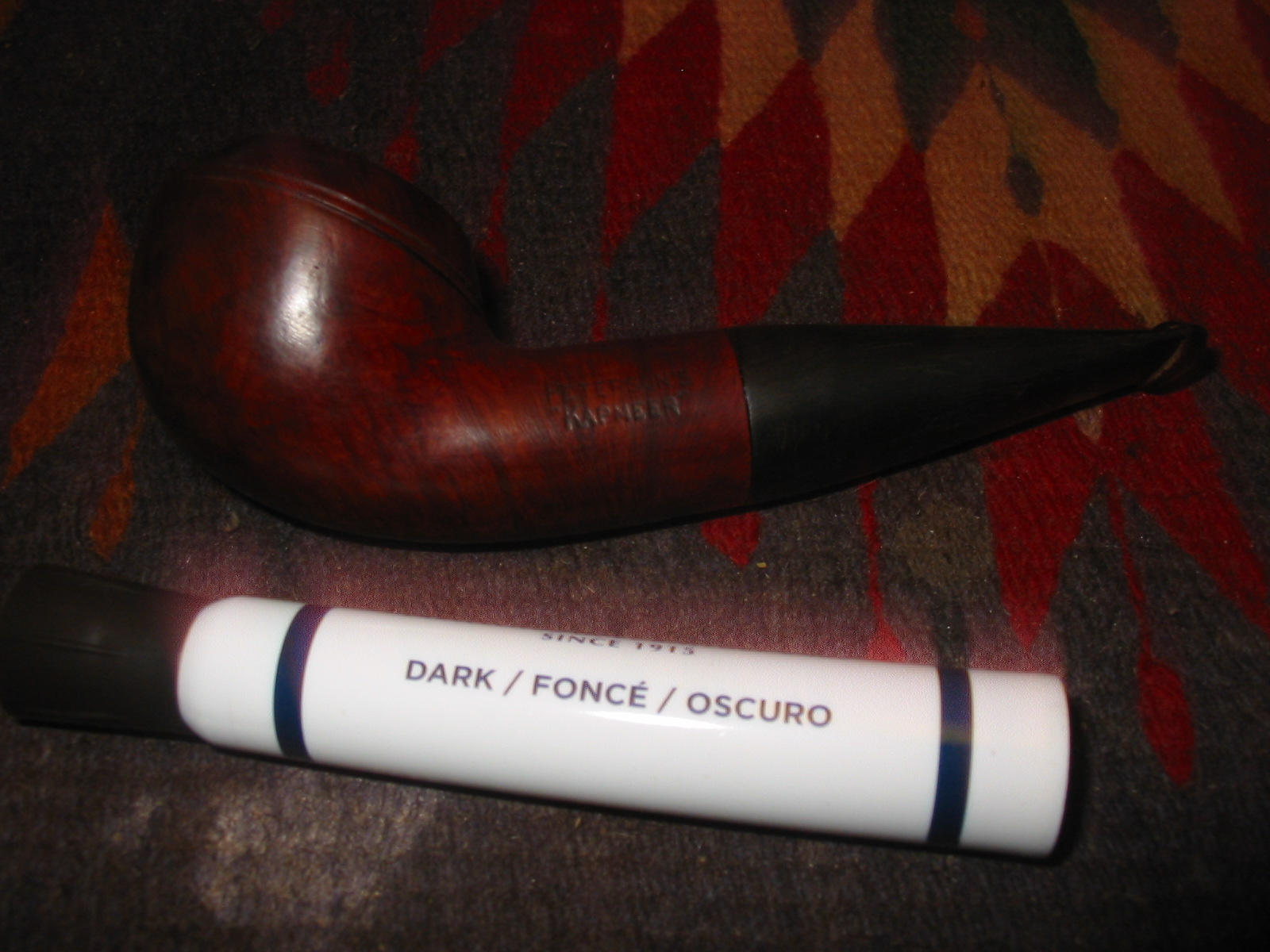
IMG_7253 IMG_7256IMG_7254IMG_7255I sanded the shank with 1500-2400 grit micromesh sanding pads to remove scratches in the finish and wiped the bowl down with alcohol on a cotton pad. Greg sent me a set of staining pens to work with so I decided to try them out on this pipe. I tried the light and medium pens and found that they did not match the stain on the pipe so I settled for the dark pen. I drew on the unstained surface of the shank and then blended it into the rest of the bowl. I also did the same on the rim, blending it downward into the sides of the bowl. The pen was very easy to control and keep off the meer lining on the inner edge of the rim.

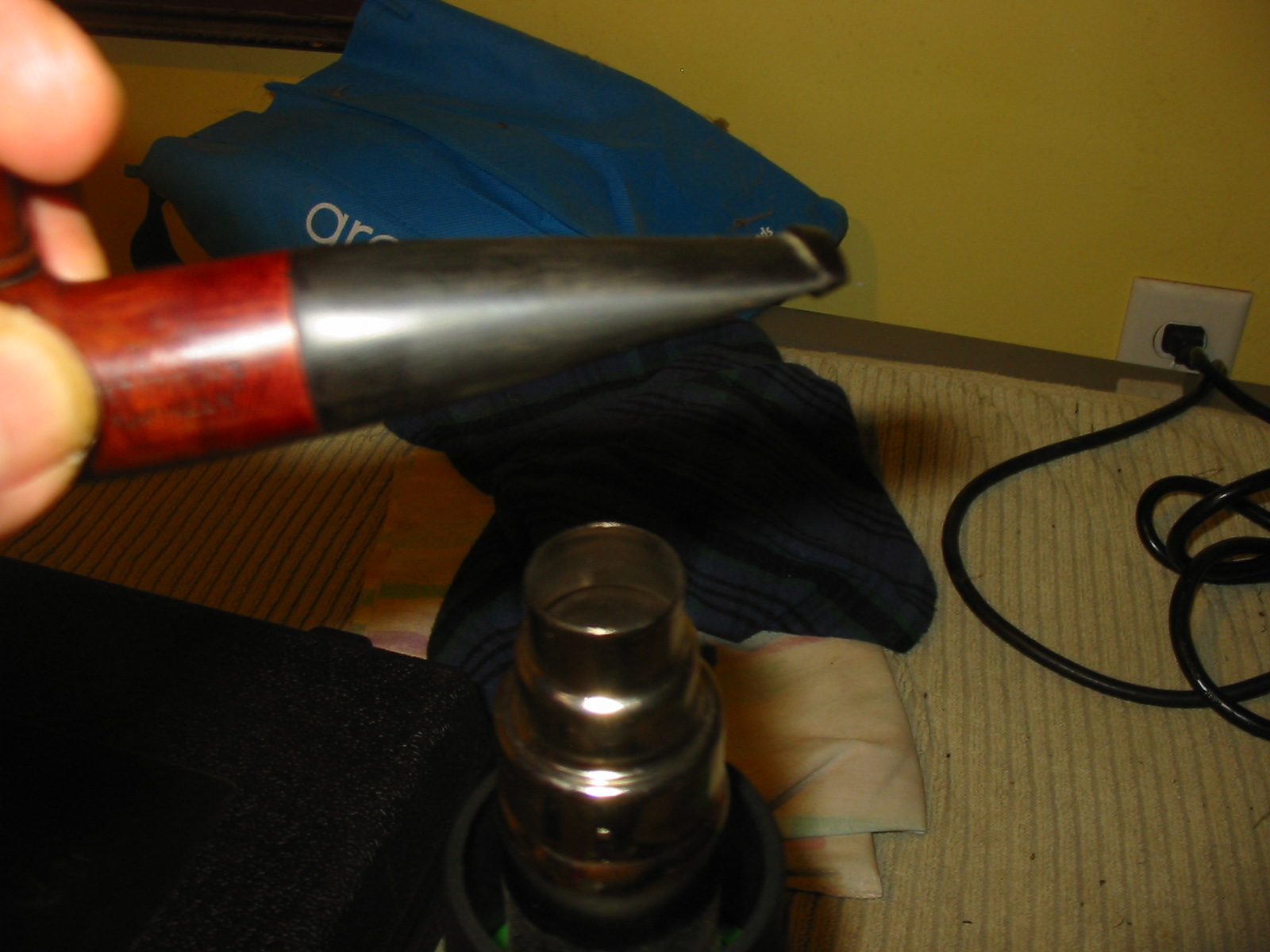
IMG_7262 IMG_7263 IMG_7264 IMG_7265When the stain had dried I buffed the bowl with White Diamond and then gave it a coating of carnauba wax to seal it and give it a shine. I had done enough of the early sanding on the stem by that point to set up a heat gun to heat and bend the stem. I held it over the heat until the stem was soft and then bent it over a rolling pin that I use for bending stems. I have a thick cardboard tube that I slide on the rolling pin to provide a softer surface than the old rolling pin when I am bending the heated vulcanite.

IMG_7268 IMG_7272 IMG_7273The photo above shows the first attempt at the bend in the stem. It was not bent enough to my liking so I reheated it and bent it again. Once the bend was correct I set it in cool water.

IMG_7276I took the pipe back to the worktable to sand the stem. I wet sanded with 1500-2400 grit micromesh sanding pads and dry sanded with 3200-12,000 grit pads. I rubbed the stem down between each of the three grits with Obsidian Oil and let it soak in before moving on to the next series of three grits.

IMG_7278 IMG_7279 IMG_7280I rubbed it down a final time with the Obsidian Oil and then buffed the pipe and stem with White Diamond on the wheel. I gave the pipe multiple coats of carnauba wax and between each coat buffed it with a soft flannel buff. The finished pipe is shown in the photos below. All that is left is to load a bowl of some aged Louisiana Red and enjoy a bowl.

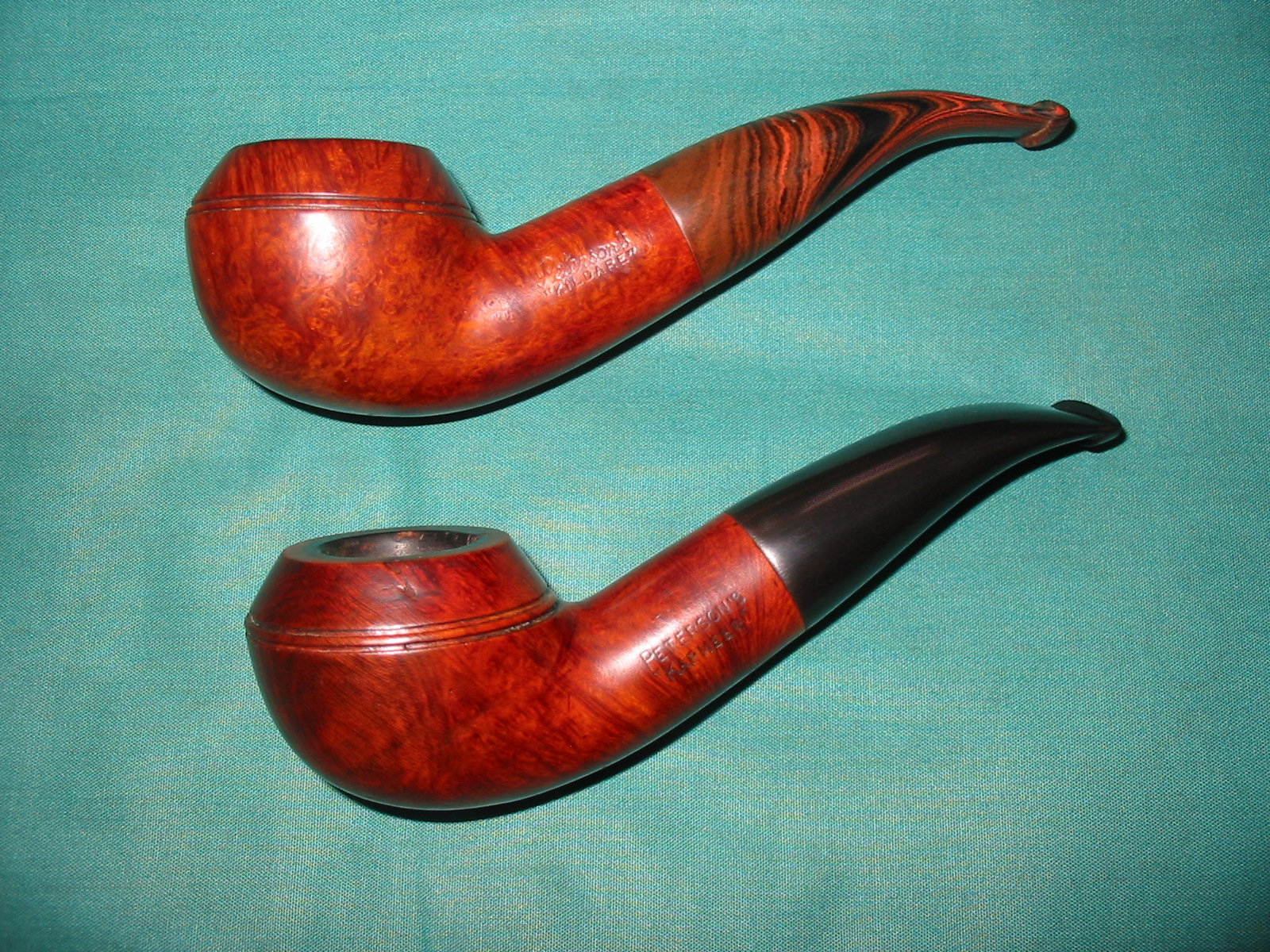
IMG_7281 IMG_7284 IMG_7285 IMG_7289For comparison sake, I have included a photo of the newly reworked KAPMEER with the earlier KILDARE that I restemmed from a piece of Cumberland rodstock that I purchased from Todd Bannard of Briar, Sweat and Tears Pipes http://www.briarsweatandtears.com/ . Todd cut the length and did the drilling and shaping on that piece before sending it to me to finish. As you can see both have the thicker old style shanks that are no longer used on Peterson 999 pipes. This pipe is the third one that I have from that earlier time period. It is the shape of the 999s that I favour.

IMG_7291

Resuscitating a Peterson Donegal Rocky 338 Bent Billiard


A few weeks ago one of the EBay sellers that I have bought several pipes from over the years had three Peterson bowls, sans stems listed for sale. They were in rough shape but I decided I wanted to give refurbishing them all a try. Besides one of them was a 999S and I love the 999 shape. That alone would have pushed me to make a bid on this lot. I ended up buying the threesome for more than I usually pay for pipe bowls but I figured it was worth the effort. This is the photo of the threesome from the sale listing.

The first of the three Peterson bowls is on the worktable at the moment. The finish was very rough on the pipe. It had built up grime in all of the grooves of the rustication. The inside of the bowl was caked almost to the top of the rim. The shank was one of the foulest things I think I have seen before. It was caked with oily tars from just inside the edge of the mortise to the bottom of the mortise. The rim was badly damaged with the front edge burned down lower than the rest. The rim was ragged looking and uneven all the way around. It looked to be solid though underneath the damage. The stamping on the underside of the shank said Petersons Donegal Rocky with the shape number 338. All the stamping is quite faint but still readable with a lens.
IMG_7098

IMG_7099
I cleaned and reamed the bowl. It is funny how short and easy that sounds but in this case that was not true. The cake in the bowl was like concrete and had totally closed off the bottom half of the bowl. The remaining top half had a slight slice to the airway but that effort was useless as the shank was completely clogged and no air could go through. I reamed as much of the bowl as I could with a PipNet reamer, not even getting as low as the airway. This stuff was very hard. I cleaned the shank with alcohol and cotton swabs. I tried to push a pipe cleaner through the clogged airway in the shank and was unable to get it to through. I decided to throw the bowl in an alcohol bath to soak for several hours to loosen things up.
IMG_7100

IMG_7111
When I took it out of the bath the alcohol soak had done its work. I was able to ream the rest of the way to the bottom of the bowl and completely remove the cake. I was able to push a wire through the airway and then cleaned out the airway and shank with cotton swabs and some assorted dental tools (thanks Joyal).
IMG_7112

IMG_7108
I scrubbed the rusticated finish of the bowl with Murphy’s Oil Soap and a tooth brush. I used a soft brass bristle brush to work on the rim and clean up the loose build up. Once I had scrubbed it I rinsed it with warm water. I dried it off and still had to do some more scrubbing. I cleaned the inside of the bowl and shank with the dental tools and cotton swabs and alcohol.
IMG_7125

IMG_7127
The rim was so badly damaged and uneven with the burned area that I topped it using the topping board and 220 grit sandpaper until it was flat.
IMG_7121

IMG_7123

IMG_7124
I went through my stem can and found a three inch long stem that was approximately the same shape and length as the original stem. I turned the tenon with the PIMO Tenon Turning tool and removed the castings on the sides and the end of the stem. I further shaped it with the Dremel and sanding drum.
IMG_7128

IMG_7129

IMG_7131

IMG_7132

IMG_7133
I wanted the top of the bowl to have the same rustication that it originally had before all the rim damage. It had a pattern that was similar to the rustication on the bowl itself. I looked on line to find photos of the rim of a Donegal Rocky that would be a pattern for me to copy. I put a dental bur that Joyal has given me on a Dremel tool and set the speed to a slow speed and used it to rusticate the rim to match the pattern in the photo of the bowl.
IMG_7134
I wiped the bowl down with a cotton pad and alcohol to clean off the dust from the rustication and then stained the whole bowl with a dark brown aniline stain. In the photos below the rim is obviously much lighter in colour than the rest of the bowl so it took five coats of stain before it matched the bowl. I applied the stain and flamed it with a lighter to set the stain repeatedly until the coverage was correct.
IMG_7135

IMG_7136
The brown was very dark and the original contrast look on the Donegal Rocky was not evident. I wiped the bowl down with acetone on cotton pads to lighten it and bring back some contrast to the rusticated finish. In the photos below the properly darkened rim is visible.
IMG_7137

IMG_7138

IMG_7139
I lightly buffed the bowl and rim with White Diamond and then applied some Halcyon II wax on both and then buffed with a soft flannel buff. I knew that I would have to wax it again once I had finished but I always put a coat of wax on the bowl to protect the finish when I give it a more thorough clean. I sanded the stem with 220 grit sandpaper to smooth out the casting marks and the Dremel marks. Once I had the initial sanding finished I decided to bend the stem. I heated it over a heat gun until it was pliable and bent it over and old rolling pin. I used a photo of 338 I found on the net as a template for the bend in the stem. I made the photo life sized and laid the pipe against the computer screen to match the bend. Once I had the bend correct the rest of the stem work could begin.
IMG_7140

IMG_7141

IMG_7142

IMG_7143

0003284_sterling-silver-338_430

IMG_7144

IMG_7145

IMG_7146

IMG_7147
I removed the stem from the bowl, stuffed cotton bolls in the bowl of the pipe and used an ear syringe to fill the bowl with isopropyl alcohol. I set the bowl in an old ice cube tray that keeps the bowl upright. I set the tray aside to let the alcohol sweeten the pipe and draw out the oils in the bowl and shank.
IMG_7149
Four hours later the alcohol had begun to pull out the tars and oils into the cotton.
IMG_7152
Twelve hours from the starting time, the cotton was a dark brown and most of the alcohol had evaporated. I pulled the cotton out of the bowls and wiped them dry with a cotton swab soaked in clean alcohol and they came out clean other than a little bit of the detritus that had collected in the bottom of the bowl. I swabbed out the shank and airway as well with pipe cleaners and cotton swabs dipped in alcohol and the shank was clean. The pipe smelled sweet and ready to smoke.
IMG_7153
I turned my attention to the stem and sanded it with a medium and a fine grit sanding sponge. It removed the majority of scratches from the surface of the stem left behind by the 220 grit sandpaper (I believe these sponges are equivalent to 400 and 600 grit wet dry sandpaper).
IMG_7154

IMG_7155
The rustication that I did on the top of the bowl rim is very clear in the next photo.
IMG_7156

IMG_7157
I sanded the stem with micromesh sanding pads – wet sanding with 1500-2400 grit pads and dry sanding with 3200-12,000 grit pads. Between each set of three grits I wiped the stem down with Obsidian Oil and let it soak into the vulcanite.
IMG_7160

IMG_7161

IMG_7162
When I had finished sanding with the 12,000 grit pad I rubbed it down with a final coat of Obsidian Oil and when it had dried buffed the stem with White Diamond and a Blue Plastic buffing compound. I then gave the stem multiple coats of carnauba wax, buffing with a soft flannel buff between coats. I waxed the bowl with Halcyon II wax and hand buffed it with a soft bristle shoe brush and a cotton buffing cloth. I used the 6000, 8000 and 12,000 grit micromesh pads to polish the nickel band and then gave it a buff with a silver polishing cloth. This old Peterson 338, that must have been an incredible smoke to have been smoked as hard as it was, is now ready to enter the next era of its life and provide the same kind of service to me. I look forward to smoking it later in the week once I am sure the alcohol in the bowl and shank has all evaporated. I have to tell you, I am looking forward to having a bowl in this old timer.
IMG_7163

IMG_7164

IMG_7165

IMG_7167

IMG_7166

Black Superglue Experiments – Joyal Taylor (aka holymolar)


Blog by Joyal Taylor

I have been waiting for this article since the product was mentioned on Pipe Smokers Unlimited Forums. Mark Domingues (who contributes on the blog) and Joyal both ordered the powder to try out. Both said they would experiment with it and report back. Joyal spoke with Mark and they agreed that he would post the results of his experiments. I have used Black Super Glue for a long time now in patching tooth marks and bite throughs on stems. I have dealt with the shrinkage and the long curing times and lived with them. Joyal has done all of us a service in doing this experiment and writing up the process and results of his work. Thanks Joyal for taking the time to work through this and document your process. It is well worth a read.

Experiment #1 – Black Superglue with Accelerator:

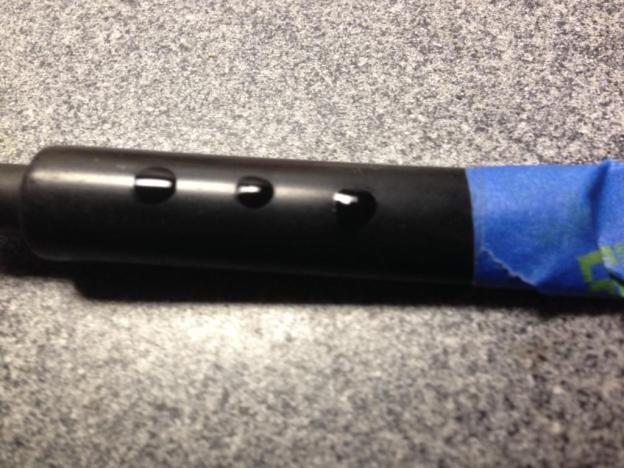
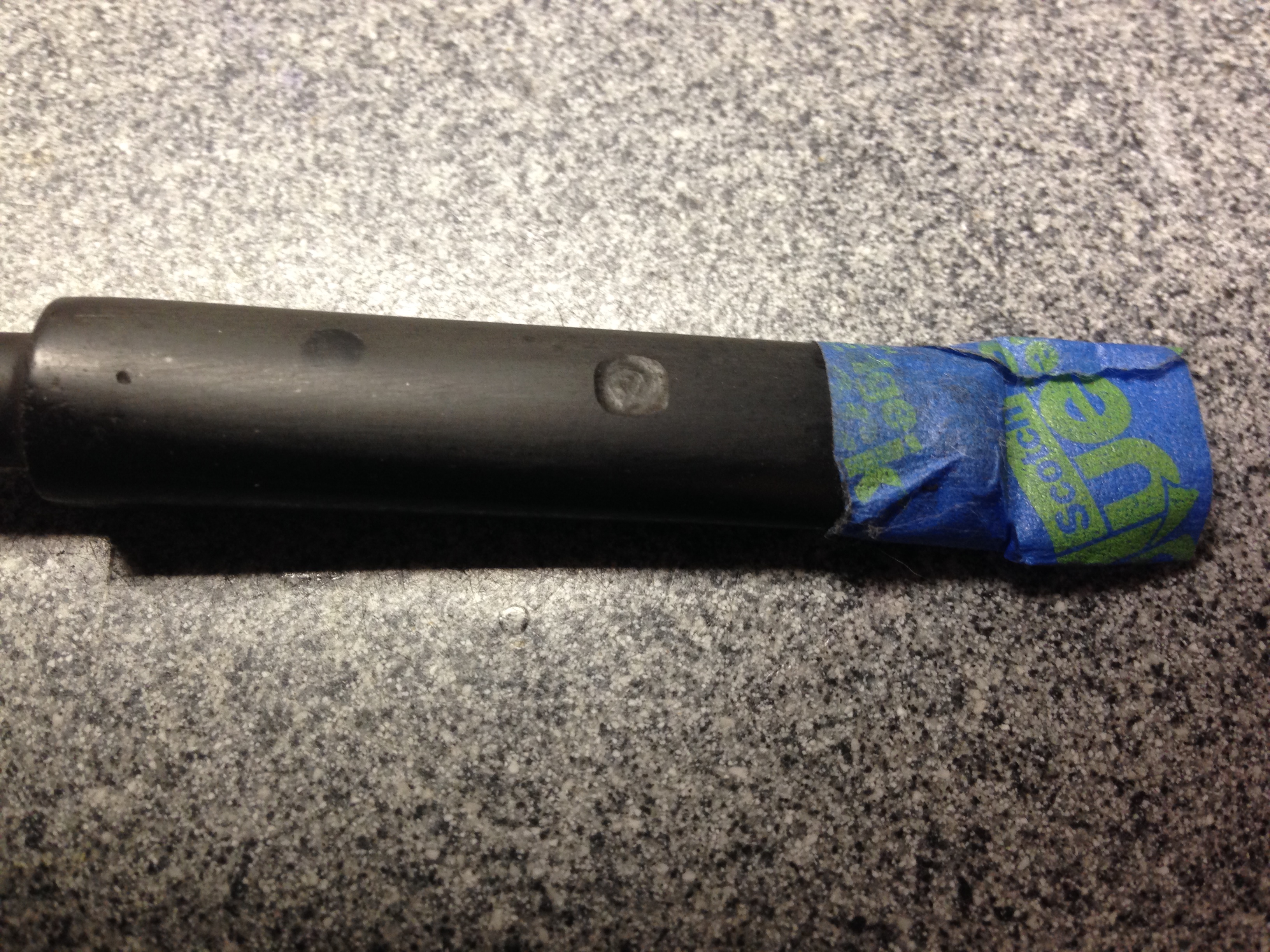
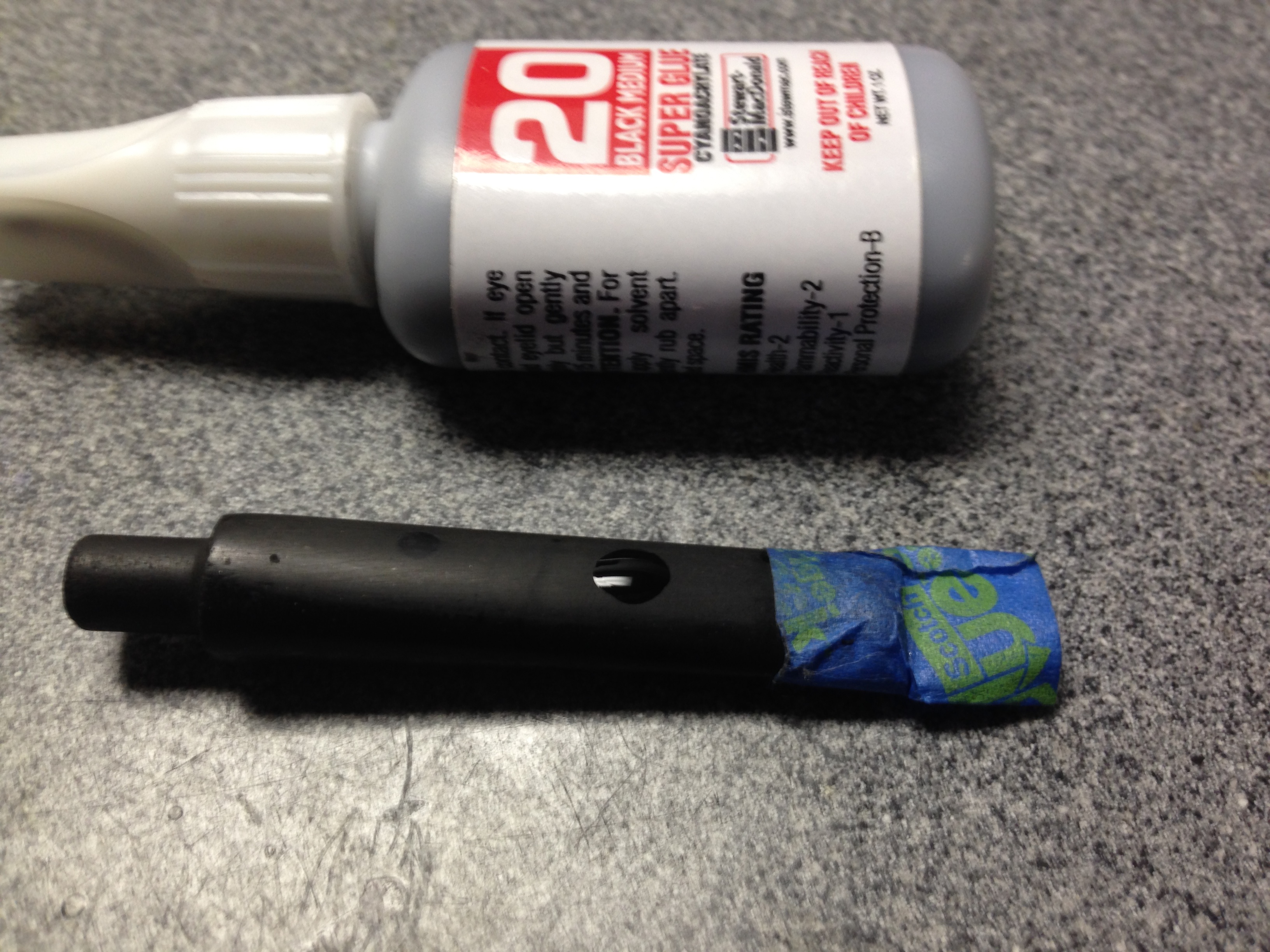
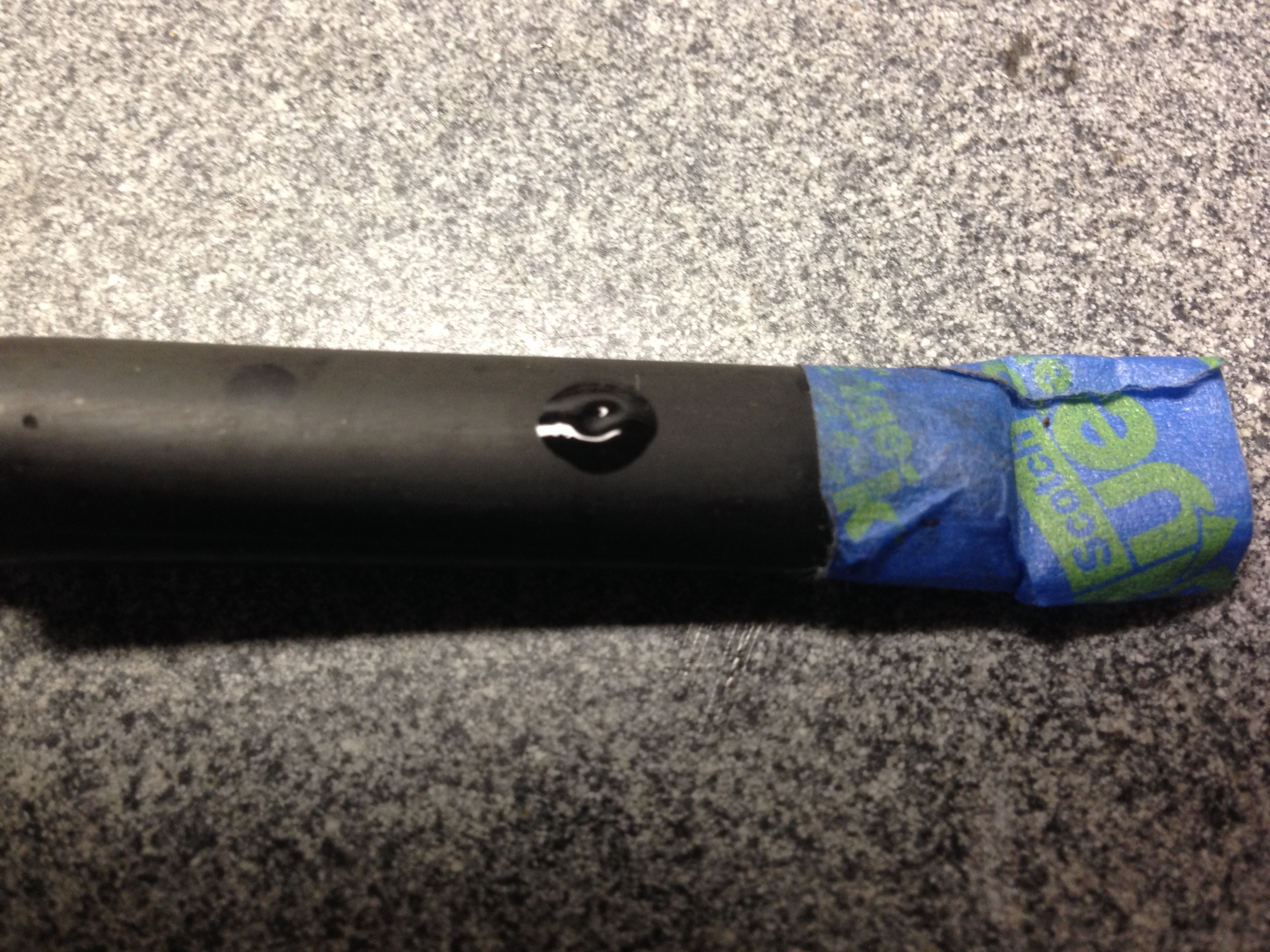
I used a round Dremel bur to cut a divot in a vulcanite stem, to simulate tooth marks.
Photo #1.JPG
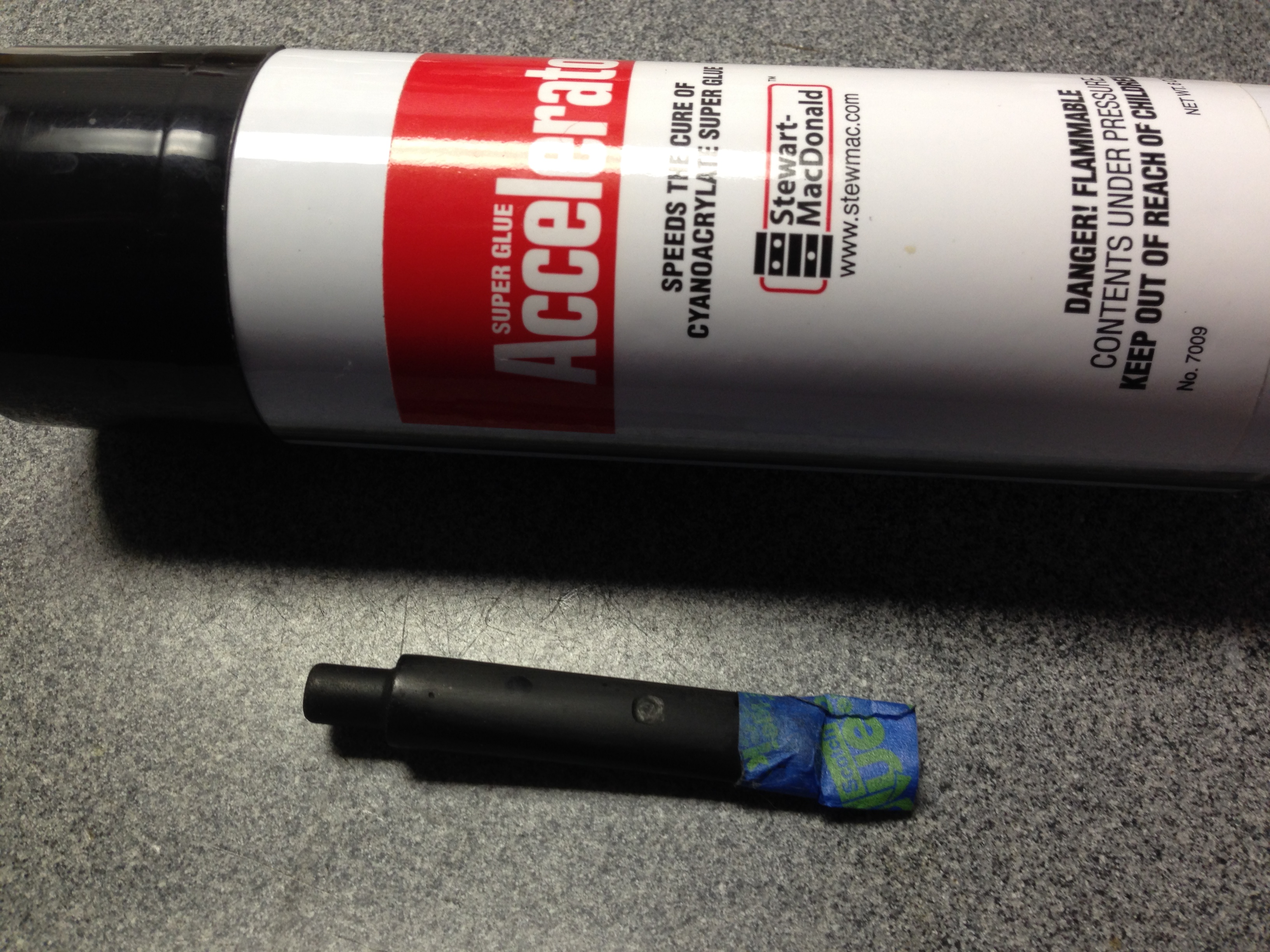
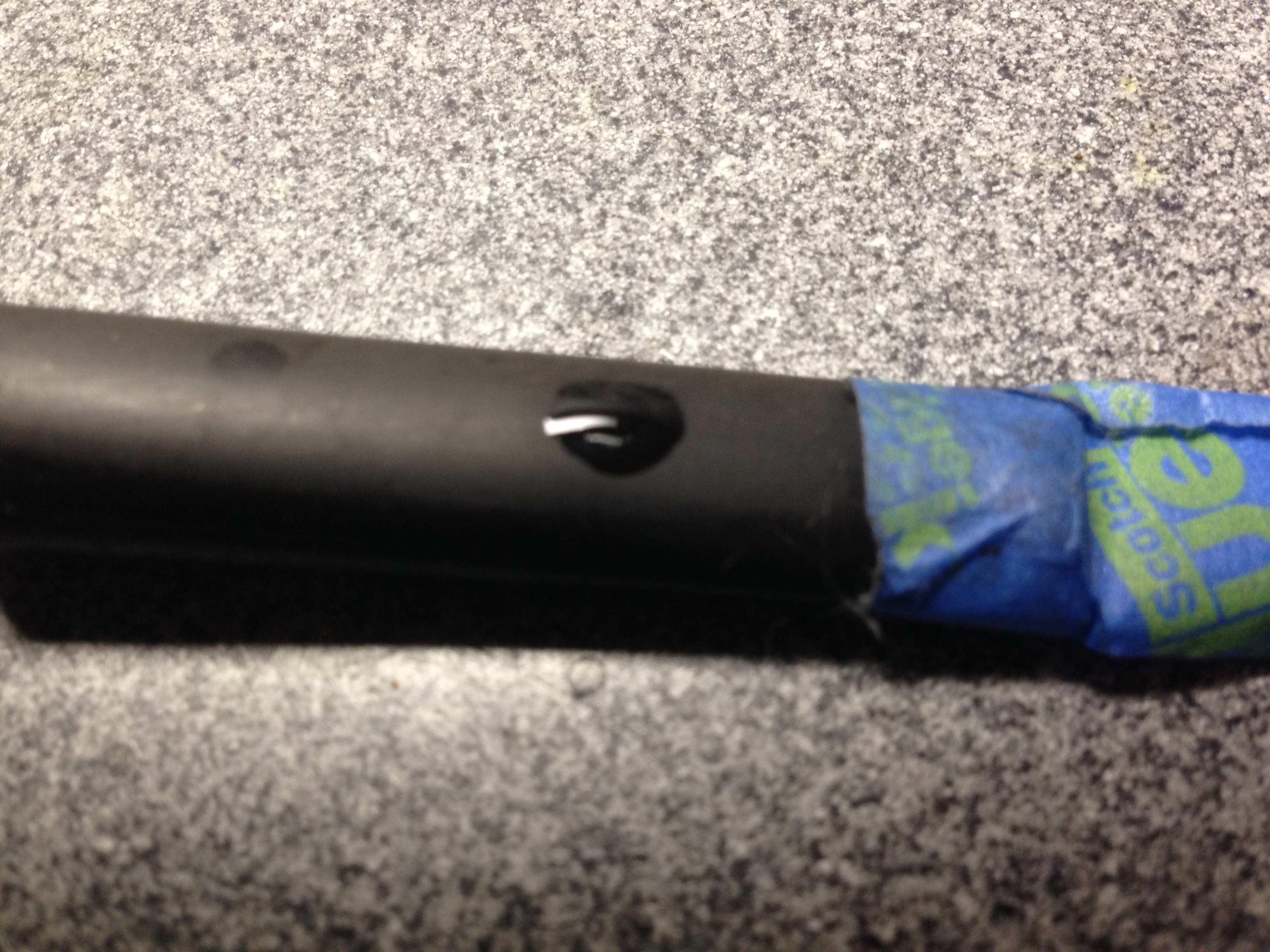
I sprayed the area with accelerator and allowed it to dry for 5 minutes before adding superglue
Photo #2.JPG

Photo #3.JPG
I let the superglue cure for 30 minutes. As expected, the glue shrunk.
Photo #4.JPG
I sprayed more accelerator on the area and added another coat of superglue.
Photo #5.JPG
Then I sanded the patch with wet sandpaper (220 – 600 grit).
Photo #6.JPG
Later, I used micromesh pads (1500 – 12000 grit) and polished with white diamond and carnauba wax. It polished and shined so well that I couldn’t get a decent photo because of the camera flash.

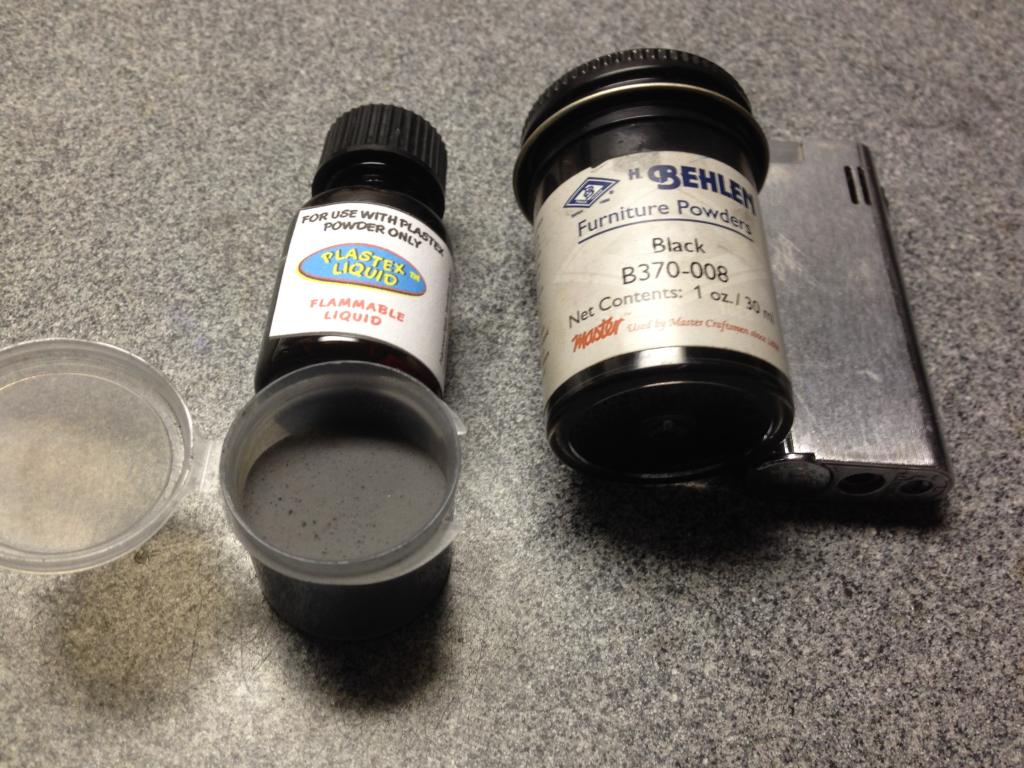
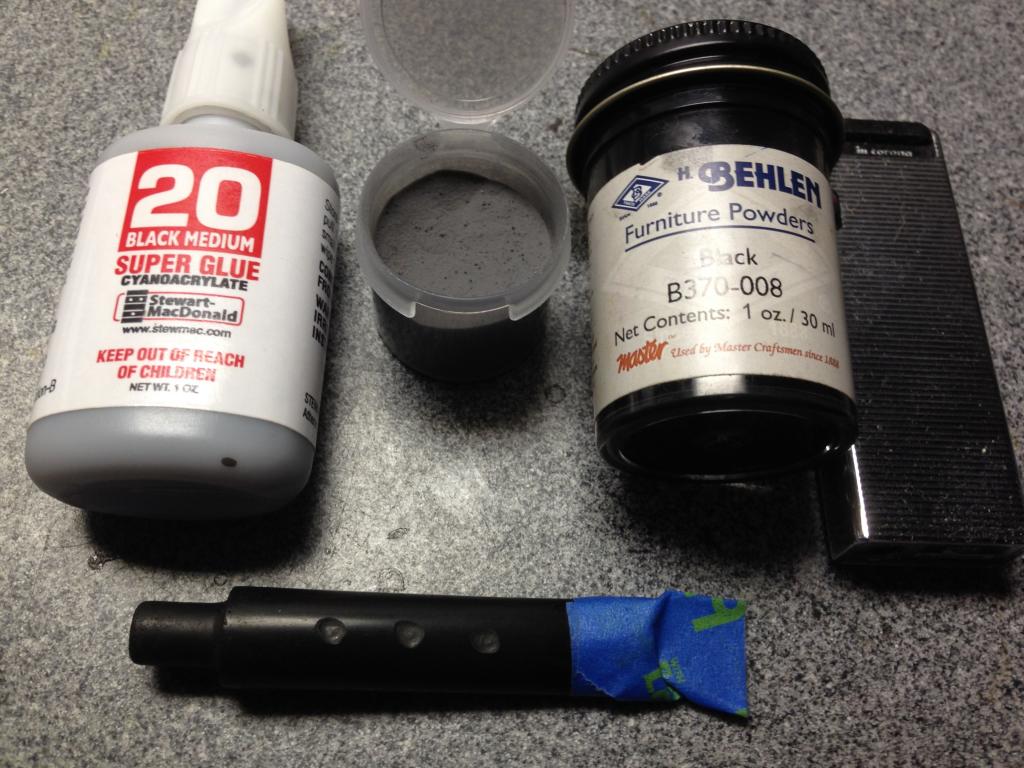
Experiment #2 – Black Superglue with Plastex, as well as Behlen’s Furniture Powder:

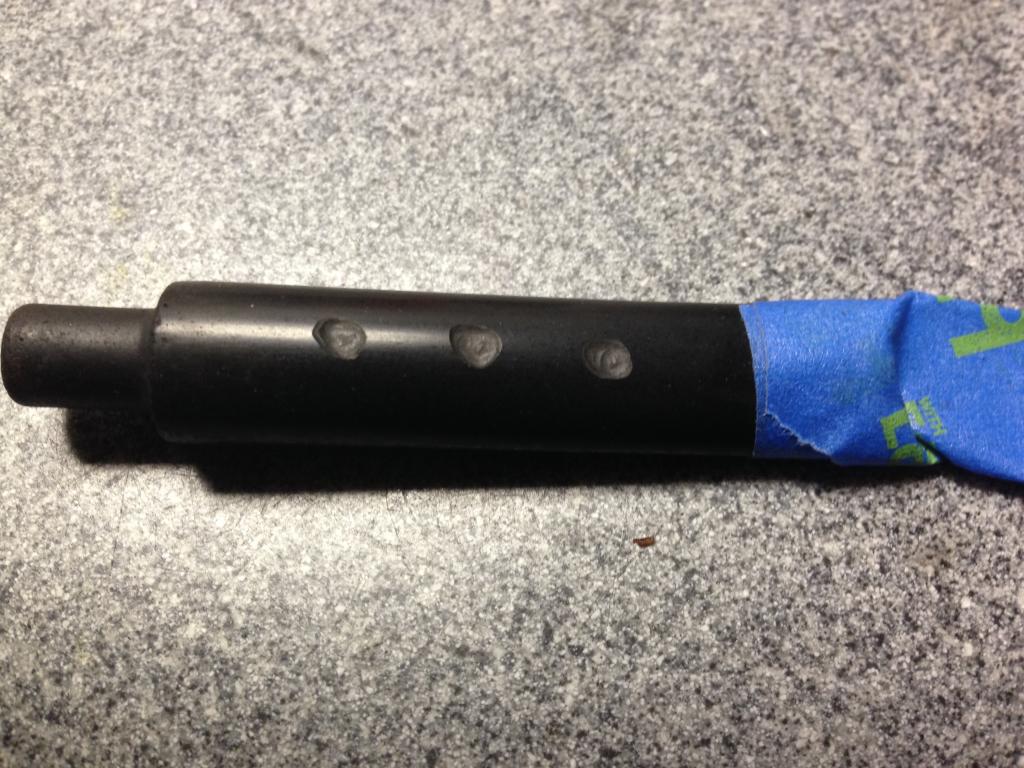
I used a round dremel bur to cut three divots in a vulcanite stem, to simulate tooth marks.
Photo #7
Black Plastex and Behlen’s Black Furniture Powder.
Photo #8
Will use from left to right
Patch 1 – Black Superglue only
Patch 2 – Black Superglue w/ Black Plastex
Patch 3 – Black Superglue w/ Black Behlen Furniture Powder
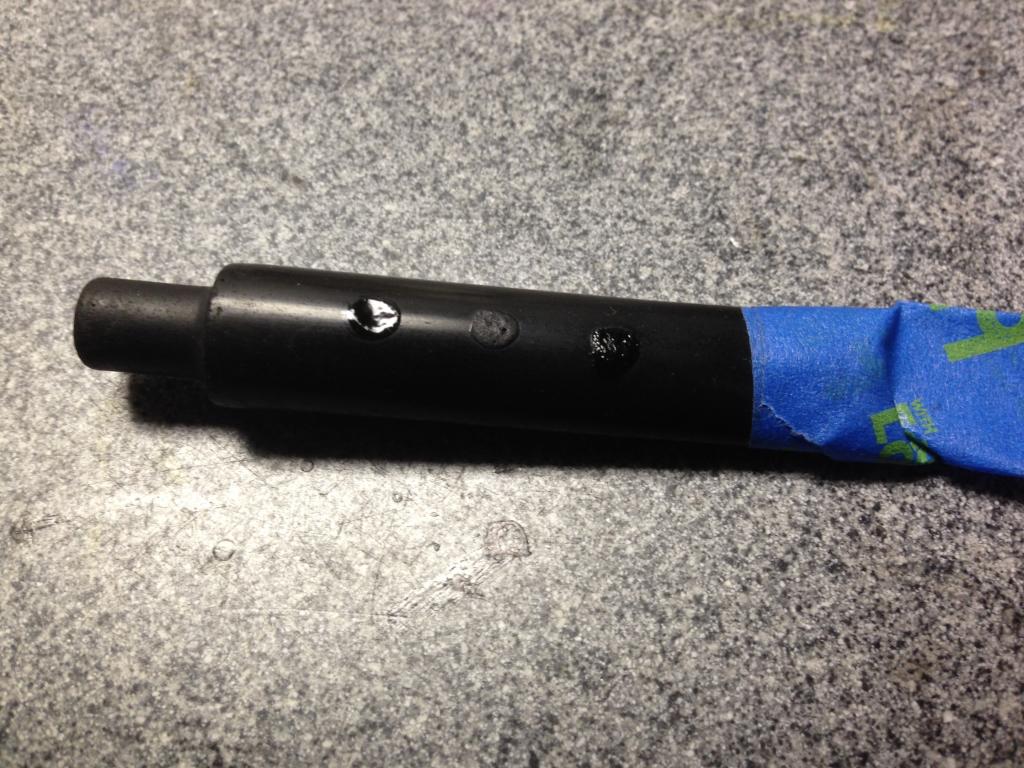
Photo #9
Patch 1 – cured for 8 hrs, it shrunk. Added 2 additional layers and let the final layer cure for 24 hrs.
Patch 2 – cured for 8 hrs, no shrinkage but the surface was pitted
Patch 3 – cured very quickly, 5 minutes, but the surface was pitted
Photo #10

Photo #11
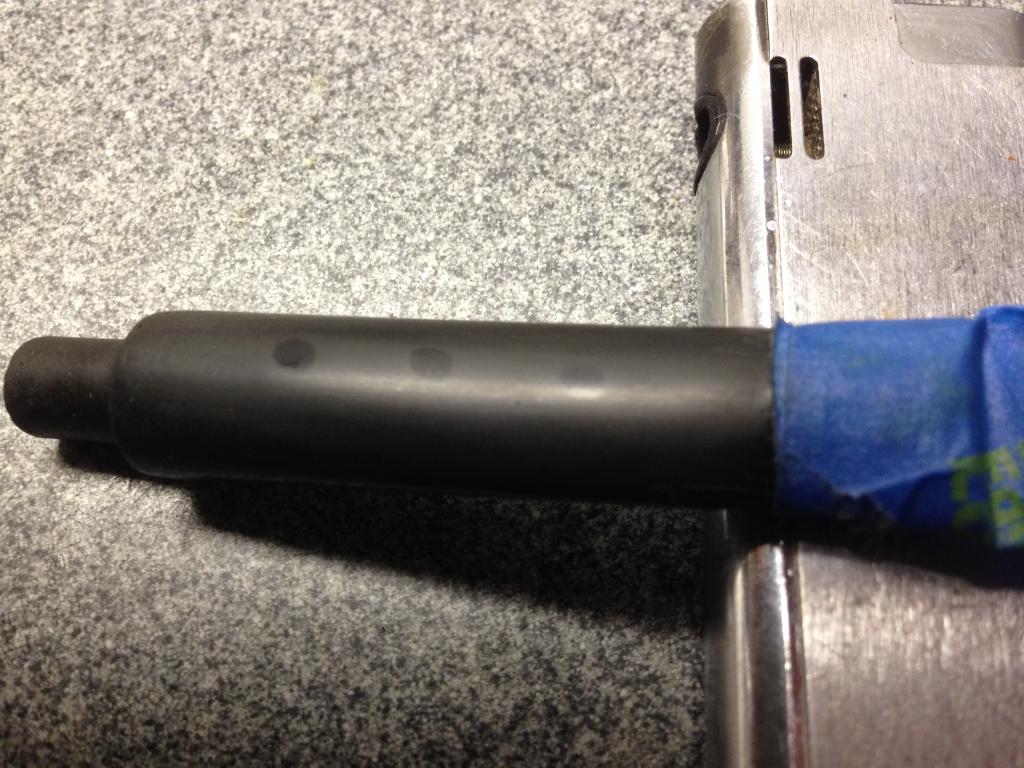
Sanded the patches with wet sandpaper (220 – 600 grit). Fortunately, I had overfilled Patches 2 & 3 and the sanding smoothed out the surfaces. Extra layers were not necessary.
Photo #12
Later, I used micromesh pads (1500 – 12000 grit) and polished with white diamond and carnauba wax. The patches polished and shined so well that I couldn’t get a decent photo because of the camera flash.

Discussion:
Adding Plastex to Superglue reduced the curing time (it didn’t shrink and one layer filled it up). Also, the Plastex adds strength to the patch and could be good for large patches and holes.

Adding Behlen Furniture Powder could be used if you’re impatient (it has something in it that causes the Superglue to cure very quickly). Too much powder will cause the glue to cure so quickly that there isn’t enough time to place it into the divot.

I haven’t tried it yet, but using the Accelerator first, then Black Superglue with Plastex could be a good way to go.

Plastex can be ordered from: http://www.plastex.net/
Behlens Furniture Powder can be ordered from: http://www.shellac.net/furniture-powder.html or http://www.highlandwoodworking.com/b…owders1oz.aspx

Comoys 284 Tradition Restored


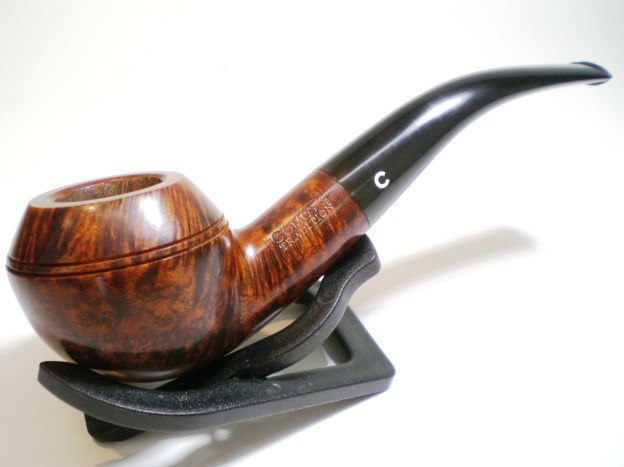
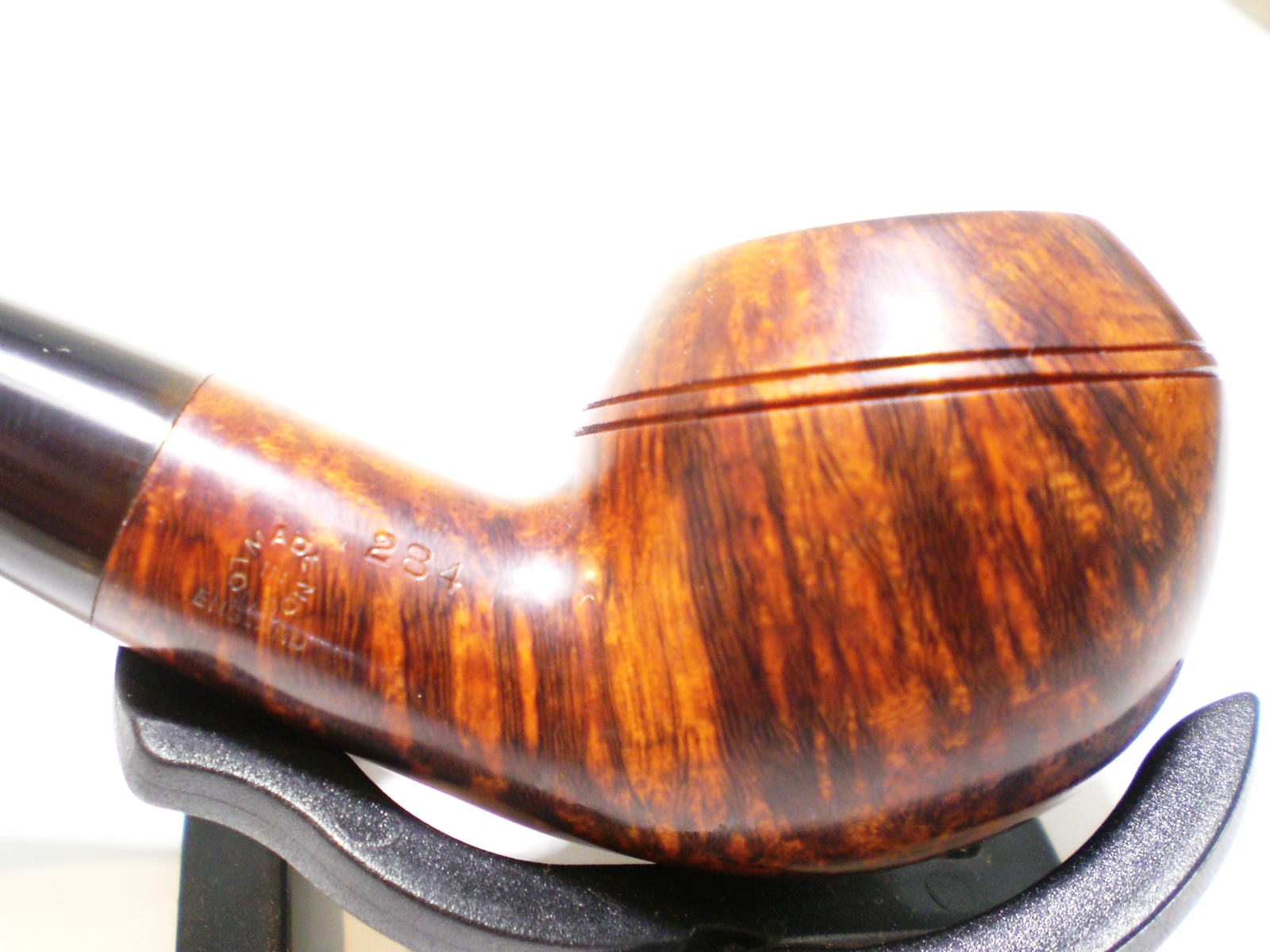
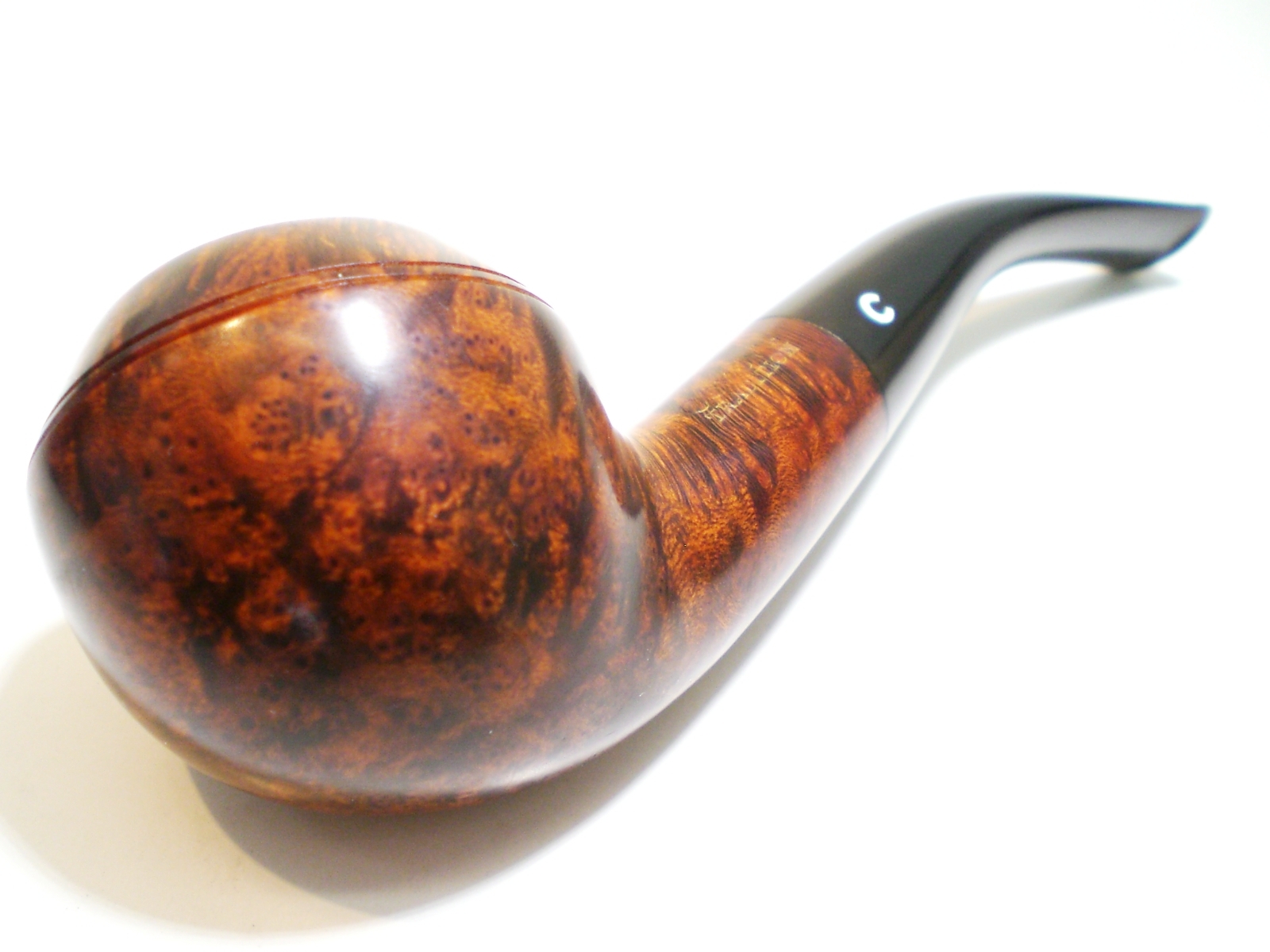
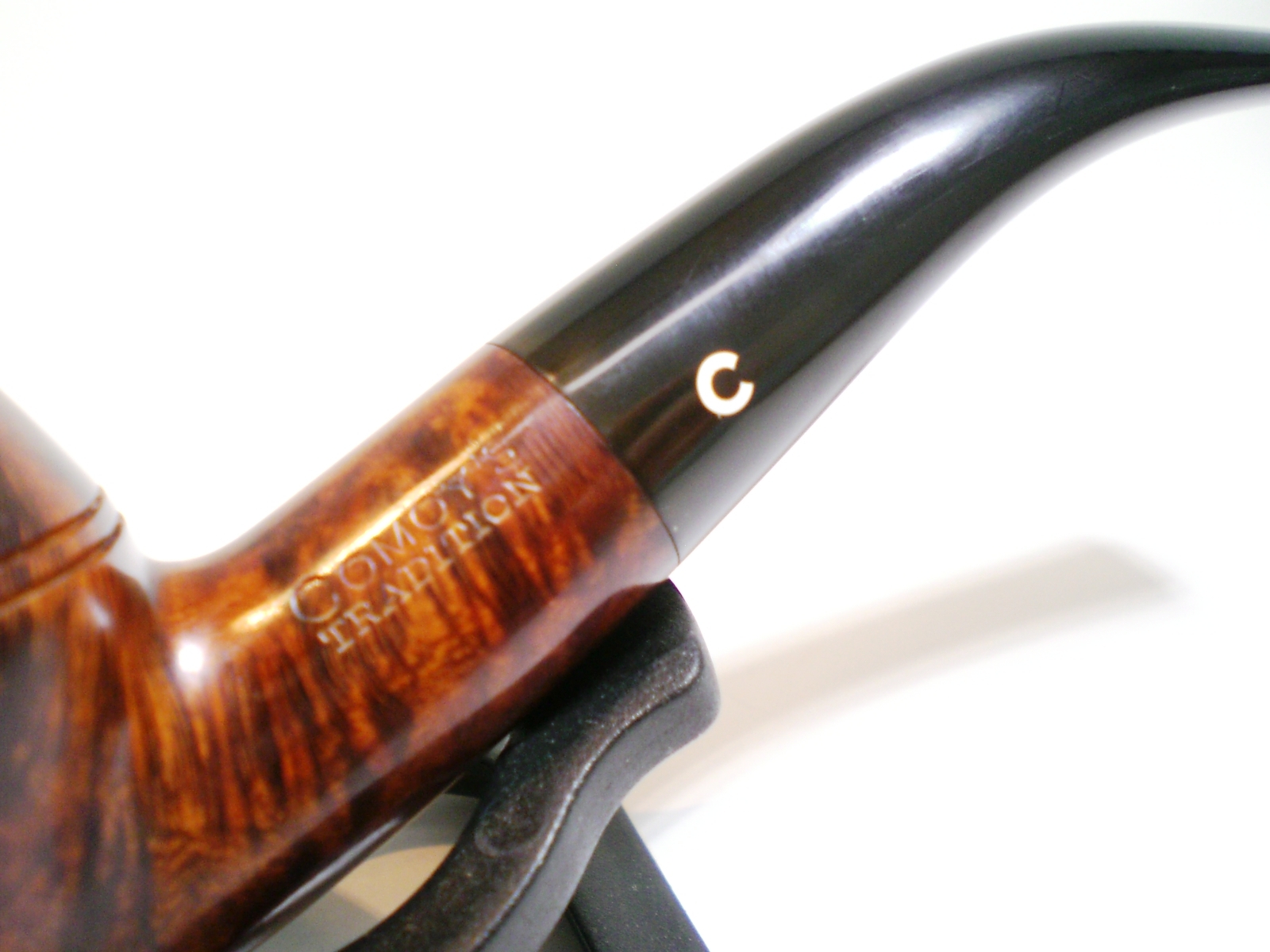
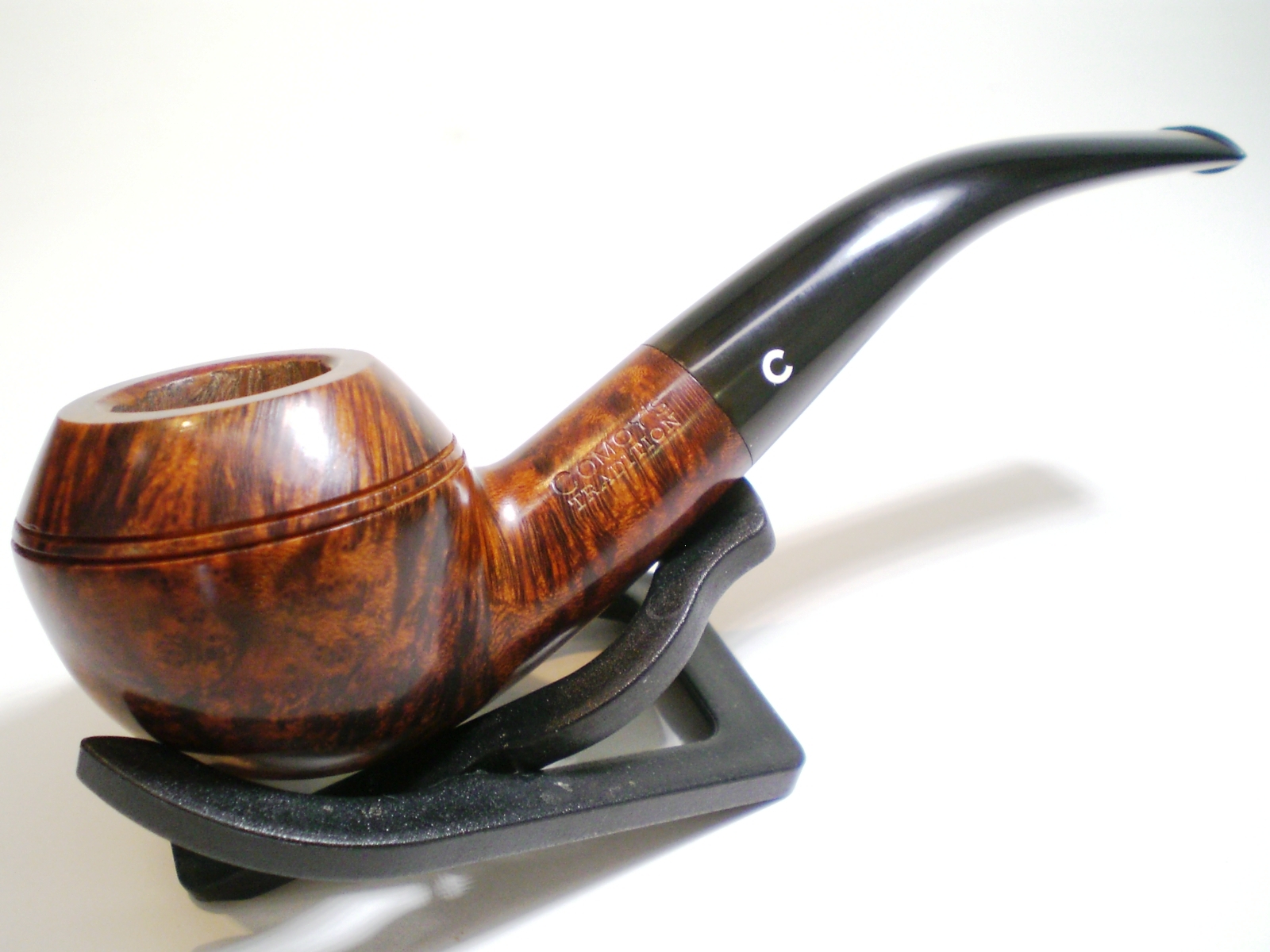
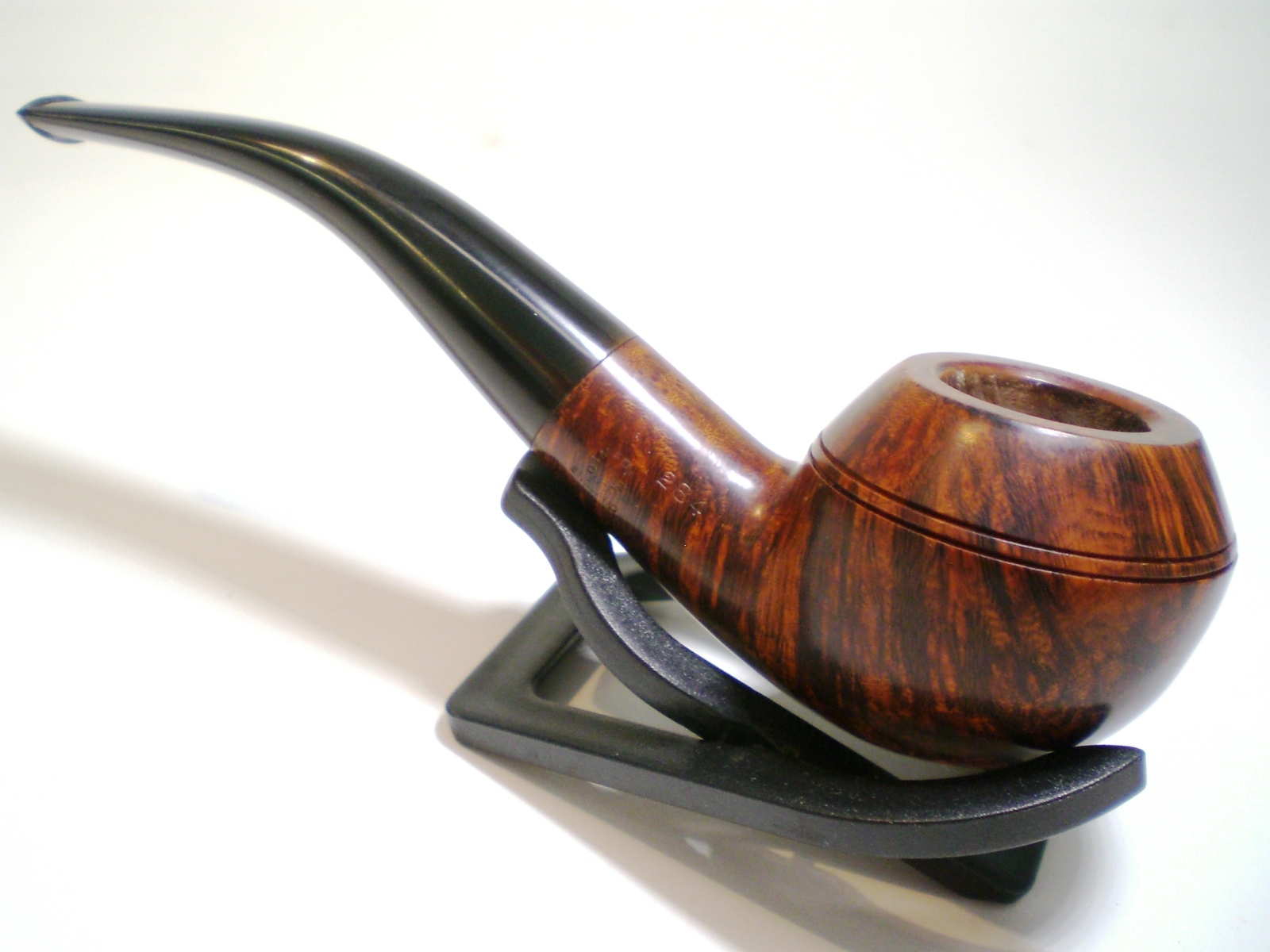
As a fan of the Rhodesian pipe shape, the Comoys Shape 284 is one of my favorites and in the top 5 of my “Holy Grail” list. Last week, this Tradition grade pipe showed up for auction. I made an offer to the buyer and surprised to find it accepted. As this is a hotly sought after shape on the market, I couldn’t believe my good fortune until I opened the package and held it in my hand.

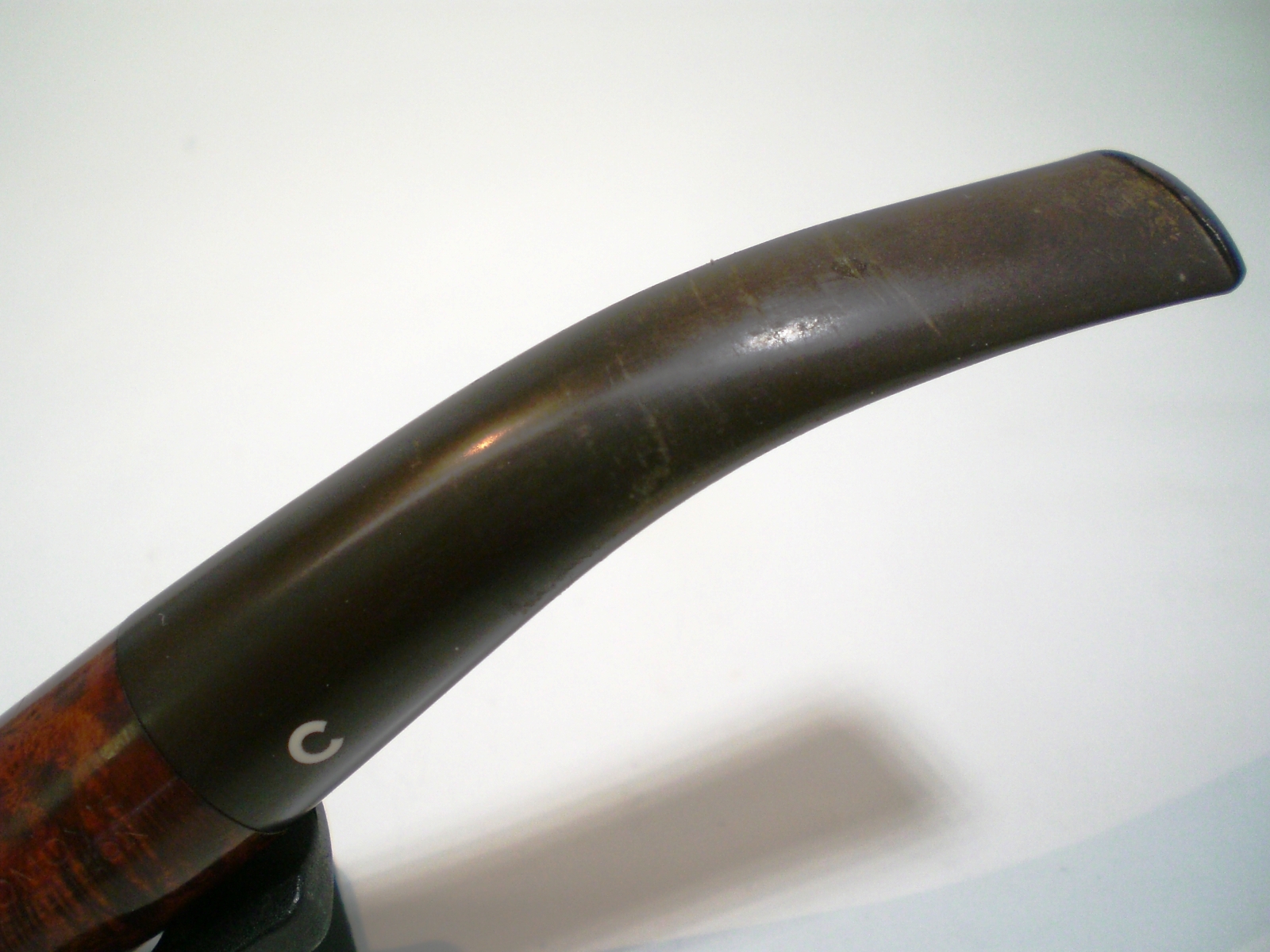
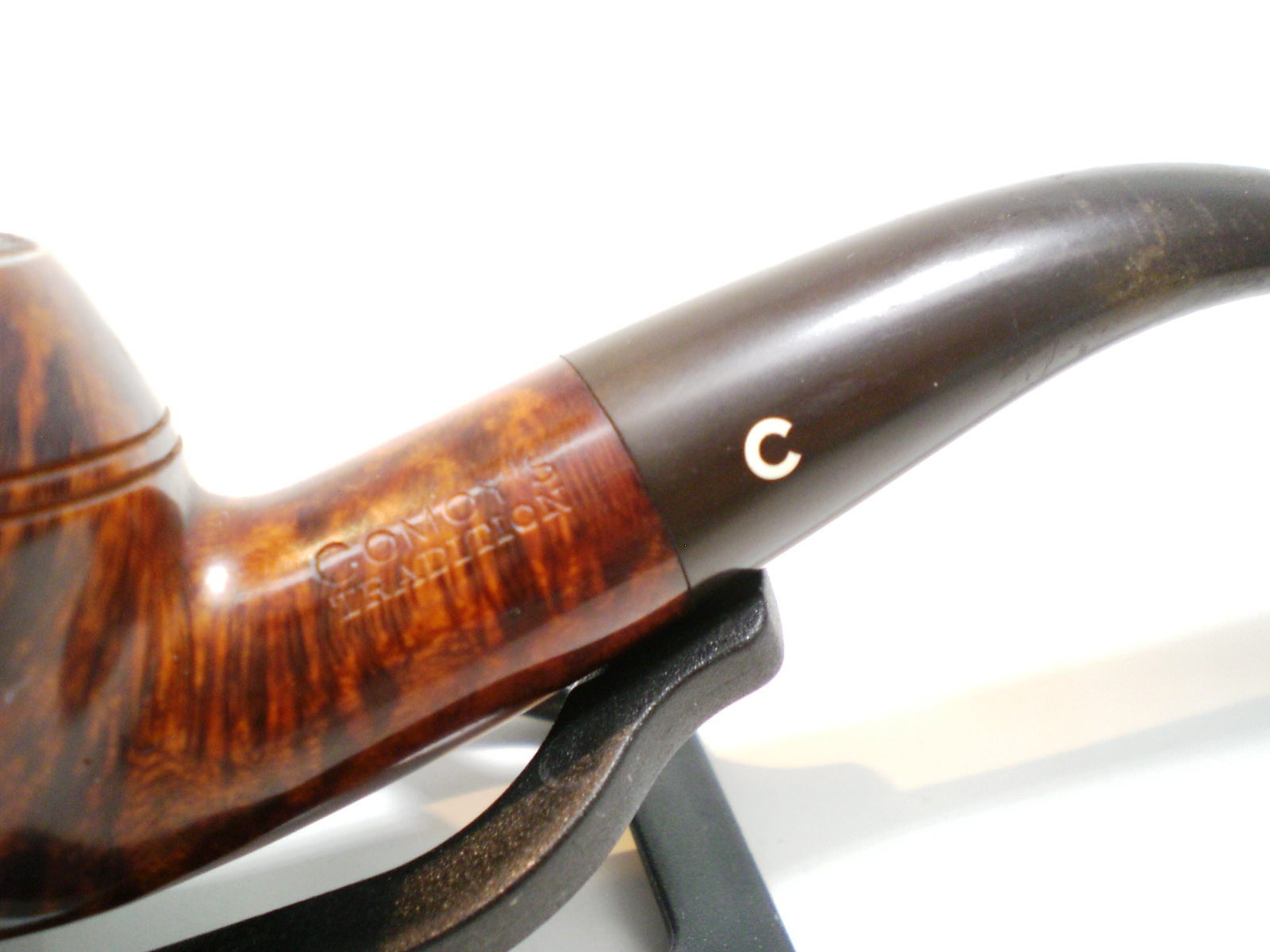
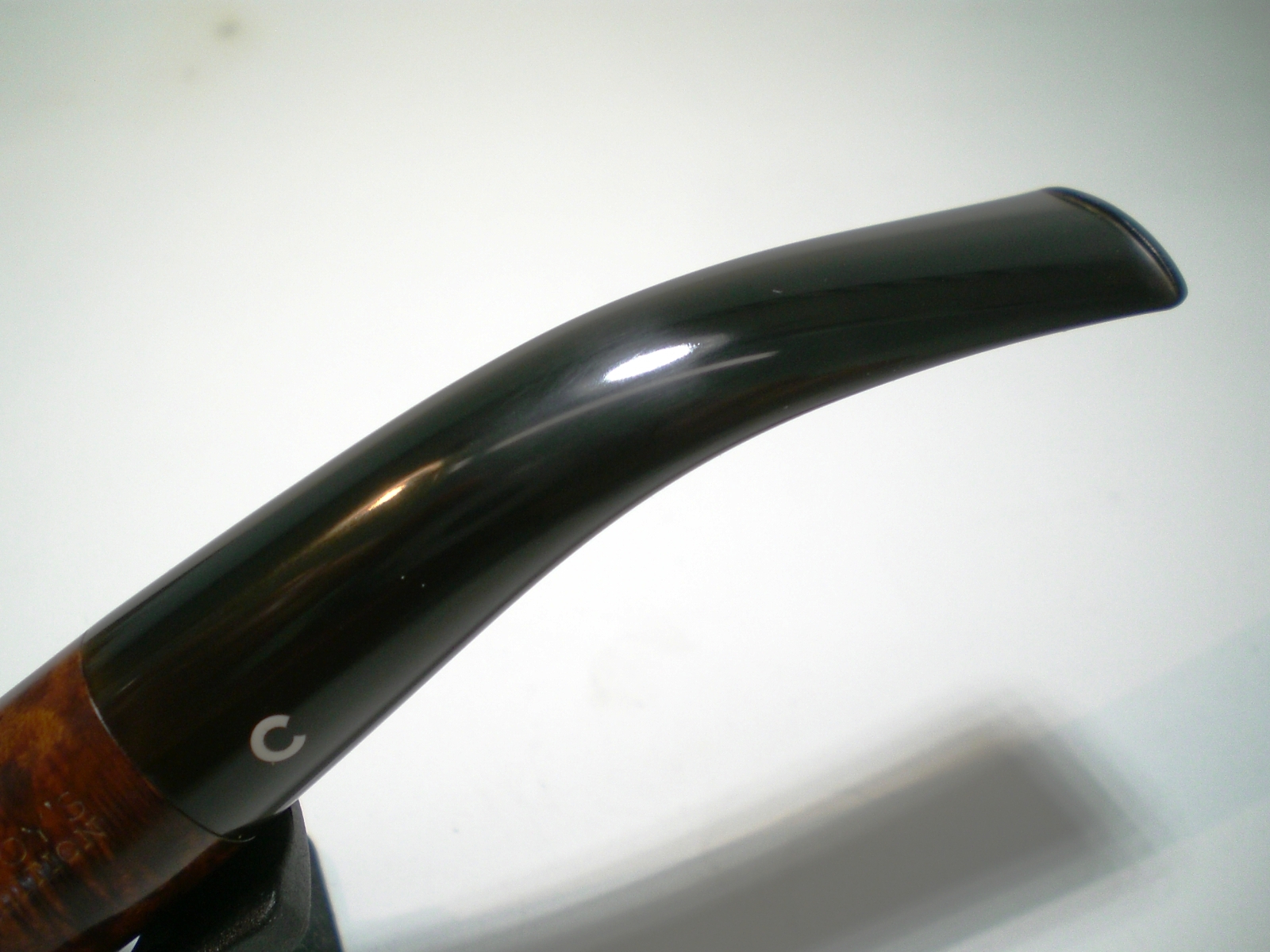
The pipe was in excellent condition, bowl and stem. There were only the slightest handling marks and the bowl top was not scorched. The stem, while oxidized only had two tiny teeth marks on the button. The three piece “C” logo was in perfect condition. I love working on Comoys stems, they just seem to shine more brilliantly than other British made vulcanite stems of that era.

The stamping of “Comoy’s” with the slightly larger “C” and the apostrophe was started in the 1950’s and the round “Made In London” with England below was also used in that era. The pipe could have been made from the 1950’s to the end of the Cadogan era in 1982 (give or take!).

Comoys_284_Before

Comoys_284_Before (8)

Comoys_284_Before (4)

Comoys_284_Before (3)

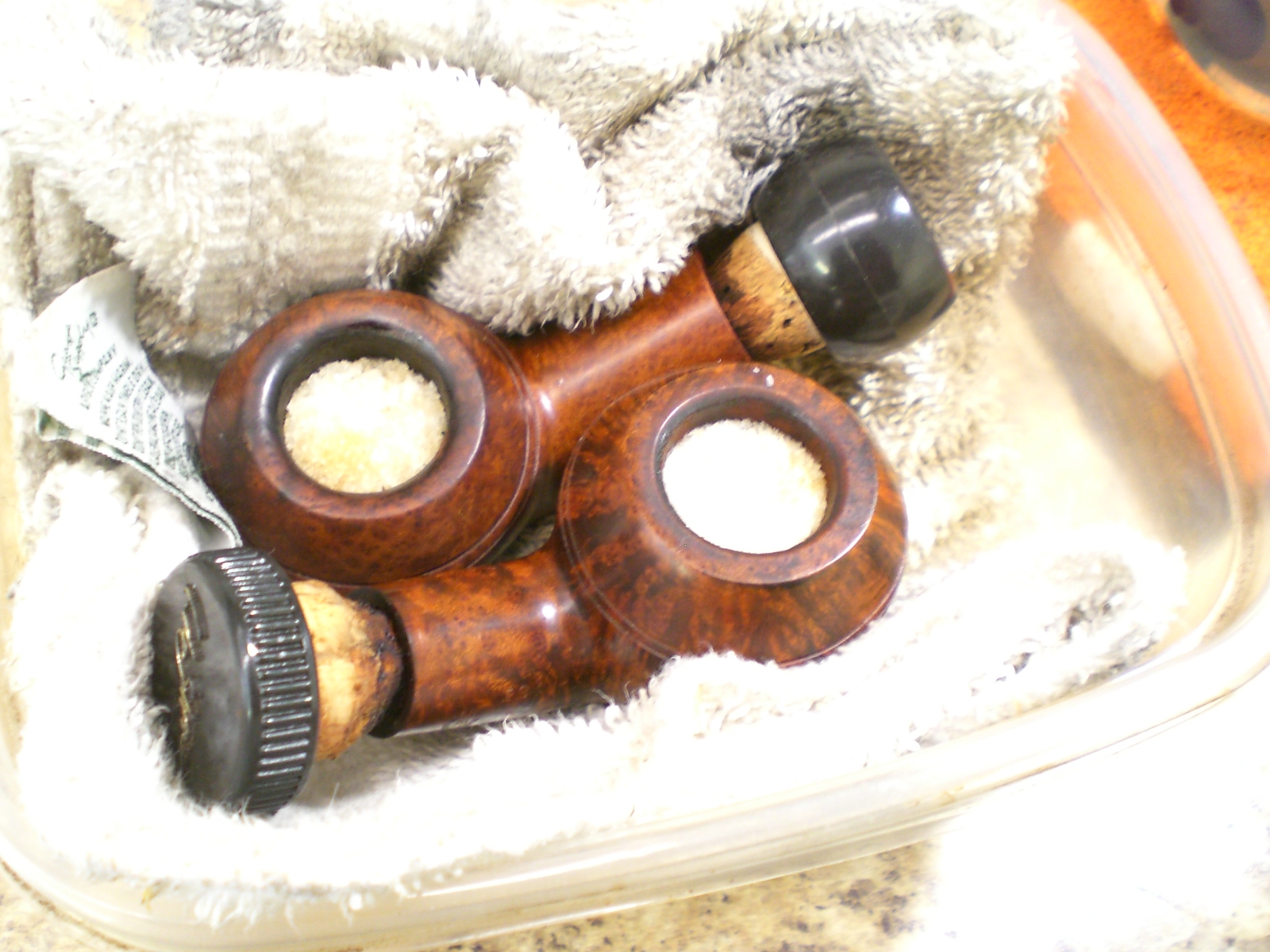
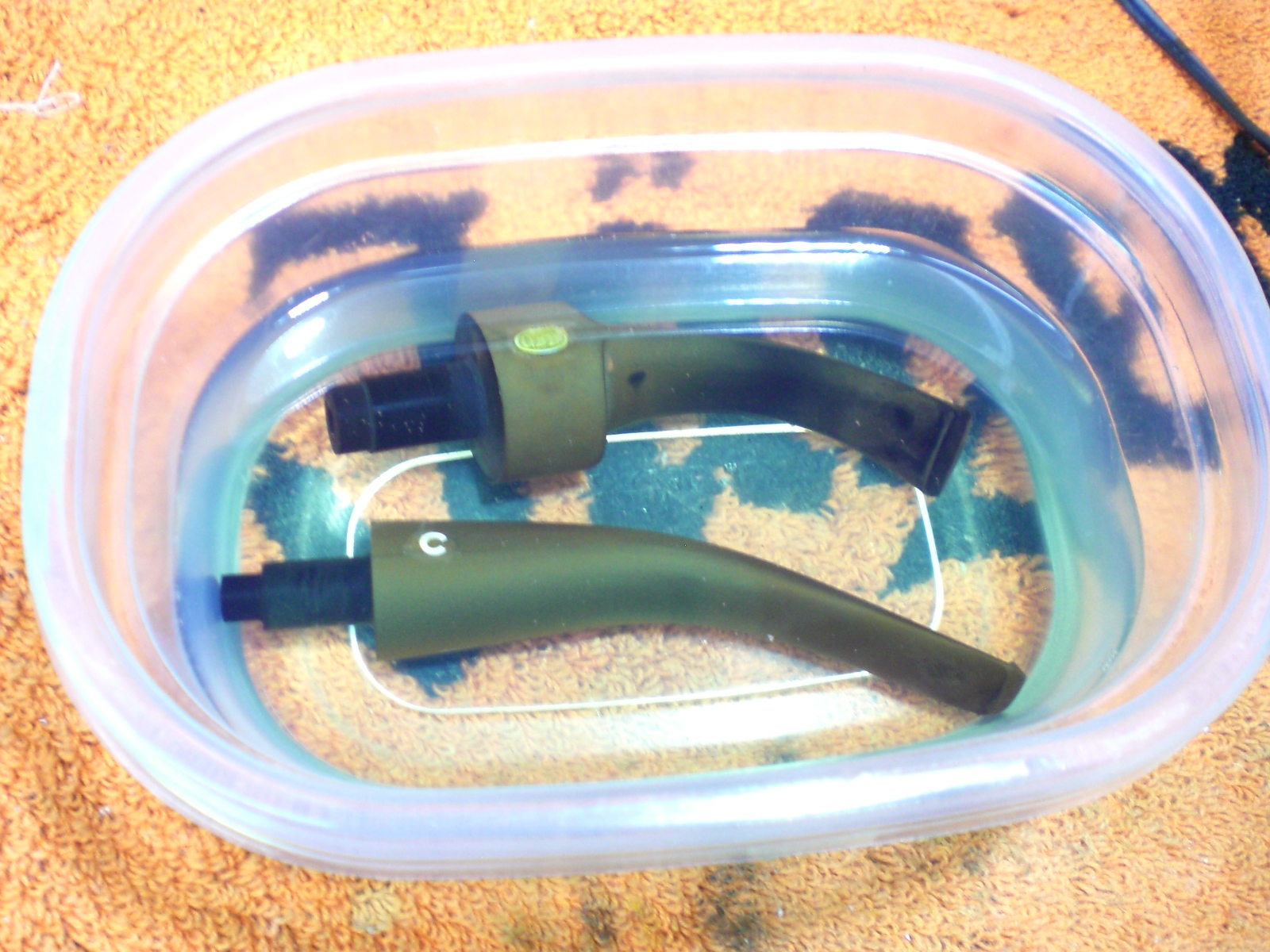
I soaked the bowl in salt and Isopropyl alcohol. Here the pipe is shown along with another project, a GBD 9438 Century. I put a dab of grease on the stem logo and soaked the stem for several hours in a mild Oxyclean/water solution to loosen the oxidation.

CIMG1104

CIMG1103

The bowl only required a light buff with white diamond and then a few coats of Carnuba wax. The nomenclature is quite strong and I didn’t want to damage it.

I started removing the stem oxidation with 800 grit wet paper and then moved thru 1000, 1500 and 2000 grades. I used the 8000 and 12000 grade Micromesh papers before going to the buffing wheel. The stem was buffed lightly with White Diamond and then Meguiars Plastic Polish.

Below is the finished pipe. I’m thrilled to add this one to my collection of Rhodesian pipes and look forward to breaking it in later this evening.

Comoys_284_Gallery (6)

Comoys_284_Gallery (5)

Comoys_284_Gallery (4)

Comoys_284_Gallery (2)

Comoys_284_Gallery (1)

Comoys_284_Gallery

Comoys_284_Gallery (3)

Reworking a Medico Apple – A Save this Pipe Project of My Own!


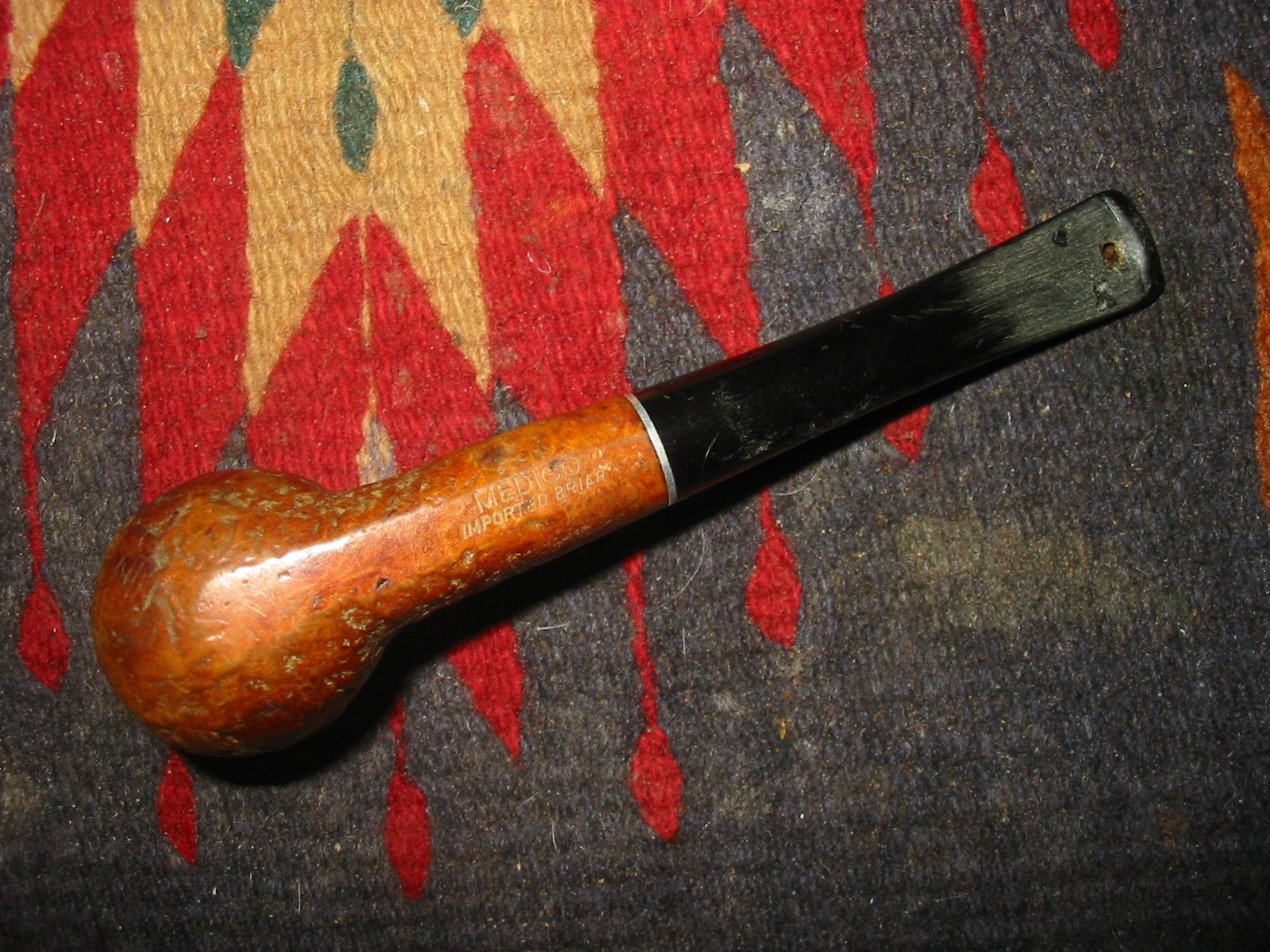
The last pipe in my box of pipes to refurbish was a Medico Apple that was stamped Medico over Imported Briar on the underside of the shank. It was a well-worn sandblast bowl that had dark stain marks on the front and back of the bowl. It appeared to be a dark blue India ink type of staining. The grooves in the blast were worn down almost smooth and what was left was dirty with light brown grime that raised the surface of the grooves smooth. The top of the bowl was damaged and worn from being struck against a surface to empty the bowl. The inside of the bowl was badly caked and crumbling when I received and I cleaned and dumped out the carbon and shreds of tobacco before throwing it in the box. The stem had been bitten through on both the top and the bottom sides next to the button. The nylon stem was in rough shape with many deep tooth dents around the holes. At one point I had taken the stem out thinking I would work on it and sanded down the tooth chatter and some of the lighter marks. I had heated the stem to raise them and gotten quite a few of them out-of-the-way. The holes in the stem left me questioning whether I even wanted to work on this poor worn pipe.
IMG_6980

IMG_6981

IMG_6982

IMG_6983
After reading Greg’s post about saving a pipe – the Medico VFQ I was moved to go and have a look at the last pipe in the box. I have four days off starting today and it is a rainy cool day in Vancouver. It is a perfect day for working on pipes so I took the pipe to the worktable. I knew all of the flaws that awaited me but the bones of the pipe, the briar was still sound. The damage truly was cosmetic. The stem was another question. But I figured it was worth the effort. I cleaned the surface of the nylon stem and wiped it down with alcohol. I folded a piece of cardboard and coated it with Vaseline before sticking it in the airway to provide a backing for the black super glue patches that I was going to use for the holes.
IMG_6984

IMG_6985
The super glue had become quite viscous which actually worked for me. It was not the thin liquid it had been when I purchase it several years ago. I shook it well and then applied it to the holes on the stem. I always do the patching in layers. I start quite wide around the edges of the hole and work toward the centre to close off the hole. I decided to work on both sides of the repair at the same time so I put the glue in both holes. I set the stem aside for the repair to cure before adding more layers of glue.
IMG_6986

IMG_6987
I scrubbed the bowl with Murphy’s Oil Soap to remove the grime. I used a tooth brush to get into the remaining grooves in the briar. I used the soap undiluted as I find it is less liquid and works better on rounded surfaces as a gel. I wiped off the soap with cotton pads, rinsed the bowl with warm water and dried it off. The next four photos show the bowl after this cleaning. The sandblast was basically worn away and I needed to make a decision on what to do with the finish on this bowl.
IMG_6988

IMG_6989

IMG_6990

IMG_6991
The worn finish and the ink stains on the front and back of the bowl made the decision pretty easy for me. To clean and restain the pipe would still leave it worn and the ink stains visible. I decided I would rusticate the bowl with the rusticator I had received from Chris. I wanted the finish to look slightly different from the previous pipe that I rusticated so I had some ideas on what to do once I had rusticated the finish.
IMG_6992

IMG_6993

IMG_6994

IMG_6995

IMG_6996

IMG_6997
Once the bowl was rusticated I scrubbed the rough surface with a brass tire brush to knock of the edges. I carefully rusticated the rim and used the tool to round the edges on the outer rim to hide some of the obvious damage that had been present before. Once finished I stained it with a dark brown aniline stain. I had left the underside of the shank smooth and a portion of the shank next to the stem shank junction. I stained the bowl, flamed it, stained it and flamed it again until the coverage of the stain was even all over the briar.
IMG_6998

IMG_6999

IMG_7000

IMG_7001
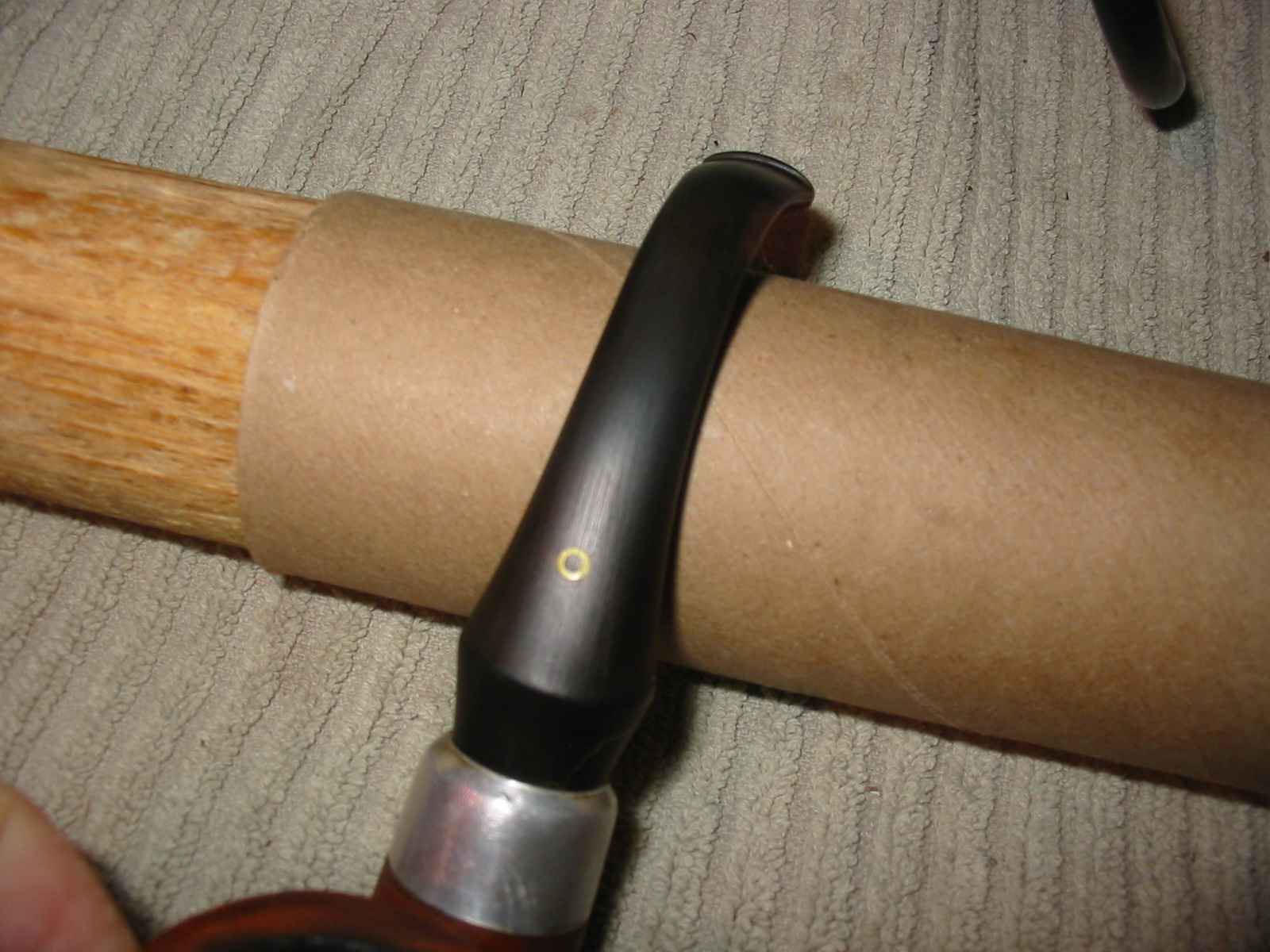
I buffed the bowl with red Tripoli to further smooth out the high spots on the rustication and give a little contrast to the stain. I used the brass brush a second time on the surface. It still was not quite what I was aiming for but I laid it aside for a while to look at it and think about the options. It was while I was doing that I thought I would see if I had a new stem that would work. It gave me a second option to try should the repair or patches not work well.
IMG_7002

IMG_7003

IMG_7004
I did not have a round taper or saddle stem in my can of stems that was the right diameter for the shank but I did have quite a few square stems that could be modified to fit the shank diameter. I found one that had the tenon already turned for a previous pipe I was working on and put it on the pipe to have a look. I could see some potential in the stem and the look of the wide blade saddle stem. It would certainly be worth a try. If it turned out well and the patch on the other stem worked then I would have several options to work with. The tenon on the square stem was too long but that could easily be adjusted for a tight fit against the shank. I did the adjustment with a Dremel and sanding drum.
IMG_7006

IMG_7007
With the stem in place against the shank I could see the very evident taper of the shank on the topside and the underside. It was significantly narrower than the rest of the shank. I wondered if the smooth briar at the shank/stem junction was not from a previous refitting of a stem. I looked over the stem I was patching and saw that it actually bore the F stamping on the top rather than the M stamp that I had expected. I had not paid attention to that before but combined with the shape of the shank I was relatively certain that the stem was a replacement and the damage to the shank was caused by a sanding the shank to more readily match the smaller diameter of the replacement stem. That made the stem choice easy – I would refit a new stem to the shank. I would use a nickel band to level the shank out and make the taper of the shank more even. This would also make fitting the new stem quite easy. I set up a heat gun, heated the nickel band and pressed it into place on the shank. The silver actually looked good against the rustication of the bowl.
IMG_7008

IMG_7009

IMG_7010

IMG_7011

IMG_7012
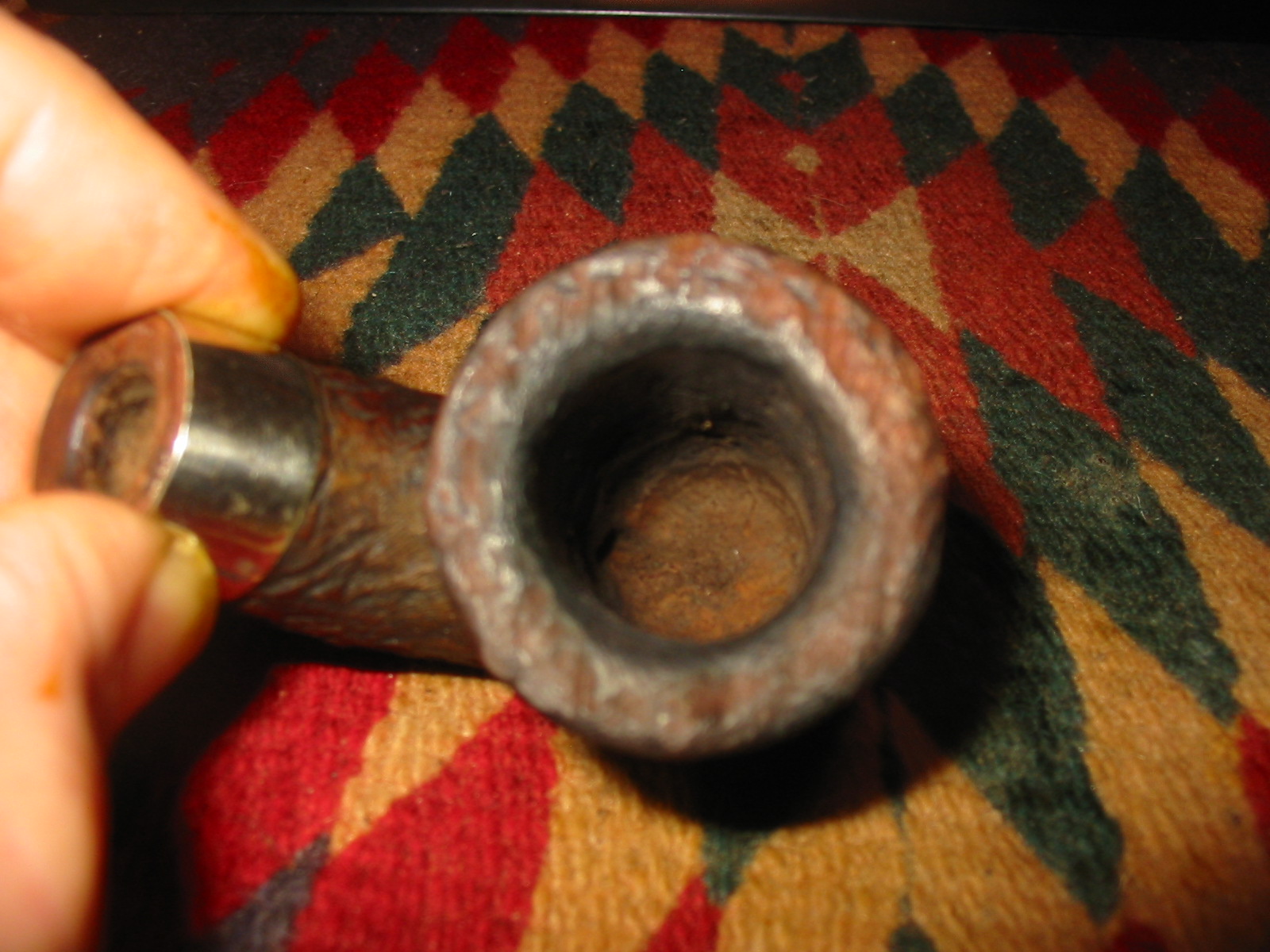
I used the Dremel and large sanding drum to take off the square edges of the new stem. I worked on it until it was round. I started by taking off all the corners and creating an octagon first and then continuing to round out the stem until it was the same shape as the shank. The bottom of the shank on the pipe was flattened so the pipe would sit upright on its own so I left the bottom side of the stem slightly flattened as well. I sanded the stem with 220 grit sandpaper and medium and fine grit sanding sponges to get the fit against the bowl and band perfect. I also sanded the rustication on the bowl to soften the high spots and flatten them out. I wiped the bowl down with alcohol after I had sanded. The next series of four photos show the sanded bowl and stem. The rustication is getting closer to the look that I was after when I started.
IMG_7013

IMG_7014

IMG_7015

IMG_7016
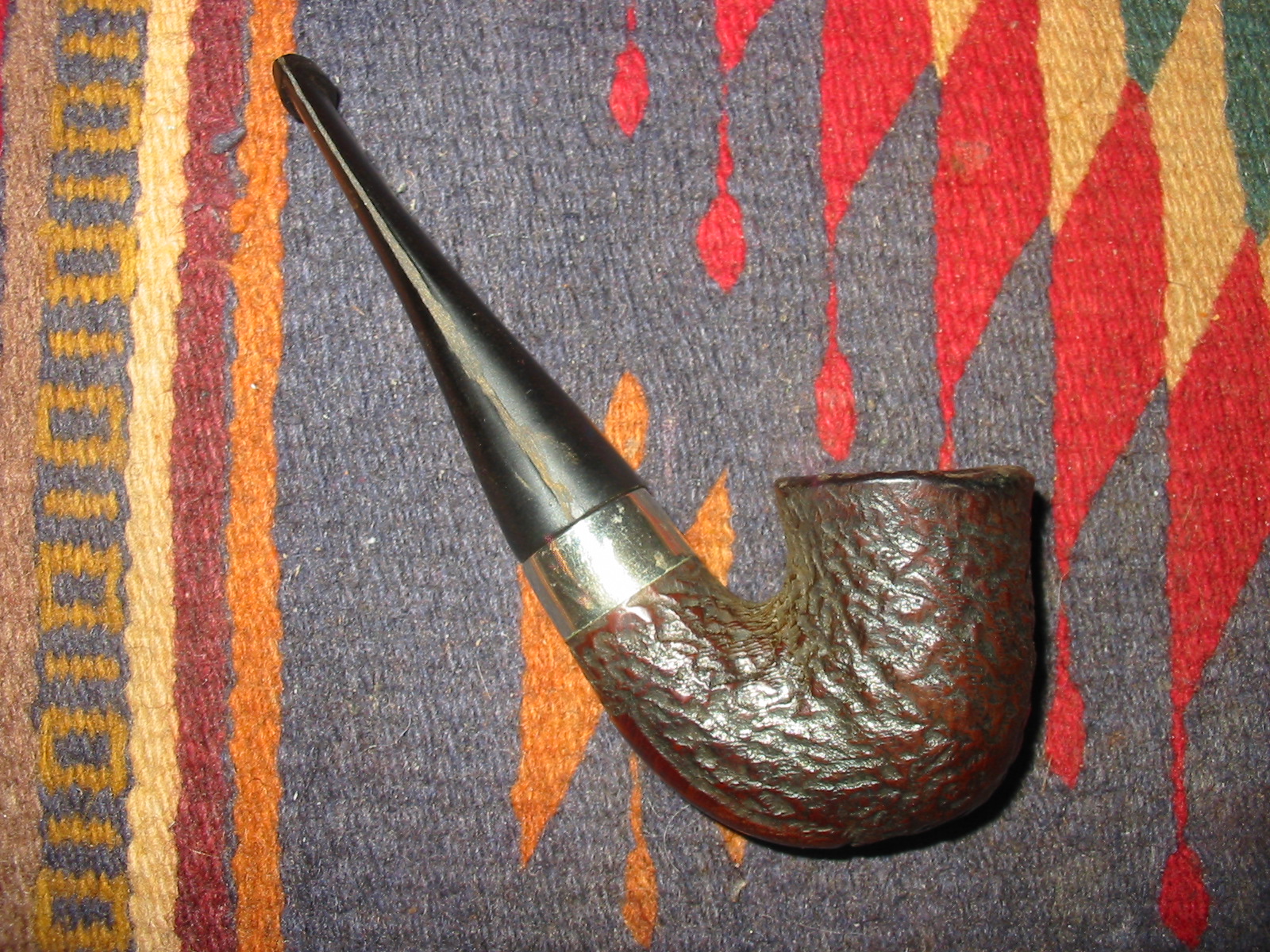
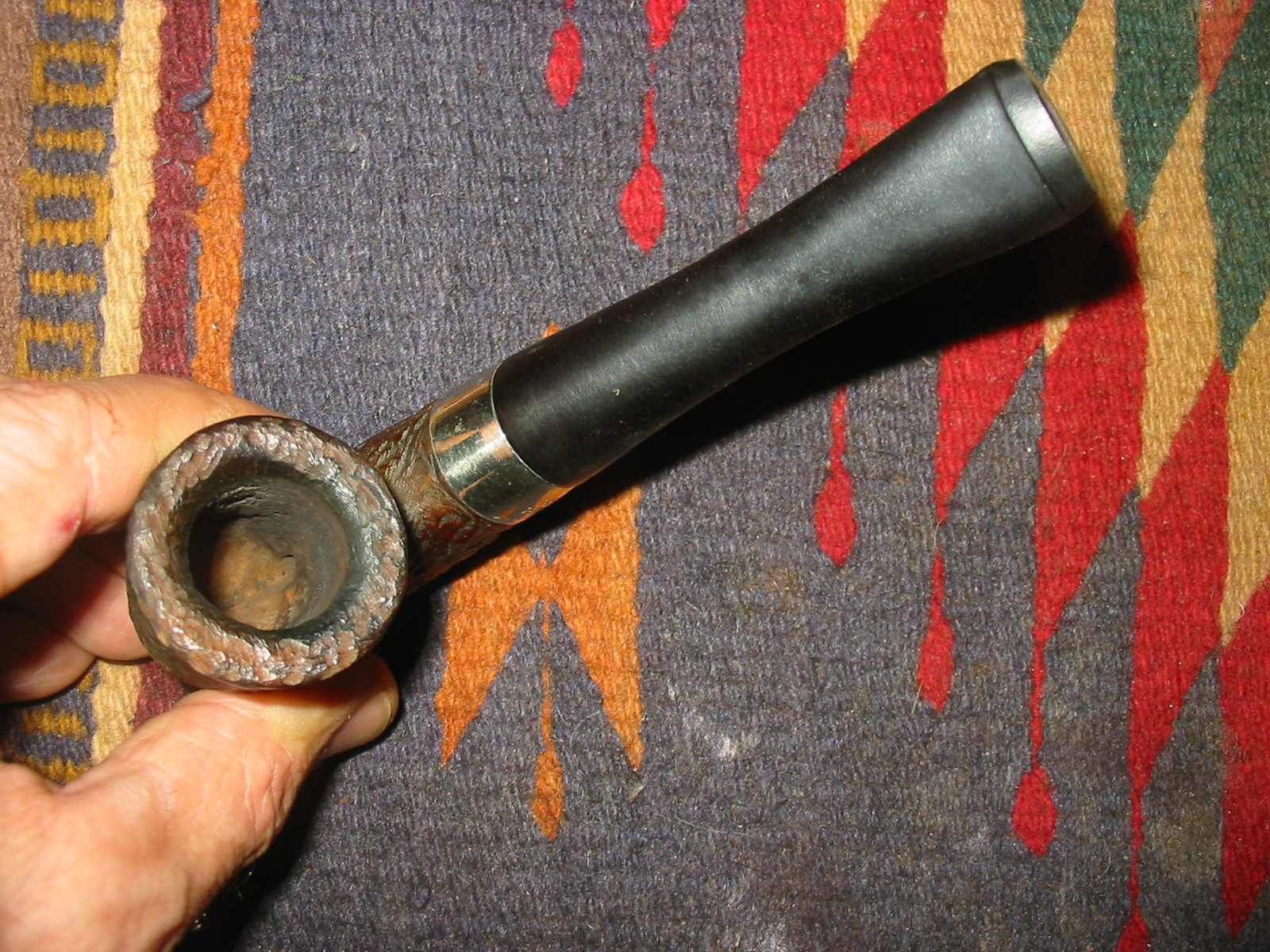
I continued to sand the stem with the fine grit sanding sponge and also the bowl. I once more wiped the bowl down with a soft cloth and alcohol to remove the dust. Each step in the process is flattening out the rustication slightly more and bringing a shine to the newly rounded stem.
IMG_7017

IMG_7018

IMG_7019

IMG_7020
I sanded the stem with micromesh sanding pads – wet sanding with 1500-2400 grit pads and dry sanding with 3200-12,000 grit pads.
IMG_7021

IMG_7022

IMG_7023
I rubbed the stem down with Obsidian Oil and when it had dried I buffed the bowl and the stem with White Diamond. I sanded the bowl with 1500-2400 grit micromesh sanding pads to further flatten he high points of the rustication and then buffed the bowl a final time with White Diamond. I gave the stem multiple coats of carnauba wax. I buffed with a soft flannel buff between the coats of wax. I wiped the bowl down lightly with a coat of olive oil. The finished pipe is shown below. It has come a long way from the worn and tired looking old Medico with the bite throughs in the stem. The rustication came out the way I wanted it to with the high spots showing a lighter brown and the valleys in the rustication holding the dark brown stain. It is finished and ready for an inaugural smoke – if not by me at least by someone who will take it home to their rack.

Oh, and for those who wondered about the “original” stem that I was patching earlier in this post, I am continuing to work on the repairs. Both sides have had two layers of super glue and the holes are sealed. There are still more layers to go as the glue shrinks as it cures. It will be used on some other pipe in the future I am sure but for now once the patch is finished it will go back to the stem can to be used on another pipe.
IMG_7024

IMG_7025

IMG_7026

IMG_7027

Refurbishing a Bewlay Briarcut Canadian – Bill Tonge


It is a pleasure to post this blog piece by Bill Tonge. He is the friend who sent me the Hardcastle’s Dental Briar I posted about earlier. I met Bill on Pipe Smokers Unlimited and have appreciated the photos and write ups of pipes he has refurbished or rusticated. I also follow him on Twitter so I saw this pipe in a Tweet he did earlier today. I really like Bewlay pipes and love the fact that they are made by such pipe companies as Orlik and Barling as well as others. This particular pipe caught my eye when I saw it in its raw state and in Bill’s finished photos. Bill does excellent work on the pipes he refurbishes and I always learn something from his efforts. I think you will appreciate the minimal tools he uses to get the results he does. I asked Bill about why he enjoys refurbishing and he responded with the following. I think it summarizes why many of us begin the process of refurbishing. Here are Bill’s own words: “As a person that is economically challenged, I enjoy fixing up the ugly ducklings. I take pride in taking that $5.00 pipe that no one else wants and converting it to something that fits beautifully in a pipe collection.” Without further introduction here is Bill’s first article on the blog. Thanks so much Bill, for sharing your work with us.

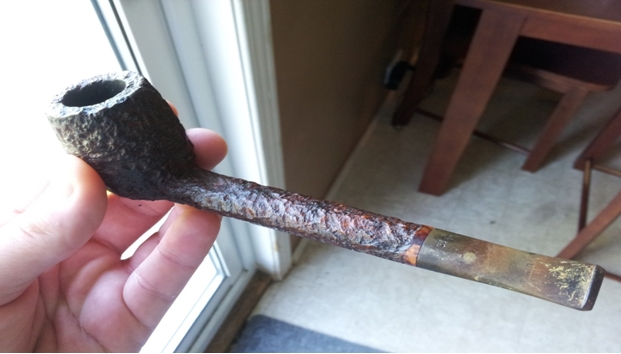
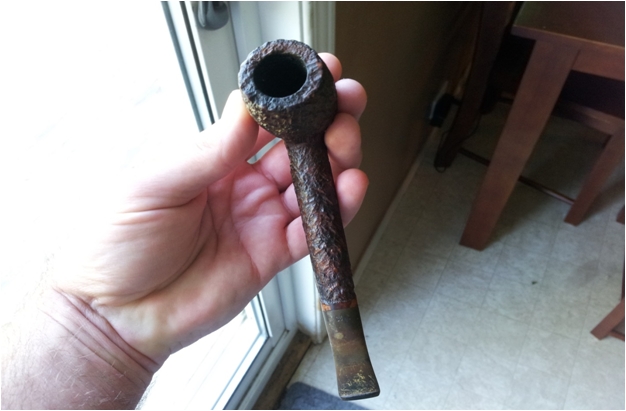
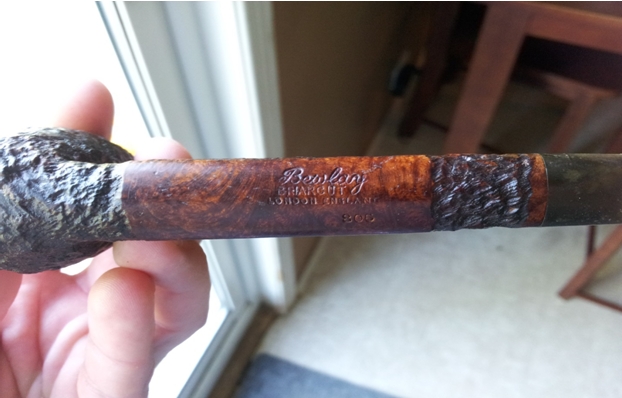
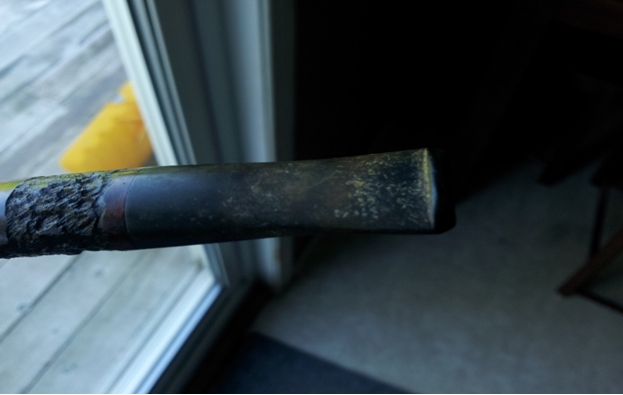
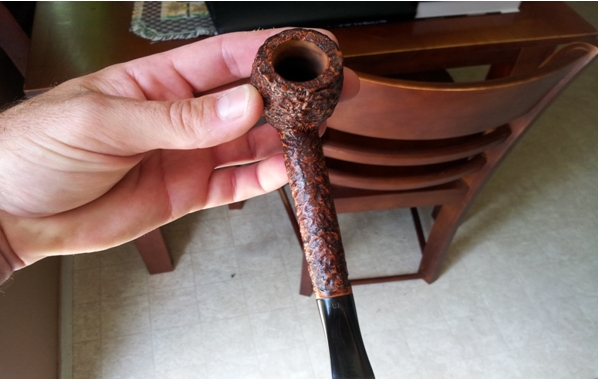
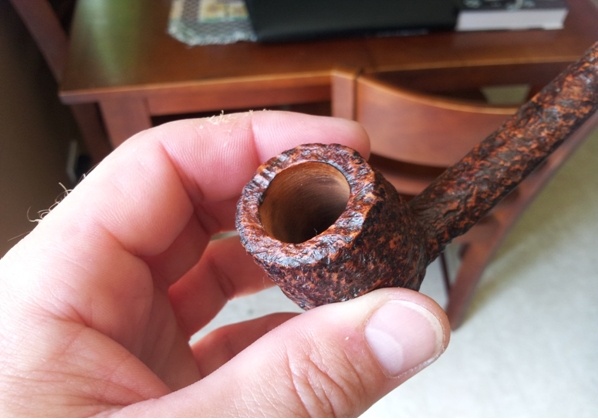
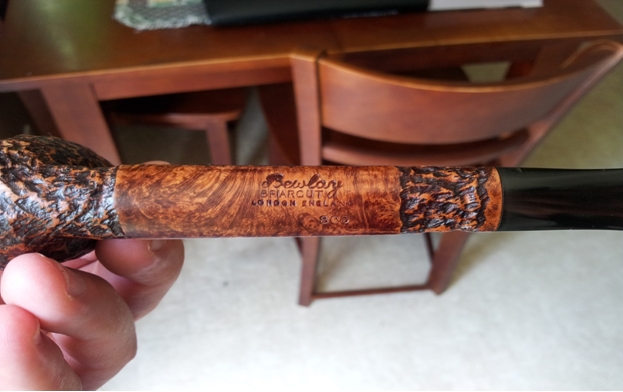
I recently received a care package from some very good friends. Inside was a ton of tobacco and three pipes: a Bewlay and 2 Trypis. As you will see from the first set of pics the Bewlay was a project pipe.
Bill1

Bill2

Bill3

Bill4
I only use a Dremel, wire brush attachment, fibre brush attachment, sanding attachment, some wool balls, micro mesh, magic eraser and carnauba wax. I do enjoy the time I spend bringing pipes back to life. I have only been doing this since January but I want to show you don’t need oodles of tools to clean up a pipe.
Bill5
I used the wire brush attachment in the Dremel to highlight the high spots on the pipe and the sanding attachment to clean the inside of the bowl. I then sand the smooth spots on the pipe with the micromesh. Then I take the wool ball, load it up with carnauba wax not worrying about leaving a caked on looking wax build-up, and apply it to the whole pipe. I then take the fibre brush attachment in the Dremel and use it to remove the excess wax, as it leaves an extremely nice buff and shine. I use a rag to finish off the smooth spots and give it a final wipe.

I use the Oxi Clean and Magic Eraser to clean the stem and then go at it with the micro mesh pads. If stems are worse I will use 400-1000 grit wet paper before the pads. Then I apply a coat of wax to the stem with the wool ball and buff with a rag.

This is the finished pipe. I like my pipes on the lighter coloured side so I am very happy with the way it turned out.
Bill6

Bill7

Bill8

Bill9
Thank you to Steve for allowing me to post on his blog. I enjoy reading it and seeing the history of all the pipes you work on. My next project is a pipe that was gifted to me by Steve.