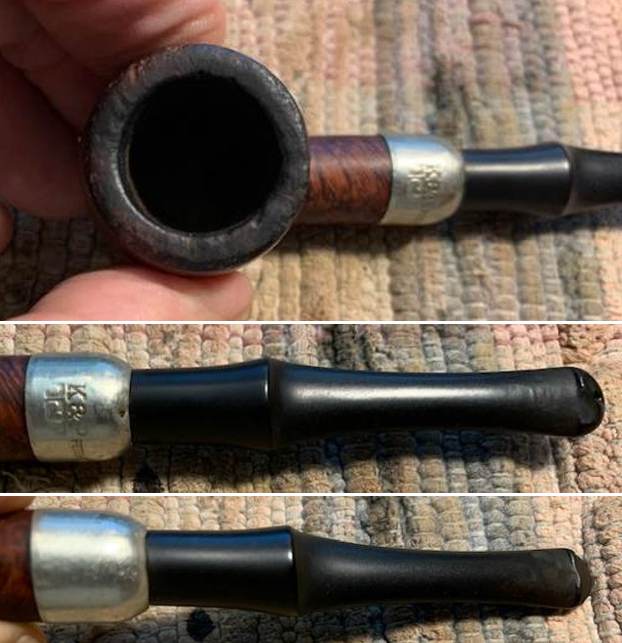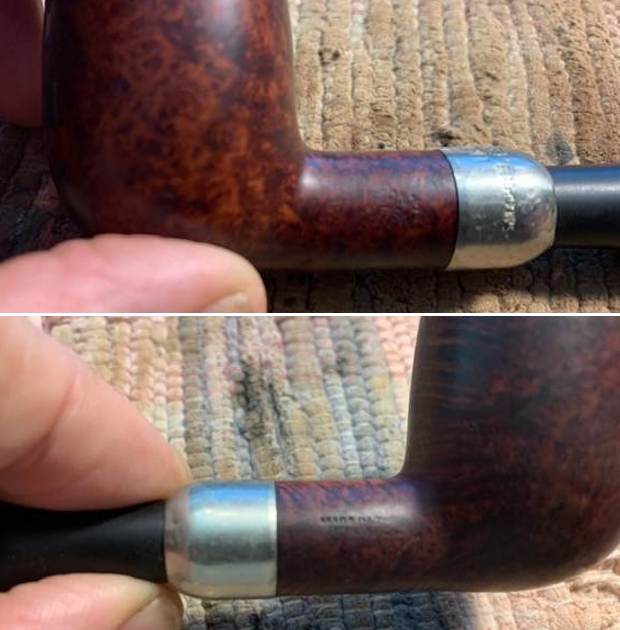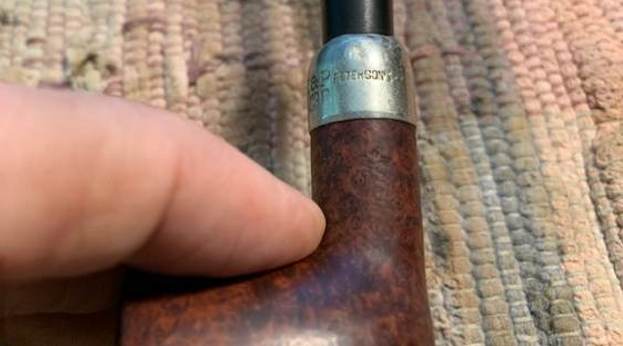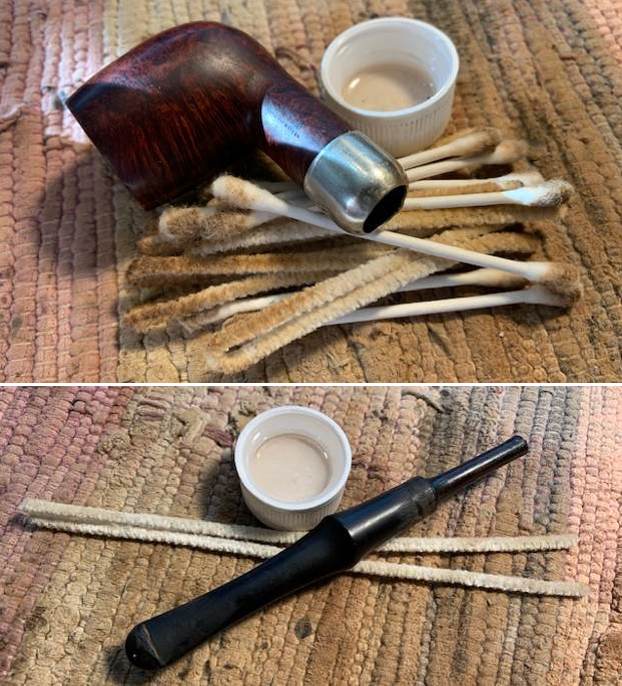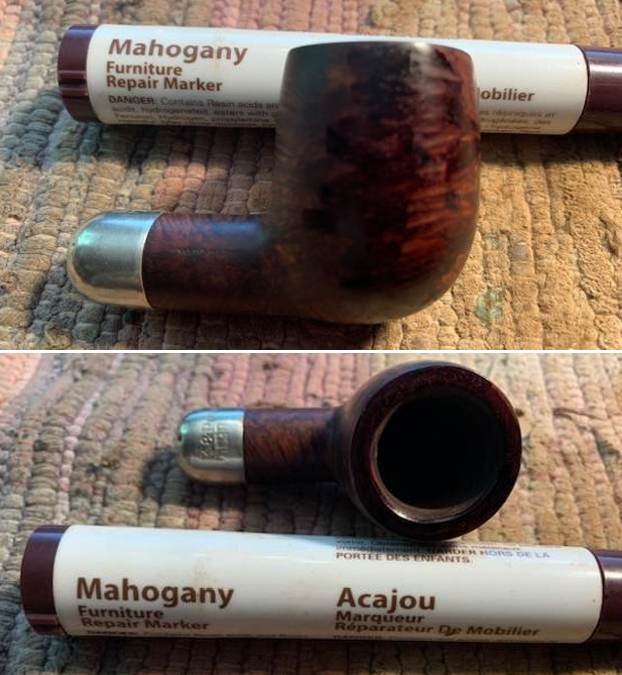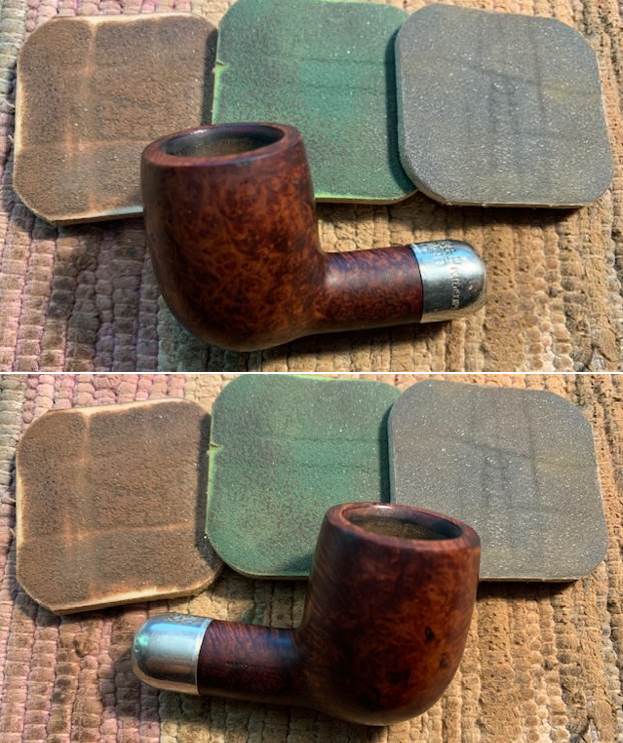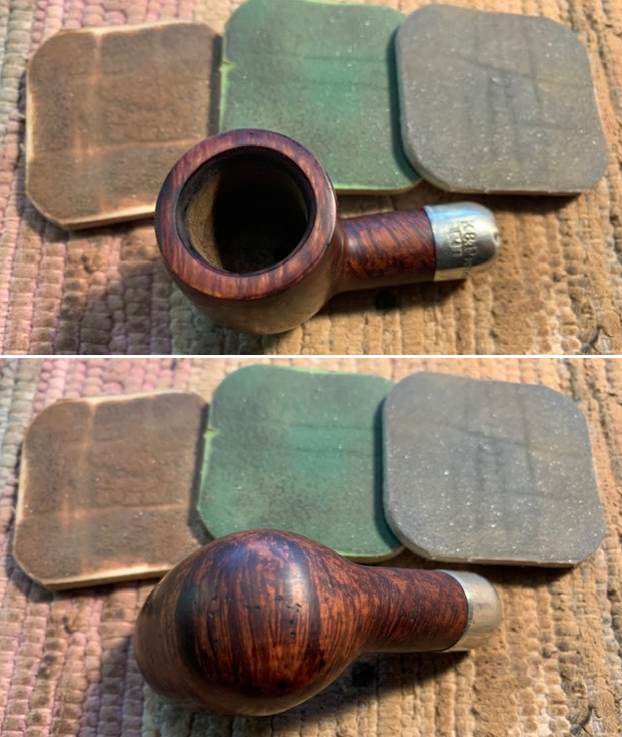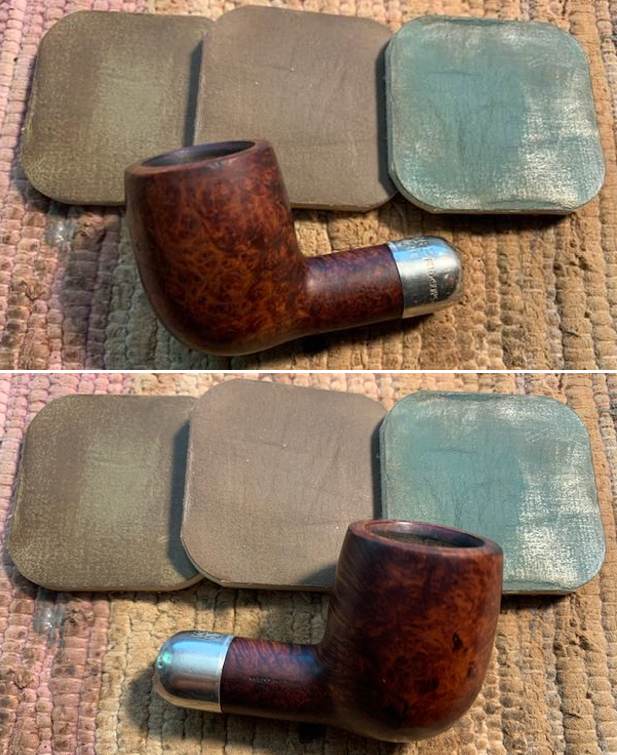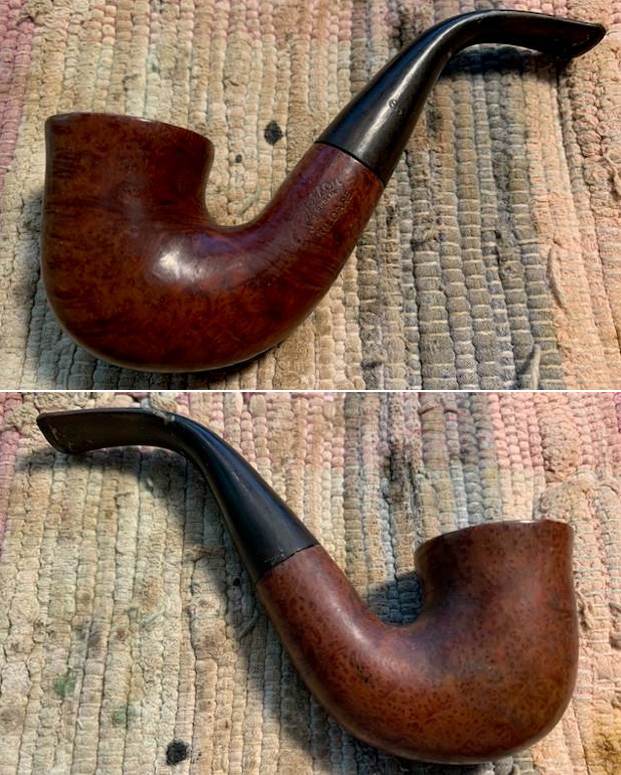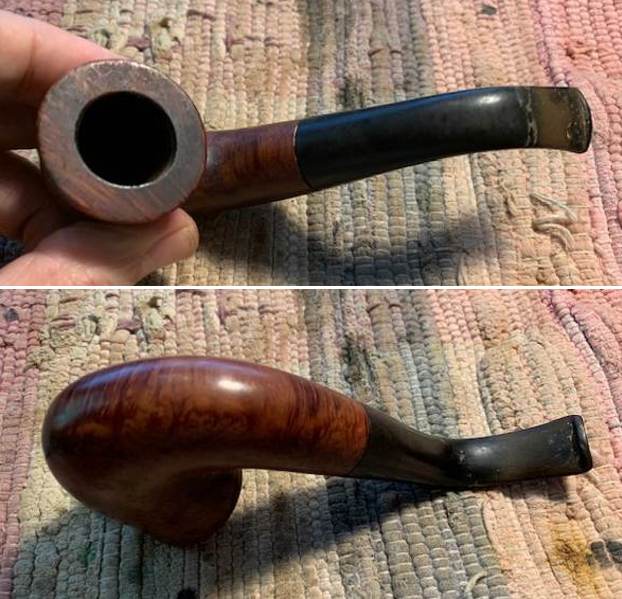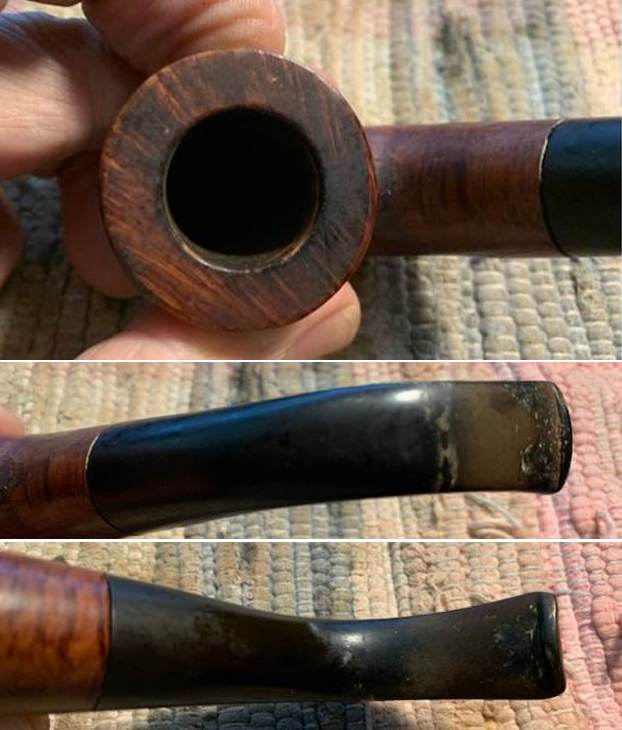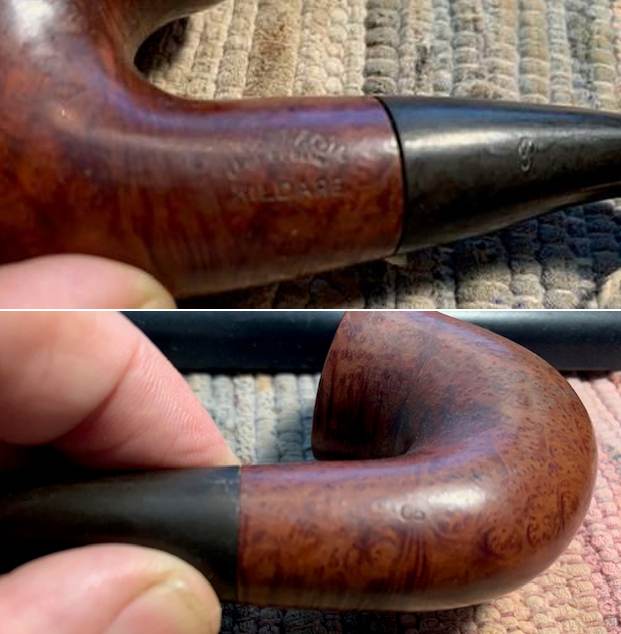
Tag Archives: refurbishing

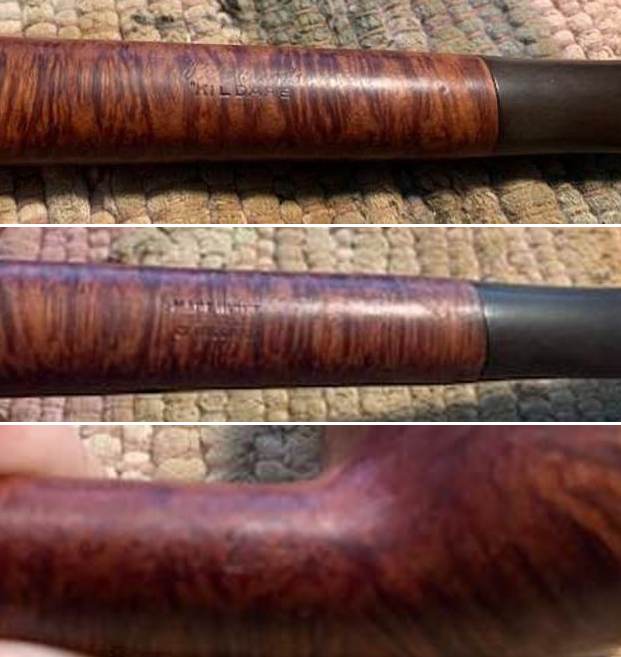
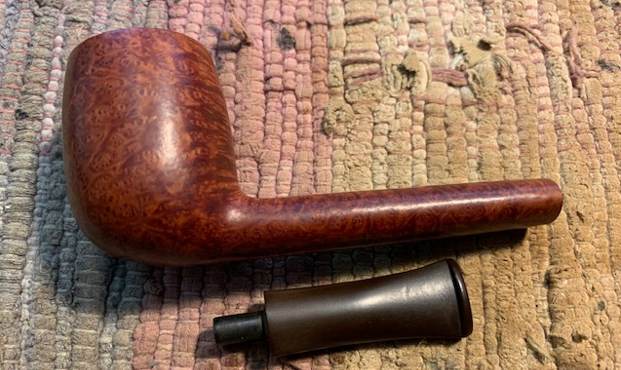
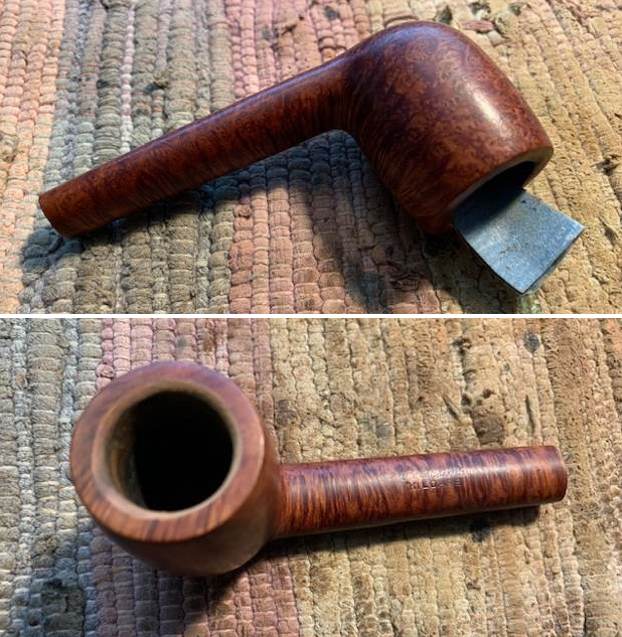
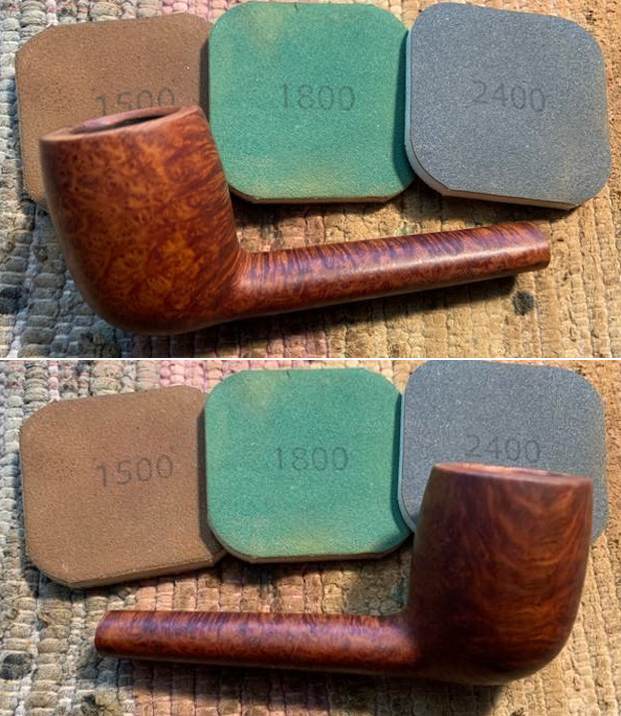
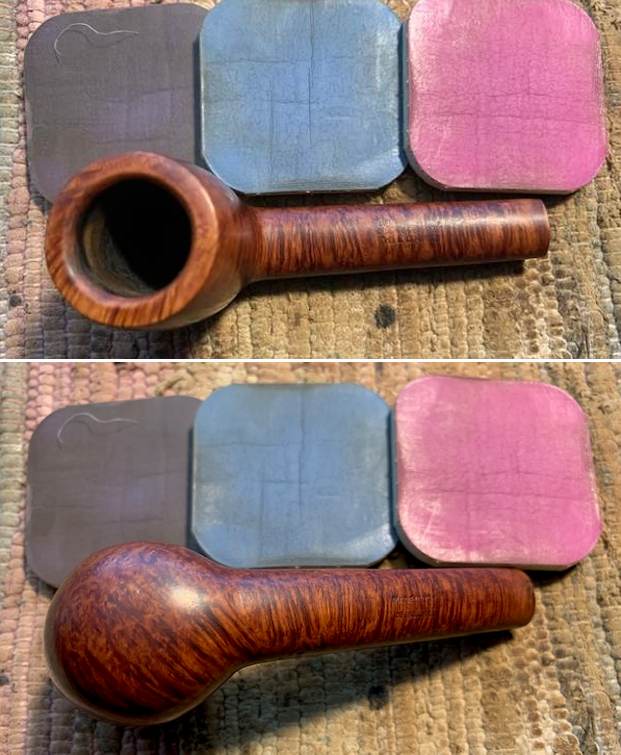
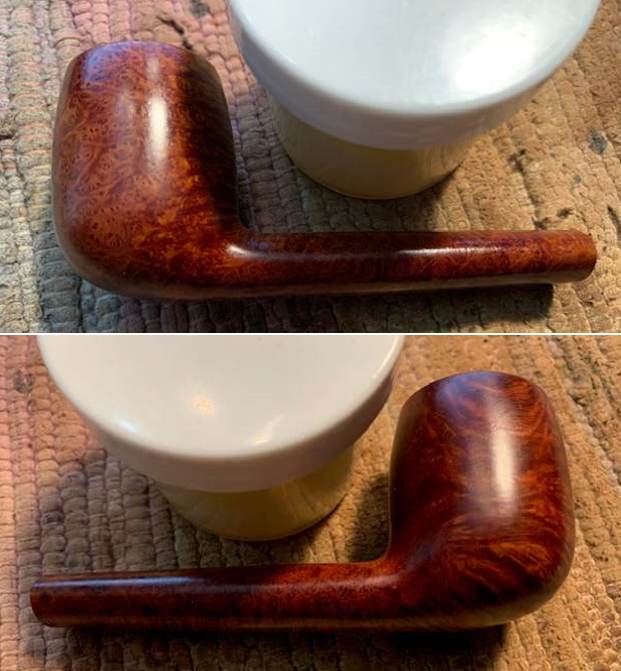
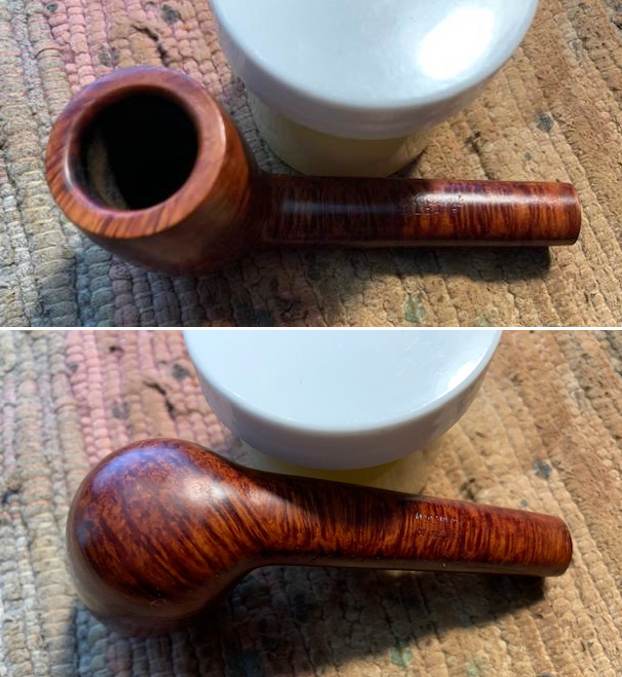
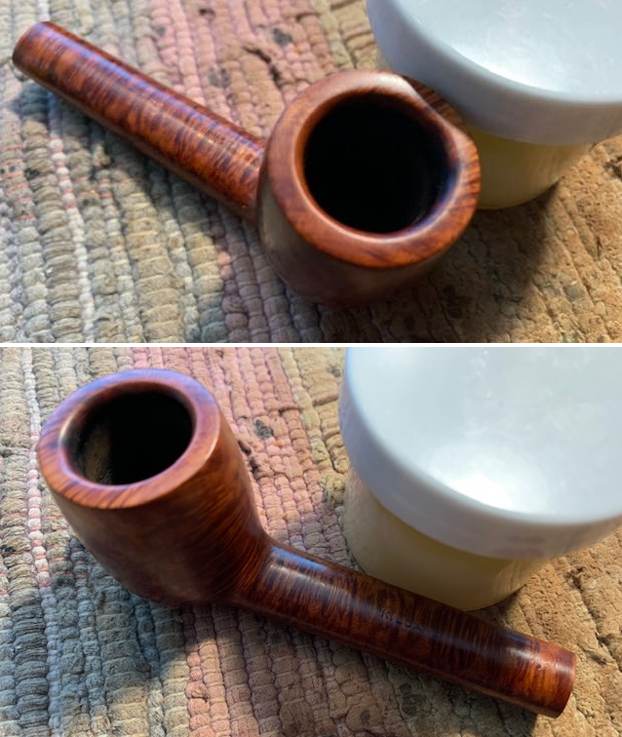
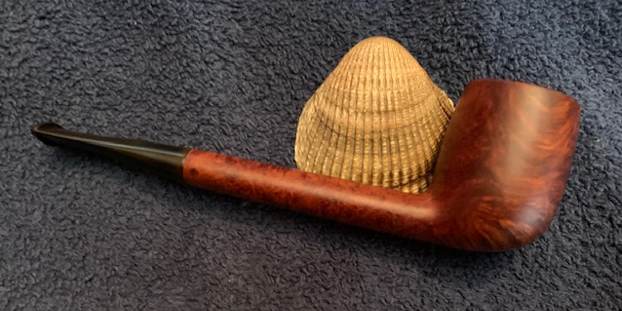
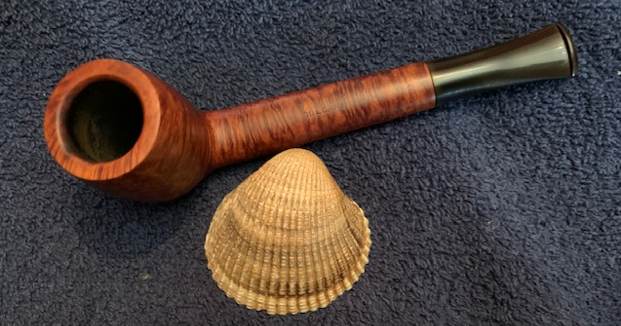
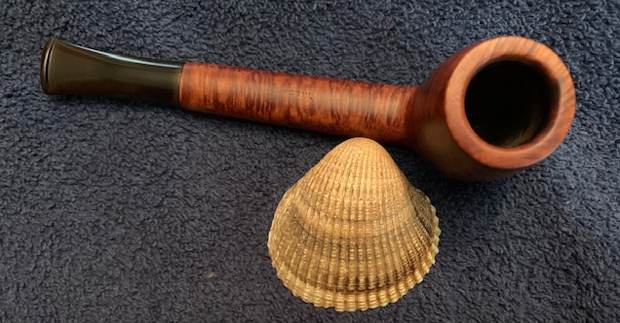
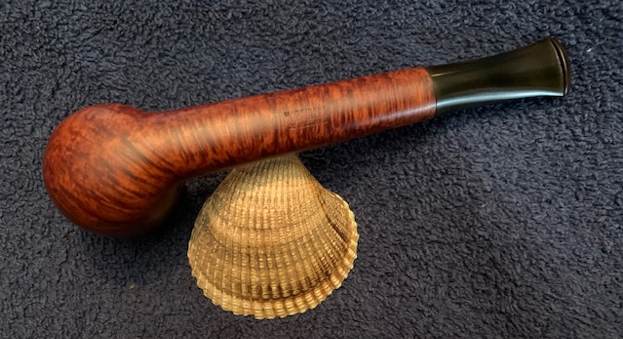
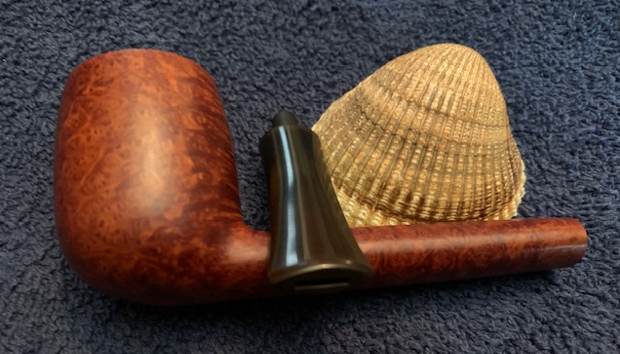
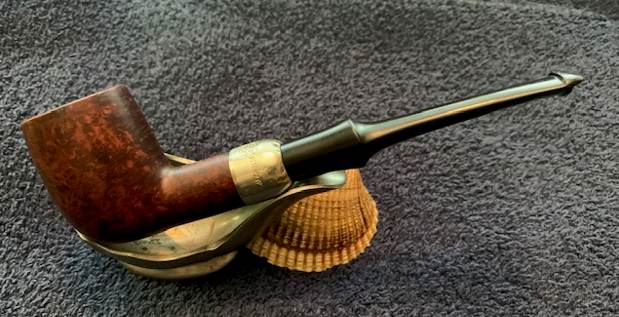
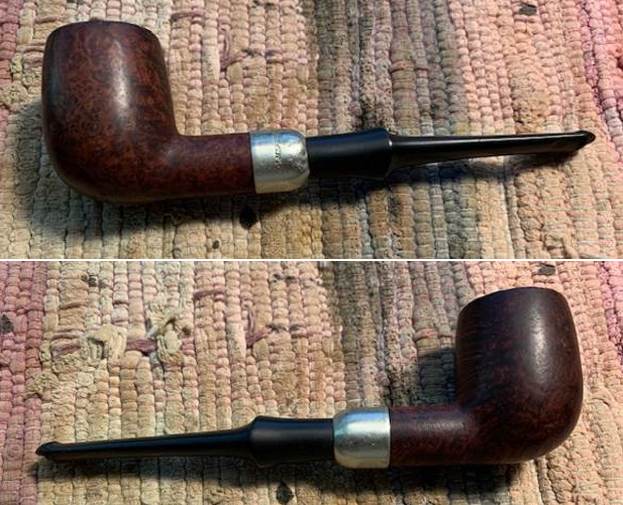
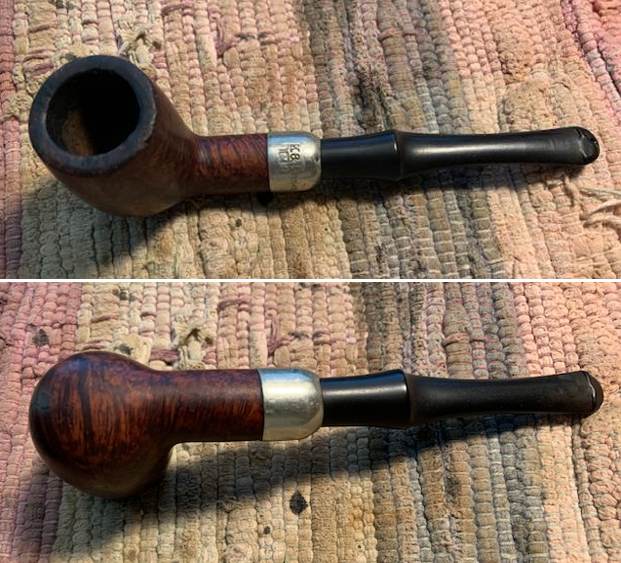
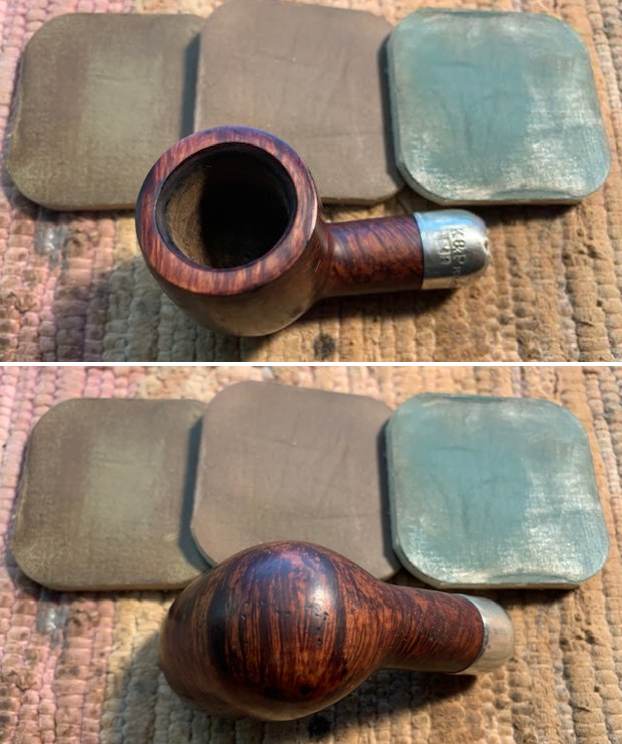
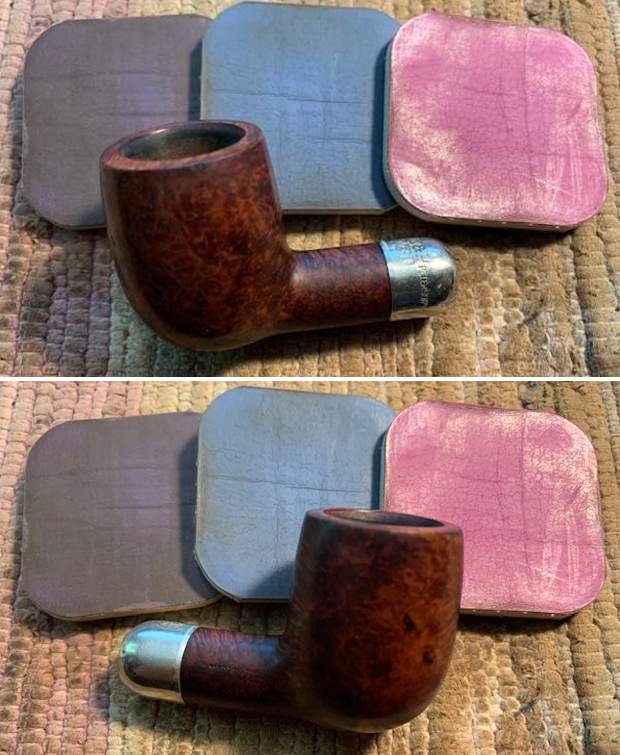
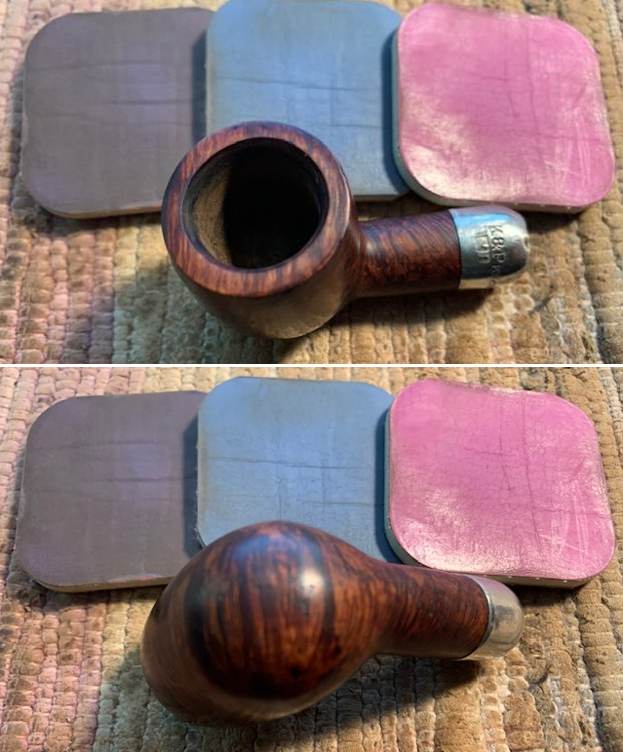
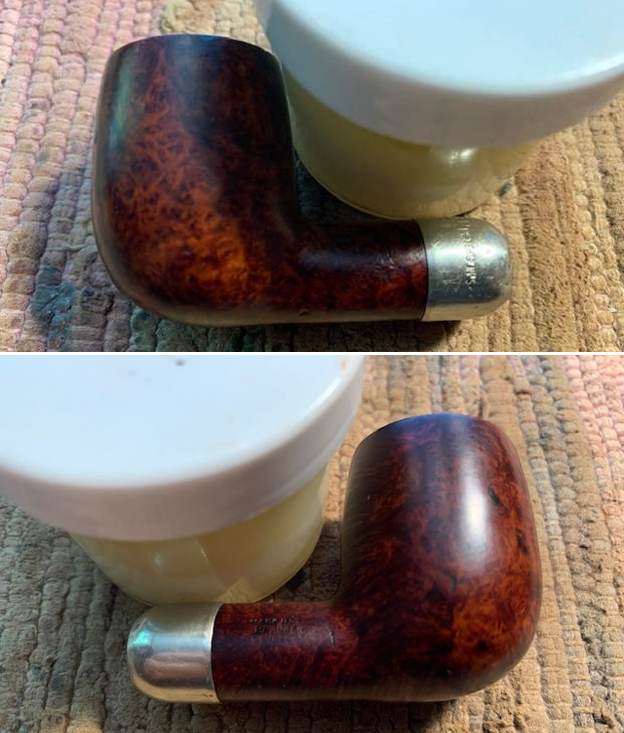
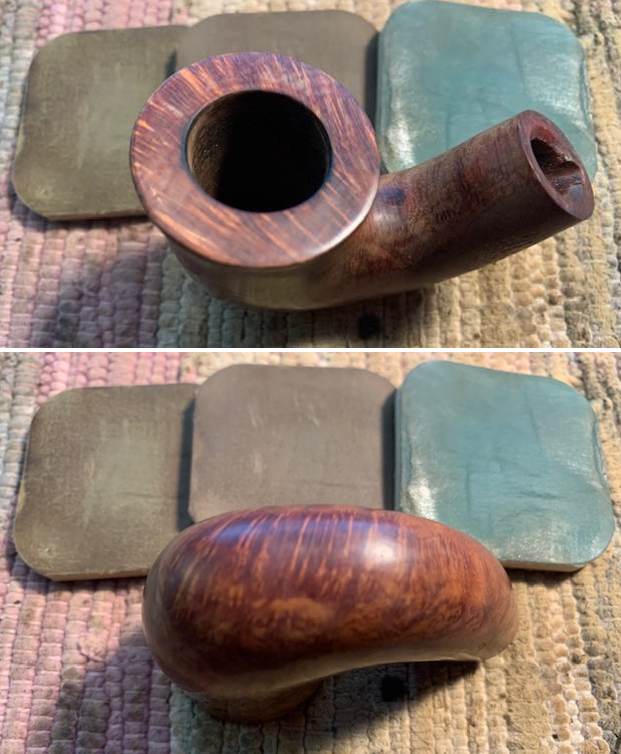
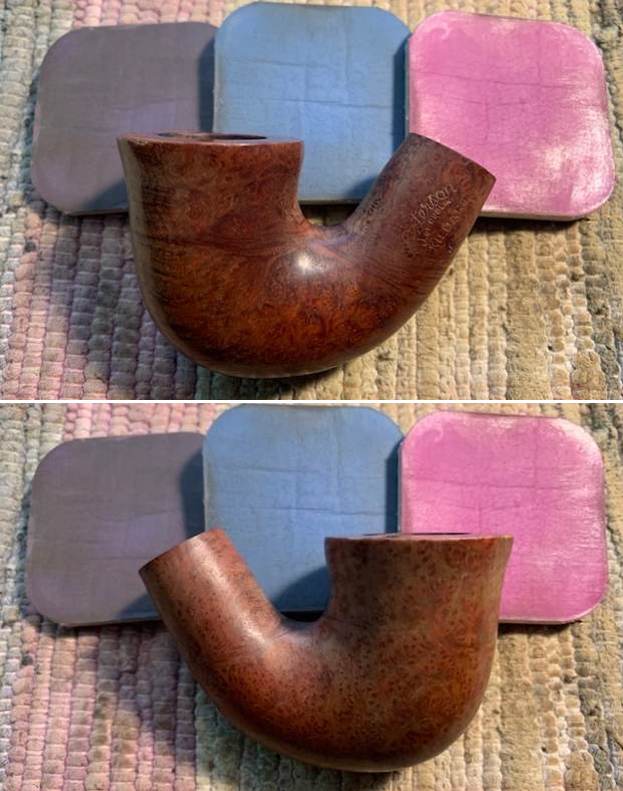
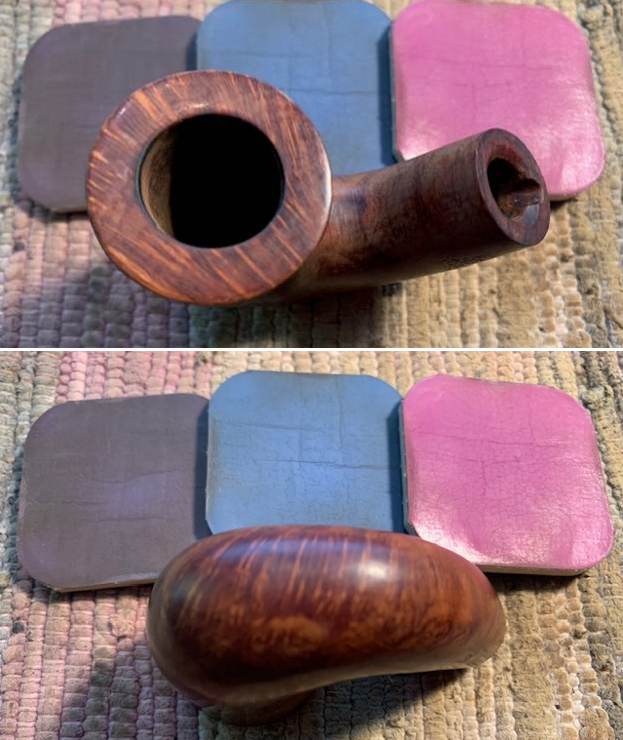
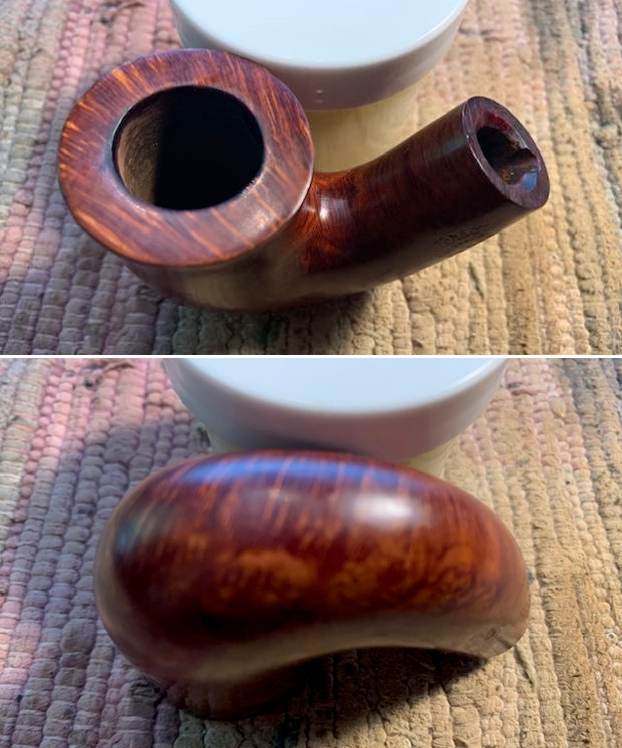
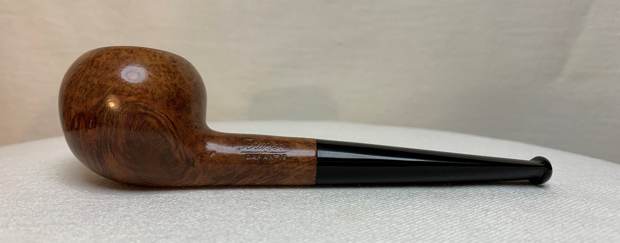
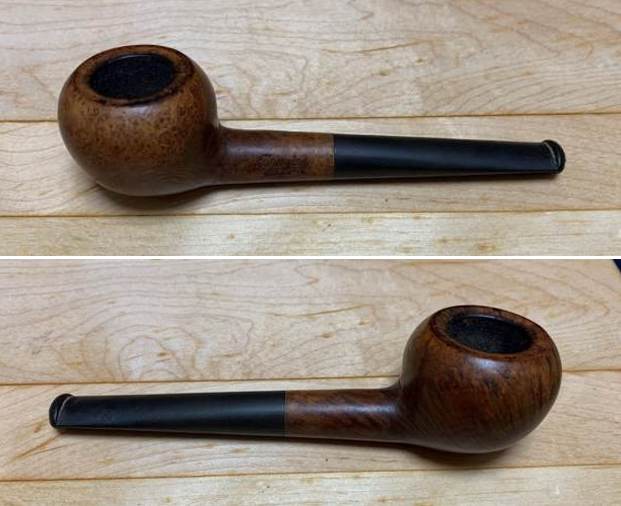
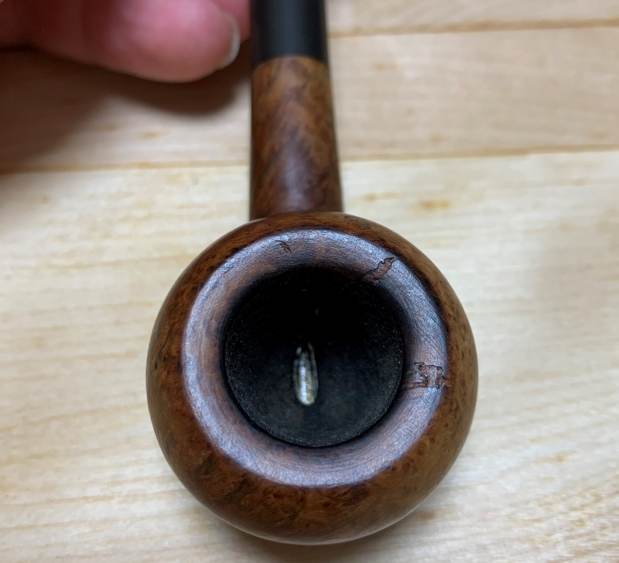
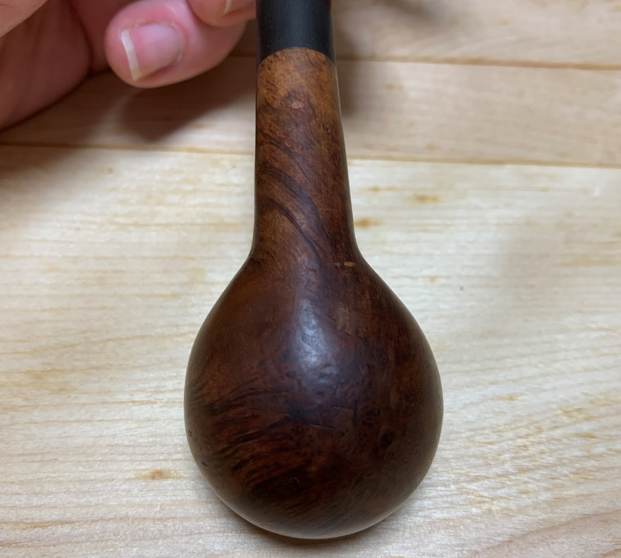
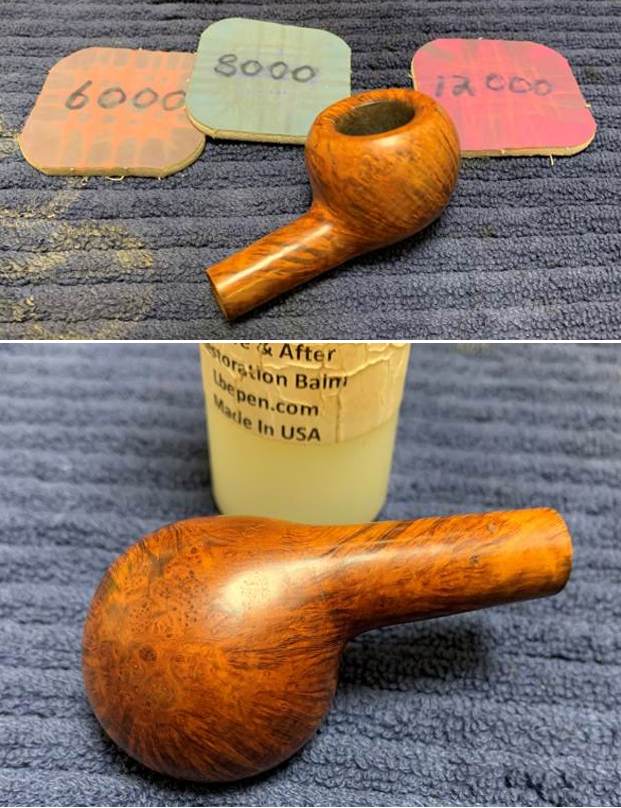
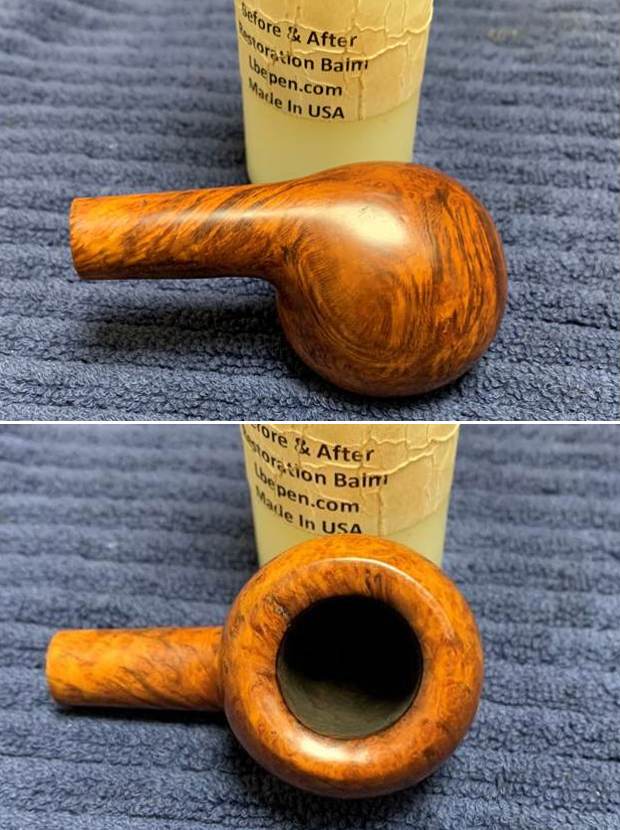
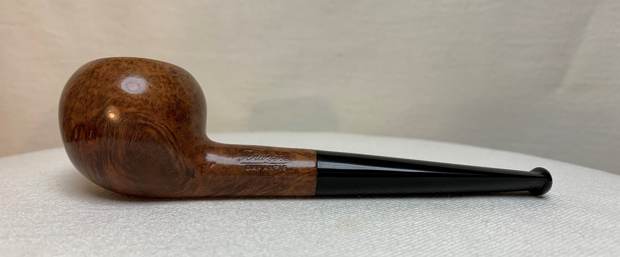
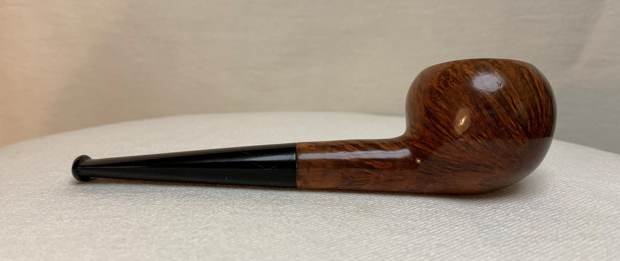
Yet another from the Bertrams Collection – a Straight Bertram 60 Apple


Blog by Steve Laug

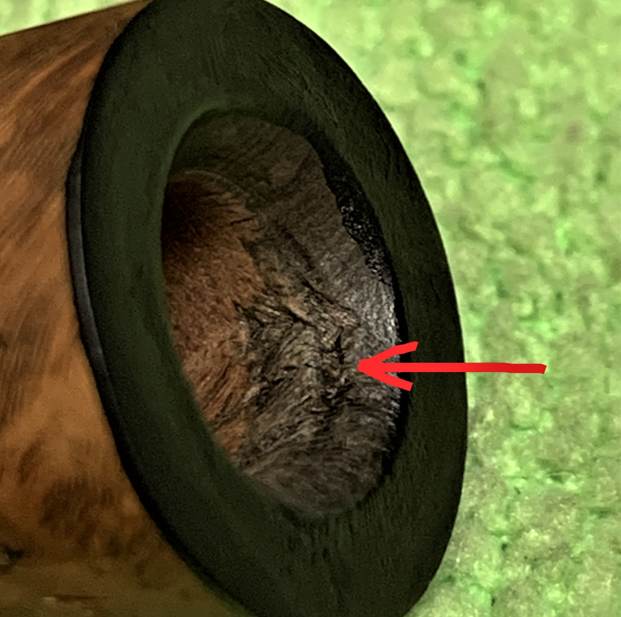
Rather than repeat myself and give the blog readers grief with the repetition please refer to the previous blogs posts on the Bertrams to learn about how we got this collection. Just know that we purchased a collection of Bertrams and a smattering of other brands, that when they were unwrapped, filled three boxes. The photo below is included to show the size of the collection we had purchased. To be honest it was a bit overwhelming to see all of the collection in boxes. We were looking at a lot of work to bring these back to life. The pipe I am working on now is one from that collection. I am gradually finishing most of these pipes.I cannot tell you how glad I am that Jeff worked through the clean up of all of these pipes as they many and they were filthy! It would have been a more daunting task than it was if I had to clean and restore all of them. I am leaving it to him to choose which pipes to work on. He has chosen some interesting shaped ones to restore. Here is how we are working out the transfer from him to me. As he finishes a batch of them he boxes them up and sends them to me. I believe I have all of the pipes here and the numbers are thinning down a lot. I am working through the pipes I have boxed to work on here and this Bertram caught my eye as the next pipe that I would work on. This pipe was another very dirty one! The smooth finish was grimy and dusty but some interesting grain shone through showing me that this was a beautiful pipe. It was a short, thick shank Apple shaped pipe with a tapered stem. There was a thick cake in the bowl and heavy lava overflowing on to the rim top. It was hard to know the condition of the edges due to the cake and lava. The stem showed some light oxidation and some chatter on the top and some deep tooth marks on both sides ahead of the button. It almost looked like someone had converted it to a bit of a dental bit. The photos below tell the story and give a glimpse of the pipe. Jeff took a close-up photo of the bowl and the crowned rim to capture the condition of the pipe when it arrived. The bowl had a thick cake. The crowned rim top had a thick coat of lava that was heavier on the back side thick around the edges. The photos of the stem show the deep gouge along the edge of the button on both sides. Jeff took pictures of the bowl sides and the heel to show the marvelous grain on the bowl. It really is quite stunning underneath the thick and ugly grime!   Jeff took 2 photos to capture the stamping on the left side of the shank. The first photo shows stamping on the left side which read Bertram over Washington, D.C. The stamping on this pipe is clear and readable. The second photo shows the grade number stamping lower on the left side near the bowl/shank junction. It read number 60 which shows the quality of the pipe. If you have read the previous blogs I have posted on the Bertram pipes that I have cleaned up you can skip the next bit. But if you have not, then I include the link to Bertram history and information. I would recommend that if you don’t know much about them do some research on them. I include a link to the write up on Pipedia (http://pipedia.org/wiki/Bertram). Bertram pipes were based out of Washington DC. They were popular among famous politicians and celebrities of the time. They made many products for them, from FDR’s cigarette holders to Joseph Stalin’s favorite pipe. They were considered some of the best America had to offer till they finally closed their doors in the 70s. They graded their pipes by 10s, the higher the grade the better. Above 60s are uncommon and 80-90s are quite rare. I’ve only seen one 100 grade. I have several blogs that I have written on rebornpipes that give some history and background to Bertram pipes. (https://rebornpipes.com/2015/06/16/an-easy-restoration-of-a-bertram-grade-60-217-poker/).

I have included the following link to give a bit of historical information on the pipe company. It is a well written article that gives a glimpse of the heart of the company. http://www.streetsofwashington.com/2012/01/bertrams-pipe-shop-on-14th-street.html#

I am also including this photo of the shop in Washington D.C. and a post card of the shop. From this information I have learned that the shape and grade Bertram I have in front of me now was made before the closure of the shop in the 1970s. This Bertram Apple one of the unique shapes among the Bertram pipes I have worked on. With a grade 60 stamp it is just above the mid-range mark.

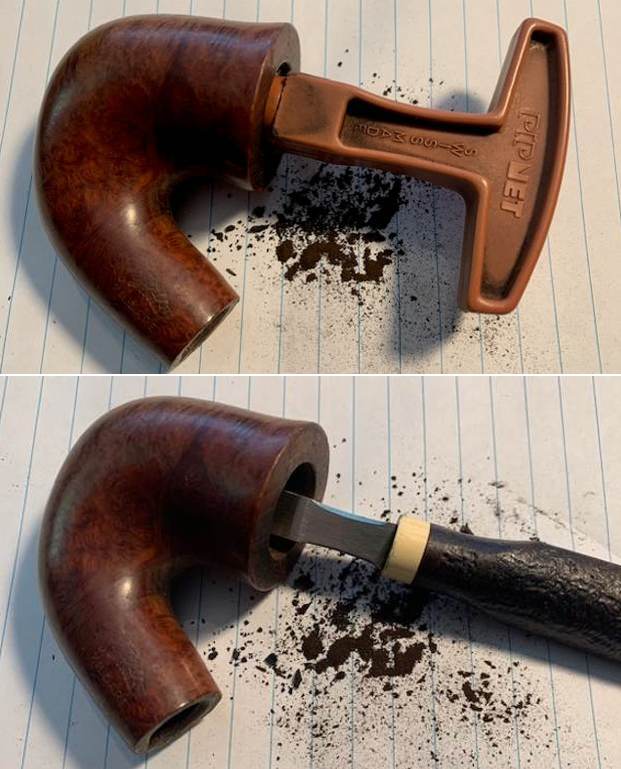
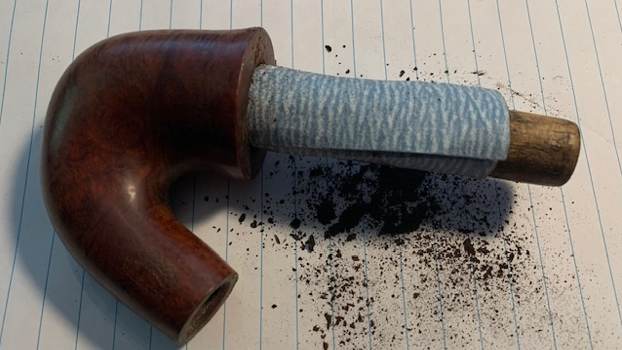
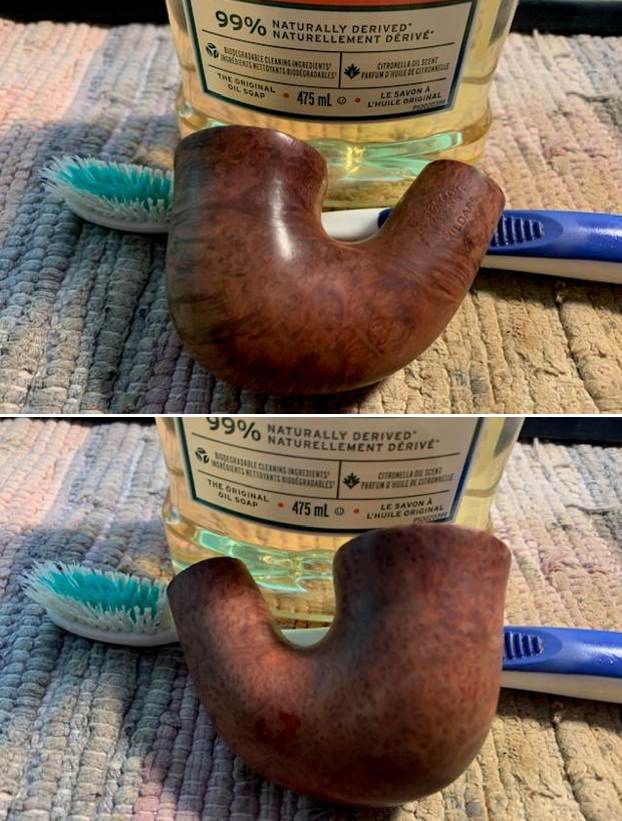
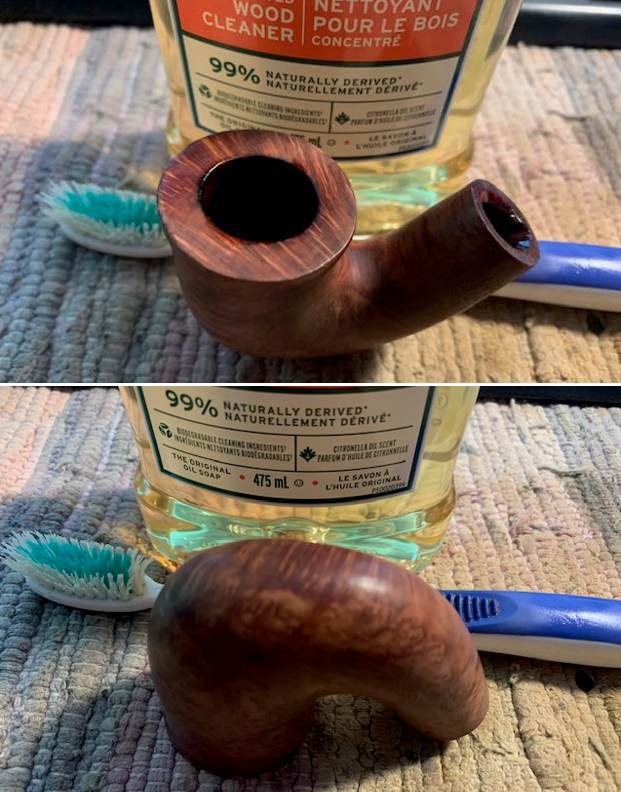
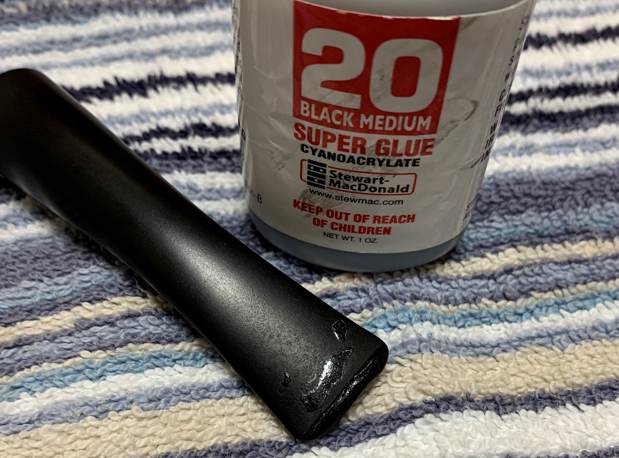
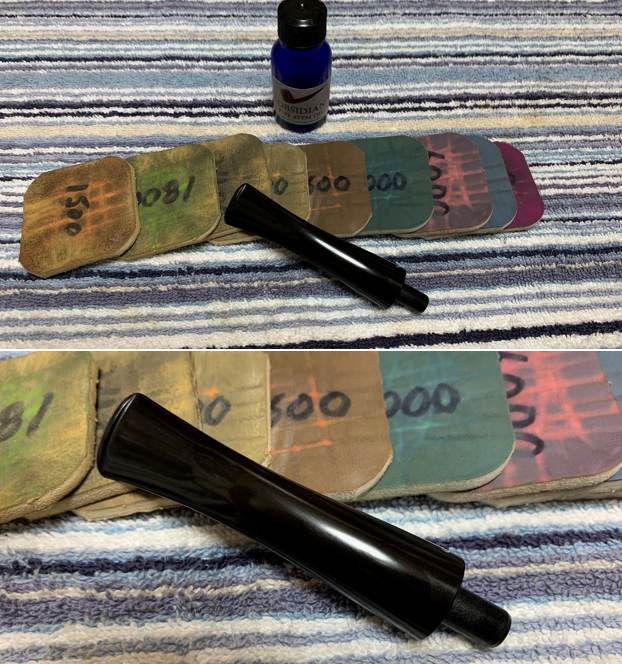
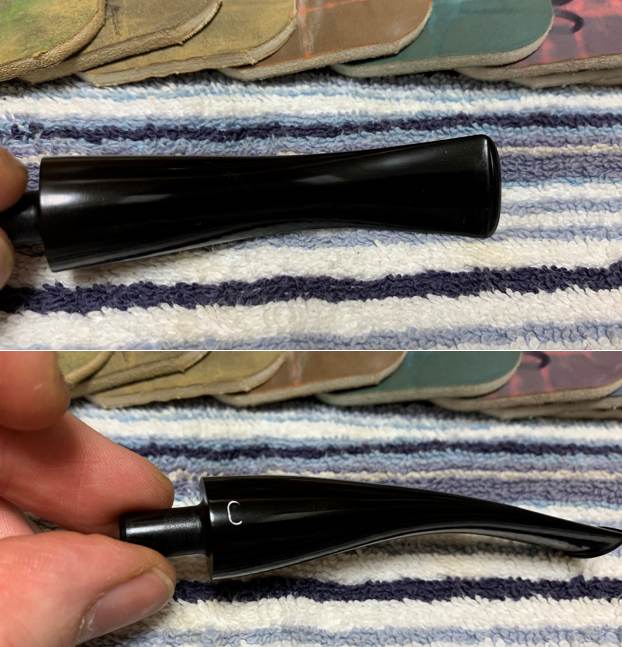
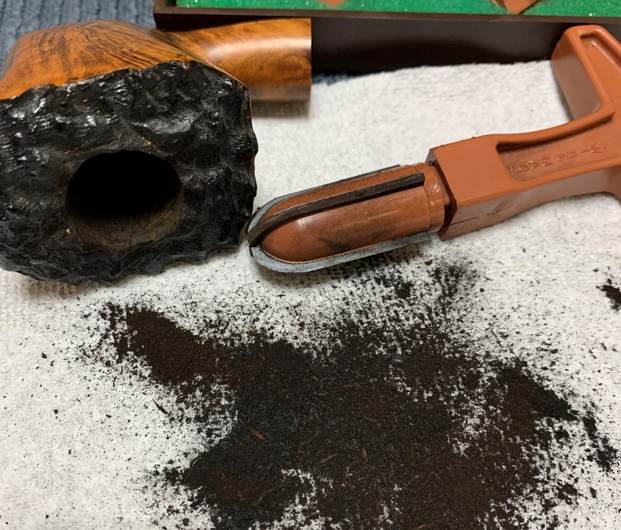
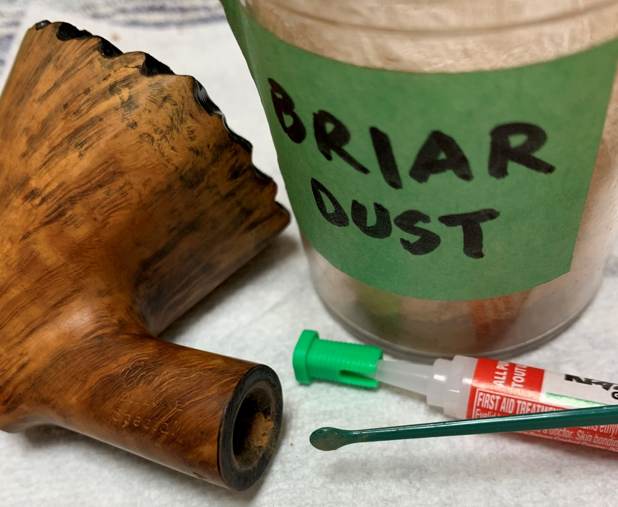
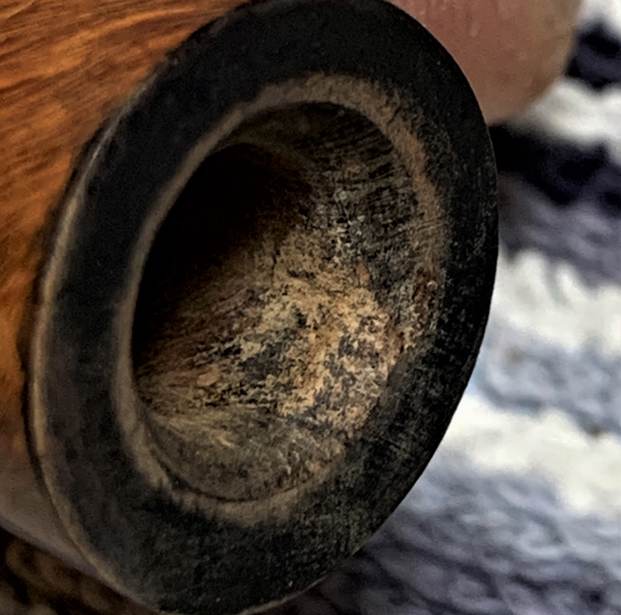
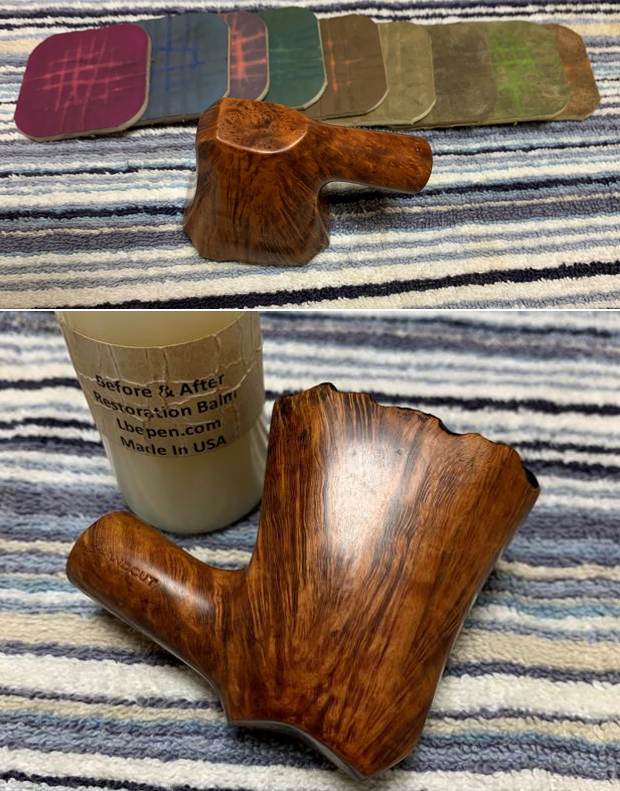
Jeff reamed the bowl with a PipNet pipe reamer and followed up with a Savinelli Fitsall pipe knife to remove the cake. He scrubbed out the mortise and the airway in the shank and the stem with alcohol, cotton swabs and pipe cleaners. He scrubbed the exterior of the bowl, rim, shank and stem with a tooth brush and undiluted Murphy’s Oil Soap to remove the lava, oils and tars on the rim and the grime on the finish of the bowl. He rinsed it under running water. He dried it off with a soft cloth. He was able to remove lava build up on the rim top and you could see the great condition of the bowl top and edges of the rim. There was still some darkening to the rim top toward the back of the bowl. He soaked the stem in Before & After Deoxidizer to remove the oxidation. I took photos of the pipe before I started my work on it.    I took a close up photo of the rim top to show the condition of the bowl and rim after Jeff had cleaned up the grime and lava but the crowned rim top had some darkening on the whole rim top though darker on the backside of the rim. Otherwise the crowned rim look good. The stem photos show that the oxidation is gone. The light tooth chatter is hard to see but I should be able to sand it out quite easily. The deep tooth marks on both sides near the button will take a little more work to remove. I also took a photo of the stamping on the left side and the underside of the shank showing how the stamping was laid out. I removed the stem from the shank and took a photo of the pipe to show the proportions and the look of the grain on the bowl. It is a beauty!I sanded the top of the rim with a folded piece of 220 grit sandpaper to remove the damage and the darkening. I would polish it later and think it would look very good. The photo shows how the rim looked at this point.     I polished the bowl and rim top with micromesh sanding pads – dry sanding it with 1500-12000 grit pads. I wiped the bowl down with a damp cloth after each pad to remove the sanding debris. After the final sanding pad I hand buffed it with a cotton cloth to raise a shine.   I worked some Before & After Restoration Balm into finish of the briar with my fingertips to clean, enliven and protect it. I let the balm sit for a little while and then buffed with a cotton cloth to raise the shine. The Restoration Balm really makes the grain stands out beautifully.   I used a lighter to “paint” the deep marks on both sides of the stem near the button. I was able to lift them a bit but not significantly, I filled in what remained with black super glue and flattened the repair with a dental spatula. Once it cured I used a small file to redefine the button edge. I used a folded piece of 220 grit sandpaper to blend the repairs into the surface of the stem. I started polishing the stem with a folded piece of 400 grit sandpaper. I wiped the stem down with Obsidian Oil.  I polished the stem with micromesh sanding pads – dry sanding it with 1500-12000 grit pads. I wiped the stem down with Obsidian Oil after each pad. I polished it with Before & After Pipe Polish – both Fine and Extra Fine and gave it a final coat and set it aside to dry.  I put the stem back on the Bertram Apple and buffed the pipe with Blue Diamond on the buffing wheel. I polished the briar and the vulcanite of the stem until there was a rich shine. This Bertram classic Apple shape and oil cured finish really highlights some amazing grain on a proportionally well carved pipe. Once I buffed the pipe the briar came alive and the mixture of grain – straight, flame and birdseye – popped with polishing. The black vulcanite stem had a rich glow. Like the other Bertrams I have worked on, this one fits well in the hand and sits right in the mouth. Have a look at it with the photos below. The dimensions are Length: 5 inches, Height: 1 ½ inches, Outside diameter of the bowl: 1 inch, Chamber diameter: ¾ of an inch. The weight of the pipe is 1.20 ounces/34 grams. This beauty will be going on the rebornpipes online store in the American Pipemakers Section. If you are interested let me know. Thanks for walking through the restoration with me as it was a pleasure to work on.
Restoring a Jost’s Eccentric Grain 73S Long Canadian


Blog by Steve Laug

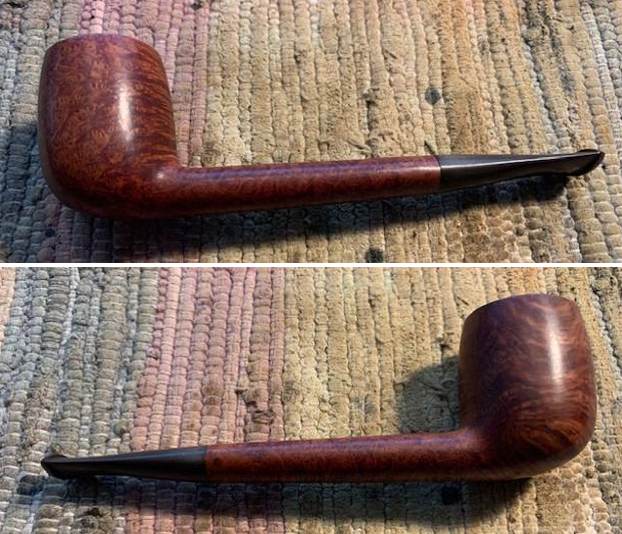
The next has been around here for a very long time – a little over five years. We purchased the   pipe off eBay on 07/02/17 from Akron, Ohio, USA. The pipe came from Jost’s Pipe Shop in St. Louis, Ohio and I will go into the details of that below. It is a nice mixed grain long shank Canadian. It is stamped on the left side of the shank and reads JOST’S [over] Eccentric Grain. On the right side of the shank it is stamped 73S (shape number). The pipe had some interesting grain peaking through the grime on the outside. There was a thick cake in the bowl and a heavy overflow of lava on the rim top. The inner edge looks like it has some damage and is slightly out of round on the right front side. The stem has deep tooth marks on both sides on and ahead of the button. There is some light oxidation on the stem surface. Despite all of that it is a beautiful long Canadian that has great potential. Jeff took photos of the pipe before he clean it so you can see what we were dealing with. He took photos of the bowl, rim top and stem to give a clear picture of their condition. The bowl is thickly cake and the lava on the inner edge and rim top is moderate. The inner edge shows damage on the right front side. The stem has some deep tooth marks and chatter on both sides on and ahead of the button. Jeff’s photos of the sides and heel of the bowl show why the pipe was labeled eccentric grain. It is a wild, random pattern of swirls and birdseye grain that has it sown beauty. It should look great after it is cleaned up.He also captured a flaw on the underside of the long shank near the stem. It will need to be addressed in the final work.Jeff captured the stamping on the shank sides. It is clear and readable as noted above. There was also a faint circle J stamp on the left side of the stem that I hope will survive the clean up. Before I started on my part of the restoration I decided to do a bit of reading on the brand. I knew it was US made and connected to Jost’s Pipe Shop in St. Louis, Missouri but it had been awhile since I had worked on one of their pipes. I first reread an old blog I had written on the restoration of a Jost’s De Luxe Supreme that I had restored in 2016. Here is the link to that if you would like to see more detail (https://rebornpipes.com/2016/09/03/josts-olde-english-de-luxesupreme-overstamped-j214-bent-billiard/).

I then turned to Pipephil’s  as I had in the previous blog but specifically to see if there was any mention of the Eccentric Grain 73S Canadian. Here is the link (http://pipephil.eu/logos/en/logo-j4.html). I found that while the site did not reference the line it did give some helpful information on the brand and the potential carver of this pipe. I have included the following screen capture and some notes from the side bar on the brand with a possible lead to the maker – Harvey Raspberry.The Proprietor of the tobacco shop was Mrs Henry A. Jost. She was a pipesmoker. Jost’s Pipes are closely tied to Comoy. Many of Jost’s pipes have the standard Comoy shape number and the “Made in England ” in a circle. If the Jost’s pipe doesn’t have the “Made in England ” it is probably made by Harvey Raspberry.

From the 2016 blog I followed a link to the classicpipeshop blog that had some helpful information on the brand (http://classicpipeshop.blogspot.ca/2015/03/josts-pipe-shop-201-north-6th-street-st.html). The site includes a great history of the brand and also some interesting details about grades of pipes they made and sold as well as their shop blends of tobacco.

I have included the section of the blog on the pipes. It covers a lot of information regarding the source of the pipes and the levels/grades of pipes. However, the Eccentric Grain line was not included on the site. There was also good information on the carver Harvey Raspberry. I quote:

Jost’s Pipes are closely tied to Comoy’s. Many of Jost’s pipes have the standard Comoy’s shape number and the “Made in England ” in a circle. If the Jost’s pipe doesn’t have the “Made in England” it is probably made by Harvey Raspberry.

If the pipe has a shape number that is preceded by a “J” that is a Comoy’s product without question.  Typically these will have the words “Made in London England” on the reverse side of the shank from where the Jost stamp is made.  There are always exceptions to the rule but 95% of the time, this is accurate.

Many different levels of pipes were offered by Jost’s Pipe Shop.  From a 1950s catalog I have the following available:

Jost Old English De Luxe: $85.00
These were typically of the highest… Grain is stunning and the briar is flawless.  These are the grade you should look out for as they are great smokers.

Jost Old English Supreme:  (no pricing available)
The majority of the Old English version pipes you see are marked Supreme.  These are stained in a darker color and are presumably from the same Algerian aged Briar as the De Luxe brothers.  These are also of the highest quality available.

Jost Virgin Briar Supreme: $35.00
Don’t see too many marked as Virgin Briar Supreme but you will often find “Supreme” Jost pipes on the second hand market (see above).  Excellent quality briar and displays the lighter toned finish of the De Luxe above.  Grain is not as flashy or desirable as the De Luxe model.

Jost Thames Briars: $25.00
I’ve seen these offered as blasted /rusticated pipes and look quite nice.  Most of the smooth finish Thames pipes are riddled with fills.  Good smokers but not much to look at (smooth). 

Jost Sandblast Briars: $25.00
These are a great value.  The shop made sand-blasted pipes are usually quite large and snapped up very quickly by collectors.  The Comoy’s versions (with J shape #s) are of excellent quality and typically rather small compared to the shop-made variety. 

Dukes Briars: $15.00
These come up very rarely.  The two I’ve seen in recent years are rather small in size.  Smooth finish with light / honey stain color.  Not sure what the story is behind these.

From the above information I knew that the pipe I had was one of the pipes made by Harvey Raspberry for Jost’s and not one of the Comoy’s made pipes. It is interesting to me though that the pipe has a very English/Comoys look to it nonetheless. The Pipe Shop not only made the Eccentric Grain pipe they also made and Eccentric Blend of tobacco that actually sounded quite good.

Jeff had cleaned the pipe as usual from the inside out. He reamed the bowl with a Pipnet pipe reamer and cleaned up the remnants of cake with a Savinelli Fitsall Pipe Knife. Once the cake was removed he cleaned out the internals of the shank and stem with 99% isopropyl alcohol, cotton swabs and pipe cleaners. He scrubbed the exterior with undiluted Murphy’s Oil Soap and a tooth brush. He rinsed it in warm water to remove the soap and the grime. He soaked the stem in Before & After Stem Deoxidizer and then cleaned it out once more with pipe cleaners and alcohol. When it arrived in Vancouver it was in clean shape and ready for my contribution to the restoration. I took some photos of the pipe to show how it looked when I brought it to the table last evening. The rim top and edges cleaned up very well. The photos I took of the bowl and stem show what I am dealing with now. You can see the darkening on the back of the rim top and the damage on the right front inner edge of the bowl. The stem shows some light oxidation remaining and the tooth marks on both sides and on the button. I took photos of the stamping. They are clear and readable as noted above.   I removed the stem from the shank and took a photo to give a sense of the length of the shank in proportion to the bowl. It is a long and pretty looking pipe.Now it was time to work on the pipe. I started by dealing with the rim top and out of round and damaged inner edge. I used a folded piece of 220 grit sandpaper to give the rim a slight bevel to clean up and minimize the damage. It definitely looked better than when I started.I polished the briar with micromesh sanding pads – dry sanding with 1500-12000 grit pads. I wiped the bowl down with a damp cloth after each pad. The pipe began to take on a rich shine and the grain stood out. I decided to leave the small flaw on the underside of the shank as once cleaned and polished it was really quite minimal.   I rubbed some Before & After Restoration Balm into the briar with my fingertips to clean, enliven and protect the briar. I let it sit on the briar for 15 minutes then buffed it off with a clean cloth. It really makes the grain come alive.   I set the bowl aside and turned my attention to the stem. I “painted” it with a Bic lighter flame to lift as many of the dents as possible. Most were removed. Those that remained I filled in with clear CA glue. I set it aside to cure. Once it had cured I used a small file to smooth out the repair and recut the edge of the button. I cleaned it up further with a folded piece of 220 grit sandpaper. I started the polishing with 400 grit wet dry sandpaper.  I touched up the J with a circle using some White Acrylic Nail Polish. I let it dry and scraped off the excess with a tooth pick. I polished off the excess with 1500 grit sandpaper and rubbed it down with Obsidian Oil.I polished the stem with micromesh sanding pads – I dry sanded it with 1500-12000 grit pads. I wiped it down with Obsidian Oil between each sanding pad. I finished the polishing with Before & After stem polish and gave it a final coat of Obsidian Oil.   This Jost’s Eccentric Grain 73S Long Canadian is a great looking pipe now that it has been restored. The medium reddish brown stain highlights the grain and works well with the polished vulcanite bent taper stem. I put the stem back on the bowl and carefully buffed the pipe with Blue Diamond on the buffing wheel using a light touch on the briar. I gave the bowl and the stem multiple coats of carnauba wax on the buffing wheel and followed that by buffing the entire pipe with a clean buffing pad. I hand buffed the pipe with a microfiber cloth to deepen the shine. The finished Long Canadian fits nicely in the hand and feels great. Give the finished pipe a look in the photos below. The dimensions of the pipe are; Length: 6 ½ inches, Height: 1 ¾ inches, Outer diameter of the bowl: 1 1/8 inches, Chamber diameter: ¾ inches. The weight of the pipe is 1.38 ounces/39 grams. I will be adding it to the rebornpipes store in the American Pipemakers Section. Thanks for reading this blog and my reflections on the pipe while I worked on it. This is an interesting estate to bring back to life.

Restoring 1953 Parker Super Bruyere Patent 63/F Lovat


Blog by Steve Laug

The next pipe on the work table was purchased on 08/16/17 from the same estate in Portland, Oregon, USA as the other Parker I worked on. This one is a beautiful little Parker Lovat. The stamping on the left side of the shank reads Parker over Super in a diamond over Bruyere. To the left of that next to the shank bowl junction is the shape number 63/F. On the right side of the shank the stamping reads Made in London over England with an underlined superscript 3 following the D in England that is the date stamp 1953. The date stamp was easily read after the previous 1954 Parker Super Bruyere Cherrywood that I restored and added to my collection (https://rebornpipes.com/2022/07/16/restoring-my-birth-year-1954-parker-super-bruyere-patent-cherrywood-281-f/). Further stamping under that reads PAT NO. 116989/17 which should also help with dating the pipe. The finish on the pipe was filthy with grime ground into the briar. There was a thick cake in the bowl that flowed out on top of the crowned rim top and down the outer edge of the rim. The cake was thick so it was hard to know what the edge of the rim looked like. The stem was heavily oxidized and calcified with tooth marks on the top and underside ahead of the button. There was a Diamond P logo on the top of the stem. Jeff took photos of the pipe before he cleaned it up. He took photos of the bowl and rim top to show the condition of the pipe. You can see the cake in the bowl and the thick lava build up on the inner edge and the rim top. The stem photos show the oxidation and tooth marks and chatter on the top and underside ahead of the button. He took photos of the bowl and the heel to capture a sense of the grain around the bowl. It is a really nice piece of briar.   He took photos of the stamping on sides of the shank as well as the logo stamp on the top side of the saddle stem. All are clear and readable as noted above.    I have worked on quite a few Parkers over time but this is the second one stamped with both a date stamp and a Patent number. The superscript 3 after the D in England and a Patent Number under that. The pipe was a 1953. I found a picture of a pipe that had the same stamping on both sides of the shank as the one I am working on but it has a different shape number and date after the D (http://www.pipephil.eu/logos/en/logo-parker.html). I have included a screen capture of the section showing pipe. At the top of the listing there was a short summary of the history of the brand. I quote from it below.

Parker Pipe Co. was created in 1923 by Dunhill. After Dunhill acquired Hardcastle the two companies were merged (1967) in the Parker-Hardcastle Ltd.

Patent number 116989/17 is the only one which may appear on a Parker pipe prior to 1954. This was the year Parker and Dunhill both stopped stamping pat#.

On the side bar next to the listing for Parker Super Bruyere the following information was available.

Like Dunhill pipes, Parkers were also date coded but had a independent cycle.

  • From 1925 through 1941 the date code of Parker pipes runs from 2 to 18.
  • From 1945 through 1949 the date code runs from 20 to 24.
  • From 1950 through 1957 (at least) date suffix run from an underlined and raised 0 to 7.

Pat n° 116989/17 is the number corresponding to the Inner Tube patent (with flange).

I turned to Pipedia and did a bit more reading on the brand (https://pipedia.org/wiki/Parker). I quote in part below:

In 1922 the Parker Pipe Co. Limited was formed by Alfred Dunhill to finish and market what Dunhill called its “failings” or what has come to be called by collectors as seconds. Previous to that time, Dunhill marketed its own “failings”, often designated by a large “X” over the typical Dunhill stamping or “Damaged Price” with the reduced price actually stamped on the pipe.

While the timing and exact nature of the early relationship remains a bit of mystery, Parker was destined to eventually merge with Hardcastle when in 1935 Dunhill opened a new pipe factory next door to Hardcastle, and purchased 49% of the company shares in 1936. In 1946, the remaining shares of Hardcastle were obtained, but it was not until 1967 when Parker-Hardcastle Limited was formed.

It is evident through the Dunhill factory stamp logs that Parker and Dunhill were closely linked at the factory level through the 1950s, yet it was much more than a few minor flaws that distinguishing the two brands. Most Dunhill “failings” would have been graded out after the bowl turning process exposed unacceptable flaws. This was prior to stoving, curing, carving, bit work and finishing. In others words, very few Parkers would be subjected to the same rigorous processes and care as pipes destined to become Dunhills. Only those that somehow made it to the end finishing process before becoming “failings” enjoy significant Dunhill characteristics, and this likely represents very few Parker pipes.

After the war, and especially after the mid 1950s the differences between Parker and Dunhill became even more evident, and with the merger of Parker with Hardcastle Pipe Ltd, in 1967 the Parker pipe must be considered as an independent product. There is no record of Parker ever being marketed by Dunhill either in it’s retail catalog or stores.

Parker was a successful pipe in the US market during the 1930s up through the 1950s, at which point it faded from view in the US, while continuing to be popular in the UK. It was re-introduced into the US market in 1991 and is also sold in Europe…

…Prior to Word War II, the possessive PARKER’S stamp was used. However, at least some pipes were stamped with the non-possessive as early as 1936.

Like Dunhill, Parker pipes are date stamped, but differently than Dunhill. The Parker date code always followed the MADE IN LONDON over ENGLAND stamping. The first year’s pipes (1923) had no date code; from 1924 on it ran consecutively from 1 to 19.

There is no indication of a date code for the war years. Parker was not a government approved pipe manufacturer, while Dunhill and Hardcastle were. During the war years Parker manufactured the “Wunup” pipe made of Bakelite and clay. A Parker pipe with a 19 date code has been reported, indicating there was perhaps some production of briar pipes as well, but no dating record.

From 1945 through 1949 the Parker date code runs from 20 to 24 and from 1950 through 1957 it runs from an underlined and raised 0 to an underlined and raised 7.

A little help here from anyone with date code information beyond 1957 would be most appreciated.

The site did give me a lot of information about the Parker brand and its connection to Dunhill. It confirmed without a doubt that the pipe that I was working on was made in 1953 from the date stamp underlined superscript 3 following the D in England. The Patent Number 116989/17 is the only one which may appear on a Parker pipe prior to 1954. This was the year Parker and Dunhill both stopped stamping Patent Numbers. The patent refers to an inner tube with a flange.

Jeff cleaned the Parker up really well. He reamed it with a Pipnet Reamer and cleaned up the reaming with a Savinelli Fitsall pipe knife.  He had scrubbed the exterior of the bowl with Murphy’s Oil Soap and a tooth brush and rinsed it off with warm water to remove the grime from the finish. He cleaned the internals of the shank and stem with alcohol, cotton swabs and pipe cleaners to remove the tarry residue and oils from the airway in the shank and stem. He soaked the stem in Before & After Deoxidizer to remove the oxidation on the stem surface. When it arrived here on my work table I took photos of the pipe before I started my part of the restoration. The pipe looked very good with a light oxidation still remaining on the stem surface. The Diamond P stamp was clean but had no colour left in the stamping.   The inner and outer edges were in good condition. There was some darkening on the back of the rim top and around the inner edge. There was some light marks or nicks on the front edge. The stem looked good but there was still some oxidation and there were tooth marks and chatter on both sides near the button. I took a photo of the stamping on the sides of the shank. The stamping is clear and readable and reads as noted above.  I took the stem off the pipe and took a photo of the parts to show the look of the pipe as a whole. I started my work on the inner edge of the bowl and rim top with a folded piece of sandpaper to clean up the darkening and damage. It looked much better after the work.   I polished the rim top and bowl with 1500-12000 grit micromesh sanding pads to polish the briar. I wiped it down with a damp cloth after each sanding pad.   I rubbed the bowl and shank down with Before & After Restoration Balm. I worked it into the surface of the bowl sides and shank with my fingertips to clean, enliven and protect the briar. I let the balm sit for 15 minutes then buffed with a cotton cloth to raise the shine. You can see the grain showing through the deep glow. I “painted” the stem surface with the flame of a Bic lighter. I was able to lift the dents and then sanded out the remnants of chatter and marks with 220 grit sandpaper. I started polishing the stem with 400 grit wet dry sandpaper.      I touched up the Diamond P stamp with White Acrylic Fingernail Polish. I pushed it into the stamping with a tooth pick. I scraped it off with the tooth pipe and a cotton pad to remove the excess and still leave some in the stamping.  Afterwards I used a 1500 grit micromesh sanding pad to remove the remaining acrylic.    I polished the vulcanite stem with micromesh sanding pads – 1500-12000 grit pads. I wiped it down with cloth impregnated with Obsidian Oil after each sanding pad.    This 1953 Parker British Made Super Bruyere 68F Lovat is a great looking pipe now that it has been restored. The medium reddish brown stain highlights the grain and works well with the polished vulcanite bent taper stem. I put the stem back on the bowl and carefully buffed the pipe with Blue Diamond on the buffing wheel using a light touch on the briar. I gave the bowl and the stem multiple coats of carnauba wax on the buffing wheel and followed that by buffing the entire pipe with a clean buffing pad. I hand buffed the pipe with a microfiber cloth to deepen the shine. The finished Lovat fits nicely in the hand and feels great. Give the finished pipe a look in the photos below. The dimensions of the pipe are; Length: 5 inches, Height: 1 ¾ inches, Outer diameter of the bowl: 1 ¼ inches, Chamber diameter: ¾ inches. The weight of the pipe is 1.20 ounces/34 grams. I will be adding it to the rebornpipes store in the British Pipemakers Section. Thanks for reading this blog and my reflections on the pipe while I worked on it. This is an interesting estate to bring back to life.

Reclaiming a Beautiful Grain de Luxe Prince


Blog by Steve Laug

The next pipe is a really nicely grained Prince with a slender vulcanite taper stem. The classic Prince was made to hold in your hand and has a flat bottom on the bowl and shank so it can be a sitter as well. It is another light weight pipe with a taper stem and looks comfortable. We picked up this pipe off eBay on 02/10/18 from Manchester Township, New Jersey, USA. Jeff cleaned the pipe in 2018 and now I am working on it in 2022 so it has been sitting around here for over four years. The stamping is on the left side and reads Grain de Luxe and on the right side reads Algerian Bruyere. The exterior of the briar was filthy and had ground in dust and grime in the finish but the grain shone through the dirt. There was a thick cake in the bowl and a thick overflow of lava on the inner edge and rim top. It was hard to know what the edge looked like underneath the lava but the cleaning would make it very clear! The stem was oxidized, calcified and had tooth marks and chatter on both sides near the button. Jeff took photos of the pipe to give a clear picture of what we were up against with this pipe. He captured the cake in the bowl and the debris and lava on the rim top and edges in the next photos. It was very clear that it was another exceptional smoker! The stem is oxidized, calcified and shows the tooth marks and chatter on both sides ahead of the button. There is an oval shaped mark on the top of the stem in the photos. It appears that there was a decal of something on the top of the stem that had long since disappeared. Jeff captured some of the beauty of the shape and the grain in the next photo. The mix of grains in the smooth portions and the rustication is quite lovely as can be seen in the photo of the heel. The second photo below shows the large flaw in the briar on the heel.    He took a photos of the stamping on the sides of the shank. It is clearly stamped on the right and left and reads as noted above.    I am enjoying a nice artisan Red Ale made by Luppolo Brewing here in Vancouver as I work on this next pipe. It is really a unique short snorter. Jeff had done a great cleanup on the pipe. He reamed the bowl with a PipNet pipe reamer and followed up with a Savinelli Fitsall pipe knife to remove the cake. He scrubbed out the mortise and the airway in the shank and the stem with alcohol, cotton swabs and pipe cleaners. He scrubbed the bowl exterior with a tooth brush and Murphy’s Oil Soap to remove the grime on the finish of the bowl and the lava from the rim top. He rinsed it under running water. One of the benefits of this scrub is that it also tends to lift some of the scratches and nicks in the surface of the briar. He dried it off with a soft cloth. He cleaned the internals and externals of the stem with alcohol, pipe cleaners and cotton swabs. He soaked the stem in Briarville’s Pipe Stem Deoxidizer and rinsed it off with warm water and cleaned out the airway in the stem with alcohol, pipe cleaners and cotton swabs. I took photos of the pipe as it looked when I put it on the table.   I took photos of the rim top and stem to show the condition. The rim top had some darkening and there was damage on the inner edge of the bowl. There were also some small nicks in the outer edge at the back of the bowl. The stem was vulcanite and there were tooth marks and chatter on both sides ahead of the button. The oval mark on the top of the stem was no longer visible.   I took photos of the stamping on the left and right side of the bowl to show the stamping that was there. It was clear and readable as noted above.    I removed the stem from the shank and took a photo of the pipe to give a sense of the proportions of the bowl and stem.I started my work on pipe by dealing with the roughening of the inner edge of the bowl with 220 grit sandpaper. I also smoothed out the damage and the darkening on the rim top and was able to smooth it out and remove the damage. The finished bowl top and inner edge looked much better.   I filled in the flaws in the bottom of  the bowl and left side with clear CA glue. Once it cured I sanded the spots smooth with 220 grit sandpaper to blend it into the surface of the briar.   I polished the bowl and shank with micromesh sanding pads – 1500-12000 grit pads. I wiped the bowl down between pads with a damp cloth to remove the debris. I rubbed the bowl and shank down with Before & After Restoration Balm. I worked it into the surface of the bowl sides and shank with my fingertips to clean, enliven and protect the briar. I let the balm sit for 10 minutes, then buffed with a cotton cloth to raise the shine. The Balm did its magic and the grain stood out on the briar.  I set the bowl aside and turned my attention to the stem. I “painted” the tooth marks with the flame of a lighter and was able to lift all of them. I sanded out the remaining chatter with a folded piece of 220 grit sandpaper and then started polishing it with 400 grit wet dry sandpaper.  I polished the stem with micromesh sanding pads – 1500-12000 grit pads. I wiped it down with Obsidian Oil after each sanding pad. I finished the polishing with Before & After Polishes – both Fine and Extra Fine. I gave it a final rub down with Obsidian Oil and set it aside to dry.  I checked the fit of the stem in the shank and found that it was a bit loose. I checked out the shank end and found some small cracks – multiple hairline fissures on the shank end but none worked their way up the shank. I went through my bands and found one that was the right size for the shank. I pressed it on to the shank end by pressing it against the place mat that I worked on. It tightened up the fit of the stem in the shank and added a nice touch to the pipe.    I took photos of the pipe with the stem on the shank end. The look works well with the wood and the vulcanite. It was a great final touch with this restoration.   This Grain de Luxe Algerian Bruyere Prince with a polished brass band and a vulcanite taper stem has beautiful grain around the bowl and shank. The rich browns and blacks of the contrasting stain makes the grain come alive with the polishing and waxing. I put the stem back on the bowl and carefully buffed the pipe with Blue Diamond on the buffing wheel using a light touch on the briar. I gave the bowl and the stem multiple coats of carnauba wax on the buffing wheel and followed that by buffing the entire pipe with a clean buffing pad. I hand buffed the pipe with a microfiber cloth to deepen the shine. The finished Grain de Luxe Prince really is unique looking and fits nicely in the hand and looks very good. Give the finished pipe a look in the photos below. The dimensions of the pipe are Length: 6 ½ inches, Height: 1 ¼ inches, Outside diameter of the bowl: 1 ¼ inches, Chamber diameter: ¾ of an inch. The weight of the pipe is 1.13 oz./32 grams. This pipe will soon be on the American Pipe Makers Section of the rebornpipes store if you would like to add it to your collection. Thanks for reading this blog and my reflections on the pipe while I worked on it. There are many more to come!

Reclaiming a Custom-Bilt Look Alike Nose Warmer Scoop


Blog by Steve Laug

The next pipe is a really neat looking small Custom-Bilt Bullmoose/Scoop with a vulcanite taper stem. The classic scoop was made to hold in your hand and has a flat bottom on the bowl and shank so it can be a sitter as well. It is quite light weight and small with a taper stem and looks comfortable. We picked up this pipe from an online auction on 02/07/19 from Mountain Top, Pennsylvania, USA. Jeff cleaned the pipe in 2019 and now I am working on it in 2022. The only stamping is on the right side and reads IMPORTED BRIAR. The exterior of the rusticated bowl was filled with dust and debris. There was a light cake in the bowl and some dust and lava on the rim top and crowned cap. The cleaning would make it very clear! The stem was oxidized, calcified and had tooth marks and chatter on both sides near the button. Jeff took photos of the pipe to give a clear picture of what we were up against with this pipe. He captured the cake in the bowl and the debris and lava on the rim top and edges in the next photos. It was very clear that it was an exceptional smoker! The stem is oxidized, calcified and shows the tooth marks and chatter on both sides ahead of the button. Jeff captured some of the beauty of the shape and the grain in the next photo. The mix of grains in the smooth portions and the rustication is quite lovely as can be seen in the photo of the heel.  He took a photo of the stamping on the right side of the shank. It is double-stamped and reads IMPORTED BRIAR. There is no other visible stamping on the shank sides or the heel of the bowl so that remains a mystery.I am enjoying a cup of Ethiopian Medium Roast Coffee as I work on the pipe. It is really a unique short snorter. Jeff had done a great cleanup on the pipe. He reamed the bowl with a PipNet pipe reamer and followed up with a Savinelli Fitsall pipe knife to remove the cake. He scrubbed out the mortise and the airway in the shank and the stem with alcohol, cotton swabs and pipe cleaners. He scrubbed the bowl exterior with a tooth brush and Murphy’s Oil Soap to remove the grime on the finish of the bowl and the lava from the rim top. He rinsed it under running water. One of the benefits of this scrub is that it also tends to lift some of the scratches and nicks in the surface of the briar. He dried it off with a soft cloth. He cleaned the internals and externals of the stem with alcohol, pipe cleaners and cotton swabs. He soaked the stem in Briarville’s Pipe Stem Deoxidizer and rinsed it off with warm water and cleaned out the airway in the stem with alcohol, pipe cleaners and cotton swabs. I took photos of the pipe as I saw it when I put it on the table. I took photos of the rim top and stem to show the condition. The rim top and beveled edge looked amazing. The stem was vulcanite and there were tooth marks and chatter on both sides ahead of the button.   This pipe is a bit of a mystery with no stamping on the shank sides other than IMPORTED BRIAR double-stamped on the right side. I took photos of the right side and the heel of the bowl to see if any stamping shows up in the photos.   I removed the stem from the shank and took a photo of the pipe to give a sense of the proportions of the bowl and stem.I started my work on pipe by polishing the smooth high portions of bowl and shank with micromesh sanding pads – 1500-12000 grit pads. I wiped the bowl down between pads with a damp cloth to remove the debris. I rubbed the bowl and shank down with Before & After Restoration Balm. I worked it into the surface of the bowl sides and shank with my fingertips to clean, enliven and protect the briar. I let the balm sit for 10 minutes, then buffed with a cotton cloth to raise the shine. The Balm did its magic and the grain stood out on the briar.    I set the bowl aside and turned my attention to the stem. I “painted” the tooth marks with the flame of a lighter and was able to lift all of them. I sanded out the remaining chatter with a folded piece of 220 grit sandpaper and then started polishing it with 400 grit wet dry sandpaper.  I polished the stem with micromesh sanding pads – 1500-12000 grit pads. I wiped it down with Obsidian Oil after each sanding pad. I finished the polishing with Before & After Polishes – both Fine and Extra Fine. I gave it a final rub down with Obsidian Oil and set it aside to dry.  This IMPORTED BRIAR Scoop/Bullmoose Nose Warmer with a vulcanite taper stem has a rustication reminiscent of a Custom-Bilt pipe. The rich browns and blacks of the contrasting stain makes the grain come alive with the polishing and waxing. I put the stem back on the bowl and carefully buffed the pipe with Blue Diamond on the buffing wheel using a light touch on the briar. I gave the bowl and the stem multiple coats of carnauba wax on the buffing wheel and followed that by buffing the entire pipe with a clean buffing pad. I hand buffed the pipe with a microfiber cloth to deepen the shine. The finished IMPORTED BRIAR BULLMOOSE really is unique looking and fits nicely in the hand and looks very good. Give the finished pipe a look in the photos below. The dimensions of the pipe are Length: 4 ¾ inches, Height: 1 ½ inches, Outside diameter of the bowl: 1 ¾ inches, Chamber diameter: ¾ of an inch. The weight of the pipe is 1.48 oz./42 grams. This pipe will soon be on the American Pipe Makers Section of the rebornpipes store if you would like to add it to your collection. Thanks for reading this blog and my reflections on the pipe while I worked on it. There are many more to come!

Restoring The Guildhall London Pipe 340 Billiard


Blog by Steve Laug

The next pipe is a really neat looking small Comoy’s Made Billiard with a vulcanite taper stem. The classic Billiard bowl was made to hold in your hand and has a flat bottom on the bowl and shank so it can be a sitter as well. It is quite light weight and small with a taper stem and looks comfortable. We picked up this The Guildhall London Pipe from a seller as part of a lot on 12/16/19 from Los Angeles, California, USA. Jeff cleaned the pipe in 2019 and now I am working on it in 2022. It is stamped on the left side of the shank and reads The [over] Guildhall [over] London Pipe. On the right side it is stamped with the Comoy’s circular COM Stamp – Made in London[over] England, followed by the shape number 340. The exterior of the bowl looked surprisingly clean and shiny. There was a heavy cake in the bowl and an eruption of thick lava on the rim top and beveled inner edge of the bowl. It was hard to know the condition of the rim top and rim edges because of the grime and thickness of the cake and lava. The cleaning would make it very clear! The stem was oxidized, calcified and had tooth marks and chatter on both sides near the button. Jeff took photos of the pipe to give a clear picture of what we were up against with this pipe. He captured the cake in the bowl and the thick eruption of lava on the rim top and edges exceptionally well in the next photos. It was very clear that it was an exceptional smoker! The stem is oxidized, calcified and shows the tooth marks and chatter on both sides ahead of the button. Jeff captured some of the beauty of the shape and the grain in the next photos. The mix of grains and the way in which the stain highlights them is quite stunning.   He took a photo of the stamping on the left side of the shank. It is clear and readable as noted above. You can also see the three silver bars on the top left side of the stem. There is not a photo of the right side of the shank but it reads Made In London in a circle over England (Comoy’s COM stamp) followed by the shape number 340.   I turned to Pipephil’s site (http://pipephil.eu/logos/en/logo-g6.html) to confirm what I knew about the brand being made by Comoy’s. It did but did not give a whole lot of other information. There was also a catalogue that had a page including The Guildhall London Pipe and describing it (https://pipedia.org/wiki/File:Comoy%27s_Sunrise.jpg). I quote from the page: “Many smokers say the Guildhall is amongst the most beautiful pipes in the world. Guildhall pipes are especially selected for distinctive grains.” Now it was time to work on the pipe. It is really a beautiful piece. Jeff had done a great cleanup on the pipe. He reamed the bowl with a PipNet pipe reamer and followed up with a Savinelli Fitsall pipe knife to remove the cake. He scrubbed out the mortise and the airway in the shank and the stem with alcohol, cotton swabs and pipe cleaners. He scrubbed the bowl exterior with a tooth brush and Murphy’s Oil Soap to remove the grime on the finish of the bowl and the lava from the rim top. He rinsed it under running water. One of the benefits of this scrub is that it also tends to lift some of the scratches and nicks in the surface of the briar. He dried it off with a soft cloth. He cleaned the internals and externals of the stem with alcohol, pipe cleaners and cotton swabs. He soaked the stem in Briarville’s Pipe Stem Deoxidizer and rinsed it off with warm water and cleaned out the airway in the stem with alcohol, pipe cleaners and cotton swabs. I took photos of the pipe as I saw it when I put it on the table. I took photos of the rim top and stem to show the condition. The rim top and beveled edge looked amazing. The stem was vulcanite and there were tooth marks and chatter on both sides ahead of the button. The stamping on the left and right sides of the shank are clear and readable. It reads as noted above. The three silver coloured inset bars on the left side of the taper stem are also visible.     I removed the stem from the shank and took a photo of the pipe to give a sense of the proportions of the bowl and stem.I started my work on pipe by polishing the briar with micromesh sanding pads – 1500-12000 grit pads. I wiped the bowl down between pads with a damp cloth to remove the debris. I rubbed the bowl and shank down with Before & After Restoration Balm. I worked it into the surface of the bowl sides and shank with my fingertips to clean, enliven and protect the briar. I let the balm sit for 10 minutes, then buffed with a cotton cloth to raise the shine. The Balm did its magic and the grain stood out on the briar.    I set the bowl aside and turned my attention to the stem. I “painted” the tooth marks with the flame of a lighter and was able to lift them significantly. I filled in the remaining marks with clear CA glue. Once it cured I sanded out the repairs with a folded piece of 220 grit sandpaper and then started polishing it with 400 grit wet dry sandpaper.  I polished the stem with micromesh sanding pads – 1500-12000 grit pads. I wiped it down with Obsidian Oil after each sanding pad. I finished the polishing with Before & After Polishes – both Fine and Extra Fine. I gave it a final rub down with Obsidian Oil and set it aside to dry.   This Comoy’s Made The Guildhall London Pipe 340 Billiard with a vulcanite taper stem is a beautifully grained pipe with a flowing shape that looks great . The rich browns and blacks of the contrasting stain makes the grain come alive with the polishing and waxing. I put the stem back on the bowl and carefully buffed the pipe with Blue Diamond on the buffing wheel using a light touch on the briar. I gave the bowl and the stem multiple coats of carnauba wax on the buffing wheel and followed that by buffing the entire pipe with a clean buffing pad. I hand buffed the pipe with a microfiber cloth to deepen the shine. The finished The Guildhall London Pipe Billiard really is a beauty and fits nicely in the hand and looks very good. Give the finished pipe a look in the photos below. The dimensions of the pipe are Length: 5 ½ inches, Height: 1 ½ inches, Outside diameter of the bowl: 1 inch, Chamber diameter: ¾ of an inch. The weight of the pipe is .99 oz./28 grams. This pipe will soon be on the British Pipe Makers section of the rebornpipes store if you would like to add it to your collection. Thanks for reading this blog and my reflections on the pipe while I worked on it. There are many more to come!

Restoring a Patent Dunhill Shell Briar 253 Billiard


Blog by Steve Laug

The next pipe on the table is another Dunhill Group 4 size Shell Briar Billiard with a taper stem that is proportionally well done. It has a three digit the shape number that I will define below. This is another pipe from the group which Jeff and I purchased on 04/26/2022 from a woman who contacted us from Cleveland, Ohio, USA. They had belonged to her husband’s father. We spent time chatting with her and arrived at a price and she sent the pipes to Jeff. It included 28+ pipes along with this one.

This Dunhill Billiard is stamped on the underside and reads 253 on the heel of the bowl followed by Dunhill followed by what I think is Shell Briar though it is very faint. The Made in England stamp is not present and there is no date stamp. The remnant of a circle and what I think would be a 4S by comparative size. Underneath the Dunhill stamp there is a partial stamp PATENT No…. with everything following gone. The finish was very dirty with spots of grime and debris stuck on it. The bowl had a thick cake in the bowl and heavy lava overflowing onto the rim top. The rim top appeared to have burn on inner edge. It was hard to know what was under the lava at this point. The stem had calcification, oxidation and tooth marks and chatter on both sides ahead of the button. The button itself appeared to be in good condition. Jeff took photos of the pipe before he started his clean up work on it. He took photos of the bowl and rim top to show the condition. You can see the thick cake in the bowl and rim top and edges. The lava is so thick that is hard to know what the edges and top look like underneath. The sandblast on the rim top is also completely filled in with tar and lava. The stem was heavily oxidized, calcified and has tooth marks and chatter on both sides ahead of the button. The white spot on the stem was missing as well. Overall the pipe is a real mess. Jeff took a photo of the sandblast finish around the bowl side and heel. It was nice looking if you can see through the grime ground into the rugged, deep blast. He took photos of the stamping on the underside of the bowl, shank and stem. The stamping is quite worn, but is partially readable. It reads as noted above. Now it was time to begin to work on the stamping on the pipe. The stamping was very faint but some of it was readable. I knew it was a Dunhill Shell or maybe Shell Briar (not sure). I knew the shape number was 253 a billiard. I knew there was a partial Patent No. Stamp but the number itself was not visible. I turned to Pipedia for some help with what I could ascertain from the partial stamping (https://pipedia.org/wiki/Dunhill#Bruyere). The first quote below give the short version of the finish. I quote from it below.

Shell – A deep craggy sandblast with a black stain finish (usually made using Algerian briar) – the color of the stain used has varied over the years. Although there is some doubt as to them being the first to sandblast pipes, Dunhill’s Shell pipes, and the sandblasting techniques developed to create them are considered one of Dunhill’s greatest and most lasting contributions to the art of pipe making.

The documented history of Dunhill’s inception of the Shell is largely limited to patent applications — there are no catalog pages or advertisements promoting blasted pipes at the time. The preliminary work on the English patent (No. 1484/17) was submitted on October 13, 1917. The patent submission was completed half a year later, on April 12, 1918, followed by the granting of the English patent on October 14, 1918. This was less than a month before the end of The Great War on November 11th.

In 1986 Dunhill released a line of premium Shell finish pipes – “RING GRAIN”. These are high-quality straight grain pipes which are sandblasted. Initially only Ring Grain, but now in two different finishes. In 1995 the “Shilling” was introduced with Cumberland finish – it is an extremely rare series. These pipes exhibit a deeper blast characteristic of that of the 1930’s – mid-1960’s (and the limited ‘deep blast’ pipes of the early 1980s) and show a fine graining pattern. These are considered the best new Dunhills by many enthusiasts today and are very rare. The finish is sometimes described as tasting like vanilla at first, with the taste becoming more normal or good as the pipe breaks in.

With that information clear for me I wanted to identify the shape number and try to pin that down (https://pipedia.org/wiki/Dunhill_Shape_Chart). I turned to the section on the 3 digit Shape Numbers and read it. I quote it below.

A 3-digit system (“Interim”) was developed that showed a logical approach to identify pipes in terms of size, mouthpiece, and shape, with the 1st digit being the size, the 2nd digit the mouthpiece, and the 3rd digit the shape, i.e. the old “85” became a “321” which was a group 3 Apple with taper mouthpiece. This was soon to be replaced by a more detailed, formal 4- and 5-digit system around 1978.

With the information on the 3 digit stamp not making clear enough the meaning of the number I turned to another link on Pipedia (https://pipedia.org/wiki/Dunhill_Shapes_List) to a shape list that Eric Boehm put together for Dunhills. It is amazing to see the sheer number of variations on the Billiard shape. I copied several 3 digit numbers in the list as it includes the shape 253.

  • 252 Billiard, tapered bit 4 5¾” 1950, 1969 3
  • 253 Billiard, tapered bit 4 57/8″ 1950, 1969 3 (This is the pipe I am working on. It is a tapered bit Billiard.)
  • 260 Billiard, tapered bit 2 5½” 1950, 1969 3

I knew that the pipe shape number locked in a time period 1950, 1969 – a  time span that I probably would not be able to narrow down further due to the missing date stamp.

Armed with that information I turned to work on the pipe itself. Before he sent it to me, Jeff had done an amazing job cleaning the pipe. It almost looked like a different pipe after his work. He reamed the pipe with a PipNet pipe reamer and removed the rest of it with a Savinelli Fitsall Pipe Knife.  He scrubbed the bowl with undiluted Murphy’s Oil Soap with a tooth brush. He rinsed it under running warm water to remove the soap and grime. He cleaned out the inside of the shank and the airway in the stem with isopropyl alcohol, cotton swabs and pipe cleaners. He soaked the stem in Briarville’s Pipe Stem Deoxidizer and then rinsed it off with warm water. He scrubbed the stem with Soft Scrub and a tooth brush and rinsed it off with warm water. It looked amazing when I took it out of the package of pipes he shipped me. I forgot to take photos before I started my work on the stem so the top down photo shows the start of my repair to the missing white spot. I took photos of the pipe when I remembered.  The rim top was cleaner and the inner and outer edge of the bowl showed some damage. The rim top had smooth spots that would need to be worked on and the sandblast surface had been worn off. The stem surface looked good with the oxidation gone and light but visible tooth chatter on either side of the stem. The White Spot was also missing from the stem top. I took a photo of the stamping on the underside of the shank. It is faint and barely readable as noted above.I took the stem off the shank and took a photo of the parts of the pipe. It is another great looking Dunhill Shell Briar with a craggy blast. I started my portion of the work on this pipe by addressing the damage to the inner edge of the bowl. I used a folded piece of 220 grit sandpaper to smooth out the edge and give it a slight bevel to deal with the chipping and cutting on the inner edge. I also lightly topped the bowl to give it a smooth working surface and to remove the deep cuts and chips.I used a series of burrs on my Dremel to copy the finish that was on the good spots on the rim and sides. I took a photo of the burrs and the rim top once I had finished the rustication process. It looked better and once stained to match the bowl it would look very good.I used a Mahogany, Cherry and Black Stain Pen to restain the rim top and the inner bevel of the rim edge. Once it dried I worked it over with a brass bristle wire brush. The rustication I did on the top of the rim approximated the depth of the sandblast around the sides of the bowl and gave the rim top a very tactile feel.The bowl looked good at this point so I rubbed it down with Before & After Restoration Balm. I worked it into the surface of the bowl and shank with my fingertips and a horse hair shoe brush to clean, enliven and protect the briar. I let the balm sit for about 10-15 minutes and buffed with a cotton cloth to raise the shine. I set the bowl aside and turned my attention to the stem. I decided to build up the missing White Spot on the stem top. I used some acrylic white spots and acrylic white fingernail polish to fill the hole. I layered in the spots and fingernail polish. I continued until the spot was smooth and set it aside to cure. Once the acrylic hardened I sanded it smooth and put a drop of clear CA glue on it to seal it and make the surface smooth. I polished the vulcanite stem with micromesh sanding pads – dry sanding with 1500-12000 grit pads. I wiped it down with Obsidian Oil after each sanding pad. I used Before & After Pipe Polish – both Fine and Extra Fine to further polish the stem and gave it a final coat of Obsidian Oil to finish it. This Sandblasted Patent Dunhill Shell Briar 253 Taper Stem Billiard is a great looking pipe now that it has been restored. The rich Shell Briar sandblast finish that highlights the grain and works well with the polished vulcanite stem. I put the stem back on the bowl and carefully buffed the pipe with Blue Diamond on the buffing wheel using a light touch on the briar. I gave the bowl and the stem multiple coats of carnauba wax on the buffing wheel and followed that by buffing the entire pipe with a clean buffing pad. I hand buffed the pipe with a microfiber cloth to deepen the shine. The finished Dunhill Shell Briar 253 Billiard is a Group 4 size pipe that will be a great smoker. Give the finished pipe a look in the photos below. The dimensions of the pipe are Length: 5 ¾ inches, Height: 1 ¾ inches, Outside diameter of the bowl: 1 ¼ inches, Chamber diameter: ¾ of an inch. The weight of the pipe is 28 grams/1.02 ounces. I will be adding the pipe to the British Pipemakers Section of the rebornpipes store shortly. If you are interested in adding it to your collection be sure to let me know. I take a moment to remind myself and each of us that we are trustees of pipes that will outlive us and the lives of many other pipe men and women who carry on the trust of their care and use. Thanks for reading this blog and my reflections on the pipe while I worked on it.

Restoring My Birth Year 1954 Parker Super Bruyere Patent Cherrywood 281/F


Blog by Steve Laug

The next pipe on the work table comes from —. This one is a beautiful little Parker Cherrywood. The stamping on the left side of the shank reads Parker over Super in a diamond over Bruyere. To the left of that next to the shank bowl junction is the shape number 281/F. On the right side of the shank the stamping reads Made in London over England with an underlined superscript 4 following the D in England (a date stamp). The date stamp gave me an idea. I have a hunch about the date but I would do a bit more work to make sure my hunch was correct. If it was then this beauty would be staying with me. Further stamping under that reads PAT NO. 116989/17 which should also help with dating the pipe. This pipe was purchased on 08/16/17 from an estate in Portland, Oregon, USA. The finish on the pipe was filthy with grime ground into the briar. There was a thick cake in the bowl that flowed out on top of the crowned rim top and down the outer edge of the rim. The cake was thick so it was hard to know what the edge of the rim looked like. The stem was heavily oxidized and calcified with tooth marks on the top and underside ahead of the button. Jeff took photos of the pipe before he cleaned it up. He took photos of the bowl and rim top to show the condition of the pipe. You can see the cake in the bowl and the thick lava build up on the inner edge of the rim top. The stem photos show the oxidation and tooth marks and chatter on the top and underside ahead of the button. He took photos of the bowl sides and the heel to capture a sense of the grain around the bowl. It is a really nice piece of briar.   He took photos of the stamping on sides of the shank as well as the logo stamp on the top side of the taper stem. All are clear and readable as noted above.    I have worked on quite a few Parkers over time but have not seen one stamped like the one I have now. The superscript 4 after the D in England and a Patent Number under that. My hunch was that this was a 1954 pipe and thus it was one from my birth year. I found a picture of a pipe that had the same stamping on both sides of the shank as the one I am working on but it has a different shape number (http://www.pipephil.eu/logos/en/logo-parker.html). I have included a screen capture of the section showing pipe. The information in the capture confirms the 1954 date for me.At the top of the listing there was a short summary of the history of the brand. I quote from it below.

Parker Pipe Co. was created in 1923 by Dunhill. After Dunhill acquired Hardcastle the two companies were merged (1967) in the Parker-Hardcastle Ltd.

Patent number 116989/17 is the only one which may appear on a Parker pipe prior to 1954. This was the year Parker and Dunhill both stopped stamping pat#.

On the side bar next to the listing for Parker Super Bruyere the following information was available.

Like Dunhill pipes, Parkers were also date coded but had a independent cycle.

  • From 1925 through 1941 the date code of Parker pipes runs from 2 to 18.
  • From 1945 through 1949 the date code runs from 20 to 24.
  • From 1950 through 1957 (at least) date suffix run from an underlined and raised 0 to 7.

Pat n° 116989/17 is the number corresponding to the Inner Tube patent (with flange).

I turned  to Pipedia and did a bit more reading on the brand (https://pipedia.org/wiki/Parker). I quote in part below:

In 1922 the Parker Pipe Co. Limited was formed by Alfred Dunhill to finish and market what Dunhill called its “failings” or what has come to be called by collectors as seconds. Previous to that time, Dunhill marketed its own “failings”, often designated by a large “X” over the typical Dunhill stamping or “Damaged Price” with the reduced price actually stamped on the pipe.

While the timing and exact nature of the early relationship remains a bit of mystery, Parker was destined to eventually merge with Hardcastle when in 1935 Dunhill opened a new pipe factory next door to Hardcastle, and purchased 49% of the company shares in 1936. In 1946, the remaining shares of Hardcastle were obtained, but it was not until 1967 when Parker-Hardcastle Limited was formed.

It is evident through the Dunhill factory stamp logs that Parker and Dunhill were closely linked at the factory level through the 1950s, yet it was much more than a few minor flaws that distinguishing the two brands. Most Dunhill “failings” would have been graded out after the bowl turning process exposed unacceptable flaws. This was prior to stoving, curing, carving, bit work and finishing. In others words, very few Parkers would be subjected to the same rigorous processes and care as pipes destined to become Dunhills. Only those that somehow made it to the end finishing process before becoming “failings” enjoy significant Dunhill characteristics, and this likely represents very few Parker pipes.

After the war, and especially after the mid 1950s the differences between Parker and Dunhill became even more evident, and with the merger of Parker with Hardcastle Pipe Ltd, in 1967 the Parker pipe must be considered as an independent product. There is no record of Parker ever being marketed by Dunhill either in it’s retail catalog or stores.

Parker was a successful pipe in the US market during the 1930s up through the 1950s, at which point it faded from view in the US, while continuing to be popular in the UK. It was re-introduced into the US market in 1991 and is also sold in Europe…

…Prior to Word War II, the possessive PARKER’S stamp was used. However, at least some pipes were stamped with the non-possessive as early as 1936.

Like Dunhill, Parker pipes are date stamped, but differently than Dunhill. The Parker date code always followed the MADE IN LONDON over ENGLAND stamping. The first year’s pipes (1923) had no date code; from 1924 on it ran consecutively from 1 to 19.

There is no indication of a date code for the war years. Parker was not a government approved pipe manufacturer, while Dunhill and Hardcastle were. During the war years Parker manufactured the “Wunup” pipe made of Bakelite and clay. A Parker pipe with a 19 date code has been reported, indicating there was perhaps some production of briar pipes as well, but no dating record.

From 1945 through 1949 the Parker date code runs from 20 to 24 and from 1950 through 1957 it runs from an underlined and raised 0 to an underlined and raised 7.

A little help here from anyone with date code information beyond 1957 would be most appreciated.

The site did give me a lot of information about the Parker brand and its connection to Dunhill. It confirmed without a doubt that the pipe that I was working on was made in 1954 from the date stamp underlined superscript 4 following the D in England. The Patent Number 116989/17 is the only one which may appear on a Parker pipe prior to 1954. This was the year Parker and Dunhill both stopped stamping Patent Numbers. The patent refers to an inner tube with a flange.

Jeff cleaned the Parker up really well. He reamed it with a Pipnet Reamer and cleaned up the reaming with a Savinelli Fitsall pipe knife.  He had scrubbed the exterior of the bowl with Murphy’s Oil Soap and a tooth brush and rinsed it off with warm water to remove the grime from the finish. He cleaned the internals of the shank and stem with alcohol, cotton swabs and pipe cleaners to remove the tarry residue and oils from the airway in the shank and stem. He soaked the stem in Before & After Deoxidizer to remove the oxidation on the stem surface. When it arrived here on my work table I took photos of the pipe before I started my part of the restoration. The pipe looked very good with a light oxidation still remaining on the stem surface. The Diamond P stamp was clean but had no colour left in the stamping. The inner and outer edges were in good condition. There was some darkening on the back of the rim top and around the inner edge. There was some light marks or nicks on the back right side. The stem look good but there was still some oxidation and there were tooth marks and chatter on both sides near the button. I took a photo of the stamping on the sides of the shank. The stamping is clear and readable and reads as noted above. I took the stem off the pipe and took a photo of the parts to show the look of the pipe as a whole. I started my work on the inner edge of the bowl and rim top with a folded piece of sandpaper to clean up the darkening and damage. It looked much better after the work.   I polished the rim top and bowl with 1500-12000 grit micromesh sanding pads to polish the briar. I wiped it down with a damp cloth after each sanding pad.      I rubbed the bowl and shank down with Before & After Restoration Balm. I worked it into the surface of the bowl sides and shank with my fingertips to clean, enliven and protect the briar. I let the balm sit for 15 minutes then buffed with a cotton cloth to raise the shine. You can see the grain showing through the deep glow. I set the bowl aside and turned my attention to the stem. I scrubbed the surface of the stem with Soft Scrub all-purpose cleanser to remove the oxidation that remained on the stem surface.I “painted” the stem surface with the flame of a Bic lighter. I was able to lift the dents and then sanded out the remnants of chatter and marks with 220 grit sandpaper. I started polishing the stem with 400 grit wet dry sandpaper.   I polished the vulcanite stem with micromesh sanding pads – 1500-12000 grit pads. I wiped it down with cloth impregnated with Obsidian Oil after each sanding pad. I touched up the Diamond P stamp with White Acrylic Fingernail Polish. I pushed it into the stamping with a tooth pick. I rubbed it off with a cotton pad to remove the excess and still leave some in the stamping.  Afterwards I used Before & After Pipe Polish – both Fine and Extra Fine to further polish the stem. I gave it a final rubdown with Obsidian Oil and set it aside.       This 1954 Parker British Made Super Bruyere 281F Cherrywood is a great looking pipe now that it has been restored. The medium reddish brown stain highlights the grain and works well with the polished vulcanite bent taper stem. I put the stem back on the bowl and carefully buffed the pipe with Blue Diamond on the buffing wheel using a light touch on the briar. I gave the bowl and the stem multiple coats of carnauba wax on the buffing wheel and followed that by buffing the entire pipe with a clean buffing pad. I hand buffed the pipe with a microfiber cloth to deepen the shine. The finished Bent Cherrywood fits nicely in the hand and feels great. Give the finished pipe a look in the photos below. The dimensions of the pipe are; Length: 5 ½ inches, Height: 2 inches, Outer diameter of the bowl: 1 ½ inches, Chamber diameter: ¾ inches. The weight of the pipe is 1.59 ounces/45 grams. With a 1954 date on it matching my birth year I will be adding this pipe to my collection. Thanks for reading this blog and my reflections on the pipe while I worked on it. This is an interesting estate to bring back to life.

Restoring a Gigant Super Natural Extra 27 Poker


Blog by Steve Laug

The next pipe on the table is one that has been here for almost 5 years. It is nice looking flat bottom poker. We picked it up from an online auction in Wilder, Idaho, USA back in November of 2017.. The pips is stamped on the left side of the shank and read Gigant Super [over] Natural Extra. On the right side it reads Made in France with the shape number 27 stamped next to the stem shank union. The briar is quite nice though there are fills around the bowl sides – well blended in but present. The bowl was a bit strange – with light cake in spots while other spots were not even darkened by smoking. My guess is that it had not been smoked very much. The outer edges and rim top good with some burn damage and darkening on the front inner edge. Other than being dirty the finish is in good condition. The stem has an “H” stamp on the left side. It is lightly oxidized and has tooth chatter on both sides ahead of the button. Jeff took photos of the pipe before he started his clean up work. He took a photo of the bowl and rim top to show the condition of the pipe. You can see the cake in the bowl on some spots and raw briar on others. There was some burn damage on the front inner edge of the rim top. The stem photos show the light oxidation and tooth chatter on the top and underside ahead of the button. He took photo of the bowl sides and the heel to capture a sense of the grain around the bowl. It is a really nice piece of briar.  He took photos of the stamping on sides of the shank as well as the logo stamp on the left side of the taper stem. All are clear and readable as noted above. I did some digging on the web looking for the brand and shape number in a variety of sites including Pipephil’s site and also Pipedia. I did find a pipe with the same stem logo on the stem on Pipephil (http://pipephil.eu/logos/en/logo-s4.html#scotlandyard). It is called a Scotland Yard that was made by Comoy’s. The one I am working on is a Gigant Super with the same H logo so I wonder if there is also a Comoy’s connection to the French part of the company – hence the Made in France stamp. I am including a screen shot of the section on the site and also a larger picture of the photo below. Given the lack of information, I turned to work on the pipe itself. Jeff had thoroughly cleaned up the pipe. He reamed the pipe with a PipNet Pipe Reamer and cleaned up the remnants with a Savinelli Fitsall Pipe Knife.  He scrubbed the bowl with undiluted Murphy’s Oil Soap with a tooth brush. He rinsed it under running warm water to remove the soap and grime. There was some darkening on the inner edge of the rim and top that would need to be dealt with. He cleaned out the inside of the shank and the airway in the stem with alcohol, cotton swabs and pipe cleaners. He scrubbed the exterior of the stem with Soft Scrub to remove as much of the oxidation as possible. He soaked it in Before & After Pipe Stem Deoxidizer and rinsed it with warm water. The vulcanite stem was clean but had tooth marks and chatter on both sides ahead of the button. There was an “H” logo stamped on the left side of the stem. I took photos of the pipe before I started my work on it. It was great looking pipe.  I took photos of the rim top and bowl as well as the stem to give a sense of the condition of both. The rim top and edges looked very good, other than the burn damage on the front inner edge. The stem cleaned up well and the tooth marks on the top and underside ahead of the button were very light.I took photos of the stamping on the sides of the shank. They are readable as noted above.   I took the stem out of the shank and took a photo of the overall look of the pipe.I started my work on the bowl by addressing the burn damage to the front inner edge of the rim top. I used a folded piece of 220 grit sandpaper to give the edge a light bevel and smooth out the damage. It looked significantly better and would improve more with polishing.   I polished the briar with micromesh sanding pads – dry sanding with 1500-12000 grit pads. I wiped it down after each pad with a damp cloth. The grain just popped and the inner edge really looked better.   I worked some Before and After Restoration Balm into the surface of the briar with my finger tips. It works to preserve, clean and renew the briar. I let it sit for 10 minutes and then buffed it off with a soft cloth. The bowl really looked good at this point.    I set the bowl aside and turned my attention to the stem. I sanded the tooth marks and chatter with 220 grit sandpaper and started the polishing with 400 grit wet dry sandpaper.  I touched up the “H” logo stamp on the left side with some white Acrylic Fingernail Polish. I applied it to the stamp and worked it in with a tooth pick. I buffed it off and the stamping looks good.    I polished the stem with micromesh sanding pads – dry sanding it with 1500-12000 grit sanding pads and wiping it down after each pad with some Obsidian Oil. I finished polishing it with Before & After Pipe Stem Polish – both fine and extra fine. I gave it a final coat of Obsidian Oil.  This Gigant Super Natural Extra 27 French Made Poker with a vulcanite taper stem is a great looking pipe now that it has been restored. The beautiful grain on the briar shines through the polished finish is stunning. I put the stem back on the bowl and carefully buffed the pipe with Blue Diamond on the buffing wheel. I gave the bowl and the stem multiple coats of carnauba wax on the buffing wheel and followed that by buffing the entire pipe with a clean buffing pad. I hand buffed the pipe with a microfiber cloth to deepen the shine. The finished Gigant Super Natural Extra Poker fits nicely in the hand or sits on the table or desktop. Give the finished pipe a look in the photos below. The dimensions of the pipe are Length: 5 ¾ inches, Height: 2 inches, Outside diameter of the bowl: 1 3/8 inches, Chamber diameter: ¾ of an inch. The weight of the pipe is 48 grams/1.69 ounces. I will soon be adding it to the rebornpipes store in the French Pipe Makers Section. If you are interested in this pipe send me a message or an email. Thanks for reading this blog and my reflections on the pipe while I worked on it. There are many more to come!
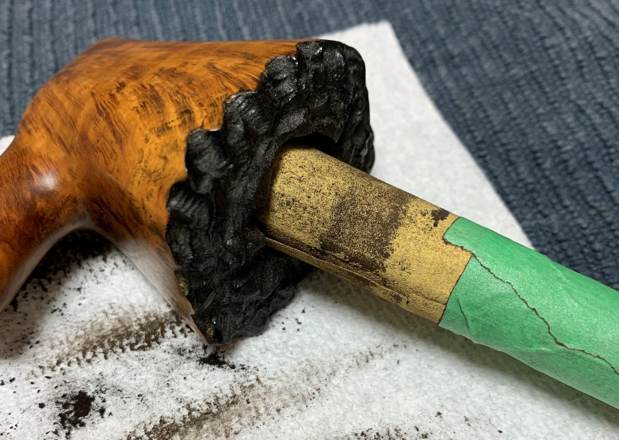
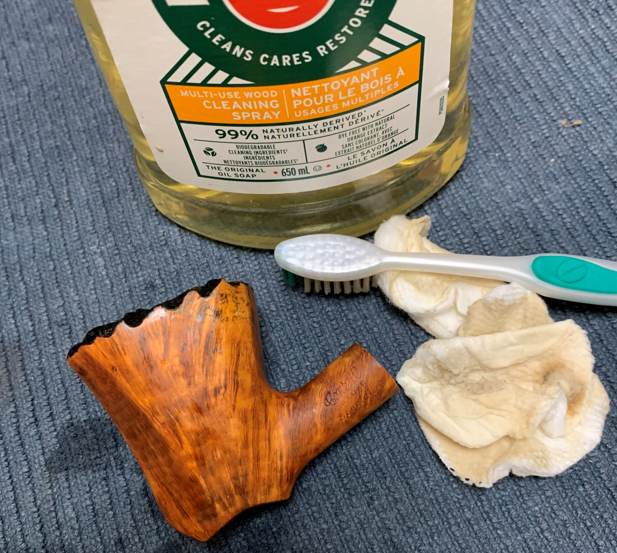
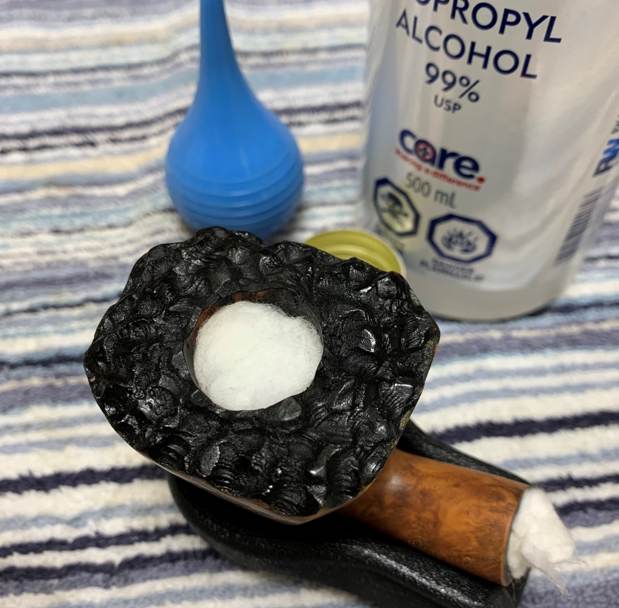
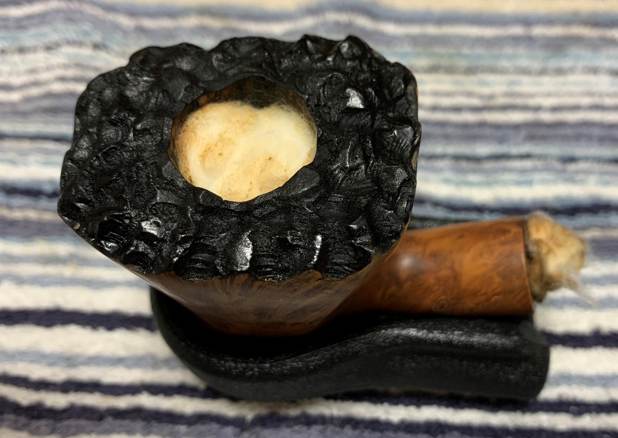
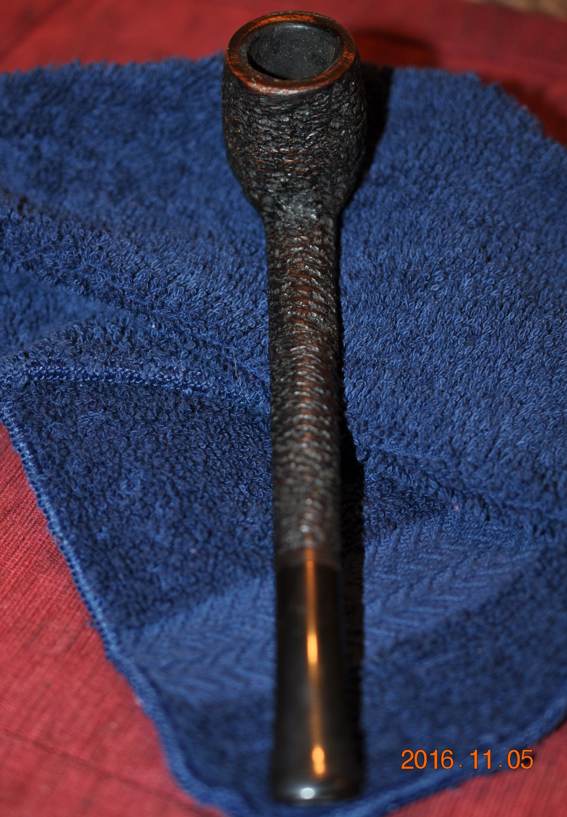
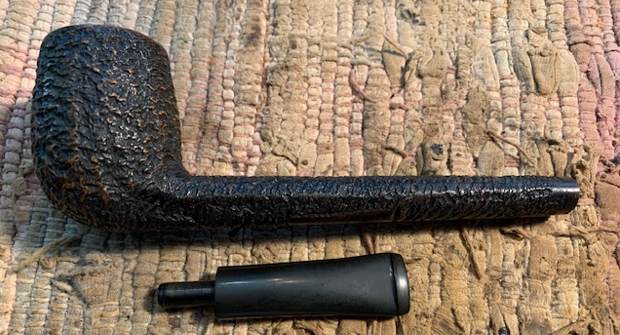
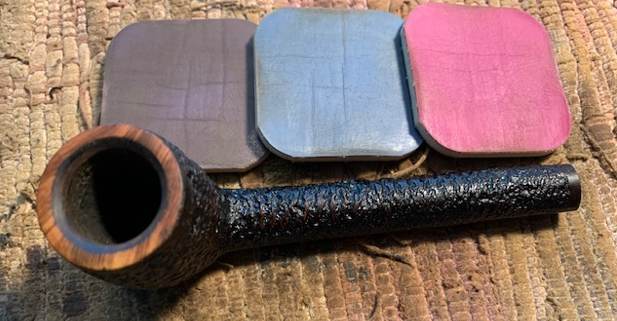
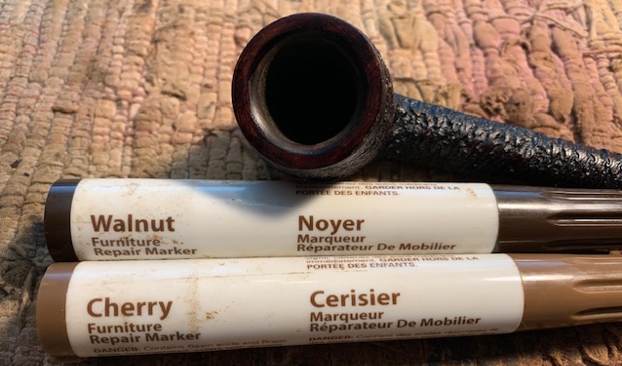
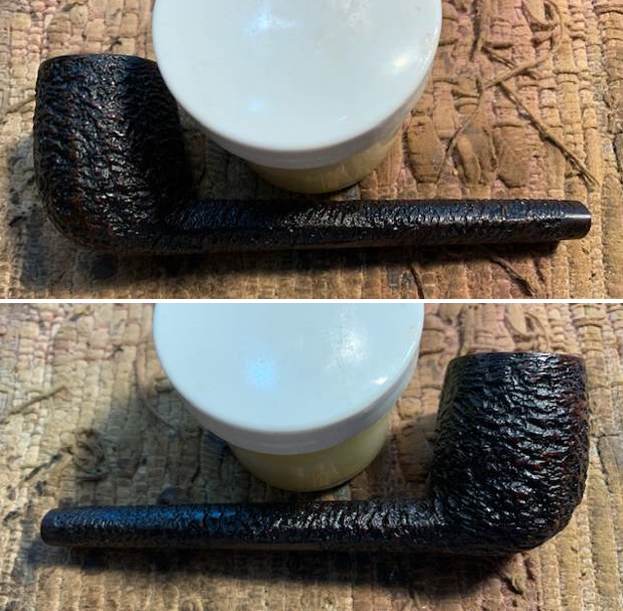
The Frog Prince


Blog by Kenneth Lieblich

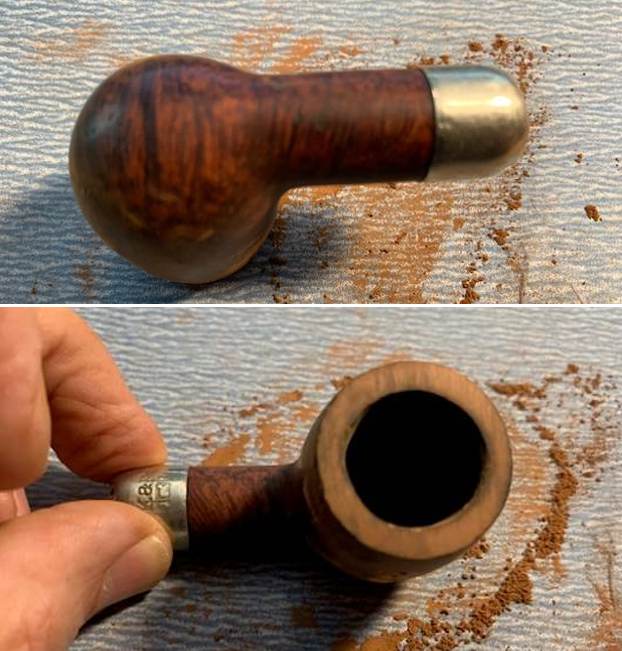
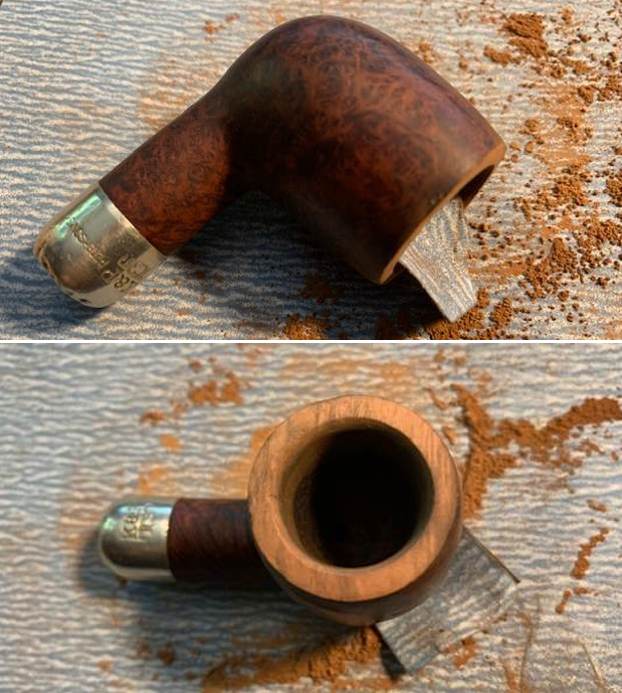
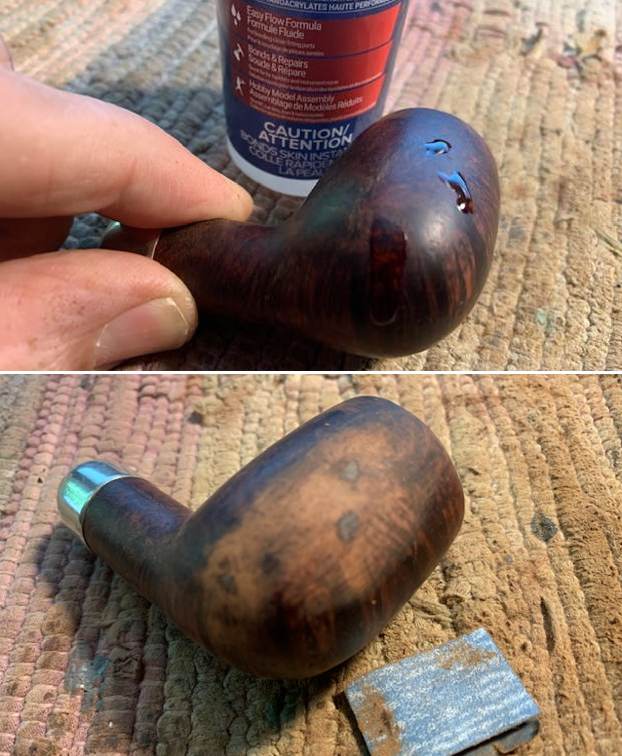
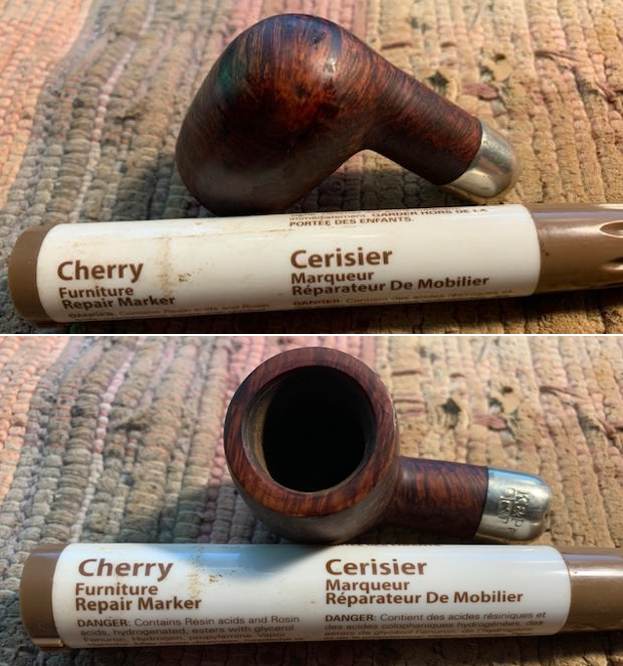
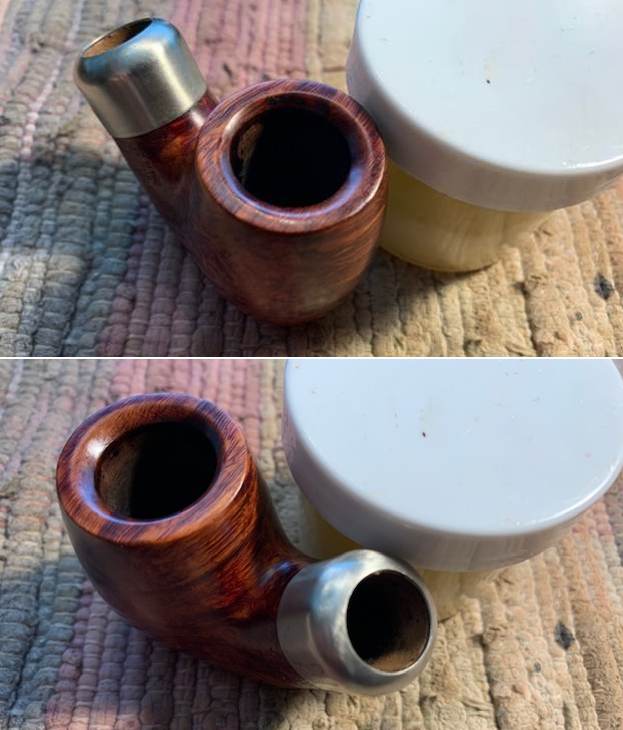
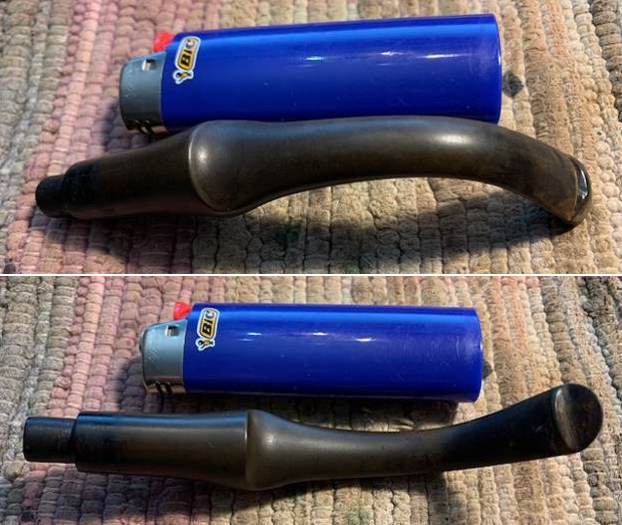
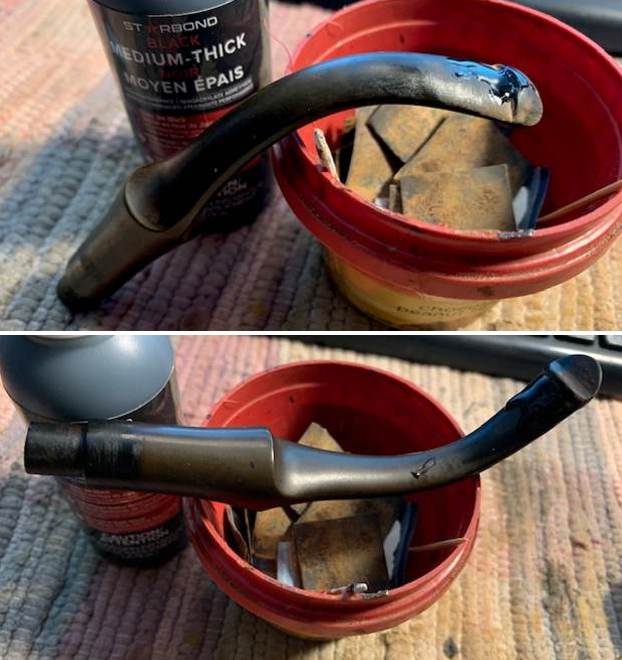
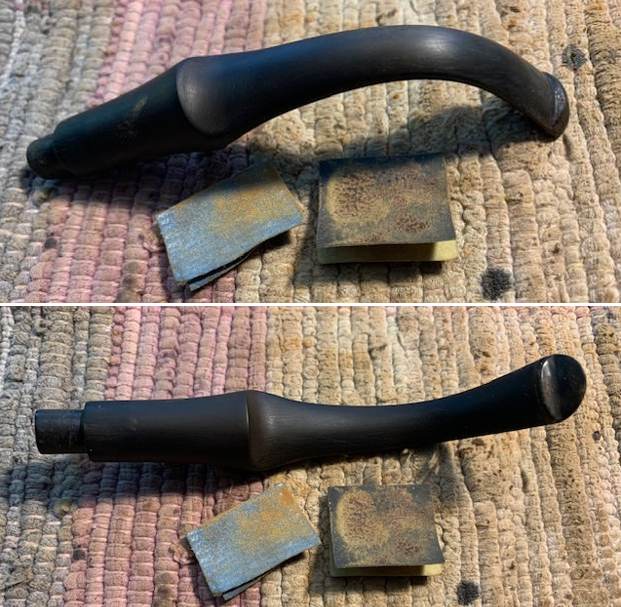
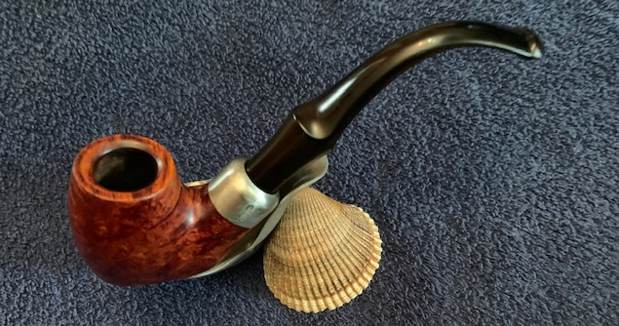
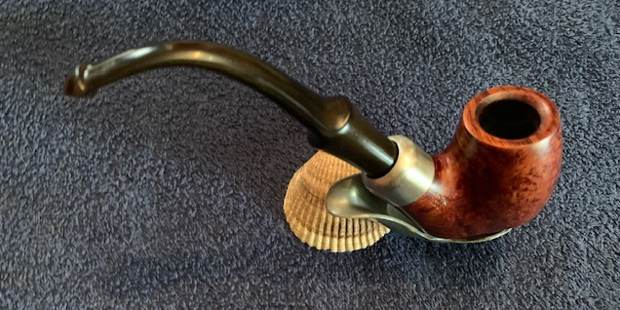
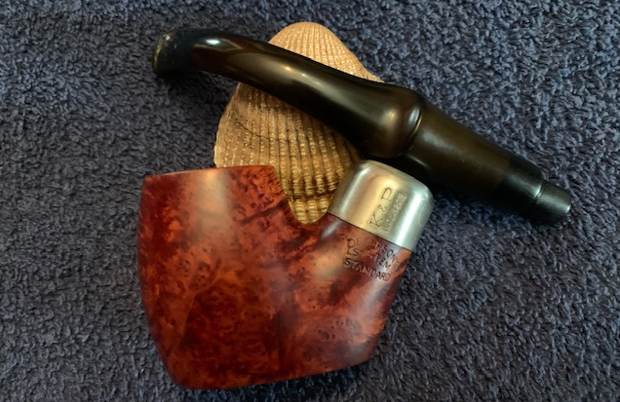
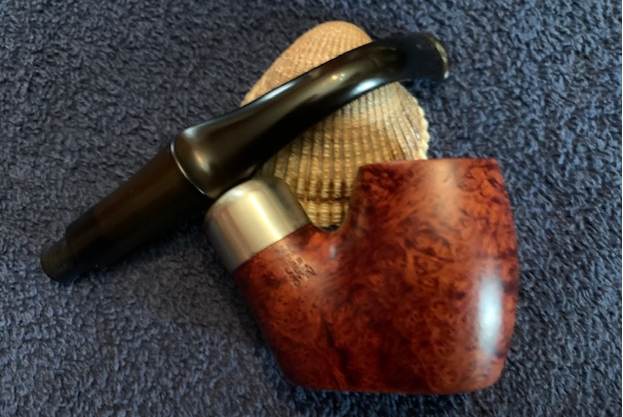
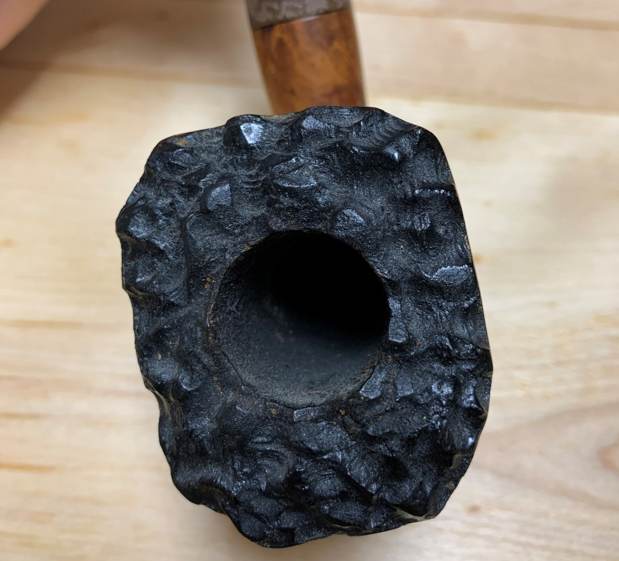
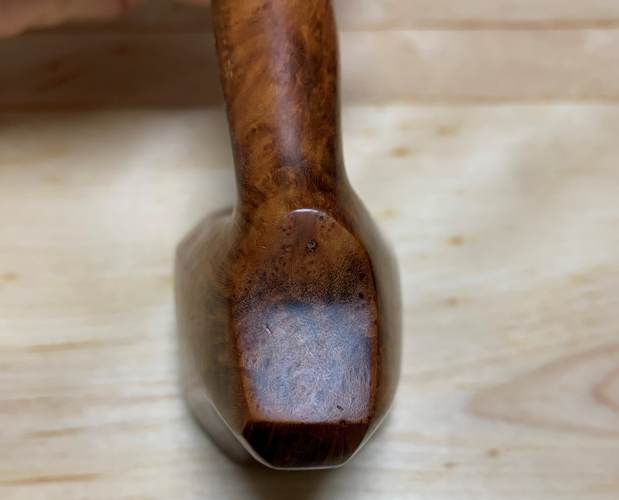
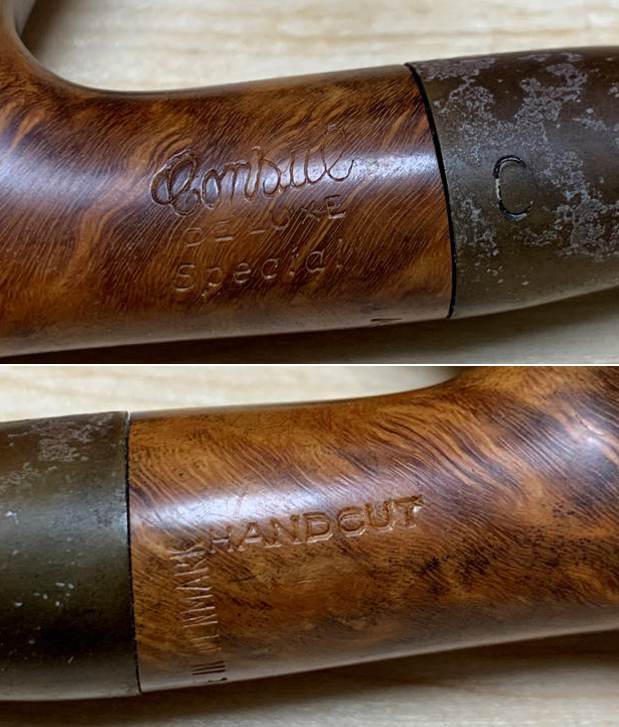
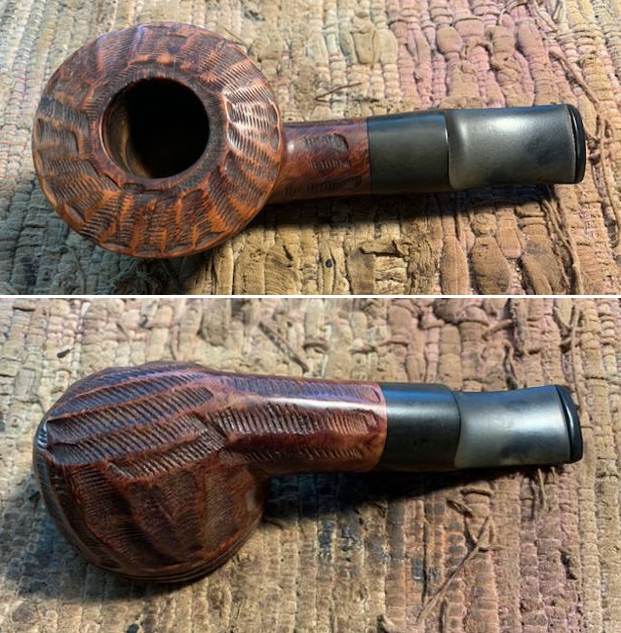
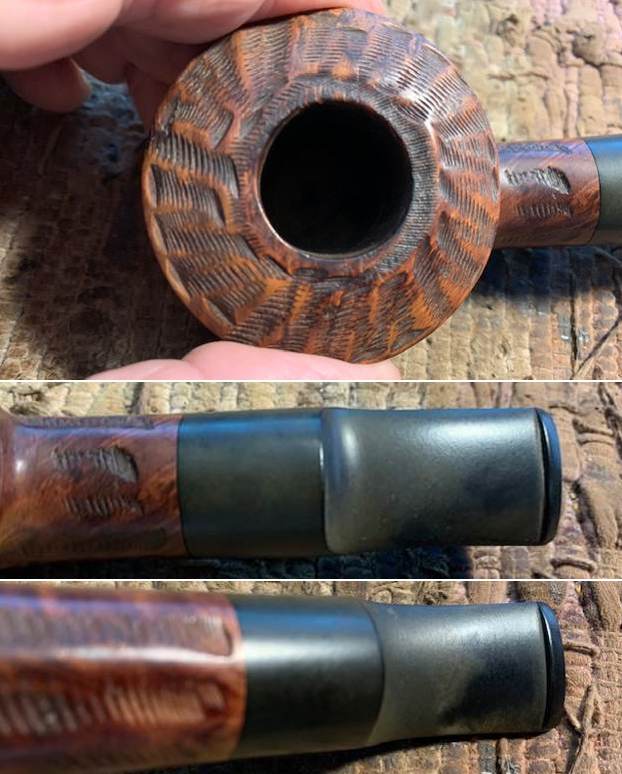
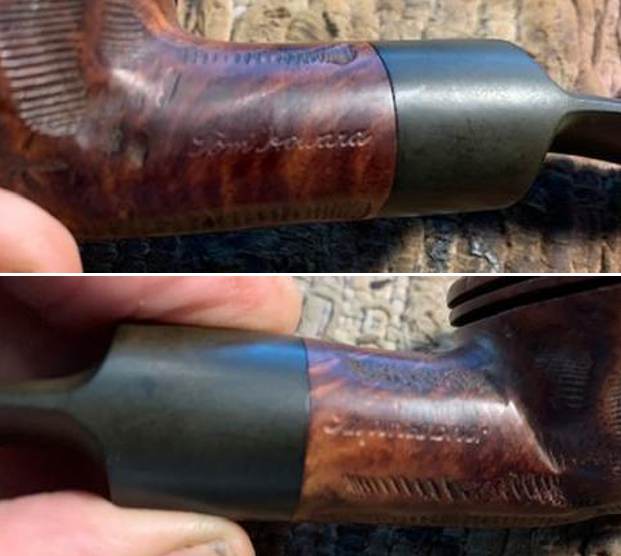
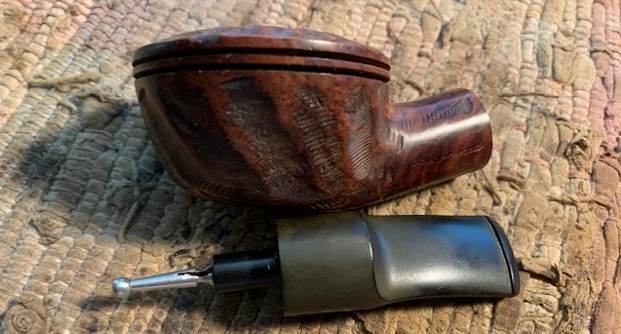
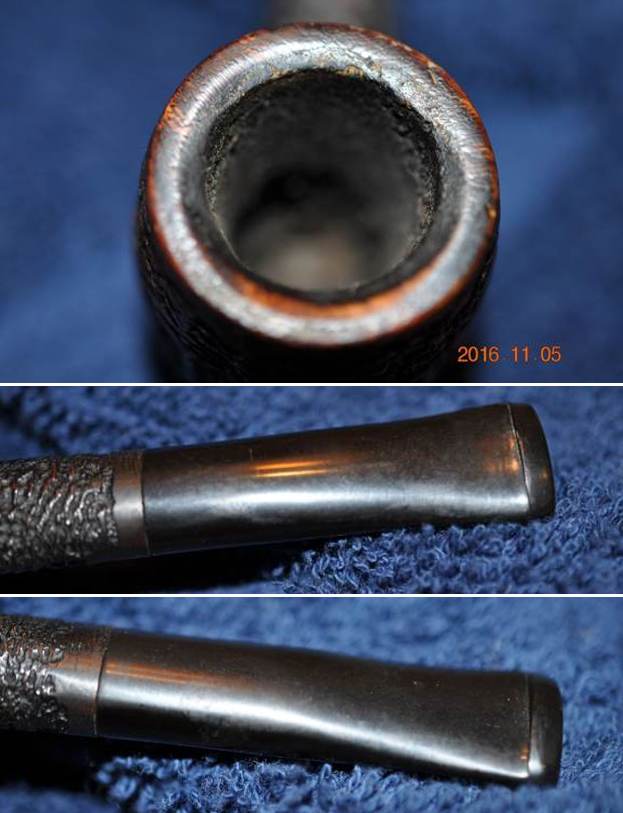
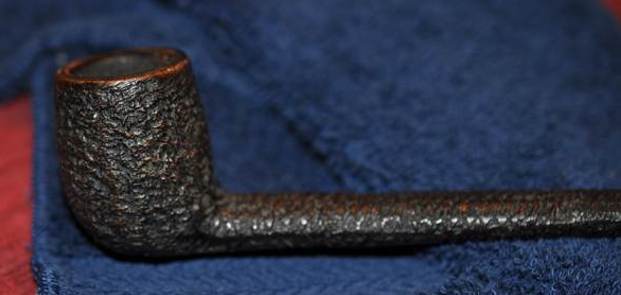
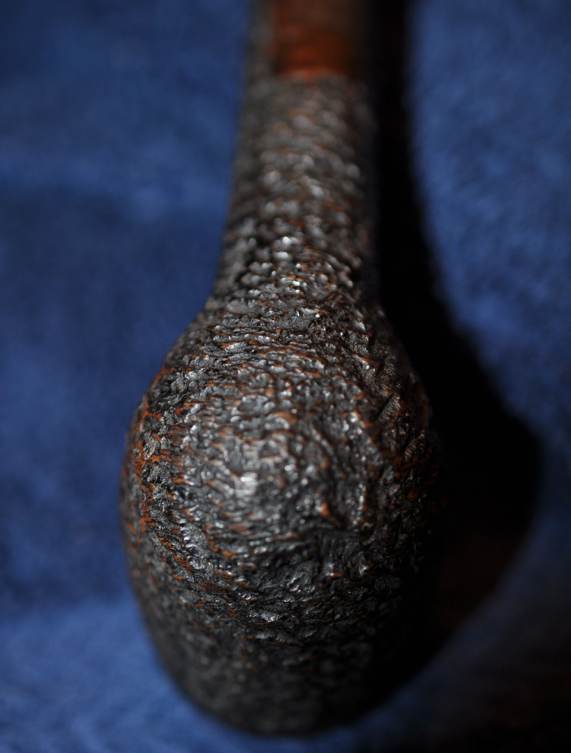
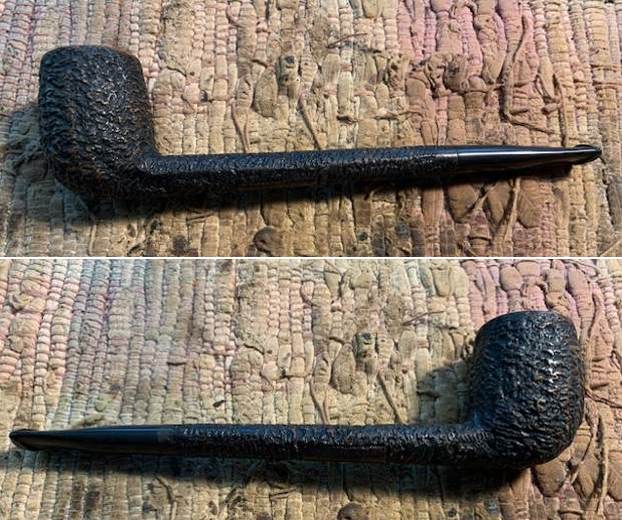
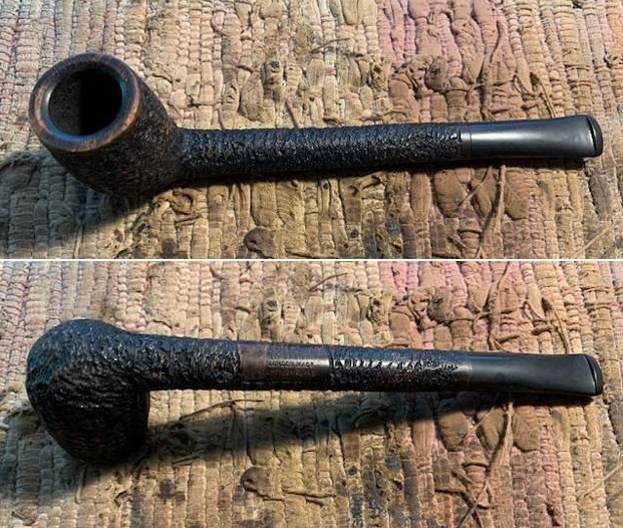
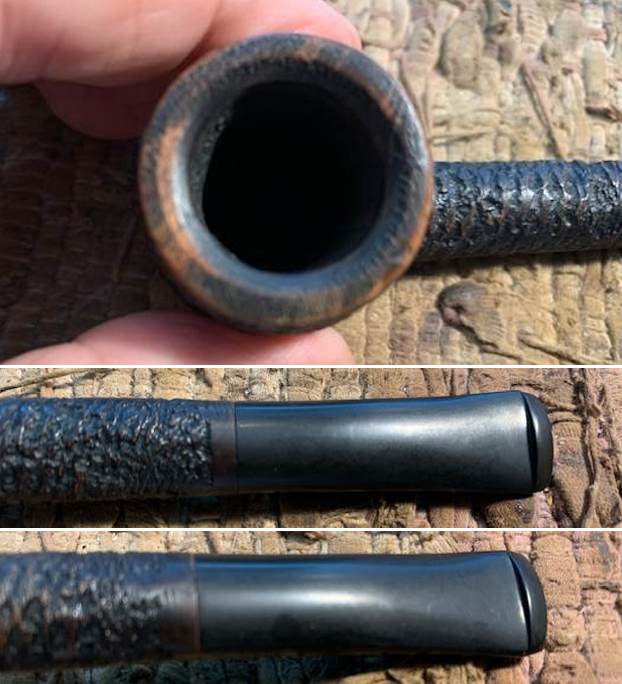
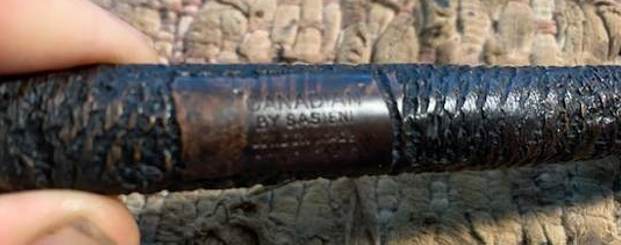
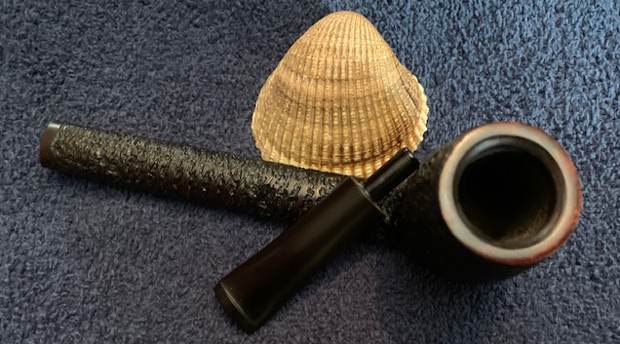
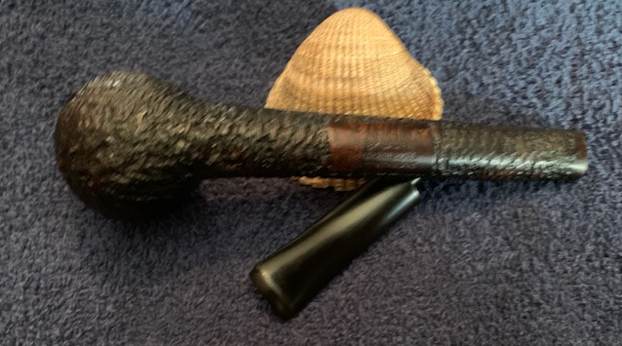
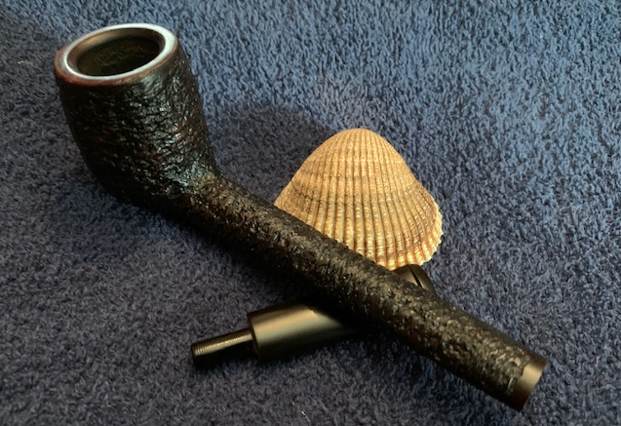
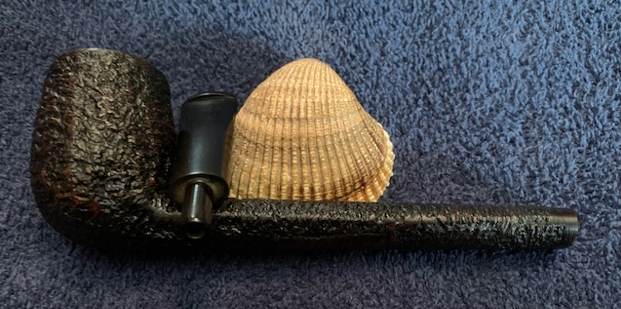
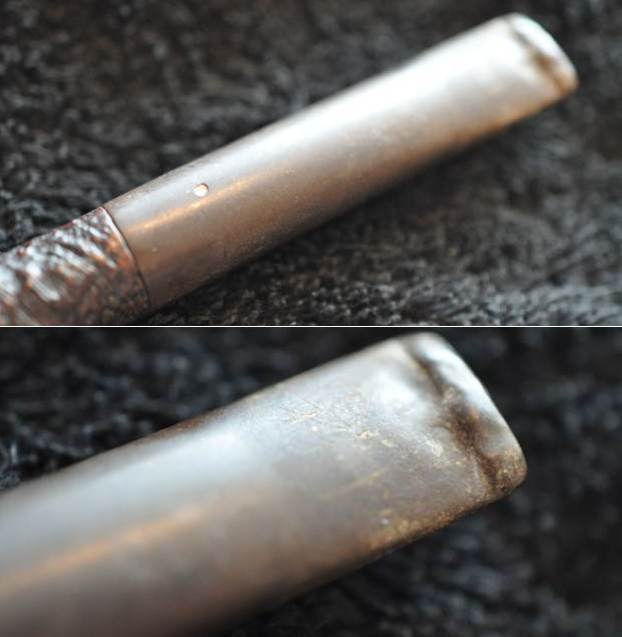
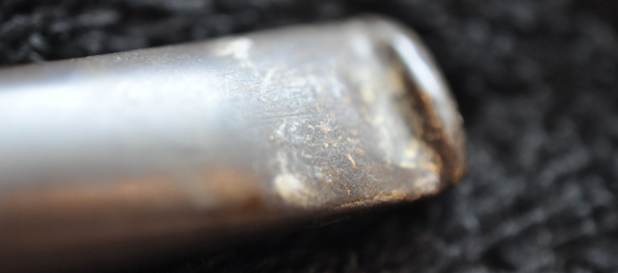
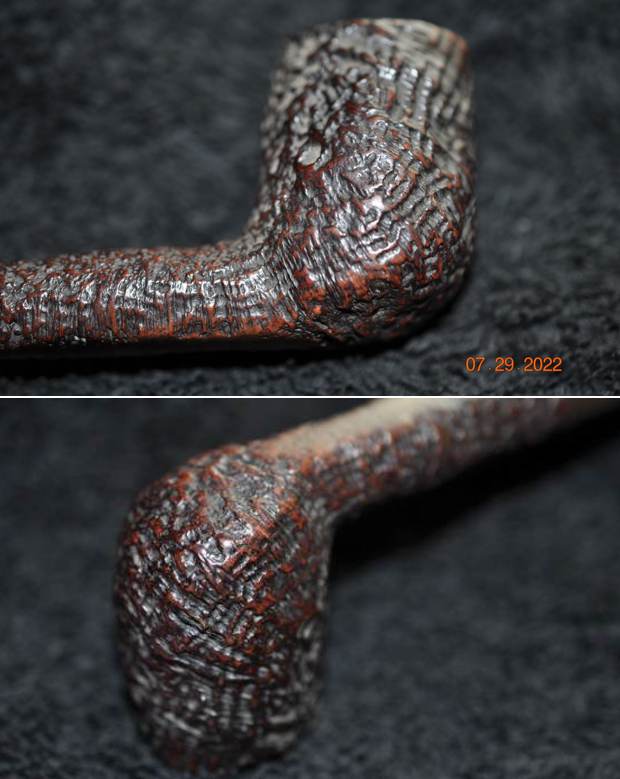
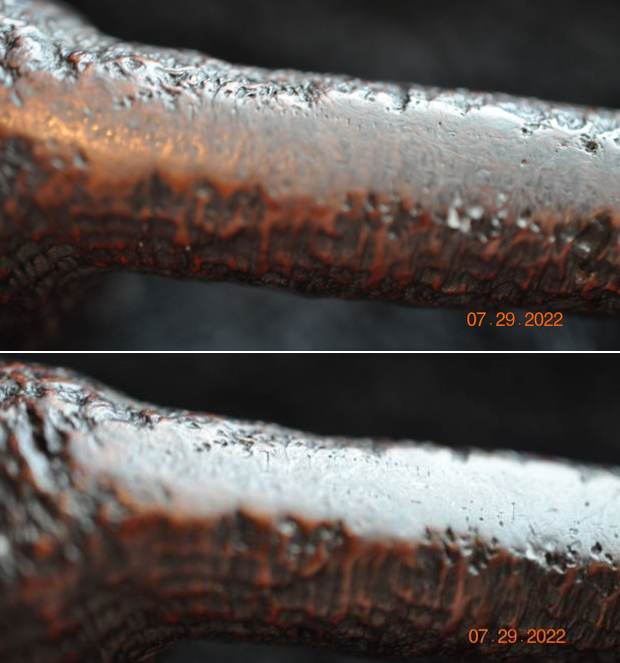
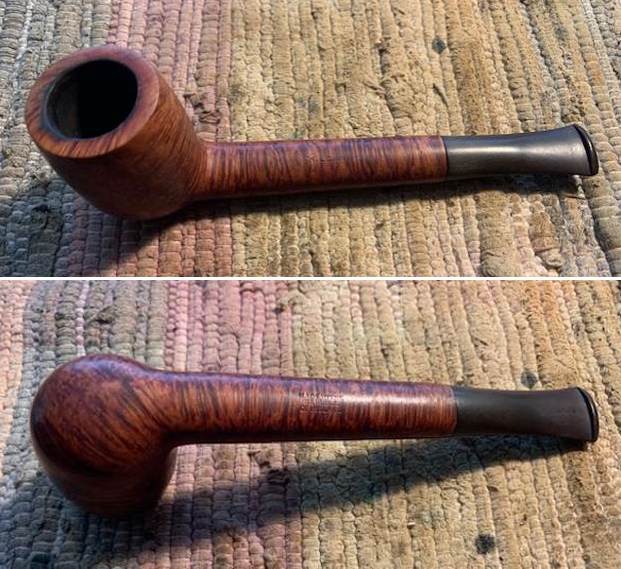
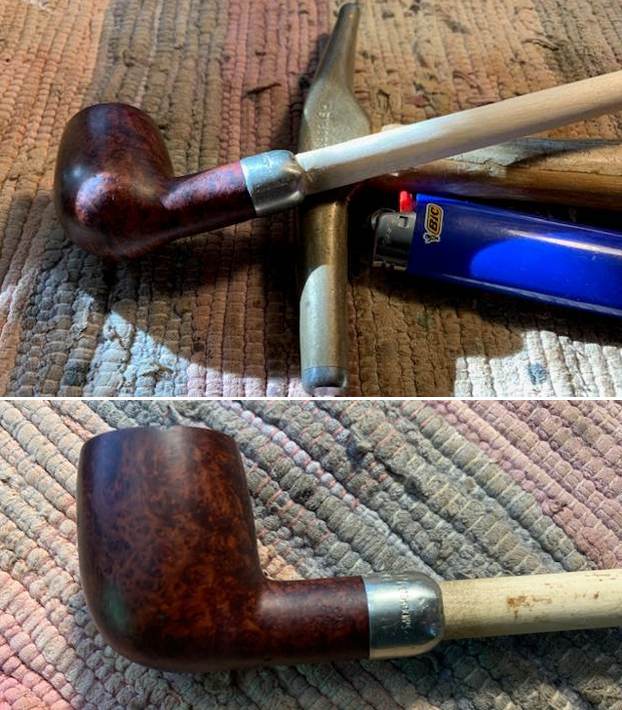
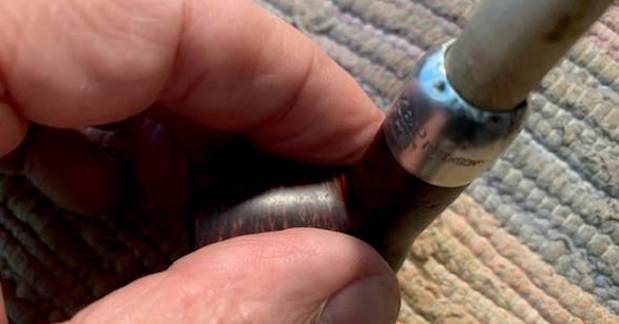
Pull up a chair and light your pipe – I am about to regale you with the tale of one of the most challenging restorations I have ever undertaken. I hesitate to write “restoration”, simply because the work required on this pipe imposed a burden on that word that it may not have been intended to bear. Perhaps “re-creation” is a better word. This post is a little longer than usual, but worth it. This frog needed much more than a kiss to turn into a prince.This is a rusticated Leonard Payne Classic pipe in a billiard shape, with a matching military-style stem and dental bit. The left side of the shank reads Len Payne [over] Classic. Similarly, the ferrule also reads Payne [over] Classic. However, there are no markings (or no visible markings) on the right side of the shank. I acquired this pipe from the granddaughter of the gentleman who once owned it. This fellow is now deceased, but I am pleased to honour his memory with my work. This was obviously a favourite pipe of his, both because it was so dirty and because the rustication was so worn! It is clearly a great smoker.The pipe in question was made by the late, great Canadian artisan, Leonard Payne. He was born in England, moved to Canada in the 1950s, and died in the Vancouver area within the last few years. Payne was, to put mildly, an idiosyncratic pipe maker. I can do no better than quote Mike Glukler of Briar Blues (found on Pipepedia):

“Leonard Payne was based in B.C. for many years. He came to Canada from England. He had shops in Surrey, B.C. and Kelowna, B.C. Interesting fellow. Gruff as the day is long. When you bought a pipe, it was handed to you in a paper bag. No sock, no box. Most of his pipes carried a ‘carburetor’ system at the shank/stem junction. Another Payne idea was his shanks. Almost all his pipes were two pieces. He’d turn the bowl and shank, then cut off the shank and reattach with glue (not always with the same piece of briar, so many did not match grains). His thinking was that the shank being the weakest link, if cut and glued would never break and thus ‘correcting’ the weakest link.In addition, there was a photograph that Steve found of Payne on Reddit that appears to date from the 1960s. The original poster on Reddit told me that the photo comes from the City of Surrey Archives. I have no idea why it is in French, but here is my translation of the text on the right:

“Pipe makers are not on every street corner in Canada! Leonard Payne, originally from England, didn’t know the challenges he would face and that’s probably what influenced his decision to come and try his luck in Canada. After his arrival in 1957, he and his family settled in Vancouver, where he first found work as a tool maker – and made pipes in his free time. In 1959, he decided to become a full-time pipe maker, and since then he has had department stores in all parts of Canada among his clients. He imports briar blocks from Italy and pipe stems from England.”This pipe was a perfect example of Payne’s work. It had a ‘carburetor’ system at the shank/stem junction and the stummel had been separated in two and reattached with glue (although, in this case, he did reattach the matching piece of briar).This pipe was charming, but it had a number of issues. The stem was dirty, though not too beat up. There were a few small scratches, etc., as well as some minor oxidation to the vulcanite. The ‘carburetor’ system was going to make cleaning all the more challenging, as there was little room around the end of the aluminum tube to remove all the filth.The stummel was a different story. It was dirty, dull, and worn. The pipe had been rusticated once-upon-a-time, but so much hand-rubbing of the wood over the years had eroded it (and a lot of the Len Payne markings).

However, by far the biggest problem was the bowl. It was badly out-of-round, burned on the rim, and – take a close look at the photos – it had clearly been decapitated at some point in the past. Steve and I spoke about it, and we figure that the original pipe probably developed a crack after heavy use. The owner, loving his pipe so much, decided that he would rather modify it than toss it. Presumably, he then took a saw and cut off the damaged wood. Following this, he would have stained the wood with something very dark. All of this is conjecture, of course, but it seems likely, given the current state of the pipe.    What on earth do you do with a hacked-up pipe? Read on…

While I decided to have a “thunk” about it, I tackled the stem. I began by cleaning some of the filth on the outside with some Murphy’s Oil Soap on cotton rounds. This removed some of the surface staining. Then, I started cleaning the inside with isopropyl alcohol and pipe cleaners. This took a while. The inside wasn’t terribly dirty, but the empty space inside the end of the stem was tricky to clean well. Once the stem was good and clean, I placed it in a container of Pipe Stem Oxidation Remover overnight. This liquid does (as the name suggests) remove oxidation, but, more than anything, it helps draw oxidation to the surface of the vulcanite. This allows me to clean the oxidation off in a couple of ways: both by applying a mild abrasive cleaner to the surface, then by sanding the stem.I used SoftScrub with some cotton rounds and, as you can see, lots of revolting colour came off the stem. Thankfully, there were no significant dents, scratches, or bite marks that required a cyanoacrylate glue repair, so I moved on to the next step. For sanding the stem, I use a set of nine Micromesh pads (1,500 through 12,000 grit) which gradually erase the ravages of time and bring out the stem’s lovely black lustre. For the last five pads, I also lightly coat the stem with Obsidian Pipe Stem Oil in between each scrubbing. At last, I set the finished stem aside. On to the stummel and, as I indicated earlier, there were MANY problems to be solved.

  1. The insides were quite filthy and would need considerable work to clean.
  2. The metal ferrule would not come off the wood. It was absolutely solid.
  3. The metal ferrule also needed to be polished.
  4. The rustication had rubbed away so much that it would need to be redone in some way.
  5. The bowl opening was badly out-of-round.
  6. Burn marks and an uneven surface blighted the rim of the pipe.
  7. The fact that the top of the pipe had been lopped off meant that it just didn’t look In a sense, this was the biggest problem of them all.

On to problem #1. The bowl really needed to be reamed, so I used the KleenReem too to scrape off as much built-up cake and followed that with 220-grit sandpaper taped to a dowel to eliminate as much as possible. Generally, I prefer to sand the chamber down to bare briar. When restoring, it is important to ensure that there is no damage to the briar under the cake. There are a few situations when I might leave some cake in the bowl, but not today. And, fortunately, there were no hidden flaws to the briar on this pipe.I gave the wood a quick cleaning with Murphy’s Oil Soap. It turned out that I would need to clean it again later.I then proceeded to clean out the insides of the shank with pipe cleaners and lemon-infused isopropyl alcohol. There was quite a bit of built-up grime inside this stummel, and it took a good number of pipe cleaners to get it clean. Or – I thought it was clean. I’ll come back to that.    Problem #2 was an interesting one. To be honest, I wasn’t sure if the ferrule was permanently attached to the shank or not. Steve told me that it is supposed to come off and that I’d better get it off because there would be plenty more pipe goo to clean. So, I dug out my trusty heat gun, applied some heat to the join and – voilà! – the grime softened sufficiently for me to unscrew the ferrule.As Steve had hinted, it was a real mess inside the shank, behind the ferrule. Just dreadful – and it took more pipe cleaners and Q-tips than I used for the rest of the stummel just to clean out this area. It had obviously never been cleaned before. I even threw the thing in an alcohol bath! The dirt just kept coming and coming, but, at long last, I finally got it clean. I followed that up by cleaning the insides of the whole stummel with some Castile soap and tube brushes. Finally, I polished the tiny piece of the ‘carburetor’ system by inserting a piece of 0000 steel wool down the shank and grinding it shiny.    Problem #3 was quite straightforward to resolve – Deo gratias. I started by soaking the filthy threads of the screw in my lemon-infused isopropyl alcohol. They were dirty and the dirt was very stubborn. Eventually, it did come off and I could proceed. Next, I rubbed the aluminum ferrule with 0000 steel wool. This is the least abrasive grade of steel wool and I wouldn’t use anything harsher than that. I then used the last few MicroMesh pads to make the metal shine.Problem #4 concerned how worn away the rustication had become. I wanted to recreate the pattern that Payne had originally devised on his pipe. I took my Dremel Rotary Tool and used the smaller engraving cutter to achieve the small worm-track. The work was intricate and a bit nerve-wracking, but I was quite pleased with the results. My only problem was that I ended up having to repeat this process later, but I digress…

The solution to problem #5 – the out-of-round chamber opening – came from a familiar source. I took a solid wooden sphere, wrapped a piece of 220-grit sandpaper around it, and sanded the inner side of the chamber. This achieved two things: first, it removed some of the burn marks on the inner edge of the rim; and second (and more importantly), the circular shape and motion of the sphere gradually returned the edge to a perfect circle. This takes time and patience, but it is quite effective. But there was more to come. As it turned out, problem #6 bled right into problem #7. As I mentioned earlier, the surgery that the pipe received earlier in its life just didn’t look right. Something significant needed to be done. As always, Steve made an excellent suggestion to save and beautify this Payne pipe. He proposed modifying the pipe to a prince shape. This made a lot of sense. Changing this into a prince would (1) smooth out the ridiculously uneven rim top; (2) eliminate the burn marks on the top; and (3) allow what remains of the briar to be showcased properly and to greatest effect. I’ve included a sample photo of some prince pipes from Greg Pease’s collection, just to give you an idea of what I was aiming for. I’ll let you be the judge of whether I succeeded or not.So, heart-in-throat, I set about grinding the Payne with my Dremel and a sanding disc. Gently, gradually, cautiously, I removed more wood and began to set the new shape. This was no mean feat for me – the Dremel is a powerful tool, and this process can go pear-shaped very easily. The following series of photos demonstrates the progress as I shaped the bowl. Once the shape was nicely developed, I used some 220-grit sandpaper to smooth and round the crown of the rim. Of course, I had to redo much of the rustication work I did earlier, since my Dremel removed most of it. This went very well. It was only at this point, when I felt comfortable with the work I had done, that I cleaned the outside of the pipe thoroughly with Murphy’s Oil Soap and a toothbrush. By the way, here is a close-up photo of how Payne cut off then rejoined the bowl and shank. It’s unusual – I’ll give him that!The stummel cleaned up quite nicely and I was able to move on to the MicroMesh pads. Again, using all nine (1,500 through 12,000 grit), I sanded, rounded, and further embodied the prince shape.  I then paused and rubbed some Before & After Restoration Balm into the soft and smooth wood. I gently brushed it into the rustication grooves and let the balm sit for fifteen minutes or so. The BARB works so well at bringing out the best in the wood. I brushed it with a horsehair brush and buffed it with a microfibre cloth. Beauty! It is obvious that at this point the pipe needed to be stained. One issue that needed to be addressed right away was how to match the sanded area to the colour of the pre-existing stain. I opted to apply some Fiebing’s Dark Brown Leather Dye only to the sanded area. I flamed it with a BIC lighter and let it set. I then removed some excess with isopropyl alcohol on a cotton round. This provided a sufficiently accurate undercoat to the wood and would allow me to apply a separate layer of dye to the whole stummel. I repeated my steps in order to add the second and final layer of Dark Brown to all of the wood. This turned out beautifully – dark and rich, with lovely subtle variations in colour.    I reassembled the pipe to prepare it for polishing on the bench buffer. However, I added a little bit of petroleum jelly to the wooden threads inside the shank. This would provide some much-needed lubrication for the connection with the aluminum ferrule.I went to the bench buffer and applied some White Diamond to the stummel and stem. Then the final polish! The rusticated surface meant that I didn’t use carnauba wax – it gets gummed up in the grooves. Instead, I used Lee Valley Conservator’s Wax which worked like a charm. What a pipe! Goodbye frog, hello prince! This was an amazing restoration/re-creation and I really had fun with it. I think the result is fantastic – it turned a lump that was destined for the firewood pile into a pipe that pays homage to the man who created it originally and the man who smoked it so joyfully.

I am pleased to announce that this pipe is for sale! If you are interested in acquiring it for your collection, please have a look in the “Canada” pipe section of the store here on Steve’s website. You can also email me directly at kenneth@knightsofthepipe.com. The approximate dimensions of the Payne Classic are as follows: length 5½ in. (140 mm); height 1⅛ in. (29 mm); bowl diameter 1⅝ in. (41 mm); chamber diameter ¾ in. (19 mm). The weight of the pipe is ⅞ oz. (27 g). I hope you enjoyed reading the story of this restoration as much as I enjoyed restoring it. If you are interested in more of my work, please follow me here on Steve’s website or send me an email. Thank you very much for reading and, as always, I welcome and encourage your comments.