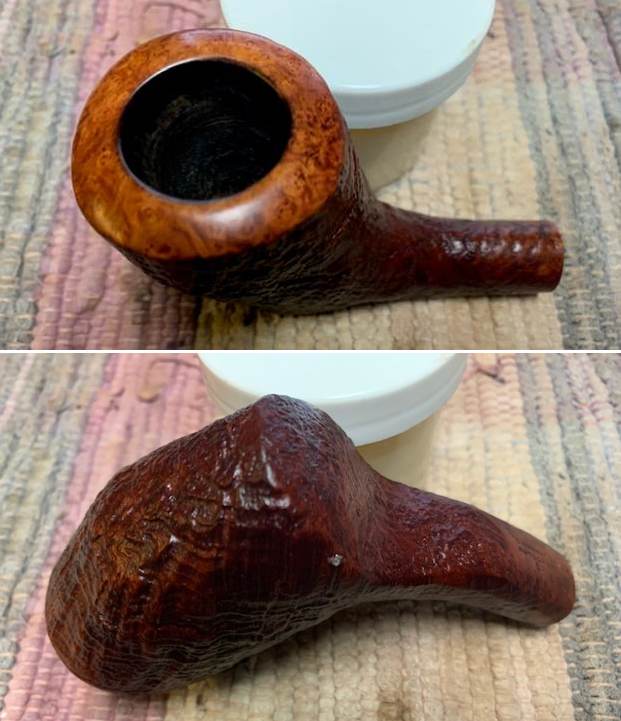
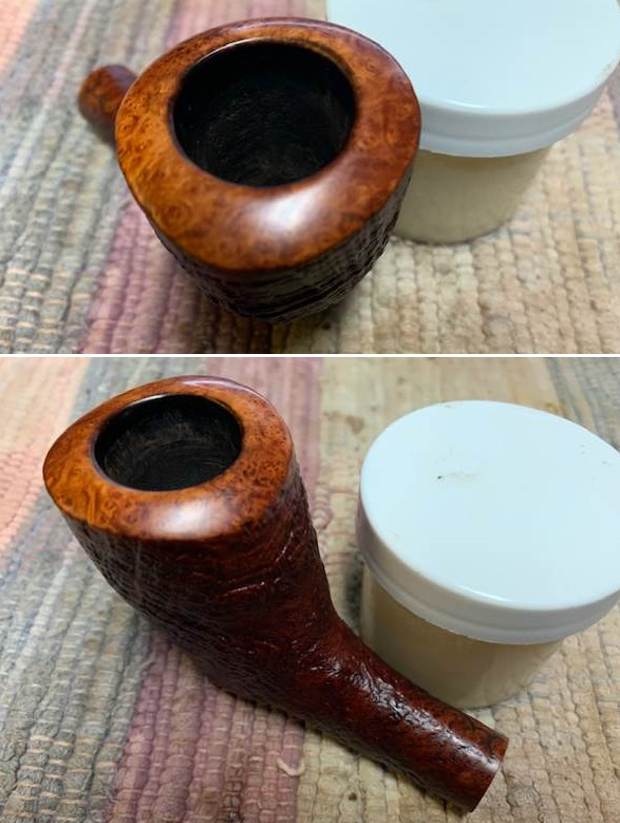
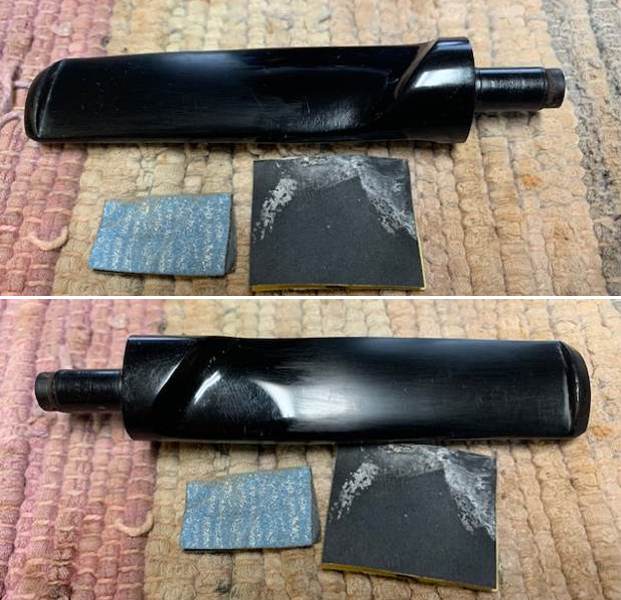
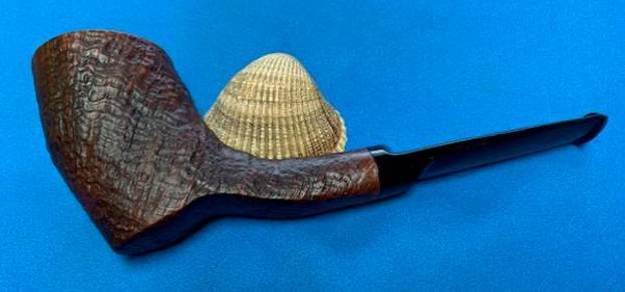
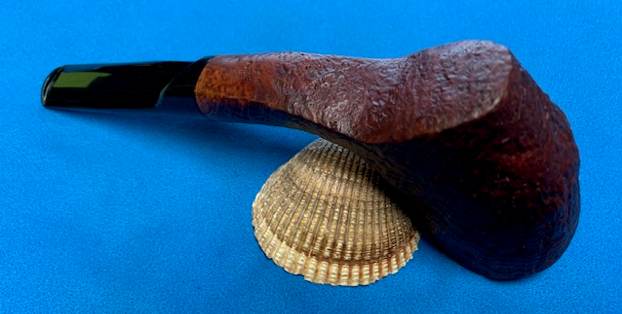
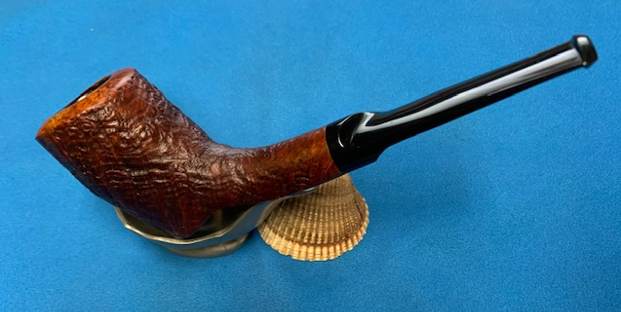
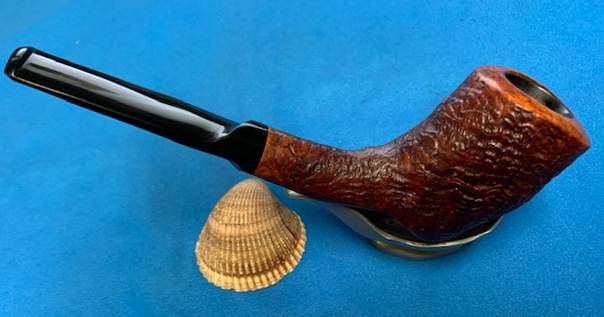
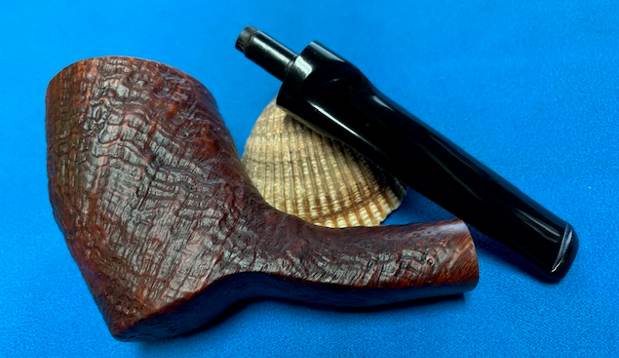
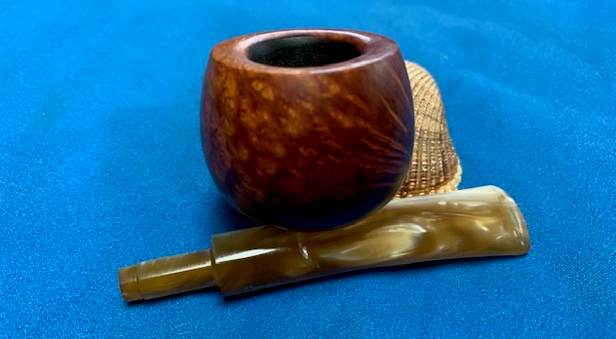
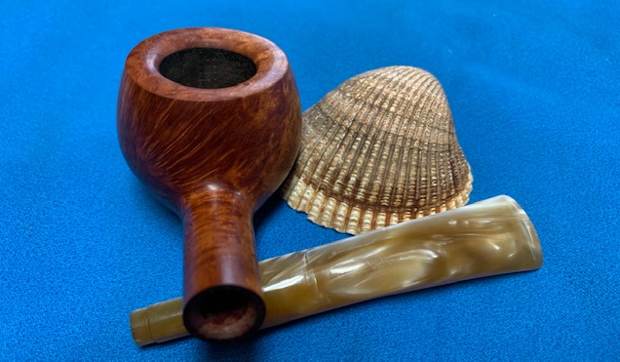
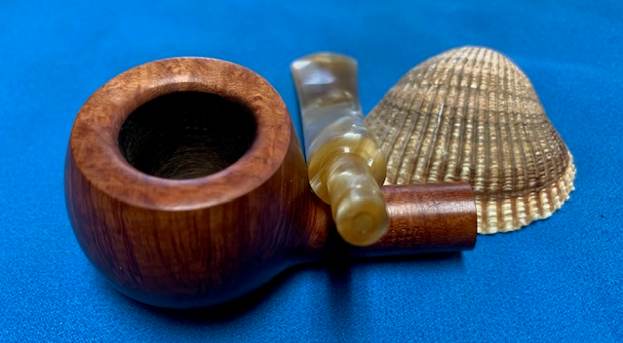
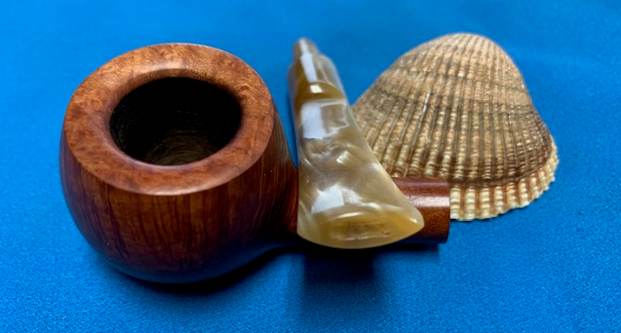
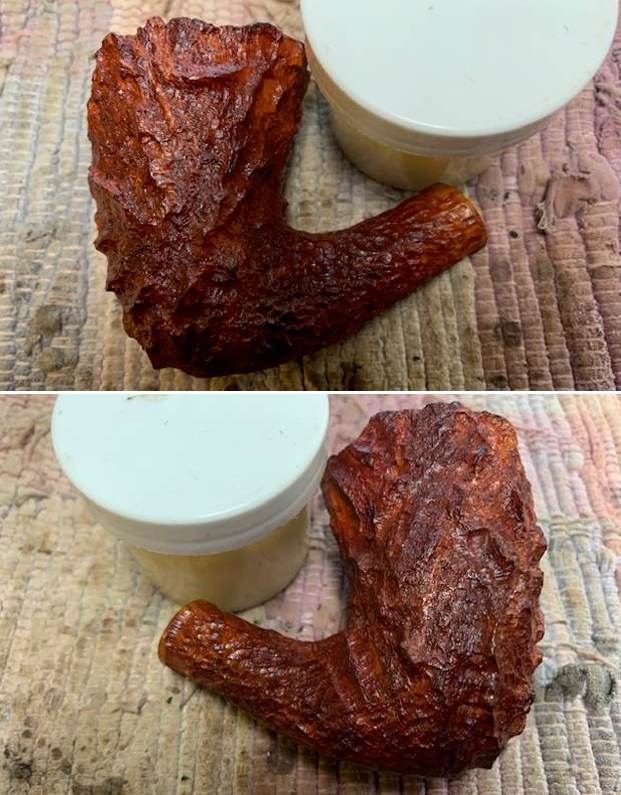
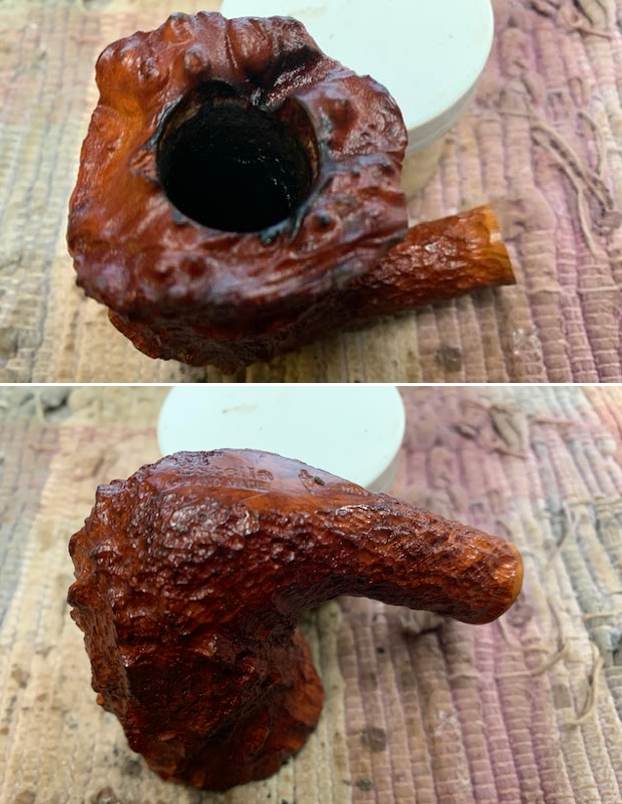
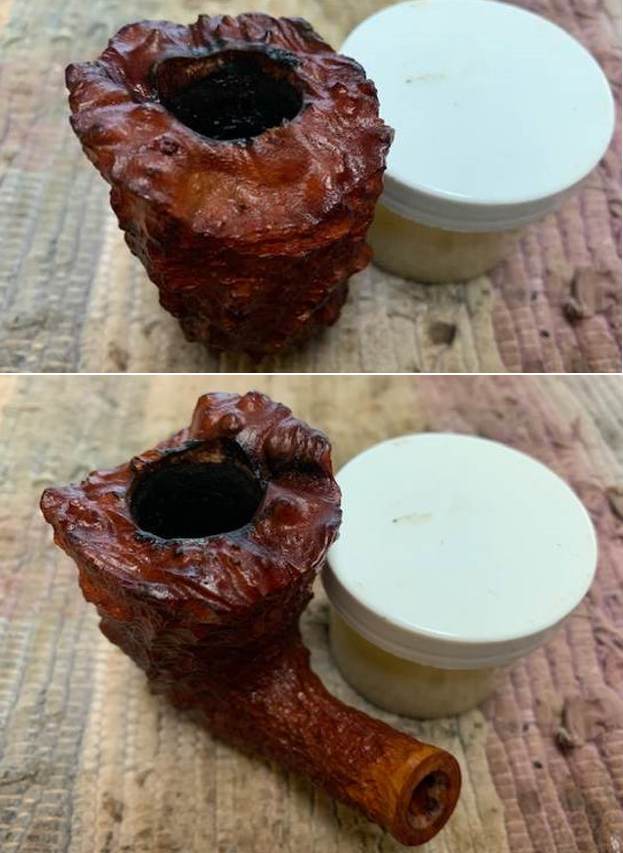
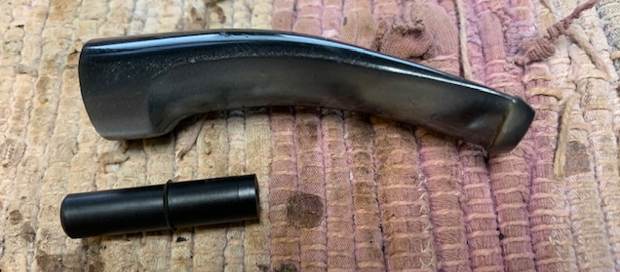
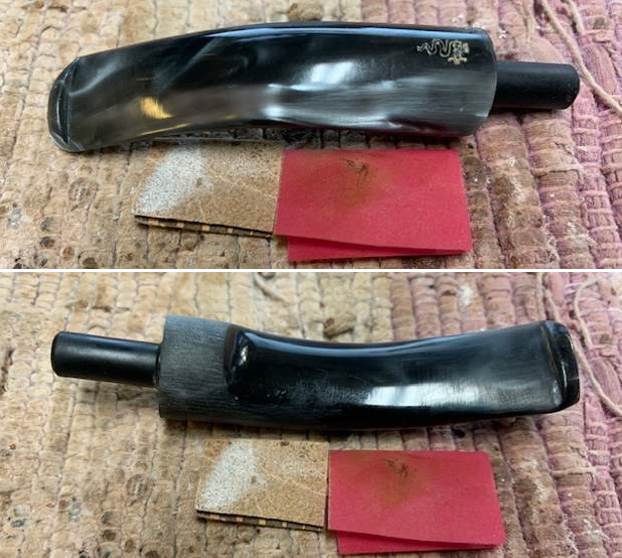
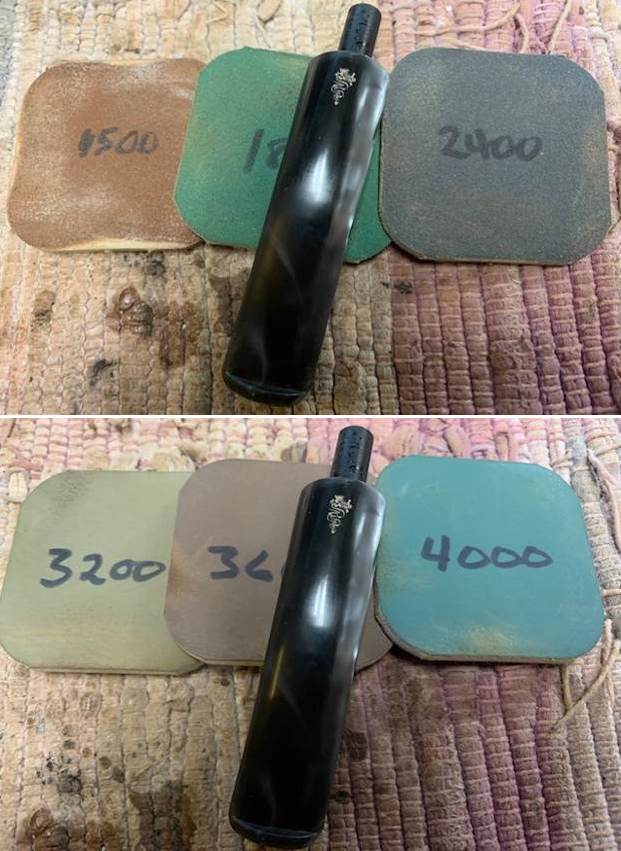
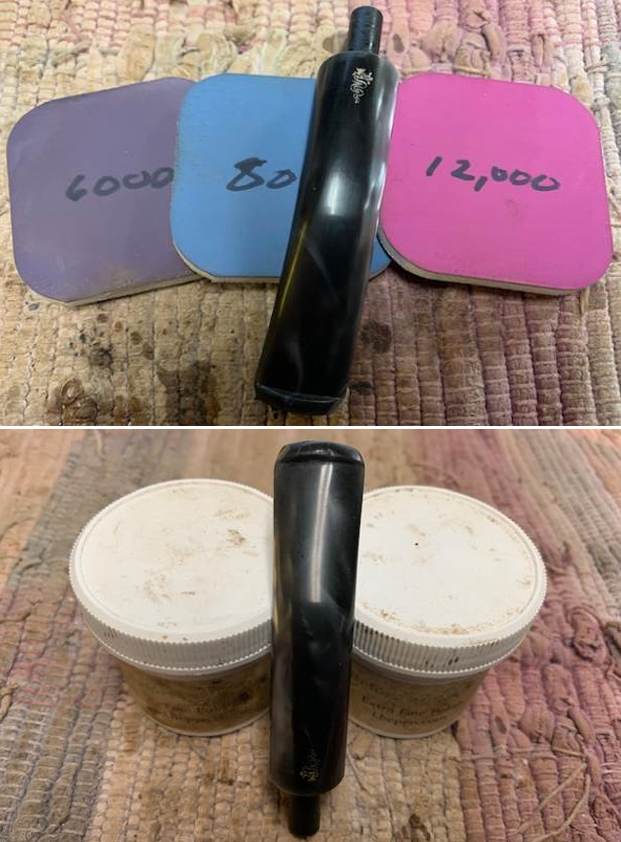
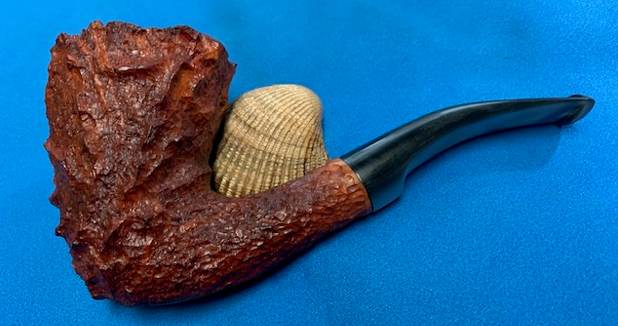
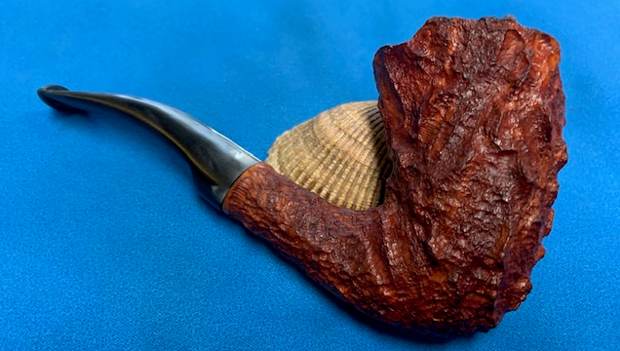
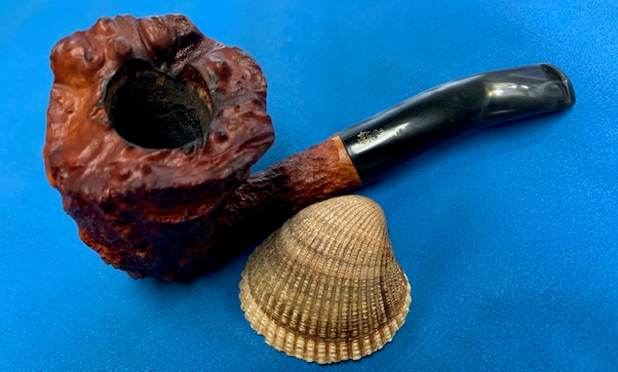
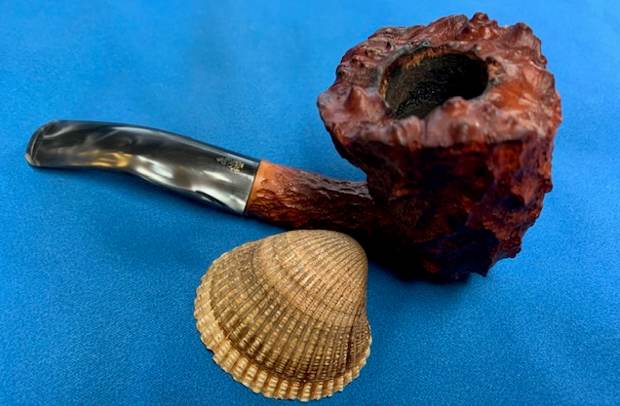
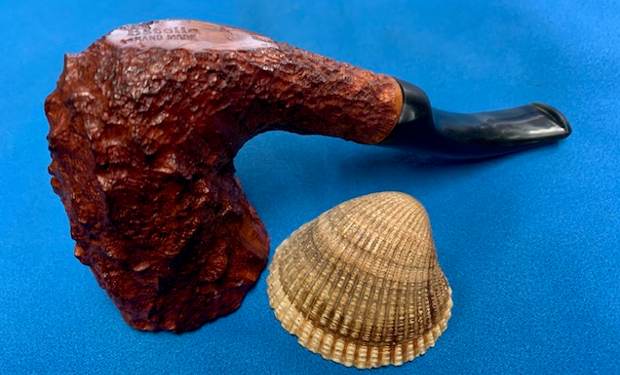
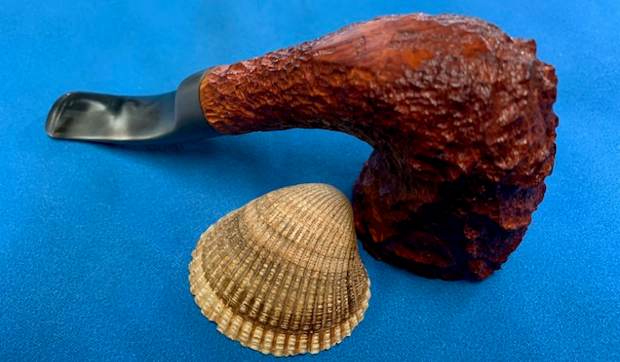
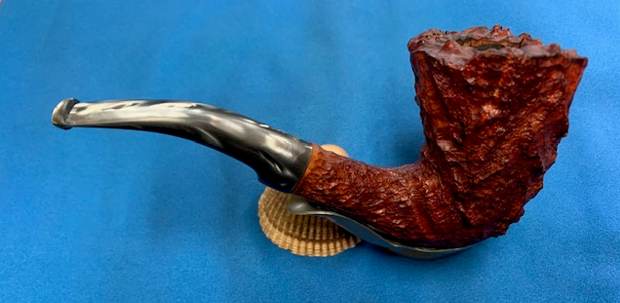
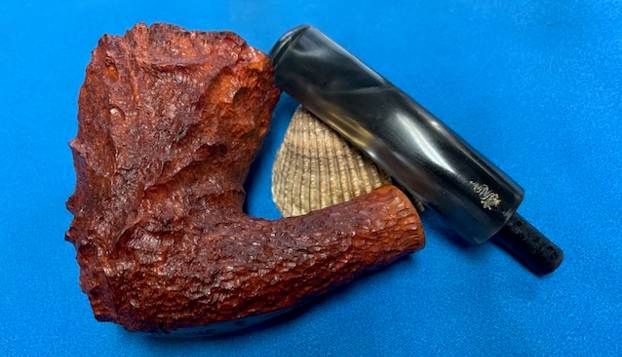
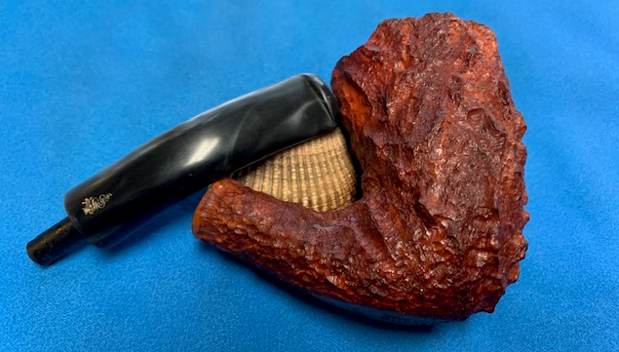
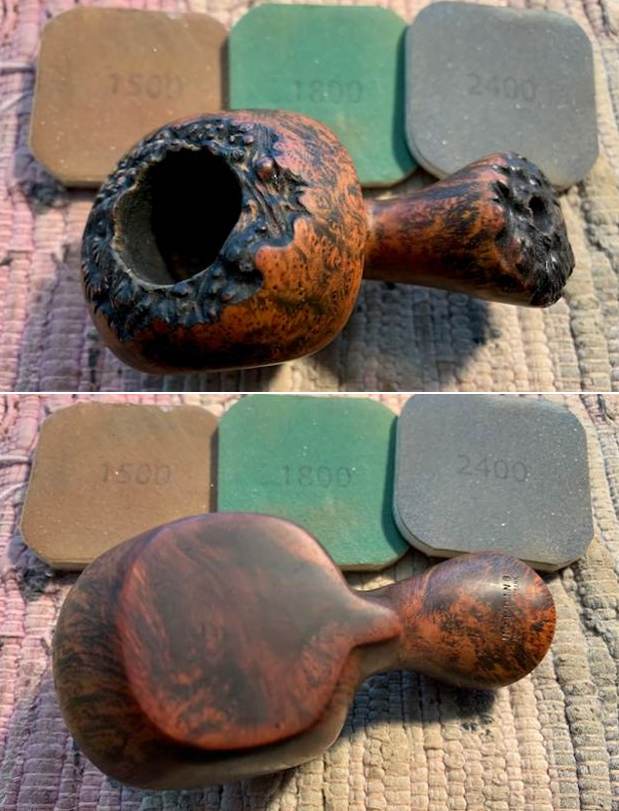
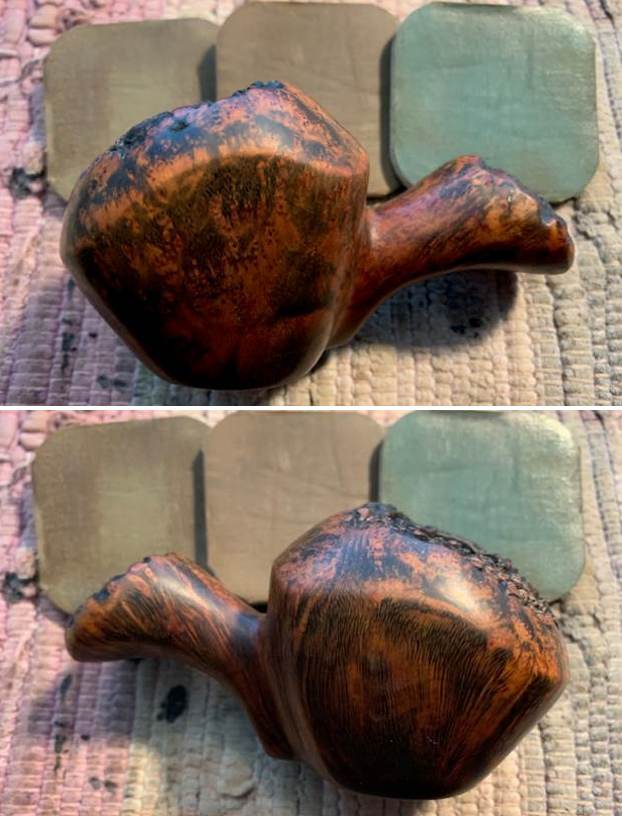
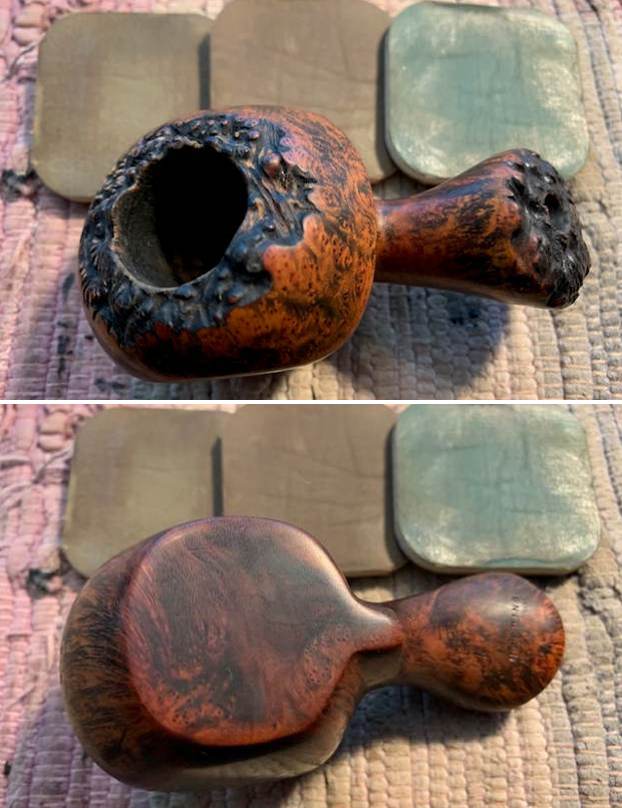
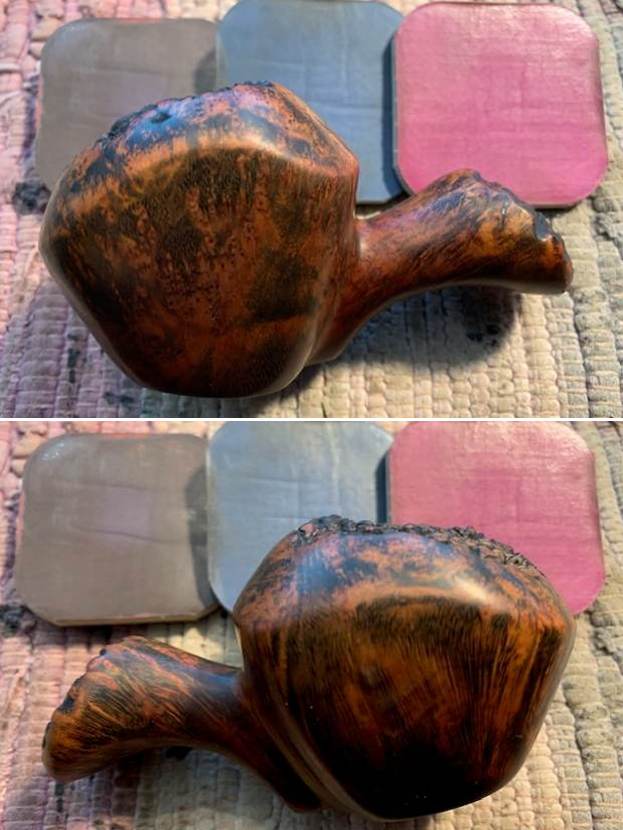
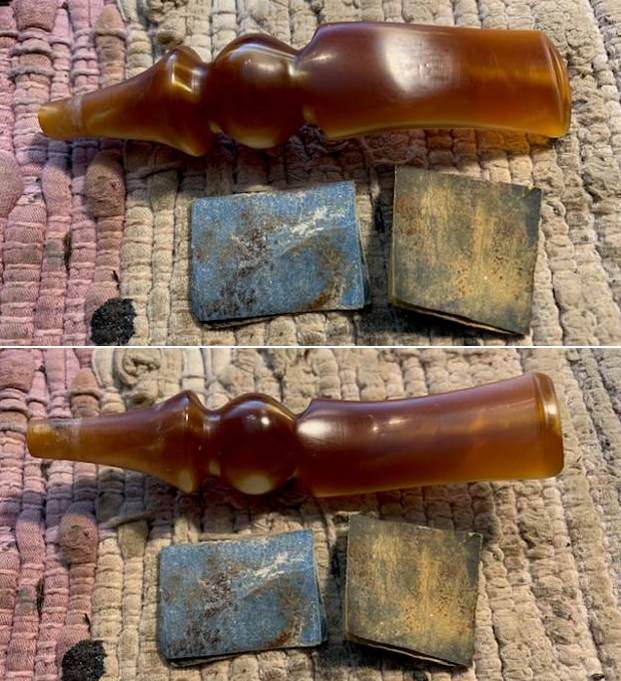
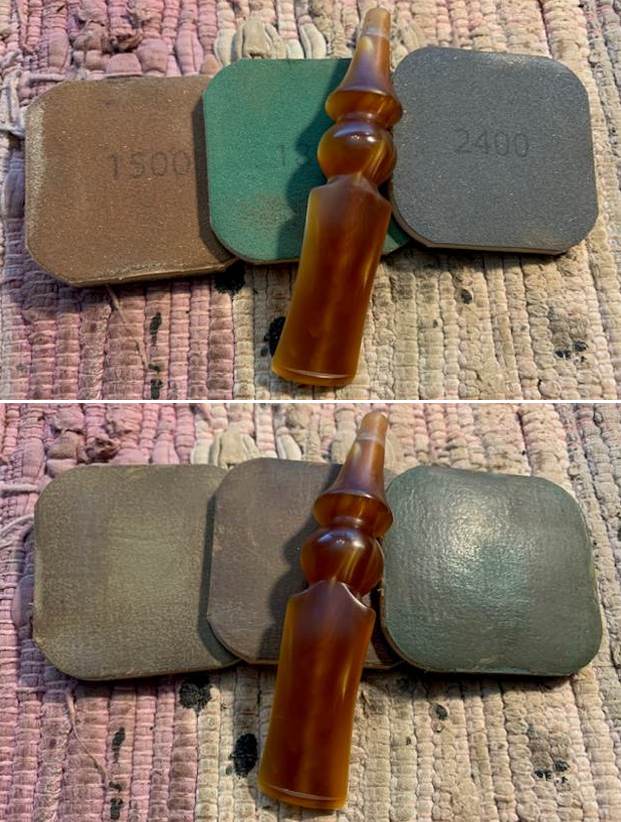
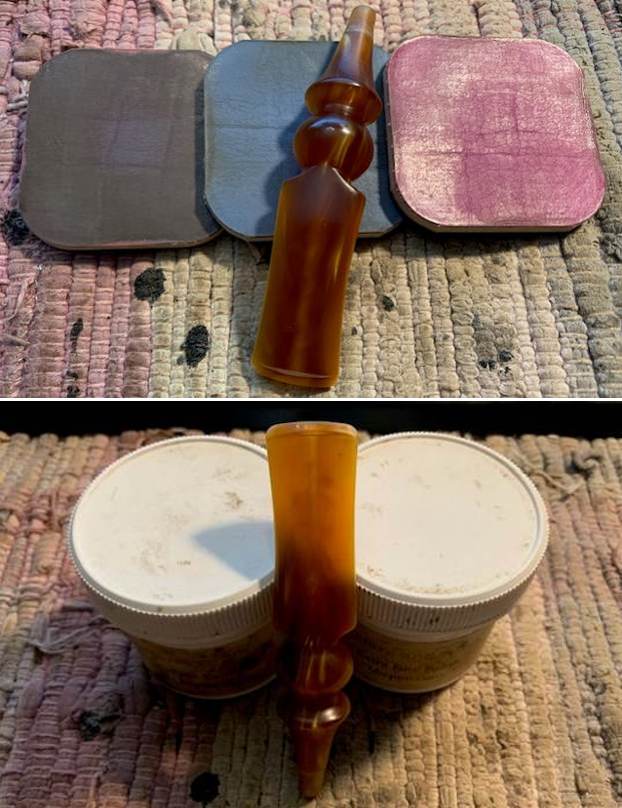
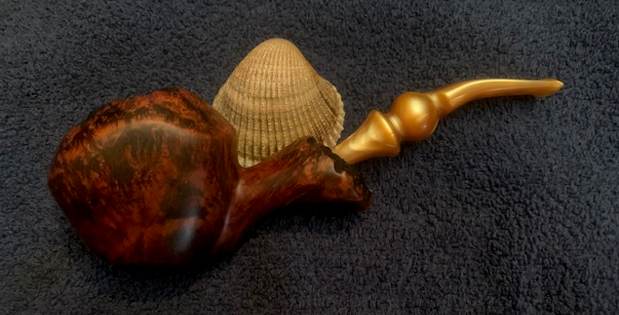
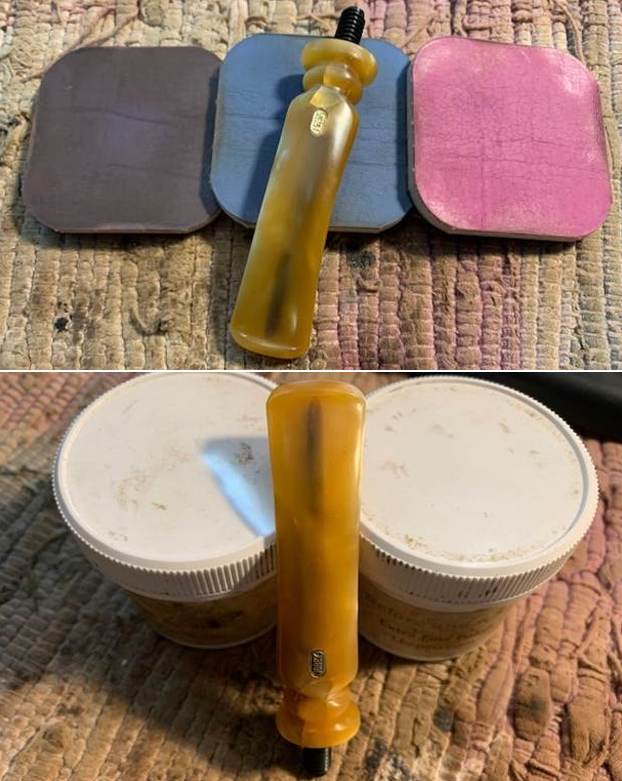
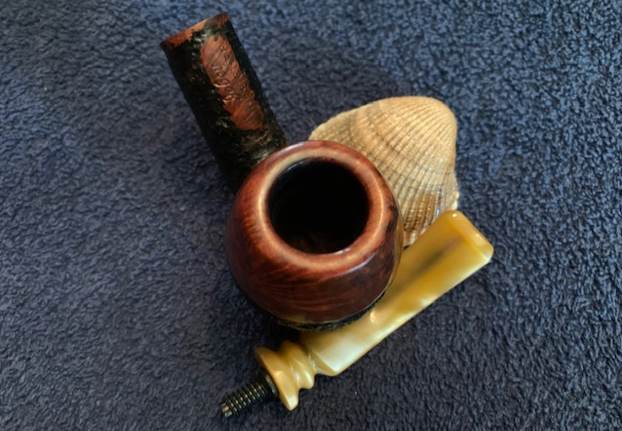
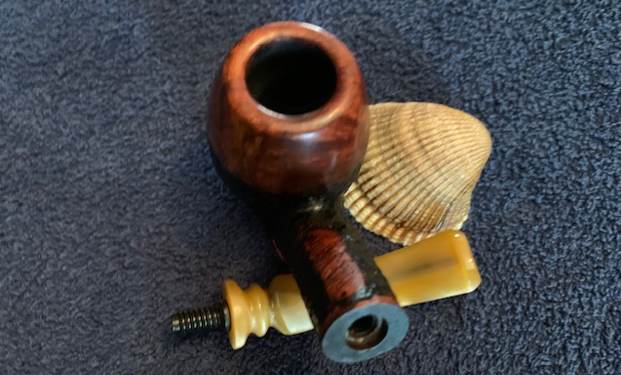
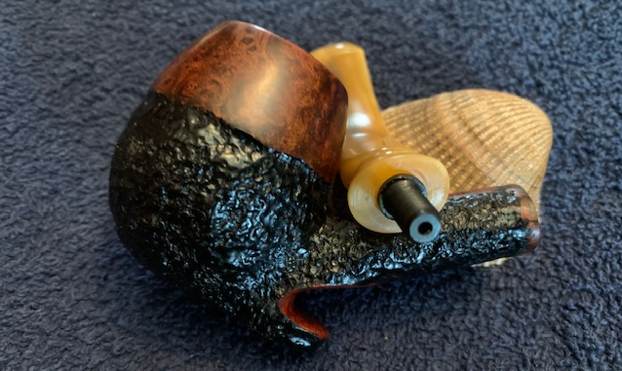
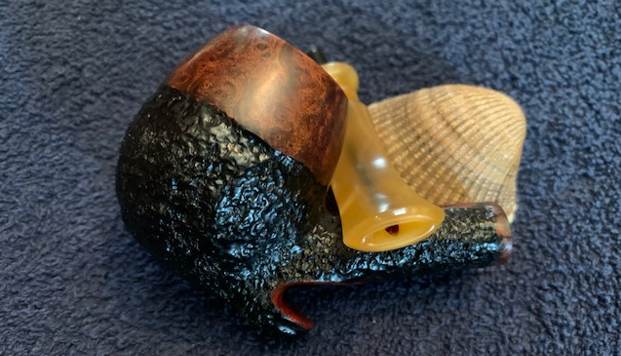
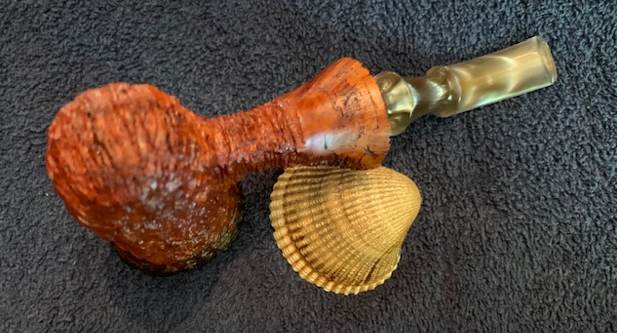
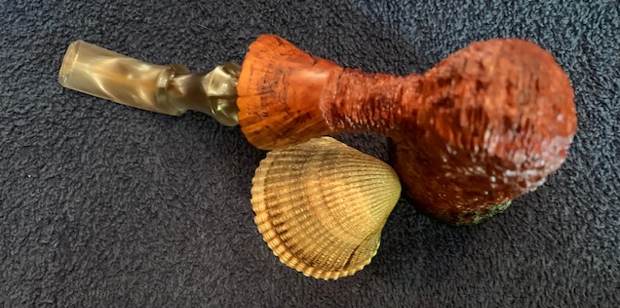
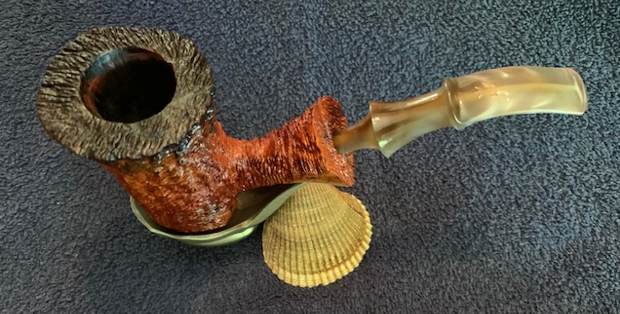
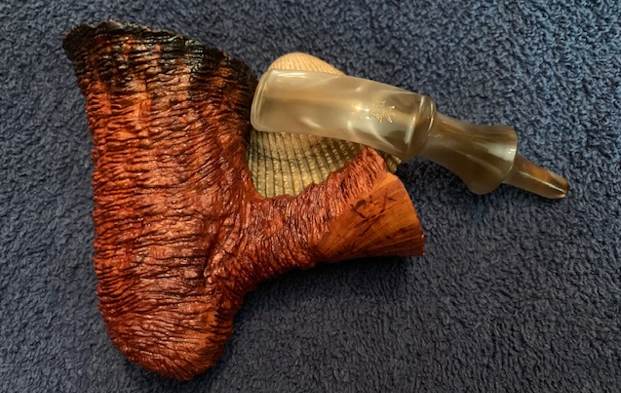
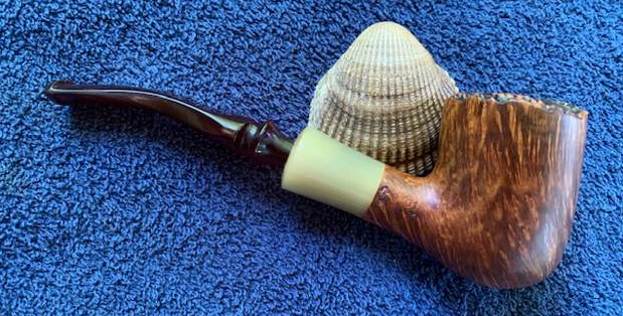
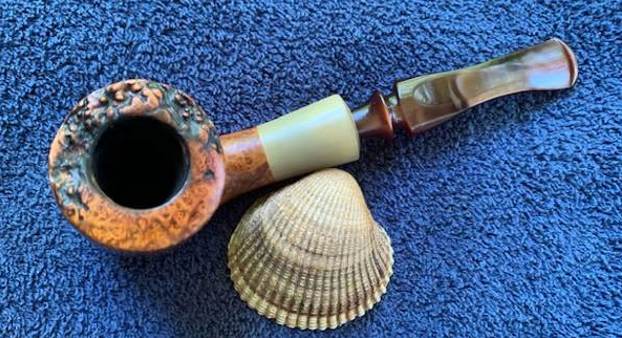
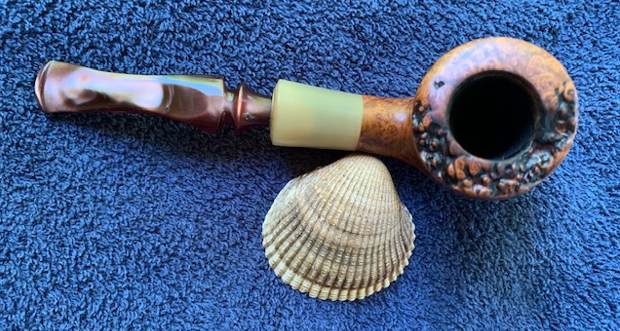
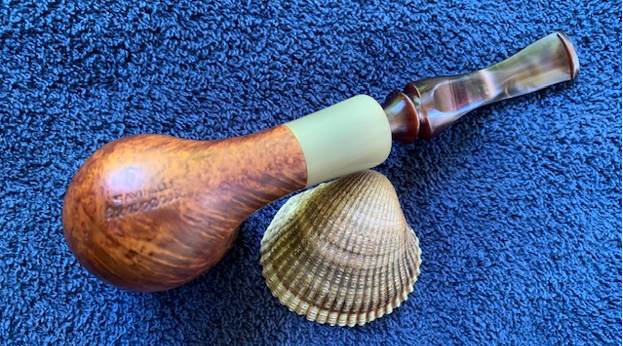
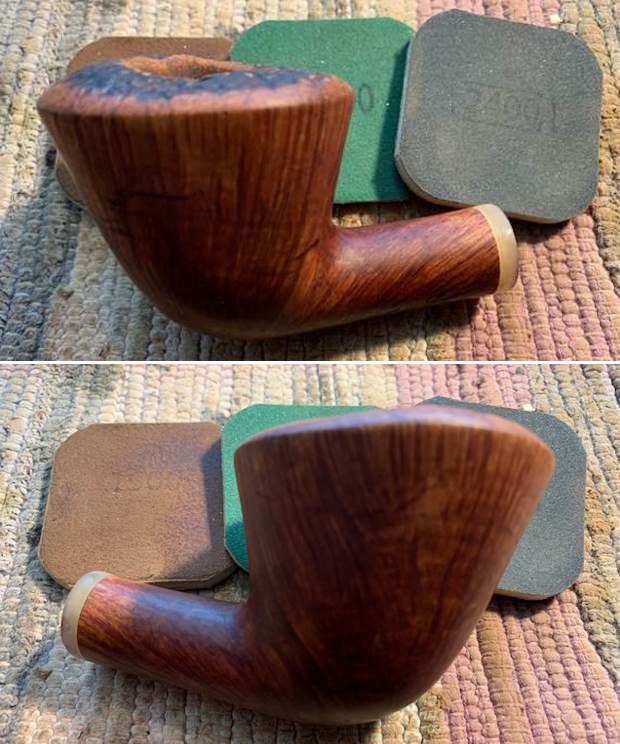
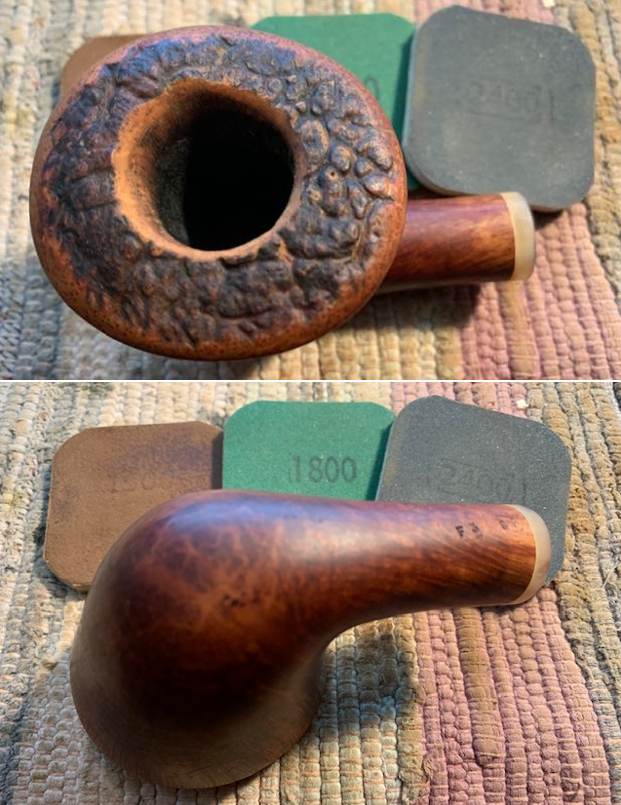
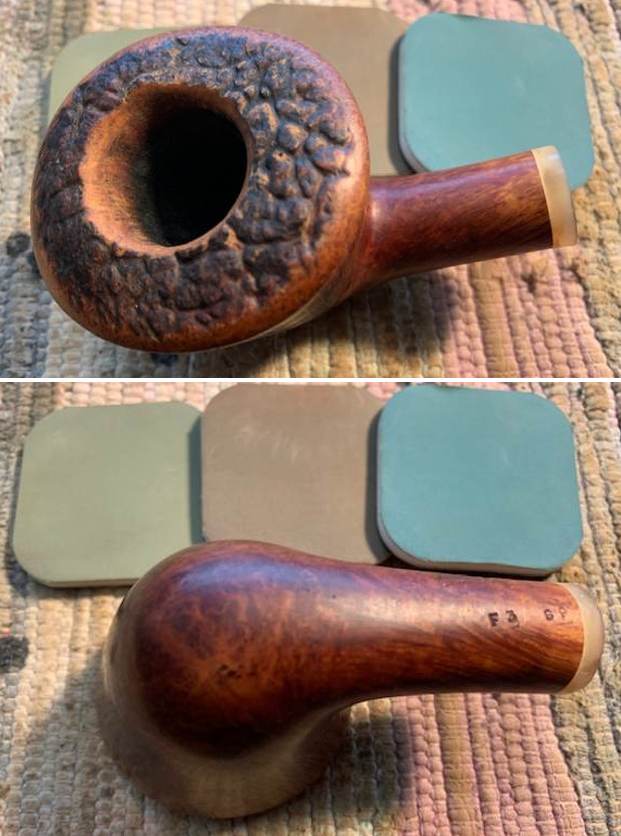
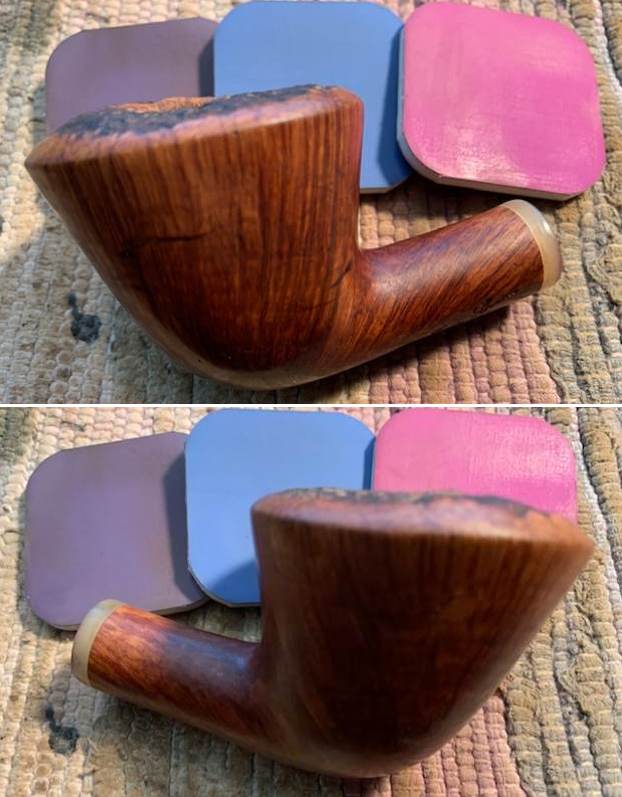
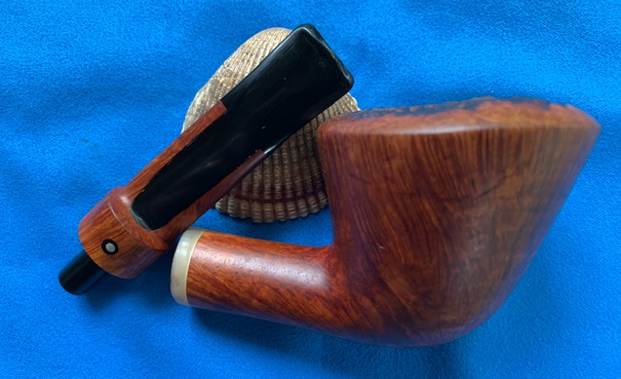
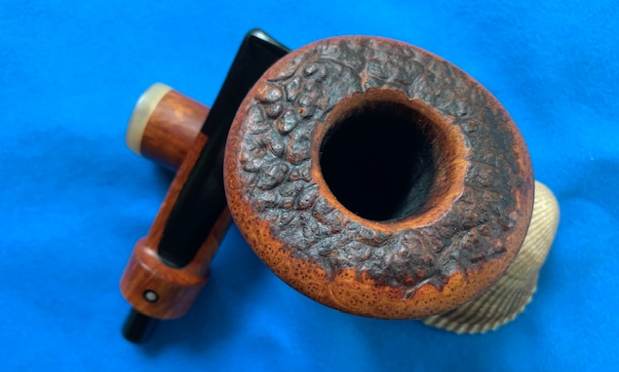
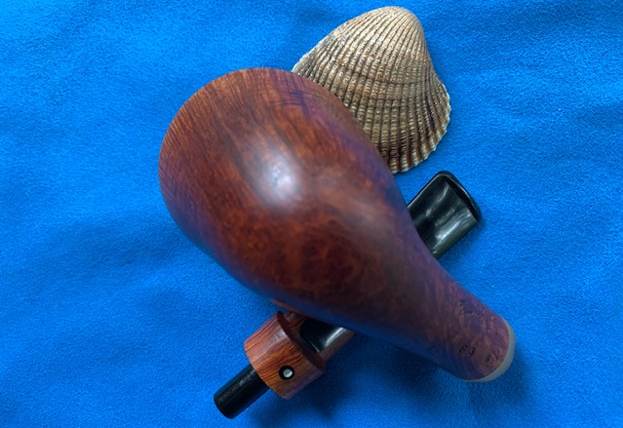
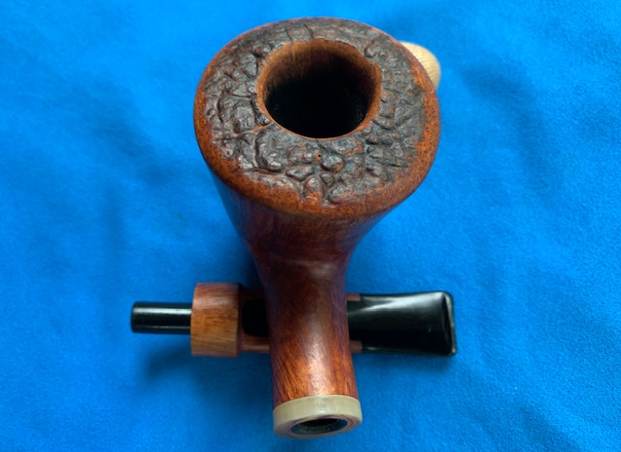
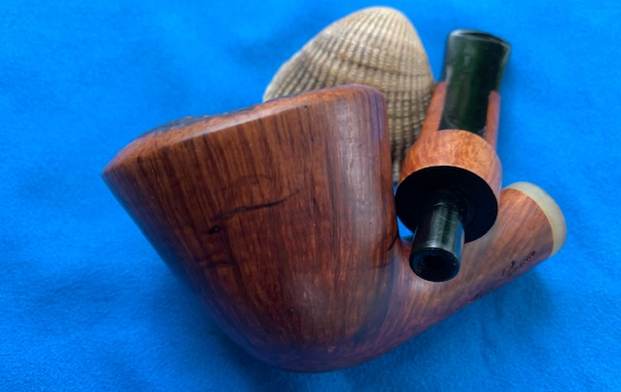
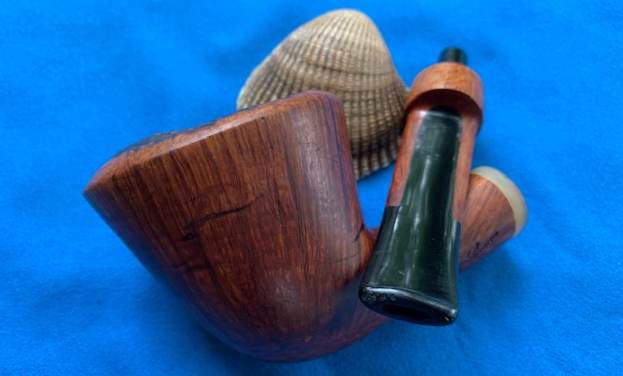
Tag Archives: polishing an acrylic stem

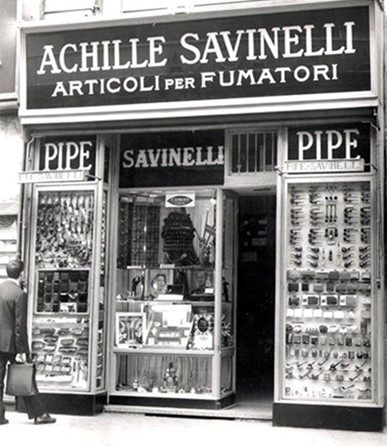
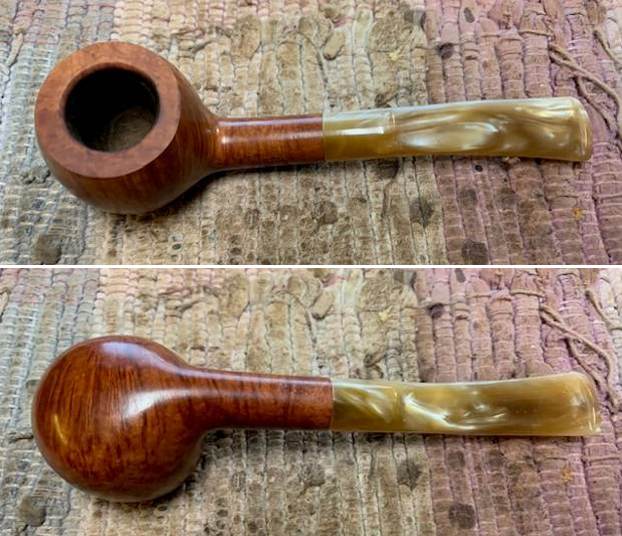
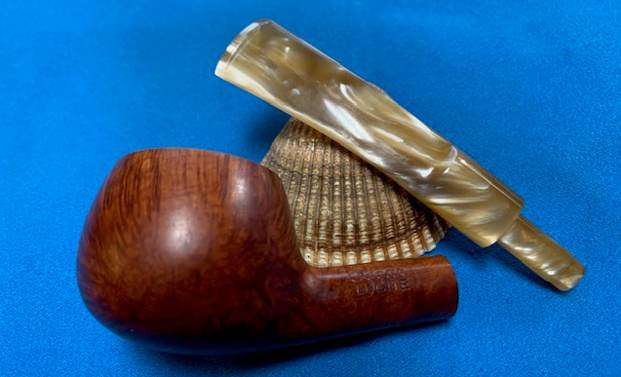
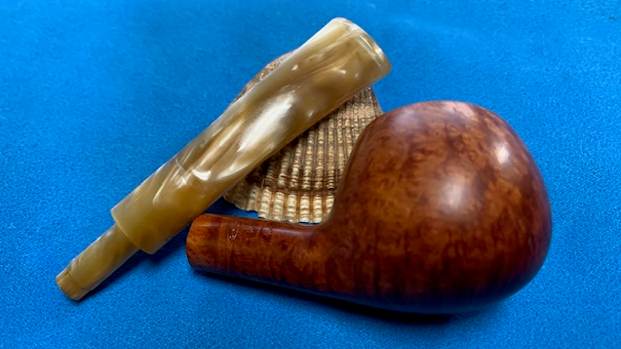
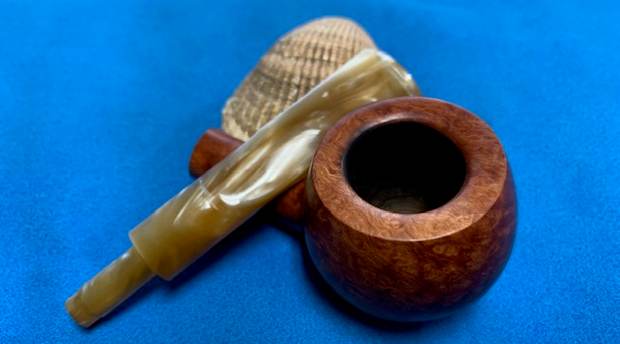
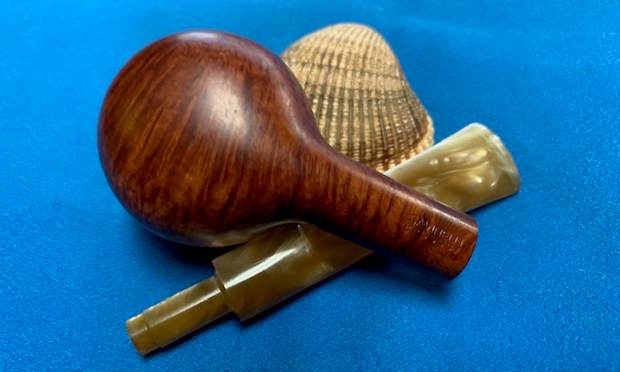
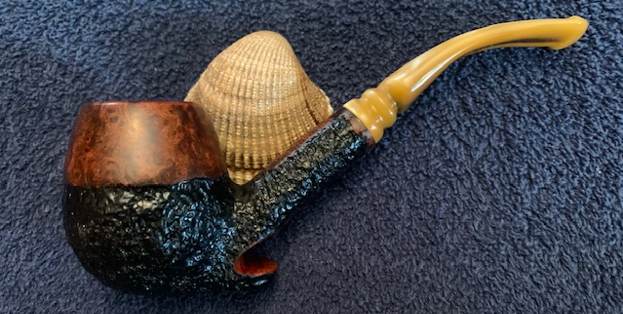
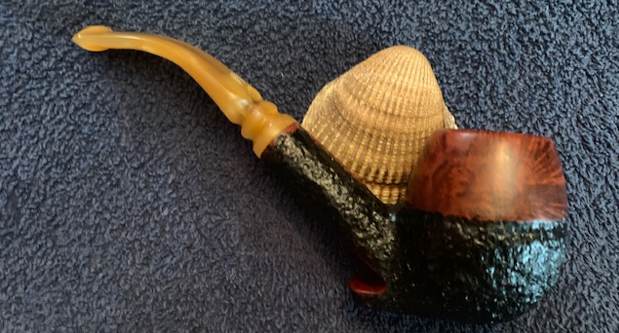
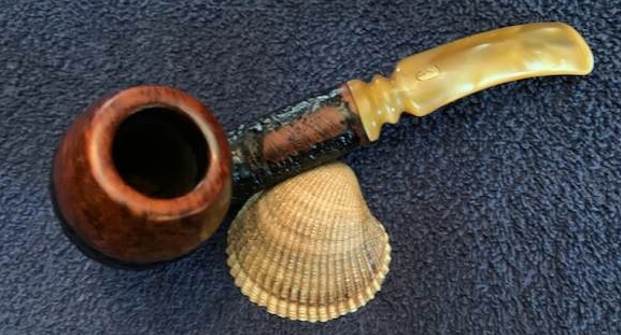
Moving yet another one of my own – a Savinelli Oscar Lucite 313 Prince


Blog by Steve Laug

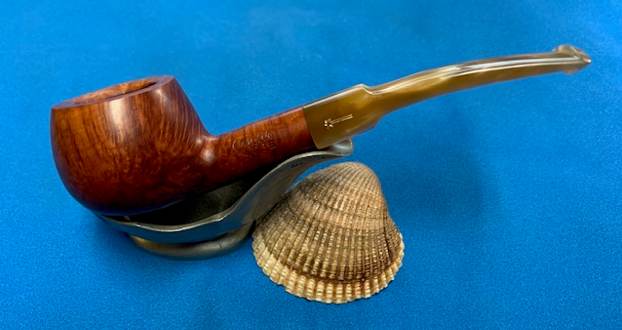
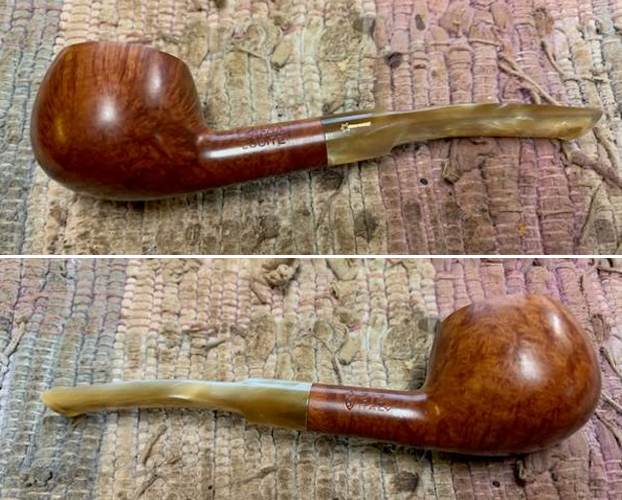
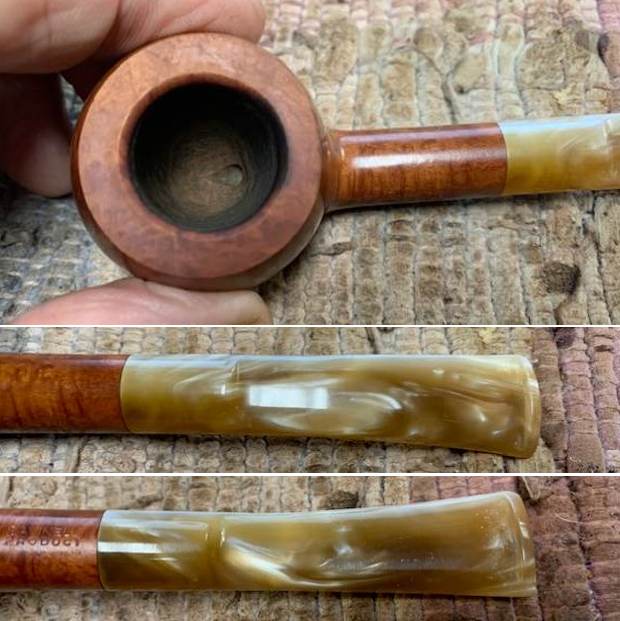
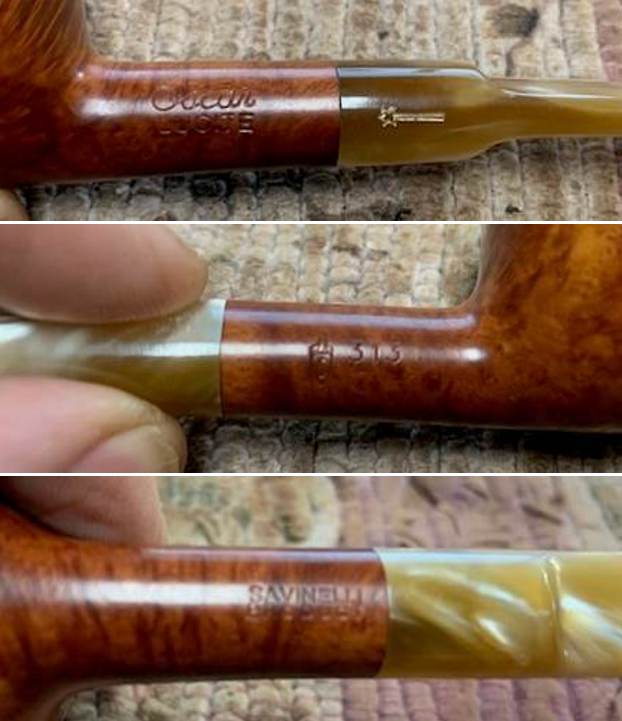
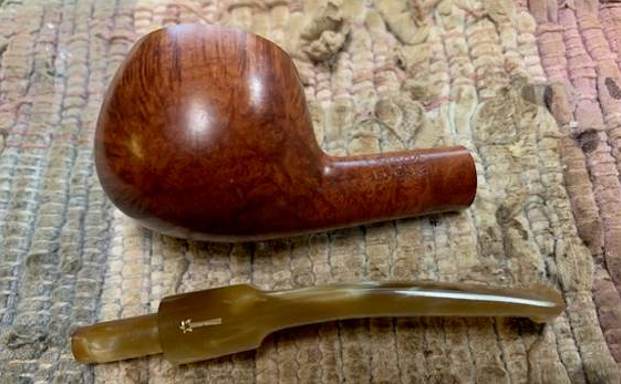
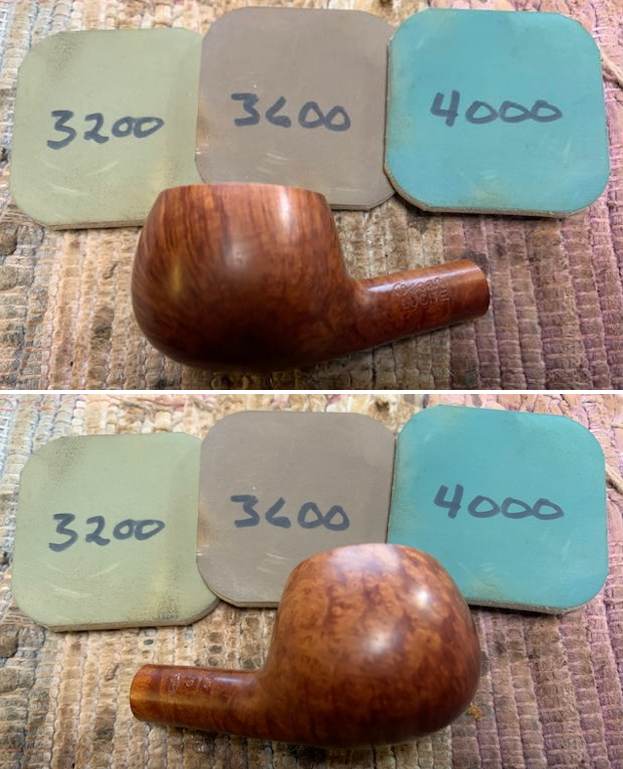
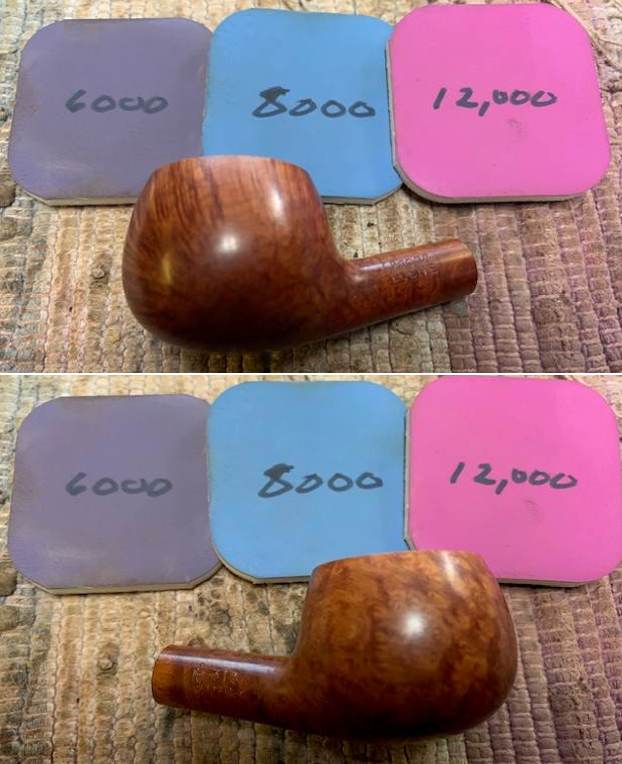
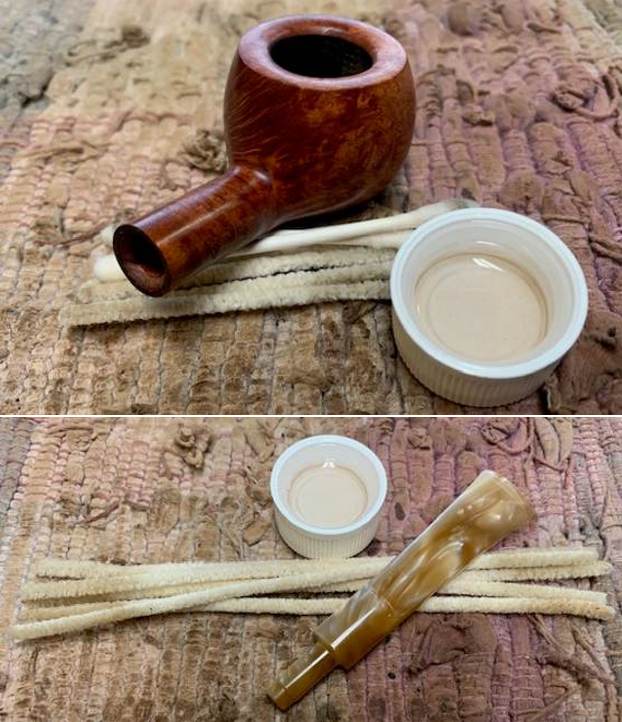
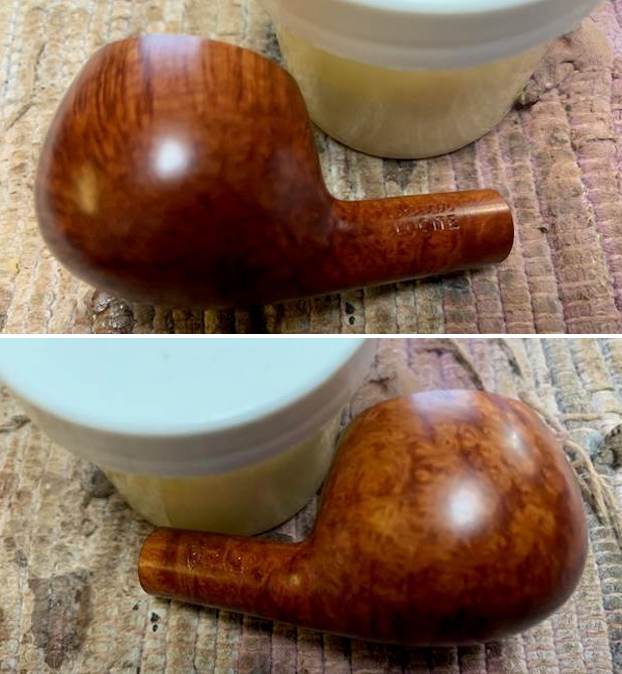
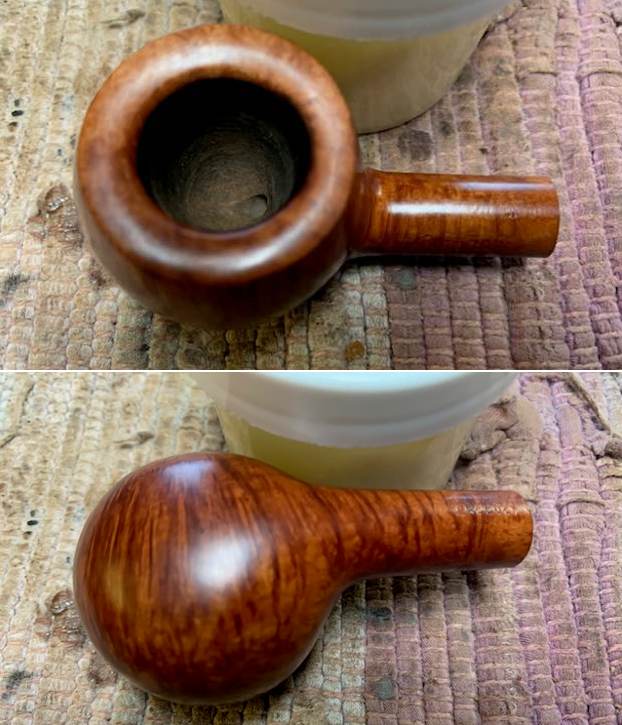
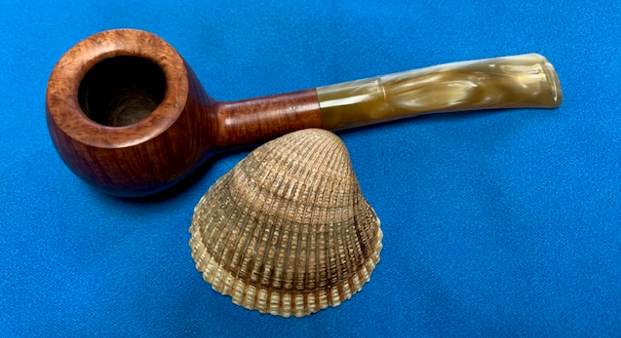
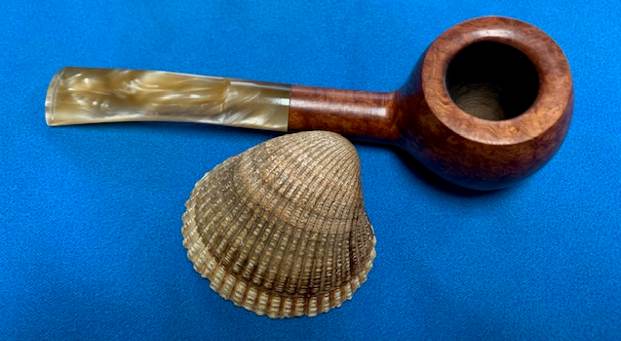
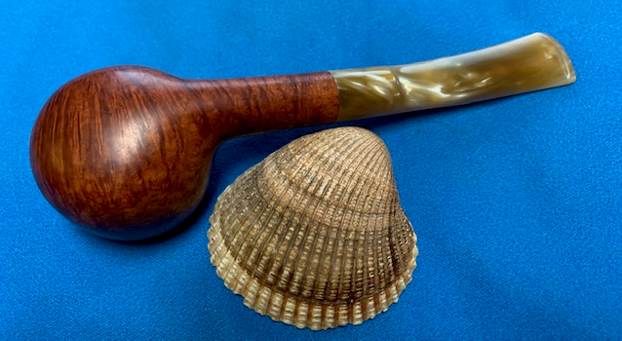
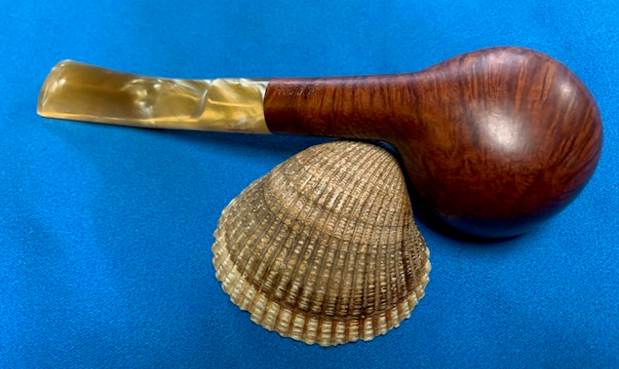
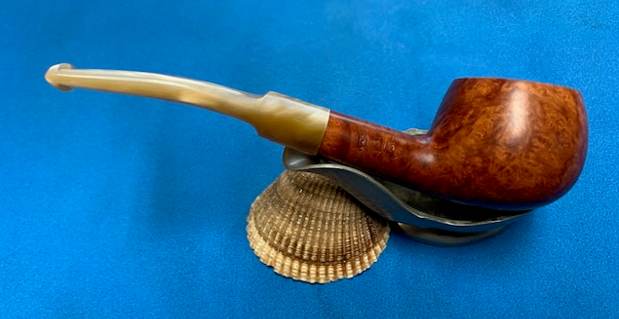
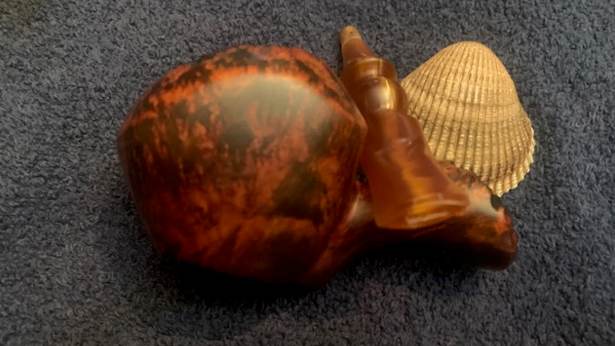
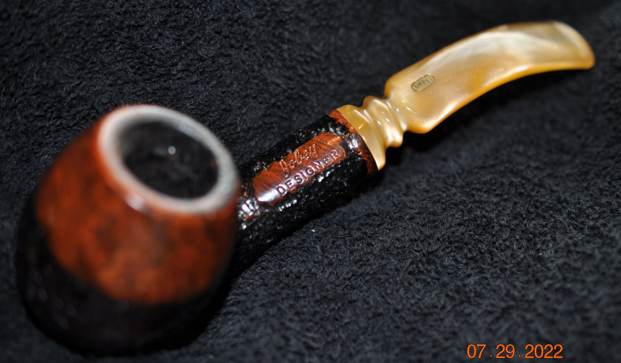
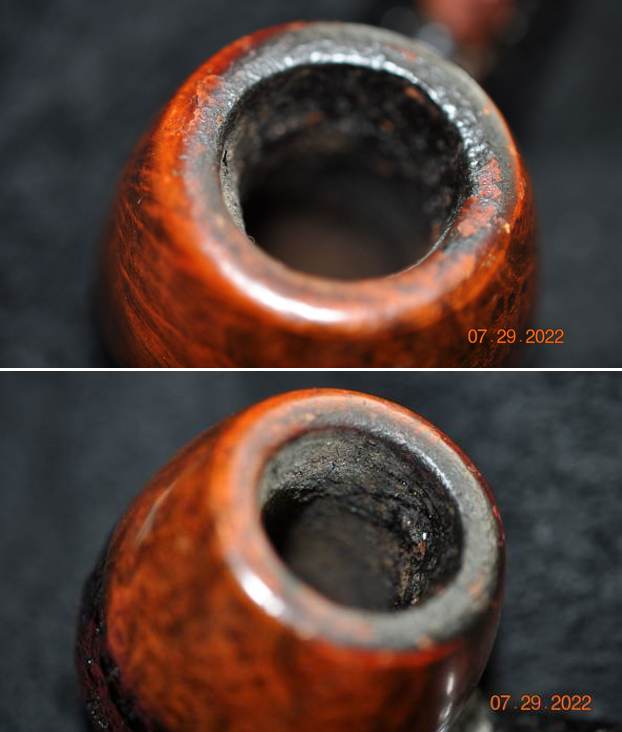
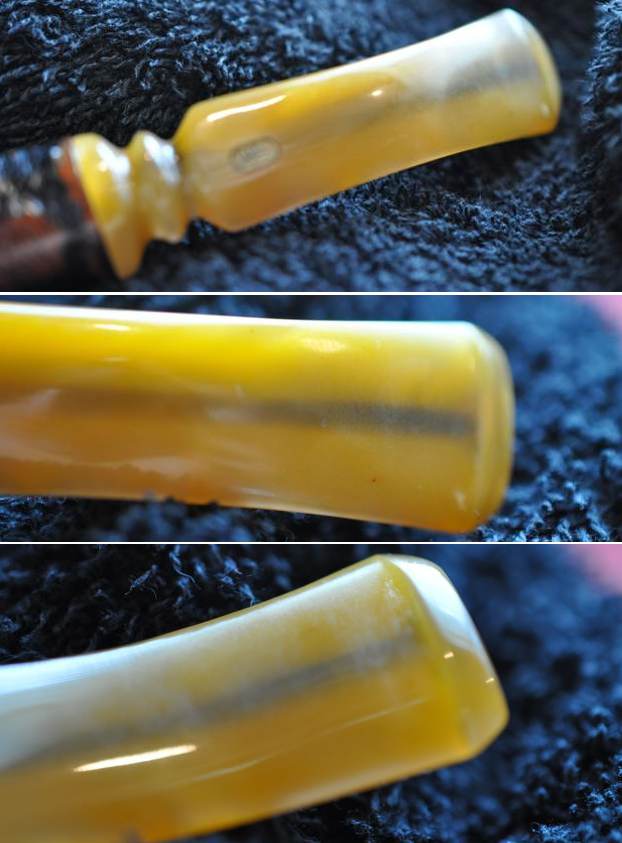
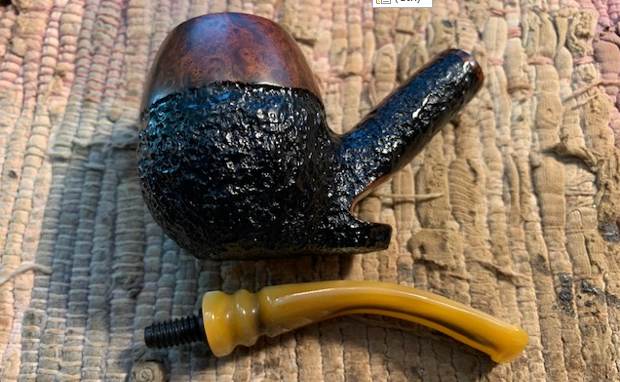
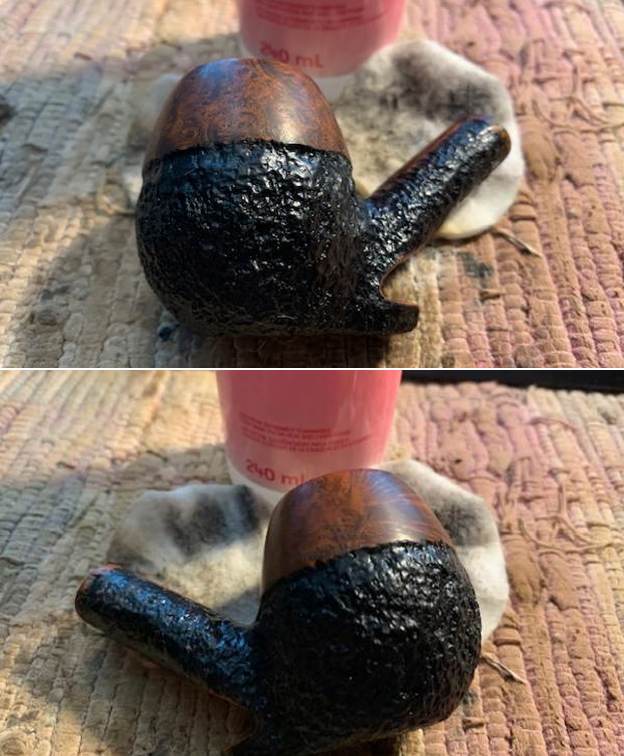
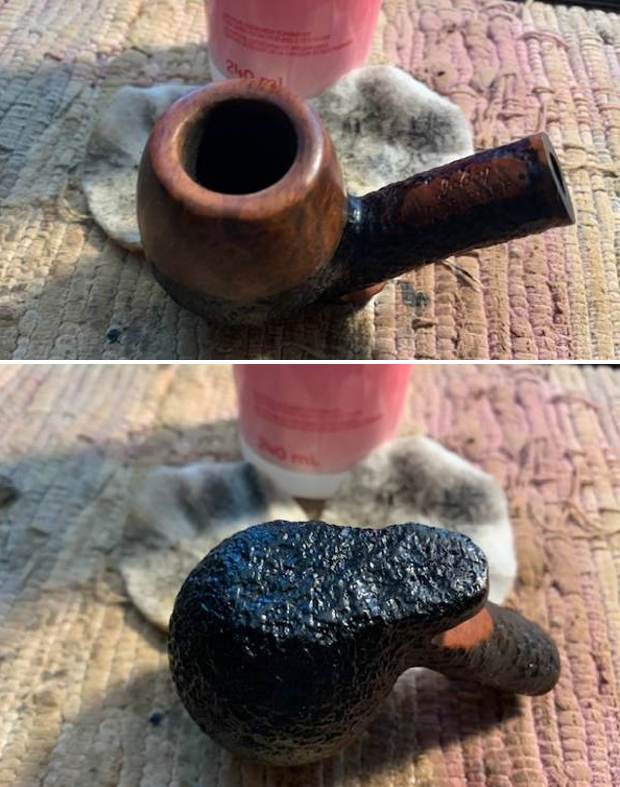
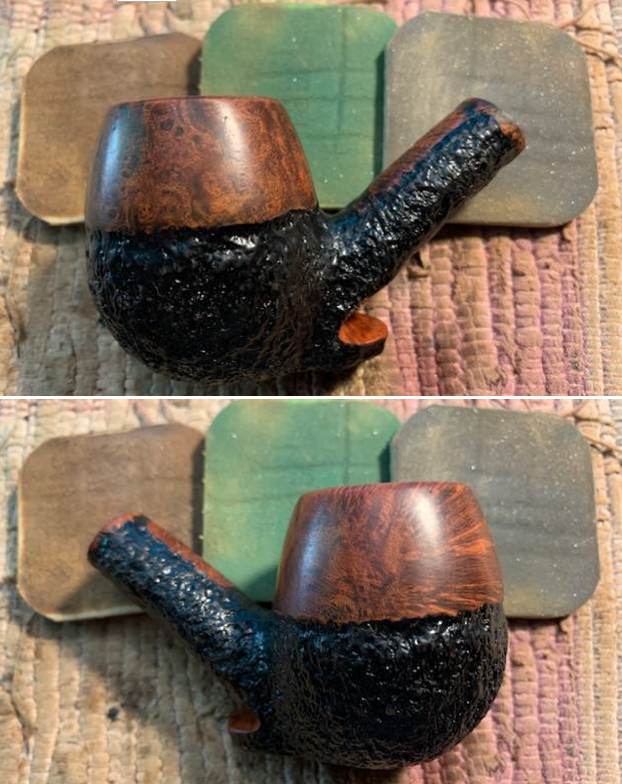
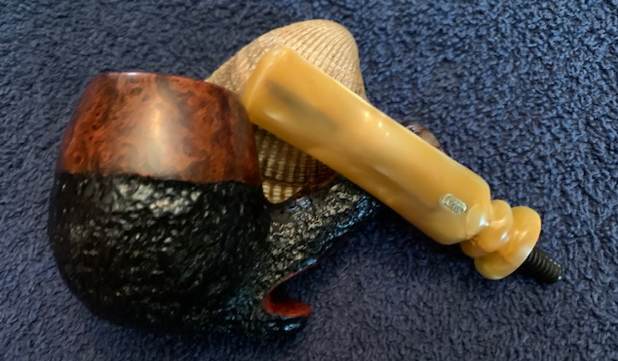
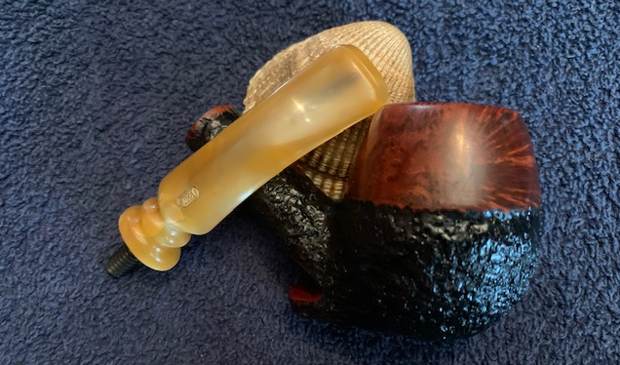
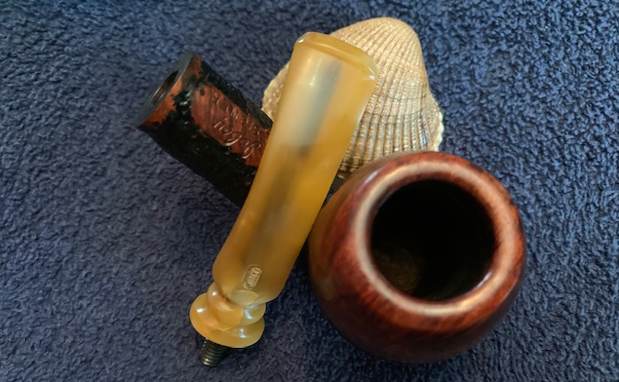
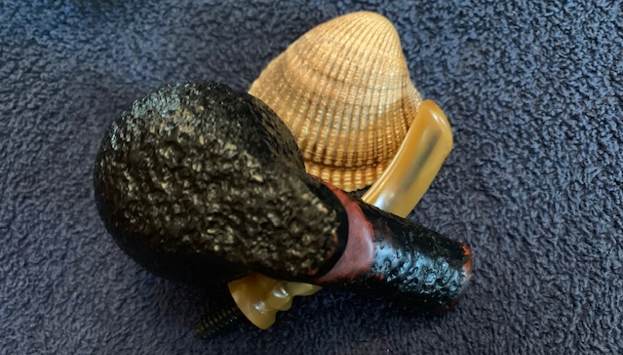
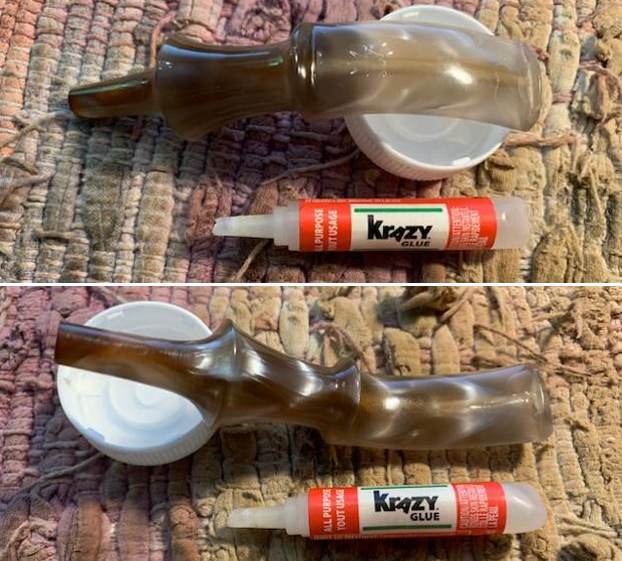
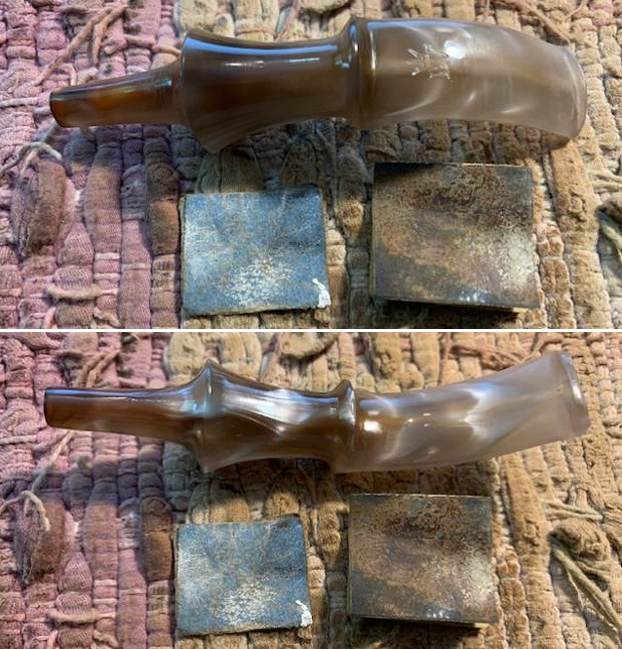
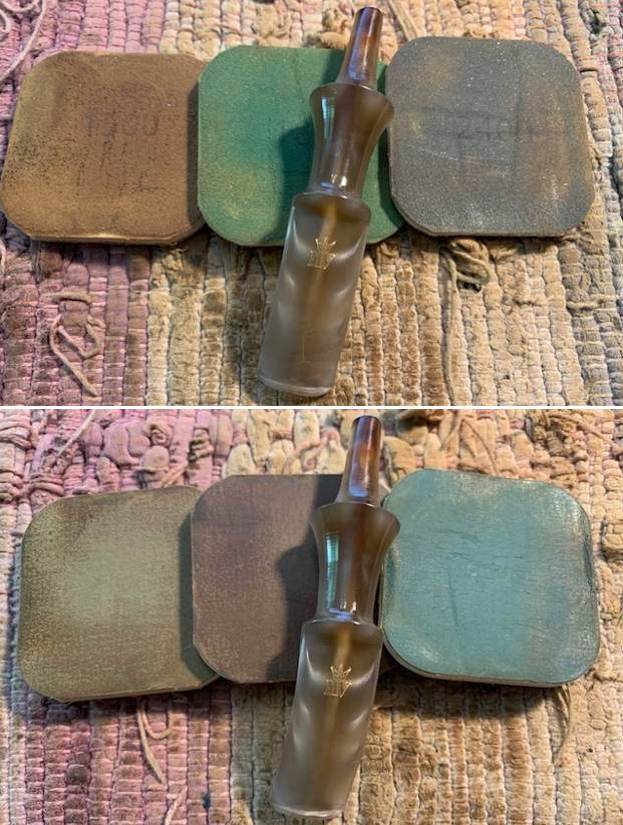
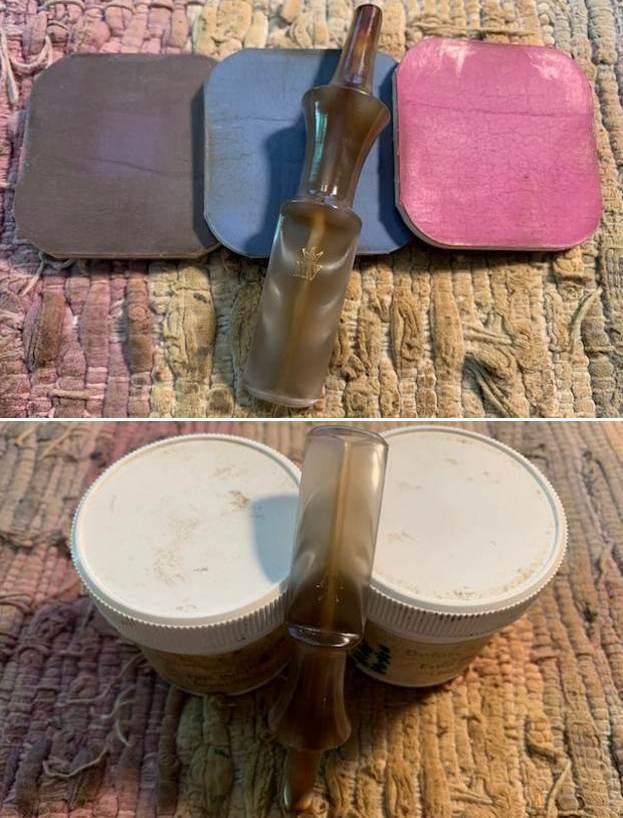
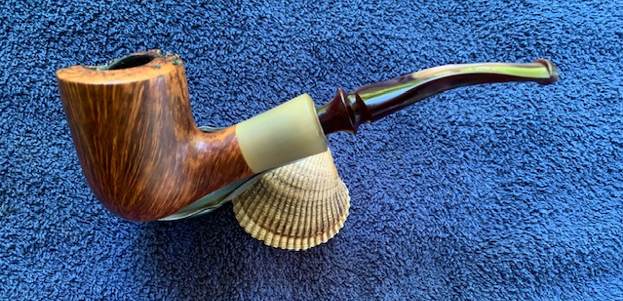
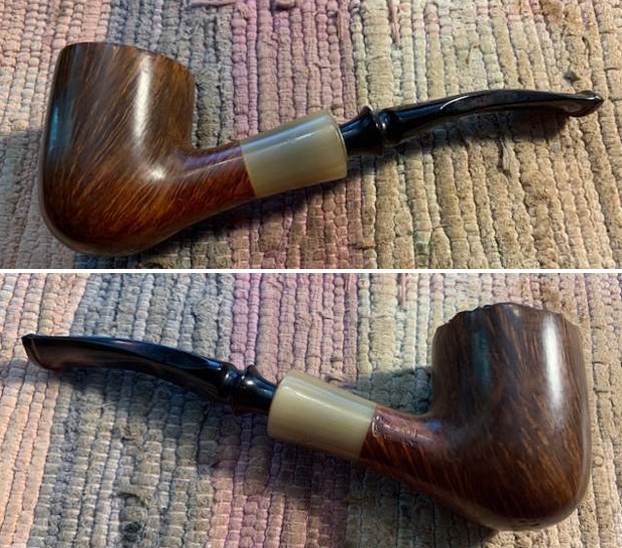
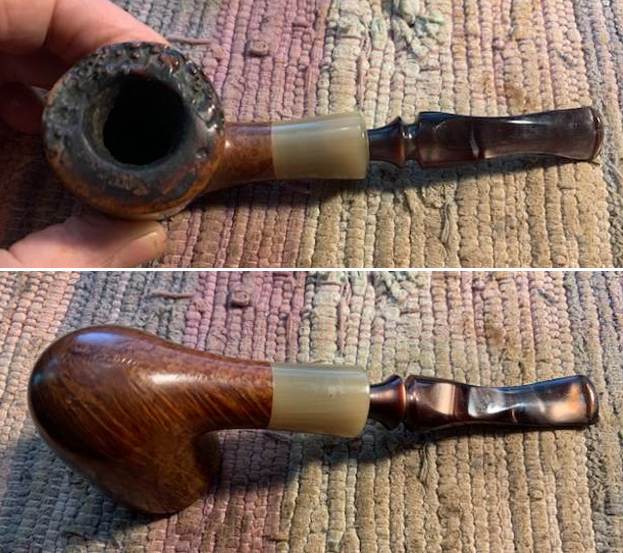
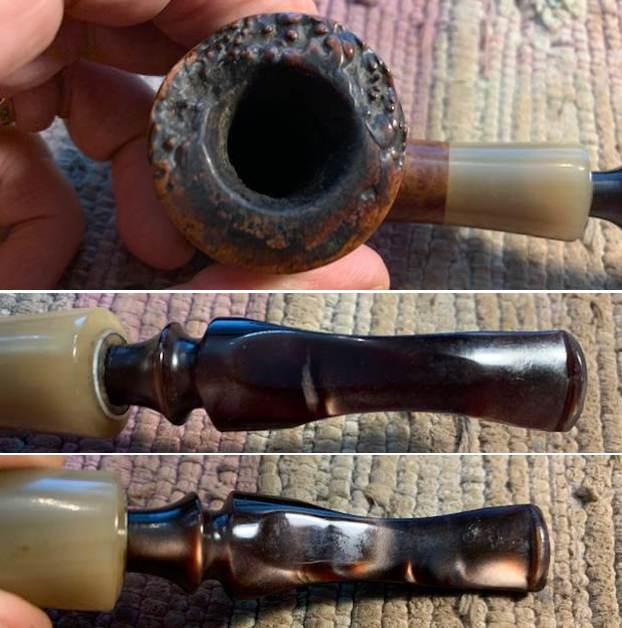
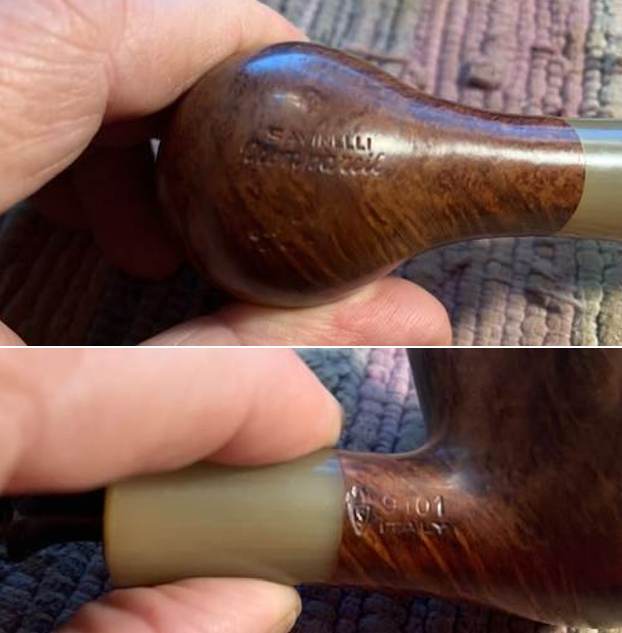
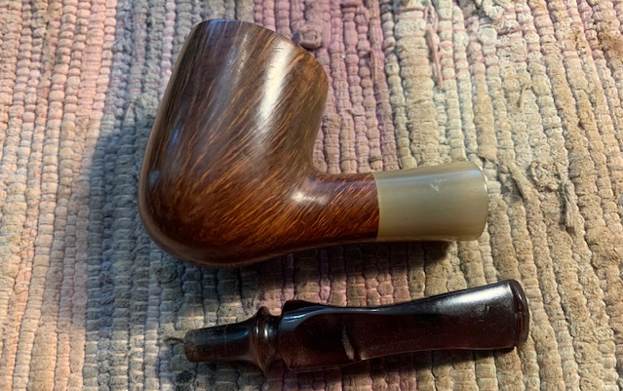
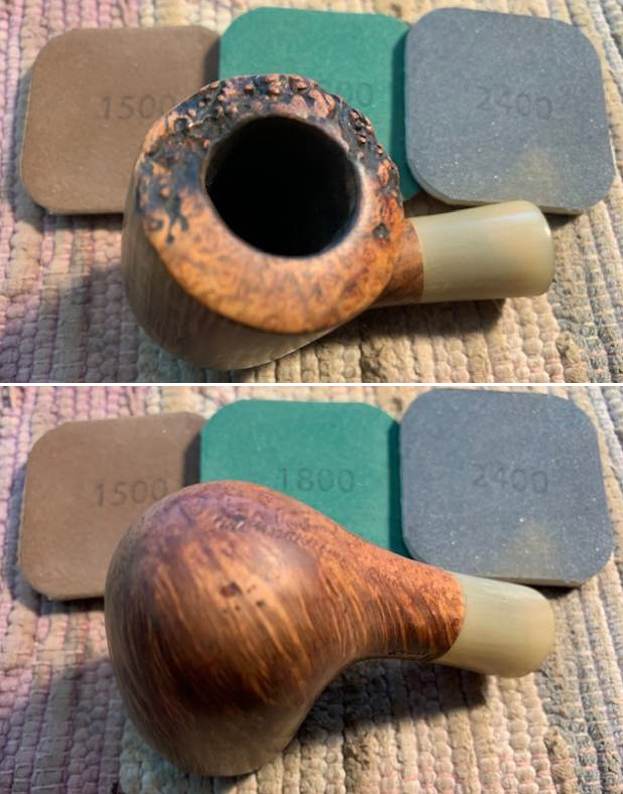
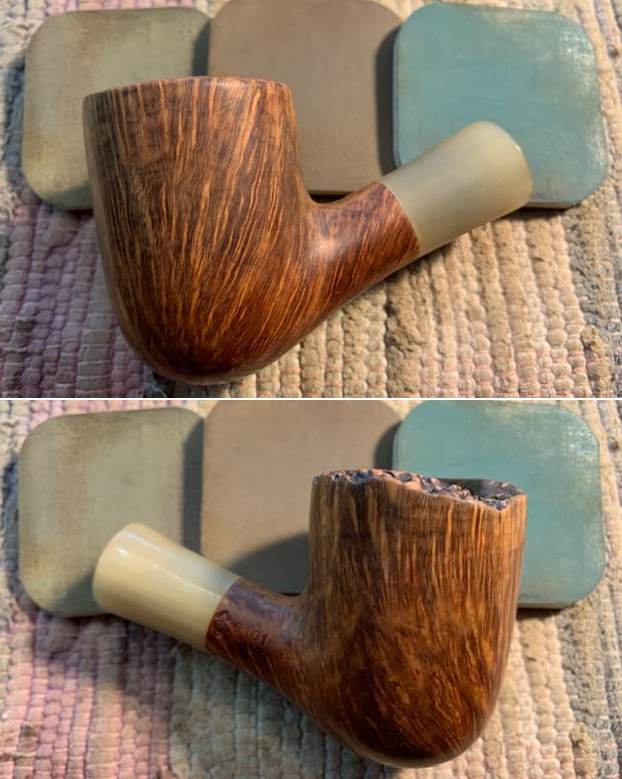
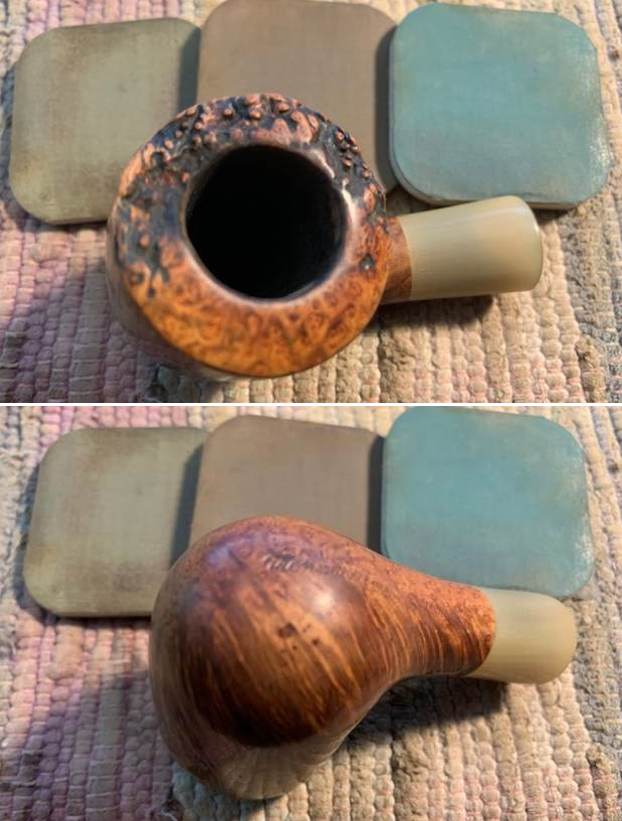
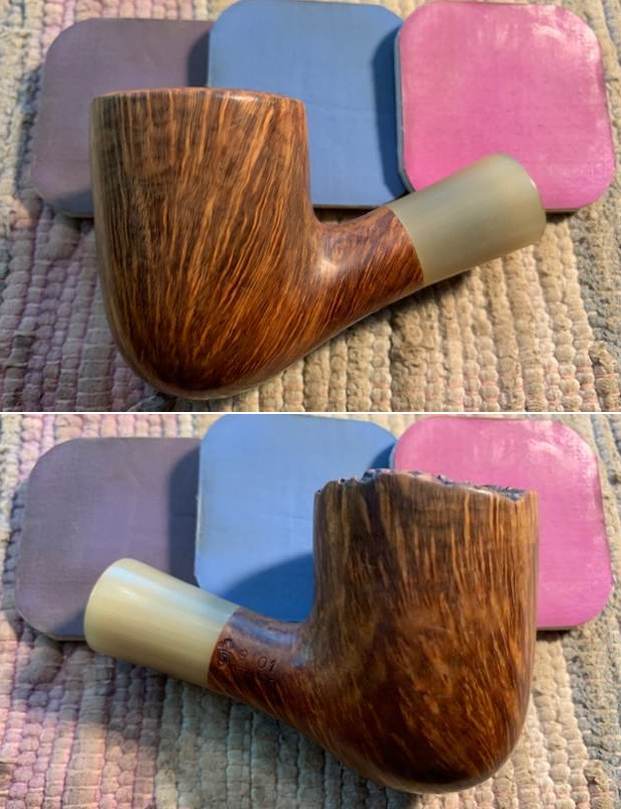
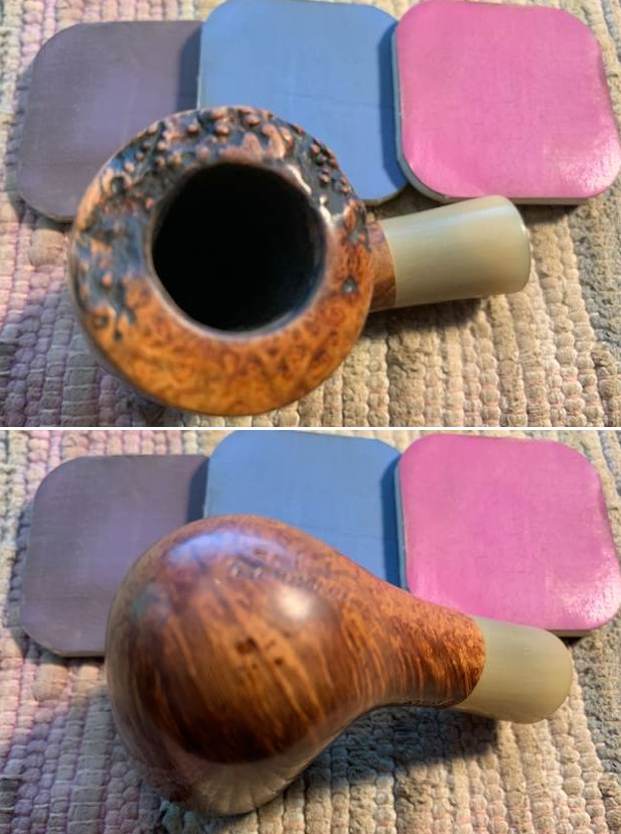
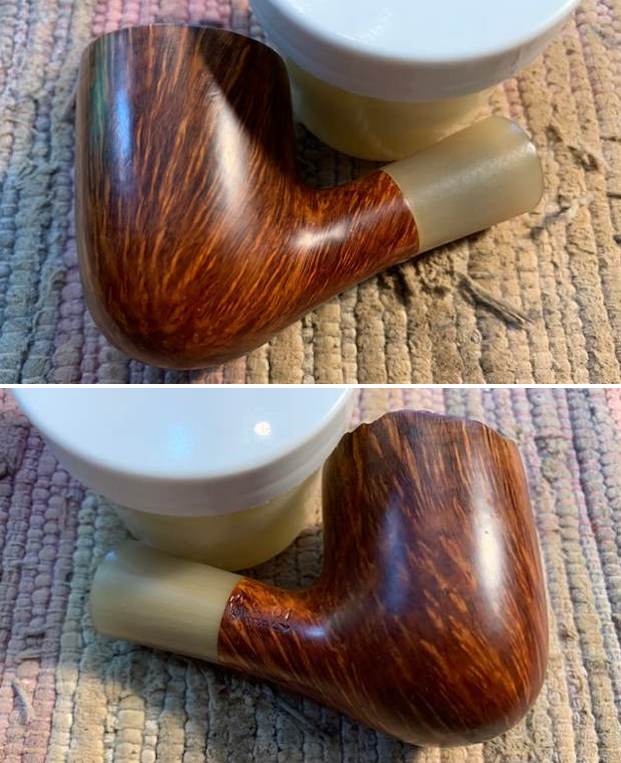
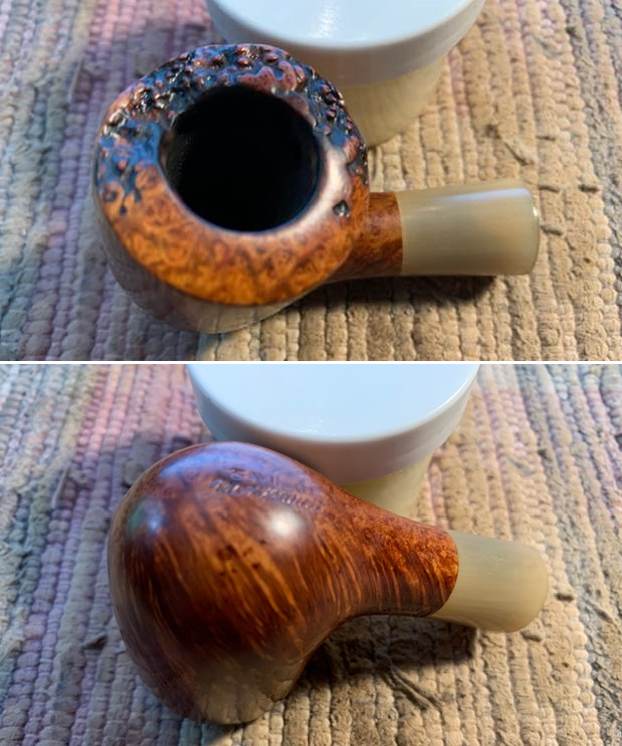
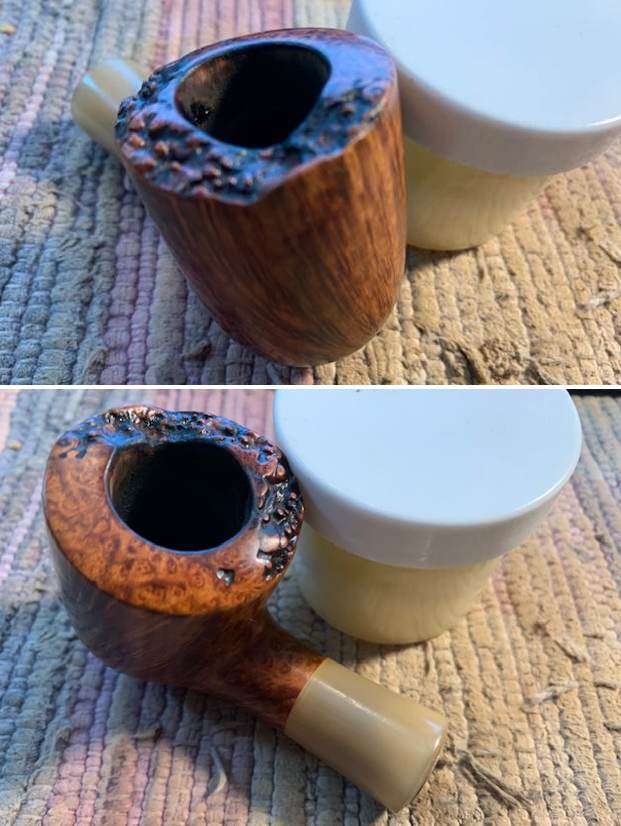
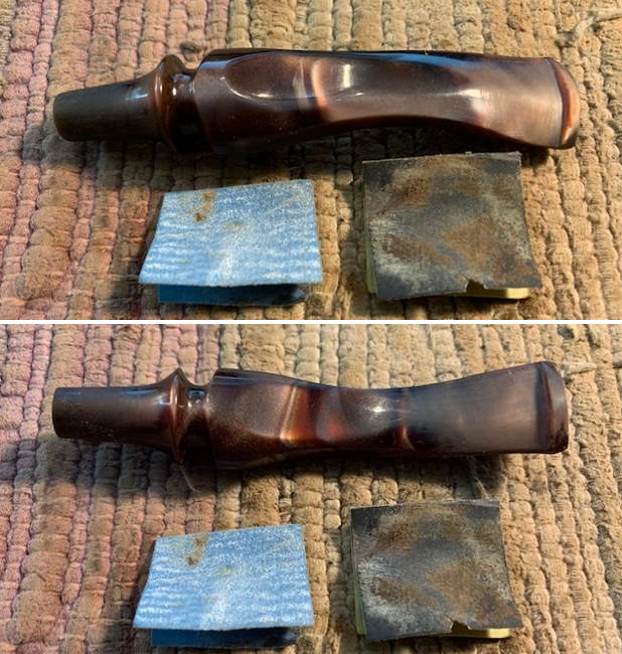
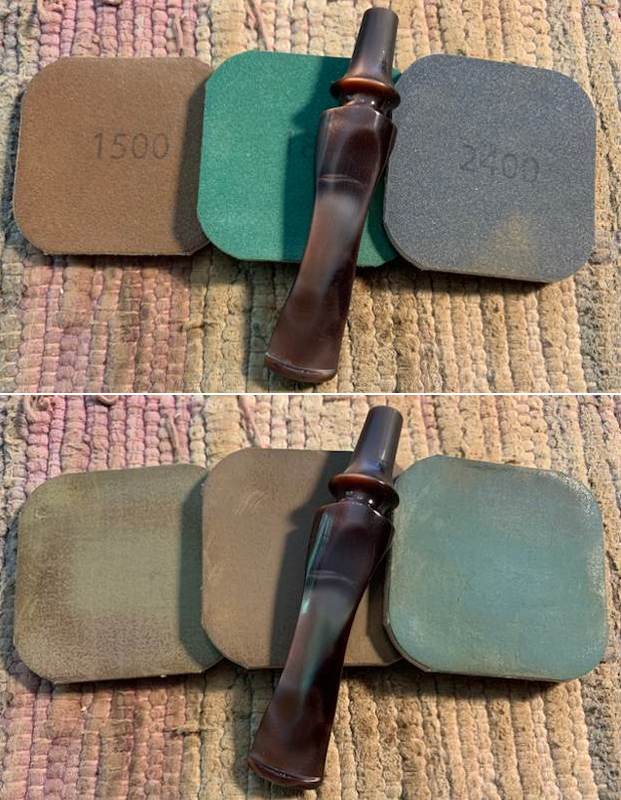
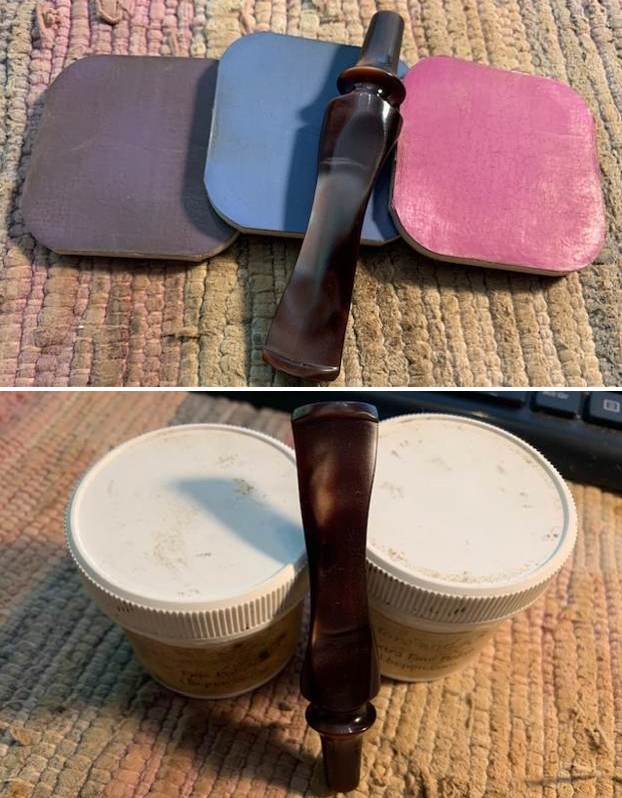
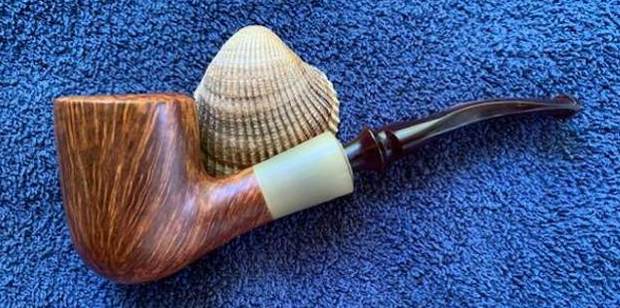
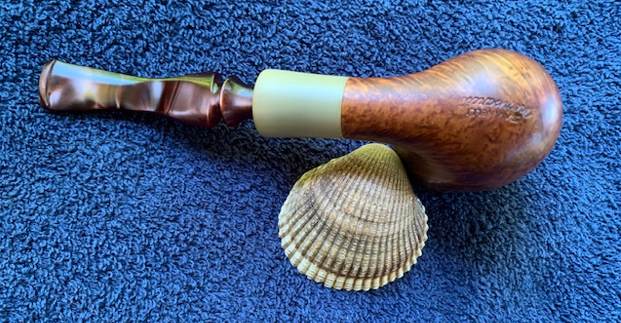
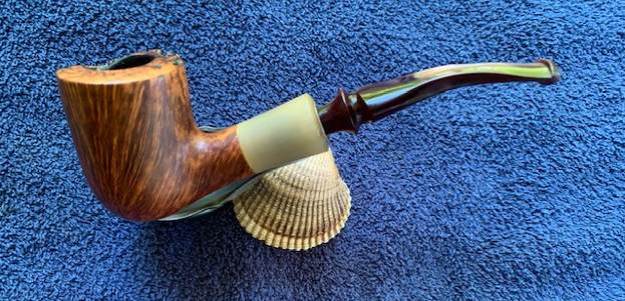
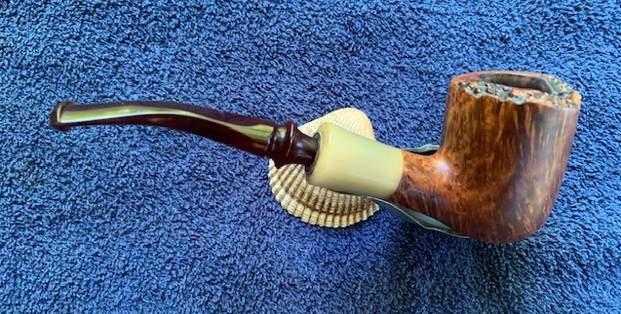
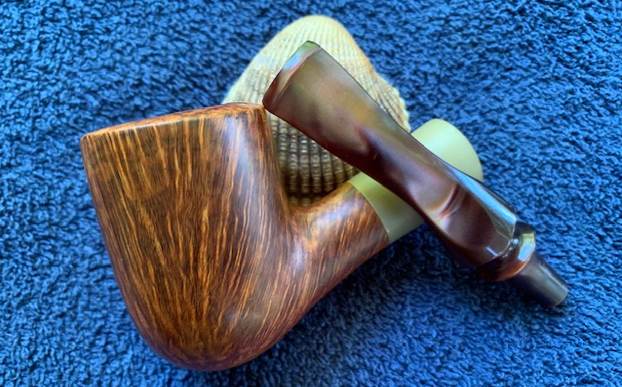
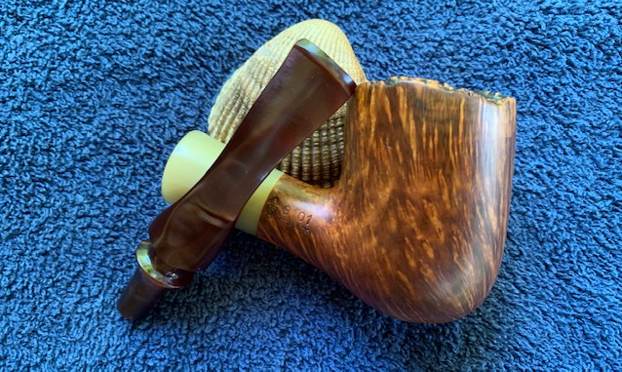
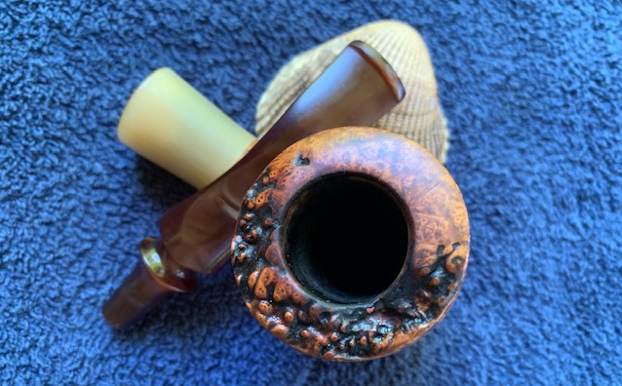
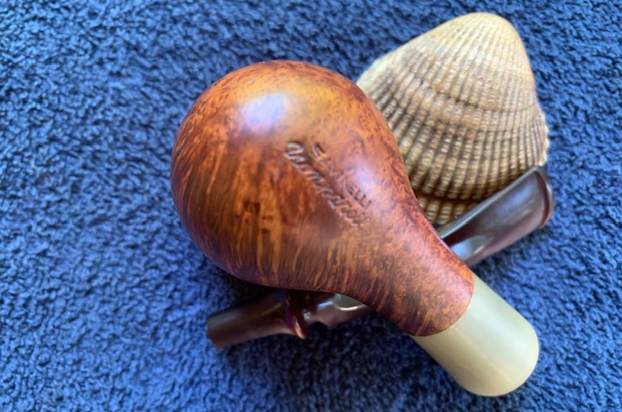
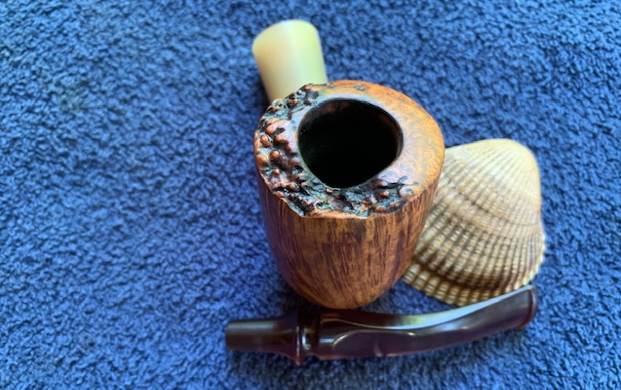
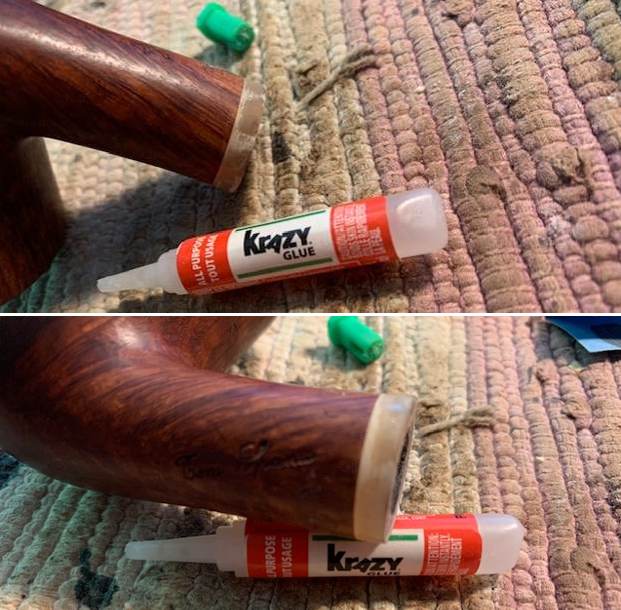
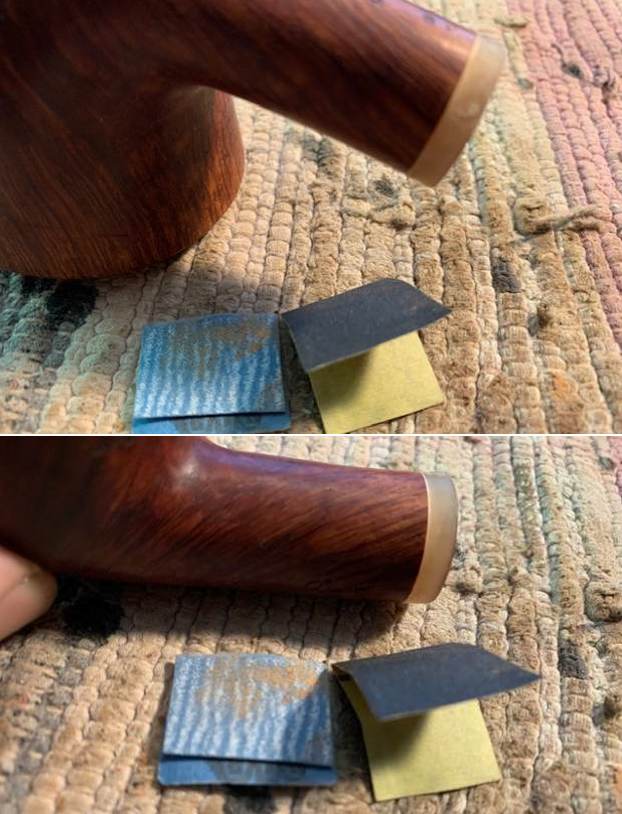
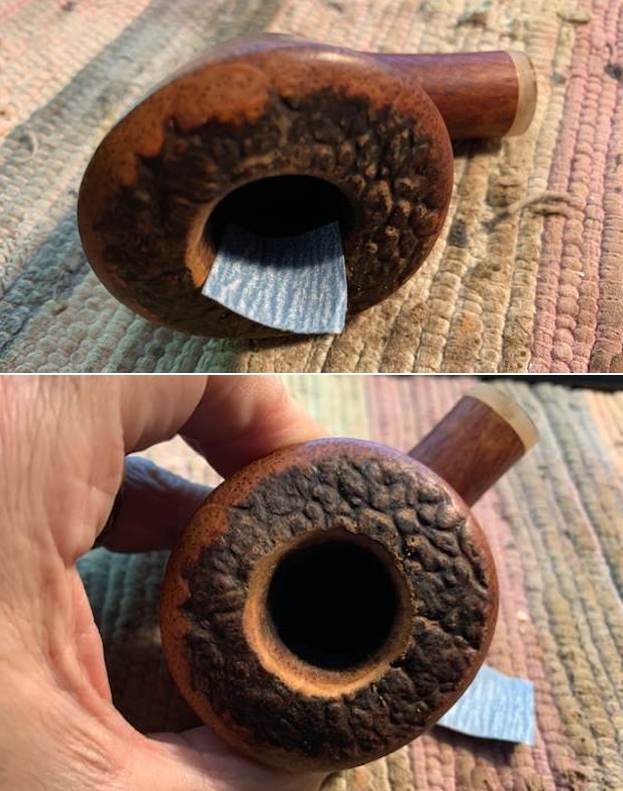
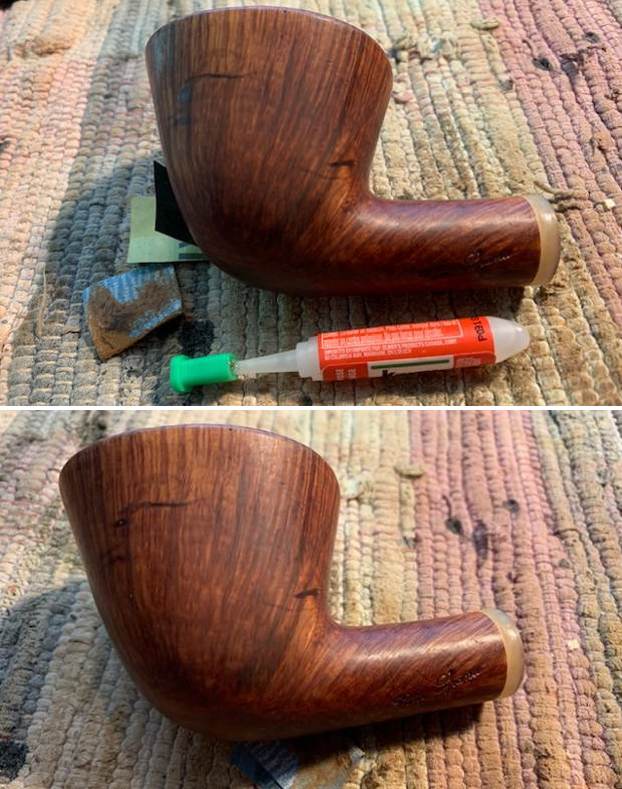
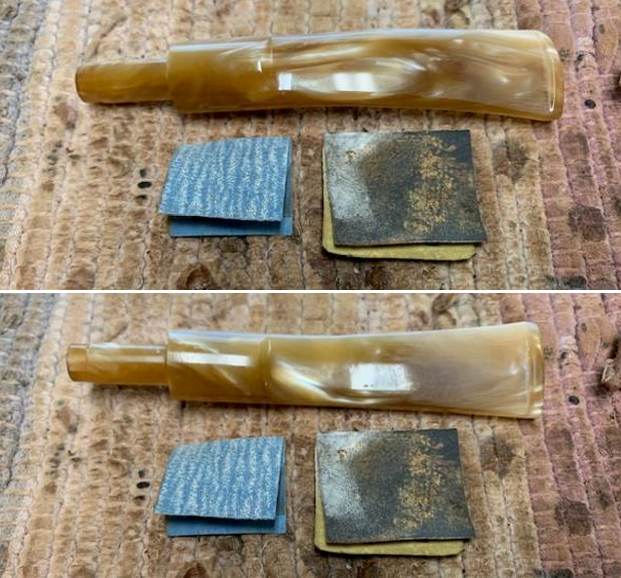
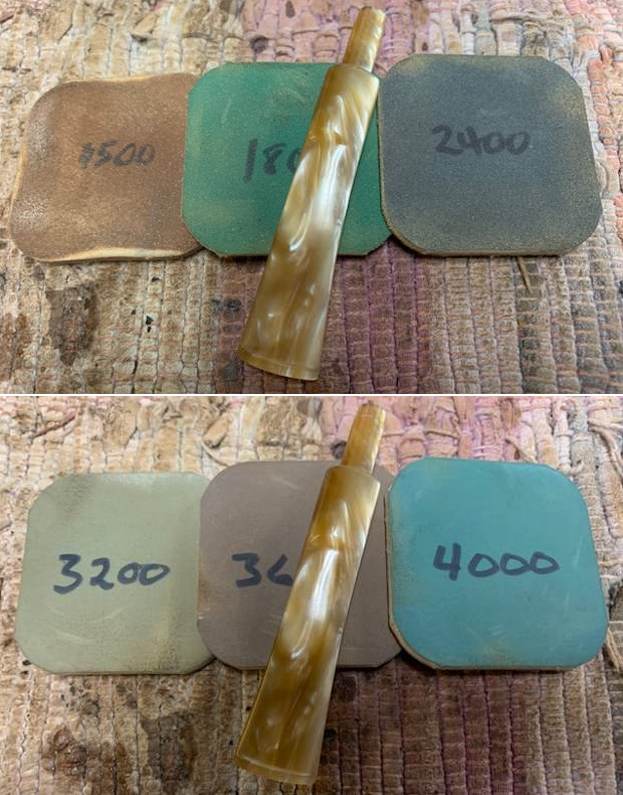
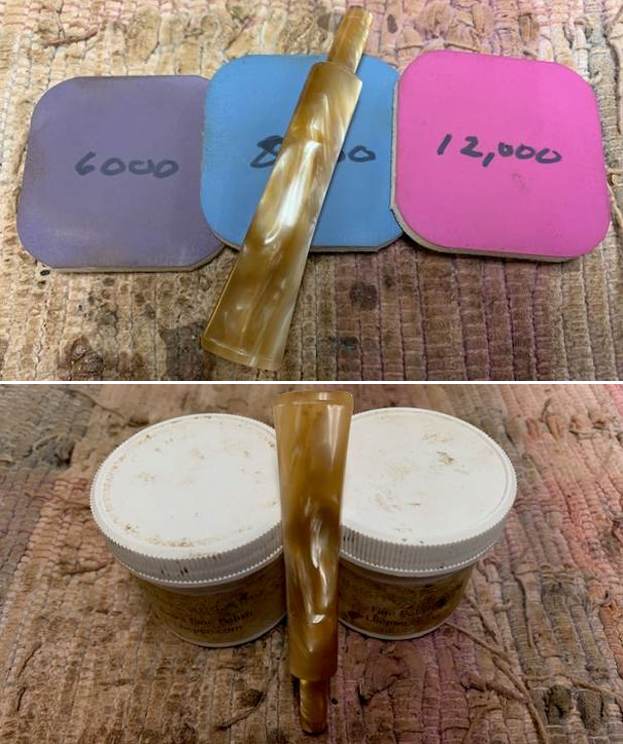
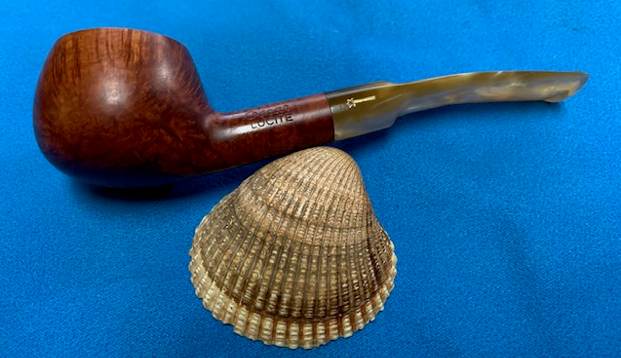
This is another pipe that I have taken out of my personal collection as I just do not use enough to warrant keeping it. This pipe was one that I kept from a group of pipes Jeff and I purchased a few years ago. It was not used very often and I believe it is one that I actually found unsmoked or lightly smoked when I picked it up. It smells of faint Virginia tobaccos so there is no real ghost in the pipe. The airway in the shank and the mortise were quite clean. The smooth finish and rim top were in good condition. There was some darkening on the inner edge of the bowl on the backside. The stamping on the pipe is very simple on the left side of the shank it is stamped Oscar [over] LUCITE. On the right side it is stamped Savinelli S shield logo followed by the shape number 313 [over] Italy. On the underside it is stamped Savinelli [over] Product. There was a gold shooting star on the left side of the stem. The finish is a natural brown with just time and some light polishing adding colour. The rich brown finish goes well with the Lucite/acrylic stem which is in good condition with some light tooth chatter and some tooth marks ahead of the button on both sides. I took photos of the pipe before I did my clean up work on it. I took a photo of the bowl and rim top to verify the description above. I also took photos of the stem surface showing the light chatter and tooth marks on both side. I took a photo of the stamping on the sides of the shank. It is clear and readable as noted above.  I took the stem off the bowl and took a photo of the pipe to give a sense of proportion of the pipe. You can also see the around the side of bowl and the shank and it is a beauty. Now it was time to work on the pipe. I worked on the inner edge of the bowl 220 grit sandpaper to give the inner edge a slight bevel and clean up the damage that was present there. I used a ball and a piece of 220 grit sandpaper to smooth it out. The rim came out looking quite good. I polished the rim top and the briar with micromesh sanding pads – dry sanding with 1500-12000 grit pads. I wiped the bowl down with a damp cloth after each sanding pad to remove the dust and debris. The rim top polished out and matched the oil cured look of the bowl and shank. I cleaned the mortise and airways in the shank and stem with cotton swabs, pipe cleaners and isopropyl alcohol to remove the debris and tars from my smoking. You can see that it was not too bad as I tend to keep my pipes clean. The bowl was in such good condition that decided to give the bowl and shank a coating of Before & After Restoration Balm. I worked it into the surface of the briar with my fingertips and a horsehair shoe brush to clean, enliven and protect the briar. I let the balm sit for 15 minutes and then buffed with a cotton cloth to raise the shine. The photos show the bowl at this point in the restoration process. I set the bowl aside and sanded out the tooth marks and chatter on the stem surface and button with 220 grit sandpaper. I was able to smooth out the marks on the surface of both sides.  I polished the stem with micromesh sanding pads – dry sanding with 1500-12000 grit pads. I rubbed it down between pads with Obsidian Oil. I polished it with Before & After Fine and Extra Fine Pipe Stem Polish. I wiped it down with some Obsidian Oil and buffed it off. It is a beautiful stem. It is good to put the final touches on another of my own pipes that I am selling – Savinelli Made Oscar Lucite Prince 313. I put the pipe back together and buffed the stem with Blue Diamond on the buffing wheel. I gave the bowl and the stem multiple coats of carnauba wax. I hand buffed the pipe with a clean buffing pad to raise the shine. It is fun to see what the polished bowl looks like with the beautiful grain and the polished vulcanite saddle stem. This smooth Oscar Lucite 313 Prince is great looking and the pipe feels great in my hand. It is light and well balanced. Have a look at it with the photos below. The dimensions are Length: 5 ½ inches, Height: 1 ¼ inches, Outside diameter of the bowl: 1 ¼ inches, Chamber diameter: ¾ of an inch. The weight of the pipe is 38 grams/1.34 ounces. It is a beautiful pipe that I will soon be putting on the rebornpipes store in the Italian Pipe Makers Section. If you are interested in adding it to your collection send me an email or a message. Thanks for walking through the restoration with me as I worked over this pipe. Thanks to each of you who are reading this blog.

Replacing a Broken tenon on a Savinelli Estella Hand Made Freehand


Blog by Steve Laug

Last week I received a from Curtis, a gentleman who had been referred to me by City Cigar. I asked him to email me some photos of his pipe so I could see what I was dealing with before I took on the project. He sent the following email and photos:

I was referred to you by Ben at City Cigar.  I was curious if I could send my pipe to you for repairs. Here are some photos of it, I know you probably can’t give a proper estimate until it’s in your hands.  Forgive my ignorance on pipe repair but I’ve never had any work done before.  If possible, after viewing my photos, would a “ballpark” estimate be possible ?  I don’t know if I’m looking at 100.00 or 1000.00.  The pipe might  not be “worth” much but my son gave it to me and it has sentimental value to me.  I’m just looking to get a new or used or repaired stem for the pipe, if possible.

Thanks for you time,

Curtis

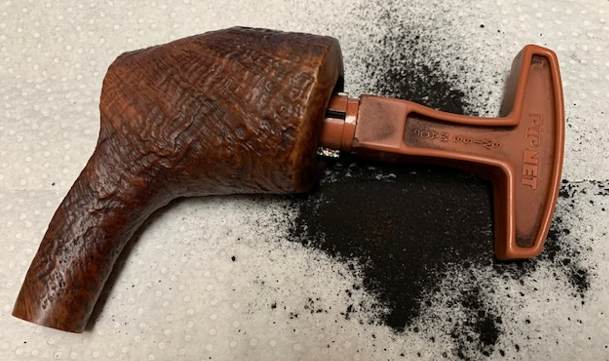
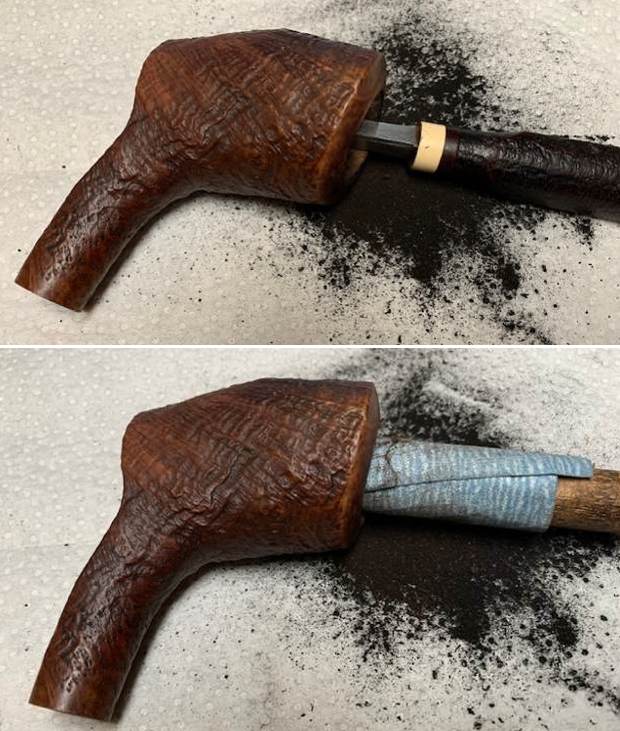
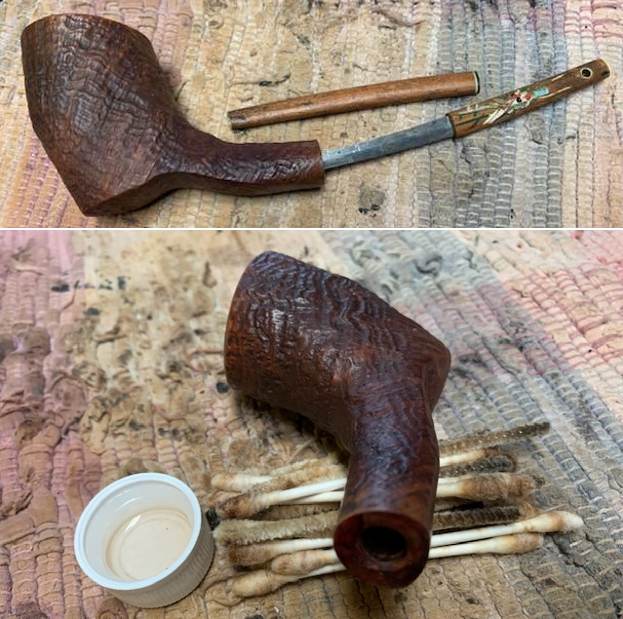
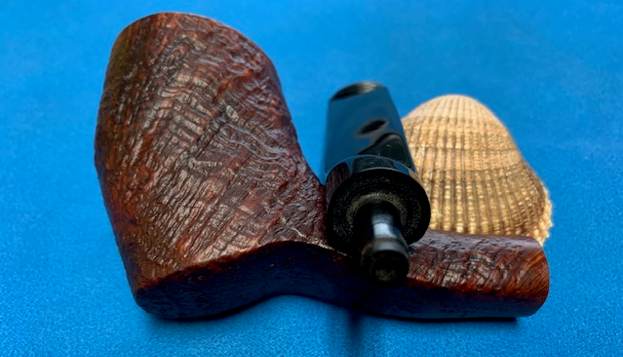
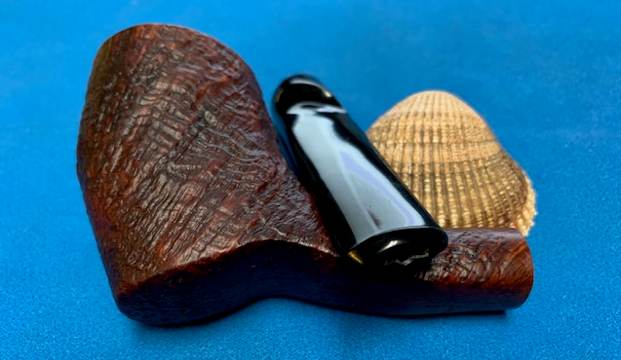
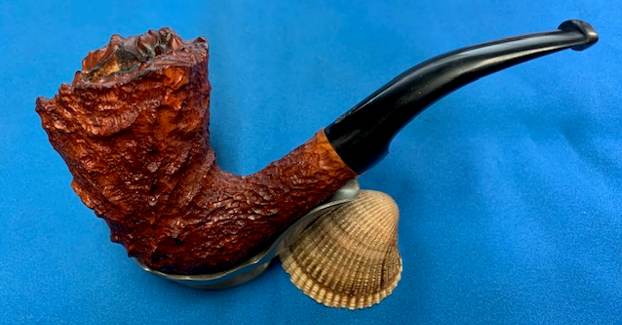
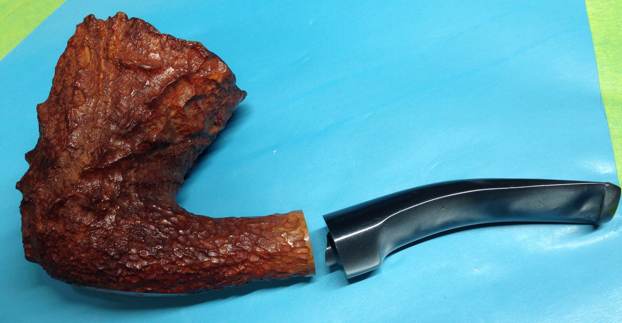
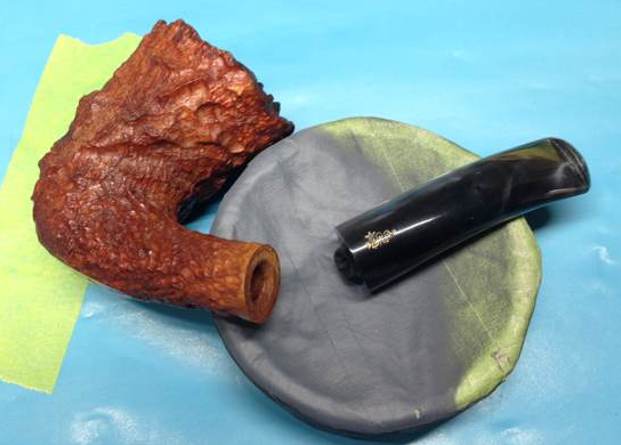
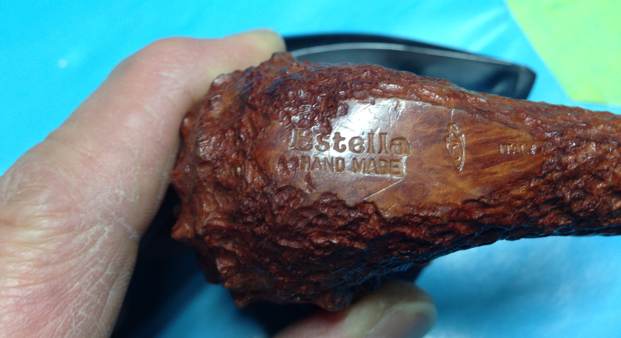
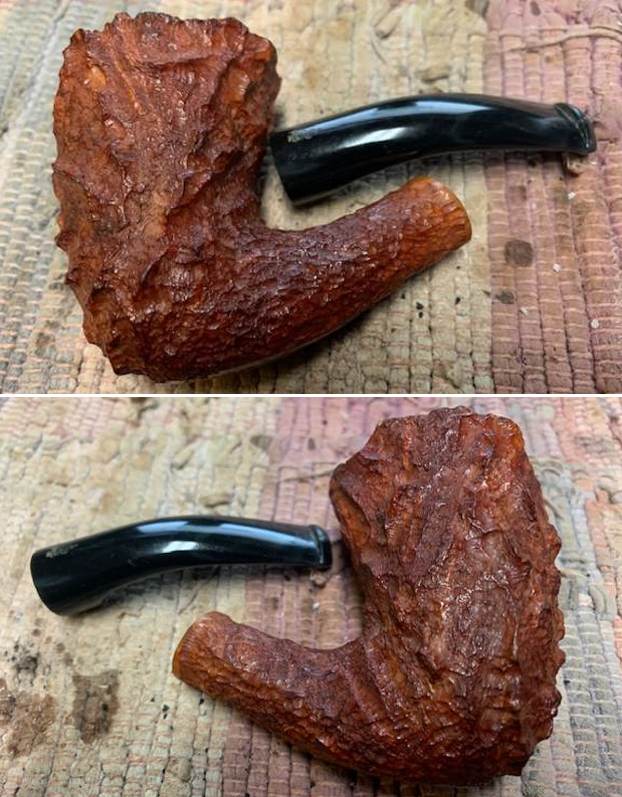
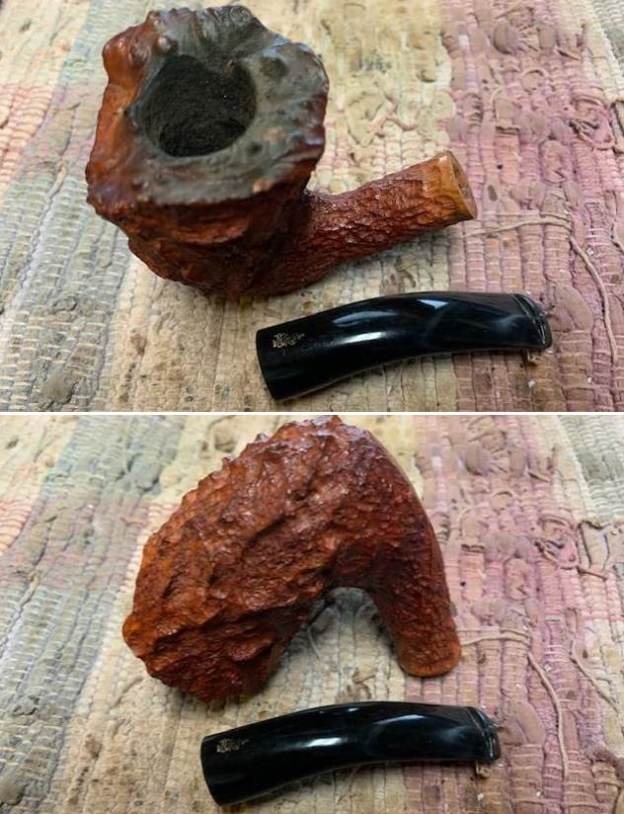
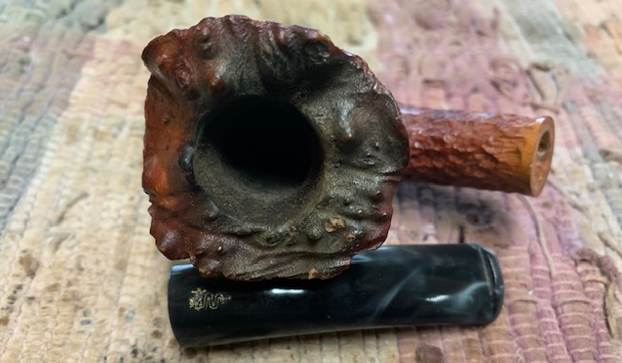
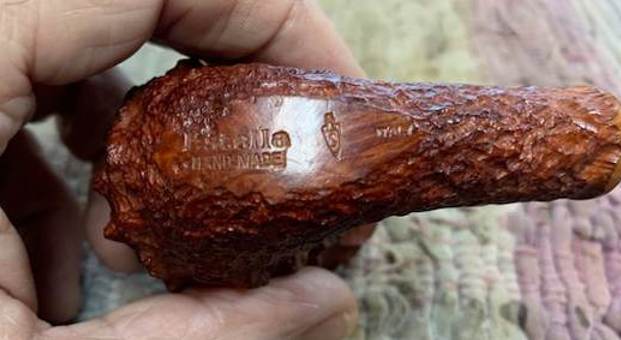
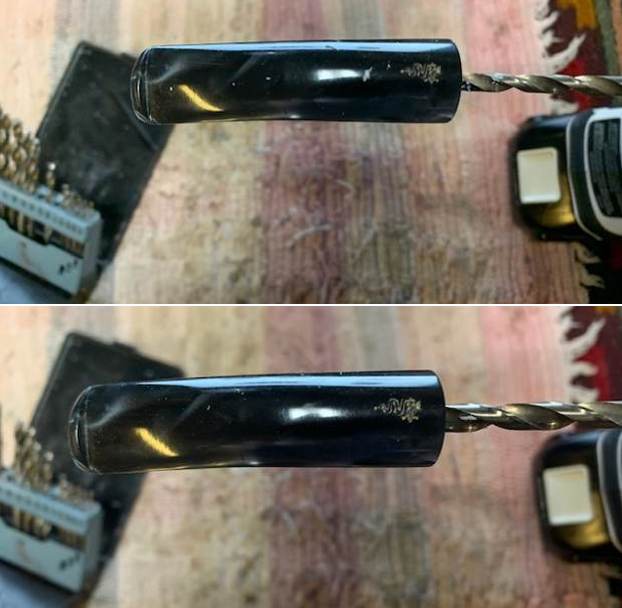
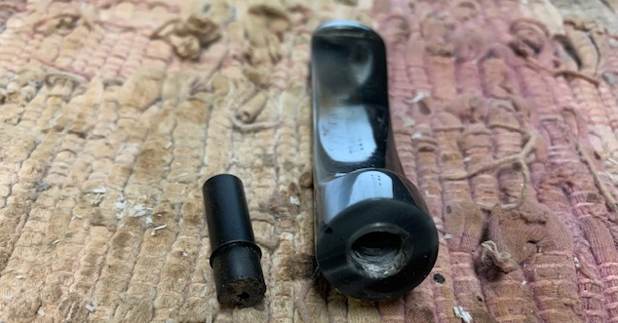
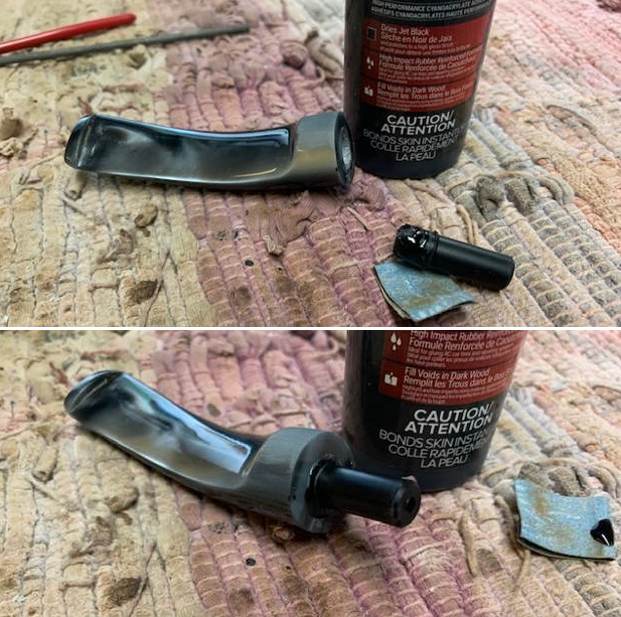
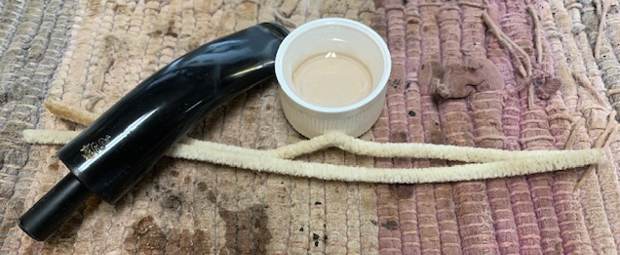
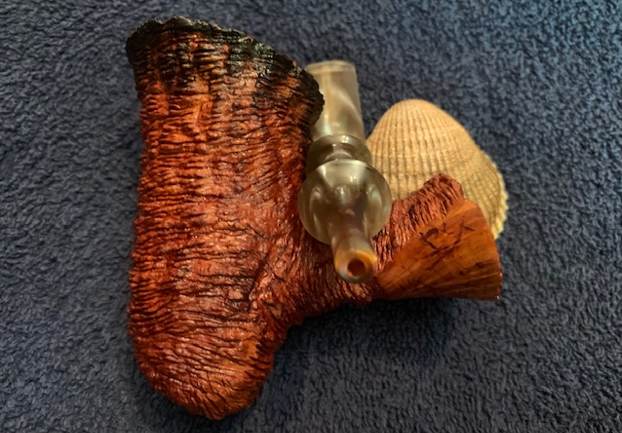
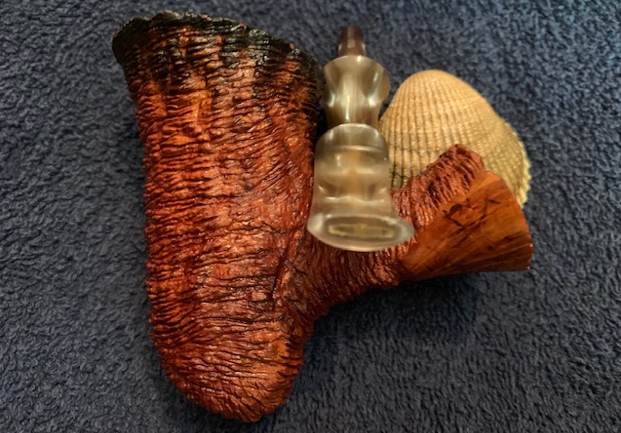
I called him back and we arranged for him to mail the pipe to me. It was a very heavily rusticated Estella Hand Made with an acrylic stem with a tenon that had snapped off fairly close to the saddle on the stem. It is a bit of a bent Dublin with a fancy half saddle acrylic in variegated silver and grey colours. The stem is in pretty decent condition. The bowl has a light cake and the rim top has some lava in the valleys. It will need to be cleaned up as well as having the tenon replaced. He sent the pipe to me through Canada Post and when it arrived it looked just as Curtis had photographed it.The pipe is a heavily rusticated Freehand with a plateau rim top. It is stamped on the smooth heel of the bowl and onto the shank on the underside of the pipe. It reads Estella [over] Hand Made followed by Savinelli S Shield logo then Italy. The stem was a variegated grey and silver half saddle. The tenon had snapped very close to the spot at the end of the stem. The stem itself was quite clean with some light tooth marks and chatter on both sides ahead of the button. There was a moderate cake in the bowl that went half way down the bowl. There was a lava overflow on the rim top and some nicks on some of the high spots. There was also some grime on the bowl at the midpoint where it is held in the hand. It was a nice looking Freehand pipe that showed great promise. I took photos of the pipe before I started my work on it. I took a close up photo of the bowl and rim top to show the thickness of the cake and the condition of the stem when I received the pipe. It was a bit of a mess. You can see the lava overflow on the rim top and the inner edge of the bowl. The stem looked good other than having a broken tenon. There were some light tooth marks and chatter on both sides ahead of the button.The next photo shows the stamping on the underside of the shank. It is clear and readable as noted above.I reamed the bowl with a PipNet Pipe Reamer to remove the cake from the bowl – using the #1 and #2 cutting heads to take out the majority of the cake in the bowl. I cleaned up the reaming with a Savinelli Fitsall Pipe Knife and a piece of dowel wrapped with some 220 grit sandpaper. I cleaned up the lava on the rim top with a brass bristle wire brush and was able to remove much of the build up. I cleaned out the mortise and airway in the bowl and shank with isopropyl alcohol, cotton swabs and pipe cleaners until the shank and airway were clean.I scrubbed the bowl with Murphy’s Oil Soap and a tooth brush on the rustication on the bowl and rim top. I rinsed the bowl with warm running water to rinse off the soap and the grime left behind. It looked better. I rubbed the bowl down with Before & After Restoration Balm. I worked it into the rustication with my fingertips and a horsehair shoe brush to get it deep in the valleys of the rustication. I let it sit for 15 minutes and buffed it off with a soft cloth.  I set the bowl aside and turned my attention to the stem. I went through box of replacement tenons. I found one that was the right fit for the mortise. It was a little long for insertion into the end of the stem once drilled it. I would need to shorten the tenon in order to not have it break through the underside of the half saddle.I flattened the broken edges of the original tenon with a Dremel and sanding drum. I used a penknife to create a funnel in the stem end to guide the drill bit straight. I drilled it with a series of drill bits from one slightly larger than the airway in the stem and finished with a ¼ inch bit that was the same size as the tenon end. I cleaned up the drilled out stem with a round file and a half round file. I smoothed out the walls of the drilled out area. I roughened and rounded the end of the tenon that was going to be inserted in the stem. I coated it with some black superglue and twisted it in place in the stem end. I aligned it with the shank end to make sure the fit was correct.I cleaned out the airway in the stem shank with pipe cleaners, cotton swabs and isopropyl alcohol to remove the tars and oils. I sanded out the tooth marks and chatter with 220 grit sandpaper and started the polishing with 400 grit sandpaper. The marks are smooth and blended in. I also sanded the diameter of the stem slightly on the right side and underside to adjust the fit to the shank. I polished the stem with micromesh sanding pads – dry sanding with 1500-12000 grit sanding pads. I wiped the stem down after each sanding pad with a cloth impregnated with Obsidian Oil. The oil both preserves the rubber and also provides some needed friction for the micromesh pads. I polished it with Before & After Fine & Extra Fine Polish. I rubbed it down a final time with the oil and set it aside. This Estella Hand Carved Rusticated Freehand by Savinelli combines a great looking piece of rusticated plateau briar with a variegated grey/silver acrylic stem to make a beautiful pipe. The cleaned rustication on the bowl came alive with the polishing and waxing. I put the stem back on the bowl and carefully buffed the pipe with Blue Diamond on the buffing wheel. I gave the bowl multiple coats of Conservator’s Wax and the acrylic stem multiple coats of carnauba wax on the buffing wheel and followed that by buffing the entire pipe with a clean buffing pad. I hand buffed the pipe with a microfiber cloth to deepen the shine. The finished Estella Hand Carved Freehand really is a beauty and fits nicely in the hand and looks very good. Give the finished pipe a look in the photos below. The dimensions of the pipe are Length: 6 inches, Height: 2 ¾ inches, Outside diameter of the bowl: 1 ¾  x 2 inches, Chamber diameter: ¾ of an inch. The weight of the pipe is 2.05oz./58grams. It is the second pipe I have finished for Curtis. Next week I will put it in the mail and send it back to him. Thanks for reading this blog and my reflections on the pipe while I worked on it. There are many more to come!

Restoring an Impressive Meerschaum Figural


Blog by Kenneth Lieblich

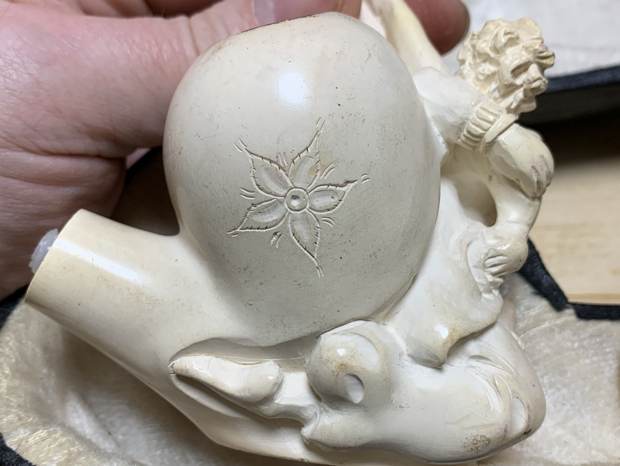
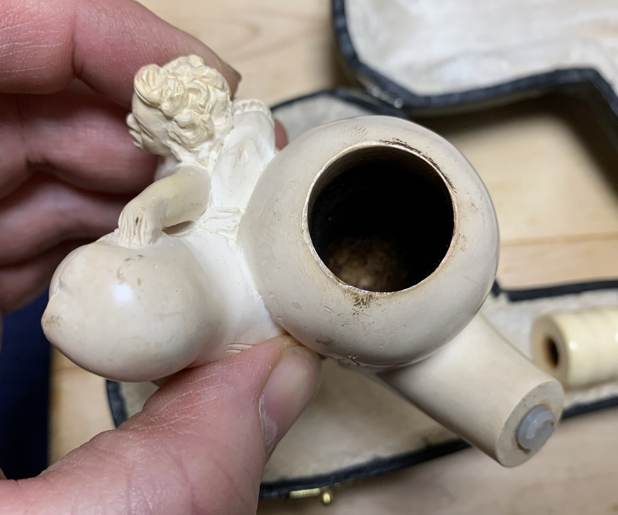
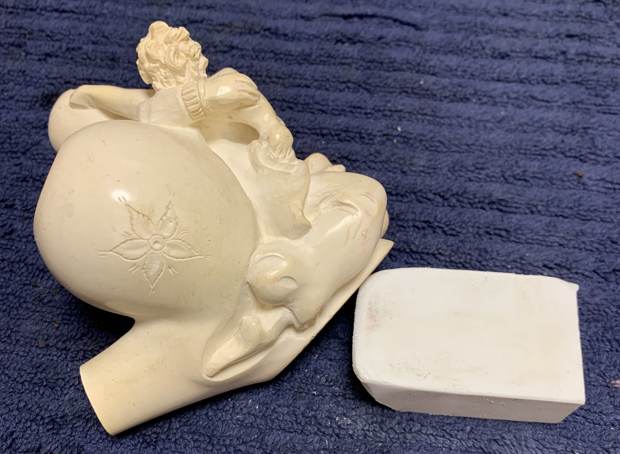
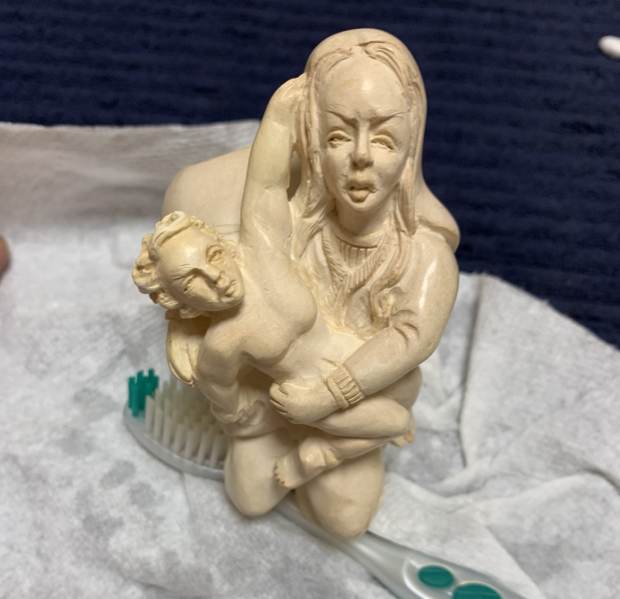
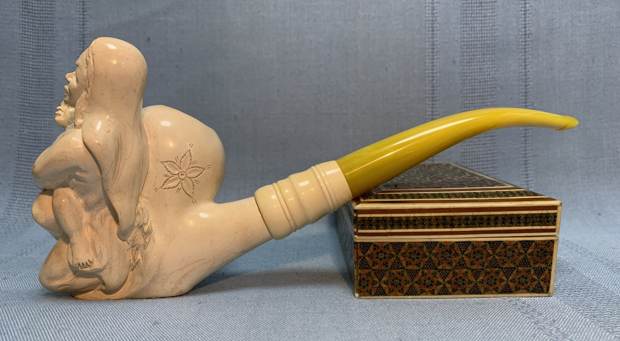
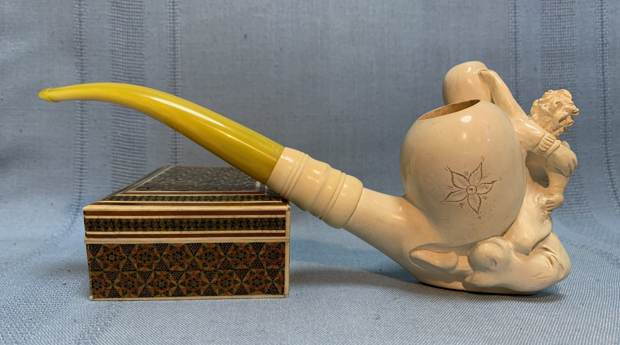
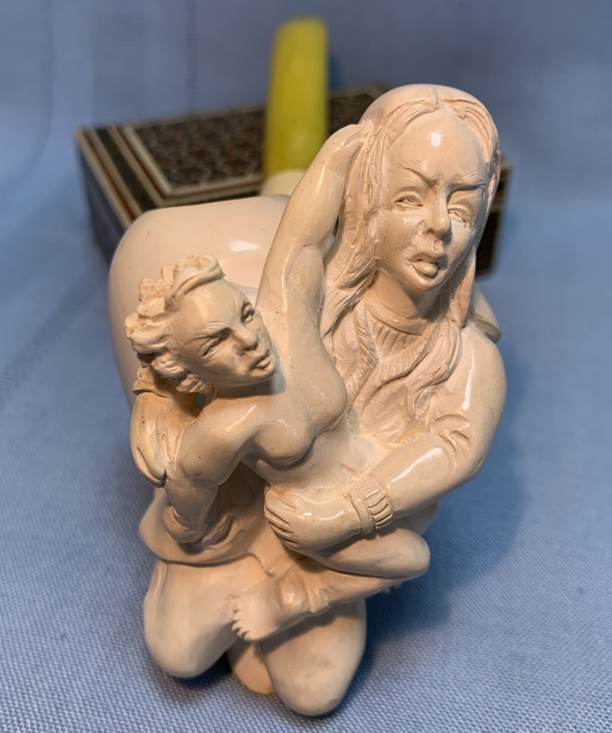
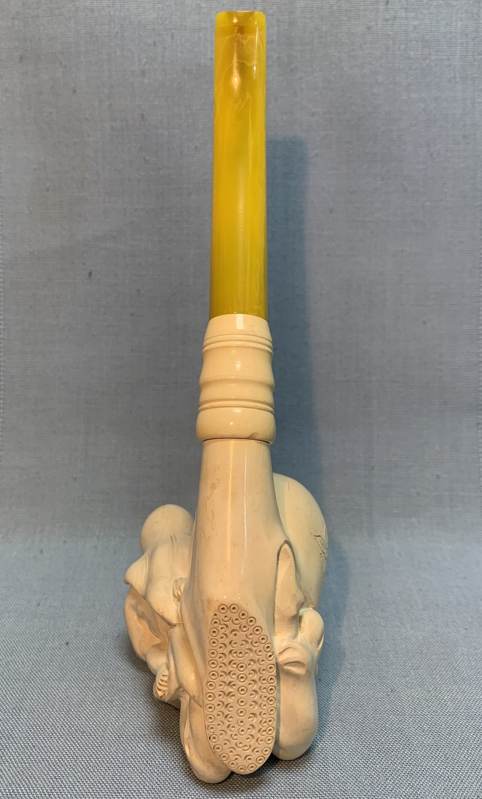
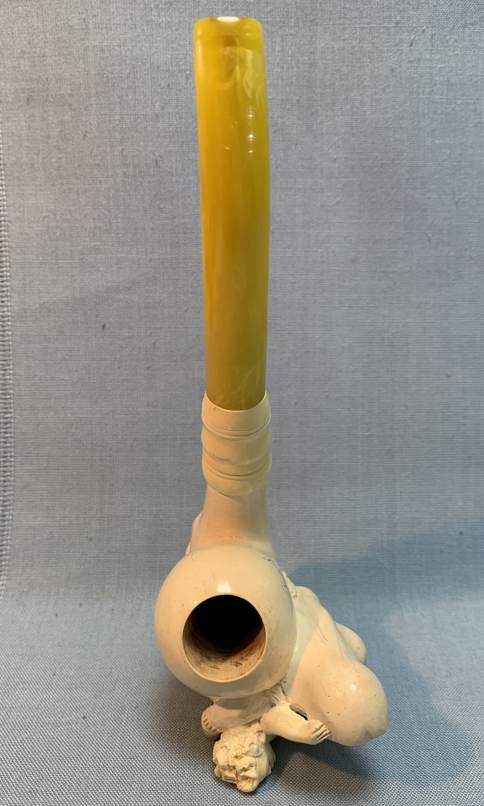
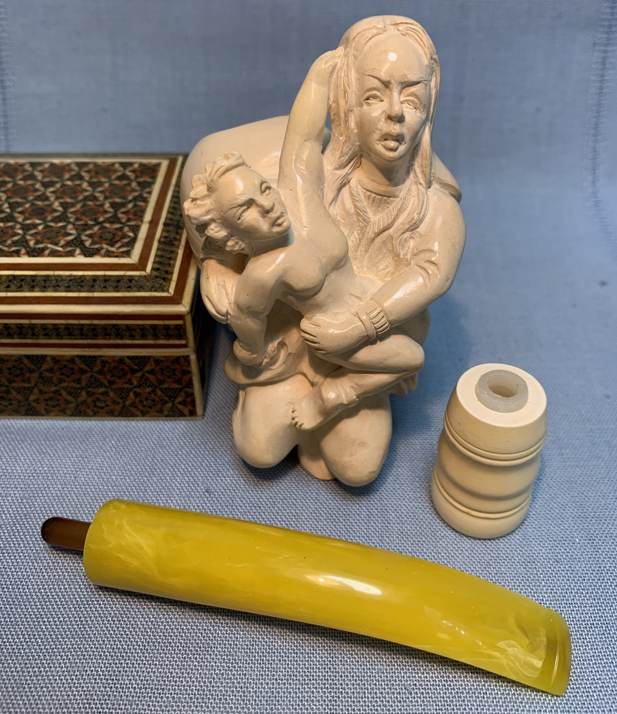
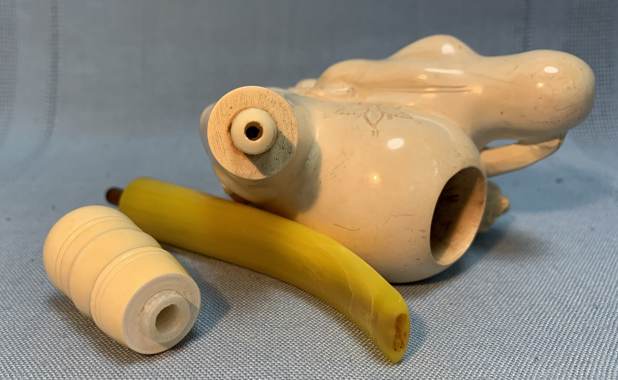
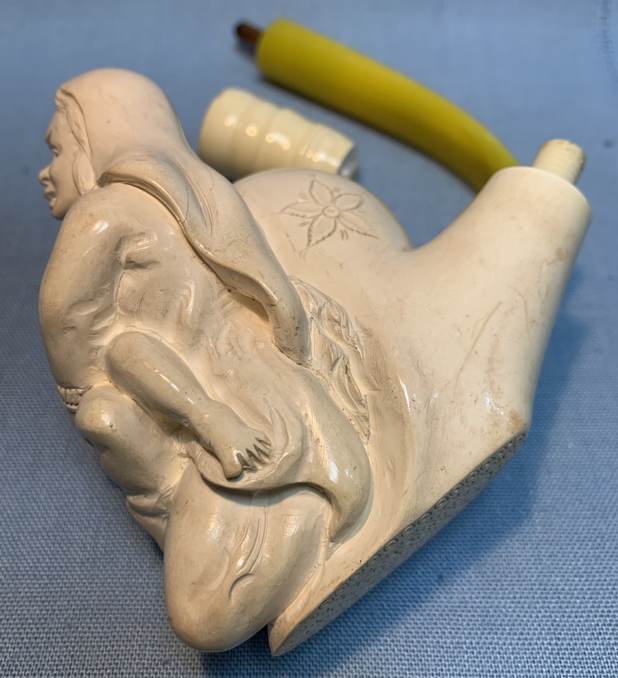
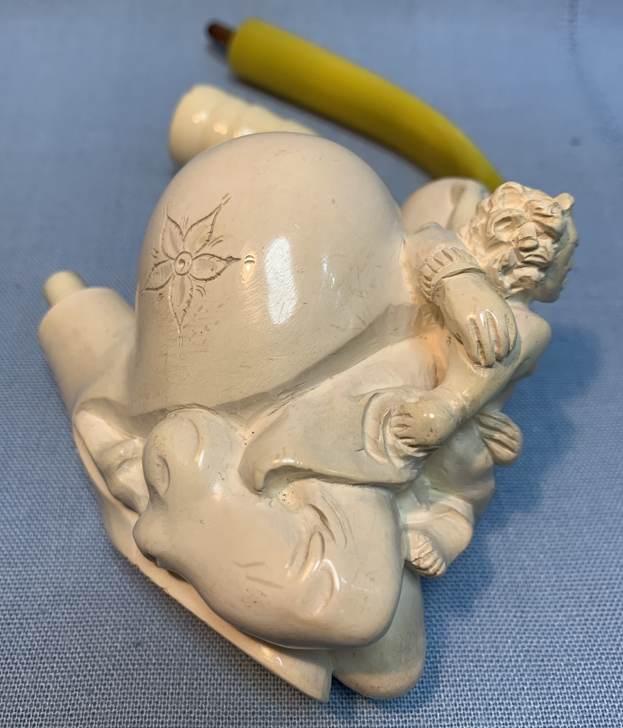
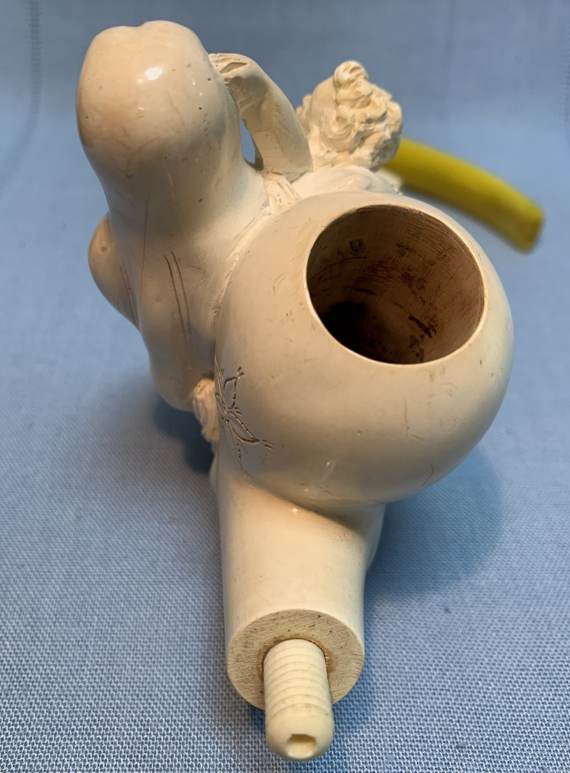
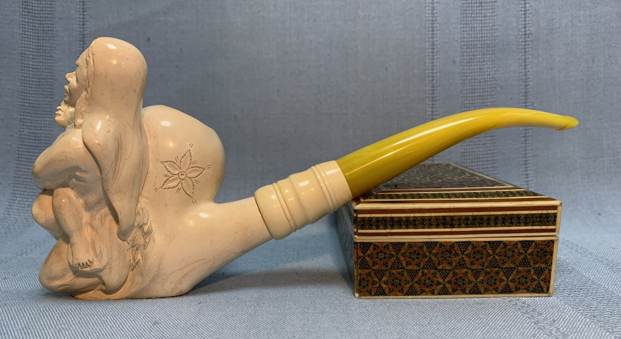
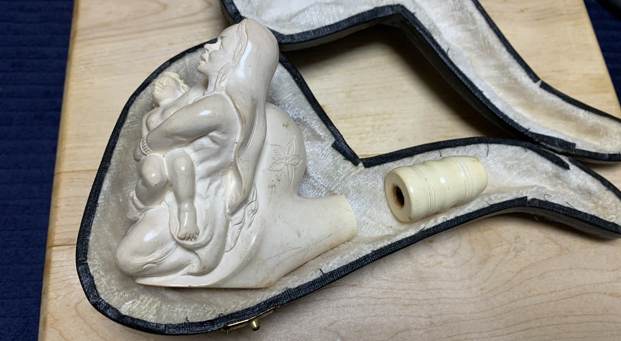
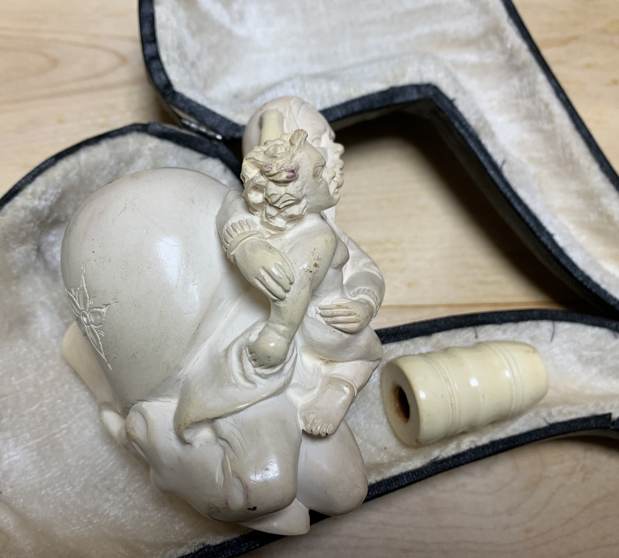
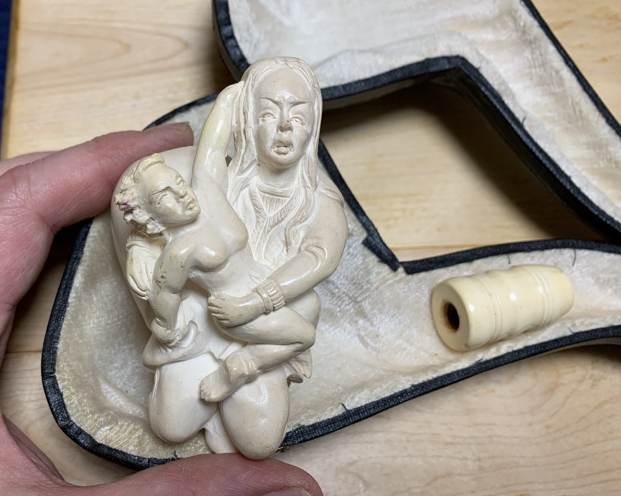
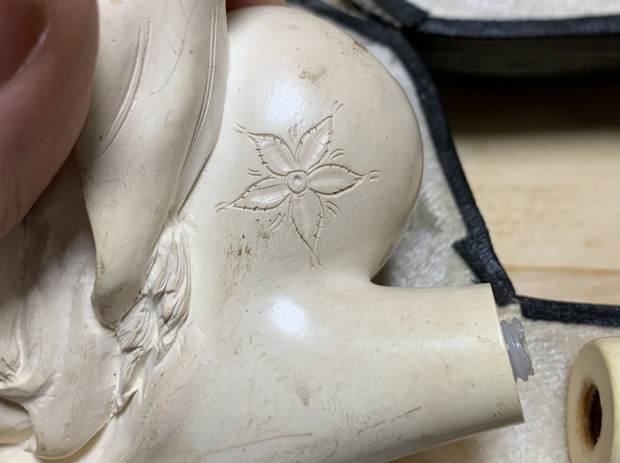
Next on the chopping block, we have a unique and large, carved, meerschaum figural pipe. As I’m sure you know, meerschaum is a German word which literally means “sea foam” (meer = sea and schaum = foam). Incidentally, schaum is also where we get the English word scum from. But where did the Germans get the meerschaum word from? Obviously, meerschaum is so called because it is white and light, but the Oxford Dictionary of Etymology further explains that the term is itself a translation of the Persian word kef-i-daryā – literally meaning “foam of sea”. Now you can impress friends at your next cocktail party. I acquired this pipe in a large lot in the summertime. This meerschaum pipe was notable as its stem had been lost in the mists of time, on its way from Asia Minor. I searched through the lot of pipes that it came in, but there was no sign of it. Fortunately, Steve kindly supplied me with a suitable stem which worked perfectly. The pipe is a large piece of block meerschaum, presumably from Turkey, although it has no markings of any sort. However, it has all the hallmarks of Eskişehir, so I feel confident in saying it’s Turkish. As for the carving, I’m not totally sure what it is meant to be. I can’t tell if it’s intended to be an image of the Virgin and Child, people from an ancient Anatolian myth, or some historical characters with which I am unfamiliar. Steve didn’t recognize them either, so if you have some idea who these people are, please feel free to clear up the mystery with a comment below.

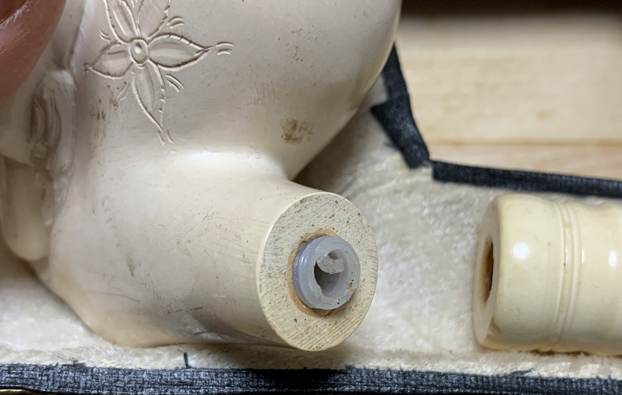
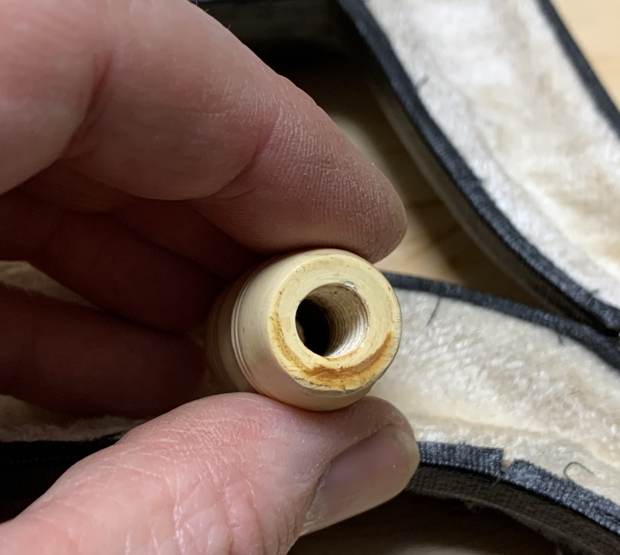
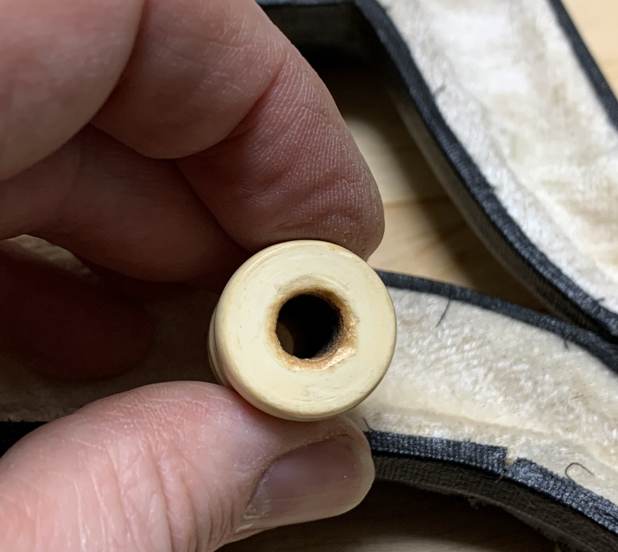
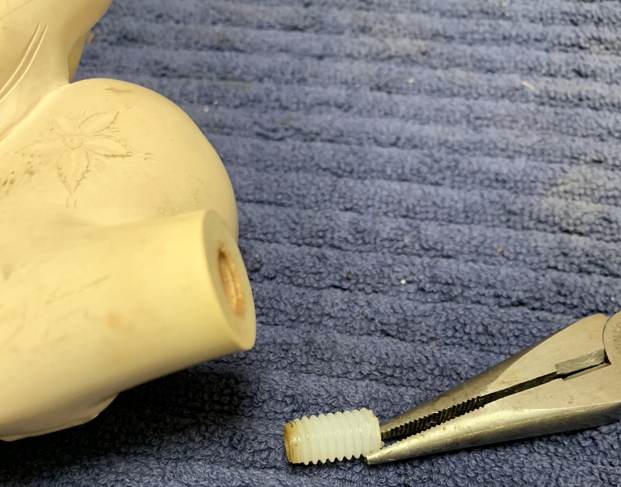
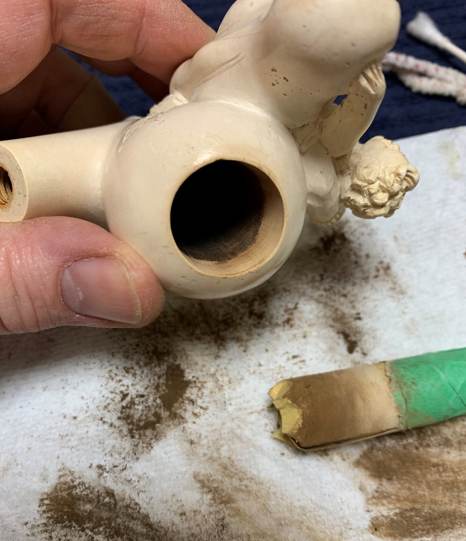
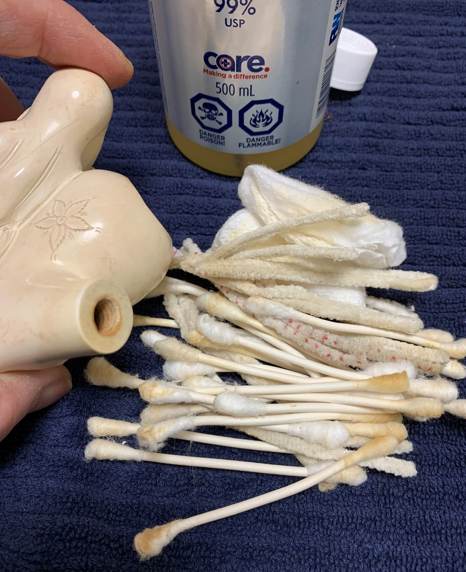
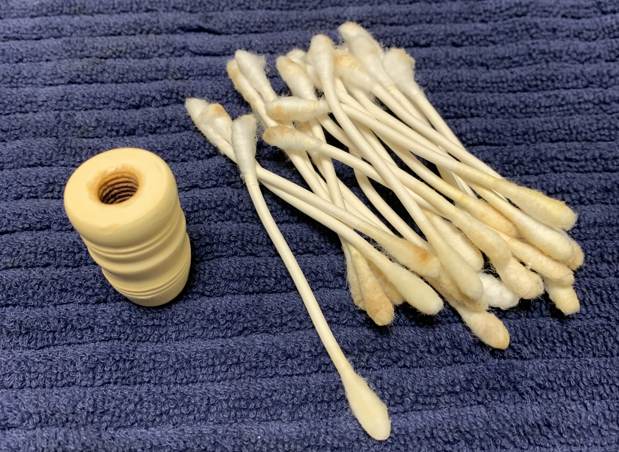
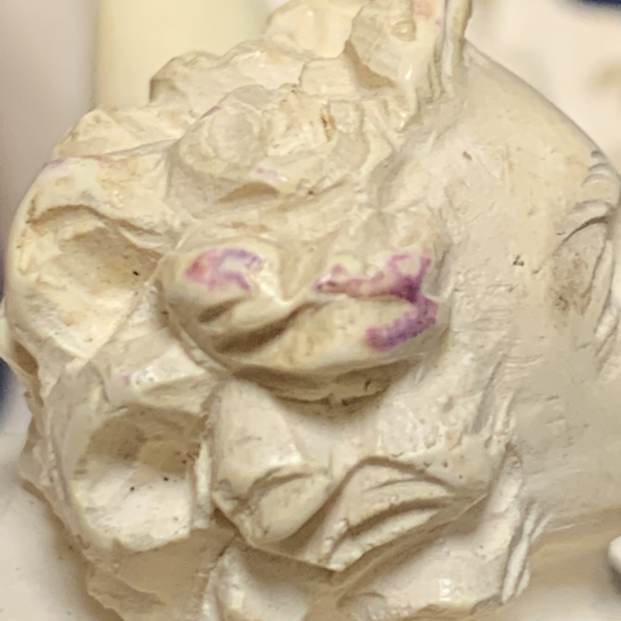
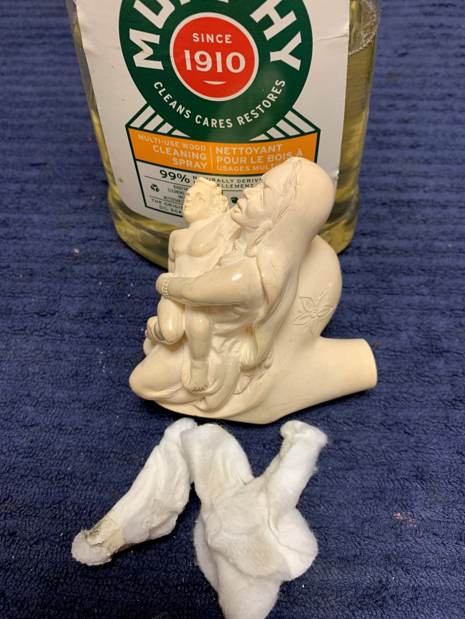
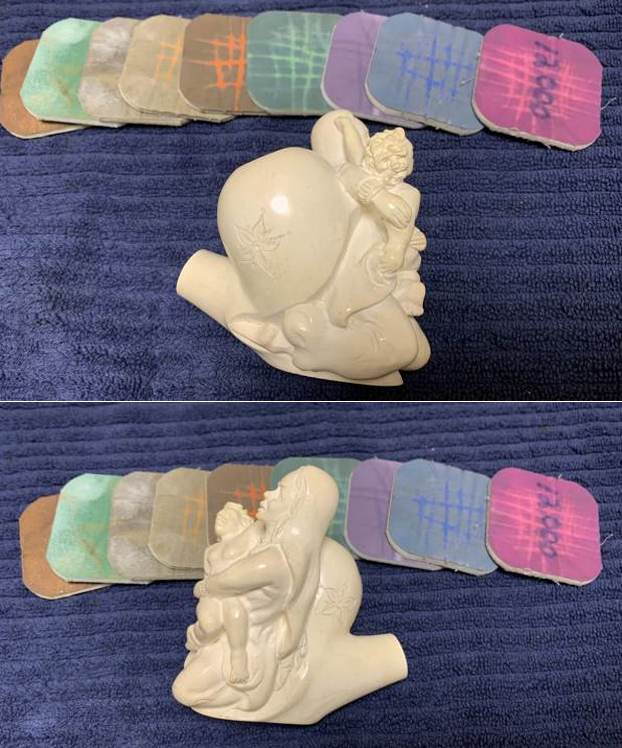
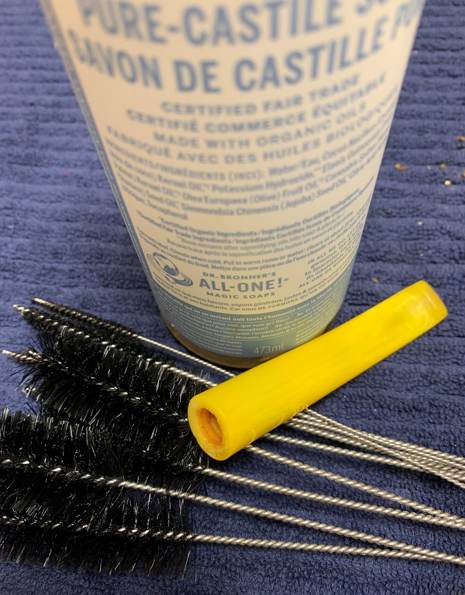
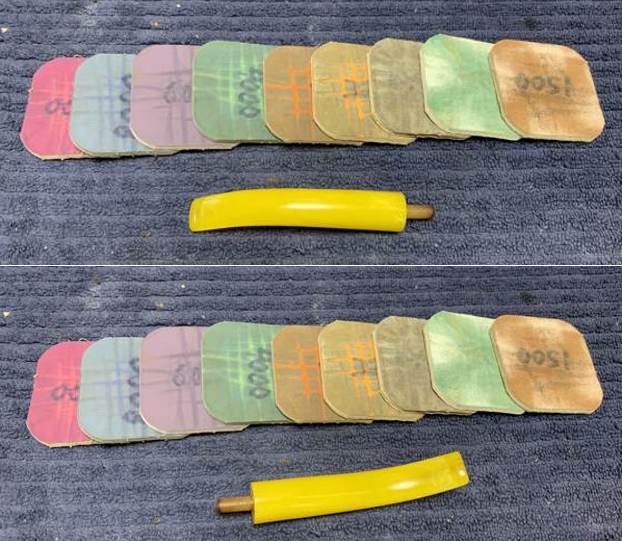
The pipe was in very nice condition, though a bit dirty. There was dust and debris in the grooves and even on the smooth surfaces. It had been smoked, though not heavily. The main part of the pipe was in good condition, without any notable damage. There was a tenon left in the shank that was broken and would need replacement. There was also a meerschaum shank extension which was dirty, but otherwise in good shape too. To work! I began by removing the tenon in the shank with a pair of needle-nose pliers. Meerschaum is too fragile for a proper reamer, so I used 220-grit sandpaper on the end of a wooden dowel to clean out the bowl and it turned out very nicely. I then cleaned the shank with lemon-infused isopropyl alcohol, pipe cleaners and Q-tips. One of the frustrations of cleaning meerschaum is that once smoked, the stains never go away. However, I did what I could and cleaned the shank extension in a similar manner. There were some unusual purple stains on parts of the meerschaum. I don’t know what they were, but I took a good-quality eraser and they came off with ease, fortunately. Then I took Murphy’s Oil Soap on some cotton rounds (and Q-tips) and cleaned the meerschaum. It’s important to be cautious in one’s use of fluids around meerschaum. Allowing it to soak in a liquid causes it to soften. I also used a soft bristle toothbrush with the Murphy’s in some of the nooks and crannies. Now that the figural was all clean, I set about using my MicroMesh sanding pads to polish up the meerschaum. I didn’t use the coarser grits over the entire pipe – only in the areas that required it – as I didn’t want to risk any damage. I neglected to take pictures, but I also rubbed some Clapham’s Beeswax into the meerschaum. In fact, I used Q-tips as well to get it into the nooks and crannies. Then I let it sit for 15-20 minutes, buffed it with a microfiber cloth and then repeated the beeswax process. Worked like a charm! As I mentioned, Steve was kind enough to give me an acrylic stem which came with its own push-tenon. He also gave me a handful of other plastic, bone and metal tenons so I could find the right fit for the pipe in question. The stem was terrific, but it had been used and was plenty dirty.First, I removed the push-tenon by heating it lightly with my heat gun. That allowed it to unscrew without much trouble. I then cleaned out the stem and tenon with the usual lemon-infused isopropyl alcohol, cotton pads, Q-tips etc. Just like meerschaum, acrylic tends to stain after smoking, no matter how dutiful you are with your cleaning. However, I put in a lot of elbow grease to sterilize the stem and tenon as much as I could. I even used some Castile soap and tube brushes. There were a couple of very small nicks on the stem, which I repaired with cyanoacrylate adhesive. However, I forgot to take pictures of that. I then used all nine MicroMesh pads (1,500 through 12,000 grit) and some Obsidian Pipe Stem Oil in between each pad scrubbing. Once that was done, I fitted a new bone tenon for the shank extension and a new mortise for the push-tenon. Finally, as meerschaum pipes don’t do well on a bench-polisher, I buffed the pipe by hand with a microfibre cloth. And that’s that! This big meerschaum looks fantastic and is ready to be enjoyed again by the next owner. I am pleased to announce that this pipe is for sale! If you are interested in acquiring it for your collection, please have a look in the “Meerschaum” section of the store here on Steve’s website. You can also email me directly at kenneth@knightsofthepipe.com. The approximate dimensions of the pipe are as follows: length 7½ in. (190 mm); height 3½ in. (89 mm); bowl diameter 1½ in. (38 mm); chamber diameter ¾ in. (20 mm). The weight of the pipe is 4 oz. (114 g). I hope you enjoyed reading the story of this pipe’s restoration as much as I did restoring it. If you are interested in more of my work, please follow me here on Steve’s website or send me an email. Thank you very much for reading and, as always, I welcome and encourage your comments.

Restoring and Restemming an Interesting Nording F Freehand


Blog by Steve Laug

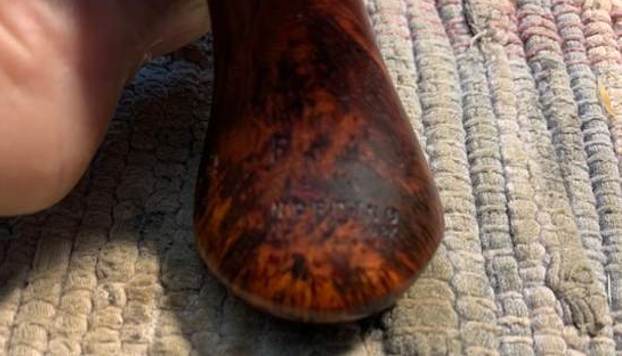
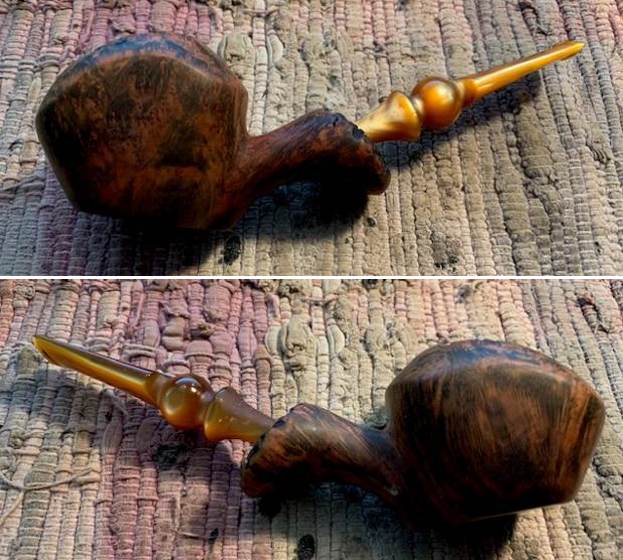
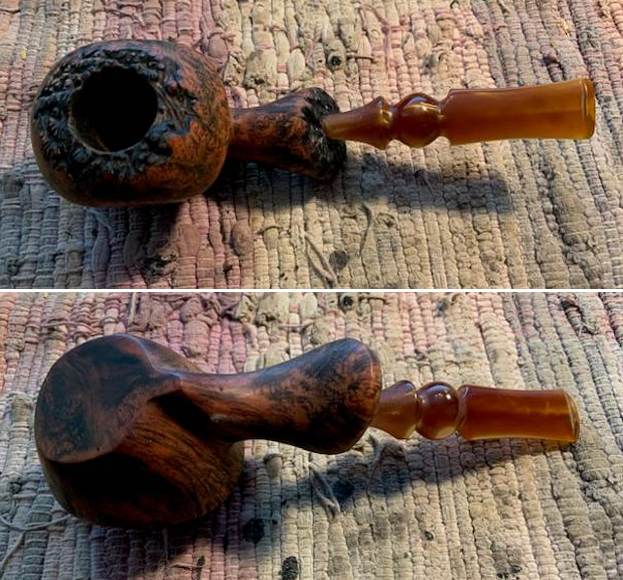
It was time to turn back to another one of the pipes that Jeff and I picked up. Neither of us had any memory of where this pipe came from but it is another interesting geometrically shaped Freehand with a variety of angles in the carving in the bowl and shank that really follow the grain on this piece of briar. The rim top and shank end is plateau and is stained black. You can see the flow of mixed grain around the bowl and shank. It is stamped on the underside of the shank F over NORDING over MADE IN DANMARK just before the plateau end of the shank. There is no other stamping on the pipe. The stem was missing and the tenon was broken off in the shank. Jeff had definitely cleaned up the pipe sometime along the way. He had reamed the bowl with a PipNet pipe reamer and cleaned it up with a Savinelli Fitsall Pipe Knife. He scrubbed the exterior with Murphy’s Oil Soap and a tooth brush to clean off lava on the rim top and shank end. He had cleaned up the internals of the shank, mortise and stem with pipe cleaners, cotton swabs and alcohol to remove all of the oils and tars in the pipe. I would need to pull the broken tenon and fit a new stem to the shank but it was a nice bowl. I took photos of the rim top and shank to show the condition of the pipe before I started working on it. You can see the condition from the bowl and rim top in the first photo. The inner edge of the bowl was in very good condition and was smooth to the touch. The second photo show the shank end plateau. It also looked very good. I took a photo of the stamping on the underside of the shank. It was faded but still readable as noted above.Before I started my work on the pipe I wanted to learn more about where this pipe fit into the Nording lines so I turned to the first of two sites that I always check to gather information on a brand. I turned first to Pipedia (https://pipedia.org/wiki/N%C3%B8rding). Nording’s were exclusively freehand shapes, graded from A, B, C, D, up to its highest grade, extra. Later an “F” grade was added—less expensive than the “A.” I could find no other information on the rest of the stamping on the pipe.

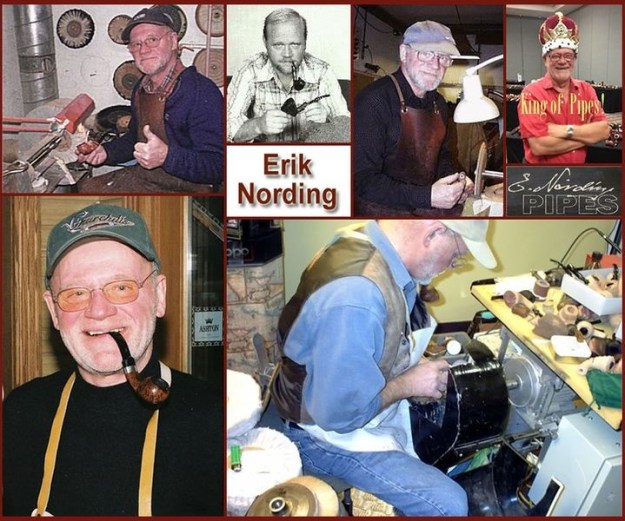
I did find a great collage of photos of Erik Nording that I have included below. I turned to the second information site – Pipephil’s (http://www.pipephil.eu/logos/en/logo-n2.html) did not find any more helpful information on the Nording Danmark stamp.

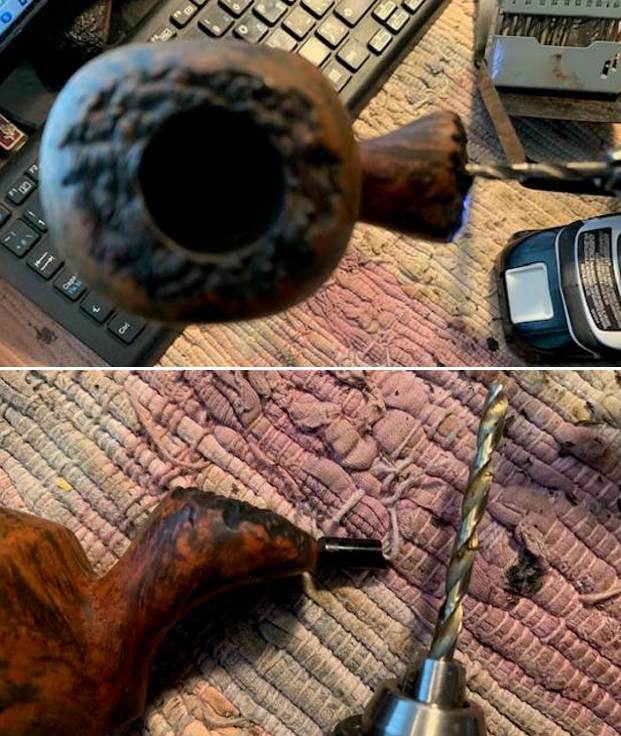
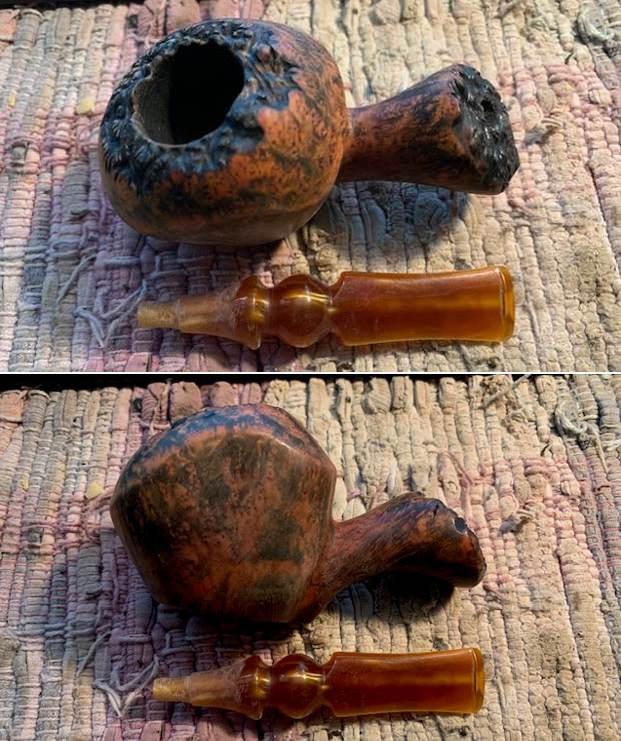
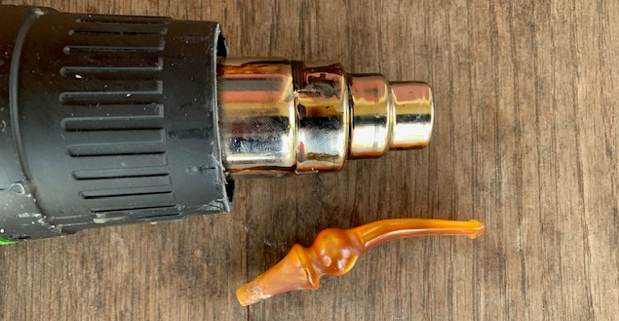
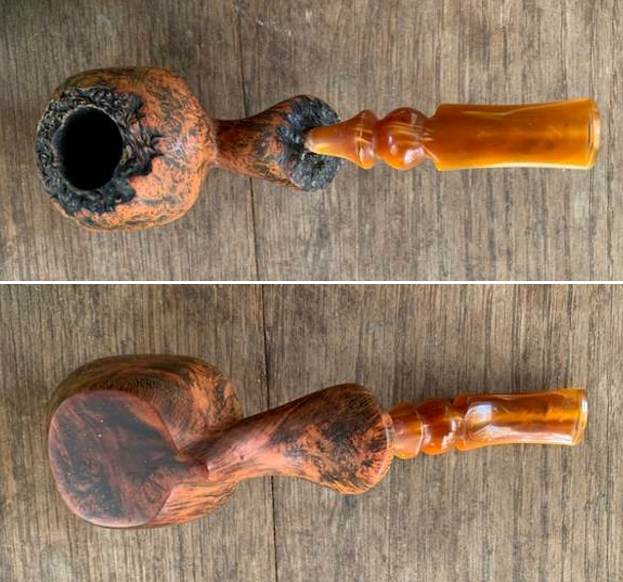
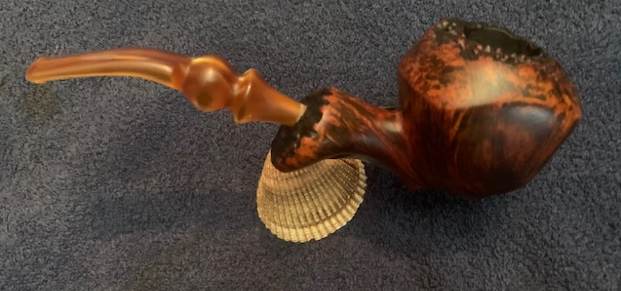
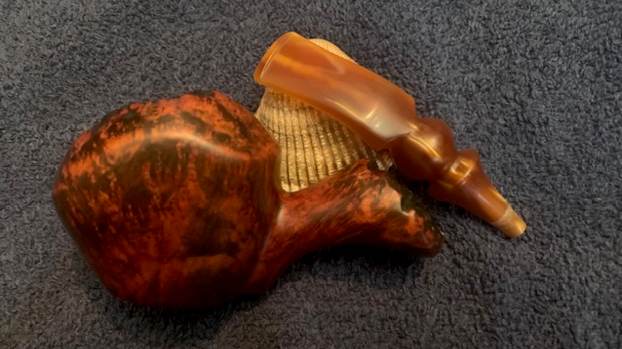
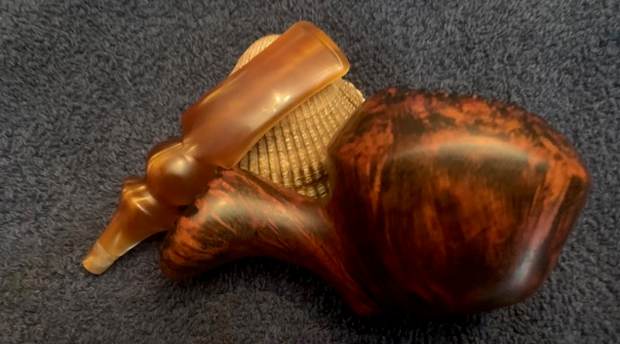
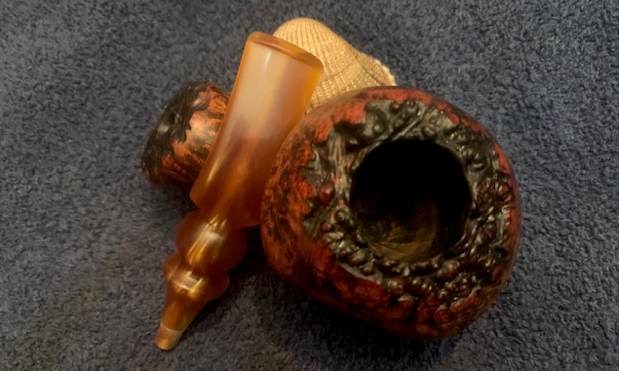
Armed with the information on the F stamp being a lower end midgrade Freehand, I knew a bit about the pipe at hand. I turned to address the pipe itself. When it arrived here in Vancouver it was a clean pipe and I knew what I had to work with. To begin my work on it, I removed the broken tenon from the shank with a drill bit turned into the shank on low speed. I took a photo of the broken tenon once I had it removed. I went through my can of stems and found this straight acrylic stem that had been partially turned for another pipe somewhere along the way. It would need some work but the fit was close. I sanded the tenon end of the new stem to get a strong fit in the shank of the pipe. I would need to refine the fit but it was looking quite good. I would also need to heat and bend the stem for a proper fit. I used a heat gun to bend the stem to match the flow of the stem. I used the lowest setting on the heat gun and bent the stem at the proper angle. I put it in the shank and took photos of the newly restemmed pipe. It is looking good at this point. I polished the briar with micromesh sanding pads. I wet sanded it with 1500-12000 grit pads. I wiped the bowl down after each pad with a damp cloth. The bowl began to take on a rich shine and grain was beginning to stand out. I rubbed the bowl and shank down with Before & After Restoration Balm to deep clean the finish on the bowl and shank. The product works to clean, enliven and protect the briar. I worked it in with my fingers to get it into the briar. I used a horsehair shoe brush to work it into the plateau top and shank end. After it sat for a 15 minutes I wiped it off and buffed it with a soft cloth. The briar really began to have a rich shine. I took some photos of the bowl at this point to mark the progress in the restoration. It is a beautiful bowl. I set the bowl aside and worked on the stem at this point in the process. I sanded the tenon area to shape the fit in the shank with 220 grit sandpaper fit snugly in the shank. I started polishing the stem with 400 grit wet dry sandpaper.  I polished the stem with micromesh sanding pads – wet sanding with 1500-2400 grit pads and dry sanding with 3200-12000 grit pads. I wiped the stem down after each pad with a damp cloth to remove the sanding dust. I used the Before & After Pipe Polish to remove the small minute scratches left in the acrylic even after the micromesh regimen. I finished by wiping the stem down with a final coat of Obsidian Oil and set it aside to dry. I put the stem back on the pipe and took the pipe to the buffer. I buffed the bowl and stem with Blue Diamond to polish the briar and the acrylic. Blue Diamond does a great job on the smaller scratches that remain in both. I gave the bowl and the stem several coats of carnauba wax and buffed the pipe with a clean buffing pad to raise the shine. I hand buffed it with a microfiber cloth to deepen the shine. The pipe polished up really nicely with a great contrasting stain look to the briar. The finished pipe is shown in the photos below. This is a unique Nording Freehand for me – the amber acrylic stem and plateau shank end gives the pipe a different look. The polished acrylic   stem looks really good with the reds and blacks standing out in the grain. The dimensions of the pipe are Length: 7 inches, Height: 2 inches, Outside diameter of the bowl: 2 inches wide x 2 ½ long, Chamber diameter: 3/4 of an inch. The weight of the pipe is 93 grams/3.28 ounces. This is another pipe that I will be putting it on the rebornpipes online store shortly, if you are interested in adding it to your collection. Thanks for walking through the restoration with me on this beauty!

Restoring a Unique Jobey Designer Bent Egg Sitter


Blog by Steve Laug

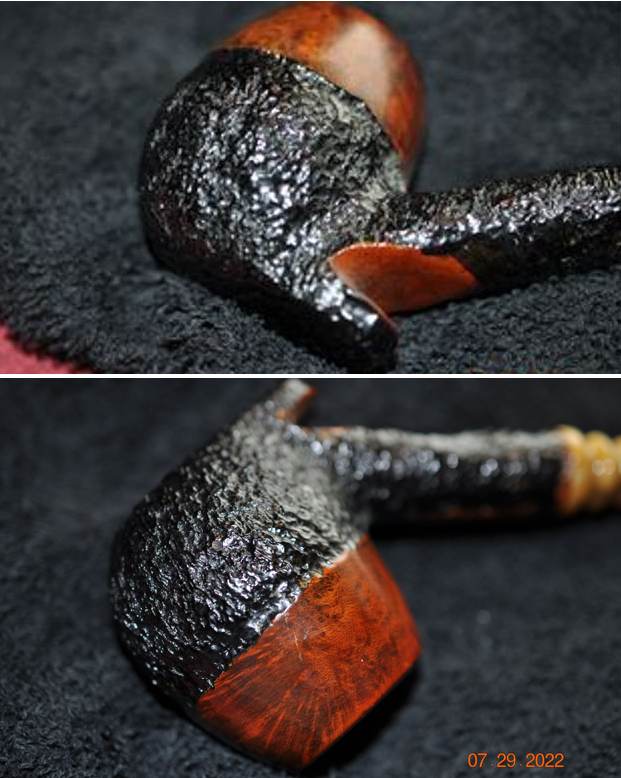
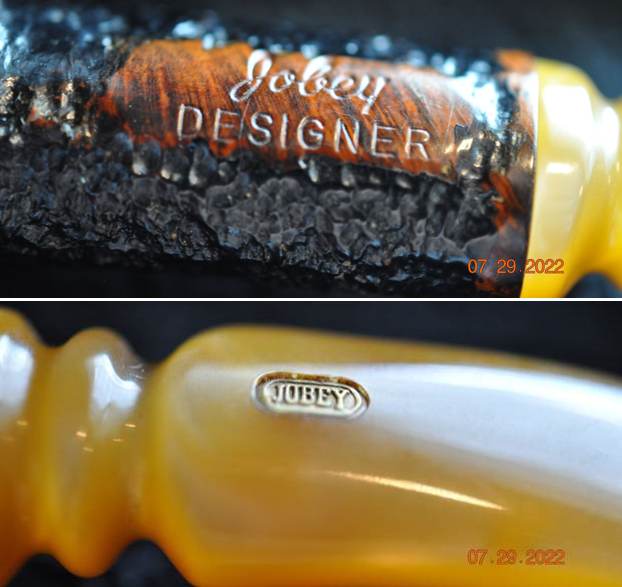
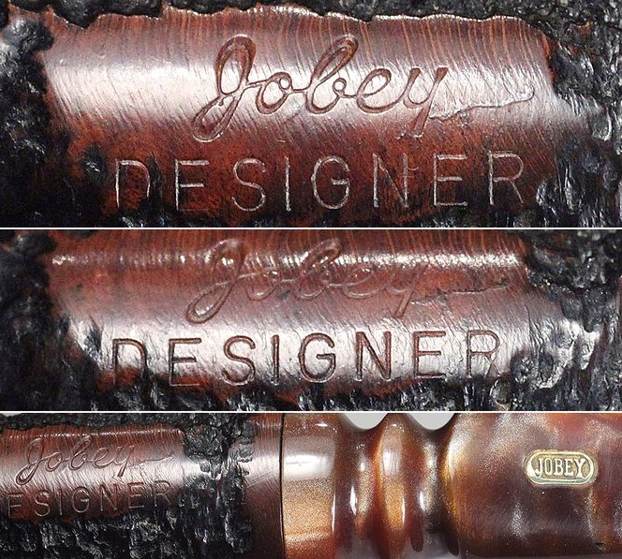
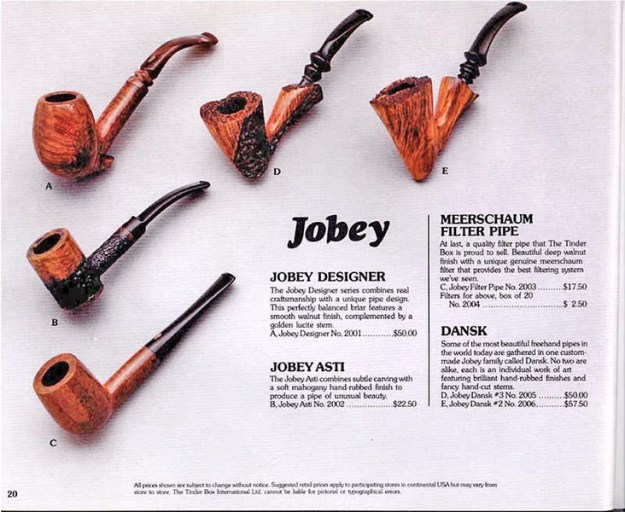
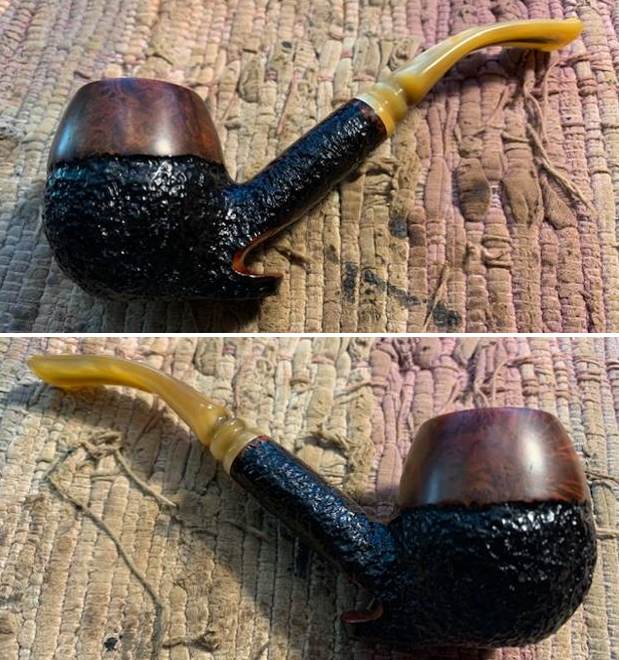
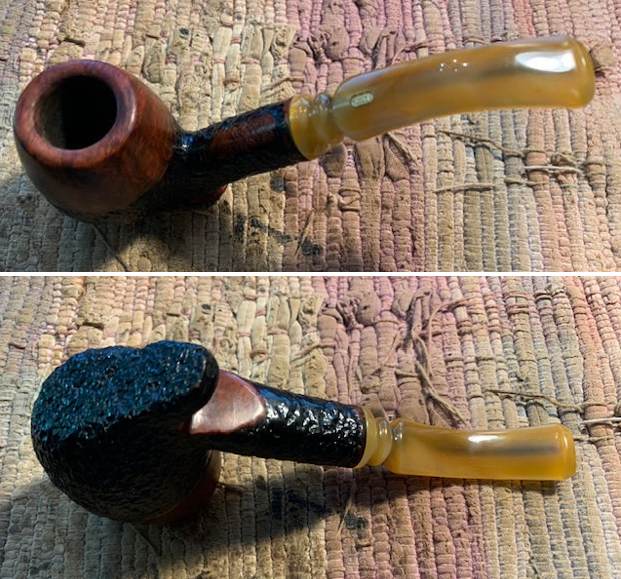
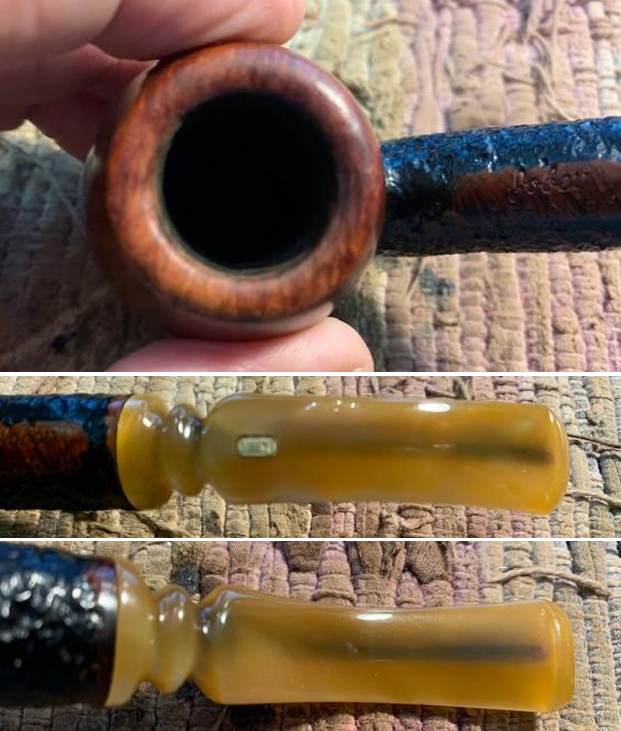
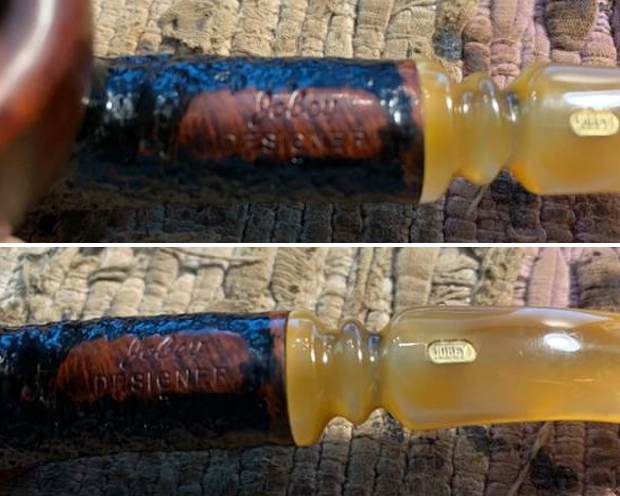
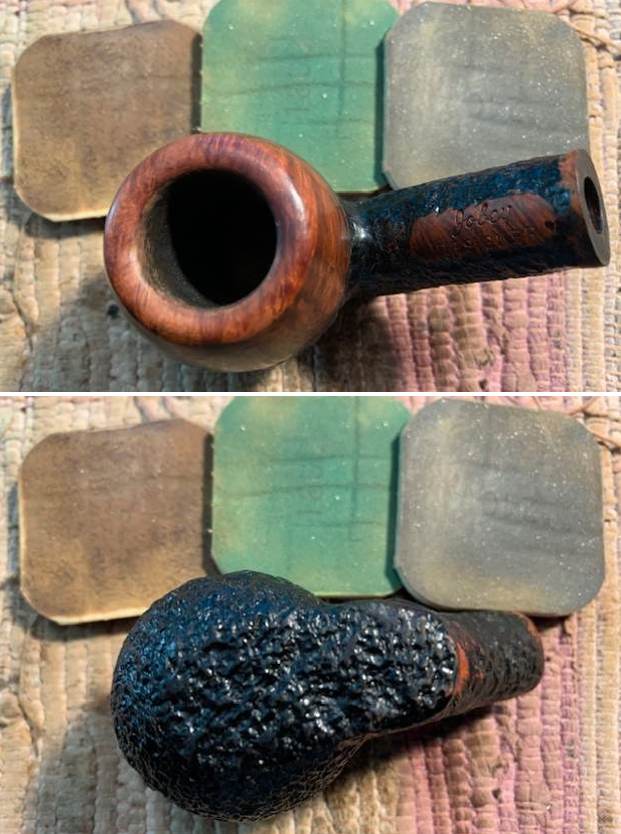
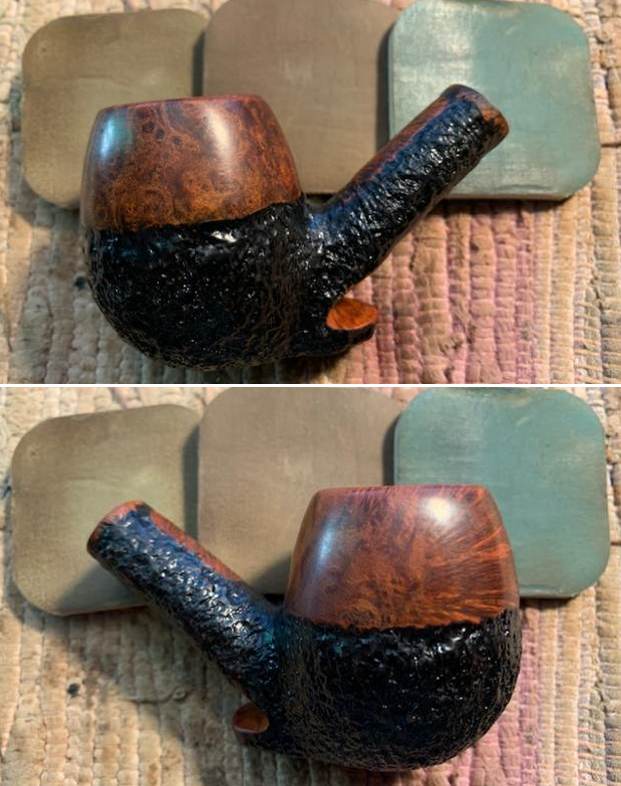
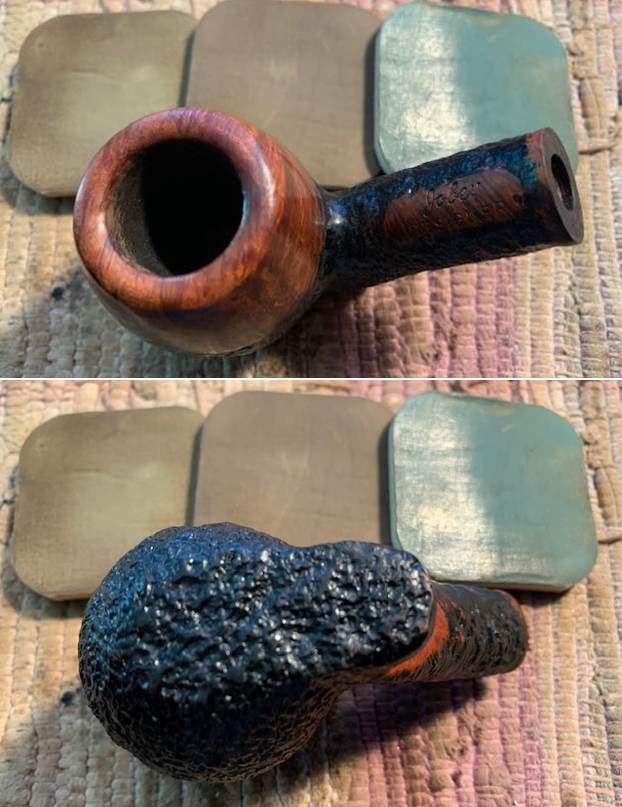
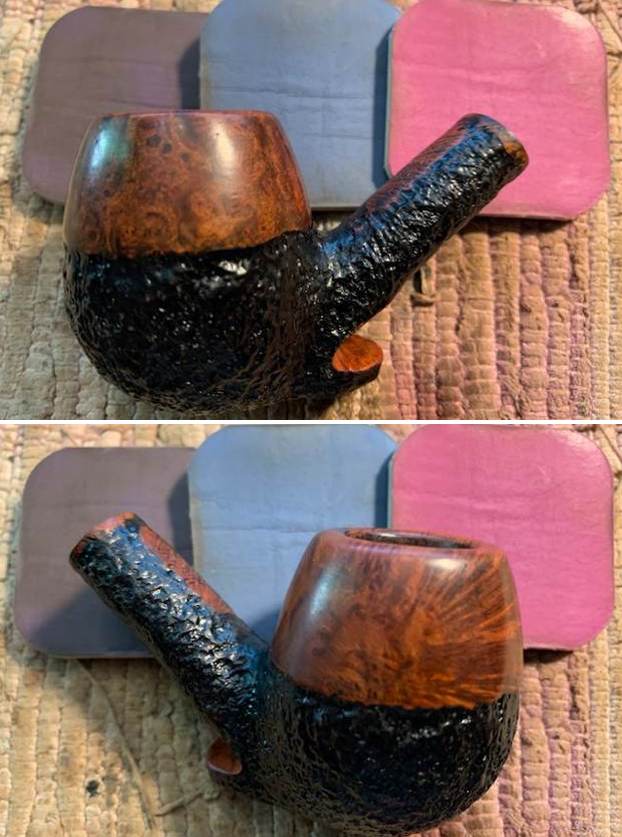
The next pipe on the table was purchased on 05/10/22 from an antique mall in Astoria, Oregon, USA. This unique Jobey has a flat base with a short tail that stabilizes the sitter. It has a rugged, finish that looks like a combination of sandblast and rustication (blastication) with lots of nooks and crannies in the briar. The top of the shank and the upper 1/3 of the bowl are smooth briar. The come together and really are quite beautiful! The pipe is stamped on a smooth panel on the topside of the shank and reads Jobey [over] Designer. The valleys and ridges of the “blasticated” grain showing through the grime and dirt are a mixture that leaves a rich texture. It had rich dark and medium contrasting brown stains that do not look too bad. There was a thick cake in the bowl with remnants of tobacco stuck on the walls. There was a lava overflow on the crowned top of the rim and covering the inner edge. It was hard to know if the rim edges were damaged. It was a beautiful pipe that was dirty and tired looking but there was a thick coat of shiny varnish or shellac covering the whole thing. The stem was golden variegated acrylic that had fancy turnings on the saddle. The tenon was the patented Jobey Link System that was developed to protect the shank. There was a hairline crack on the top of the stem where the tenon fit but it was not open and was very fine. There were tooth marks and chatter on the stem near the button on both sides. There is a brass Jobey oval logo on the top of the stem identifying it as a Jobey pipe. Jeff took photos of the pipe before he cleaned it up. He took photos of the bowl and rim top to show the cake in the bowl and the lava build up on the rim top and edges of the bowl. It was thick and hard but hopefully it had protected the rim and edges from damage. It was hard to know for sure from the photos. Jeff took photos of the top and underside of the stem showing the tooth chatter, scratching on the stem surface and wear on the edges of the button. The airway in the stem was stained with the tars and oils that would need to be cleaned up. Jeff took photos of the sides and heel of the bowl to show the condition of the finish. You can see the rugged dark look of the blastication. There is a lot of dust and grime filling in the valleys. The smooth portions on the top 1/3 of the bowl, the underside of the shank and foot as well as the patch on the top of the shank.  He took a photo of the stamping on the smooth panel on the topside of the shank. The stamping was readable as you can see from the photos and read as noted above. He also captured the logo brass insert on the top of the stem.  I turned to Pipedia to see if I could find a Jobey Designer or any information on the line  (https://pipedia.org/wiki/Jobey). Along with the history of the brand that is there which you can read if you are interested there was also a photo of the same pipe that I am working on with a dark stem rather than the yellow of the one on the table. The shape and stamping are identical so I have included them below. I am also including and advertisement that was included on the site. I have included it below along with an enlargement of the section on Jobey Designer pipes. The Designer series combines real craftsmanship with a unique pipe design. This perfectly balanced briar features a smooth walnut finish, complemented by a golden Lucite stem. It sold for $50USD

Now it was time to work on the pipe. Jeff reamed it with a PipNet pipe reamer and cleaned up the reaming with a Savinelli Fitsall Pipe Knife. He scrubbed out the internals of the shank and stem with alcohol, pipe cleaners and cotton swabs until the pipe was clean. He scrubbed the exterior of the bowl with Murphy’s Oil Soap and a tooth brush to remove the grime and grit on the briar and the lava on the rim top. The finish looks very good with good looking sandblast around the bowl and shank. Jeff scrubbed the stem with Soft Scrub and rinsed it with running water. When the pipe arrived here in Vancouver for the second stop of its restoration tour it looked a lot better. The airway in the stem still had some darkening and would need to be cleaned up some more. I took photos before I started my part of the work. I took some close up photos of the rim top and also of the stem surface. I wanted to show what cleaned bowl and rim top looked like. The rim top and edges looked very good. I also took close up photos of the stem to show the light tooth marks and the staining in the airway on the stem.  The hairline crack is in the darkened spot near the shank end.I took a photo of the stamping on the topside of the shank and it is clear and readable. I also took a photo of the Jobey oval brass inset on the top of the stem.  I took the stem off the shank and took a photo to give a clear picture of the pipe from the left side profile and the top looking down. It is a really pretty pipe.I wiped down the briar with acetone on a cotton pad to remove the shiny varnish coat. It took some scrubbing but the grain really stood out on the smooth portion much better. I polished the extension with micromesh sanding pads – dry sanding with 1500-12000 grit pads. I wiped the surface off after each pad to remove sanding debris. It is becomes more shiny with each sanding pad.  I rubbed the bowl down with Before & After Restoration Balm. I worked it into the surface of the briar with my fingertips and a horsehair shoe brush to clean, enliven and protect it. I let the balm sit for 10 minutes and then buffed with a cotton cloth and shoe brush to raise the shine. Mark Hoover’s Balm is a product that I have come to appreciate and one I use on every pipe I have been working on. I set the bowl aside and turned my attention to trying to get some of the tars from the stem. I removed the Jobey Link Tenon from the stem and worked it over with cotton swabs, pipe cleaners and alcohol. It was amazing how much grit and grime came out of the stem. I then used some Soft Scrub on the pipe cleaners and continued to work on the airway and was able to remove a lot of it. I flushed it a final time with alcohol. It was much better when I finished. The only draw back (if it is one) is that the hairline crack was very visible after cleaning.There was a tooth mark that was deep on the top left side of the stem next to the button. There was also a small crack in the turned area of the stem and top. I filled both of them both in with clear CA glue and set the stem aside to cure. Once it cured I sanded the repaired areas smooth with 220 grit sandpaper and started polishing it with 400 grit wet dry sandpaper. I polished the Lucite stem with micromesh sanding pads – 1500-12000 grit pads. I wiped it down with a damp cloth after each sanding pad. I used Before & After Pipe Polish – both Fine and Extra Fine to further polish the stem. This Unique Jobey Designer Egg Sitter turned out to be a great looking pipe. The mix of dark stains highlights the smooth and rusticated portions around the bowl sides, top and bottom. The golden coloured acrylic stem works very well with the natural and dark finish on the bowl. I put the stem back on the bowl and carefully buffed the pipe with Blue Diamond on the buffing wheel using a light touch on the briar. I gave the bowl and the stem multiple coats of carnauba wax on the buffing wheel. I buffed the entire pipe with a clean buffing pad followed by hand buffing with a microfiber cloth to deepen the shine. The finished full bent Jobey Designer Bent Egg Sitter fits nicely in the hand and feels great. Give the finished pipe a look in the photos below. The dimensions of the pipe are Length: 5 ¾ inches, Height: 2 inches, Outside diameter of the bowl: 1 ¼ inches, Chamber diameter: ¾ of an inch. The weight of the pipe is 2.26 ounces/64 grams. I will be adding it to the American Pipe Makers Section on the rebornpipes store soon. If you are interested in carrying on the pipeman’s legacy with this pipe send me a message or an email. Thanks for reading this blog and my reflections on the pipe while I worked on it.
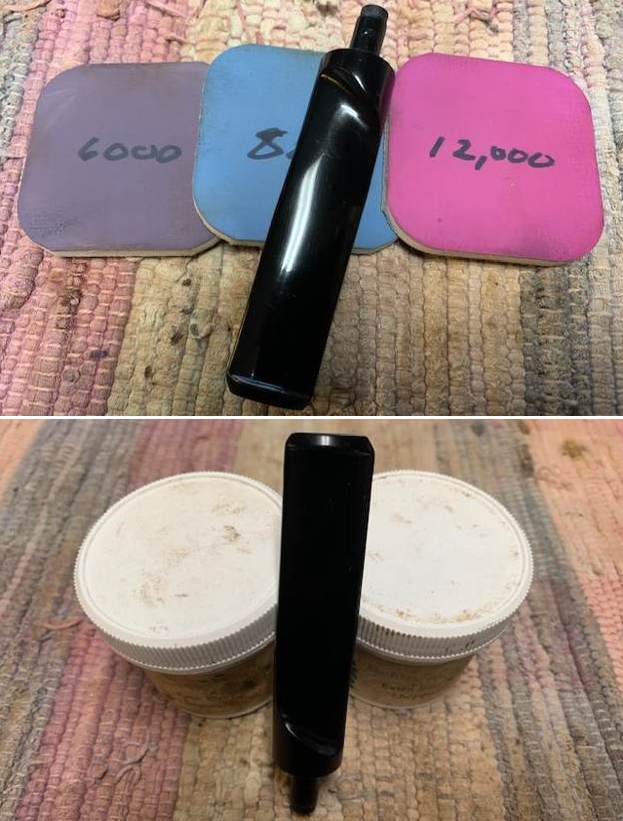
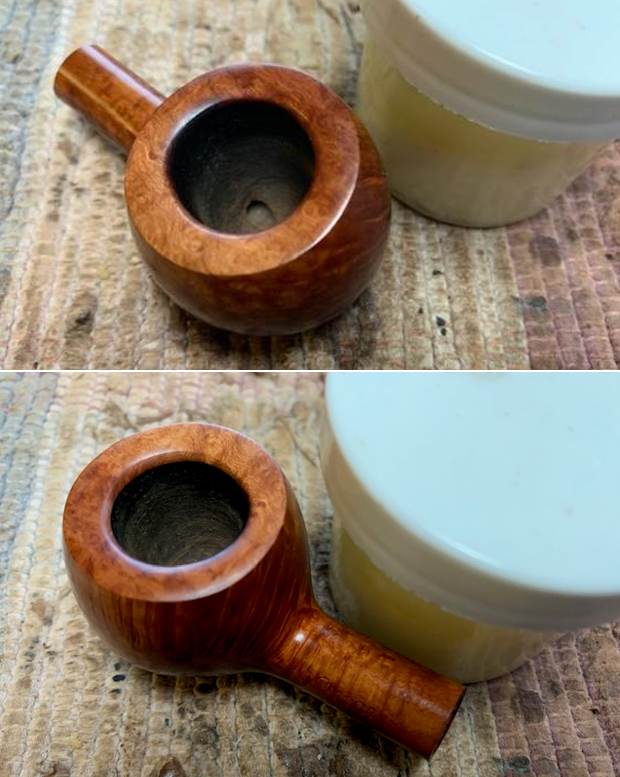
Cleaning up a Preben Holm made Monte Verde Twin Finish Freehand


Blog by Steve Laug

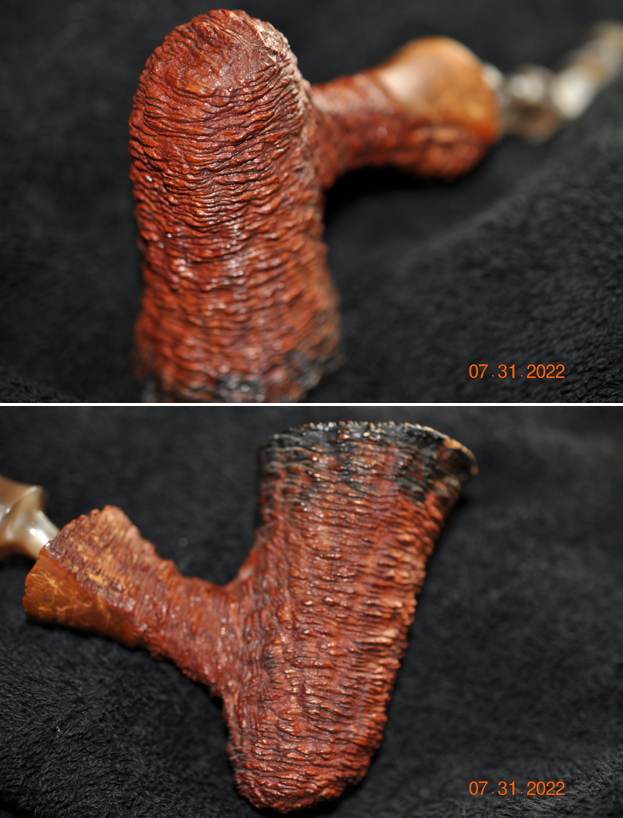
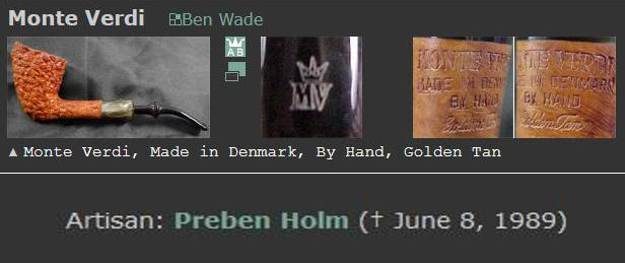
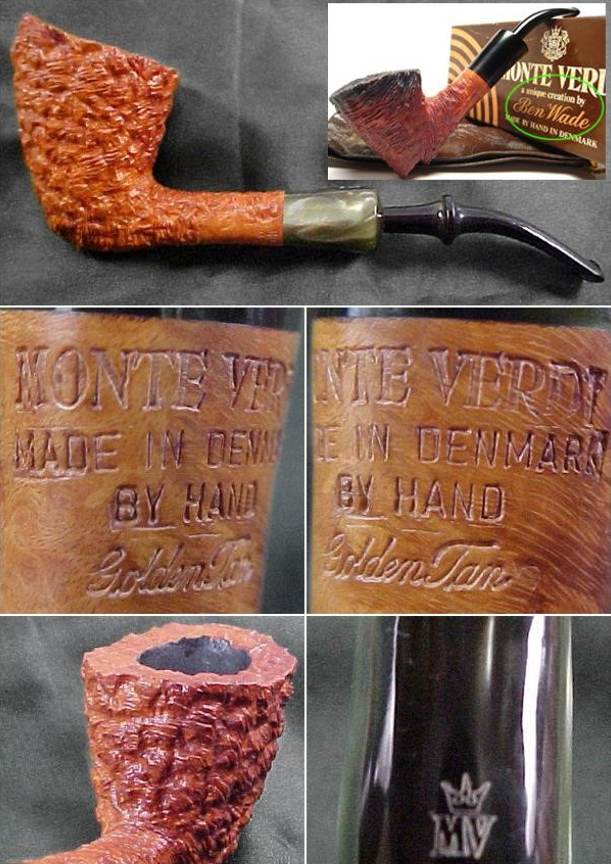
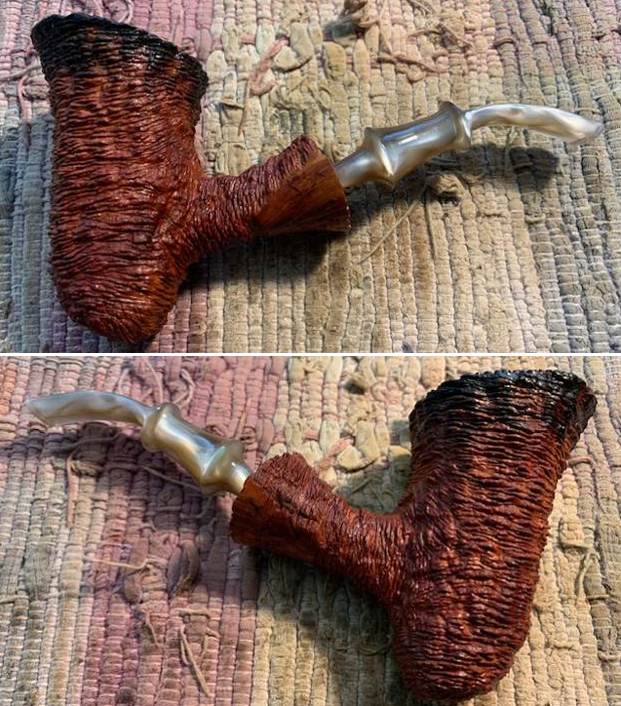
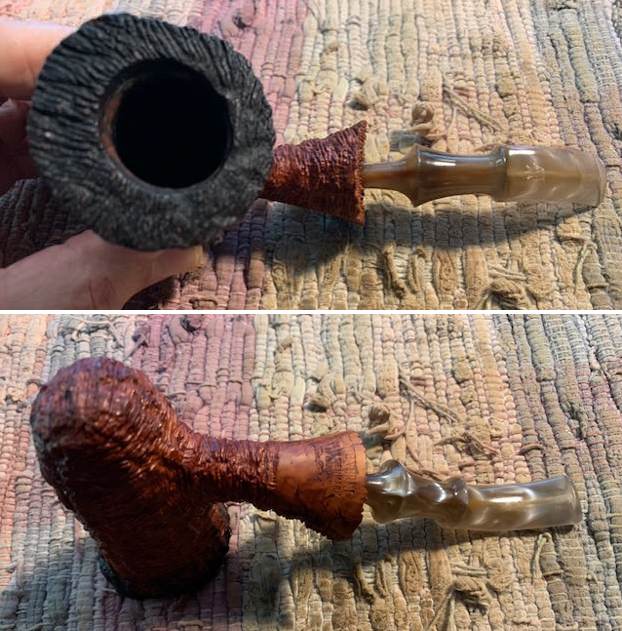
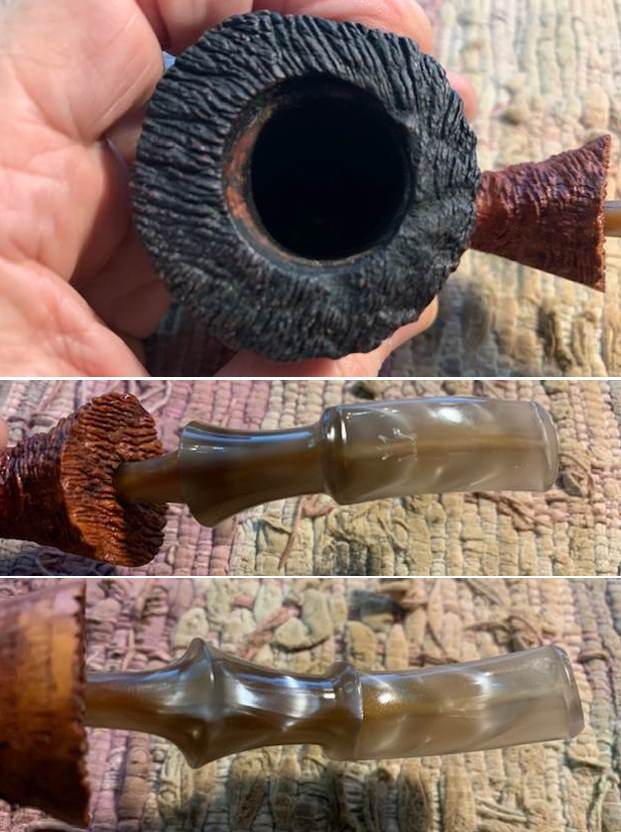
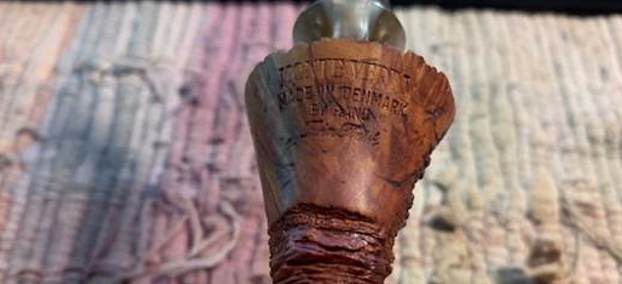
The next pipe on the table was purchased from an estate lot on 06/13/22 from Fort Myers, Florida, USA. It has that verve that I have come to associate with pipe made by Preben Holm and the fellow we purchase this lot from obviously love Preben Holm pipes because we acquired several from him in this lot from the IIS pipes to a Danish Pride still to come. They are unique and beautiful. The pipe is stamped on a smooth panel on the underside. It reads Monte Verde over Made in Denmark by Hand. Underneath that there is a script stamp that reads Twin Finish. I have refurbished several Monte Verde pipe so if you are interested in the brand here is a link to one I did back in 2019 that is very similar to this one (https://rebornpipes.com/2019/02/09/new-life-for-a-preben-holm-monte-verde-twin-finish-freehand/). It was quite dirty, like the rest of the pipes in this collection. There was a thick cake in the bowl and a heavy lava overflow on the rim top that filled in the rustication. The inner and outer edges of the bowl looked very good. The stem had some light tooth marks and chatter on both sides near the button but really was in quite remarkable condition. Jeff took photos of the pipe before he started his cleanup process. The next photos show a close up of the bowl and rim top as well as both sides of the stem. You can see the thick cake in the bowl and heavy overflow of lava on the rim top. The close up photos of the stem show the light tooth marks in the surface near the button on both sides. He took photos of the sides and heel of the bowl to show the look the double rustication on the sides and heel of the bowl. The curved shape of the pipe makes it a tall Dublinesque Stack but the rustication gives it a tactile look that can only mean an added dimension to the pipe when it is smoked.  The next photos show the stamping on the underside of the shank and the top of the saddle stem. It is quite clear and legible. The top of the stylized saddle stem has a Crown MV stamped into the surface. It appears to have originally been gold.   I turned to Pipephil’s site to get a read on the brand (http://pipephil.eu/logos/en/logo-m6.html). It confirms that the Monte Verdi line was made by Preben Holm. The pipe in the photo had a very similar rustication to the Monte Verdi I was working on. I did a screen capture of the section on Pipephil. I have included it below.   There were also photos that were included on Pipephil of what this particular pipe looked like when it left Denmark. The rustication around the bowl and shank is very similar. The pipe I have does not have a shank extension but otherwise the finish is much the same. The pipe in the photo had a fancy turned vulcanite stem. The stem on the one I have in front of me is the original stem on the pipe and it is a fancy double saddle pearlized acrylic or Lucite stem.I also Googled the brand and found a thread on Pipes Magazine about the brand that gave me some more information (http://pipesmagazine.com/forums/topic/monte-verde-pipes). I include that below.

The Monte Verdi line was indeed a pipe style offered by Holm. It usually features heavily blasted and rusticated briar and smaller group sizes than some of his other lines. Some refer to this line as a “second”, but it provided an outlet for briar that had flaws and therefore unsuitable his other lines. Holm marketed many different lines featuring a variety of finishes in both stains and carvings and this is merely one of those. The ones I own are good pipes and smoke well. The blast finish is very interesting to look at and the tactile sensations make it fun to hold.

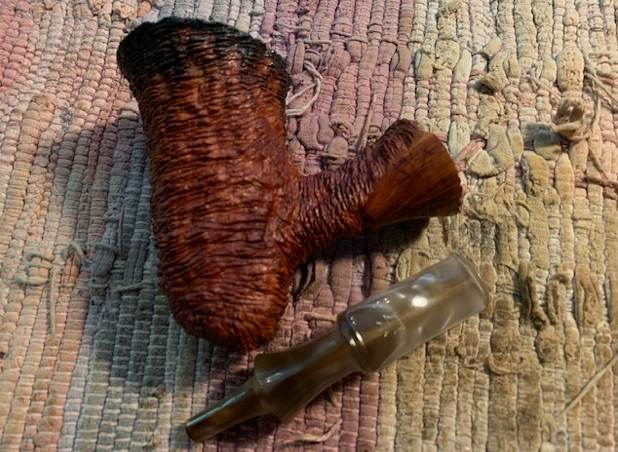
Jeff reamed the bowl with a PipNet pipe reamer and followed up with a Savinelli Fitsall pipe knife to remove the cake. He scrubbed out the mortise and the airway in the shank and the stem with alcohol, cotton swabs and pipe cleaners. He scrubbed the exterior of the bowl, rim, shank and stem with a tooth brush and Murphy’s Oil Soap to remove the oils and tars on the rim and the grime on the finish of the bowl. He rinsed it under running water. He dried it off with a soft cloth. He was able to remove most of the lava build up on the rim top and you could see a little remaining in the depths of the rustication. He cleaned out the inside of the stem with pipe cleaners, cotton swabs and alcohol. He scrubbed the surface o the stem with Soft Scrub Cleanser. The stem looked very good. I took photos of the pipe to show its condition before I started my work on it. I took close up photos of the bowl and rim top as well as the stem. You can see the condition of the rim top and bowl in the first photo. Jeff was able to remove almost all of the tar and oils but there was some deep lava in the rustication at the back of the rim. The Lucite stem had light tooth chatter and tooth marks on the top and underside of the stem near and on the button surface. The swirled browns, tans, blacks and greys of the Lucite looked good with the variegated browns of the briar.   I also took a photo of the stamping on the underside of the shank. The stamping is very clear and readable. You can also see the scratches in the smooth finish of the area in the photo below.I removed the stem from the shank and took a photo of the parts. It is a nice looking pipe with the flumed top, the rugged double rustication and the double saddle smoky acrylic stem.I started by working on the rim top. I used a brass bristle wire brush to clean off the remaining lava debris on the rim top. I was able to remove all of the remaining debris and the rim top looked really good. The deep rustication and the second wire rustication gave the pipe a very unique look.With the rim top cleaned I worked some Before & After Restoration Balm into the rusticated surface of the briar with my fingertips to clean, enliven and protect it. It took some time to really get it into the grooves and valleys of the rustication but I was able to work it in. I used a shoe brush to make sure it was deep in the grooves. I let the balm sit for 10 minutes and then buffed it with a cotton cloth to raise the shine. The following photos show the bowl at this point in the restoration process. The bowl and the rim top look really good and the darkening and lava are gone. I am very happy with the results.  I set aside the bowl at this point and turned my attention to the stem. I repaired the tooth marks with clear super glue. Once the glue cured I sanded the repairs with 220 grit sandpaper to blend them into the rest of the stem surface. I polished the sanding marks with 400 grit wet dry sandpaper. The photos tell the story. I touched up the stamping on the saddle portion of the stem with some Rub’n Buff Antique Gold. I let it dry in the stamping for a bit then buffed it off with a cotton pad. It looked much better. The MV was legible and the crown looked good. The side of the M was a little faint as the stamping was worn. I polished the Lucite stem with micromesh sanding pads – wet sanding with 1500-2400 grit sanding pads and dry sanding it with 3200-12000 grit sanding pads. I wiped it down after each sanding pad with a damp cloth. I polished it with Before & After Pipe Stem Polish and wiped it down a last time with the damp cloth.  This beautiful, double rusticated Preben Holm carved Monte Verde Twin Finish Large Freehand is a special looking pipe and it feels amazing in the hand. I polished stem with Blue Diamond polish on the buffing wheel. I gave the bowl multiple coats of Conservator’s Wax and the stem multiple coats of carnauba wax. I buffed the pipe with a clean buffing pad to raise the shine. I hand buffed it with a microfiber cloth to deepen the shine. The pipe polished up pretty nicely. The multi-coloured grain shining through the rustication came alive with the buffing. The rich contrasting brown colour works well with the polished swirling brown, tan, black and white Lucite stem. The finished pipe is a beauty and feels great in the hand. Have a look at it with the photos below. The dimensions are Length: 6 ½ inches, Height: 3 inches, Outside diameter of the bowl: 2 inches, Chamber diameter: 1 inch. The weight of the pipe is 2.75 ounces/ 78 grams. I will be putting this Monte Verde by Preben Holm on the Danish Pipe Making Section on the rebornpipes online store soon. It is such an interesting tactile pipe and if you have been looking for a freehand then this might be the one for you. Thanks for walking through the restoration with me on this interestingly shaped Preben Holm Hand made pipe.
Restoring a Savinelli Nonpareil 9101 Plateau Freehand


Blog by Steve Laug

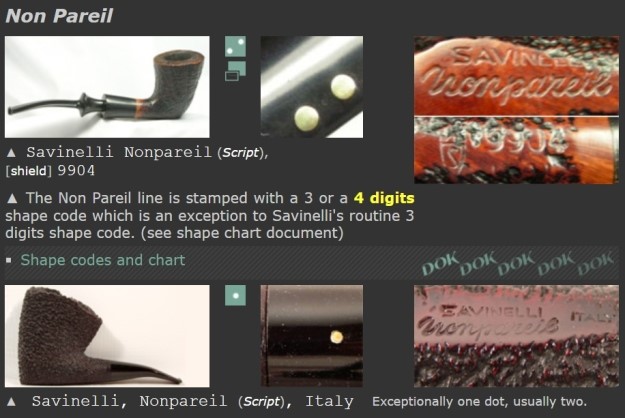
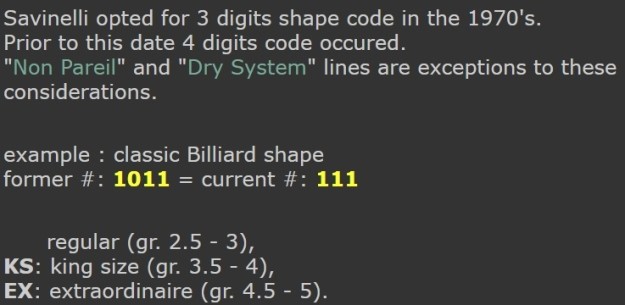
The next pipe is another one that has been here for a long time  – so long in fact that I cannot remember where I picked it up. I know it came to me from a trade or my own hunt because it had not been cleaned or reamed by Jeff. There was a thick cake in the bowl and lava overflowing on to the plateau and the smooth portion of the rim top and inner edge of the bowl. The exterior of the pipe was dirty but the grain really shone through the grime. The pipe was stamped on the heel of the bowl and read Savinelli [over] Nonpareil. The left side of the shank is also stamped and had a Savinelli S shield followed by the shape number 9101 [over] Italy. The vulcanite taper stem had a single brass dot on the left side. Here is the pipe! I took close up photos of the rim/bowl and stem. The cake in the bowl was thick and there was a thick coat of lava overflow on the rim top and edge. The valleys of the plateau were quite filled in. The stem was dirty and had light tooth marks on the top and underside near the button. I took photos of the stamping on the underside of the bowl and the left side of the shank. It is clear and readable as noted above.  I removed the stem from the shank and took a picture of the pipe. It is quite an attractive shape and should clean up well. I turned to Pipephil (http://www.pipephil.eu/logos/en/logo-savinelli3.html) to get a quick view of the Nonpareil Line. I did a screen capture of the site’s information and have included that below. I am also including a screen capture of the Shape and code chart introduction that is link in the above capture.It appears that the Nonpareil 9101 that I am working on is made before 1970 so it is at least 50+ years old. It is in great shape. I am not sure what the exception noted above is about.
I turned to Pipedia (https://pipedia.org/wiki/Savinelli) for a quick read. The site is worth reading the history of the Savinelli brand and it philosophy of pipemaking. There was nothing specific on the Nonpareil line however so it was time to work on the pipe.
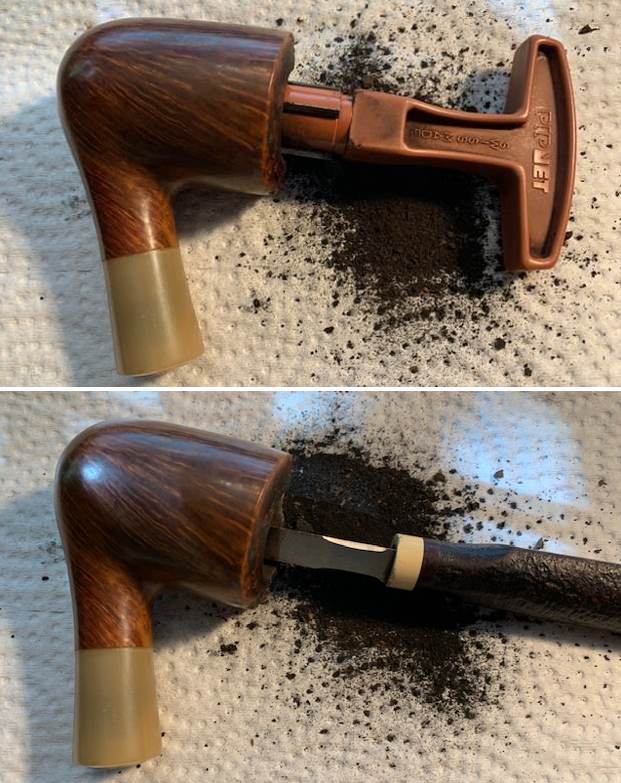
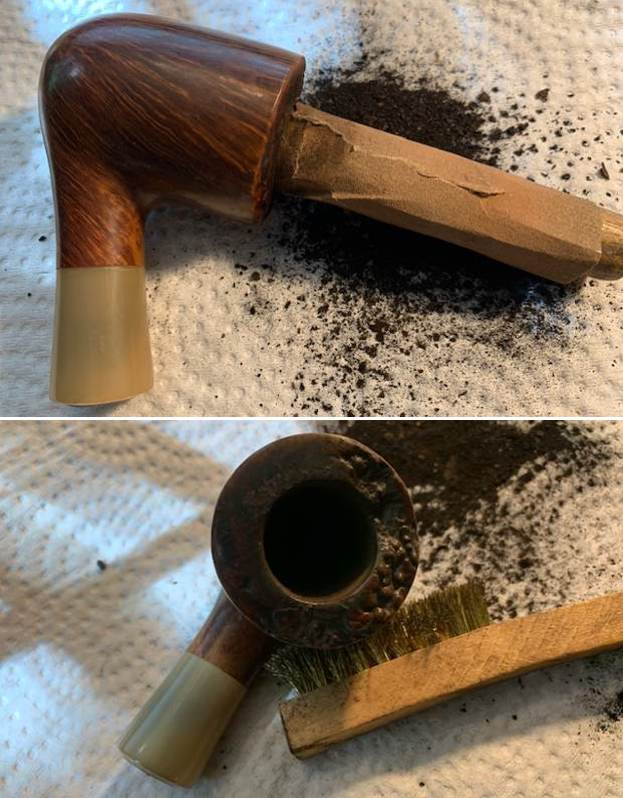
I used a PipeNet pipe reamer (first 3 cutting heads) to strip back the cake to bare briar. I cleaned up the remnants with a Savinelli Fitsall pipe knife. I sanded the bowl with a dowel wrapped with 220 grit sandpaper to smooth out the walls. I worked on the lava in the rim top plateau with a brass bristle wire brush. I was able to remove much of the lava with that. Scrubbing it would remove the rest. I scrubbed the externals of the bowl and rim top with a tooth brush and some undiluted Murphy’s Oil Soap. I rinsed it off with warm water and dried it off with a soft cloth. Now it was time to scrub the inside of the shank and rid it of the tars and oils. I scrubbed the mortise and the airway in the shank and the stem with pipe cleaners, cotton swabs and 99% isopropyl alcohol. There was some stain in the inside of the shank that came out.   I polished the briar on the rim top with micromesh sanding pads – dry sanding it with 1500-12000 grit pads. I wiped the briar down with a damp cloth to remove the sanding dust. The briar really took on a rich shine with the polishing.    I rubbed the bowl down with some Before & After Restoration Balm. I worked it into the briar with my finger tips and a horse hair shoe brush on the plateau rim top to clean, revive and preserve the wood. It really brings the grain alive once again. I let it sit for 15 minutes then buffed it off with a soft cloth. The grain really pops at this point in the process. I set the bowl aside and worked on the stem. I smoothed out the tooth marks on the stem and button surface with 220 grit sandpaper and started polishing the stem with 400 grit wet dry sandpaper. It was starting to look better.  I polished the stem with micromesh sanding pads – dry sanding with 1500-12000 grit pads. I wiped the stem down between each pad with some Obsidian Oil. I finished polishing it with Before & After Pipe Stem Polish – both Fine and Extra Fine to deepen the shine. I gave it a final wipe down with Obsidian Oil.      I put the Savinelli Nonpareil 9101 Plateau Freehand back together and buffed it with Blue Diamond on the buffing wheel. I gave the bowl and the stem multiple coats of carnauba wax. I buffed the pipe with a clean buffing pad and hand buffed it to raise the shine. It is fun to see what the polished bowl looks like with the grain popping around the bowl and shank. Added to that the polished acrylic variegated brown stem was a beautiful touch. It is light and well balanced. Have a look at it with the photos below. The dimensions are Length: 6 inches, Height: 2 inches, Outside diameter of the bowl: 1 ½ inches, Chamber diameter: ¾ of an inch. The weight of the pipe is 65 grams/2.29 ounces. It is a beautiful pipe and one that will be on the rebornpipes store in the Italian Pipemakers section. If you are interested in adding it to your collection let me know. Thanks for walking through the restoration with me as I worked over this pipe. Thanks to each of you who are reading this blog. I want to keep reminding us of the fact that we are not pipe owners; we are pipemen and women who hold our pipes in trust until they pass on into the trust of the next trustee.  
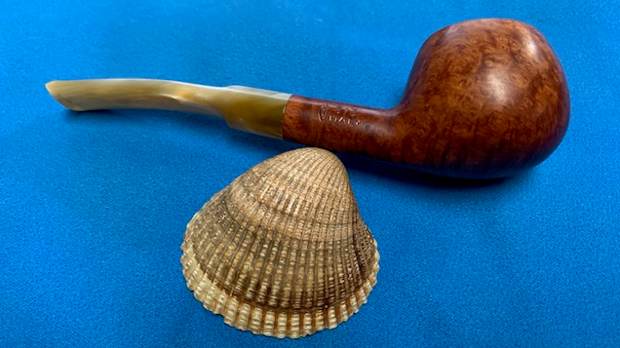
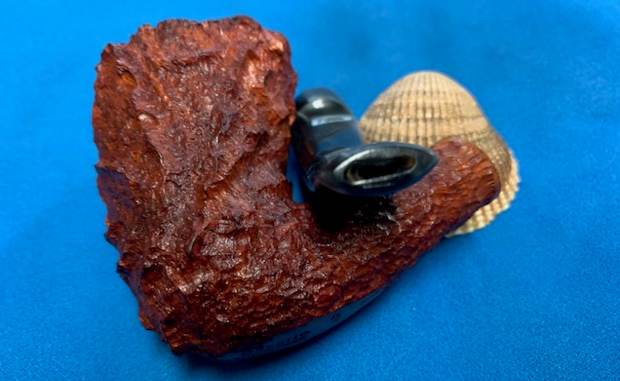
Restoring a Jess Chonowitsch Designed Stanwell Zebrano 163 Faceted Hexagonal Freehand


Blog by Steve Laug

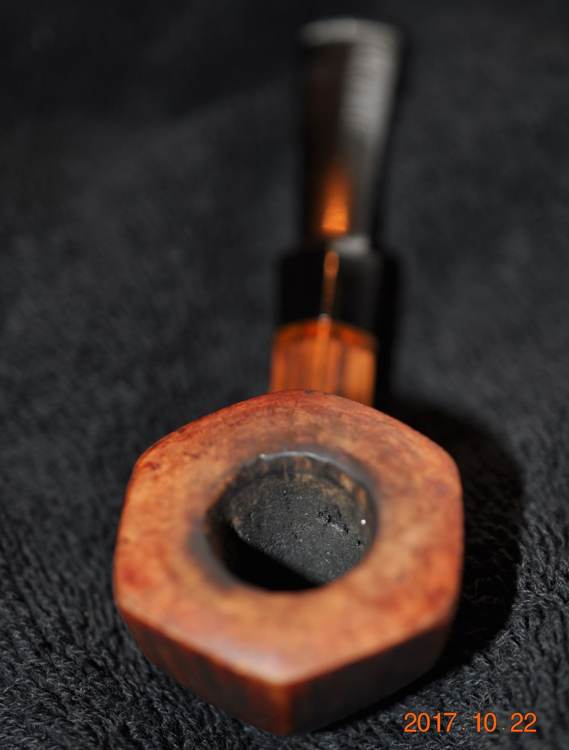
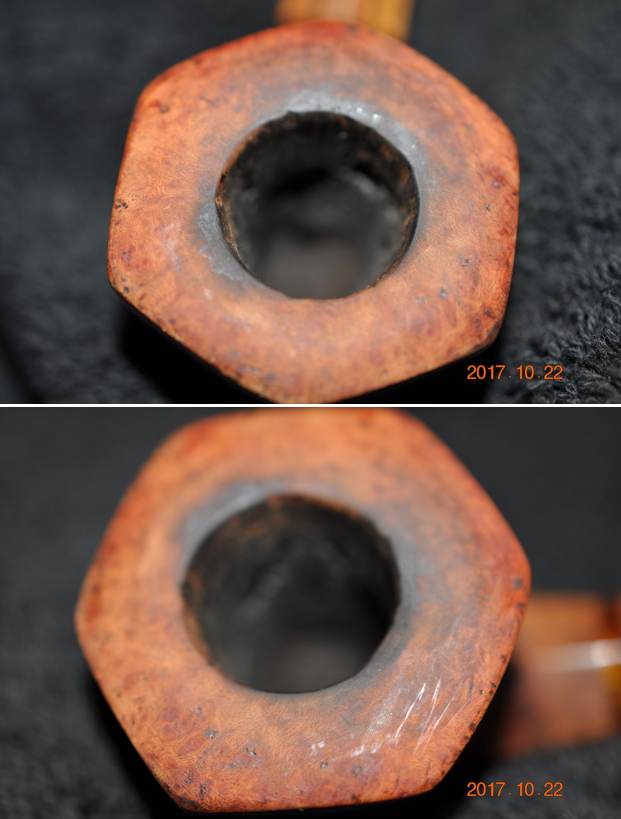
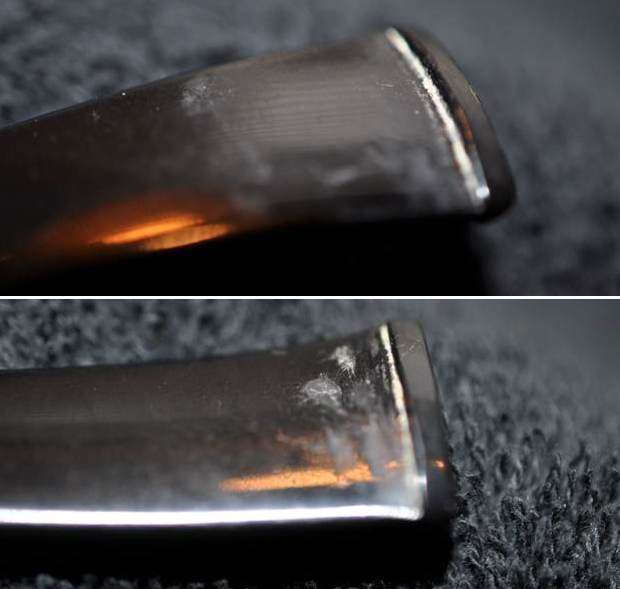
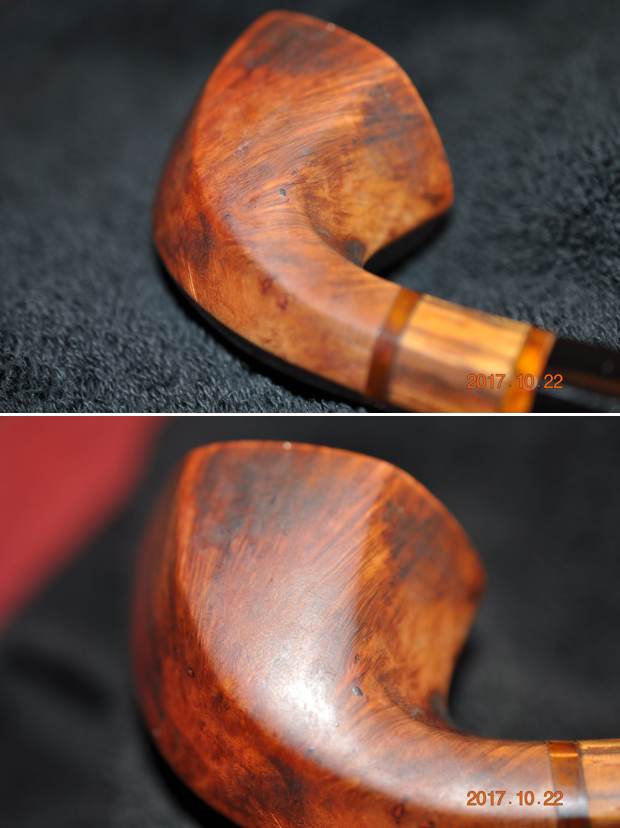
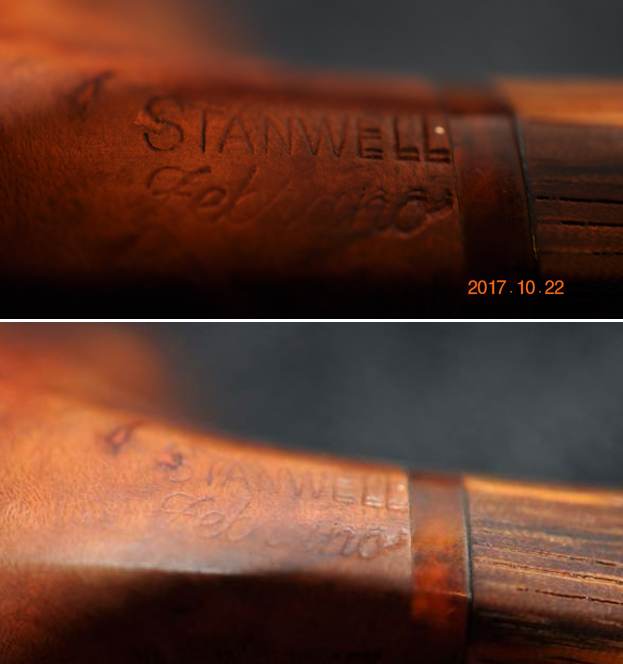
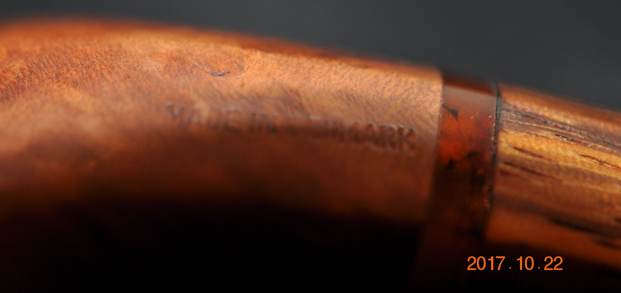
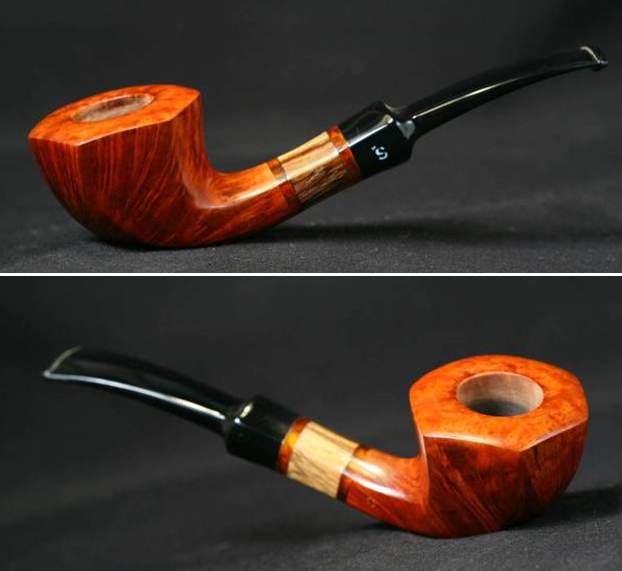
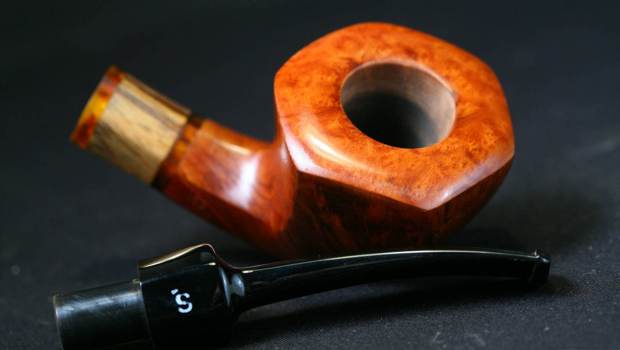
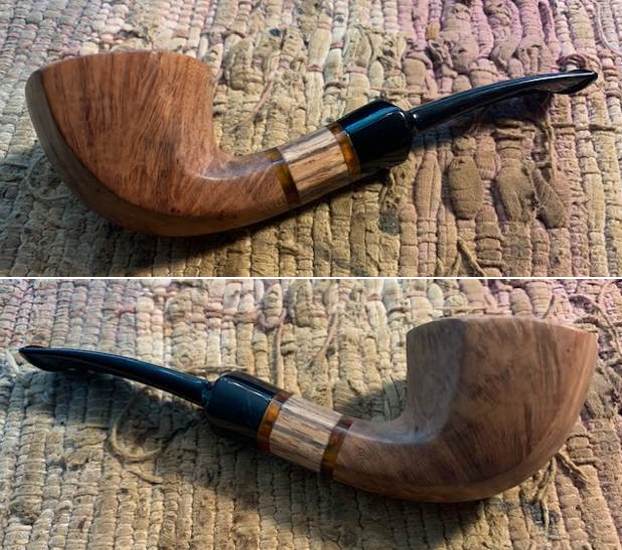
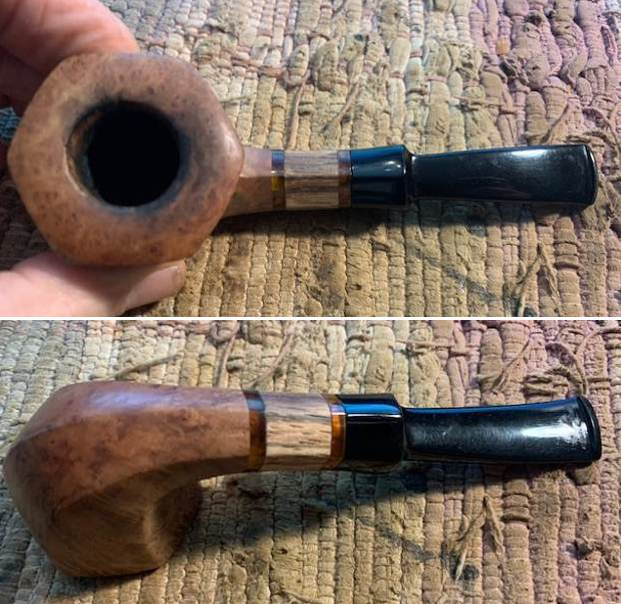
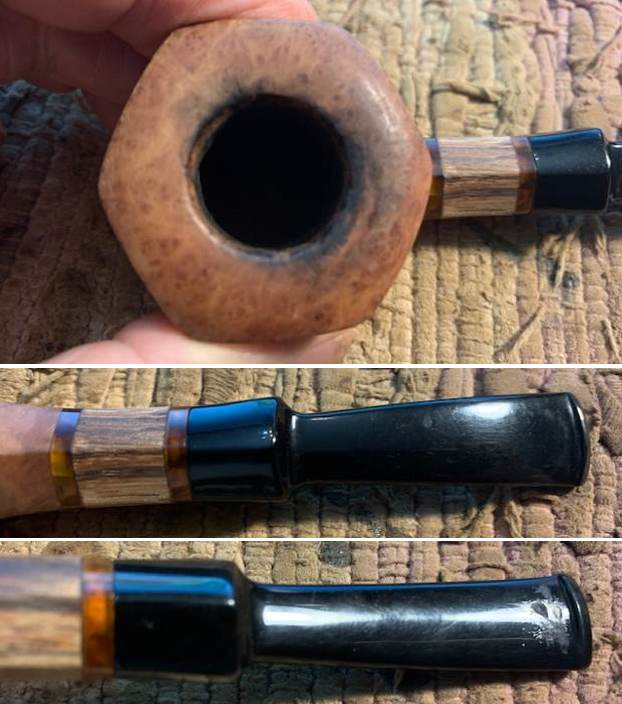
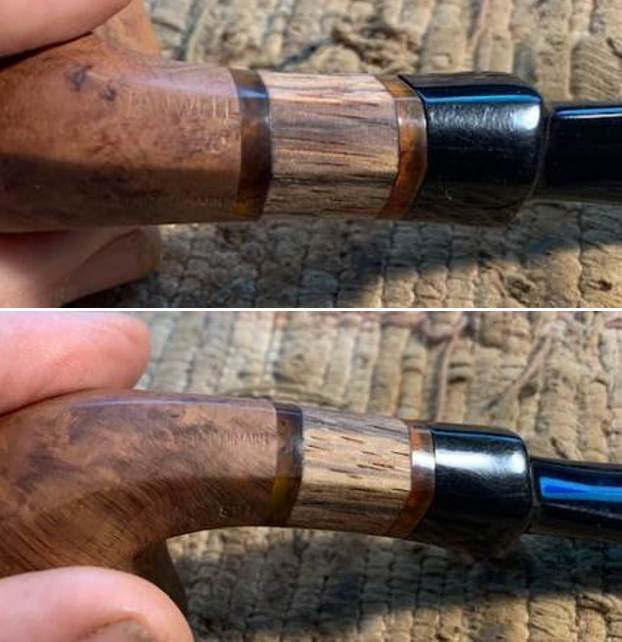
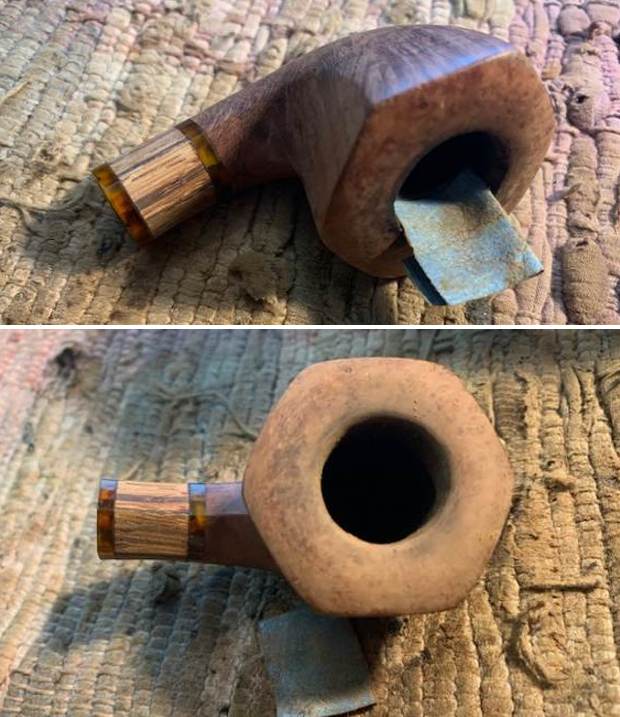
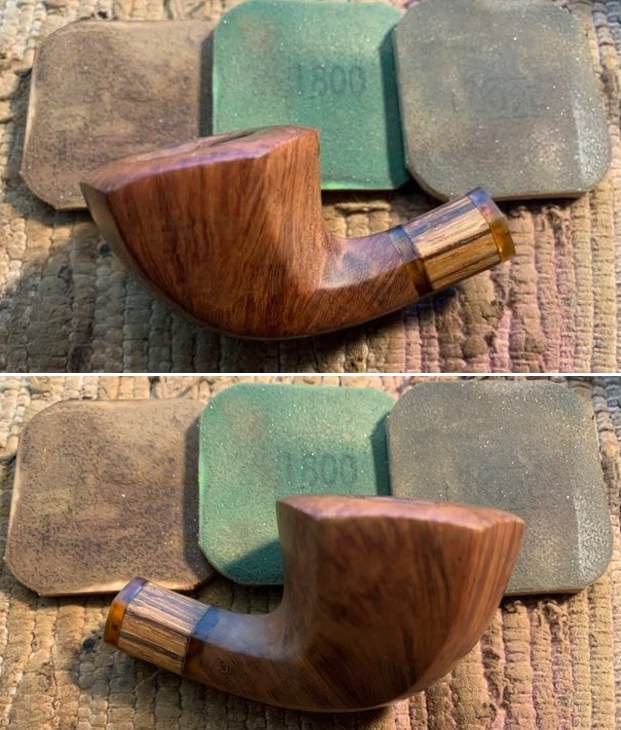
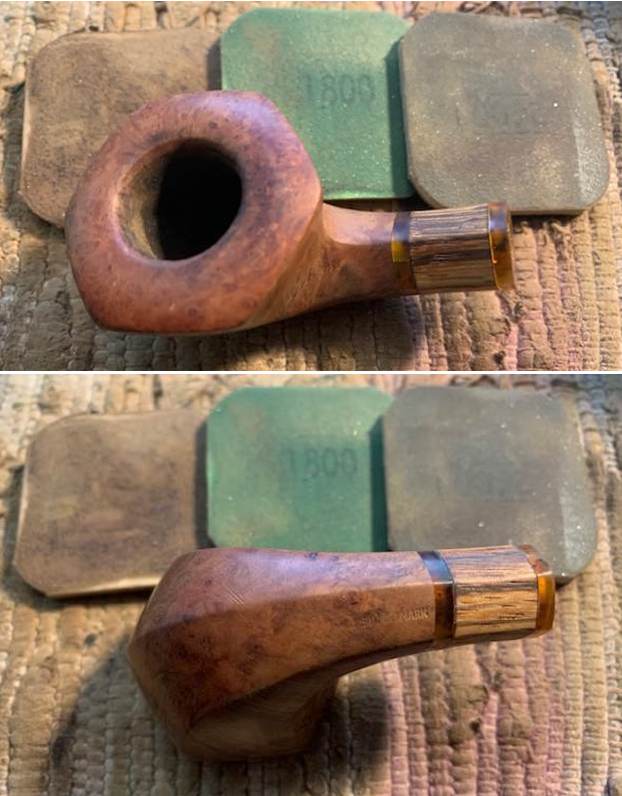
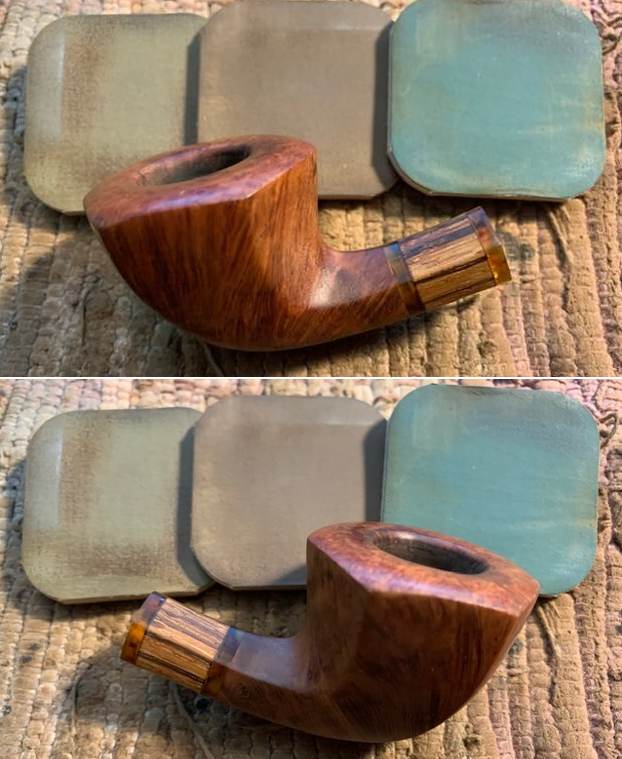
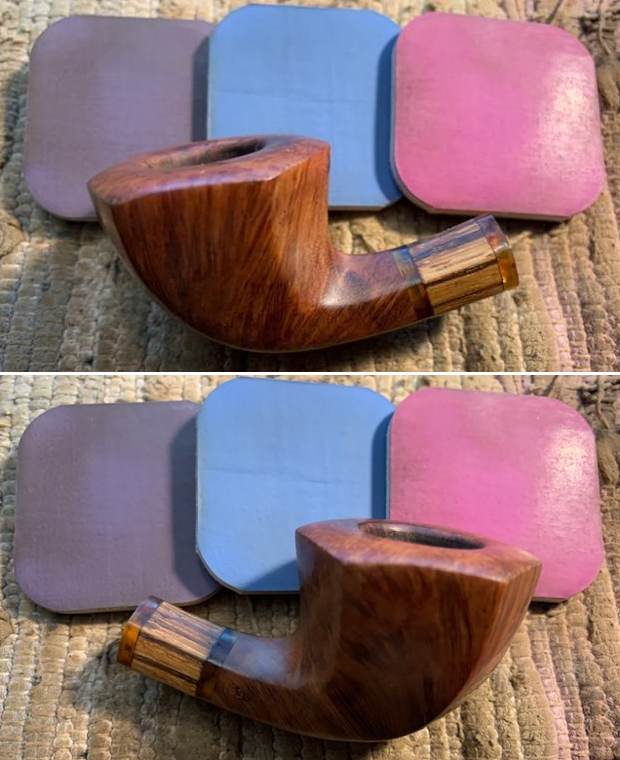
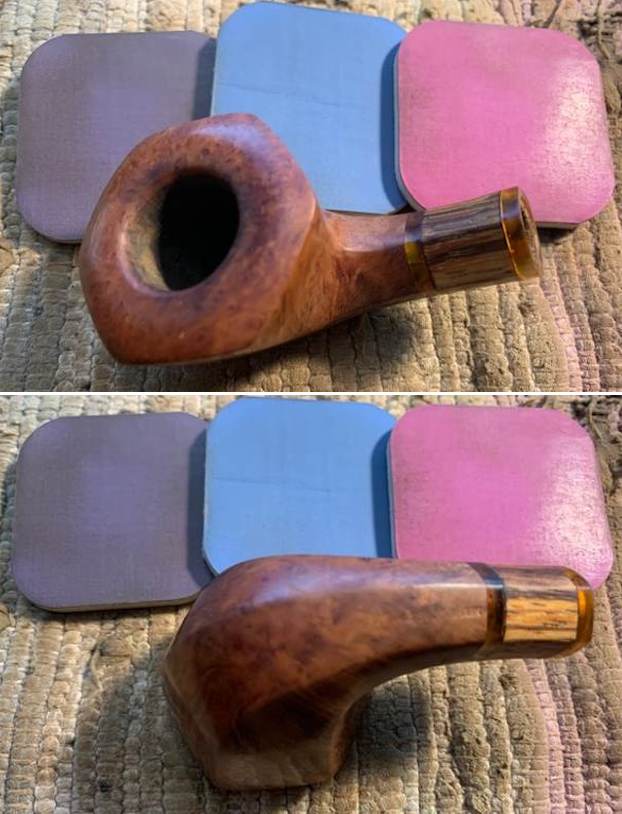
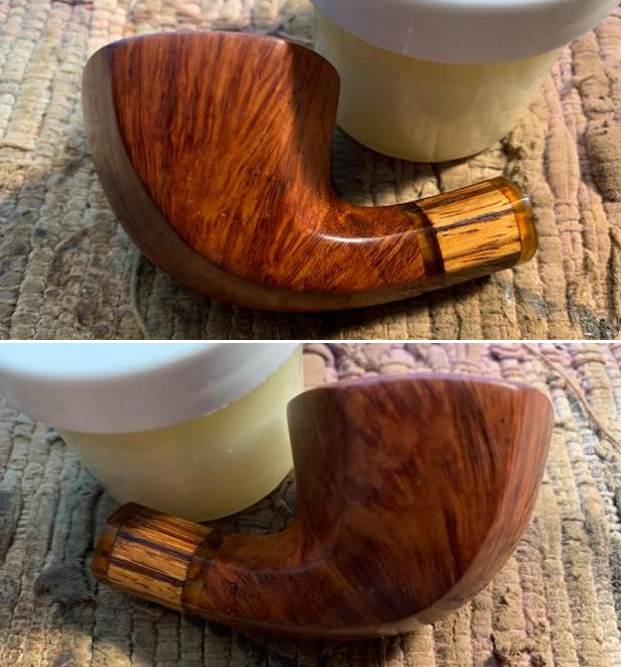
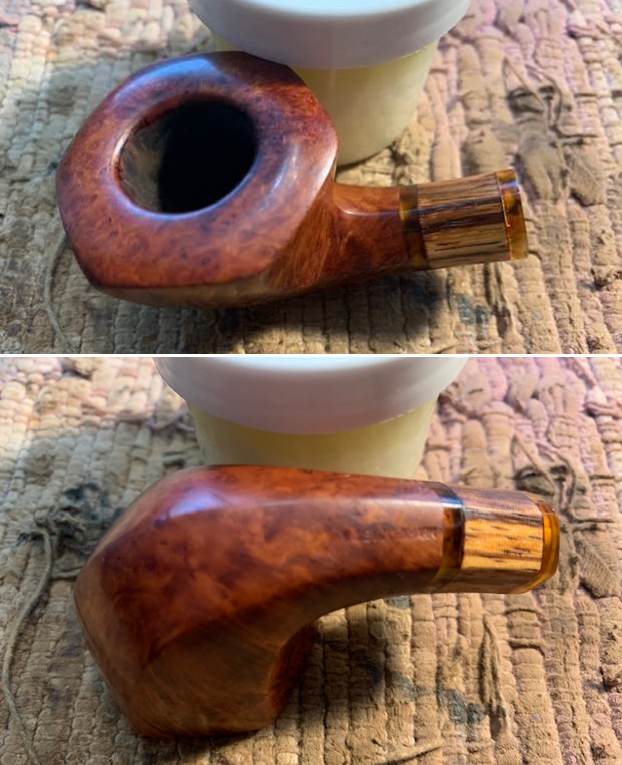
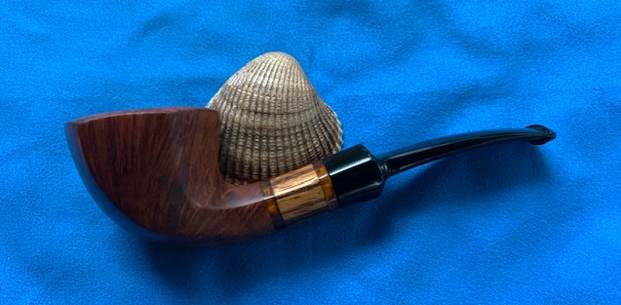
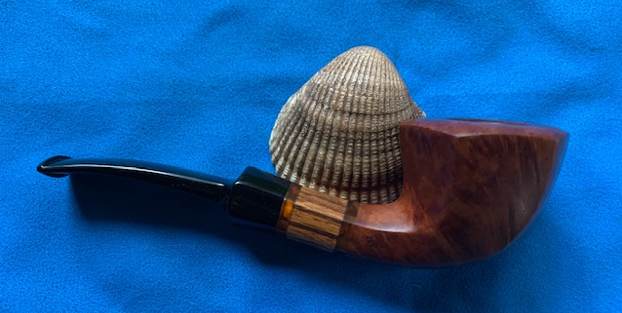
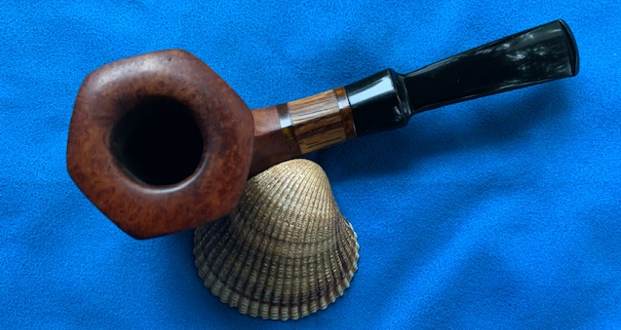
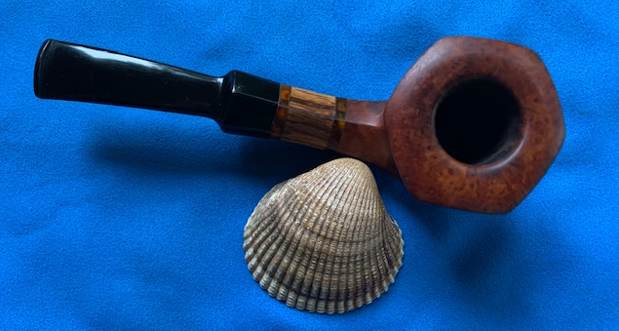
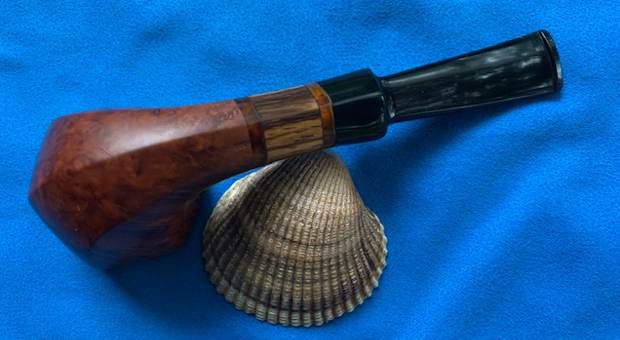
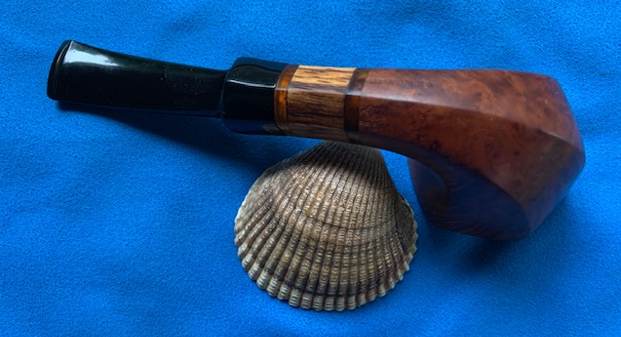
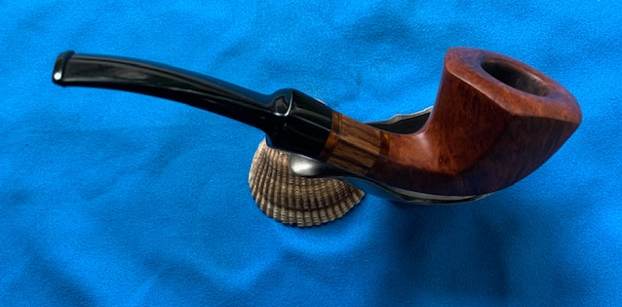
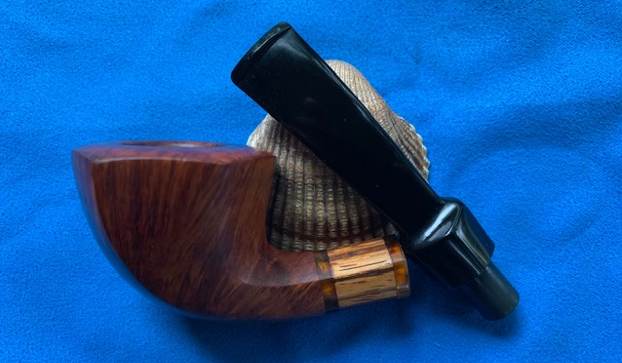
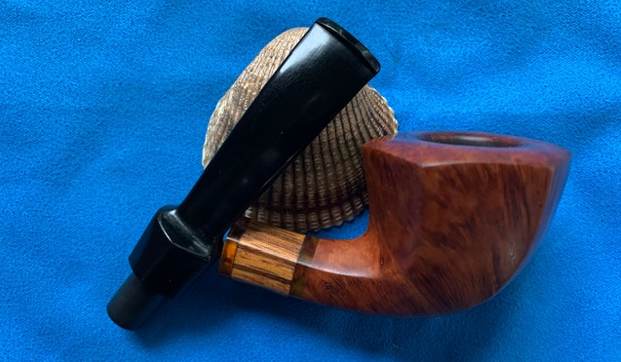
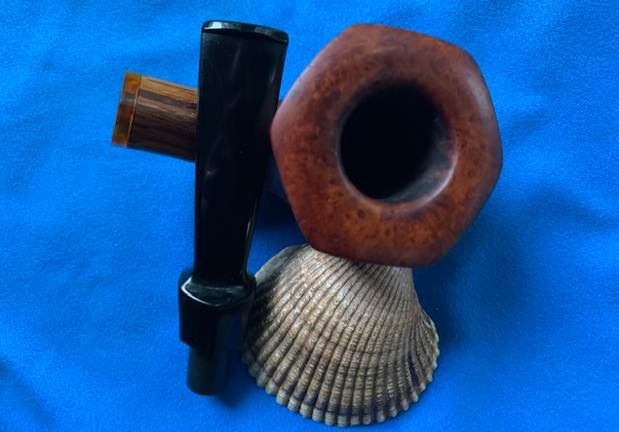
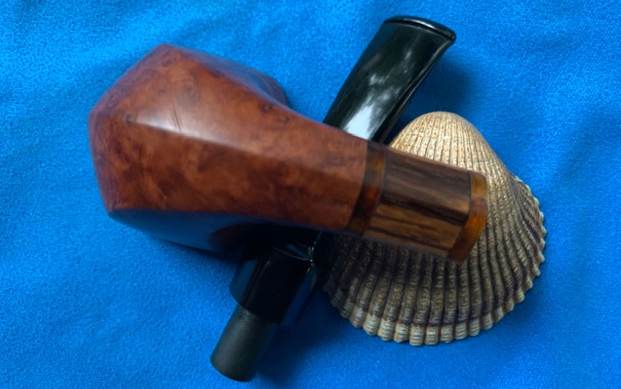
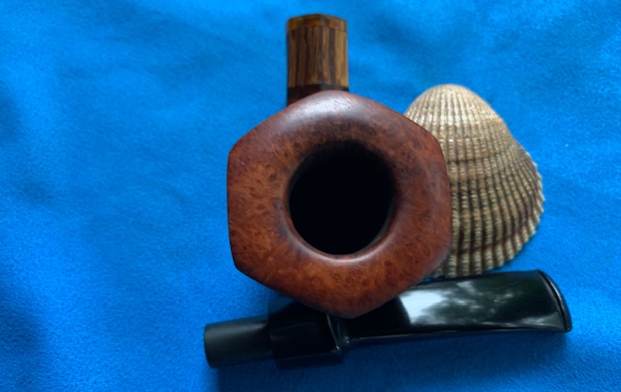
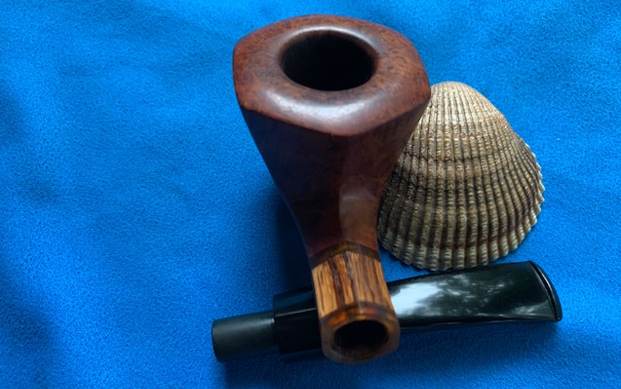
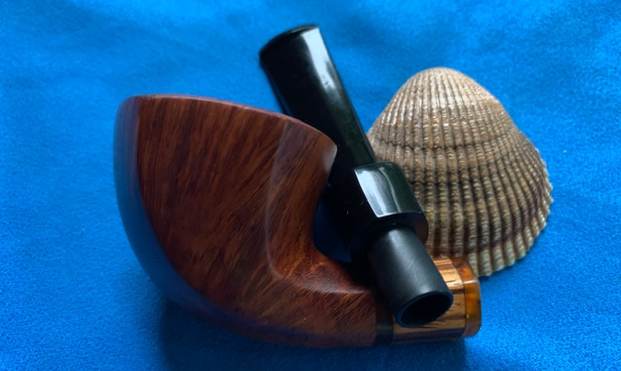
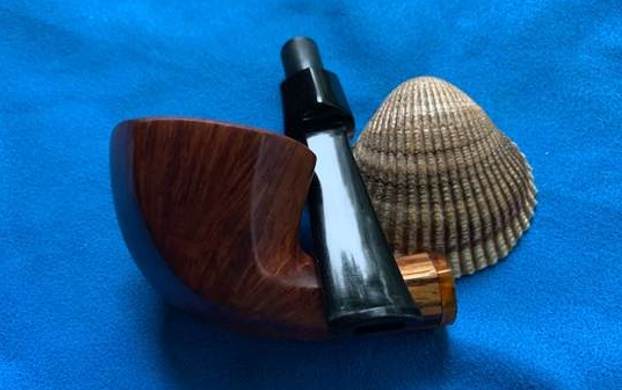
I went through my pipes to choose what to work on next and this one caught my eye. It is a great looking Hexagonal Faceted Freehand. It is stamped on the left underside of the hexagonal shank and read Stanwell [over] Zebrano. On the right side underside it is stamped Made in Denmark and on the top right side it was stamped with the shape number 163. Zebrano pipes have a shank extension of Zebra wood on the end, sandwiched between two wafers of orange acrylic. Jeff was travelling in Europe for a holiday with his wife  bought this pipe on 09/16/2017 in Frankfurt, Germany at a bazaar. It has been sitting here in Vancouver cleaned and awaiting my part of the work for almost 5 years. When he found it the finish had thick grime and oils ground into the outside of the bowl and shank. The Zebrano insert had dried out and was rough to the touch. The rim top and inner edge of the bowl had burn damage and was slight out of round. There as a thick cake in the lower ¾ of the bowl and lighter cake on that ¼ of the bowl. The black acrylic stem was scratched and filthy and the inside of the filter tenon sans filter was filthy. It was made for a 9mm filter that I would need to replace. There were deep tooth marks and chatter on both side of the stem near the button. Jeff took photos of the pipe when he got home and got around to cleaning it. Jeff took photos of the rim top to show the condition of the bowl and edges. You can see the damage on the top and edges. You can see that the bowl is slightly out of round as well. He took photos of the stem surface to show the deep marks and damage on both sides. He took photos of the sides and the heel of the bowl to show the interesting grain patterns in the briar through the thick grime. He took a photo of the Zebra wood insert with the acrylic spacers as well. It was quite beautiful.  He took photos of the stamping on the sides of the shank. It is readable but faint in places. Before I started working on the pipe I decided to do a bit of digging on the shape and the design. I turned first to a blog on rebornpipes by Bas Stevens the was a compilation of Stanwell shapes (https://rebornpipes.com/2013/09/03/stanwell-shapes-compiled-by-bas-stevens/). There I found the shape number 163. The information given there said that the shape was a Freehand, “Facet”, hexagonal, with brass ring by Jess Chonowitsch. It was a shape designed by Jess Chonowitsch and that was interesting to me.

I also looked on Pipedia and on Pipephil’s site and while I could read the history of the brand and gather background the Zebrano line was not mentioned. I did a Google search for the Zebrano 163 shape and found a gallery of photos and information on the pipe. I am including both the information on the brand and a few photos of the pipe. It was helpful information regarding what the pipe looked like originally (https://bn-dev.com/pipes-estate/galerie/galerie.php?pipe=3cb469b6b1b5237bdfe99cec04ff4c5feb267fc0). I quote below:
Marque / brand           Stanwell

Marquages / stamping            Stanwell zebrano made in denmark 163

Finition / finish           lisse / smooth

Longueur / length       14.8 cm / 5.83 in

Hauteur / height          4.49 cm / 1.77 in

diamètre tête / bowl diameter             4.22 cm / 1.66 in

diamètre fourneau / chamber diameter          1.93 cm / 0.76 in

Profondeur / depth      3.41 cm / 1.34 in

Poids / weight 43 gr / 1.52 oz

Forme / shape             freehand

Matière tuyau / Stem material            acrylique / acrylic (lucite)

Matière pipe / pipe material   bruyère / briar

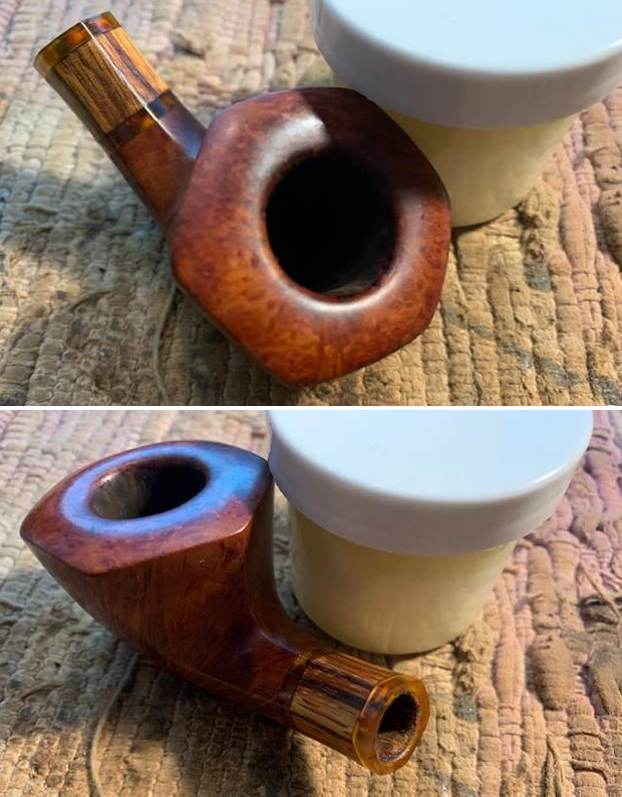
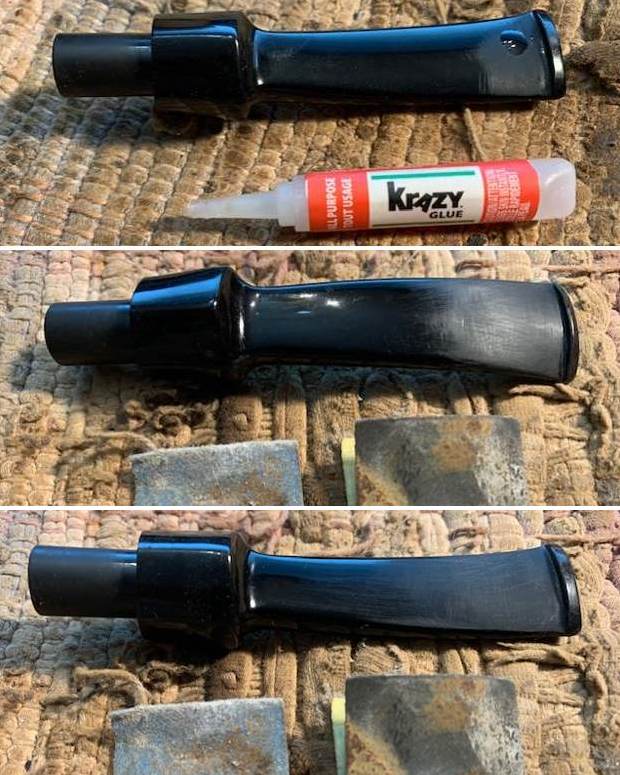
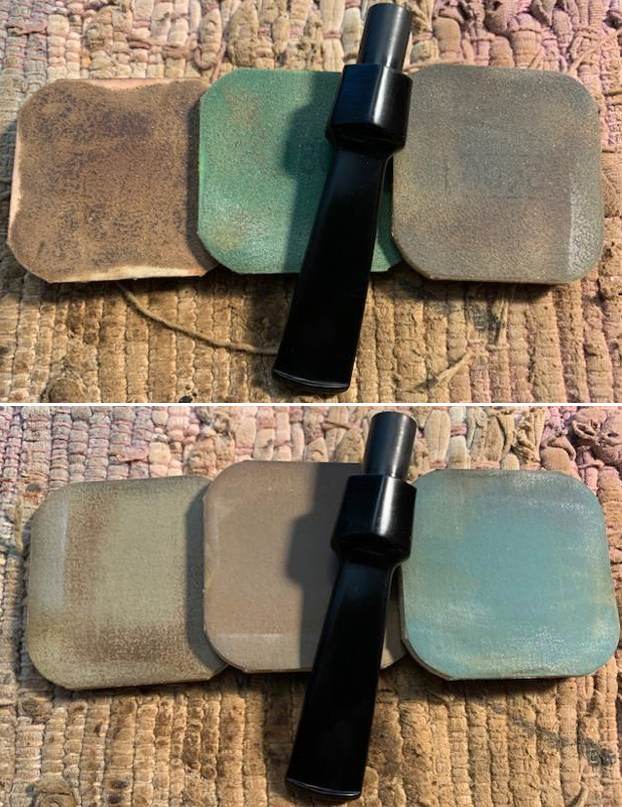
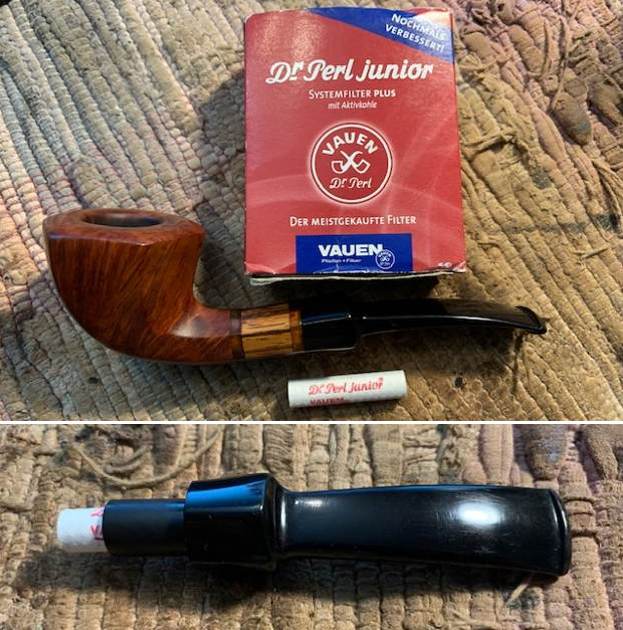
Filtre / filter    9mm With that information and a visual idea of what the pipe looked like originally, I turned to work on the pipe itself. Jeff had thoroughly cleaned up the pipe. He reamed the pipe with a PipNet Pipe Reamer and cleaned up the remnants with a Savinelli Fitsall Pipe Knife. He scrubbed the bowl with undiluted Murphy’s Oil Soap with a tooth brush. He rinsed it under running warm water to remove the soap and grime. There was some darkening on the inner edge of the rim and top that would need to be dealt with. He cleaned out the inside of the shank and the airway in the filter tenon and the stem with alcohol, cotton swabs and pipe cleaners. He scrubbed the exterior of the stem with Soft Scrub to remove as much of the oxidation as possible. The acrylic stem was clean but had tooth marks and chatter on both sides ahead of the button. There was no stamped logo on the left side of the stem. I took photos of the pipe before I started my work on it. I took photos of the rim top and bowl as well as the stem to give a sense of the condition of both. The rim top had some damage and darkening to the inner edge and rim top on the right front and back side. The stem cleaned up well and there were tooth marks on the top and underside ahead of the button.I took photos of the stamping on the underside of the hex shank. The are faint but readable as noted above. I took the stem out of the shank and took a photo of the overall look of the pipe.I decided to start my work on the pipe by addressing the darkening and damage on the inside edge of the bowl and the rim top. I used a folded piece of 220 grit sandpaper to clean up the bevel on the inner edge and the top of the bowl. I wiped the top and edges down with a damp cloth and the rim top and edges looked much better.I polished the briar with micromesh sanding pads – dry sanding with 1500-12000 grit pads. I wiped the bowl down after each pad with a damp cloth. I rubbed the bowl down with Before & After Restoration Balm. I worked it into the surface of the bowl sides and shank with my fingertips. The product works to clean, enliven and protect the briar. I let the balm sit for a little while and then buffed with a cotton cloth to raise the shine. I set the bowl aside and turned my attention to the stem. I filled I the deep tooth mark on the underside of the stem with clear CA glue. Once it cured I sanded the repair smooth to blend it into the surface of the acrylic. I sanded out the rest of the tooth chatter and marks with the 220 grit sandpaper to smooth them out. I started the polishing of the stem with 400 grit wet dry sandpaper. The stem was looking better with the repairs and polishing.   I set the bowl aside and turned to work on the stem. I polished the stem with micromesh sanding pads – 1500-12000 grit pads. I wiped it down with Obsidian Oil after each sanding pad. I used Before & After Pipe Polish – both Fine and Extra Fine to further polish the stem.  I have a box of Vauen 9mm System Filters that fit perfect in the tenon on the Stanwell Zebrano. I put one in place in the tenon and took some photos of the fit.This Jess Chonowitsch Designed Stanwell Faceted Hexagon Freehand 163 with a hexagon acrylic saddle stem fit for 9mm filters is a great looking pipe now that it has been restored. The beautiful grain on the briar and the Zebra wood shank extension that shines through the polished finish is stunning. I put the stem back on the bowl and carefully buffed the pipe with Blue Diamond on the buffing wheel. I gave the bowl and the stem multiple coats of carnauba wax on the buffing wheel and followed that by buffing the entire pipe with a clean buffing pad. I hand buffed the pipe with a microfiber cloth to deepen the shine. The finished Stanwell Zebrano 163 fits nicely in the hand and feels great. Give the finished pipe a look in the photos below. The dimensions of the pipe are Length: 5 ½ inches, Height: 1 ¾ inches, Outside diameter of the bowl: 1 ¾ inches, Chamber diameter: ¾ of an inch. The weight of the pipe is 40 grams/1.41 ounces. I will soon be adding it to the rebornpipe store in the Danish Pipe Making Companies Section. If you are interested in this pipe send me a message or an email. Thanks for reading this blog and my reflections on the pipe while I worked on it. There are many more to come!
Repairing and restoring a Unique Tom Spanu Freehand Dublin


Blog by Steve Laug

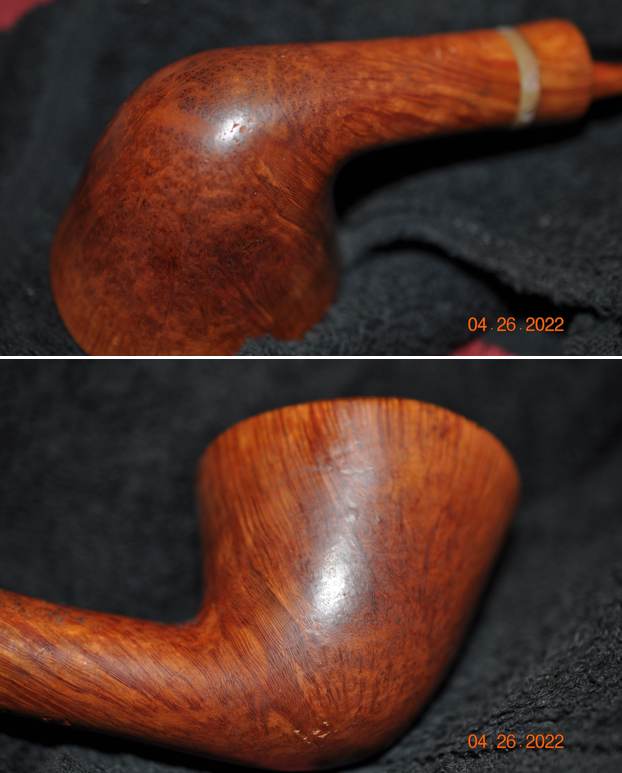
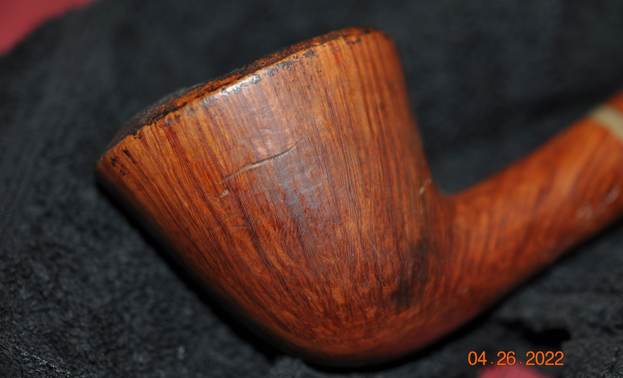
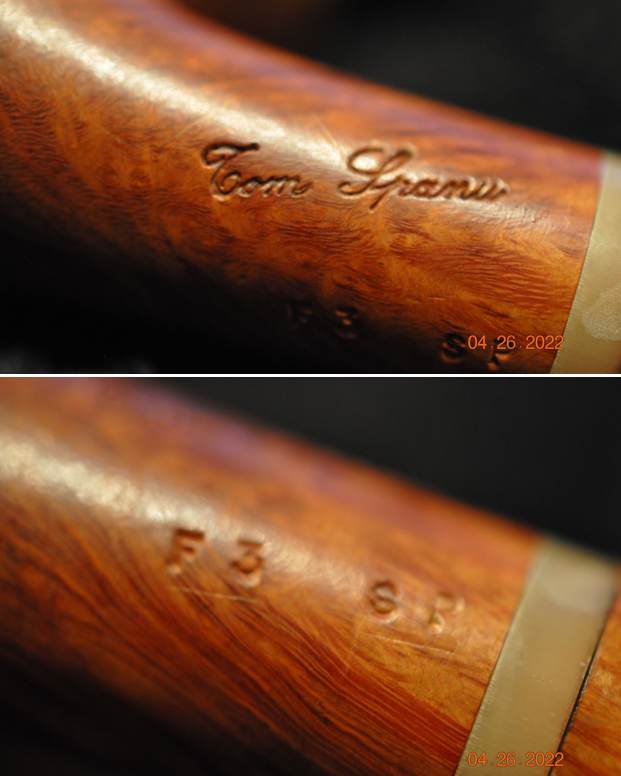
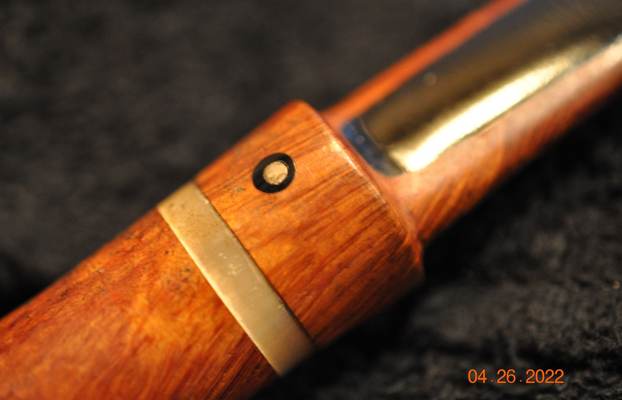
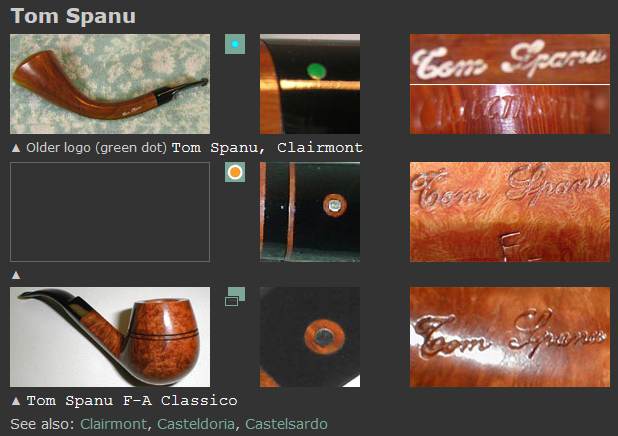
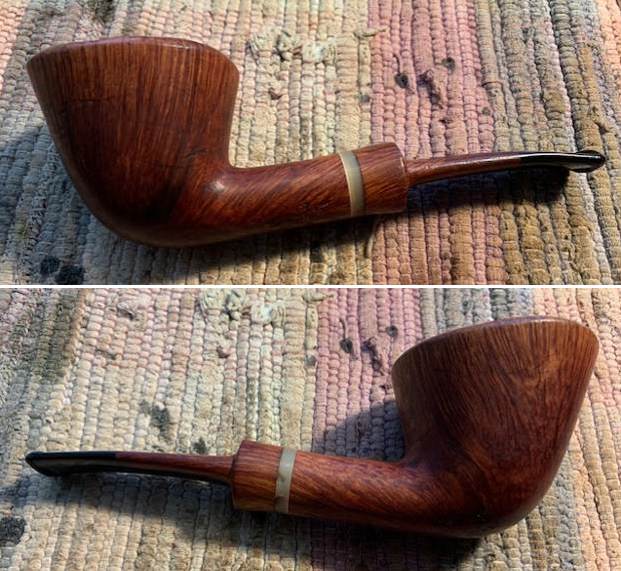
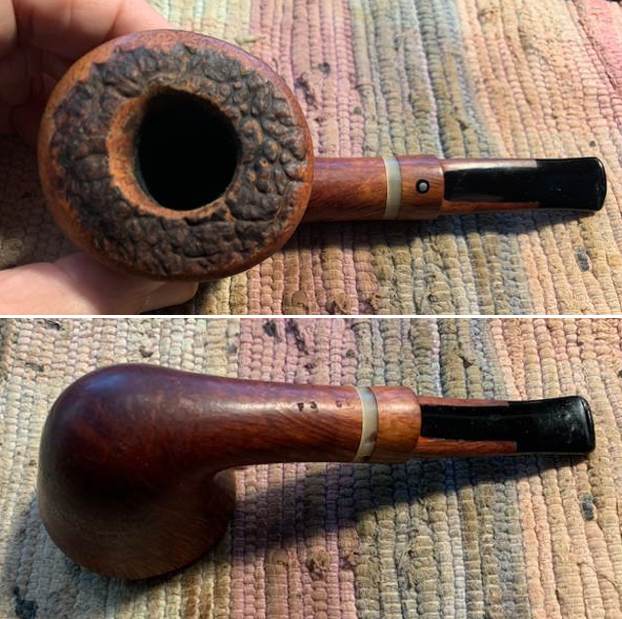
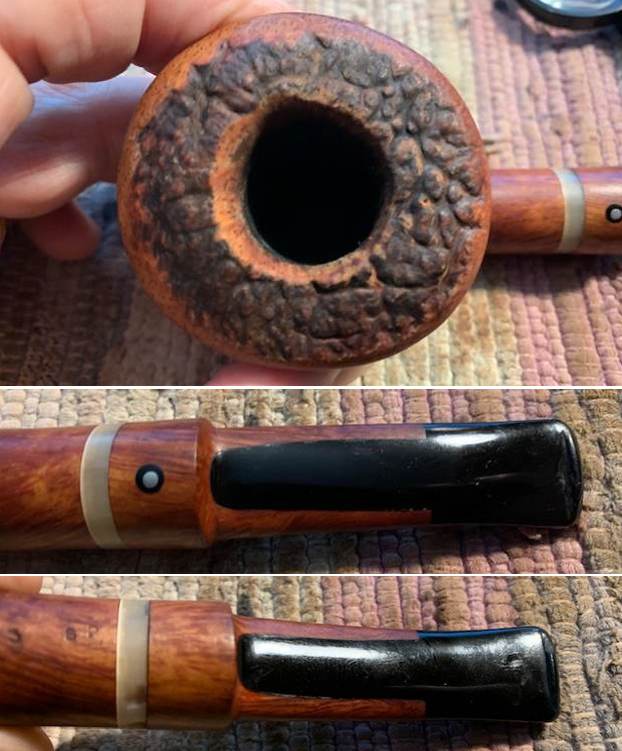
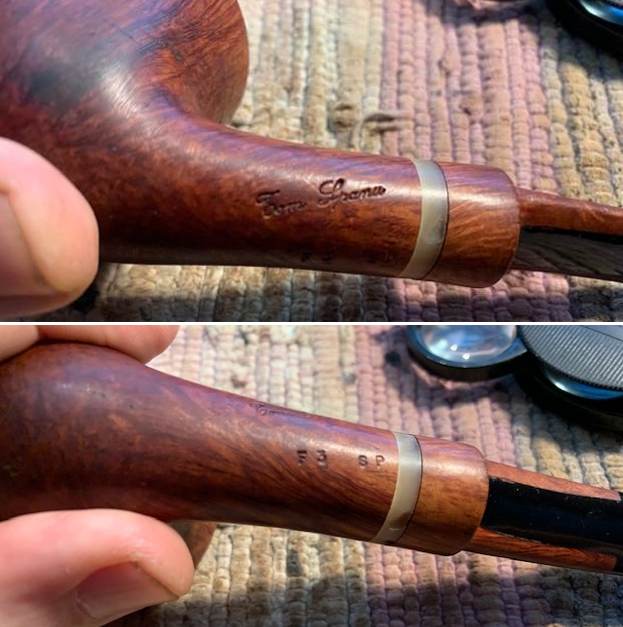
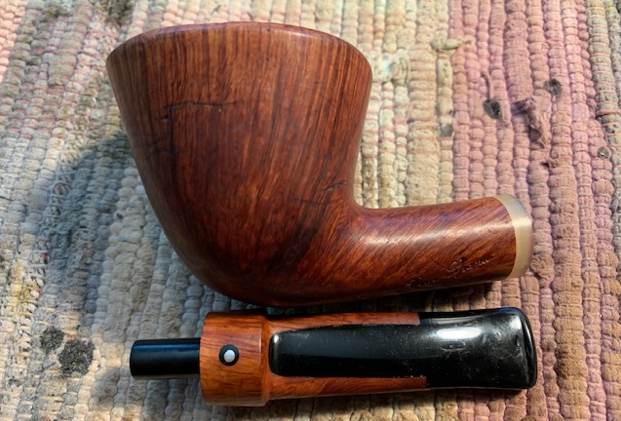
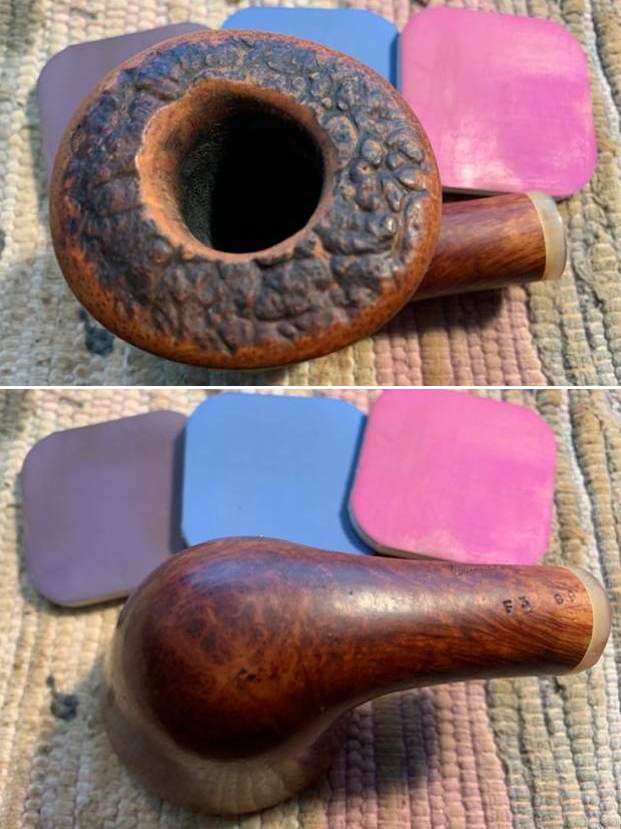
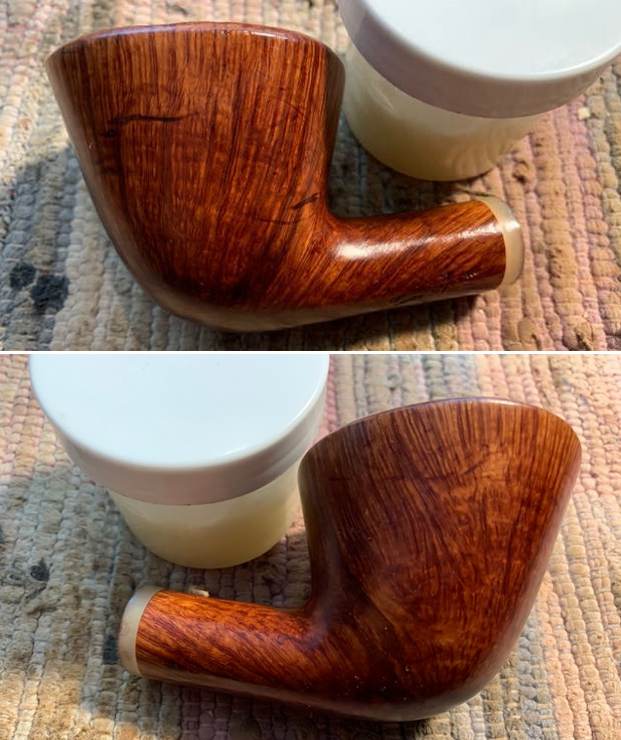
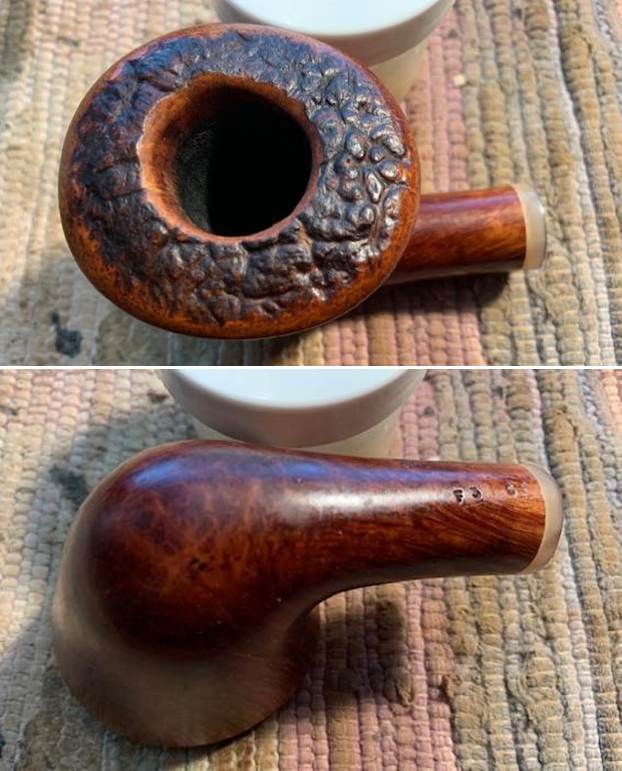
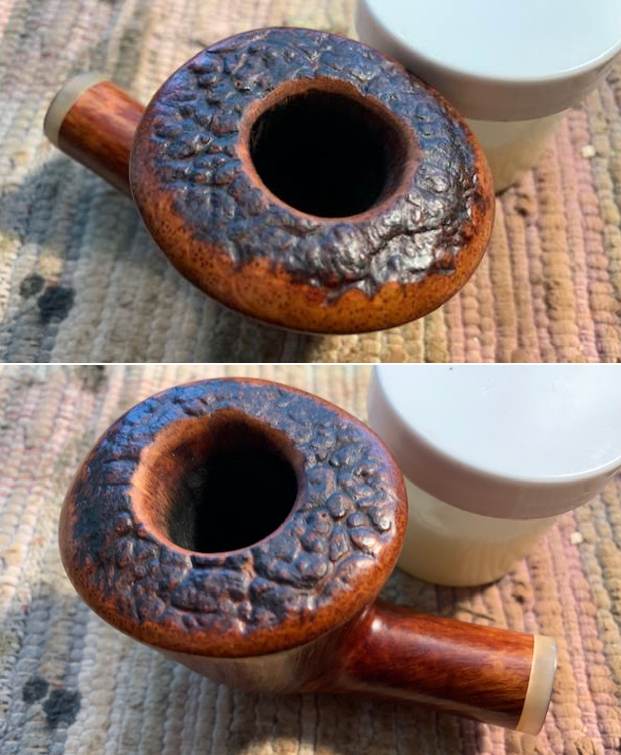
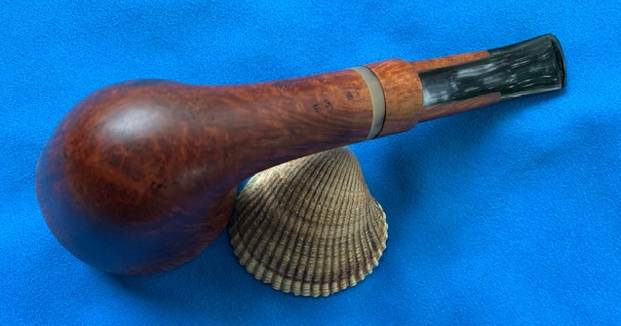
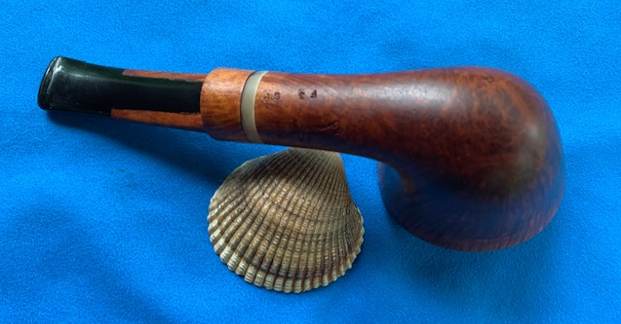
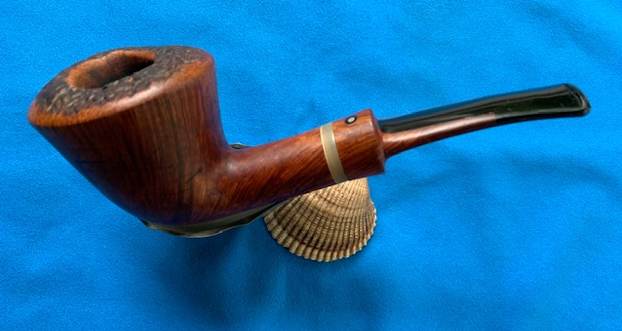
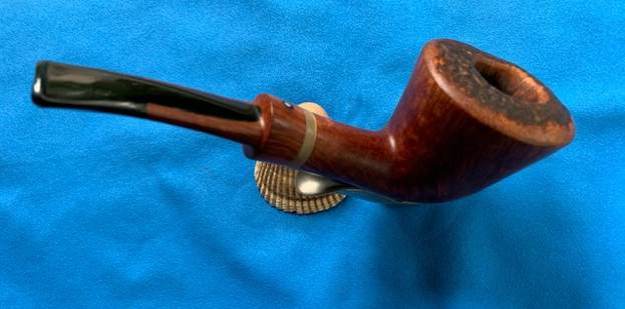
The next pipe I have chosen is smooth finished Dublin with a plateau top and a horn shank end. The stem is acrylic with a briar saddle and two strips of briar running down the sides. It came to us on September, 2020 from a lady in Salina, Kansas USA. The contrast of the brown and black stains make the grain stand out. It was stamped at an angle on the left side of the shank and read Tom Spanu. On the underside it is stamped F 3 followed by S P. The pipe was very dirty in the plateau on the rim top. All of the grooves were filled in with a thick coat of lava. The bowl was heavily caked so it was hard to know for sure what the condition of the edges was under the lava. The interesting stem with briar inlays was good in the saddle and inlaid sides. The acrylic blade of the stem had tooth chatter and deep marks on the top and underside on and near the button. Jeff took photos of the pipe before his cleanup work. They tell the story and give a glimpse of the pipe. Jeff took photos of the rim top and stem to show the general condition of the pipe. The bowl is heavily caked with a thick overflow of lava on the top and edges fills in the plateau finish. The stem has deep tooth marks and chatter on the top and underside near the button. Jeff took photos of the bowl sides and heel to show the grain and around this bowl. Underneath all the grime it is a nice looking pipe. He took photos of the left side and underside of the shank to show the stamping. The stamping is readable in the photos below and is as noted above. He also included a photo of the inlaid silver dot in an acrylic ring on the topside of the stem to show the condition. To get a short history reminder about the brand I turned to Pipephil’ sites to read what he had written there in the side bar (http://pipephil.eu/logos/en/logo-t7.html#tomspanu). I quote below and also include a screen capture of the pertinent section.

Artisan: Tommaso Spanu (born 1944 in Chiaramonti Sardinia) is an independant pipe maker since 1979. He was established in Laerru (Sardinia) from 1979 to 1999 where he used to harvest, cut and condition his own ebauchons. During this period he often worked for Paronelli. The workshop moved to Sassari (Sardinia) in 1999. He crafts Briar but also Lemonwood, Olivewood, Boxwood, Juniper, Oak and even Cork Oak.I turned to Pipedia for more information (https://pipedia.org/wiki/Spanu). I quote below:

Novarte S.N.C. di Spanu Tommaso

Update: We are sad to report that it has come to our attention that Tommaso Spanu passed from this World in the Fall of 2015 to join the many great Italian pipe makers that came before him. Our hope is that Tommoso’s sons and brother will continue the Spanu pipe making tradition. We can also enjoy the legacy he leaves in the many pipes he has made over the years.

In 1963 Tommaso Spanu left his home in Sardinia and wandered to Northern Italy to become a pipemaker. His uncle had managed an apprenticeship for him in Gavirate, in the province of Varese, with it’s many pipe manufactures. His exceptional talent soon attracted the attention of Alberto Paronelli (→ Paronelli), the grand seigneur of Italian pipe business. Paronelli, a famed pipe designer himself, arranged that the best pipe craftsmen schooled his young fosterling and personally taught him in pipe design and styles. Soon Spanu reached a remarkable level of skills and began to work on the Clairmont pipes, a high-grade brand produced for and distributed by Paronelli. A little later the bulk of the Clairmonts was made by Spanu who was even allowed to stamp them with his own name additionally.

All in all Tom Spanu spent 16 years in the North where he worked with many other famous pipemakers like Guiseppe Ascorti and Luige Radice e.g. In 1979 he finally felt it was time now to continue on his own. So he returned to Sardinia where he established his own workshop with some help from his brothers. A firm was founded to market the pipes, the Novarte S.N.C. di Spanu Tommaso. Furthermore he purchased a licence from the local government and following Spanu is the only pipemaker worldwide who grows, harvests, mills and conditions his own briar!

Today his brother and two sons carry on the family tradition, making more than a thousand pipes a year. Mostly more classic models for Italy, but also a good amount of more stylish designs for the foreign markets. Now, if it comes to talking about “entirely handmade pipes” … Just as when Tommaso started carving pipes, only hand tools are used. Not a lathe or drill is to be found in his workshop!

Around 1997 Spanu was approached by Mercedes-Benz and asked to design briar-burl dashboards for their most luxurious sedans. And he replied “Maybe tomorrow!” We can assume that the envoys looked quite dumbfounded to be turned down that way, and so Spanu explained that while the project would be fun, his first love was pipes, and only once he was not making as many pipes he would consider it. Mercedes-Benz is said to have taken the rebuff in good nature, and even this automobile manufacturing giant is still waiting on Mr. Spanu to finish some pipes.

Beside the all-briar pipes Spanu loves to work with a wide variety of others woods ranging from the traditional olivewood to beech, oak, boxwood and juniper. He often produces hybrids composing different woods.

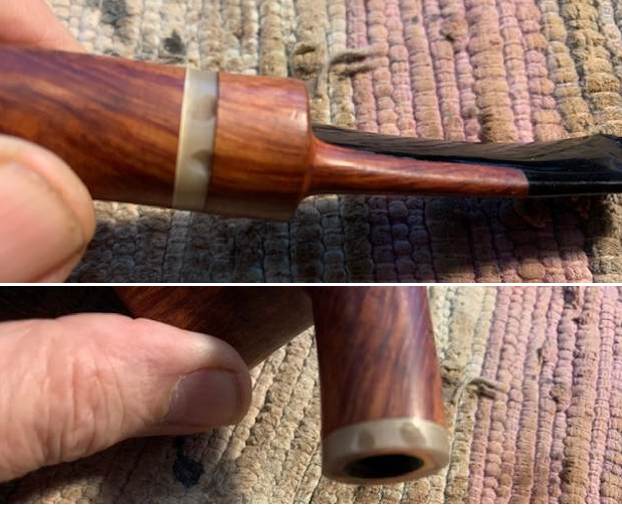
Jeff had done a great job cleaning up the pipe as usual. He reamed the pipe with a PipNet reamer and cut back the cake back to the bare briar. He cleaned up the walls with a Savinelli Fitsall Pipe Knife. He scrubbed the interior of the bowl and shank with pipe cleaners, cotton swabs and alcohol to remove the tars and oils. He scrubbed the exterior of the pipe with Murphy’s Oil Soap and a tooth brush to remove the grime from the finish. He worked on the rim top lava with the soap and tooth brush. He scrubbed the inside of the stem with alcohol and pipe cleaners. He scrubbed the exterior with Soft. He rinsed it off with warm water to remove the Deoxidizer. It looked very good when I brought it to the worktable.   I took close up photos of the rim top and the stem surface. I wanted to show how well it had cleaned up. The rim top looked very good. The beveled inner edge had some damage on the right side toward the front that would need to be cleaned up in the process. I took photos of the stem to show the tooth marks on the surface ahead of the button and on the sharp edge of the button itself. I took a photo of the stamping on the left side and the underside of the shank. You can see that it is stamped as noted above. It is clear and readable. I took the pipe apart and took a photo of the pipe. It is a good looking pipe and has a few deep scratches around the bowl and shank. There were three small worm holes I the horn shank band where it met the briar stem. They were round and quite deep. They would need to be filled in and repaired to make the band round and smooth once more.I began my work on the pipe by dealing with worm holes in the horn shank band. I filled them in with clear super glue. I repeated the fill until the surface was smooth. I blended the repairs into the surrounding horn and it looked good. I put the stem on the shank and sanded the junction as well. I worked on the beveled inner edge of the bowl with a folded piece of 220 grit sandpaper to smooth it our and lessen the darkening. It cleaned up well and looked very good.I worked on the deep cuts in the left side of the bowl with sandpaper and filled them in with clear CA glue. I sanded the repaired areas with 220 grit sandpaper to smooth them out. I polished the repairs with 400 grit wet dry sandpaper.I polished the briar with micromesh sanding pads – dry sanding with 1500-12000 grit pads. I wiped the bowl down after each pad with a damp cloth to remove the sanding dust. By the end of the process they looked very good. I worked some Before & After Restoration Balm into the surface of the briar and plateau rim top with my fingertips and a horsehair shoe brush to clean, enliven and protect the briar. I let the balm sit for 15 minutes and then buffed with a cotton cloth to raise the shine. The photos show the bowl at this point in the restoration process. I set the bowl aside and worked on the stem. I filled in the deep tooth marks on the stem sides with black super glue and set it aside to cure. When it cured I flattened the repairs with a small file. I sanded out the repaired areas with 200 grit sandpaper to blend them into the surface. I started the polishing with 400 grit wet dry sandpaper. I polished the stem with micromesh sanding pads – wet sanding with 1500-12000 grit sanding pads. I wiped it down after each sanding pad with Obsidian Oil. I polished it with Before & After Pipe Stem Polish – both Fine and Extra Fine. I am excited to finish this Tom Spanu F3 SP Freehand Dublin with a Plateau Rim Top. I put the pipe back together and buffed it with Blue Diamond on the buffing wheel. I gave the bowl multiple coats of Conservator’s Wax and the stem multiple coats of carnauba wax. I buffed the pipe with a clean buffing pad to raise the shine and hand buffed it with a microfibre cloth to deepen the shine. It is fun to see what the polished bowl looks like with the rugged rustication all around it. Added to that the polished triple brass and emerald acrylic band and the black vulcanite stem was beautiful. This Spanu Freehand Dublin is nice looking and the pipe feels great in my hand. It is light and well balanced. Have a look at it with the photos below. The dimensions are Length: 6 ½ inches, Height: 2 inches, Outside diameter of the bowl: 2 ¼ inches, Chamber diameter: 1 inch. The weight of the pipe is 76 grams/2.68 ounces. It is a beautiful pipe and one that will be on the Italian Pipe Makers Section of the rebornpipes store soon. If you are interested in adding it to your collection let me know. Thanks for walking through the restoration with me as I worked over this pipe. Thanks to each of you who are reading this blog.

Restoring a Castello Sea Rock Briar 87P Poker


Blog by Steve Laug

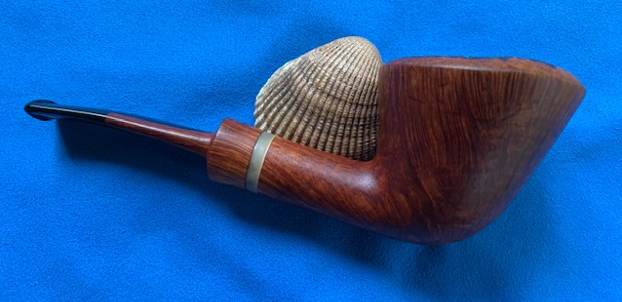
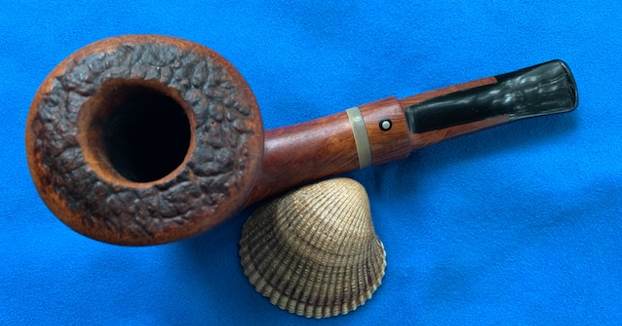
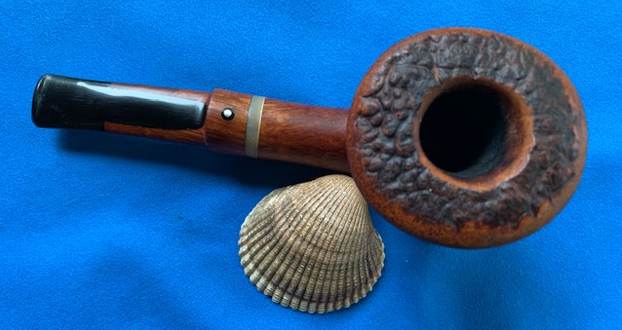
The next pipe on the table is a beautiful Castello Sea Rock Briar Poker. I love the Sea Rock Briar finish and this was one that is quite exemplary of the finish. It has a less rugged and more refined rustication that is still tactile and I think will be a great smoker. It is a pipe that we purchased in September 2020 from a fellow in Los Angeles, California, USA.

This Castello Sea Rock Poker is stamped on the heel and the underside of the shank and reads 87P on the heel of the bowl. That is followed on the shank by Castello [over] Sea Rock Briar followed by Made in Cantu [over] Italy. The numbers and stamping tell me that the pipe is a Sea Rock rusticated finish and it is a Poker. The underside of the Lucite stem also had stamping that read Hand Made over Castello [over] the number 3. The finish was incredibly dirty with spots of grime and debris ground into the crevices and valleys of the rustication. The bowl had a thick cake in the and a heavy lava overflowing onto the smooth rim top. The rim top appeared to rough and beat up with dents. The inner and outer edge of the rim looked very good. The acrylic stem had tooth marks and chatter on both sides ahead of the button and on the button itself. Jeff took photos of the pipe before he started his clean up work on it. My brother took some close up photos of the rim top and the cake in the bowl to show what it looked like when we received it. You can see how thick the cake is and how much of the rim rustication has filled in with the overflow. The photos of the stem show the faux diamond logo on the top left side of the saddle. You can see the tooth marks and chatter near the button on both sides of the stem. Jeff took photos of the rusticated finish around the bowl sides and heel. It is nice looking if you can see through the grime and dust ground into the rugged, deep rustication.   He took a photo of the stamping on the left underside of the diamond shank. The stamping is readable but filthy. It reads as noted above. I recently wrote a blog on the Castello Sea Rock Briar Bulldog SC 54P. I reread the information and quote from a 54P Blog I wrote earlier (https://rebornpipes.com/2016/12/18/an-estate-sale-find-a-castello-sea-rock-sc-54p-bulldog/). It gives a short summary of the information I found.

Before I worked on the pipe I wanted to do a bit of research to see if I could shed some more light on the pipe I had in hand. I learned from the pipephil website that the rhinestone logo was originally on pipes for the US market. There was no hint as to why that was done only that it was and that it is occasionally still used http://www.pipephil.eu/logos/en/logo-castello.html

I have an older article called PCCA’s Castello Grade & Style Guide. It was written by Robert C. Hamlin (c) 1988, 1992, 1994. Robert gathered some remarkable information on the Castello lines and I have often used his guide in the past to give me pertinent data. There I found more information regarding the shiny logo on the side of the stem.

“American logo’d Castello pipes use a small round “Diamond” (referred to and looking like, but it is NOT actually a diamond) inlaid into the mouthpiece. This was originally done so that the standard Castello white bar logo did not conflict with another brand and logo that was sold by Wally Frank called the “White Bar Pipe” (in the 1950’s).”

The above quote and the remainder of those following come from the same article by Robert Hamlin. You can read the full article at the following link: http://www.pipes.org/BURST/FORMATTED/196.016.html

I read further in the article to help me understand the stamping on the underside of the shank. My knowledge of Castello pipes is pretty limited so when I get one to restore I resort to this article and others to try to make heads or tails of the stamping.

I learned that the Sea Rock Briar stamp also signified something and told me more about the pipe. Robert pointed out:

“SEA ROCK [Carved Black or dark brown]: This is the lowest grade of the Castello line and is the most common in the USA. Sea Rocks are produced by taking a smooth bowl that has not been “final finished” and surface carving the finish with tools. This “carved” finish is then evened out using a steel wire brush, stained and then waxed. The Natural Vergin carved finish is left unstained and unwaxed as a rule, although we have seen waxed and partially waxed “Vergins”.” 

The remaining mystery for me was the meaning of the stamping on the stem. I of course understood the Hand Made and the Castello stamping but the number 3 was a mystery to me. I was not sure what it referred to. So once again Robert’s article gave me the information I needed to understand that last piece of the mystery.

“#2: All Castello standard shaped pipes have a number (3, 4, 5 or 6) stamped on the mouthpiece or sometimes on the Lucite ferrule. What does this number mean? Not much really, it is the number of the size for the proper straw tube or reed that fits the shank and stem of the pipe. These straw tubes are rarely used in the United States. The Castello reed is considered superfluous and useless to most, but with this number you will always know which one fits (the different numbers have to do with length, not diameter).”

Armed with that information I turned to work on the pipe itself. Before he sent it to me, Jeff had done an amazing job cleaning the pipe. It almost looked like a different pipe after his work. He reamed the pipe with a PipNet pipe reamer and removed the rest of it with a Savinelli Fitsall Pipe Knife.  He scrubbed the bowl with undiluted Murphy’s Oil Soap with a tooth brush. He rinsed it under running warm water to remove the soap and grime. He cleaned out the inside of the shank and the airway in the stem with isopropyl alcohol, cotton swabs and pipe cleaners. Even though the stem was acrylic he soaked the stem in Briarville’s Pipe Stem Deoxidizer and then rinsed it off with warm water. It really works well to remove internal and external grime and tars. He scrubbed the stem with Soft Scrub and a tooth brush and rinsed it off with warm water. It looked amazing when I took it out of the package of pipes he shipped me. I took photos of the pipe before I started my part of the restoration work.   The rim top was much cleaner and the edges looked good. However, the surface of the rim had been used as a hammer and it was in rough condition. Fortunately none of them were too deep – probably thanks to the think overflow of lava. It would take some work to clean up but it had great potential. The stem surface looked good but visible tooth marks and chatter showed clearly on either side of the stem. I took photos of the stamping on the underside of the bowl, shank and stem. It is clear and readable as noted above.I took the stem off the shank and took photos of the parts of the pipe. It is a great looking rusticated Poker. I worked on the rim top and the heel of the bowl to minimize the scratches and marks on both. I used micromesh sanding pads and wet sanded with 1500-12000 grit pads. I was fortunate that the scratches were not deep so I was able to polish them out and remove them. The rim top looked amazingly better and it is a pretty looking pipe. The bowl looked good at this point so I rubbed it down with Before & After Restoration Balm. I worked it into the surface of the bowl and shank with my fingertips and a horse hair shoe brush to clean, enliven and protect the briar. I let the balm sit for about 10-15 minutes and buffed with a cotton cloth to raise the shine. I set the bowl aside and turned my attention to the stem. I sanded the tooth marks out on both sides of the stem at the button using 220 grit sandpaper and also sanded the damage to the button surface itself. I started polishing the stem with 400 grit wet dry sandpaper.   I used micromesh sanding pads to polish the newly sanded areas on the Lucite stem surface. I dry sanded it with 1500-12000 grit pads and wiped it down with the damp pad after each sanding pad. In doing so I was able to remove all signs of the damage to stem in those spots along the edge and top of the button. I put the stem in place in the shank and  looked this beautiful Castello Sea Rock Briar 87P Poker. I lightly buffed the bowl on the buffing wheel. I buffed the stem with Blue Diamond polish on the buffing wheel I waxed the stem with carnauba wax on the wheel. I waxed the bowl with Conservator’s Wax and buffed the entire pipe with a clean buffing pad to raise the shine. I hand buffed it with a microfibre cloth to deepen the shine. The finished Castello Sea Rock Briar Poker is shown in the photos below. It is truly a beautiful little Poker. The dimensions of the pipe are Length: 5 ¾ inches, Height: 2 inches, Outside diameter of the bowl: 1 ½ inches, Chamber diameter: ¾ of an inch. The weight of the pipe is 45 grams/1.59 ounces. The shape and the rustication make it a pleasure to hold in the hand. It fits snug with my thumb curled around the back of the bowl and the rest of the fingers holding the bowl. The finish is extremely tactile and should be interesting in hand as the bowl heats up during smoking. I can testify to how well Castellos smoke. I will be adding it to the Italian Pipe Makers Section on the rebornpipes store soon. Thanks for walking with me through the restoration process.