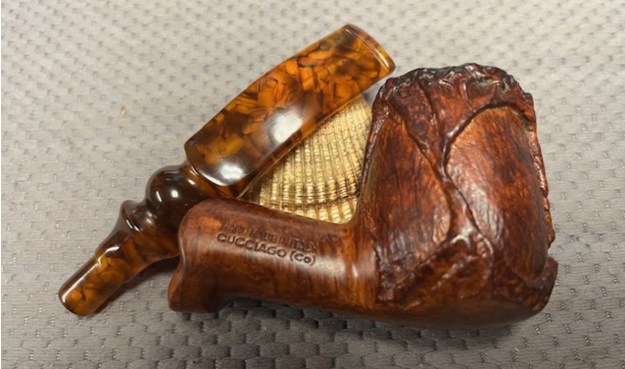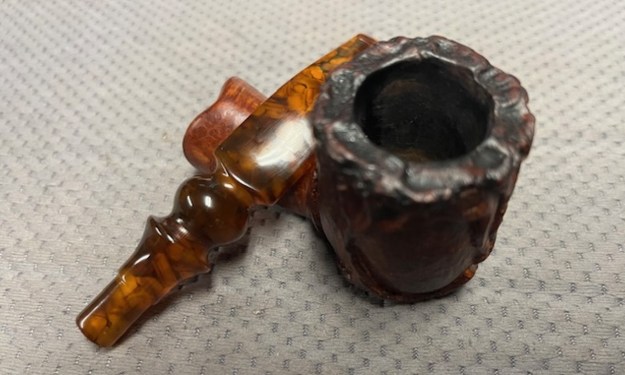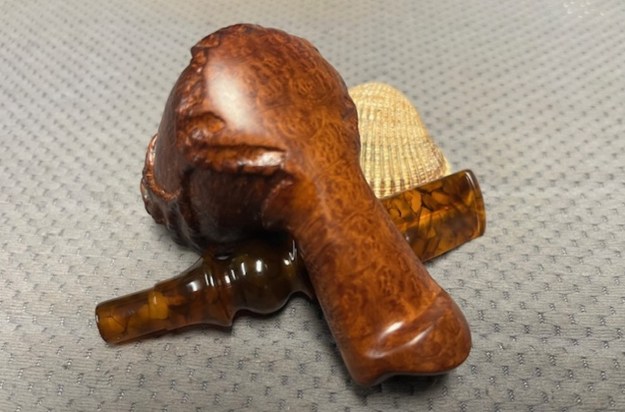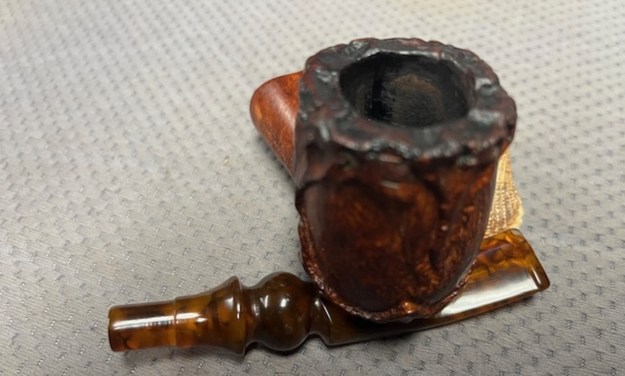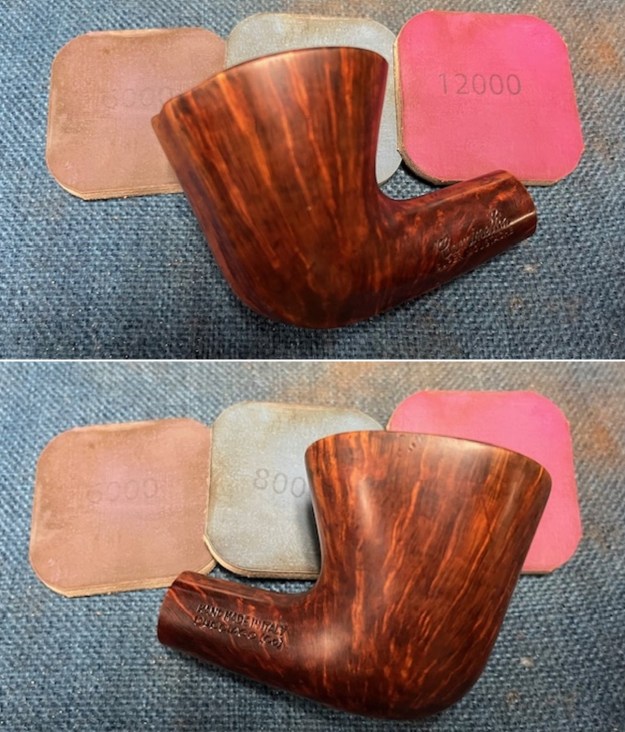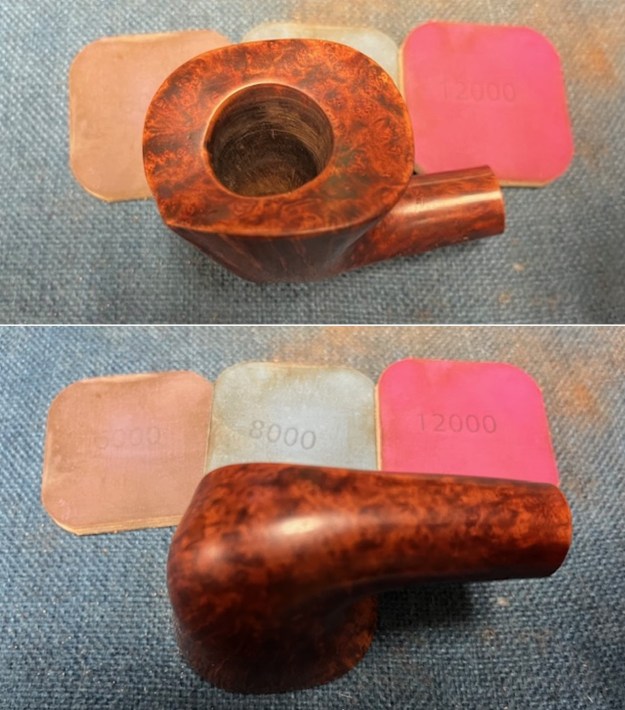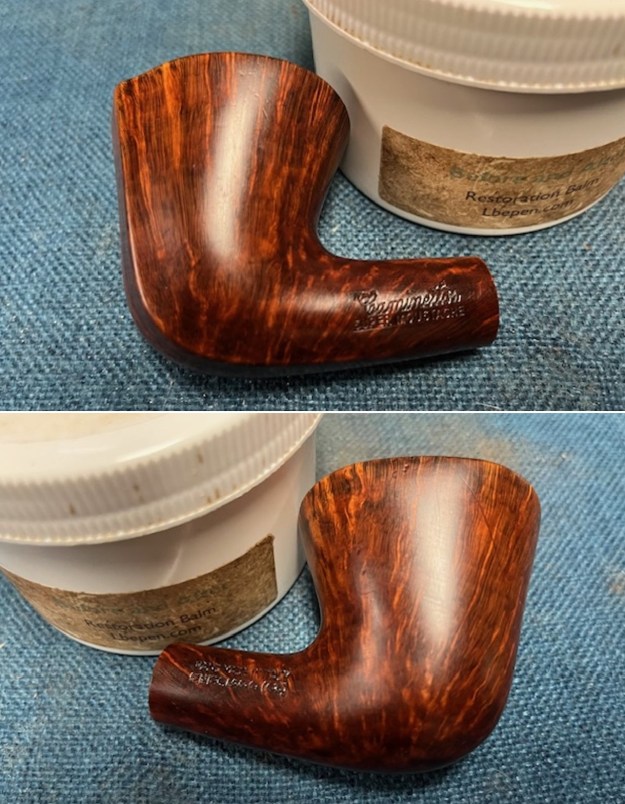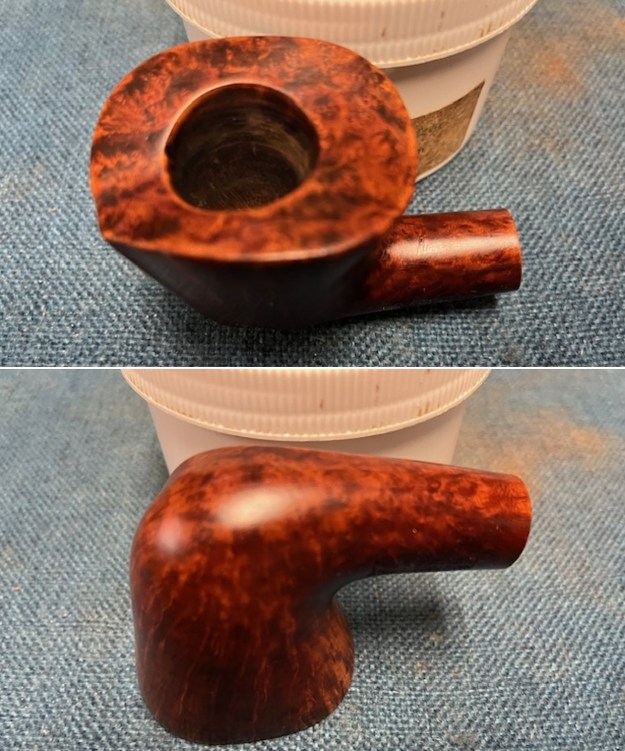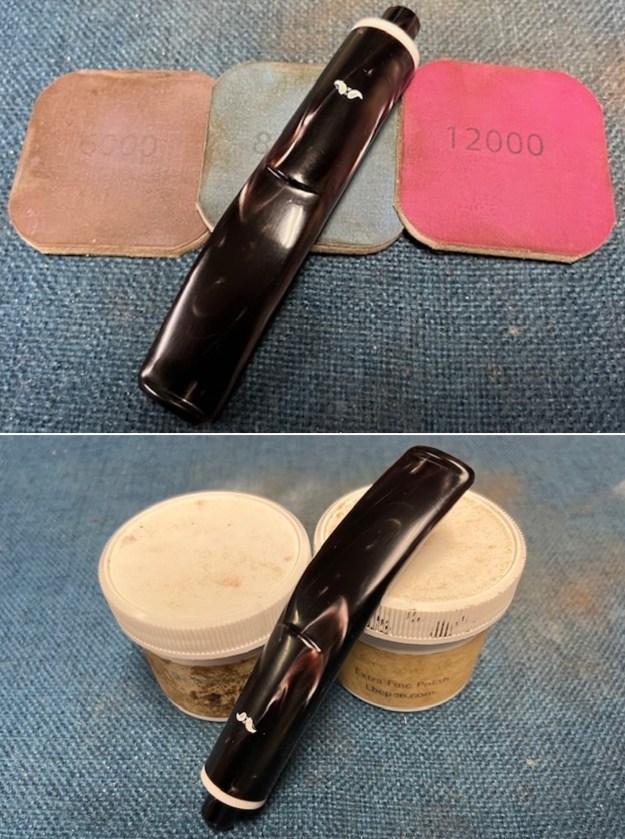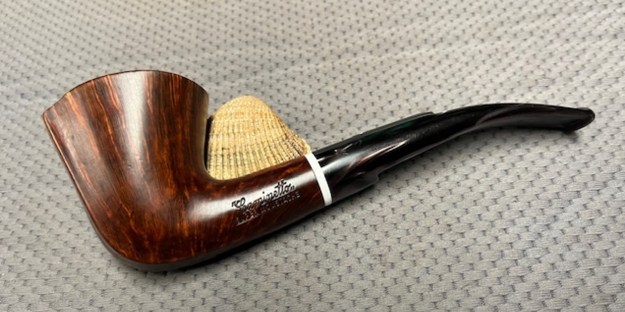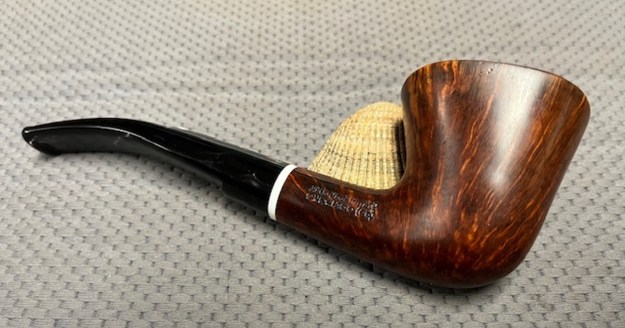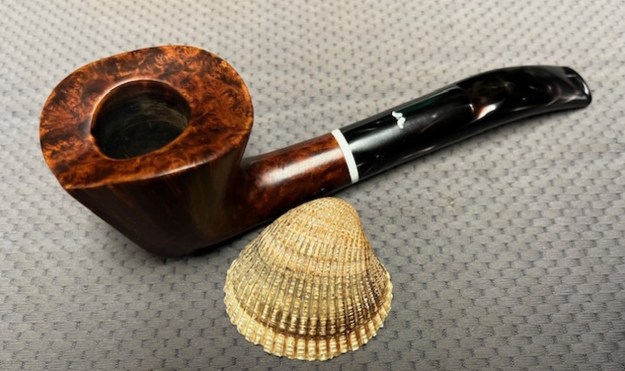
Tag Archives: polishing acrylic stems

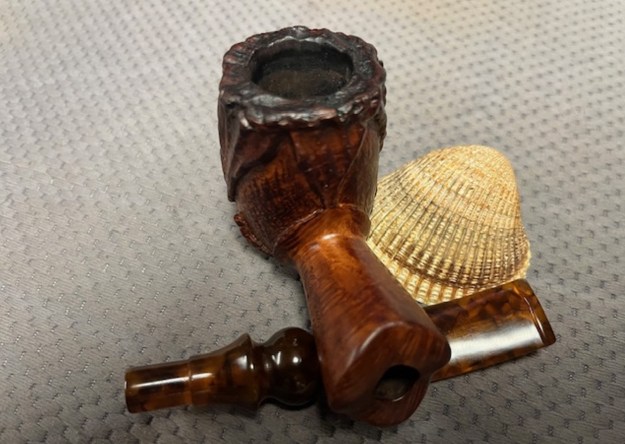
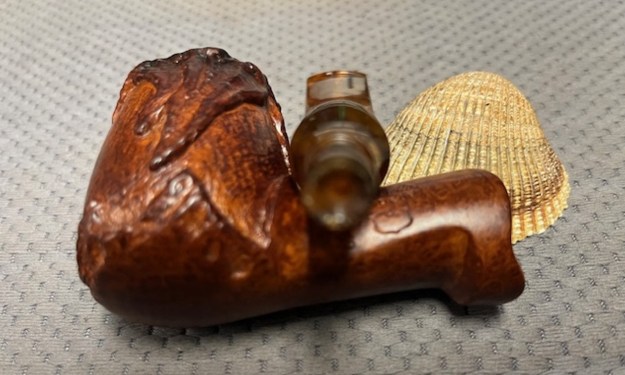
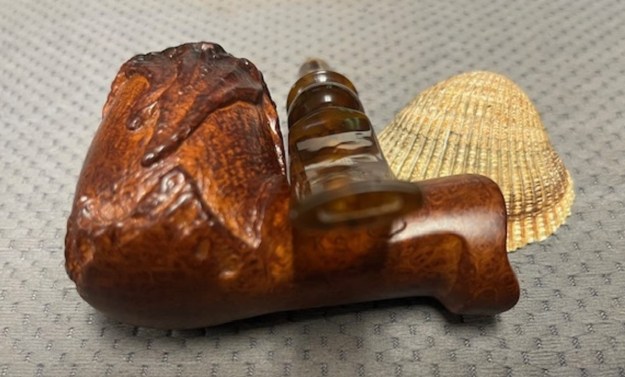
New Life for a Castello Old Antiquari KK 32 Hand Made Canadian


by Steve LaugView post

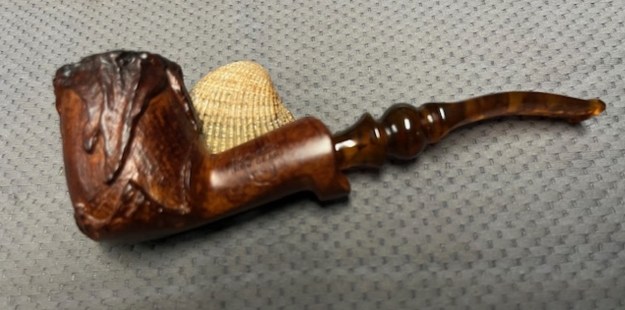
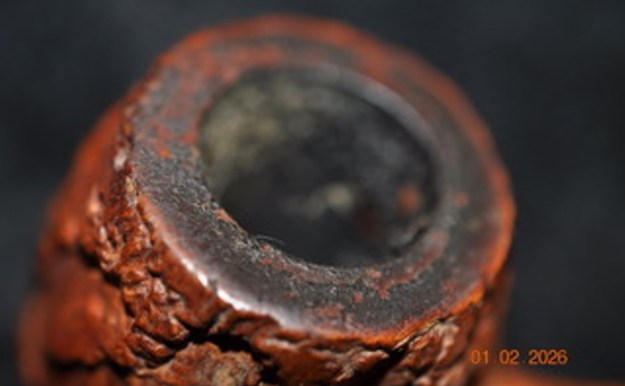
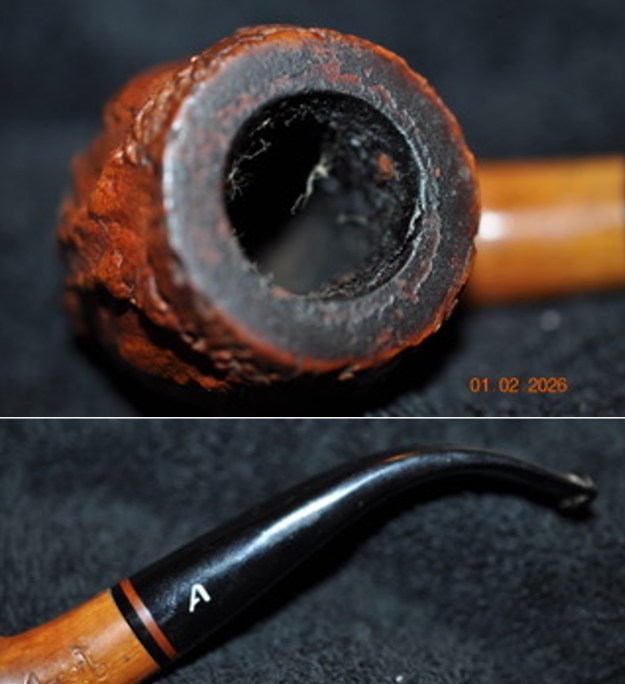
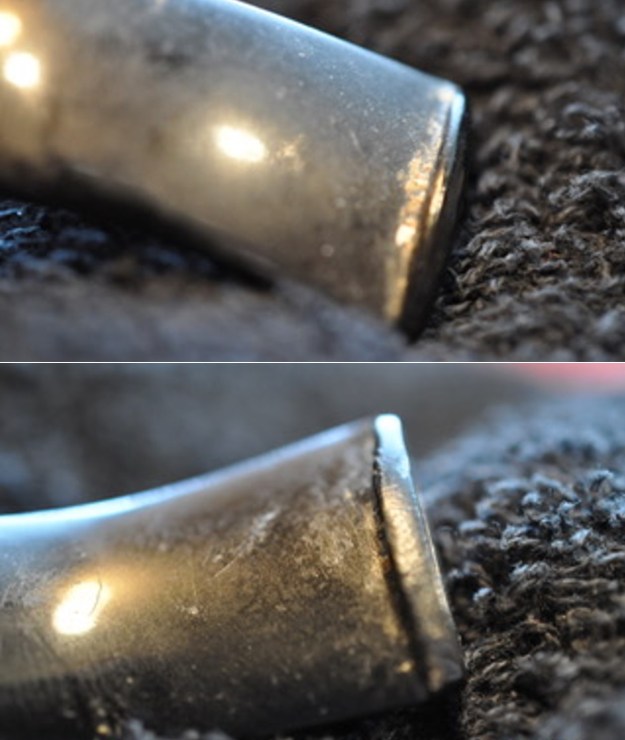
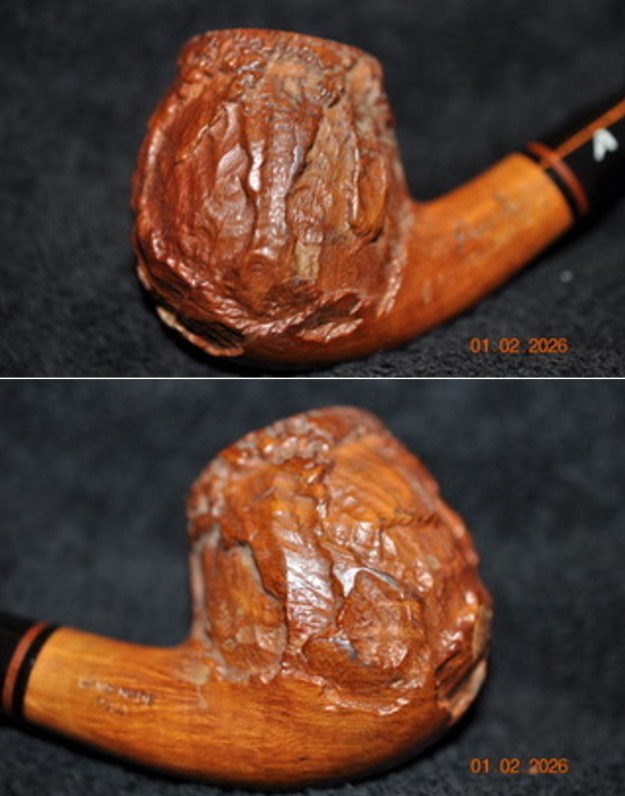
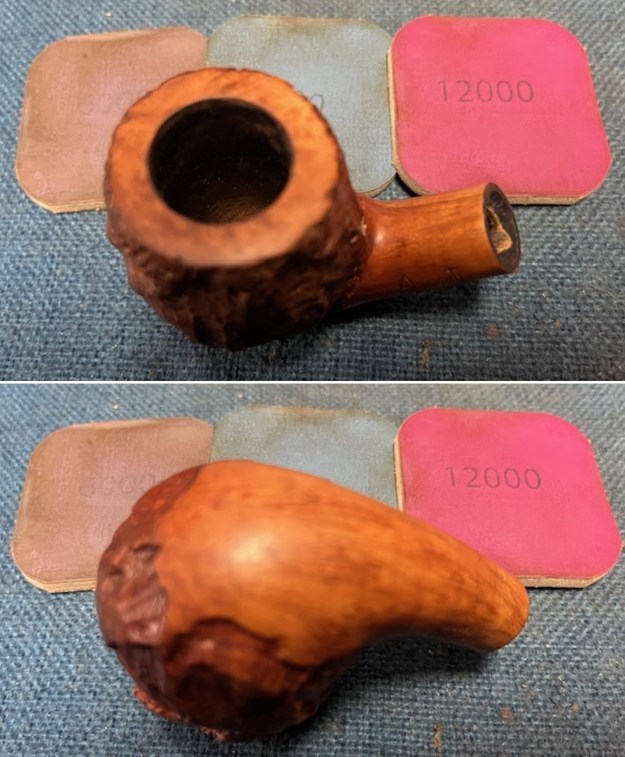
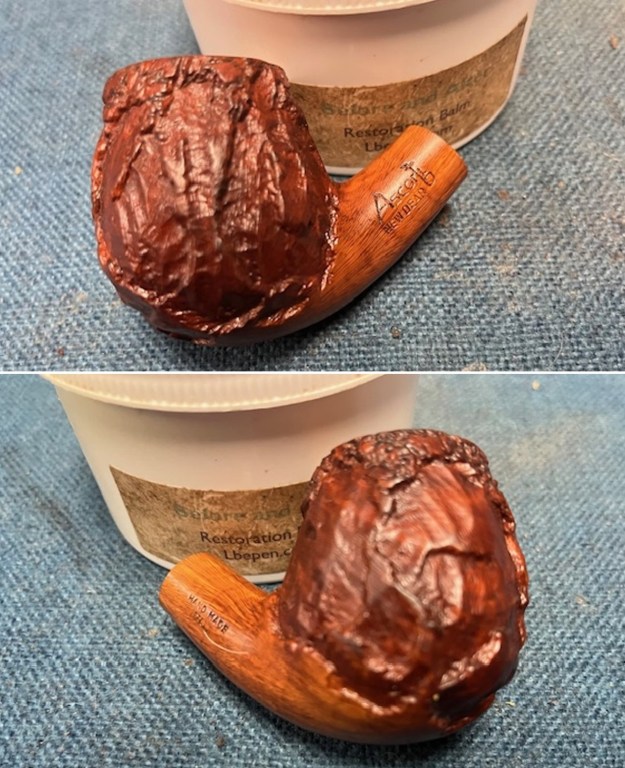
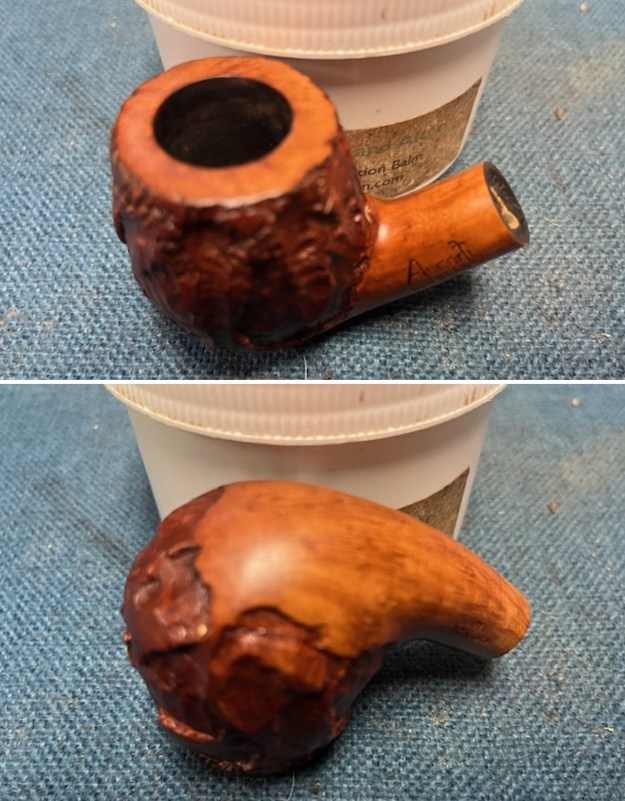
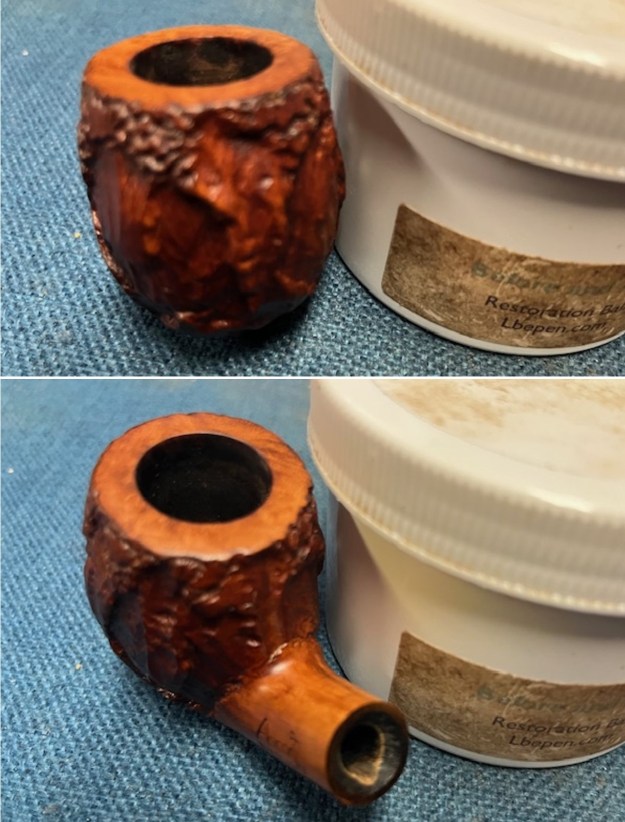
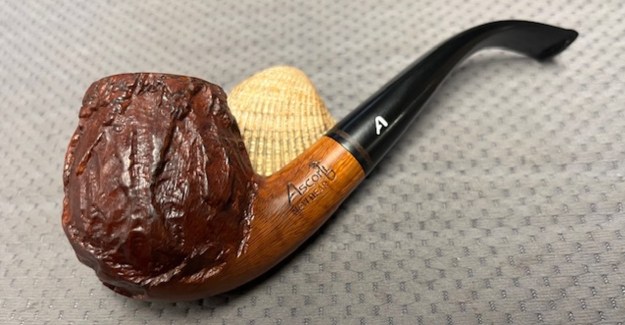
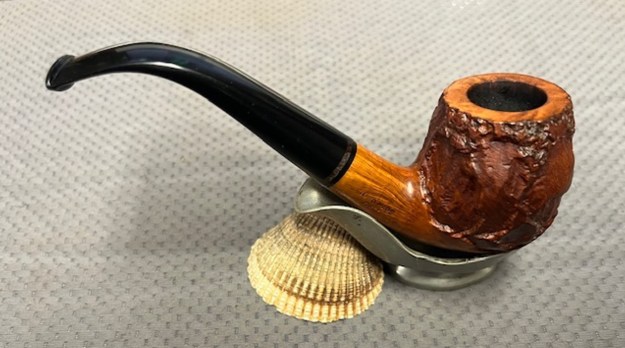
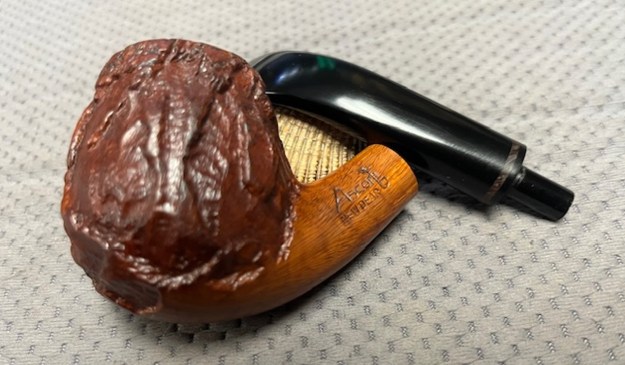
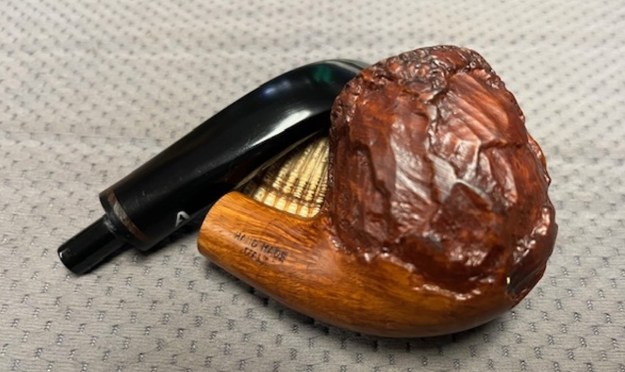
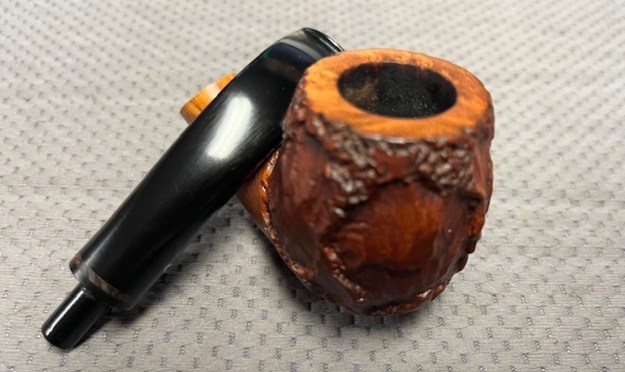
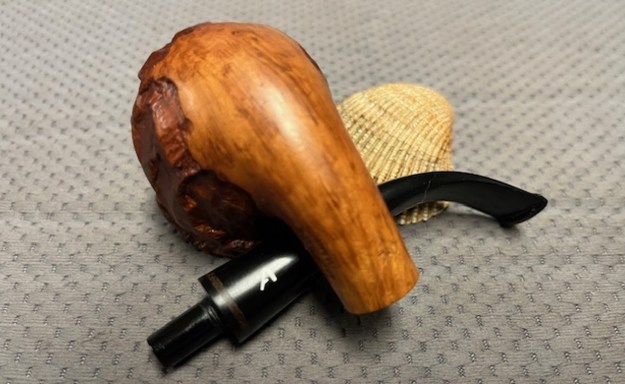
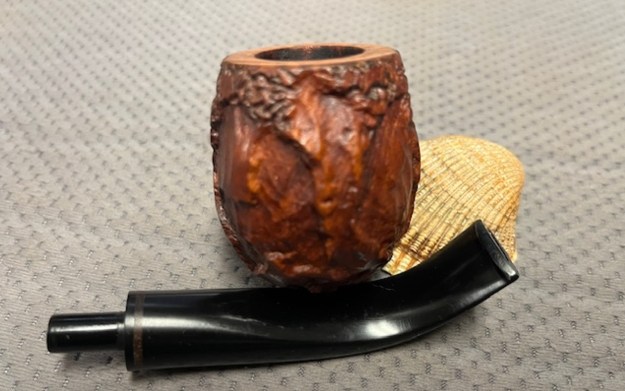
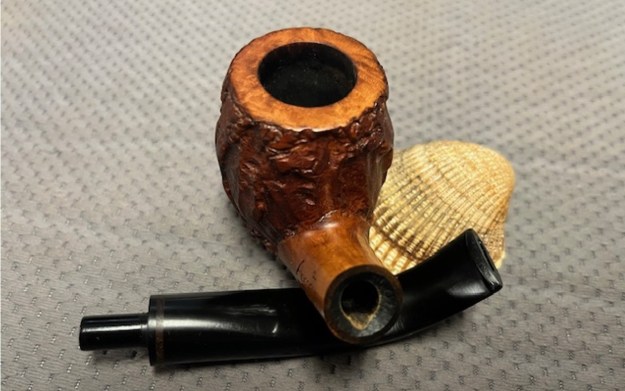
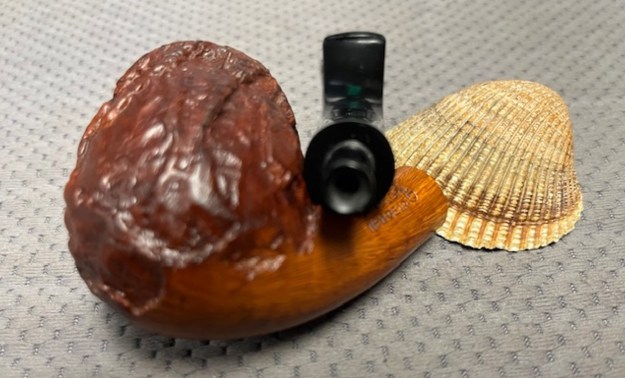
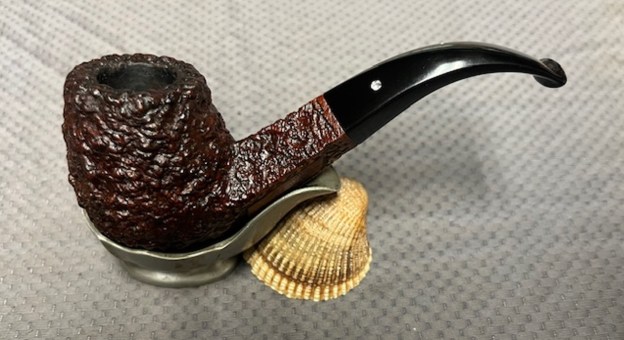
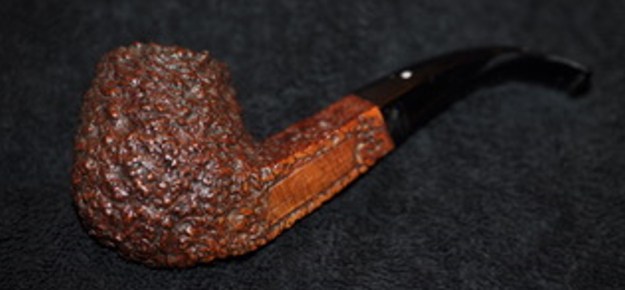
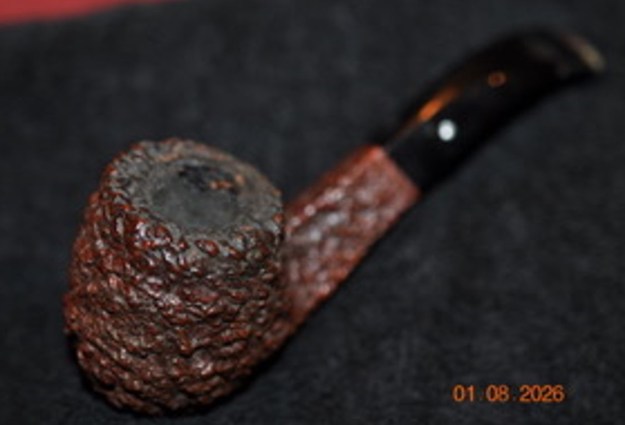
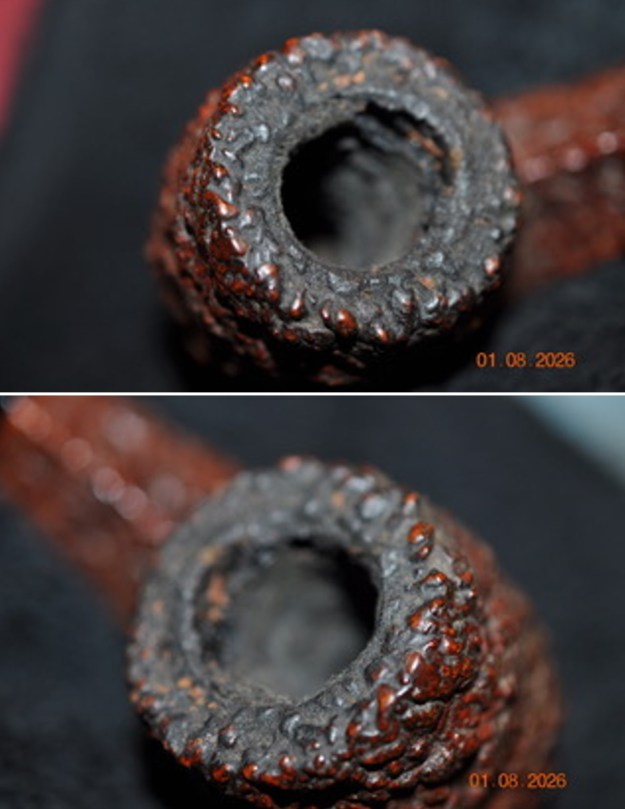
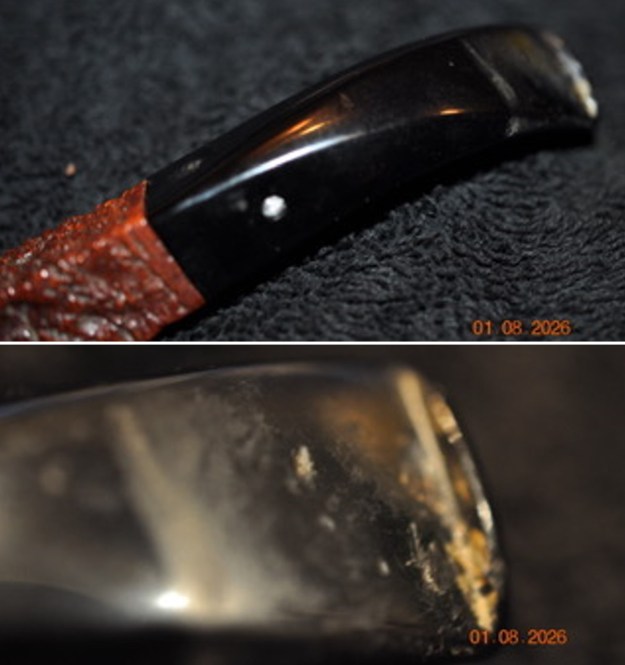
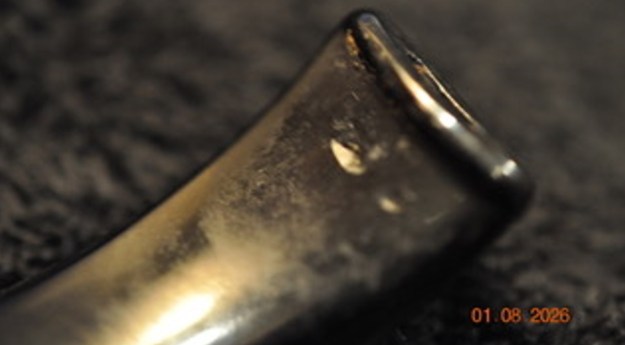
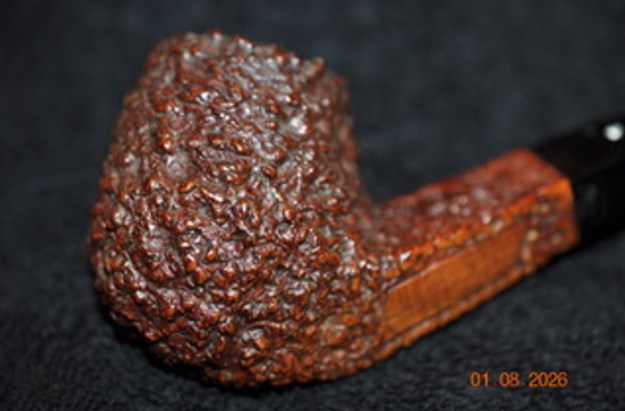
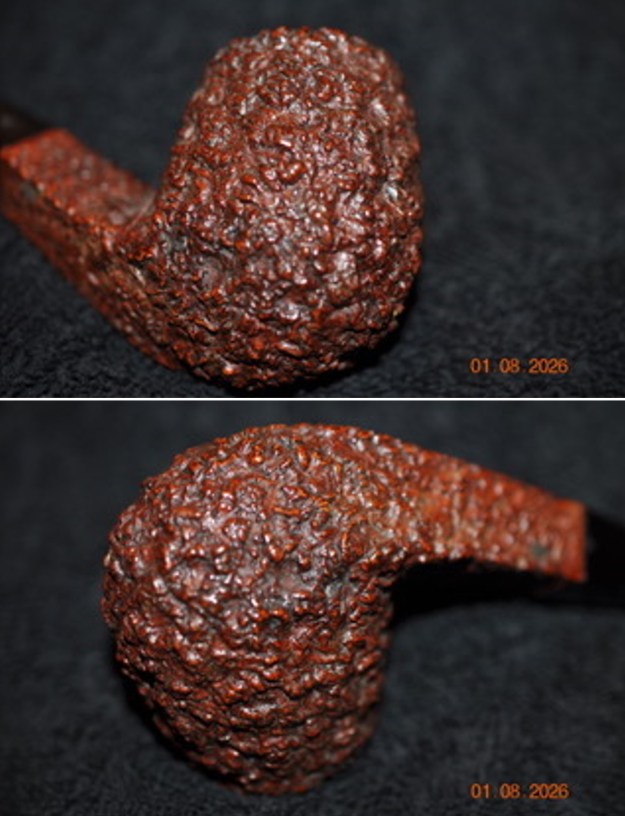
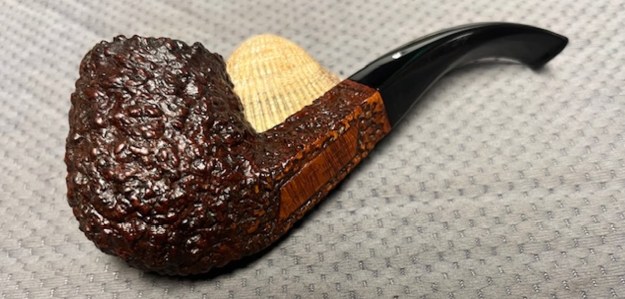
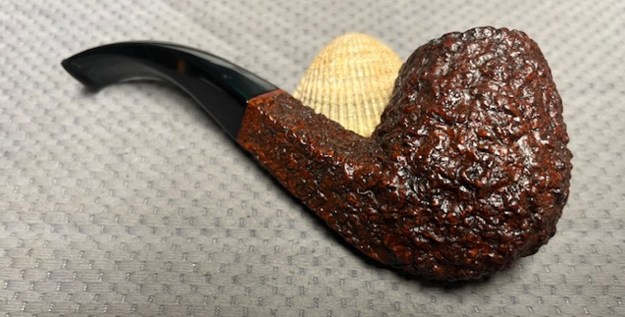
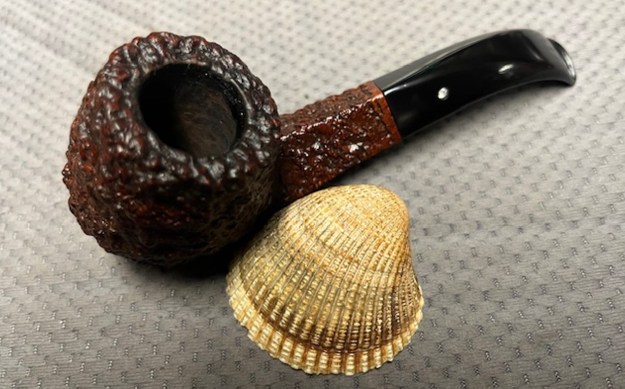
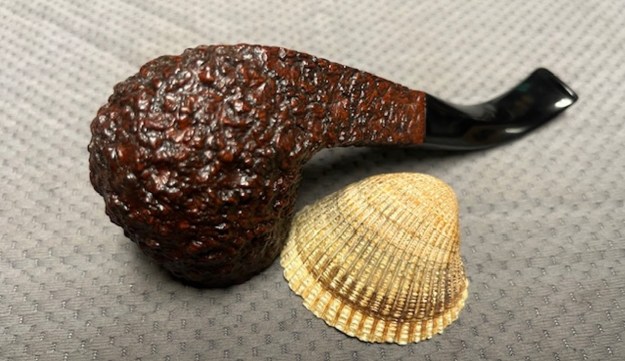
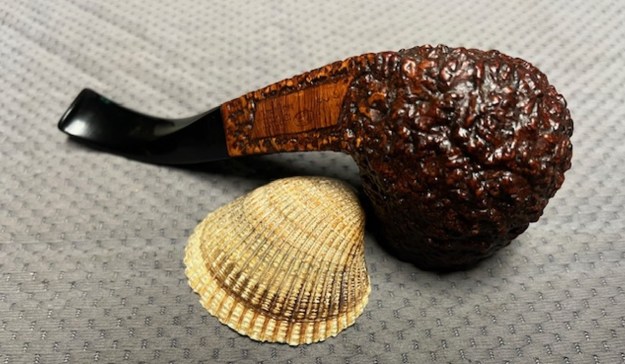
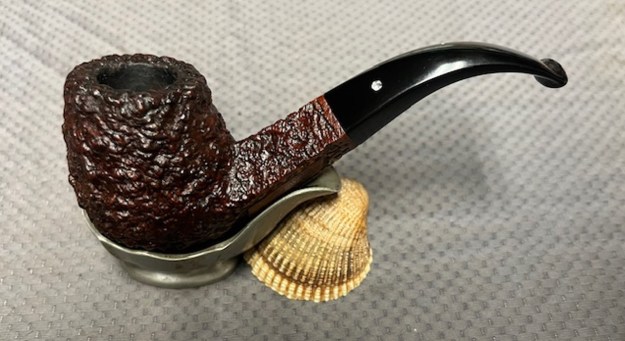
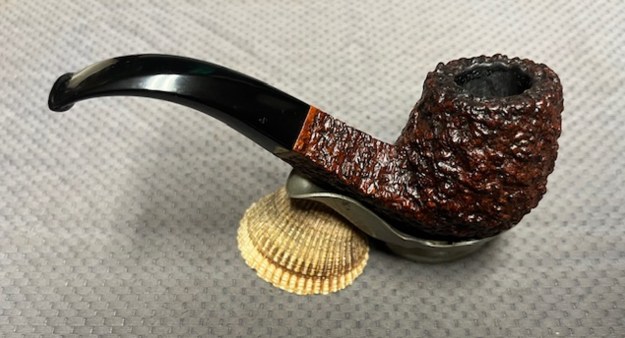
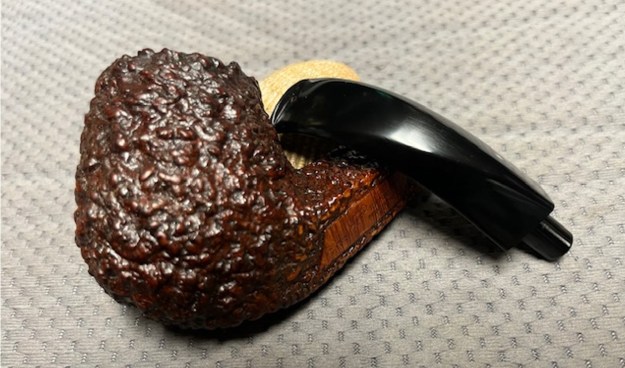
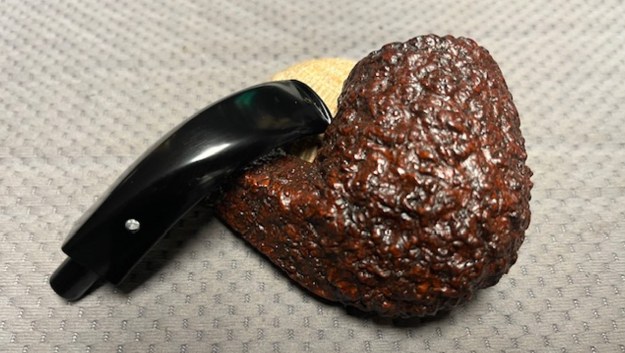
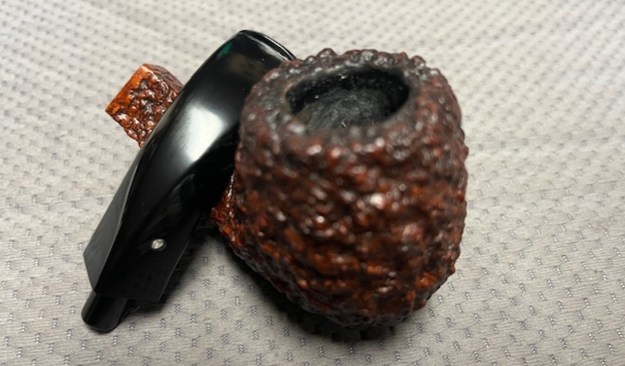
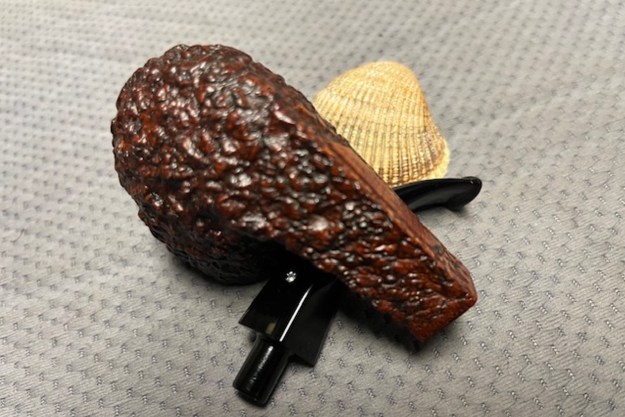
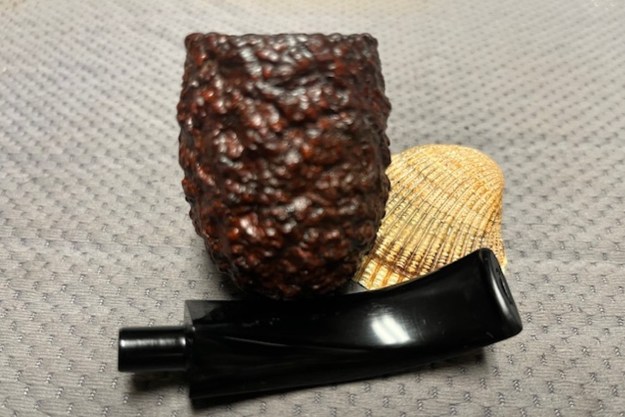
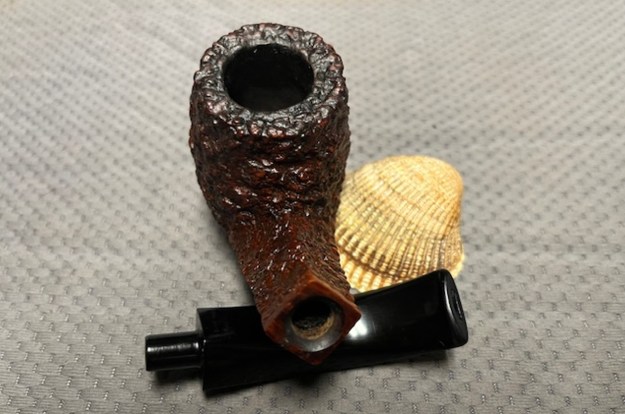
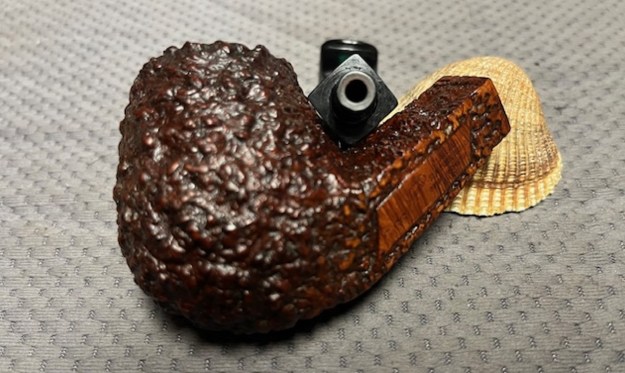
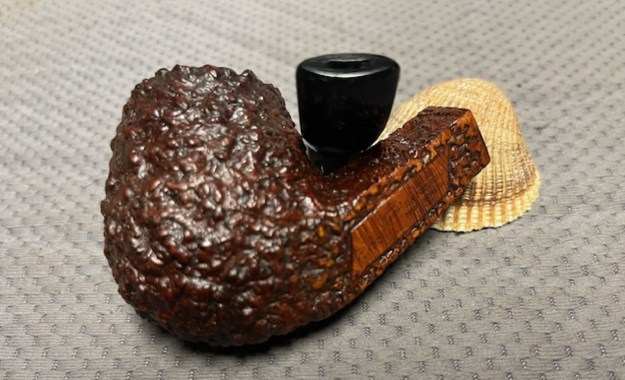
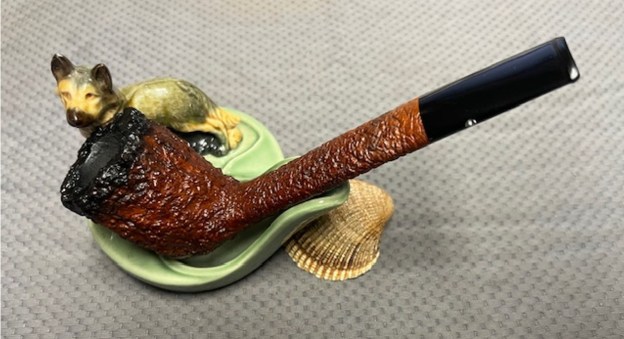
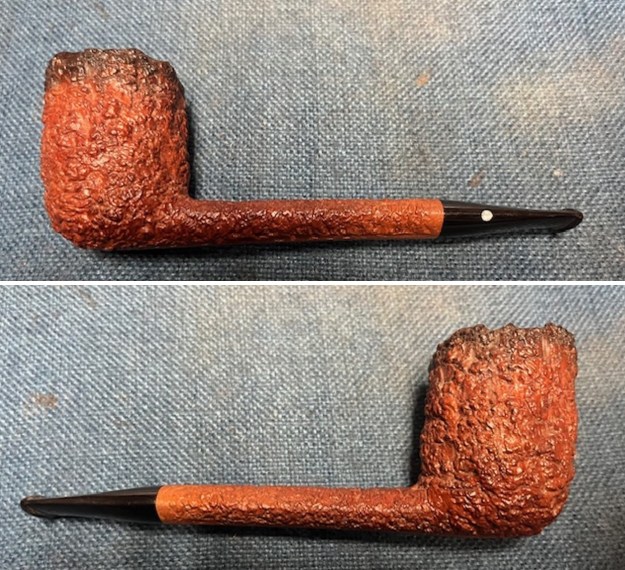
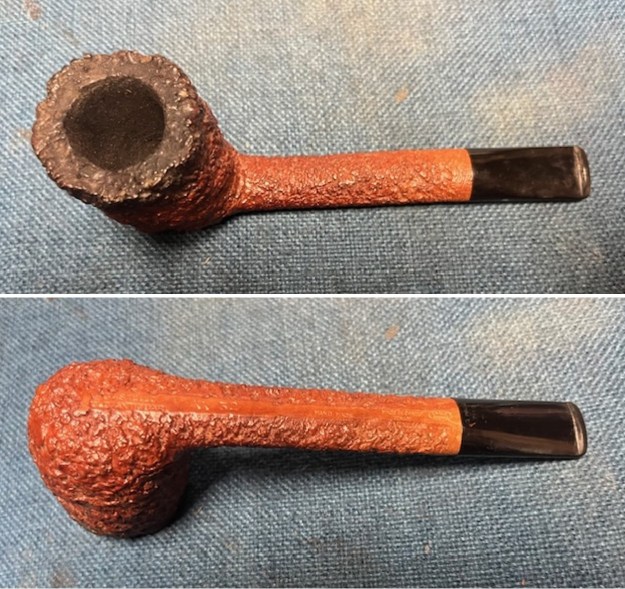
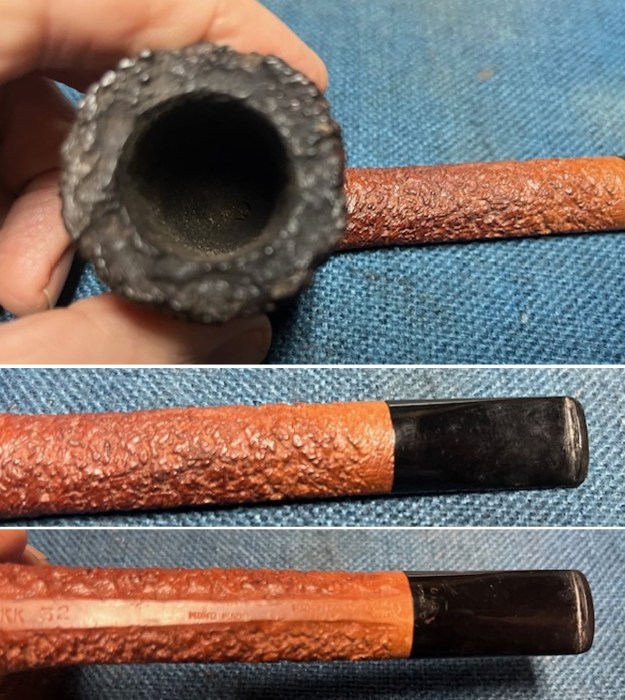
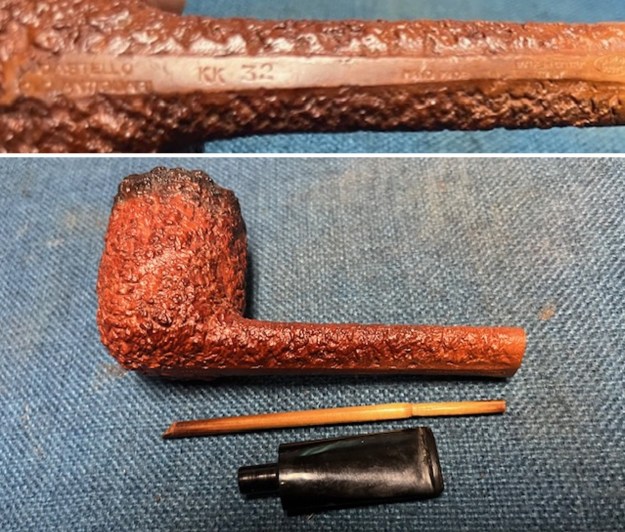
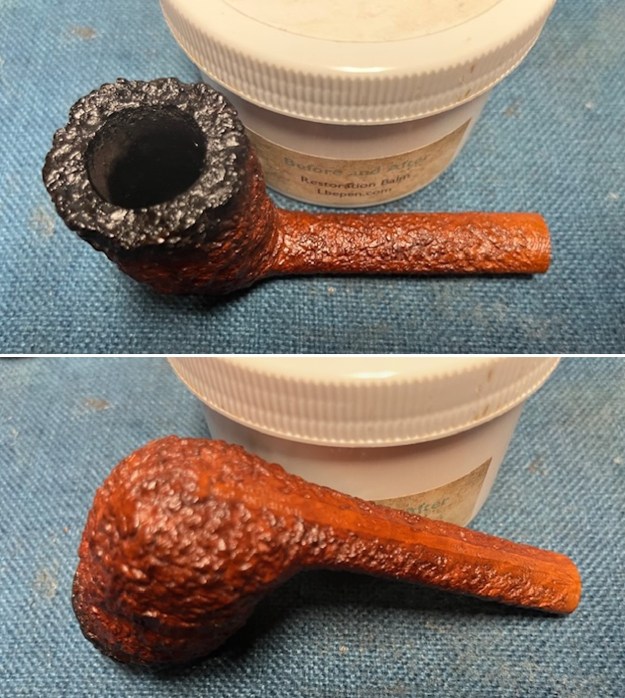
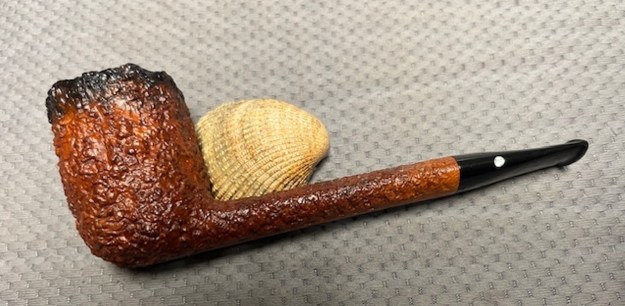
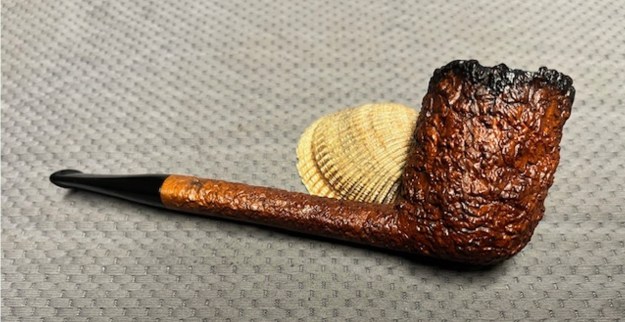
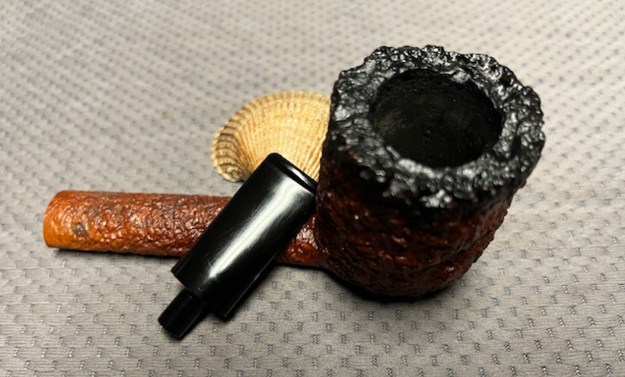
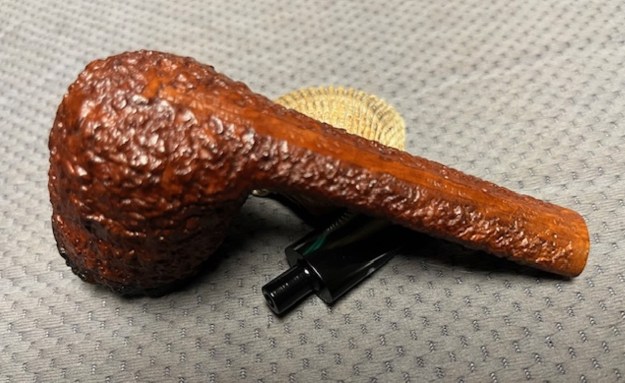
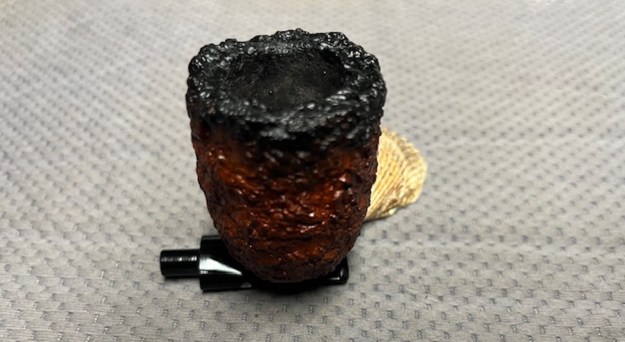
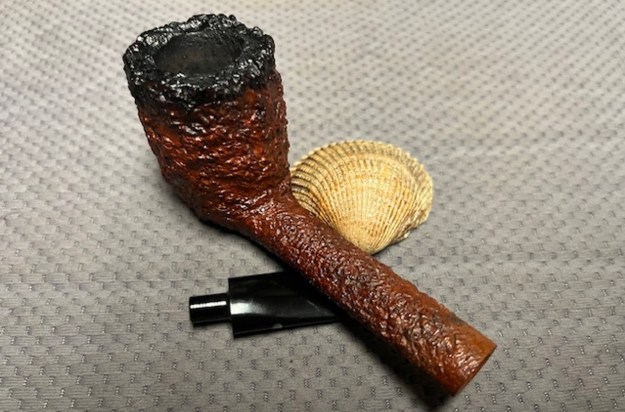
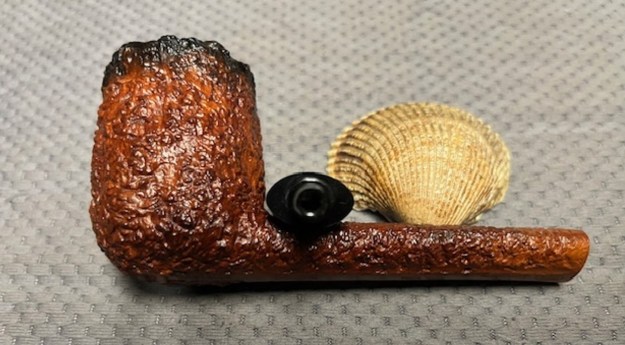
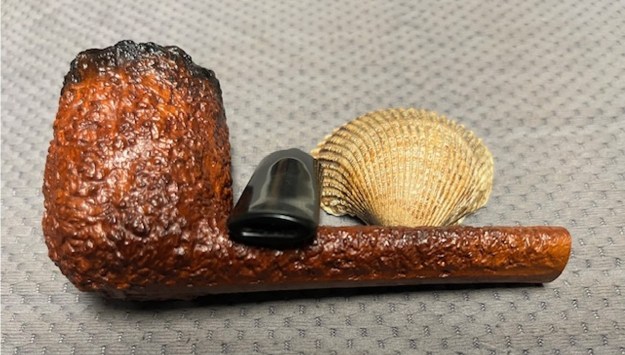
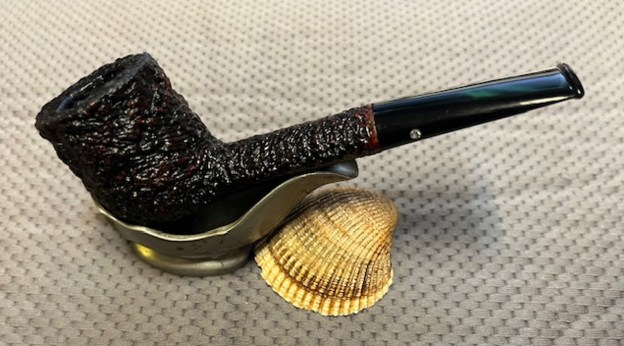
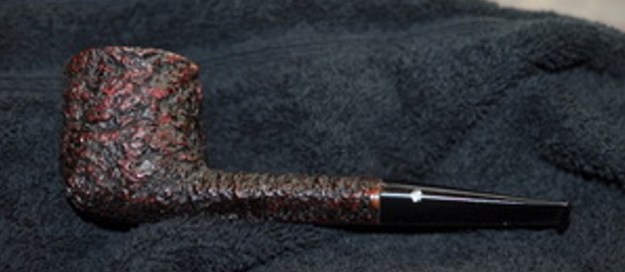
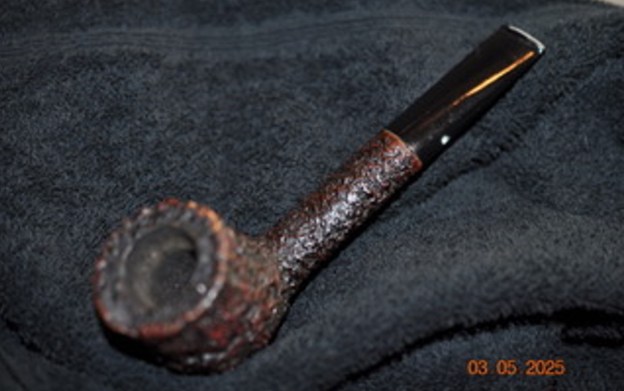
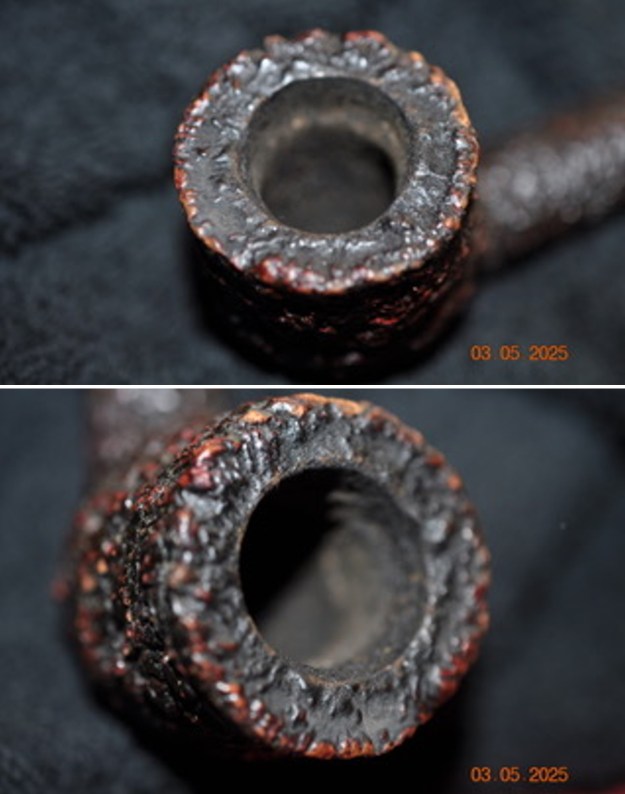
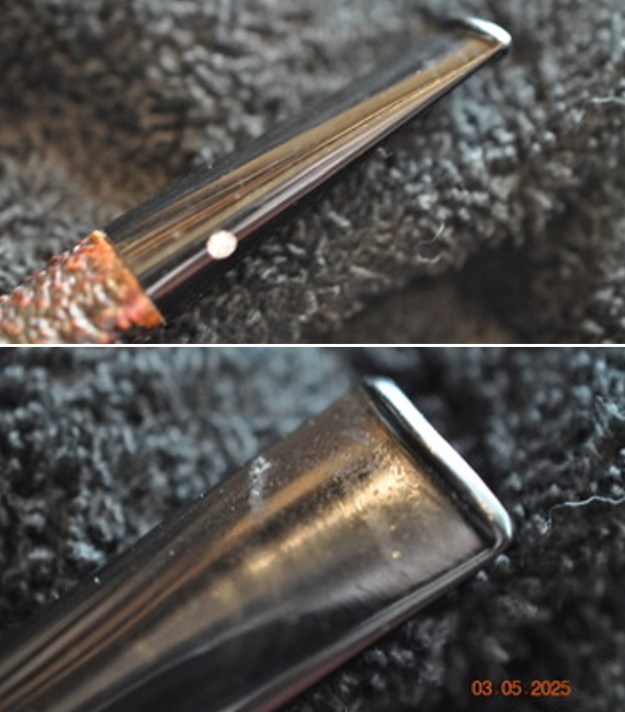
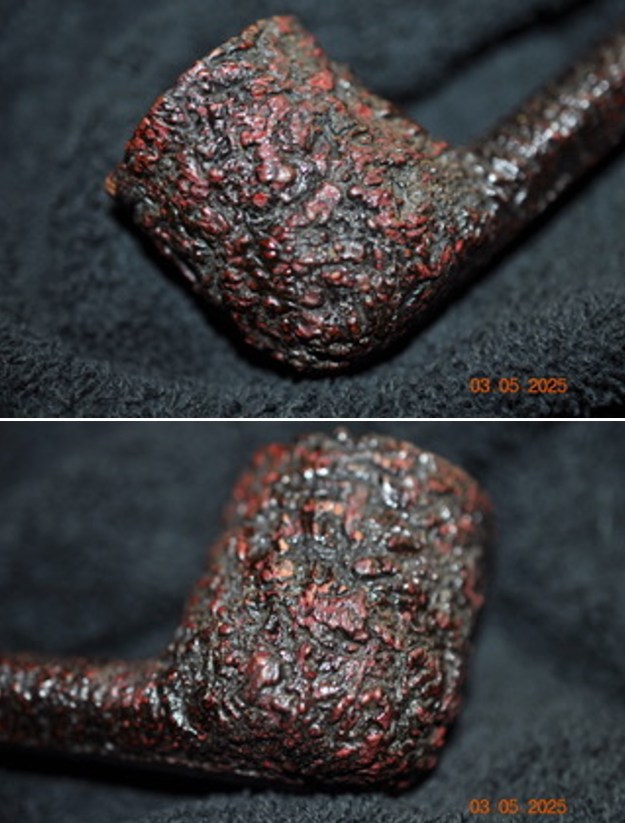
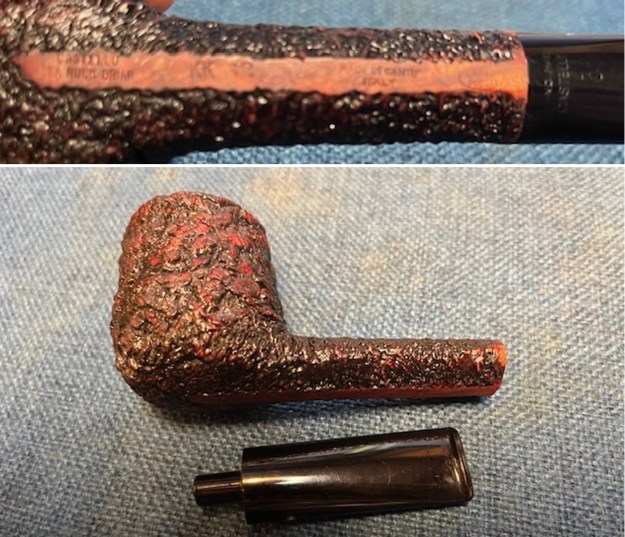
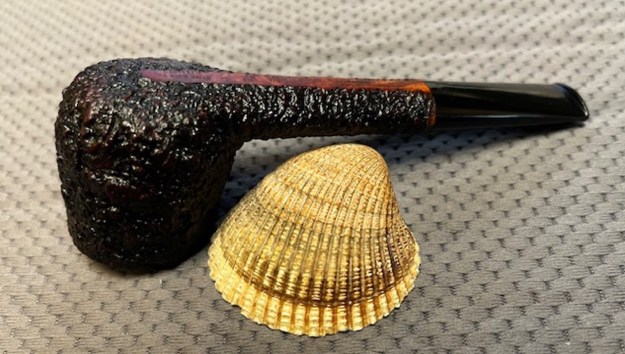
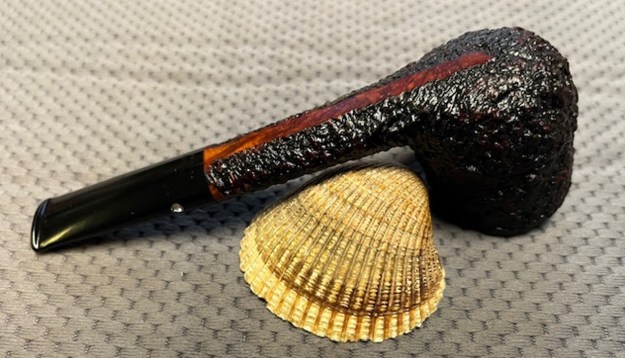
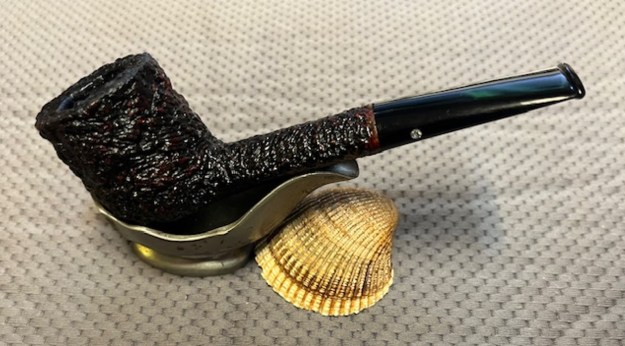
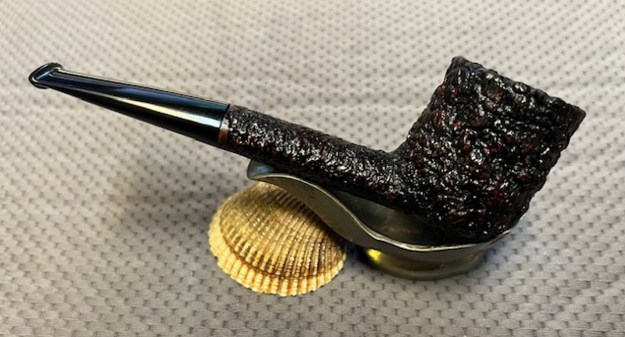
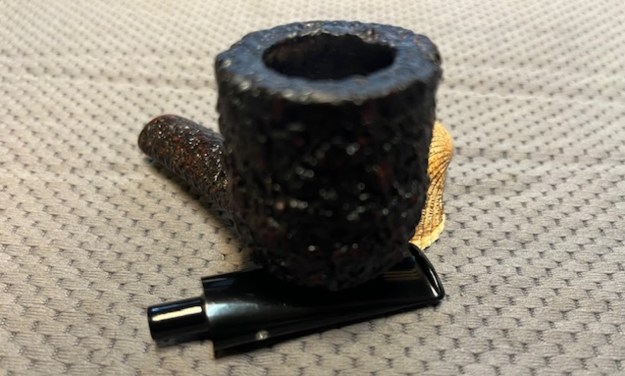
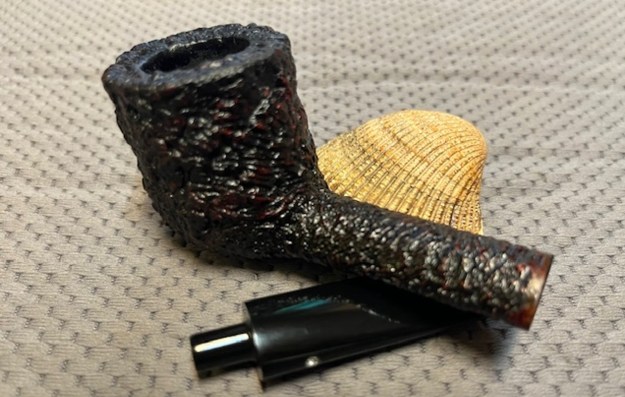
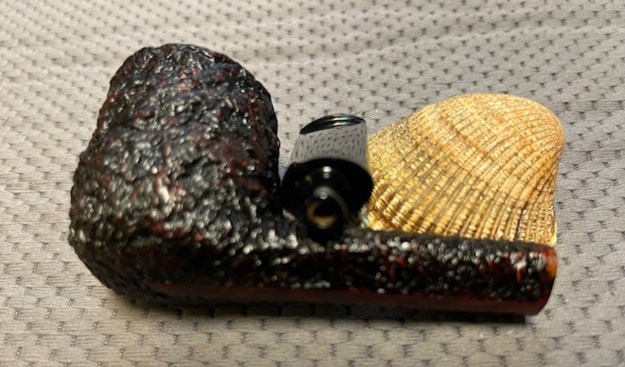
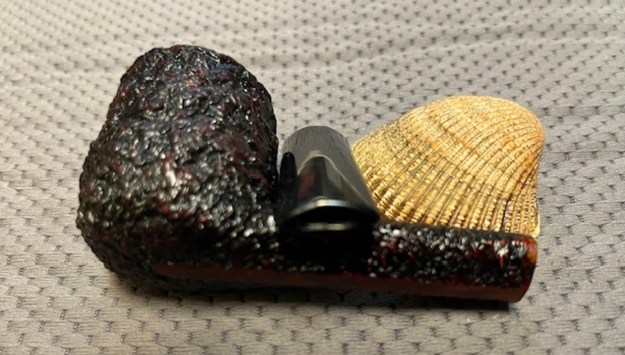
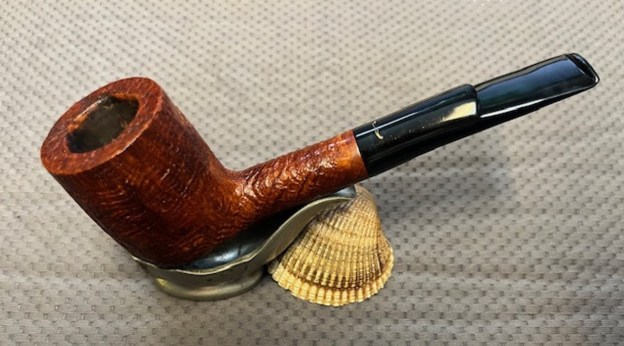
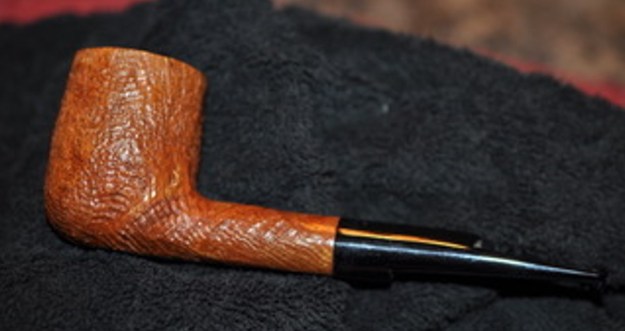
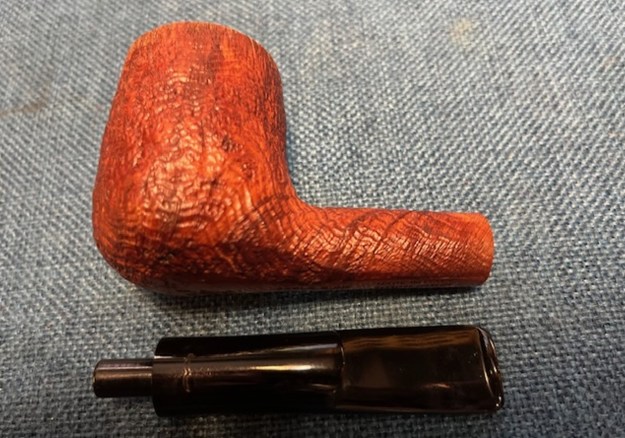
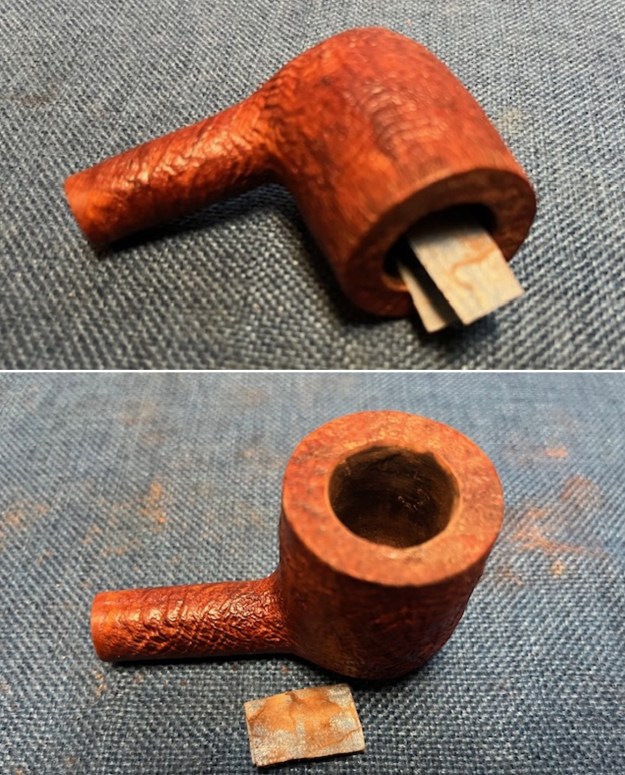
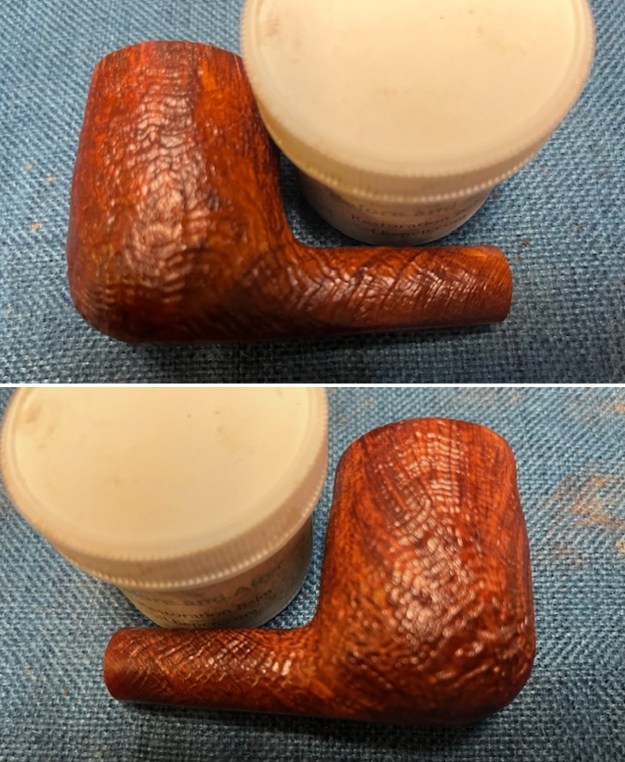
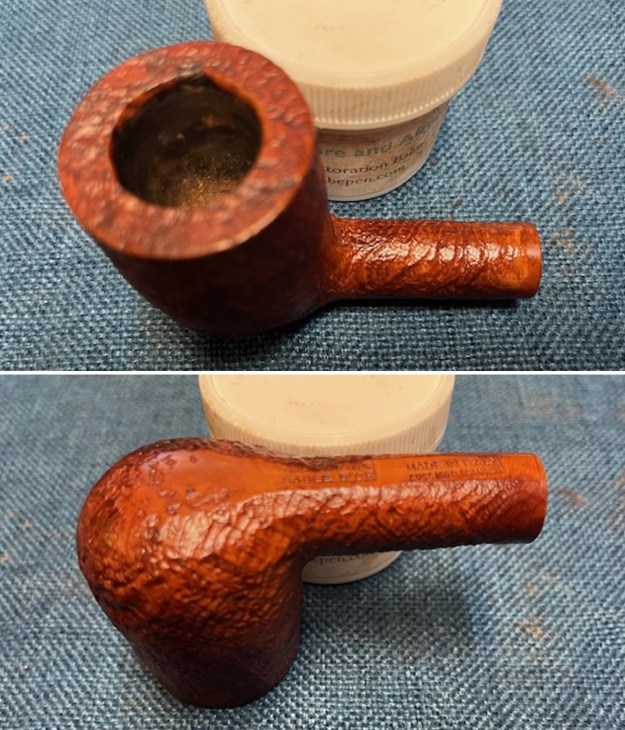
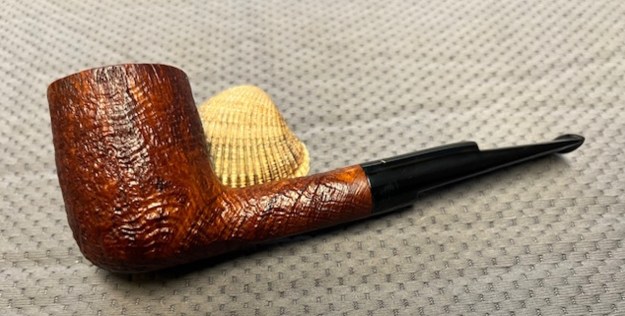
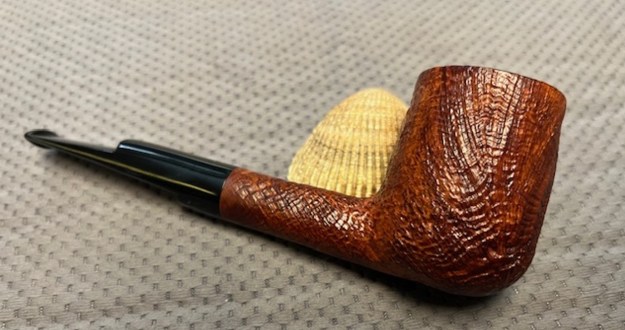
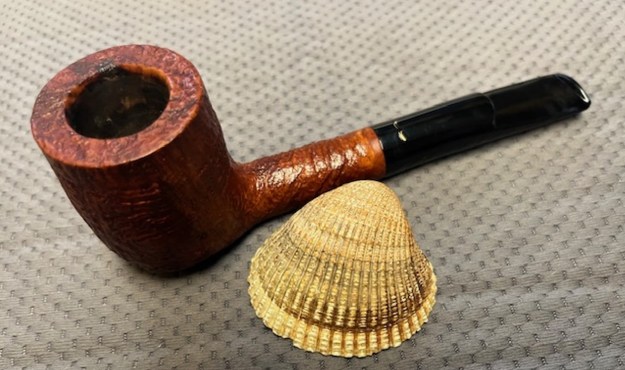
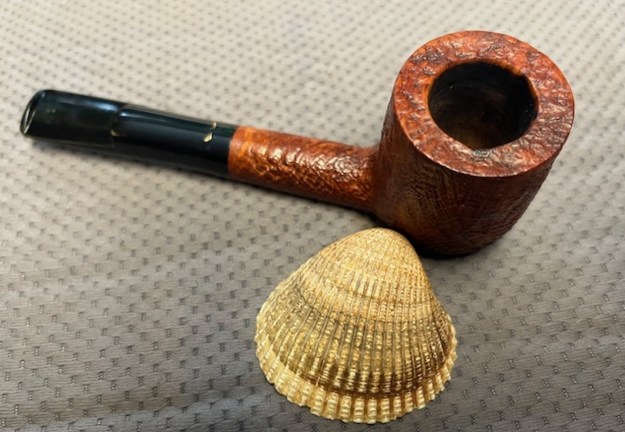
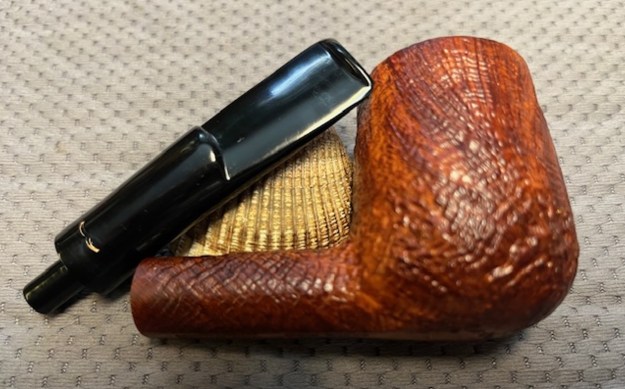
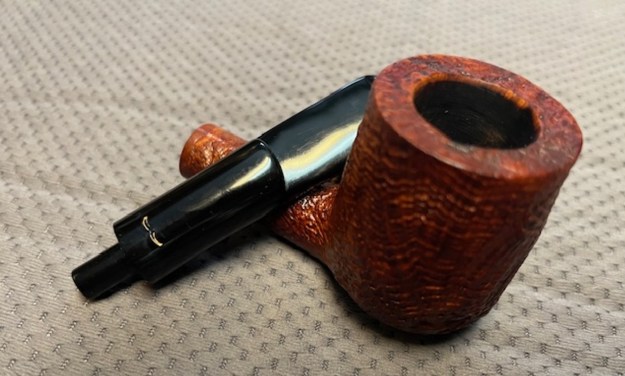
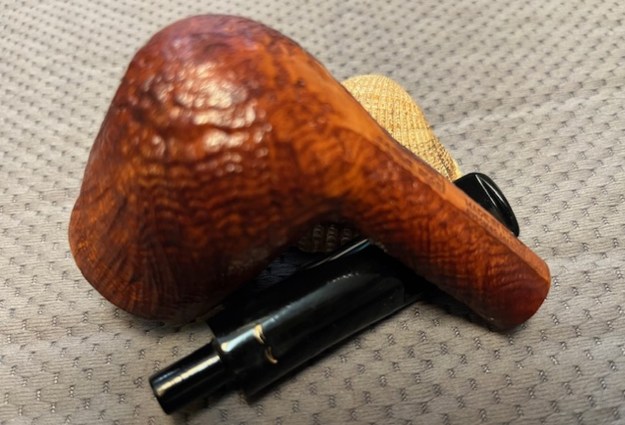
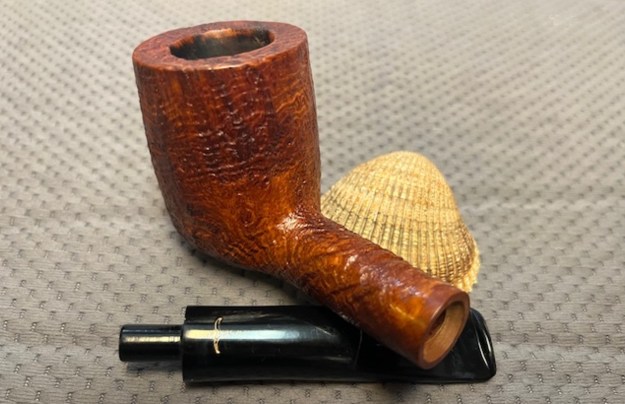
The next pipe on the table is another one that came to us from the seller in Caldwell, Idaho, USA on 07/12/2025. It is a Castello Rusticated Canadian with an acrylic taper stem with the faux diamond on the left side of the stem. It is in dirty but in good condition as can be seen in the photos below. It is stamped on a smooth panel on the underside of the shank and reads Castello [over] Old Antiquari [followed by] KK 32 [followed by] Hand Made [followed by] Made in Cantu [over] Italy [followed by] Carlo arched over Scotti in an oval. The stamping is clear and readable. The pipe has rich Tan and Brown stains on a deep rusticated finish and a dark stain flume around the rim top and down the bowl sides about ¼ inch. The finish was dusty and lightly dirty with grime in the nooks and crannies of the rugged, deep sandblast. The bowl had a moderate cake and there was tobacco debris in the bowl. The rim top had a thick lava coat in the sandblast rim top and edges. The original taper stem is dirty and oxidized. It has the crumpled diamond look to the logo. I took photos of the pipe before I started working on it. I took photos of the bowl and rim top to show the thickness of the cake and the lava coat on the rim top. There was some tobacco debris in the bottom of the bowl. The stem photos show the condition of the taper stem ahead of the button. The stamping on the heel of the bowl is clear and readable as noted above. I took a photo of the pipe with the stem removed to give a sense of the proportions of the pipe. It is a real beauty. Interestingly, there was a clean foil inner tube in the tenon.

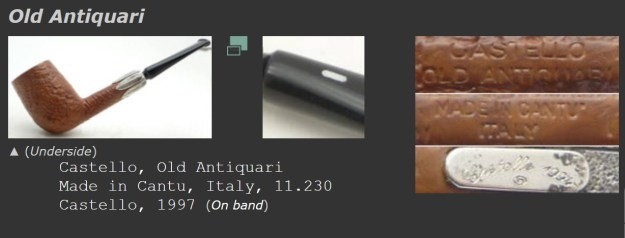
As usual I cannot seem to retain the details on Castello pipes in my head for long for some reason. The stamping on this one – Castello and the Carlo Scotti stamp left me with some questions that I need to answer before I began to work on the pipe. I turned first to the Pipephil site (http://www.pipephil.eu/logos/en/logo-castello.html) because of the general quick summary of information I get there along with a screen capture.Castello PIPA CASTELLO di Carlo Scotti & C. was founded in 1947 by Carlo Scotti († 1988). Franco Coppo (AKA “Kino”) who married Carlo Scotti’s daughter Savina, manages (2012) the corporate since 1985.

The site also gave a good summary of the grading and sizes of the pipes. I quote that in full.

Sizes (ascending):

1K to 4K, G (Giant) and GG (Extra large)

Rusticated grading: SEA ROCK, OLD SEA ROCK, NATURAL VERGIN,

Sandblasted grading: ANTIQUARI, OLD ANTIQUARI

Smooth grading (ascending): TRADEMARK, CASTELLO, COLLECTION

Other stampings: Great Line (Non-standard or freestyle) Fiammata (Straight grain)

Production (2012): ~4000 pipes / year

I also found a note on the page that the Rhinestone logo was originally on pipes for the US market. It is occasionally used now.

I turned then to Pipedia for more information on the brand (https://pipedia.org/wiki/Castello). The majority of the information was what was already quoted above in abbreviated form.

…All carved Castello pipes are graded by the number of K’s that are stamped on each piece and are K-graded by SIZE.  1K is the smallest and fairly rare, 2K is small to medium, with 3K or 4K being the most common and ranges from medium to medium large. Large pieces are stamped “G” for giant and extra-large pieces are stamped “GG” for double giant.  In addition to the number of K’s on a carved Sea Rock piece the shape number is almost always added. As a rule a Sea Rock Castello is stained Black, although recently there have been quite a few coming in stained deep brown and still stamped “Sea Rock”. American Logo’d Sea Rocks are all priced the same to the consumer, although most are 2 or 3 K’ed models. G/GG models are charged at a higher price on American pieces and are basically the same as their European counterparts.

The Castello Old Antiquari Briar KK 32 I was working on was definitely one made for the American Market with the Rhinestone in the stem. It had a brown or tan finish with a black flume around the top and the outer edge of the bowl. The Castello Old Antiquari in my hands was 2K graded. That told me that it is a mid-sized pipe. The number 32 makes it a short Canadian shape.

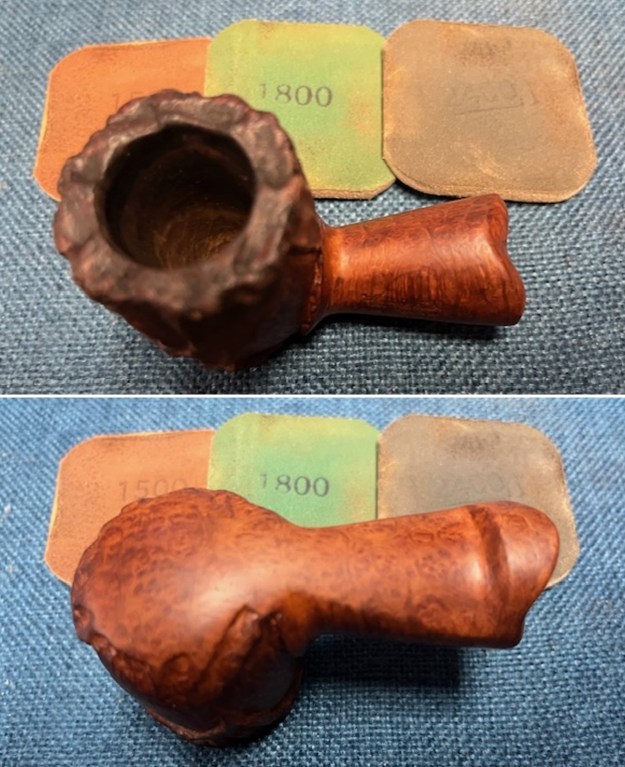
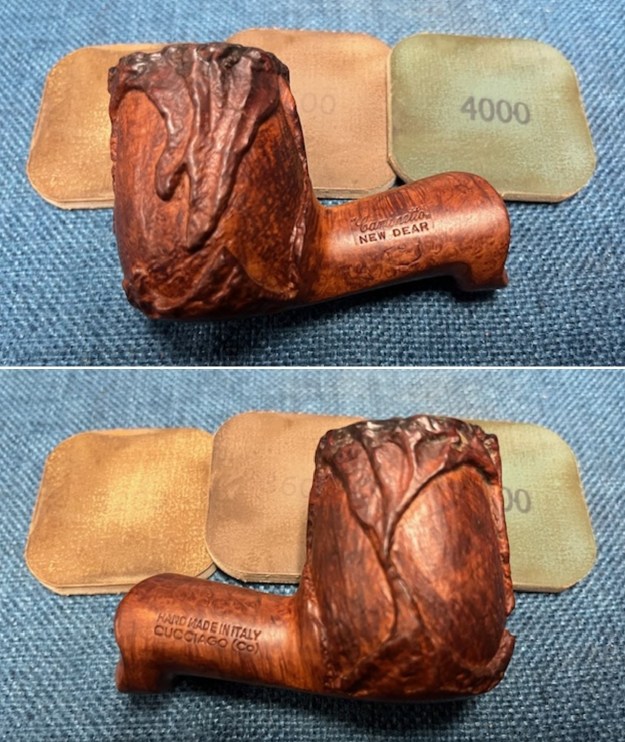
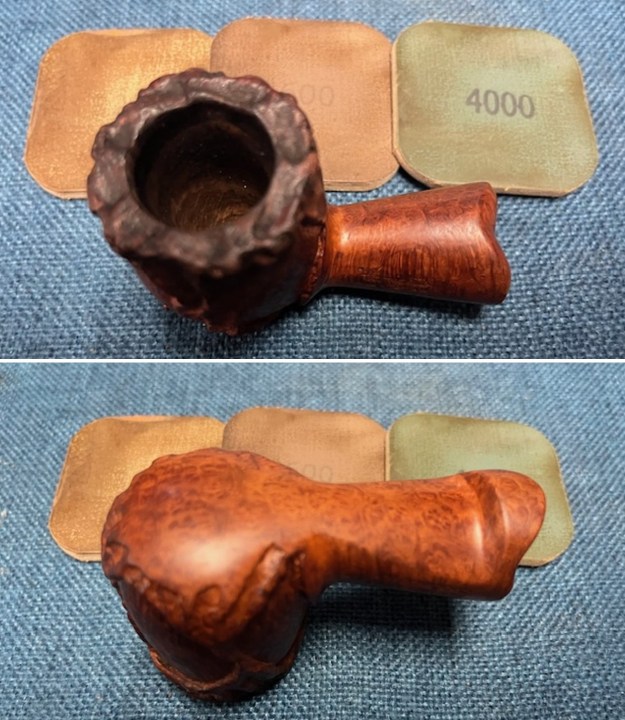
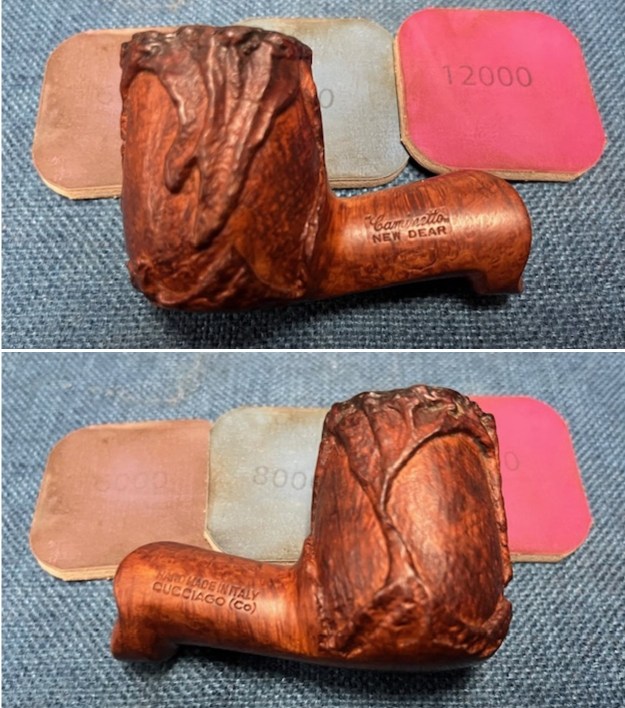
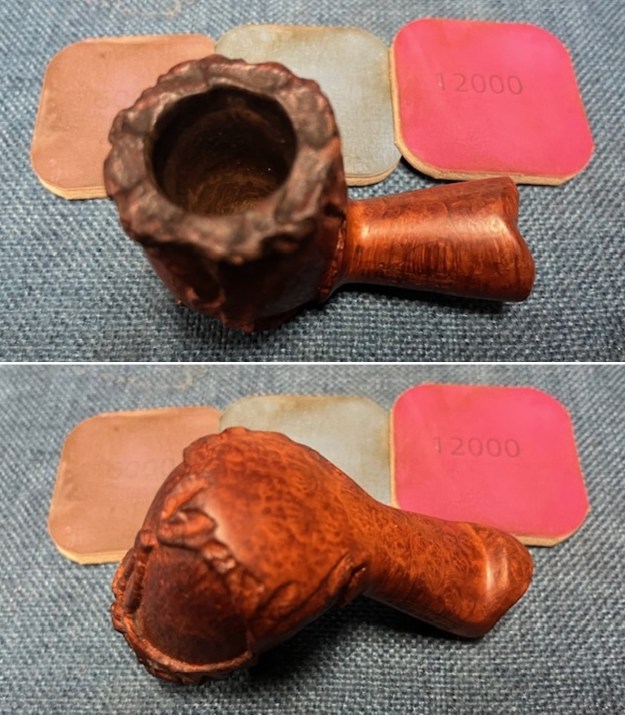
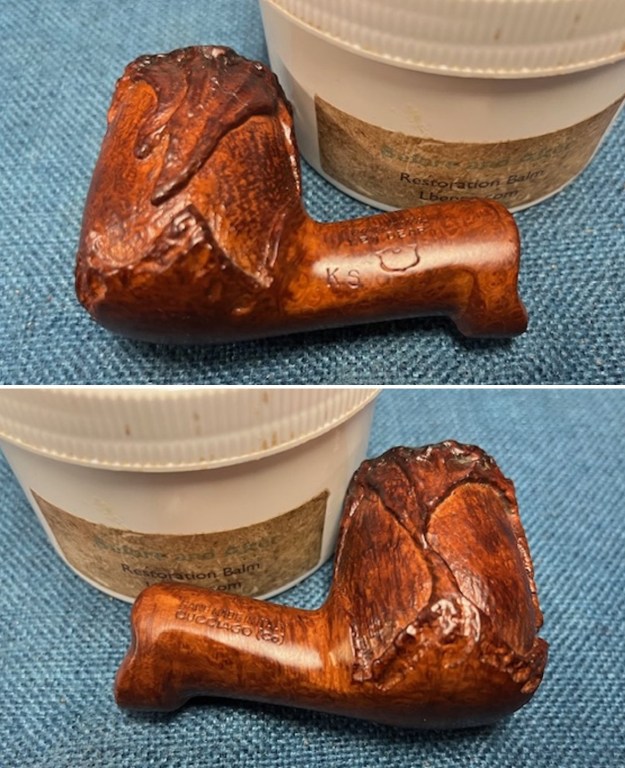
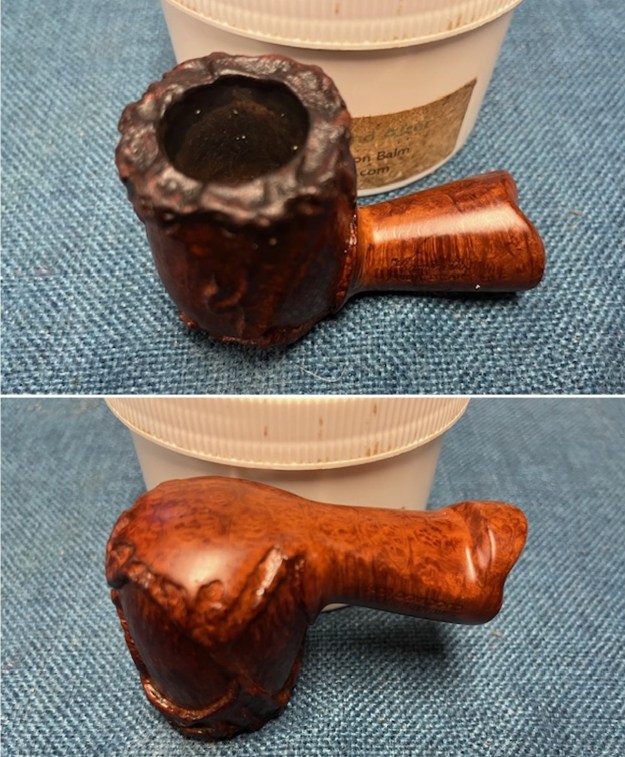
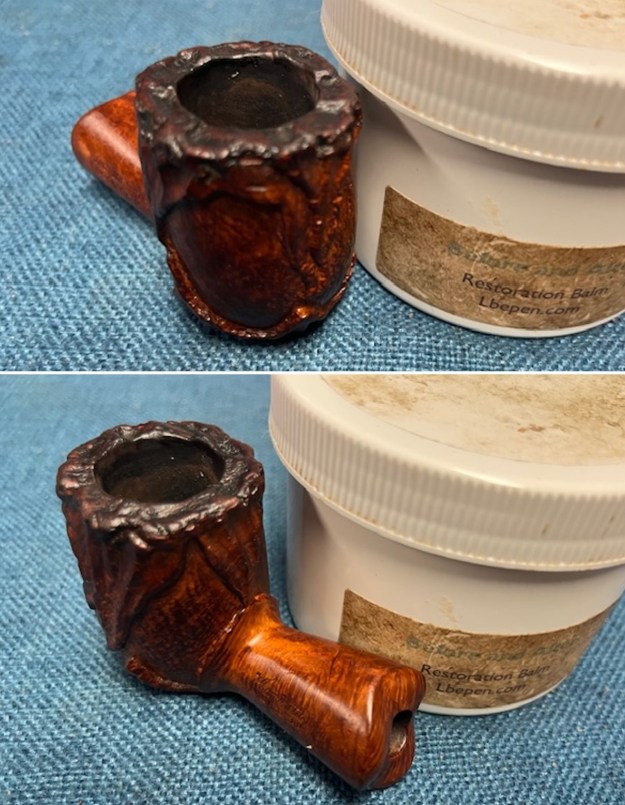
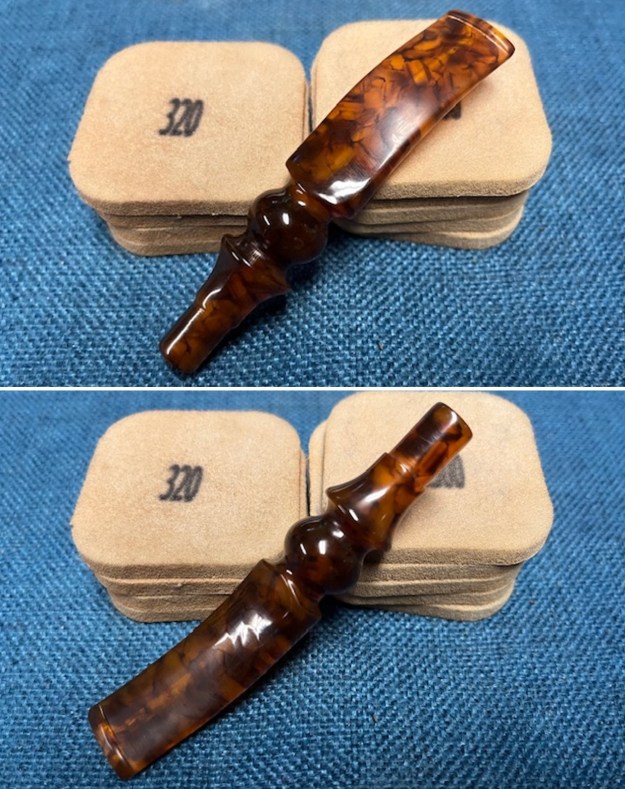
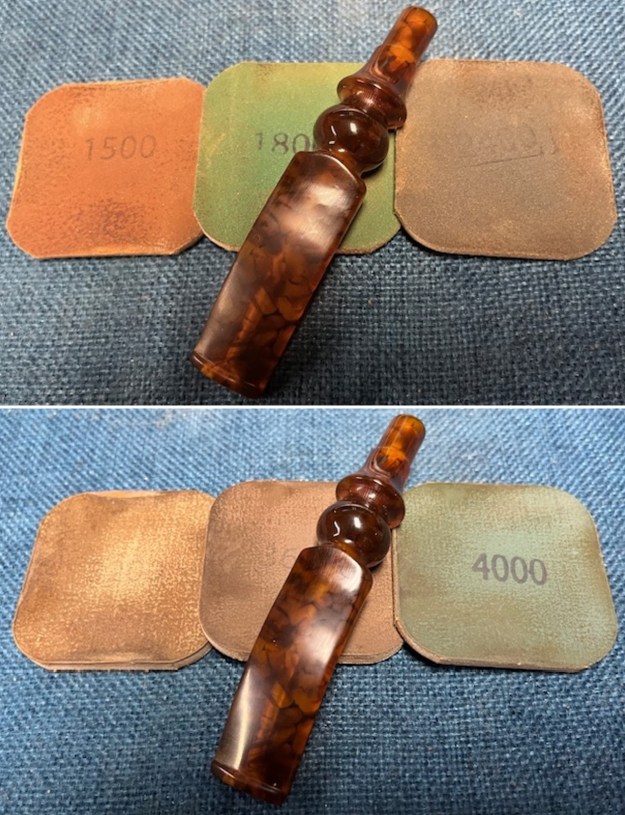
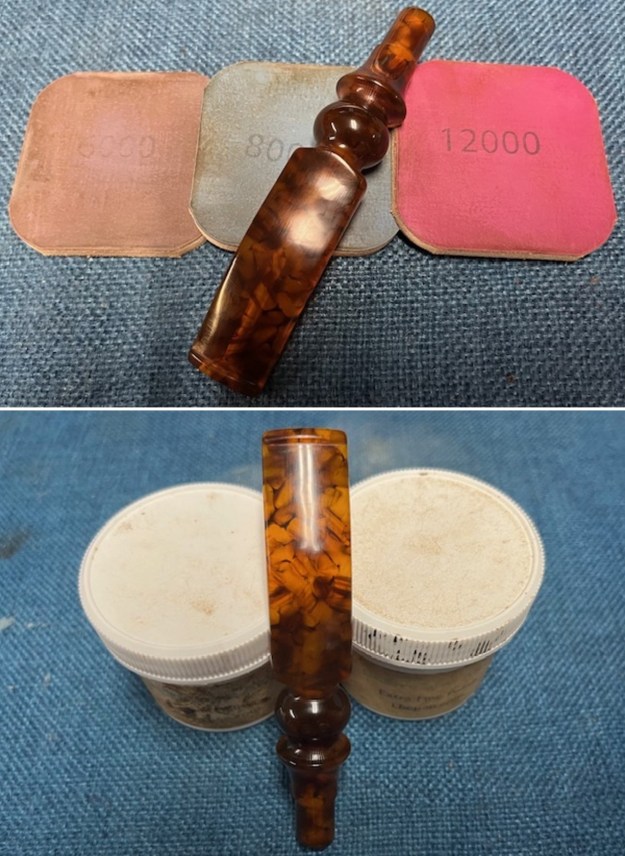
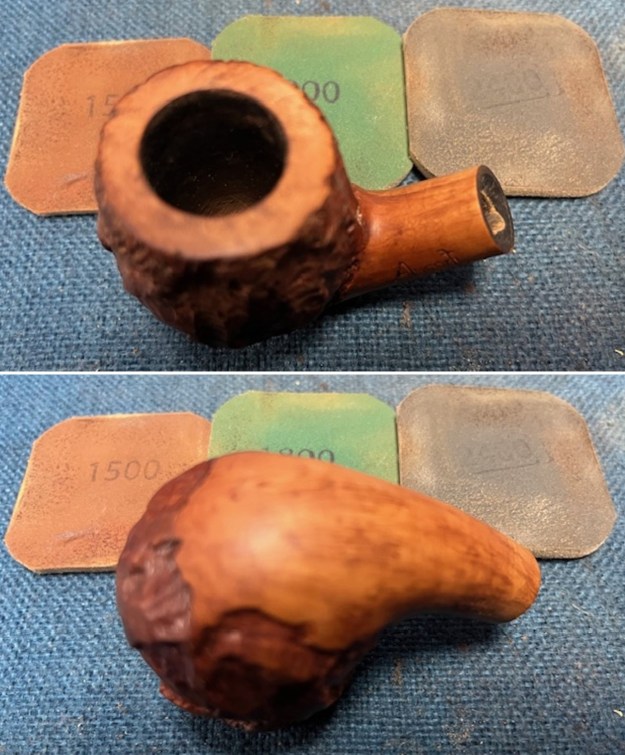
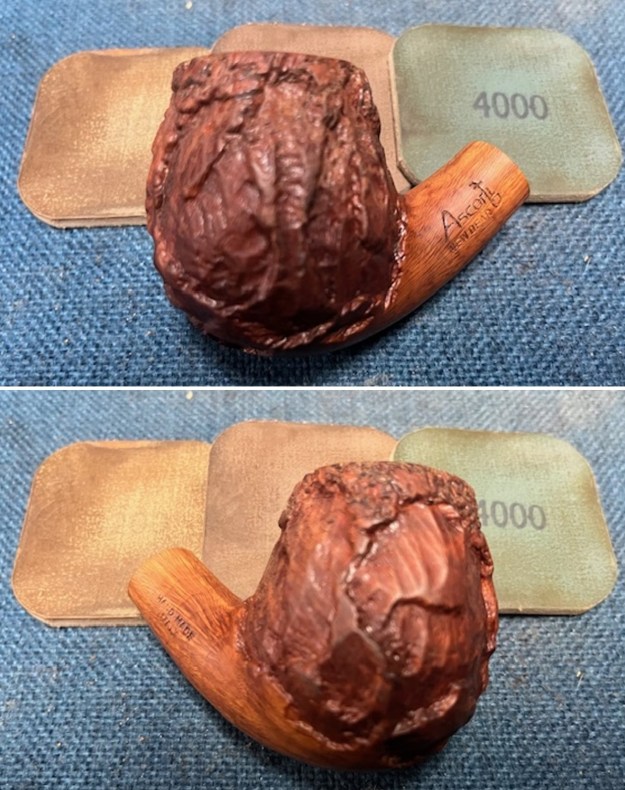
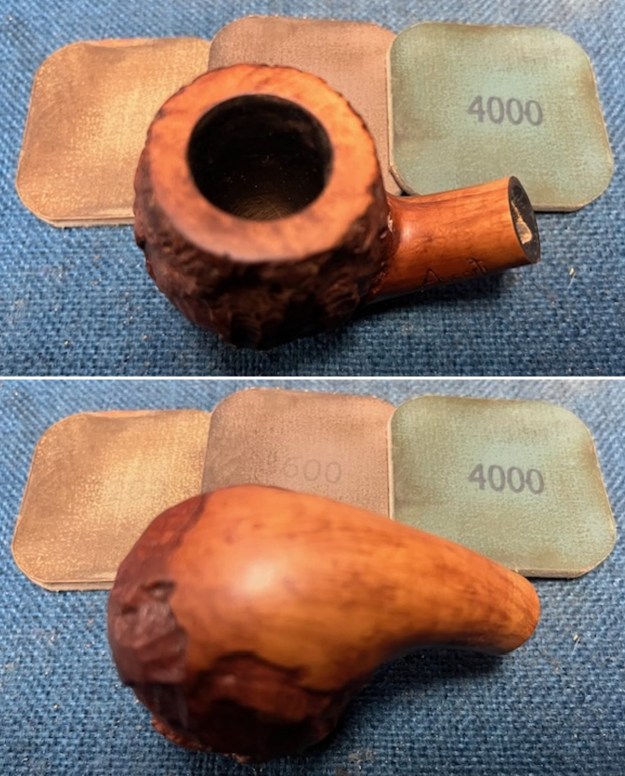
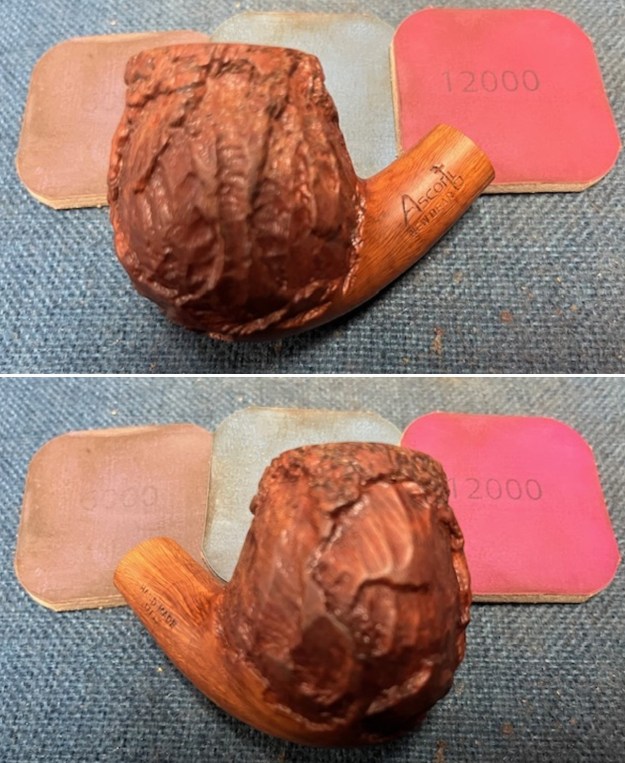
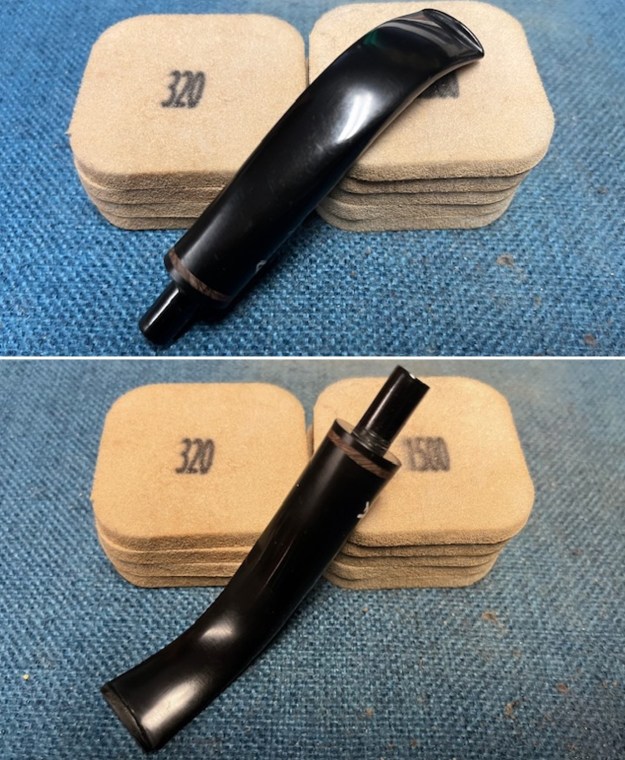
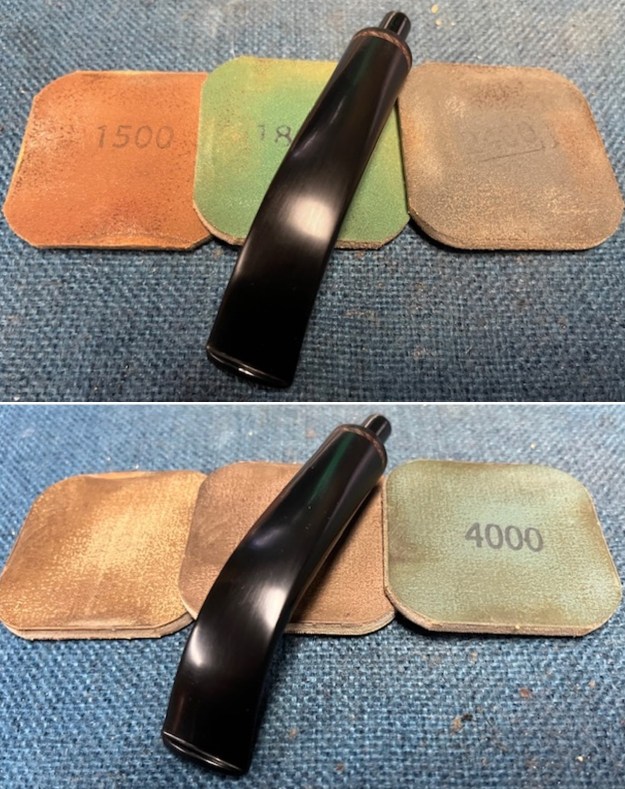
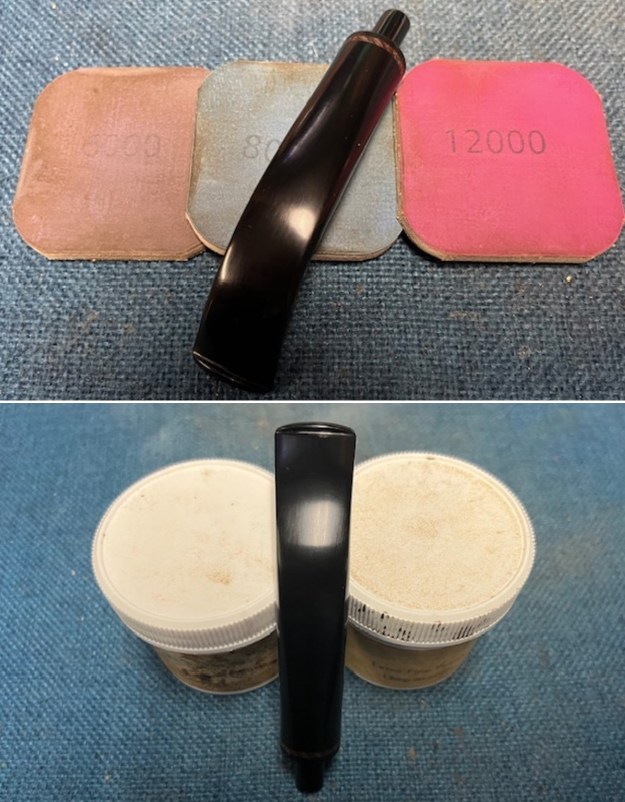
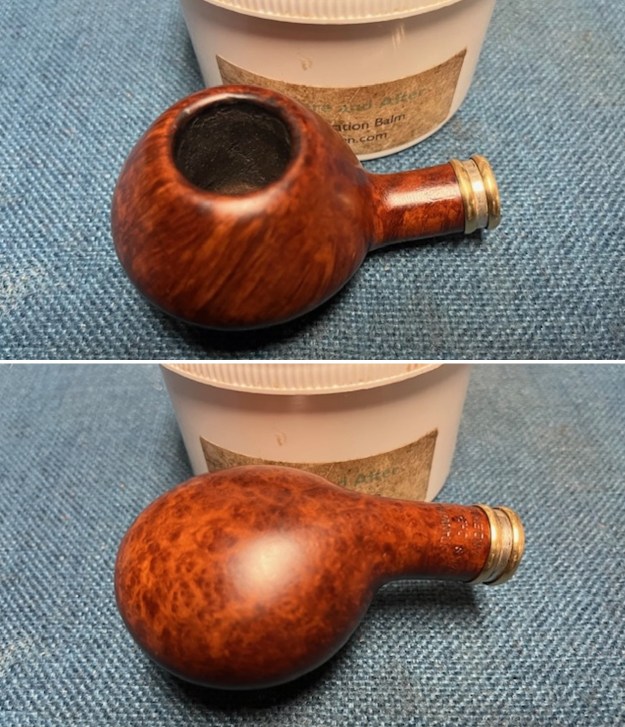
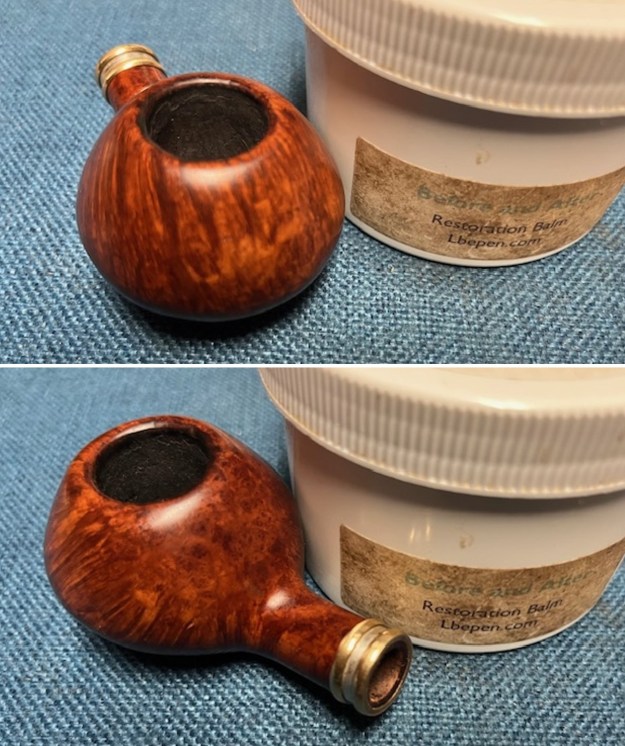
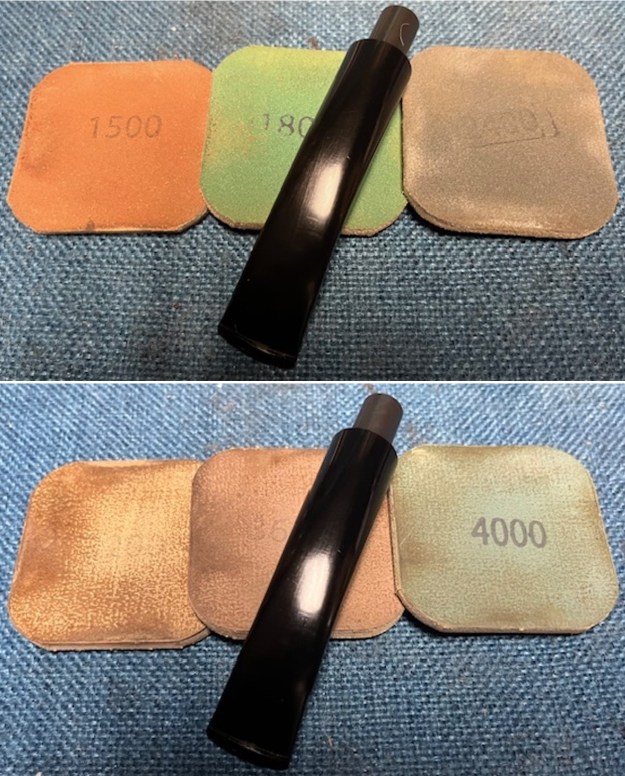
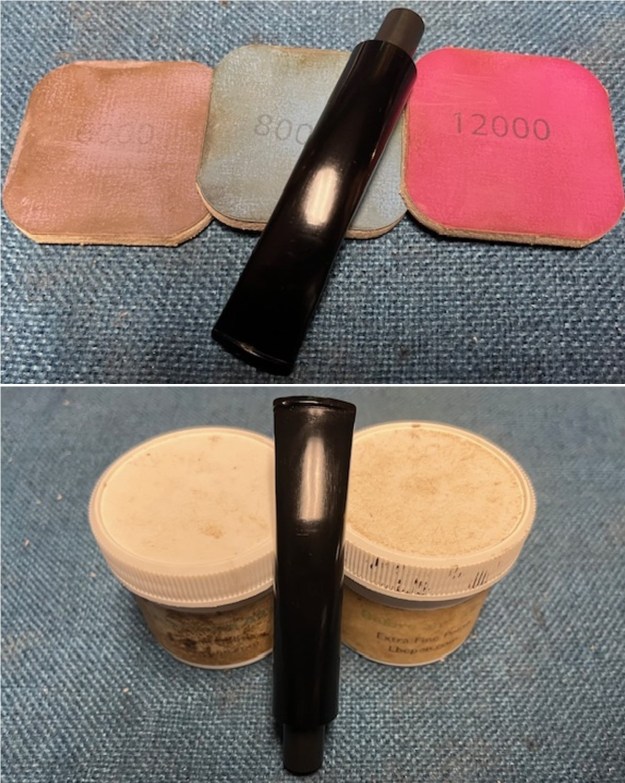
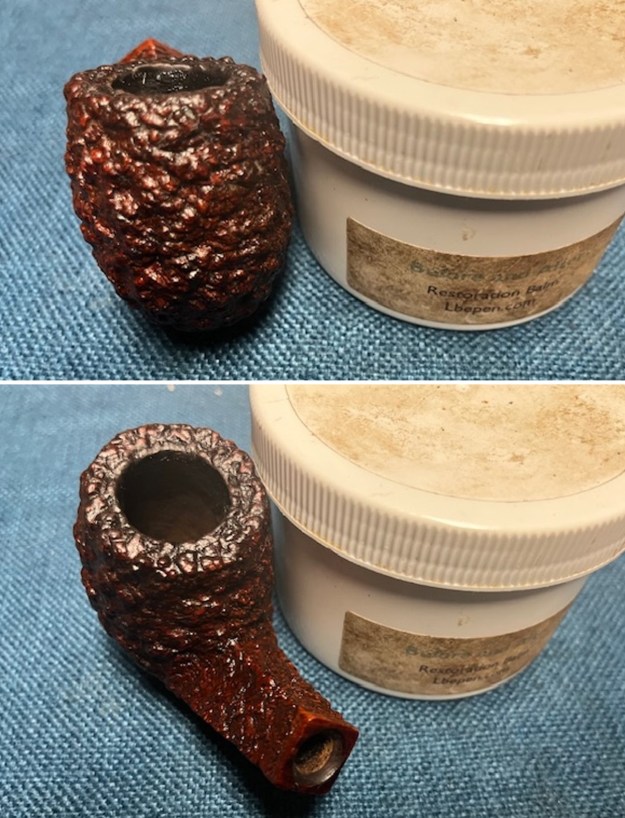
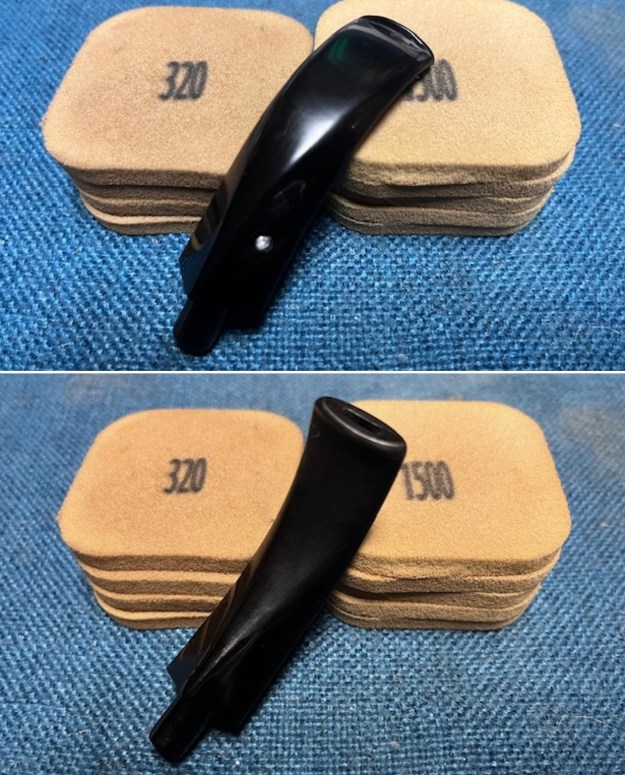
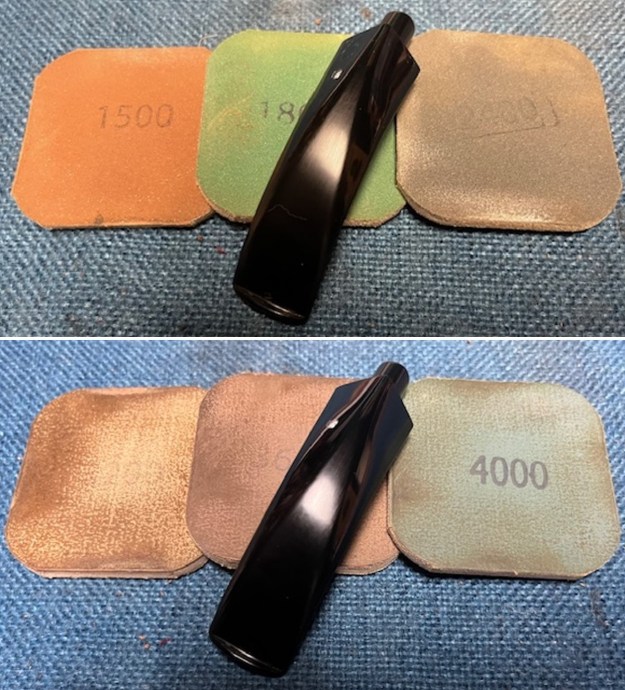
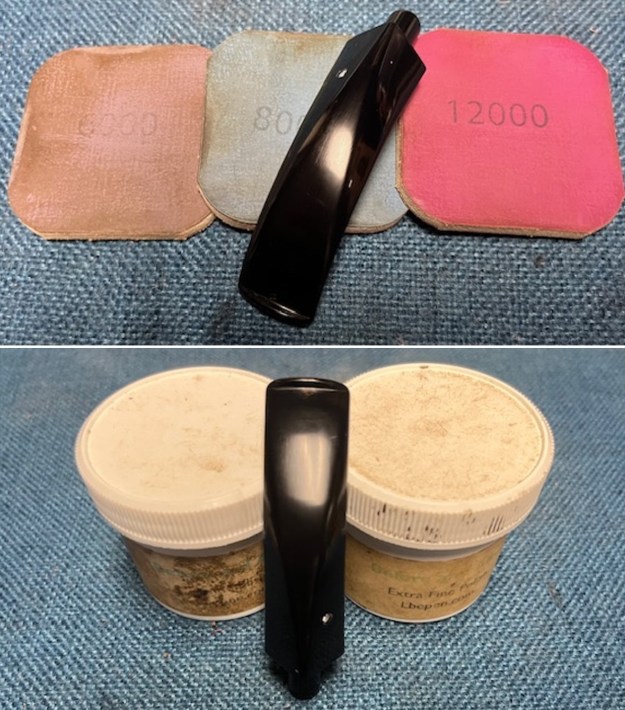
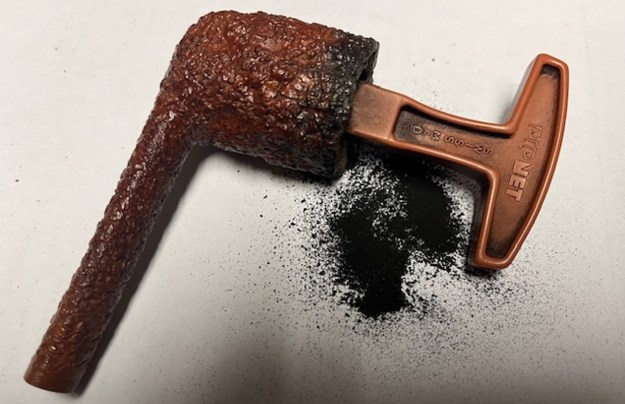
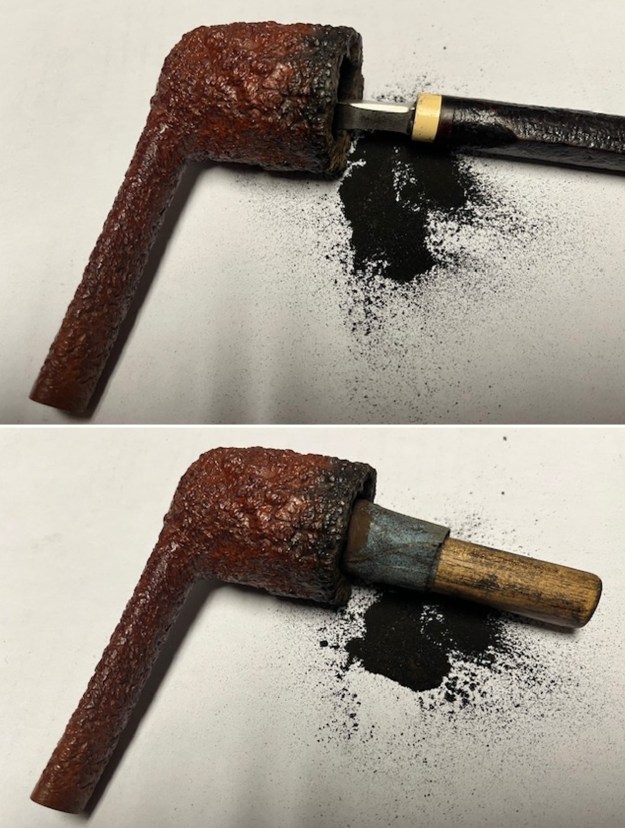
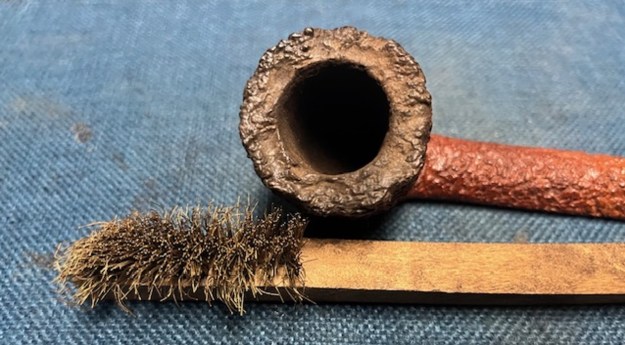
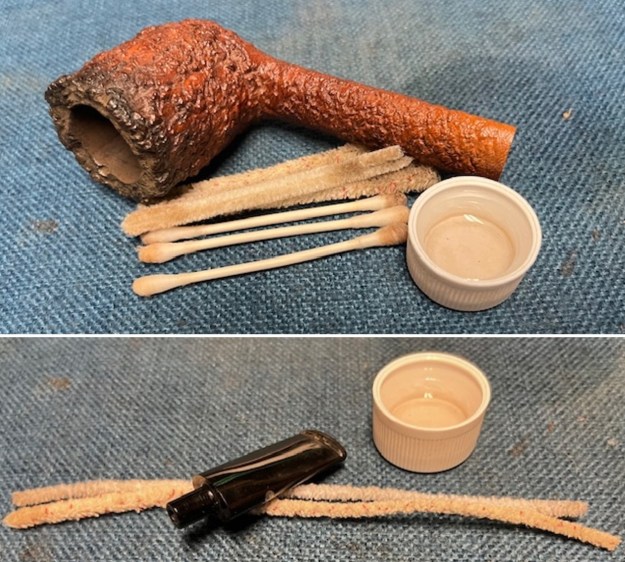
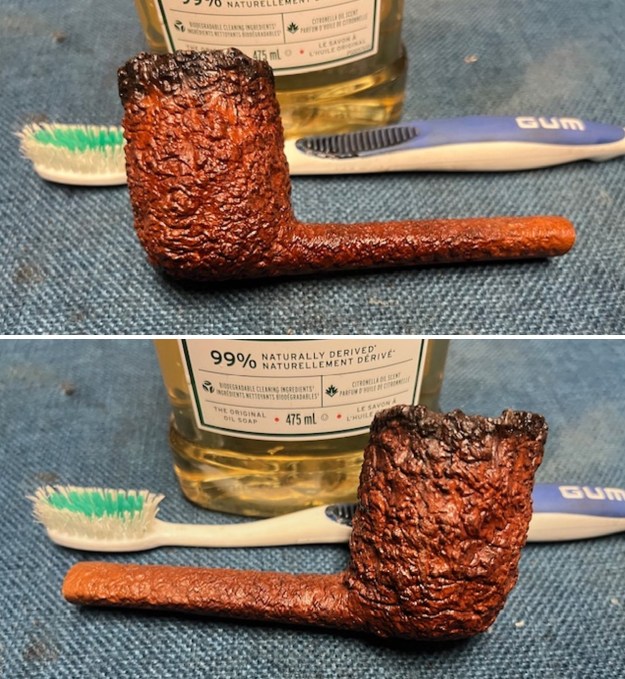
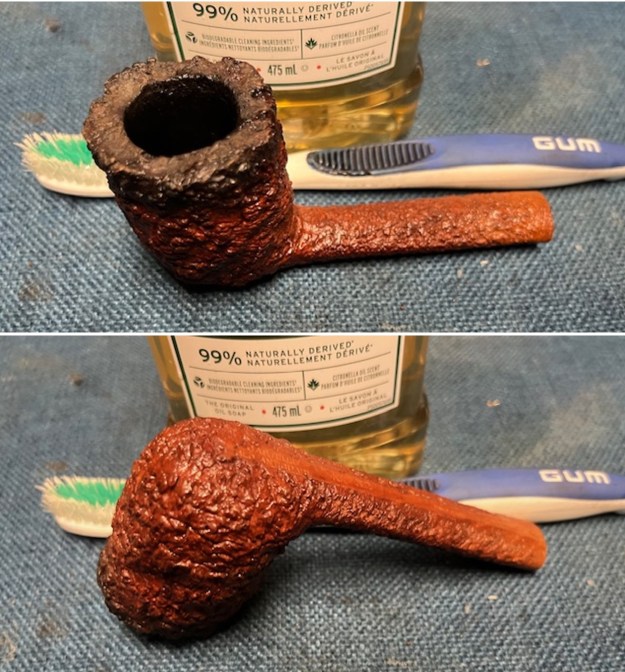
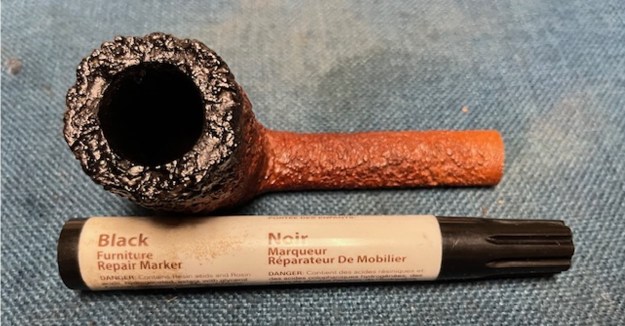
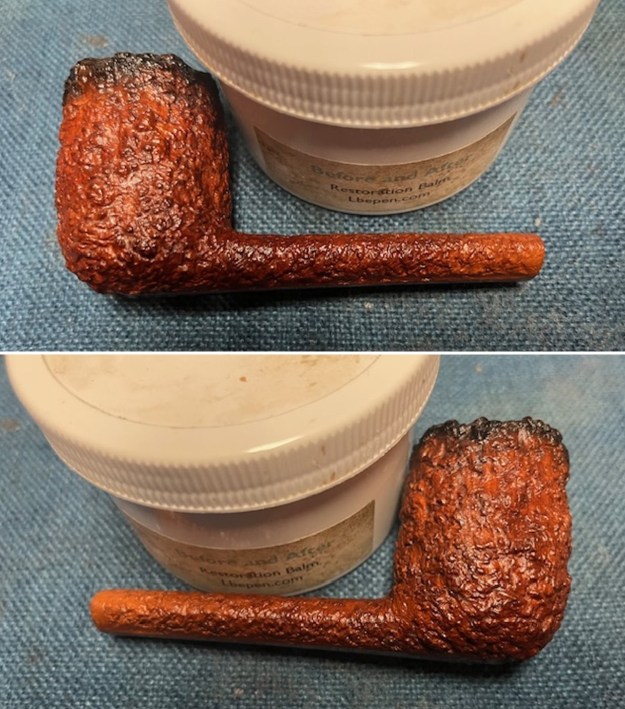
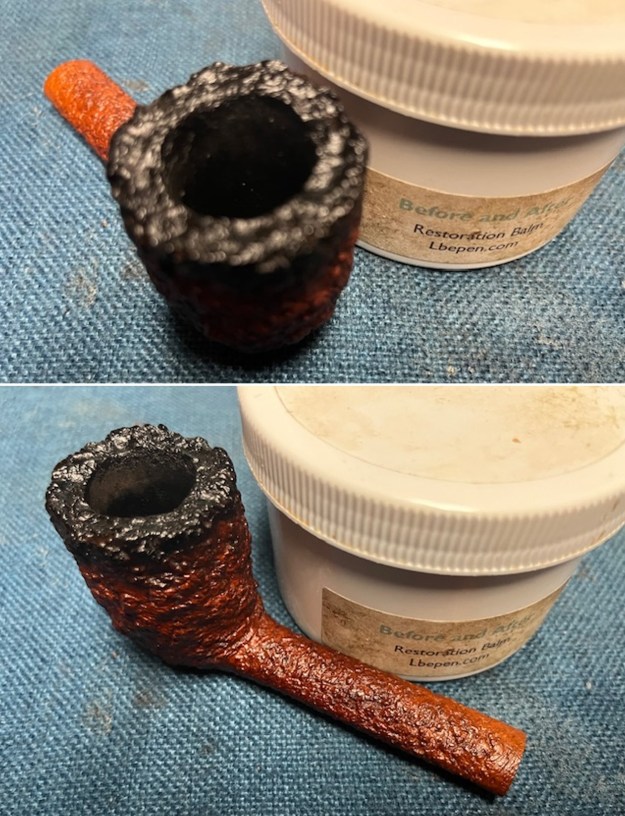
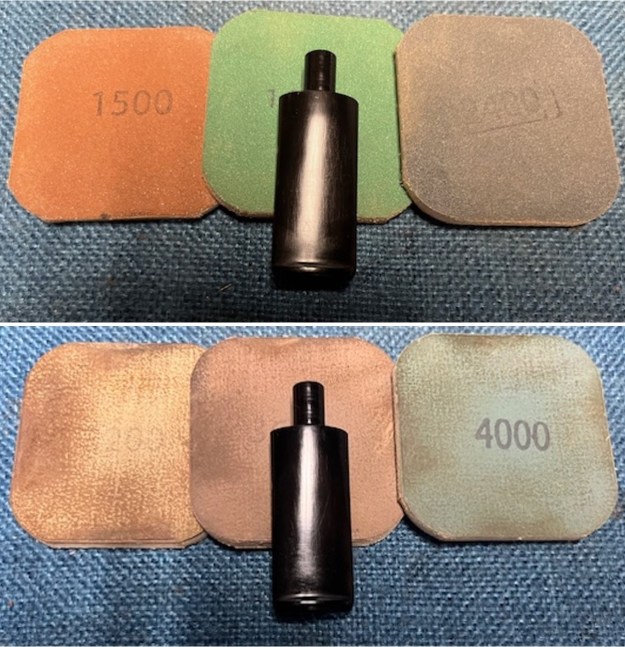
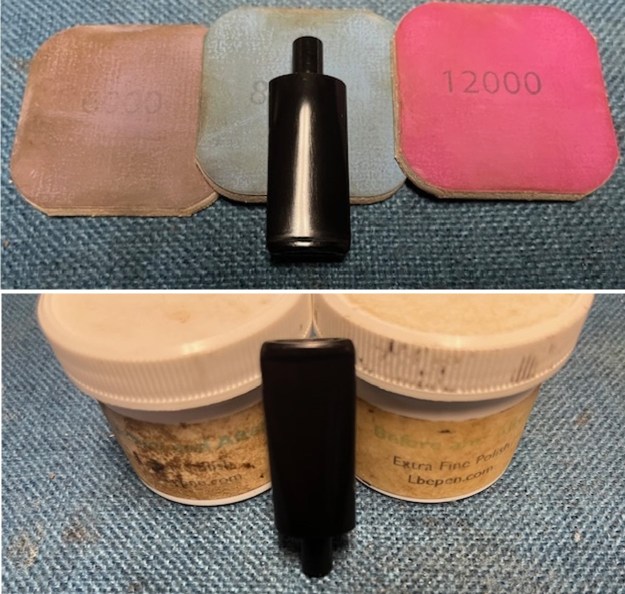
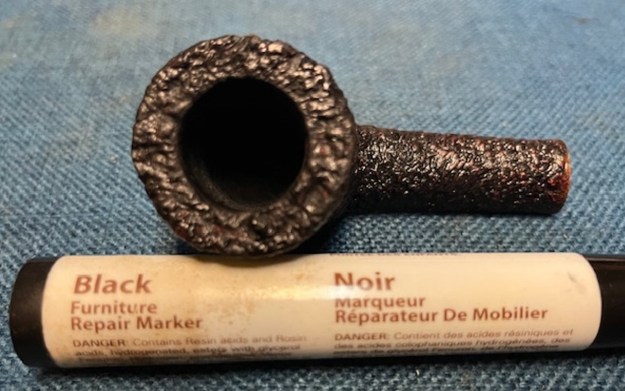
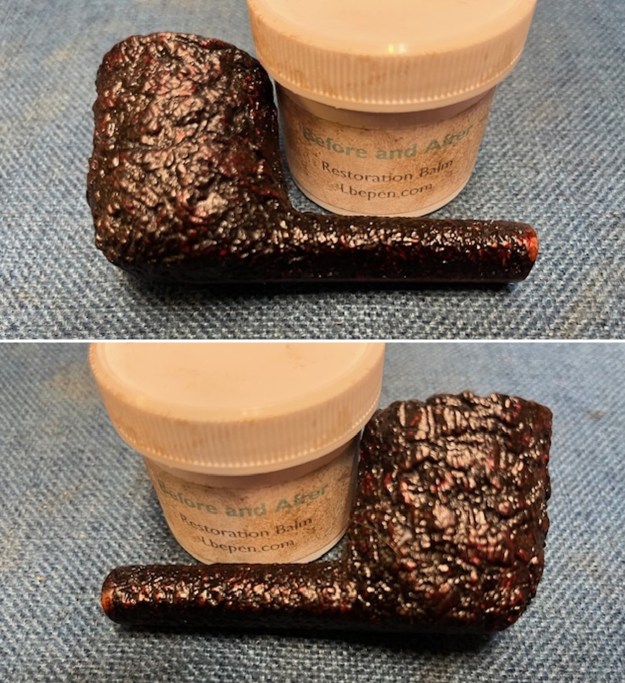
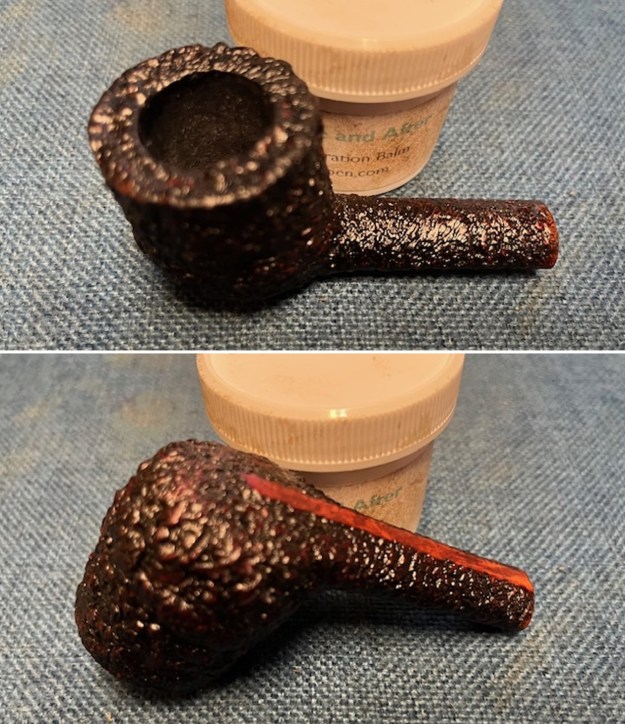
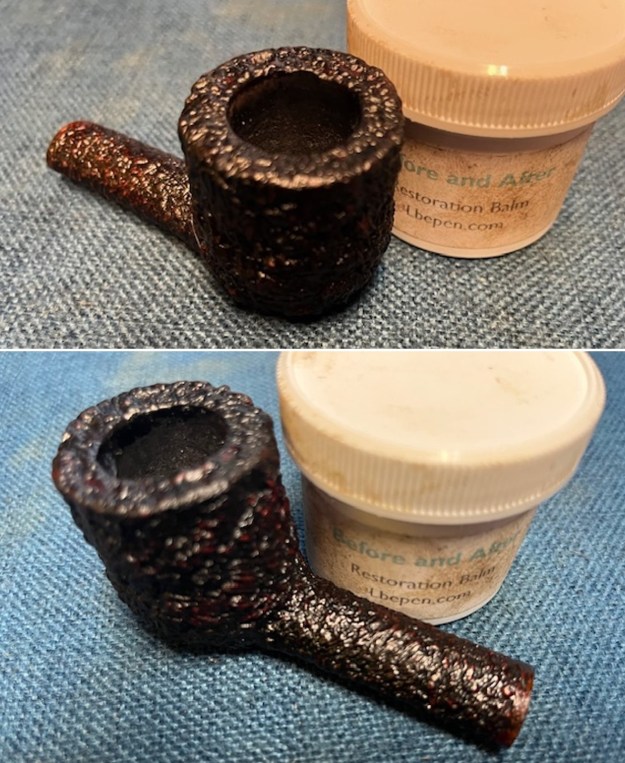
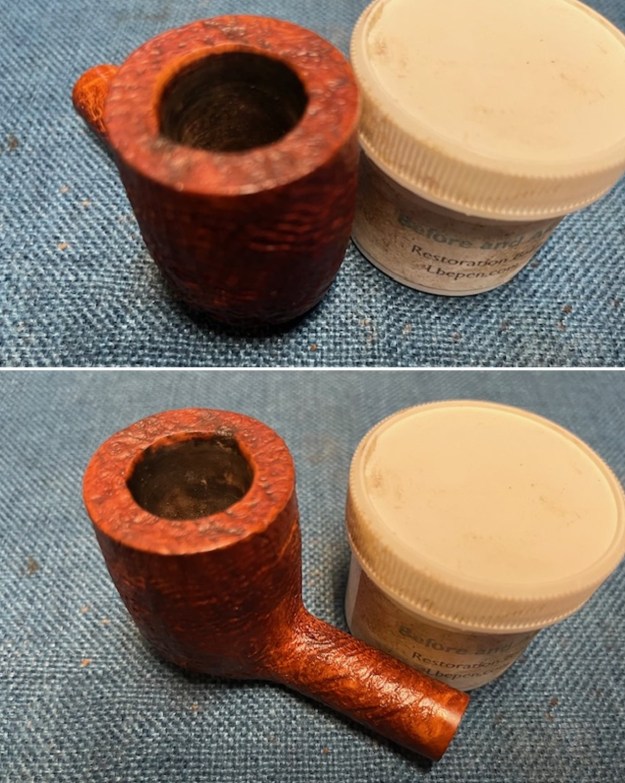
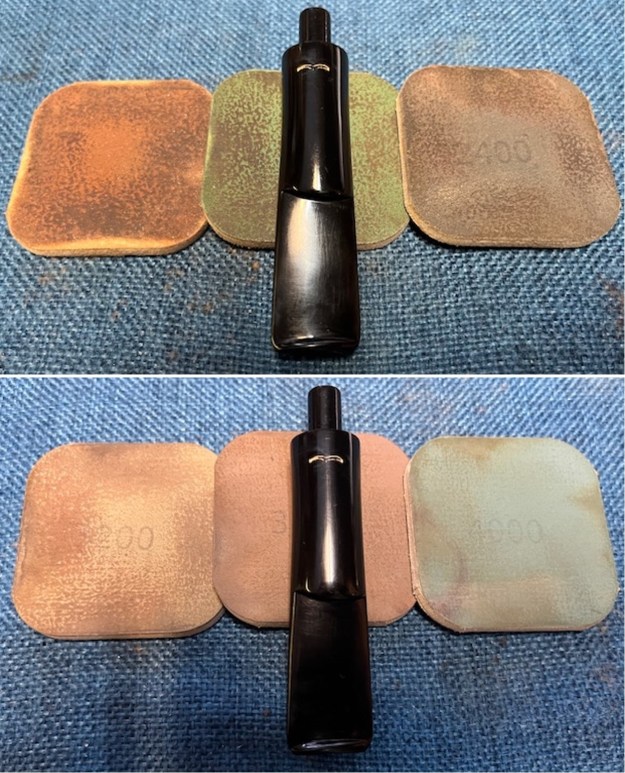
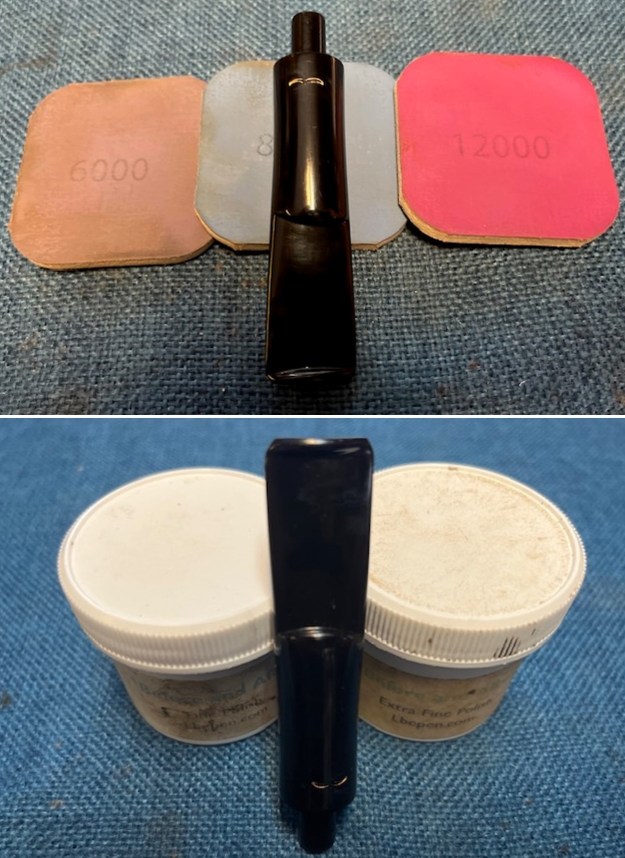
Now it was time to work on the pipe. I started my work by reaming the pipe. I scraped out the light cake with a Savinelli Fitsall Pipe Knife. I took the cake back to bare briar. I sanded the walls smooth with 220 grit sandpaper wrapped around a piece of dowel. The bowl walls looked very good with no burn damage or checking on the walls. I worked over the rugged rustication on the rim top to remove the tars and lava on the rim top with a brass bristle wire brush.I cleaned out the inside of the shank and the airway in the stem with alcohol, cotton swabs and both bristle and regular pipe cleaners. I scrubbed the bowl and shank with a tooth brush and some undiluted Murphy’s Oil Soap. I rinsed it off with warm water to remove the dust and soap from the finish. I dried it off with a soft cloth. The rim top was still darkened in the grooves of the sandblast. I touched up the black of the flume finish on the rim top and outer edge of the bowl with a black stain pen. It looked much better at this point with the finish cleaned of the dust and debris in the finish. It is a rich and rugged rustication.I rubbed the briar down with Before & After Restoration Balm. I worked it into the briar with my fingertips and a horsehair shoe brush to work it into the nooks and crannies of the sandblast finish. The product works to clean, enliven and preserve the briar. I let it sit for 10 minutes then I buffed it with a cotton cloth to deepen the shine. The briar really comes alive with the balm. I set the bowl aside and worked on the stem. The stem was stamped on the underside and read TRADE MARK [over] CASTELLO [over] 7. I sanded the oxidation and the tooth marks and chatter with 220 grit sandpaper. I was able to remove all of the light tooth damage on the stem and the majority of the oxidation. I sanded the stem and tenon surface with 320-3500 grit 2×2 inch pads. I wiped the stem down with an Obsidian Oil cloth after each sanding pad.I polished the vulcanite with micromesh sanding pads – 1500-12000 grit pads. I wiped it down with Obsidian Oil after each sanding pad. I used Before & After Pipe Polish – both Fine and Extra Fine to further polish the stem. This beautiful Castello Old Antiquari Rusticated Flumed Top KK 32 Short Canadian with a taper acrylic stem looks amazing after the work on it. The briar is clean and the deep rustication really came alive. The rich brown stains gave the finish a sense of depth with the polishing and waxing. The flumed black rim top and edges were a great contrast. The finish really popped. I put the stem back on the bowl and buffed the pipe with Blue Diamond on the buffing wheel using a light touch on the briar. I gave the bowl and the stem multiple coats of carnauba wax on the buffing wheel. I buffed the pipe with a clean buffing pad to raise the shine. I hand buffed the pipe with a microfiber cloth to deepen the shine. The finished Castello Old Antiquari Rusticated KK 32 Canadian really is a beauty and feels great in the hand and looks very good. Give the finished pipe a look in the photos below. The dimensions of the pipe are Length: 6 inches, Height: 2 inches, Outside diameter of the bowl: 1 1/2 inches, Chamber diameter: 7/8 of an inch. The weight of the pipe is 47 grams/1.66 ounces. I will soon be putting this pipe on the rebornpipes store in the Italian Pipe Makers section. It should make a great smoker that the next steward will enjoy. Thanks for reading this blog and my reflections on the pipe while I worked on it. It was a fun one to work on.

What Great Bones on this Lightly Smoked Sandblast Nosewarmer Billiard


blog by Steve Laug

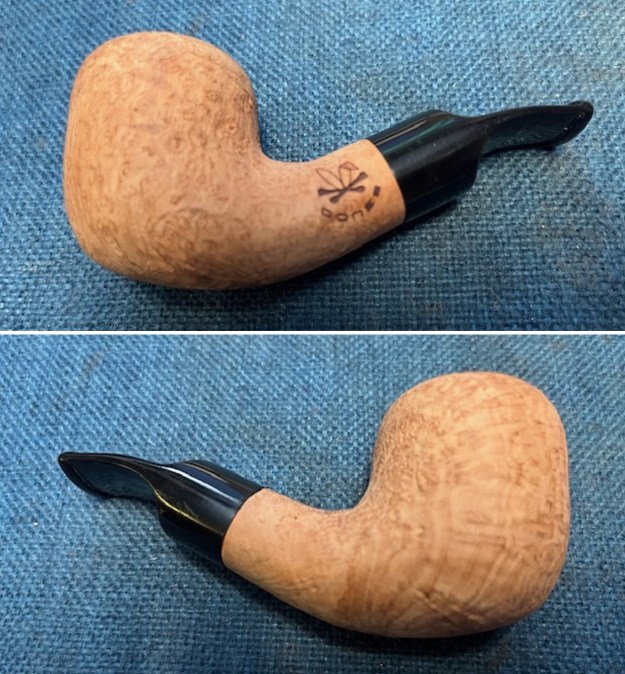
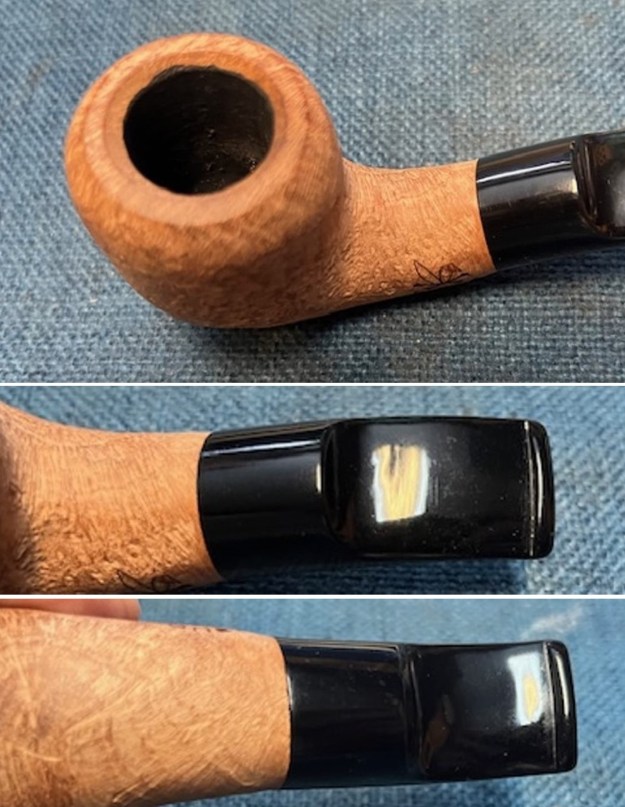
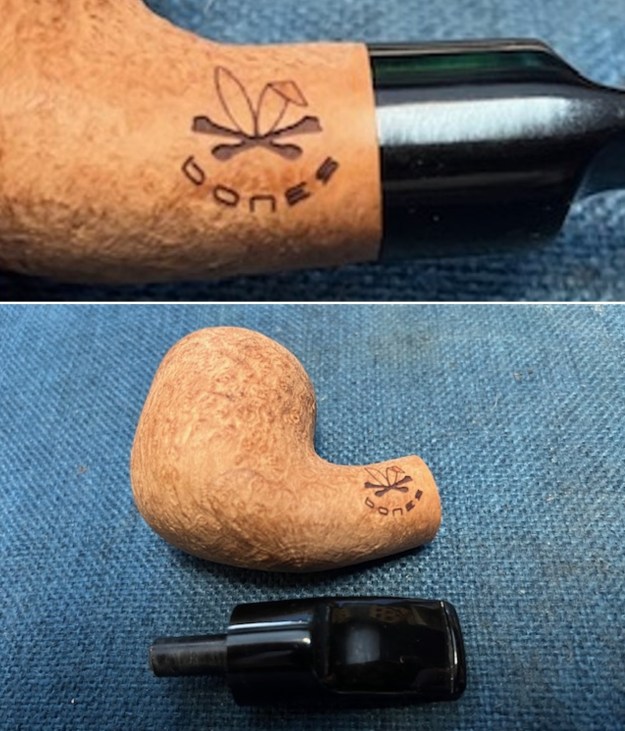
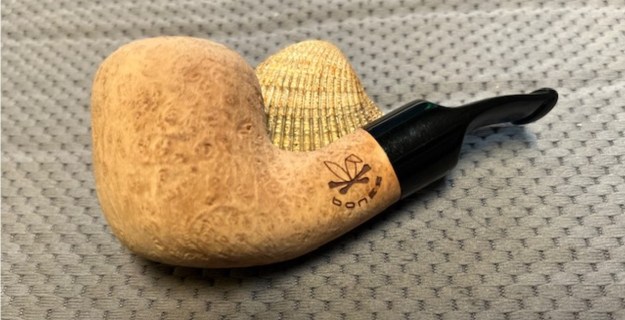
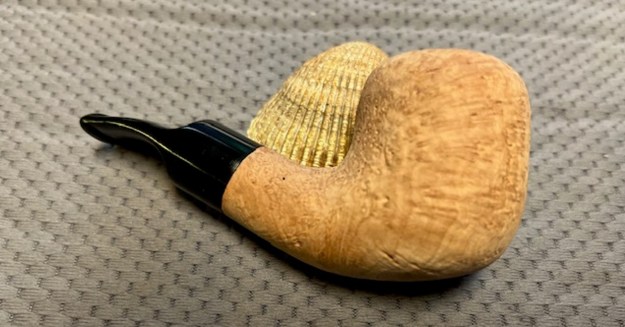
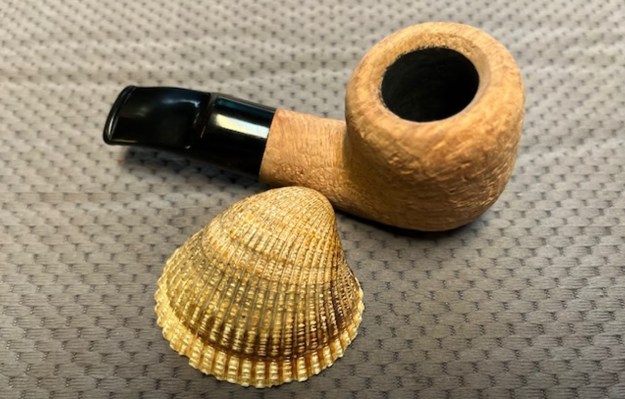
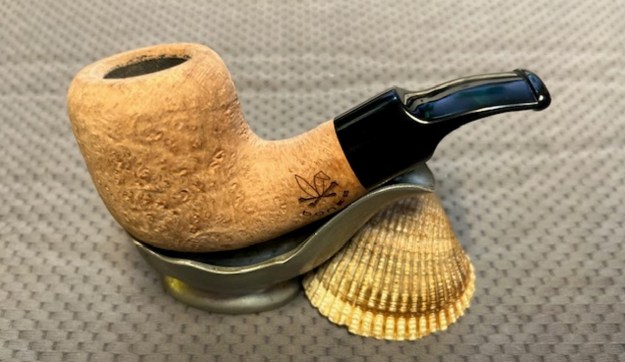
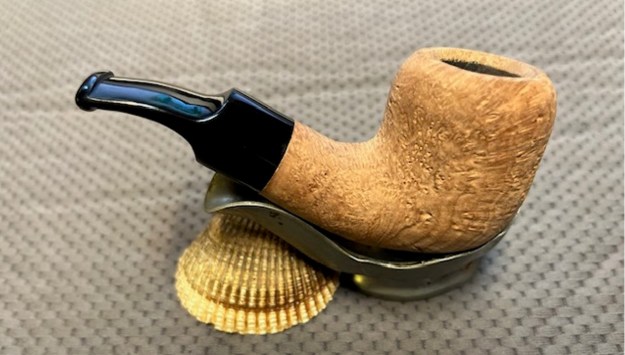
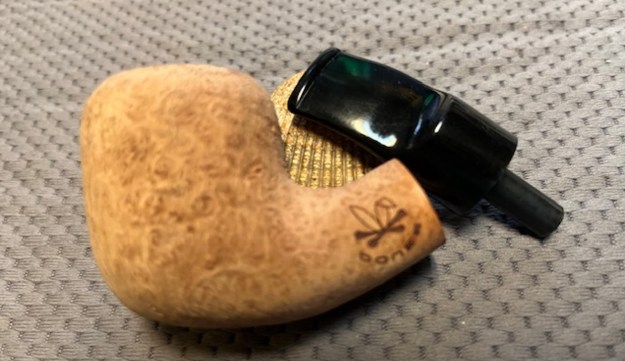
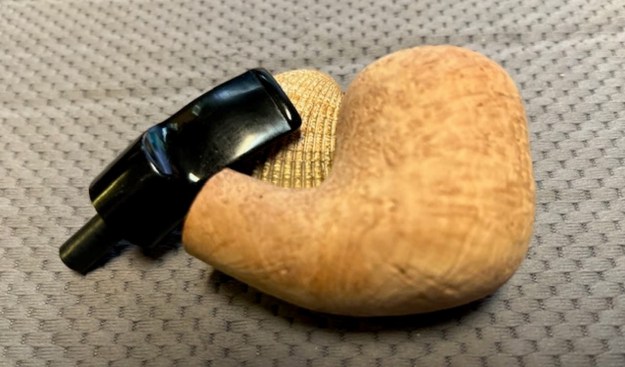
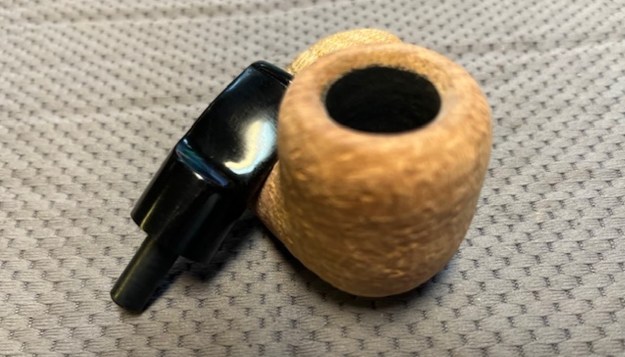
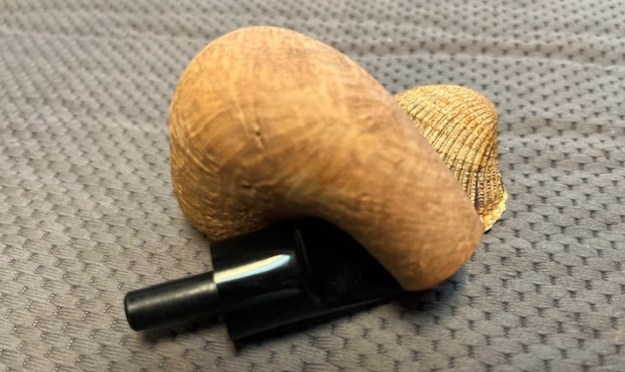
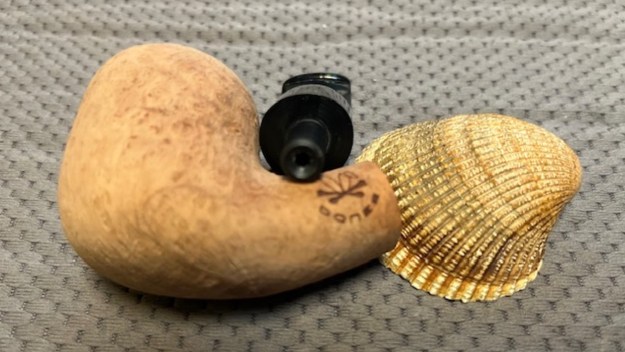
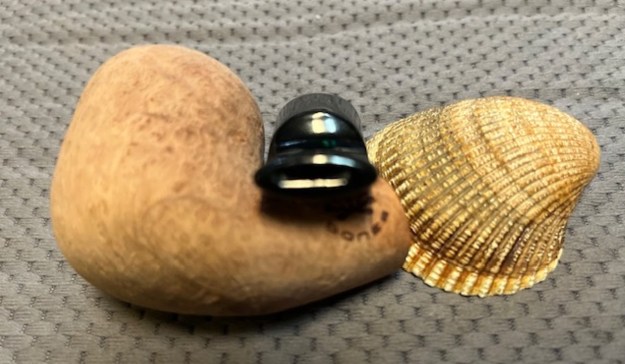
This interesting sandblast sandblast Bent Billiard Nosewarmer pipe was purchased on 04/20/25 on Facebook marketplace from Portland, Oregon, USA. It is a natural sandblast briar with great grain around the bowl and shank. The stem is an acrylic saddle stem. The natural sandblast finish was quite clean even with the light dust and hand oils on the surface. The bowl was lightly smoked and had a faint aroma of tobacco in the bowl and shank. The rim top was quite clean and the inner and bevelled edge looked very good other than a bit of darkening on the bottom edge. The pipe is stamped on the left side of the shank and has crossed bone and rabbit ears [over] and arched BONES. The acrylic stem had no stamping on the sides. It had scratches, light tooth marks and chatter on both sides ahead of the button. It was really an interesting sandblast with twists and turns in the briar. I took photos of it before I started the cleanup process. The exterior of the pipe was soiled with oils and dust but still looked very good. The rim top was in very good condition. The bowl itself had a was quite clean but there was darkening and a faint smell of tobacco. The acrylic taper stem surface had some light scratches and marks on both sides.I took a photo of the stamping on the left side of the shank. It is clear and reads as noted above. I also removed the stem and took a photo of the parts of the pipe. It is a great looking pipe.I took a few moments before working on the pipe to do a bit of research on the Bones pipes line. I knew they were made by Morgan Pipes so I started there. I looked up the Morgan Pipes site  (https://morganpipes.com/collections/bones) and quote from there:

Bones Pipes are pipes – That’s it – No fancy stuff… If you want a pipe to start with or just build your collection, Bones are the pipes for you. Toss it in a tackle box or a backpack and go. These pipes are, simply put, the absolute least expensive honest briar pipe on the market. A simple smoking machine.

I Googled and found a great link to Cupojoes tobacco shop (https://www.cupojoes.com/tobacco-pipes/morgan-bones/). They had a great description of the line from the perspective of the seller. I have included that below.

Chris Morgan began making pipes in 2006, and has since become renowned name within the pipe smoking community. The reason being: the world famous Bones Pipe. The Bones pipe is exactly what it sounds like, the bare naked skeleton of a pipe, that we often never get a chance to see. While other companies rely heavily on staining and sandblasting techniques, the Bones comes in a truly unfinished, natural beauty, making each one (even if the same shape) unique. Praised for their affordability, Bones pipes are the perfect pipe for travel & on the go, often small enough to fit into pockets. Chris offers other lines such as the impeccably built Black Jack series, and the famous patented cigar style pipe called the “Briar Cigar”.

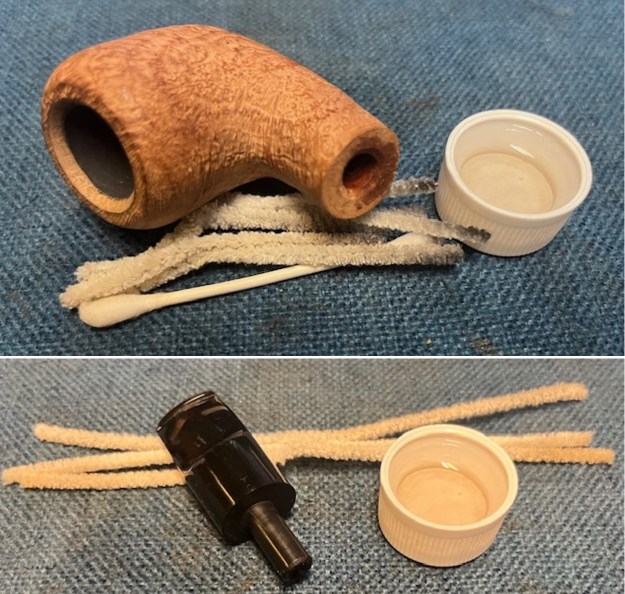
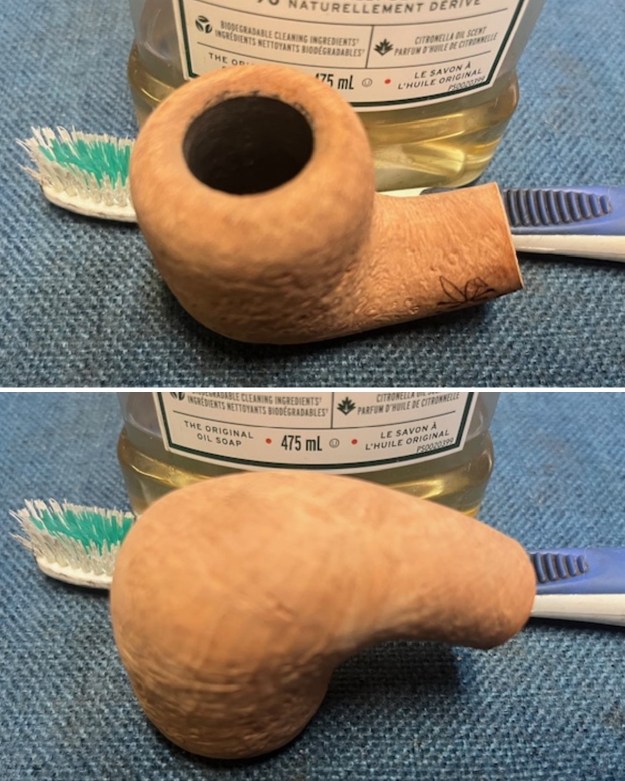
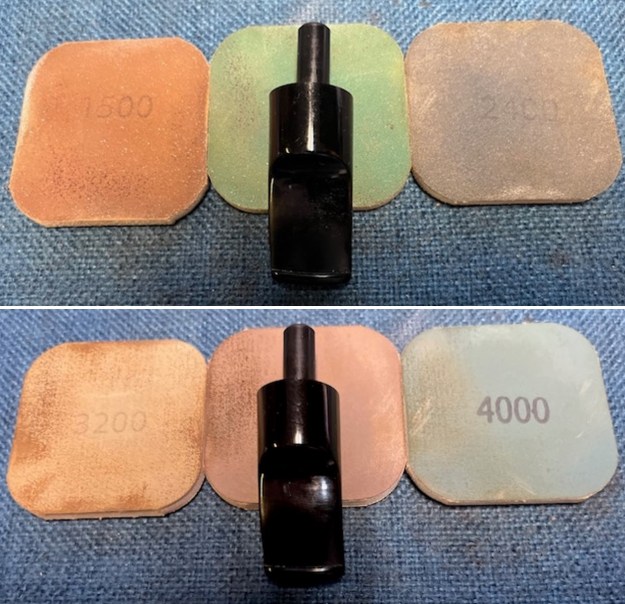
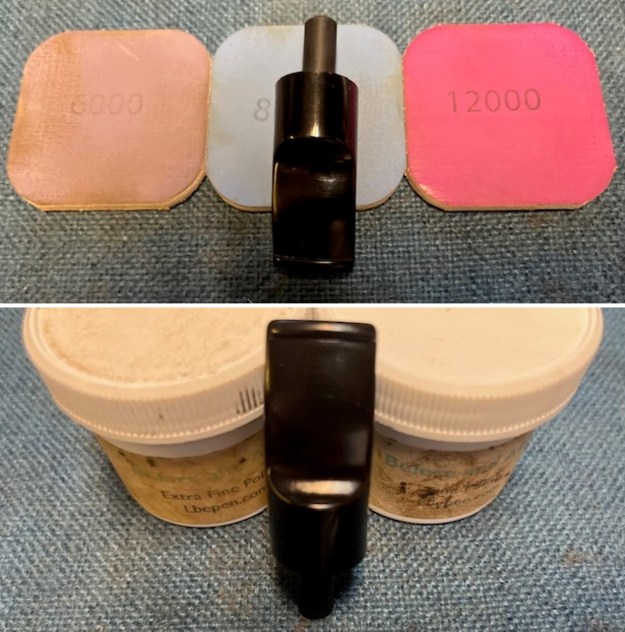
Now it was time to do my work on the pipe. I cleaned out the airway in the stem and the shank with pipe cleaners – both bristle and normal as well as cotton swabs and isopropyl alcohol.I scrubbed the surface of the bowl and the inside with undiluted Murphy’s Oil Soap and a tooth brush. I rinsed it off with warm, running water. I was able to remove the grim on the bowl sides and the bowl smelled far better. I set the bowl aside and turned my attention to the stem. I polished the acrylic stem with micromesh sanding pads – dry sanding it with 1500-12000 grit pads. I wiped the stem down after each sanding pad with Obsidian Oil and set it aside to dry. I polished it further with Before & After Pipe Polish – using both the Fine and Extra Fine Polishes. I gave it a rubdown with Obsidian Oil one last time and set it aside. I put the Chris Morgan made Bones Sandblast Bent Nosewarmer Billiard back together and worked the stem over on the buffing wheel using Blue Diamond to lightly polish the acrylic stem. I left the pipe natural finished and did not wax or polish it. I gave the stem multiple coats of carnauba wax. I buffed the entire pipe with a clean buffing pad to raise the shine. I hand buffed it with a microfiber cloth to deepen the shine. The finished the Bones Nosewarmer Billiard is shown in the photos below. The natural sandblast finish works well with the rich black acrylic stem. It looked quite amazing! The dimensions of the pipe are: Length: 4 inches, Height: 1 ¾ inches, Outside Diameter: 1 ¼ inches, Diameter of the chamber: ¾ of an inch. The weight of the pipe is 48 grams/1.69 ounces. This is a sandblast on the bowl and shank that reveals the grain underneath. This one will soon be on the rebornpipes store in the American (US) Makers Section. If you are interested in adding this Bones pipe to your collection this may well be the one for you. Thanks for walking with me through the restoration process.

Restoring a Danish Mr. Andersen Hand Crafted 3 Freehand with acrylic saddle stem


by Steve Laug

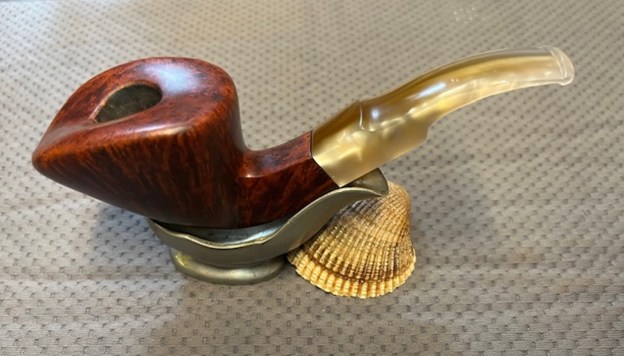
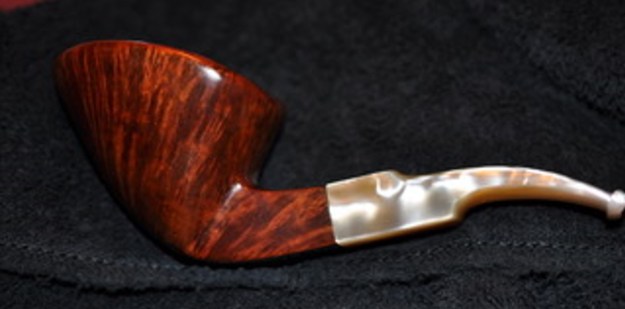
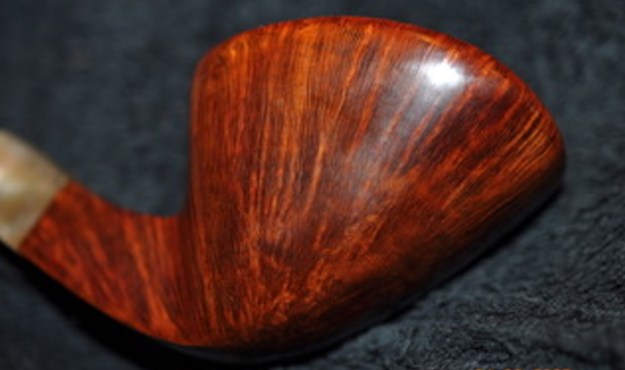
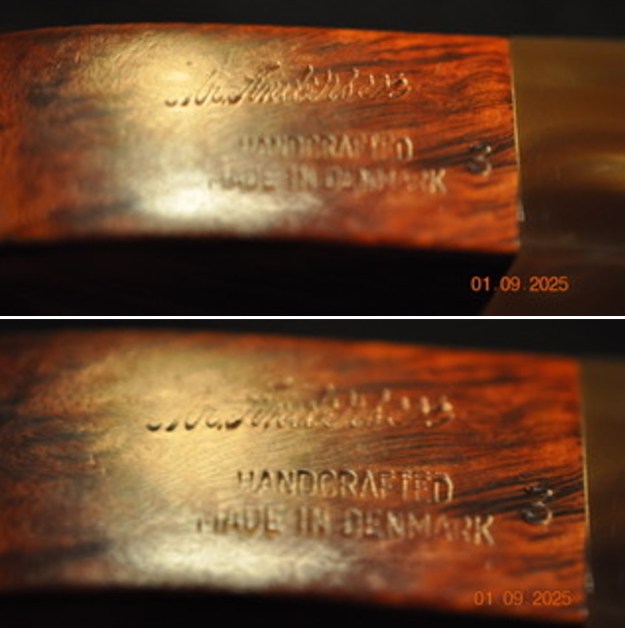
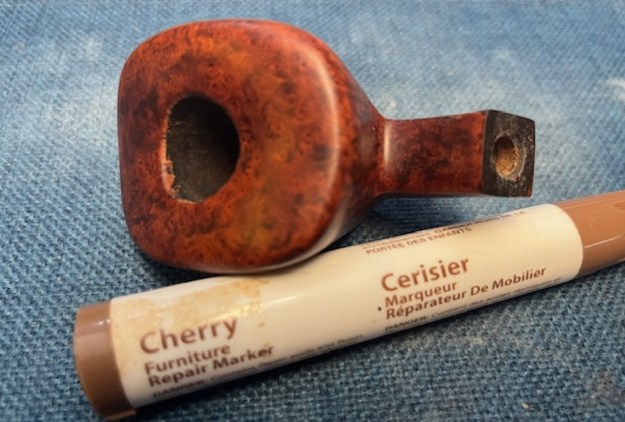
The next pipe on the table is a beautiful freehand in a brand we had not seen before. We picked the pipe up from a seller in Wellsville, Kansas, USA on 12/09/2024. Probably the fact that it is a Danish and Hand Crafted caught our eye on this one. It is stamped on the underside of the shank and reads Mr. Andersen in script [over] Hand Crafted [over] Made in Denmark followed by the number 3. It is a nice looking Freehand “Dublinesque” Freehand that had great grain around the bowl and shank. The rim top was smooth and rectangular with a bit of scoop running from front to back of the bowl. The finish looked good other than the usual dust. The bowl had been recently reamed and the rim top was quite clean other than some oils. The edge of the bowl looked to be in good condition. The acrylic saddle was a bit off at the shank end in terms of a smooth transition between the shank and stem and there was tooth chatter and light tooth marks on both sides near the button. There is no logo stamp on the stem. The surface of the button looks very good on both sides. Jeff took some photos of the pipe to show the general condition of the pipe before he started his clean up. Jeff took photos of the rim top and stem to show the general condition of the pipe. The bowl is clean and the rim top looks good. The inner edge of the bowl is in excellent condition. The stem has some fitting issues at the shank and there is light tooth chatter and marks on the top and underside near the button. Jeff took photos of the bowl sides and heel to show the condition of the smooth finish around this bowl. The grain is quite beautiful and it is a nice looking pipe. He took photos of the stamping on underside of the shank. It is clear and readable as noted above. I removed the stem and took photos of the part to give a sense of the look of the pipe.Before I started working on the pipe I wanted to get a sense of the provenance of the pipe. It was a brand with which I was unfamiliar. I turned first to Pipephil’s site and there was nothing on that brand. I turned then to Pipedia (https://pipedia.org/wiki/Mr._Andersen). The was some interesting information on the brand and help with the carver of the pipe. I quote:

It had previously been reported that Jørgen Larsen made Mr. Andersen pipes. However David Field, the importer for Larsen states, “Jørgen Larsen never made Mr. Andersen pipes to my knowledge.”

As it turns out, there are two Jørgen Larsens making pipes!

Søren Eric Andersen writes, “the brand MR: ANDERSEN was introduced by Remo Sørensen, a well known pipe dealer in Copenhagen. The pipes were made by several pipemakers, although I personally only knew one of them, Jørgen Larsen, formerly with Larsen & Stigart. It is unlucky that there are TWO Jørgen Larsens in this small trade, but the name is rather common in Denmark. I was not happy with [them using] that brand [name] for obvious reasons, but Andersen is quite a common name too. With my best regards, Søren Eric Andersen.”

José Manuel Lopes states in Pipes, Artisans and Trademarks that these pipes were also made by Jarl and Chieftan.

Nikolaj Nielsen, proprietor of The Danish Pipes Shop reports that Finn Andersen was the maker (or perhaps one of the makers) of Mr. Andersen pipes for Remo Sørensen. It is unclear if this Finn Andersen, is Finn Meyan Andersen, who was instrumental in setting up the machinery at the Briar Workshop, but that seems possible, if not likely.

Now I knew the pipe was probably sold by Remo Sorensen a well known pipe dealer in Copenhagen. Jorgen Larsen of Larsen & Stigart was probably the carver. Now it was time to work on the pipe.

Armed with that information I turned my attention to the pipe itself. Jeff had cleaned the pipe with his usual penchant for thoroughness that I really appreciate. He cleaned up the reaming with a PipNet pipe reamer and a Savinelli Fitsall Pipe Knife. He scrubbed out the internals with alcohol, pipe cleaners, shank brushes and cotton swabs until the pipe was clean. He scrubbed the exterior of the bowl with undiluted Murphy’s Oil Soap and a tooth brush to remove the grime and grit on the briar and the light lava on the rim top. The finish looks very good with good looking grain around the bowl and shank. He cleaned the acrylic stem alcohol and pipe cleaners to remove the oils and tars. He scrubbed the surface with some Soft Scrub to clean up the surface. When the pipe arrived here in Vancouver for the second stop of its restoration tour it looked very good. I took photos before I started my part of the work. I took close up photos of the bowl and rim top as well as the stem. You can see the condition of the rim top and bowl in the first photo. Jeff was able to remove all of the dust and oils on the top and the edges of the bowl. It looked very good. The stem had a sloppy fit to the shank and there was light tooth chatter on both sides ahead of the button.I took a photo of the stamping on the shank sides to show the condition. The stamping was clear and readable as noted above. I removed the stem and took a photo to show the parts of the pipe. It is a beauty.I polished the briar with 1500-12000 grit sanding pads. I wiped down the bowl with a damp cloth to remove the sanding debris and dust. The bowl began to look amazing. I worked some Before & After Restoration Balm into the surface of the briar with my fingertips to clean, enliven and protect it. I let the balm sit for a little while and then buffed with a cotton cloth to raise the shine. The following photos show the bowl at this point in the restoration process. I am very happy with the results. I worked on the fit to the shank with a folded piece of 220 grit sandpaper. I was able to smooth the stem on the sides and underside to match the flow of the shank. The topside took a bit more work to flatten the transition and smooth the flow. I smoothed out the sanded area with 320-3500 grit sanding pads. Once it was smooth I stained the top of the shank with a Cherry Stain pen.I sanded the stem with 320-3500 grit sanding pads. I wiped the stem down with an Obsidian Oil cloth after each sanding pad. The tooth marks and chatter had disappeared.I polished the stem with micromesh sanding pads – wet sanding with 1500-12000 grit sanding pads. I wiped it down after each sanding pad Obsidian Oil. I finished by polishing it with Before & After Pipe Stem Polish both fine and extra Fine and then wiped it down with a final coat of Obsidian Oil. This is a beautiful Mr. Andersen Hand Crafted Freehand Dublin with a square shank and square acrylic saddle stem. It has a great look and feel. The shape of the bowl, the scooped rim top and the cut of the briar work well to highlight the grain around the bowl sides. I polished stem and the bowl with Blue Diamond polish on the buffing wheel. I gave the bowl and the stem multiple coats of carnauba wax. I buffed the pipe with a clean buffing pad to raise the shine. I hand buffed it with a microfiber cloth to deepen the shine. The Mr. Andersen Freehand Dublin polished up pretty nicely. The grain took on life with the buffing. The rich stains work well with the polished vulcanite stem. The finished pipe has a rich look that is quite catching. Have a look at it with the photos below. The shape, finish and flow of the pipe and stem are very well done. The dimensions are Length: 6 inches, Height: 2 inches, Outside diameter of the bowl: 1 ¾ inches wide x 2 ½ inches long, Chamber diameter: ¾ of an inch. The weight of the pipe is 2.33 ounces/66 grams. It is a beautiful pipe. I will be putting it on the rebornpipes store shortly in the Danish Pipemakers Section if you are interested in adding it to your collection. Thanks for walking with me through the restoration.

New Life for a Castello Sea Rock Briar KK32 Canadian


by Steve Laug

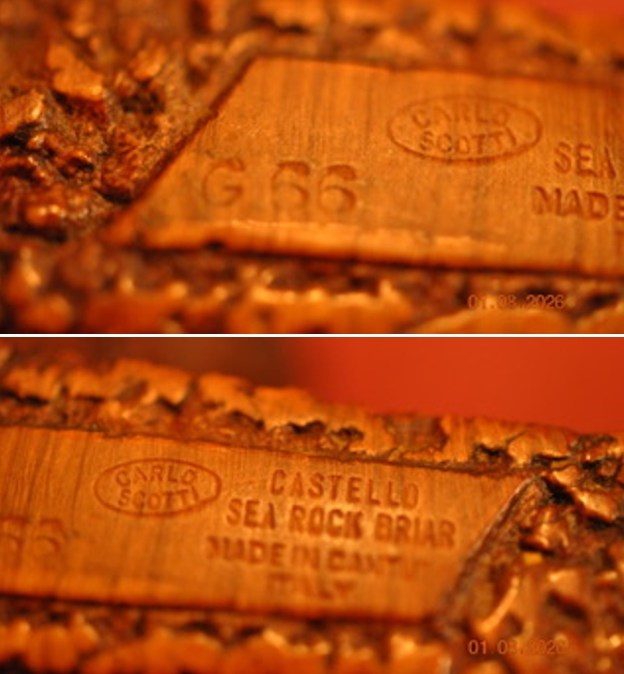
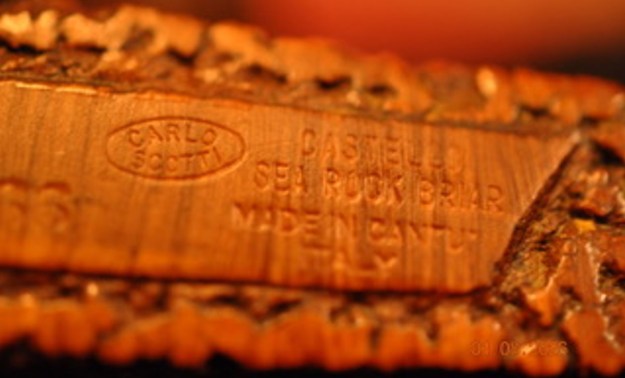
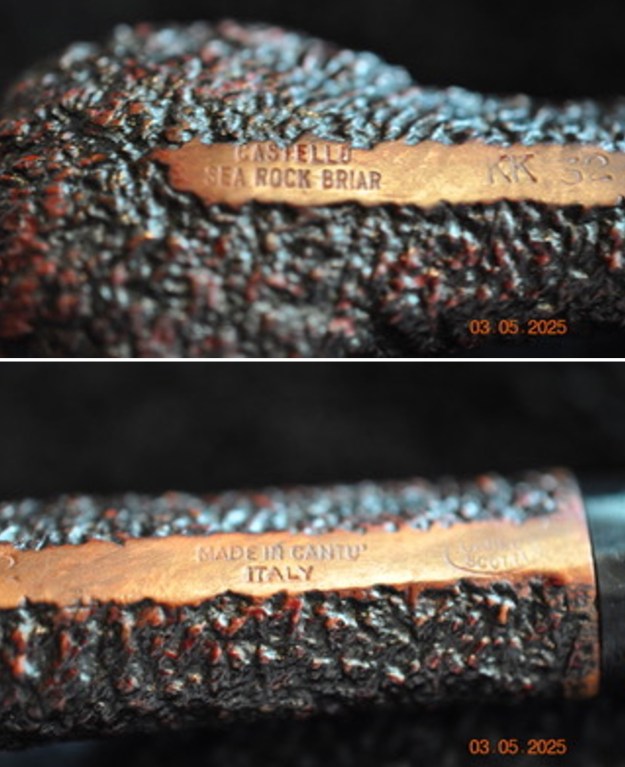
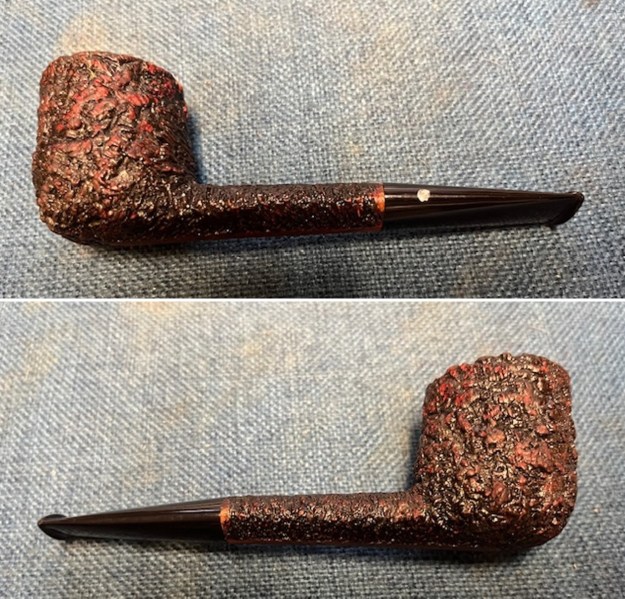
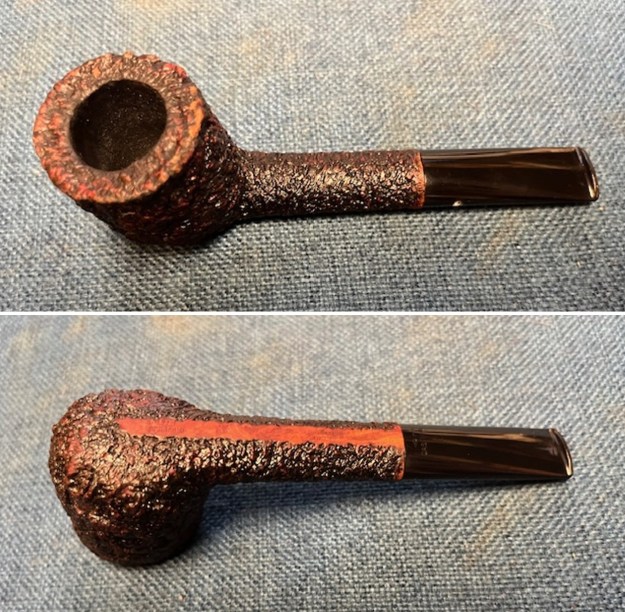
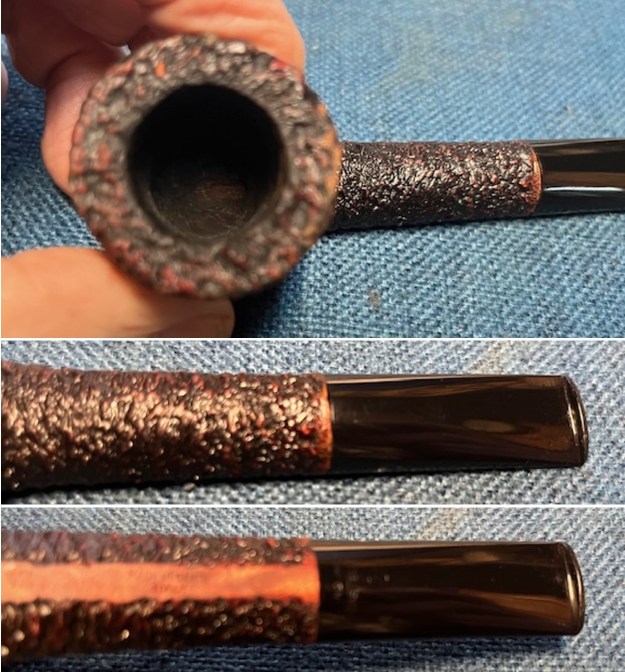
The next pipe on the table is one that we picked up in the lot from an eBay seller in Harrison Township, Michigan, USA on 08/22/2024. The Sea Rock Rusticated finish on this Italian made Canadian shaped pipe and the faux diamond inset on the left side of the oval taper stem are what caught our eye. It is stamped on the heel of the bowl and reads Castello [over] Sea Rock Briar. That is followed by KK 32 and to the right it reads Made in Cantu [over] Italy. That is followed Carlo Sciotti in an oval next to the stem/shank junction. It has a classic Reddish Black stain on the rusticated finish that is a stark contrast to the black acrylic taper stem. It has a deep rusticated finish on a straight oval, long shank Pot. The bowl was heavily caked and the inner edge and the top were covered with a thick lava coat in the rustication. The acrylic stem was dirty and had tooth marks and chatter on both sides ahead of the button. The faux diamond logo on the left side of the taper stem looks to be in good condition. Jeff took some photos of the pipe to show the general condition of the pipe before he started his clean up. He took some photos of the rim top and bowl from various angles to give me a clear picture of the condition of the rim top and bowl. The inside of the bowl is heavily caked with lava on the inner edge and in the sandblast on the rim top. He included photos that show the top and underside of the stem. It is as described above. Jeff took some photos of the sides and heel of the bowl to show the condition of the rusticated finish on the pipe. The photos showed some great grain around the bowl and shank even with the grime in the finish. It is a great looking piece of briar. He took a photo of the stamping on the heel of the bowl and the underside of the shank. It was clear and readable as noted above. As usual I cannot seem to retain the details on Castello pipes in my head for long for some reason. The stamping on this one – Castello and the Carlo Scotti stamp left me with some questions that I need to answer before I began to work on the pipe. I turned first to the Pipephil site (http://www.pipephil.eu/logos/en/logo-castello.html) because of the general quick summary of information I get there. I quote:

Castello PIPA CASTELLO di Carlo Scotti & C. was founded in 1947 by Carlo Scotti († 1988). Franco Coppo (AKA “Kino”) who married Carlo Scotti’s daughter Savina, manages (2012) the corporate since 1985.

The site also gave a good summary of the grading and sizes of the pipes. I quote that in full.

Sizes (ascending):

1K to 4K, G (Giant) and GG (Extra large)

Rusticated grading: SEA ROCK, OLD SEA ROCK, NATURAL VERGIN,

Sandblasted grading: ANTIQUARI, OLD ANTIQUARI

Smooth grading (ascending): TRADEMARK, CASTELLO, COLLECTION

Other stampings: Great Line (Non-standard or freestyle) Fiammata (Straight grain)

Production (2012): ~4000 pipes / year

I also found a note on the page that the Rhinestone logo was originally on pipes for the US market. It is occasionally used now.

I turned then to Pipedia for more information on the brand (https://pipedia.org/wiki/Castello). The majority of the information was what was already quoted above in abbreviated form. However there was a link to an article by Bob Hamlin that gave some interesting bits of information that I found helpful (http://www.pipes.org/BURST/FORMATTED/196.016.html). I quote in part from that article.

SEA ROCK [Carved Black or dark brown]:  This is the lowest grade of the Castello line and is the most common in the USA.  Sea Rocks are produced by taking a smooth bowl that has not been “final finished” and surface carving the finish with tools. This “carved” finish is then evened out using a steel wire brush, stained and then waxed. The Natural Vergin carved finish is left unstained and unwaxed as a rule, although we have seen waxed and partially waxed “Vergins”.

All carved Castello pipes are graded by the number of K’s that are stamped on each piece and are K-graded by SIZE.  1K is the smallest and fairly rare, 2K is small to medium, with 3K or 4K being the most common and ranges from medium to medium large. Large pieces are stamped “G” for giant and extra-large pieces are stamped “GG” for double giant.  In addition to the number of K’s on a carved Sea Rock piece the shape number is almost always added. As a rule a Sea Rock Castello is stained Black, although recently there have been quite a few coming in stained deep brown and still stamped “Sea Rock”.  American Logo’d Sea Rocks are all priced the same to the consumer, although most are 2 or 3 K’ed models. G/GG models are charged at a higher price on American pieces and are basically the same as their European counterparts.

The Castello Sea Rock Briar KK 32 I was working on was definitely one made for the American Market with the Rhinestone in the stem. It had the dark finish or black stain.

Pipedia also gave a link to Mike’s Briar Blues site for help in dating and determining shapes (http://www.briarblues.com/castello.htm).

Shape numbers. Shape numbers are all 2 digits. A 2 in front indicates a “fancy” interpretation, a 3 in front means that the carving is somehow unique. I don’t know when the change was made, but currently, a π symbol is used instead of the 3xx. I’ve only seen this on Sea Rocks, but that doesn’t mean anything…

Now I had more information to work with. The Castello Sea Rock Briar in my hands was 2K graded. That told me that it is a mid-sized pipe. The number 32 makes it a unique and a Canadian shape.

I turned to work on the pipe itself. Jeff had done an amazing cleanup of the pipe. He reamed the cake with a PipNet reamer and cleaned up that with a Savinelli Fitsall Pipe Knife. He scrubbed the internals of the bowl and stem with alcohol, cotton swabs, pipe cleaners and shank brushes. He scrubbed the externals with undiluted Murphy’s Oil Soap and rinsed the bowl off with running water. His scrubbing removed the varnish on the bowl with just a few spots remaining. He soaked the stem in Briarville’s Pipe stem Deoxidizer and once it had soaked rinsed it off with warm water to remove the residual solution. He dried it off and rubbed it down to remove any oxidation that was still on the stem. The soak did not penetrate the varnish on the stem at all but it certainly looked better. Other than the shiny spots in the finish where the varnish remained, the pipe looked very good when I received it.
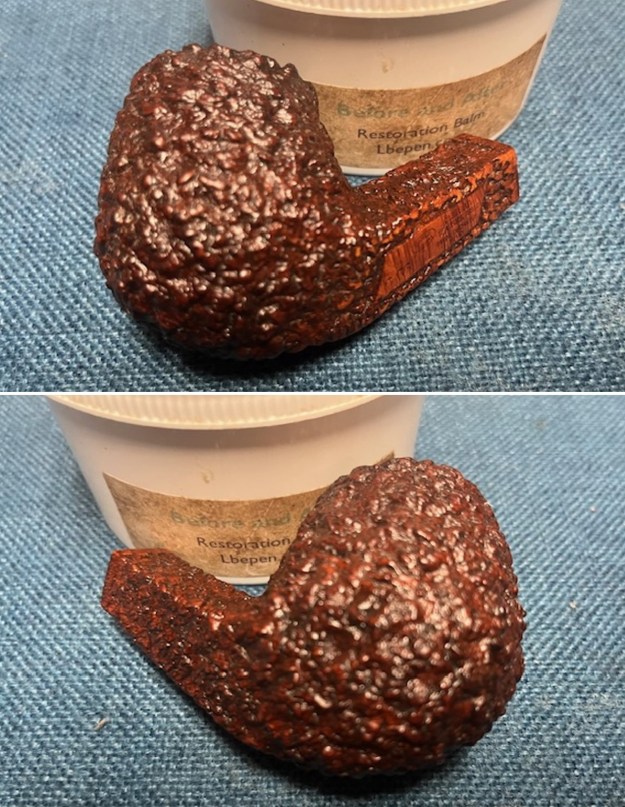
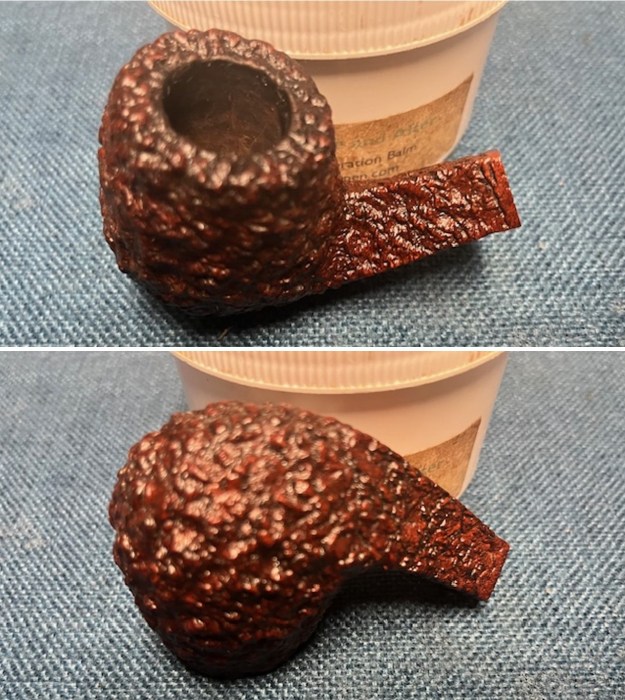
I took close up photos of the bowl, rim top and stem to show how clean the pipe was. The bowl was clean and the rim top and the inner edge look beautiful. I would need to touch up the stain but it was very clean. The stem was clean and the chatter is light and hardly visible.I took a photo of the stamping on the underside of the shank. It is very clear and readable and read as noted above. I also removed the stem from the shank and took photos of the pipe to show the look of the parts.I touched up the rim top with a black stain pen to match the rest of the bowl sides and top. Once it is polished and buffed the match will be perfect.The exterior of the bowl was beautiful. I worked some Before & After Restoration Balm into the briar with my finger tips and a shoe brush. I let it sit on the bowl for 10 minutes and then buffed it off with a paper towel and soft cloth. The product is a great addition to the restoration work. It enlivens, enriches and protects the briar while giving it a deep glow. It is a product I use on every pipe I restore. I set the bowl aside and turned to the stem. I sanded the it with 320-3500 grit sanding pads and wiped the stem down after each pad with some Obsidian Oil on a cloth. The shine is coming back beautifully.I polished it with micromesh sanding pads – dry sanding with 1500-12000 grit pads and wiping the surface down with Obsidian Oil after each sanding pad. It is really shining. I polished it further with Before & After Stem Polish – both Fine and Extra Fine. I gave it another coat of Obsidian Oil to finish this step. This Castello Sea Rock Briar KK32 Canadian with an acrylic taper stem is a great looking pipe now that it has been restored. The beautifully deep rusticated finish really works well with the shape and the polished finish is stunning. I put the stem back on the bowl and carefully buffed the bowl and the stem with Blue Diamond on the buffing wheel. I gave the bowl multiple coats of Conservator’s Wax and the stem multiple coats of carnauba wax on the buffing wheel and followed that by buffing the entire pipe with a clean buffing pad. I hand buffed the pipe with a microfiber cloth to deepen the shine. The finished Castello Sea Rock Briar KK32 Canadian fits nicely in the hand and feels great. Give the finished pipe a look in the photos below. The dimensions of the pipe are Length: 5 ¼ inches, Height: 1 ¾ inches, Outside diameter of the bowl: 1 ½ inches, Chamber diameter: ¾ of an inch. The weight of the pipe is 39 grams /1.38 ounces. I will be putting it on the rebornpipes store in the Italian Pipe Makers Section shortly. Let me know via email or a message if you are interested in adding this pipe to your collection.

As always, I encourage your questions and comments as you read the blog. Thanks to each of you who are reading this blog. Remember we are not pipe owners; we are pipe men and women who hold our pipes in trust until they pass on into the trust of those who follow us.

Restoring a Caminetto Sable D’Or Sandblast Billiard


by Steve Laug

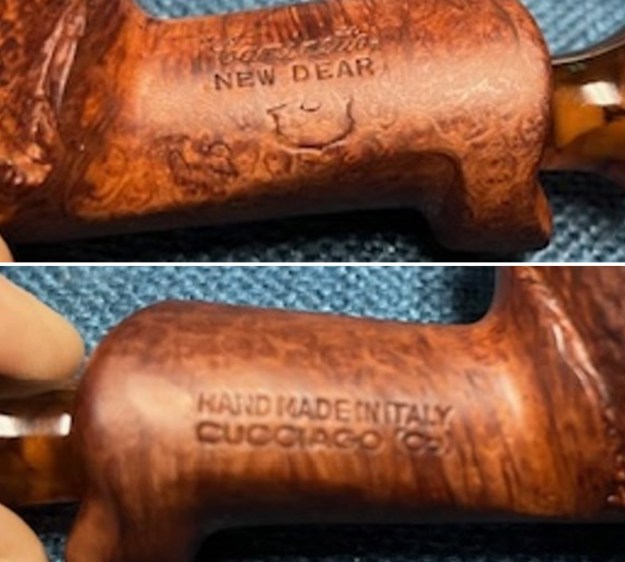
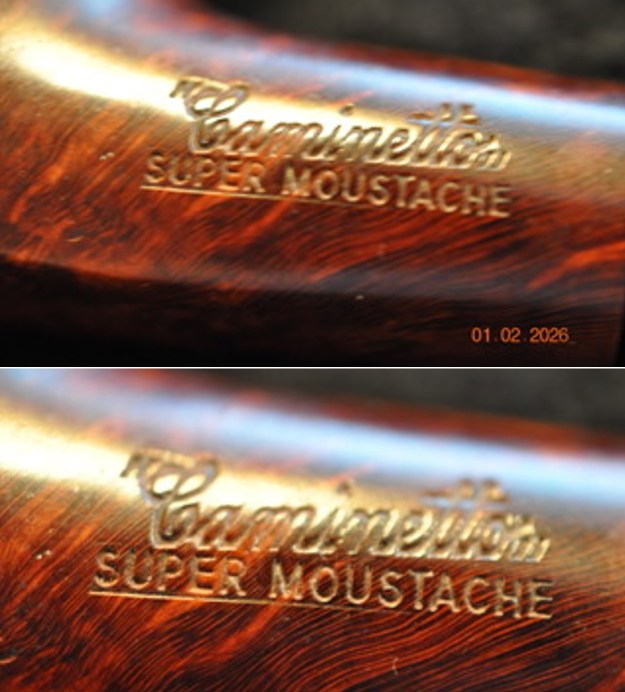
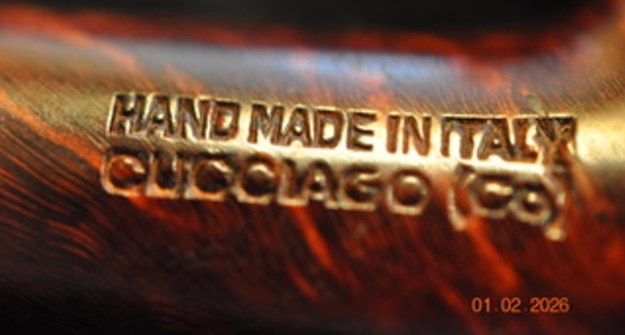
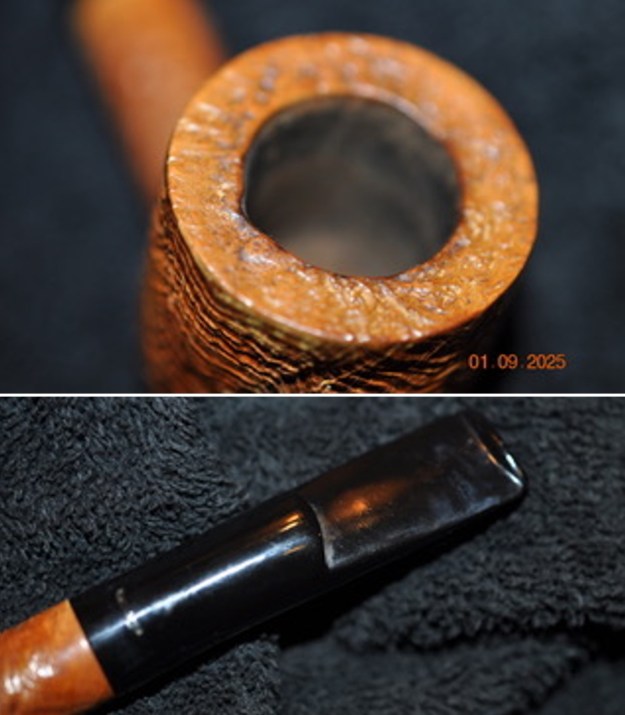
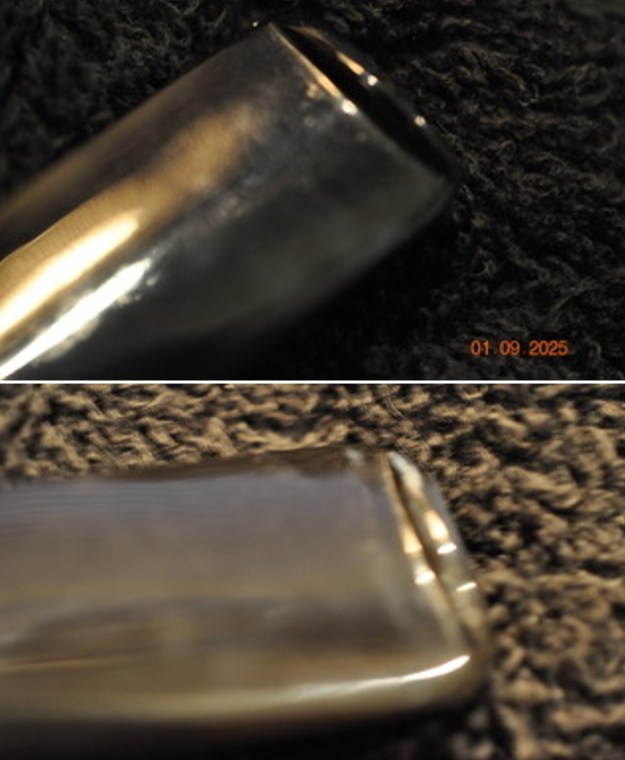
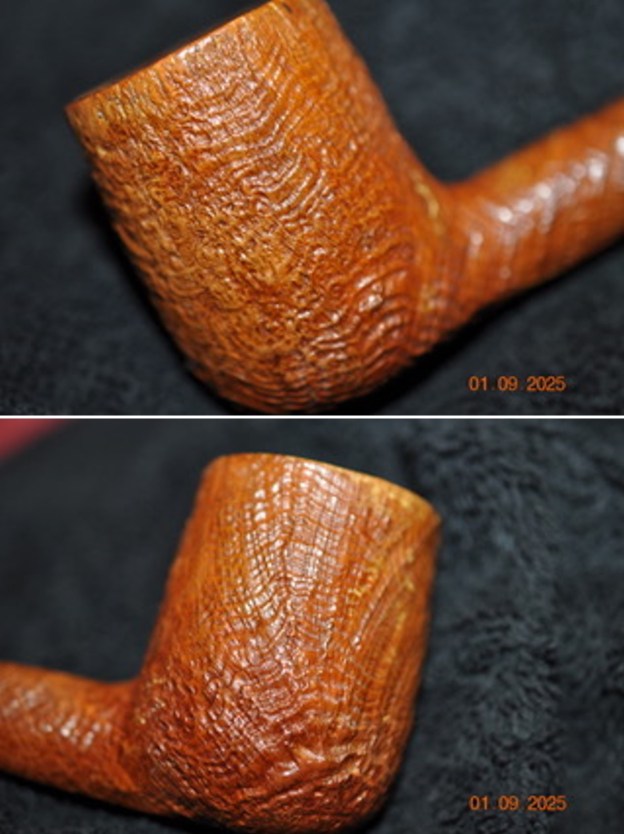
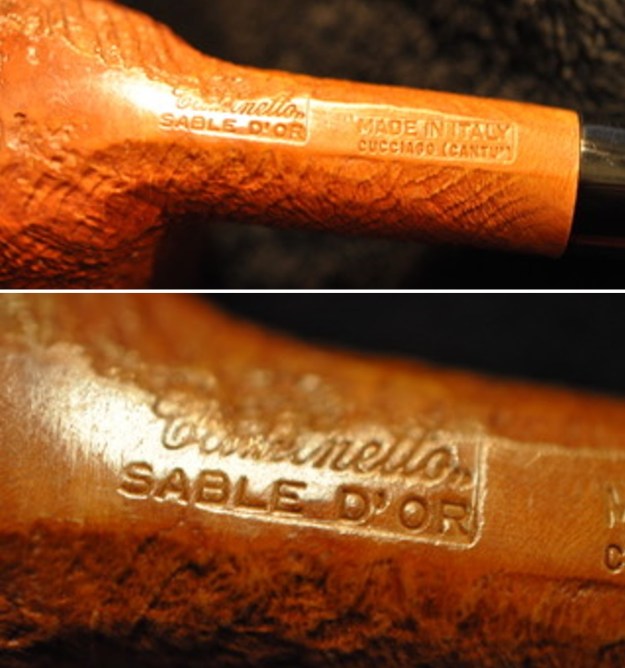
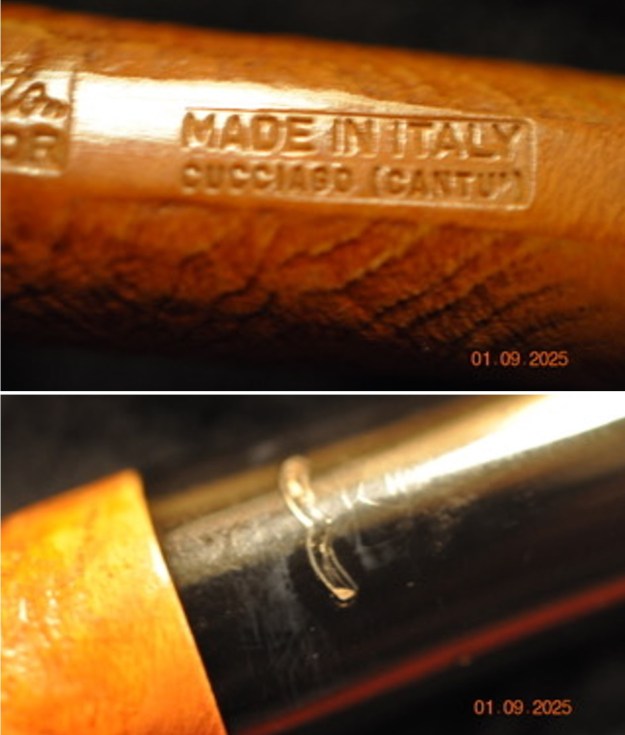
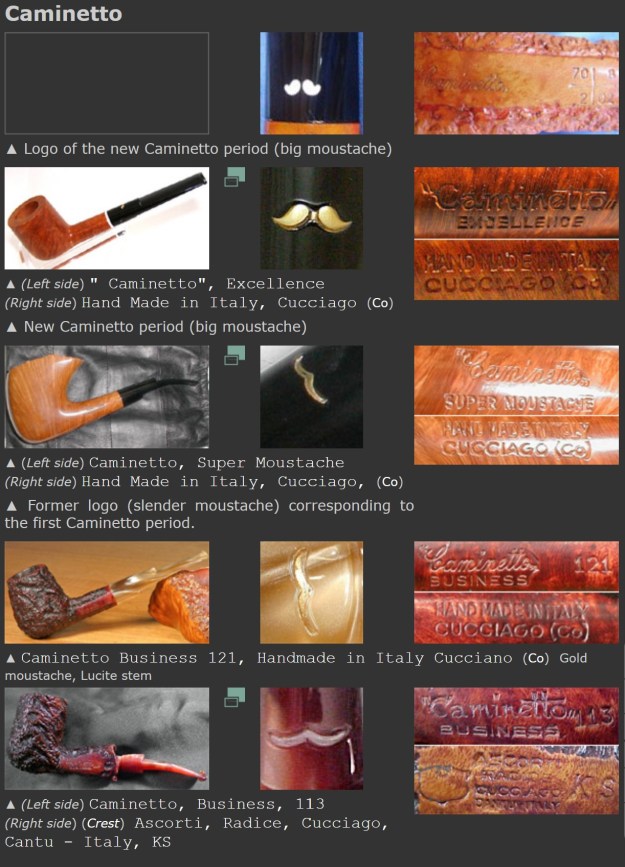
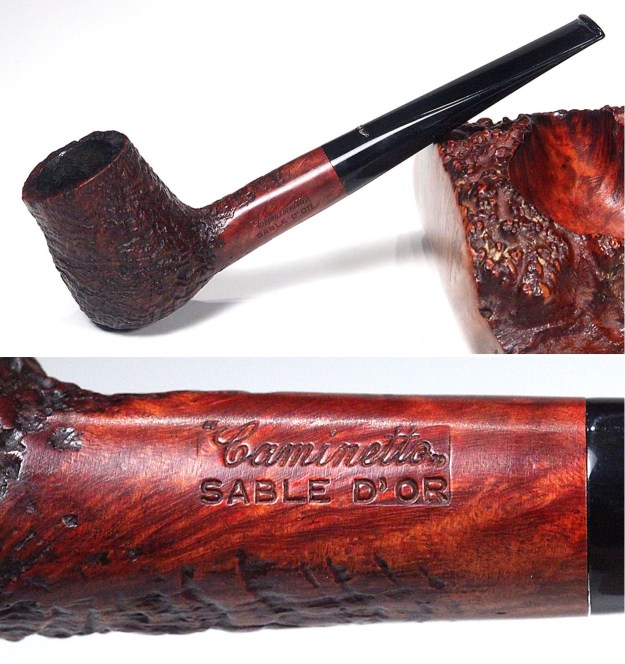
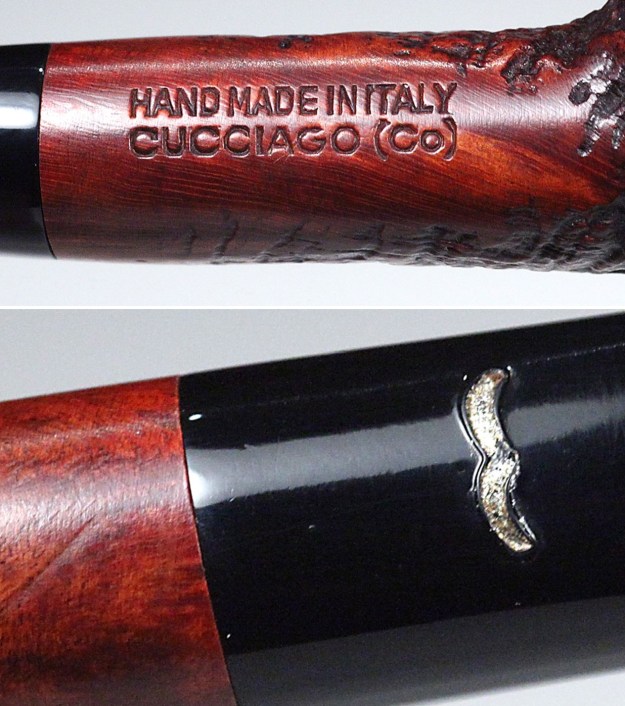
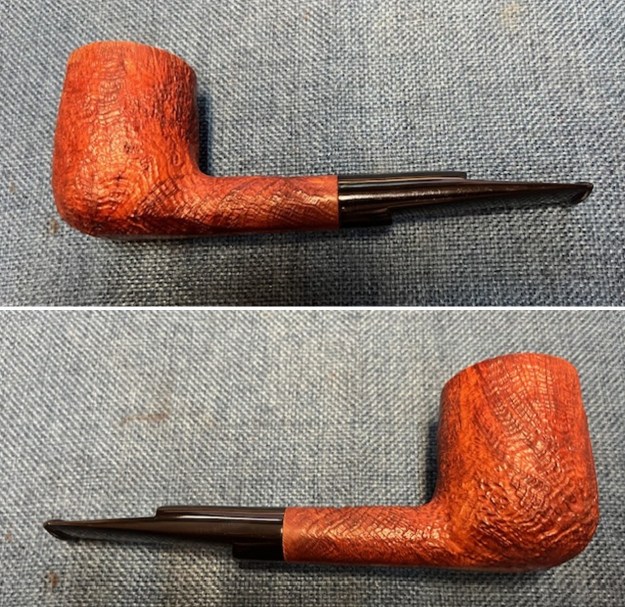
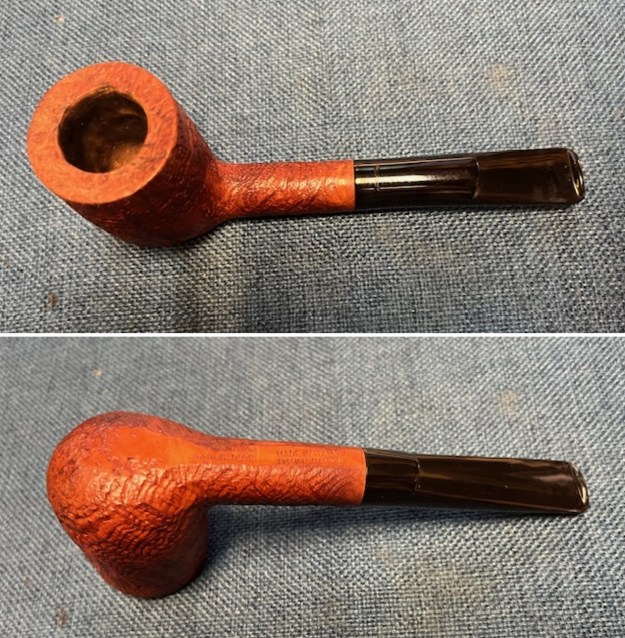
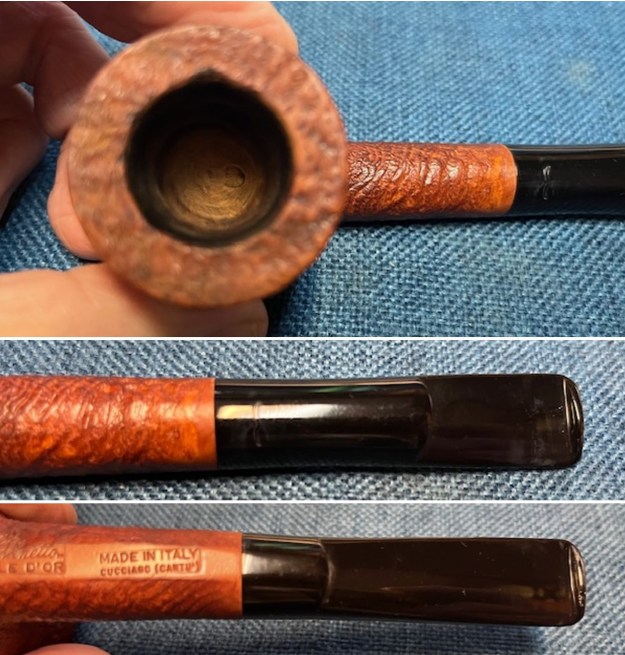
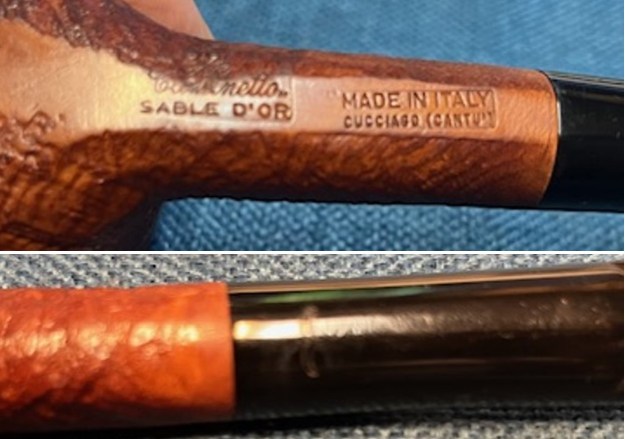
The next pipe on the worktable is a nice looking Caminetto Billiard that we purchased from a seller in Wellsville, Kansas, USA on 12/09/2024. The stamping on the pipe was very clear and readable. On the underside of the shank it reads Caminetto [over] Sable D’Or [followed by] Made in Italy [over] Cucciago (Cantu). The finish was in good condition though it was dusty. The sandblast grain shone through the grime and was beautiful. The pipe appears to have been recently reamed and the bowl was clear briar on the bottom half of the bowl. The rim top was clean though dusty. The inner edge had a burn mark on the inner edge on the right side of the bowl. The stem had a gold Moustache logo on the topside of the saddle. It was dirty and had some light tooth marks and chatter on both sides ahead of the button. It had a lot of potential. Jeff took photos of the pipe as he saw it at this stage of his examination. Jeff took close up photos of the rim top from various angles to show the general condition of the bowl and rim. The photos show the recently reamed bowl and a burn mark on the inner edge on the right side. The acrylic stem was dirty and had light tooth marks and chatter on both sides ahead of the button. Jeff took a photo of the sides and heel of the bowl to give an idea of the beauty of the grain on the heel and sides of the bowl.The stamping on the underside of the shank is clear and readable as noted above. He also took a photo of the Caminetto Moustache logo on the left side of the stem. I turned to Pipephil (http://www.pipephil.eu/logos/en/logo-c1.html) to see what I could learn about the Sable D’Or line and the thin Caminetto Moustache on the stem. Brand created in 1968 by Giuseppe Ascorti († 1984), Luigi Radice and Gianni Davoli as distributor.
  • 1979: End of he first Caminetto period. Luigi Radice left the company. Giuseppe Ascorti produced the Sergio pipes (a short time) and moved into his new workshop with his son Roberto. (See also Capitello)
  • 1986: New Caminetto period by Roberto Ascorti

From the information there I am fairly certain that the pipe was made between 1968-1979 when the first Caminetto period ended. The thin moustache also signals the first Caminetto period. The pipe is probably crafted by Guiseppe Ascorti or Luigi Radice.

From there I turned to Pipedia for more detailed information about the Caminetto brand (https://pipedia.org/wiki/Caminetto). I quote below:

Caminetto’s history started in 1959 when Guiseppe Ascorti, from Cucciago, and known to his friends as “Peppino”, was hired by Carlo Scotti to work at Castello, located in nearby Cantu. Since it’s foundation in 1947 Castello had contributed substantially to regained glory for Italian pipemaking.

Talent and assiduity soon made Ascorti one of Scotti’s most notable pipemakers – a man he counted on for the future. But, Ascorti had his own far reaching plan: He wanted to work as a self-employed pipemaker! After his wife, Paola, had taken over her parent’s small greengrocery in the early 1960’s this plan became more concrete. The additional income from the shop enabled him to buy tools and machines little by little to furnish his own workshop. By the end of 1968 he was ready and left Castello. Ascorti also persuaded his co-worker, the young and highly-talented pipemaker Luigi Radice (born 1939), to join him – the two were neighbors in Cucciago. Carlo Scotti, whom is known as a perfect gentleman, is reported to have spoken unreservedly about this development.

Ascorti & Radice started to manufacture pipes on their own. One of the first who agreed to market their pipes was Gianni Davoli, proprietor of a tobacco shop in Milan. The situation was perfect–two pipemakers in search of a distributor, and a pipe merchant in search of a mainstay brand to market. Davoli – via friends and relations in the States – had made flourishing contacts with US pipe wholesalers and traders. He shipped some pipes across the pond for inspection and received excellent feedback for the very high quality of the pipes. He, shortly after, offered to be the sole distributor worldwide, and Ascorti & Radice happily accepted.

Then came the legendary evening when Ascorti, Radice and Davoli gathered around the fireplace after a hard day’s work enjoying their pipes, a glass of wine, and humorous conversation. Davoli is said to be the one who associated the pipes with the fireplace or chimney, which is “camino” in Italian. Hence “Caminetto”, the diminutive (smaller) singular version of camino, was coined as the brand’s name. Ascorti, Radice and Davoli later became famous as “I tre Camini” – the three chimneys. Maybe, they had more than one glass of wine each, but it’s not certain whether the distinctive mustache logo on the stem and the Caminetto slogan “La Pipa del Baffo” – “the pipe with the mustache” – was created the same night. In fact, Ascorti and Radice both wore impressively large mustaches, and a pharmacist in the neighborhood had been kidding them about that. (Davoli, for reasons of corporate identity, later wore a big mustache, too.)

Now, Davoli concentrated on marketing the Caminetto brand in the United States. His strategy was as simple as it was brilliant. There was a remarkable Castello hype at the time. Castello pipes were highly sought after but hard to get due to limited production. Davoli filled the gap, promoting the Caminetto to be absolutely equal to the Castello in terms of quality, while asking only half the price. And best of all: the Caminetto pipes were consignable! The Tinder Box International would be under contract with successful nationwide distribution. The brand’s success was overwhelming – far beyond any expectation, with the rusticated Business line becoming the most popular.

Ironically enough, the increasing demand soon drove Ascorti and Radice to the limits of their production abilities. The brand had been introduced successfully in Germany, and in Italy to some extent. By the end of 1970 more hands were needed. Even Ascorti’s elder son, Roberto Ascorti (born 1958; and the current owner) helped with stamping and shipping the pipes when he was just a schoolboy. The most important employee is Cesare Vigano, who has worked for Caminetto /Ascorti for more than thirty years. To bring about more stability and higher production, Davoli invested a considerable amount of money in modern pipemaking machinery, and in doing so went from distributor to co-owner of Caminetto. By 1973 he held the vast majority of the company’s capital.

The boom continued strongly – especially in the US. Production increased steadily, from 3,000 to 5,000 and then 7,000 pipes being made per year, placing Caminetto at the top of US sales in their market segment. The 1974 Tinder Box catalog celebrated Gianni Davoli as “master pipe maker and designer” and “sole creator of Caminetto” without a single mention of Ascorti or Radice!

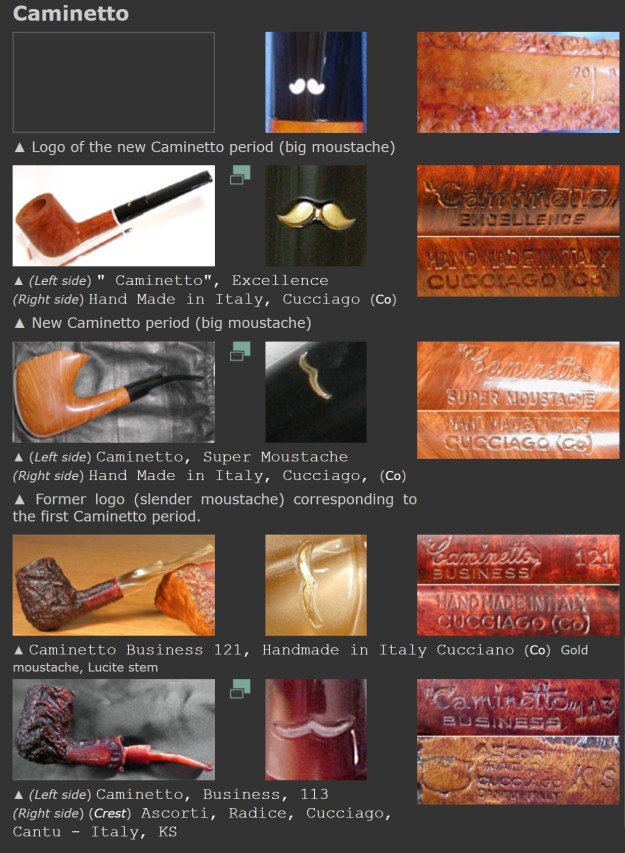
Dating Caminetto pipes is very difficult. However, the way the pipe is stamped can narrow it down some and the look of the mustache logo also helps. Pipedia has a helpful article on the process (https://pipedia.org/wiki/The_History_of_Caminetto_(shapes,_stamping,_articles,_etc.). I quote from it below.

First off, dating earlier Caminetto’s is nearly impossible. Nevertheless, there were three phases, some in which were much earlier, of development that occurred in the stamping process of Caminetto. Before that though, every pipe had the stamp of Caminetto in one of two ways: Caminetto in script or Caminetto within quotation marks in block letters (I do not know how it was decided which pipe got which stamp, as I have had EARLY Caminetto’s with both). The stampings:

1. ASCORTI – RADICE –

CUCCIAGO – CANTU-ITALY

1. HAND MADE IN ITALY

CUCCIAGO (Co)

1. MADE IN ITALY

CUCCIAGO (CANTU)

In addition to the above stampings, there was always the trademark mustache on the stem. The earlier models (1968/69-1974/75) had the iconic gold, sometimes white, “bird-in-flight” moustache and the later models (1975-1979/80/81) had a gold, or white, “double comma” moustache. Tinder Box often stamped their shield on the pipes as well.

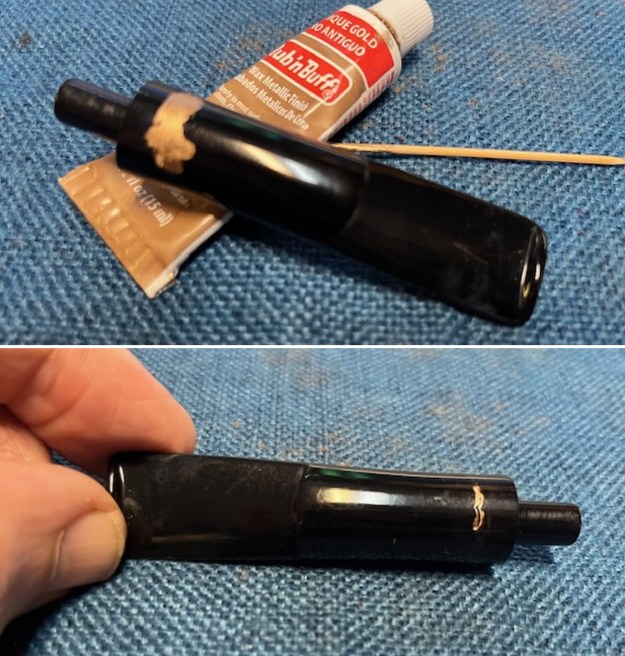
Sable D’Or and Sable D’Or KS, KS1 (black, chestnut, natural, mahogany, red or walnut; sandblast). SABLE D’OR, a rare sandblast finished pipe by Caminetto (note nomenclature, and ‘bird-in-flight’ moustache). Photos courtesy Doug Valitchka Now it was time to work on the pipe. Jeff had done his usual thorough clean up of the pipe. He had reamed it with a PipNet reamer and finished with a Savinelli Fitsall Pipe Knife. He scrubbed the exterior with Murphy’s Oil Soap and the interior with isopropyl alcohol, shank brushes, cotton swabs and pipe cleaners. He worked on the acrylic stem with Soft Scrub then let it soak in Before & After Pipe Stem Deoxidizer. It has a few tooth marks and chatter on both sides. I took photos of the pipe before I started my work. I took some close up photos of the bowl/rim top and the stem to show the condition they were in at this point. The rim top and edges looked good and the bowl was clean. The stem had light tooth marks and chatter on both sides near the button.I took a photo of the stamping on the underside of the shank. It is clear and readable as noted above. I also captured the moustache logo on the top of the saddle stem. I removed the stem from the shank to give a sense of the pipe. I started my work on the pipe by addressing the burned area on the right inside edge of the bowl. I sanded it with a folded piece of 220 grit sandpaper.I worked some Before & After Restoration Balm into the surface of the briar with my finger tips and a shoe brush. The product is amazing and works to clean, enliven and protect the briar. I let it sit on the briar for 10 or more minutes and then buff it off with a soft cloth. It really makes the briar come alive and look quite rich. I set the bowl aside and turned my attention to the stem. I touched up the gold Crown S stamp on the left side o the taper stem with some Rub’n Buff Antique Gold. I worked it into the stamp with a tooth pick and buffed it off with a soft cloth.The chatter and marks were light enough that I polished it with micromesh sanding pads – dry sanding with 1500-12000 grit pads. I wiped the stem down after each pad with a cloth and Obsidian Oil. I finished the polishing with Before & After Pipe Stem Polish – both Fine and Extra Fine. I gave it a final coat of Obsidian Oil. I am excited to put the finishing touches on this Caminetto Sable D’Or Sandblast Billiard with a fancy acrylic saddle stem. I put the pipe back together and buffed it with Blue Diamond on the buffing wheel. I gave the bowl and the stem multiple coats of carnauba wax. I buffed the pipe with a clean buffing pad to raise the shine and hand buffed it with microfiber cloth to deepen the shine. It is fun to see what the polished bowl looks like with the polished black, fancy turned vulcanite stem was beautiful. This Caminetto Sable D’Or Billiard is nice looking and the pipe feels great in my hand. It is light and well balanced. Have a look at it with the photos below. The dimensions are Length: 6 inches, Height: 2 inches, Outside diameter of the bowl: 1 ½ inch, Chamber diameter: ¾ of an inch. The weight of the pipe is 2.15 ounces/61 grams. It is a beautiful pipe and one that I will be putting in the Italian Pipemaker Section on the rebornpipes store. Thanks for walking through the cleanup with me as I worked over this pipe.

New Life for a Caminetto Business KS Hand Made Rusticated Cutty


by Steve Laug

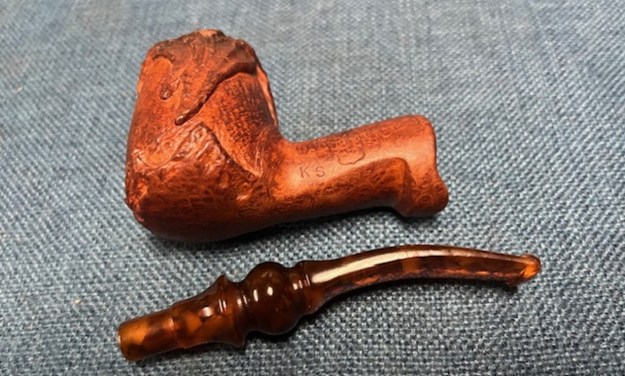
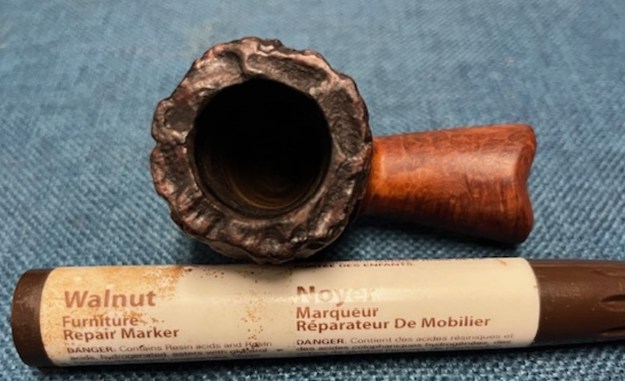
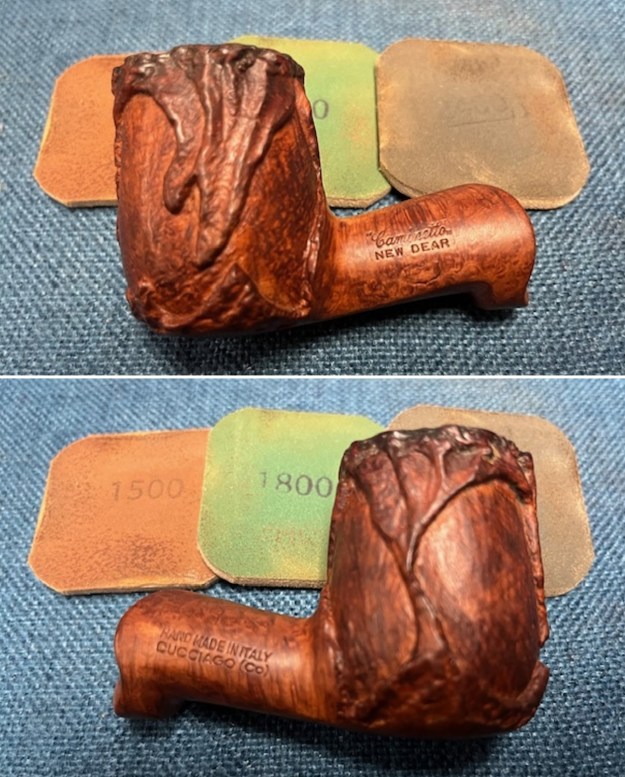
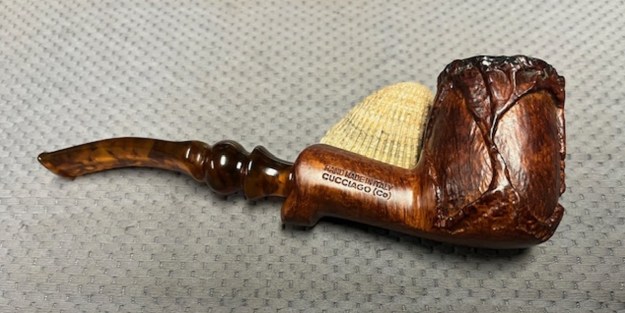
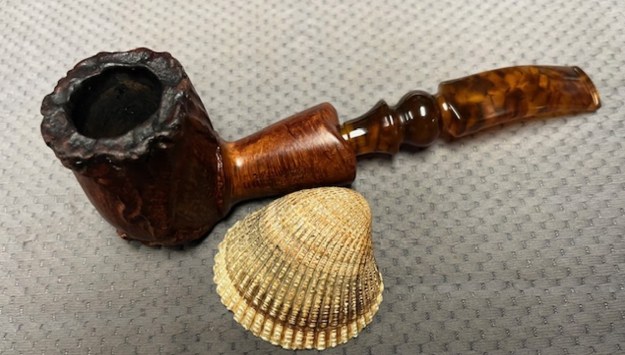
The next pipe on the table is one that we picked up in the lot from an Antique Mall in Hillsboro, Oregon, USA on 08/31/2024. The heavily rusticated finish on this Italian made pipe and the Caminetto stamping are what caught our eye. It is stamped on the left side of the shank and reads KS followed by Caminetto [over] Business. On the right side it is stamped Hand Made In Italy [over] Cucciago (CO). It has a classic Walnut Brown stain on the very rustic finish that is a stark contrast to the golden variegated acrylic stem. The bowl was heavily caked with a thick overflow of lava on the rusticated inner edge and the top. The finish is dirty and there is some oil darkening on the heel of the bowl and up the first third of the bowl. The stem looks very good and has light tooth marks and light chatter on the top and underside ahead of the button. The Caminetto moustache logo was stamped on the topside of the stem and looks to be in good condition. Jeff took some photos of the pipe to show the general condition of the pipe before he started his clean up. He took some photos of the rim top and bowl from various angles to give me a clear picture of the condition of the rim top and bowl. You can see that the pipe has been heavily smoked and that the cake and lava were very heavy. He included photos that show the top and underside of the stem. It is as described above. Jeff took some photos of the sides and heel of the bowl to show the condition of the finish on the pipe. The photos showed some great rustication around the bowl and shank even with the grime in the finish. You can see the darkening in the heel of the bowl. It is a great looking pipe. He took photos of the stamping on the sides of the shank. It was clear and readable as noted above. He also took a photo of the moustache stamp on the top of the stem. I have worked on several Caminetto in the past so I turned to one of the restorations on the rebornpipes blog and reread the background information on the brand. I am including that info here with this restoration (https://rebornpipes.com/2020/04/19/pretty-tired-and-dirty-messy-restoration-of-a-caminetto-business-tomahawk-182/).

When the pipe arrived I turned to Pipephil (http://www.pipephil.eu/logos/en/logo-c1.html) to see if he included not only information on this Caminetto Business 182. He gave some interesting information about the brand. It was created in 1986 by Guiseppe Ascorti, Luigi Radice and Gianni Davoli as the distributor. It states that in 1979 the first Caminetto period ended with Luigi Radice leaving the company. Guiseppe Ascorti continued making the pipe with his son Roberto. In 1986 the New Caminetto period began by Roberto Ascorti.I turned to Pipedia for more information on the Caminetto and how to date the pipe I had in hand (https://pipedia.org/wiki/The_History_of_Caminetto_(shapes,_stamping,_articles,_etc.). I quote a pertinent paragraph:

Stampings and dating: First off, dating earlier Caminetto’s is nearly impossible. Nevertheless, there were three phases, some in which were much earlier, of development that occurred in the stamping process of Caminetto. Before that though, every pipe had the stamp of Caminetto in one of two ways: Caminetto in script or Caminetto within quotation marks in block letters (I do not know how it was decided which pipe got which stamp, as I have had EARLY Caminetto’s with both)…

…Now, the question is which stamps are earlier and more likely to have been made by Ascorti and/or Radice. The answer is #1. The differences in #2 and #3 seem to be minute, as Cucciago is simply a suburb of Cantu. Pipes stamped like #1 are the most valuable Caminetto’s as they are the earliest production of the brand, as well as what some would claim the most perfect of Ascorti and Radice’s work. The last tidbit is, of course, debatable…

… There is also another factor in stamping, that is, which series the pipe falls in. The majority of Caminetto’s one sees are those of the “Business” series, which are stamped such with their collective shape (see photo of shapes below). Another stamp that sometimes follows the “Business” one is “KS,” which from what I know means “King-size” (this could be wrong, as there are pipes stamped with KS1, KS2, and KS3).

The pipe I am working on is stamped like #2 above. Hand Made in Italy [over] Cucciago (Co). It is also stamped KS which means King-size.

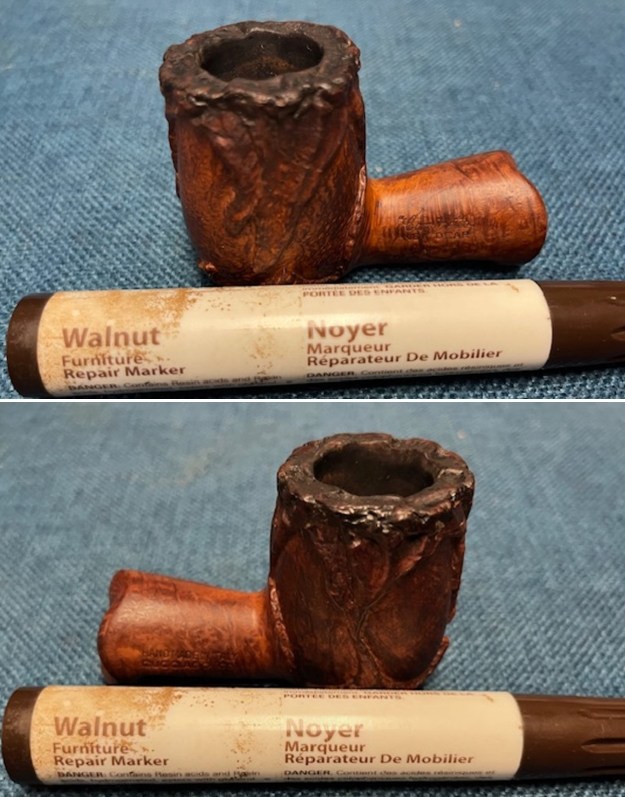
Now it was time to look at it up close and personal. Jeff had done an amazing job in removing all of the cake and the lava on the rim top. He had reamed the bowl with a PipNet Pipe Reamer and cleaned up the remnants with a Savinelli Fitsall Pipe Knife. He took the cake back to bare briar so we could check the walls for damage. He scrubbed the exterior of the bowl with Murphy’s Oil Soap and a tooth brush to remove the grime on the bowl and rim and was able to remove the lava and dirt. He cleaned out the interior of the bowl and shank with pipe cleaners, cotton swabs and alcohol until they came out clean. He cleaned the stem with Soft Scrub to remove the grime on the exterior and cleaned out the airway with alcohol, cotton swabs and pipe cleaners. I took photos of the pipe before I started my part of the restoration. I took close up photos of both the rim top and the stem. Jeff had been able to get the grime and lava off of the rim top and it looked pretty incredible. Even the darkening and marks on the rim top on the right side look much better. The stem looked very clean. The tooth marks and chatter were minimal and predominantly on the underside near the button. They should be easy to remove.The stamping on the sides of the shank were readable as noted above. I took a picture of the moustache stamp on the top of the acrylic stem. I also took a photo with the stem removed to give an idea of the perspective and design of the pipe. I started my work on the pipe by addressing the slight darkening on the top and the edge of the bowl with a brass bristle wire brush. I worked over the darkening in the rustication around the bowl heel with a tooth brush and Before & After Briar Cleaner to remove the darkening on the heel of the bowl and the rim top. I rinsed it with warm water and dried it off with a dry cloth. I rubbed the bowl down with some Extra Virgin Olive Oil (EVO) to enliven the dry rusticated briar. I put it on a paper towel and worked it into the deep rustication. The pipe looks far better. To further enliven the briar I worked some Before & After Restoration Balm into the finish of the bowl and shank with my fingers and a horsehair shoe brush. I want the product to go deep into the finish because it works to clean, enliven and protect the briar. Once I was confident that it was deeply worked into the finish I wiped it off and buffed it with a soft cloth to polish it. The pipe really began to have a rich shine. I took some photos of the bowl at this point to mark the progress in the restoration. The finish on the pipe is beautiful in the photos below. I set the bowl aside and turned to work on the stem. I touched up the moustache stem logo on the top of the stem with white acrylic fingernail polish. It looks much better but it is shallow on the outside edges of the stamp.I sanded the stem with 320-3500 grit sanding pads to remove all of the tooth marks and chatter on the surface ahead of the button on the top and underside. It was looking very good.I polished the acrylic stem with micromesh sanding pads – wet sanding it with 1500-12000 grit pads. I wiped it down with Obsidian Oil after each sanding pad because I find that the oil provides a great surface for polishing with the micromesh pads. I finished polishing it with Before & After Pipe Polish – both the Fine and Extra Fine polishes. I gave it a final coat of oil and set it aside to dry. This Caminetto Business KS Cutty is a real beauty and has a lot of life left. I put the bowl and stem back together again and buffed the bowl and the stem with Blue Diamond on the buffing wheel. I used a soft touch on the rusticated bowl so as not to fill it in with the polishing product. I gave the bowl several coats of Conservator’s Wax and the stem several coats of carnauba wax. I carefully buffed the entire pipe with a clean buffing pad to raise the shine. I finished buffing with a microfiber cloth to deepen the shine. The finished pipe looks very good. The rustication is very tactile and feels great in the hand. It is comfortable and light weight. The finished Caminetto Business Cutty KS is shown in the photos below. The dimensions of the pipe are Length: 6 inches, Height: 2 inches, Outside diameter of the bowl: 1 ¼ inches, Chamber diameter: ¾ of an inch. The weight of the pipe is 31 grams/1.09 ounces. This great looking rusticated Caminetto turned out very well. It should be a great pipe. It will be going on the rebornpipes store in the Italian Pipemakers Section shortly if you are interested in adding it to your collection.

As always, I encourage your questions and comments as you read the blog. Thanks to each of you who are reading this blog. Remember we are not pipe owners; we are pipe men and women who hold our pipes in trust until they pass on into the trust of those who follow us.

Breathing Life into a Lightly Smoked Posella RN Fatta A Mano Rusticated 1/4 Bent Apple


by Steve Laug

I have always been intrigued by heavily rusticated pipes – the look, the weight and the tactile feel of each one is a story in itself. In a conversation with a seller in Ogden, Utah, USA via zoom Jeff and I were able to see this beauty and make a deal. The date we picked it up was 12/12/2024. It is a short compact apple with a full-sized bowl. It is stamped on the underside of the shank and reads Posella RN [over] Fatta A Mano. There is also a stamped crossed horizontal “P” logo on the left side of the fancy saddle stem. The finish was a nicely heavily rusticated with an acrylic thin saddled stem. The pipe had been lightly smoked and there no cake in the bowl and no lava on the rusticated or the smooth portions of the rim top. The stem was dirty with what looked like grime from a softee bit on the stem. You can see the line where the bit had ended. The beauty was that there were not any tooth marks or chatter on the stem surface. Jeff took photos of the pipe before he started his cleanup work on it. I have included them below. Jeff took photos of the rim top and stem to show the general condition of the pipe. The bowl is very clean with some slight darkening in the bowl showing that it may have been smoked only once or twice. The stem looked surprisingly good under the dirt and grime on the surface of the acrylic. It should cleanup very well. Jeff took photos of the bowl sides and heel to show the unique and beautiful rustication that was around this bowl. There was some light grime in the finish but it was quite clean. He took a photo of the underside of the shank to show the stamping. The stamping is clear and readable in the photos below as noted above. He also captured the “crossed horizontal Ps” logo on the left side of the saddle. It in excellent condition. I turned to Pipephil’s site to get a sense of the brand as it is a new brand to me. I had no sense of the details other than it is an Italian pipe (http://www.pipephil.eu/logos/en/logo-p4.html). The photo of the pipe that is included is very different than the one I am working on. The logo on the stem and the shamping on the shank is similar. It was also helpful to see the explanation of the grading on the pipe. In this case the pipe in hand is an “R” meaning rusticated. The “N” is for Natural finish. There were no tier numbers or stars. I have also included the side bar information below the photo below.Artisan: Vitaliano Posella is the son of Salvatore Posella who was a briar cutter. He started making pipes with his brother-in-law, Tonino Jacono and established on his own when Jacono moved to Jesi. Address: Via Umberto I, 183. 88067 San Vito sullo Ionio (Calabria)

I turned to Pipedia to gather some more information on the Posella brand and some history (https://pipedia.org/wiki/Posella). I have included a short piece of information from the site below.

Vitaliano Posella is a pipemaker in San Vito sullo Ionio (Provincia di Catanzaro, Regione Calabria). He found to the handicraft art of pipemaking after having acquired a lot of experience in the briar industry. His pipes are exclusively produced with Calabrian briar.

There was also a link to an article on the Posella Grading system. However, the link is not functioning and locks down. I will include below it as I hope that it will become available soon http://www.theitalianpipe.com/infowell/guides/posella.htm.

I googled for further information and found a link to a site that sells Posella pipes. It also gave a great bit of background to the brand and the pipemaker. Here is the link to the site and the information (https://tabaccherialentofumo.com/en/brand/posella-pipes-en/). I quote that information below.

The Posella family has a long history of sawing on their backs, dedicating themselves to the production of briar for pipes in Calabria, one of the most famous lands for the raw material of our precious products.

Vitaliano Posella has been making pipes for several decades, obviously using briar from the family. For this reason, their pipes are seasoned for at least 10 years, for a high quality in the mechanics and a greater fragance when smoking.

The Posella pipes have a great reception also abroad, in places like China or America. These pipes are manufactured entirely by hand, perforated with great precision, with 100% attention to details to offer a product who lives up the expectations of the demanding and expert smokers.

In hand-made mouthpieces, Posella uses methacrylate for its luster in time and resistance to scratches. In addition, from this material is made the tenon, with a custom work for each pipe.

The way to rustic a pipe is unique and captivating, with a long and meticulous process, making it very particular and valuable, being its baseline. Its forms are classic but with its own interpretation, being a recognizable and suitable style for any type of interested person in the subject.

Now it was time to work on the pipe itself. Jeff had done a great job cleaning up the pipe as usual. He reamed the pipe with a PipNet reamer and cut back the cake back to the bare briar. He cleaned up the walls with a Savinelli Fitsall Pipe Knife. Surprisingly the walls looked unscathed from the heavy cake. He scrubbed the interior of the bowl and shank with pipe cleaners, cotton swabs and alcohol to remove the tars and oils. He scrubbed the exterior of the pipe with Murphy’s Oil Soap and a tooth brush to remove the grime from the finish. He scrubbed the inside of the stem with alcohol and pipe cleaners. He scrubbed the exterior of the stem with Soft Scrub and then soaked it in Briarville’s Deoxidizer. He washed it off with warm water to remove the Deoxidizer. When I examined the stem, it looked very good. The pipe looked far better when it arrived. I took some close up photos of the rim top and edges to show how well it had cleaned up and the edges around the bowl. I also took close up photos of the stem to show the light tooth chatter on the surface ahead of the button on both sides. I took a photo of the stamping on the heel of the bowl. It is clear and readable as noted above. I removed the stem and took a photo of the pipe to have a look at the parts and overall look.I worked some Before & After Restoration Balm into the surface of the briar with my fingertips and a shoe brush to clean, enliven and protect the briar. I let the balm sit for 15 minutes and then buffed with a cotton cloth to raise the shine. The photos show the bowl at this point in the restoration process. I polished the stem with micromesh sanding pads – dry sanding with 1500-12000 grit sanding pads. I wiped it down after each sanding pad with a cloth containing some Obsidian Oil. I finished polishing it with Before & After Pipe Stem Polish – both Fine and Extra Fine and buffed it off with a cotton cloth. This Posella RN Fatta A Mano Rusticated Apple was a pipe I was looking forward to seeing what it looked like when I put it back together. With the grime and debris gone from the finish and the bowl it was a beauty and the depths of the rustication just pop at this point. I put the acrylic stem back on the bowl and lightly buffed the pipe with Blue Diamond on the buffing wheel. I carefully avoided the stamping on the shank and stem during the process. I gave the bowl multiple coats of Conservator’s Wax and the stem multiple coats of carnauba wax on the buffing wheel and followed that by buffing it with a clean buffing pad on the buffer. I hand buffed the pipe with a microfiber cloth to deepen the shine. The finished pipe is quite beautiful and is a lovely large bowl apple shaped pipe. The natural colour of the rusticated briar is very well chosen and shows depth in the finish. Give the finished Posella RN Rusticated Apple a look in the photos below. I can only tell you that it is much prettier in person than the photos capture. The dimensions of the pipe are Length: 5 inches, Height: 1 ¾ inches, Outside diameter of the bowl: 1 ¼ inches, Chamber diameter: ¾ of an inch. The weight of the pipe is 63 grams/2.22 ounces. I really like the unique rustication around the bowl and shank. This is a great looking pipe in great condition. Thanks for walking through the restoration with me as I worked over another beautiful pipe. I may hold onto this one – at least for awhile! Thanks for your time.

Cleaning up an Ascorti Oak Sandblast Apple


by Steve Laug

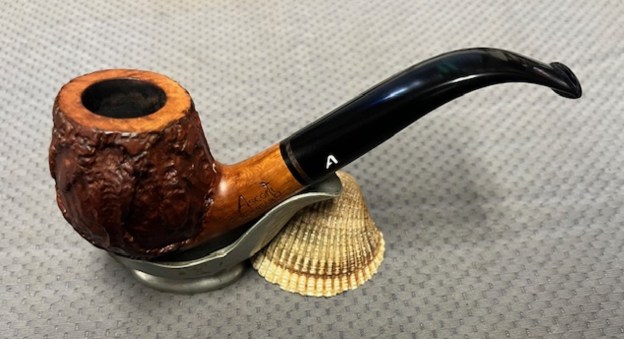
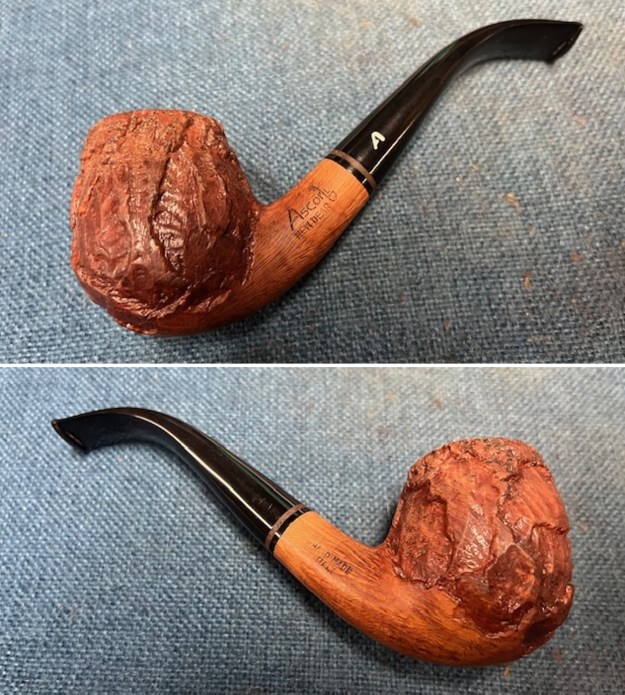
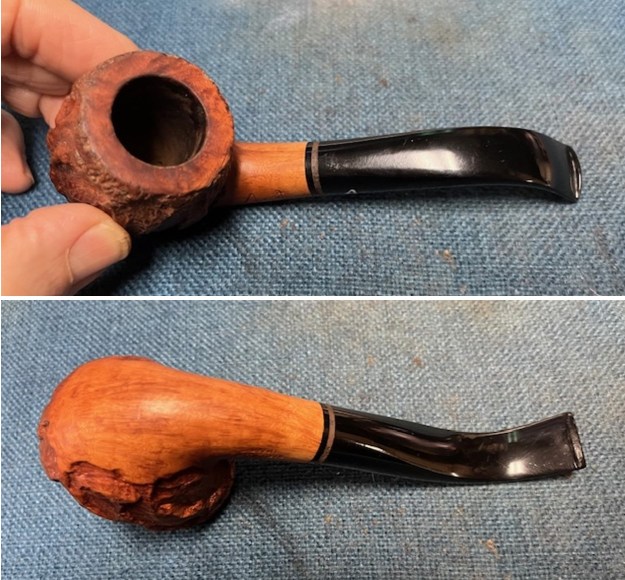
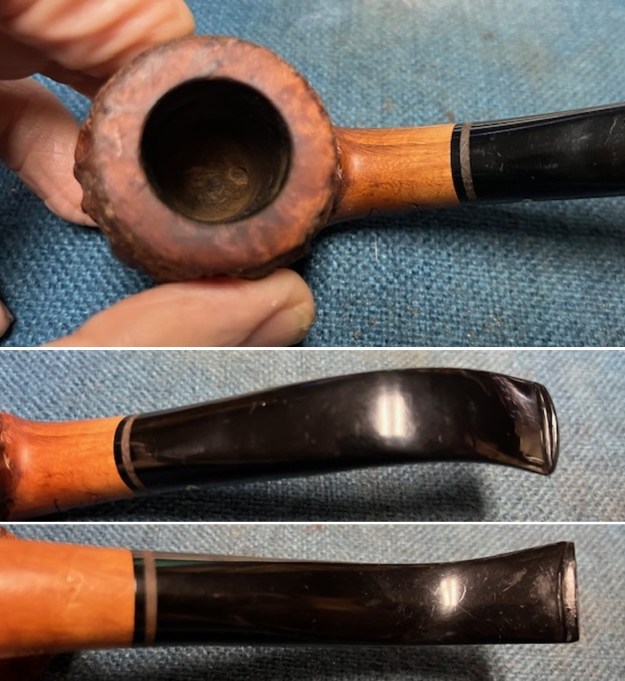
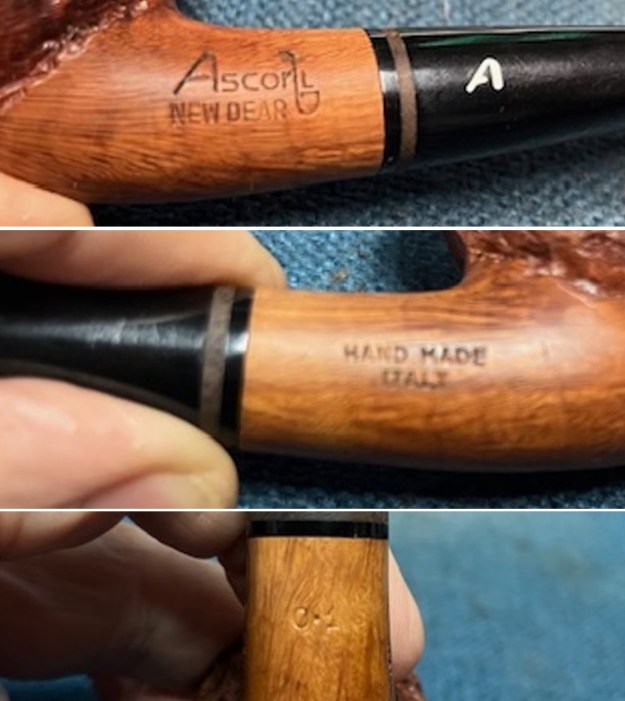
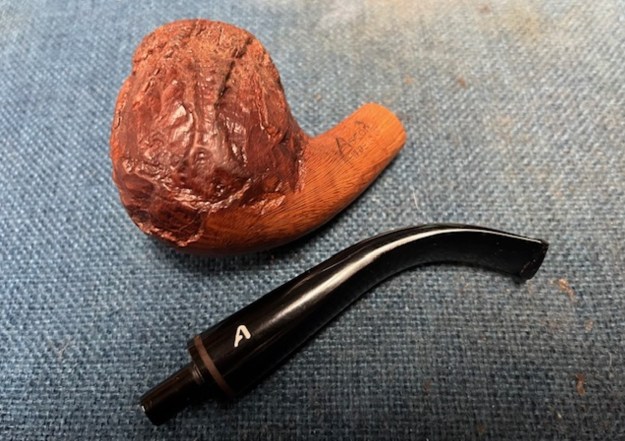
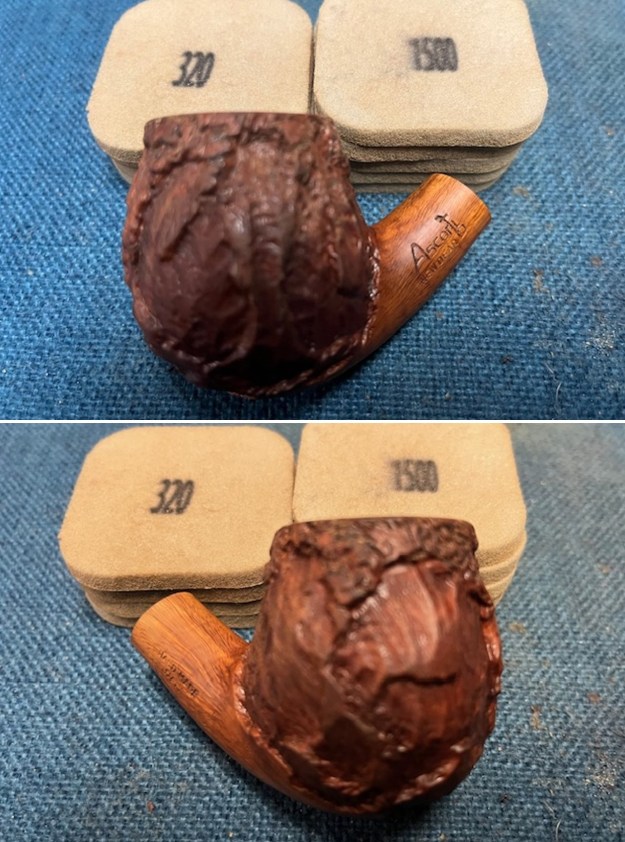
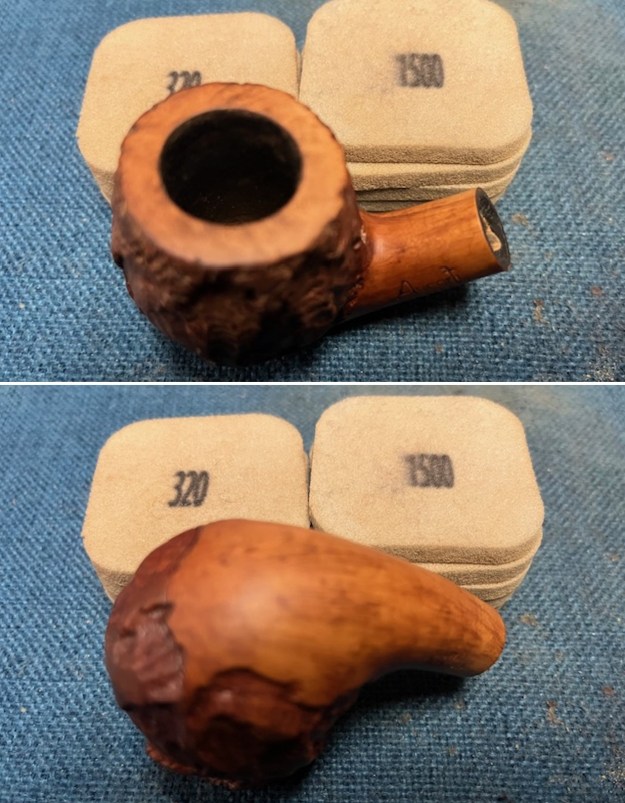
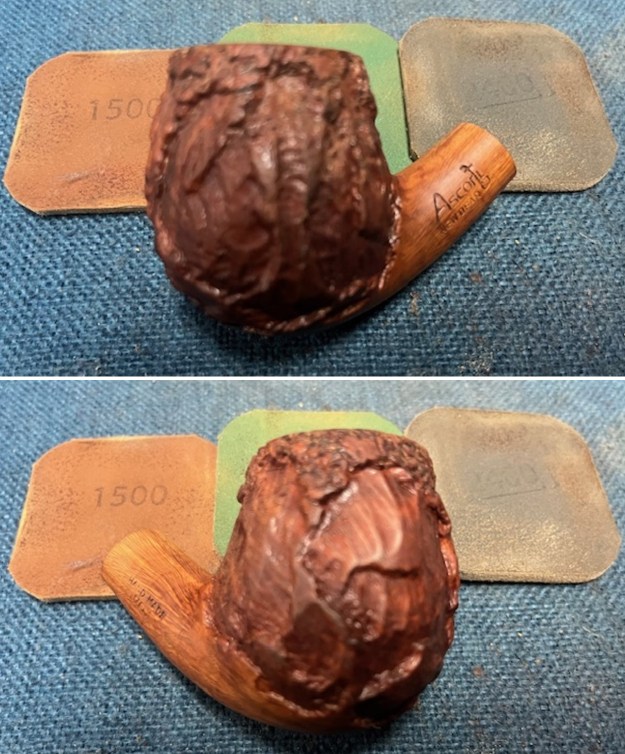
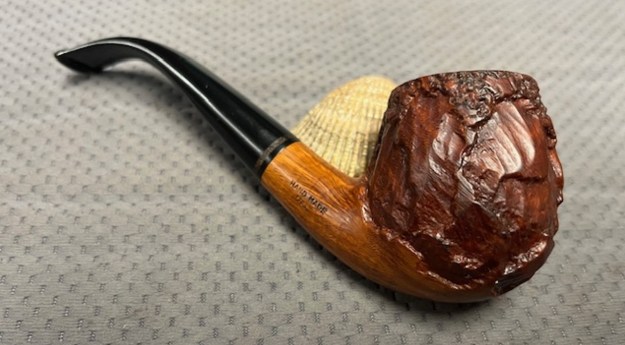
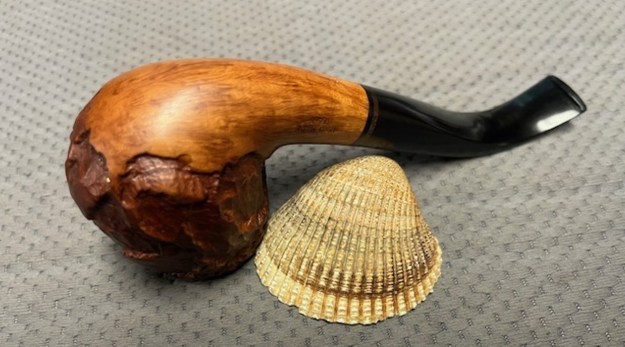
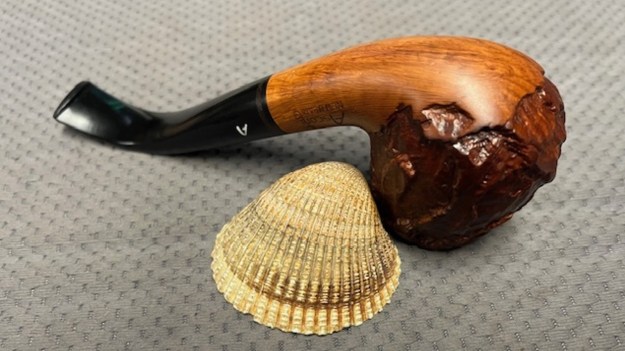
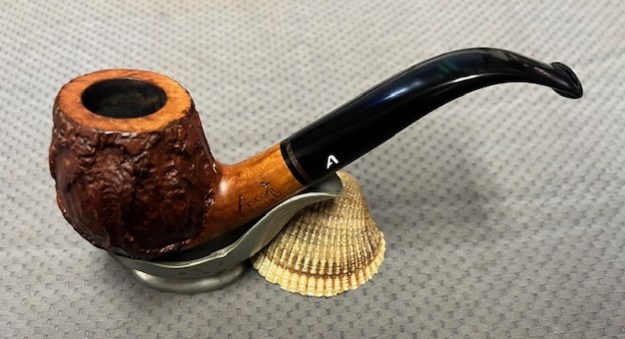
I have always been intrigued by Morta pipes – the look, the weight and the sense of age that each one carries as a block of bog oak. In a conversation with a seller in Ogden, Utah, USA via zoom Jeff and I were able to see this beauty and make a deal. The date we picked it up was 12/12/2024. It is a short compact apple with a full-sized bowl. It is stamped Ascorti followed by Oak on the heel of the bowl and the shank. There is also an inlaid Ascorti “A” logo on the left side of the saddle stem. The finish was a nicely grained sandblast apple with an acrylic saddle stem. The pipe had been smoked and there was a moderate cake in the bowl and some lava on the inward bevel of the rim top. The stem was dirty with what looked like grime from a softee bit on the stem. You can see the line where the bit had ended. The beauty was that there were not any tooth marks or chatter on the stem surface. Jeff took photos of the pipe before he started his cleanup work on it. I have included them below. Jeff took photos of the rim top and stem to show the general condition of the pipe. The bowl is moderately caked and there is a light lava overflow on the rim top. The stem looked surprisingly good under the dirt and grime on the surface of the acrylic. It should cleanup very well. Jeff took photos of the bowl sides and heel to show the sandblast grain that was around this bowl. You can see the grime but the grain showing through the sandblast bowl is beautiful. He took a photo of the heel of the bowl to show the stamping. The stamping is clear and readable in the photos below as noted above. He also captured the “A” logo on the left side of the saddle. It in excellent condition.I did a Google search on the Ascorti Oak line and came up with very little. They seemed to sell between $285 – $375 new though I found only one currently for sale at Mars Cigars and Pipes (https://www.marscigars.com/ascorti-oak.aspx). Further searching came up with a single line in the search on the Ascorti Oak came up with a simple sentence that gave information concerning the “Oak”. I quote: The former is a variety of oak, felled and fossilized over thousands of years in peat bogs (hence its other common name, bog oak).

All of that is helpful information. There were not many Ascorti Oak pipes readily available. The pipes were made of a variety of “felled and fossilized oak over 1000s of years in a peat bog” which accounts for the name bog oak.

From there I turned to the Ascorti section on Pipephil’s site to see if there was any information on the Oak line (http://www.pipephil.eu/logos/en/logo-a8.html). There was nothing shown on that in section on Ascorti but the information on the brand and short summary of history was helpful. I have included a screen capture of the section and the side bar information below.Brand established in 1980 by Roberto Ascorti (born 1958), son of Giuseppe aka Peppino. See Caminetto. Production (2007): ~ 1500-2000 pipes/year

I turned from there to Pipedia for more information (https://pipedia.org/wiki/Ascorti). I have included pertinent sections of the article as well as a photo of the Ascorti brothers. It is interesting and helpful.

Roberto Ascorti, now 49, son of Giuseppe Ascorti, best known as “Peppino”, “met” the pipe when he was 10 years old, back in 1968, when his father started the new adventure as pipemaker.

He attended the Art Institute, but he continued with his passion for the pipe and decided to assist his father more and more. In 1980, when he was 22, Roberto decided to devote himself completely to creating pipes, but there was no room in his father’s factory; so he started by himself with his own name, ASCORTI, supported and helped by his father, his brother Pierangelo and by his girlfriend, Silvana. Then, when the historic Caminetto factory closed, its artisans entered the newborn Ascorti which had all the tradition, the experience, the power and quality that Peppino Ascorti had built in several years, but with innovations in the model making and in the technical solutions, brought by the young Roberto.

During those years Roberto suffered the early passing of his father and his brother. But with the help of his wife, Silvana, always by his side, he continued with love and experience to compete with a market which is extremely variable and ruled by accelerations(?) of the changes. Roberto is able to change the style of his design by revising old shapes, personally checking the progress and working side by side with his precious artisans.

Briar is personally selected by Roberto who controls the quality, dimensions, weight and the first seasoning, which is very important and done in the area where it is collected and cut. After the first scrupulous control, the briar is then aged for two years, to reach the seasoning that he thinks is perfect to create a pipe. Each pipe is designed by Roberto and it is initially crafted with small machines, made by hand by his father Peppino, with the help of his son, back in the 70’s. They are perfect to allow different processes as the artisanal tradition requires.

After the drilling of the bowl and shank, the pipe passes through an interminable series of handmade steps done only by Roberto and the irreplaceable Cesare (already aside of Peppino in 1968).

The mouthpiece, made in methacrylate (acrylic) is also completely handmade, obtained in sheets which are cut into bars, then drilled and shaped with files and sandpaper. There are 90 steps to the procedure, small or large, but everyone important, that Roberto requires before he considers his creations finished and ready to be shown to the customer.

I think that the love that Roberto flows into his pipes, absorbed by the workers and relatives, is perfectly understood by smokers all around the world, who never fail to give us satisfaction with praise and public or private lauds.

Jeff had done a great job cleaning up the pipe as usual. He reamed the pipe with a PipNet reamer and cut back the cake back to the bare briar. He cleaned up the walls with a Savinelli Fitsall Pipe Knife. Surprisingly the walls looked unscathed from the heavy cake. He scrubbed the interior of the bowl and shank with pipe cleaners, cotton swabs and alcohol to remove the tars and oils. He scrubbed the exterior of the pipe with Murphy’s Oil Soap and a tooth brush to remove the grime from the finish. He scrubbed the inside of the stem with alcohol and pipe cleaners. He scrubbed the exterior of the stem with Soft Scrub and then soaked it in Briarville’s Deoxidizer. He washed it off with warm water to remove the Deoxidizer. When I examined the stem, it looked very good. The pipe looked far better when it arrived. I took some close up photos of the rim top and edges to show how well it had cleaned up and the edges around the bowl. I also took close up photos of the stem to show the light tooth chatter on the surface ahead of the button on both sides.I took a photo of the stamping on the heel of the bowl. It is clear and readable as noted above. I removed the stem and took a photo of the pipe to have a look at the parts and overall look.I worked some Before & After Restoration Balm into the surface of the briar with my fingertips to clean, enliven and protect the bog oak. I let the balm sit for 15 minutes and then buffed with a cotton cloth to raise the shine. The photos show the bowl at this point in the restoration process. I polished the stem with micromesh sanding pads – dry sanding with 1500-12000 grit sanding pads. I wiped it down after each sanding pad with a cloth containing some Obsidian Oil. I finished polishing it with Before & After Pipe Stem Polish – both Fine and Extra Fine and buffed it off with a cotton cloth. This Ascorti Oak Sandblast Straight Apple was a pipe I was looking forward to seeing what it looked like when I put it back together. The pipe was a beauty and the grain of the bog oak and the sandblast depths just pop at this point. I put the stem back on the bowl and buffed the pipe with Blue Diamond on the buffing wheel. I carefully avoided the stamping on the shank and stem during the process. I gave the bowl and the stem multiple coats of carnauba wax on the buffing wheel and followed that by buffing it with a clean buffing pad on the buffer. I hand buffed the pipe with a microfiber cloth to deepen the shine. The finished pipe is quite beautiful and is a lovely large bowl straight apple shaped pipe. The dark colour of the Morta/Bog Oak and the sandblast give it depth. It is very well done. Give the finished pipe a look in the photos below. I can only tell you that it is much prettier in person than the photos capture. The dimensions of the pipe are Length: 5 inches, Height: 1 ½ inches, Outside diameter of the bowl: 1 ½ inches, Chamber diameter: ¾ of an inch. The weight of the pipe is 63 grams/2.22 ounces. I really like the way that Ascorti follows the grain in the bog oak with the sandblast. This is a great looking pipe in great condition. Thanks for walking through the restoration with me as I worked over another beautiful pipe. I will be adding it to the rebornpipes store in the Italian Pipe Makers Section soon. If you want to add it to your collection send me an email or a message! Thanks for your time.

Restoring an interesting Nameless Silver Spigot Bent Acorn


by Steve Laug

The next pipe on the work table came to us from a group of pipes we purchased on 02/29/2024 from a seller from Spring Branch, Texas, USA. It is a nice looking richly stained acorn shaped pipe with a stick bit silver tipped stem. The bowl has a dark reddish brown colour stain that highlights grain. There are also a lot of lighter coloured fills around the bowl and shank. I am hoping to mask these a bit in the clean up. This pipe has no stamping on the shank or the stem. There is a stamped Silver [over] 925 on both the band/ferrule and the silver tip on the stem. There is no other stamping. The bowl had been reamed and but then smoked so there was a light cake in the bowl and some lava on the top and edges of the rim top. The Sterling Silver ferrule and stem tip is oxidized and dark. The stem is black acrylic and there were some light tooth marks and chatter on both sides near the button. The pipe looks to be in good condition under the grime. This is a nice looking pipe and in a well-loved shape. Jeff took photos of the pipe before he started his cleanup. He took a photo of the bowl and rim top to show their general condition. You can see the lava, scratches and nick marks on the rim top and the light cake in the bowl. The bevelled inner edge of the bowl looks to be okay. The stem is acrylic and dirty and there are tooth marks and chatter on both sides near the button. The silver ferrule and stem tip is also oxidized and almost black. Jeff took some photos of the sides and heel of the bowl to give an idea of the grain around the bowl as well as the number of putty fills. I cannot wait to see what it looks like once it is cleaned and polished. Should be interesting to minimize the visual prevalence of the fills. He captured the stamping on the silver ferrule and stem tip in the next photos. Even through the oxidation they are clear and readable. It really amazes me that a pipe with silver shank and stem adornments has no name stamped on it and that a pipe with these many fills would even bother with the silver. Ah well….Jeff carefully cleaned the pipe. He reamed it with a PipNet pipe reamer and then cleaned up the reaming with a Savinelli Fitsall Pipe Knife. He scrubbed out the internals of the shank, stem and shank extension with alcohol, pipe cleaners and cotton swabs until the pipe was clean. He scrubbed the exterior of the bowl with Murphy’s Oil Soap and a tooth brush to remove the grime and grit on the briar and lava on the rim top. The finish looks much better and has a deep richness in the colour that highlights grain of the briar. The rim top had some damage to the around the entire top of the bowl. The silver ferrule and stem tip were oxidized but clean. Jeff worked the acrylic stem over with Soft Scrub All Purpose Cleaner to remove any grime or debris in the bite marks and on the surface. When the pipe arrived here in Vancouver and I finally started my work on it I was amazed it looked so good. Here are some photos of what I saw. I took some photos of the rim top and stem. The rim top and inner edge of the bowl shows damage and nicked spots. The close up photos of the stem shows that the surface of the stem is pitted. There are tooth marks and chatter on the top and underside of the stem near the button. I removed the stem from the shank and took a photo of the pipe at this point. You can clearly see the condition, size and shape of the pipe.To start my work on the pipe I decided to wipe it down with acetone to remove some of the darker portions of the stain and try to blend in the fills to the lighter colour once it was finished. I wiped the bowl down with acetone on cotton pads. I really like the way it came out. Have a look. I sanded out the scratches in the briar around the bowl sides and rim top with 320-3500 grit sanding pads. I wiped it down after each pad with a damp cloth to remove the sanding debris. The sanding really brought the grain to the front and blended in the marks of the fills. This is a great piece of briar. And once it is waxed and polished it should really be a beauty. I polished the briar with micromesh sanding pads – dry sanding with 1500-12000 grit pads and wiping down the bowl after each sanding pad.  I touch up some of the lighter spots on the shank/bowl junction and rim top with a Mahogany stain pen to match the rest of the bowl. Once it dried I hand buffed it and the restained areas looked very good. I rubbed the bowl and shank down with Before & After Restoration Balm. I worked it into the surface of the bowl sides and shank with my fingertips to clean, enliven and protect the briar. I let the balm sit for a little while and then buffed with a cotton cloth to raise the shine. The Balm did its magic and the grain stood out. I sanded out the tooth marks on the stem surface with a folded piece of 220 grit sandpaper to remove and smooth out the marks.I sanded out the scratch marks on the stem surface with 320-3500 grit sanding pads. I wiped the stem down after each pad with an Obsidian Oil cloth. The stem began to shine.I polished the vulcanite stem with micromesh sanding pads – 1500-12000 grit pads. I wiped it down with Obsidian Oil after each sanding pad. I used Before & After Pipe Polish – both Fine and Extra Fine to further polish the stem. The photo below shows the polished stem. This No Name Bent Acorn with the Silver Spigot with an acrylic stem is a nice looking pipe. The finish looks very good and the grain stands out. I put the stem back on the bowl and buffed the pipe with Blue Diamond on the buffing wheel. I carefully avoided the stamping on the shank sides during the process. I gave the bowl and the stem multiple coats of carnauba wax on the buffing wheel and followed that by buffing it with a clean buffing pad on the buffer. I hand buffed the pipe with a microfiber cloth to deepen the shine. The flow of the grain and the way the shape follows it is very well done. Give the finished pipe a look in the photos below. I can only tell you that it is much prettier in person than the photos capture. The dimensions of the pipe are Length: 5 ½ inches, Height: 2 inches, Outside diameter of the bowl: 1 ¼, Chamber diameter: 7/8 of an inch. The weight of the pipe is 1.52 ounces/42 grams. This interesting No Name Bent Acorn Silver Spigot is a great looking pipe in excellent condition. Thanks for walking through the restoration with me as I worked over another beautiful pipe. I will be adding it to the rebornpipes store in the American Pipe Makers Section soon. If you want to add it to your collection send me an email or a message! Thanks for your time.

Restoring a Ben Wade Martinique Plateau Top Freehand


by Steve Laug

Today I am working on a Ben Wade Martinique Handmade in Denmark Freehand with silver/grey acrylic stem. Jeff and I picked it up in an estate we purchased from a seller in Santa Cruz, California, USA on 05/28/2024. It is very nice looking piece of briar and has fancy saddle stem. The pipe is stamped on the underside of the shank. It was clear and readable. It reads Ben Wade [over] Martinique [over] Hand Made [over] in [over] Denmark. The medium brown stained finish was very dirty with grime ground in the finish all over the whole bowl and shank. The mix of smooth and plateau rim top and plateau shank end are dirty with lava and darkening in the grooves of the plateau. The bowl had a thick cake and the rim top/inner edge had thick lava flowing up from the bowl. It was hard to know its full condition of the inner edge with certainty until it was cleaned. The acrylic saddle stem is was dirty and had light tooth marks and chatter on both sides ahead of the button. There was a BW Crown logo on the top of the stem. Jeff took photos of the pipe before he started his clean up work on it. He took photos of the bowl and rim top to show the thickness of the cake and the darkening and lava overflow in the plateau rim top. The photos of the stem show the dirty condition of the stem and the tooth marks on both sides ahead of the button. The photos of the sides and heel of the bowl show the great grain on the pipe. It is a beauty under the grime and dust. The stamping on the underside of the shank is shown in the photos below. It is clear and readable as noted above.I remembered a bit of history on the brand that Preben Holm pipes were marketed under the Ben Wade label in the US and imported through Lane Ltd. I turned to Pipedia and read the listing on the brand to refresh my memory and flesh out the knowledge of the brand and would encourage you to do the same (https://pipedia.org/wiki/Ben_Wade). I have included a photo from that site that was taken from a Tinderbox advertisement. (Ben Wade Ad in a Tinder Box catalog, courtesy Doug Valitchka.)I quote the portion of the article that summarizes the Danish period of the history of the brand:
Young Copenhagen master pipemaker Preben Holm had made a meteoric career heading a pipe manufacture employing 45 people at the age of 22! But around the turn of 1970/71 he was in major financial difficulties. His US distributor, Snug Harbour Ltd. in New York City, left him in the lurch. Holm had three unpaid invoices on his desk and another large shipment was ready for the USA, when Snug Harbour’s manager told him on the phone that there was no money at all on the account to pay him.

So the Dane went to New York for an almost desperate search for a new distribution partner. He made contacts with Lane Ltd. and met Herman G. Lane in February 1971. Lane Ltd. had no interest in Holm’s serial pipes produced at that time but so much the more in the hand-carved freehands because the hype for Danish freehands and fancies in the States was still on its way to the climax then. The meeting resulted in an agreement to start a cooperation. Lane insisted to improve the quality considerably and in return he assured to be able to sell essentially larger quantities.

Holm went back home to work on new samples with all-new designs and altered finishes for Lane. Both, Lane and Holm, agreed that it would be unwise to sell the pipes under Preben Holm’s name as long as Snug Harbour had a considerable stock of Preben Holm pipes and might sell them pipes at very low prices just to bring in some money.
So on Mr. Lane’s proposal it was determined to use the name Ben Wade belonging to Lane Ltd. Lane spent considerable amounts of money for advertising the new brand in the big magazines– the centerpiece being whole-page ads showing a very exclusive Seven Day’s Set.

The cooperation with Lane Ltd. proved to be an eminent business success for both partners. Within a very short time Ben Wade Handmade Denmark sold in much larger quantities and at higher prices than they had ever dreamed of. And the hype these freehands and fancy pipes caused went on unbroken long after Herman G. Lane deceased. Preben Holm – obviously much more brilliant in pipe making than in pipe business – was in major troubles again in 1986 and had to sack most of his staff. The Ben Wade production was significantly lowered but continued until his untimely death in June of 1989.

Up to now Preben Holm made Ben Wade pipes are cult and highly sought for on the estate markets.

With that information my initial thoughts were confirmed. This pipe was a Preben Holm made Freehand distributed in the US by Lane Ltd under the name Ben Wade. The freehand rage occurred in the late 70s and the pipes were made until Preben’s death in 1989. My guess would be that this pipe was made sometime during that time period and potentially in the late 70s.
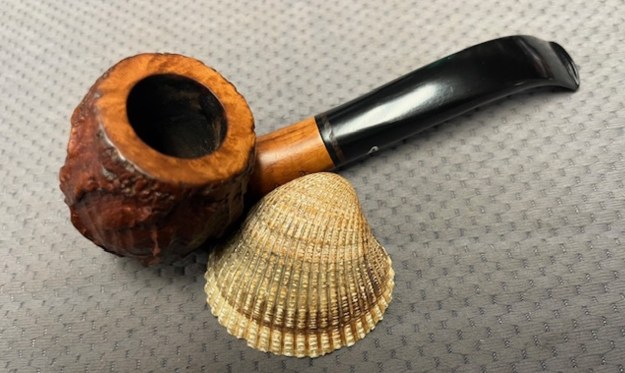
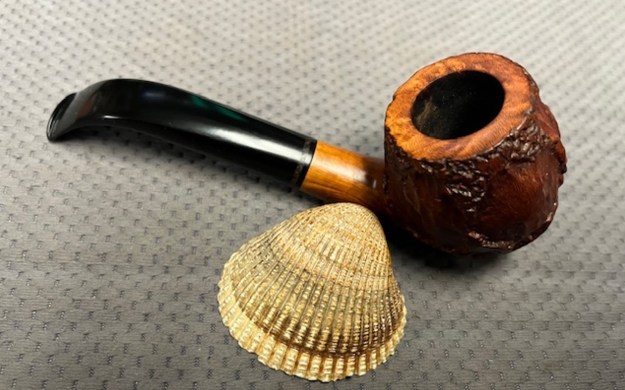
Jeff had cleaned up the pipe with his usual penchant for thoroughness. He reamed the pipe with a PipNet Pipe Reamer and cleaned up the remnants with a Savinelli Fitsall Pipe Knife.  He scrubbed the bowl with undiluted Murphy’s Oil Soap with a tooth brush. He rinsed it under running warm water to remove the soap and grime. He cleaned out the inside of the shank and the airway in the stem with alcohol, cotton swabs and pipe cleaners. He scrubbed the stem with Soft Scrub and cotton pads to remove the debris and oils on the stem. He rinsed it with warm water and dried it off. I took photos of the pipe once I received it. I took a photo of the rim top. Jeff had been able to remove the thick lava coat from the plateau rim top and inner edge. It looks very good at this point. A work over with a brass bristle wire brush will remove the remaining darkening in the grooves. The plateau on the shank end is clean and looks very good. The stem is clean but has some the tooth marks on both sides.I took photos of the stamping on the underside of the shank. It is faint but still readable as noted above. I took a photo of the pipe with the stem removed to get a sense of what the pipe looked like.I started my work on the pipe by addressing the debris still in the plateau rim top. I used a brass bristle wire brush to clean up the plateau on the top and shank end. It worked very well and the plateau looked significantly better once finished.I polished the briar with micromesh sanding pads – dry sanding it with 1500-12000 grit pads. I wiped the bowl down after each sanding pad with a damp cloth to remove the dust and debris from the surface of the briar. I worked some Before & After Restoration Balm into the surface of the briar with my fingertips and into the plateau with a shoe brush. The product works to clean, preserve and protect the briar. I let it sit and work into the briar for 10 minutes then wiped it off with a cotton cloth. I buffed the briar with a clean cloth. The bowl is starting to look beautiful and there is a shine developing. I set the bowl aside and turned my attention to the stem. I sanded out the tooth marks with 220 grit sandpaper and started polishing the stem with 320-3500 grit sanding pads. I wiped it down after each pad a damp cloth to remove the sanding debris. I touched up the Crown BW logo on the top of the stem with Antique Gold Rub’n Buff. I worked it into the stamp with a tooth pick. I buffed it off with a soft cloth and rubbed the stem down with some Obsidian Oil.I polished the stem surface 1500-12000 grit micromesh sanding pads. I dry sanded the stem with each pad and then wiped the stem down with some Obsidian Oil. I finished the hand polishing of the stem with Before & After Pipe Polish – both the Fine and Extra Fine polishes. I gave it a final coat of oil and set it aside to dry. I am really happy with the way that this Preben Holm made Ben Wade Martinique Danish Made Freehand turned out. It really is a beautiful looking pipe with a great shape and smooth finished bowl and plateau on the rim top and shank end. The fancy original acrylic saddle stem is really nice. The polished black/silver of the stem works well with the briar and the plateau portions. The briar really came alive with the buffing. The rich brown stains of the finish gave the pipe a sense of depth with the polishing and waxing. I put the stem back on the bowl and carefully buffed the pipe with Blue Diamond on the buffing wheel using a light touch on the briar. I gave the bowl and the stem multiple coats of carnauba wax on the buffing wheel. I buffed the pipe with a clean buffing pad to raise the shine. I hand buffed the pipe with a microfiber cloth to deepen the shine. The finished Ben Wade Martinique really is a beauty and feels great in the hand and looks very good. Give the finished pipe a look in the photos below. The dimensions of the pipe are Length: 7 inches, Height: 2 inches, Outside diameter of the bowl: 2 inches long x 2 inches wide, Chamber diameter: 1 inch. The weight of the pipe is 59 grams/2.08 oz. The pipe will be going on the rebornpipes store soon. It will be in the section on Danish Pipe Makers Section if you would like to add it to your collection. Thanks for reading this blog and my reflections on the pipe while I worked on it. It was a fun one to work on!

As always, I encourage your questions and comments as you read the blog. Thanks to each of you who are reading this blog. Remember we are not pipe owners; we are pipe men and women who hold our pipes in trust until they pass on into the trust of those who follow us.