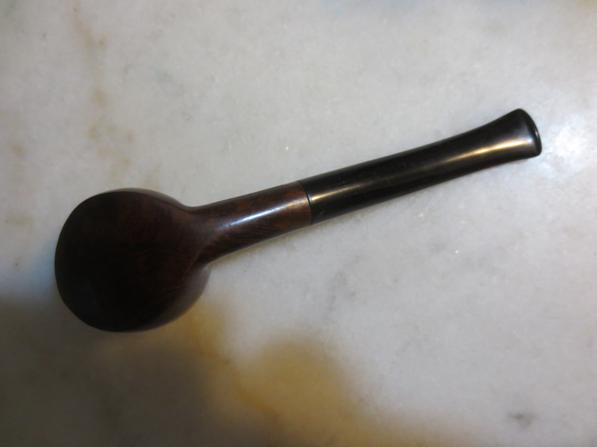
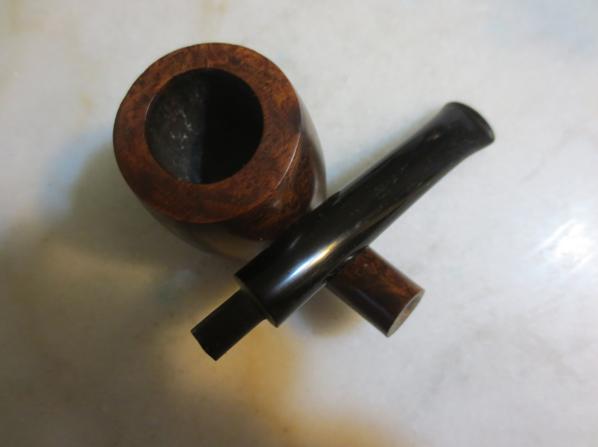
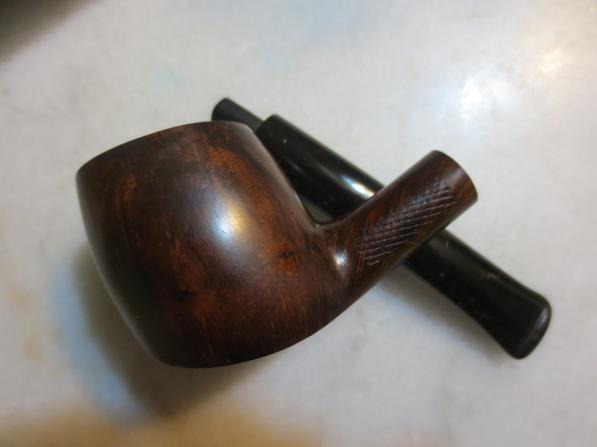
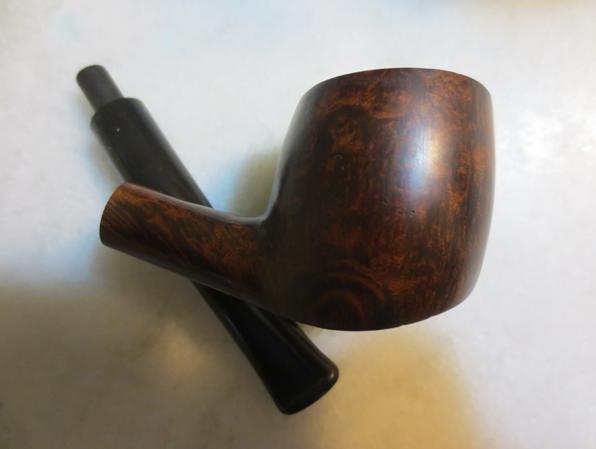
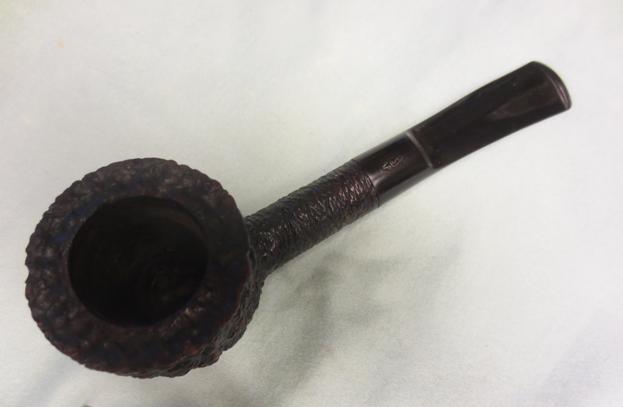
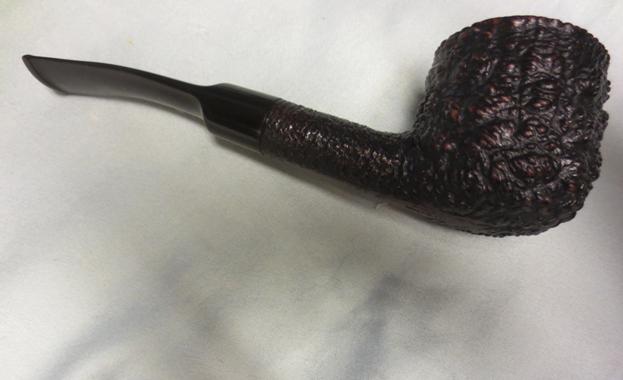
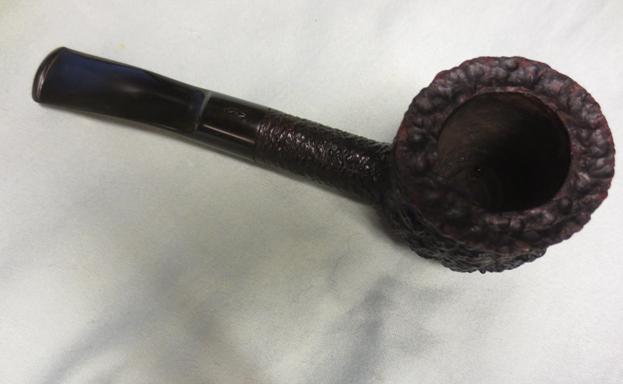
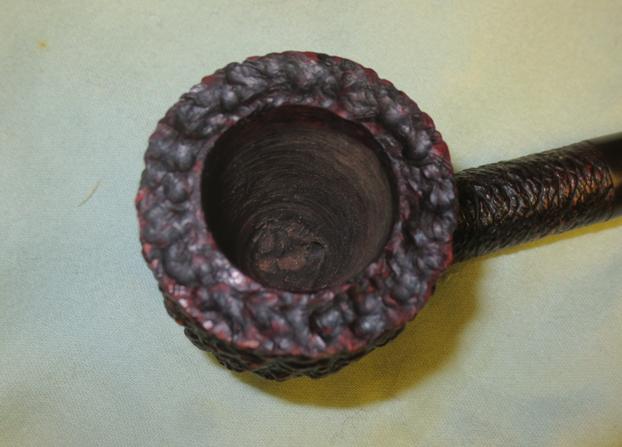
Tag Archives: pipe refurbishing

Cleaning an American Made Selected Bulldog


Blog by Steve Laug

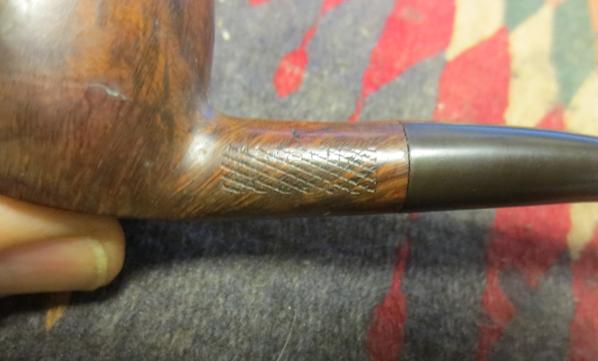
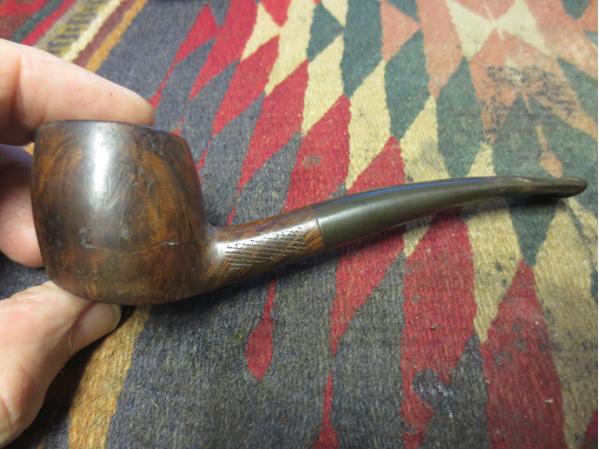
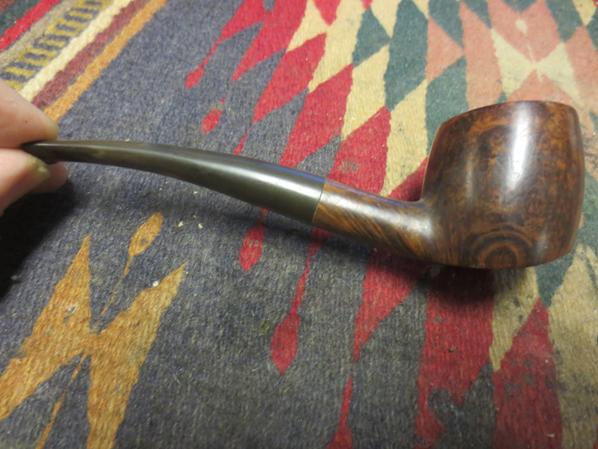
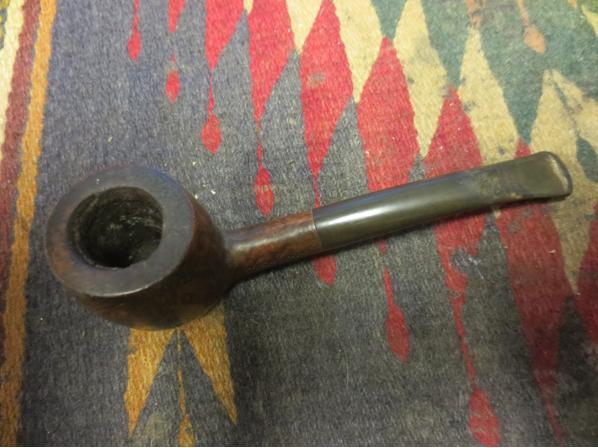
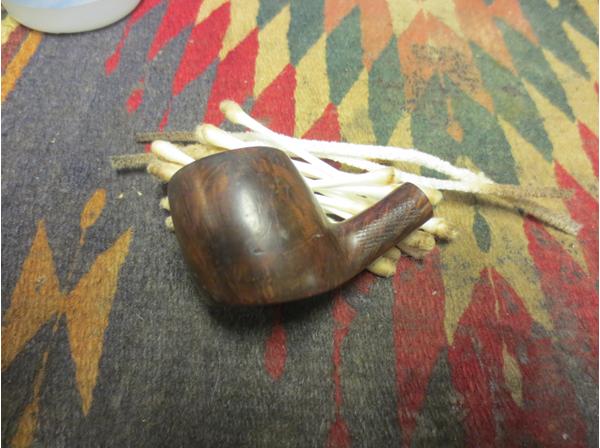
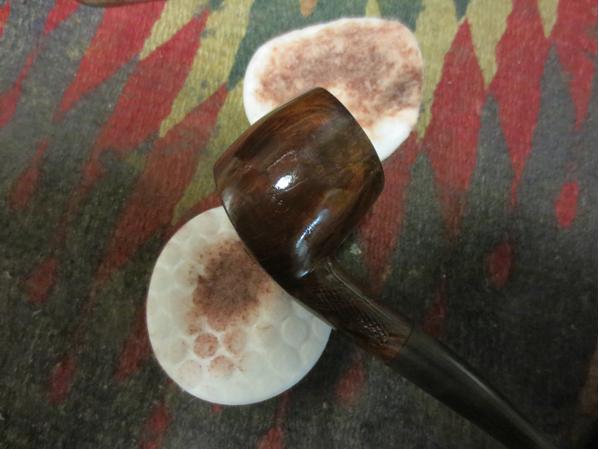
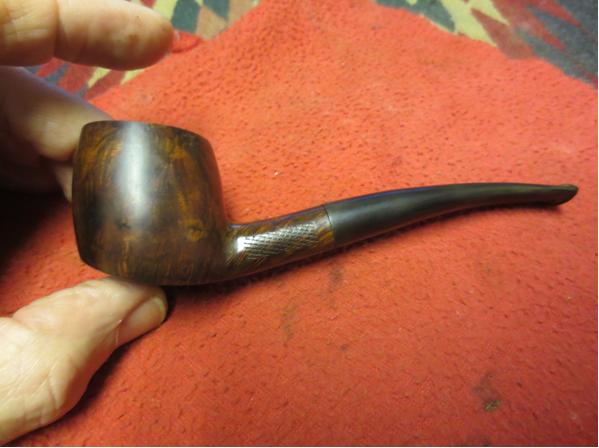
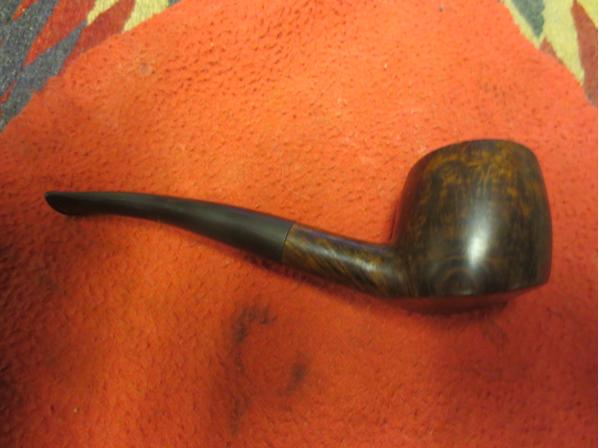
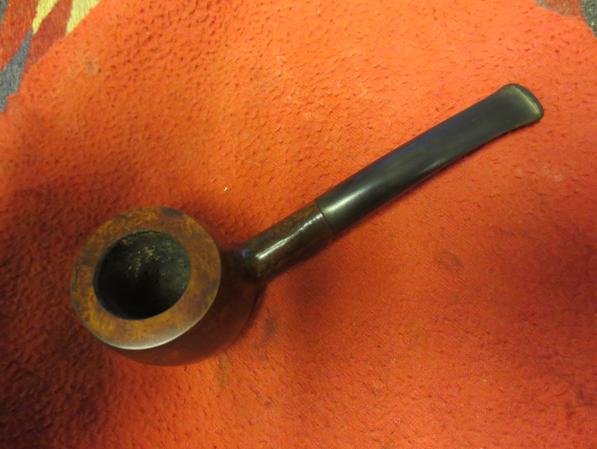
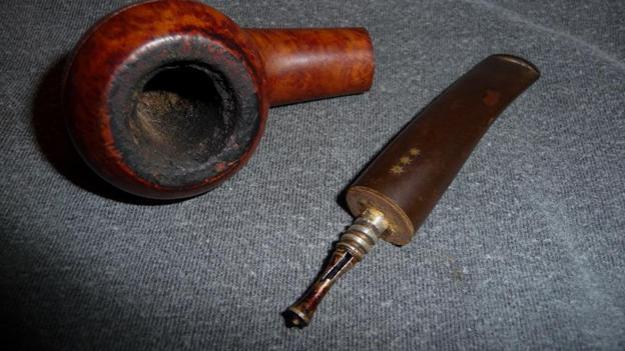
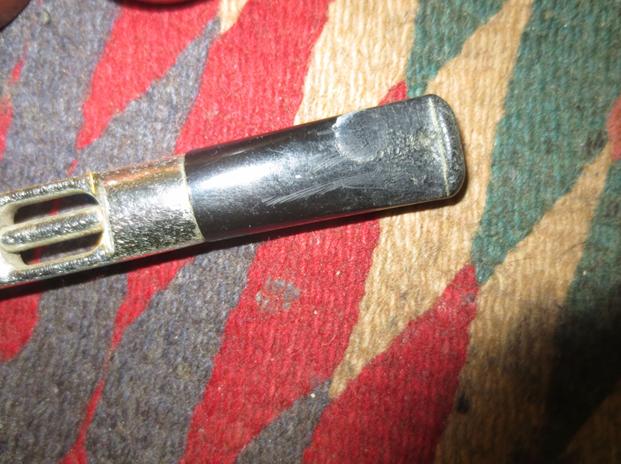
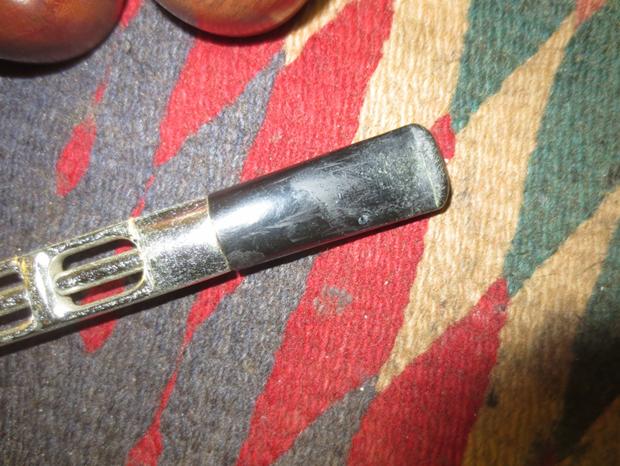
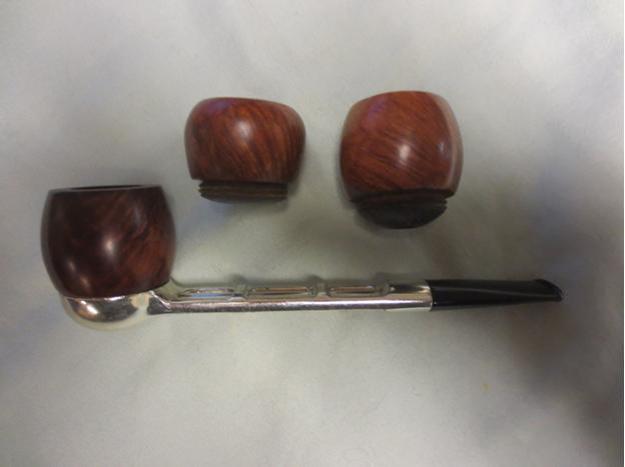
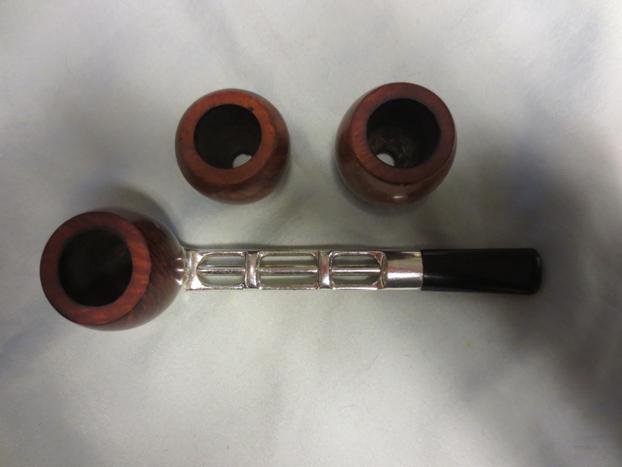
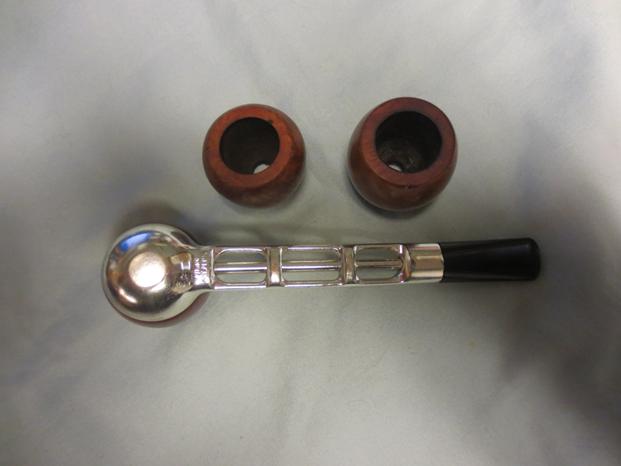
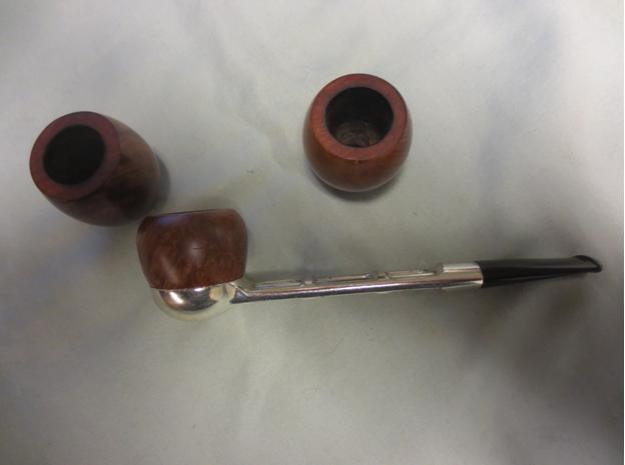
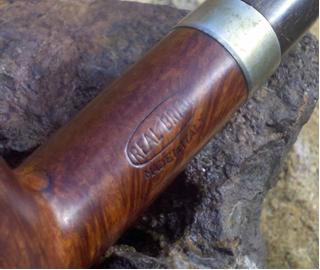
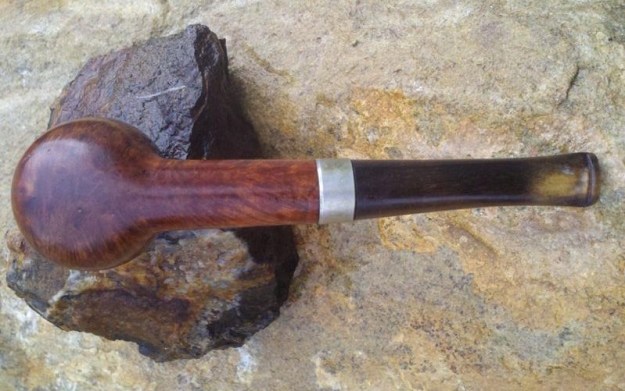
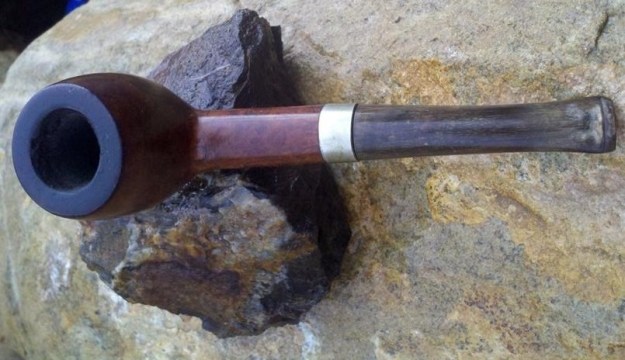
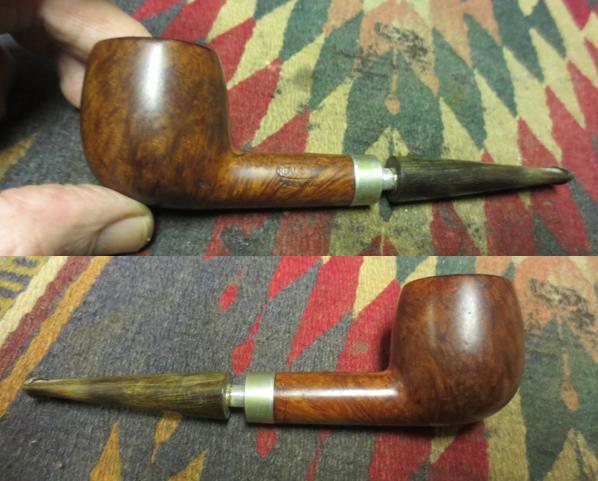
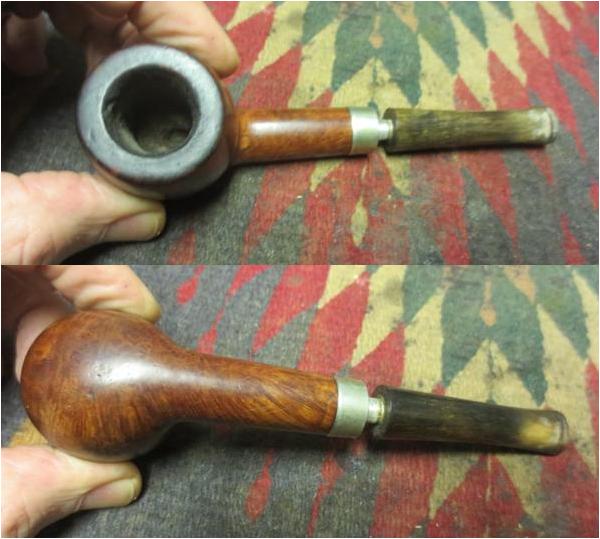
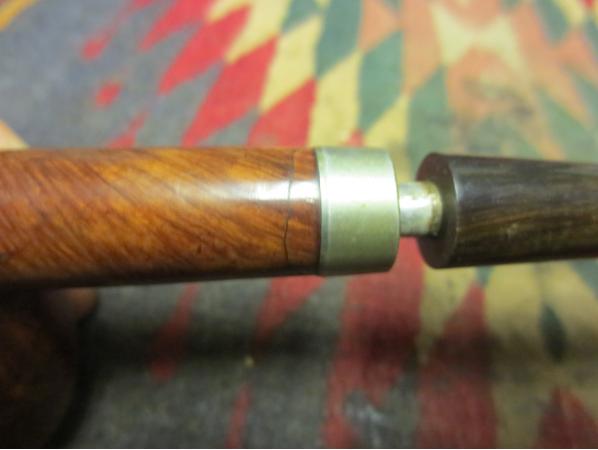
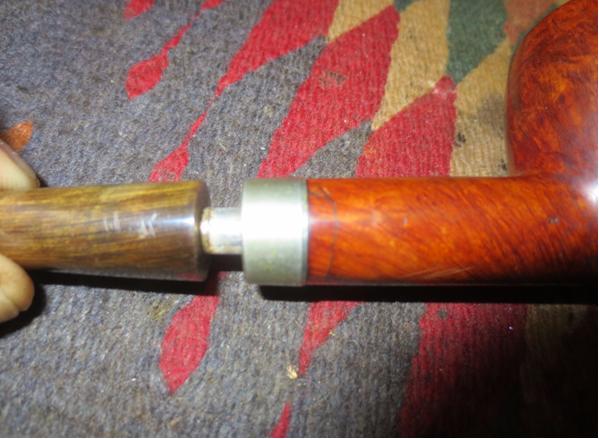
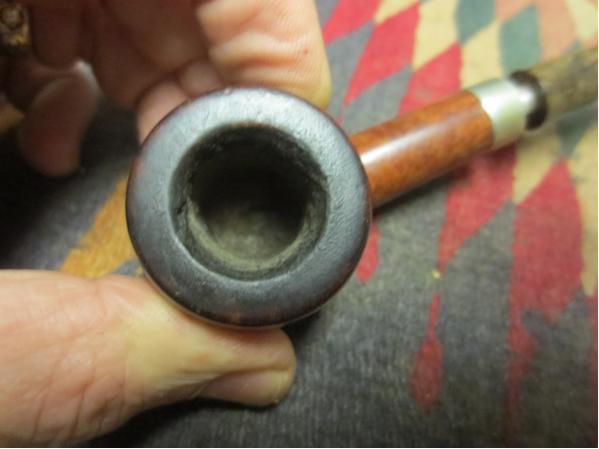
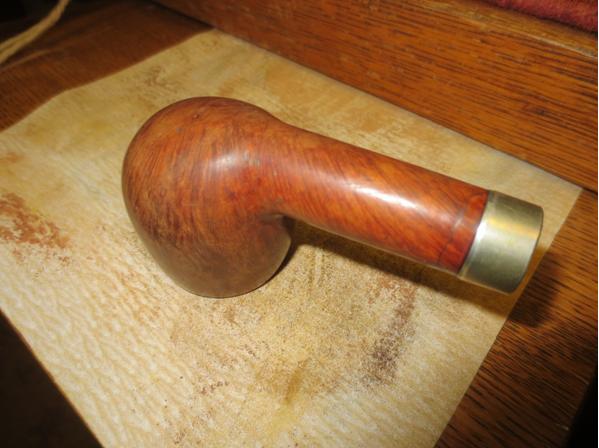
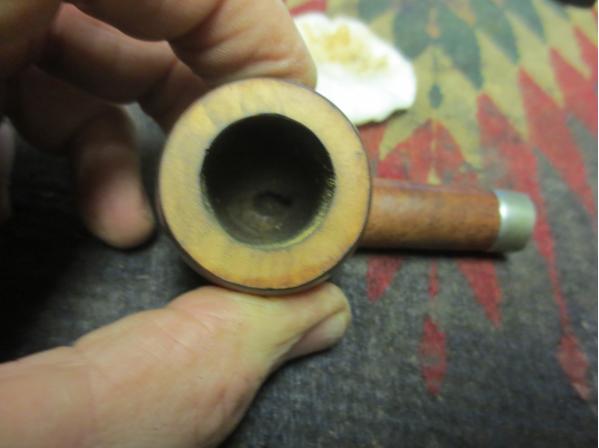
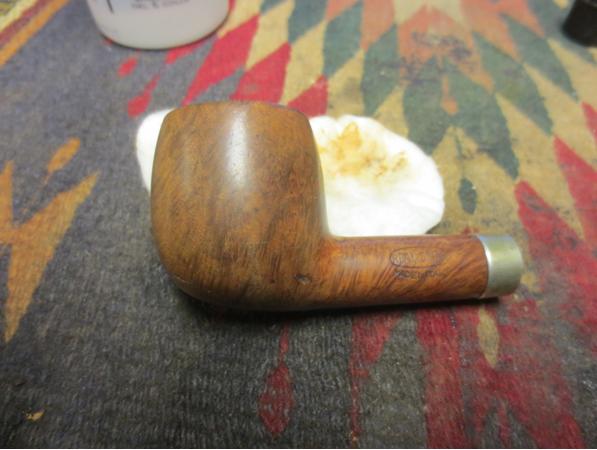
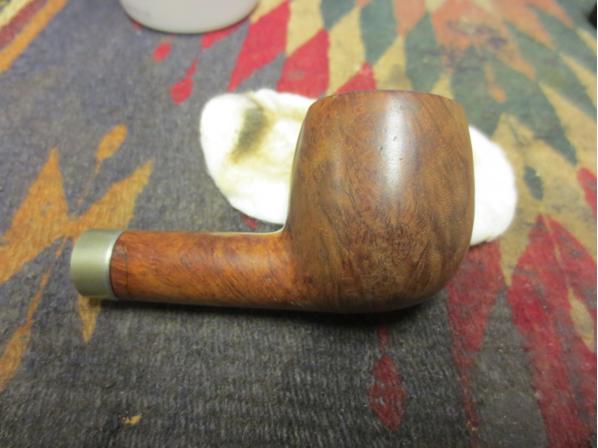
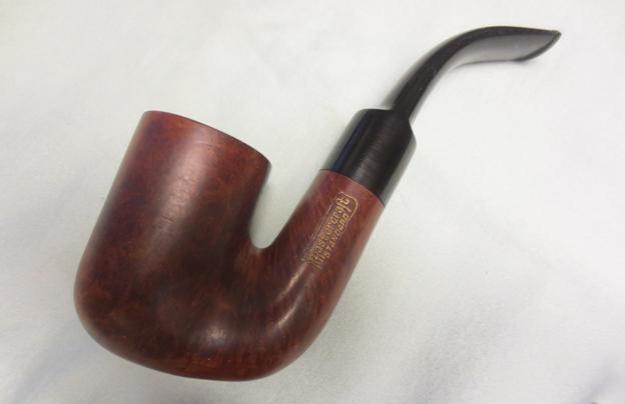
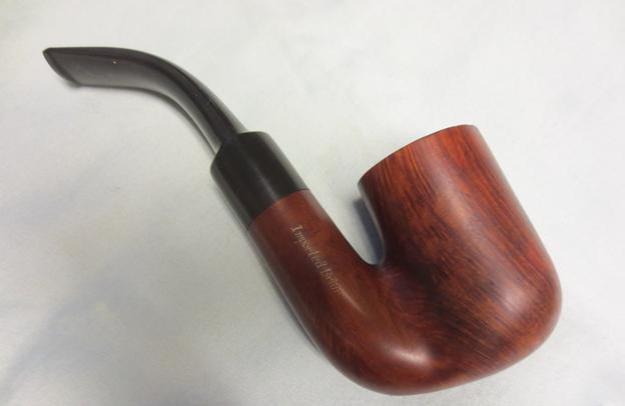
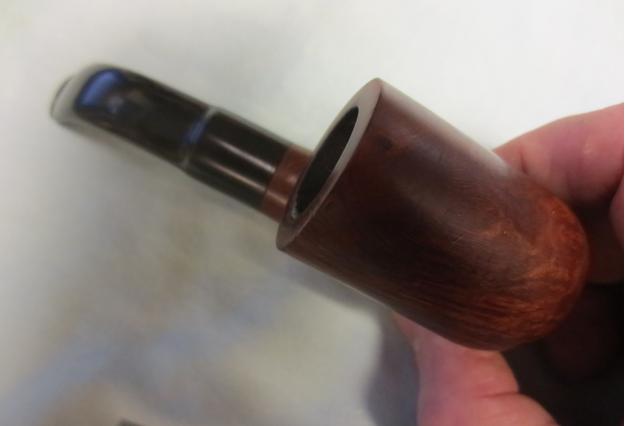
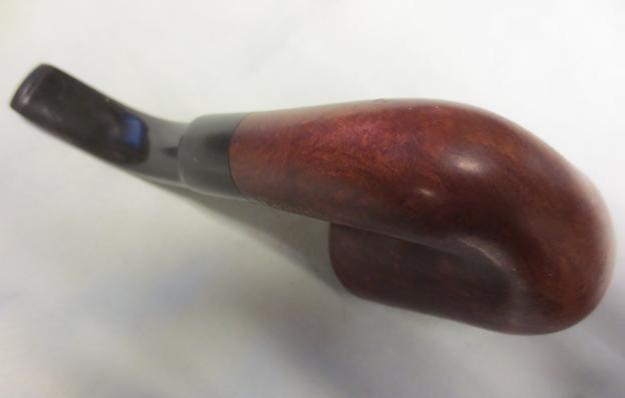
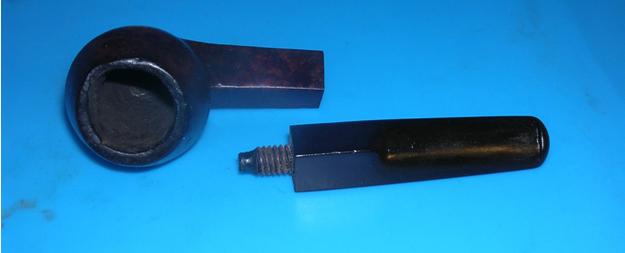
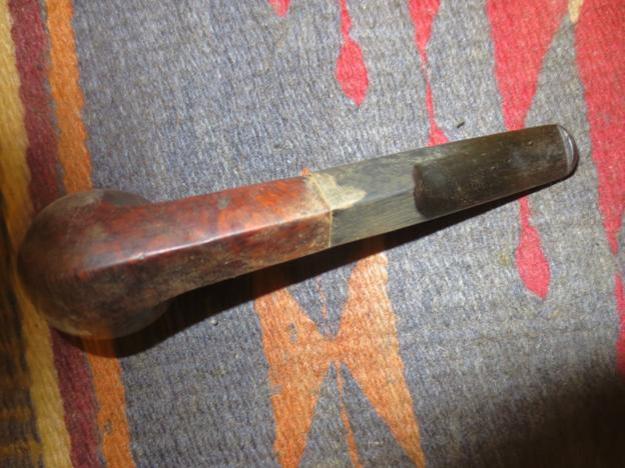
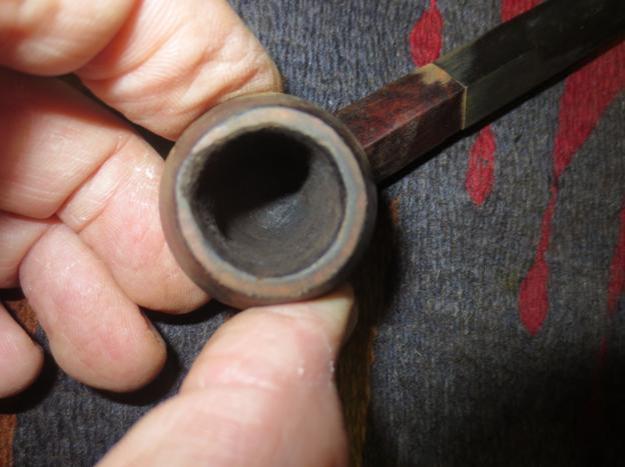
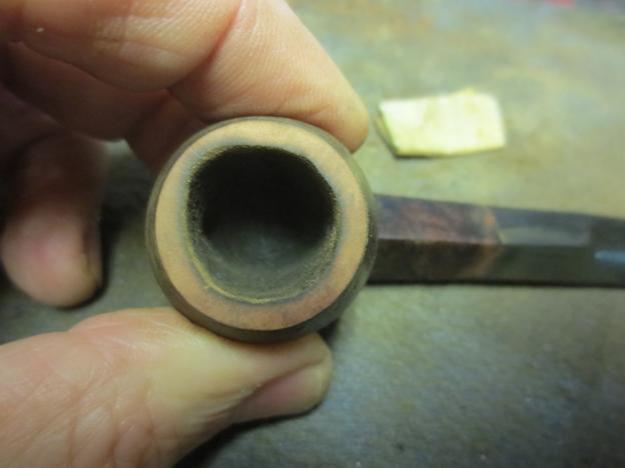
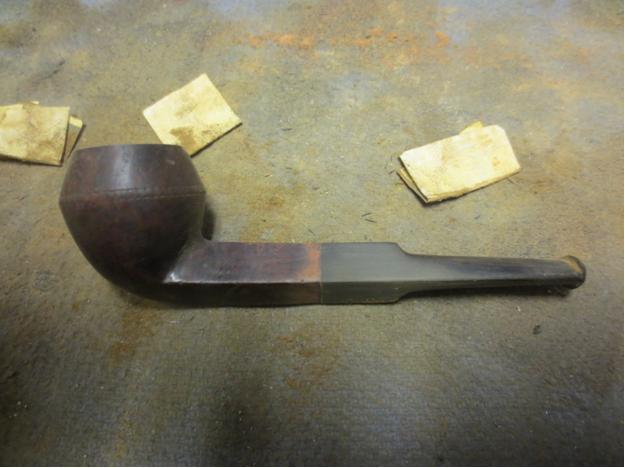
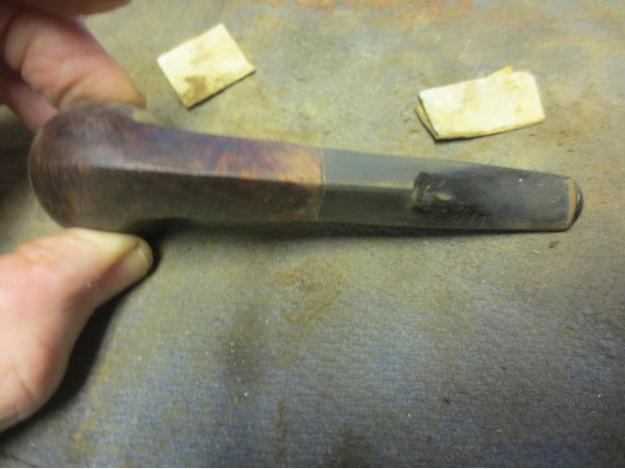
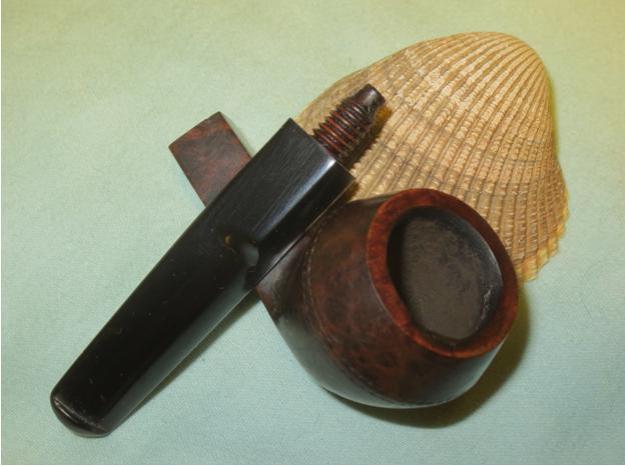
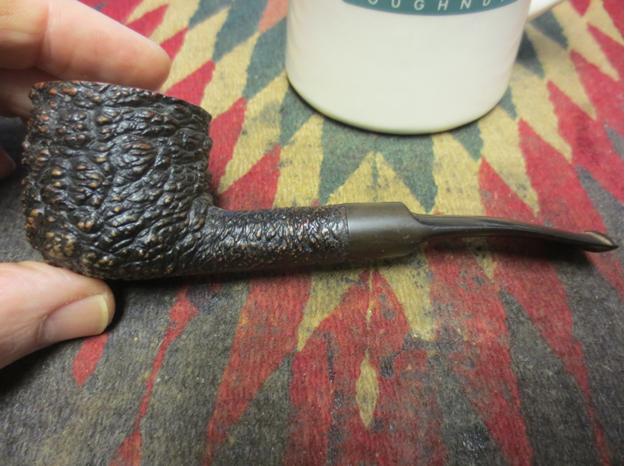
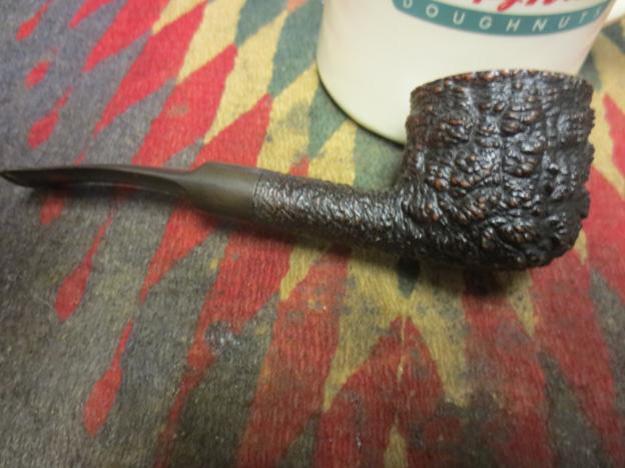
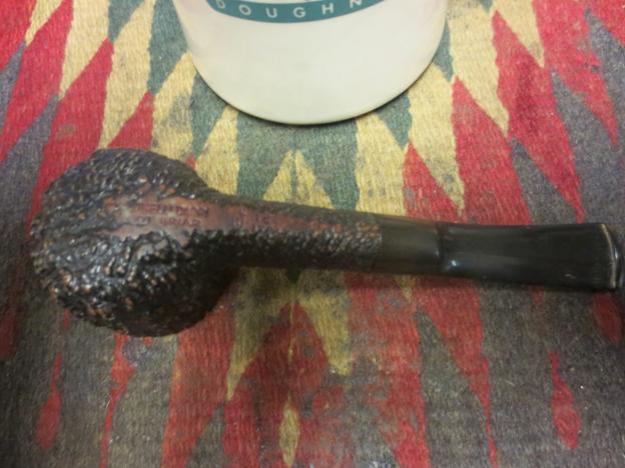
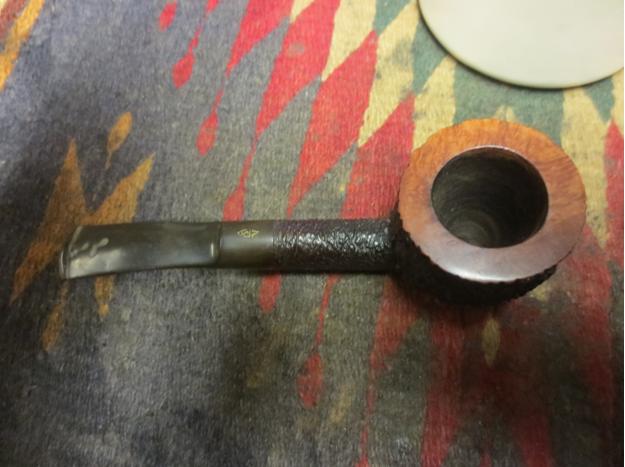
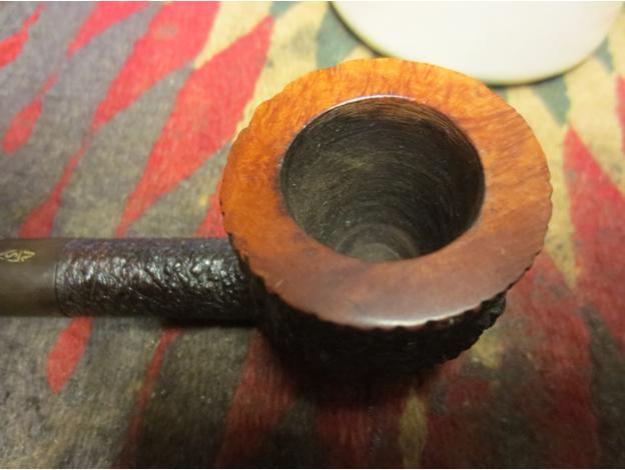
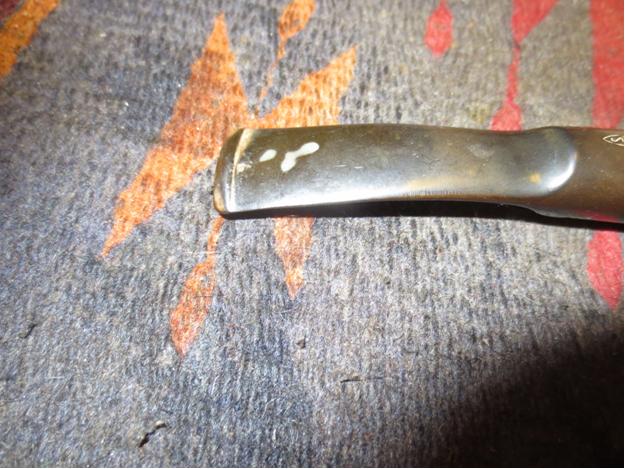
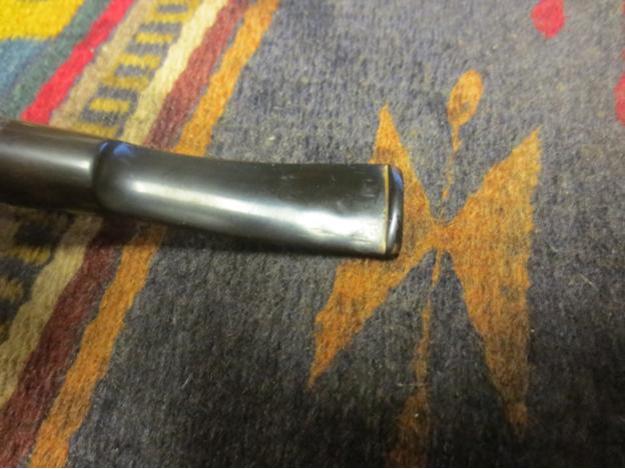
I have had a straight bulldog in the refurbishing box for a long time now. It is an interesting older pipe that has the characteristic worm trail rustication on the sides of the bowl and cap but total only 5 trails. The rest of the bowl is a nice piece of briar. The shank is smooth with no rustication. It appears to be unstained and natural or if stained a light tan colour. The trails on the bowl sides and cap are slightly darker in colour. The bowl was lightly smoked and the bottom half still clean briar. There was no cake in the bowl. There was some burning on the inner edge of the rim on the back left side of the bowl. The stamping on the shank of this bulldog is standing lion inside of a shield and next to that – SELECTED – over Imported Briar. I have searched on the web and in my books for this logo and cannot find it or the company it refers to. Any help would be appreciated. select1 The stem was in good shape with a little oxidation but no teeth marks except for two on top of the button itself. There was an internal stinger apparatus and a metal threaded tenon. The tenon screwed into a metal insert in the shank. The airway from the mortise to the back of the bowl was quite open to give room for the stinger apparatus. I took the following photos of the pipe when I brought it to the work table this morning.Select2

Select3

Select4

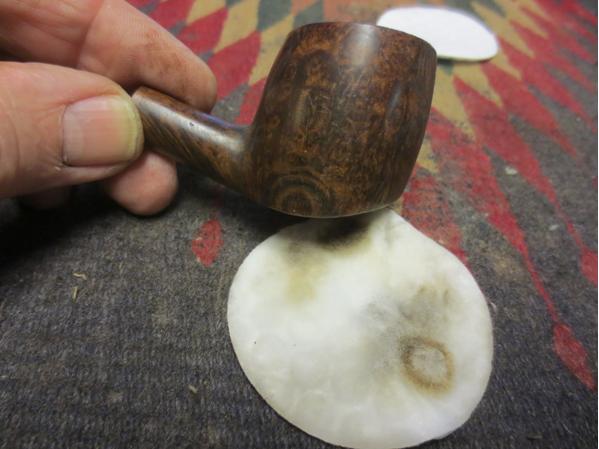
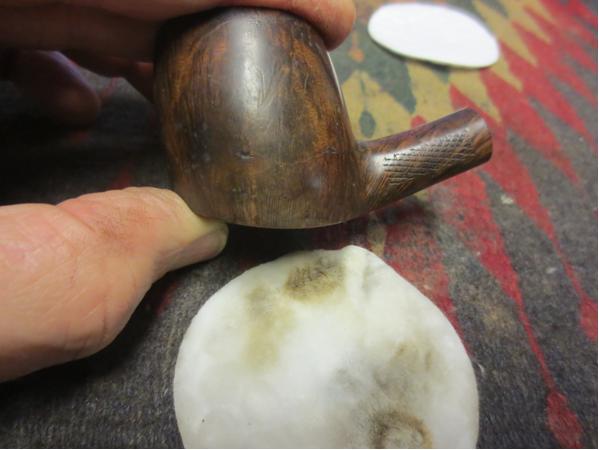
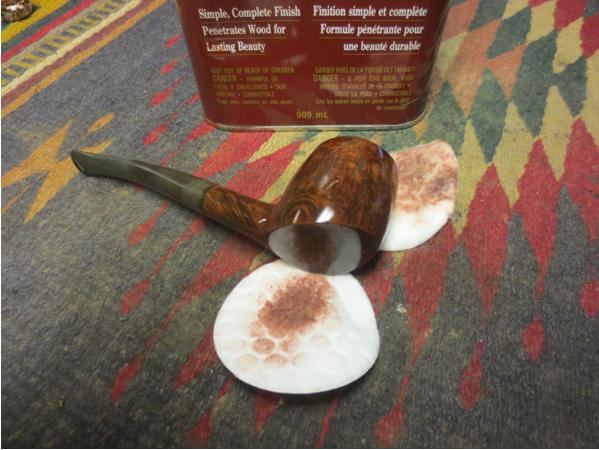
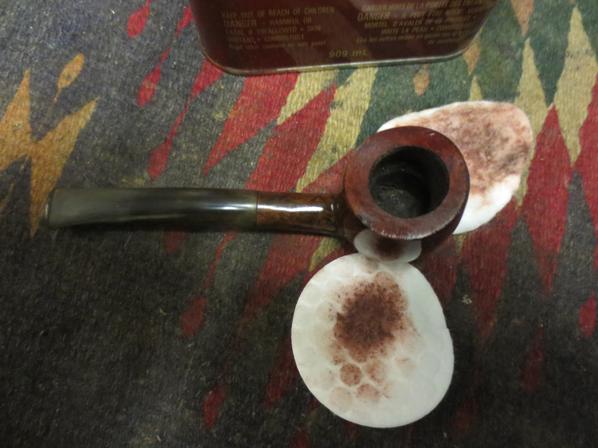
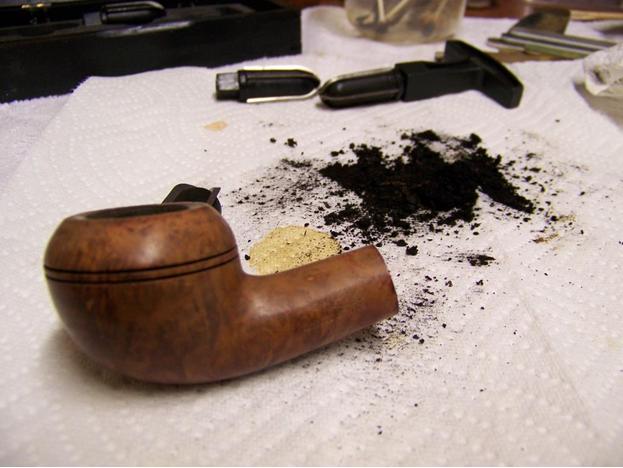
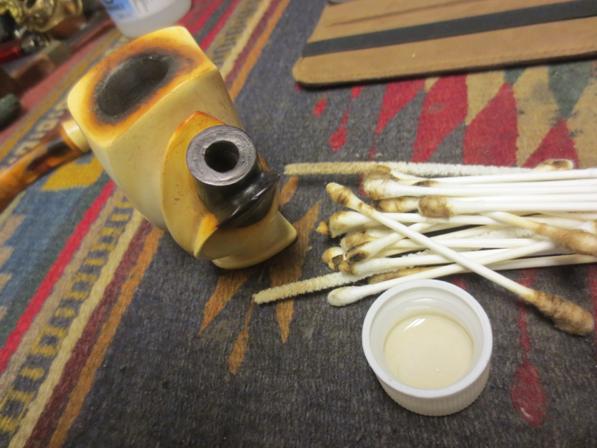
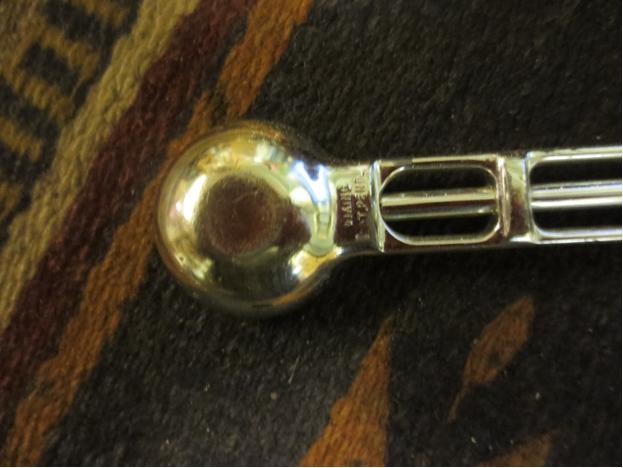
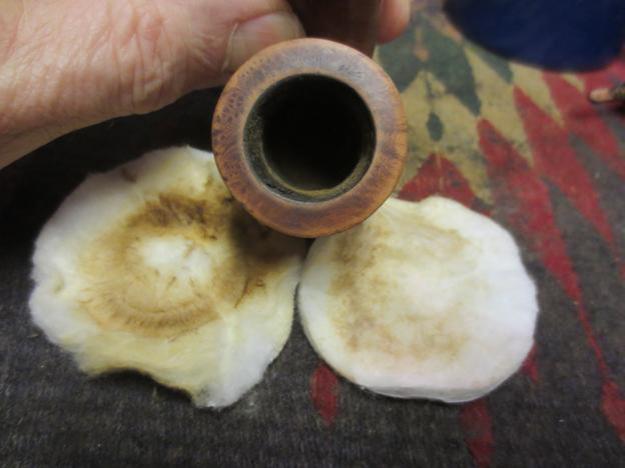
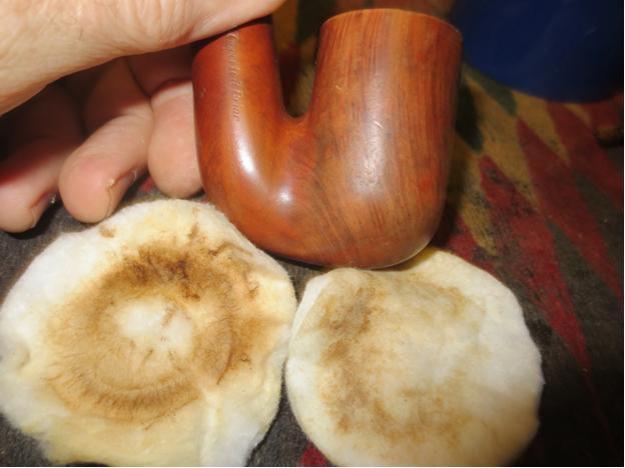
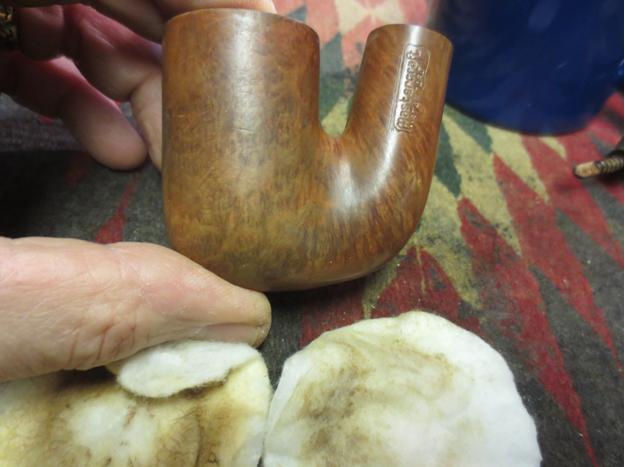
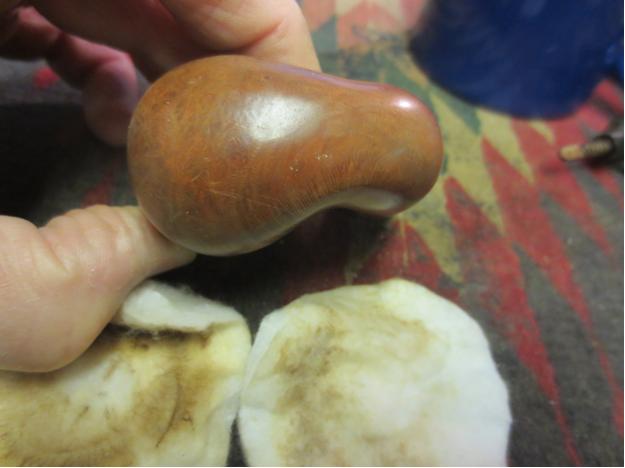
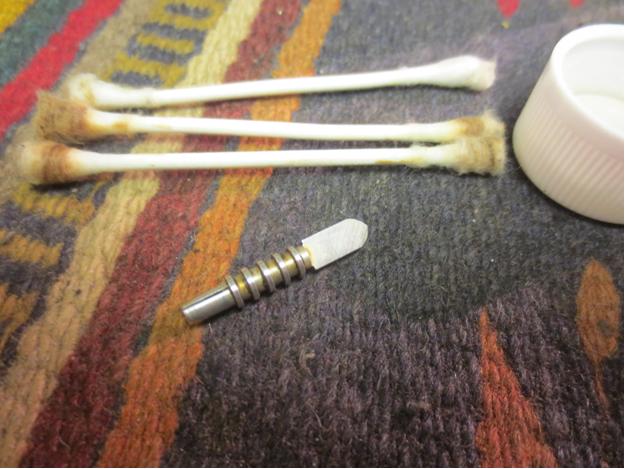
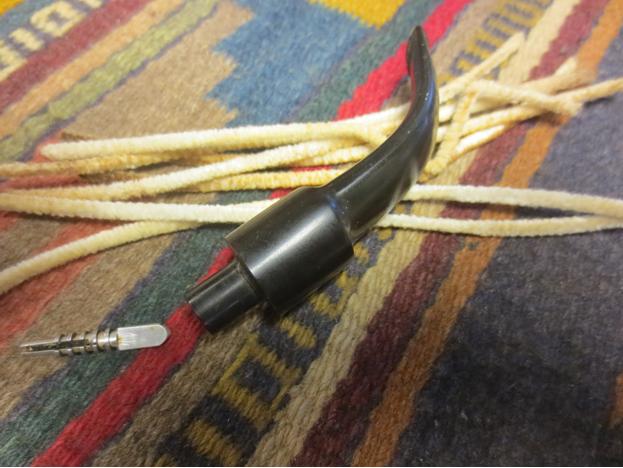
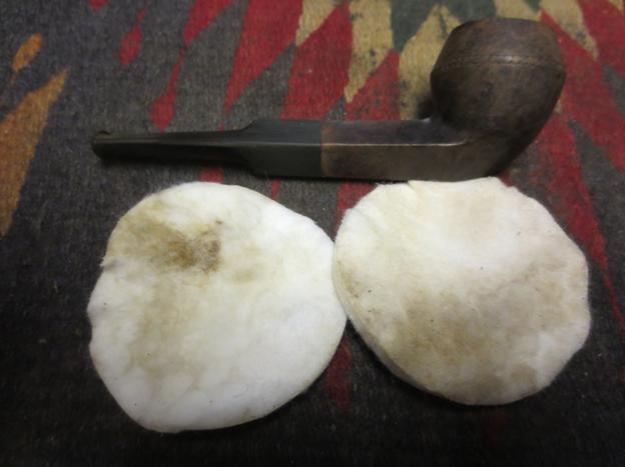
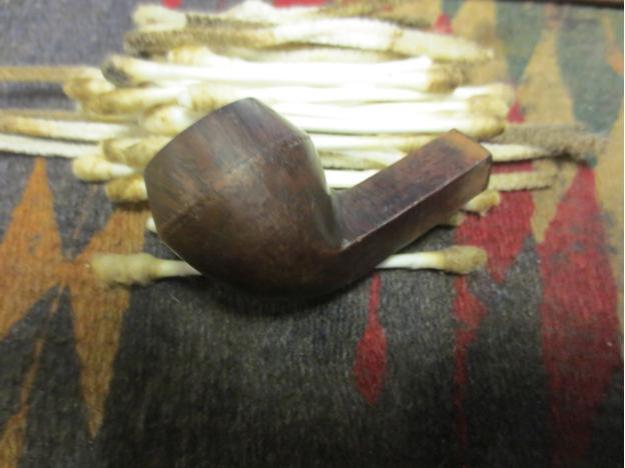
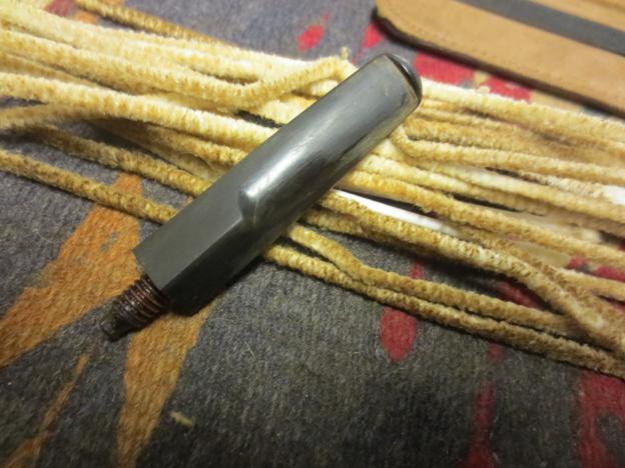
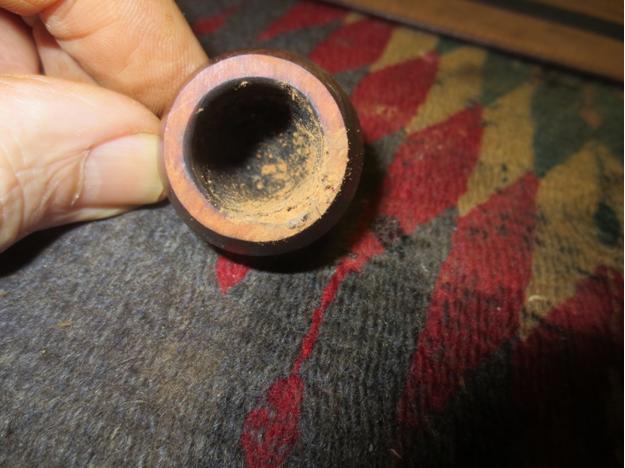
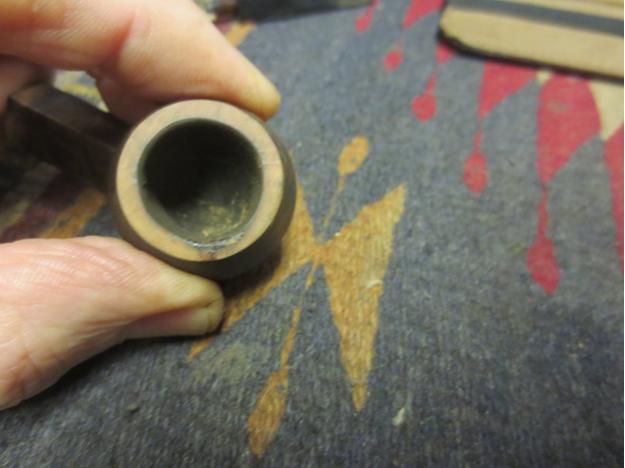
Select5 I took the pipe apart to show the inner apparatus on the stinger. It is unusual in terms of shape. The spear end is very sharp! It is pressure fit into the stem so it should come out for a thorough cleaning of the stem.Select6 The briar was dirty and had what appeared to be the gum from a price tag stuck to it in several places. I scrubbed the bowl and rim with a tooth brush and Murphy’s Oil Soap to clean off the grime.Select7 I wiped it down with a paper towel. A lot of grit and grime came off. I rinsed it with warm running water and dried it off with a towel. The photos below show the grime on the paper towel and the clean bowl.Select8

Select9

Select10

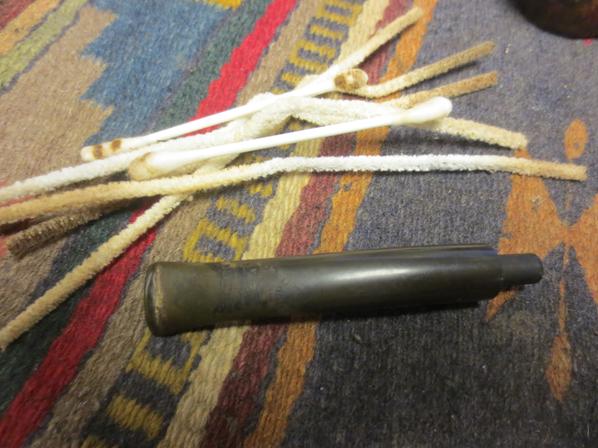
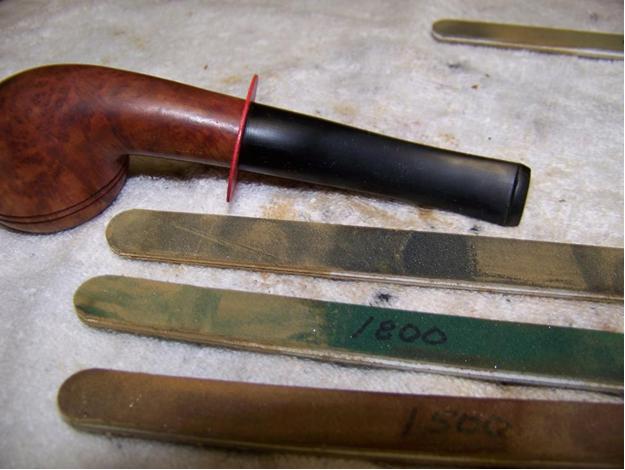
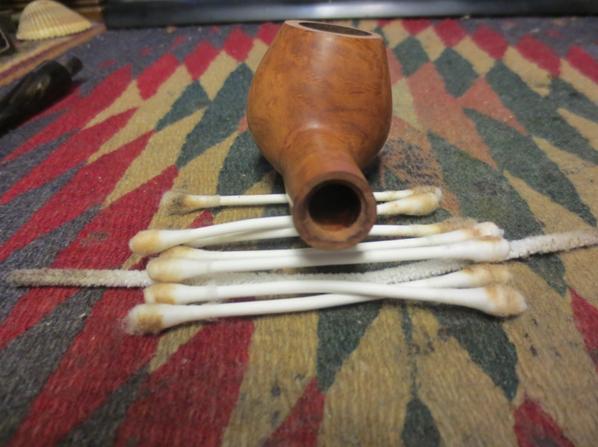
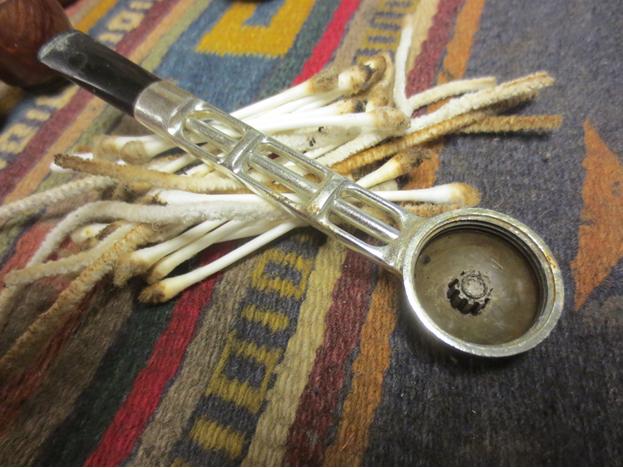
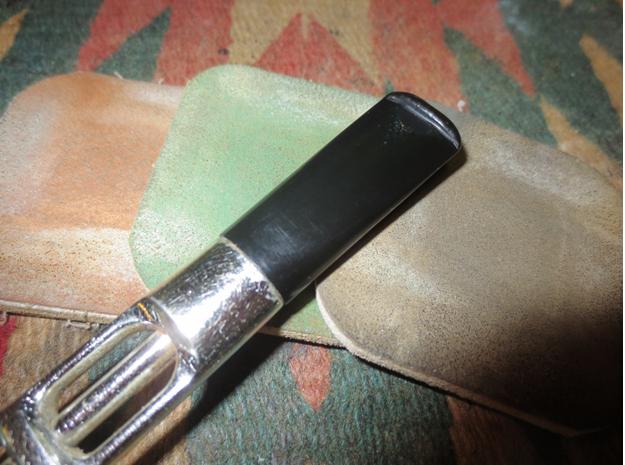
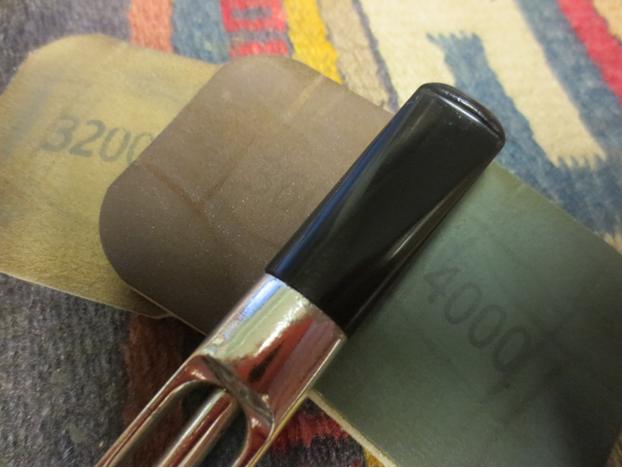
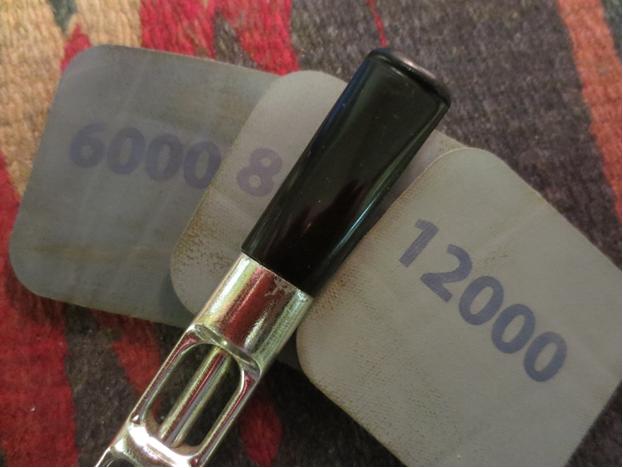
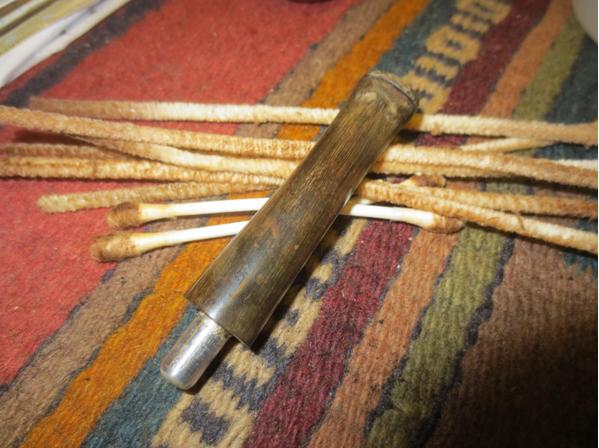
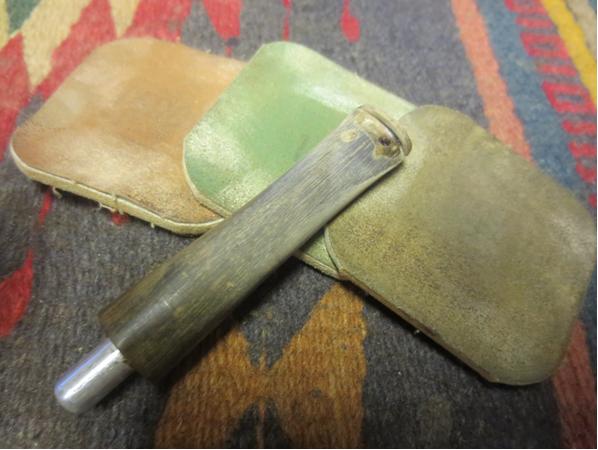
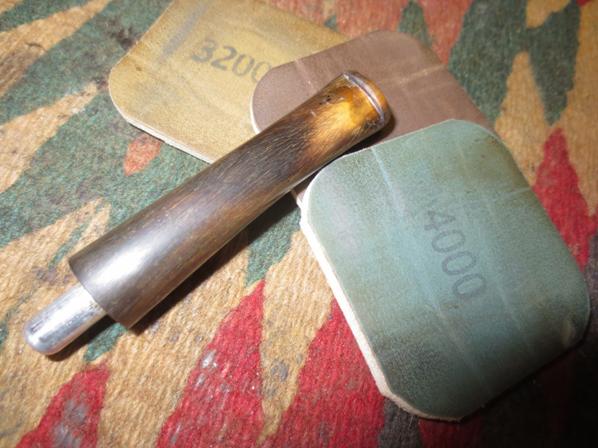
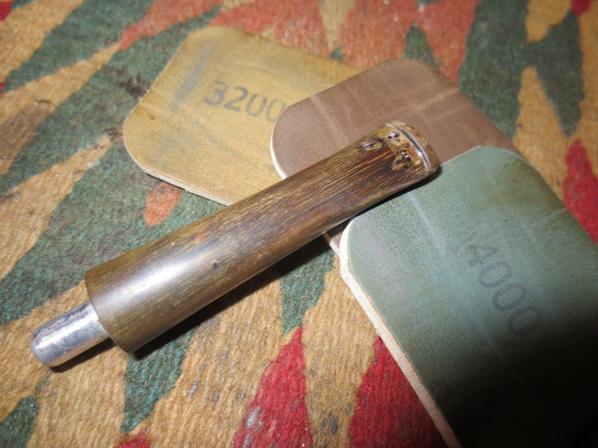
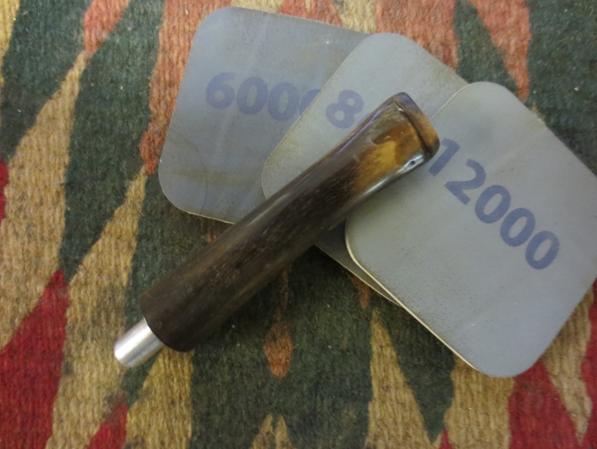
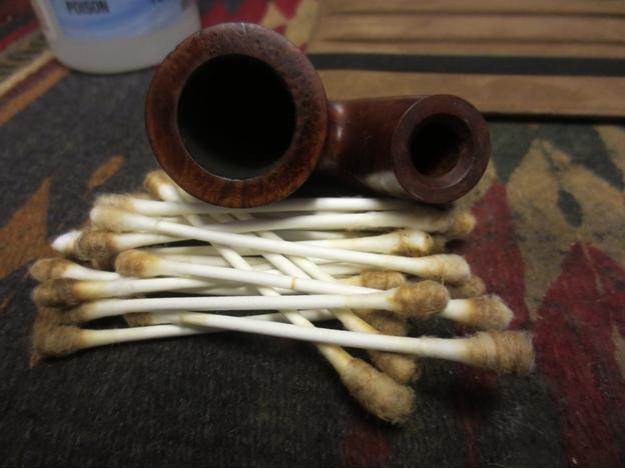
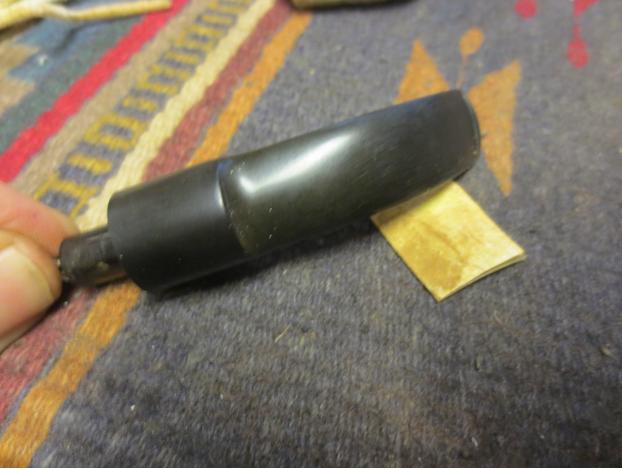
Select11 I heated the stinger with a lighter to soften the tars that held it in the threaded tenon. Once it was warmed I wiggled the stinger free and was able to clean it and the tenon.Select12 I scrubbed the inside of the tenon and the airway in the stem with pipe cleaners and alcohol. I used a brass bristle brush to clean the stinger and the threads on the tenon.Select13 The inside of the shank was wide open and served as a chamber for the stinger. It worked like a condensation chamber to collect the moisture before the smoke move through the holes and slot in the stinger and up the stem. Because of that it was very dirty. I cleaned the bowl and the shank with pipe cleaners, cotton swabs and alcohol until no more grime would come out. The photo below shows the first batch of swabs. There were about that many more used before it was clean.Select14 I lightly sanded the stem with 220 grit sandpaper to break up the oxidation and then with a medium and a fine grit sanding sponge. I wet sanded it with 1500-2400 grit micromesh sanding pads and then gave it a coat of Obsidian Oil. I dry sanded the stem with 3200-4000 grit micromesh pads and then gave it another coat of oil. I finished sanding with 6000-12000 grit pads and gave it a final coat of Obsidian Oil. I set it aside to dry.Select15

Select16

Select17 I put the pipe back together and buffed it on the wheel with Blue Diamond and gave it several coats of carnauba wax. I buffed it with a clean flannel buff to give it a shine. I brought it back to the work table and hand buffed it with a microfibre cloth. The finished pipe is shown below. Thanks for looking.Select18

Select19

Select20

Select21

Select22

Select23

A Tiny Apple Reborn – new stem and new finish


Blog by Steve Laug

This morning I decided to work on an interesting little pipe that I picked up in an eBay batch from England. All of the bowls in that batch had broken tenons stuck in the shank. All were no name bowls or so worn that the name had long since worn off. This one was the smallest pipe in the batch. The bowl and shank are 2 ½ inches long and 1 ½ inches tall. The bowl is drilled at 5/8 inches and I can insert my little finger. The shank was spliced somewhere along the way and done quite well. It is a smooth splice. I wonder if it was a repair or if it came out that way when briar was scarce during the war. The finish was spotty – varnish was peeling from the bowl and shank. The tenon appears to have had a metal tube in the middle of the vulcanite and both had snapped off when they broke. I have circled this bowl in red in the next three photos. The first shows the batch of pipes that I picked up. The second is an enlargement of the bowl itself and the third photo shows the snapped tenon in the shank.Apple1
Apple2
Apple3 The photos above came from the seller. I took the next series of photos before I worked on the pipe this morning. The rough finish is visible in the photos as are the fills on both sides of the bowl. They were shrunken and hard so they would have to be repaired. You can also see the splice in the shank about 2/3 of the way up the shank to the bowl. The bowl had a thick cake that was crumbly and rough. The bowl still was half full of tobacco that had been stuffed into it evidently before the stem broke. The rim had lava overflow and some damage to the inside edge and the top of the rim.Apple4
Apple5
apple6
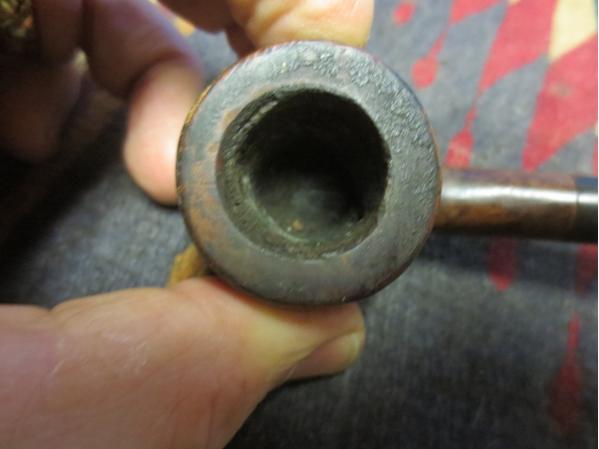
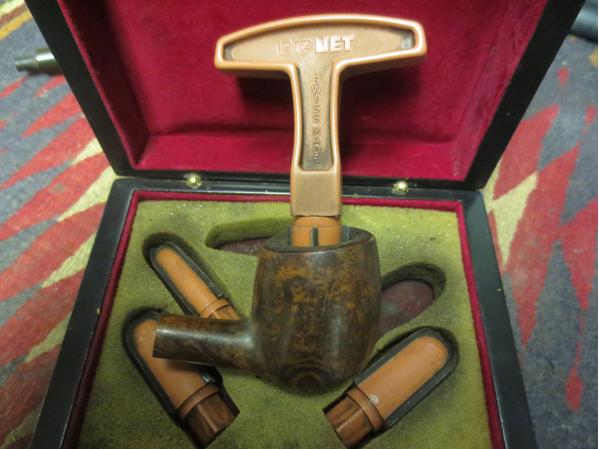
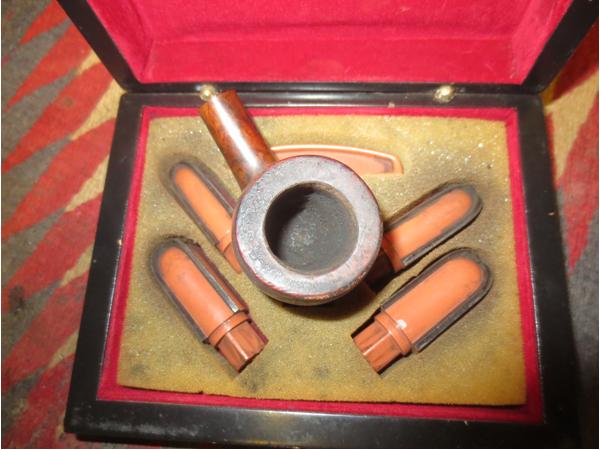
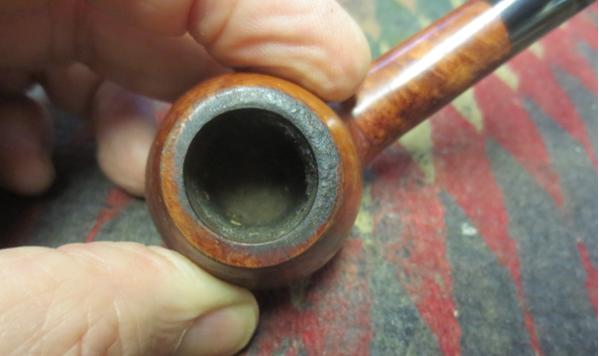
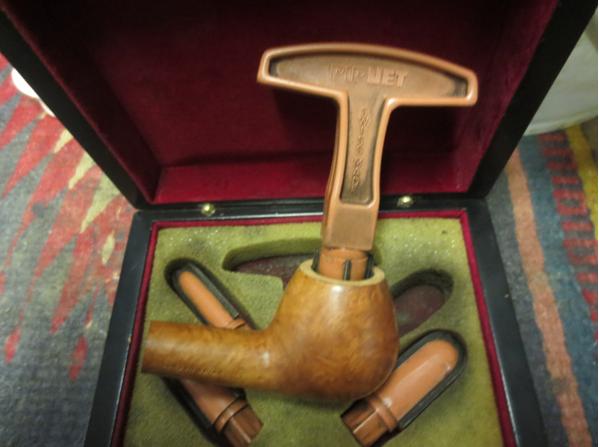
apple7 For a stem for this pipe I turned to my stem can and found a long narrow stem that needed a little adjustment to the tenon and the diameter of the stem at the shank before it would fit. I turned the tenon with a Dremel and sanding drum and finished by sanding it by hand.Apple8 The photos below show the stem in the pipe. The diameter of the shank and the diameter of the stem do not match.Apple9 I used the Dremel and sanding drum to reduce the stem diameter to match the diameter of the shank. I always rough in the fit with the Dremel and then fine tune the fit by hand sanding.Apple10 I reamed the bowl with a PipNet pipe reamer and took the cake back to bare wood. I wanted to look at the inside of the bowl and rim to see what needed to be done at those points.Apple11
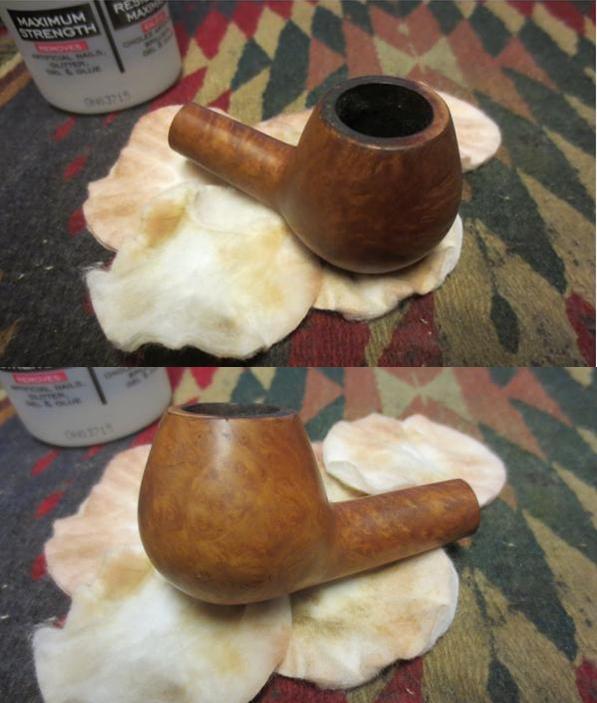
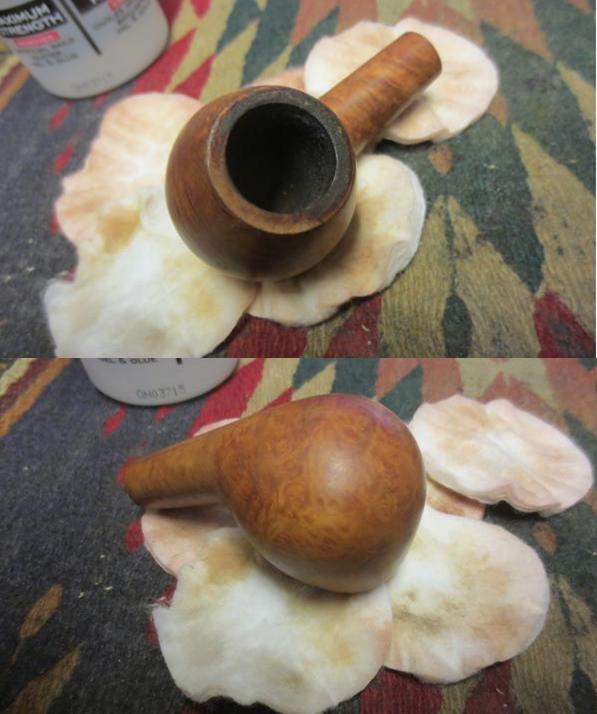
Apple12 I stripped the finish off the bowl with acetone on cotton pads. With all of the fills and dents in the no name bowl it was another candidate for sanding and refinishing. Looking down the shank with a light it appears that the splice of shank was done with a metal tube in the shank. The bowl and the added shank also appear to be different wood.Apple13 I topped the bowl to remove the rim damaged and to clean up the edges of the rim.Apple14 I tried to pick out the fills on the bowl but they were tight and were rock hard. I cleaned up around them and filled in the shrinkage with clear superglue.Apple15 I sanded the repaired areas and the rest of the bowl and shank with 220 grit sandpaper. I sanded the repairs smooth and followed up by sanding with a fine grit sanding sponge.Apple16
Apple17 I gave the bowl a black under stain to help hide the fills and the splice. They would always show but the dark under stain would blend them into the finish better. I applied the stain and flamed the bowl and repeated the process to get good coverage.Apple18
Apple19 I wiped down the bowl with alcohol and cotton pads to remove the black from the surface of the briar and leave it in the grain patterns.Apple20
Apple21
Apple22
Apple23 I sanded the bowl with a fine grit sanding block and the stem with the fine grit sanding sponge and fit it in the shank to get a feel for the new look. I took the next series of photos to see how the pipe was developing. I liked what I saw. The black stain had done a good job covering the fills and the splice. I used a black permanent marker to fill in some light spots and drew in some grain lines in the bald spots.Apple24
Apple25
Apple26
Apple27 I gave the bowl a top coat of Danish Oil with Cherry stain and then again used the permanent marker to fill blank spots and darken the fills. I wiped the Cherry stain over the bowl several times until the coverage was good and then set the bowl aside to dry.Apple28
Apple29
Apple30 While it dried I worked on the stem with micromesh sanding pads. I wet sanded it with 1500-2400 grit pads and gave it a coat of Obsidian Oil. I dry sanded with 3200-4000 grit pads and gave it another coat of oil. I finished with 6000-12000 grit pads, gave it a final coat of Obsidian Oil and let it dry.Apple31
apple32
Apple33 I buffed the pipe with Blue Diamond on the wheel and then gave it multiple coats of carnauba wax. I buffed it with a clean flannel buff and then by hand with a microfibre cloth to deepen the shine. The finished pipe is shown in the photos below. I like the looks of it with a long thin stem. It is a like a pencil shank Bing with an apple shaped bowl. Thanks for looking.Apple34
Apple35
Apple36
Apple37
Apple38
Apple39
Apple40

Reshaping and Restemming a no name Oval Opera Pipe


Blog by Steve Laug

I bought a group of pipe bowls on Ebay a while ago and one of them was an oval bowl Opera pipe. The stamping was non-existent, whether worn off by over buffing or never present it was no longer on the shank on either side. It is shown in the photo below marked with a red oval. It is an interesting shape and this one was a normal sized pipe. There was nothing of the typical small size of the pipes like this that I have worked on in the past. The stem was long gone and the broken tenon was stuck in the shank. The finish was rough and had deep dents and nicks all over the bowl. The cake in the bowl was thick and the rim was damaged on the inner edge and had burn marks on the front top and left side. There were two large fills on the bowl; one on the left side shank near the bowl junction and the other on the underside mid-shank.Op1 Op2 I pulled the broken tenon by my usual method. I use a drywall screw and insert it in the airway. I use a screwdriver to turn it into the airway just enough to be tight in the tenon. You need to be careful to not turn it in to far as it will expand the tenon and crack the shank. Once it is in place I use needle nose pliers to wiggle it free of the shank. It usually comes free with little effort. That was true in the case of this tenon.Op3
Op4 I took the next set of photos to show the state of the pipe when I started this project. Note the damaged rim top and inner edge.Op5
Op6
Op7
Op8 I went through my can of stems for a donor stem and found a bent saddle stem that I could straighten and fit to this pipe. I turned the tenon with the PIMO tenon turning tool to a close fit and hand sanded it to get a snug fit. The shank was slightly oval and the stem round so I would need to work on the shank to get a good fit.Op9
Op10 I used 220 grit sandpaper to clean up the finish on the bowl and shank. I did preliminary shaping of the rim to clean up the damage at the top. I used a PipNet reamer to ream the bowl. I use the smallest head and work it in the centre of the oval first and then move it to the front and back of the oval to ream those areas. I cleaned up the reamed bowl with a pen knife to get rid of the cake. I needed to take the cake back to bare briar so that I could reshape the inner edge.Op11 I sanded the bowl with 220 grit sandpaper to remove as much of the damage to sides of the bowl as possible. You can see from the photo below the dip in the top edge of the bowl about middle. That is where the burn damage is on that side.Op12 I wiped the bowl down with acetone on cotton pads to remove any remaining finish and to see where I stood in terms of removing damage to the bowl.Op13
Op14 The next photo shows the extent of the damage to the top and inner edge of the rim. You can see the rough cut marks on the inner edge from a previous owners attempt to ream the bowl. You can also see the burn marks on the left and right top and sides of the rim.Op15
Op16 To remove the dips where the burn marks were in the rim top and to remove the damaged briar I decided to top the bowl. I would need to reshape the rim to match the original but I would deal with that later.Op17 I used a Dremel and sanding drum to shape the outside edge of the rim and bowl.Op18
Op19 Op20 I put the stem in place in the shank, aligned it correctly and sanded the shank to clean up the fit. I wanted the shank to be more round and consistently shaped as it originally was not completely oval – it was only that shape on the left bottom side. The rest of the shank was round. I sanded until I had the shank rounded and matching the stem.Op21
Op22 I continued to shape and sand the rim and flow into the bowl. I worked on the slight bulge in the stem at the saddle to get the alignment and flow right. Since I had a clean slate to work with on this old briar I figured to get it as close as I could to a clean flowing look. I wanted it to look better than before not just cleaned up. It would take a lot of sanding and shaping before I was finished with it.Op23
Op24
Op25
Op26 The fill on the bottom of the shank was solid except for one small spot in the centre of the repair so I sanded it, wiped it clean and filled in the spot with clear super glue. Once it dried I sanded it smooth to match the rest of the shank. The small rough spot was gone and the fill was smooth and dark.Op27 I cleaned out the shank and airway with the KLEENREEM drill bit to remove the buildup in that area. The draw on the shank was constricted so this was necessary to open it and give an easy draw to the pipe.Op28
Op29 I cleaned out the shank and the airway in both the bowl and stem with alcohol, cotton swabs and pipe cleaners until it was clean.Op30 I sanded the edges of the stem and the scratches in the saddle portion with 220 grit sandpaper to shape and define the edge and fit of the stem. I left a slight bend downward in the stem when I had straightened it and like the look of it.Op31
Op32
Op33
Op34 I put a cork in the bowl of the pipe and prepared to stain it with the black undercoat. I wanted to highlight the interesting grain and the black would bring that out. It would also serve to mask the repair on the shank and the fill next to the bowl.Op35 I applied and flamed the black stain and repeated the process to get good coverage on the bowl.Op36 I wiped the bowl down with alcohol soaked cotton pads to remove the stain that did not settle into the grain.Op37
Op38
Op39
Op40 I sanded the bowl and shank with a medium and fine grit sanding block to further remove the black stain. The contrast is beginning to show and the grain stand out.Op41
Op42
Op43
Op44 I sanded the bowl and shank with 1500-1800 grit micromesh sanding pads to remove the scratches on the briar.Op45
Op46 I wiped it down with alcohol on a cotton pad and then set it up for the top coat of stain. I chose to use a Cherry Danish Oil on the top coat. I applied it with a cotton pad and set the bowl aside to dry.Op47
Op48 While the bowl dried I worked on the stem. I wet sanded with 1500-2400 micromesh sanding pads to further fine tune the shape of the stem. I worked to remove the remnants of scratching left behind by the initial shaping done with the lower grits of sand paper. I rubbed the stem down with Obsidian Oil and then dry sanded it with 3200-4000 grit pads. I gave it another coat of oil and finished sanding it with 6000-12000 grit pads. I gave it a final coat of Obsidian Oil and let it dry.Op49
Op50
Op51 The bowl was dry by the time I finished with the stem so I buffed the bowl and stem with Blue Diamond on the wheel and then gave both several coats of carnauba wax. I buffed the pipe with a clean flannel buffing pad and then hand buffed it with the microfibre cloth. The finished pipe is shown in the photos below. I really like the way the contrast stain came out and the way it hid the fills on the shank. The pipe really has some stunning and interesting grain all the way. Not one side looks the same. There is birdseye, cross grain and swirled grain. I think the finished pipe is a great improvement from when I started it. Thanks for looking.Op52
Op53
Op54
Op55
Op56
Op57

My Second C.A. Sander of Swansea Bent Bulldog Restemmed and Restored


Blog by Steve Laug

When I was working on the previous C.A. Sander of Swansea straight bulldog that I restored (https://rebornpipes.com/2015/12/13/an-interesting-welsh-pipe-find-a-c-a-sanders-sandhurst-bent-bulldog/) I was looking for information on the brand. In my search on the internet I came upon this small bulldog bowl on eBay. I had found that there were at least two different names stamped on these pipes – both the ones I found were sandblast finishes. The earlier one was stamped Sandhurst and this one is stamped Oxford. Other than that the stamping on both is the same – the name then CA Sander over Swansea. I wrote the seller to see if he had any information on the brand and he replied that he did not. I put a bid on the pipe and ended up winning it. It arrived here on Tuesday this week. I have included the photos that the seller had posted on eBay below. It appeared to be in very good shape even though it did not have a stem.CA1

CA2

CA3

CA4

CA5 When the pipe arrived it was in excellent shape. The seller’s photos were absolutely correct. The bowl had a light cake in it and the rim was dirty with lava overflow and carbon. The shank was dirty and the finish had dust in the crevices of the blast. The stamping was exactly the same as the Sandhurst I restored other than the Oxford name that was present. I took the next series of photos to show the pipe on arrival before I started working on it.CA6

CA7

CA8

CA9

CA10 I went through my can of stems to find one that would work on this bowl. Diamond shanks are notoriously hard to match a stem to as each side and angle is very individual and hardly ever align with used or estate stems. I would have to find one that had a close fit and modify it to match the angles. With that in mind I found several stems that could have worked. In looking at the tapered stems I pulled all seemed too long to go with the petite size of this bowl. None quite aligned at the shank and modifying them was not an option as one or more of the sides did not have enough material to modify. I had several saddle stems that had the same issues. Then in the bottom of my can I remembered that I had a Lucite saddle stem that might very well work. I took it out and measured the sides of the diamond. I have to tell you I was very surprised – this stem was almost a perfect fit. I would need to shorten the tenon slightly and take a little material off to get a snug fit. Only the bottom right side was a little larger than the shank. Everything else matched. The stem is a pearlised cream coloured Lucite that actually would go well with the colour of the bowl once I had it cleaned up.CA11 I used the PIMO tenon turning tool to reduce the diameter of the tenon to get a close match and finished the fit by hand sanding. I shortened the length of the tenon with a Dremel and sanding drum to the same length as the mortise. In doing so I removed the damaged end of the tenon and the rounded right side. Once I had the work done I put the stem in place in the shank and took the photos below. You can see the great fit that the stem had in terms of the width of the sides of the diamond. I was fortunate in terms of the amount of work that would need to be done to fine tune this one. It would take very little work to make a good fit.CA12
CA13

CA14

CA15 I took a photo of the end of the shank and the end of the stem and put them side by side for comparison sake to show how close the two diamonds came to matching each other. This is a very rare occurrence in my experience.CA16 I sanded the bottom right side with 220 grit sandpaper to adjust the fit on that side. I needed to remove enough material to align the bottom of the diamond with the bottom of the diamond on the shank. All others point on the diamond aligned perfectly but this one. It did not take too much sanding before I had the alignment and the fit against the side of the shank perfect.CA17 I reamed the cake in the bowl with a PipNet reamer and took it back to bare briar.CA18 I scrubbed the bowl with Murphy’s Oil Soap and a tooth brush on the sides and bottom of the bowl and shank and with a brass tire brush on the rim.CA19

CA20

CA21

CA22

CA23

CA24 I put the stem on the bowl, put a cotton ball in the bowl and then set up the retort to clean out the internals of the pipe. I boiled alcohol through the pipe and after two tubes of alcohol the airways were clean. The retort also removed some of the staining in the stem airway. I removed the retort and scrubbed the internals of the bowl and shank with pipe cleaners and cotton swabs to remove the remaining alcohol and grime in the shank. In the end the shank and airway were clean and the pipe smelled fresh.CA24A I cleaned the stem with pipe cleaners and alcohol and also pipe cleaners dipped in Bar Keepers Friend powder to scrub out the tar stains in the airway. It took a lot of scrubbing but I got the majority of the stains out. I did not want to darken the stain on the bowl but wanted to highlight the contrasts in the finish. The combination of dark brown and medium brown on the high spots worked well for me. To keep that and add life to the bowl I wiped it down with a light coat of olive oil and rubbed it into the blast pattern. I took the following photos with the stem in place on the bowl. The pipe is taking shape.CA25

CA26

CA27

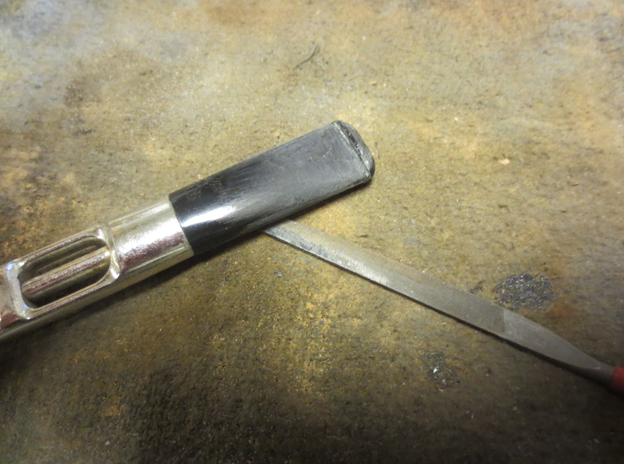
CA28 The stains at the button were stubborn and hard to remove. I found that there was a small lip where the slot in the button met the airway in the stem and it collected tars and oils. The pipe cleaners and scrubbing did not touch that as it did not reach into the small crevice there. I used a needle file to flatten out the lip at the junction. With that gone I was able to remove more of the stain from the stem. All that remain was a small spot on the top and the bottom that I could not get out no matter how hard I worked it.CA29 I sanded the stem with micromesh sanding pads to polish and remove the scratching. I wet sanded with 1500-2400 grit pads and dry sanded with 3200-12000 grit pads. As I sanded the stem with each successive micromesh pad it left a richer luster in the pearlised stem.CA30
CA31

CA32 I buffed the bowl and stem with Blue Diamond on the wheel (lightly on the sandblast bowl as I did not want to flatten the blast) and gave the stem several coats of carnauba wax. I hand waxed the bowl with Halcyon II wax and then buffed the bowl and stem with a shoe brush and a microfibre cloth to raise the shine. The finished pipe is shown in the photos below. It is a petite bulldog – only 5 inches long from bowl to button and 1 3/8 inches tall from rim to point on the bowl bottom. The drilling on the bowl is 5/8 inches. I like the contrast that the Lucite stem gives with the blast on the bowl. The colours work well for me. The stem length works on this bowl and the overall effect is a balanced small sandblast pipe that looks great. At least it does to me! Thanks for looking.CA33

CA34

CA35

CA36

Addendum: 06/06/18 I received an email from Andrew  in answer to a question I asked in my two blogs on CA Sander pipes. I quote in full his email because of the information that it includes.

Comment: You asked about C A Sander

C A Sander were tobacconists based in Wind Street Swansea. I don’t know exactly when the business started but it it passed to my Grandfather from his father (both were C A Sander) and by the 1920 was a successful and well established retail business with shops all over south wales. They were importers and blenders (if that is the term) of tobacco and the shops sold smoking paraphernalia. At my grandfathers retirement late 60’s to business went to my uncle again C A Sander but known generally as Jim. He developed a business supplying cigarette machines around South Wales and moved out of retail he eventually sold the business to Rothermans and went into other business ventures, I expect that was when the limited company you found was formed. Uncle Jim has now retired but still lives in the area.

Hope this helps with your research.

Andrew I received this followup email from someone who would like to get in touch with you. Here is her email

Hi there – I stumbled upon your website when looking for anything to do with C.A. Sander tobacco shop and I saw the pipe you restored – which is amazing! and then saw the comment below left by Andrew. Since that shop was owned by my grandfather, and Andrew’s grandfather – it would seem that we are cousins – but we have never met. I would love to get into contact with Andrew. Would you be able to assist in that? If possible, could you ask him to contact me at my email address pianokey88@hotmail.com?
Many thanks for your help! Georgina


A Dr. Grabow Color Duke Billiard Renewed


Blog by Steve Laug

Most of the Dr. Grabow Color Duke pipes that have come across my worktable have been in rough shape. The paint has been chipped and the finish ruined. This is the second one lately that I have worked on. The first was the Cherry Apple Red Dr. Grabow Viscount that my brother found for me. This second one is a White Billiard with a saddle stem. It is one that was made for a paper filter rather than a stinger/spoon apparatus. The pipe is stamped Color Duke over Dr. Grabow on the left side of the shank and Imported Briar over Adjustomatic over Pat. 2461905. The Patent Number is for the Adjustomatic tenon.

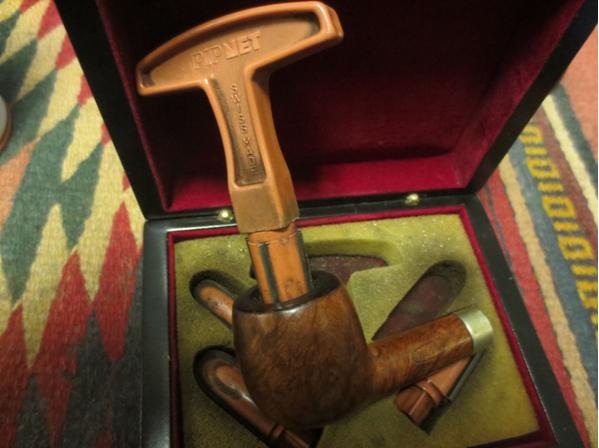
The pipe came to me from a friend quite awhile ago and I just got around to working on it. It was in pretty decent shape other than being dirty. The finish has some dents in the bottom of the bowl on the right side. There was some staining on the right side of the shank at the stem/shank junction. The rim was dirty and had some darkening and a few spots where the finish was worn off. The bowl had a cake that would need to be removed. The screw in tenon was dirty but the stem aligned with the shank perfectly. The stem itself was dirty inside and out. There was tooth chatter on the top and underside of the stem near the button. On the underside was a deep tooth mark in the center about ½ inches from the button. The next photos show the pipe when I brought it to the work table.Duke1

Duke2

Duke3

Duke4 I took some close-up pictures of the rim and the dents on the bottom of the bowl to give a clear picture of the issues with this pipe.Duke5

Duke6 I reamed the bowl with a PipNet reamer and took the cake back to the bare briar. I used a pen knife to clean up remaining cake that the reamer left behind.Duke7

Duke8 I scrubbed the finish with cotton pads and Murphy’s Oil Soap as I did not want to use anything that potentially would damage the painted finish on the bowl. My intent was to get the grime off the finish and to remove as much of the rim darkening as possible without compromising the paint on the rim or edges.Duke9

Duke10 I rinsed the bowl with warm water and dried it off with a towel. Here are some photos of the cleaned bowl.Duke11

Duke12

Duke13

Duke14 I cleaned the inside of the shank and the stem with pipe cleaners, cotton swabs and alcohol until they came out clean.Duke15 With the bowl cleaned inside and out it was time to address the stem. I sanded the surface of the stem to clean off the dirt and tooth chatter. I wiped it down with a cotton swab and alcohol to remove the dust and to examine the dent on the underside.Duke16 After the deep dent was cleaned I filled it with a few drops of clear super glue.Duke17 Once the glue dried I sanded the repair to make it flush with the stem surface using 220 grit sandpaper.Duke18 I sanded the entire stem with medium and fine grit sanding sponges. The repair spot is beginning to blend in very well.Duke19

Duke20 I sanded the stem with micromesh sanding pads – wet sanding with 1500-2400 grit pads and then rubbing it down with Obsidian Oil. I dry sanded with 3200-4000 grit pads and gave it another coat of oil. I finished by dry sanding it with 6000-12000 grit pads. I gave it a final coat of Obsidian Oil and let it dry.Duke21

Duke22

Duke23 In the past buffing the painted bowls and the Grabow stems has caused me a lot of grief. I have found that these stems can take very little heat that the buffing pads generate so I hand buff them with Paragon Wax and a shoe buffer. I buff the bowls the same way using the shoe buffing brush and a microfibre cloth. The finished pipe is shown in the photos below. If you are interested in this pipe email or message me and make an offer. It could easily join your rack. Thanks for looking.Duke24

Duke25

Duke26

Duke27

Duke28

Duke29

An Easy Restoration – an Unsmoked Meerschaum Billiard


Blog by Steve Laug

Easy1I picked up two meerschaum pipes – neither bearing any stamping or markings that give a hint to the carver. The one I am working on now is the second one in the two photos to the left. It has a flumed bowl (darkening on the top and the top third of the bowl fading as it goes down the sides. The second third is a bit lighter and the bottom third is natural). It had a metal reverse tenon – the tenon was set in the shank of the pipe and the stem is pushed over that. In this case the stem is similar cheap nylon/plastic as the ones I replaced in the two previous blog articles noted below.

Prom Night – Dressing up a Cheap Meerschaum Apple

Another dressed for the Prom… maybe the Prom King – Cheap Meer Given a New Look

The similarity in tenon and stem setup leads me to believe that I was dealing with the same carver that I noted in the second article above. There I quote a fellow on the Dr. Grabow Collectors Forum who said “They were excellent pieces of meerschaum with bad stems. The bowls were carved by Robert Strambach in Vienna.” Looking at the stems that I kept from the pipes they are identical in look, feel and composition. All three have the casting marks on the sides of the stem and are thin at the button. The difference in this one is that the pipe was unsmoked so the stem had not tooth chatter or damage. It was merely dull and dirty from sitting in someone’s collection for years.

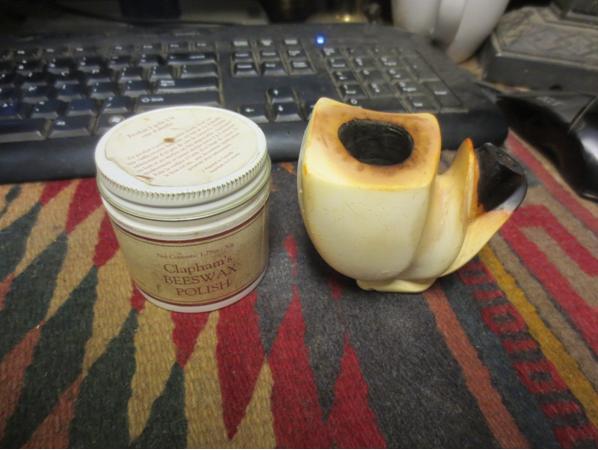
When I received this pipe it was unsmoked. The bowl had darkened from grime and dirt. The fumed rim had a few nicks on the top and inner edge of the rim where the pipe had been knocked about. The meerschaum itself was dirty and had ground in soil on the sides of the bowl and the top and bottom of the shank. There were also a few light spots on the side of the bowl where something had been dripped on the fumed portion and lightened it.Easy2Easy3Easy4Easy5 I took a close-up photo of the rim and the bowl to give an idea of the state of both. The bowl is darkened from sitting but has not been smoked. The rim has some of the nicks I spoke about on the inner edge and the top.Easy6I scrubbed the meerschaum with cotton pads and Murphy’s Oil Soap to clean off the grime. I rinsed the bowl with warm water to remove the soap. I dried it with a cotton cloth.Easy7I sanded the bowl with micromesh sanding pads – wet sanding with 1500-2400 grit pads to remove some of the scratching on the top of the shank and some of the ground in dirt on the sides of the bowl. I dry sanded with 3200-4000 grit pads. I buffed the bowl with Blue Diamond on the wheel and then gave it several coats of soft white beeswax and buff it with a soft flannel buff. The photos below show the cleaned and polished bowl. I was careful in how much of the patina I removed in the process of cleaning the bowl. I wanted it clean but it still needed to look its age.Easy8 Easy9 Easy10 Easy11 Easy12 Easy13To polish the dullness of the plastic stem I wet sanded it with 1500-2400 grit micromesh and dry sanded it with 3200-12000 grit pads. I gave it several coats of Paragon Wax and hand buffed it with a microfibre cloth.Easy14 Easy15 Easy16I put the stem on the bowl and buffed the bowl and stem by hand with the microfibre cloth to give it a shine. The finished pipe is shown in the photos below. This was a simple clean up which is greatly appreciated after the last few hard jobs. Thanks for looking.Easy17 Easy18 Easy19 Easy20 Easy21 Easy22

Wm Wales Billiard Restemmed and Restored


Blog by Steve Laug

Wm1This is yet another pipe that my brother Jeff picked up in Montana and sent my way. It is stamped Wm Wales on the left side of the shank and on the right side it is stamped Grecian in script. The stamping though a different script than that found on the Carey Magic Inch pipes is similar in the way it is stamped and the stamping of Grecian on the right side of the shank. I did some digging on the internet and found nothing about the brand other than several pipes with the same stamping for sale. There is nothing about the brand on the various pipe information websites. There is nothing about the brand on Who Made That Pipe or in Lopes book so I am left with a bit of a mystery.

The pipe has some pretty decent grain on it. The sides of the bowl have some interesting birdseye grain and the front and the back of the bowl have cross grain on them. The stem is a mix of grains. The finish was worn and dirty. The rim had a cake of tar and grit on the top of the bowl. The inside of the bowl had a hard, thick cake that almost filled the bowl. The rim itself was undamaged and showed no burn marks or damage to either the outside edge of the rim or the inside bevel of the rim. The stem was at first glance workable but upon examination it had a crack in the centre of the button on both the top and bottom sides. There were also tooth marks that were deep and one split the button. The surface of the stem was wavy and rippled from the way it had been buffed. The slot in the stem was clogged and no air would go through the airway.

In the photo above to the left the pipe is the second one down from the top. The next set of four photos show the pipe as was when it arrived at my work table.Wm2

Wm3

Wm4

Wm5 I took a close up photo of the bowl and rim to give a clear picture of what I started with in my clean up. The two photos following that give a good view of the stamping on the shank.Wm6

Wm7

Wm8 The next two photos show the damage to the stem. The more I looked at the damage the more I realized that a replacement stem would be less work than fiddling around with repairing the damage on that one.Wm9

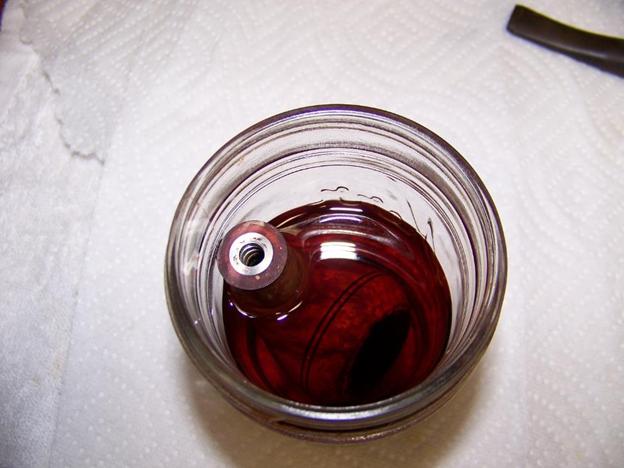
Wm10 I tried to ream the bowl with a PipNet reamer and found that the cake was so hard that reamer did not even cut into the surface of the cake. I tried a KLEENREEM reamer and made no headway either so I dropped the bowl in an alcohol bath to soak. It would soften the cake and clean up the grime on the finish of the rim and bowl as a bonus.Wm11 While it soaked I looked for a new stem in my can of stems and found one that would work quite well. It was a little larger in diameter but once I fit it to the stem some sanding and shaping would take care of that.Wm12 In the morning I took the bowl out of the alcohol bath and worked on it to ream it. I used the PipNet and the KLEENREEM reamer on the bowl. I also used a pen knife to work at cutting away the hard cake. In the process of reaming I found that the bowl was conical in shape rather than U shaped. I used the drill bit from the KLEENREEM tool to open the airway in the shank.Wm13

Wm14

Wm15 Once I had cleaned out the shank and the bowl with alcohol, pipe cleaners and cotton swabs I fit the new stem to the shank. I sanded it with 220 grit sandpaper to clean up the tooth chatter and the oxidation. I sanded it with a medium and a fine grit sanding sponge to further remove the scratching and oxidation. I wiped the stem down with Obsidian Oil.Wm16

Wm17

Wm18

Wm19

Wm20 I scrubbed the briar with acetone on cotton pads to remove the finish and the remaining grime on the rim and bowl.Wm21

Wm22

Wm23

Wm24 I sanded the stem with micromesh sanding pads – wet sanding with 1500-2400 grit pads on the briar and the stem and then rubbed down the stem with Obsidian Oil. I dry sanded with 3200-4000 grit pads and gave it another coat of oil. I finished by dry sanding the stem with 6000-12000 grit pads and gave it a final coat of Obsidian Oil.Wm25

Wm26

Wm27 I buffed the bowl and stem with Blue Diamond polish on the wheel and then gave it multiple coats of carnauba wax. I buffed it with a clean flannel buff to raise the shine. The finished pipe is shown in the photos below. The grain really shines through in the photos. It is a beautiful piece of briar. I would love to know more about the history of the brand to give more depth to my understanding of the pipe.Wm28

Wm29

Wm30

Wm31 I took a few close-up photos of the stem and the bowl showing the grain of the briar and the shape and look of the stem. Thanks for looking.Wm32

Wm33

Wm34

Found an Old Patents Pending Generation 1 Kirsten A


Blog by Steve Laug

Another pipe from the treasure trove my brother Jeff sent me was an early Kirsten. The metal barrel is stamped Kirsten in script on the left side of the barrel and on the underside it is stamped Pats. & Pats. Pend. – A. When I received it the bowl would unscrew from the barrel and it had no metal cap on the bottom. It was a wooden bowl without the cap which along with the stamping pointed to an early Kirsten. The stem and rod were stuck in the barrel and the adjustable valve on the front of the barrel was frozen solid. The valve had evidently been frozen for some time as someone had used pliers on it to try to remove it. They had left behind the tooth marks of the pliers on the aluminum valve cover. Because of the vulcanite lip on the stem that sat against the barrel that there would not be a rubber grommet between the stem and the barrel. The bowl had a thick, rock hard cake and the bottom of the bowl was not visible to see what the condition of the screw head was like. I have no idea how the pipe man ever drew air through this pipe as the bottom of the bowl was solid. The finish on the bowl was dull and lifeless with no grain visible through the grime. The top of the rim was covered with over flow from the cake in the bowl. It was a large bowl initially so once the cake was gone it would be an inch in diameter.Kirsten1 I looked up information to see if I could find a cut away drawing of the Kirsten and found this one and a bit of history and information on the concept of the Kirsten pipe. The following is from the Kirsten website https://www.kirstenpipe.com/page_pipestyles.shtml and https://www.kirstenpipe.com/page ourstory.shtmlKirsten2 “It is by no means merely puffery to say that Professor Frederick K. Kirsten was a genuine American original. He first sailed to this country in 1902, as a cabin boy from Hamburg, Germany. After successfully rounding the Horn and eluding the shanghai gangs of the West Coast, he navigated the educational system at the University of Washington to become a Professor of Aeronautical Engineering. Here, his inventive spirit took wing. He created the world-famous Kirsten Wind Tunnel, Air-washing equipment for factories, an air-cooled Utopian Bed, and, most notably, a revolutionary propeller which enables boats to stop and turn on a dime. Today, in the same waters where he jumped ship almost 100 years ago, ocean-going vessels are landed by sturdy tugs driven by Kirsten cycloidal propellers, piloted by equally sturdy captains smoking cool Kirsten pipes.”
“Rightly called the coolest pipe in the world, this latter innovation came about when a doctor advised Professor Kirsten to switch from cigarettes. He quickly dreamed up a way to trap the moisture, tars and tongue-biting acids which attack the users of briar pipes. After 50 years and counting, Kirsten pipes are still produced by the Kirsten family, faithfully following the basic designs of this father of invention.”

“Professor Kirsten revolutionized pipesmoking by creating the Radiator stem. When tobacco, which is 30% to 60% moisture, is lit in the bowl, it creates steam. As the smoke is drawn through the stem, the steam is cooled and condenses into a liquid. This bitter-tasting liquid is trapped in the stem, along with tars, nicotine and tongue-biting acids.”

“Only clean, cool, moisture-free smoke passes through the intake tube to the mouthpiece. To remove the trapped liquid, you simply remove the valve. You can clean a KIRSTEN in seconds by pushing a tissue through the bore of the stem, exactly as you would clean a gun barrel.”

The cleaning in seconds must not have been something that the previous owner of this pipe ever read or understood. I decided to work on the bowl first as it was the only part of the pipe that I could remove at that point in the process. I took the photo below to give an idea of the thickness of the cake and the minimal size of the air hole at the bottom of the bowl. You can see that it is virtually clogged and the airflow would be very restricted.Kirsten3 The lack of a cap on the bottom of the bowl can be seen in the next three photos. The first two photos show the state of the finish. In the second one you can see the grain peeking through the grime on the finish. In the third photo you can see the stamping on the bottom of the bowl. It reads Kirsten Pats Appl For.Kirsten4

Kirsten5

Kirsten6 I put the barrel and stem in an alcohol bath to soak overnight to try to loosen the frozen stem and rod.Kirsten7 I reamed the bowl with the largest cutting head on the PipNet reamer and took the cake back to bare briar. I used a pen knife to work on the bottom of the bowl and was finally able to see the characteristic Kirsten screw. I sanded the inside of the bowl with 220 grit sandpaper and used an ice pick to remove the screw. From the underside of the bowl I inserted the ice pick into the drilled centre of the screw and tapped it gently and the screw came free from the bowl.Kirsten8

Kirsten9

Kirsten10 I lightly topped the rim on a topping board to remove the damage and the build up on that surface.Kirsten10

Kirsten11

Kirsten12 I scrubbed down the exterior of the bowl and rim with acetone on cotton pads to remove the grime and the remaining finish. I was quite pleasantly surprised by the grain that was revealed in the process.Kirsten13

Kirsten14

Kirsten15 I cleaned the inside and the outside of the screw with a tooth brush and alcohol until it shone.Kirsten16

Kirsten17 I sanded the bowl with a medium and a fine grit sanding block to clean up the scratches and smooth out the finish on the sides and top of the bowl.Kirsten18 I wet sanded the bowl with micromesh sanding pads from 1500-2400 grit and dry sanded with 3200-12000 grit pads.Kirsten19

Kirsten20

Kirsten21 I took the barrel out of the bath and put it in a cup of boiling water. I dipped both ends into the boiling water hoping to break one of the frozen ends loose. I was able to remove the stem and the rod assembly after the alcohol bath and the boiling water dip. The stem and the rod were quite brown with the shellac of old tobacco juices. Of course dipping the stem in the boiling water caused the oxidation on the stem to come to the surface.Kirsten22

Kirsten23 I scrubbed the rod assembly with 0000 steel wool and alcohol to remove the shellac coat that had built up and polish it. There was some corrosion that came to light at the middle of the rod. I would need to work on that once I had cleaned up the stem.Kirsten24 I sanded the stem and rod with 220 grit sandpaper and then with a medium and fine grit sanding sponge to remove the scratches.Kirsten25

Kirsten26 I worked on the stem and rod with micromesh sanding pads – wet sanding with 1500-2400 grit pads and then rubbing down the stem with Obsidian Oil. The micromesh pads removed the last of the corrosion on the rod and polished it. I dry sanded with 3200-4000 grit pads and gave the stem another coat of oil. I finished sanding it with 6000-12000 grit pads and gave it a final coat of Obsidian Oil. I failed to take photos of the final steps in the micromesh process but it is the typical procedure and each successive grit of pads gave more of a polish to the vulcanite.Kirsten27 I cleaned out the stem and tenon with alcohol and pipe cleaners inserted from both ends. I was able to clean out all of the oils and tars and the cleaners came out clean.Kirsten28 Now the bowl and the stem unit were cleaned, polished and ready to go once I was able to remove the valve from the end of the barrel. This was proving a very difficult task. I had put the barrel in the freezer overnight hoping to loosen the valve – no luck. I had boiled it multiple times – no luck. I had given it several alcohol baths – no luck. I let it sit with penetrating oil in the barrel to try to loosen the valve end. I tried to drive it out with a round end file and a small hammer. Nothing worked. I posted that on rebornpipes and got a response from Old Man in the Cave suggesting that I heat it with a heat gun.

I geared up for the process. He had suggested setting the barrel in a wood vise which is a tool I don’t have yet. I chose instead to hold the barrel with some insulated leather gloves over the heat gun. I heated the barrel with gun until it was hot. Then I used a pair of pliers that had cotton pads on the jaws and gave it a light twist and the valve came free. I don’t know if the heat from the gun finally did what I should have done in the first place or if the combination of methods finally came together and it worked. It does not matter as the valve finally came free. I now know why the later models of Kirsten pipes came with a rubber o-ring around the valve and the stem so that it provided something between the two metal pieces and the barrel. Somehow the combination of tobacco juice and saliva left to sit becomes shellac or lacquer that is almost impossible to break free. Thanks to Old Man in the Cave the valve is free and I could finally clean out the barrel and put the pipe back together. The next photos show the condition of the valve once I was able to remove it from the barrel. You can see the tapered angle of the top portion of the valve (on the right below the cap). The lacquer or shellac that bound the valve in the barrel is also very evident. I am guessing that there would have been much more if it had not been sitting in alcohol and been heated so much. But even that little band held the valve tightly in place.Kirsten29

Kirsten30

Kirsten31

Kirsten32 I scrubbed the valve and the inside of the barrel with 0000 steel wool. I ran the steel wool through the barrel to clean out the build up inside and then used a wooden dowel to push alcohol soak cotton pads through the barrel to clean it until it shone. I cleaned out the inside of the valve with alcohol and cotton swabs. I was able to get everything shining again. It took some work to remove some of the tooth marks that were on the valve end from previous owners who had attempted to turn it but I was able to sand them smooth with micromesh sanding pads. They are still present but not as obvious.

Once all the parts were clean and polished I greased the valve and the end of the stem and rod unit with Vaseline so that it would slide into the barrel with less resistance. I know that it will not stop the buildup of tars but it will at least slow it down. The next photos show the disassembled pipe and then the pipe put back together. The valve turned easily and I aligned the hole in the valve with the hole in the top of the barrel where the bowl screwed in place. The airflow was clear and unrestricted.Kirsten33

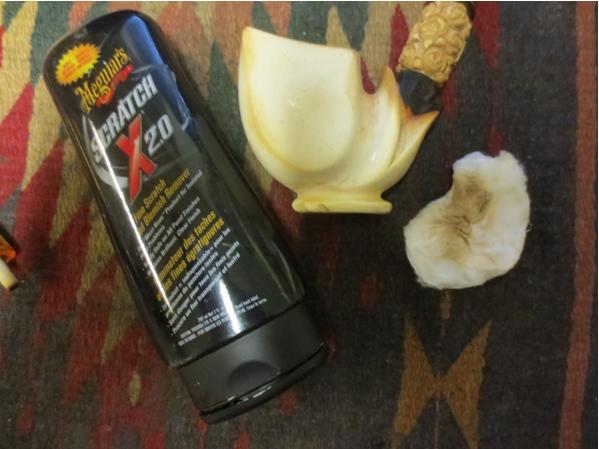
Kirsten34 I hand buffed the barrel with Meguiar’s Scratch X2.0 to remove the scratches and give it a shine. I rubbed on some Conservators Wax and then hand buffed the barrel with a shoe brush. I buffed the briar bowl with Blue Diamond on the wheel and then gave it multiple coats of carnauba wax and buffed it with a clean flannel buff. Once I had finished I screwed the bowl in place and buffed it a microfibre cloth. The finished pipe is shown in the photos below.Kirsten35

Kirsten36

Kirsten37

Kirsten38 I took the pipe apart so that I could take the next two pictures to show the cleaned and polished parts. Everything is once again in working order. It was clear looking at all of the parts that I was dealing with a Generation 1 Kirsten. These were made between the years 1936-1958. The wooden bowl on this generation connects directly to the metal barrel and there is no metal cup spacer. It is a pretty flush fit that goes flat against the barrel. On the underside of the metal barrel it is stamped with one or more of the following “Pat. Appl. For” (1936-38) and “Pats. & Pats. Pending” (1938-1958) over “Made in USA” – S” (or applicable size – S, M, L). There are no O-rings on the bit or metal shank insert.Kirsten39

Kirsten40

Taking a Swing at Reconstructing and Refurbishing an old CPF Meerschaum Bulldog


Blog by Steve Laug

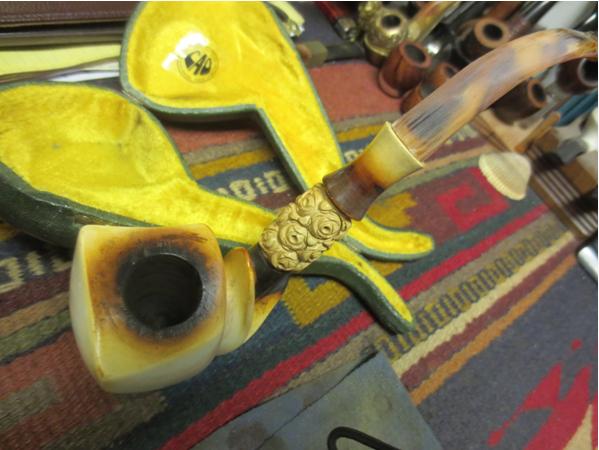
In a previous post where I wrote about repairing the overturned stem on the CPF Bulldog for Michael I referred to a Meerschaum Bulldog that he sent to me as a gift project. I had no idea what he meant about that until I took it out of the box and started checking it out. It really was a rescue dog operation. It is shown in the photo below (the pipe on the right). The picture does not show half of the story about the state of the old stem.CPF1 When the pipe was unwrapped what met my eye fit well with Michael’s “take a swing at it” approbation. It was in rough shape. The Meerschaum bowl was scratched and dirty and the bling was worn and tired. The rim was pretty beat up with dents and scratches but the bowl was solid. There was a light cake in the bowl and that was a plus, as it could have been heavily caked and have a clogged airway.

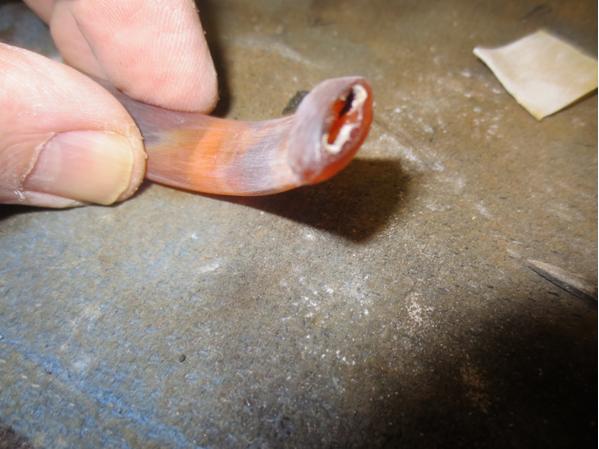
The worst part of the entire pipe was the stem. I am pretty sure it is not amber – at least it does not feel like amber or even have the weight of amber. I am guessing an early version of Bakelite but I am not sure. It is almost fibrous like material – reminds of fibre glass. Somewhere during its lifetime the stem had crazed and cracked all through from one end to the other. It looked like fractured glass. It was barely holding together. There was nothing hold it onto the shank but tars, oils and what seemed like thread that was wrapped around the dirty tenon. I carefully lifted the stem off the tenon and laid it aside. The tenon was covered with a thick tarry substance and what appeared to be thread. I am pretty certain that the previous owner had glued the threaded tenon into the shank and I would never get it loose. Here are a few photos of the pipe, carefully taken so as not to further damage the stem.

I am a sucker for these old timers. This was obviously someone’s beloved pipe. There was a time when I thought a badly abused old pipe was a sign of lack of care. I have come to understand that it is not that at all. It was someone’s constant companion through the good and the bad times. It was one that was always close at hand – to my thinking it may well of road along wherever the pipeman went in the course of his day and was always ready to be loaded and fired up. It is a small bowl so it would not have been a long smoke but it was one that he obviously enjoyed to the point that the pipe was worn and repaired and worn more and repaired more. His repairs were just enough to make the pipe smokeable again but not to make it beautiful. I wish it could talk and tell its story. It lived through two World Wars, the Wright Brothers and the birth of air travel, the first man on the moon, space shuttles and microcomputers. It has seen the turn of two centuries and still survives. Those are the things that I think when I look at a tired old pipe now. I can’t help but wonder about the fellow who once held it in his hands. My repairs are dedicated to carrying on his legacy in this pipe.CPF2

CPF3

CPF4

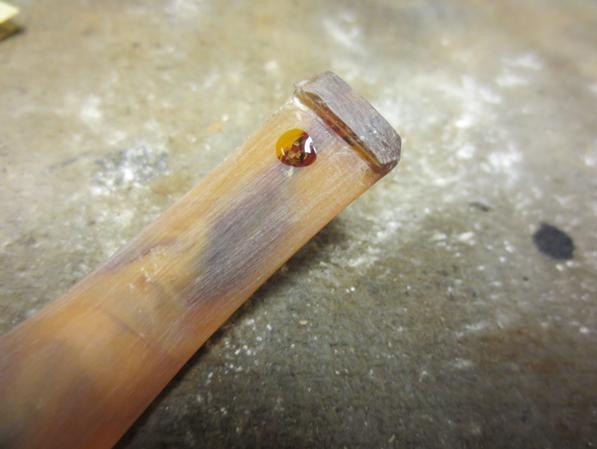
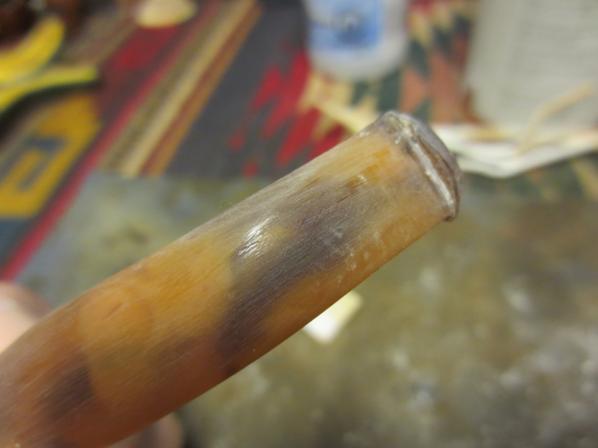
CPF5 If you are observant you will have noticed the black circular mark on the stem on both sides at the button. That black mark was a large hole, a bite through. That was another thing about the stem that made me pretty certain that it was not amber. I took a close up photo of both sides of the stem to show the size of the hole. It is quite large and centered on both sides. The button was also quite worn down and the slot had been opened leaving the top and bottom of the button very thin. You can see all of the cracks and crazing in the stem material in both photos. The airway and the area around the holes were black with tars. This old pipe was not stopped by the holes in the mouthpiece; the pipeman just moved it deeper into his mouth and carried on smoking his favourite pipe.CPF6

CPF7 I took a close up photo of the rim to show the dents and darkening on the metal cap. The ornamentation on the top the rim was worn down from many years of a thumb rubbing over the top of the bowl and leaving behind the remnants of what must have been a continuation of the pattern on the sides of the cap.CPF8 I decided to deal with the issues in the cracked and crazed stem. It was rough along the edges with what looked like splinters. I carefully worked to stabilize the stem material with clear super glue. I liberally coated the outside of the stem with clear super glue, filling the cracks and chipped areas and smoothing out the surface with the clear gel. Once I had it coated well I set it aside and let it harden. I have used the super glue before on Bakelite and it does a great job getting into the cracks and crevices in the material and hardening and preserving the original material. Once it was covered in the glue I had to figure out how to allow it to harden without sticking to everything it touched. I decide to put an ice pick in the airway and lay it across a box – suspended above the work top until it dried.CPF9

CPF10 After the stem had been sitting for four hours and the glue had dried to touch, I decided to “take a swing” at repairing the bite through issue on both sides of the stem. I cleaned the hole and the airway with a cotton swab and warm water to remove the oils and tars. I wanted a clean surface for the patch. I sanded carefully around the hole to roughen the surface to give the patch something to bond to. Then I greased a thick pipe cleaner with Vaseline and pushed it into the slot in the button. I wiped the edges around the whole so there was no grease on them. I put the first coat of super glue on the hole on the underside and sprayed it with an accelerator to harden the first coat of the repair. I repeated the process on the top of the stem until both sides were repaired with the first coat. I removed the pipe cleaner and set the stem aside to cure. The photos below show the process of the repair to the hole. You can see from the photos that the holes patched pretty nicely. They are rough but they are no longer holes. I will need to do a lot of sanding on the stem to clean up the patches and reshape the button but it will be usuable.CPF11

CPF12

CPF13

CPF14

CPF15 After about an hour I gave it a second coat of glue on top of the repair and set it aside to cure again. While the repaired stem cured I went to work on the bowl. I used a pen knife to carefully scrape out the light cake in the bowl.CPF16 I cleaned out the rings around the bowl with the pointed end of a round needle file. I wanted to get the gunk out of the rings before I scrubbed the surface of the bowl.CPF17 I scrubbed the bowl with Murphy’s Oil Soap on a cotton pad remove some of the grime and clean up the exterior of the bling.CPF18 I used a cotton swab to soak alcohol around the threads of the bone tenon. I was able to pick out some of the thread that had been used to hold it in place. I am hoping that repeated alcohol applications will loosen the tenon so that I can unscrew it from the shank to do a thorough cleaning.CPF19

CPF20 The repeating swabbing with alcohol did not loosen the tenon at all. I think that the previous owner must have glue it in the stem and just pressure fit the stem onto the tenon. I had to come up with a different way of getting the stem to fit the tenon as the threads on the inside of the airway in the stem were worn and the stem just wobbled now that it was clean.

I examined the inside of the cleaned and restored stem and could still see the threads. I thought of trying cork and wrapping the tenon with that but after trying that it was too thick to fit into the stem. I then thought of wrapping the end of the tenon with thread and then coating the thread with wood glue. I tried that and it worked well. I was able to twist the stem onto the tenon and the threads in the stem worked into the glue and thread mixture on the tenon. The fix was a success.CPF21

CPF22

CPF23 I sanded the stem with 220 grit sandpaper to smooth out the repairs. I took down all the high spots and bumps left behind by the super glue. I recut the edge of the button on both sides of the stem with a needle file and then sanded the hole repairs on both sides to blend them into the surface of the stem.CPF24

CPF25

CPF26

CPF27 I reworked the button with files and cleaned up the slot with files as well. Once I had the look right I sanded the stem with a medium and a fine grit sanding sponge. The crackle in the stem material where all the crazing was and now the glue bonding it together gave the stem a bit of a sparkling look. An added benefit of the crackling look was that the patched holes at the button blended in quite well.CPF28

CPF29 I screwed the stem in place on the bowl and took a few photos to see what the finished look was going to be like. The repair makes the material sparkle. I really like the look that is coming together. I still needed to polish the stem with the micromesh sanding pads but you can see the finished pipe taking shape.CPF30

CPF31

CPF32

CPF33 I sanded the stem with micromesh sanding pads to raise the shine in the material. I wet sanded it with 1500-2400 grit pads and gave it a coat of Obsidian Oil. It would not absorb but it would give some traction to the next grits of micromesh. I dry sanded with 3200-4000 grit pads and gave it another coat of oil. I finished with 6000-12000 grit pads and applied several coats of carnauba wax to the stem by hand and hand buffed it with a microfibre cloth.CPF34

CPF35

CPF36 The wax on the stem, polished by hand gives it warmth and a glow that is beautiful. The repairs to the bite through on both sides of the stem blended in quite well do to the crackling of the stem material. All combined the stem came out quite well considering where I started with it in this process.CPF37

CPF38

CPF39

CPF40 I sanded the bowl with micromesh sanding pads to give it a shine. I decided to leave the scratches and dings in the bowl as it adds character to the old timer and are part of its long history as someone’s favourite smoking pipe. I can almost see the old pipeman putting the pipe in his pocket and heading off to work or for a walk. It certainly was not coddled like a pampered thing that wisdom of the age taught about meerschaums. No white gloves or careful handling this pipe saw much in its long life and carries the scars and marks of the journey. Now it is good to go for the next portion of its journey, one in which it will have a bit easier life.CPF41

CPF42

CPF43

CPF44

A Surprise when working on the Citation 812 Canadian


Blog by Steve Laug

Class1This Citation (second pipe down in the first column in the photo on the left) is a sister pipe to the Savinelli Classica 812 Canadian that I just restored. It is stamped Citation and 812 on the bottom of the shank. The sand blast is nowhere near as beautiful as the Classica but it has a charm all its own. It appears to be a combined blast and rustication – hard to explain but it is just too consistent to be a normal sand blast. It appears to have been rusticated and then blasted lightly. It has a dark brown stain as an undercoat and a light brown over the top. The high points on the finish are lighter brown and the smooth portions are also lighter brown.

The bowl had a pretty heavy cake and the lava had overflowed onto the rim. The finish was dirty but otherwise in decent shape under the grime. The rim appeared to be in good shape under the grime and there were no nicks or dings in the outer or inner edge of the rim. The stem that came with the pipe was not the original and it had been poorly fit to the shank. It was narrower than the shank and pinched at the saddle portion. It still had all of the fill marks from the person who had fit it to the shank. The underside of the button and a large chunk of the underside of the stem were missing. I would not be sad to throw away this poorly cut broken stem.

Inside the shank was pretty dirty and plugged. I could not blow air through the pipe and did not dare to try sucking on the shank. Who knows what might end up in my mouth! I would need to remedy that situation and I would need to make a stem for it. This would be a beautiful little pipe to go with the Savinelli Classica once it was finished – kind a light and a dark version of the same shape. At this point little did I know what kind of surprise lay ahead for me as I cleaned it up and restored this little pipe. The photo below shows the two pipes together.Class2 The next four photos give a clear picture of the state of the pipe – its finish, broken stem and tarred and cake rim and bowl. You can also see what I mean when I say that the finish is far to uniform for a sand blast but looks to have both a blast and a rustication. Someone help me out on this if you have any information.Citation3

Citation4

Citation5

Citation6I went through my can of stems and found a clear acrylic taper stem that would work perfectly with this pipe and with a little shaping would go well with the dark look of the finish.Citation7 The tenon almost fit perfectly from the start. I only needed to lightly sand it to get a snug fit against the shank. The diameter of the stem was a little bigger than the shank of the pipe all the way around but would easily be shape to fit well.Citation8

Citation9

Citation10

Citation11 I took a close up photo of the rim to give an idea of what I was working with on this bowl. The second photo below shows the stamping on the pipe.Citation12

Citation13 If I had known what I found out later in the refurbishing process I would never have taken the next steps in the clean up. But I was oblivious so I did them unwittingly. I used the smallest PipNet reamer cutting head to take back the cake to what I thought was bare briar. I used a small pen knife to even up the job of cutting back the cake to smooth.Citation14

Citation15 I scrubbed the outside of the bowl and the rim with Murphy’s Oil Soap and a tooth brush and fine bristle brass tire brush to clean off the tars and lava that had overflowed the top of the bowl. I rinsed the pipe under warm water to remove the soap and the grime and dried it off with a cotton towel.Citation16 The cleaned finish even more clearly looks to be a manufactured look to approximate a sandblast finish. But it was a great tactile finish and once polished would look great.Citation17

Citation18

Citation19 I gave the bowl a light rubdown of olive oil like I had on the Classica. It brought the colours in the briar to the front and it is going to be a beautiful pipe.Citation20

Citation21

Citation22 In the photo above you can see what looks like a smooth ring around the inside of the bowl. This was my first clue that things were not necessarily as they appeared. I went back to read a post on Facebook by Geoff Carmell about a Citation pipe he had found. Sure enough the finish was the same and the ring around the inside edge of the bowl was a meerschaum lining. With the way I had man handled it – reaming and scrubbing with the brass bristle brush it is a wonder that I had not damaged the bowl. I would do some work on cleaning that edge a little more gingerly later. Now I had to fit the new stem.

I sanded the stem with a Dremel and sanding drum carefully working it down to the same diameter as the shank and fitting the flow of the curves on the oval shank. This has to be done carefully and with a steady hand or you have to repair the damaged shank or cut another stem to fit. I proceed carefully and slowly. The photos below show the rough fit of the stem after the Dremel and sanding drum work.Citation23

Citation24

Citation25

Citation26 I sanded the rough fit stem with 220 grit sandpaper to smooth out the scratches and fine tune the fit to the shank. I also sanded it with a medium and a fine grit sanding sponge to further fine tune the fit.Citation27

Citation28

Citation29

Citation30 The next photos show the newly fitted stem and what the pipe will look like with the clear stem. It still needs a lot of sanding including file work on the airway and the button. It has a small airhole in the end of the button but I will need to cut and shape a slot.Citation31

Citation32

Citation33

Citation34 All of the internal work and the work on shaping a slot are done with my collection of needle files. It looks like a lot of files but I usually only use three different files – a round, an oval and a flat oval. I use both the larger and the smaller files in these three shapes.Citation35

Citation36 The slot is progressing from a round hole to more of an oval shape that matches the shape of the button. Still a lot of filing to do to get it finished.Citation37 I worked on the button, slot, and airway to smooth things out and open them up with the smaller files as well. When I drilled the airway to turn the tenon the drill left a ridge on the inside of the airway in the stem that is a bear to sand out. I worked on it until it was as smooth as I could get it. There is still a small line in the airway but it is smoother than it was when I started. I am going to have to get some tapered drill bits. That would have made this task a minor hiccup in the process rather than a several hour ordeal. The airway is wide open and takes a fluffy pipe cleaner with ease.Citation38

Citation39

Citation40 I sanded the end of the button and slot with 220 grit sandpaper to remove the scratches and then went through the micromesh pads to polish it. I worked the stem over with micromesh sanding pads, wet sanding with 1500-2400 grit pads and dry sanding with the remaining pads 3200-12000 grit.Citation41

Citation42

Citation43 With the stem done I figured I could put it off no longer. I had to work on the airway. It was seriously clogged. I could not push a paper clip through or even an ice pick. I used the drill bit on the KLEENREEM and could not get it through. I had to soak it with an alcohol wetted pipe cleaner to soften the plug and then I used a paper clip to push through the plug finally. Then I had to work through the drill bit and the pipe cleaners to get all of the gunk out. Finally I have good airflow. I cleaned out the shank with alcohol and pipe cleaners until they were clean.Citation44 I cleaned the meerschaum lining on the rim with micromesh sanding pads and patiently just sanding the meer edge and the bowl. I was able to get much of the tars off the meer and now it shows golden. There are several spots where it is stained very dark.Citation45 I buffed the bowl and rim with Blue Diamond and did the same to the stem. I gave the stem several coats of carnauba wax and the hand waxed the bowl with Conservators Wax. I buffed the pipe with a clean flannel buff and then with a microfibre cloth to raise the shine. The finished pipe is shown in the photos below. I like the way it came out. (In the photos of the full pipe the stem came out looking opaque but it is absolutely clear as can be seen in the close up photo.)
Citation46

Citation47

Citation48

Citation49

Citation50 I took a photo of the two pipes together to show the finished product. Thanks for looking.Citation51