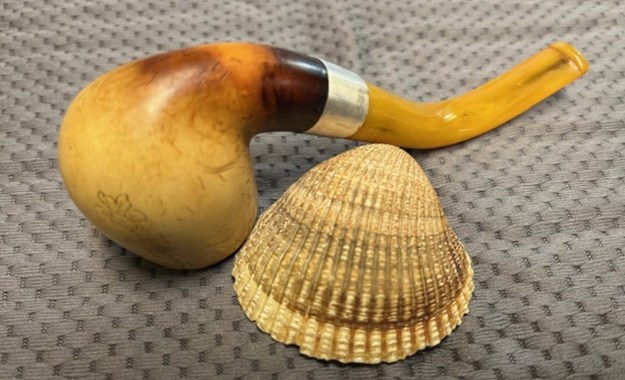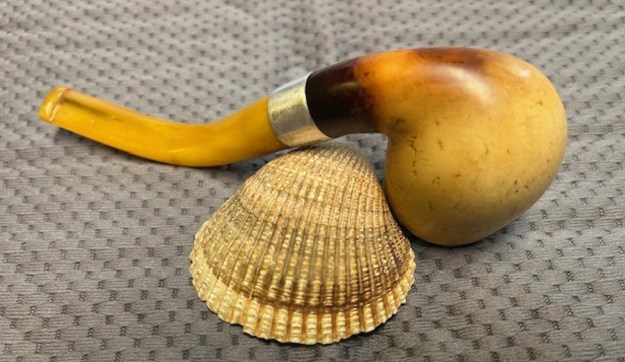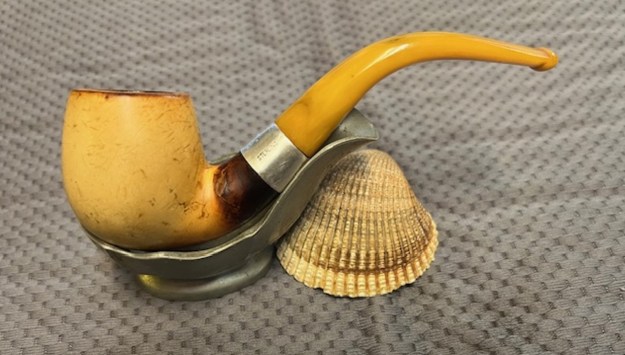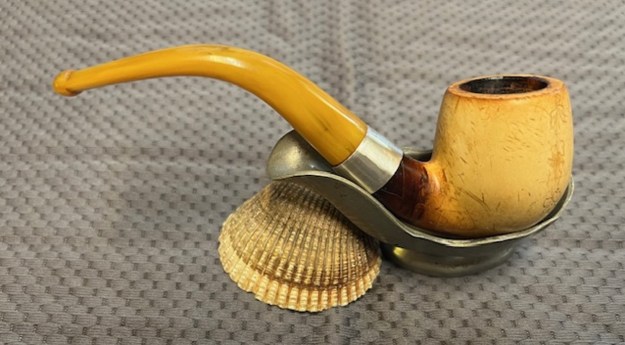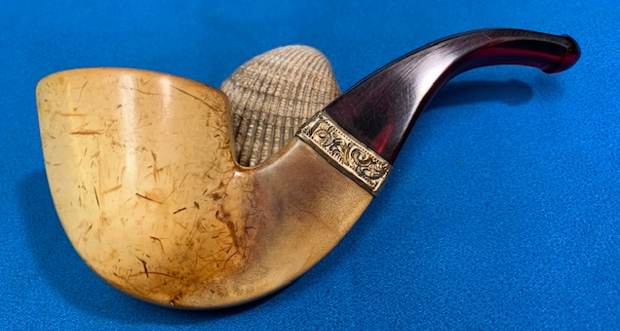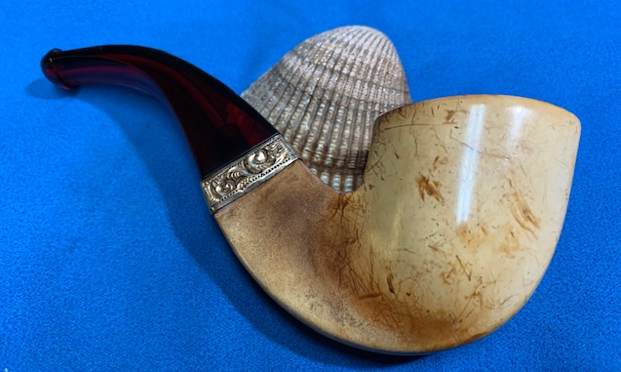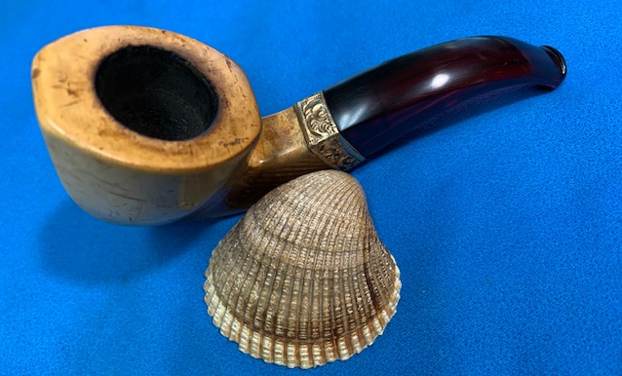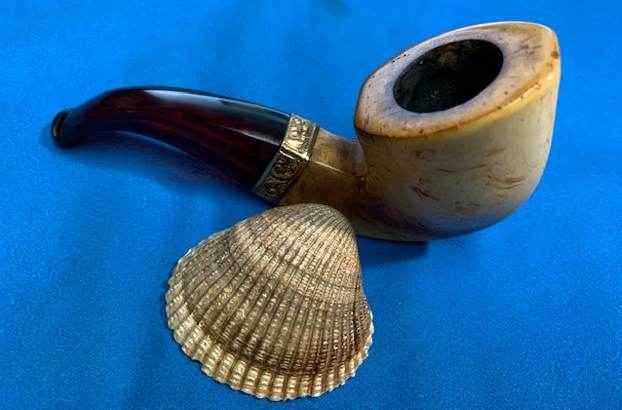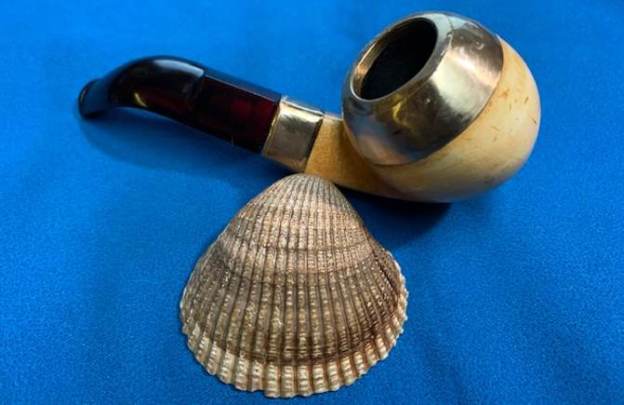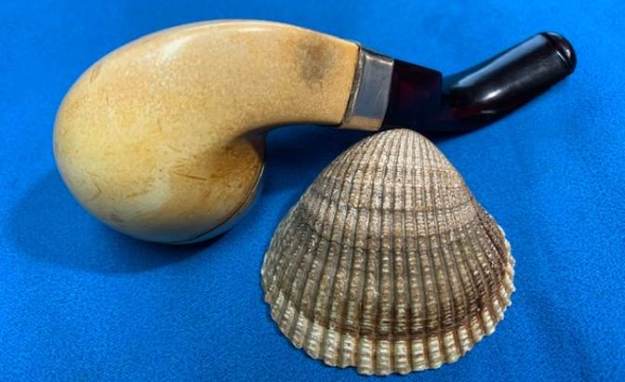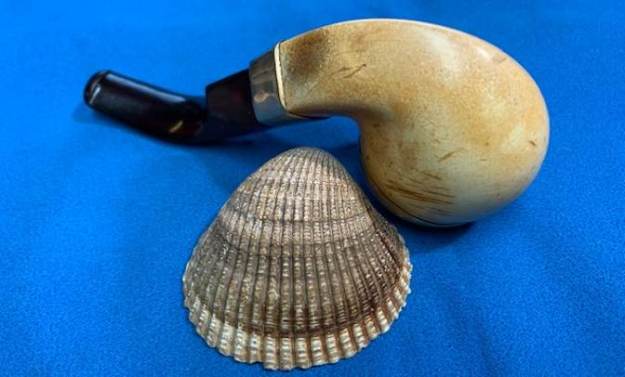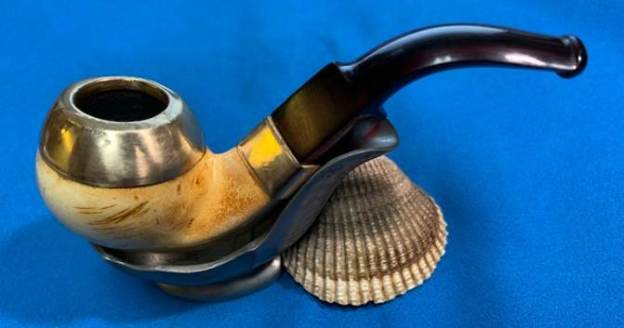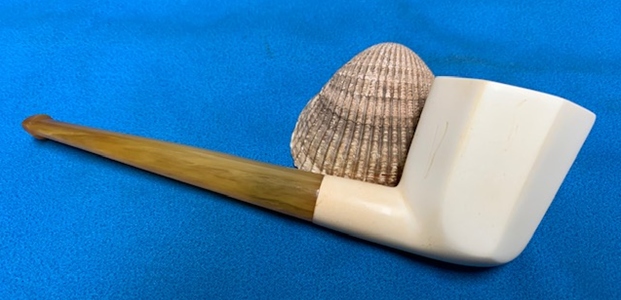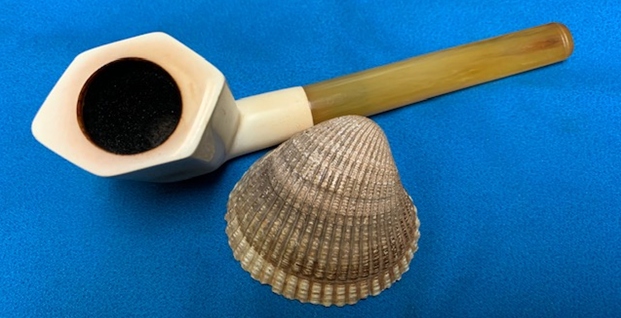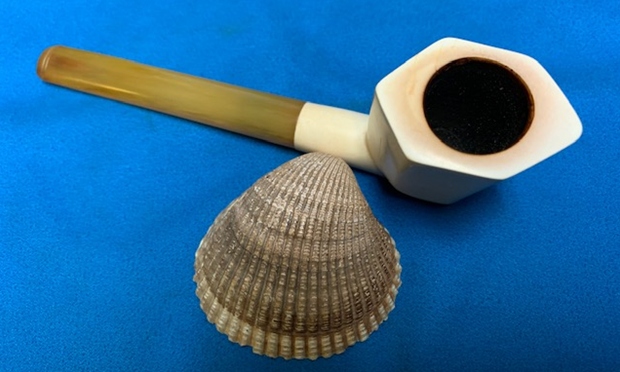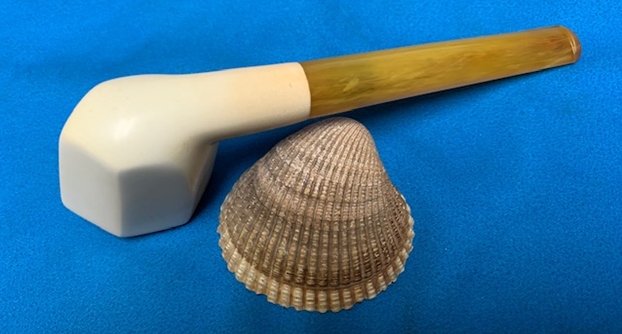
Tag Archives: Meerschaum pipes

Rescuing an Old, Enigmatic Bamboo Meerschaum Sitter


by Kenneth Lieblich

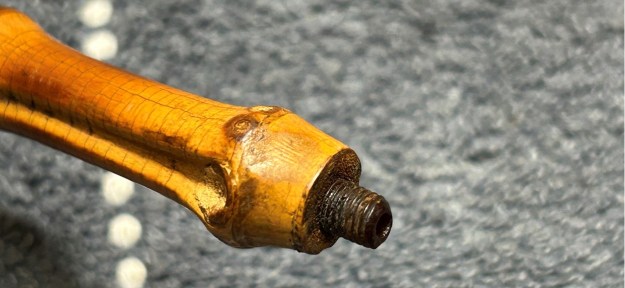
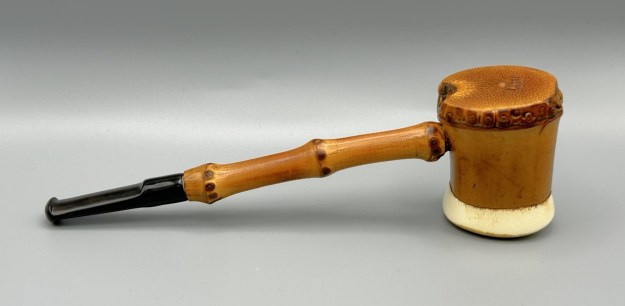
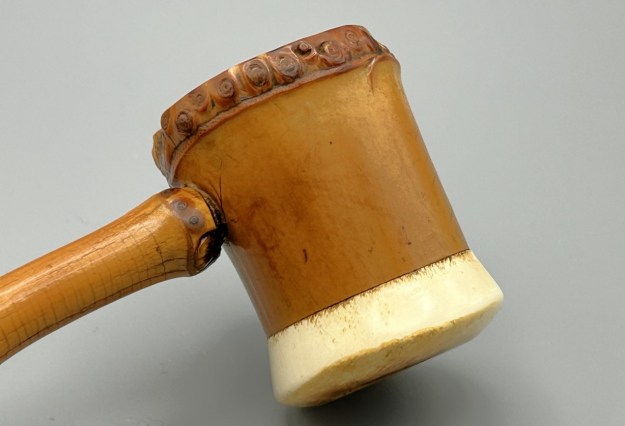
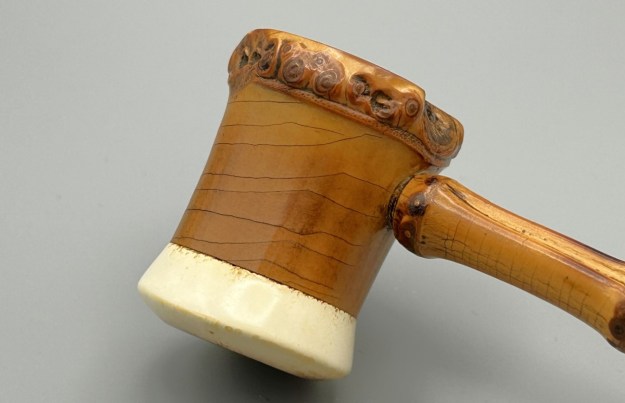
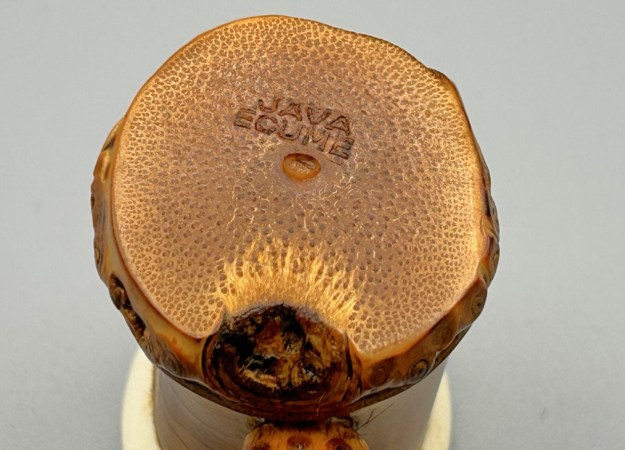
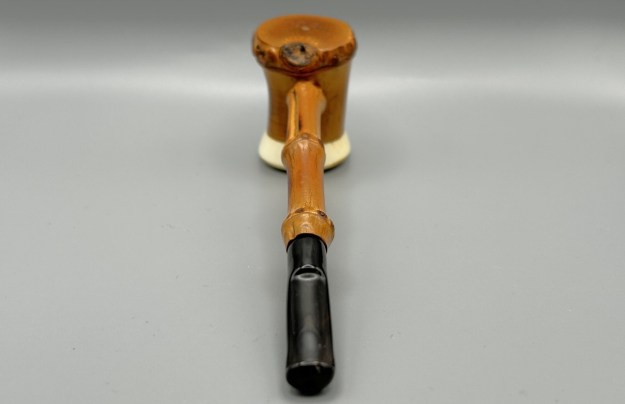
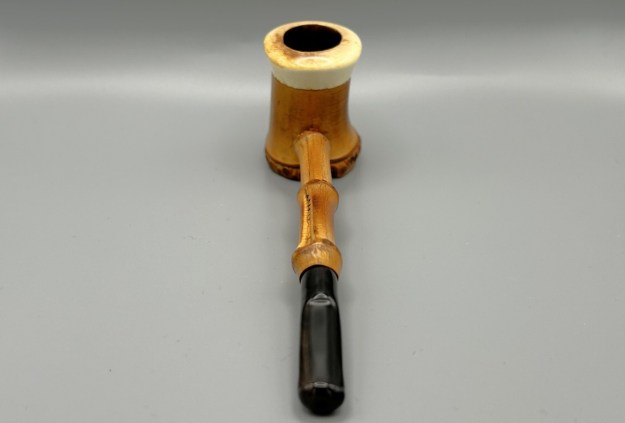
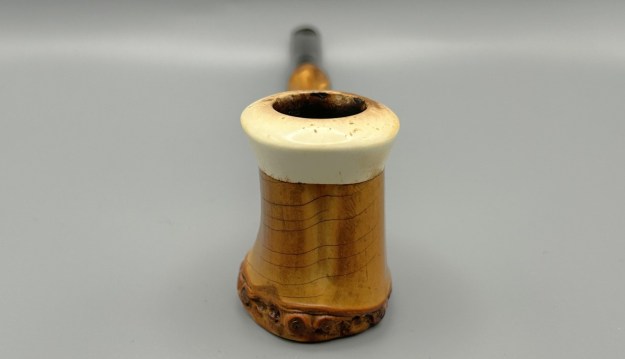
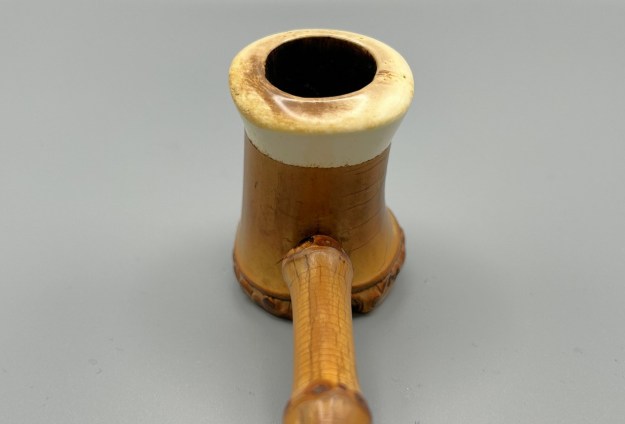
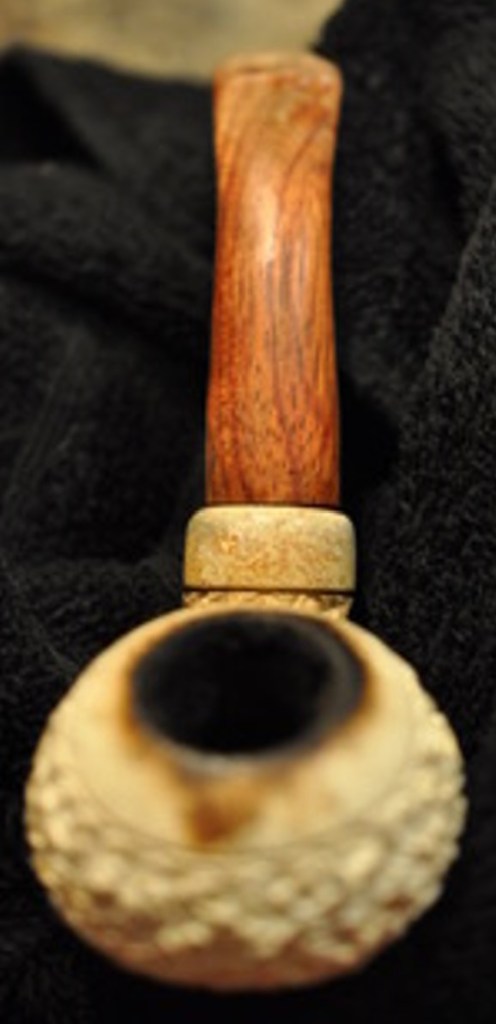
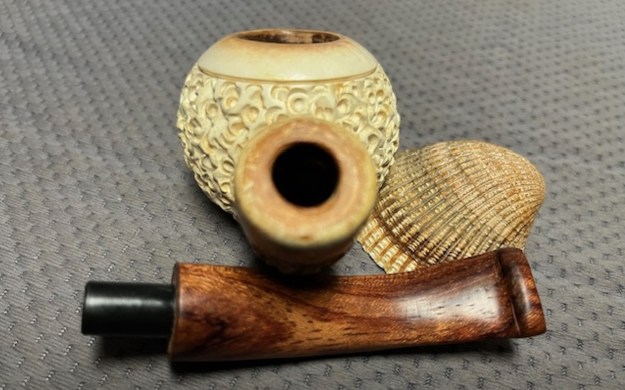
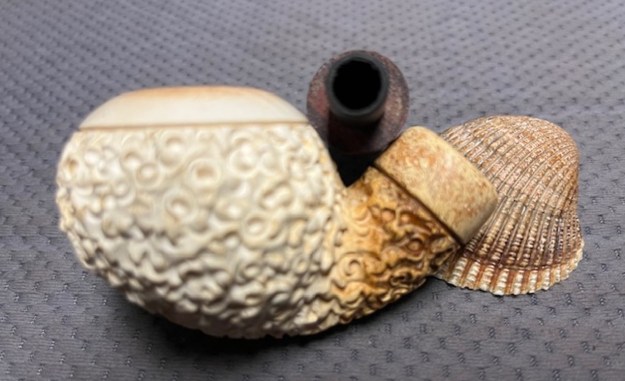
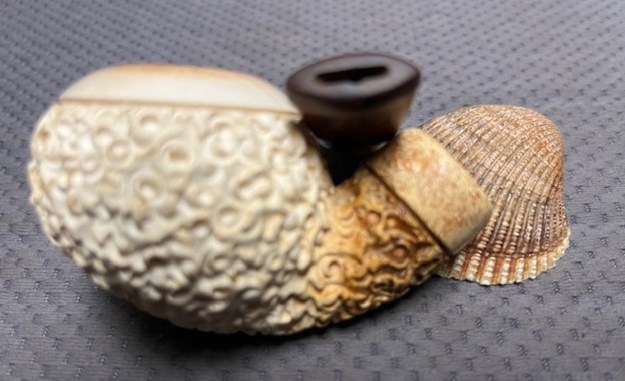
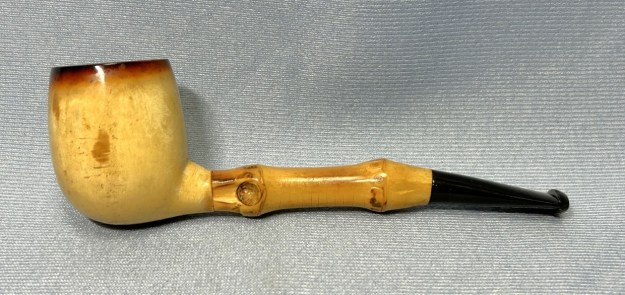
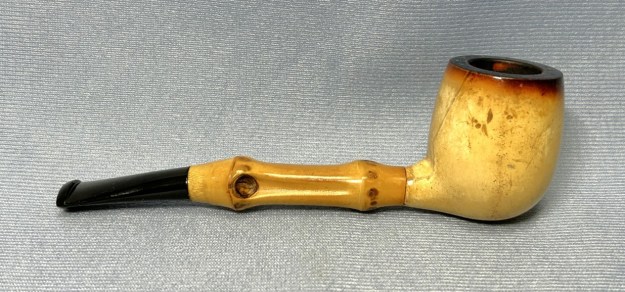
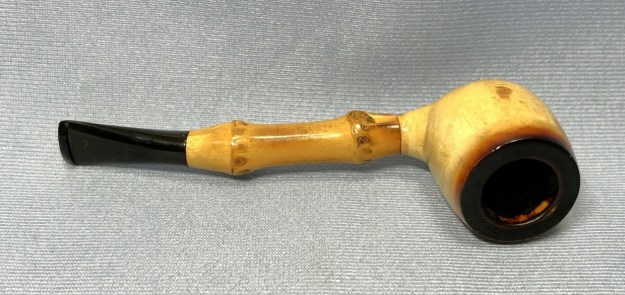
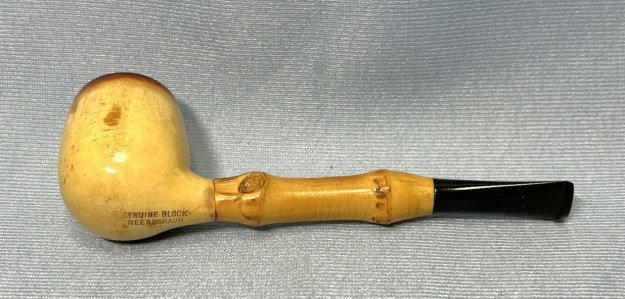
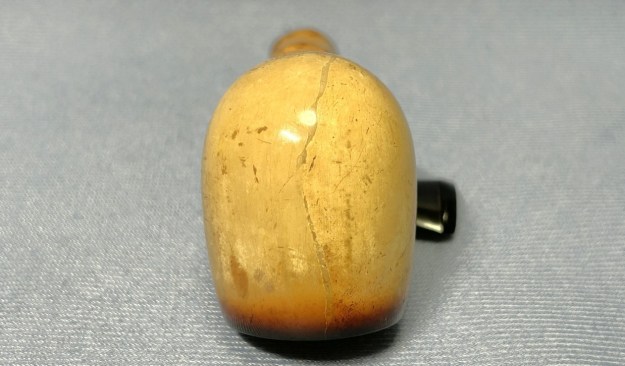
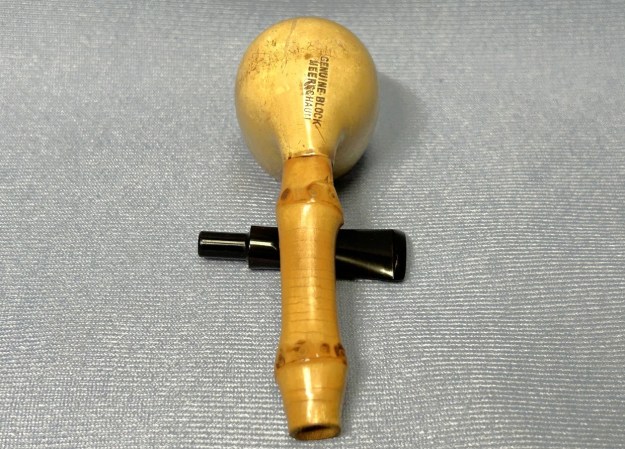
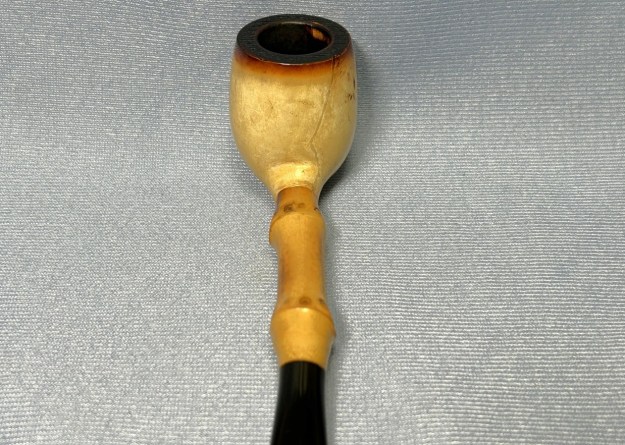
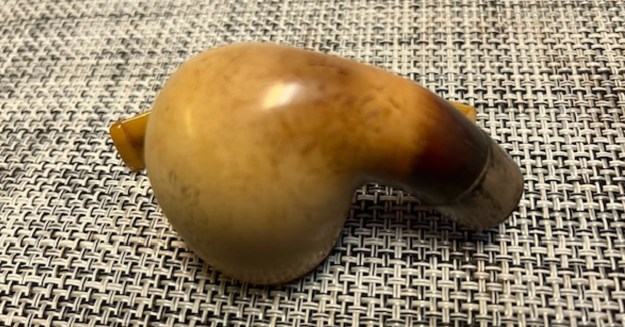
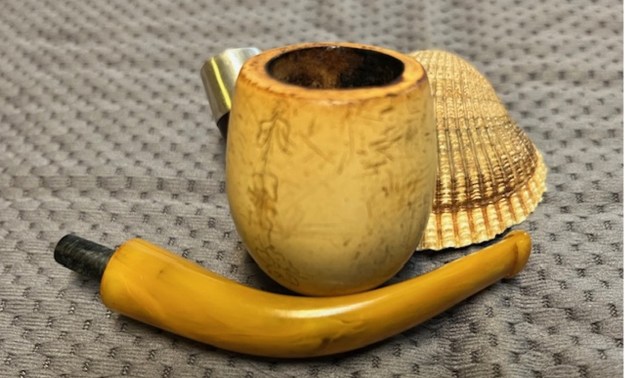
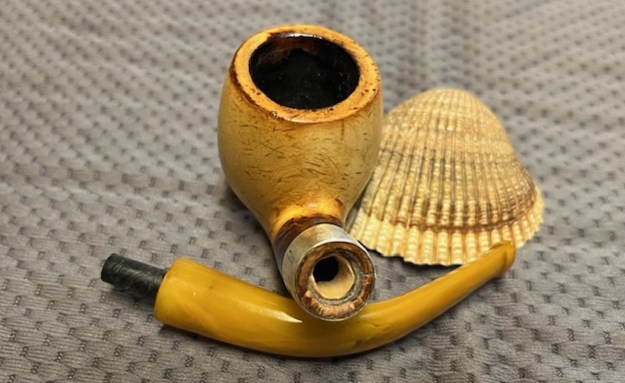
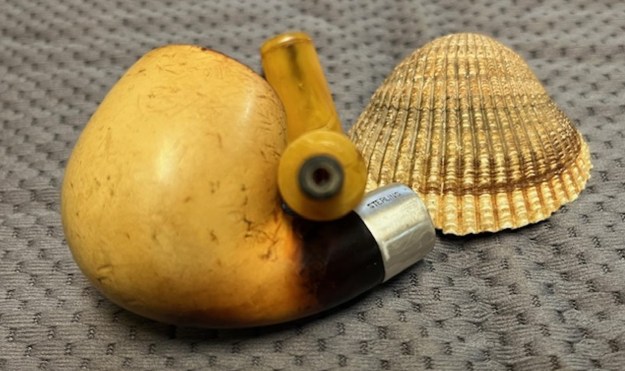
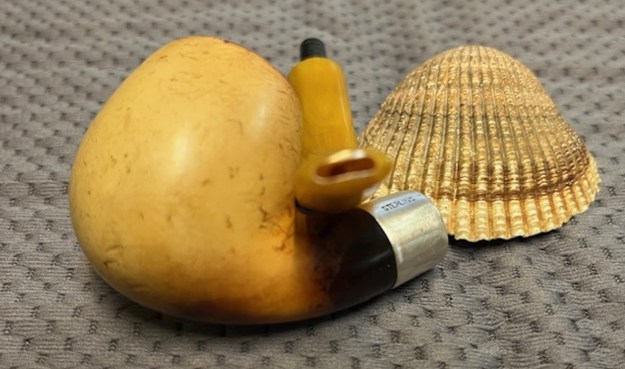
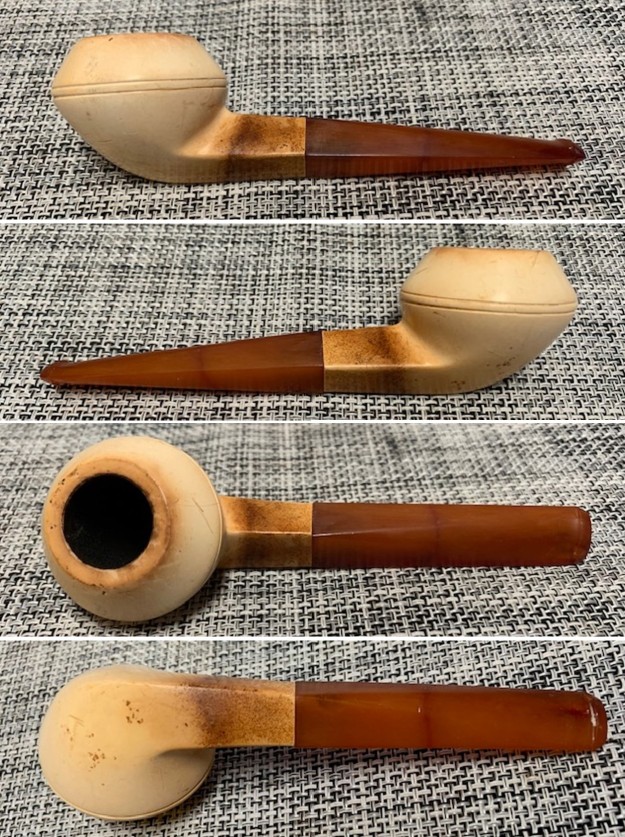
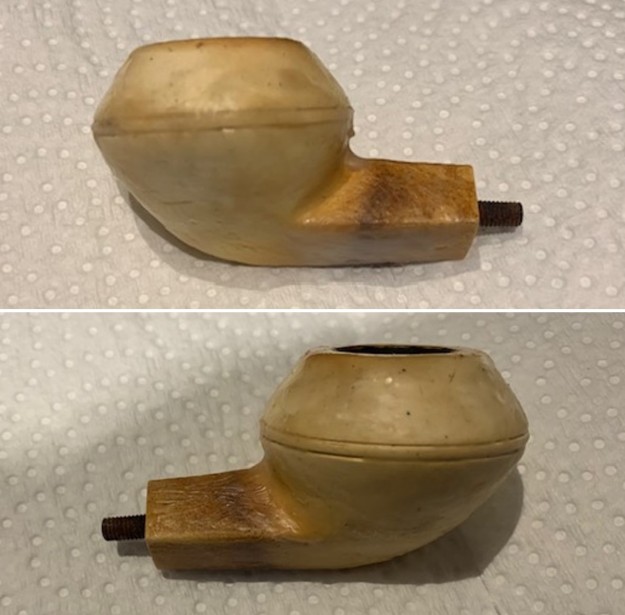
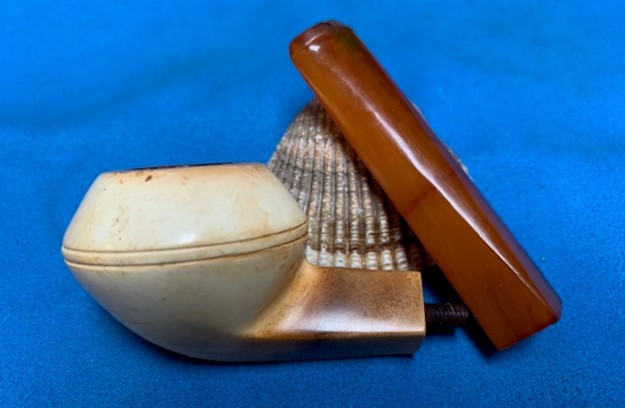
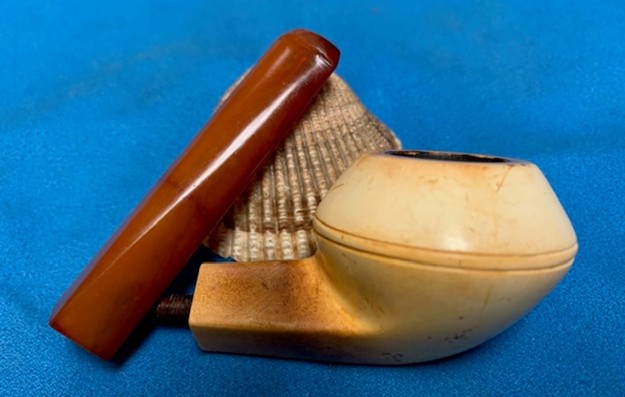
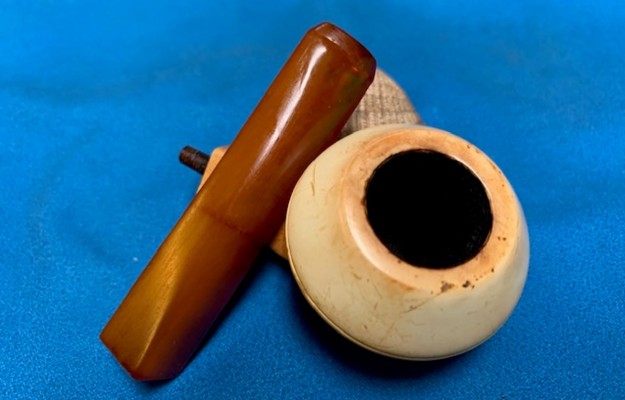
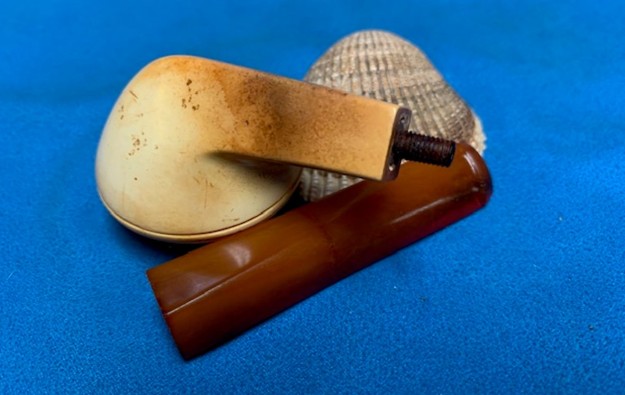
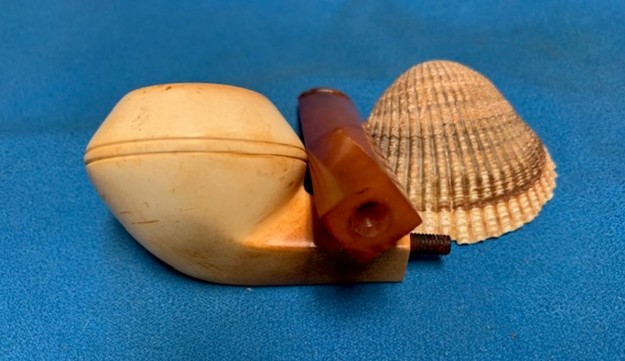
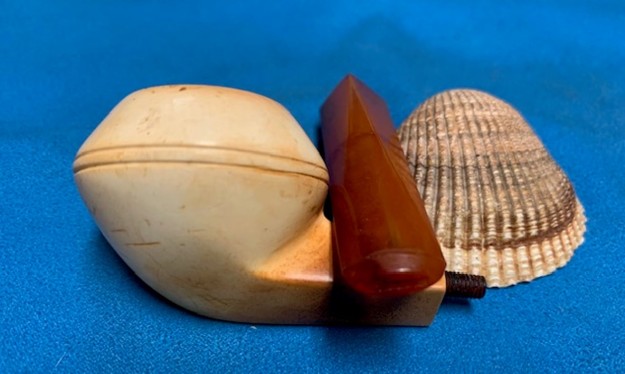
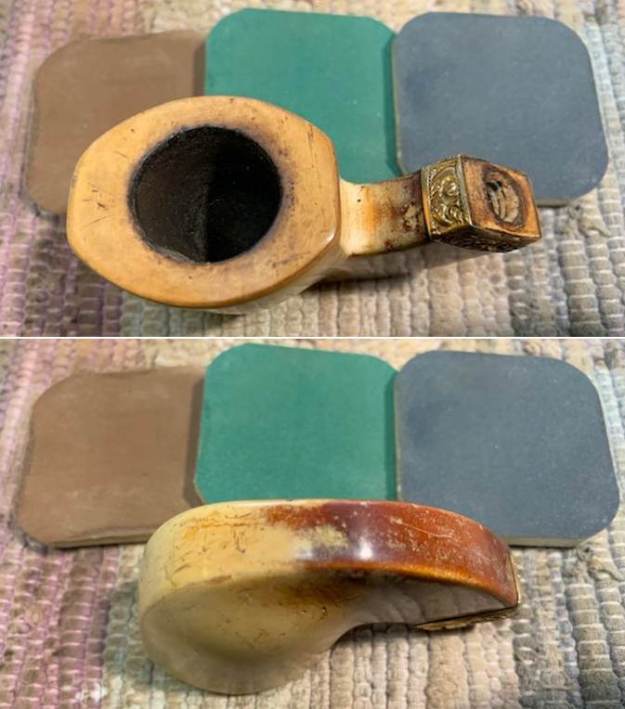
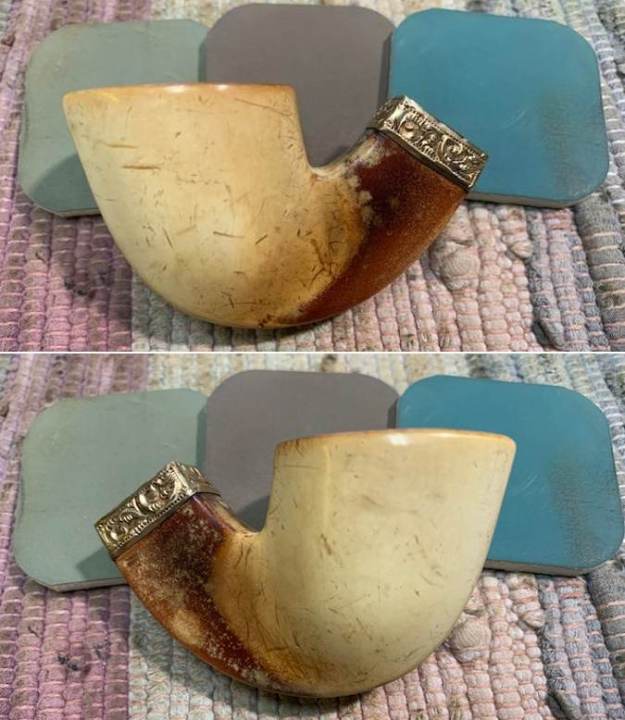
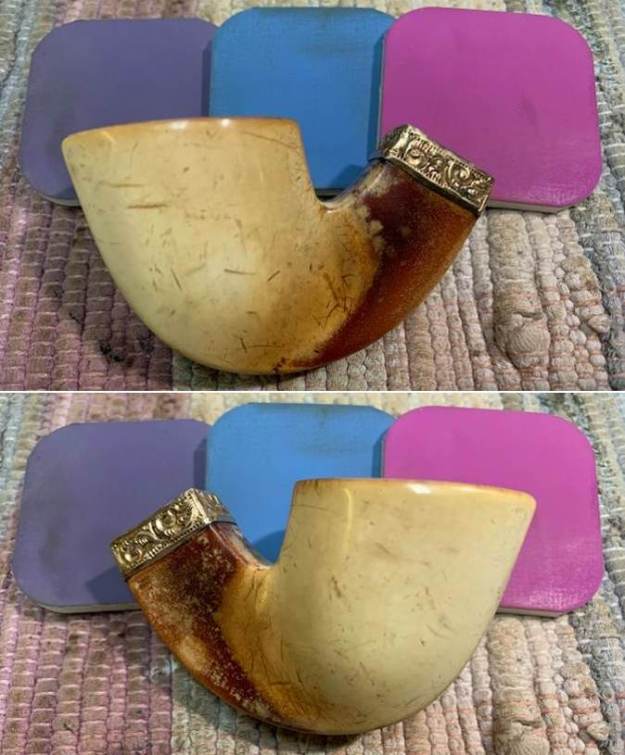
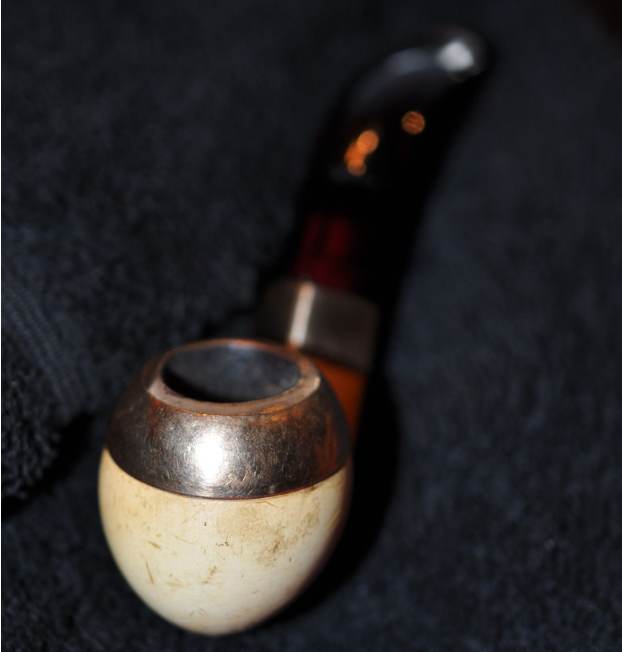
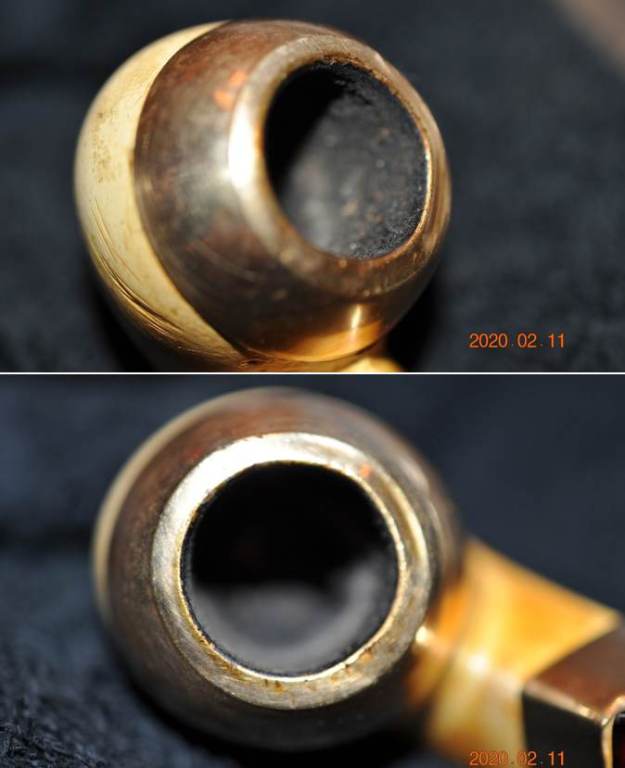
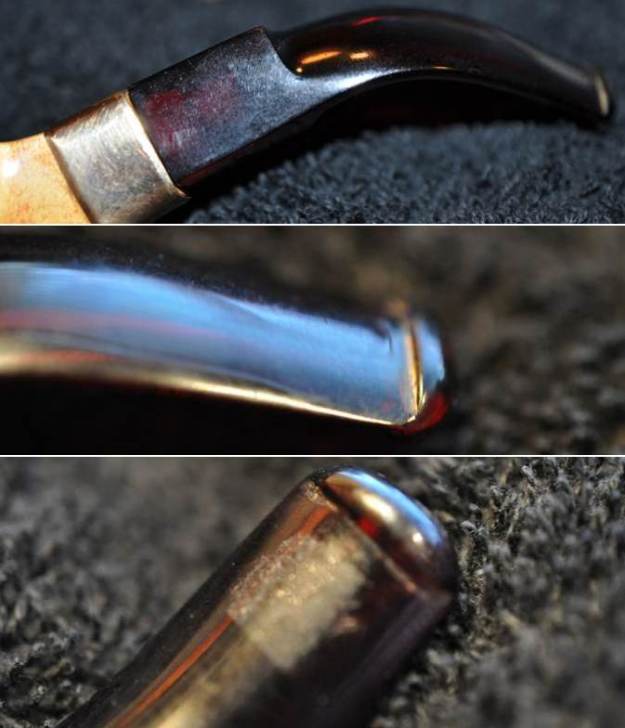
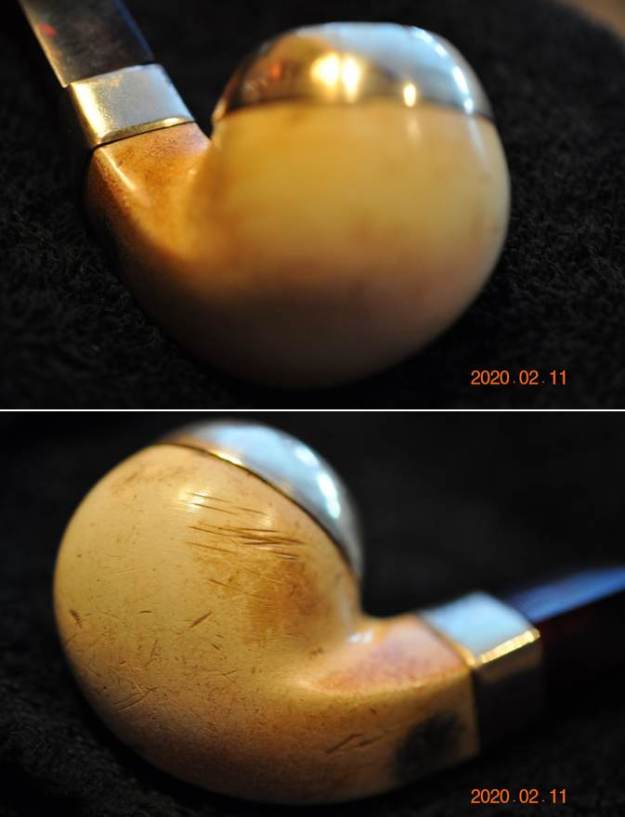
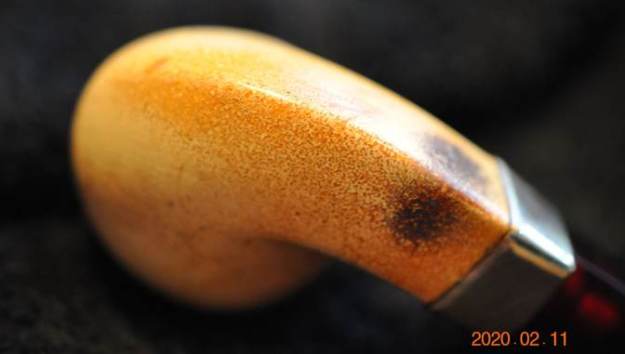
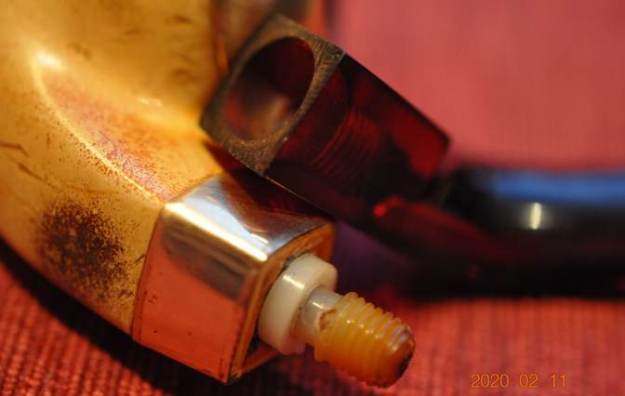
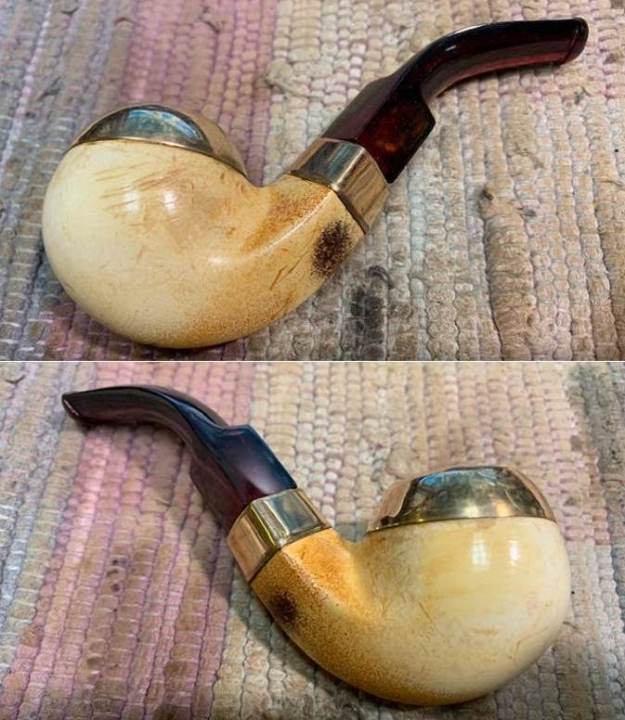
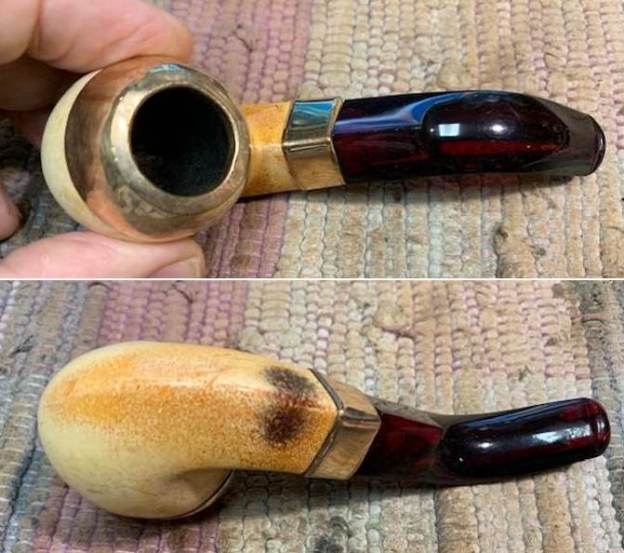
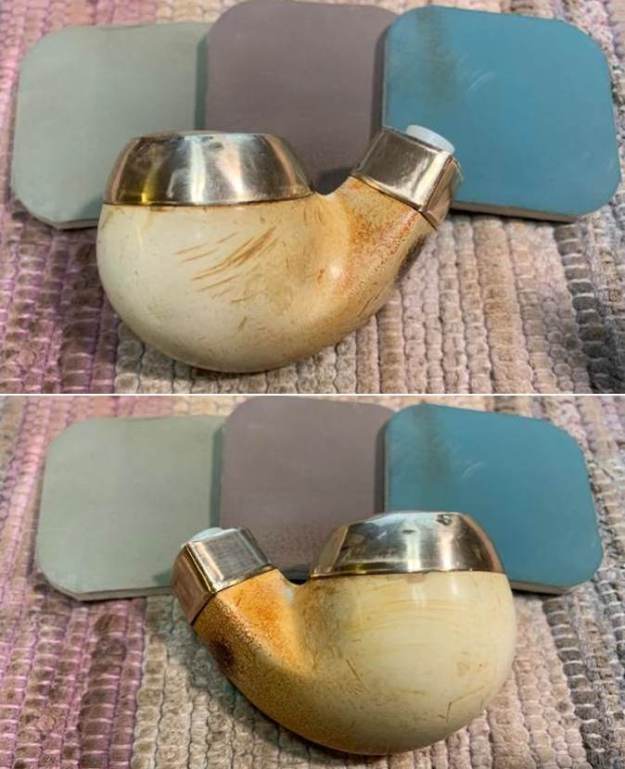
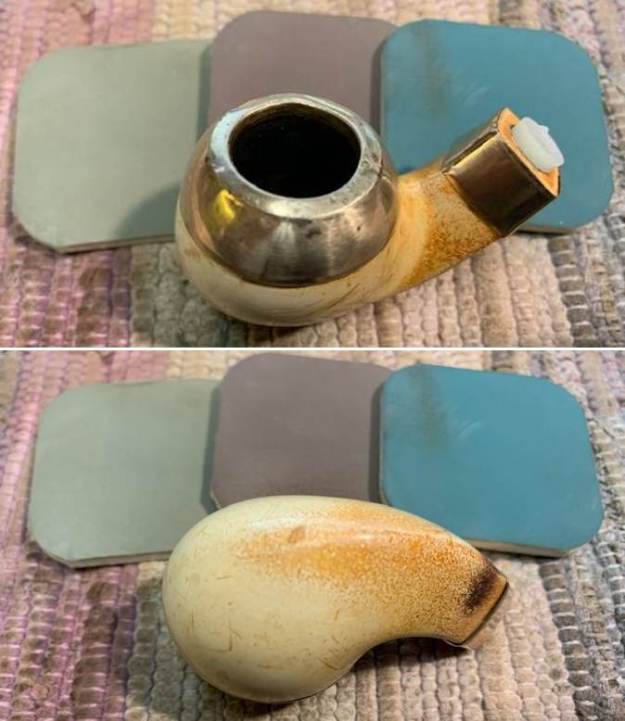
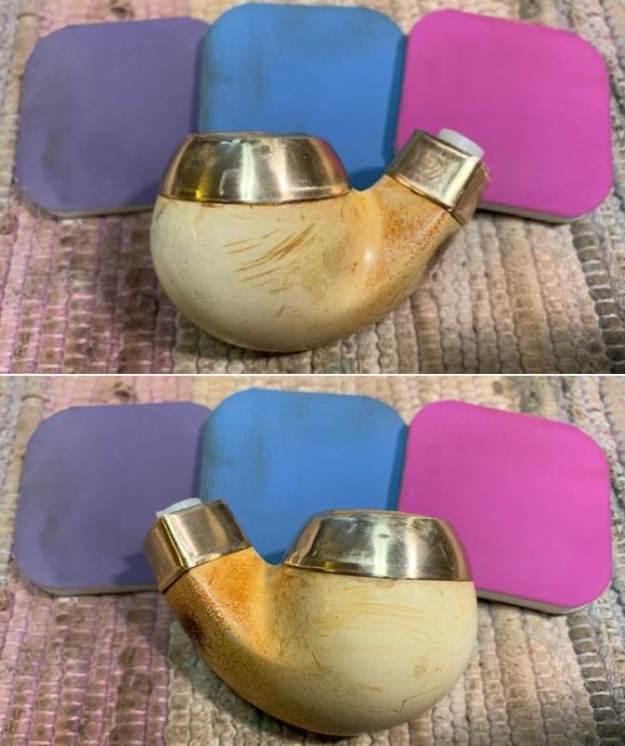
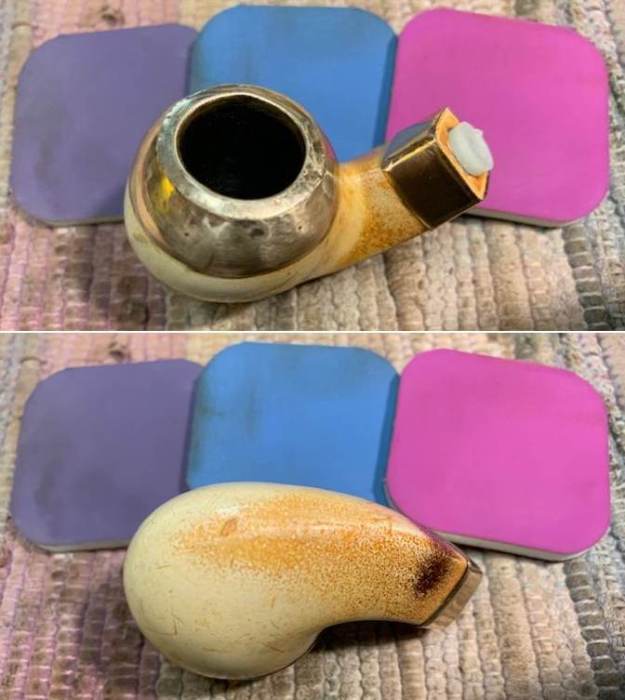
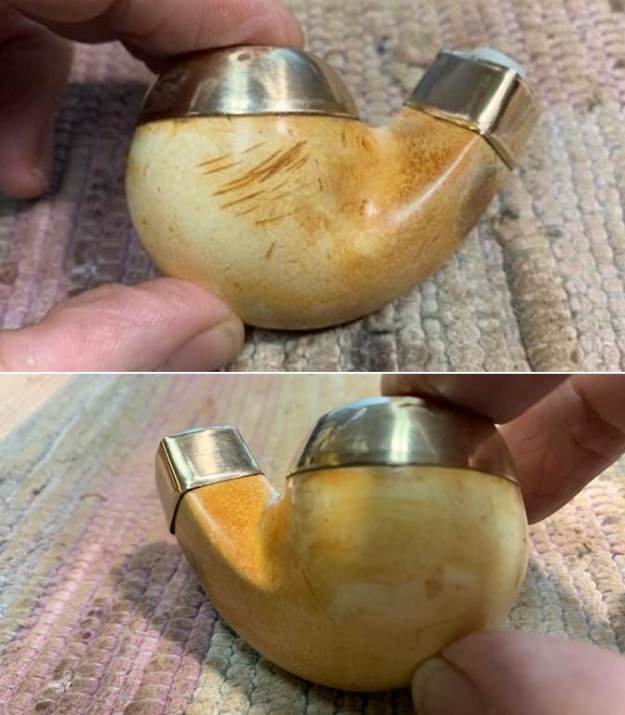
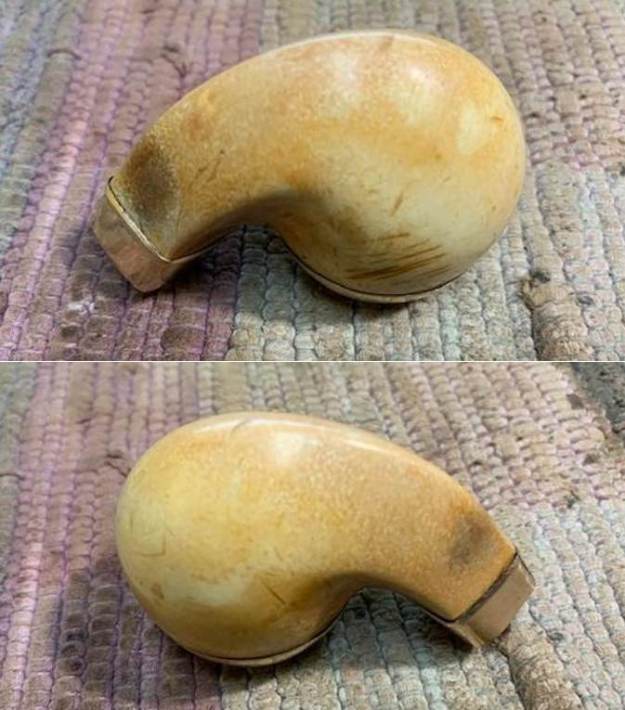
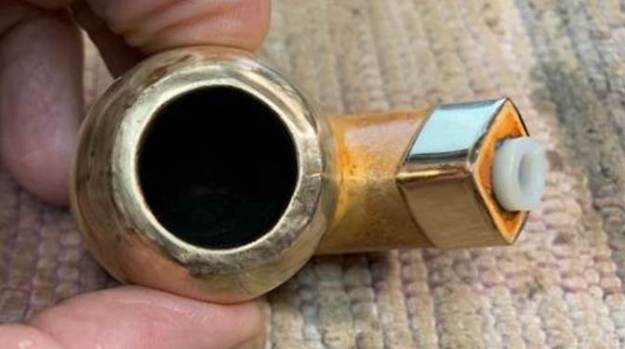
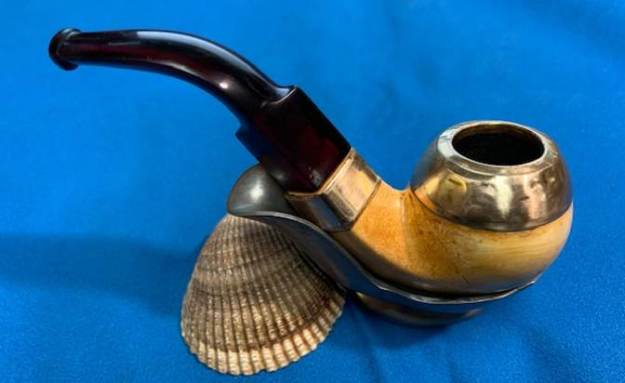
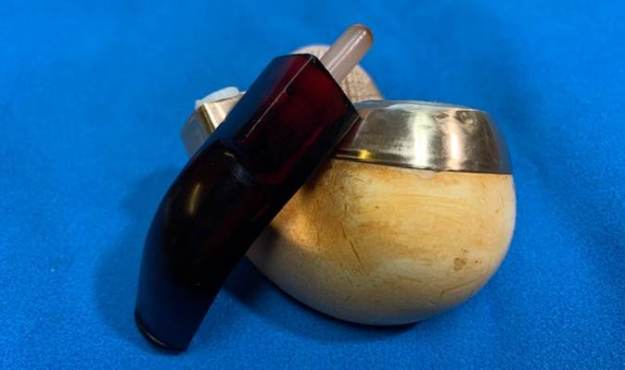
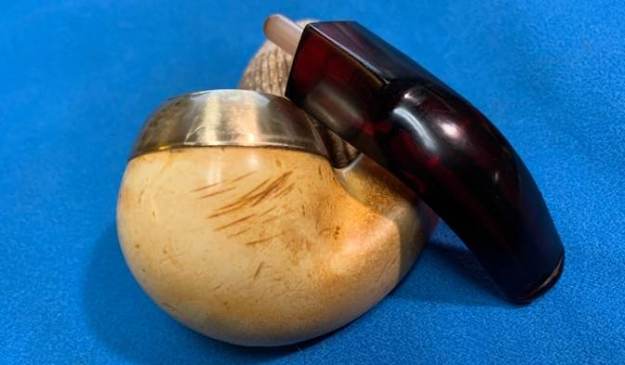
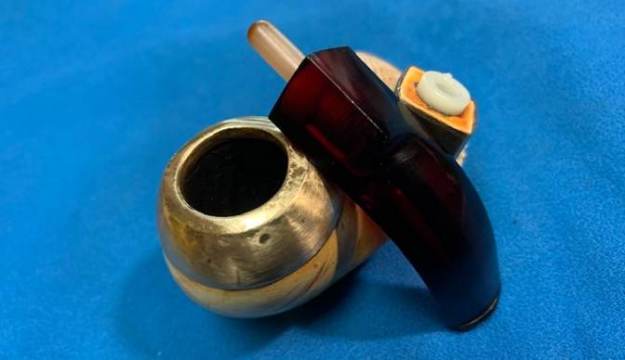
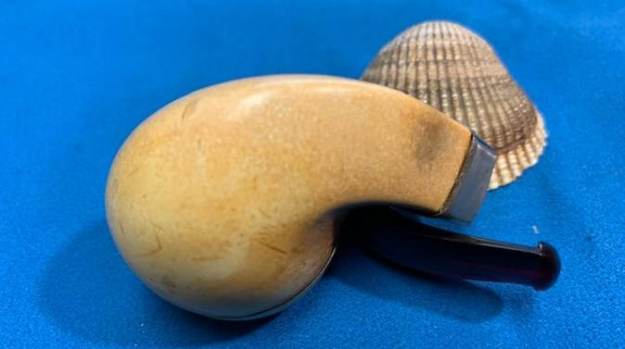
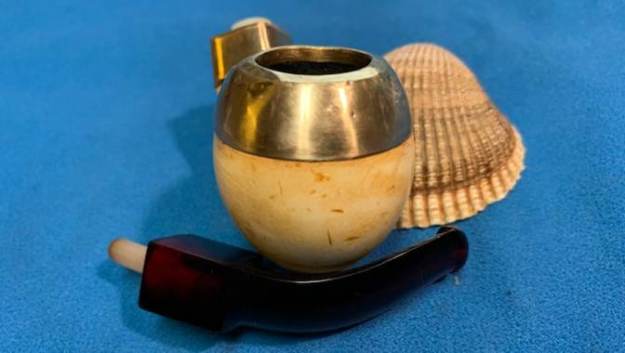
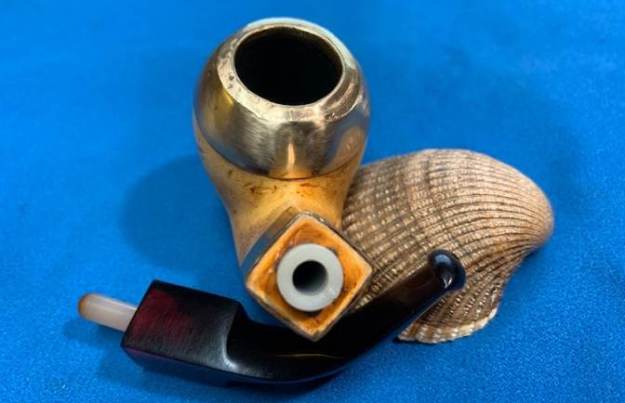
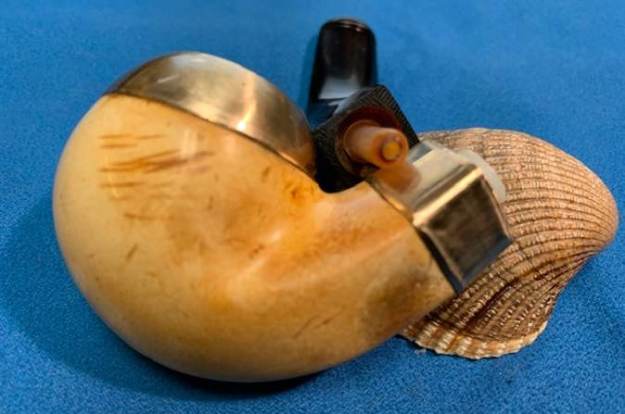
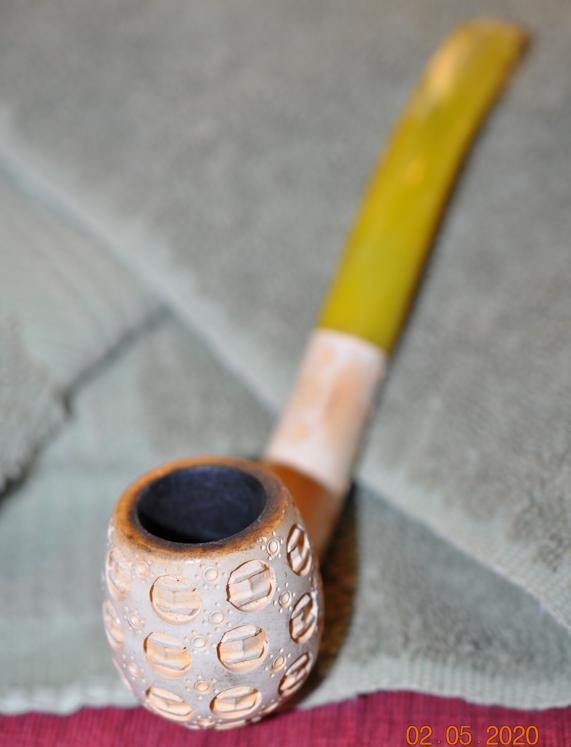
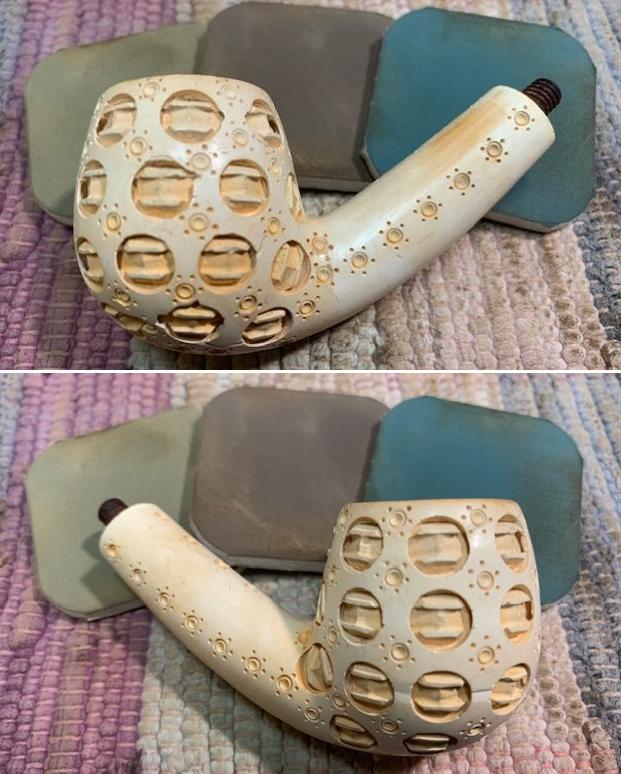
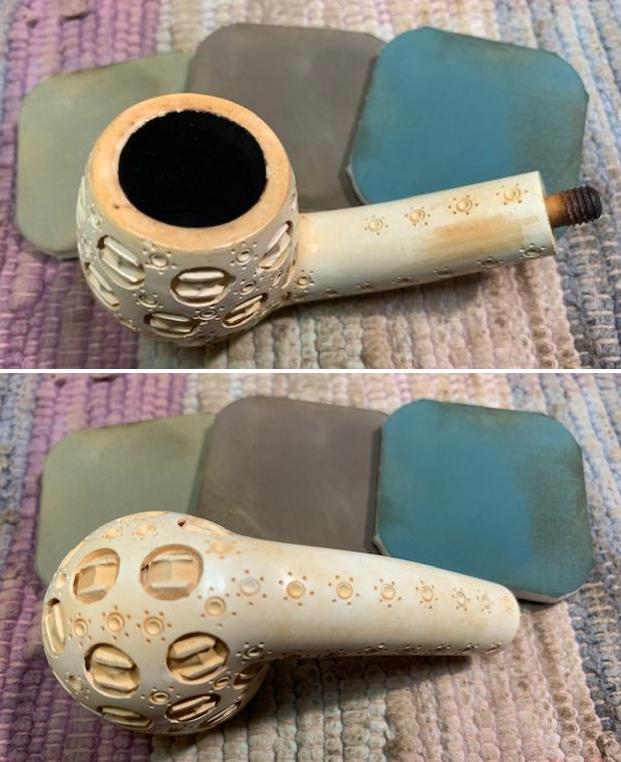
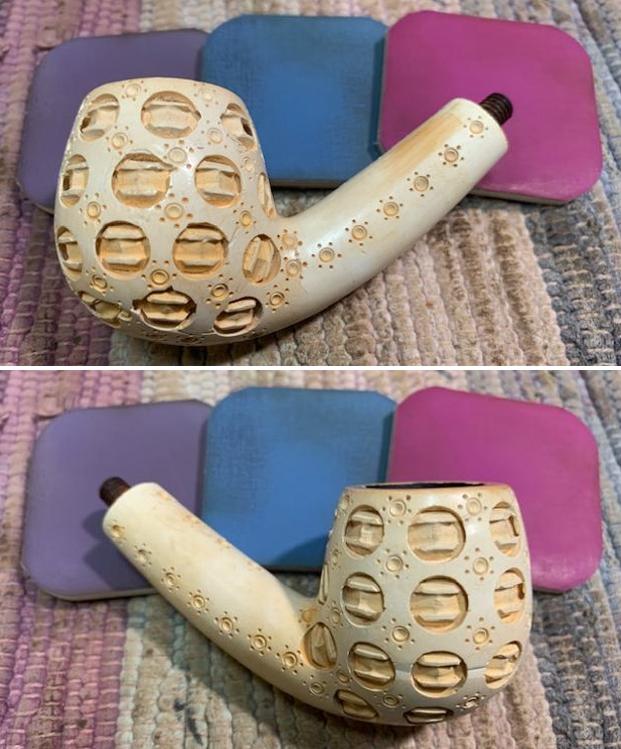
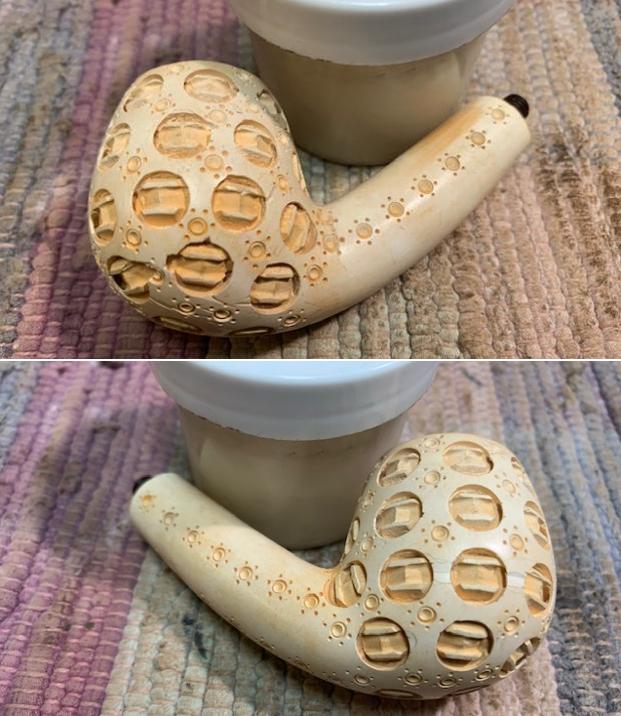
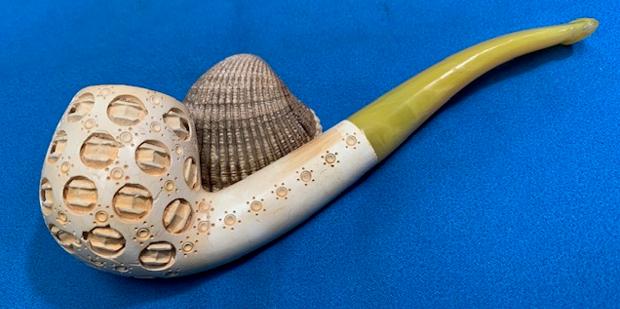
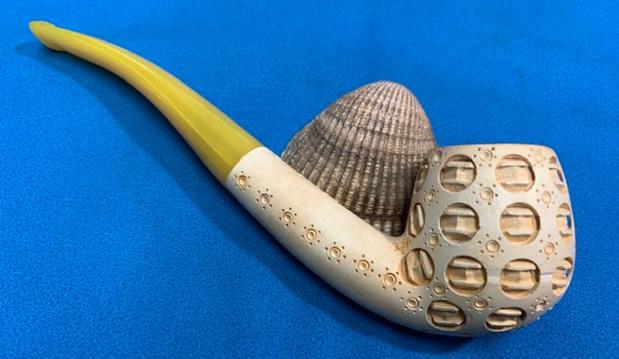
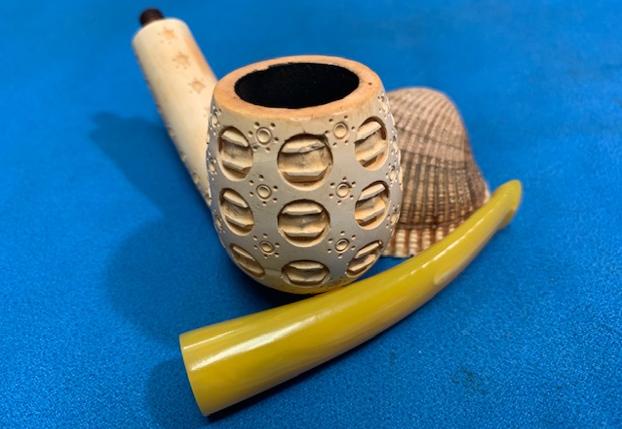
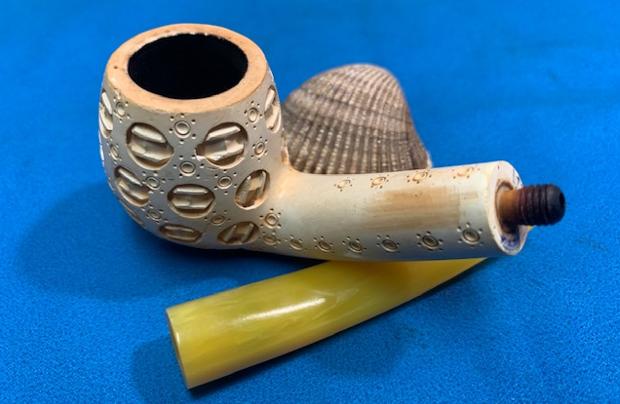
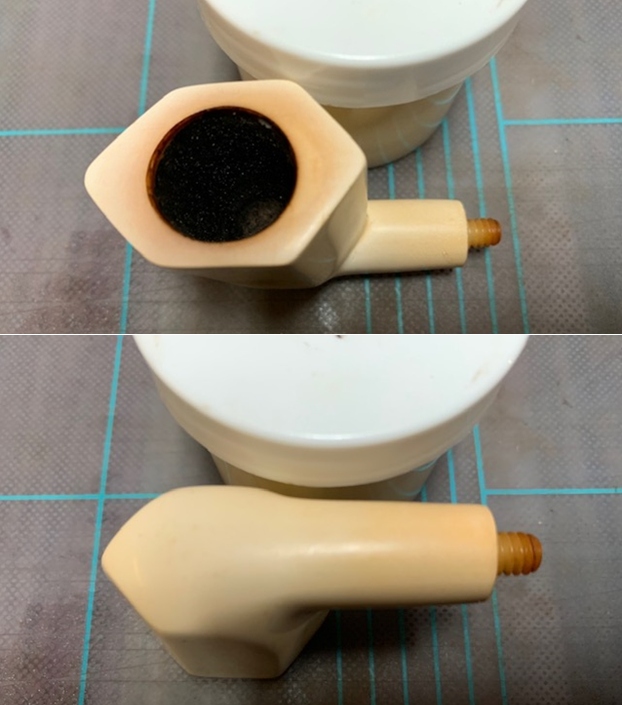
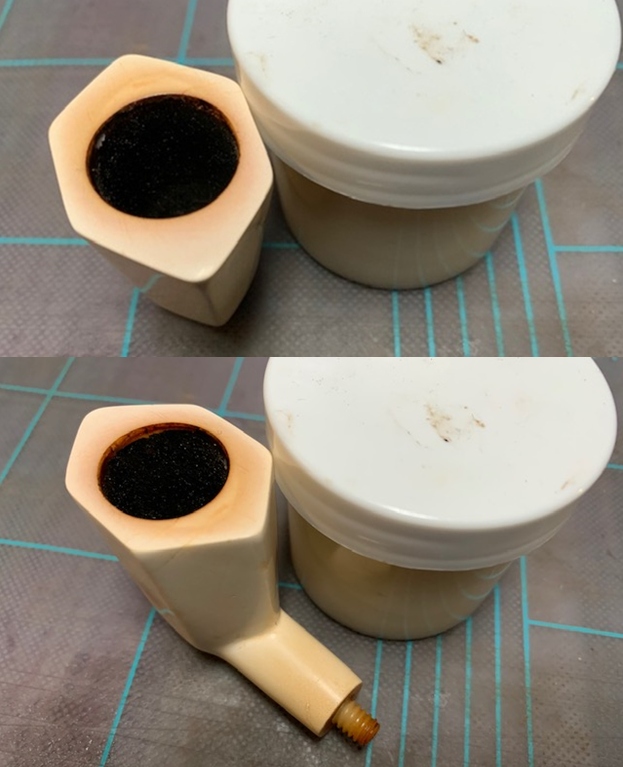
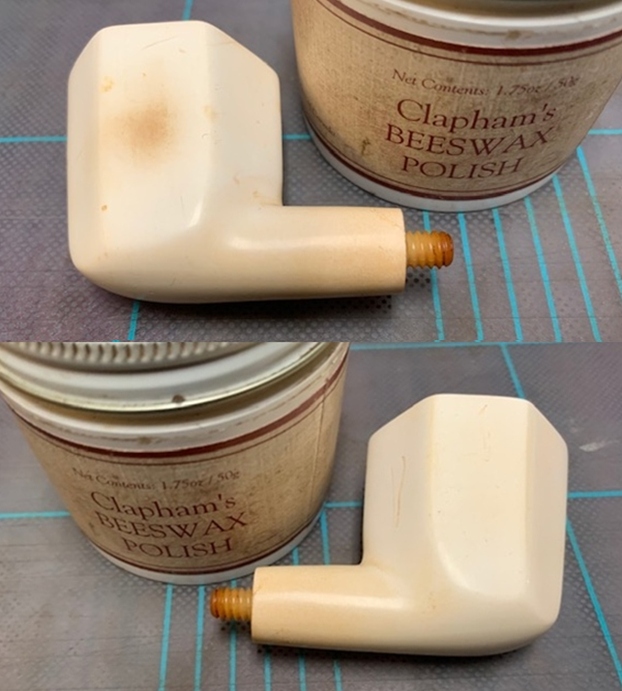
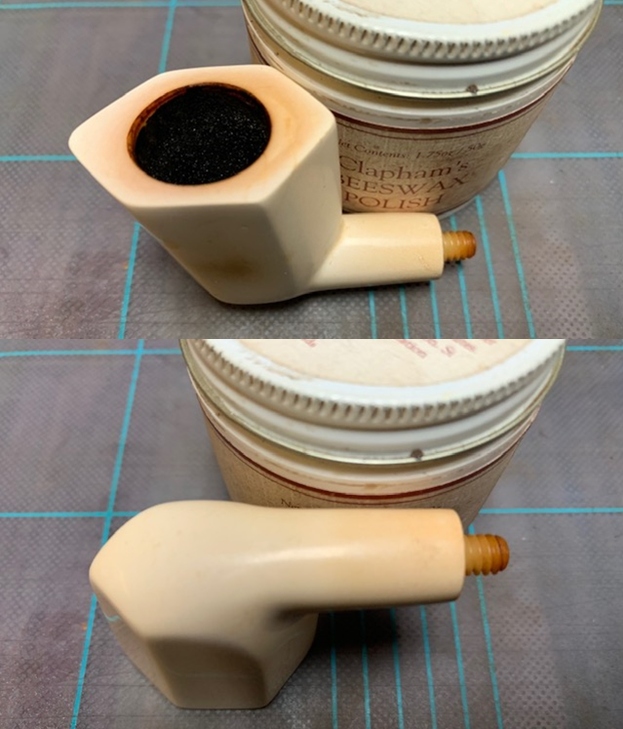
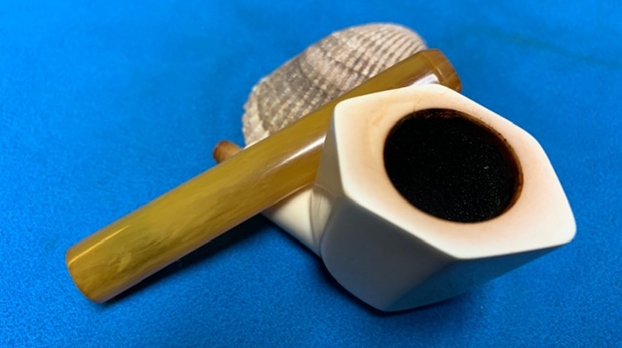
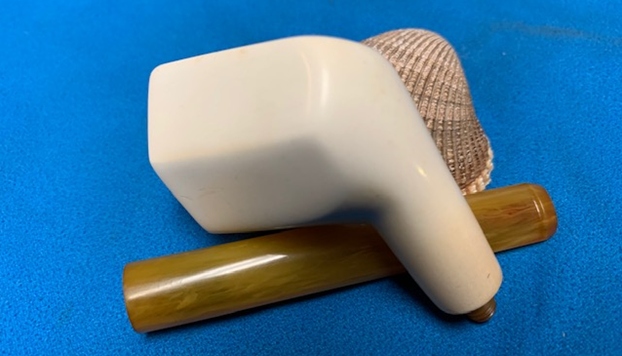
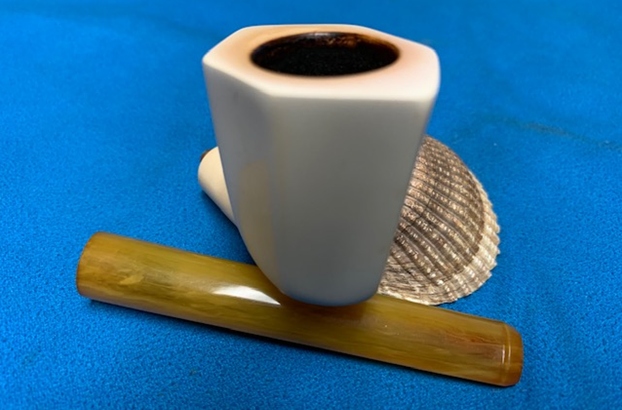
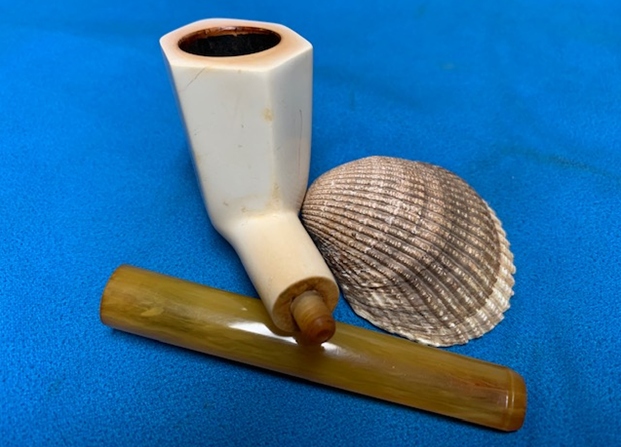
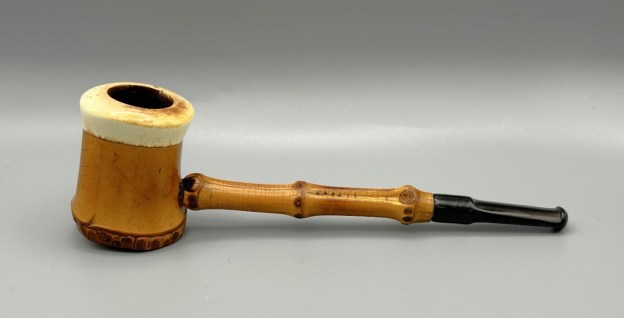
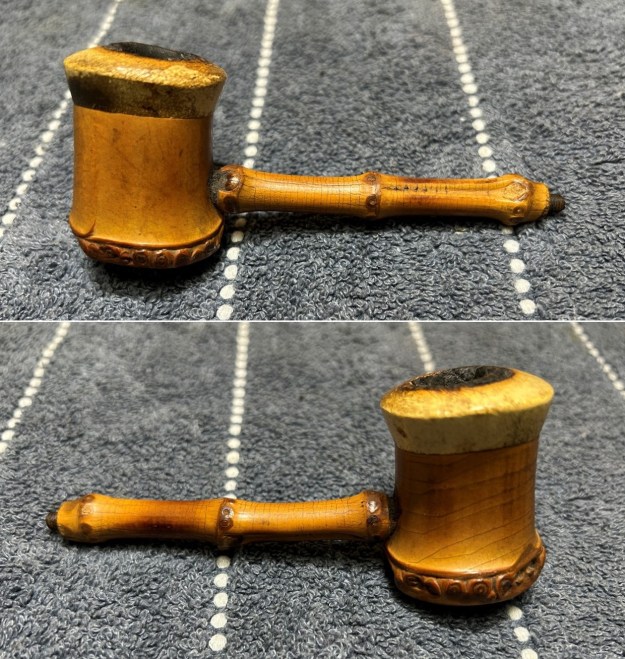
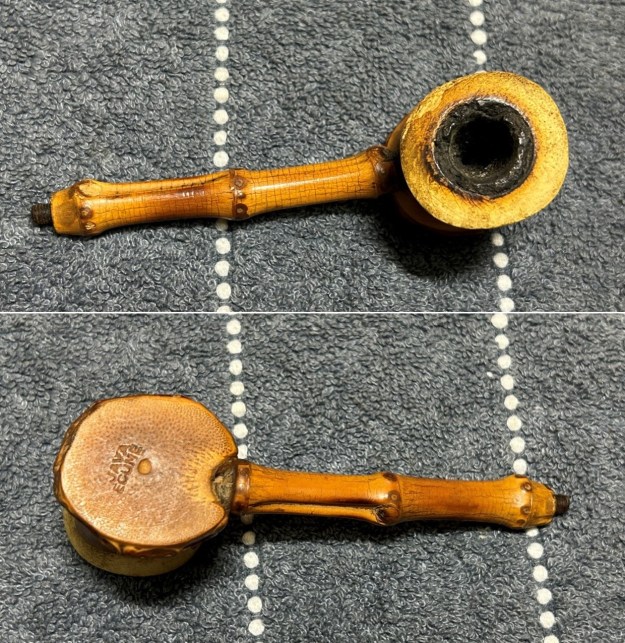
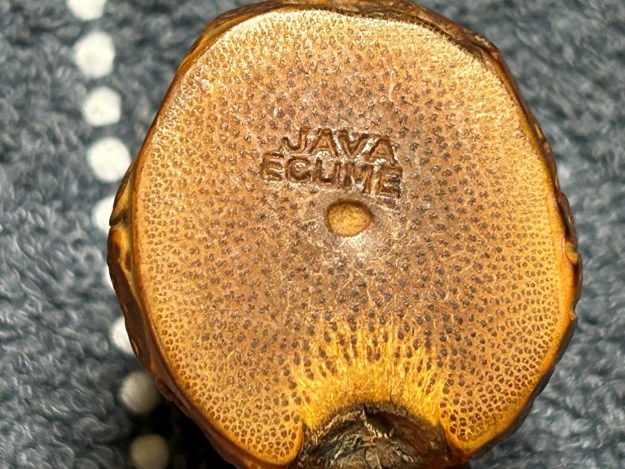
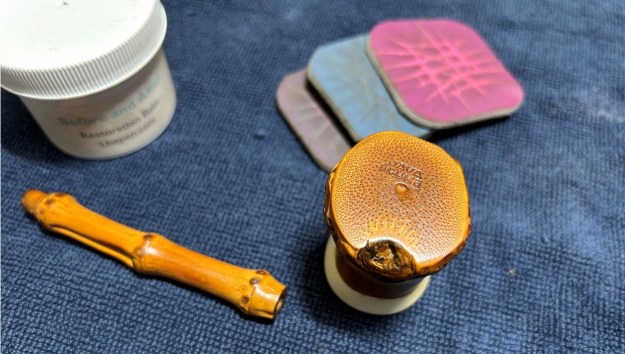
This is an odd pipe, to be sure – but a charming one. A few years ago, I acquired it in a large batch of very old French pipes. There was a mix of lovely and dreadful in that batch – and this pipe was a part of it. It had a meerschaum bowl and rim, with a bamboo stummel (holding the meerschaum) and a bamboo shank. I could see a bone tenon emerging from the shank, but – alas – the stem was missing. I could tell just by sight that the bamboo was old and beautifully worn. I always had this pipe in the back of my mind and it sat in my boxes for a long time. Finally, I came up with a plan to restore it and give it a new lease on life. I think the results are terrific. I hope you will too. The markings on this pipe are intriguing, if somewhat unhelpful. On the underside of the bamboo bowl, we see the words JAVA [over] ECUME. I searched extensively for these words in a pipe context, but found nothing specific. However, I think we can figure it out. Let’s work backwards. The French word, écume, most generically, means ‘foam’. However, in this instance, it is also the French word for meerschaum. That makes sense. As I’m sure you know, meerschaum is a German word which literally means ‘sea foam’ (meer = sea and schaum = foam). Incidentally, schaum is also where we get the English word scum from. But where did the Germans get the meerschaum word from? Obviously, meerschaum is so called because it is white and light, but the Oxford Dictionary of Etymology further explains that the term is itself a translation of the Persian word kef-i-daryā – literally meaning ‘foam of sea’. Now you can impress friends at your next cocktail party.Meanwhile, the word Java made me think immediately of the Indonesian island, but I wasn’t sure if there was ever an Indonesian pipe company with that name. I certainly couldn’t find any evidence of one. There have been pipe makers in Java, but I don’t think this pipe was made there. Having said that, however, I don’t think the reference is too mysterious. The island of Java is replete with bamboo – in fact, there are approximately sixty species of bamboo on the island. I think it stands to reason that the use of the name Java is simply a reference to the origin of the bamboo or an attempt to provide an oriental name to the pipe.
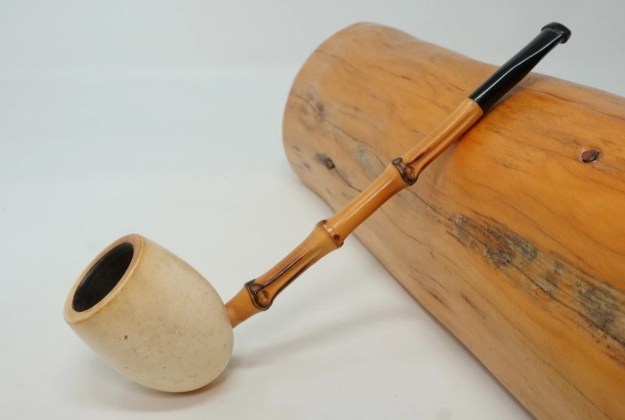
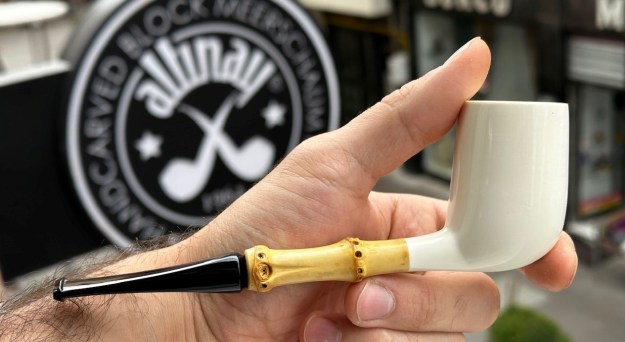
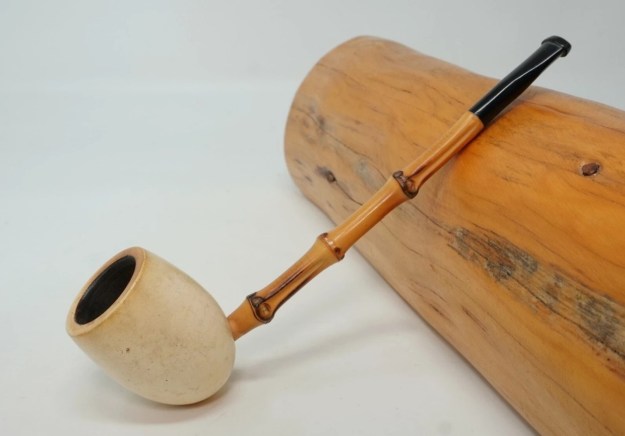
Last year, I restored a meerschaum and bamboo pipe, and I mused about that particular mixture of materials – and I will muse about it again now. Meerschaum and bamboo pipes are certainly not unprecedented, but it isn’t that common either. Here is an example of an unbranded bamboo meer found on eBay. Not only does the pipe have no identifying marks, but the seller had no information about it either.One can find some spectacular examples of meerschaum and bamboo in pipes from Walt Cannoy, Ryan Alden, and the famous Turkish maker, Said Altınay. Here is a beautiful example from him:As a side note, Altınay’s website includes an interesting note on the history of bamboo in pipe-making. I provide a brief quotation:
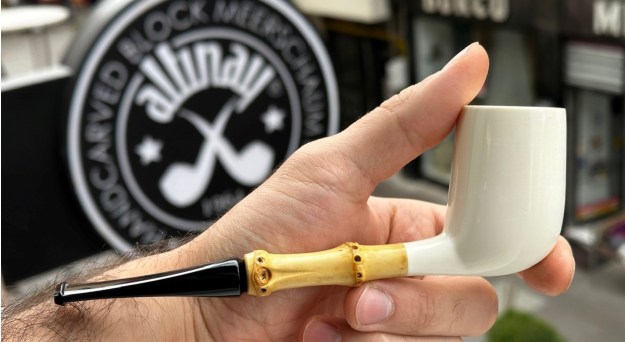
Bamboo began appearing in briar pipe construction in the early 20th century. The earliest known pioneer of this style is believed to be Sixten Ivarsson, the Danish pipe-making legend, who introduced bamboo shanks in the mid-1900s as both an aesthetic and practical innovation. The concept soon spread, embraced by artisans such as Tom Eltang, Tokutomi, and Takahiro Hibi, who elevated the use of bamboo into a form of fine art. Its appeal was twofold: the natural lightweight strength and the distinctive, organic appearance. While traditional briar offered durability and familiarity, bamboo introduced character, contrast, and subtle resilience — giving each pipe a unique signature.

Obviously, the pipe I have is not on the order of a Cannoy, Alden, Altınay, or Ivarsson! But I also feel comfortable in saying that this pipe is a lot older than those fellows’ pipes. I would be interested in hearing from you if you know more about the marriage of meerschaum and bamboo in pipe-making. Thank you kindly.

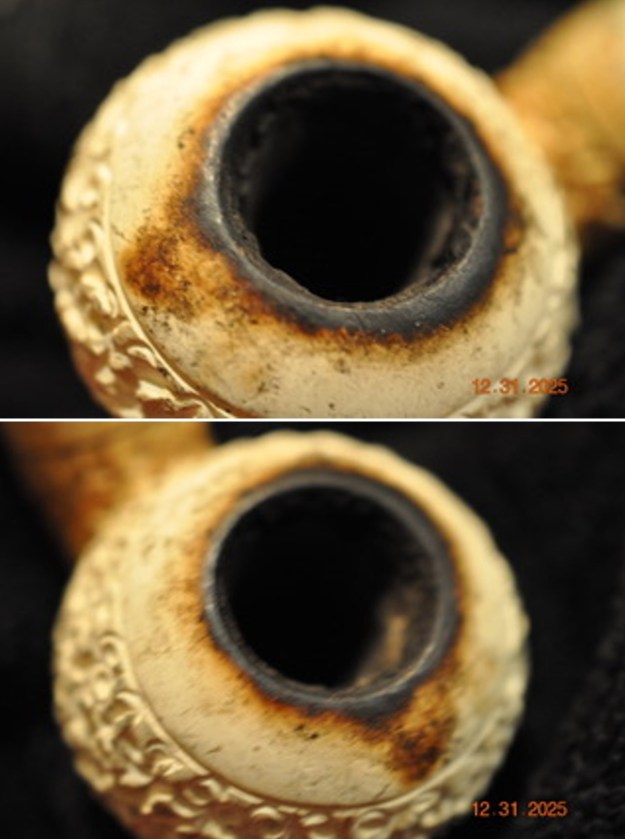
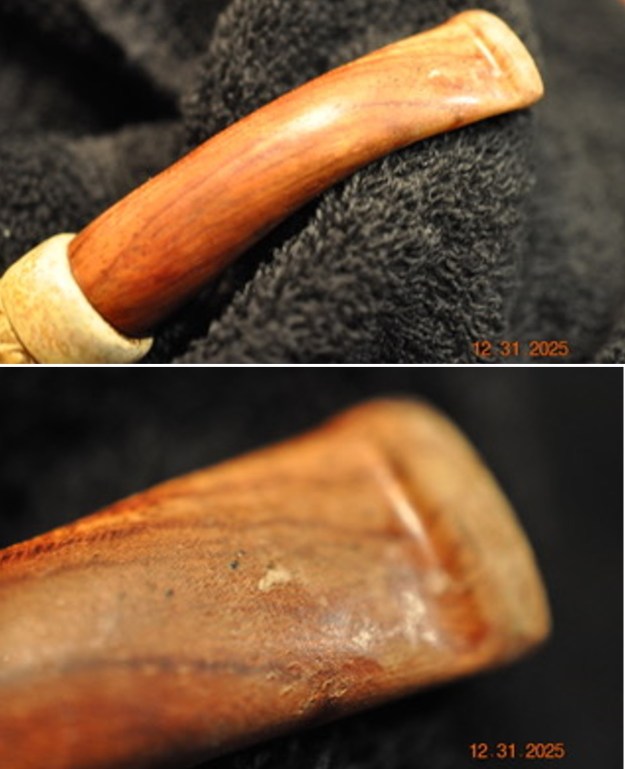
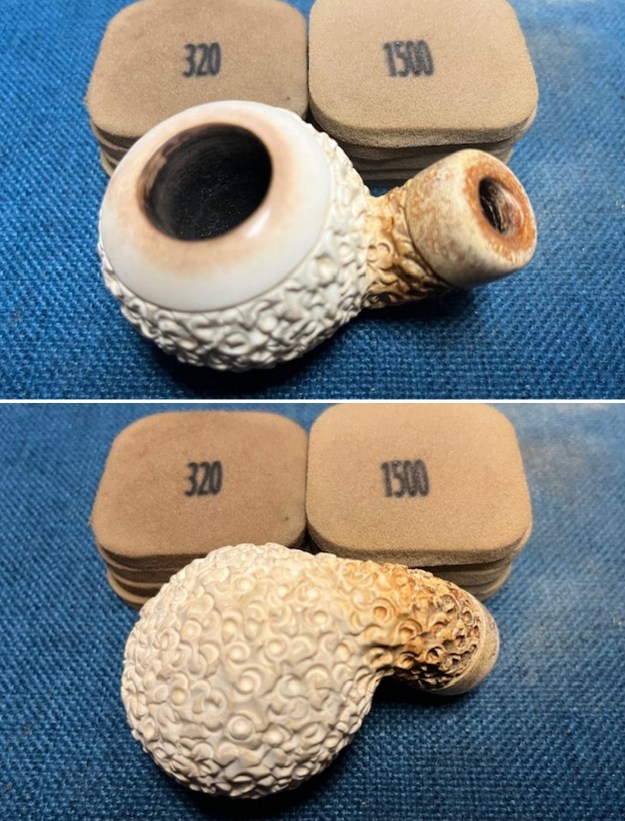
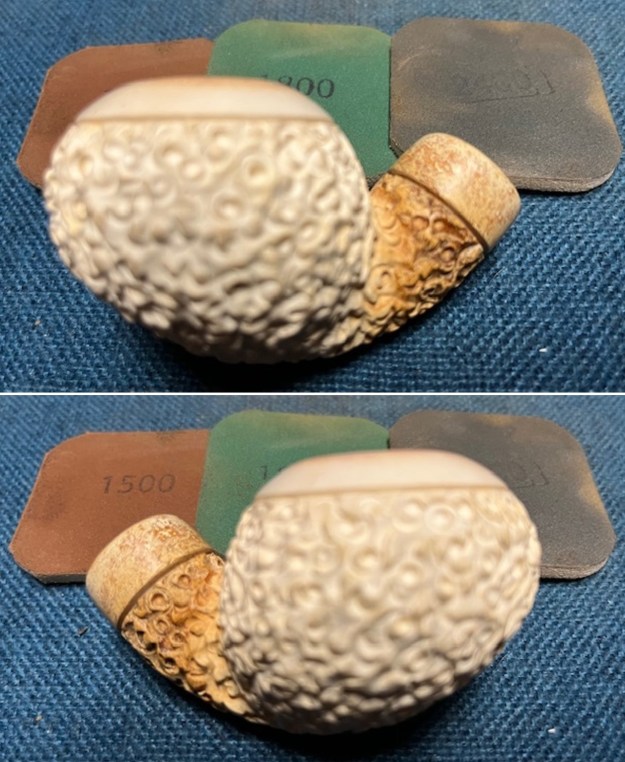
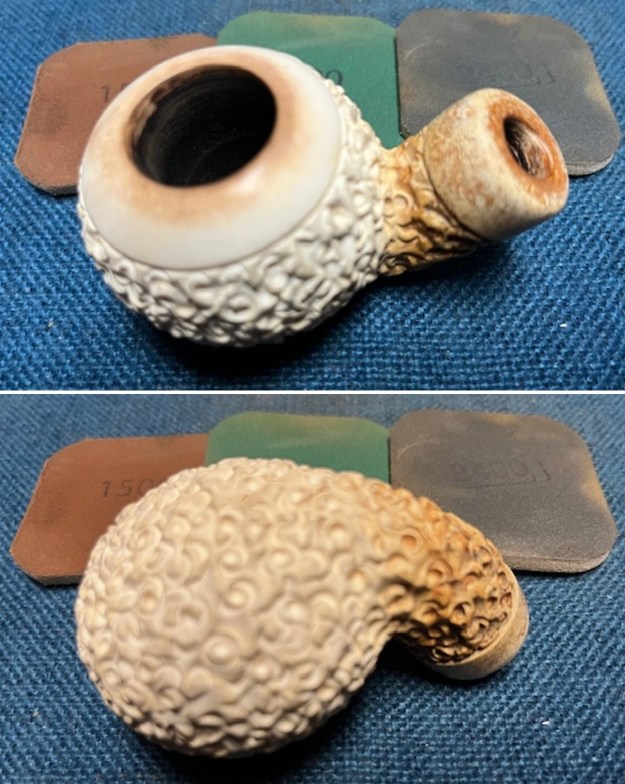
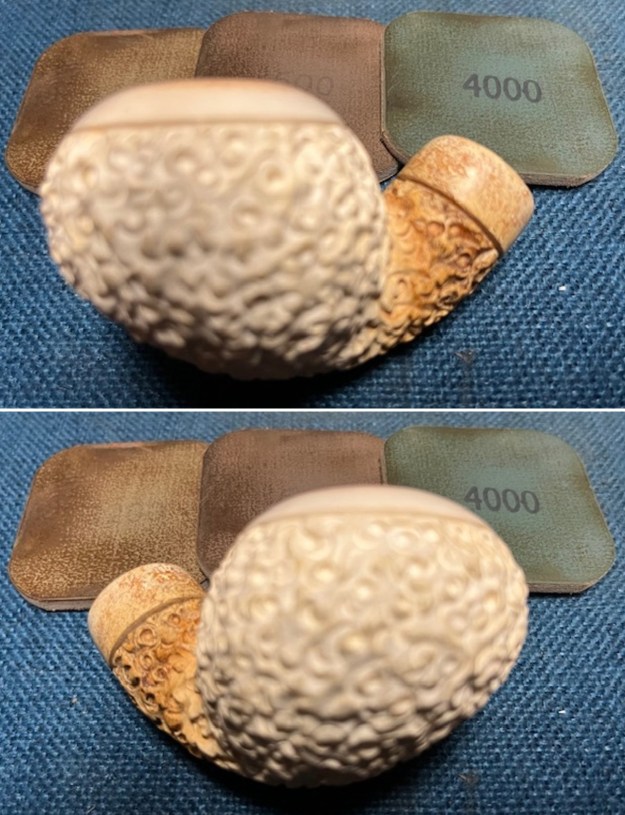
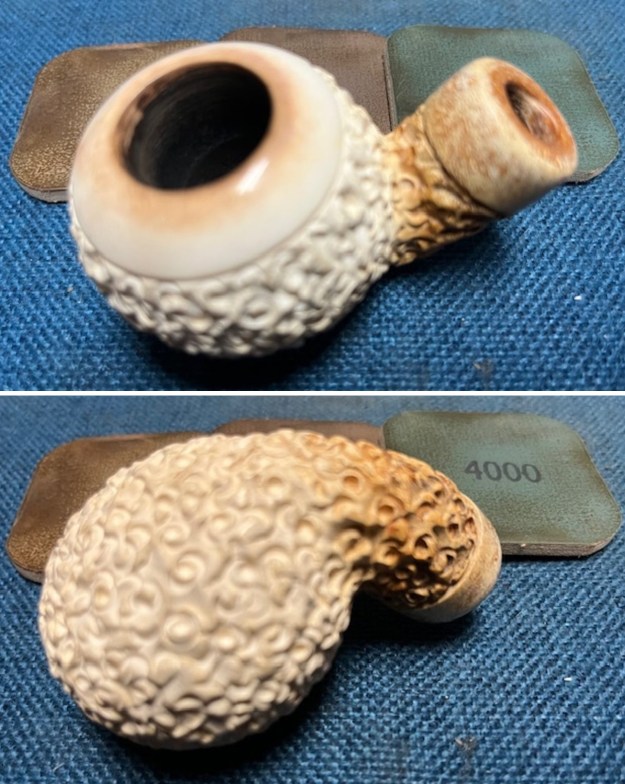
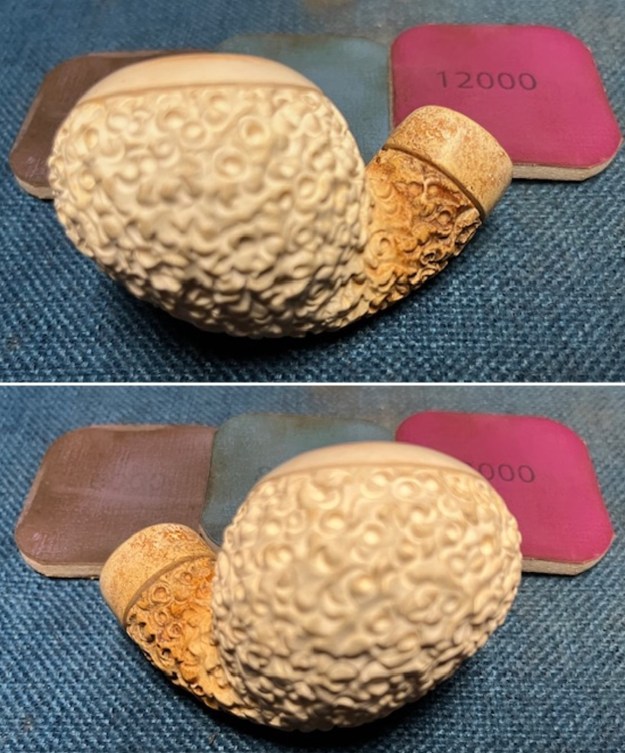
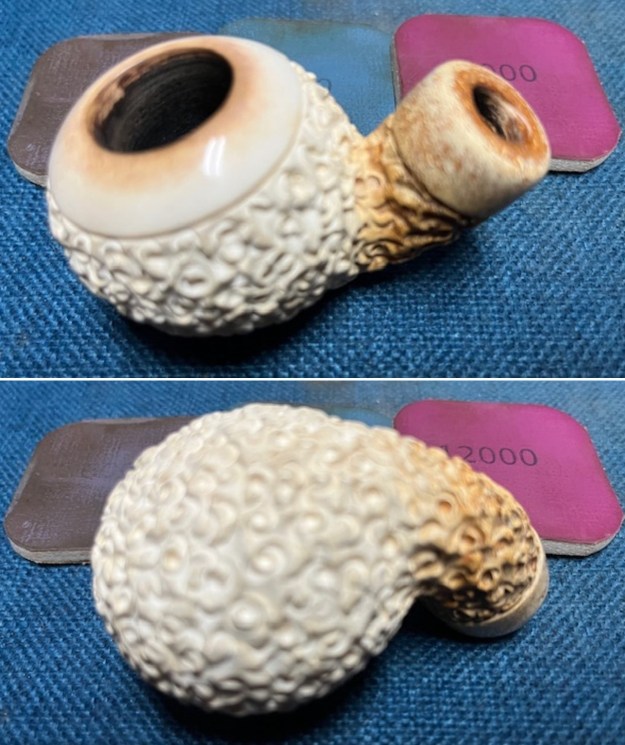
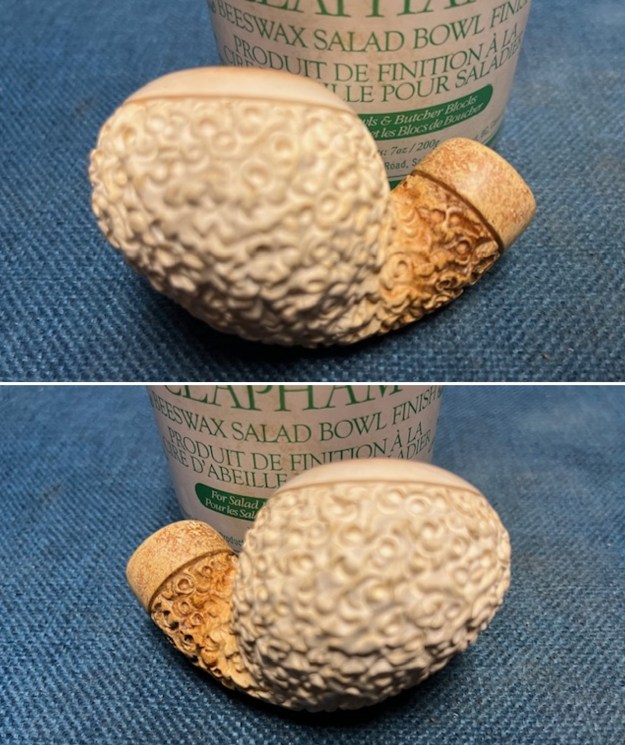
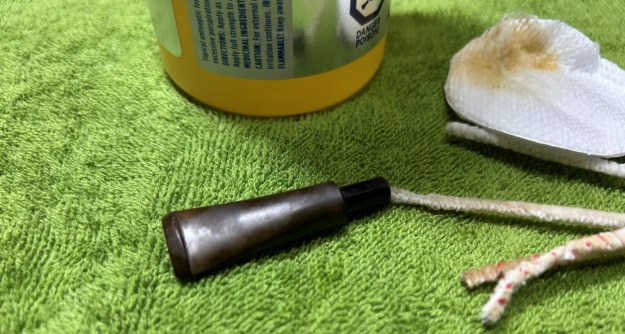
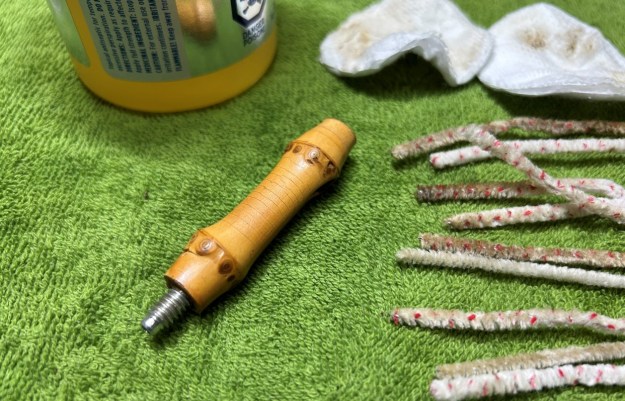
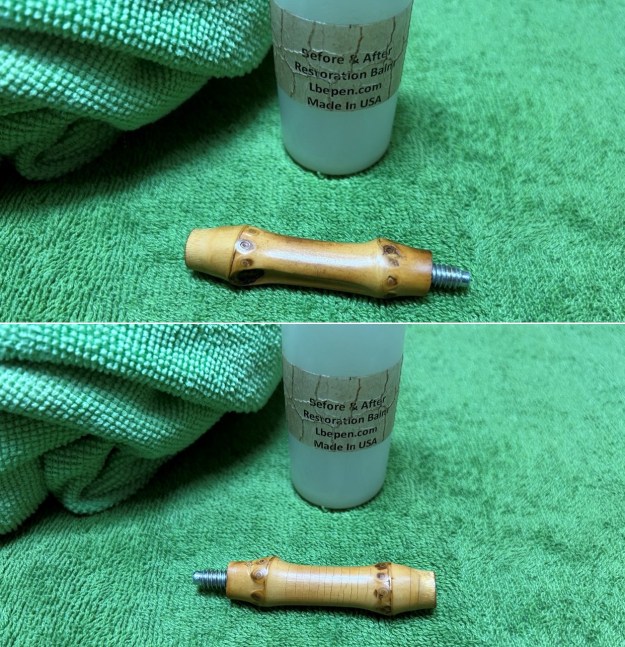
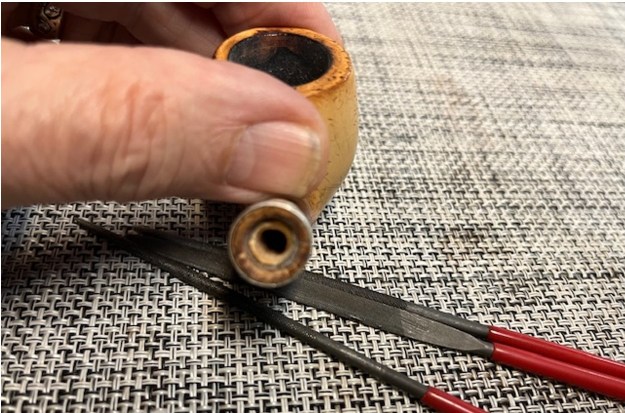
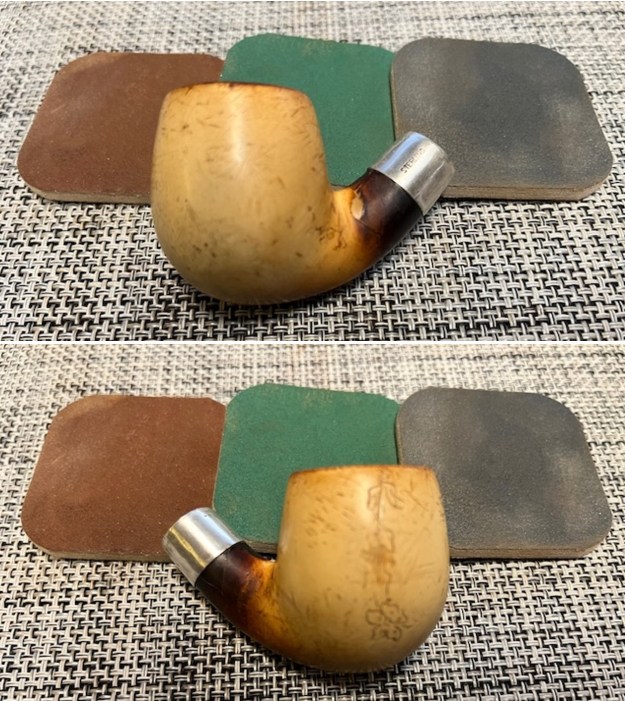
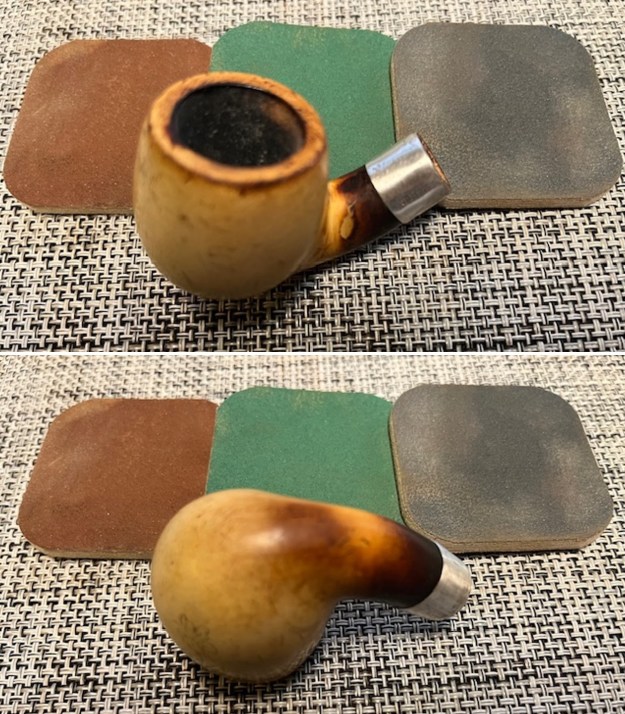
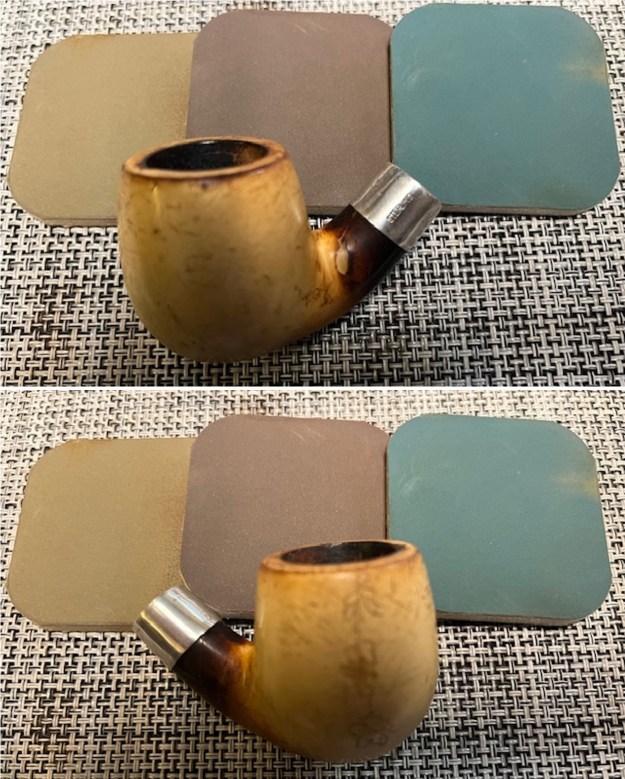
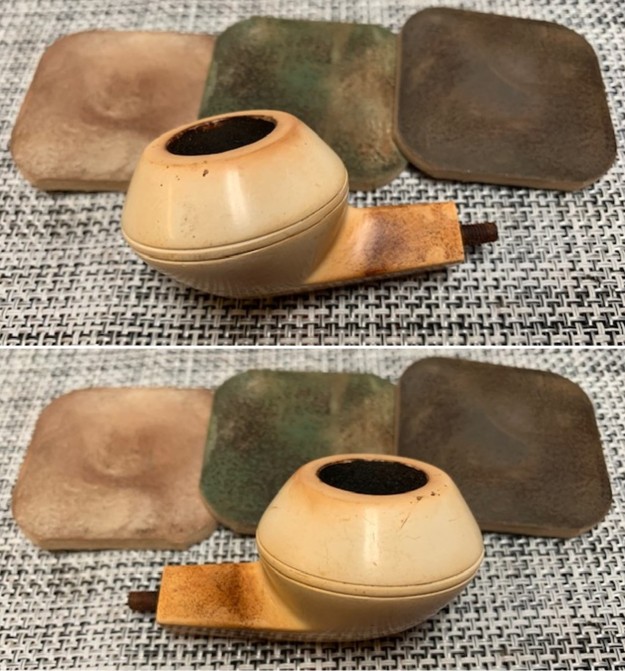
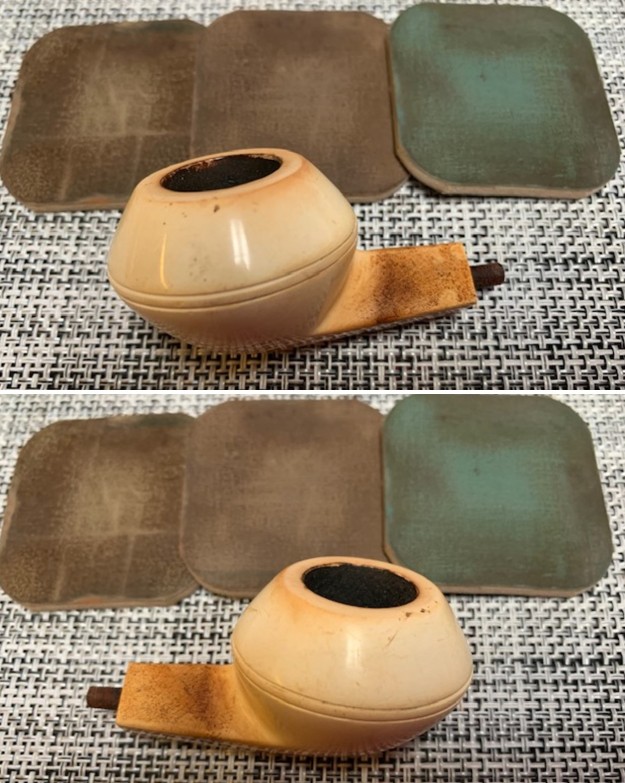
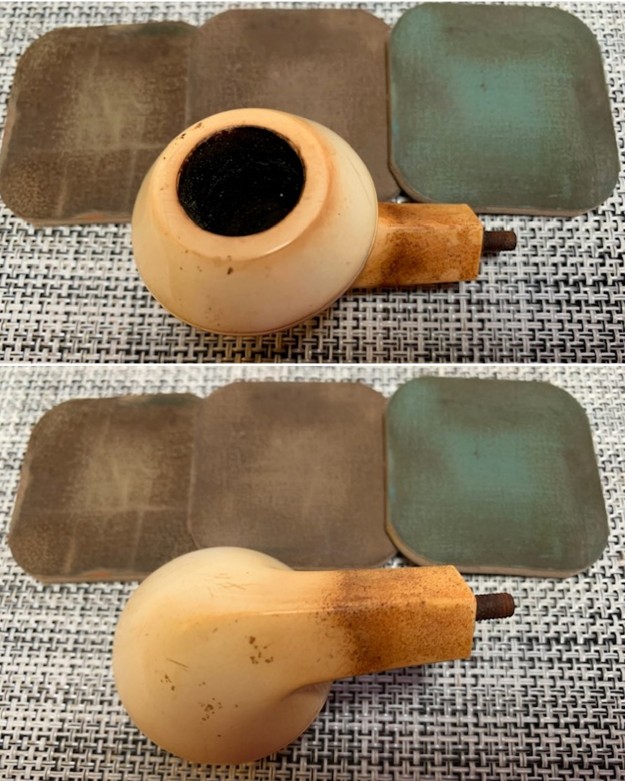
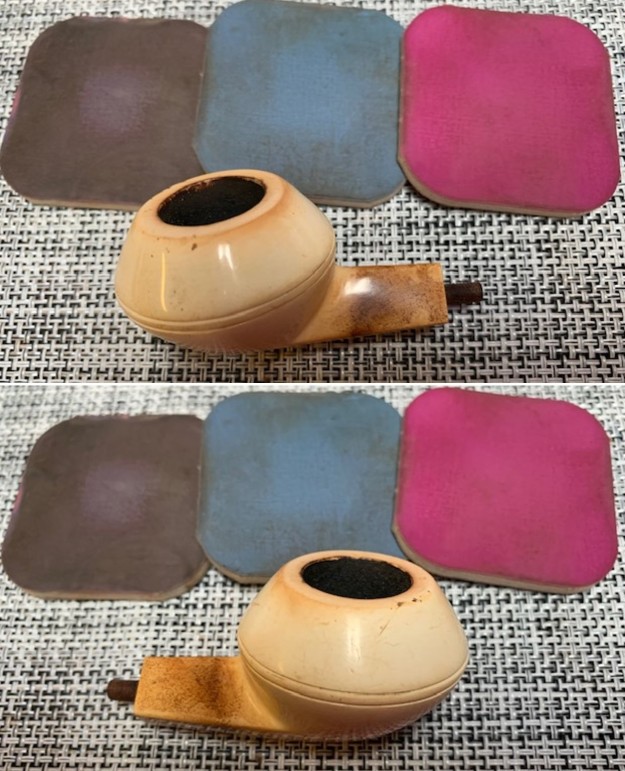
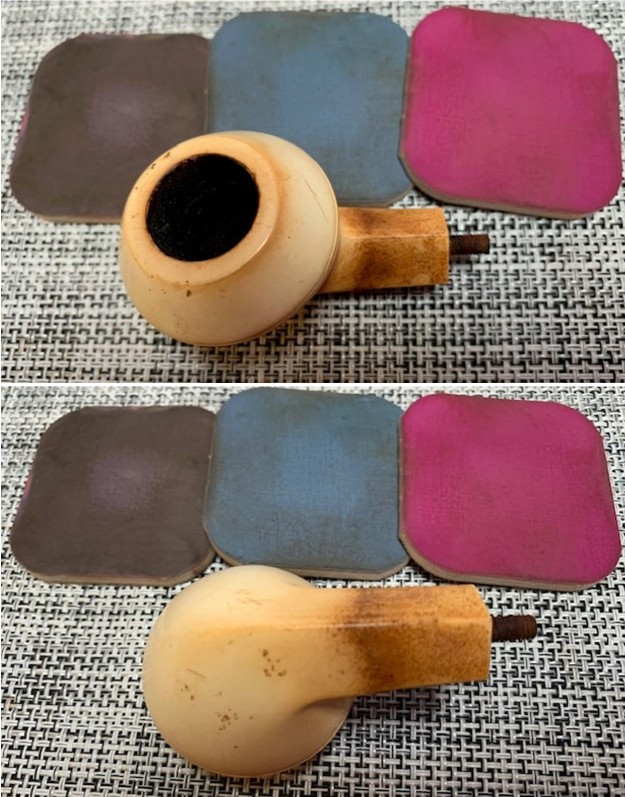
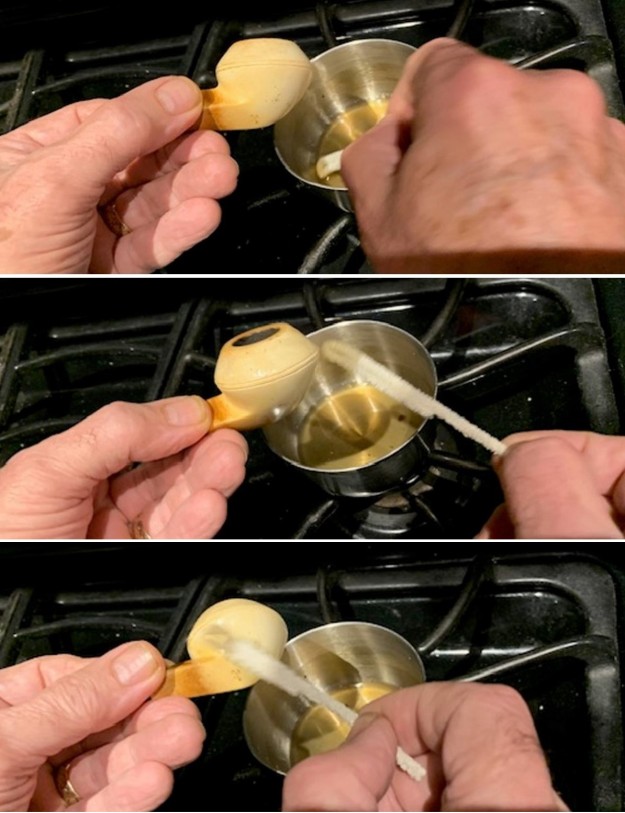
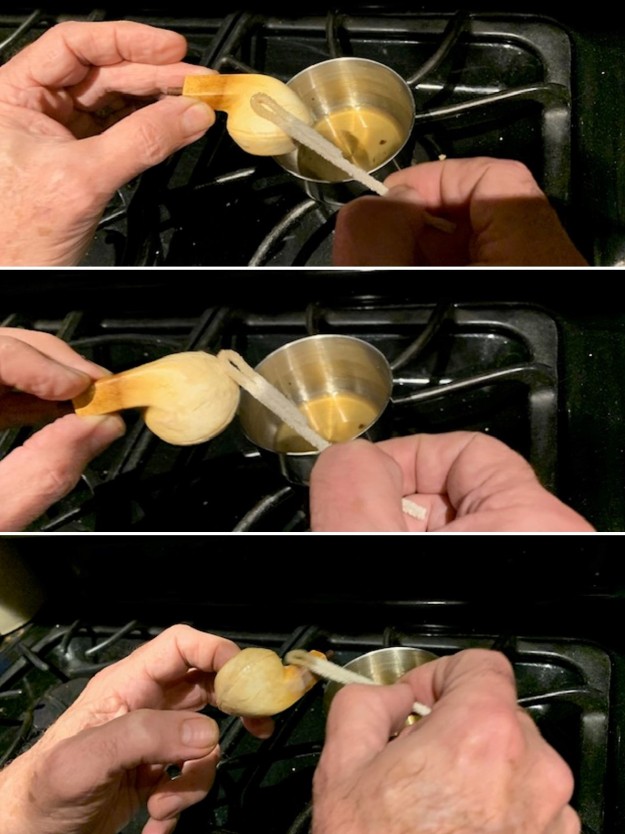
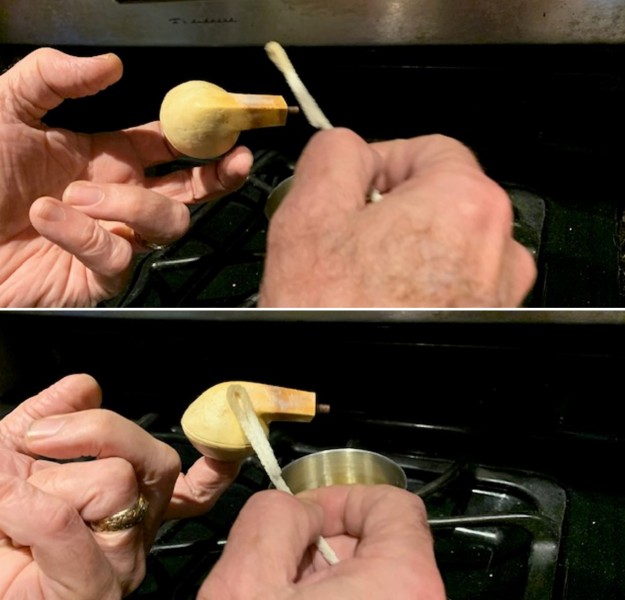
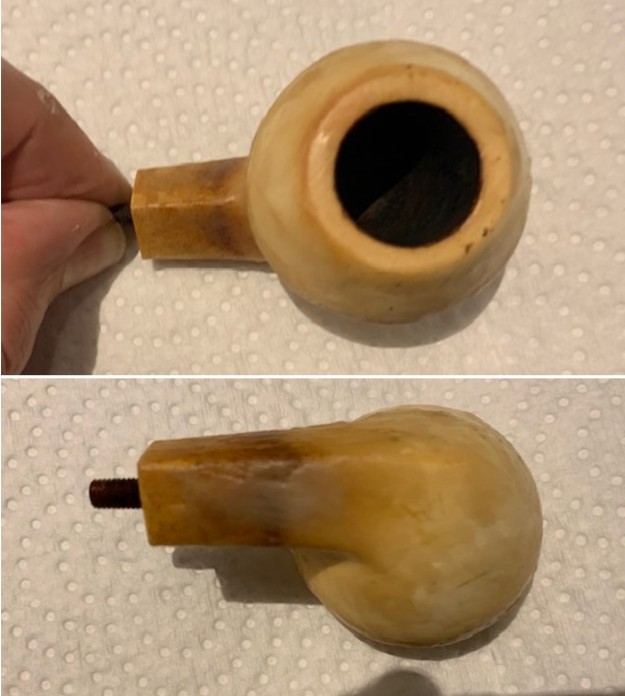
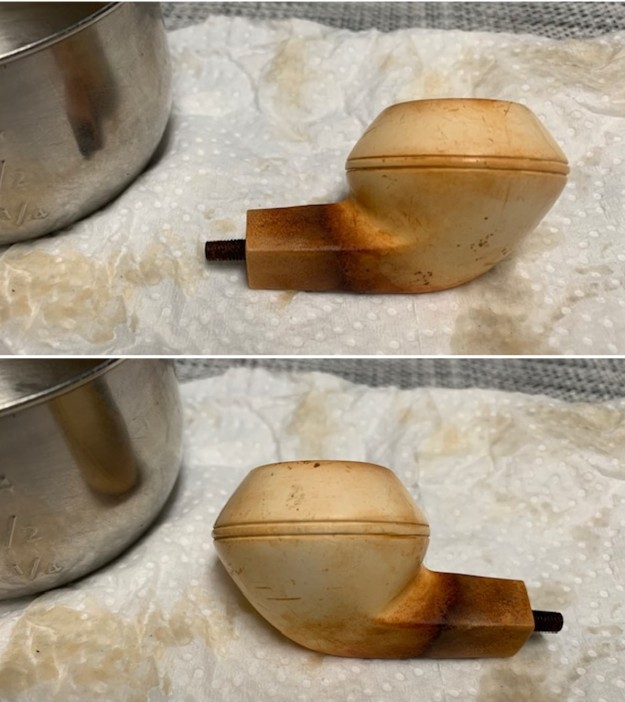
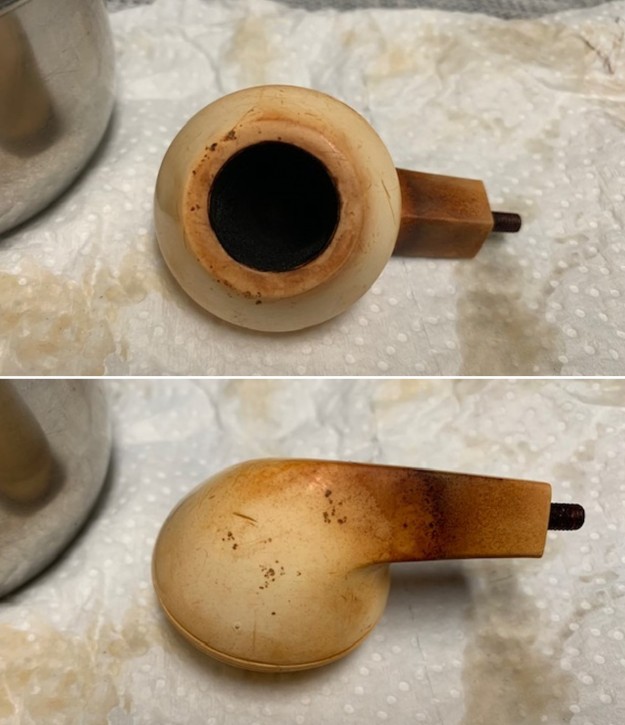
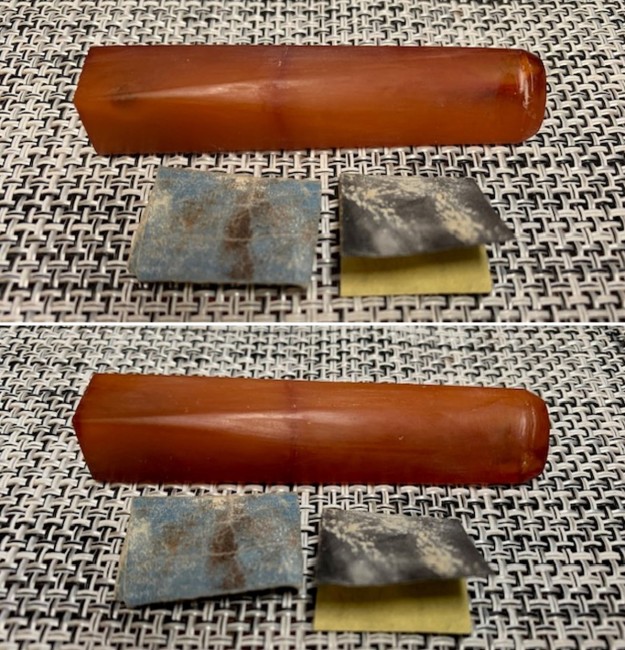
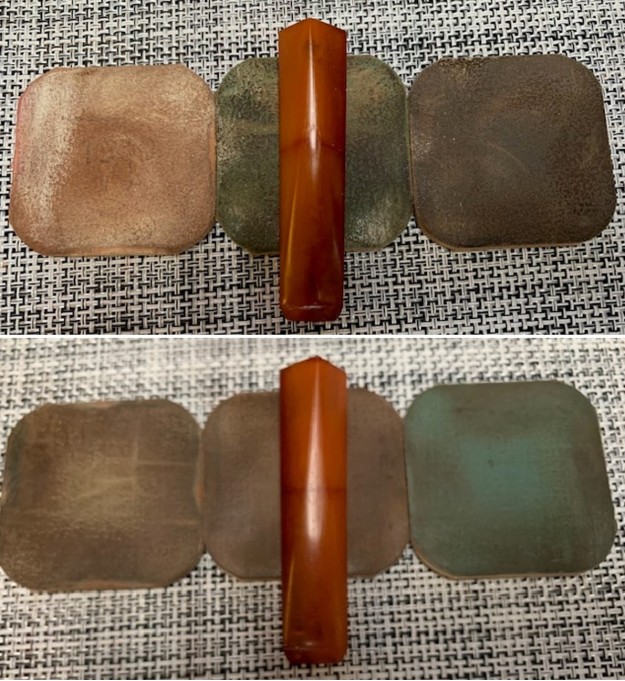
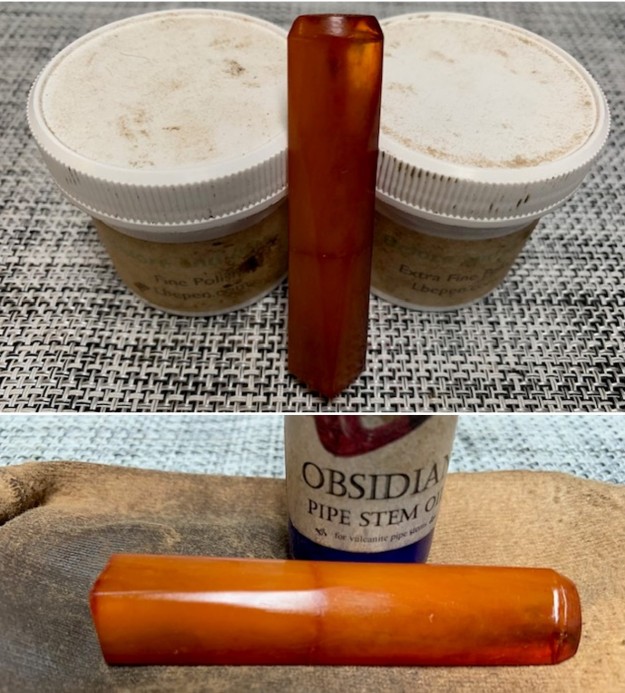
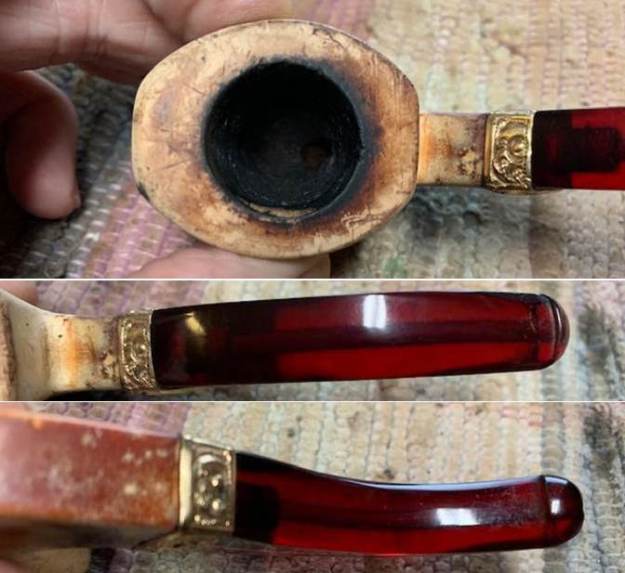
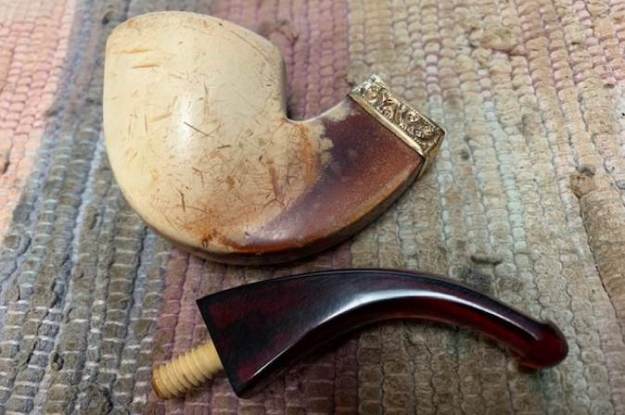
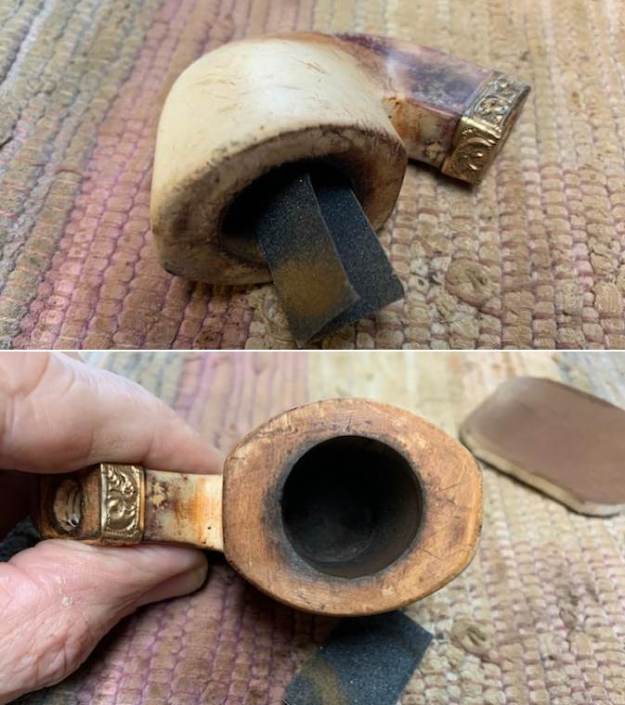
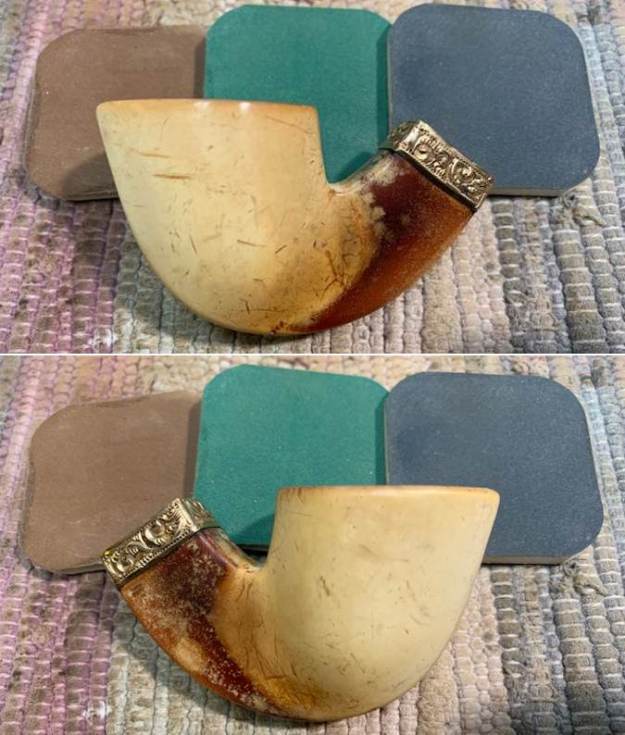
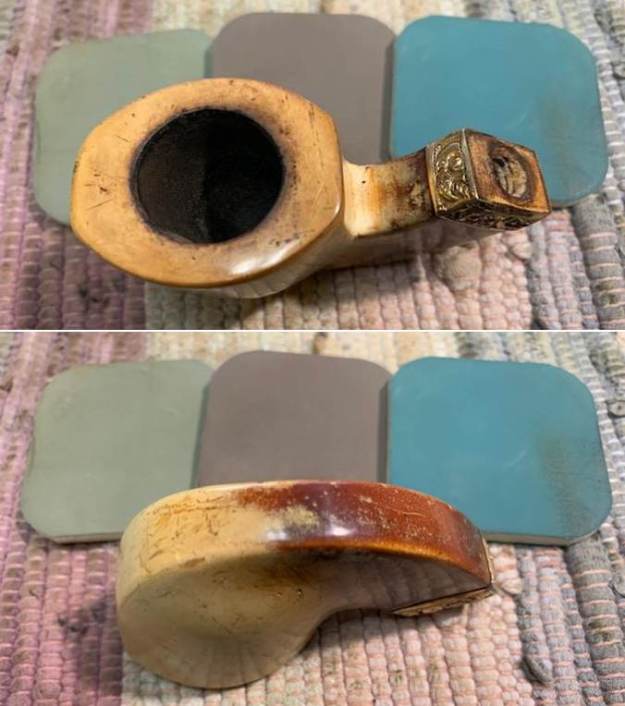
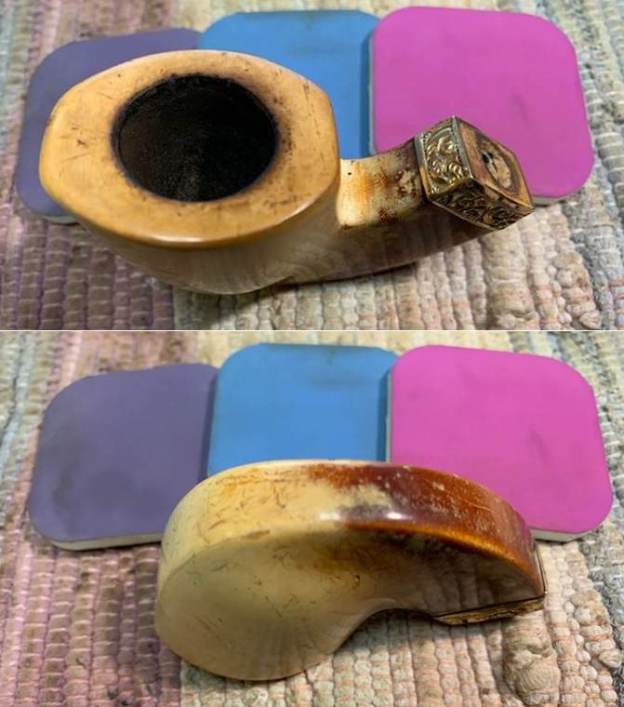
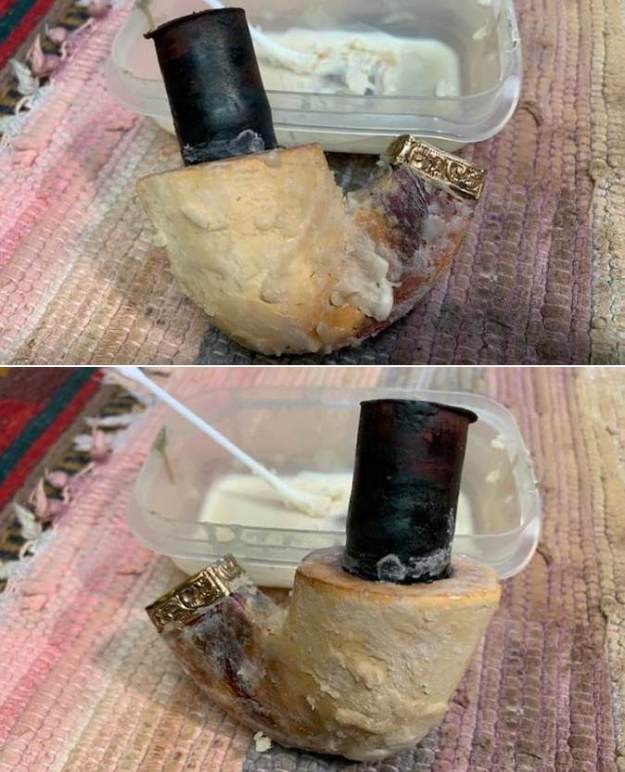
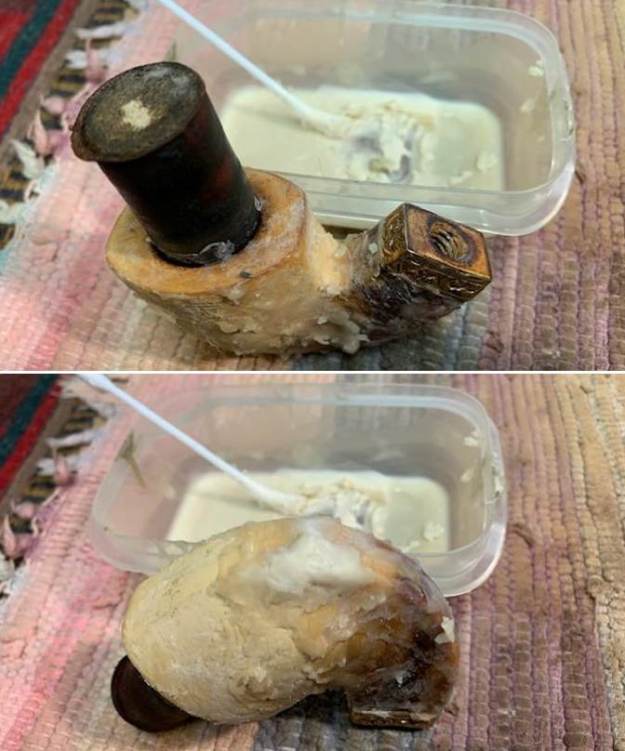
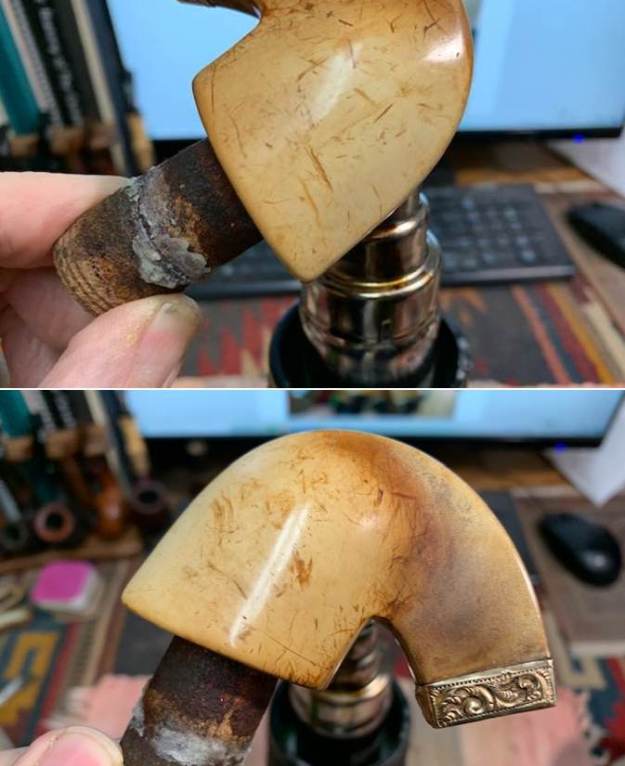
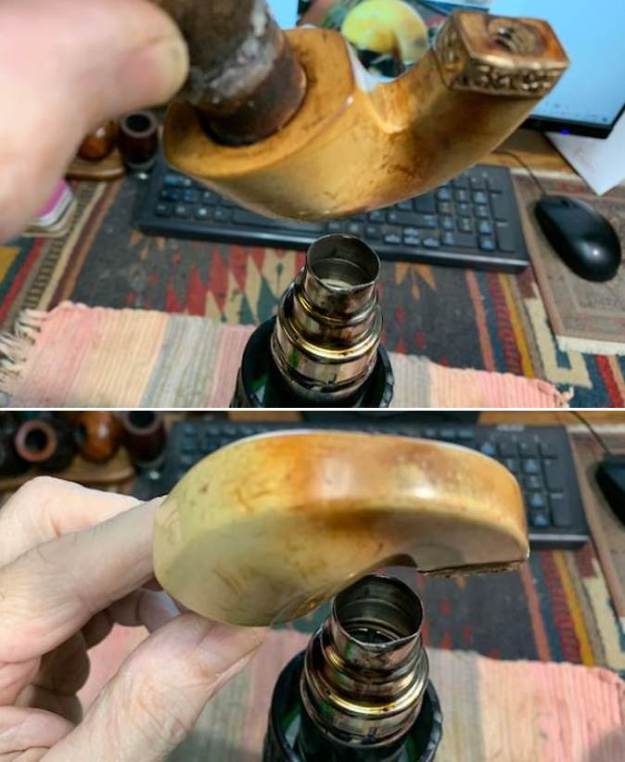
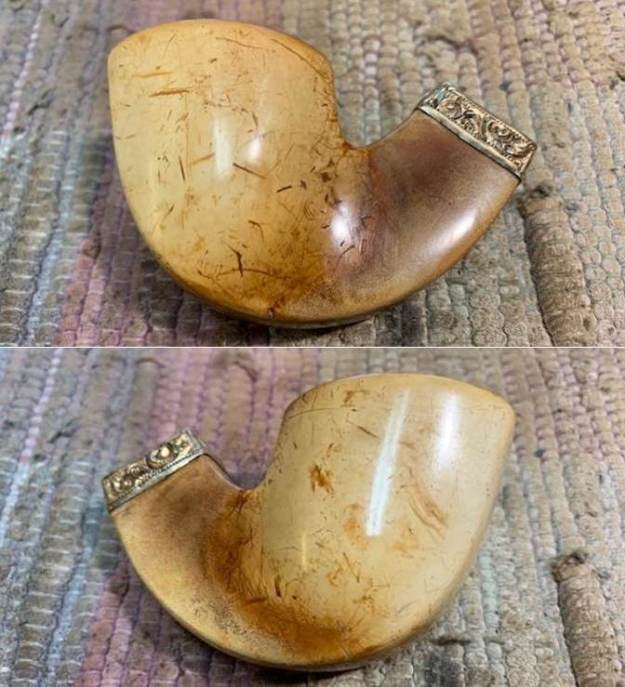
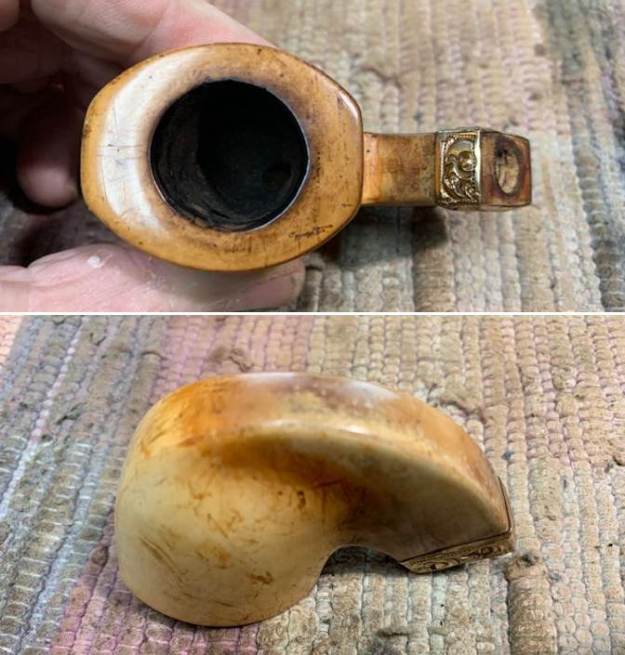
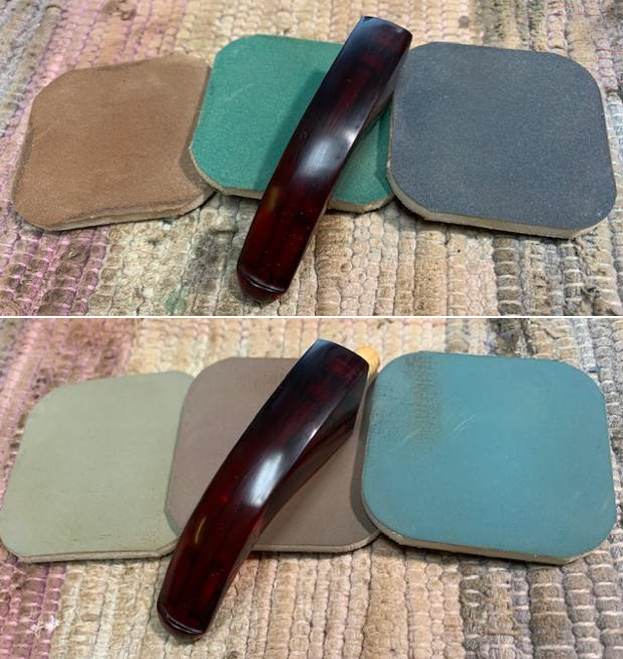
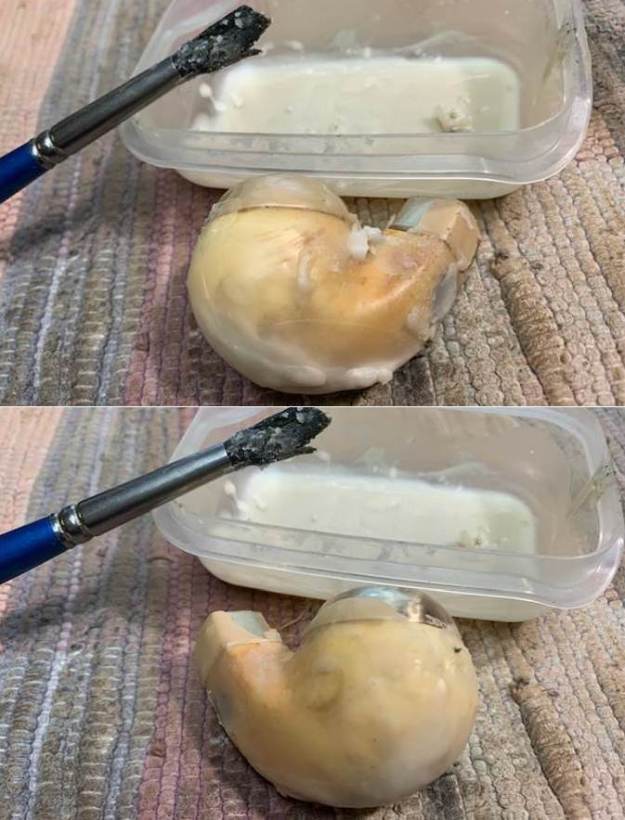
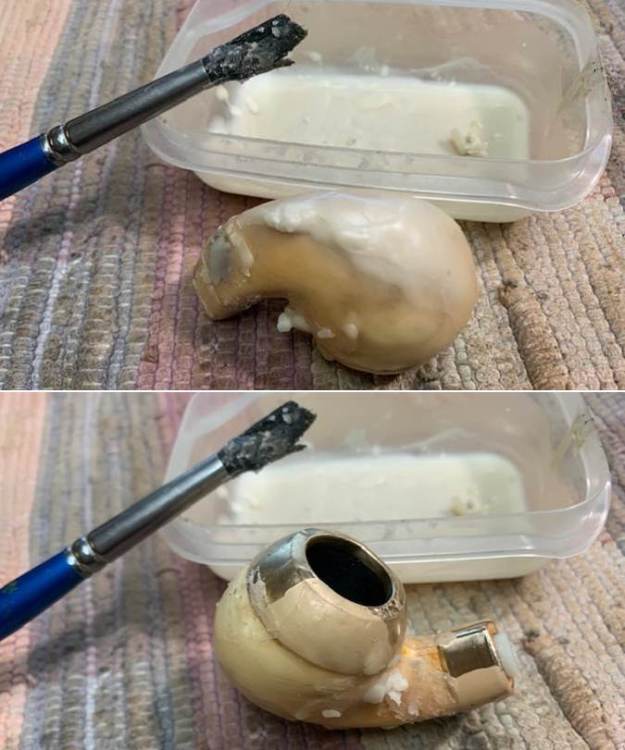
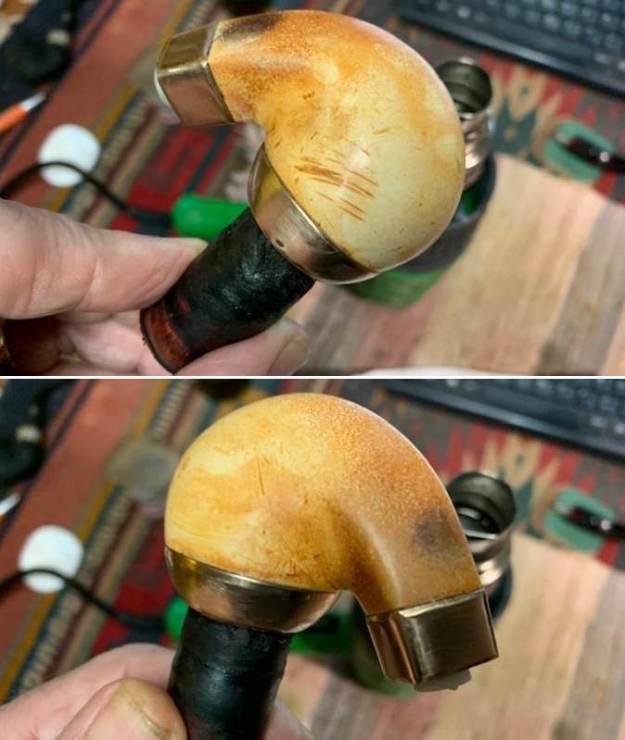
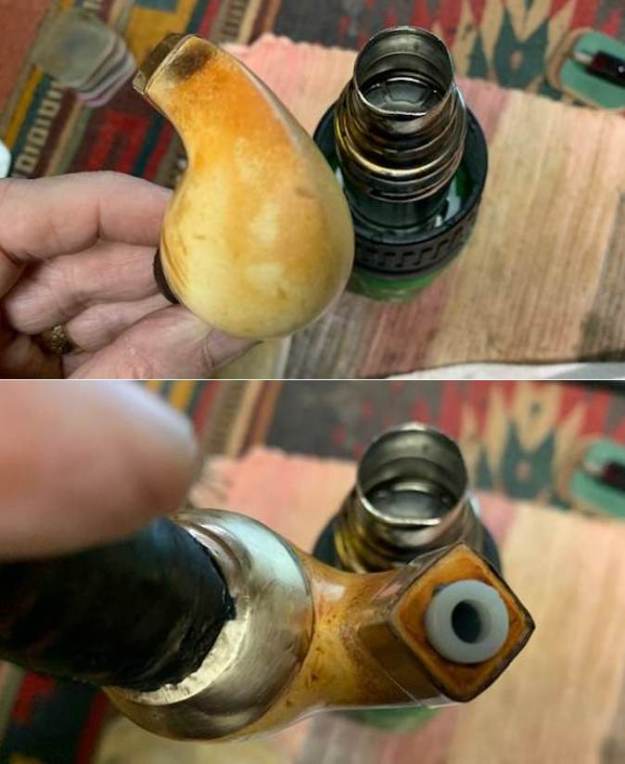
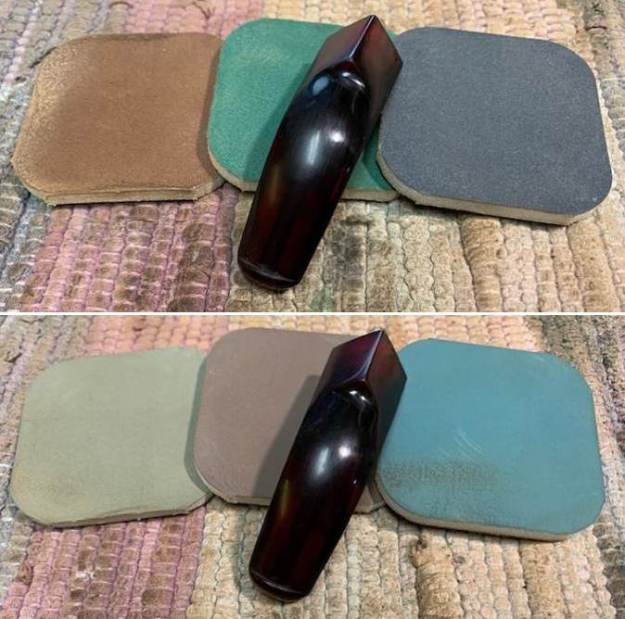
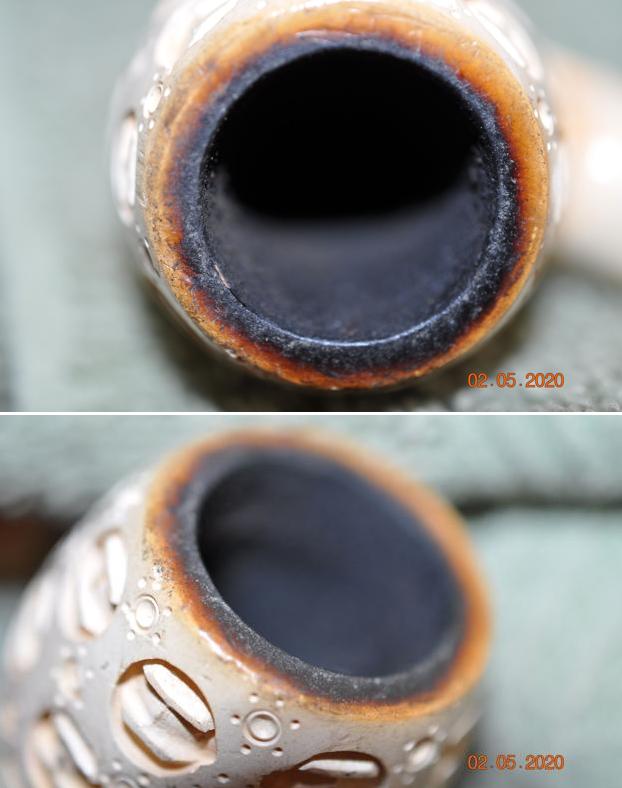
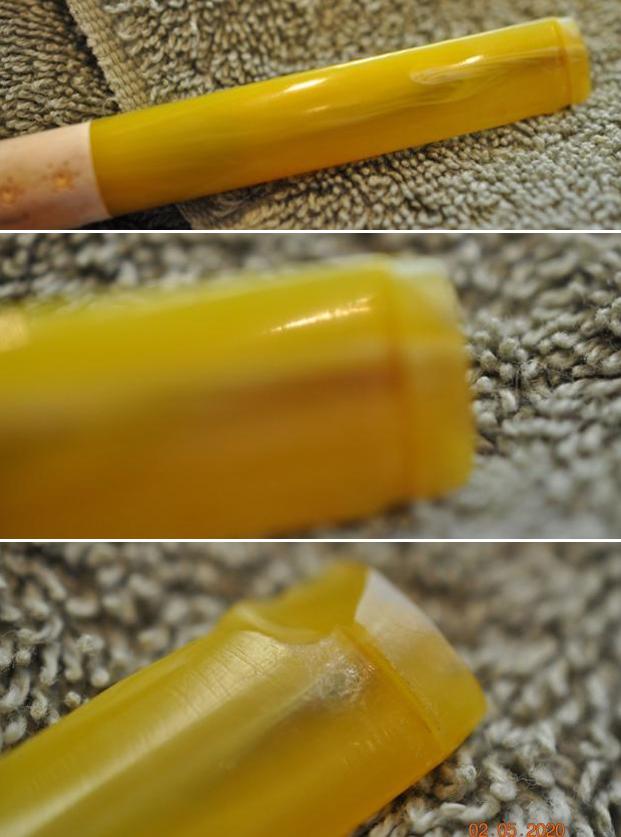
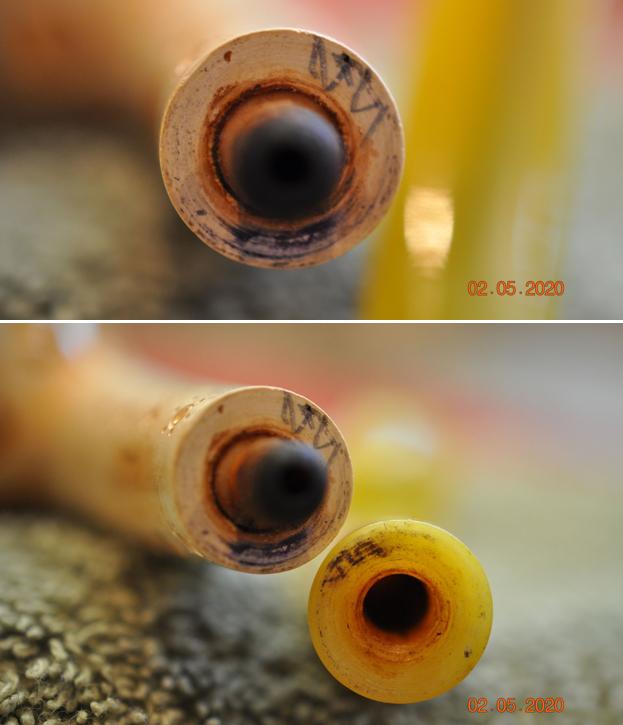
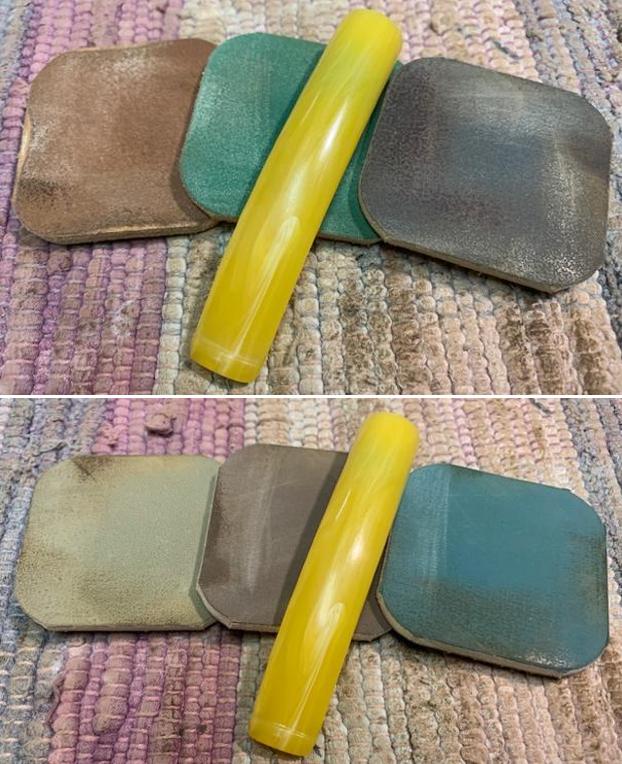
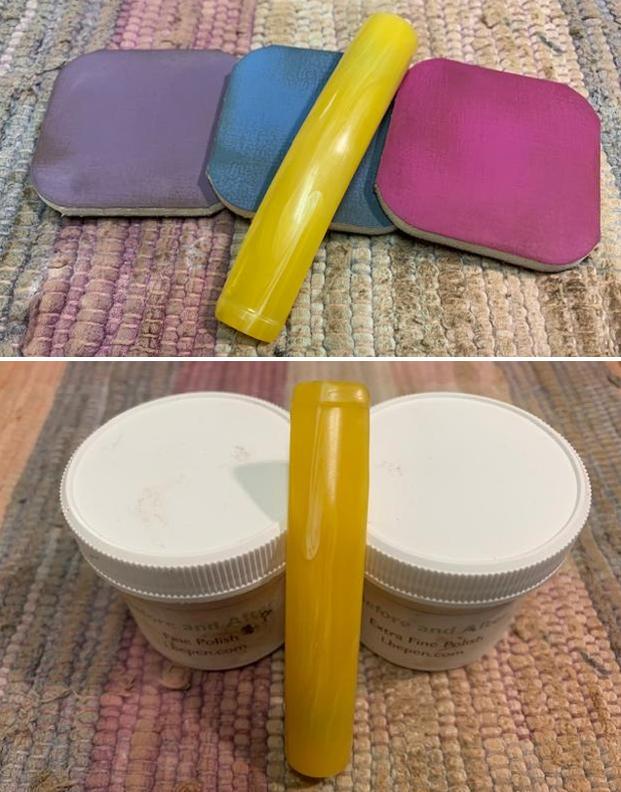
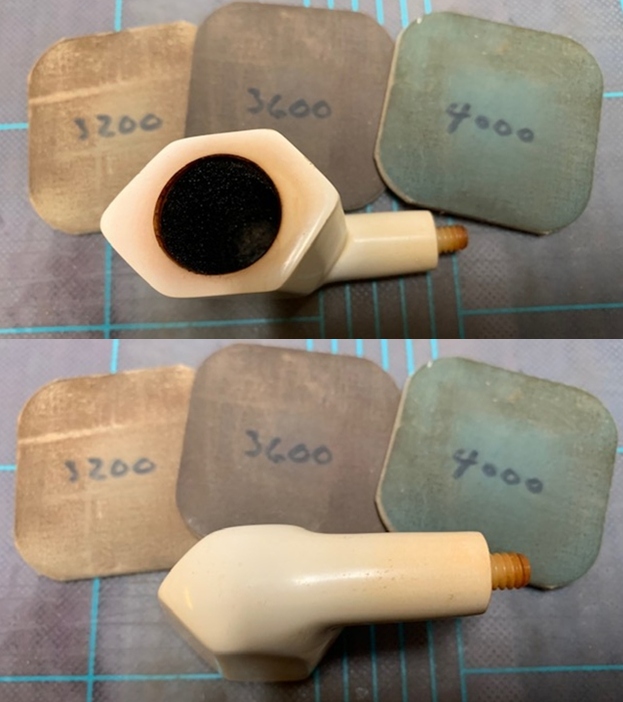
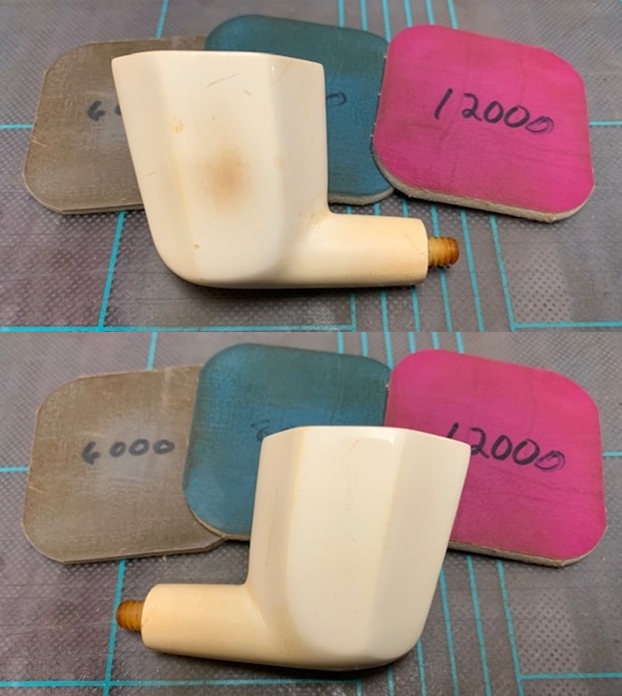
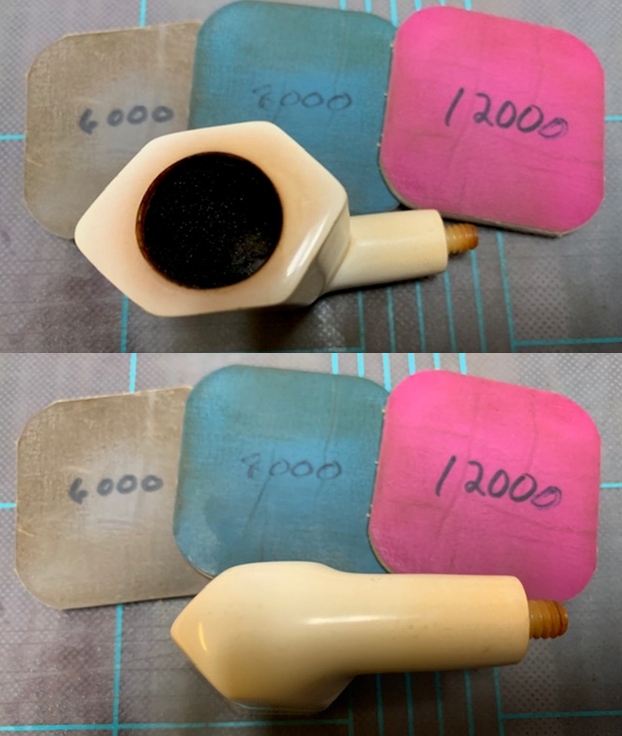
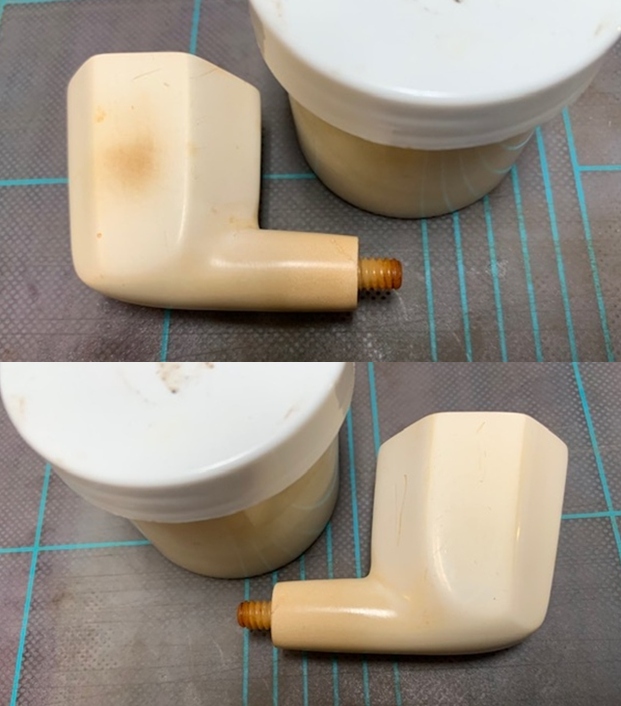
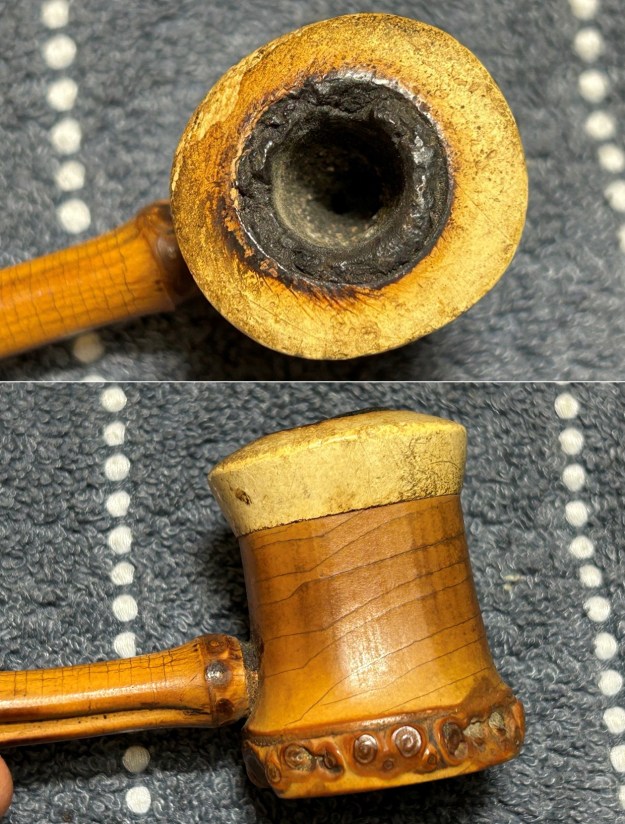
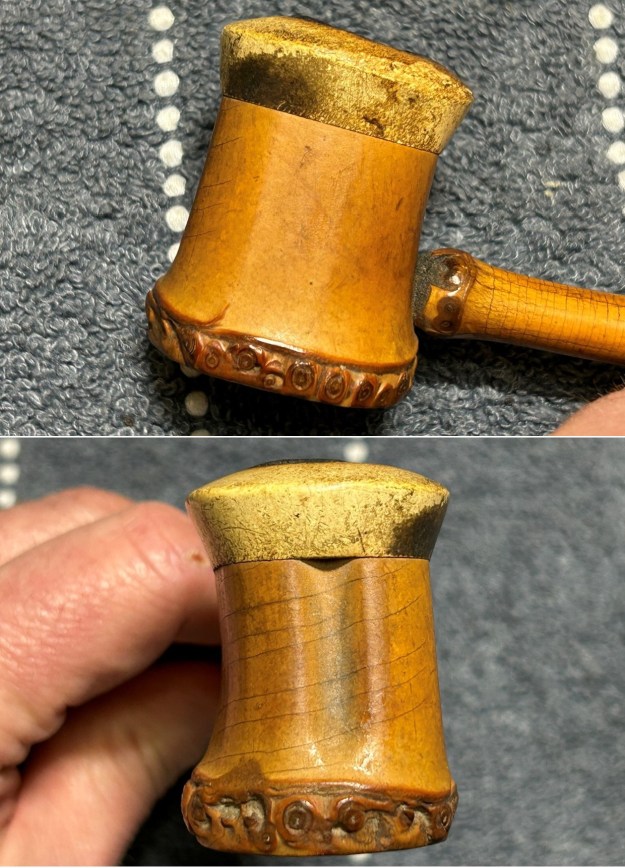
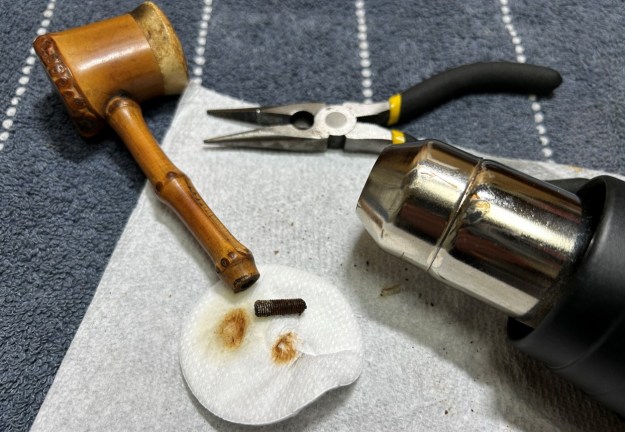
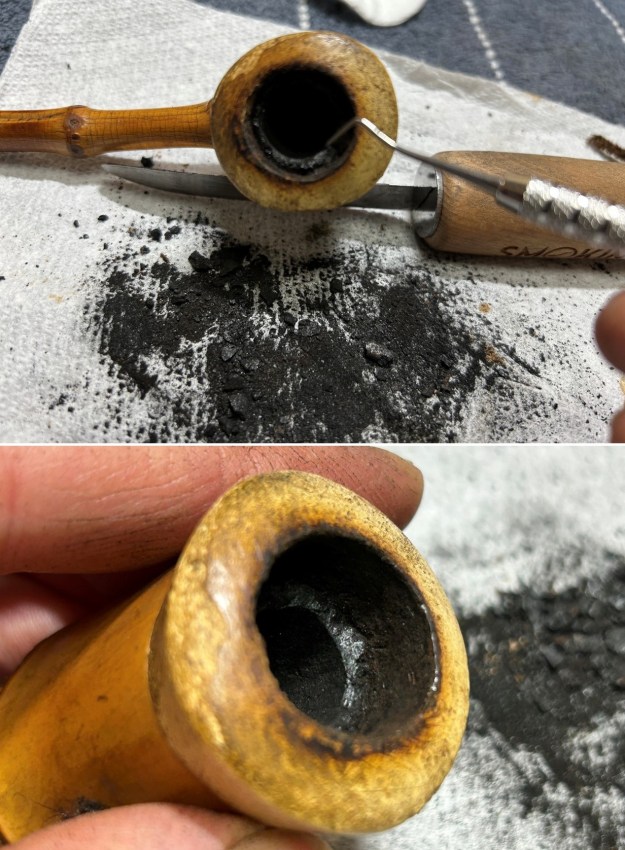
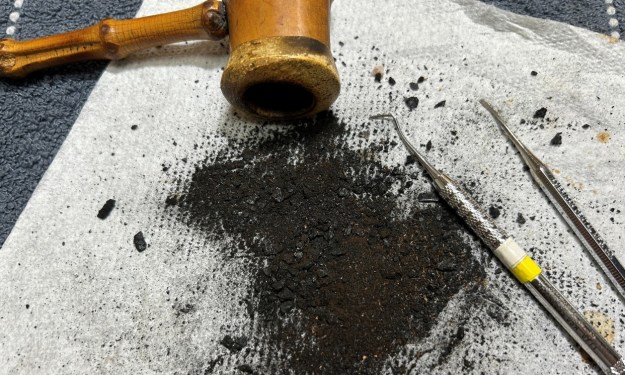
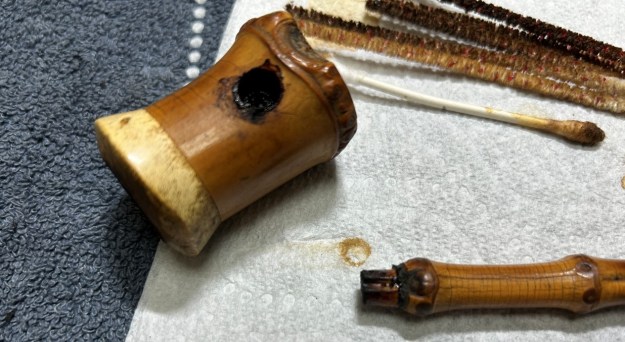
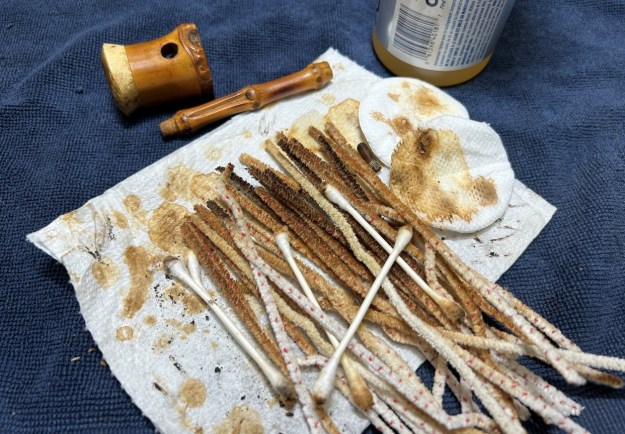
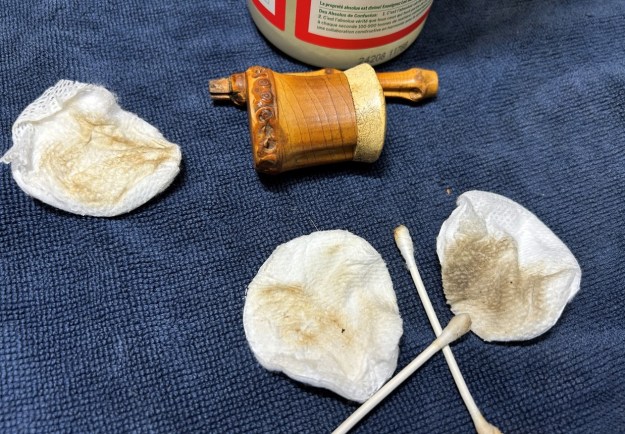
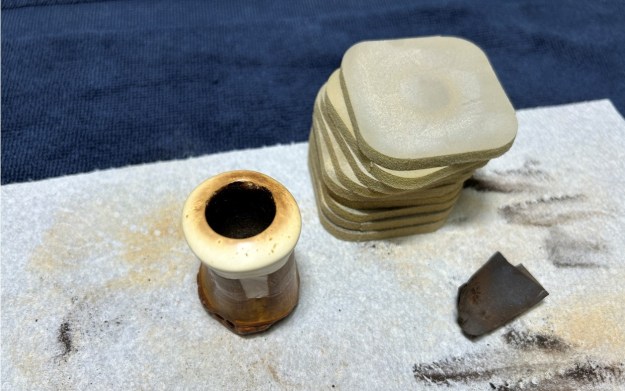
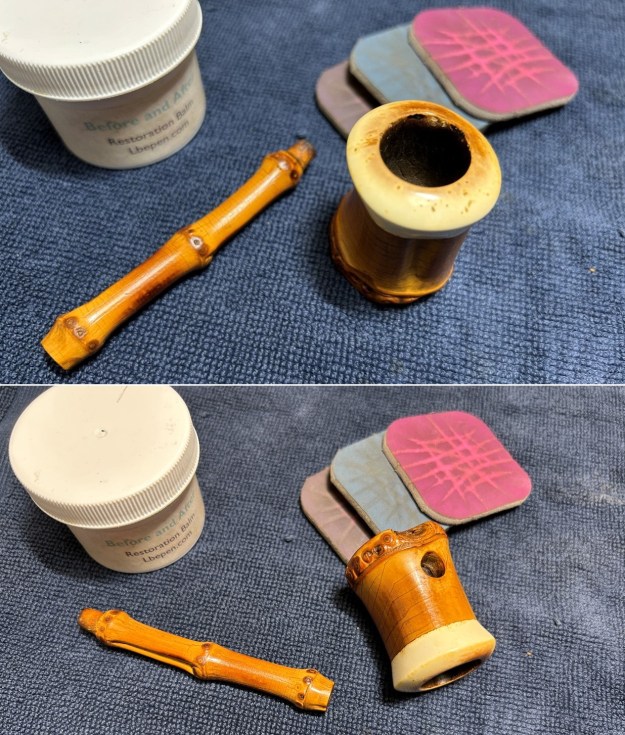
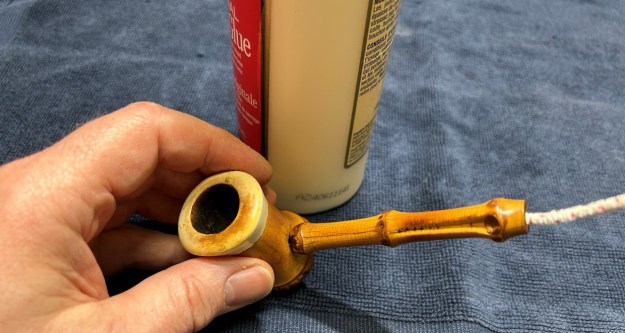
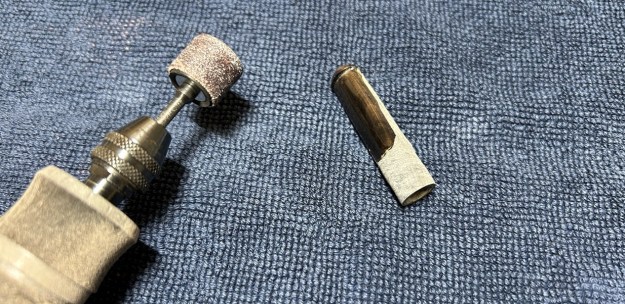
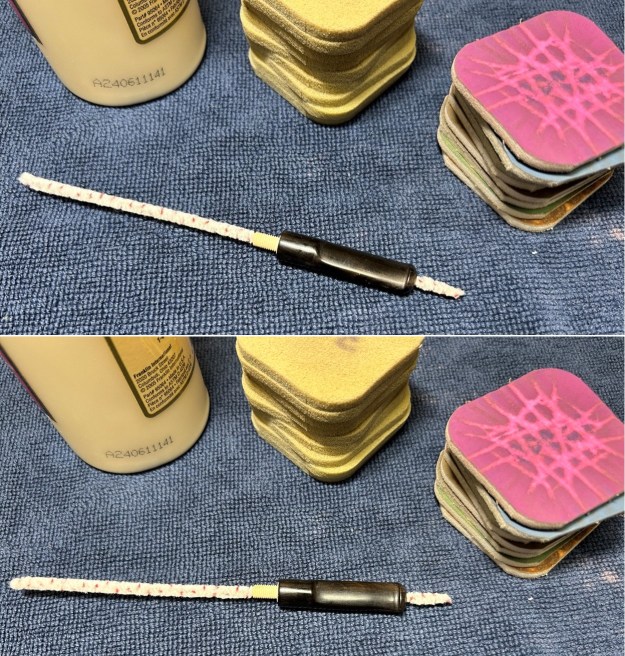
Let’s examine the condition of this pipe. The bone tenon is soiled and cracked, so that will have to be changed. The shank’s bamboo is sound – and very attractive. It’s quite dirty inside, but I am confident that we can resolve that. The bamboo part of the stummel is equally sound and beautiful. The meerschaum is very nice, but – wow – the cake on the inside of the bowl is thick and oppressive. Meanwhile, there is some nice staining to the meerschaum and that adds character. First things first. I couldn’t get the tenon out of the shank, so I took my heat gun and warmed them both. After a while, the goo inside loosened up sufficiently for me to extract it. As I mentioned, it was cracked – so I will find another one in my boxes. Later.Next, I removed the cake from the inside of the bowl. I cannot adequately express how challenging this was. The cake seemed as hard as granite – and I had to be so careful with the extraction because the meerschaum is comparatively fragile. I used a pipe knife and some dental tools, and cautiously, agonizingly scraped and chipped away at the cake. I am not exaggerating when I tell you that it took me 45 minutes to empty the bowl properly. Once complete, I gently separated the shank from the bowl. The photos show how dirty everything was. Obviously, if the bowl was as bad as indicated, you can just imagine what the inside of the shank was like.I disinfected the inside of the shank and the mortise entrance to the bowl with pipe cleaners and cotton swabs dipped in lemon-infused 99% isopropyl alcohol. I scrubbed thoroughly to make sure the interior was very clean. I used a ton of pipe cleaners and cotton swabs. I did this carefully because too much soaking can cause meerschaum to soften. I worked quickly, nothing softened, and everything turned out well.To tidy up the bamboo, I delicately wiped down the outside, using a solution of a pH-neutral detergent and some distilled water, with cotton rounds and cotton swabs (in the crevices). This did a good job of cleaning any latent dirt on the surface of the bamboo.I used all nine micromesh pads (1,500 through 12,000 grit) to sand the meerschaum part of the bowl and finish it off. This sanding minimizes flaws in the meerschaum and provides a beautiful smoothness to it. As the photos show, I masked the bamboo portion of the bowl with tape so as not to damage it while sanding.I only sanded the bamboo with the three finest micromesh pads. Then I rubbed it all with some LBE Before & After Restoration Balm and let it sit for 30 minutes or so. The balm moisturizes the bamboo and gives a beautiful depth to it. I then buffed the whole thing with a microfibre cloth. Next step was to reattach the bowl and shank. I carefully applied some wood glue into the mortise and replaced the shank precisely. As a measure of caution, I also stuck a pipe cleaner in the draught hole to prevent any glue getting in there.On to the stem and bone tenon. I found a stem in my workshop drawers that worked well with this pipe. I should point out that the stem is actually horn. I know that it looks like vulcanite in the photos, but it is dark horn. After settling on that, I dug through my boxes of bone tenons and found one that fit both ends. Then I set about sanding down the stem to ensure that it fit.I took my rotary tool to take off the bulk of the excess material. Then I sanded and sanded and sanded with my various micromesh pads. I neglected to photograph this process, so you’ll just have to take my word for it. As I was nearing completion, I applied pipe-stem oil with the last few micromesh pads. There was a wonderful, deep black shine to the stem when I was done. I also glue the tenon into the stem for safety’s sake. For the final step, I took the stem (only) to my bench polisher and carefully buffed it – first with a blue diamond compound, then with carnauba wax.
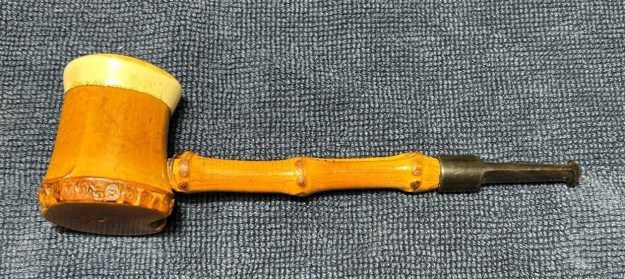
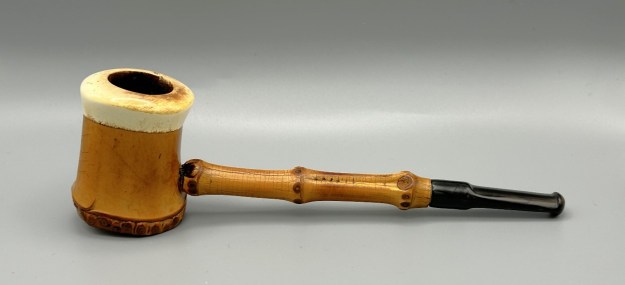
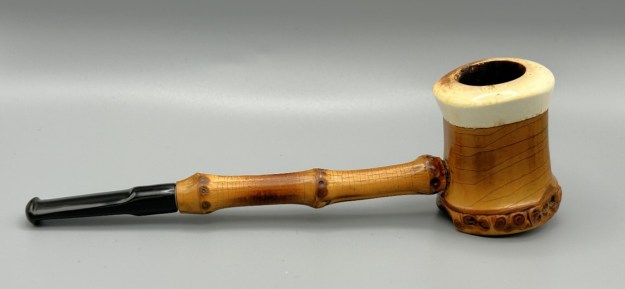
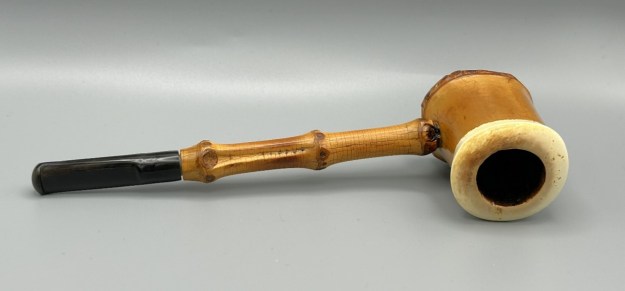
All done! This bamboo meerschaum sitter looks fantastic after a lot of hard work, and is ready to be enjoyed by its next owner. I am pleased to announce that this pipe is for sale! If you are interested in acquiring it for your collection, please have a look in the ‘Meerschaum’ section of the store here on Steve’s website. You can also email me directly at kenneth@knightsofthepipe.com. The approximate dimensions of the pipe are as follows: length 6 in. (153 mm); height 1⅞ in. (47 mm); bowl diameter 1¼ in. (32 mm); chamber diameter ¾ in. (19 mm). The weight of the pipe is ⅞ oz. (26 g). I hope you enjoyed reading the story of this pipe’s restoration as much as I enjoyed restoring it. If you are interested in more of my work, please follow me here on Steve’s website or send me an email. Thank you very much for reading and, as always, I welcome and encourage your comments.
Breathing new life into a Unique Meerschaum Bent Rhodesian with the Wooden Stem


by Steve Laug

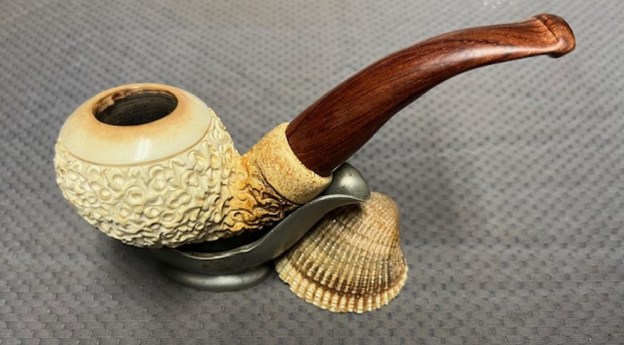
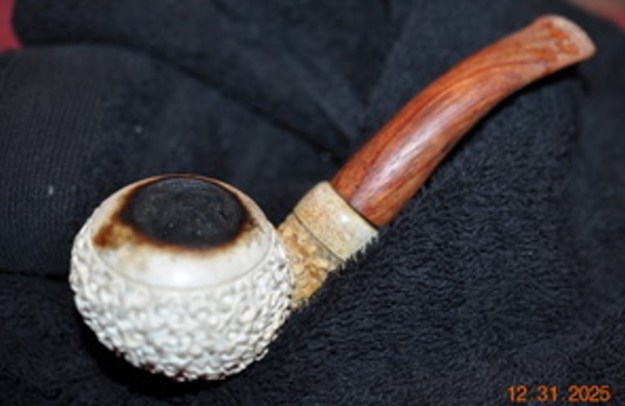
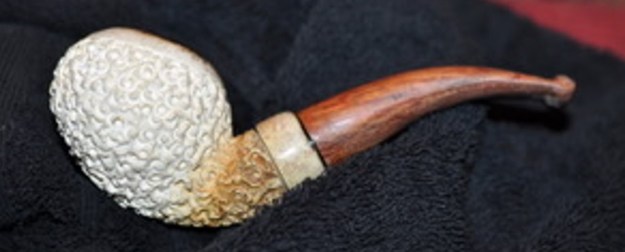
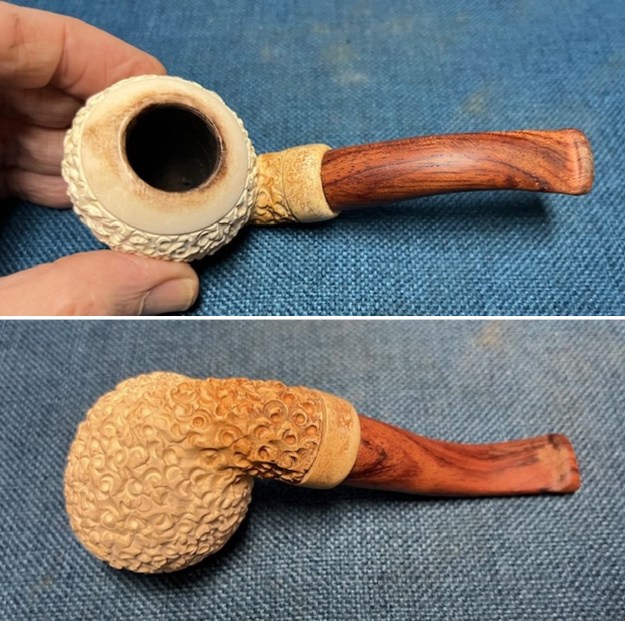
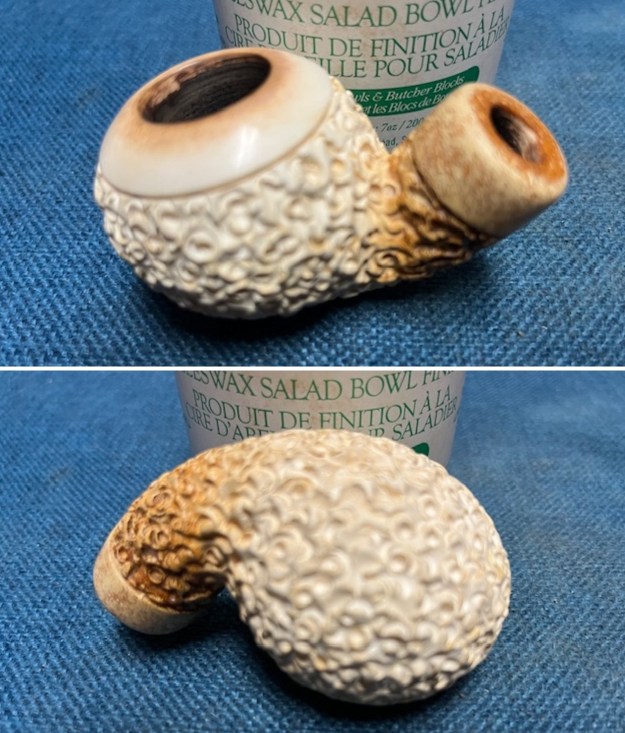
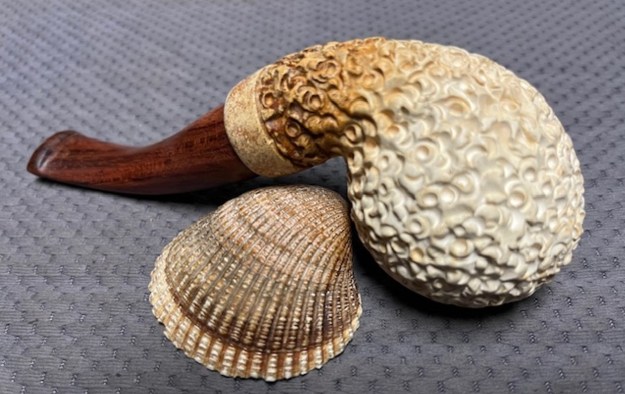
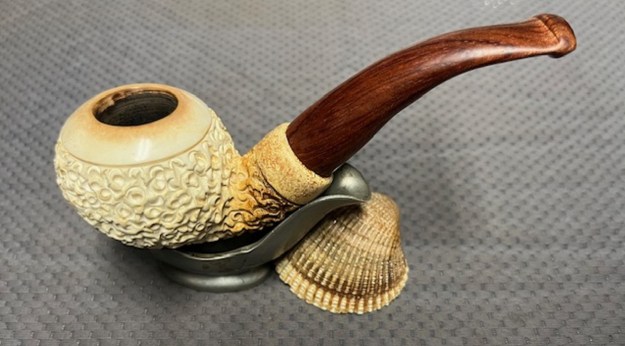
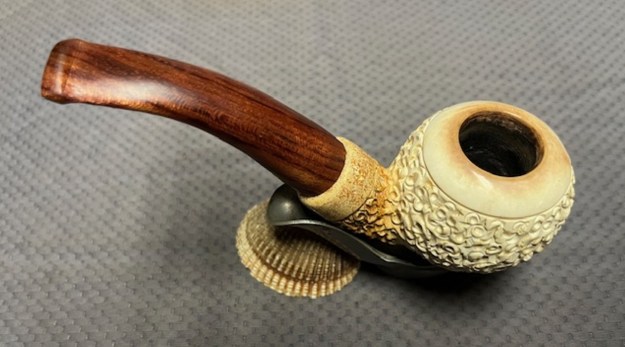
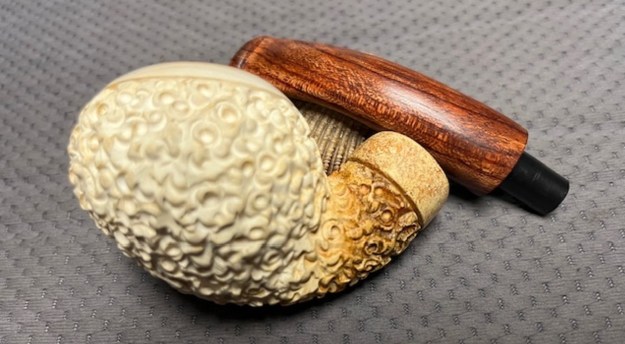
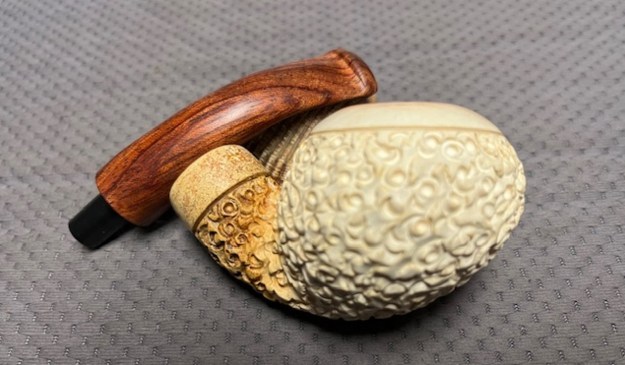
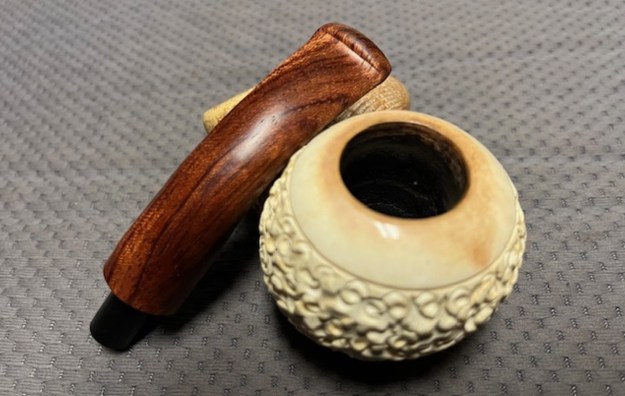
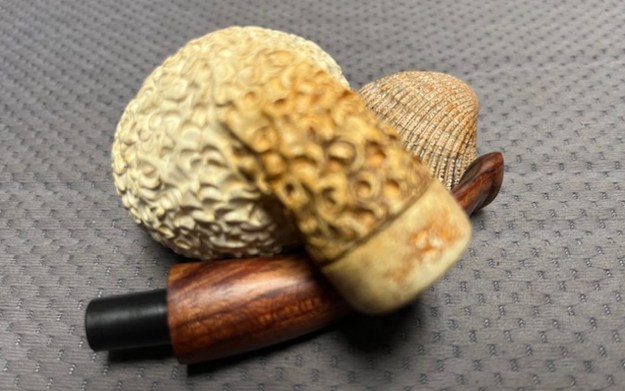
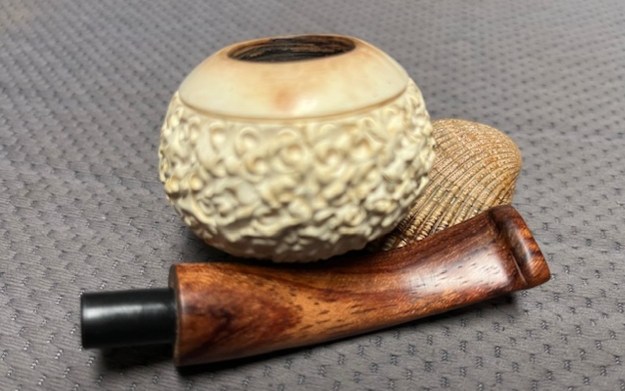
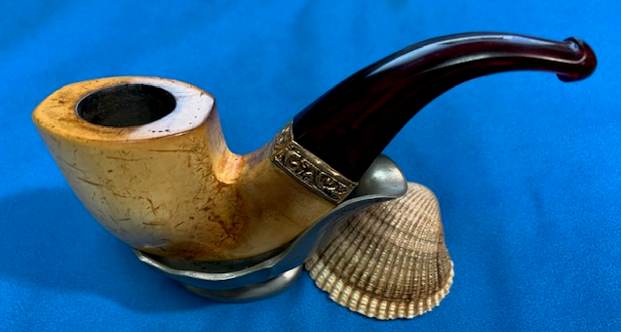
It is another rainy day in Vancouver and a day off so I decided to go to the basement and work on a pipe that was purchased on 12/03/2025 from a seller in Houston, Texas, USA. It is a no name rusticated Meerschaum Bent Rhodesian shape pipe that is quite beautiful. The rusticated bowl and shank of this large Rhodesian that has a very tactile feel that I am sure is even better when it heats up. The shank has some patina developing around the shank and end. The rim top has some patina under the lava. There was no stamping on the shank or bowl. The pipe was dirty when Jeff received it. There was dust and grime ground into the finish. The bowl was heavily caked and there was some thick lava on the rim top and inner edge. The hand carved wooden taper stem was dirty and had light tooth marks and chatter on both sides ahead of the button. There no stamping or logo on the stem top or sides. Jeff took photos of the pipe before he started his clean up work on it.

The photo to the right is a great photo of the general appearance of the bent Rhodesian and the rugged rustication on the bowl sides and heel. You can also see the lava and darkening to the rim top and inner edge of the bowl. It has a great looking hand carved stem – it is hardwood and I wonder if it is Walnut or possibly Paduak. I am uncertain of the kind of wood that the stem is made of but it certainly a reddish coloured hardwood.

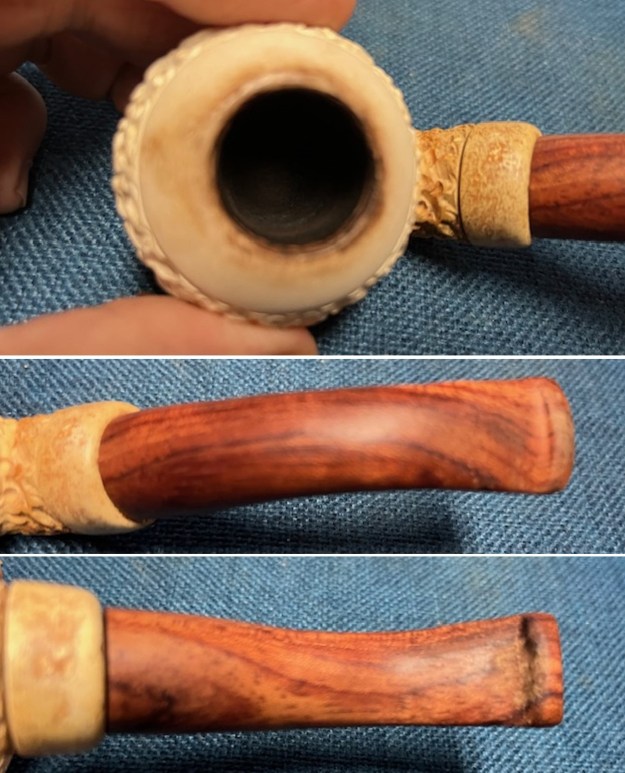
He took some photos of the rim top and bowl from various angles to give me a clear picture of the condition of the rim top and bowl. The inside of the bowl is heavily caked with a heavy lava build up on the inner edge and rim top. He included photos that show the top and underside of the stem. The photos show the lack of defined edge on the button and the wear ahead of the button. The condition of the stem is as I described above.
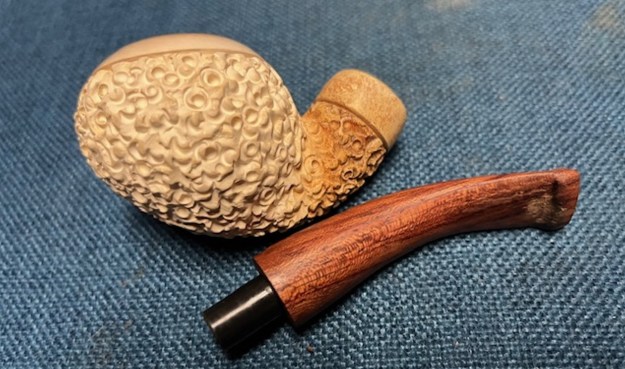
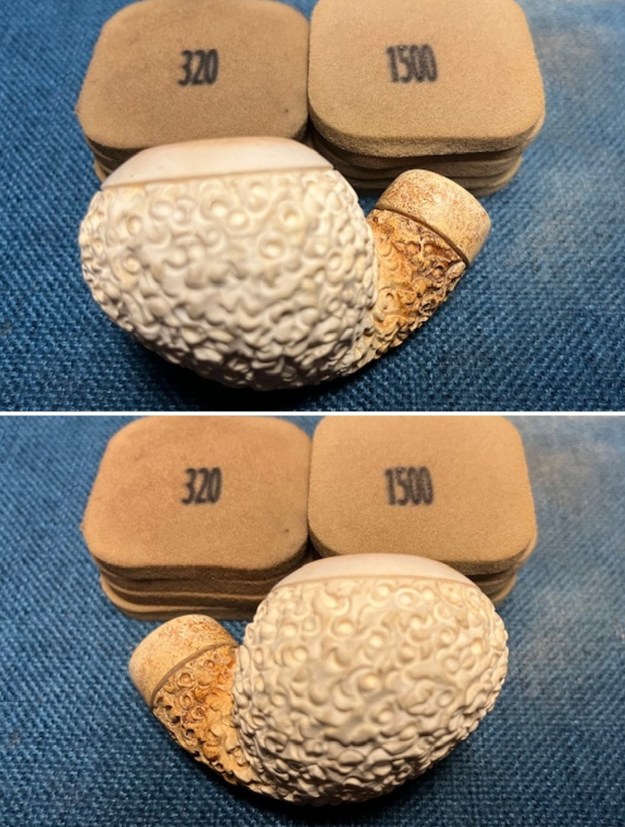
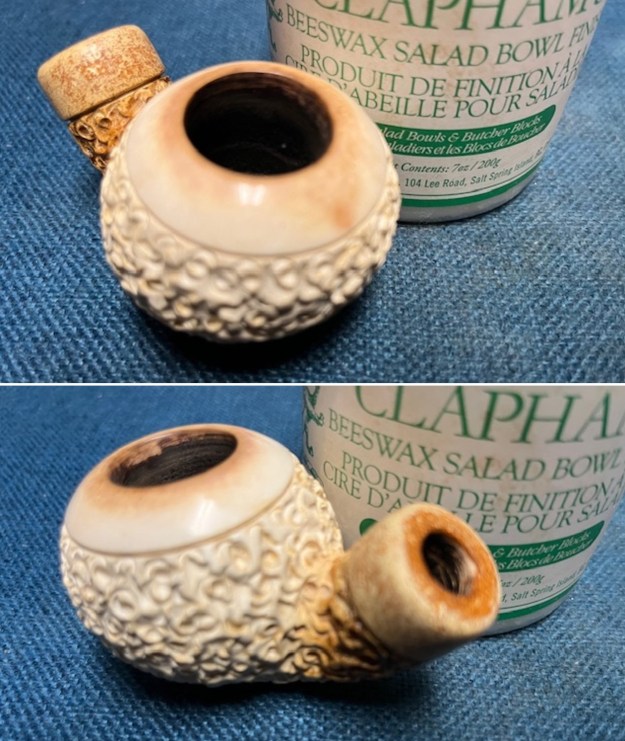
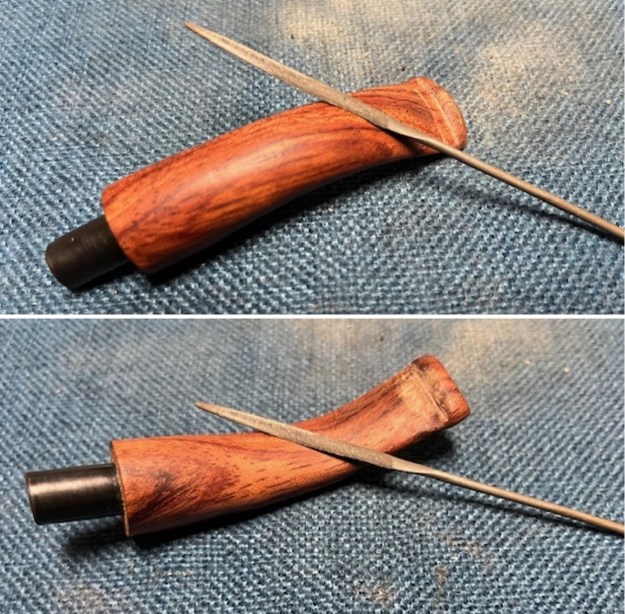
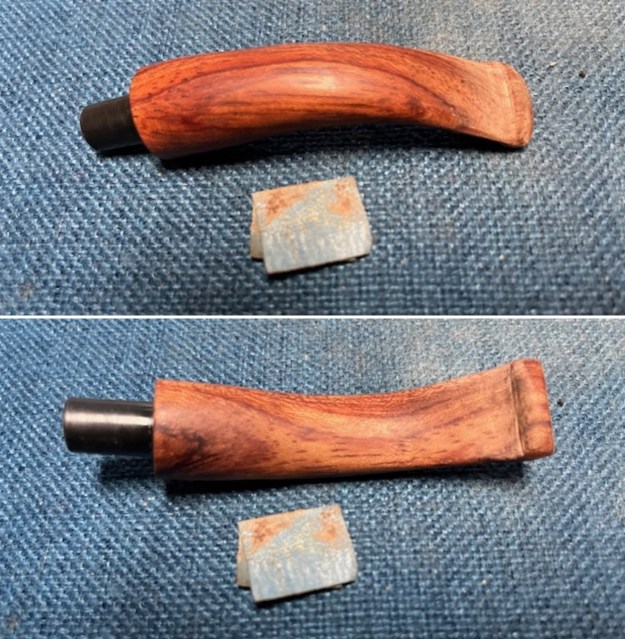
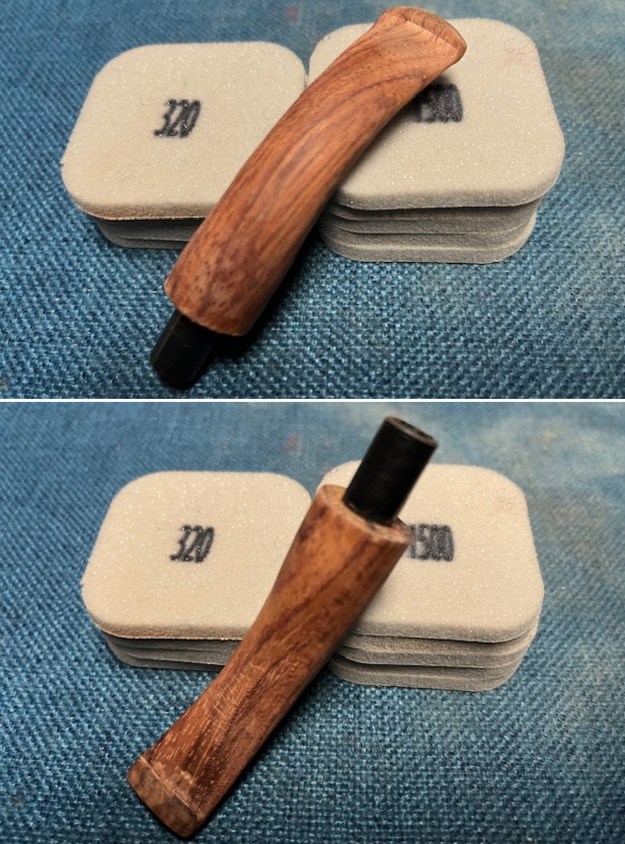
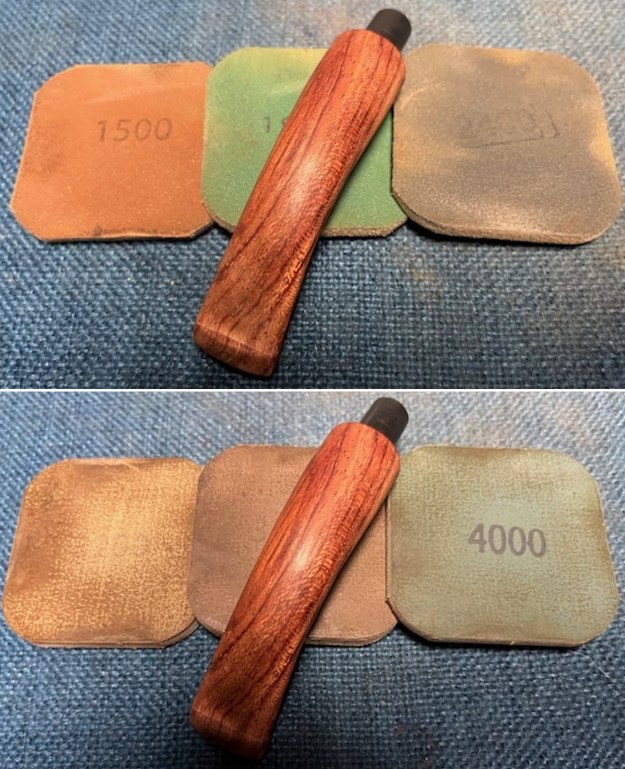
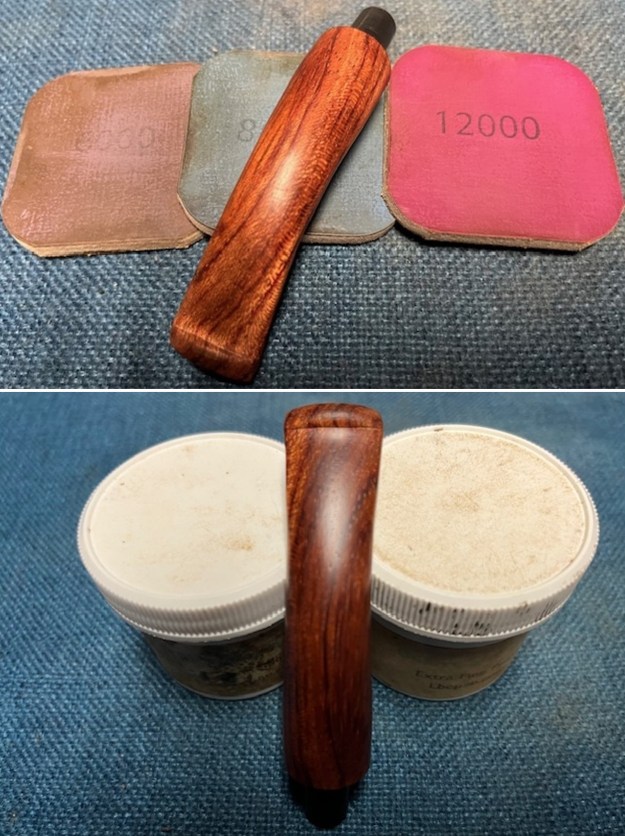
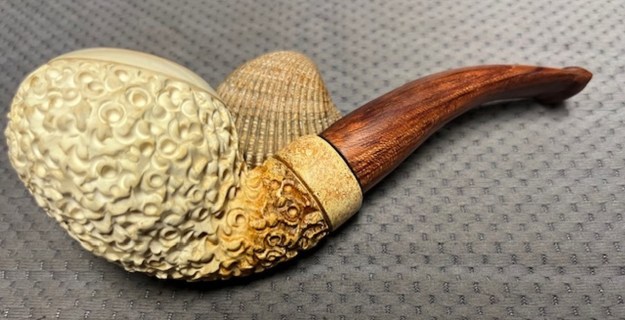
The tenon is fit for a Medico style paper filter. The tenon is too small for a 9MM filter and too big for a 6MM filter.Jeff took photos of the sides and heel of the bowl to give a sense of the finish and the developing patina on the shank and bowl. Now it was my turn to work on the pipe. Jeff had done an amazing cleanup of the pipe. He reamed the light cake with a PipNet reamer and cleaned up that with a Savinelli Fitsall Pipe Knife. He scrubbed the internals of the bowl and stem with alcohol, cotton swabs and pipe cleaners. He scrubbed the externals with undiluted Murphy’s Oil Soap and rinsed the bowl off with running water. He scrubbed the exterior of the stem with Murphy’s Oil Soap and a tooth brush. I rinsed it off with warm water to remove the residual solution. He dried it off and rubbed it down to remove any oxidation that was still on the stem. The pipe looked very good when I received it. I took a photo of the rim top to show the condition. You can see the clean bowl. The bowl is in excellent condition and the rim top looks very good. There is a little darkening on the back topside of the rim but otherwise it is excellent. The stem came out looking quite good. It only needed to be polished. I took the stem off and took a photo of the overall look of the pipe. It really is a beauty. I carefully sanded the smooth surface of the rim top and shank end of the shank with 320-3500 grit 2×2 inch sanding pads to remove the darkening and small scratches in the surface of the meerschaum. The bowl and shank began to look very good. I polished the meerschaum rim cap, top and shank end with 1500-12000 grit micromesh sanding pads – dry sanding the briar and wiping down the bowl after each sanding pad. It really began to take on a rich shine and the grain stood out beautifully. I rubbed the meerschaum down with Claphams Beeswax/Carnauba wax. I worked it into the meerschaum with my fingertips and a horsehair shoe brush to work it into the nooks and crannies of the rusticated finish. I let it sit for 10 minutes then I buffed it with a cotton cloth to deepen the shine. The meerschaum takes on a deep patina that really comes alive with the wax. I set aside the bowl and turned my attention to the stems. I recut the button edge and reshaped it with small needle files. I sanded the stem with a folded piece of 220 grit sandpaper to finish reshaping the button edges. I sanded the stem with 320-3500 grit 2×2 inch sanding pads. The shape and look of the stem looked better and better. It really began to shine.I polished the wooden stem with micromesh sanding pads – 1500-12000 grit pads. I wiped them down with Obsidian Oil after each sanding pad. I used Before & After Pipe Polish – both Fine and Extra Fine to further polish the stem. This Rusticated Meerschaum Bent Rhodesian with a Wooden Filter Stem has a beautiful, reddish brown finish that highlights some beautiful grain. I put the stem back on the bowl and buffed the pipe with Blue Diamond on the buffing wheel being careful to not buff the stamping. I gave the bowl and the stems multiple coats of carnauba wax on the buffing wheel and followed that by buffing it with a clean buffing pad. I hand buffed the pipe with a microfiber cloth to deepen the shine. The finished Rusticated Meerschaum Bent Rhodesian with Wooden Stem is quite stunning and feels great in my hand. Give the finished pipe a look in the photos below. The dimensions of the pipe are Length: 5 ½ inches, Height: 1 ¾ inches, Outside diameter of the bowl: 1 ½ inches, Chamber diameter: 7/8 of an inch. The weight of the pipe is 2.12 ounces/61 grams. Thanks for walking through the restoration with me as I worked over another beautiful pipe. I am not sure where this will end up. I may keep it here for awhile to make sure the draught is correct. Then I will see. Thanks for your time.

Restoring an Unusual Meerschaum with a Bamboo Shank


by Kenneth Lieblich

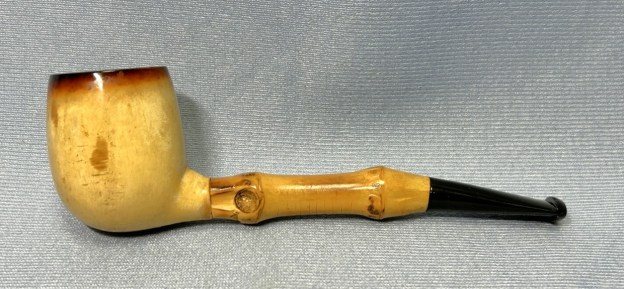
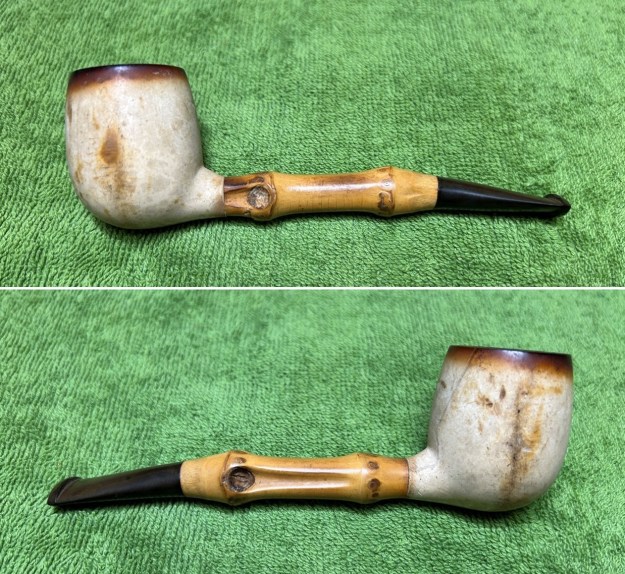
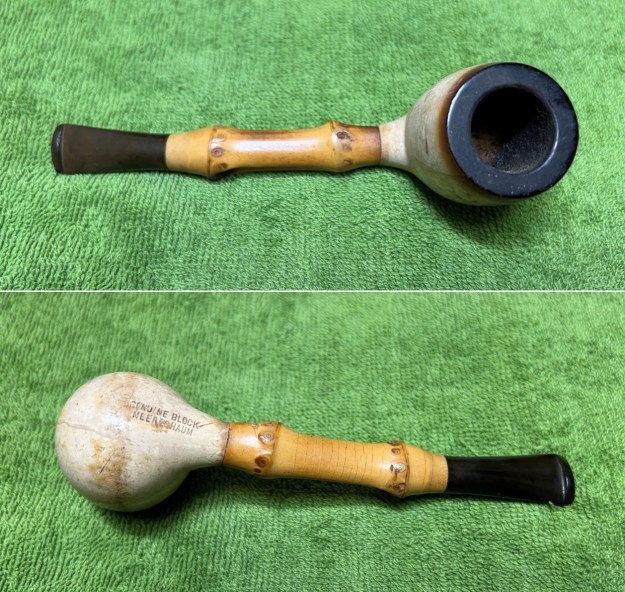
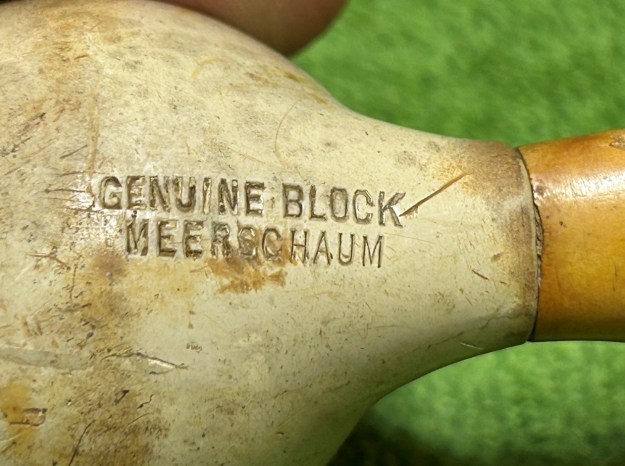
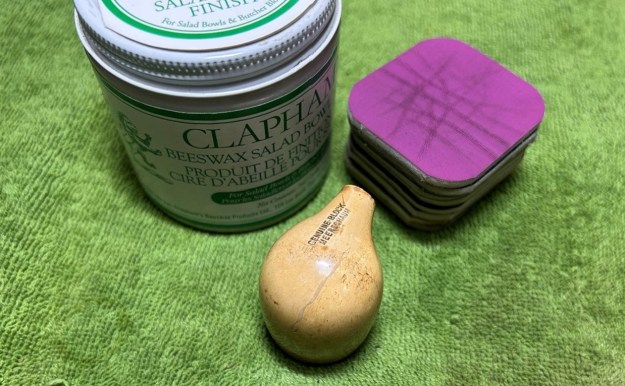
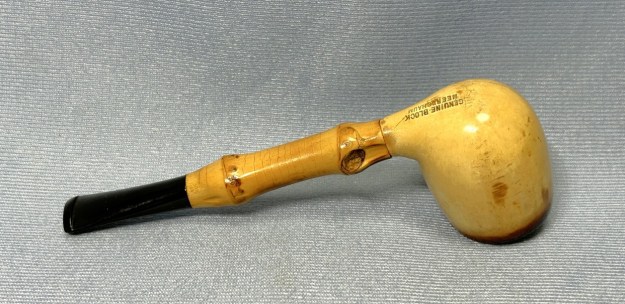
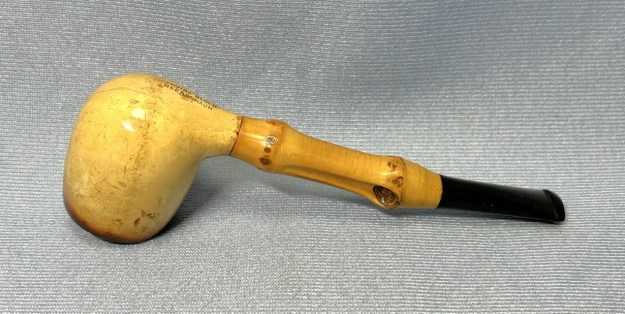
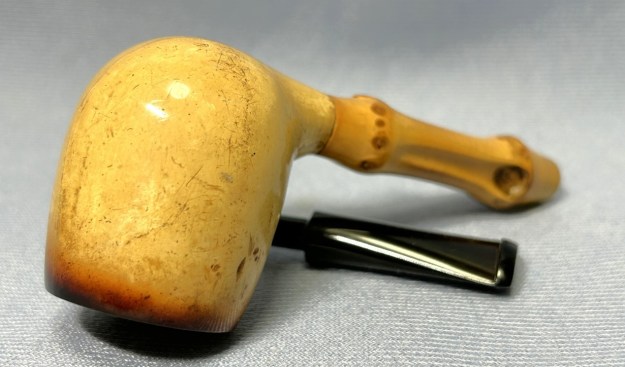
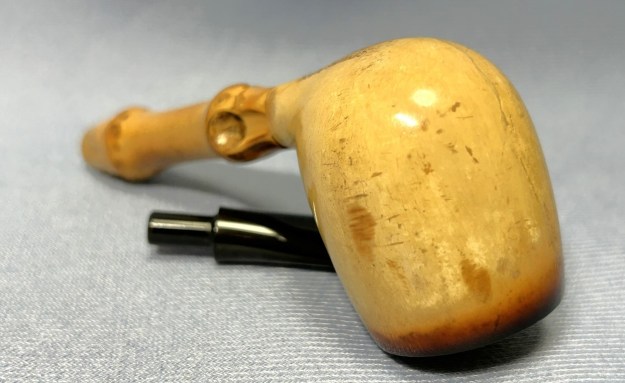
I was pleasantly surprised to find this pipe recently at a local thrift shop. The thrift shops around here don’t usually carry tobacco pipes and, those that do, normally offer nothing but the dregs of the pipe world. In this case, I found a charming, simple, and beautiful billiard pipe. The bowl is made of block meerschaum, the shank is made of bamboo, and the tapered stem is made of vulcanite. Its seemingly conventional design belies a slightly enigmatic history. I must admit, I am tempted to keep this one in my own collection, but maybe one of you will talk me into selling it. The only marks on this pipe are underneath the bowl, and read Genuine Block [over] Meerschaum. Annoyingly, there were no marks on the stem, shank, or anywhere else. Having said that, however, it did lead me to think that this pipe was manufactured on the Isle of Man. I have restored a few pipes from the Isle of Man and Steve has restored countless pipes from there. In a recent blog post, Steve wrote the following:

My research on the origins of [this pipe] can be summarized like this: It was made with African Meerschaum from the Tanganyika Meerschaum Corporation and produced by Laxey Pipe Ltd. on the Isle of Man.Here is some information from Pipedia about meerschaum production on the Isle of Man:

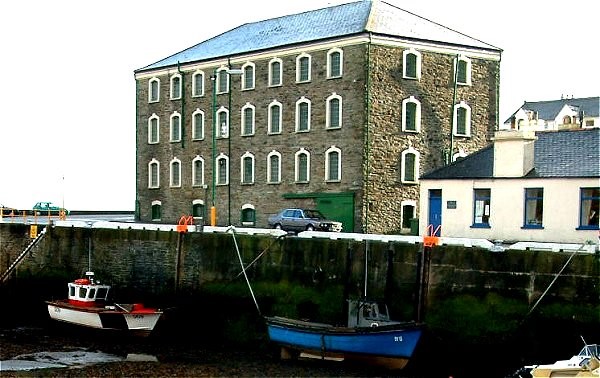
Laxey Pipes Ltd. resided in a historical 19th century four-storey Man stone building at The Quay, Old Laxey, Isle of Man, which thankfully has been preserved.

The company specialised in the production of meerschaum pipes using the Meerschaum mined by the Tanganyika Meerschaum Corporation in the Amboseli basin in Tanganyika (since 1964 part of the United Republic of Tanzania).

Please note: you may often find names like “Manx Pipes Ltd.”, “Man Pipe Co.” and others more, but there is no indication of another Isle of Man pipe producer other than Laxey Pipe Ltd. at any time!

 Laxey Pipes Ltd. marketed own brands like “Manxpipe”, “Manxman”, “Manxland” e.c. Names like “John Bull”, “White Knight” (unwaxed), “Domino” (black, or lined) indicated some shapes / colours of Laxey’s own series. The stems either showed the astronomical sign for “male” or “man” (circle + arrow), or the crest of the Isle of Man, the 3-legged X in a circle. Manxpipes and Laxey’s other brands were available through pipe retailers in general, but also were sold (mainly) to tourists through their own shop in Laxey.

Furthermore Laxey Pipes Ltd. manufactured the meer bowls for Peterson, Barling, Nørding and others from the later 1960’s until 2001. Man Pipe e.g. was a brand distributed by Comoy’s. The bowls usually showed no nomenclature indicating the orderer. “Genuine Block Meerschaum” was engraved frequently. Often, just the stems were different, while bowls were the same.

Supply of meerschaum from East Africa run out (Kenya / Tanzania exhausted, Somalia inaccessible), and thus the last Laxey meers were supplied to trade in May, 2001. Laxey Pipes Ltd. tried to survive continuing with briar pipes – mainly in the Danish style -, but to no success. It closed down business in July, 2002.Despite the paucity of maker’s marks on my pipe, the style of the marks that are there leads me to believe that this is a Manx-made pipe. One major detail that made me harrumph a bit was the bamboo shank. I wasn’t familiar with Laxey making bamboo shanked pipes. Steve commented that the pipe was not unlike pipes from the Kaywoodie Mandarin line of bamboo-shanked pipes. Again, however, as far as I know, the Mandarin line never included meerschaum. Steve asserts, however, that Kaywoodie did produce a bamboo-meerschaum pipe. Here is an example of an unbranded bamboo meer found on eBay. Not only does the pipe have no identifying marks, but the seller had no information either.The combination of meerschaum and bamboo in pipes is certainly not unprecedented in the 21st century. For example, one can find some spectacular examples from Walt Cannoy, Ryan Alden, and the famous Turkish maker, Said Altınay. Here is a beautiful example from him:As a side note, Altınay’s website includes an interesting note on the history of bamboo in pipemaking. I provide a brief quotation:

Bamboo began appearing in briar pipe construction in the early 20th century. The earliest known pioneer of this style is believed to be Sixten Ivarsson, the Danish pipe-making legend, who introduced bamboo shanks in the mid-1900s as both an aesthetic and practical innovation. The concept soon spread, embraced by artisans such as Tom Eltang, Tokutomi, and Takahiro Hibi, who elevated the use of bamboo into a form of fine art. Its appeal was twofold: the natural lightweight strength and the distinctive, organic appearance. While traditional briar offered durability and familiarity, bamboo introduced character, contrast, and subtle resilience — giving each pipe a unique signature.

Obviously, the pipe I found is not on the order of a Cannoy, Alden, or Altınay! But I also feel comfortable in saying that this pipe is a lot older than those fellows’ pipes. I would be interested in hearing from YOU if you know more about the marriage of meerschaum and bamboo in pipemaking. Thank you kindly.

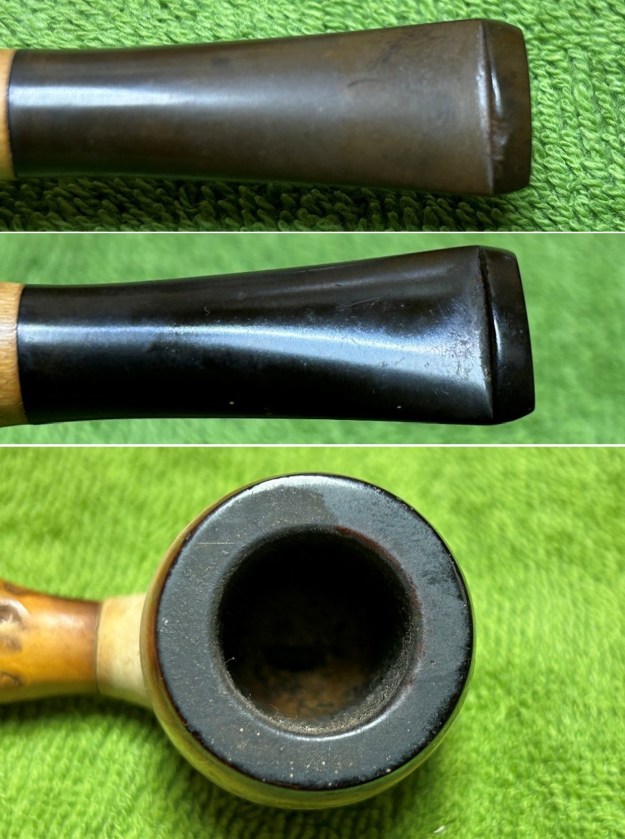
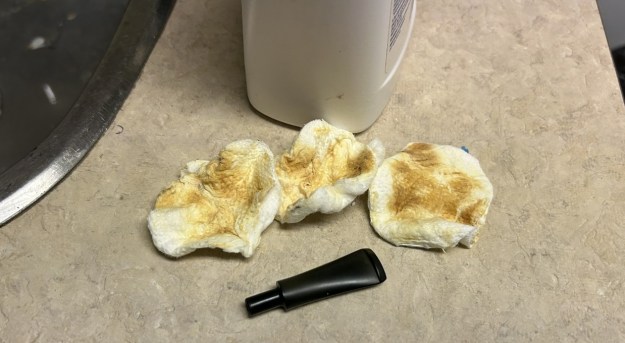
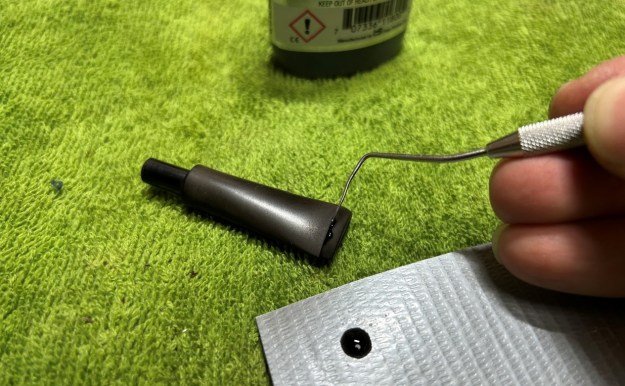
The pipe was in generally good condition and didn’t seem too challenging to clean up. There was a bit of scratching, etc. on the stem, but nothing serious. The bamboo shank was aged, but perfectly sound. Finally, the meerschaum bowl was well worn, but not bad at all.I used oil soap on a few cotton rounds and wiped down the stem to provide an initial cleaning of filth before moving on to the next steps. The primary cleaning came next. I disinfected the inside of the stem with both pipe cleaners and cotton swabs dipped in lemon-infused 99% isopropyl alcohol. I scrubbed thoroughly to make sure the interior was very clean.The goal of the next step is the removal (or minimization) of oxidation. Going to my sink, I used cream cleanser, cotton rounds, and a toothbrush, and scoured the stem to remove as much surface oxidation as possible. As the photos show, the result was a hideous, brownish mess – but better off the stem than on it.Once the stem was reasonably clean, I soaked it overnight in some Briarville Stem Oxidation Remover. This solution works to draw oxidation in the stem to the surface of the vulcanite. This is a major aid and an important step in ensuring a clean stem. The following day, I drew out the stem from its bath and scrubbed the lingering fluid with a toothbrush.As the stem was now clean and dry, I set about fixing the marks in the vulcanite. This was done by filling those divots with black cyanoacrylate adhesive, impregnated with carbon and rubber. I left this to cure and moved on.The penultimate step for the stem is sanding. First, with my set of needle files, I reduced the bulk of the cyanoacrylate repairs. I removed the excess adhesive as near to the surface as possible, without cutting into the vulcanite. Following that, I used all nine of the micromesh sanding pads (1,500 through 12,000 grit) to sand out flaws, even out the vulcanite, and provide gentle polishing of the finished surface. I also applied pipe-stem oil while using the last five micromesh pads. There was a wonderful, deep black shine to the stem when I was done. Alas, I forgot to take photos of this step.

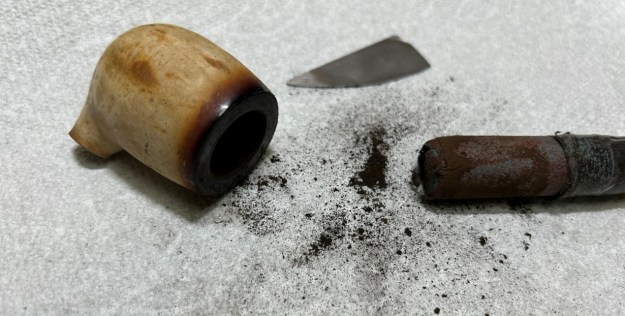
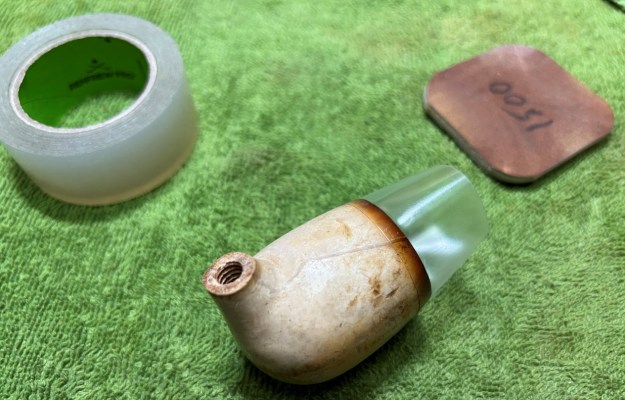
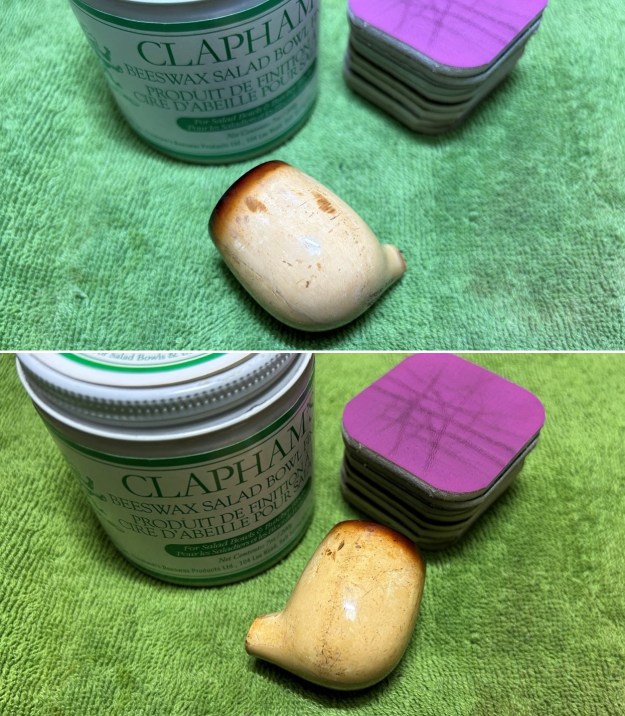
The inside of the shank needed to be cleaned thoroughly. Similar to the stem, I then cleaned it with both pipe cleaners and cotton swabs dipped in lemon-infused 99% isopropyl alcohol.I didn’t sand the bamboo in any way, but I did rub it with some LBE Before & After Restoration Balm and let it sit for 30 minutes or so. The balm moisturizes the bamboo and gives a beautiful depth to it. I then buffed the shank with a microfibre cloth.I moved on to the bowl. The first step was to ream it out – that is to say, remove all the cake inside the bowl. This accomplished a couple of things. First (and most obviously), it cleaned the bowl and provided a refurbished chamber for future smoking. Second, when the old cake was removed, I could inspect the interior walls of the bowl and determine if there was damage or not. Given the more fragile nature of meerschaum and the relative cleanliness of the smoking chamber, I only used a piece of sandpaper taped to a wooden dowel to clean things out. This was sufficient to ensure that all the debris was removed. My next step was to remove the lava on the rim. For this, I took a piece of machine steel and gently scraped the lava away. The metal’s edge is sharp enough to remove what I need, but not so sharp that it damages the rim.I then cleaned the entrance to the bowl with both pipe cleaners and cotton swabs dipped in lemon-infused 99% isopropyl alcohol. This was done cautiously, as too much liquid can cause softening of the meerschaum. Due to my care, no such problems were encountered. I used all nine micromesh pads (1,500 through 12,000 grit) to sand the outside of the bowl and finish it off. This sanding minimizes flaws in the meerschaum and provides a beautiful smoothness to it. As the photos show, I masked the darkened portion of the bowl with tape so as not to remove it while sanding. I rubbed some Clapham’s Beeswax Polish into the meerschaum and let it dry thoroughly. Then I buffed it carefully with a microfibre cloth. Ooo – what a shine! For the final step, I took the pipe to my bench polisher and carefully buffed it – first with a blue diamond compound, then with three coats of carnauba wax. This procedure makes the pipe look its best – the stummel sings and the stem glows.

All done! This bamboo meerschaum billiard looks fantastic again and I am delighted with the results. As I mentioned before, I might keep this for myself, but you’re welcome to reach out to me if you’re interested in acquiring it: kenneth@knightsofthepipe.com. The approximate dimensions of the pipe are as follows: length 5⅝ in. (142 mm); height 1¾ in. (44 mm); bowl diameter 1⅜ in. (36 mm); chamber diameter ¾ in. (18 mm). The weight of the pipe is ¾ oz. (24 g). I hope you enjoyed reading the story of this pipe’s restoration as much as I enjoyed restoring it. If you are interested in more of my work, please follow me here on Steve’s website or send me an email. Thank you very much for reading and, as always, I welcome and encourage your comments.
Replacing a Broken Tenon & Restoring a Family Heirloom Pioneer Meerschaum


Blog by Steve Laug

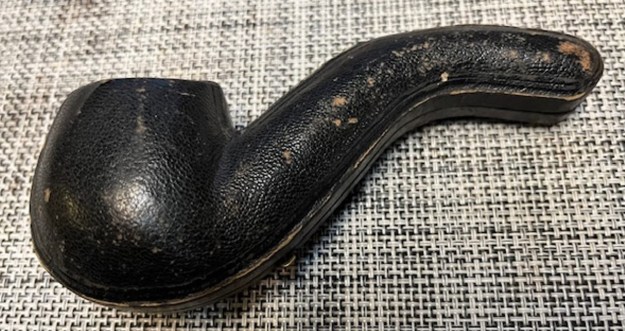
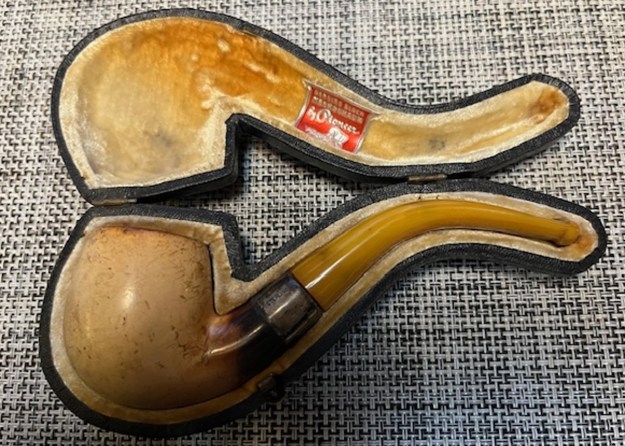
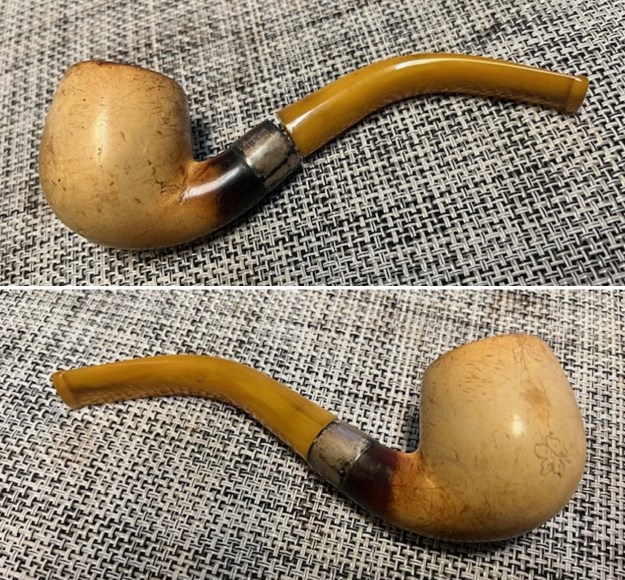
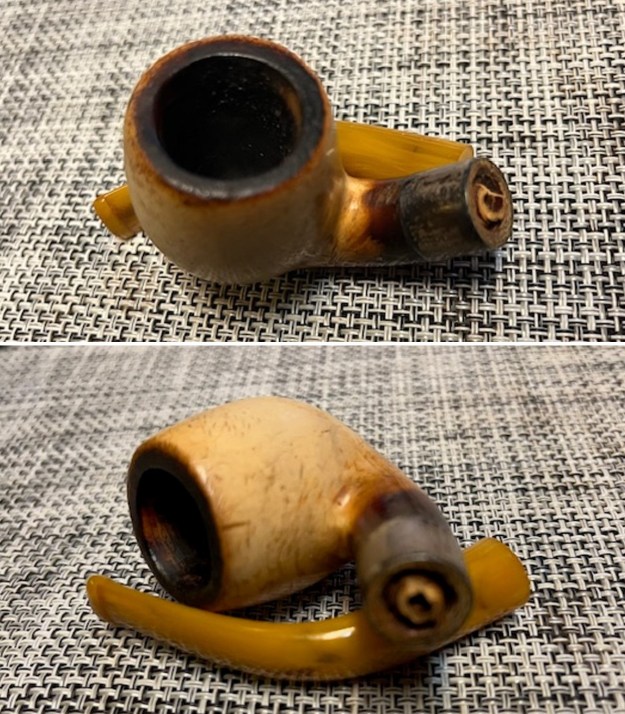
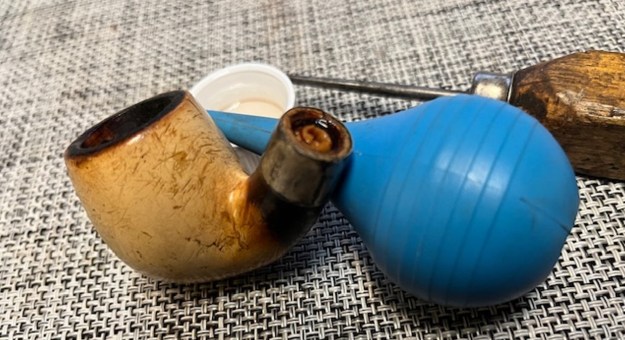
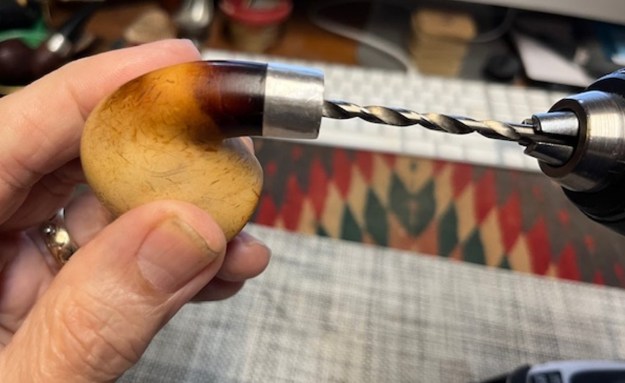
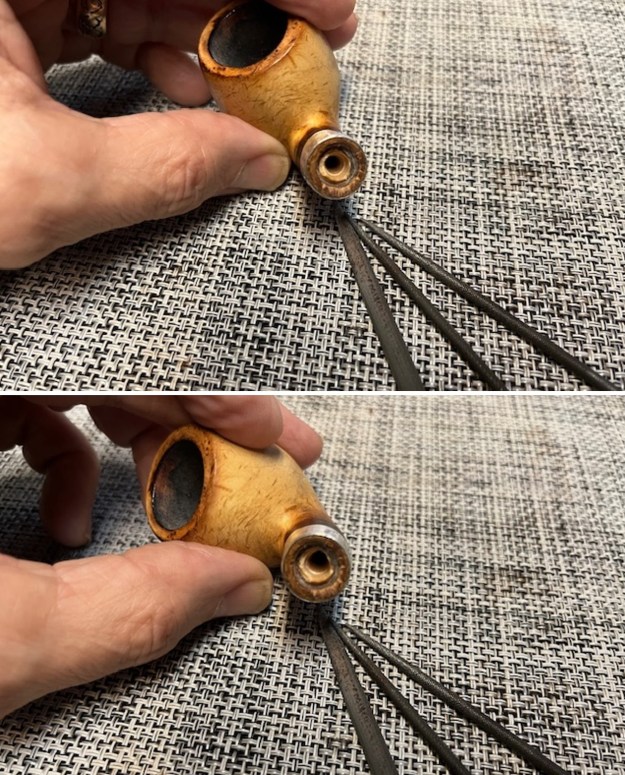
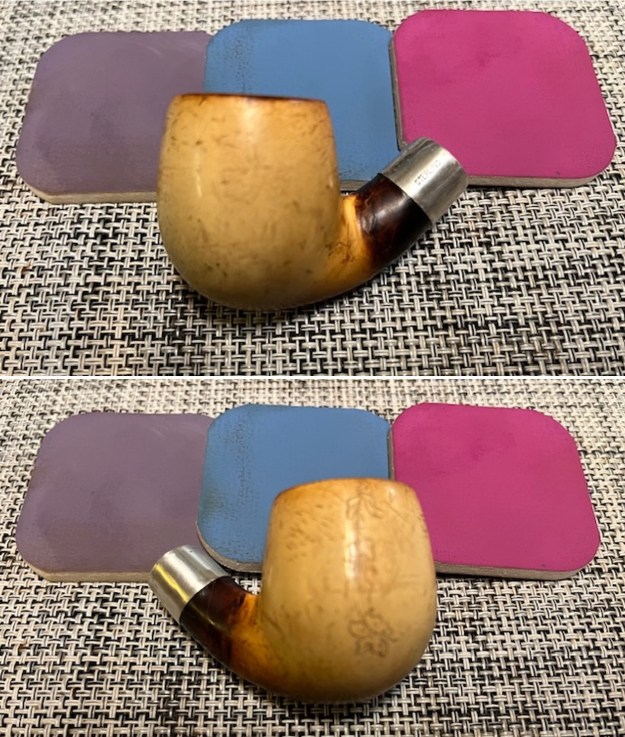
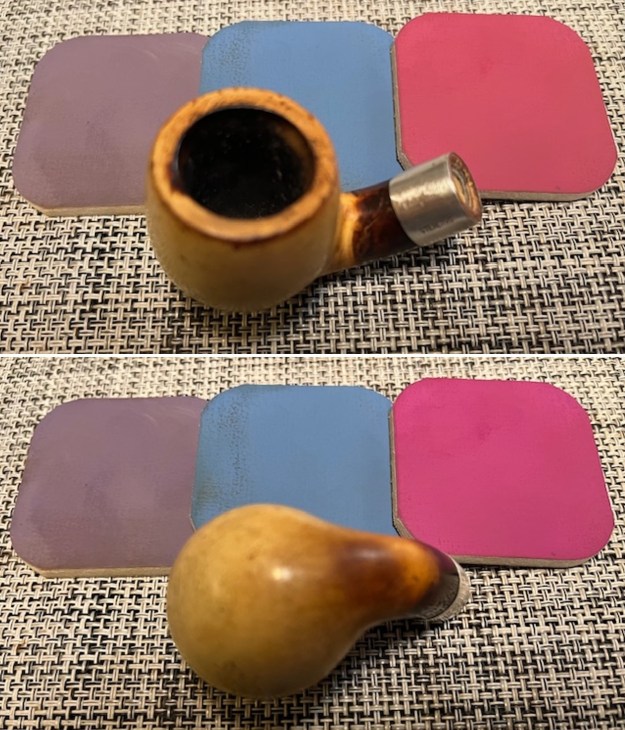
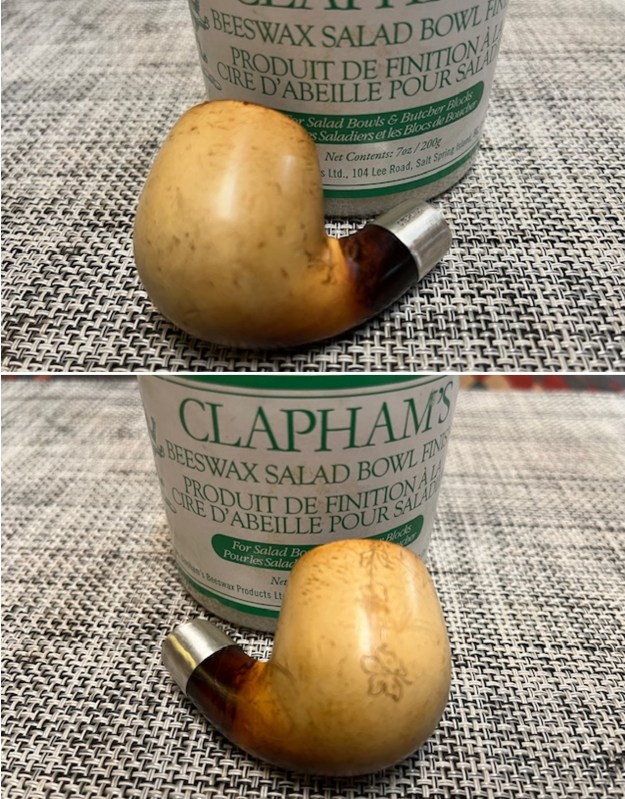
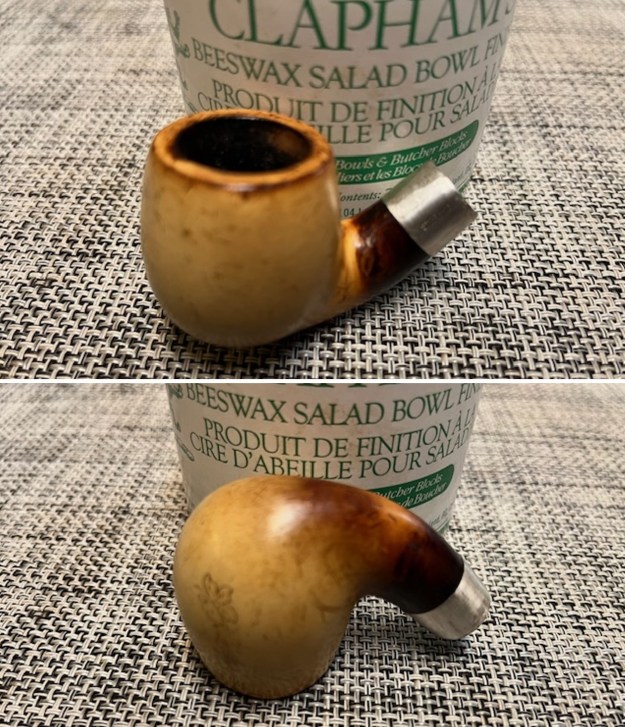
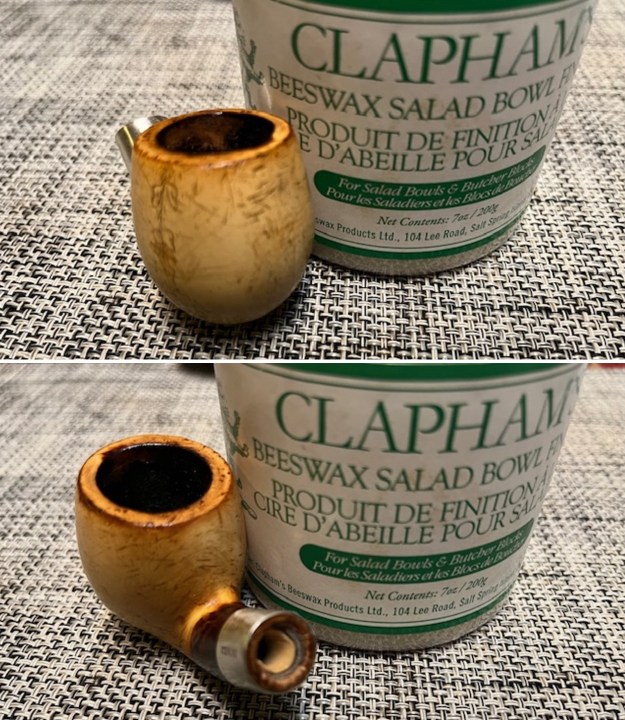
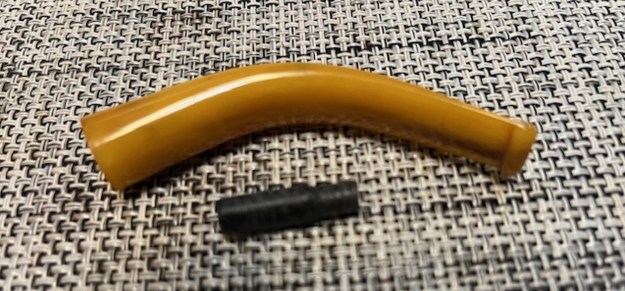
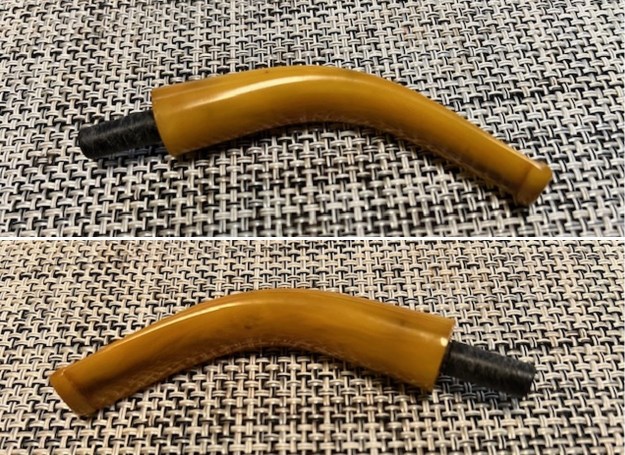
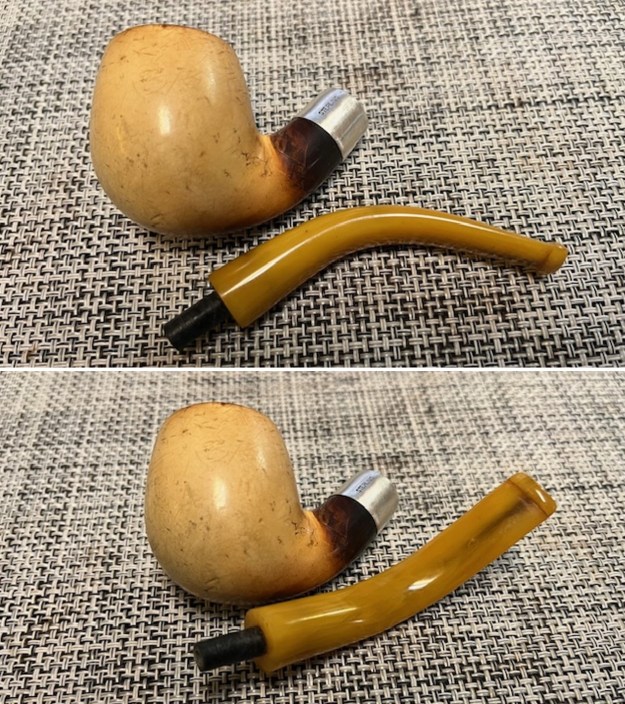
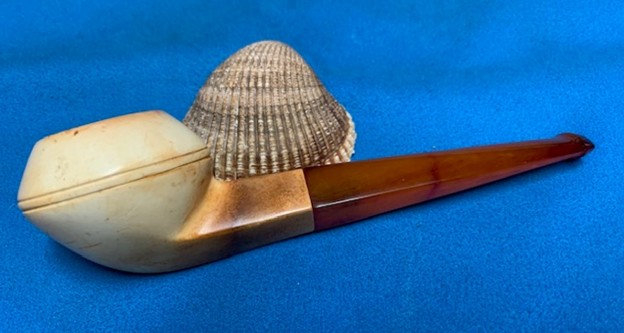
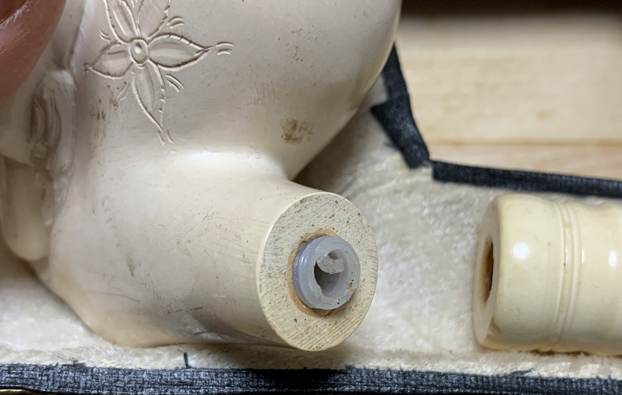
While I was travelling in Nepal I was contacted by a fellow here in Vancouver about restoring a pipe that had originally belonged to his grandfather. We planned on getting together once I was home. I called and within a few hours he was at the door with the pipe. We are dog sitting my daughter’s dog Frank and he rang the alarm to let us know someone was at the door. I met him on the porch and looked over the pipe. He lovingly took it out of his pocket and showed me the hard case in his hands. It was a good looking black hard case that was in good condition with a few wear marks on the surface. Little did I know what I was getting into with this restoration.He handed it to me and I opened the case. This is what I saw. The case bore a Pioneer Genuine Block Meerschaum label on the inside of the cover. It had the classic Pioneer covered wagon logo below the words. The bowl had some colour/patina on the shank and bowl. The rim top was dirty with tars. There were some small cracks in the shank ahead of the Sterling Silver band on it. The band was oxidized and dirty with black tarnish. The stem was acrylic. The bone tenon was snapped off in the shank but the stem end was clean and open threads. The bowl was dirty as was the inside of the stem.I took the pipe in to work on. I would call the owner once I had finished it. I had a few pipes in the queue ahead of it so I was slow getting started. Between that and the shortened attention span due to the jet lag of many time changes on the journey home I did not start working on it until Friday, March 1. I took it out of the case and brought it to the table. I took photos of the pipe to show its condition at this point. You can see the grime and dirt ground into the bowls sides and heel. Looking carefully at the left side where the shank joins the bowl there appears to be some signs of small cracks. The bowl also had some carved flowers on the bowl side on the right side of the bowl.I took photos of the rim top and bowl to show the build up of tars and oils on the top and edges. You can also see the snapped tenon in the photos below.I took a photo of the heel of the bowl to show the developing patina on the curves of the bowl bottom. It is a pretty pipe.I tried to loosen the broken bone tenon with a little alcohol around the edge of the tenon and the mortise. I put the alcohol in with an ear syringe. I examined it and found that the tenon had been glued in place. There was a thick coat of glue on the tenon and oozing out at the top of the mortise. I examined it and saw a lot of small hairline cracks in the shank coming from under the band. I think that when the shank cracked many years ago someone had glued the tenon in the shank to strengthen the shank. The fact that the tenon was glued made the next steps tricky. I was worried that if I drilled it out I might crack the shank worse. I put a bit in the drill and carefully turned the bowl onto several different drill bits by hand. I was able to remove some of the tenon but I stopped after the 11/64th drill bit. My concern was that if I went any further I would break the shank.I stopped the drilling and worked on the rest of the tenon with hand files. It was slow and tedious work to remove the glued remnants of the bit from the shank. I used round, oval and half circle files to open the mortise and thin down the tenon pieces. I spent over eight hours slowly and carefully filing out the broken tenon and opening the shank for the new tenon. I polished the meerschaum bowl and shank with micromesh sanding pads to minimize the scratches. I was able to polish out many of them. There was no way to remove all of them without damaging the shape of the bowl. I opted to leave them as they are a part of the pipe’s story. I used 1500-12000 grit sanding pads to smooth it out and polish the meerschaum and the silver band. Each sanding pad brought more shine to the surface of the bowl and shank. I waxed the bowl with Clapham’s Beeswax/Carnauba mix. I covered the bowl and the shank with the wax and once it dried I buffed it off with a soft cloth to raise a shine. I changed my original plan to use another bone tenon when I could not completely, safely remove the old tenon. I smooth out the mortise sides with the files so that I could use a different push tenon instead of a threaded one. I had a Delrin tenon that would work with some slight adjustments. I set the bowl aside and turned to work on the stem.I used a Dremel and sanding drum to reduce the diameter of the threaded portion slightly, knocking off the highspots on the threads. The fit was perfect in the stem. I put a drop of clear CA glue on the tenon and pressed it into place. I shortened the tenon on a topping board with 220 grit sandpaper to remove the excess length for a good fit in the shank. Once I finished shortening it I polished the tenon with micromesh pads to make a smooth fit in the shank.This Pioneer Bent Billiard Meerschaum is finally finished. There were points in the process that I really wondered if I had bit off more than I could chew. It was a painful process to see the bone tenon that had been glued in slowly – and I mean very s l o w l y take shape and open the mortise to receive a the new tenon. The pipe has a rich patina on the shank and developing up the bowl sides. The polished acrylic taper stem adds to the mix. I put the stem back on the bowl and hand buffed the pipe with polish on a soft cloth. I did not want to chance damaging it on the wheel. I gave the bowl and the stem multiple coats of Clapham’s Beeswax and buffed it with a clean microfiber cloth to raise the shine. The finished Pioneer Meerschaum Bent Billiard is quite nice and feels great in the hand. Give the finished pipe a look in the photos below. The dimensions of the pipe are Length: 5 inches, Height: 1 ½ inches, Outside diameter of the bowl: 1 1/8 inches, Chamber diameter: ¾ of an inch. The weight of the pipe is .99 ounces/28 grams. Thanks for walking through the restoration with me as I worked over this challenging meerschaum pipe. I am going to call the pipeman who owns it later today as I know he is excited to see it. Thanks for your time.

Putting Grandfather’s Genuine Amber Stemmed Meerschaum Bulldog back together again


Blog by Steve Laug

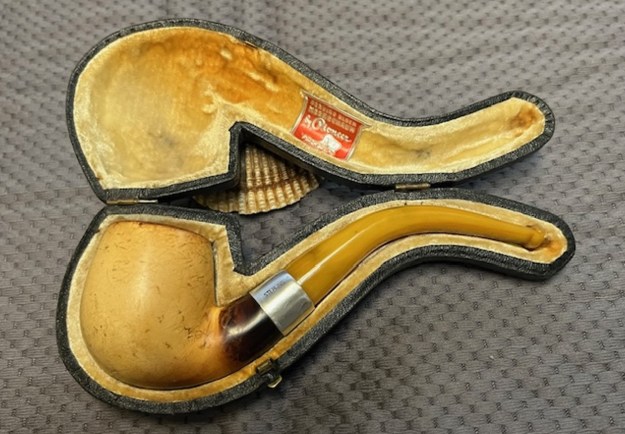
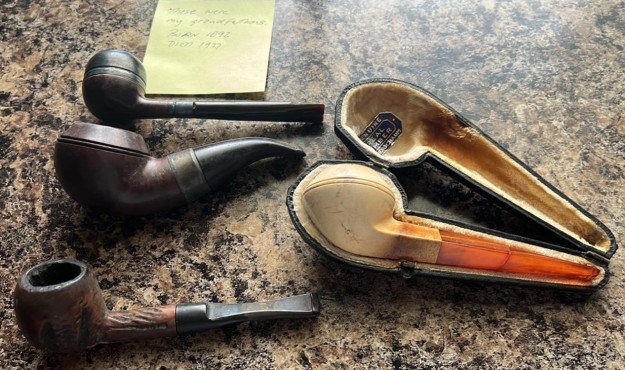
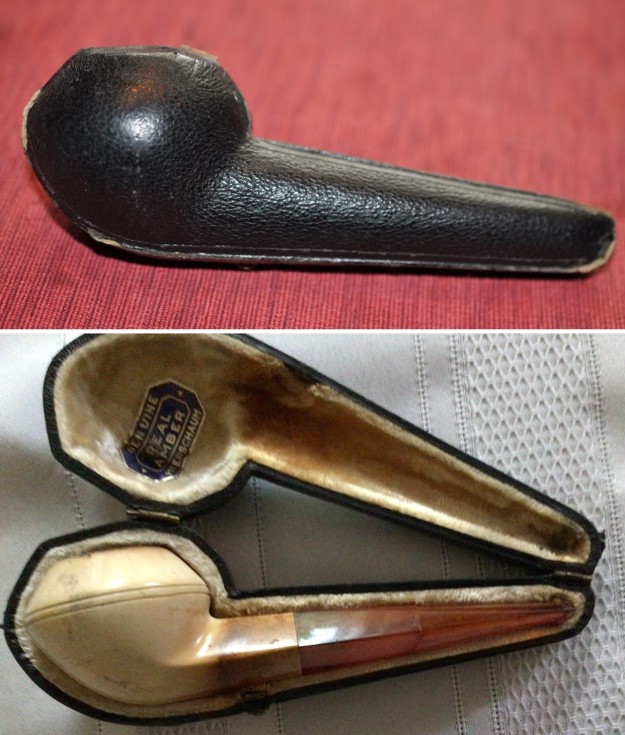
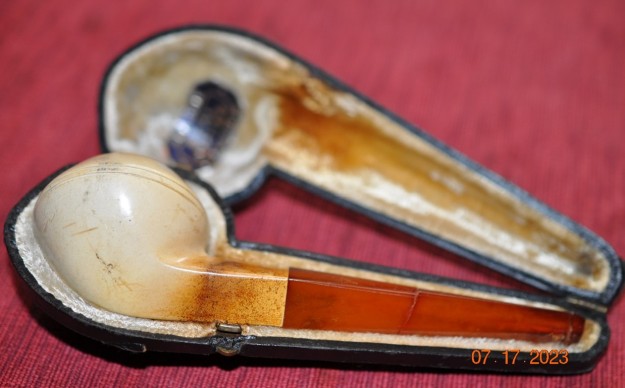
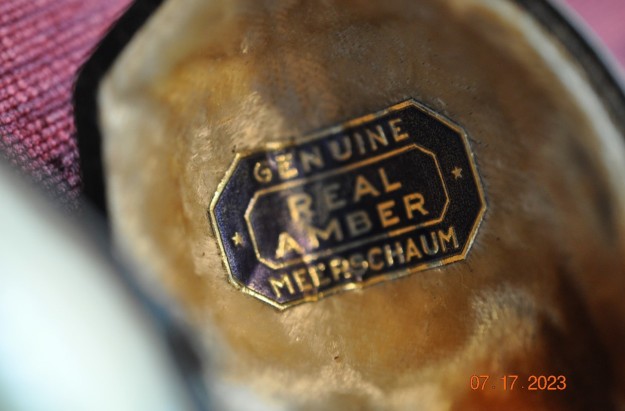
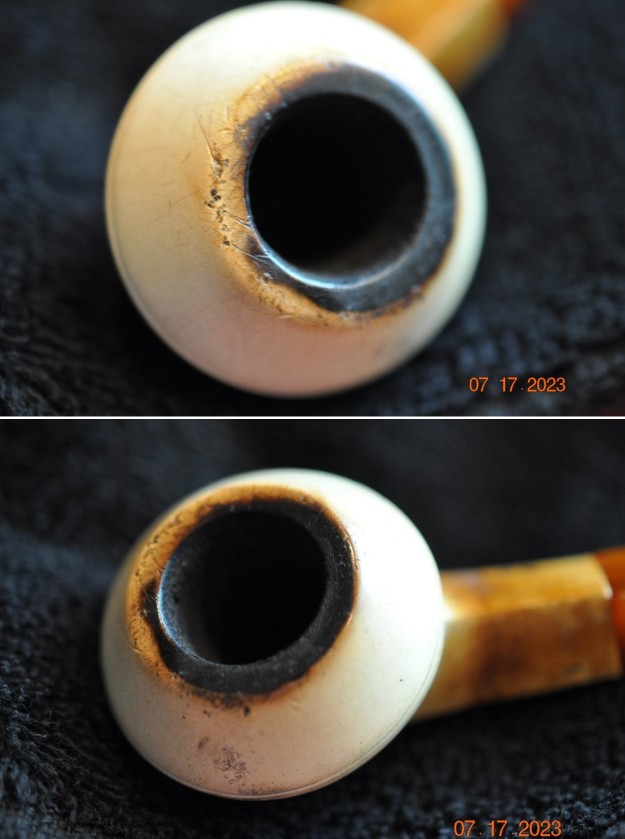
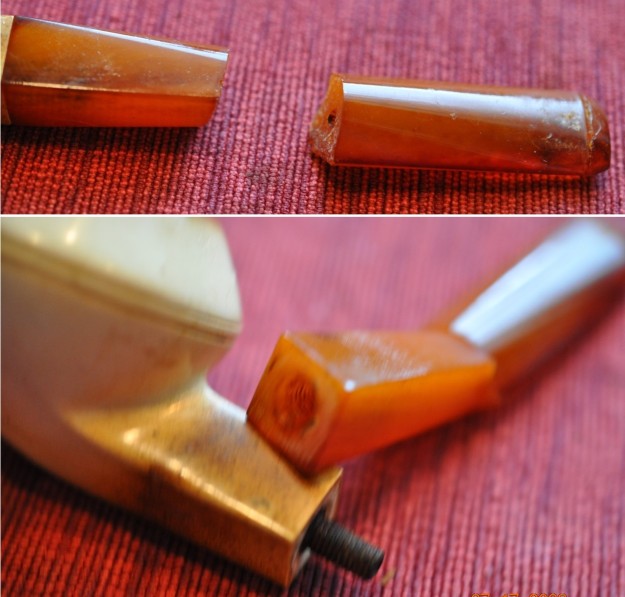
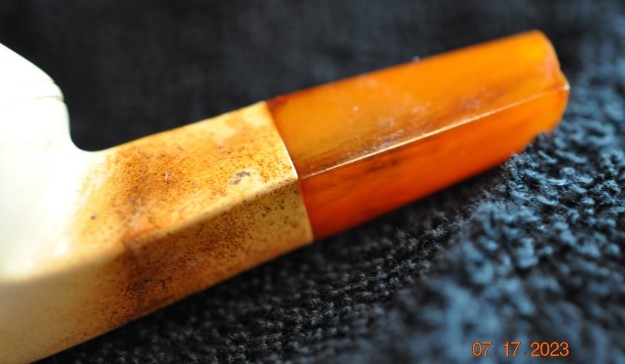
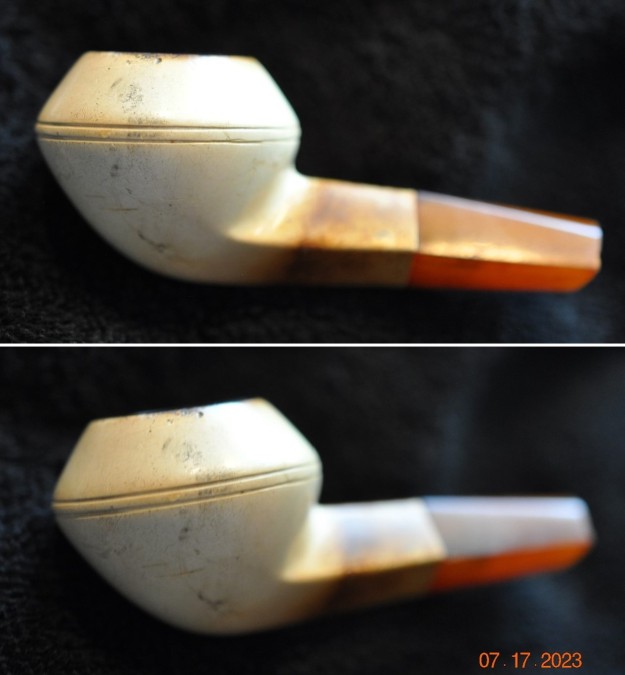
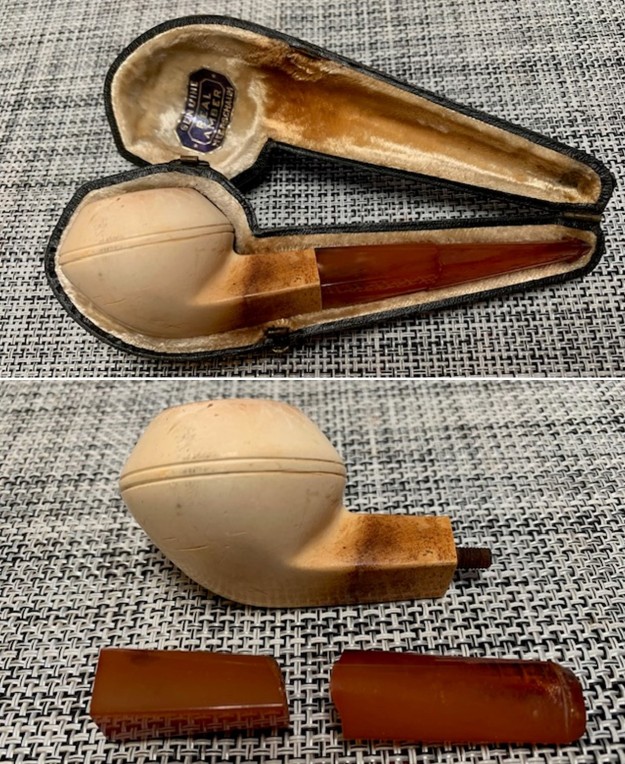
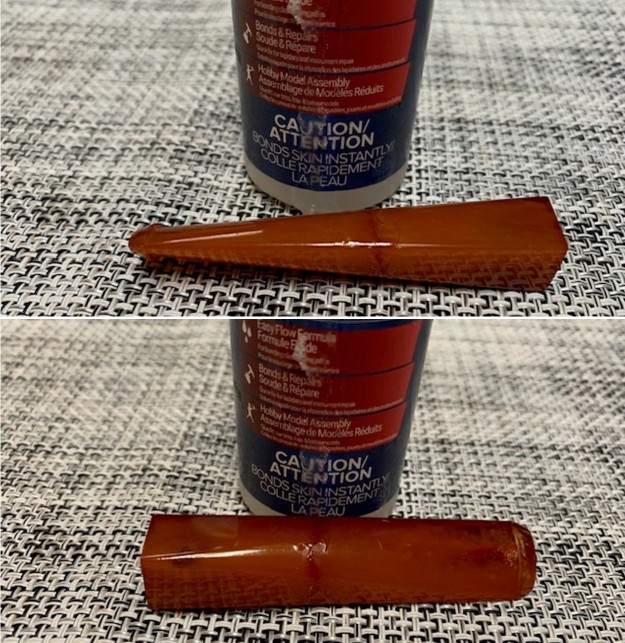
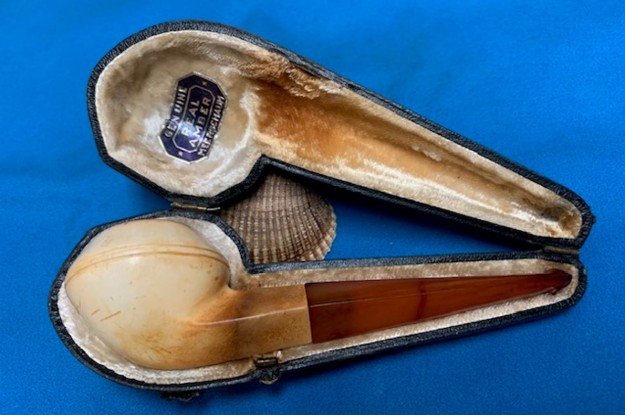
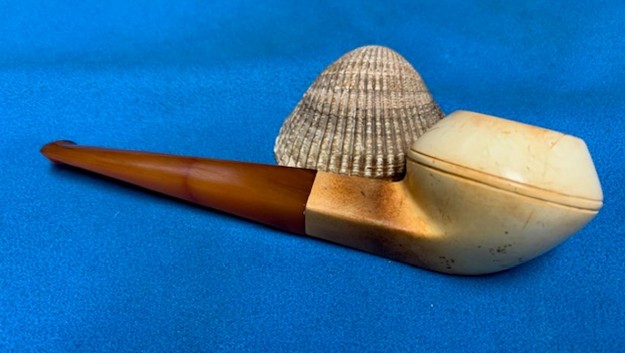
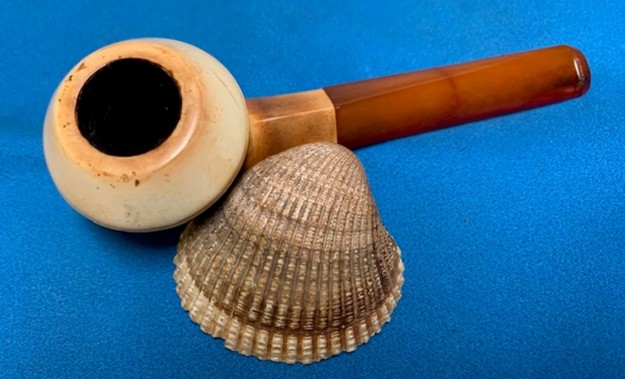
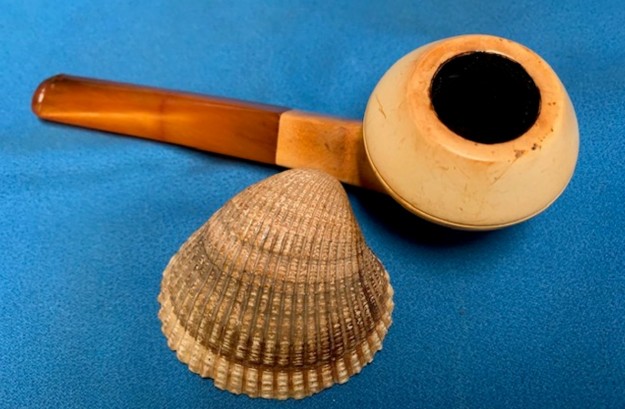
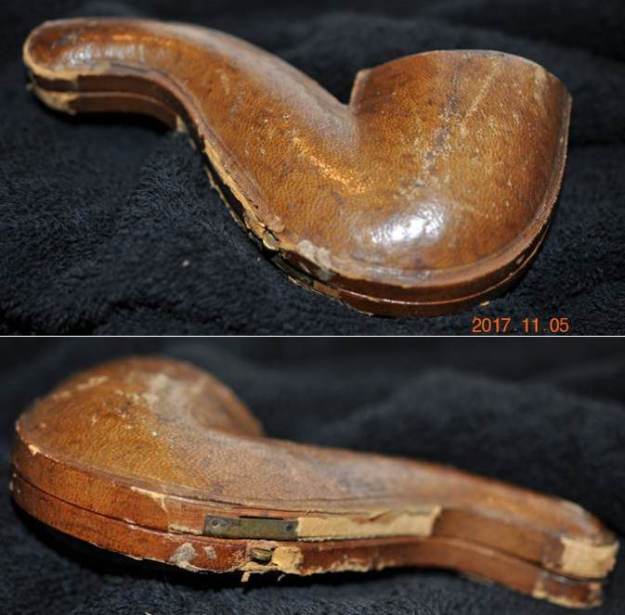
I decided I needed a change of pace in my restoration/clean up work. I went through my pipes waiting in the queue and chose the last one from a group of four pipes that were given to us by a woman in Columbus, Ohio, USA. It had belonged to her Grandfather who lived from 1882 to 1977. There were four pipes that she sent us from his estate – the metal bowled apple, a cased meerschaum Bulldog with a broken amber stem, a Whitehall rusticated apple and a BBB Glokar Fraternity Pipe.The cased Meerschaum Bulldog is the last of the lot and one that should be fixable and clean up well. I could see that it was an old timer and that it had been one of her Grandfather’s favourites like the other three. The pipe was dirty and well used. The finish had deep grime ground into the smooth meerschaum rim cap and the sides of the bowl. The rings around the cap are dirty with grime in the grooves. It had a moderate cake in the bowl that flowed onto the rim edges and rim top as a thick cake. It hard to assess the inner and outer edge of the rim there were thick spots of grime on the cap and bowl sides that should come off with work. The stem was amber and had been cleanly broken in half about mid stem. It was screwed on to a metal threaded tenon in the shank. It had tooth marks and chatter on both sides ahead of the stem. Jeff took photos of the pipe before he started his cleanup work. He started with the black leather case which was in good condition though missing the pin in one of the hinges. He opened the case and took photos of the pipe sitting in the case. He took a photo of the label on the inside of the case. It read Genuine Meerschaum around the outside of the black and gold octagonal label. On the inside of the label it reads Real Amber.He took photos of the condition of the bowl and rim top. You can see the cake in the bowl and the lava on the rim top. There are also nicks and scratches around the top and outer edge particular o the front right side of the bowl.He took photos of the broken stem. You can see the break is about halfway down the stem and is clean with no rough edges on the pieces. When the two parts are put together the fit is very clean and smooth. The fit against the shank end is smooth and undamaged. It should clean up well. Jeff also took photos of the tooth marks and chatter on both sides of the stem ahead of the button. They are not deep but are very visible in both photos. Even these marks are not flaking or showing too much depth in the damage.He took photos of the bowl sides and heel to give a sense of the condition of the pipe before clean up. I think it will clean up well. Jeff cleaned up the pipe with his usual regimen and when I received it the bowl had been reamed and washed with Murphy’s Oil Soap and rinsed clean. He was able to remove the lava on the rim and the grime around the bowl. It looked much better. He cleaned out the inside of the shank and stem with alcohol and pipe cleaners. He carefully cleaned the pieces of the broken stem and the fit together was still smooth. The pipe was ready for the next step in the process. I took photos of the pipe when I brought it to the work table. I decided to start my work on this pipe by rejoining the two parts of the stem. I looked at putting a metal tube inside but the amber is brittle and the airway was not big enough to accommodate even the smallest tube I had. I chose inside to glue the parts together with clear rubberized CA glue. I carefully painted the ends of each piece and then pressed them together. They aligned well and I held them until the glue set. I set the stem aside and let the repair cure.I took the family to breakfast and when I returned I put the stem on the shank and took photos of the repaired stem in place. I still needed to sand and smooth out the repairs but you can see the overall look of the pipe.I removed the stem and set it aside. I turned my attention to the bowl. I polished it with micromesh – dry sanding it with 1500-12000 grit pads. I wiped it down after each sanding pad with a damp cloth to remove sanding debris. The bowl began to take on a rich shine. You can see the patina around the bow and the shank. Now it was time to wax the bowl. I melted some beeswax on the stove top and painted it onto the meerschaum bowl. I apply the wax quite heavily as I plan on heating the bowl and wiping it off. I worked it into the twin rings around the bowl cap with the pipe cleaner. I took a few photos of the heavily waxed bowl. I set it aside and called it a night. I would heat and polish it in the morning. This morning I used the heat gun to melt the wax on the bowl. I held it by the metal tenon and carefully moved it over the heat gun. The wax dripped back in the bowl and I also wiped it down with a paper towel. The patina really came alive. You can see it nicely developed on the shank and moving up the bowl sides to the cap. It looks very good at this point and will only look better with buffing and with use. I set the bowl aside and turned my attention to the stem. I used a folded piece of 220 grit sandpaper to blend the repairs into the surrounding amber. I wanted it smooth and with no lumps of glue on the crack or tooth mark areas. I started polishing the stem with 600 grit wet dry sandpaper. I was happy with how the shine was developing.I polished the amber with micromesh sanding pads – wet sanding with 1500-12000 grit micromesh pads. I wiped the stem down after each pad with a cloth impregnated with Obsidian Oil to further polish and give some teeth to the pads. It came out looking very nice. I polished the stem with Before & After Pipe Stem Polish – both Fine an Extra Fine. I rubbed them on with my finger tips and polished them off with soft paper towel. I finished by rubbing the stem down with some Obsidian Oil on a soft impregnated cloth. It looked better.I don’t know how many times I have said this but I love it when I come to the end of a restoration and all of the parts come together and the pipe looks better than when we started the cleanup process. I put the stem back on the Genuine Meerschaum Real Amber Cased Bulldog and carefully buffed the bowl with Blue Diamond on the buffing wheel. I gave the bowl multiple coats of beeswax as shown above and the stem multiple coats of Conservator’s Wax by hand and buffed it by hand with a soft cloth. I also buffed it again with a microfiber cloth to deepen the shine. The finished pipe is a real stunning example of a classic Meerschaum Bulldog with an Amber Stem. It is beautiful and comfortable in hand. There was developing patina around the bowl and shank and was darker on the shank and the rim top. Give the finish pipe a look in the photos below. I can only tell you that it is much prettier in person than the photos capture. The dimensions of the pipe are Length: 5 inches, Height: 1 ½ inches, Outside diameter of the bowl: 1 ¾ inches, Chamber diameter: ¾ of an inch. The weight of the pipe is .95 ounces/27 grams. This meerschaum pipe is a great piece of pipe history that is in great condition. Thanks for walking through the restoration with me as I worked over another beautiful pipe. I will be keeping this one in my collection and enjoying it. Thanks for your time.

As always, I encourage your questions and comments as you read the blog. Thanks to each of you who are reading this blog. Remember we are not pipe owners; we are pipe men and women who hold our pipes in trust until they pass on into the trust of those who follow us.

Restoring an Impressive Meerschaum Figural


Blog by Kenneth Lieblich

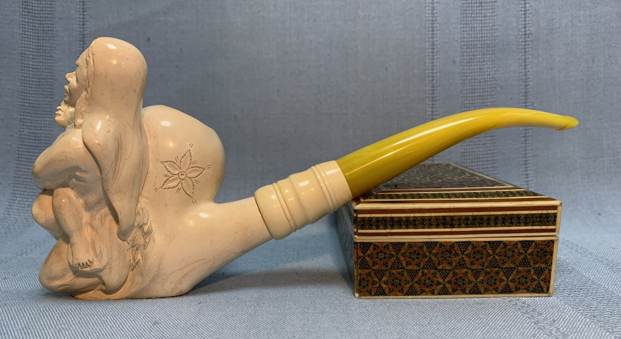
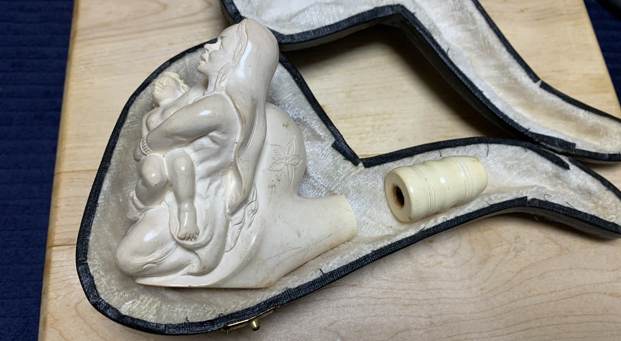
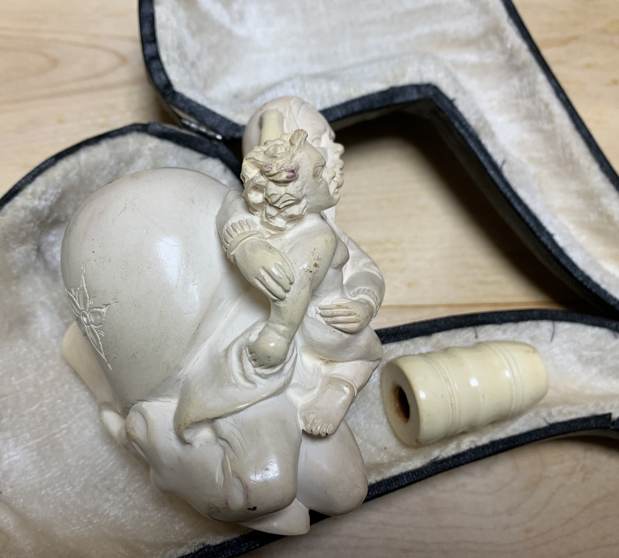
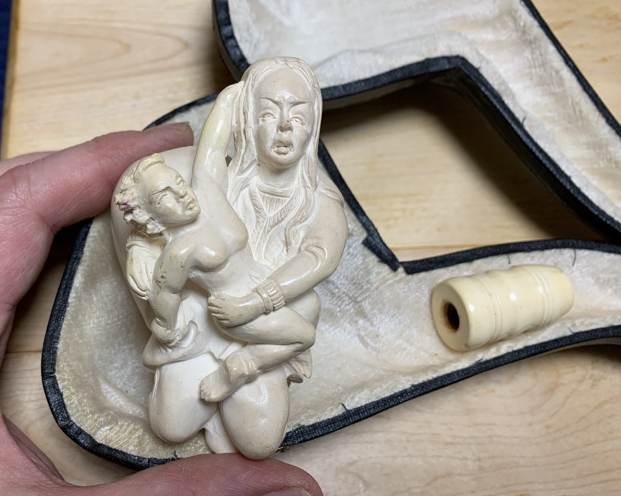
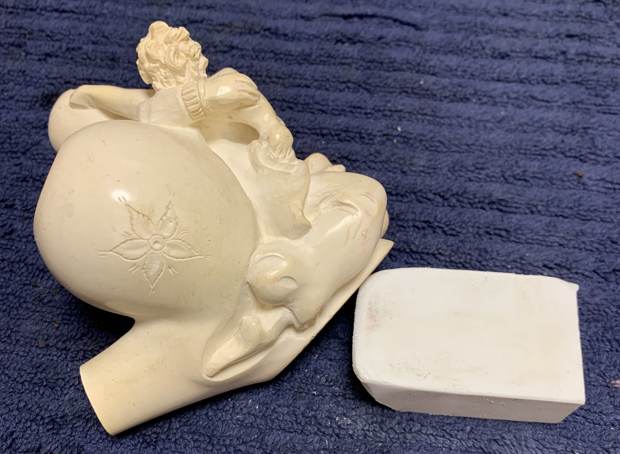
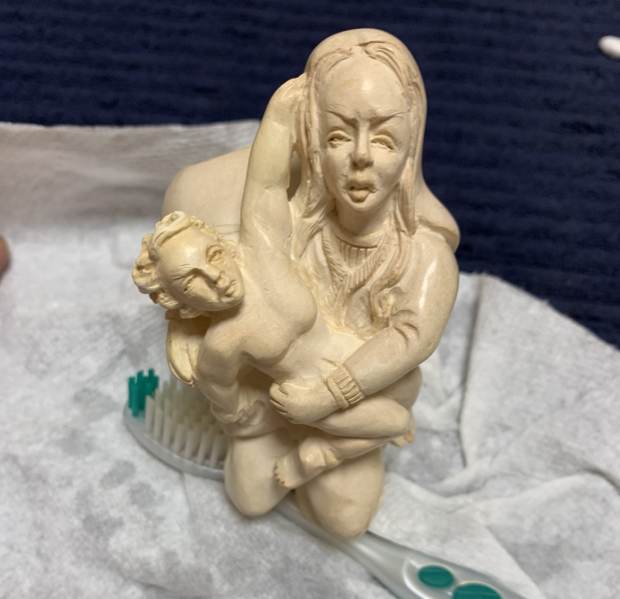
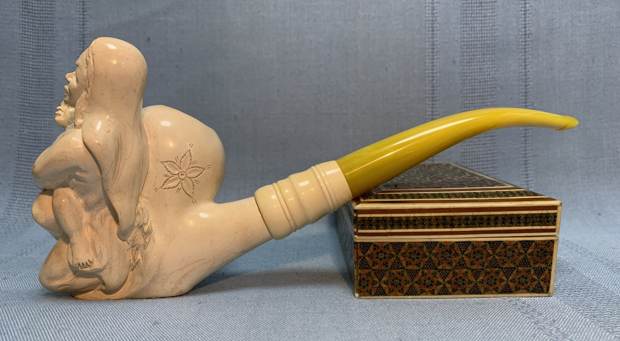
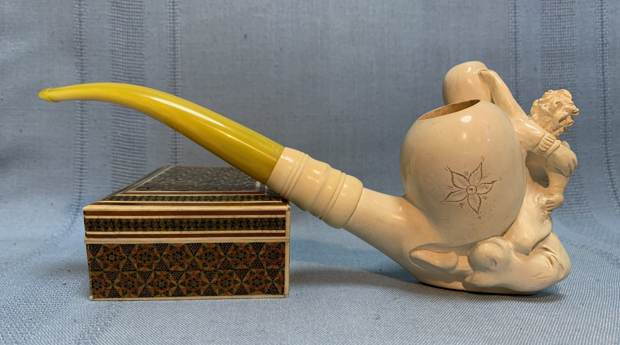
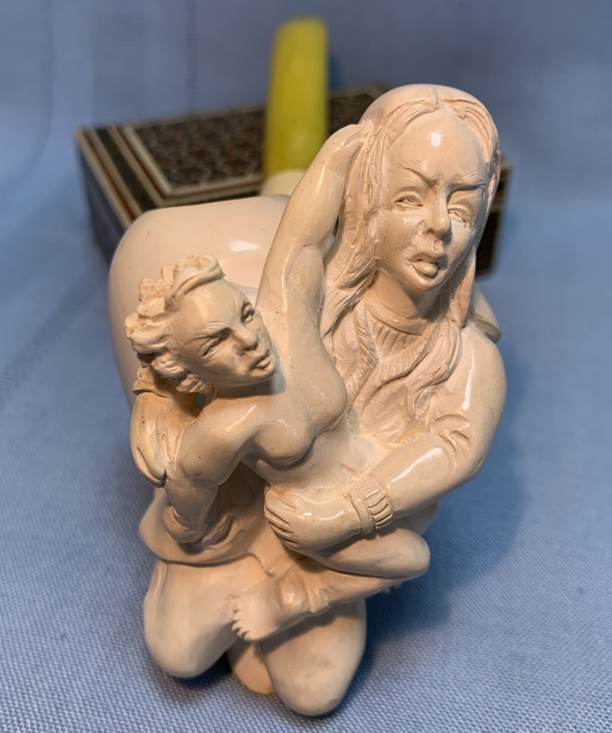
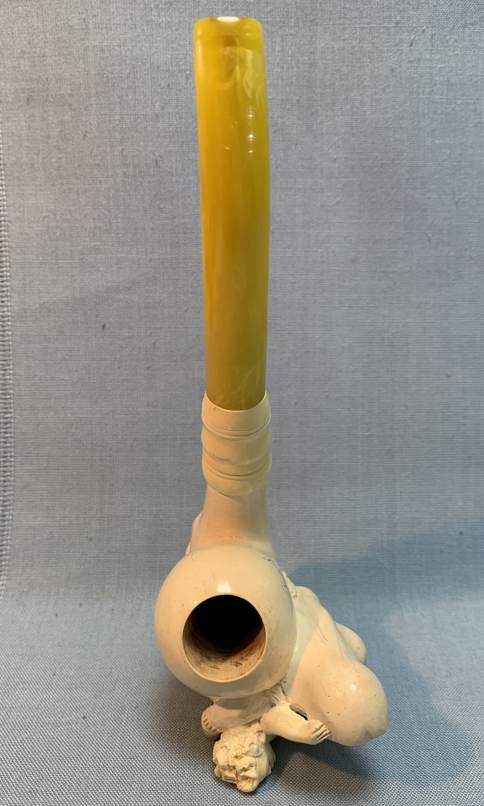
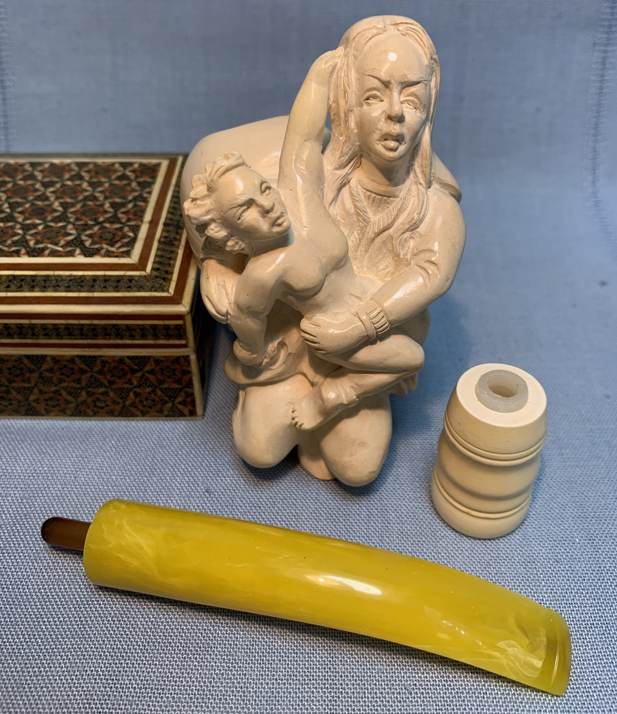
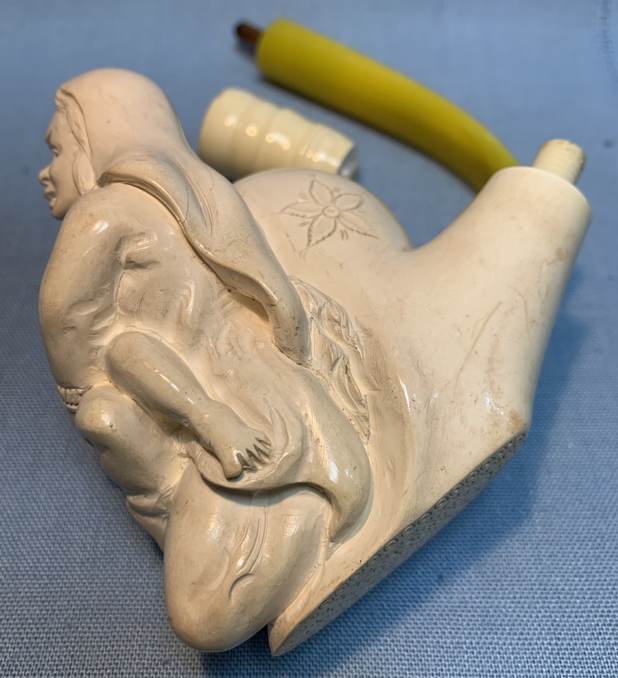
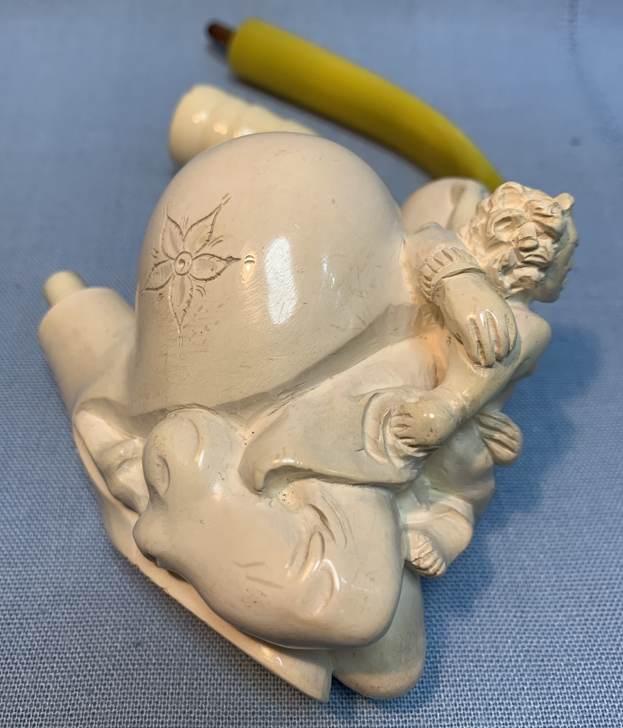
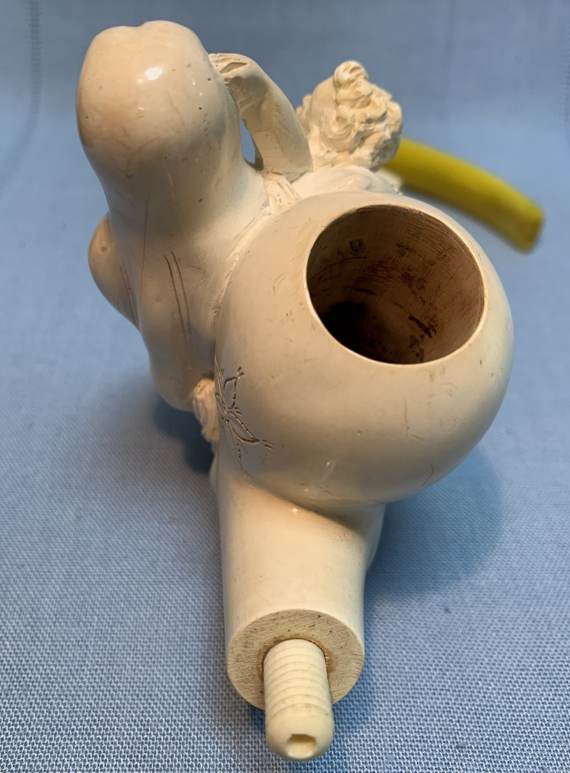
Next on the chopping block, we have a unique and large, carved, meerschaum figural pipe. As I’m sure you know, meerschaum is a German word which literally means “sea foam” (meer = sea and schaum = foam). Incidentally, schaum is also where we get the English word scum from. But where did the Germans get the meerschaum word from? Obviously, meerschaum is so called because it is white and light, but the Oxford Dictionary of Etymology further explains that the term is itself a translation of the Persian word kef-i-daryā – literally meaning “foam of sea”. Now you can impress friends at your next cocktail party. I acquired this pipe in a large lot in the summertime. This meerschaum pipe was notable as its stem had been lost in the mists of time, on its way from Asia Minor. I searched through the lot of pipes that it came in, but there was no sign of it. Fortunately, Steve kindly supplied me with a suitable stem which worked perfectly. The pipe is a large piece of block meerschaum, presumably from Turkey, although it has no markings of any sort. However, it has all the hallmarks of Eskişehir, so I feel confident in saying it’s Turkish. As for the carving, I’m not totally sure what it is meant to be. I can’t tell if it’s intended to be an image of the Virgin and Child, people from an ancient Anatolian myth, or some historical characters with which I am unfamiliar. Steve didn’t recognize them either, so if you have some idea who these people are, please feel free to clear up the mystery with a comment below.

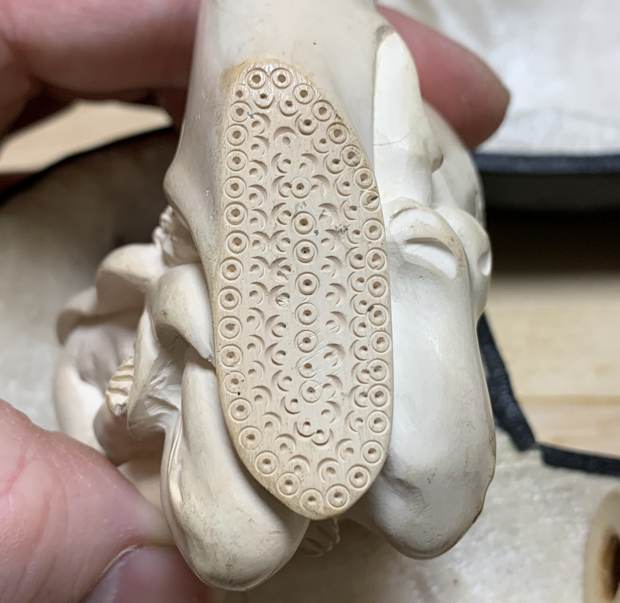
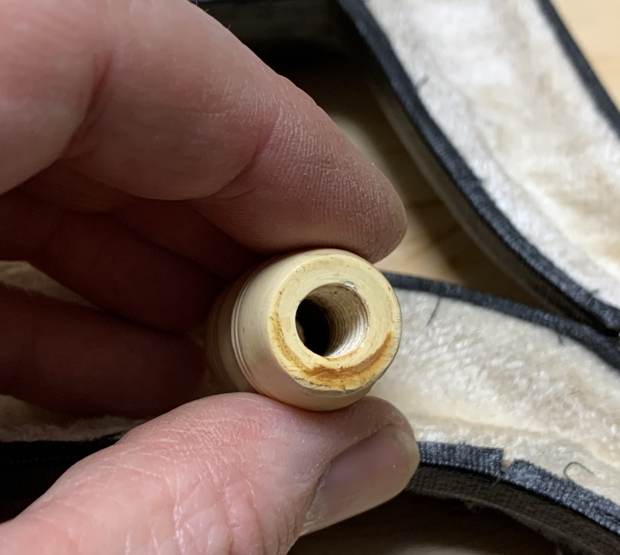
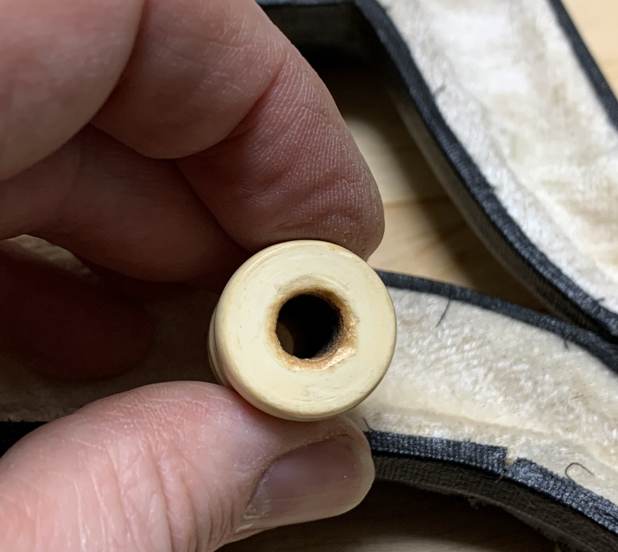
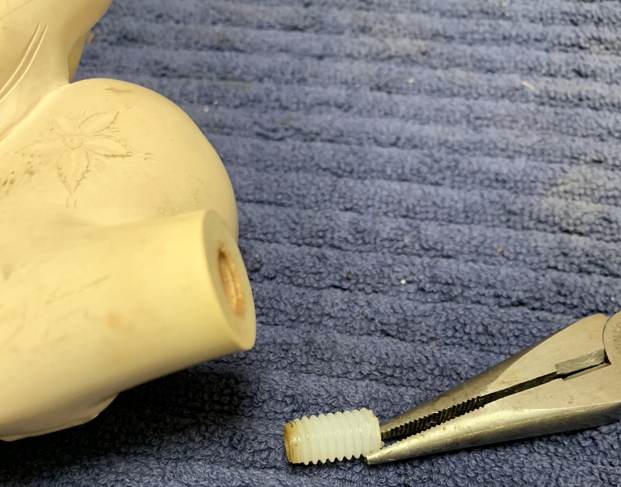
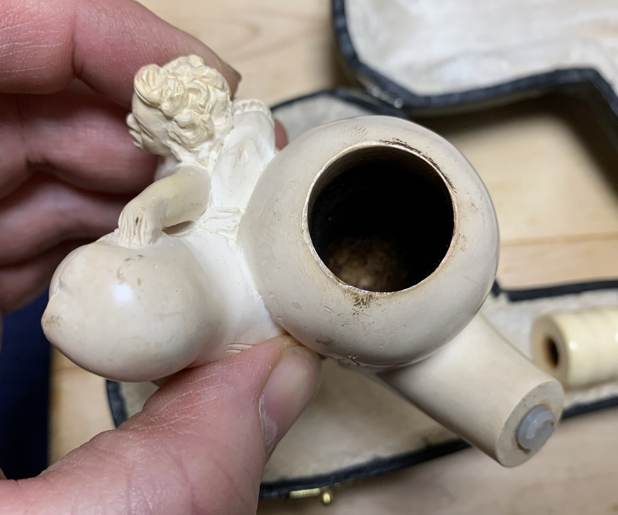
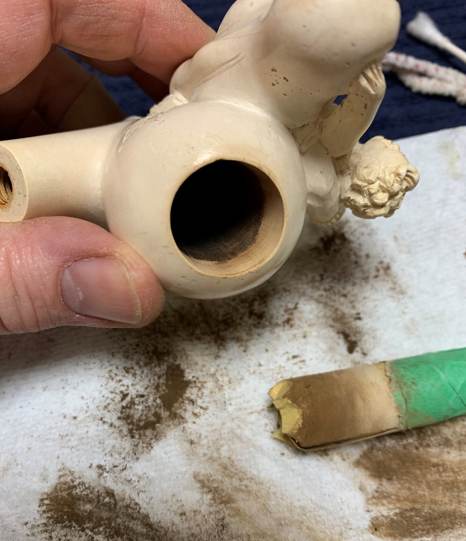
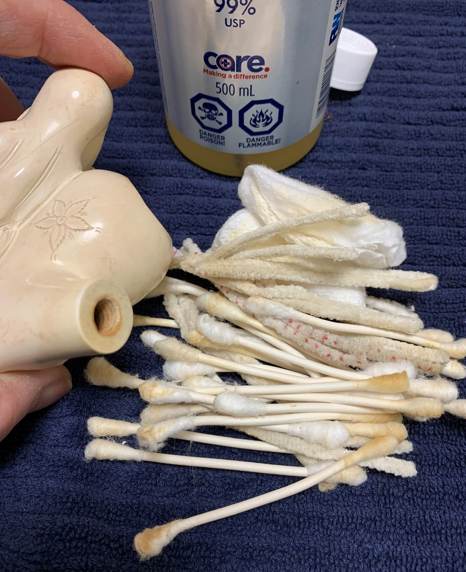
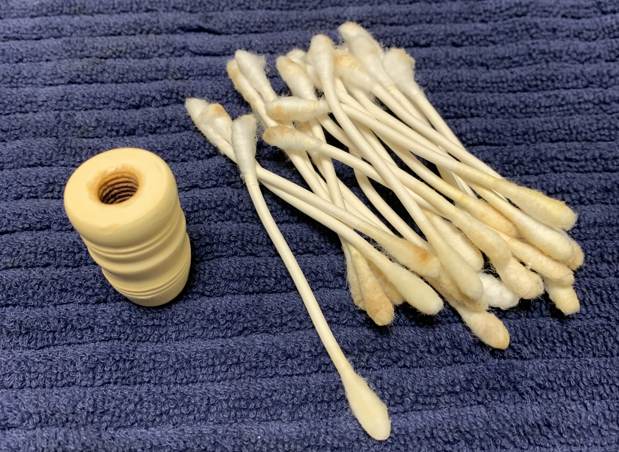
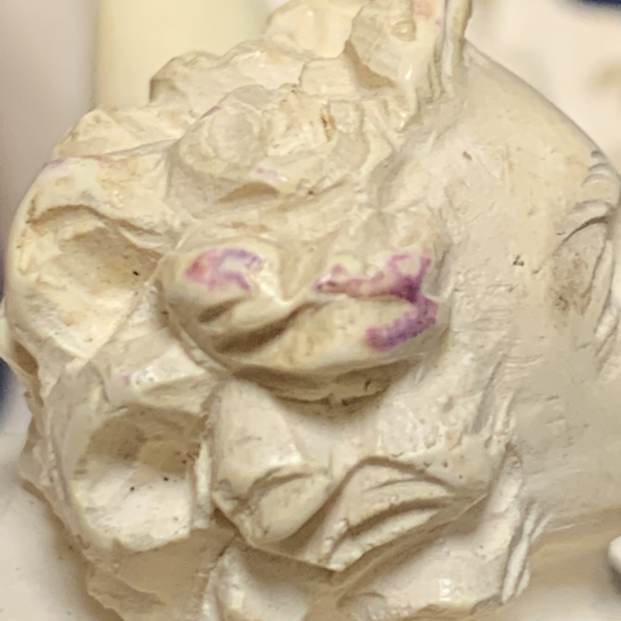
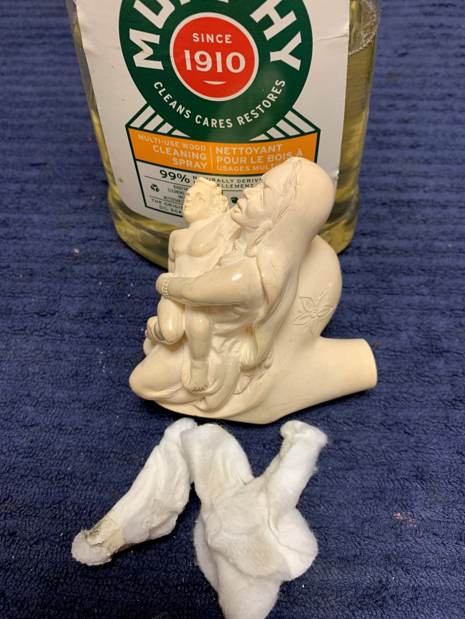
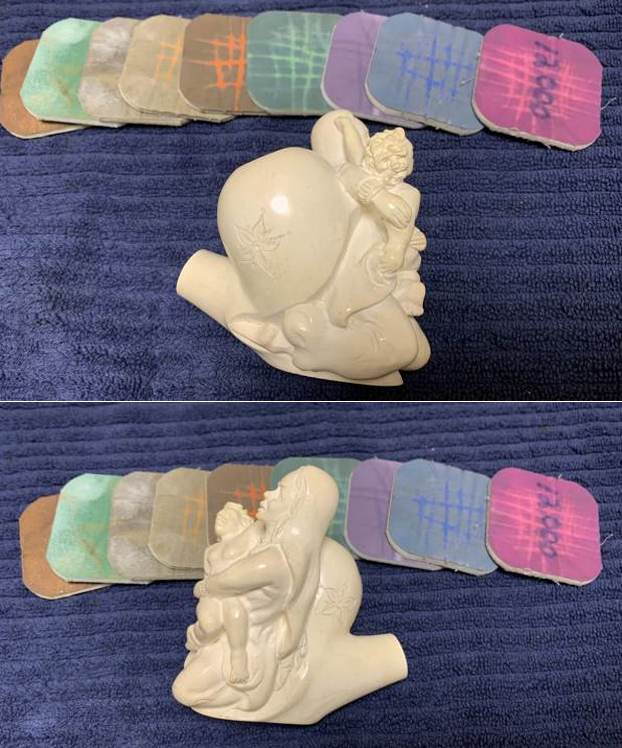
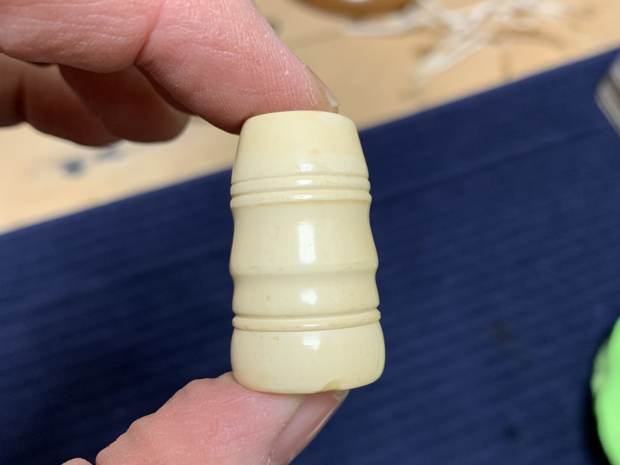
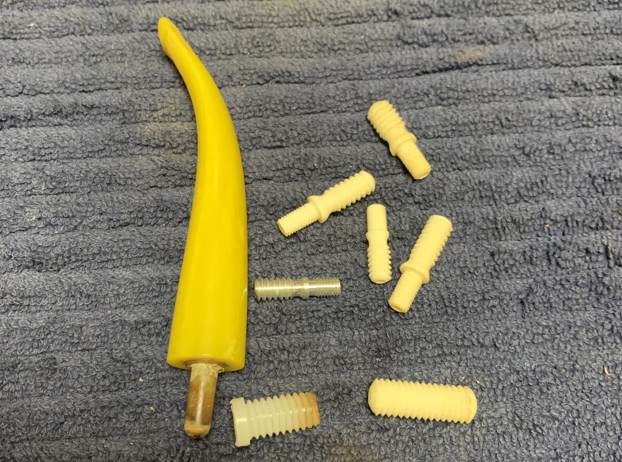
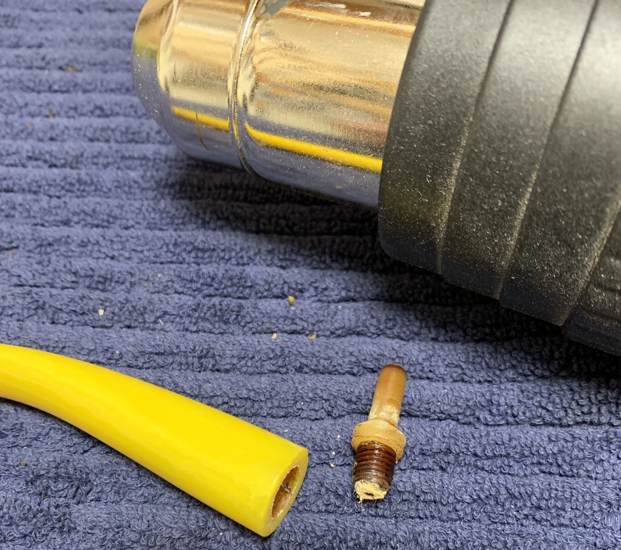
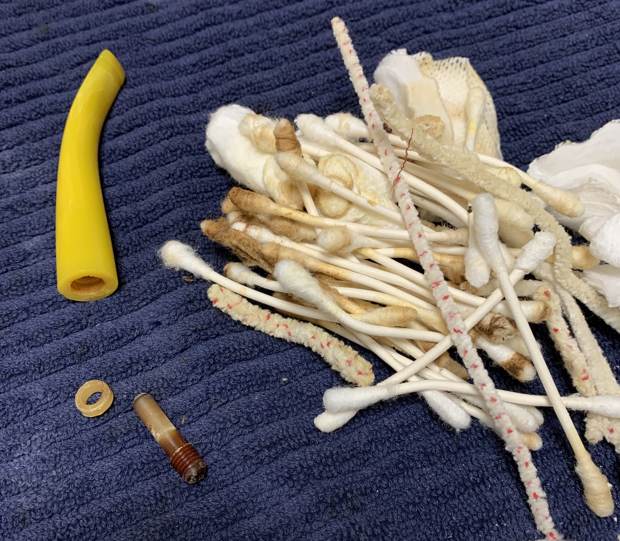
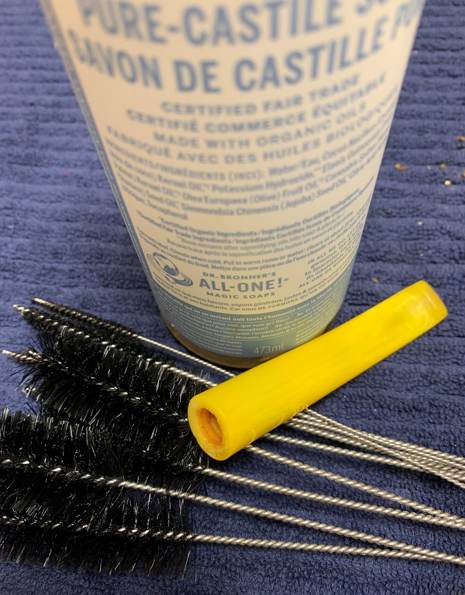
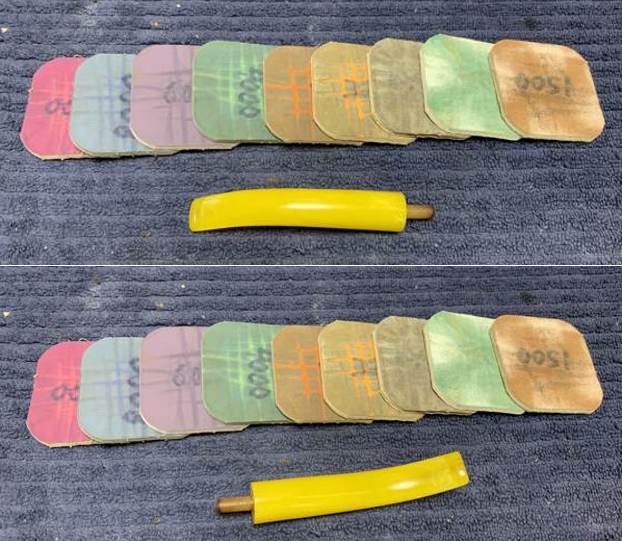
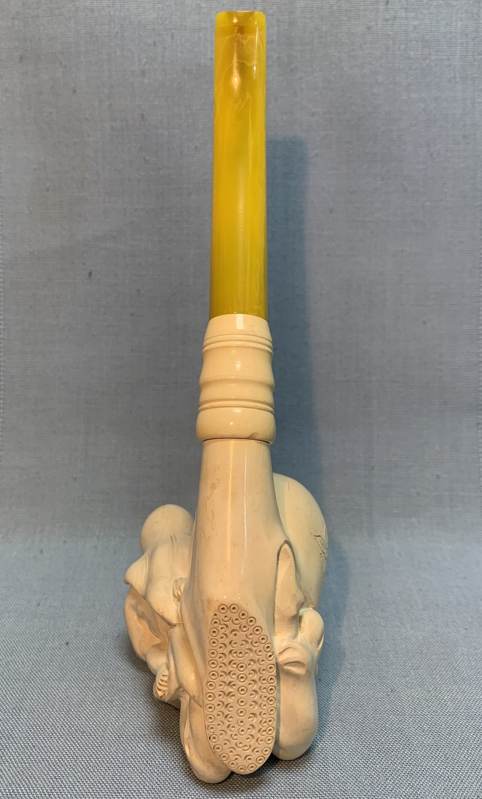
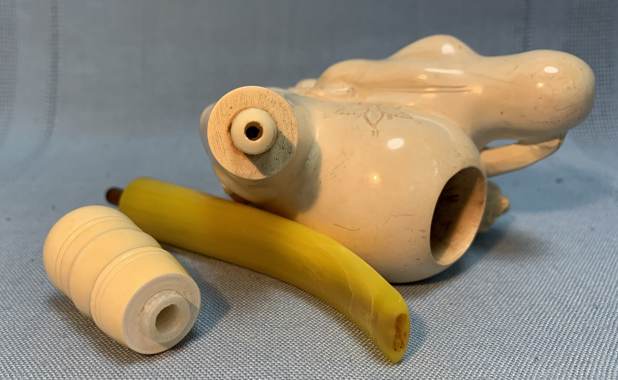
The pipe was in very nice condition, though a bit dirty. There was dust and debris in the grooves and even on the smooth surfaces. It had been smoked, though not heavily. The main part of the pipe was in good condition, without any notable damage. There was a tenon left in the shank that was broken and would need replacement. There was also a meerschaum shank extension which was dirty, but otherwise in good shape too. To work! I began by removing the tenon in the shank with a pair of needle-nose pliers. Meerschaum is too fragile for a proper reamer, so I used 220-grit sandpaper on the end of a wooden dowel to clean out the bowl and it turned out very nicely. I then cleaned the shank with lemon-infused isopropyl alcohol, pipe cleaners and Q-tips. One of the frustrations of cleaning meerschaum is that once smoked, the stains never go away. However, I did what I could and cleaned the shank extension in a similar manner. There were some unusual purple stains on parts of the meerschaum. I don’t know what they were, but I took a good-quality eraser and they came off with ease, fortunately. Then I took Murphy’s Oil Soap on some cotton rounds (and Q-tips) and cleaned the meerschaum. It’s important to be cautious in one’s use of fluids around meerschaum. Allowing it to soak in a liquid causes it to soften. I also used a soft bristle toothbrush with the Murphy’s in some of the nooks and crannies. Now that the figural was all clean, I set about using my MicroMesh sanding pads to polish up the meerschaum. I didn’t use the coarser grits over the entire pipe – only in the areas that required it – as I didn’t want to risk any damage. I neglected to take pictures, but I also rubbed some Clapham’s Beeswax into the meerschaum. In fact, I used Q-tips as well to get it into the nooks and crannies. Then I let it sit for 15-20 minutes, buffed it with a microfiber cloth and then repeated the beeswax process. Worked like a charm! As I mentioned, Steve was kind enough to give me an acrylic stem which came with its own push-tenon. He also gave me a handful of other plastic, bone and metal tenons so I could find the right fit for the pipe in question. The stem was terrific, but it had been used and was plenty dirty.First, I removed the push-tenon by heating it lightly with my heat gun. That allowed it to unscrew without much trouble. I then cleaned out the stem and tenon with the usual lemon-infused isopropyl alcohol, cotton pads, Q-tips etc. Just like meerschaum, acrylic tends to stain after smoking, no matter how dutiful you are with your cleaning. However, I put in a lot of elbow grease to sterilize the stem and tenon as much as I could. I even used some Castile soap and tube brushes. There were a couple of very small nicks on the stem, which I repaired with cyanoacrylate adhesive. However, I forgot to take pictures of that. I then used all nine MicroMesh pads (1,500 through 12,000 grit) and some Obsidian Pipe Stem Oil in between each pad scrubbing. Once that was done, I fitted a new bone tenon for the shank extension and a new mortise for the push-tenon. Finally, as meerschaum pipes don’t do well on a bench-polisher, I buffed the pipe by hand with a microfibre cloth. And that’s that! This big meerschaum looks fantastic and is ready to be enjoyed again by the next owner. I am pleased to announce that this pipe is for sale! If you are interested in acquiring it for your collection, please have a look in the “Meerschaum” section of the store here on Steve’s website. You can also email me directly at kenneth@knightsofthepipe.com. The approximate dimensions of the pipe are as follows: length 7½ in. (190 mm); height 3½ in. (89 mm); bowl diameter 1½ in. (38 mm); chamber diameter ¾ in. (20 mm). The weight of the pipe is 4 oz. (114 g). I hope you enjoyed reading the story of this pipe’s restoration as much as I did restoring it. If you are interested in more of my work, please follow me here on Steve’s website or send me an email. Thank you very much for reading and, as always, I welcome and encourage your comments.
Reclaiming a Uniquely Shaped Cased Bent Opera Meerschaum with a Redmanol Stem


 Blog by Steve Laug

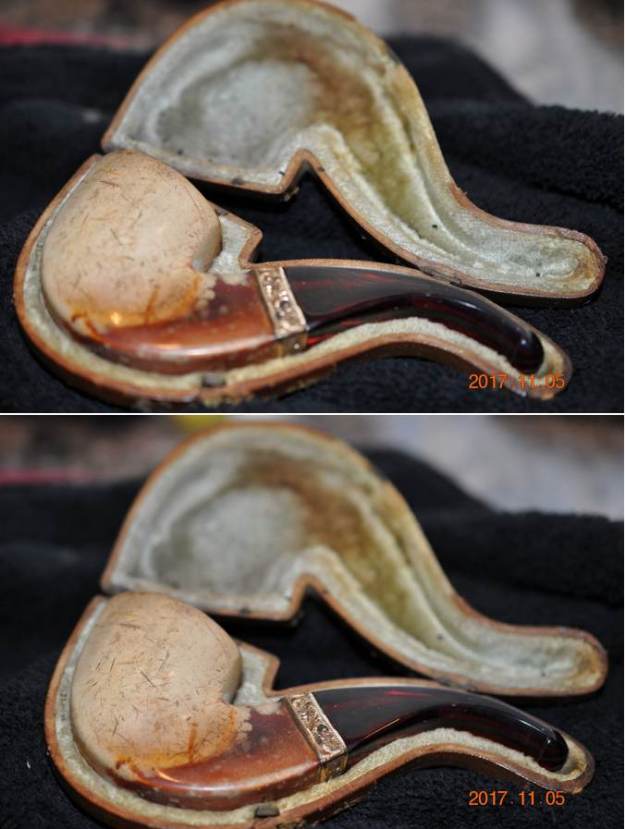
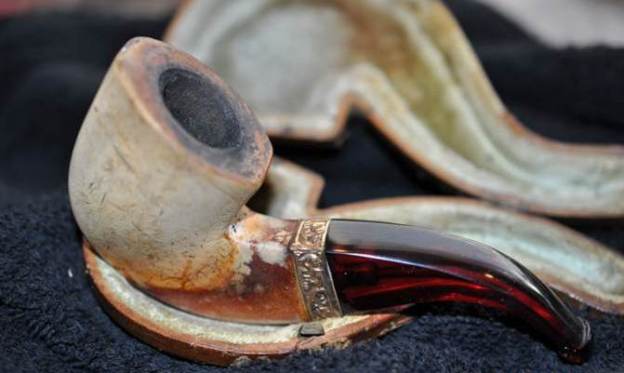
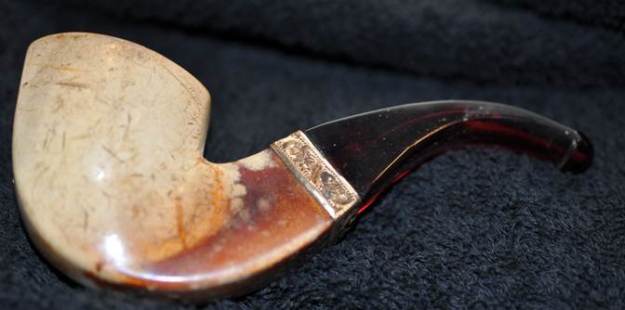
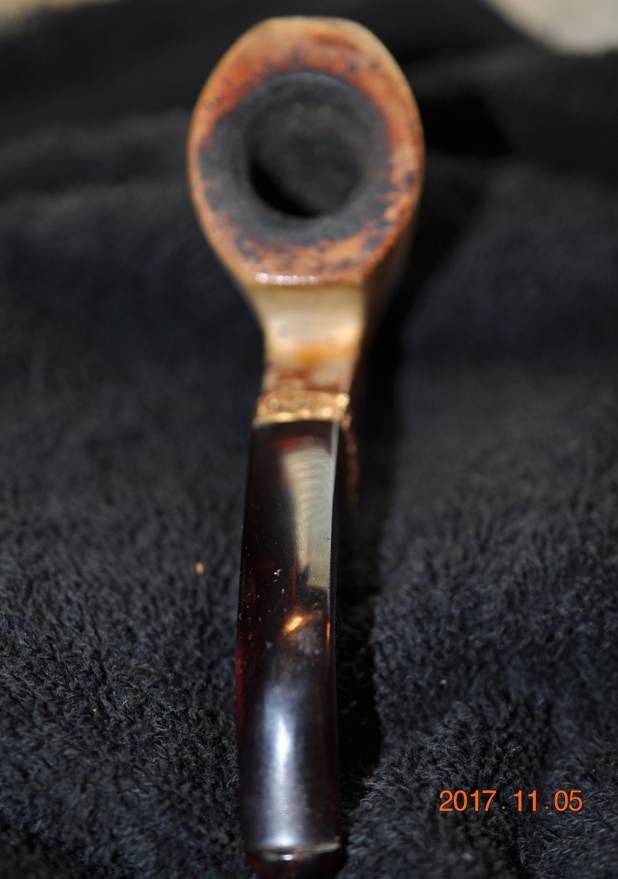
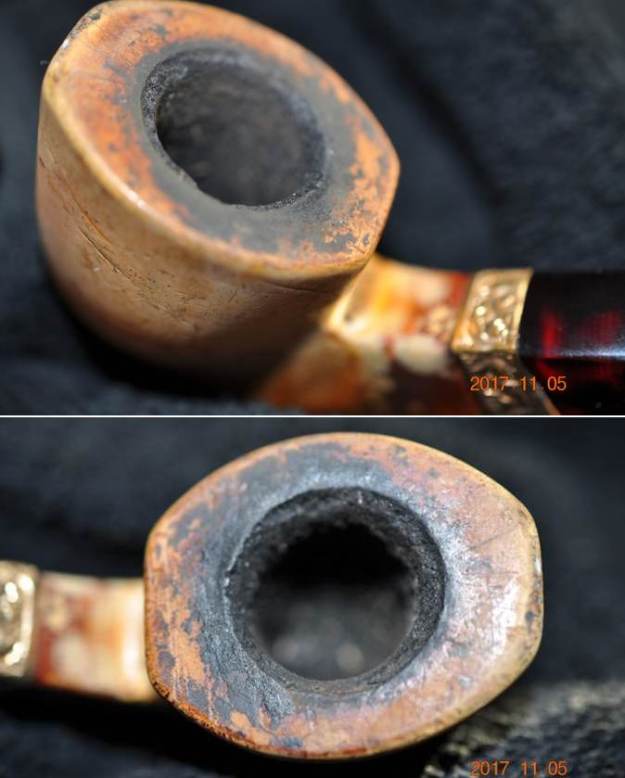
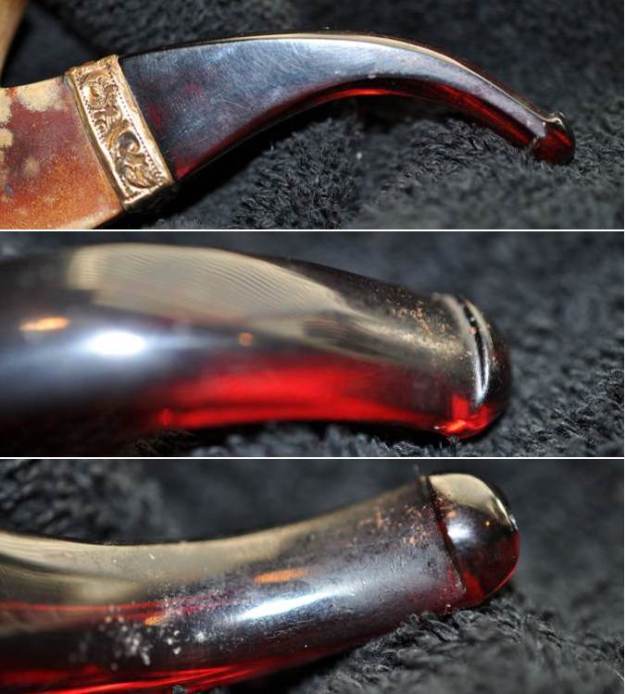
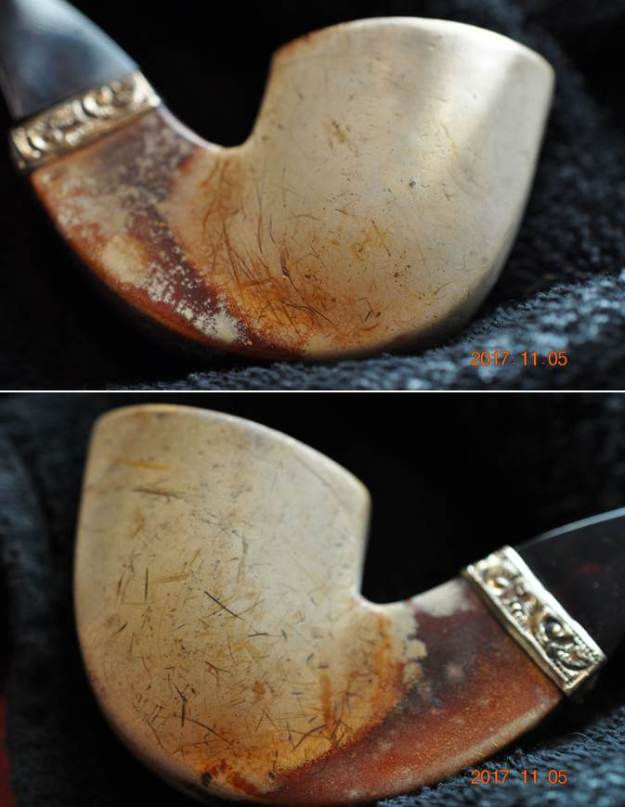
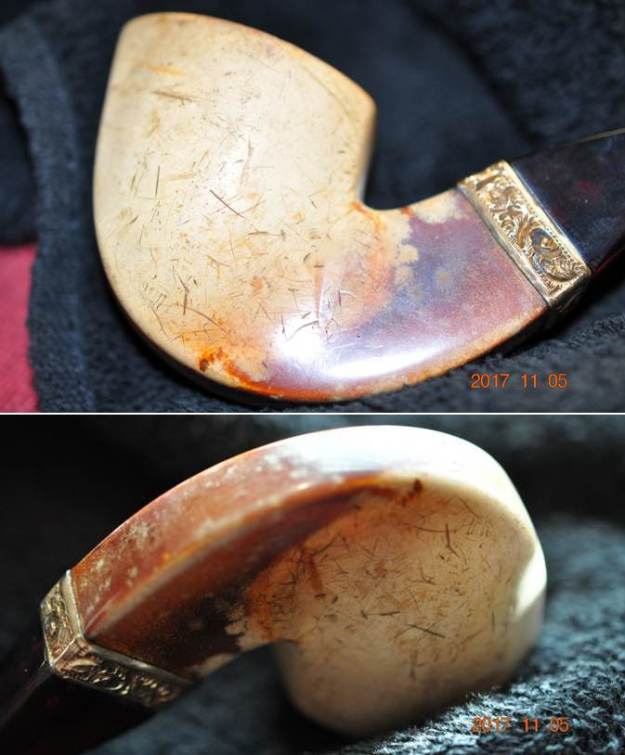
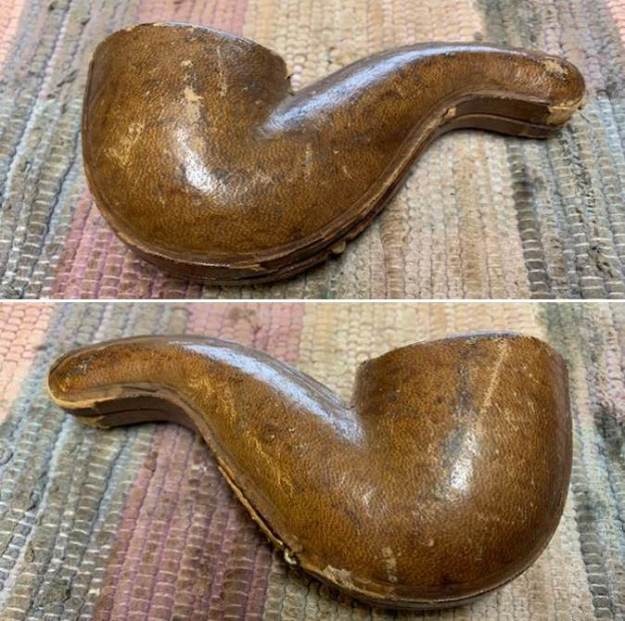
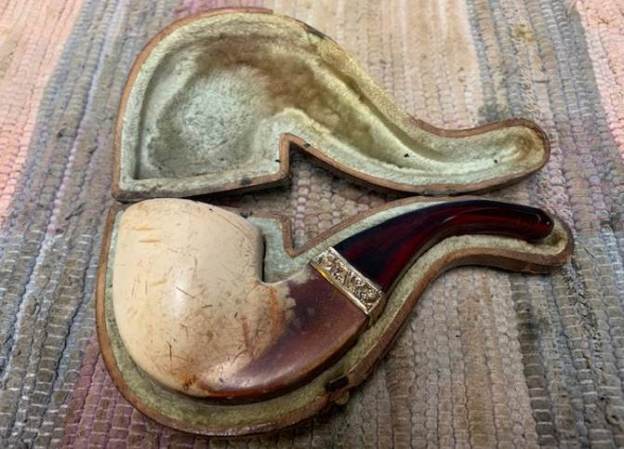
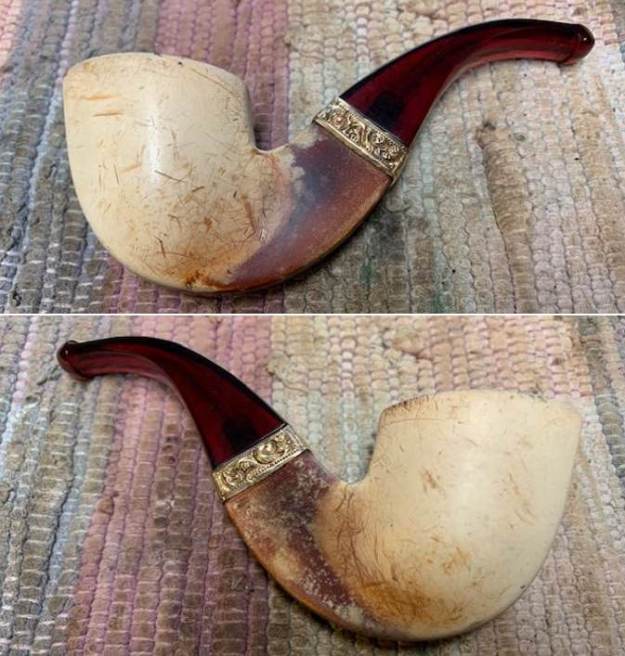
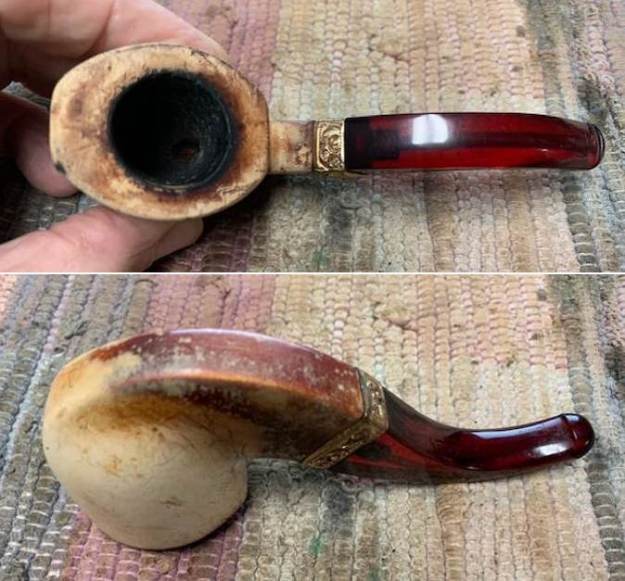
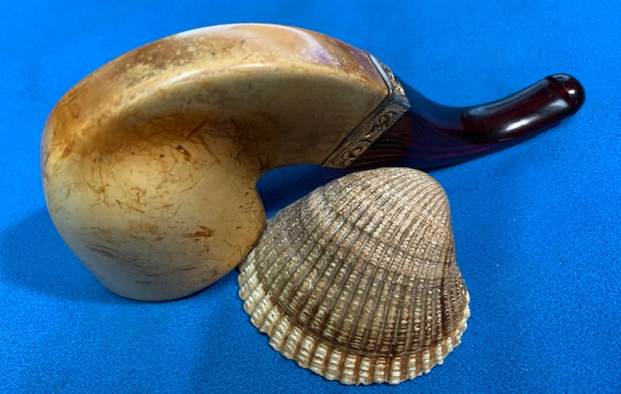
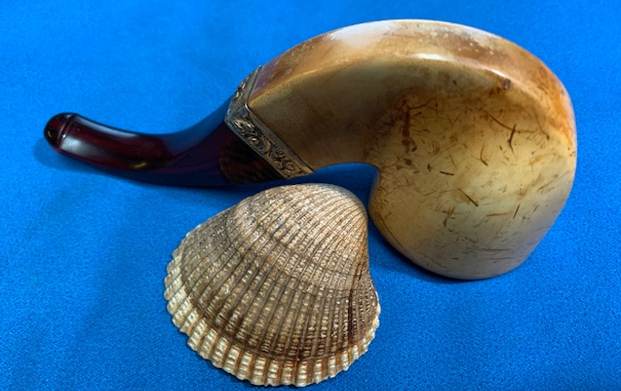
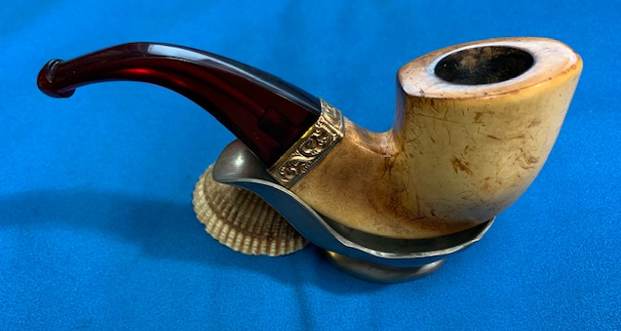
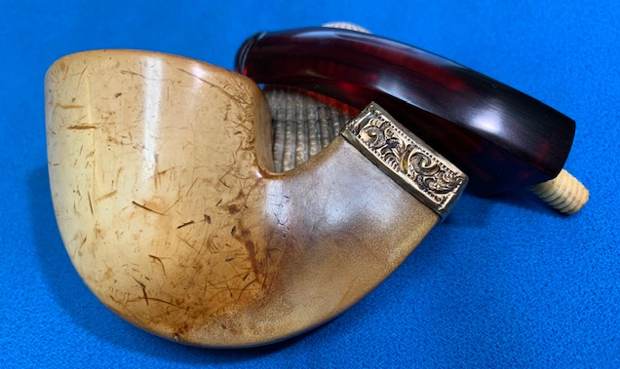
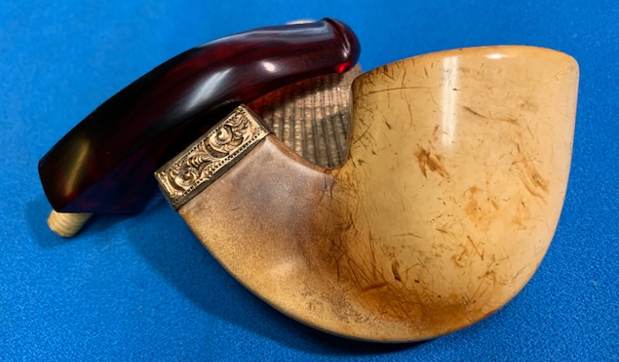
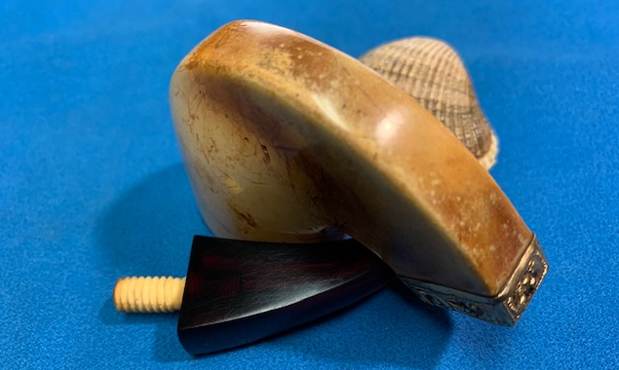
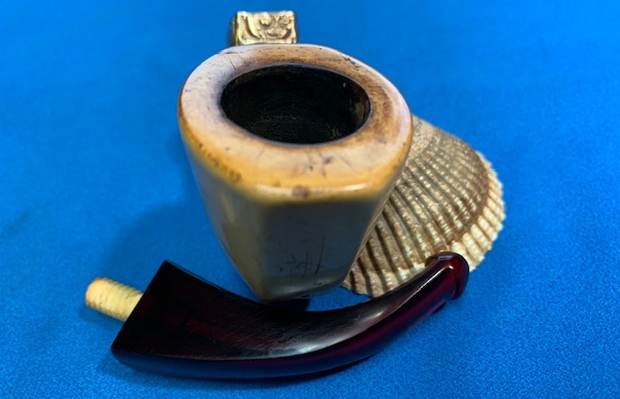
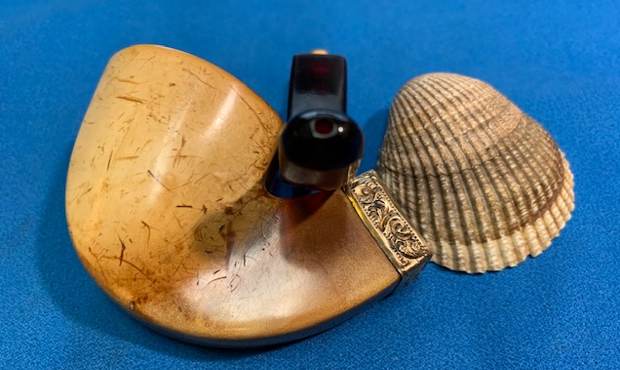
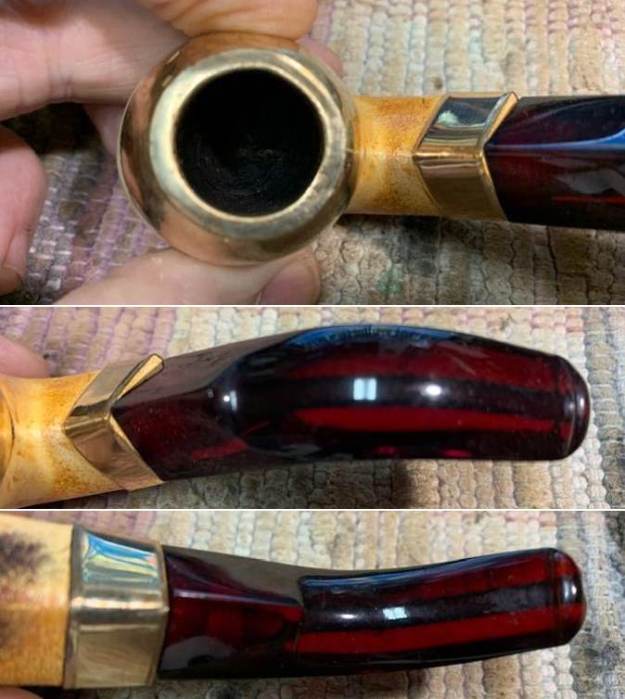
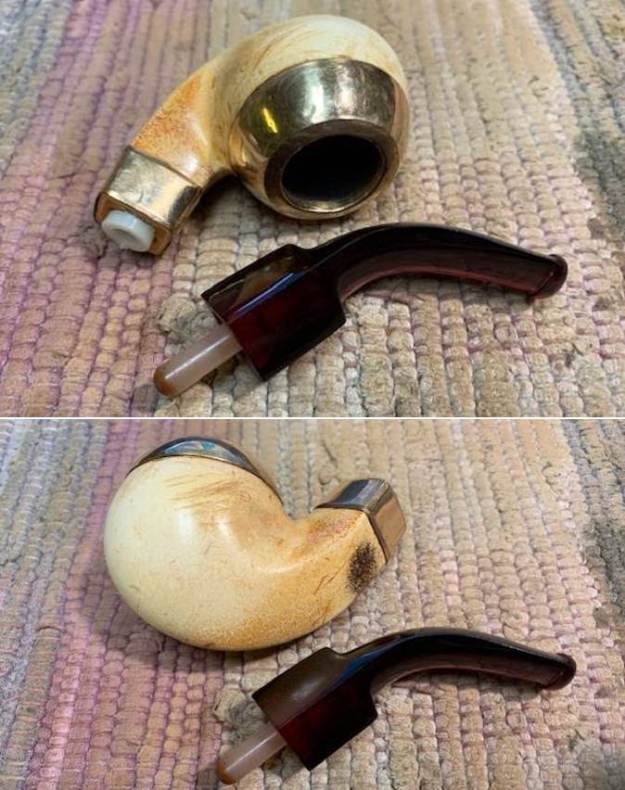
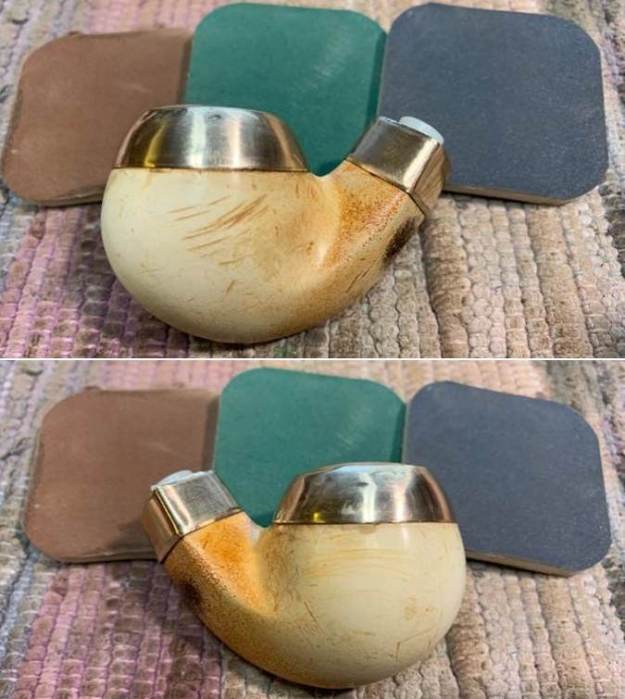
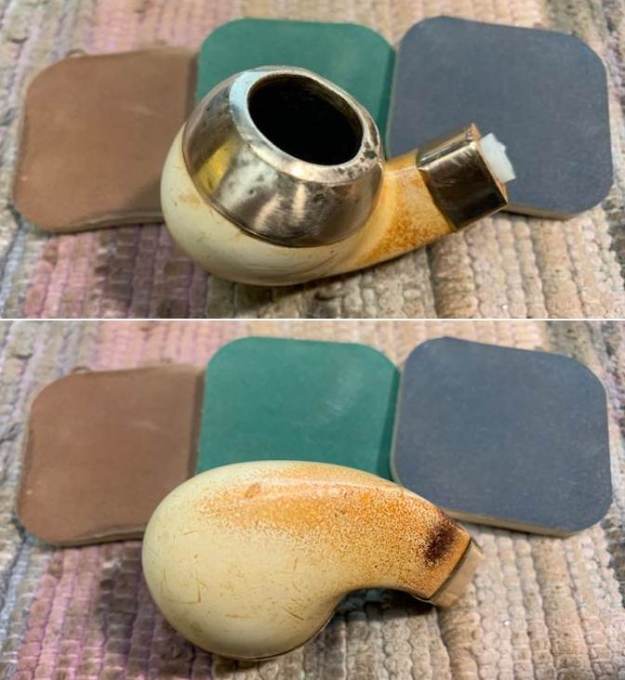
This afternoon I finished a nice little meerschaum apple with a gold rim cap and gold band on the shank and a Ruby Bakelite/Redmanol stem (https://rebornpipes.com/2021/12/25/next-on-the-table-is-a-blinged-out-meerschaum-bent-apple-with-a-ruby-bakelite-stem/). I posted it on the blog and it sold almost before it was on the store. I was contacted by another friend for the same pipe and had to tell him that it sold. I did however have another interesting one in the box that he might be interested in seeing. The pipe was also a meerschaum with rectangular shank, rolled gold band on the shank and a Red Bakelite stem. We purchased of Ebay from Queensbury, New York, USA. This pipe was heavily smoked and needed a lot of work but showed promise. The leather cover on the case was in was worn but still in decent condition. There was some wear on the edges of the case but the hinges and lock worked very well.Don’t you want to know what is inside of this case? Do you want to compare it with the other meerschaum I wrote about? Well… I will get there. Jeff opened the case to show us what the pipe looked like inside. The lining of the case was worn and had a faded green colour to it. There was not identifying stamp on the lid. The rolled band was ornate and filigreed. It really was a beautiful looking older pipe. Jeff took a photo of the pipe in the case. It look like it had been smoked hard and often. The case was filled with chunks of tobacco and ash and the rim top was covered with thick lava. The meerschaum however was really beginning to take on some nice patina – particularly on the shank. Have a look at this beauty!He removed it from the case and really it is the first look of the profile of this interestingly shaped old timer. I would almost call it an Opera pipe but it is a bit big for that. It is however longer and thinner than a standard bowl. Otherwise it is a squashed bent Dublin. It is really filthy but look at the patina on the shank and the rolled gold band on the shank. It is really quite lovely. The second photo below shows the top view of the pipe. You can see the cake in the bowl and the lava on the rim top but do not miss the shape of the bowl. It is a unique one for sure. Jeff took some close up photos of the rim top to show the lava build up and the very thick cake in the bowl. It really made me wonder what the inner edge of the bowl looked like. You can also see some of the scratches on the side of the bowl. It is a mess but… The stem is very nice and actually surprisingly unchewed. There are light tooth marks and chatter on the stem surfaces but nothing deep and the shape is also quite unique. The rolled gold band on the shank is also very ornate.He took some photos of the sides and heel of the bowl to give a sense of the wear and tear on the pipe. You can see it has been a hard worn and greatly used pipe. It must have been a terrific smoker and someone’s favourite go to pipe. I really like the look of the patina on the shank. The mottled reds and browns are very nice. Jeff had cleaned it thoroughly. He had reamed it carefully with a PipNet reamer and cleaned that up with a Savinelli Fitsall Pipe Knife. He worked slowly so as not to damage the inner edge of the bowl. It was a mess. He had scrubbed the exterior of the meerschaum with undiluted Murphy’s Oil Soap and a soft tooth brush. He cleaned out the interior of the shank and airway with alcohol, pipe cleaners and cotton swabs. He carefully cleaned out the Bakelite stem with clean water and pipe cleaners to remove the debris and oils in the airway and the threads of the bone tenon. I took photos of the pipe when it arrived here. The first two photos show case after he had cleaned it in the process. The third photo shows the pipe in the fitted case The overall look of the pipe after cleaning shows the tiredness and worn look of the bowl sides. The stem on the other hand is quite remarkably unscathed and the bone tenon almost looks new. The pipe is a beauty in the rough and definitely needs some TLC. I took a close up photo of the bowl and rim top to show the condition of the cleaned bowl and rim. You can see the clean bowl and the many scratches and darkening on the back edge and top of the rim. I also took some photos of the stem to show how it looked. It was remarkably clean. Even the tooth chatter and marks were very minor.I unscrewed the stem from the shank to see an almost new looking threaded bone tenon on the stem. Amazingly it was free of damage and had not been over or under-turned in the shank.I decided to start my work on this pipe by addressing the damage to the inner edge of the rim and the rim top. I used a folded piece 220 grit sandpaper to work over both. I was able to remove most of the damage on the inner edge and a fair bit on the rim top with the sandpaper. It definitely is an improvement.I polished the briar and the shank with micromesh sanding pads – dry sanding with 1500-12000 grit pads. I worked on the rim top and make it even better looking. I figured that once I heated it to rewax they would look significantly different (Time will tell). I wiped the bowl down after each pad with a damp cloth. The meerschaum began to shine and the scratches were less intrusive. The photos tell the story!   Now it was time to wax the meerschaum bowl. I melted a block of beeswax and dipped the pipe I in the mix and painted the wax with a cotton swab into the hard to reach spots on the shank corners. I heavily coated the bowl with the liquid wax. I let the wax harden dry then I used the cork as a handle while I heated it with a heat gun. As the wax melted I wiped it off with a paper towel. I let the excess drip back into the container. The bowl began to really take on some patina even though the scratches also stood out more. Those scratches were part of the story of the pipe’s journey. I buffed it with a soft cloth and took pictures of the pipe at this point in the process of the restoration. The wax did its magic and the patina was rich and deep. Even the scratches looked better to me! The pipe is well traveled and the scratches help tell the story. I set the bowl aside and turned to deal with the stem. I polished the Bakelite stem with micromesh sanding pads – dry sanding with 1500-12000 grit sanding pads. I wiped it down after each sanding pad with a cloth containing some Obsidian Oil. I finished polishing it with Before & After Pipe Stem Polish – both Fine and Extra Fine and buffed it off with a cotton cloth. I gave it a final coat of obsidian Oil and set it aside to dry. It is a beautiful looking ruby coloured stem. This beautiful no name Bent Opera shaped Meerschaum with a Bakelite stem was another fun pipe to work on and I really was looking forward to seeing it come back together again. With the grime and debris gone from the finish it was a beauty and after the waxing with Beeswax the patina was quite nice. The rolled gold filigreed band on the shank is an added bonus. I put the stem back on the bowl and buffed the pipe with Blue Diamond on the buffing wheel.  I buffing it with a clean buffing pad on the buffer to raise the shine. I hand buffed the pipe with a microfiber cloth to deepen the shine. The rich polished meerschaum on the bowl looks really good with the polished ruby Bakelite stem. It is very well done. Give the finished pipe a look in the photos below. I can only tell you that it is much prettier in person than the photos capture. The dimensions of the pipe are Length: 5 inches, Height: 2 inches, Outside diameter of the bowl: 1 1/8 inches x 1 ¾ inches, Chamber diameter: 7/8 of an inch. The weight of the pipe is 39 grams/1.38oz. This is truly a great looking Meerschaum. Thanks for walking through the restoration with me as I worked over another beautiful pipe. This beauty has already been spoken for and is reserved for the next pipeman. I hope to send it out in the mail tomorrow. Thanks for your time.

Next on the table is a Blinged Out Meerschaum Bent Apple with a Ruby Bakelite Stem


Blog by Steve Laug

We finished up around the tree and our Christmas Breakfast so now there is a quiet time before we eat again. I decided that a snowy Christmas day in Vancouver demanded the right pipe to be worked on so I think I chose appropriately. We bought the pipe I chose at an auction from a fellow in Los Angeles, California, USA. Though it is not shiny white and new looking it is a meerschaum ball/apple/ornament with a gold rim cap and shank band that are quite blinged out and beautiful. The bowl had a thick cake and there was a light lava overflow on the rim. The gold coloured rim cap looked good underneath the lava and oils. The exterior of the bowl and shank was smooth and starting to develop some colouring on the shank and sides. The finish had a lot of scratches and some dark spots on the bottom side of the diamond shank near the band. The pipe did not have any stamping on the shank or band. The rim cap had some nicks and dents in it but they did not detract from the beauty of the pipe. The shank band was also scratched but not dented. The Bakelite (Redmanol) stem was in excellent condition with light tooth marks on the surface in front of the button. I expected the stem was screwed onto the shank but that would be revealed soon enough. Jeff took photos of the pipe before he started his cleanup work. Jeff captured the condition of the bowl and rim top with the next series of photos. You can see the work that is ahead of us in the photos. The cake is very thick and heavy. The rim looked like it might have some damage on the top and inner edge of the cap. The photos of the stem show the shape and the top and underside of the stem. It is dirty and there is some gummed stickiness on the underside where there must have been a price sticker. The tooth marks and chatter was very light on both sides. Jeff took some great photos of the sides of the bowl and heel showing what is underneath the developing patina and the scratches in the surface of the meerschaum. It will be interesting to see what happens as the pipe is cleaned and restored. He removed the stem from the shank. You can see the threaded tenon end in the shank of the pipe and the wide open airway in the stem. It looks to me that there is a push tenon in the shank and the threading was for anchoring it in the stem. I took it out of the box of pipes and looked it over. It was amazingly clean. Jeff carefully reamed it with a PipNet pipe reamer and cleaned up the reaming with a Savinelli Fitsall Pipe Knife. He scrubbed out the internals with alcohol, pipe cleaners and cotton swabs until the pipe was clean. He scrubbed the exterior of the bowl with Murphy’s Oil Soap and a tooth brush to remove the grime and grit on the meerschaum and the lava and oils on the rim top. The bowl looked very good. He scrubbed the stem with Soft Scrub to remove the grime and rinsed it off with warm water. It came out looking far better. Now it was time for me to do my work on the pipe. I took photos before I started my part of the work. I took some photos of the rim top and stem. The rim top is clean but you can see some of the dents in the gold cap. I am afraid that they will remain a permanent part of the pipe’s story. The bowl itself looks very clean. The close up photos of the stem shows that is it very clean and the tooth marks are visible.The way the stem lined up with the shank made me wonder about the tenon system that was used. From Jeff’s photos it looked like the threaded portion sticking out of the shank was part of a push tenon system. If that was true then I truly believe that someone had replace the original bone tenon on what I think is actually an older pipe with a new push tenon system. The stem has an orific opening on the end and it is definitely made of Bakelite. I unscrewed the stem from the shank and then pulled the tenon free from the shank end. It was indeed a push tenon. I took a photo of the bowl and stem to give a sense of the proportion of the pipe. It is a classic looking apple for sure.I polished the briar and the shank with micromesh sanding pads – dry sanding with 1500-12000 grit pads. I worked on the two dark spots on the underside of the shank and was able to determine they were not burn marks but rather spots that had taken on a dark patina.I figured that once I heated it to rewax they would look significantly different (Time will tell). I wiped the bowl down after each pad with a damp cloth. The meerschaum began to shine and the scratches were less intrusive. The photos tell the story!   Now it was time to wax the meerschaum bowl. I melted a block of beeswax and dipped the pipe I in the mix and painted the wax with a brush into the hard to reach spots on the shank corners. I heavily coated the bowl with the liquid wax. I let the wax harden dry then I put a cork in the bowl to provide a handle while I heated it with a heat gun. As the wax melted I wiped it off with a paper towel. I let the excess drip back into the container. The bowl began to really take on some patina and the dark spots changed in colour. I buffed it with a soft cloth and took pictures of the pipe at this point in the process of the restoration. The wax did its magic and the patina was rich and deep. Even the scratches looked better to me! I set the bowl aside and turned to deal with the stem. I polished the Bakelite stem with micromesh sanding pads – dry sanding with 1500-12000 grit sanding pads. I wiped it down after each sanding pad with a cloth containing some Obsidian Oil. I finished polishing it with Before & After Pipe Stem Polish – both Fine and Extra Fine and buffed it off with a cotton cloth. I gave it a final coat of obsidian Oil and set it aside to dry. It is a beautiful looking ruby coloured stem. This beautiful no name Bent Apple shaped Meerschaum with a Bakelite stem was another fun pipe to work on and I really was looking forward to seeing it come back together again. With the grime and debris gone from the finish it was a beauty and after the waxing with Beeswax the patina was quite nice. I put the stem back on the bowl and buffed the pipe with Blue Diamond on the buffing wheel.  I buffing it with a clean buffing pad on the buffer to raise the shine. I hand buffed the pipe with a microfiber cloth to deepen the shine. The rich polished meerschaum on the bowl looks really good with the polished ruby Bakelite stem. It is very well done. Give the finished pipe a look in the photos below. I can only tell you that it is much prettier in person than the photos capture. The dimensions of the pipe are Length: 4 ½ inches, Height: 1 ¾ inches, Outside diameter of the bowl: 1 inch, Chamber diameter: ¾ of an inch. The weight of the pipe is 35grams/1.23oz. This is truly a great looking blinged out Meerschaum Bent Apple. Thanks for walking through the restoration with me as I worked over another beautiful pipe. I will be adding it to rebornpipes store in the Ceramic and Meerschaum Pipes section if are interested in adding it to you collection. Let me know by email or message. Thanks for your time.

Breathing Life into a well carved Meerschaum Bent Billiard


Blog by Steve Laug

I have finished restoring quite a few of the pipes in this collection that we purchased from the older gentleman. He sent me the photos and I was amazed at what I saw. You have seen many of the pipes that he had. These included Dunhill, BBB, Orlik, Barclay Rex, a cased Ben Wade, an H. Simmons all briar, Hardcastles and some Meerschaums. There were also some assorted others that I will get to in the days ahead. It was a great collection.

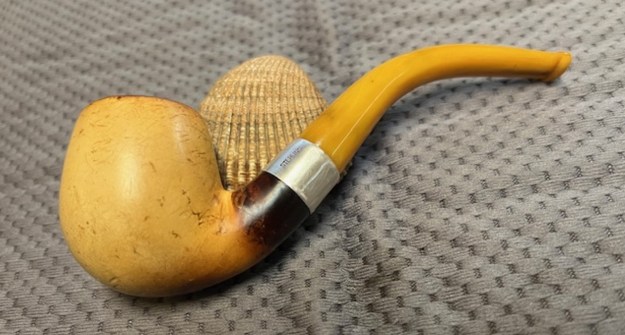
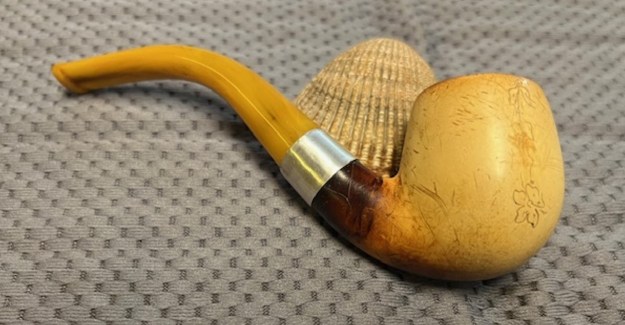
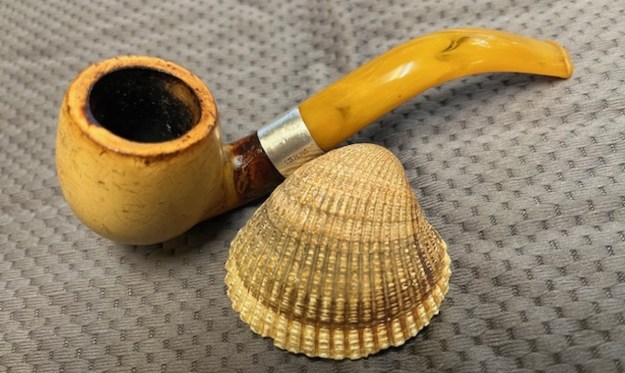
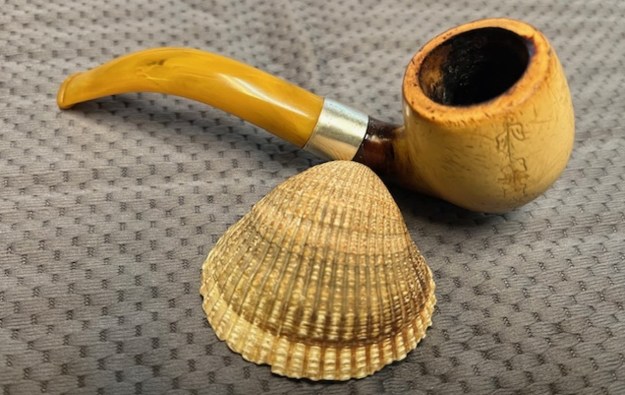
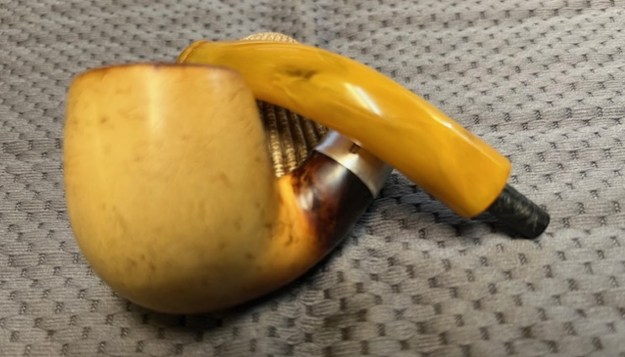
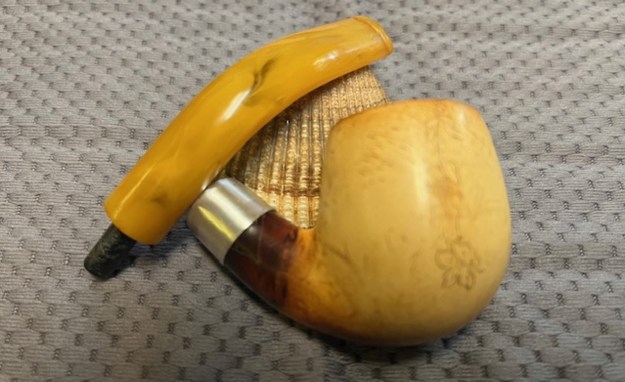
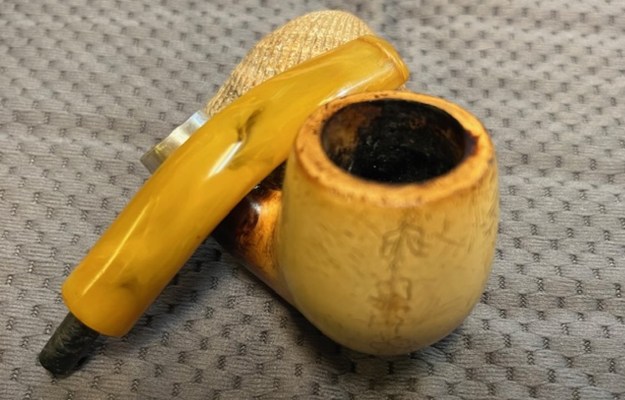
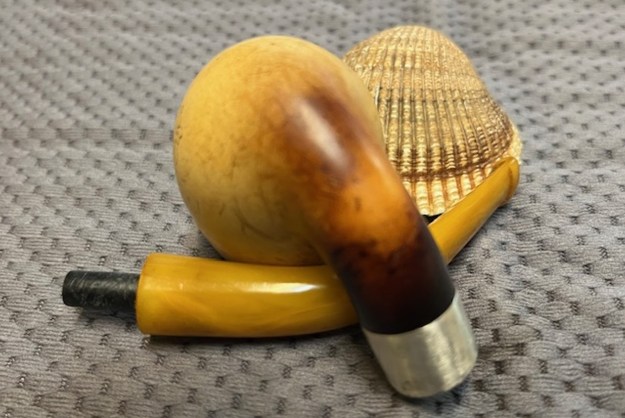
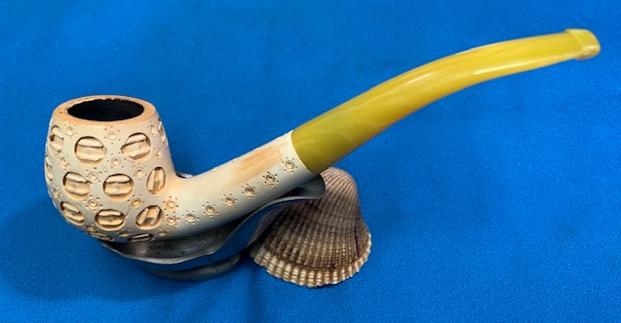
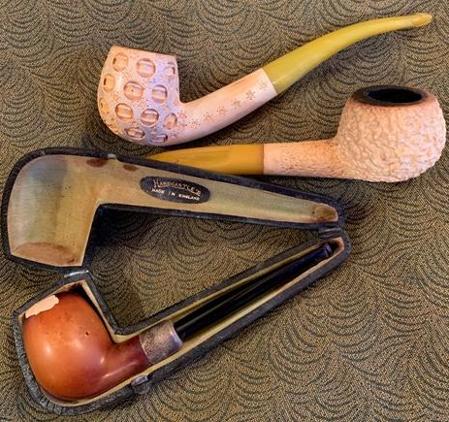
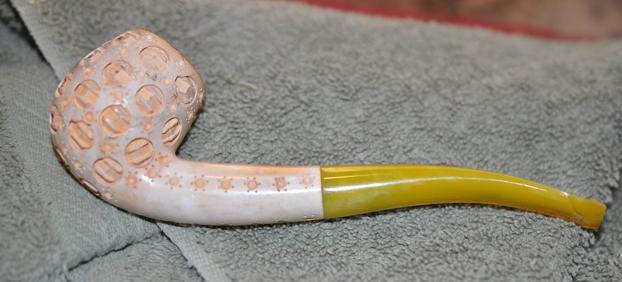
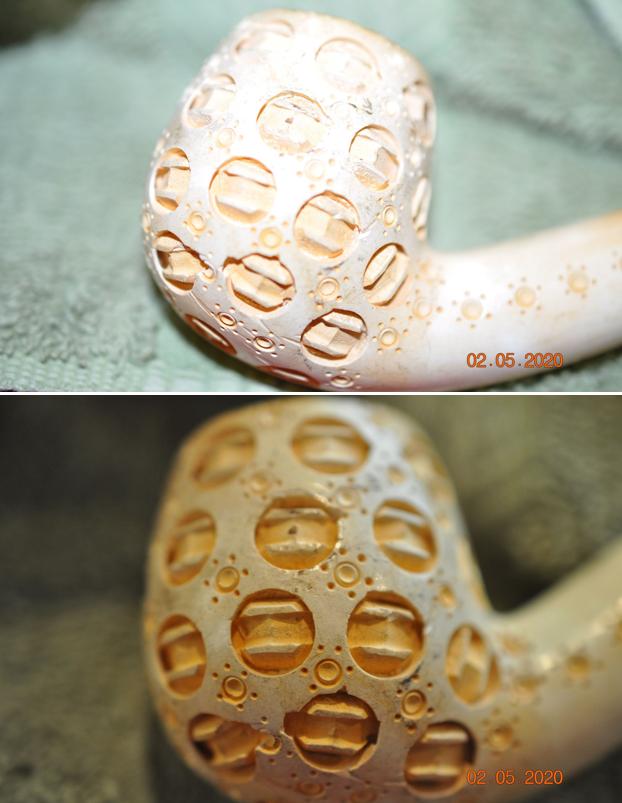
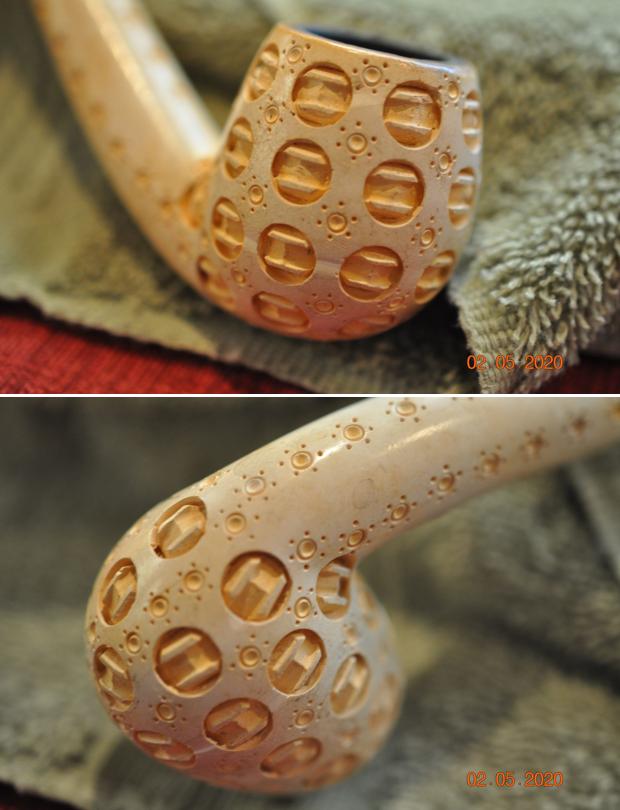
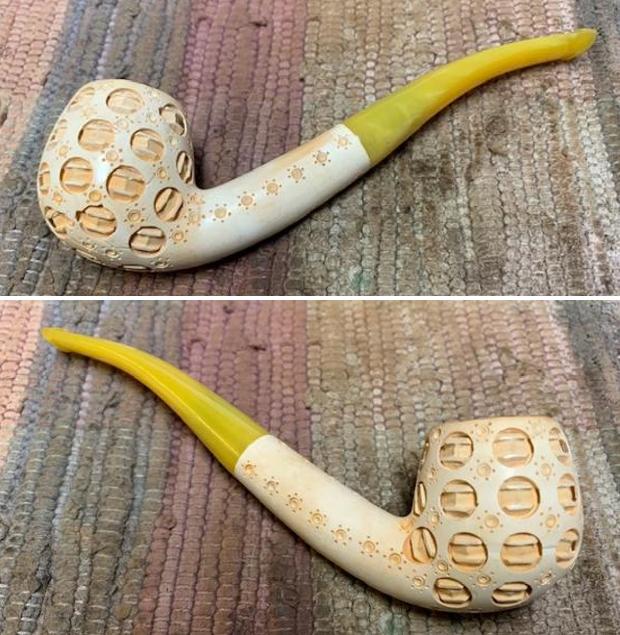
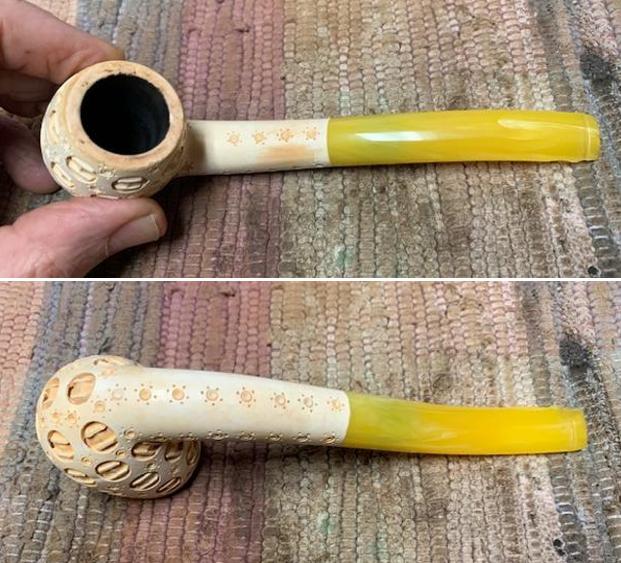
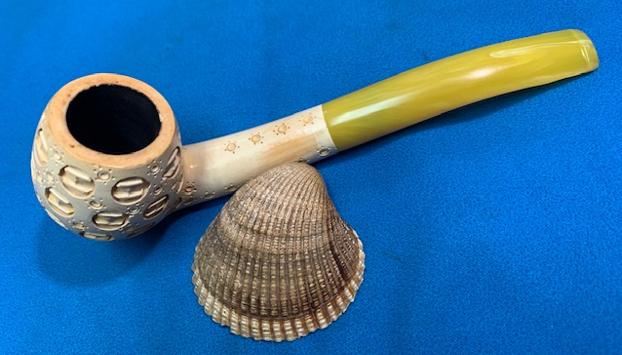
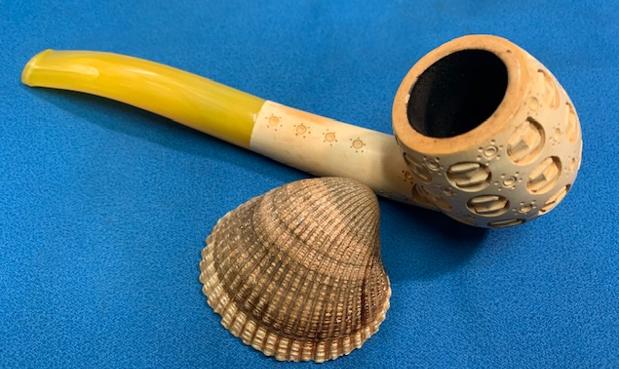
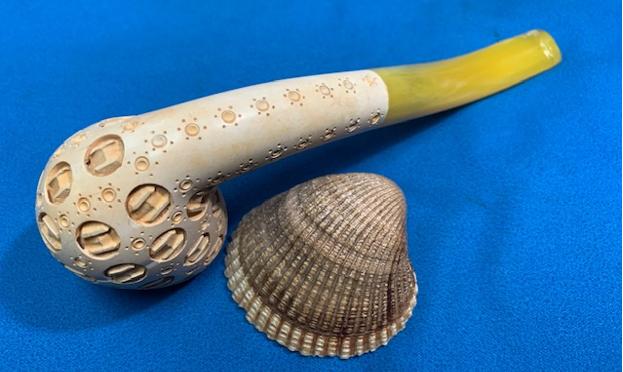
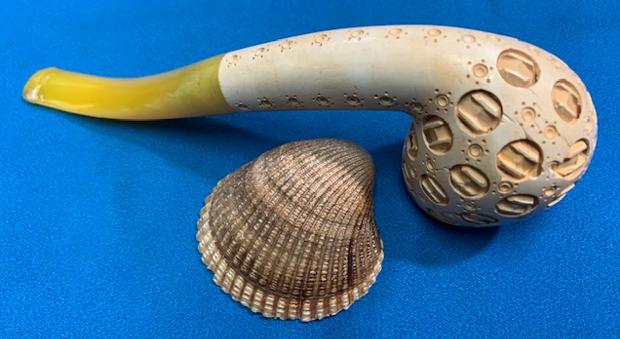
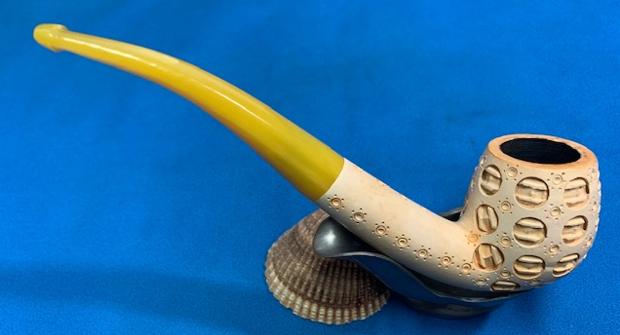
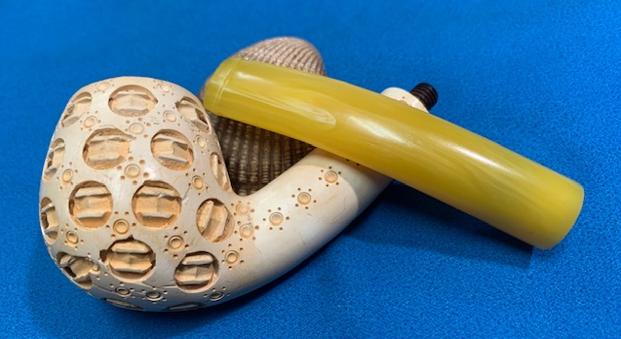
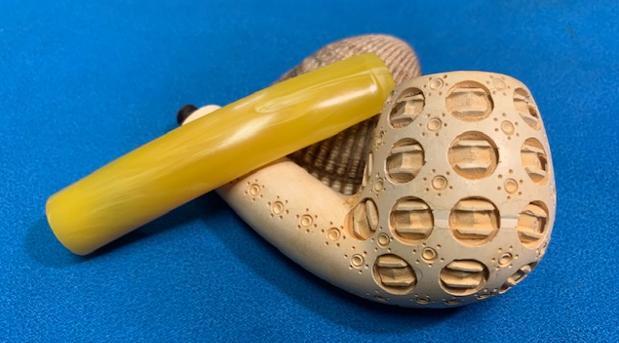
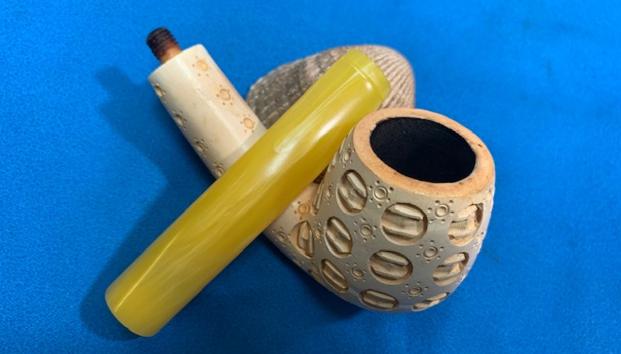
The next pipe I have chosen is a worn and dirty looking Bent Meerschaum Billiard. It is the first [top] of the three meerschaum pipes in the photo above. There was a thick cake in the bowl and the rim top and edges were told buried under a thick coat of lava. It was filthy both inside and out. The shape probably caught my eye because it is quite lovely even under the grime and wear. The stem is yellow acrylic and it is chipped and damaged. The exterior of the bowl had a lot of debris in the rustication around the bowl. The stem had tooth chatter on the top and underside near the button. This was another well loved pipe that obviously been a good smoker!

Jeff took some photos of the Meerschuam Bent Billiard before he worked his magic in cleaning up the pipe. It is a an interesting pipe with a lot of potential and what appears to be some great grain under the grime and debris of the years. Jeff took photos of the bowl, rim top to show the thickness of the cake in the bowl and the thick lava on the rim top. The rim top and inner edge are so thickly covered that it is hard to know their condition. All of the issues will become clearer after the clean up. He took photos of the top and underside of the acrylic stem showing the tooth chatter on both sides and the chip out of the underside of the stem on the right.   Jeff also took some photos of the threaded metal tenon in the shank and the threaded inside of the stem to show the appearance and condition of both.Jeff took photos of the sides and heel of the bowl to show the condition of the rustication. You can see the beautiful shape of the bowl and some interesting patterns in the meerschaum even through the dirt and debris of many years. This unstamped Meerschaum Bent Billiard is an interesting looking pipe. There appears to be a JW written on both the face of the shank and stem. Because the old gentleman that we bought the pipes from intimated that he purchased his pipes at the Manhattan Barclay-Rex store I would imagine that he may have purchased this one from them as well. I was unable to pin down any information regarding the date this pipe so it was time to move on and work on the pipe.

Jeff carefully cleaned the pipe. He reamed it with a PipNet pipe reamer and then cleaned up the reaming with a Savinelli Fitsall Pipe Knife. He scrubbed out the internals of the shank, stem and shank extension with alcohol, pipe cleaners and cotton swabs until the pipe was clean. He scrubbed the exterior of the bowl with Murphy’s Oil Soap and a tooth brush to remove the grime and grit on the briar and lava on the rim top. The finish looks much better and has a deep richness in the colour that highlights the dimensions of the rustication. The edges looked good otherwise. He scrubbed the acrylic stem with Soft Scrub to remove the grime and oils on the stem. When the pipe arrived here in Vancouver I was amazed that it looked so good. Here are some photos of what I saw. I took some close up photos of the rim top and the stem surface. The top and inner and outer edge of the rim showed some darkening/heavy tars and damage. The stem had tooth marks and chatter on both sides near the button.I removed the stem from the shank and took a photo of the parts of the pipe. I started my work on the pipe by polishing the smooth rim top with micromesh sanding pads – dry sanding with 1500-12000 grit sanding pads. I wiped the bowl down after each pad with a damp cloth to remove the sanding debris. I worked some Before & After Restoration Balm into the surface of the bowl and shank with my fingertips to clean, enliven and protect the smooth surfaces of the meerschaum. I let the balm sit for 15 minutes and then buffed with a cotton cloth to raise the shine. The photos show the bowl at this point in the restoration process. I filled in the large chip on the right underside with clear CA glue, layering it on to repair both the stem ahead of the button and building up the button. I set it aside to cure. Once it cured I sanded it smooth with 220 grit sandpaper and started the polishing with 400 grit wet dry sandpaper. I polished the stem with micromesh sanding pads – dry sanding with 1500-12000 grit sanding pads. I wiped it down after each sanding pad with Obsidian Oil. I polished it with Before & After Pipe Stem Polish – both Fine and Extra Fine. I gave it a final coat of Obsidian Oil. It looks significantly better and is smooth but the repairs show! With the bowl and the stem finished I put the beautiful Meerschaum Bent Billiard back together and buffed it lightly on the wheel using Blue Diamond to give it a shine. I gave the stem multiple coats of carnauba wax on the wheel. I buffed the bowl with a horsehair shoe brush to raise the shine. I hand buffed it with a microfiber cloth to deepen the shine. The smooth and carved finish is a great looking. The dimensions of the pipe are – Length: 6 inches, Height: 1 ¾  inches, Outside diameter of the bowl: 1 ¼ inches, Chamber diameter: ¾ of an inch. The weight of this large pipe is 1.27 ounces /36 grams. This Meerschaum Bent Billiard is another great find from this collection. It is much more beautiful in person than these photos can capture. I will be adding it to the rebornpipes store soon. If you want to add it to your collection it will make a fine smoking addition. This is another pipe that has the possibility of transporting the pipe man or woman back to a slower paced time in history where you can enjoy a respite. Thanks for walking through the restoration with me.

Breathing Life into a Hexagonal Meerschaum with a Bakelite Stem


Blog by Steve Laug

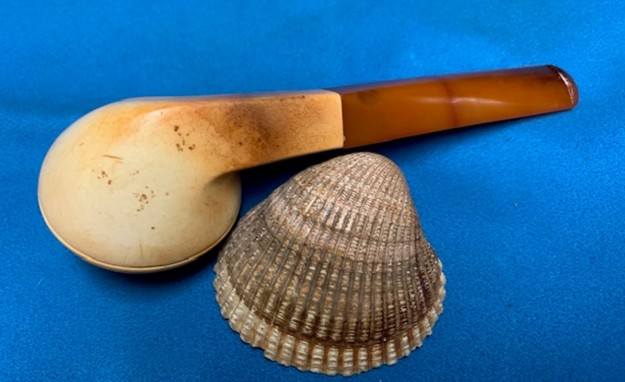
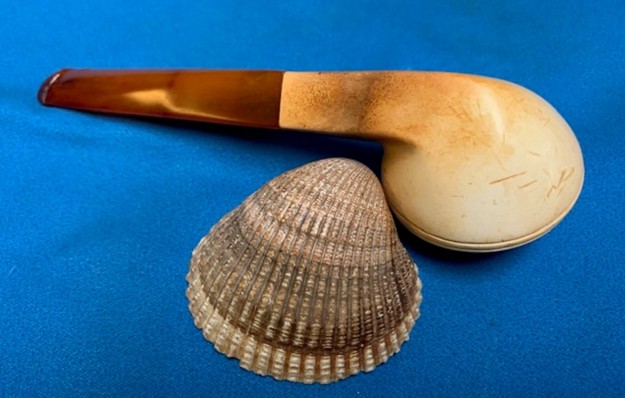
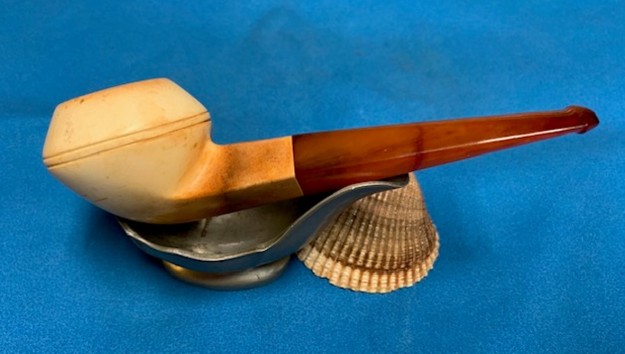
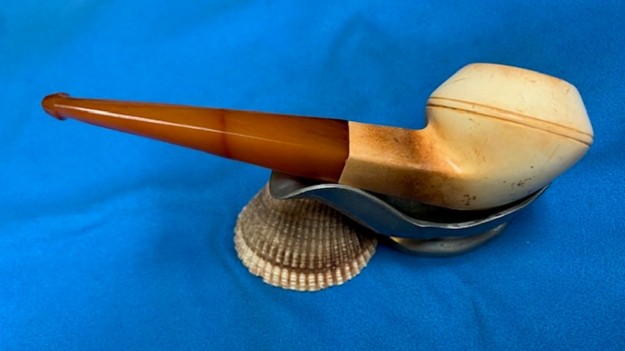
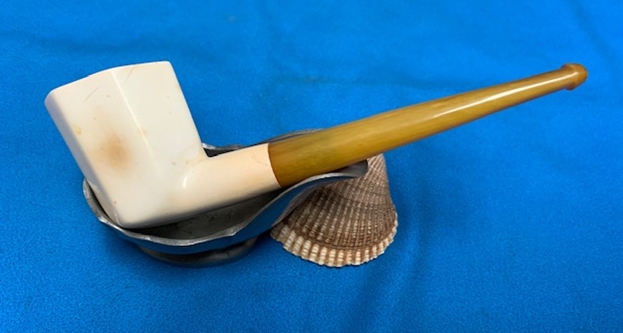
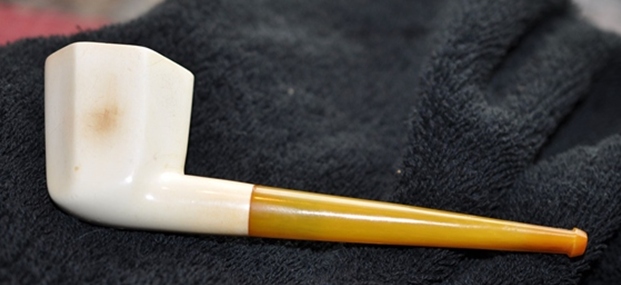
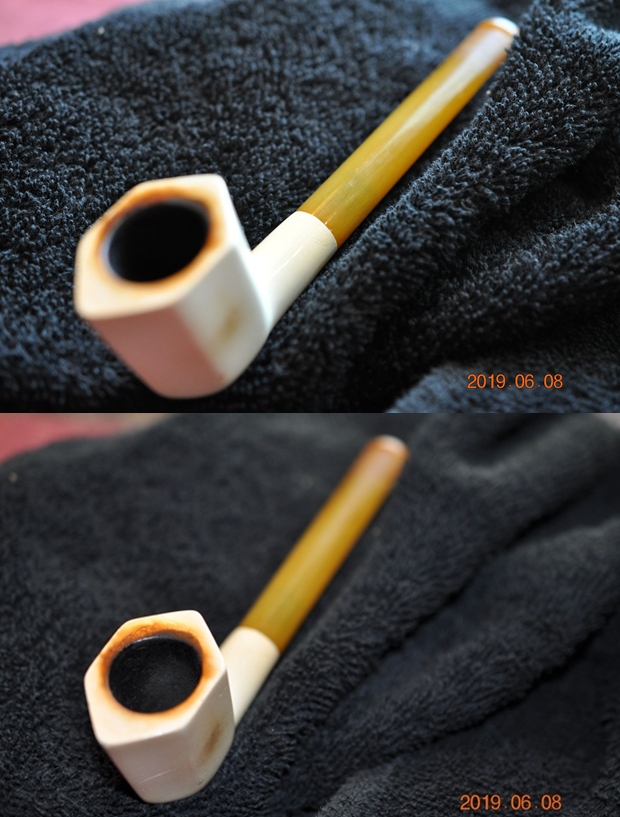
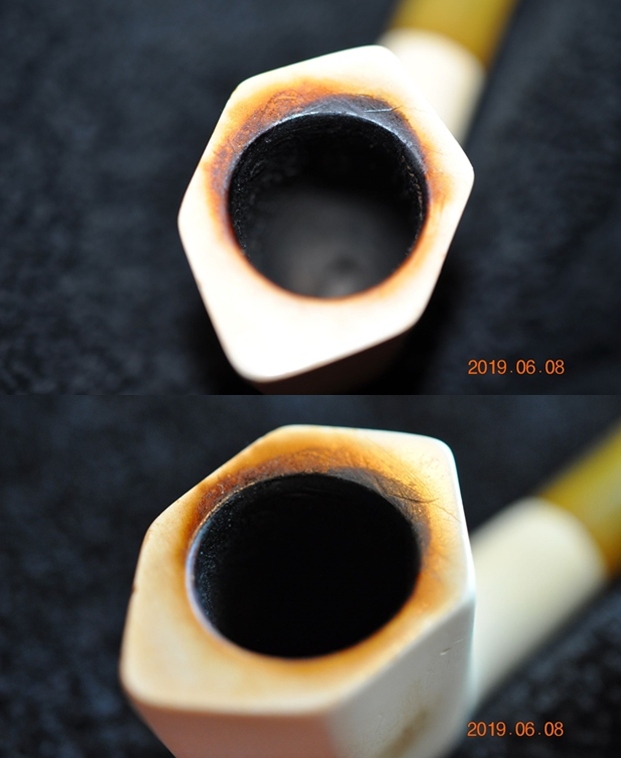
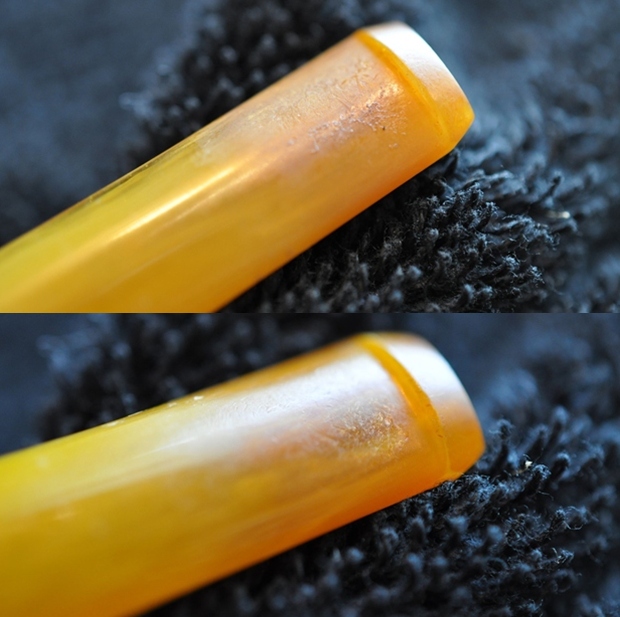
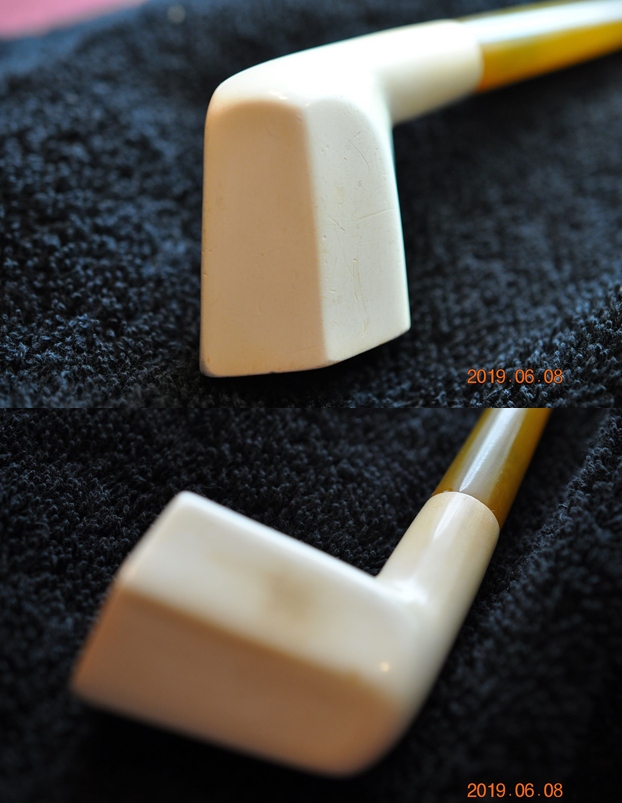
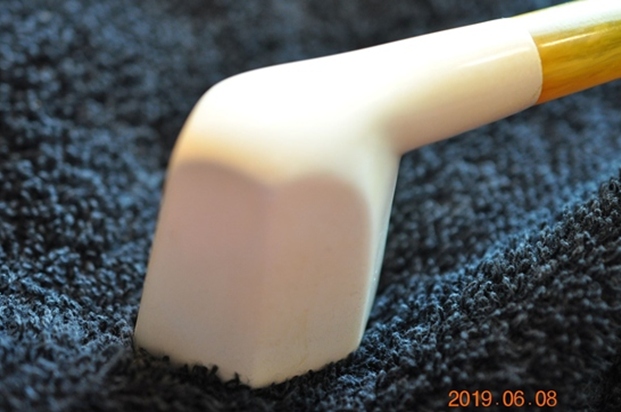
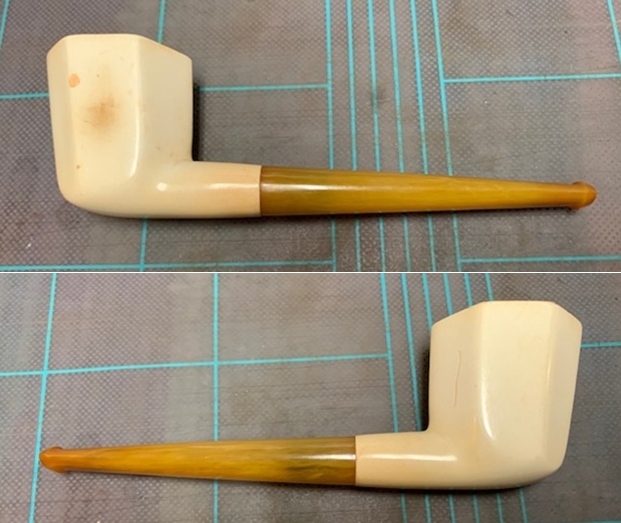
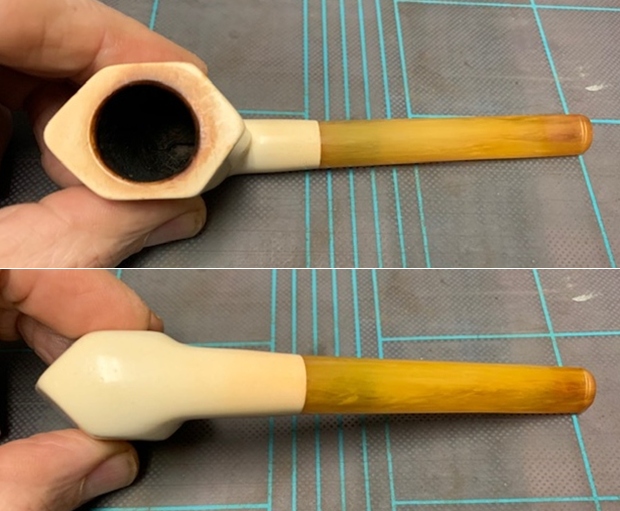
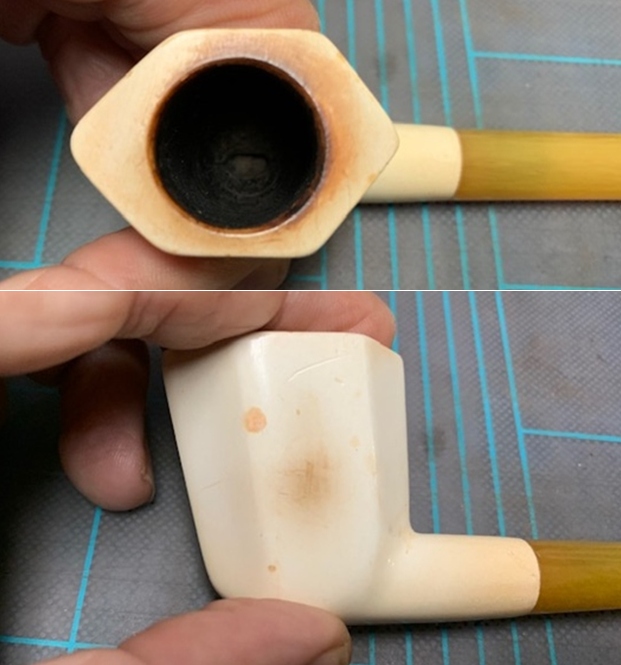
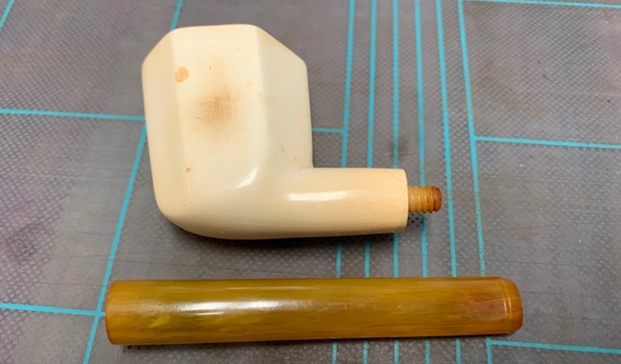
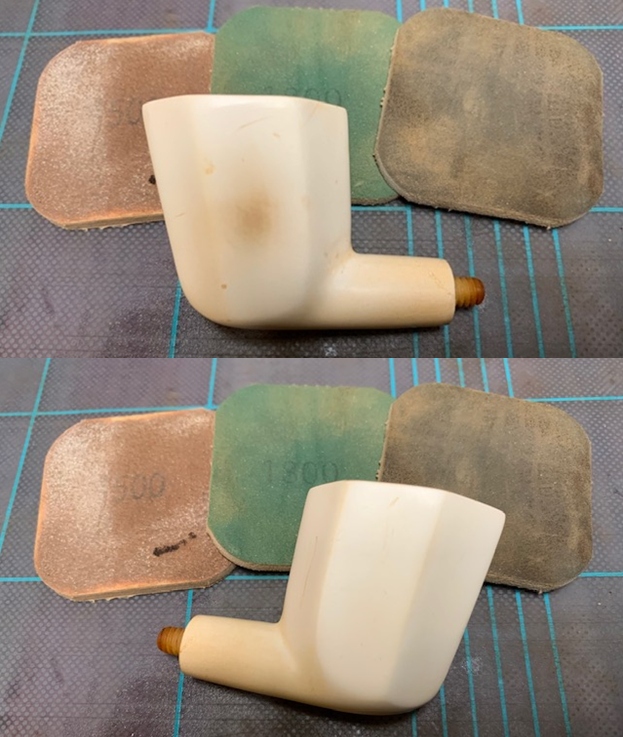
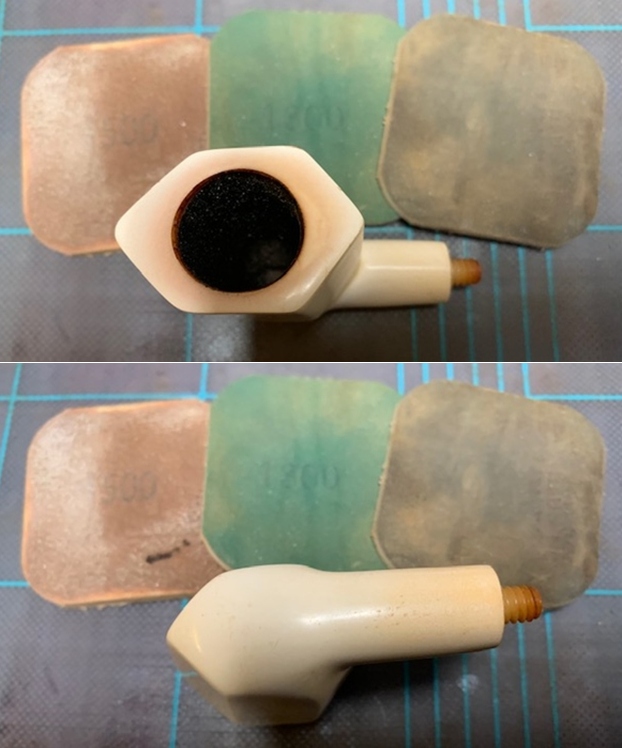
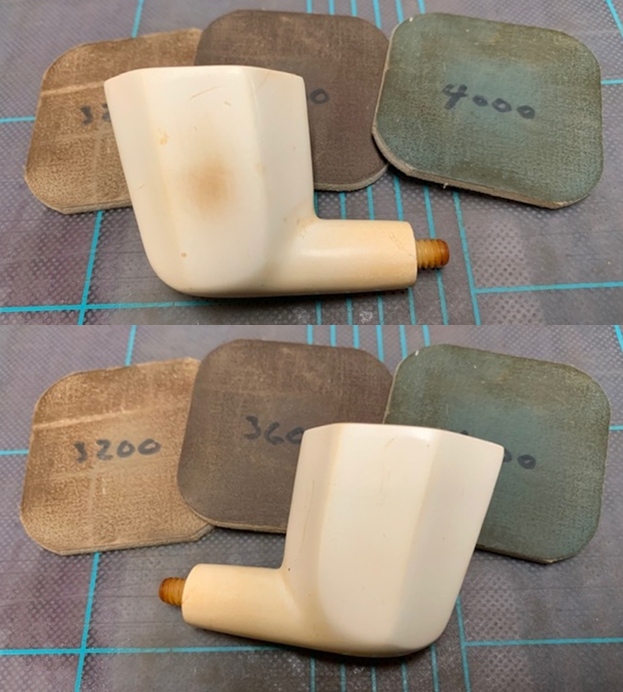
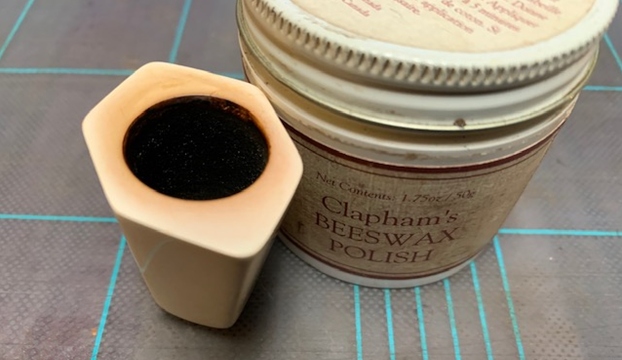
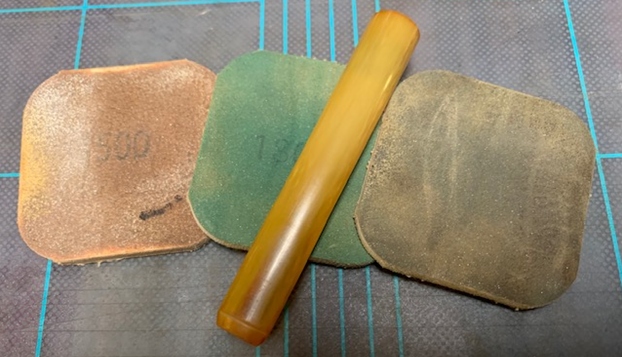
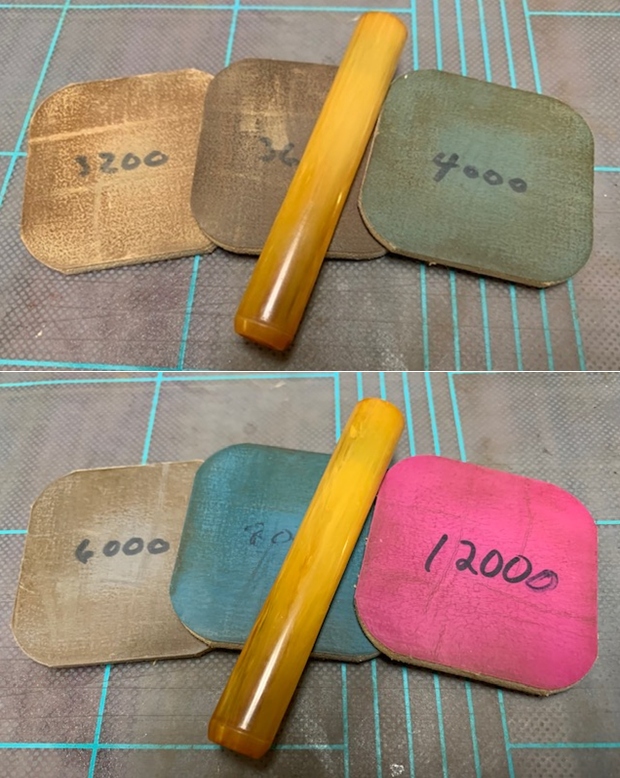
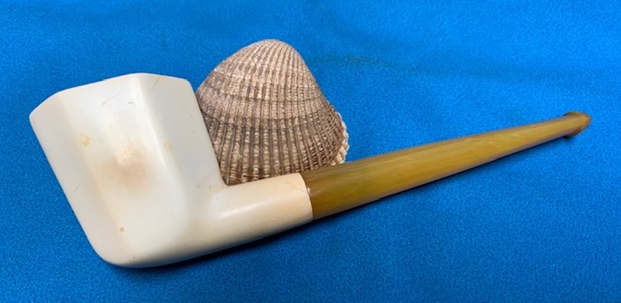
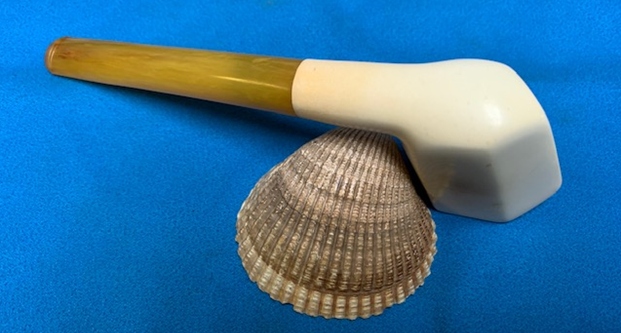
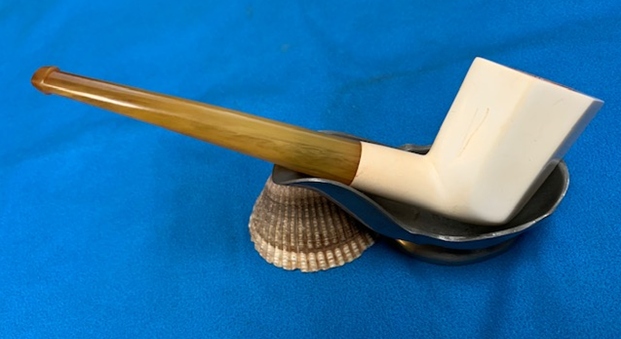
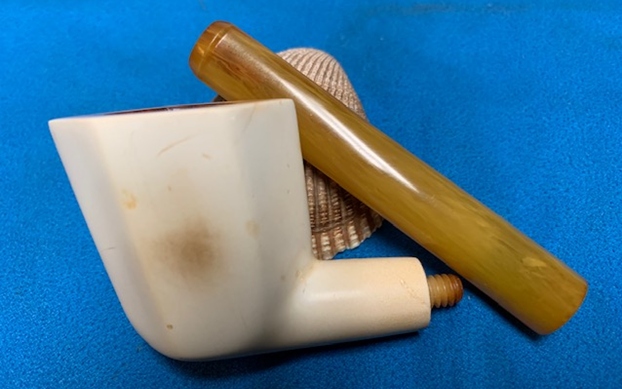
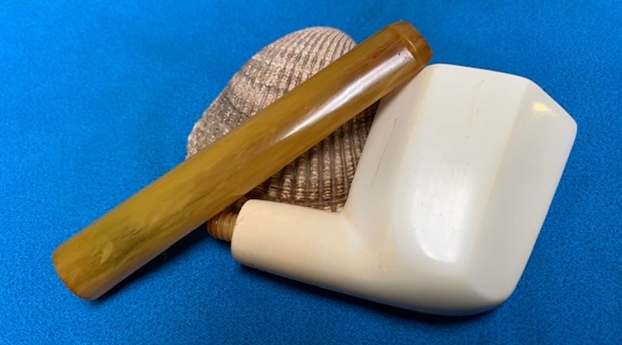
The next pipe on the work table came to me from one of our estate purchases. Between us we pick up quite a few pipes for restoration. I try to work them into the restoration queue so that I can keep them moving. This next one is a smooth hexagonal block meerschaum pipe with a yellow Bakelite stem. The there is no stamping on the pipe. The finish had a lot of grime ground into the smooth finish on the bowl and there was definitely some patina developing in the shank, heel and one side of the bowl. The bowl was caked with a light lava coat on the top of the rim. The edges looked to be in good condition. There were a lot of scratches in the meerschaum on all sides and the top of the bowl. The stem was in dirty and had tooth chatter and marks on the top and underside near the button. There were not markings or a logo on the taper stem. It had promise but it was very dirty. Jeff took some photos of the pipe before he started his cleanup work.   He took photos of the rim top and bowl to give a clear picture of the thickness of the cake and the overflow of lava on the rim top. He also took photos of the top and underside of the stem to show the chatter and tooth marks. Otherwise the stem is quite clean.  Jeff took photos of the sides and heel of the bowl to give a picture of what the meerschaum looked like. It is a well carved hexagon. Jeff had cleaned up the pipe with his usual penchant for thoroughness. He reamed the pipe with a Savinelli Fitsall Pipe Knife.  He scrubbed the bowl with undiluted Murphy’s Oil Soap with a tooth brush. He rinsed it under running warm water to remove the soap and grime. He cleaned out the inside of the shank and the airway in the stem with alcohol, cotton swabs and pipe cleaners. He soaked the stem in Before & After Deoxidizer and rinsed it off with warm water. I took photos of the pipe once I received it.  The rim top cleaned up really well with the lava coat removed. The inner and outer edge of the bowl looked to be in excellent condition.  The panel on the left side had some darkening and a few stain spots. The stem surface looked very good with a few small tooth marks and chatter on both sides near the button.    I removed the stem and took a photo of the pipe to give a sense of the whole. The stem is tapered and narrow.Now it was time to do my work on the pipe. I polished the scratches in the meer and the rim top, sides and shank with micromesh sanding pads – wet sanding with 1500-12000 grit pads and wiping it down after each pad with a damp cloth.  I rubbed the bowl and shank down with Before & After Restoration Balm. I worked it into the surface of the bowl sides and shank with my fingertips to clean, enliven and protect the meerschaum. I let the balm sit for a little while and then buffed with a cotton cloth to raise the shine.     I rubbed the bowl down with Clapham’s Beeswax Polish. I let it dry on the meerschaum and then buffed it off with a soft cotton cloth. It really adds some depth to the finish.  I set the bowl aside and turned to work on the stem. It was in good condition and the tooth marks were light so I figured they would polish out fairly easily. I polished the Bakelite/amberoid stem with micromesh sanding pads – 1500-12000 grit pads. I wiped it down with a damp cloth after each sanding pad. I used Before & After Pipe Polish – both Fine and Extra Fine to further polish the stem.        This Hexagonal Meerschaum Billiard with a Bakelite/amberoid stem is a great looking pipe now that it has been restored. I put the stem back on the bowl and carefully buffed the pipe with Blue Diamond on the buffing wheel using a light touch on the briar. I gave the bowl and the stem multiple coats of carnauba wax on the buffing wheel and followed that by buffing the entire pipe with a clean buffing pad. I hand buffed the pipe with a microfiber cloth to deepen the shine. The finished Hexagonal Meerschaum fits nicely in the hand and feels great. Give the finished pipe a look in the photos below. The dimensions of the pipe are Length: 5 ½ inches, Height: 1 ¾ inches, Outside diameter of the bowl: 1 inch wide x 1 ½ inches long, Chamber diameter: ¾ of an inch. If you are interested in adding this pipe to your collection send me a message or an email. Thanks for reading this blog and my reflections on the pipe while I worked on it. There are many more to come!