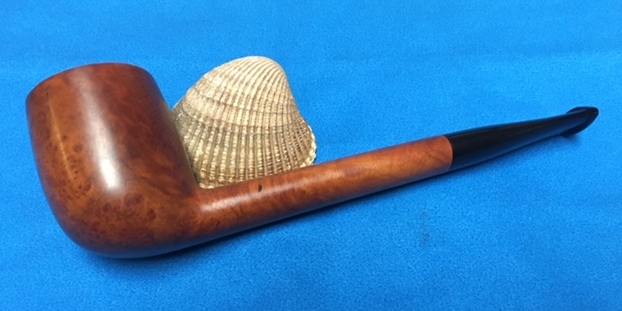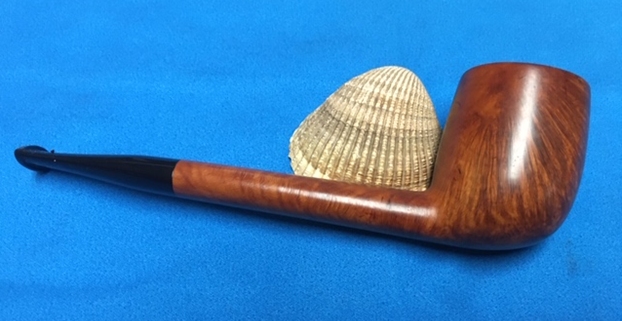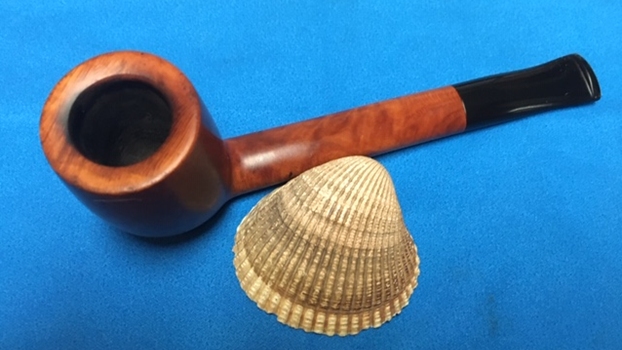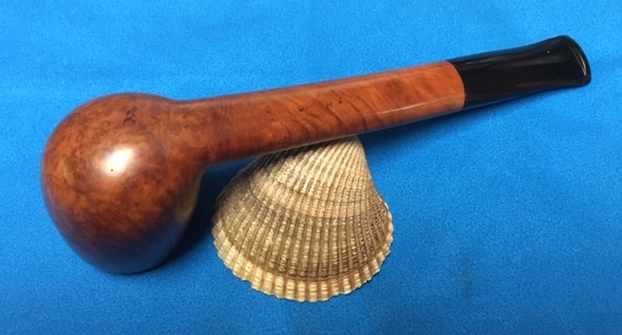
Tag Archives: bowl topping

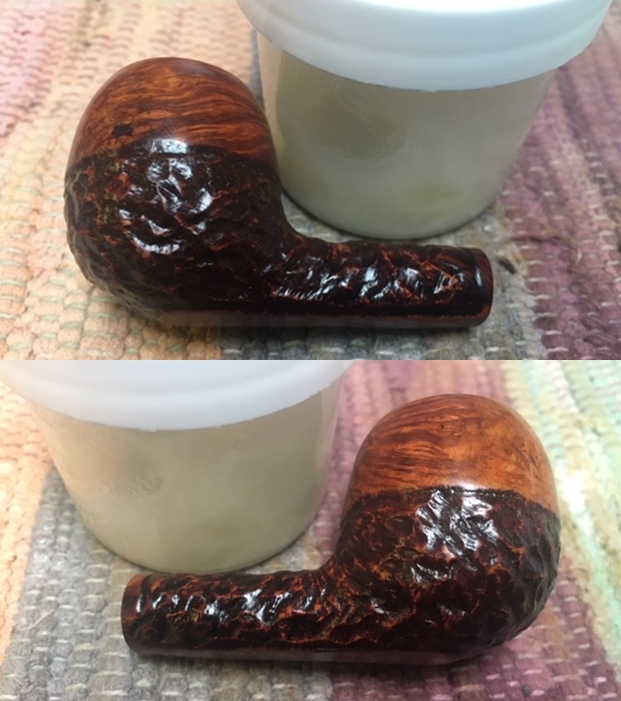
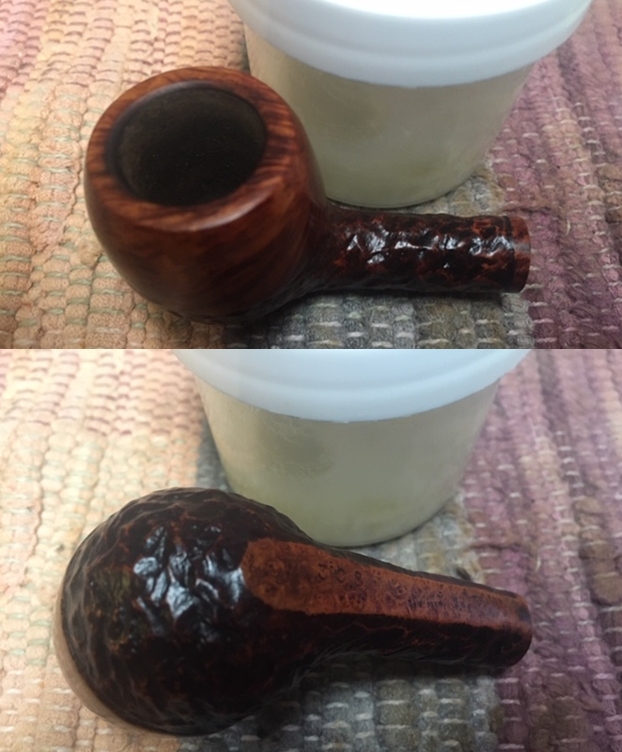
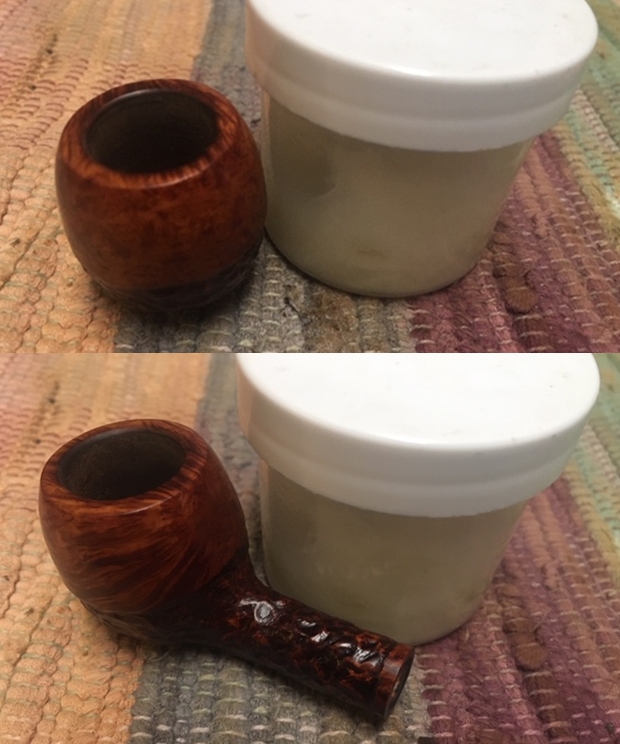
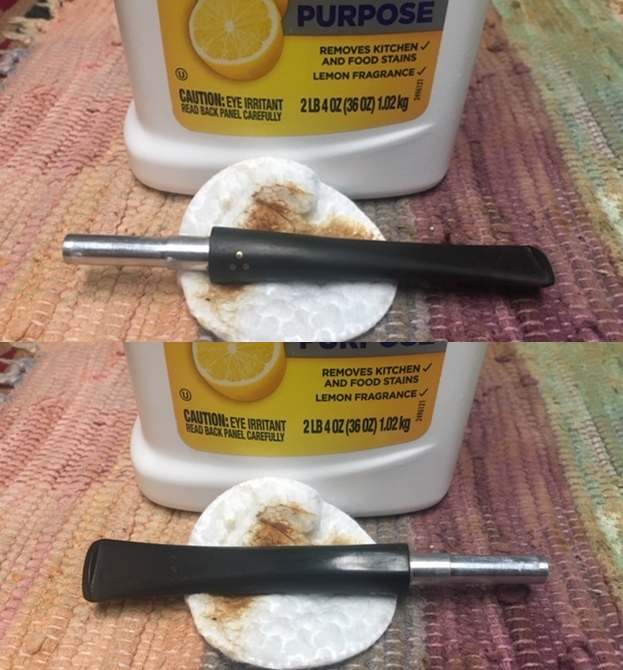
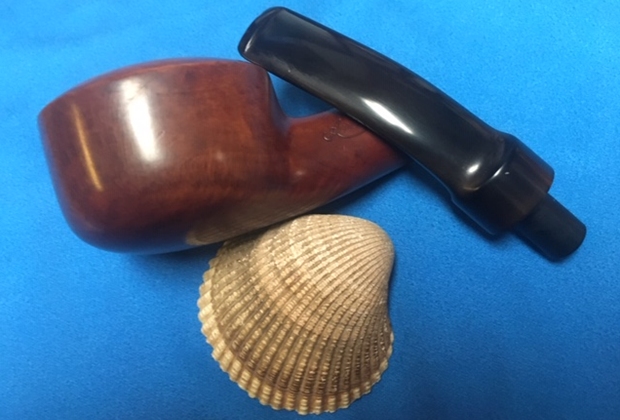
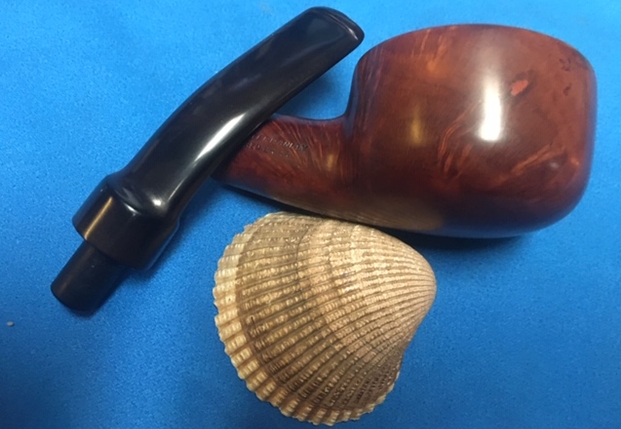
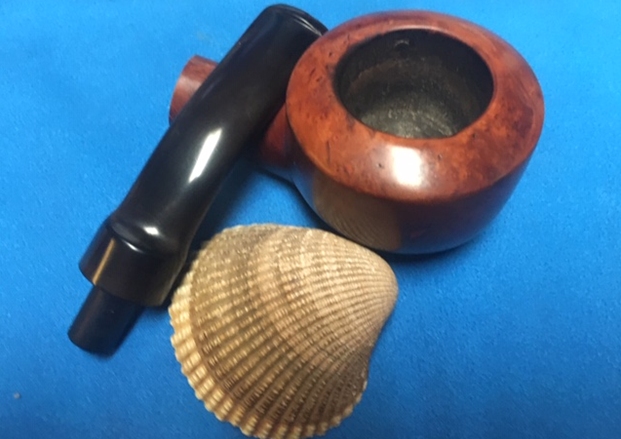
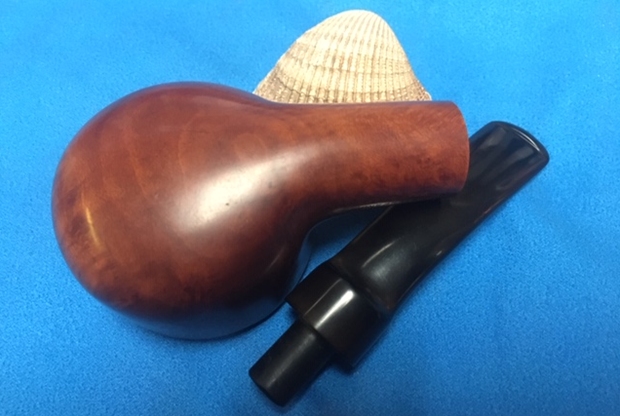
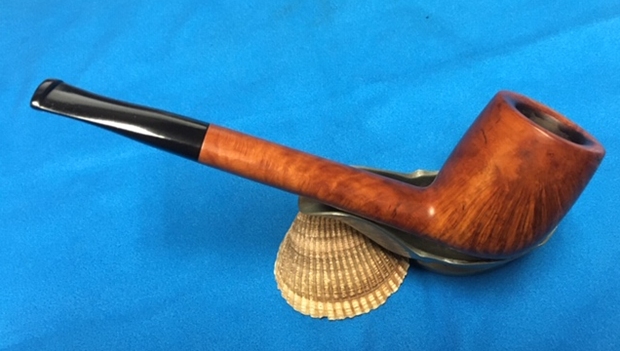
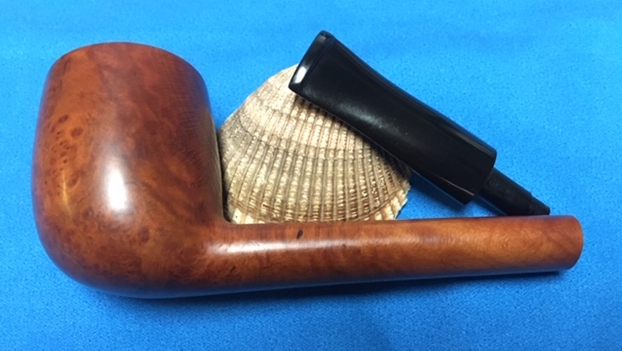
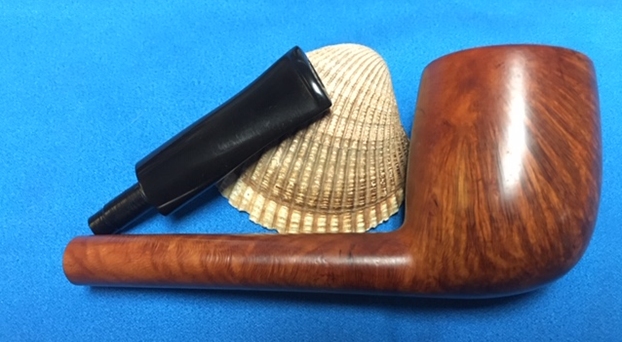
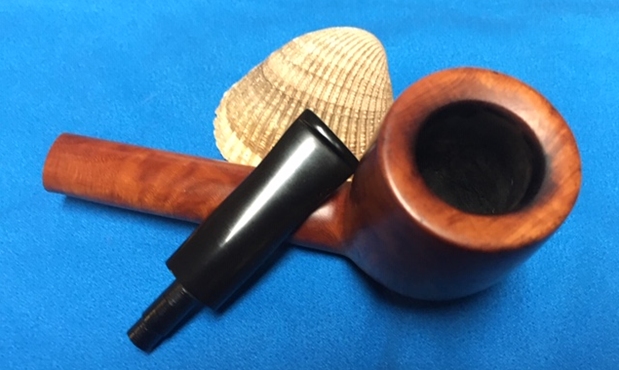
Refreshing a Smelly Mehaffey 9 Canadian for Alex


Blog by Steve Laug

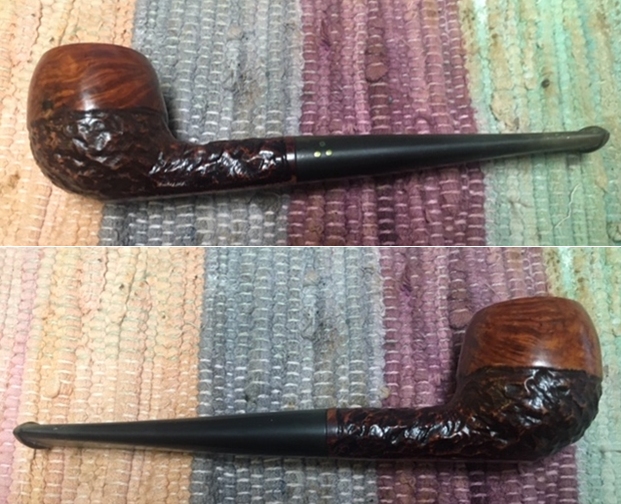
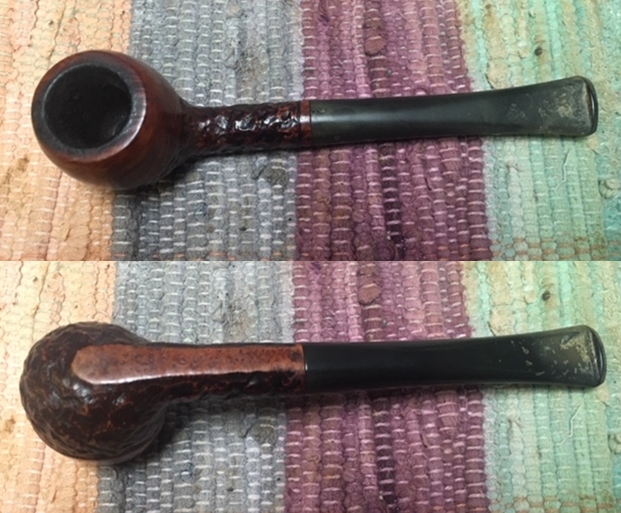
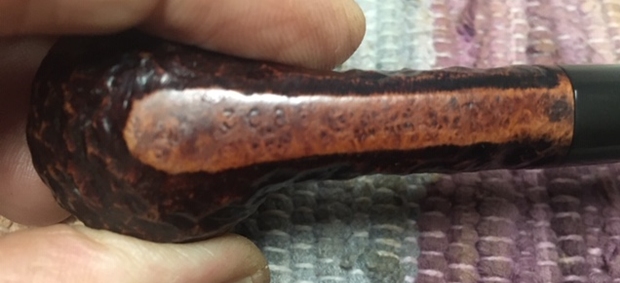
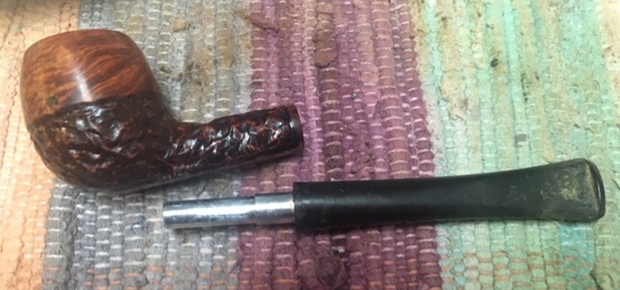
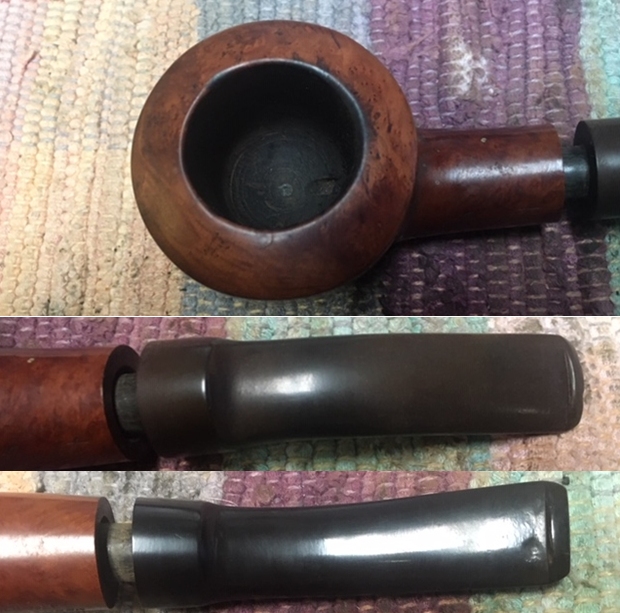
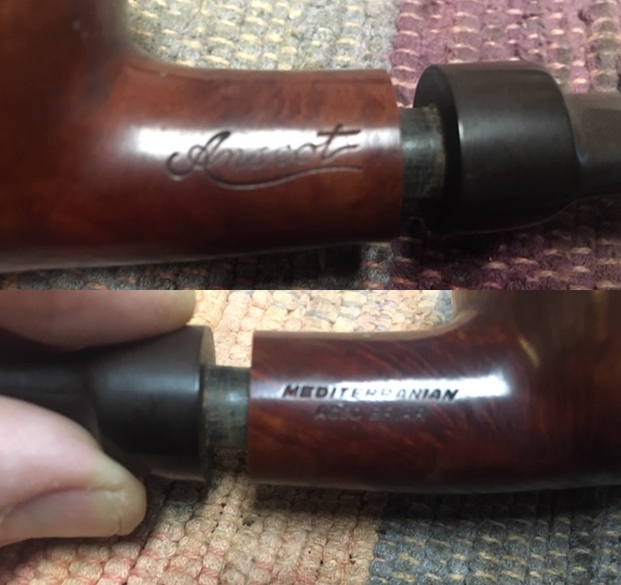
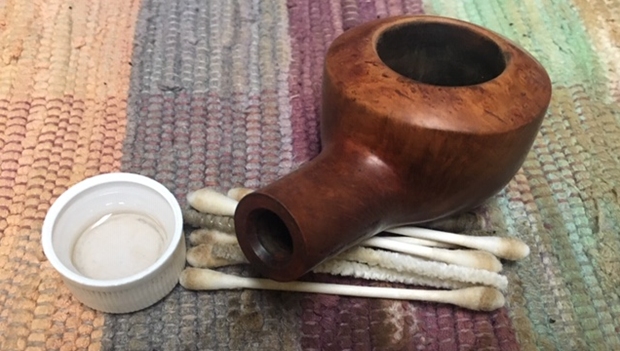
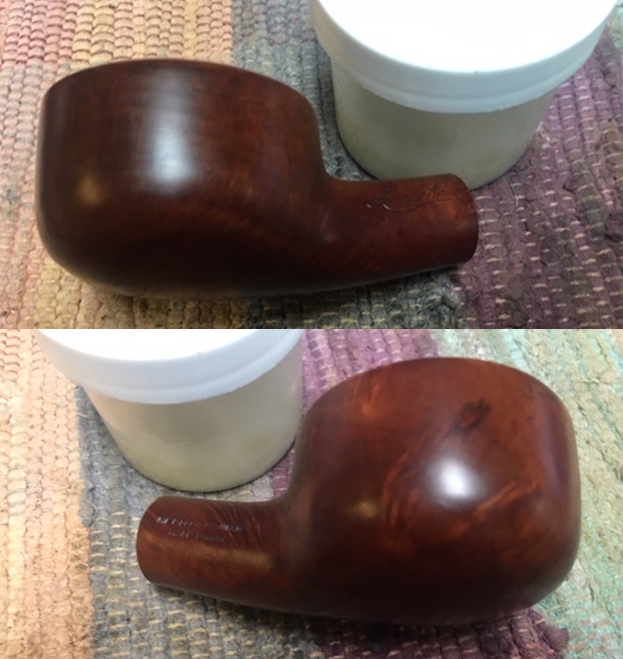
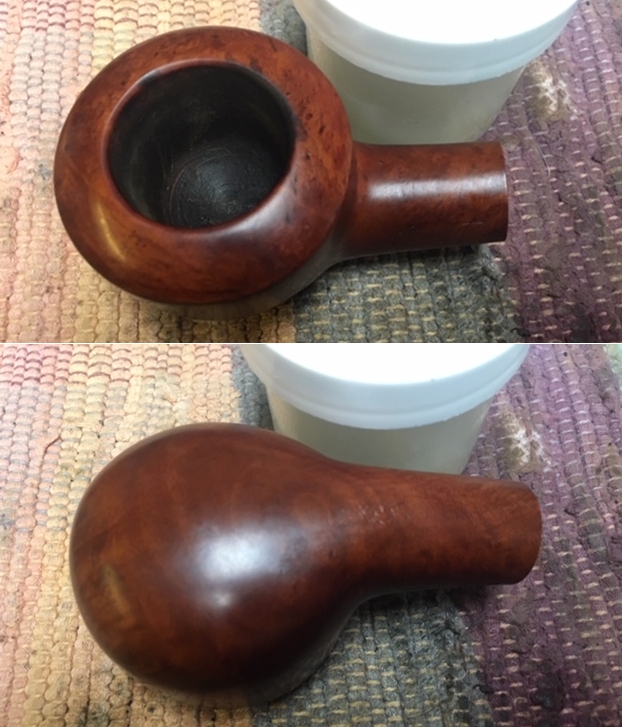
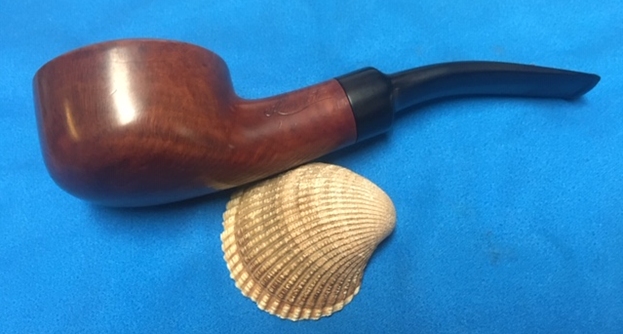
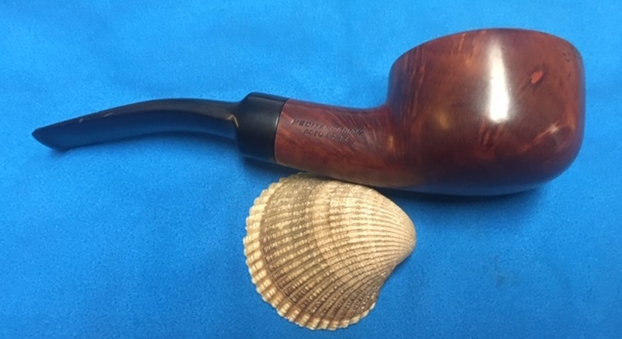
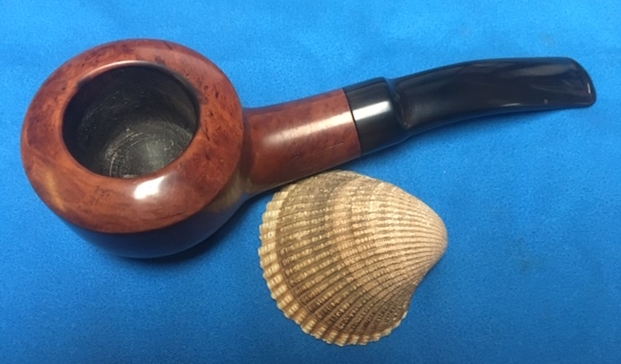
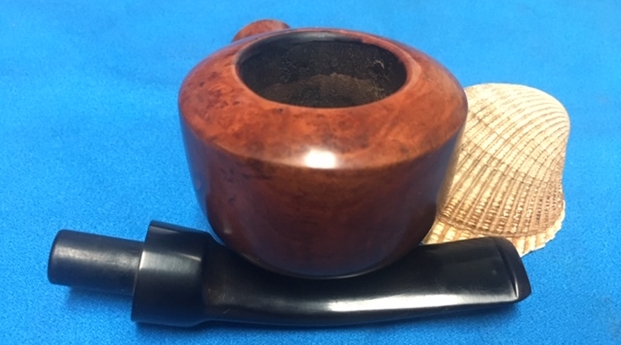
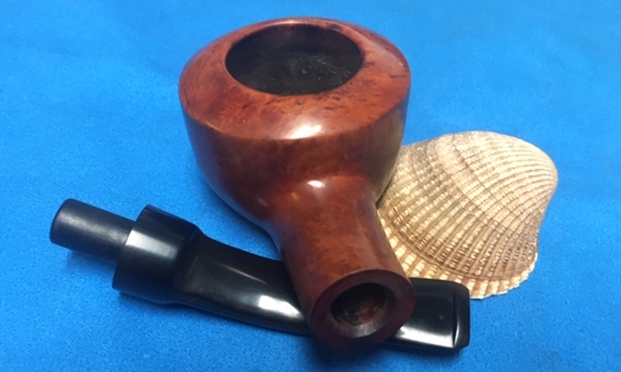
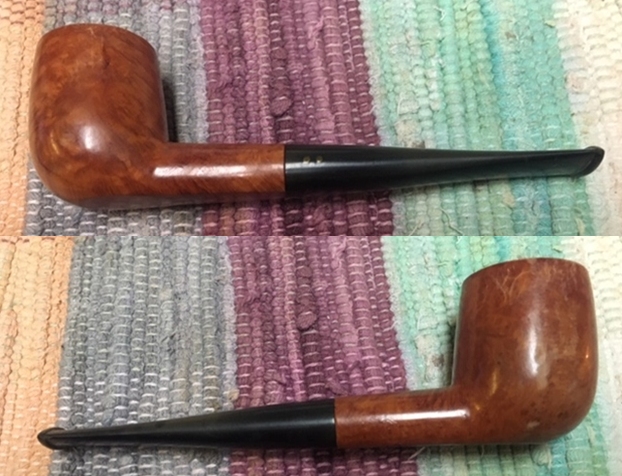
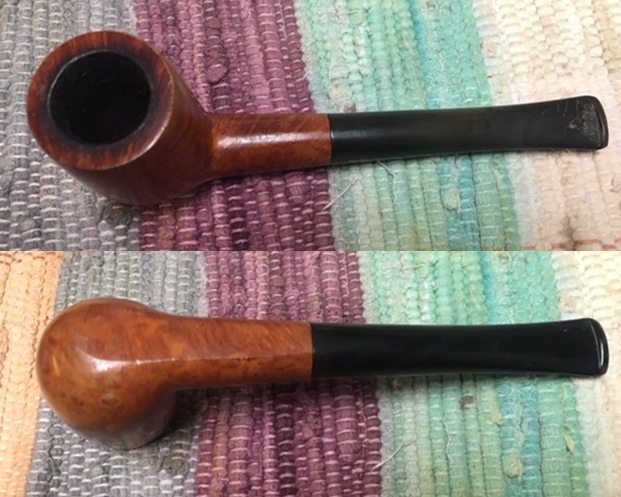
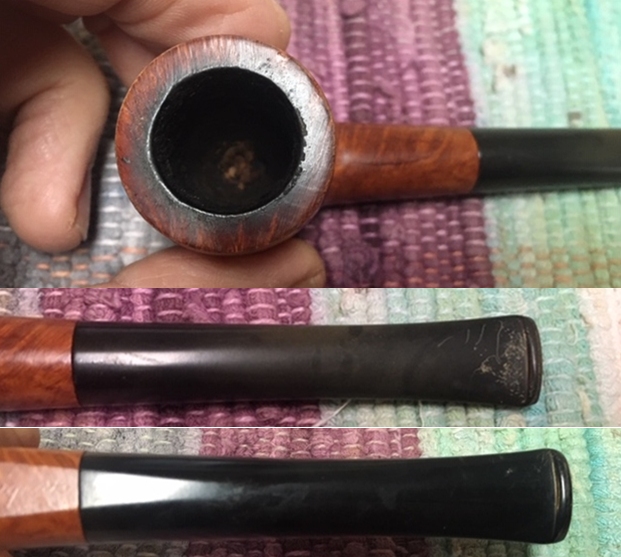
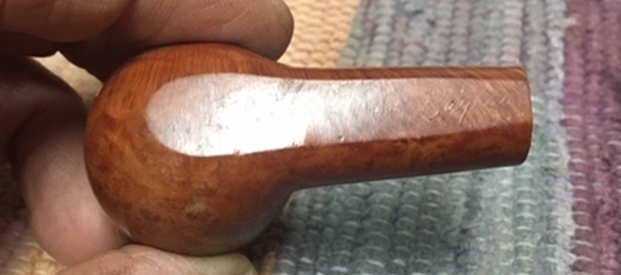
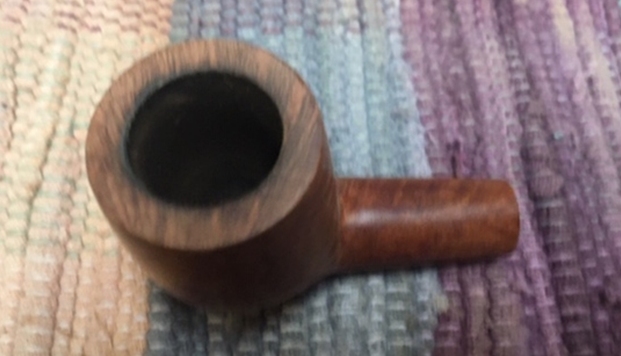
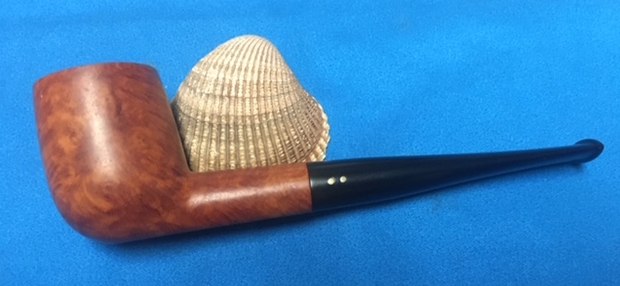
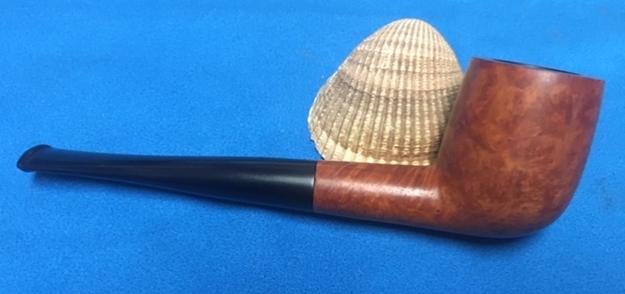
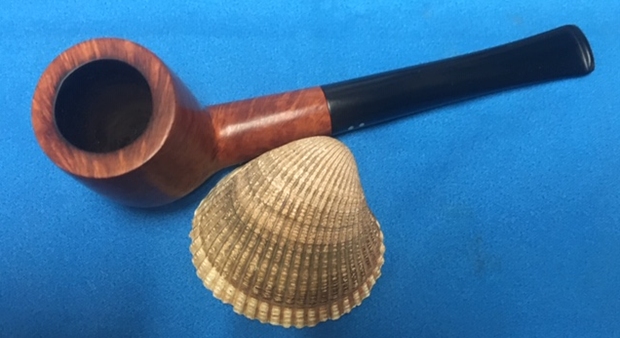
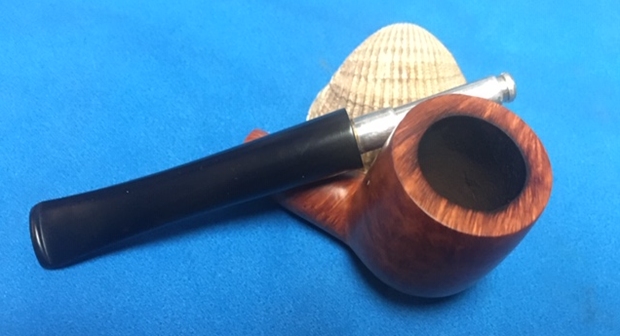
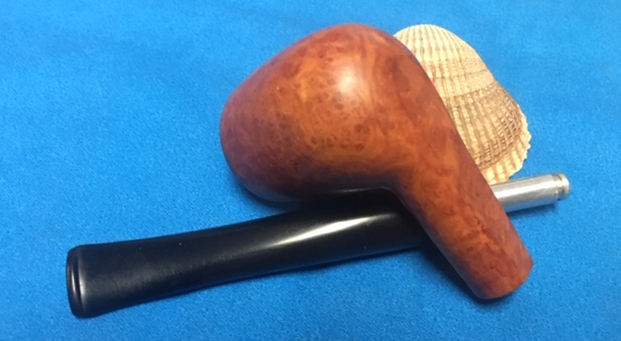
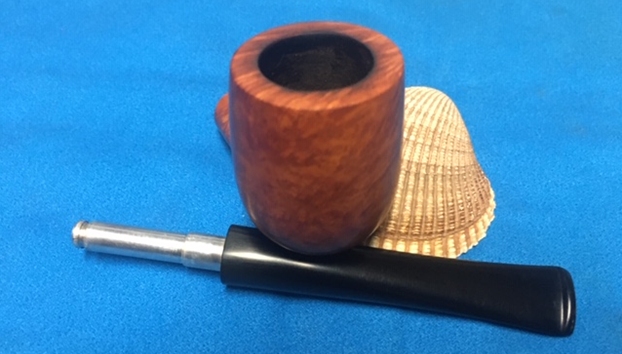
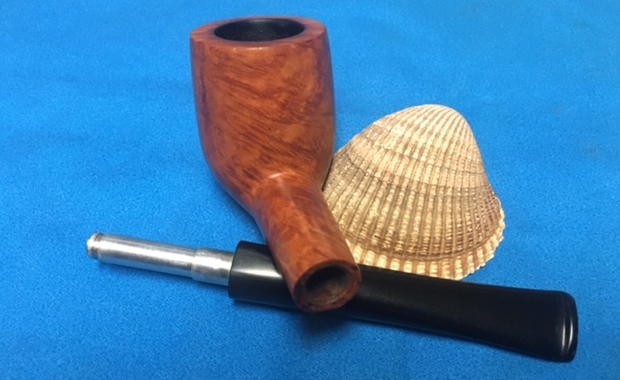
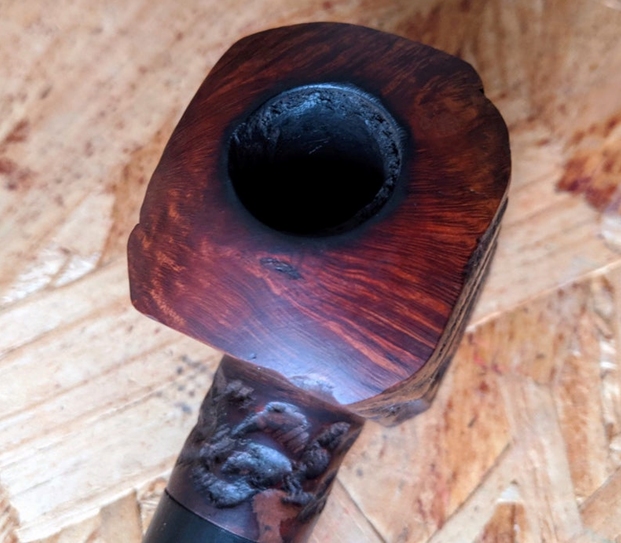
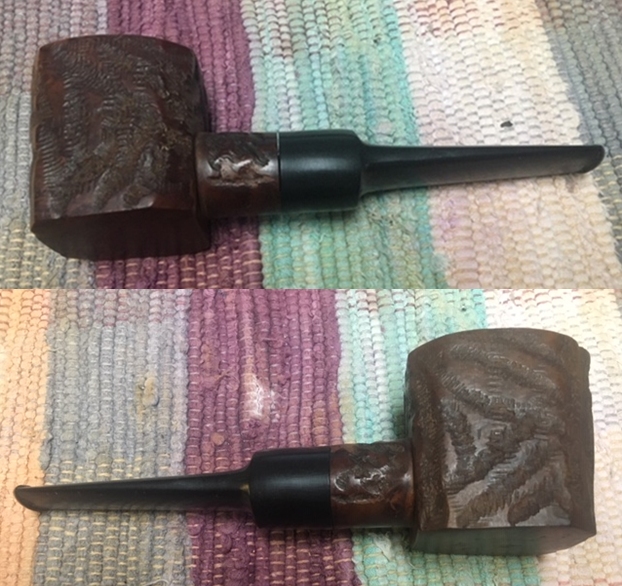
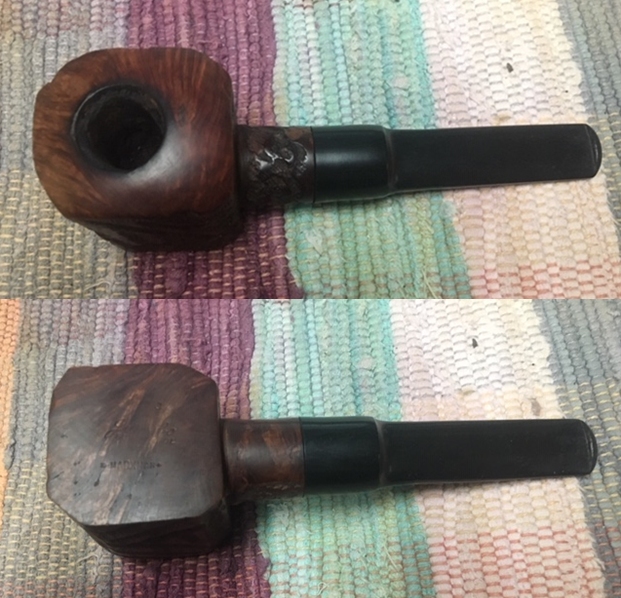
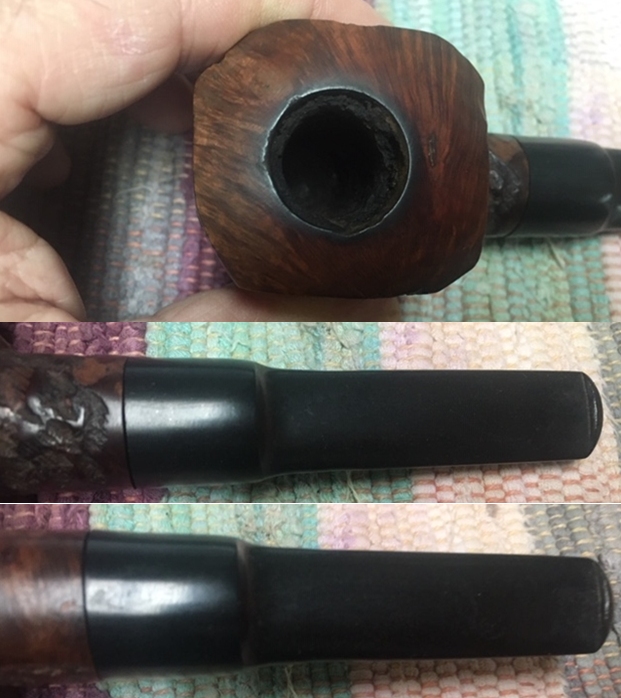
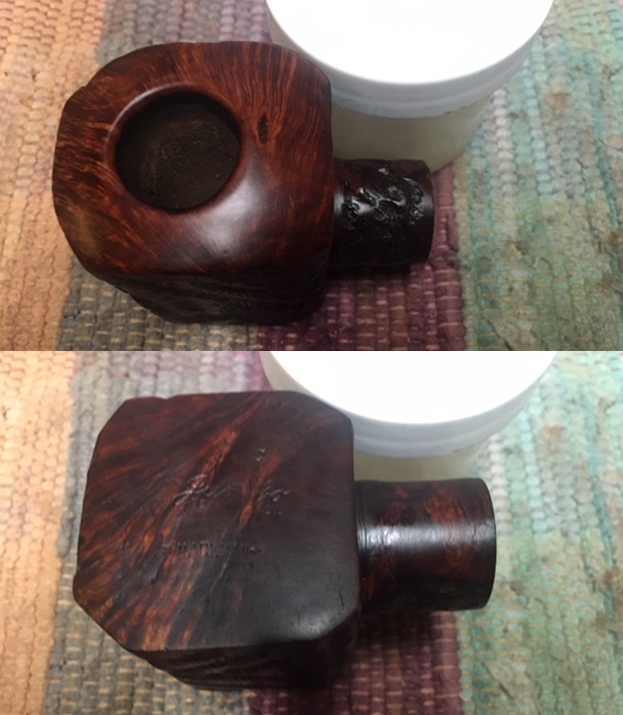
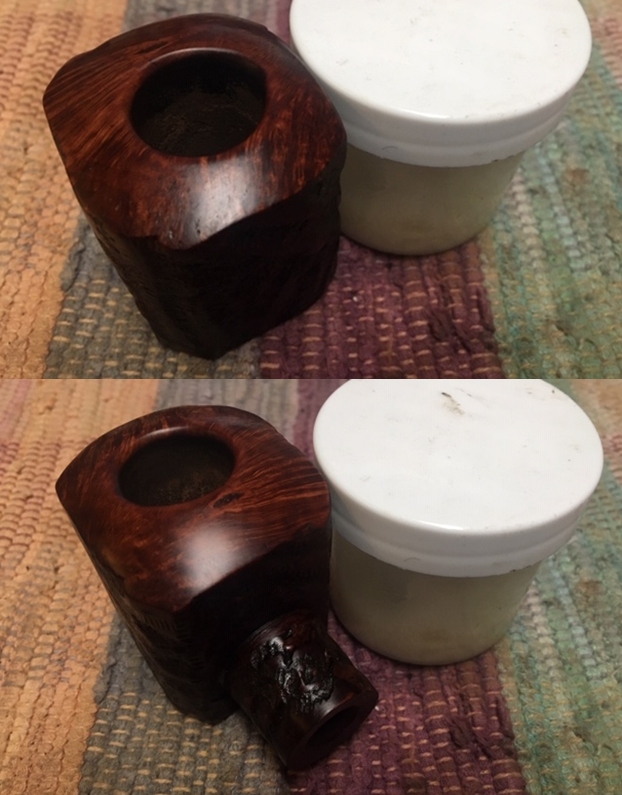
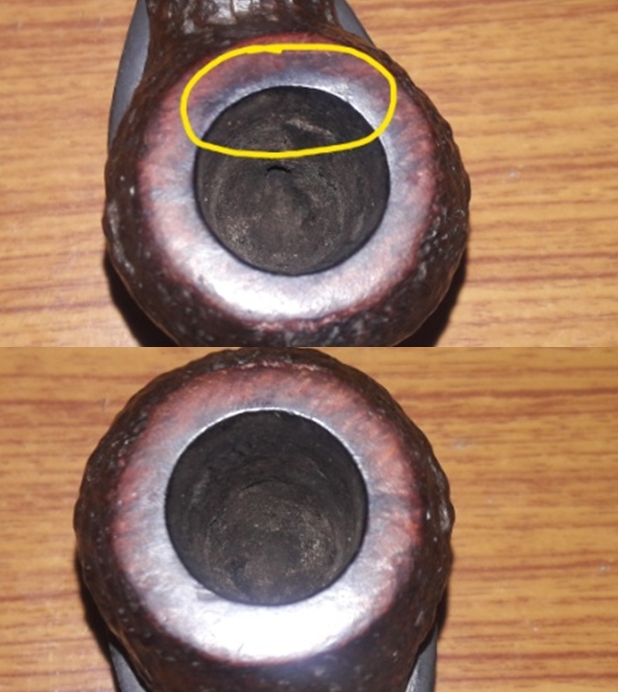
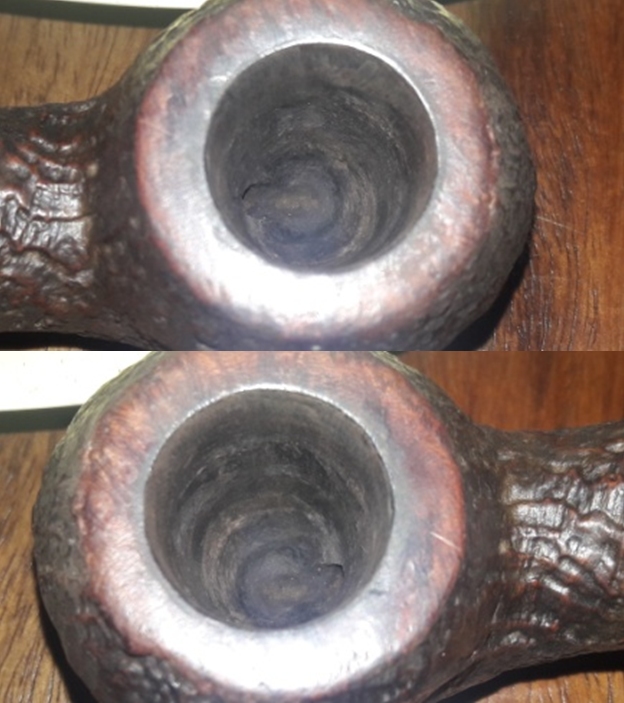
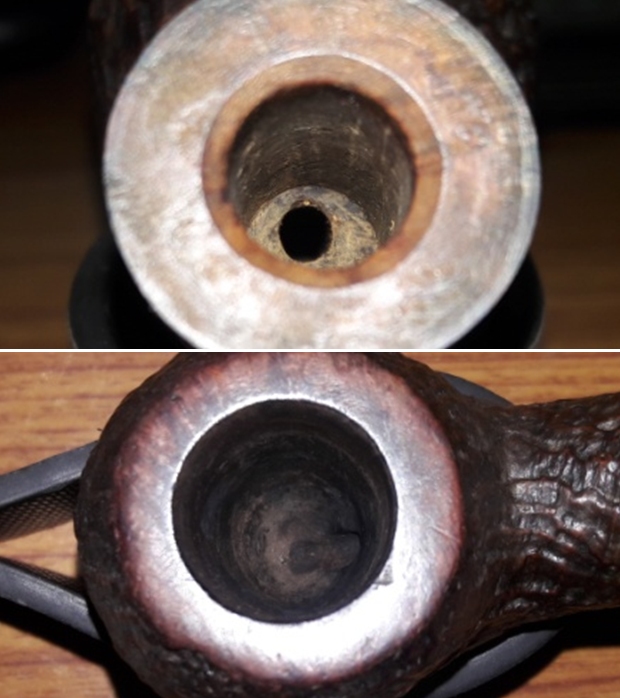
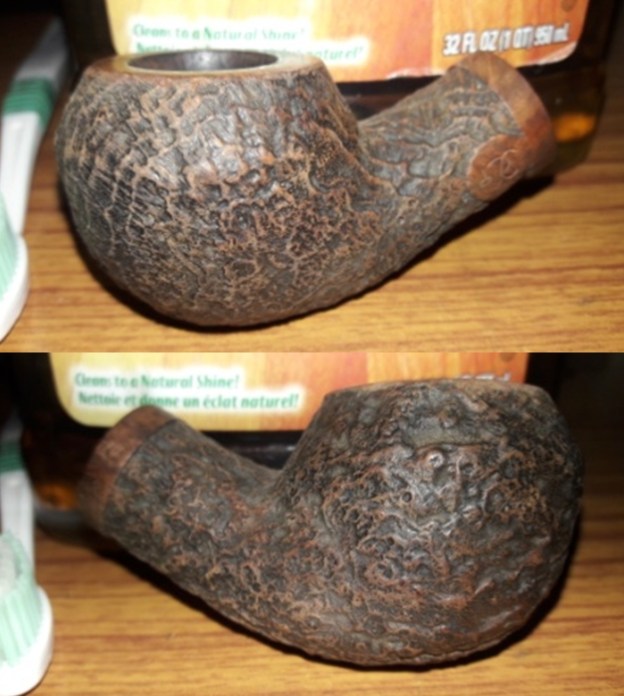
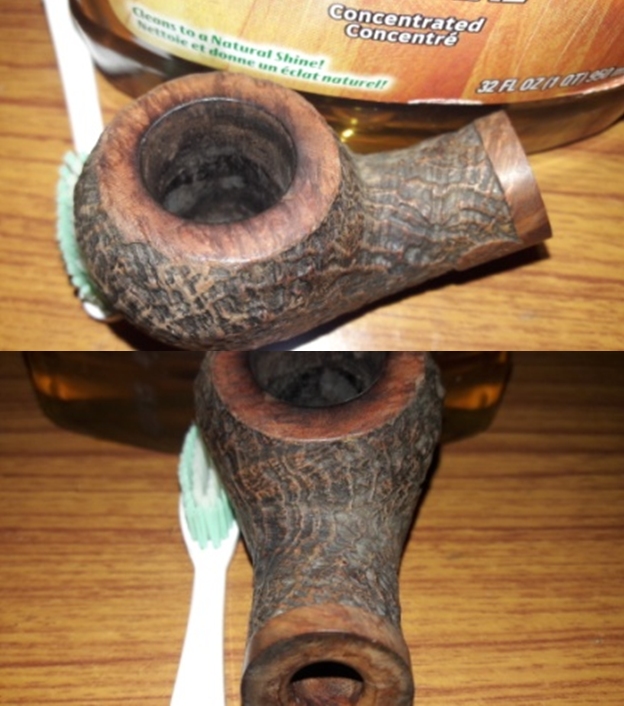
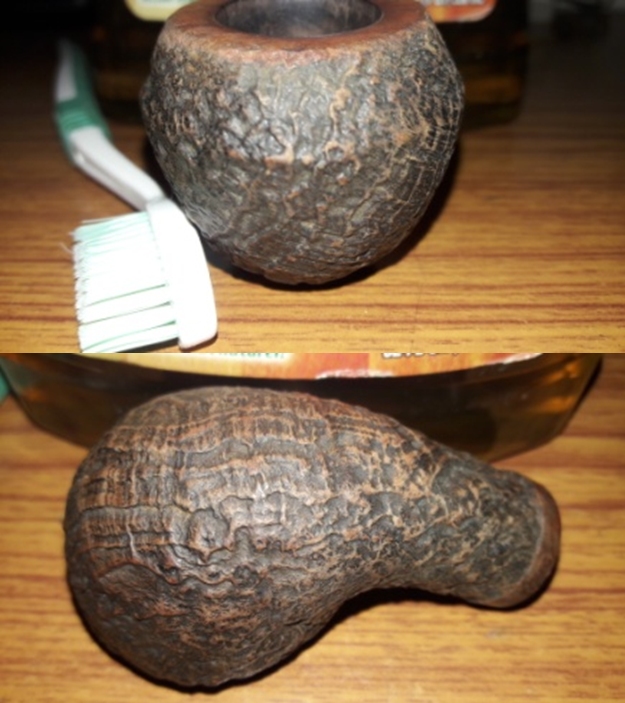
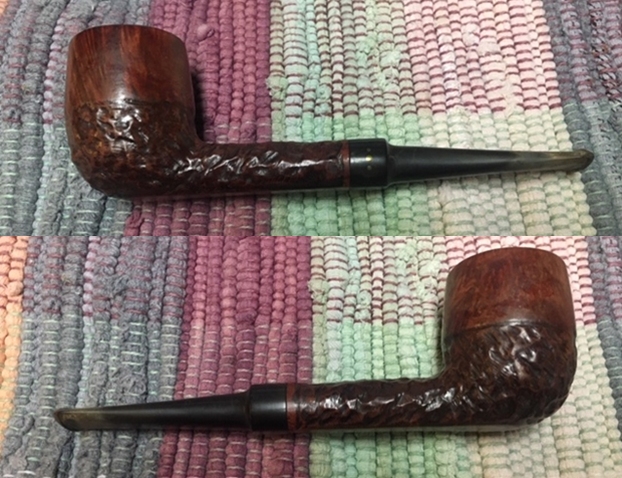
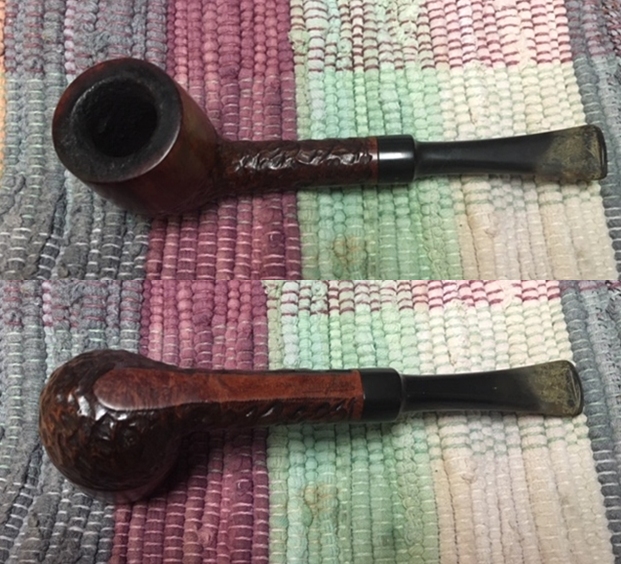
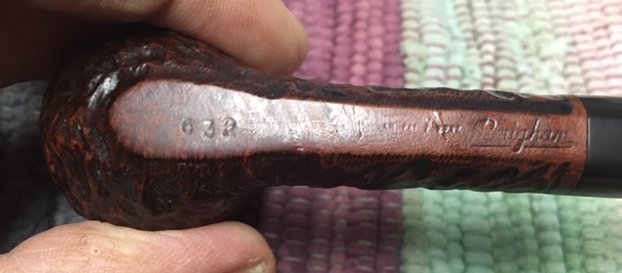
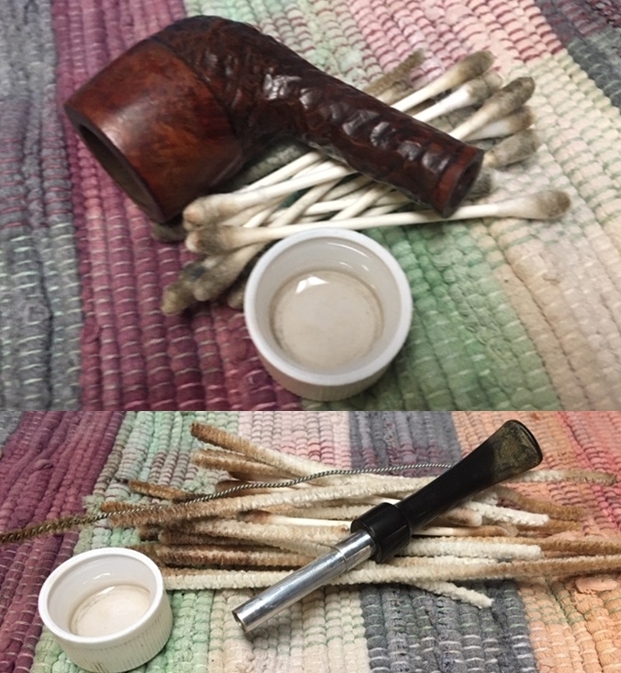
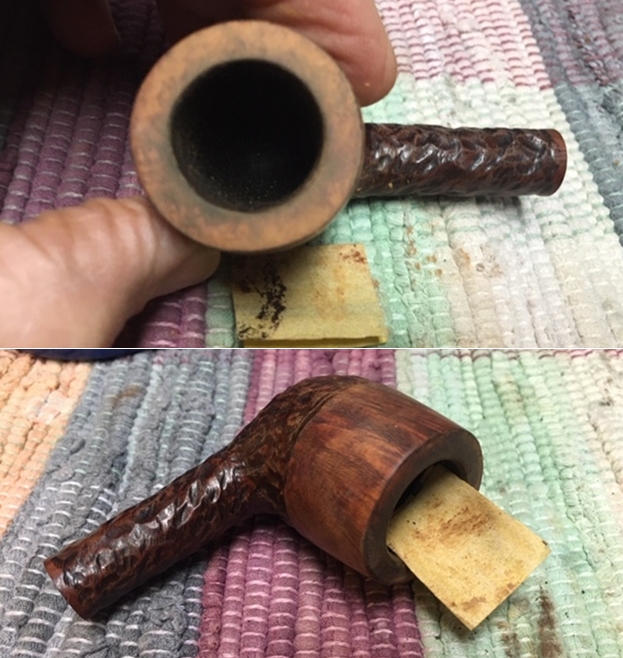
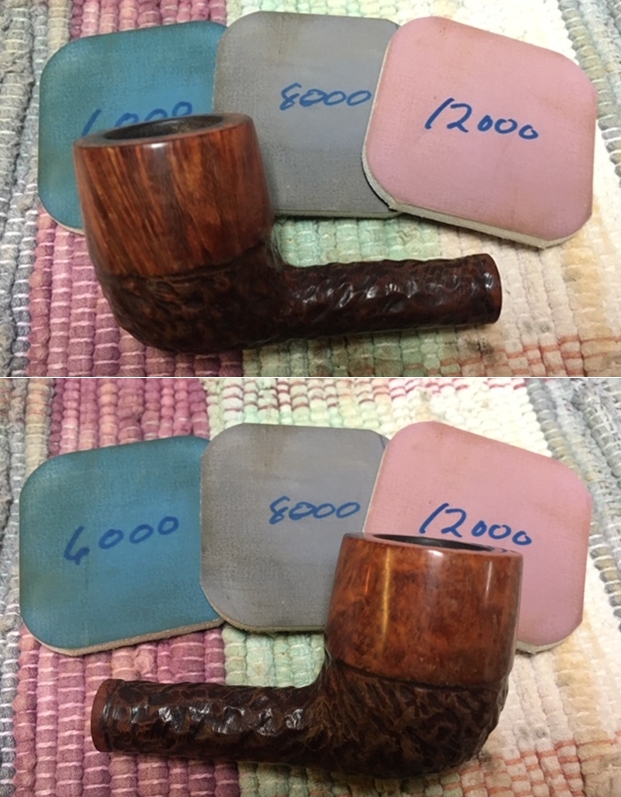
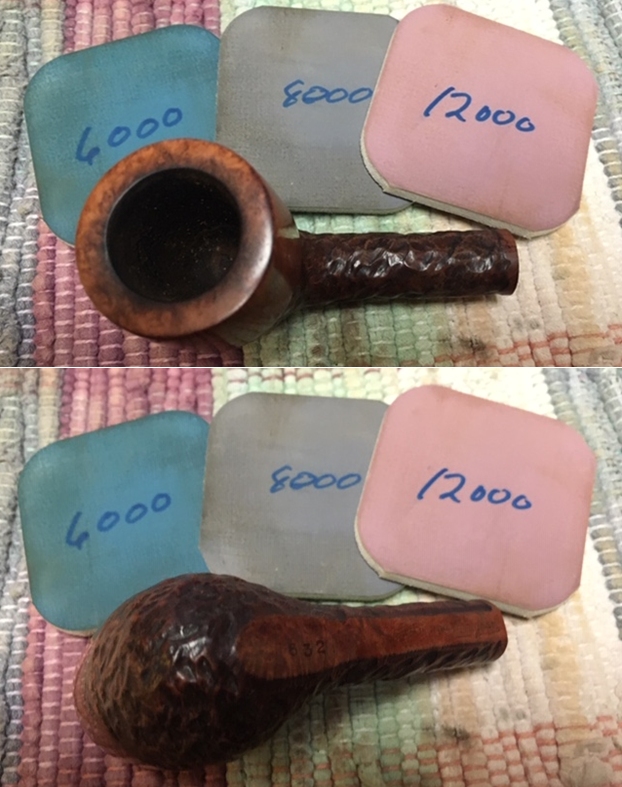
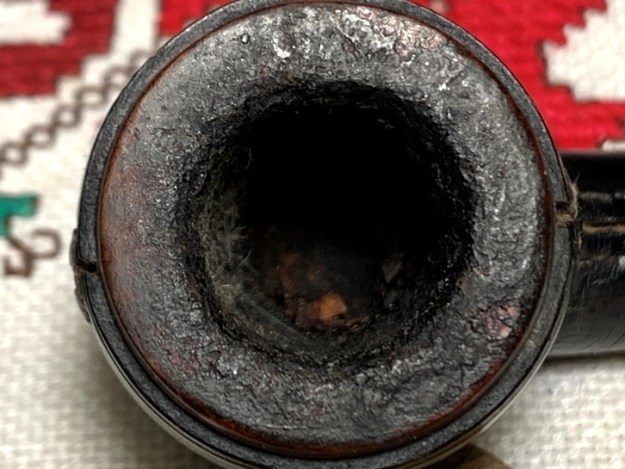
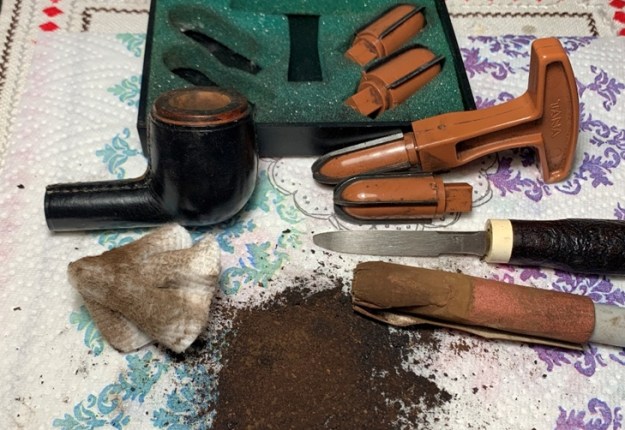
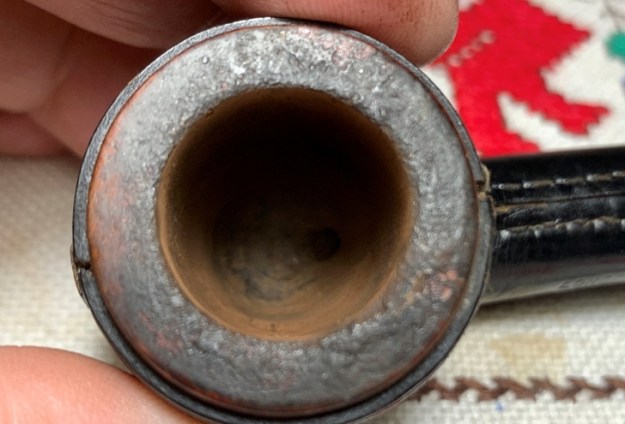
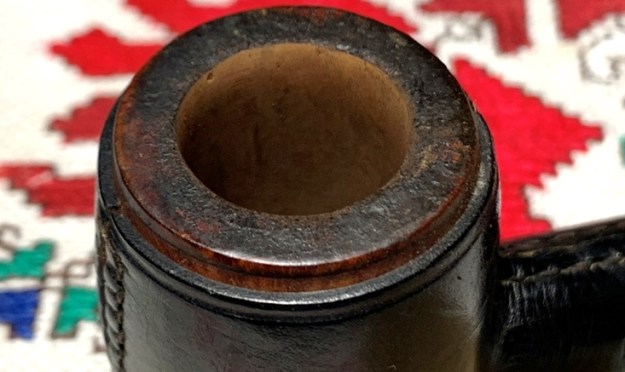
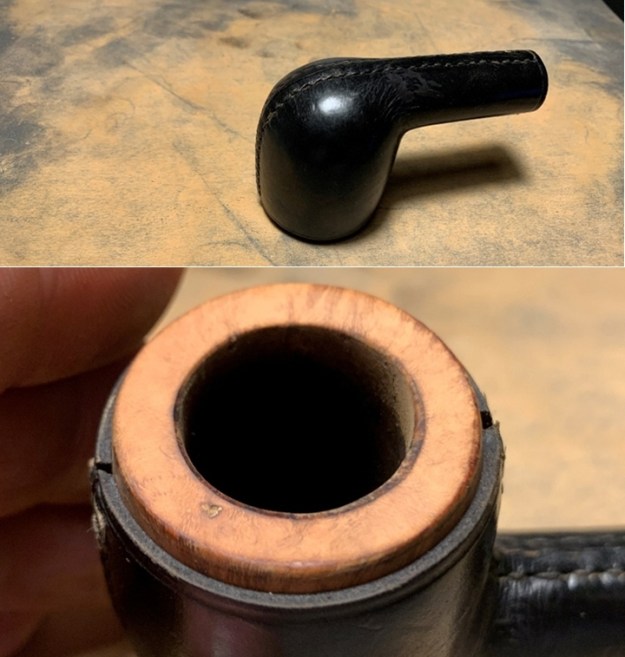
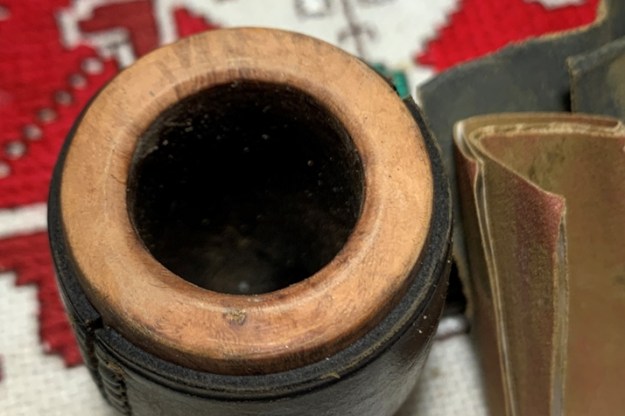
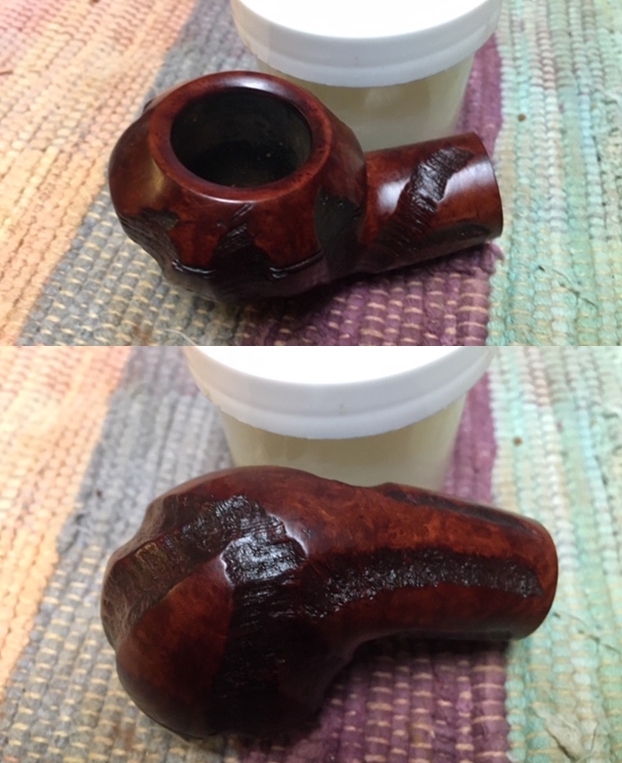
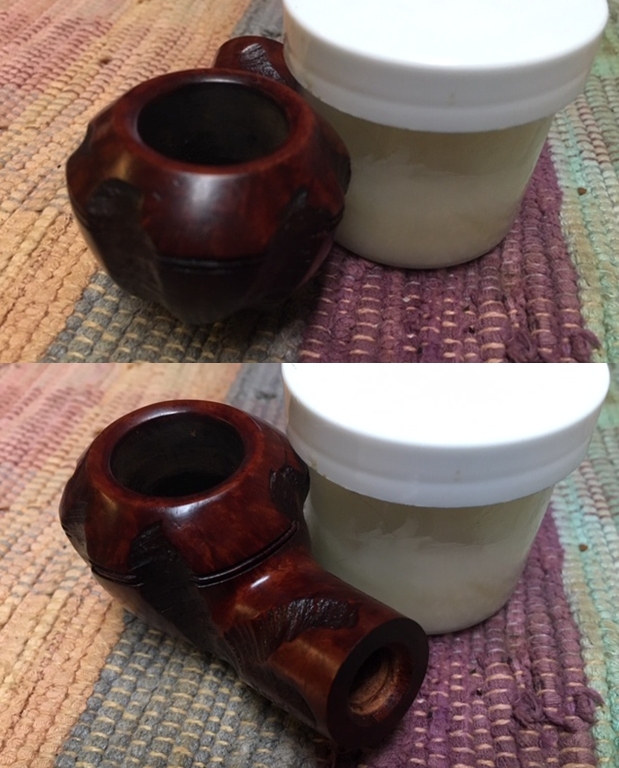
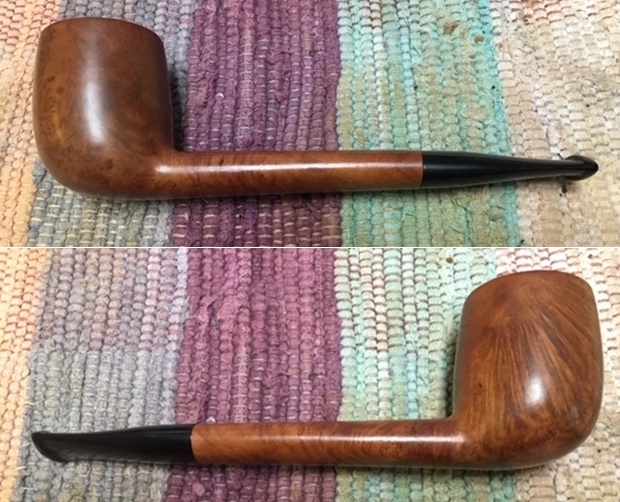
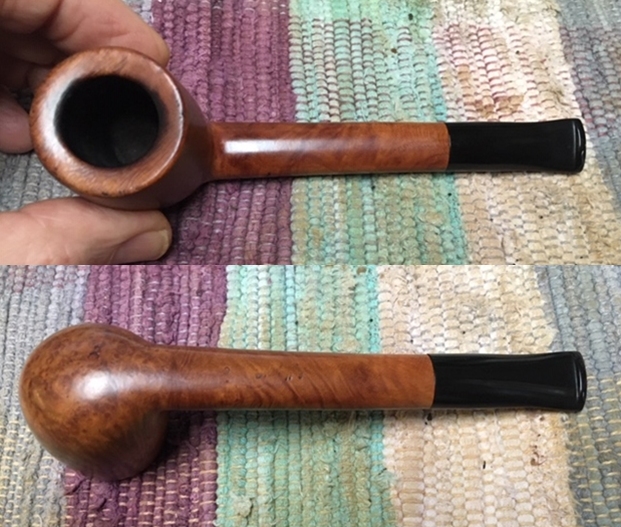
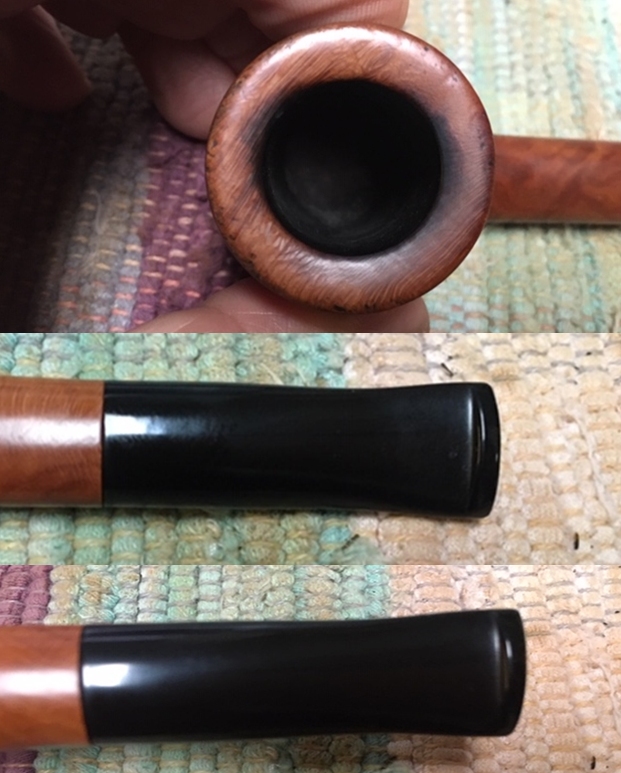
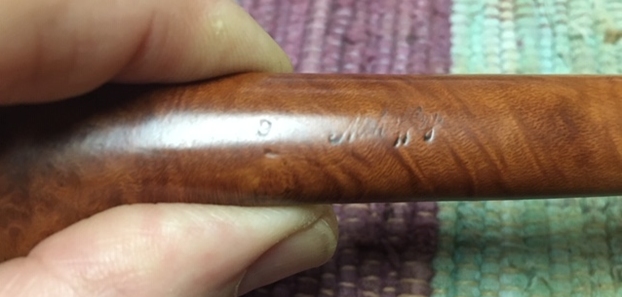
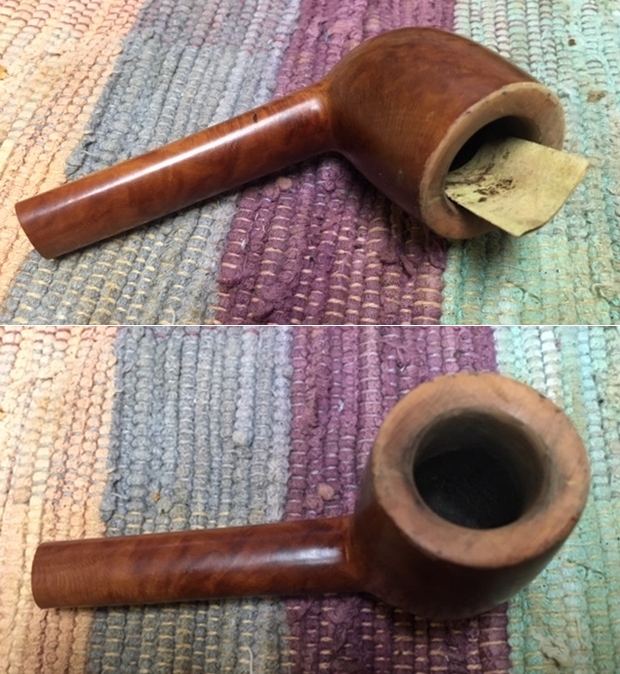
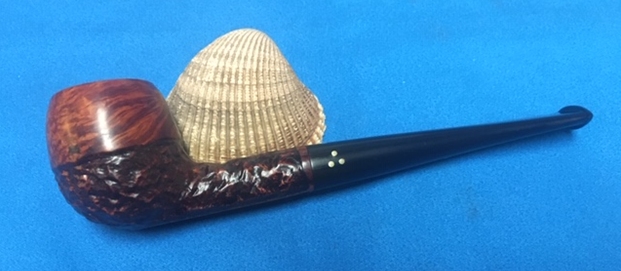
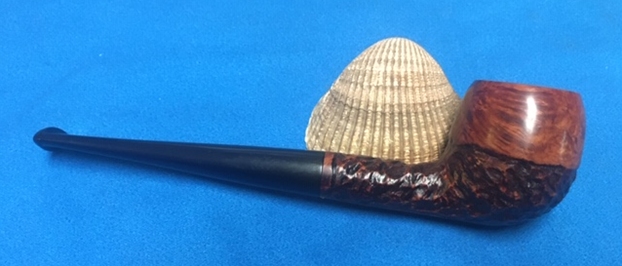
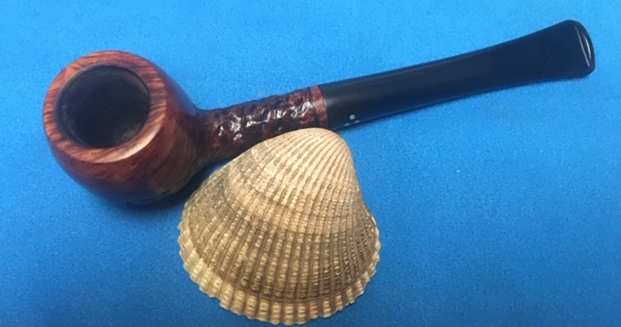
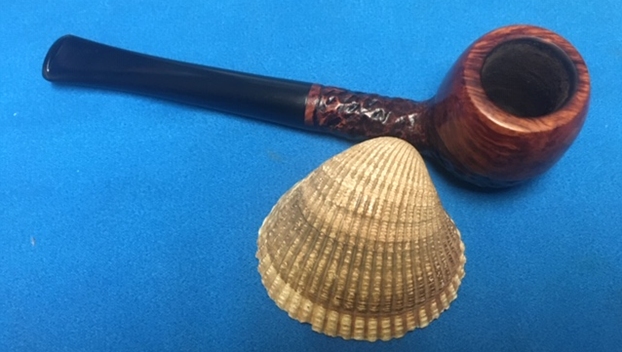
Alex has been an ongoing source of restoration projects for me for a few years now. I actually have a box of pipes that Alex drops by periodically and adds new pipes for work. It has been fun to see him pick up the restoration hobby himself lately. He leaves the harder ones to me to work on – whether harder in terms of issues or harder in terms of cleaning. This particular pipe is a nicely grained natural finished Canadian that is stamped 9 Mehaffey on the underside of the shank. It has been in the box in isolation in a sealed plastic bag because of the smell of the bowl. It really does reek.  I took it to the work table this quiet Sunday afternoon. The finish is natural with a slight patina from age. The rim top had an inward bevel that had some darkening and burn damage to the inner edge on the front right and back of the bowl. The top of the rim was also damaged and there were some nicks around the outer edge of the bowl as well. The pipe had been reamed before Alex received it but it smells musty and a bit dank. The smell of English tobacco is permeated with a different smell that gives the pipe a stench. The stem was in good condition other than a few small tooth marks on both sides just ahead of the button. Overall the pipe was in good condition. I took some photos of the pipe as I received it. I took a close up photo of the rim top. It shows some nicks in the surface of the inward beveled top. The outer edges show nicks and damage. The inner edge has some burn marks near the right front of the bowl and on the back side. The top also has what appear to be wrinkles in the briar finish. The photos of the stem looked pretty good. There were small tooth marks on the top and underside of the stem near the button. Otherwise the stem was in very good condition.I took a photo of the stamping on the underside of the shank. You can see that it is faint but reads as noted above.Though I had not worked on this brand before, Dal Stanton who has written blogs for rebornpipes had worked on one Mehaffey pipe so I turned to that blog to see what he had found previously (https://rebornpipes.com/tag/e-a-mehaffey-pipe-tobacco-shop-in-wheaton-maryland/). I followed the link on the blog and turned to Pipedia to see if there was any additional information added since Dal had been there previously (https://pipedia.org/wiki/Mehaffey). There was not much information available but I quote what was there in full.

E.A. Mehaffey operated a pipe & tobacco shop in Wheaton, Maryland. He used to make pipes for many years but as legend has it, his house tobacco mixtures were much more prestigious than his pipes. Mehaffey was in business up to the 1980’s.

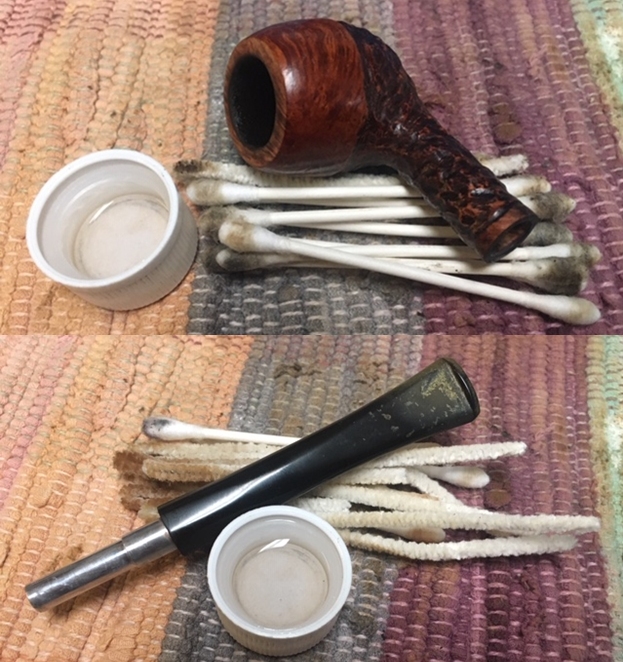
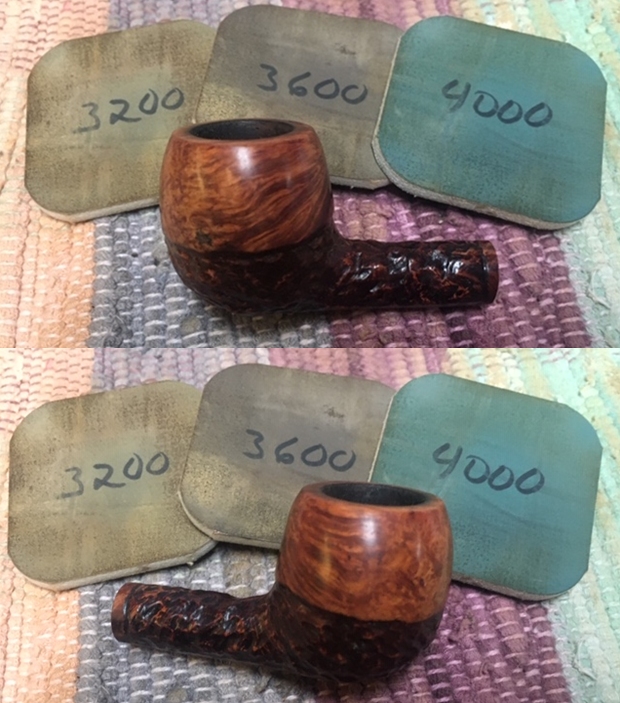
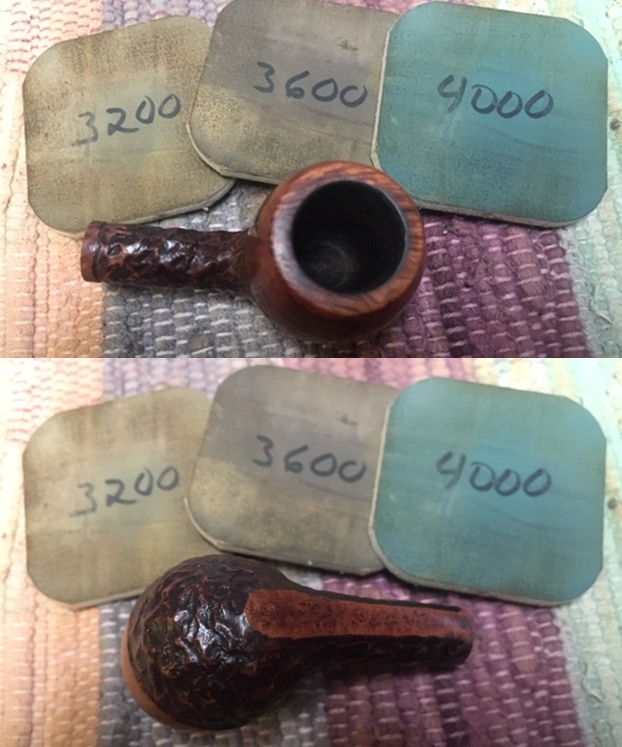
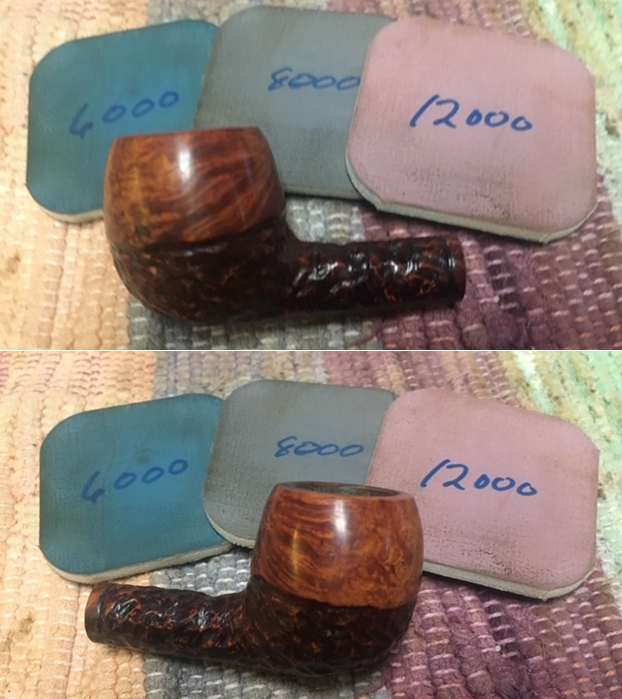
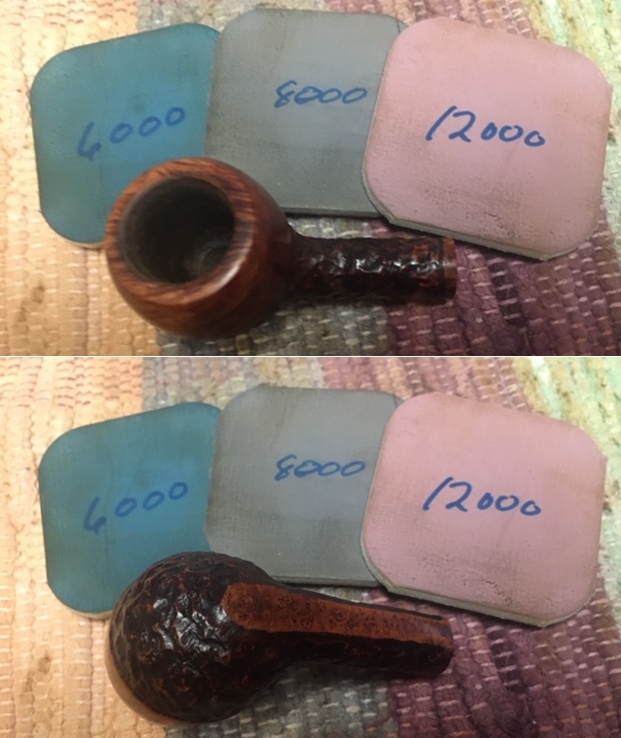
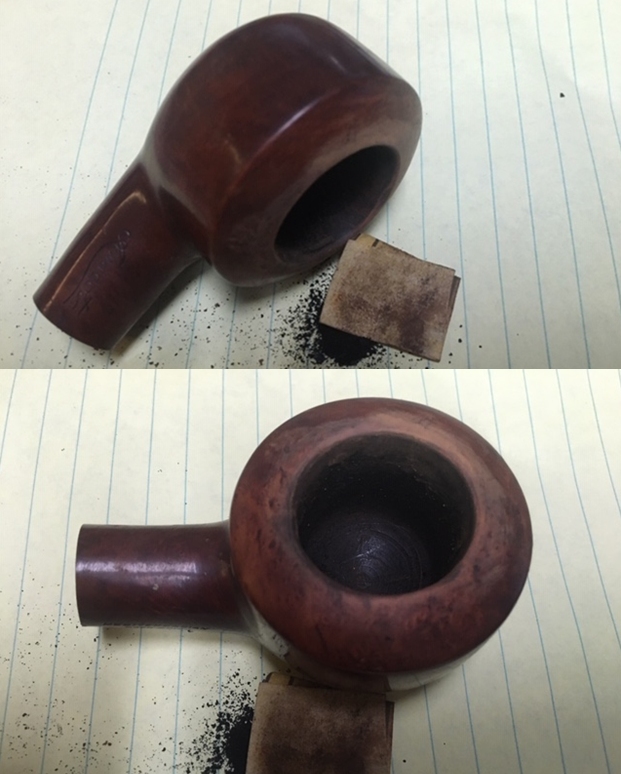
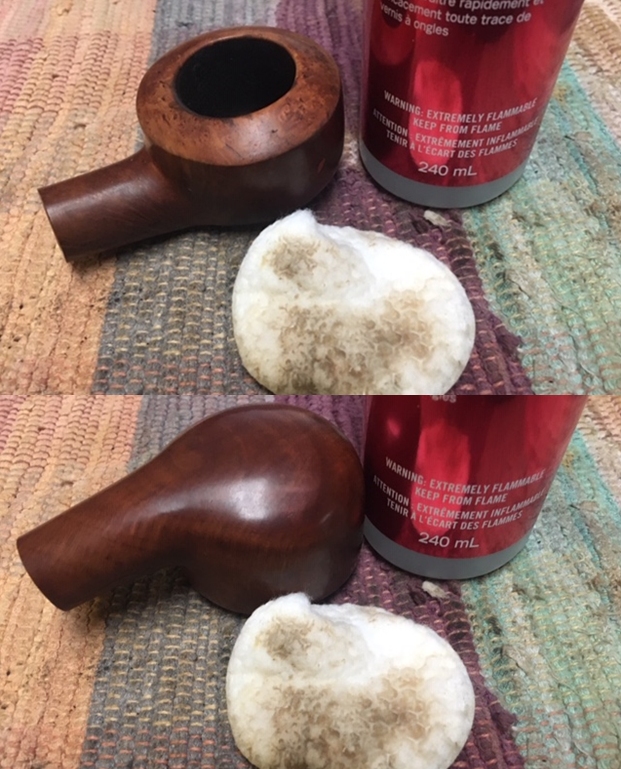
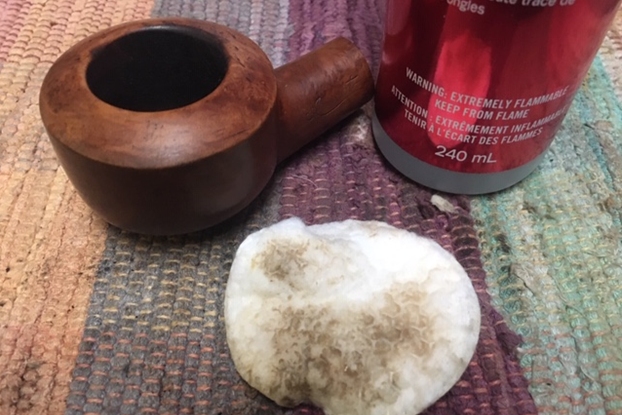
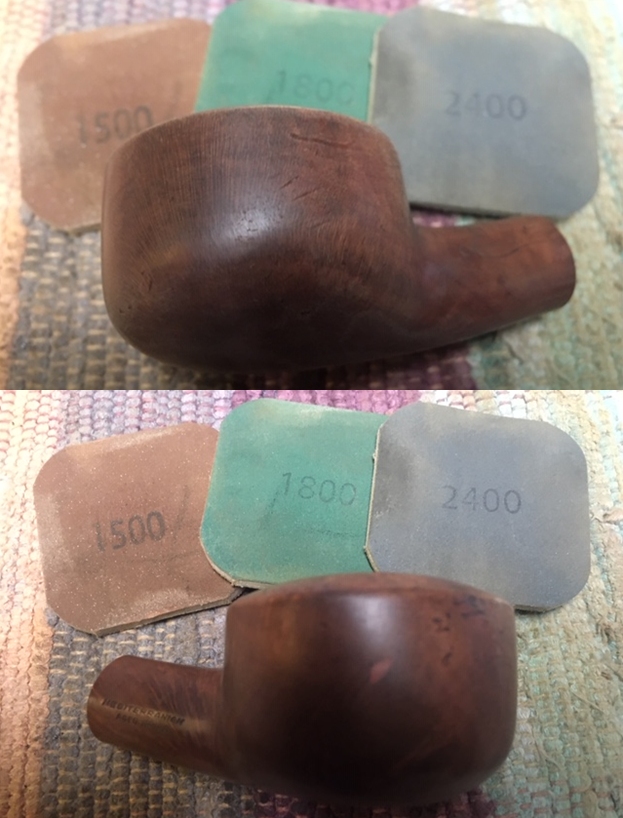
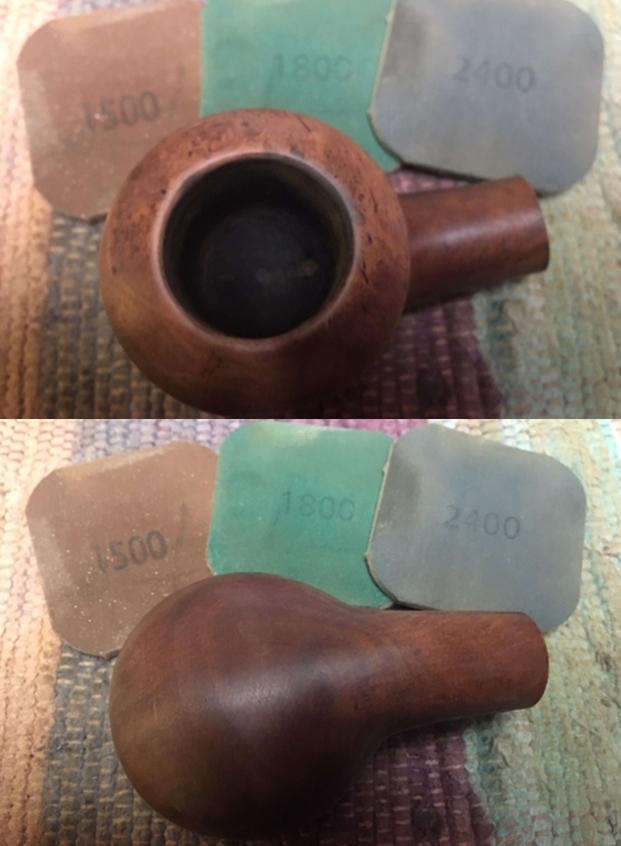
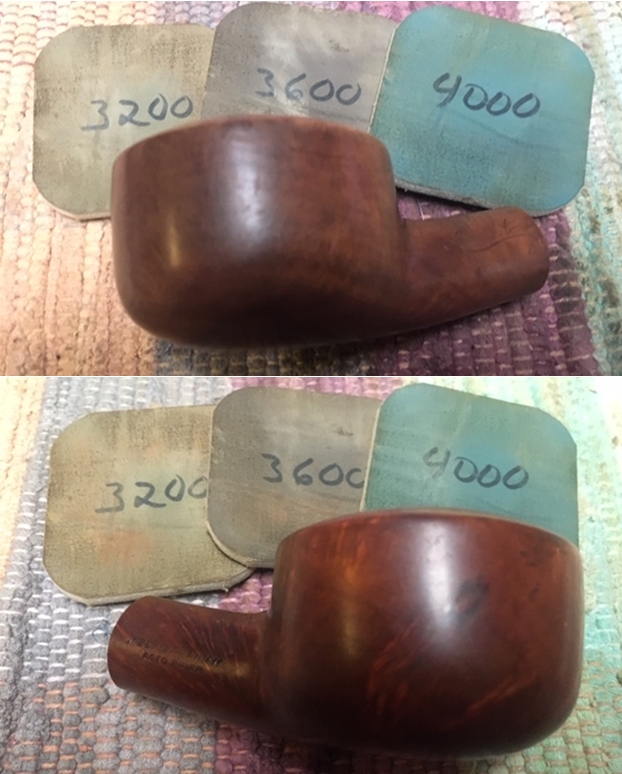
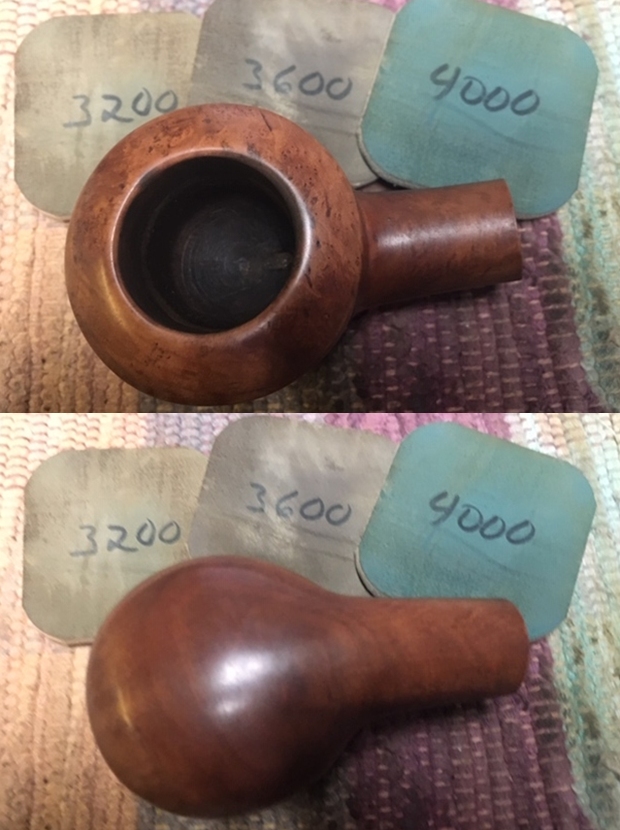
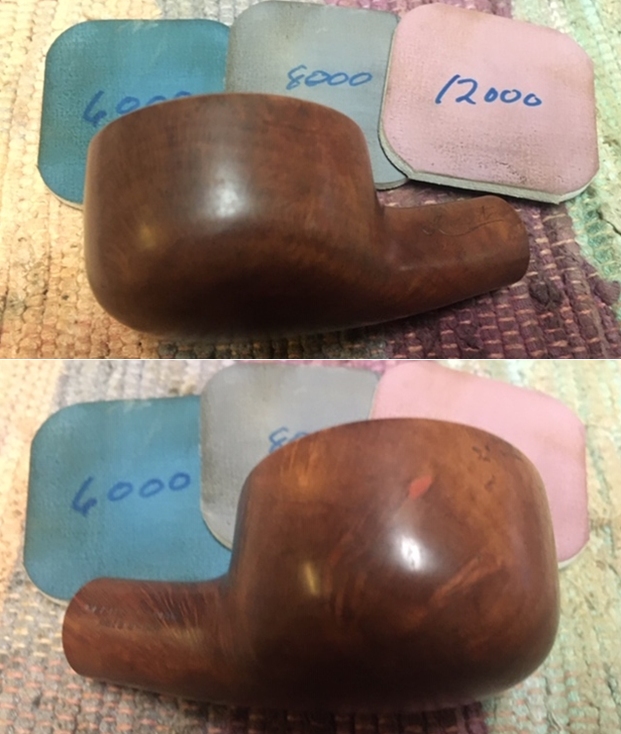
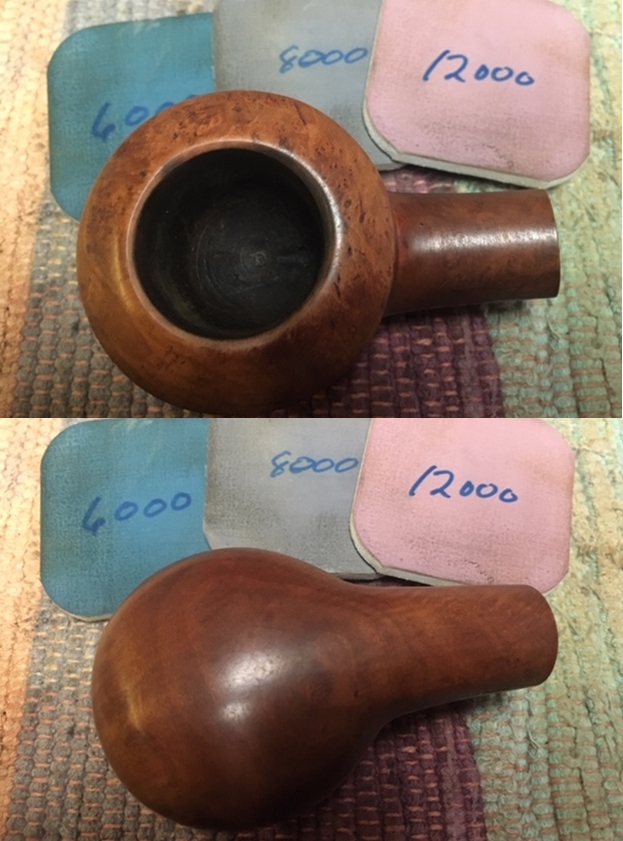
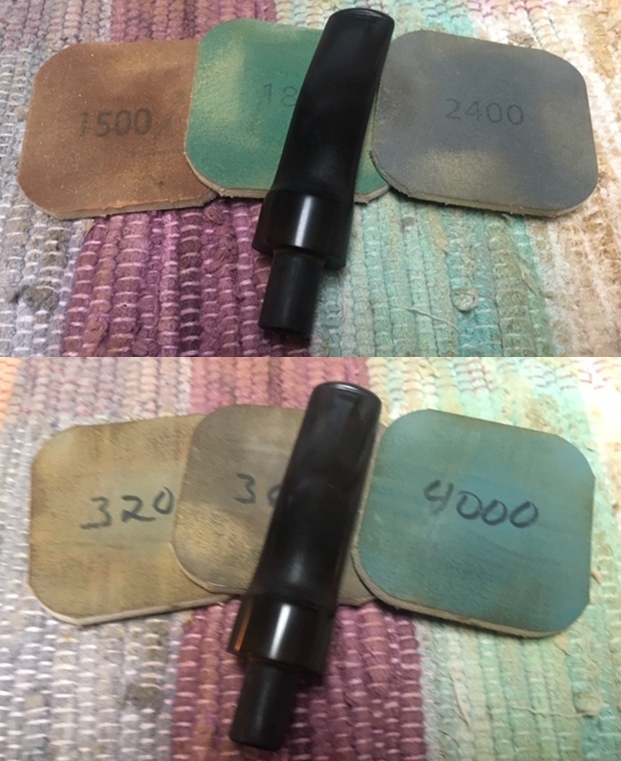
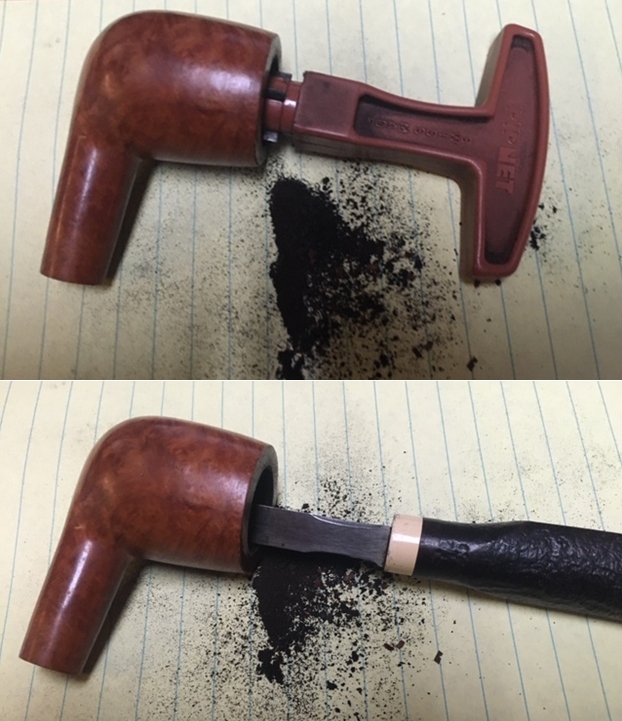
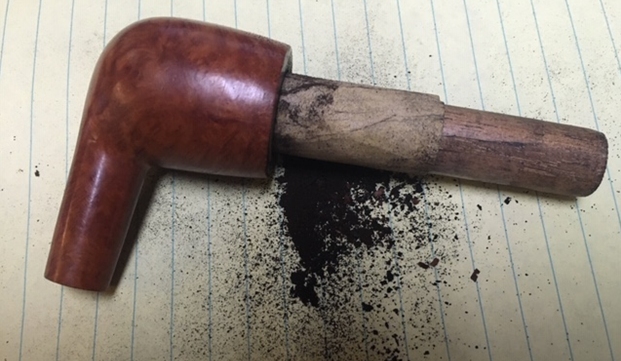
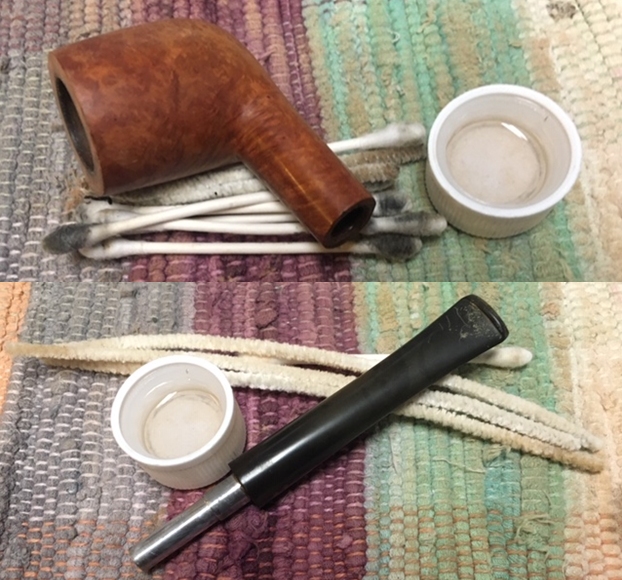
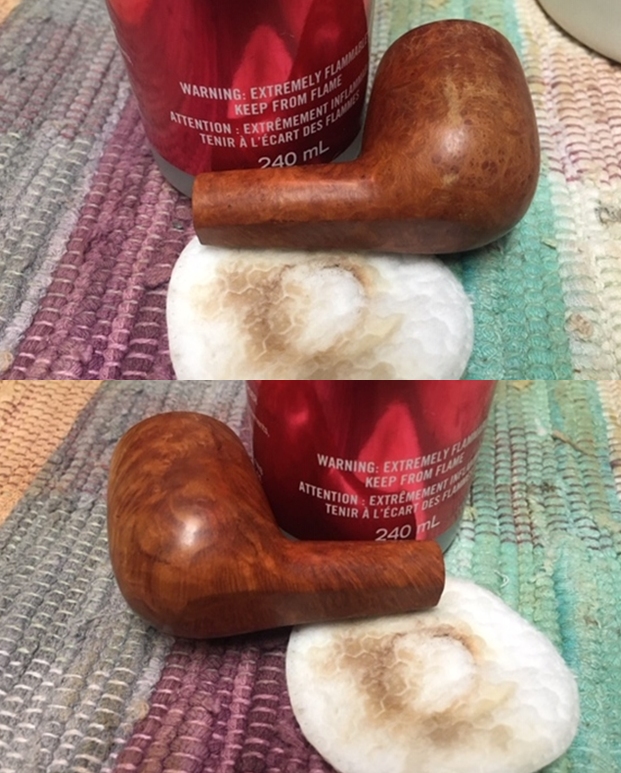
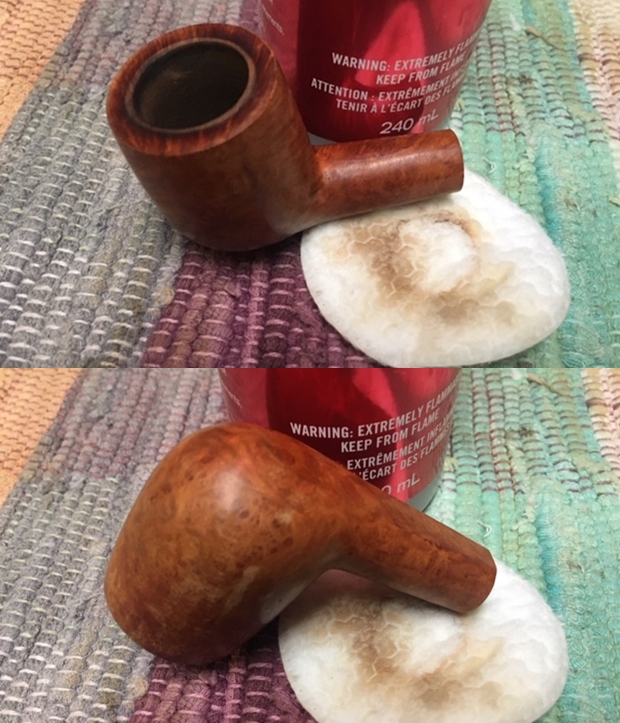
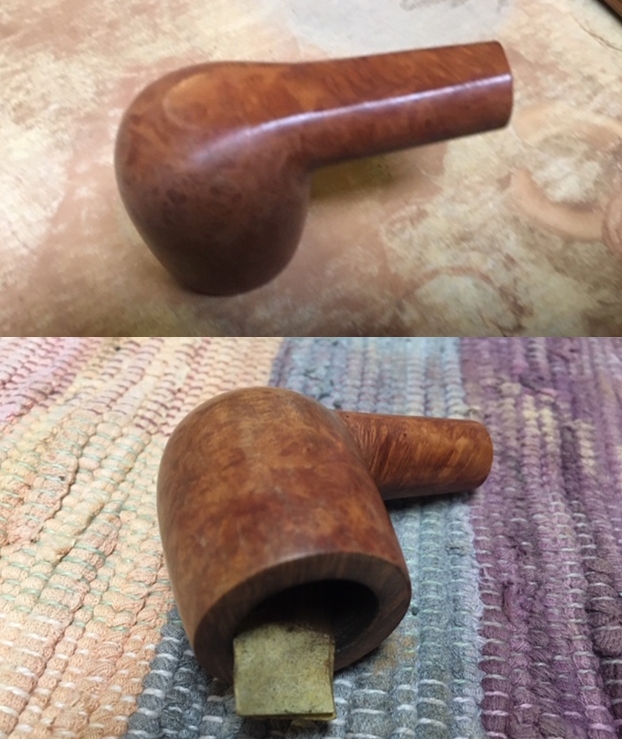
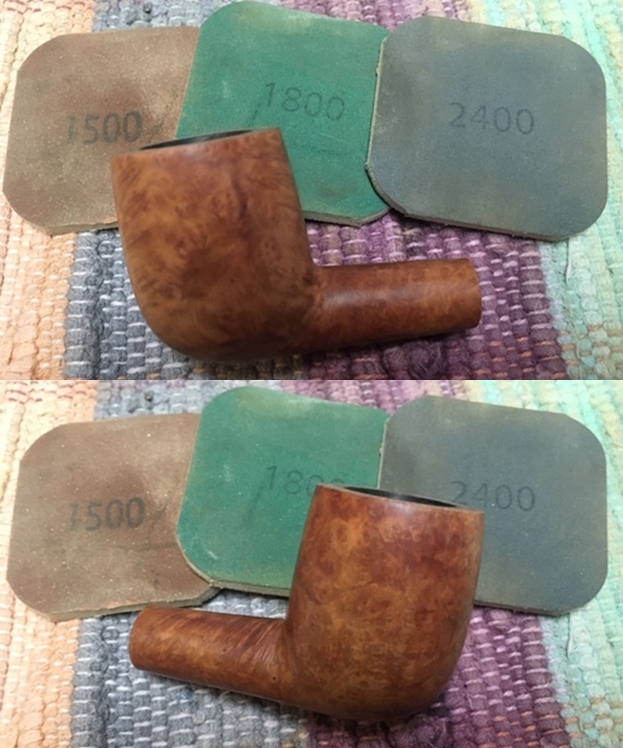
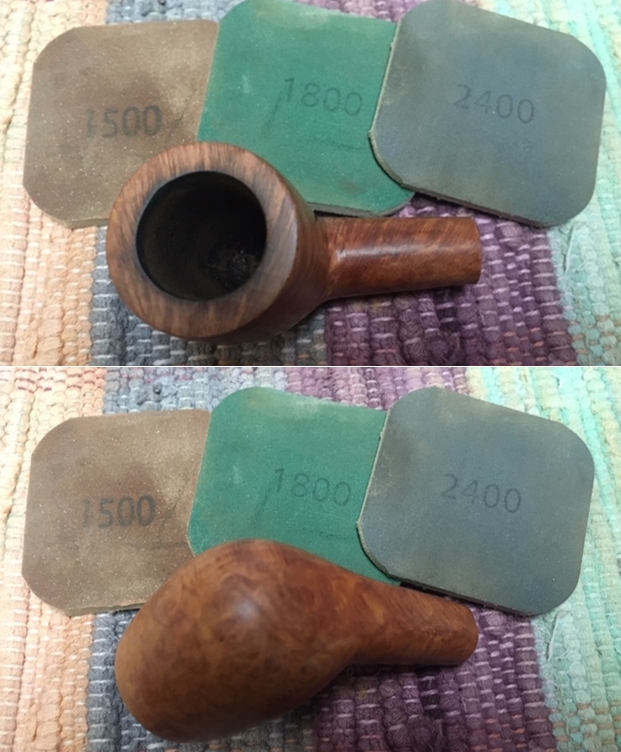
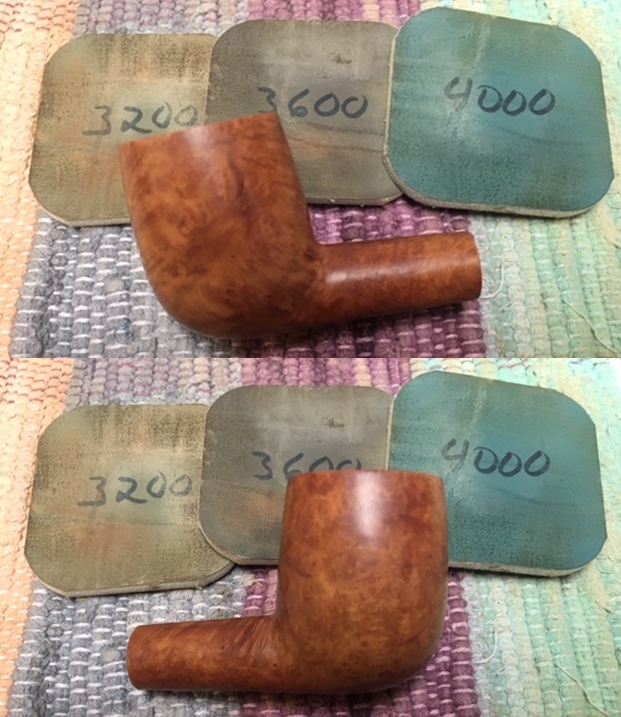
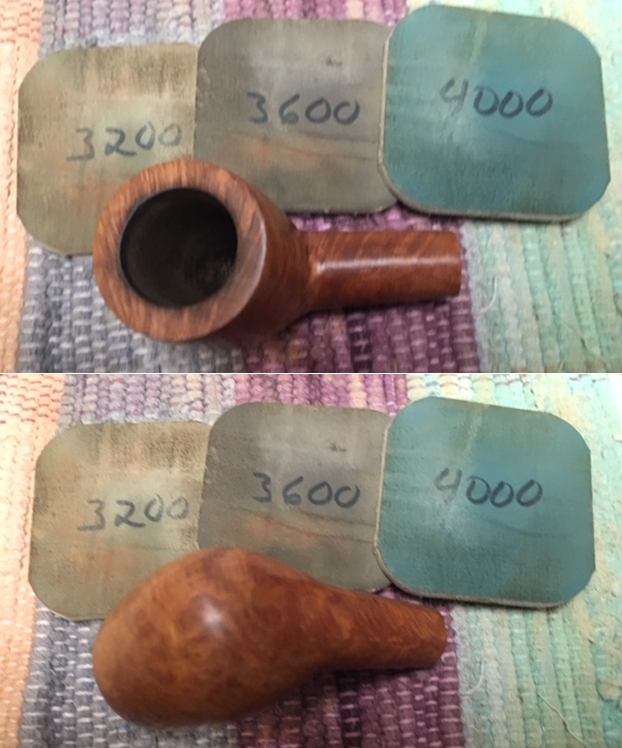
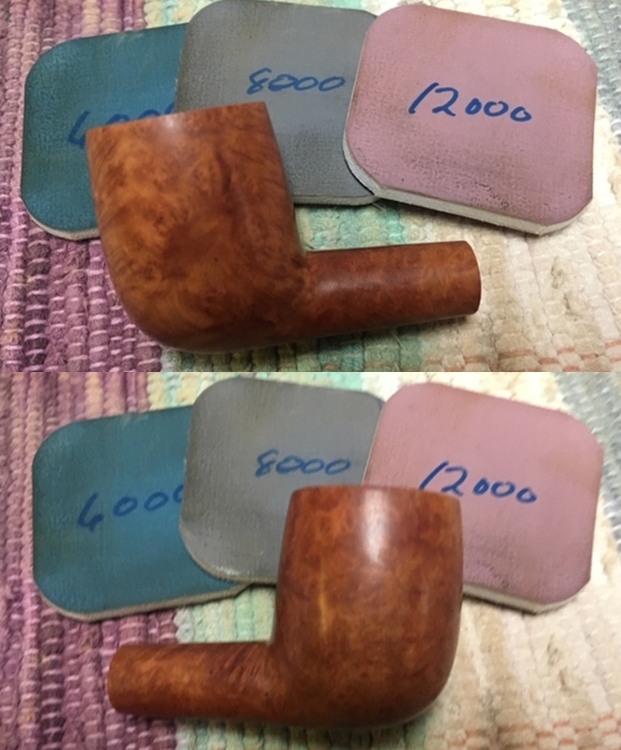
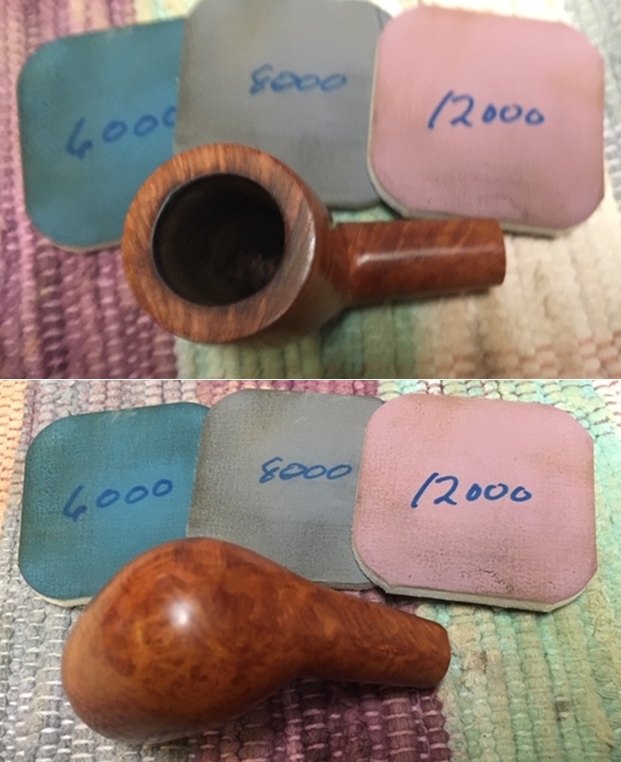
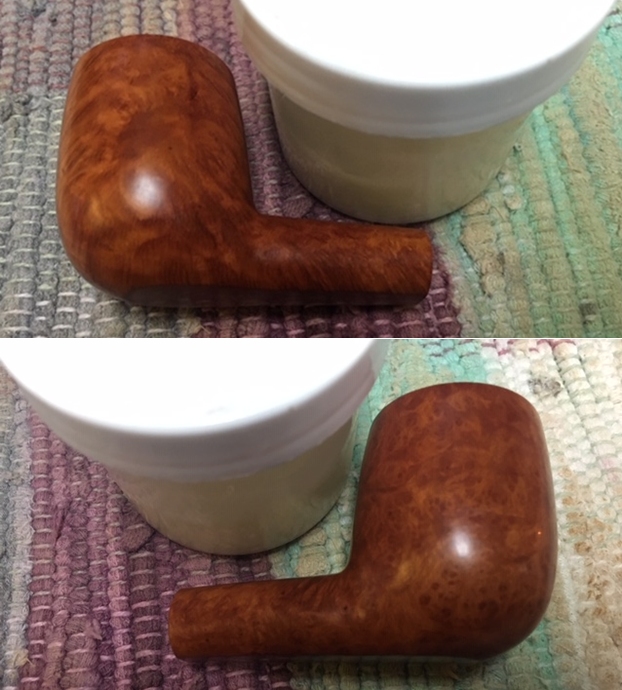
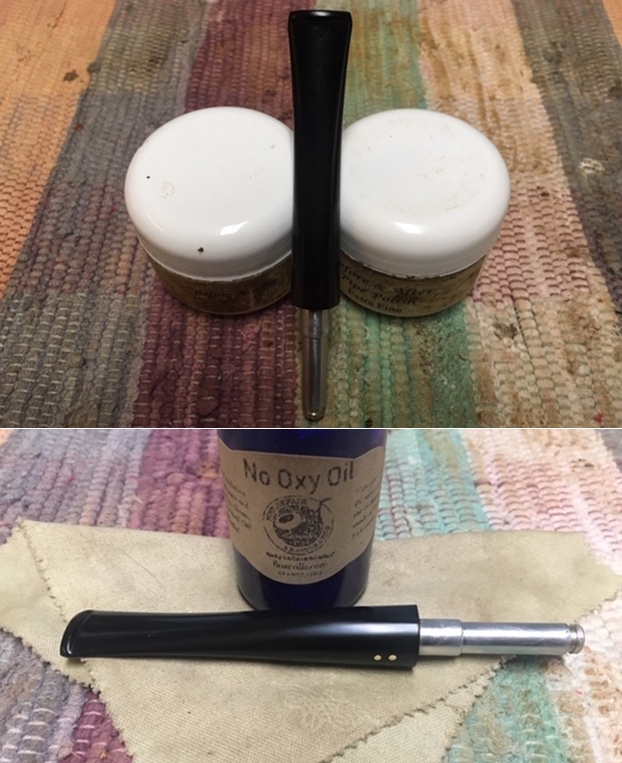
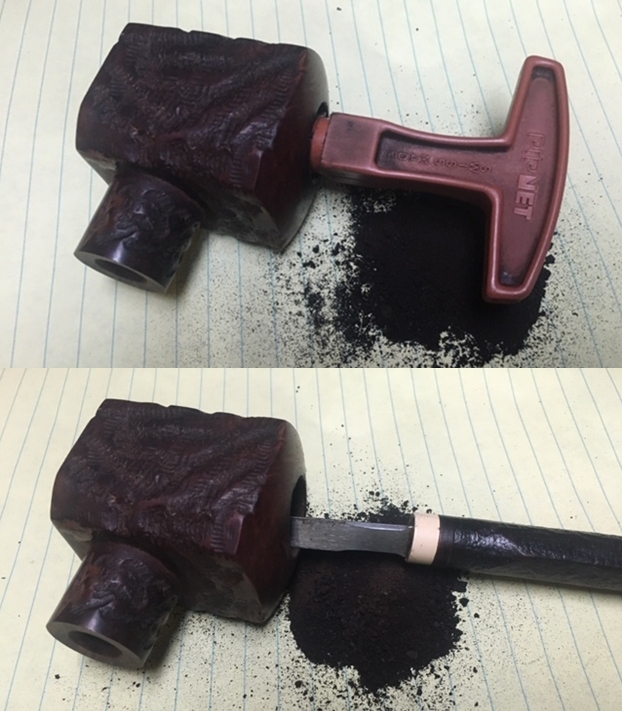
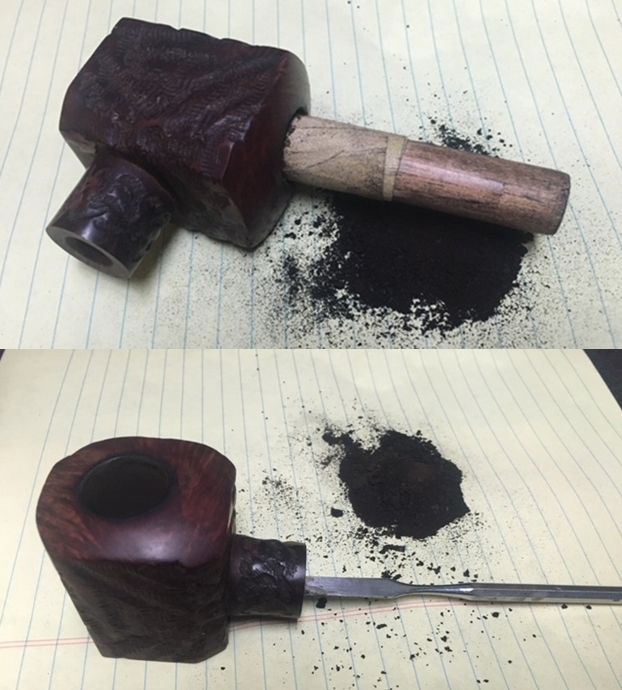
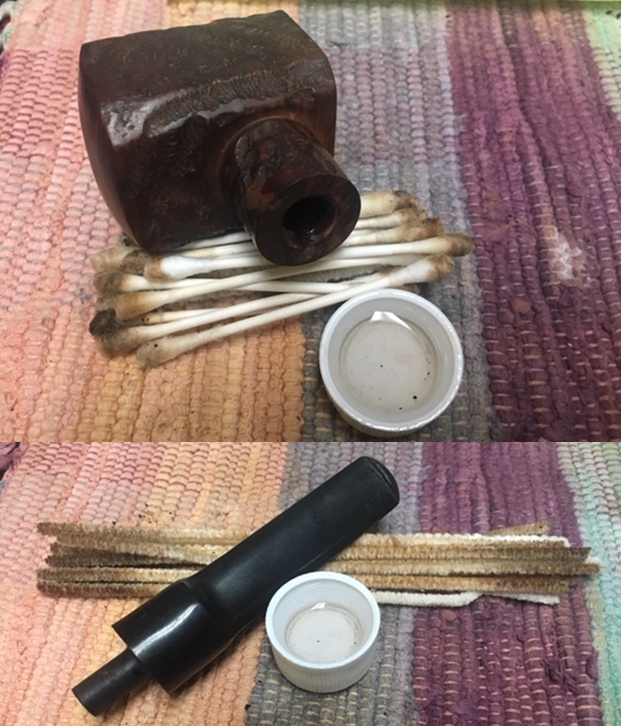
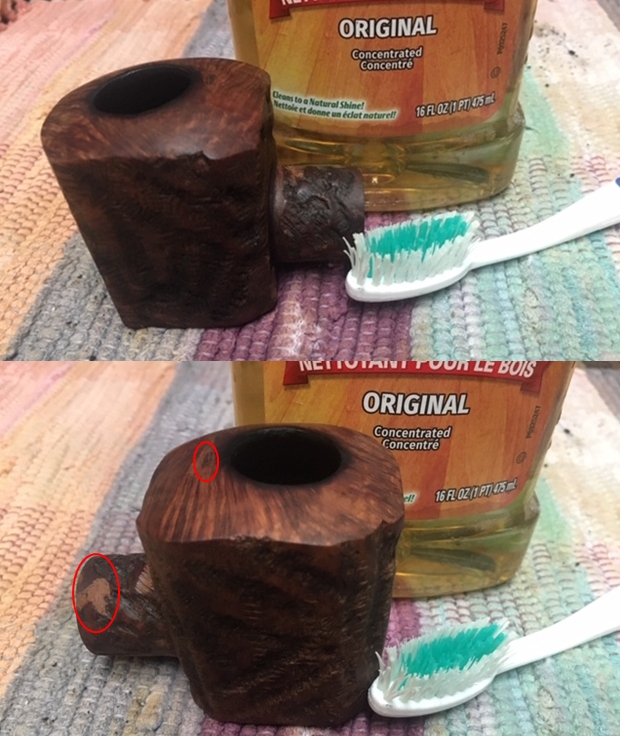
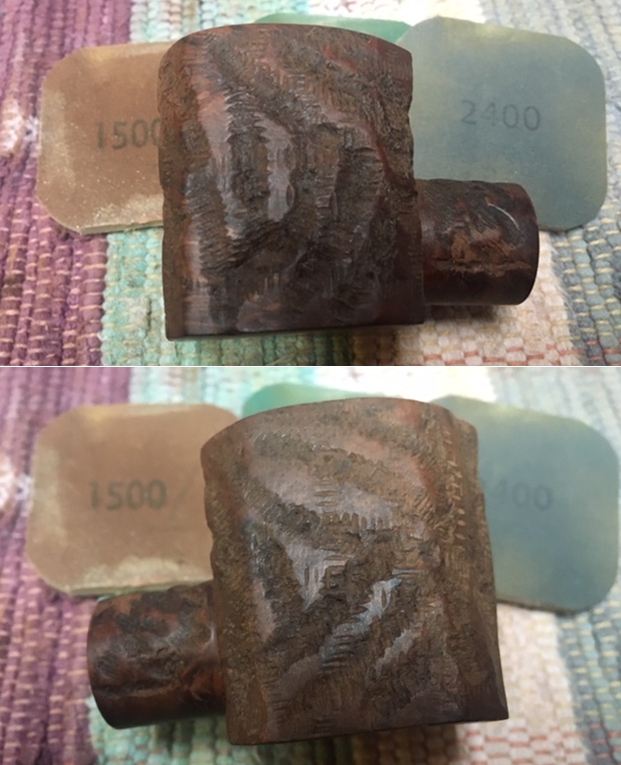
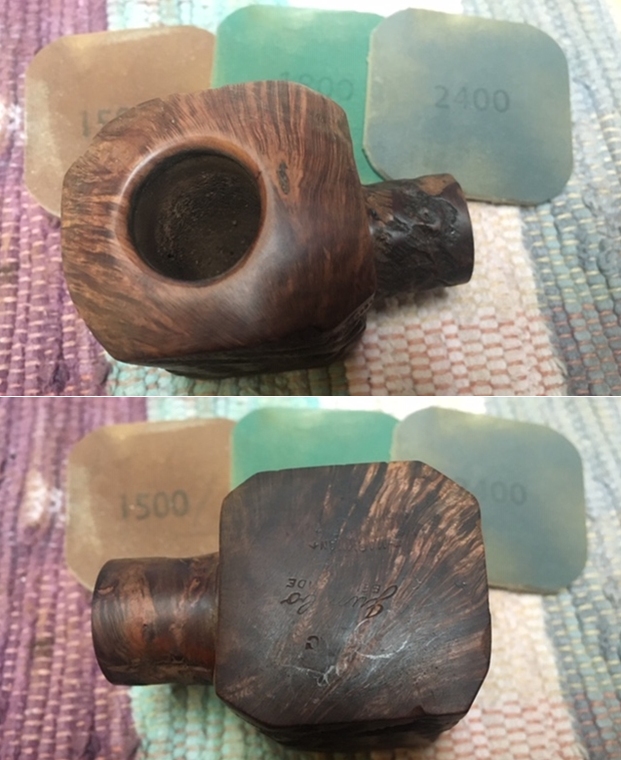
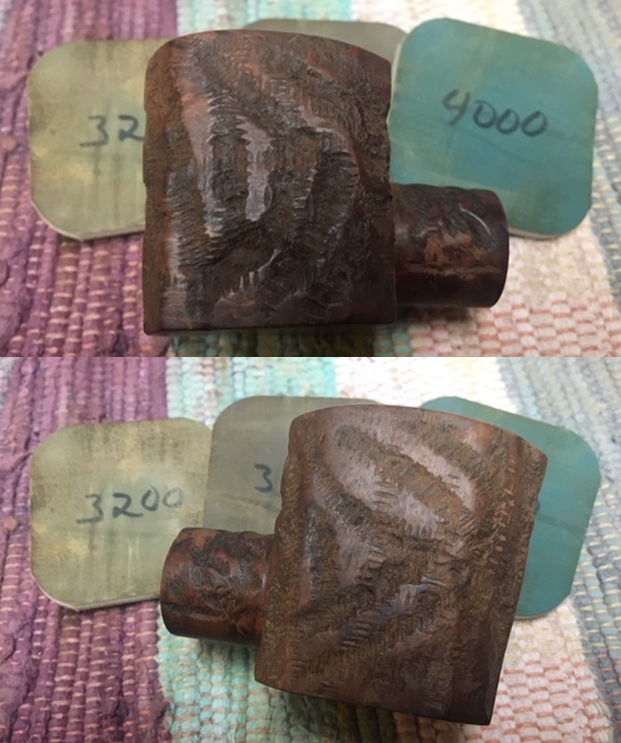
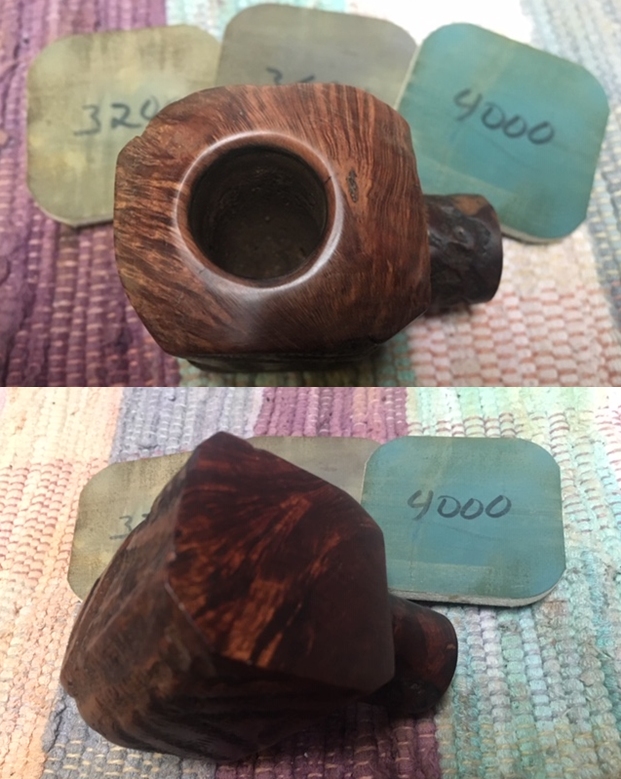
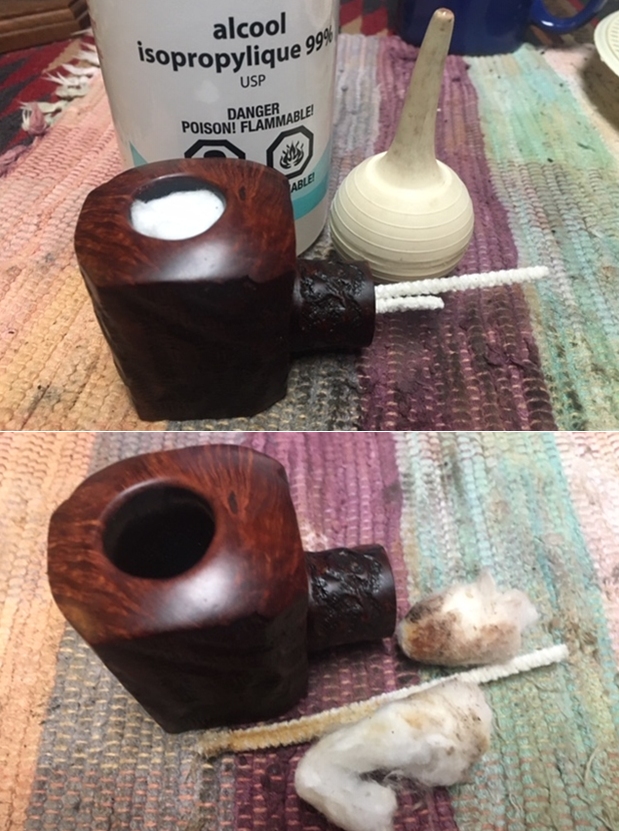
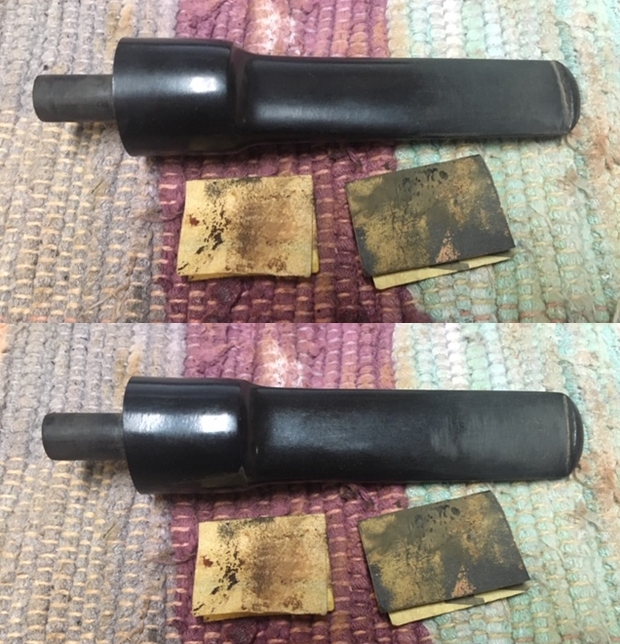
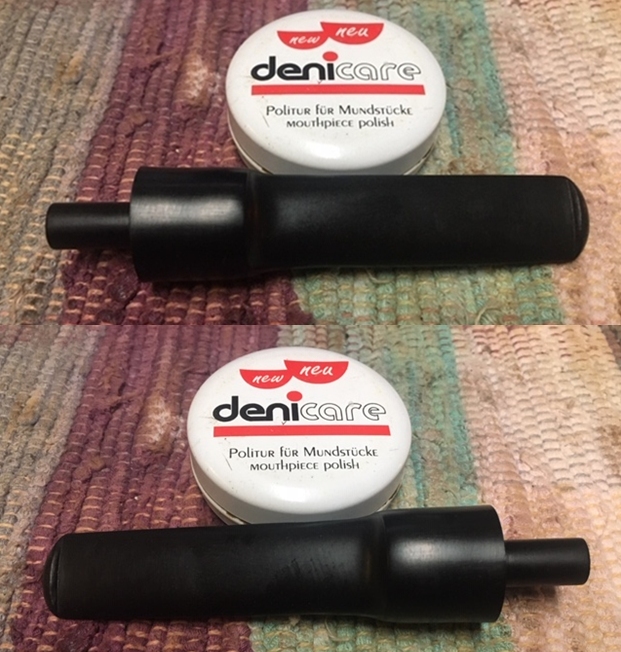
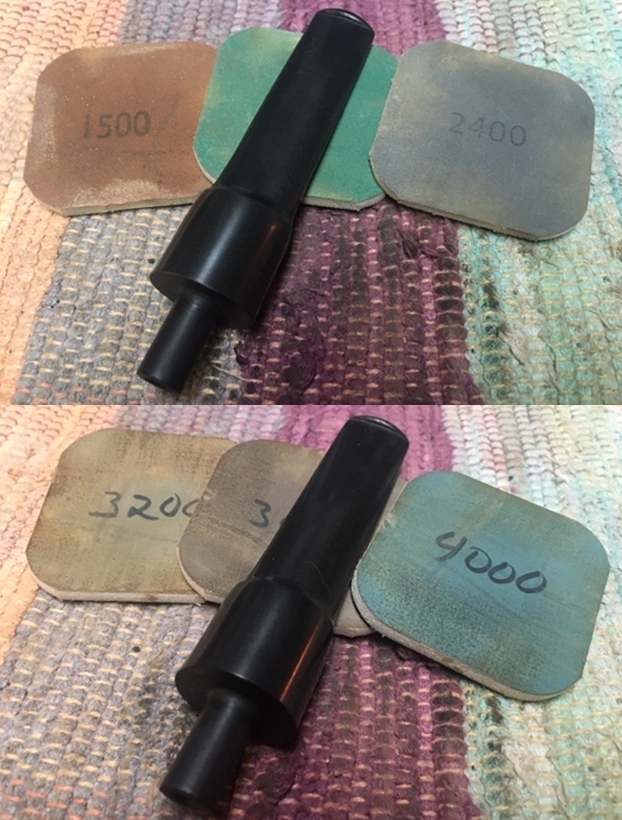
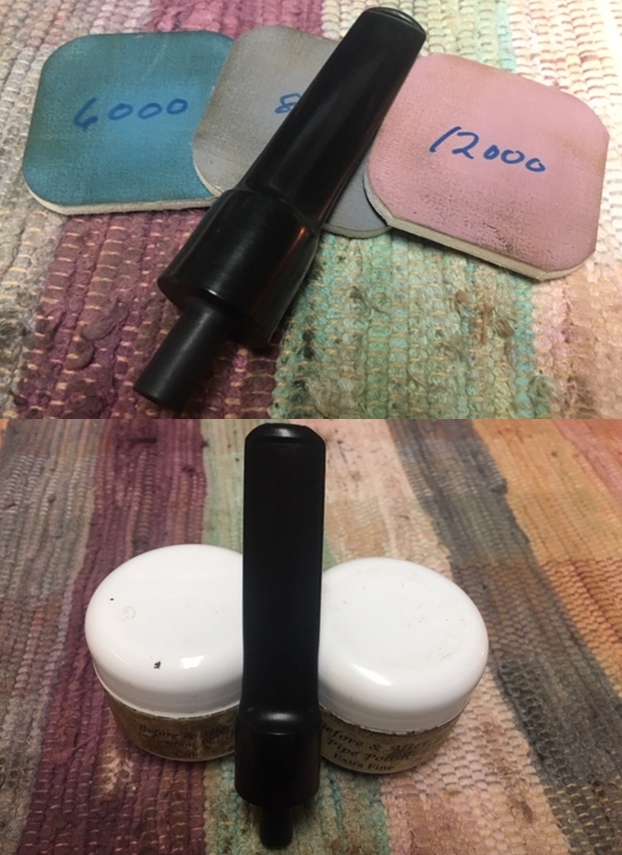
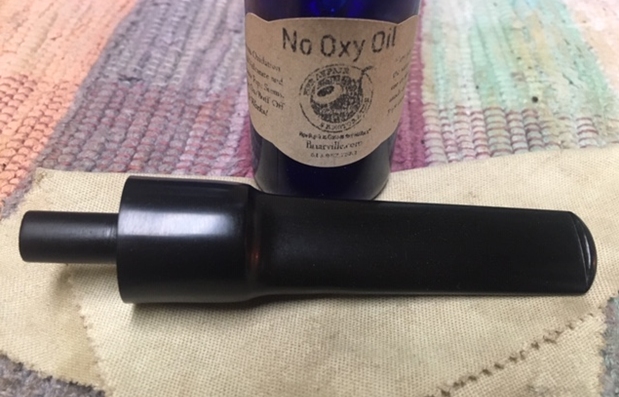
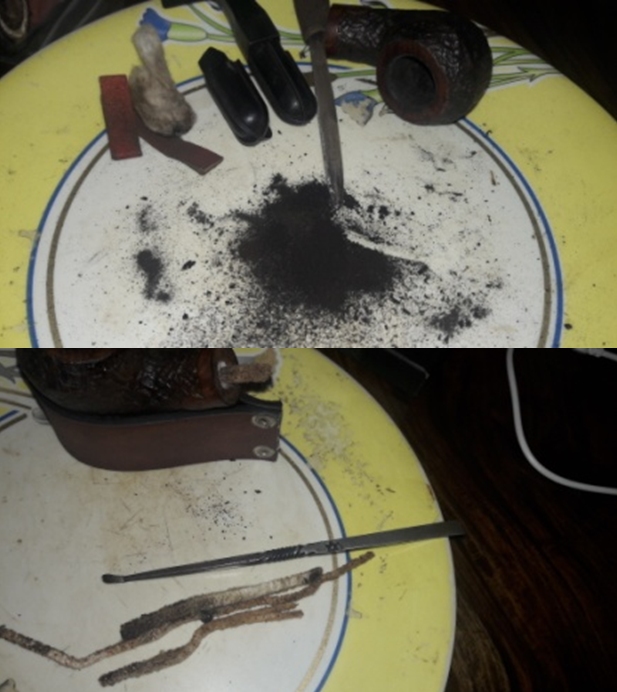
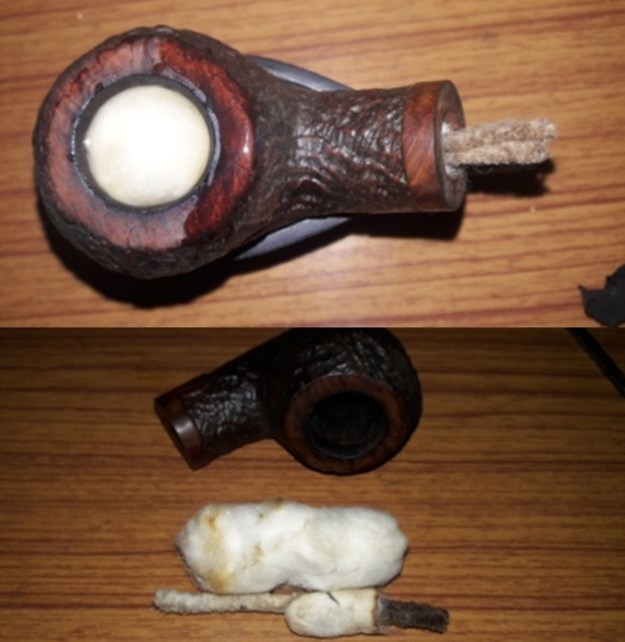
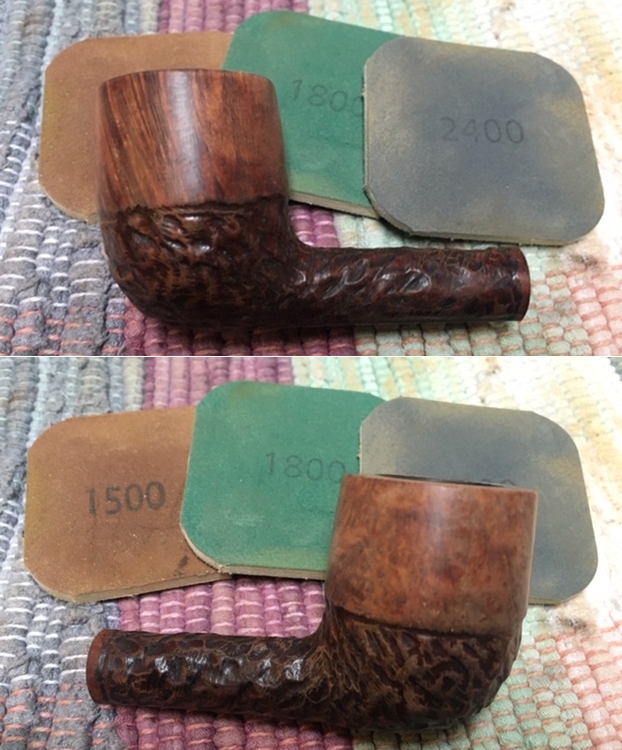
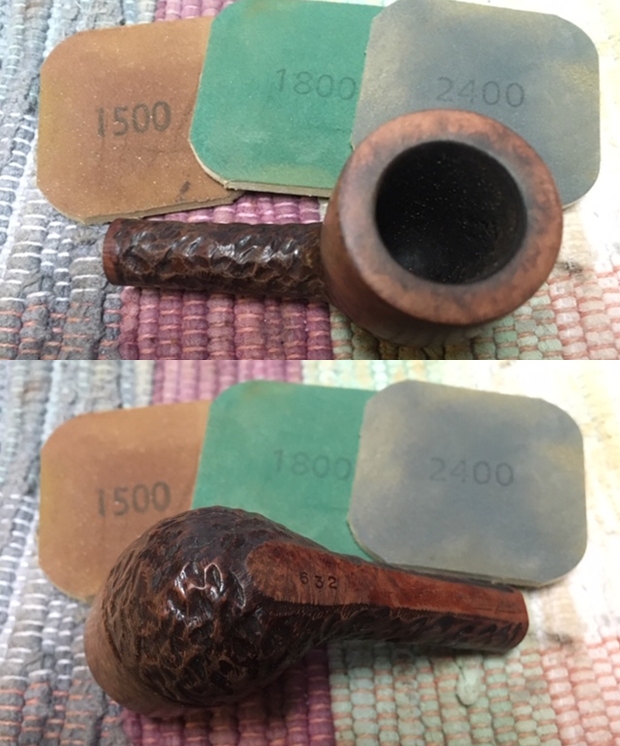
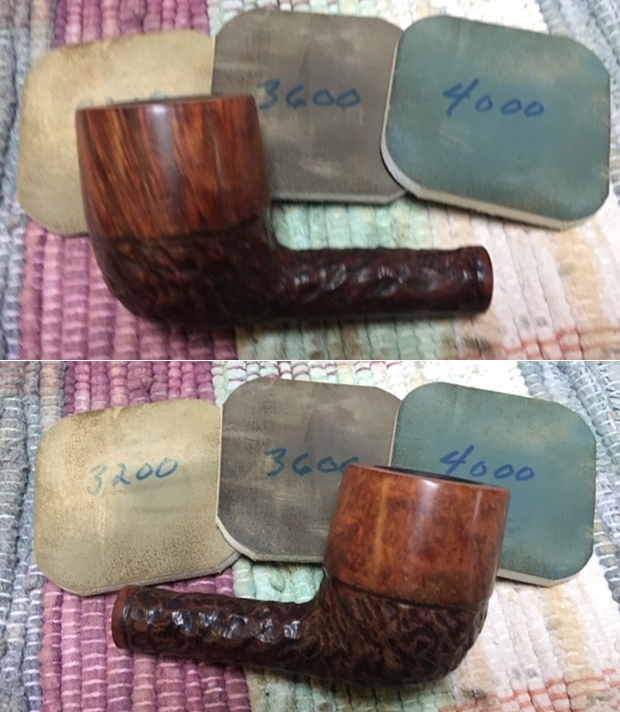
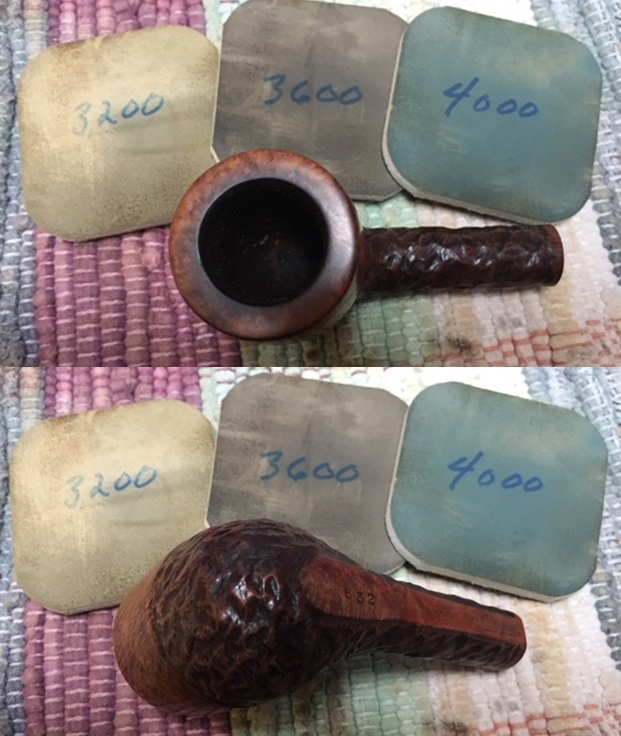
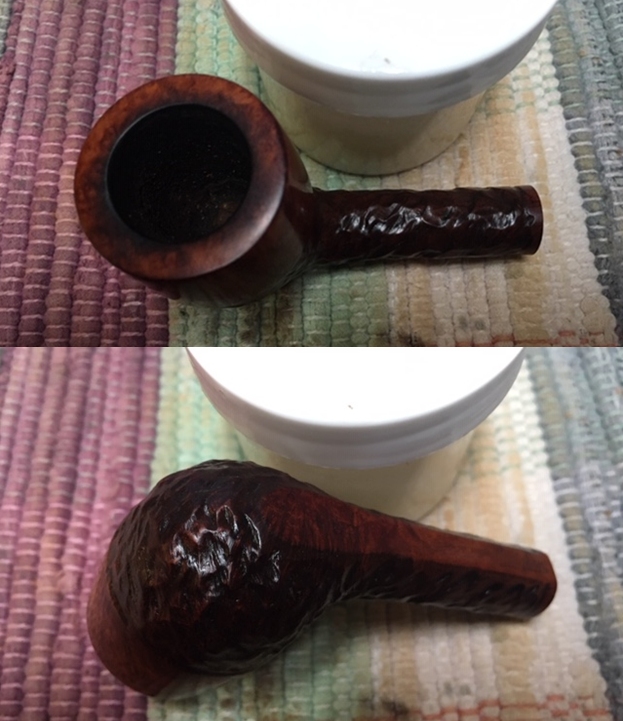
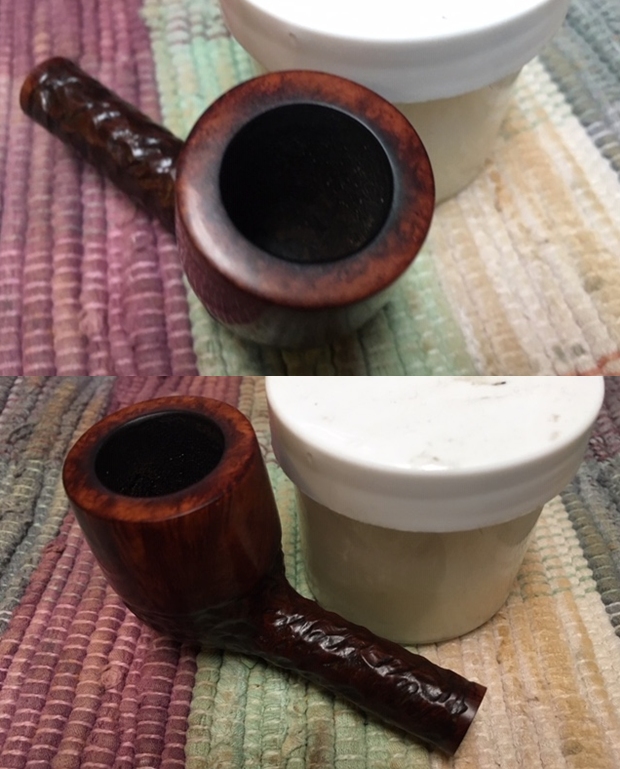
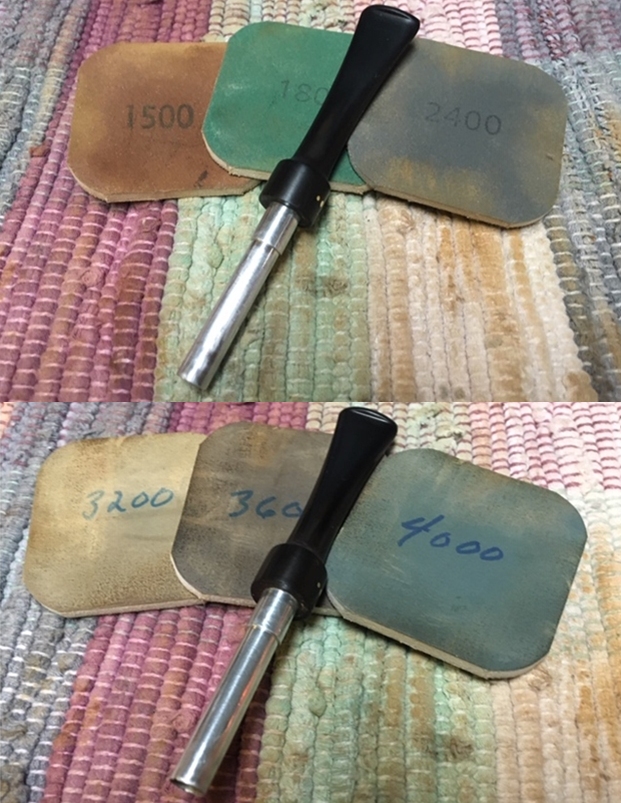
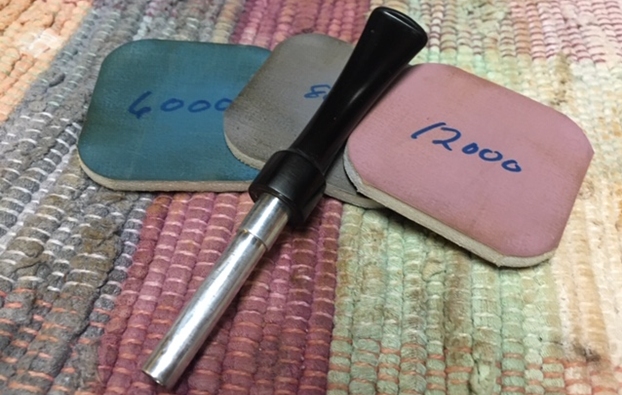
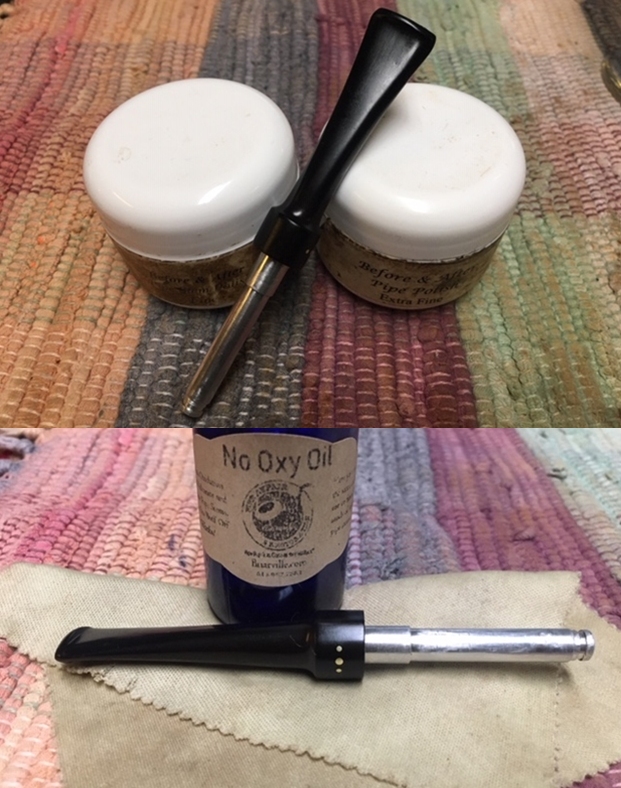
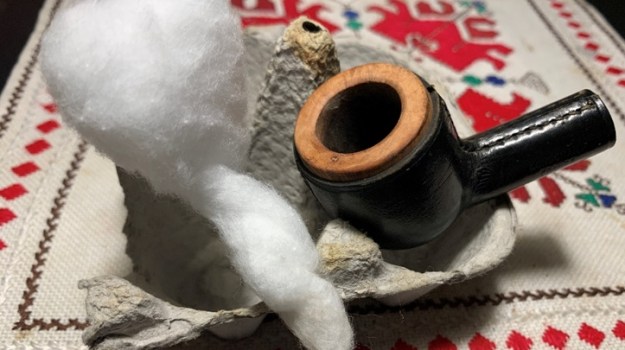
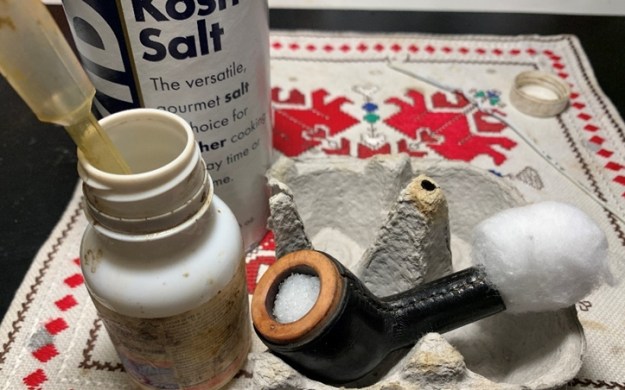
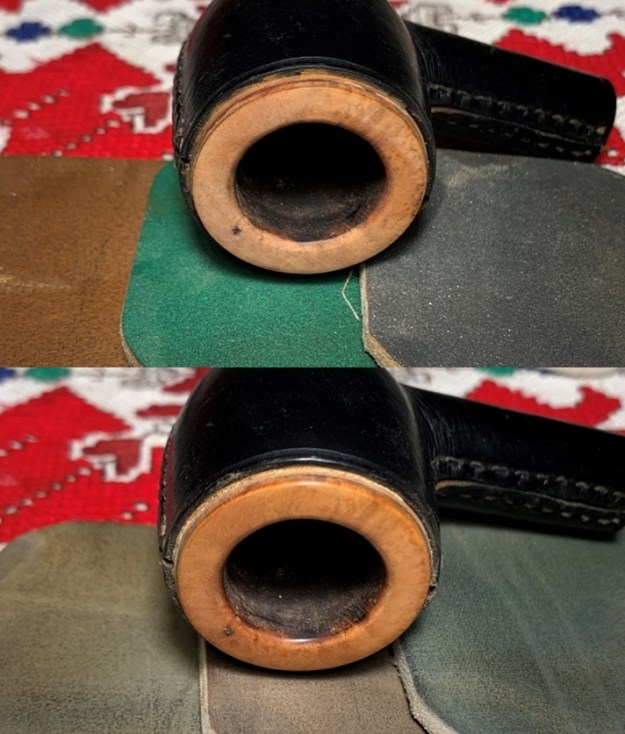
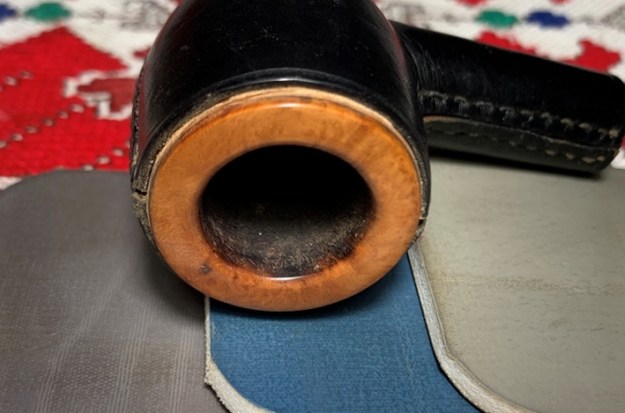
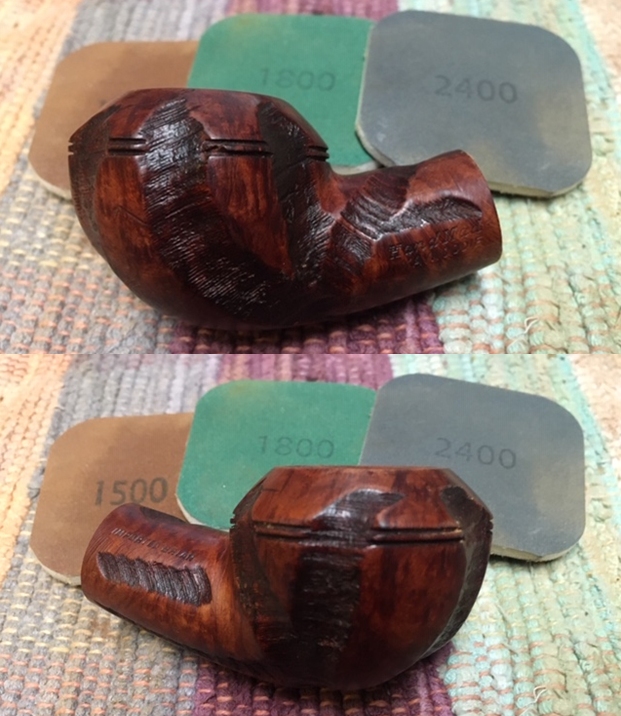
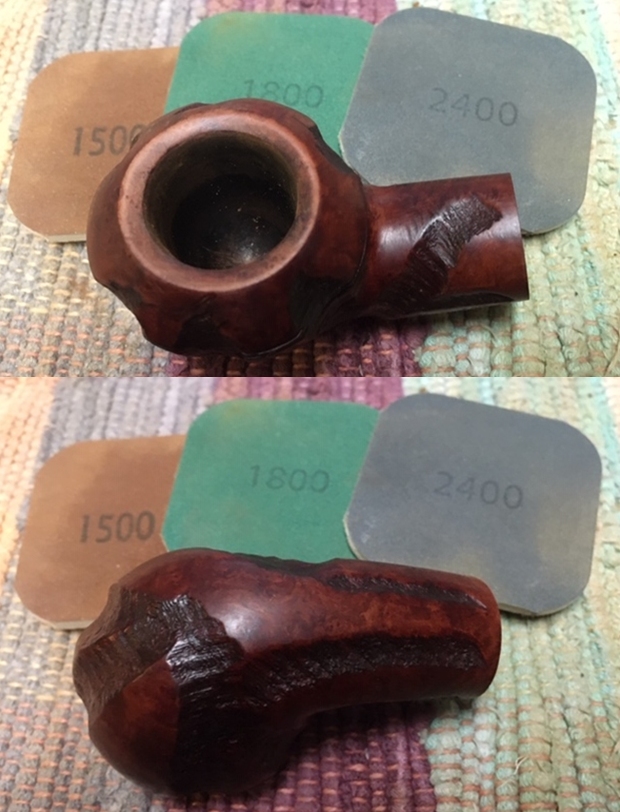
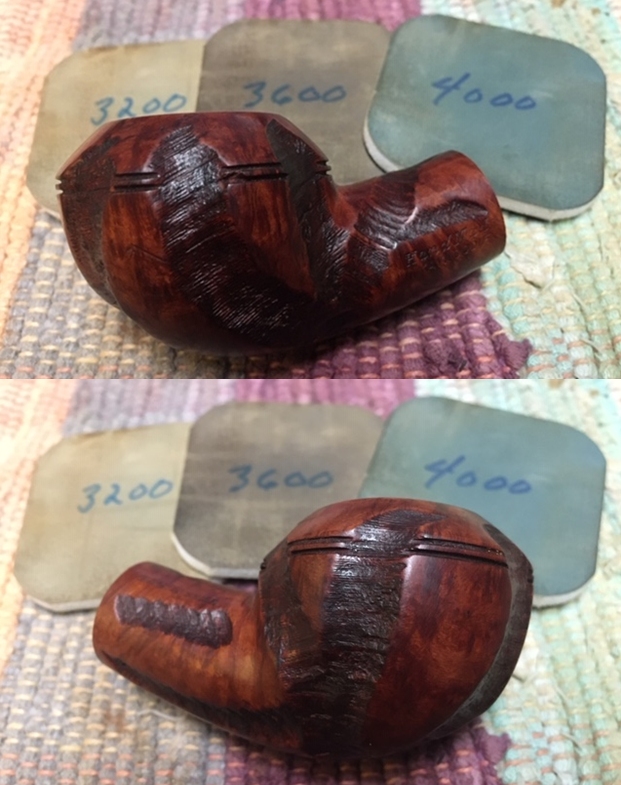
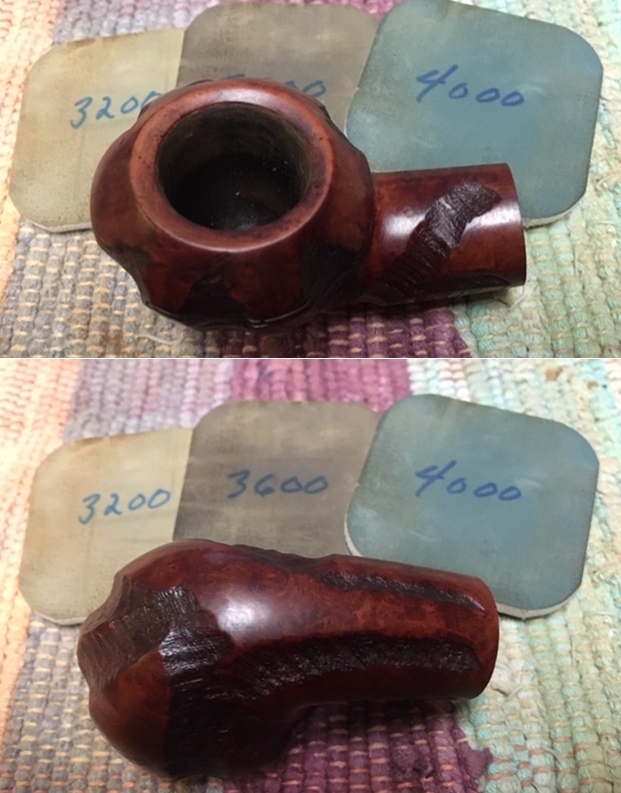
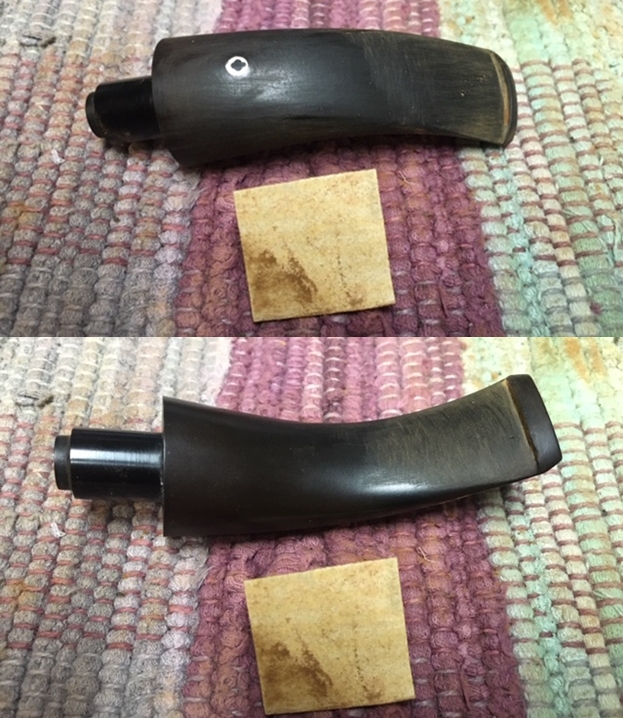
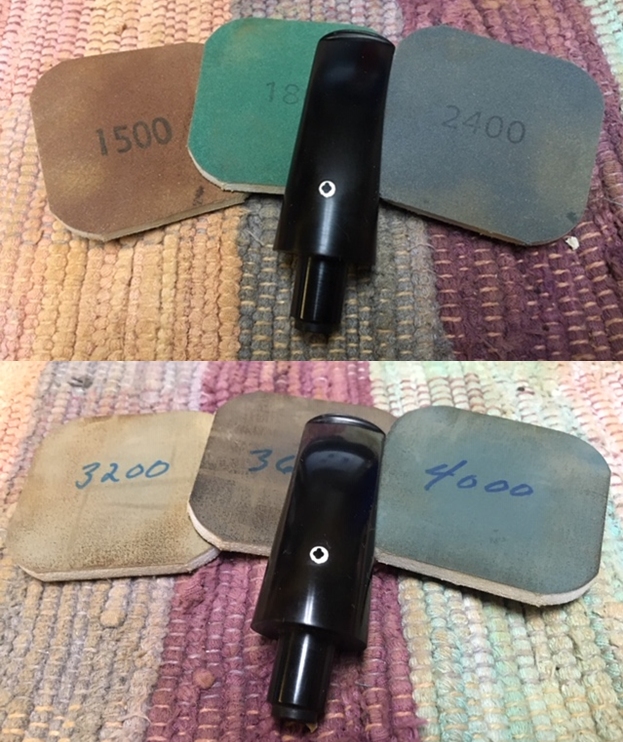
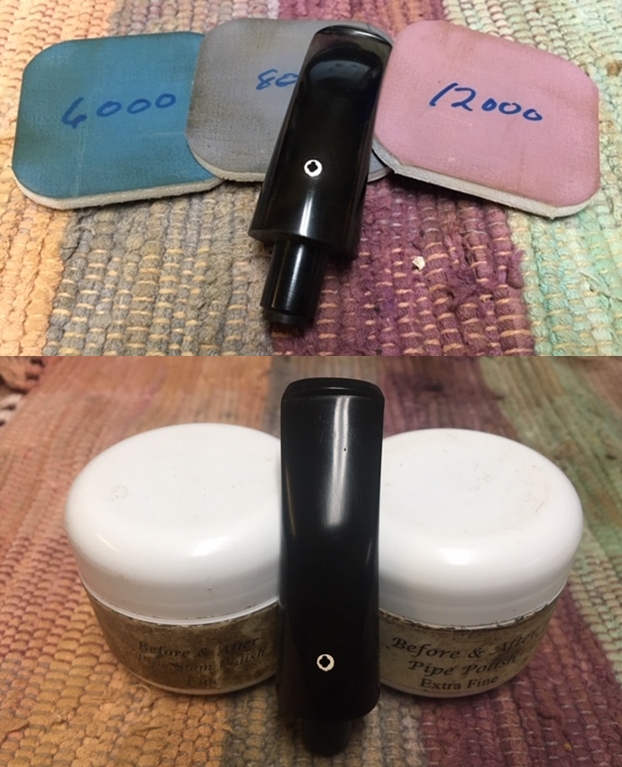
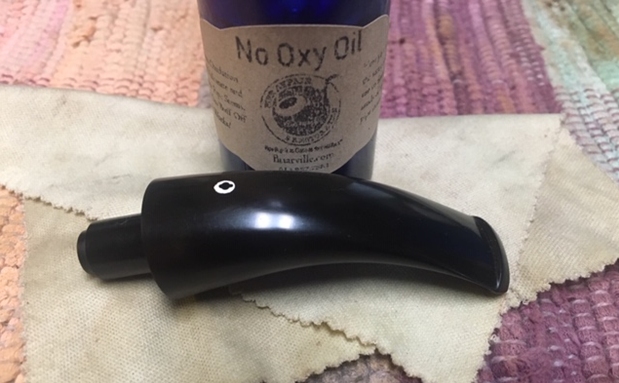
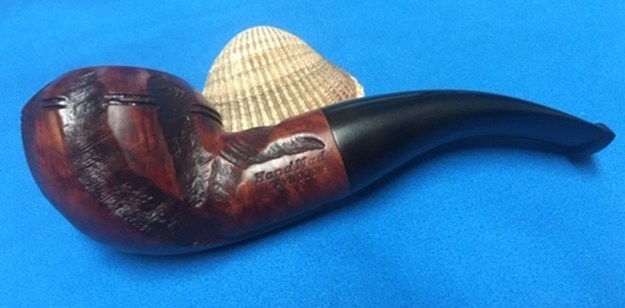
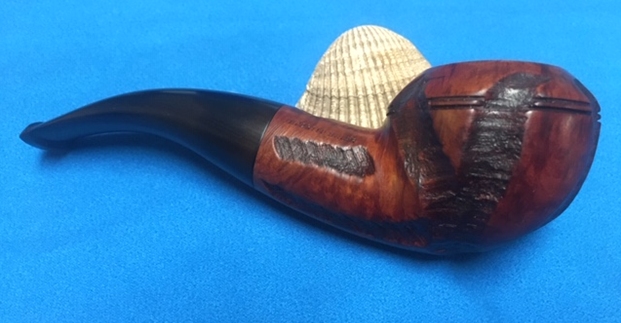
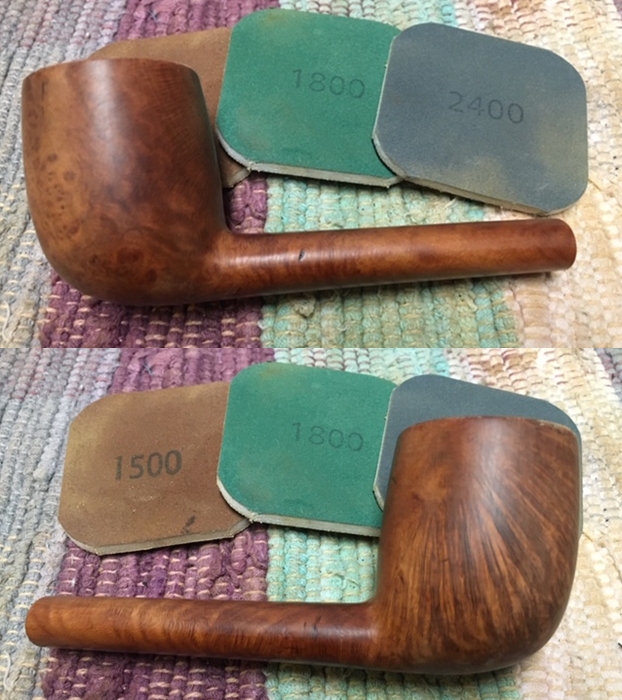
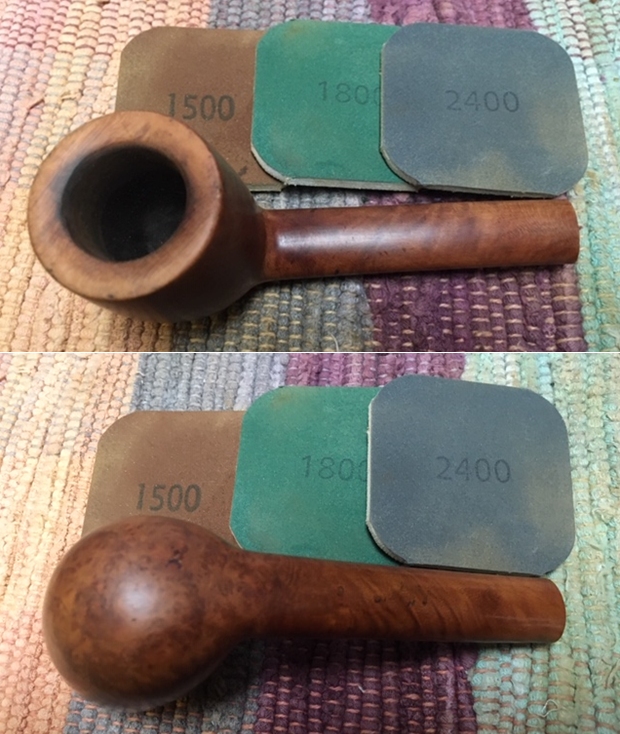
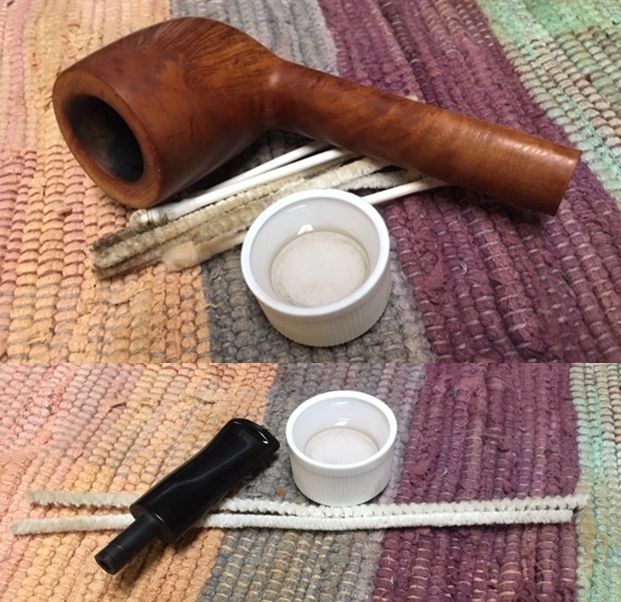
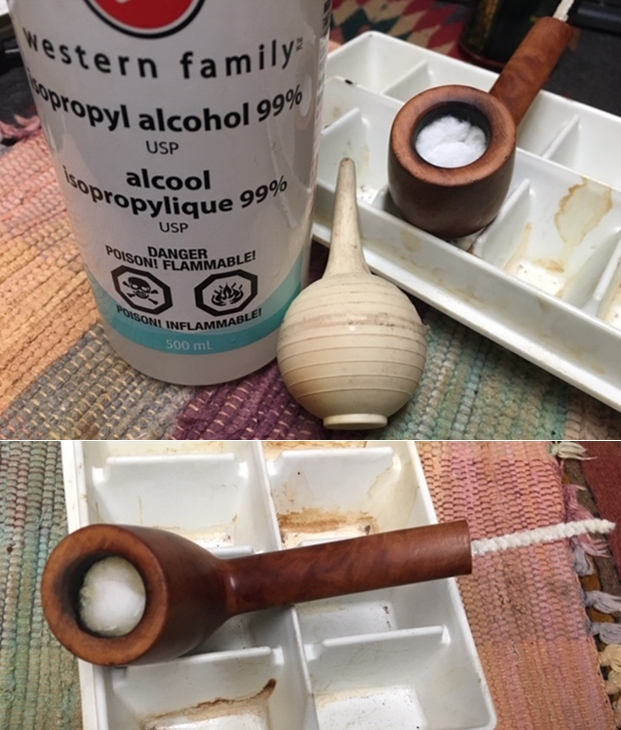
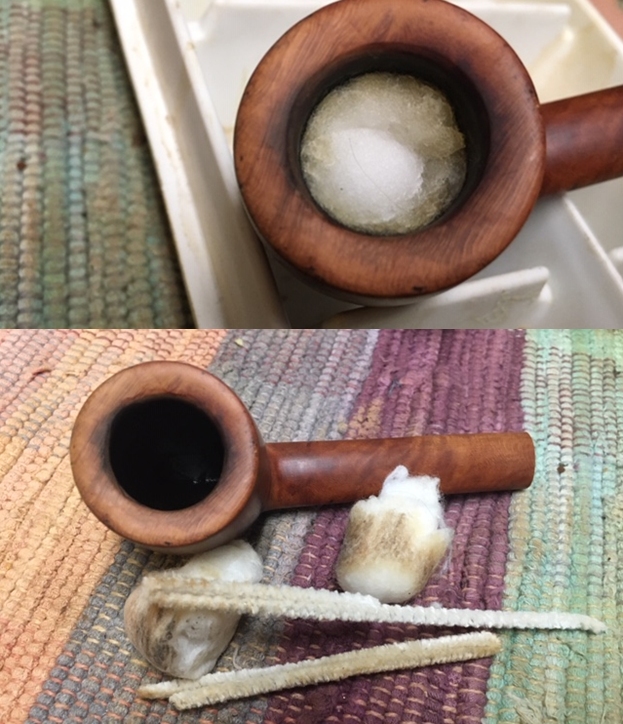
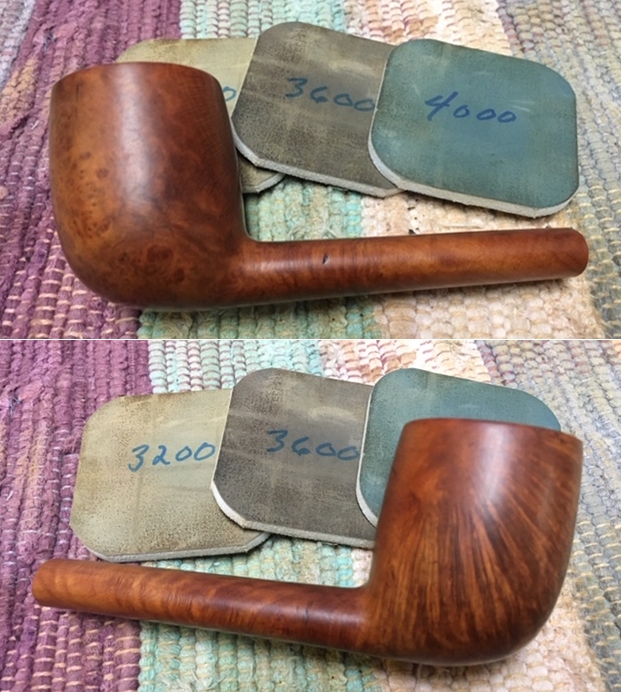
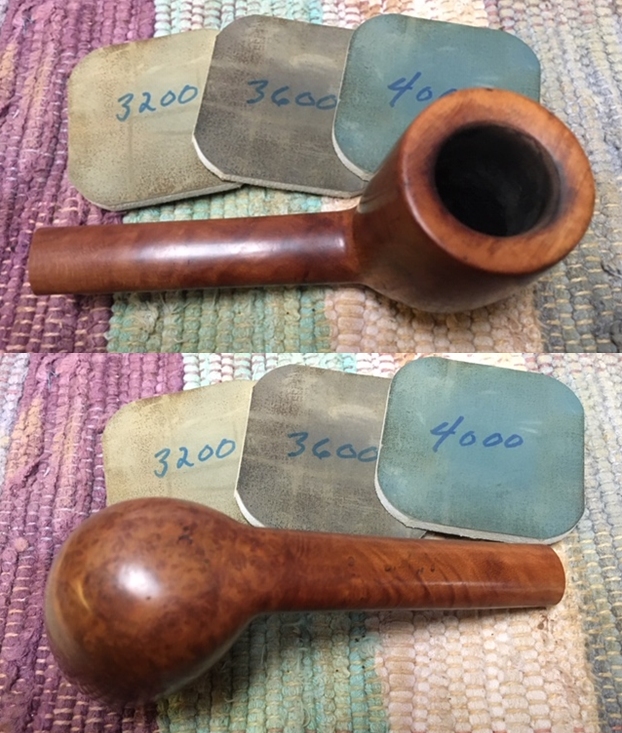
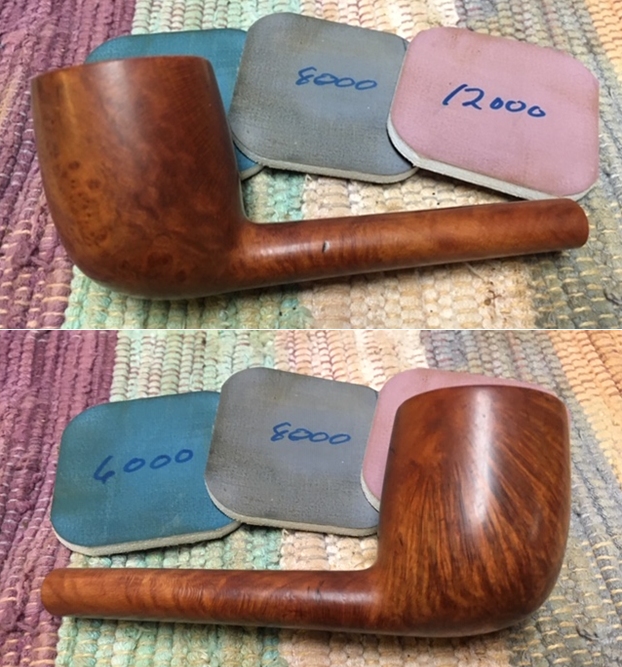
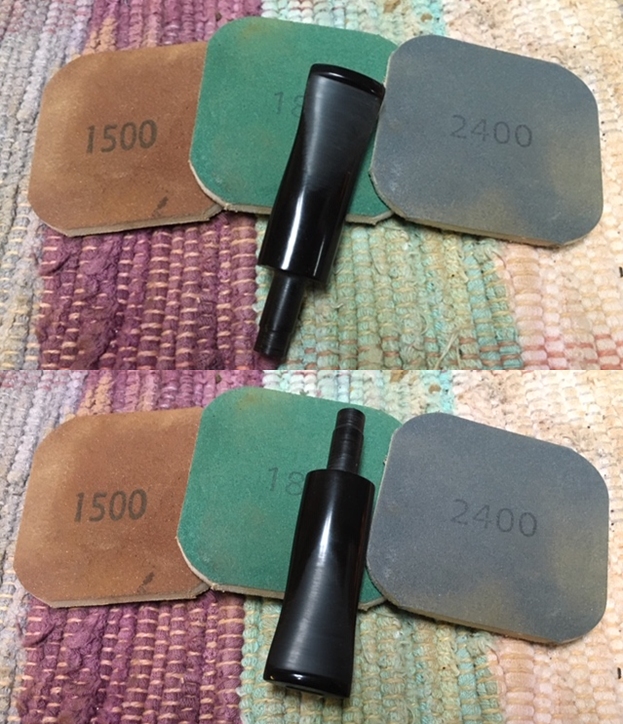
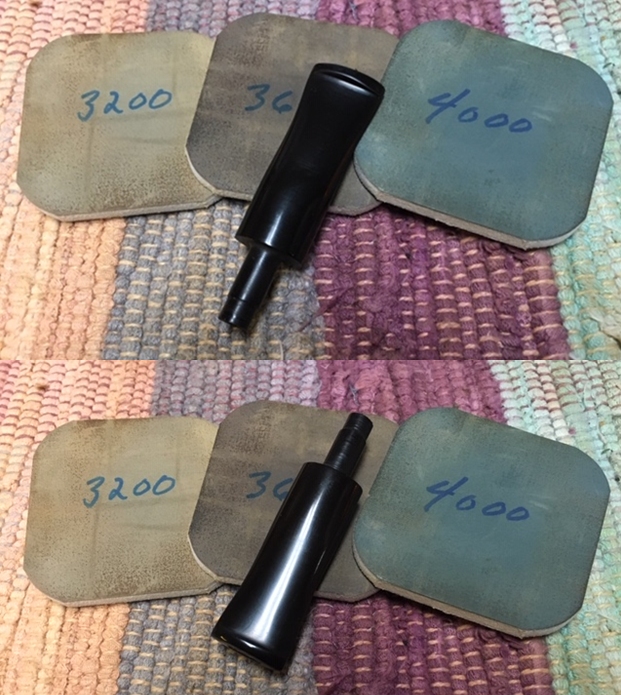
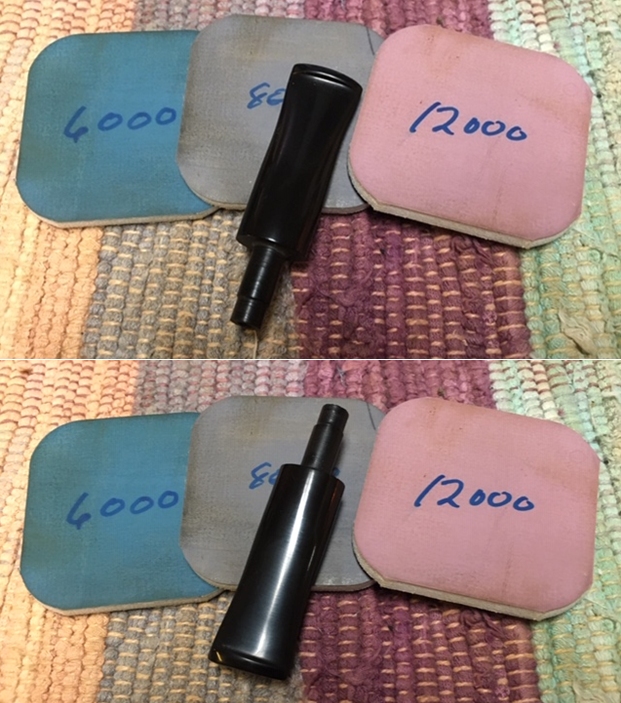
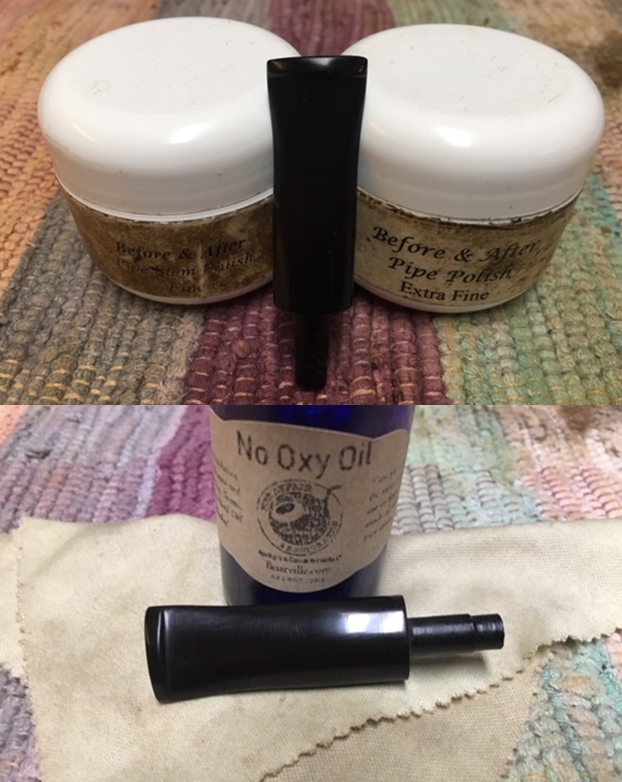
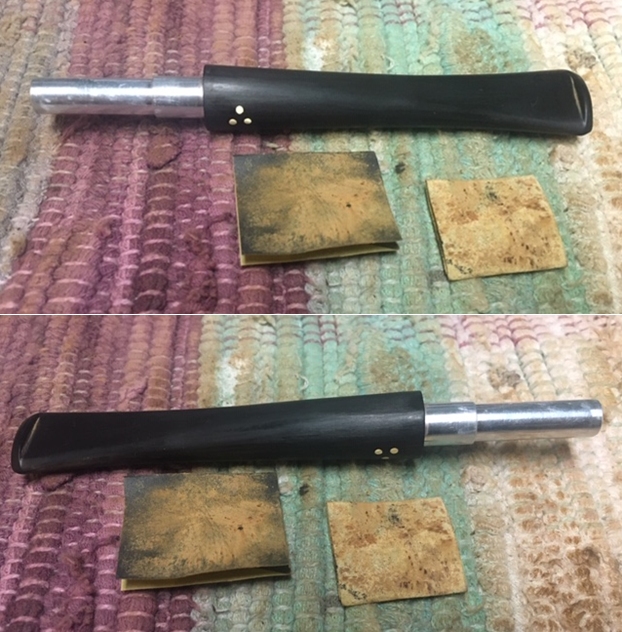
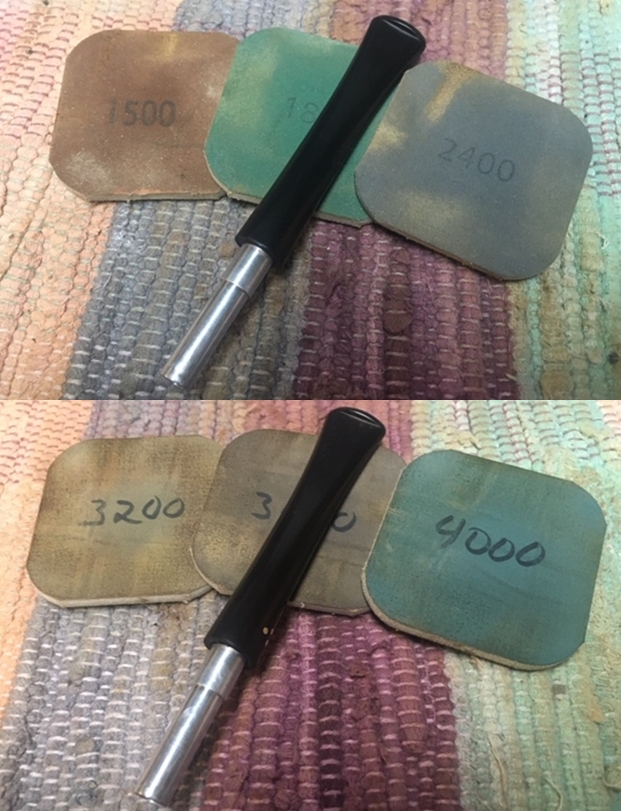
While this statement does not engender enthusiasm for E. A. Mehaffey’s pipe production, the Canadian with a Natural finish is a very nice piece of briar. Both sides of the bowl show a mix of grains. On the front of the bowl there is some nice birdseye and on the back some swirls of grain. This is a beautifully styled and positioned Canadian shape has a tapered vulcanite stem that fits proportionally well. Now it was time to work on Alex’s pipe. I started the work by addressing the issues with the rim top first. I figured I would be generating some sanding dust so I decided to deal with that before cleaning the bowl. I used a folded piece of 220 grit sandpaper to further bevel the inner edge of the rim to remove the burn damage. I sanded the rim top and outer edge of the bowl with the same sandpaper to get rid of the damage. Once I was finished the rim and edges were smooth.I polished the bowl and rim top with micromesh sanding pads – wet sanding with 1500-2400 grit sanding pads. I wiped the bowl and rim down with a damp cloth after each pad. I paused in the polishing of the externals to address the smell of the pipe. I cleaned the airway into the bowl, the mortise and the airway in the stem with alcohol, cotton swabs and pipe cleaners to remove the surface debris. It was pretty clean. I knew that I would need to do more to get rid of the deep smell.I decided to deep clean the bowl with a cotton ball and alcohol soak. I stuff the bowl with cotton and use an ear syringe to fill the bowl with alcohol. I put a folded pipe cleaner in the shank to wick the oils and tars from the airway and mortise. The alcohol and cotton draws the oils and tars out of the briar. It works in the same manner as salt and alcohol but I like it better as it leaves less mess and the salt does not permeate the briar when cotton is used. I set the bowl aside for several hours while the mixture did its work.I removed the cotton balls and ran a few pipe cleaners and cotton swabs through the shank and mortise to clean up residual debris left behind by the soak. You can see what was absorbed into the cotton in the photos below. The pipe smelled fresh and clean. The mustiness and stench was gone.I picked up the polishing of the bowl again with micromesh sanding pads. I wet sanded with 3200-12000 grit pads and wiped the bowl down after each pad with a damp cloth. The polishing gave the bowl a rich shine. I rubbed it down with Before and After Restoration Balm. It is a product developed by Mark Hoover to clean, enliven and protect briar. I worked it into the briar with my fingertips. I let it sit for about 10 minutes and buffed it off with a cotton cloth. You can see the results below. I set the bowl aside and turned to address the light tooth marks and chatter on the stem surface. The stem was in excellent condition other than that so it did not take a lot of work. I polished the stem with micromesh sanding pads – wet sanding it with 1500-12000 grit pads and wiping it down after each pad with a damp cotton pad to remove the dust. I polished it with Before and After Pipe Polish – both fine and extra fine. I finished by wiping the stem down with some No Oxy Oil that  received from Briarville Pipe Repair to try out and get a sense of its value to me and others. Once I finished I put the stem back on the shank and buffed the pipe with Blue Diamond polish briar and vulcanite. I gave the stem a vigorous polish being careful around the white spot. I gave the bowl and the stem several coats of carnauba. I buffed the pipe with a clean buffing pad and hand buffed it with a microfiber cloth. The finished pipe is shown in the photos below. It is a great piece of pipe history and looks better than when I began the process. The dimensions of the pipe are Length: 6 inches, Height: 1 7/8 inches, Outer Bowl Diameter: 1 ¼ inches, Chamber Diameter: ¾ of an inch. The pipe will soon be heading back to Alex so he can continue to enjoy it. I have told him that if he ever wants to part with it I get the right of first refusal. Thanks for walking with me through the restoration.

Cleaning up a 1965 Dunhill 631 F/T Root Briar Group 1 Billiard for Henry


Blog by Steve Laug

If you have followed rebornpipes for long you will know that I am a sucker for older pipes and that if I have restored pipes for you in the past I will definitely be available to you for future restorations. The post just previous to this one on an old 1902 LKL Cutty was an example of both of those these maladies of mine. This post speaks to the second one – if I have worked on a pipe for you in the past I will be available as best I can for future restorations. Some of you will recognize Henry Ramirez name as he was a long time contributor to rebornpipes with his innovative restorations. Henry is a dentist who retired not long ago and got rid of his restoration tools. He wrote to see if I could help him out with the restoration of a small Dunhill he had. He wrote the following email:

Hi Steve, long time no talk. I recently moved again to San Francisco and upon opening an empty tin of vintage Dunhill tobacco found the small Dunhill that I’d thought was lost. I’ve gotten rid of my pipe cleaning supplies since moving to an apartment and was hoping you could clean this pipe up for me. You seem to be very busy and in the middle of large restorations. Let me know if you can help. Best, Henry

What could I say to such a request from a fellow pipe restorer? I sent him an email and said I would take on his pipe. He packed it up and sent it to me in Vancouver. It arrived here a couple of weeks ago. Today, I took a break from the large estates and the other repairs I have going to work on Henry’s pipe. It is a small Dunhill saddle stem billiard. It is stamped on the left side of the shank 631F/T next to the bowl shank junction. The 631 is the shape number and the F/T is the designation for a Fish Tail stem. That is followed by Dunhill over Root Briar. On the right side of the shank it is stamped with a circle 1 R next to the bowl shank junction designating the group size of the pipe – a 1 and R which says it is a Root Briar. To the left of that it is stamped Made in England5 which tells me that the pipe was made in 1965. The finish on the bowl was dirty and spotty. The bowl had a thick cake in it and the lava overflowed onto the rim top. The inner edge of the bowl was damaged on the right side with both carving from a knife and a burned area. There was some darkening on the outer rim edge at the front of the bowl. It was in rough condition. The stem was not too bad. It was heavily oxidized but other than tooth chatter was in good condition. I took photos of the pipe before I started the restoration work to document the progress that way Henry can vicariously work on this pipe. I took some close up photos of the bowl and rim top and the stem surfaces. The first photo shows the condition of the bowl and rim top. I described the damage above but I have to say I probably minimized it in my description. It is in rough shape. The inner edge is hacked and uneven showing that it had probably been reamed with a knife. There was burn damage on the right inner edge and on the front edge. The stem on the other hand looked good other than the heavy oxidation on the surface. There was light tooth chatter but it still was in great shape.I took photos of the stamping on the shank. The left side was definitely in better condition than the left. You can see the stamping on the left side in the first photo. The second photo shows the right side of the shank. It reads as noted above.I turned to Pipedia to read about the Root Briar. I have worked on enough Dunhill pipes to have a good idea of the history and I already knew I was working on a 1965 pipe but I wanted to refresh my memory on the Root Briar finish (https://pipedia.org/wiki/Dunhill#Root_Briar).

(The Root Briar finish) was introduced in 1931 and highly prized because the grain is more pronounced in this finish (usually made using Corsican briar). The Root Briar finish requires a perfectly clean bowl with excellent graining. Therefore, it is the most expensive of the Dunhill pipes. Corsican briar was most often used for the Root finish since it was generally more finely grained. This is a rare finish, due to the scarcity of briar suitable to achieve it. These pipes are normally only available at Company stores, or at Principle Pipe Dealers. Straight grained pipes were formerly graded A through H, but are now only “Dr’s” and graded with one to six stars, with the letters G and H still used for the very finest pieces.

“Dunhill introduced its third major finish, the Root finish, in 1931. Corsican mountain briar is characteristically beautifully grained and the Root was made exclusively from that briar into the 1960s. The pipe was finished with a light natural stain to allow the beauty of the graining to show through. Although always available with a traditional black vulcanite bit, the Root was introduced in either 1930 or more likely 1931 and fitted with a marble brown dark and light grained vulcanite bit that has since become known as the ‘bowling ball’ bit because of the similarity in appearance between the bit’s finish and that of some bowling balls of the time. With the war, however, the bowling ball bit was dropped from production. Through 1954 (and after) the Root pipe nomenclature (including shape numbers) was identical to that of the Bruyere except that instead of the “A” of the Bruyere, the Root was stamped with an “R”. In 1952 when the finish rather than LONDON was placed under DUNHILL, ROOT BRIAR rather than BRUYERE was used for the Root.” Loring, J. C., The Dunhill Briar Pipe, The Patent Years and After (self-published, Chicago, 1998).

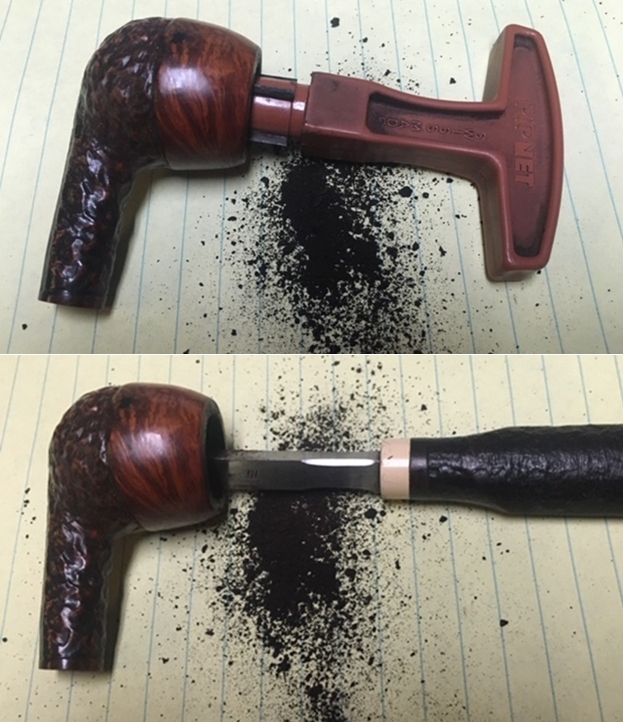
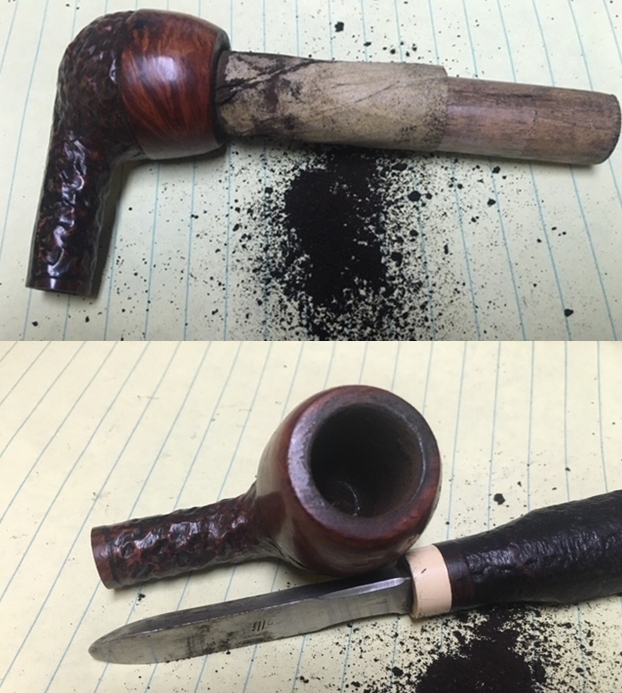
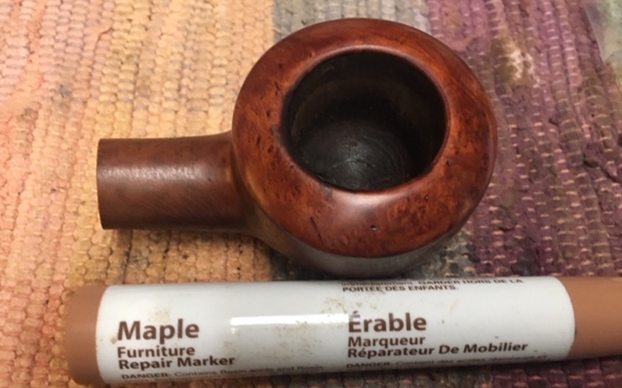
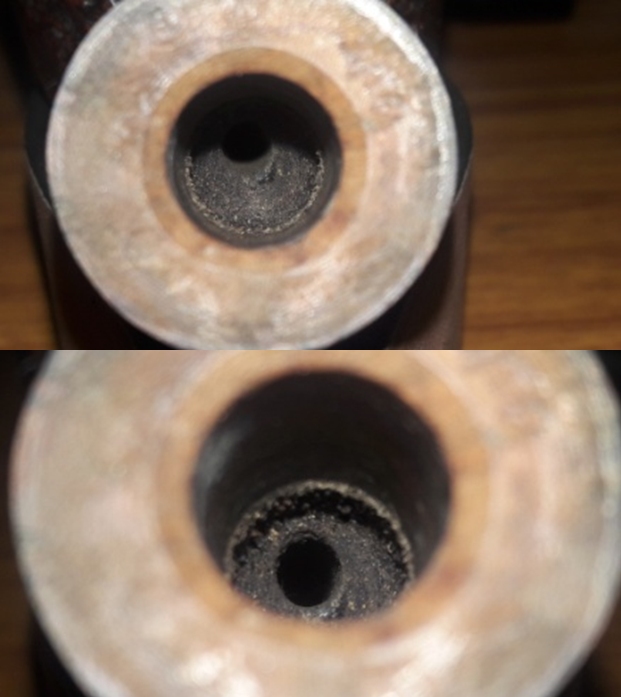
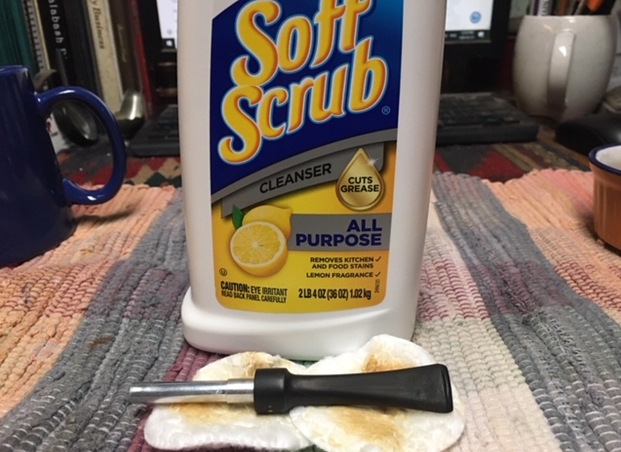
That was a good reminder for me of the character and the rarity of the finish. Henry was going to enjoy this pipe. Now it was time to work on it. I carefully removed the stem and found that there was an inner tube stuck in the shank. I examined it and found that I could see glimmers off it under the cake in the bowl. I would need to work on the cake and try to ream the bowl a bit around the entrance of the airway to loosen it. I reamed the bowl back around the airway with the tip of a Savinelli Fitsall Pipe knife. I ran alcohol down the tube using a pipe cleaner. I folded the pipe cleaner and dribbled alcohol around the end of the tube sticking into the bottom of the chamber. I worked alcohol in next to the tube using pipe cleaners. I paused and wiggled the tube regularly. I heated it a bit with a lighter and wiggled some more. Finally it came free. You can see all the debris on the outside of the tube.I cleaned up the outside of the tube with sandpaper to remove the grime. Once it was gone I could see significant damage to the tube. Where it was stuck in the shank there some deep pinch marks. Where it sat in the shank also had some grooves. It was actually damaged enough that I did not want to use it again. I have a box of inner tubes that I picked up in an estate I purchased. I have probably 8-9 different tubes of different sizes. I went through the tubes and found the identical tube but undamaged. The photos below show the original tube and the new replacement tube. I checked the fit in the bowl, shank and stem and it was perfect.I reamed the bowl with a PipNet pipe reamer using the smallest cutting head. I was able to remove the heavy cake. I cleaned up the remaining cake with a Savinelli Fitsall Pipe knife and then sanded the walls of the bowl with 220 grit sandpaper on a piece of dowel. I was pleased to see that the walls of the bowl were undamaged. I moved on to clean the interior. I scraped the walls of the shank with a pen knife to remove the oils and tars that had locked the inner tube in the shank. I was able to remove the majority of the debris with the knife. I followed up by scrubbing the airway in the shank and mortise as well as the stem with alcohol, cotton swabs and pipe cleaners. I scrubbed the exterior of the stem with some Soft Scrub to soften and remove some of the oxidation (of course I forgot to take photos of that part of the process). I used 3-4 cotton pads to scrub the stem and I was happy with the amount of oxidation that it removed. When I was finished I rinsed it off and dropped the stem into a bath of Before & After Deoxidizer. I left it in the mix for a while and turned my attention to the bowl.I topped the bowl with 220 grit sandpaper on a hard board to minimize the damage. I worked it over the sandpaper in a circular motion to reduce the scratches left behind by the sandpaper. When I finished topping it to my liking I used a folded piece of 220 sandpaper to give the inner edge of the bowl a bevel to reduce the burn damage. The third photo below shows the rim top after this treatment. It has come a long ways from the original rim top. I polished the briar with micromesh sanding pads – wet sanding with 1500-12000 grit pads. I wiped the bowl down with a damp cloth after each sanding pad to remove the debris from sanding. The photos show the developing shine on the bowl and rim top. I  used an Oak and a Maple stain pen to blend the colour of the rest of the bowl. I am happy with the blend as well as the new look of the rim top… What an improvement.I worked some Before & After Restoration Balm into the briar with my fingertips to clean, enliven and protect it. I find that the balm really makes the briar come alive again. It also works well to blend the restained areas of the bowl with the rest of the pipe. The contrasts in the layers of stain really made the grain stand out. I let the balm sit for a little while and then buffed with a cotton cloth to raise the shine. This is the point that tells the truth about the blend on the rim top. It really does look good! I am very happy with the way the pipe is looking at this point in the process. I set the bowl aside and turned my attention to the stem. I took it out of the Before & After Bath and scrubbed it with warm water to remove the bath product and blew out the airway. I buffed it with a rough cotton cloth but sadly the oxidation though better was still present. I scrubbed it again with Soft Scrub and was able to remove a lot more of the oxidation.I sanded the stem with 220 grit and 400 grit wet dry sandpaper to remove the oxidation that remained. Even after the sanding it was still present.I polished the stem with micromesh sanding pads – wet sanding with 1500-12000 grit pads. I wiped the stem down after each pad with a damp cloth. I polished it with Before & After Pipe Polish – Fine and Extra Fine. I finished by buffing the stem with Briarville’s No Oxy Oil. Now that the stem is finished the pipe is one step away from packing and sending back to Henry. It is a pretty little Group 1 Dunhill saddle billiard. The pipe cleaned up really well and the stem looks quite stunning in place. I put the new inner tube in place and put the pipe back together again. I buffed it on the wheel with Blue Diamond polish and then gave the entirety several coats of carnauba wax. I buffed it with a clean buffing pad to raise the shine. I hand buffed it with a microfiber cloth to deep the shine. It really is a beauty and should serve Henry well while he holds it in trust. The dimensions of the pipe are Length: 5 inches, Height: 1 ½ inches, Diameter of the bowl: 1 1/8 inches, Chamber diameter: 5/8 of an inch. I will be putting it in the mail to Henry on Monday after work. I am looking forward to what he thinks of the pipe when he receives it. I am happy with the finished look of the pipe. Thanks for walking with me through the restoration. It was a fun one with its own set of challenges.

Restoring an interesting 1902 LKL Amber Stemmed Cutty


Blog by Steve Laug

If you have followed rebornpipes for long you will know that I am a sucker for older pipes and that if I have restored pipes for you in the past I will definitely be available to you for future restorations. One such example of this is an interesting JW Straight Shank Bulldog that I restored for Ray in Australia in May about a year ago. I have included the link to the write up of the restoration if you are interested:  https://rebornpipes.com/2019/05/19/restoring-a-cased-1906-jw-straight-shank-amber-stemmed-bulldog/. Once in a while I get an email from Ray about the old timers that he picks up along the way. Ray seems to pick up some interesting older pipes so I am always glad to hear from him. Not too long ago I received an email from him about an old pipe that he picked up. I have included his email below.

Dear Steve,
I got this pipe and another a few days ago and they both need rescuing. This one is a 1902 Cutty with silver mount by Charles Maxwell Kinnear of Manchester. The issue with this is a humongous chunk of rim is missing on the right, plus 2 “pits” on the right flank. No other issues I can see. The stem fits well.

Best Regards
Ray

He attached some photos of the pipe to his email so I could see what he was speaking about. I have included them below. The photos that he included showed the pipe that he had picked up. It was a cased, amber stemmed Cutty that was marked LKL in an oval on the left side of the shank. The bowl was hardly smoked and the amber stem looked very good. There was some light crazing internally around the airway in the stem. The tenon was perfect. The alignment of the stem on the shank was perfect as well. It was in great shape. The bowl itself was where the issues were. There were some chips out of the bowl on lower, middle and top outer edge as can be seen in the above photos. The lower ones looked like fills that had fallen out of the briar. The one on the rim top and edge was more extensive and actually looked like fills had fallen out of that area as well. The edges were too smooth and the shape too smooth for it to be damage caused by dropping it. Other than these issues it appeared to be a beautiful pipe in a well made case.

Ray put the pipe in the mail and in short order it arrived in Vancouver. I opened the well packed box and was pleased that Ray had carefully packed the pipe for safe shipping. He added and item that I did not expect. He included a folded document that gave me the information that he had found in his research on the brand and silver stamping. I set the papers aside and carefully unwrapped the pipe from the internal box. I was surprised to see a red, leather covered, fitted case for the pipe. There was some light wear on the surface and the edges of the case but it was still in great condition for a pipe of this age. I took photos of the case and pipe before I started my work on it as part of the documentation on the restoration.I opened the case to have a look at the pipe. The inside of the case was in good condition. There was some wear on the lining but it was obvious that the case was designed with this pipe in mind.I took the pipe out of the case and took photos of the pipe from all sides to give an idea of the overall condition of the piece. Ray’s earlier photos had captured the essence of the damage on the rim top and right hand side of the bowl. The briar looks good from the left and underside. The rim top shows a damaged inner edge that is out of round. There is also damage to the surface of the rim on the right side as well. It is almost like a large fill had become dislodged. On the right side of the bowl there were large spots where fills had also come out and left pits on the lower and middle portion of the bowl. The silver looks pretty good. It is worn and tarnished and unreadable as it is. I took a close up photo of the rim top to show the missing fill. I also took photos of the stem showing the overall condition of the surfaces on both sides. There appeared to be some crazing around the airway in the stem. There was also some tooth chatter and light tooth marks on the surface near the button that is hard to see in the photos. But overall it looked very good. The stamping on the pipe reads LKL in an oval on the left side of the shank. On the left side of the silver band it reads KLd in an oval with the hallmarks underneath. The KLd and the hallmarks are clearly visible with a lens. They are from left to right – a rampant lion followed by the seal that is used to indicate Chester, England and on the far right is a cursive letter B signifying that the pipe was made in 1902.Ray included the following papers in his package. The first of them is a document entitled Tobacconists Pipe Makers Pipe Mounters Silver Hallmarks. I followed the web address on the bottom of the document to the original page and have included a screen capture. That document has a highlighted portion on the bottom identifying the markings on the silver band on this pipe. It is KLd in an oval which identifies  Charles Maxwell Kinnear trading as Kinnear Ltd. – Manchester as the mother company. It further shows that the group worked as Pipe Mounters in Chester starting in 1901. http://www.silvercollection.it/DICTIONARYTOBACCONISTK.htmlRay also sent along a paper with the dates for pipes made in Chester that had the hallmarks that this pipe had on the silver. I have included a photo of that below. You can see that he has highlighted the markings for a 1902 pipe.He also cut out that section of the chart, rolled it and inserted it in the bowl.Now I clearly knew when the pipe was made and banded. The KLd stamp on the band was also now a Pipe Mounting Company in Chester. The one thing that was not clear to me yet was who LKL was that had carved the bowl. I checked on Pipedia and Pipephil’s site and neither one had a listing for either the LKL stamp or the KLd stamp on the silver. I took a chance on the stamping that it may well have read KLL since the K was larger than the L’s on either side and did a search for Kinnear pipes. That lead to a link on Pipemagazine’s forums where a fellow quote Jon Guss’ response to a fellow posted a pipe similarly stamped to this one. Here is the link to the full thread (https://pipesmagazine.com/forums/threads/1901-kinnear-restoration.61696/). I have quoted the pertinent part for the pipe I am working on.

…I think a much better candidate is Charles Maxwell Kinnear (b. Edinburgh 1872, d. Liverpool 1939), who’s involvement in the tobacco trade was a) documented, b) encompassing exactly the right time period (all his hallmarks were registered in 1901-1902), and c) at the right place (his hallmarks were registered in Chester). See: http://www.silvercollection.it/DICTIONARYTOBACCONISTK.html.

The Wikipedia entry for Kinnear’s father (a famous architect; see: https://en.wikipedia.org/wiki/Charles_Kinnear)  states that his son Charles became a tobacco manufacturer, and this was clearly true for at least 14 years. As a young man in 1891 the census lists him as apprenticed to his maternal uncle, an “american produce merchant”. What exactly that means is unclear. But by 1896 Kinnear pops up in Manchester trading as Leon Marcus & Co, a cigarette and tobacco manufacturer. He bought the business about that time from its founders, Leon Marcus Sogolowitch (1860-1919; a man who was a travelling salesman in the cigar and cigarette business both before and after his brief foray as a manufacturer), and Joseph V Lester. By 1900 Kinnear had relocated to Liverpool and was doing business under his own name as Kinnear Ltd at 49-57 Park Lane West.

About a decade later Kinnear left the tobacco business to enter into partnership in an enterprise called Dorn, Harding & Co, effective January 1, 1911. They were rubber brokers and merchants. This evidently failed since by the end of that same year the partnership was dissolved. What happened to Kinnear over the next 28 years before dying outside Liverpool at the age of 66 in 1939 is unknown to me. – Jon Guss

I think that I have now nailed down the provenance of this pipe as a Kinnear Ltd. made Cutty. Thus linking Kinnear not only to the Chester band but also to the manufacture of the pipe itself. With that done it was time to work on the pipe.

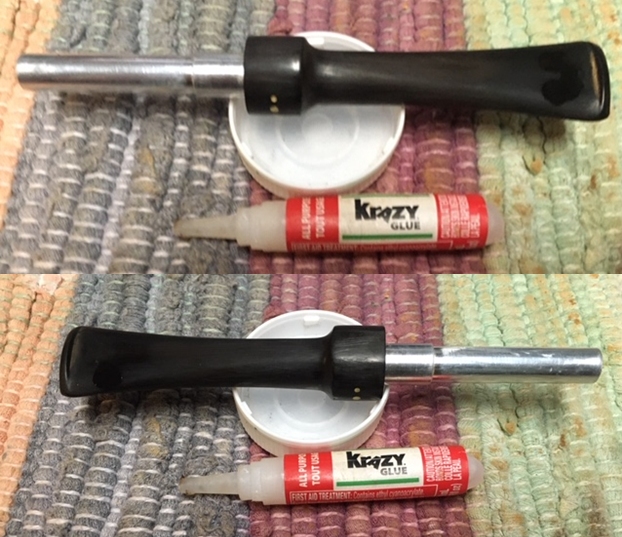
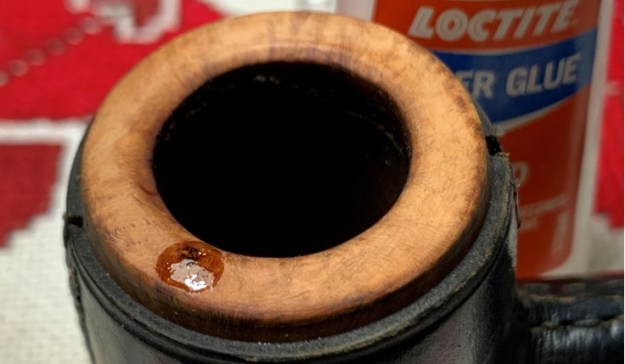
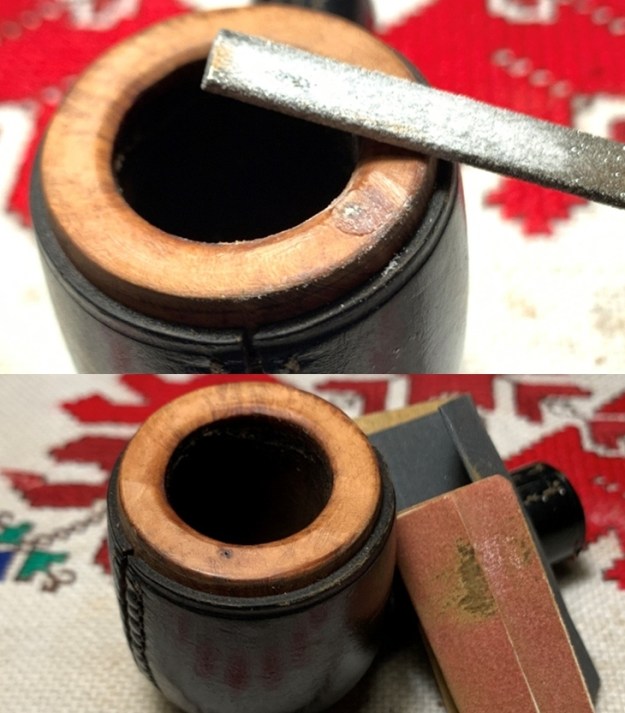
I started with the issues at hand with the pipe – the out of round inner edge of the bowl and the missing fills on the side and rim top. I began by taking a couple of photos of the bowl to show the damage that needed to be addressed.I started my work on the bowl with the out of round inner edge of the rim. I used a folded piece of 220 grit sandpaper to clean up the rim edge. To prepare the top of the rim for the work that needed to be done I lightly topped the surface of the rim to make it clean and smooth. The added benefit was that the out of round edge was also much better between the sanding and the topping. The third photo below shows the cleaned up rim top and inner edge of the bowl. There is some progress on reshaping and repairing this pipe. The rim looked much better at this point in the process. The inner edge looked much better and was round again. Now it was time address the issue of the missing fills. I am pretty convinced that the damage to the rim top and bowl side did not come from a drop or damage but rather was the result of an old putty fill falling out along the way. I have found that in many of the old briar pipes from the early 1900s that I have worked on that the fills will dry out and drop out somewhere along the journey. I decided to rebuild the fills but instead of using putty to use Krazy Glue and briar dust. I put a drop of glue in each damaged fill and press briar dust into the glue. I repeated the process until the holes were filled in. I used this method on both the rim top and the right side of the bowl. The pictures below show the process.I sanded the repaired areas with 220 grit sandpaper once the fill had cured. The first step of the repair was complete. The repairs were smooth with the surface of the surrounding briar. I needed to a lot more sanding and blending but it was getting there.I did some more sanding with 220 grit sandpaper and took some progress photos. I continued to sand the repaired areas with 400 grit wet dry sandpaper. I wiped the areas down with a damp cloth and took the photos.I polished the repaired areas and the rest of the bowl with micromesh sanding pads – wet sanding with 1500-12000 grit sanding pads. I wiped the bowl down after each sanding pad with a damp cloth to remove the sanding debris. I used a Cherry and a Maple stain pen blended together on the side of the bowl and the rim top to match the colour of the rest of the bowl. Once it had dried I buffed it with a soft cotton cloth.I worked some Before & After Restoration Balm into the briar with my fingertips to clean, enliven and protect it. I find that the balm really makes the briar come alive again. It also works well to blend the restained areas of the bowl with the rest of the pipe. The contrasts in the layers of stain really made the grain stand out. I let the balm sit for a little while and then buffed with a cotton cloth to raise the shine. The pipe really looks good at this point. I am very happy with the way the pipe is looking at this point in the process. While I was hand buffing the bowl I noticed that the silver band was loose on the shank and rotated freely. I removed the band and put some all-purpose glue on the shank and pressed the band into place. I turned it to align the stamping on the band with the stamping on the shank. It set quite quickly and I polished the silver band with a jeweler’s cloth.At this point I wrote Ray an email and sent a few pictures of the current state of the pipe. I asked him a few questions about the next steps in the process. I was also curious about whether he had reamed and cleaned the pipe. I did not want to do that if it had already been done and I was also uncertain about whether he wanted me to refresh the gold in the stamp on the shank. I sent the email and called it a night. In the morning I received this response.

Hi Steve,

The gold foil sound great – I have not seen that before, but I usually don’t bother much with the nomenclature. Perhaps I should.

 No, I have not done any cleaning of the pipe at all – sent to you, as received.

 It came from Jason… he usually cleans up the pipes, but he is more a conservator than a restorer. William (who sold Jason the pipe)… gives them a buffing before sending them out, but not much more.

 My feeling is that the pipe has hardly been smoked. I have not tried cleaning the shaft or stem with pipe cleaners and alcohol, so I am just guessing.

The bowl is already looking really good. I’m afraid I was too afraid to take on the repair of the rim and the chips on the side of the bowl. As for matching the stain/colour – I am colour-blind, so goodness knows what shade the pipe will have ended up with…- Ray

Now I had some direction. I decided to finish my work on the bowl before proceeding to the stem. I used some Rub’n Buff Antique Gold to rework the gold stamping on the shank. I apply it with a tooth pick to work it into the grooves of the stamp. It is an oily product so once it is applied the idea is to “rub” it off with a soft cloth. The photos show the process.Now to back step a bit… It is always easier to do the internal cleaning before the repairs and buffing of the externals but it still had to be done – so I carefully worked on the bowl walls without damaging the inner edge of the rim. I examined the inside of the bowl with a light and I could see what looked like checking on the walls. Looking closer It appeared that there was a light cake in the areas that looked checked. The cake was not even on the walls of the bowl so it had to go! I used a Savinelli Fitsall Pipe Knife to scrape of the cake on the bowl walls. I then used a piece of dowel with 220 grit sandpaper wrapped around it to smooth out the walls. Viola! The checking was gone and the bowl walls looked very good!I still wanted to clean out the internals of the mortise, shank and airway in the shank and stem. I cleaned mortise and shank with alcohol, cotton swabs and pipe cleaners. Because of the pre-existent crazing in the stem I used water to clean out the inside of the stem. The pipe was quite clean as can be seen in the photos of the pipe cleaners and swabs. I agree with Ray it was indeed either lightly smoked or very well cared for.With the bowl finished it was time to address the tooth chatter and marks on the stem. I sanded them out with a folded piece of 220 grit sandpaper and followed that with a piece of 400 grit wet dry sandpaper. It did not take too much sanding for the surface to be smooth.I polished the sanded areas of the stem with micromesh sanding pads – wet sanding with 1500-12000 grit pads. I wiped the stem down after each pad with a damp cloth. I polished it with Before & After Pipe Polish – Fine and Extra Fine. I finished by buffing the stem with Briarville’s No Oxy Oil. I am happy to see this pipe finished. Later today I will pack it up and send it back to Ray in Australia. It was a fun one to work on – I love old pipes. This one has a lot of character and charm that just got my attention as I am sure it did Ray’s. I put it back together and buffed it with Blue Diamond on the wheel being careful to not let the wheel snatch it away from me. I gave the bowl several coats of carnauba wax and the stem several coats of Conservator’s Wax. The pipe looked really good. I could not wait to hear what Ray thought of the pipe once he saw it. The dimensions of the pipe are Length: 5 ¼ inches, Height: 1 3/4 inches, Diameter of the bowl: 1 1/8 inches, Chamber diameter: ¾ of an inch. I am happy with the way the repairs to the fills turned out. The pipe is a real beauty and should be a great smoker for Ray. It will soon be on its way back to Australia. Thanks for walking through this restoration with me. It is a great example of the trust we carry on as pipemen and women. This pipe has passed through many hands before coming to Ray. It will have a long useful life ahead of it as Ray carries on the trust… for this season. Cheers.  


Giving New Life and Stem Alignment to a Made in London England Diplomat


Blog by Dal Stanton

When I put this pipe in the For “Pipe Dreamers” Only! online collection, I identified it as a Squat Apple. It came to me from the lot my son helped me to procure from an antique shop in St. Louis.  When Andy chose this as his next pipe after commissioning the probable Preben Holm Danish Freehand which I just finished restoring (See: Recommissioning a Mysterious Freehand, Made in Denmark – Preben Holm?) I fished it out of the ‘Help Me!’ basket and put it on the table and the ‘Squat Apple’ sort of fit, but not quite.  Volcano?  No, too rounded.  Here are the pictures of the ‘Squat Apple’ that got Andy’s attention. The only markings are found on the lower side of the oval shank, MADE IN LONDON [over] ENGLAND.  Below the COM is what I assume is a shape number, ‘140’.   Not a lot to go on to determine origins.The ‘Squat Apple’ wasn’t sitting well with me so I looked at Bill Burney’s great Pipe Shapes Chart on Pipedia and found the shape classification that worked better – Diplomat.  Interestingly, my ‘Squat Apple’ designation was used by Bill Burney to describe the Diplomat.  I clipped the panel to show the description of the Diplomat:The English Diplomat now on my worktable is not a bad looking pipe but has a few issues.  The Diplomat’s chamber has a thick layer of cake and the lava flow on the rim is thick – it needs some cleaning as well as the stummel.The after section of the rim reveals the darkening of the briar that has been scorched through the lighting practices of the former steward.As the following three pictures show, the stummel is darkened from grime and oils on the surface.  You can see some very nice grain lurking beneath.  There are also dings and scratches on the stummel from normal wear. The acrylic stem is attractive, but I’m guessing that it’s a replacement stem.  My first observation looked like the stem simply didn’t fit with a wobble and gaps showing between the shank and stem facings.  When I removed the stem the acrylic tenon was stuck in the mortise and not attached to the tenon.  It didn’t take much to dislodge the rogue tenon but after inserting it into the tenon and trying the fit again, the wobble and looseness is evident and if I’m able to reattach the acrylic tenon and keep the stem facing flush with the shank facing before the CA glue sets, it should do well.I then noticed the darkened airway through the translucent acrylic.  As I suspected, after inserting a pipe cleaner into the airway from the shank side, I discover that there is blockage in the stem. In the picture below, I’ve placed my fingers roughly where the inserted pipe cleaner stops and the blockage begins.  This can be a pain!  The following picture with the slot view shows blockage very near to the opening.I decide to try to ‘bull’ through the blockage with a pipe cleaner and to my surprise, the pipe cleaner was able to break through and not a lot of gunk came out.  Good to go.Before moving toward re-attaching the tenon to the acrylic stem, I’ll first do the cleaning.  I’m trying a ‘Soft-Scrub-like’ product we have here in Bulgaria called Cif brand to try to clean the darkened internal airway.  The label describes micro-crystals and a bleach component as the active agents.  I’m using Jeff Laug’s recommendations from his blog (Got a filthy estate pipe that you need to clean?).Holding the translucent acrylic stem up to the light provides a good Xray of the airway and how it’s darkened.  We’ll see how much the cleaning removes the internal buildup and lightens the airway. I go to work with the Cif product and start by using bristled pipe cleaners dipped in Cif to begin breaking up the tars and oils that have crusted inside the airway. At first there was no noticeable progress except for the darker discoloration of the pipe cleaners which meant something was happening.  I add after the pipe cleaners shank brushes.  I transferred the shank brushes, Cif and stem to the kitchen sink where using hot water, I continued the cleaning with the Cif and brushes.  At this point, progress was evident.  A combination of the brushes and cleaner AND the hot water helps break down the crud.Back to the worktable, the follow-up light Xray shows the results.  Nice!  I move on.I put the stem aside and move to the stummel cleaning before I start on the repairs to the stem and tenon.  Not only do I prefer working on cleaned pipes, but often the cleaning process can change the mortise environment because we are working with wood.  Cleaning often loosens tenon fittings.  So, before moving to more permanent repairs, it’s a good principle to get the cleaning done first.  Looking again at the chamber, the cake is moving from moderate to thick cake.  Using the Pipnet Reaming Kit I start with the smallest blade head and end up using 3 of the 4 blade heads available in the Kit. The Savinelli Fitsall Tool works well to follow by doing fine-tune scraping of the chamber walls.  I complete the cleaning by wrapping 240 grade paper around a Sharpie Pen which provides the leverage as I sand the chamber to remove the final vestiges of carbon cake to expose fresher briar to have a clean start. After wiping the chamber with a cotton pad wetted with alcohol to clean the carbon dust, I take a picture as I examine the chamber walls for heating damage.  All looks great. Moving now to the external cleaning of the stummel, I employ undiluted Murphy’s Oil soap on a cotton pad to scrub the surface and rim covered by lava flow.  In the immediate picture below, the sharp-edged pocketknife is helpful to remove the caked crusting.  You can see the progress being made as the blade is carefully scraping the rim top without cutting into the wood.  After the knife edge, the brass bristled brush cleans the rim further without damaging the wood.After working on the rim and stummel surface, I take the stummel to the kitchen sink using hot water and clean the internals using shank brushes and anti-oil dish soap liquid.  After thoroughly rinsing the stummel with water, back on the worktable a picture records the present cleaning state.Again, focusing on the internals, now using cotton buds and pipe cleaners wetted with isopropyl 95%, cleaning continues.  Also employed is a dental spoon to scrape the mortise walls – which produces very little.  A shank brush wetted with isopropyl 95% is used saving on pipe cleaners.  When the pipe cleaners and buds start emerging lighter and cleaner, I call this phase completed to be continued later using a kosher salt and alcohol soak.Now looking again at the tenon repair of the acrylic stem.  The tenon that was part of the Diplomat was not attached and since it’s not, fitting it to see how it will work is not easy – it shifts and moves.  The first two pictures below show the result when I insert the tenon tightly into the stem cavity to test it out.  The first picture is from the top perspective.  Notice that the stem is offset to the right (top of the picture) so that the stem is overhanging on the top and the shank is overhanging the bottom of the picture.Now looking at the underside of the fit, the offset is augmented by the gapping that is evident.Not only do the pictures reveal the seating difficulties of the tenon, but the drilling through the tenon for the airway is not centered.  This has potential challenges on at least two fronts.  First, it potentially creates a hang-up lip as pipe cleaners are pushed through.  This is not huge as usually simply twisting the pipe cleaner in the airway solves this hindrance.  Secondly, is that if the tenon needs to be expanded, I will not use the heating method to expand it.  The reason for this is that the offset drilling has created a very thin wall of acrylic which will probably split if expansion is attempted.  The alternative will be to simply paint the exterior of the tenon with acrylic clear polish or CA glue.  This builds out the tenon circumference.As I was fiddling with the tenon trying to figure out the best approach, another issue surfaced.  On a hunch, the question came to mind, ‘Is the acrylic stem facing flat?’  I took out the chopping board that serves as a topping board and I placed the stem facing flat against it.  I discover that there is a dance in it – a microscopic rocking.  Just to be on the safe side for comparison, I also place the shank facing down on the board and find that its rock solid. You can see from the second picture the culprit looks to be around the airway – old glue protruding.  I decide to address this straight away by placing 240 grade paper on the board and ‘top’ the stem facing to flatten it – carefully!  Instead of rotating like I would if it were a stummel being topped, I drag laterally along the paper.  After a few ‘drags’ on the topping board, another test on the flat chopping board is much better.  The stem facing is now flush with no rocking.I again do a test fitting with the unglued tenon in place, reengage the stem to bring the facings flush.  To see if a pipe cleaner would snag on the tenon, I insert one through without problem.If I can glue the tenon and achieve this much, I’ll be satisfied.  Sanding can address the overhangs where the shank and stem do not line up.A lot of time has elapsed thinking and testing, now it’s time for action!  I use BSI Extra Thick Maxi-Cure CA glue.  Using a piece of 240 grade sanding paper, I sand the part of the tenon that will be inserted into the mortise.  I want it round and smooth. After cleaning the area with alcohol, I place a small amount of glue around the circumference of the tenon just above where the tenon will be inserted into the mortise.  In this way I hope to avoid glue getting into the airway on the end of the tenon. Yet, I don’t put a lot of glue on it to avoid CA glue being forced out the top onto the stem facing.  After placing the glue, I insert the glued part of the tenon partially into the stem cavity and then insert the mortise side of the tenon into the mortise and engage the parts.  In this way, while the glue is still pliable, the tenon gives way to the flush orientation of the shank and stem facings. After doing this, I leave the pipe for several minutes allowing the CA glue to cure and hopefully hold the tenon in place! I’m hopeful for a solid and snug seating. I decide to move forward with working on the acrylic stems button.  The top button lip has been compressed on the left side and the lower lip has also been chewed.  The tooth compressions on both upper and lower sides need filling. I use regular CA glue combined with an accelerator.  Starting on the topside and apply CA to the problem areas – also on the lip to build it.  I do the same for the lower bit and button lip.  With each application of CA glue, I use the accelerator to hold the patch in place and cure the glue more rapidly. I next use a flat needle file to file the CA glue patches over the tooth compressions down to the stem surface on both the upper and lower bit.  I file and shape the button repair as well.To remove the scratches left by the file, 240 grade paper is used on the bit and button but also on the whole stem.Focusing the sanding on the junction now, I sand out the edges that were hanging over the shank and stem facings.  I first cover the nomenclature with masking tape to protect it. The sanding moves around the circumference of the junction and I like the way the stem and shank now are in alignment and the union is flush.Next, I wet sand the entire stem with 600 grade sanding paper and follow with applying 000 steel wool. I’m on a roll with the stem, which I normally like to get out of the way so I can work on the stummel!  Next, I apply the full battery of 9 micromesh pads to the acrylic stem.  First, I wet sand using pads 1500 to 2400 and follow by dry sanding with pads 3200 to 4000 and 6000 to 12000.  Even though I don’t believe it makes a difference but seems to enrich the acrylic surface.  I love the pop of the stem – almost luminescent. After reuniting stem and Diplomat stummel, I get a sense of where things are.  I’m liking what I see!  While the stem was probably not the original, I like the combination and thinking now about how to finish the bowl to take advantage of the striking hues of the acrylic stem. At this point, if the micromesh process brings out the grain well and there is no nuanced lightening of the wood on the shank where the major sanding was, I’ll leave it in the natural briar state.  If there is indication that the shank sanding stands out, I’ll apply a stain.  The briar patterns are very nice – time to bring it out!Next, to freshen the rim and to remove the darkened old finish, I take the stummel to the topping board.Not much is needed – only a cosmetic topping.  With the stummel inverted on 240 grade paper, I give the stummel a few rotations to clean things up.Then switching to 600 grade paper, the stummel is rotated several more times.With the rim refreshed, sanding sponges will address the tired finish on the bowl and the normal nick and dents.  I see no major issues to address on the stummel surface – no fills.With the ‘Made in London, England’ covered by masking tape to protect it, I make sure that the sanding sponges address the shank area well.  I want to blend the lightened area that was sanded.  Using a coarse sanding sponge to do the initial heavy sanding, it removes the minor nicks and old tired finish.  After using the coarse sponge, I remove the masking tape covering the nomenclature for the application of the medium and light graded sponges.  The sponges are not rough enough to impact the nomenclature which is healthy.To fine tune further, the full set of micromesh pads are applied by first wet sanding with pads 1500 to 2400.  Following this, dry sanding with pads 3200 to 4000 and 6000 to 12000 bring out the grain which is beautiful. On a roll, and very enthused by the richness of the honey brown hue emerging and the detailed grain, I apply Mark Hoover’s product (www.ibepen.com), Before & After Restoration Balm which does a great job teasing out the deeper natural hues of the briar.  With some Balm on my fingers, I work it into the briar well and then set it aside for about 20 minutes for the Balm to be absorbed by the wood.  I then wipe off the excess with a cotton cloth dedicated to this and then buff the stummel with microfiber cloth.The day is coming to its close and I continue the internal cleaning using a kosher salt and alcohol soak.  This further cleans as well as freshens the bowl for the new steward.  I first fashion a ‘wick’ by stretching and twisting a cotton ball which is then inserted into the mortise and airway with the help of a stiff wire.  This wick helps to draw out the tars and oils from the internal chamber walls.I then fill the chamber with kosher salt which does not leave an aftertaste and place the bowl in an egg carton for stability.Using an eyedropper, isopropyl 95% fills the chamber until it surfaces over the salt.  After a few minutes the alcohol is absorbed, and the alcohol is topped off.  I let the soak work on the cleaning through the night.The next morning the salt and wick are soiled revealing the added cleaning of the chamber and mortise.  After dumping the expended salt and wiping the chamber with paper towel, I blow through the mortise to loosen and remove salt crystals remaining.To make sure all is clean, I follow with some pipe cleaners and cotton buds.  This is a good step in the cleaning process because the dirty pipe cleaners revealed that the airway was still in need of more cleaning.  After more pipe cleaners wetted with isopropyl 95%, the pipe cleaners were emerging cleaner and lighter.  I declare after a time, ‘Clean!’ and I move on.After reuniting the stem and stummel and mounting a cotton cloth buffing wheel on the Dremel, setting the speed at about 40%, the fine abrasive Blue Diamond is applied to the entire pipe.  After completing this, I use a felt cloth to buff the pipe to remove compound dust in preparation for applying the wax.Finally, after changing to another cotton cloth buffing wheel, carnauba wax is applied to the pipe and I after this, I give the pipe a hand buffing using a microfiber cloth to raise the shine.The grain on this Made in London England Diplomat is superb.  I’m extremely pleased with the repair to the acrylic stem.  It is now beautifully seated in the mortise, straight balanced and snugly secure.  The waves in the acrylic pop and the Diplomat shape, with the broad heal, makes for a very nice feel in the palm.  Andy from Maryland commissioned this English Diplomat and will have the first opportunity to acquire him in The Pipe Steward Store.  This pipe benefits the Daughters of Bulgaria.  Thanks for joining me!

Breathing Life into a Brigham Exclusive Bent Dublin


Blog by Steve Laug

Not too long ago I received an email from a fellow in Kitchener, Ontario regarding some pipes he needed cleaned up. He had been referred to me by my local pipe and cigar shop. While I am not currently adding more pipes to my queue of repairs I have made a commitment to the shop to work on pipes for their customers. Generally they have one or two pipes that need a bit of work. This fellow sent me the following email:

I just came across my smoking pipes that I’ve had in storage for about 40 years. I’m wondering what you’d charge to have them refurbished. There are 17 in total (11 are Brighams and 6 are various).

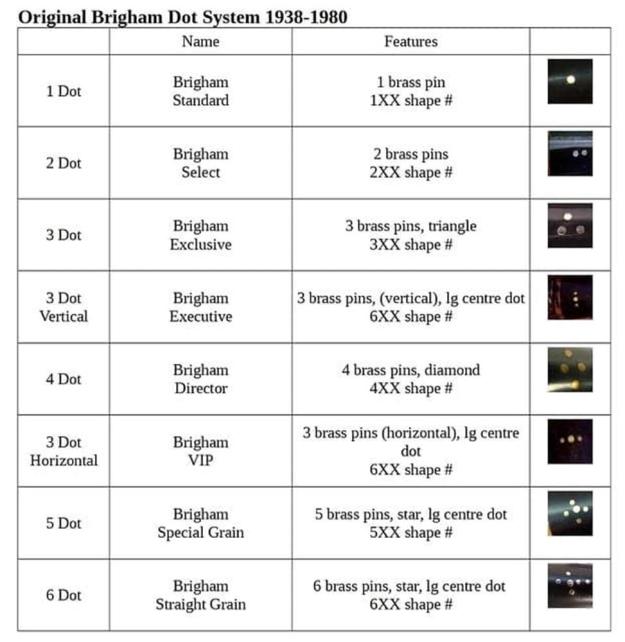
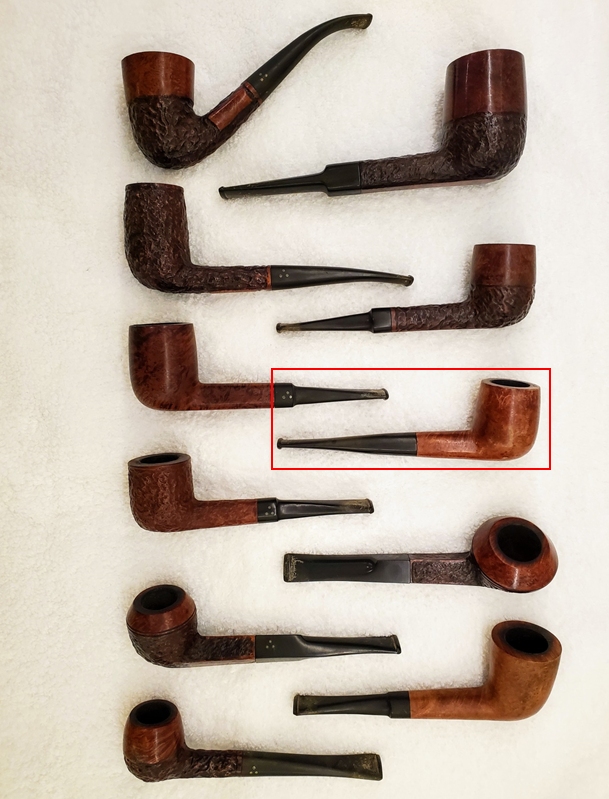
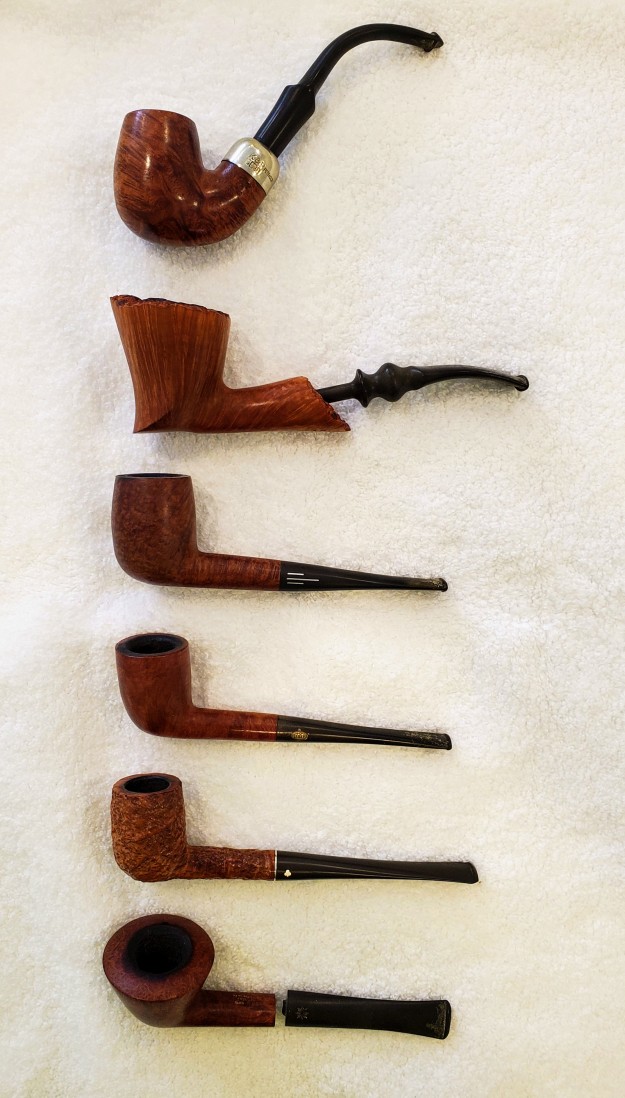
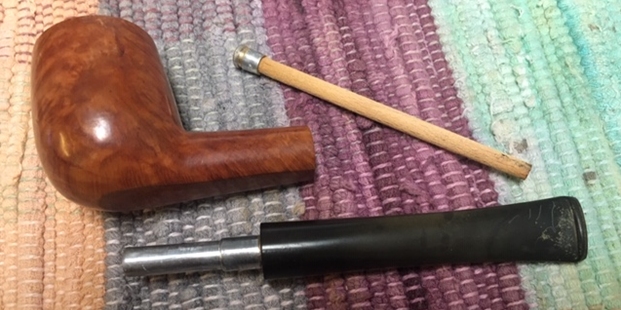
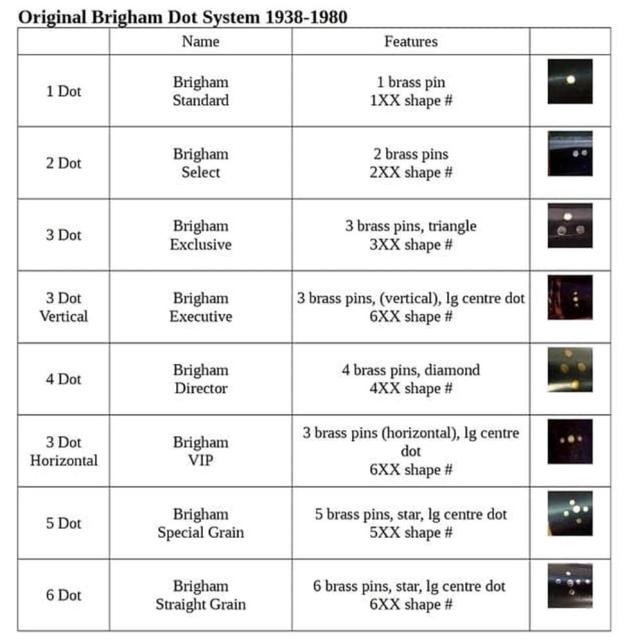
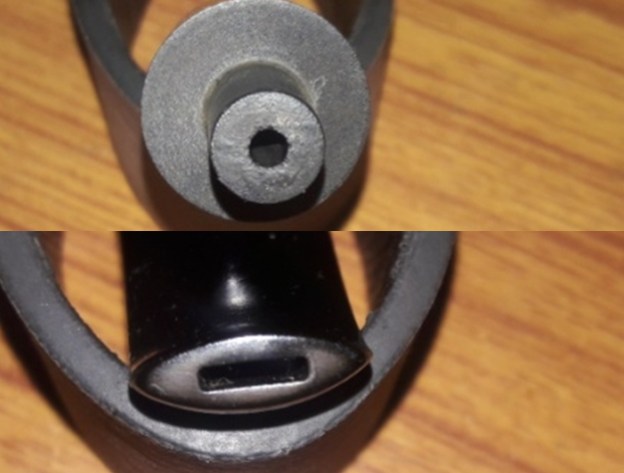
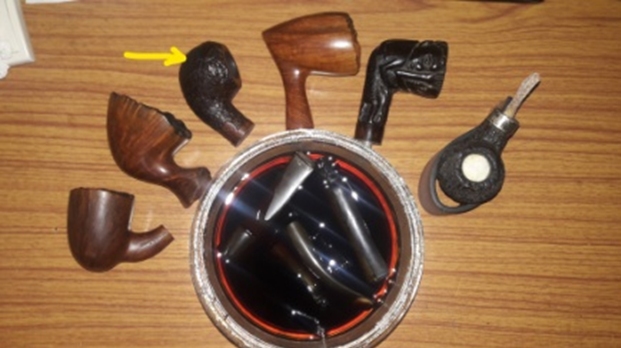
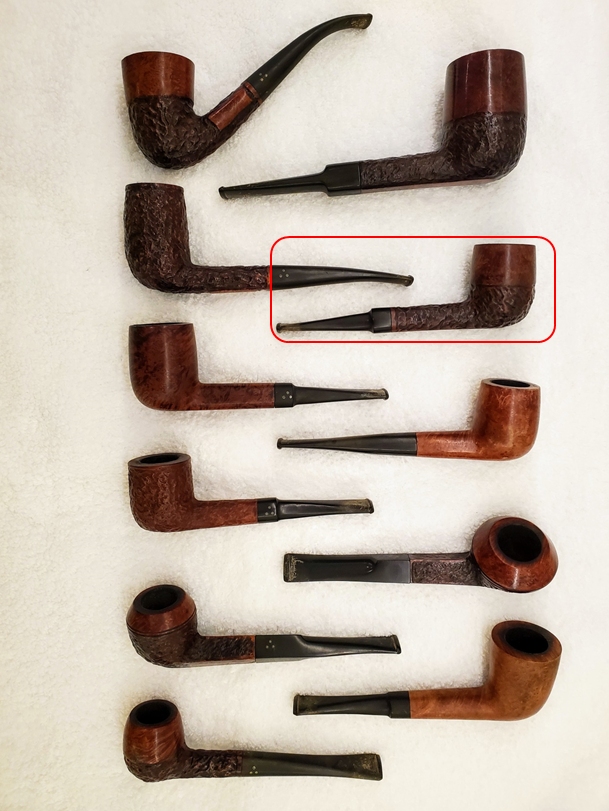
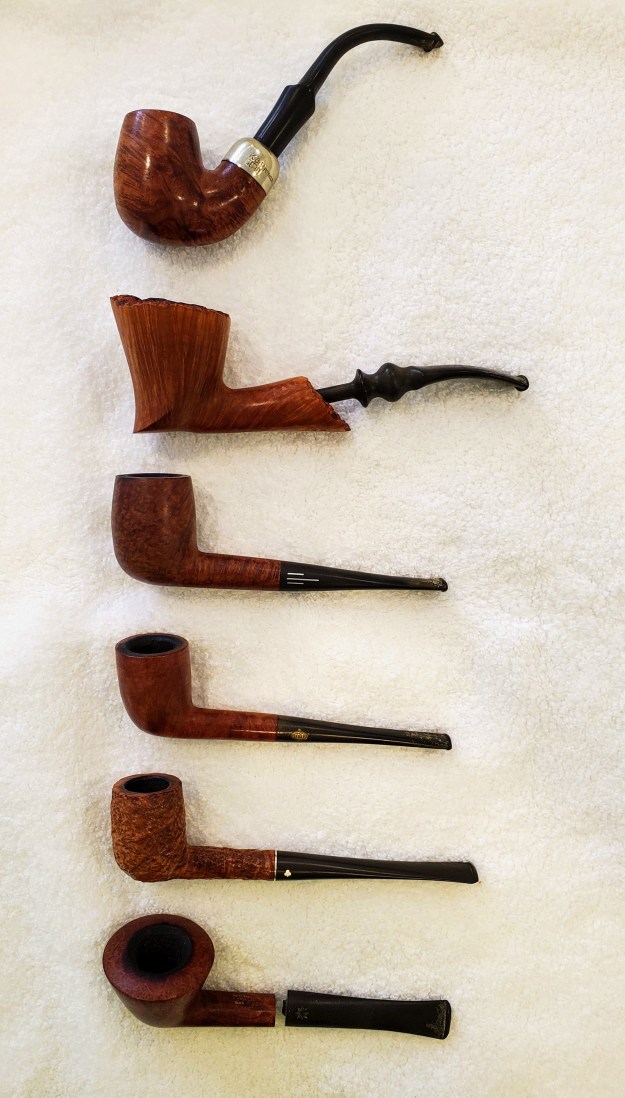
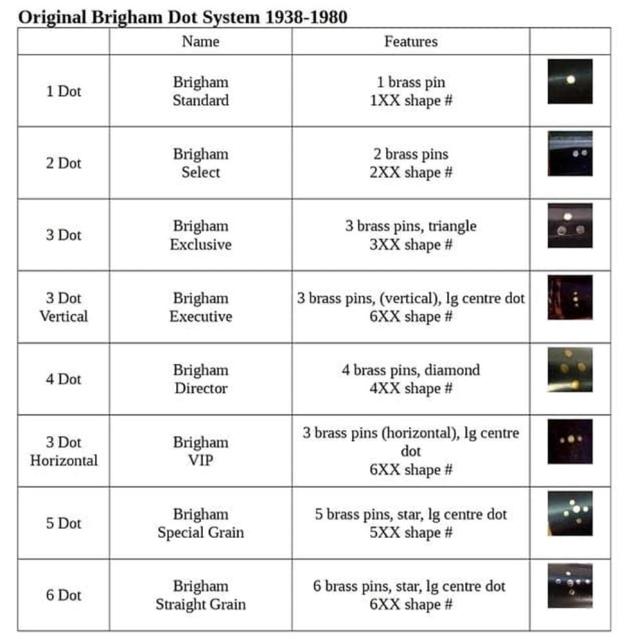
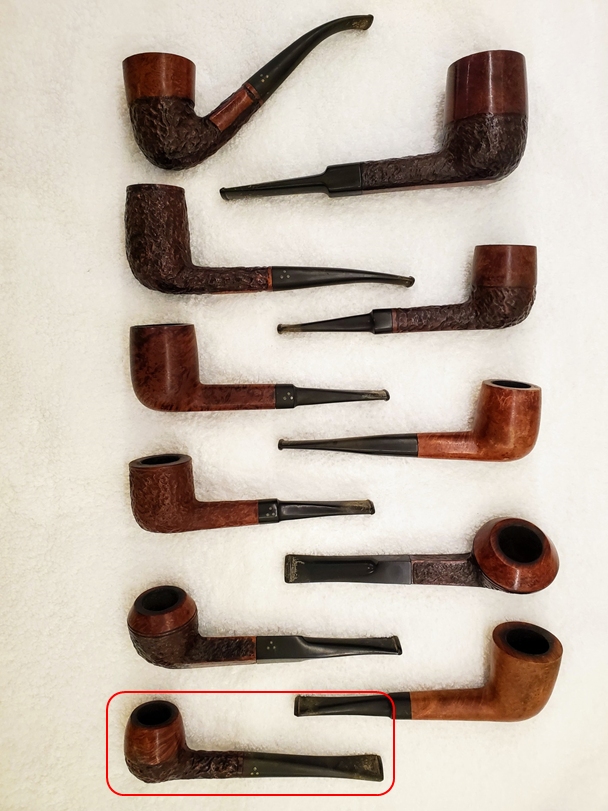
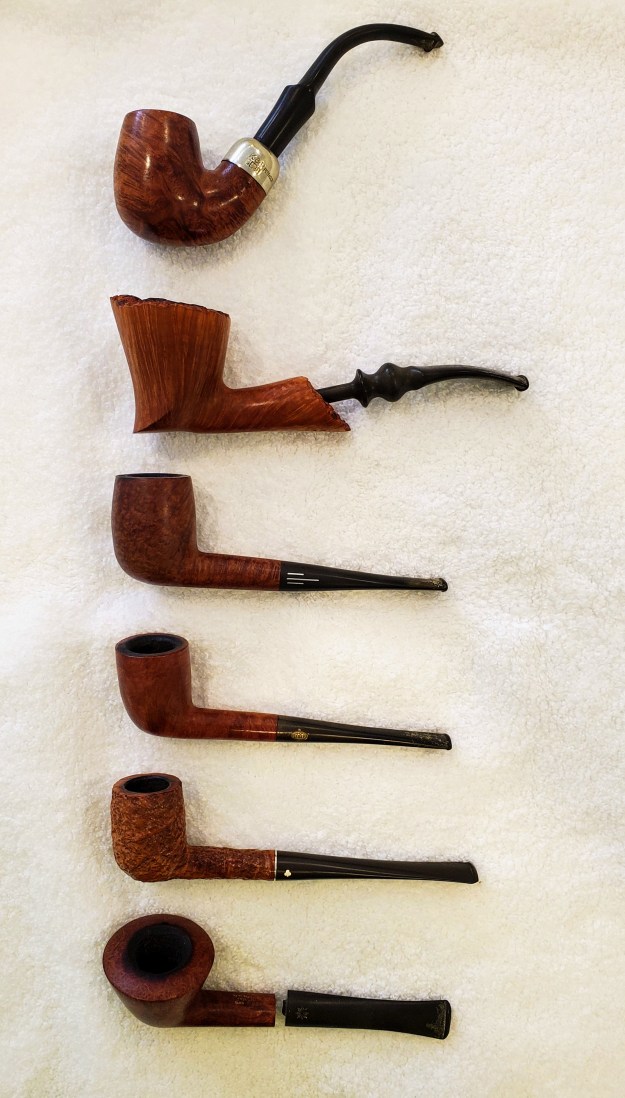
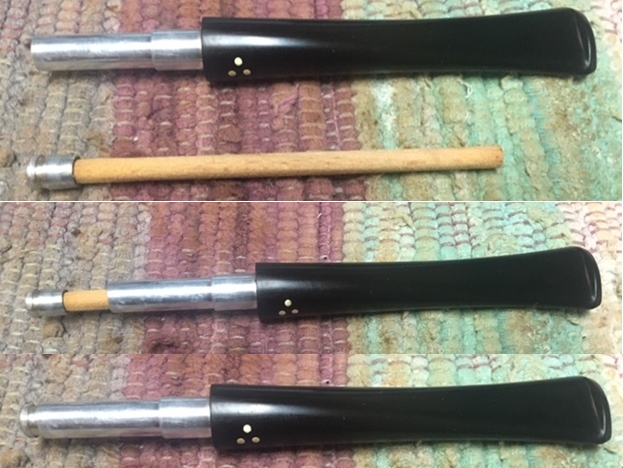
It turns out he said he had 17 pipes. That was certainly more than I expected but I communicated that there was a large queue ahead of him and I would have to fit them in as I could. He was fine with whatever time it took. He sent me the following photos of his collection that he wanted restored. The first photo shows his eleven Brigham pipes – all very interesting shapes. The second photo shows the six various pipes in the collection – A Republic Era Peterson’s System 1312 (Canadian Import), A Bjarne Hand Carved Freehand, a Comoy’s Everyman London smooth billiard, a GBD Popular Dublin 12, an English made Kaywoodie Rustica 72B, a Kriswill Bernadotte 60 with a broken tenon. When the box arrived there were two additional pipes included for a total of 19 – a Ropp 803 Deluxe Cherrywood Poker and a Comoy’s Sandblast Everyman Canadian 296. It was a lot of pipes! I have been randomly choosing the next pipe to work on and chose the Brigham that have drawn a red box around in the first photo below. When I unwrapped it the pipe it was a Brigham Exclusive Bent Dublin and was stamped on the left side in a smooth panel, it read Brigham in script over Can. Pat. 372982. It had a rusticated lower half of the bowl and shank with a smooth top half. The rim top had some darkening and lava, out of round and a thick cake in the bowl. It was very dirty. The finish appeared to be very good under the grime. Perhaps the lava on the rim top had protected that as well. I would see when I cleaned it. The 3 Dot tapered stem is oxidized, tooth marks and chatter near the button, some calcification. It was oxidized and had tooth chatter and marks on both sides just ahead of the button. I took close up photos of the bowl and rim top to show the condition of the bowl and rim as well as the thick cake and lava overflowing onto the rim top. I also took close up photos of the stem to show its condition as mentioned above. I took a photo of the stamping on the left side of the shank to show what I was speaking about above. It is very clear and readable. The second photo shows the Can. Pat. stamp 372982. I removed the stem from the shank to reveal the aluminum tube/tenon that held the Rock Maple Distillator. The Distillator was stuck in the tube so I had to carefully twist it free with a pair of pliers. Once it was free you could see the grime and grit on the metal cap. I turned to a chart that Charles Lemon of Dad’s Pipes sent to me on the patent era Brighams. There were made from 1938-1980. As the pipe I am working on is a Patent pipes, it’s more accurate to refer to its grade by name (the post 1980 grading scheme refers to Dots). Here is the  chart that Charles sent me. The pipe I am working on is thus a Brigham Exclusive with the brass pins arranged in a triangle. The pipe I have in hand does not appear to have a shape number.It is helpful having this chart and getting a quick picture of where the pipe fits in the Brigham line. Now it was time to work on the pipe.
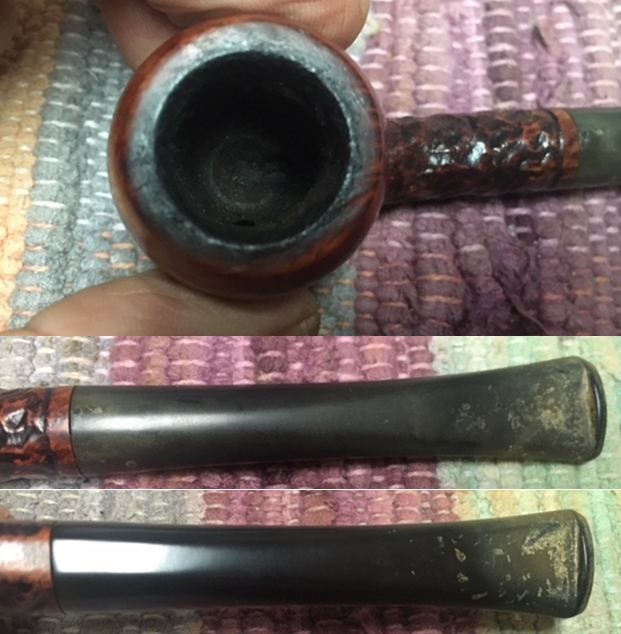
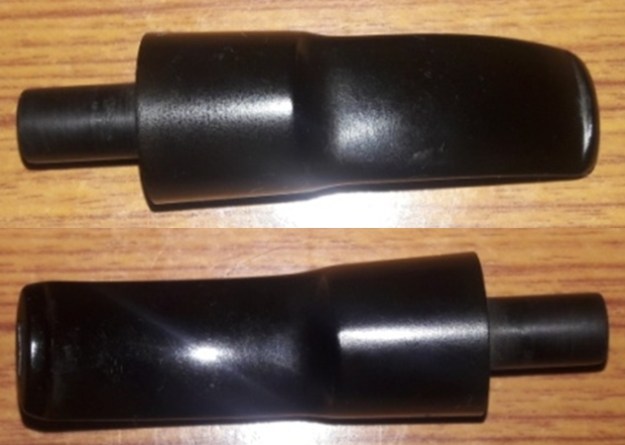
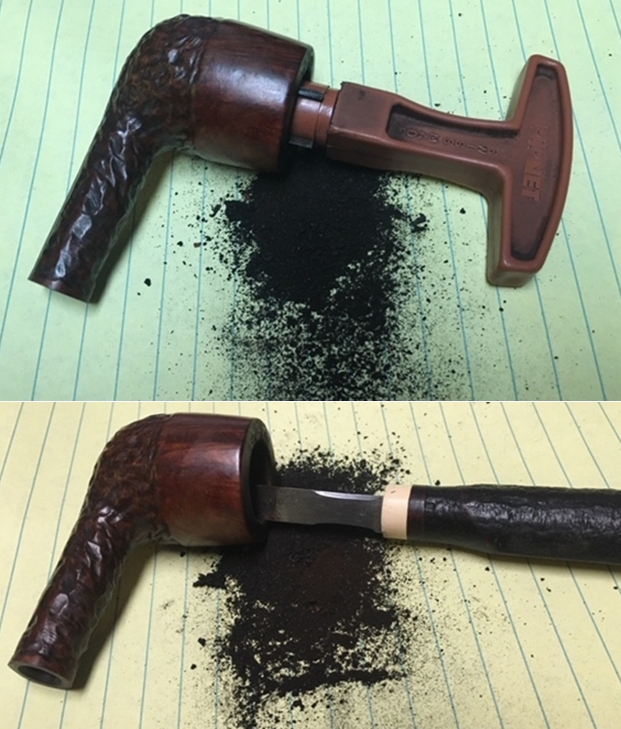
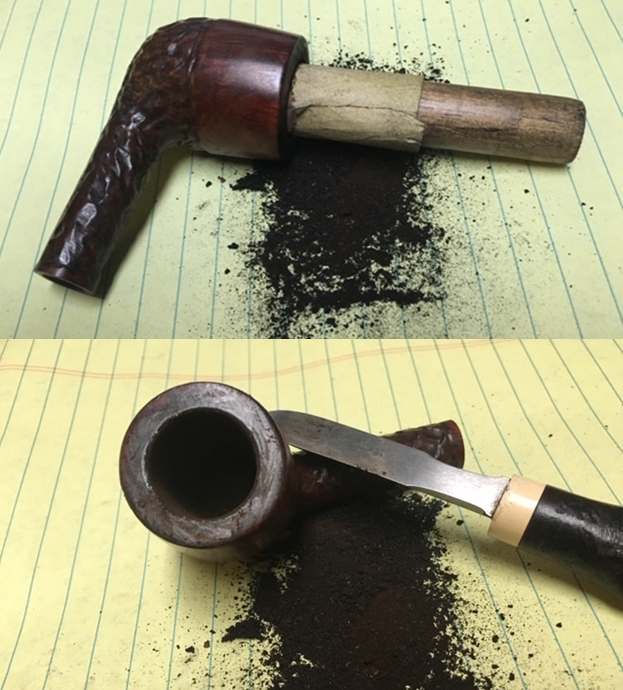
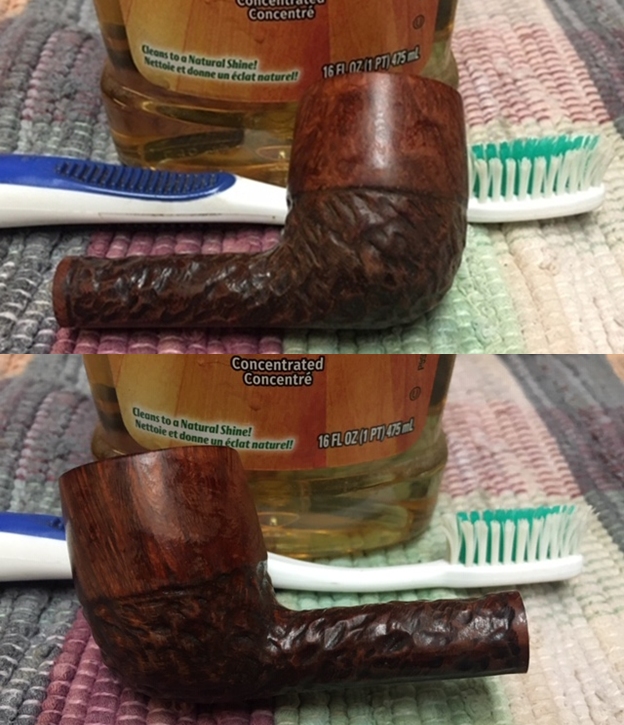
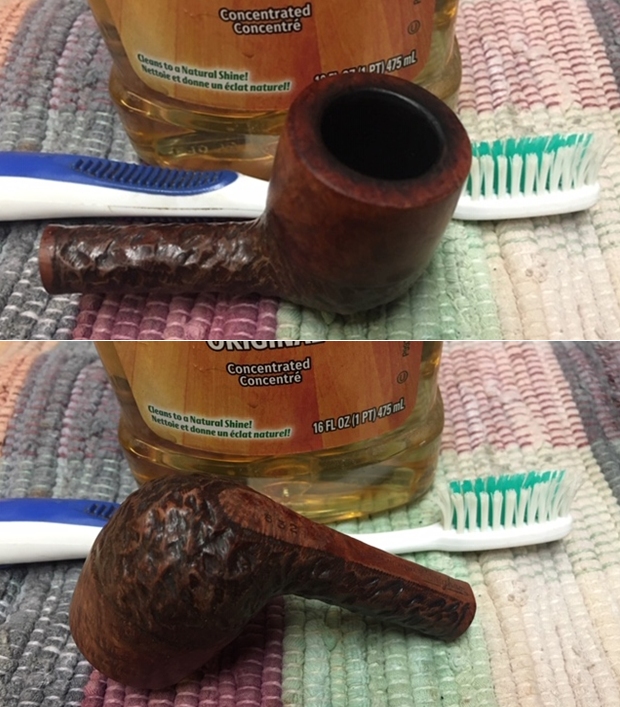
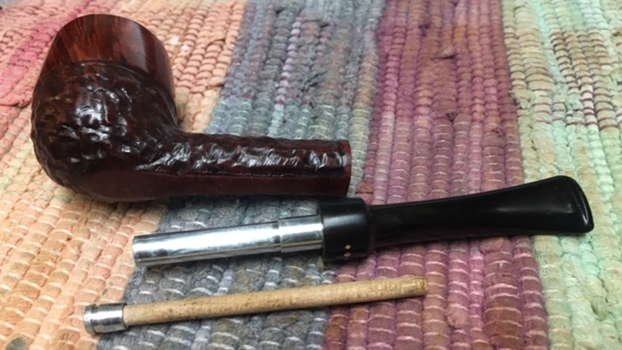
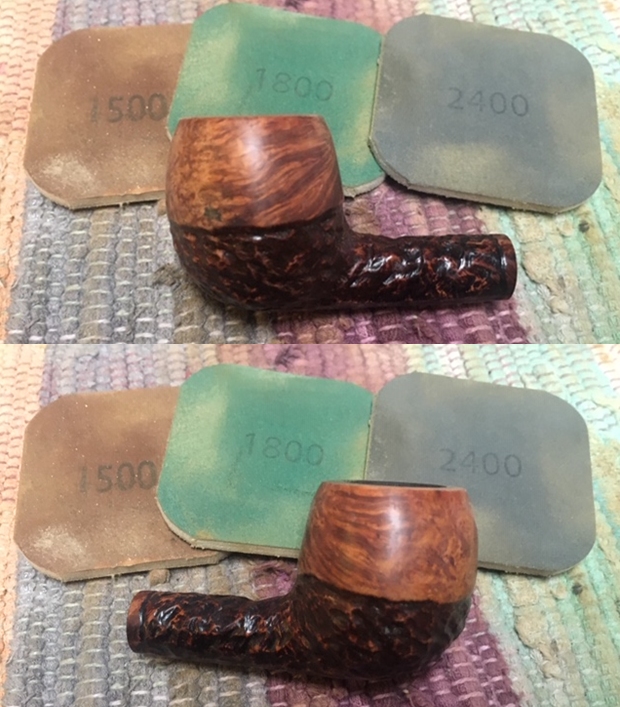
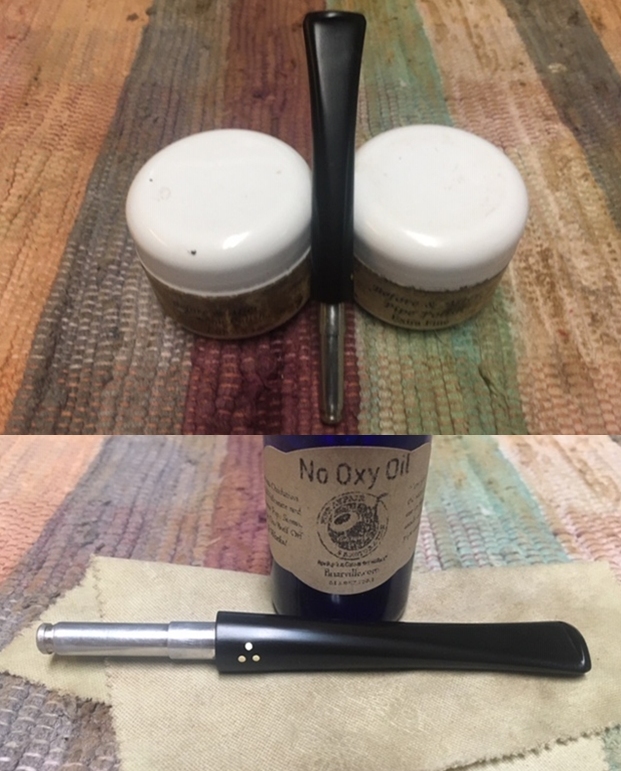
I reamed the bowl with a PipNet pipe reamer using the second and third cutting head to take the cake back to bare briar so I could inspect the walls. I cleaned up the remnants with a Savinelli Fitsall Pipe Knife. I sanded the bowl walls with 220 grit sandpaper on a piece of dowel to smooth them out and further examine them. I was happy that the walls looked very good. I cleaned up the rim edge and the rim top with a folded piece of 220 grit sandpaper. I was able to remove the damage on the edge and all of the lava from the rim top. The briar looks pretty good on the rim and edges. With the bowl reamed and the rim top cleaned off it was time to scrub the exterior of the pipe. I used a tooth brush and Murphy’s Oil Soap to scrub out the grime in the rustication and the bit that remained on the rim edges and top. I rinsed the bowl under running water and dried it off with a cotton cloth.  I cleaned out the mortise area and airway to the bowl and the interior of the metal tube and airway in the stem with pipe cleaners, cotton swabs and alcohol. I wet sanded the rim top and the smooth portions on the bowl sides with micromesh sanding pads – 1500-12000 grit sanding pads. I wiped the bowl surface down with a damp cloth after each sanding pad to remove the sanding dust. Once I finished the bowl looked good. I rubbed the bowl and shank down with Before & After Restoration Balm. I worked it into the surface of the gourd with my fingertips and a horsehair shoe brush to clean, enliven and protect it. I let the balm sit for a little while and then buffed with a cotton cloth to raise the shine. Mark Hoover’s Balm is a product that I have come to appreciate and one I use on every pipe I have been working on. I set the bowl aside and turned my attention to the stem. I sanded out the tooth chatter, marks and oxidation with 220 grit sandpaper and started the polishing with 400 grit wet dry sandpaper. I polished the stem with micromesh sanding pads – wet sanding it with 1500-12000 grit pads. I wiped the stem down after each sanding pad with a cotton pad to remove the sanding debris. Before I finished the last polishing touches on the stem I decided to fit it with a new Rock Maple Distillator. I finished polishing the stem with Before & After Pipe Stem Polish – both fine and extra fine. I finished by wiping it down with Briarville’s No Oxy Oil and buffing it to a shine.  I always look forward to this part of the restoration when all the pieces are put back together. I put the pipe back together and buffed the pipe with Blue Diamond on the buffing wheel. I gave the bowl and the stem multiple coats of carnauba wax. I hand buffed the pipe with a clean buffing pad to raise the shine. It is fun to see what the polished bowl looks like with the smooth portion and the rusticated portion contrasting well and added to that the polished black vulcanite stem with the shining brass pins. This Brigham Exclusive Bent Dublin is nice looking and feels great in my hand. It is light enough that it is one that could be clenched and smoked while doing other things as it is very light weight and well balanced. It must have been a fine smoking pipe judging from the condition it was when I received it. Have a look at it with the photos below. The dimensions are Length: 5 ½ inches, Height: 2 ¼ inches, Outside diameter of the bowl: 1 ½ inches, Chamber diameter: 7/8 of an inch. This is the second of the pipes sent to me from Eastern Canada for restoration. I am looking forward to what the pipeman who sent it thinks of this restoration. Lots more to do in this lot! Thanks to each of you who are reading this blog. Remember we are not pipe owners; we are pipemen and women who hold our pipes in trust until they pass on into the trust of the next pipeman or woman.
New Life Jennifer’s Dad’s Maro Special Crosby Style Pipe


Blog by Steve Laug

I decided to change things up a bit and work on another of Jennifer’s Dad’s pipes. For the next pipe from the estate of George Rex Leghorn I have chosen a nicely shaped Maro Special long shank billiard. You may not have read about this estate before, so I will retell the story. I received an email from Jennifer who is a little older than my 64+ years about whether I would be interested in her Dad’s pipes. My brother Jeff and I have been picking up a few estates here and there, so I was interested. Here is the catch – she did not want to sell them to me but to give them to me to clean up, restore and resell. The only requirement she had was that we give a portion of the sales of the pipes to a charity serving women and children. We talked about the organization I work for that deals with trafficking and sexual exploitation of women and their children and she decided that would be a great way to carry on the charitable aspect of her Dad’s character. With some great conversation back and forth she sent the pipes to Jeff and he started the cleanup process on them. Once he had finished cleaning them all he sent them to me to do my work on them.

The Crosby style pipe with the Sterling silver band is stamped on the left side of the shank Maro Special in script. This was different than Jennifer had marked on the bag containing the pipe. There were no other markings on the briar. The silver band was stamped Sterling and had three hallmarks – an anchor, a letter “T” in a diamond shaped cartouche and a rampant lion. These will enable me to date the pipe as I restore it. The bowl had birdseye grain on the sides and cross grain on the front and back. The shank matched the grain pattern. The sterling band was oxidized and loose on the shank and had turned over. The finish is very dirty. There was a thick cake in the bowl and it had overflowed with lava onto the inward beveled rim top. It was a dirty and tired looking old pipe. The stem was badly oxidized and there were George’s usual tooth marks and chatter on both sides just ahead of the button. The button was in good shape. It had been sitting in boxes for a lot of years and it was time to move ahead with the restoration. Jennifer took photos of the pipes she was sending. I have included the three photos of this pipe below.When the box arrived from Jennifer, Jeff opened it and took photos of each pipe before he started his cleanup work on them. There were two long shank Crosby style billiards in the lot. The first was this smooth Maro and the second one a sandblast that has worn stamping. Both are the same shape and size and both have the thin pencil shank and long stem that I have come to associate with the Crosby shape. There is something about these long billiards that I like. I enjoy working on them. The shape on the Maro seems to really capture the flow of the grain on the briar. The briar appeared to be in good condition underneath the grime. The finish looked intact under the grime. The bowl had a thick cake that had hardened with time. The lava overflow on the rim top was very thick but it could very well have protected the rim from damage. We won’t know what is under it until Jeff had cleaned it off. The stem was oxidized and also had some calcification on the surface. There were tooth marks on both side just ahead of the button. Jeff took photos of the pipe before he started working on it. I include those below. Jeff took photos of the bowl and rim top to show the cake in the bowl and the lava build up on the rim top. It was thick and hard but hopefully it had protected the rim and edges from damage. The lava coat looks horrible but it points to a well-used, favourite smoking pipe. George must have enjoyed this old timer a lot and turned to this old, light weight long billiard for a cool smoke.Jeff took a photo of the side and heel of the bowl to show the condition of the finish – the grime and grit all over the sides and bottom of the bowl. It is a dirty pipe but it has a stunning birdeye grain around the bowl sides and cross grain on the front and back. Jeff took a photo of the stamping on the left side of the shank. It is very clear and readable. It reads Maro Special. There is no other stamping on the pipe. You can also see the characters on the Sterling silver band in the second photo below. Jeff took photos of the top and underside of the stem showing the scratching, oxidation and tooth marks on the stem surface. The tooth marks are quite deep on both sides of the stem.I turned to Pipedia to see what I could learn about the brand. I looked under the English pipe brands section first to see if I could find anything that would tie it to the Sterling Silver band on the shank. There were no makers from Great Britain with that name. On a hunch I checked the American maker section (https://pipedia.org/wiki/American_Pipe_Brands_%26_Makers_L_-_M) and sure enough under MARO found that the brand was made or at least attributed to the distributor Hollco International. I turned to the page on that brand to see if there was any more information (https://pipedia.org/wiki/Hollco_International). I quote in full from that site:

Hollco International of Chatsworth, California, formerly known as Hollco-Rohr, purchased the Wally Frank company in 1969 and at the same time became the US importer for Castello, Comoy, and the producer of Pioneer and other pipes. For more information see Wally Frank.

At this point the contradictions start rolling in. On Smokingpipes.com they listed the pipe as a French Made brand and showed a pipe remarkably similar to the one I am working on now. Here is the link to the pipe that they sold: (https://www.smokingpipes.com/pipes/estate/france/moreinfo.cfm?product_id=30391).

Smokingpipes.com had a second one listed under French Estates that is stamped the same as the one I am working on: Maro Special Billiard. Here is the link to the pipe and their description: (https://www.smokingpipes.com/pipes/estate/france/moreinfo.cfm?product_id=219942). I am including the photo as it was posted on the site. Quite a trim and slender take on the Billiard shape, this piece from Maro bears a striking resemblance to those long-stemmed Billiards favored by Bing Crosby. It’s finished in a warm walnut contrast stain with a bright metal band to accent.

I traced down quite a few Maro pipes online and all were attributed to France. So it appears I am dealing with one of several possibilities here. Either 1 – the pipe was made by Maro in France and sold through Hollco International or Wally Frank as the US distributor  or 2 – the pipe is legitimately a French made pipe that George Leghorn got a hold of somewhere in his journeys. Personally I am inclined to 1 – the pipe is a Hollco International import. Now I had some idea of the provenance of the pipe I could start with reasonable assurance that I was dealing with a French made briar. But before I get on to cleaning up the pipe I thought I would once again include the tribute that Jennifer wrote to her Dad for the blog. She also sent some photos and an article that her Dad wrote for Jeff and me to be able to get a feel for him. I have included those below. Note in each of them that he is holding a pipe in his left hand. I asked her to also send me an email with a brief tribute to her Dad. Here is her tribute from an email to me.

Steve, I want to thank you again for accepting my dad’s pipes.  They were so much a part of my dad’s life that I could not simply discard them. But as his daughter, I was not about to take up smoking them either. *laughing* I think my dad would like knowing that they will bring pleasure to others.  I know that I do.

I’m not sure what to say about his pipes. I always remember Daddy smoking pipes and cigars.

First a bit about my dad. Though my father, George Rex Leghorn, was American (growing up in Alaska), he managed to join the Canadian Army at the beginning of WWII, but in doing so lost his American citizenship.  He was fortunate to meet a Canadian recruiting officer who told him the alphabet began with “A” and ended with “Zed” not “Zee”, and also told him to say that he was born in a specific town that had all its records destroyed in a fire.  When the US joined the war my dad, and thousands of other Americans who had made the same choice*(see the link below for the article), were given the opportunity to transfer to the US military, and regain their citizenship.

After WWII, my dad, earned his degree at the University of California Berkeley and became a metallurgist. There is even a bit about him on the internet.

He loved taking the family out for a drive, and he smoked his cigars on those trips. (As a child, those were troubling times for my stomach.)

I most remember my father relaxing in his favorite chair with a science fiction book in one hand and a pipe in the other… Sir Walter Raleigh being his favorite tobacco… and the pipes themselves remind me of him in that contented way.  If I interrupted his repose, he’d look up, with a smile on his face, to answer me.

It seemed he smoked his Briarwood pipes the most, though he had others.  At the time, it was only the Briarwood I knew by name because of its distinctive rough shaped bowl.  And it was the Anderson Free Hand Burl Briar, made in Israel, which I chose for his birthday one year, because I thought he might like that particular texture in his hand.

At least two of his pipes, he inherited from his son-in-law, Joe Marino, a retired medical laboratory researcher (my sister Lesley’s late husband)… the long stemmed Jarl (made in Denmark), and the large, white-bowled, Sherlock Holmes style pipe.  I believe Joe had others that went to my dad, but Lesley was only sure about those two.

The Buescher, corncob pipe my older sister Lesley bought for Daddy while on one of her travels around the States.

A note on the spelling of my sister’s name…

My dad met my mother, Regina, during WWII and they married in Omagh, Ireland.  My mother was English and in the military herself.  The English spelling of Lesley is feminine, and Leslie masculine, in the UK… just the opposite of here in the United States.  I guess my mom won out when it came to the spelling of the name…

Jennifer

*https://www.thestar.com/news/world/2013/10/22/the_americans_who_died_for_canada_in_wwii.html

I am getting more and more spoiled on working on pipes that Jeff cleaned up. So much so that when I have to clean them it is a real chore! This pipe was a real mess just like the other ones in the collection. I did not know what to expect when I unwrapped it from his box. He reamed it with a PipNet pipe reamer and cleaned up the reaming with a Savinelli Fitsall Pipe Knife. He scrubbed out the internals with alcohol, pipe cleaners and cotton swabs until the pipe was clean. He scrubbed the exterior of the bowl with Murphy’s Oil Soap and a tooth brush to remove the grime and grit on the briar and the lava on the rim top. The finish looked really good when I got it. The rim top looked much better but had scratches and nicks in the surface and some darkening on the inner and outer edges. The silver band was oxidized and tarnished. Jeff had cleaned the internals and scrubbed the exterior of the stem and soaked them in Before & After Deoxidizer bath to remove the oxidation. The stem looked very good other than the deep tooth marks in the surface. When the pipe arrived here in Vancouver for the second stop of its restoration tour it looked very good. I took photos of the pipe before I started my part of the restoration. I took close up photos of the rim top and bowl to show the condition of the bowl and the damages to the rim top. You can see the nicks and scratches in the briar that were under the thick lava coat. The stem looks much better but the tooth marks are visible in the vulcanite. The button looks very good.I took a photo of the stamping on the shanks as it is very clear and readable even after Jeff’s cleanup work.I took the stem off the bowl and the Sterling Silver band slid off in my fingers. I took a photo of the pipe taken apart.I polished the silver band with Silver polish to remove the tarnish and polish out the scratches in the metal. The band definitely looks better.

The order of the hallmarks from left to right are an Anchor (identifying the city of the hallmark as Birmingham, England), T (which gives the year code) and the last one is the rampant lion (identifying the silver as Sterling). The letter T is in a diamond shaped cartouche. From what I can find it seems to fit somewhere between 1943 and 1968. None of the stamps is identical but they are close. So now I knew that the band was made in Birmingham, England between 1943 and 1968. Now the issue was clear to me – according to everything I had found the Maro Special was made in France and the band was made in England. It seems the band was added later. All of the photos I have found of the Maro Special showed the pipe with a silver band but none of them had Birmingham hallmarks so it seems that George had the original band replaced with this one. It might also explain why it had been glued on the shank upside down with the hallmarks on the bottom of the shank. There are no cracks in the shank so it is not a repair band.

Knowing that I now knew that I had a mystery in my hands and that I would likely never fully know how the band and the pipe met! Ah well such is the life of working on estate pipes. Now on to the restoration work.

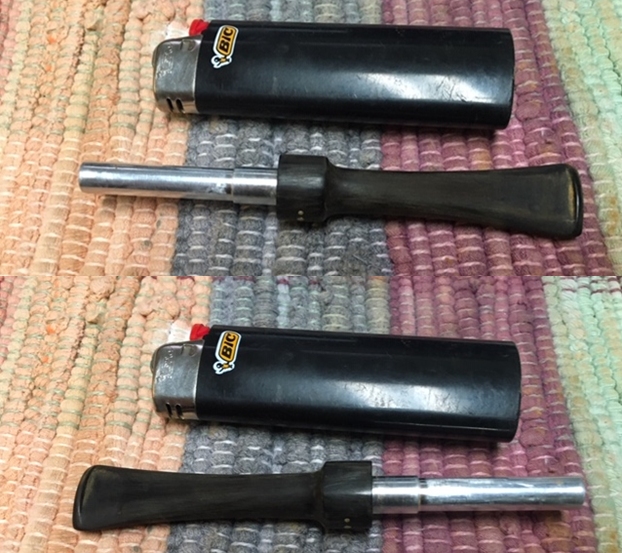
Once the band was polished I put it back on the end of the shank and lined up the hallmarks with the top edge of the shank. I decided to address the damage to the top of the bowl first. I sanded the rim top with a folded piece of 220 grit sandpaper to remove the scratches and pits in the surface of the rim. I polished it further with a piece of 400 grit wet dry sandpaper. I wiped the rim down with a damp cloth and took the photo below.I polished the bowl and rim with micromesh sanding pads. I wet sanded it with 1500-12000 grit pads and wiped it down between pads with a soft cotton cloth. You can see the progress in the shine as you go through the photos. I worked some Before & After Restoration Balm into the finish of the bowl and the rim top and shank with my fingertips to clean, enliven and protect it. I find that the balm really makes the briar come alive again. The contrasts in the layers of stain really made the grain stand out. I let the balm sit for a little while and then buffed with a cotton cloth to raise the shine. The pipe really looks good at this point. I am very happy with the way the pipe is looking at this point in the process.  I set the bowl aside and turned my attention to the stem. I inserted a pipe cleaner in the stem to protect the airway from collapsing when I heated it. I painted the surface of the stem with the flame of a BIC lighter to raise the tooth marks in the surface. I was able to bring the marks up with the heat. I filled them in with super glue and set it aside to dry.Once the repair had cured I used a needle file to smooth out the surface of the stem. I could see that there were still areas that needed a bit more glue to fill them in. I used a thin coat of black super glue to fill in the remaining dents and nicks and set the stem aside overnight to cure. The surface looked much better once the repair had cured. Rather than sanding it down with 220 grit sandpaper I decided to go straight to the micromesh sanding pads. I wet sanded the stem with 1500-12000 grit pads. I polished it further with Before & After Pipe Stem Polish – both fine and extra fine. I finished by wiping it down with Briarville’s No Oxy Oil and set it aside to dry. I always look forward to this part of the restoration when all the pieces are put back together. I put the pipe back together and buffed the bowl and stem with Blue Diamond on the buffing wheel. I gave the bowl and the stem multiple coats of carnauba wax. I buffed the pipe with a clean buffing pad to raise the shine. I hand buffed it with a microfiber cloth to deepen the shine. It is fun to see what the polished bowl looks like with the grain popping, the silver shining and the black vulcanite almost glowing. The long stemmed billiard is beautiful and feels great in my hand. It is one that could be clenched and smoked while doing other things as it is very light weight and well balanced. It must have been a fine smoking pipe judging from the condition it was when we received it from Jennifer. There should be a lot of life left in this French made Maro Special. Have a look at it with the photos below. The dimensions are Length: 6 ¾ inches, Height: 2 inches, Outside diameter of the bowl: 1 ¼ inches, Chamber diameter: ¾ of an inch. This is one that will go on the rebornpipes online store shortly. If you want to carry on the pipe trust of George Rex Leghorn let me know. Thank you Jennifer for trusting us with his pipes. Thanks to each of you who are reading this blog. Remember we are not pipe owners; we are pipemen and women who hold our pipes in trust until they pass on into the trust of the next pipeman or woman.
Refreshing a Dunhill Root Briar 708 F/T Oval Shank Canted Stack for Alex


Blog by Steve Laug

Around Christmas time I got together with Alex to enjoy some great hot cocoa, smoke our pipes and talk about all things pipes. I always have a great time when we get together and this time was no exception. He greeted me at the door with slippers and an old smoking jacket. I took my seat in the living room among his latest pipe finds and was handed a great cup of cocoa. I set it down and we both loaded out pipes with some new Perretti’s tobacco that he had picked up. We touched the flame of the lighter to the tobacco and sat back and blissfully enjoyed the flavour. As we did Alex walked me through his latest finds. There were some amazing pipes to look at and savor. He had found several really nice pipes – 3 different Dunhill pipes that he wanted me to work on for him. I have already written a blog on the Dunhill Wanghee Tan Shell Briar with a Bamboo shank (https://rebornpipes.com/2020/01/08/refreshing-a-dunhill-tanshell-w60-t-1962bamboo-lovat-for-alex/). I have also written a blot on the reconstruction of a nice little Shell Briar Lovat(https://rebornpipes.com/2020/01/11/breathing-life-into-a-worn-and-beat-up-dunhill-shell-briar-ec-canadian-for-alex/). The third Dunhill he had picked up is a shape number I could find little information on – a shape 708F/T Root Briar. For lack of a better title for the shape I have called it a canted stack.

Alex had reamed the pipe and cleaned the pipe very well. The bowl was clean. The rim top had a lot of damage including burn marks and dents. The bowl was also very far out of round with damage around inner edge. There were burn marks on the inner and outer edge toward the right front side of the bowl. The finish looked very good around the bowl other than the burn mark on the left side where it looked like the bowl had been laid in an ash tray against a hot ash. He had already enjoyed smoking it and was hooked on it. He asked if I could take it home with me and see what I could do about the rim top damage and the burn mark on the bowl. I told him I would take it home and have a go at it. The pipe was stamped on the left side of the shank with the following nomenclature: 708F/T at the bowl shank junction followed by Dunhill over Root Briar. The Dunhill Root Briar stamp is faint but readable with a lens and light. The right side reads Made in England followed by what looks like a 2 (another 1962?) and a Circle 4 A. The 4 is the size of the pipe and the A is the designation for Root Briar. The stamping on the right side of the shank is also faint.
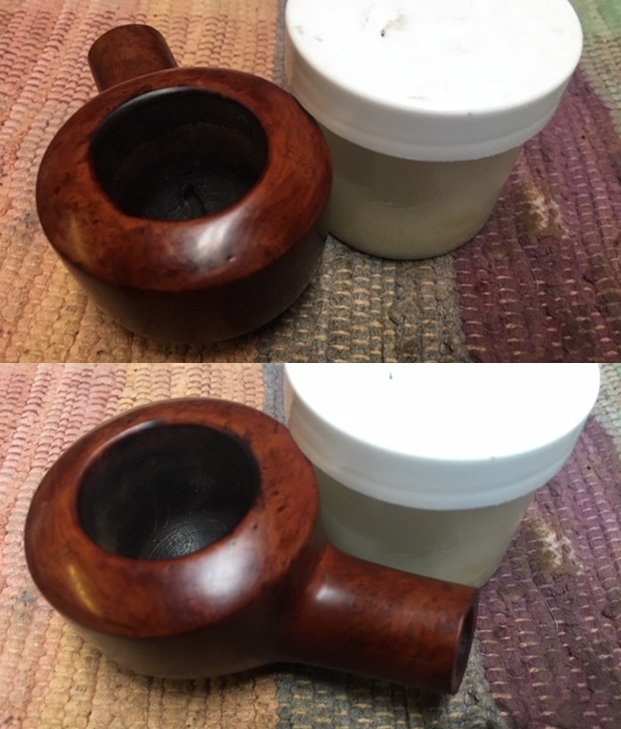
When I got home I laid it aside and today took it up to work on it. I examined the pipe to see what I was working with and took some photos. You can see from the first photo below that there was a burn mark on the left side mid bowl. It was a cosmetic burn marks in the finish but not too deep. It was like the pipe had been laid down in an ashtray. The rim top had significant darkening and damage. The stem was in good condition other than tooth chatter on both sides just ahead of and on the top of the button. Overall the pipe was in good condition. I took a close up photo of the rim top. You can see the darkening on the rim top and the damage on the front inner and outer edge of the bowl. The inner edge was hacked up like it had been poorly reamed with a pocket knife. There were also nicks and deep scratches in the rim top. It was in rough shape. The stem looked pretty good. There was tooth chatter on the top and underside of the stem and on the button surface itself. Otherwise the stem was in very good condition.I took a photo of the stamping on the underside of the bowl. You can see that it reads as noted above. It is indeed faint but with a lens and light it is very readable.I decided to start the refurbishing by addressing the issues with the rim top and inner edge of the bowl. I lightly topped the bowl on a topping board with 220 grit sandpaper. Once it was smooth I worked on the inner edge of the bowl with a folded piece of 220 grit sandpaper. I also cleaned up the burned outer edge on the rim front. I sanded the burn mark on the left side of the bowl with the 220 grit sandpaper and was able to minimize the burn a bit. It was deeper than I initially thought. I polished the rim top and bowl with micromesh sanding pads – wet sanding it with 1500-12000 grit sanding pads. I wiped the bowl down after each sanding pad with a damp cloth to remove the dust and debris left behind by the sanding. I used a Maple Stain Pen to blend the sanded area on the side of the bowl and the rim top with the rest of the finish on the bowl. I have found that this particular stain pen works well to match the stain on the Root Briar.With the finish cleaned I rubbed it down with Before and After Restoration Balm. It is a product developed by Mark Hoover to clean, enliven and protect briar. I worked it into the briar with my fingertips. I let it sit while I went and had some lunch. When I came back I buffed it off with a cotton cloth. You can see the results below. While the burn mark did not disappear it is significantly lighter than when I started. The rim top also looks much better. I set the bowl aside and turned to address the tooth chatter on the stem surface. The stem was in excellent condition other than that so it did not take a lot of work. I used a folded piece of 220 grit sandpaper to sand out the tooth marks and then started the polishing with 400 grit sandpaper.I polished it further with Denicare Mouthpiece Polish – a red paste that does a great job in removing the oxidation remnants in the crease of the button and also polish out some of the lighter tooth chatter.I finished the stem with micromesh sanding pads – wet sanding it with 1500-12000 grit pads and wiping it down after each pad with a damp cotton pad to remove the dust. I polished it with Before and After Pipe Polish – both fine and extra fine. I finished by wiping the stem down with some No Oxy Oil that I received from Briarville Pipe Repair to experiment with. Once I finished I put the stem back on the shank and carefully buffed the pipe and stem with Blue Diamond polish. I wanted to polish out the minute scratches in the briar and the vulcanite. I gave the bowl and the stem several coats of carnauba. I buffed the pipe with a clean buffing pad and hand buffed it with a microfiber cloth. The finished Root Briar pipe is shown in the photos below. It is a great pipe and certainly looks better than when I began the process. The dimensions of the pipe are Length: 5 ½ inches, Height: 1 7/8 inches, Outer Bowl Diameter: 1 1/8 inches, Chamber Diameter: ¾ of an inch. The pipe will soon be heading back to Alex so he can continue to enjoy it. This is a beauty that he can enjoy as he carries on the trust of these Dunhill pipes. Thanks for walking with me through the restoration.
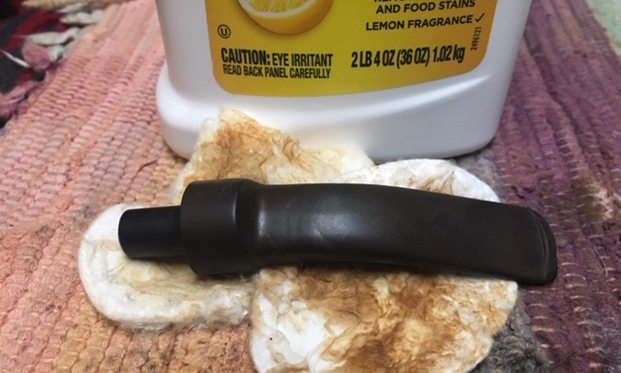
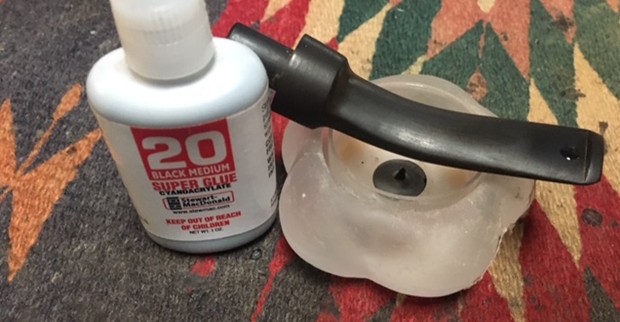
Cleaning Up a Third Wrecked Pipe for a Fellow Pastor in Vancouver – A VB Apple


Blog by Steve Laug

Lately I am not taking on more work for repairs from email or online requests as I am just too busy. I still get the odd referral from the local cigar and pipe shop that I feel obligated to repair or restore. They tend to be spread out a bit so I can fit them in among the other work that I am doing for estates. Earlier this week I received a phone call from a fellow who had been referred to me by the shop. In our conversation he said that he had some pipes that the stems were all loose on and he wanted to know if I would be able to help him. I have learned to not make any arrangements until I have the pipes in hand and have examined them. He came over Friday afternoon to let me have a look at the pipes. He handed me a bag and inside there were four or five extra stems that he had brought for my use. There were also three old and tired pipes. They were in very rough shape. Two were apple shaped pipes stamped VB and one was a Croydon billiard. The stems were indeed loose on two of the pipes and stuck on the third pipe. The bowls were clogged with a thick cake to the degree that I could not even get my little finger in them. The stems had a thick layer of calcification and some tooth marks. They needed a lot of work.

We talked about the pipes and that he had held them for a long time hoping for a repair. He had spoken with the cigar and pipe shop and they had led him to me. Now he could actually have a hope of smoking them again. In the course of the 30 minute or so conversation he asked me what I do for work. I told him I was a Presbyterian minister working with an NGO dealing with the sexual exploitation and trafficking of women and children in 7 countries and 12 cities around the world. We talked about that a bit then he laughed and told me he was a United Church Minister who had taught in a variety of schools as well as pastored various parishes. We had a great conversation and I took the pipes and told him we would connect again once I had them finished.

The last pipe from the threesome is on the table now. It was probably in the best shape of the three pipes. It was in rough condition but not as bad as the previous two pipes. The bowl was clogged in precisely the same manner – a thick hard cake and no air would pass through the shank. The finish was shiny with varnish and worn and spotty with blackening on the right side of the bowl and both sides of the shank. It appeared to be an oily black not a burn. The rim top was a real mess with thick hard lava overflowing all around the bowl onto the rim. The stem was loose in the shank and was oxidized with calcification extending for about an inch up the stem from the button. In the midst of the calcification were the same deep tooth marks that appeared to be rounded rather than sharp so I may well be able to lift them out with a lighter flame. The slot in the button was plugged with a pin hole sized airway going through it. This third pipe is exactly like the others and I honestly do not know how this pipe was smoked the last time it was used. This was another of those pipes that I really dreaded working on because I just sensed that one thing would lead to another and the restoration would be almost endless. I took photos of the pipe before I started to record this anxious moment! I took some close up photos of the bowl and stem to show what I was dealing with on this pipe. You can see the density of the cake. It is not totally clear in the photo but the bowl is filled on the second half of the bowl and packed solid. This bowl appeared to be the only one that he had not reamed with a knife. The bowl was not slanted and the cake was evenly heavy all the way around the bowl. The rim top is rough as noted above and looking at the photos it too appears to have been used as a hammer. It is very rough to touch. The stem is a mess as can be seen. There is some oxidation and a thick coat of calcification from the button forward. That too is rock hard. Both the stem and the shank are plugged with no air passing through them.I took a photo of the stamping to show the brand on the pipe. It is a brand I have never heard of or worked on. There is little information available on it. It is stamped VB on the left side of the shank and Prima on the underside.Fortunately it was the same brand as the second pipe that I worked on. The only difference was the stain and the PRIMA stamping on the underside of the shank. I did some digging on the brand to see what I could find out with this additional information and there was nothing more to be found. I am including what I found on the previous VB pipe on Pipephil’s index page (http://www.pipephil.eu/logos/en/index-en.html) I found my first and only clue. Under the section called logos with two letters I found the VB listed. It took me to a listing under Holiday pipes. There was no further information on the country of origin or on the maker other than Holiday. I checked on pipedia as well and there was nothing. I have included a copy of the screen capture of the listing on Pipedia (http://www.pipephil.eu/logos/en/logo-h3.html#holiday).After posting the first VB pipe I received two comments on the blog regarding the stamping. I really appreciate getting information like this so if you ever have info please do not hesitate to send it. Here is what the first commenter, Liebaart sent me:

The VB logo is from the Vinche Company, a Belgian distributor. See their page: https://www.v-k.be/documents/catalog.xml?lang=en&open=NAV%5CPIJPEN%5CVINCHE&from=0

The second commenter, Joris D. Sutter (may be the same gentleman) sent the same information. The V.B logo refers to the company Vinche, a Belgia distributor. Have a look at their website here : https://www.v-k.be/documents/catalog.xml?lang=en&open=NAV%5CPIJPEN%5CVINCHE&from=0

This was very definitive information for me. I now knew that the pipe was from the Vinche Company a Belgian distributor. I am still wondering though if the pipe was made in Holland as suggested previously… the new information does not negate that possibility!

Once again I could no longer postpone starting the work on this old pipe. It was the last of threesome and I could return them to the old pastor. And besides that this is what I do – I am a pipe refurbisher. It was time to get started on this beast. I learned from the previous two pipes in the lot that the cake and calcification were very hard. I dropped the stem in a Oxyclean bath and the bowl in an alcohol bath. I figured while I worked on other pipes the cake and calcification would begin to soften a bit.When the pipe and stem had been soaking for about 4 hours I pulled them out of the respective baths. The bowl looked better externally. The alcohol had cut the shiny finish and removed some of the grime on the bowl. The cake in the bowl was definitely softer so I think it would be easier to remove. The stem came out and the bath had removed much of the oxidation and calcification. It had also softened what remained. The photos below show what I saw.The alcohol bath had softened the hard cake enough that I could directly ream it with the PipNet pipe reamer using the third cutting head. It easily worked through the cake and I was able to take it back to the bare walls of the bowl. I wanted to check and see if there was damage like there had been on the other two pipes. The good news was it was free of damage. I cleaned up the edges and bottom of the bowl with a Savinelli Fitsall Pipe Knife. I sanded the inside of the bowl with 220 grit sandpaper wrapped around a piece of dowel to further smooth out the bowl. I broke through the clogged airway in the shank with a piece of stiff wire. I topped the bowl on a topping board with 220 grit sandpaper and removed the damaged areas on the surface. Once I had finished the rim top was flat now I could deal with the edges of the bowl. I filled in the damage on the edges of the bowl with clear Krazy Glue and Briar dust. Once it dried I cleaned up the topping once again and then used a folded piece of 220 grit sandpaper to smooth out the inner and outer edge of the bowl. With the bowl reamed and the rim top repaired and clean I decided to work on the exterior of the bowl. It was unbelievably grimy and sticky. I scrubbed it with a tooth brush and undiluted Murphy’s Oil Soap. I rinsed it under warm running water to wash away the soap and debris. I repeated the process until the exterior was as clean as I was going to get it at this point. I dried it off with a cotton cloth and took photos to show the result. I cleaned the mortise and the airway in the shank and stem with pipe cleaners, cotton swabs and alcohol. I used the drill bit on a KleenReem tool to clean out the “crud” (hardened tars and oils) in the airway in the shank. I scraped the inside of the mortise with a pen knife. I opened the slot in the button with a dental pick and pushed pipe cleaners through the debris in the stem. I scraped away the majority of the calcification with the pen knife while I was cleaning the stem. Once I had finished – many pipe cleaners and cotton swabs later the airway was unobstructed to the bowl and the pipe had begun to smell clean. I sanded the exterior of the bowl and rim with a medium grit sanding sponge to remove the nicks, scratches and remnants of the original finish. I sanded the strange dark stains on the right side of the bowl and both sides of the shank at the same time. While I w not able to remove them I reduced them enough that I was hoping the stain I was going to use would cover them. I stained the bowl and shank with a Fiebing’s Tan Stain. It has a nice reddish tint to it that shows up once I have buffed and sanded it. I applied the stain, flamed it with a lighter and repeated the process until I was happy with the coverage. I would carry on with the bowl in the morning. The stain would dry overnight.In the morning when I got up I took photos of what the bowl looked like after the stain had cured all night. There are wet looking patches but they are not wet…just shiny! I wet sanded with 1500-12000 grit sanding pads to smooth out the finish on the bowl and prepare it for staining. I wiped the bowl down after each pad with a damp cloth to remove the dust and debris from sanding. I worked some Before & After Restoration Balm into the finish of the bowl, the rim top and shank with my fingertips to clean, enliven and protect it. I find that the balm really makes the briar come alive again. I let the balm sit for a little while and then buffed it with a cotton cloth to raise the shine. The pipe really looks good at this point. It looks much better than when I took it out of the bag. I set the bowl aside and turned my attention to the stem. I “painted” the surface of the stem with the flame of a Bic light to raise the tooth marks. It raised them all some but two small dents remained on both sides of the stem.I filled in the remaining tooth marks with clear Krazy Glue and let it cure. I like the clear glue on this kind of stem as it dries clear and the black of the stem shows through making for a very good blend with the existing material.Once the repairs cured I reshaped the button edge with a needle file. I flattened out the repaired spots at the same time. The stem was beginning to take shape.I sanded the repaired areas on both sides of the stem with 220 grit sandpaper to blend them into the surface of the stem. I followed that by sanding them with a folded piece of 400 grit wet dry sandpaper to begin the polishing.I polished the stem with micromesh sanding pads – wet sanding it with 1500-12000 grit pads. I polished it further with Before & After Pipe Stem Polish – both fine and extra fine. I wiped the stem down with Briarville’s No Oxy Oil to preserve and protect the stem. This was another challenging pipe to work on and I did the heavy work without Jeff. I put the stem back on the bowl and polished the bowl and stem with Blue Diamond polish on the buffing wheel. I gave the bowl and the stem multiple coats of carnauba wax. I buffed the pipe with a clean buffing pad to raise the shine. I hand buffed it with a microfiber cloth to deepen the shine. The grain pops through enough to let us know it is there and my repairs to the rim of the bowl blend in really well. I am pleased with the look of the pipe. It really has exceeded my expectations for it when I first took it out of the bag it was in when dropped off. The contrast between the reddish, tan stain of the briar and the polished black vulcanite stem look very good together. The pipe feels great in my hand and I am sure that it will feel even better radiating the heat of a good smoke. It must have been a fine smoking pipe judging from the condition it was when I received it from the pipeman who dropped it off. Have a look at it with the photos below. The dimensions are Length: 5 ¾ inches, Height: 1 ¾ inches, Outside diameter of the bowl: 1 ¼ inches, Chamber diameter: ¾ of an inch. I am looking forward to what the old clergyman thinks of his second “new” pipe. I think he will enjoy it for many years to come and perhaps it will pass to the next pipeman who will hold it in trust. Thanks to each of you who are reading this blog.
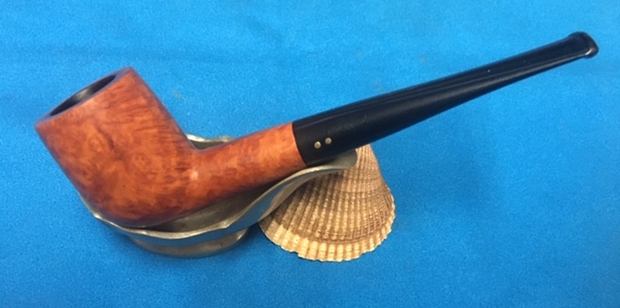
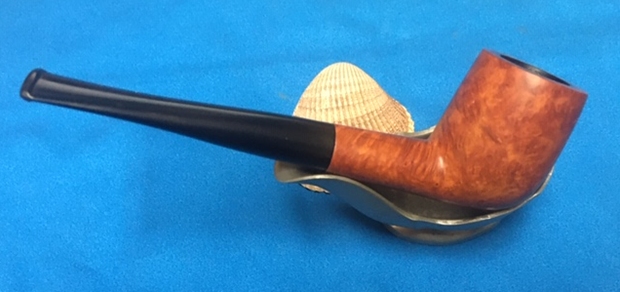
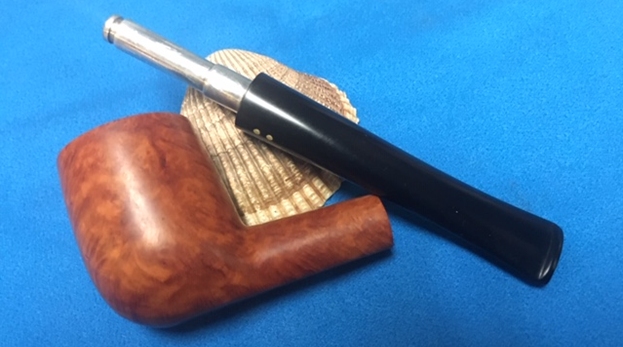
A Button-Rebuild Helps Reclaim a Beat Up French GEFAPIP 500 26 S Bent Bulldog


Blog by Dal Stanton

I acquired this Gefapip 500 26 S Bent Bulldog in the acquisition of what I call the ‘St. Louis Lot of 26’.  My son, Josiah, found the Lot for sale in an antique shop in St. Louis where he was doing his Masters work on a counseling degree.  He texted to me in Bulgaria the details with the proposal that we split the cost of the purchase – that I would choose one of the pipes as a gift from him and the remainder would go into the For “Pipe Dreamers” Only! online collection for pipe men and women to commission to benefit the Daughters of Bulgaria – our work here in Bulgaria with women and girls who have been trafficked and sexually exploited.  It was a win/win proposition and the HUGE Champion Churchwarden in the center became my gift from Josiah.  I made out like a bandit!Several of these pipes have already found their way to new stewards and another is on deck for restoration.  Seth saw the St. Claude produced Bent Bulldog (arrow in picture above) and sent me this note:

Hi Dal, first of all, I just want to say that I’ve been checking your website pretty frequently since you spoke at our church’s (Faith PCA in Cumberland, MD) mission conference a year or two ago. Since hearing about the work you and Beth do through the Daughters of Bulgaria, I knew I wanted to donate in some way and have been waiting to find the right pipe to get.

My wife and I visit many churches in the US when we’re there talking about our life and work in Bulgaria.  Seth was at one of these conferences and I love getting notes like this.  One of the pipes he had in mind was the Bulldog.  Later, Seth added another commission project to the GEFAPIP Bulldog, by asking me to fashion a new Churchwarden from a Sculpted Bull’s Head – I’m looking forward to this one!  His biggest challenge is the missing horns which I will need to fashion!I’m grateful for Seth’s patience in waiting for his commissions to reach the worktable.  Here are pictures of the Bent Bulldog.The provenance of the pipe is found on the lower left panel of the diamond shaped shank.  The nomenclature is GEFAPIP [over] 500 [over] FRANCE.  Running parallel to the shank facing to the right is what I’m assuming is a shape number: ’26 S’.  The ‘500’ and ‘FRANCE’ stampings are very thin, so I need to be careful to safeguard these.A quick look in Pipedia reveals pertinent information about the French origins of this GEFAPIP.  The information is brief but helpful.

Gefapip was a French brand from the St Claude region. Their products appeared in the 1979 Tinderbox catalog, with prices ranging from $17.50 to $62.50.

The following catalog page (1979 Catalog page, courtesy Doug Valitchka) was included with the text and it added helpful information that the GEFAPIP name was started by a group of master carvers in the St. Claude region.  The production line pictured in the catalog page are examples of shapes smoked in the Saint Claude region in the 1890s according to the caption.A visit to Pipephil.eu did not produce new information but gave some additional examples of GEFAPIP pipes. The stem stamping of a ‘modernistic’ pipe shape shown in the panel unfortunately is not visible on the Bent Bulldog’s stem.  I don’t know if it was ever there or was worn away over the years.Looking more closely at the Bulldog itself, reveals that it has been smoked hard and put out to pasture.  The rim has lava flow along with a thick carbon cake buildup in the chamber. The briar surface is covered with a darkened film of grime and oils that need cleaning.The stem is deeply oxidized to the point of what I believe is calcium buildup on the surface concentrated in the bit area.  The bit has been chewed severely with the upper button bite caving in on the slot.The underside also has a severe tooth hole almost puncturing through to the airway.  The entire button will need rebuilding to address these issues.The shank junction seems to be in good shape at first glance, but I see that former sanding and wear has created some shouldering on the corners of the stem facing.The restoration of the French GEFAPIP Bent Bulldog begins with the needy stem to address the deep oxidation.  I first clean the airway with pipe cleaners dipped in isopropyl 95%.Trying to get a jump on breaking up the oxidation in the vulcanite, I apply a 00-grade steel wool to the surface before putting the stem in a soak of Before & After Deoxidizer.  This seems to help.I’ve purchased a new batch of the Deoxidizer from Mark Hoover (lbepens1@gmail.com), but I wanted to give the current batch one more use before tossing it!  Generally, I like the Before & After Deoxidizer’s performance except when deep oxidation is present.  Consistently, I find that it doesn’t remove this deep oxidation but perhaps masks it and generally I find that following the Before & After Treatment sanding to remove the oxidation is needed.  The stem of the GEFAPIP Bulldog joins other pipes in the queue (Longchamp, Danish Freehand, Kaywoodie Standard, Italian Billiard and Brewster) for a soak in the Deoxidizer.I give the soak several hours, though I don’t believe the additional time adds more cleaning, and after fishing out the Bulldog’s stem and draining off the excess liquid, I run another pipe cleaner wetted with isopropyl 95% through the airway to clean away the Deoxidizer.  I also rigorously wipe off additional oxidation raised through the soak process using cotton pads wetted with isopropyl 95%.After this, to help revitalize the vulcanite stem, I wipe paraffin oil on the stem.  Paraffin oil is a mineral oil I can find easily here in Bulgaria.With the help of the setting of the camera on my iPhone X, the remnant of deep oxidation remaining in the vulcanite is visible.  I will need to fully sand the stem to clean it thoroughly.Putting the stem aside for the time, I take a closer look at the stummel with a fresh picture of the chamber.  The picture below is difficult to discern the canonical shape of the chamber as the cake thickens toward the floor of the chamber.I also do a quick inventory of the briar surface in need of cleaning.  The dark spots of oils and grime hide the beautiful grain peeking in from underneath. After laying out paper towel to minimize cleanup, to clean out the carbon cake buildup in the chamber I use the Pipnet Reaming Kit to get down to the fresh briar.  I use two of the four blade heads available in the kit.  Then, switching to using the Savinelli Fitsall tool, scraping the chamber walls continue.  Finally, after wrapping a Sharpie Pen with 240 grade paper, the chamber is sanded to finish the reaming process.  After cleaning the chamber of carbon dust with a cotton pad wetted with isopropyl 95%, inspection of the chamber shows some minor heating veins, but healthy briar now has a fresh start.  I move on.Transitioning now to the external cleaning, undiluted Murphy’s Oil Soap is used with a cotton pad to scrub the briar surface.  A dental probe is helpful in cleaning the pair of parallel dome grooves separating the upper and lower Bulldog bowl.  A brass bristled brush helps to clean the lava flow on the rim as well.  Brass bristles are used because they are gentler on the briar surface yet provide some abrasive cleaning action. From the cleaning on the worktable, the bowl is transferred to the kitchen sink and rinsed with hot water.  Using long shank brushes, the internal cleaning starts by using anti-oil liquid dish soap.  After a thorough rinsing, back on the worktable the results of the cleaning are examined.The surface cleaned up very well.  The dark spots that were especially evident at the shank/bowl junction were cleaned away very nicely.The rim shows continued darkening, but this will be addressed with some sanding to clean the briar.The nice quality of this block of briar is evidenced by the emerging grain and that I found only one, very small fill on the right upper shank panel.  There’s a slight ridge where the fill has shrunk after being wet, a normal phenomenon.  I may touch it up with some clear CA glue.Switching now to the internal cleaning proper, cotton buds and pipe cleaners are employed after wetted with isopropyl 95%.  The internals are grungy.  Using a smaller pointed dental spoon, I excavate huge amounts of tars and oils scraped off the mortise walls.  My first effort at pushing a pipe cleaner through the draft hole is frustrated by a blockage.  With the help of a stiff piece of wire, the blockage is pushed through – a hunk of gunk! With a lot of effort expended, the buds and pipe cleaners start emerging in a lighter state until I call it a truce!  I’ll continue the internal cleaning later with a kosher salt/alcohol soak.  The pictures show the first assault. I decide to move straight away to the kosher salt and alcohol soak.  I first twist a cotton ball by pulling and twisting it to form a ‘wick’ that is inserted into the mortise with the help of the stiff wire.  Then, after filling the bowl with kosher salt which leaves no aftertaste and placing the stummel in an egg carton for stability, using a large eye dropper, the chamber is filled with isopropyl 95% until it surfaces over the salt.  After a few minutes, the alcohol is absorbed into the pipe and I top it off again and set the stummel aside for several hours allowing the soak to do the work. Switching focus now to the stem, I take a few pictures to take a closer look.  With the residual oxidation remaining in the stem, it is a given that the stem will be fully sanded to address this.  The upper bit has compressions including damage to the button lip.  In the picture, after inserting a pipe cleaner, the split in the button becomes more visible.  The lower bit is so damaged that no amount of sanding will resolve these issues.  With the upper bit, I’ll first use the heating method to expand the vulcanite to lessen the amount of sanding needed.I note that the button doesn’t have a slot but simply an airway hole. To begin, I use a Bic lighter to paint the upper bit to lessen the severity of the compressions before rebuilding the button.  I take a picture to mark the start and another picture to show the progress.  The second picture does reveal that the vulcanite expanded some and this is good.Next, the entire button needs to be rebuilt using a mixture of activated charcoal and Extra Thick CA glue.  To begin, I wrap a piece of Scotch tape around the end of a pipe cleaner then rub Petroleum Jelly over the tape.  I then insert the pipe cleaner into the airway and position the tape so that it straddles the air hole in the button.  This is to guard the integrity of the airway so that the patch material doesn’t seal it.I then clean the upper- and lower-bit area with alcohol.With a plastic disk serving as a mixing pallet, scotch tape is used to help in the cleanup.  I mix on a non-porous surface to provide consistency in the way the CA glue mixes with the activated charcoal.  That is, I do not mix on card stock or something like this because it absorbs moisture out of the glue and causes the glue to behave less consistently while mixing.  I use an activated Charcoal Capsule to provide the charcoal – it is pure and is not lumpy.After removing the charcoal from the capsule, I add a small puddle of the Extra Thick Maxi-Cure CA glue produced by BSI.  It works well for me.I use a toothpick to mix the CA glue and charcoal by drawing the charcoal into the glue as I mix.  When it thickens enough so that it’s not running off the toothpick, I then trowel the mixture onto the button – upper and lower.  The patch mounds should be more than what is needed so that sanding brings the newly fashioned button down to the right size and shaping. After the patch material sets, just like it should work, the petroleum jelly coated pipe cleaner was removed with a few small tugs.After several hours the patch material is fully cured.  The long patient process of filing and shaping the button begins with a flat needle file.  The following pictures show the gradual progression on the upper button lip. Next, transitioning to the lower button lip and the patch to bit. The filing phase is completed as the pictures show the upper and lower bit and views of the airhole – upper and lower orientation. Transitioning to 240 grade paper I begin sanding which continues the smoothing and shaping of the button but also expands the sanding to the entire stem to address the deep oxidation.  I employ a plastic disk to sand against to avoid shouldering the stem facing.  It is no surprise to see the emergence of air pocket pits in the patch material as the sanding continues.  I would like to figure out how to minimize this! The upper and lower stem is shown. The sanding with 240 paper is completed and I wipe the button off with a cotton pad wetted with isopropyl 95% to get a closer look at the patch pitting in the rebuild button. To address this and to fill the pits, I use regular clear CA glue.  I put a small amount of CA glue on the lip of the button and then spread it over the lip to create a thin layering of glue over the surface.  This layering of CA glue fills the pits.  I spray the glue with an accelerator to hold it in place and to quicken the curing time. Next, after taking the stem to the kitchen sink, the whole stem is wet sanded with 600 grade paper and after the sanding, 000 is applied to the entire surface of the stem to smooth it further – including the newly rebuilt button with the CA glue painting of the button.  The results are looking good for the upper and lower stem. I put the stem to the side for now and turn again to the stummel which has been undergoing a kosher salt/alcohol soak for several hours to continue cleaning and refreshing the internals.  The salt and mortise ‘wick’ are soiled revealing the passive activity of drawing out the tars and oils from the internal mortise walls.  After tossing the expended salt into the waste, I wipe the bowl with paper towel and blow through the mortise to remove salt crystals.To make sure all is fully cleaned, I use one pipe cleaner and cotton bud to confirm this.  I also take a whiff of the chamber and it is smelling sweet and ready for its new steward!  Moving on!I continue with the stem applying the full regimen of micromesh pads.  First, with pads 1500 to 2400 wet sanding is followed by dry sanding with pads 3200 to 4000 and 6000 to 12000.  Between each set of 3 pads, Obsidian Oil is applied to rejuvenate the vulcanite stem and to retard future oxidation development.  The stem looks great and the button rebuild does as well. Continuing to help in the revitalization of the vulcanite stem, I apply Before & After Fine Polish and then Extra Fine Polish in that order.  After each application by working the polish into the vulcanite with my fingers, afterwards wipe the excess with paper towel.  The stem looks good.After completing this phase of the stem restoration, to get a look at the overall progress, I reunite the stem and GEFAPIP Bent Bulldog stummel.  Two issues emerge after reuniting the stem and stummel.  First, the tenon/mortise fitting has loosened as a result of the cleaning processes.  This often is the case.  The seating of the tenon needs tightening.  The second issue is that the shank/stem alignment is off slightly creating a gap between the stem and shank on the left side – right side of the second picture below. This gapping is enhanced somewhat by the rounded corners of the stem facing that I identified earlier. Before addressing the gap, to tighten the tenon’s fit in the mortise, I find a drill bit one size larger than what will fit into the airway. Then, using a Bic lighter to heat the tenon until the vulcanite softens; the drill bit is forced into the airway gradually.  After inserting the very beginning of the bit, I re-heat the tenon with the Bic lighter to again soften the vulcanite.  I then force the bit into the airway further.  With each advance of the slightly larger drill bit into the airway, the vulcanite is expanded thus increasing the diameter of the overall tenon resulting in a tighter fit in the shank.After the bit has reached the end of its journey expanding the tenon, I take the stem to the kitchen sink and cool the tenon with the drill bit remaining inserted.  This cools the vulcanite and it hardens resulting in holding the expanded tenon diameter.  Back at the worktable, to remove the bit, which is now stuck, I grip the end of the drill bit with plyers and while holding the bit stationary, I rotate the attached stem so that gradually the bit is released from the tenon’s grip.The procedure works very well so that the tenon is now too large to fit after a test fitting.  Using 240 grade paper wrapped around the now expanded tenon, while holding the sanding paper stationary, I rotate the entire stem so that the sanding on the tenon moves toward a custom fit and is sanded uniformly.After some sanding, another test shows progress, BUT the tenon is never forced into the mortise which increases the dreaded shank cracking noise to be heard!Finally, the tenon is seated into the mortise and I examine the fit.  The truth is that the stem fitting is not good, and it appears that this was a factory issue or is it a replacement stem?  I don’t think so, but it looks like the drilling was off some so that the stem and shank facing are not perfectly flush.  The resulting gaps are easily seen in the pictures below. To address this issue, since the gapping is in the lower quadrant of the stem/shank facings, I fold a piece of 240 sanding paper and insert the now two-sided edge of the paper in the upper quadrant sandwiched between the stem and shank.  Sanding the folded paper like a hand saw – back and forth – has the effect of removing the material equally on both sides which has the hoped result of closing the gaps in the lower quadrant.This takes some time – ‘hand saw’ sanding and testing – to see very gradual progress.  Re-fitting a catawampus stem/tenon/shank junction is not easy in general, but when one is dealing with a diamond or squared shank, it’s much more difficult.  Why?  A rounded junction is much easier to blend the opposites coming together.  With the corners and edges of a diamond shank, it is much easier to see problems stand out.  The following pictures show progress, but perfection is not found in this life!The other thing that is troublesome with this junction is that the corners have been rounded or shouldered.  I noted this before and this picture brings attention to this.  The next two pictures show this as well as a lingering gap that my OCD tendencies will not ignore!To help remove the shouldering and hopefully provide more movement toward a better fitting, I bring out the stem topping board.  With a hole drilled in the board, I place 240 paper over the hole and force the tenon through the paper into the hole.  With the tenon inserted into the hole, I then rotate the stem carefully to sand down the stem facing – thus, removing the shouldered edge and creating a sharper facing – hopefully!After the topping, I cover some of the stem with masking tape and sand the junction with 240 then 600 grade paper to bring things into a tighter alignment removing the edges I can feel as I rub my finger over the junction.  I’m avoiding the lower left panel which holds the nomenclature.This sanding and the topping have worked very well.  Not perfection, but a much better union is evident.I continue sanding the junction with the addition of 000 grade steel wool avoiding the nomenclature panel altogether.  Satisfied, I move on!After putting the stem to the side, I turn to the stummel and take a closer look at the Bulldog’s scratched and nicked rim.  It’s not in terrible shape but shows signs of normal wear and tear.  I take it to the topping board for a light topping to refresh the Bulldog rim. I first turn the inverted stummel several rotations on 240 sanding paper placed on top of a chopping board.  This does well as a portable topping board.The topping progression is shown in the next few pictures as the scratches are removed and the rim lines re-established.  The first picture concludes the 240 topping and the second after changing to 600 grade paper. Moving now to the stummel surface, as with the rim, it shows scratches and nicks from general usage. To address these minor issues, using sanding sponges cleans the surface but are not too invasive.  I first use a coarse grade followed by medium and light grades.  The transformation is stark as the grain begins to emerge and I like what I see! From the sanding sponges, I transition to applying micromesh pads to the stummel.  Using pads 1500 to 2400, I wet sand followed by dry sanding with pads 3200 to 4000 and 6000 to 12000.  The grain is very nicely teased out through the process.Detour – After the first set of 3 pads which wetted the stummel.  I took a closer look at a fill on the upper right shank panel.  This is the most noticeable fill I’ve detected, and the fill has remained solid, but is lightened in contrast to the surrounding briar.  Before moving to the next set of micromesh pads, I darken the fill using a mahogany dye stick.  This does a good job of darkening the fill.  The continued sanding helps to blend the fill. Before moving on to the finishing phase, the dome grooves receive a cleaning using a sharp dental probe to remove packed briar dust and such.With the grooves cleaned of debris, I next apply Mark Hoover’s (www.ibpen.com) Restoration Balm to the stummel.  I like this product because it brings out the subtleties of the natural briar grain.  After putting some of the Balm on my finger, I apply it to the stummel surface and work it into the briar.  I then set it aside for 20 minutes or so allowing the Balm to do its magic.  I use a cloth dedicated to removing the excess Balm after it has set.  I then buff the stummel with a microfiber cloth.  Nice!  The picture shows the Balm on the surface doing its thing.The home stretch – after mounting a cotton cloth buffing wheel to the Dremel, setting the speed at about 40% full power, Blue Diamond compound is applied to the entire pipe – stem and stummel.  Following this, a felt cloth is used to buff removing compound dust from the surface in preparation for applying wax.  I run a dental probe around each of the dome grooves to remove caked compound.  After changing to another cotton cloth buffing wheel, carnauba wax is applied to the stem and stummel at the same speed as the compound. Finishing the restoration, a microfiber cloth works well to give a rigorous hand buffing to disperse any wax build up and to raise the shine.

The most daunting challenges in bringing this GEFAPIP 500 S Bent Bulldog back into service was the stem work – rebuilding the button and helping the tenon/mortise fitting.  The oxidation was stubborn as well.  In the end, it was worth the effort.  The classic Bulldog shape is to me a pipe with attitude.  This Bulldog, a product of St. Claude, France, is no exception.  The vertical grain encompassing most of the dome resolves on the underside of the bowl in bird’s eye grain and swirls very pleasing to the eye.  The stem’s quarter bend is nice for resting in the palm in a relaxed way for reflecting on life and family.  Seth, from Maryland, will have the first opportunity to claim this Bulldog from ThePipeSteward Store which benefits the Daughters of Bulgaria.  Thanks for joining me!

Cleaning Up a Second Wrecked Pipe for a Fellow Pastor in Vancouver – A VB Apple


Blog by Steve Laug

Lately I am not taking on more work for repairs from email or online requests as I am just too busy. I still get the odd referral from the local cigar and pipe shop that I feel obligated to repair or restore. They tend to be spread out a bit so I can fit them in among the other work that I am doing for estates. Earlier this week I received a phone call from a fellow who had been referred to me by the shop. In our conversation he said that he had some pipes that the stems were all loose on and he wanted to know if I would be able to help him. I have learned to not make any arrangements until I have the pipes in hand and have examined them. He came over Friday afternoon to let me have a look at the pipes. He handed me a bag and inside there were four or five extra stems that he had brought for my use. There were also three old and tired pipes. They were in very rough shape. Two were apple shaped pipes stamped VB and one was a Croydon billiard. The stems were indeed loose on two of the pipes and stuck on the third pipe. The bowls were clogged with a thick cake to the degree that I could not even get my little finger in them. The stems had a thick layer of calcification and some tooth marks. They needed a lot of work.

We talked about the pipes and that he had held them for a long time hoping for a repair. He had spoken with the cigar and pipe shop and they had led him to me. Now he could actually have a hope of smoking them again. In the course of the 30 minute or so conversation he asked me what I do for work. I told him I was a Presbyterian minister working with an NGO dealing with the sexual exploitation and trafficking of women and children in 7 countries and 12 cities around the world. We talked about that a bit then he laughed and told me he was a United Church Minister who had taught in a variety of schools as well as pastored various parishes. We had a great conversation and I took the pipes and told him we would connect again once I had them finished.

I chose the second pipe from the threesome to work on. The stem was stuck in the shank and it was locked tight. It was in rough condition but not as bad as the previous billiard. The bowl was clogged in precisely the same manner – a thick hard cake and no air would pass through the shank. The finish was worn but nowhere near as bad as the Croydon billiard. The rim top looked was in better condition with damage to the top and the inner and outer rim but still better. I put the pipe in the freezer for several hours and was able to easily remove the stem from the shank. The stem was oxidized with calcification extending for about an inch up the stem from the button. In the midst of the calcification were the same deep tooth marks that appeared to be rounded rather than sharp so I may well be able to lift them out with a lighter flame. The slot in the button was plugged with a pin hole sized airway going through it. I honestly do not know how this pipe was smoked the last time it was used. This was another of those pipes that I really dreaded working on because I just sensed that one thing would lead to another and the restoration would be almost endless. I took photos of the pipe before I started to record this anxious moment! I took some close up photos of the bowl and stem to show what I was dealing with on this pipe. You can see the density of the cake. It is not totally clear in the photo but the bowl is filled on the second half of the bowl and packed solid. The bowl also has a slant toward the rear from reaming with a knife. The rim top is rough as noted above and looking at the photos it too appears to have been used as a hammer. It is very rough to touch. The stem is a mess as can be seen. There is some oxidation and a thick coat of calcification from the button forward. That too is rock hard. Both the stem and the shank are plugged with no air passing through them.I took a photo of the stamping to show the brand on the pipe. It is a brand I have never heard of or worked on. There is little information available on it. It is stamped VB on the left side of the shank.I did some digging on the brand to see what I could find out. Finally on Pipephil’s index page (http://www.pipephil.eu/logos/en/index-en.html) I found my first and only clue. Under the section called logos with two letters I found the VB listed. It took me to a listing under Holiday pipes. There was no further information on the country of origin or on the maker other than Holiday. I checked on Pipedia as well and there was nothing. I have included a copy of the screen capture of the listing on Pipephil (http://www.pipephil.eu/logos/en/logo-h3.html#holiday).Once again I could no longer postpone starting the work on this old pipe. Since I am a pipe refurbisher I had to get started on this beast. I began the work by reaming the bowl. The old fellow had chipped away enough of the carbon to smoke a little toward the end but he had done so at an angle so there was a nice concave cup in the back wall of the bowl. I had to work carefully with the Savinelli Fitsall Knife to start the process. I poke through the clogged airway into the bowl early on because honestly I could not see where it entered the bowl. I wanted to make sure I knew where it was while I cut through the cake. I worked through the first three cutting heads of the PipNet to straighten out the walls of the bowl. I took photos to chronicle that work. You can see the growing mound of carbon under the pipe in the photos. It was quite unbelievably hard. I cleaned up the edges and bottom of the bowl with a Savinelli Fitsall Pipe Knife. I sanded the inside of the bowl with 220 grit sandpaper wrapped around a piece of dowel to further smooth out the bowl. It was yet another of the worst cakes that I have worked on. With the bowl reamed I decided to work on the exterior of the bowl. It was unbelievably grimy and sticky. I scrubbed it with a tooth brush and undiluted Murphy’s Oil Soap. I rinsed it under warm running water to wash away the soap and debris. I repeated the process until the exterior was as clean as I was going to get it at this point. I dried it off with a cotton cloth and took photos to show the result. I cleaned the mortise and the airway in the shank and stem with pipe cleaners, cotton swabs and alcohol. I opened the airway into the bowl with a sharp straightened paper clip and used the drill bit on a KleenReem tool to clean out the “crud” (hardened tars and oils). I scraped the inside of the mortise with a pen knife. I opened the slot in the button with a dental pick and pushed pipe cleaners through the debris in the stem. I scraped away the majority of the calcification with the pen knife while I was cleaning the stem. Once I had finished – many pipe cleaners and cotton swabs later the airway was unobstructed to the bowl and the pipe had begun to smell clean. I topped the bowl on a topping board with 220 grit sandpaper and removed the damaged areas on the surface. Once I had finished the rim top was flat now I could deal with the edges of the bowl.I used a folded piece of 220 grit sandpaper to smooth out the inner and outer edge of the bowl. The outer edge cleaned up really well. I was quite happy with how the rim top and edges were beginning to look.I decided to address the hollowed out back inner wall of the bowl before I called it a night. The first photo shows the damaged area before I repaired it. I mixed up a small batch of JB Weld. I blended the two parts together to a dark grey paste and used a dental spatula to apply it to the back wall of the bowl. In the morning I used a Dremel and a sanding drum to take down the excess JB Weld in the back of the bowl. I ground it down until the inside was smooth. I wiped the inside of the bowl down with alcohol on a cotton pad to remove the sanding dust.I sanded the exterior of the bowl and rim with a medium grit sanding sponge to remove the nicks, scratches and remnants of the original finish. I scraped and sanded the strange dark stains on the shank at the same time. I wet sanded with 1500-12000 grit sanding pads to smooth out the finish on the bowl and prepare it for staining. I wiped the bowl down after each pad with a damp cloth to remove the dust and debris from sanding. I worked some Before & After Restoration Balm into the finish of the bowl, the rim top and shank with my fingertips to clean, enliven and protect it. I find that the balm really makes the briar come alive again. I let the balm sit for a little while and then buffed it with a cotton cloth to raise the shine. The pipe really looks good at this point. It looks much better than when I took it out of the bag. I set the bowl aside and turned my attention to the stem. I “painted” the surface of the stem with the flame of a Bic light to raise the tooth marks. It raised them all some but two small dents remained on both sides of the stem. I forgot to take a photo of the stem after the heating. I filled in the remaining tooth marks with clear Krazy Glue and let it cure. I like the clear glue on this kind of stem as it dries clear and the black of the stem shows through making for a very good blend with the existing material.I sanded the repaired areas on both sides of the stem with 220 grit sandpaper to blend them into the surface of the stem. I followed that by sanding them with a folded piece of 400 grit wet dry sandpaper to begin the polishing.I polished the stem with micromesh sanding pads – wet sanding it with 1500-12000 grit pads. I polished it further with Before & After Pipe Stem Polish – both fine and extra fine. I wiped the stem down with Briarville’s No Oxy Oil to preserve and protect the stem. This was another challenging pipe to work on and I did the heavy work without Jeff. I put the stem back on the bowl and polished the bowl and stem with Blue Diamond polish on the buffing wheel. I gave the bowl and the stem multiple coats of carnauba wax. I buffed the pipe with a clean buffing pad to raise the shine. I hand buffed it with a microfiber cloth to deepen the shine. The grain pops through enough to let us know it is there and my repairs to the rim and back of the bowl blend in really well. I am pleased with the look of the pipe. It really has exceeded my expectations for it when I first took it out of the bag it was in when dropped off. The contrast between the natural browns of the briar and the polished black vulcanite stem look very good together. The pipe feels great in my hand and I am sure that it will feel even better radiating the heat of a good smoke. It must have been a fine smoking pipe judging from the condition it was when I received it from the pipeman who dropped it off. Have a look at it with the photos below. The dimensions are Length: 5 ¾ inches, Height: 1 ¾ inches, Outside diameter of the bowl: 1 ¼ inches, Chamber diameter: ¾ of an inch. I am looking forward to what the old clergyman thinks of his second “new” pipe. I think he will enjoy it for many years to come and perhaps it will pass to the next pipeman who will hold it in trust. Thanks to each of you who are reading this blog.