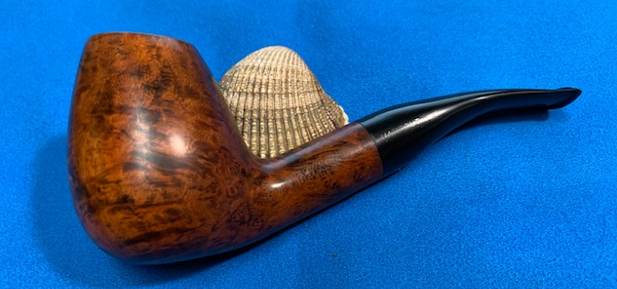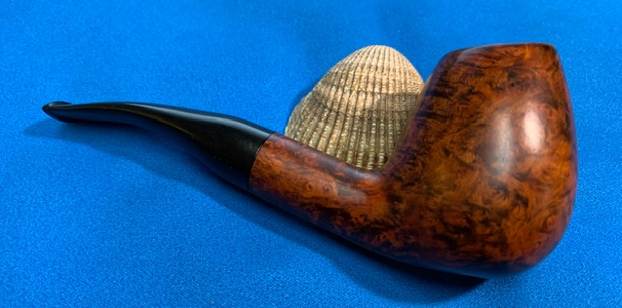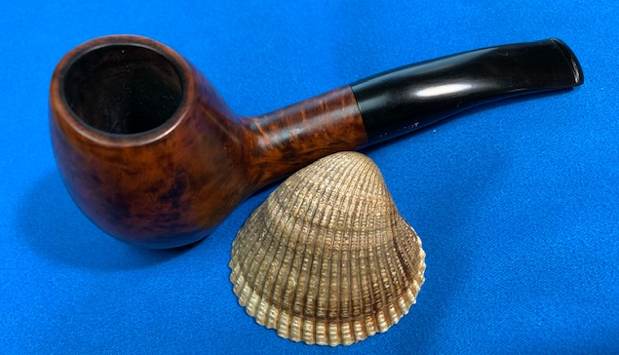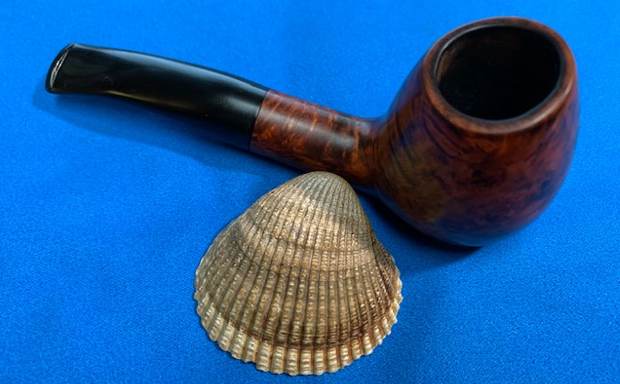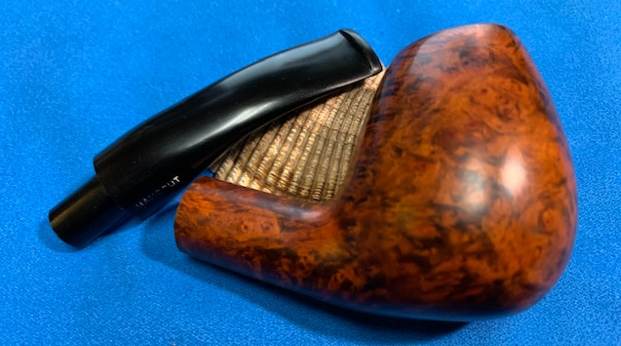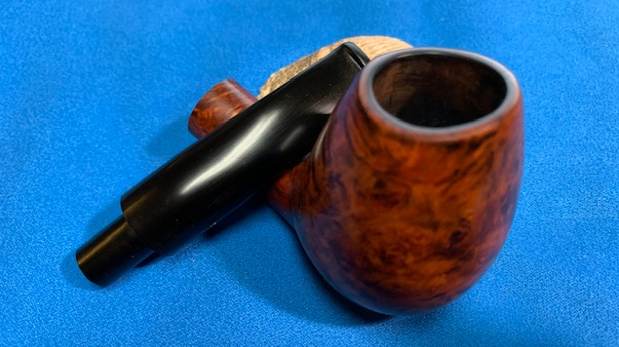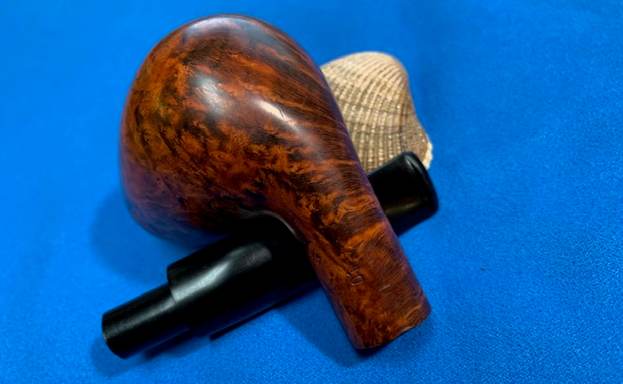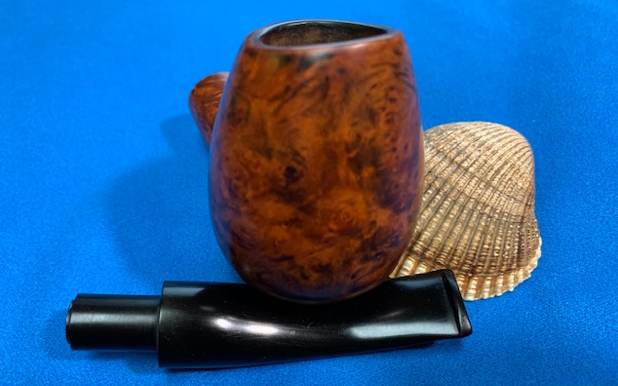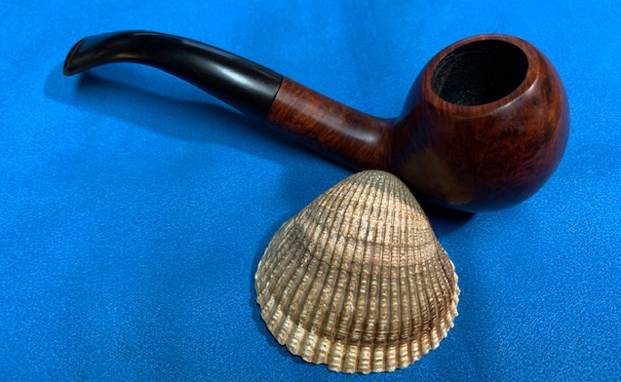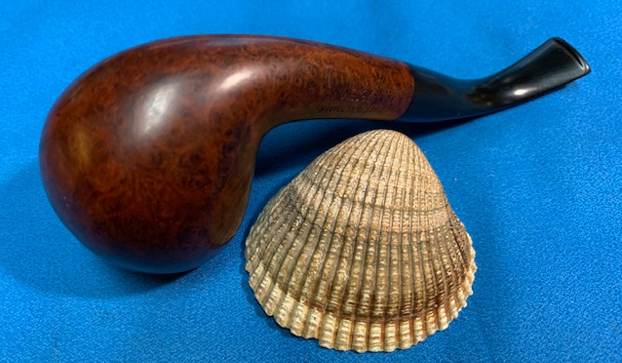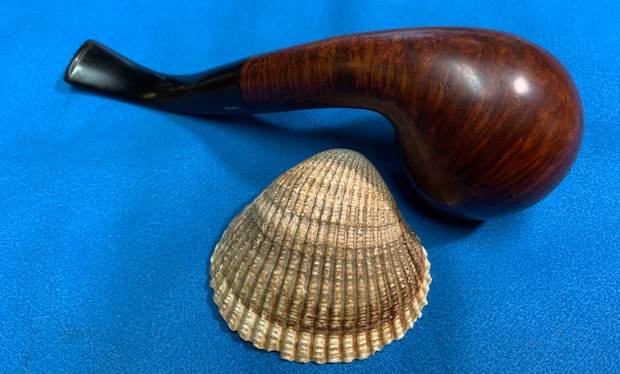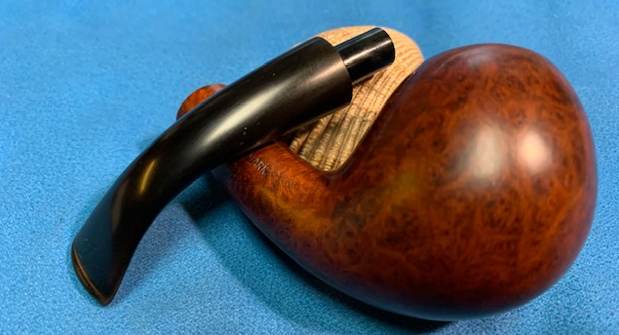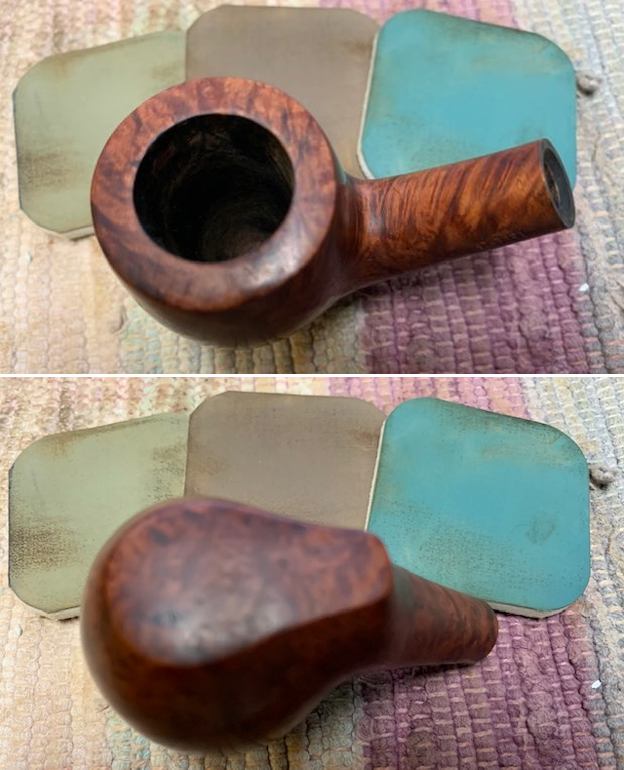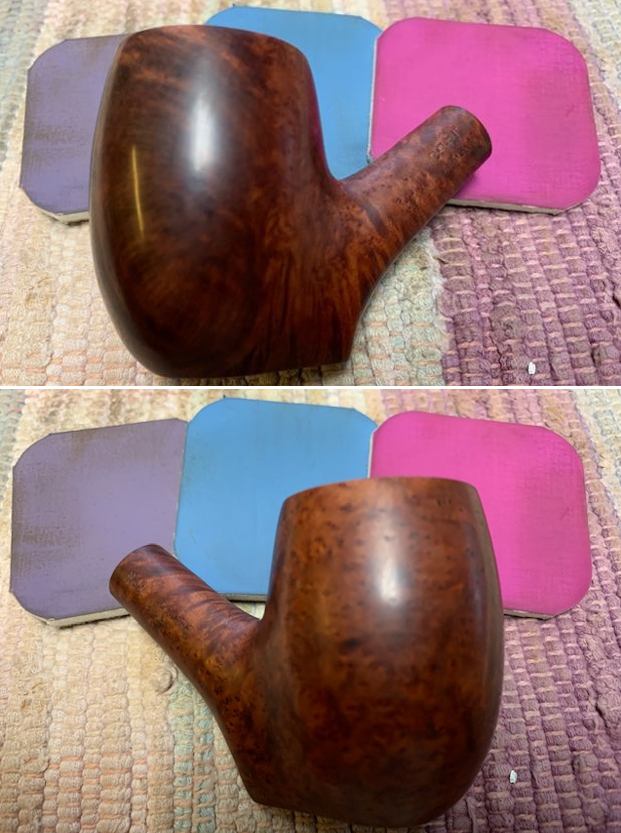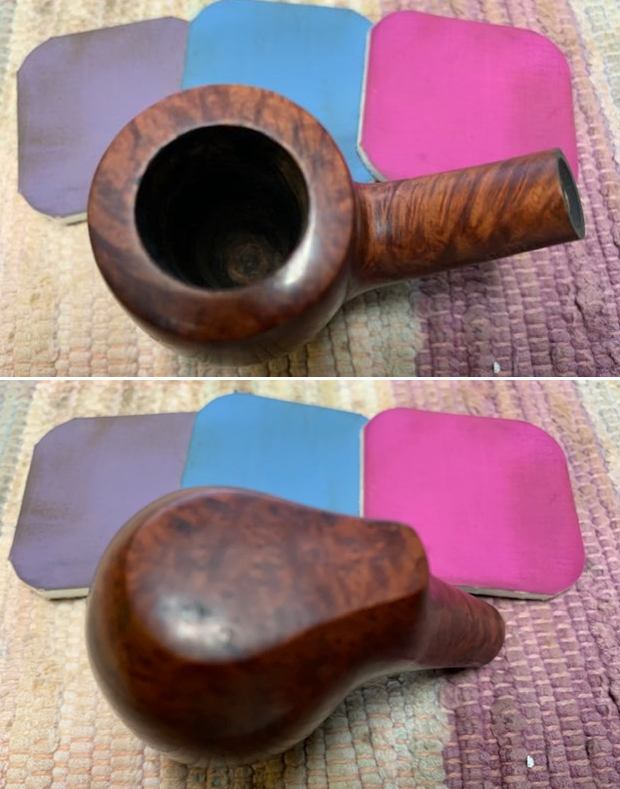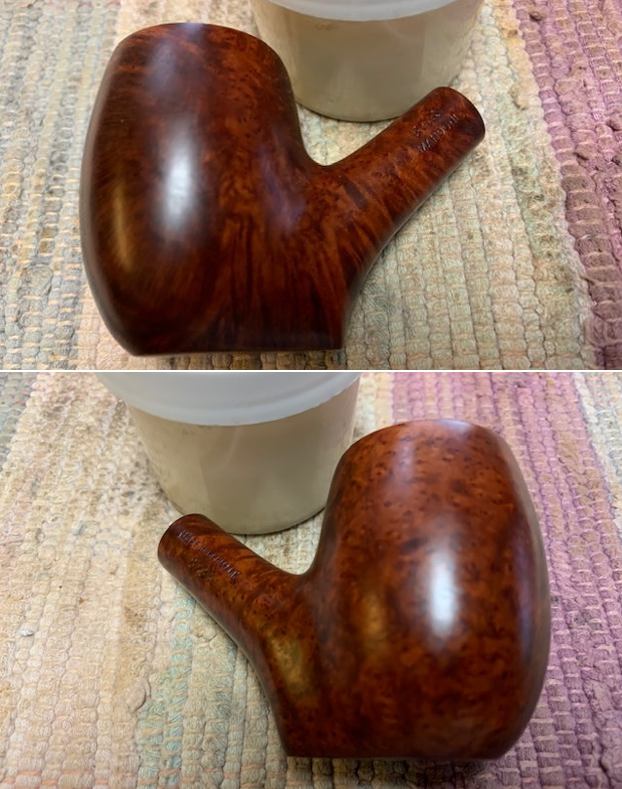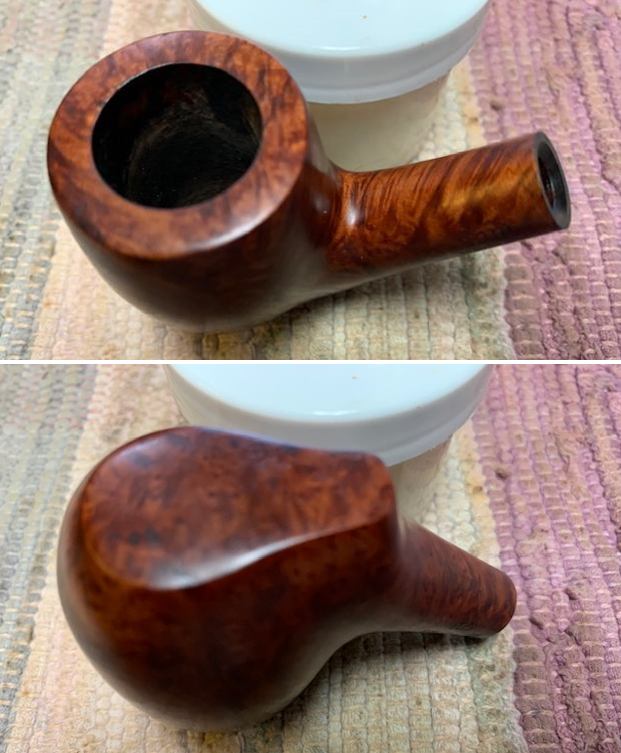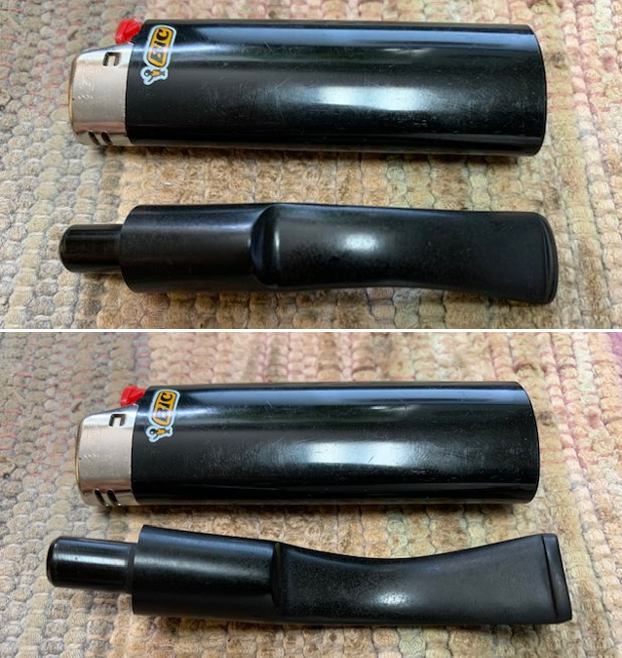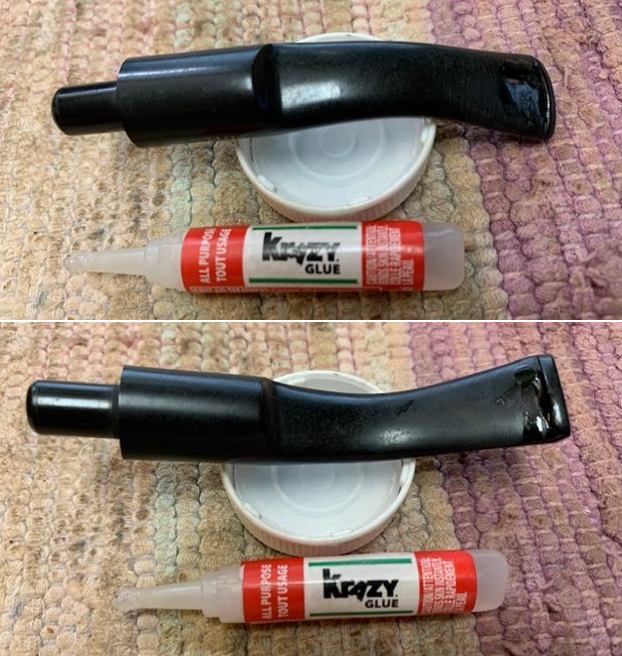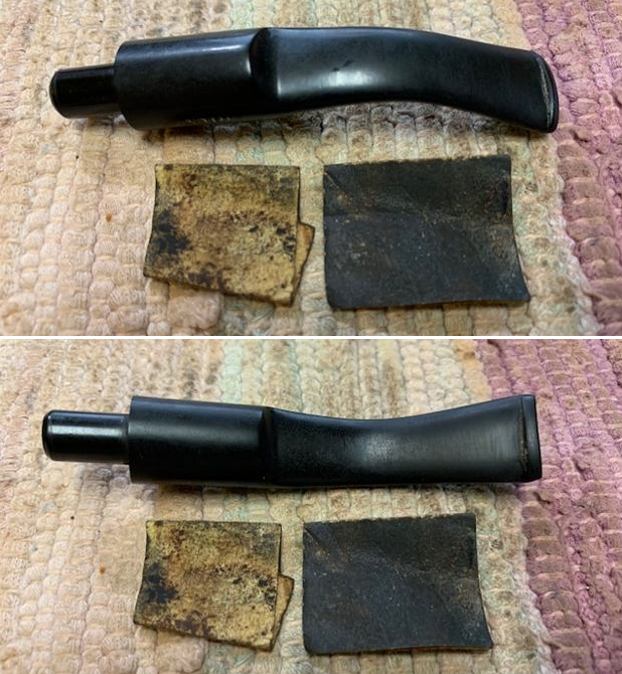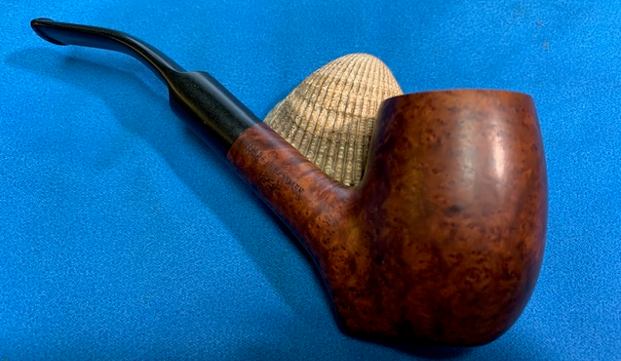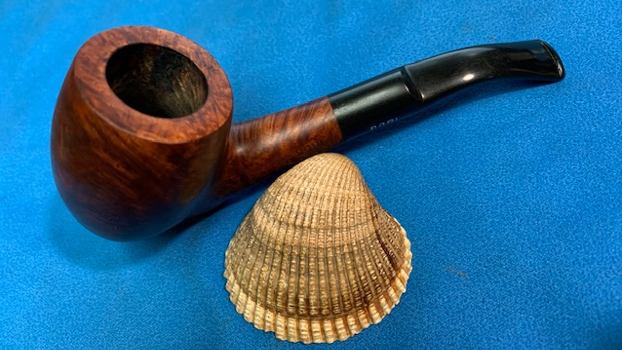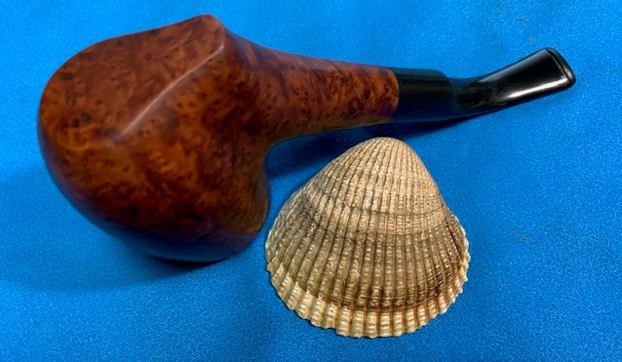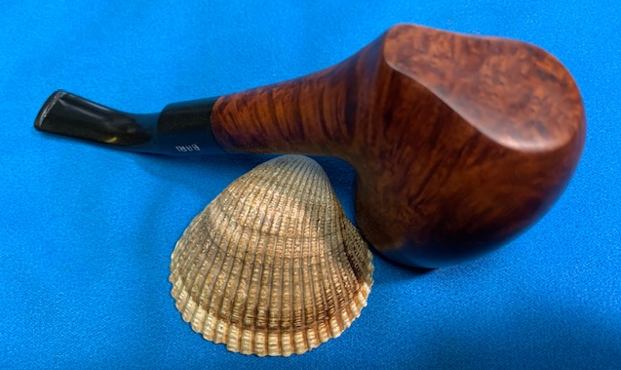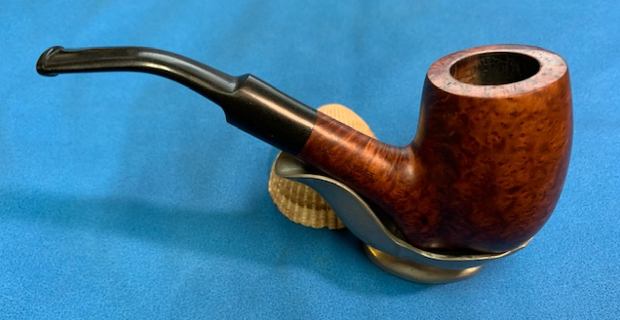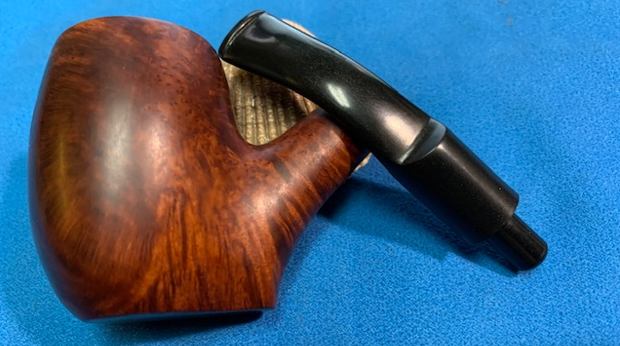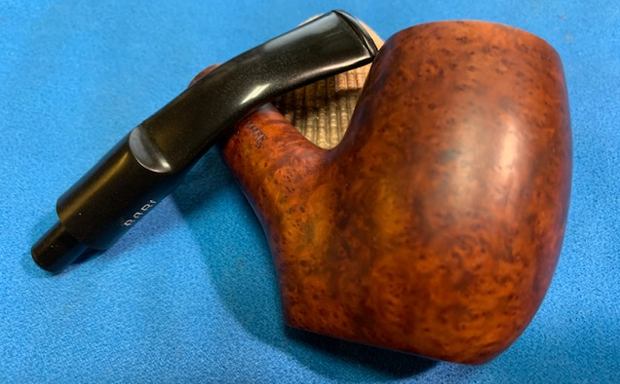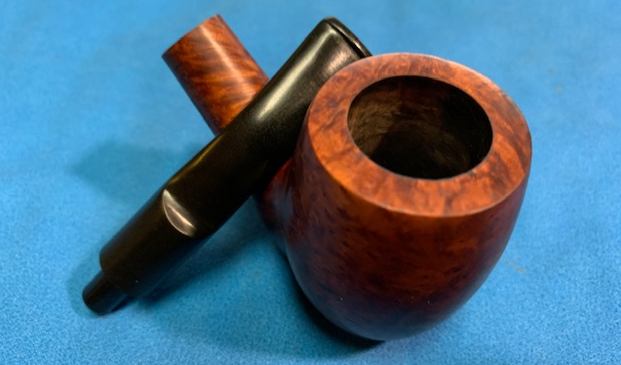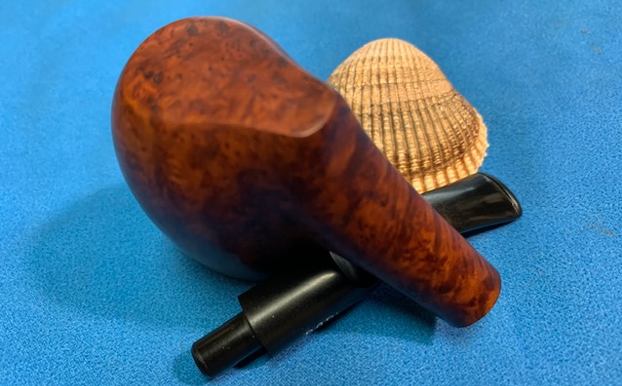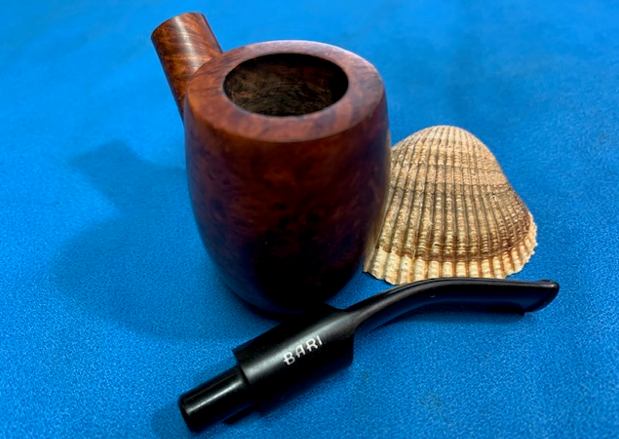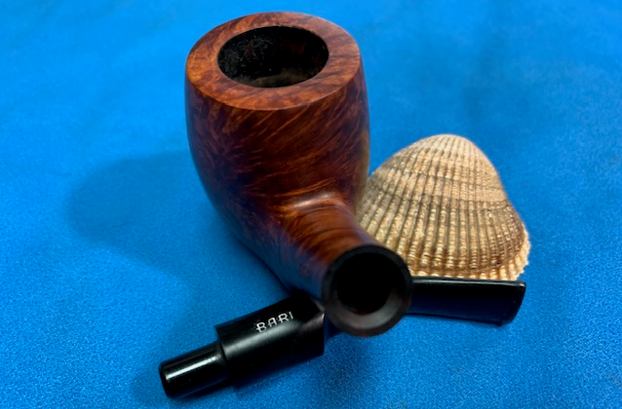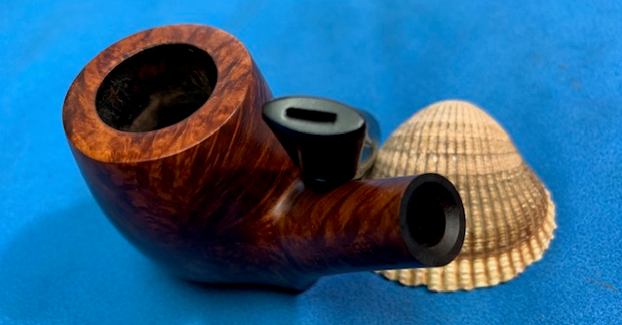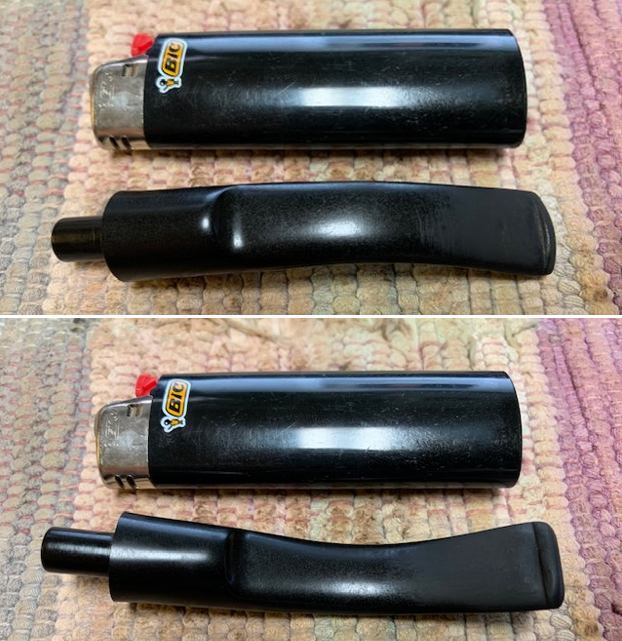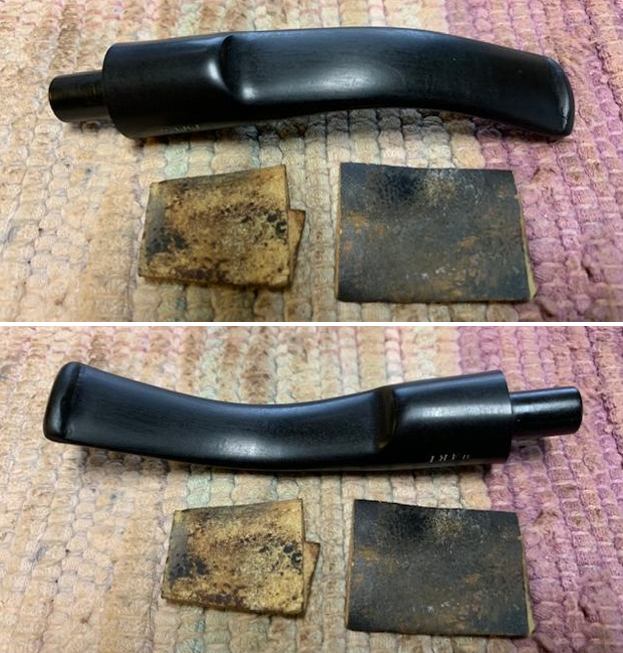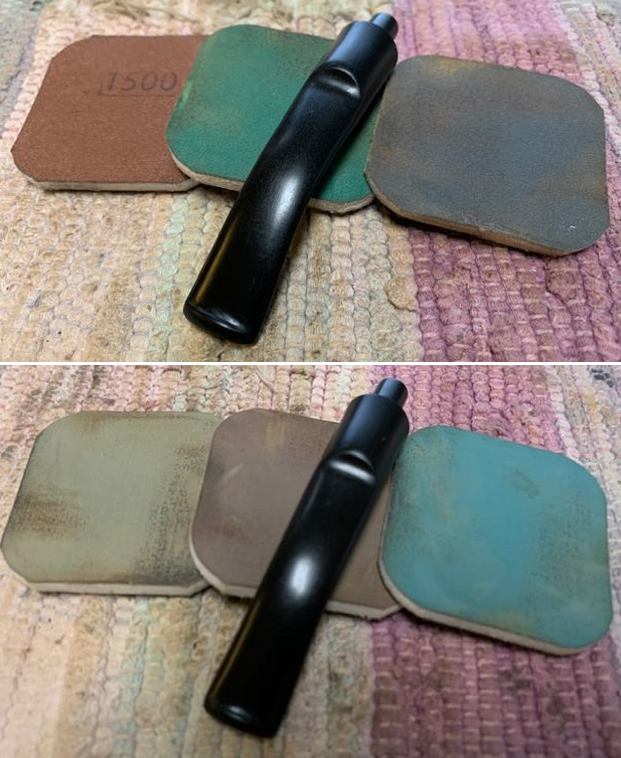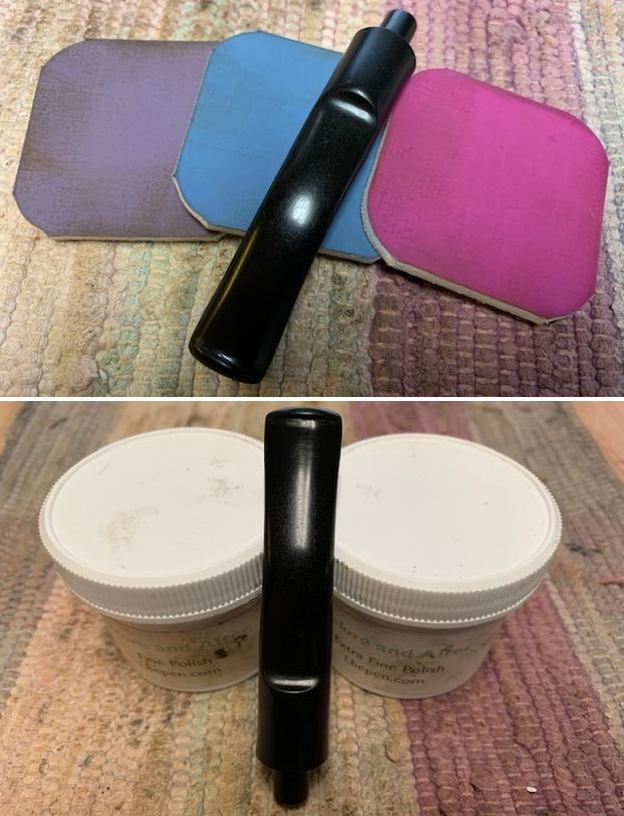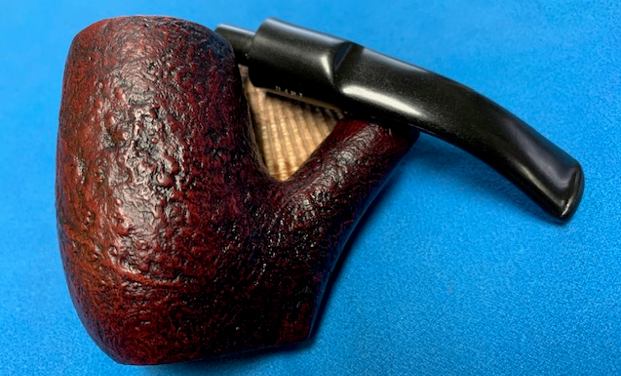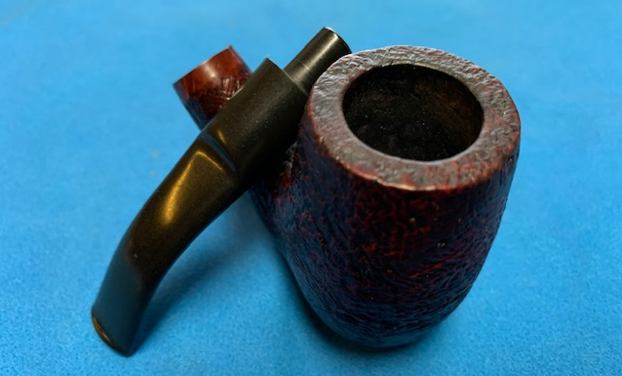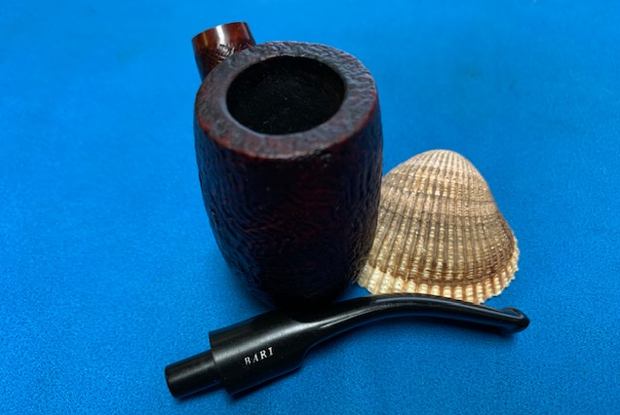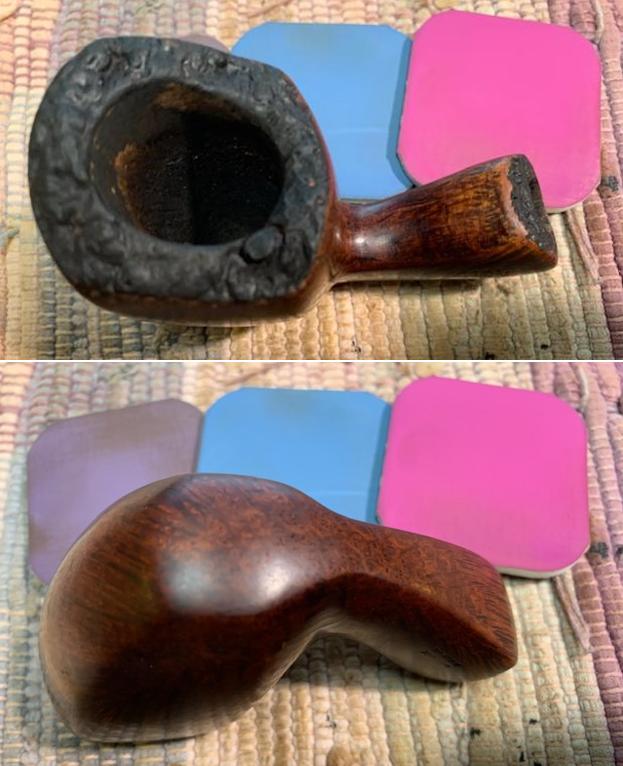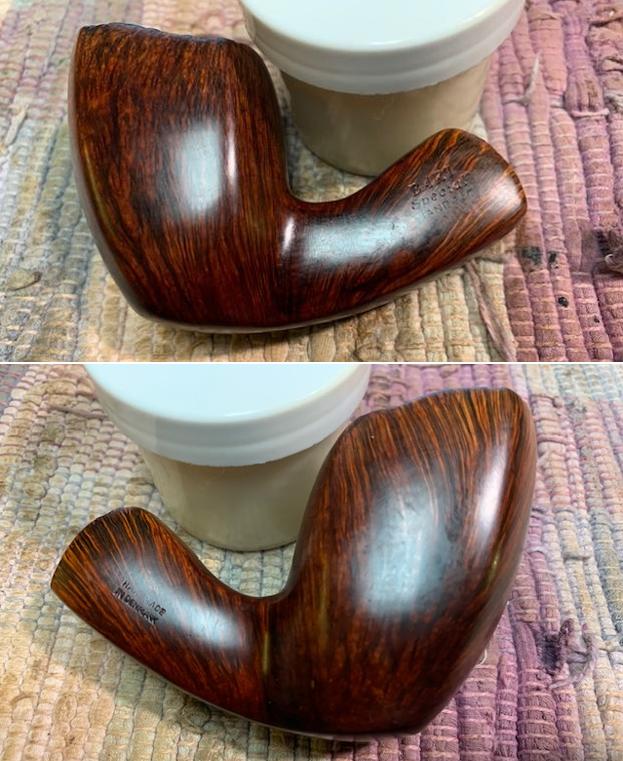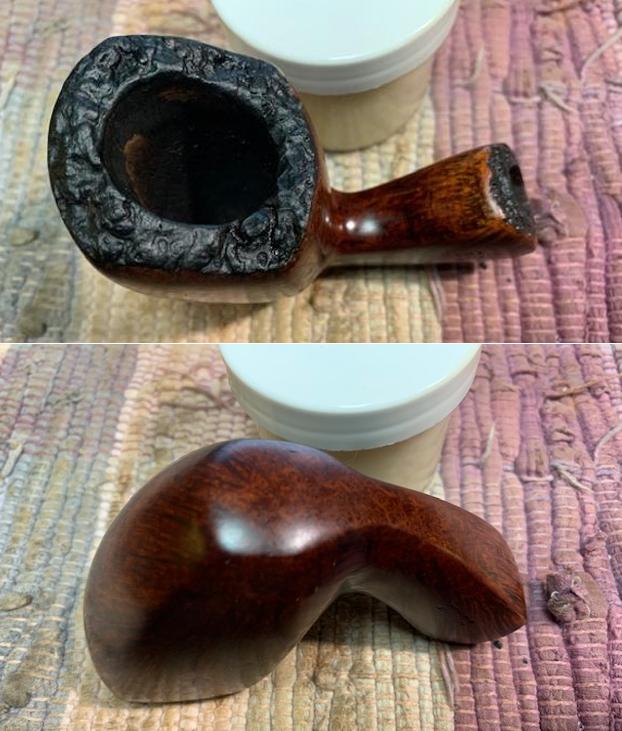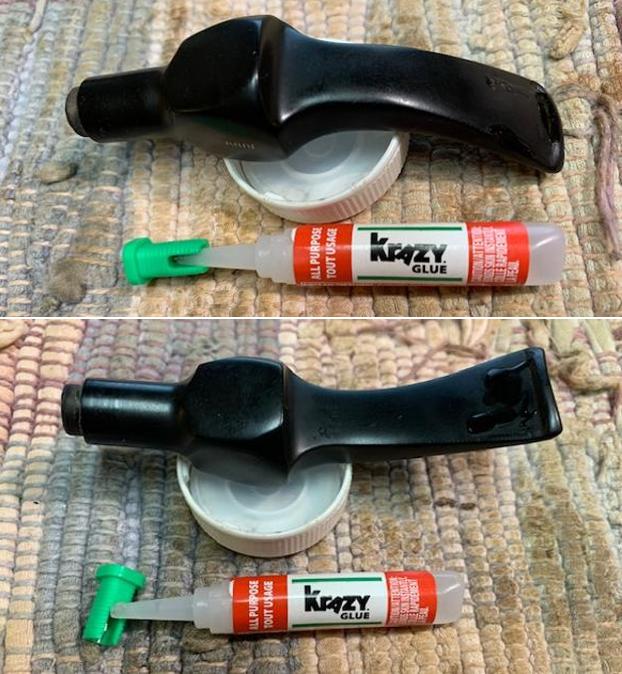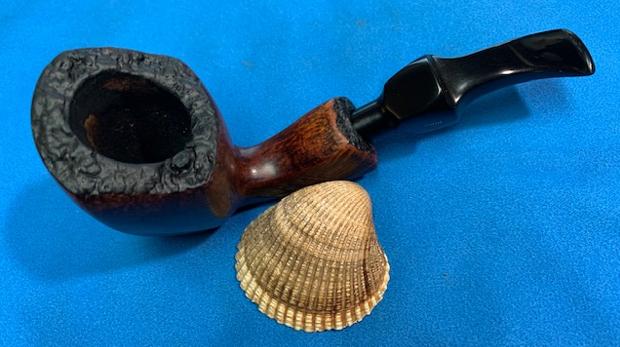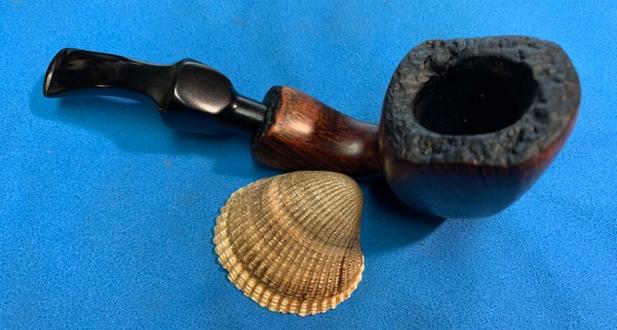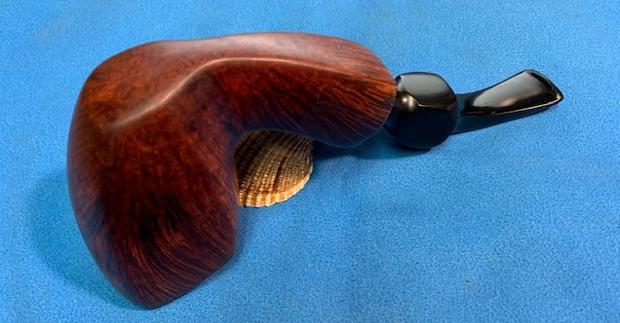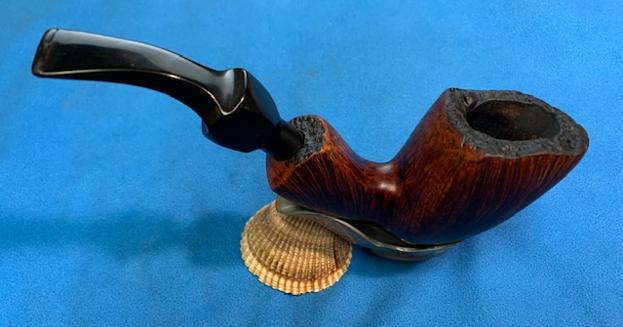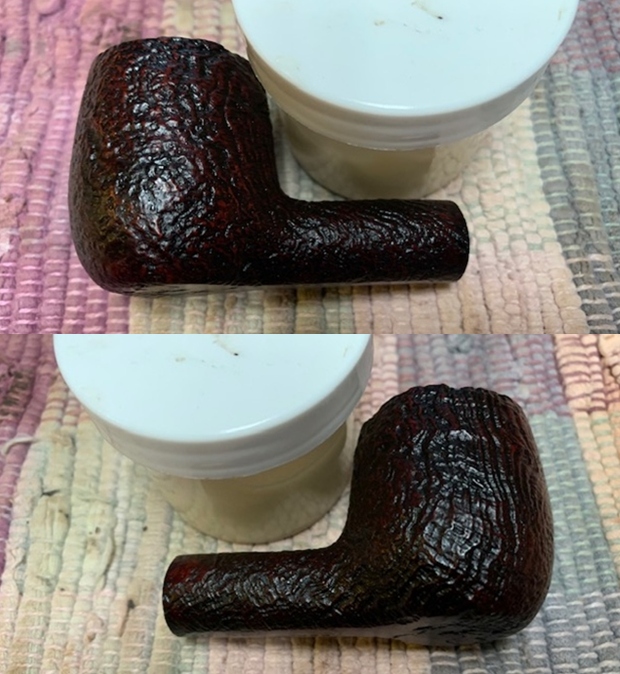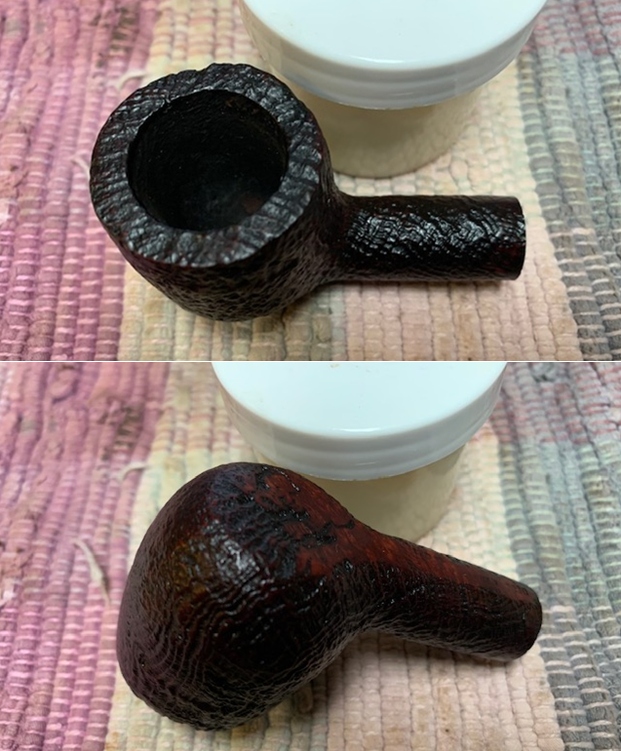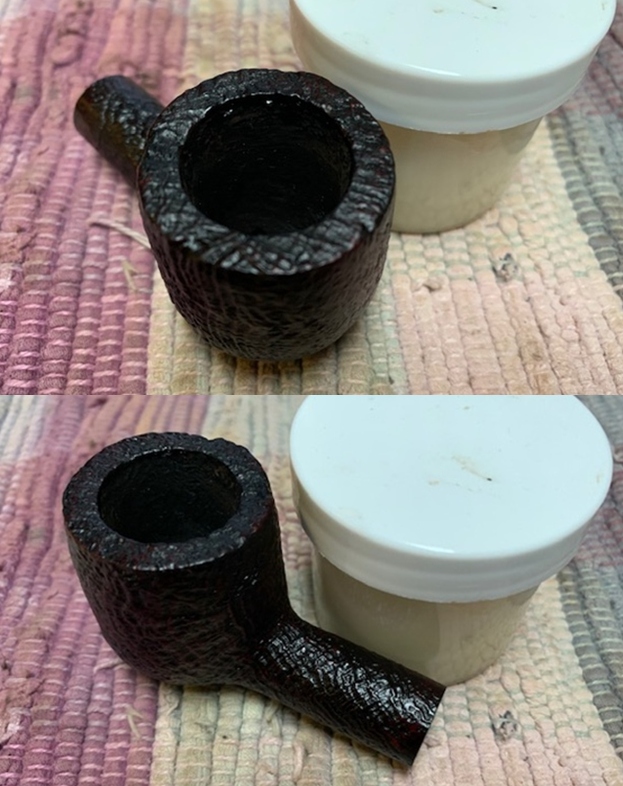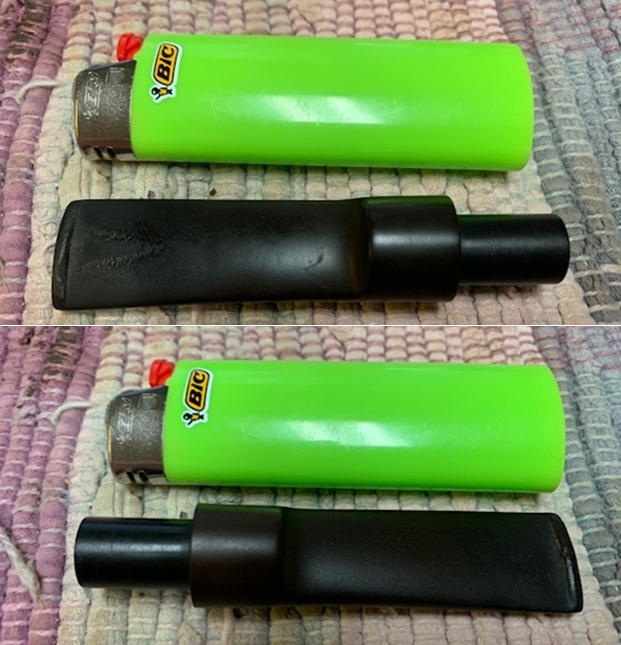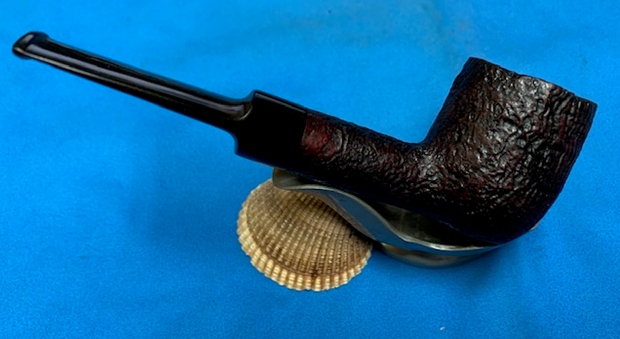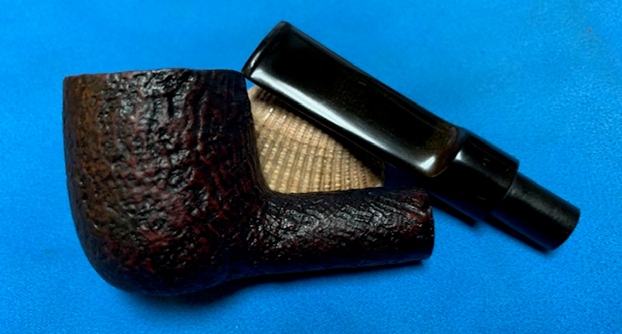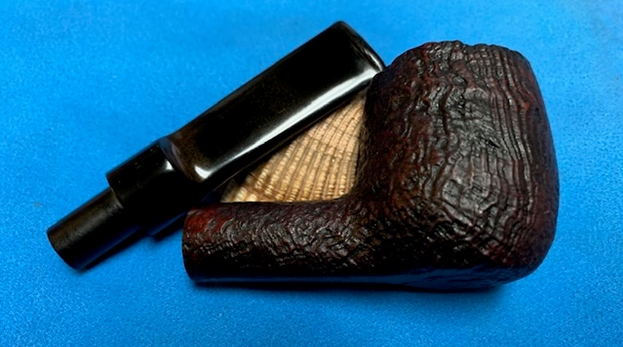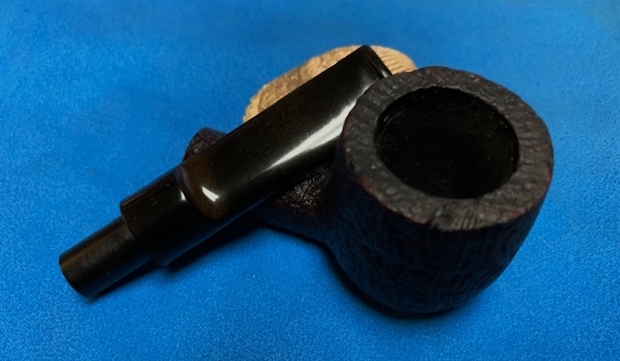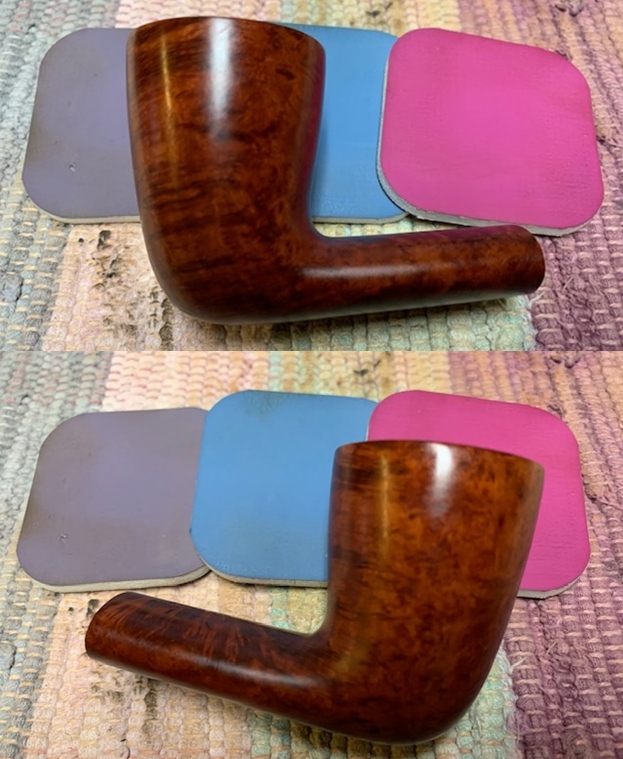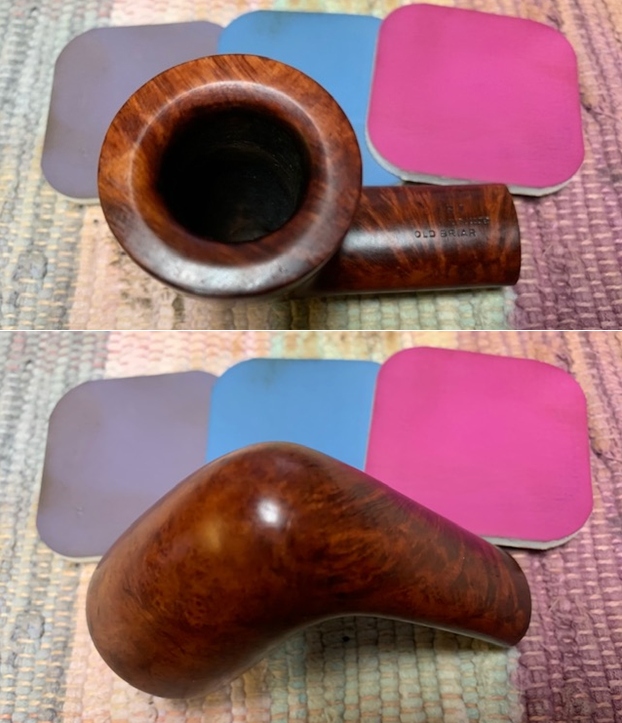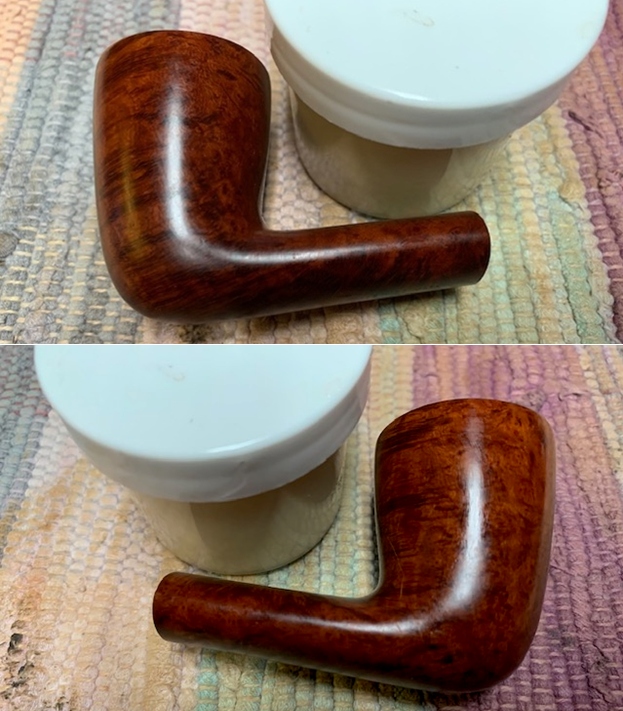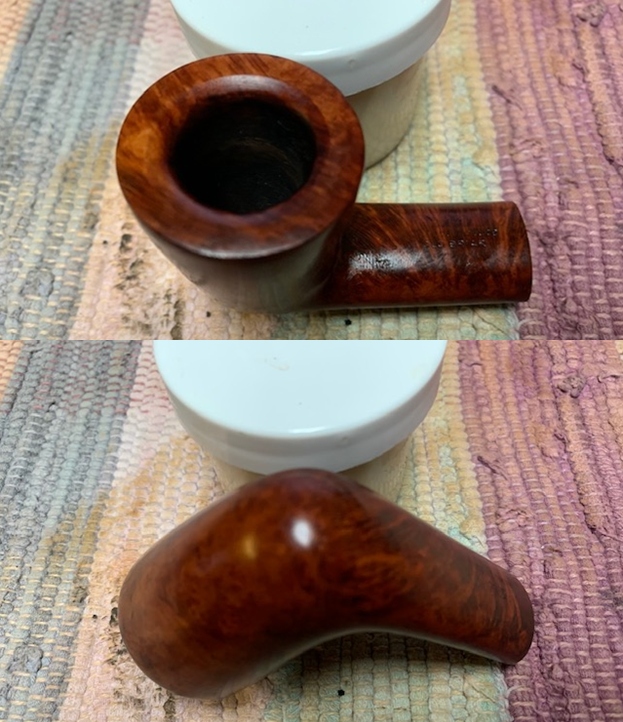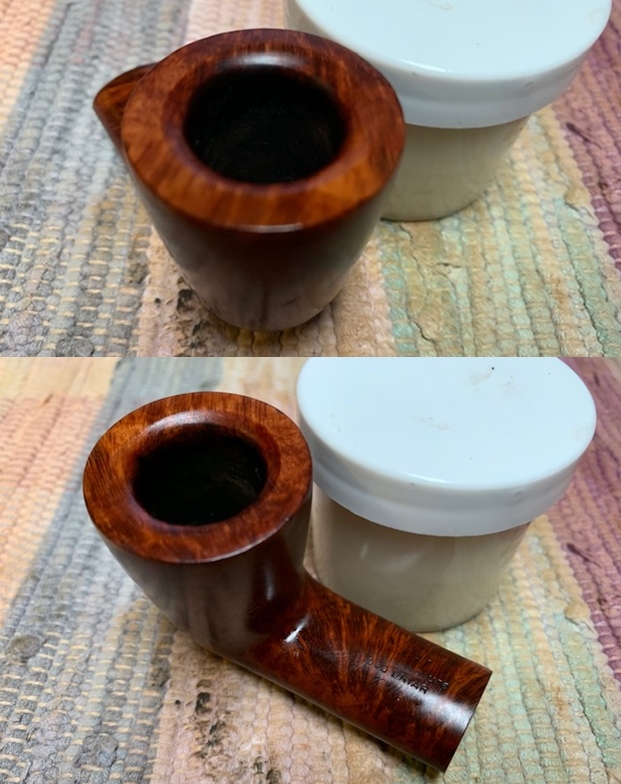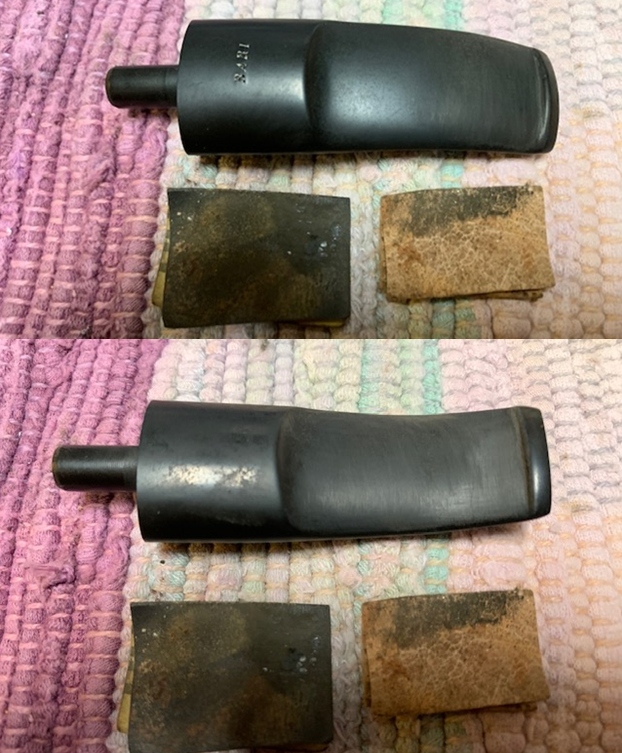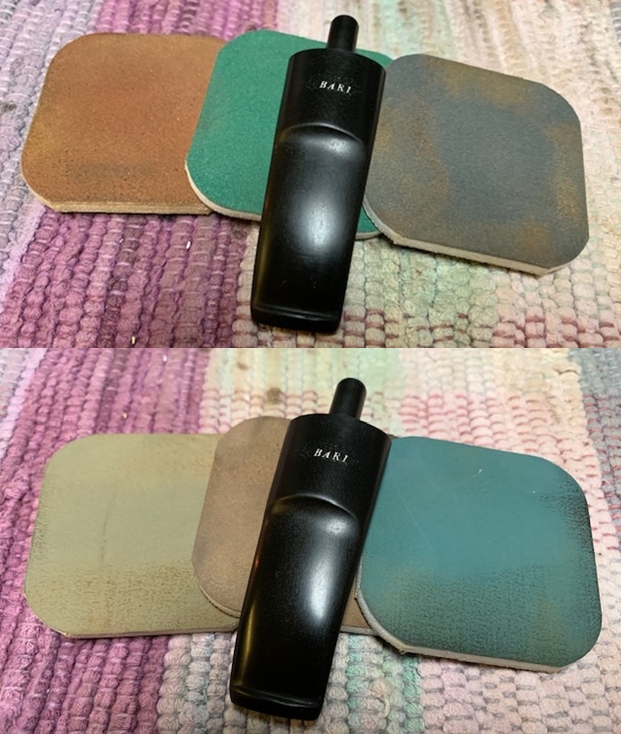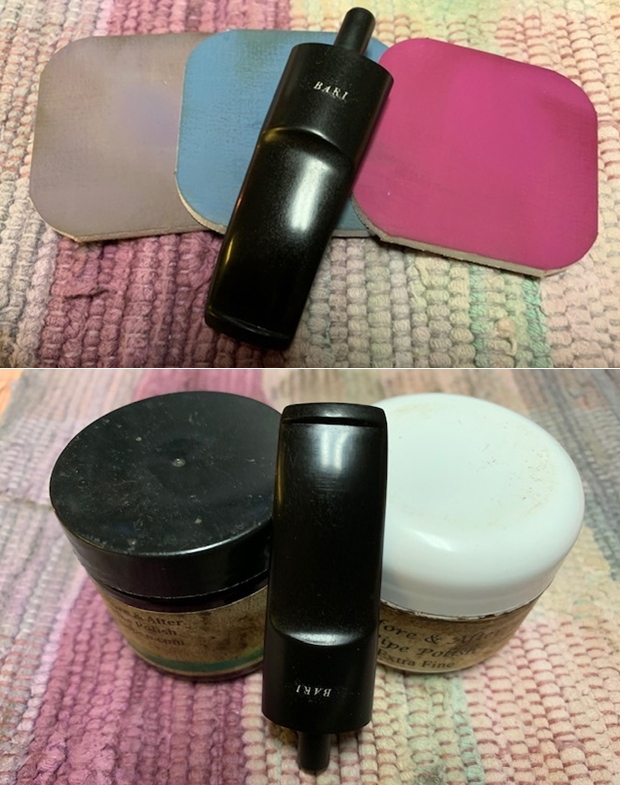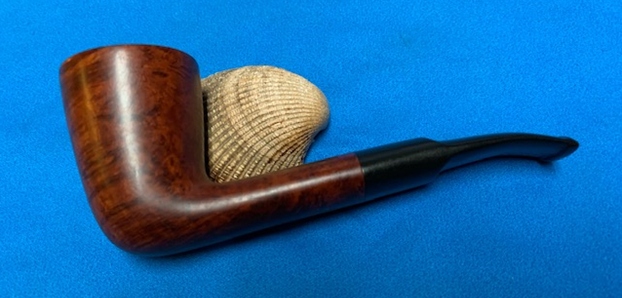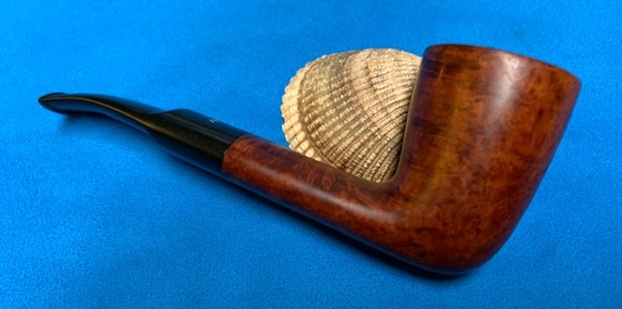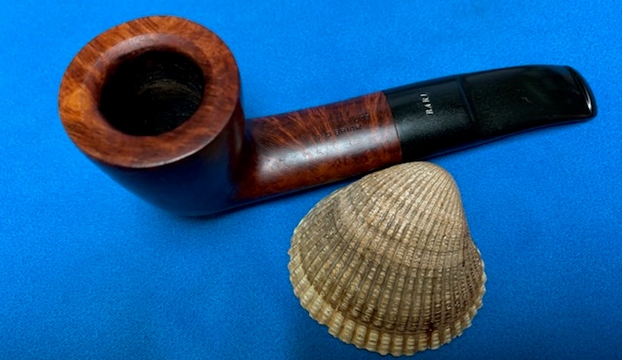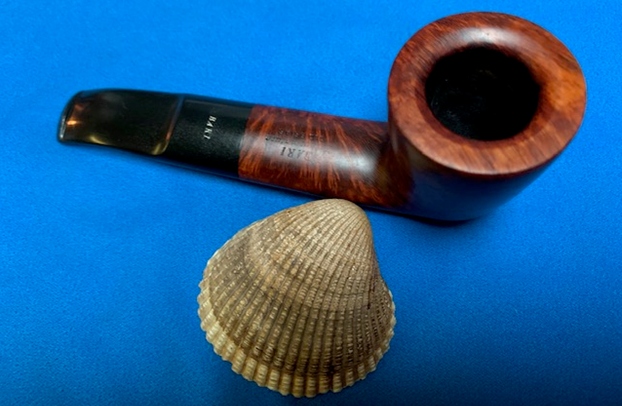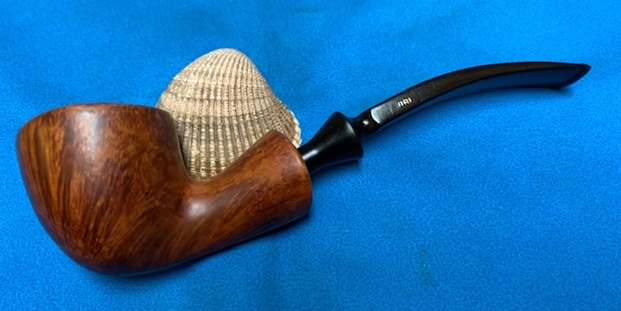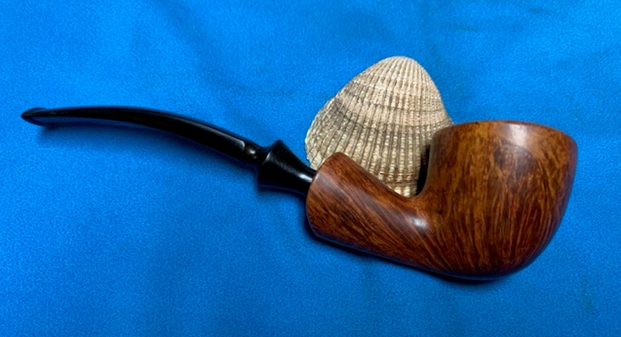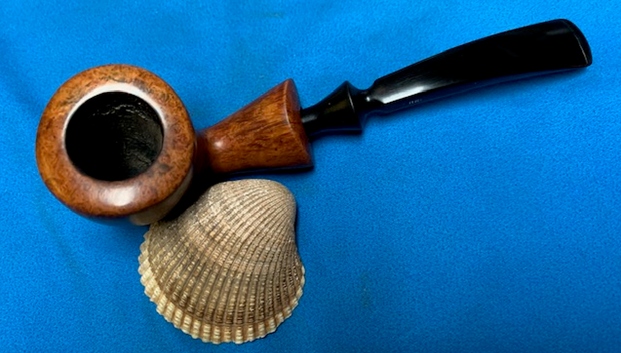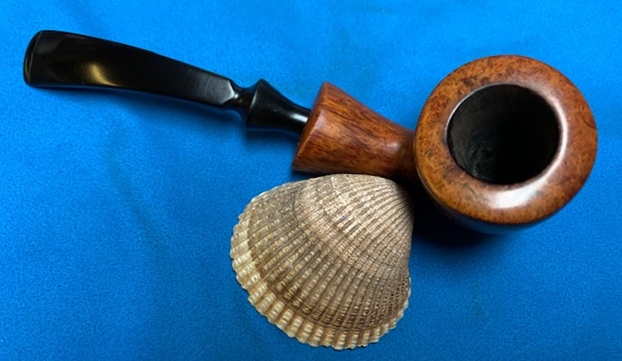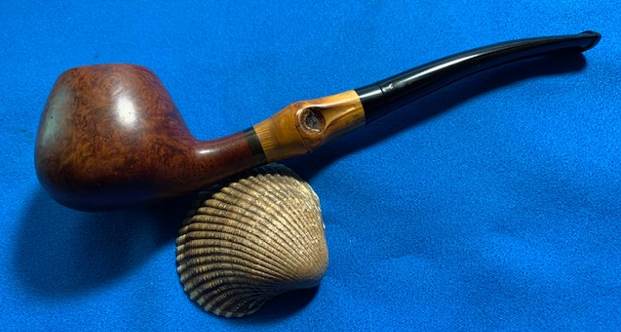
Tag Archives: Bari Pipes

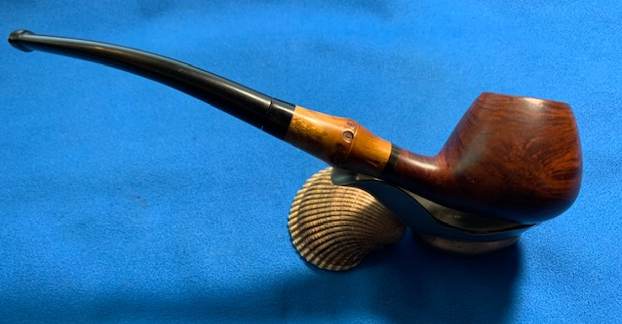
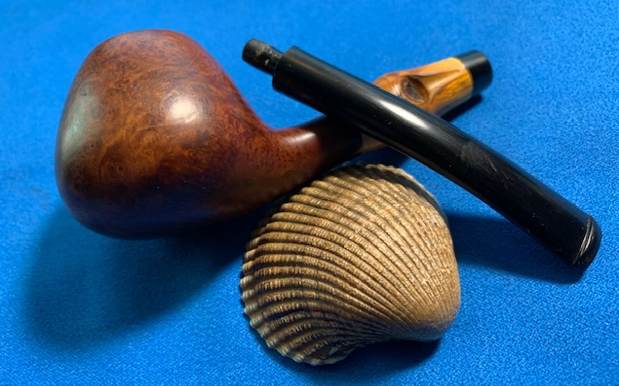
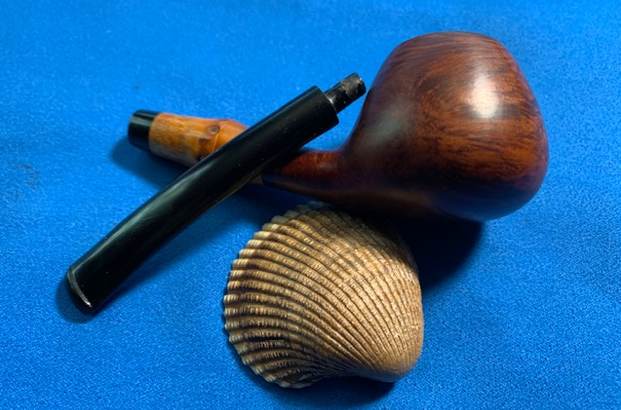
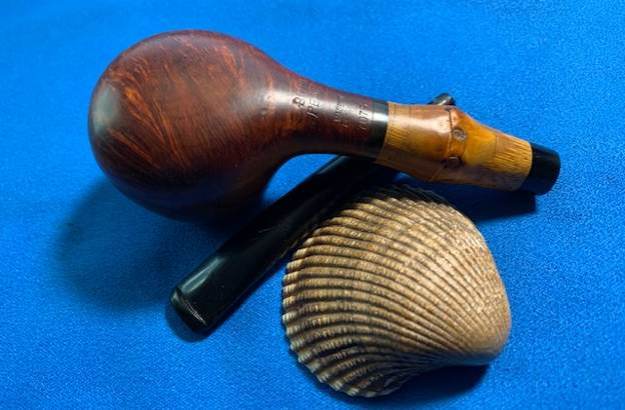
Restoring a Bari Special Handcut Danish 01 Bent Brandy


Blog by Steve Laug

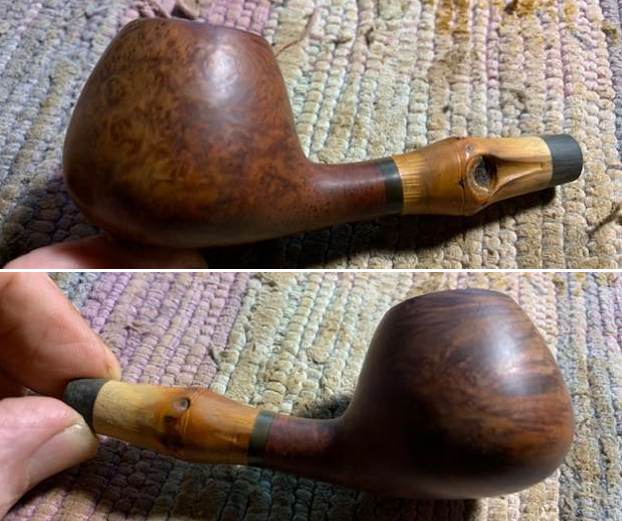
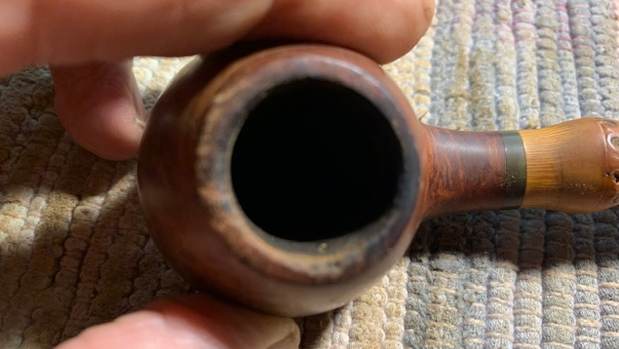
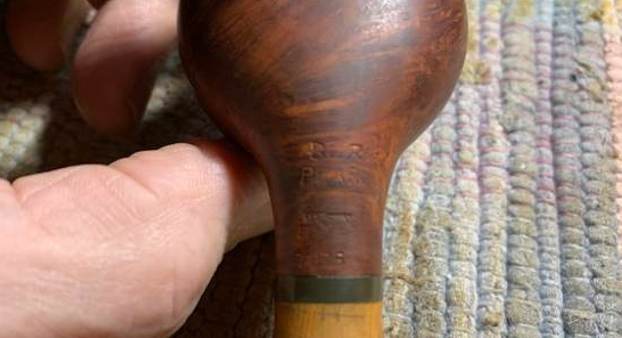
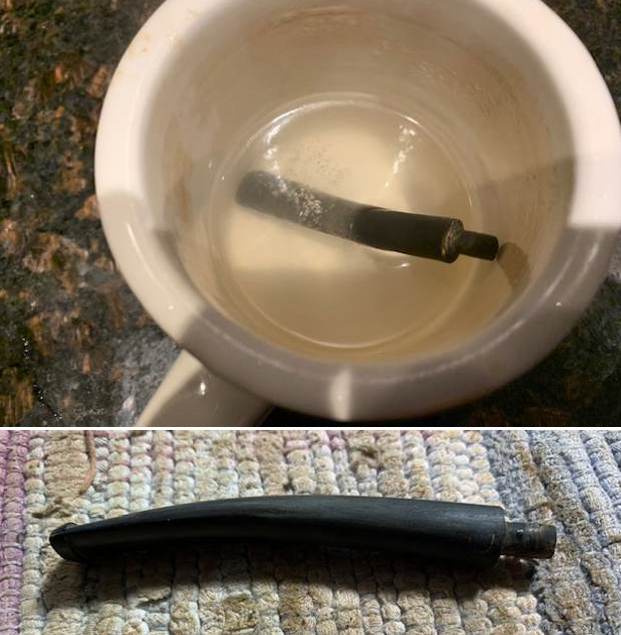
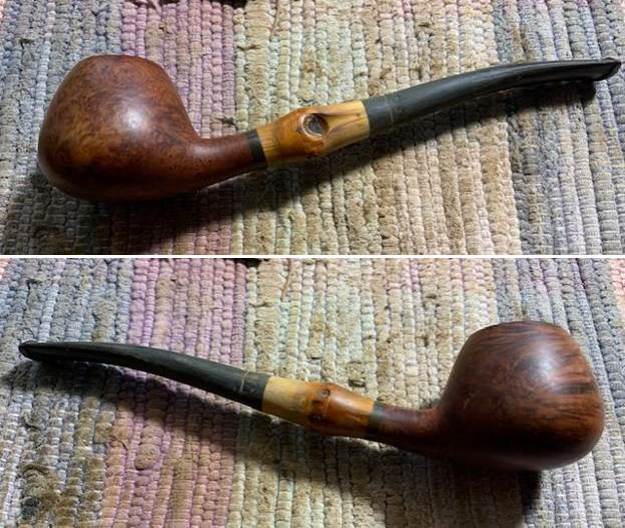
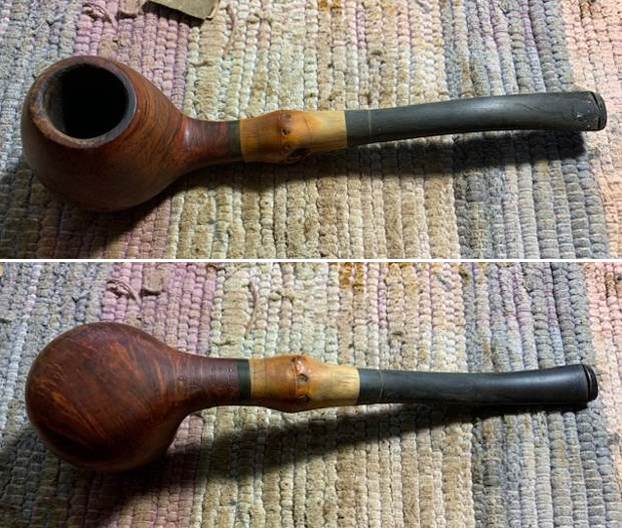
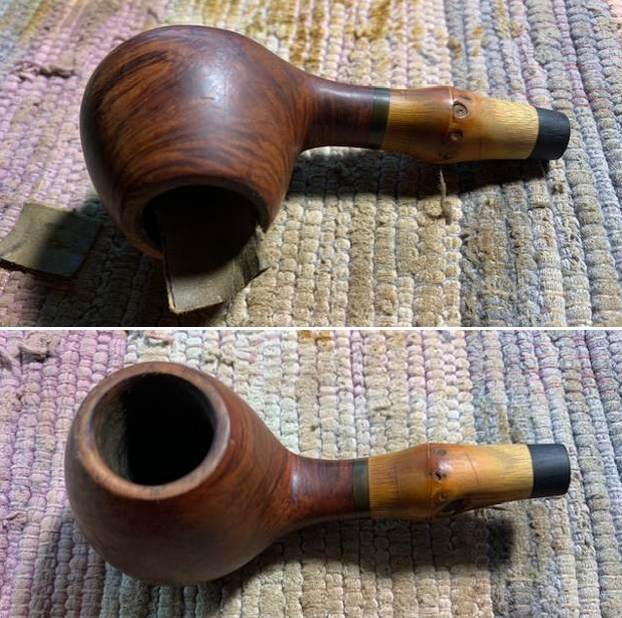
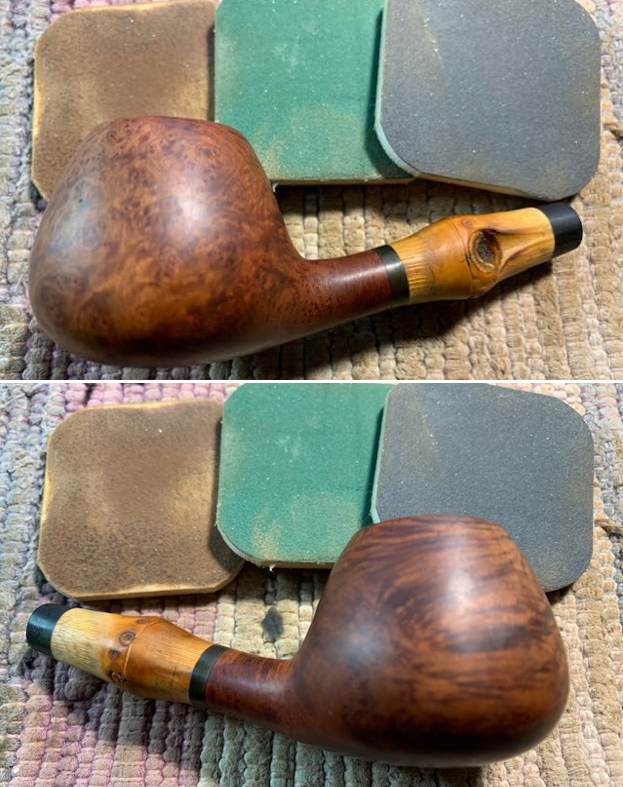
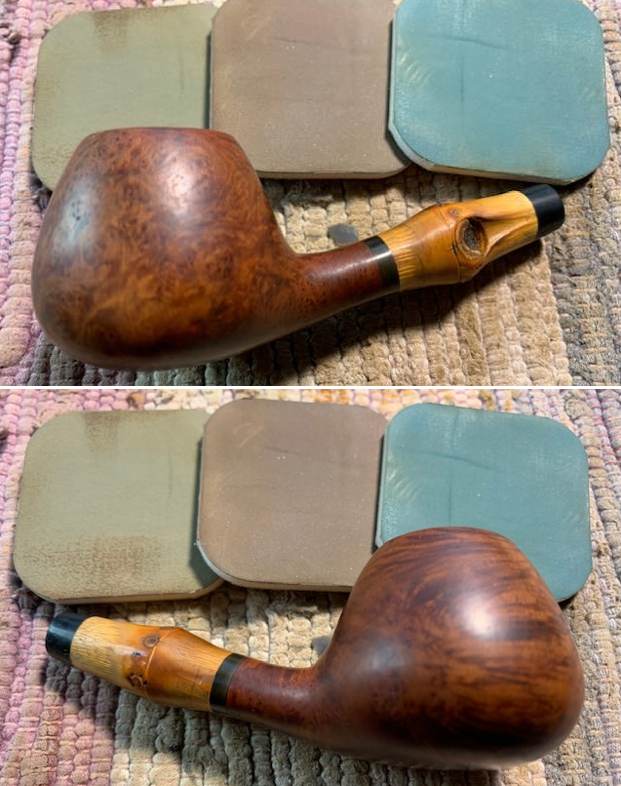
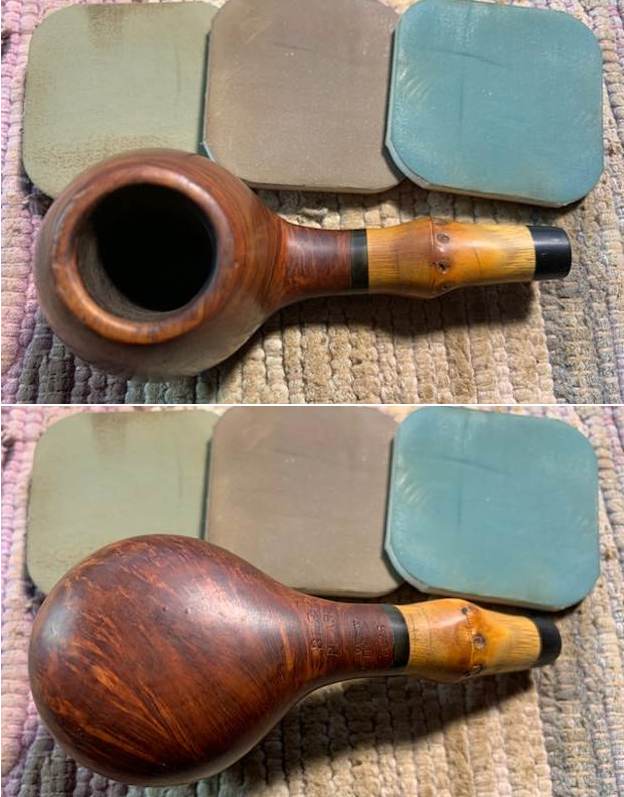
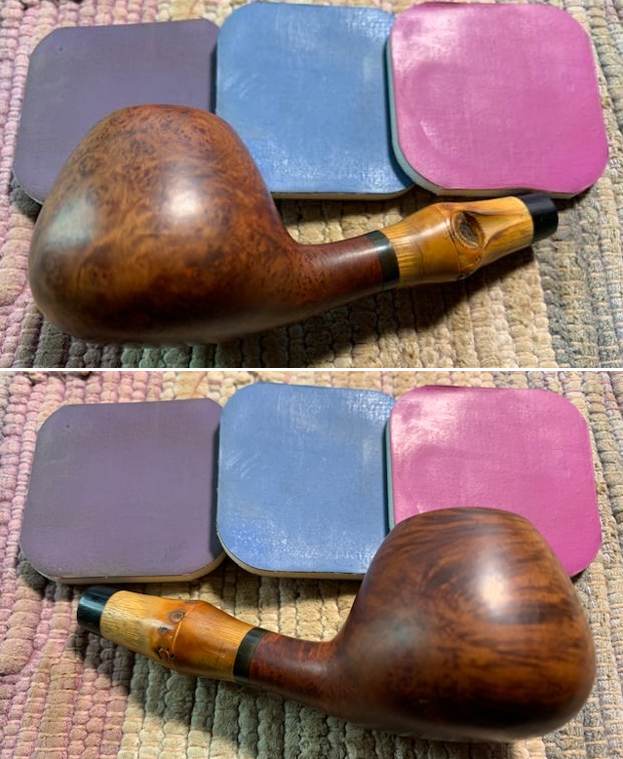
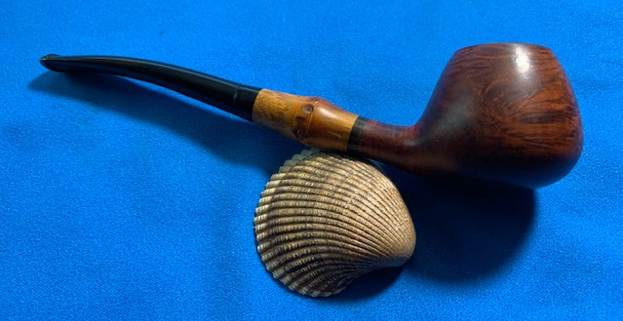
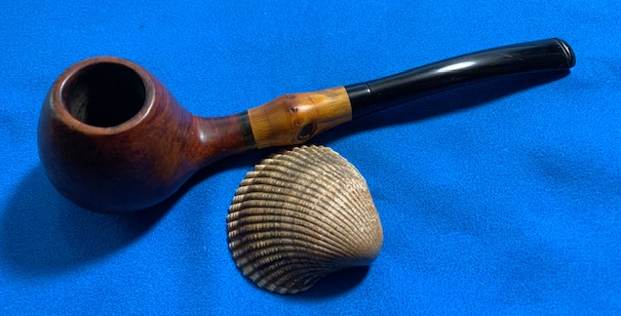
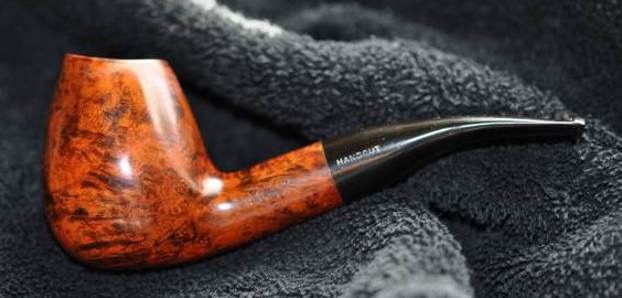
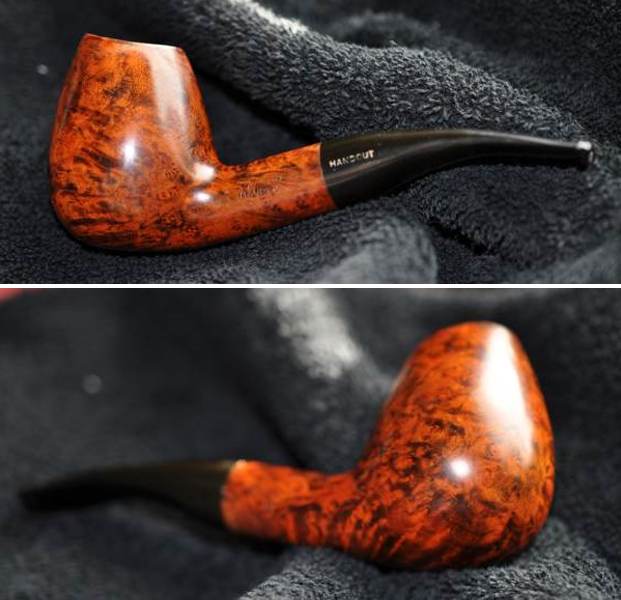
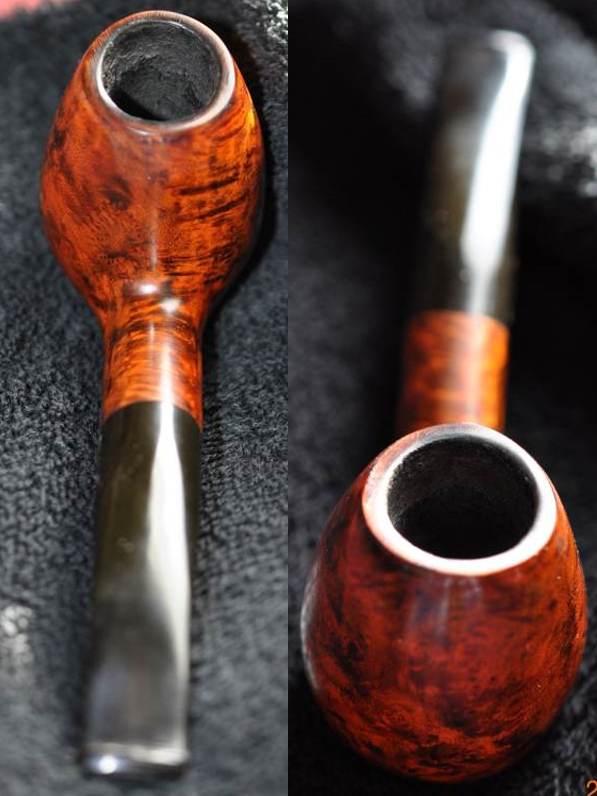
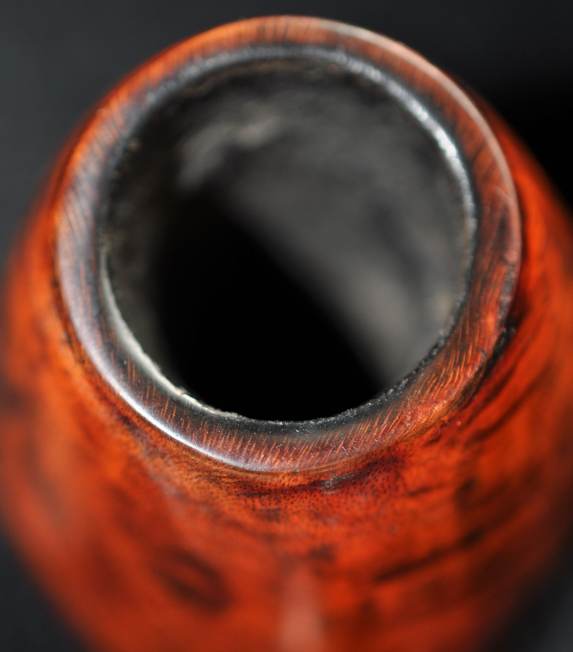
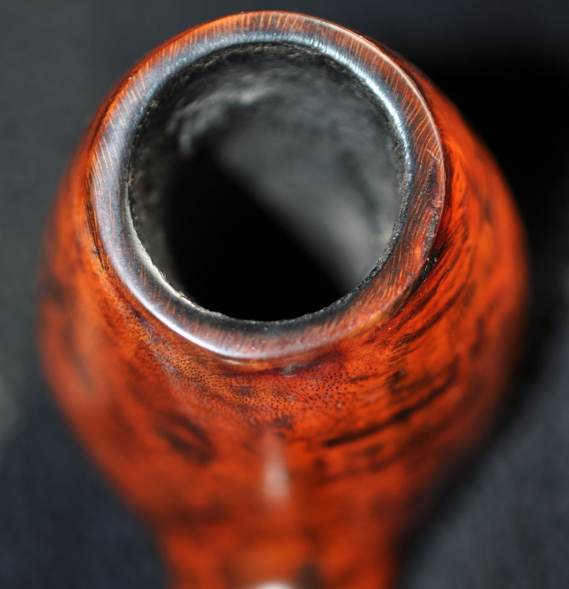
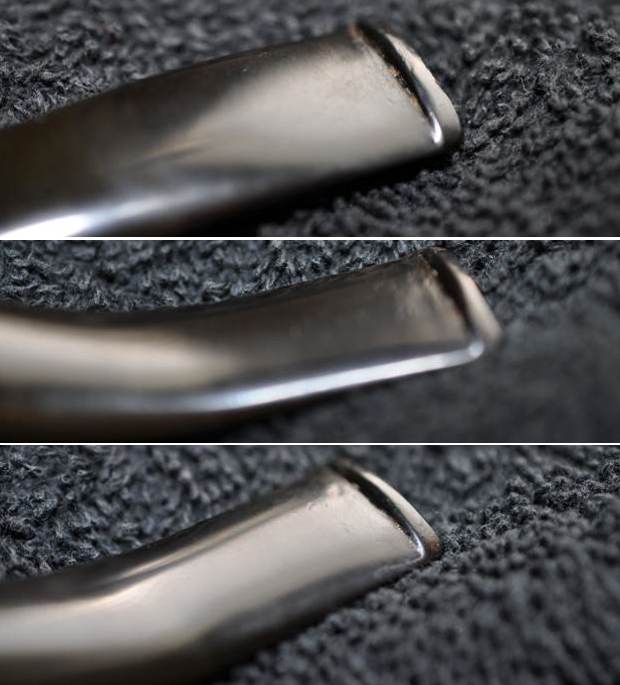
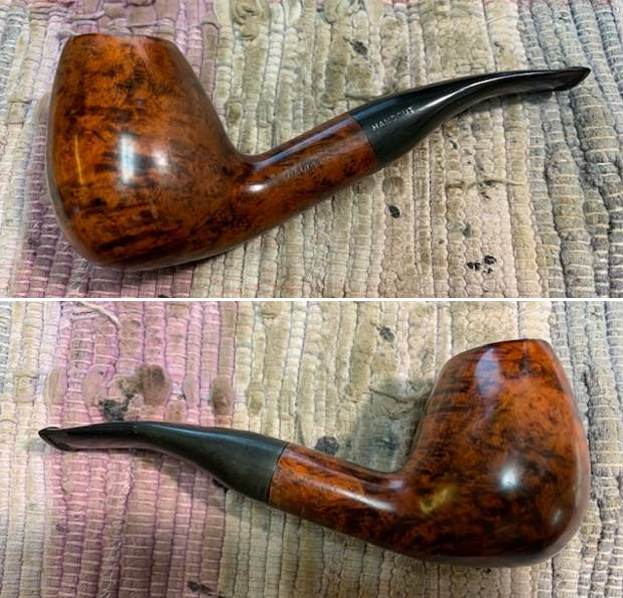
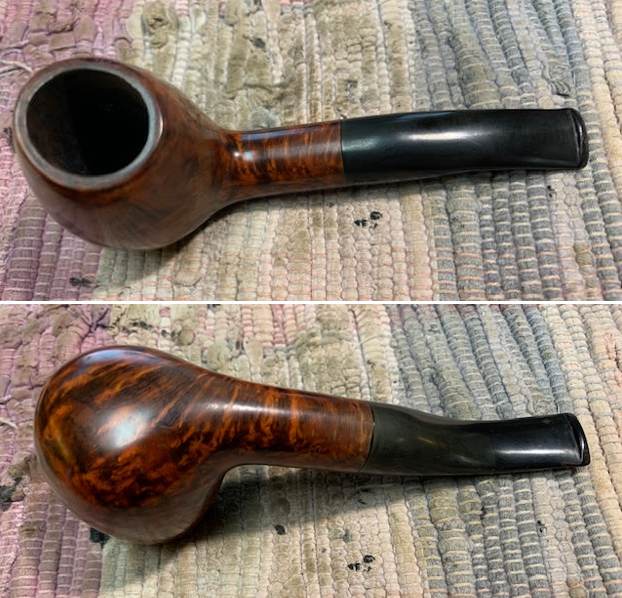
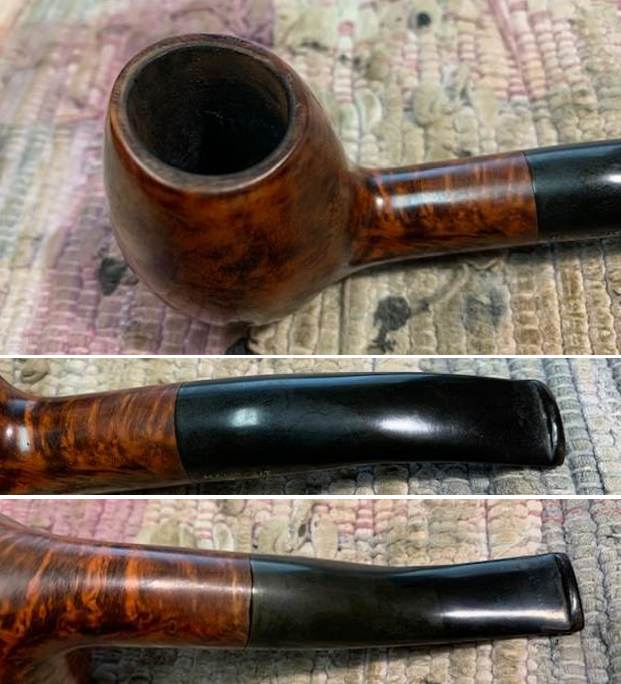
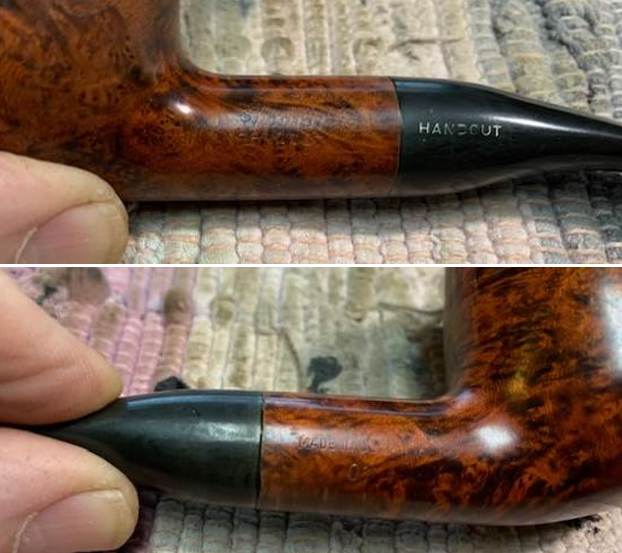
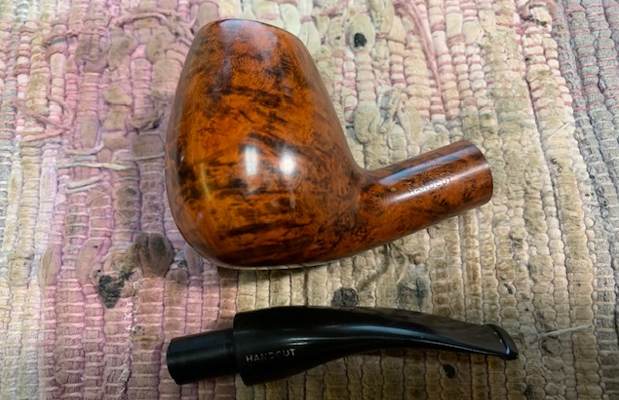
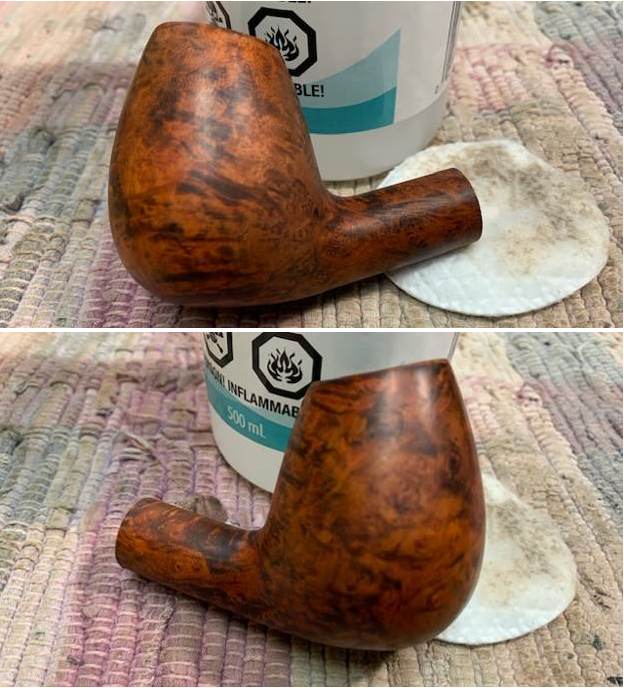
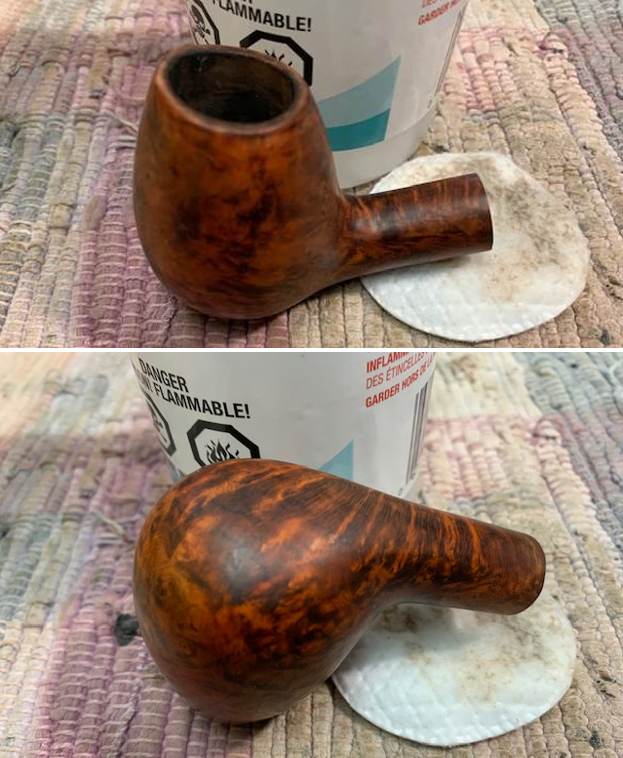
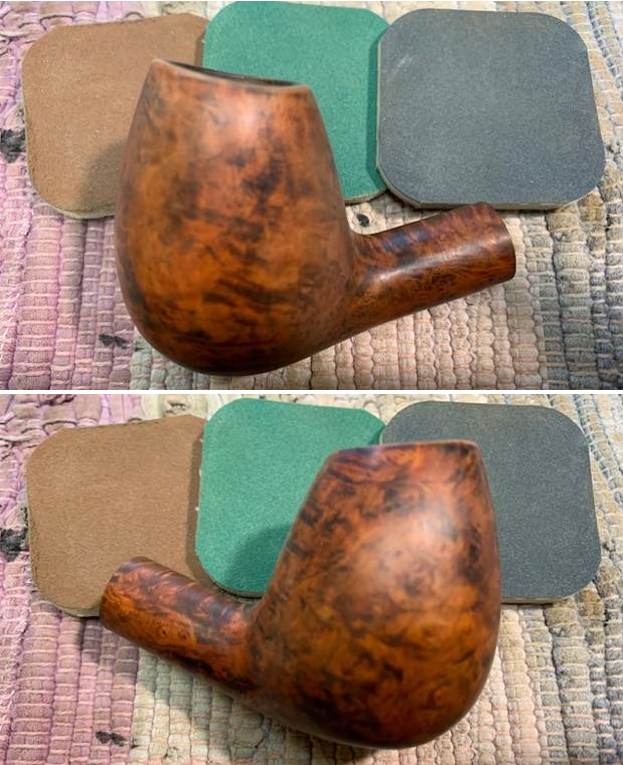
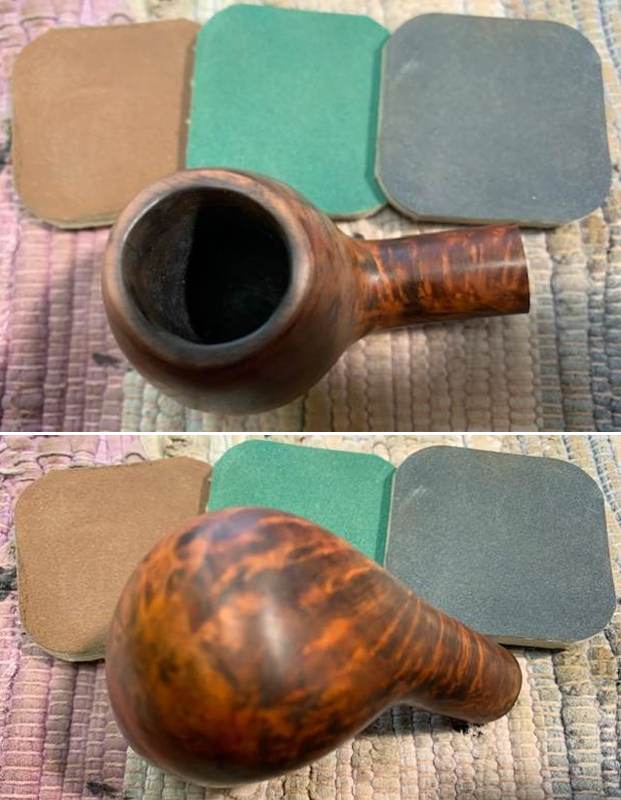
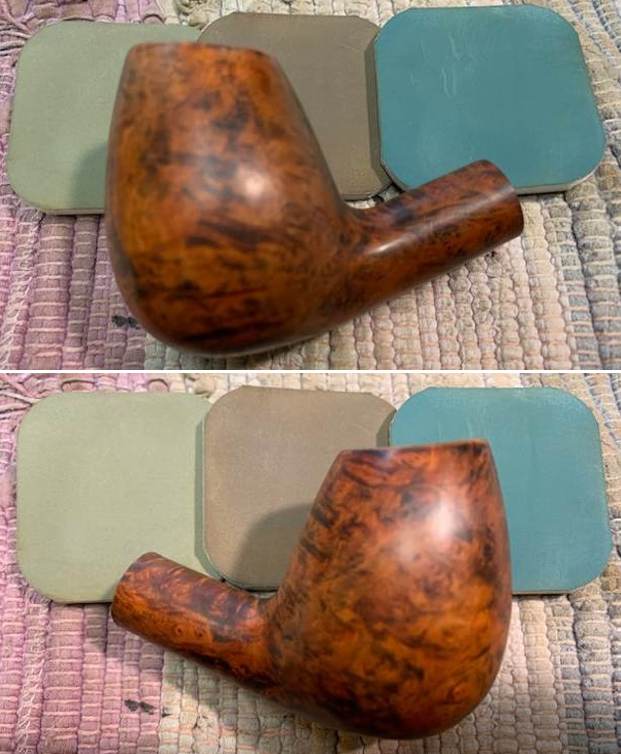
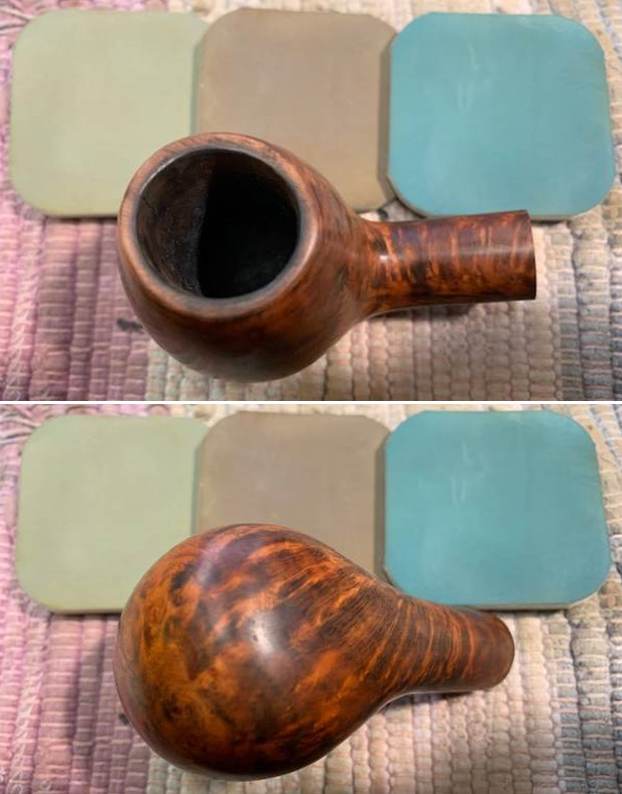
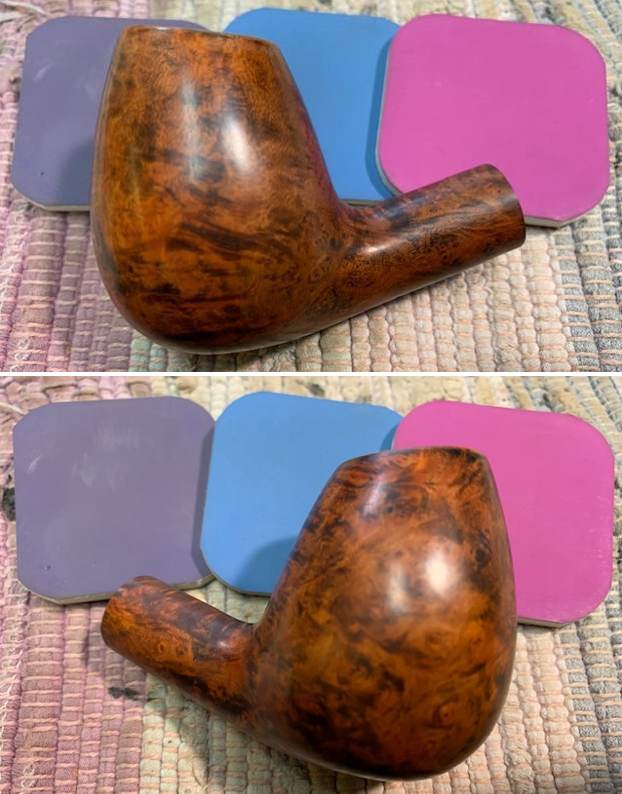
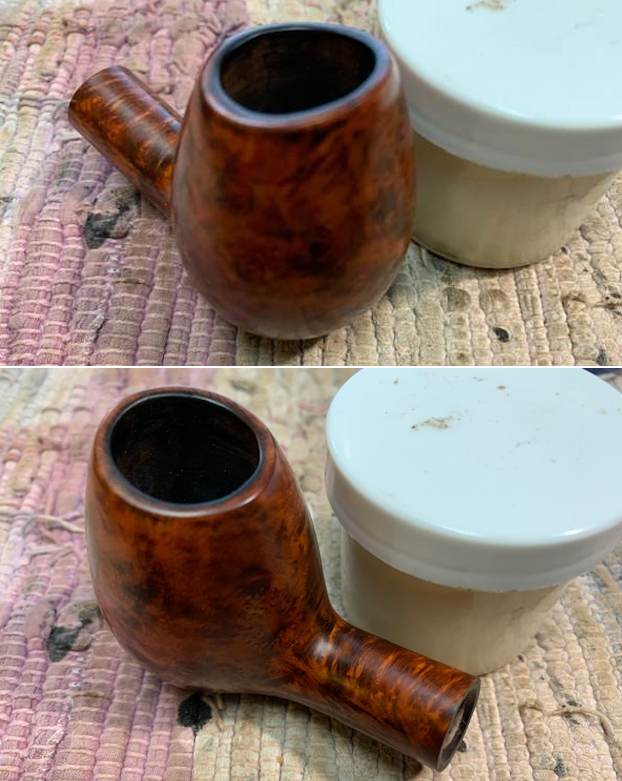
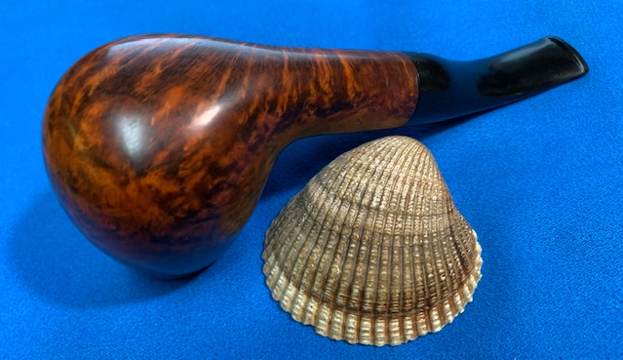
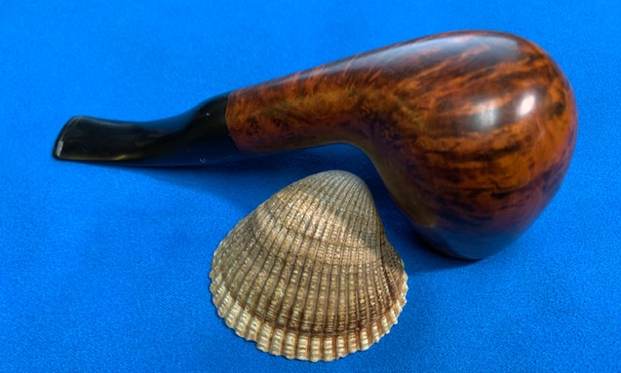
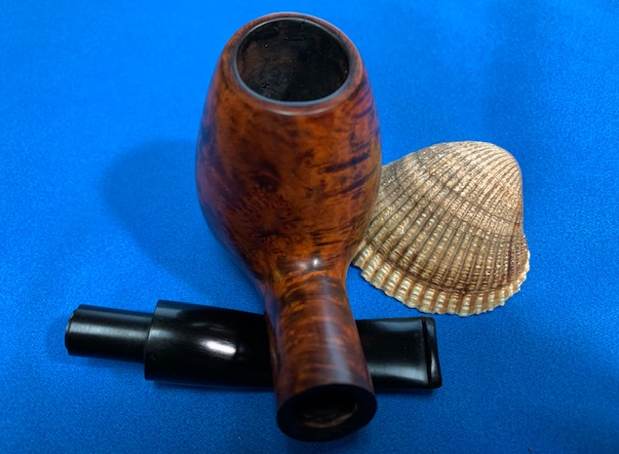
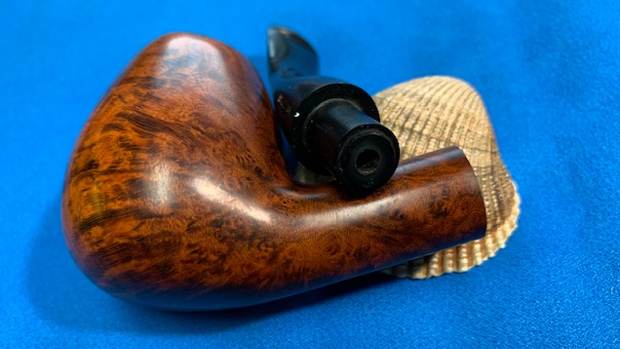
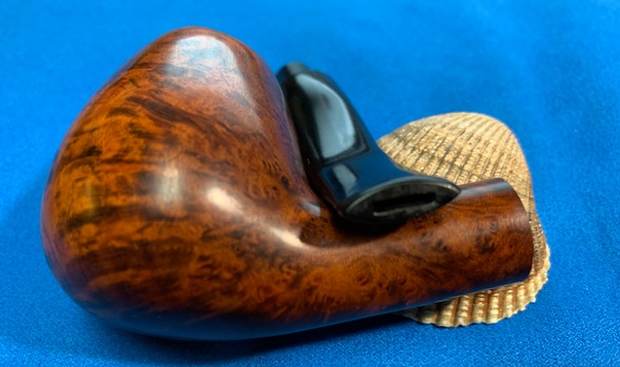
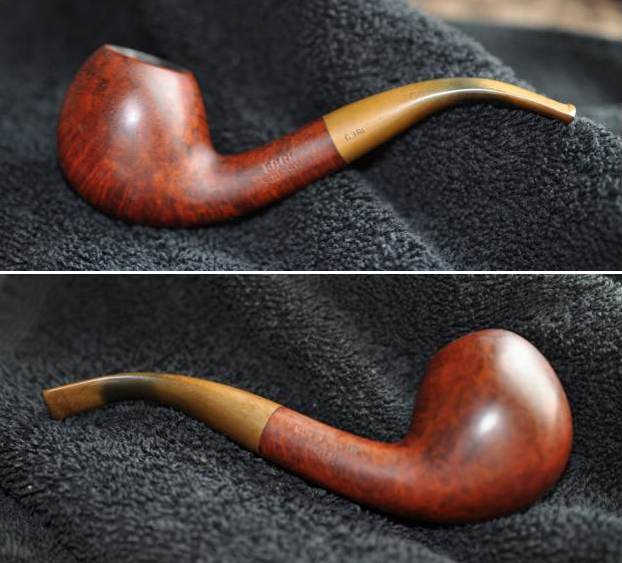
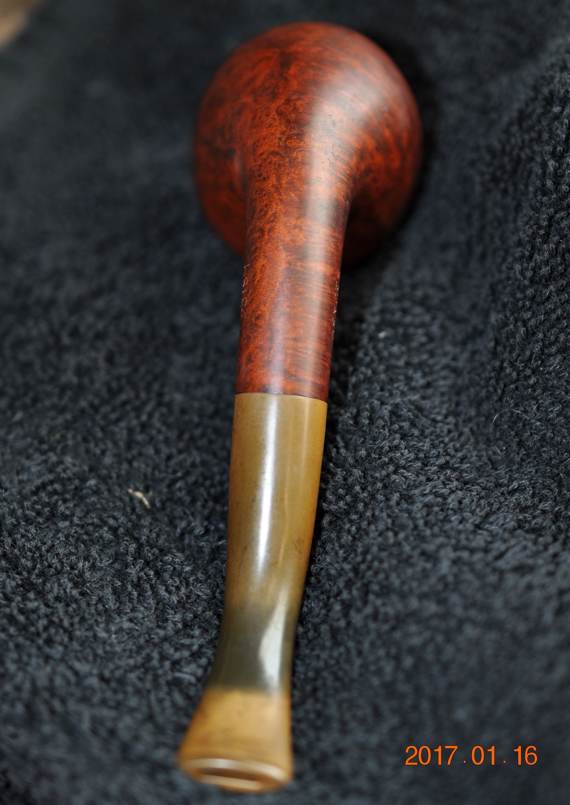
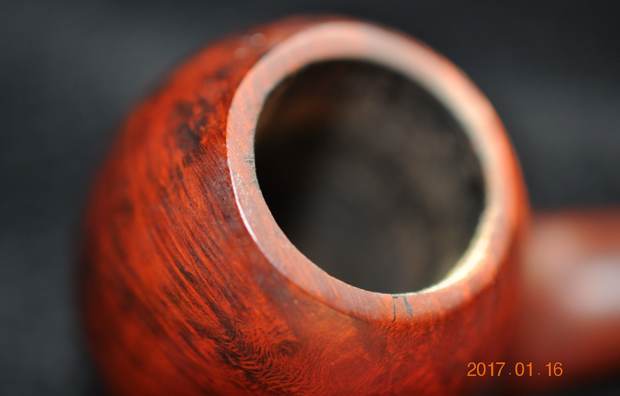
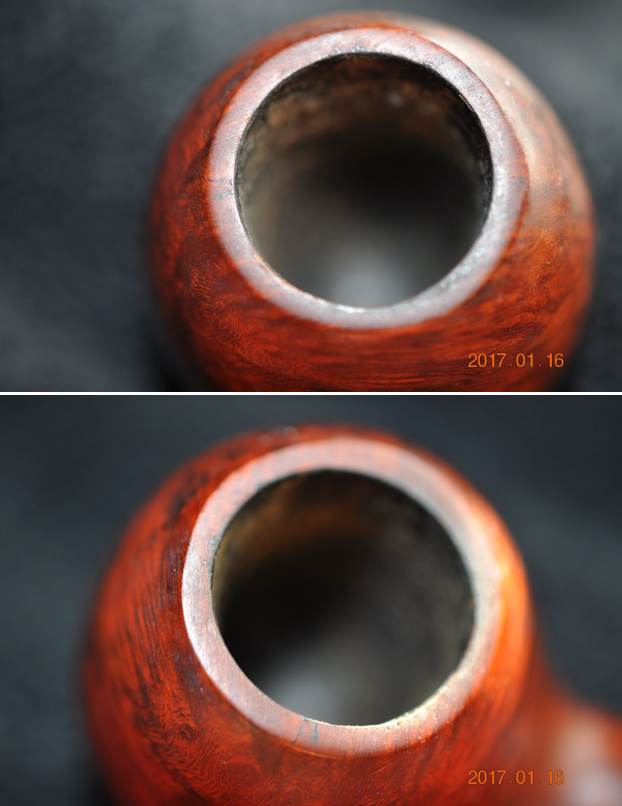
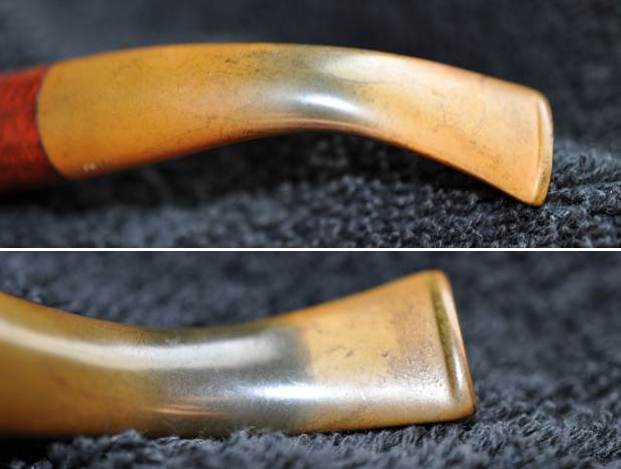
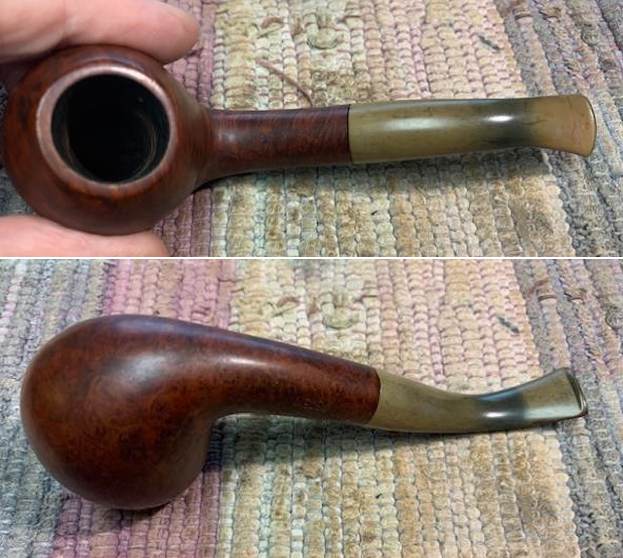
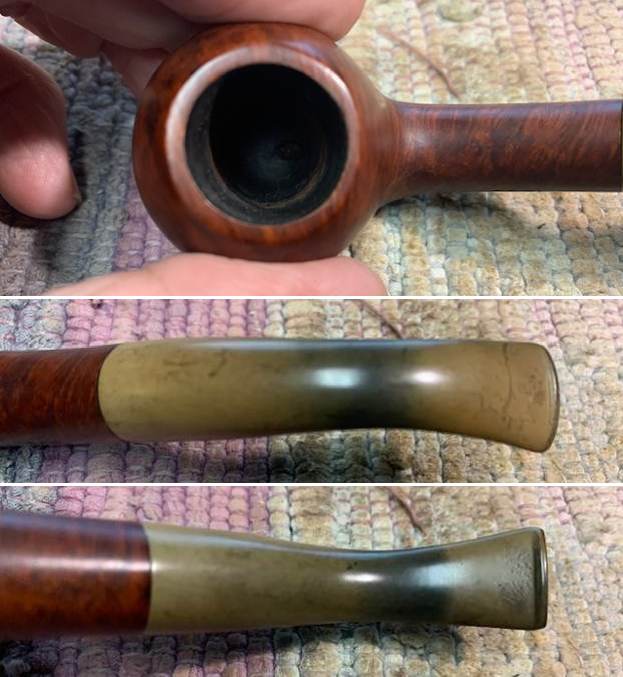
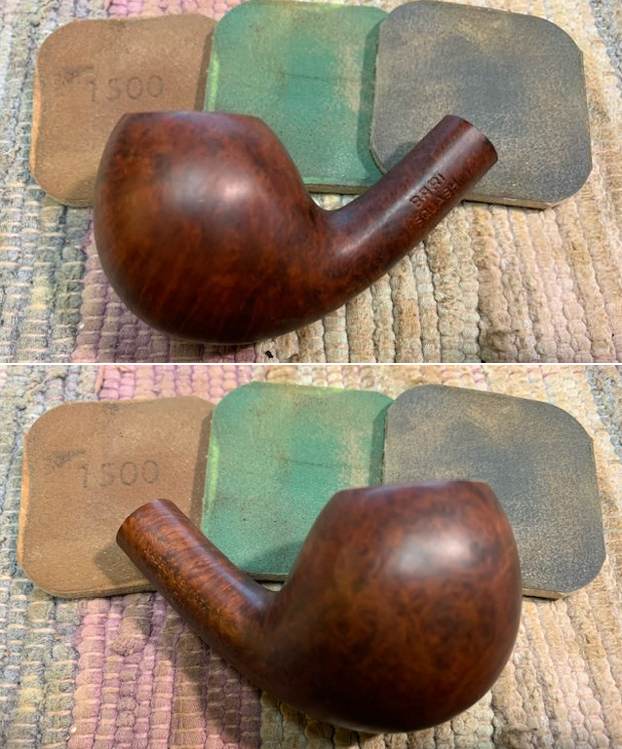
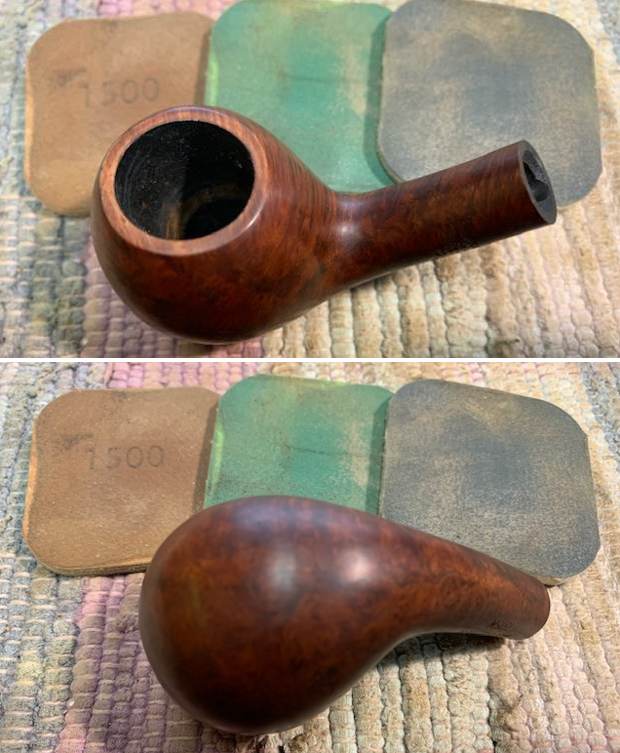
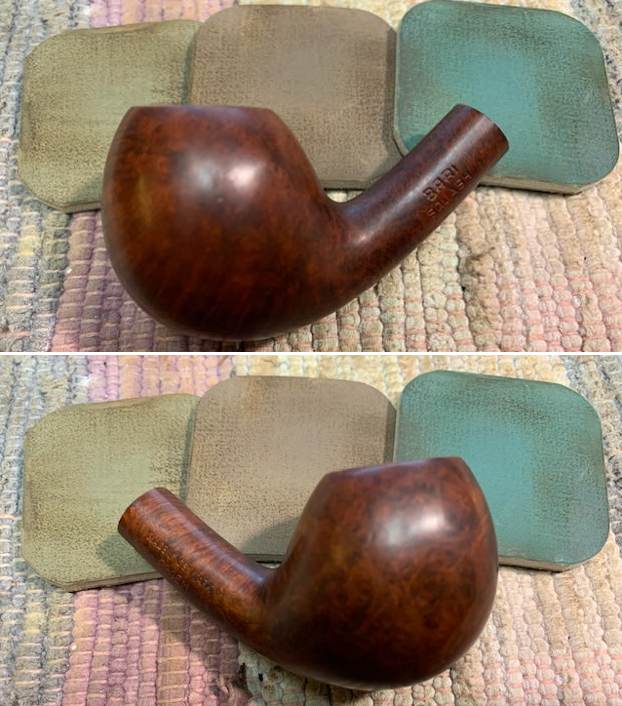
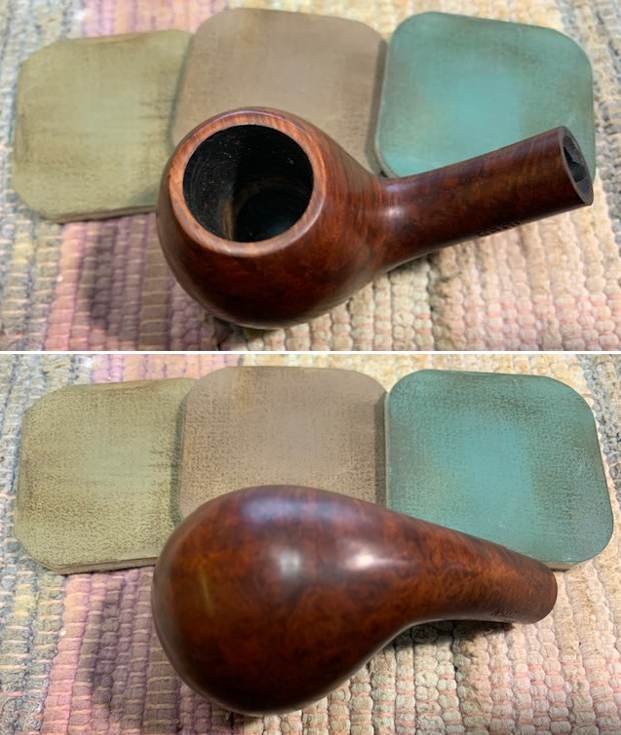
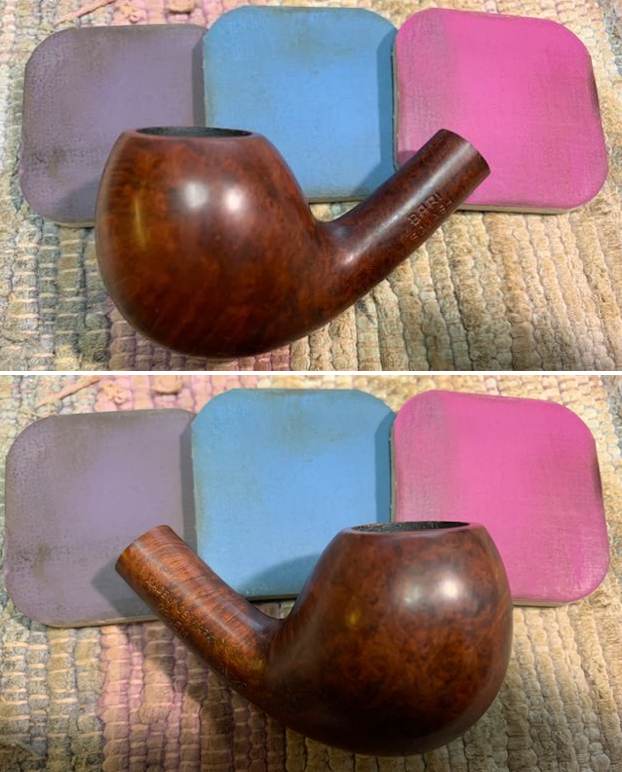
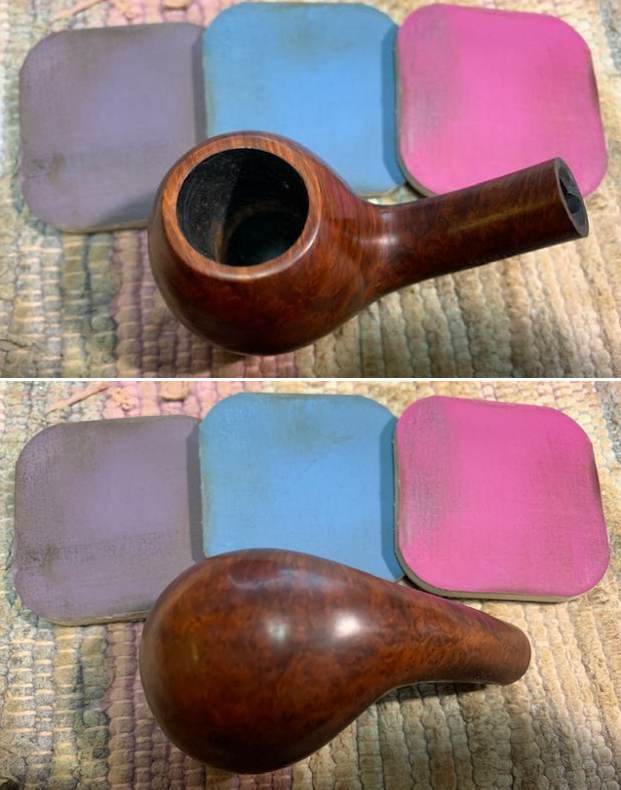
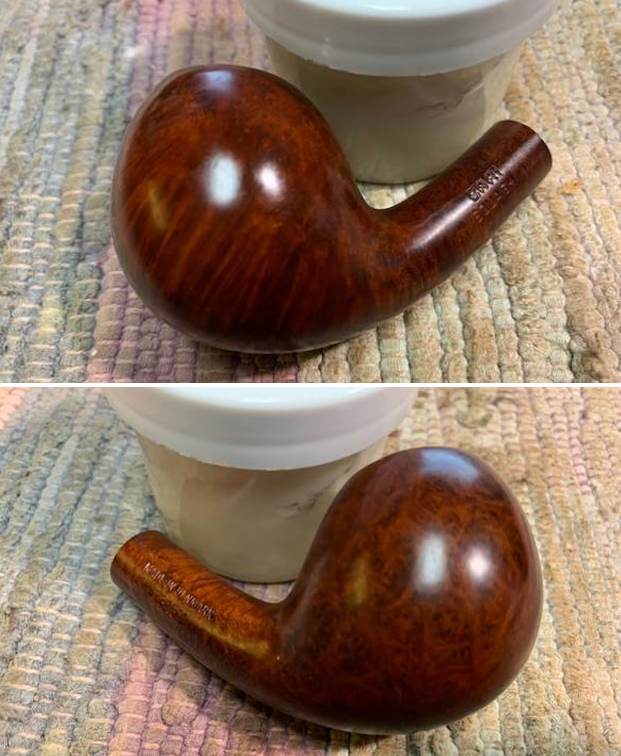
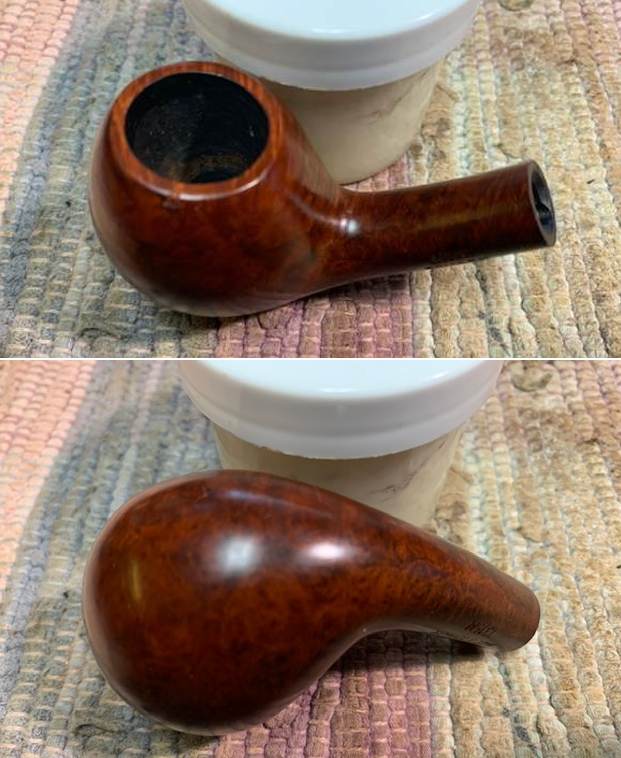
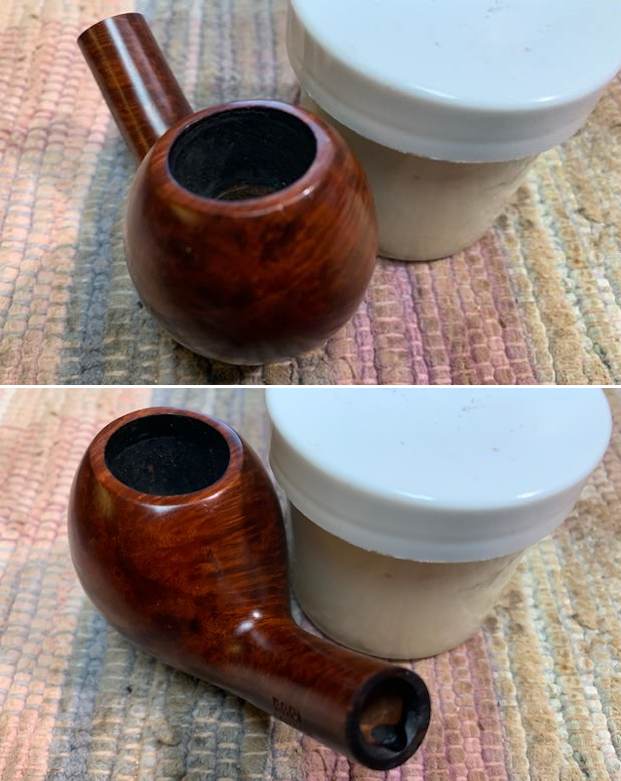
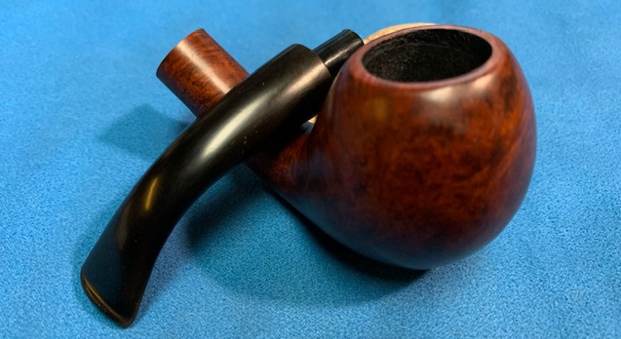
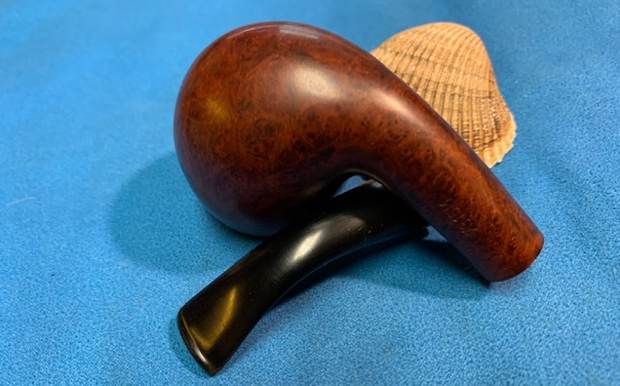
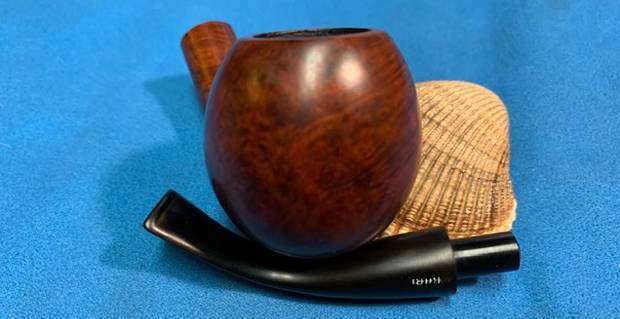
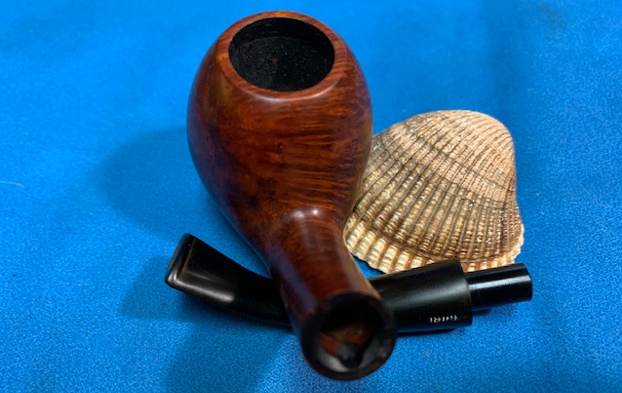
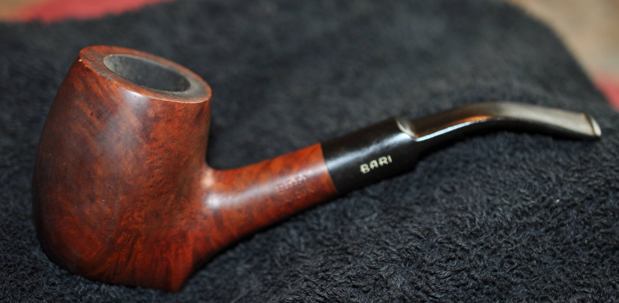
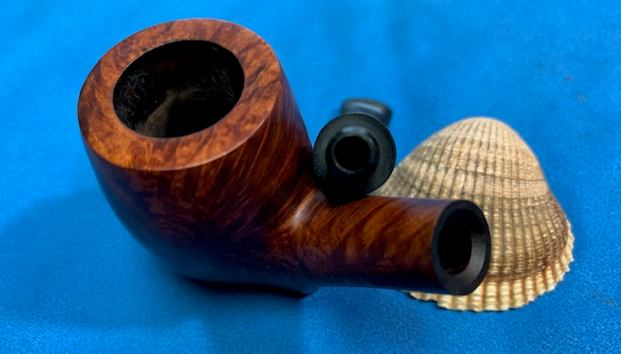
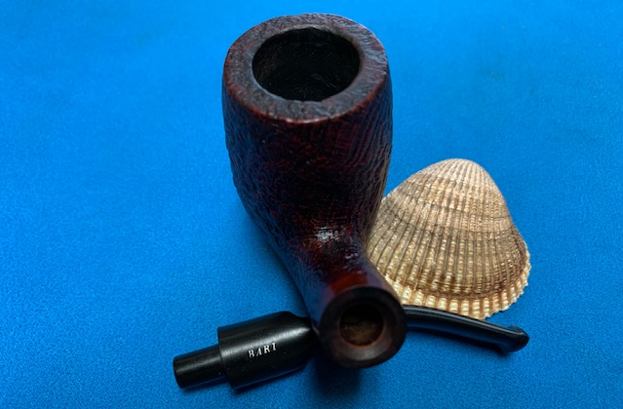
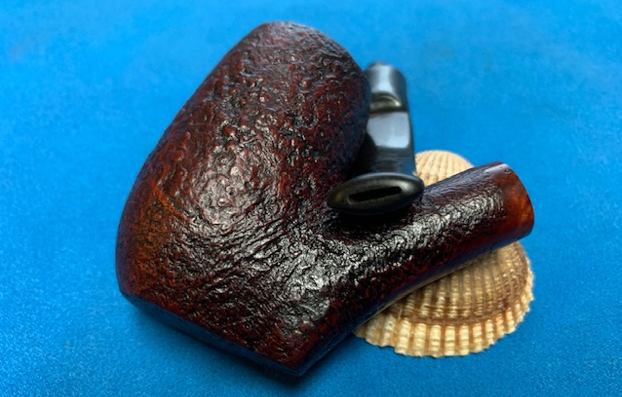
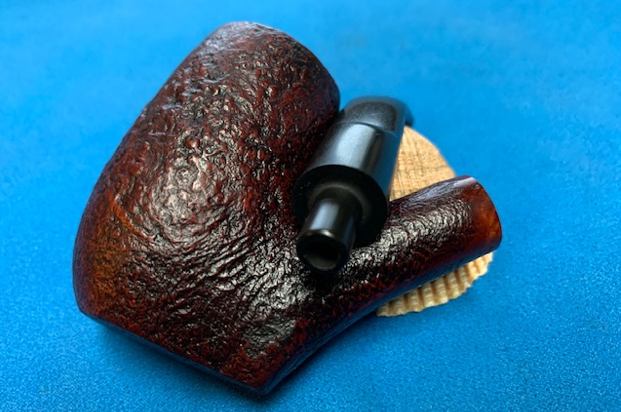
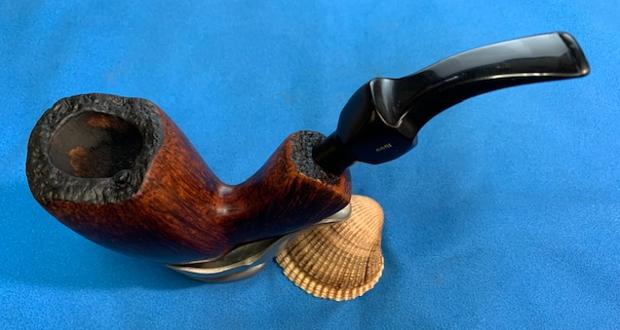
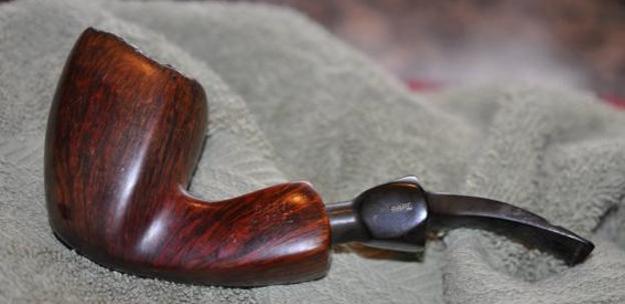
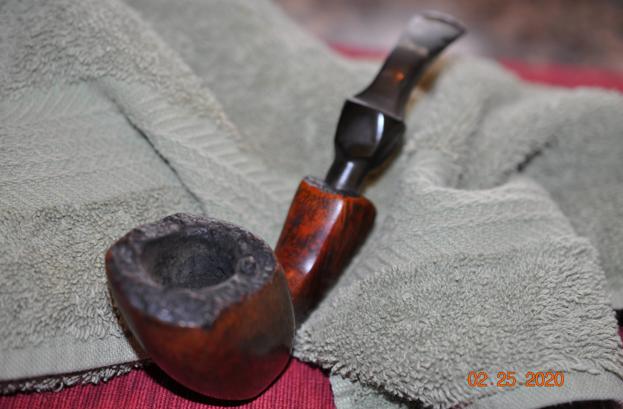
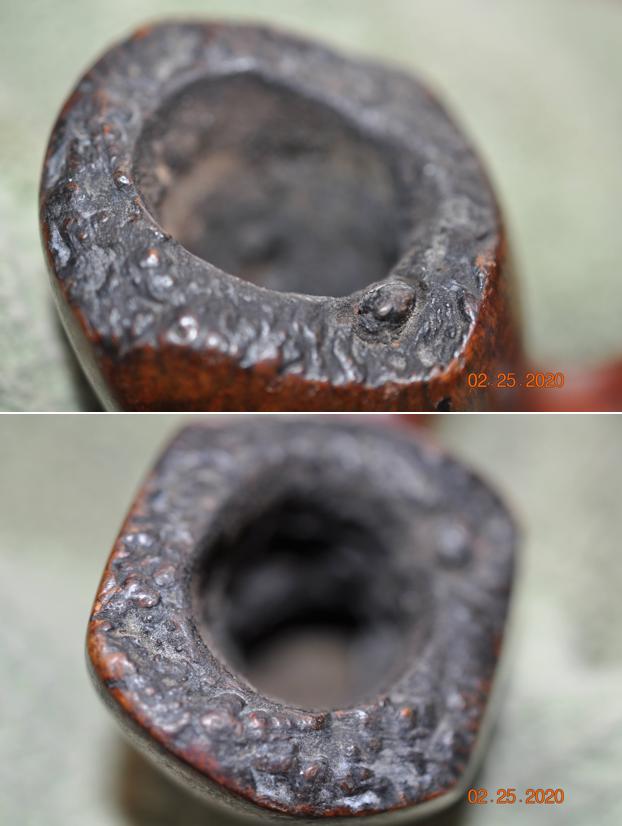
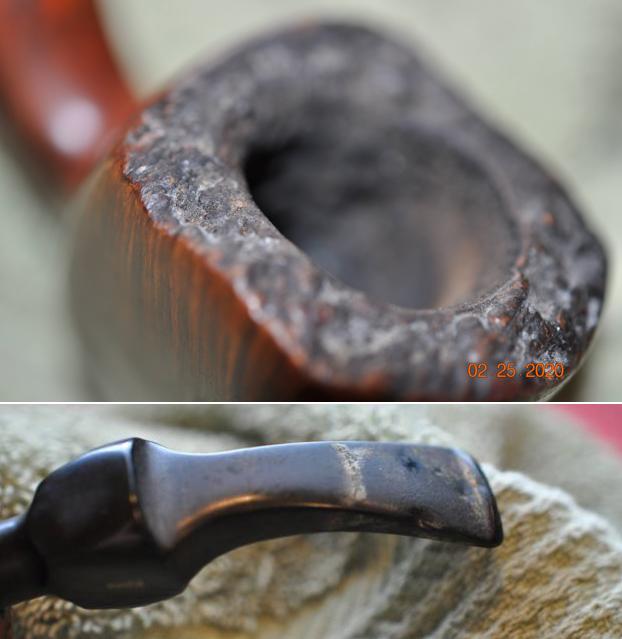
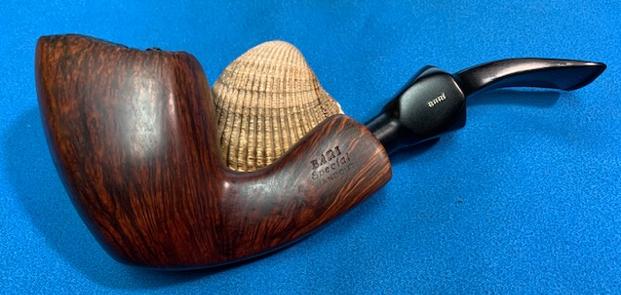
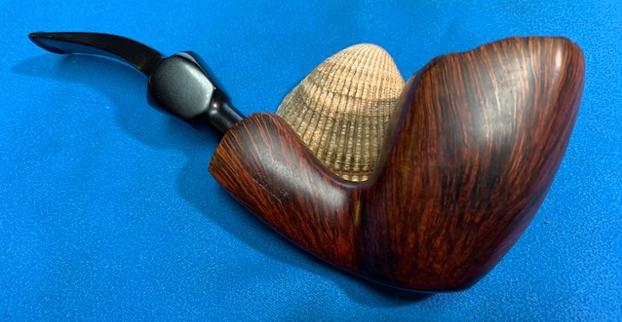
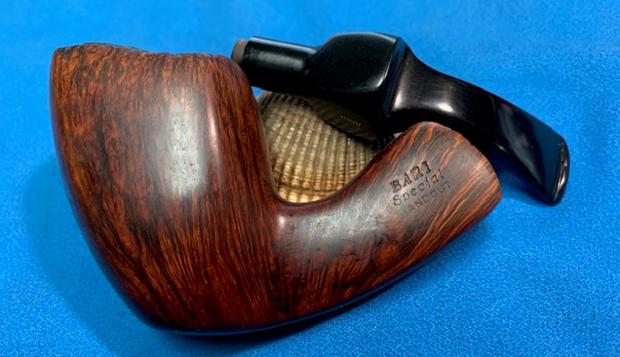
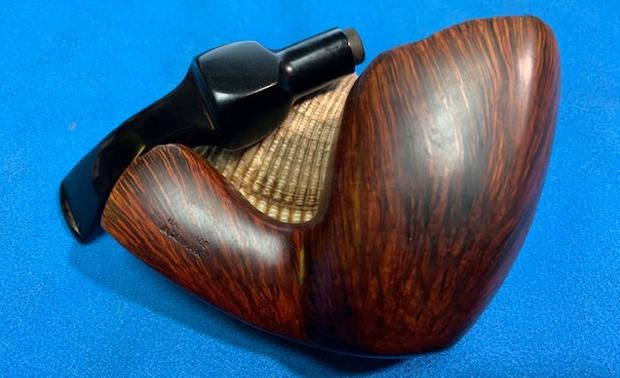
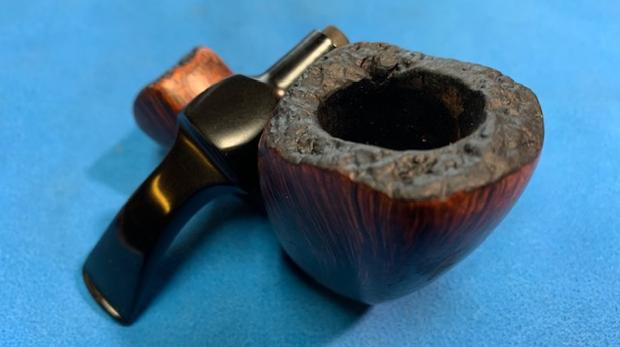
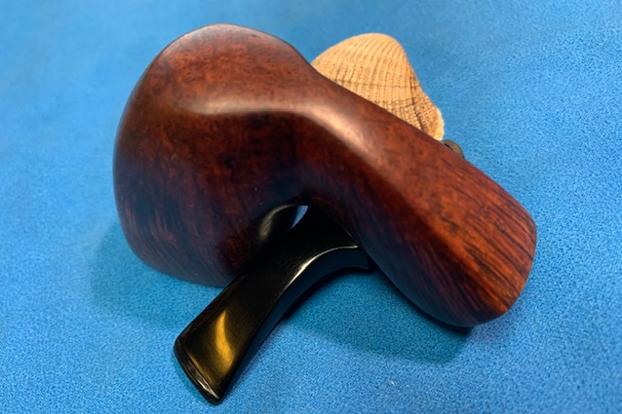
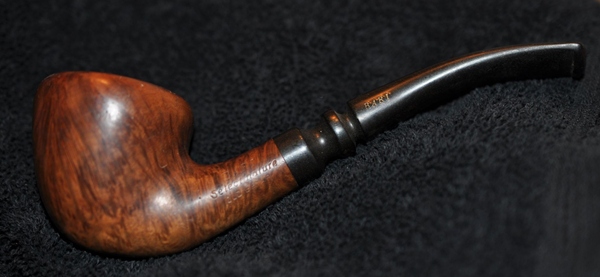
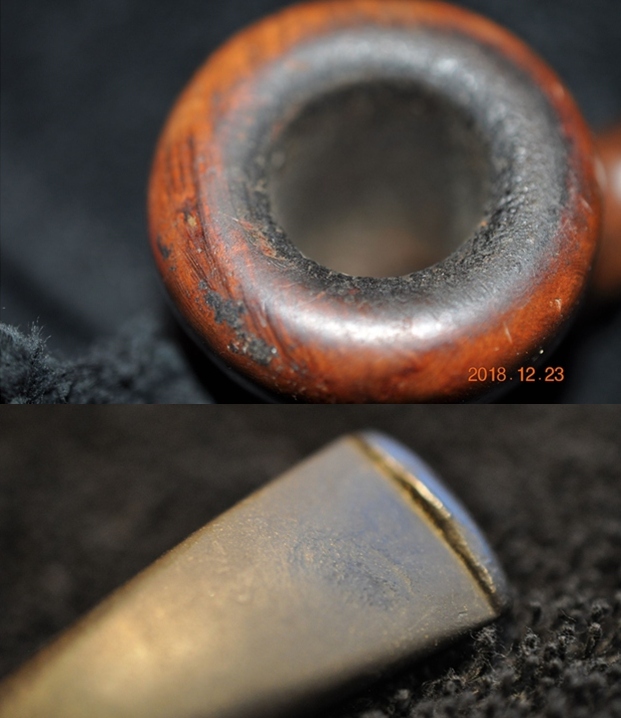
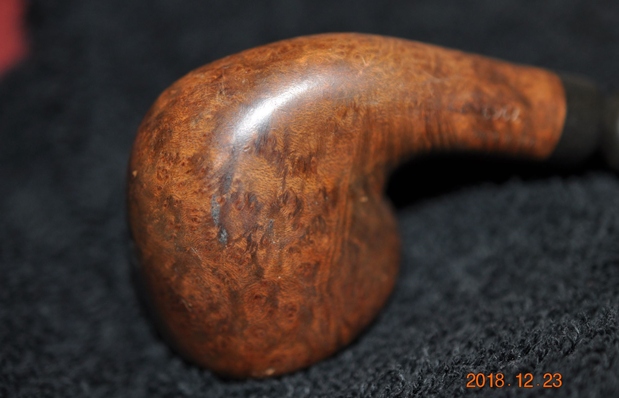
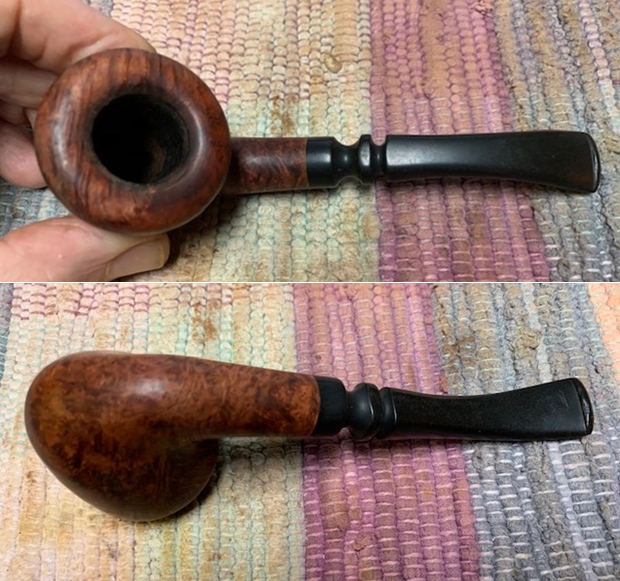
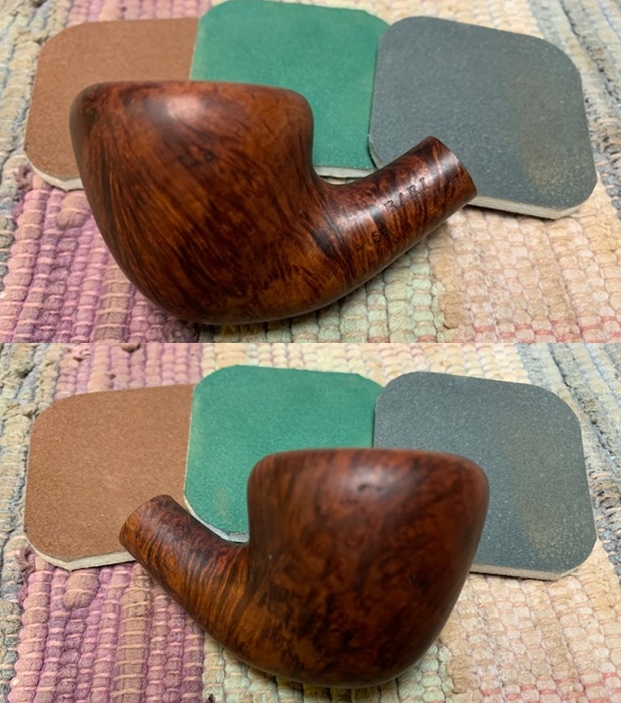
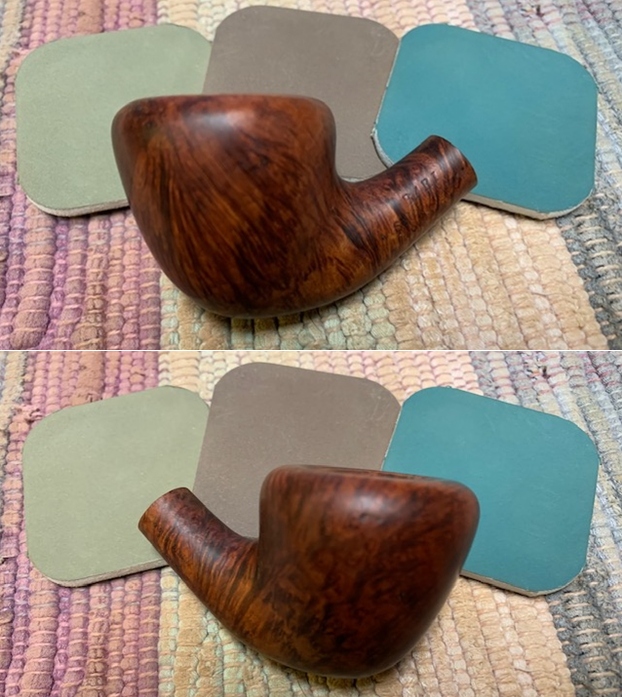
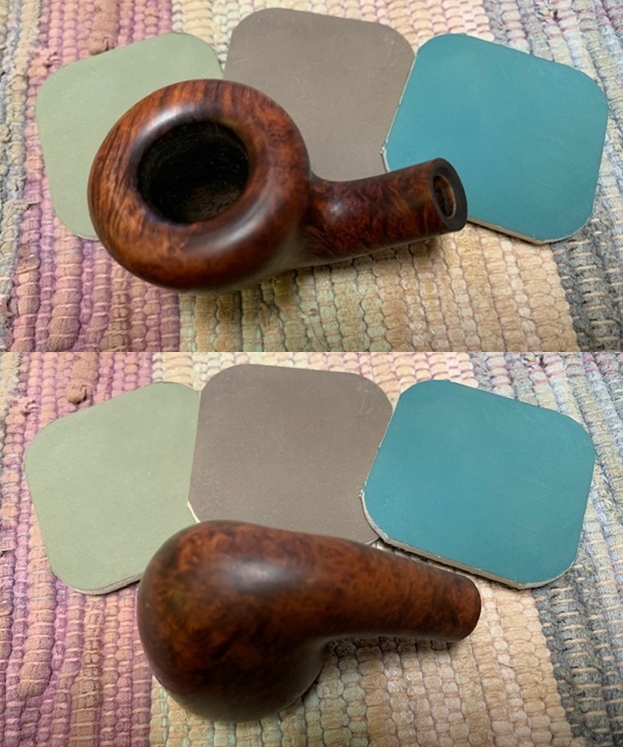
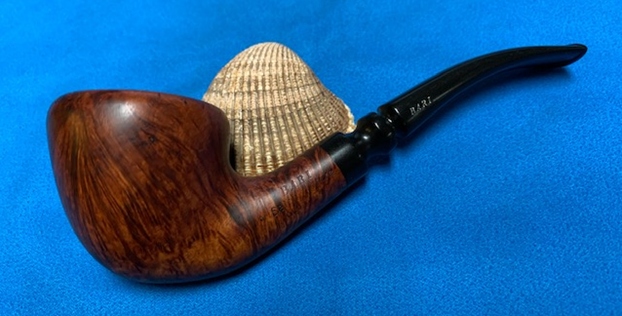
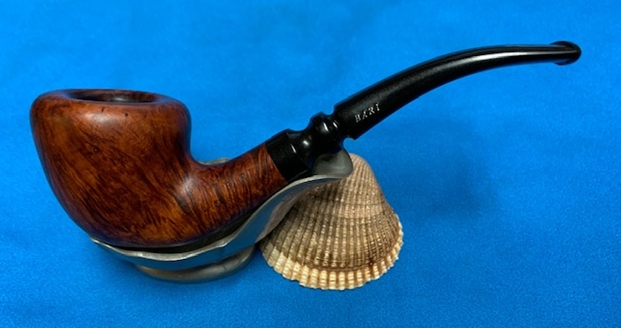
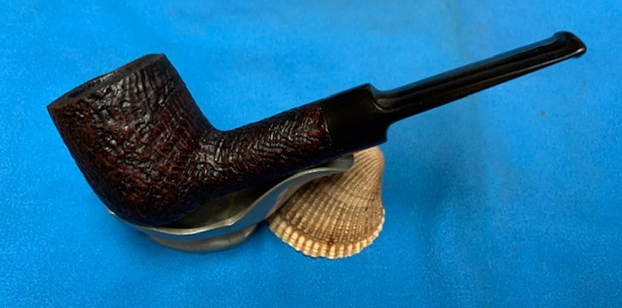
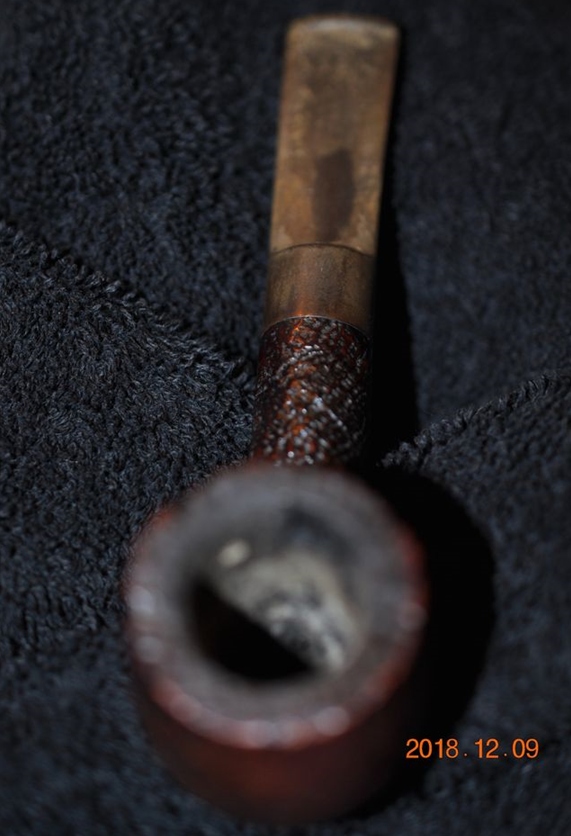
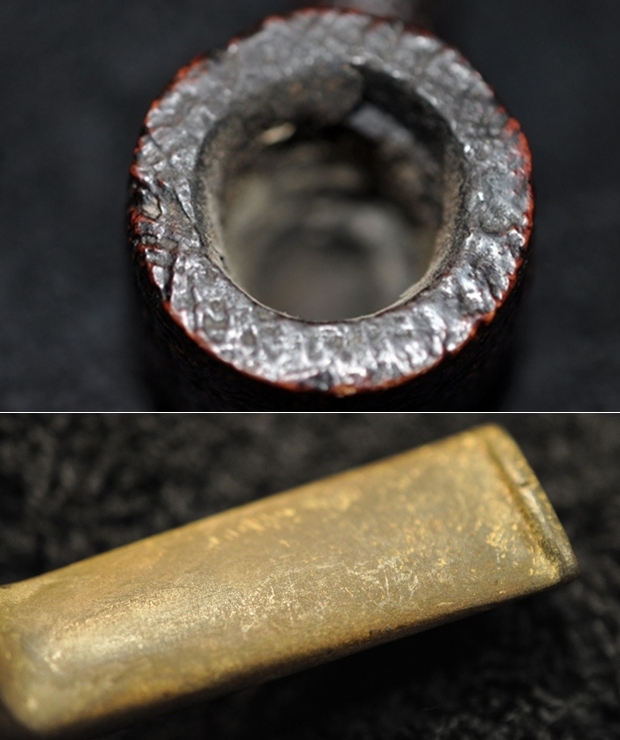
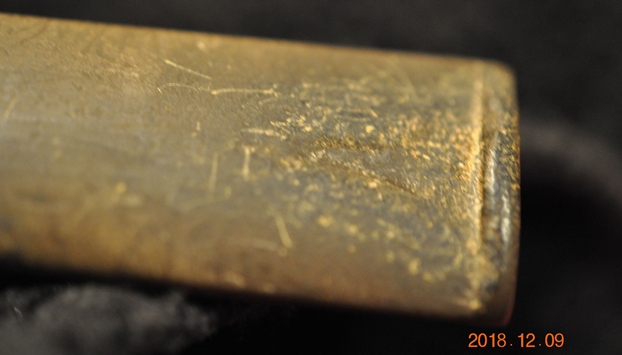
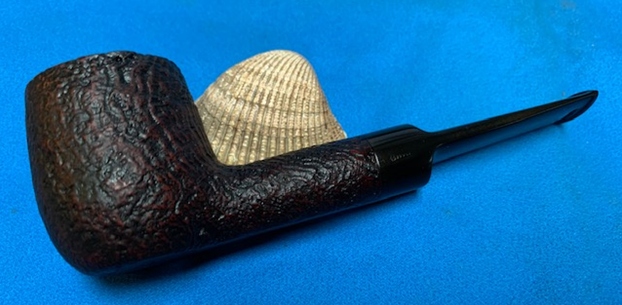
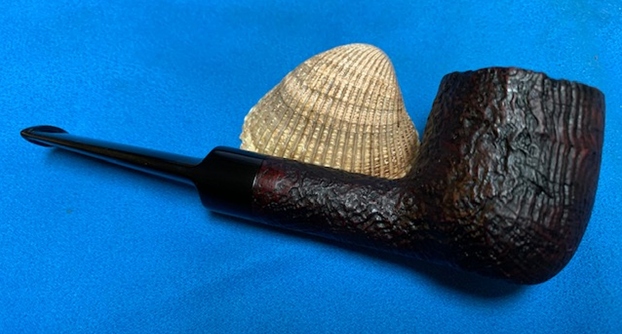
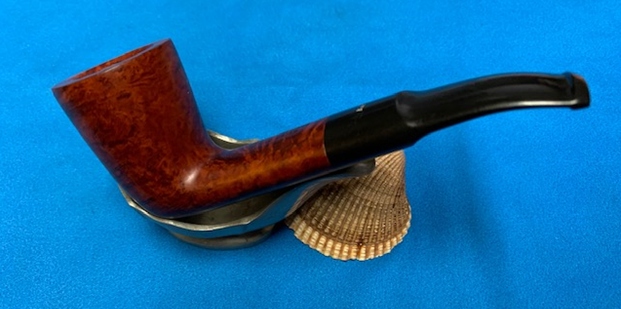
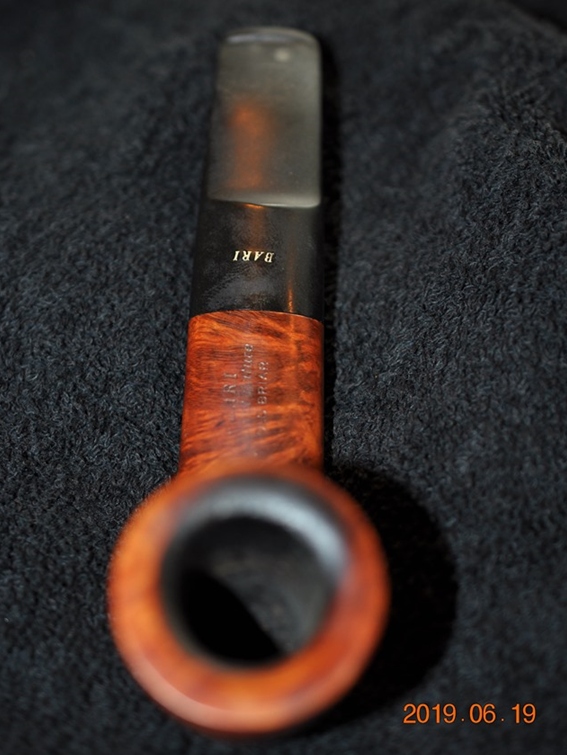
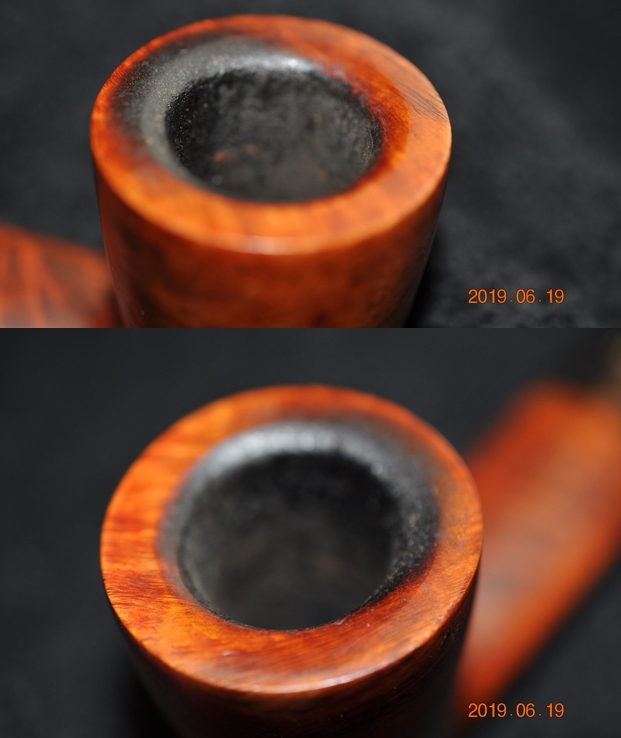
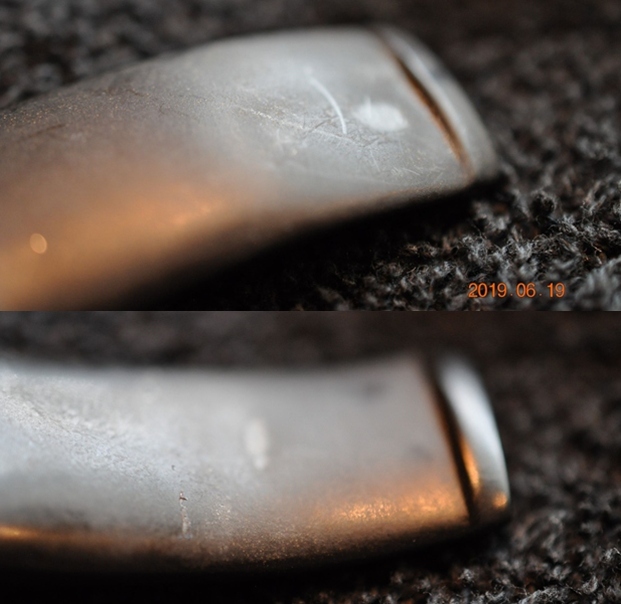
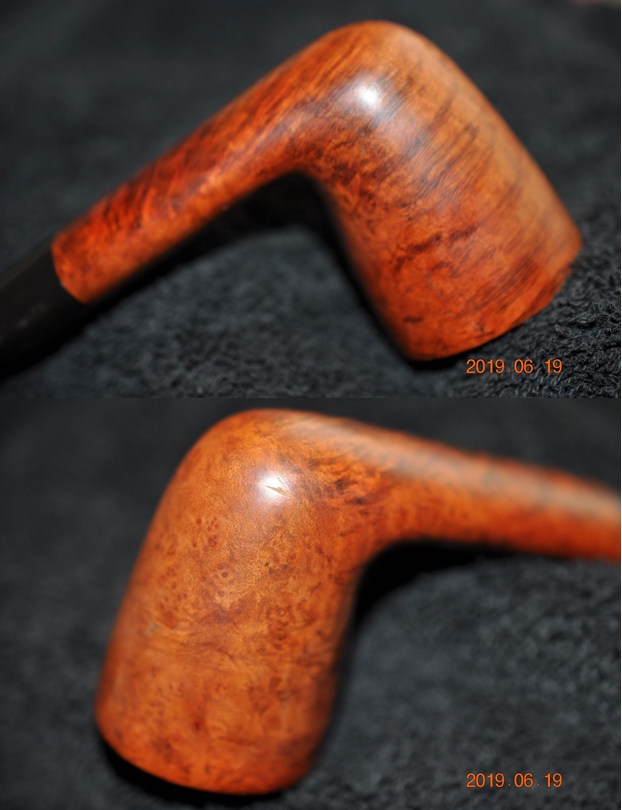
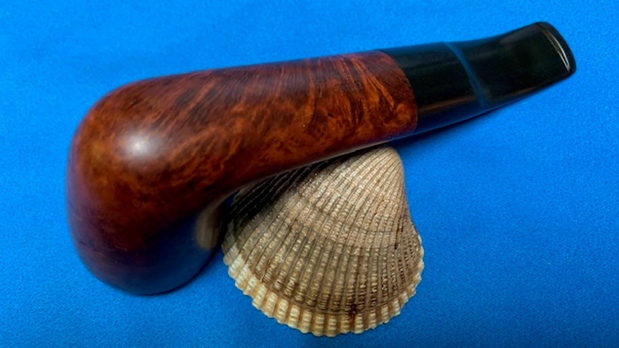
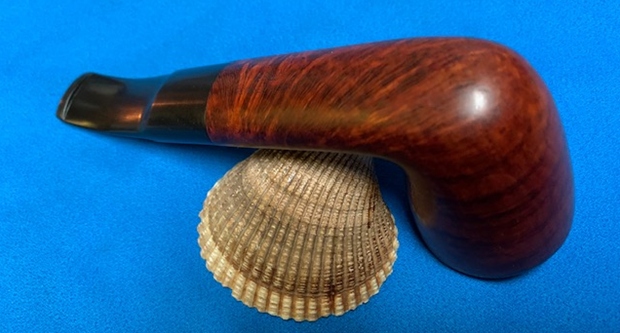
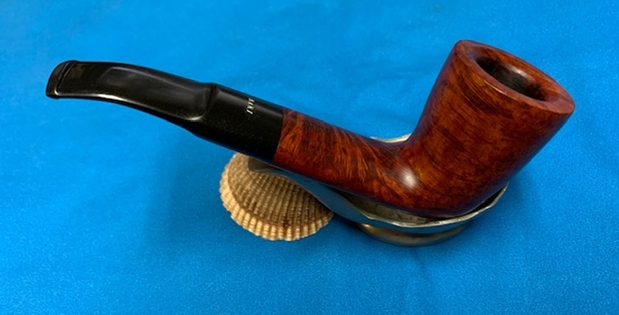
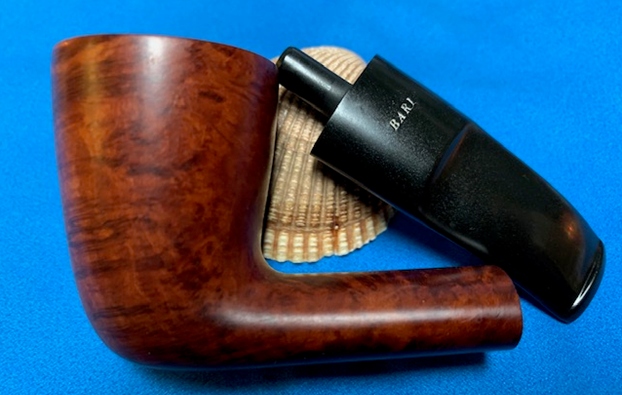
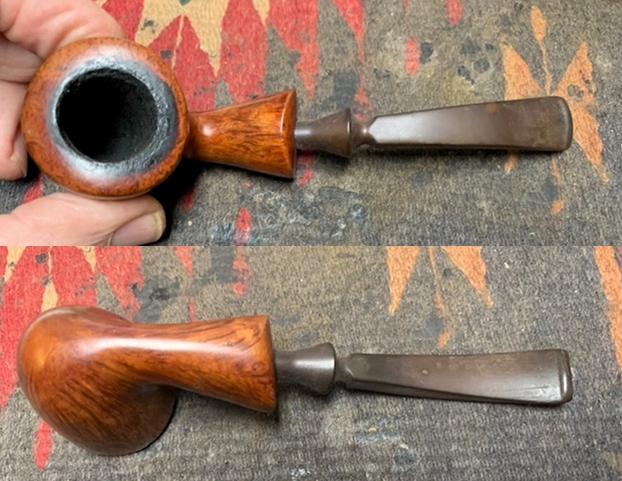
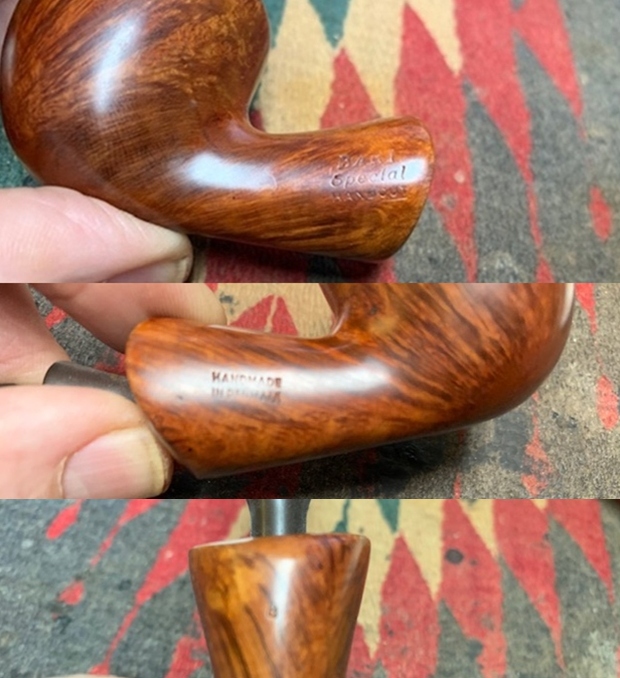
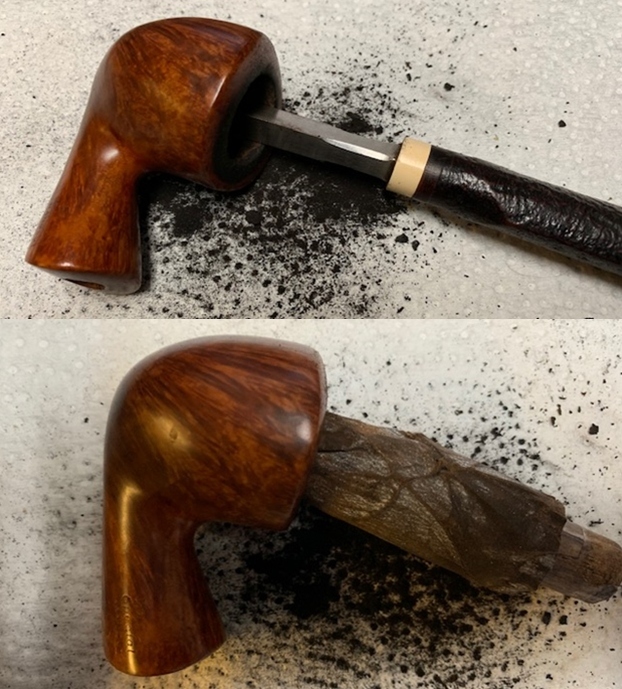
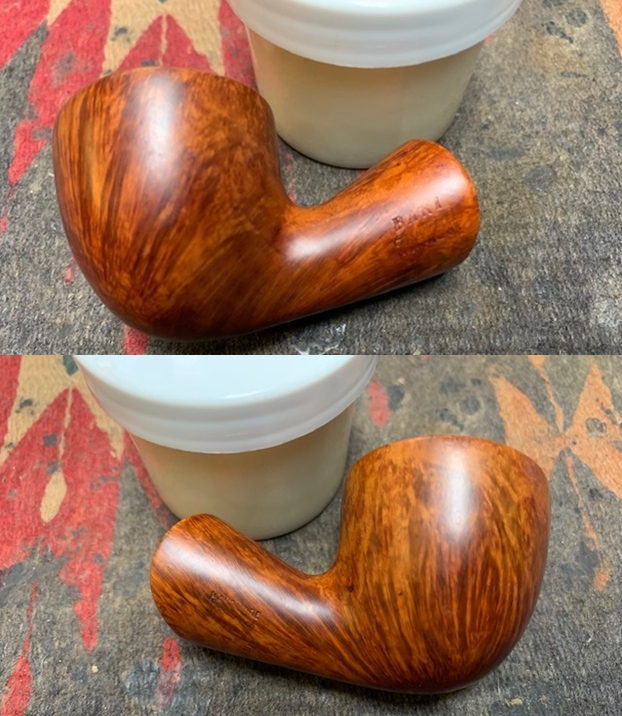
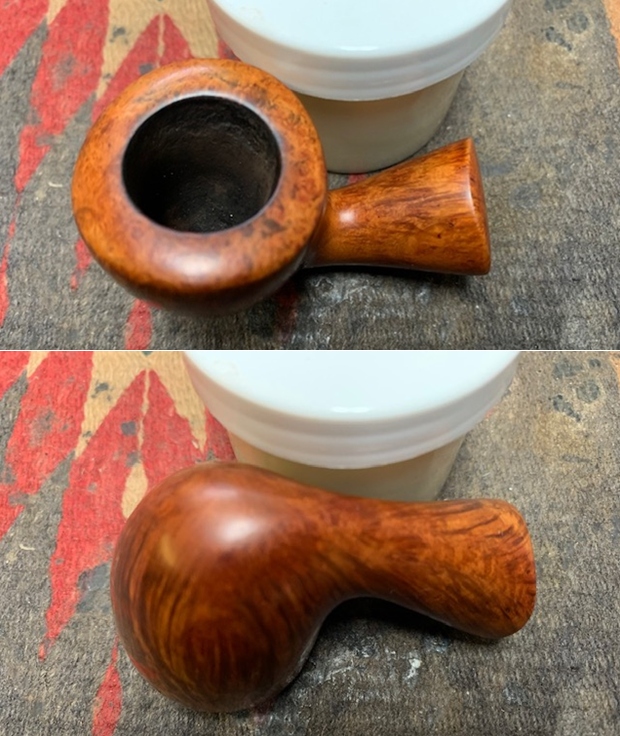
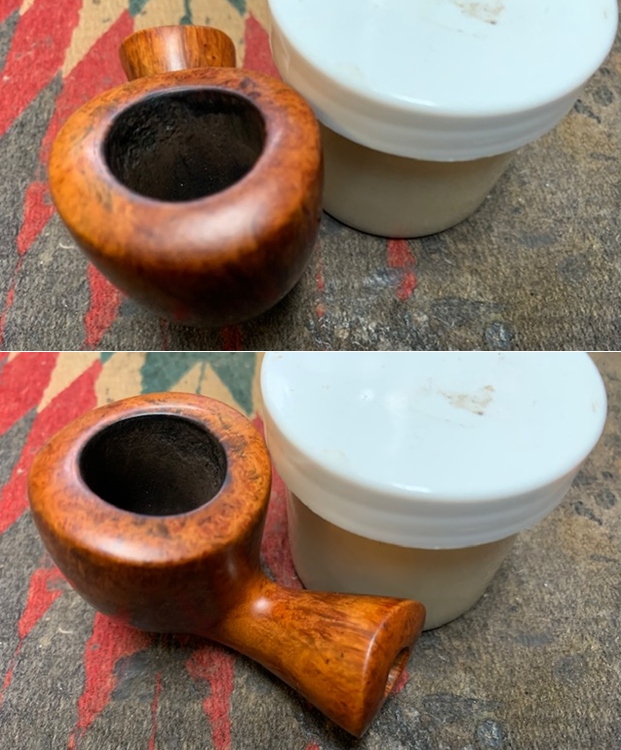
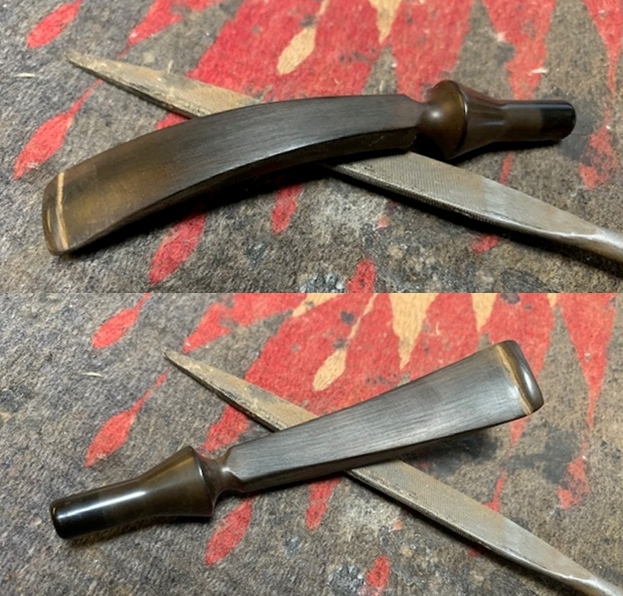
For the next pipe, I chose a unique looking pipe that we picked up off EBay back in December of 2016 from a seller in Marlboro, New Jersey, USA. It has been here for a while and I am just now getting to it. This one is a Bari Special Handcut Bent Brandy. It has a really mix of flame and straight grain around the bowl and shank. It was stamped on the sides of the shank. On the left side it reads Bari [over] Special [over] Handcut. On the right side it reads Made in Denmark [over] 01 which is probably the shape number. The pipe was dirty with grime ground into the finish. The bowl had a thin coat of varnish on the bowl and shank that was spotty and worn.  There was a thick cake in the bowl and lava overflow and darkening on the thin rim top. The inner edge of the rim was covered so thickly in lava it was hard to know what was underneath. The vulcanite stem was lightly oxidized and had tooth marks and chatter ahead of the button on both sides. HANDCUT was faintly stamped on the left side of the taper stem and coloured white. Jeff took photos of the pipe before he started his clean up. He took photos of the bowl, rim top and stem to show the condition of the pipe. The bowl is moderately caked and you can see the lava and darkening on the rim top around the bowl. The stem looks good other than the tooth mark on the underside of the button. Before I started working on it I did a bit of research on the brand to remind myself of the maker. I have worked on quite a few Bari’s in the past so rather than rework all of that I am including the information I found while working on a Bari Special Handcut Made in Denmark Dublin Freehand (https://rebornpipes.com/2020/07/22/cleaning-up-a-danish-made-bari-special-handcut-b-dublin-freehand/). I quote below from that blog.

I quoted a section from Pipedia on Bari pipes (https://pipedia.org/wiki/Bari). It is good to be reminded of the fact that Viggo Nielsen was the pipe maker.

Pipedia states that Bari Piber was founded by Viggo Nielsen in Kolding, Denmark around the turn of 1950/51. His sons Kai and Jørgen both grew into their father’s business from a very young age and worked there till 1975. Both have become successful pipe makers.

Bari successfully adapted the new Danish design that had been started mainly by Stanwell for its own models. Bari was sold in 1978 to Van Eicken Tobaccos in Hamburg, Germany though the pipes were still made in Denmark. From 1978 to 1993 Åge Bogelund and Helmer Thomsen headed Bari’s pipe production.

Helmer Thomson bought the company in 1993 re-naming it to “Bari Piber Helmer Thomsen”. The workshop moved to more convenient buildings in Vejen. Bogelund, who created very respectable freehands of his own during the time at Bari got lost somehow after 1993. Bari’s basic conception fundamentally stayed the same for decades: series pipes pre-worked by machines and carefully finished by hand – thus no spectacular highgrades but solid, reliable every day’s companions were what they turned out. The most famous series are the smooth “Classic Diamond” and the blasted “Wiking”.

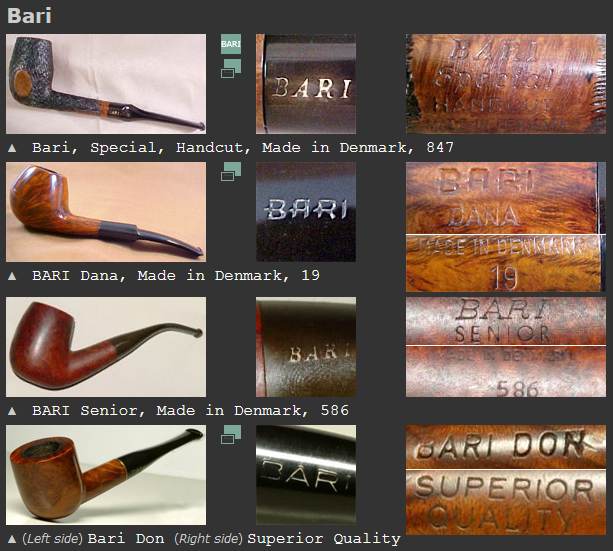
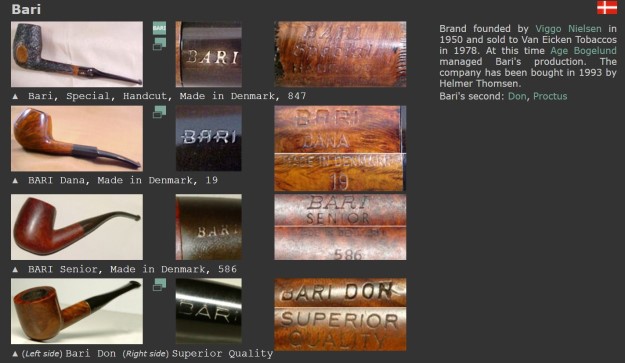
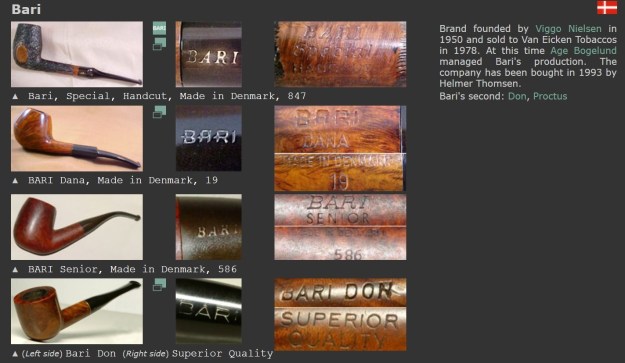
I did a quick look at Pipephil’s site (http://www.pipephil.eu/logos/en/logo-b1.html) and did a screen capture of the section on Bari pipes.Now that I was reminded about the Viggo Nielsen connection it was time to work on the pipe on my end.

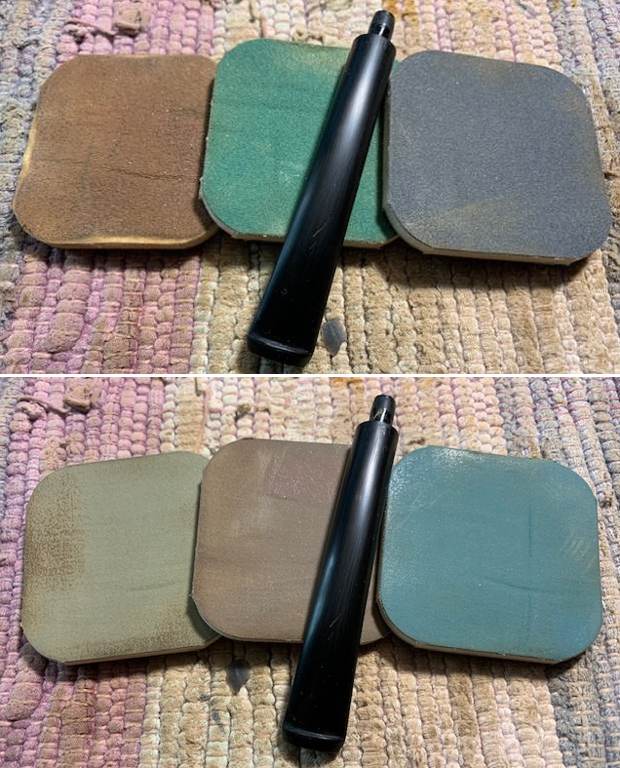
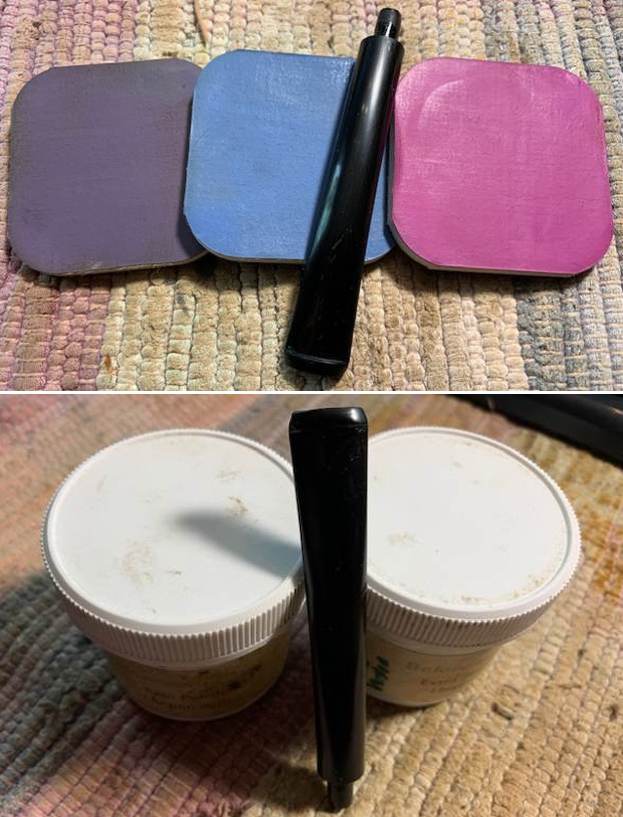
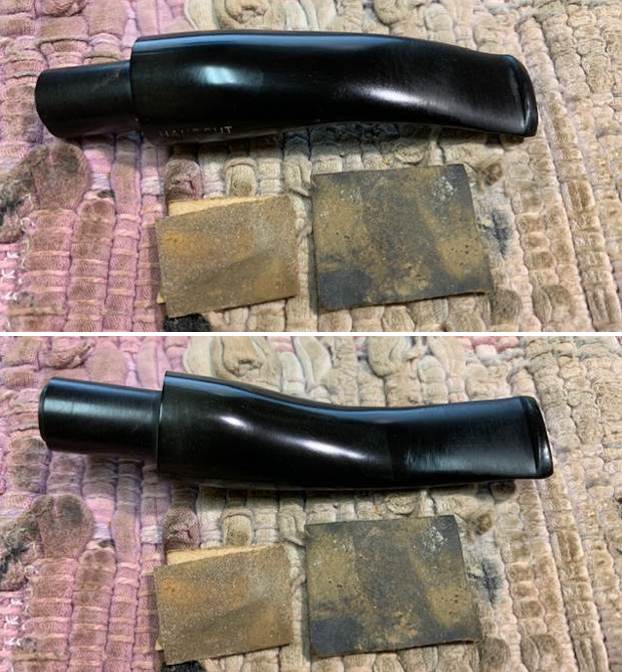
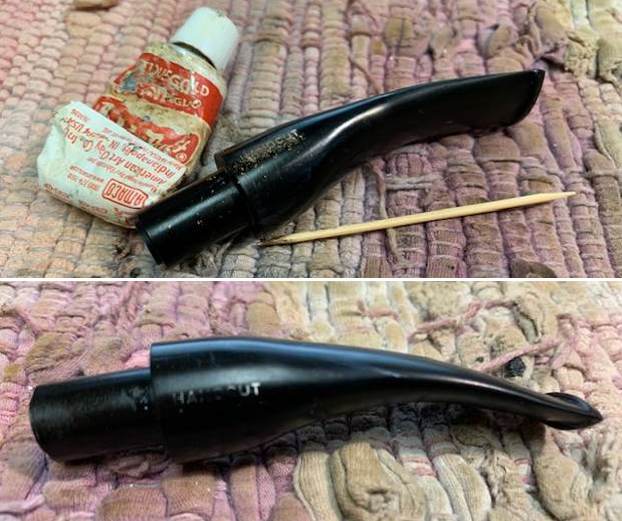
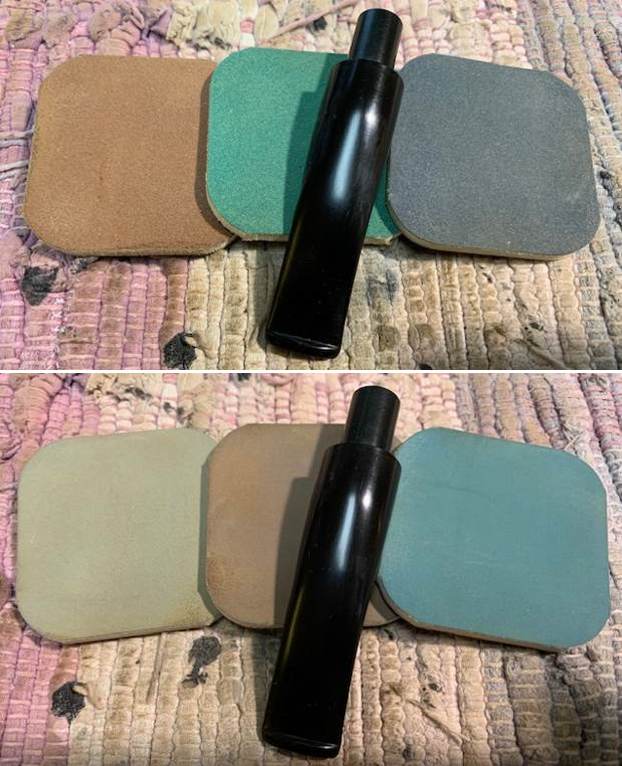
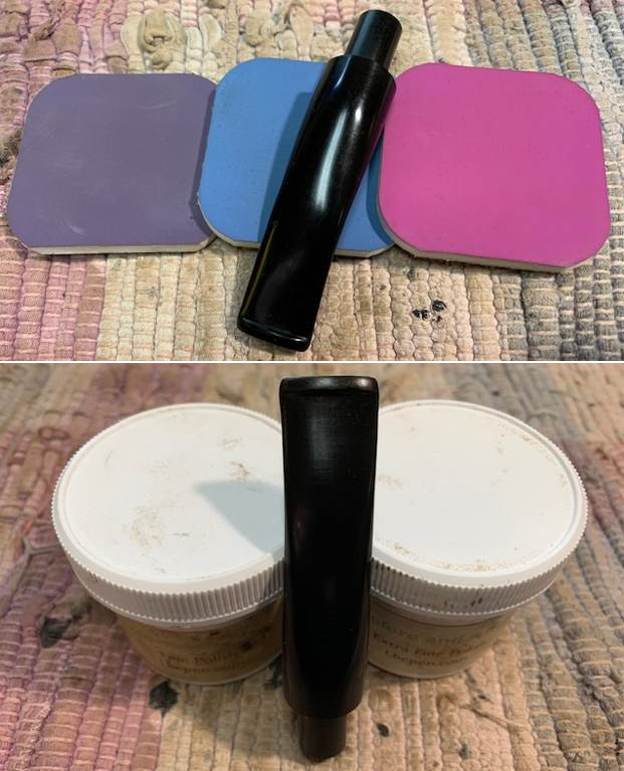
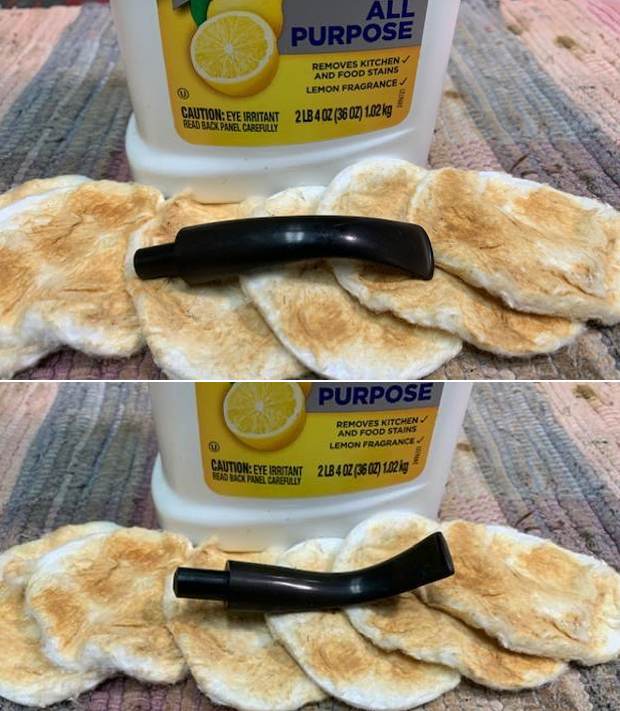
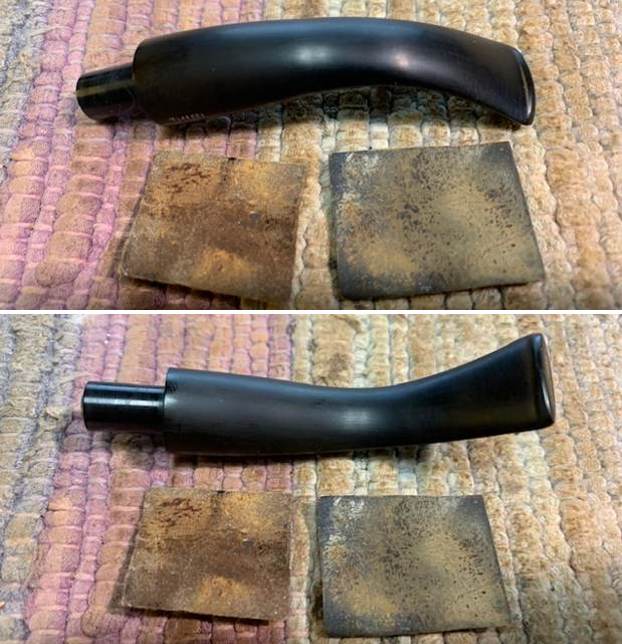
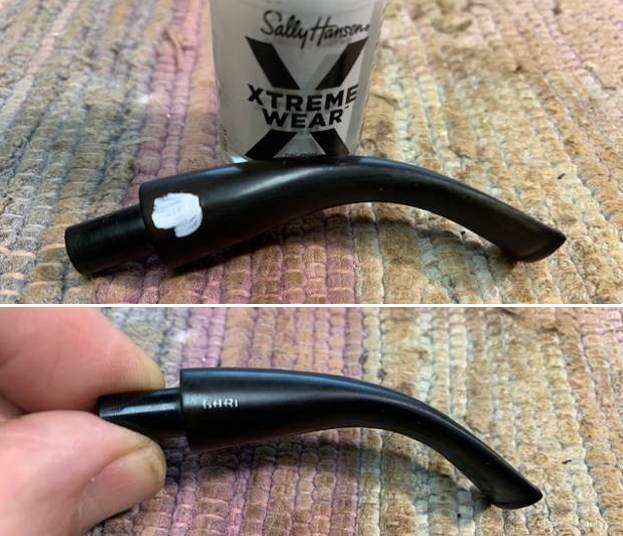
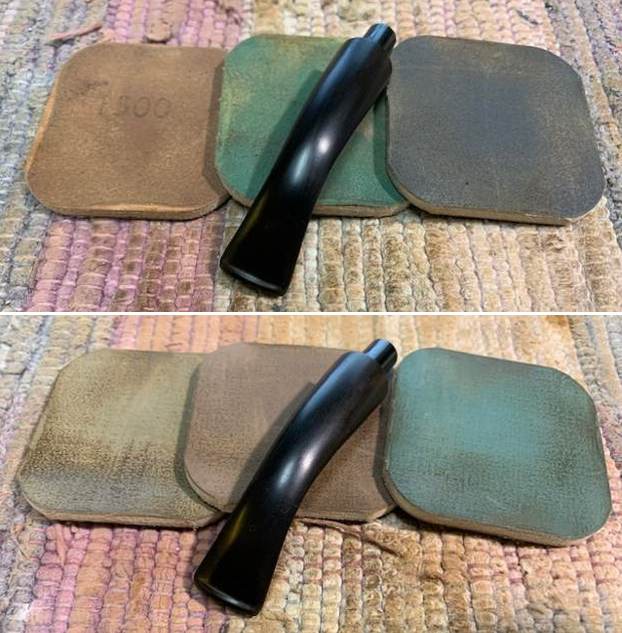
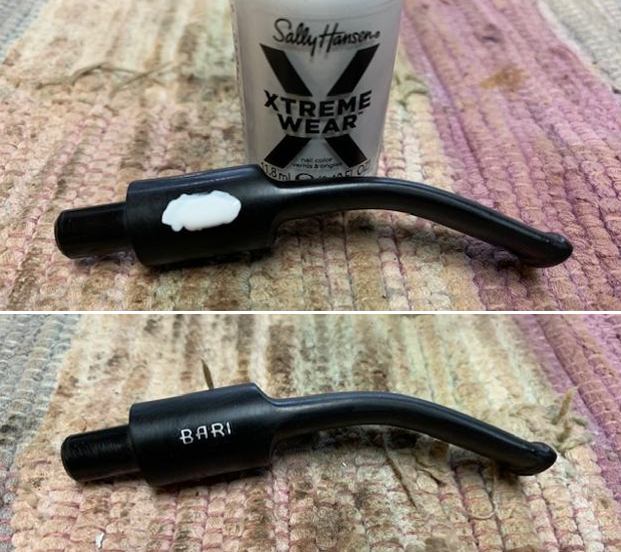
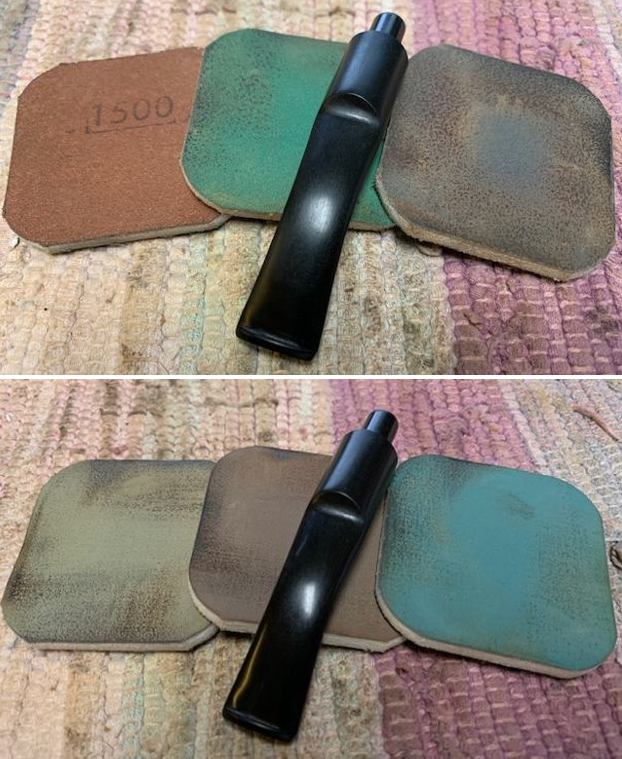
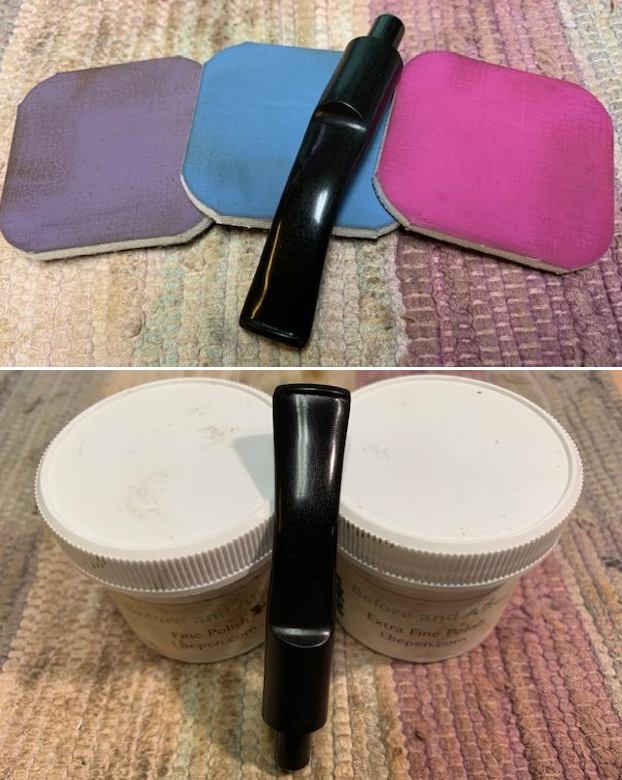
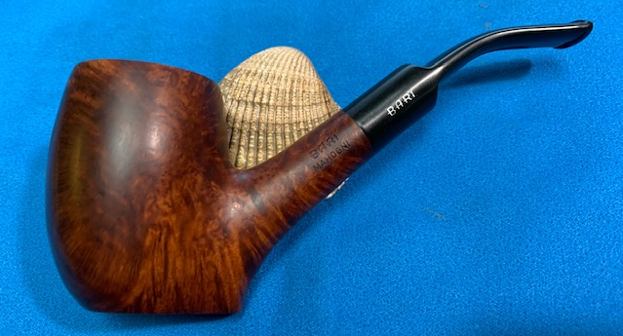
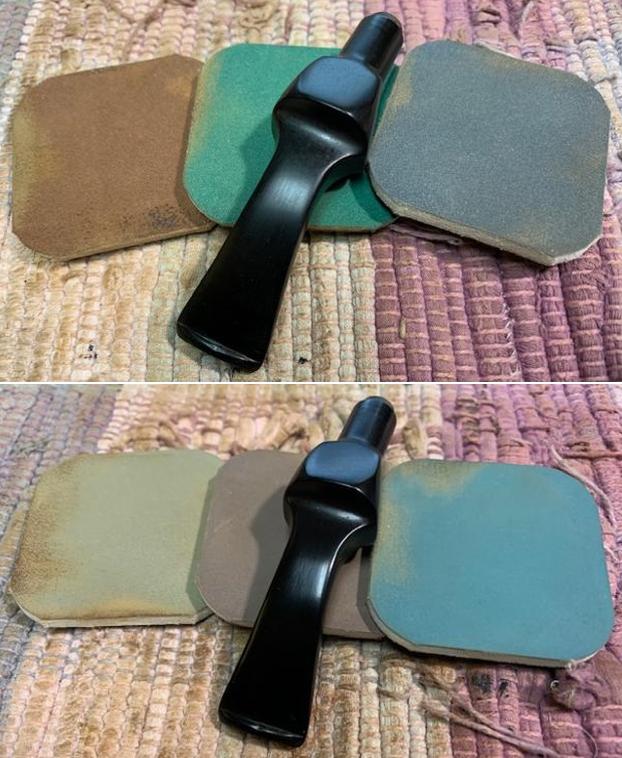
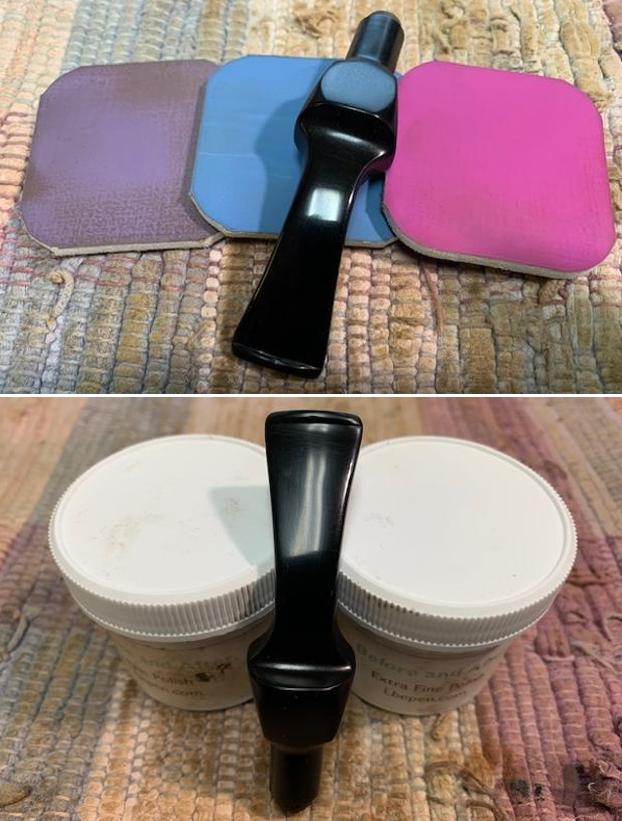
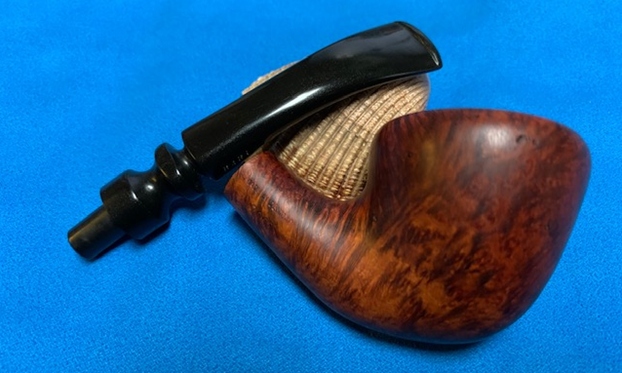
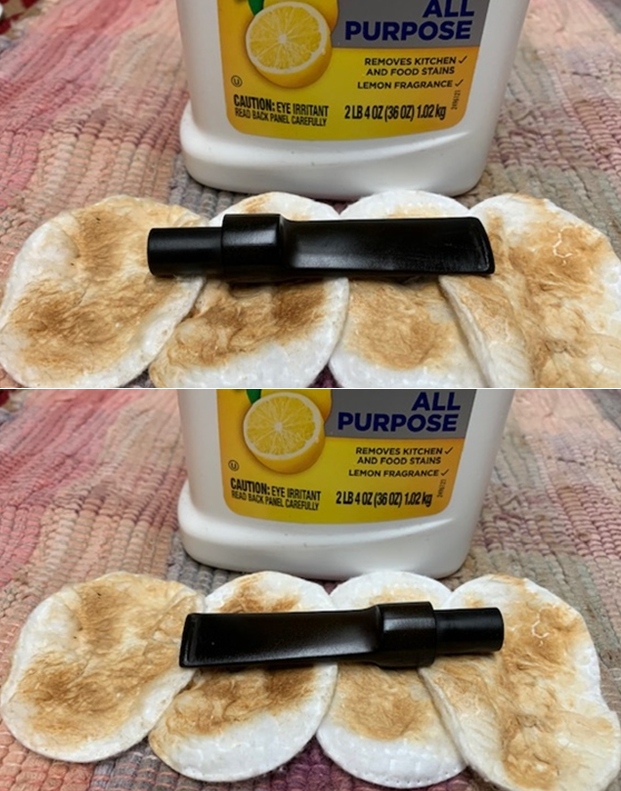
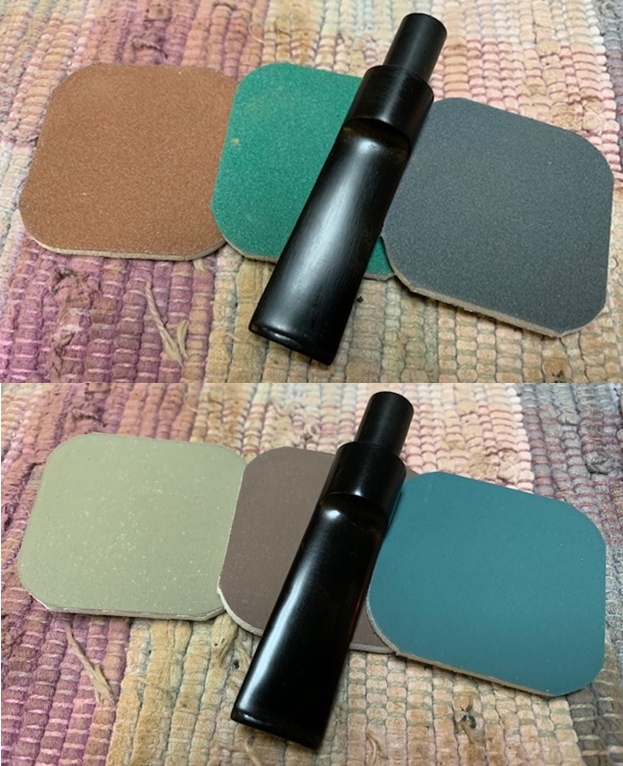
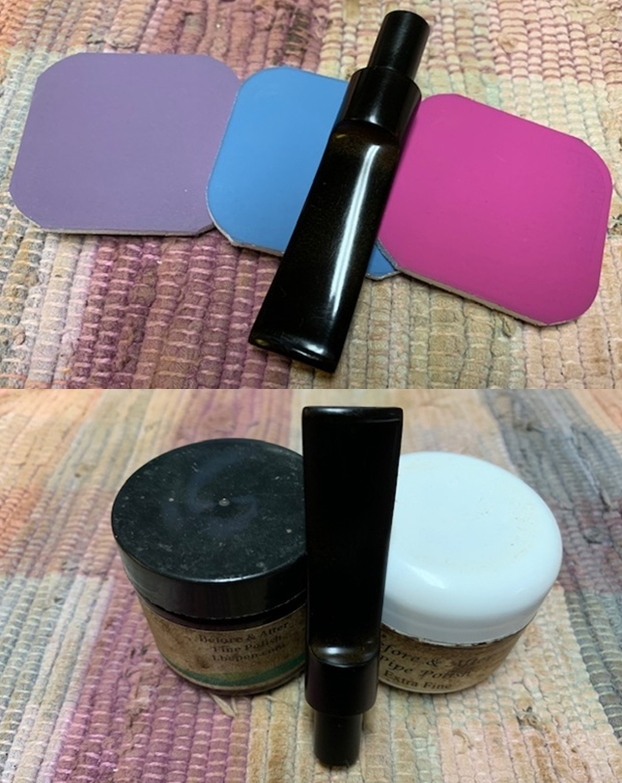
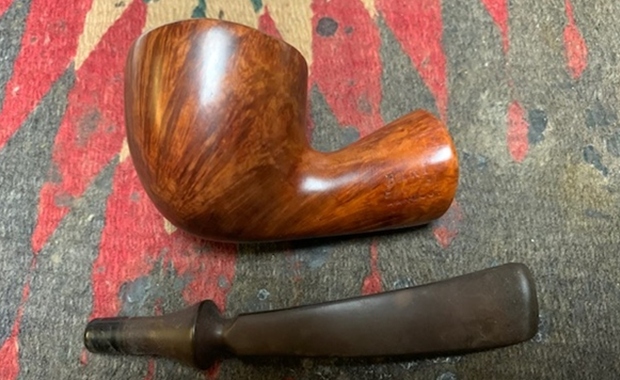
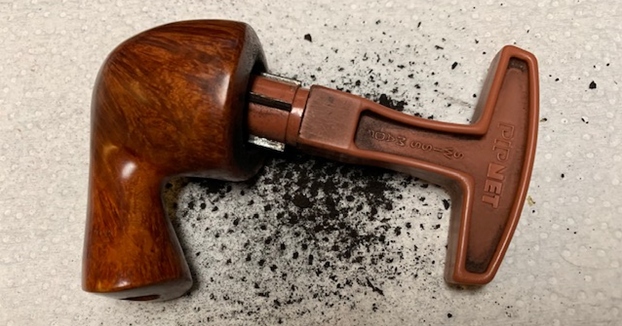
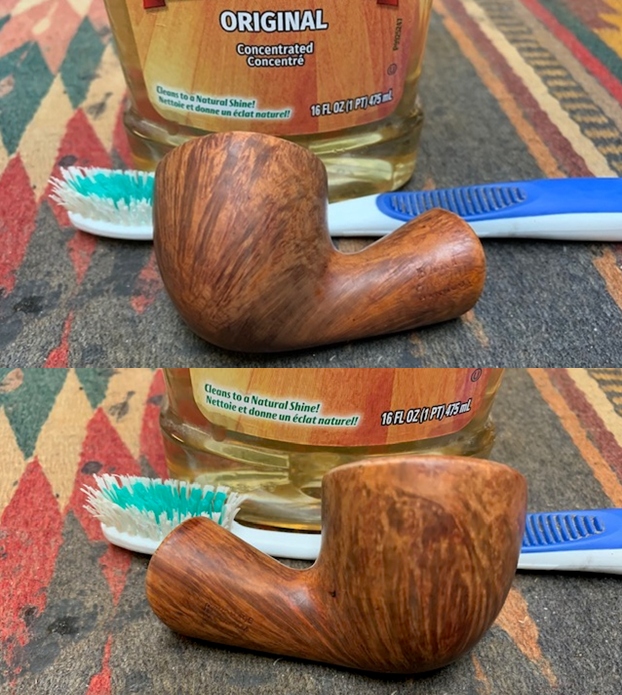
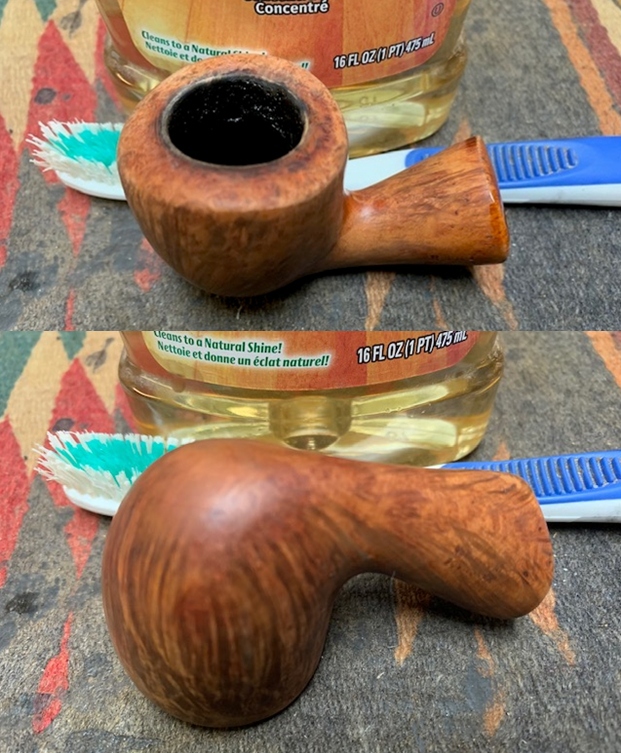
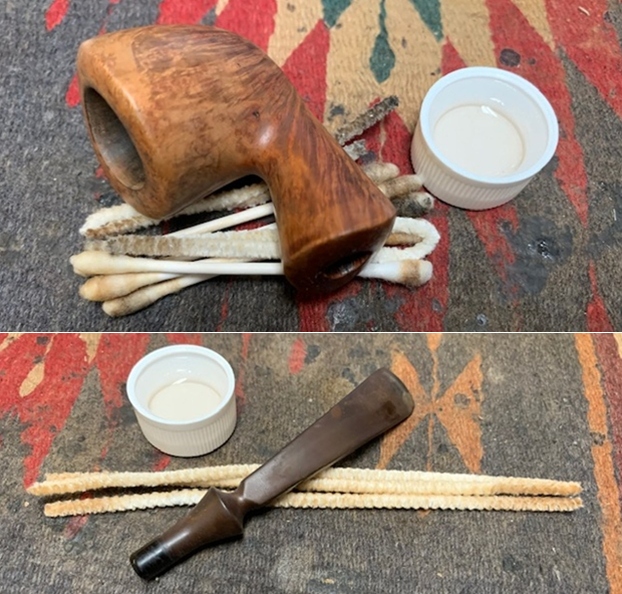
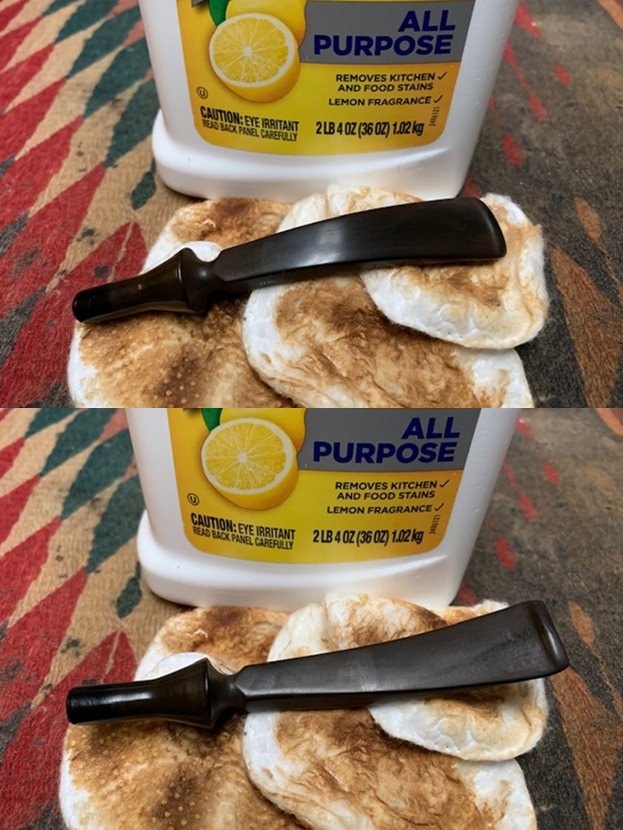
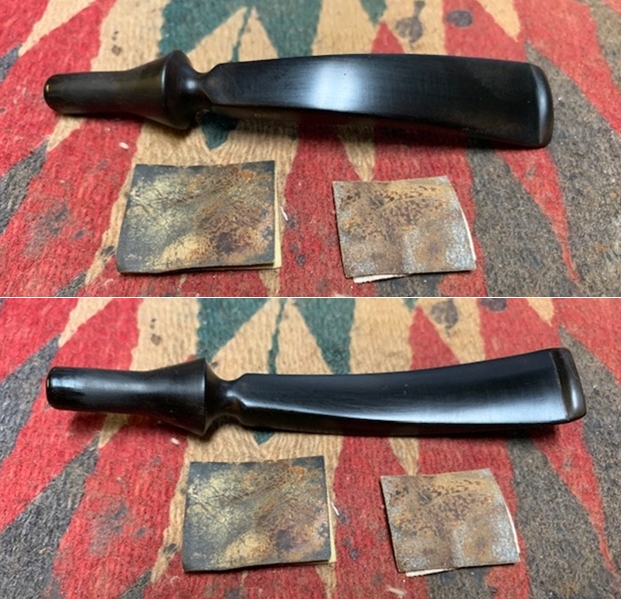
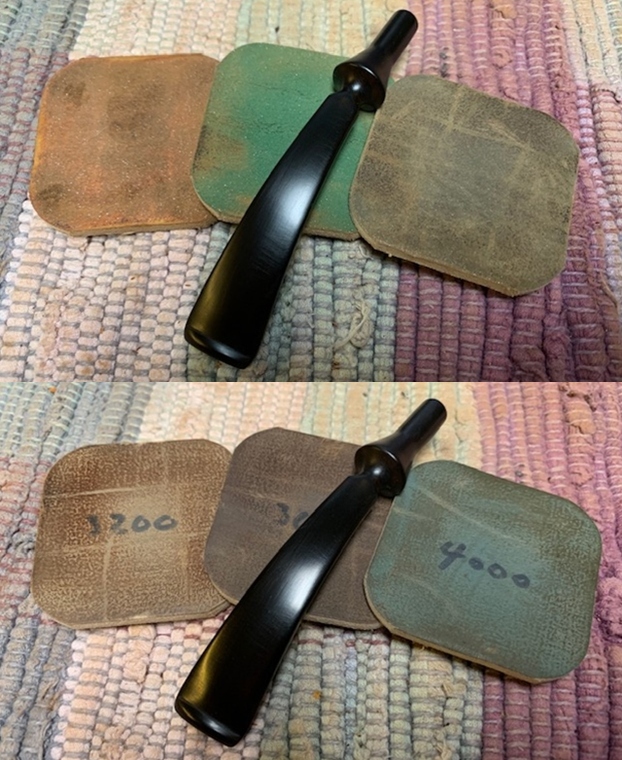
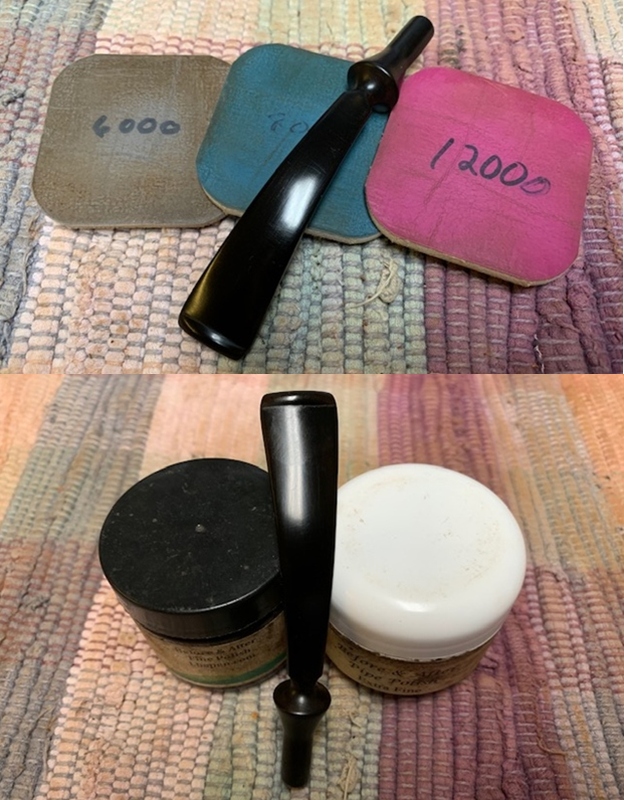
Jeff had done a great clean up of the pipe. He had reamed it with a PipNet reamer and took the cake back to bare briar. He cleaned up the remnants with a Savinelli Fitsall Pipe Knife. He scrubbed internals of the shank and stem with alcohol, cotton swabs and pipe cleaners. He cleaned the exterior of the pipe with undiluted Murphy’s Oil Soap and a tooth brush to remove the grime and the lava on the rim top. He scrubbed the stem with Soft Scrub to remove the debris that had accumulated on it. The pipe looked clean and ready for the next step in the process. Here are some photos of it when I finally got around to working on it 5 years later. I took some close up photos of the bowl, rim top and the stem surface. It looked amazingly good. There was still some darkening on the rim edges. The varnish coat on the bowl and shank would also need to be removed. The stem looks good with a little oxidation at the shank end. There were also some tooth marks and chatter on both sides near the button.I took photos of the stamping on the sides of the shank. It was readable though faint on both sides of the shank and stem side.I removed the stem from the shank to show the components of the pipe. It is a great shape and is a beauty.I wiped the bowl down with alcohol on a cotton pad to remove the spotty varnish coat. It really looked better without the varnish. I polished the briar with micromesh sanding pads – dry sanding with 1500-12000 grit pads. I wiped the bowl down with a damp cloth after each sanding pad. It really began to take on a shine. I rubbed the bowl down with some Before & After Restoration Balm. I worked it into the briar with my fingertips. The product works to clean, renew and protect briar. I let it do its work for 15 minutes then buffed it off with a soft cloth. The pipe is really quite a beauty. I set the bowl aside and turned my attention to the stem. I scrubbed off the surface of the stem with Soft Scrub All Purpose Cleanser to remove the residual oxidation on the shank end of the pipe. It looked much better.I used 220 grit sandpaper to sand out the tooth marks and chatter on both sides near the button. I started the polishing with 400 grit wet dry sandpaper to further blend in the sanded areas.I touched up the faint stamping on the left side of the taper stem. It read HANDCUT the H and the UT were deep enough to take the touch up. The rest of the stamping was not as deep and did not hold the Rub’n Buff Antique Gold. I polished the excess off  and took photos of the stem at this point.I polished the stem on both sides using micromesh sanding pads. I dry sanded the stem with the 1500-12000 grit pads, then wiped it down with a cloth impregnated with Obsidian Oil. I finished polishing it with Before & After stem polish – both Fine and Extra Fine. I gave it a final coat of Obsidian Oil and set it aside to dry. This is another pipe I am excited to finish. It is a Bari Special Handcut Danish 01 Bent Brandy. I put the pipe back together and buffed it lightly with Blue Diamond on the buffing wheel. I gave the bowl and the stem multiple coats of carnauba wax. I buffed the pipe with a clean buffing pad to raise the shine and hand buffed it with microfiber cloth to deepen the shine. It is fun to see what the polished bowl looks like with the polished stem with the golden acrylic spacer. It really was a beautiful pipe. The sandblasted grain shining through the rich browns/black stain on this Bari Special Handcut is nice looking and the pipe feels great in my hand. It is light and well balanced. Have a look at it with the photos below. The dimensions are Length: 5 ½ inches, Height: 2 ¼ inches, Outside diameter of the bowl: 1 ¼ inches, Chamber diameter: ¾ of an inch. The weight of the pipe is 2.12 ounces/60 grams. It is a beautiful pipe and one that will be on the rebornpipes store in the Danish Pipe Makers Section soon. If you are interested in adding it to your collection let me know. Thanks for walking through the cleanup with me as I worked over this pipe. Thanks to each of you who are reading this blog. Remember we are not pipe owners; we are pipemen and women who hold our pipes in trust until they pass on into the trust of those who follow us.

Restoring a Beautifully Grained Bari Squash 7315M Bent Apple


Blog by Steve Laug

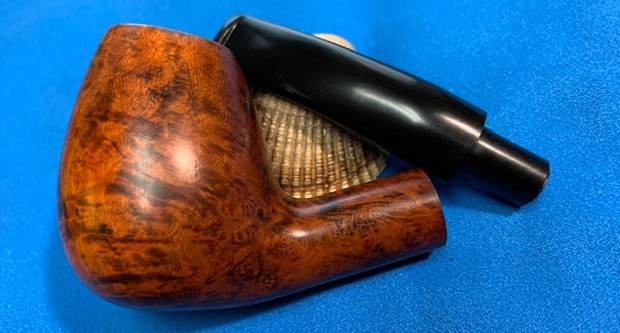
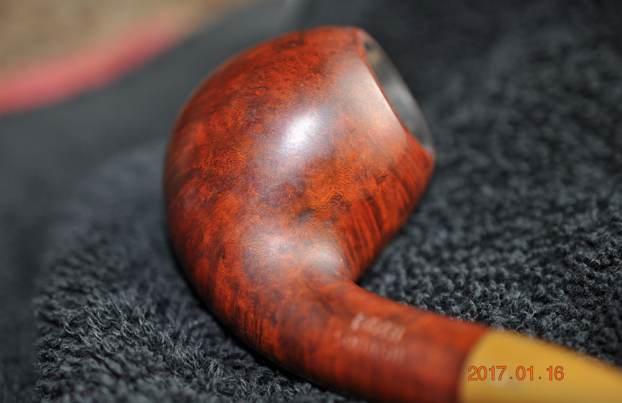
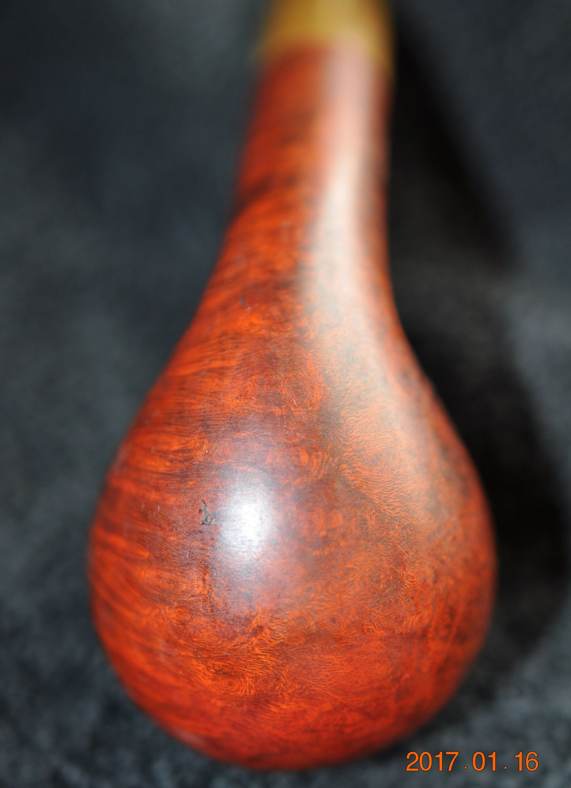
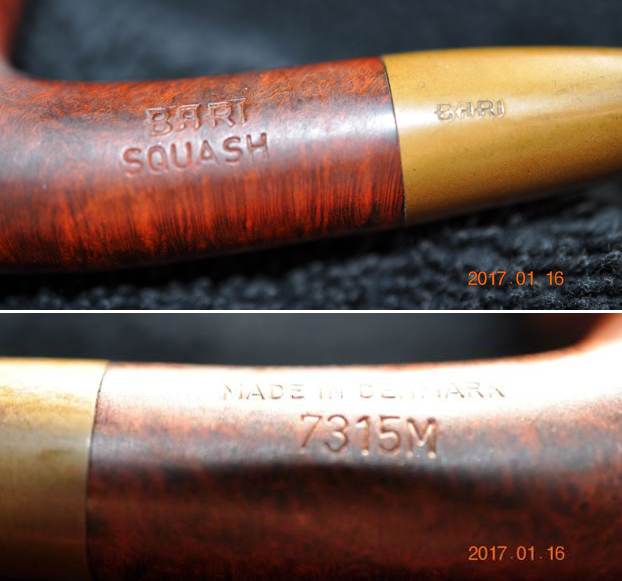
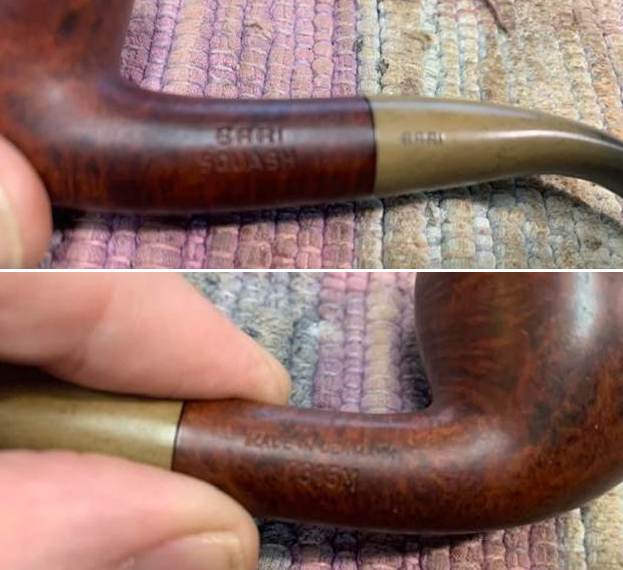
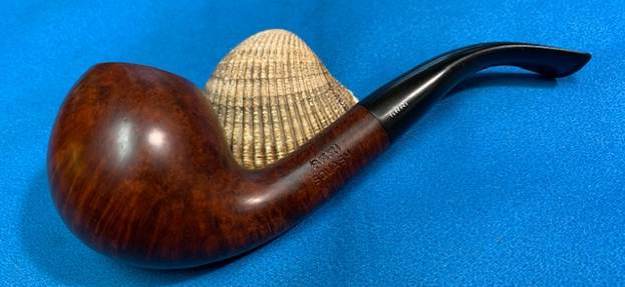
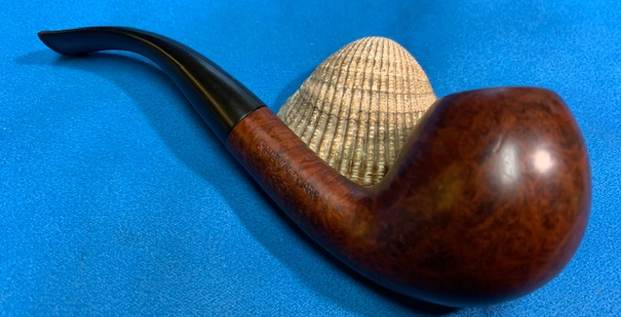
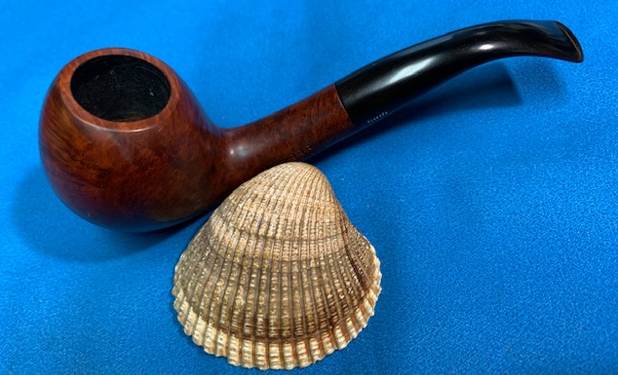
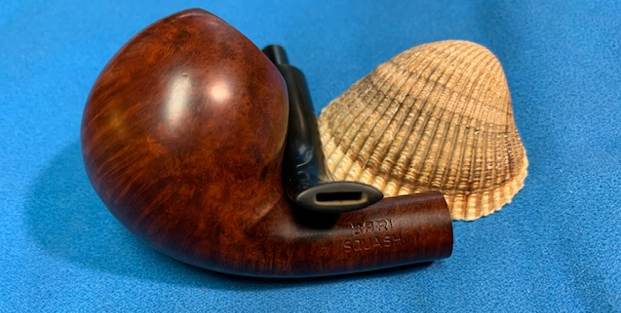
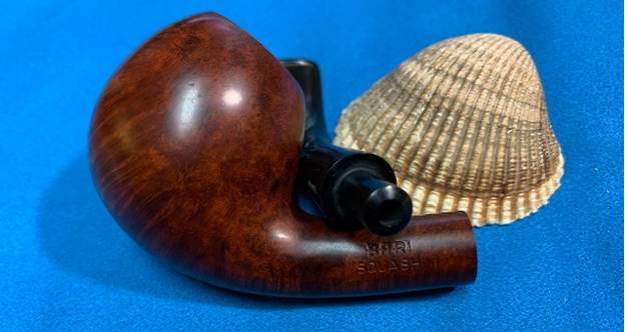
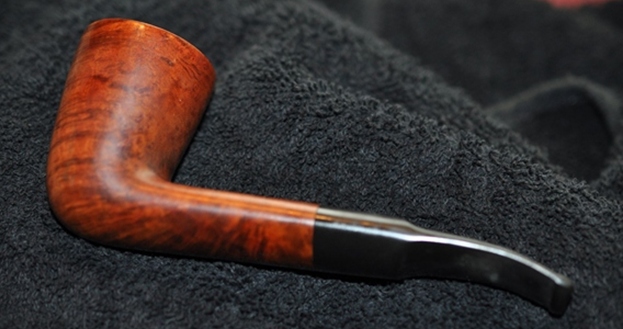
The next pipe on the work table was purchased off EBay on January 8, 2017 from Sheridan, Arkansas, USA. It has been sitting here for 5 years. Jeff took photos the week after we purchased it. Now I am finally getting a chance to work on it. The pipe is a classic Danish looking Bent Apple shape with a smooth brown finish with highlights of red. The pipe was dirty and worn looking. On the left side of the shank it is stamped with Bari [over] Squash. On the right side it was stamped Made In Denmark [over] the shape number 7315. The mix of stains makes the grain stand out even with the grime ground into the finish. There was a thick cake in the bowl and a light overflow of lava on the rim top. The edges look to be in good condition as far as we can tell until we clean up the pipe. The stem was heavily oxidized, calcified and there was light tooth chatter and marks on both sides near the button. The white Bari stamp on the left side of the stem was faded. Jeff took photos of the pipe before he started working on it. I include those below. Jeff took photos of the bowl and rim top to show the cake in the bowl and the condition of both. It was heavily caked with a light lava overflow on the rim top. The inner and outer edges look very good. He took photos of the top and underside of the stem showing the oxidation and tooth marks on the stem surface and button.  In person the tooth marks are far deeper than they look in the photos.      He took some photos of the bowl side and heel to show the grain around the bowl and shank. It is a real beauty. Jeff took two photos to capture the stamping on the sides of the shank. It is clear and readable as noted above.   I turned to Pipephil’s site (http://www.pipephil.eu/logos/en/logo-b1.html) to see if I could find a listing for the Bari Squash with this four digit number. There was nothing specifically listed for this line of Bari pipes. There was also good info on the brand as a whole and that it was founded by Viggo Nielsen in 1950 and he ran it until 1978 when Age Bogelund managed the production for them. In 1993 it was sold to Helmer Thomsen. Pipedia gives a great history of the brand (https://pipedia.org/wiki/Bari) that is well worth reading. There were also examples of the Bari pipes showing their stamping.

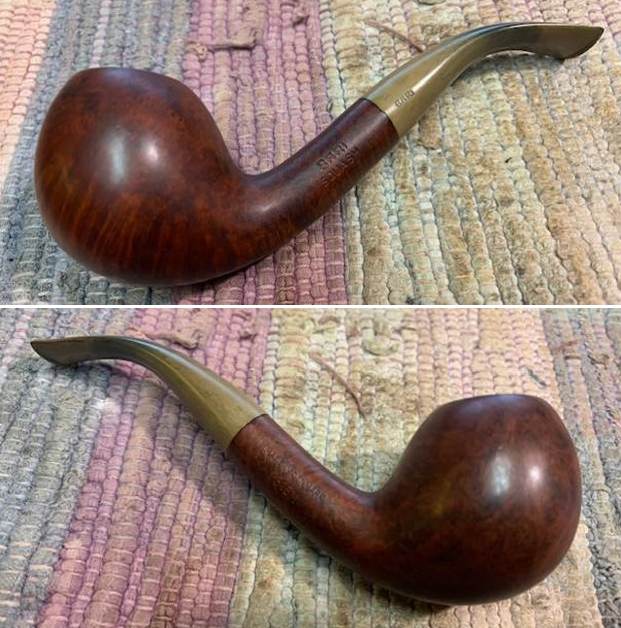
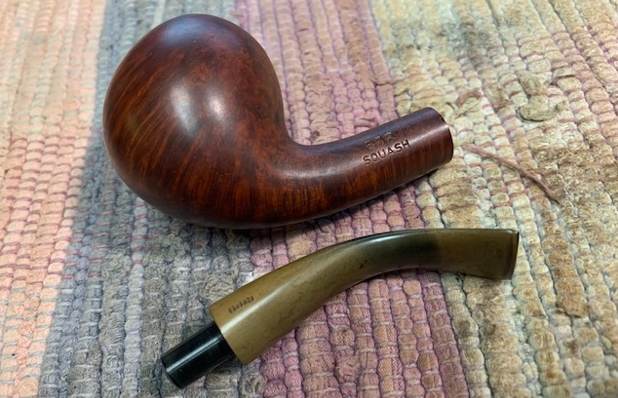
This pipe was a bit of a mess like many of the pipes we work on. I was curious to see what it would look like when I unpacked it. I was surprised at how good the bowl looked. Jeff reamed it with a PipNet pipe reamer and cleaned up the reaming with a Savinelli Fitsall Pipe Knife. He scrubbed out the internals of the shank and stem with alcohol, pipe cleaners and cotton swabs until the pipe was clean. He scrubbed the exterior of the bowl with Murphy’s Oil Soap and a tooth brush to remove the grime and grit on the briar and the lava on the rim top. The finish on the bowl looked really good when I got it. The rim top looked very good. The edges looked good as well. This pipe was purchased before we used Before & After Pipe Stem Deoxidizer so while it was clean it was also still very oxidized. The surface of the stem was clean and the tooth marks were light and less visible. When the pipe arrived here in Vancouver for the second stop of its restoration tour it looked much better than when he found it. I took photos of the pipe before I started my work on it.  I took photos of the condition of the rim top and stem before I started working. The rim top looks very good and the bowl is spotless. The stem is heavily oxidized and the light tooth chatter is very visible in the photos. I took photos of the stamping on the sides of the shank. The BARI SQUASH stamp and the Made in Denmark and shape 7315M are very clear. I took the bowl and stem apart and took a photo of the pipe to show the look of the pipe. The polished the briar with micromesh sanding pads – dry sanding with 1500-12000 grit pads. I wiped the briar down with a damp cloth after each sanding pad. I worked some Before & After Restoration Balm into the finish of the bowl, rim top and shank with my fingertips to clean, enliven and protect it. I find that the balm really makes the briar come alive again. The contrasts in the layers of stain and the separate finishes really made the grain stand out. I let the balm sit for 10 minutes and then buffed with a cotton cloth to raise the shine. The bowl really looks good at this point. I scrubbed the oxidation on the stem with Soft Scrub cleanser an was able to remove most of it.  I sanded the remaining oxidation on the stem near the button with 220 sandpaper. I started polishing with 400 grit wet dry sandpaper.   I touched up the Bari stamp on the left side of the stem with white acrylic fingernail polish. I let it dry and sanded it with 1500 micromesh sanding pads to remove the excess. It looks better though some of the stamping is faint on the edges.   I polished the stem with micromesh sanding pads – wet sanding it with 1500-12000 grit pads. I wiped the stem down after each pad with a cloth impregnated with Obsidian Oil. I polished it further with Before & After Pipe Stem Polish – both fine and extra fine. I gave it a final coat of Obsidian Oil and set it aside to dry.    Once again I am the part of the restoration that I always look forward to – the moment when all the pieces are put back together. I put the pipe back together and lightly buffed the bowl and the stem with Blue Diamond. I gave the bowl and the stem multiple coats of carnauba wax. I buffed the pipe with a clean buffing pad to raise the shine. I hand buffed it with a microfiber cloth to deepen the shine. It is fun to see what the polished bowl looks like with the smooth finish and the black vulcanite stem. This richly stained Bari Squash Sandblast 7315 Bent Apple is light weight and ready for you to load up a tobacco of preference and enjoy breaking it in for yourself. Have a look at it in the photos below. The dimensions are Length: 5 inches, Height: 1 ½ inches, Outside diameter of the bowl: 1 inch, Chamber diameter: ¾ of an inch. The weight of the pipe is 36grams/1.31oz. This is one that will go on the Danish Pipemakers section of the rebornpipes online store shortly. Thanks to each of you who are reading this blog. Remember we are not pipe owners; we are pipemen and women who hold our pipes in trust until they pass on into the trust of the next generation.

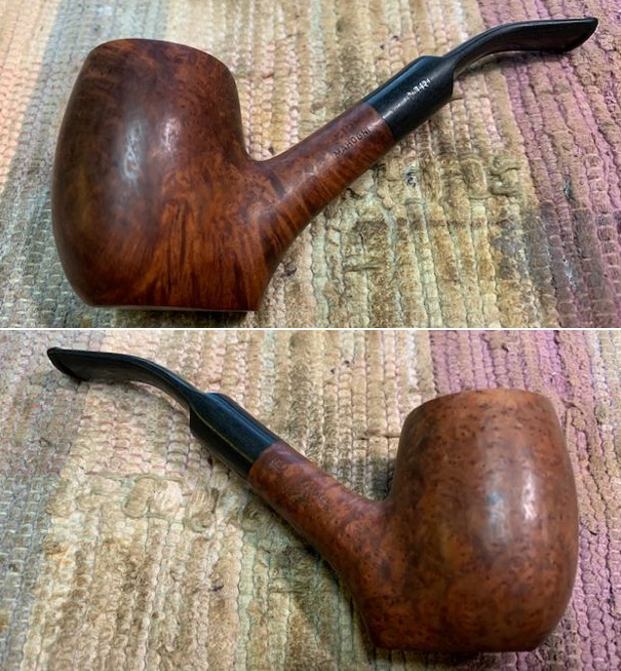
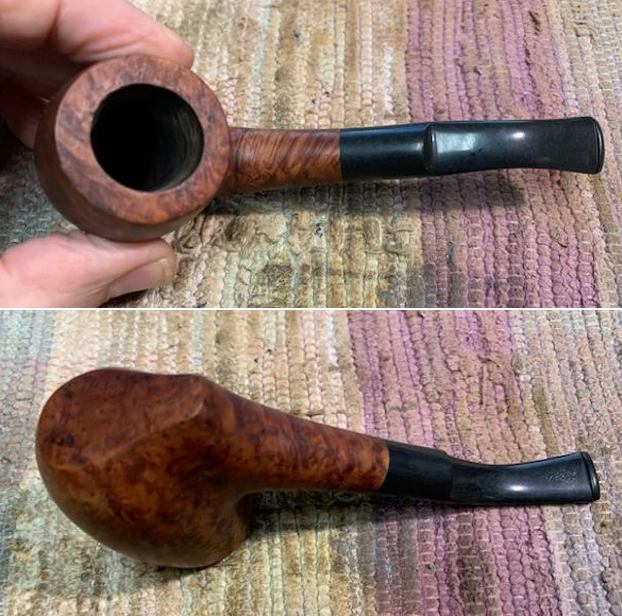
New Life for another Bari – A Mahogni Bent Sitter 8233


Blog by Steve Laug

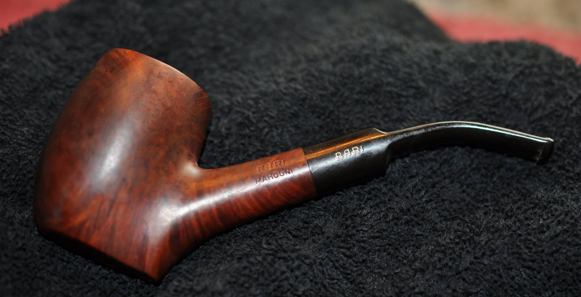
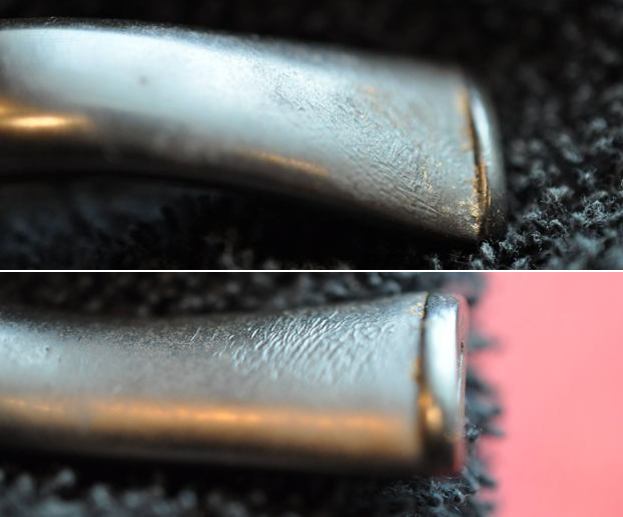
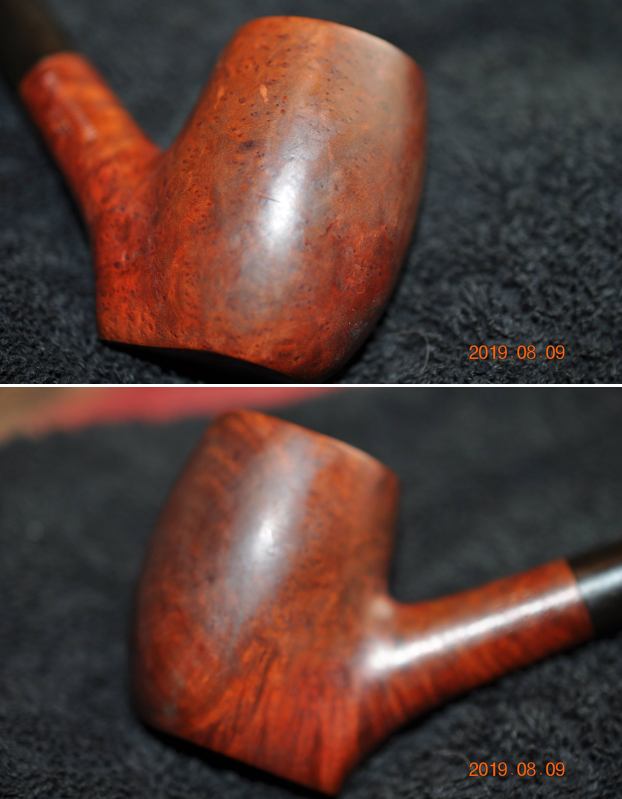
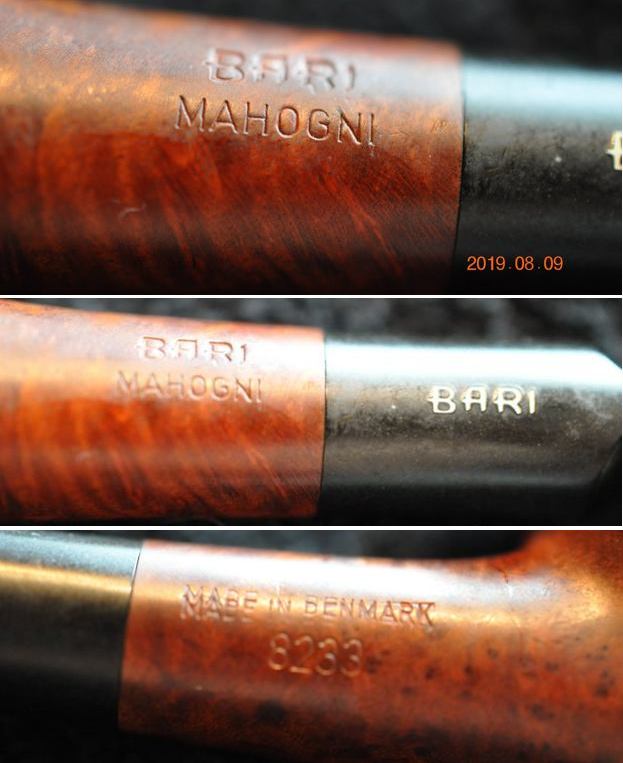
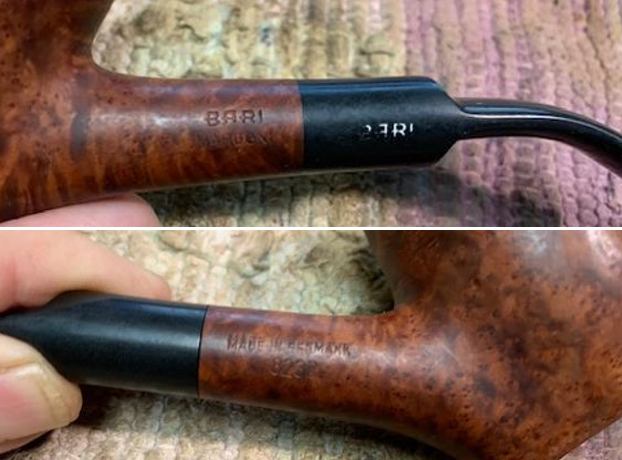
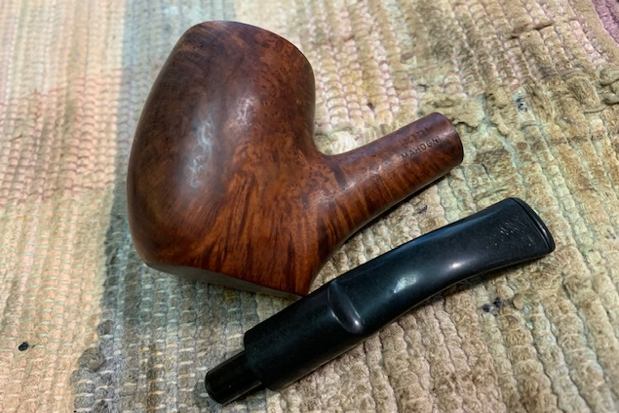
The next pipe on the work table is a bit of another mystery to both Jeff and me. We really have no memory about where we picked this pipe up or where we bought it. It is not in the spread sheet and there seemingly is no way to check where we got it. It is another Bent Sitter like the Bari Senior 489 I just completed. It has a deep and rich smooth finish with a mix of brown stains that highlight the grain. The pipe is stamped on the left side of the shank and reads BARI [over] Mahogni. On the right side it is stamped Made in Denmark [over] the shape number 8233. The left side of the saddle stem it is stamped and reads BARI. The briar is exceptionally filthy with grime ground into the surface of the bowl and shank. There is a thick cake in the bowl and an overflow of lava on the rim top. There are some nicks in the outer edges of the bowl. The stem is lightly oxidized and the there were a lot of tooth marks and chatter on both sides ahead of the button. While we had no details about the pipe Jeff did find these photos of the pipe before he did his clean up work on it.Jeff took photos of the rim top to show the cake in the bowl and the lava overflow on the rim top. You can also see the nicks in the outer edge of the bowl toward the front side. The stem had a lot of tooth chatter and marks that are clear in the photos that follow. There is some oxidation and the calcification on the stem surface. He took photos of the sides of the bowl to show condition of the briar. You can see the grain through the grime ground into the bowl.He captured the stamping on the shank sides. It reads as noted above. The stamping is clear and readable. The stamping on the right side of the shank is double stamped and a bit blurry from the stamping.Jeff had cleaned up the pipe with his usual focus on detail. He reamed the pipe with a PipNet pipe reamer and removed the rest of it with a Savinelli Fitsall Pipe Knife.  He scrubbed the exterior of the bowl with undiluted Murphy’s Oil Soap with a tooth brush. He rinsed it under running warm water to remove the soap and grime. He cleaned out the inside of the shank and the airway in the stem with alcohol, cotton swabs and pipe cleaners. He soaked the stem in Briarville’s Stem Deoxidizer and rinsed it off with warm water. I took photos of the pipe once I received it.  The rim top cleaned up really well. The rim top, inner and outer edges of the bowl were in excellent condition. The stem surface looked good with a few small tooth marks and chatter on both sides near the button. The stamping on the sides of the shank is clear and readable and reads as noted above. I removed the stem and took a photo of the pipe to give a sense of the whole. I turned to Pipephil’s site (http://www.pipephil.eu/logos/en/logo-b1.html) to see if I could find a listing for the Bari Mahogni. There was nothing specifically listed for this line of Bari pipes. There was also good info on the brand as a whole and that it was founded by Viggo Nielsen in 1950 and he ran it until 1978 when Age Bogelund managed the production for them. In 1993 it was sold to Helmer Thomsen.Pipedia gives a great history of the brand (https://pipedia.org/wiki/Bari) that is well worth reading. There were also examples of the Bari Selected Nature Old Briar pipes showing their stamping.
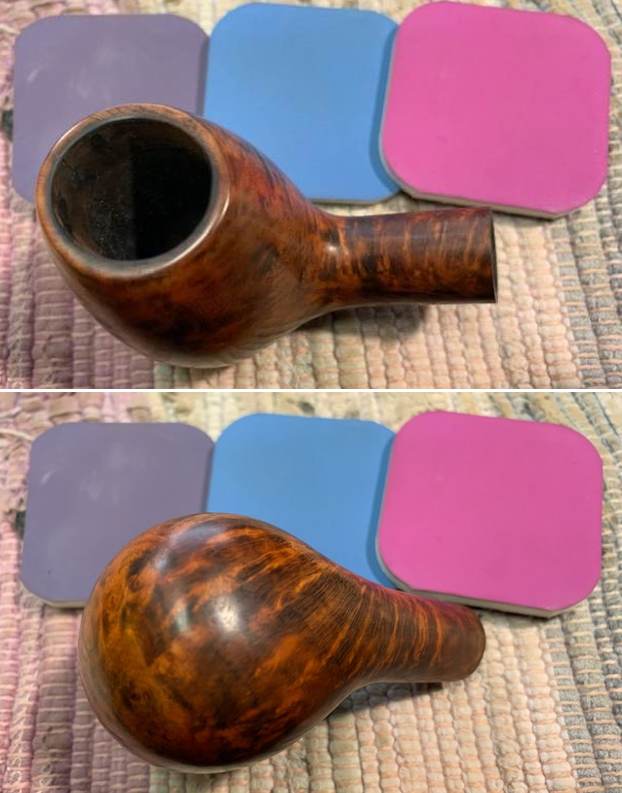
Now it was time to do my work on the pipe. I polished the briar with micromesh sanding pads – dry sanding with 1500-12000 grit sanding pads. I wiped it down after each pad with a damp cloth to remove the sanding debris and dust.     I rubbed the bowl and shank down with Before & After Restoration Balm. I worked it into the surface of the bowl sides and shank with my fingertips to clean, enliven and protect the briar. I let the balm sit for a little while and then buffed with a cotton cloth to raise the shine. I set the bowl aside and turned my attention to the stem. I “painted” the surface of the stem with the flame of a lighter to lift the tooth marks. It worked very well and many of the marks lifted. I filled in the remaining marks with clear CA glue and let the repairs cure. I sanded out the remnants of tooth marks with 220 grit sandpaper. I started the polishing with 400 grit sandpaper. I touched up the BARI stamp on the left side of the saddle with white acrylic nail polish. Once it dried I scraped off the excess and left the white in the stamping. While not perfect it looked better.    I set the bowl aside and turned to work on the stem. It was in good condition and the tooth marks were light so I figured they would polish out fairly easily. I polished the vulcanite stem with micromesh sanding pads – 1500-12000 grit pads. I wiped it down with Obsidian Oil after each sanding pad. I used Before & After Pipe Polish – both Fine and Extra Fine to further polish the stem.   This Bari Mahogni 8233 Bent Sitter is a great looking pipe now that it has been restored. The sandblasted oxblood and brown stained finish around the bowl is quite beautiful and highlights the a finish that works well with the polished vulcanite saddle stem. I put the stem back on the bowl and carefully buffed the pipe with Blue Diamond on the buffing wheel using a light touch on the briar. I gave the bowl and the stem multiple coats of Conservator’s Wax and buffed the entire pipe with a clean buffing pad. I hand buffed the pipe with a microfiber cloth to deepen the shine. The finished Bari Mahogni Sitter sits nicely on the desk top and in the hand. Give the finished pipe a look in the photos below. The dimensions of the pipe are Length: 5 inches, Height: 2 inches, Outside diameter of the bowl: 1 ¼ inches, Chamber diameter: ¾ of an inch. The weight of the pipe is 58 grams/2.01 ounces. I will be putting it on the Danish Pipe Maker section of the rebornpipes store shortly. If you are interested in adding this pipe to your collection send me a message or an email. Thanks for reading this blog and my reflections on the pipe while I worked on it. There are many more to come!

New Life for a Bari Senior Bent Sitter 489


Blog by Steve Laug

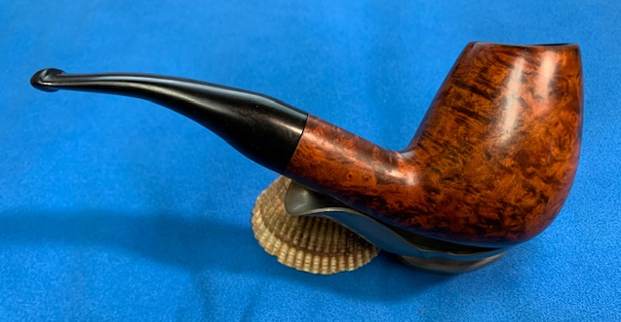
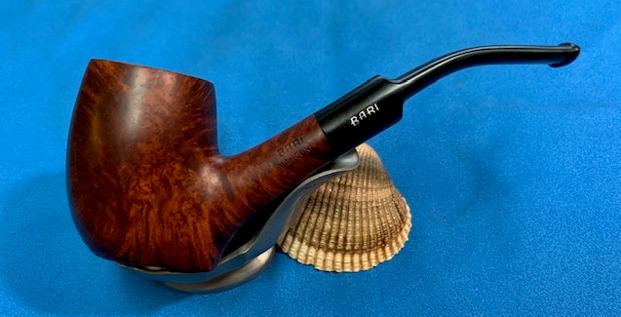
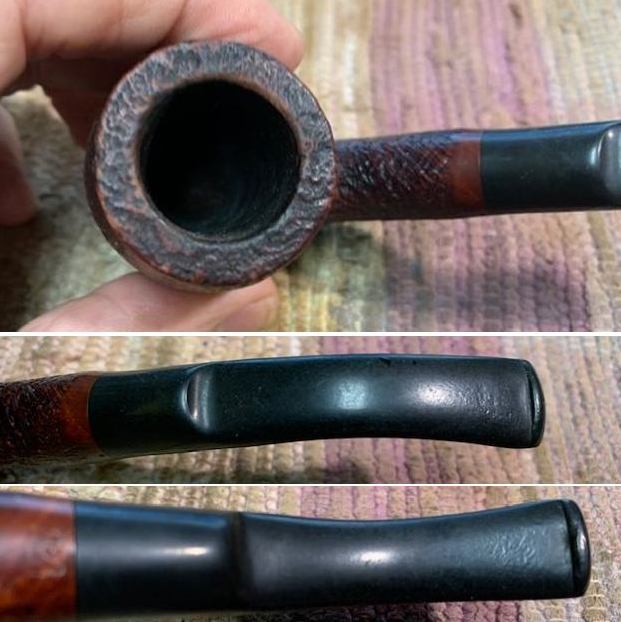
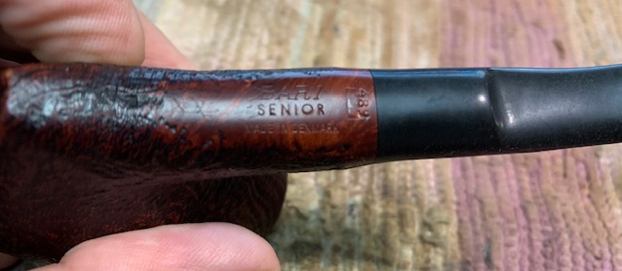
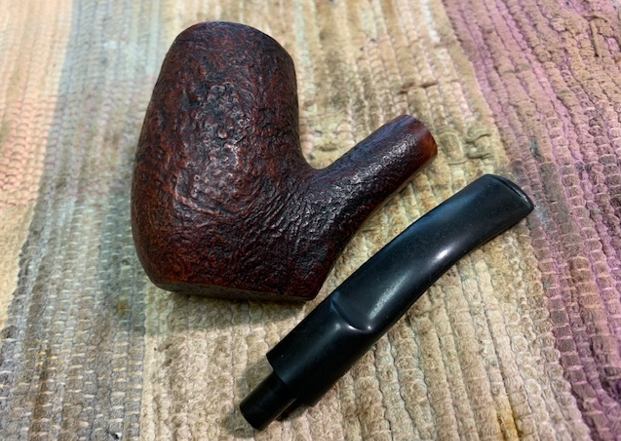
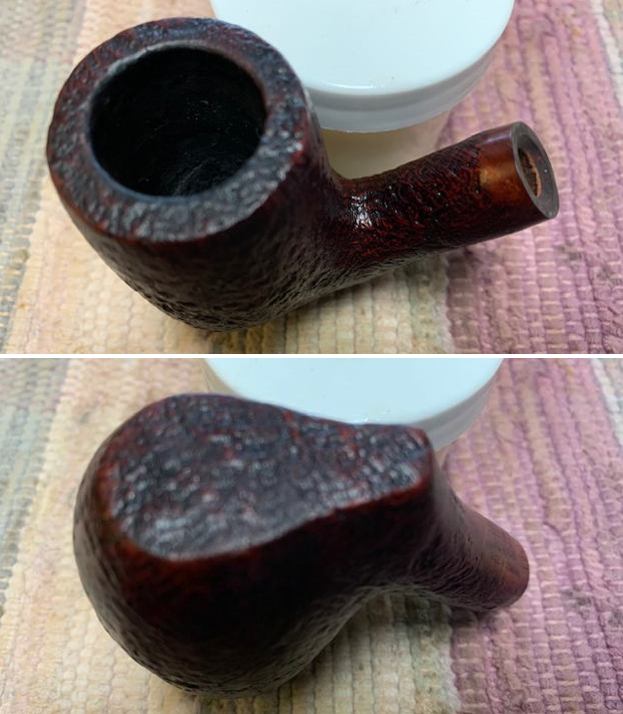
The next pipe on the work table is a bit of a mystery to both Jeff and me. We really have no memory about where we picked this pipe up or where we bought it. It is not in the spread sheet and there seemingly is no way to check where we got it. It has a deep and rich sandblast finish with a mix of black and brown stains. The pipe is stamped on the underside of the shank and reads BARI [over] Senior[over] Made in Denmark. Next to the shank/stem junction it is stamped with the shape number 489. The left side of the saddle stem it is stamped and reads BARI. Jeff had cleaned up the pipe with his usual focus on detail. He reamed the pipe with a PipNet pipe reamer and removed the rest of it with a Savinelli Fitsall Pipe Knife.  He scrubbed the exterior of the bowl with undiluted Murphy’s Oil Soap with a tooth brush. He rinsed it under running warm water to remove the soap and grime. He cleaned out the inside of the shank and the airway in the stem with alcohol, cotton swabs and pipe cleaners. He soaked the stem in Briarville’s Stem Deoxidizer and rinsed it off with warm water. I took photos of the pipe once I received it.   The rim top cleaned up really well. The rim top, inner and outer edges of the bowl were in excellent condition. The stem surface looked good with a few small tooth marks and chatter on both sides near the button.The stamping on the underside of the shank is clear and readable and reads as noted above. I removed the stem and took a photo of the pipe to give a sense of the whole. I turned to Pipephil’s site (http://www.pipephil.eu/logos/en/logo-b1.html) to see if I could find a listing for the Bari Senior. There was one picture specifically listed for this line of Bari pipes. There was also good info on the brand as a whole and that it was founded by Viggo Nielsen in 1950 and he ran it until 1978 when Age Bogelund managed the production for them. In 1993 it was sold to Helmer Thomsen.Pipedia gives a great history of the brand (https://pipedia.org/wiki/Bari) that is well worth reading. There were also examples of the Bari Selected Nature Old Briar pipes showing their stamping.
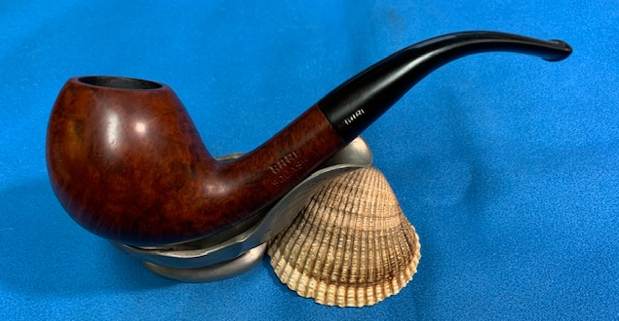
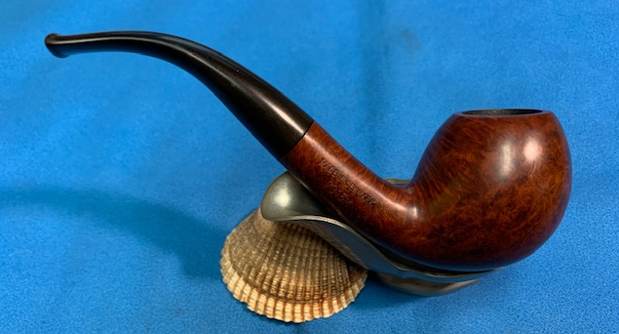
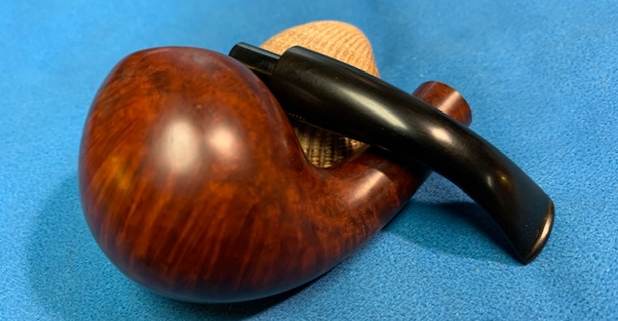
Now it was time to do my work on the pipe. The bowl was in such good condition that I rubbed the bowl and shank down with Before & After Restoration Balm. I worked it into the surface of the bowl sides and shank with my fingertips to clean, enliven and protect the briar. I let the balm sit for a little while and then buffed with a cotton cloth to raise the shine.     I set the bowl aside and turned my attention to the stem. I “painted” the surface of the stem with the flame of a lighter to lift the tooth marks. It worked very well and many of the marks lifted. I filled in the remaining marks with clear CA glue and let the repairs cure. I sanded out the remnants of tooth marks with 220 grit sandpaper. I started the polishing with 400 grit sandpaper.   I touched up the BARI stamp on the left side of the saddle with white acrylic nail polish. Once it dried I scraped off the excess and left the white in the stamping. While not perfect it looked better.I set the bowl aside and turned to work on the stem. It was in good condition and the tooth marks were light so I figured they would polish out fairly easily. I polished the vulcanite stem with micromesh sanding pads – 1500-12000 grit pads. I wiped it down with Obsidian Oil after each sanding pad. I used Before & After Pipe Polish – both Fine and Extra Fine to further polish the stem. This Bari Senior 489 Bent Sitter is a great looking pipe now that it has been restored. The sandblasted oxblood and brown stained finish around the bowl is quite beautiful and highlights the a finish that works well with the polished vulcanite saddle stem. I put the stem back on the bowl and carefully buffed the pipe with Blue Diamond on the buffing wheel using a light touch on the briar. I gave the bowl and the stem multiple coats of Conservator’s Wax and buffed the entire pipe with a clean buffing pad. I hand buffed the pipe with a microfiber cloth to deepen the shine. The finished Bari Senior Sitter sits nicely on the desk top and in the hand. Give the finished pipe a look in the photos below. The dimensions of the pipe are Length: 5 ¼ inches, Height: 2 ½ inches, Outside diameter of the bowl: 1 ¼ inches, Chamber diameter: ¾ of an inch. The weight of the pipe is 62 grams/2.19 ounces. I will be putting it on the Danish Pipe Maker section of the rebornpipes store shortly. If you are interested in adding this pipe to your collection send me a message or an email. Thanks for reading this blog and my reflections on the pipe while I worked on it. There are many more to come!

Working on a bit of an odd Bari Special Handcut Freehand


Blog by Steve Laug

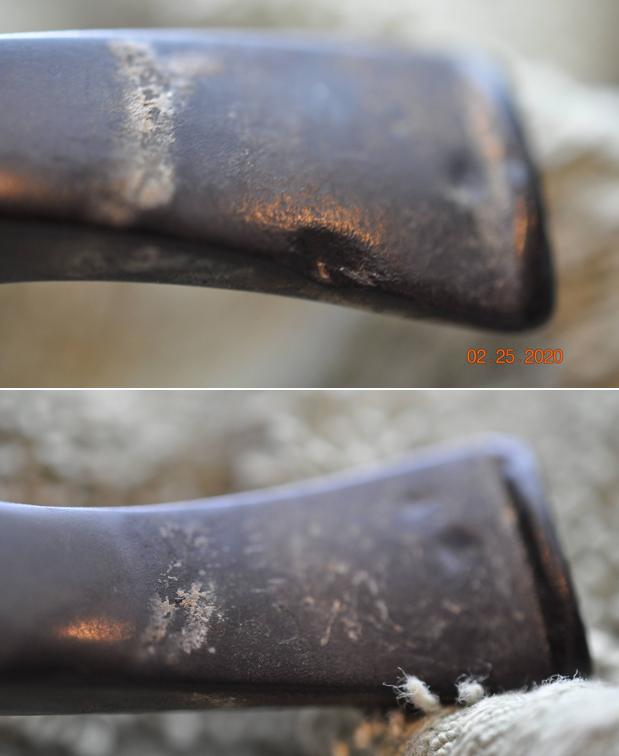
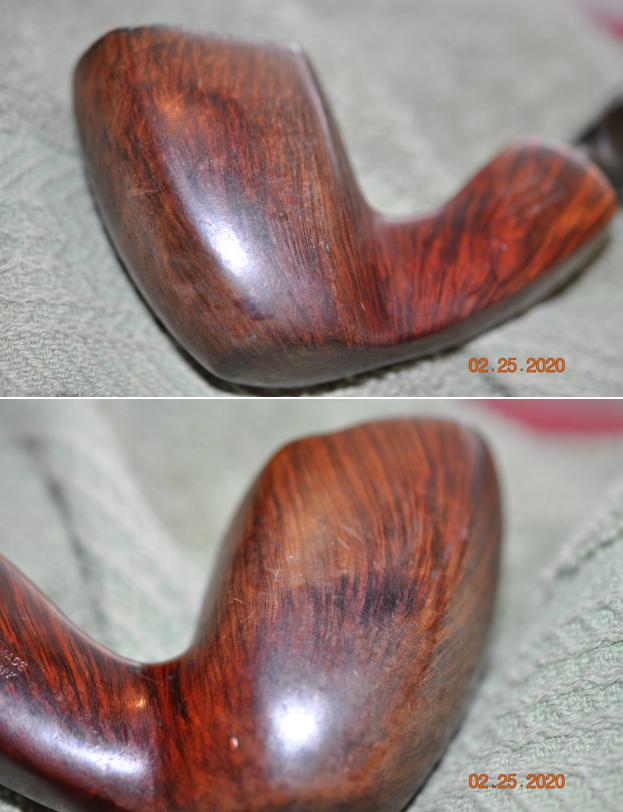
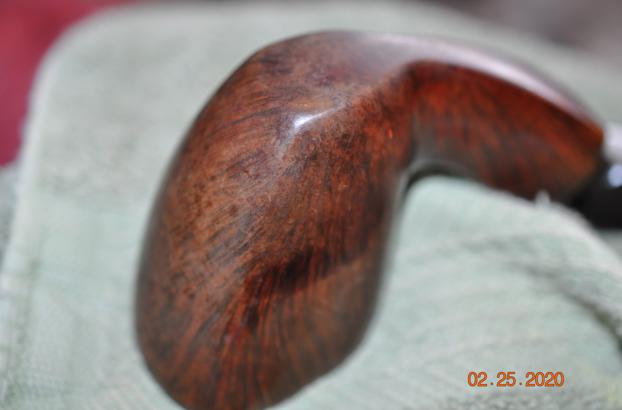
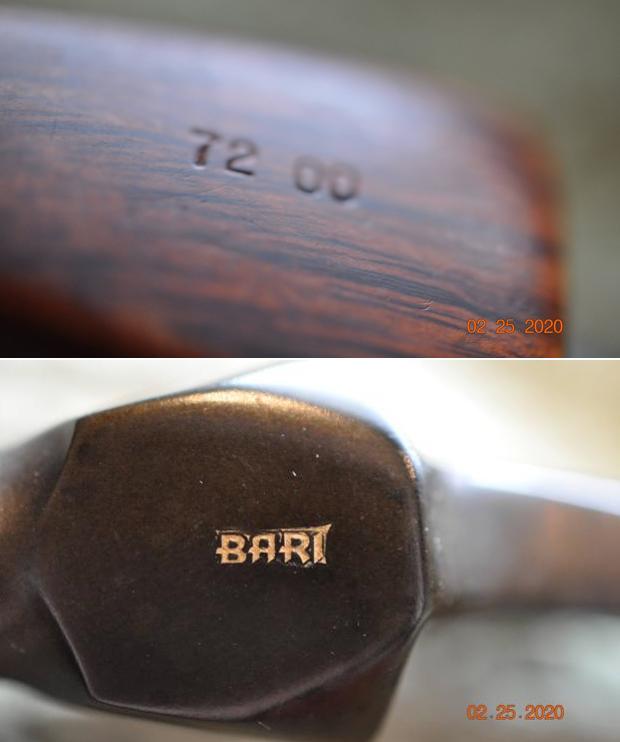
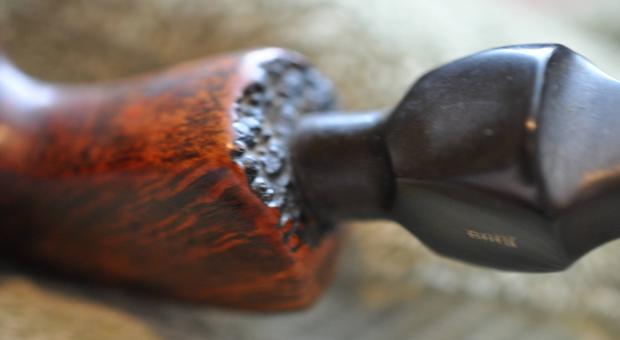
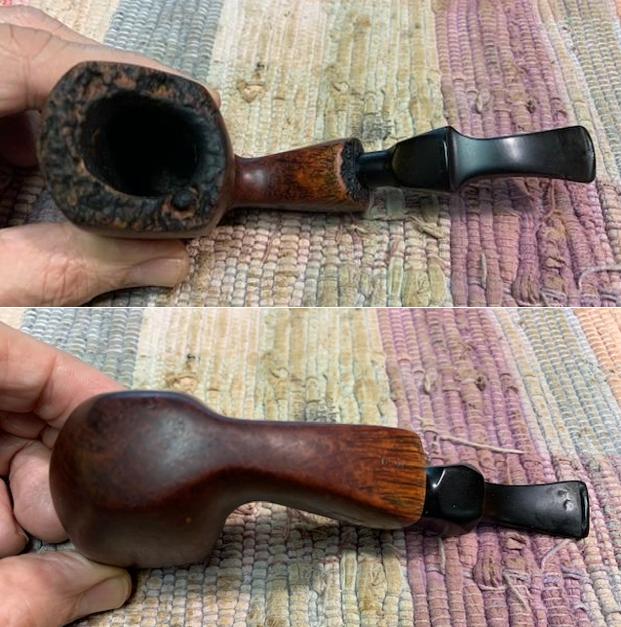
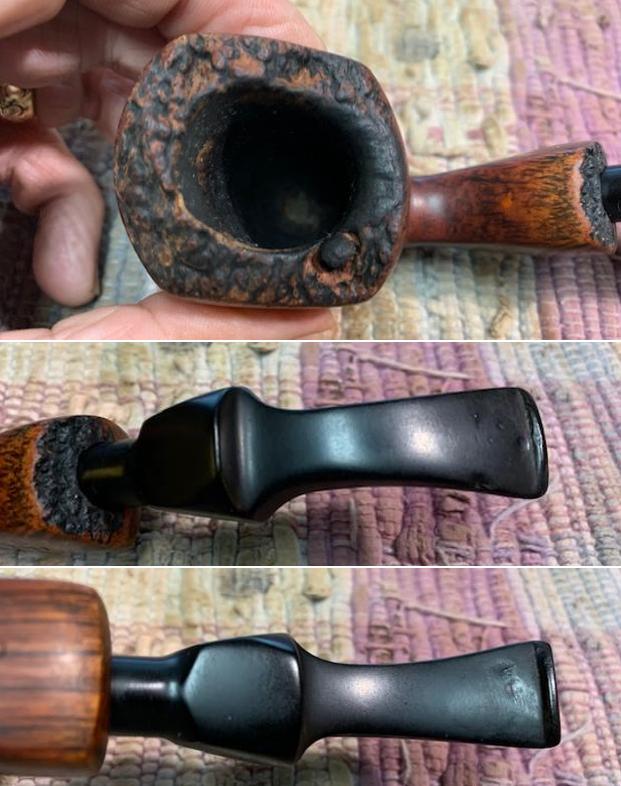
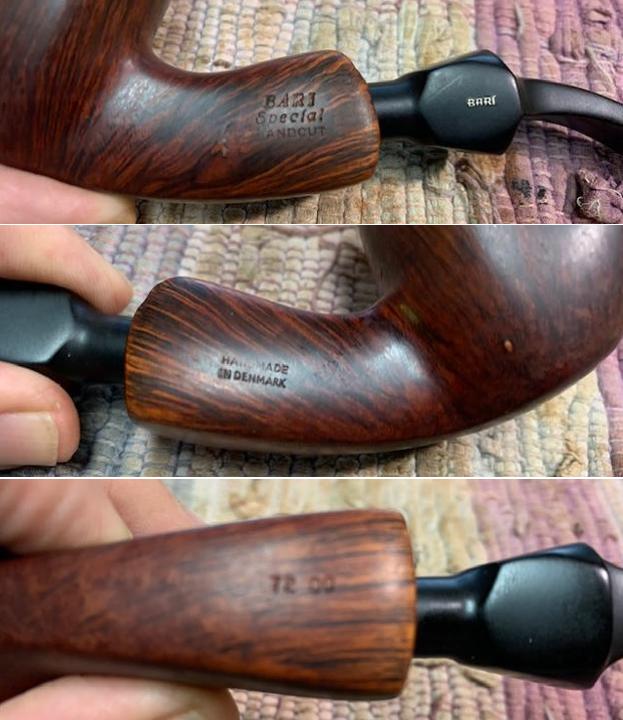
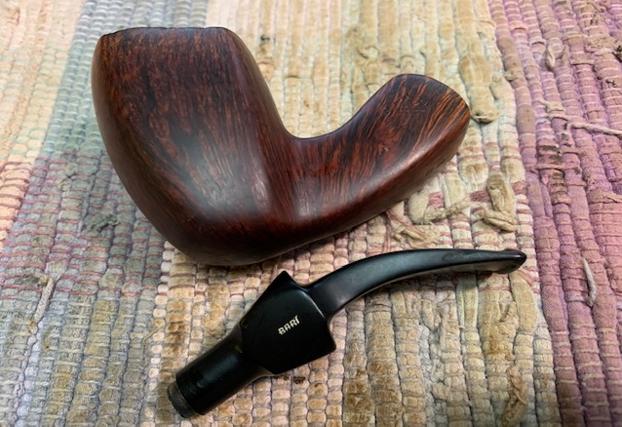
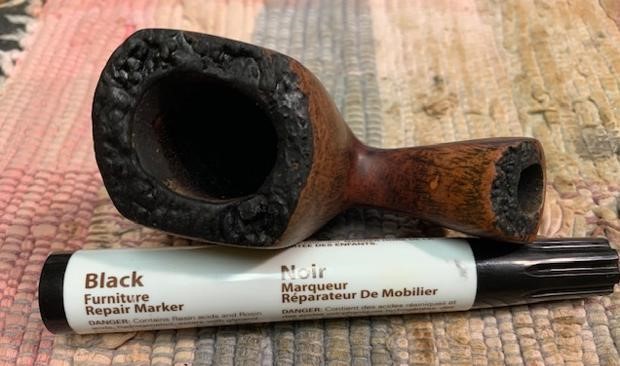
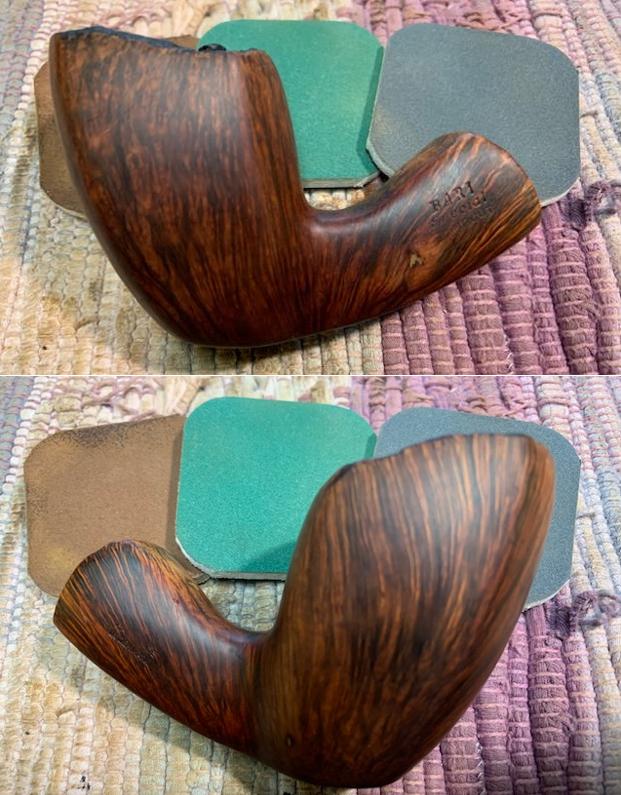
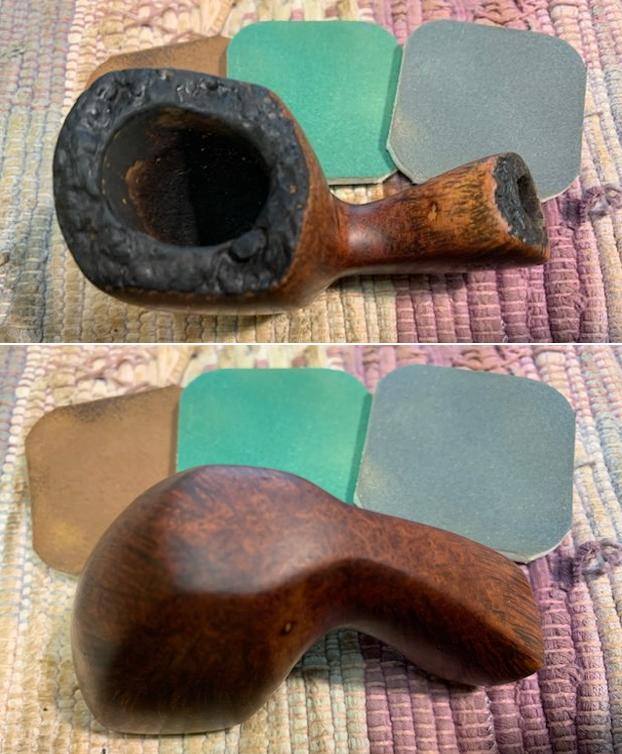
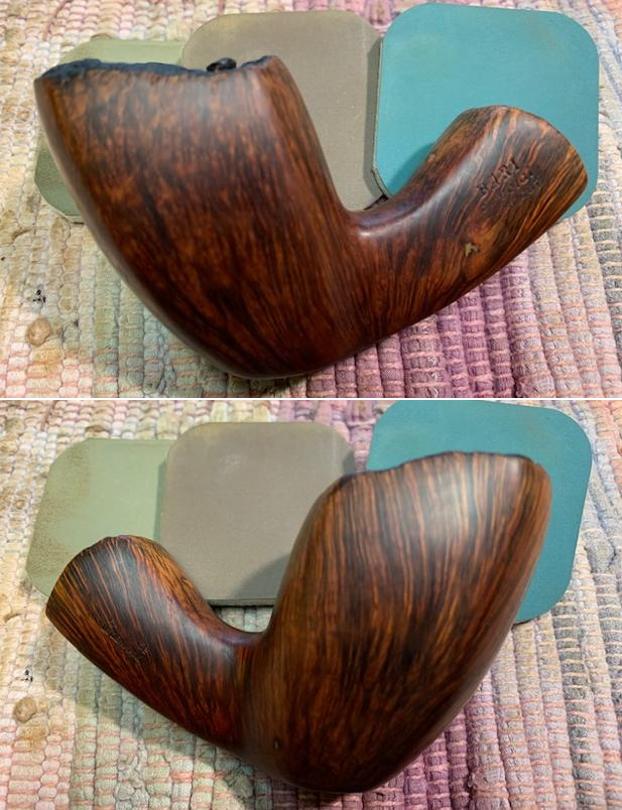
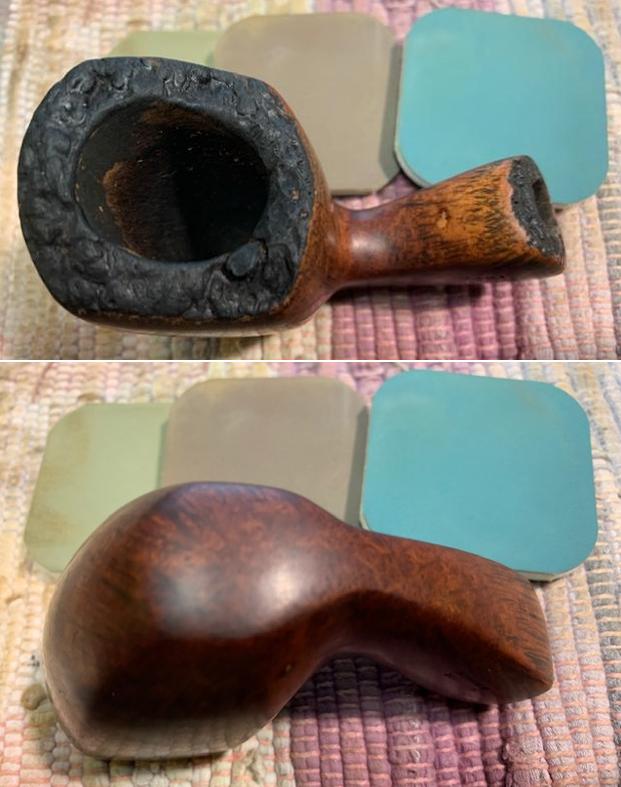
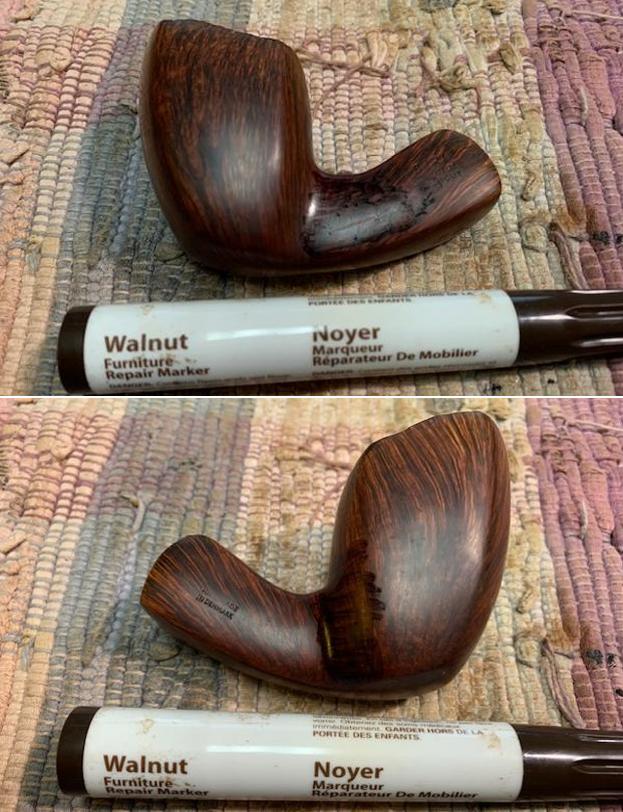
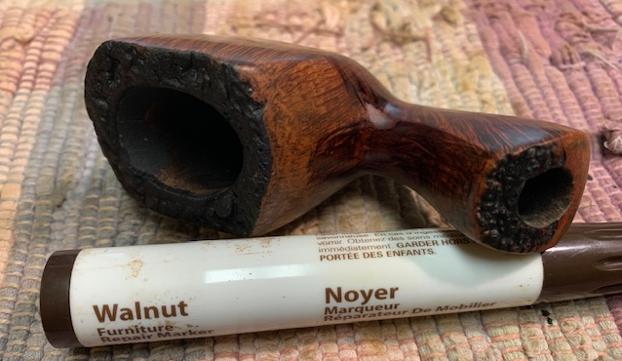
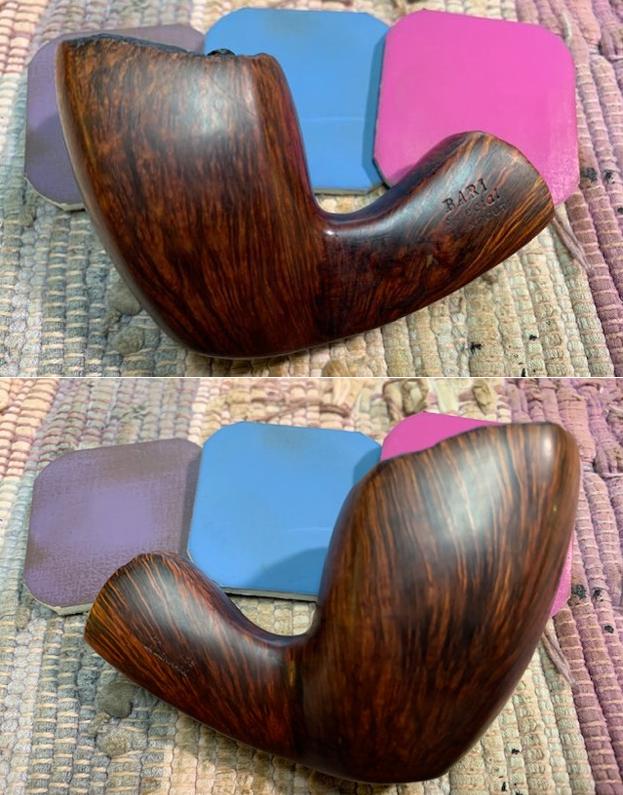
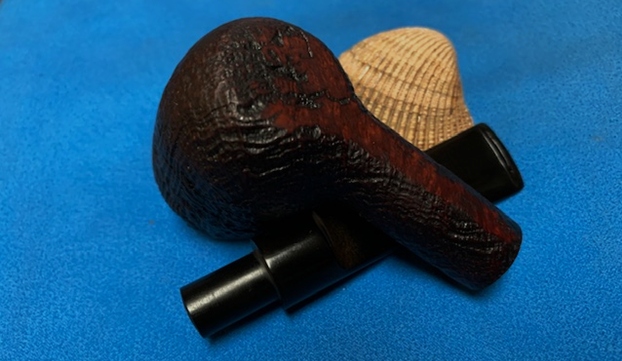
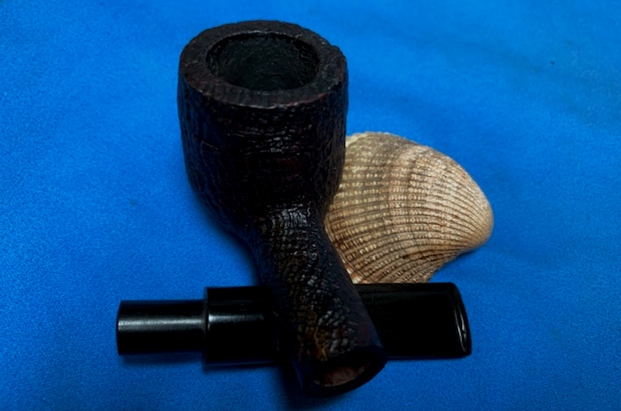
The next pipe on the work table is one that was purchased in 2020 from an auction in Salina, Kansas, USA. It has been here for a while and I am just now getting to it. Work has been demanding so it is slowing down my restoration work a bit. This pipe is a Bari Special Handcut Freehand. It has a really mix of flame and straight grain around the bowl and shank. It was stamped on the sides of the shank. On the left side it reads Bari [over] Special [over] Handcut. On the right side it reads Handmade [over] in Denmark. On the underside of the shank it is stamped with the numbers 72  00. The pipe was dirty with grime ground into the finish. There was a thick cake in the bowl and lava overflow on the plateau rim top. The inner edge of the rim was covered so thickly in lava it was hard to know what was underneath. The square saddled vulcanite stem was oxidized and had tooth marks and chatter ahead of the button on both sides. BARI was stamped on the left side of the fancy saddle stem. Jeff took photos of the pipe before he started his work on cleaning it up for us. Jeff took photos of the rim top and the stem to show the condition of the pipe when we received it. You can see the thick cake in the bowl and the lava on the rim top and inner edge of the bowl. The bowl is square while the chamber is round. The oxidized and calcified vulcanite stem was quite unique and picked up the square angles of the bowl and the shank. It has chatter and deep tooth marks on both sides near the button. He took photos of the sides of the bowl and the heel to give an idea of the shape and the condition of the briar around the bowl. It really is a nicely shaped pipe with some great grain. The next photos Jeff took show the stamping on the sides of the shank. It is clear and readable as noted above. The stem logo is also clear. Jeff took a photo of the partial plateau on the shank end. The top two thirds of the shank end was plateau while the bottom third was smooth. It is quite nice.I worked on a Bari Special Handcut pipe previously so I looked up the blog to refresh myself on the brand a bit (https://rebornpipes.com/2020/07/22/cleaning-up-a-danish-made-bari-special-handcut-b-dublin-freehand/). I quote from the research I did for that pipe below:

I quoted a section from Pipedia on Bari pipes (https://pipedia.org/wiki/Bari). It is good to be reminded of the fact that Viggo Nielsen was the pipe maker.

Pipedia states that Bari Piber was founded by Viggo Nielsen in Kolding, Denmark around the turn of 1950/51. His sons Kai and Jørgen both grew into their father’s business from a very young age and worked there till 1975. Both have become successful pipe makers.

Bari successfully adapted the new Danish design that had been started mainly by Stanwell for its own models. Bari was sold in 1978 to Van Eicken Tobaccos in Hamburg, Germany though the pipes were still made in Denmark. From 1978 to 1993 Åge Bogelund and Helmer Thomsen headed Bari’s pipe production.

Helmer Thomson bought the company in 1993 re-naming it to “Bari Piber Helmer Thomsen”. The workshop moved to more convenient buildings in Vejen. Bogelund, who created very respectable freehands of his own during the time at Bari got lost somehow after 1993. Bari’s basic conception fundamentally stayed the same for decades: series pipes pre-worked by machines and carefully finished by hand – thus no spectacular high grades but solid, reliable every day’s companions were what they turned out. The most famous series are the smooth “Classic Diamond” and the blasted “Wiking”.

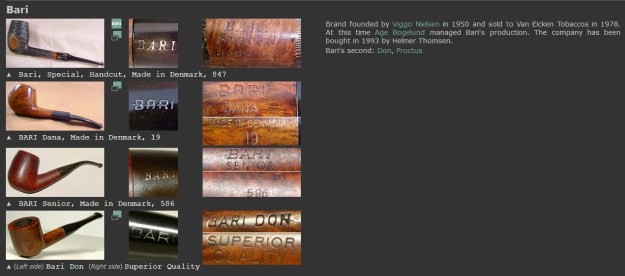
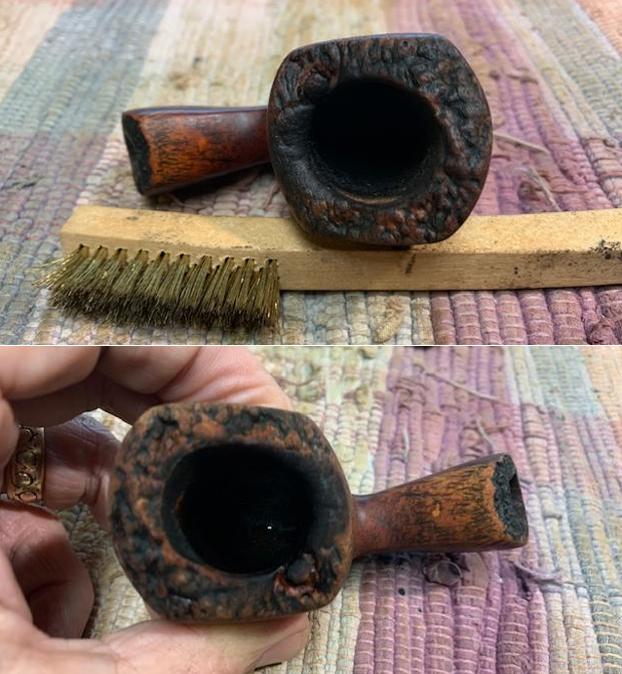
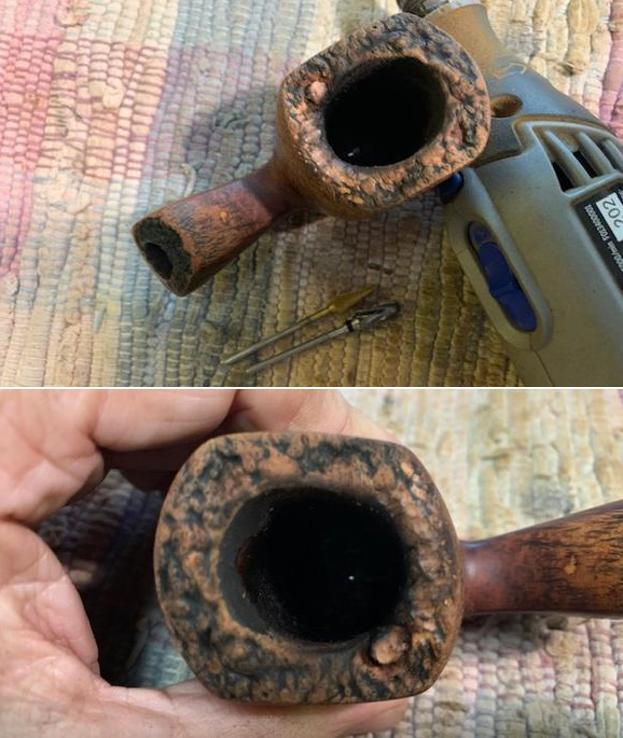
I did a quick look at Pipephil’s site (http://www.pipephil.eu/logos/en/logo-b1.html) and did a screen capture of the section on Bari pipes.Jeff had cleaned up the pipe following his normal cleaning process. In short, he reamed the bowl with a PipNet pipe reamer and cleaned up the reaming with a Savinelli Fitsall Pipe Knife. He scrubbed the smooth bowl with undiluted Murphy’s Oil Soap with a tooth brush. He worked over the lava and debris on the rim top and was able to remove it. He rinsed it under running warm water to remove the soap and grime. He cleaned out the inside of the shank and the airway in the stem with alcohol, cotton swabs and pipe cleaners. He scrubbed the stem with Soft Scrub and cotton pads to remove the debris and oils on the stem. He soaked it in a bath of Briarville’s Pipe Stem Deoxidizer to remove the oxidation. He rinsed it with warm water and dried it off. I took photos of the pipe once I received it. It really looked good however, surprisingly there were a number of fills around the shank and bowl. I took close up photos of the stem and the rim top to show both how clean they were and what needed to be addresses with both. The rim top and bowl look good. The edge was clean but there was some burn damage on the rim top at the back of the bowl. The stem looked better and the tooth marks and chatter were still present.I took a photo of the stamping on the sides of the shank. You can see from the photos that it is readable. I removed the stem from the bowl and took a photo of the parts to give a sense of the beauty of the pipe. I started my work on the pipe by addressing the damage to the back of the plateau rim top. Notice that it is burned but the grooves and crevices are still present. I cleaned it up with a brass bristle wire brush to remove as much of the loose char as possible. Once it was clean I used several burrs on my Dremel to redefine the grooves and crevices in the plateau at the back of the rim top. Once I was finished I was happy with the look or the rim top. I restained the rim top with a black stain pen to match the plateau on the shank end. I polished the smooth briar with micromesh sanding pads – dry sanding with1500-4000 grit pads to smooth out the surface of the briar and the noticeable fills around the shank and bowl. I wiped the bowl down after each sanding pad with a damp cloth to remove the sanding dust. The briar began to take on a shine. I paused after polishing the bowl with the 4000 grit micromesh pad to stain the fills around the sides of the shank and bowl. I used a Walnut stain pen to match the surrounding briar. Once the stain cured I finished polishing the bowl with 6000-12000 grit micromesh sanding pads. The bowl really did begin to shine. I rubbed the bowl down with Before & After Restoration Balm working it into the briar with my finger tips and into the plateau on the shank end and rim top with a horsehair shoe brush. The product works to clean, revive and protect the briar. I let it sit on the pipe for 10 minutes then buffed it off with a soft cloth. I set the bowl aside and turned my attention to the stem. I “painted” the stem surface with the flame of a lighter to lift the deep tooth marks in the vulcanite. Since vulcanite has “memory” I was able to lift the marks on the top and underside of the stem significantly. There were a few that did not lift completely so I filled them in with clear CA glue and set the stem aside to cure. Once the repairs cured I sanded it with 220 grit sandpaper to blend them into the surface and started polishing the stem with 400 grit wet dry sandpaper. I polished the stem with micromesh sanding pads – wet sanding it 1500-12000 pads. I wiped it down with some Obsidian Oil each pad to remove the dust and polishing debris. I polished it with Before  After Pipe Polish – both Fine and Extra Fine. I gave it a final coat of Obsidian Oil and set it aside to dry. This is another pipe that I am really happy about the finished restoration. This Odd Bari Special Handcut Freehand 72 00 turned out beautifully. It really is a great looking pipe with a great shape and rugged plateau rim top and shank end. The bowl is almost square and the shank is the same with virtually the same angles as the bowl from bottom to top. The unique vulcanite saddle stem carries on the shape to the end. The polished black of the stem works well with the briar. The briar really came alive with the buffing. The rich black and brown stains of the finish make the grain really pop with the polishing and waxing. I put the stem back on the bowl and buffed the pipe with Blue Diamond on the buffing wheel using a light touch on the briar. I gave the bowl and the stem multiple coats of carnauba wax on the buffing wheel. I buffed the pipe with a clean buffing pad to raise the shine. I hand buffed the pipe with a microfiber cloth to deepen the shine. The finished Bari Special Freehand really has a unique beauty and feels great in the hand. It looks very good. Give the finished pipe a look in the photos below. The dimensions of the pipe are Length: 6 ½ inches, Height: 2 ¼ inches, Outside diameter of the bowl: 1 ¾ inches long x 1 ½ inches wide, Chamber diameter: ¾ of an inch. The weight of the pipe is 70 grams/2.47 oz. The pipe will be going on the rebornpipes store soon. It will be in the section on Danish Pipe Makers if you would like to add it to your collection. Thanks for reading this blog and my reflections on the pipe while I worked on it. It was a fun one to work on!

Restoring a Beautiful Bari Select nature Old Briar 7963


Blog by Steve Laug

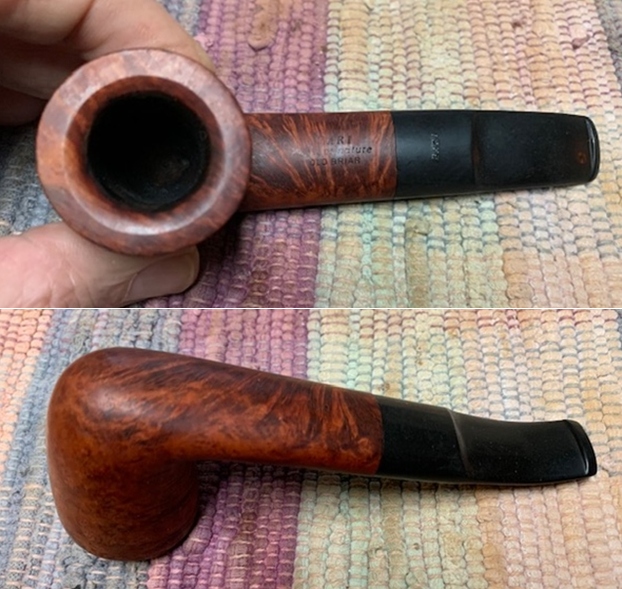
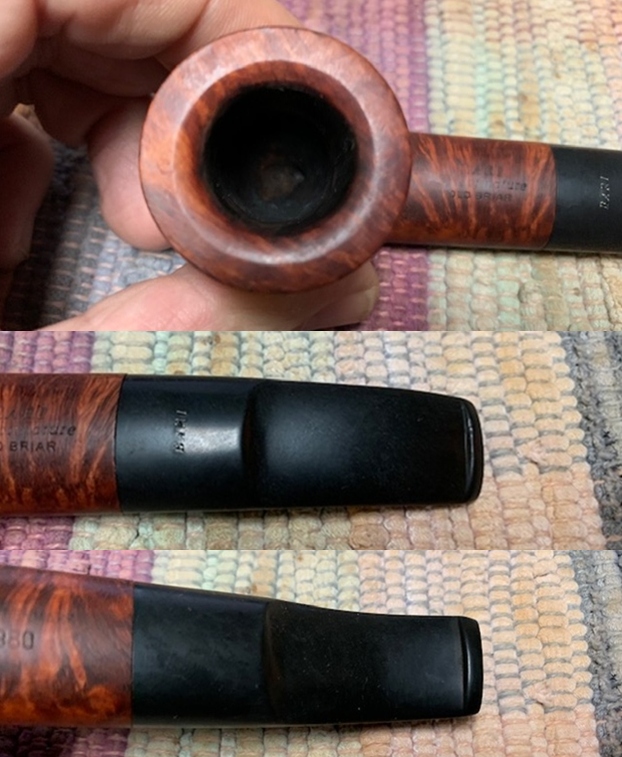
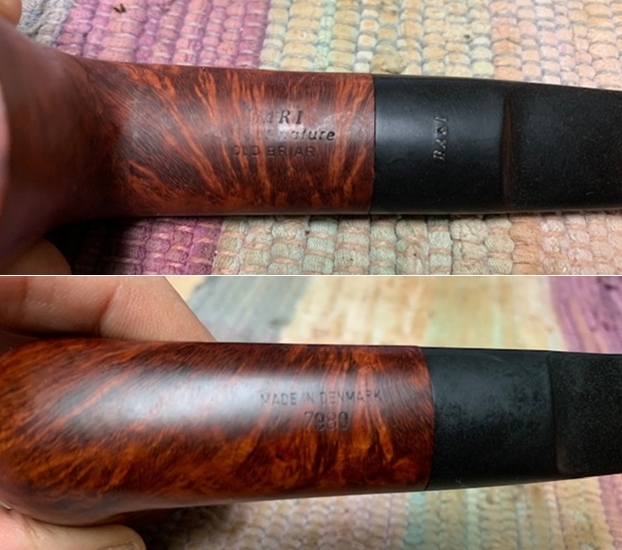
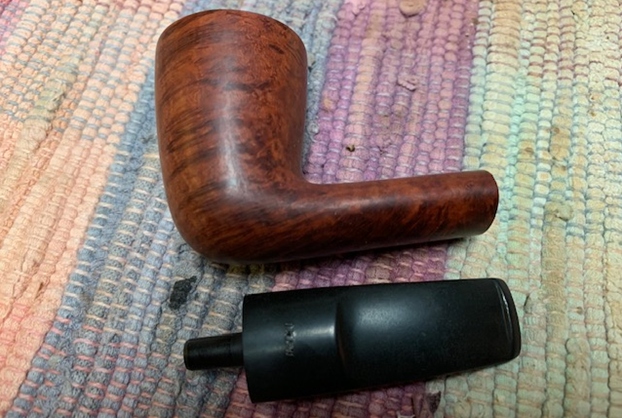
The next pipe on the work table came to us from one of Jeff’s pipe hunts in Utah, USA back in 2018. Now I am finally getting a chance to work on it. The pipe is a classic Bari Bent Dublin like pipe. The pipe was a mess which probably accounted for how we ended up purchasing it for a fair price. On the left side of the shank it is stamped with the Bari [over] Select nature [over] Old Briar. On the right side of the shank it is stamped Made In Denmark [over] the shape number 7963. The mix of stains makes the grain just pop even with the grime ground into the finish. It was very dirty with dust and debris in finish. There was a thick cake in the bowl and an overflow of lava on the rim top that is heavier on the back of the bowl. The edges look to be in good condition as far as we can tell until we clean up the pipe. The stem was oxidized, calcified and there were deep tooth marks and chatter on both sides near the button. The stem had a white Bari stamp on the left side of the fancy saddle. Jeff took photos of the pipe before he started working on it. I include those below.

Jeff took photos of the bowl and rim top to show the cake in the bowl and the condition of both. It was heavily caked with a lava overflow on the rim top. The inner and outer edges look very good. He took photos of the top and underside of the stem showing the oxidation and tooth marks on the stem surface and button.  In person the tooth marks are far deeper than they look in the photos.  Jeff took a photo of the heel and the side of the bowl and shank to show the grain on the pipe. It is a beauty.Jeff took photos to capture the stamping on the sides of the shank. It is clear and readable as noted above.   He also took a photo of the Bari stamp on the left side of the stem. I turned to Pipephil’s site (http://www.pipephil.eu/logos/en/logo-b1.html) to see if I could find a listing for the Bari Select nature Old Briar with this four digit number. There was nothing specifically listed for this line of Bari pipes. There was also good info on the brand as a whole and that it was founded by Viggo Nielsen in 1950 and he ran it until 1978 when Age Bogelund managed the production for them. In 1993 it was sold to Helmer Thomsen. I have included a screen capture of the section below.Pipedia gives a great history of the brand (https://pipedia.org/wiki/Bari) that is well worth reading. There were also photos of the Bari stamping on the Select nature Old Briar line of pipes.

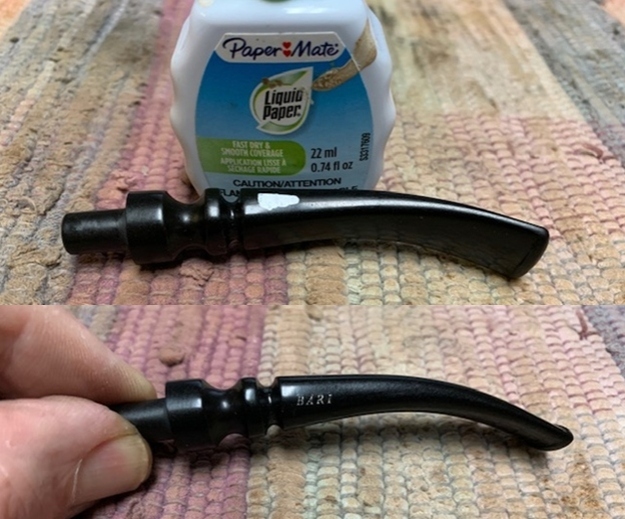
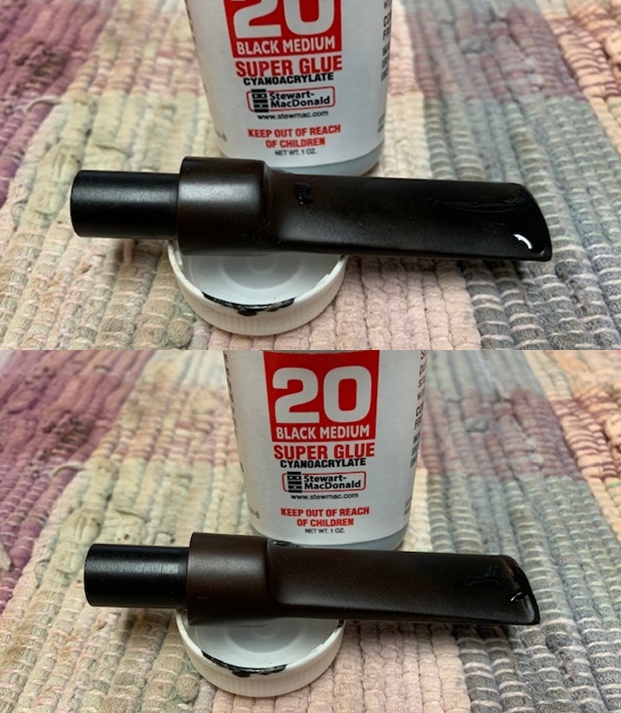
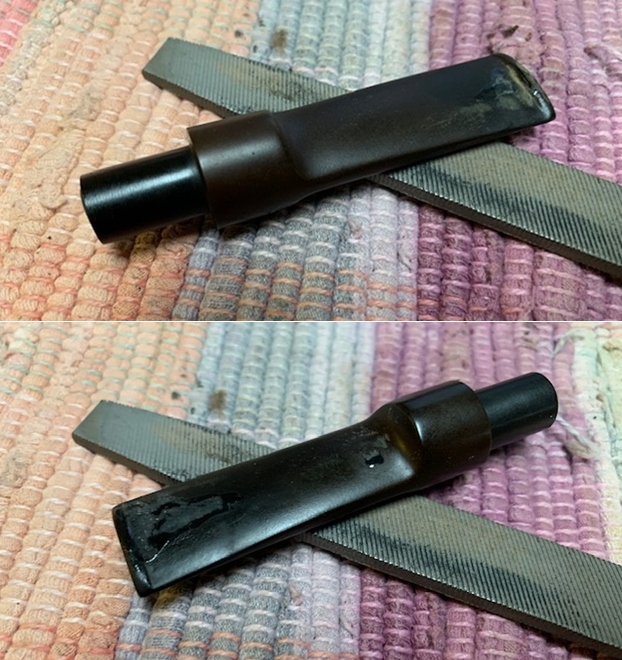
Jeff reamed it with a PipNet pipe reamer and cleaned up the reaming with a Savinelli Fitsall Pipe Knife. He scrubbed out the internals of the shank and stem with alcohol, pipe cleaners and cotton swabs until the pipe was clean. He scrubbed the exterior of the bowl with Murphy’s Oil Soap and a tooth brush to remove the grime and grit on the briar and the lava on the rim top. The finish on the bowl looked really good when I got it. The rim top looked very good. He soaked the stem in Before & After Deoxidizer bath to remove the oxidation. The stem looked better other than the light oxidation that remained and the deep tooth marks and chatter on the surface. When the pipe arrived here in Vancouver for the second stop of its restoration tour it looked much better than when he found it. I took photos of the pipe before I started my work on it.  I took photos of the condition of the rim top and stem before I started working. The rim top looks very good and the bowl is spotless. The stem has light oxidation remaining and some tooth chatter and marks on both sides near the button.   I took a photo of the stamping on the sides of the shank. The stamping was faint but readable. It reads as noted above.   I took the bowl and stem apart and took a photo of the pipe to show the look of the pipe. I polished the briar with micromesh sanding pads – dry sanding with 1500-12000 grit pads. I wiped the bowl down after each pad with a damp cloth to remove the sanding dust. I worked some Before & After Restoration Balm into the finish of the bowl, rim top and shank with my fingertips to clean, enliven and protect it. I find that the balm really makes the briar come alive again. The contrasts in the layers of stain really made the grain stand out. I let the balm sit for 15 minutes and then buffed with a cotton cloth to raise the shine. The bowl really looks good at this point. I set aside the bowl and turned my attention to the stem. I “painted” the tooth marks on the surface of the stem and was able to lift them significantly. I filled in the remaining spots with super glue. Once the repairs cured I flattened them out with a file to bend them into the surface. I further smoothed them out with 220 sandpaper to blend and started polishing with 400 grit wet dry sandpaper. I polished the stem with micromesh sanding pads – wet sanding it with 1500-12000 grit pads. I polished it further with Before & After Pipe Stem Polish – both fine and extra fine.    I touched up the Bari white logo on the stem with Liquid Paper. Once it dried I buffed off the excess with a cotton pad. I wiped the stem down with Obsidian Oil once more. Once again I am the part of the restoration that I always look forward to – the moment when all the pieces are put back together. I put the pipe back together and  buffed the bowl and the stem with Blue Diamond on the buffing wheel. I gave the bowl and the stem multiple coats of carnauba wax. I buffed the pipe with a clean buffing pad to raise the shine. I hand buffed it with a microfiber cloth to deepen the shine. It is fun to see what the polished bowl looks like with the smooth finish and the black vulcanite stem. This richly stained Bari Select nature Old Briar 7963 Dublin is light weight and ready for you to load up a tobacco of preference and enjoy breaking it in. Have a look at it in the photos below. The dimensions are Length: 5 ½ inches, Height: 1 ¾ inches, Outside diameter of the bowl: 1 ½ inches, Chamber diameter: ¾ of an inch. The weight of the pipe is 18grams/.63oz. This is one that will go on the Danish Pipemakers section of the rebornpipes online store shortly. Thanks to each of you who are reading this blog. Remember we are not pipe owners; we are pipemen and women who hold our pipes in trust until they pass on into the trust of the next generation.

Restoring a Beautiful Sandblasted Bari Squash 7930 Pot


Blog by Steve Laug

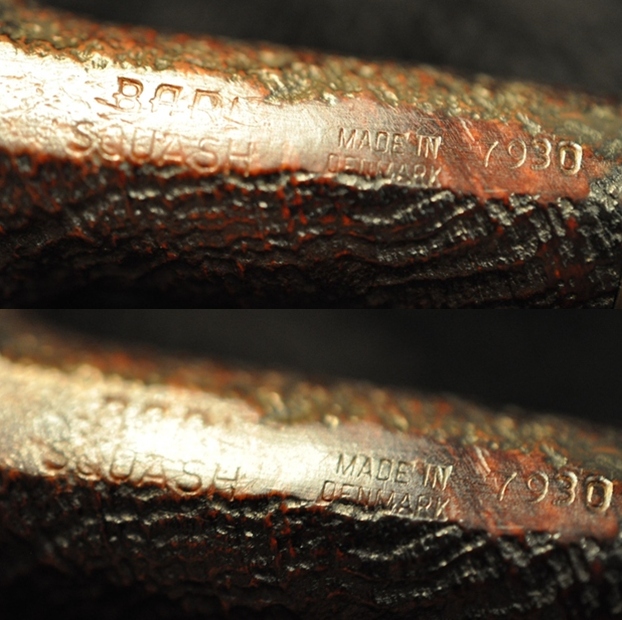
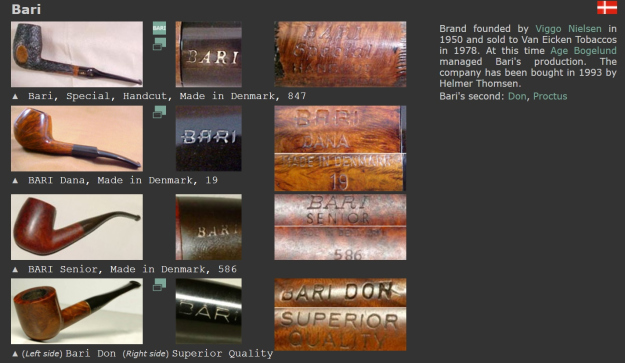
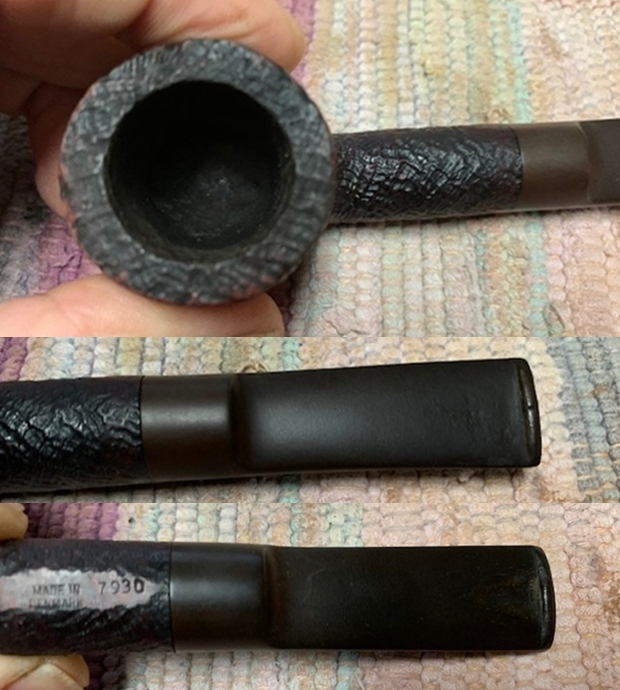
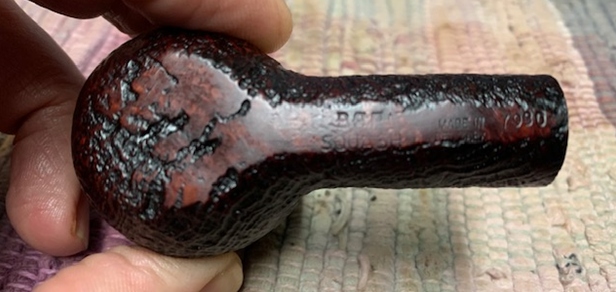
The next pipe on the work table came to us from an antique mall in Bozeman, MT, USA back in 2018. It has been sitting here for 2 years. Jeff took photos in December of that year. Now I am finally getting a chance to work on it. The pipe is a classic pot shaped sandblast pipe with almost a Dunhill Shell Briar Brown and Black finish with highlights of red. The pipe was an absolute mess which probably accounted for how we ended up purchasing it for a fair price. On the underside of the heel and shank it is stamped with the Bari [over] Squash followed by Made In Denmark followed by 7930. The mix of stains makes the sandblast look multidimensional even with the grime ground into the finish. It was very dirty with dust and debris in the valleys of the sandblast. There was a thick cake in the bowl and an overflow of lava on the rim top that is heavier on the back of the bowl. The edges look to be in good condition as far as we can tell until we clean up the pipe. The stem was oxidized, calcified and there were deep tooth marks and chatter on both sides near the button. The stem had a damage white Bari stamp on the left side of the saddle. Jeff took photos of the pipe before he started working on it. I include those below. Jeff took photos of the bowl and rim top to show the cake in the bowl and the condition of both. It was heavily caked with a lava overflow on the rim top. You can see that it is heavier on the back inner edge that the rest of the bowl. The inner and outer edges look very good. He took photos of the top and underside of the stem showing the oxidation and tooth marks on the stem surface and button.  In person the tooth marks are far deeper than they look in the photos.  Jeff took two photos to capture the stamping on the underside of the shank. It is clear and readable as noted above.  I turned to Pipephil’s site (http://www.pipephil.eu/logos/en/logo-b1.html) to see if I could find a listing for the Bari Squash with this four digit number. There was nothing specifically listed for this line of Bari pipes. There was also good info on the brand as a whole and that it was founded by Viggo Nielsen in 1950 and he ran it until 1978 when Age Bogelund managed the production for them. In 1993 it was sold to Helmer Thomsen. Pipedia gives a great history of the brand (https://pipedia.org/wiki/Bari) that is well worth reading. There were also examples of the Bari pipes showing their stamping.

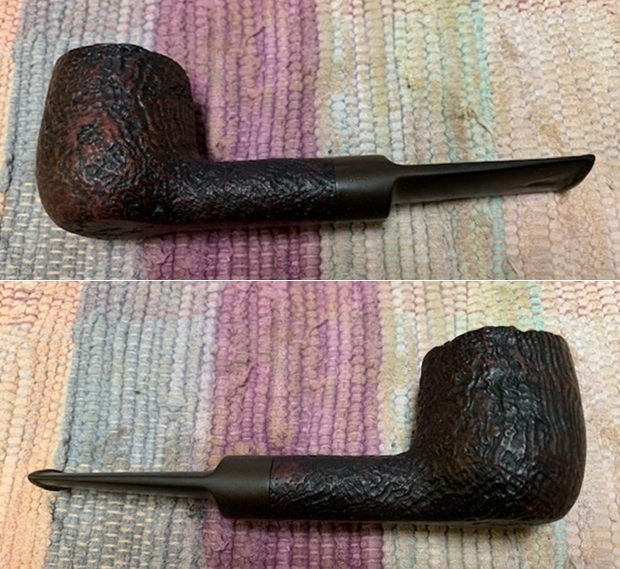
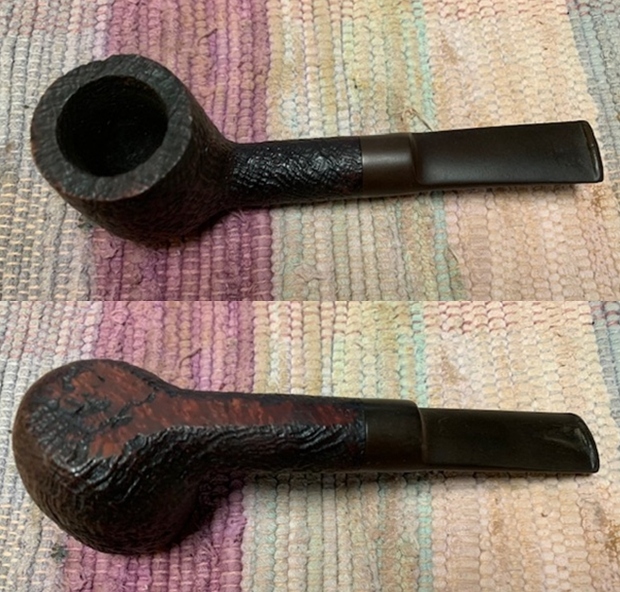
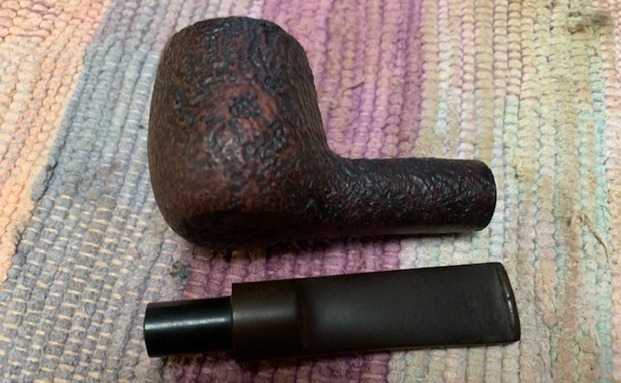
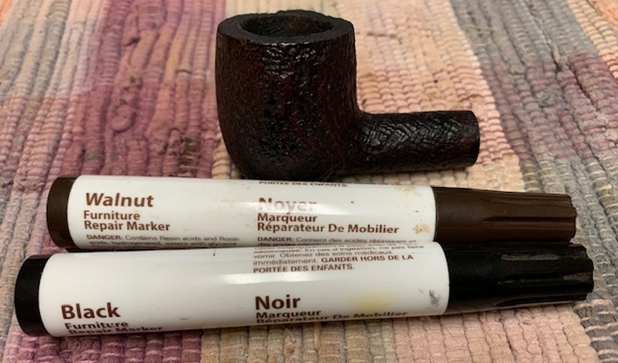
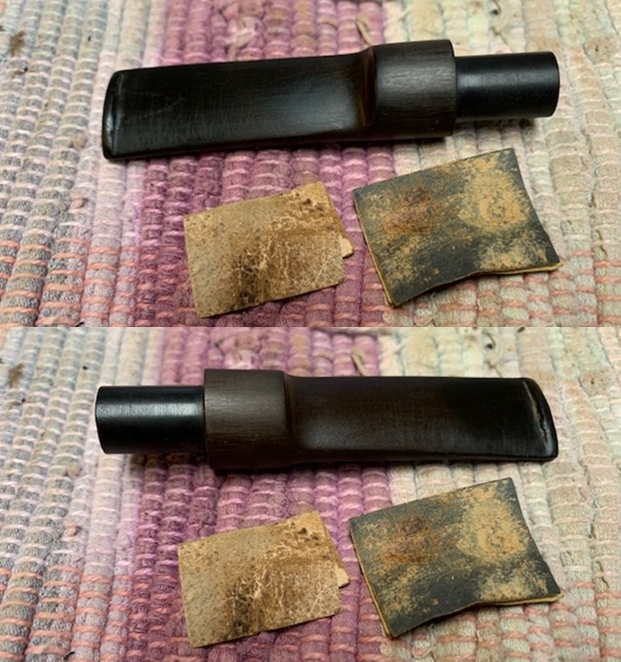
This pipe was a bit of a mess like many of the pipes we work on. I was curious to see what it would look like when I unpacked it. I was surprised at how good it looked. Jeff reamed it with a PipNet pipe reamer and cleaned up the reaming with a Savinelli Fitsall Pipe Knife. He scrubbed out the internals of the shank and stem with alcohol, pipe cleaners and cotton swabs until the pipe was clean. He scrubbed the exterior of the bowl with Murphy’s Oil Soap and a tooth brush to remove the grime and grit on the briar and the lava on the rim top. The finish on the bowl looked really good when I got it. The rim top looked very good. He soaked the stem in Before & After Deoxidizer bath to remove the oxidation. The stem looked better other than the light oxidation that remained and the deep tooth marks and chatter on the surface. When the pipe arrived here in Vancouver for the second stop of its restoration tour it looked much better than when he found it. I took photos of the pipe before I started my work on it.  I took photos of the condition of the rim top and stem before I started working. The rim top looks very good and the bowl is spotless. The stem has light oxidation remaining and some tooth chatter and marks on both sides near the button.   I took a photo of the stamping on the underside of the shank. The BARI SQUASH stamp is faint but readable but the rest of the stamp is very clear. I took the bowl and stem apart and took a photo of the pipe to show the look of the pipe. The cleaning had left behind some light spots that needed to be blended into the rest of the bowl. I used a combination of Black and Walnut Stain Pens to touch up the finish on the bowl and rim top.I worked some Before & After Restoration Balm into the finish of the bowl, rim top and shank with my fingertips and a horsehair shoe brush to clean, enliven and protect it. I find that the balm really makes the briar come alive again. The contrasts in the layers of stain and the separate finishes really made the grain stand out. I let the balm sit for 15 minutes and then buffed with a cotton cloth to raise the shine. The bowl really looks good at this point. I set it aside and worked on the stem.  I set aside the bowl and turned my attention to the stem. I “painted” the tooth marks on the surface of the stem and was able to lift them significantly. I filled in the remaining spots with black super glue. Once the repairs cured I flattened them out with a file/rasp to bend them into the surface. I further smoothed them out with 220 sandpaper to blend and started polishing with 400 grit wet dry sandpaper. I scrubbed the remaining oxidation with Soft Scrub cleanser an was able to remove most of it. I polished the stem with micromesh sanding pads – wet sanding it with 1500-12000 grit pads. I polished it further with Before & After Pipe Stem Polish – both fine and extra fine.    Once again I am the part of the restoration that I always look forward to – the moment when all the pieces are put back together. I put the pipe back together and lightly buffed the bowl with Blue Diamond. I buffed the stem with a heavier touch with Blue Diamond on the buffing wheel. I gave the bowl multiple coats of Conservator’s Wax and the stem multiple coats of carnauba wax. I buffed the pipe with a clean buffing pad to raise the shine. I hand buffed it with a microfiber cloth to deepen the shine. It is fun to see what the polished bowl looks like with the smooth finish and the black vulcanite stem. This richly stained Bari Squash Sandblast 7930 Pot is light weight and ready for you to load up a tobacco of preference and enjoy breaking it in for yourself. Have a look at it in the photos below. The dimensions are Length: 5 ¼ inches, Height: 1 ¾ inches, Outside diameter of the bowl: 1 ½ inches, Chamber diameter: ¾ of an inch. The weight of the pipe is 45grams/1.59oz. This is one that will go on the Danish Pipemakers section of the rebornpipes online store shortly. Thanks to each of you who are reading this blog. Remember we are not pipe owners; we are pipemen and women who hold our pipes in trust until they pass on into the trust of the next generation.

New Life for a Bari Select Nature Old Briar 7980 Dublin


Blog by Steve Laug

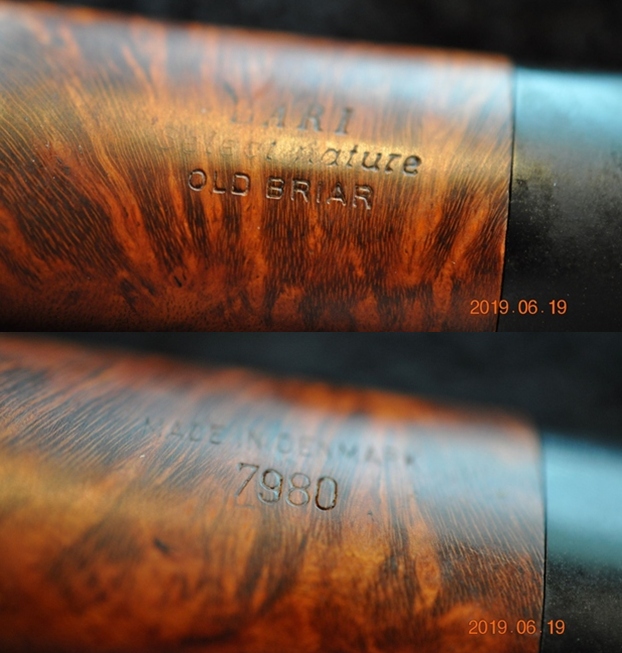
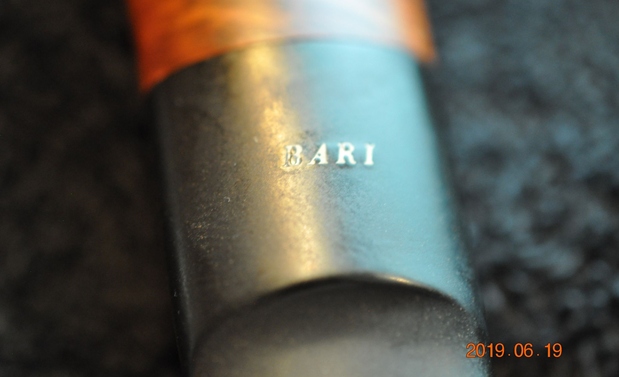
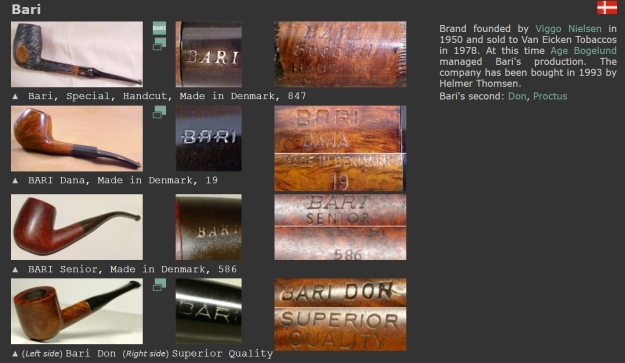
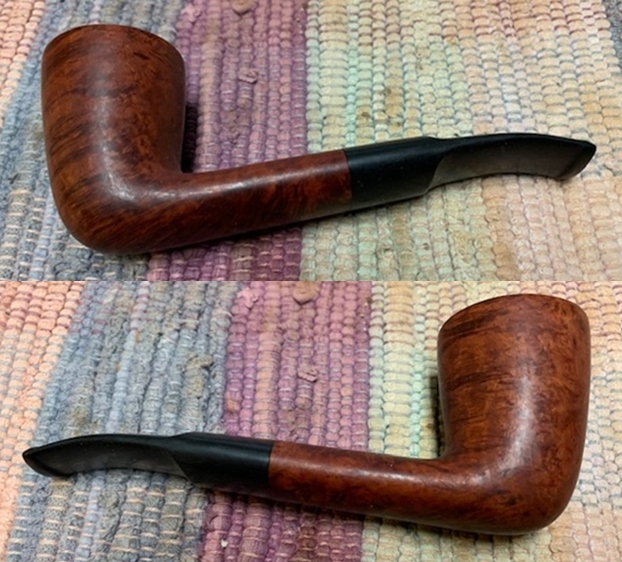
The next pipe on the work table came to us from an antique store in Bozeman, Montana, USA.  The pipe is another interesting looking Bari pipe. It has a Danish take on an oval shank Dublin. It is a smooth finish pipe with some cross grain on the sides and running onto the underside of the shank as well as birdseye on the front and back and flowing on to the sides of the shank. The pipe is stamped on the topside of the shank and reads BARI [over] Select Nature [over] Old Briar. On the underside of the shank it is stamped Made in Denmark [over] the shape number 7980. There was a lot of grime ground into the smooth finish on the briar. The bowl was heavily caked with a lava coat flowing onto the top of the rim and in the beveled edge of the bowl – heavier toward the rear of the bowl. The inside and outside edges looked to be in good condition but we would know more once Jeff had cleaned it. The stem was oxidized, calcified and had tooth chatter and marks on the top and underside near the button. The BARI logo was stamped on the top side of the saddle. It had promise but it was very dirty. Jeff took some photos of the pipe before he started his cleanup work. He took a photo of the rim top and bowl to give a clear picture of the thickness of the cake and tobacco debris as well as the lava on the rim top and inner beveled edge. He also took photos of the top and underside of the stem to show the oxidation and the chatter and tooth marks. Jeff took photos of the sides and heel of the bowl to give a picture of what the briar looked like. There is some nice grain around the sides. The stamping on the top and underside of the shank are clear and readable and read as noted above.    I turned to Pipephil’s site (http://www.pipephil.eu/logos/en/logo-b1.html) to see if I could find a listing for the Bari Selected Nature Old Briar. There was nothing specifically listed for this line of Bari pipes. There was also good info on the brand as a whole and that it was founded by Viggo Nielsen in 1950 and he ran it until 1978 when Age Bogelund managed the production for them. In 1993 it was sold to Helmer Thomsen.Pipedia gives a great history of the brand (https://pipedia.org/wiki/Bari) that is well worth reading. There were also examples of the Bari Selected Nature Old Briar pipes showing their stamping.

Now on to working on the pipe. Jeff had cleaned up the pipe with his usual penchant for thoroughness. He reamed the pipe with a PipNet pipe reamer and removed the rest of it with a Savinelli Fitsall Pipe Knife.  He scrubbed the bowl with undiluted Murphy’s Oil Soap with a tooth brush. He rinsed it under running warm water to remove the soap and grime. He cleaned out the inside of the shank and the airway in the stem with alcohol, cotton swabs and pipe cleaners. He soaked the stem in Before & After Deoxidizer and rinsed it off with warm water. I took photos of the pipe once I received it.   The rim top cleaned up really well. The rim top and outer edge of the bowl appear to be in good condition. The beveled inner edge also looked good. The stem surface looked good with a few small tooth marks and chatter on both sides near the button.  The stamping on both sides of the shank is clear and readable and reads as noted above. I took a photo of the stamping on the top of the shank to show the general condition of the stamping.   I removed the stem and took a photo of the pipe to give a sense of the whole. The stem is an oval saddle with BARI stamped on the topside.Now it was time to do my work on the pipe. The bowl was in such good condition that I polished the briar with micromesh sanding pads – wet sanding with 1500-12000 grit pads and wiping it down after each pad with a damp cloth. I rubbed the bowl and shank down with Before & After Restoration Balm. I worked it into the surface of the bowl sides and shank with my fingertips to clean, enliven and protect the briar. I let the balm sit for a little while and then buffed with a cotton cloth to raise the shine. The grain came alive and the fills while visible look better than when I began.   I set the bowl aside and turned my attention to the stem. I “painted” the surface of the stem with the flame of a lighter to lift the tooth marks. It worked very well and the marks lifted. I was able to sand out the remnants of tooth marks with 220 grit sandpaper. I started the polishing with 400 grit sandpaper.  I touched up the BARI stamp on the top of the saddle with PaperMate Liquid Paper. I daubed it onto the stamping and worked it into the stamp with a tooth pick. Once it dried I scraped off the excess and left the white in the stamping.I set the bowl aside and turned to work on the stem. It was in good condition and the tooth marks were light so I figured they would polish out fairly easily. I polished the vulcanite stem with micromesh sanding pads – 1500-12000 grit pads. I wiped it down with Obsidian Oil after each sanding pad. I used Before & After Pipe Polish – both Fine and Extra Fine to further polish the stem.       This Bari Select Nature Old Briar 7980 Dublin is a great looking pipe now that it has been restored. The smooth brown stained finish around the bowl is quite beautiful and highlights the grain and works well with the polished vulcanite oval saddle stem. I put the stem back on the bowl and carefully buffed the pipe with Blue Diamond on the buffing wheel using a light touch on the briar. I gave the bowl and the stem multiple coats of carnauba wax on the buffing wheel and followed that by buffing the entire pipe with a clean buffing pad. I hand buffed the pipe with a microfiber cloth to deepen the shine. The finished Bari Select Nature Dublin sits nicely in the hand and feels great. Give the finished pipe a look in the photos below. The dimensions of the pipe are Length: 5 inches, Height: 2 inches, Outside diameter of the bowl: 1 ½ inches, Chamber diameter: ¾ of an inch. I will be putting it on the rebornpipes store shortly. If you are interested in adding this pipe to your collection send me a message or an email. Thanks for reading this blog and my reflections on the pipe while I worked on it. There are many more to come!

Cleaning up a Danish Made Bari Special Handcut B Dublin Freehand


Blog by Steve Laug

The next pipe on the work table is one that I picked up from a fellow in Alberta with several other Bari pipes. It has been here for a while and I am just now getting to it. I try to eventually work the pipes we find into the restoration queue so that I can keep them moving. This one is a Bari Special Handcut Dublin. It has a really mix of flame and straight grain around the bowl and shank. It was stamped on the sides of the shank. On the left side it reads Bari [over] Special [over] Handcut. On the right side it reads Handmade [over] in Denmark. On the underside of the shank it is stamped with the letter “B”. The pipe was dirty with grime ground into the finish. There was a thick cake in the bowl and lava overflow on the rim top. The inner edge of the rim was covered so thickly in lava it was hard to know what was underneath. The vulcanite stem was oxidized and had tooth marks and chatter ahead of the button on both sides. BARI was stamped on the left side of the fancy saddle stem but the B had been buffed out.

Before I started working on it I did a bit of research on the brand to remind myself of the maker. I have worked on quite a few Bari’s in the past so rather than rework all of that I am including the information I found while working on a Bari De Luxe Freehand. I quoted a section from Pipedia on Bari pipes (https://pipedia.org/wiki/Bari). It is good to be reminded of the fact that Viggo Nielsen was the pipe maker.

Pipedia states that Bari Piber was founded by Viggo Nielsen in Kolding, Denmark around the turn of 1950/51. His sons Kai and Jørgen both grew into their father’s business from a very young age and worked there till 1975. Both have become successful pipe makers.

Bari successfully adapted the new Danish design that had been started mainly by Stanwell for its own models. Bari was sold in 1978 to Van Eicken Tobaccos in Hamburg, Germany though the pipes were still made in Denmark. From 1978 to 1993 Åge Bogelund and Helmer Thomsen headed Bari’s pipe production.

Helmer Thomson bought the company in 1993 re-naming it to “Bari Piber Helmer Thomsen”. The workshop moved to more convenient buildings in Vejen. Bogelund, who created very respectable freehands of his own during the time at Bari got lost somehow after 1993. Bari’s basic conception fundamentally stayed the same for decades: series pipes pre-worked by machines and carefully finished by hand – thus no spectacular highgrades but solid, reliable every day’s companions were what they turned out. The most famous series are the smooth “Classic Diamond” and the blasted “Wiking”.

I did a quick look at Pipephil’s site (http://www.pipephil.eu/logos/en/logo-b1.html) and did a screen capture of the section on Bari pipes.Now that I was reminded about the Viggo Nielsen connection it was time to work on the pipe on my end. The pipe was a mess when I took it out of my box here so I was curious to see how well it would cleanup. I took some photos of the pipe before I started my work on it. You can see that it is filthy but has some great grain around the sides of the bowl.     I took some close up photos of the rim top and the stem surface. I wanted to show the condition of the cake in the bowl and look of the rim top and lava overflow. I also took close up photos of the stem to show the tooth marks and the calcification, oxidation and generally condition of the stem surface. I took photos of the stampings around the sides of the shank are faint but readable under the grime. It is stamped as noted above. I removed the stem for the shank and took a photo of the bowl and stem to give a picture of what it looked like. It is a great looking pipe under the grime.I decided to start my restoration by getting rid of the cake in the bowl and cleaning up the rim top. I reamed it with a PipNet pipe reamer and cleaned up the reaming with a Savinelli Fitsall Pipe Knife. I sanded the inside of the bowl with 220 grit sandpaper wrapped around a piece of dowel. Once I finished the bowl was smooth and clean. I was glad to see that there was no internal damage.   I scrubbed the exterior of the bowl with Murphy’s Oil Soap and a tooth brush to remove the grime and grit on the briar and the lava on the rim top. The finish looks very good with good looking grain around the bowl and shank. Once it is polished it will come to life. I scrubbed out the internals of the shank and the airway in the stem with alcohol, pipe cleaners and cotton swabs until the pipe was clean. I rubbed the bowl down with Before & After Restoration Balm. I worked it into the surface of the briar with my fingertips and a horsehair shoe brush to clean, enliven and protect it. I let the balm sit for a little while and then buffed with a cotton cloth and shoe brush to raise the shine.    I set the bowl aside and turned my attention to the stem. I sanded to loosen the oxidation on the vulcanite. I used a needle file to sharpen the edges of the button and redefine the shape.   I scrubbed the stem with Soft Scrub polish to remove the oxidation. While it did not take it all out it removed much of. What was left I would minimize more with 220 grit and 400 grit sandpaper and then would polish out with micromesh sanding pads.I sanded out the scratching and the tooth dents with 220 grit sandpaper and starting the polishing process with 400 grit wet dry sandpaper.    I polished the vulcanite with micromesh sanding pads – 1500-12000 grit pads. I wiped it down with a damp cloth after each sanding pad. I used Before & After Pipe Polish – both Fine and Extra Fine to further polish the stem.  I left a little oxidation around the stamp so as not to damage it more.        This restored Bari Danish Made Special Handcut Dublin is a nice looking pipe. The contrasting brown stains on the pipe worked really well with the polished vulcanite fancy stem. I put the stem back on the bowl and carefully buffed the pipe with Blue Diamond on the buffing wheel. I gave the bowl and stem multiple coats of carnauba wax on the buffing wheel keeping a light touch on the buffing wheel for the bowl. I followed that by buffing the entire pipe with a clean buffing pad. I hand buffed the pipe with a microfiber cloth to deepen the shine. The finished Bari Special Dublin fits nicely in the hand and feels great. Give the finished pipe a look in the photos below. The dimensions of the pipe are Length: 6 inches, Height: 1 ¾ inches, Outside diameter of the bowl: 1 ½ inches, Chamber diameter: ¾ of an inch. If you are interested in carrying on the previous pipe man’s legacy with this pipe send me a message or an email. I have more to work on of various brands. Perhaps one of those will catch your attention. Thanks for reading this blog and my reflections on the pipe while I worked on it.

Fresh Life for a Bari De Luxe 9763 Bent Dublinesque Freehand


Blog by Steve Laug

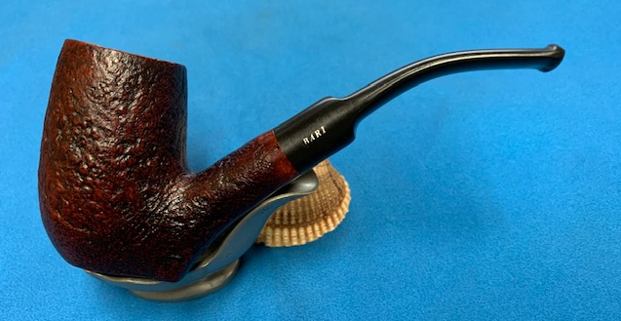
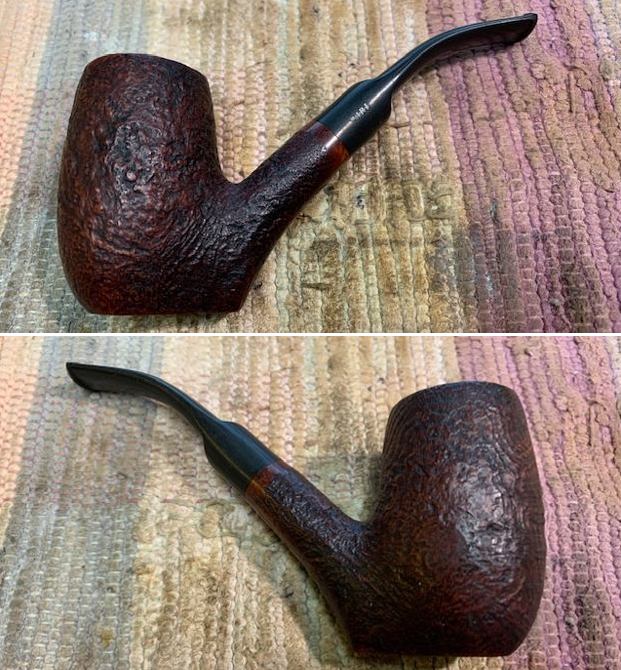
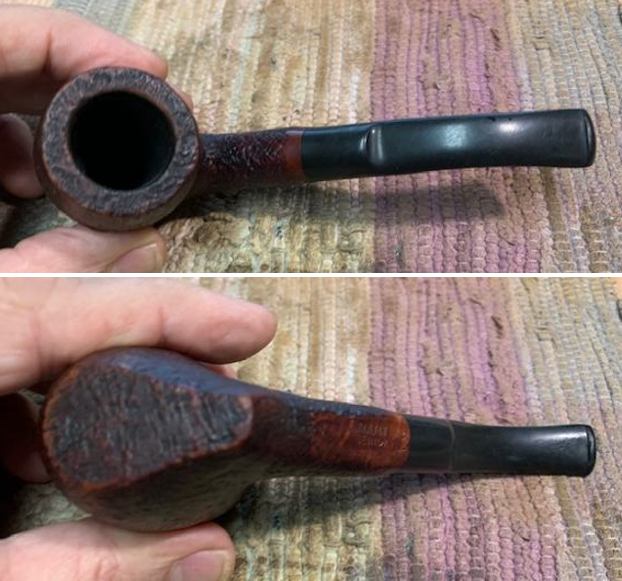
The next pipe on the work table is a sandblast bent Dublin shaped Bari, at least that is my description of it. The bowl is round with a crowned rim top. On the underside of the shank it reads Bari over De Luxe followed by Made In Denmark and ends with the shape number 9763. The finish is sandblasted on the entire bowl and the blast is deep and tactile with some great grain as well. The rim top is sandblasted and crowned. The pipe was dirty and the oxblood finish flat but otherwise the pipe was in good shape. The bowl had a thick cake and the inner edge of the rim looked to be in good condition. The shank is round and flows out the bowl with a slight bend. The stem is vulcanite and has a fancy round turning before second round edged rectangular bead. The blade of the stem is also a round edge rectangle. It is stamped on the left side of the stem and reads Bari. The stem had tooth marks and chatter on both sides near the button. It was oxidized and had some calcification on the end. Jeff took some photos of the pipe to show the general condition of the pipe before he started his clean up. Jeff took some close-up photos of the rim top and bowl to show the overall condition. There is some light lava in some of the grooves but overall it is just dusty. The edges look very good.He took some photos of the sides and heel of the bowl to show the condition of the finish on the pipe. The photos show the beautiful grain around the bowl. Under the dust and grime it was a nice looking bowl. I think it will be a beautiful pipe once it is restored.He took a photo of the stamping on the underside of the shank. It was stamped Bari over De Luxe followed by Made in Denmark and the shape number 9763.The next two photos show the top and underside of the stem. It is dirty and has calcification on both sides at the button. There is also some tooth chatter and some light tooth marks.I have worked on quite a few Bari’s in the past and did the work on the brand information so rather than rework all of that I am including the information I found while working on a Bari De Luxe Freehand. I quoted a section from Pipedia on Bari pipes (https://pipedia.org/wiki/Bari). I am including the material that I found previously on the brand. It is good to be reminded of the fact that Viggo Nielsen was the pipe maker. I quote:

Pipedia states that Bari Piber was founded by Viggo Nielsen in Kolding, Denmark around the turn of 1950/51. His sons Kai and Jørgen both grew into their father’s business from a very young age and worked there till 1975. Both have become successful pipe makers.

Bari successfully adapted the new Danish design that had been started mainly by Stanwell for its own models. Bari was sold in 1978 to Van Eicken Tobaccos in Hamburg, Germany though the pipes were still made in Denmark. From 1978 to 1993 Åge Bogelund and Helmer Thomsen headed Bari’s pipe production.

Helmer Thomson bought the company in 1993 re-naming it to “Bari Piber Helmer Thomsen”. The workshop moved to more convenient buildings in Vejen. Bogelund, who created very respectable freehands of his own during the time at Bari got lost somehow after 1993. Bari’s basic conception fundamentally stayed the same for decades: series pipes pre-worked by machines and carefully finished by hand – thus no spectacular highgrades but solid, reliable every day’s companions were what they turned out. The most famous series are the smooth “Classic Diamond” and the blasted “Wiking”.

Now that I was reminded about the Viggo Nielsen connection it was time to work on the pipe on my end. When I received it Jeff had once again done an amazing job cleaning the pipe. He reamed it with a PipNet pipe reamer and got rid of the cake. He cleaned up the reaming with a Savinelli Fitsall Pipe Knife so that we could see the walls of the bowl and assess for damage. He cleaned the internals of the shank and stem with alcohol, pipe cleaners and alcohol. He scrubbed the exterior with undiluted Murphy’s Oil Soap and a tooth brush. He rinsed the pipe under warm water. He dried it off with a cloth and then let it air dry. The stem was scrubbed with Soft Scrub and soaked in Before & After Deoxidizer. It came out looking very good. The finish on the bowl and the rim top cleaned up nicely. I took pictures of the pipe to show how it looked when I unpacked it. I took a close up photo of the rim top to show how clean the sandblast was. The inner edge of the rim and the ridges and valleys of the blast looked good. The stem looked good just some light tooth chatter and light tooth marks near the button.I took a photo of the stamping on the underside of the shank and the Bari stamp on the left side of the saddle stem.I took the stem off the bowl and took a picture of the pipe to show the flow of the bowl and the angles of the stem and shank. It is a great looking pipe.The pipe was in excellent condition so I started with the bowl. I worked some Before & After Restoration Balm into the smooth briar with my fingertips and a horsehair shoe brush. The product is a great addition to the restoration work. It enlivens, enriches and protects the briar while giving it a deep glow. I appreciate Mark Hoover’s work in developing this product. I set the bowl aside and turned my attention to the stem. I sanded the surface of the stem with 220 grit sandpaper to remove the tooth marks and chatter. I started the polishing process with 400 grit wet dry sandpaper.I polished the stem with micromesh sanding pads – wet sanding with 1500-12000 grit sanding pads. I wiped it down after each sanding pad with Obsidian Oil. I polished it with Before & After Pipe Stem Polish – both Fine and Extra Fine. I buffed the stem with a soft cloth to raise the shine. I am on the homestretch with this Bari De Luxe. As always I am excited to finish a pipe that I am working on. I put the pipe back together and lightly buffed it with Blue Diamond on the buffing wheel. I used a gentle touch on the sandblast portion of the bowl. I gave the bowl multiple coats of Conservator’s Wax and the stem multiple coats of carnauba wax. I buffed the pipe with a clean buffing pad and hand buffed it to raise the shine. It is fun to see what the polished bowl looks like along with the polished vulcanite stem. This Bari De Luxe 9763 is a nice looking pipe. It is quite comfortable in hand and should be so when smoking. It is quite light and well balanced. Have a look at it with the photos below. The dimensions are Length: 5 inches, Height: 1 ¾ inches, Outside diameter of the bowl: 1 ½ inches, Chamber diameter: ¾ of an inch. It is another beautiful pipe and one that will be residing in my rack at least for a while. I like the shape and feel of this one and I am looking forward to firing up a bowl of Virgina/Perique in it later today! Thanks for walking through the restoration with me as I worked over this pipe. Thanks to each of you who are reading this blog.