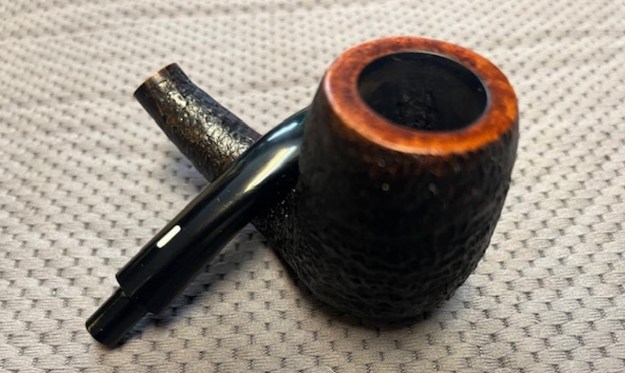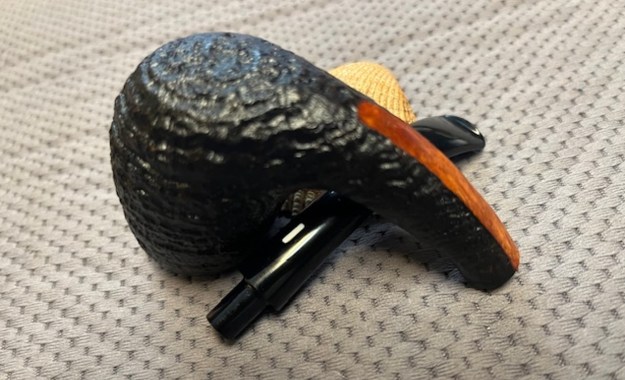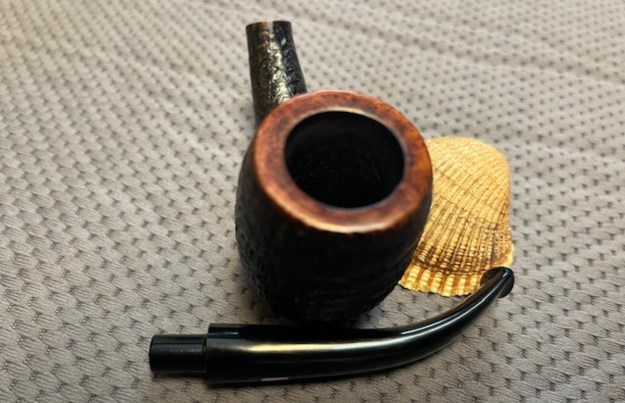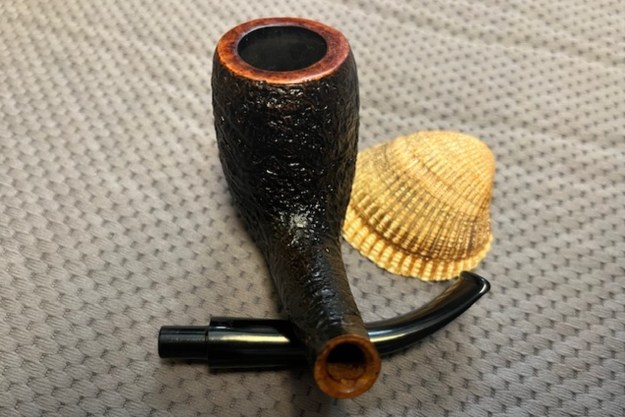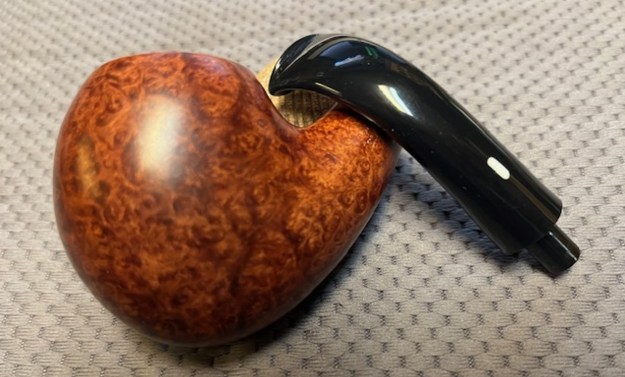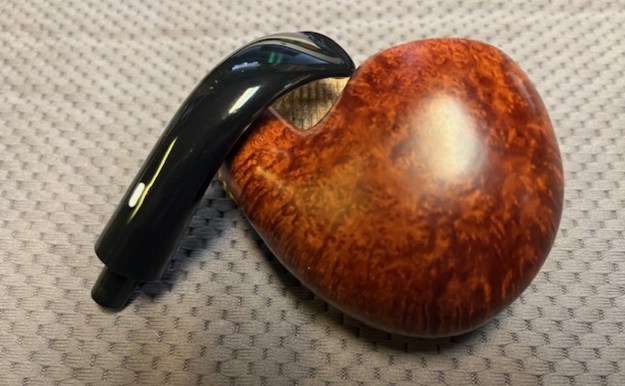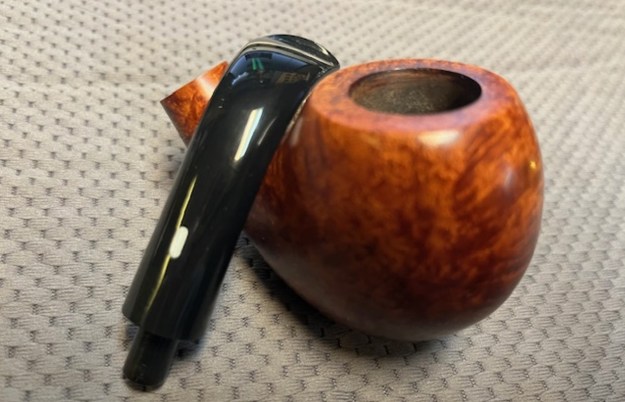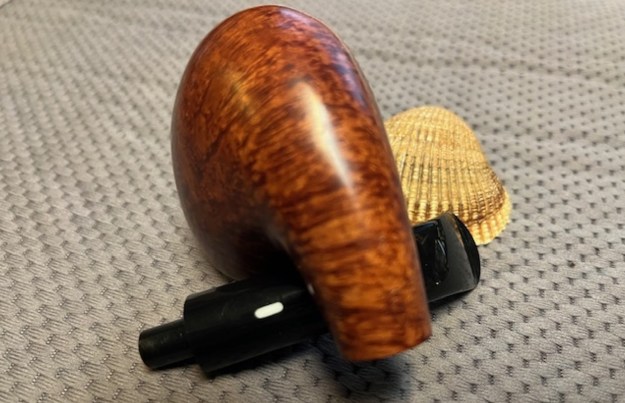
Monthly Archives: August 2024

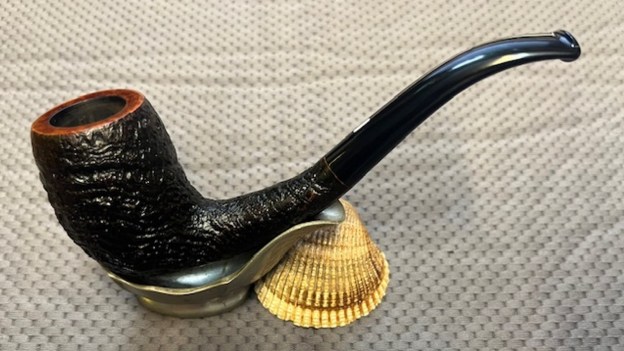
Restoring a Castello Old Antiquari KKKK Swan Neck Bent Billiard


By Steve Laug

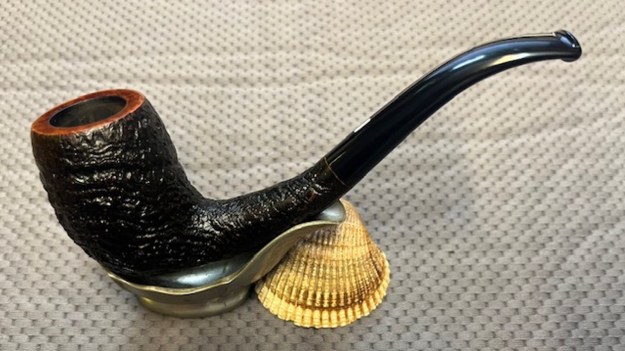
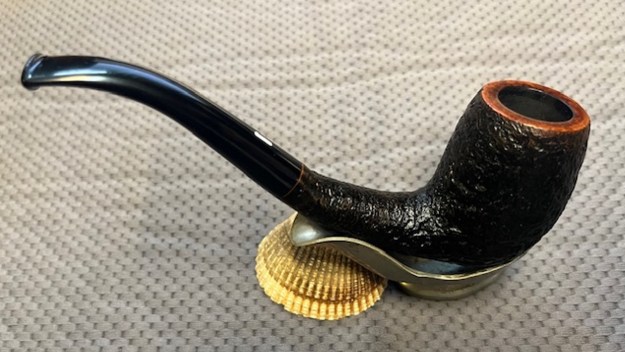
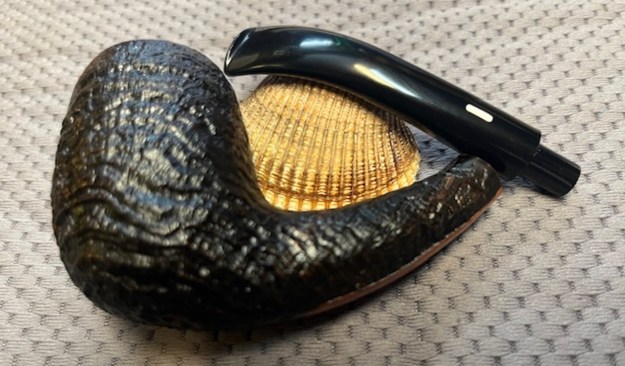
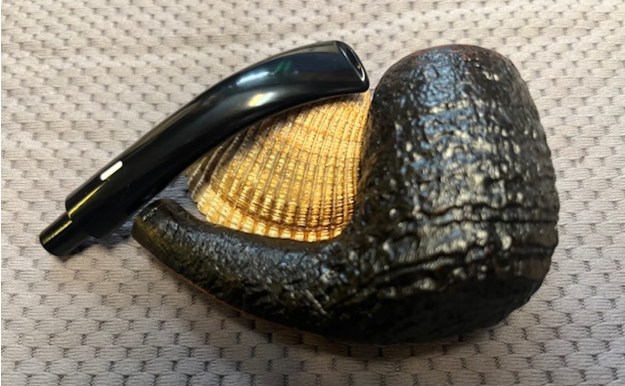
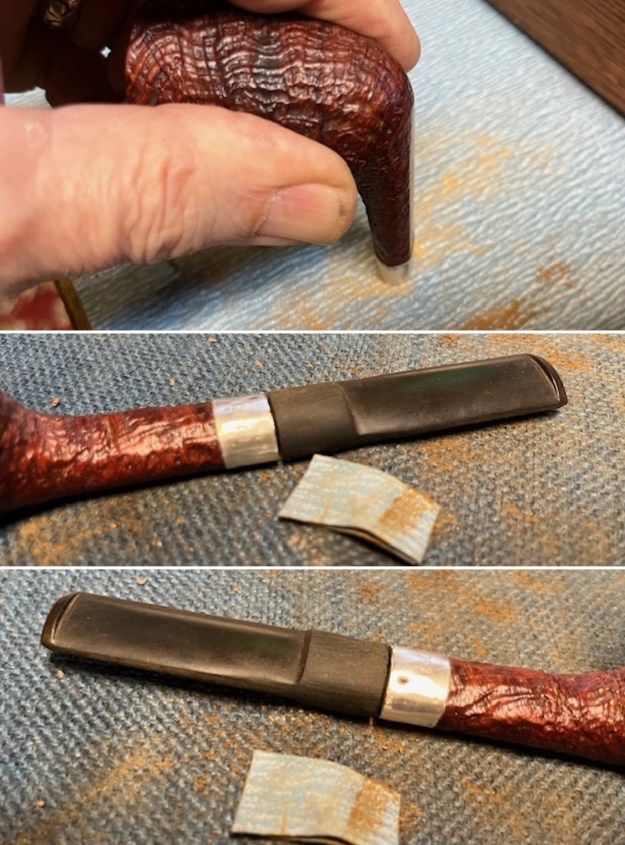
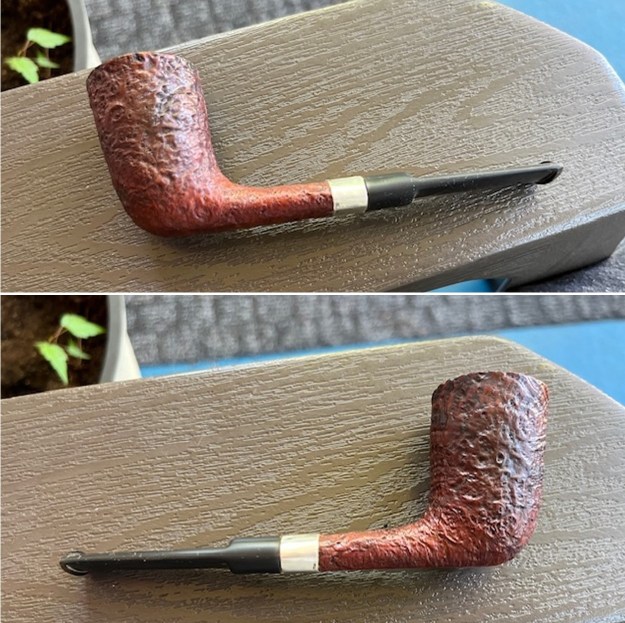
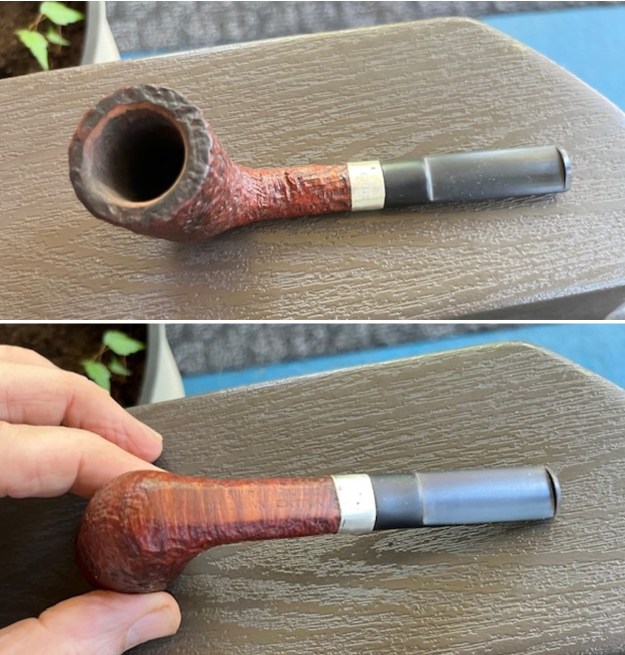
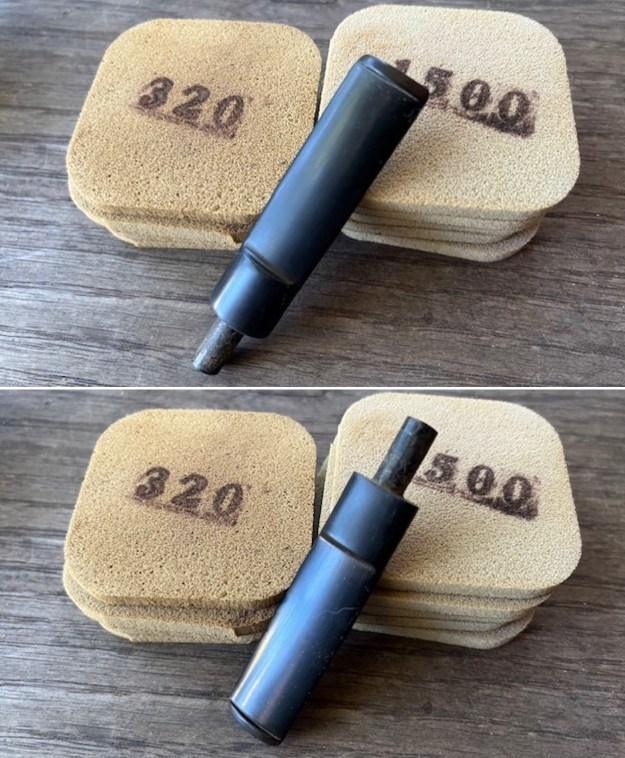
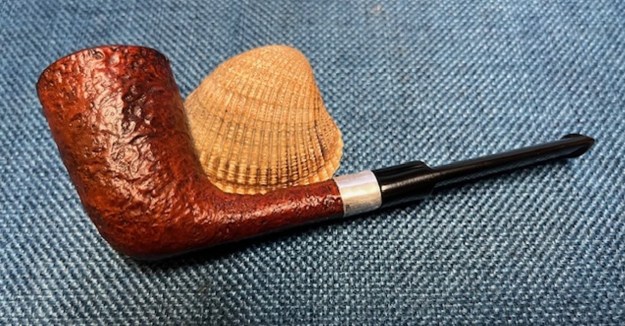
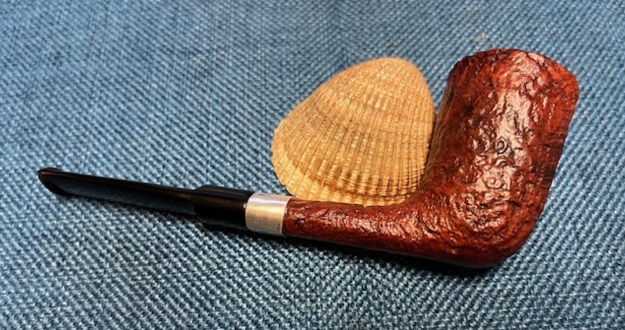
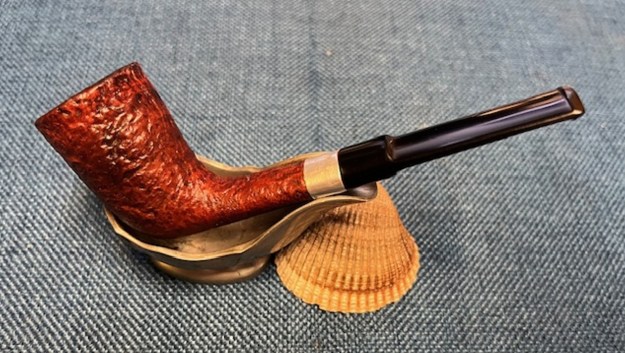
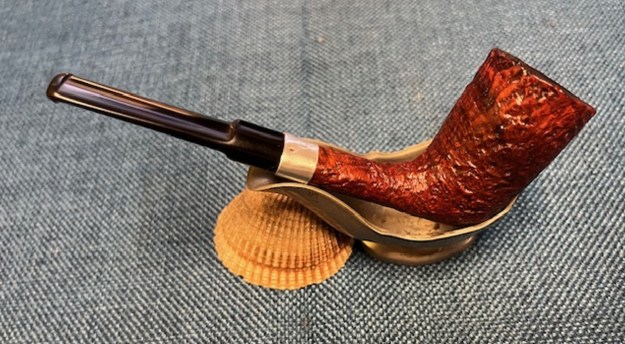
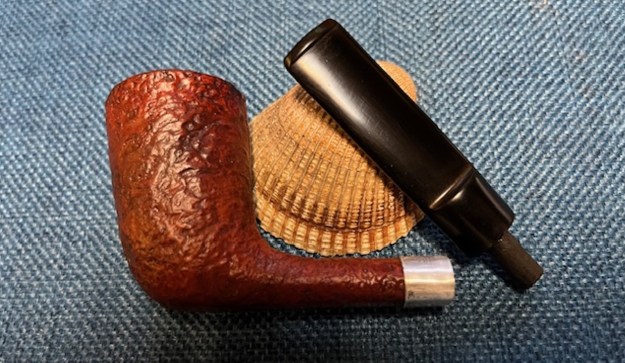
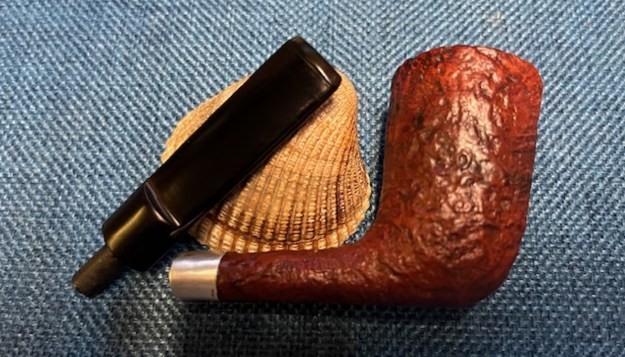
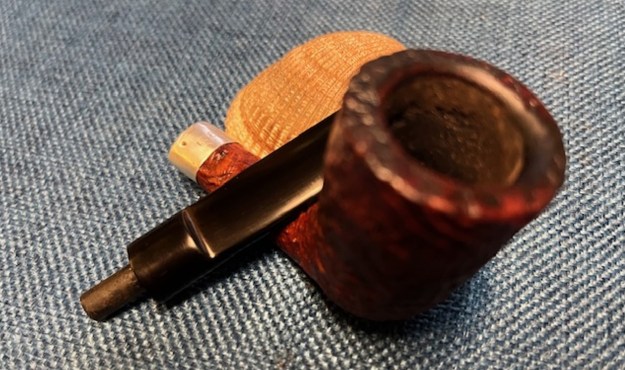
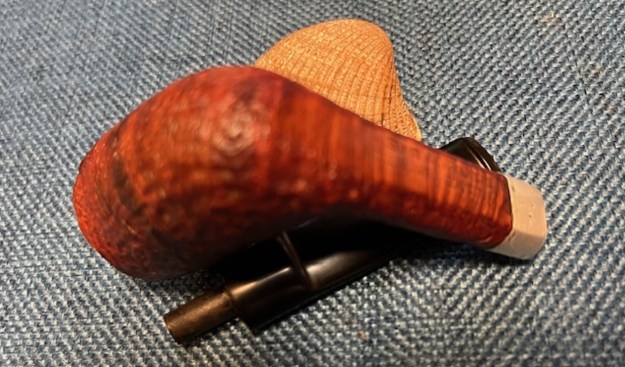
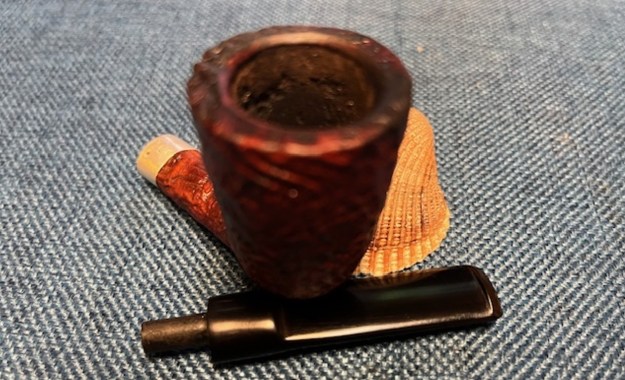
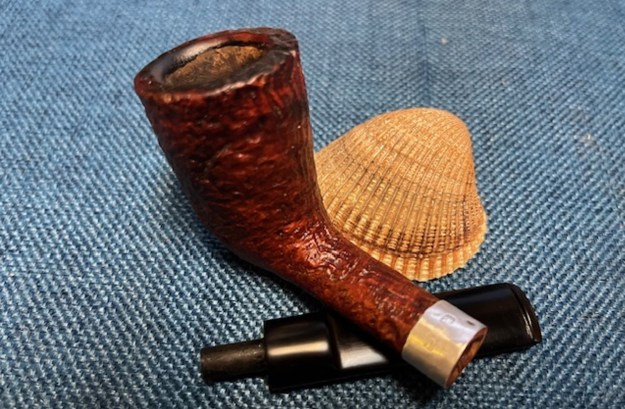
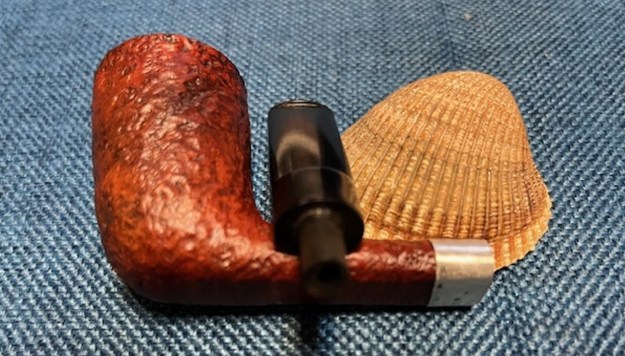
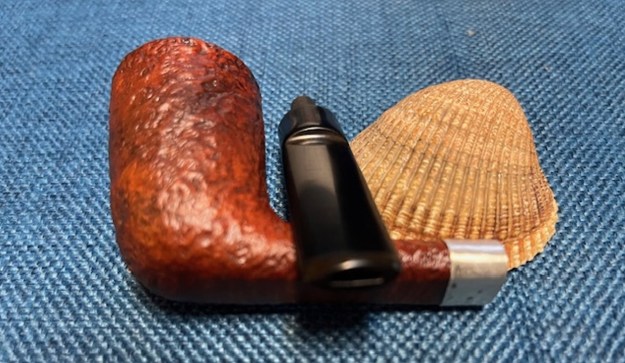
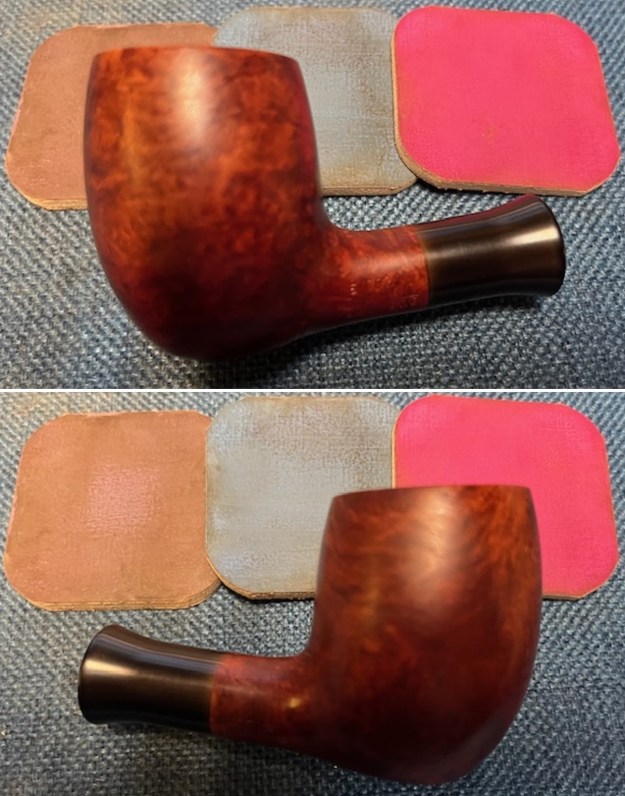
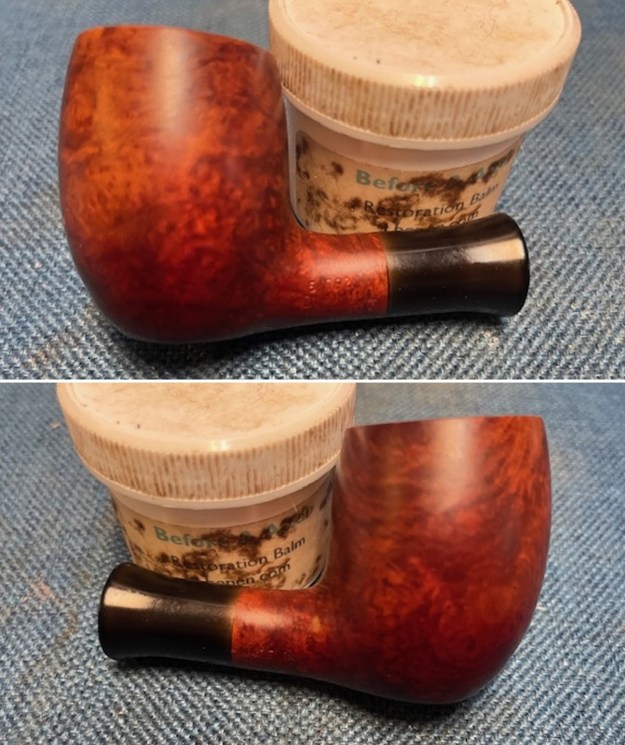
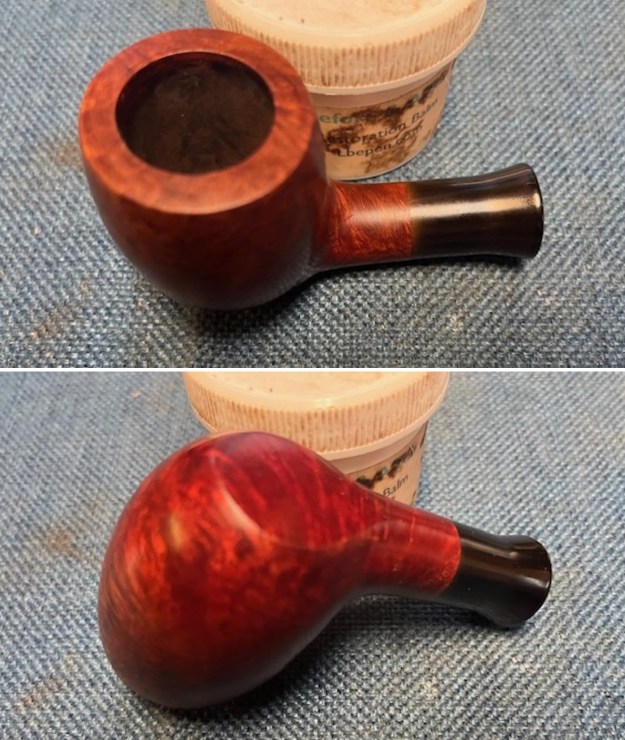
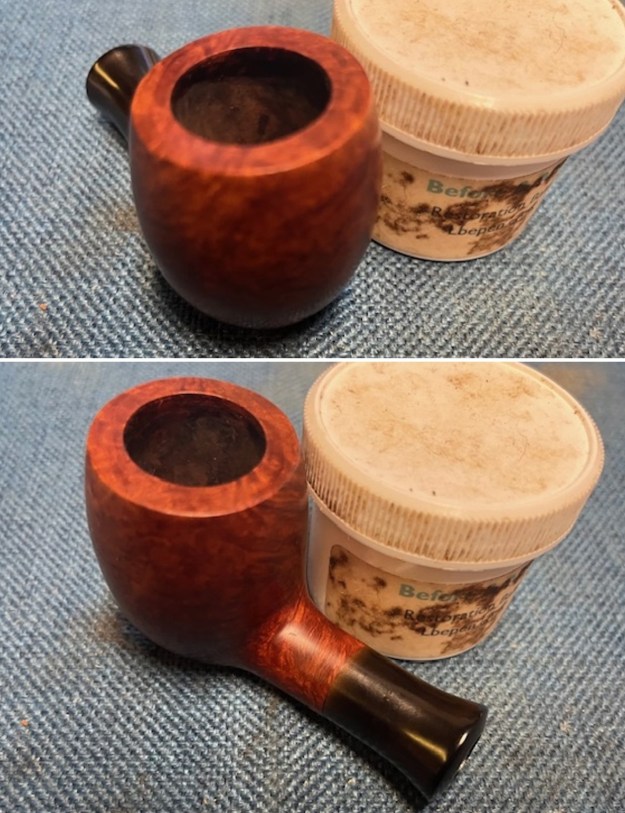
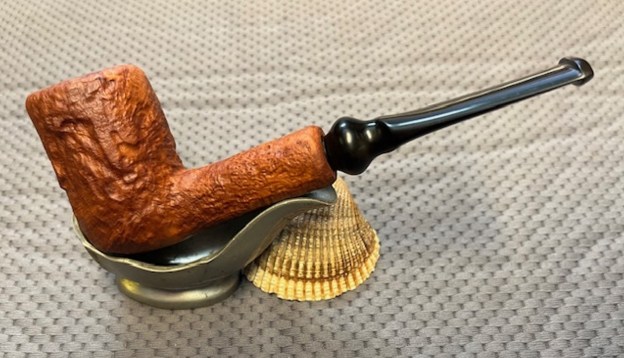
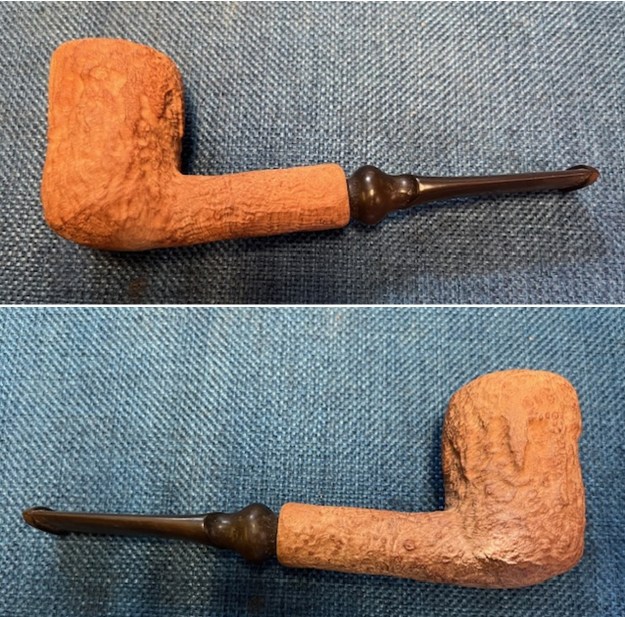
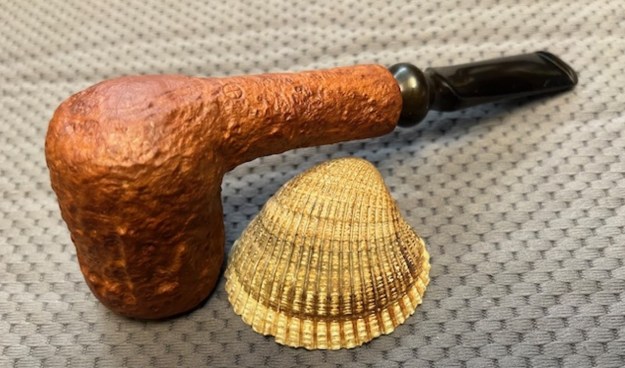
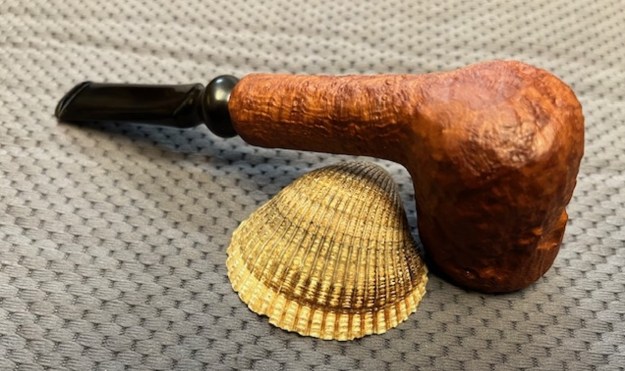
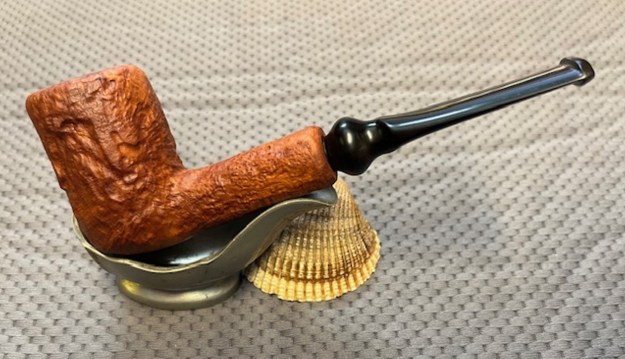
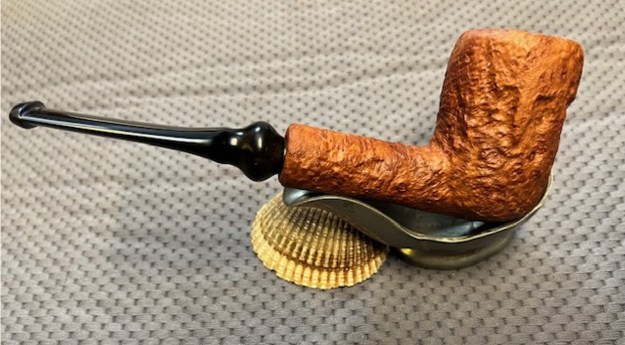
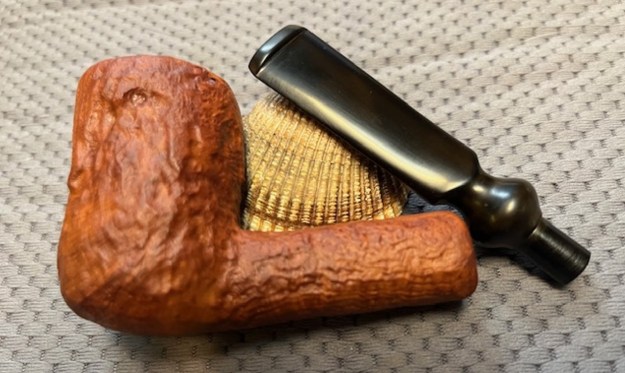
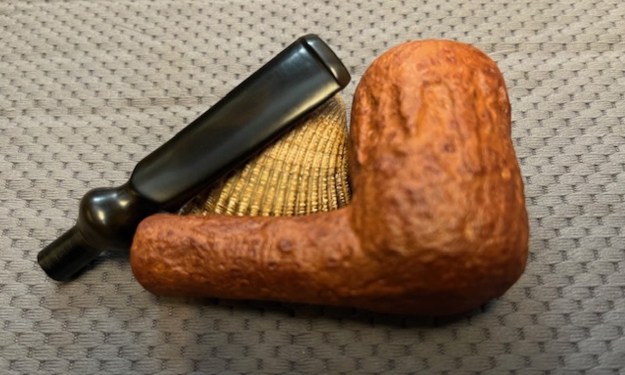
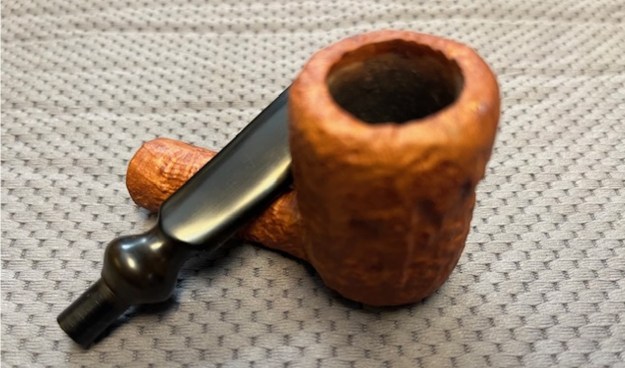
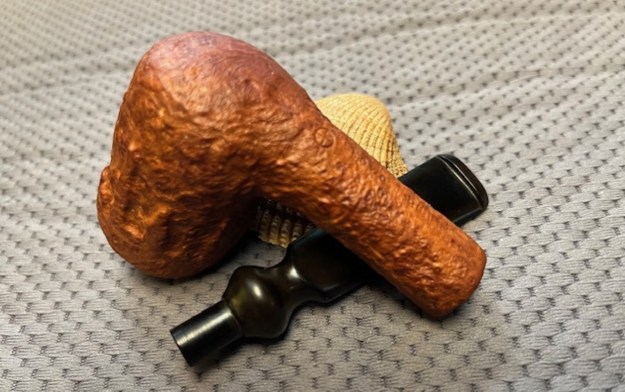
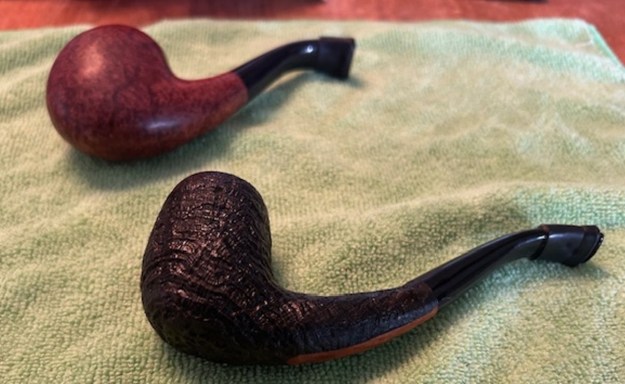
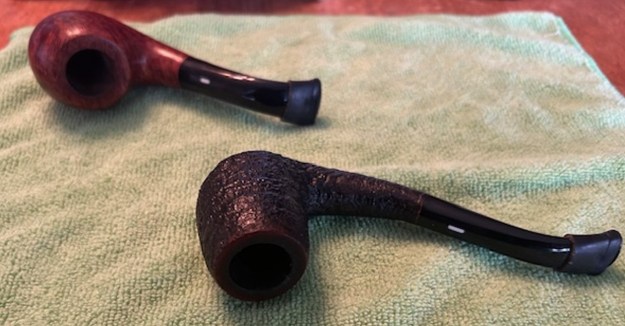
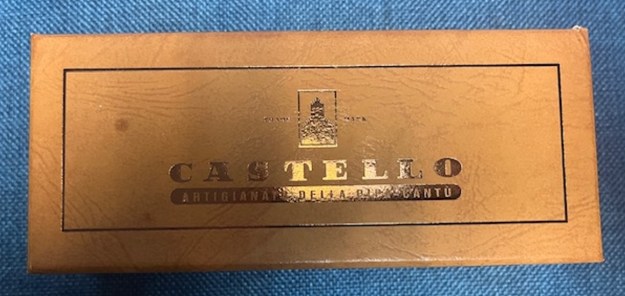
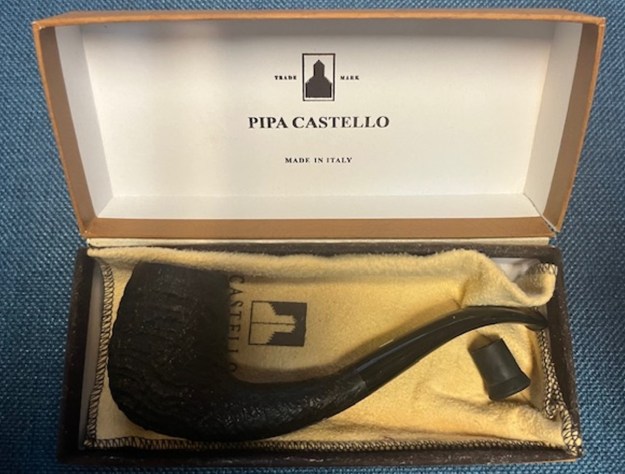
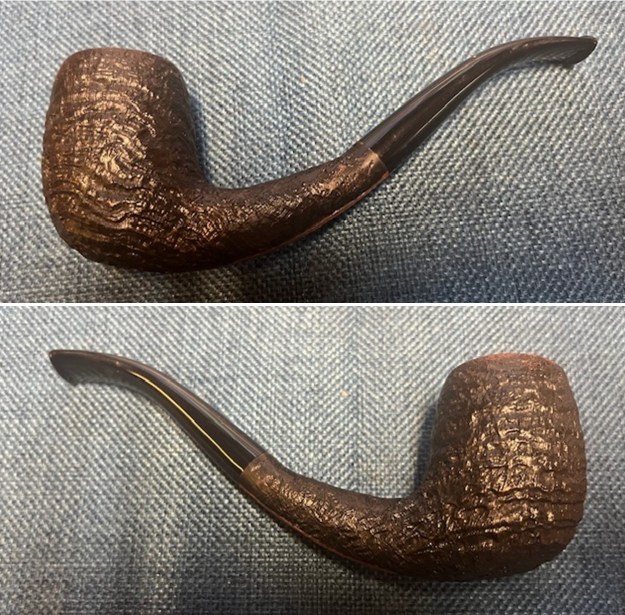
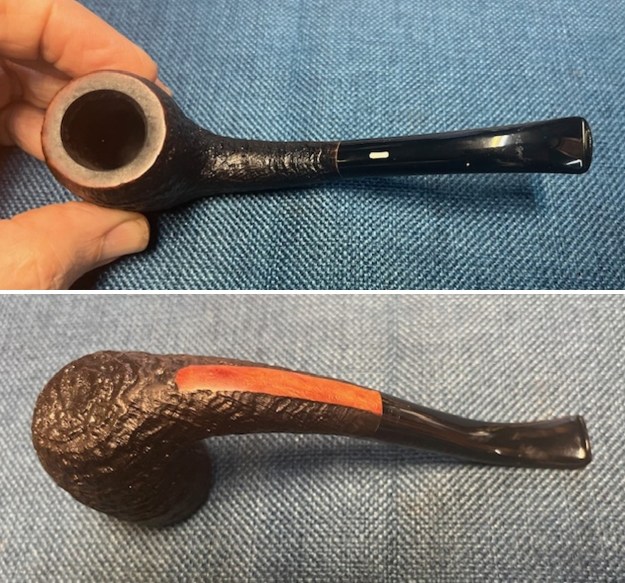
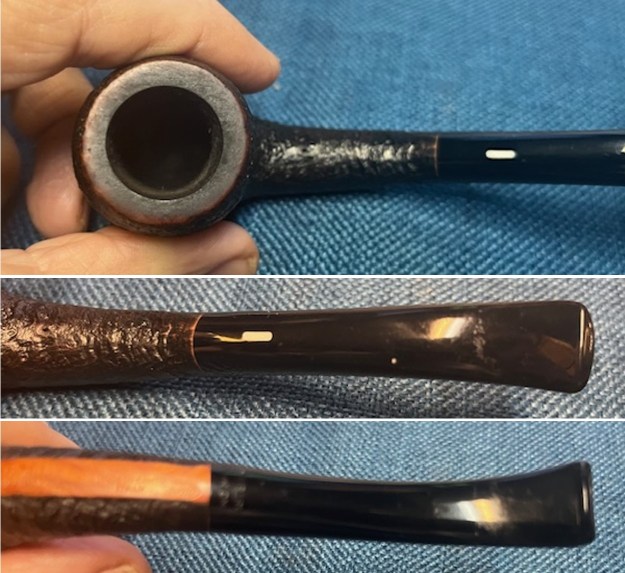
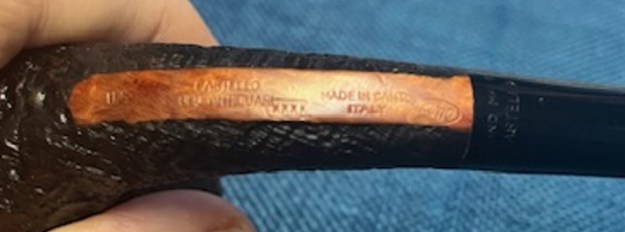
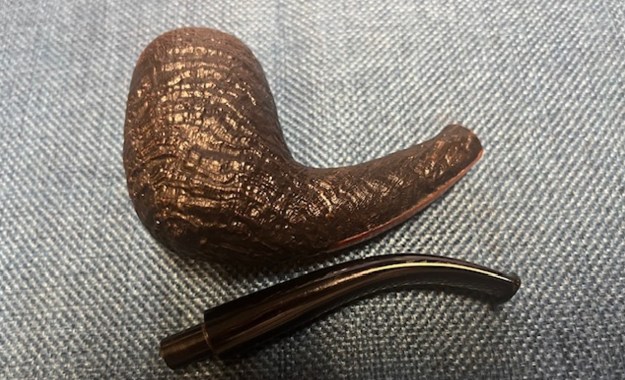
A week or so ago I traded some pipes for the two Castello Pipes below. The fellow I traded them with and I both felt we got a great trade. I chose to work on the bottom pipe in the photos below next. It is a sandblast finished Castello that is quite stunning. It is stamped on a smooth panel on the underside of the shank and reads US [followed by] Castello [over] Old Antiquari [followed by] Made in Cantu [over] Italy. That is followed by Kino in script in an oval. The bowl had a light cake and smelled primarily of Virgina tobaccos. There was some light lava on the smooth rim top but the inner and outer edge looked very good. The sandblast finish was dusty but the sandblast grain was beautiful. The acrylic stem has a white Castello bar on the topside of the taper. On the underside it is stamped Hand Made [over] Castello. There was a Softee Bit protector on the stem that had bite marks in it so I was a bit worried what might be underneath. When I removed it there was some light build up along the inner edge of the rubber bit guard but the acrylic was free of any bite marks or chatter. When the pipe arrived, it was in the Castello original box with the rich wood colour. The box is hinged on the back of the box and has no damage on the box but a tear on the back right corner of the lid. The hinge was in good condition. The top of the box has the Castello Castle logo with Trade on the left side and Mark to the right of the mark. Underneath that it is printed Castello [over] Artigianato Della Pipa – Cantu. On the end of the box it is stamped with the Castle logo followed a box with CASTELLO [over] a box for a shape or pipe shape/line designation. Underneath it is stamped Made in Italy.I opened the box and took a photo of the pipe inside. The inside of the cover it is stamped with the logo over PIPA CASTELLO [over] Made in Italy. The box had a cream coloured yellowish suede leather material with the same logo and stamp. The stem had a Softee Bit in place that I removed before I took the photo below.I took photos of the pipe itself to give a sense of what was needed in the cleanup of the bowl and shank. I would need to ream and clean the internals of the bowl and shank. The stem had grime on it where the edge of the Softee Bit was on the stem. There was no tooth damage or chatter on the acrylic surface. I took a photo of the bowl and the rim top. You can see the light lava on the rim top, slightly heavier toward the backside. You can also see the cake in the bowl. It is light to moderate in terms of thickness. The stem surface is undamaged on both sides ahead of the button. Other than the grime left behind by the Softee Bit the stem looks very good.I took a photo of the stamping on the underside and stem. It is clear and readable as noted above. I removed the stem from the shank and tried to capture a bit of the beauty of the birdseye grain on this lovely piece of briar. The grain is the same on both sides with cross grain on the front of the bowl, the back of the bowl and the underside of the shank at the end.I checked on Pipephil’s site (http://www.pipephil.eu/logos/en/logo-castello.html) and found a section on the Old Antiquari. It also had some information on the family line of the Scottis. I included that information below the screen capture of one of the pipes.Castello PIPA CASTELLO di Carlo Scotti & C. was founded in 1947 by Carlo Scotti († 1988). Franco Coppo (AKA “Kino”) who married Carlo Scotti’s daughter Savina, manages (2012) the corporate since 1985.
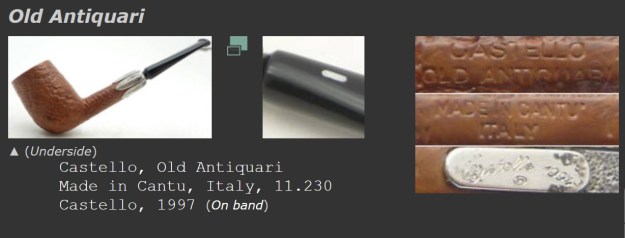
A great history of the brand is available on Pipedia (https://pipedia.org/wiki/Castello). It is worth a read.

I did a google search on the Castello Old Antiquari Swan Neck Billiard and found a link to an apple shaped Castello Old Antiquari pipe with a very similar profile along the underside of the shank (https://www.smokingpipes.com/pipes/new/castello/moreinfo.cfm?product_id=345891). Chuck Stanion has a brilliant description of the pipe that easily applies to the pipe that I have in hand here. I quote:

The heel of this Castello Apple is quite long, adding to the goose-neck quality of the shape’s silhouette, but it has not been flattened for sitting, so you’ll need a pipe stand. The smooth rim matches the highlights of the sandblast perfectly, and is brightly contrasted by the pure-white mouthpiece. The blast is craggy and deep, offering substantial hand comfort for long smoking sessions. – Chuck Stanion

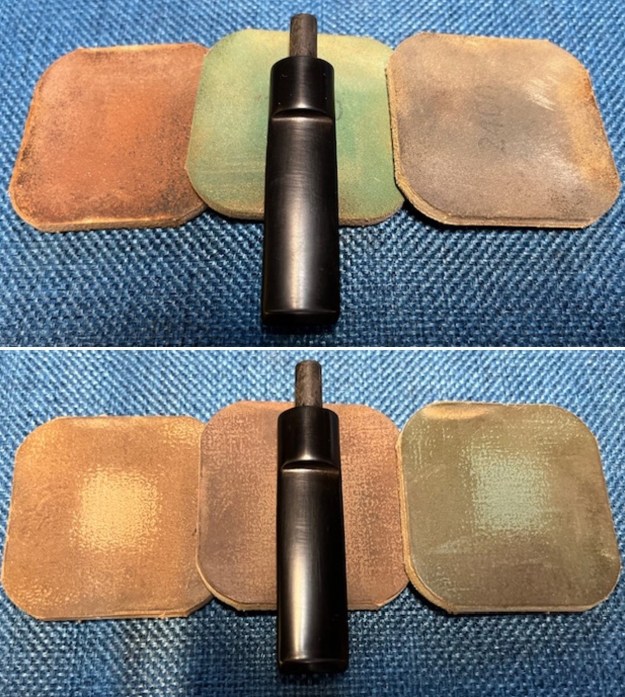
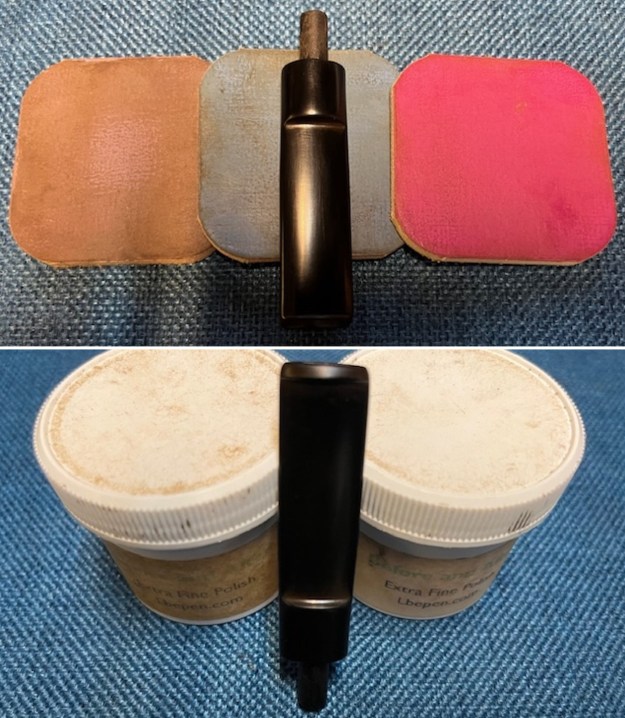
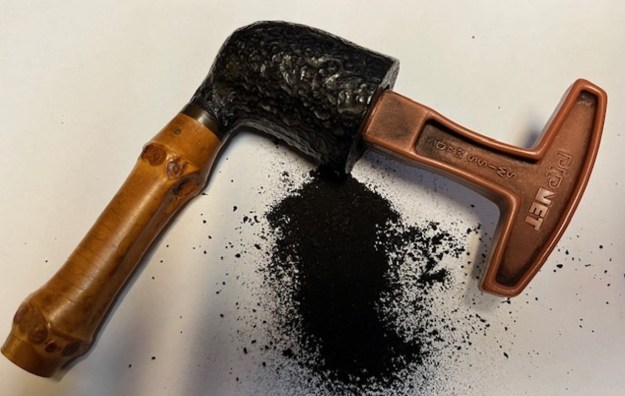
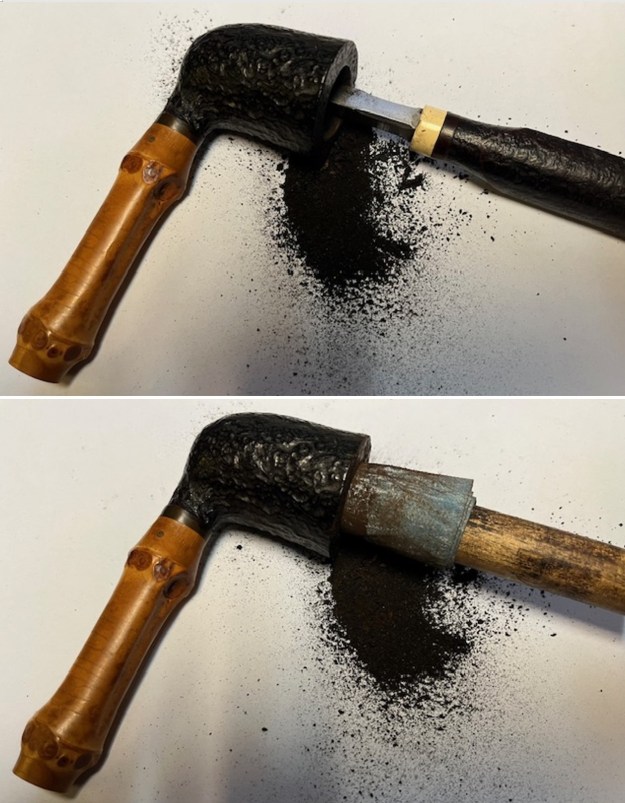
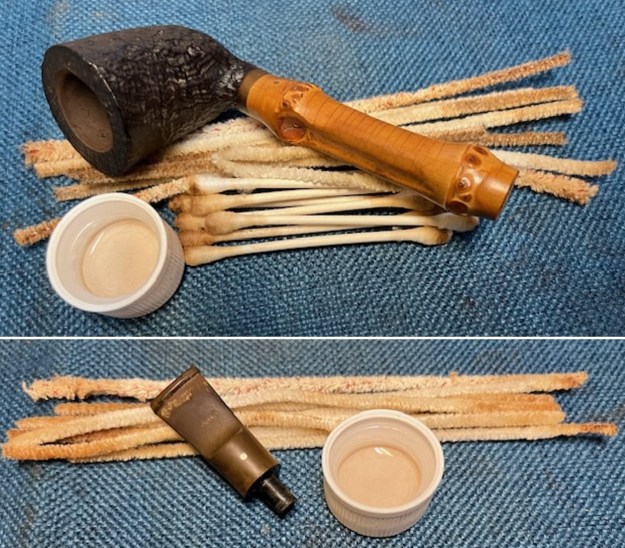
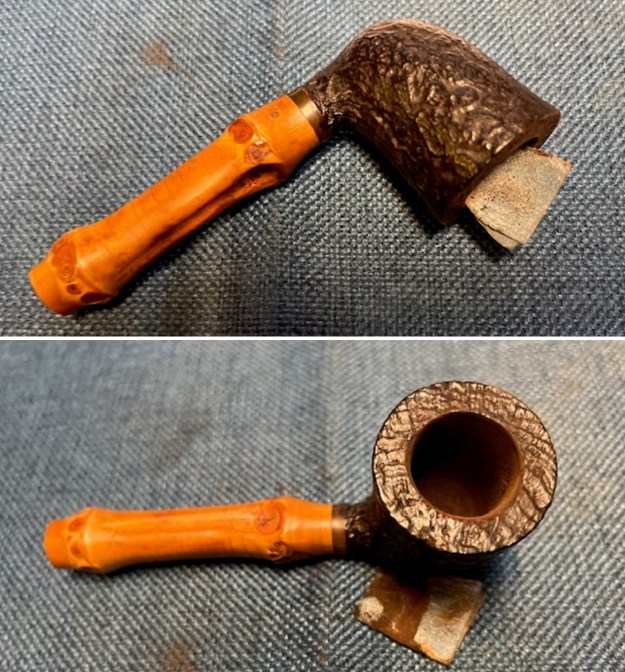
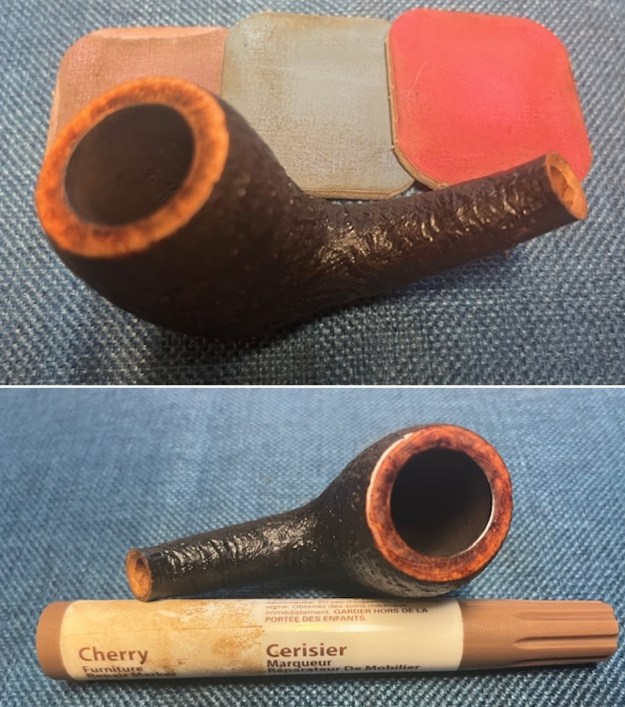
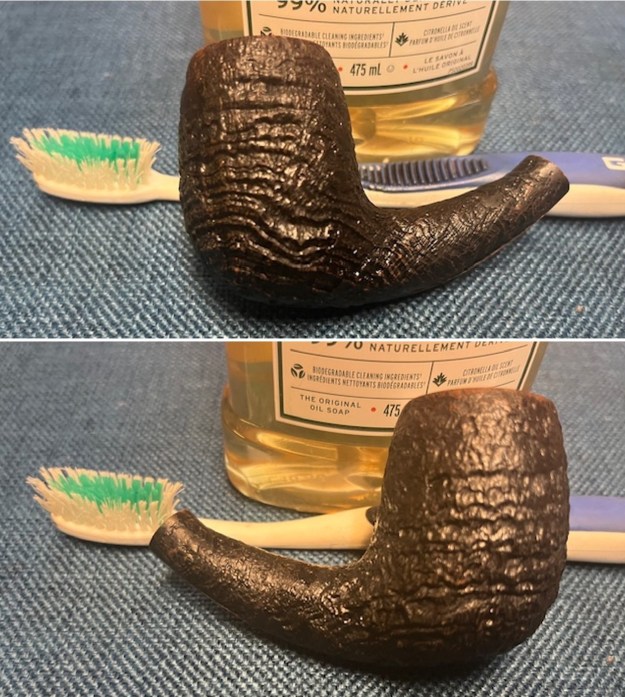
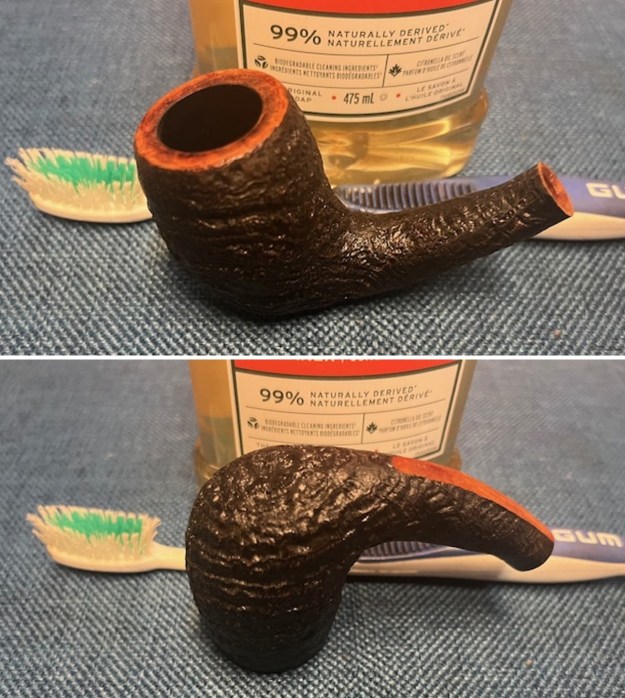
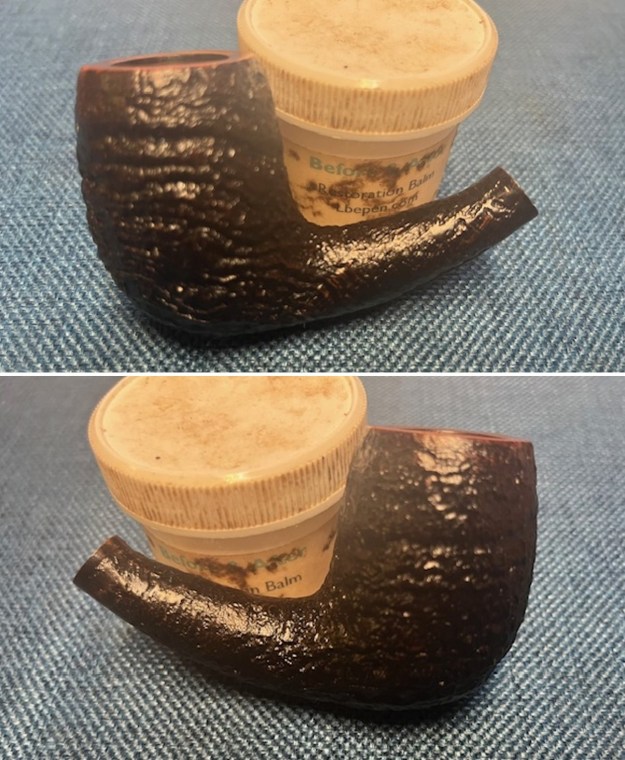
Now it was time to work on the pipe. I started my work by reaming the pipe. I scraped out the light cake with a Savinelli Fitsall Pipe Knife. I took the cake back to bare briar. I sanded the walls smooth with 220 grit sandpaper wrapped around a piece of dowel. The bowl walls looked very good with no burn damage or checking on the walls. I scraped the smooth rim top with the Fitsall Knife edge. I was able to get the thick grime off. I scrubbed it down with a damp paper towel and it looked much better.I cleaned out he internals of the shank, mortise and airway in the shank and the stem with alcohol, cotton swabs and pipe cleaners.I polished the rim top with micromesh sanding pads. I dry sanded with 1500-12000 grit sanding pads. I wiped the rim top down after each pad with a damp cloth to remove the debris. I touched up the rim top with a Cherry stain pen to match the smooth patch on the bottom of the shank. I scrubbed the externals of the bowl with undiluted Murphy’s Oil Soap and rinsed it off with warm water to remove the soap and the grime. I dried it off with a soft cotton towel. It looked much better at this point and the grain really stood out on the bowl sides. I rubbed the briar down with Before & After Restoration Balm. I worked it into the smooth surface with my fingertips. The product works to clean, enliven and preserve the briar. I let it sit for 10 minutes then I buffed it with a cotton cloth to deepen the shine. The briar really comes alive with the balm. The stem was in such good condition that I polished the acrylic stem with the higher grit micromesh sanding pads – 3200-12000 grit pads. I wiped it down with Obsidian Oil after each sanding pad. I used Before & After Pipe Stem Polish – both Fine and Extra Fine to further polish the stem. This beautiful Castello Old Antiquari Sandblast KKKK Swan Neck Bent Billiard with a taper acrylic stem looks amazing after the work on it. The briar is clean and the blast really came alive. The rich brown stains gave the finish a sense of depth with the polishing and waxing. The finish really popped. I put the stem back on the bowl and buffed the pipe with Blue Diamond on the buffing wheel using a light touch on the briar. I gave the bowl and the stem multiple coats of carnauba wax on the buffing wheel. I buffed the pipe with a clean buffing pad to raise the shine. I hand buffed the pipe with a microfiber cloth to deepen the shine. The finished Castello Old Antiquari Swan Neck Billiard really is a beauty and feels great in the hand and looks very good. Give the finished pipe a look in the photos below. The dimensions of the pipe are Length: 6 inches, Height: 2 inches, Outside diameter of the bowl: 1 ¼ inches, Chamber diameter: ¾ of an inch. The weight of the pipe is 46 grams/1.62 ounces. I will soon be putting this pipe on the rebornpipes store in the Italian Pipe Makers section. It should make a great smoker that the next steward will enjoy. Thanks for reading this blog and my reflections on the pipe while I worked on it. It was a fun one to work on.
Restoring a Piece of Danish Pipe History – a Suhr Kobenhavn Bruyere Extra Dublin


By Steve Laug

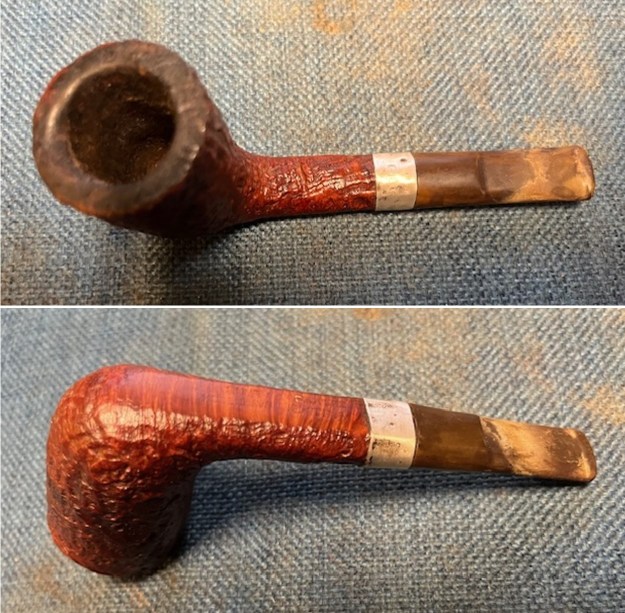
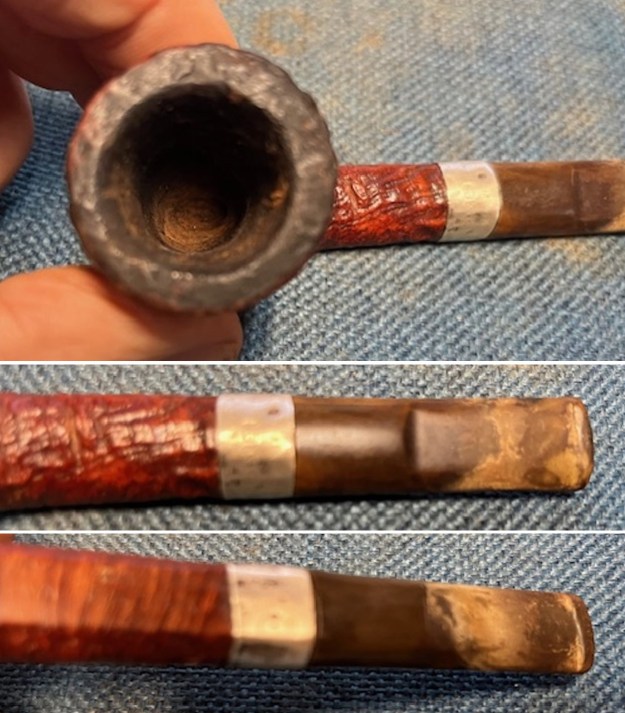
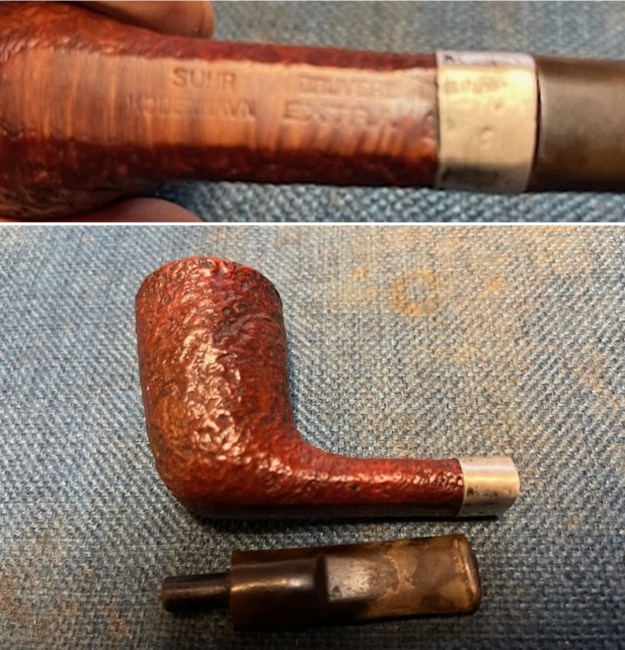
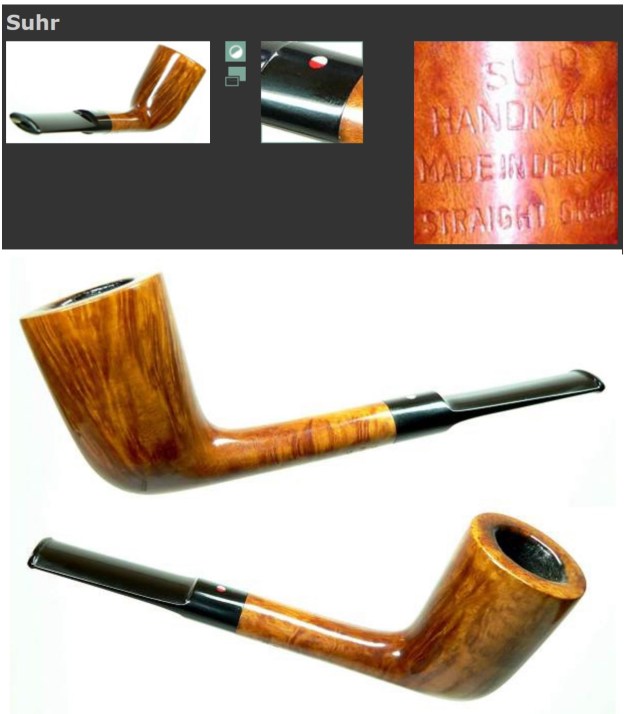
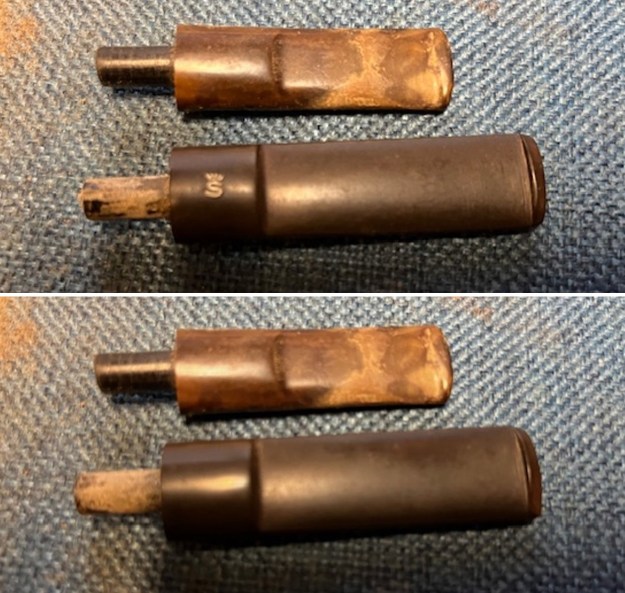
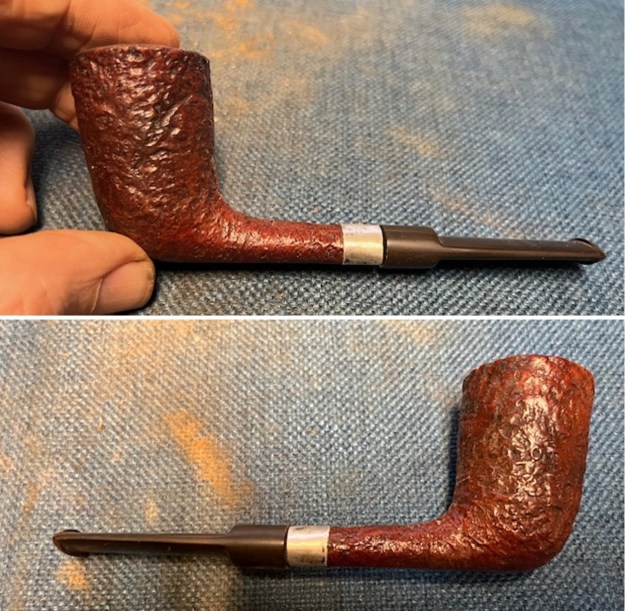
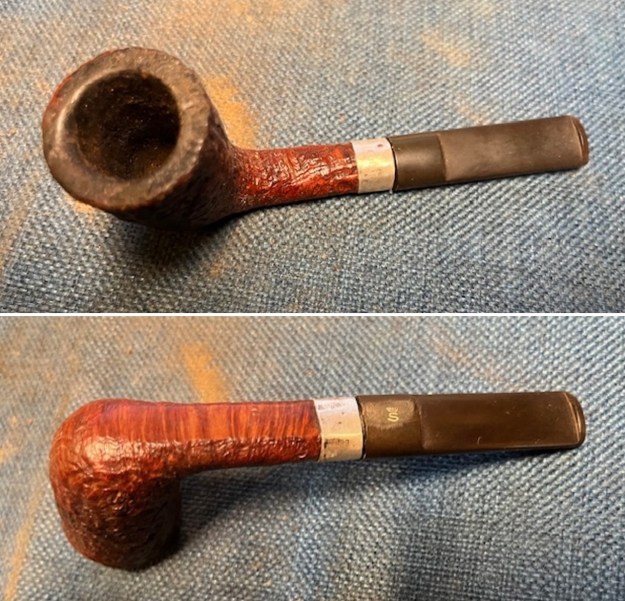
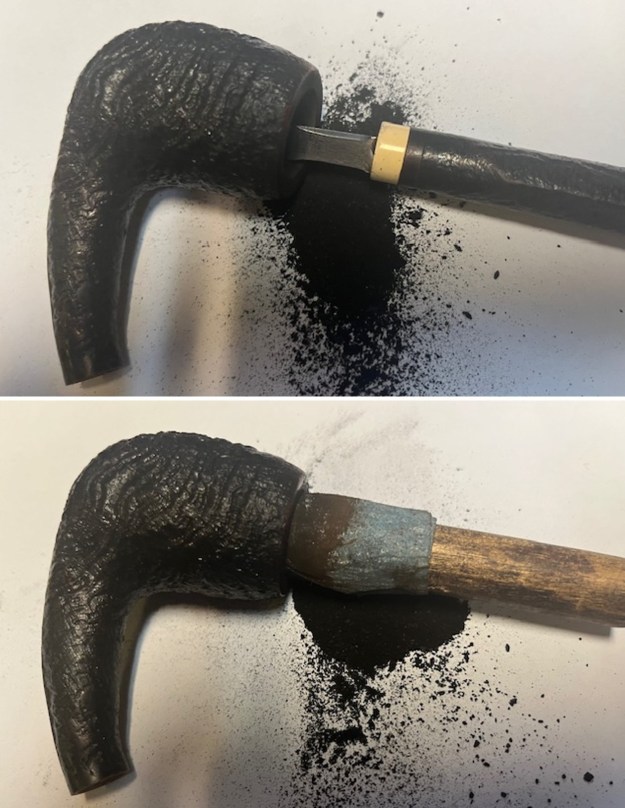
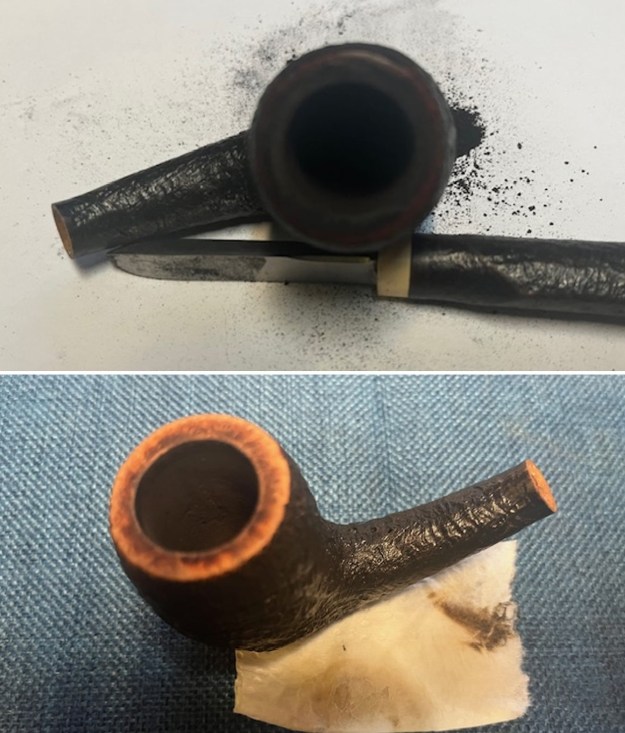
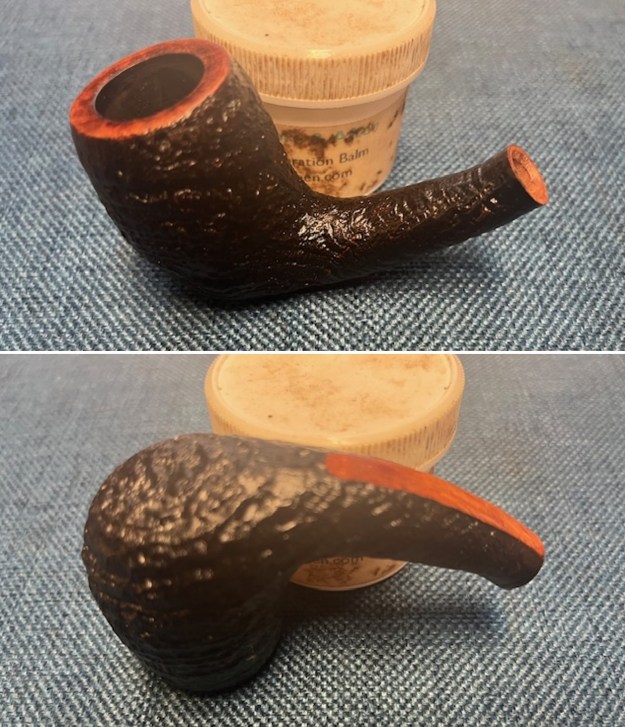
The next pipe on the table is an interesting short stemmed, sandblast Dublin that I found in a display cabinet. We purchased it from an Antique Mall in Lincoln City, Oregon, USA on 08/24/2024. The pipe is stamped on the underside of the shank Suhr [over] Kobenhavn. That is followed by Bruyere [over] EXTRA. The band covers some of the next portion of the stamp but it looks like it reads By Hand [over] a shape number beginning with 9. The band is stamped Birmingham Sterling Silver and has a T date stamp. The shank is cracked and I assume that someone put an English band on it that in no way reflects the country of origin. The bowl had a thick cake and lava overflowing on the rim top and inner edge. The sandblast finish was dirty with grime in the sandblast. The stem is worn and has been cut off and a button shaped at the end. There was no bother taken on the slot and it is uneven and rough. It leaves a short snorter of a pipe that does not quite look right.  I took photos of the pipe before I started my clean up work. I have included them below. I took a photo of the rim top, bowl and the surfaces of the stem to give a sense of the condition of the pipe. The bowl is out of round toward the front of the bowl. There was a thick lava coat on the rim edges or top filling in the sandblast. The stem is heavily oxidized, calcified and dirty. It has also been cut off a bit crooked and the button is not clean. The Sterling Silver shank band is dented, scratched and oxidized. It has also been cut at an angle.I took photos of the stamping on the sides of the shank. It is clear and readable and read as noted above. I took a photo of the pipe with the stem removed. It is definitely dirty and very oxidized on the shank extension and the stem.While I was looking at the pipe in the Antique Mall I looked up the Suhr brand on Pipephil’s helpful site where he has some great resources on stamping (http://pipephil.eu/logos/en/logo-s13.html). I had a fleeting memory of the name but I could not give it any data. I read about the brand and looked at the shape of the pipe shown on the site which was very similar to the pipe I was looking at. I was pretty convinced that the pipe at the shop was made by the same Suhr as shown on Pipephil’s site. The photos included also gave a clear picture of what the original stem may have looked like on the pipe when it left the maker. I bought it based on that information and added it to the purchase.

I have added the information, photos and a screen capture of the section below for the purpose of putting the information together with the restoration. Suhr’s Pibemageri (pipe workshop) was owned by Teophil Suhr. Poul Rasmussen († 1967), Svend Axel Celius or Sven Knudsen used to produce the pipes proposed in the shop.

It is not established the red-white dot is Suhr’s original logo. it may be the symbol used by Poul Rasmussen himself. See also: Anne Julie (widow of Poul Rasmussen)

When I got home and before I began working on the pipe I reread PipePhil’s info included above and turned to Pipedia for more (https://pipedia.org/wiki/Suhr%27s_Pibemageri). I quote from that site below.

Suhr’s Pibemageri was a pipemaking workshop started by Teofil Suhr in Copenhagen central to the birth of the modern Danish pipe. When Sixten Ivarsson, then a debt collector newly moved to Copenhagen, broke his pipe, it was to Suhr’s he went for a repair, only to find a broken lathe and no pipemaker. Soon after, he was working as the foreman at Suhr’s, where, among others, Peter Micklson got his start and Sven Axel Celius learned pipemaking from Poul Rasmussen and his then foreman Sven Knudsen. Pipes from Suhr’s were stamped with the workshop name Suhr, and on occasion carried the same red and white dot used by Anne Julie to this day.

While it is said to be a disagreement with Suhr’s that led Ivarsson to leave for Stanwell, and all of these names went on to greater fame in later years, it would be impossible to overstate the importance of Suhr’s to the evolution of the modern smoking pipe.

I googled Suhr to find more information. I found some on the Smokingpipes.com web site (https://www.smokingpipes.com/pipes/new/suhr/). I quote the information on the brand there.

Suhr is a venerable name, tracing back to the 1940s in Copenhagen, where it was primarily a pipe repair shop before picking up pipe manufacturing. Sixten Ivarsson served as foreman there in the 1940s before moving on to Stanwell. When he left, Poul Rasmussen became foreman and made Suhr pipes until his death in 1967. His widow, Anne Julie, started making pipes at that time, and eventually trained other carvers, including Tom Eltang.

The grandson of famous pipe makers Poul Rasmussen and Anne Julie, Johannes Rasmussen trained with Tom Eltang for years before carrying on the Suhr name.

When Johannes decided to pursue pipe making, he went full circle in his family history and contacted Tom Eltang for an apprenticeship. While at the Eltang workshop, he learned the basics and began exploring his own creative voice, expanding his artistic reach until confident about breaking out on his own.

It was natural to resurrect the Suhr name for his pipes. Johannes credits his grandparents and Tom Eltang for his inspiration, and they were all part of Suhr history. He maintains a keen understanding of his place in the historical legacy of pipe making, in which he stands on the shoulders of giants.

I also turned to another site listed by google called Worthpoint. The site also showed a Suhr pipe and the description is very similar to mine (https://www.worthpoint.com/worthopedia/bruyere-extra-suhr-kobenhavn-hand-1864270360). I quote the site’s description below.

No cracks or rim chips. Reads “2085 BRUYERE EXTRA SUHR KOBENHAVN BY HAND ” on the shank.

The shape number 2085 is the only difference in the stamp. The order of the stamp is slightly different but the data is the same. From that it helped me interpret what is partially hidden under the silver band. I now knew that it read By Hand and the shape number starting 9.

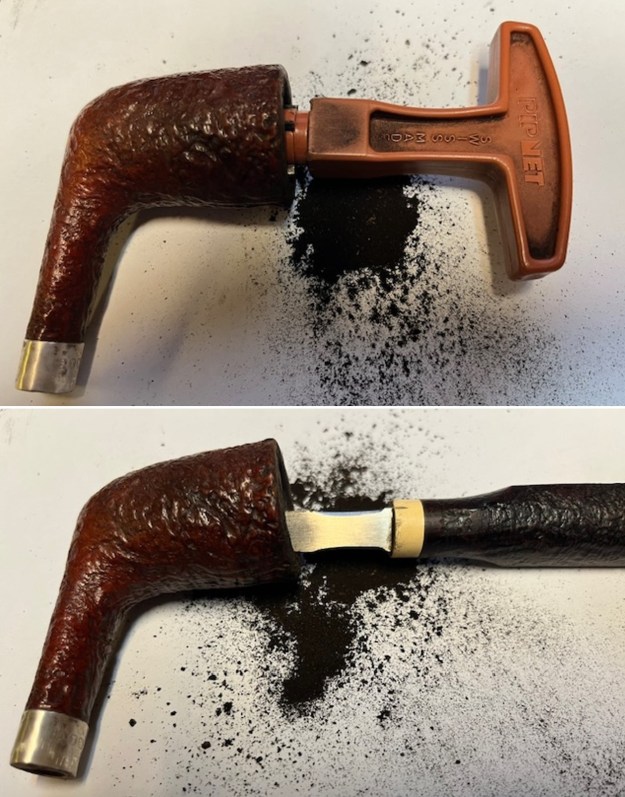
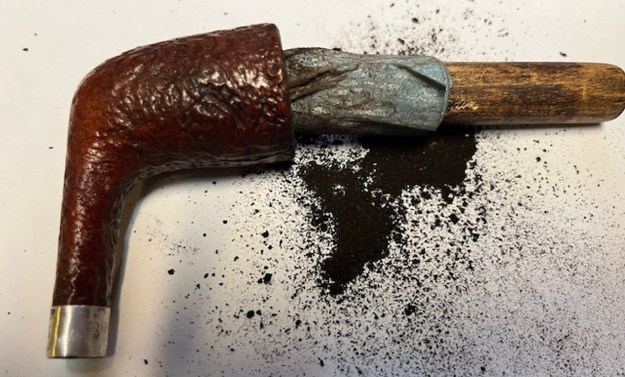
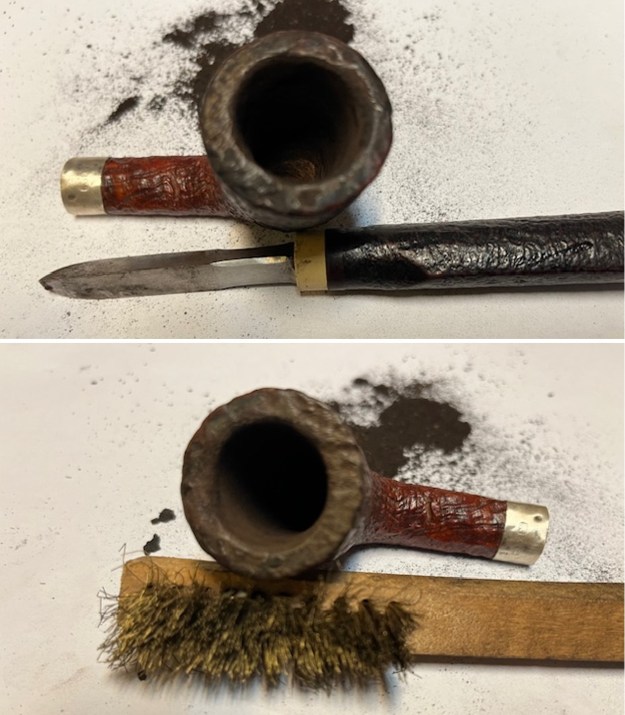
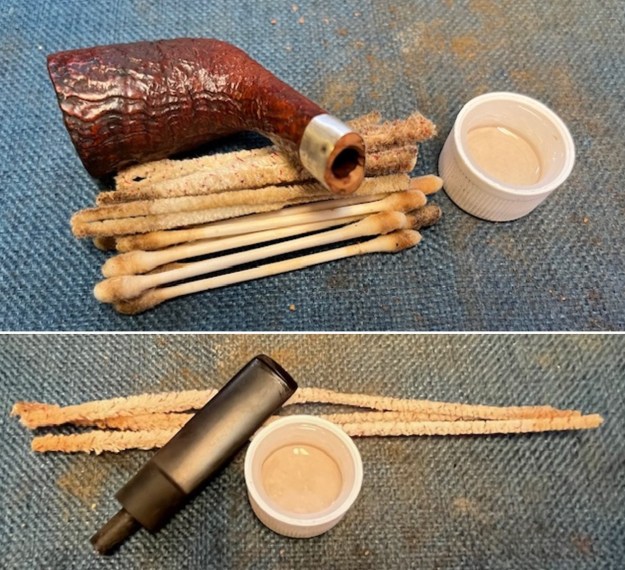
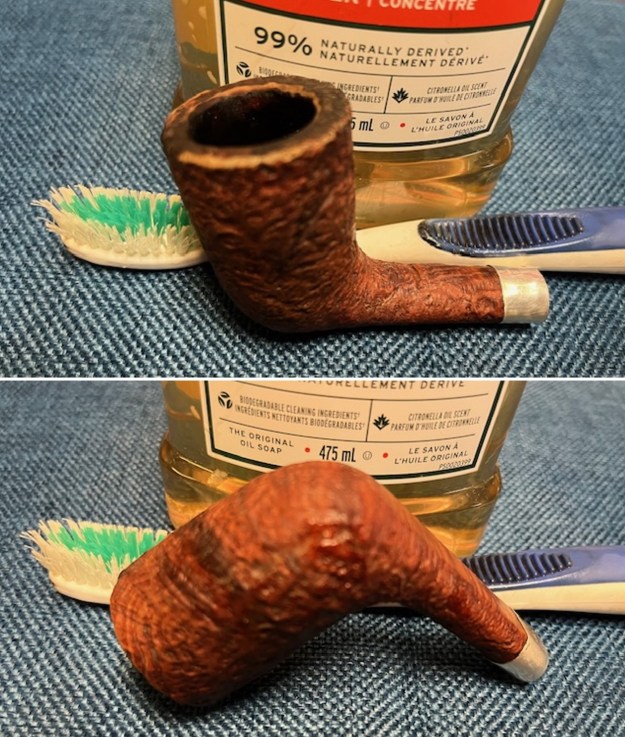
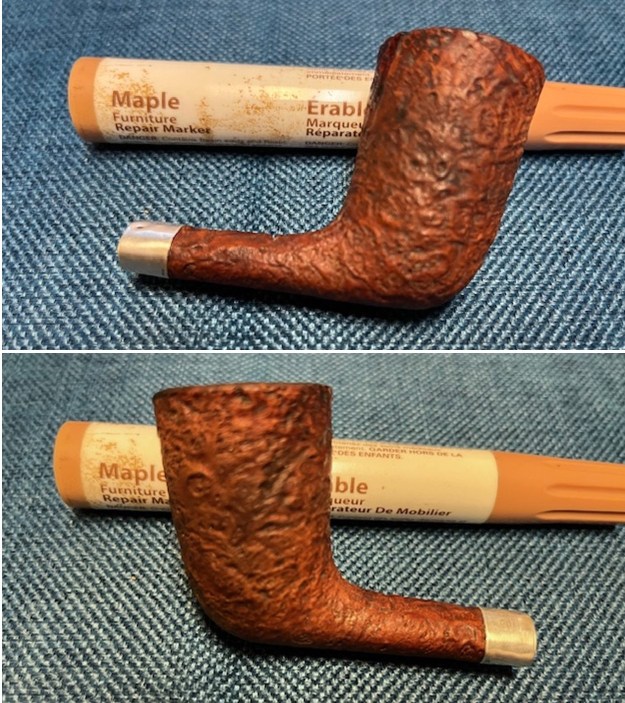
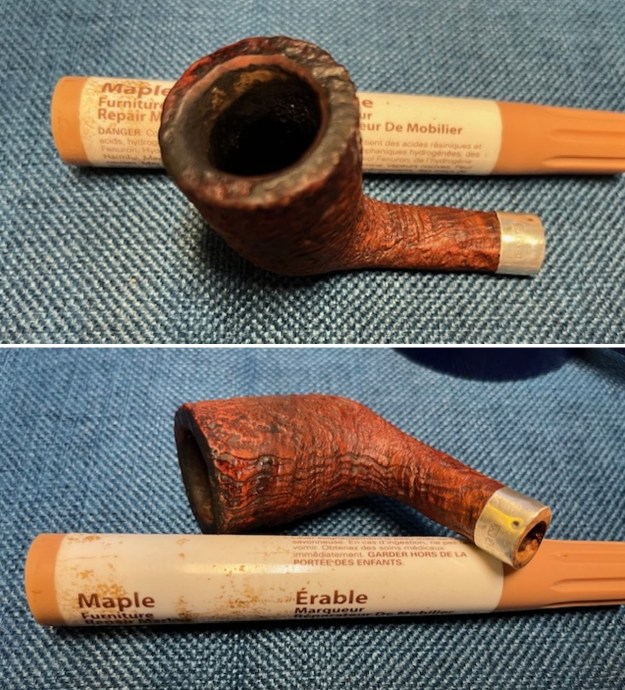
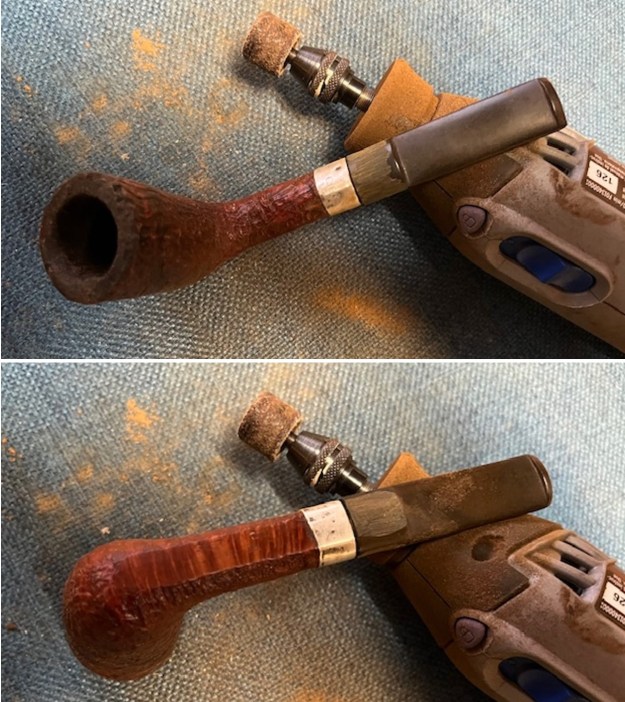
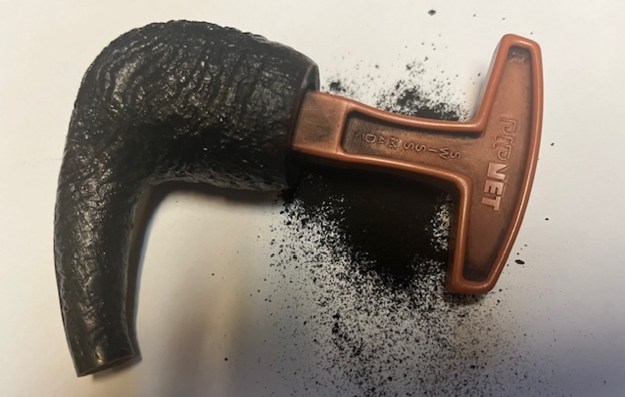
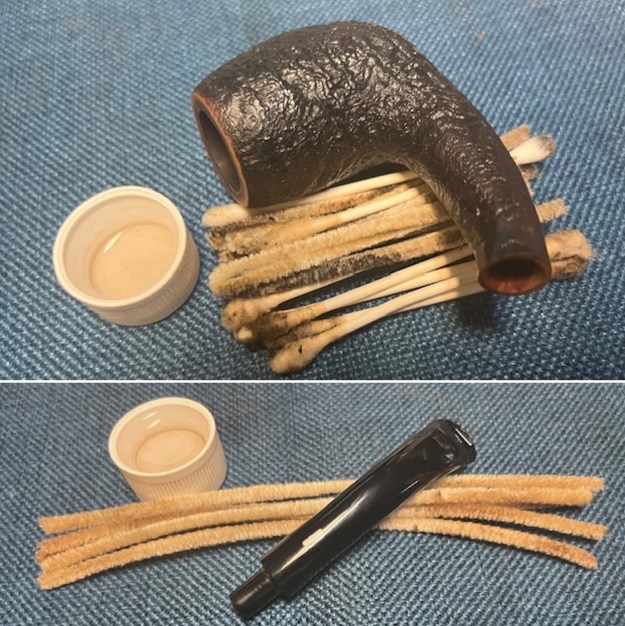
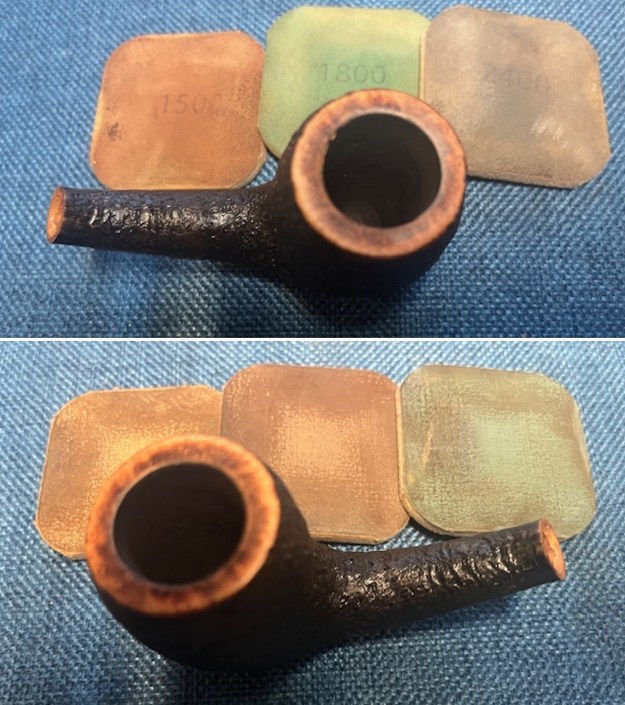
Now it was time to work on the pipe. I started my work by reaming the cake and debris in the bowl. I reamed it with a PipNet pipe reamer using the 1st and 2nd cutting heads to remove the cake. I took it back to bare briar. I followed that by scraping out what remained on the bowl walls with a Savinelli Fitsall Pipe Knife. I sanded the walls smooth with 220 grit sandpaper wrapped around a piece of dowel. The bowl walls looked very good with no burn damage or checking on the walls. I scraped the rim to with the Fitsall knife to remove the thick lava coat. I went over it with a brass bristle brush to clean out the grooves in the sandblast rim and it was starting to look better.I cleaned out he internals of the shank, mortise and airway in the shank and the stem with alcohol, cotton swabs and pipe cleaners. I hard started shaping the new stem (an older worn Stanwell saddle stem seemed a fitting one to use). I paused to clean it at this point.I scrubbed the dirty bowl with a tooth brush and undiluted Murphy’s Oil Soap. I rinsed it off with warm water and dried it with a cotton cloth. It did a great job removing the oils and tars and overall the bowl looked much better. I touched up the outer edge where it was worn and the top of the rim with a Maple Stain Pen. The colour was a perfect match. The only frustration was the burn damage on the front of the inner edge now really is visible. I think I will need to go back and work on that area. I worked over the inner edge again with a folded piece of 220 grit sandpaper to give it a bevel and try to minimize the damage. Once finished I restained it with the Maple Stain Pen.I rubbed the briar down with Before & After Restoration Balm. I worked it into the sandblast finish with my fingertips and a shoe brush. The product works to clean, enliven and preserve the briar. I let it sit for 10 minutes then I buffed it with a cotton cloth to deepen the shine. The briar really comes alive with the balm. The blog is slightly out chronological order as I worked on the stem fit before I worked on the bowl but I decided to write it this way. Using your imagination walk with me through the stem fitting process. I had to search for a stem in my collection of stems that would work with this pipe. I wanted a saddle stem that had some more length on it and would require a minimum of shaping and contouring. I had a tired older Stanwell saddle stem that I think looked very similar to the Suhr in the photos on PipePhil. I think it is quite appropriate to use a Stanwell stem on this Danish piece of history. I would need to reshape the saddle portion and clean up the tenon but the stem would do the trick. Before I cleaned up the pipe I ft the stem to the shank to get a sense of what it looked like. It would take a lot of shaping and sanding to get the fit right but I liked the look. Whoever had banded the pipe in the past had put the band on crooked so the shank end was no longer straight It was off to the left side and the stem would not face against the shank well. Since I was going to make a mess with the stem I decided to do the fitting work before I cleaned up the pipe. I used a Dremel and a Sanding drum to shape the saddle portion to fit the follow of the shank. It took a bit of work but I was able to get a rough fit. I heated the band with my heat gun to loosen the band. It was tightly in place. I used some acetone to try and it to failed. It seemed that the band had been glued in place on the shank with epoxy during the repair. It refused to move! So, the Danish Pipe would be permanently joined with a British Sterling band from Birmingham made in either 1943 or 1968. The stamping on the band was not altogether clear though it was a T. The only I am sure of is that it was added after market as a repair using a band that was handy. Left with that unmovable nature I had to work with what I had. I used a topping board with 220 grit sandpaper and hand sanding to flatten the shank end and square it up for a better stem fit. The stem fit better against the shank. Now I needed to sand the sides to shape them to match the shank curves. I worked over the stem with 220 grit sandpaper while I sat on my front porch. I shaped it in place on the shank just to make sure the fit was right. The shape of the shank appears to be oval but it is flat on the bottom and domed on the top. It took a lot of sanding and shaping to get the fit right but the photos show where it is after much sanding. Chronologically it was at this point in the process that I removed the stem and went back and scrubbed the bowl to clean up the mess. I cleaned it and used the Balm on it. While it sat doing its magic I started the polishing process on the stem. I sanded it with 320-3500 grit sanding pads. I wiped it down after each sanding pad with an Obsidian Oil impregnated cloth. It really began to take on a finished look.I polished the vulcanite stem with micromesh sanding pads – 1500-12000 grit pads. I wiped it down with Obsidian Oil after each sanding pad. I used Before & After Pipe Stem Polish – both Fine and Extra Fine to further polish the stem. I gave it a final coat of Obsidian Oil and let it dry. This beautiful Suhr Kobenhvn Bruyere Extra Zulu with a newly fit saddle looks amazing. The briar is clean and the finish really came alive. The rich brown stains gave the finish a sense of depth with the polishing and waxing. I put the stem back on the bowl and buffed the pipe with Blue Diamond on the buffing wheel using a light touch on the briar. I gave the bowl multiple coats of Conservator’s Wax and the stem multiple coats of carnauba wax on the buffing wheel. I buffed the pipe with a clean buffing pad to raise the shine. I hand buffed the pipe with a microfiber cloth to deepen the shine. The finished Suhr Kobenhvn Zule really is a beauty and feels great in the hand and looks very good. Give the finished pipe a look in the photos below. The dimensions of the pipe are Length: 5 ¼ inches, Height: 2 inches, Outside diameter of the bowl: 1 ¼ inches, Chamber diameter: ¾ of an inch. The weight of the pipe is 28 grams/.95 ounces. This beautiful pipe will reside in my collection at least for a while as I enjoy this piece of Danish Pipe History. If the condition of the pipe when it was found is any indicator, the pipe should be a great smoker. Thanks for reading this blog and my reflections on the pipe while I worked on it. It was a fun one to work on.
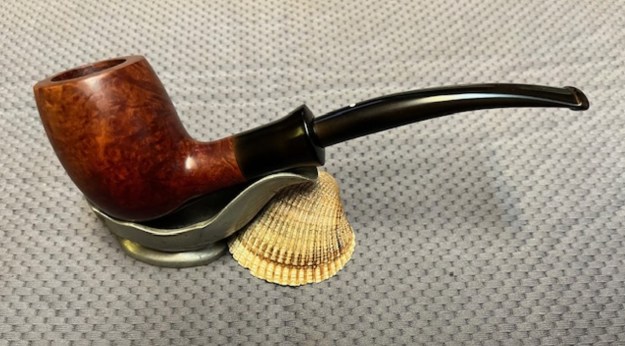
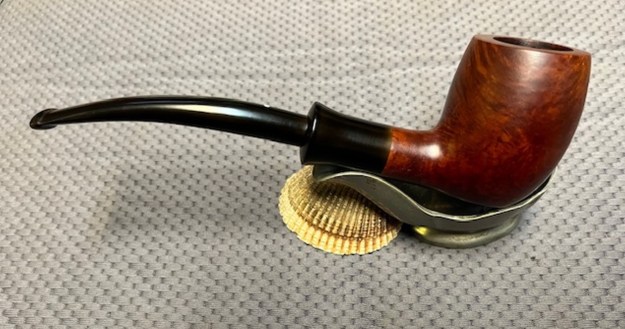
Restoring a Danish Looking Dunhill Bruyere 54792 Unique Billiard Sitter


By Steve Laug

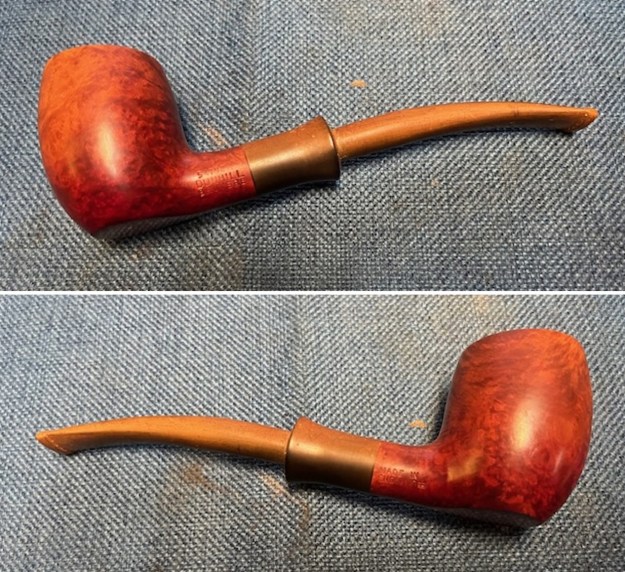
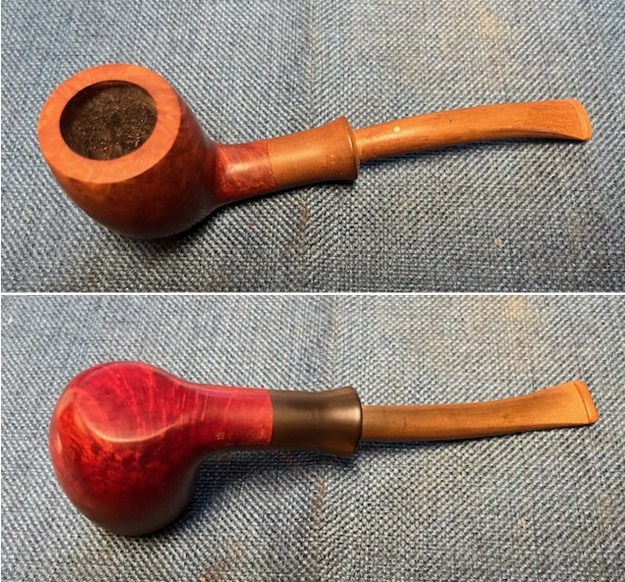
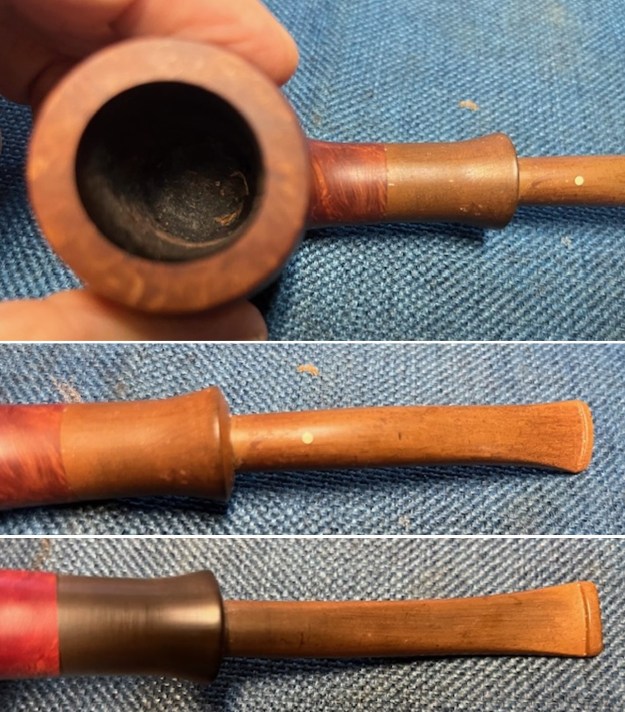
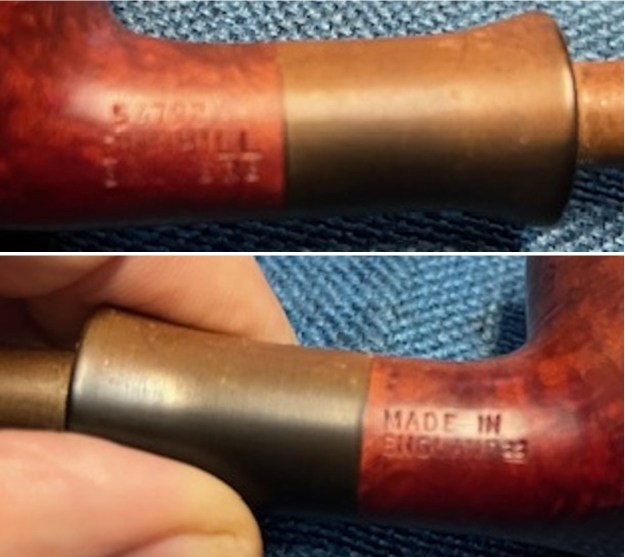
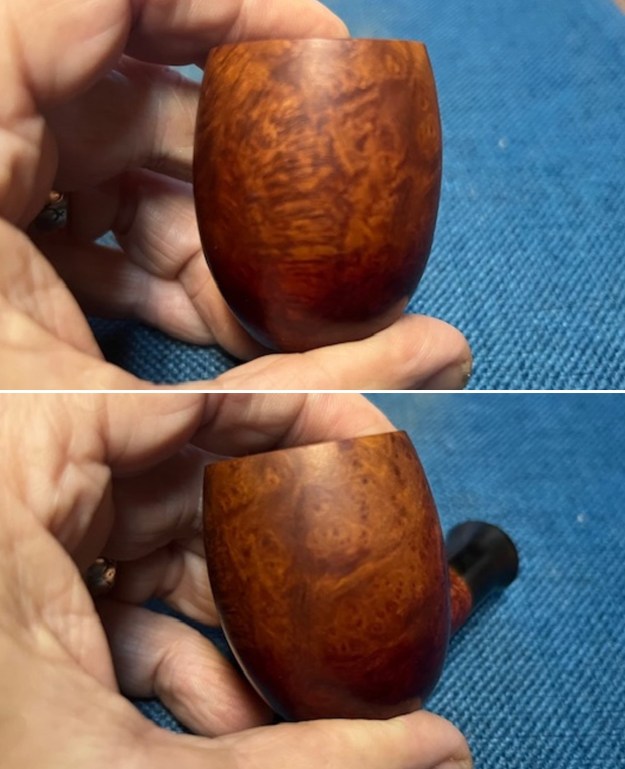
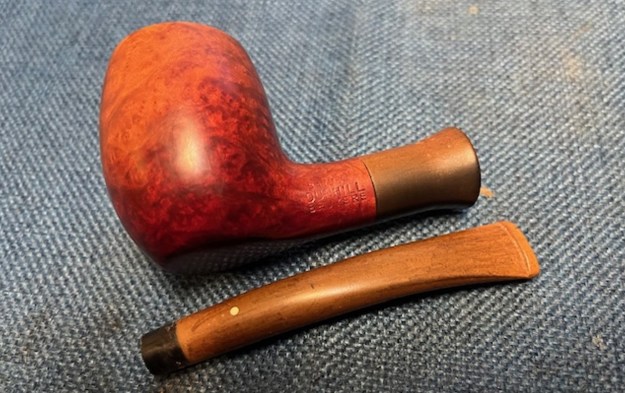
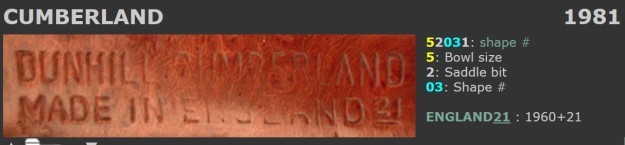
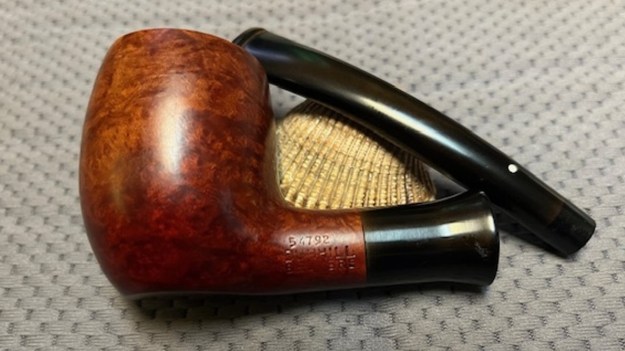
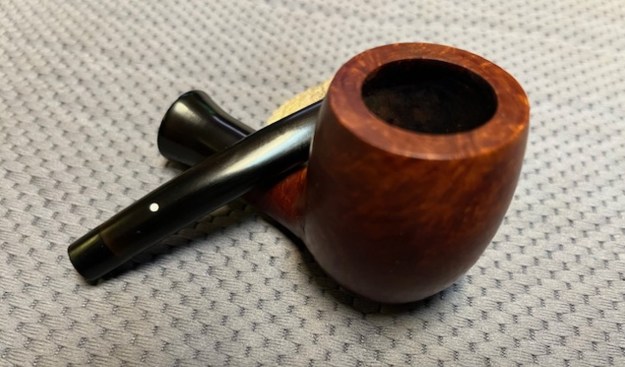
The next pipe on the table is a beautiful Dunhill Bruyere Sitter that was sitting next to the Ferndown Bark in a display cabinet. We purchased it from an Antique Mall in Lincoln City, Oregon, USA on 08/24/2024. The pipe is stamped left side of the shank and reads 54792 [over] Dunhill [over] Bruyere. On the right side of the shank it is stamped Made in [over] England22. The bowl had been reamed and was just dusty. The rim top and inner edge looked great. The finish was dull and there was also some fading on the right side of the bowl toward the front running down from the rim edge to about midbowl. It was faded as if by sun or being exposed to florescent lights. The pipe was someone’s obvious favourite and was well care. The unique thing about this pipe was the vulcanite shank extension and military bit. I have seen bits like this before but have never seen a vulcanite shank extension that looks almost Danish. The extension and the stem are heavily oxidized. There is an inset white spot logo on the top side of the bit. There appears to be some light tooth chatter on the top and underside of the stem ahead of the button. I took photos of the pipe earlier this morning before I started my clean up work. I have included them below. I took a photo of the rim top, bowl and the surfaces of the stem to give a sense of the condition of the pipe. The walls of the bowl were quite clean with light debris in the bottom of the bowl. There was no lava on the rim edges or top. The stem and shank extension are heavily oxidized, calcified and dirty. There are light tooth marks on both sides ahead of the button.I took photos of the stamping on the sides of the shank. It is clear and readable and read as noted above.I took some photos of the fading on the front and sides of the bowl extending half way down the surface. It shows some signs of fading from the sun.I took a photo of the pipe with the stem removed. It is definitely dirty and very oxidized on the shank extension and the stem.One of the first things I like to do when working on a pipe is to unpack the stamping and understand each element in it. I turned to Pipephil’s helpful site where he has some great resources on stamping (http://pipephil.eu/logos/en/dunhill/shapes-l.html). I am using the illustration below to interpret the stamping.The 54792 stamp includes the shape code 79 mid stamp shown in teal blue above. Sadly, it is not listed in this shape chart. The 5 (in yellow above) is the bowl size the other digits 4 and 1 are a bit harder to interpret. The fifth digit 2 is not needed. The 4 may refer to the shape of the stem (in this case a military bit) but I am not sure. I did some searching on Google as well for the shape and was not able to locate a 54792 or even shape 79.

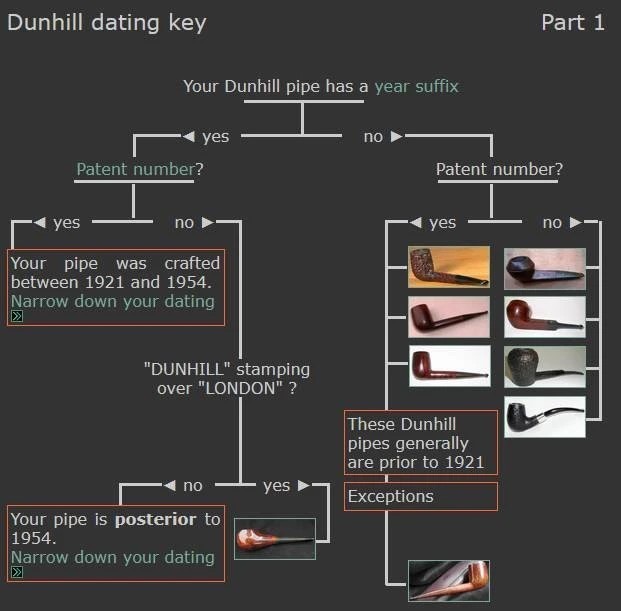
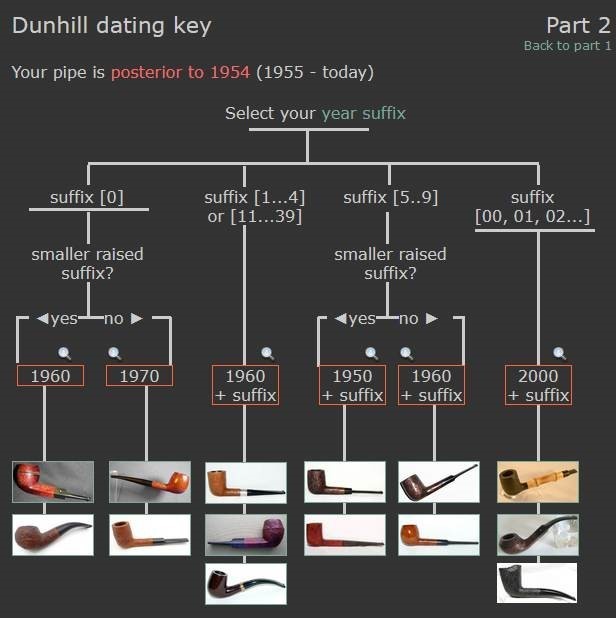
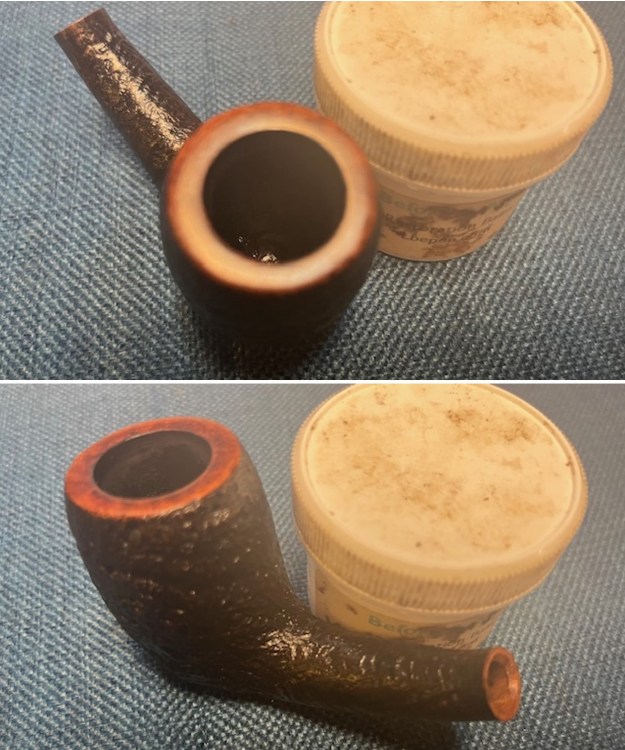
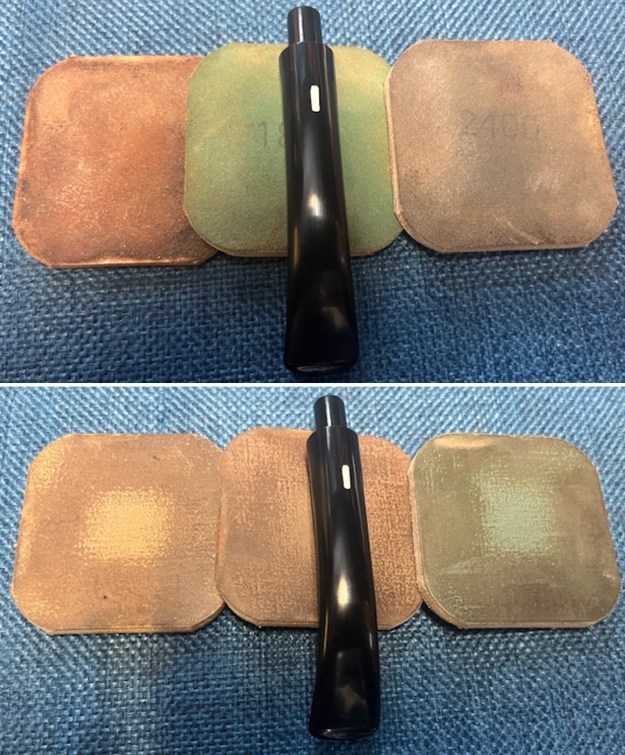
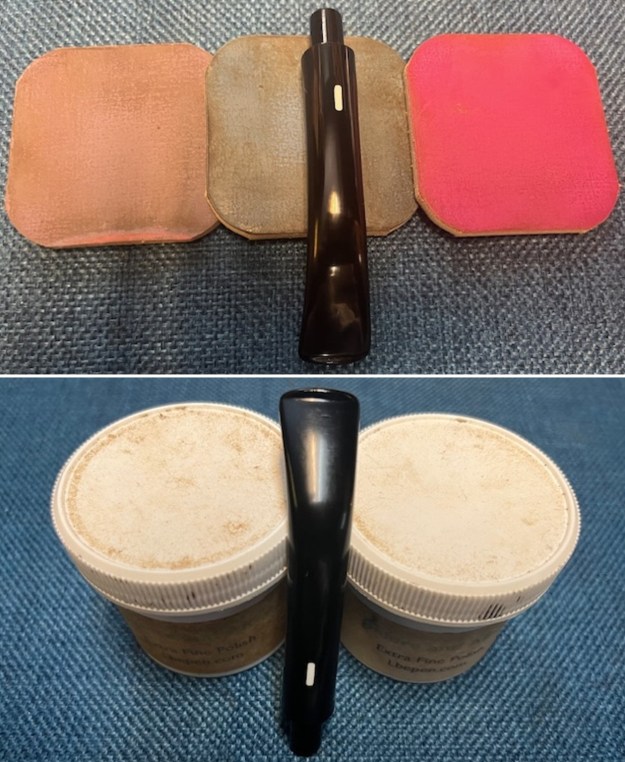
Pipephil also has some helpful dating keys on the site that are basically flow charts that you can walk through to date your pipe (http://pipephil.eu/logos/en/dunhill/cledat-en1.html). I turned to Part 1 of the Dating Key and followed the chart. This pipe has a superscript 22 following the England stamp. That took me to the section on the chart below (column one) which instructed me that the pipe could be dated as being made posterior to 1954.I followed the link following the “Your pipe is posterior to 1954. Narrow down your dating”. That took me to Page 2 of the dating key (http://pipephil.eu/logos/en/dunhill/cledat-en1a.html). The second column (suffix [1…4] or [11…39]) led me to the section with a 22 after the D in England. There was a directive for dating the pipe spelled out as follows: 1960 + suffix 22 which gives the pipe a date of 1982. Now it was time to work on the pipe. I started my work by reaming the sparse cake and debris in the bowl. I scraped out the light cake with a Savinelli Fitsall Pipe Knife. I took the cake back to bare briar. I sanded the walls smooth with 220 grit sandpaper wrapped around a piece of dowel. The bowl walls looked very good with no burn damage or checking on the walls. (Note I had already started working on the oxidized shank extension. I could not help myself😉.)I cleaned out he internals of the shank, mortise and airway in the shank and the stem with alcohol, cotton swabs and pipe cleaners.I sanded the shank extension with 320-3500 grit sanding pads to remove the oxidation. I wiped the vulcanite down after each pad with an Obsidian Oil cloth. The oxidation was stubborn but it slowly began to disappear. I touched up the faded portions on the front of the bowl, the rim top and the right and left sides with a Cherry Stain pen. I have found in the past that the colour works very well with a Bruyere finish. I also touch up the joint of the shank and the shank extension at the same time. It looks much better but will blend in even better once I polish it. Over all the briar looked good after staining. There were no nicks of dents in it so I polished it with micromesh sanding pads. I dry sanded it with the higher-grade pads – 3200-12000 grit and wiped the bowl down after each pad with a damp cloth. By the final pads the briar really had a shine. I polished the shank extension at the same time. I rubbed the briar down with Before & After Restoration Balm. I worked it into the smooth rim top surface with my fingertips. The product works to clean, enliven and preserve the briar. I let it sit for 10 minutes then I buffed it with a cotton cloth to deepen the shine. The briar really comes alive with the balm. I set the bowl aside and turned my attention to the stem. I scrubbed the oxidation on the stem surface with Soft Scrub and paper towel square until it was much cleaner.   I sanded the surface with 320-3500 grit sanding pads. I wiped the stem down after each pad with Obsidian Oil. I was able to remove the remnants of oxidation and the stem looked better.I polished the vulcanite stem with micromesh sanding pads – 1500-12000 grit pads. I wiped it down with Obsidian Oil after each sanding pad. I used Before & After Pipe Stem Polish – both Fine and Extra Fine to further polish the stem. This beautiful Danish style Dunhill Bruyere 54792 Billiard Sitter with a taper vulcanite military bit looks amazing after the work on it. The briar is clean and the grain really came alive. The rich brown stains gave the finish a sense of depth with the polishing and waxing. The grain really popped. I put the stem back on the bowl and buffed the pipe with Blue Diamond on the buffing wheel using a light touch on the briar. I gave the bowl and the stem multiple coats of carnauba wax on the buffing wheel. I buffed the pipe with a clean buffing pad to raise the shine. I hand buffed the pipe with a microfiber cloth to deepen the shine. The finished Dunhill Bruyere Billiard Sitter really is a beauty and feels great in the hand and looks very good. Give the finished pipe a look in the photos below. The dimensions of the pipe are Length: 6 ½ inches, Height: 2 inches, Outside diameter of the bowl: 1 ½ inches, Chamber diameter: 7/8 of an inch. The weight of the pipe is 50 grams/1.80 ounces. This beautiful rusticated pipe will soon be on the rebornpipes store in the British Pipemakers Secton. It should make a great smoker for the next trustee. Thanks for reading this blog and my reflections on the pipe while I worked on it. It was a fun one to work on.
Restoring a Castello Collection Occhio di Pernice ¾ Bent Egg


By Steve Laug

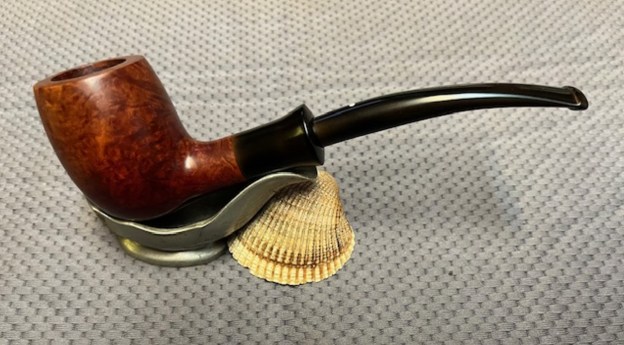
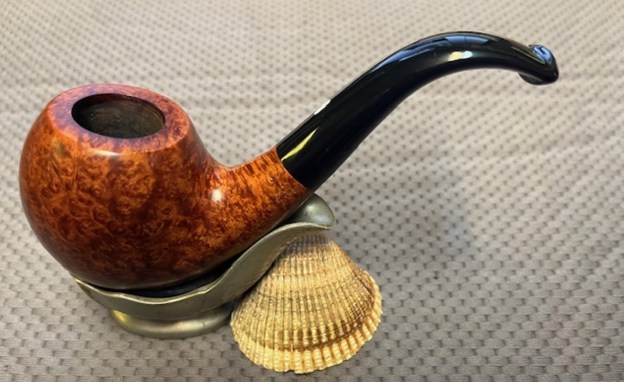
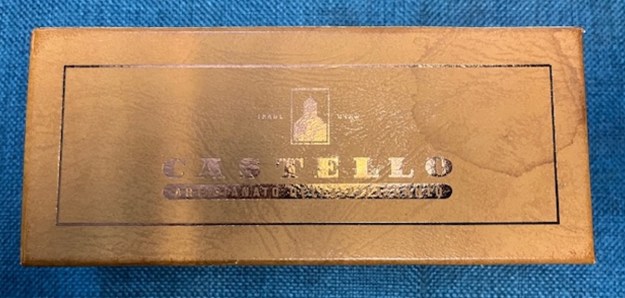
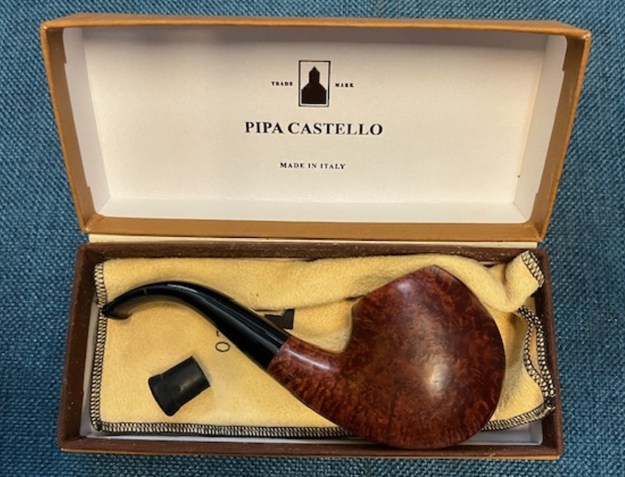
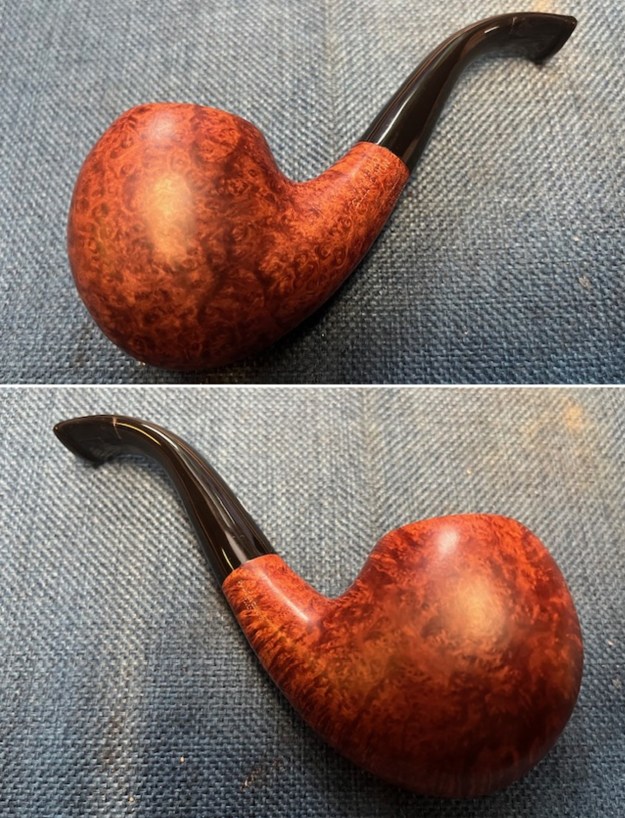
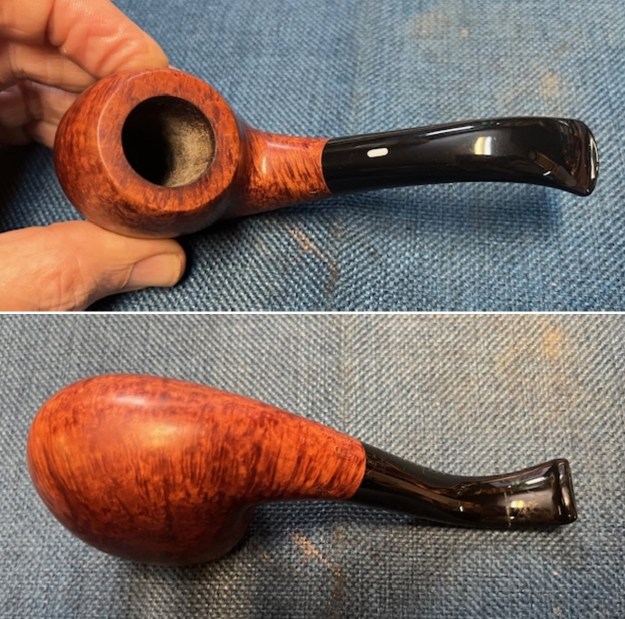
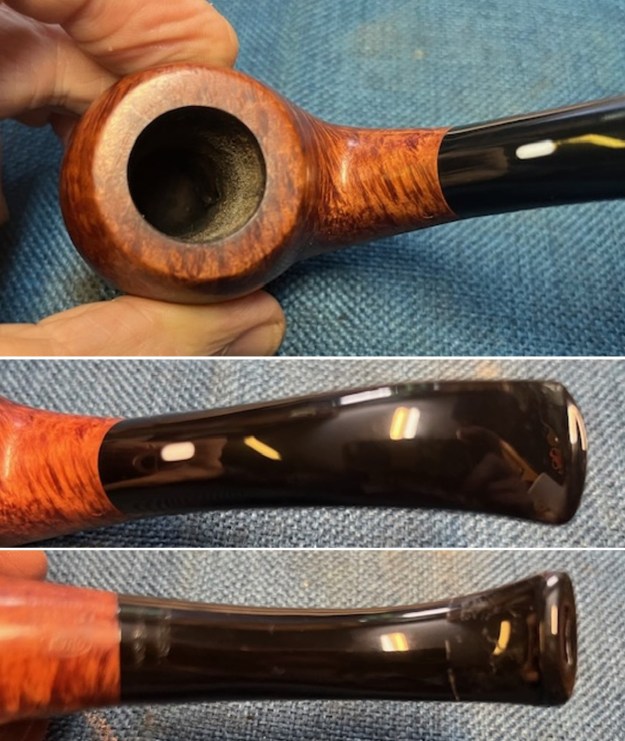
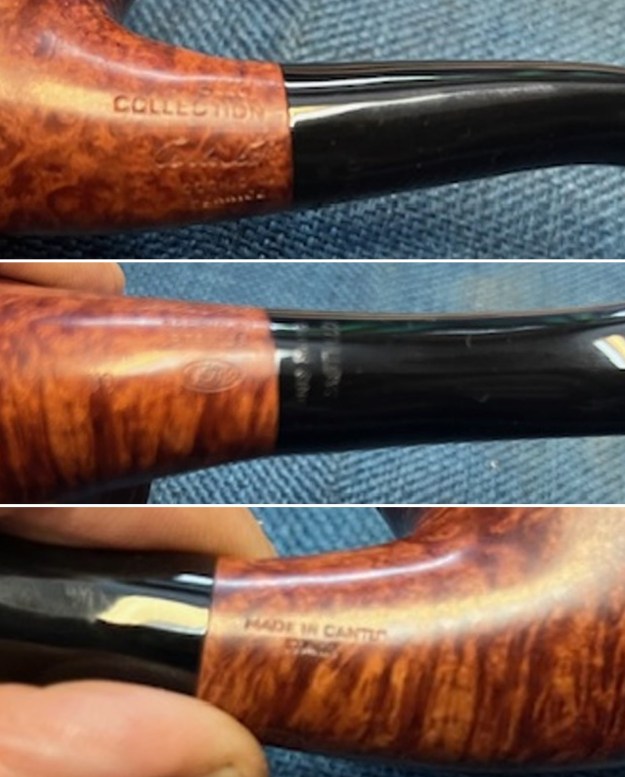
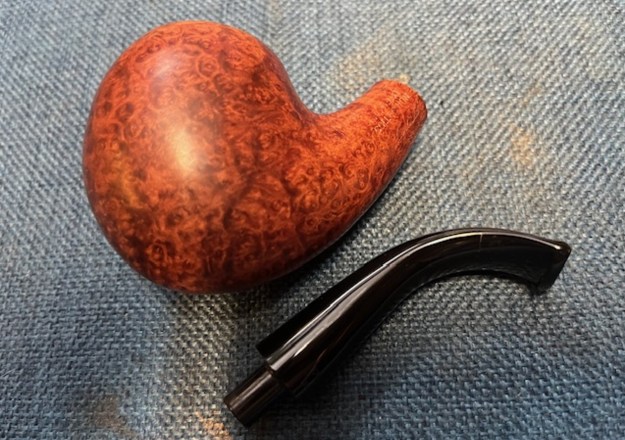
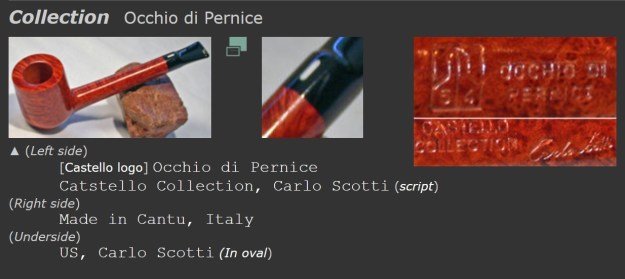
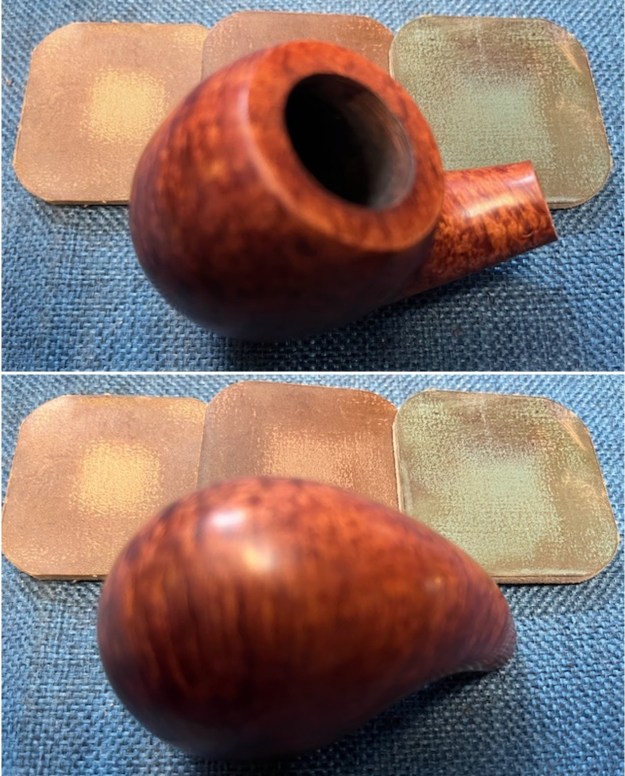
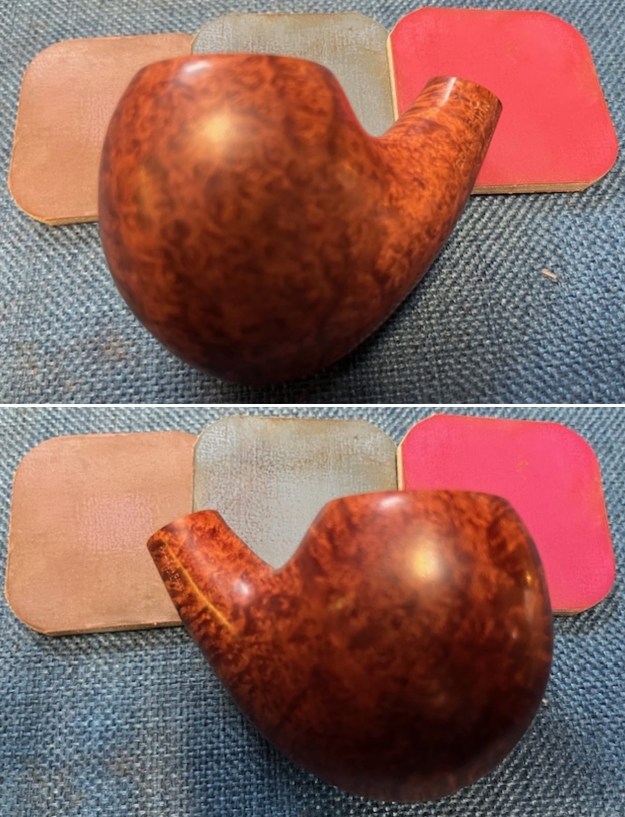
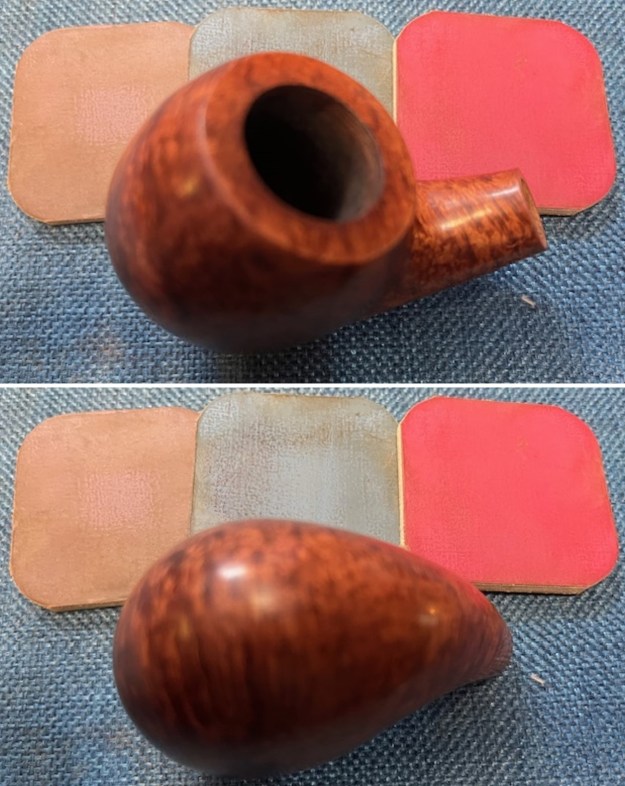
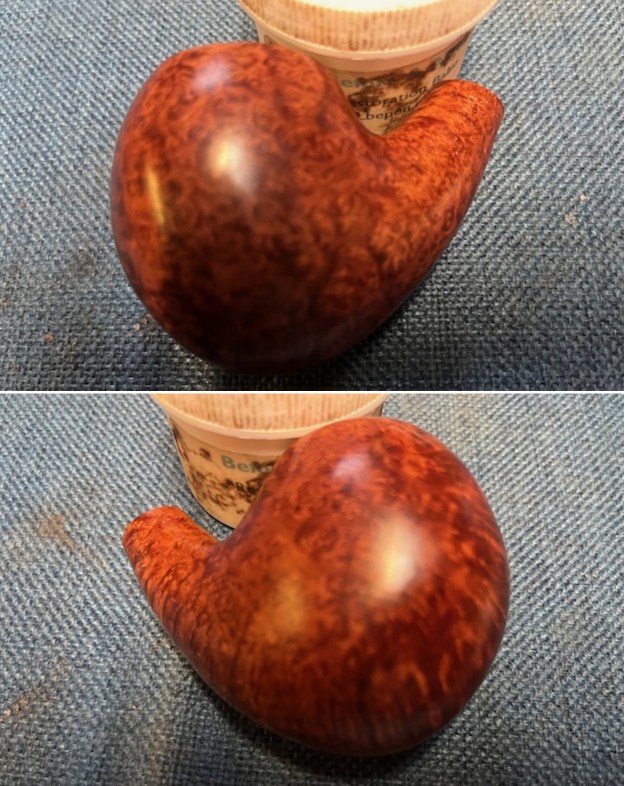
A week or so ago I traded some pipes for the two Castello Pipes below. The fellow I traded them with and I both felt we got a great trade. I chose to work on the top pipe in the photos below. It is a smooth finished Castello that is quite stunning. The fellow called it an Oom Paul but to me it is more of an egg with a ¾ bent to the shank and stem. It is stamped on the left side of the shank and reads Castello [over] Collection [over] Carlo Sciotti signature extending onto the underside. Underneath the signature it is stamped Occhio di Pernice [over] Kimo in script in an oval. Mid shank on the underside it is stamped US. On the right side of the shank it reads Made in Cantu [over] Italy. The bowl had a light cake and smelled primarily of Virgina tobaccos. There was some light lava on the rim top but the inner and outer edge looked very good. The finish was dull but the grain was beautiful. The acrylic stem has a white Castello bar on the topside of the taper. On the underside it is stamped Hand Made [over] Castello. There was a Softee Bit protector on the stem that had bite marks in it so I was a bit worried what might be underneath. When I removed it there was some light build up along the inner edge of the rubber bit guard but the acrylic was free of any bite marks or chatter. When the pipe arrived, it was in the Castello original box with some light water marks and damage but still the rich wood colour. The box is hinged on the back of the box and has no damage on the box or the hinge. The top of the box has the Castello Castle logo with Trade on the left side and Mark to the right of the mark. Underneath that it is printed Castello [over] Artigianato Della Pipa – Cantu. On the end of the box it is stamped with the Castle logo followed a box with CASTELLO [over] a box for a shape or pipe shape/line designation. Underneath it is stamped Made in Italy.I opened the box and took a photo of the pipe inside. The inside of the cover it is stamped with the logo over PIPA CASTELLO [over] Made in Italy. The box had a cream coloured yellowish suede leather material with the same logo and stamp. The stem had a Softee Bit in place that I removed before I took the photo below.I took photos of the pipe itself to give a sense of what was needed in the cleanup of the bowl and shank. I would need to ream and clean the internals of the bowl and shank. The stem had grime on it where the edge of the Softee Bit was on the stem. There was no tooth damage or chatter on the acrylic surface. I took a photo of the bowl and the rim top. You can see the light lava on the rim top toward the back surface and left side of the bowl. You can also see the cake in the bowl. It is light to moderate in terms of thickness. The stem surface is undamaged on both sides ahead of the button. Other than the grime left behind by the Softee Bit the stem looks very good.I took photos of the stamping around the shank sides. It is clear and readable as noted above. I removed the stem from the shank and tried to capture a bit of the beauty of the birdseye grain on this lovely piece of briar. The grain is the same on both sides with cross grain on the front of the bowl, the back of the bowl and the underside of the shank at the end.I checked on Pipephil’s site (http://www.pipephil.eu/logos/en/logo-castello.html) and found a section on the Occhio di Pernice. It also had some information on the family line of the Scottis. I included that information below the screen capture of one of the pipes.Castello PIPA CASTELLO di Carlo Scotti & C. was founded in 1947 by Carlo Scotti († 1988). Franco Coppo (AKA “Kino”) who married Carlo Scotti’s daughter Savina, manages (2012) the corporate since 1985.

A great history of the brand is available on Pipedia (https://pipedia.org/wiki/Castello). It is worth a read.

I did a Google search for the Castello Collection Occhio di Pernice line of pipes and found an interesting conversation on the Brothers of the Briar site where the brand was clearly defined and explained (https://www.brothersofbriar.com/threads/castello-question.3661/). I quote:

Castello Collection Occhio di Pernice

The mark “Occhio di Pernice” was born in the beginning of ‘ 80. Before, pipes featured by this particular cut were catalogued as “Collection”. Since January 2003 “Occhio di Pernice” has been graded using the classical “K” system.”

Occhio de Pernice means Eye of the Partridge, or birdseye. It is a special designation within the Collection line for crosscut pipes that have remarkable birdseye. Previously, Ochio stamped pipes were a grade of Collection line pipes unto themselves – meaning there was no differentiating level of quality at least as far as nomenclature went. A Collection pipe with spectacular birdseye was graded Occhio, and an Occhio was an Occhio was an Occhio, even though the quality of the pieces ranged widely. Now the Occhio is still a special classification within the Collection line, but they are also graded with the K designations to note differing grades of quality.

If your pipe is not stamped “Occhio de Pernice” it is not an Occhio, regardless of date. It may or may not be worth as much as a Collection pipe, depends on the quality of the individual pipe.

From that information I knew that the pipe was made between 1980 and 2003 when the K system was added.

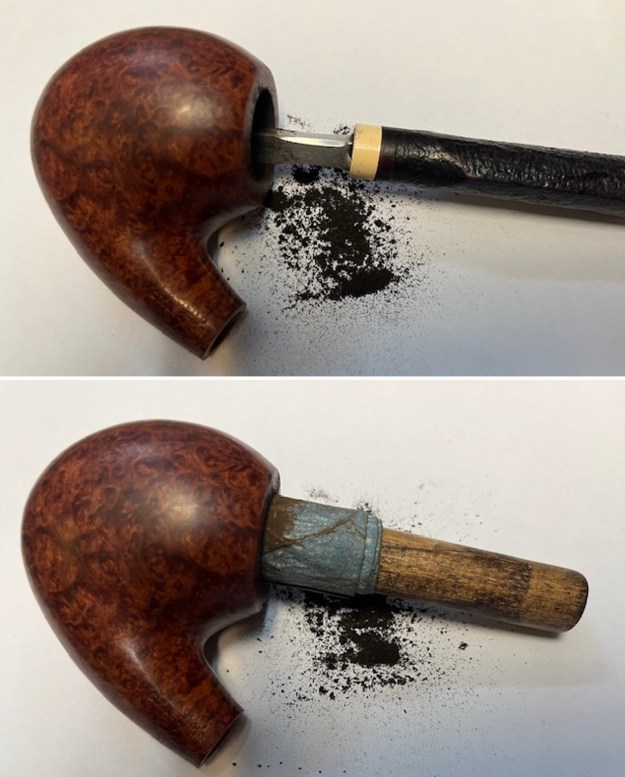
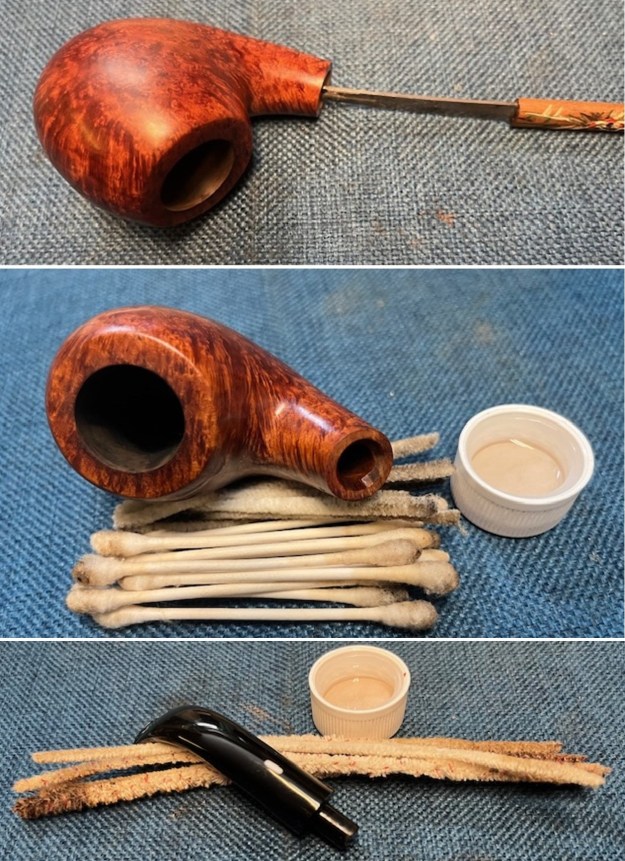
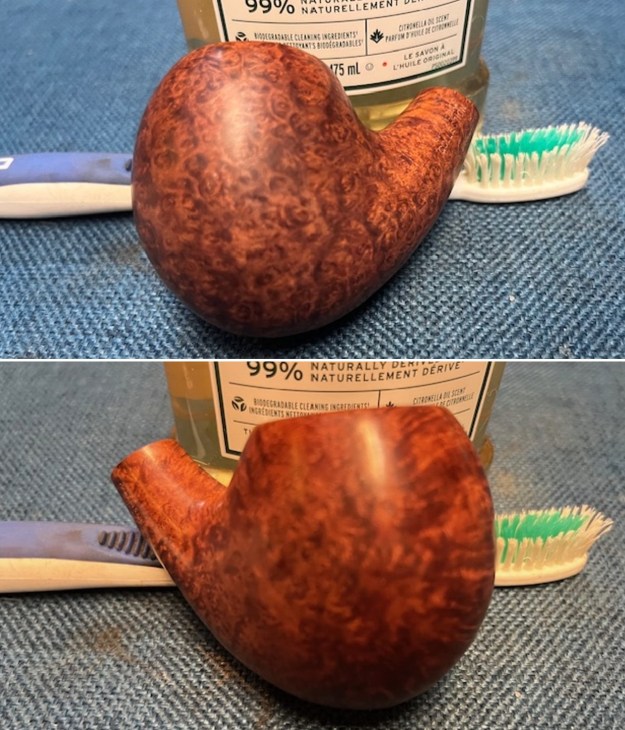
Now it was time to work on the pipe. I started my work by reaming the pipe. I scraped out the light cake with a Savinelli Fitsall Pipe Knife. I took the cake back to bare briar. I sanded the walls smooth with 220 grit sandpaper wrapped around a piece of dowel. The bowl walls looked very good with no burn damage or checking on the walls.I scraped the walls of the shank with a pen knife. I then cleaned out he internals of the shank, mortise and airway in the shank and the stem with alcohol, cotton swabs and pipe cleaners.I scrubbed the externals of the bowl with undiluted Murphy’s Oil Soap and rinsed it off with warm water to remove the soap and the grime. I dried it off with a soft cotton towel. It looked much better at this point and the grain really stood out on the bowl sides. I polished the briar with micromesh sanding pads. I dry sanded it with 1500-12000 grit sanding pads and wiped the bowl down after each pad with a damp cloth. By the final pads the briar really had a shine and the grain really stood out. I rubbed the briar down with Before & After Restoration Balm. I worked it into the smooth surface with my fingertips. The product works to clean, enliven and preserve the briar. I let it sit for 10 minutes then I buffed it with a cotton cloth to deepen the shine. The briar really comes alive with the balm. The stem was in such good condition that I polished the acrylic stem with the higher grit micromesh sanding pads – 3200-12000 grit pads. I wiped it down with Obsidian Oil after each sanding pad. I used Before & After Pipe Stem Polish – both Fine and Extra Fine to further polish the stem. This beautiful Castello Collection Occhio di Pernice Bent Egg with a taper acrylic stem looks amazing after the work on it. The briar is clean and the grain really came alive. The rich brown stains gave the finish a sense of depth with the polishing and waxing. The birds eye almost winked at me. I put the stem back on the bowl and buffed the pipe with Blue Diamond on the buffing wheel using a light touch on the briar. I gave the bowl and the stem multiple coats of carnauba wax on the buffing wheel. I buffed the pipe with a clean buffing pad to raise the shine. I hand buffed the pipe with a microfiber cloth to deepen the shine. The finished Castello Collection Occhio de Pernice really is a beauty and feels great in the hand and looks very good. Give the finished pipe a look in the photos below. The dimensions of the pipe are Length: 5 ½ inches, Height: 2 ¼ inches, Outside diameter of the bowl: 1 ½ inches, Chamber diameter: ¾ of an inch. The weight of the pipe is 76 grams/2.68 ounces. I will soon be enjoying this beautiful pipe with a bowl of Balkan Sasieni that I brought home from my recent trip to the Oregon Coast. It should make a great smoker that I will enjoy. Thanks for reading this blog and my reflections on the pipe while I worked on it. It was a fun one to work on.
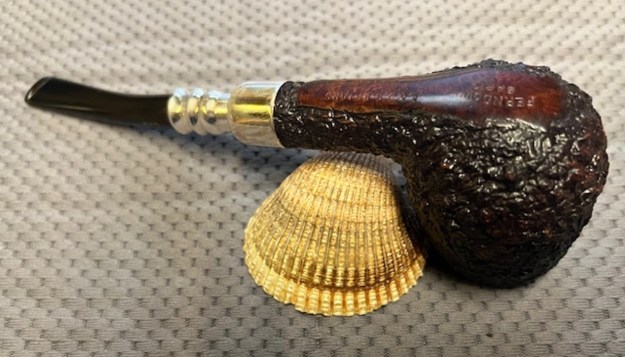
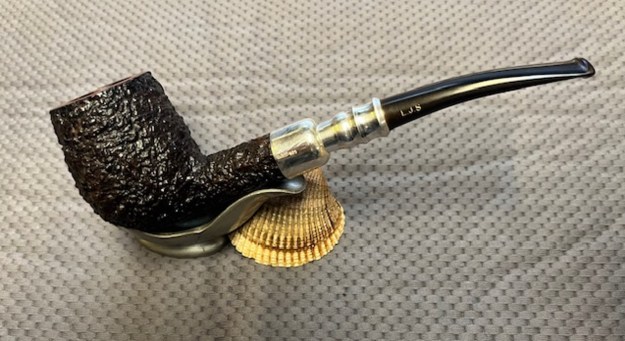
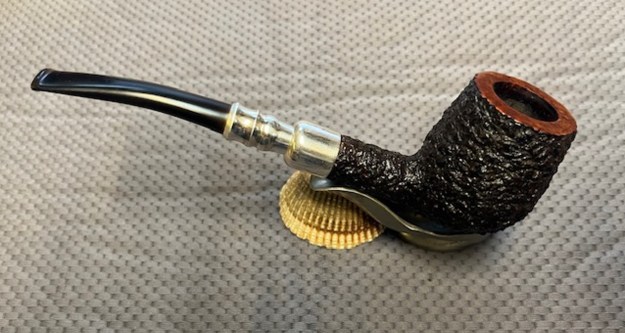
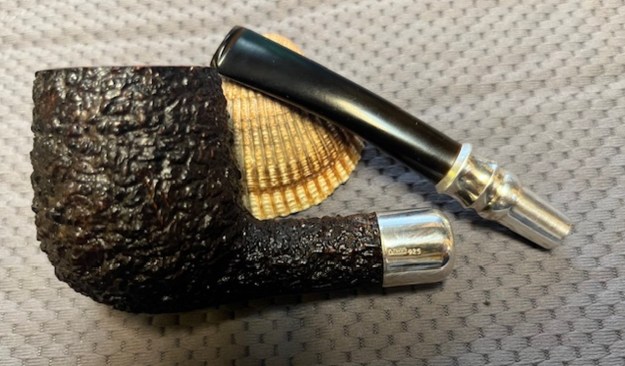
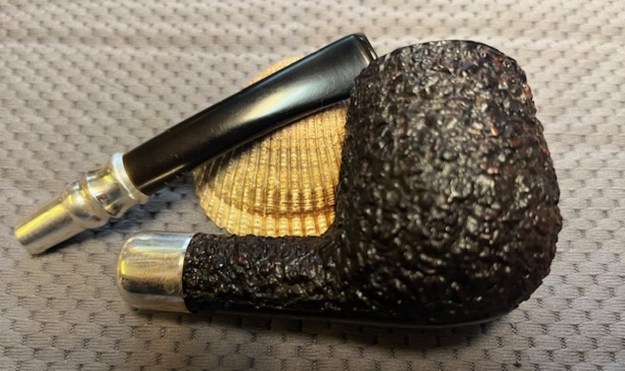
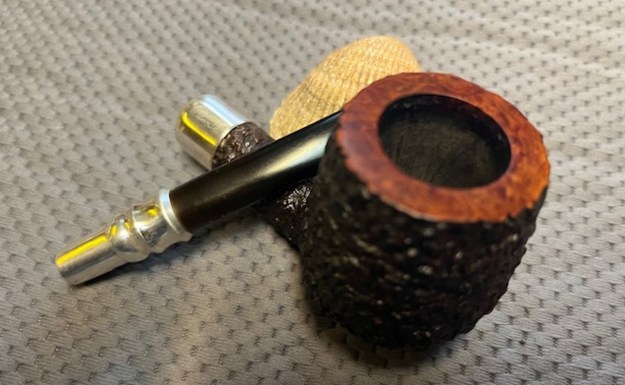
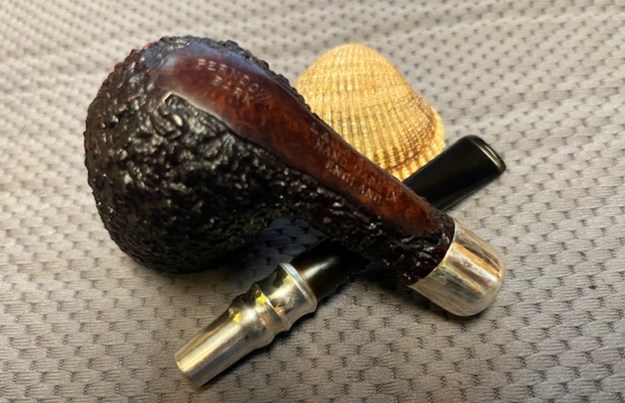
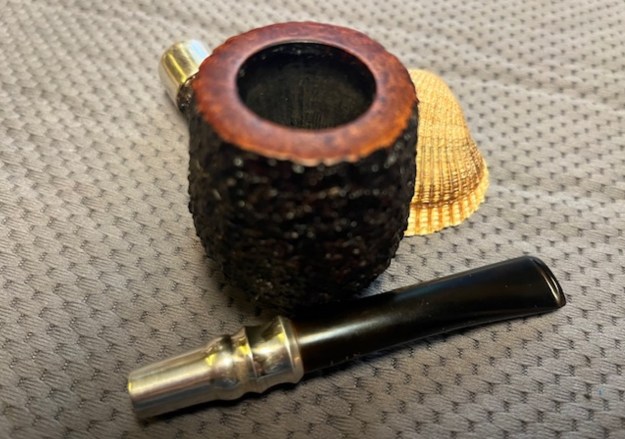
Restoring a Ferndown Bark L&JS Briars Silver Spigot Billiard


By Steve Laug

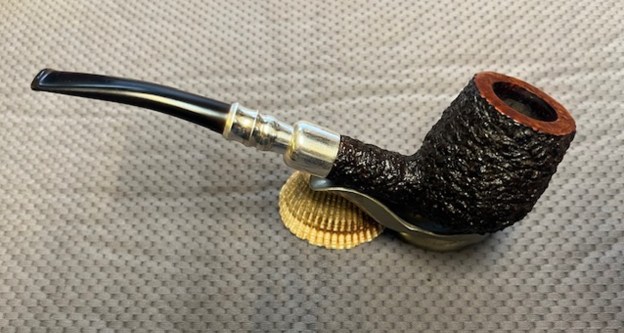
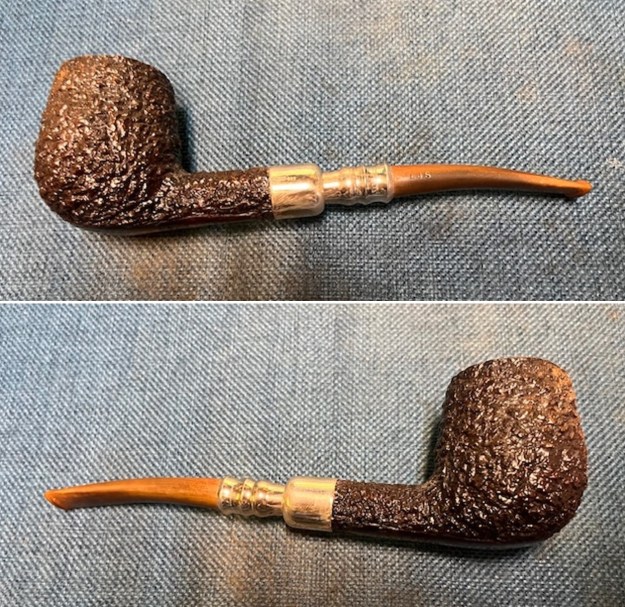
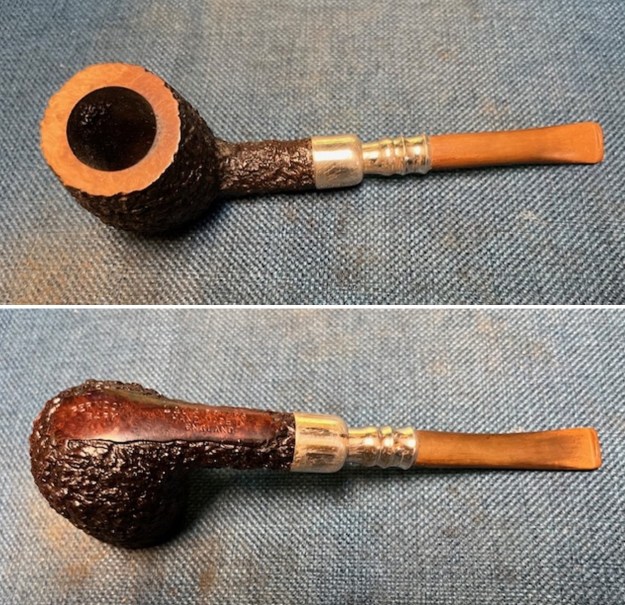
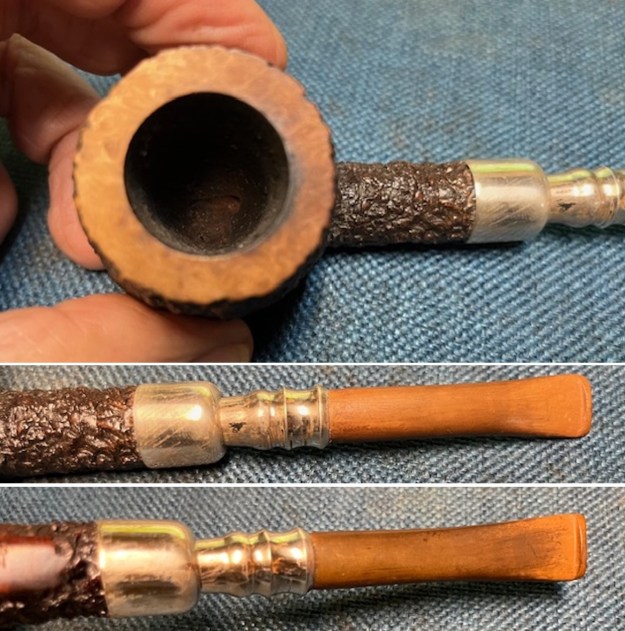
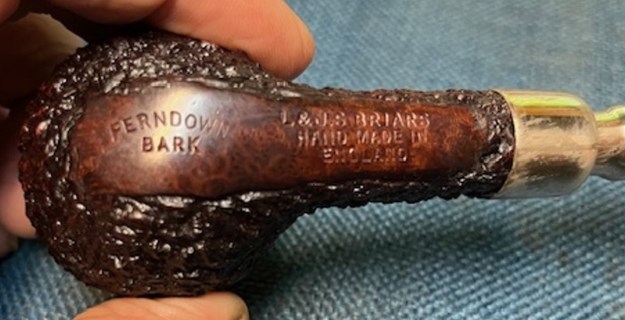
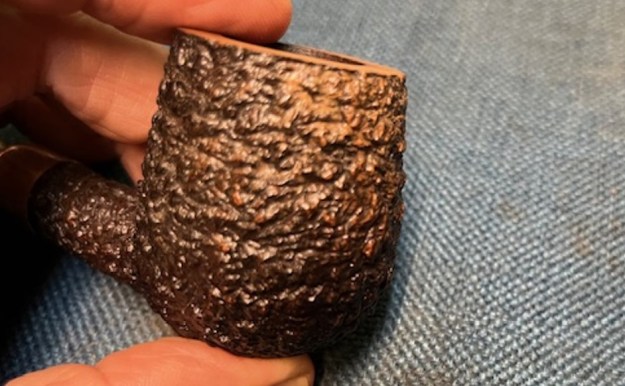
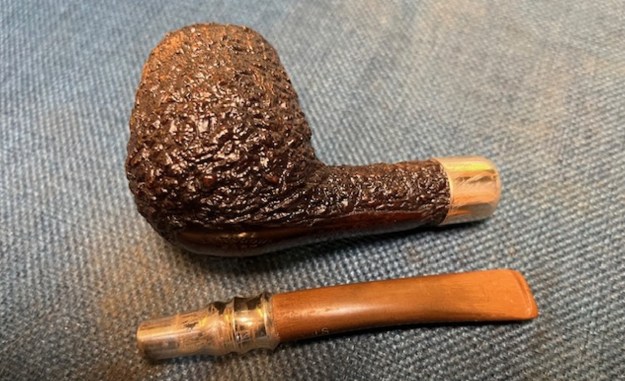
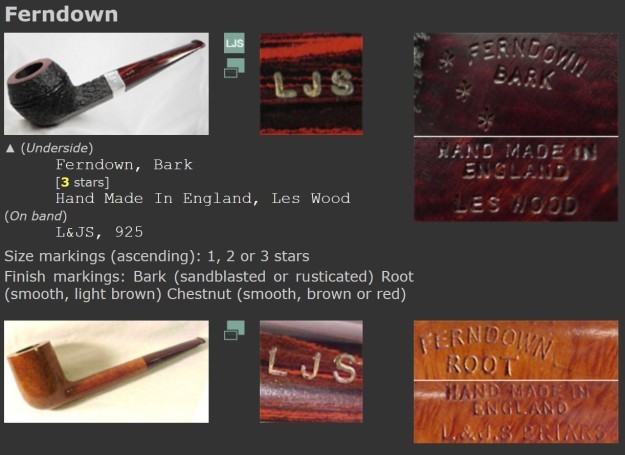
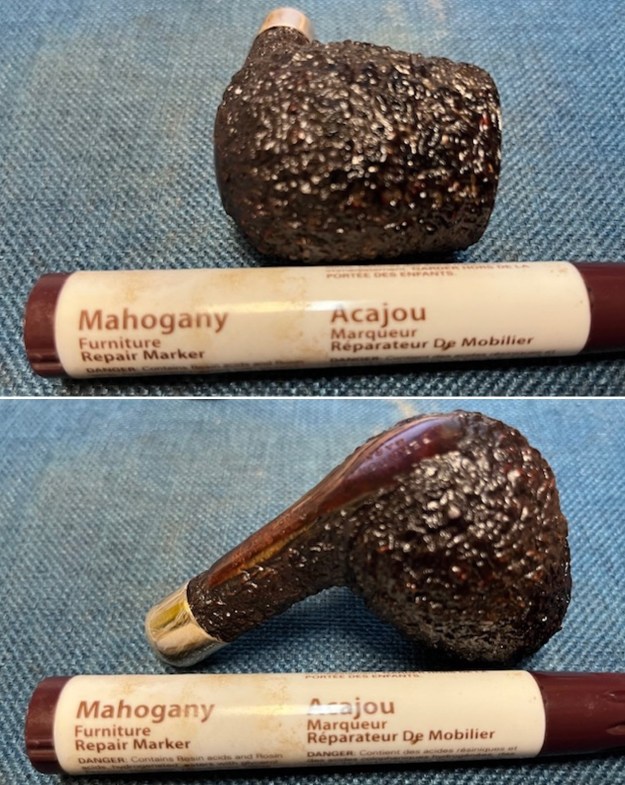
The next pipe on the table is a beautiful rusticated Billiard with a silver ferrule and silver spigot stem. We purchased it from an Antique Mall in Lincoln City, Oregon, USA on 08/24/2024. The pipe is stamped on a smooth panel on the underside of the shank and reads Ferndown [arched over] Bark followed by L&JS Briars [over] Hand Made In [over] England. There was a thin cake in the bowl and the rim top and inner edge had been scraped and was faded. There was grime ground into the rusticated finish around the bowl and shank. There was also some fading on the right side of the bowl toward the front running down from the rim edge to about midbowl. It was faded as if by sun or perhaps whatever had stripped the rim top. The pipe was someone’s obvious favourite and was well care. The inner edge looked to be in good condition. The oxidized ferrule and spigot end on the stem are both Sterling Silver. The ferrule bears the stamp L&JS followed by 925 on the left side. There is an LJS logo stamped in gold on the left side of the taper stem. The stem is heavily oxidized and calcified. There appears to be some light tooth chatter on the top and underside of the stem ahead of the button. I took photos of the pipe earlier this morning before I started my clean up work. I have included them below. I took a photo of the rim top, bowl and the surfaces of the stem to give a sense of the condition of the pipe. The walls of the bowl had a thin cake with no lava on the rim edges or top. The stem is heavily oxidized, calcified and dirty. There are light tooth marks on both sides ahead of the button.I took a photo of the stamping on the smooth panel on the underside the heel and the shank. It is clear and readable and read as noted above. The silver ferrule and the left side of the taper both have clear stamping under the oxidation that reads as noted above.I took some photos of the fading on the front and the right side of the bowl extending half way down the rusticated surface. It is wash out and matches the washed out rim top on the bowl. I took a photo of the pipe with the stem removed. It is definitely dirty and the silver and the stem both are oxidized. To gather backgound on the brand I turned to Pipephil’s site to see what was included in the listing there (http://www.pipephil.eu/logos/en/logo-f1.html). I have included both the screen capture and also the side bar below the photo I have included.Artisan: Leslie (Les) Wood. He was the master silver smith at Alfred Dunhill Ltd. before starting L. & J.S. Briars. Pipes for the European market are stamped “L. Wood” while those for US are stamped “Ferndown”. Production: ~ 2000 pipes/year (Ferndown + L.Wood) See also Elwood

The first pipe pictured in the screen capture above is stamped similarly to mine. The pipe I had in hand did not have the stars on the heel so there was no size designation on the pipe. This is a large pipe. The Bark finish is a designation used for both sandblasted and rusticated. The stem on the pipe I am working on is also not Cumberland but rather black vulcanite with a silver spigot ending.

I turned to Pipedia next (https://pipedia.org/wiki/Ferndown). There is a great article there on the carver, the pipes and the workshop. It is worth the time to give it a read. I am quoting the section on the pipes below for the information included.

Due to the vagaries of international trademark law, he sold his earlier pipes as ”L.&J.S Briars”, “Ellwood”, “Les Wood” or “L. Wood”. Until recently, an average of 1500 – 2000 pipes a year were sold as “Ferndown” — named for the mansion he lives in — in the UK and US, but as “L. Wood” pipes in Germany

…To many pipe smokers, Les Wood’s pipes embody the revival of great English pipe making initiated by Ashton in the early 1980s. The high-grade Italian and Spanish plateau he prefers is oil-cured in the tradition of both Dunhill and Ashton. The pipes are renowned for their pleasant, slightly nutty flavor and remarkable smoking characteristics. They feature impeccable craftsmanship extending to very good stem/bit work, though many pipes are often a bit heavier. The hallmark of his work, of course, is the excellent silver work. Almost all of his pipes feature rings or ferules for spigot stems. Grading is by finish: “Bark” (ca. 90%, rusticated, dark brown and black), “Antique Bark” (tan rusticated), “Reo” (brown and red, smooth), “Root” (orange, smooth), and “Tudor Root” (orange and brown smooth) and by size (one to four stars). He also designates straight grains with SG.

The pipe I am working on is as noted above a Ferndown which identifies it as a pipe named after his mansion and as a pipe made for the UK and the US. It is also as noted in red above stamped Bark which identifies it as a dark brown and black rusticated pipe.

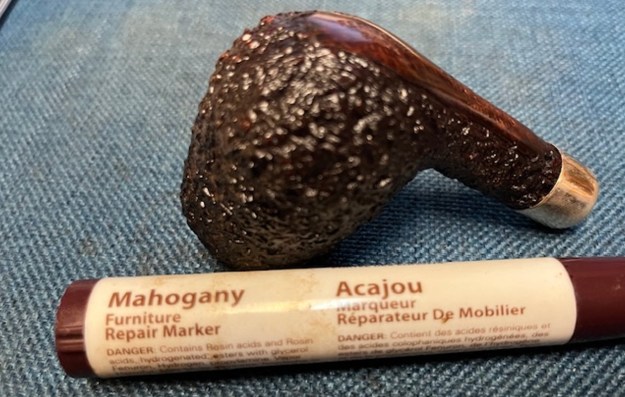
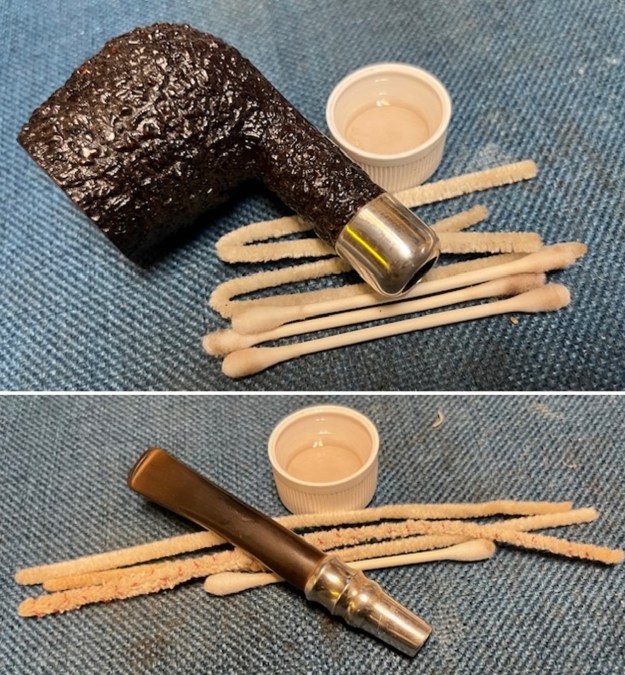
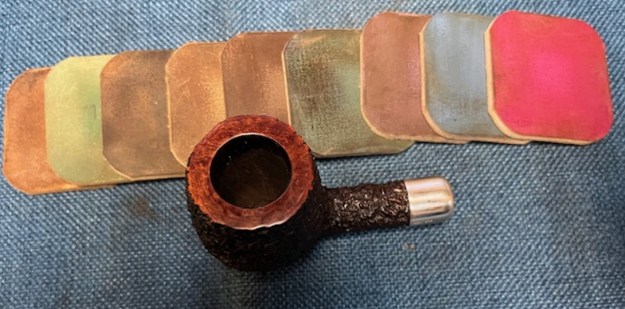
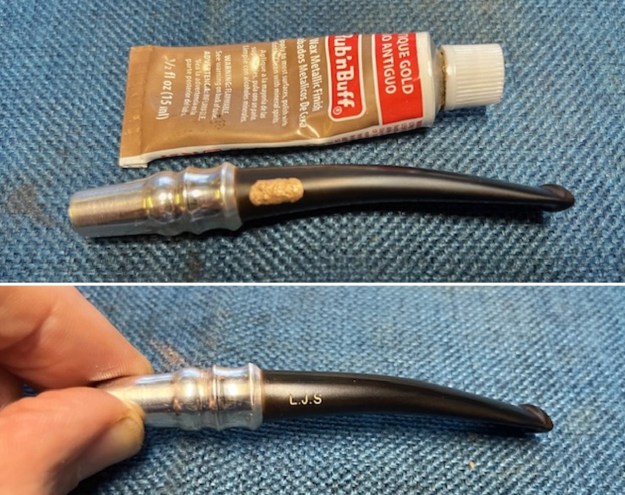
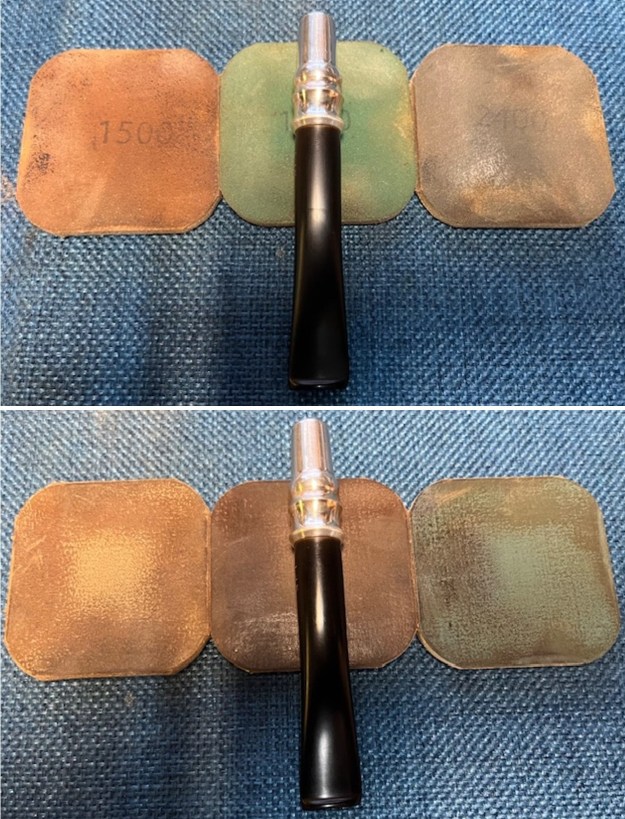
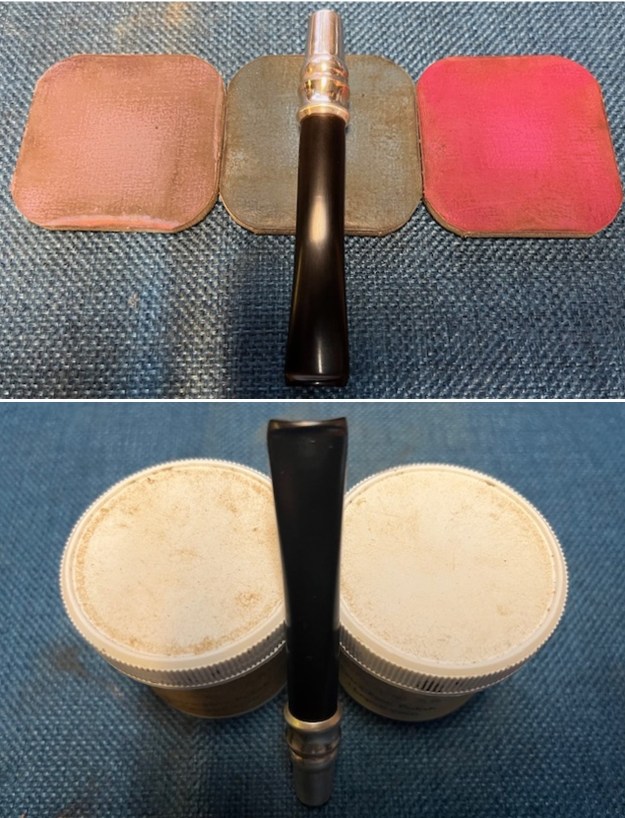
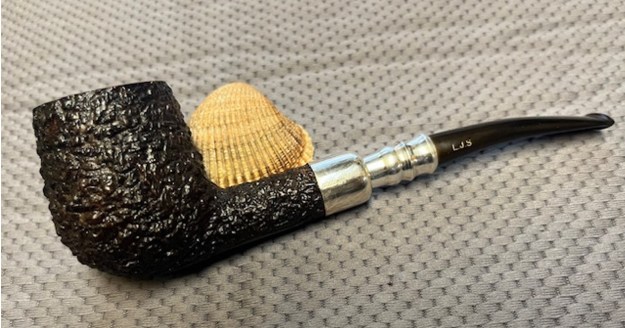
Now it was time to work on the pipe. I started my work by reaming the pipe. I scraped out the light cake with a Savinelli Fitsall Pipe Knife. I took the cake back to bare briar. I sanded the walls smooth with 220 grit sandpaper wrapped around a piece of dowel. The bowl walls looked very good with no burn damage or checking on the walls. I worked on the fading and damage to the rim top with 320-3500 grit sanding pads. It looked much better when I had finished with the last of the pads.At this point I stained the rim top and the faded areas around the bowl with a Mahogany stain pen. It blended well with the surrounding briar on the bowl sides. The rim top looked better but I would need to polish it and clean up the finished look of the rim top. I cleaned out he internals of the shank, mortise and airway in the shank and the stem with alcohol, cotton swabs and pipe cleaners.I polished the smooth rim top with micromesh sanding pads. I dry sanded it with 1500-12000 grit sanding pads and wiped the bowl down after each pad with a damp cloth. By the final pads the briar really had a shine. I rubbed the briar down with Before & After Restoration Balm. I worked it into the smooth rim top surface with my fingertips and into the heavy rustication with a shoebrush. The product works to clean, enliven and preserve the briar. I let it sit for 10 minutes then I buffed it with a cotton cloth to deepen the shine. The briar really comes alive with the balm. I polished the silver ferrule and the spigot end on the stem with a jeweller’s cloth to clean up and prevent further oxidation in the future. The contrast between the silver and the heavy rustication is very nice. I set the bowl aside and turned my attention to the stem. I scrubbed the oxidation on the stem surface with Soft Scrub and cotton pads until it was much cleaner.I sanded the surface with 320-3500 grit sanding pads. I wiped the stem down after each pad with Obsidian Oil. I was able to remove the remnants of oxidation and the stem looked better.I touched up the LJS stamp on the left side of the taper stem with Rub’n Buff Antique Gold. I rubbed it on and worked it into the stamp with a tooth pick. I buffed it off with an Obsidian Oil cloth. It looks very good.I polished the vulcanite stem with micromesh sanding pads – 1500-12000 grit pads. I wiped it down with Obsidian Oil after each sanding pad. I used Before & After Pipe Stem Polish – both Fine and Extra Fine to further polish the stem. This beautiful Ferndown Bark Rusticated L&JS Briars Silver Spigot Billiard with a taper vulcanite stem looks amazing after the work on it. The briar is clean and the grain really came alive. The rich brown stains gave the finish a sense of depth with the polishing and waxing. The grain really popped. I put the stem back on the bowl and buffed the pipe with Blue Diamond on the buffing wheel using a light touch on the briar. I gave the bowl multiple coats of Conservator’s Wax and the stem multiple coats of carnauba wax on the buffing wheel. I buffed the pipe with a clean buffing pad to raise the shine. I hand buffed the pipe with a microfiber cloth to deepen the shine. The finished Ferndown Bark Silver Spigot Billiard really is a beauty and feels great in the hand and looks very good. Give the finished pipe a look in the photos below. The dimensions of the pipe are Length: 6 ¾ inches, Height: 2 inches, Outside diameter of the bowl: 1 ½ inches, Chamber diameter: 7/8 of an inch. The weight of the pipe is 66 grams/2.33 ounces. This beautiful rusticated pipe will soon be on the rebornpipes store in the British Pipemakers Secton. It should make a great smoker for the next trustee. Thanks for reading this blog and my reflections on the pipe while I worked on it. It was a fun one to work on.
Cleaning up a VPFN Cased Meerschaum Billiard with a Bakelite Stem


By Steve Laug

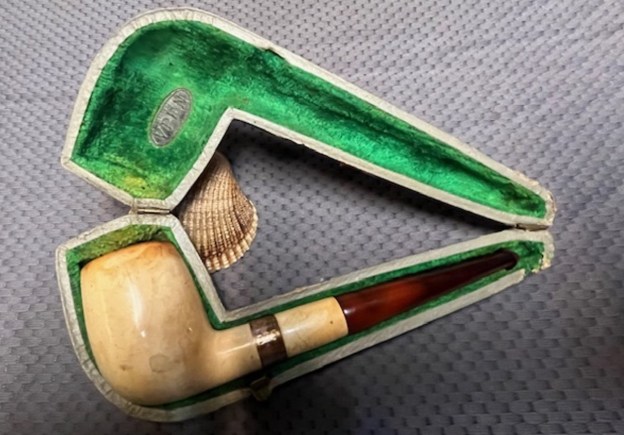
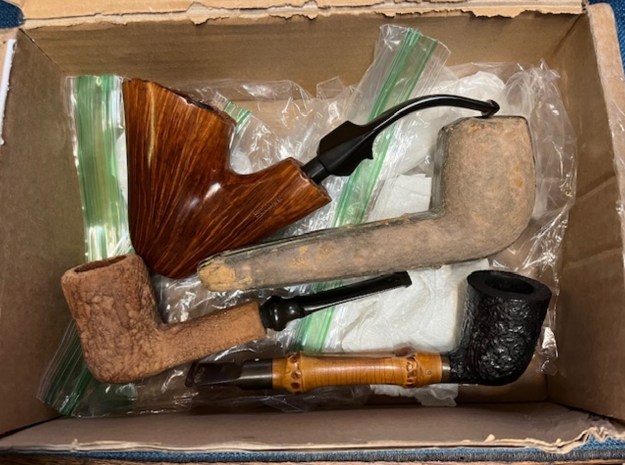
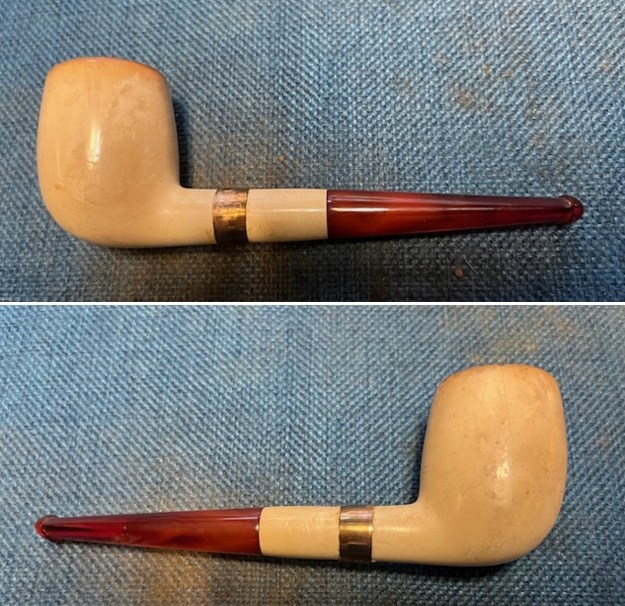
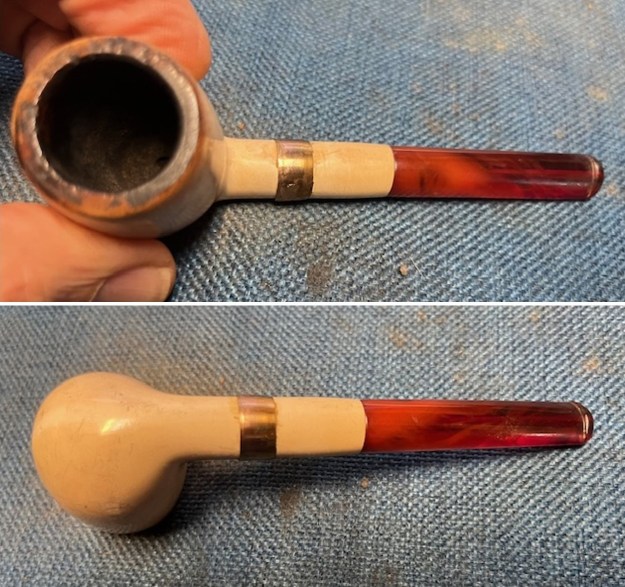
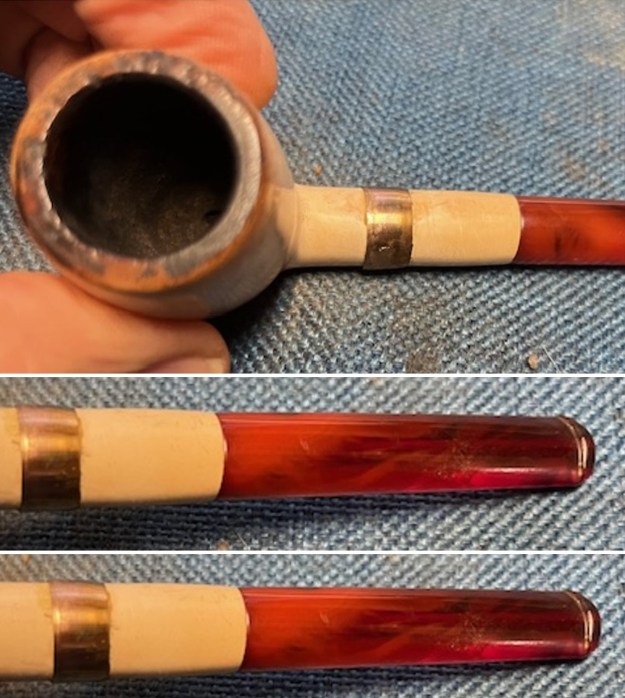
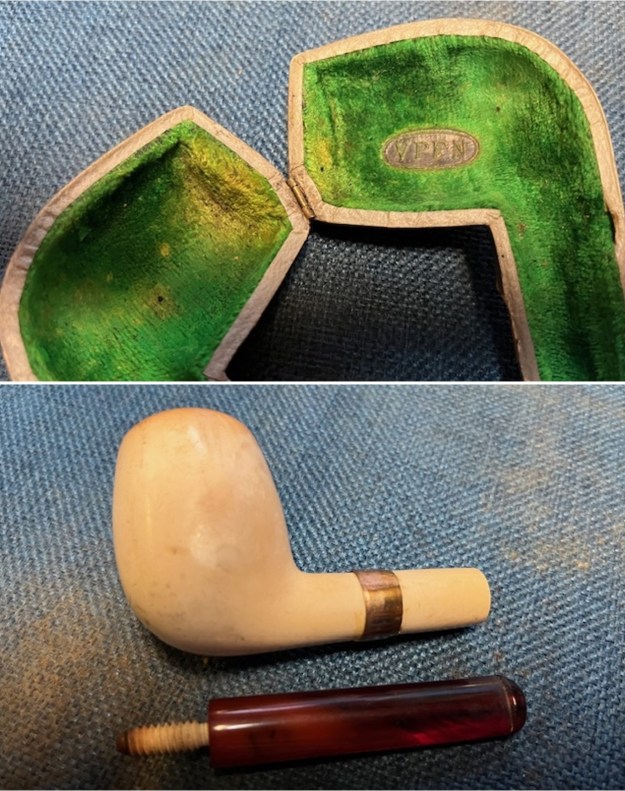
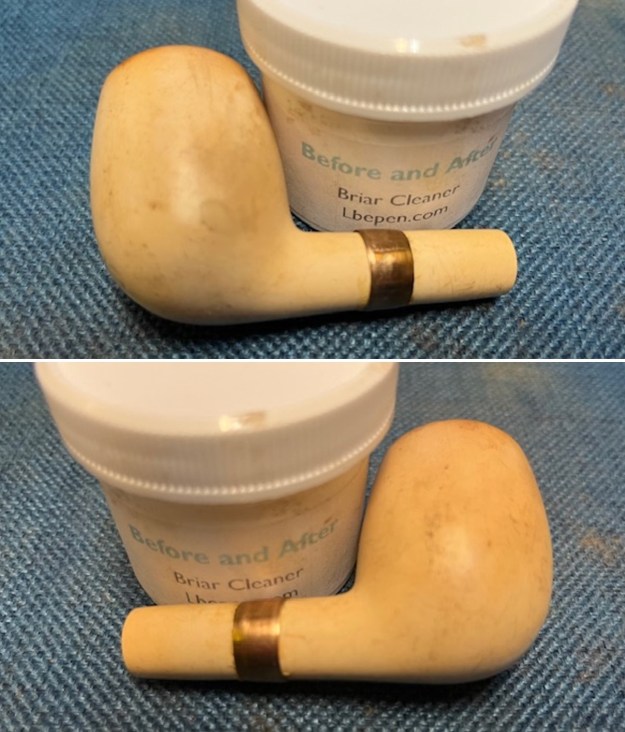
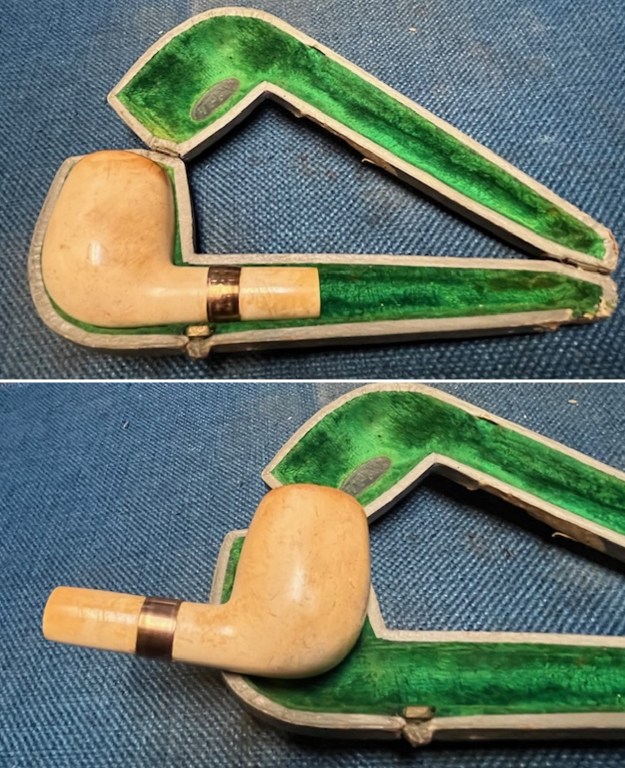
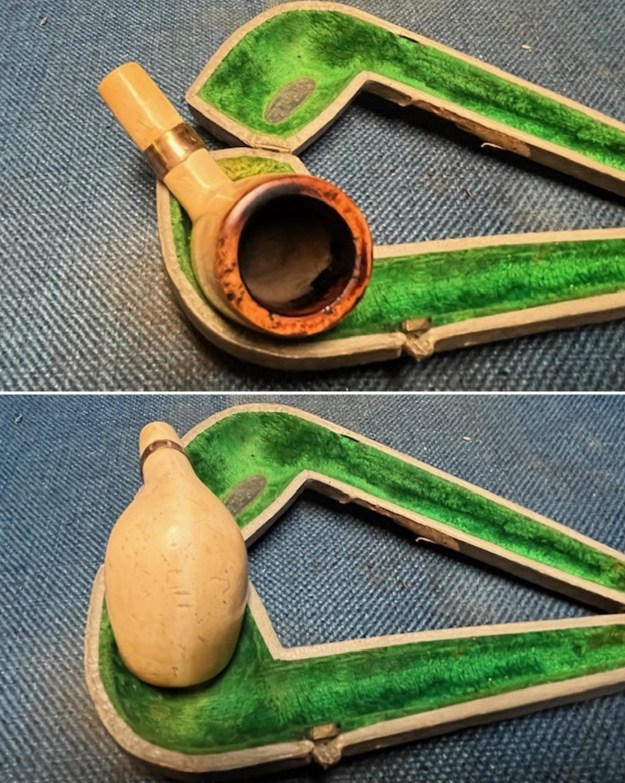
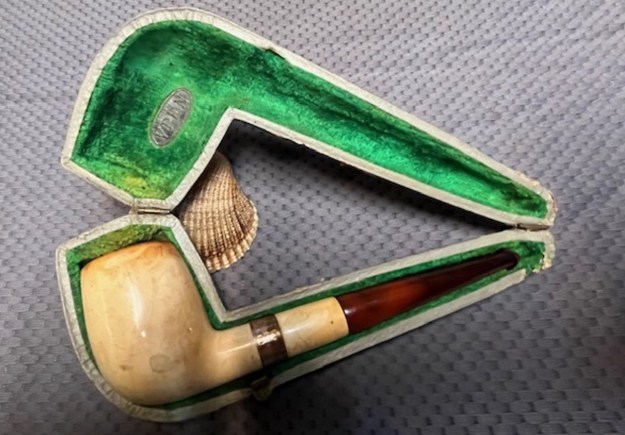
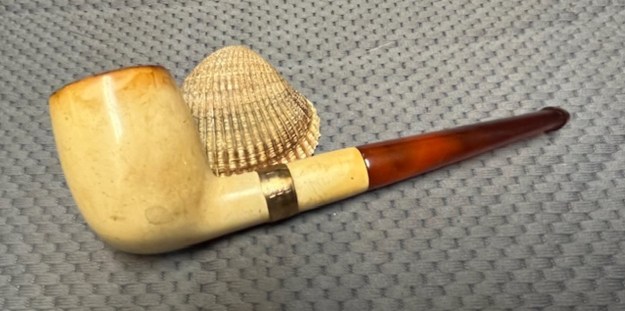
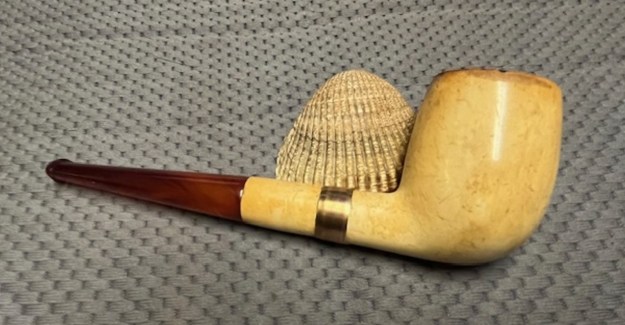
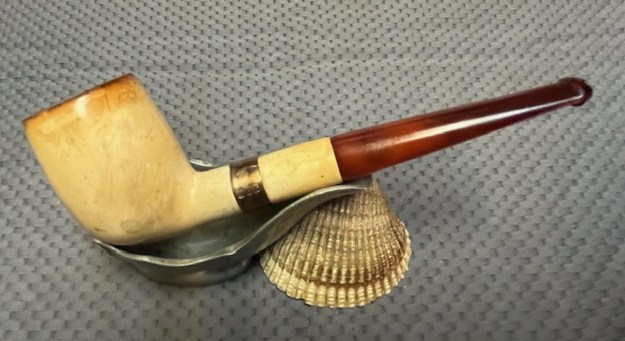
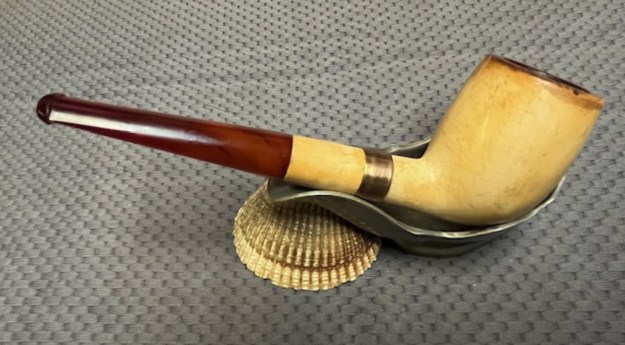
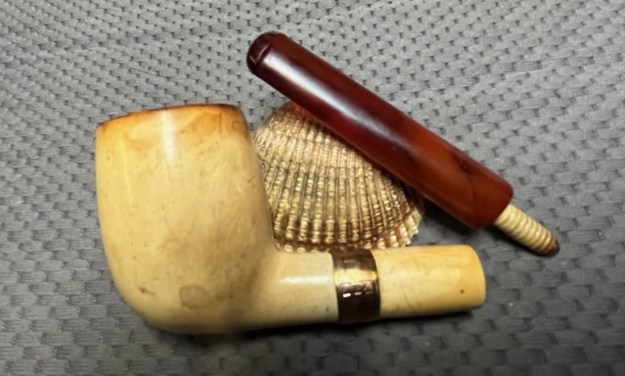
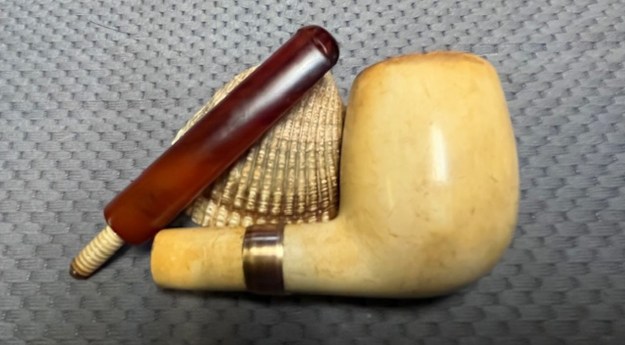
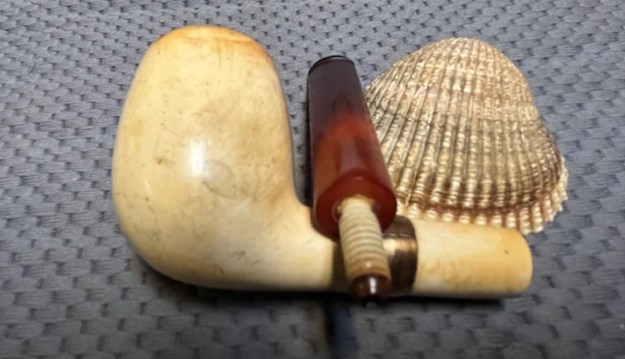
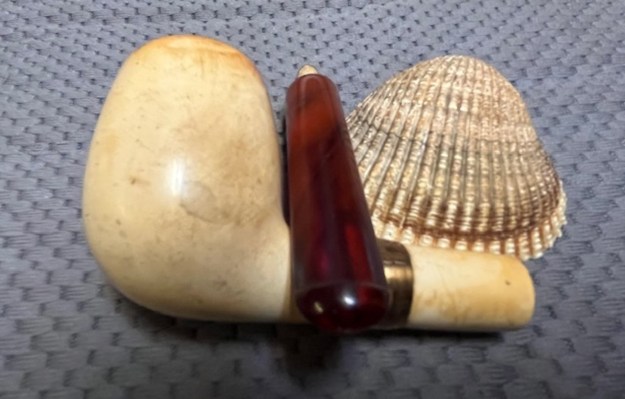
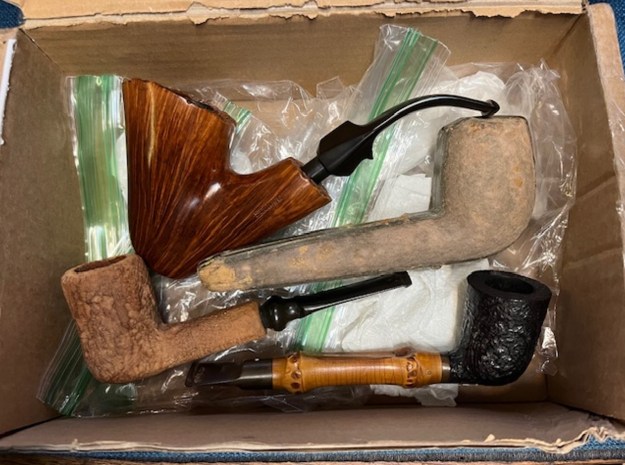
This is another of the four pipes that Sonny in Salmon Arm, BC sent to me for refurbishing. He put them in the mail and I received them on Monday this week. I took a photo of the box of four pipes once I unwrapped them. There were 4 interesting and very unique pipes – a Vauen Solitaire 148 Freehand Filter Pipe that is huge, an older cased meerschaum with an overclocked stem, a Dunhill Wanghee Sandblast Dublin with a Bamboo shank and short saddle stem and finally an Anima wax drip sand blast Billiard carved by Brian McNulty. All needed varying degrees of restoration. The last pipe, a Meerschaum Billiard with a Bakelite Stem is next. It is in a worn green felt covered case that has a silver decal on the inside of the cover VPFN in an oval. The case is lined with a green plush lining. The pipe bears no stamping or identification at all. There is a brass repair band with newer marks on it set in place mid-shank with what appears to be a crack underneath. The repair is solid. The bowl has a light cake in it but not thick. There was some darkening and lava on the rim top as well as some nicks. The finish on the bowl was very dirty with grey grime ground in where the fingers wrapped around the bowl. There were nicks in the finish as well. There was also a line where the meer looked clean up the front of the bowl from top to bottom. The stem has a bone tenon and is Bakelite. The stem is slightly overturned or overclocked to the right. There were light tooth marks and chatter ahead of the button. I took these photos before I started my work on the pipe. I took a photo of the rim top and bowl to show the condition of both of them. There is a light cake in the bowl and it is clean. The rim top is dirty with tars/lava and some nick marks around the outer edge. The inner edge of the bowl looks to be in good condition. The photos of the stem show the light tooth marks/chatter on both sides ahead of the button.I took a photo of the stamping on the inside cover of the case. The stamping was clear and very readable. The VPFN on the inside of the case is shown in the photo. I removed the stem from the shank and took a photo to show the beauty of the pipe.I wanted to get some background on the VPFN stamp on the inside of the case. It was obviously made to fit the pipe so the meer was also a VPFN. Now what did that stand for? I did a Google search for VPFN and was led to a description of the VPFN tying the pipe that I am working on to Vauen. I found a link to Country Squire (https://www.thecountrysquireonline.com/product-category/pipes/vauen-pipes/) and an ad for Vauen pipes. I quote:

Quality and inventiveness have a tradition at VAUEN. OVER 175 YEARS OF VAUEN – that means: over 175 years of craftsmanship and experience paired with contemporary technology.

In 1848, Karl Ellenberger and his partner Carl August Ziener turned an idea into reality in Nuremberg: in the first German pipe factory, they made tobacco pipes from exquisite wood for connoisseurs all over the world. Together with the Gebhard Ott pipe factory, which was also founded in Nuremberg in 1866, the United Pipe Factories Nuremberg (VPFN for short) was founded in 1901 .

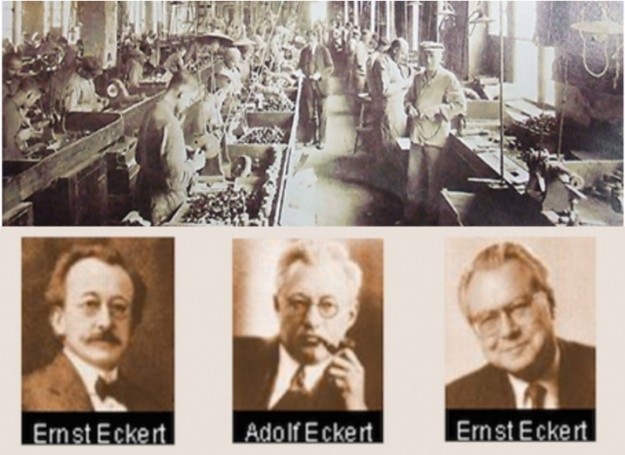
Knowing that I knew that I was dealing with a Vauen Meerschaum. I turned first to Pipephil’s site (http://pipephil.eu/logos/en/logo-v1.html). I did a screen capture of the information on the site. There was a great sidebar that gave some history of the brand. I include both of them below. There was also a note at the bottom of the screen capture below that has a link to the Vauen Dr Perl variant on the P-Lip pipe.In 1848, Karl Ellenberger and his partner Carl August Ziener establish a pipe factory in Nuremberg. In 1901 they merge with Gebhard Ott an other factory in town and they create a firm named Vereinigten Pfeifenfabriken Nürnberg (abbreviated: VPFN*). Shortly after Ernst Eckert, a member of the Ott family became manager of the society. During the 20th century Adolf, Ernst (jr) and Alexander Eckert (CEO in 2012) followed one another at Vauen’s head.* VPFN : “V” is said VAU in German (pronounce faou) and “N” becomes EN. Hence VAUEN.

I also turned to a blog written on rebornpipes by Dal Stanton (Pipesteward.com) that I quote a section from the blog below that gives a great sense of the history of the German brand and some photos from the website (https://rebornpipes.com/2021/04/27/breathing-new-life-into-a-german-vauen-6294-p-lip-saddle-billiard-for-a-special-young-lady/).

… I turn to the question of the history of the VAUEN name? I look to the History section of the VAUEN website and again, I am impressed with the presentation. Whenever I work on a pipe, and especially when a pipe name is new to me, I enjoy looking at its history to appreciate the pipe more fully now on my worktable. From VAUEN’s website:Quality and a wealth of ideas have a long tradition at VAUEN. 160 years of VAUEN: that means 160 years of skilled workmanship and modern technology and 160 years of experience in fulfilling the individual wishes of today’s pipe lovers, and those of tomorrow.

In Nuremberg in 1848, Karl Ellenberger and his partner Carl August Ziener turned an idea into reality: Germany’s first pipe manufacturer produced tobacco pipes for connoisseurs around the world using a selection of the best wood. In an amalgamation with the Gebhard Ott pipe factory, which was founded in 1866 in Nuremberg, the Vereinigten Pfeifenfabriken Nuremberg (United Pipe Factories Nuremberg, or VPFN) was born in 1901.  Under the management of Ernst Eckert, a descendant of the founding Ott family, a company was born whose products and services would shape the tobacco and smoking culture in Europe and overseas for the next 160 years and counting.

The question about the name, VAUEN, not being a name of a person and why it is capitalized throughout is explained:

In his search for a name that would be easily remembered by all pipe lovers, Ernst Eckert’s son, Adolf Eckert, coined a new name for the company in 1909: VAUEN – a composition of the first letters V (pronounced vow) of Vereinigte Pfeifenfabriken and N (pronounced en) of Nuremberg. A brand for the future was born.

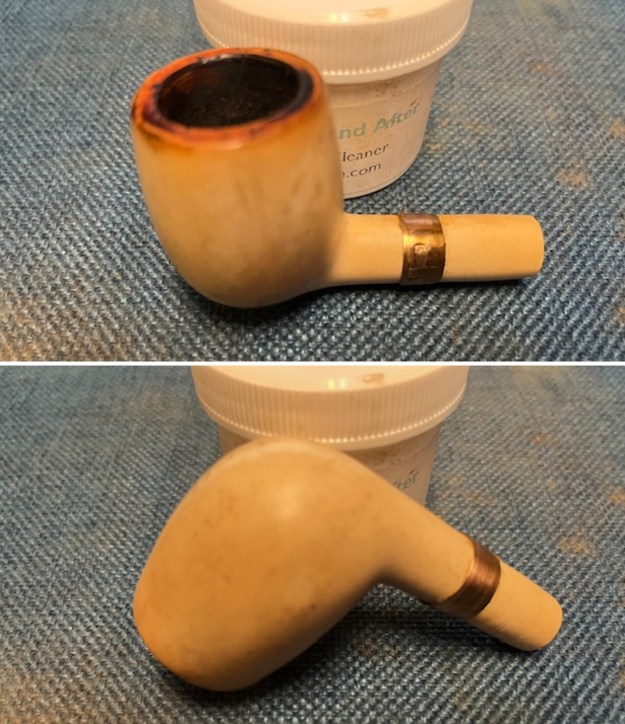
Now it was time to work on the pipe itself. I cleaned the externals of the bowl with Before and After Briar Cleaner to remove the oils and grim from the finish. I rubbed it on with my finger tips and buffed it off with a paper towel to polish it up. I reamed the cake with a Savinelli Fitsall Pipe Knife. I sanded the walls of the bowl with a piece of 220 grit sandpaper wrapped around a piece of dowel. The walls of the bowl are undamaged and smooth. I also cleaned the shank and internals of the shank and stem with pipe cleaners, cotton swabs and isopropyl alcohol. (I failed to take photos of the process).
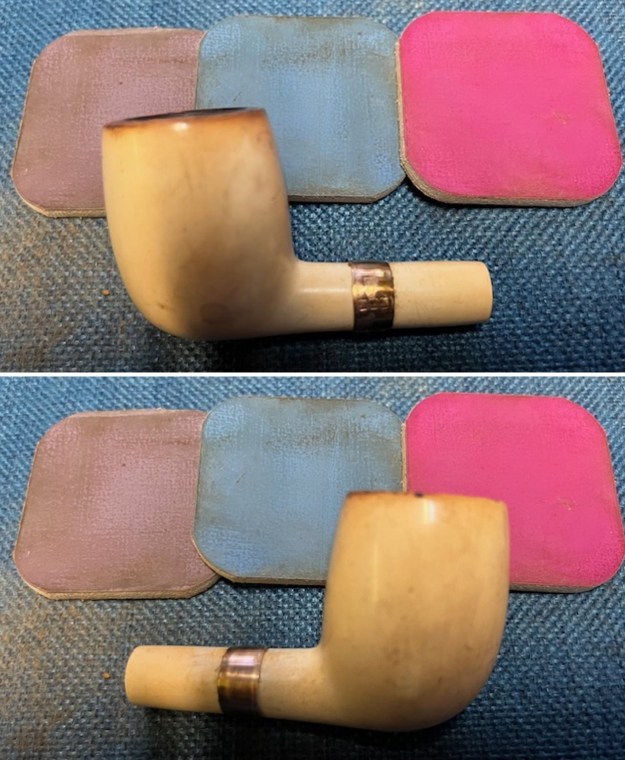
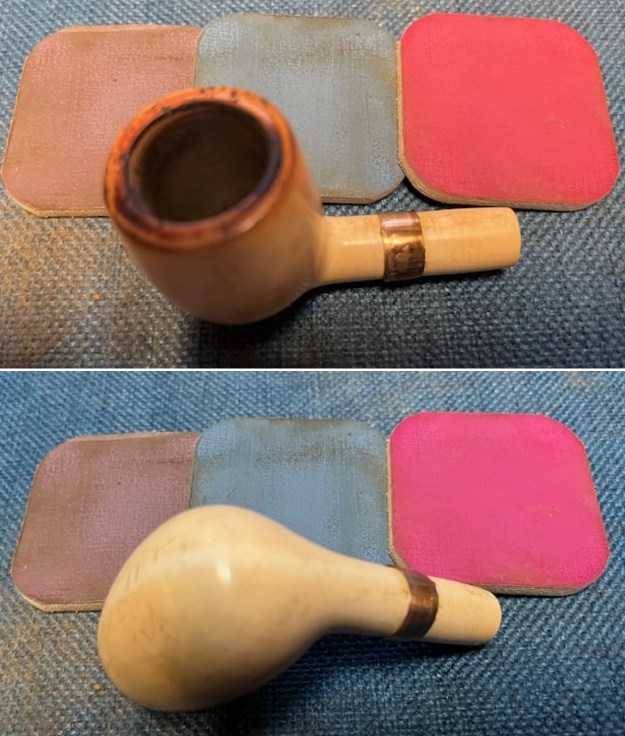
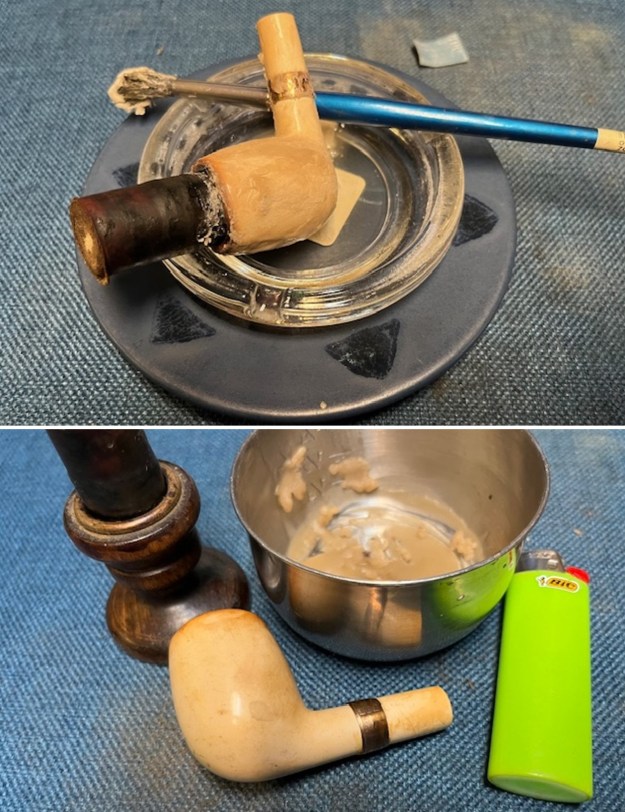
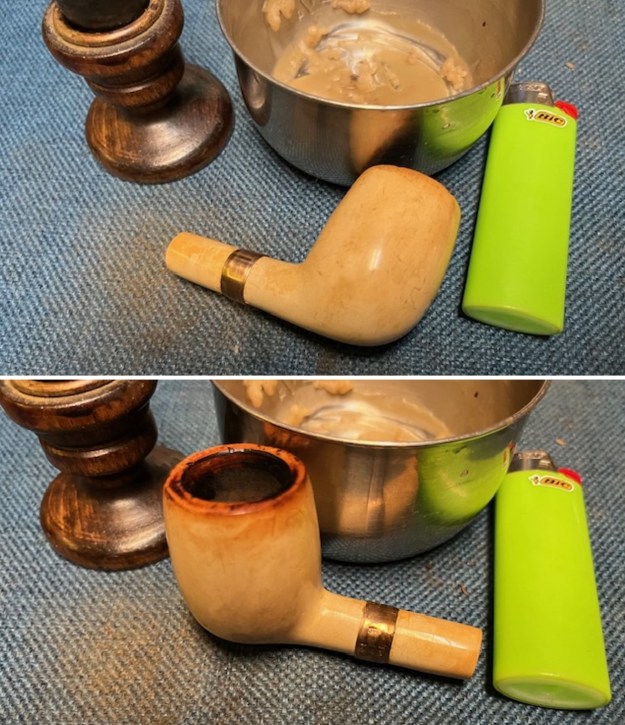
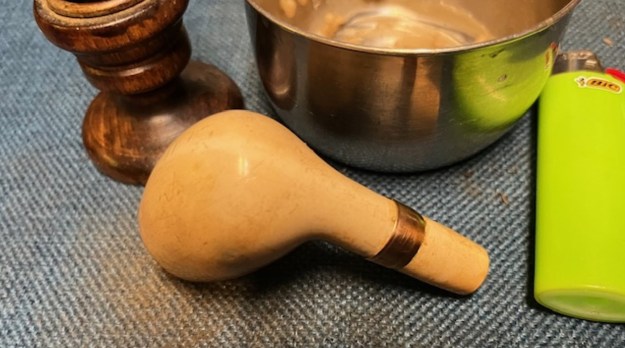
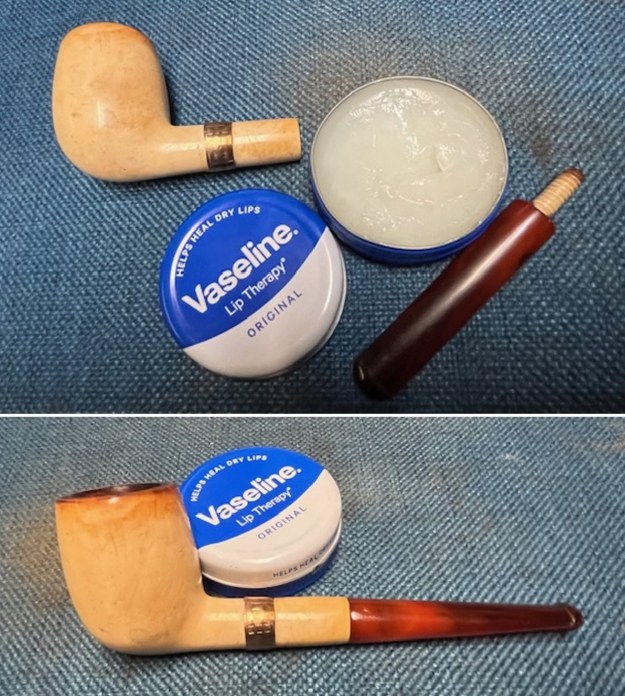
I polished the meerschaum surface with micromesh sanding pads – dry sanding with 1500-12000 grit pads. I wiped the bowl down after each pad with a damp cloth to remove the sanding debris. The bowl began to take on a shine. Now it was time to wax the pipe I melted some beeswax and put a cork in the bowl to hold on to. I painted the bowl surface with the wax using a paint brush I caked it on heavily and set it aside to harden a bit. I heated the bowl with a heat gun to melt off the excess wax and let it drip in the container. I wiped it down with a paper towel. It looked good and the patina deepened. I took some photos of the bowl after buffing it with Blue Diamond. It is a beautiful bowl and the marks and scratches are a well-earned part of the pipe’s story. I polished them some but did not change the profile of the pipe so some still remain. The rim top particularly shows this wear and tear and I left it to remain. I set the bowl aside and turned to address the stem. I painted the threads on the bone tenon with some clear CA glue to build them up to correct the overturned stem. I sanded the ridges smooth with a piece of 220 grit sandpaper until the fit was correct on the shank. I removed it and greased the tenon with some Vaseline to lubricate the threads to ease the turning into the shank. It went very easily and the fit showed the corrected overturned stem.I polished the Bakelite with micromesh sanding pads – 1500-12000 grit pads. I wiped it down with Obsidian Oil after each sanding pad. I used Before & After Pipe Polish – both Fine and Extra Fine to further polish the stem. I gave it a final coat of Obsidian Oil before I put the stem back on the shank. Once I finished with the Vauen VPFN Meerschaum Billiard with the red Bakelite stem I put the stem back on the shank and carefully buffed the pipe with Blue Diamond polish using a lightly loaded pad and a soft touch. I wanted the shine but did not want to heat the Bakelite too much or bring damage to the banded shank repair. I used even a gentler touch on the bamboo. I gave the stem a vigorous polish being careful around the repair. Since I have already waxed it with beeswax I did not give it a coat of carnauba. I buffed the pipe with a clean buffing pad and hand buffed it with a microfiber cloth. The finished pipe is shown in the photos below. It is a great piece of pipe history and looks better than when I began the process. The dimensions of the pipe are Length: 5 inches, Height: 1 ¾ inches, Outer Bowl Diameter: 1 ¼ inches, Chamber Diameter: ¾ of an inch. The weight of the pipe is 1.06 ounces/ 30 grams. This is the last of Sonny’s pipes I had to work on. I will pack them all and send them back to him this week. Thanks for reading this blog and my reflections on the pipe while I working on it. As always, I encourage your questions and comments as you read the blog. Thanks to each of you who are reading this blog. Remember we are not pipe owners; we are pipemen and women who hold our pipes in trust until they pass on into the trust of those who follow us.

Cleaning up a Brian McNulty Anima Wax Drip Sandblast Billiard


By Steve Laug

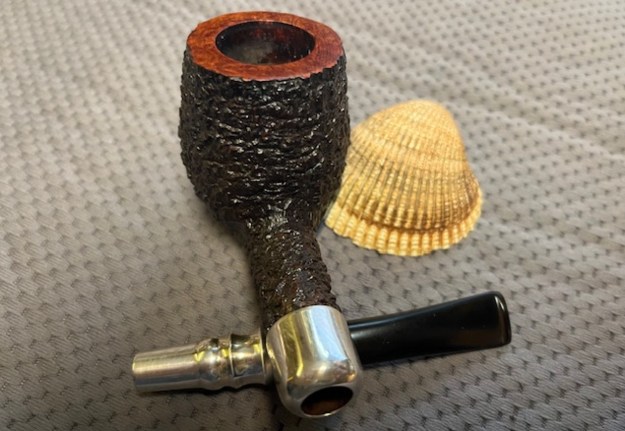
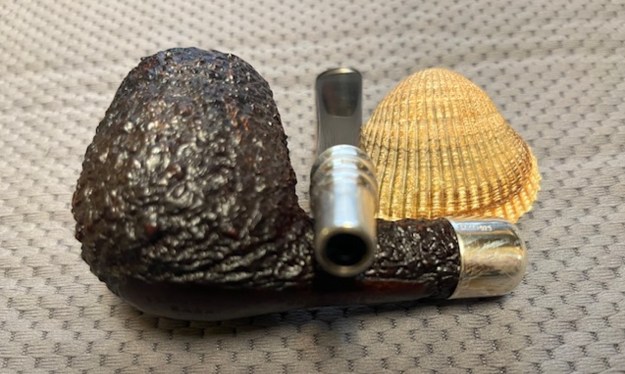
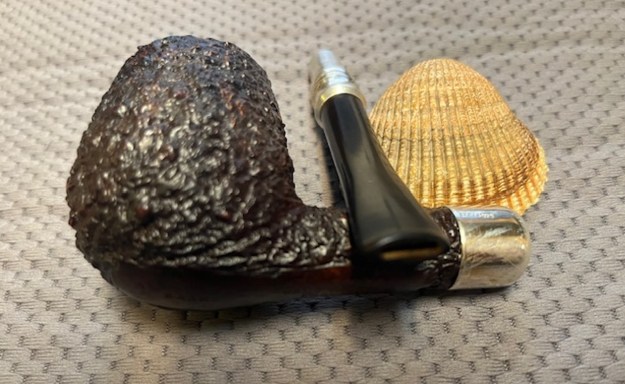
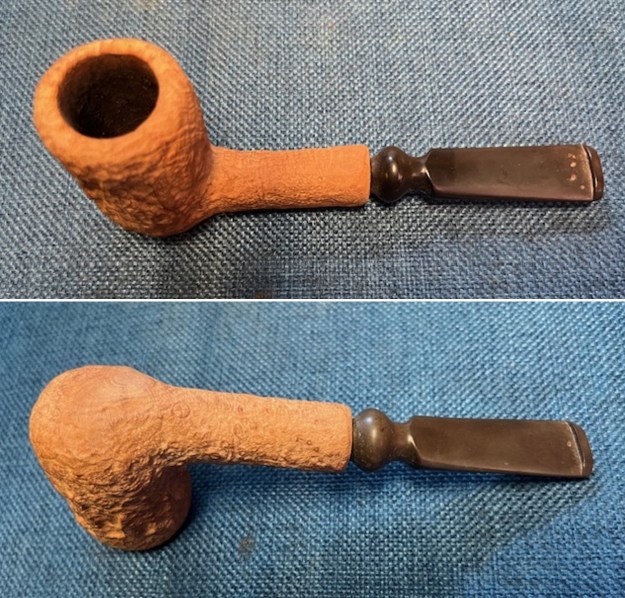
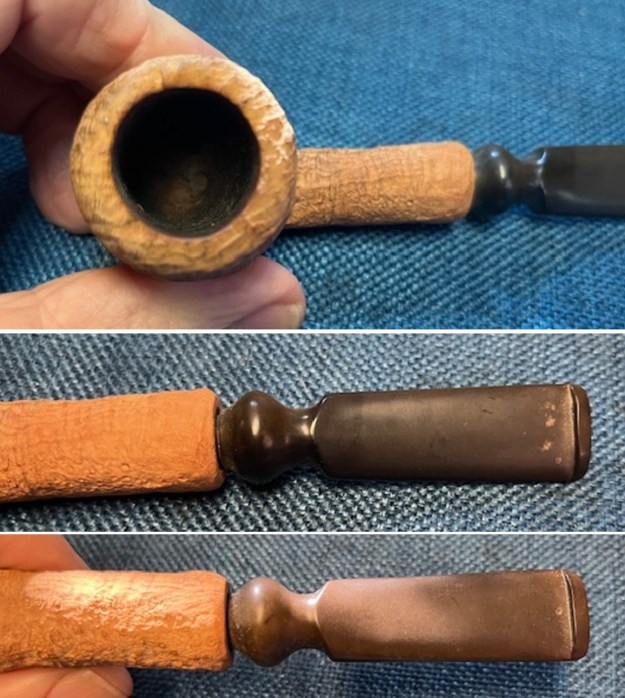
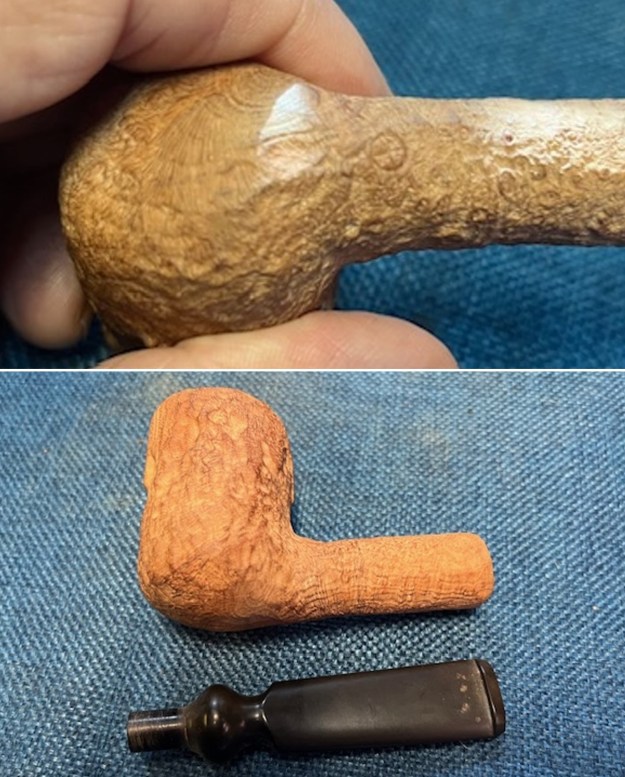
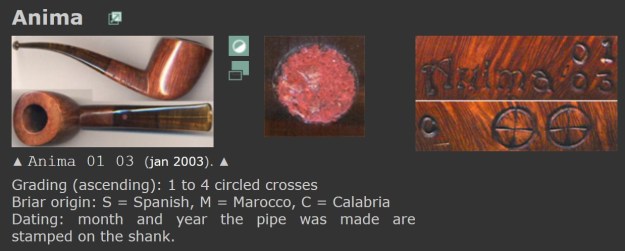
This is another of the four pipes that Sonny in Salmon Arm, BC sent to me for refurbishing. He put them in the mail and I received them on Monday this week. I took a photo of the box of four pipes once I unwrapped them. There were 4 interesting and very unique pipes – a Vauen Solitaire 148 Freehand Filter Pipe that is huge, an older cased meerschaum with an overclocked stem, a Dunhill Wanghee Sandblast Dublin with a Bamboo shank and short saddle stem and finally an Anima wax drip sand blast Billiard carved by Brian McNulty. All needed varying degrees of restoration. I chose to work on the Brian McNulty Anima Wax Drip Sandblast Billiard next. It is faintly stamped on the underside of the bowl with a single cross in a circle or what is known as a Medicine Circle. There were other faint stamps on the shank and heel of the bowl but they were not readable even with a lens. My guess is that they read Anima and possibly the date the pipe was made. There is a wax drip finish around the rim top and down the sides of the bowl. The wax drip and the bowl have a sandblast finish was dirty but had some nice grain showing through the blast. The bowl was quite clean and if it had been smoked at all it was minimal as there was no real darkening on the lower half. The precast freehand style stem was oxidized and there were tooth marks and chatter ahead of the button. I took these photos before I started my work on the pipe. I took a photo of the rim top and bowl to show the condition of both of them. There is a light cake in the bowl and it is clean. The rim top is very clean with a light sandblast. There is no damage on the top or the inner edge. The photos of the stem show the oxidation and tooth marks/chatter on both sides ahead of the button.I took photos of the stamping on the underside of the bowl and shank. The stamping was faint and hard to read as noted above. You can see the Medicine Circle (single one) stamped near the bowl shank transition in the photo below. I removed the stem from the shank and took a photo to show the beauty of the pipe.Before I started my clean up work on the pipe I turned to my usual sources to see what I could learn about the brand. I turned first to PipePhil’s site (http://pipephil.eu/logos/en/logo-a6.html). I did a screen capture of the section on Anima Pipes. From that I reexamined the underside of the bowl and shank to see fi I could clarify some of the faint stamps. There was a small C on the shank that tells me the briar is from Calabria. It also seems to bear a 04 03 stamp that tells me that the pipe was made in April of 2003 from the information below. That was information that I did not have until I read this on PipePhil.The site also had a small photo of Brian McNulty. The side bar identified him as the artisan that made the pipes. It also noted that the dot inlaid in the stem is of red clay (Catlinite) used by Indians for their pipes. The clay is the soul (Anima) of the pipe.

Sonny had told me that Brian is a Cherokee and all of this information was quite interesting to note.

From there I turned to Pipedia (https://pipedia.org/wiki/Anima_Pipes). Generally, I find more information on the site that fills in the blanks a bit for me on the maker and the company. That was the case this time as well. I am including the information below.

Anima Pipes are all handmade in the USA by carver Brian McNulty utilizing the highest quality, well aged briar from many regions to bring out the free flowing forms which lie in each ebacheon. Cut to maximize the beautiful grain of the wood, these pipes provide a beautiful aesthetic and a cool and satisfying smoke to all whom have had the pleasure of packing up and lighting one of these “smokable works of art” which is undeniably Anima. With a basis in traditional styling, accentuated by artistic expression, these extremely fine smoking articles each come with an exact matching tamper to compliment each pipe. Carver Brian McNulty’s sharp eye and flair for form, symmetry, sleek lines, fine attention to detail, and uniquely inspired shapes coupled with “soul” within the craftsmanship are what set Anima pipes apart from many others. Know that smoking an Anima pipe will provide you with a dry and satisfying smoke every time as you view a truly one-of-a-kind work of art!  You might also enjoy listening to Brian Levine’s interview of Brian McNulty on the Pipes Magazine Radio Show

I turned to work on the pipe itself. I reamed the cake with a Savinelli Fitsall Pipe Knife. I sanded the walls of the bowl with a piece of 220 grit sandpaper wrapped around a piece of dowel. The walls of the bowl are undamaged and smooth.

I scrubbed internals of the shank and airway in both the shank and the stem with alcohol, pipe cleaners and cotton swabs. The pipe began to look much better. To remove the grime from the sandblast ridges and valleys I scrubbed the surface with undiluted Murphy’s Oil Soap and a tooth brush. I rinsed the briar with warm water to remove the soap and debris. I dried it off with a soft towel. I rubbed the briar down with Before & After Restoration Balm. I worked it into the briar with my fingertips and a shoe brush. The product works to clean, enliven and preserve the briar. I let it sit for 10 minutes then I buffed it with a cotton cloth to deepen the shine. The briar comes alive with the balm. I set the bowl aside and turned to address the tooth marks and chatter in the stem surface. I “painted” the tooth marks on the stem with the flame of a Bic lighter. I was able to lift the tooth marks significantly. I filled in what remained with black rubberized CA glue. Once the repairs had cured I sanded them with 220 grit sandpaper to blend them into the surface of the stem. I sanded the stem surface with 320-3500 grit sanding pads. I dry sanded with each pad and wiped the stem down after each pad with an Obsidian Oil impregnated cloth.I polished the vulcanite with micromesh sanding pads – 1500-12000 grit pads. I wiped it down with Obsidian Oil after each sanding pad. I used Before & After Pipe Polish – both Fine and Extra Fine to further polish the stem. Once I finished with the 2003 Brian McNulty Anima Wax Drip Sandblast Billiard I put the stem back on the shank and carefully buffed the pipe with Blue Diamond polish using a lightly loaded pad and a soft touch. I wanted the shine but not the grit filling in the crevices of the sandblast bowl. I buffed it lightly with Blue Diamond so as not to get it in the grooves and crevices of the blast. I gave the bowl and stem multiple coats of carnauba wax. I buffed the pipe with a clean buffing pad and hand buffed it with a microfiber cloth. The finished pipe is shown in the photos below. It is a great piece of pipe history and looks better than when I began the process. The dimensions of the pipe are Length: 5 ¾ inches, Height: 2 inches, Outer Bowl Diameter: 1 ¼ inches, Chamber Diameter: ¾ of an inch. The weight of the pipe is 1.45 ounces/ 41grams. One more of Sonny’s pipes to work on before I send them all back to him. Thanks for reading this blog and my reflections on the pipe while I working on it. As always, I encourage your questions and comments as you read the blog. Thanks to each of you who are reading this blog. Remember we are not pipe owners; we are pipemen and women who hold our pipes in trust until they pass on into the trust of those who follow us.

Cleaning up a Dunhill Whangee Dublin


By Steve Laug

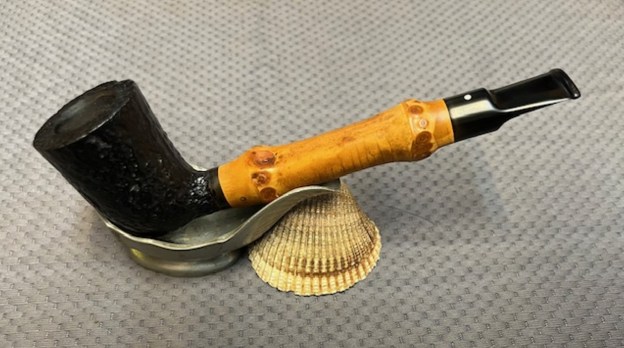
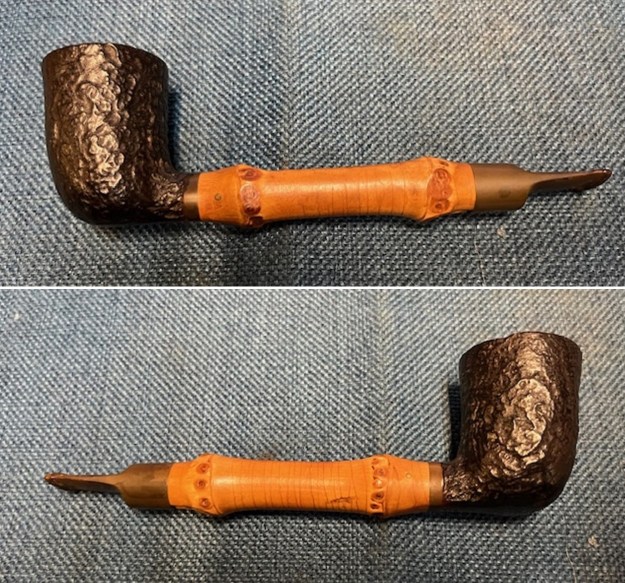
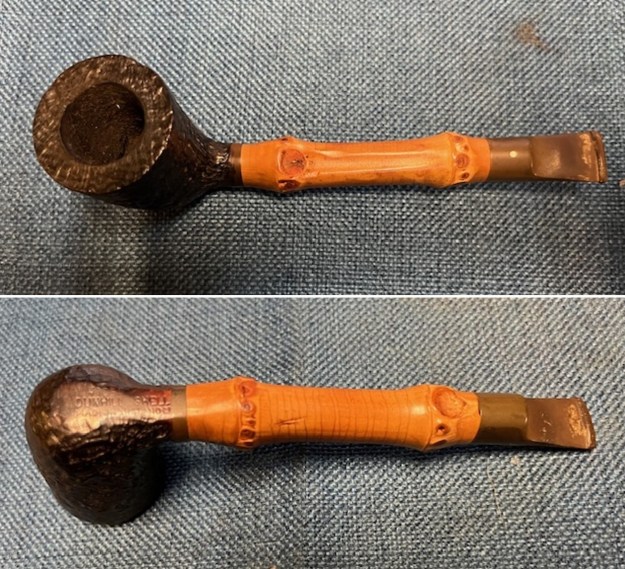
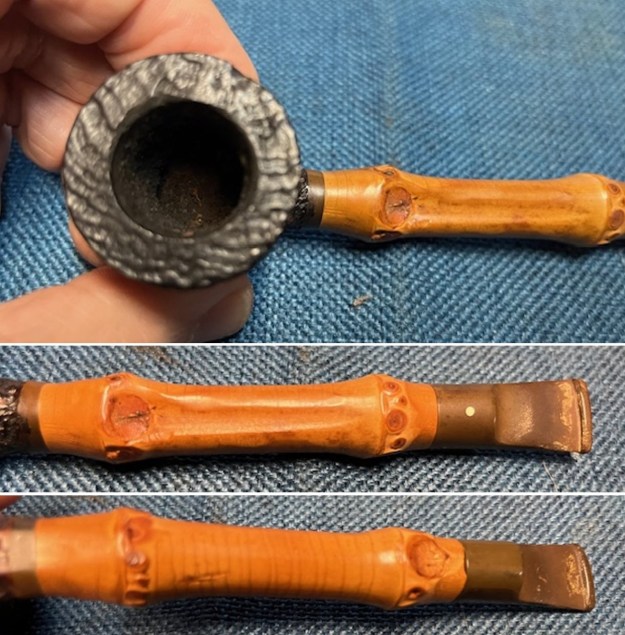
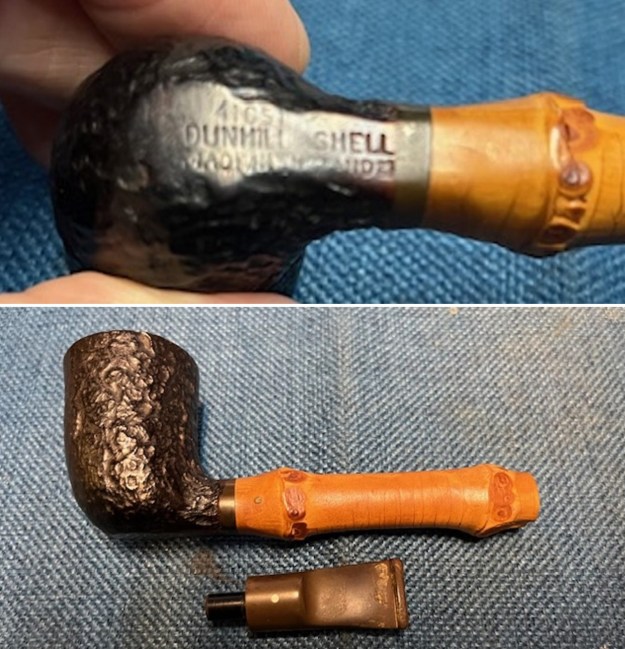
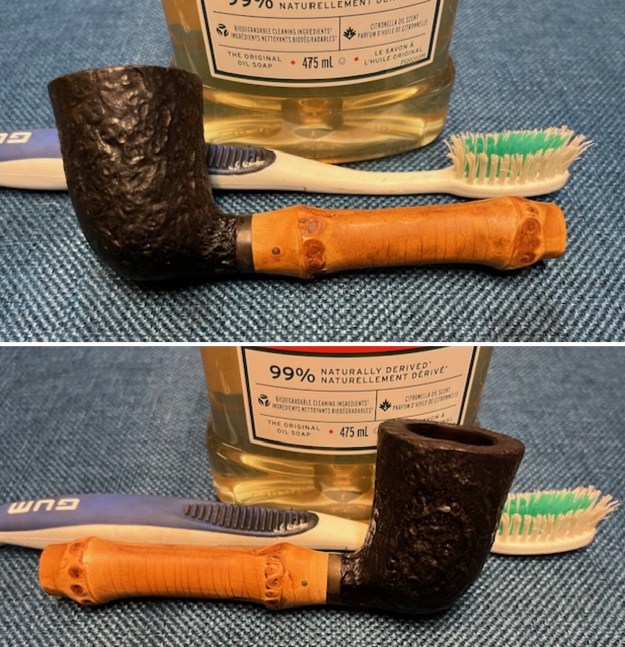
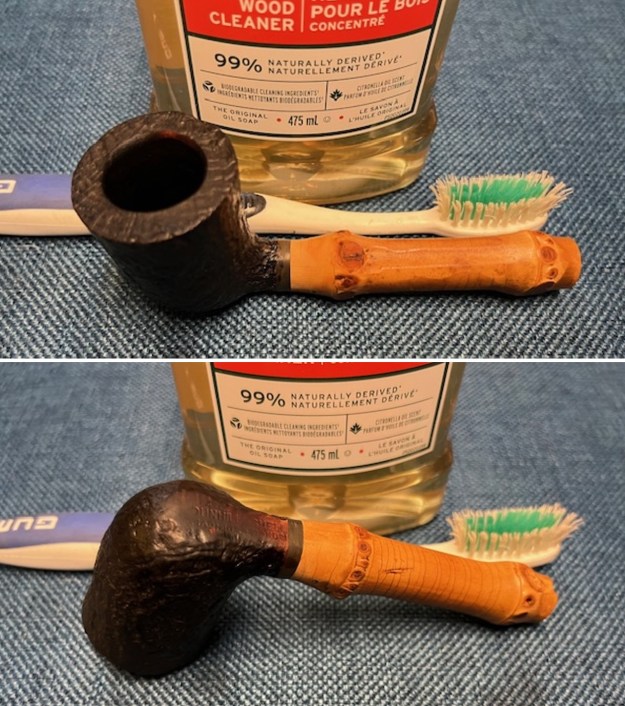
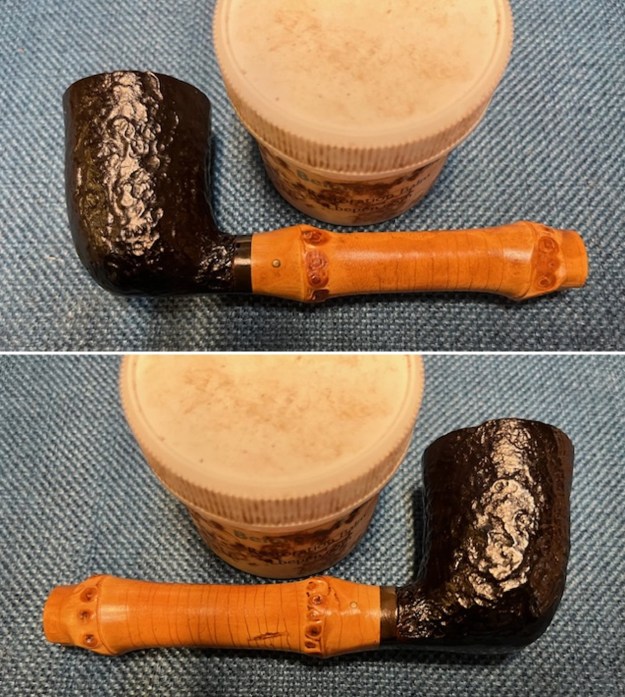
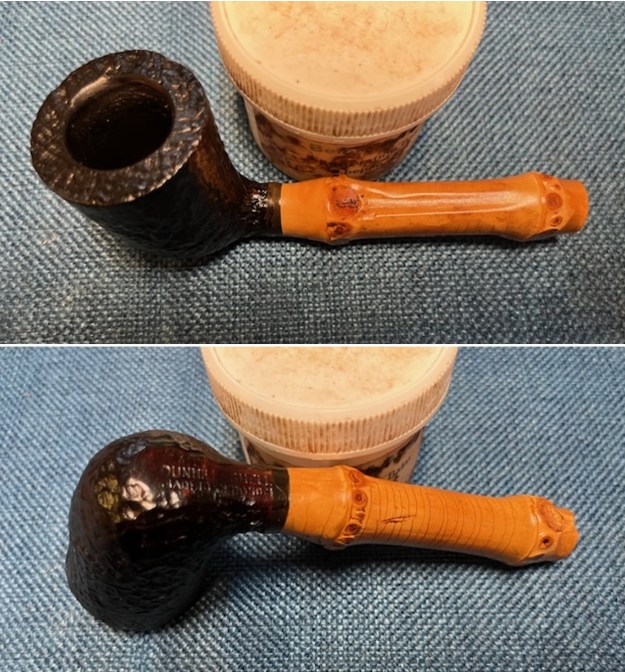
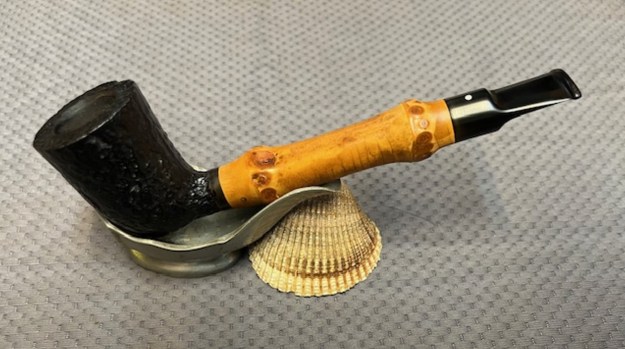
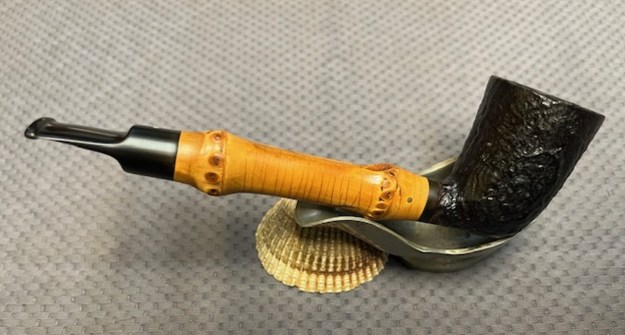
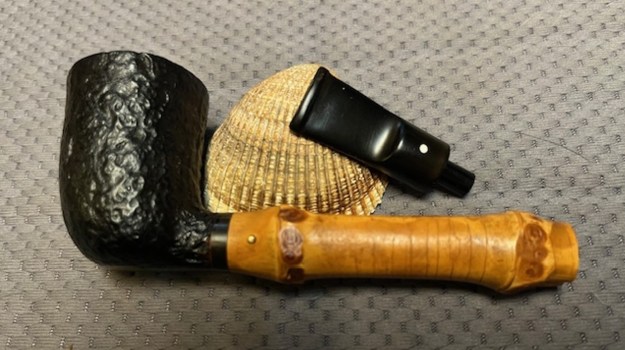
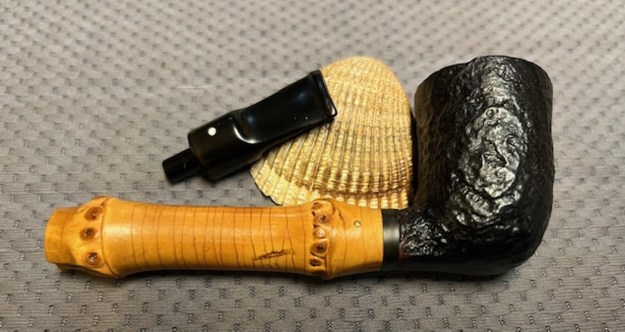
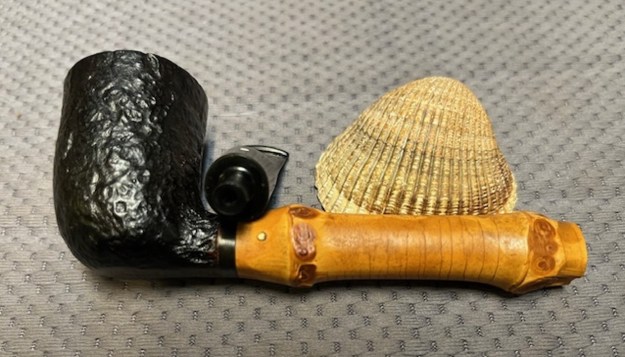
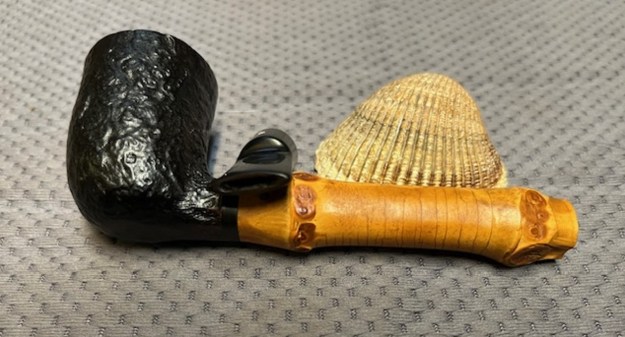
This is another of the four pipes that Sonny in Salmon Arm, BC sent to me for refurbishing. He put them in the mail and I received them on Monday this week. I took a photo of the box of four pipes once I unwrapped them. There were 4 interesting and very unique pipes – a Vauen Solitaire 148 Freehand Filter Pipe that is huge, an older case meerschaum with an overclocked stem, a Dunhill Wanghee Sandblast Dublin with a Bamboo shank and short saddle stem and finally an Anima wax drip sand blast Billiard carved by Brian McNulty. All needed varying degrees of restoration.I chose to work on the Dunhill Shell with the Bamboo Shank and short saddle stem. It is stamped on the underside and reads 41051 [over] Dunhill Shell [over] Made in England21. There was a vulcanite spacer between the bamboo shank and the short briar shank on the bowl. It was oxidized. The bamboo shank had some crackling and a rich patina on the surface that would continue to deepen with age. The sandblast finish was dirty but had some nice grain showing through. The bowl was slightly out of round with a moderate cake in the bowl. There was some light lava on the rim top. The short saddle stem was oxidized, calcified and there were tooth marks and chatter ahead of the button. The top of the saddle also bore the Dunhill white. I took these photos before I started my work on the pipe. I took a photo of the rim top and bowl to show the condition of both of them. There is a moderate cake in the bowl. The rim top has some light lava and some damage on the right side of the inner edge. The photos of the stem show the oxidation and tooth marks/chatter on both sides ahead of the button.I took photos of the stamping on the sides of the shank. The stamping was clear and readable as noted above. I removed the stem from the shank and took a photo to show the beauty of the pipe.This morning I went back to the original blog describing the restoration of the previous Whangee pipe. I am including the link to the blog (https://rebornpipes.com/2020/01/08/refreshing-a-dunhill-tanshell-w60-t-1962bamboo-lovat-for-alex/). Give it a read. I am quoting my introductory comments in that blog below because they capture well the feelings I had when I first saw this bamboo shank pipe in Sonny’s box.

I carefully took it in my hands and examined it. While I have several Stanwell Bamboo pipes and older KBB Yello Bole Bamboos this is the first Dunhill that I had seen up close and personal. Alex told me that these bamboo-adorned pieces were referred to as “Whangee” pipes. I learned later that the term comes from the Mandarin word for bamboo, huáng lí and was used to describe canes and umbrellas with bamboo handles throughout the early to mid-1900s before being attributed to pipes — Dunhill’s in particular. I learned from reading on line that bamboo came to into use in pipemaking during the briar shortage that accompanied and followed WWII. As a means of saving on briar, pipemakers would extend the shank with bamboo.

The pipe was stamped on the heel of the bowl with the following nomenclature: 45051 over Dunhill Shell over Made in England. Next to that is an underlined 21which I believe designates the year of manufacture – 1981. So now I knew the date on this interesting Bamboo it is a newer Bamboo than others I have worked on.

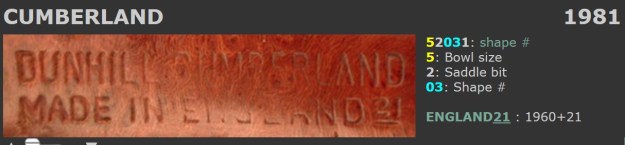
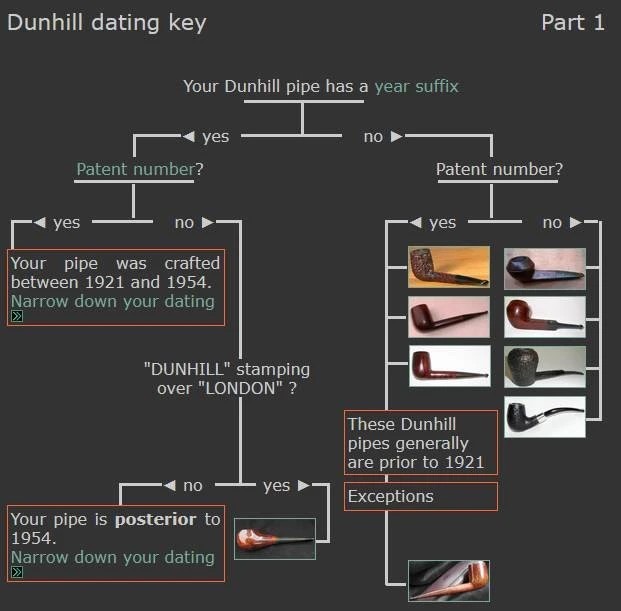
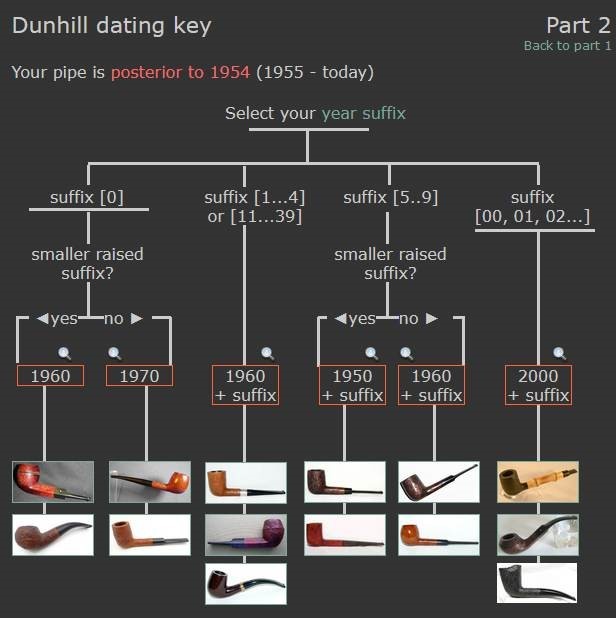
One of the first things I like to do is to unpack the stamping and understand each element in it. I turned to Pipephil’s helpful site (http://pipephil.eu/logos/en/dunhill/shapes-l.html). I am using the illustration below to interpret the stamping.The 45051 stamp includes the shape code 05 for a Dublin. The 4 is the bowl size the other digits 5 and 1 are a bit harder to interpret. The fifth digit 1 is not needed. The 5 may refer to the shape of the stem (in this case a saddle stem) but I ma not sure. Pipephil also has some helpful dating keys on the site that are basically flow charts that you can walk through to date your pipe (http://pipephil.eu/logos/en/dunhill/cledat-en1.html). I turned to Part 1 of the Dating Key and followed the chart. This pipe has a 21 following the England stamp. That took me to the section on the chart below (column one) which instructed me that the pipe could be dated as being made posterior to 1954.I followed the link following the “Your pipe is posterior to 1954. Narrow down your dating”. That took me to Page 2 of the dating key (http://pipephil.eu/logos/en/dunhill/cledat-en1a.html). The second column (suffix [1…4] or [11…39]) led me to the section with a 2 after the D in England. There was a directive for dating the pipe spelled out as follows: 1960 + suffix 21 which gives the pipe a date of 1981. Even though this bamboo shank Dunhill was not stamped Whangee it had all the parts that make up a Whangee. So, I googled Dunhill Bamboo Wanghee to get a bit of background on the that brand and found a link on Smoking Pipes that had some helpful information that I will quote below the link (https://www.smokingpipes.com/pipes/estate/england/moreinfo.cfm?product_id=235695).

It’s not everyday you come across a Dunhill Whangee, the marque’s classic bamboo-shanked pipe. Though originally incorporated into Dunhill’s lineup several decades back, when briar was in short supply, these eccentric designs caught on, and many collectors have even built entire rotations around them. You will occasionally find one on the estate market, as we do here, but they tend to sell quickly, especially if it is an older example like this ’62 edition — in part due to their general rarity, but also because of their overall unique aesthetic. You can’t find classic English designs fitted with oversized bamboo extensions everywhere, after all…

I turned to work on the pipe itself. I reamed the cake with a PipNet pipe reamer using the second cutting head to cut back the cake to bare briar. I used a Savinelli Fitsall Pipe Knife to clean up the remnants on the bowl walls. I sanded the walls of the bowl with a piece of 220 grit sandpaper wrapped around a piece of dowel. The walls of the bowl are undamaged and smooth. The shank was clogged and I could not get air to flow well through it. I pushed a wire through the shank to open it up. Then I scrubbed the inside of the bamboo shank and the mortise with alcohol and pipe cleaners. I also cleaned out the airway in the stem the same way.I cleaned up the inner edge of the rim and brought the bowl back to round with a folded piece of 220 grit sandpaper. It looked much better once I had finished the reshaping.I scrubbed externals of the bowl with a tooth brush and undiluted Murphy’s Oil Soap. I rinsed off the grime and debris that came off in the scrubbing with warm water. I dried it off once it was clean. It looks very good! I rubbed the briar down with Before & After Restoration Balm. I worked it into the briar and the bamboo with my fingertips and a shoe brush. The product works to clean, enliven and preserve the briar. I let it sit for 10 minutes then I buffed it with a cotton cloth to deepen the shine. The briar comes alive with the balm. I set the bowl aside and turned to address the tooth marks and chatter in the stem surface. I “painted” the tooth marks on the stem with the flame of a Bic lighter. I was able to lift the tooth marks to the place where I could sand out what remained. I sanded them with 220 grit sandpaper to blend them into the surface of the stem. I sanded the stem surface with 320-3500 grit sanding pads. I dry sanded with each pad and wiped the stem down after each pad with a Obsidian Oil impregnated cloth.I polished the vulcanite with micromesh sanding pads – 1500-12000 grit pads. I wiped it down with Obsidian Oil after each sanding pad. I used Before & After Pipe Polish – both Fine and Extra Fine to further polish the stem. I gave it another coat of Obsidian Oil and set it aside. Once I finished with the 1981 Dunhill Shell Bamboo 41051 I put the stem back on the shank and carefully buffed the pipe with Blue Diamond polish using a lightly loaded pad and a soft touch. I wanted the shine but not the grit filling in the crevices of the sandblast bowl. I used even a gentler touch on the bamboo. I gave the stem a vigorous polish being careful around the white spot. I gave the bowl and bamboo several coats of Conservator’s Wax and the stem several coats of carnauba. I buffed the pipe with a clean buffing pad and hand buffed it with a microfiber cloth. The finished pipe is shown in the photos below. It is a great piece of pipe history and looks better than when I began the process. The dimensions of the pipe are Length: 6 inches, Height: 1 ¾ inches, Outer Bowl Diameter: 1 ¼ inches, Chamber Diameter: ¾ of an inch. The weight of the pipe is 1.16 ounces/ 33grams. Two more of Sonny’s pipes to work on before I send them all back to him. Thanks for reading this blog and my reflections on the pipe while I working on it. As always, I encourage your questions and comments as you read the blog. Thanks to each of you who are reading this blog. Remember we are not pipe owners; we are pipemen and women who hold our pipes in trust until they pass on into the trust of those who follow us.

A Needham Restoration


I have very rustic one these I have not worked yet. Thanks for all the research on it. Very helpful. Great restoration John

Photographed and written by John M. Young This is a pipe I read about in 2023 and have been searching the auctions for since.  One showed up in Italy…

A Needham Restoration

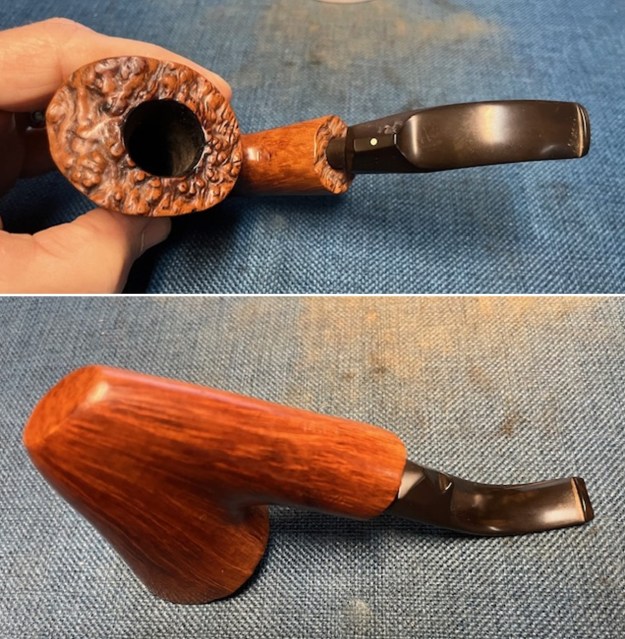
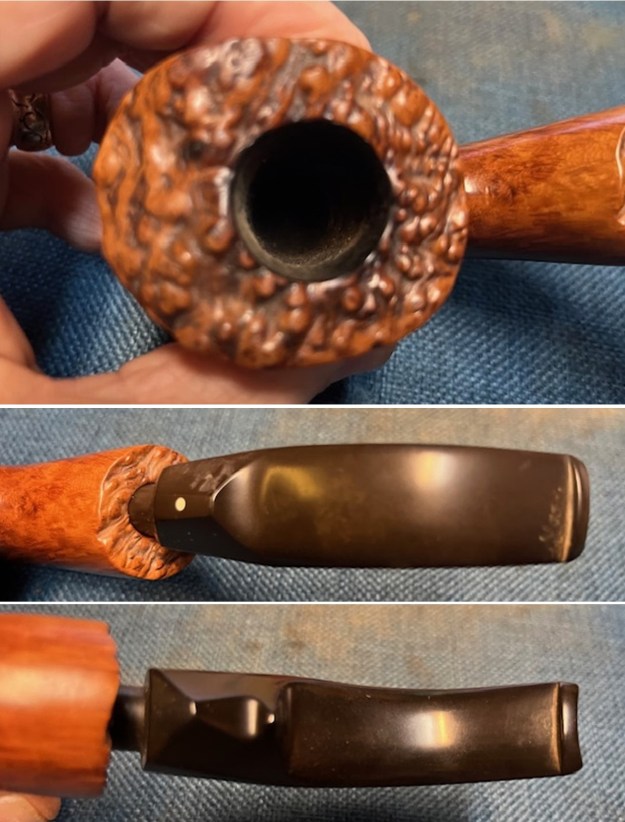
Restoring a Vauen Solitaire 148 Freehand


By Steve Laug

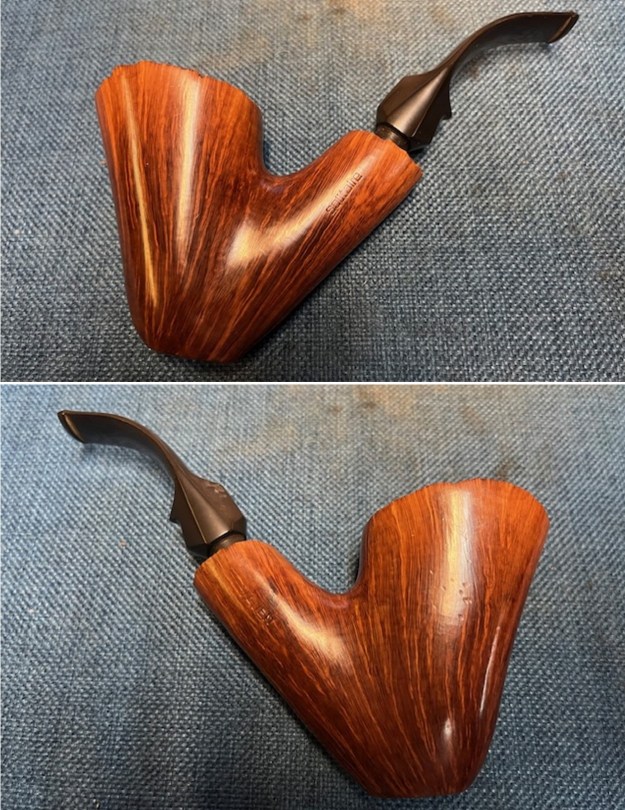
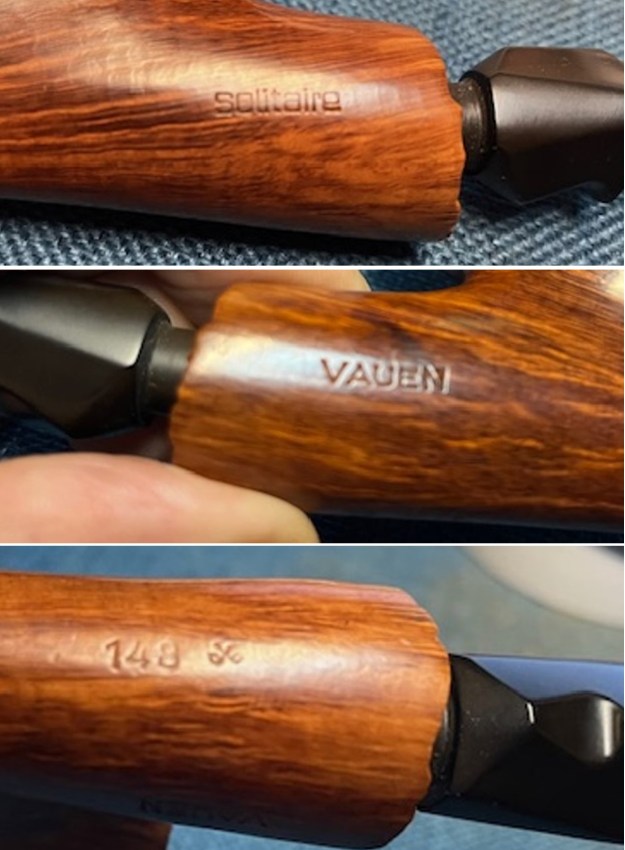
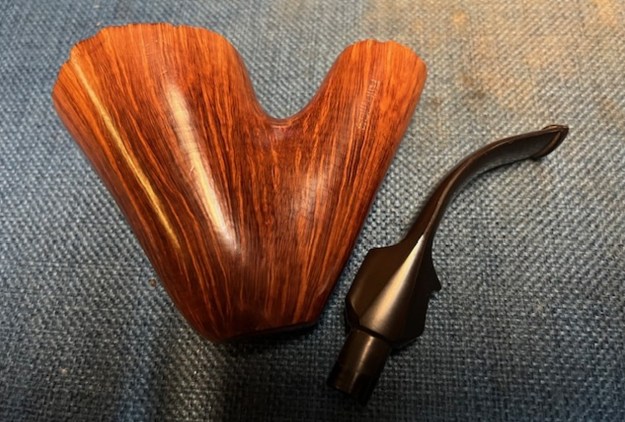
When I sent back his pipes, Sonny in Salmon Arm, BC contacted me and said he had four more he wanted me to work on. He put them in the mail and I received them on Monday this week. I took a photo of the box of four pipes once I unwrapped them. There were 4 interesting and very unique pipes – a Vauen Solitaire 148 Freehand Filter Pipe that is huge, an older case meerschaum with an overclocked stem, a Dunhill Wanghee Sandblast Dublin with a Bamboo shank and short saddle stem and finally an Anima wax drip sand blast Billiard carved by Brian McNulty. All needed varying degrees of restoration.I chose to work on the big Vauen Solitaire Freehand. It is stamped on the left side and reads Solitaire. On the left side it is stamped Vauen and on the underside it is stamped with the shape number 148 followed by a pair of crossed bent pipes. The finish was shiny but there was also a dullness to the amazing grain around the bowl. There were some small nicks on the bowl where it looked like it had been dropped. A moderate cake in the bowl was in the bowl and some light lava on the rim top and some darkening on the inner edge. The fancy filter saddle stem was lightly oxidized and there was tooth marks and chatter ahead of the button. The top of the saddle also bore the Vauen white dot. I took these photos before I started my work on the pipe. I took a photo of the rim top and bowl to show the condition of both of them. There is a moderate cake in the bowl. The plateau rim top has some lava and rim darkening around the top and inner edge. The plateau on the shank end is dusty as well. The photos of the stem show the oxidation, stickiness from a price tag and some light tooth marks/chatter on both sides ahead of the button.I took photos of the stamping on the sides of the shank. The stamping was clear and readable as noted above. I removed the stem from the shank and took a photo to show the beauty of the pipe. Once again, I am including the background on the Vauen brand that I have used before. I think it is an important part of the restoration process for me. I always read over it before I start my work on a pipe. It always personalizes and adds colour to the pipe I am working on. As usual, I turned to Pipephil’s site (http://pipephil.eu/logos/en/logo-v1.html). I did a screen capture of the information on the site. There was a great sidebar that gave some history of the brand. I include both of them below. In 1848, Karl Ellenberger and his partner Carl August Ziener establish a pipe factory in Nuremberg. In 1901 they merge with Gebhard Ott an other factory in town and they create a firm named Vereinigten Pfeifenfabriken Nürnberg (abbreviated : VPFN*). Shortly after Ernst Eckert, a member of the Ott family became manager of the society. During the 20th century Adolf, Ernst (jr) and Alexander Eckert (CEO in 2012) followed one another at Vauen’s head.* VPFN : “V” is said VAU in German (pronounce faou) and “N” becomes EN. Hence VAUEN.
Dal Stanton (Pipesteward.com) wrote a great piece on the history of the brand on a Vauen pipe that he worked on. I reread that and quote a section from the blog below that gives a great sense of the story of this interesting German brand and some photos from the website (https://rebornpipes.com/2021/04/27/breathing-new-life-into-a-german-vauen-6294-p-lip-saddle-billiard-for-a-special-young-lady/).

… I turn to the question of the history of the VAUEN name? I look to the History section of the VAUEN website and again, I am impressed with the presentation. Whenever I work on a pipe, and especially when a pipe name is new to me, I enjoy looking at its history to appreciate the pipe more fully now on my worktable. From VAUEN’s website:Quality and a wealth of ideas have a long tradition at VAUEN. 160 years of VAUEN: that means 160 years of skilled workmanship and modern technology and 160 years of experience in fulfilling the individual wishes of today’s pipe lovers, and those of tomorrow.

In Nuremberg in 1848, Karl Ellenberger and his partner Carl August Ziener turned an idea into reality: Germany’s first pipe manufacturer produced tobacco pipes for connoisseurs around the world using a selection of the best wood. In an amalgamation with the Gebhard Ott pipe factory, which was founded in 1866 in Nuremberg, the Vereinigten Pfeifenfabriken Nuremberg (United Pipe Factories Nuremberg, or VPFN) was born in 1901.  Under the management of Ernst Eckert, a descendent of the founding Ott family, a company was born whose products and services would shape the tobacco and smoking culture in Europe and overseas for the next 160 years and counting.

The question about the name, VAUEN, not being a name of a person and why it is capitalized throughout is explained:

In his search for a name that would be easily remembered by all pipe lovers, Ernst Eckert’s son, Adolf Eckert, coined a new name for the company in 1909: VAUEN – a composition of the first letters V (pronounced vow) of Vereinigte Pfeifenfabriken and N (pronounced en) of Nuremberg. A brand for the future was born.

Reminded once again of the colours of the brand, I turned my attention to the pipe itself. I wiped the bowl down with some acetone on cotton pads to remove the shiny coat on the bowl and the plateau on the rim top and shank end. It came out looking better. I reamed the bowl with a PipNet reamer using the second and third cutting head to remove the cake. I cleaned up what remained of the cake with a Savinelli Fitsall Pipe Knife. I sanded the walls of the bowl to remove any remnants with 220 grit sandpaper wrapped around a piece of dowel. Once finished the inside of the bowl was smooth and the briar was bare. Once the pipe was reamed and the rim top cleaned I worked on the internals – the mortise and airway in the shank and airway in the stem. It appeared that this pipe has been smoked with the filter so the inside of the shank was not as bad as I expected. The stem was more of the same. I cleaned them both with pipe cleaners, cotton swabs and alcohol and the results are very good.I scrubbed the externals of the bowl with undiluted Murphy’s Oil Soap and a tooth brush. I worked over the plateau portions on the rim top and shank end with the soap and brush. I rinsed off the grime and grit from the cleaning with warm water and dried it with a soft cloth. It looked much better without the grime. I polished the briar by dry sanding with 1500-12000 grit micromesh sanding pads. I wiped the briar down with a damp cloth after each sanding pad. By the last three pads the briar really took on a rich shine. When I get the bowl to this point in the process I use Before & After Restoration Balm. It is a paste/balm that works to deep clean the finish, enliven and protect the briar. I work it into the briar with my finger tips to make sure that it covers every square inch of the pipe. I used a shoe brush on the plateau to get the product into the grooves. I set it aside for 10 minutes to let it do its work. Once the time has passed I wiped it off with a soft cloth then buffed it with a cotton cloth. The briar really began to have a deep shine. The photos I took of the bowl at this point mark the progress in the restoration. I set the bowl aside and turned my attention to the stem. I scrubbed the oxidized surface with cotton pads and Soft Scrub and was able to remove the majority of the oxidation on the vulcanite.I sanded the stem with 320-3500 grit sanding pads to break up the remaining oxidation. I wiped it down after each sanding pad with an Obsidian Oil impregnated cloth. It began to look good.I took out my box of Vauen 9mm filters and put a new filter in the tenon of the stem. It fit perfectly and sat in the stem and shank as expected. I also found a new adapter that converts the tenon from a 9mm to a regular non-filter pipe.I polished the stem with micromesh sanding pads – dry sanding with 1500-12000 grit pads. I wiped the stem down after each sanding pad with Obsidian Oil. I polished it with Before & After Pipe Stem Polish – both Fine and Extra Fine. Once I had finished the polishing I gave it final coat of Obsidian Oil and set it aside to dry. As usual at this point in the restoration process I am excited to be on the homestretch. I look forward to the final look when I put a pipe back together, polished and waxed. I polished the bowl and stem on the Vauen Solitaire 148 Freehand with Blue Diamond to polish out the scratches in the briar and the vulcanite. I gave the bowl and the stem multiple coats of carnauba wax. I buffed the pipe with a clean buffing pad to raise the shine. I hand buffed it with a microfiber cloth to deepen the shine. The pipe polished up pretty nicely. The grain really pops with the wax and polish. The shiny black vulcanite stem is a beautiful contrast to the  browns of the bowl and shank. This Vauen Solitair 148 Saddle Stem Freehand was another fun pipe to work on. The pipe is comfortable pipe to hold in the hand. The finished pipe is shown in the photos below. The dimensions of the pipe are Length: 7 inches, Height: 3 inches, Outside diameter of the bowl: 1 3/4 inches x 1 1/4 inches, Chamber diameter: ¾ of an inch. The weight of the pipe is 3.46 ounces/98 grams. Four more of Sonny’s pipes to work on before I send them all back to him. Thanks for reading this blog and my reflections on the pipe while I working on it. As always, I encourage your questions and comments as you read the blog. Thanks to each of you who are reading this blog. Remember we are not pipe owners; we are pipemen and women who hold our pipes in trust until they pass on into the trust of those who follow us.