Monthly Archives: August 2022

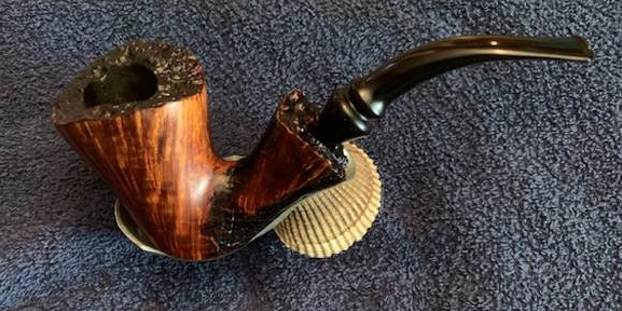
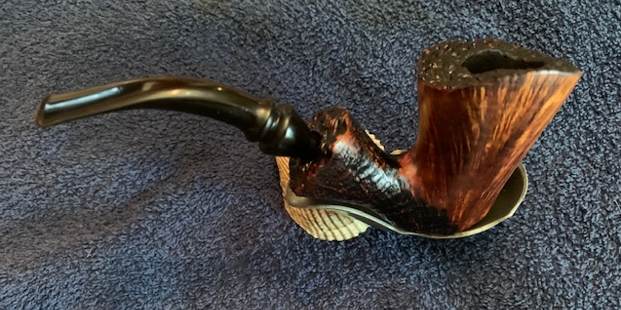
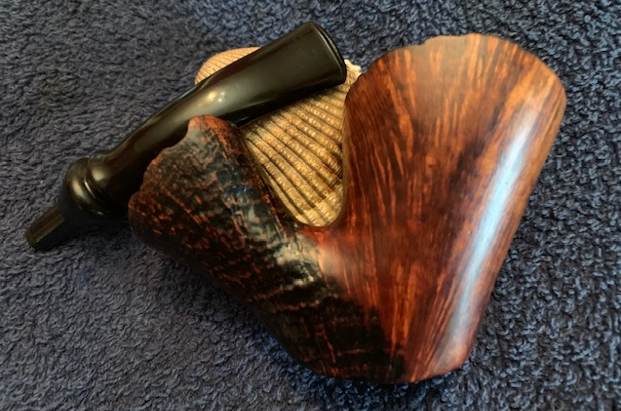
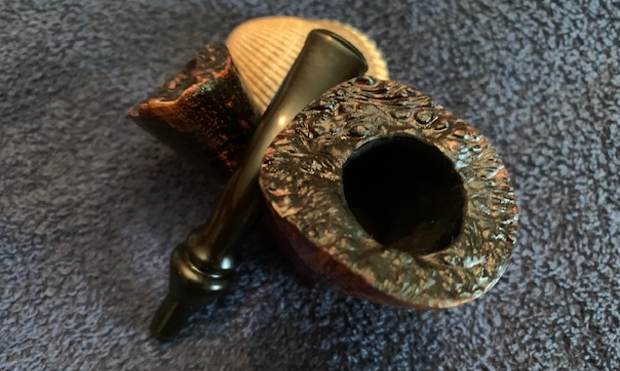
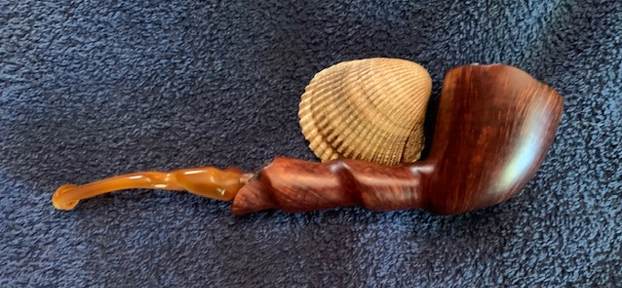
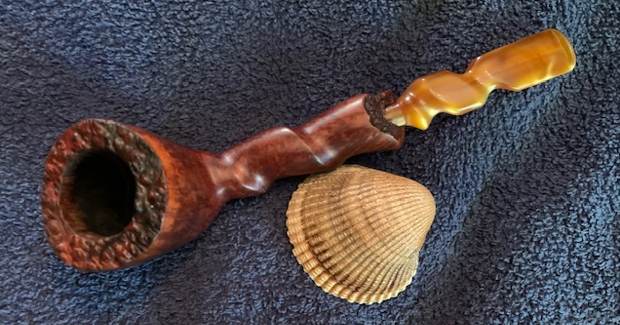
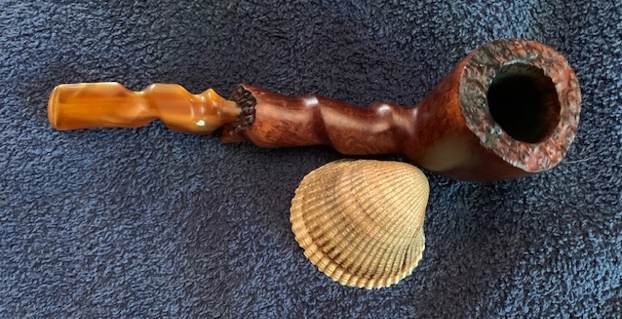
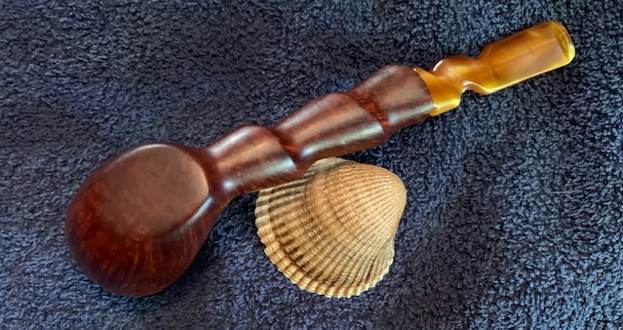
A Unique Twisted and Turned Jobey Dansk Handmade in Denmark 2


Blog by Steve Laug

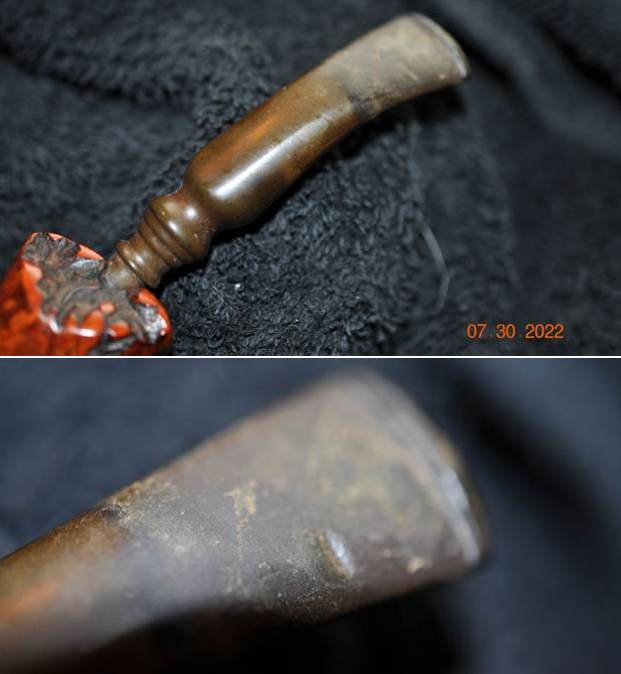
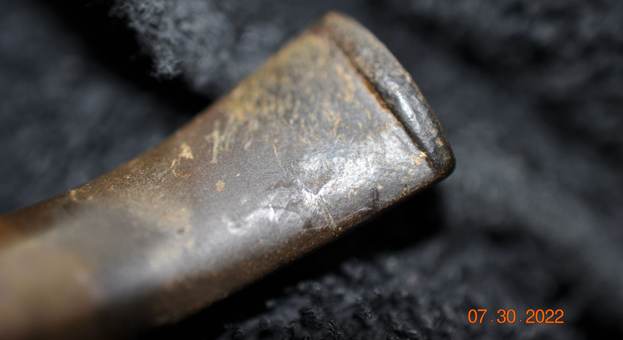
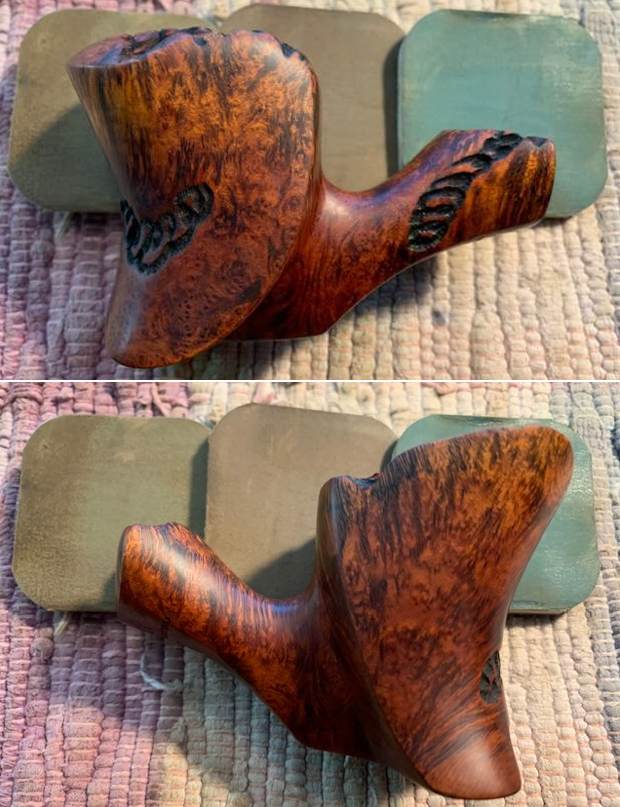
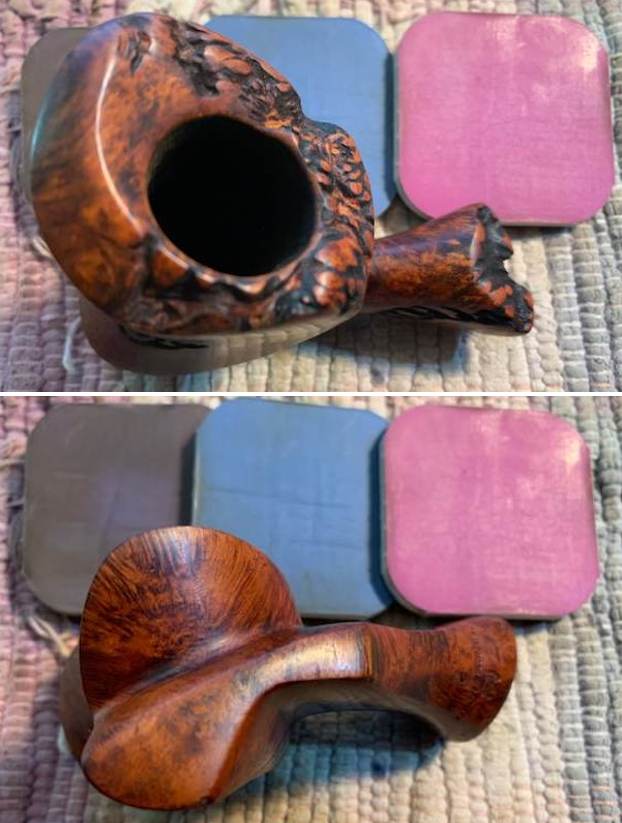
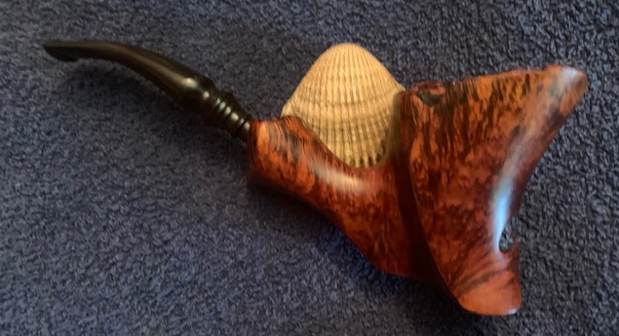
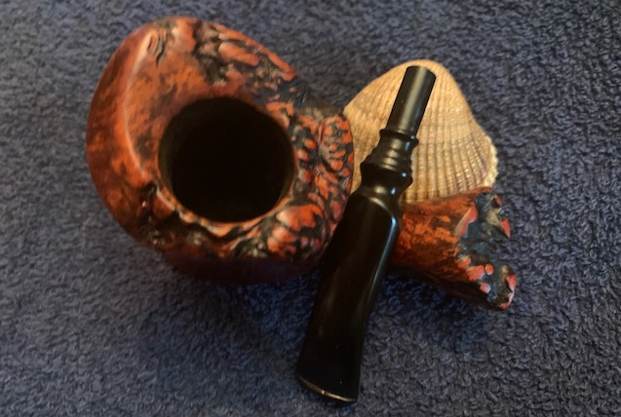
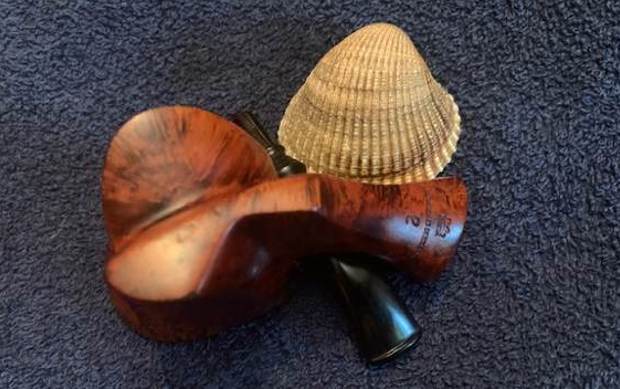
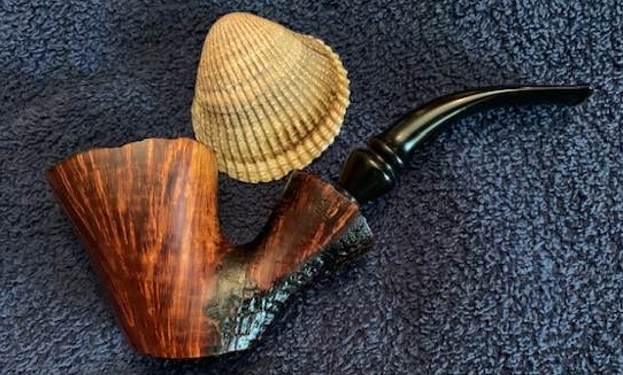
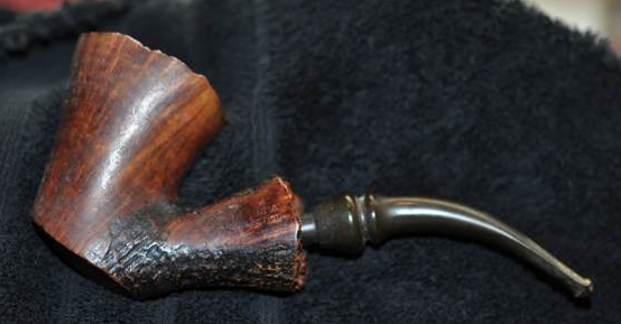
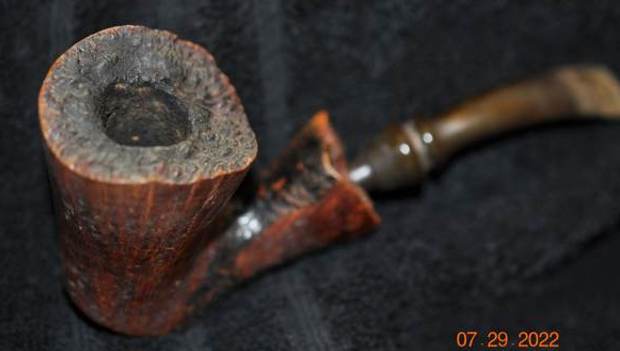
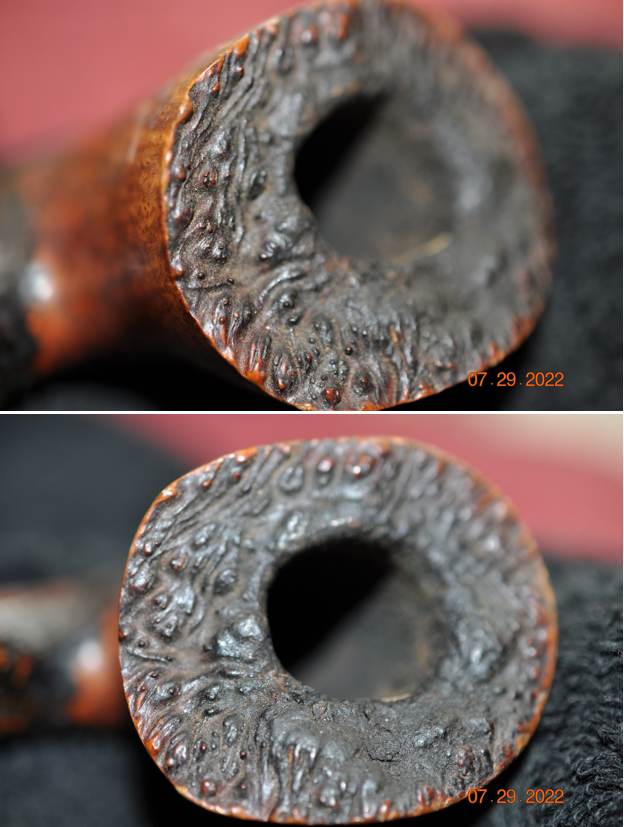
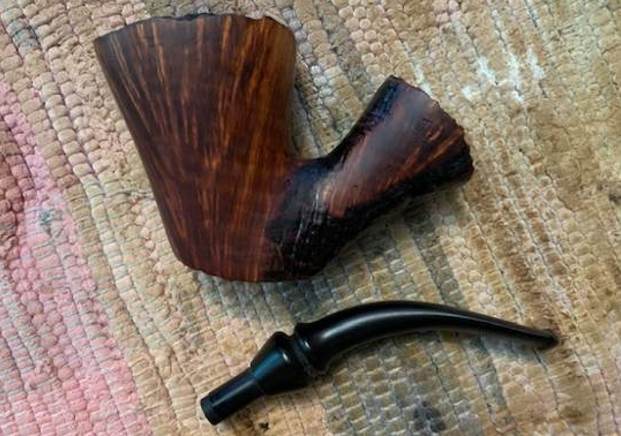
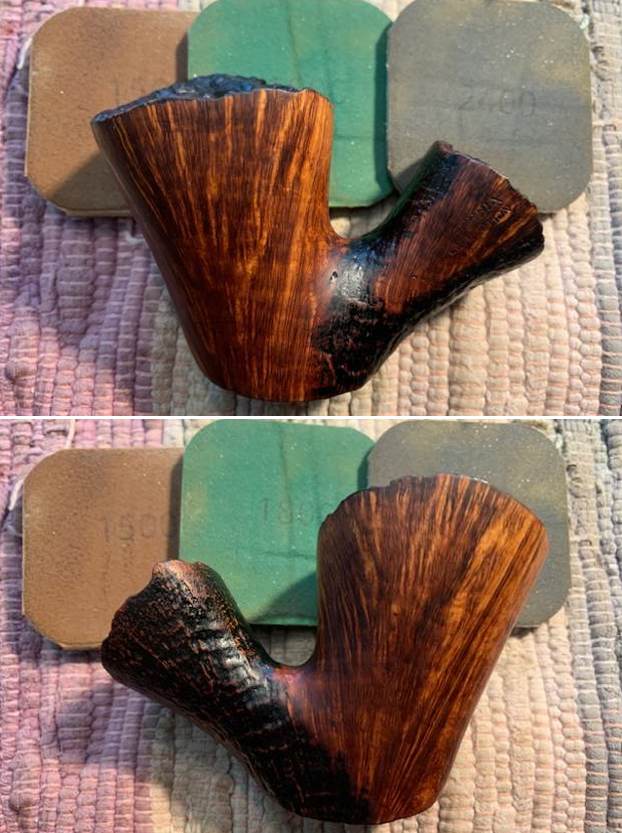
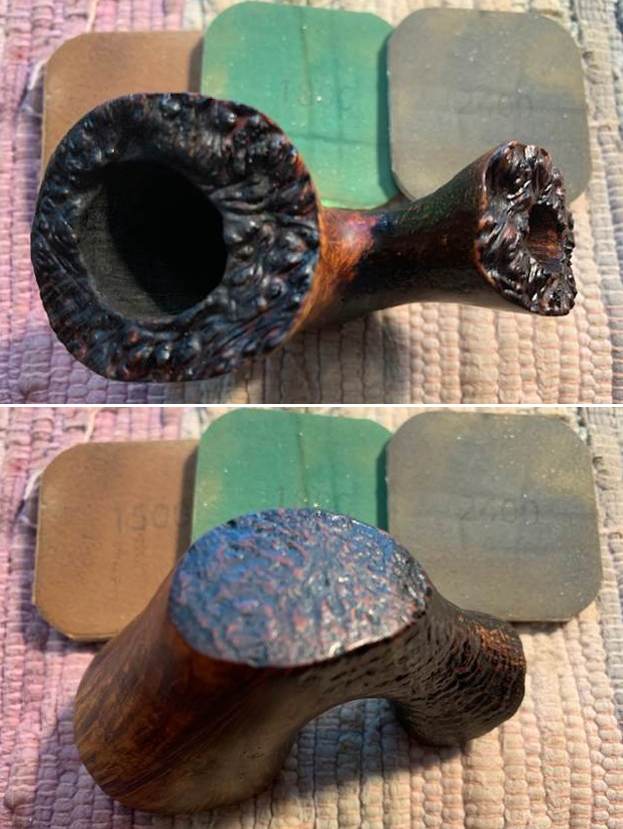
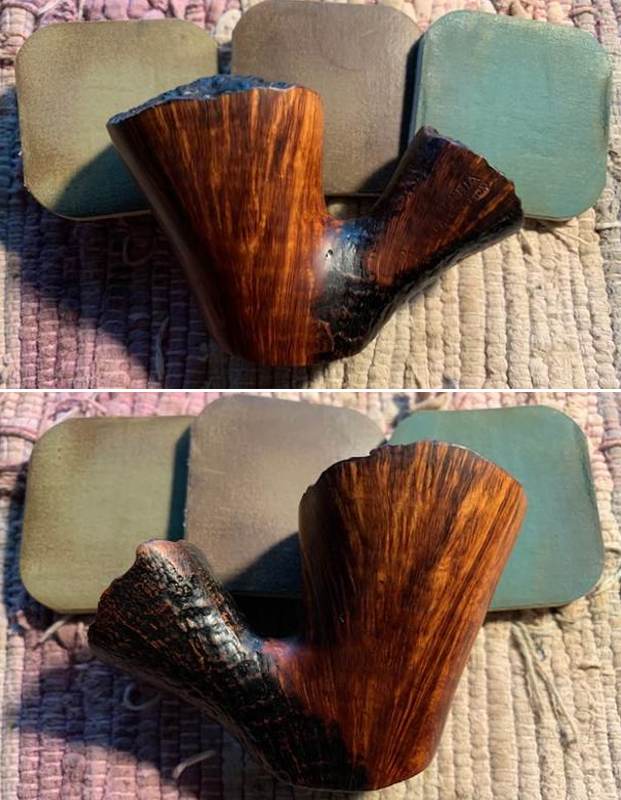
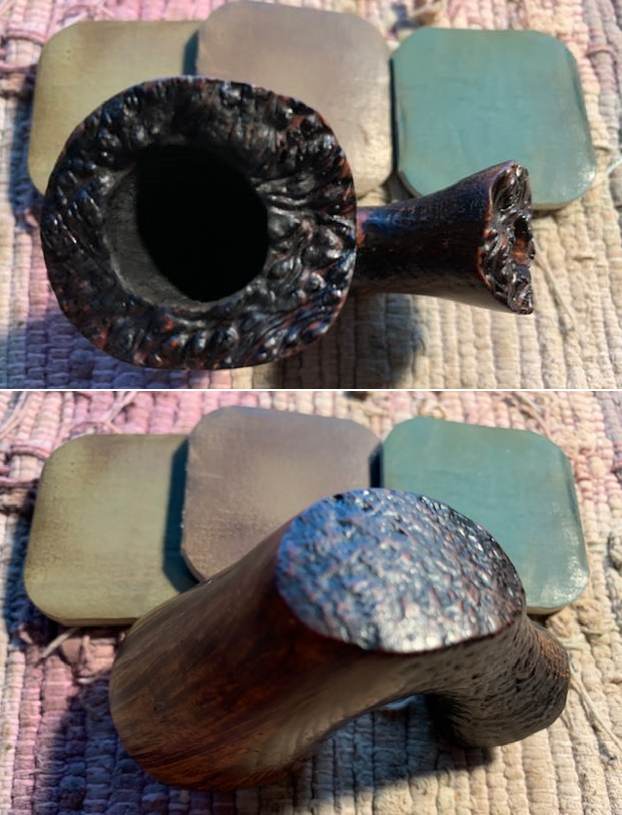
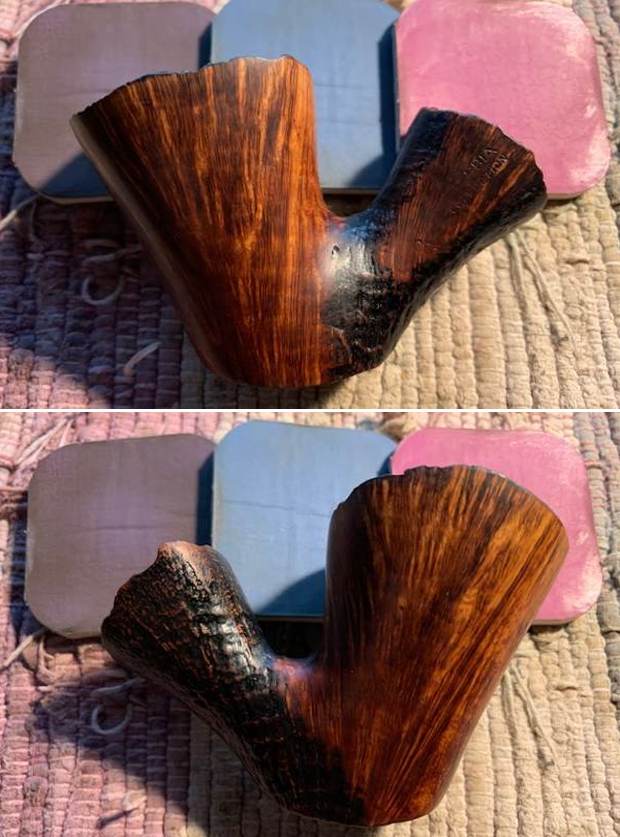
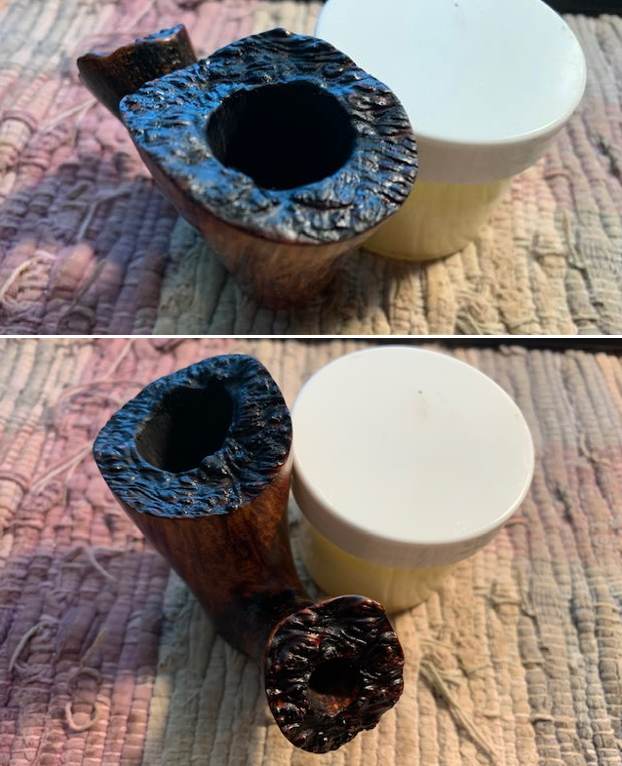
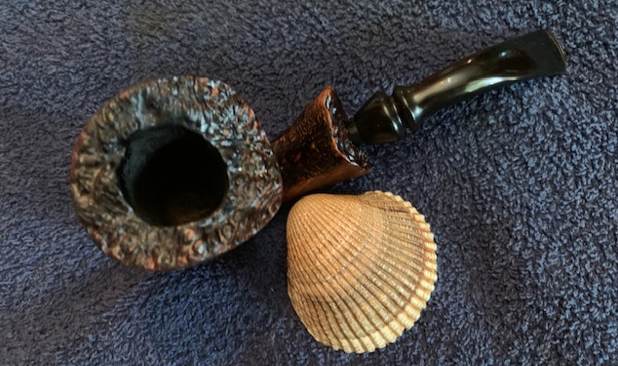
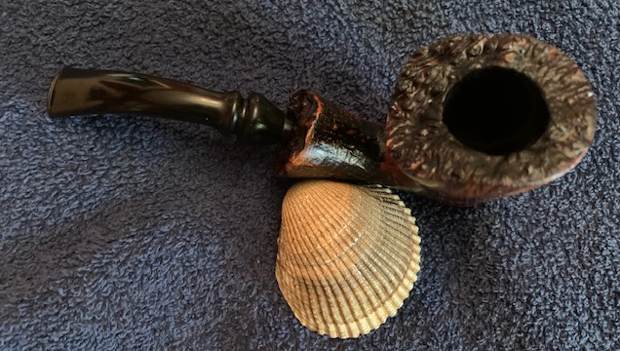
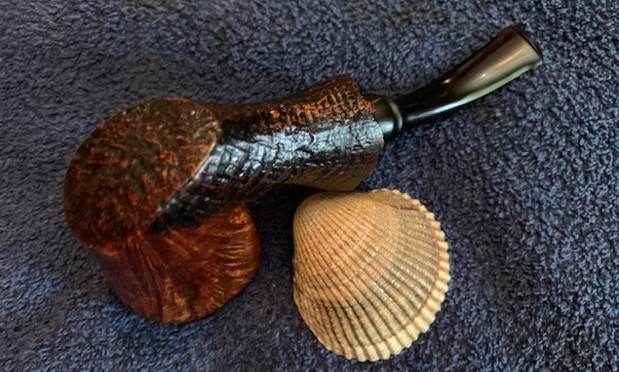
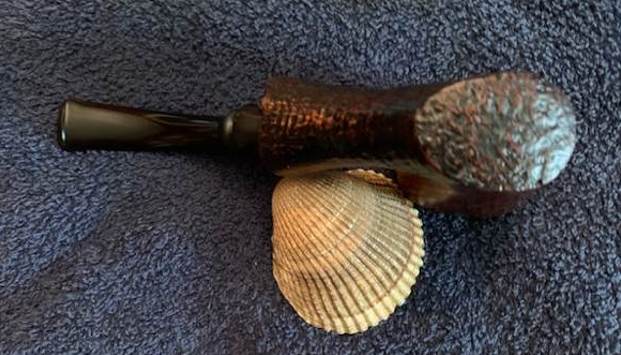
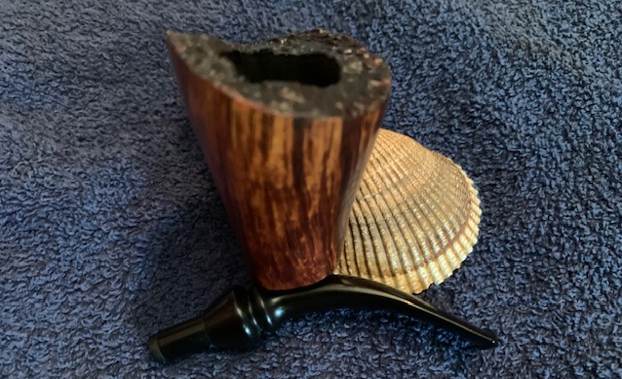
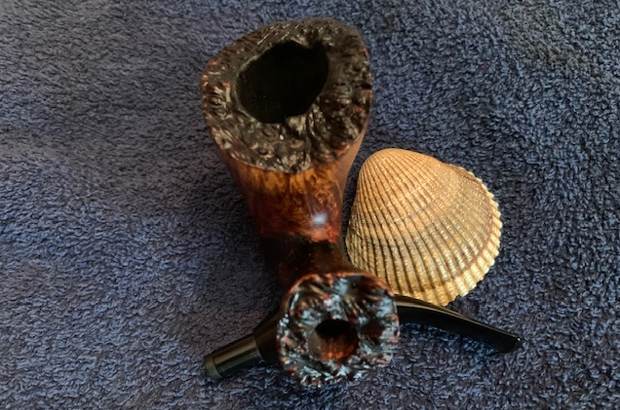
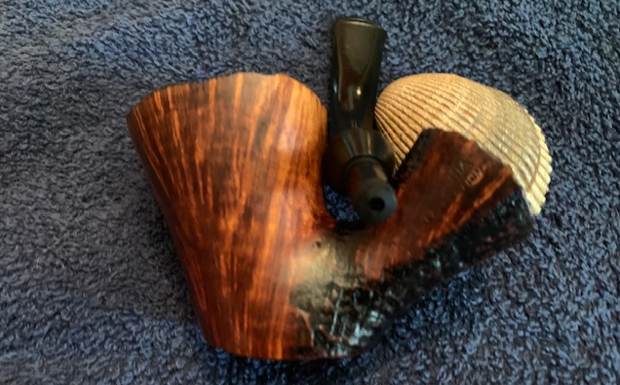
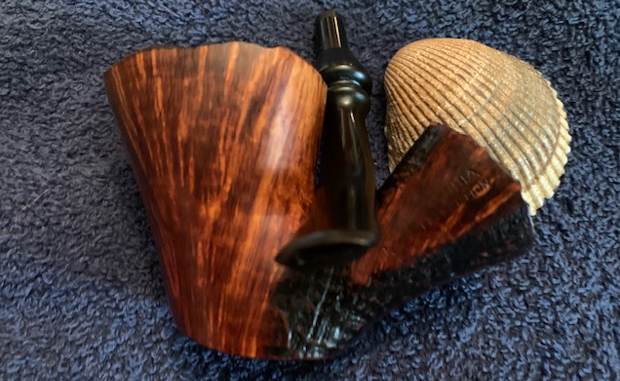
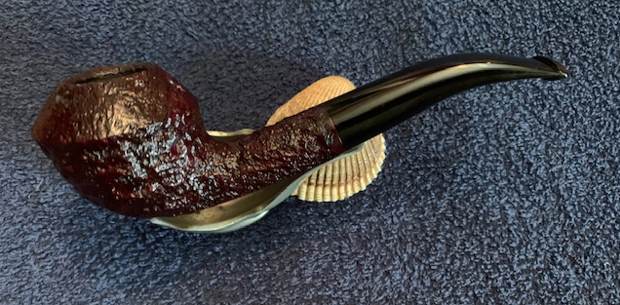
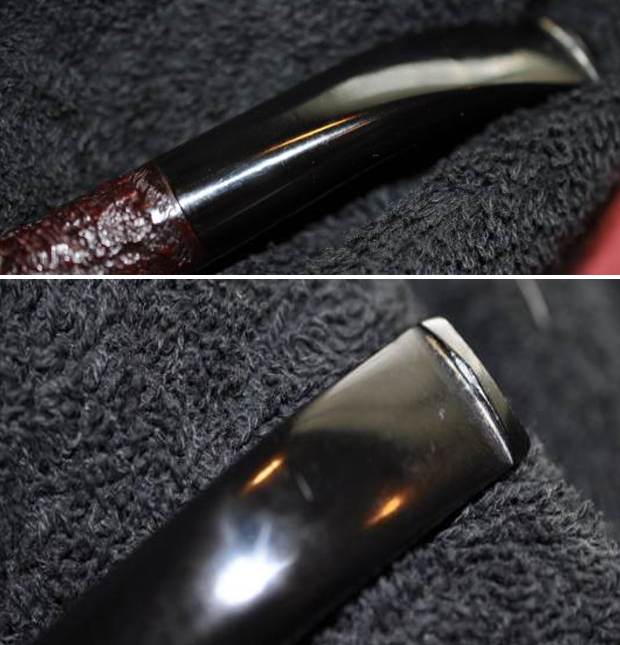
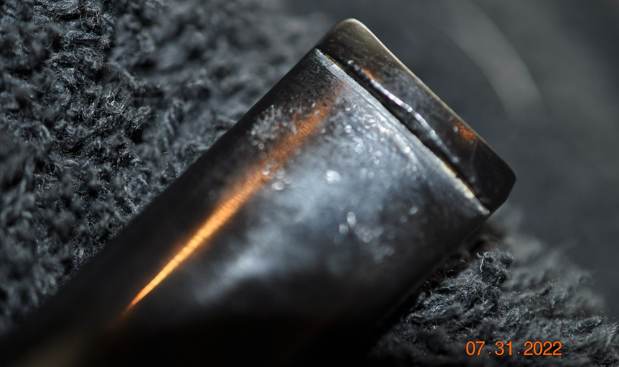
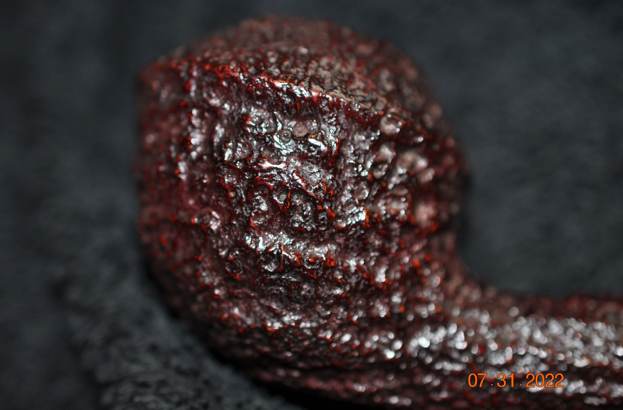
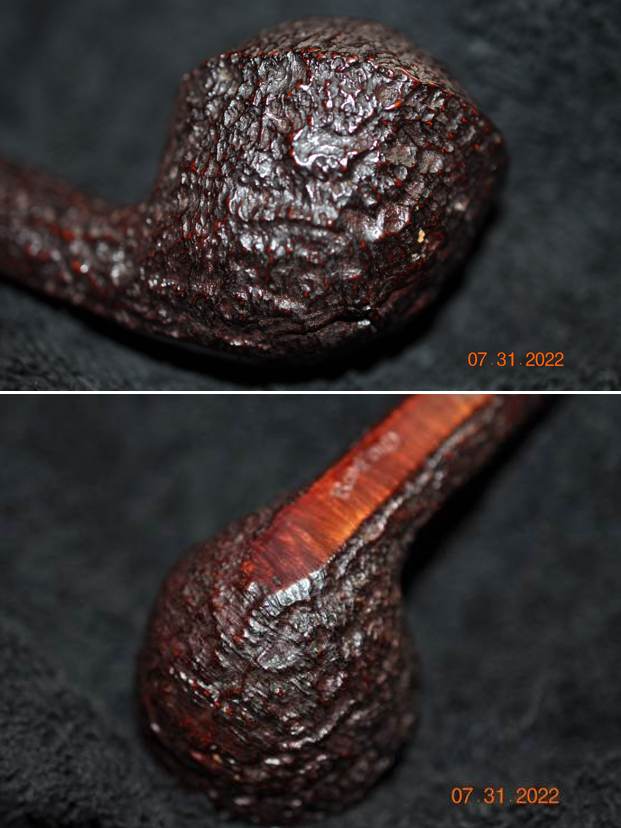
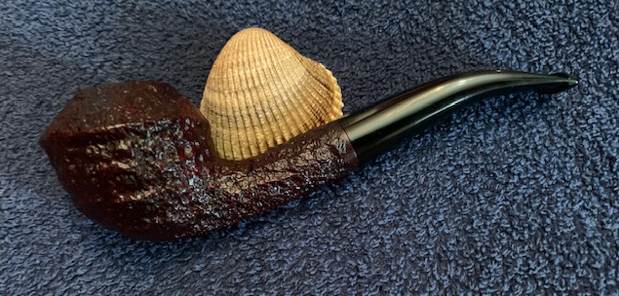
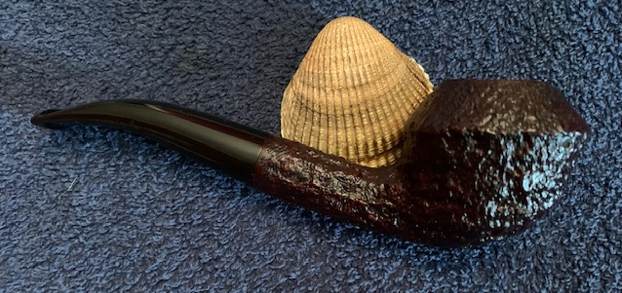
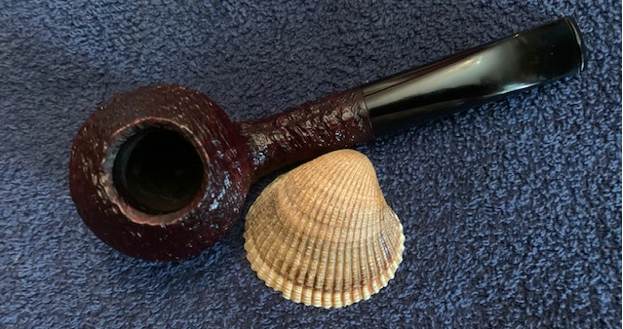
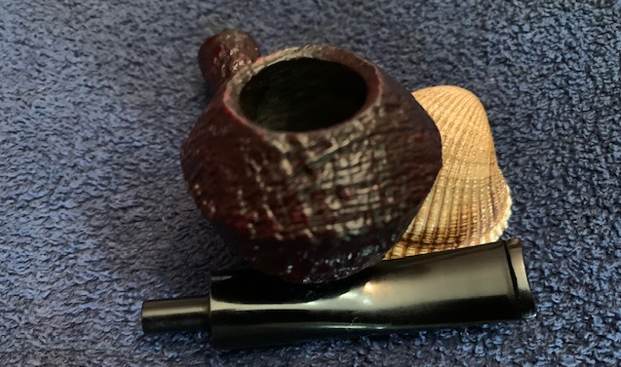
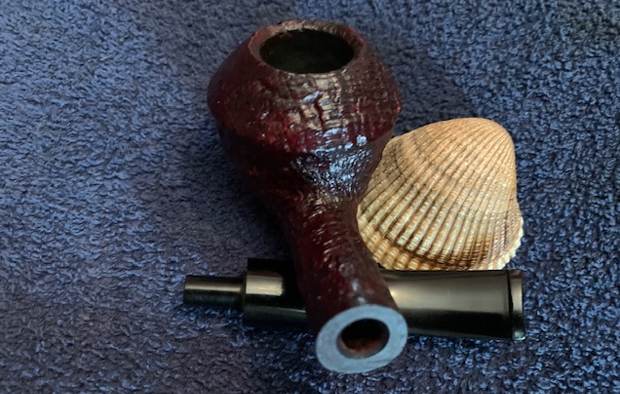
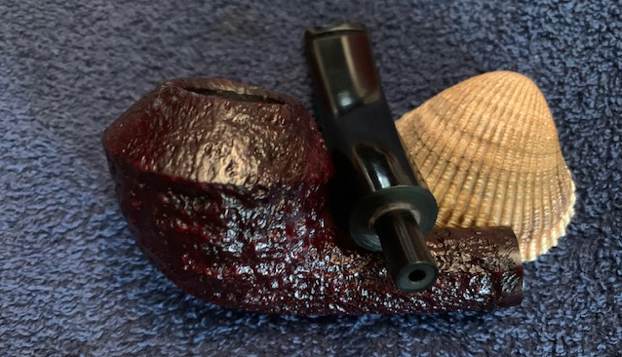
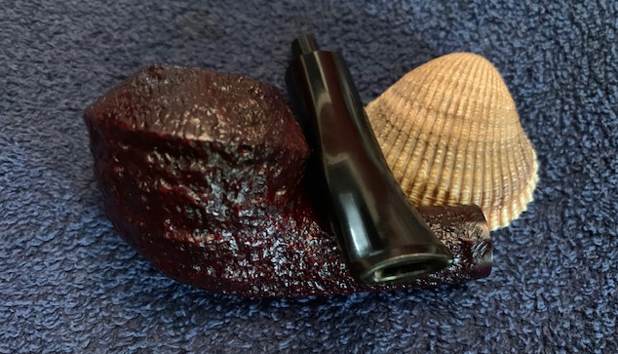
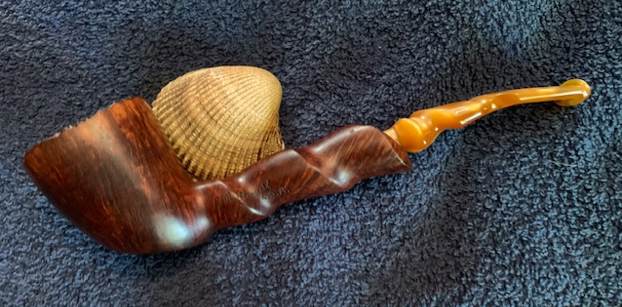
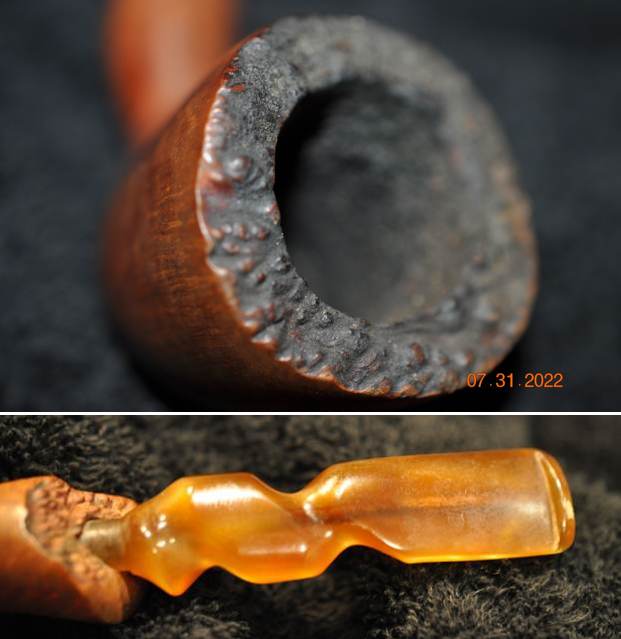
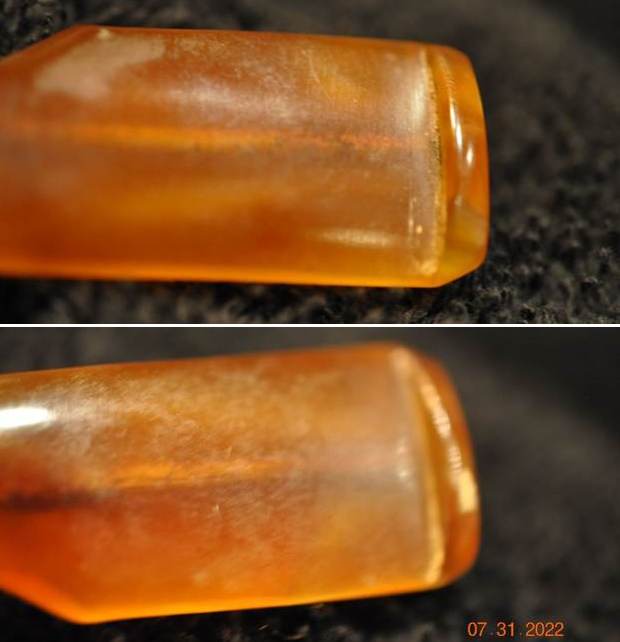
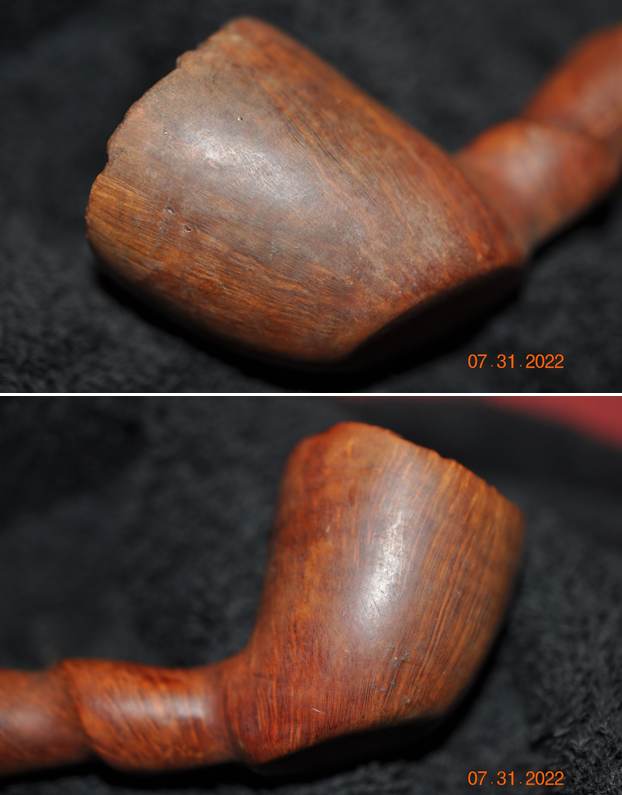
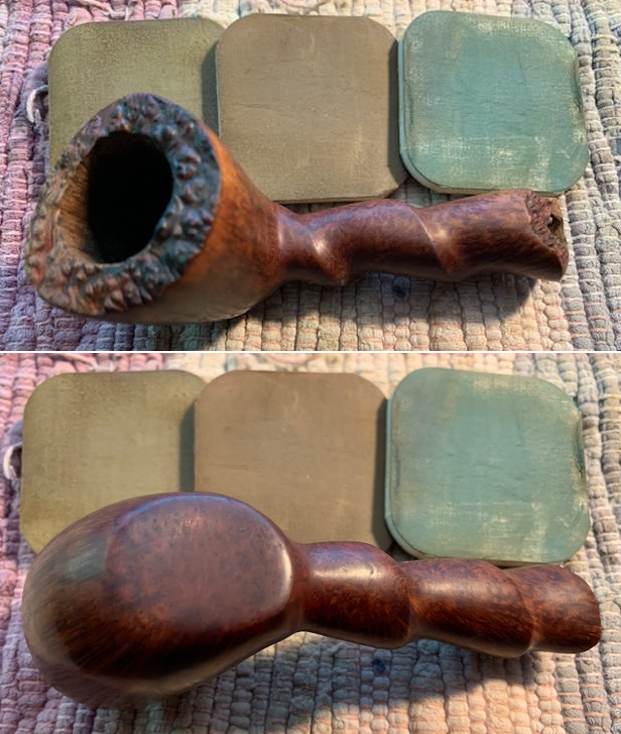
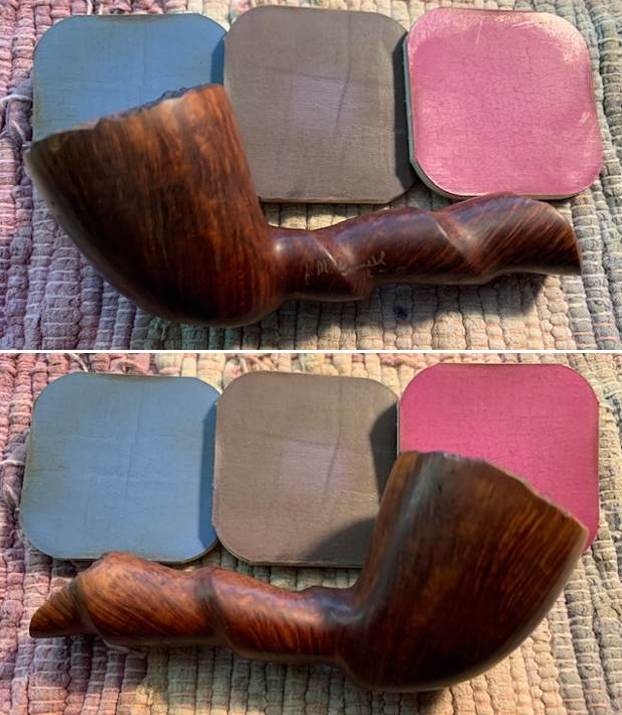
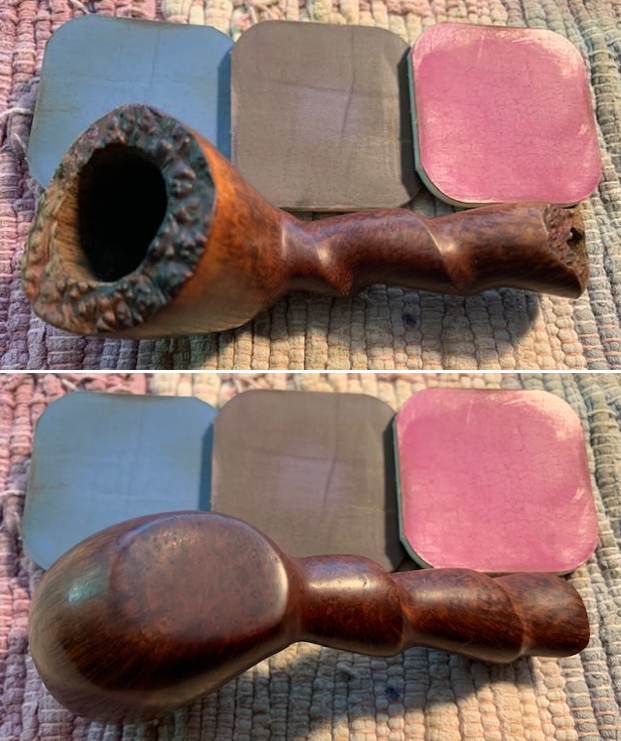
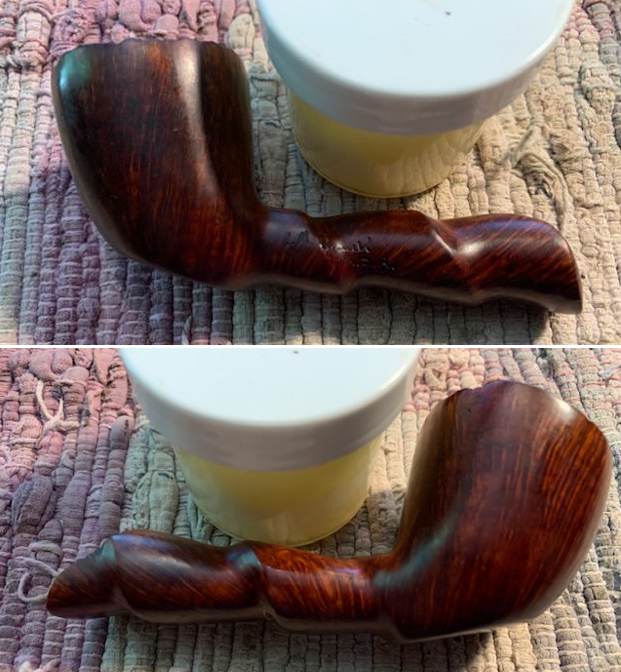
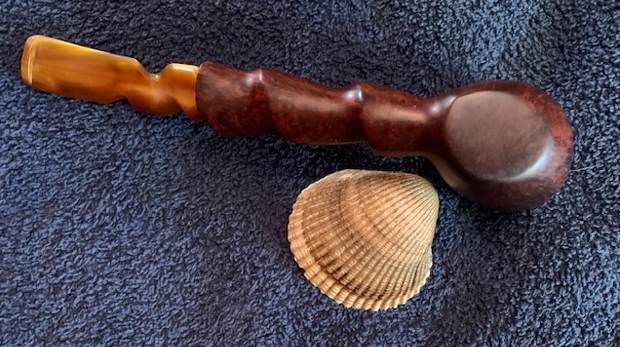
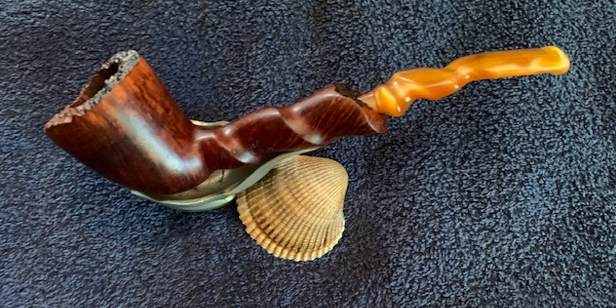
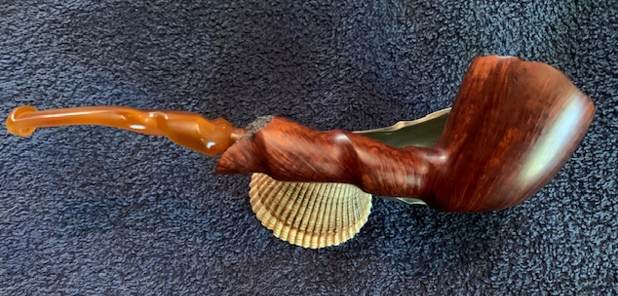
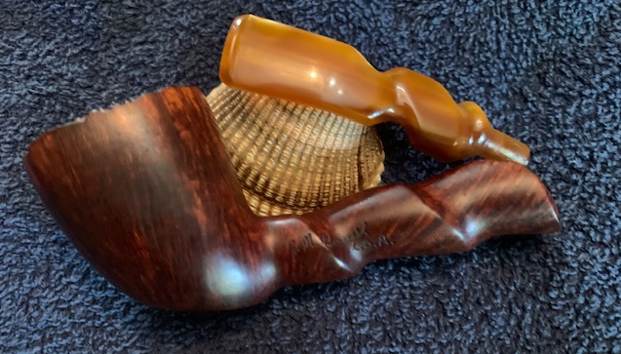
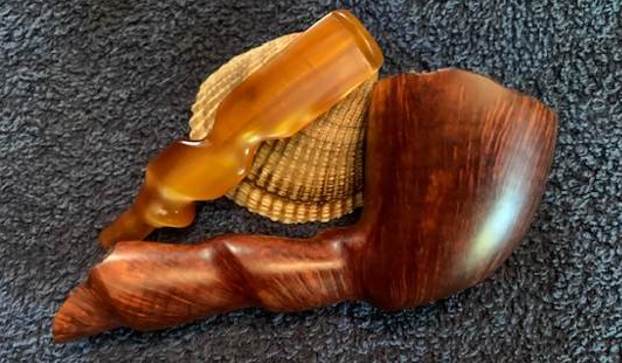
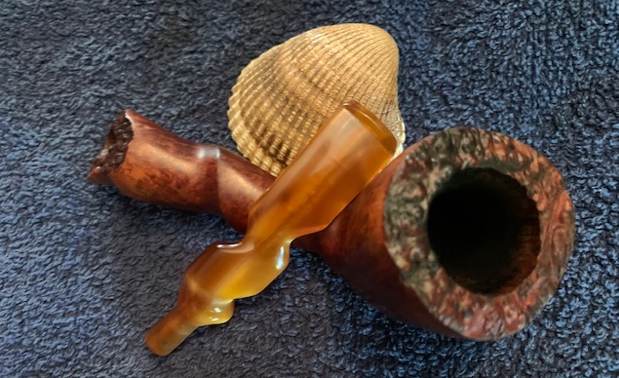
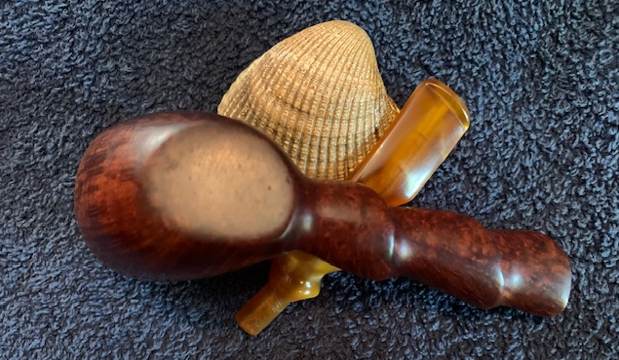
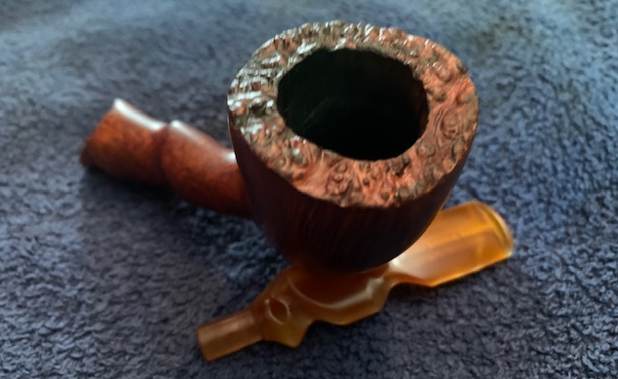
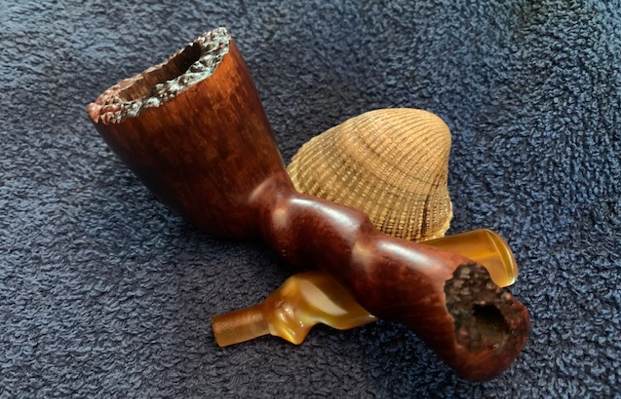
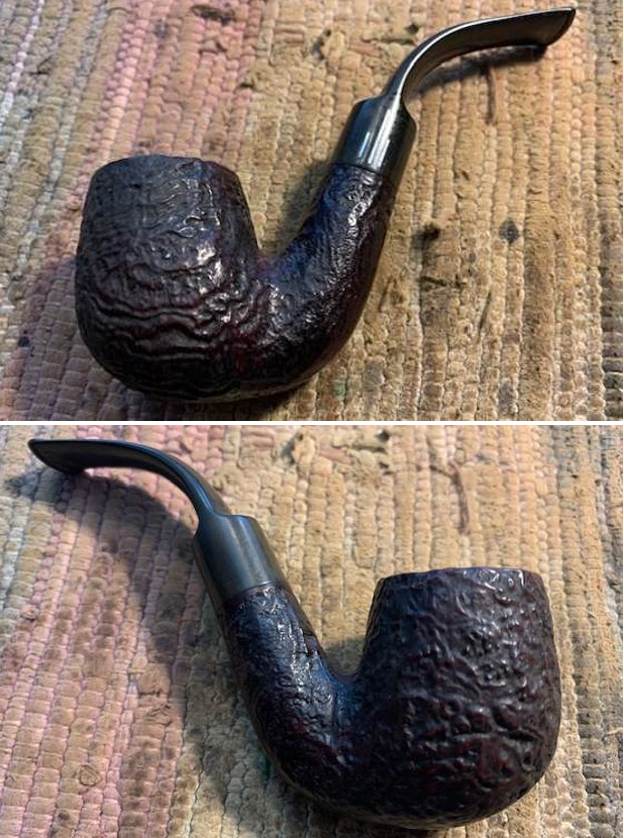
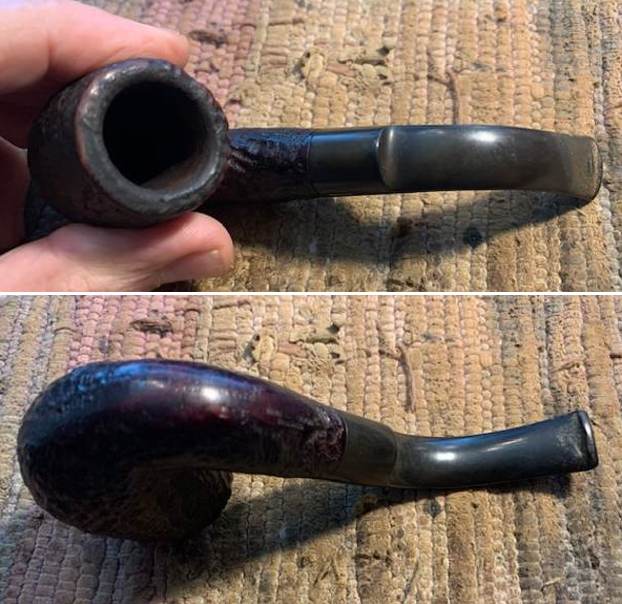
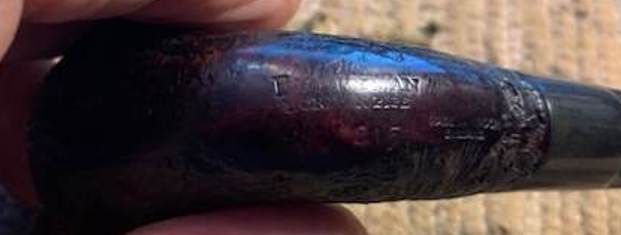
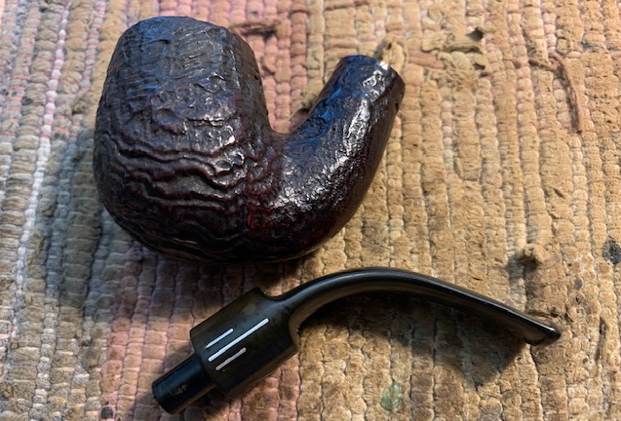
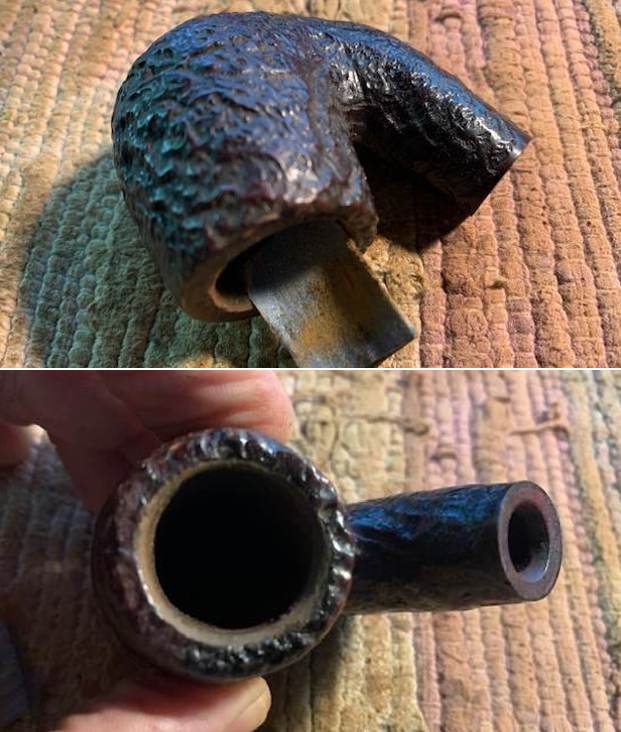
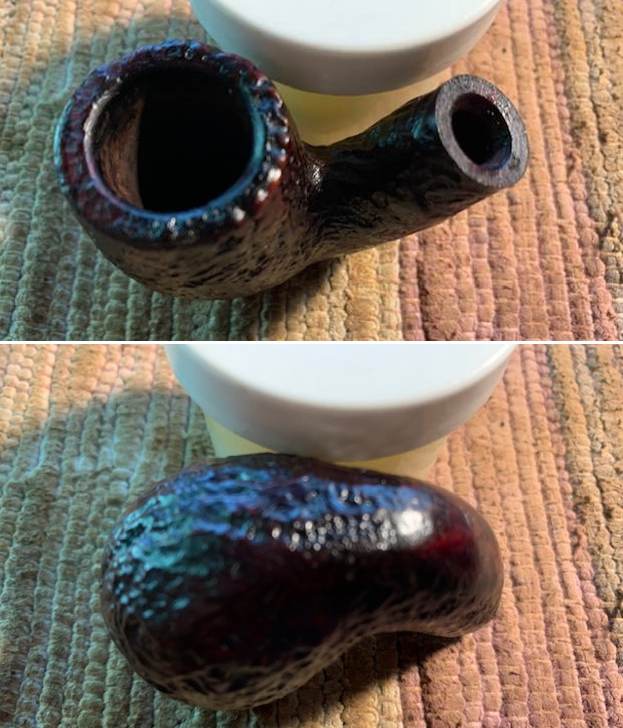
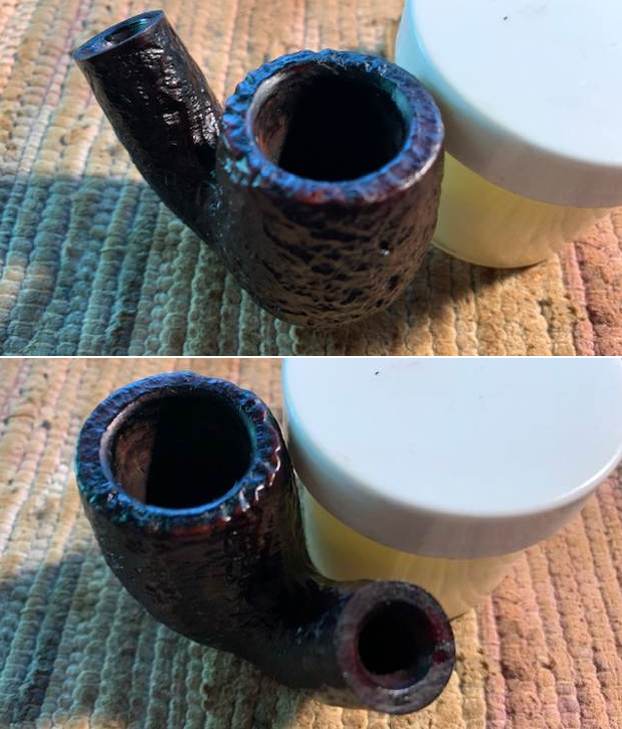
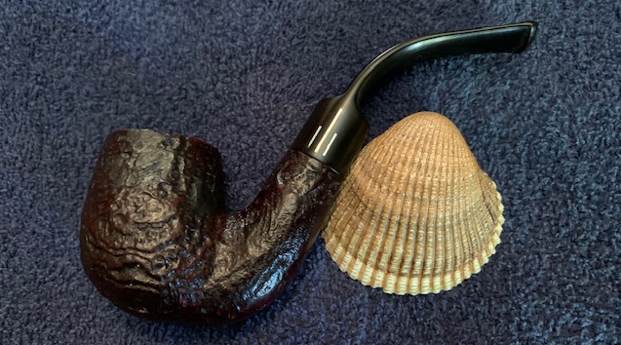
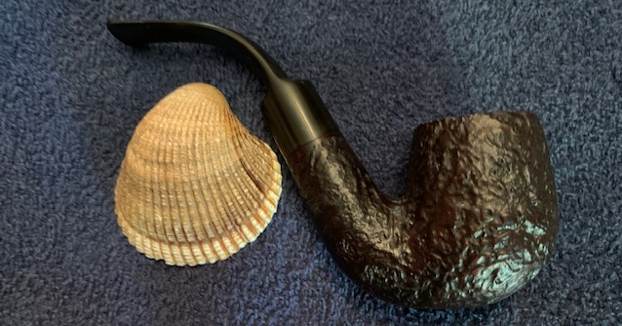
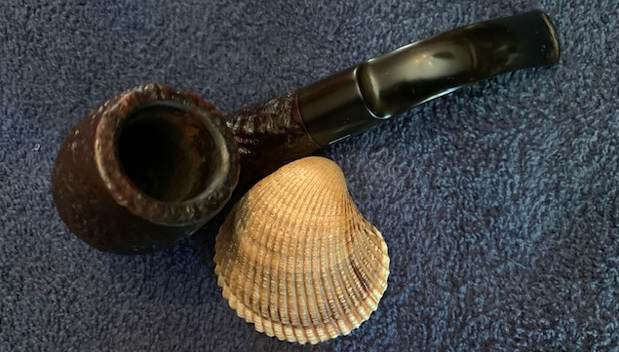
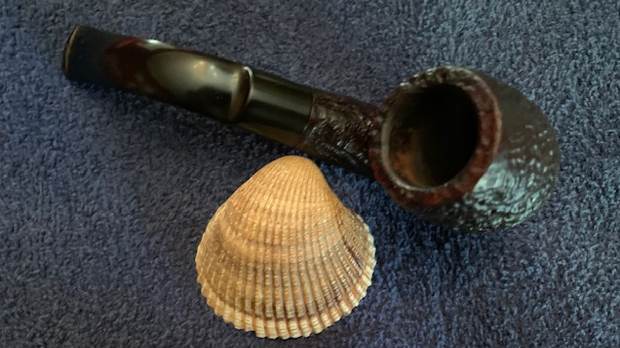
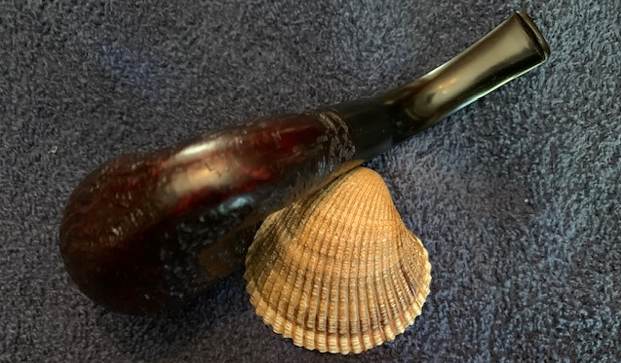
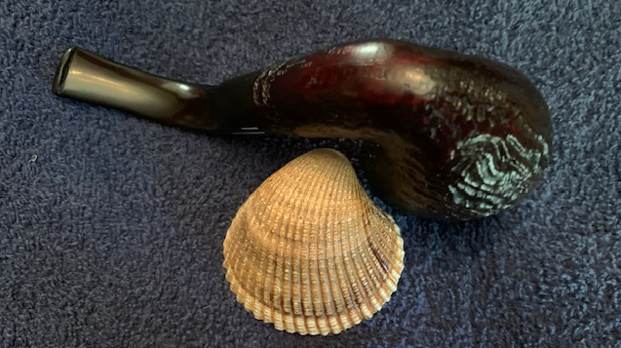
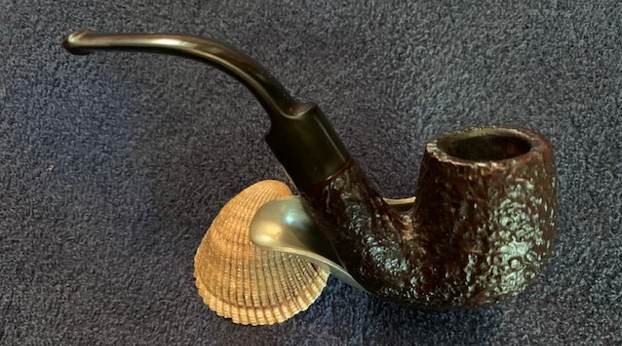
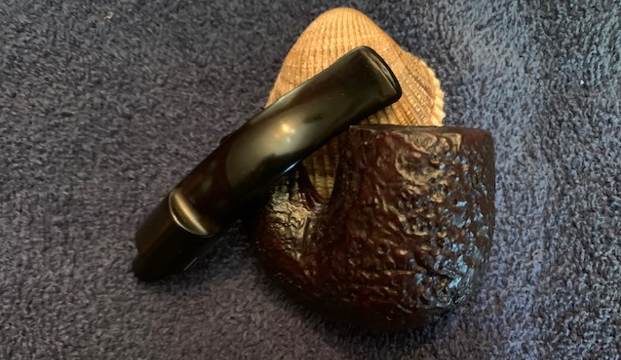
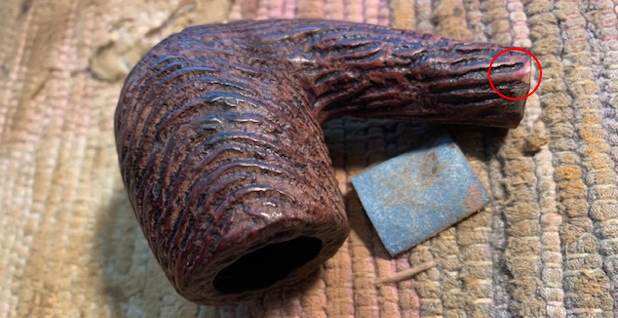
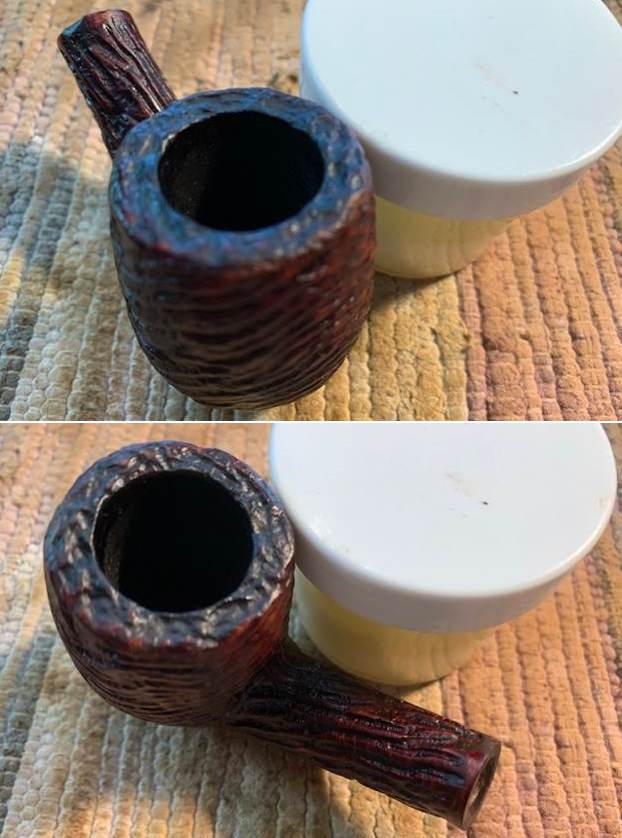
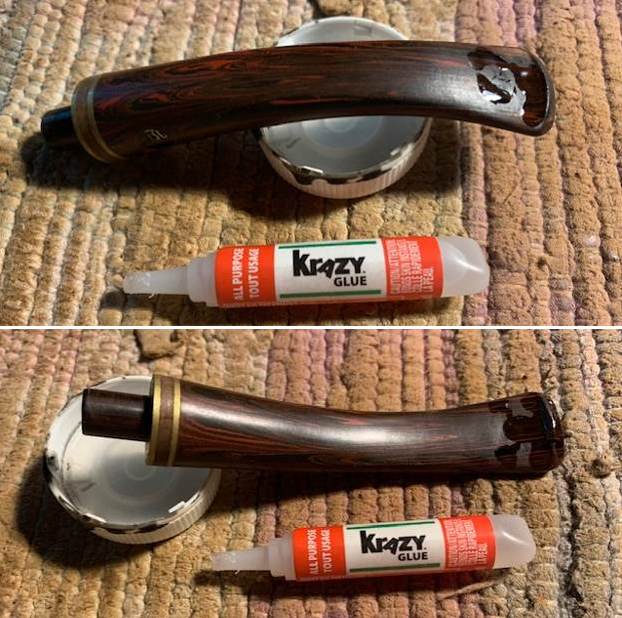
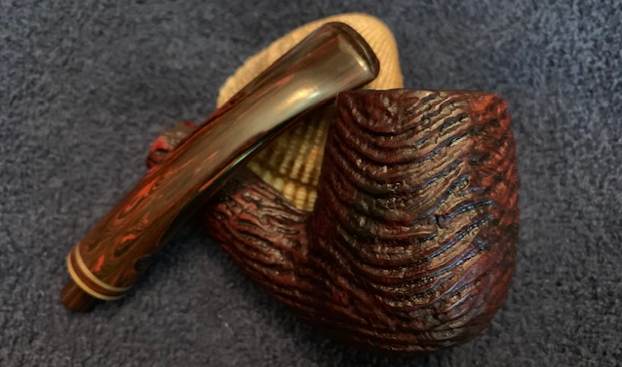
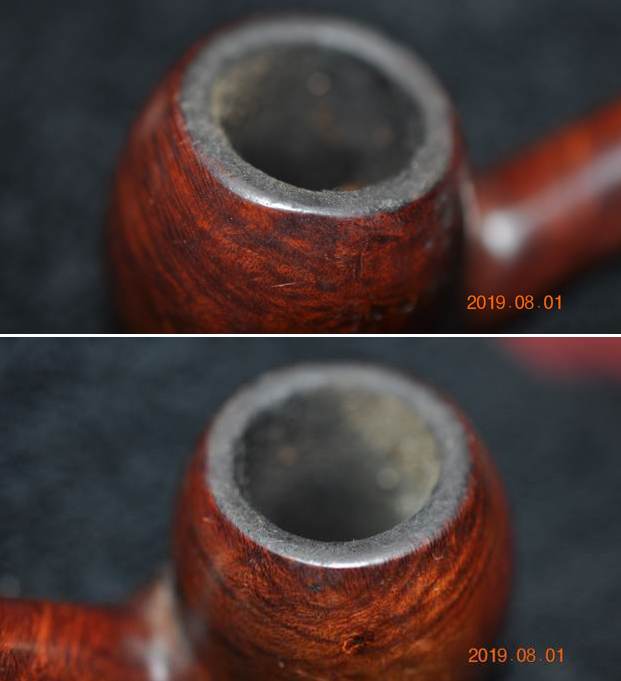
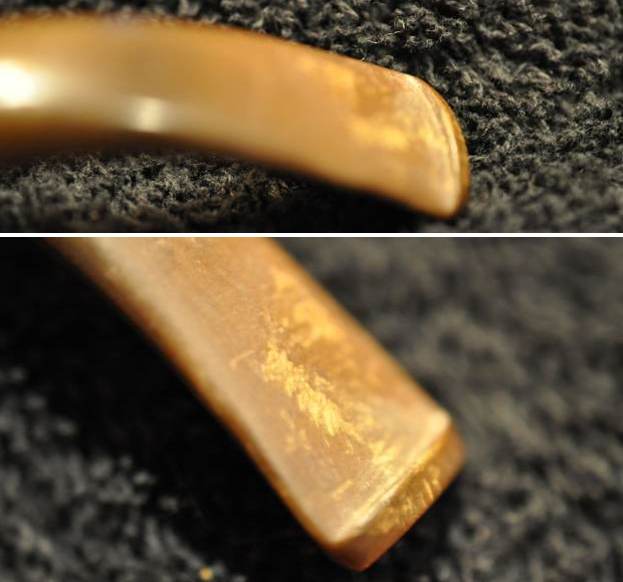
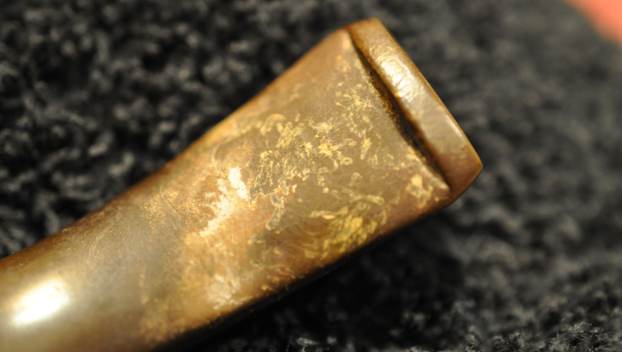
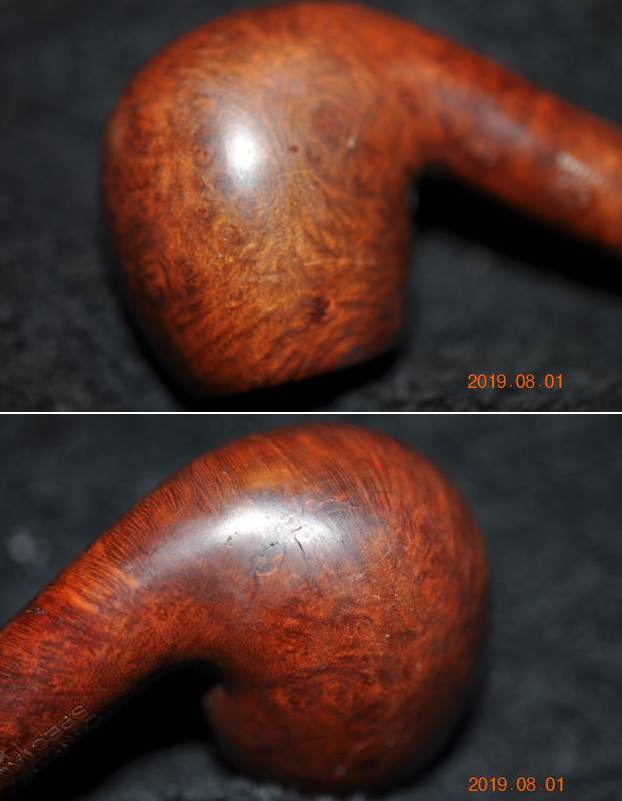
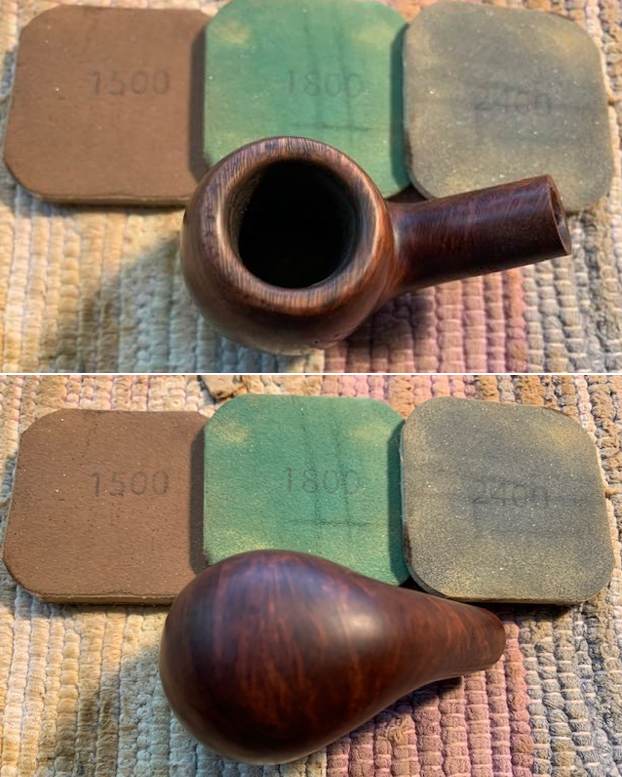
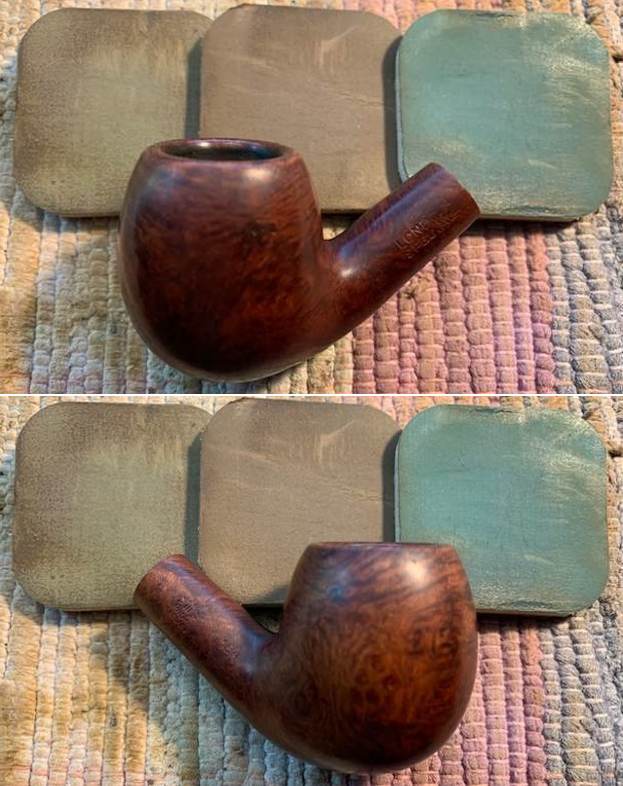
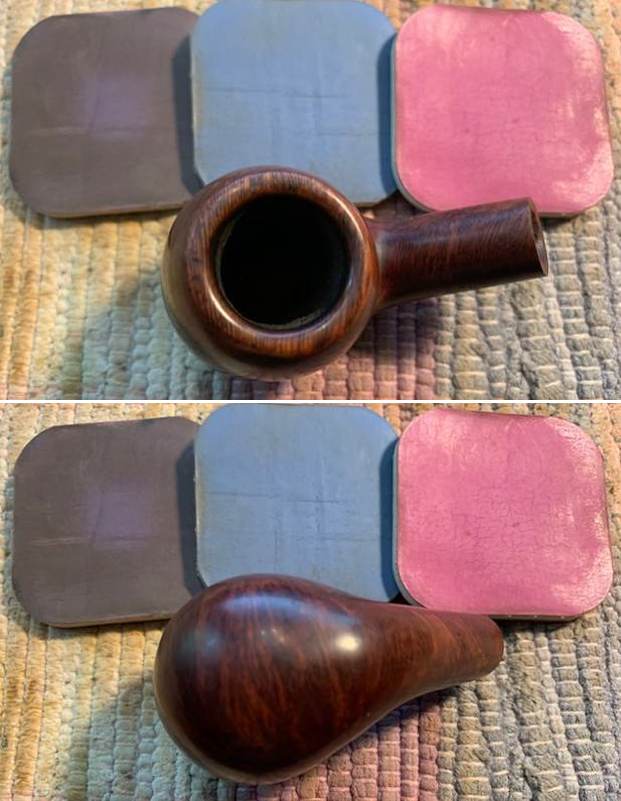
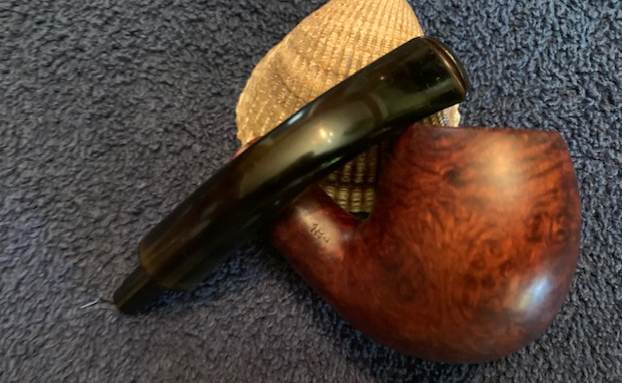
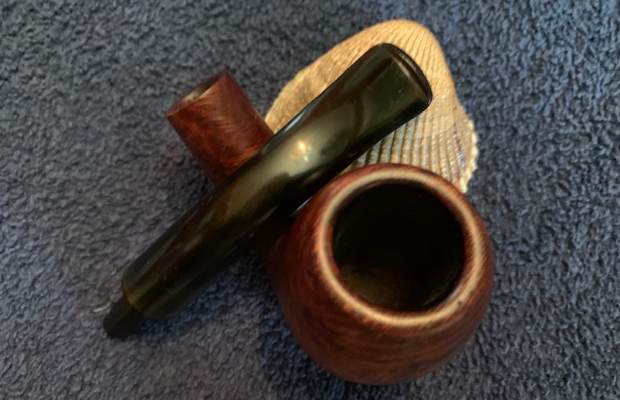
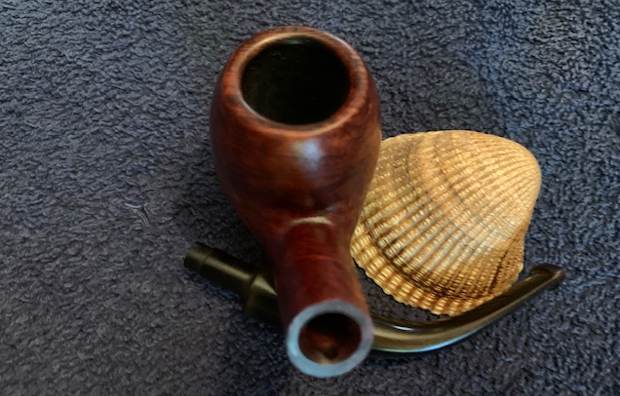
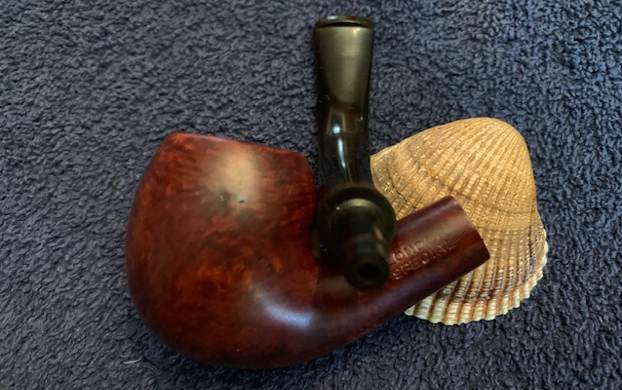
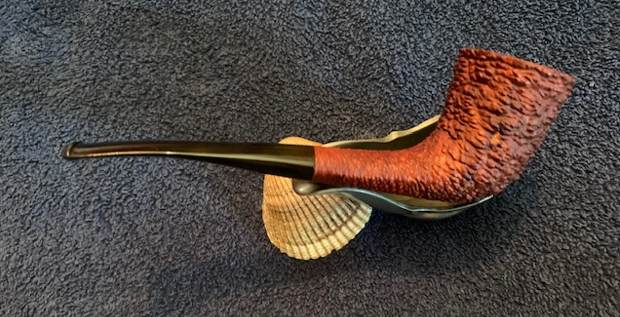
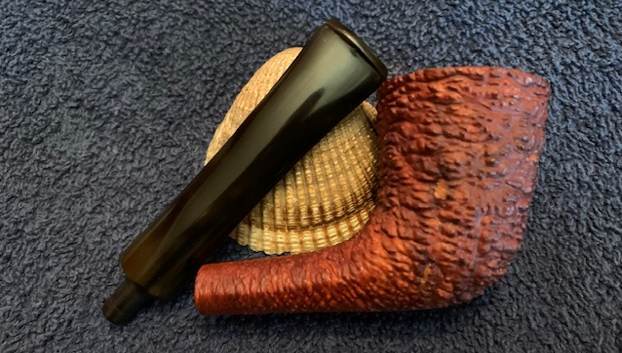
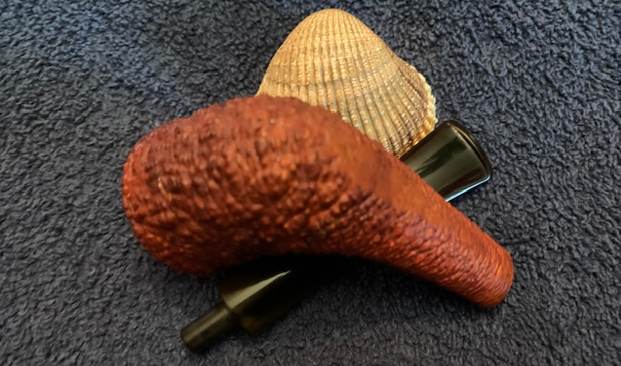
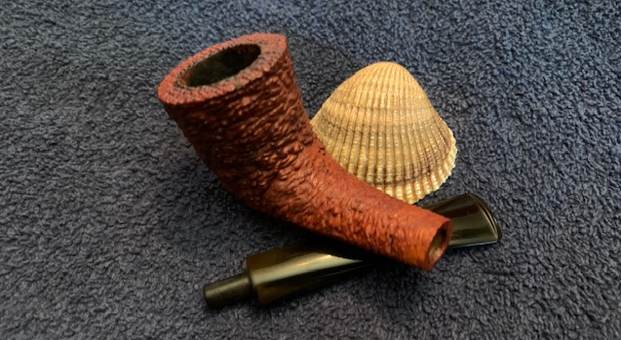
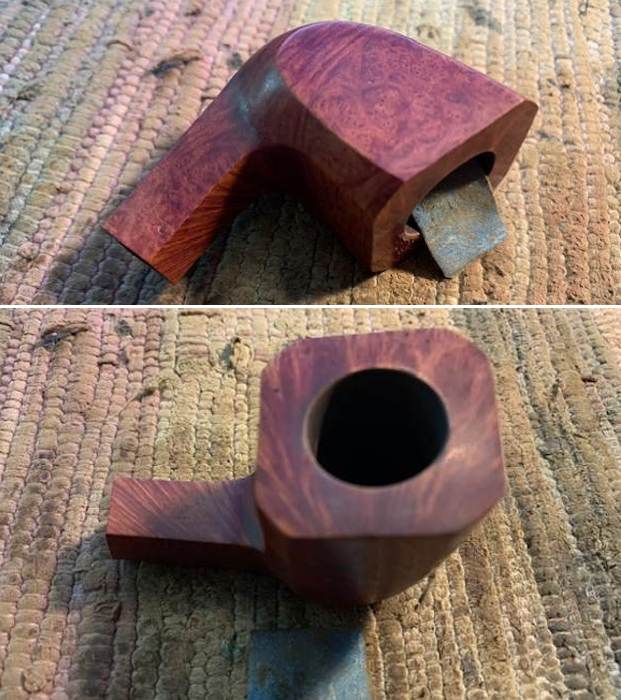
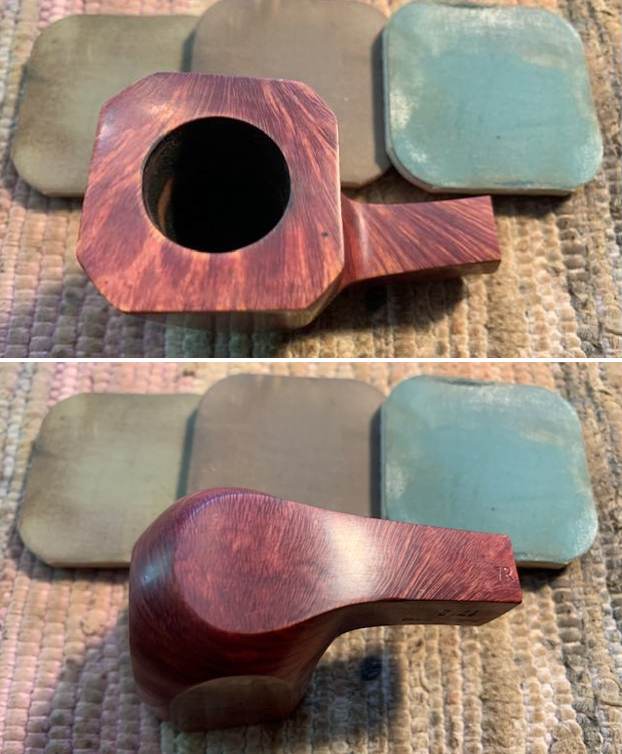
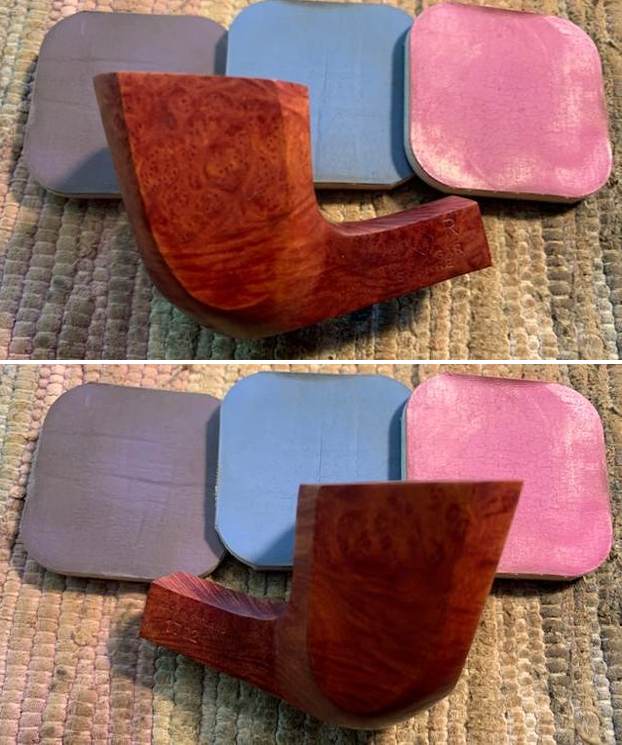
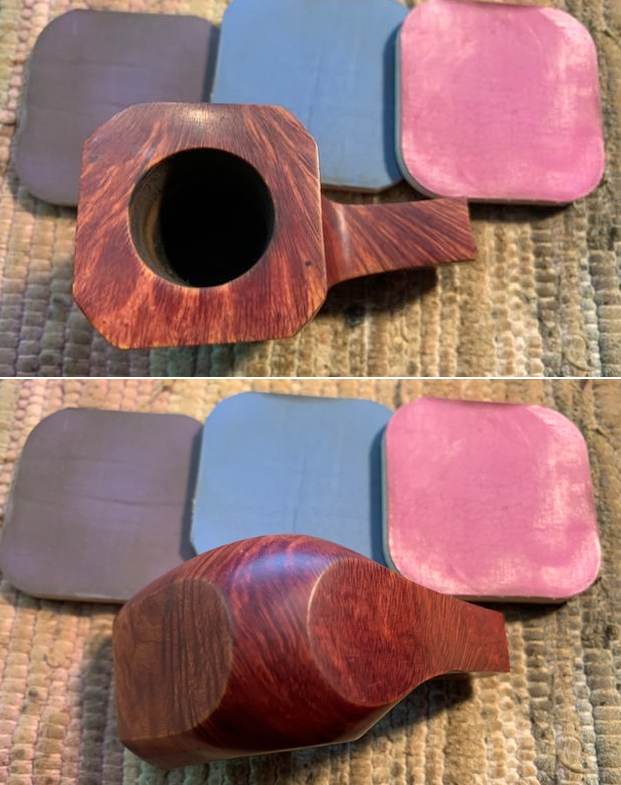
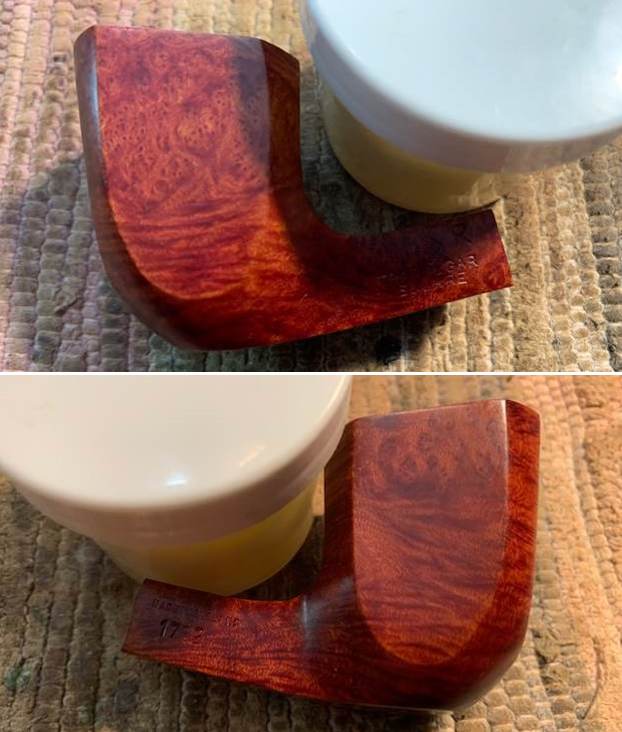
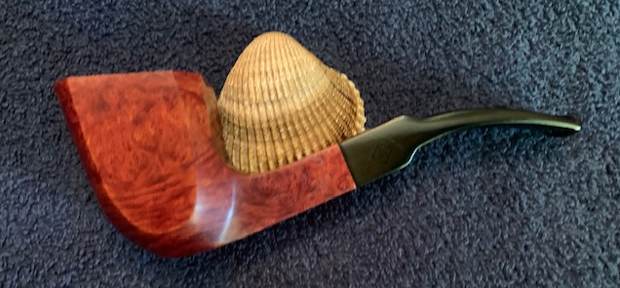
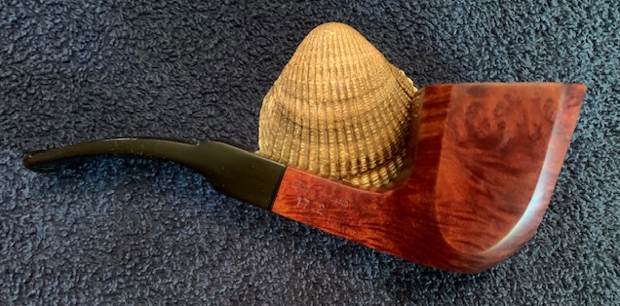
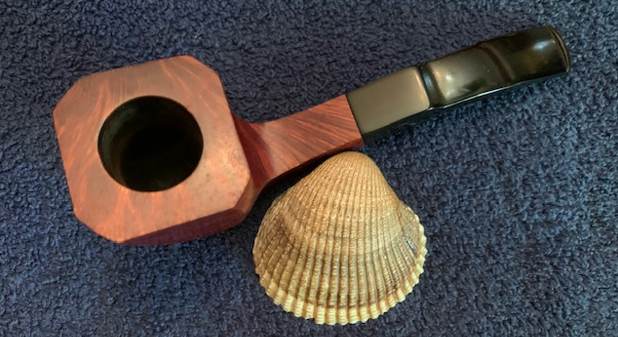
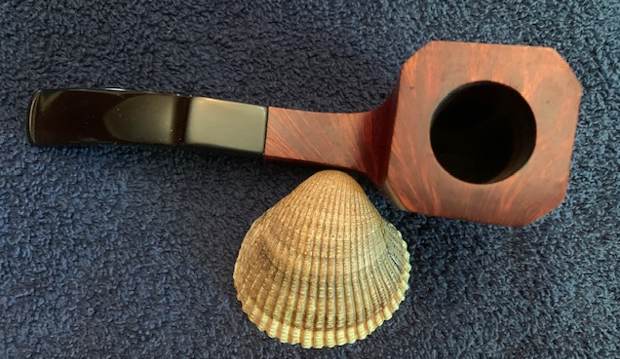
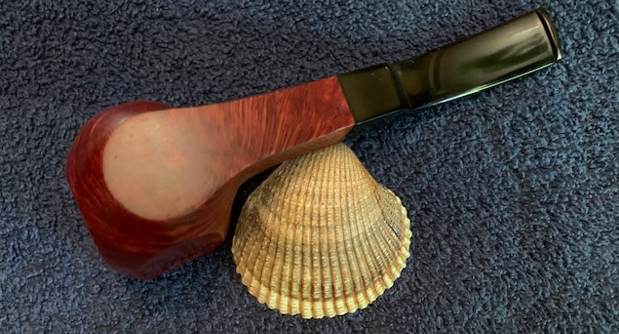
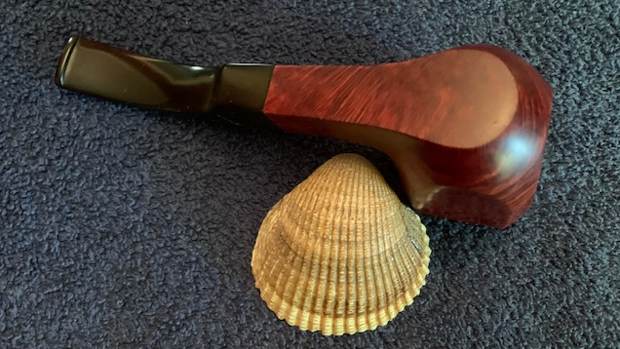
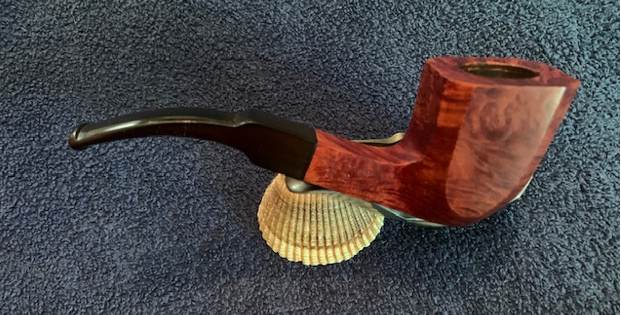
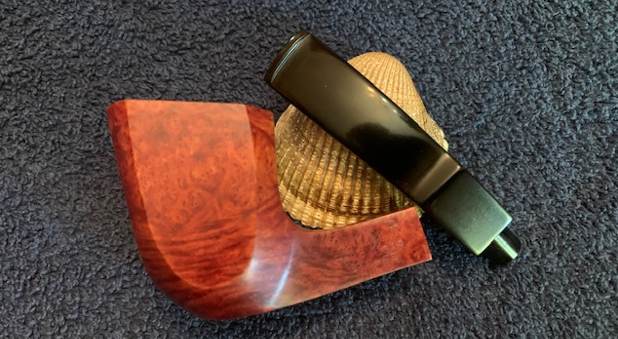
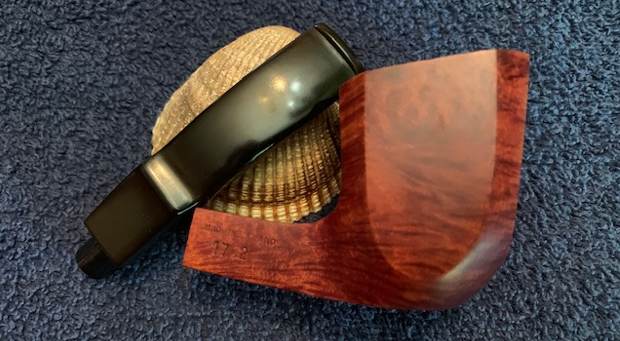
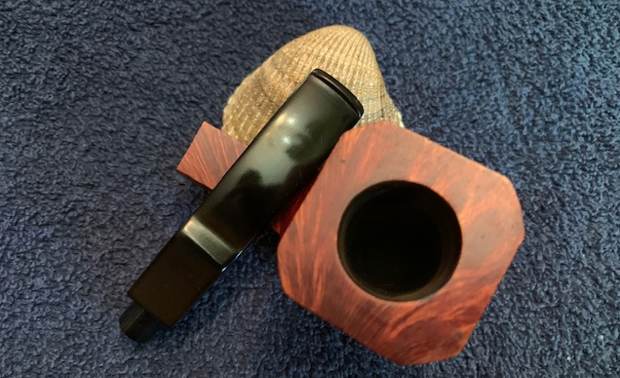
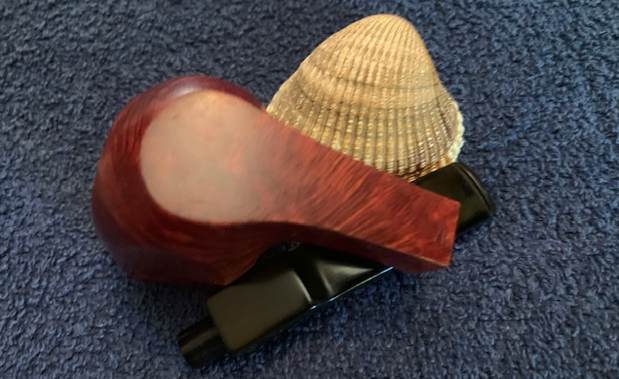
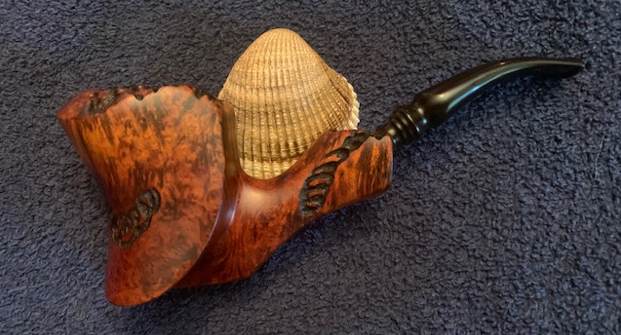
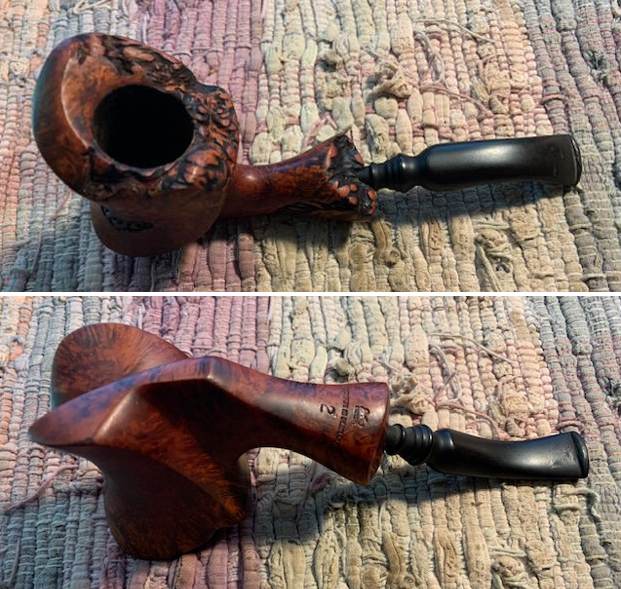
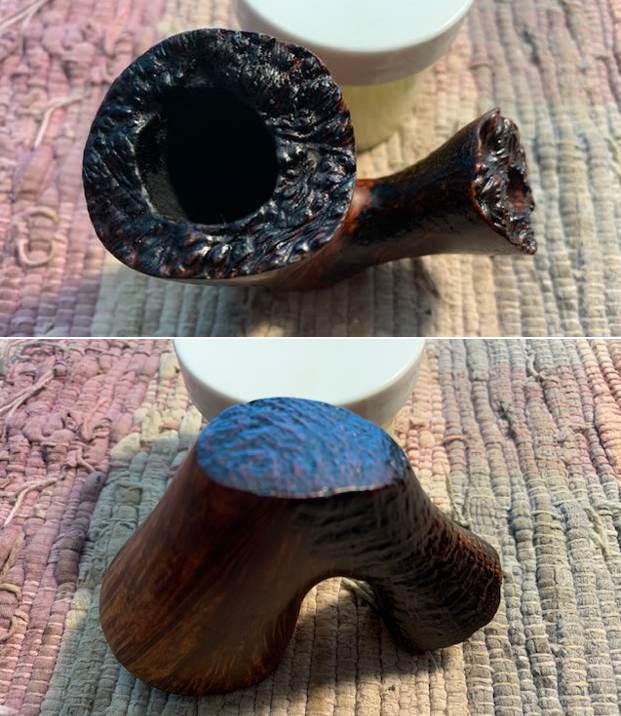
My brother Jeff picked up another Jobey Dansk Freehand pipe on June 6, 2022 from an antique shop in Cannon Beach, Oregon, USA. It had really unique shape and some nice grain with spot carvings around the bowl and shank. There was some plateau on the top of the rim and on the end of the shank. I have worked on enough of these to know that were Danish Freehand pipes were carved by Karl Erik. This one was stamped on the underside of the shank end and read Jobey in script [over] Dansk [over] Handmade in Denmark [over] 2 The finish on this pipe was dirty with dust and lava on the plateau top. The bowl was lined with a thick cake. There was thick dust in the rustication around the bowl and shank as well as the plateau on the shank end. The smooth finish was also dirty and dull looking. The fit of the stem to the shank was snug. It was a fancy turned vulcanite stem that was oxidized and calcified. There were light tooth marks on both sides of the stem at the button and on the smooth parts of the button on both sides. Otherwise it was a very clean stem. Jeff took of the pipe to show the overall condition of the bowl and stem. He took close up photos of the bowl and rim top from different angles to show the condition of the partial plateau finish. You can see the lava and build up on the rim top and the lava flowing over the inner edge of the bowl onto the plateau. It is hard to know if there is damage or if the lava protected it. The bowl has a thick cake that lining the walls and overflowing into lava. The next photos show the condition of the vulcanite stem which is oxidized and calcified. You can see the tooth marks and damage both on the surface of both sides ahead of the button. He took photos of the sides and heel of the bowl to show the lay of the grain and the rustication around the pipe. It is a nice piece of briar with a unique and somewhat strange shape that is unlike almost all of the Freehands that I have worked on. Jeff took a photo of the stamping on the underside of the shank to capture it. It was clear and read Jobey Dansk at the top. Under that it read Handmade in Denmark followed by a large number 2. I wanted to look at who had carved the Jobey Dansk line to confirm some suspicions I had about it. I had a feeling that the pipes were carved by a Danish carver known as Karl Erik. I looked up the Jobey listing on Pipedia (https://pipedia.org/wiki/Jobey) and found the following information. I quote a portion of the article that is pertinent as follows.

English – American – Danish – French… Information about the brand Jobey are only to be found in form of smithereens…

Probably established in England around 1920(?) the brand hiked into the USA later. In the course of time owner, distributor and manufacturer changed repeatedly. As far as known:

George Yale Pipes & Tobacco, New York (1942)

Norwalk Pipe Co., New York (1949)

Arlington Briar Pipes Corp., Brooklyn (when?)

Hollco International, New York (1969).

Weber Pipe Co., Jersey City, NJ (1970’s)

The Tinder Box, (1970’s – 80’s).

Throughout decades Jobey pipes were mainly sold in the USA, Canada and England but remained almost unknown in continental Europe. The bulk of Jobeys was predominantly made according to classical patterns and mainly in the lower to middle price range. The predominant judgment of the pipe smokers reads: “A well-made pipe for the price.” So there is hardly anything very special or exciting about Jobey pipes although a flyer from ca. 1970 assures: “The briar root Jobey insists upon for its peer of pipes is left untouched to grow, harden and sweeten for 100 years. […]Jobey uses only the heart of this century old briar and only one out of 500 bowls turned measures up to the rigid Jobey specifications.” 99.80% of cull… that makes the layman marveling!

Yet then there are partially really exciting Freehands mainly in the seventies, that Jobey – Weber owned back then – bought from Danish pipe genius Karl Erik Ottendahl. These pipes were offered as Jobey Dansk – ’70’s pure! (BTW waning sales caused Ottendahl to discontinue exports to the United States in 1987.)

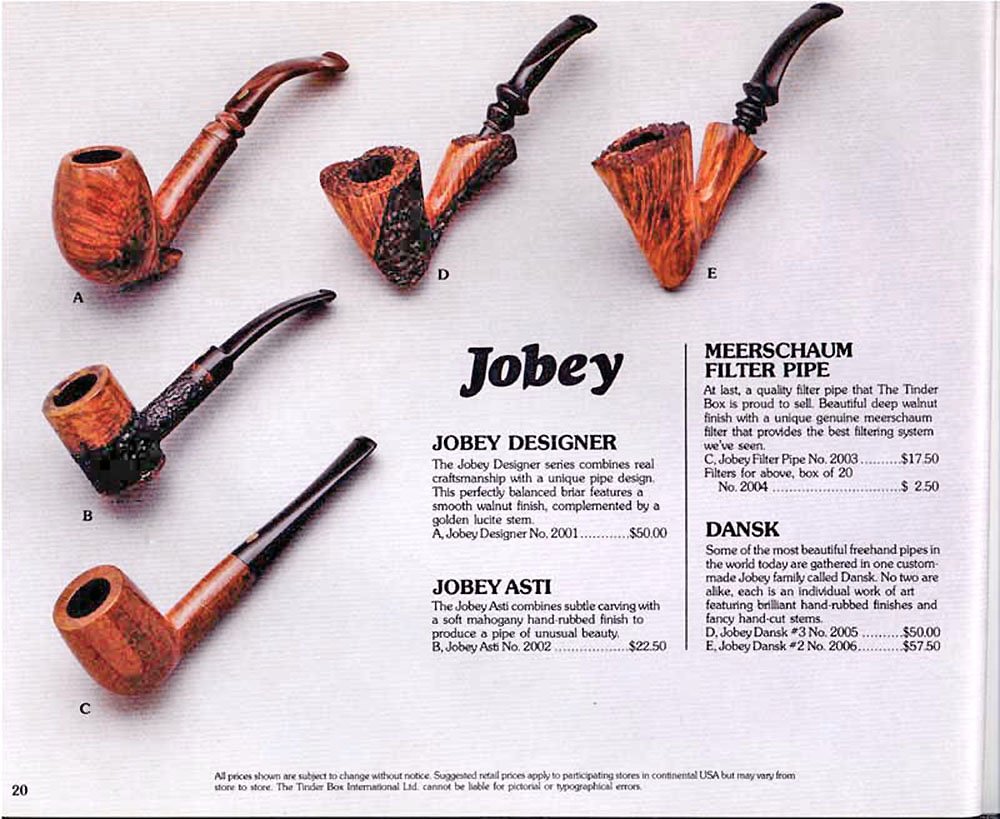
There was also an interesting Tinderbox catalogue page, provided courtesy of Doug Valitchka, that includes a note about the Jobey Dansk (https://pipedia.org/images/7/7a/Jobey1979.jpg).From that information I confirmed that the pipe that I was working on was carved by Karl Erik Ottendahl. There were some similarities to the Karl Erik pipes that I have worked on in the past. The dating of the pipe line in the 70s fits well with the pipe I have in hand.

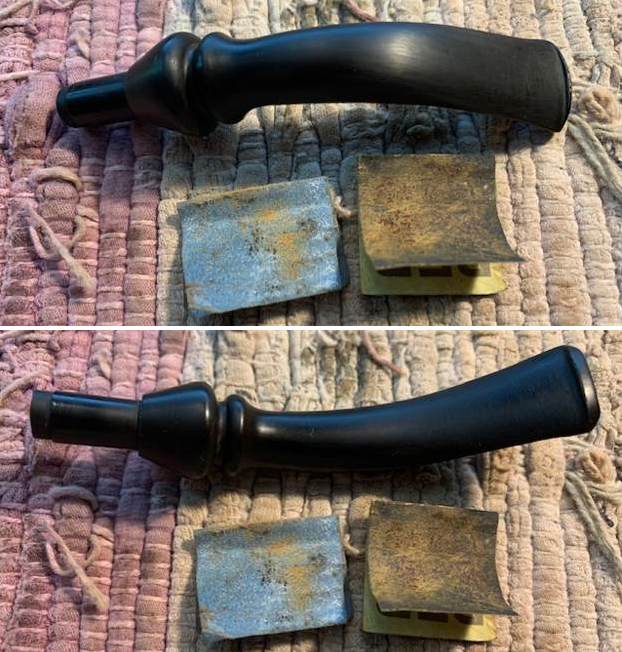
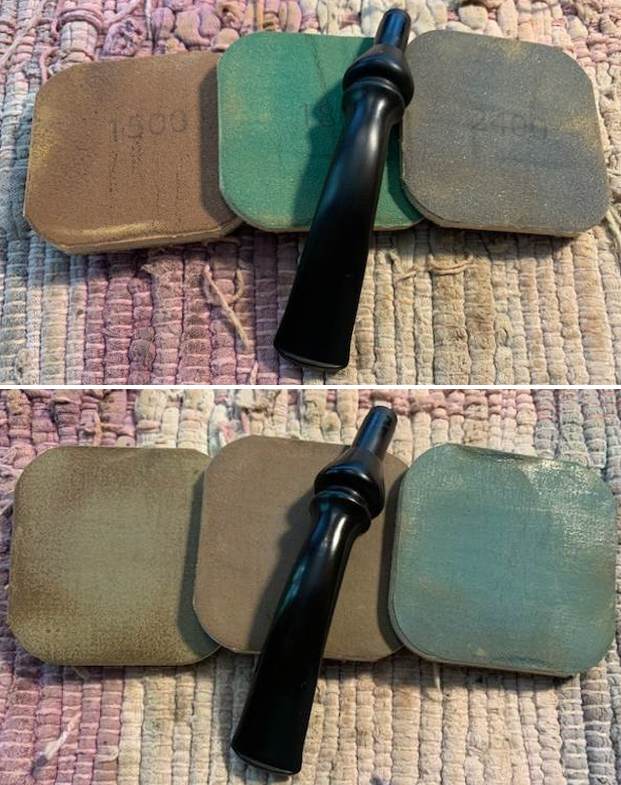
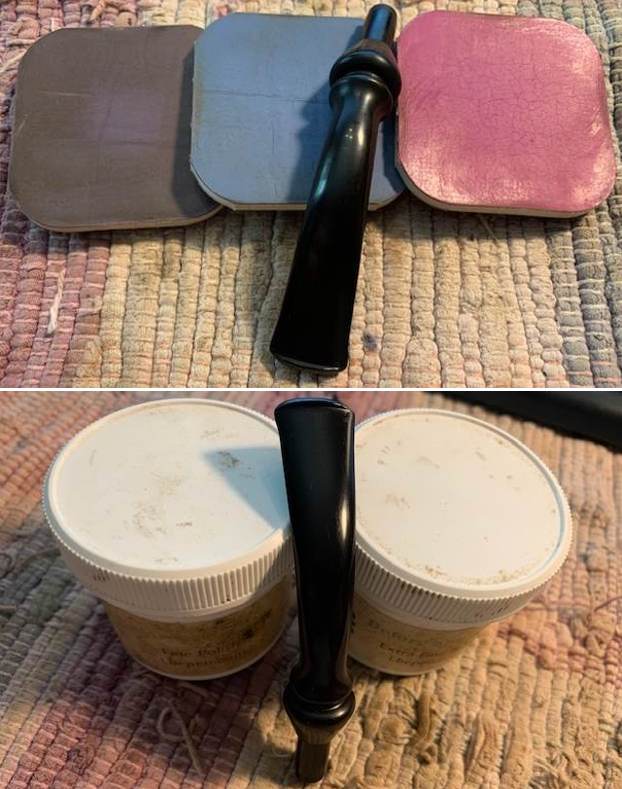
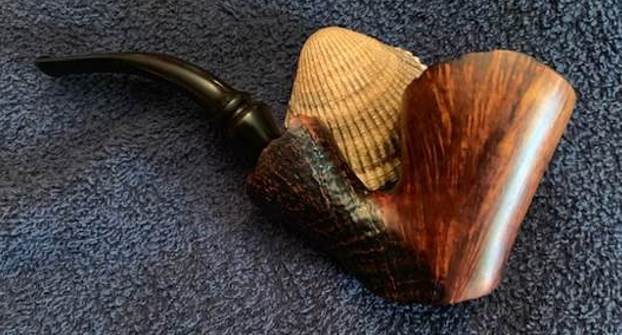
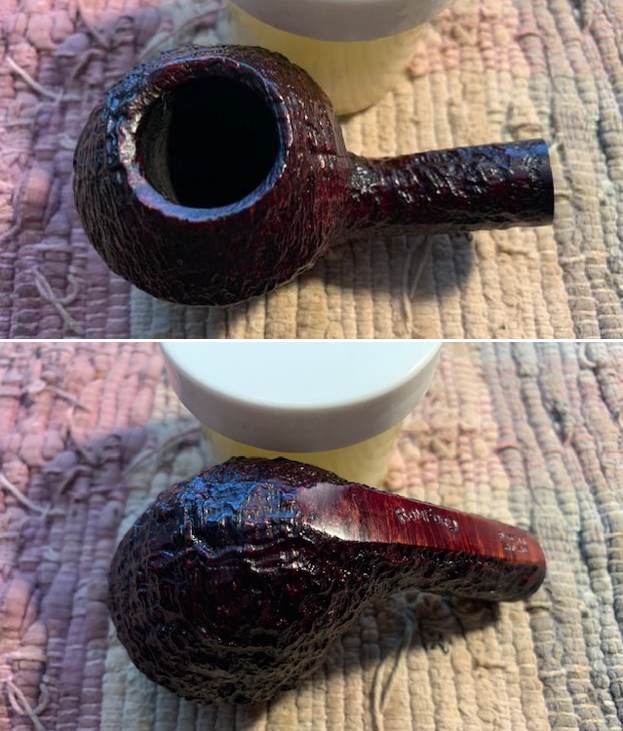
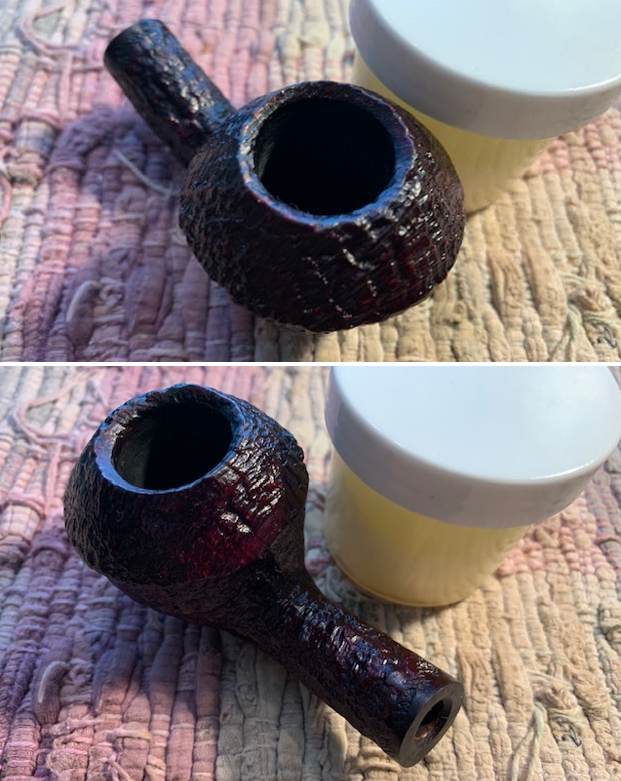
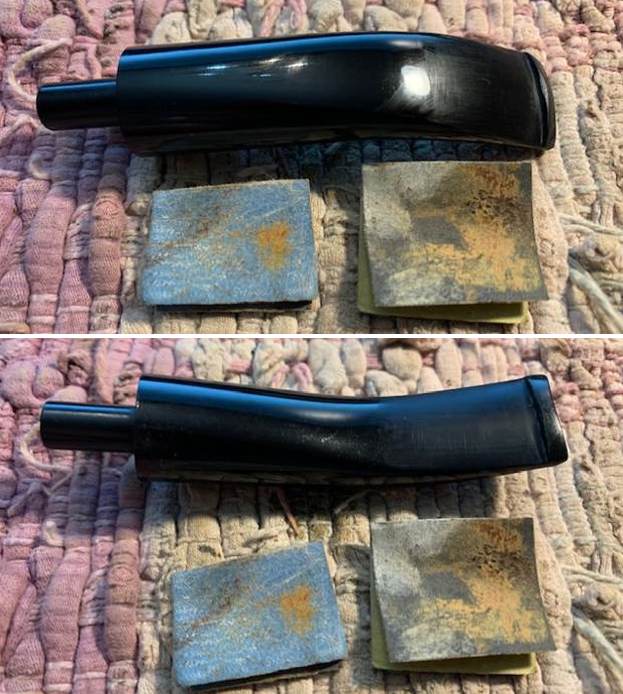
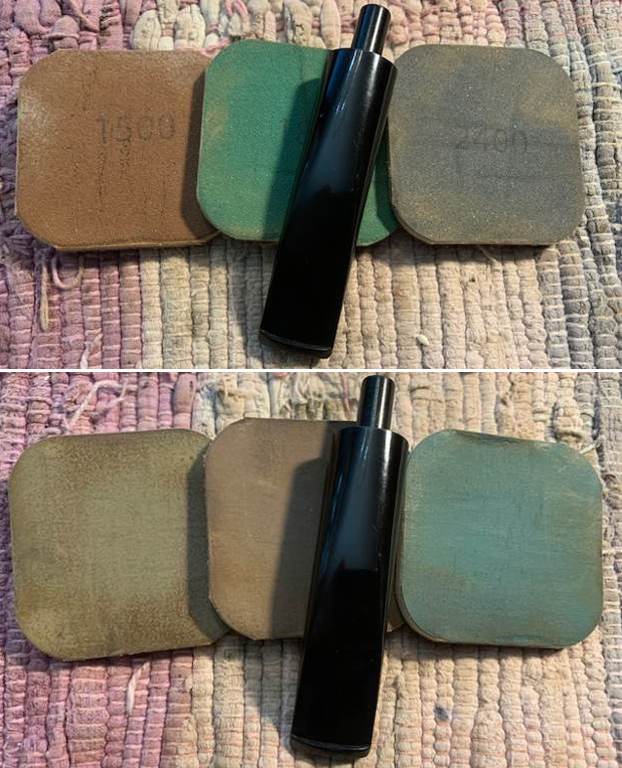
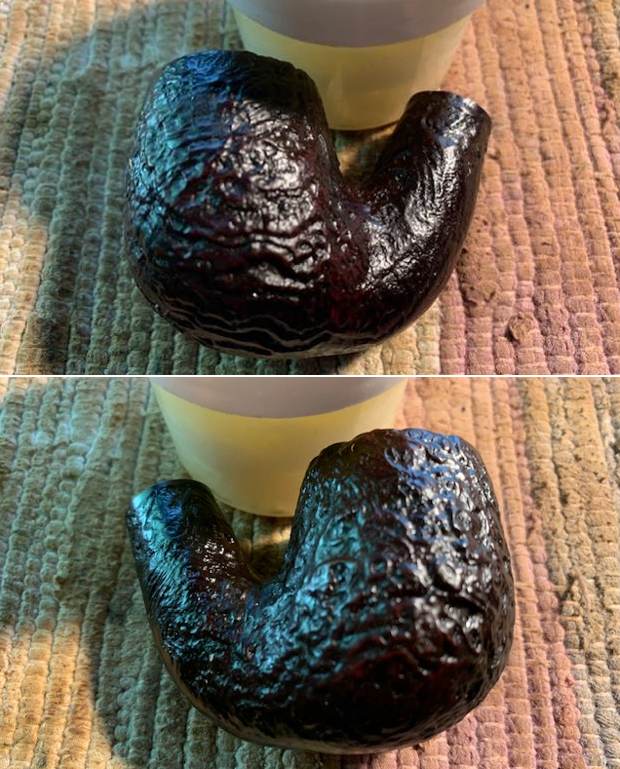
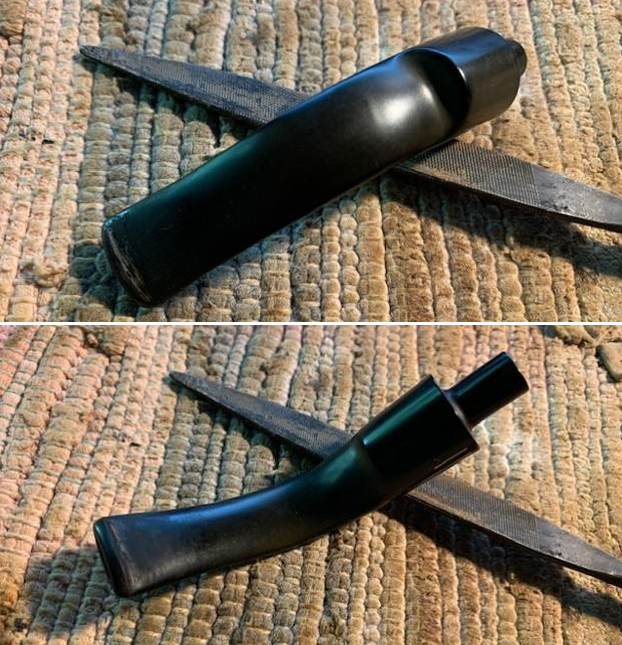
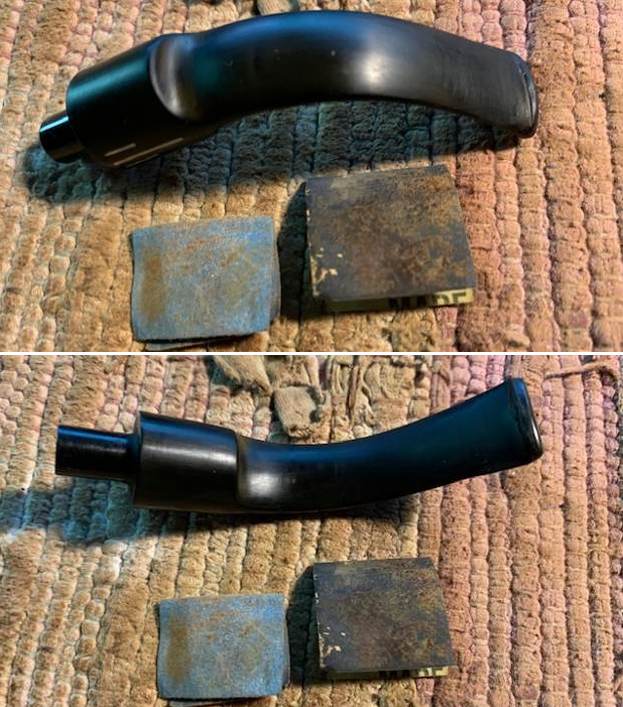
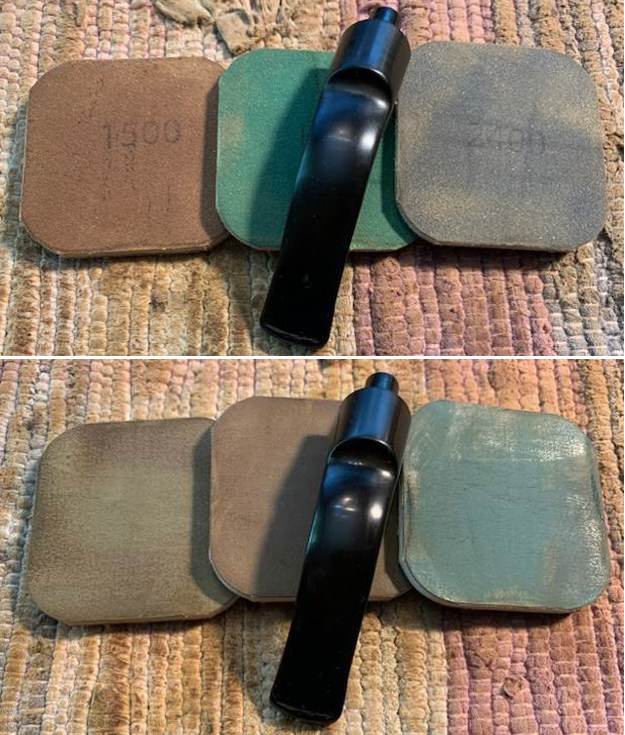
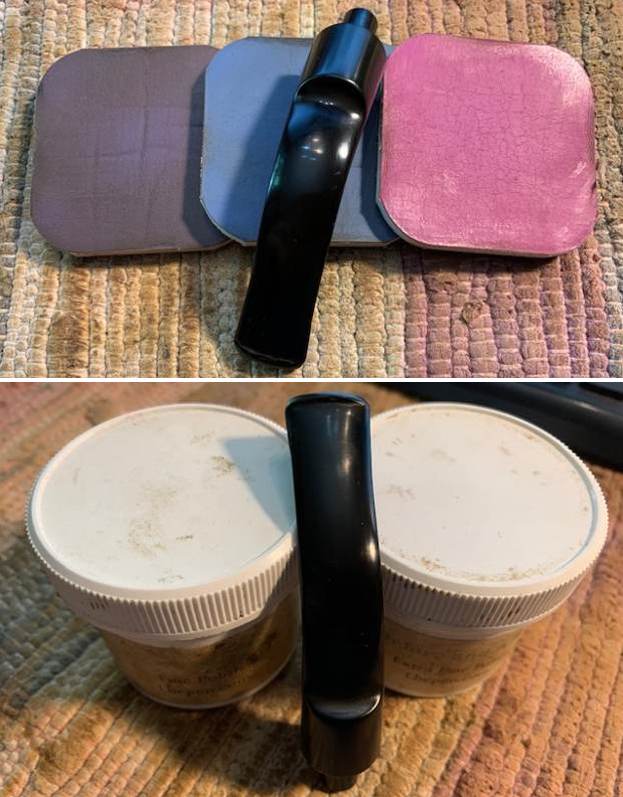
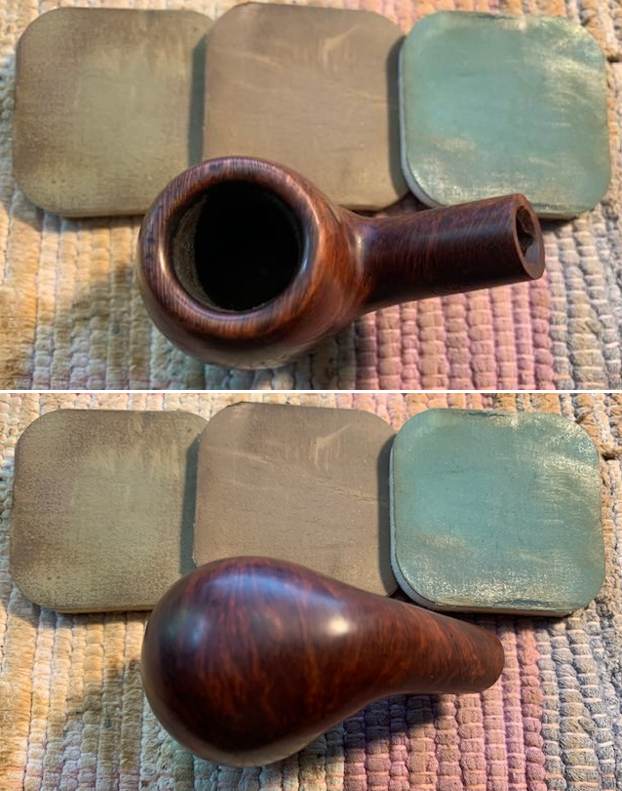
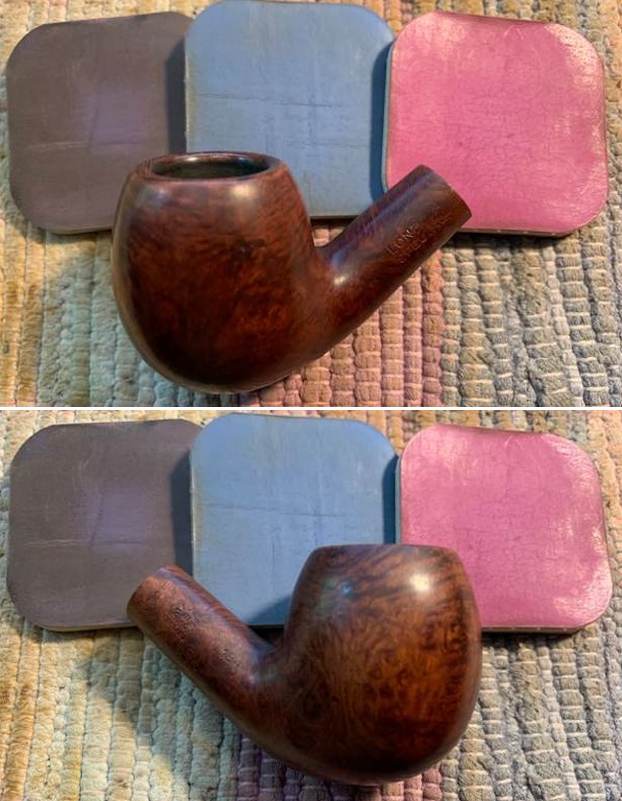
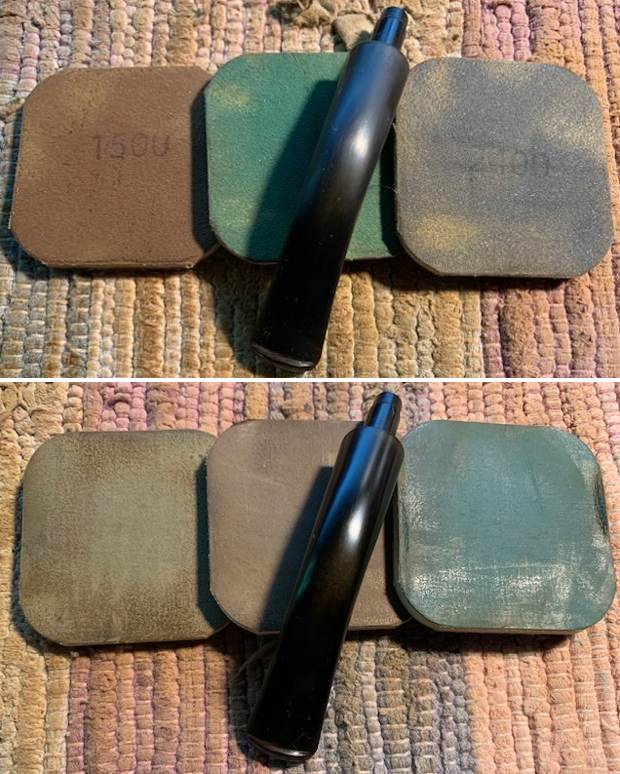
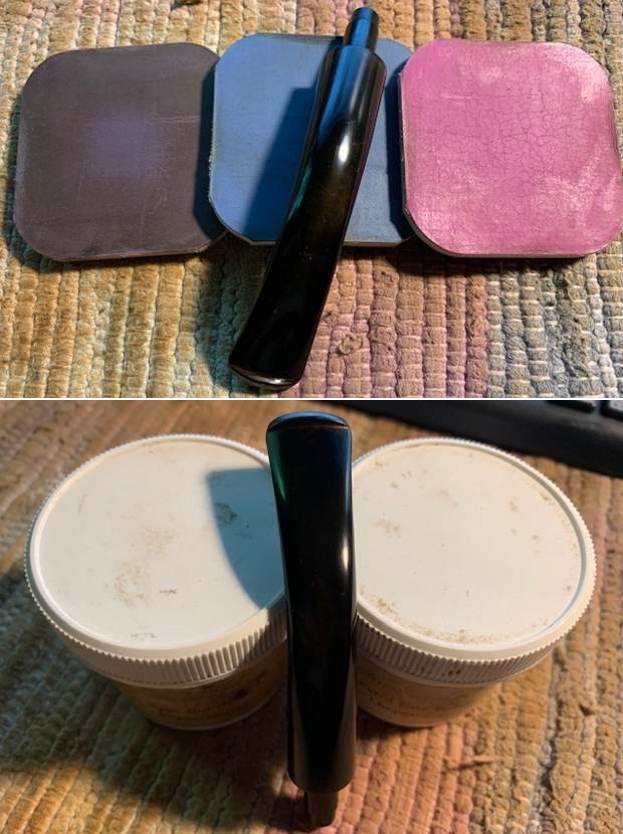
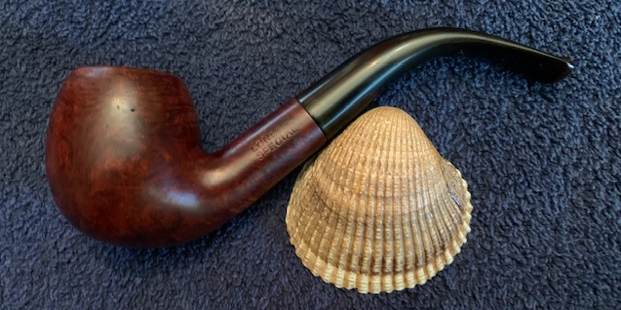
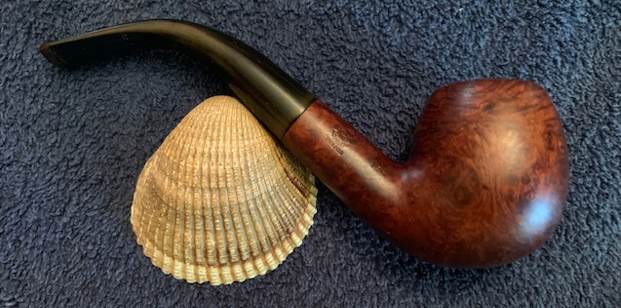
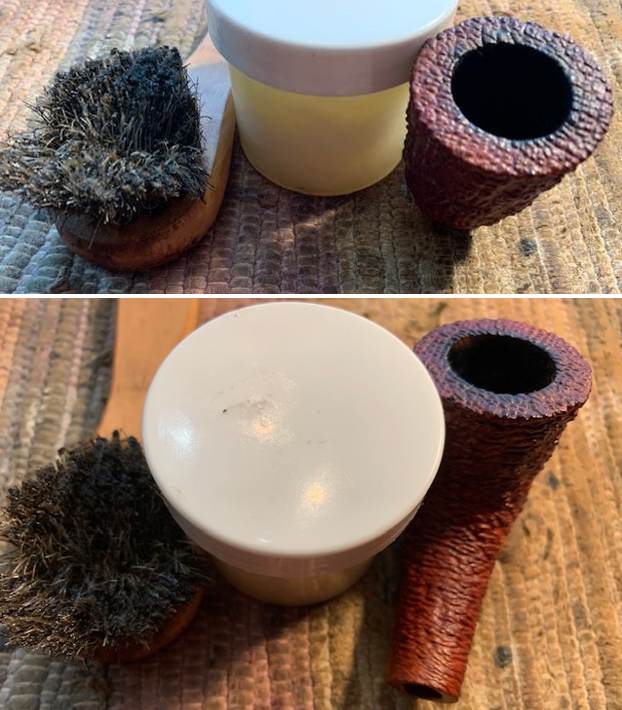
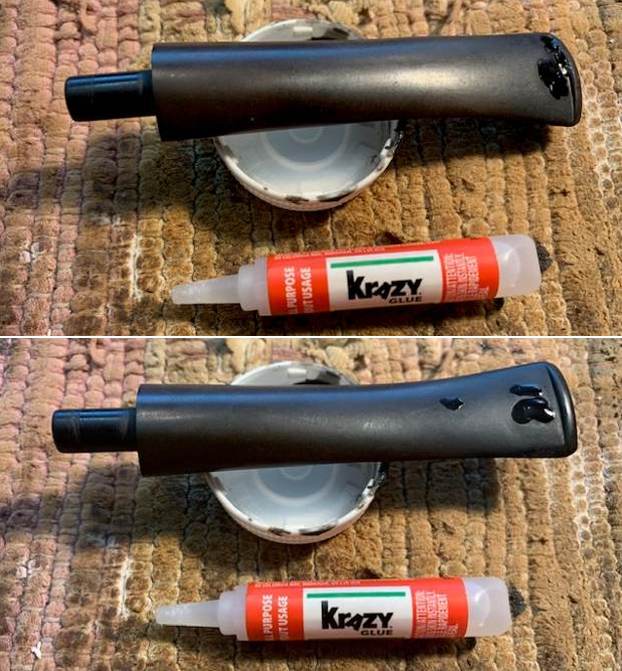
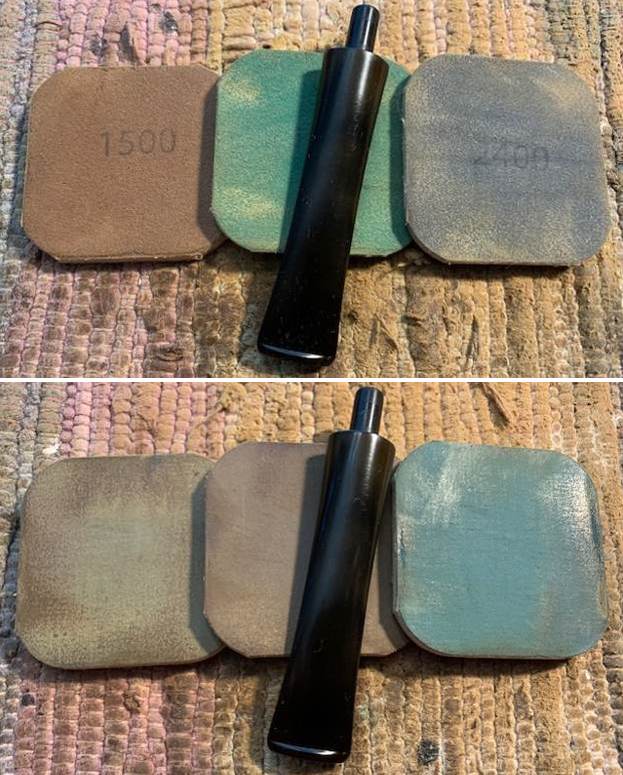
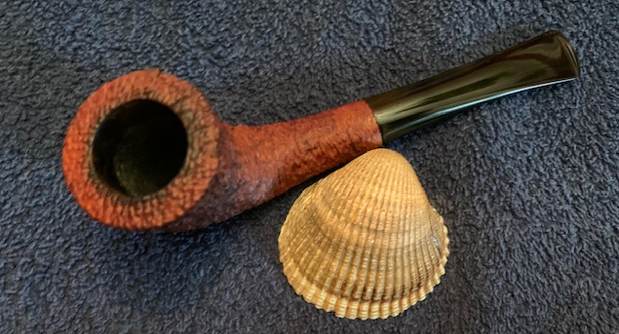
Now it was time to work on the pipe on my end. When I received it Jeff had once again done an amazing job cleaning the pipe. He reamed it with a PipNet pipe reamer and got rid of the cake. He cleaned up the reaming with a Savinelli Fitsall Pipe Knife so that we could see the walls of the bowl and assess for damage. It was in good condition. He cleaned the internals of the shank and stem with cotton swabs, pipe cleaners and alcohol. He scrubbed the exterior with undiluted Murphy’s Oil Soap and a tooth brush. He rinsed the pipe under warm water. He dried it off with a cloth and then let it air dry. The stem was scrubbed with Soft Scrub and soaked in Briarville’s Stem Deoxidizer. It came out looking very good. The finish on the bowl and the rim top cleaned up nicely. I took pictures of the pipe to show how it looked when I unpacked it. I took some photos of the rim top and stem to show the condition of them both when the pipe arrived. Overall it looked good. There is some darkening and damage to the inner edge of the bowl. The stem had some deep tooth marks ahead of the button and on the button surface on both sides.   I took a photo of the stamping on the underside of the shank. It is readable and in great condition.I removed the stem from the shank and took a photo of the pipe to show the look of the pipe.I started my work on the pipe by addressing the darkening and damage to the inner edge of the rim. I used a folded piece of 220 grit sandpaper to work and smooth it out. It looked better when I had finished.  I polished the bowl with micromesh sanding pads – wet sanding with 1500-12000 grit pads. I wiped the briar down after each pad with a damp cloth. The bowl is starting to look very good. I worked some Before & After Restoration Balm into the surface of the briar with my fingertips and into the plateau rim top and shank end with a horsehair shoe brush to clean, enliven and protect it. I let the balm sit for a little while and then buffed with a cotton cloth to raise the shine. The photos show the bowl at this point in the restoration process. I set the bowl aside and turned my attention to the stem. I filled in the deep tooth marks with clear CA glue. Once it cured and hardened I sanded out the tooth chatter and blended in the repairs with 220 grit sandpaper and started to polish it with a folded piece of 400 wet dry sandpaper. Once it was finished it began to shine. I polished the stem with micromesh sanding pads – wet sanding with 1500-12000 grit sanding pads. I wiped it down after each sanding pad with some Obsidian Oil. I finished polishing it with Before & After Pipe Stem Polish – both Fine and Extra Fine and buffed it off with a cotton cloth. This is a beautiful Jobey Dansk Hand Made by Karl Erik with a fancy, turned, black vulcanite stem. It has a great look and feel. The shape fits well in the hand with the curve of the bowl and shank junction a perfect fit for the thumb around the bowl when held. I polished stem and the bowl with Blue Diamond polish on the buffing wheel. I gave the plateau on the rim top and shank end multiple coats of Conservator’s Wax. I gave the bowl and the stem multiple coats of carnauba wax. I buffed the pipe with a clean buffing pad to raise the shine. I hand buffed it with a microfiber cloth to deepen the shine. The pipe polished up pretty nicely. The rich combination of browns and black in the smooth finishes and the plateau areas took on life with the buffing. The rich colour of the briar works well with the polished vulcanite stem. I like the grain and finished look of this Jobey Dansk pipe. Have a look at it with the photos below. The shape, finish and flow of the pipe and stem are very well done. The dimensions are Length: 5 ½ inches, Height: 2 inches, Outside diameter of the bowl: 1 ¼ wide, Chamber diameter: ¾ of an inch. The weight of the pipe is 56 grams/ 1.98 ounces. This Danish Freehand is a real beauty. Thanks for walking through the restoration with me as I worked over another beautiful pipe. This one will be going on the rebornpipes store in the Danish Pipe Making Section shortly if you would like to add it to your collection. Thanks for your time.
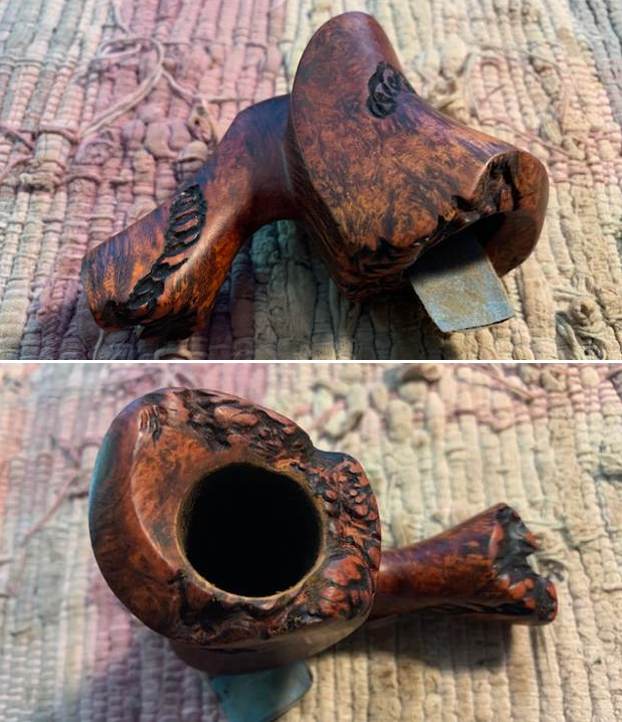
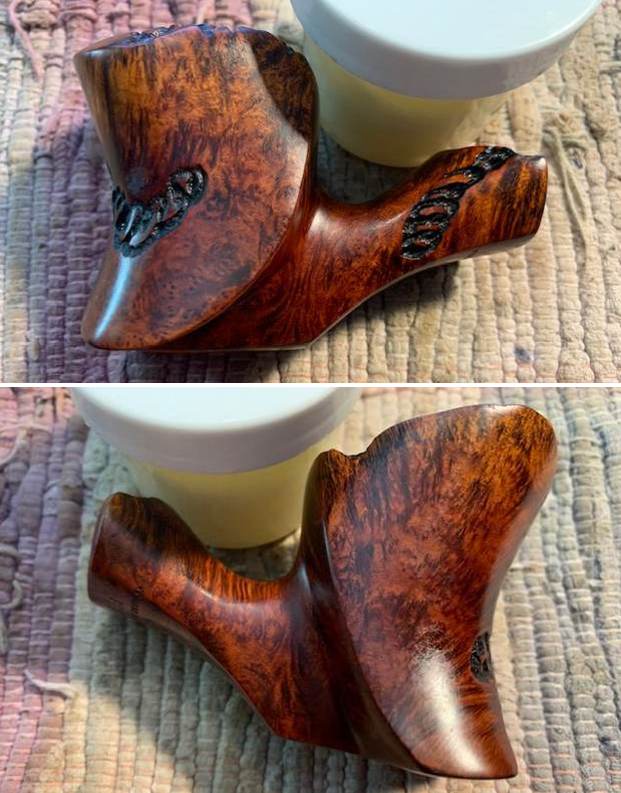
I had no idea that the Brebbia Collection Line had these Danish Looking Freehands


Blog by Steve Laug

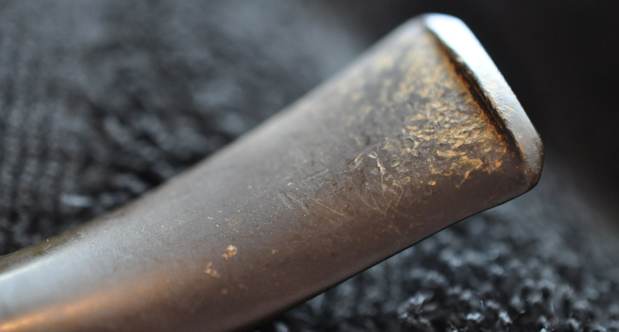
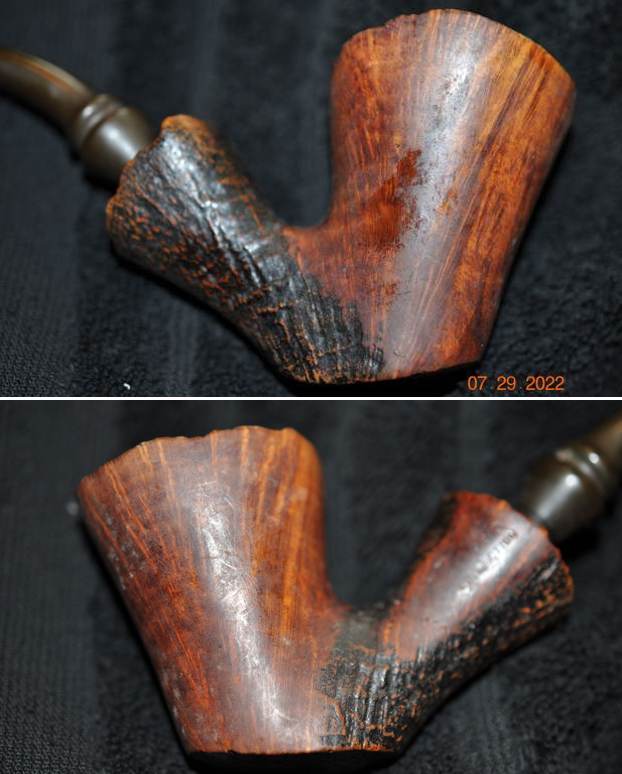
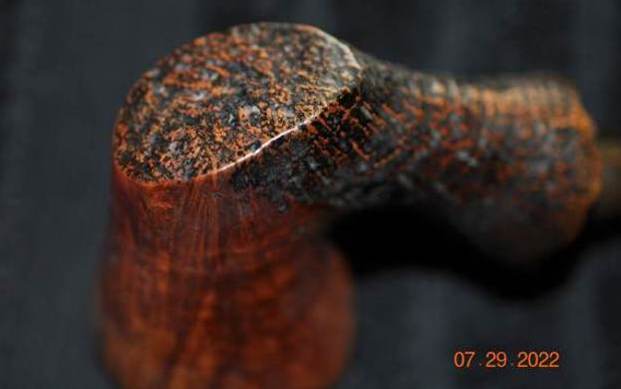
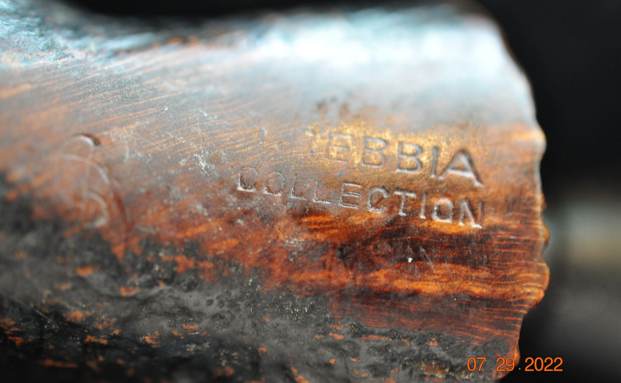
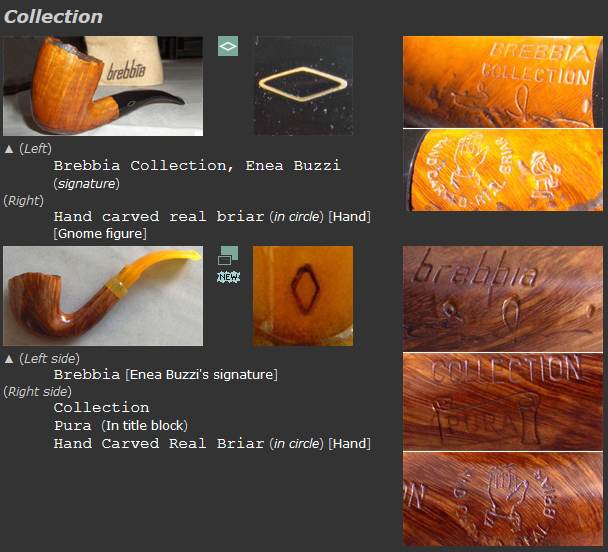
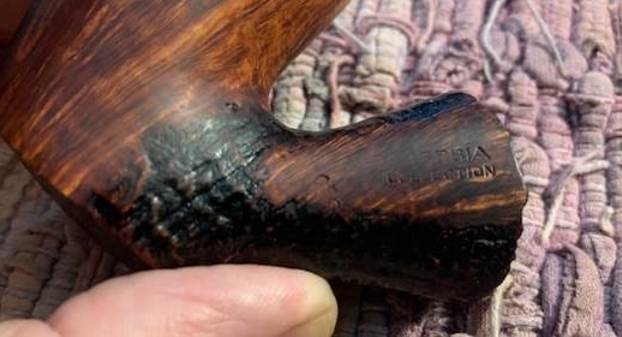
The next pipe on the table is one that Jeff purchased on 5/25/22 from an antique store in Portland, Oregon, USA. While I have worked on a Brebbia Pura before this one was far more like a Danish style Freehand. It is stamped on the a smooth panel on the left side of the shank and has the signature (initials) of Enea Buzzi followed by Brebbia [over] Collection. It is a beautiful mixed finish freehand pipe that includes a sandblast finish around the shank sides and the heel of the bowl and a smooth finish on the bowl sides. Brebbia calls it a Demisandblasted Pipe. There was plateau on the rim top and shank end. The finish was very dirty with grime ground into the smooth briar and also the sandblast. It was dusty and tired looking but it had great grain shining through. The bowl was heavily caked with a thick overflow of lava on the plateau rim top filling in the nooks and crannies of the finish. It was very hard to tell the condition of the inner edge of the bowl. The fancy turned, saddle  stem was oxidized, calcified and had tooth marks and chatter on both sides ahead of the button. It was a great looking pipe that showed a lot of promise. Jeff took photos of it before he started his clean up work. If you ignore the stamping you would almost surely say it was a Karl Erik or Preben Holm pipe. But it is not! It’s just a very Danish looking Italian made Freehand. He took close-up photos of the bowl and rim top from various angles to capture the condition of the bowl, rim top and edges of the bowl. The cake was very thick and the bowl overflowed in thick lava on to the rim top filling in much of the valleys in the plateau. He also captured the condition of the top and underside of the stem. You can see the tooth marks and chatter on both sides ahead of the button. It was a well used, dirty pipe. He took photos of the sides and heel of the bowl to show the condition of the beautiful sandblast around the shank and the heel of the bowl. You can also see the smooth bowl sides with great grain shining through the grime and debris of time ground into the finish. Jeff took a photo of the stamping on the smooth panel on the left side of the shank. It is clear and readable as noted above. Now I wanted to find out about the brand and particularly the specific Collection line. I wanted get the details on this pipe before I carried on with my work. I had worked previously on a Brebbia Collection Pura so I have included the link on that pipe for you to read. It is quite different from this Danish looking Freehand with true plateau on the rim top and shank end. It is quite fascinating to read about (https://rebornpipes.com/2022/05/06/breathing-new-life-into-a-brebbia-collection-hand-carved-pura/).

I then turned to Pipephil’s site to get a quick summary on the brand and to see if there was any information on the Collection line (http://pipephil.eu/logos/en/logo-brebbia.html) I have included photos of the Buzzi’s – Enea and his son Luciano to the left. I quote the sidebar below.

The Brebbia brand Brebbia Pipe is named after the locality of Bosco Grosso di Brebbia (Prov. Varese, Reg. Lombardia). A first corporate was founded by Enea Buzzi and Achille Savinelli in 1947. They split in 1953. Buzzi ketp the factory and created the MPB brand (Maniffatura Pipe Brebbia). After 1968 the brand was shortly called “Brebbia”. Luciano Buzzi son of Enea manages the company since the 1990s. Italy

I have also done a screen capture of the pertinent section on the Collection line below. It is a fascinating piece of information. The pipe I am working on has the stamp on the left side that is parallel to the first one below. It has the signature or initials carved near the shank bowl joint. It does not have he stamp that is shown on the right side below. It does not have the carved hand made in a circle nor the gnome figure. It makes me wonder when this one was made.I then turned to Pipedia to read some more detail on the brand (https://pipedia.org/wiki/Brebbia). There was nothing specific there about the Collection Line/Series but some great history. The connection with Savinelli is fascinating. I quote below.

Pipe Brebbia Srl, or better the M.P.B. (Manifattura Pipe Brebbia) was born in 1953 from the denouement of the association between Achille Savinelli and Enea Buzzi in 1947, where the first was employed in the marketing and the second in manufacturing of pipes under the name of Savinelli. It was made in exclusive up to 1953 and extended without further rights up to 1956.

The production, which is always careful and perfect, has continued in a traditional way for 60 years, using old lathes for the first steps, but finishing every piece by hand.

The secret of their manufacture, if we may put it this way, is the respect for the traditions with the experience acquired in several years of successful work, which could be summed up in two words: high quality.

The factory is currently managed by Enea’s son, Luciano…

Jeff had reamed the pipe with a PipNet pipe reamer and cleaned up the reaming with a Savinelli Fitsall Pipe Knife. He scrubbed out the internals of the shank and stem with alcohol, pipe cleaners and cotton swabs until the pipe was clean. He scrubbed the exterior of the bowl with Murphy’s Oil Soap and a tooth brush to remove the grime and grit on the briar and the lava on the plateau rim top. The finish looks much better but there is still some darkening on the rim top and inner edge of the bowl. Jeff scrubbed the stem with Soft Scrub to remove the grime on the acrylic stem surface. When the pipe arrived here in Vancouver for the second stop of its restoration tour it looked a lot better. I took photos this morning before I started my part of the work. That is one of the benefits of being an early riser.  I took some close up photos of the rim top and the stem surface. I wanted to show the cleaned bowl and rim top. The rim top and the inner and outer edges of the bowl were in excellent condition. There was some stain remaining in the deep grooves of the plateau rim and shank end. I also took close up photos of the stem to show the tooth marks on the stem surface. I took a photo of the stamping on the left side of the shank and it is readable as noted above.   I removed the stem for the shank and took a photo of the bowl and stem to give a picture of what it looked like. The pipe is really quite beautiful.Jeff had done a good job on the rim top so I used a black stain pen to fill ins the grooves in the plateau on the rim top and shank end. Though the photo is a little dark you will see the results in the following photos below. It is looking quite stunning.I polished the smooth briar around the bowl with 1500-12000 grit micromesh sanding pads to raise the shine and make the grain pop. I wipe the briar down after each pad with a damp cloth to remove the sanding debris. Using the higher grits of micromesh from 3200-12000 I also polished the sandblast areas and the plateau on the rim and the shank end. It is really starting to have a rich glow in the briar and the stunning grain looks amazing.  I rubbed the bowl and shank down with Before & After Restoration Balm to deep clean the finish on the bowl and shank. The product works to clean, enliven and protect the briar. I worked it in with my fingertips on the smooth portions and a horse hair shoe brush to get it into the nooks and crannies of the sand blast finish and the plateau on the rim and shank end. I let it sit for 10 minutes to let it do its magic. I buffed it with a soft cloth. The briar really began to have a rich shine. I took some photos of the bowl at this point to mark the progress in the restoration. The finish – both straight and flame grain along with the sandblast is rich and shows depth. I set the bowl aside and turned my attention to the tooth marks and chatter in the stem. I sanded the stem surface with 220 grit sandpaper and removed the chatter and marks against the button edge. I started polishing the stem with 400 grit wet dry sandpaper.  I polished the stem with micromesh sanding pads – dry sanding with 1500-12000 grit pads. The stem took on a rich glow and the marks are gone. I polished it with Before & After Stem Polish – both Fine and Extra Fine and wiped it down with some Obsidian Oil. I put the Brebbia Collection Danish Style Freehand back together and buffed it on the wheel with Blue Diamond. It polished out the tiny scratches remaining in the acrylic and the smooth briar. I gave it multiple coats of carnauba with the wheel. I buffed it with a clean wheel on the buffer and hand buffed it with a soft cloth to deepen the shine. The finished pipe looks very good. The Demisandblast/smooth finish highlights the grain both on the smooth portions and the sandblast ones and it is a stunning pipe. The pipe feels great in the hand and is comfortable and light weight for its size. The finished Brebbia Freehand is shown in the photos below. The dimensions of the pipe are Length: 6 inches, Height: 2 inches, Outside diameter of the bowl: 1 ½ x 2 inches, Chamber diameter: ¾ of an inch. The weight of the pipe is 1.83 ounces/ 52 grams. I will soon be adding this pipe to the rebornpipes store in the Italian Pipemakers Section so if you are interested in adding it to your collection please let me know. Thanks for reading this blog and my reflections on the pipe while I worked on it.

New Life for a Romford Rhodesian made by Bill Ashton Taylor


Blog by Steve Laug

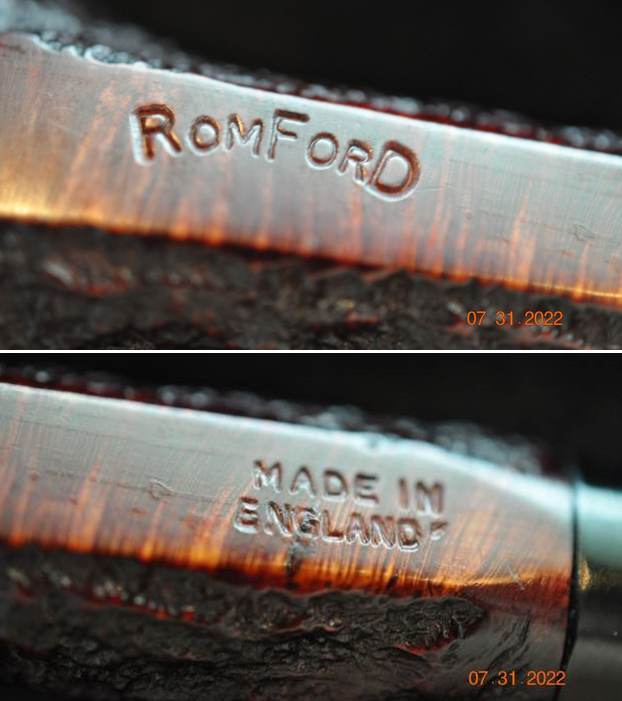
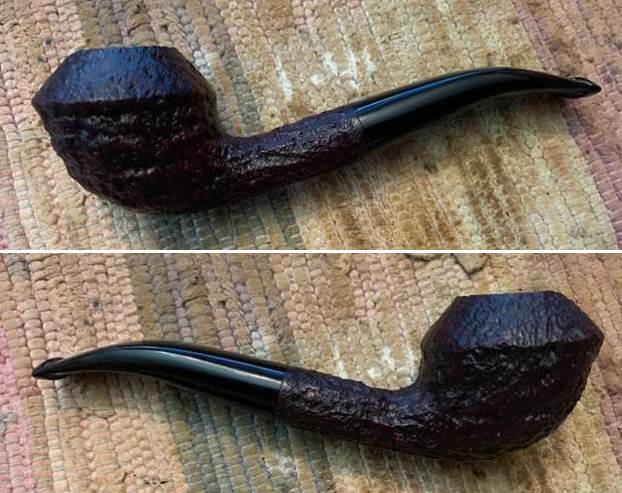
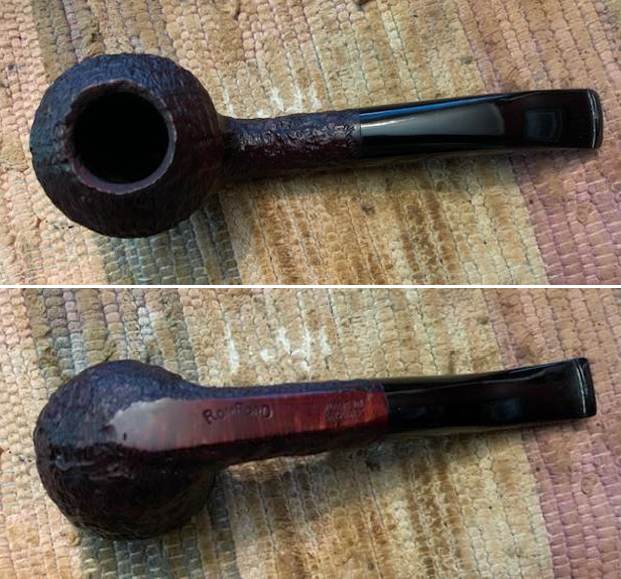
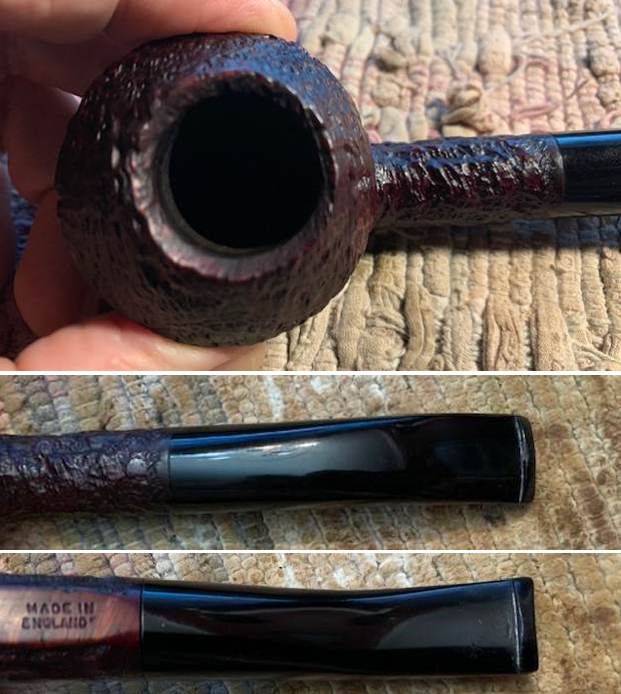
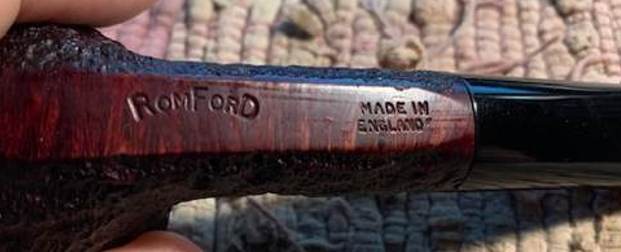
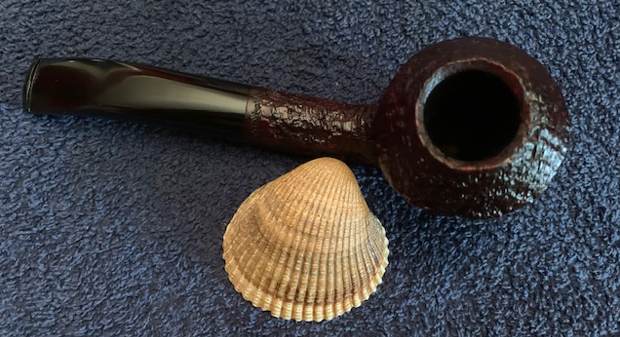
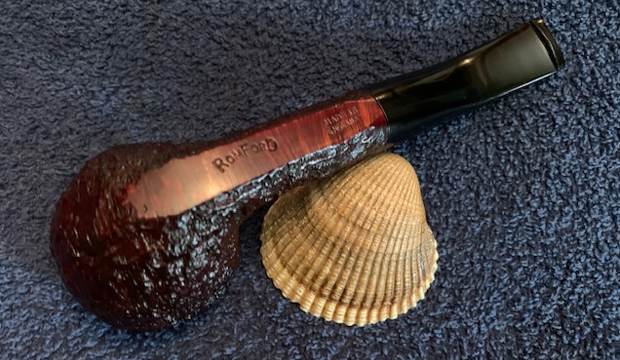
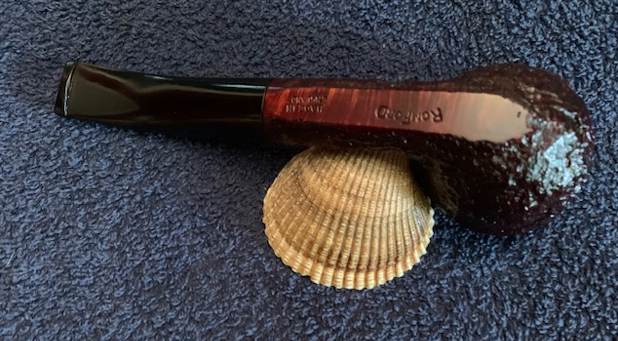
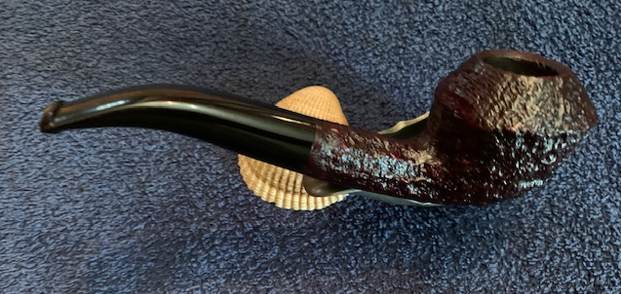
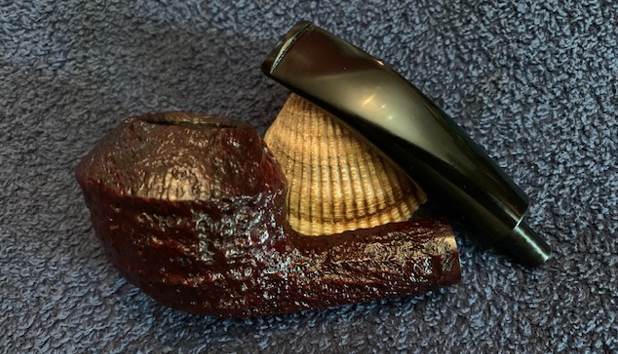
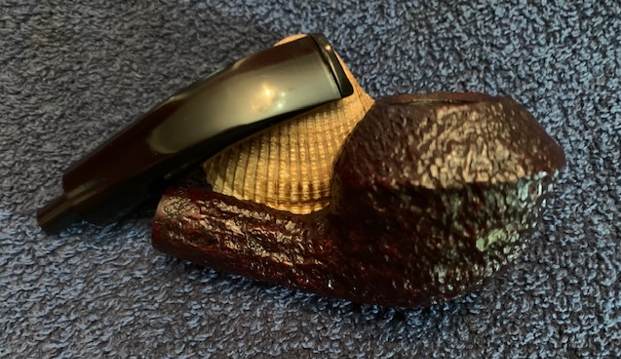
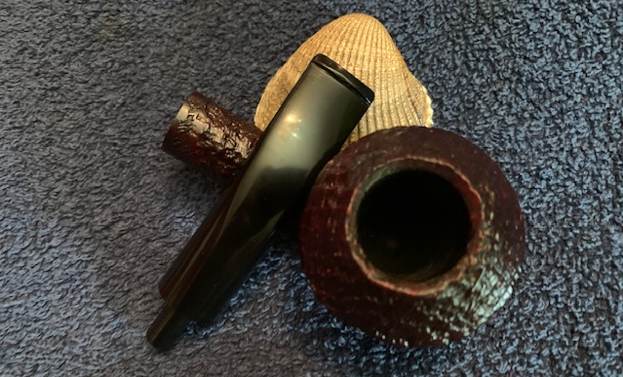
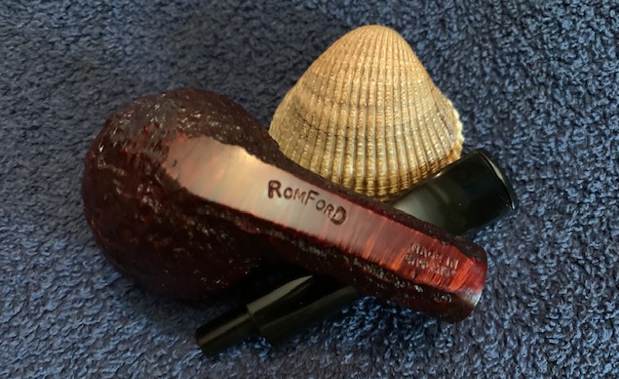
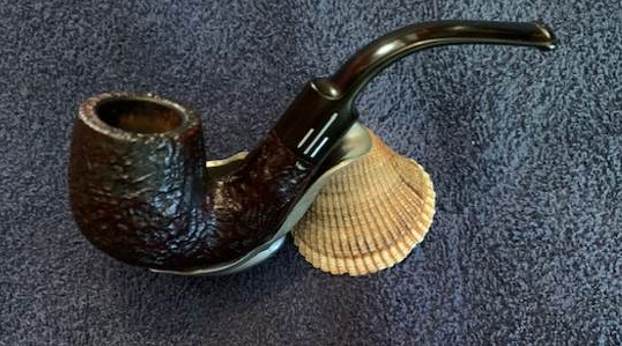
The next pipe also came in a recent box of pipes that Jeff sent me. It is a great looking sandblast Rhodesian with a quarter bend. The bowl is a beautiful sand blasted briar. The stem is made of what appears to be acrylic. We purchased it from an auction on 06/24/22 in Manorville, New York, USA.  It is a Rhodesian shaped pipe with a deep sandblast that gives a rich tactile feel in the hand. When Jeff sent me photos of the pipe before the auction and told me it was a Romford I had a memory of a connection to Bill Ashton Taylor of Ashton pipe making fame. The finish is nice but has dust and debris in the nooks and crannies of the sandblasted surface. The rim top was beveled into the bowl and there was a thick lava overflow from the thickly caked bowl. The beveled rim top and inner edge was thickly caked but it seemed like the edges were in good condition. The pipe was stamped on the underside of the shank and read ROMFORD followed by Made in [over] England. The tapered stem was made of acrylic and was in good condition with some light tooth marks and chatter on both sides near the button. Jeff took the following photos before he started his cleanup work on the pipe. He took close-up photos of the bowl and rim top from various angles to capture the condition of the bowl, rim top and edges of the bowl. The cake was very thick and the bowl overflowed in thick lava on to the rim top filling in much of the sand blast. He also captured the condition of the top and underside of the stem. You can see the tooth marks and chatter on both sides ahead of the button. It was a well used, dirty pipe. He took photos of the sides and heel of the bowl to show the condition of the beautiful sandblast around the bowl. You can also see the smooth underside of the shank and the grime and debris of time ground into the finish. Jeff took a photo of the stamping on the smooth underside of the shank. It is clear and readable as noted above.   I did a Google search for Romford pipes and found a few listings on smokingpipes.com. There was one Romford pipe for sale that had a great description of the brand (https://www.smokingpipes.com/pipes/estate/england/moreinfo.cfm?product_id=76028). I quote:

The Romford pipe is named after the town where Bill Ashton Taylor produced his pipes. They are all made of oil-cured briar, shaped by Bill. pretty much the same as an Ashton, except the stain or grain didn’t make the grade and often a vulcanite, rather than Ashtonite, stem is used. Hard to beat the smoke for the buck.

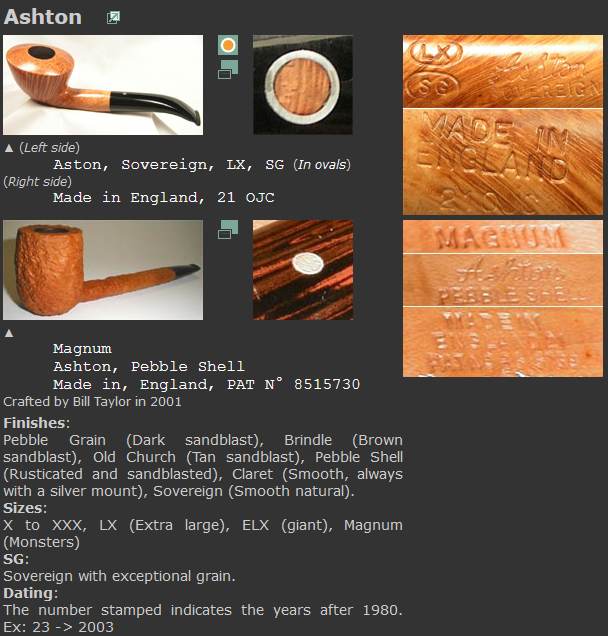
From there I turned to Pipephil and looked up Ashton pipes (http://pipephil.eu/logos/en/logo-a8.html). I have included a screen capture of the brand information there as well as the notes in the sidebar identifying the Romford as a sub-brand of Ashton pipes that was sold through McCranies Pipe Shop in Charlotte North Carolina. The McCranies Shop sold Ashton made McArris and also Romford pipes.Brand established in 1983 by Bill Ashton-Taylor (1945 – 2009†). James Craig (Jimmy) was designed by Bill himself worthy to continue Ashton pipes manufacture.

Sub-brand: Romford (sold through McCranie’s) See also: Taylor Made , Mac Cranie

For a great history of the Ashton brand give the article on Pipedia a read as well as the Ashton Pipe Story there (https://pipedia.org/wiki/Ashton).

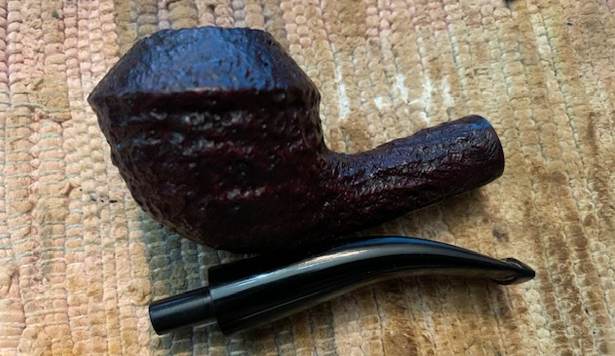
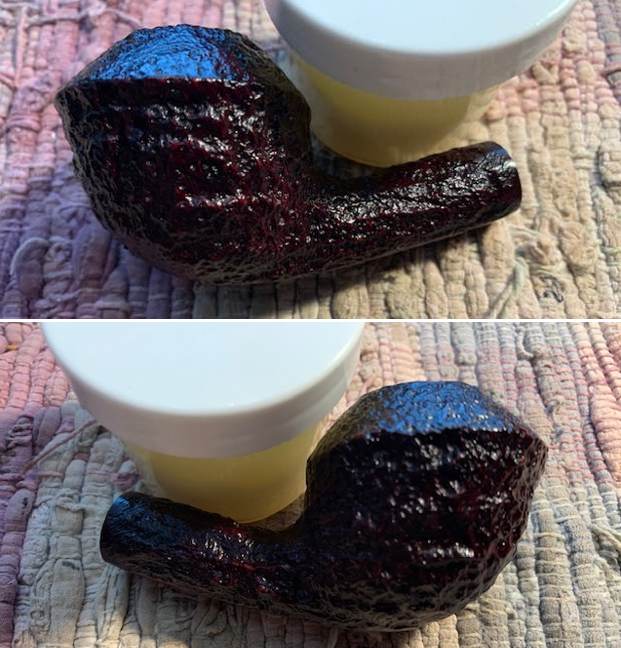
Jeff had reamed the pipe with a PipNet pipe reamer and cleaned up the reaming with a Savinelli Fitsall Pipe Knife. He scrubbed out the internals of the shank and stem with alcohol, pipe cleaners and cotton swabs until the pipe was clean. He scrubbed the exterior of the bowl with Murphy’s Oil Soap and a tooth brush to remove the grime and grit on the briar and the lava on the rim top. The finish looks much better but there is still some darkening on the rim top and inner edge of the bowl. Jeff scrubbed the stem with Soft Scrub to remove the grim on the acrylic stem surface. When the pipe arrived here in Vancouver for the second stop of its restoration tour it looked a lot better. I took photos this morning before I started my part of the work. That is one of the benefits of being an early bird. I took some close up photos of the rim top and the stem surface. I wanted to show the cleaned bowl and rim top. The rim top and the inner and outer edges of the bowl were in excellent condition. The beveled rim top of the bowl and edges looked very good. I also took close up photos of the stem to show the tooth marks on the stem surface. I took a photo of the stamping on the underside of the shank and it is readable as noted above.   I removed the stem for the shank and took a photo of the bowl and stem to give a picture of what it looked like. The sandblast finish is beautiful.I rubbed the bowl and shank down with Before & After Restoration Balm to deep clean the finish on the bowl and shank. The product works to clean, enliven and protect the briar. I worked it in with my fingertips and a horse hair shoe brush to get it into the nooks and crannies of the sand blast finish on the bowl and shank. I let it sit for 10 minutes to let it do its magic. I buffed it with a soft cloth. The briar really began to have a rich shine. I took some photos of the bowl at this point to mark the progress in the restoration.   I set the bowl aside and turned my attention to the tooth marks and chatter in the stem. I sanded the stem surface with 220 grit sandpaper and removed the chatter and marks against the button edge. I started polishing the stem with 400 grit wet dry sandpaper.I polished the stem with micromesh sanding pads – dry sanding with 1500-12000 grit pads. The stem took on a rich glow and the marks are gone. I polished it with Before & After Stem Polish – both Fine and Extra Fine and wiped it down with some Obsidian Oil. I put the Bill Ashton made Romford Rhodesian back together and buffed the bowl and stem with Blue Diamond on the buffing wheel. I polished out the tiny scratches remaining in the acrylic and used a light touch to polish the sandblast finish. The bowl and stem looked very good. I gave the bowl several coats of Conservator’s Wax and the stem multiple coats of carnauba with the wheel. I buffed it with a clean wheel on the buffer and hand buffed it with a soft cloth to deepen the shine. The finished pipe looks very good. The rugged sandblast finish highlights the grain that is below it and really is a stunning pipe. The pipe feels great in the hand. It is comfortable and light weight for its size. The finished Romford is shown in the photos below. The dimensions of the pipe are Length: 6 inches, Height: 1 ¾ inches, Outside diameter of the bowl: 1 ¾ inches, Chamber diameter: ¾ of an inch. The weight of the pipe is 2.05 ounces/ 58 grams. I am still very undecided whether to keep this pipe or part with it. This is the problem of working on so many pipes – which to keep and which to sell. Thanks for reading this blog and my reflections on the pipe while I worked on it.

Restoring an Unique Boswell Twisted Long Shank Freehand Sitter


Blog by Steve Laug

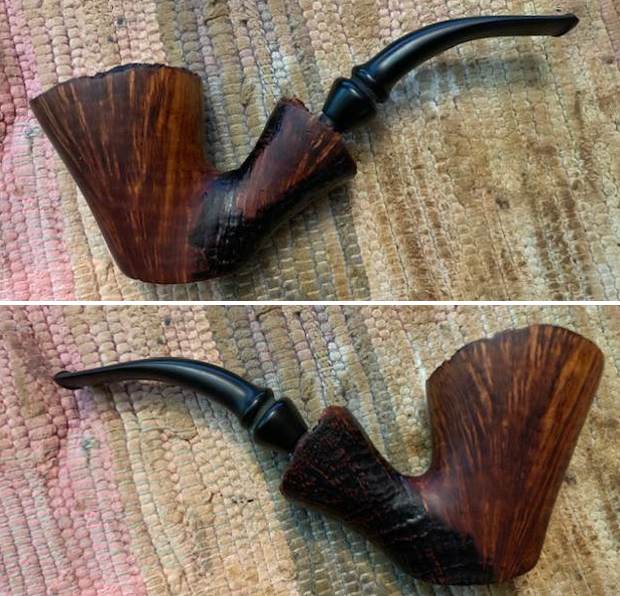
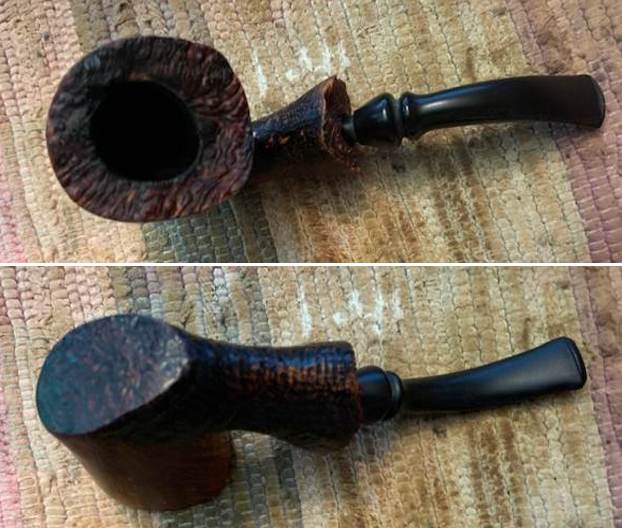
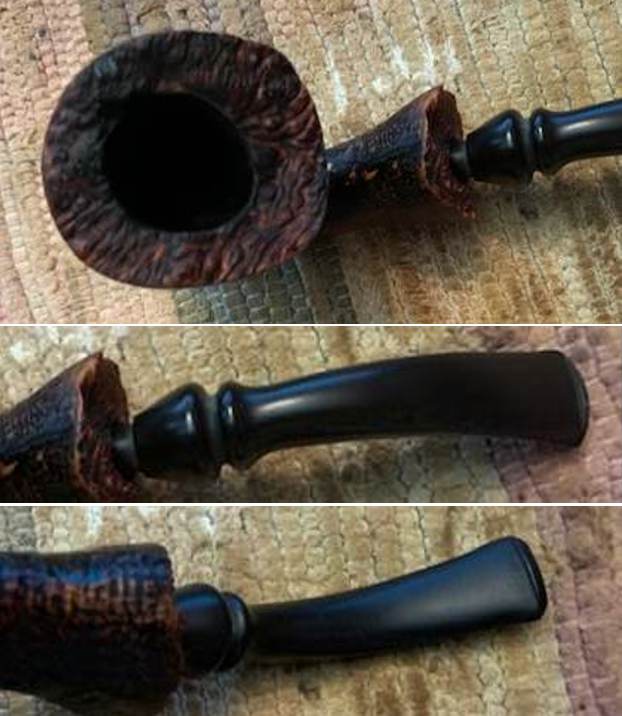
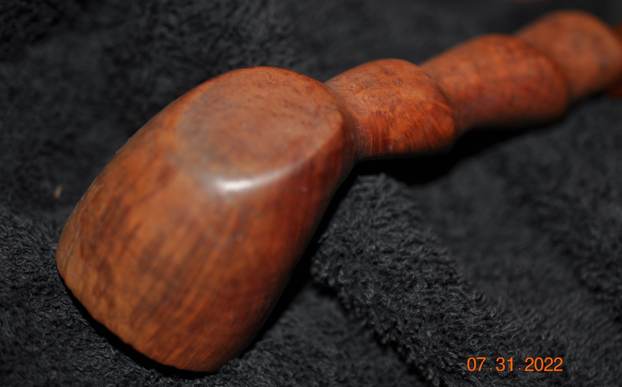
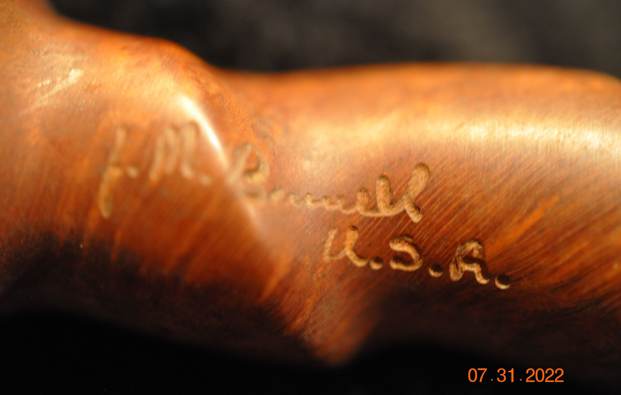
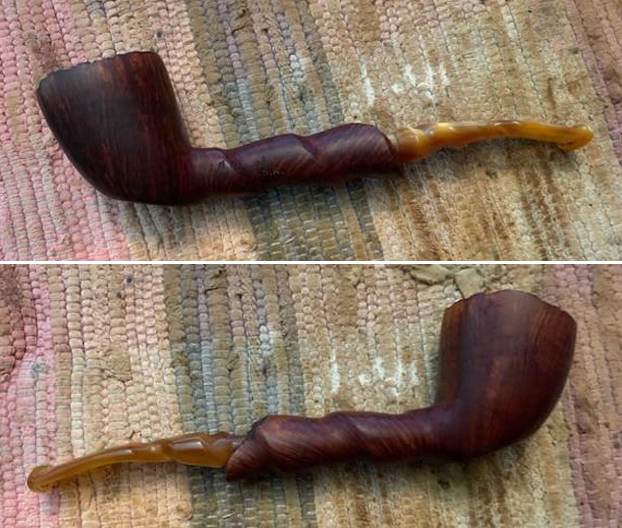
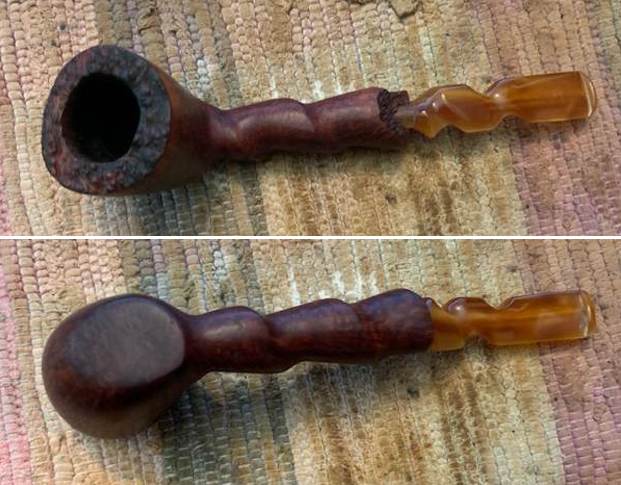
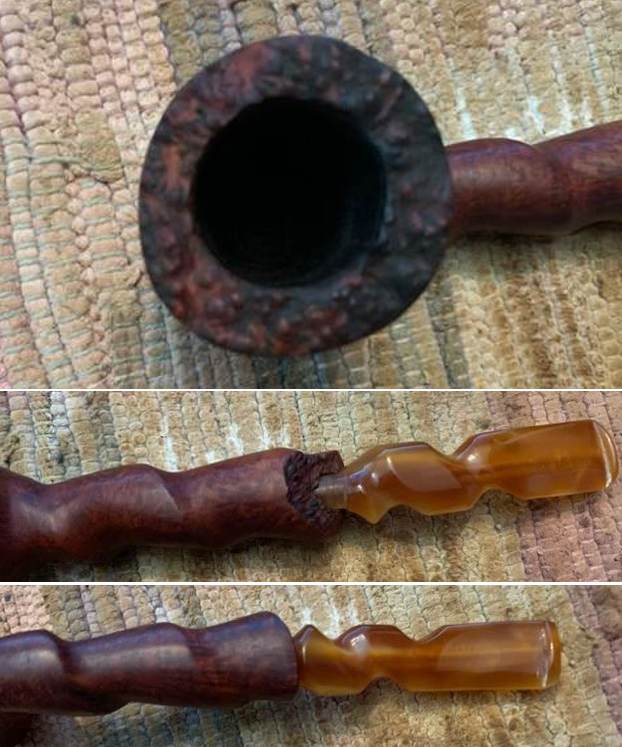
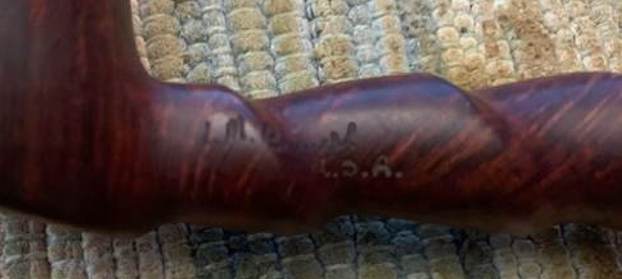
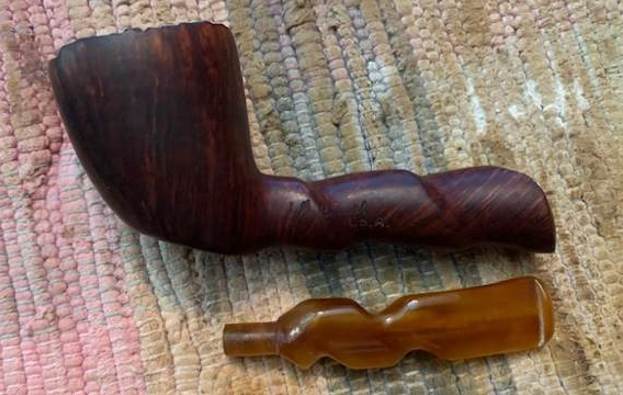
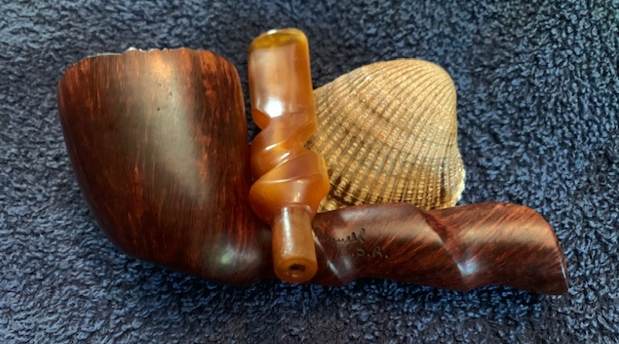
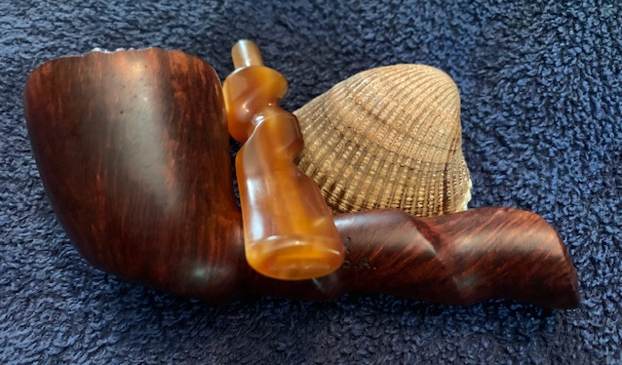
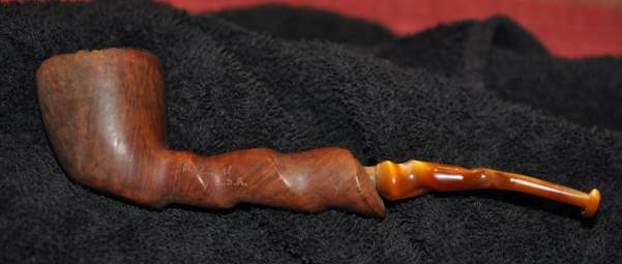
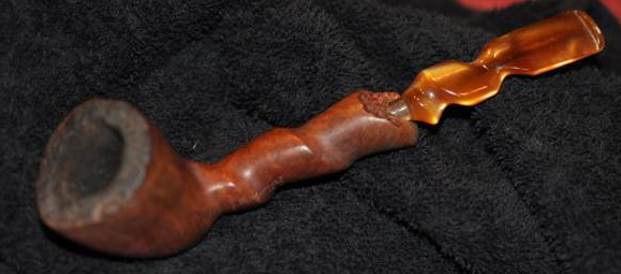
The next pipe that I have chosen to work on is a Freehand pipe with a long twisted shank and plateau on the rim top and the shank end. We purchased it from a seller in Wilkes Barre, Pennsylvania, USA on 06/16/22. It is a Freehand shaped smooth briar with a flat bottom that makes it a sitter. I has a fancy golden amber coloured acrylic twisted stem that carries on the twist of the shank. The pipe was dusty and dull looking but had great grain around the bowl and shank. The plateau rim top had a thick lava overflow from the thickly caked bowl. The inner edge of the rim was so thickly caked that it was hard to assess the condition at this point. This must have been a phenomenal smoker or at least someone’s favourite pipe. The pipe was signed on the left side of the shank with JM Boswell’s signature [over] U.S.A. There was not a date stamp on any other stampings on the pipe. The fancy amber coloured twisted acrylic stem was in good condition with some tooth marks and chatter on both sides near the button. Jeff took the following photos before he started his cleanup work on the pipe. He took close-up photos of the bowl and rim top from various angles to capture the condition of the bowl, rim top and edges of the bowl. The cake was very thick and the bowl overflowed in thick lava on to the rim top filling in much of the plateau. He also captured the condition of the top and underside of the stem. You can see the tooth marks and chatter on both sides ahead of the button. It was a well used, dirty pipe. He took photos of the sides and heel of the bowl to show the condition of the finish and the grain around the bowl. You can see the small minor sandpits on the left side of the bowl but otherwise it a nice piece of briar under the grime and debris of time ground into the finish. Jeff took a photo of the J.M. Boswell signature and U.S.A. on the left side of the twisted shank. It reads as noted above and is clear and readable. It has been a while since I worked on a Boswell pipe so I did some reading to reacquaint myself with them.. I read the Boswell website as well as the entry on Pipedia to refresh my memory (https://pipedia.org/wiki/J.M._Boswell). I find that reading the information on a pipe brand before I work on it gives me a sense of the passion and art of the craftsmen who made the pipe. That was true of this pipe as well. I quote from that entry on Pipedia first to give you a sense of the information that I found on the Boswells and their craftsmanship.

J.M. Boswell is considered to be one of the finest Master pipemakers in the world. His reputation is exemplary, and his craftsmanship is legendary. Working from sun up till the midnight hours, 7 days a week for most of the past 40 years, J.M. has produced thousands of handmade pipes for folks to enjoy. His dream, back in the 70s, was to make the best smoking pipes with the highest quality briar wood at an affordable price. J.M. Boswell has succeeded in doing so.

The Chambersburg store is located on the historic Lincoln Highway (Rt 30), about 20 miles west of Gettysburg.

J.M. became a U.S. importer for Briar wood so that he could supply briar to other pipemakers. By doing this, he was able sell his own pipes at an affordable price. With the finest quality Briar available in the world, years of skill and his pipe master’s hands working to form the most beauty from a block of prime briar, a Boswell pipe is born…

J.M. and his son, Dan take great pride in making high quality handcrafted, American made smoking pipes. Admired for their craftsmanship, their handmade pipes are created for the rigors of everyday use and truly made to last.

Boswell’s is a family – owned business with a family environment. Every family member has a role within the business. J.M.’s wife Gail takes all of the photos – for the website, Instagram, and Pinterest; she also maintains the museum and store. Daughter Rachel manages estate pipes online, while Dan’s wife Julie takes the phone orders, and runs the shipping department.

J.M. and Dan, who work full time, side by side together, have created pipes that range from the smallest to the largest smoking pipes made in the world. Dan has known he wanted to follow in his fathers’ footsteps since he was a young boy, helping J.M. after school and during summer vacation. He has been working for the family business full time since he graduated high school, and plans on continuing the proud family tradition for many years to come.

Gail’s family background has involved pipes since long ago- her Father, Uncles, and Aunt made pipes in the late 1930s for the Weber Pipe factory in Jersey City, New Jersey. Her father’s family lived on Cator Avenue, the same as the factory, and they would walk to work each day. Their family history brings an incredible depth and passion for pipemaking!

“Over 70 years of pipe history in our family, and still continuing.”

Photo courtesy of the Boswell’s Pipes Website

I then turned to the Boswell Pipe and Tobacco Shop site (https://boswellpipes.com/product-category/boswell-pipes/). The description of the pipes in that section of the site parallels what I found above. I quote:

In the creation of these exquisite smoking pipes, we use the finest quality briar – “cream of the crop” is what the proprietor of the mill calls it. Boswell Pipes have their own special bowl coating for easy break-in. J.M. has used his special coating for Boswell Pipes since 1982.  100% natural coating,which will force the briar wood to absorb the moisture and heat.  For the finishing touch, J.M. hand inscribes his signature into the briar.  J.M. dates the year and proudly declares made in the USA  “J.M. Boswell 2018 U.S.A.”

I turned also to the description of the other twisted or as he called them Swirls from the website. I have included that below for your reading as I found it quite interesting (https://boswellpipes.com/product/boswell-pipe-jumbo-freehand-swirls-2020/). I quote:

J.M.’s Signature Swirls, gorgeously grained. Incredible smoking properties of a Boswell pipe, are the thick bowl walls to give you that cool enjoyable smoke. Uniquely sculptured deep Swirls. Old craftsmanship style with thick walls and shank for a cooler smoke. Natural finish with eye-catching dark bold highlights to show off its grain. Incredible cool smoke with an extremely easy draw for some serious smoking.

J.M. Boswell is known worldwide for crafting theses incredible, massive looking, King Size briars for well over 39 years.  Addition to being amazing smokers as well, they are capable of holding a generous supply of your favorite tobacco.

As with each and every Boswell pipe made, the airway is hand bored (not using a lathe).  This is why the air passage way will always provide the smoker with a full draw and allows for a fuller smoother smoke. J.M. finds the old fashion way of doing so completes his pipes.

Wide plateau is displayed along the rim and shank. Accent etching along the shank. Using a high power magnifier there may be a few specks of natural imperfections. Large hand-cut acrylic spiraling mouthpiece with pearlized raspberry red tones. Your new Boswell pipe will come nestled in a protective Jumbo handmade pipe sleeve and placed in a Boswell gift box.  We also include all the essentials for your first smoke. Smoking becomes a Relaxing time with a Boswell.

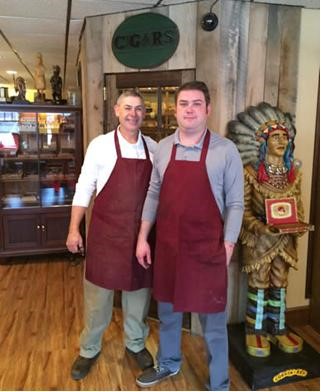
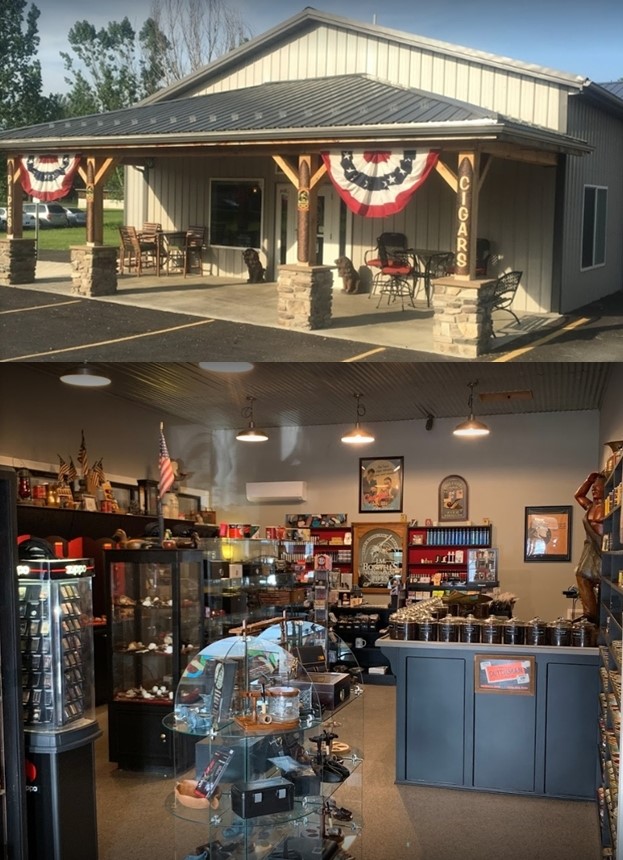
I also found some photos of the shop online that I am including here as well. I am also including the address of the shop and the phone number.

J.M. Boswell’s Pipes and Tobacco

6481 William Penn Hwy, Alexandria, PA 16611, United States

+1 814-667-7164

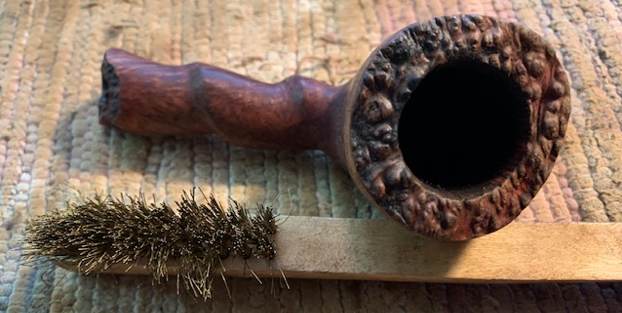
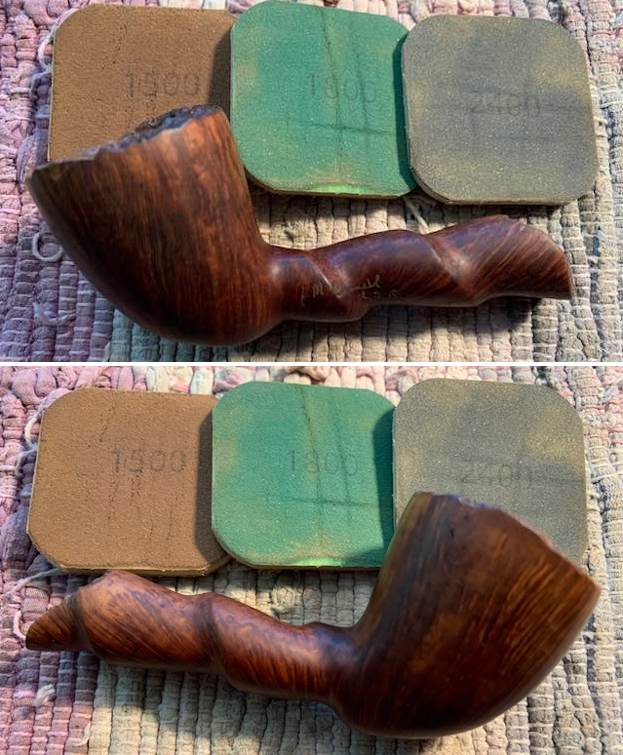
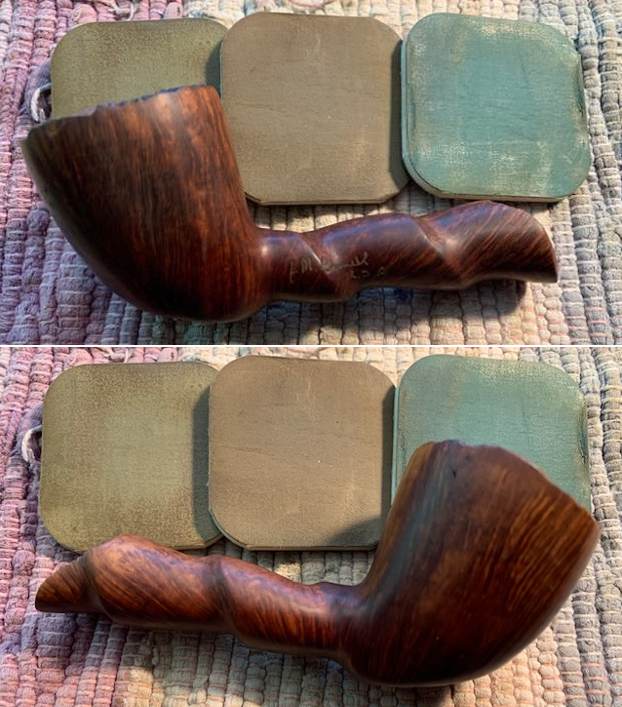
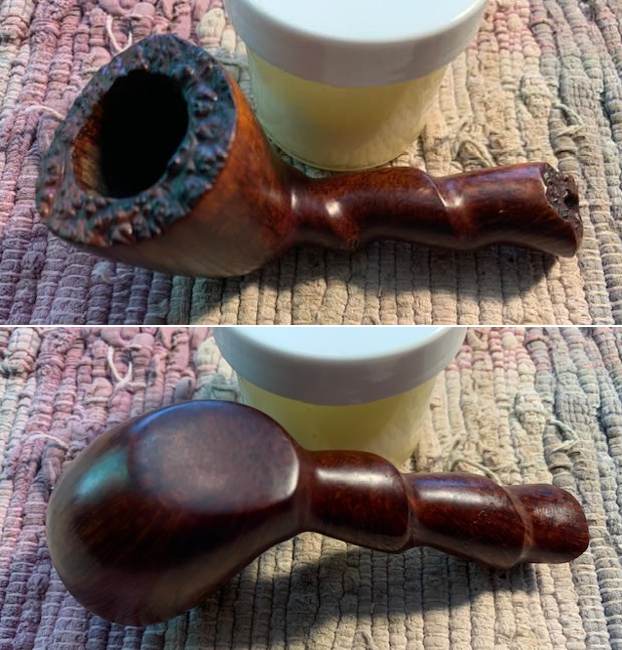
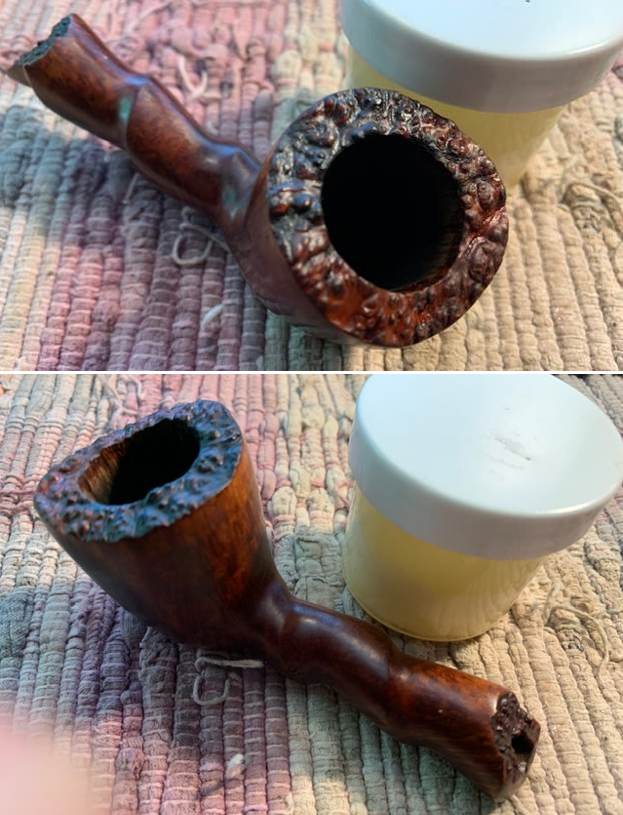
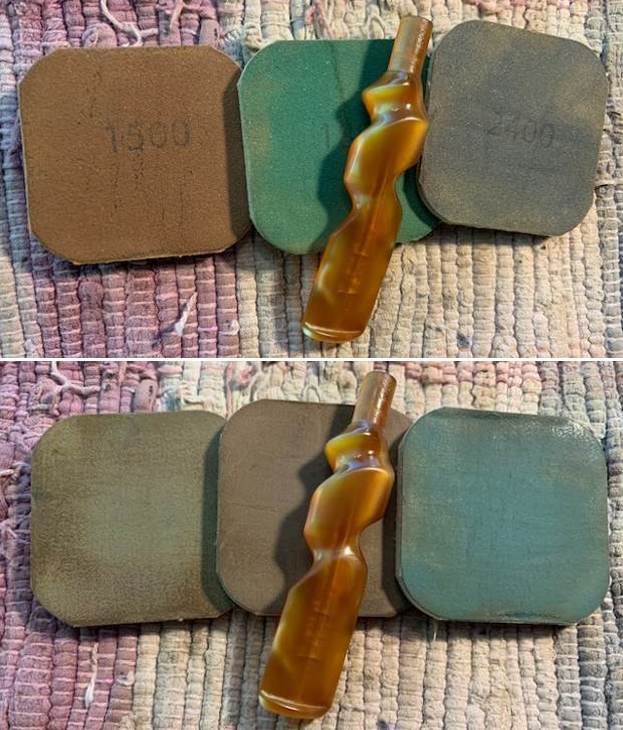
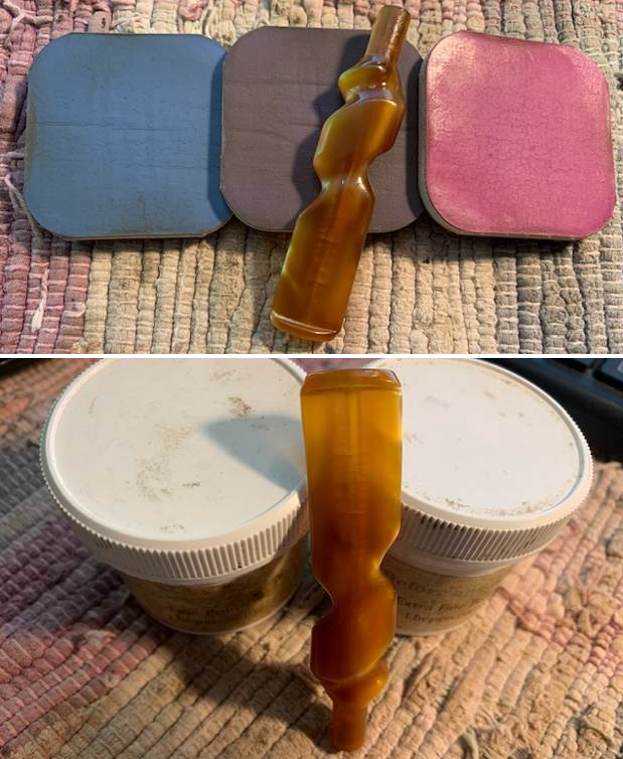
It looks like it would be a great place to visit and spend time enjoying. One day I may get to do that. We shall see!Jeff had reamed the pipe with a PipNet pipe reamer and cleaned up the reaming with a Savinelli Fitsall Pipe Knife. He scrubbed out the internals of the shank and stem with alcohol, pipe cleaners and cotton swabs until the pipe was clean. He scrubbed the exterior of the bowl with Murphy’s Oil Soap and a tooth brush to remove the grime and grit on the briar and the lava on the rim top. The finish looks much better but there is still some darkening on the rim top and inner edge of the bowl. Jeff scrubbed the stem with Soft Scrub to remove the grim in the acrylic stem surface. When the pipe arrived here in Vancouver for the second stop of its restoration tour it looked a lot better. I took photos this morning before I started my part of the work. That is one of the benefits of being an early bird. I took some close up photos of the rim top and the stem surface. I wanted to show the cleaned bowl and rim top. The rim top and the inner and outer edges of the bowl were in good condition. The top of the bowl had some darkening in the grooves of the carved surface of the rim top and the inner edge of the bowl. I also took close up photos of the stem to show the tooth marks on the stem surface. I took a photo of the stamping on the left side of the shank and it is readable as noted above.I removed the stem for the shank and took a photo of the bowl and stem to give a picture of what it looked like. The Signature Swirl carving is unique.I started my work on the pipe by addressing the darkening on the rim top. I scrubbed it with some dish soap and a brass bristle wire brush. It definitely took of more of the darkening on the rim top.I polished the briar with 1500-12000 grit micromesh sanding pads. I wiped the bowl down with a damp cloth after each sanding pad to remove the dust and debris.I rubbed the bowl and shank down with Before & After Restoration Balm to deep clean the finish on the bowl and shank. The product works to clean, enliven and protect the briar. I worked it in with my fingertips into finish on the bowl and shank. I used a shoe brush to get it into the plateau on the rim top and shank end. I let it sit for 10 minutes to let it do its magic. I buffed it with a soft cloth. The briar really began to have a rich shine. I took some photos of the bowl at this point to mark the progress in the restoration.   The bowl was finished so I set it aside and turned my attention to the stem. I polished the stem with micromesh sanding pads – dry sanding with 1500-12000 grit sanding pads and was able to smooth out the marks and chatter. I wiped the stem down after each sanding pad with a cloth containing some Obsidian Oil. I finished polishing it with Before & After Pipe Stem Polish – both Fine and Extra Fine and buffed it off with a cotton cloth. I put the Boswell Spiral/Twisted Long Shank Freehand Sitter back together again and buffed the bowl and the stem with Blue Diamond on the buffing wheel. I gave the bowl and the stem several coats of carnauba wax. I carefully buffed the entire pipe with a clean buffing pad to raise the shine. I finished buffing with a microfiber cloth to deepen the shine. The finished pipe looks very good. The grain is a flame and straight around the sides, with birdseye on the heel and shank top and bottom. Add to that the plateau on the rim top and shank and the pipe is quite beautiful. The pipe feels great in the hand. It is comfortable and light weight for its size. The finished JM Boswell Long Shank Freehand Sitter is shown in the photos below. The dimensions of the pipe are Length: 7 inches, Height: 2 inches, Outside diameter of the bowl: 1 ½ inches, Chamber diameter: 7/8 of an inch. The weight of the pipe is 1.94 ounces/ 55 grams. This great looking Boswell Freehand turned out very well. It should be a great pipe. It will be going on the rebornpipes store in the American Pipemakers Section shortly if you are interested in adding it to your collection. Thanks for reading this blog and my reflections on the pipe while I worked on it.

Fresh Life for The Everyman London Pipe 215 Bent Billiard


Blog by Steve Laug

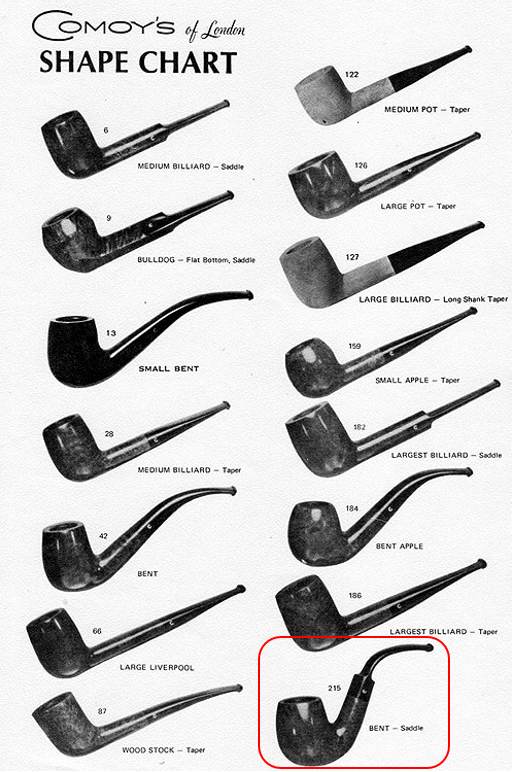
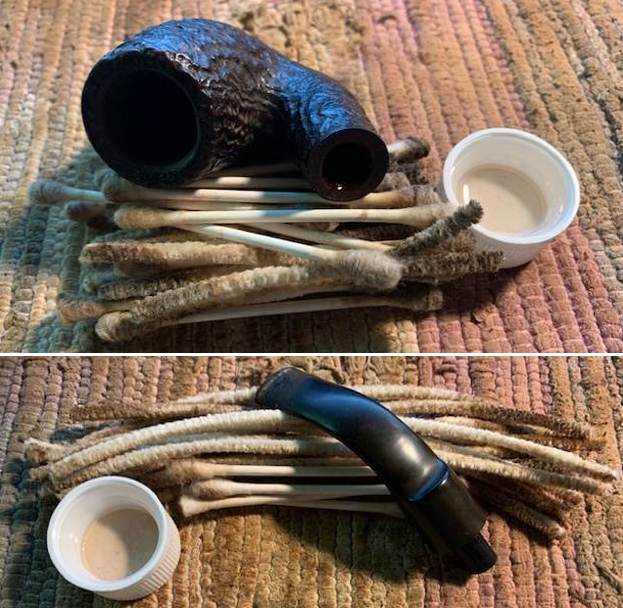
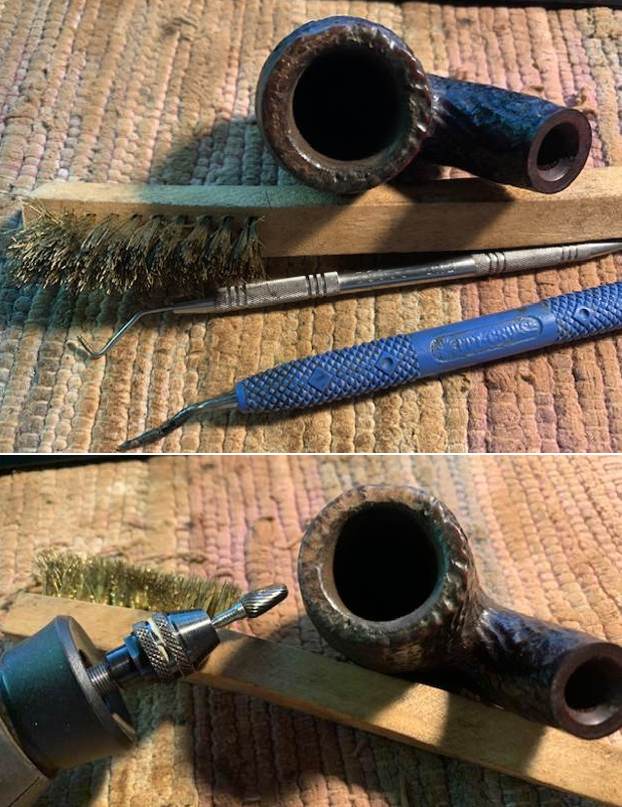
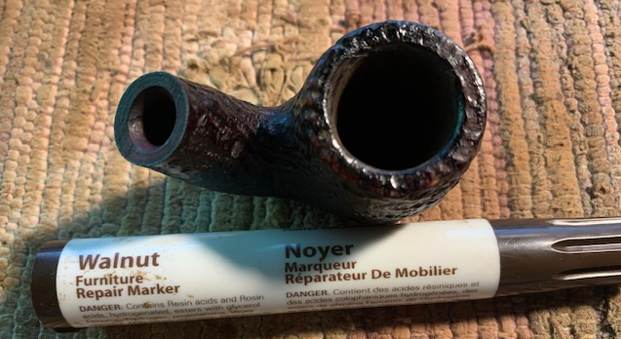
This next pipe is another that has been here for a very long time. I have no idea where I purchased it or whether it came to me in a trade for labour. I don’t remember. I have worked on quite a few of these Comoy’s made The Everyman Pipes over the years and find that they are well made and quite nice. The pipe is stamped on the underside and reads The [over] Everyman [over] London Pipe [over] the shape number 215. That is followed by Made in London [over] England. This  particular pipe has a rugged and deep sandblast around the bowl and shank. It has been stained with a dark brown stain. The bowl had been well reamed but there was some lava on the rim top blast. It was slightly out of round with some damage on the back inner edge of the bowl. Internally it smelled like an aromatic tobacco like Half and Half. The stem was oxidized, calcified and had some tooth chatter and marks on the top and underside ahead of the button. I took some photos of the pipe to give a sense of what I saw before I started my clean up work.   I took photos of the rim top and inner edge of the bowl to show the lava coat in the sandblast rim top and some burn damage and darkening on the inner edge of the bowl. The photos of the stem show the oxidation, calcification and the tooth marks and chatter on both sides ahead of the button. I took a photo of the stamping on the underside of the shank. It is clear and readable as noted above. I removed the stem from the shank and took a photo of the pipe to give a sense of the proportion. Before starting my cleanup work on the pipe I turned my favourite go to sites on background of brands. The first is Pipephil’s site (http://www.pipephil.eu/logos/en/logo-e4.html). There I looked up The Everyman brand and confirmed what I remembered about it being made by Comoy’s. From there I turned to Pipedia (https://pipedia.org/wiki/Comoy%27s). I went directly to the section on Comoy’s pipes. At the bottom of the article I found links for a shape list and also a shape chart. I have included both of them below. The shape number 215 is shown as a small ½ Bent Billiard.I have circled the 215 shape in the Comoy’s shape chart below.Now it was time to work on the pipe. I decided to address the stench in the pipe first so I could work on a clean pipe. The pipe bowl had been reamed and it was quite clean so I turned to clean the mortise and the airway in the shank and stem. I scrubbed the out with pipe cleaners, cotton swabs and Isopropyl 99% alcohol. Many pipe cleaners and much time passed and the draught was clean and open in both the stem and the shank.  With that done I worked on the lava build up on the rim top and the burn damage and darkening on the inner edge of the rim. I worked over the rim top with a brass bristle wire brush and two dental picks to clean out the grooves of the sandblast. I rusticated the sandblasted rim to further rough up the surface and remove the tars. I used a small conical burr to remove the damaged areas and reshape the rim top.   I used a Walnut Stain pen to stain the rim top rustication to match the other parts of the blasted rim top. I actually looks quite good. I used a folded piece of 220 grit sandpaper to give the edge a light bevel to minimize the damage and bring the bowl back to round.   With that part of the work done I decided it was time to address the ghost in pipe with alcohol and cotton bolls. I stuffed the bowl with cotton bolls and twisted one into a plug that I pushed into the shank end. I set the bowl upright in an old ice cube tray and filled it with alcohol using an ear syringe. I set it aside to do its work over night.    I worked some Before & After Restoration Balm into finish of the briar with my fingertips to clean, enliven and protect it. I let the balm sit for a little while and then buffed with a cotton cloth to raise the shine. The Restoration Balm really makes the grain stands out beautifully.   I cleaned the exterior of the stem with some Soft Scrub All Purpose cleanser and cotton pads. I was able to remove a lot of oxidation and calcification from the stem surface. I set the bowl aside and turned my attention to the stem. I used the flame of a Bic lighter to “paint” the surface of the stem to lift the tooth marks on both sides of the stem. The heat lifted many of the marks. I filled in what remained with clear CA glue and set it aside to harden.  Once the repairs cured on the top and underside of the stem I filed them flat and recut the button edge with a small file. I sanded them with a folded piece of 220 sandpaper. I started polishing the stem with 400 grit wet dry sandpaper. I polished the stem with micromesh sanding pads – wet sanding with 1500-2400 grit pads and dry sanding with 3200-12000 grit pads. I wiped the stem down after each pad with Obsidian Oil. I polished it with Before & After Pipe Stem Polish – both fine and extra fine and buffed it with a cotton pad. I gave it a final coat of Obsidian Oil and set it aside to dry.  The Everyman London Pipe 215 Bent Billiard was finished. I polished the bowl and stem with Blue Diamond to polish out the remaining small scratches. I used a very light touch so as not to damage the stamping on the shank. I gave the bowl multiple coats of Conservator’s Wax and the stem multiple coats of carnauba wax. I buffed the pipe with a clean buffing pad to raise the shine. I hand buffed it with a microfiber cloth to deepen the shine. The pipe polished up pretty nicely. The depths of the sandblast came alive with the buffing and works well with the polished black vulcanite saddle stem. Altogether the pipe has a rich look. The finished pipe is shown in the photos below. The shape, finish and flow of the pipe and stem are very well done. The dimensions are Length: 5 inches, Height: 1 ¾ inches, Outside diameter of the bowl: 1 ¼ inches, Chamber diameter: ¾ of an inch. The weight of the pipe is 1.55 ounces/45 grams. I will be putting it on the rebornpipes store in the British Pipemakers Section soon. If you are interested in adding it to your collection let me. I have one of these and they are a cool dry smoke. Thanks for walking through the restoration of this fine old Comoy’s made pipe. It was a pleasure to work on.

Can this one be brought back to life? A Butz-Choquin Rocamar 1319 Bent Billiard


Blog by Steve Laug

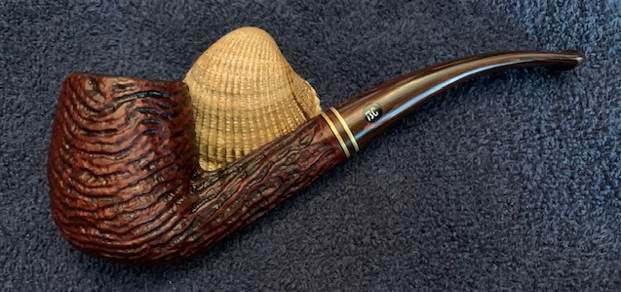
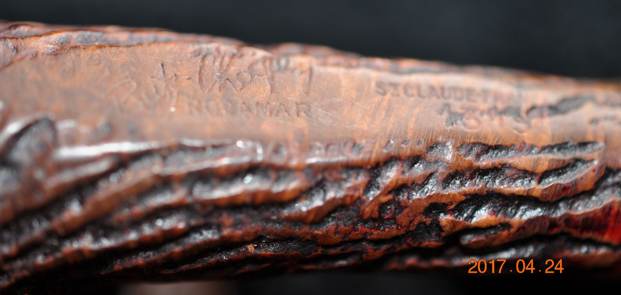
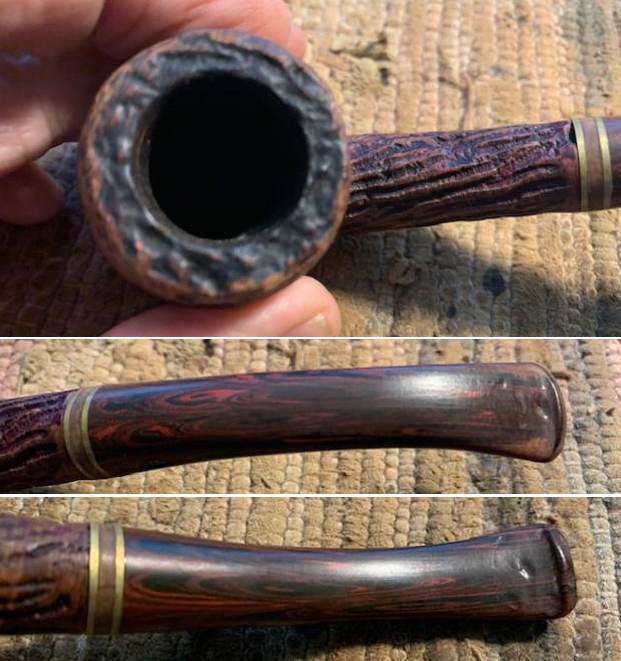
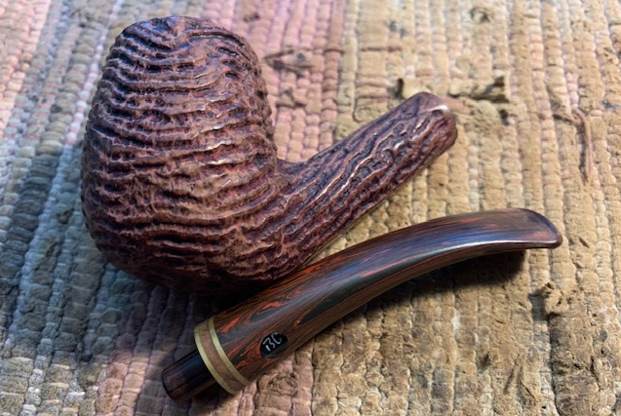
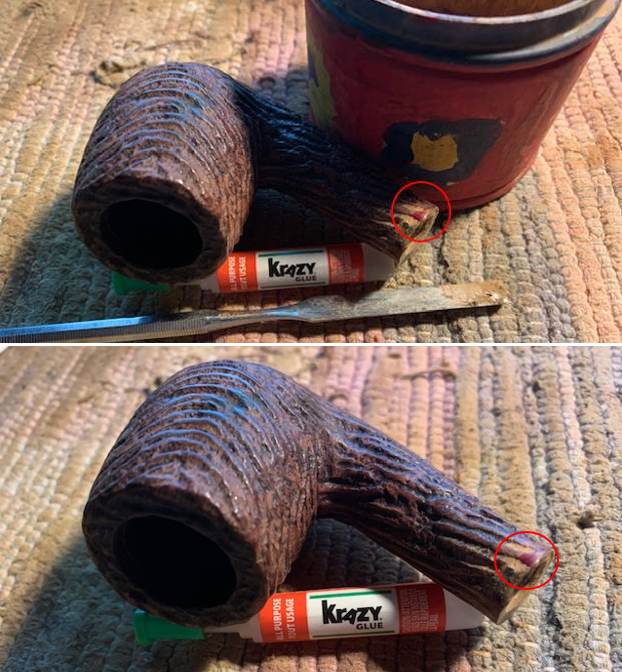
The next pipe on the table is French made Bent Billiard with rugged sandblast that looks like it was helped along by a guided hand. Jeff purchased it on eBay on 04/14/17 from a seller in New Tripoli, Pennsylvania, USA. The shape of it fits well in the hand and has a tactile feel as well. The pipe is stamped on the underside of the shank and reads Butz-Choquin [over] Rocamar. That is followed by St. Claude France [over] the shape number 1319. Rocamar in Spanish means Rocklike and that applies well to the finish on this one. The finish appears to be a rugged sandblast but I am not sure if it is as it appears. The finish is a rich reddish brown colour and it is dirty with grime ground into the grooves of the finish. The bowl had a thick cake in it and a thick overflow of lava spills over the rim top. It is thick enough to make assessing the edges hard to do. The bent taper Cumberland stem was oxidized, calcified and had deep tooth marks and chatter on both sides ahead of the button and on the button surface itself. There was a BC logo encased in a circular, clear acrylic inlay on the left side of the stem. There was a band on the end of the stem composed of twin brass rings and a wafer of briar between them. Jeff took photos of the pipe before he started his work on the clean up. The exterior of the pipe was very dirty – grime and grit ground into the blasted/carved finish from years of use and sitting. The rim top was covered with a coat of thick lava that overflowed from the thick cake in the bowl. It was hard to know what the rim edges looked like because of the lava. The stem was dirty, calcified and oxidized with tooth chatter and marks on the top and underside of the stem ahead of the button and on the button surface. Jeff took a photo of the side and the heel of the bowl to give a better feel for the condition of the briar around the bowl. It is an interesting finish that has the look of a sandblast but also seems to look like some rustication/carving as well. The next photos show the stamping on the underside of the shank and it is very readable. It reads as noted above.  Jeff also took a photo of the chipped edge of the shank on the right side where it met the stem band. It appeared that someone had tried to pry off the stem from the shank and damaged the shank end in the process.I turned to Pipephil’s site (http://pipephil.eu/logos/en/logo-butzchoquin.html) to see if I could find any information on the Rocamar line. There was nothing there on the line itself to help me understand more about it. There was a good summary of the history of the brand that I have included below.

The origin of the brand reaches back to 1858 when Jean-Baptiste Choquin in collaboration with his son-in-law Gustave Butz created their first pipe in Metz (France). Since 1951 Butz-Choquin Site officiel Butz Choquin, pipes de Saint-Claude jura. BC pipe de bruyere luxe is a brand of the Berrod-Regad group (Saint-Claude, France).

Jean Paul Berrod managed the company from 1969 to 2002 when he retired and sold the corporate to Mr Fabien Gichon. Denis Blanc, already owner of EWA, took over the S.A. Berrod-Regad in 2006.

I then turned to Pipedia (https://pipedia.org/wiki/Butz-Choquin) to see if I could find any info on the Rocamar line. There was nothing there either but there was further information on the brand itself. I have included it below.

The pipe, from Metz to Saint-Claude.

Jean-Baptiste Choquin of Metz started out as a tobacconist. This enterprise was prosperous; he had several employees. Among those, there was a certain Gustave Butz who was its first workman and who became his son-in-law by marrying Choquin’s daughter Marie in 1858.

In 1858 Jean-Baptiste Choquin created, in collaboration with Gustave Butz, the Choquin pipe. This bent pipe with a flat-bottomed bowl was finished with an albatross-bone mouthpiece, fixed with silver rings.

In 1858, still in Metz, Gustave Butz built an establishment for the manufacture of the Choquin pipe which took the name of . In 1951, the Berrod-Regad company bought the trademark, continuing manufacture until 2002. Departing from Metz, the workshop was relocated to Saint-Claude, then also called “the world capital of the briar pipe”, under the Berrod-Regad group. The Berrod-Regad group would go on to completely rebuild the network of representatives until finally entering the export market in 1960 and has since won several prizes, as well as the Gold Cup of French good taste.

In a few years, the brand’s collection increased from ten to seventy series. 135 years after it was founded, the pipe is still well-known not only in France but throughout the world. In 2002, the Berrod family, wishing to preserve manufacture of pipes in Saint-Claude, handed over the company to Fabien Guichon, a native of the area, who will continue to develop the brand during the 21st century.

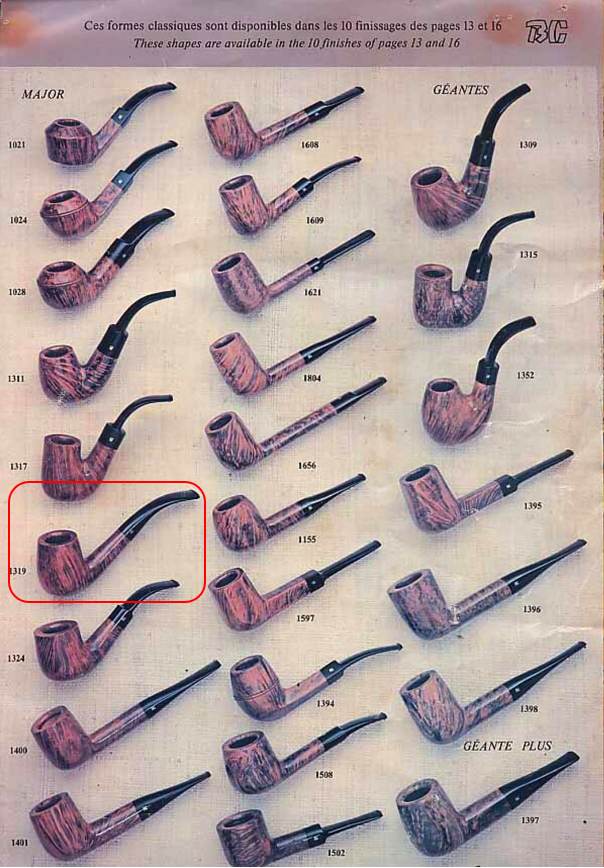
The site also had some catalogue pages showing the various shape numbers thanks to Doug Valitchka (https://pipedia.org/images/0/03/BC_Shape02.jpg). I am including a screen capture of the page that shows the shape 1319 Bent Billiard. I have circled it in red in the chart below.Jeff had reamed the pipe with a PipNet pipe reamer and cleaned up the reaming with a Savinelli Fitsall Pipe Knife. He scrubbed out the internals of the shank and stem with alcohol, pipe cleaners and cotton swabs until the pipe was clean. He scrubbed the exterior of the bowl with Murphy’s Oil Soap and a tooth brush to remove the grime and grit on the briar and the lava on the rim top. The finish looks much better but there is still some darkening on the rim top and edges of the bowl. Jeff scrubbed the stem with Soft Scrub and soaked it in Before & After Deoxidizer to remove the oxidation on the vulcanite. When the pipe arrived here in Vancouver for the second stop of its restoration tour it looked a lot better. It has been sitting here for 5 years so it is about time I worked on it. I took photos this morning before I started my part of the work.  I took some close up photos of the rim top and the stem surface. I wanted to show the cleaned bowl and rim top. The rim top and the inner and outer edges of the bowl were in good condition. The top of the bowl had some darkening in the grooves of the carved surface of the rim top and the inner edge of the bowl. I also took close up photos of the stem to show the tooth marks on the stem surface. I took a photo of the stamping on the underside of the shank and it is faint but readable. It is stamped as noted above.   I removed the stem for the shank and took a photo of the bowl and stem to give a picture of what it looked like. The Rocamar finish is totally unique.I started my work on the pipe by addressing the chip on the right end side of the shank where it met the stem. I used a dental spatula to rebuild the chip with clear CA glue and briar dust. Once it cured I sanded the repair smooth. With the repair finished I turned my attention to the darkening on the rim top and inner edge. I wiped the rim top and edge down with some acetone on a cotton pad. I used a brass bristle wire brush to clean up the grooves in the carving on the rim top. I also used the wire brush on the rest of the bowl as well to clean up the debris of time in the box here. The bowl and the rim top came out looking much better.I rubbed the bowl down with Before & After Restoration Balm. I worked it into the surface of the briar with my fingertips and a horse hair shoe brush to clean, enliven and protect it. I let the balm sit for a little while and then buffed with a cotton cloth and shoe brush to raise the shine.  I set the bowl aside and turned my attention to the stem. I used the flame of a Bic lighter to “paint” the surface of the stem to lift the tooth marks on both sides of the stem. The heat lifted many of the marks. I filled in what remained with clear CA glue and set it aside to harden.  Once the repairs cured on the top and underside of the stem I filed them flat and recut the button edge with a small file. I sanded them with a folded piece of 220 sandpaper. I started polishing the stem with 400 grit wet dry sandpaper.   I polished the vulcanite with micromesh sanding pads – 1500-12000 grit pads. I wiped it down with a damp cloth after each sanding pad. I used Before & After Pipe Polish – both Fine and Extra Fine to further polish the stem.  I left a little oxidation around the stamp so as not to damage it more.   This Butz-Choquin Rocamar 1319 Bent Billiard was a fun one to work on. Did we achieve our goal of bringing it back to life? In the end, you have to decide. To my mind it cleaned up really well and looks very good. The Before & After Restoration Balm brought the colours and grain out in the sandblast/carve finish on the pipe. It works well with the polished Cumberland taper stem. I put the stem back on the bowl and carefully buffed the pipe with Blue Diamond on the buffing wheel using a light touch on the briar. I gave the bowl multiple coats of Conservator’s Wax and the stem multiple coats of carnauba wax on the buffing wheel. I followed that by buffing the entire pipe with a clean buffing pad. I hand buffed the pipe with a microfiber cloth to deepen the shine. The finished Butz-Choquin Rocamar Bent Billiard fits nicely in the hand and I think it will feel great as it heats up with a good tobacco. The tactile finish will add to the experience. Give the finished pipe a look in the photos below. The dimensions of the pipe are Length: 6 inches, Height: 2 inches, Outside diameter of the bowl: 1 ¼ inches, Chamber diameter: ¾ of an inch. The weight of the pipe is 2.15 ounces/61 grams. If you are interested in carrying the previous pipeman’s legacy with this pipe send me a message or an email. I will be adding it to the rebornpipes store in the French Pipe Makers Section. Thanks for reading this blog and my reflections on the pipe while I worked on it.

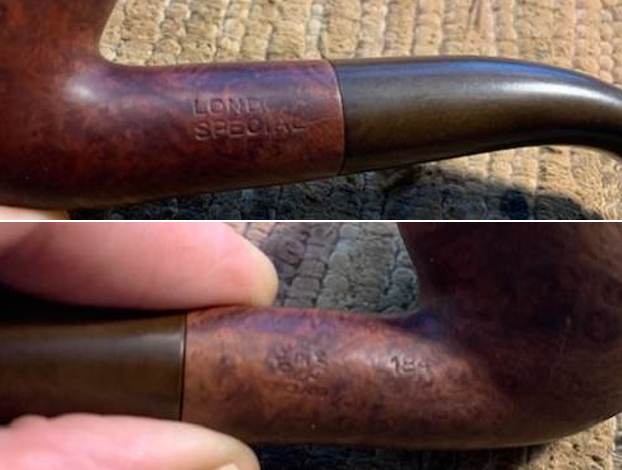
Cleaning up a Mystery Pipe – a London Special 184 Bent


Blog by Steve Laug

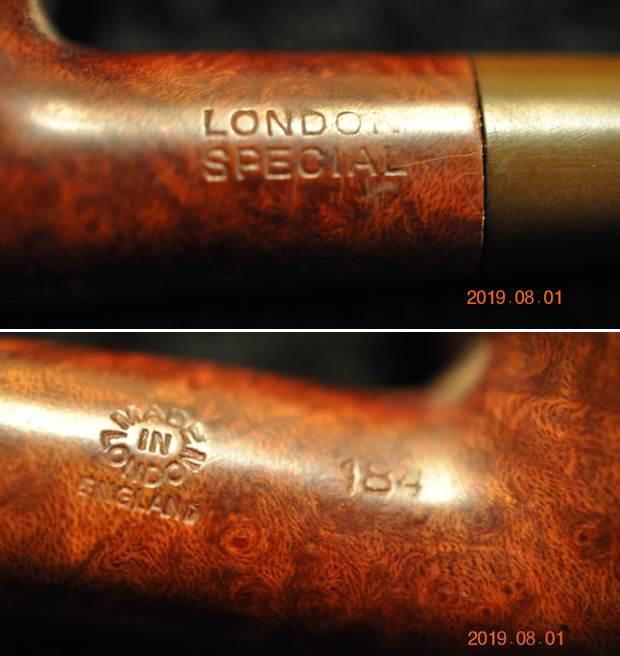
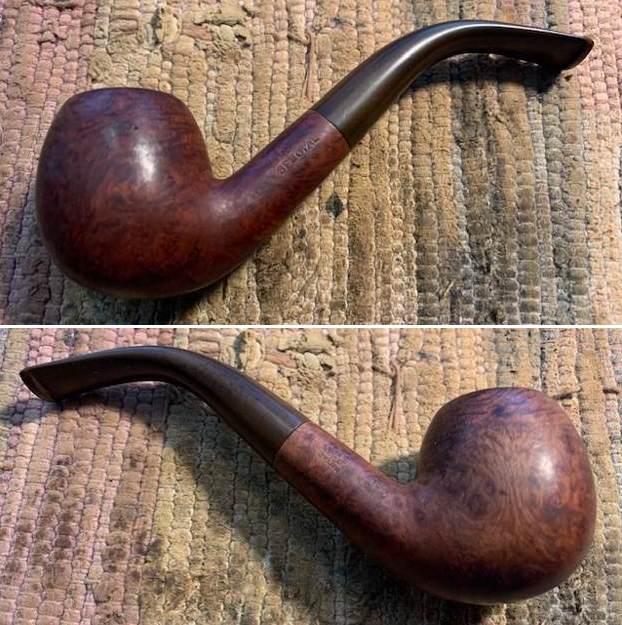
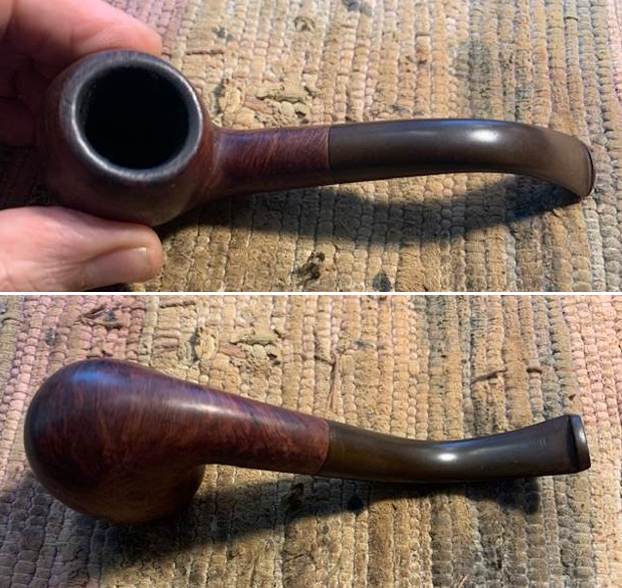
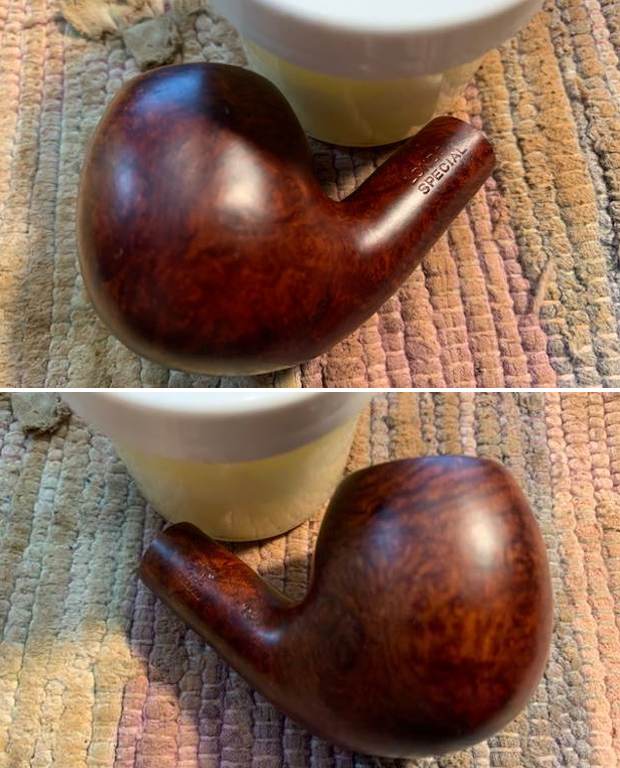
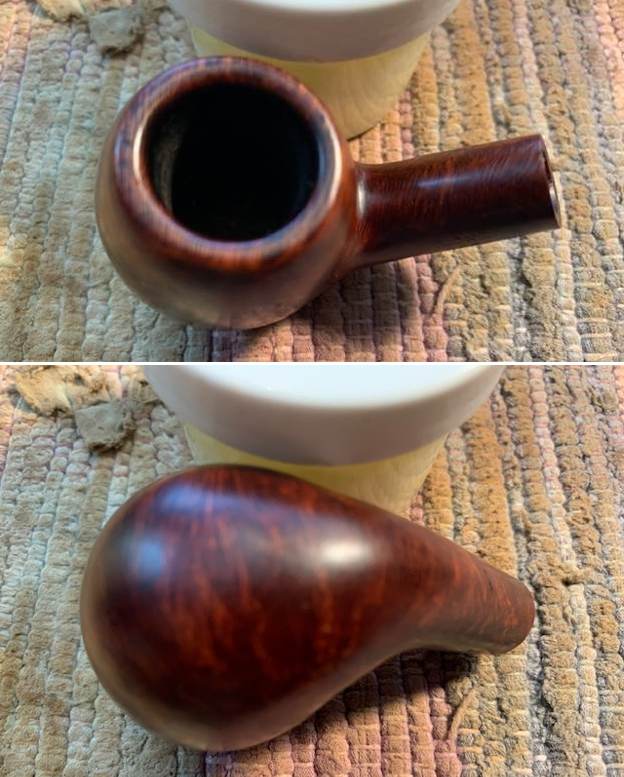
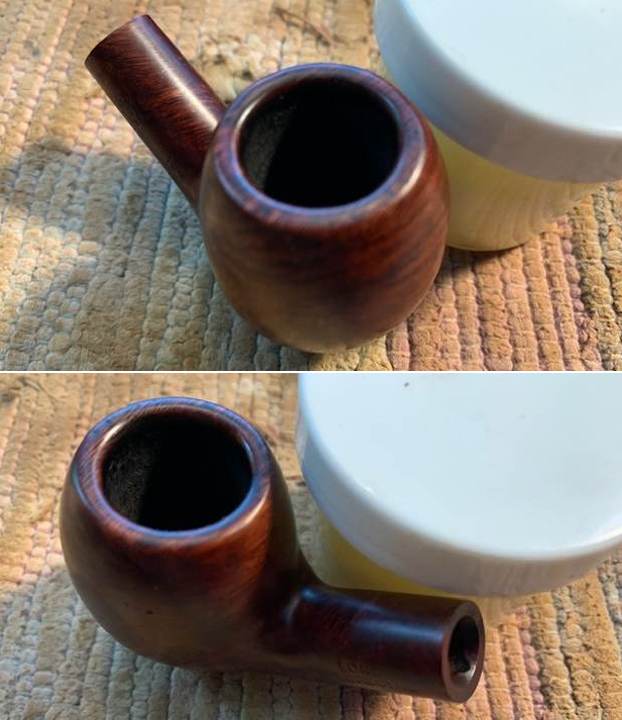
The next pipe on the table is an old timer, at least by appearance it is one to me. Jeff purchase the pipe on 07/10/19 from a shop in Salem, Oregon, USA. I love the shape of it as it is a shape that fits well in the hand. The pipe is stamped on the left side and reads London [over] Special. On the right side it is stamped with a shape number 184 next to the bowl/shank junction. Ahead of that it bears  the stamping Made in London in a circle over England. It is a typical COM stamp that points to Comoy’s being the maker of the pipe. The shape number also seems to me to be a Comoy’s shape but we will look into that. The finish is a rich reddish brown colour and it is dirty with grime ground into it. The bowl had a thick cake in it and a thick overflow of lava spills over the rim top. It is thick enough to make assessing the edges hard to do. The stem was oxidized, calcified and had tooth marks and chatter on both sides near the button. There were not any identifying marks or logos on the stem. Jeff took photos of the pipe before he started his work on the clean up. It really has the shape of a classic older pipe. The exterior of the pipe was very dirty – grime and grit ground in from years of use and sitting. The rim top was covered with a coat of thick lava that overflowed from the thick cake in the bowl. It was hard to know what the rim edges looked like because of the lava. The stem was dirty, calcified and oxidized with tooth chatter and marks on the top and underside of the stem at the button. Jeff took photos of the sides and the heel of the bowl to give a better feel for the condition of the briar around the bowl. It is a great looking piece of briar even with the flaws that show through. The next photos show the stamping on the sides of the shank and it is very readable. It reads on both sides as noted above.  I looked on both Pipedia and Pipephil’s sites for information on the London Special brand. Neither site had any information about that particular stamping. The name stamp obviously remains a bit of a mystery. The COM stamp on the shank was a Comoy’s style stamp as noted above. I would need to move ahead and do some work on the shape number to see if I could link it to Comoy’s.

I turned to Pipedia’s Comoy’s shape chart and sure enough the 184 shape was a Comoy’s shape. I have included the link (https://pipedia.org/wiki/Comoy%27s_Shape_Number_Chart). I did a screen capture of the section on the 184 shape. The shape is a Medium sized pipe that was called a GLOBE and has a ½ bent stem.I now knew that the pipe I was working on was made by Comoy’s (thanks to the shape number and the COM stamp on the shank). It was a beauty for sure and one that would only become more beautiful as it was restored.

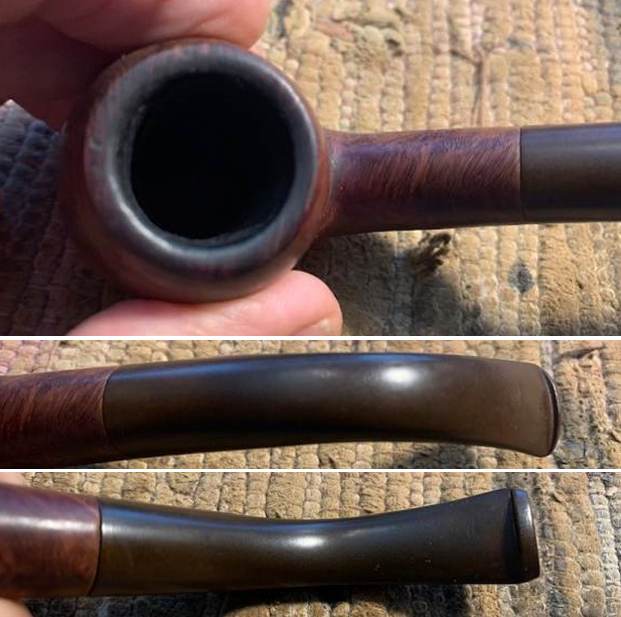
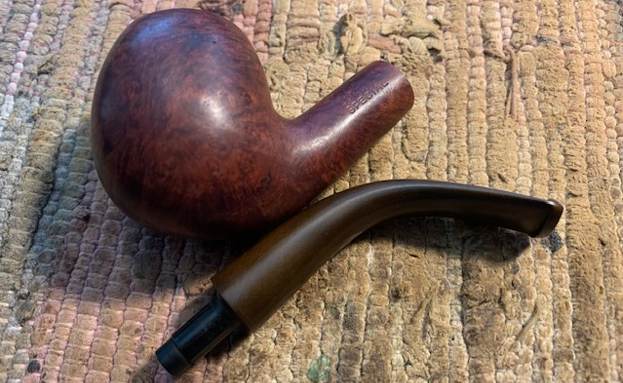
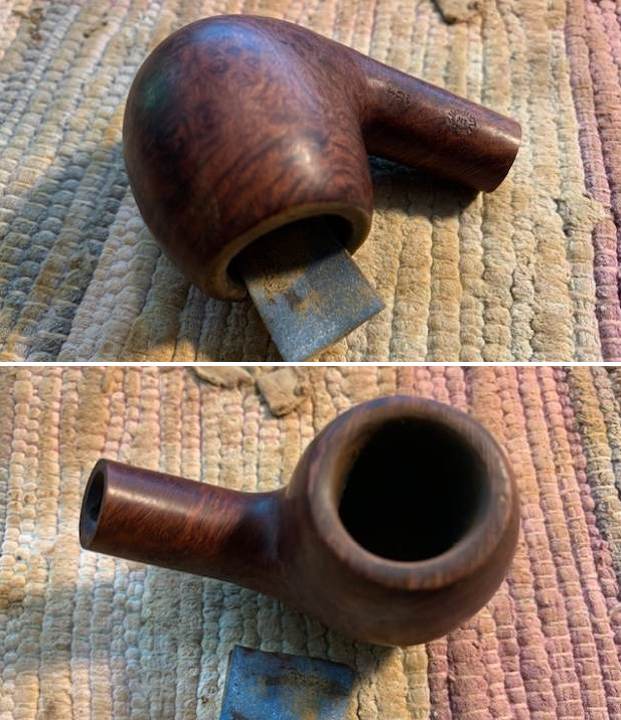
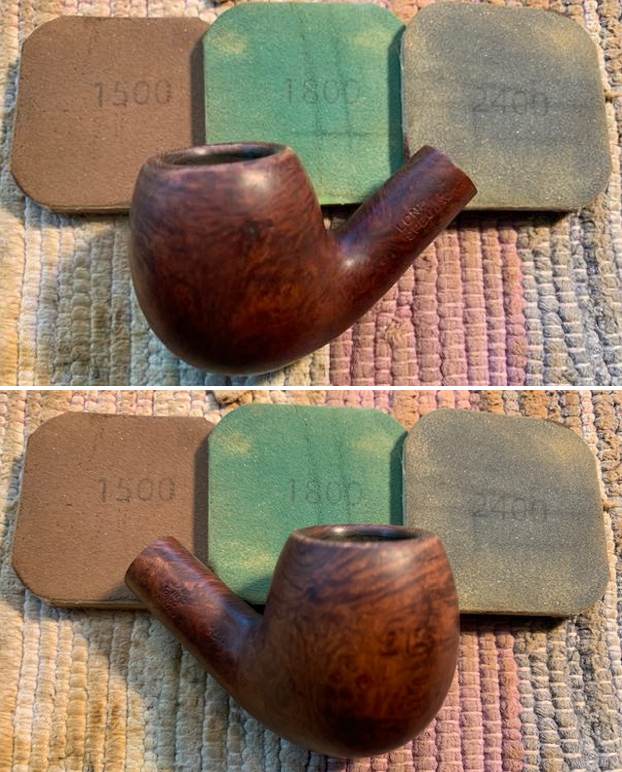
I really enjoy working on older classic shaped pipes so I was glad to be working on this one. Jeff had reamed it with a PipNet pipe reamer and cleaned up the reaming with a Savinelli Fitsall Pipe Knife. He scrubbed out the internals with alcohol, pipe cleaners and cotton swabs until the pipe was clean. He scrubbed the exterior of the bowl with Murphy’s Oil Soap and a tooth brush to remove the grime and grit on the briar and the lava on the rim top. The finish looks better but there is still some darkening on the rim top and edges of the bowl. Jeff scrubbed the stem with Soft Scrub and soaked it in Before & After Deoxidizer to remove the oxidation on the vulcanite. When the pipe arrived here in Vancouver for the second stop of its restoration tour it looked a lot better. I took photos before I started my part of the work.  I took some close up photos of the rim top and the stem surface. I wanted to show what cleaned bowl and rim top looked like. The rim top and the inner and outer edges of the bowl were in good condition. The top of the bowl had some darkening and nicks in the surface of the bowl. I also took close up photos of the stem to show the tooth marks and the remaining oxidation on the stem surface. I took photos of the stamping on the sides of the shank and it is clear and readable. It is stamped as noted above.   I removed the stem for the shank and took a photo of the bowl and stem to give a picture of what it looked like. It really is a great looking pipe.I started my work on the pipe by addressing the damage on the rim top. I used a folded piece of 220 grit sandpaper to clean up the darkening and damage on the rim top. I was able to remove it all and the rim top and edges looked very good. I polished down the briar with 1500-12000 grit micromesh sanding pads. I wiped the bowl down after each sanding pad with a damp cloth to remove the dust and debris on the briar. The bowl took on more and more of a shine as I worked my way through the pads.  I rubbed the bowl down with Before & After Restoration Balm. I worked it into the surface of the briar with my fingertips and a horse hair shoe brush to clean, enliven and protect it. I let the balm sit for a little while and then buffed with a cotton cloth and shoe brush to raise the shine. I set the bowl aside and turned my attention to the stem. I used a Bic lighter to “paint” the surface of the stem with the flame to lift the tooth marks on both sides of the stem. The heat lifted many of the marks. I filled in what remained with clear CA glue and set it aside to harden.   Once the repairs cured on the top and underside of the stem I filed them flat and recut the button edge with a small file. I sanded them with a folded piece of 220 sandpaper. I started polishing the stem with 400 grit wet dry sandpaper.   I polished the vulcanite with micromesh sanding pads – 1500-12000 grit pads. I wiped it down with a damp cloth after each sanding pad. I used Before & After Pipe Polish – both Fine and Extra Fine to further polish the stem.  I left a little oxidation around the stamp so as not to damage it more.    This London Special 184 Bent Globe cleaned up really well and looks very good. The Before & After Restoration Balm brought the colours and grain out in the rusticated finish on the pipe. It works well with the polished vulcanite taper stem. I put the stem back on the bowl and carefully buffed the pipe with Blue Diamond on the buffing wheel using a light touch on the briar. I gave the bowl and the stem multiple coats of carnauba wax on the buffing wheel. I followed that by buffing the entire pipe with a clean buffing pad. I hand buffed the pipe with a microfiber cloth to deepen the shine. The finished London Special Bent Globe fits nicely in the hand and I think it will feel great as it heats up with a good tobacco. Give the finished pipe a look in the photos below. The dimensions of the pipe are Length: 5 ½ inches, Height: 1 ¾ inches, Outside diameter of the bowl: 1 ¼ inches, Chamber diameter: ¾ of an inch. The weight of the pipe is 1.41 ounces/40 grams. If you are interested in carrying the previous pipeman’s legacy with this pipe send me a message or an email. I will be adding it to the rebornpipes store in the British Pipe Makers Section. Thanks for reading this blog and my reflections on the pipe while I worked on it.

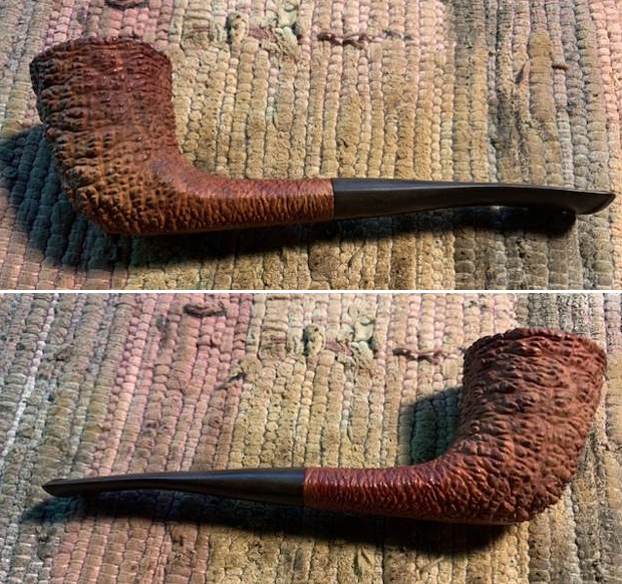
A Rebirth for a Savinelli Capri Root Briar 411 Zulu


Blog by Steve Laug

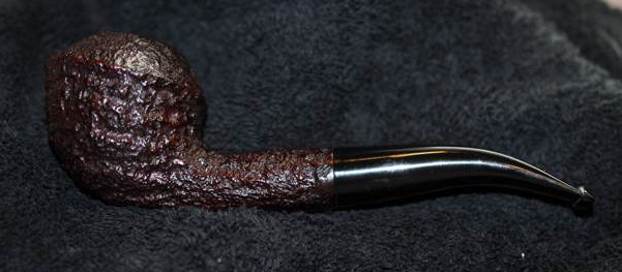
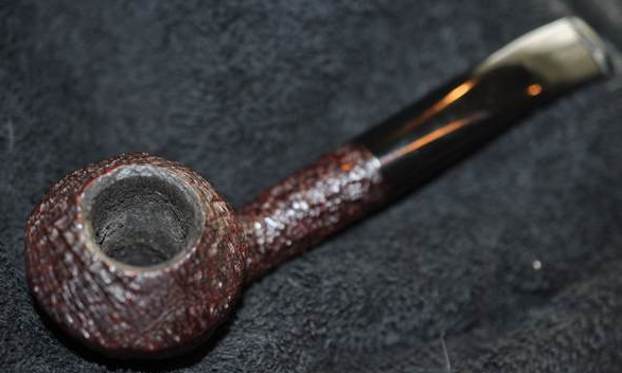
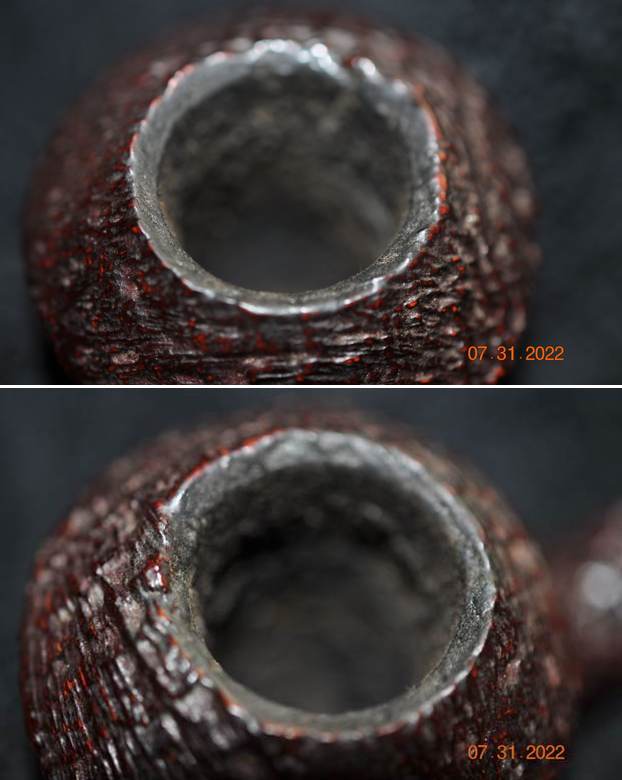
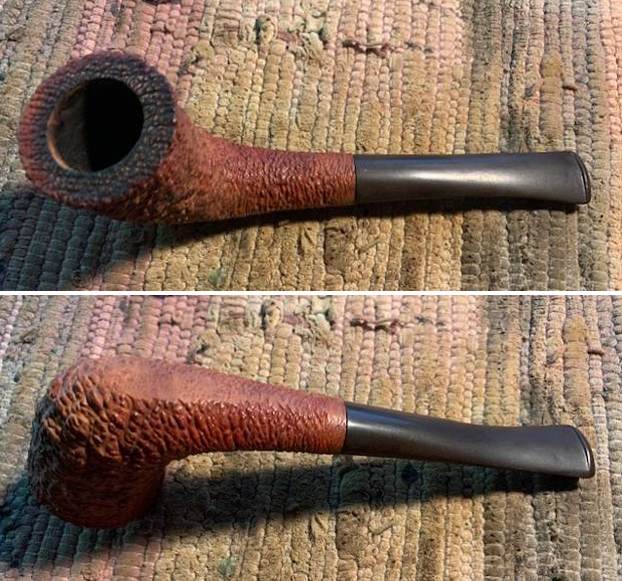
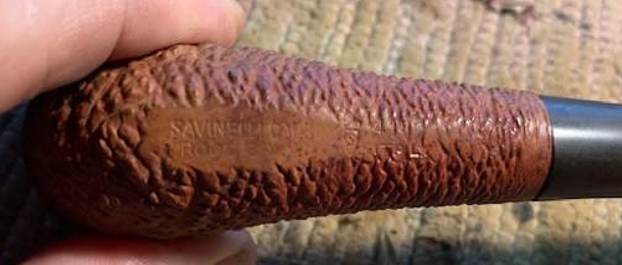
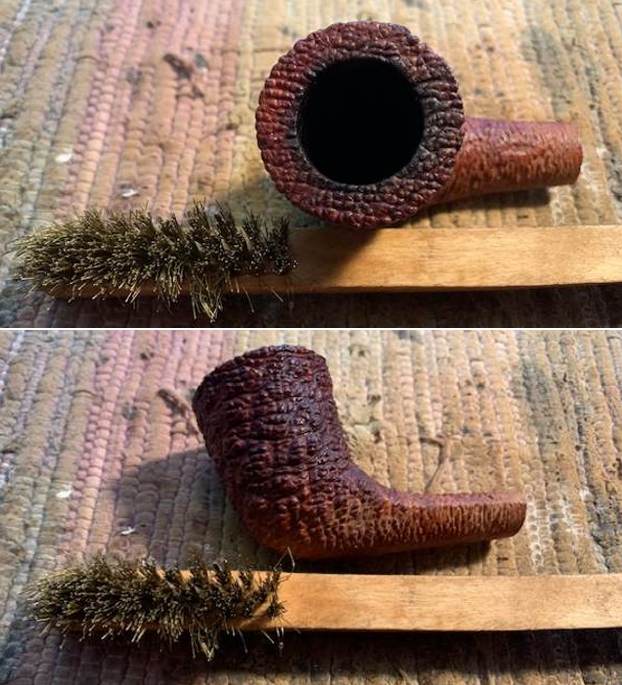
The next pipe on the table has one of my favourite finishes – a deeply rusticated one with what appears to have originally been a natural finished. We purchased this one on eBay on 10/06/16 from a fellow in Onalaska, Washington, USA. It is a Savinelli Capri Root Briar Zulu with a rusticated finish (looks a lot like the Castello Sea Rock finish). The coral like rustication around the bowl and shank was filled in with dust and debris. The natural finish was dirty and the high spots are darkened by hand oils and grime ground into briar. The pipe was stamped on underside of the shank. It is stamped Savinelli Capri [over] Root Briar followed by Savinelli “S” shield logo followed by Italy over the shape number 411. There was a thick cake in the bowl and lava overflow on the inner edges and the rim top. The vulcanite stem was oxidized and had tooth marks and chatter ahead of the button on both sides. Jeff took photos of the pipe to show its general condition before he did his cleanup.As I mentioned above the exterior of the pipe was very dirty – grime and grit ground in from years of use and sitting. The rim top was covered with a coat of thick lava that overflowed from the thick cake in the bowl. It was hard to know what the rim edges looked like because of the lava. The stem was dirty, calcified and oxidized with tooth chatter and marks on the top and underside of the stem at the button. Jeff took a photo of the right side and the heel of the bowl to give a better feel for the condition of the briar around the bowl. It is a great looking piece of briar with a deep rustication.The next photo show the stamping on the underside of the shank and it is very readable. It reads as noted above.I have always like the Savinelli Capri Root Briar finish so I was glad to be working on this one. Jeff had reamed it with a PipNet pipe reamer and cleaned up the reaming with a Savinelli Fitsall Pipe Knife. He scrubbed out the internals with alcohol, pipe cleaners and cotton swabs until the pipe was clean. He scrubbed the exterior of the bowl with Murphy’s Oil Soap and a tooth brush to remove the grime and grit on the briar and the lava on the rim top. The finish looks better but there is still darkening on the sides of the bowl and shank. There is also some darkening on the rim top as well. Jeff scrubbed the stem with Soft Scrub and soaked it in Before & After Deoxidizer to remove the oxidation on the rubber. When the pipe arrived here in Vancouver for the second stop of its restoration tour it looked a lot better. I took photos before I started my part of the work.  I took some close up photos of the rim top and the stem surface. I wanted to show what cleaned bowl and rim top looked like. The rim top and the inner and outer edges of the bowl were in excellent condition. The top of the bowl was quite dark around three sides. I also took close up photos of the stem to show the tooth marks and the remaining oxidation on the stem surface.  I took photos of the stamping on the underside of the shank and it is clear and readable. It is stamped as noted above.I removed the stem for the shank and took a photo of the bowl and stem to give a picture of what it looked like. The remaining oxidation is very visible.I started my work on the pipe by addressing the darkening of the rim top. I used a brass bristle wire brush and some common dish soap to de-grease the bowl and the rim top. I worked over the bowl and the top with the brush and was able to remove the grime and much of the darkening.  I rubbed the bowl down with Before & After Restoration Balm. I worked it into the surface of the briar with my fingertips and a horse hair shoe brush to clean, enliven and protect it. I let the balm sit for a little while and then buffed with a cotton cloth and shoe brush to raise the shine.     I set the bowl aside and turned my attention to the stem. I used a Bic lighter to “paint” the surface of the stem with the flame to lift the tooth marks on both sides of the stem. The heat lifted many of the marks. I filled in what remained with clear CA glue and set it aside to harden.   Once the repairs cured on the top and underside of the stem I filed them flat and recut the button edge with a small file. I sanded them with a folded piece of 220 sandpaper. I started polishing the stem with 400 grit wet dry sandpaper.   I polished the vulcanite with micromesh sanding pads – 1500-12000 grit pads. I wiped it down with a damp cloth after each sanding pad. I used Before & After Pipe Polish – both Fine and Extra Fine to further polish the stem.  I left a little oxidation around the stamp so as not to damage it more.  This Savinelli Capri Root Briar 411 Zulu cleaned up really well and looks very good. The Before & After Restoration Balm brought the colours and grain out in the rusticated finish on the pipe. It works well with the polished oval vulcanite taper stem. I put the stem back on the bowl and carefully buffed the pipe with Blue Diamond on the buffing wheel using a light touch on the briar. I gave the bowl multiple coats of Conservator’s Wax and the stem multiple coats of carnauba wax on the buffing wheel. I followed that by buffing the entire pipe with a clean buffing pad. I hand buffed the pipe with a microfiber cloth to deepen the shine. The finished Capri Root Briar 411 Zulu fits nicely in the hand and I think it will feel great as it heats up with a good tobacco. The tactile finish will add to the experience. Give the finished pipe a look in the photos below. The dimensions of the pipe are Length: 6 inches, Height: 1 ¾ inches, Outside diameter of the bowl: 1 ½ inches, Chamber diameter: ¾ of an inch. The weight of the pipe is 1.20 ounces/34 grams. If you are interested in carrying the previous pipeman’s legacy with this pipe send me a message or an email. I will be adding it to the rebornpipes store in the Italian Pipe Makers Section. Thanks for reading this blog and my reflections on the pipe while I worked on it.

Restoring an Unusual BBB Trafalgar 1752 Square Dublin Sitter


Blog by Steve Laug

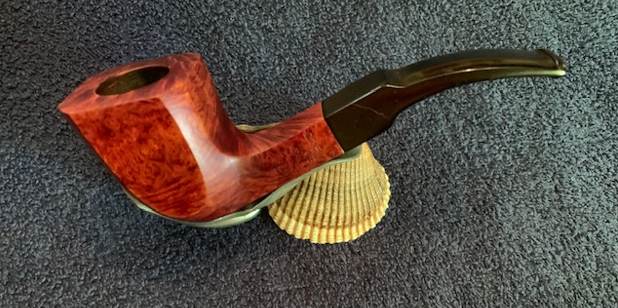
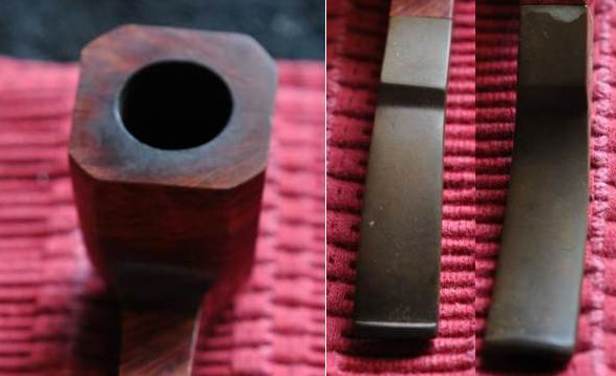
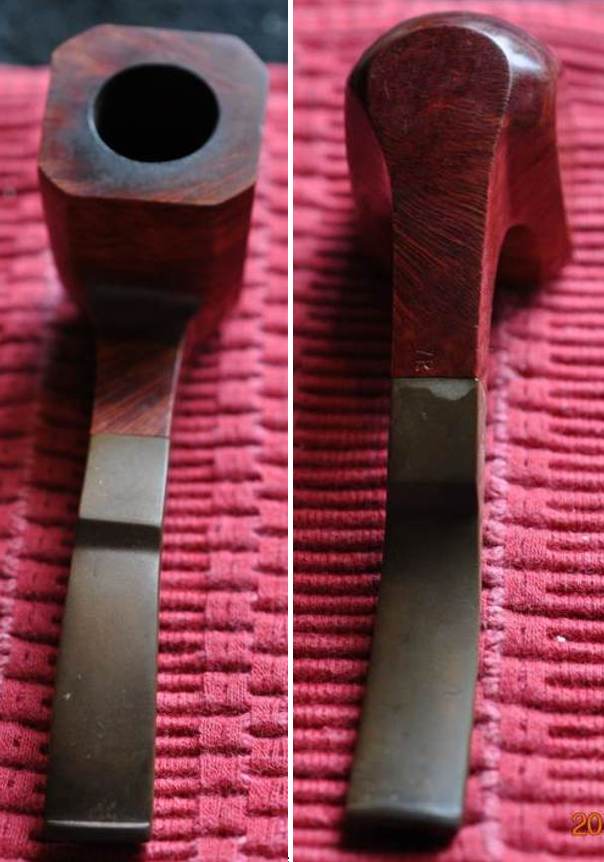
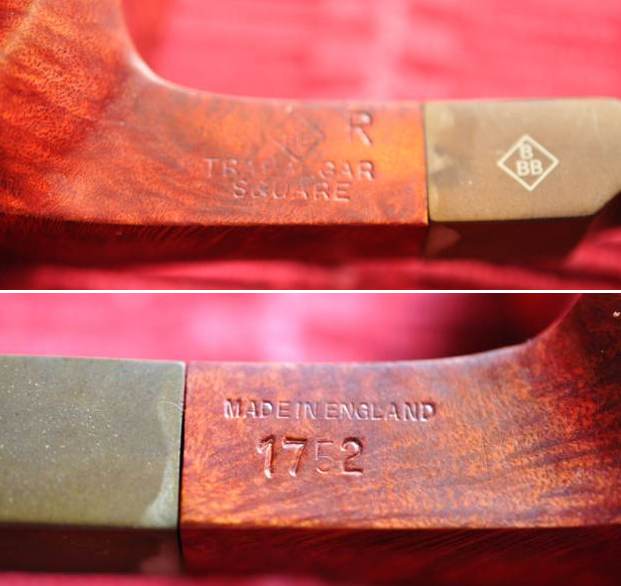
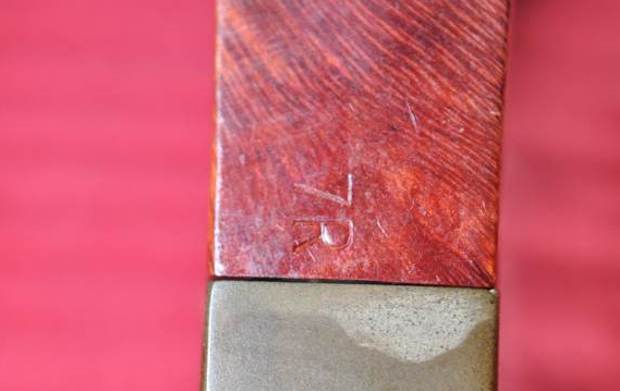
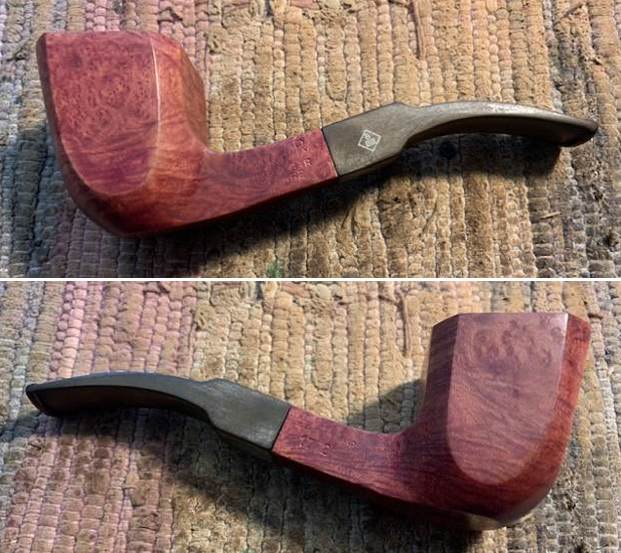
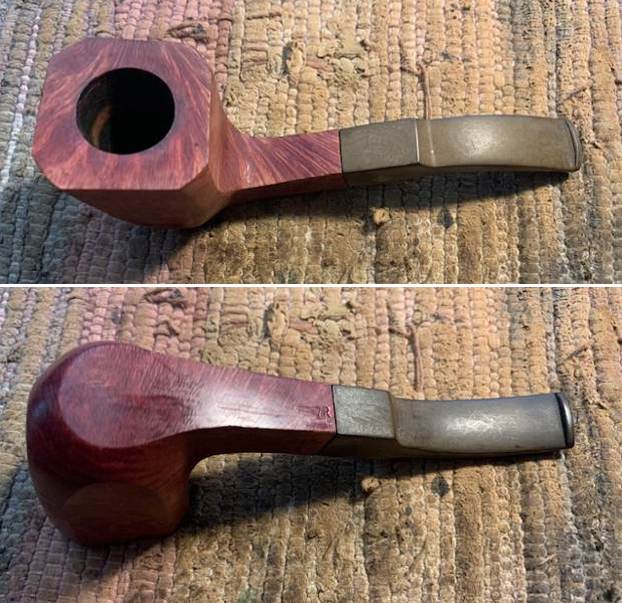
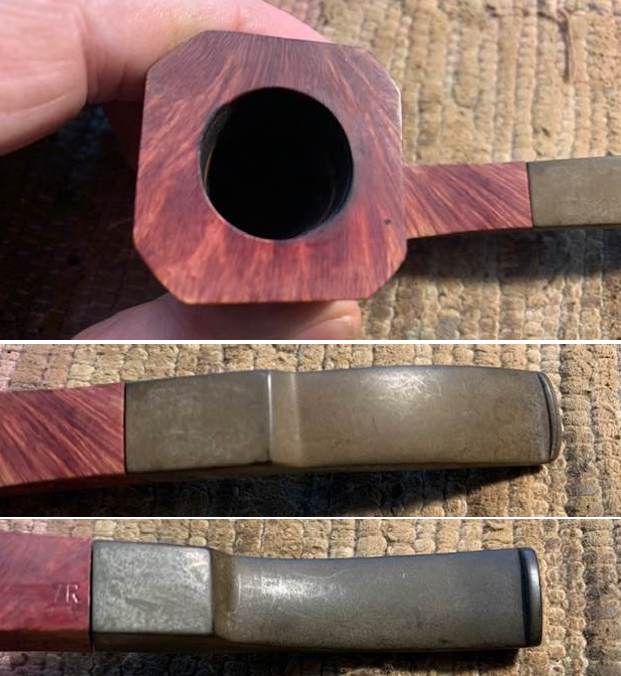
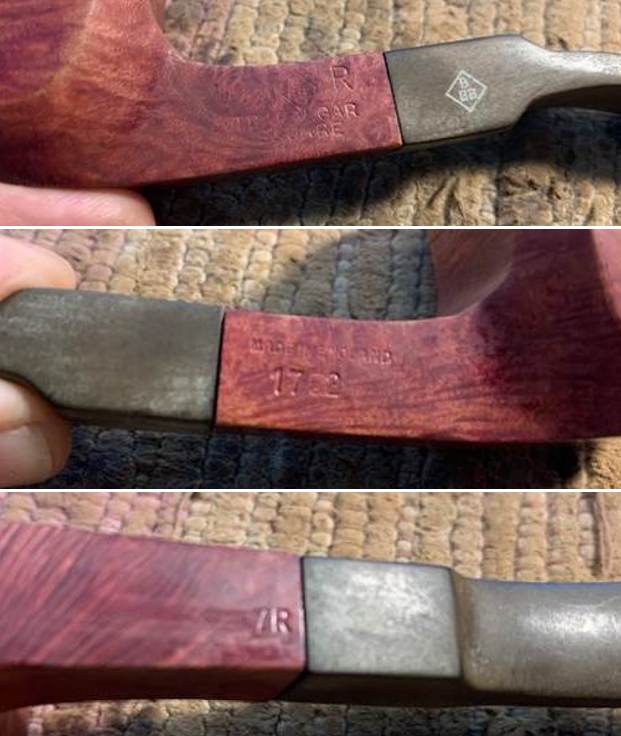
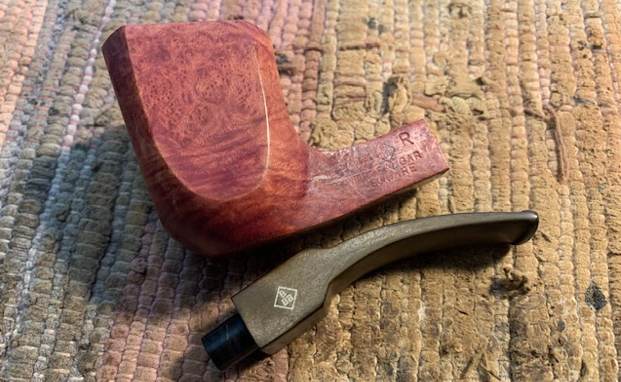
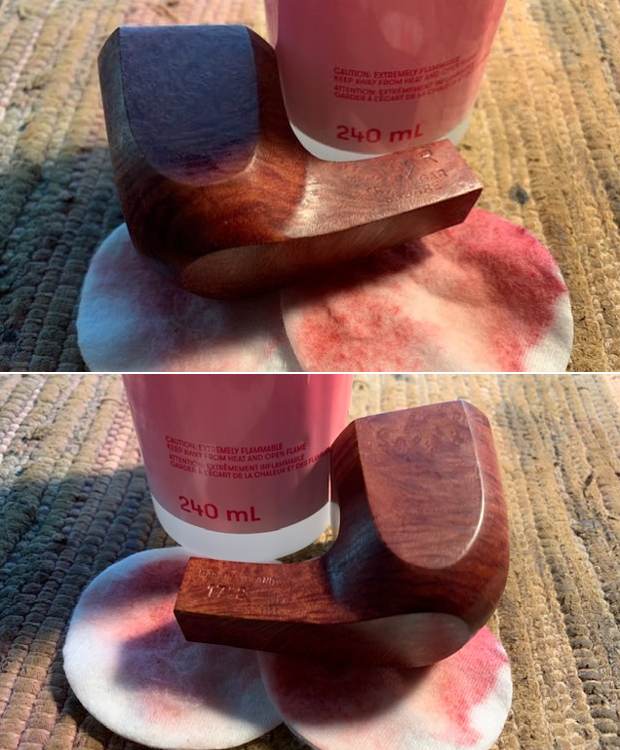
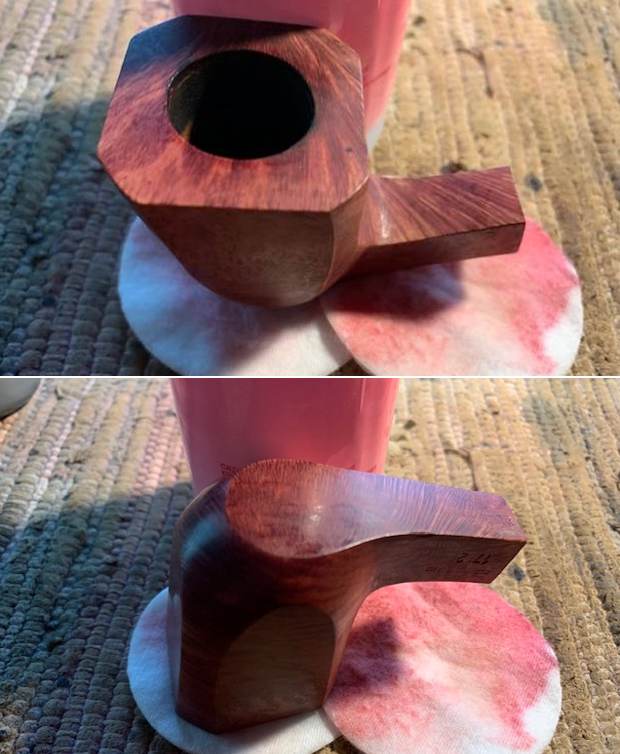
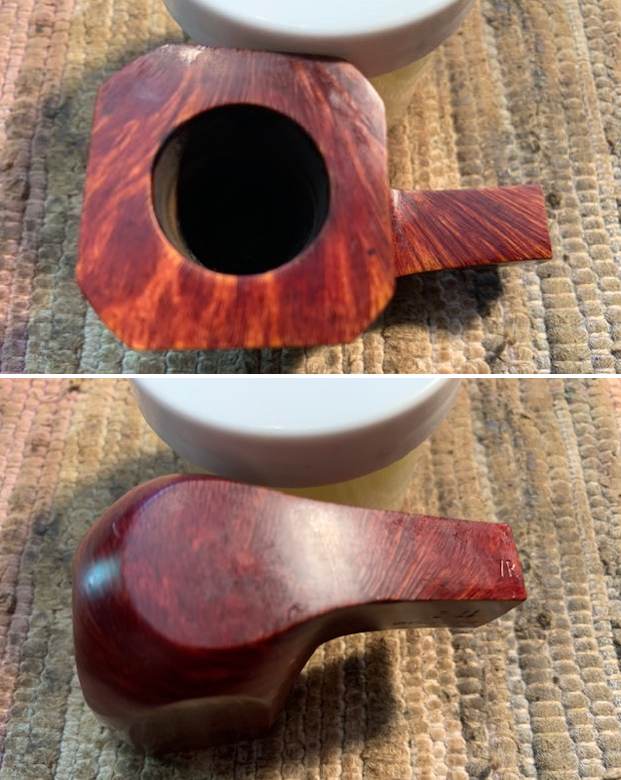
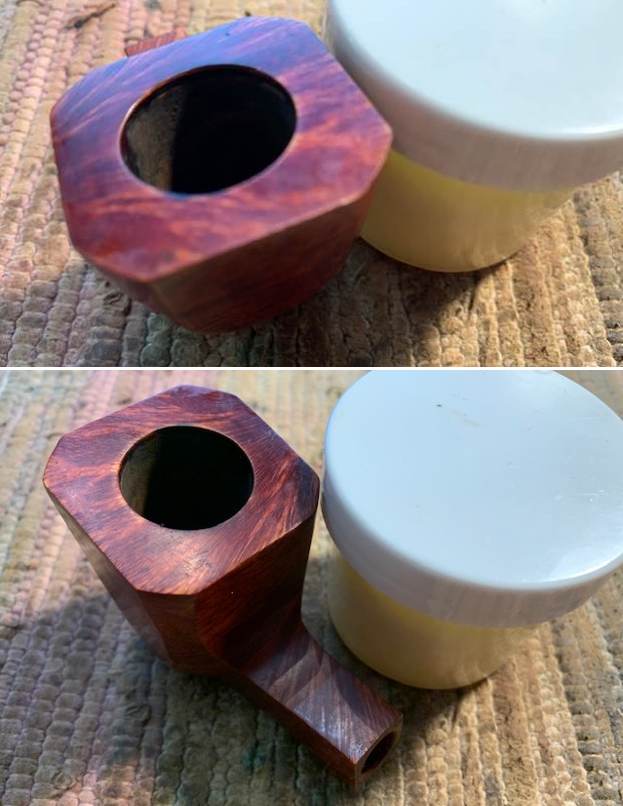
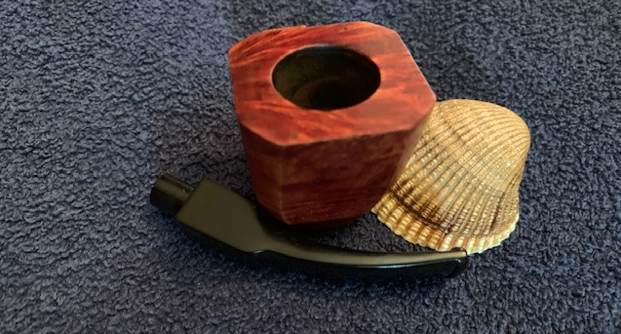
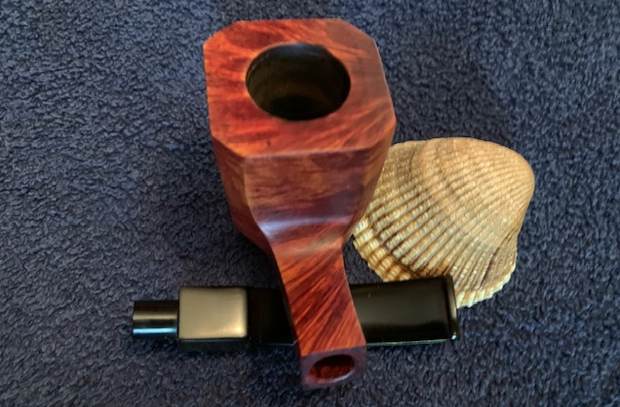
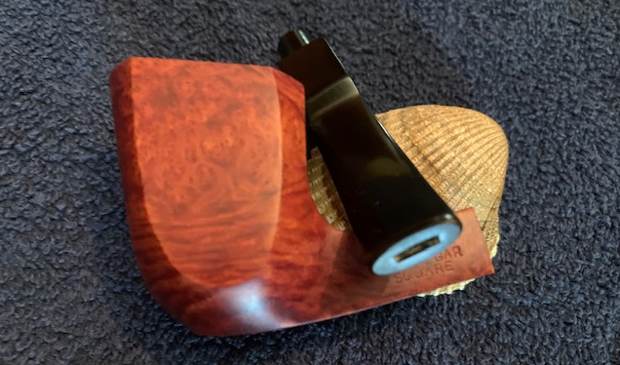
The next pipe on the worktable is a BBB in a shape I had not seen before. It is kind of a Panel Dublin Sitter with a square shank. We bought it on eBay from Frederiksberg, Denmark on 06/05/2016 so it has been sitting here for a long time. The pipe is stamped on the left side of the shank and reads BBB in a diamond (logo) followed by R. Underneath it reads Trafalgar [over] Square. On the right side of the shank it is stamped Made in England [over] 1752. On the underside of the shank it also was stamped 7R next to the shank/stem logo. On the left side of the saddle stem is a BBB diamond logo stamped in white. The bowl had a thick cake and there was a light lava overflow on the rim top and inner edge of the rim. The unique saddle stem fits the square shank perfectly and is oxidized. The tenon is drilled for a 6mm filter. There are light tooth marks and chatter on the top and underside of the stem ahead of the button. The grain around this unique pipe is quite beautiful under the grime on the finish. Jeff took photos of the pipe before he started his clean up work. He took photos of the rim top to show the condition the rim top – darkening and lava build up on the rim and edges. He also took photos of the top and underside of the stem to show its general condition. It is oxidized and shows some tooth marks on both sides near the button.He took a photo of the pipe looking down on the length of it both on the top and on the underside. It is an interesting and unique pipe. He took photos of the stamping on the left, right and underside of the shank. It is clear and readable as noted above.  While there is a lot of information on the BBB brand there is nothing on the Trafalgar Square line. It has a simple Made in England stamp and a painted stamp on the left side of the stem. I would assume that it is one that was made during the Cadogan era.

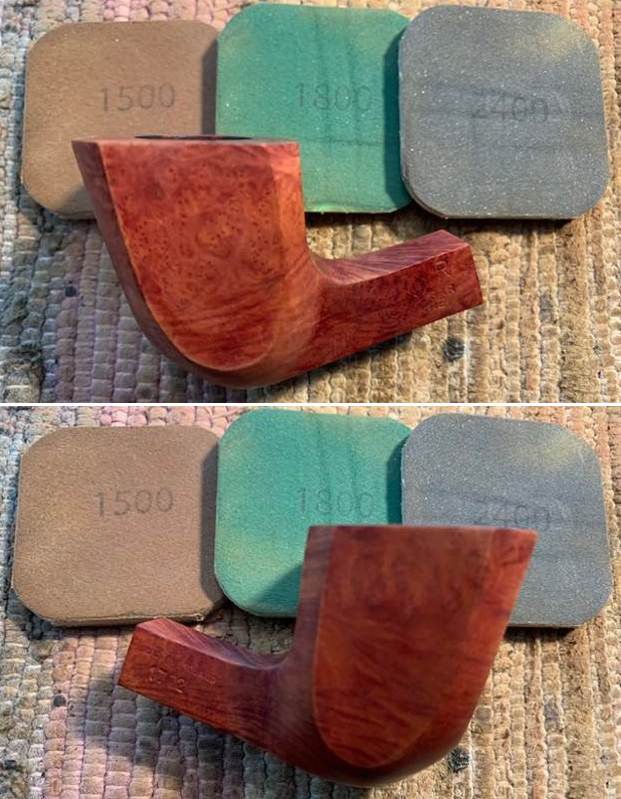
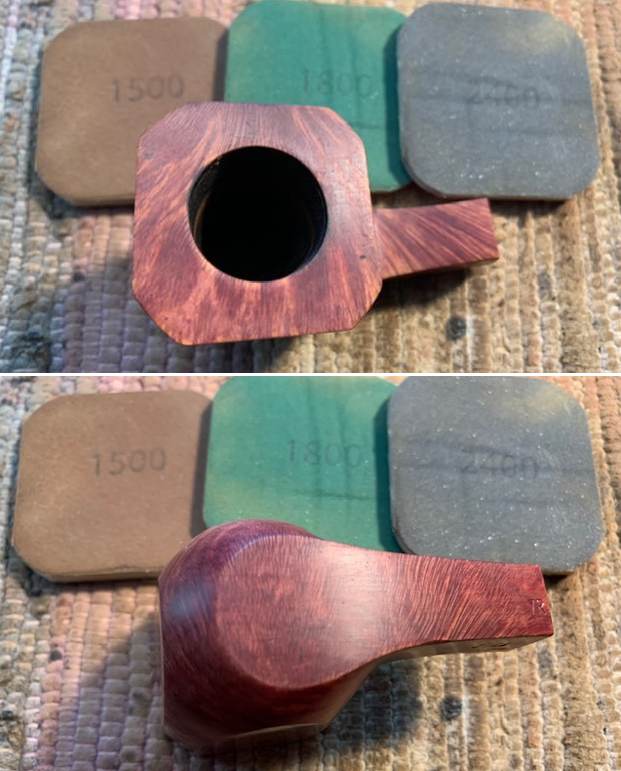
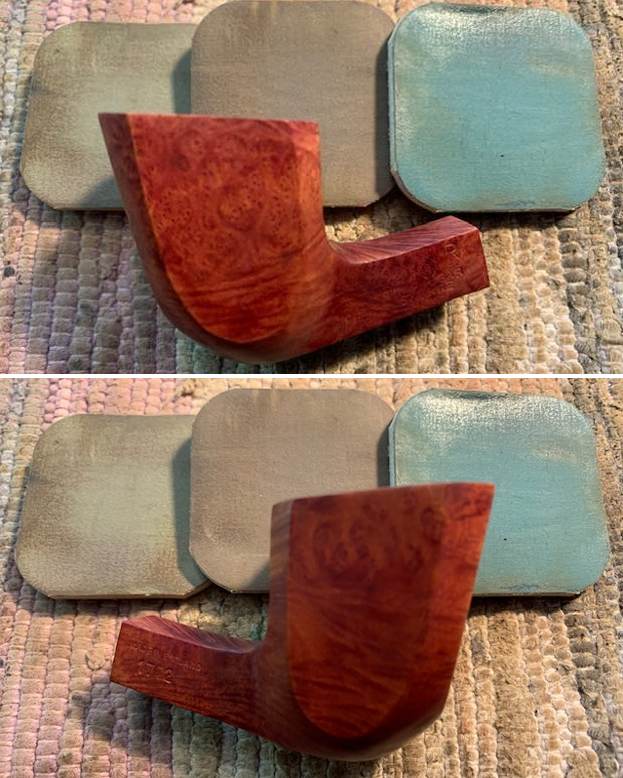
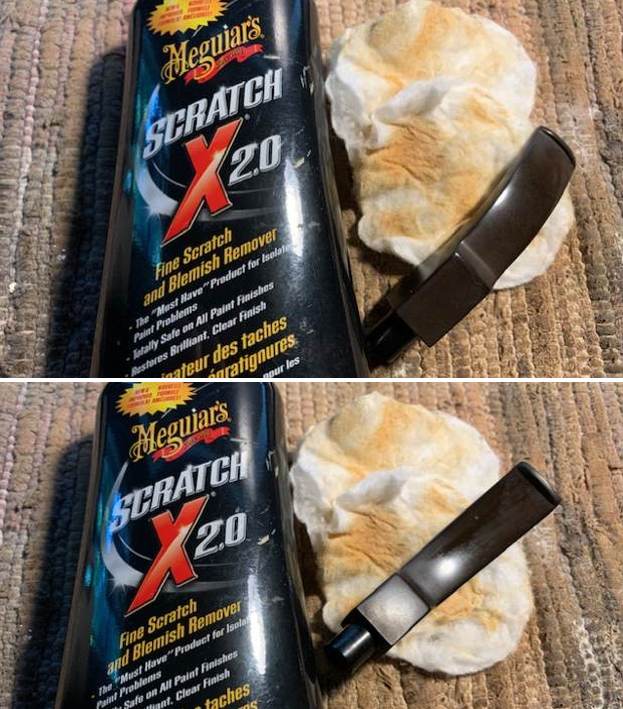
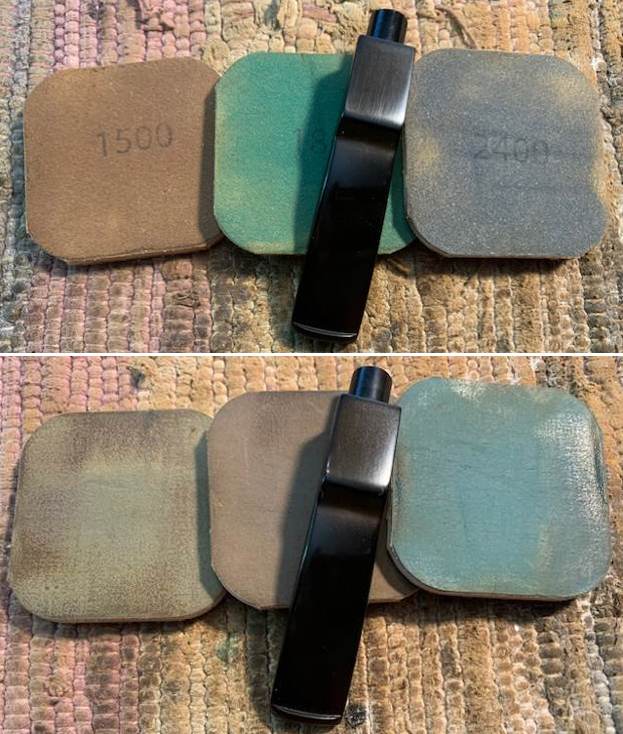
Jeff had cleaned up the pipe as usual. He reamed the pipe with a PipNet pipe reamer and removed the rest of the cake with a Savinelli Fitsall Pipe Knife. He scrubbed the bowl with undiluted Murphy’s Oil Soap with a tooth brush. He rinsed it under running warm water to remove the soap and grime. He cleaned out the inside of the shank and the airway in the stem with alcohol, cotton swabs and pipe cleaners. He scrubbed the stem with Soft Scrub and a tooth brush and rinsed it off with warm water. I took photos of the pipe before I started my part of the restoration work. There were still spots varnish on the bowl sides that would need to be removed. I took photos of the pipe before I started my work on it.     The rim top looked very good and the inner edge had some darkening and wear that would need to be addressed. The outer edge of the bowl look very good. The stem surface still showed oxidation and had a few small tooth marks and chatter on both sides near the button. The stamping on sides of the shank is clear and readable. I took photos of the stamping on the each side of the shank and it is stamped as noted above. The logo on the stem could well be a decal but I will know more once I am working on it.I removed the stem and took a photo of the pipe to give a sense of the whole. It is an unusually shaped pipe.I started my work on the pipe by wiping the bowl down with acetone to remove the remaining varnish around the bowl and shank. It lifted some of the red stain in the process. I used a folded piece of 220 grit sandpaper to clean up the damage and darkening there. I also smoothed out the damage on the rim top. It worked amazingly well and the finished edge and top looked much better.  I polished the bowl and the rim top with micromesh sanding pads – wet sanding with 1500-2400 grit pads and dry sanding with 3200-12000 grit pads. I wiped the bowl down after each pad with a damp cloth.   I rubbed some Before & After Restoration Balm into the surface of the briar to enliven, clean and preserve it. I rubbed it in with my fingertips working it into the briar. I set it aside for 15 minutes to let the balm do its work. I buffed it off with a cotton cloth and then buffed it with a microfiber cloth. The photos below show the pipe at this point in the restoration process.  I set aside the bowl and turned my attention to the stem. I scrubbed the stem with Soft Scrub on cotton pads to remove the deep oxidation that was still on the stem. It worked quite well and I was able to remove the majority of it. I then used some Meguiar’s Scratch X 2.0 Fine Polish and scratch remover and was able to remove even more of the oxidation. I polished the stem using micromesh sanding pads – wet sanding with 1500-12000 grit pads to further polish it. After each pad I wiped it down with Obsidian Oil to protect and enliven the stem. I polished it further with Before & After Pipe Polish – both Fine and Extra Fine. When I finished with the polish I gave it a final coat of Obsidian Oil and set it aside to dry. I tried to redo the BBB triangle on the stem side. It was faint and the stamping was not very deep. I used some Rub’n Buff Antique Gold but it did not work so I wiped it off and buffed it with some Obsidian Oil to clean up the stamping. This BBB Trafalgar Square 1752 Panel Dublin Sitter is an interesting and unusual piece. It has a classic English looking Billiard shape. The smooth finish around the bowl and shank has some nice straight and flame grain around the sides. The rim top and heel have some nice looking birdseye grain. The reddish brown of the bowl and the black of taper vulcanite stem contrast well together. I buffed the bowl and the stem with Blue Diamond polish to raise the shine on the briar and the vulcanite. I lightly buffed the rim top and shank end as well. I was careful to not buff the stamping and damage it. I gave the bowl and the stem multiple coats of carnauba wax. I buffed the entire pipe with a clean buffing pad to raise the shine. I hand buffed it with a microfiber cloth to deepen the shine. The finished pipe is shown in the photos below. The dimensions of the pipe are: Length: 5 ½ inches, Height: 2 inches, Outside Diameter: 1 ½ x 1 ½  inches, Diameter of the chamber: ¾ of an inch. The weight of the pipe is 1.62 ounces/46 grams. It is an interesting old pipe and should make a great collectible piece for lovers of old Americana Pipe Making Companies. I will be adding it to the American Pipemakers Section on the rebornpipes store very soon if you would like to add it to your collection. Thanks for walking through the restoration with me.
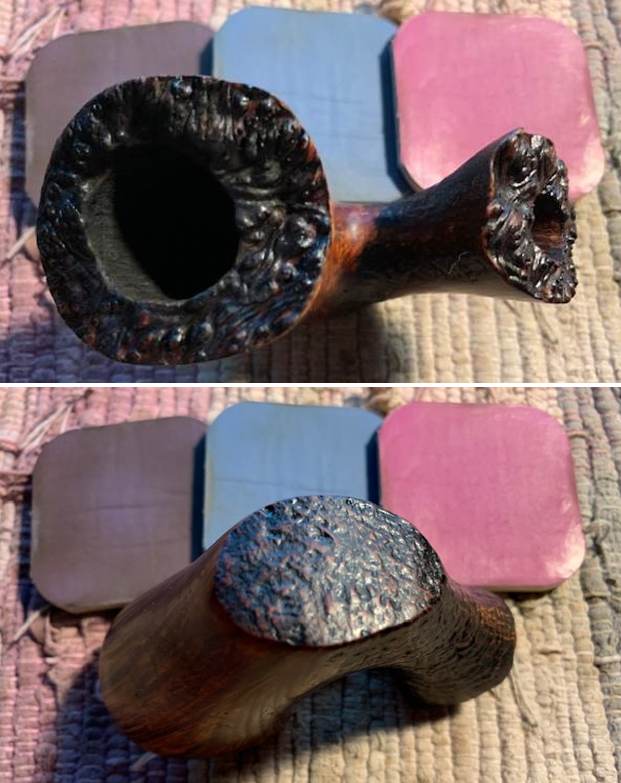
Pipe Gods Smiled And I Got Not One But Three Les Wood Pipes… Restoring a Les Wood Poker


Blog by Paresh Deshpande

Les Wood pipes are on every collector’s either wish list or in personal collection and I am no exception, though I was in the former category up until now. These pipes are as rare as hen’s teeth and very rarely make an appearance on the estate pipe market and whenever they do, the stratospheric prices made them beyond my reach. After waiting for years on end, I came across a gentleman desirous of parting with his Les Wood pipes collection. We discussed the price and I discussed with Abha, my wife, discussed some more with the gentleman, again discussed a lot more with my wife and thereafter again discussed some with the gentleman and after all these discussions, three Les Wood pipes made their way from the European Union to India.

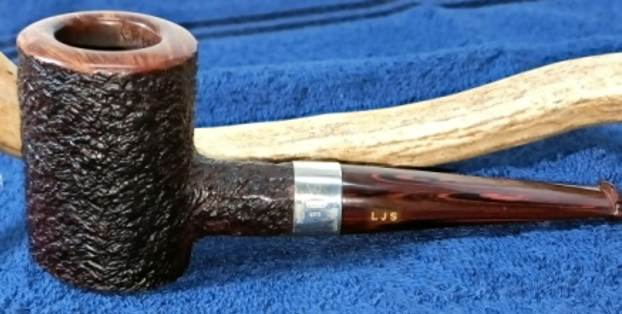
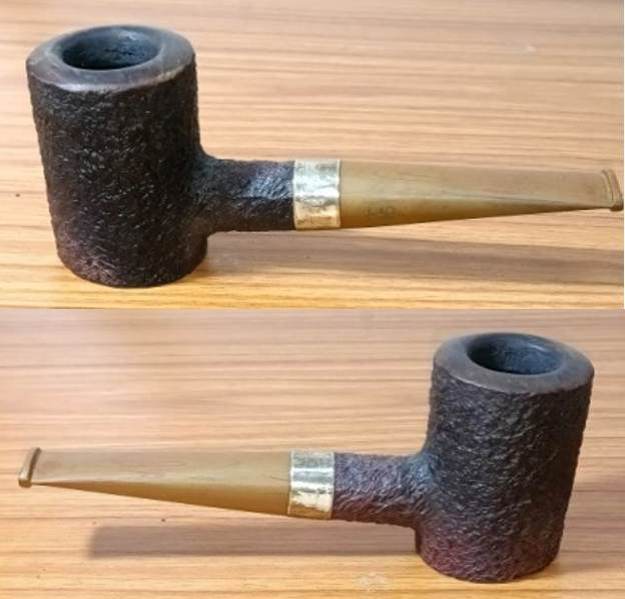
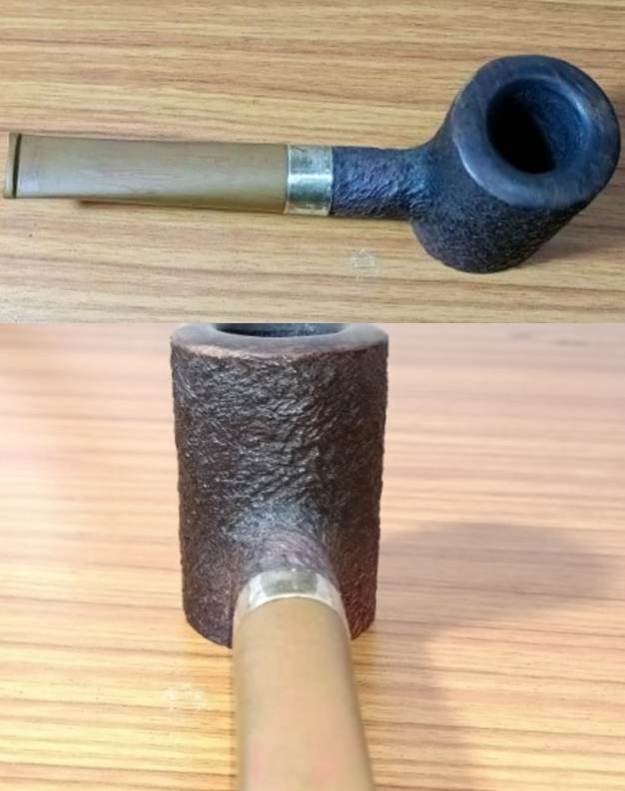
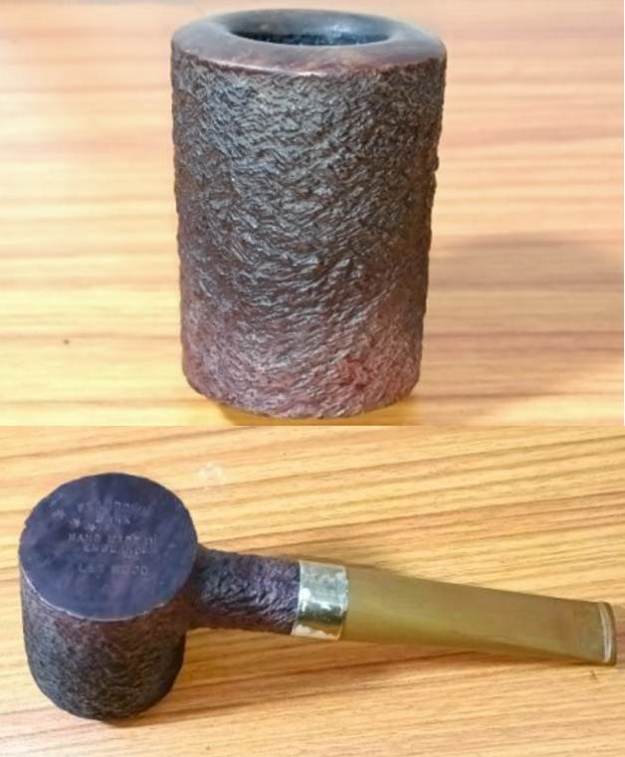
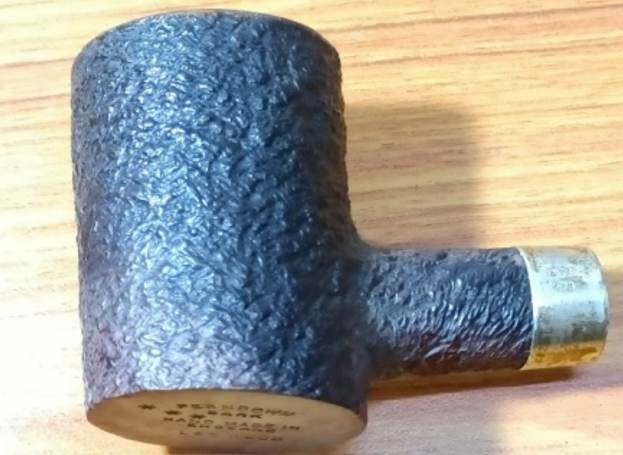
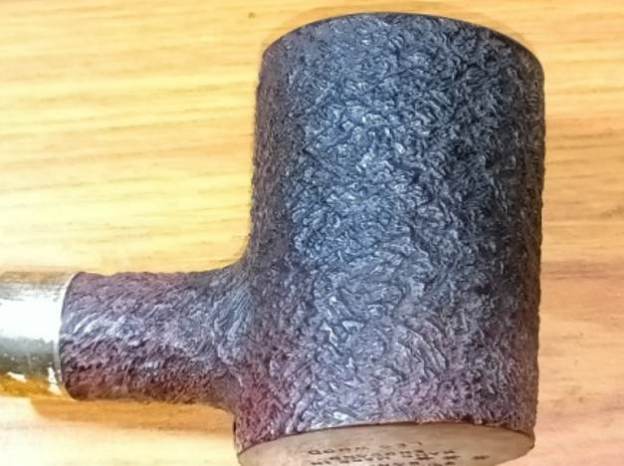
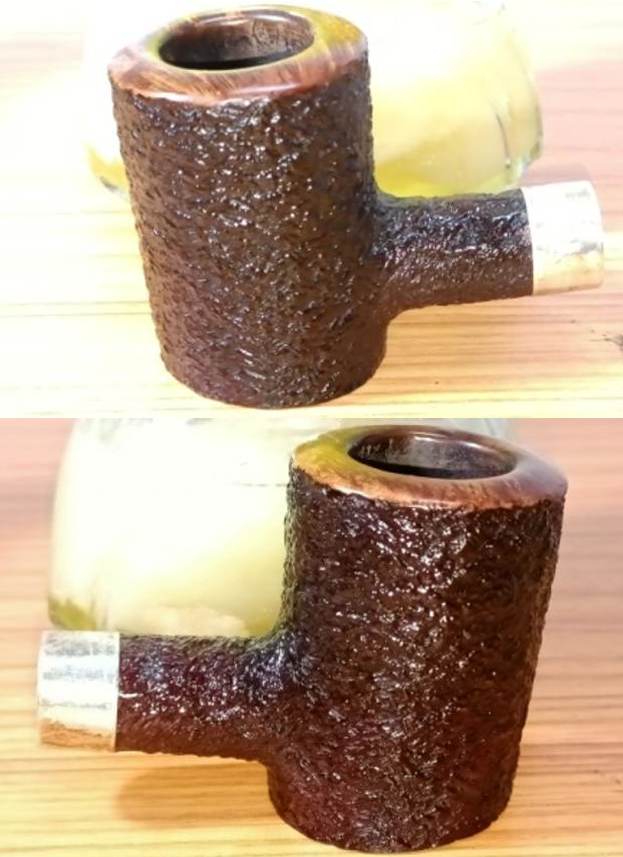
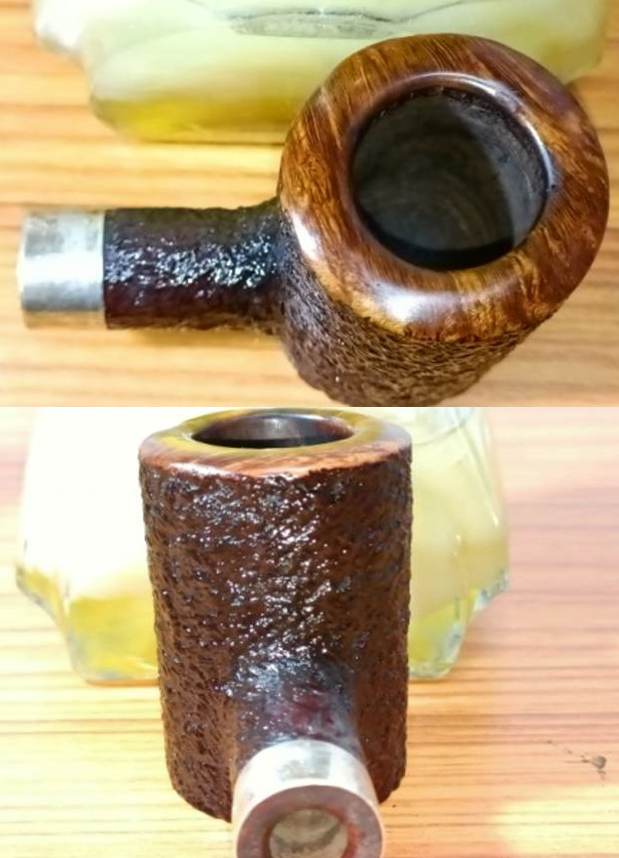
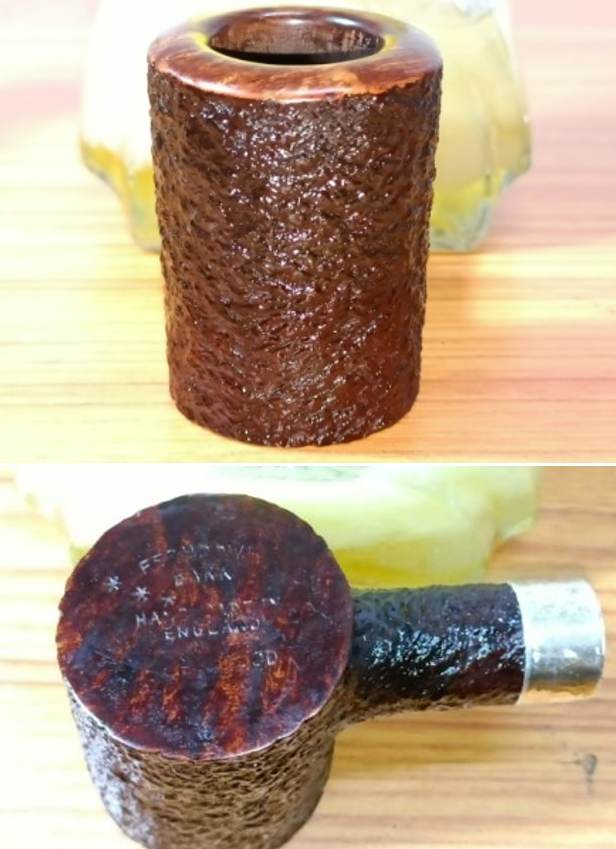
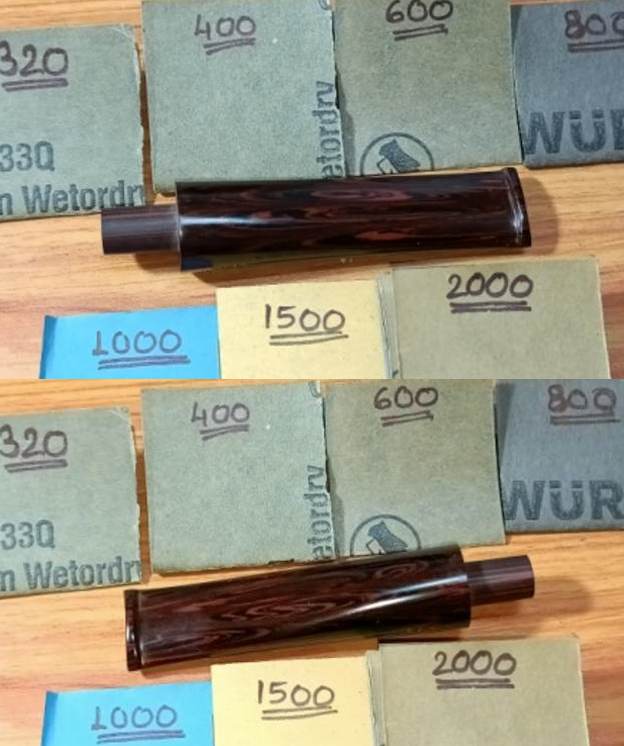
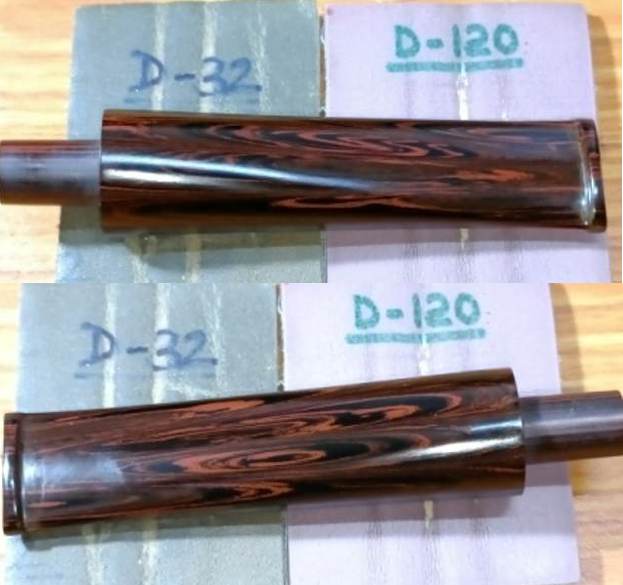
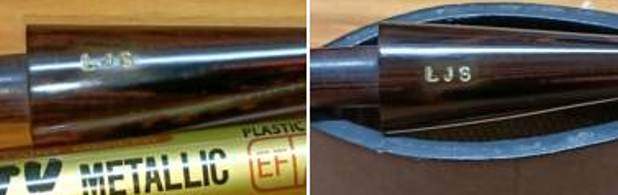
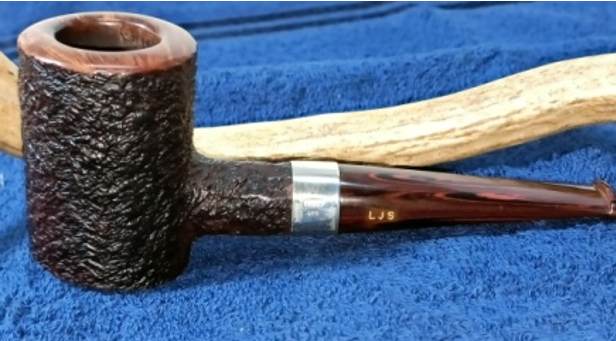
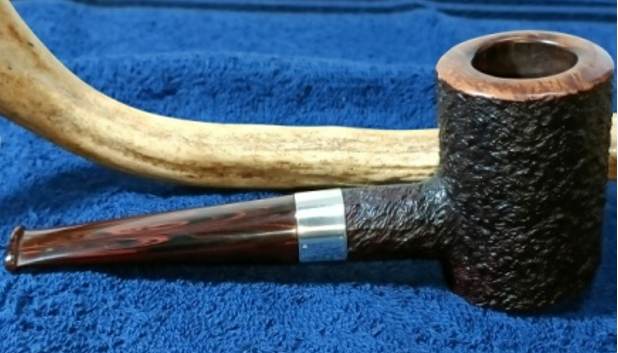
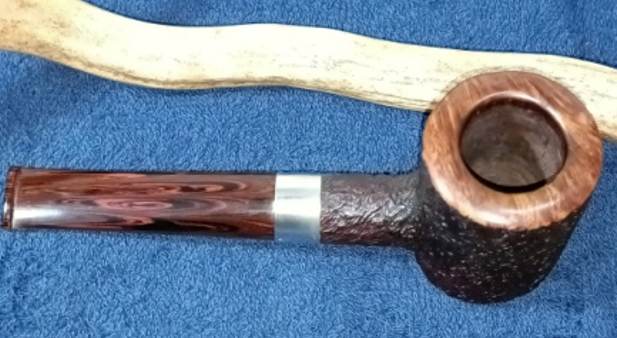
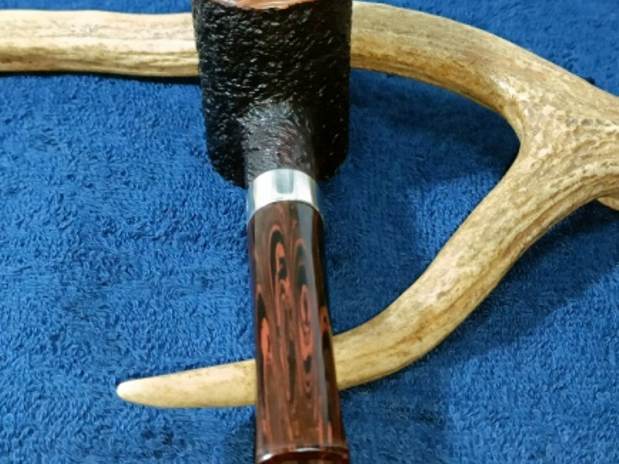
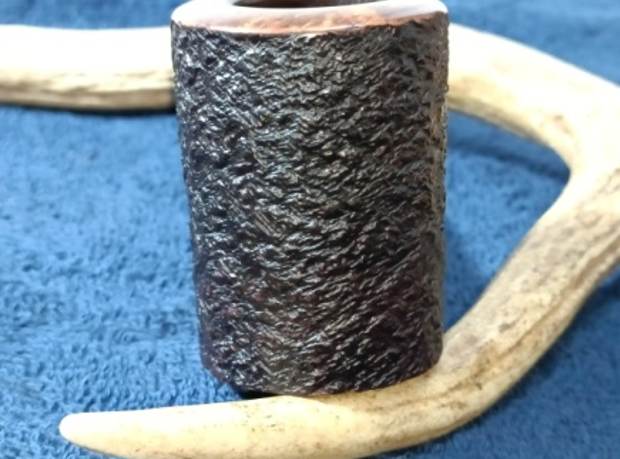
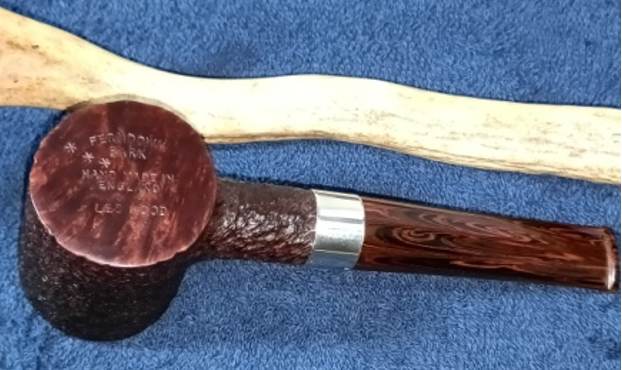
The first of the three Les Wood pipes that I decided to work on is a rusticated large, stout classic poker with a beautiful Cumberland stem. The large rusticated chunky stummel feels great in the hand and given its size, it is definitely not a light weight. The pipe is stamped on the smooth surface of the foot of the stummel as “FERNDOWN” in a slight arc over “BARK” over “HAND MADE IN” over “ENGLAND” over “LES WOOD”. Running oblique to the FERNDOWN BARK on the left side are three stars one below the other. The Sterling silver band bears the stamp “L & JS” in a rectangular cartouche over “.925”. The Cumberland stem is stamped on the left side as “L J S”I had read about Leslie John Wood sometime back when I read an article on English pipes and pipe carvers. I remembered that he worked for Dunhill’s as a silversmith. Just to refresh my memory, I visited Reborn Pipes and sure enough, Steve had indeed worked on and researched Les Wood. It’s very comprehensive and is recommended as a read. Here is the link to the write up.

https://rebornpipes.com/2021/05/20/this-restoration-is-a-bit-of-a-resurrection-of-a-beautiful-ferndown-root-3-dublin/

From the article, I know I am working on a ‘BARK’ grade pipe (ca. 90%, rusticated, dark brown and black) in size 3 from Les Wood.

Initial Visual Inspection
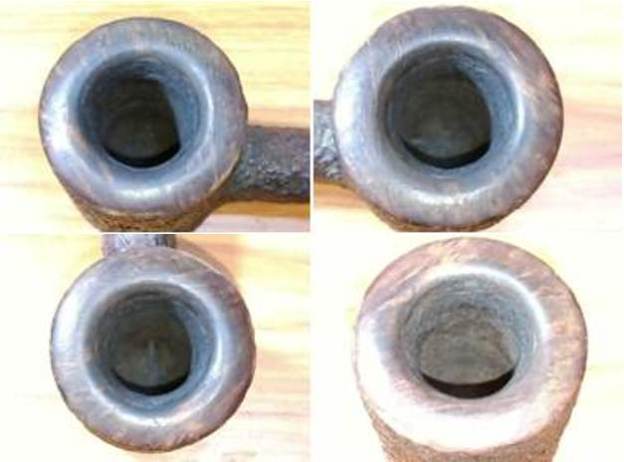
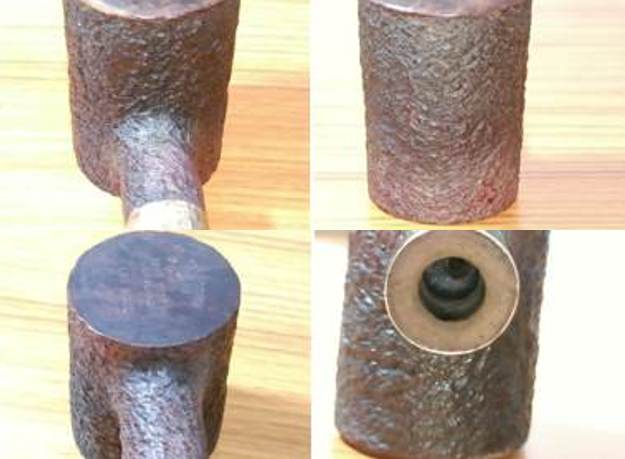
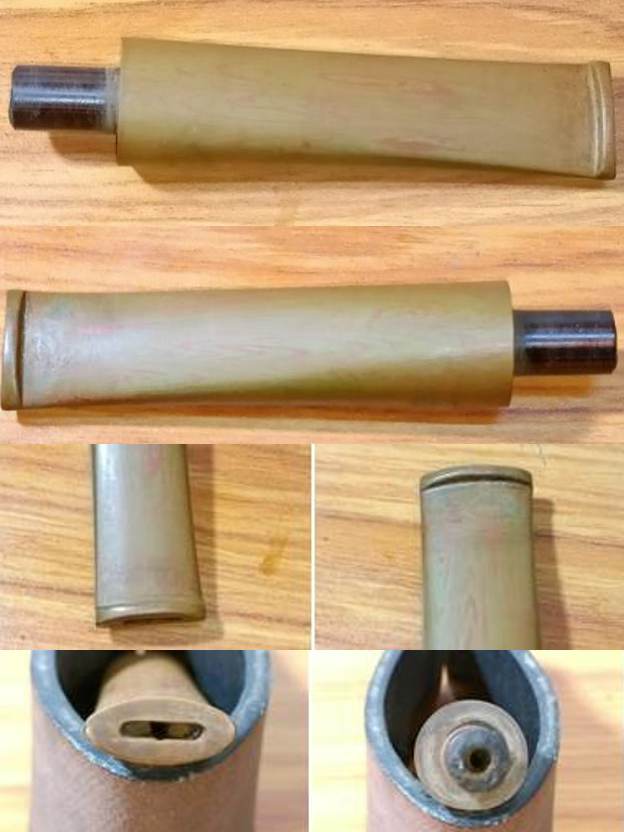
The pipe is actually in quite a good condition. The chamber has a very thin layer of cake that is even all around and is rock hard. The stummel surface feels solid to the touch and thus, I don’t anticipate any serious issues with the chamber walls. The rim top surface is smooth and devoid of any cake build up or darkening over the surface. The rim edges are in pretty good condition too. The stummel finish has faded more towards the foot of the stummel and has a lot of dirt and grime ground into the rusticated finish. This makes the stummel appear dull, lifeless and lackluster. The silver band at the shank end is deeply oxidized and appears blackened. The Cumberland stem is deeply oxidized with a couple of minor tooth indentations in the bite zone. Here are a few pictures of the pipe as it sits on my worktable. It’s a nice solid pipe with a robust construction yet elegant in its huge size and shape. This one will take your breath away once it is restored, I think.
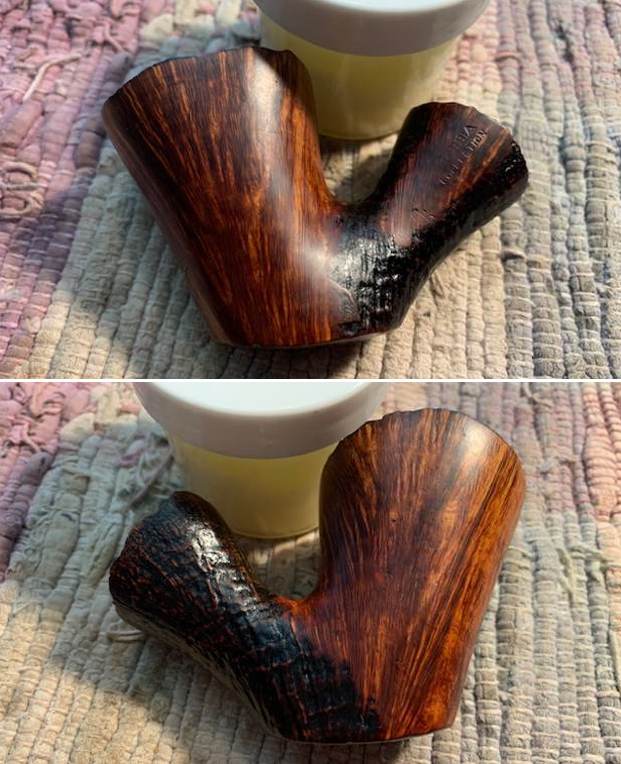
Detailed Inspection
There is a thin layer of cake in the chamber that is even all around. The cake is hard and compact and this makes me believe that it has been regularly reamed to maintain the correct cake thickness in the chamber. The condition of the chamber walls can be ascertained only once the cake has been taken down to the bare briar; however, I do not foresee any major issues with the chamber walls. The smooth rim top has no dents and dings and overflowing lava. The condition of the inner rim edge will be known once the complete cake has been removed and the surface thoroughly cleaned. The chamber does have smells of old tobaccos and would need to be addressed.The rustication on the stummel surface are very fine and shallow. It is a very uniquely rusticated stummel for sure. The stain has faded from the lower half of the bowl and lower surface of the shank. The surface looks tired and lifeless and would benefit from a nice thorough TLC routine. The shank is quite clean and has no signs of accumulated old oils and gunk. The draw is nice and smooth. The Cumberland stem is deeply oxidized with minor tooth chatter in the bite zone on either surface. The horizontal slot opening is clean and the tenon shows accumulation of old dried oils and gunk. The airflow through the stem is smooth and easy. That my detailed appreciation of the condition of this pipe was completely off the mark became amply evident as I went through the process of refurbishing this pipe.

The Process
I started the process of refurbishing this pipe with internal cleaning of the stem and this is where my initial appreciation of the stem condition faulted. Using thin shank brushes and anti-oil dish washing soap, I cleaned the stem airway. I have modified this process of cleaning the stem airway by doing away with pipe cleaners and alcohol as it saves me a ton of pipe cleaners, which is a precious commodity for me here in India. To say that the airway was filthy, would be an understatement as is evidenced by the following pictures. The dark smelly and sticky goo that was being dislodged with each passing of the shank brush was never-ending. However, I persevered with my efforts till only white clean foam came out of the stem airway, indicating that the airway was nice and clean. I ran a couple of pipe cleaners dipped in alcohol through the airway to dry it out and make sure that there are no traces of soap and gunk hidden in the airway.With the stem internals now clean, I moved to external cleaning of the stem surface by dunking the stem into “Before and After Deoxidizer” solution developed by my friend Mark Hoover. The solution helps to draw out heavy oxidation to the surface making it’s further removal a breeze, while the minor oxidation is eliminated to a very great extent. I usually dunk stems of 5-7 pipes that are in-line for restoration and the FERNDOWN BARK is marked in red arrow. I generally allow the stems to soak in this solution overnight for the solution to do its work.While the stem was set aside to soak in the deoxidizer solution, I moved on to removing the thin (????) layer of cake from the chamber walls. Boy was I wrong in my assessment of thin layer and how! I started the reaming process with head size 2 of the PipNet reamer blade and progressed through head sizes 3 and 4. The blades kept cutting through the layers of cake and there seemed no end to it. Finally, I resorted to using my Kleen Reem pipe tool extended to its max width to divest the chamber walls of its entire carbon layer. The chamber is huge ! I used my fabricated knife to remove cake from areas inaccessible to the reamer blades and completed the process of removing the cake by sanding the walls smooth with a folded piece of 180 grit sandpaper. I wiped the chamber with a cotton swab wetted with alcohol to clean the residual carbon dust. The chamber walls are solid and the minor thin veins that are visible over the walls are not heat fissures but an ultra thin layer of carbon which will be addressed once the cake is loosened up after a salt and alcohol bath, or at least that is what I hope for. Next, I cleaned the mortise by scraping out all the dried oils and tars from the walls. My assessment of the mortise being clean was proved wrong by the amount of crud that was scraped out. The icing on the cake was when I tried to clean the airway with a folded pipe cleaner dipped in alcohol and it just wouldn’t pass through. I realized that the airway was clogged to some extent. Using the drill bit attachment from the Kleen Reem pipe tool, I cleaned out the accumulated oils and tars from the airway and ran a folded bristled pipe cleaner dipped in alcohol through the airway. I checked the draw and if earlier I felt the draw was smooth and open, after the cleaning, it was surreal! The draw was something I had not experienced earlier. The air literally gushed through the airway. This one is a sure fire excellent smoker.Continuing with the internal cleaning of the chamber and shank, I subjected it to a salt and alcohol bath. I used cotton balls which is an at par substitute as I have realized over the years. I drew out a wick from the cotton and along with a folded regular pipe cleaner; inserted it into the mortise and through the draught hole and further into the chamber. Thereafter, I packed the chamber with cotton balls to about quarter of an inch below the rim inner edge and soaked the cotton balls with isopropyl alcohol up to the brim. About half an hour later, the level of alcohol had gone down, having being absorbed by the cotton. I topped it up once again and set it aside overnight. By next afternoon, the cotton and alcohol had drawn out all the remaining oils/ tars from the chamber and mortise and loosened out any residual cake and tar build up, fulfilling its intended task. I removed the cotton balls and ran pipe cleaners through the mortise to clean out all the loosened tars and gunk. Using my fabricated tool, I scraped out the entire loosed gunk from the mortise and further cleaned it with alcohol and q-tips. I also scraped the moist cake from the chamber using my knife and sanding it smooth with 180 grit sandpaper. The chamber now smelled clean and fresh and the tiny veins observed in the chamber were eliminated. I set the stummel to dry out naturally. I cleaned the external surface of the stummel with undiluted Murphy’s Oil Soap and a hard bristled toothbrush. I cleaned the smooth rim top surface with the soap and Scotch Brite pad. I thoroughly cleaned the mortise with shank brush and anti-oil dish washing soap. I polished the smooth rim top surface by dry sanding with 1500 to 12000 grit micromesh pads.  Next, I rubbed a small quantity of “Before and After Restoration Balm” into the briar with my finger tips and let it rest for a few minutes. The balm almost immediately works it’s magic and the briar now had a nice vibrant appearance with the beautiful rustication patterns on full display. I have been using this balm ever since I embarked on this journey and it is this part of restoration that I always look forward to. I further buffed it with a horse hair shoe brush. This pipe really oozes of a very high quality, in fact one of the best that I have come across. Now that the stummel refurbishing was nearly done and also the stem had now been soaking for more than 24 hours, I removed the stem from the solution. I first scrubbed the stem surface with a Scotch Brite pad, always being mindful of the stem logo on the left side. I followed this scrubbing with a nice cleaning of the surface using a 0000 grade steel wool. I rinsed the stem under running water to rid the stem of the thick solution. I ran a couple of pipe cleaners to remove the deoxidizer solution from the airway. The beauty of a Cumberland stem with swirls of red and black can now be appreciated once the heavy oxidation has been eliminated.The above cleaning also gave a clearer picture of the tooth chatter on either surface in the bite zone. This tooth chatter was very minor and would be easily addressed during the sanding process using various grit sandpapers followed by micromesh pads. I dry sanded the entire stem with 320, 400, 600 and 800 grit sand papers followed by wet sanding using 1000, 1500 and 2000 grit sand papers. This progressive use of higher grit sandpapers helps to, firstly,  reduce the sanding marks left behind by the more abrasive ones, secondly, completely eliminate the oxidation and imparting a clean shine to the stem surface. Thirdly, this also helped to even out the minor tooth chatter from the bite zone. I applied a little EVO and set the stem aside for a few minutes. This stem, as the rest of the pipe, is a real beauty.I went through the 3200 to 12000 grit micromesh pads to dry sand the stem. The stem now has a nice deep shine with the swirls coming to life as they dance around the entire stem surface. I rubbed a small quantity of EVO and set the stem aside for the oil to hydrate the stem surface. This is a beautiful stem and I cannot refrain from constant admiration of it. Have a look for yourself….I painted the stem logo L J S using a Gold paint glitter pen and wiped off the excess paint. The stem logo is now nice and prominently visible. I completed this project by hand polishing the stummel with Halcyon II wax. I rubbed this polish deep into the rustication and after a couple of minutes, vigorously hand buffed the stummel with a microfiber cloth to a deep shine. I polished the stem with Blue Diamond compound and subsequently with carnauba wax using my hand held rotary tool. This is a gorgeous looking pipe and will be an integral part of my collection of contemporary Pipe Carvers. I wish to thank each one for sparing their valuable time to read through this write up and praying for the health and safety of you and your loved ones.