Monthly Archives: December 2015

Found an Old Patents Pending Generation 1 Kirsten A


Blog by Steve Laug

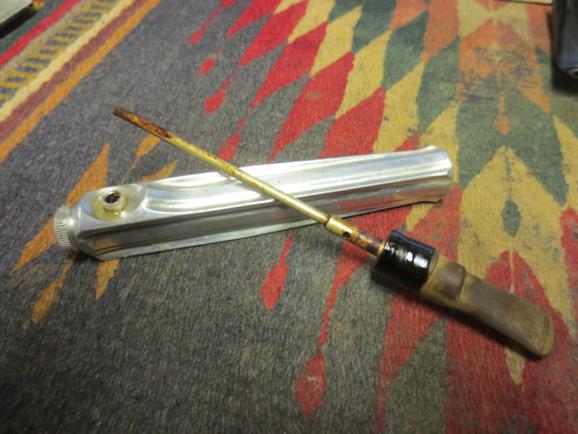
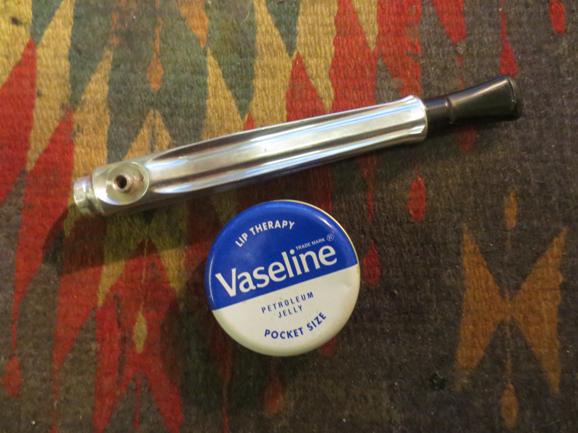
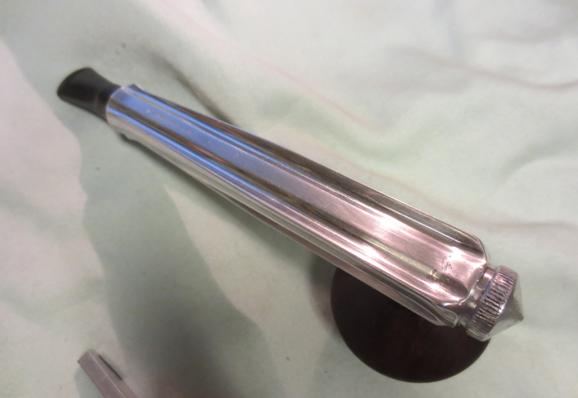
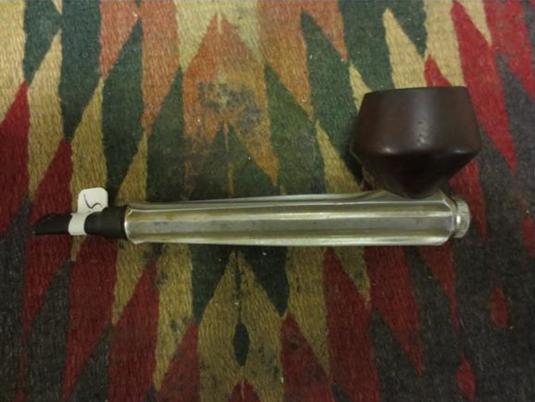
Another pipe from the treasure trove my brother Jeff sent me was an early Kirsten. The metal barrel is stamped Kirsten in script on the left side of the barrel and on the underside it is stamped Pats. & Pats. Pend. – A. When I received it the bowl would unscrew from the barrel and it had no metal cap on the bottom. It was a wooden bowl without the cap which along with the stamping pointed to an early Kirsten. The stem and rod were stuck in the barrel and the adjustable valve on the front of the barrel was frozen solid. The valve had evidently been frozen for some time as someone had used pliers on it to try to remove it. They had left behind the tooth marks of the pliers on the aluminum valve cover. Because of the vulcanite lip on the stem that sat against the barrel that there would not be a rubber grommet between the stem and the barrel. The bowl had a thick, rock hard cake and the bottom of the bowl was not visible to see what the condition of the screw head was like. I have no idea how the pipe man ever drew air through this pipe as the bottom of the bowl was solid. The finish on the bowl was dull and lifeless with no grain visible through the grime. The top of the rim was covered with over flow from the cake in the bowl. It was a large bowl initially so once the cake was gone it would be an inch in diameter.Kirsten1 I looked up information to see if I could find a cut away drawing of the Kirsten and found this one and a bit of history and information on the concept of the Kirsten pipe. The following is from the Kirsten website https://www.kirstenpipe.com/page_pipestyles.shtml and https://www.kirstenpipe.com/page ourstory.shtmlKirsten2 “It is by no means merely puffery to say that Professor Frederick K. Kirsten was a genuine American original. He first sailed to this country in 1902, as a cabin boy from Hamburg, Germany. After successfully rounding the Horn and eluding the shanghai gangs of the West Coast, he navigated the educational system at the University of Washington to become a Professor of Aeronautical Engineering. Here, his inventive spirit took wing. He created the world-famous Kirsten Wind Tunnel, Air-washing equipment for factories, an air-cooled Utopian Bed, and, most notably, a revolutionary propeller which enables boats to stop and turn on a dime. Today, in the same waters where he jumped ship almost 100 years ago, ocean-going vessels are landed by sturdy tugs driven by Kirsten cycloidal propellers, piloted by equally sturdy captains smoking cool Kirsten pipes.”
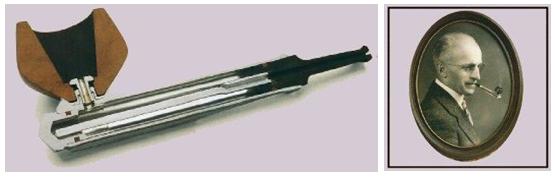
“Rightly called the coolest pipe in the world, this latter innovation came about when a doctor advised Professor Kirsten to switch from cigarettes. He quickly dreamed up a way to trap the moisture, tars and tongue-biting acids which attack the users of briar pipes. After 50 years and counting, Kirsten pipes are still produced by the Kirsten family, faithfully following the basic designs of this father of invention.”

“Professor Kirsten revolutionized pipesmoking by creating the Radiator stem. When tobacco, which is 30% to 60% moisture, is lit in the bowl, it creates steam. As the smoke is drawn through the stem, the steam is cooled and condenses into a liquid. This bitter-tasting liquid is trapped in the stem, along with tars, nicotine and tongue-biting acids.”

“Only clean, cool, moisture-free smoke passes through the intake tube to the mouthpiece. To remove the trapped liquid, you simply remove the valve. You can clean a KIRSTEN in seconds by pushing a tissue through the bore of the stem, exactly as you would clean a gun barrel.”

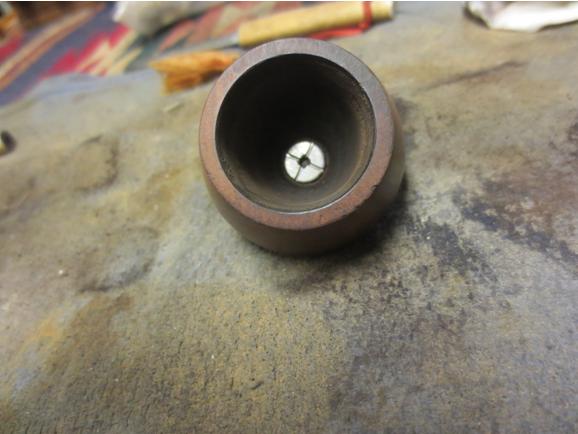
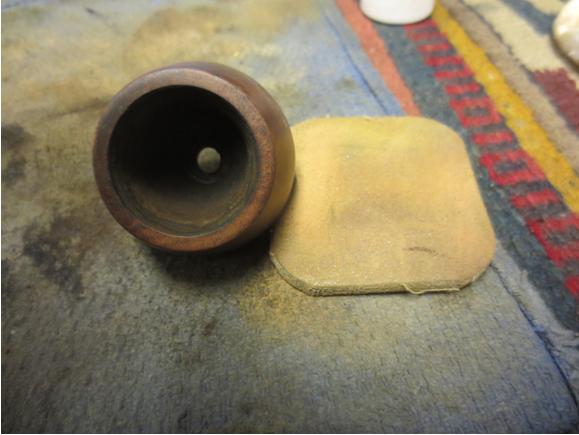
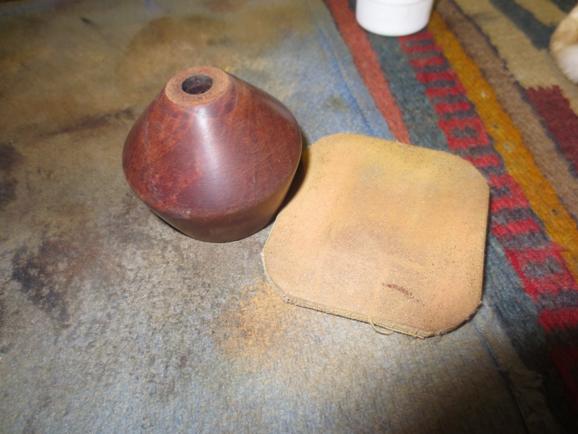
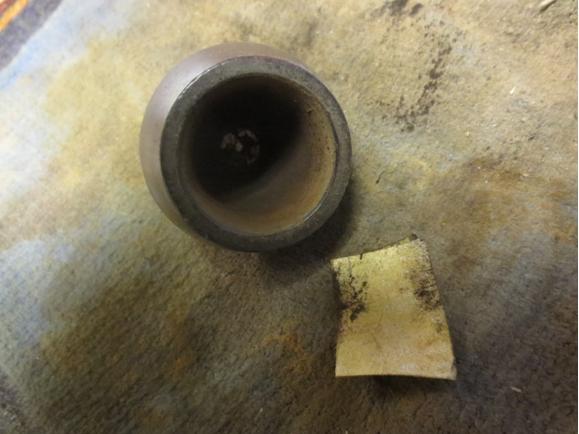
The cleaning in seconds must not have been something that the previous owner of this pipe ever read or understood. I decided to work on the bowl first as it was the only part of the pipe that I could remove at that point in the process. I took the photo below to give an idea of the thickness of the cake and the minimal size of the air hole at the bottom of the bowl. You can see that it is virtually clogged and the airflow would be very restricted.Kirsten3 The lack of a cap on the bottom of the bowl can be seen in the next three photos. The first two photos show the state of the finish. In the second one you can see the grain peeking through the grime on the finish. In the third photo you can see the stamping on the bottom of the bowl. It reads Kirsten Pats Appl For.Kirsten4
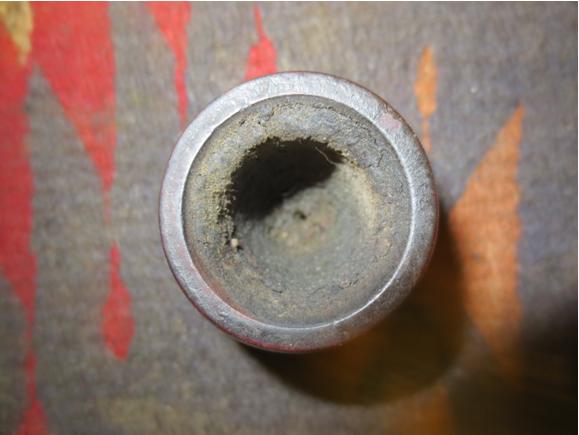
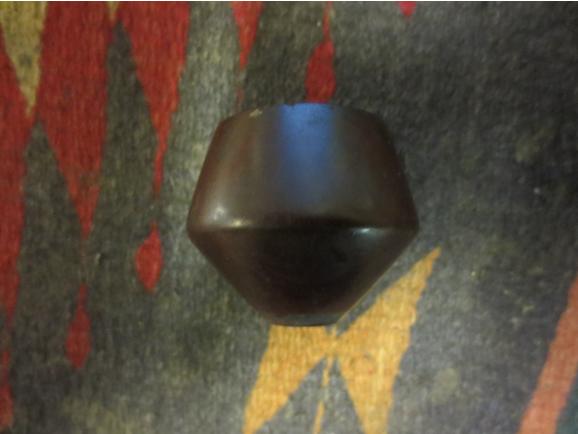
Kirsten5

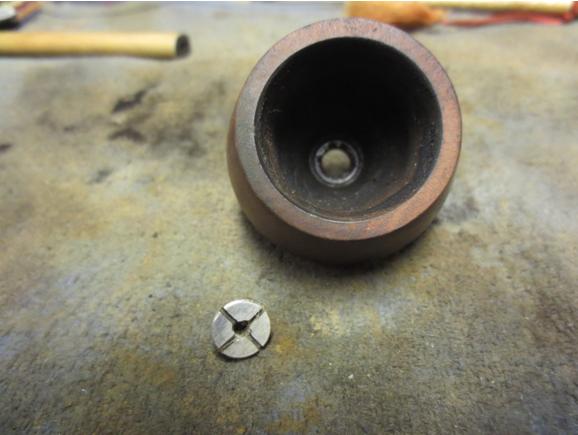
Kirsten6 I put the barrel and stem in an alcohol bath to soak overnight to try to loosen the frozen stem and rod.Kirsten7 I reamed the bowl with the largest cutting head on the PipNet reamer and took the cake back to bare briar. I used a pen knife to work on the bottom of the bowl and was finally able to see the characteristic Kirsten screw. I sanded the inside of the bowl with 220 grit sandpaper and used an ice pick to remove the screw. From the underside of the bowl I inserted the ice pick into the drilled centre of the screw and tapped it gently and the screw came free from the bowl.Kirsten8
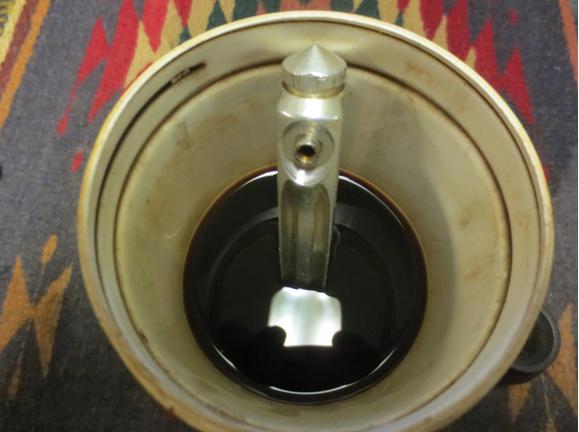
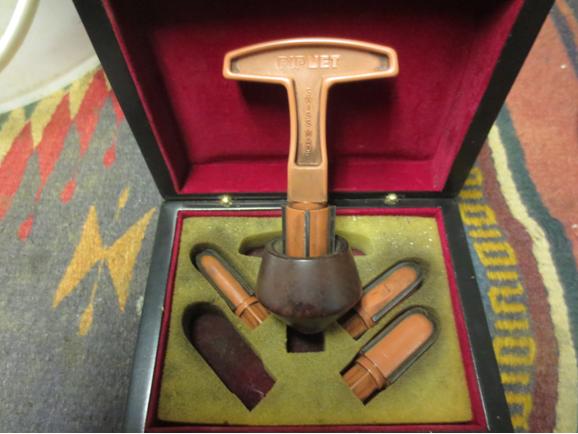
Kirsten9

Kirsten10 I lightly topped the rim on a topping board to remove the damage and the build up on that surface.Kirsten10
Kirsten11

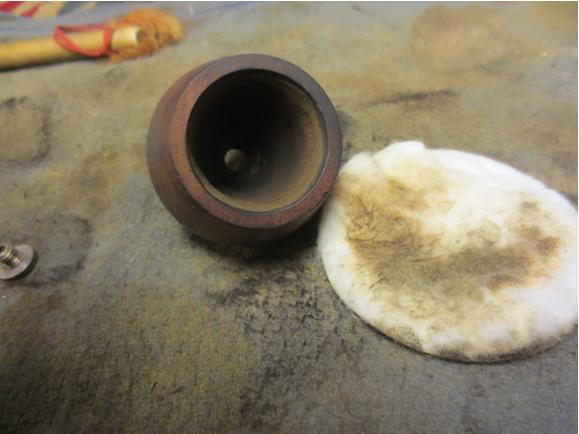
Kirsten12 I scrubbed down the exterior of the bowl and rim with acetone on cotton pads to remove the grime and the remaining finish. I was quite pleasantly surprised by the grain that was revealed in the process.Kirsten13
Kirsten14

Kirsten15 I cleaned the inside and the outside of the screw with a tooth brush and alcohol until it shone.Kirsten16
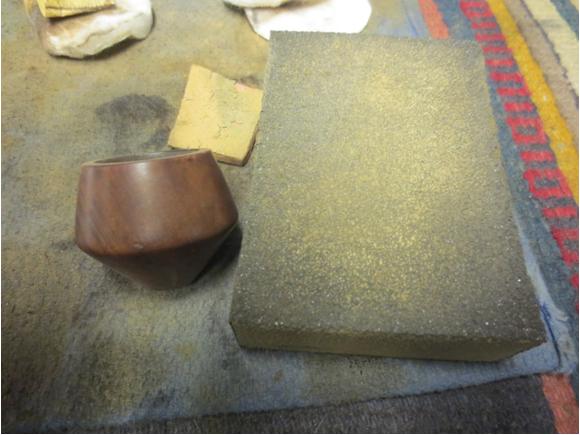
Kirsten17 I sanded the bowl with a medium and a fine grit sanding block to clean up the scratches and smooth out the finish on the sides and top of the bowl.Kirsten18 I wet sanded the bowl with micromesh sanding pads from 1500-2400 grit and dry sanded with 3200-12000 grit pads.Kirsten19
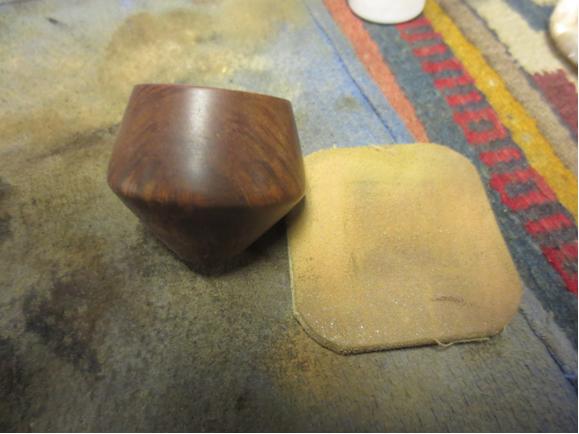
Kirsten20

Kirsten21 I took the barrel out of the bath and put it in a cup of boiling water. I dipped both ends into the boiling water hoping to break one of the frozen ends loose. I was able to remove the stem and the rod assembly after the alcohol bath and the boiling water dip. The stem and the rod were quite brown with the shellac of old tobacco juices. Of course dipping the stem in the boiling water caused the oxidation on the stem to come to the surface.Kirsten22
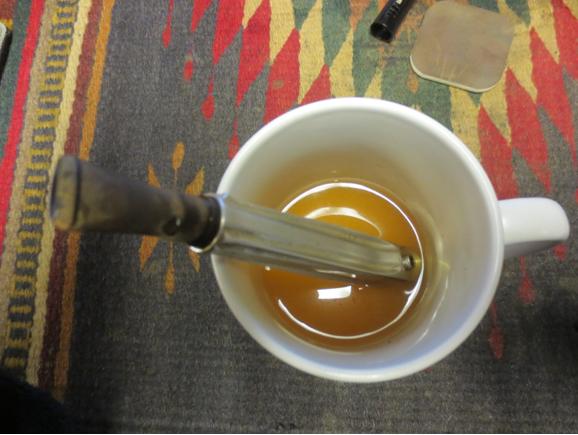
Kirsten23 I scrubbed the rod assembly with 0000 steel wool and alcohol to remove the shellac coat that had built up and polish it. There was some corrosion that came to light at the middle of the rod. I would need to work on that once I had cleaned up the stem.Kirsten24 I sanded the stem and rod with 220 grit sandpaper and then with a medium and fine grit sanding sponge to remove the scratches.Kirsten25
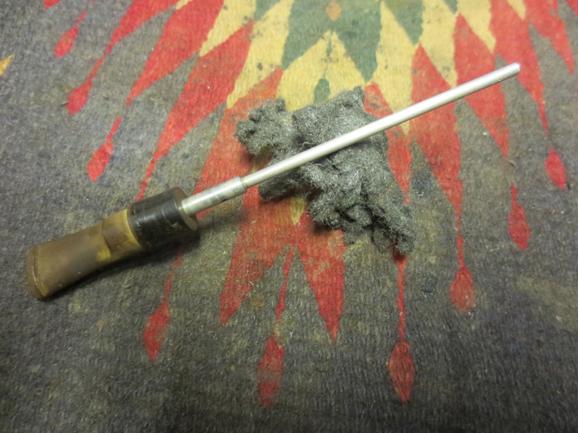
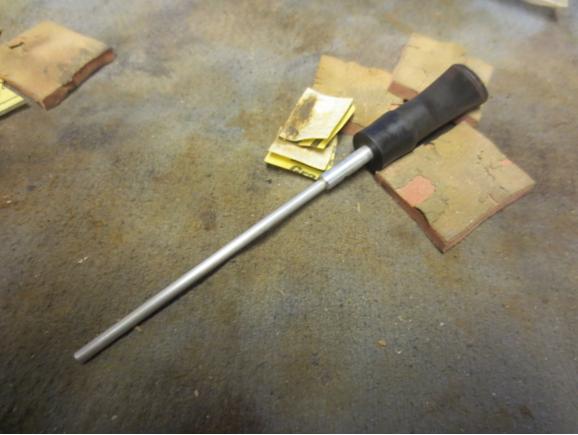
Kirsten26 I worked on the stem and rod with micromesh sanding pads – wet sanding with 1500-2400 grit pads and then rubbing down the stem with Obsidian Oil. The micromesh pads removed the last of the corrosion on the rod and polished it. I dry sanded with 3200-4000 grit pads and gave the stem another coat of oil. I finished sanding it with 6000-12000 grit pads and gave it a final coat of Obsidian Oil. I failed to take photos of the final steps in the micromesh process but it is the typical procedure and each successive grit of pads gave more of a polish to the vulcanite.Kirsten27 I cleaned out the stem and tenon with alcohol and pipe cleaners inserted from both ends. I was able to clean out all of the oils and tars and the cleaners came out clean.Kirsten28 Now the bowl and the stem unit were cleaned, polished and ready to go once I was able to remove the valve from the end of the barrel. This was proving a very difficult task. I had put the barrel in the freezer overnight hoping to loosen the valve – no luck. I had boiled it multiple times – no luck. I had given it several alcohol baths – no luck. I let it sit with penetrating oil in the barrel to try to loosen the valve end. I tried to drive it out with a round end file and a small hammer. Nothing worked. I posted that on rebornpipes and got a response from Old Man in the Cave suggesting that I heat it with a heat gun.
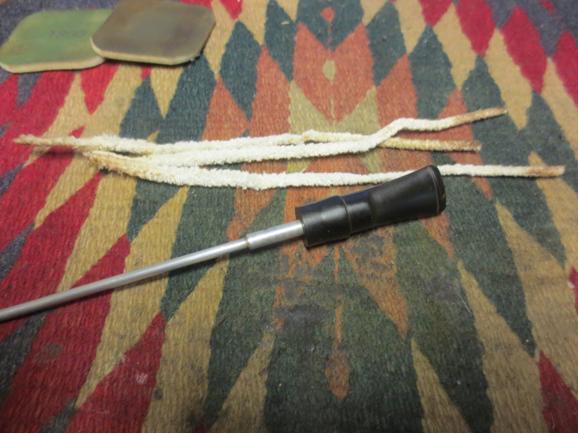
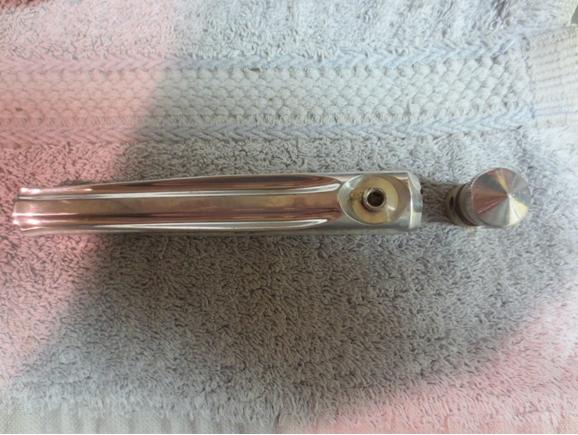
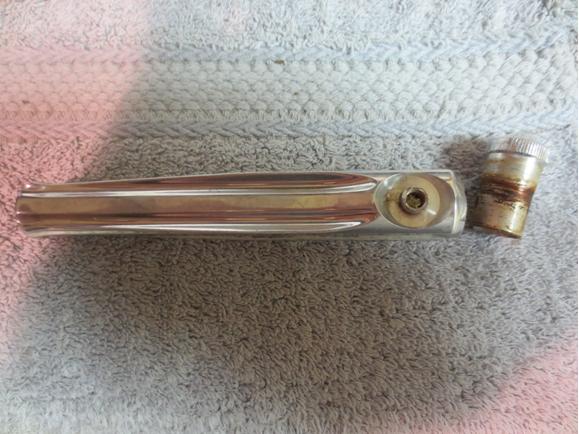
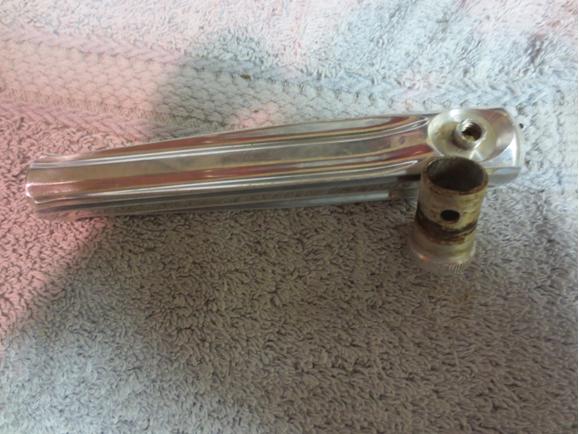
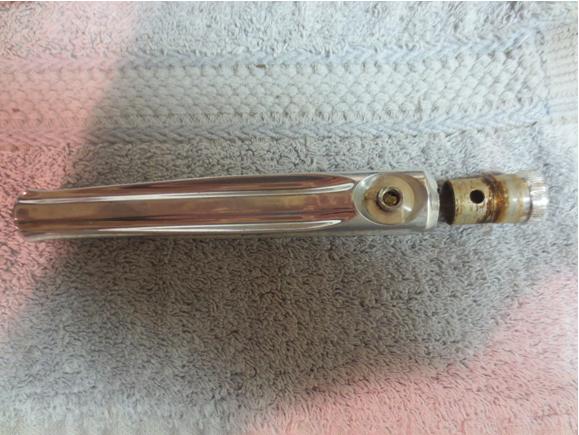
I geared up for the process. He had suggested setting the barrel in a wood vise which is a tool I don’t have yet. I chose instead to hold the barrel with some insulated leather gloves over the heat gun. I heated the barrel with gun until it was hot. Then I used a pair of pliers that had cotton pads on the jaws and gave it a light twist and the valve came free. I don’t know if the heat from the gun finally did what I should have done in the first place or if the combination of methods finally came together and it worked. It does not matter as the valve finally came free. I now know why the later models of Kirsten pipes came with a rubber o-ring around the valve and the stem so that it provided something between the two metal pieces and the barrel. Somehow the combination of tobacco juice and saliva left to sit becomes shellac or lacquer that is almost impossible to break free. Thanks to Old Man in the Cave the valve is free and I could finally clean out the barrel and put the pipe back together. The next photos show the condition of the valve once I was able to remove it from the barrel. You can see the tapered angle of the top portion of the valve (on the right below the cap). The lacquer or shellac that bound the valve in the barrel is also very evident. I am guessing that there would have been much more if it had not been sitting in alcohol and been heated so much. But even that little band held the valve tightly in place.Kirsten29
Kirsten30

Kirsten31

Kirsten32 I scrubbed the valve and the inside of the barrel with 0000 steel wool. I ran the steel wool through the barrel to clean out the build up inside and then used a wooden dowel to push alcohol soak cotton pads through the barrel to clean it until it shone. I cleaned out the inside of the valve with alcohol and cotton swabs. I was able to get everything shining again. It took some work to remove some of the tooth marks that were on the valve end from previous owners who had attempted to turn it but I was able to sand them smooth with micromesh sanding pads. They are still present but not as obvious.

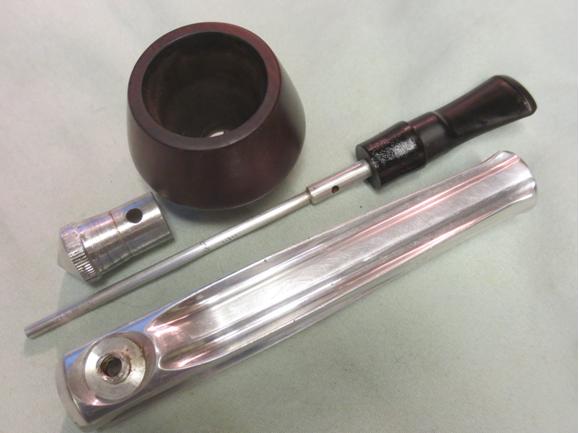
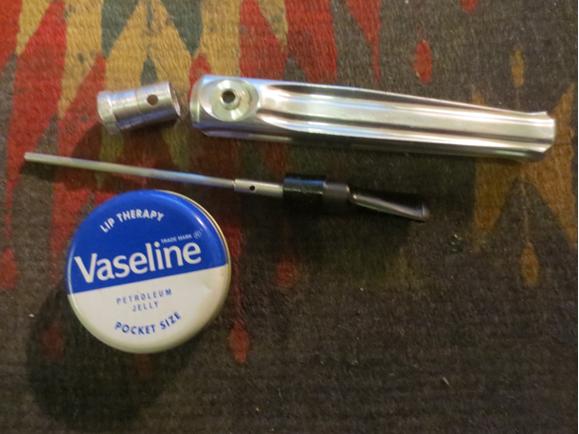
Once all the parts were clean and polished I greased the valve and the end of the stem and rod unit with Vaseline so that it would slide into the barrel with less resistance. I know that it will not stop the buildup of tars but it will at least slow it down. The next photos show the disassembled pipe and then the pipe put back together. The valve turned easily and I aligned the hole in the valve with the hole in the top of the barrel where the bowl screwed in place. The airflow was clear and unrestricted.Kirsten33
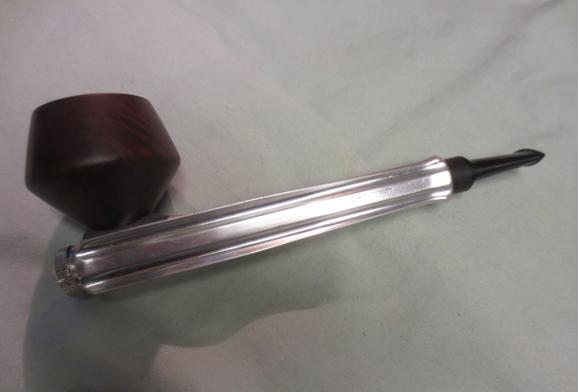
Kirsten34 I hand buffed the barrel with Meguiar’s Scratch X2.0 to remove the scratches and give it a shine. I rubbed on some Conservators Wax and then hand buffed the barrel with a shoe brush. I buffed the briar bowl with Blue Diamond on the wheel and then gave it multiple coats of carnauba wax and buffed it with a clean flannel buff. Once I had finished I screwed the bowl in place and buffed it a microfibre cloth. The finished pipe is shown in the photos below.Kirsten35
Kirsten36

Kirsten37

Kirsten38 I took the pipe apart so that I could take the next two pictures to show the cleaned and polished parts. Everything is once again in working order. It was clear looking at all of the parts that I was dealing with a Generation 1 Kirsten. These were made between the years 1936-1958. The wooden bowl on this generation connects directly to the metal barrel and there is no metal cup spacer. It is a pretty flush fit that goes flat against the barrel. On the underside of the metal barrel it is stamped with one or more of the following “Pat. Appl. For” (1936-38) and “Pats. & Pats. Pending” (1938-1958) over “Made in USA” – S” (or applicable size – S, M, L). There are no O-rings on the bit or metal shank insert.Kirsten39

Kirsten40

A Treasure Box from my Brother in Idaho


Blog by Steve Laug

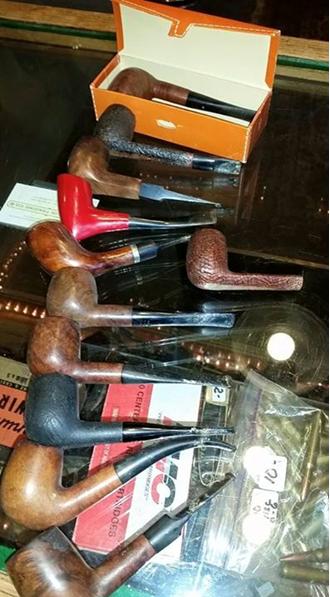
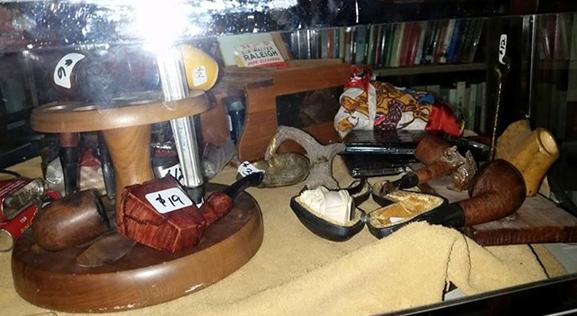
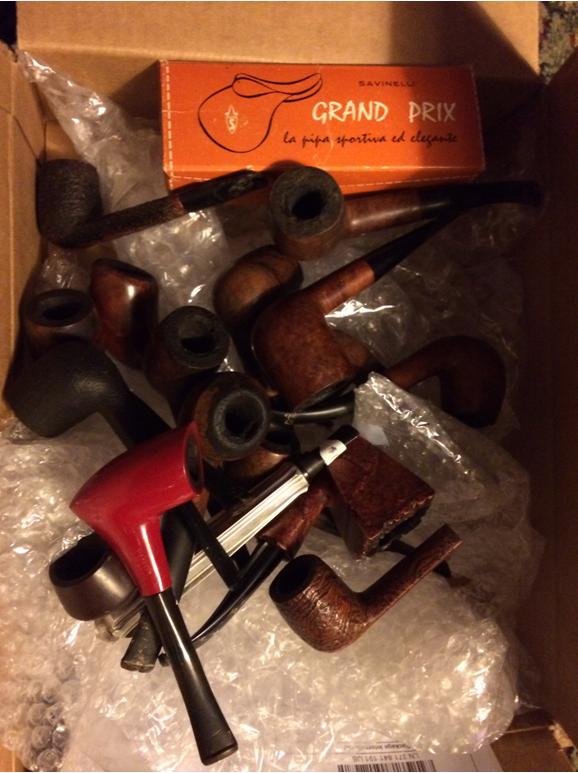
Class1A few weeks ago my brother sent me the next two photos on Facebook Messenger to see I was interested in any of these pipes. You can see from the assortment in the photos that it was a mixed lot. There were some nice looking pipes in the photos and from my first glance I could see a Savinelli, a Dr. Grabow, a Carey Magic Inch or two, a Kirsten and some odds and ends that were unidentifiable. He thought they looked interesting and asked my opinion. My suggestion was to not go with the prices marked on the pipes but to make an offer for the lot. He did so and the pipes were soon on their way to him.

He has been picking up a lot of old pipes lately and sending them to me to work on. I think he likes the hunt as much as I do and dickering for a deal is in our blood. This batch had sixteen pipes in it. The initial offer had been for 14 pipes but the seller threw in the boxy looking freehand and the Kirsten for free so he ended up getting the pipes for around $10 each.

I could not wait to see what was in the box once it arrived beside the ones that I could identify from the photos. Time would tell what kind of deal we got when the pipes arrived.box2 When they arrived in Idaho from the seller in Montana my brother and I spoke on FaceTime and he went through the pipes with me. We had done all right. There were four Cary Magic Inch pipes in various shapes. There were five GBDs – 2 of which were GBD made (bearing shape numbers) shop pipes for what I am guessing is Poor Richards pipe shop in Bozeman, Montana. There were two Savinelli Canadians (one Classica and one Citation). There was one Kirsten with the Patent Applied for Stamping. Finally there was a mixed assortment that included a Chadwick Rhodesian, a Wm Wales Billiard, a Monza horn and a Dr. Grabow Colour Viscount. All of them came with heavily caked bowls and heavily chewed stems. He had made a great connection on this lot – not to bad for $10 a pipe.

He packaged them up, wrapping each one in bubble wrap and sent them to me in Canada. When the package arrived I was pretty stoked to open it and see the pipes up close. I unwrapped each from the bubble wrap and took a photo of the haul. It is not often that I get a box of pipes like this in the mail. I was like a kid opening a Christmas present. The seller had also included the empty Savinelli Grand Prix box in the package. It was in perfect shape but sadly did not have the pipe included.box3 I took the pipes out of the box and set them up in groups to photograph them. I wanted to see each group together to see the general trend in shapes. It was interesting to me to note that each group probably came from separate pipe smokers. Here are my initial observations. I will add more as I work through the pipes in the various groups.

The Carey pipes had stems that were full of tooth marks and chatter but were all salvageable and were all original stems. I think the Carey pipes all came from the same pipe man.

The GBD pipes were the worst of the lot. They had seen a lot of use and the smoker had been a chomper! All had replacement stems that were poorly done, not one original GBD stem in the lot. Not one of them actually fit the shank correctly or matched the diameter of the shank. All of them were gnawed to the point of non-return and would need to be replaced. The state of the bowls was another issue – all of them had a thick cake and tarred rims. I believe this lot came from the same pipesmoker.

The Savinelli Citation had the same kind of damage as the GBDs and the same kind of lousy replacement stem that was gnawed to the point of no return – same pipesmoker. The stemless one was in great shape and had not been in the hands of the GBD man or it would have looked worse for wear. The Kirsten stem was very clean with no damage. The bowl had a thick cake and looked like had never been reamed or cleaned but it was otherwise in very good shape.

The assorted lot had fared far better and the stems on all of them were in good shape. These and the Kirsten probably all came from assorted pipesmokers and did not seem to be connected to the other two large groups above. The Chadwick was in rough shape with rim damage and dented stem. The Wm Wales was in decent shape. The Monza was a mess and may have come from the GBD pipe smoker. The stem was a replacement and gnawed beyond repair. The shank was cracked and the bowl heavily caked. The Grabow was in really good shape – the painted finish was in excellent condition and the stem other than being overclocked was clean with minimal tooth chatter. I have described in more detail each pipe per group according to the photos that follow.

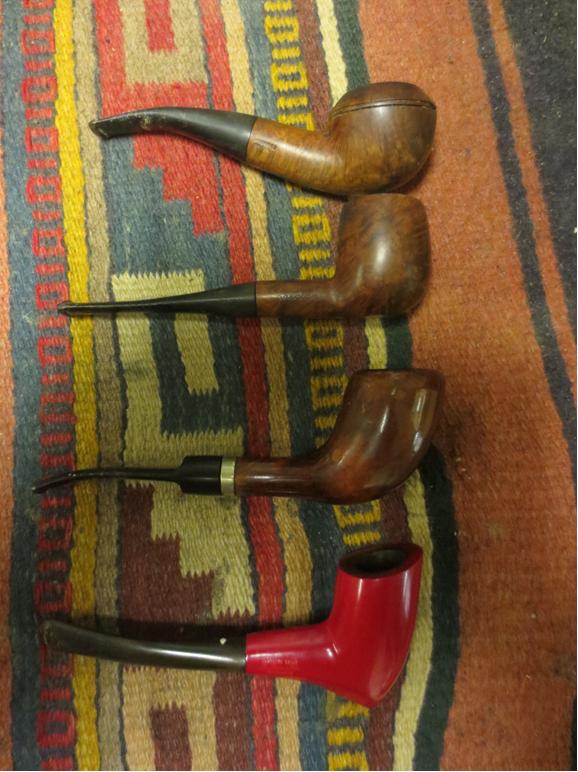
The first photo below shows the Carey Magic Inch pipes. From top to bottom they include the Freehand, a small Apple and a large Apple all bearing Patent number stamps. The last one is a newer finish that is available on the Carey website and it in decent shape. The pipes are stamped as follows according to the order in the photo.

The first pipe is a Freehand and is stamped Carey over Magic Inch over Pat. No. 3267941 on the left side of the shank. On the right side it is stamped Mediterranean over Briar Israel. It was in the best shape of the Carey pipes. The stem had tooth chatter and was dirty. The briar was dirty and the bowl caked but it would clean up nicely.

The second pipe is a small Apple shaped pipe and is stamped Carey over Magic Inch over Pat. No. 3267941 on the left side of the shank. On the right side it is stamped Grecian in block letters. This one is dirty and the stem had tooth chatter and bite marks. When I removed the stem it also has a Papyrate filter in place on the reverse tenon.

The third pipe is a larger Billiard shaped pipe and is stamped Carey over Magic Inch over Pat. No. 3267941 on the left side of the shank. On the right it is stamped Grecian in block letters. Like the one above it is dirty and the stem is covered with tooth chatter and some tooth marks.

The fourth pipe is the newest one in the lot and is a small Billiard. It has a light sand blast finish and is stained a dark brown/black matte. On the underside of the shank it is stamped Carey over Magic Inch over Pat. No. 3267941 and next to that toward the stem it is stamped Grecian in block letters. The condition of this one is the same as those above. The stem is less worn than the others but still has tooth chatter.box4 The next photo below shows the GBD pipes. From the top to the bottom of the photo they are stamped as follows.

The first pipe is stamped Poor Richards on the left side and Made in London England with a 201 shape number on the right side. The shape number is next to the stem and on the left of the Made in London stamp. The 201 shape is a GBD large billiard. The briar is in decent shape and the stem is obviously a replacement. It is almost as if the previous owner just stuck a stem in the shank to keep smoking it.

The second pipe is stamped GBD in a oval above International over London Made on the left side of the shank. On the right side it is stamped London England in a line over the shape number 508. The bowl has the faux plateau rim that was on some of the Internationals that I have cleaned and restored. The stem is the best of the replacement stems and is the correct shape for this number pipe. It is damaged and will need to be cut back or replaced.

The third pipe is stamped GBD in an oval with London Made arched underneath following the curve of the oval on the left side of the shank. On the right side it is stamped with the circular com stamp – Made in London that I have seen on Comoy’s pipes and Cadogan era GBDs. Next to that is stamped the shape number K9436. I am not sure what the K preceding the shape number means as I have not seen that before. The 9436 was a straight billiard that had a round saddle stem originally. The finish is dirty and the poorly made replacement stem is chewed beyond repair.

The fourth pipe is stamped GBD in an oval over International over London Made on the left side of the shank. This international is a traditional billiard shape with a flat rim. The right side of the shank is stamped London England in a line over the shape number 9436 – the same shape number as the third pipe in the batch. This too has a poorly made replacement stem that will need to be replaced.

The fifth pipe is stamped Poor Richards over Select over Bozeman Montana on the left side of the shank. On the right side it is stamped London England in a line over the shape number 9489 which is a GBD square shank billiard. This also has a poorly made replacement stem that is gnawed beyond repair and will need to be replaced.box5 The next photo below shows the two Savinelli pipes, both were shape 812 which is a the Savinell shape number for a Canadian. The first is stamped Citation and the shape number on the underside of the shank and the second is stamped Classica with the Savinelli Shield and Made in Italy and shape number on the underside of the shank. Both of these were in decent shape. The stem on the Citation was a poorly fitted replacement that was also gnawed beyond repair.box6 The next photo below shows a Kirsten pipe that is evidently an early one. On the metal barrel it is stamped Kirsten in script on the left side and on the underside it is stamped Pats. & Pats. Pend. – A. This dates it as early in the Kirsten manufacture. The stem and the end valve are both frozen in place. The bowl is removable and does not have a metal plate on the underside.box7 The last photo below shows the assorted group of pipes. They are as follows from top to bottom in the photo.

The first pipe is a Rhodesian and is stamped Chadwick in script on the left side of the shank. On the right side it is stamped Imported Briar. The stem is full of tooth marks but is reusable. The bowl is heavily caked and had damage to the rings on the front of the cap.

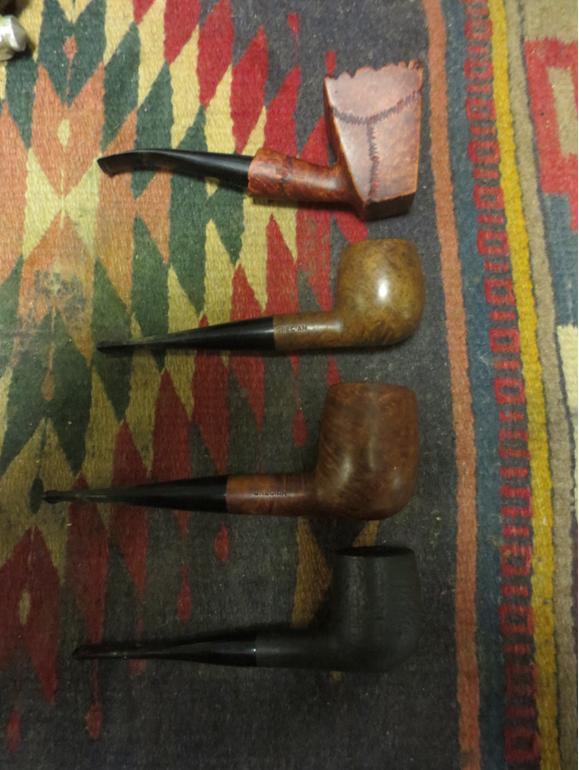
The second pipe is a billiard and is stamped Wm Wales in script on the left side of the shank and Grecian in script on the right side. The stamping of Grecian is similar to that on the Carey pipes that bear that are also stamped Grecian but in block letters. Not sure of the manufacturer of this one. The stem is in decent shape and is repairable.

The third pipe is stamped Monza over Tinderbox and Italy on the left side of the shank. The stem is chewed beyond repair and the shank is cracked. The finish is in rough shape and is coated in glossy urethane.

The fourth pipe is a Dr. Grabow and is in good shape. The finish and the stem are excellent. The overclocked stem should be easy to fix. It is stamped Dr. Grabow over Adjustomatic on the left side of the shank.box8 This was going to be an interesting batch of pipes to clean up and repair. I have already repaired and posted the clean up and restoration of the Chadwick, the Monza, the Grabow, the Classica and the Citation Canadians and the Carey Magic Inch Freehand on the blog. I am in process of restoring the Kirsten. The bowl is finished and the stem removed and polished. The metal barrel is soaking to hopefully make the removal of the end valve possible. That means I have 9 more pipes to finish. Keep an eye on the blog to see the restoration of the rest of the lot. Who knows maybe I will finish these before I get another lot to restore.

Peterson Supreme XL90 (1998) Review


By Al Jones

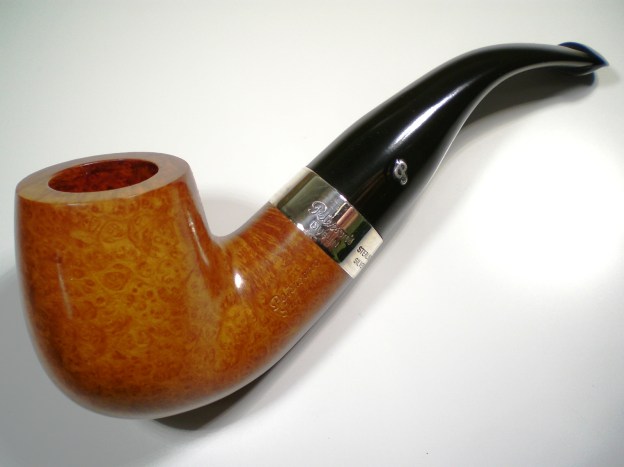
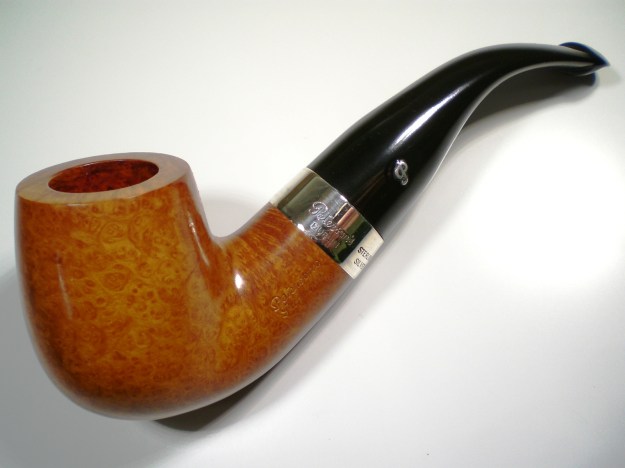
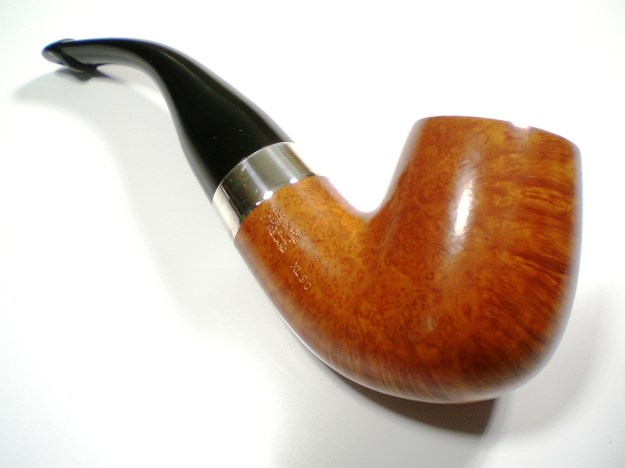
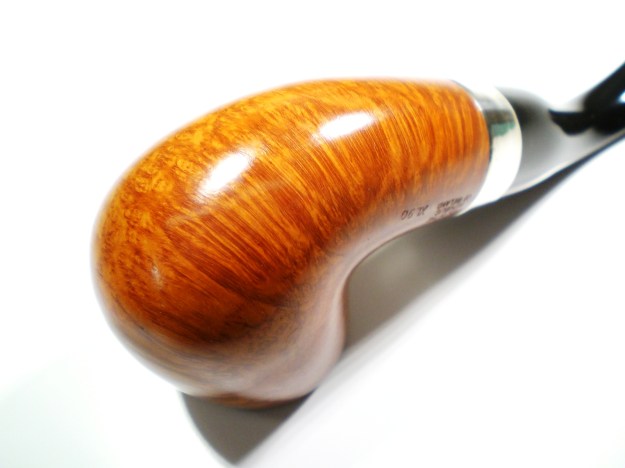
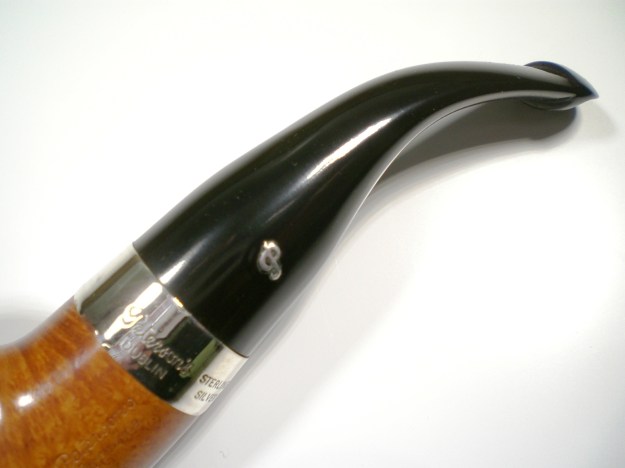
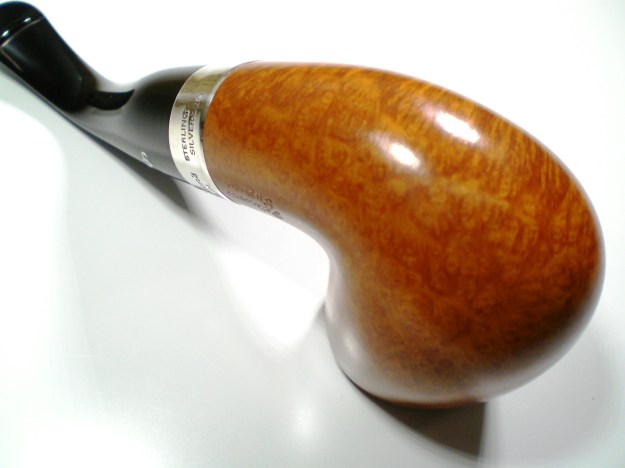
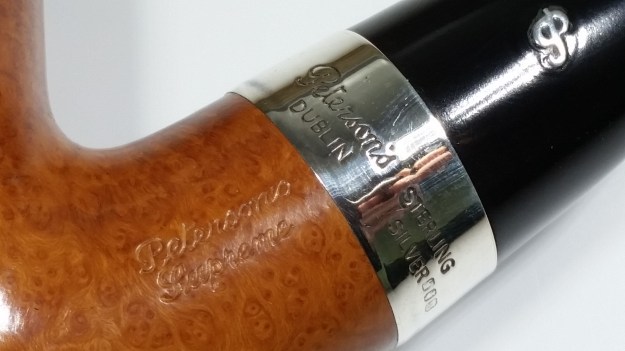
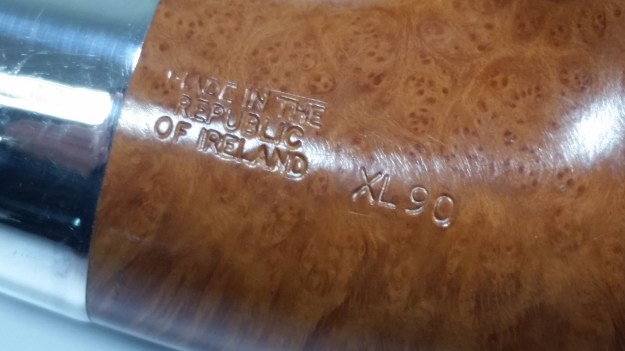
Last year, thru his “Peterson Pipe Notes” blog, Author Mark Irwin introduced me to the Peterson 9BC shape, which has become one of my favorite brand shapes. Since then, I have acquired two pre-Republic 9BC’s for my collection (a Kapruff & Premiere Selection). I’ve always appreciated the XL90 shape, but I didn’t realize the connection to the 9BC. Mark listed this one on eBay and described the shape as a predecessor to the 9BC. This unsmoked, Supreme grade pipe will be featured in his upcoming Peterson book as an example of that shape. I typically see the XL90S, with a saddle stem. My preference is a tapered stem and being as this one was a Supreme grade, made it even more desirable.

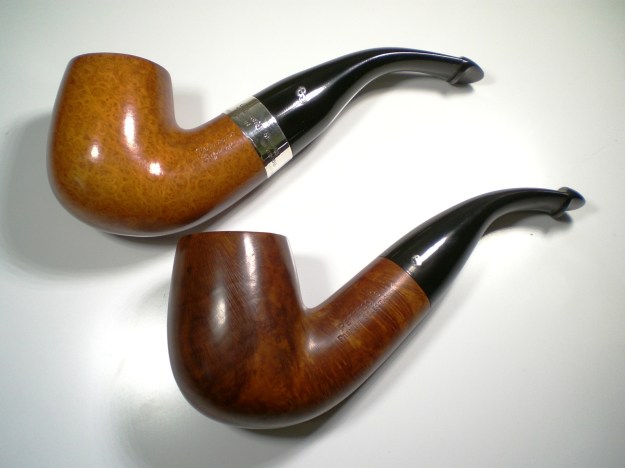
Here is the pipe pictured above my 9BC Premiere Selection. The shape is nearly identical with the modern Supreme having a slightly “wasp-waisted” stem at the bend. At 70 grams, it weighs 4 grams more than the Premiere Selection.

Peterson_XL90_Supreme_1998 (8)

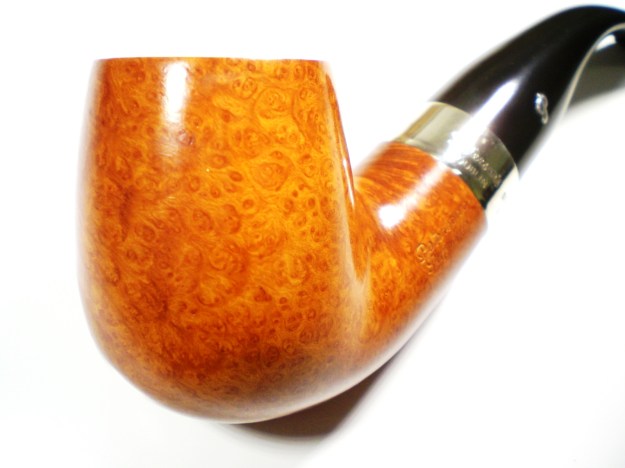
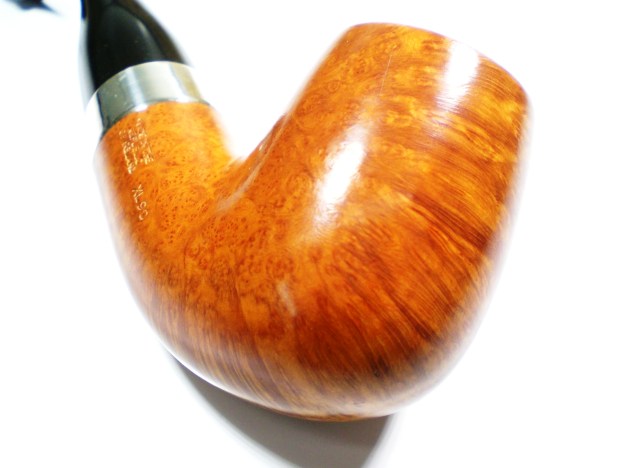
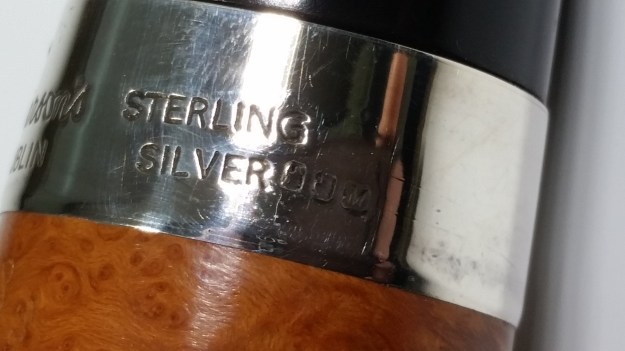
I didn’t find much information on the Supreme grade and I was only aware that it was a high grade Peterson. Many also come with gold bands, but I find those pipes a trifle too much. This pipe has a hallmarked silver band and a silver P stem emblem. The pipe has some very nice grain and of course is without fills or flaws. Mark has told that more information about the history of the Supreme line will be in his upcoming Peterson book. He did share with me that the grade was introduced in the early 1950’s then disappears from catalogs until the 1970’s. Only a small percentage of Peterson pipes are good enough to be graded “Supreme”. You’ll have to read the book to find out more. I’m thrilled to have my first Supreme pass thru Marks hands. The pipe was in the condition shown below and all that I did was buff the stem with some automotive plastic polish (Meguiars) which I feel adds a deeper shine and helps ward off oxidation

Upon delivery, my wife wrapped the pipe which was destined to be my Christmas gift. I was able to take a little time from our busy Christmas day to enjoy a bowl of My Mixture 965 in the pipe. Thanks Mark for such a wonderful addition to my collection!

Peterson_XL90_Supreme_1998_Gallery

Peterson_XL90_Supreme_1998 (4)

Peterson_XL90_Supreme_1998 (3)

Peterson_XL90_Supreme_1998 (5)

Peterson_XL90_Supreme_1998 (6)

Peterson_XL90_Supreme_1998 (2)

Peterson_XL90_Supreme_1998 (7)

Peterson_XL90_Supreme_1998 (9)

Peterson_XL90_Supreme_1998 (10)

Peterson_XL90_Supreme_1998 (11)

Peterson_XL90_Supreme_1998_Gallery

Taking a Swing at Reconstructing and Refurbishing an old CPF Meerschaum Bulldog


Blog by Steve Laug

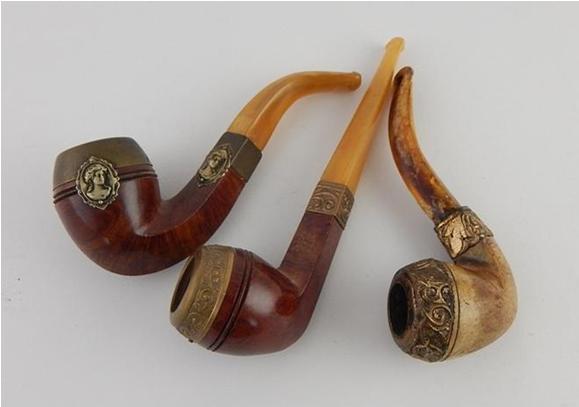
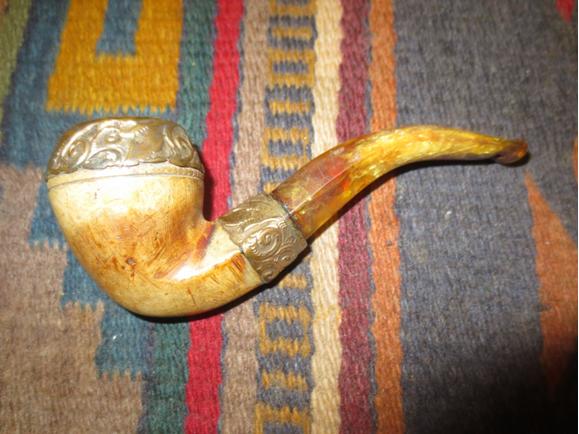
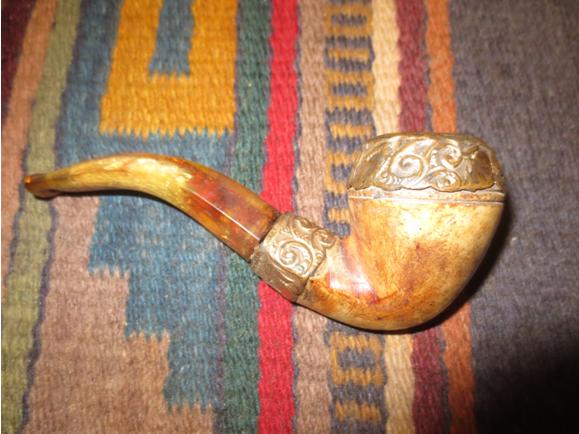
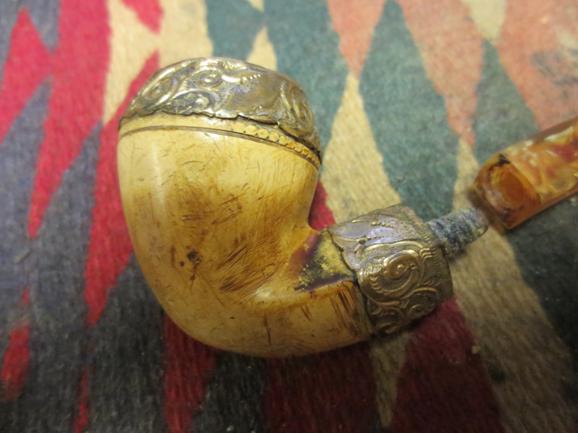
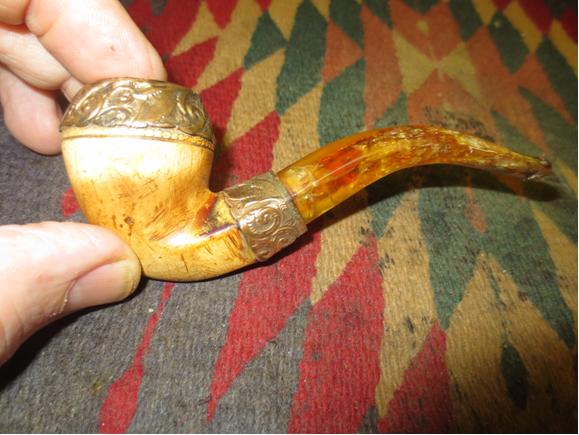
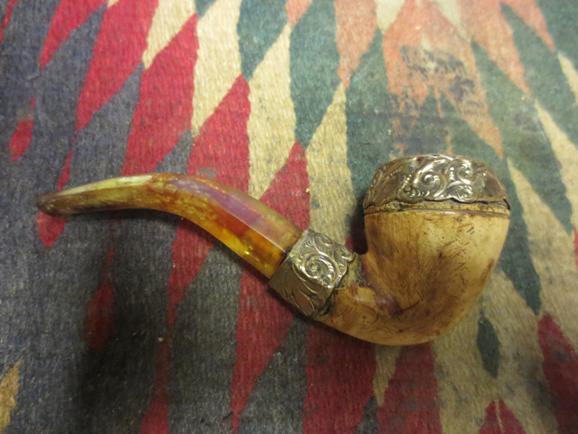
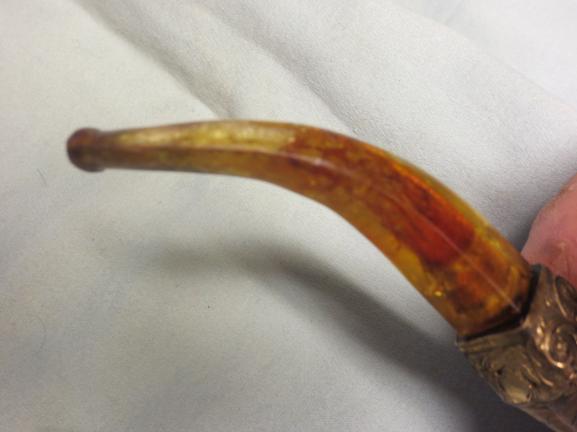
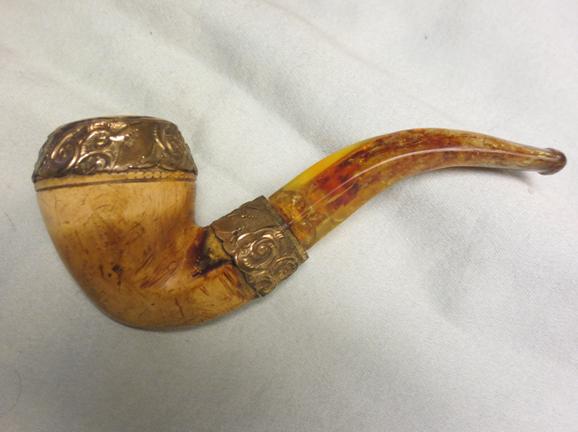
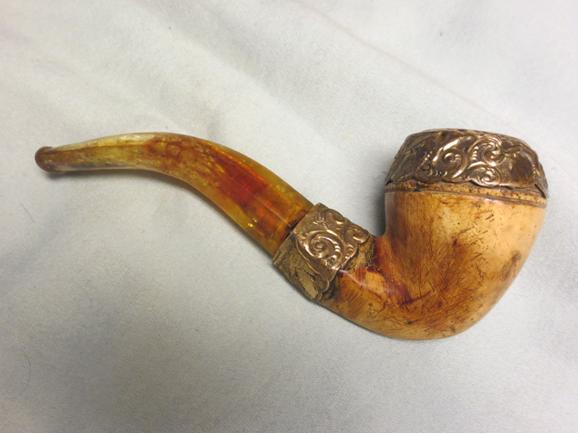
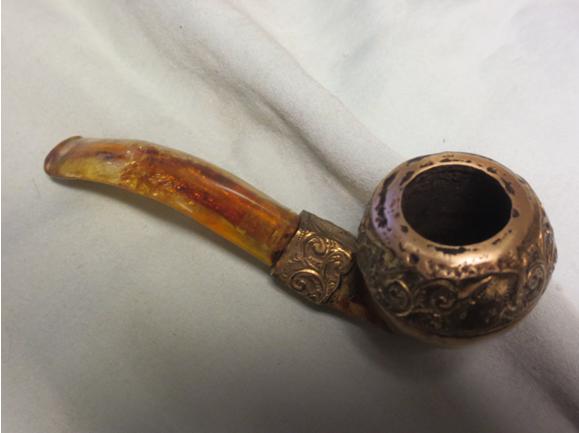
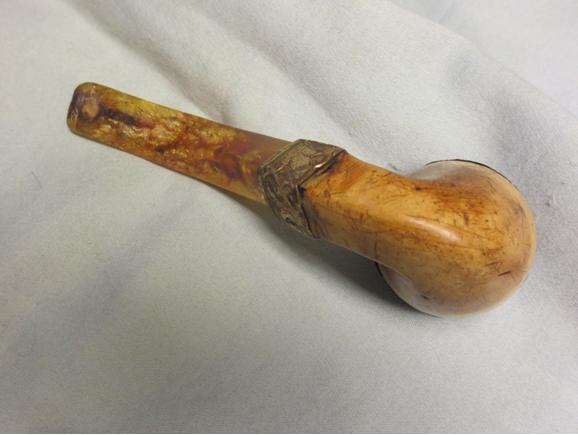
In a previous post where I wrote about repairing the overturned stem on the CPF Bulldog for Michael I referred to a Meerschaum Bulldog that he sent to me as a gift project. I had no idea what he meant about that until I took it out of the box and started checking it out. It really was a rescue dog operation. It is shown in the photo below (the pipe on the right). The picture does not show half of the story about the state of the old stem.CPF1 When the pipe was unwrapped what met my eye fit well with Michael’s “take a swing at it” approbation. It was in rough shape. The Meerschaum bowl was scratched and dirty and the bling was worn and tired. The rim was pretty beat up with dents and scratches but the bowl was solid. There was a light cake in the bowl and that was a plus, as it could have been heavily caked and have a clogged airway.

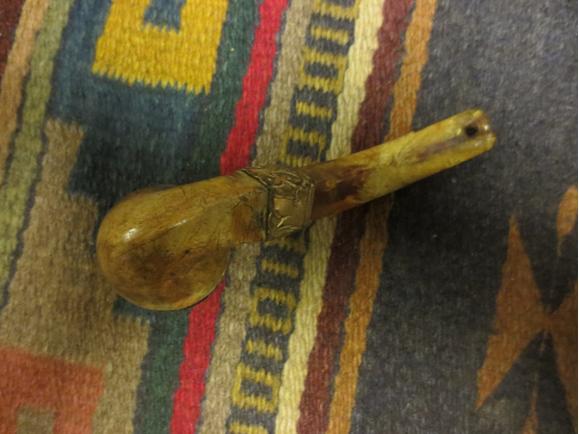
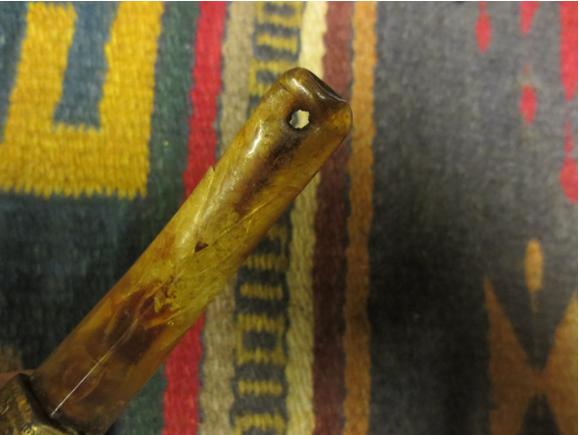
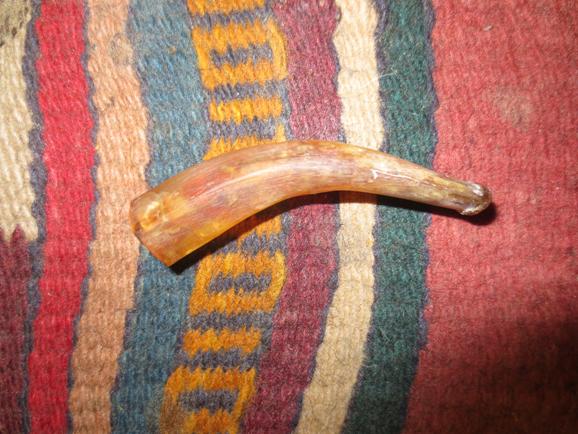
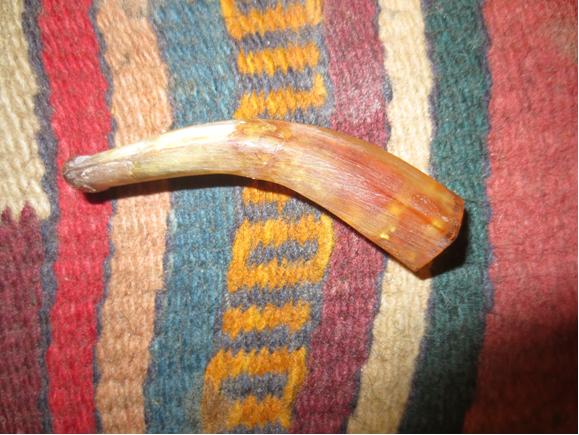
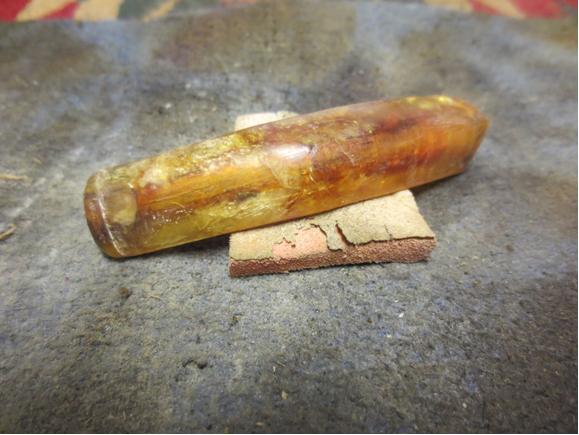
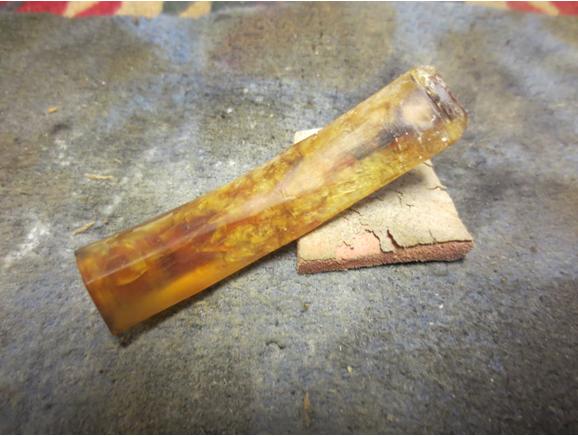
The worst part of the entire pipe was the stem. I am pretty sure it is not amber – at least it does not feel like amber or even have the weight of amber. I am guessing an early version of Bakelite but I am not sure. It is almost fibrous like material – reminds of fibre glass. Somewhere during its lifetime the stem had crazed and cracked all through from one end to the other. It looked like fractured glass. It was barely holding together. There was nothing hold it onto the shank but tars, oils and what seemed like thread that was wrapped around the dirty tenon. I carefully lifted the stem off the tenon and laid it aside. The tenon was covered with a thick tarry substance and what appeared to be thread. I am pretty certain that the previous owner had glued the threaded tenon into the shank and I would never get it loose. Here are a few photos of the pipe, carefully taken so as not to further damage the stem.

I am a sucker for these old timers. This was obviously someone’s beloved pipe. There was a time when I thought a badly abused old pipe was a sign of lack of care. I have come to understand that it is not that at all. It was someone’s constant companion through the good and the bad times. It was one that was always close at hand – to my thinking it may well of road along wherever the pipeman went in the course of his day and was always ready to be loaded and fired up. It is a small bowl so it would not have been a long smoke but it was one that he obviously enjoyed to the point that the pipe was worn and repaired and worn more and repaired more. His repairs were just enough to make the pipe smokeable again but not to make it beautiful. I wish it could talk and tell its story. It lived through two World Wars, the Wright Brothers and the birth of air travel, the first man on the moon, space shuttles and microcomputers. It has seen the turn of two centuries and still survives. Those are the things that I think when I look at a tired old pipe now. I can’t help but wonder about the fellow who once held it in his hands. My repairs are dedicated to carrying on his legacy in this pipe.CPF2

CPF3

CPF4

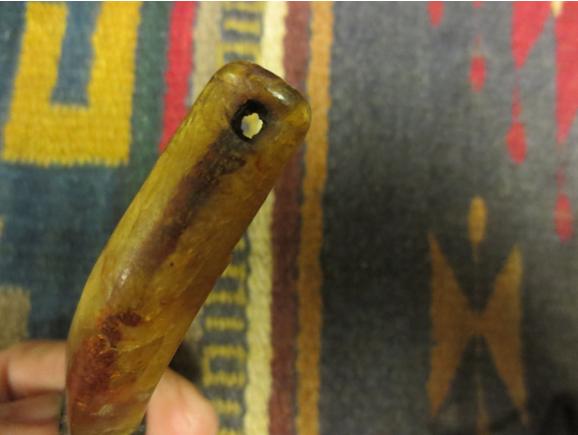
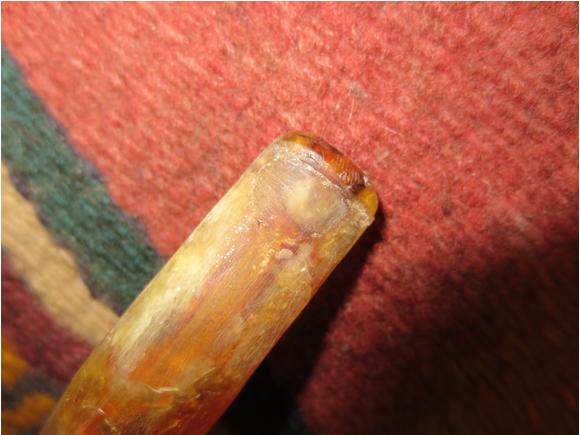
CPF5 If you are observant you will have noticed the black circular mark on the stem on both sides at the button. That black mark was a large hole, a bite through. That was another thing about the stem that made me pretty certain that it was not amber. I took a close up photo of both sides of the stem to show the size of the hole. It is quite large and centered on both sides. The button was also quite worn down and the slot had been opened leaving the top and bottom of the button very thin. You can see all of the cracks and crazing in the stem material in both photos. The airway and the area around the holes were black with tars. This old pipe was not stopped by the holes in the mouthpiece; the pipeman just moved it deeper into his mouth and carried on smoking his favourite pipe.CPF6

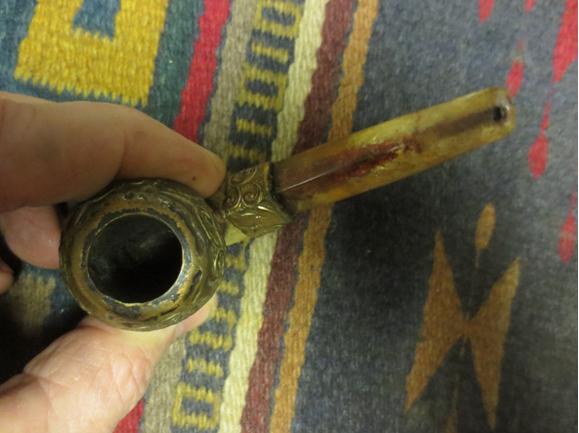
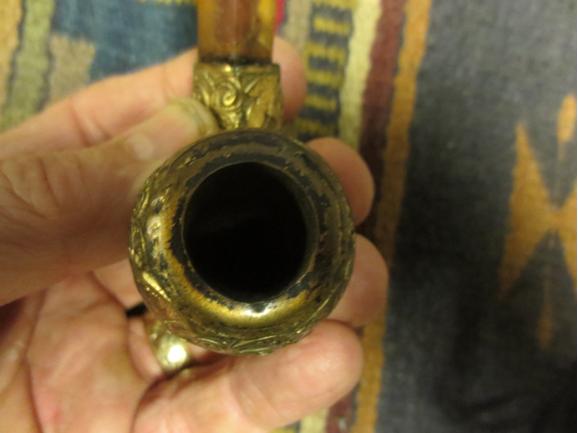
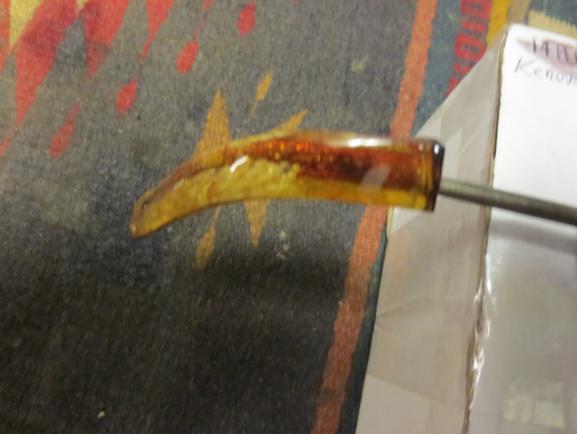
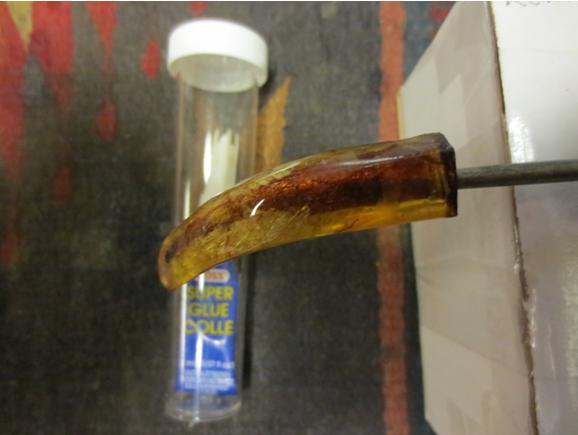
CPF7 I took a close up photo of the rim to show the dents and darkening on the metal cap. The ornamentation on the top the rim was worn down from many years of a thumb rubbing over the top of the bowl and leaving behind the remnants of what must have been a continuation of the pattern on the sides of the cap.CPF8 I decided to deal with the issues in the cracked and crazed stem. It was rough along the edges with what looked like splinters. I carefully worked to stabilize the stem material with clear super glue. I liberally coated the outside of the stem with clear super glue, filling the cracks and chipped areas and smoothing out the surface with the clear gel. Once I had it coated well I set it aside and let it harden. I have used the super glue before on Bakelite and it does a great job getting into the cracks and crevices in the material and hardening and preserving the original material. Once it was covered in the glue I had to figure out how to allow it to harden without sticking to everything it touched. I decide to put an ice pick in the airway and lay it across a box – suspended above the work top until it dried.CPF9

CPF10 After the stem had been sitting for four hours and the glue had dried to touch, I decided to “take a swing” at repairing the bite through issue on both sides of the stem. I cleaned the hole and the airway with a cotton swab and warm water to remove the oils and tars. I wanted a clean surface for the patch. I sanded carefully around the hole to roughen the surface to give the patch something to bond to. Then I greased a thick pipe cleaner with Vaseline and pushed it into the slot in the button. I wiped the edges around the whole so there was no grease on them. I put the first coat of super glue on the hole on the underside and sprayed it with an accelerator to harden the first coat of the repair. I repeated the process on the top of the stem until both sides were repaired with the first coat. I removed the pipe cleaner and set the stem aside to cure. The photos below show the process of the repair to the hole. You can see from the photos that the holes patched pretty nicely. They are rough but they are no longer holes. I will need to do a lot of sanding on the stem to clean up the patches and reshape the button but it will be usuable.CPF11

CPF12

CPF13

CPF14

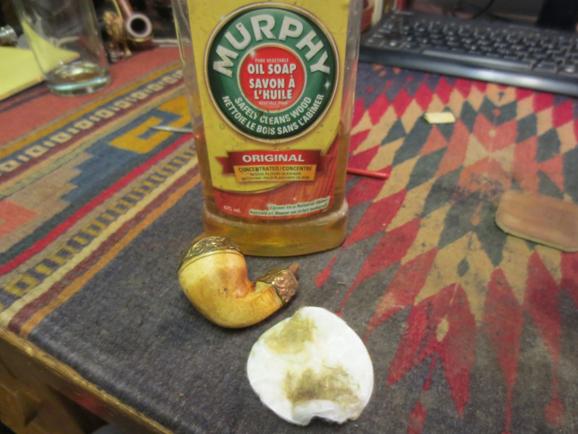
CPF15 After about an hour I gave it a second coat of glue on top of the repair and set it aside to cure again. While the repaired stem cured I went to work on the bowl. I used a pen knife to carefully scrape out the light cake in the bowl.CPF16 I cleaned out the rings around the bowl with the pointed end of a round needle file. I wanted to get the gunk out of the rings before I scrubbed the surface of the bowl.CPF17 I scrubbed the bowl with Murphy’s Oil Soap on a cotton pad remove some of the grime and clean up the exterior of the bling.CPF18 I used a cotton swab to soak alcohol around the threads of the bone tenon. I was able to pick out some of the thread that had been used to hold it in place. I am hoping that repeated alcohol applications will loosen the tenon so that I can unscrew it from the shank to do a thorough cleaning.CPF19

CPF20 The repeating swabbing with alcohol did not loosen the tenon at all. I think that the previous owner must have glue it in the stem and just pressure fit the stem onto the tenon. I had to come up with a different way of getting the stem to fit the tenon as the threads on the inside of the airway in the stem were worn and the stem just wobbled now that it was clean.

I examined the inside of the cleaned and restored stem and could still see the threads. I thought of trying cork and wrapping the tenon with that but after trying that it was too thick to fit into the stem. I then thought of wrapping the end of the tenon with thread and then coating the thread with wood glue. I tried that and it worked well. I was able to twist the stem onto the tenon and the threads in the stem worked into the glue and thread mixture on the tenon. The fix was a success.CPF21

CPF22

CPF23 I sanded the stem with 220 grit sandpaper to smooth out the repairs. I took down all the high spots and bumps left behind by the super glue. I recut the edge of the button on both sides of the stem with a needle file and then sanded the hole repairs on both sides to blend them into the surface of the stem.CPF24

CPF25

CPF26

CPF27 I reworked the button with files and cleaned up the slot with files as well. Once I had the look right I sanded the stem with a medium and a fine grit sanding sponge. The crackle in the stem material where all the crazing was and now the glue bonding it together gave the stem a bit of a sparkling look. An added benefit of the crackling look was that the patched holes at the button blended in quite well.CPF28

CPF29 I screwed the stem in place on the bowl and took a few photos to see what the finished look was going to be like. The repair makes the material sparkle. I really like the look that is coming together. I still needed to polish the stem with the micromesh sanding pads but you can see the finished pipe taking shape.CPF30

CPF31

CPF32

CPF33 I sanded the stem with micromesh sanding pads to raise the shine in the material. I wet sanded it with 1500-2400 grit pads and gave it a coat of Obsidian Oil. It would not absorb but it would give some traction to the next grits of micromesh. I dry sanded with 3200-4000 grit pads and gave it another coat of oil. I finished with 6000-12000 grit pads and applied several coats of carnauba wax to the stem by hand and hand buffed it with a microfibre cloth.CPF34

CPF35

CPF36 The wax on the stem, polished by hand gives it warmth and a glow that is beautiful. The repairs to the bite through on both sides of the stem blended in quite well do to the crackling of the stem material. All combined the stem came out quite well considering where I started with it in this process.CPF37

CPF38

CPF39

CPF40 I sanded the bowl with micromesh sanding pads to give it a shine. I decided to leave the scratches and dings in the bowl as it adds character to the old timer and are part of its long history as someone’s favourite smoking pipe. I can almost see the old pipeman putting the pipe in his pocket and heading off to work or for a walk. It certainly was not coddled like a pampered thing that wisdom of the age taught about meerschaums. No white gloves or careful handling this pipe saw much in its long life and carries the scars and marks of the journey. Now it is good to go for the next portion of its journey, one in which it will have a bit easier life.CPF41

CPF42

CPF43

CPF44

Comoy’s 1992 Christmas Pipe Restore & Gift


By Al Jones

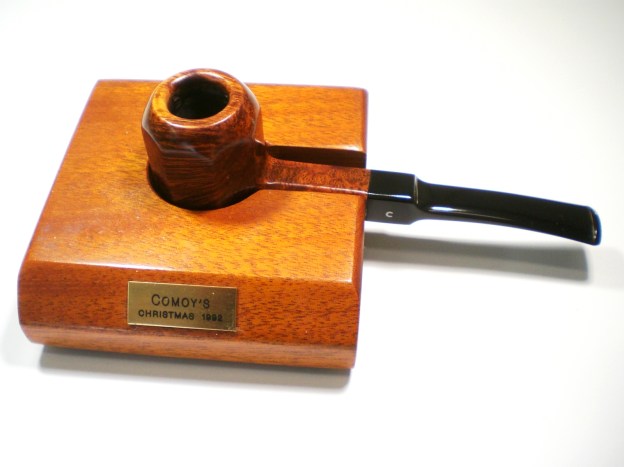
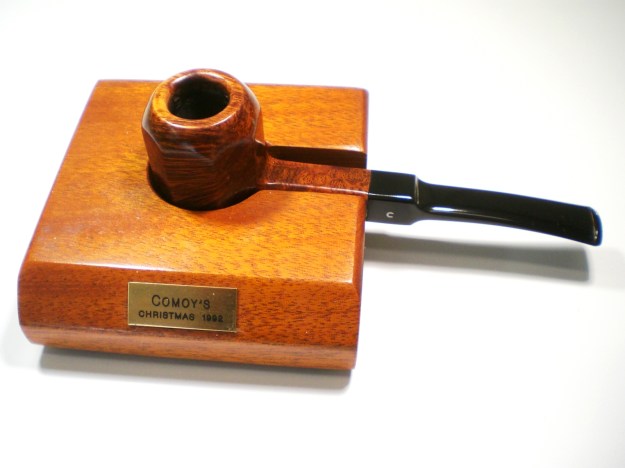
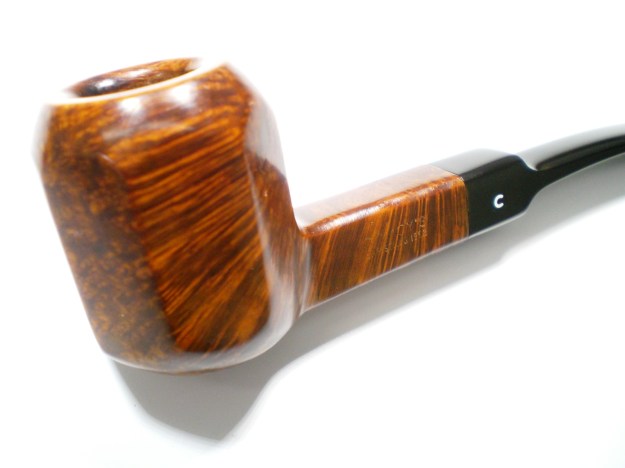
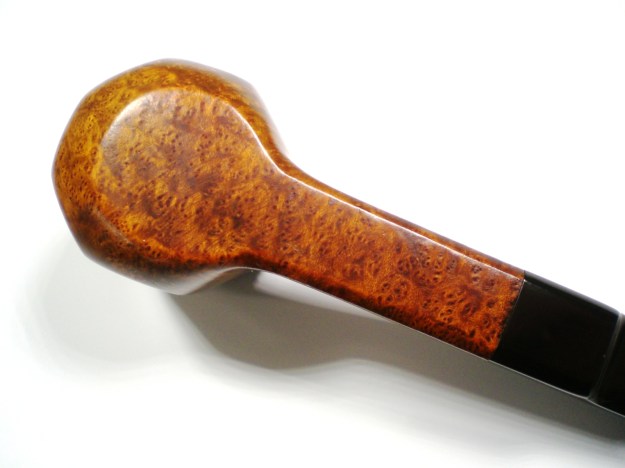
When my son-in-law was visiting during the 2014 holidays, we made a trip to my favorite East Coast pipe shop, JB Hayes, located in Winchester, Virginia. Matt Hayes, the proprietor, always has some interesting estate pipes, both finished and those in need of restoration. The unfinished pipes are kept in large wooden drawers that encircle the shop and it is easy to lose an hour searching thru the drawers for a hidden treasure. My son-in-law found this pipe and asked about it. I told him about the Comoy’s Christmas pipe line. He remarked that 1992 was also his birth year. Later, he also uncovered the wooden base with matching brass plaque. Matt wasn’t working on that day, so I stashed the pipe and base in a bottom drawer, returning later that week to make the purchase (without telling my son-in-law).

Below is an excerpt from an article by Richard Carleton Hacker on Christmas pipes. You can find the full article in the link below.

Christmas Pipes – Richard Carleton Hacker

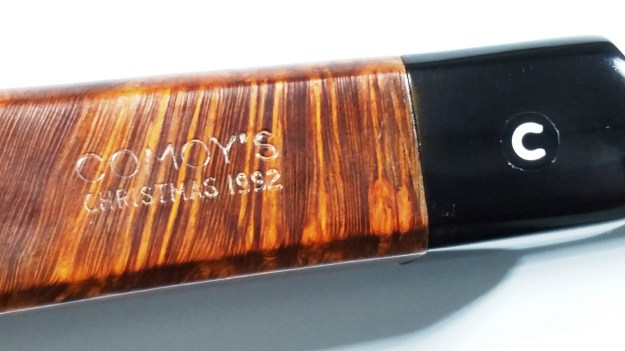
Comoy’s has the distinction of being the first major brand to create a Christmas pipe expressly for the American market, with its initial issue in 1970. Like all Subsequent pipes in this longest-running series, it was stamped CHRISTMAS on the near side of the shank, along with the year of issue. None of the pipes have been serial numbered. Only 1,200 of the 1976 Comoy’s Christmas pipes were made, and subsequent years’ models were turned out in quantities of 1,800. Although a number of collectors own the complete 21-pipe set, most of the earliest models, especially the 1976 briar, are very difficult to locate, despite their comparafive1v large numbers. Rarest of all Comoy’s Christmas offerings is a factory-cased set, created in 1981, which contained one each of the six Christmas pipes in existence at that time, ranging from 1976 through 1981. Comoy’s produced only 150 of these sets, and with all six pipes in unsmoked condition, commands a much higher price than if the pipes were purchased individually. In recent years, Comoy’s has included a routed-out wooden stand with their Christmas pipes, which enables them to be displayed when they are, not being smoked.

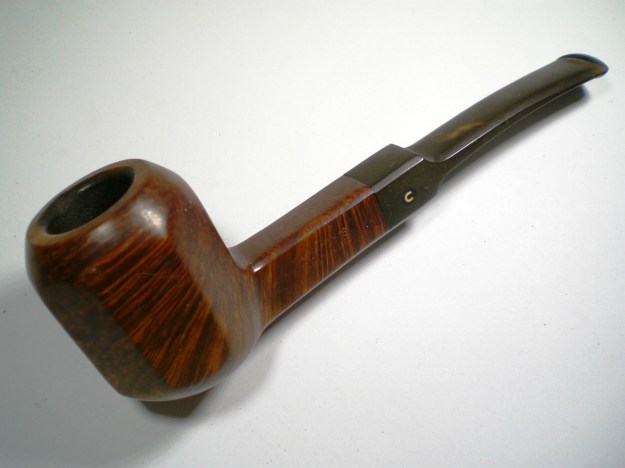
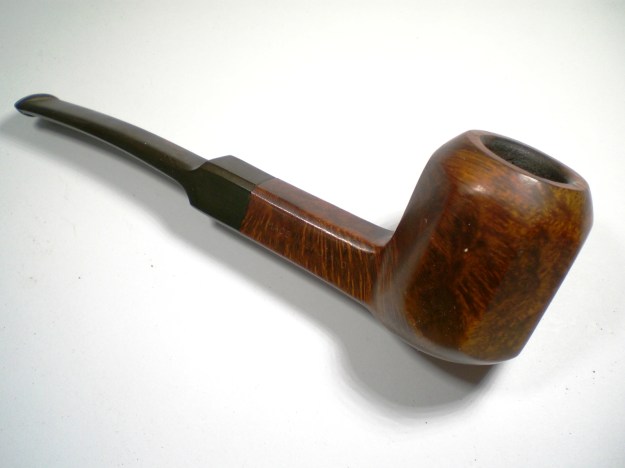
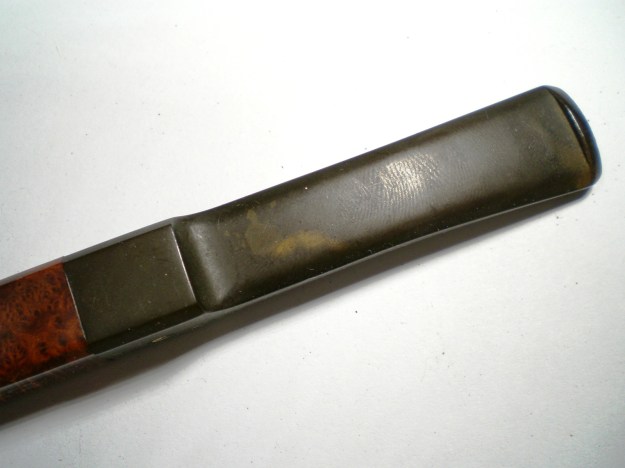
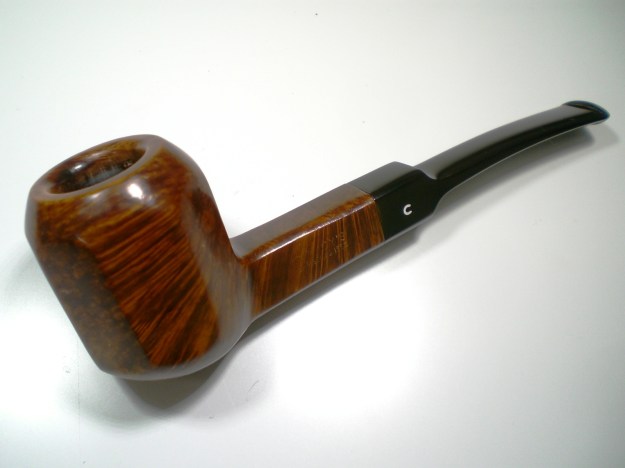
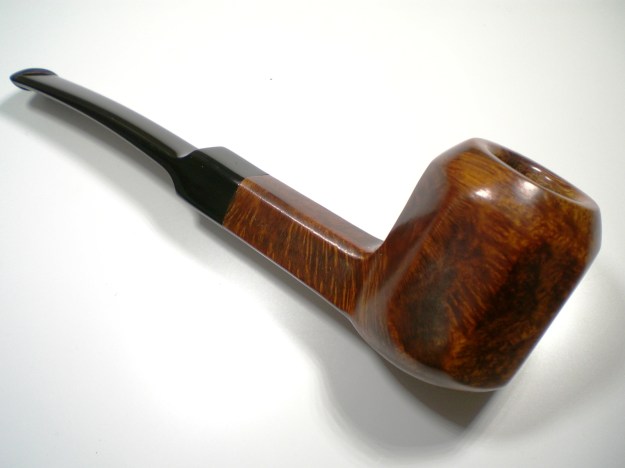
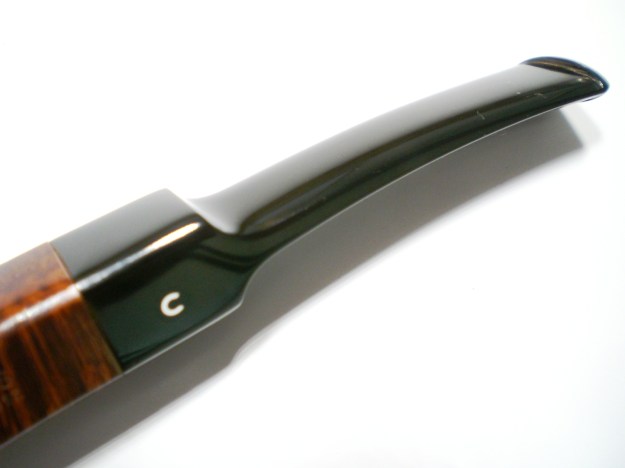
Something that I’ve observed in watching Comoy’s Christmas pipes on eBay or elsewhere is that no matter their year, none have the 3-piece “C” stem logo prized by collectors of Comoys pipes. Early pipes have a stamped, white “C” while later pipes have a one-piece drilled “C” that inserted into the stem. This 1992 pipe has the one-piece logo, which I find more appealing. This one has some nice grain as well.

Here is the pipe as found.

Comoy's_1992_Christmas_Beore

Comoy's_1992_Christmas_Beore (4)

Comoy's_1992_Christmas_Beore (3)

Comoy's_1992_Christmas_Beore (6)

Comoy's_1992_Christmas_Beore (5)

Comoy's_1992_Christmas_Beore (1)

Comoy's_1992_Christmas_Beore (2)

The bowl only had a slight cake, which was reamed and then cleaned with a soak using alcohol and sea salt. I used some 8000 and 12000 grit micromesh on the scorch mark on the bowl top, which came out nicely. The briar was then buffed with White Diamond and several coats of Carnuba wax.

The oxidation on the stem was removed with 800, 1500 and 2000 grade wet sandpaper, followed by 8000 and 12000 grade micromesh sheets. The stem was then buffed with White Diamond and Meguiars Plastic Polish.

The base was shined with furniture polish. Unfortunately, I won’t see my son-in-law at Christmas this year, he will be missed. But the pipe has been packed and sent down to New Orleans for him to open on Christmas Day. Hopefully, soon, we’ll enjoy a pipe together.

Comoys_Christmas_92_Finish (1)

Comoys_Christmas_92_Finish (2)

Comoys_Christmas_92_Finish (5)

Comoys_Christmas_92_Finish (3)

Comoys_Christmas_92_Finish (6)

Comoys_Christmas_92_Finish (4)

Comoys_Christmas_92_Finish (7)

?

?

?

?

Comoys_Christmas_92_Finish (1)

Pipe Tripping


Guest Trip by Robert M. Boughton
Member, International Society of Codgers
Member, North American Society of Pipe Collectors
http://www.naspc.org
http://roadrunnerpipes.biz (Coming Soon!)
http://about.me/boughtonrobert

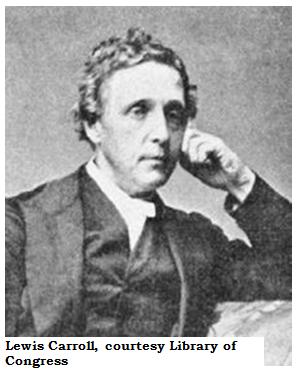
‘Curiouser and curiouser!’ cried Alice (she was so much surprised, that for the moment she quite forgot how to speak good English); ‘now I’m opening out like the largest telescope that ever was! Good-bye, feet!’ (for when she looked down at her feet, they seemed to be almost out of sight, they were getting so far off). ‘Oh, my poor little feet, I wonder who will put on your shoes and stockings, for you now, dears? I’m sure I shan’t be able! I shall be a great deal too far off to trouble myself about you: you must manage the best way you can; –but I must be kind to them,’ thought Alice, ‘or perhaps they won’t walk the way I want to go! Let me see: I’ll give them a new pair of boots every Christmas.’ — From “Alice’s Adventures in Wonderland,” Ch. 2 (1865), by Charles Lutwidge Dodgson under the pseudonym Lewis Carroll [1832-1898], English mathematician, noted photographer, essayist, poet and novelist

FOREWORD
Pipe1The origination of tobacco in the Americas and Australia is not as common knowledge as, say, that Columbus didn’t actually discover America, but then, there are stranger facts associated with the leafy plant’s history. Certain forms of tobacco were – and likely still are – used in the spiritual practices of various native populations to produce reactions that, by newer and more close-minded cultures, are called hallucinogenic. While there is no evidence to support the idea, and I am not suggesting a serious connection, Lewis Carroll (as the brilliant author will always be remembered) could have been under the influence of tobacco hallucinogens when he wrote the above masterpiece and its sequel.

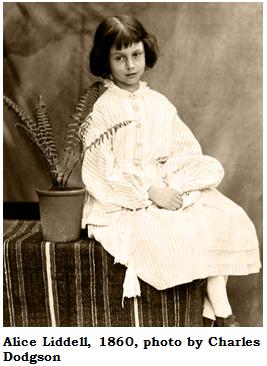
To be fair and clear, however, Carroll’s unique composition style was the result of the Universal Impetus Theory (UIT) for all great literary innovators: having a gift as an ingenious raconteur able to choose and order his words in a precise, inimitable form, and the good fortune of living in the right time. Carroll also had an unparalleled knack for the creation and blending of words. Of course, the fact that he was a good friend of the British lexicologist Henry George Liddell, after whose daughter the timeless Carroll classic was named – and at whose insistence he committed his oral tales to paper, leading to its publication – no doubt played a part in the use of combined and nonce-words (those created for the moment, or nonsensical) and complex sentence structure by the mathematician turned writer. Coining the word galumph, for example, which means “to bound or move clumsily or noisily” (OED), Carroll blended gallop and triumphant. His works still thrill children and adults alike.

Pipe2Consider this. Without Carroll, we would not have fantastic, imaginative and endearing verbs, adjectives and nouns such as galumph as well as chortle, frabjous, mimsy, vorpal, snark and, last but not least, jabberwocky. The colloquial term snarky, for irritable or short-tempered, was adapted by Edith Nesbit, in her 1906 novel “Railway Children,” from the name of a variety of disconcerting creatures introduced to the world in Carroll’s poem, “The Hunting of the Snark.” As a hopeful point of interest, my spellchecker recognized chortle, galumph and jabberwocky, so accepted in the English lexicon they have grown. And as I added the rest to my Word dictionary, should I ever have occasion to use them again, they will appear without the annoying red, squiggly underlines. What’s more, thanks to the periodic transmission of these additions to Microsoft, where they will undergo due consideration by vorpal, slithy folk whose job it is to determine their worthiness, perhaps someday the perspiration-coated toilers over such heady decisions will make it possible for Carroll’s now-real words never to trouble other users of the magical expressions.

Now, lately I’ve been thinking about pipes and tobacco in a different frame of mind. Those who know me best seem to agree that my arguably Byzantine cognitive processes can be scary or even stupefying, if not downright dangerous, depending on the attention level of the person listening to or reading my discourses. Nevertheless, these commentaries often made off-the-cuff and on diverse topics, when joining a conversation, tend to come together with certain cogency, the suddenness of which is a bit like the epiphanic ending of a Faulkner novel.

At any rate, my musings of late, at least in my own mind, have produced some unusual notions, some of which have even made me laugh out loud. That’s LOL, for those young enough to have been raised in the Cyber Age and have forgotten what the three letters even abbreviate. These ponderings, reflections or reveries, or whatever else anyone might choose to label them, up to and including absurdities and/or deliriums, grew curiouser and curiouser the further I allowed them to metastasize within my psyche, and have now reached the point where I am compelled to share them, for better or worse.

RANDOM PIPE TRIPS TO CONSIDER
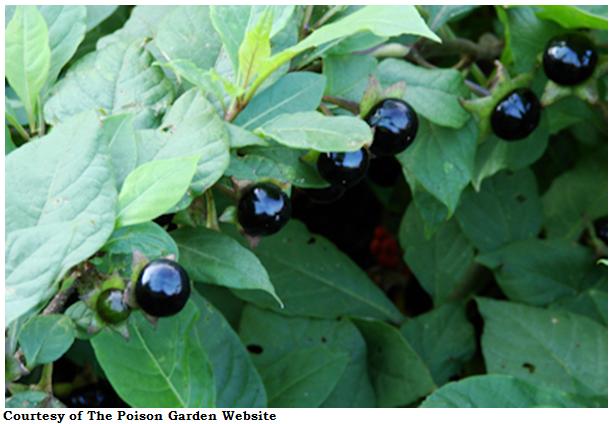
In the beginning, as far as pipe tobacco goes, there was a peculiar plant of the genus Nicotiana, from the nightshade family, called N. tabacum. The simple fact that our revered tobacco derives from Deadly Nightshade – or belladonna , the black berries of which are frightful in their toxicity – should be enough to give pause to all of us who, with regularity, take such special pains to pack our pipes just so with the stuff, so that it might burn all the longer and thoroughly. But of course this knowledge, even if acquired by some readers who just now digested the previous sentence, will have no such effect.

PIPE TRIP #1
Let’s start this silly exercise with an image, stemming from the relationship, however distant, of tobacco to Deadly Nightshade, and which appeals to my admittedly perverse, at times, sense of humor. Conceive, if you can, how many hapless, hungry and heedless berry-pickers perished from eating the wild belladonna back in the day when people didn’t know better than to pluck such frabjous-looking things without care and pop them into their mouths; or, if the victim of eating the fruit of the somewhat drab green and weed-like flora were spared death and merely rendered howling mad, attempt to visualize the resulting hallucinations that are so vivid the sufferer has no grasp of reality whatsoever. Whichever outcome presents, it is just because of the berries appearing so plump and pretty and sweet, and impulsive human nature.

Then the kicker: one day, someone came along and experienced the brainstorm to toss the berries aside and turn the unattractive green leafs into something that could much more safely be ingested by somehow cultivating, processing and at last chopping up into suitable pieces for placing in a crude bowl with a similar stem (perhaps in the botanical sense) for the purpose of igniting and inhaling them.Pipe3The worst part of this opening cogitation is the rare but continuing incidences of accidental poisoning from these lovely though heartless elements of nature. Take, for example, the case of a very large American (naturally). He measures 6’ 3” in height and 220 pounds in width. Wandering through the wilds of Germany late this very year, he spies the shiny, luscious appearing fruit on a plant he mistakes for elder berries. He gobbles 20-30 of them despite their semi-sweetness with bitterness from the seeds, and not feeling quite himself, promptly decides to take a nap right there in the woods. His sleep is frequently interrupted by a nagging need to urinate, which is difficult because nothing seems to want to come out except small, forced amounts of clear liquid with a strange blue tint which the tourist has just enough sense left to be unsure if it might not be a hallucination.

After giving up the nap idea, his mouth becomes dry and his throat sore. Then his vision goes blurry, and he decides it’s time to see his doctor, who happens to notice the patient’s pupils are dilated to the max and unresponsive to any safe and sane stimuli. The physician thinks it best for the man to be taken to the hospital. During the ensuing drive, the hallucinations commence. A single hedgehog appears as thousands, and deer are kangaroos. The poor fellow arrives at the hospital a mere four to five hours after scarfing down so many of the marvelous berries, and all the hospital staff can do is observe him – intensely – for several days that seem like an eternity to the man.

The situation rapidly escalates to seeming insanity filled with hideous, terrifying visions and other misperceptions of reality, like a singularly bad LSD trip, prompting a transfer to the psych unit. This is just the beginning of the trip down the rabbit hole, but at last he does begin to get better. As soon as he is able to comprehend the words, he is told how lucky he is to be so large, as anyone smaller would surely have died. Recovering even now, the man still is not his old self again.

You see, this is a true story, and not in the sense of the often misleading tags at the beginnings of movies. Heaven knows I didn’t make it up! I strongly suggest reading the full account at http://www.thepoisongarden.co.uk/blog2/blog281115.htm for a jolly good first-hand account of the ordeal.

PIPE TRIP #2
The interior of the bowl of a pipe, where we cram or methodically place the tobacco, is called the chamber, yet one never seems to hear a pipe smoker refer to settling down in his easy chair to enjoy a good chamber of whatever blend has been chosen for the occasion to contemplate life. Could this habit derive from the alternate definition of chamber as a room, as in a chamber of horrors? Or might it be a subconscious aversion to a comparison of the pipe’s chamber to the part of a gun that renders the weapon armed or not? I mean, think of it! What merry piper would want to sit in a dreadful chamber or put a chambered gun in his mouth? Just food for thought, nothing more.

PIPE TRIP #3
The bit is almost universally referred to as the stem. What in the name of all that’s holy is the problem with calling the thing by its proper name? Honestly, I want to know when and where this convention began, and who started the confusion! Yes, I want nothing less than the time, location and name of the guilty party.

Heaven help us if this ruddy awful vacillation stems (pun intended) from some sorry fellow’s fear of comparing the bit of his pipe to the past tense form of bite, all for the day when he was a wee little tyke and a dog bit him, which seminal event has bitten (past participle) his worldview forever.

Then again, maybe the dither is about Man’s eternal fear of karmic payback, in this case for the long, shameful practice of abusing others of God’s finer creations, such as horses, in place of his own back-breaking labor, by placing metal bits in the sad creatures’ mouths and then whipping them onward to finish tilling the fields we humans might just have had to work a bit harder to accomplish ourselves.

I ask, what’s the point of the evasion in the first place? After all, our worldwide band of brothers and sisters, in pursuit of the pleasures and comforts of a nice, relaxing smoke, seem to have no qualms referring to the often sharp but excellent bite of a bit of a strong mixture of a VaPer or other coarser, non-aromatic blend that can become an acquired taste and lead, at worst, to a case of Tobacco Acquisition Disorder (T.A.D.).

PIPE TRIP #4
While that last note is fresh in the mind, I’ll leap at the opportunity to address the use of the word disorder in T.A.D. and its mates, Pipe Acquisition Disorder (P.A.D.) and Accessory Acquisition Disorder (AAD). Who on Earth dreamed up these ostensible maladies? Surely nobody accredited within the medical community! My guess is some lone pipe smoker with Obsessive-Compulsive Disorder (OCD), a genuine and serious and hardly uncommon psychological irregularity that can easily lead to an overspending problem, started the whole thing, and others jumped on the old bandwagon and added the others. I can just see all of them waking up with cold sweats in the middle of the night who-knows-when with the realization that, once again, they’d gone and spent their entire grocery budgets along with half the rent on one of the three categories of pipe expenditures described above.

What’s more, I’ll bet each and every one of them reached for his ever-handy Merck Manual to self-diagnose himself so he could tell his local candy doctor just what pill he needed to overcome the dread “disorder.” My gosh, the measures people will take to get a new drug! Why, it’s scary even to contemplate. I thank the stars I’m not that bad off, you know I do! I mean, sure, I’ve been late with the rent or cable bundle bill, or paying for my cell phone – maybe, on rare occasions, all three – but I swear I do not have any kind of disorder! Well, other than Attention Deficit Disorder (A.D.D.) and Post-Traumatic Stress Disorder (PTSD), not to mention chronic migraines and – oh, yes – agoraphobia. But those trifles are all under strict control, and you may take my word on that to the bank!

PIPE TRIP #5
Last but not least is the odd practice of the average piper, who will speak in calm, even tones of smoking his pipes – with utter disregard for all of the expression’s negative connotations. After all, where there is smoke, there is fire. Picture yourself in any of Dante Allighieri’s infernal nine circles of Hell on Earth leading, with fervent thirst, for ultimate eternal salvation. Do we really want to go there? Let’s not. Dante already did the great favor of doing so for us! Just say no, as Nancy Reagan did to drugs. Instead, join me in the somewhat troublesome practice, I admit, of enjoying a pipe. I picked up this routine after reading an excellent essay last year concerning positive methods of writing and speaking of the multi-faceted pleasures associated with tobacco pipes, by a member of the North American Society of Pipe Collectors in its magazine (they insist on calling it a newsletter ), “The Pipe Collector.”

Seriously, if I can do it, you can, even if in our hearts we are thinking of Lady Mary Wroth’s 1621 controversial and groundbreaking literary work, “The Countess of Montgomery’s Urania,” and one line from it: “Those loose and wicked enjoyings which we coveted.”

AFTERWORD
This little exercise in writing is at best an essay, and at worst a work of fiction, lest anyone who failed to grasp my attempts at satire walk away from the experience with the notion that I might in any way have been serious.

I welcome, more than usual, any responses with contributions of other examples of pipe trips (or, for that matter, alternative critical thoughts), with the hope of someday compiling an Encyclopedia of Pipe Trips.

Correcting an Overturned Stem on an Unsmoked CPF Bent Bulldog


Blog by Steve Laug

Early in December I received an email from a friend in the Vancouver Pipe Club about a fellow who was trying to get a hold of me about some very old 1850’s American made pipes he had picked up. We connected and he sent me the following email:

Hi Steve! Really liked your posts and just wanted to reach out. Thanks for the note back. I purchased the 3 CPF pipes already for $120 for the set over the weekend.

• The straight has never been smoked and is in excellent shape. I did not know it was unsmoked, that was a pleasant surprise.
• The bent is in good to VG shape. Lightly used. The threads are off a little from wear. Does not line up perfectly when fully threaded in, off by about 15 degrees.
• The Meer is trashed. End has been chewed down to having holes top and bottom, and the bowl is super used. That was disappointing

I am guessing after I have looked at them that they are around 1907? It’s the Oval CPF logo with French over the logo and Briar under. I am not going to smoke the straight, it’s been clean for 100 years, I don’t want to be the guy that dirties it up. LOL. I have not tested to see if the stems are amber or not.

Any thoughts on dating or value? Should I be happy or sad for $120? Any tidbits of the history beyond what you have written is appreciated.

Thanks man, really appreciate you taking the time to reply.

All the best,

Michael

He sent the following photo of the threesome. They were beautiful to me. With the photo he had not only my attention but he had me hooked. I love the old CPF pipes and I had previously restemmed an old bent bulldog like the one in the photo sans bling. This set was amazing and I would love to see it in person.CPF1 I replied to his email and he responded offering to send me the pipe with the overturned stem for a repair and to send me the Meerschaum to “take a swing at refinishing it” as he worded it. When the pipes arrived yesterday I opened the box to have a look at the pair that he sent. I took the pair out and examined them carefully. The Meerschaum I put in my own repair box for later. The stem on it was definitely a mess. There was crazing throughout the length of the stem where someone had tried to clean the stem with alcohol. It was Bakelite and really was a wreck. The stem on the bent bulldog was much better. If that pipe has been smoked it is very lightly smoked. There is very little darkening in the bowl and none in the stem. I carefully unscrewed the stem and had a look at the bone tenon and at the threaded mortise in the shank. Both were not darkened by smoke so I am thinking that this one is also unsmoked.

I looked at the threads in the mortise and on the tenon and could see that they were worn. The stem had been screwed and unscrewed many times over its long life and the worn threads accounted for the overturn. The stem was clean but dull from not being polished. The bowl ornamentation was oxidized but had a patina that worked with its age. There would be little clean up on this old pipe. The internals were spotless other than dust. A quick clean up with a water dampened pipe cleaner took care of that. The stem would need some work with micromesh pads to bring back the shine. I would leave the patina on the brass as I liked the way it looked. The only issue that needed to be addressed was the overclocked stem and the worn threads.CPF2 I cleaned up the tenon with a cotton swab and warm water being careful to not get the bone tenon too wet. With a tenon this old it is very easy to snap it when working on it. I used a tooth brush to work on the threads and clean off any dust of debris on them. I carefully applied a few drops of clear super glue to the threads – it would build up the worn threads and also stabilize the old bone tenon. When it dried I tried it in the shank and found it took care of about half of the overturn. I took it apart and added a few more drops of the glue and let it dry.CPF3 I wiped off the brass with a jeweler’s cloth to protect and clean it slightly. I did not want to remove the patina, just give it a quick rub down with the cloth.CPF4 I sanded the Bakelite stem with micromesh sanding pads until the butterscotch colour just glowed. I wet sanded with 1500-2400 grit pads and dry sanded with 3200-12000 grit pads.CPF5

CPF6

CPF7 I wiped down the bowl with some Briar Wipe – a no longer made pipe polish and hand buffed it with a microfibre cloth. I gave the stem several coats of carnauba wax by hand and hand buffed it as well. The finished pipe is shown in the photos below. After Christmas I will send it off to Michael to enjoy. Thanks Michael for the Meerschaum to fiddle with and thank you for the opportunity to see and do the repair on this beautiful old piece of CPF history. I can only hope to find a set like yours one day! Enjoy this piece of history that has come into your hands. It is in your trust and certainly with care will continue its usefulness for more generations of pipe men to come. Cheers.CPF8
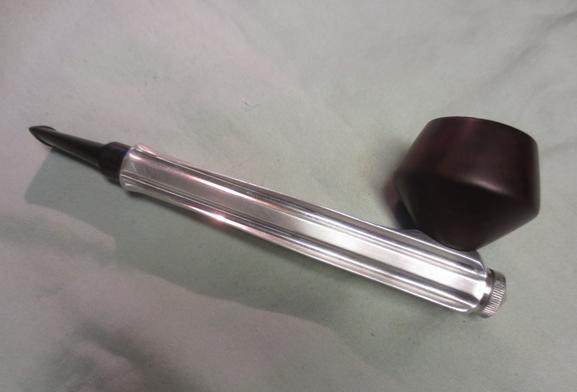
CPF9

CPF10

CPF11

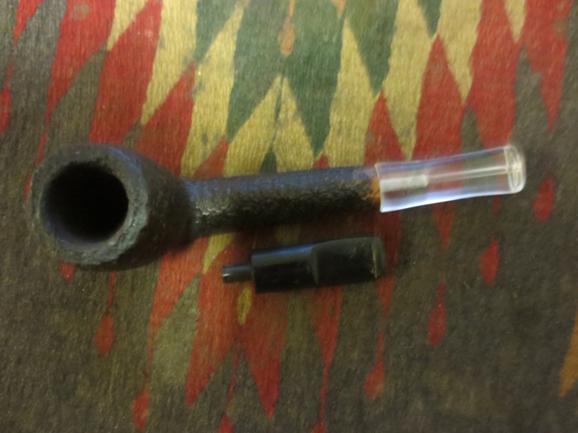
A Surprise when working on the Citation 812 Canadian


Blog by Steve Laug

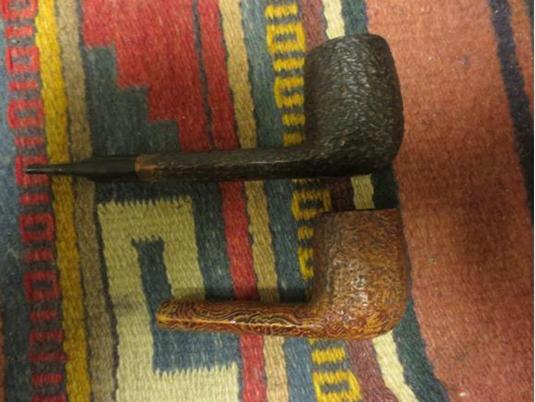
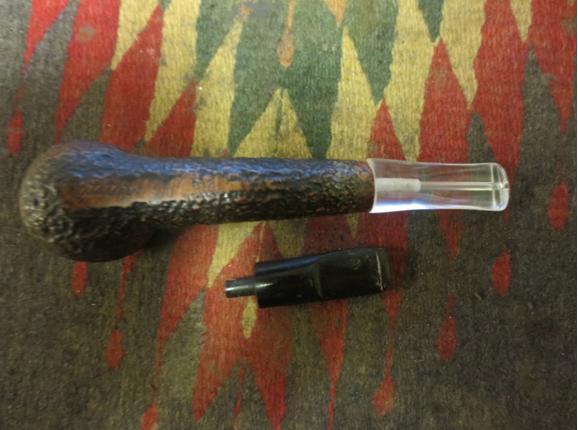
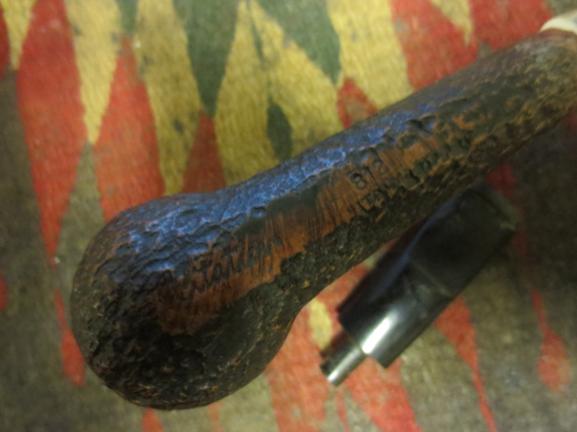
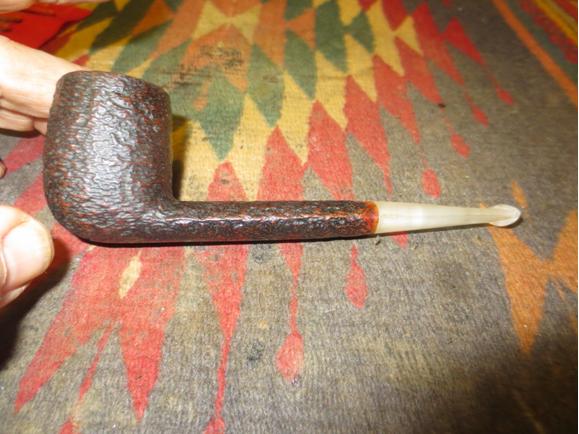
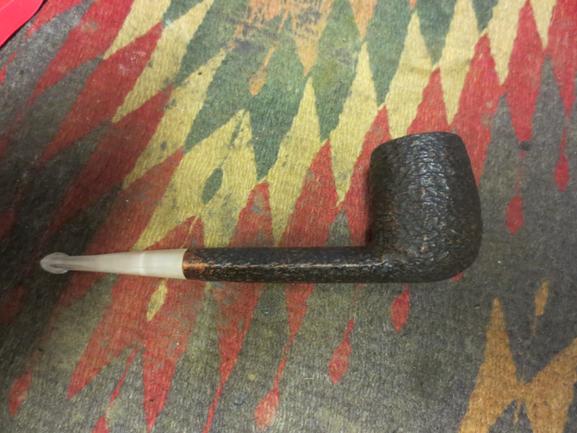
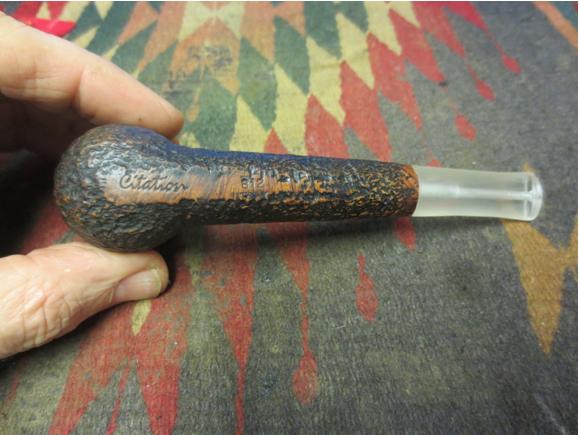
Class1This Citation (second pipe down in the first column in the photo on the left) is a sister pipe to the Savinelli Classica 812 Canadian that I just restored. It is stamped Citation and 812 on the bottom of the shank. The sand blast is nowhere near as beautiful as the Classica but it has a charm all its own. It appears to be a combined blast and rustication – hard to explain but it is just too consistent to be a normal sand blast. It appears to have been rusticated and then blasted lightly. It has a dark brown stain as an undercoat and a light brown over the top. The high points on the finish are lighter brown and the smooth portions are also lighter brown.

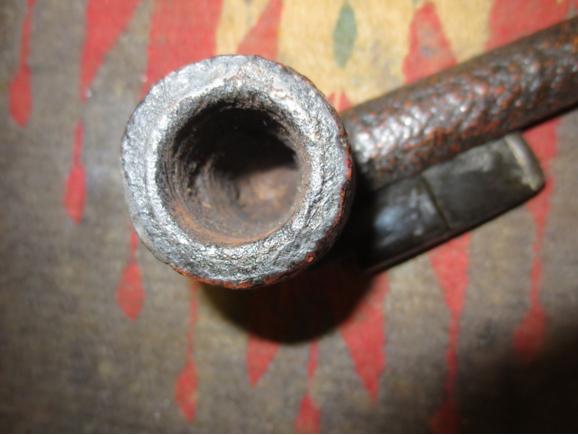
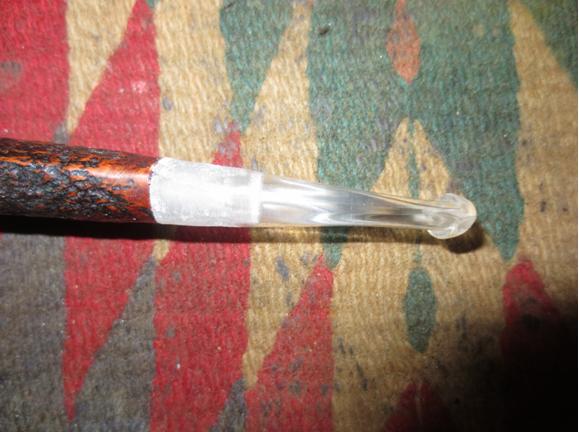
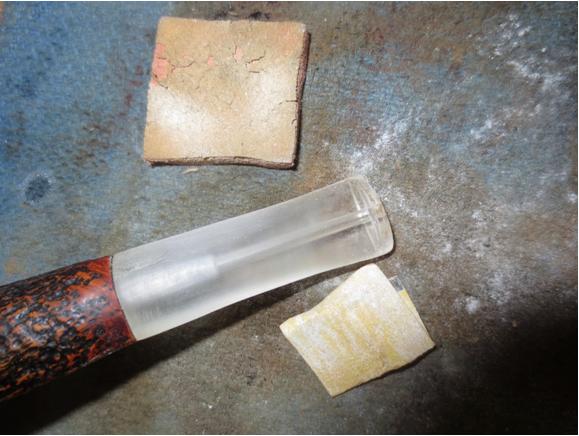
The bowl had a pretty heavy cake and the lava had overflowed onto the rim. The finish was dirty but otherwise in decent shape under the grime. The rim appeared to be in good shape under the grime and there were no nicks or dings in the outer or inner edge of the rim. The stem that came with the pipe was not the original and it had been poorly fit to the shank. It was narrower than the shank and pinched at the saddle portion. It still had all of the fill marks from the person who had fit it to the shank. The underside of the button and a large chunk of the underside of the stem were missing. I would not be sad to throw away this poorly cut broken stem.

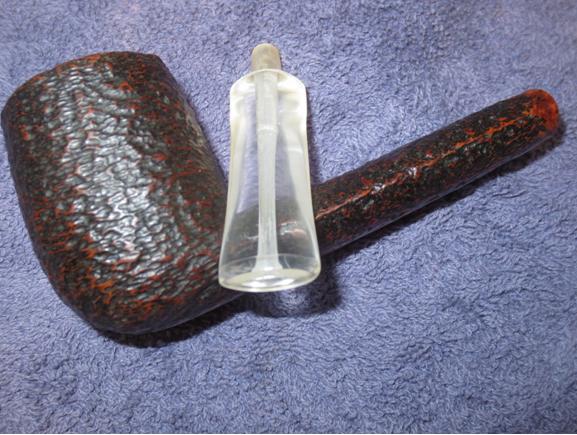
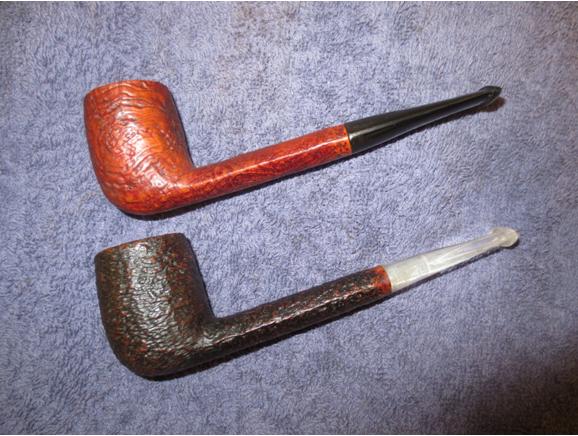
Inside the shank was pretty dirty and plugged. I could not blow air through the pipe and did not dare to try sucking on the shank. Who knows what might end up in my mouth! I would need to remedy that situation and I would need to make a stem for it. This would be a beautiful little pipe to go with the Savinelli Classica once it was finished – kind a light and a dark version of the same shape. At this point little did I know what kind of surprise lay ahead for me as I cleaned it up and restored this little pipe. The photo below shows the two pipes together.Class2 The next four photos give a clear picture of the state of the pipe – its finish, broken stem and tarred and cake rim and bowl. You can also see what I mean when I say that the finish is far to uniform for a sand blast but looks to have both a blast and a rustication. Someone help me out on this if you have any information.Citation3

Citation4

Citation5

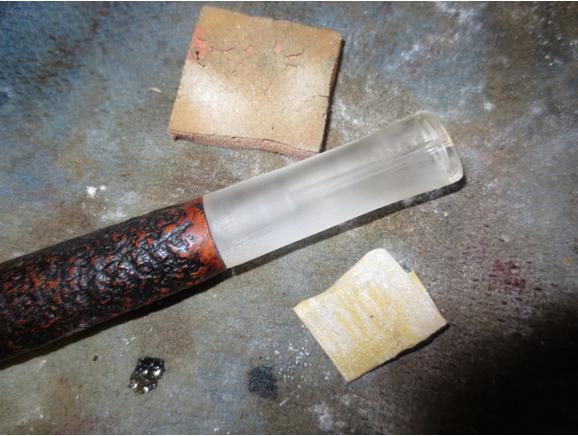
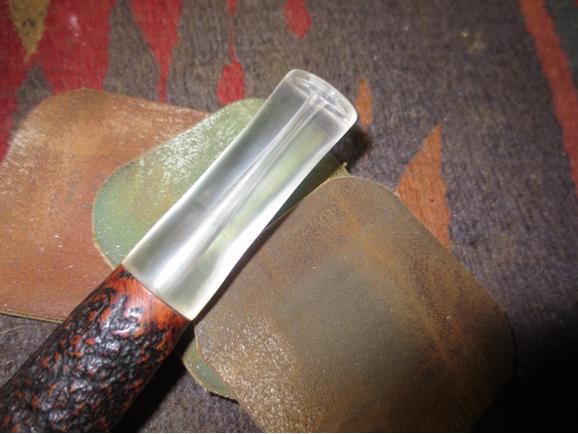
Citation6I went through my can of stems and found a clear acrylic taper stem that would work perfectly with this pipe and with a little shaping would go well with the dark look of the finish.Citation7 The tenon almost fit perfectly from the start. I only needed to lightly sand it to get a snug fit against the shank. The diameter of the stem was a little bigger than the shank of the pipe all the way around but would easily be shape to fit well.Citation8

Citation9

Citation10

Citation11 I took a close up photo of the rim to give an idea of what I was working with on this bowl. The second photo below shows the stamping on the pipe.Citation12

Citation13 If I had known what I found out later in the refurbishing process I would never have taken the next steps in the clean up. But I was oblivious so I did them unwittingly. I used the smallest PipNet reamer cutting head to take back the cake to what I thought was bare briar. I used a small pen knife to even up the job of cutting back the cake to smooth.Citation14

Citation15 I scrubbed the outside of the bowl and the rim with Murphy’s Oil Soap and a tooth brush and fine bristle brass tire brush to clean off the tars and lava that had overflowed the top of the bowl. I rinsed the pipe under warm water to remove the soap and the grime and dried it off with a cotton towel.Citation16 The cleaned finish even more clearly looks to be a manufactured look to approximate a sandblast finish. But it was a great tactile finish and once polished would look great.Citation17

Citation18

Citation19 I gave the bowl a light rubdown of olive oil like I had on the Classica. It brought the colours in the briar to the front and it is going to be a beautiful pipe.Citation20

Citation21

Citation22 In the photo above you can see what looks like a smooth ring around the inside of the bowl. This was my first clue that things were not necessarily as they appeared. I went back to read a post on Facebook by Geoff Carmell about a Citation pipe he had found. Sure enough the finish was the same and the ring around the inside edge of the bowl was a meerschaum lining. With the way I had man handled it – reaming and scrubbing with the brass bristle brush it is a wonder that I had not damaged the bowl. I would do some work on cleaning that edge a little more gingerly later. Now I had to fit the new stem.

I sanded the stem with a Dremel and sanding drum carefully working it down to the same diameter as the shank and fitting the flow of the curves on the oval shank. This has to be done carefully and with a steady hand or you have to repair the damaged shank or cut another stem to fit. I proceed carefully and slowly. The photos below show the rough fit of the stem after the Dremel and sanding drum work.Citation23

Citation24

Citation25

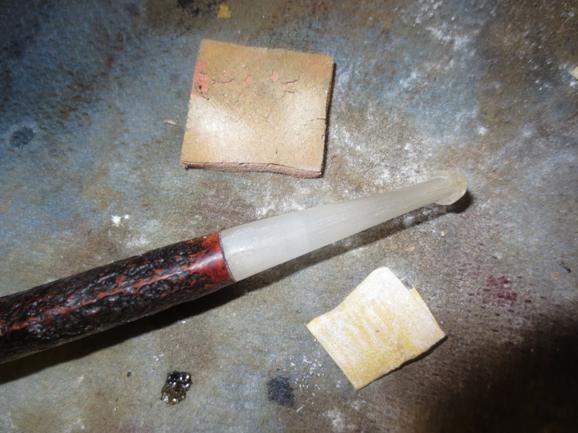
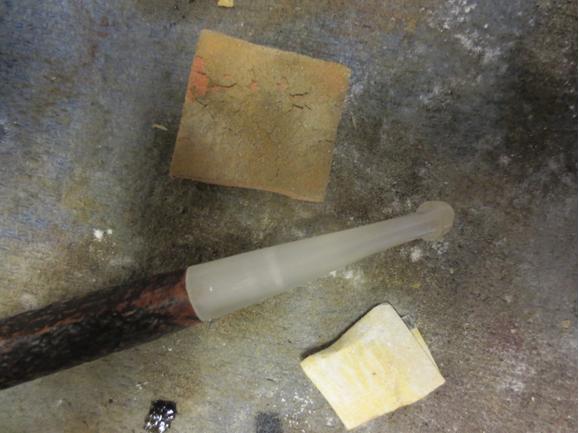
Citation26 I sanded the rough fit stem with 220 grit sandpaper to smooth out the scratches and fine tune the fit to the shank. I also sanded it with a medium and a fine grit sanding sponge to further fine tune the fit.Citation27

Citation28

Citation29

Citation30 The next photos show the newly fitted stem and what the pipe will look like with the clear stem. It still needs a lot of sanding including file work on the airway and the button. It has a small airhole in the end of the button but I will need to cut and shape a slot.Citation31

Citation32

Citation33

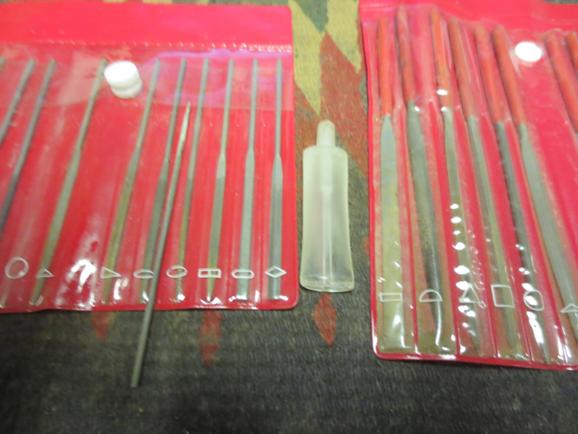
Citation34 All of the internal work and the work on shaping a slot are done with my collection of needle files. It looks like a lot of files but I usually only use three different files – a round, an oval and a flat oval. I use both the larger and the smaller files in these three shapes.Citation35

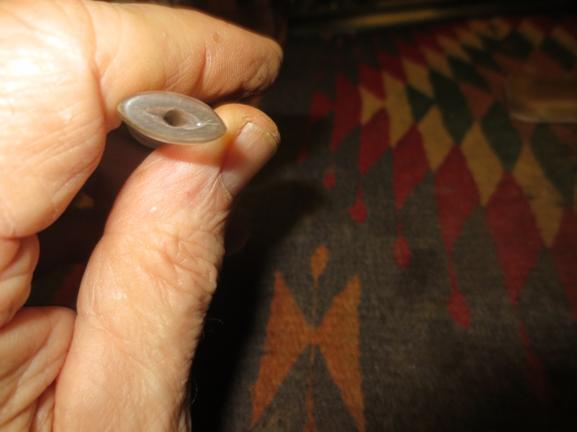
Citation36 The slot is progressing from a round hole to more of an oval shape that matches the shape of the button. Still a lot of filing to do to get it finished.Citation37 I worked on the button, slot, and airway to smooth things out and open them up with the smaller files as well. When I drilled the airway to turn the tenon the drill left a ridge on the inside of the airway in the stem that is a bear to sand out. I worked on it until it was as smooth as I could get it. There is still a small line in the airway but it is smoother than it was when I started. I am going to have to get some tapered drill bits. That would have made this task a minor hiccup in the process rather than a several hour ordeal. The airway is wide open and takes a fluffy pipe cleaner with ease.Citation38

Citation39

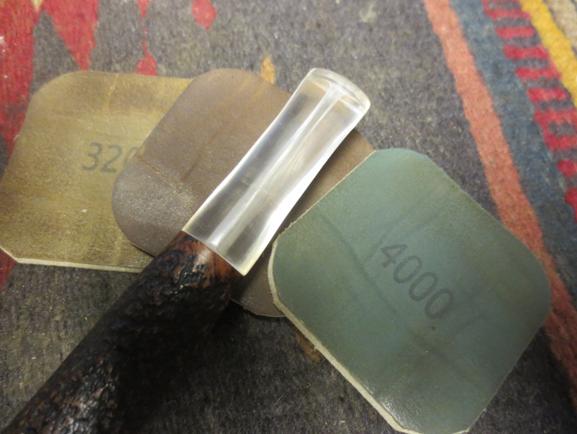
Citation40 I sanded the end of the button and slot with 220 grit sandpaper to remove the scratches and then went through the micromesh pads to polish it. I worked the stem over with micromesh sanding pads, wet sanding with 1500-2400 grit pads and dry sanding with the remaining pads 3200-12000 grit.Citation41

Citation42

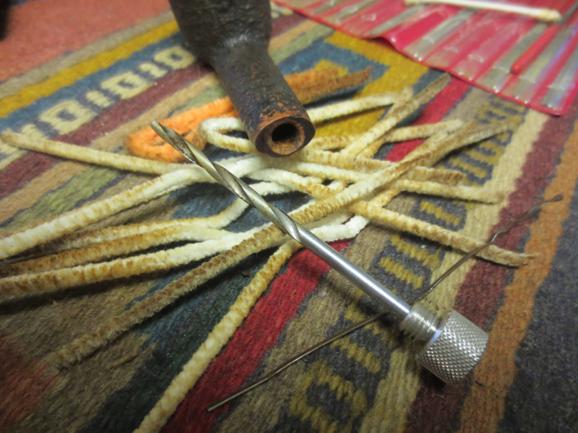
Citation43 With the stem done I figured I could put it off no longer. I had to work on the airway. It was seriously clogged. I could not push a paper clip through or even an ice pick. I used the drill bit on the KLEENREEM and could not get it through. I had to soak it with an alcohol wetted pipe cleaner to soften the plug and then I used a paper clip to push through the plug finally. Then I had to work through the drill bit and the pipe cleaners to get all of the gunk out. Finally I have good airflow. I cleaned out the shank with alcohol and pipe cleaners until they were clean.Citation44 I cleaned the meerschaum lining on the rim with micromesh sanding pads and patiently just sanding the meer edge and the bowl. I was able to get much of the tars off the meer and now it shows golden. There are several spots where it is stained very dark.Citation45 I buffed the bowl and rim with Blue Diamond and did the same to the stem. I gave the stem several coats of carnauba wax and the hand waxed the bowl with Conservators Wax. I buffed the pipe with a clean flannel buff and then with a microfibre cloth to raise the shine. The finished pipe is shown in the photos below. I like the way it came out. (In the photos of the full pipe the stem came out looking opaque but it is absolutely clear as can be seen in the close up photo.)
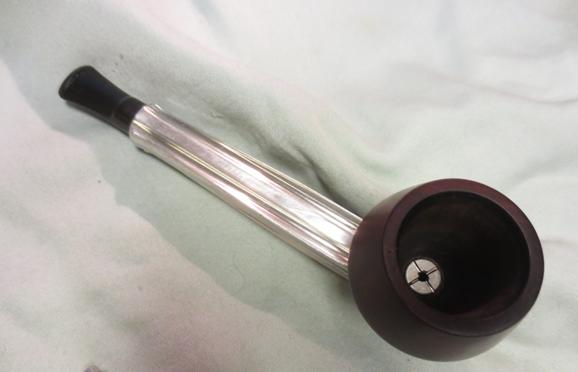
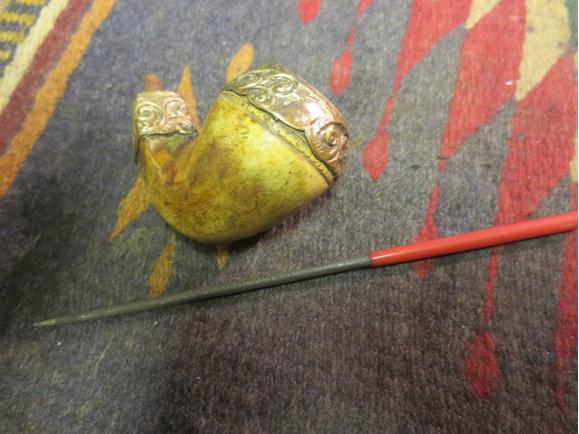
Citation46

Citation47

Citation48

Citation49

Citation50 I took a photo of the two pipes together to show the finished product. Thanks for looking.Citation51
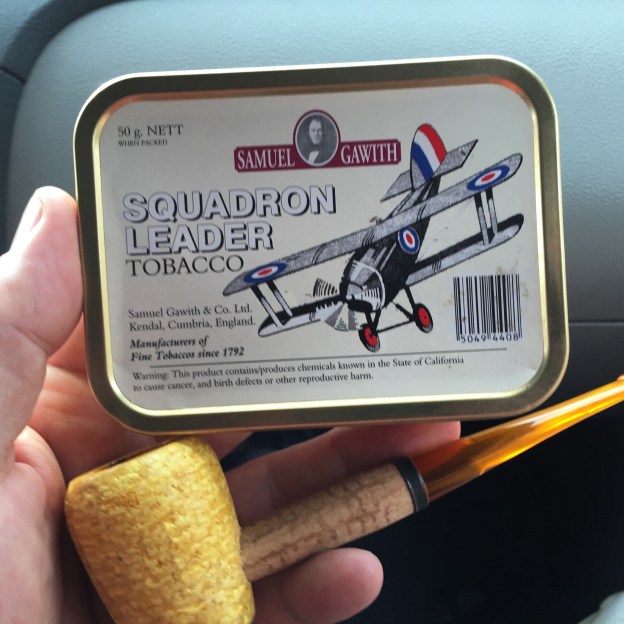
Samuel Gawith’s Squadron Leader: tobacco review 


Samuel Gawith’s Squadron Leader Flies HighAfter reading more than one post singing the praises of Samuel Gawith’s Squadron Leader and learning it was more of a Balkan blend, not a Latakia-bomb, and knowing my general fondness for Samuel Gawith’s blends, I began to watch for a chance to pick some up. The description says: “Bright and Dark Virginias blended together with […]
Squadron Leader, Pipe Tobacco, Samuel Gawith, Balkan, pipe

http://smokingjacketmagazine.com/2015/12/23/samuel-gawiths-squadron-leader-flies-high/