
Blog by Robert M. Boughton
 Copyright © Reborn Pipes and the Author except as cited
https://www.facebook.com/roadrunnerpipes/
You’ve got to sing like you don’t need the money
Love like you’ll never get hurt
You’ve got to dance like nobody’s watchin’
It’s gotta come from the heart if you want it to work.
— In “Come from the Heart” (1987), a country music song by Susanna Clark and Richard Leigh
INTRODUCTION
The free-spirited quote I chose for today’s blog is a chorus of sorts to the darker, harder to control song of myself I change a little at a time, but concerning Danish freehands, at least, it shouts out. In regular prose as opposed to verse, the words have been attributed to many folks, the most famous of whom are Leroy “Satchel” Paige and Mark Twain.
Really? Satchel Paige and Mark Twain? Can anyone even summon to the mind an image of Satchel, showman though he was, hurling three evanescent fast balls for a strikeout and then sauntering off the mound, doffing his cap as for the National Anthem, to spout what would have been considered insane gibbering in his day and gotten him run out of town on a rail or worse? Or the wry and often hilarious Great American Writer – who can still leave readers today ROFL from his literary accounts of the myriad outrageous frays he entered with zeal and turn wickedly acerbic in his social commentary – wearing his famous white Southern suit and taking the cigar out of his mouth as he steps onto a gazebo to pronounce such life-affirming, feel good modern sentiments? I think not.
But I like the way Kathy Mattea sings those four lines, although I can’t recall any of the others, and the lively, high-strung electric fiddle plucking of an unsung but talented musician.
To the point, the pictures of a nine-pipe lot I bought at the beginning of the month, before the package arrived, had a magnetic pull on me. The main attraction was a pair of Danish freehands, and the other was the presence of at least two and maybe three other nice finds, about which the seller might have been oblivious. With no order whatsoever to the description and only three brands identifiable (Kaywoodie, Falcon and Missouri Meerschaum), the seller did reveal that one of the freehands was a Knute of Denmark and the other a Karl Erik. I had heard of Knute and was unfamiliar with the brand, but I’ve owned several Karl Eriks and was pretty sure the behemoth in the lower right side of the following photo was it. I was correct.
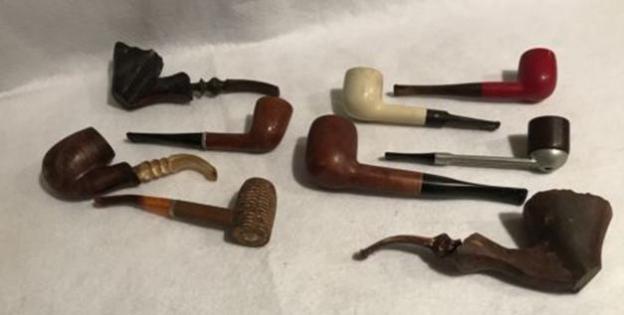
9-pipe eBay lot courtesy stwok74075
I restored the freehands from the lot first. Of those, I decided to start with the Knute for two reasons, the lesser being my inexperience with the brand and the more significant that, although both were large pipes, the Karl Erik was enormous and therefore had much more area to repair. Had I any idea there was something greater about the KE than its massive potential for beautiful geometric symmetry and fine example of chasing the grain, I might have chosen the opposite order. KE, by the way, is my abbreviation for convenience, not to be confused with the maker’s earliest pipe mark)
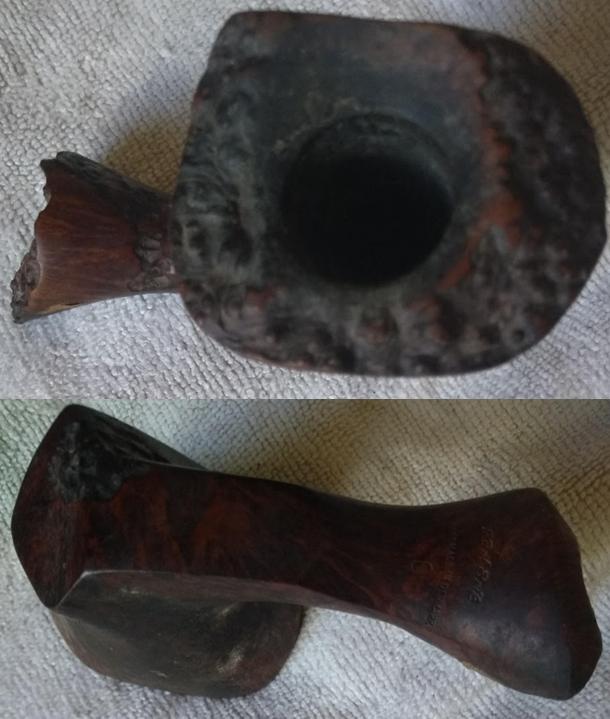
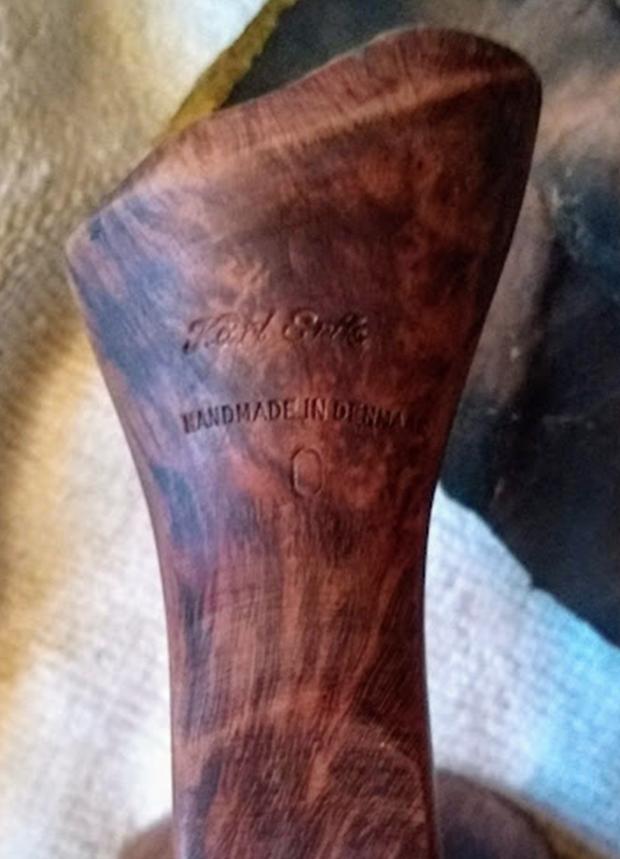
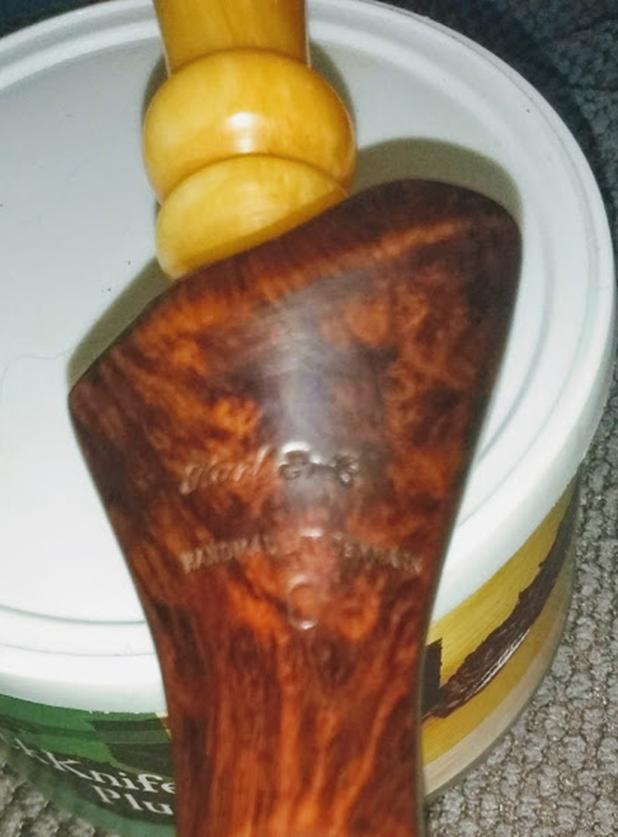
The pipe’s bleak façade of thick gunk at first hid the small block of nomenclature on the stem end of the shank. Before I would have taken photos of the pipe as it arrived, I used a thick cotton rag and more than a little force to wipe away the muck that at one point I thought might require alcohol. I stopped breathing a moment when I saw the mark. Instead of the regular two lines of imprint, there were three: KARL ERIK/HANDMADE IN DENMARK/O.
The grade mark, of course, was the part that surprised me. I’ve owned four KE pipes not counting my latest addition, two of which were far more striking at a glance than this one even after I finished its restoration, but none of them was graded.
As fast as I could, I browsed to Pipephil and found a mention of “previous grading” from 4-1 ascending, meaning1 would be the highest, not counting the Ekstravagant releases that were entirely handmade. Well, that was no help, and so I searched further, finding multiple sites that gave both the previous grades and the newer ones from D-A, again ascending. Some of the latter sources, including Pipedia, expanded on the Ekstravagant grade, noting that it in fact was divided into degrees, C, B, A, AA and AAA. I found no official mention of letter grading beyond D, but I did track down a Worthpoint auction that describes O as “[t]he highest grade in the old Karl Erik grading system.” Needless to say, my breath was taken away again. I’m calling on any readers with information on the maker’s early grading system to fill me in on it!
Speaking of the maker, his name was Karl Erik Ottendahl (1942-2004), and he was a lithographer struggling to make ends meet from his apprenticeship starting when he was 16 into his mid-20s when he took up carving pipes as a day job. Young Ottendahl had made pipes as a hobby since he was 16 and gave most of them to friends and senior co-workers. Never forgetting his “roots,” Ottendahl remained perhaps the most generous pipe maker in the history of the craft and trade. He was devoted to the proposition that fine pipes should be affordable to the average smoker, and to that end he priced his works of art far below the going rate. Likely for that reason, his brilliant work was underestimated and likewise valued during and after his lifetime, and it is only in recent years that the market has begun to appreciate their worth more. I’m sure that fact makes Karl Erik roll over in his grave.
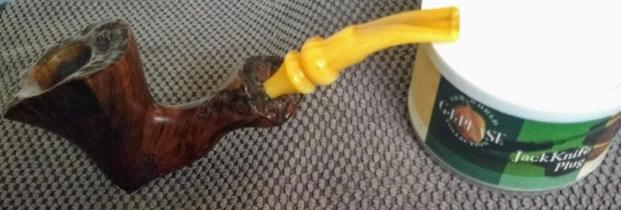
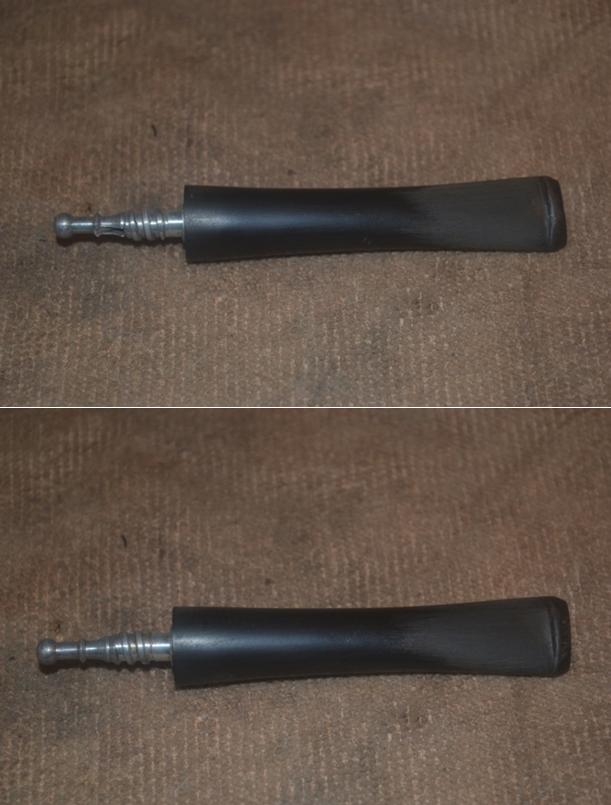
The poor, big lunk of fine Danish stock in this blog had fallen on hard times and was in a sorry state. The following triple stem swap gets a little crazy, so try to follow this. The KE came with a nice dark brown swirled acrylic fancy stem that was just way too short to support its gigantic stummel but was perfect for a Knute of Denmark from the same lot that I already restored, blogged and sold – with the KE stem. The Knute, by the way, had a Vulcanite stem that was chomped, with a hole in the bottom below the button I fixed well but the absence of a full lip I knew I could mend enough for my own use but would never pass off to a customer. So that was a no-brainer. I decided on a temporary substitution of a bright orange Lucite stem from a Ben Wade by Preben Holm freehand I have. For now, the half-eaten but semi-repaired Vulcanite stem from the Knute is on the BW. I’ll just add that I’m anxiously awaiting replacements for both of them.
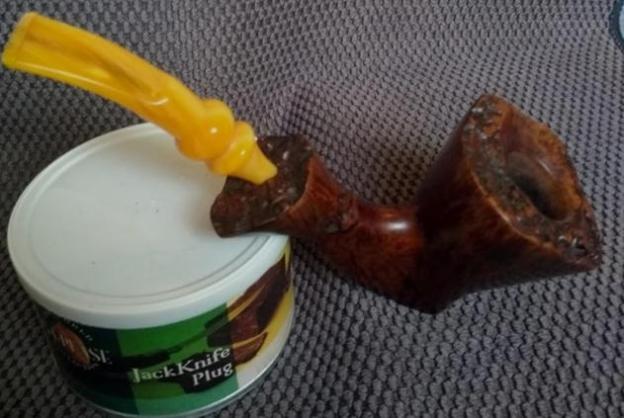
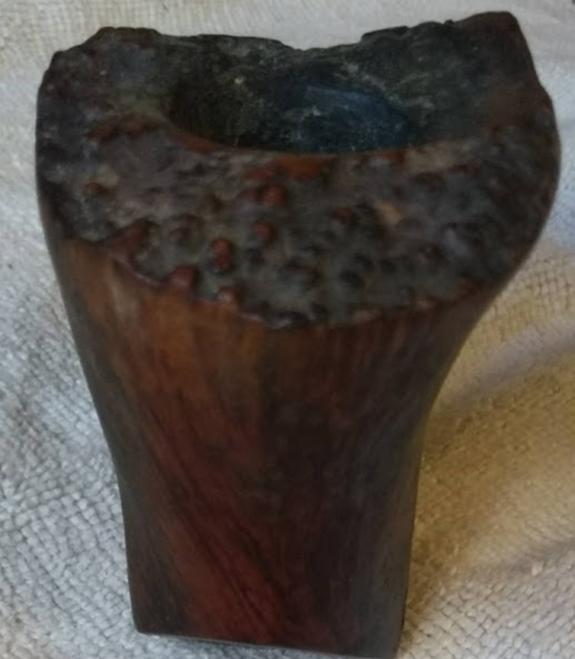
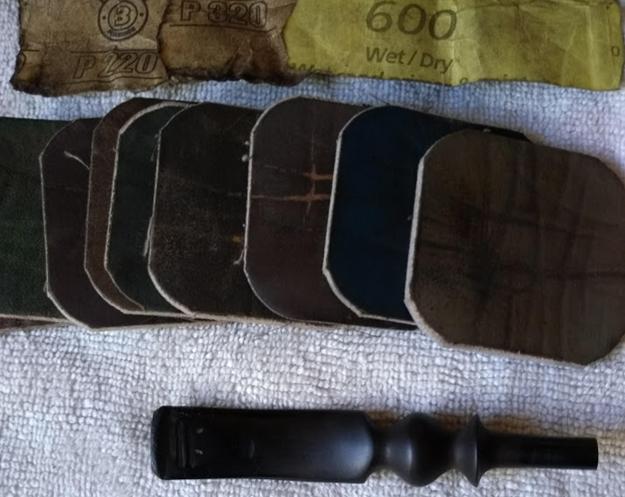
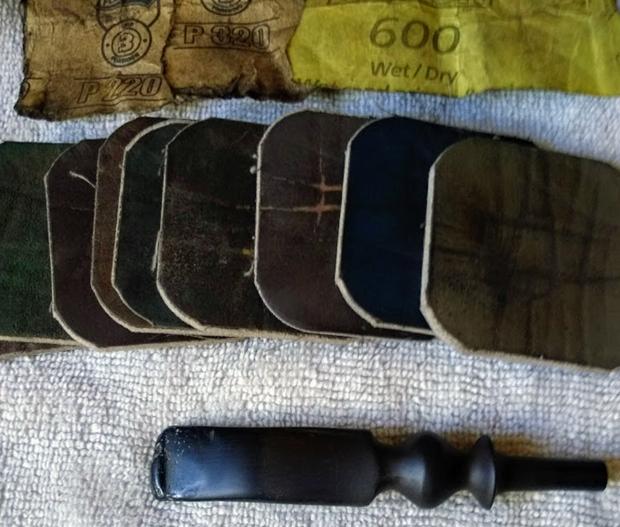
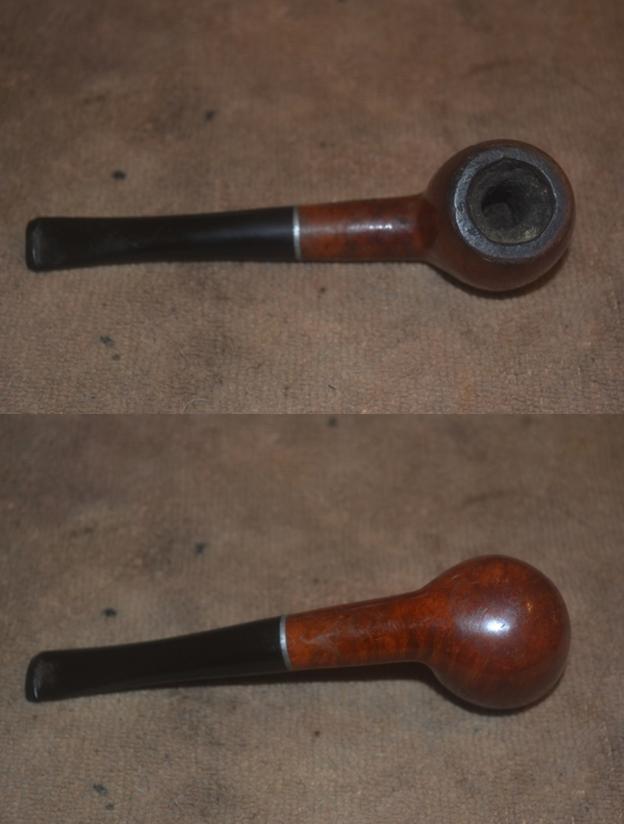
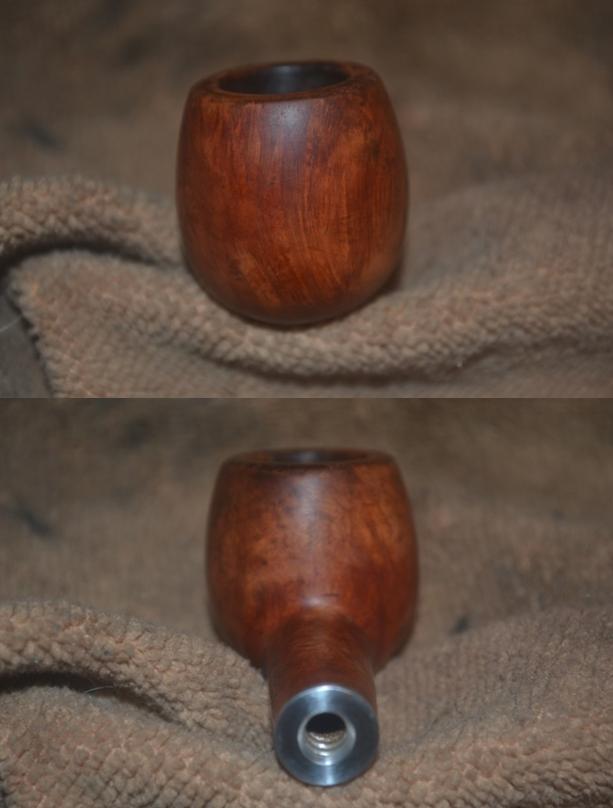
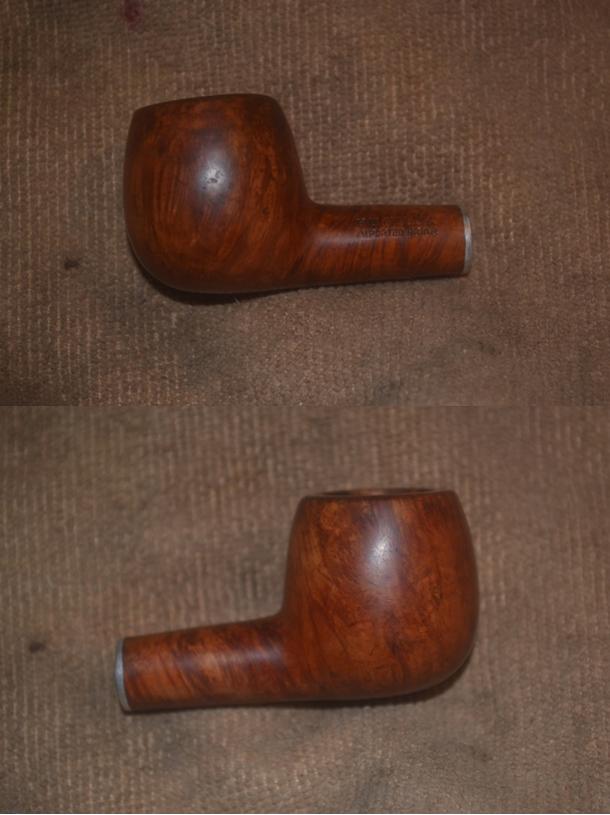
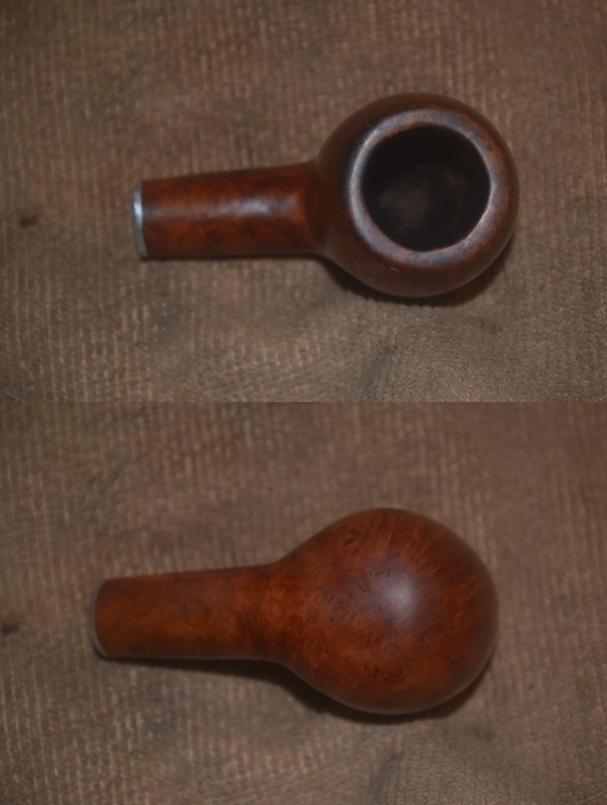
Here are photos of the KE as I received it minus the stem, and the Knute Vulcanite bollix I mended as far as I’m going to do for now, with no signs of the hole that was on the underside but a bit of a double lip there now and the pre-existing half lip topside.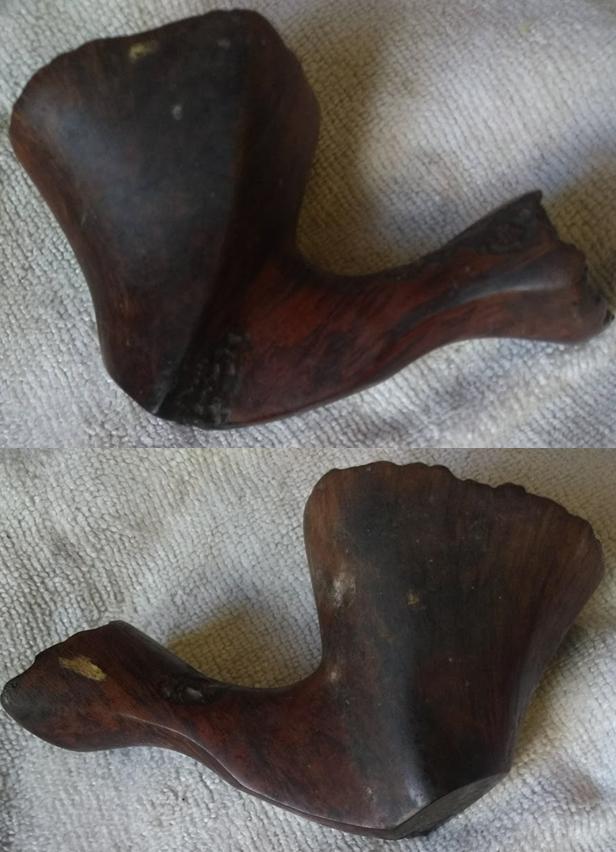
 RESTORATION
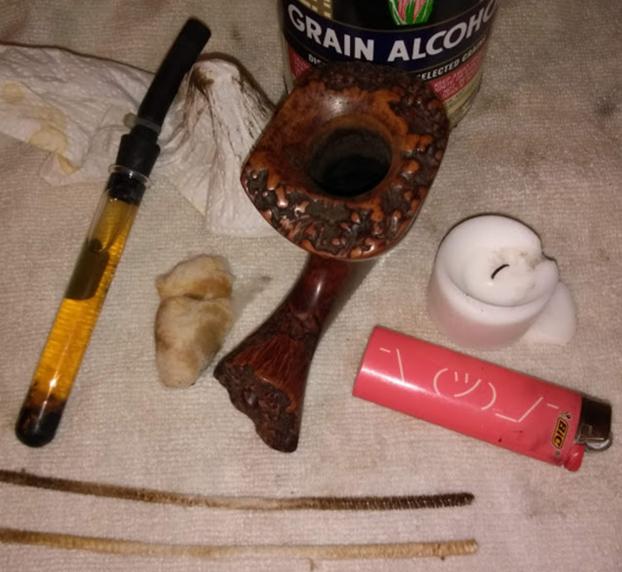
Part of me knew, from the rich, dark briar grain that glowed through the long bottom of the shank after I vanquished the grime that had overcast its natural, smooth brilliance, that the rest of the wood could only be better. But the Devil’s Advocate in me gave rise to the tomfool but nevertheless undeniable apprehension that nothing good could come from stripping away the sedimentary layers of anomalous substances. I decided to be done with the majority of the business using an Everclear soak.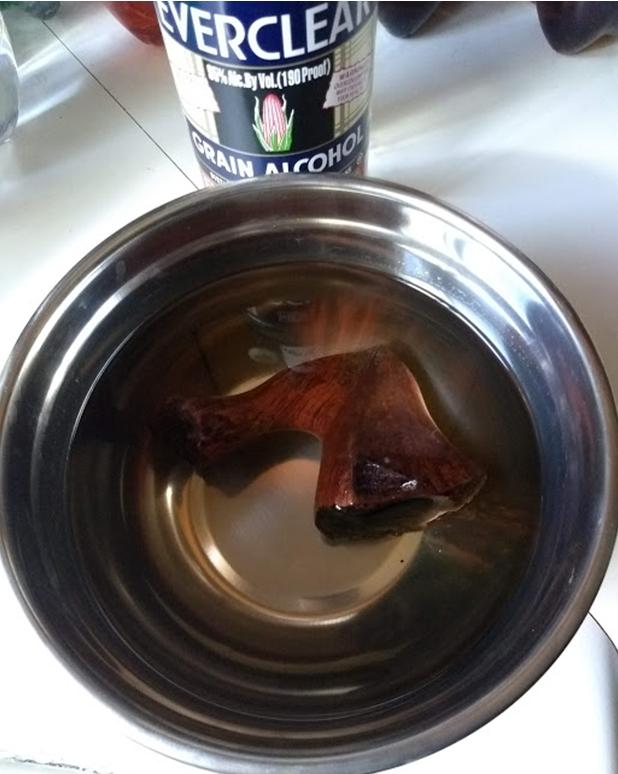
To keep my mind from its pointless and counterproductive negative preoccupation with the state of the stummel, I turned my attention to the Lucite stem that was taken off the BW to use in place of the lovely and too petite stem with which the pipe came. Note the dark stains inside the stem’s airhole and the bore and tenon opening. 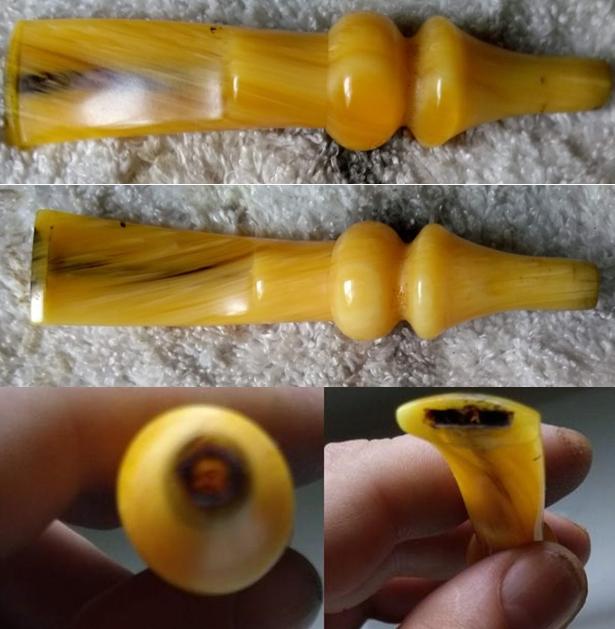 Most of the inner stain came out with alcohol soaked bristly cleaners, and the rest of that later with the retort. The bore and shank end, on the other hand, needed more wheedling. At first when I tried the small end of a bristly cleaner dipped in alcohol, I had minimal results. Switching to something more pointed, sharp and focused – an unwound paper clip – I scraped away the accreted blackness on both ends and used a 180 grit sanding pad on the tip of the shank end. Either I forgot to snap shots of the results or misplaced them, i.e., tapped Save As on the computer and didn’t look where I did it, but I don’t have the proof of cleaning to display. Later pictures will show all but the shank opening of the stem.
But there’s good news! The Everclear soak was finished! The color and grain I wanted to see were there.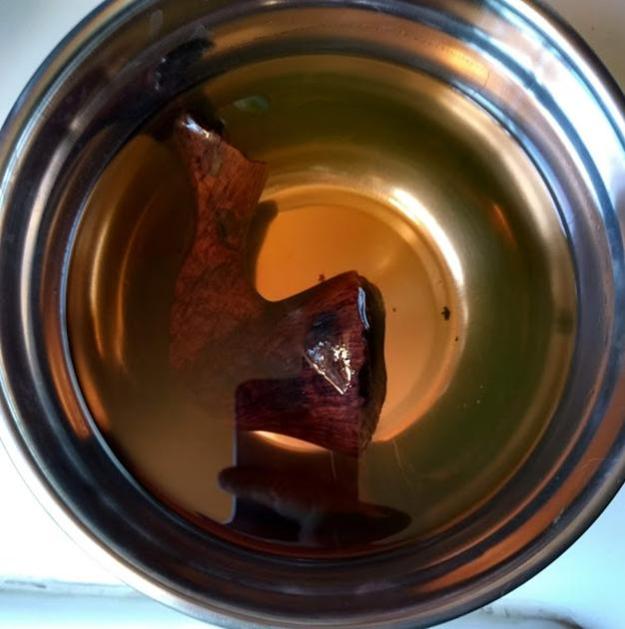
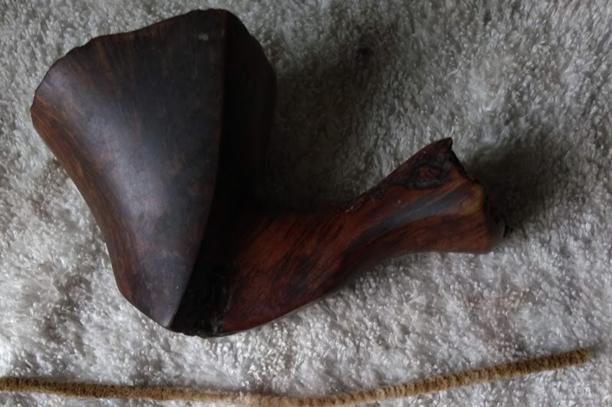
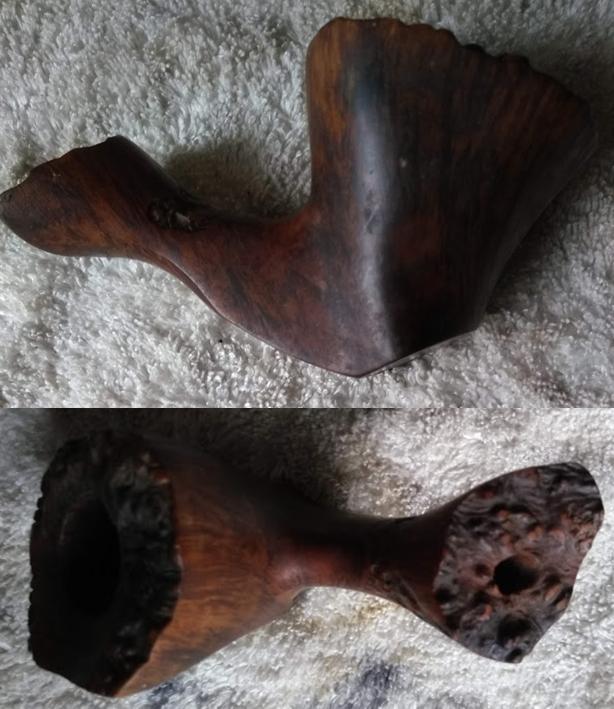
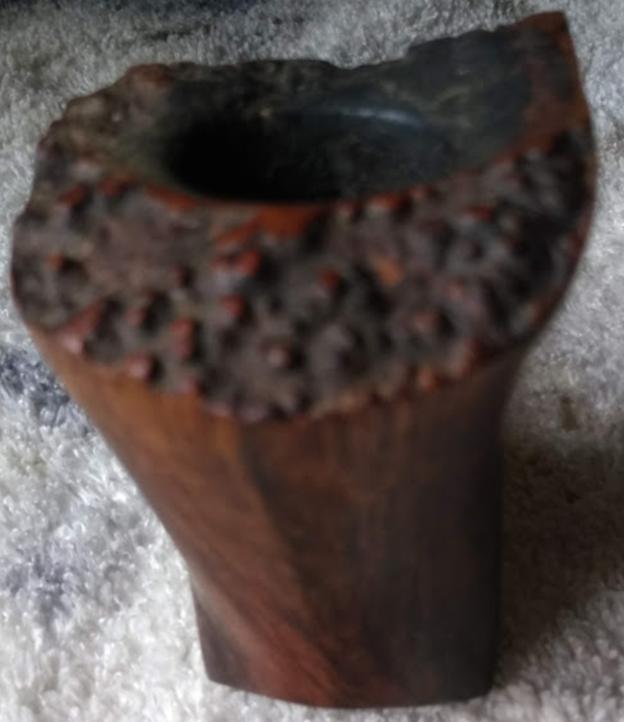
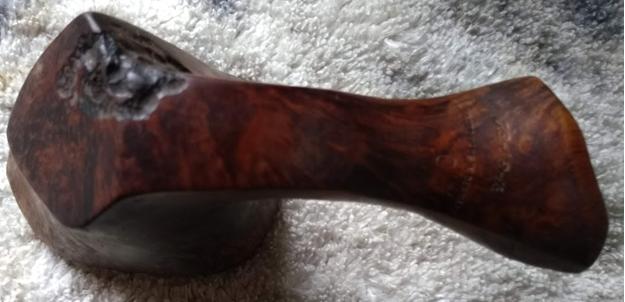 To remove the remaining odd caliginosity obscuring the fine wood, I gave the bowl and shank a quick rub with 600-grit paper and the rim with super fine “0000” steel wool. The difference was marked.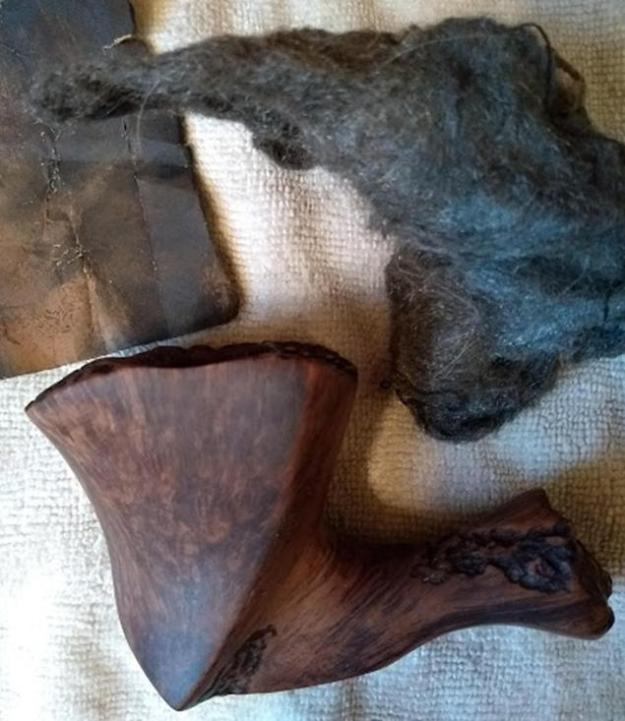
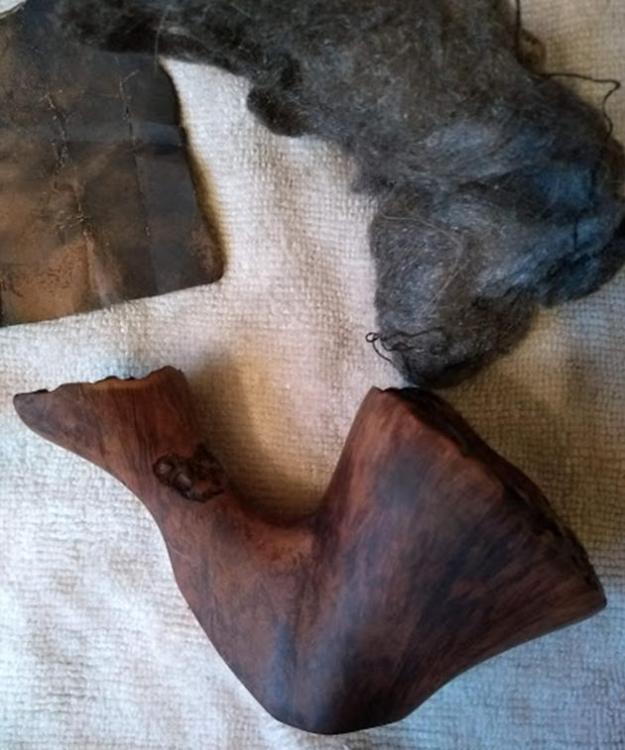
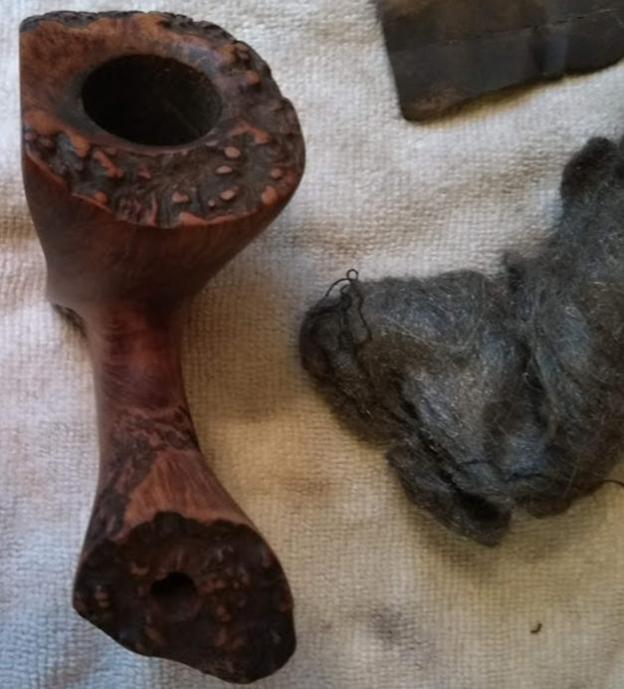
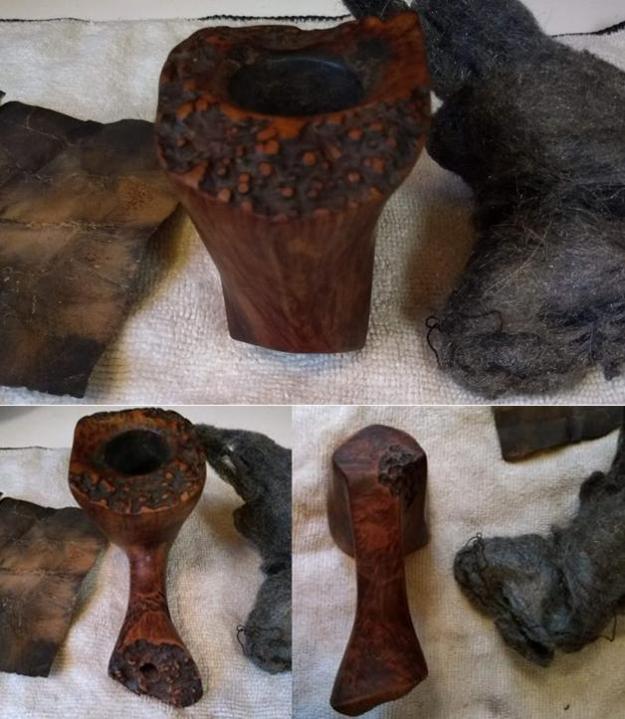
 The plateaux rim and shank opening needed a little more Everclear soaking. That done, I grabbed my handy sanding pad again and spot-scrubbed those places.
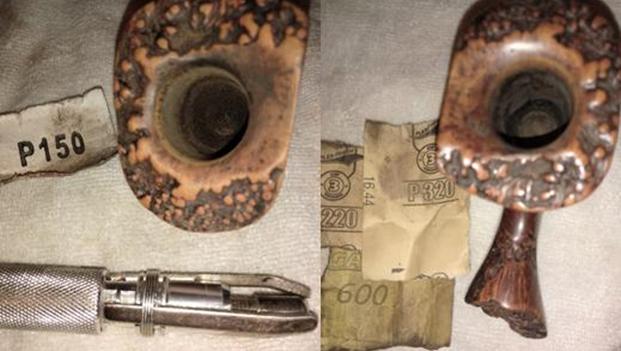
 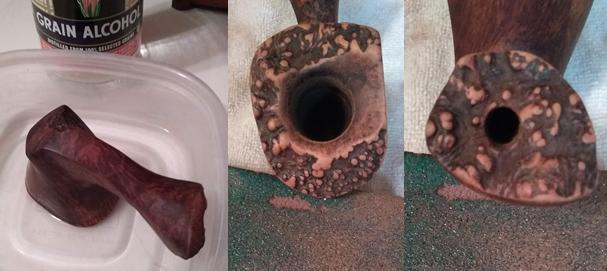 I reamed and sanded the chamber with 150, 220-, 320- and 600-grit paper that took the char far enough down to the wood for the retort to handle what remained.
  For me, the most gratifying part of a pipe restore, if the wood has been prepped properly beforehand, is micro meshing from 1500-12000, for this is where the mettle of the pipe is revealed. The deep, shiny, shimmer that should result is something to behold with wonder. And the grain on the block of wood chosen for this pipe is spectacular. I also ran four Pyrex tubes of Everclear through the pipe afterward for the retort.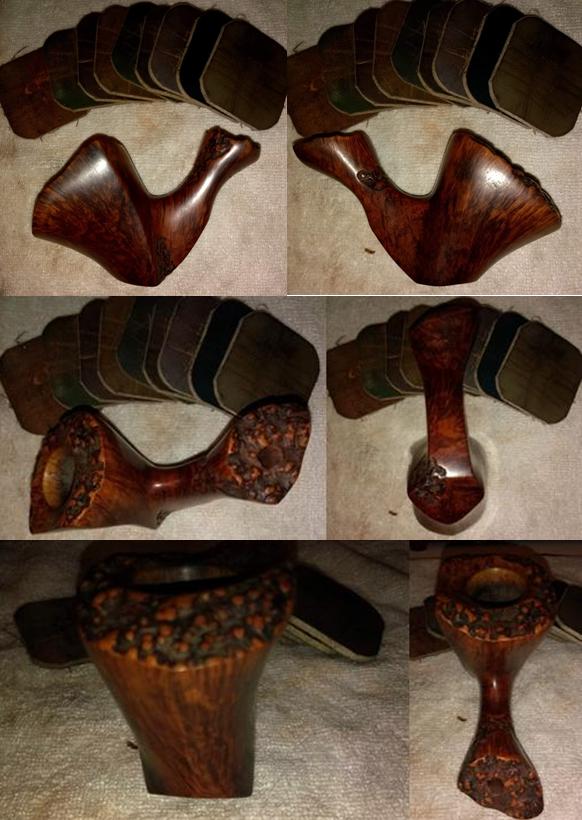
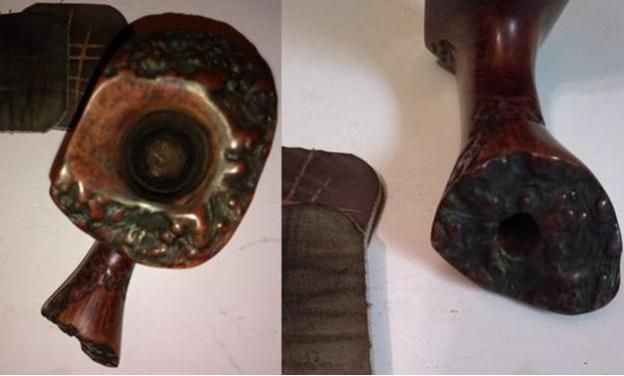
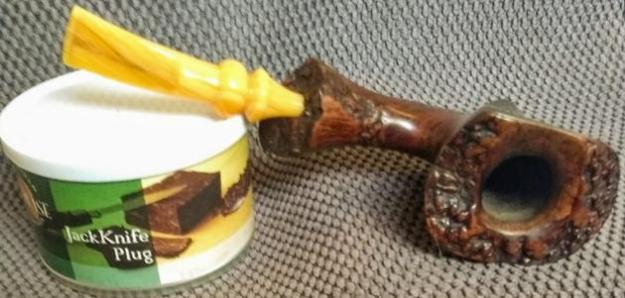
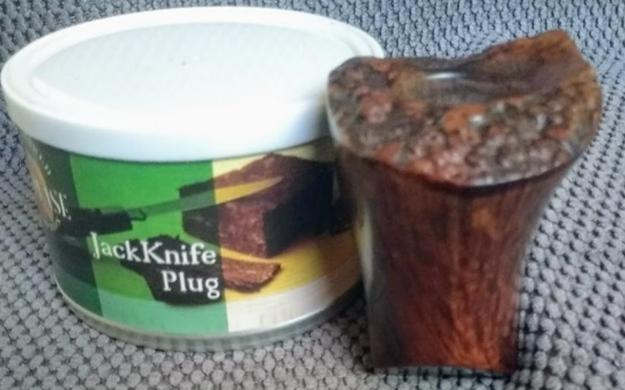
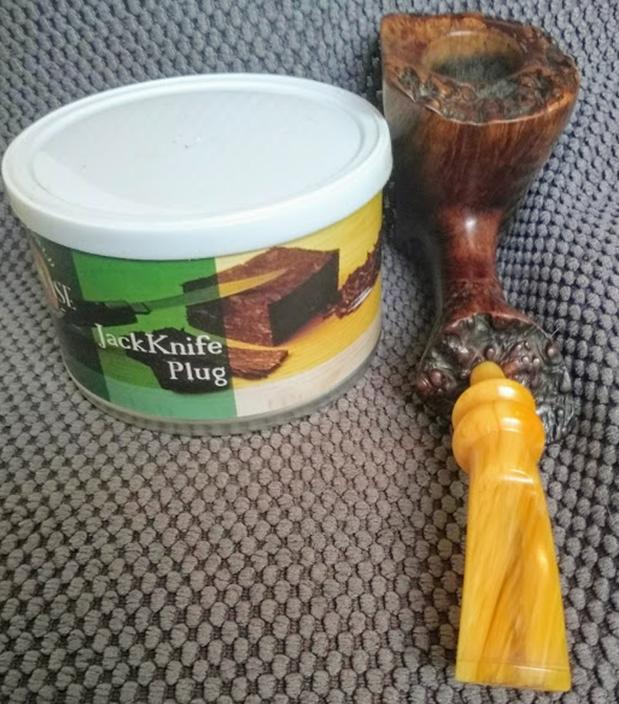
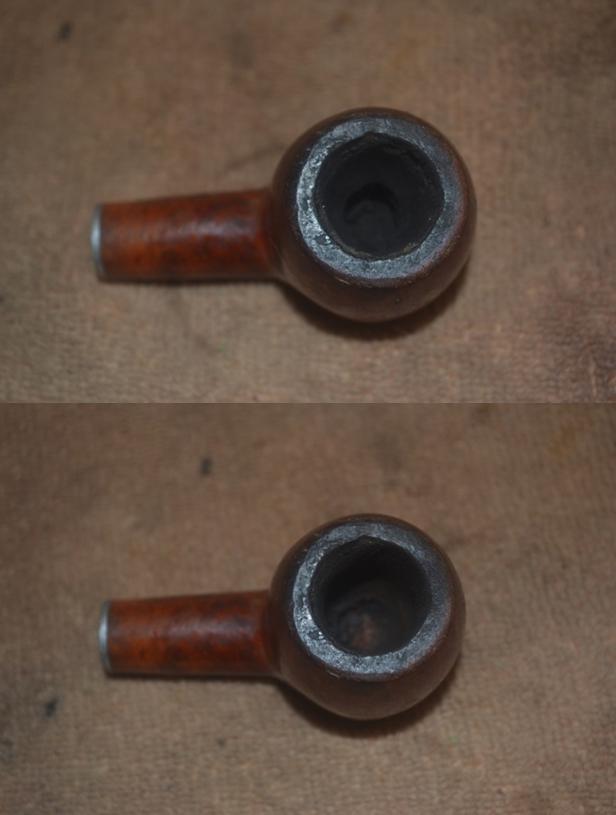
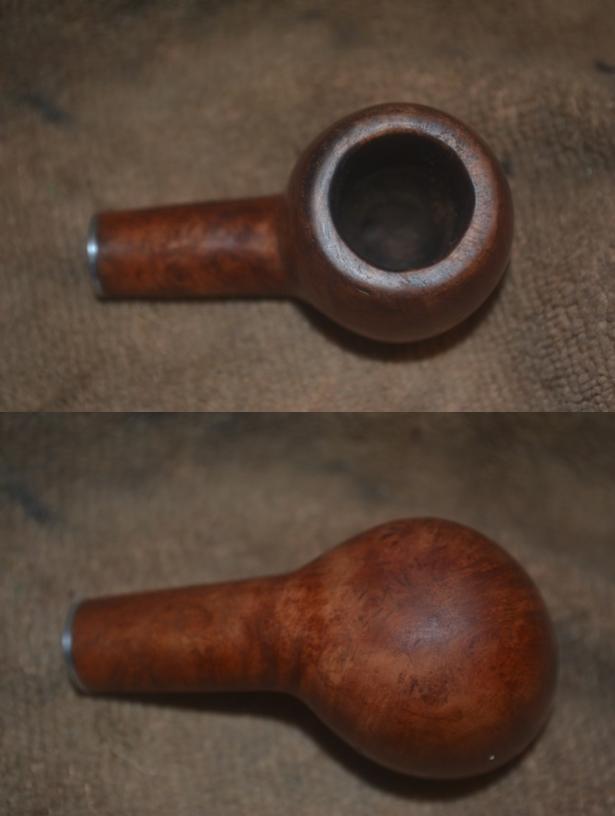
 Staining the rough rim and shank opening with Lincoln Medium Brown boot stain before flaming them, I took off the char with 8000 and 12000 micro mesh. The second of the next two pics shows before I finished it with a light touch of steel wool.
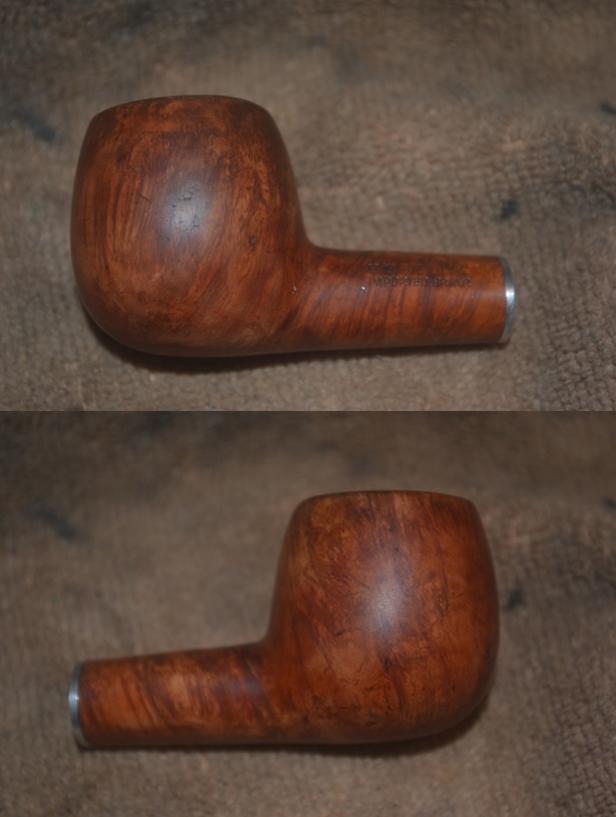
 With that, the pipe was finished except for buffing the stummel and stem with red rouge and carnauba wax. I’m out of Halcyon II and therefore could not use it on the plateau areas.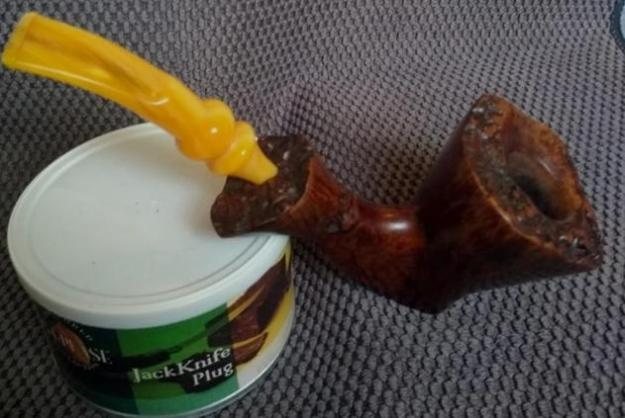

 CONCLUSION
One look at this pipe out of the box the lot came in and I fully intended to offer it for sale. The gentleman from one of my pipe smokers’ forums who bought the Knute was also more than eager, to put it lightly, to get his hands on the Karl Erik I told him I had. But all that was before I started unearthing – in a sense that may be literal given the fact that the pipe looked to have been buried for some time – the way Ottendahl chased the grain on this splendid example of one of his earlier works, when he graded them on an as yet undocumented scale. For all I know, O being the fifteenth letter of the English alphabet, my newest freehand may not be near the top end, but it’s still graded. That means it meant something to its maker, and I’m certain he would remember it if he could be reached where he is now. Besides, as his newer scales are ascending, meaning from “best” to “worst,” and I being more of a glass half-full kind of guy, I like to think it’s two grades closer to the sidewalk than the middle if the road.
SOURCES
http://www.pipephil.eu/logos/en/logo-k1.html
https://pipedia.org/wiki/Karl_Erik
https://www.worthpoint.com/worthopedia/karl-erik-freehand-estate-pipe-521847614
https://rebornpipes.com/2016/07/06/a-stellar-find-a-gbd-prestige-1451-oval-shank-billiard/
https://rebornpipes.com/2018/07/17/finding-the-natural-beauty-of-a-knute-of-denmark-freehand/
https://pipedia.org/wiki/Knute




 rebornpipes