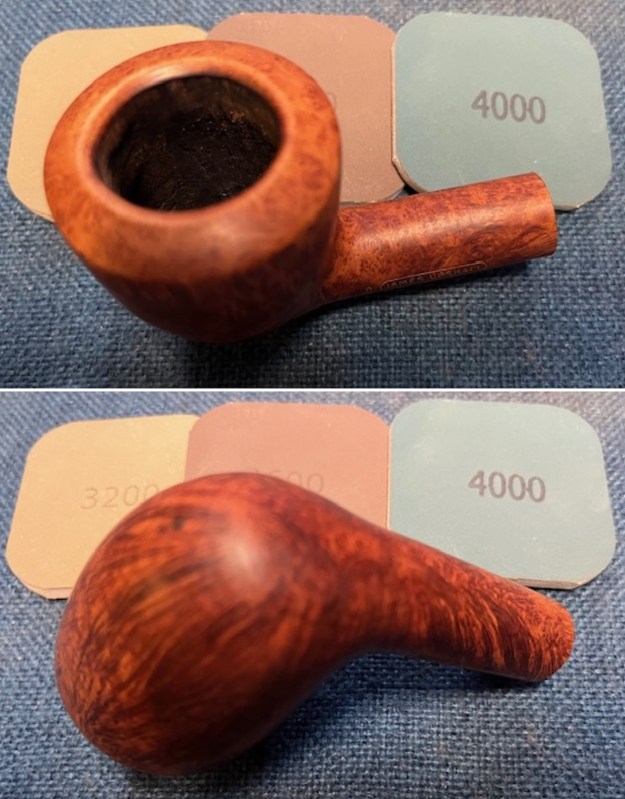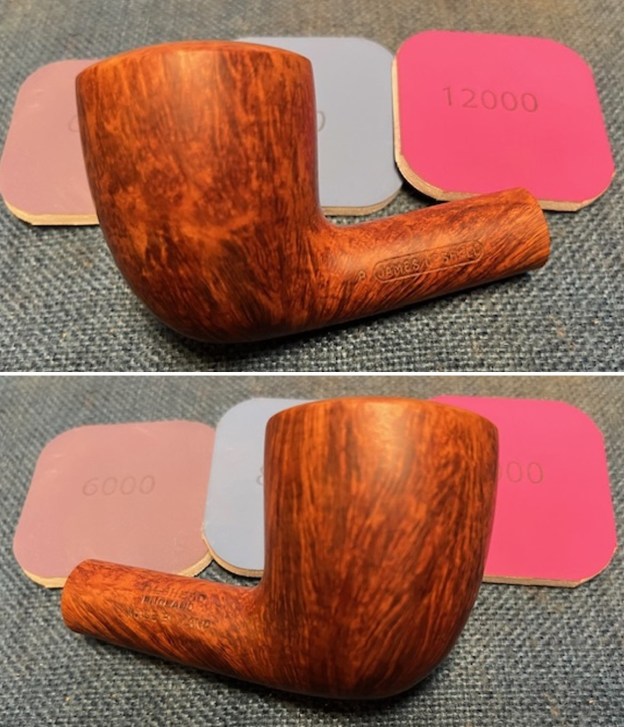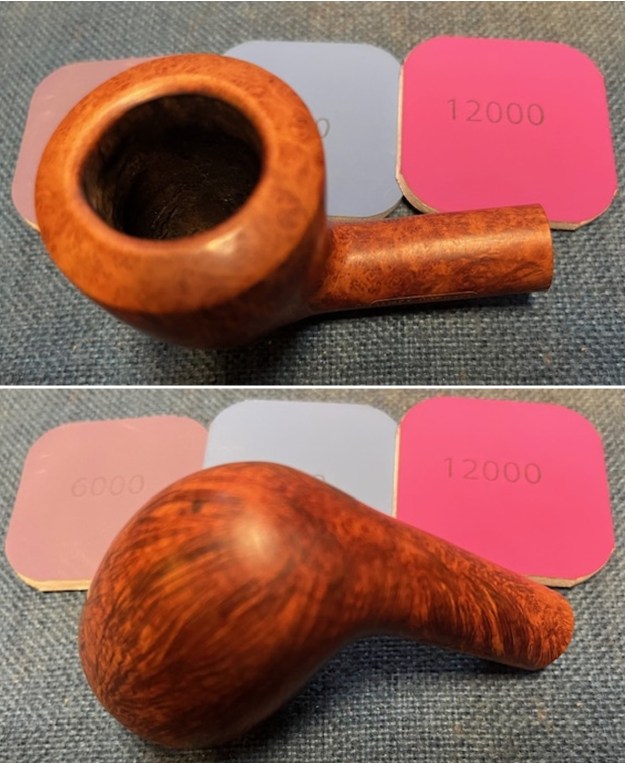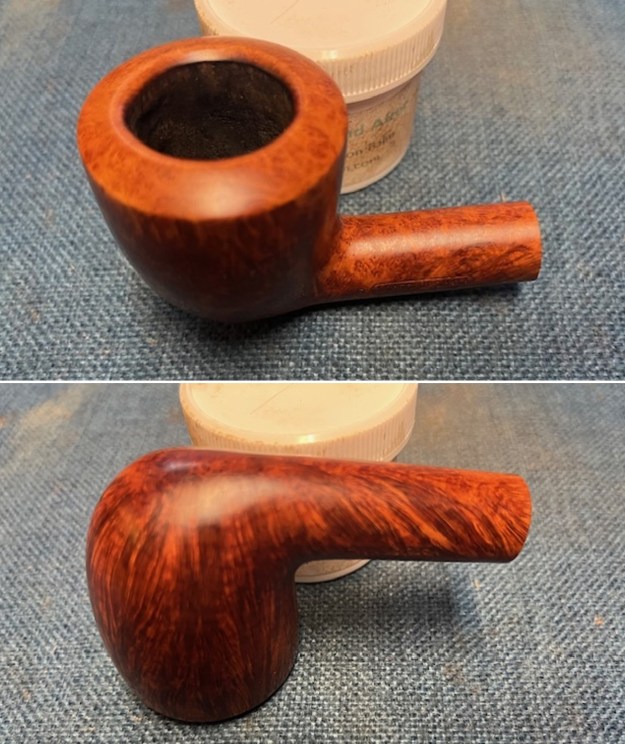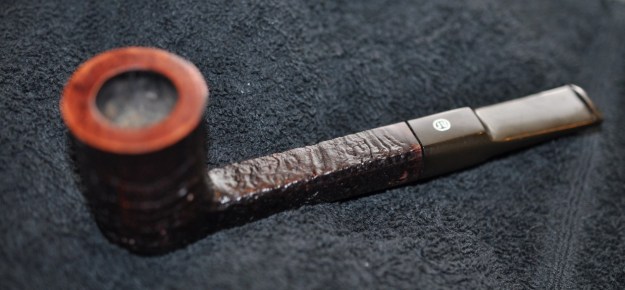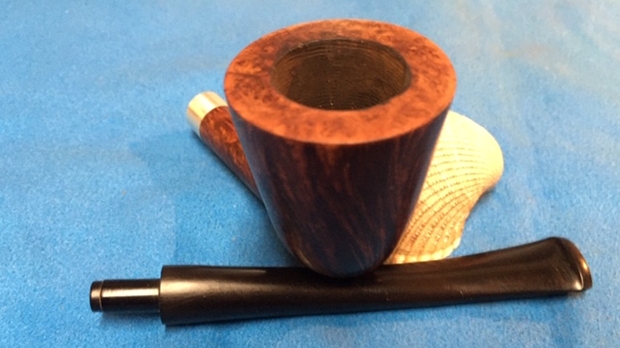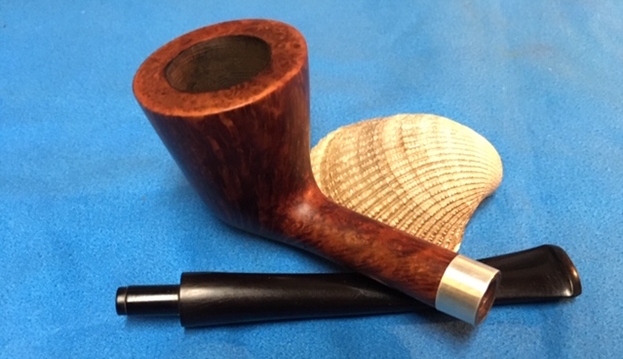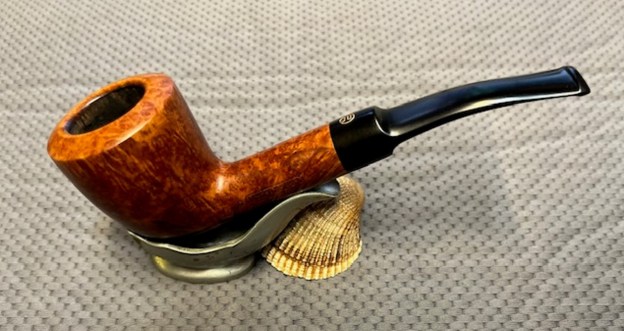
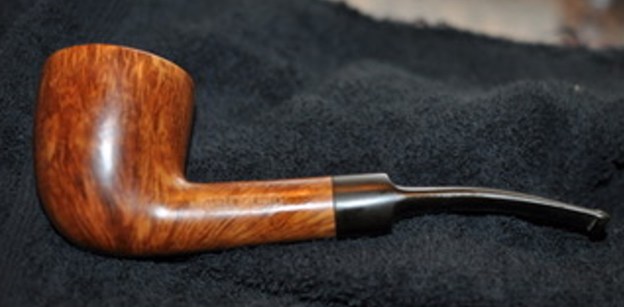
Tag Archives: James Upshall Tilshead England Handmade

Restoring a James Upshall B Tilshead England Made by Hand Dublin


by Steve Laug

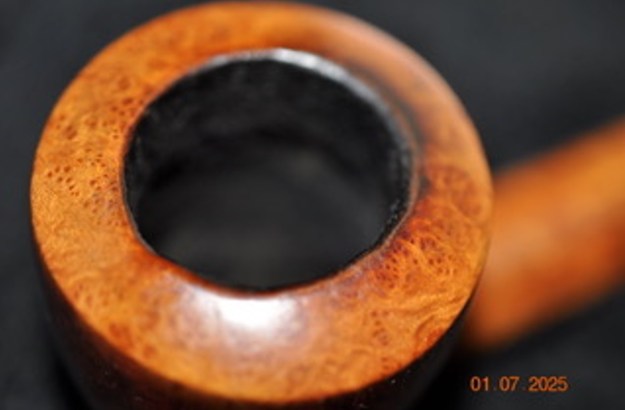
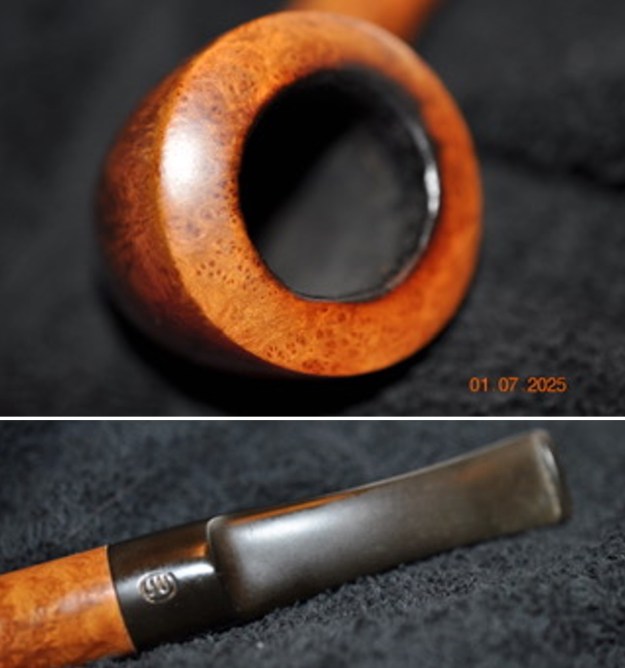
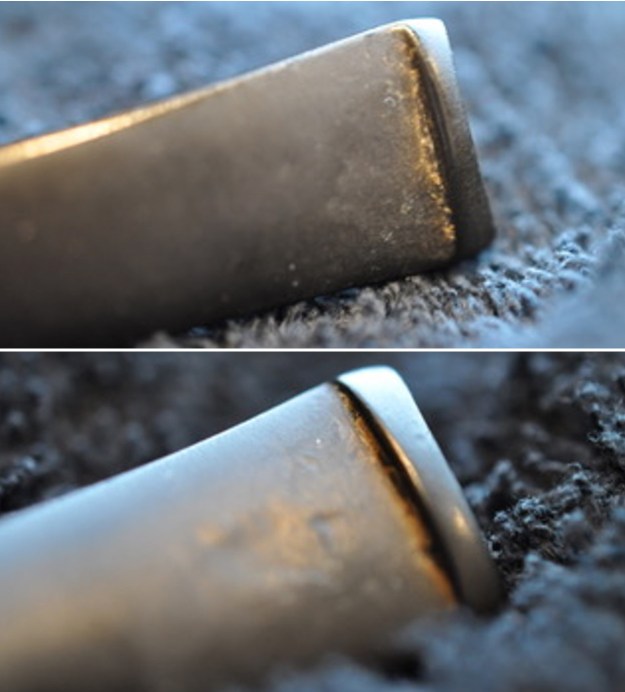
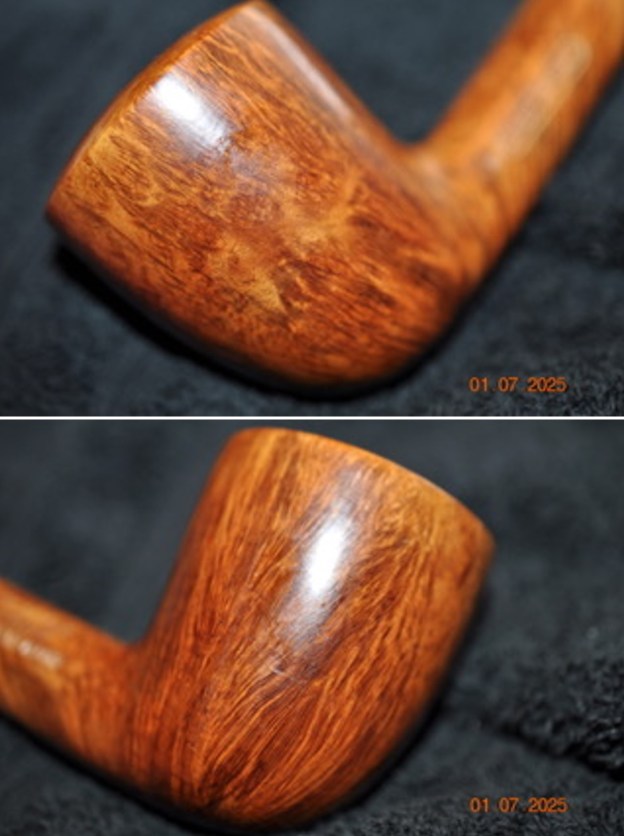
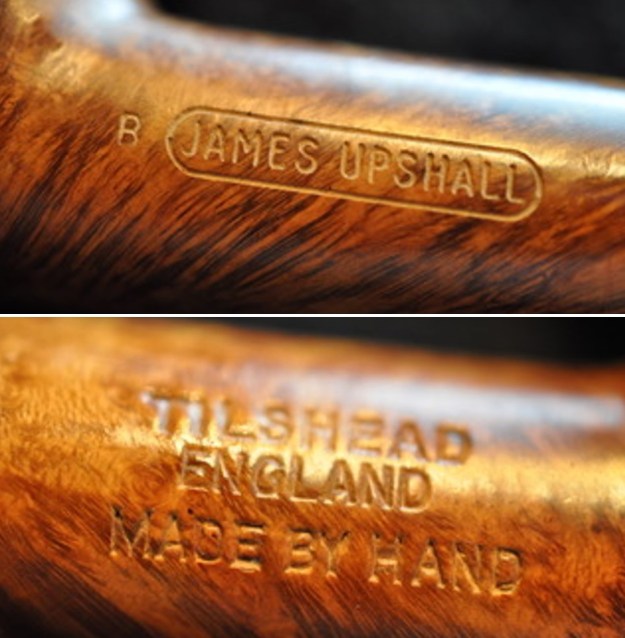
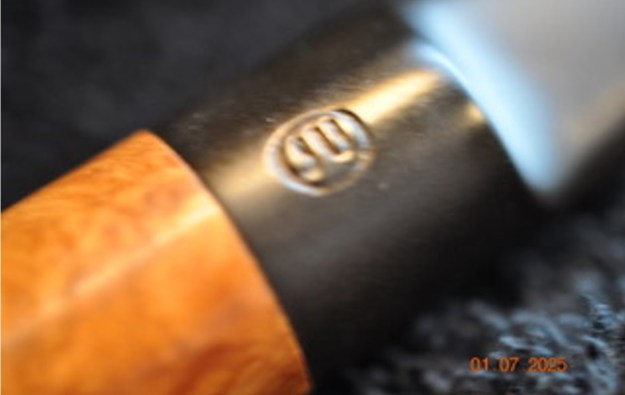
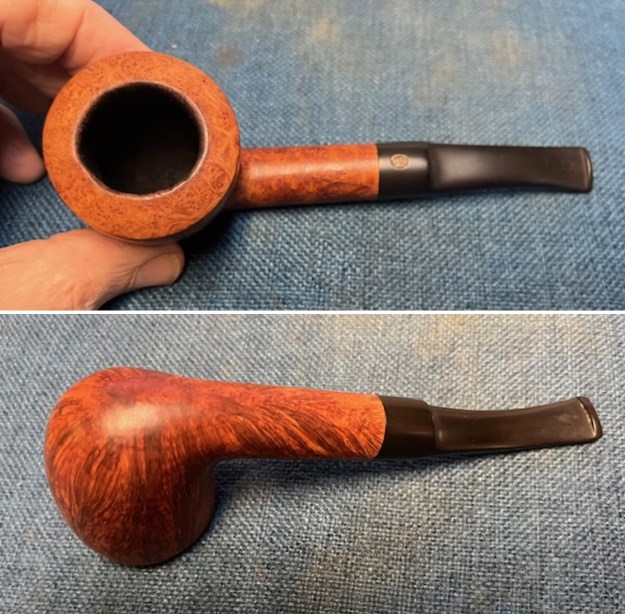
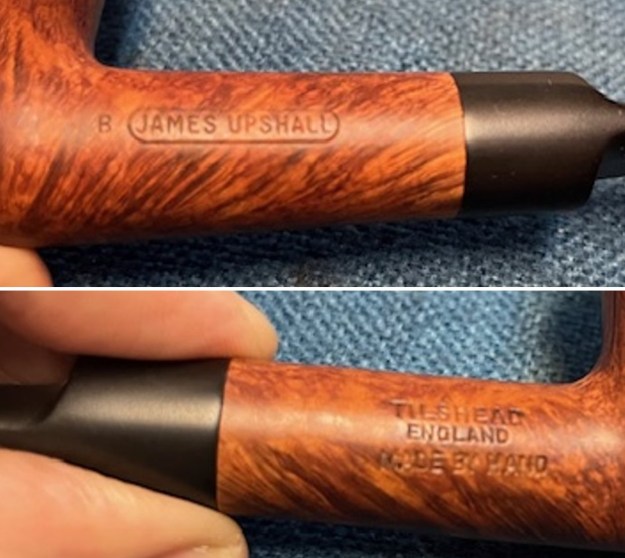
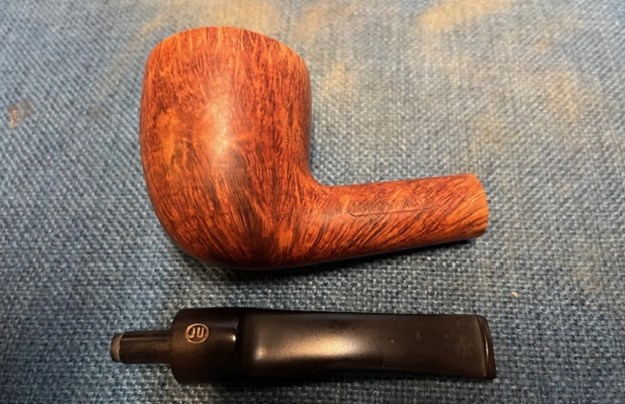
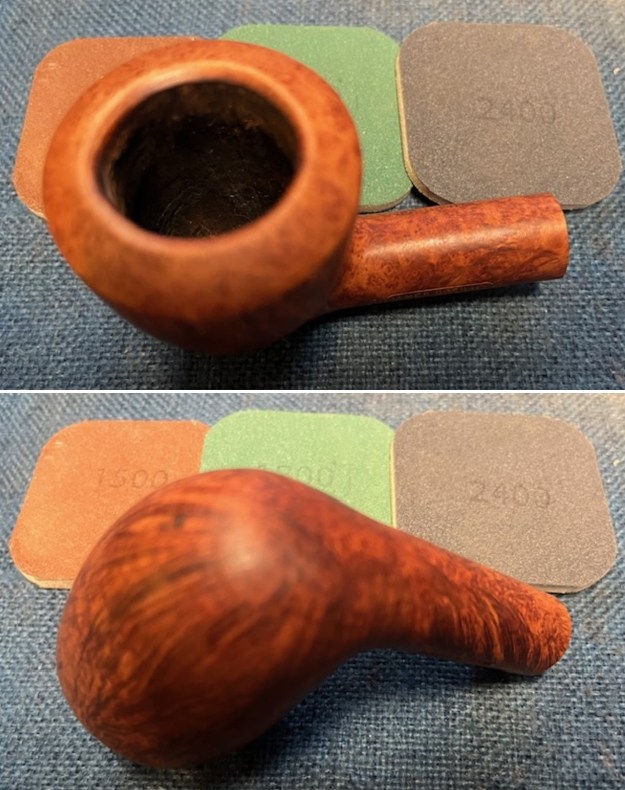
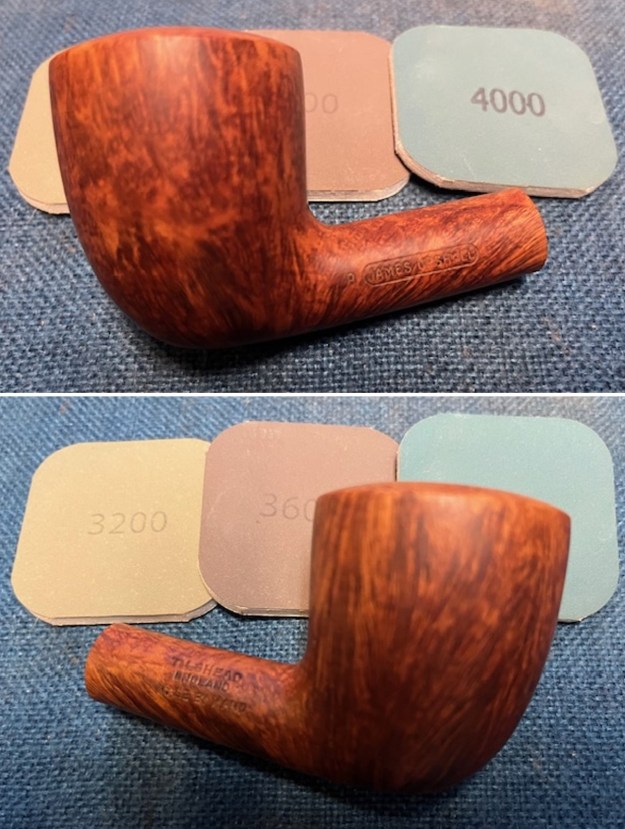
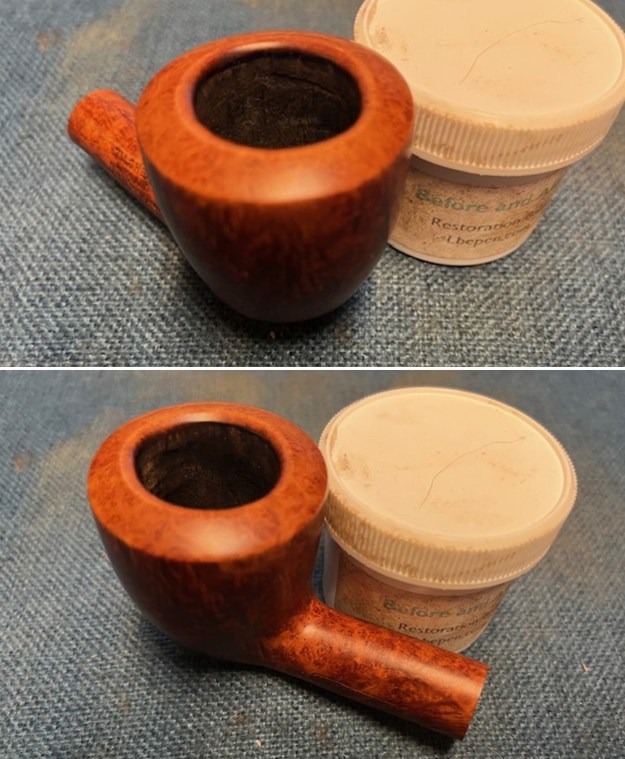
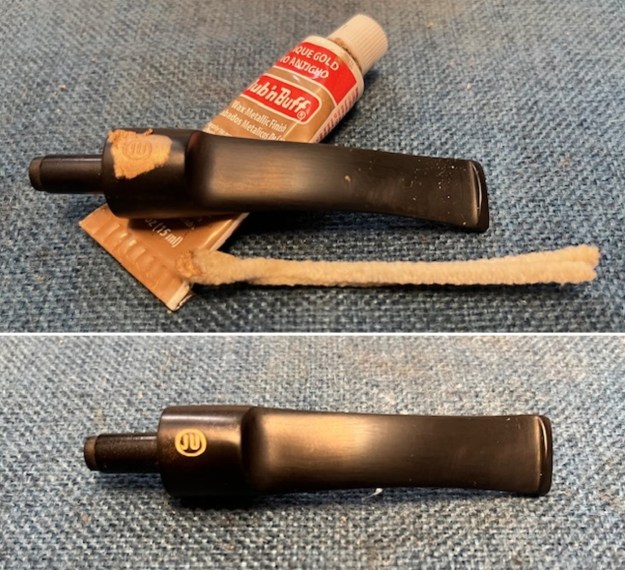
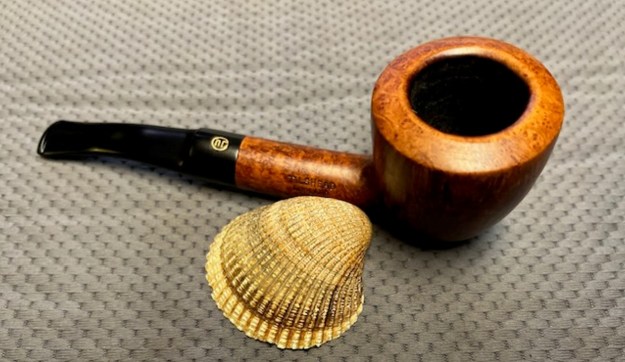
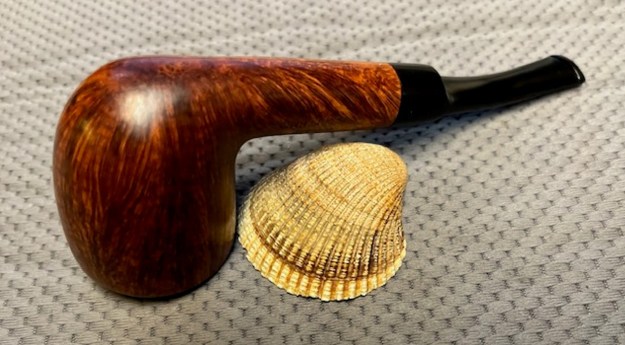
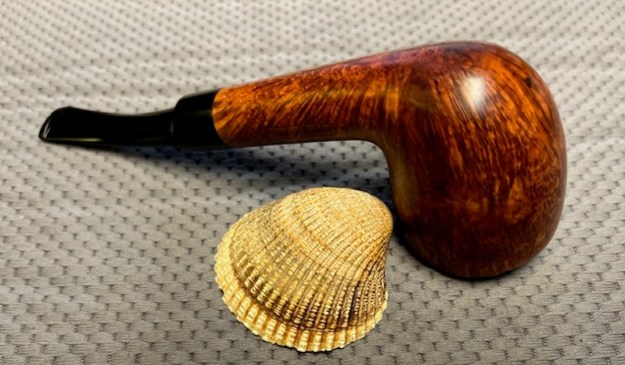
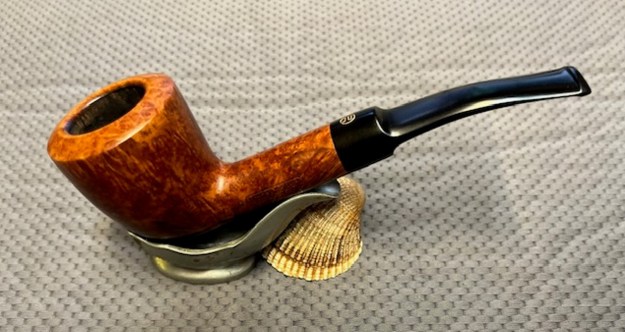
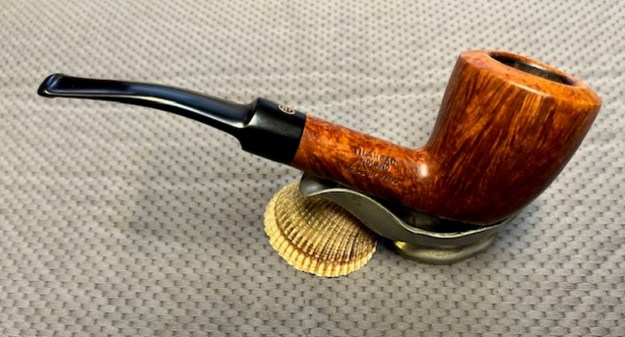
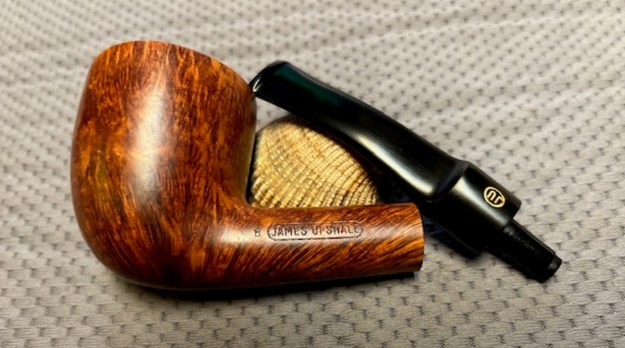
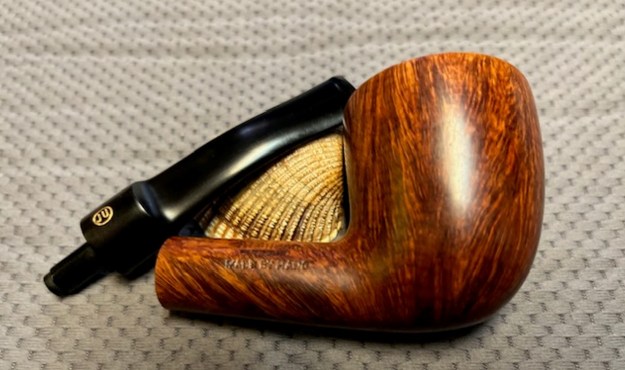
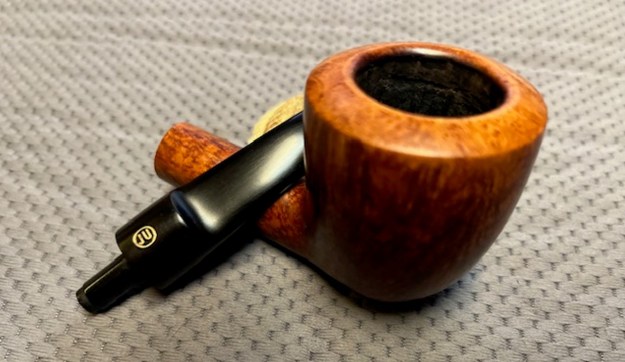
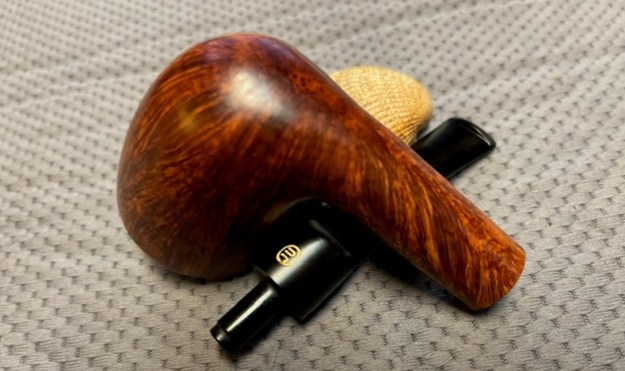
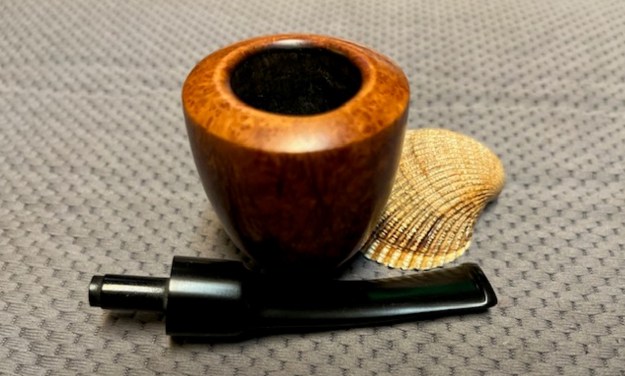
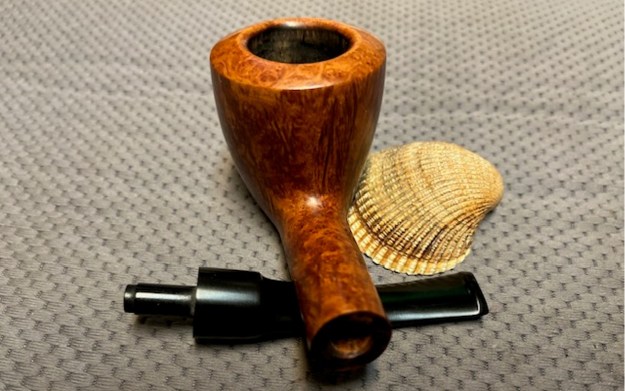
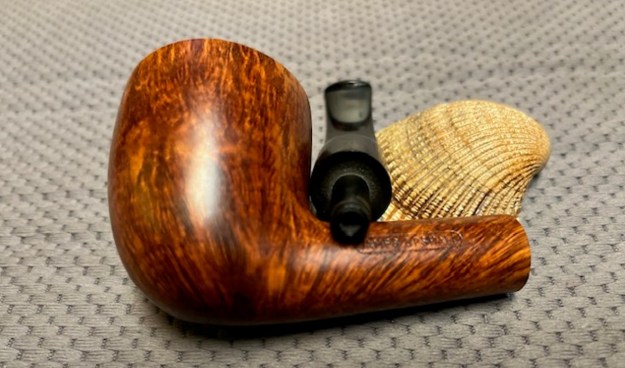
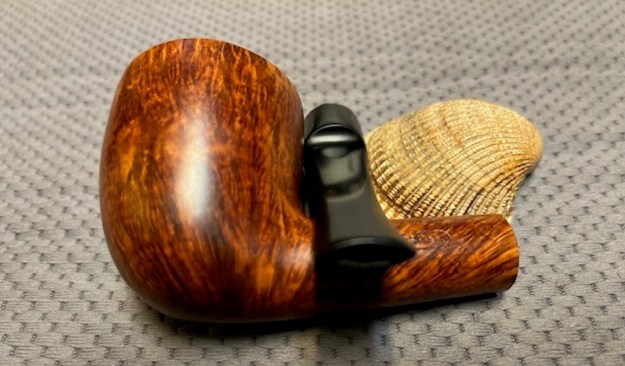
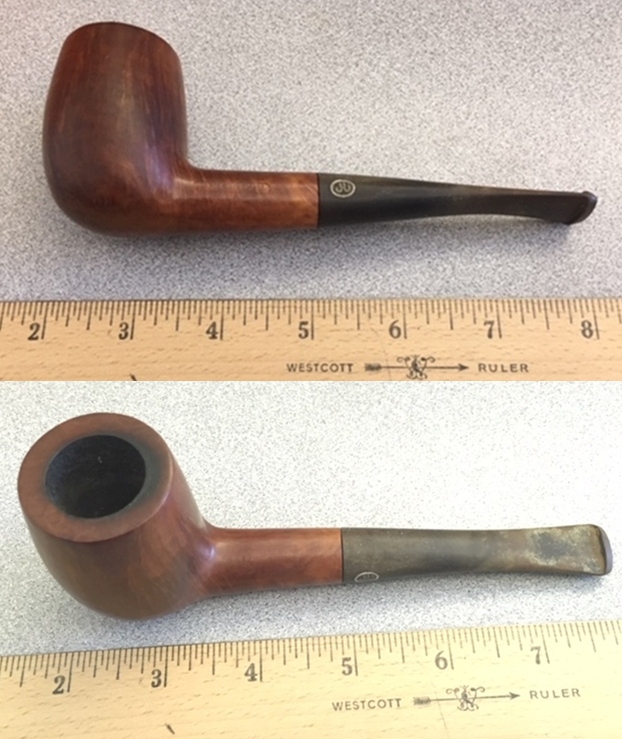
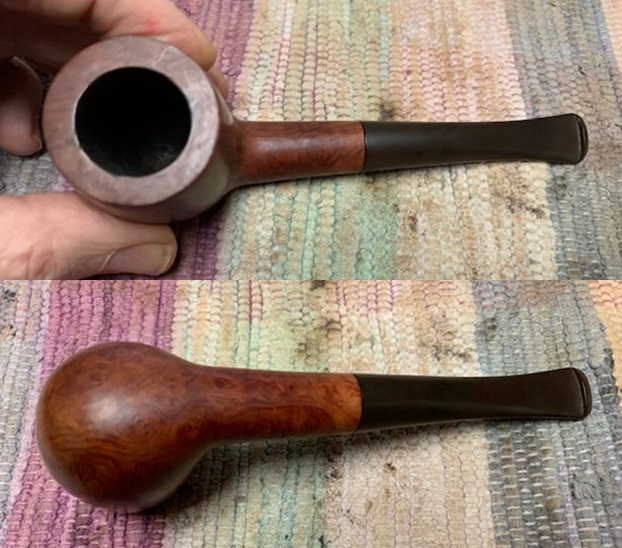
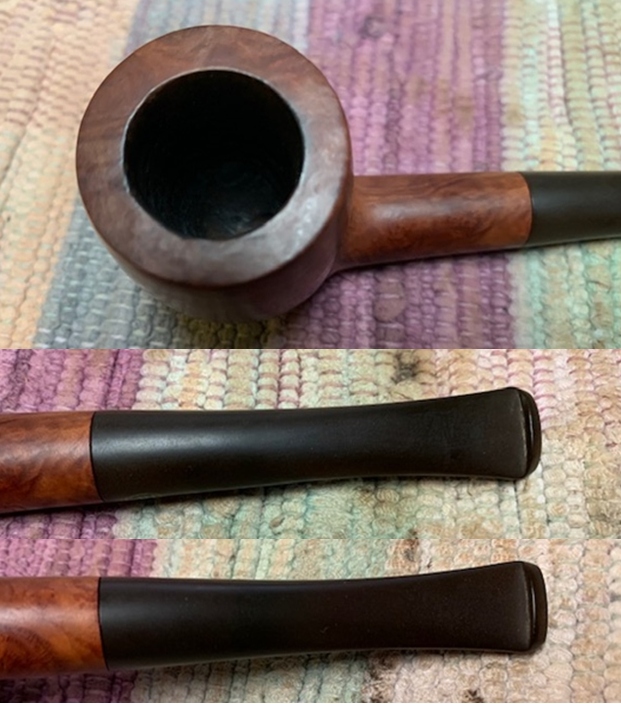
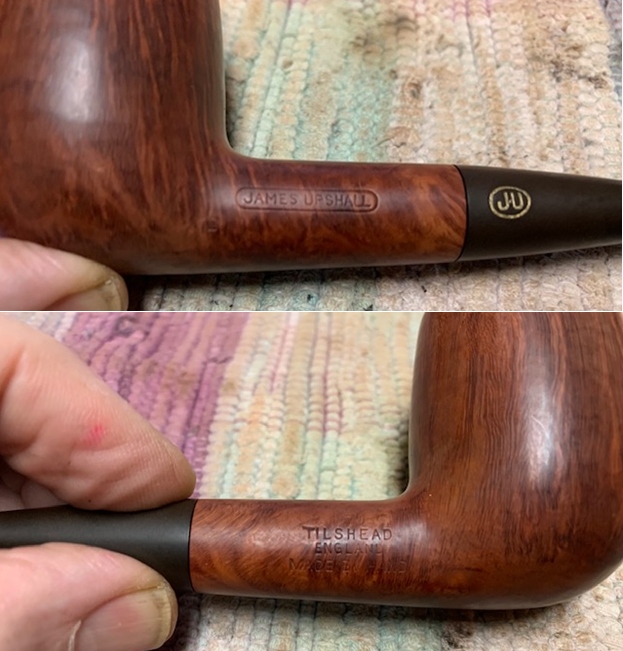
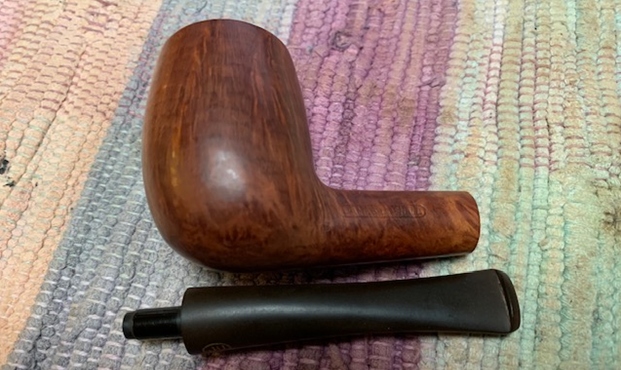
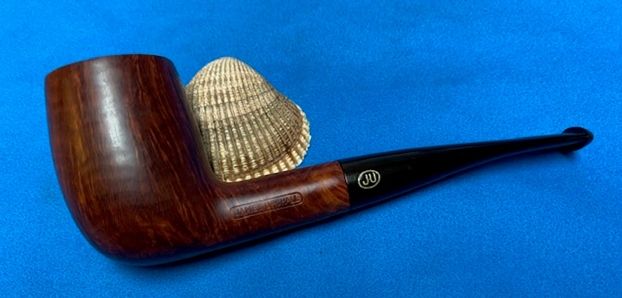
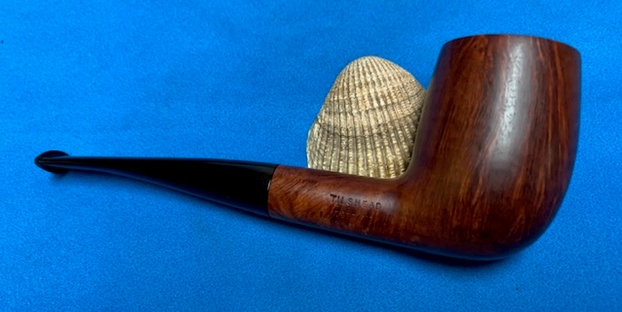
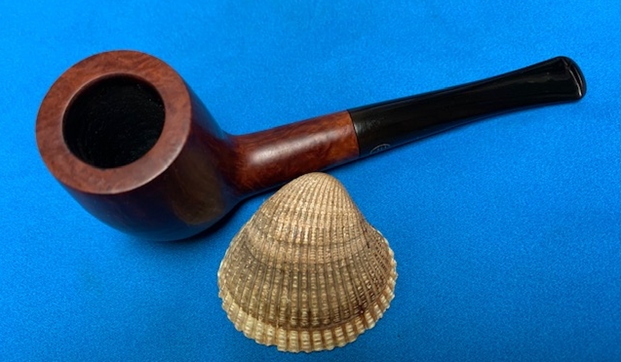
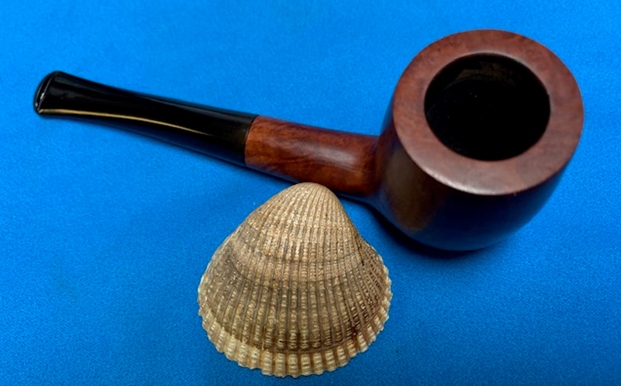
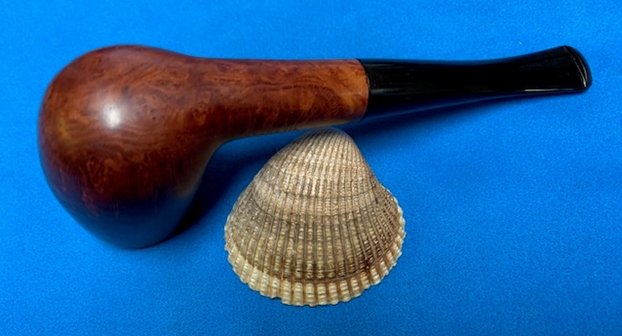
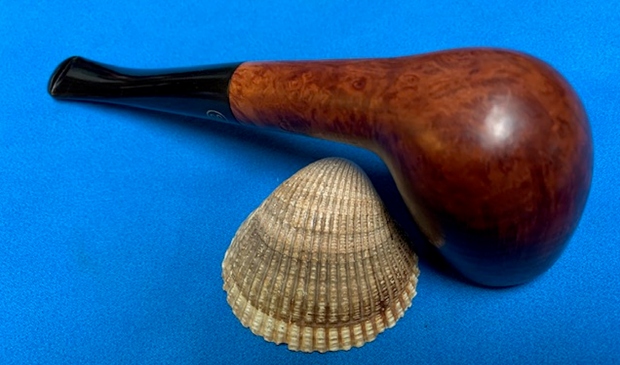
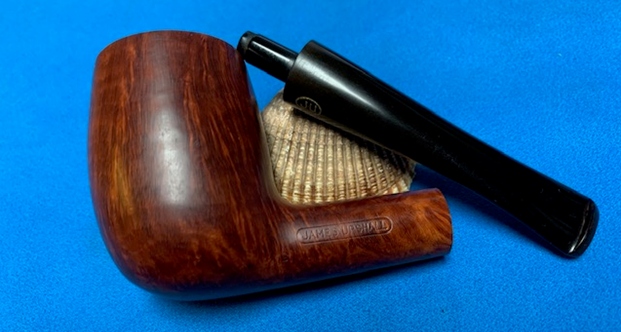
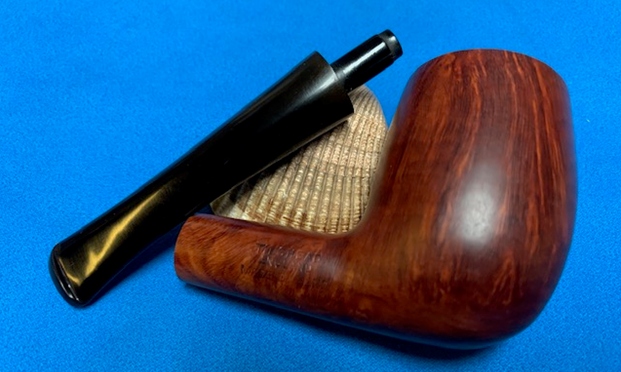
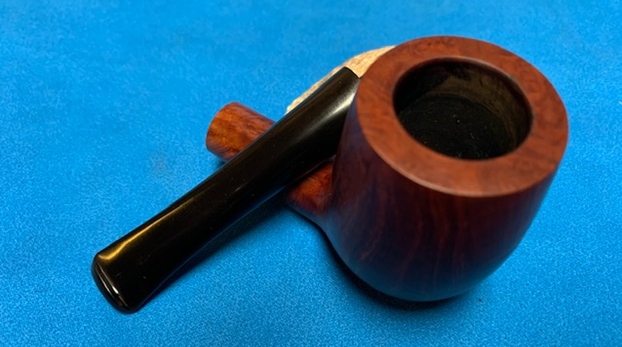
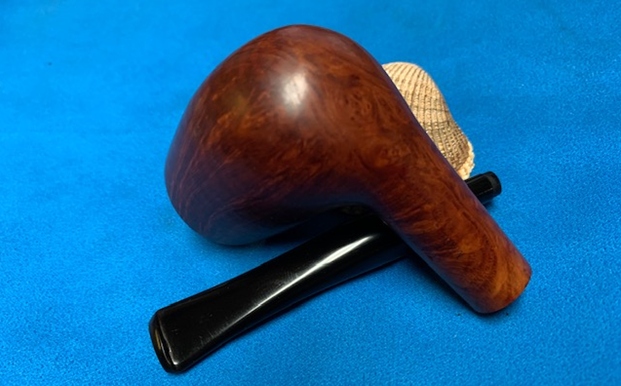
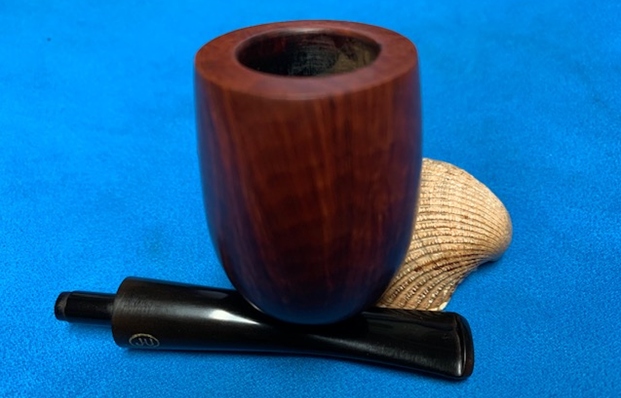
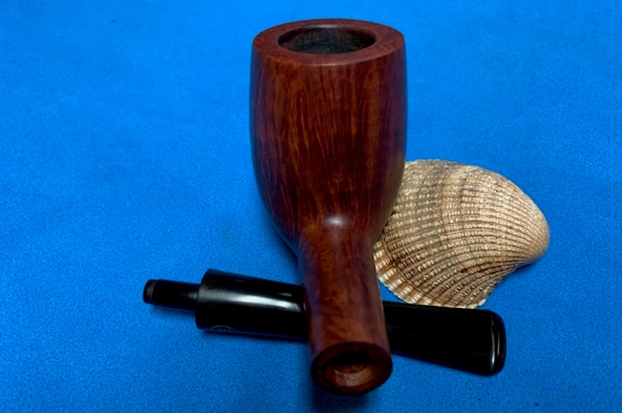
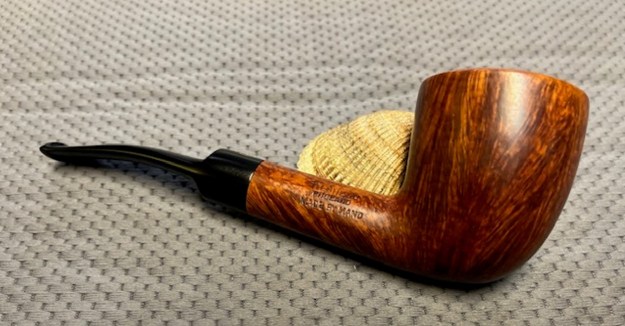
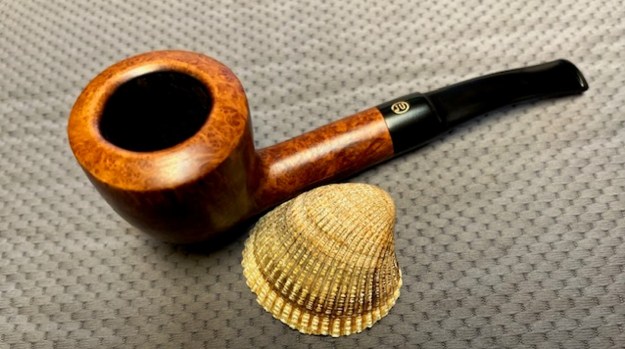
The next pipe on the table is a Peterson Rusticated Meerschaum Bulldog. We picked the pipe up from a seller in Ogden, Utah, USA on 12/12/2024. Probably the fact that it is a James Upshall pipe and has the JU stamp on the stem caught our eye on this one. It is stamped on the left side of the shank and reads B followed by James Upshall in an oval. On the left is stamped Tilshead [over] England [over] Made by Hand. It is a B Grade smooth, walnut finished pipe. The B grade is the “entry” level for the Upshall Straight Grains and retail new at about $1500. The finish is a bit dull and dirty with dust and grime. The bowl has a light cake and the rim top has some darkening and some damage around the inner edge on the front. The stem is oxidized and has tooth chatter and light tooth marks on both sides near the button. The surface of the button looks very good on both sides. The circle JU logo stamp on the top side of the saddle is deep looks good. Jeff took some photos of the pipe to show the general condition of the pipe before he started his clean up. Jeff took photos of the rim top and stem to show the general condition of the pipe. The bowl is lightly caked and the rim top looks good. The inner edge of the bowl has some burn damage and darkening. The stem is oxidized, calcified and has tooth chatter and tooth marks on the top and underside near the button. Jeff took photos of the bowl sides and heel to show the condition of the smooth finish around this bowl. The grain is quite beautiful and it is a nice looking pipe.He took photos of the stamping on the shank sides and the top of the stem. It is clear and readable as noted above. Before I started my work on the pipe I looked up the Upshall listing in Pipedia to remind myself of the background on the brand (https://pipedia.org/wiki/James_Upshall). I read through the article and found the section on Grading & Sizing Information really helpful. I have included that below. I have highlighted the pertinent text in red below.
James Upshall pipes are graded by various finishes, i.e. bark, sandblast, black dress and smooth etc. Then by cross grain, flame grain, straight grain and, last but not least, the perfect high grade, which consists of dense straight grain to the bowl and shank. The latter being extremely rare. In addition, the price varies according to group size, i.e. from 3-4-5-6 cm high approximately Extra Large. We also have the Empire Series which are basically the giant size, individually hand crafted pipes which come in all finishes and categories of grain. All our pipes are individually hand carved from the highest quality, naturally dried Greek briar. In order to simplify our grading system, let me divide our pipes into 4 basic categories.

  1. It begins with the Tilshead pipe, which smokes every bit as good as the James Upshall but has a slight imperfection in the briar. In the same category price wise you will find the James Upshall Bark and Sandblast finish pipes, which fill and smoke as well as the high grades.
  2. In this category we have the best “root quality” which means that the grain is either cross, flame or straight, which is very much apparent through the transparent differing color finishes. This group will qualify as the “S”- Mahogany Red, “A” – Chestnut Tan and “P” – Walnut. The latter having the straighter grain.
  3. Here you have only straight grain, high grade pipes, which run from the “B”, “G”, “E”, “X” and “XX”. The latter will be the supreme high grade. Considering the straightness of the grain the latter category is also the rarest. Usually no more than 1% of the production will qualify.
  4. Lastly, we have the Empire Series. These are basically Limited Edition gigantic individually hand crafted pieces, which again are extremely rare due to the scarcity of large, superior briar blocks.

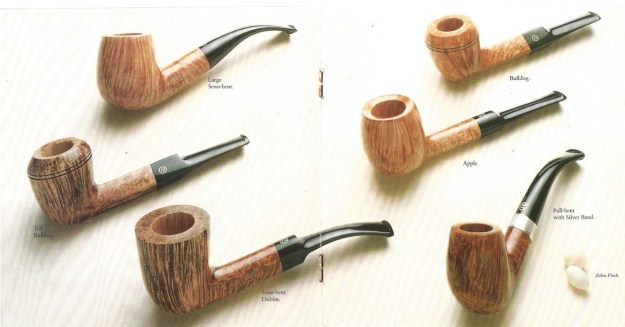
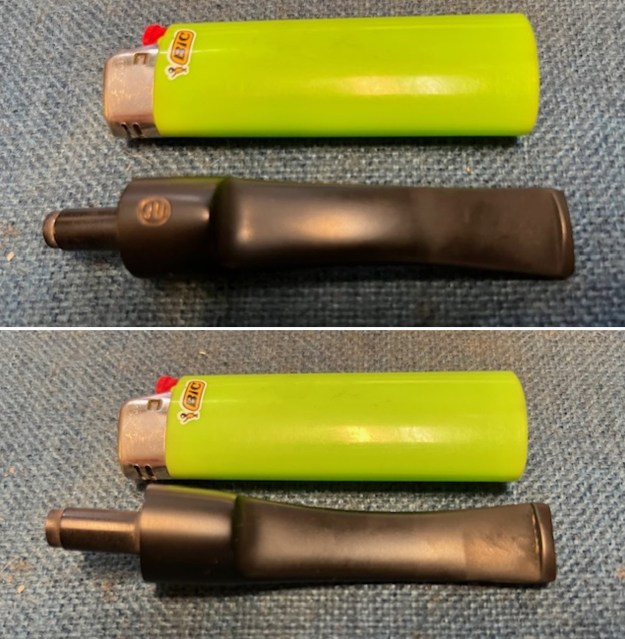
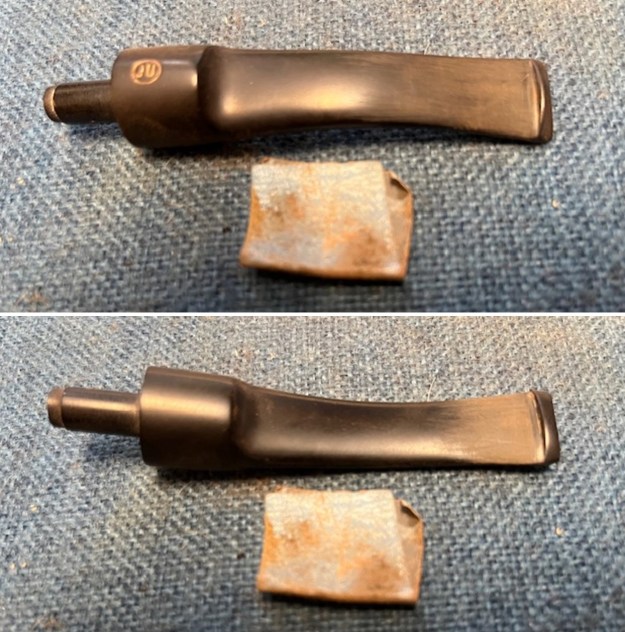
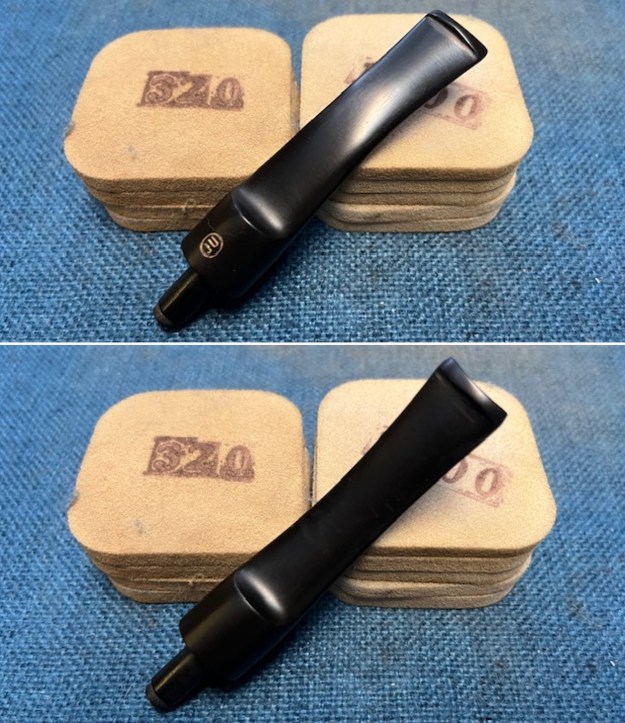
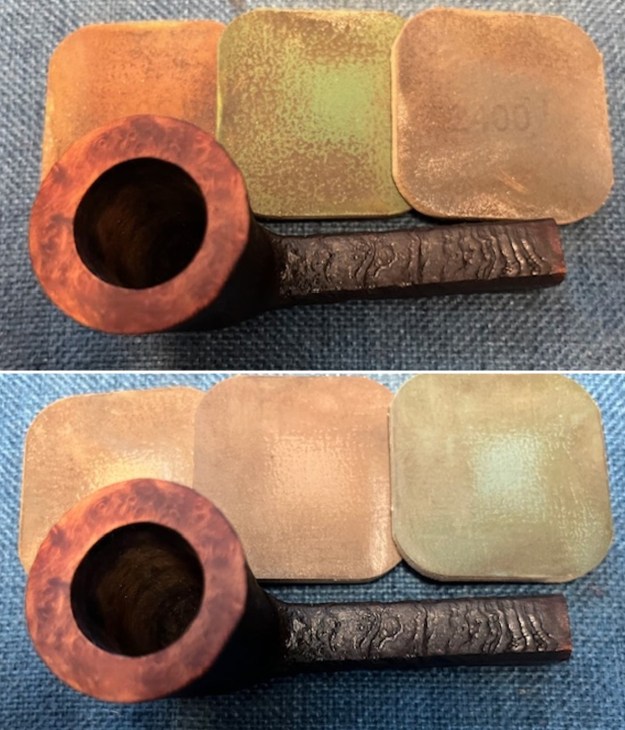
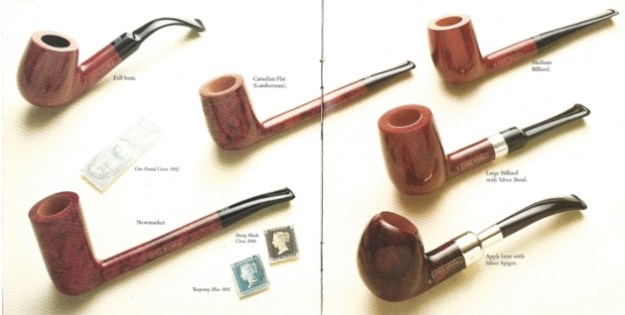
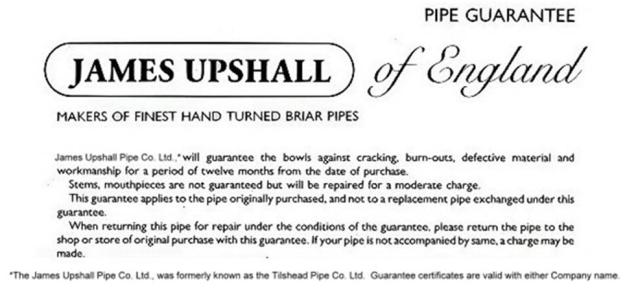
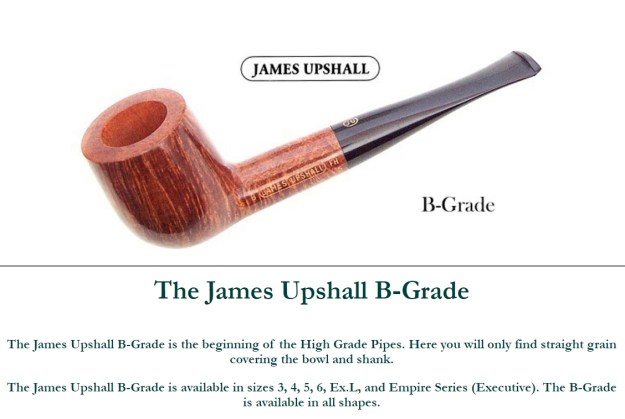
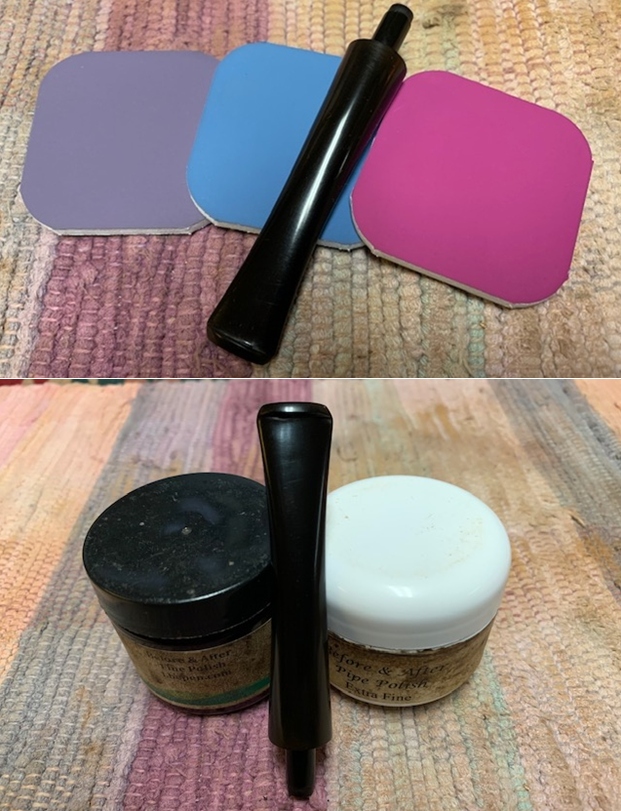
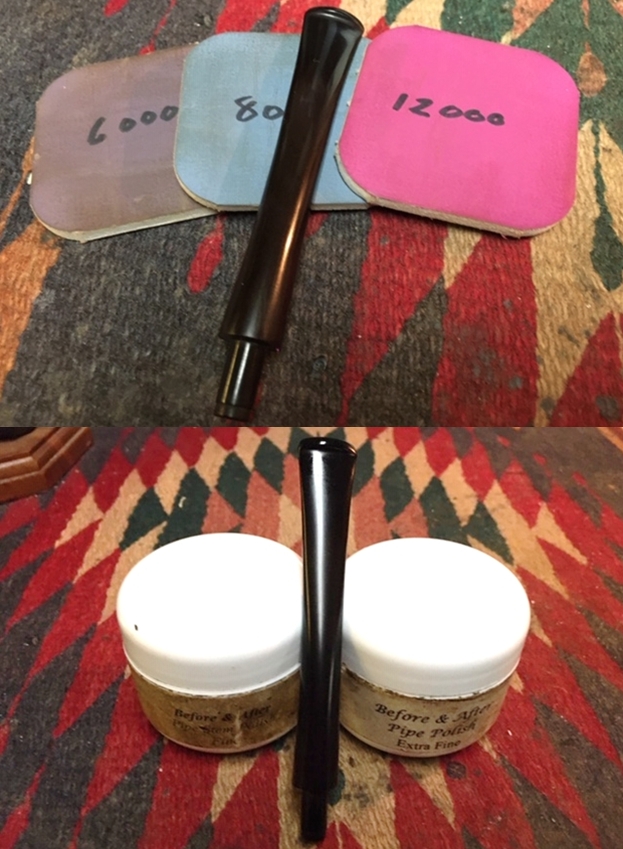
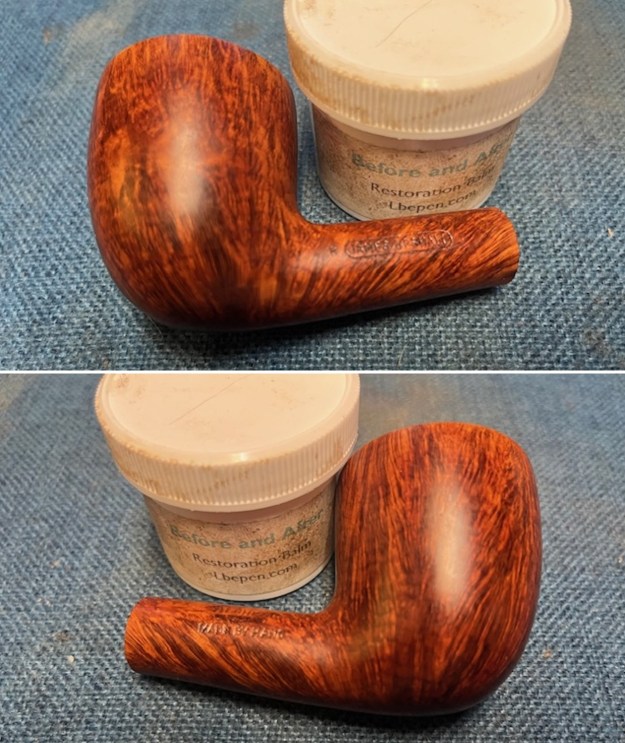
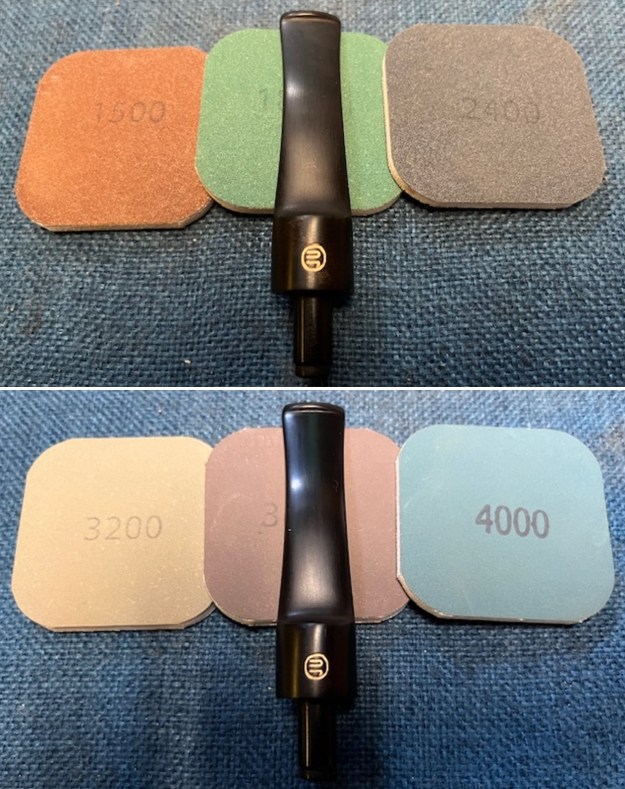
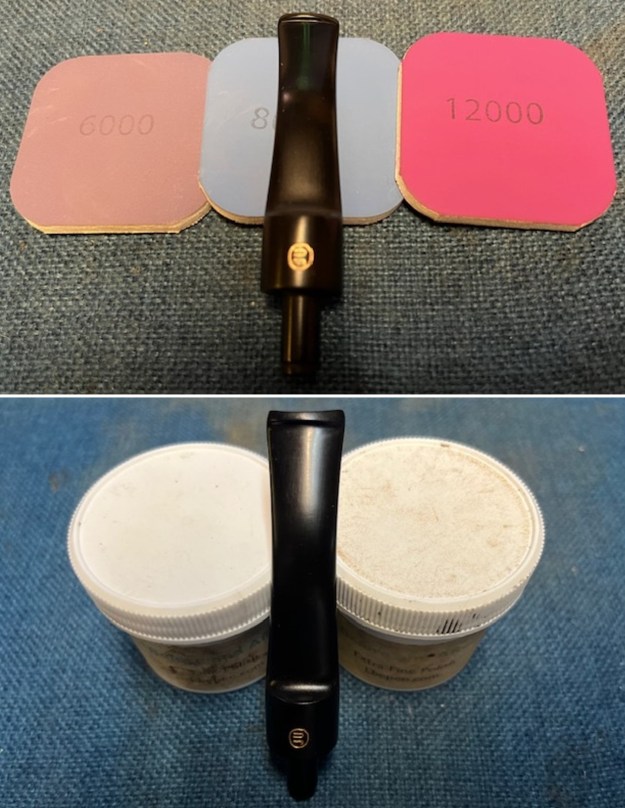
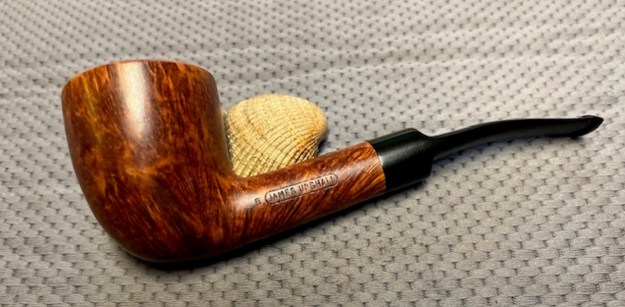
There was a link at the bottom of the article that led to a 1984 Catalogue. I have included a page from that catalogue below (https://pipedia.org/images/a/a6/James_Upshall_1984Catalog.pdf). The pipe at the bottom left of the photo marked as a Semi-bent Dublin is similar in shape to the one I am working on.I turned to the James Upshall of England website and looked up the guarantee on their pipes. I have included it below because of the commitment to quality that is spoken of in the description (http://www.upshallusa.com/products.htm).I also copied the section from the website on the B-Grade pipe and the description about the nature of the briar used in that pipe (http://www.upshallusa.com/html/JUB-Grade.htm).Armed with that information I turned my attention to the pipe itself. Jeff had cleaned the pipe with his usual penchant for thoroughness that I really appreciate. He reamed it with a PipNet pipe reamer and cleaned up the reaming with a Savinelli Fitsall Pipe Knife. He scrubbed out the internals with alcohol, pipe cleaners and cotton swabs until the pipe was clean. He scrubbed the exterior of the bowl with Murphy’s Oil Soap and a tooth brush to remove the grime and grit on the briar and the lava on the rim top. The finish looks very good with good looking grain around the bowl and shank. Jeff soaked the stem in Before & After Deoxidizer to remove the oxidation on the rubber. When the pipe arrived here in Vancouver for the second stop of its restoration tour it looked very good. I took photos before I started my part of the work.   I took some close up photos of the rim top and also of the stem surface. The bowl and the rim top look good. The inner edge of the rim showed some damage from burn marks on the front of the bowl and darkening on the back side. There was some wear in the finish on the rim top.  I also took close up photos of the stem to show how clean the stem was. There were very light tooth marks or chatter on both sides of the stem. I took photos of the stamping on the shank. On the left side of the shank it reads B (Grade stamp) at the shank/bowl junction. That is followed by the James Upshall stamp in an oval. There is a JU logo on the left side of the stem. The stamping was very clear. The right side of the shank was stamped Tilshead over England over Made by Hand. The grain on this pipe was highlighted by the shaping of the pipe. I took the stem off the bowl and took a picture of the parts of the pipe to give a sense of the parts of the pipe. It really is a beautifully grained pipe. I decided to clean up the inner edge of the bowl and straighten out the damage to the rim edge with a folded piece of 220 grit sandpaper. I used a piece of 220 grit sandpaper and a wooden sphere to smooth out the damage. It did not take too much to give the edge a light bevel and remove the damage. I polished the briar with micromesh sanding pads – 1500-12000 grit sanding pads. I wiped the bowl surface down with a damp cloth after each sanding pad to remove the sanding dust. Once I finished the exterior of the briar was clean and the grain really stood out. I worked some Before & After Restoration Balm into the surface of the briar with my fingertips to clean, enliven and protect the briar. I let the balm sit for 15 minutes and then buffed with a cotton cloth to raise the shine. The photos show the bowl at this point in the restoration process. It looks quite nice at this point. I set the bowl aside and turned my attention to the stem. I “painted” the stem with the flame of a lighter to try and lift the tooth marks. I was able to lift all of them. I used a piece of 220 grit sandpaper to blend them into the surrounding vulcanite. I sanded the stem with 320-3500 grit sanding pads to remove the tooth marks and chatter against the button edge and sand the logo. It worked well on the tooth marks but did little on the logo on the stem top.I touched up the circle JU stamp on the saddle side with Rub’n Buff Antique Gold. I worked it into the stamp with a tooth pick. Once it cured I buffed off the excess with a soft cloth. It looked very good.I polished the stem with micromesh sanding pads – wet sanding with 1500-12000 grit pads. I wiped the stem down after each sanding pad with Obsidian Oil. I polished it with Before & After Pipe Stem Polish – both Fine and Extra Fine. Once I had finished the polishing I gave it final coat of oil and set it aside to dry. I am excited to be on the homestretch with beautiful James Upshall B-Grade Crowned Dublin. I look forward to the moment when it all comes back together, polished and waxed. I put the bowl and stem back together. I polished the bowl and stem with Blue Diamond to polish out the scratches in the briar and the vulcanite. I gave the bowl and the stem multiple coats of carnauba wax. I buffed the pipe with a clean buffing pad to raise the shine. I hand buffed it with a microfiber cloth to deepen the shine. The pipe polished up pretty nicely. The beautifully grained finish looks really good with the interesting grain patterns standing out on the shape. The grain and the polished black vulcanite went really well together. This James Upshall Dublin has that classic English look that catches the eye. The combination of various brown stains really makes the pipe look attractive. It is another comfortable pipe to hold in the hand. The finished pipe is shown in the photos below. The dimensions of the pipe are Length: 6 inches, Height: 2 ¼ inches, Outside diameter of the bowl: 1 ½ inches, Chamber diameter: ¾ of an inch. The weight of the pipe is 51grams/1.76 ounces. I will be posting it for sale in the British Pipemaking Section on the rebornpipes store very soon. If you are interested in adding it to your collection let me know. Thanks for reading this blog and my reflections on the pipe while I worked on it. This was an interesting estate to bring back to life.

Restoring a James Upshall Handmade in England 6FH Sandblast Square shank Dublin/Lumberman


by Steve Laug

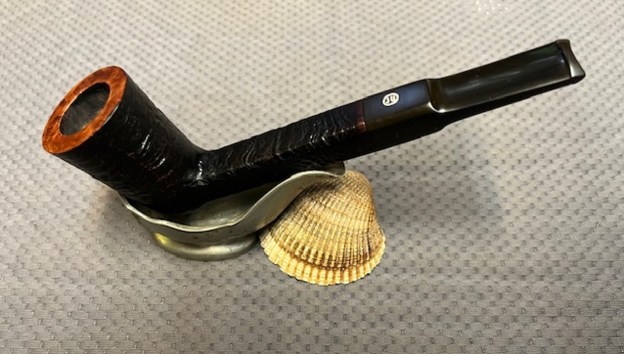
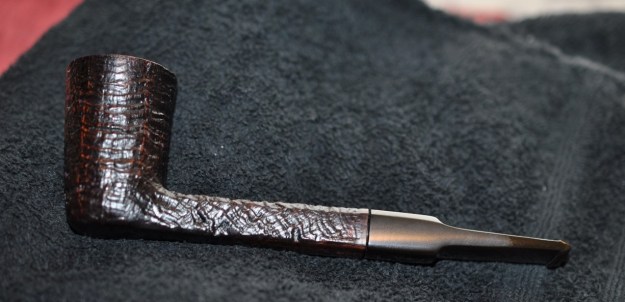
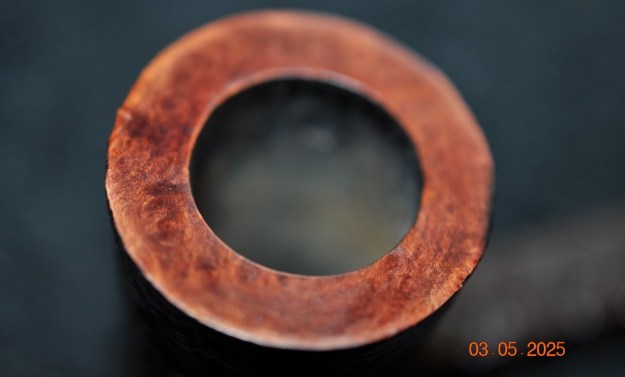
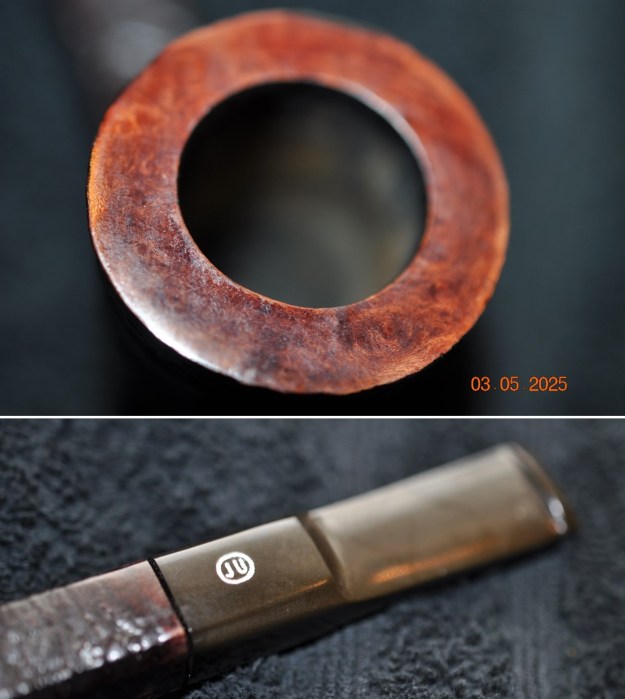
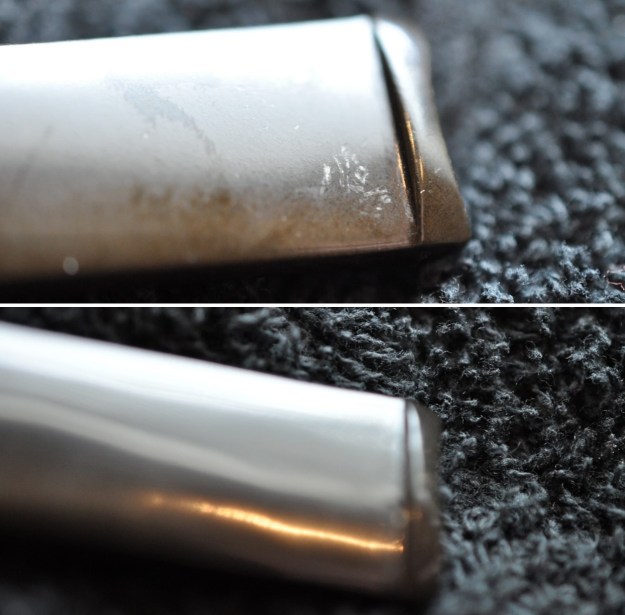
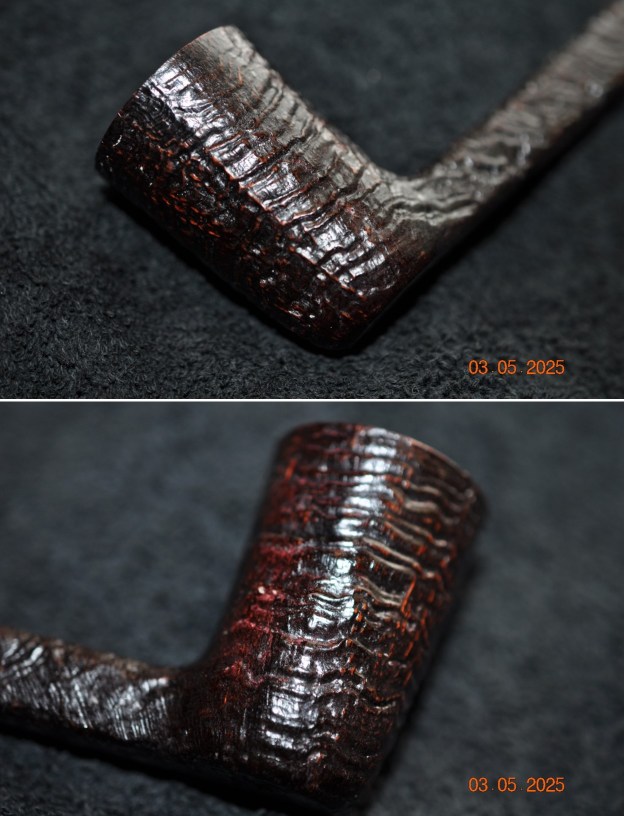
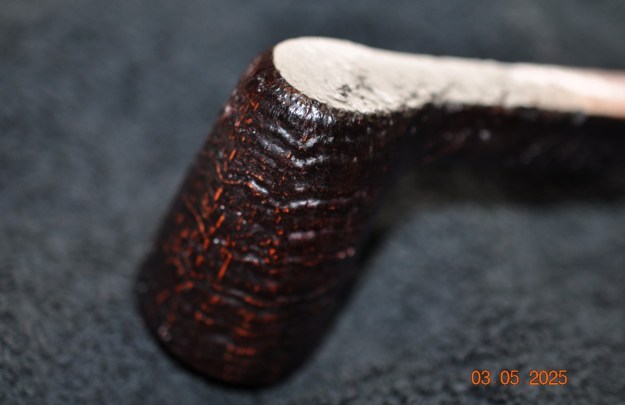
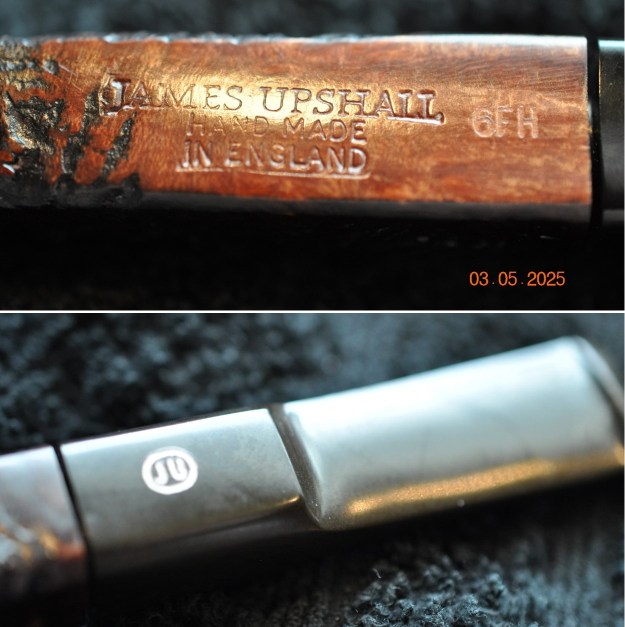
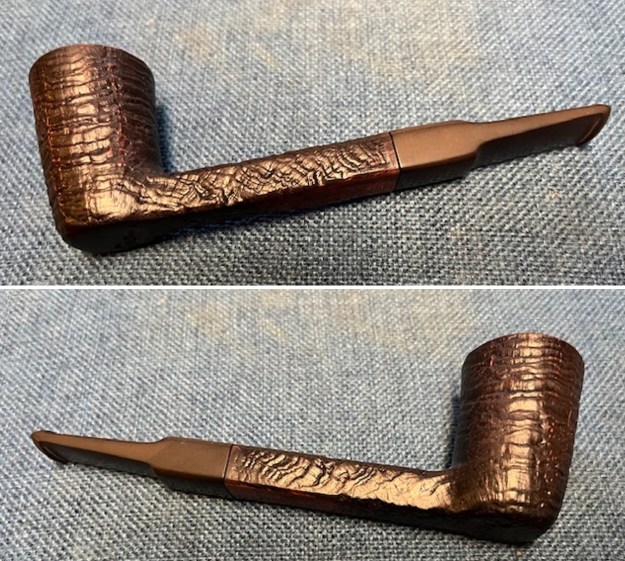
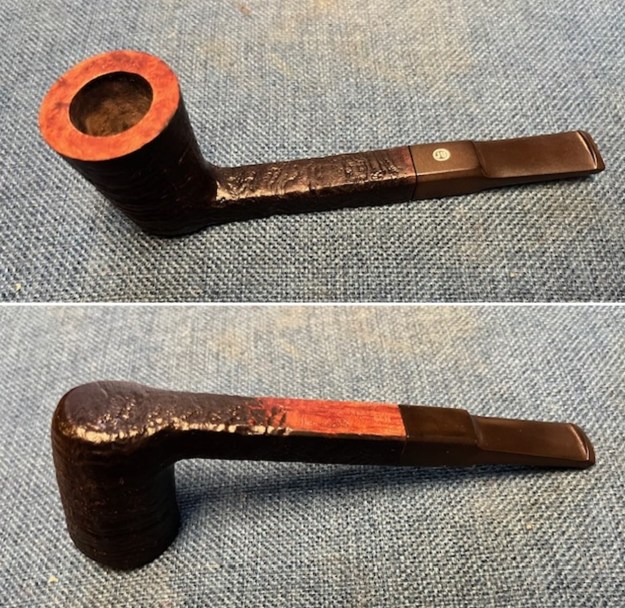
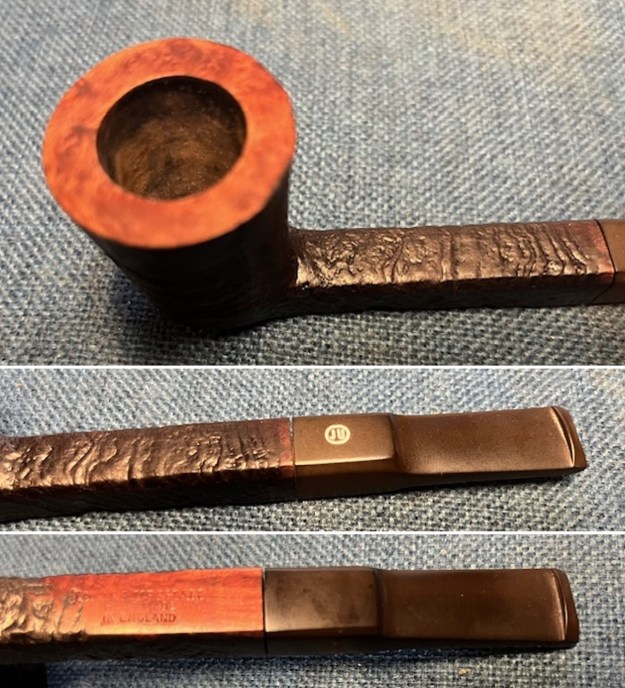
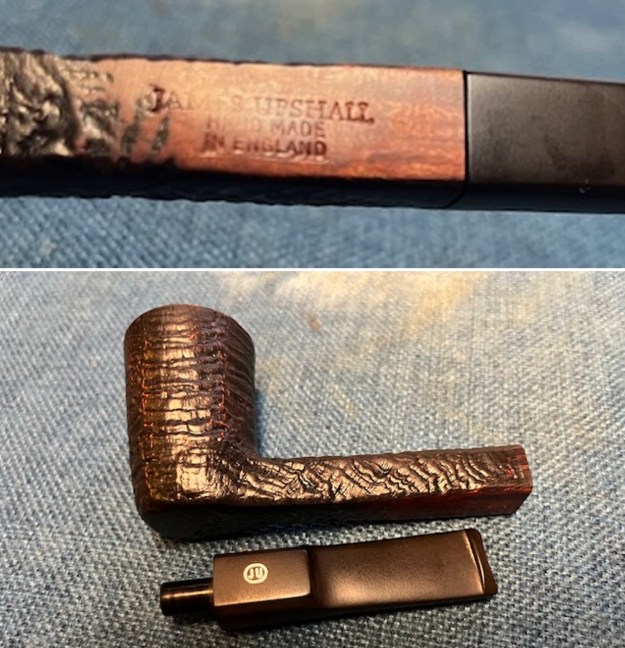
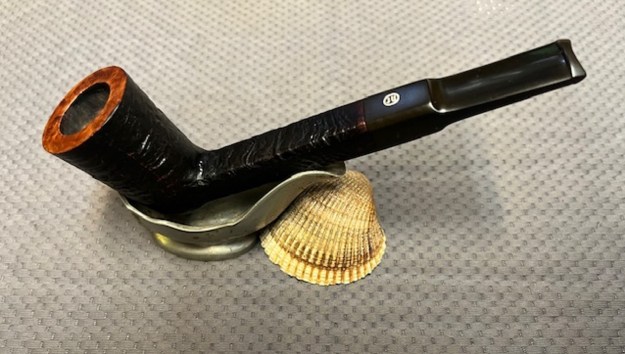
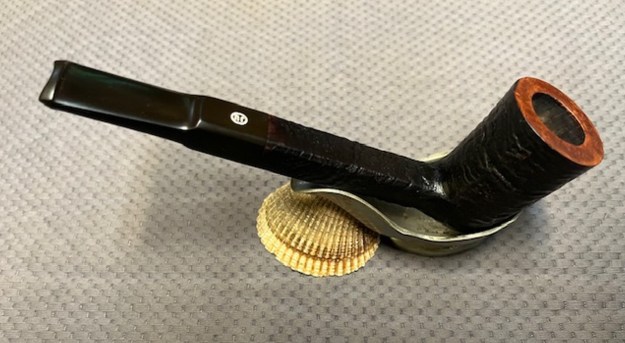
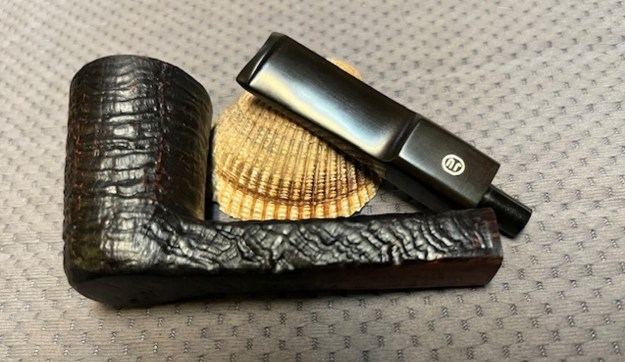
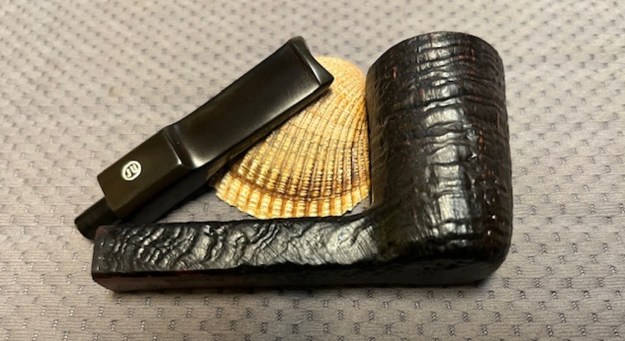
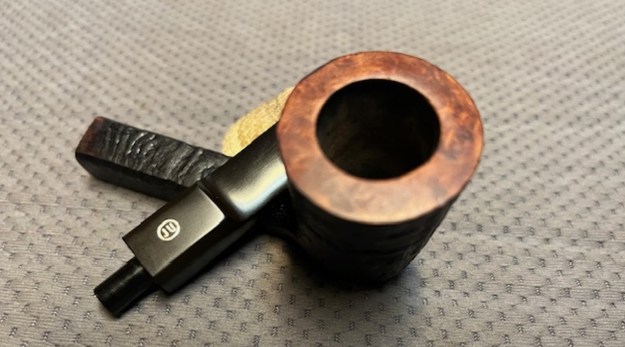
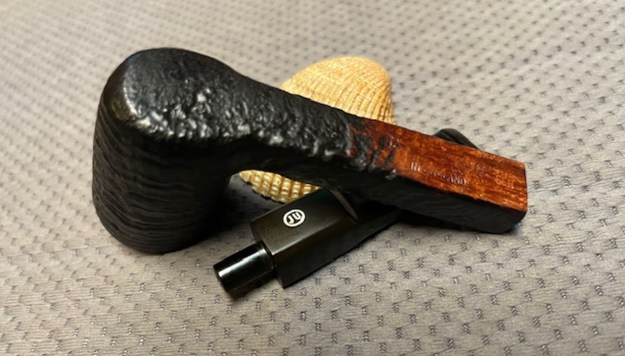
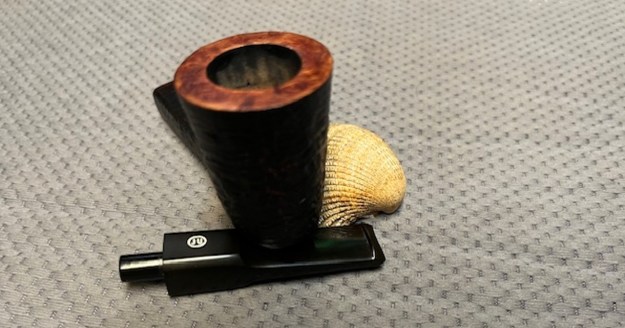
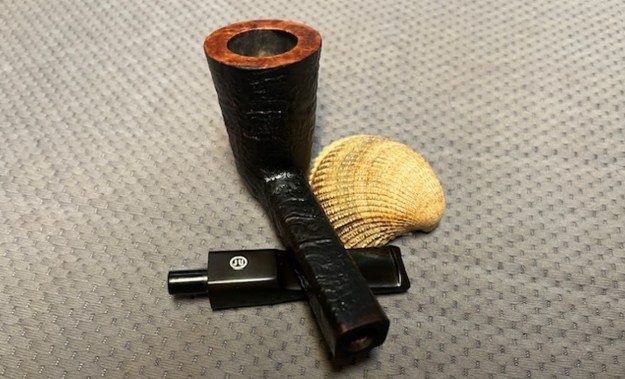
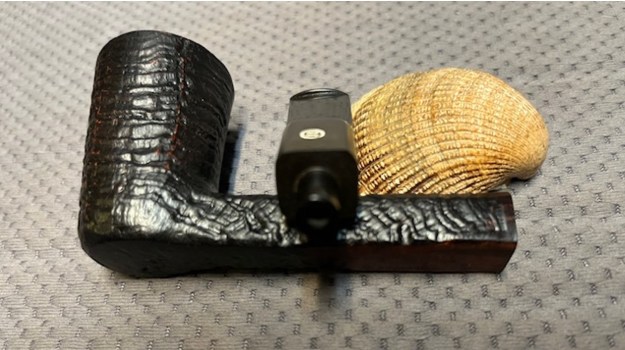
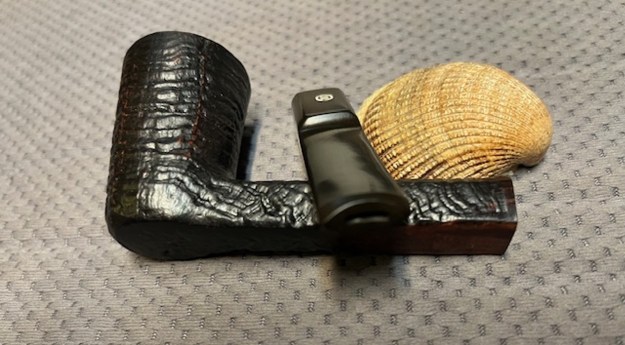
The next pipe on the table is one that we picked up in the lot from a seller in Barrington, Rhode Island, USA on 08/22/2024. The sandblast finish on this pipe and the Upshall stamping are what caught our eye. The pipe has something about it that reminds me of a Charatan pipe. It is stamped on the underside of the shank and reads James Upshall [over] Hand Made [over] In England. To the right of that is the shape stamp 6FH. It has a classic combination of Black and Brown stains on the sandblast finish that is a stark contrast to the vulcanite saddle stem. It is a long Lumberman or long shank Lovat shape square shank pipe with a vulcanite stem. The bowl is a tall Dublin bowl with a smooth rim top and a light cake in the bowl and spots of lava on the rim top. The inner edge and the top look very good other than that. The stem is lightly oxidized. It does not show any tooth marks or chatter on the top and underside ahead of the button. The James Upshall oval JU logo is stamped in white on the top of the stem and looks to be in good condition. Jeff took some photos of the pipe to show the general condition of the pipe before he started his clean up. He took some photos of the rim top and bowl from various angles to give me a clear picture of the condition of the rim top and bowl. It a light cake on the inside of the bowl and the rim top is spotted with lava. He included photos that show the top and underside of the stem. It is as described above. Jeff took some photos of the sides and heel of the bowl to show the condition of the finish on the pipe. The photos showed some great grain in the sandblast around the bowl and shank. It is a great looking piece of briar. He took a photo of the stamping on the underside of the shank. The stamping was clear and readable as noted above. He also took a photo of the oval JU logo on the topside of the saddle stem.Before I started my work on the pipe I looked up the Upshall listing on pipephil’s site to see what I could find (http://www.pipephil.eu/logos/en/logo-j1.html#jamesupshall).Artisan: Barry Jones learned his skill from the age of 15 at Charatan’s. In 1978 he joined Kenneth Barnes and established the James Upshall brand at Tilshead (Wiltshire). Production (2006): ~ 30 pipes/week
I turned to Pipedia to remind myself of the background on the brand Upshall brand (https://pipedia.org/wiki/James_Upshall). I read through the article and found the section on Grading & Sizing Information really helpful. I have included that below. I have highlighted the pertinent text in red below.

James Upshall pipes are graded by various finishes, i.e. bark, sandblast, black dress and smooth etc. Then by cross grain, flame grain, straight grain and, last but not least, the perfect high grade, which consists of dense straight grain to the bowl and shank. The latter being extremely rare. In addition, the price varies according to group size, i.e. from 3-4-5-6 cm high approximately Extra Large. We also have the Empire Series which are basically the giant size, individually hand crafted pipes which come in all finishes and categories of grain. All our pipes are individually hand carved from the highest quality, naturally dried Greek briar. In order to simplify our grading system, let me divide our pipes into 4 basic categories.

  1. It begins with the Tilshead pipe, which smokes every bit as good as the James Upshall but has a slight imperfection in the briar. In the same category price wise you will find the James Upshall Bark and Sandblast finish pipes, which fill and smoke as well as the high grades.
  2. In this category we have the best “root quality” which means that the grain is either cross, flame or straight, which is very much apparent through the transparent differing color finishes. This group will qualify as the “S”- Mahogany Red, “A” – Chestnut Tan and “P” – Walnut. The latter having the straighter grain.
  3. Here you have only straight grain, high grade pipes, which run from the “B”, “G”, “E”, “X” and “XX”. The latter will be the supreme high grade. Considering the straightness of the grain the latter category is also the rarest. Usually no more than 1% of the production will qualify.
  4. Lastly, we have the Empire Series. These are basically Limited Edition gigantic individually hand crafted pieces, which again are extremely rare due to the scarcity of large, superior briar blocks.

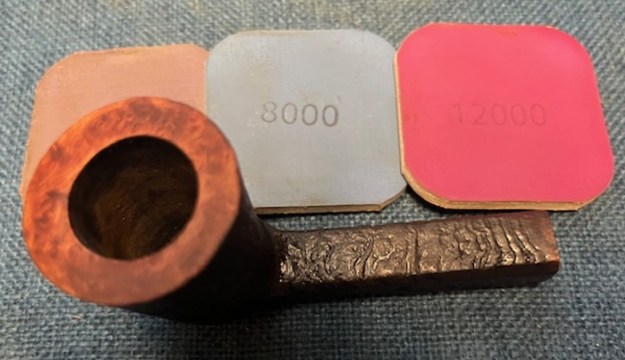
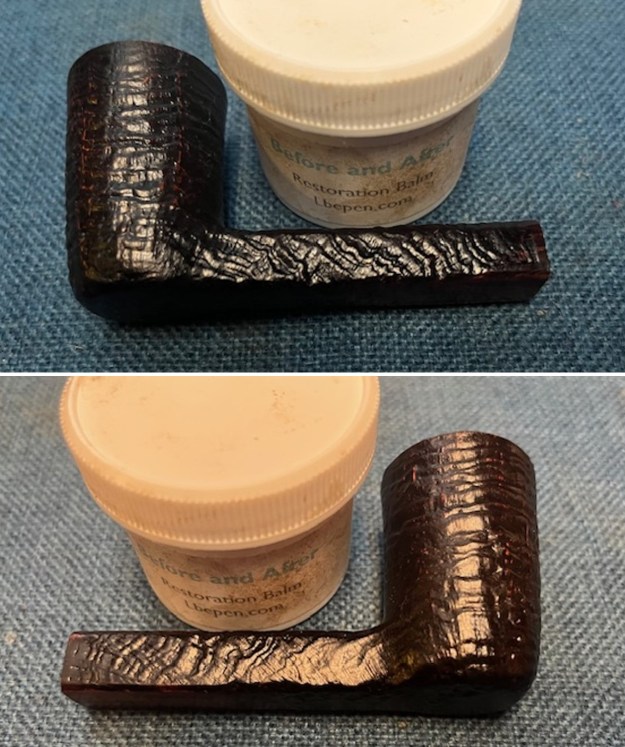
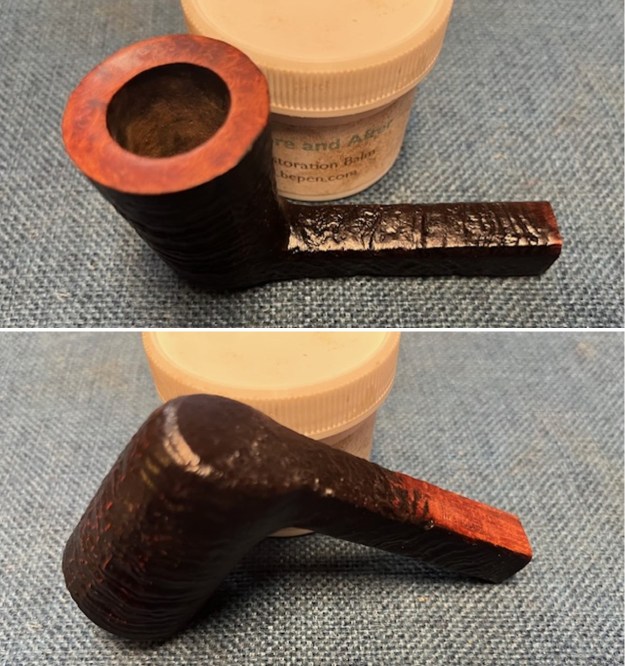
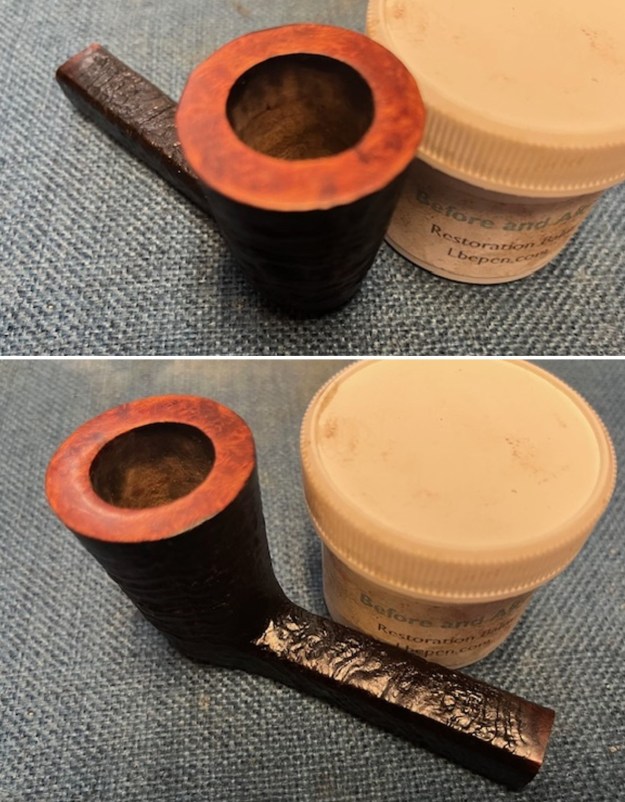
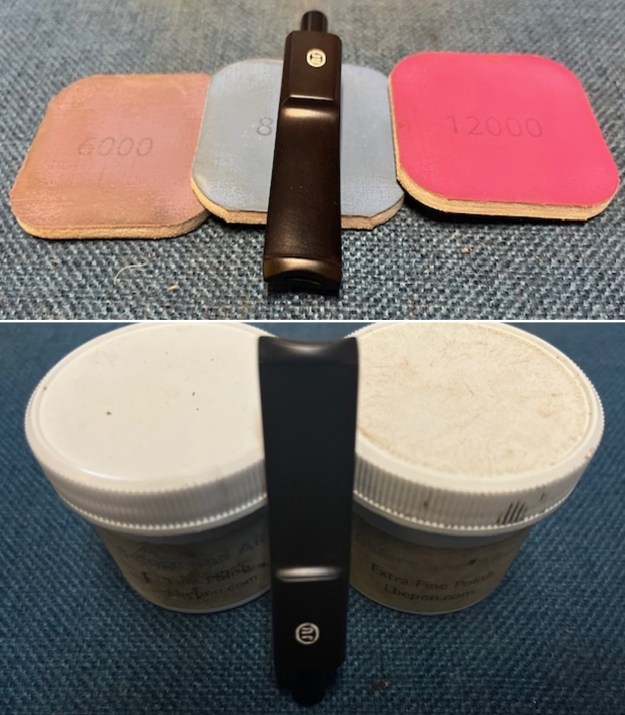
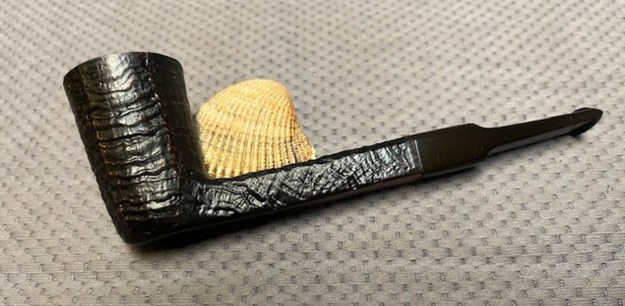
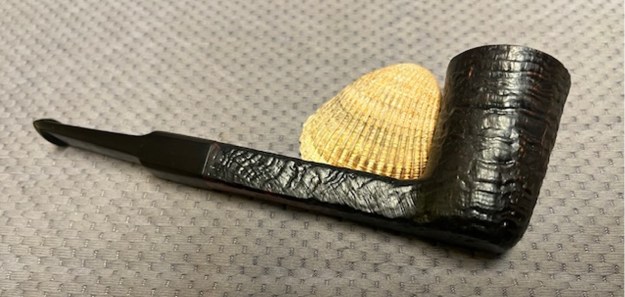
Armed with that information I turned my attention to the pipe itself. Jeff had cleaned the pipe with his usual penchant for thoroughness that I really appreciate. He reamed it with a PipNet pipe reamer and cleaned up the reaming with a Savinelli Fitsall Pipe Knife. He scrubbed out the internals with alcohol, pipe cleaners and cotton swabs until the pipe was clean. He scrubbed the exterior of the bowl with Murphy’s Oil Soap and a tooth brush to remove the grime and grit on the briar and the lava on the rim top. The finish looks very good with good looking grain around the bowl and shank. Jeff soaked the stem in Before & After Deoxidizer to remove the oxidation on the rubber. When the pipe arrived here in Vancouver for the second stop of its restoration tour it looked very good. I took photos before I started my part of the work. I took close up photos of the bowl, rim top and stem to show how clean the pipe was. The bowl was clean and the rim top and the inner edge look beautiful. The stem was clean and did not show either tooth marks or chatter.I took a photo of the stamping on the underside of the shank. It is faint in spots but still readable and read as noted above. I also removed the stem from the shank and took photos of the pipe to show the look of the parts.I polished the smooth rim top with 1500-12000 grit micromesh sanding pad – dry sanding it with the pads. I wiped the bowl down with a damp cloth after each pad. It began to take on a deep shine. The exterior of the bowl look better after sanding. I worked some Before & After Restoration Balm into the briar with my finger tips and a shoe brush to get into the nooks and crannies. I let it sit on the bowl for 10 minutes and then buffed it off with a paper towel and soft cloth. The product is a great addition to the restoration work. It enlivens, enriches and protects the briar while giving it a deep glow. It is a product I use on every pipe I restore. I set the bowl aside and sanded the stem with 320-3500 grit sanding pads. I wiped it down after each pad with Obsidian Oil and it began to look very good.I polished the stem with micromesh sanding pads – dry sanding with 1500-12000 grit pads. Once again, I wiped it down between each pad with Obsidian Oil. I further polished it with Before and After Stem Polish – both Fine and Extra Fine. It looked very good. I am excited to be on the homestretch with beautiful James Upshall Sandblast Square Shank 6FH Dublin. This is the part I look forward to when it all comes back together, polished and waxed. I put the bowl and stem back together. I polished the bowl and stem with Blue Diamond to polish out the scratches in the briar and the vulcanite. I gave the bowl and the stem multiple coats of carnauba wax. I buffed the pipe with a clean buffing pad to raise the shine. I hand buffed it with a microfiber cloth to deepen the shine. The pipe polished up pretty nicely. The beautiful sandblast finish looks really good with the interesting patterns standing out on the shape. The dark stained sandblast and the polished black vulcanite went really well together. This James Upshall Long, Square Shank Dublin was another fun pipe to work on thanks to Jeff’s cleanup work. It really has that classic English Charatan look that catches the eye. The combination of various brown stains really makes the pipe look attractive. It is another comfortable pipe to hold in the hand. The finished pipe is shown in the photos below. The dimensions of the pipe are Length: 6 inches, Height: 2 inches, Outside diameter of the bowl: 1 ¼ inches, Chamber diameter: ¾ of an inch. The weight of the pipe is 35 grams/1.23 ounces. This one will soon be on the British Pipe Makers Section of the rebornpipes store. Let me know if you are interested in adding it to your rack. Thanks for reading this blog and my reflections on the pipe while I worked on it.

Fresh Life for a James Upshall B Grade Large Billiard


Blog by Steve Laug

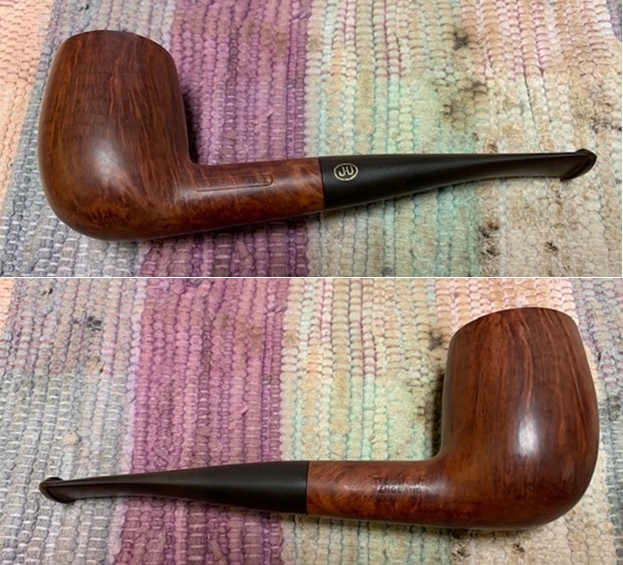
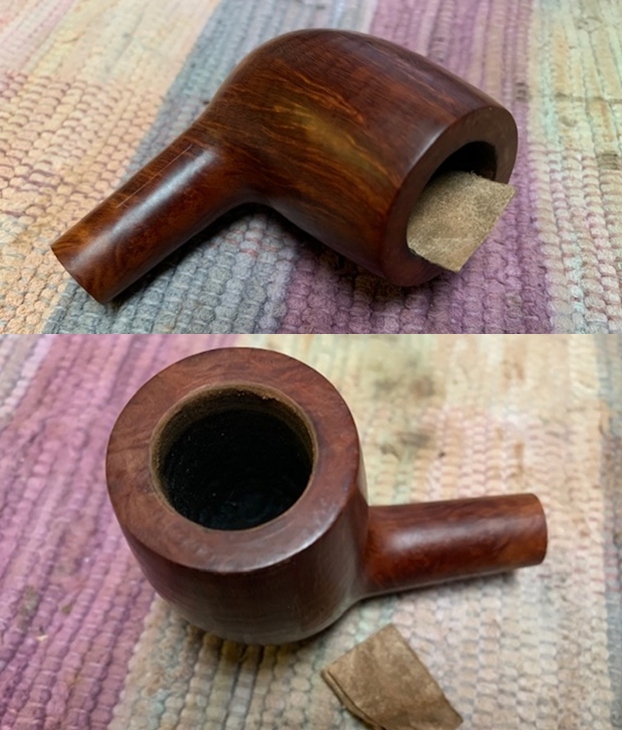
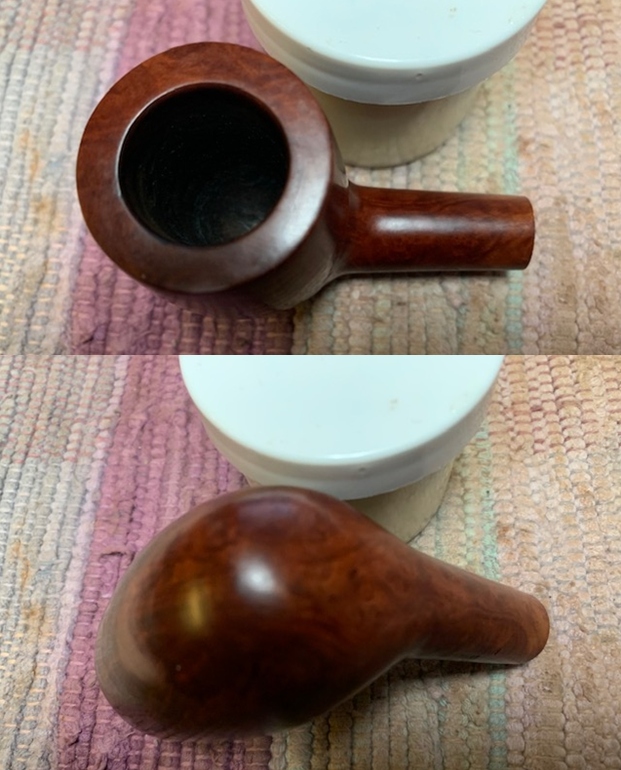
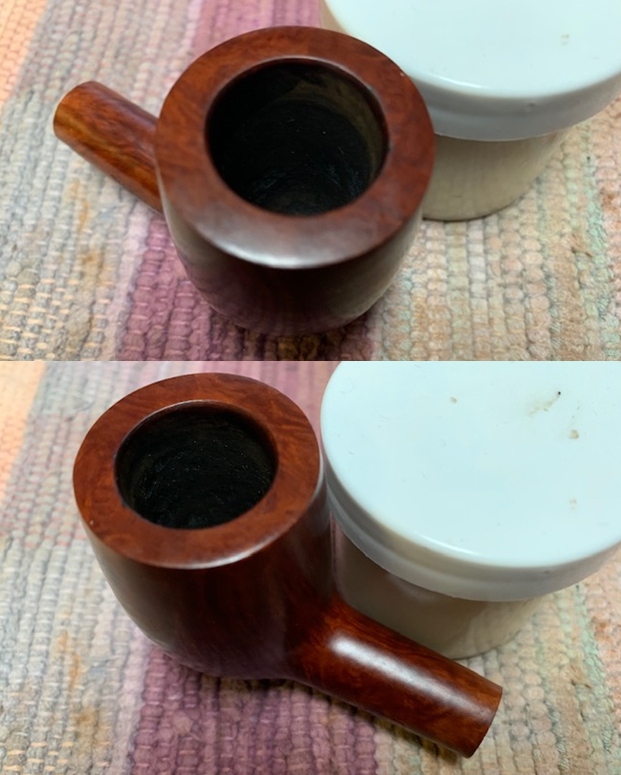
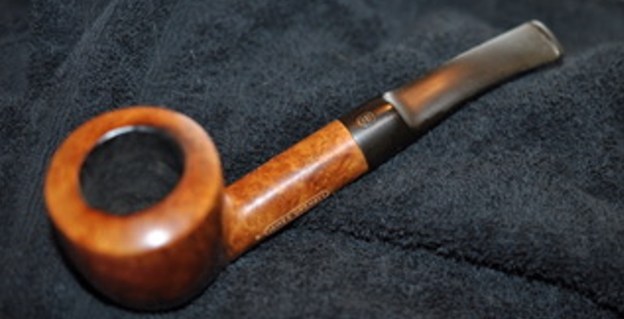
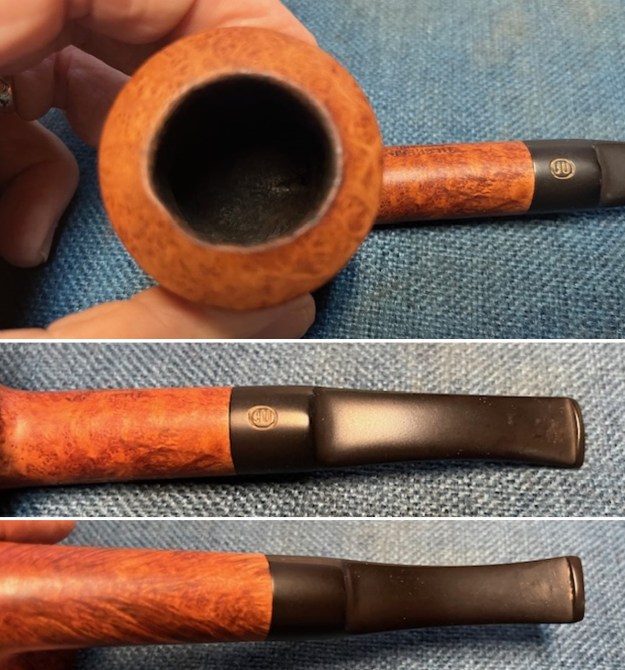
This past May, 2019 I received an email from John in Iowa City, Iowa inquiring whether I would be interested in purchasing three Upshall pipes that he was selling. He sent photos and we chatted back and forth via email and a deal was struck. I had him ship the pipes to Jeff’s place in Idaho. They were generally well cared for pipes but they were dirty. This is the third and final pipe from that lot that I have chosen to work on. The shape and design caught my eye as I was going through the pipes in the queue. The shape is what I would call a Large Billiard. It is a B Grade smooth, walnut finished pipe. The B grade is the “entry” level for the Upshall Straight Grains and retail new at about $1500. The finish is very dirty with dust and grime. The bowl has a thick cake and the rim top has some darkening, lava and perhaps some damage around the inner edge. The stem is oxidized and has tooth chatter and light tooth marks on both sides near the button. The surface of the button looks very good on both sides. I am including the photos that John sent of the pipe to give and idea of the general condition of the pipe before Jeff started his cleanup work on it.  (Normally Jeff has quite a few before photos but about the time this pipe came we lost a large number of photos).Before I started my work on the pipe I looked up the Upshall listing in Pipedia to remind myself of the background on the brand (https://pipedia.org/wiki/James_Upshall). I read through the article and found the section on Grading & Sizing Information really helpful. I have included that below. I have highlighted the pertinent text in red below.

James Upshall pipes are graded by various finishes, i.e. bark, sandblast, black dress and smooth etc. Then by cross grain, flame grain, straight grain and, last but not least, the perfect high grade, which consists of dense straight grain to the bowl and shank. The latter being extremely rare. In addition, the price varies according to group size, i.e. from 3-4-5-6 cm high approximately Extra Large. We also have the Empire Series which are basically the giant size, individually hand crafted pipes which come in all finishes and categories of grain. All our pipes are individually hand carved from the highest quality, naturally dried Greek briar. In order to simplify our grading system, let me divide our pipes into 4 basic categories.

  1. It begins with the Tilshead pipe, which smokes every bit as good as the James Upshall but has a slight imperfection in the briar. In the same category price wise you will find the James Upshall Bark and Sandblast finish pipes, which fill and smoke as well as the high grades.
  2. In this category we have the best “root quality” which means that the grain is either cross, flame or straight, which is very much apparent through the transparent differing color finishes. This group will qualify as the “S”- Mahogany Red, “A” – Chestnut Tan and “P” – Walnut. The latter having the straighter grain.
  3. Here you have only straight grain, high grade pipes, which run from the “B”, “G”, “E”, “X” and “XX”. The latter will be the supreme high grade. Considering the straightness of the grain the latter category is also the rarest. Usually no more than 1% of the production will qualify.
  4. Lastly, we have the Empire Series. These are basically Limited Edition gigantic individually hand crafted pieces, which again are extremely rare due to the scarcity of large, superior briar blocks.

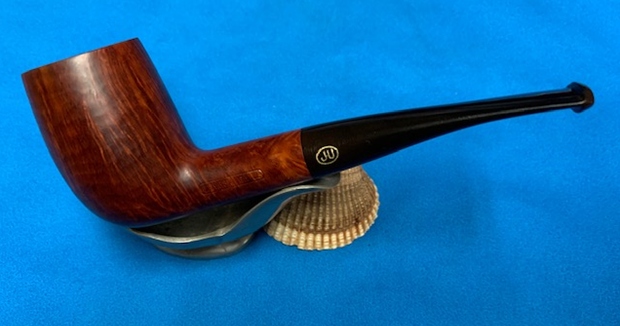
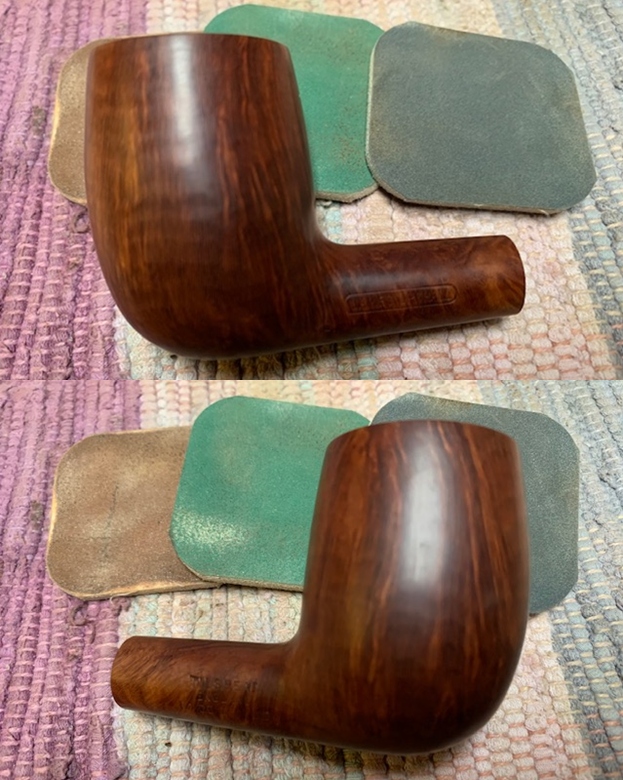
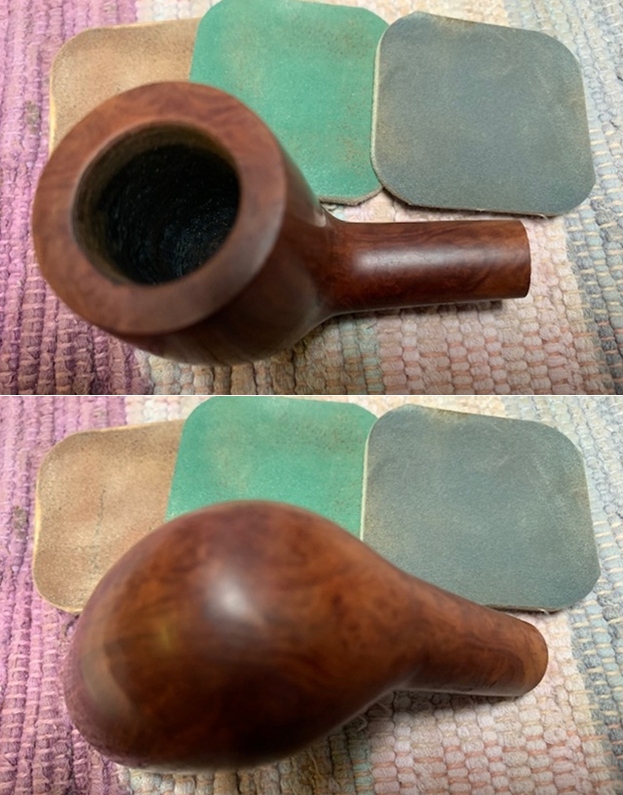
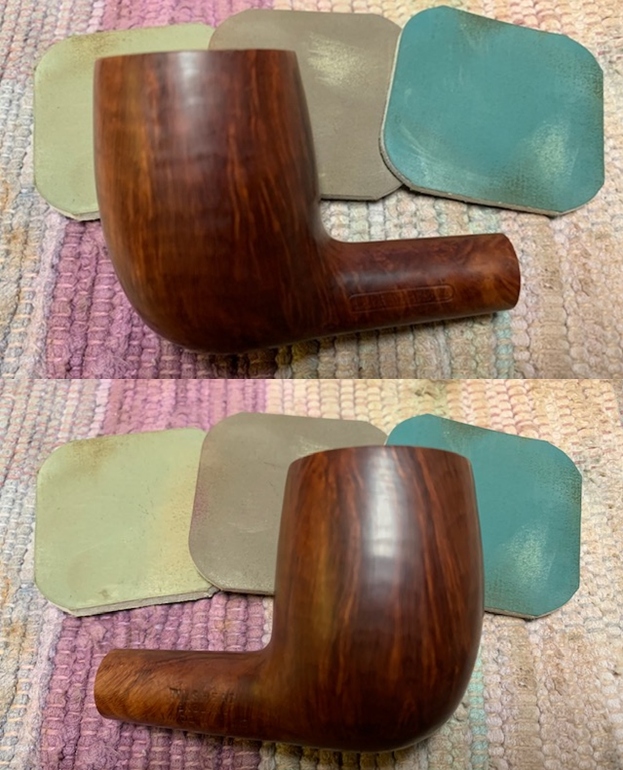
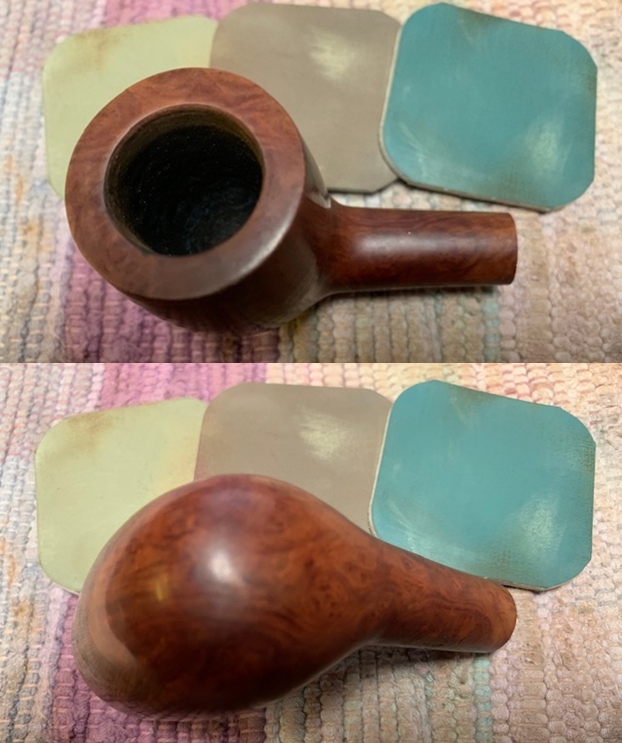
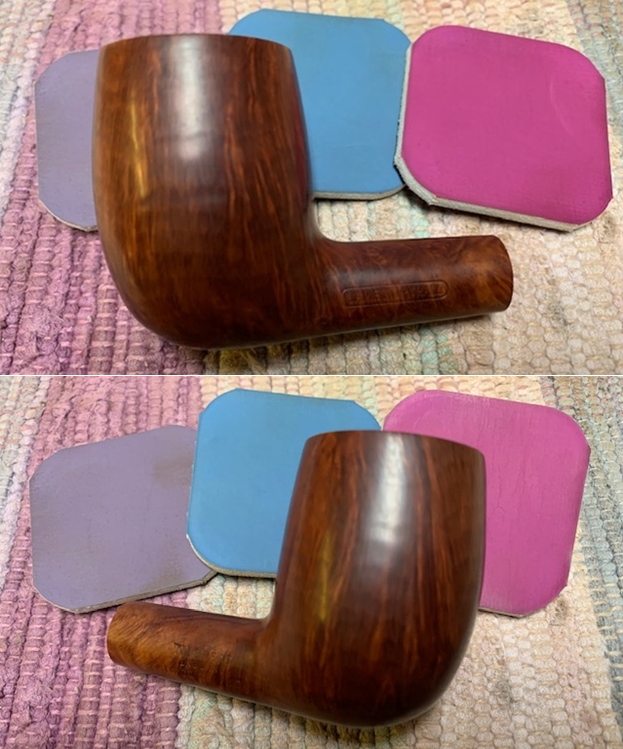
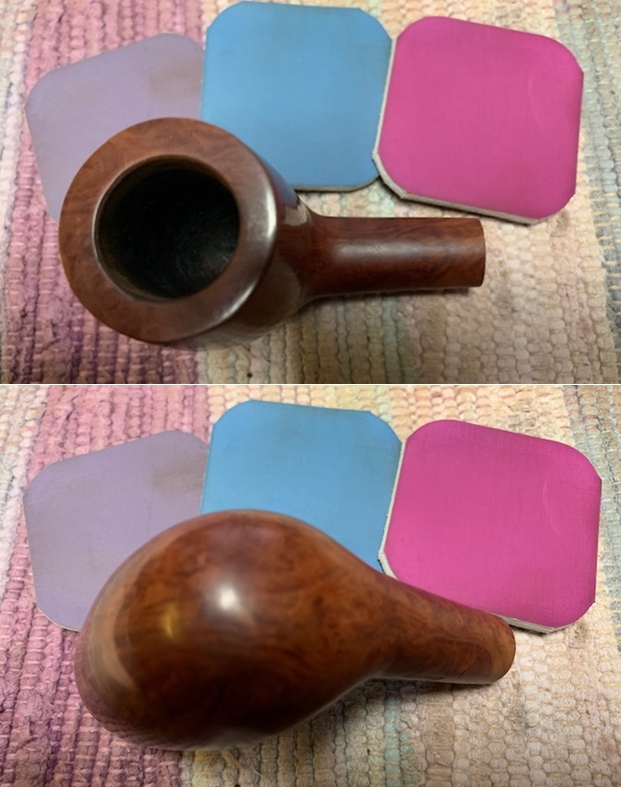
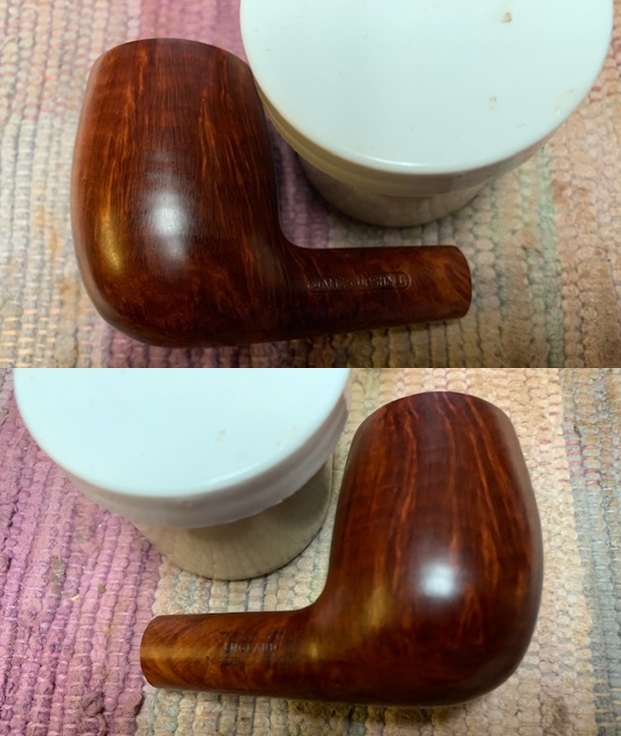
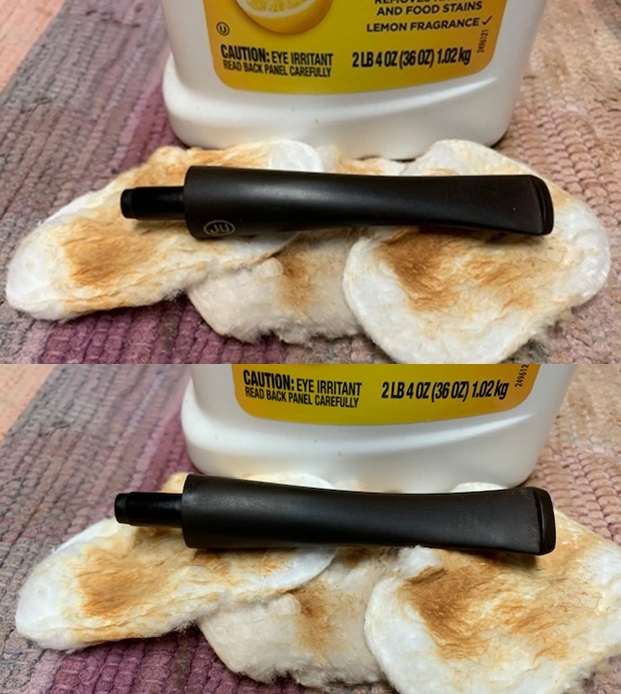
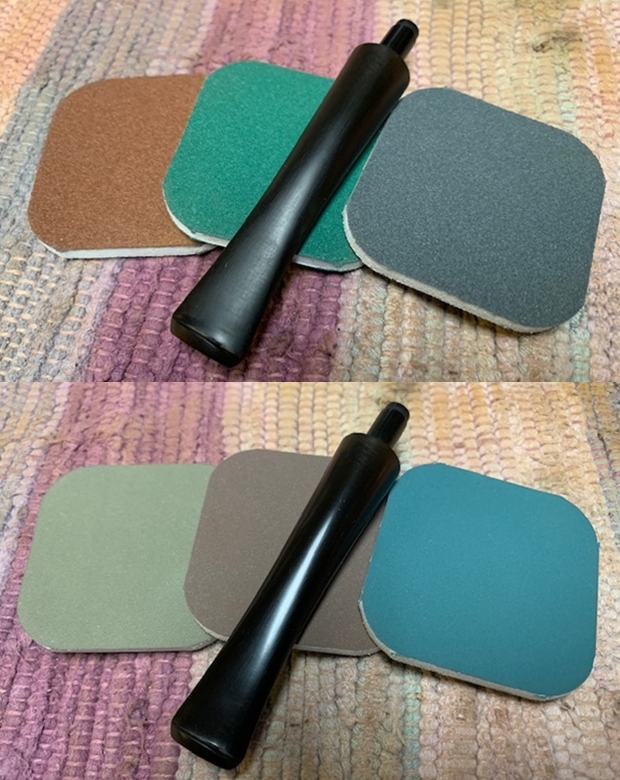
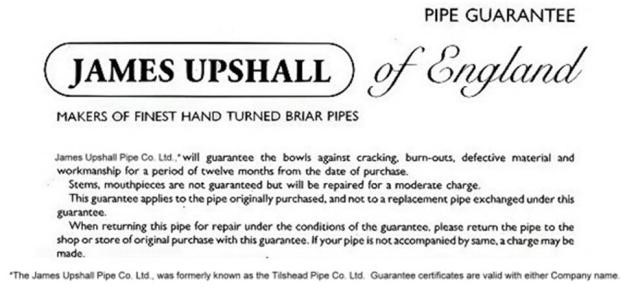
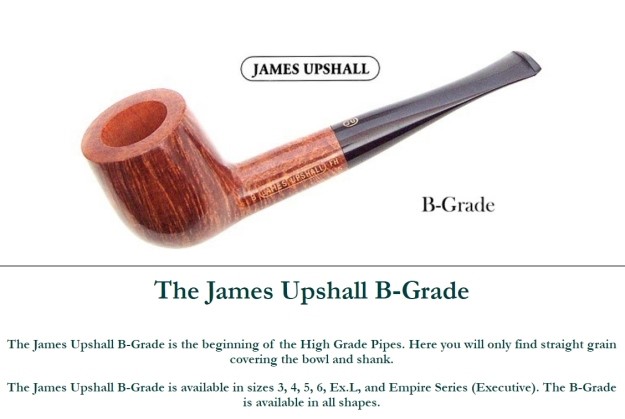
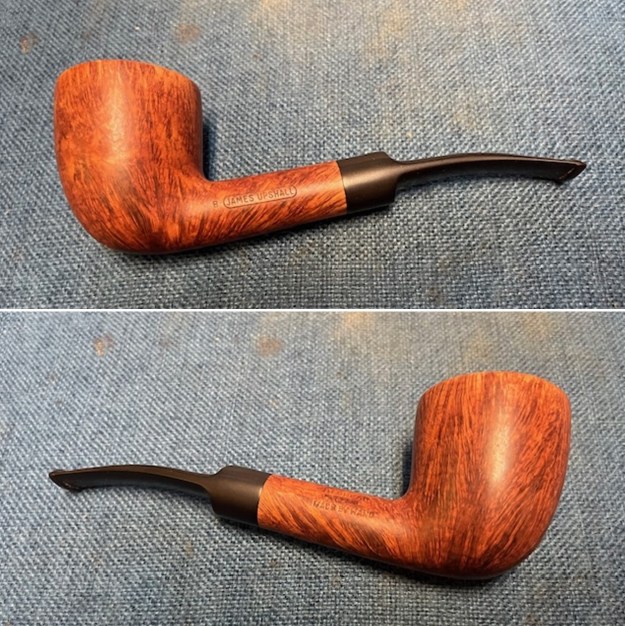
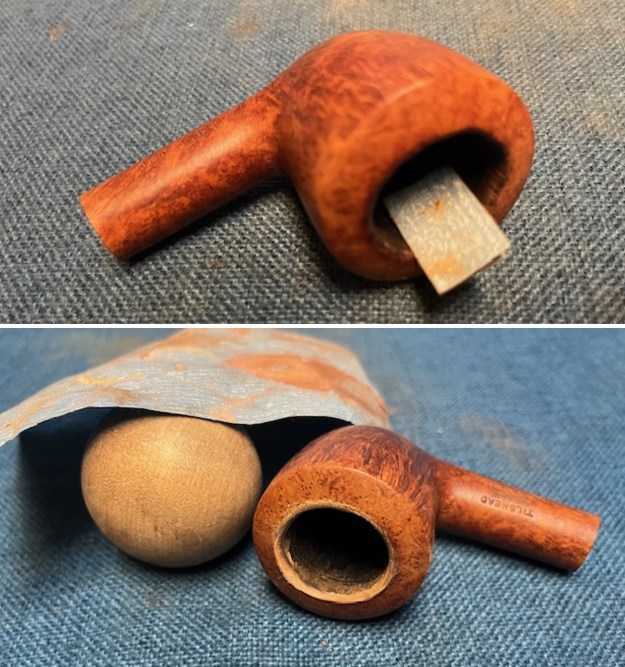
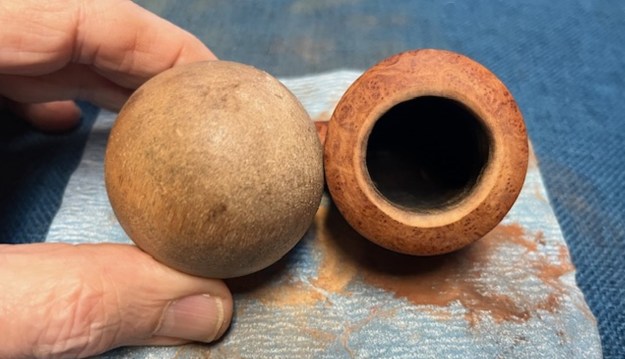
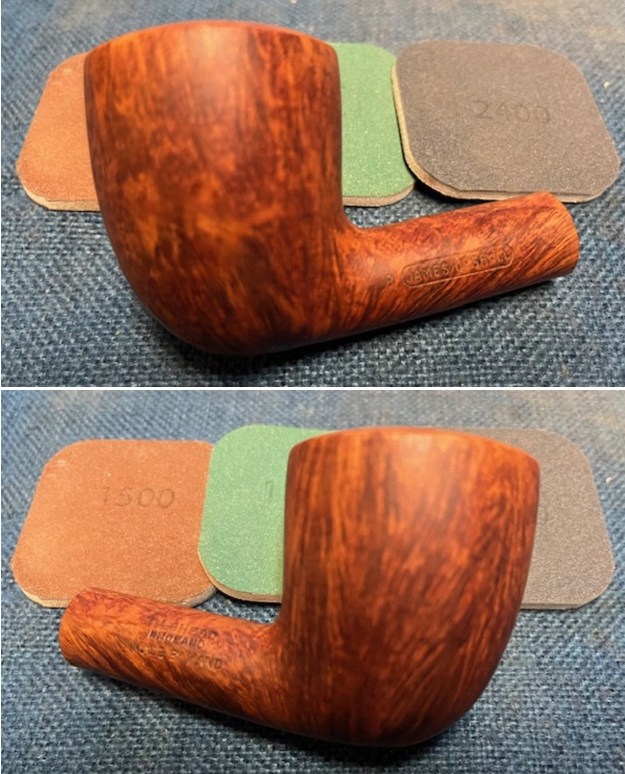
There was a link at the bottom of the article that led to a 1984 Catalogue. I have included a page from that catalogue below (https://pipedia.org/images/a/a6/James_Upshall_1984Catalog.pdf).    The pipe at the top of the photo marked Medium Billiard is similar in shape to the one I am working on but the one I have I would classify as a Large Billiard.I turned to the James Upshall of England website and looked up the guarantee on their pipes. I have included it below because of the commitment to quality that is spoken of in the description (http://www.upshallusa.com/products.htm).I also copied the section from the website on the B-Grade pipe and the description about the nature of the briar used in that pipe (http://www.upshallusa.com/html/JUB-Grade.htm).Armed with that information I turned my attention to the pipe itself. Jeff had cleaned the pipe with his usual penchant for thoroughness that I really appreciate. He reamed it with a PipNet pipe reamer and cleaned up the reaming with a Savinelli Fitsall Pipe Knife. He scrubbed out the internals with alcohol, pipe cleaners and cotton swabs until the pipe was clean. He scrubbed the exterior of the bowl with Murphy’s Oil Soap and a tooth brush to remove the grime and grit on the briar and the lava on the rim top. The finish looks very good with good looking grain around the bowl and shank. Jeff soaked the stem in Before & After Deoxidizer to remove the oxidation on the rubber. When the pipe arrived here in Vancouver for the second stop of its restoration tour it looked very good. I took photos before I started my part of the work.   I took some close up photos of the rim top and also of the stem surface. The bowl and the rim top look good. The inner edge of the rim had some nicks in the edge. There was some wear in the finish on the rim top.  I also took close up photos of the stem to show how clean the stem was. There were very light tooth marks or chatter on both sides of the stem.  I took photos of the stamping on the shank. On the left side of the shank it reads B (Grade stamp) at the shank/bowl junction. That is followed by the James Upshall stamp in an oval. There is a JU logo on the left side of the stem. The stamping was very clear. The right side of the shank was stamped Tilshead over England over Made by Hand. The grain on this pipe was highlighted by the shaping of the pipe.I took the stem off the bowl and took a picture of the parts of the pipe to give a sense of the parts of the pipe. It really is a beautiful straight grain pipe.I decided to clean up the inner edge of the bowl and straighten out the damage to the rim edge with a folded piece of 220 grit sandpaper and polished it with 400 grit sandpaper. It did not take too much to give the edge a light bevel and remove the damage.  I sanded the briar with micromesh sanding pads – 1500-12000 grit sanding pads. I wiped the bowl surface down with a damp cloth after each sanding pad to remove the sanding dust. Once I finished the exterior of the briar was clean and the grain really stood out.      I worked some Before & After Restoration Balm into the surface of the briar with my fingertips to clean, enliven and protect the briar. I let the balm sit for 15 minutes and then buffed with a cotton cloth to raise the shine. The photos show the bowl at this point in the restoration process. It looks quite nice at this point.  I set the bowl aside and turned my attention to the stem. I scrubbed the remaining oxidation on the stem with Soft Scrub all-purpose cleanser. It works well to remove oxidation in the surface of the vulcanite. The pads show the oxidation that came off.     I polished the stem with micromesh sanding pads – wet sanding with 1500-12000 grit pads. I wiped the stem down after each sanding pad with Obsidian Oil. I polished it with Before & After Pipe Stem Polish – both Fine and Extra Fine. Once I had finished the polishing I gave it final coat of oil and set it aside to dry.   I am excited to be on the homestretch with beautiful James Upshall B-Grade pipe. I look forward to the moment when it all comes back together, polished and waxed. I put the bowl and stem back together. I polished the bowl and stem with Blue Diamond to polish out the scratches in the briar and the vulcanite. I gave the bowl and the stem multiple coats of carnauba wax. I buffed the pipe with a clean buffing pad to raise the shine. I hand buffed it with a microfiber cloth to deepen the shine. The pipe polished up pretty nicely. The beautifully grained finish looks really good with the interesting grain patterns standing out on the shape. The grain and the polished black vulcanite went really well together. This James Upshall Large Billiard was another fun pipe to work on thanks to Jeff’s cleanup work. It really has that classic English look that catches the eye. The combination of various brown stains really makes the pipe look attractive. It is another comfortable pipe to hold in the hand. The finished pipe is shown in the photos below. The dimensions of the pipe are Length: 6 inches, Height: 2 ¼ inches, Outside diameter of the bowl: 1 ½ inches, Chamber diameter: ¾ of an inch. The weight of the pipe is 51grams/1.76oz.  This is an Upshall that catches my eye. This is the last of the three Upshalls that I have here and I am probably going to hand on to this one. Thanks for reading this blog and my reflections on the pipe while I worked on it. This was an interesting estate to bring back to life.
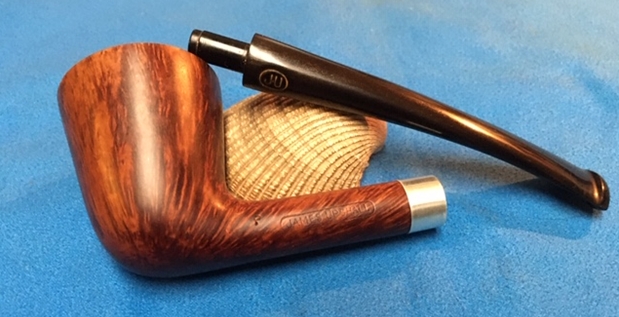
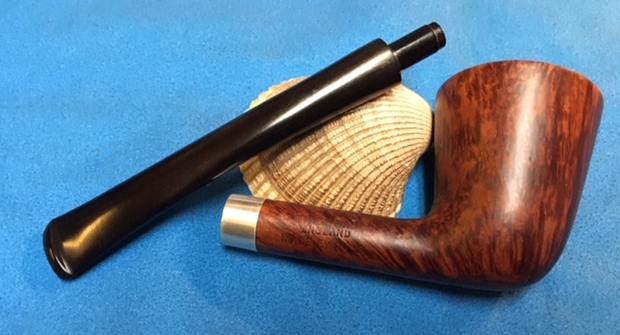
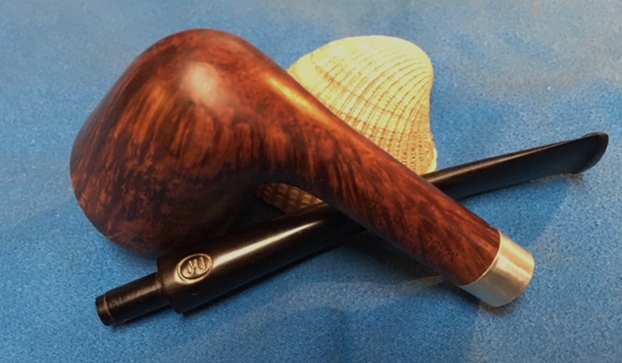
Redeeming a James Upshall P Grade Silver Banded Dublin


Blog by Steve Laug

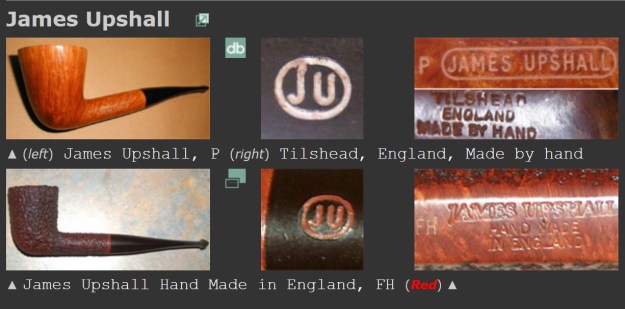
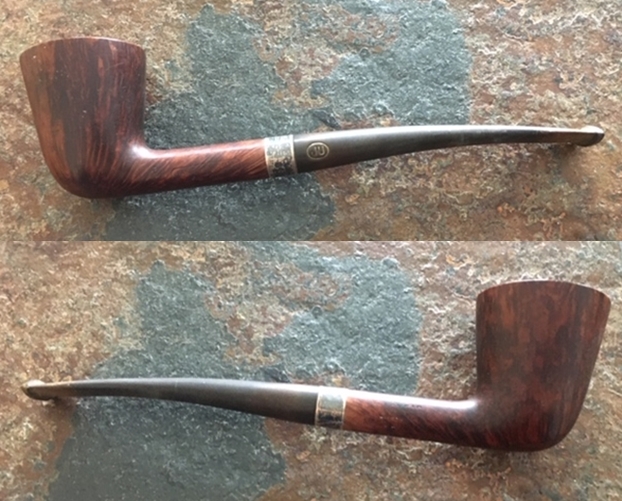
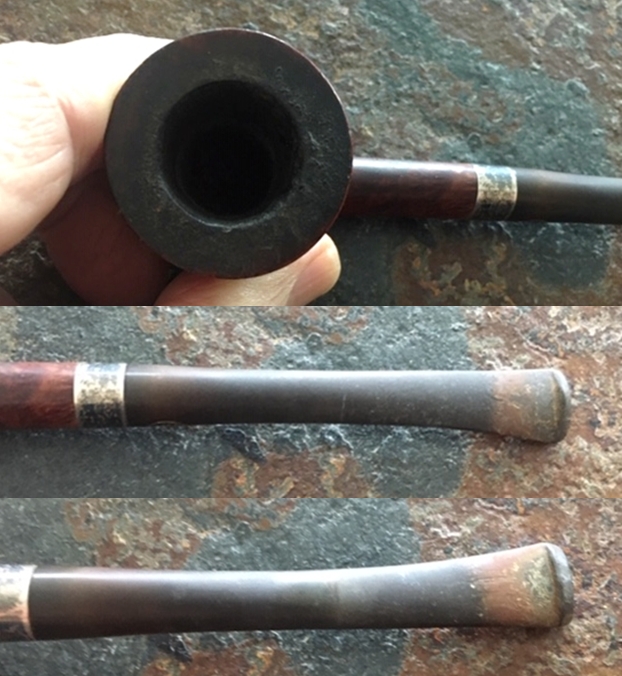
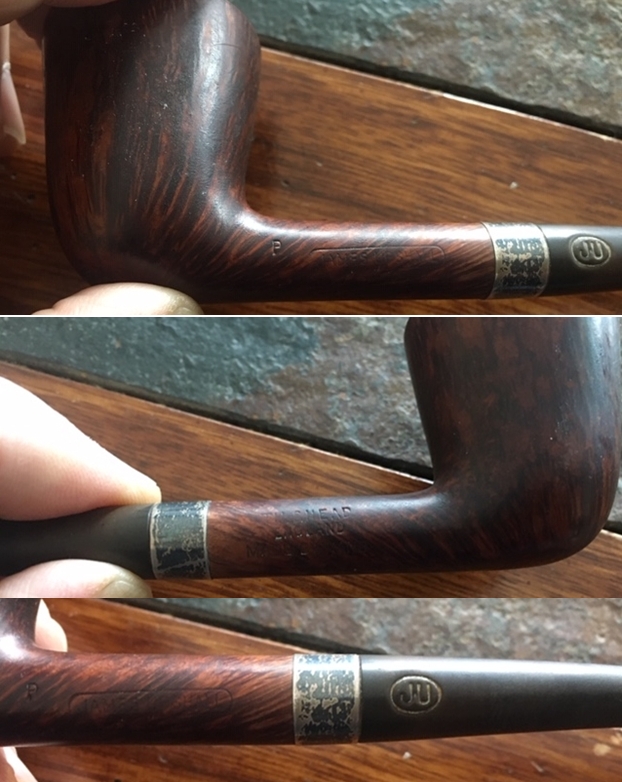
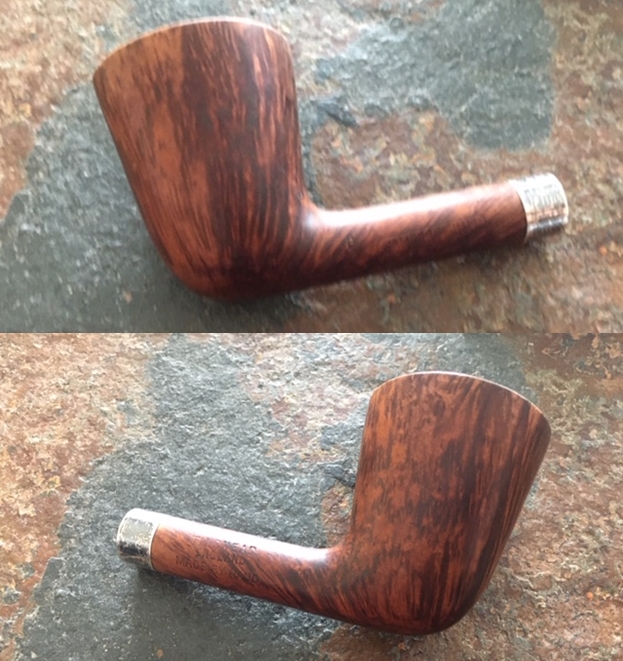
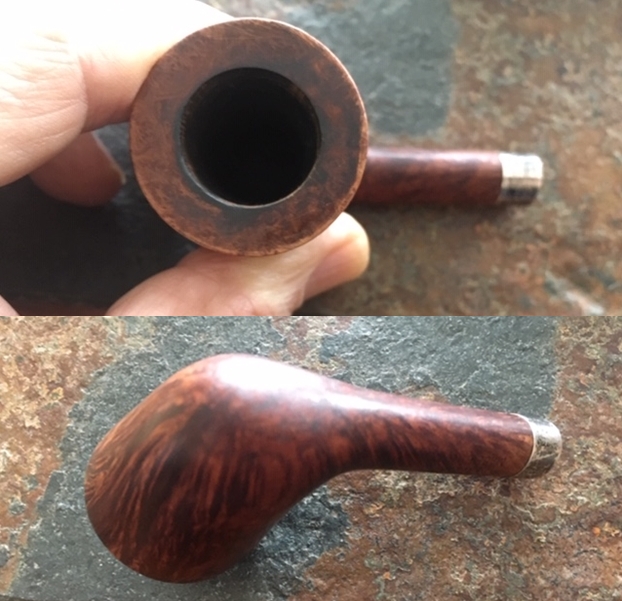
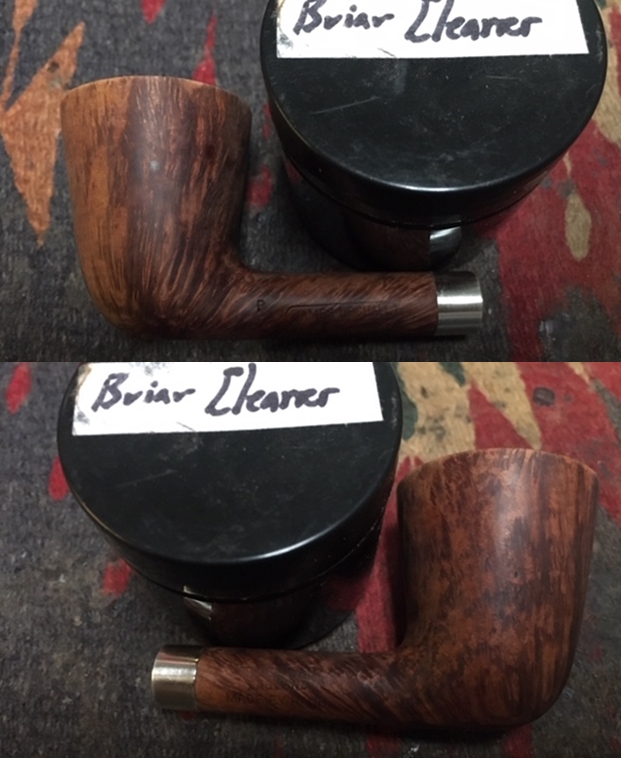
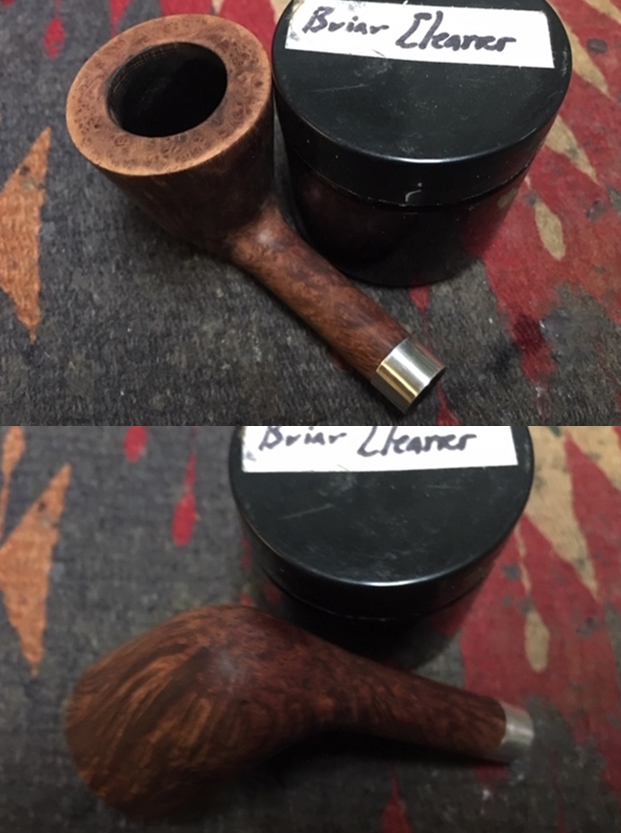
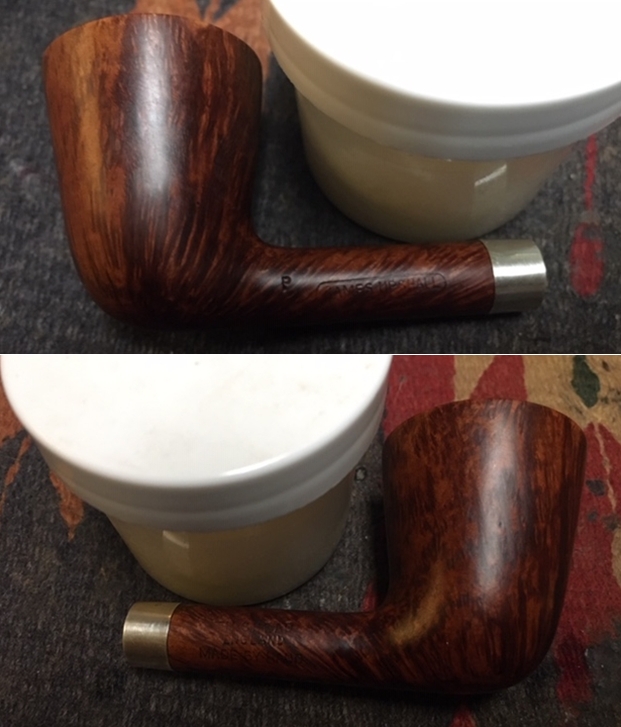
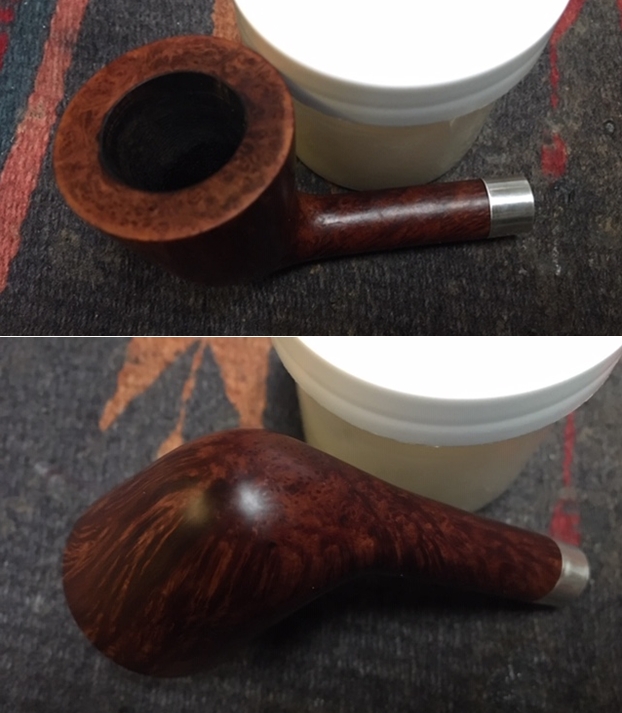
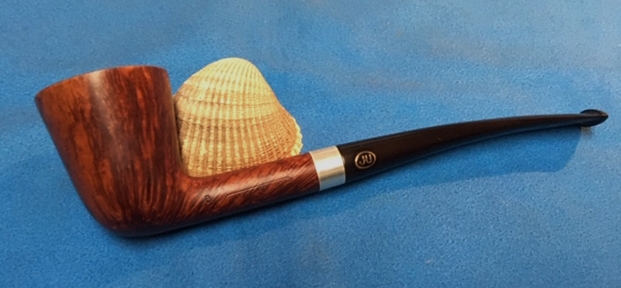
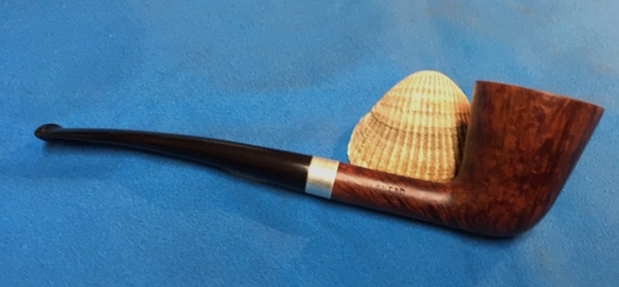
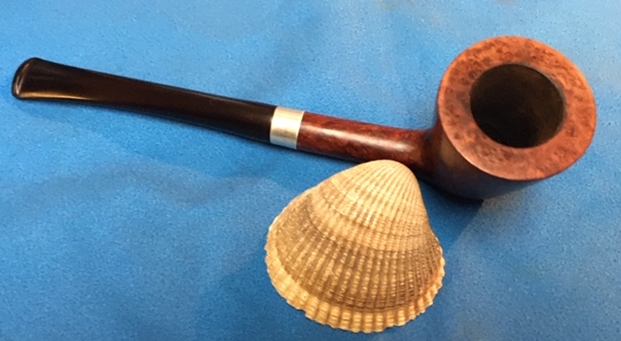
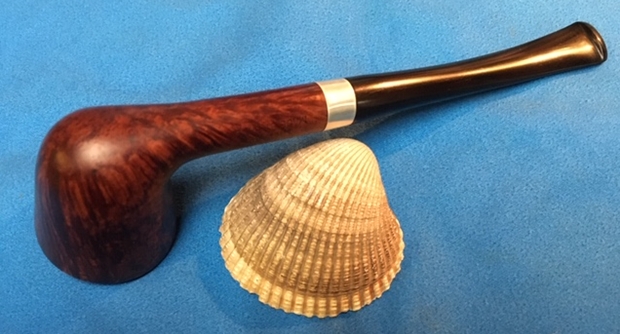
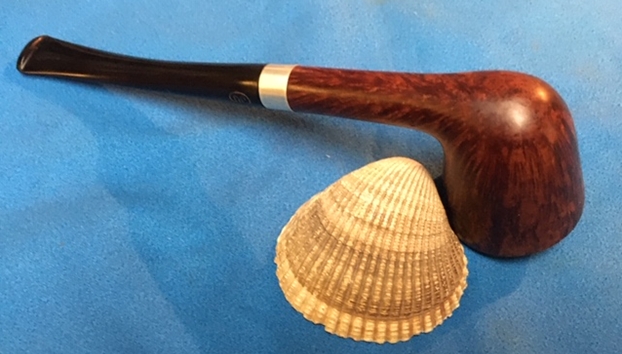
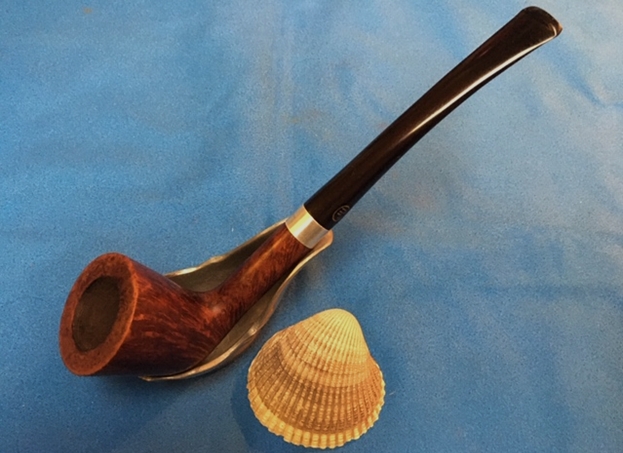
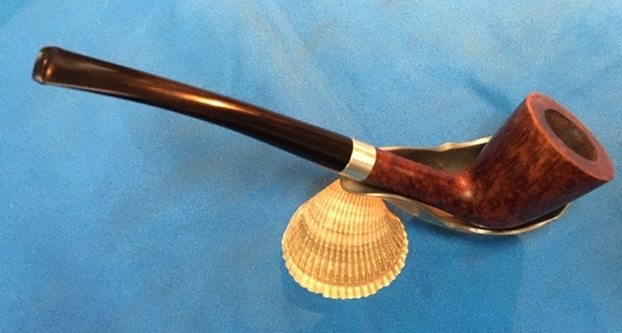
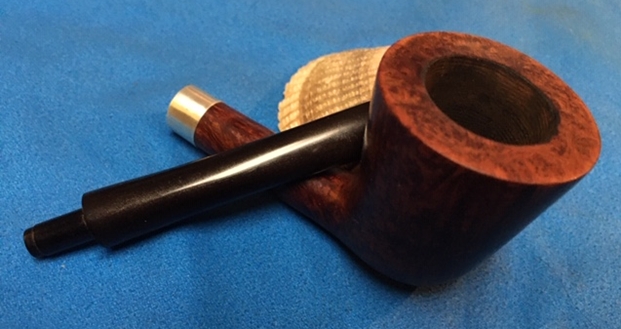
Over the past two weeks I was traveling in Alberta with my brother Jeff and his wife, Sherry. In between work appointments and presentations we took some time to visit local antique shops and malls. We found quite a few pipes. In a small Antique Shop in Lethbridge we found a few interesting pipes. The third of the pipes that I have chosen to work on from that find is a beautifully straight grained Dublin. The taper stem has a JU in an oval stamped logo on the left side. The pipe was dirty and caked when we picked it up. The rim top had a little lava and some small scratches in the edges of the bowl. The bowl had a thick cake in it that was hard and dense. The exterior of the bowl and shank are very dirty with grime and oils from prolonged use. It was also dull and lifeless. The stamping on the left side of the shank was readable and read James Upshall in an oval. To the left of that stamping there was an upper case “P” grade stamp. On the right side of the shank it is stamped Tilshead over England over Made by Hand. The vulcanite stem was had tooth chatter and tooth marks on the top and the underside near the button. I took photos of the pipe before I started the cleanup. I took close up photos of the bowl and rim to capture the condition of the pipe before I started my cleanup work. The rim top had some lava build up on the edge and there were some small nicks on the inner edge. There was a thick cake in the bowl. Other than being so dirty it appeared to be in great condition. The silver band on the shank is tarnished. The stem was dirty and there was tooth chatter on the top and underside near the button and on the button surface itself. The stem was lightly oxidized.I took a photo to capture the stamping on the left side of the shank. The photo shows the stamping “P” followed by James Upshall in an oval. The stamping on the right side says Tilshead over England over Made by Hand.  The third photo below shows the JU Oval stamp on the left side of the stem.I wanted to educate myself about the Upshall brand so I turned first to one of my go to sites – Pipephil (http://www.pipephil.eu/logos/en/logo-j1.html). I have included a screen capture of the section on the site about Upshall pipes. The pipe I am working on it stamped exactly like the first one in the photo that follows.I turned then to Pipedia to garner some more details about the brand and Barry Jones I have included the link and various sections from that article (https://pipedia.org/wiki/James_Upshall). I quote:

…All our pipes are individually created by a team of highly skilled artisans, headed by Mr. Barry Jones, who is widely regarded as one of the best pipe carvers in the world, with more than 50 years experience in pipe making.

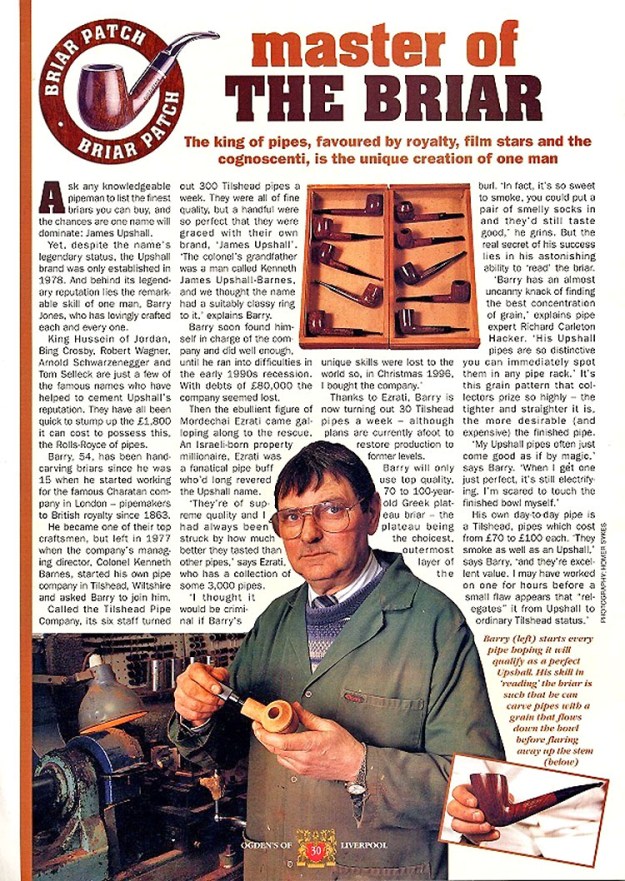
Mr. Jones learned his skill from the age of 15 in London and was personally guided by Mr. Charatan of Charatan Pipe Co., pipe makers to royalty since 1863. For years he was responsible for creating the majority of the famous Charatan shapes and the high standard of quality…

I quote from further down in the article:

…James Upshall gives a unique guarantee on each pipe leaving the workshop. No pipe bearing the name of James Upshall is marred by fillings and putty. Scarcity of good quality plateau briar and the time consumed turning by hand, limit our production, but we will always strive to fulfill the growing demand for James Upshall, quality and tradition at its best…

…As always the James Upshall pipe has been sold in the most prestigious outlets around the world and has been greatly appreciated by royalty, lords and celebrities alike. King Hussein of Jordan, Anwar Sadat, Bing Crosby, Yul Brynner and more recently Arnold Schwarzenegger, Robert Wagner and Tom Selleck to name but a few of the famous names who have helped to cement James Upshalls’ reputation as the Rolls Royce of Pipes.

Further down in the article there is a section on Grading and Sizing of James Upshall Pipes. I have quoted that entire section below. It helps to place the “P” grade stamp on the pipe that I am working. The information comes directly from the James Upshall website.

Grading & Sizing Information

James Upshall pipes are graded by various finishes, i.e. bark, sandblast, black dress and smooth etc. Then by cross grain, flame grain, straight grain and, last but not least, the perfect high grade, which consists of dense straight grain to the bowl and shank. The latter being extremely rare. In addition, the price varies according to group size, i.e. from 3-4-5-6 cm high approximately Extra Large. We also have the Empire Series which are basically the giant size, individually hand crafted pipes which come in all finishes and categories of grain. All our pipes are individually hand carved from the highest quality, naturally dried Greek briar. In order to simplify our grading system, let me divide our pipes into 4 basic categories.

  • It begins with the Tilshead pipe, which smokes every bit as good as the James Upshall but has a slight imperfection in the briar. In the same category price wise you will find the James Upshall Bark and Sandblast finish pipes, which fill and smoke as well as the high grades.
  • In this category we have the best “root quality” which means that the grain is either cross, flame or straight, which is very much apparent through the transparent differing color finishes. This group will qualify as the “S”- Mahogany Red, “A” – Chestnut Tan and “P” – Walnut. The latter having the straighter grain.
  • Here you have only straight grain, high grade pipes, which run from the “B”, “G”, “E”, “X” and “XX”. The latter will be the supreme high grade. Considering the straightness of the grain the latter category is also the rarest. Usually no more than 1% of the production will qualify.
  • Lastly, we have the Empire Series. These are basically Limited Edition gigantic individually hand crafted pieces, which again are extremely rare due to the scarcity of large, superior briar blocks.

We also offer a selection of finely engineered silver and gold banding for pipes. Bands are available in silver, 9ct and 18ct gold, the width can be 6mm or 10mm and they can be fitted flush or on the surface. Bands are finished in plain, engine turned with barley or line patterns and also in gold with large hallmarks.

I am also including a copy of an article from the Pipedia site about the brand and the maker provided by Doug Valitchka (https://pipedia.org/wiki/File:James_Upshall.jpg).

Barry Jones in the photo, and an interesting article, courtesy Doug Valitchka

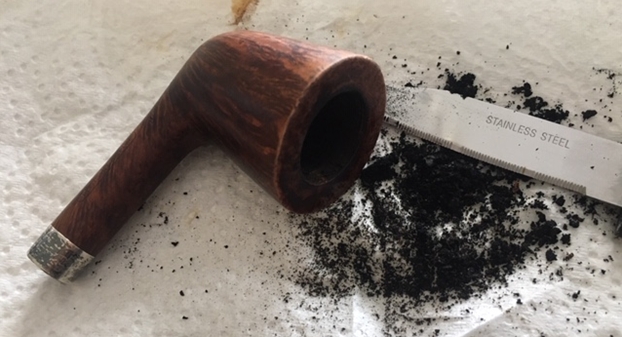
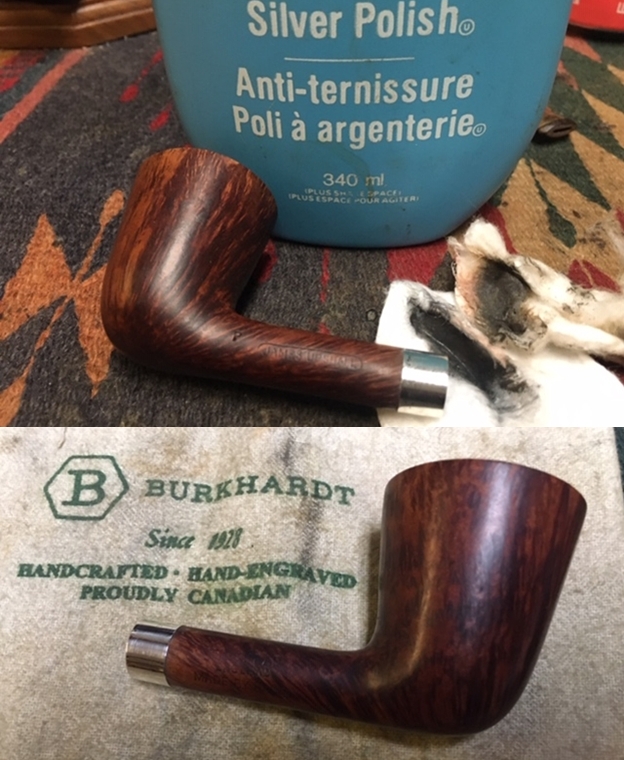
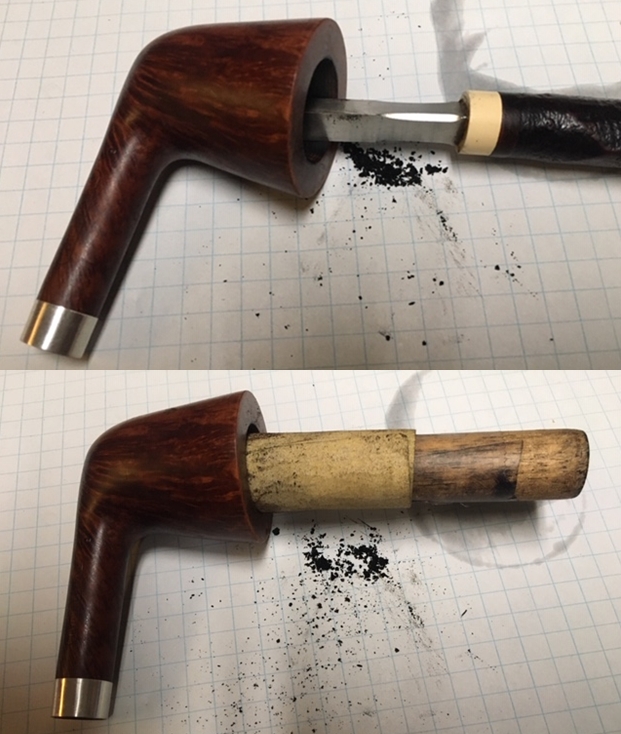
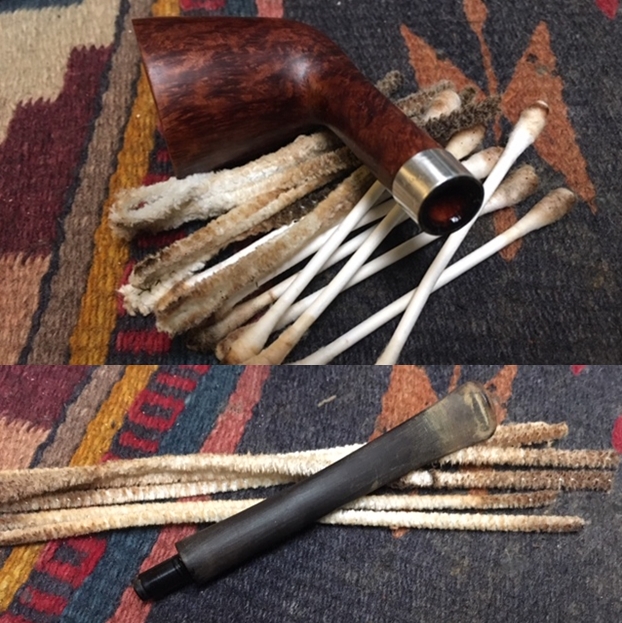
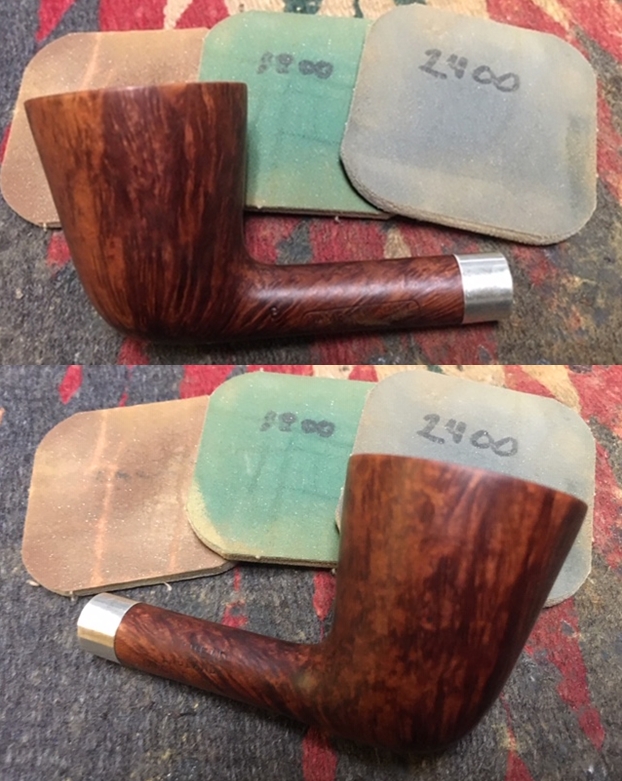
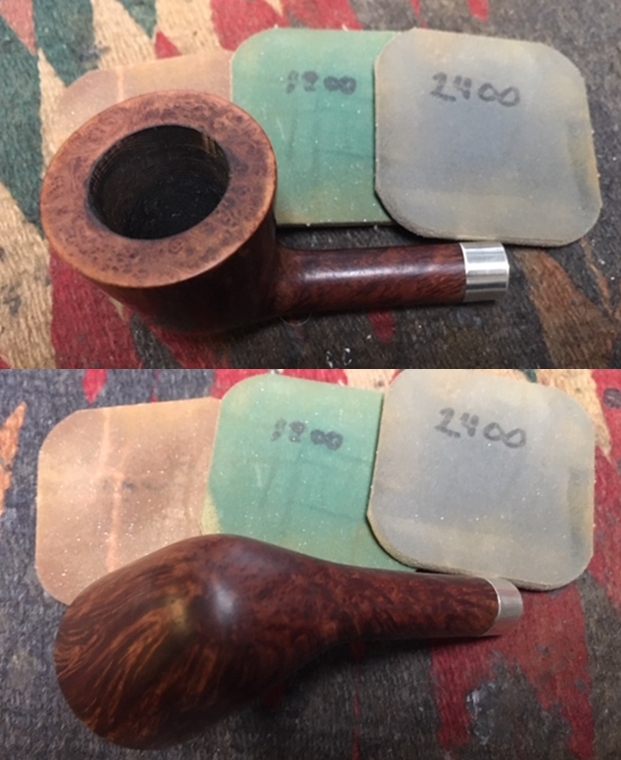
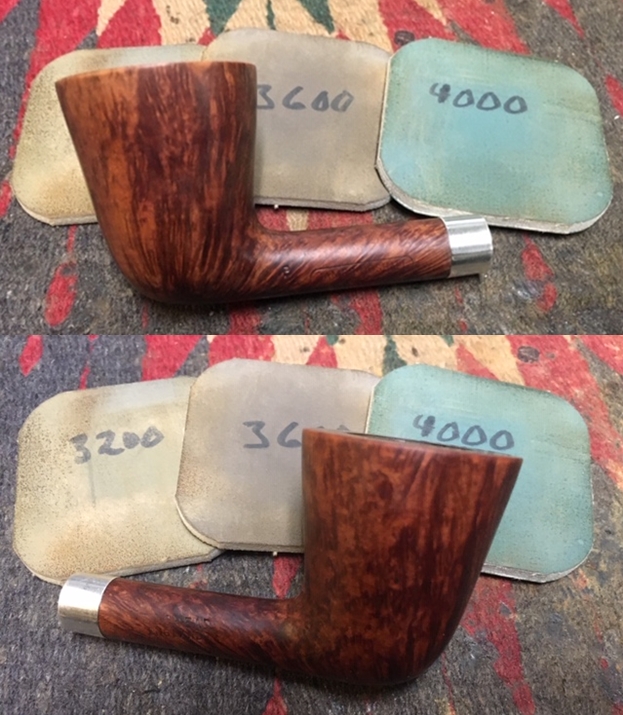
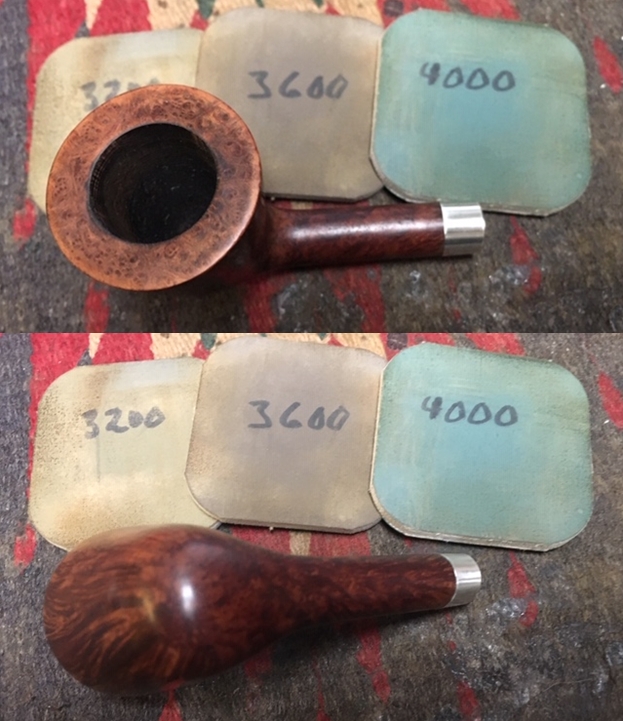
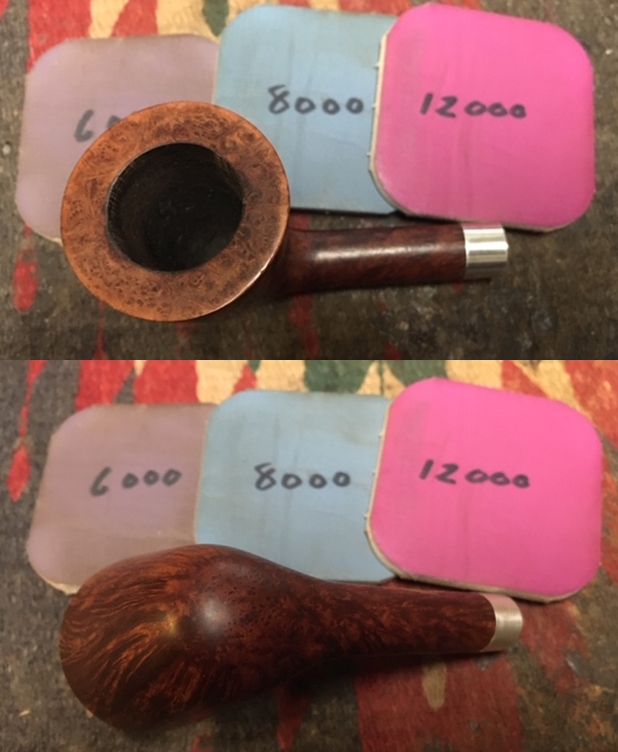
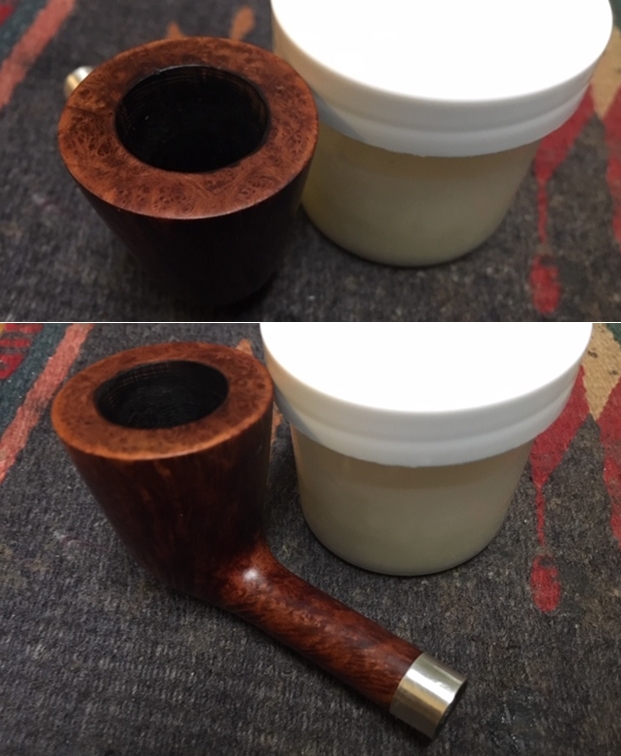
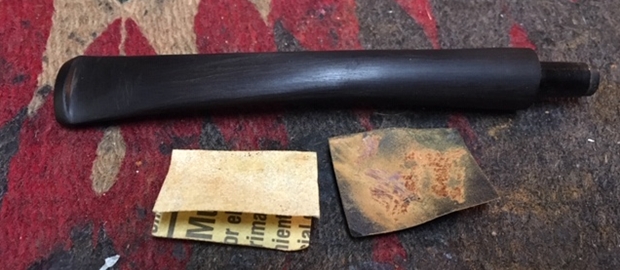
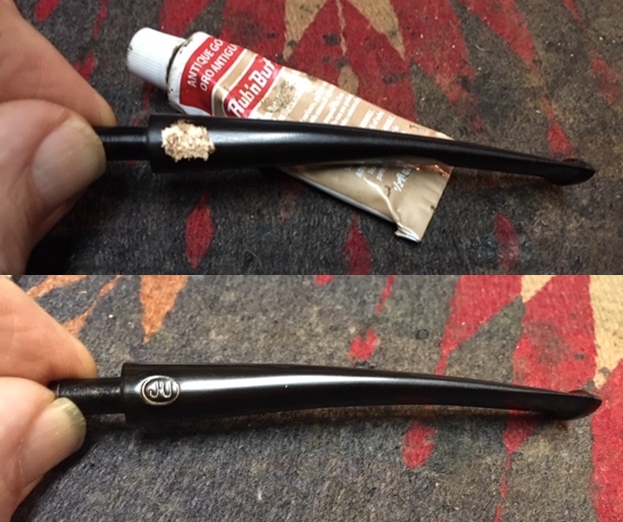
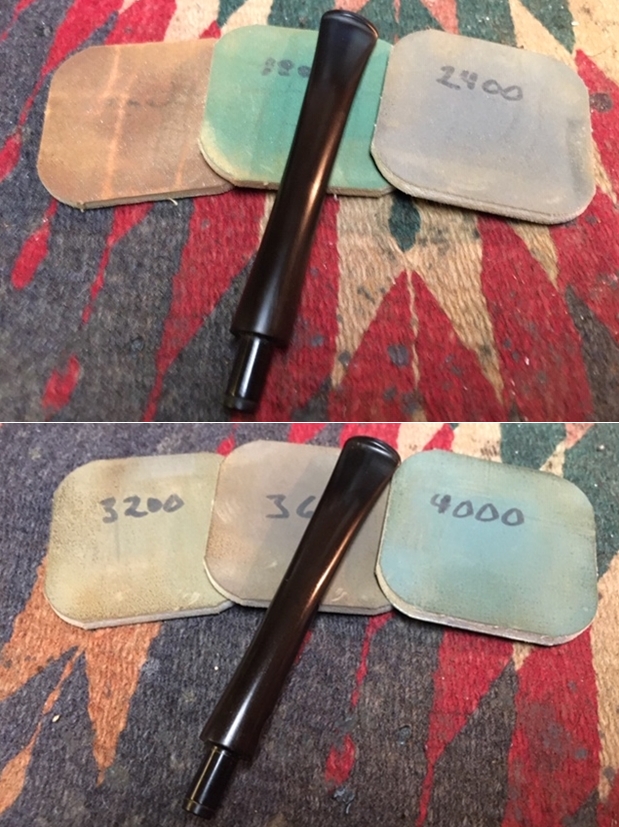
While we were traveling I decided to do a bit of work on some of the pipes that we had found. This was the third one that I worked on. I scraped the inside of the bowl with a sharp knife. I scraped the tars and lava off the top of the rim with the same knife. I scrubbed the exterior of the bowl with warm water and Dawn Dish Soap to remove the buildup of tars and grime around the bowl and on the rim top. I rinsed it well and wiped the bowl down with a clean paper towel to polish the finish on the bowl. The pictures that follow show the condition of the pipe after it had been scrubbed. When I got it home I would scrub the exterior and the interior some more. When I returned from my trip I cleaned the tarnished silver with silver polish and a jeweler’s cloth. I wanted to get it cleaned off to see if there were any stampings on the silver. It was stamped STERLING on top of the band which correlates to the not in the article from Pipedia where Upshall used Sterling Silver bands on some of their pipes.I followed up on my initial cleaning of the bowl and shank. I reamed the bowl with a Savinelli Fitsall pipe knife to remove the remnants of the cake in the bowl. I sanded the bowl with 220 grit sandpaper wrapped around a piece of dowel to smooth out the inside walls of the bowl.I scrubbed out the mortise and the airway in the shank, the metal mortise and the stem with alcohol, cotton swabs and pipe cleaners.I polished the briar with micromesh sanding pads – wet sanding the bowl walls and rim top with 1500-12000 grit pads. I wiped the bowl down after each sanding pad with a damp cloth to wipe of the dust. I scrubbed the bowl down with Mark Hoover’s Before & After Briar Cleaner. I rubbed it into the surface of the briar, and as Mark wrote me it lifted the grime and dirt out of the briar. I rinsed the cleaner off the bowl with warm running water and dried it with a soft cloth. The photos below show the cleaned briar… Look at the grain on that pipe! I worked some Before & After Restoration Balm into the surface of the briar with my fingertips to clean, enliven and protect it. I let the balm sit for a little while and then buffed with a cotton cloth to raise the shine. The photos show the bowl at this point in the restoration process. I set the bowl aside and turned my attention to the stem. I sanded out the tooth chatter with 220 grit sand paper and started to polish it with a folded piece of 400 wet dry sandpaper. Once it was finished it began to shine. I used some Antique Gold Rub’n Buff to restore the stamping on the left side of the stem. I pressed it into the indentations on the stamp with a tooth pick. I set it aside to dry and let it sit for a few minutes. Once it had cured I rubbed it off with a cotton pad and polished it with micromesh sanding pads.I polished the stem with micromesh sanding pads – wet sanding with 1500-12000 grit sanding pads. I wiped it down after each sanding pad with a damp cloth. I polished it with Before & After Pipe Stem Polish – both Fine and Extra Fine and buffed it off with a cotton cloth. This is a beautifully grained Upshall Dublin with a black tapered vulcanite stem. It has a great look and feel. The shape is very tactile and is a beauty. I polished stem and the bowl with Blue Diamond polish on the buffing wheel. I gave the bowl and the stem multiple coats of carnauba wax. I buffed the pipe with a clean buffing pad to raise the shine. I hand buffed it with a microfiber cloth to deepen the shine. The pipe polished up pretty nicely. The grain on the bowl came alive with the buffing. The rich contrasting browns works well with the polished vulcanite stem. The finished pipe has a rich look that is quite catching. Have a look at it with the photos below. The shape, finish and flow of the pipe and stem are very well done. The dimensions are Length: 6 ½ inches, Height: 1 ¾ inches, Outside diameter of the bowl: 1 ½ inches, Chamber diameter: ¾ of an inch. Thanks for walking through the restoration with me as I worked over the next of the finds of Jeff and my Alberta pipe hunt. It is a beautiful straight grain Hand Made Dublin with a Sterling Silver band and vulcanite stem.