

Blog by Steve Laug
The next pipe I have chosen to work on is a nice looking rusticated Ferndown Lovat that I picked up in a lot of 10 pipes from a fellow on Vancouver Island who was selling his collection. The stamping on the underside of the shank and reads Ferndown [arched over] 2 *s and Bark. That is followed by Hand Made In [over] England [over] Les Wood. The silver band on the shank is stamped L&JS in a rectangle [over] 925. The vulcanite saddle stem is stamped LJS in gold on the left side of the saddle. The pipe came in a no name pipe sock. I took the pipe out of the sock and turned it over in my hands. It was in pretty good condition. This is what I saw
- The finish was dusty and dirty in the grooves and valleys of the shallow, tight rusticated finish. Otherwise the finish looked very good.
- The smooth rim top showed some darkening and scratches in the finish. There was some light lava build on the rim top and the inner and outer edges of the bowl were clean and undamaged.
- There was a light cake in the bowl. It held the aroma of the tobaccos smoked in it but fortunately they were not aromatic. The walls looked to be undamaged but once I reamed it I would know more about that.
- The vulcanite saddle stem had the LJS Logo on the left side in gold. The vulcanite stem is lightly oxidized on the left side but otherwise clean. There are light tooth chatter and marks on both sides but nothing deep.
To summarize what I saw – this Ferndown is a well made pipe as to be expected. It is dusty but otherwise in good condition. The vulcanite stem is lightly marked but otherwise undamaged. The look and feel of the pipe is great in the hand and the rustication is shallow but very beautiful. It is going to clean up very well. Here are photos of the pipe before I started my clean up. What do you see when you examine it?
 The bowl of the pipe looked very good. The rim top is clean other than a light lava build up and some scratching. The edges of the bowl were undamaged and looked very good. I see no warning signs in the rim top or the edges of the bowl. I took photos of the acrylic stem to show its condition. Though hard to see there are light tooth marks and chatter on the surface of both sides ahead of the button but it should clean up easily with sandpaper.
  The next photo captures the stamping on the underside of the shank. They read as I have noted above. The second photo shows the stamp on the silver band and on the left side of the saddle stem. It is also clear and readable.
  I removed the stem from the shank and took a photo to capture the economy of this nice pipe.
 It has been awhile since I had cleaned up a Les Wood pipe and in this case a Ferndown rusticated Lovat stamp that left me with some questions that I need to answer before I began to work on the pipe. I turned first to the Pipephil site to help me interpret the stamping on the pipe and gain some background information on the brand and line (http://pipephil.eu/logos/en/logo-f1.html). The photo to the left shows Les Wood and the information below came from the side bar. I have also done a screen capture of the information on the site.
Artisan: Leslie (Les) Wood. He was the master silver smith at Alfred Dunhill Ltd. before starting L. & J.S. Briars. Pipes for the European market are stamped “L. Wood” while those for US are stamped “Ferndown”. Production: ~ 2000 pipes/year (Ferndown + L.Wood) See also Elwood.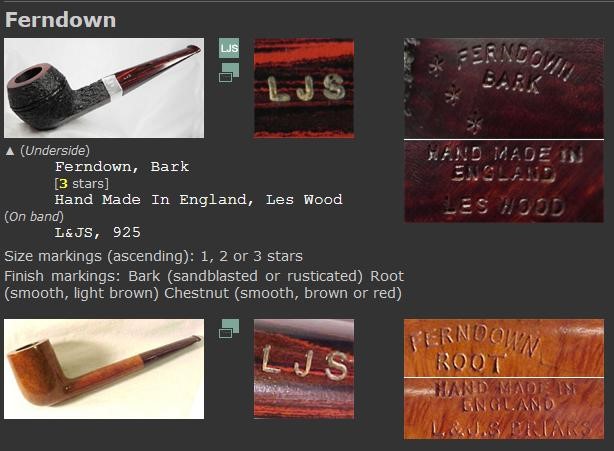 From the information on Pipephil I learned that I was working on a pipe made for the US and that it was a large 2 star pipe in terms of size. I also learned that the Bark finish was a sandblasted or rusticated. The one I had in hand was a tightly rusticated finish with a smooth strip on the underside of the shank for the stamping. All of which helped to understand the pipe I was going to work on.
I turned to Pipedia (https://pipedia.org/wiki/Ferndown) to find a more detailed history and description of the brand and was amazed to find that the majority of it was either quotes or written by Les Wood himself. I am quoting some pertinent parts of the article below. You can turn to the site to read it in full.
Leslie “Les” John Wood worked for Dunhill for 19 years. His last position was as master silversmith. Following his tenure with Dunhill, Les formed his own brand, L. & J.S. Briars together with his wife Dolly in 1978. Les Wood follows Sasieni, the first ex Dunhill worker to start their own enterprise, and he was followed by William John “Ashton”-Taylor.
“I started working at Dunhill’s in March 1963, in the silver mounting department working under Jack Spriggs he left the firm after I had been there for 2 years, and I took over the department, at that time I worked alone it was only when the department was relocated to the top floor that the increase of pipes that needed mounting that we took on trainees. After 19 years I was asked if I would buy the machinery and move out of the factory and set up on my own, so off I went. With me I took the staff that worked with me at that time, Robert Morris was the best, he could mount anything, he now has his own jewellery retail shop and makes some really nice handmade jewellery from his shop at Whitstable in Kent.”
“I worked on Dunhill’s pipes from 1980/81 and soon built up a reputation as the firm to send your mounting to. As time went on and Dolly left Dunhill’s we decided to start to turn our own bowls and make our own pipes under the name of my house.” Les Wood. Jan, 2020…”
Due to the vagaries of international trademark law, he sold his earlier pipes as ” L.&J.S Briars”, “Ellwood”, “Les Wood” or “L. Wood”. Until recently, an average of 1500 – 2000 pipes a year were sold as “Ferndown” — named for the mansion he lives in — in the UK and US, but as “L. Wood” pipes in Germany…
To many pipe smokers, Les Wood’s pipes embody the revival of great English pipe making initiated by Ashton in the early 1980s. The high-grade Italian and Spanish plateau he prefers is oil-cured in the tradition of both Dunhill and Ashton. The pipes are renowned for their pleasant, slightly nutty flavor and remarkable smoking characteristics. They feature impeccable craftsmanship extending to very good stem/bit work, though many pipes are often a bit heavier. The hallmark of his work, of course, is the excellent silver work. Almost all of his pipes feature rings or ferules for spigot stems. Grading is by finish: “Bark” (ca. 90%, rusticated, dark brown and black), “Antique Bark” (tan rusticated), “Reo” (brown and red, smooth), “Root” (orange, smooth), and “Tudor Root” (orange and brown smooth) and by size (one to four stars). He also designates straight grains with SG…
“We bought the briar from Italy and Spain, one is mush denser that the other I like the Spanish briar it is lighter and Dolly would make the Roots look like glass with only a natural vanish, all the pipes were finished with the same varnish, the bark finish on the bowl is put on by Dolly by hand, one slip and you have a problem. That’s one job that needs to be seen to see how it’s done.”
There also was a great paragraph on the oil curing process that Les and Dolly developed. I am including that below as the pipe I am working on was definitely oil cured.
“We had our method of Oil-Curing. We applied Oil to the outside and the inside of the bowl, that was because when Dolly was at Dunhill’s factory, she worked in the finishing department and got such a high finish on the pipes they wanted to know how she did it. The bowls had already gone through Dunhills’ oven oil curing system, but to her, it was not enough, because it could not get the shine that she wanted, then, she oiled the bowl on the outside and the inside to get a better finished. She left Dunhill and came to work with me. Because of this process, we found out the smokers liked the taste when light up their pipe – they said there was no aftertaste and it had a sweet taste doesn’t matter what tobacco they used. We have carried it on from there.”
Armed with that information and renewing my knowledge of the brand it was time to work on the pipe. I started my work on the pipe by cleaning the internals. The cake was quite thin but it can hold residual oils from previous tobaccos and I wanted to check the bowl walls for burn damage or checking. I reamed it with a Savinelli Fitsall Pipe knife and took the cake back to bare briar. I sanded the walls with 220 grit sandpaper wrapped around a piece of dowel. I worked on them until they were smooth. There was no checking or burn damage to the bowl walls. It was quite clean. I cleaned out the internals of the shank and the airway in the stem with 99% isopropyl alcohol, cotton swabs and pipe cleaners. I worked them over until they were clean.
  I scrubbed the externals of the bowl and shank with undiluted Murphy’s Oil Soap and a tooth brush. I worked the soap into the grooves and valleys in the finish. I rinsed it off with warm running water. I dried it with a soft cotton towel. The bowl looks much better at this point in the process of recovery.
 I polished the smooth rim top with micromesh sanding pads – dry sanding with 1500-12000 grit pads. I wiped the briar down with a damp cloth after each sanding pad. The rim top began to take on a rich shine.
 I worked some Before & After Restoration Balm into the rusticated finish on the bowl and shank and the smooth rim top. I worked it into the surface of the briar with my fingertips to clean, enliven and protect the wood. I used a horse hair shoe brush to work it into the crevices and keep from building up in the valleys and crevices of the finish. Once the bowl was covered with the balm I let it sit for about 15 minutes and buffed it off with a soft cotton cloth and the shoe brush. I polished it with a microfiber cloth. I took photos of the pipe at this point in the process to show what the bowl looked like at this point.

 I polished the silver band with a jewelers cloth. It is impregnated with an anti-tarnishing compound and polish. I rubbed the shank end band down with the cloth to polish and protect the band. It came out with a rich glow and shine.
 I set the bowl aside and worked on the stem. I sanded out the chatter and tooth marks with 220 grit sandpaper. I was able to remove the marks from the surface very well, leaving behind no sign of the tooth damage. I started polishing the stem surface with 600 grit wet dry sandpaper.
  I dry sanded both sides of the stem with 1500-12000 grit pads to polish it further. I wiped it down with a damp cloth after each sanding pad. The shine grew deeper with each sanding pad.
 I finished polishing the stem with Before & After Pipe Polish – both Fine and Extra Fine polishes. I wiped the stem down with a damp cotton pad afterwards and buffed it with a soft microfiber cloth.
  I put the bowl and stem back together. I don’t buff the rusticated bowl on the wheel as it leaves a lot of grit in the deep grooves of the rustication. I gave the bowl and shank multiple coats of Conservator’s Wax and buffed it with a shoe brush to raise the shine. The wax is great protection and I love using it on rusticated and sandblast finishes because it does not build up in the grooves and valleys like carnauba wax does. I buffed it by hand with a microfiber cloth to finish the shine.
 I polished the stem with Blue Diamond on the buffing wheel to polish out the scratches in the vulcanite. I buffed the pipe with a clean buffing pad to raise the shine. I hand buffed it with a microfiber cloth to deepen the shine. The pipe polished up pretty nicely. The contrast of the blacks, dark browns and reds of the stain on the briar with the shine of the polished vulcanite stem is quite stunning. The dark and shallow rustication around the bowl and shank is quite remarkable and gives the pipe an incredible tactile presence. The smooth rim top is a great addition. This is truly a beautiful pipe and one that will be a great smoking pipe. The finished pipe is shown in the photos below. The dimensions of the pipe are Length: 6 ½ inches, Height: 1 ¾ inches, Outside diameter of the bowl: 1 ¼ inches, Chamber diameter: 3/4 of an inch. The weight of the pipe is a light and comfortable 56 grams/1.94 ounces. This is the first Ferndown Bark in my collection and I have been hunting for one for a while. This is a little larger than I was hoping for but it is a great looking pipe. I will be putting it on the holding onto it for awhile and enjoying it. Thanks for walking through the restoration with me. Cheers.


 rebornpipes