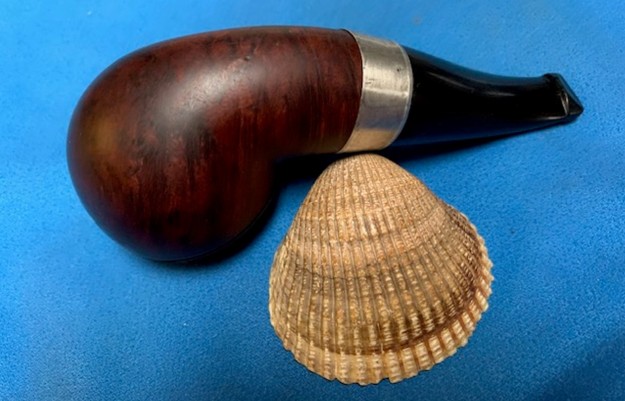
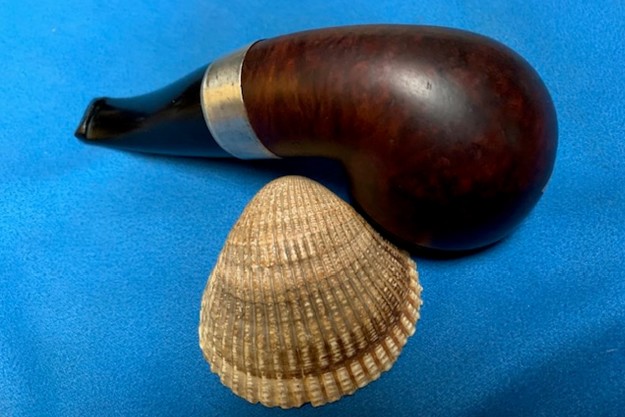
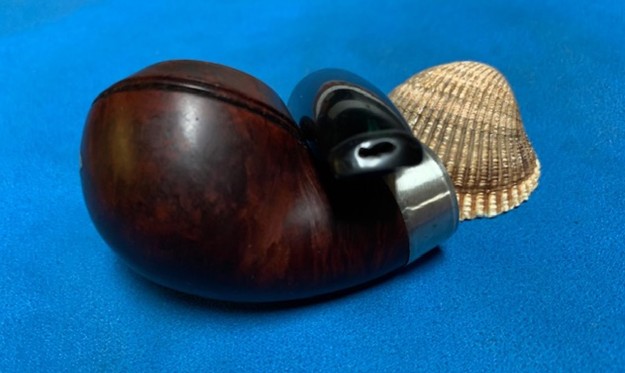
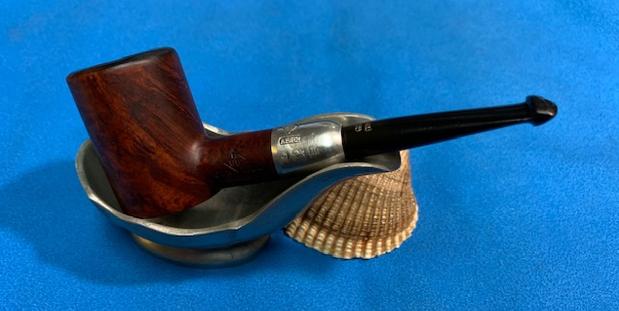
Tag Archives: Adolf Frankau & Co LTD Gold and Silver workers

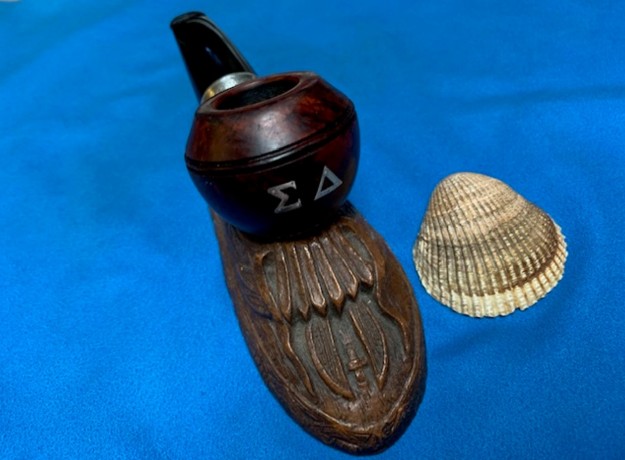
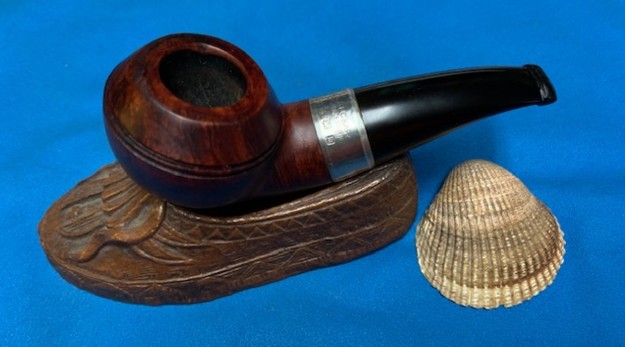
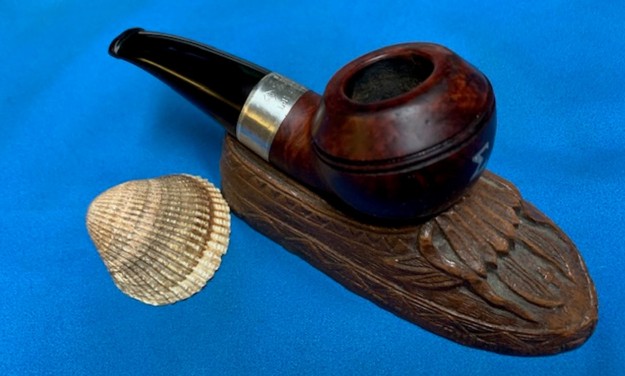
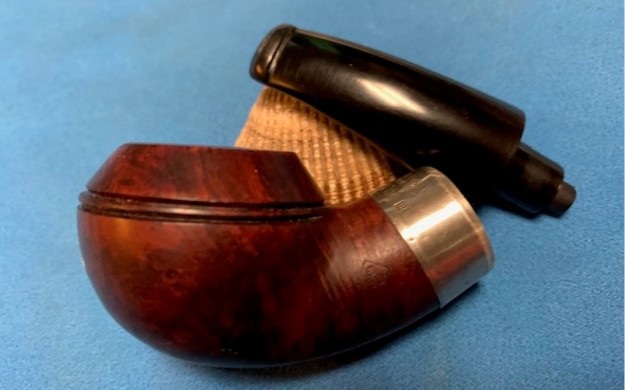
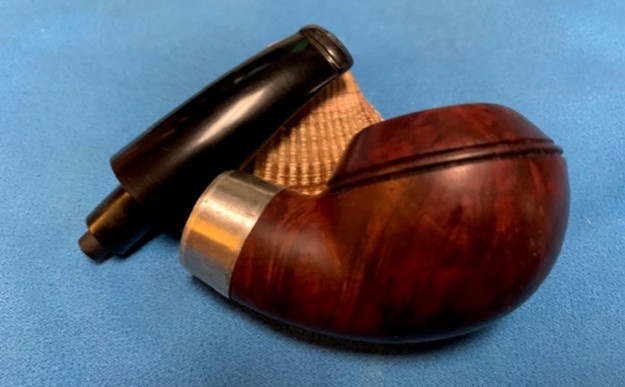
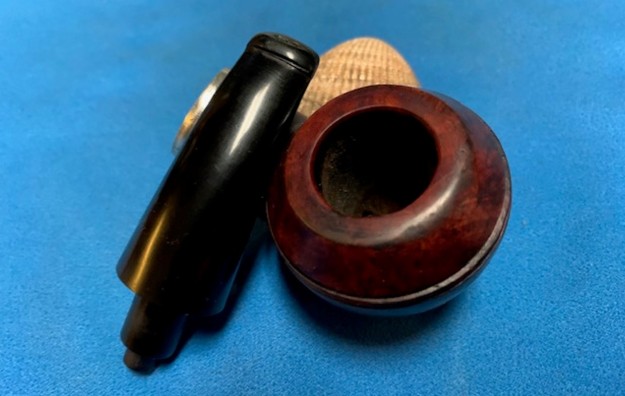
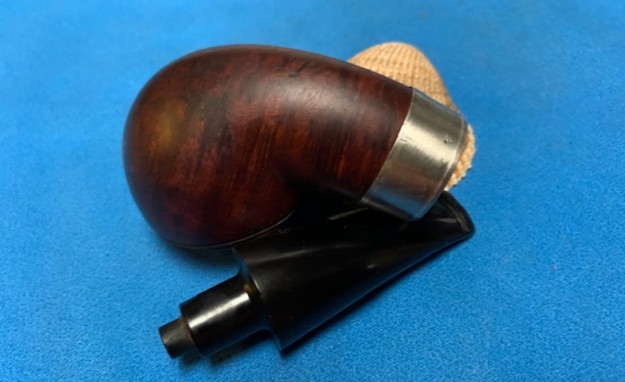
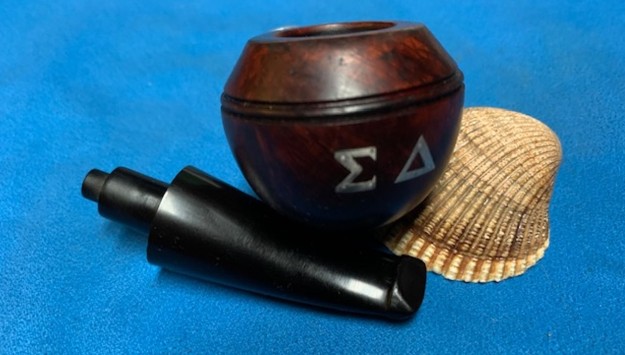
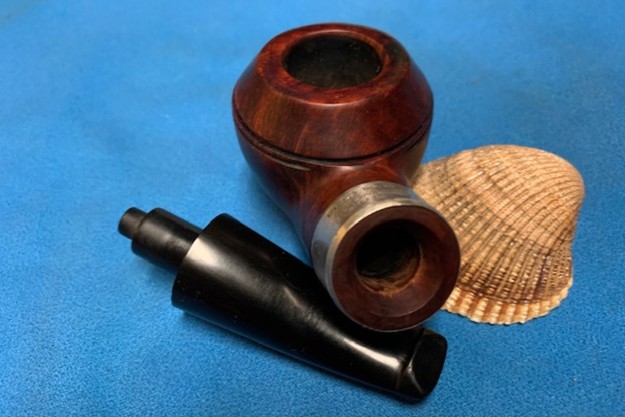
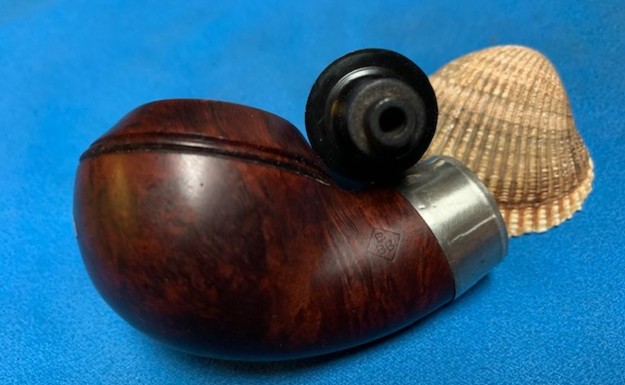
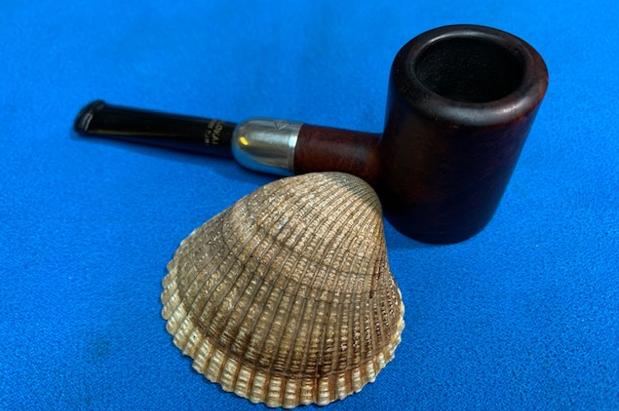
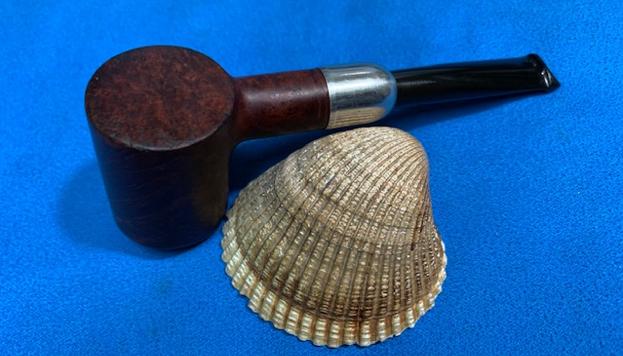
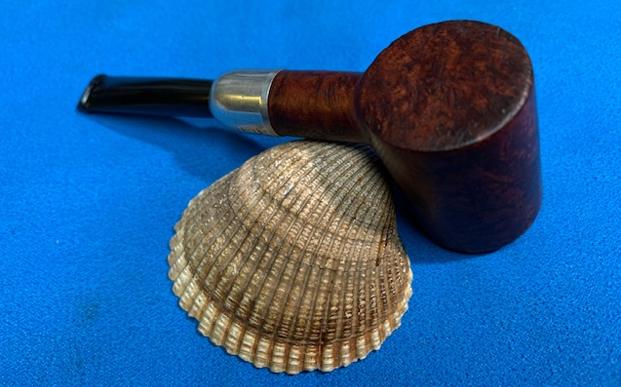
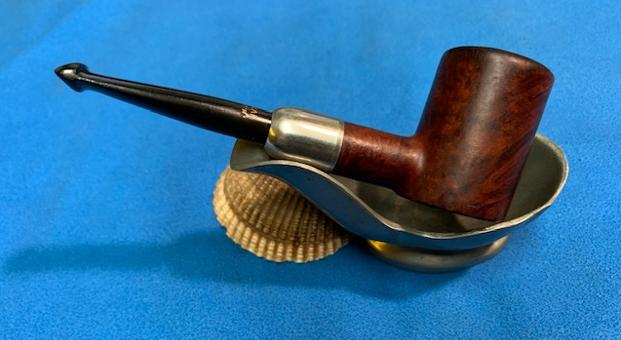
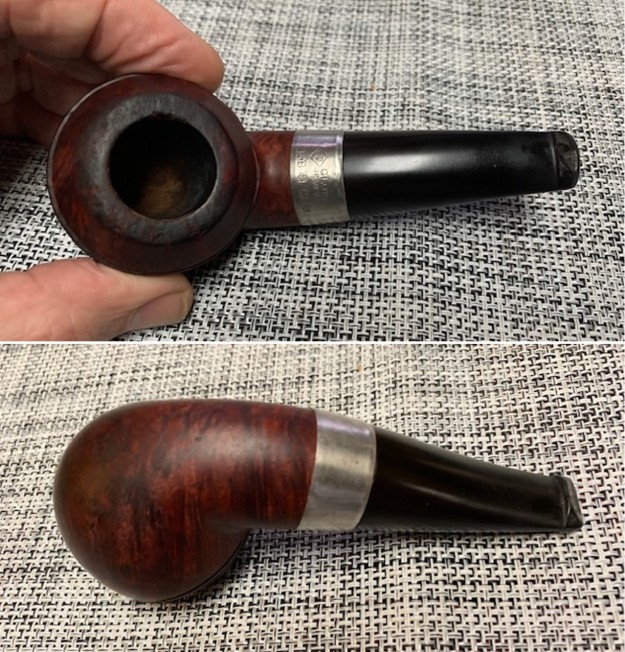
Restoring a 1911 BBB Glokar Rhodesian with Fraternity Silver Sigma Delta inlaid on the front.


Blog by Steve Laug

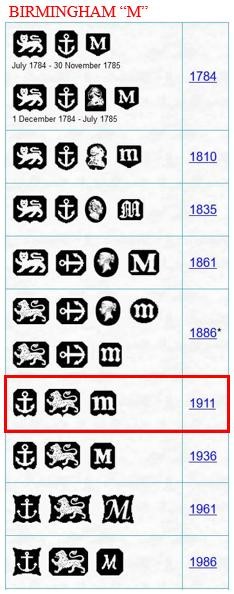
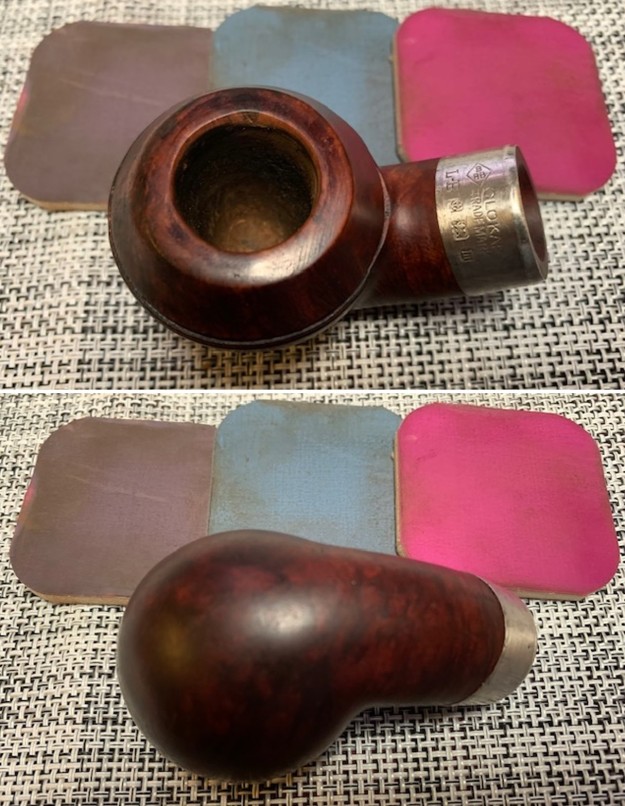
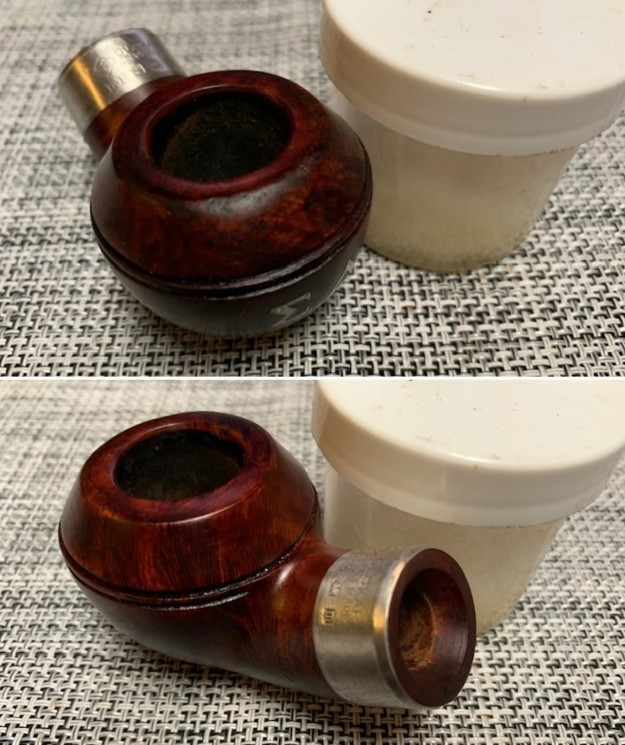
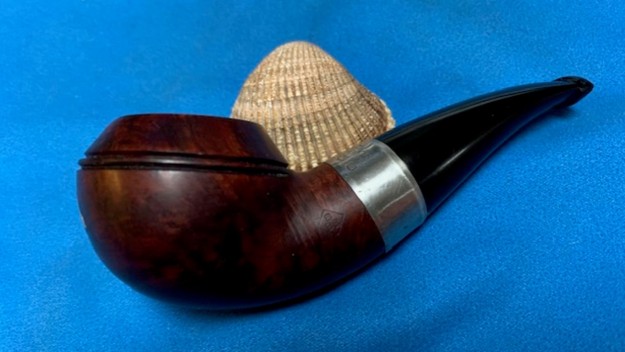
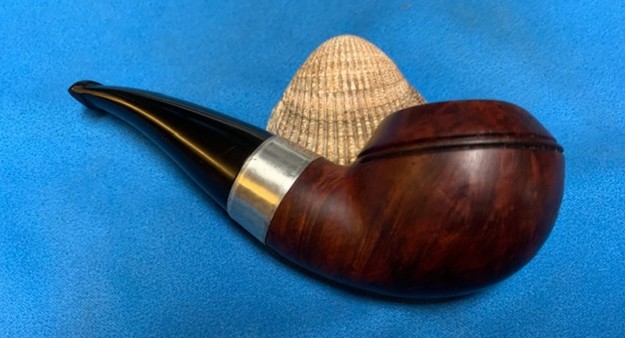
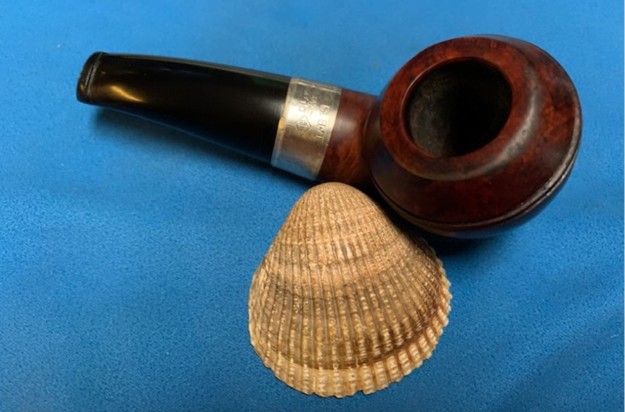
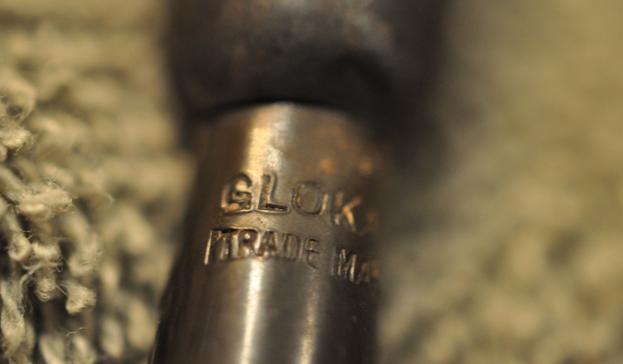
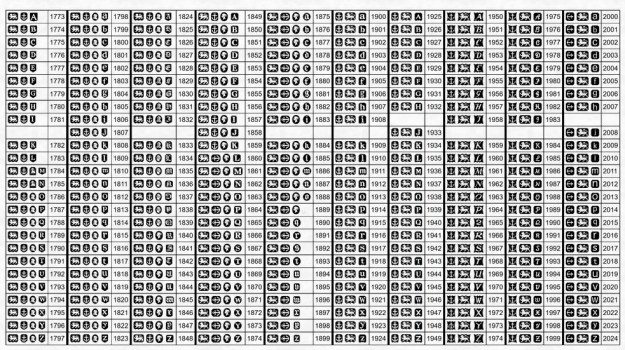
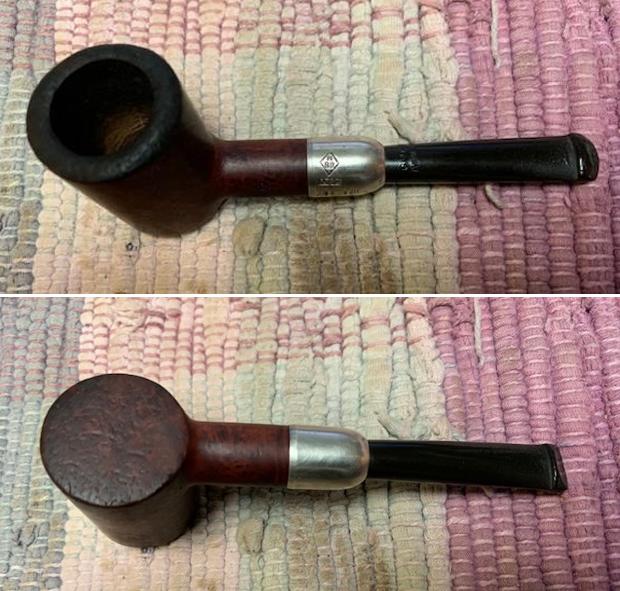
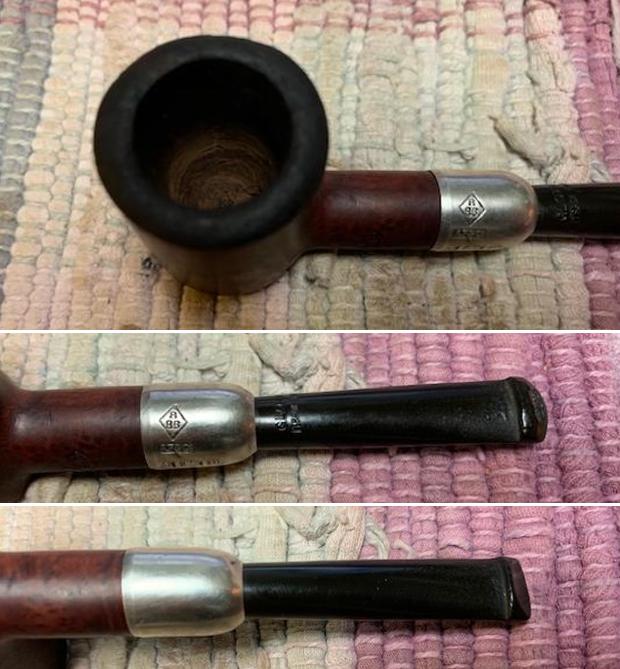
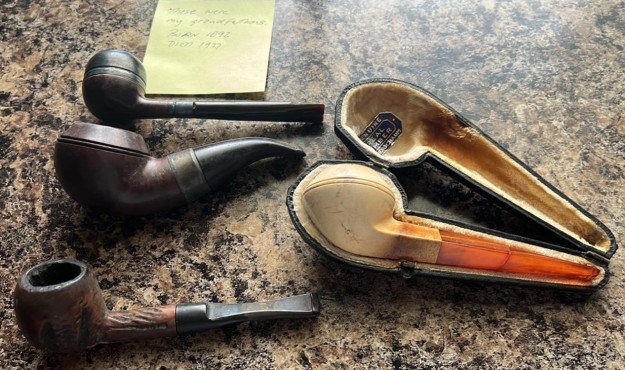
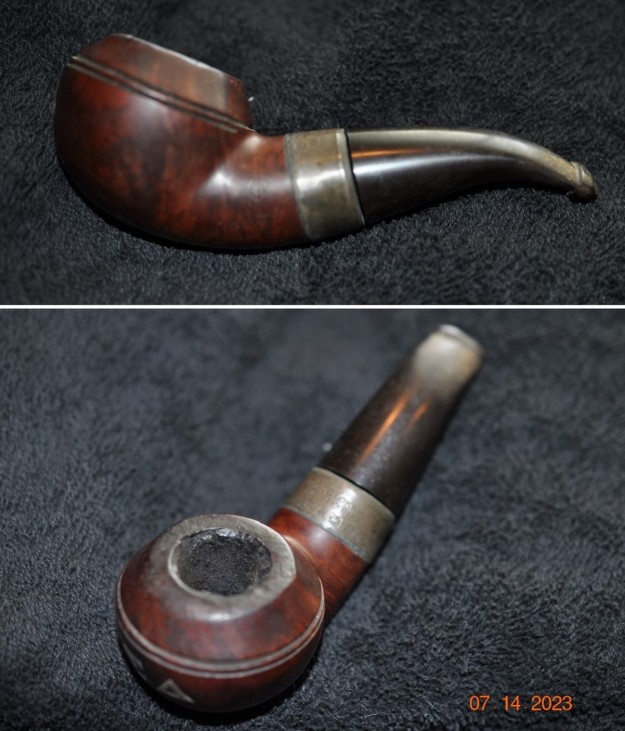
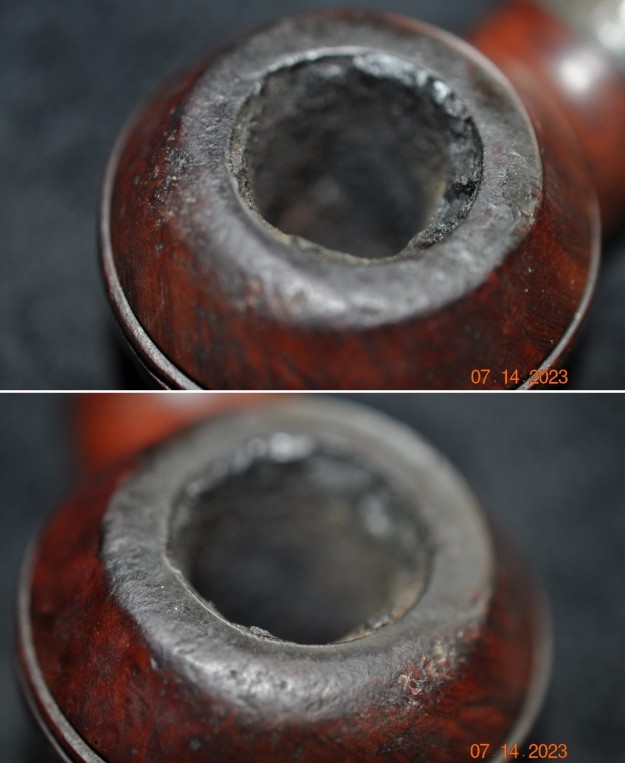
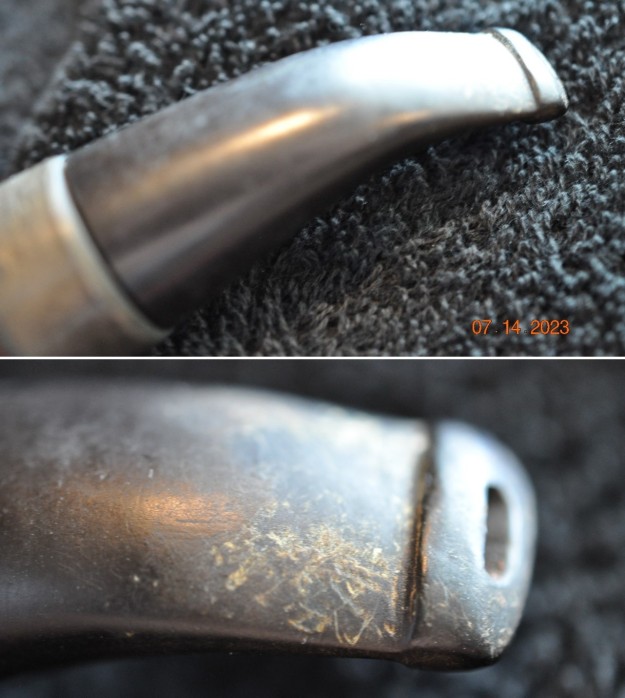
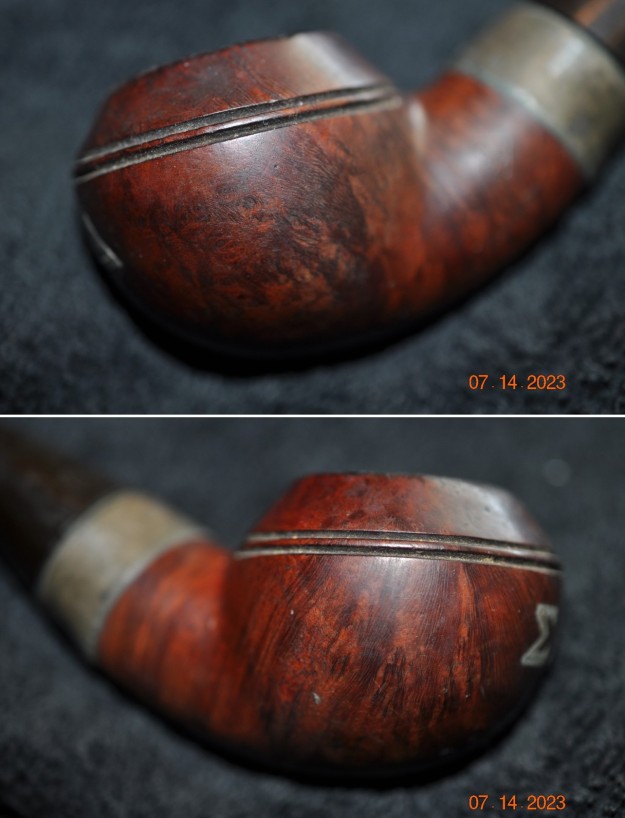
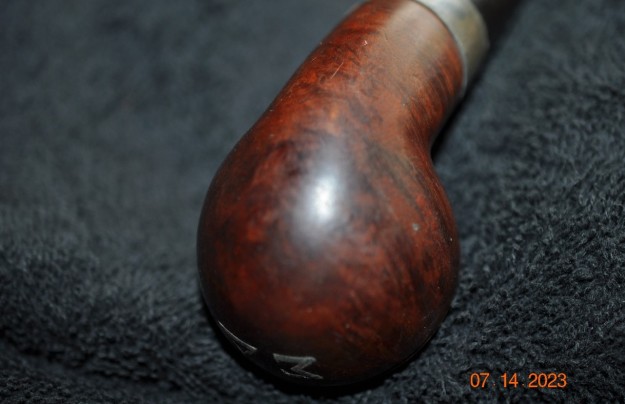
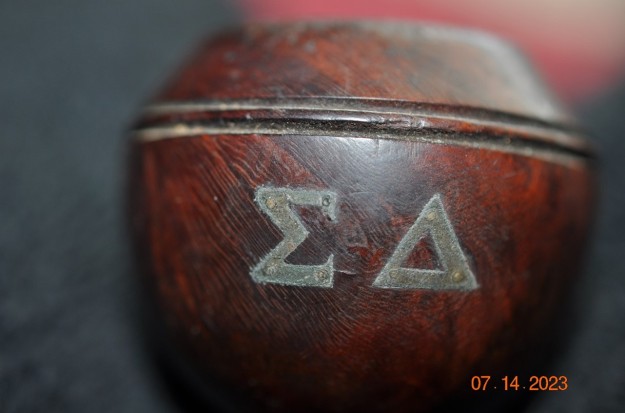
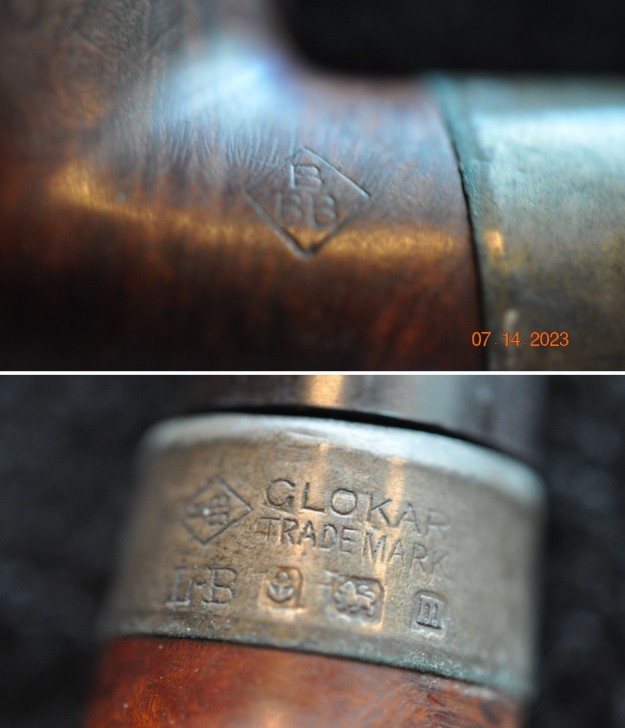
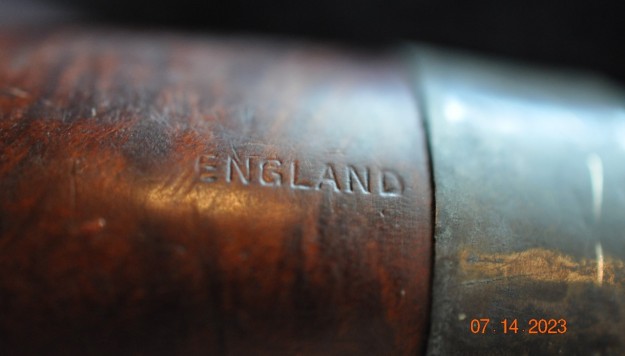
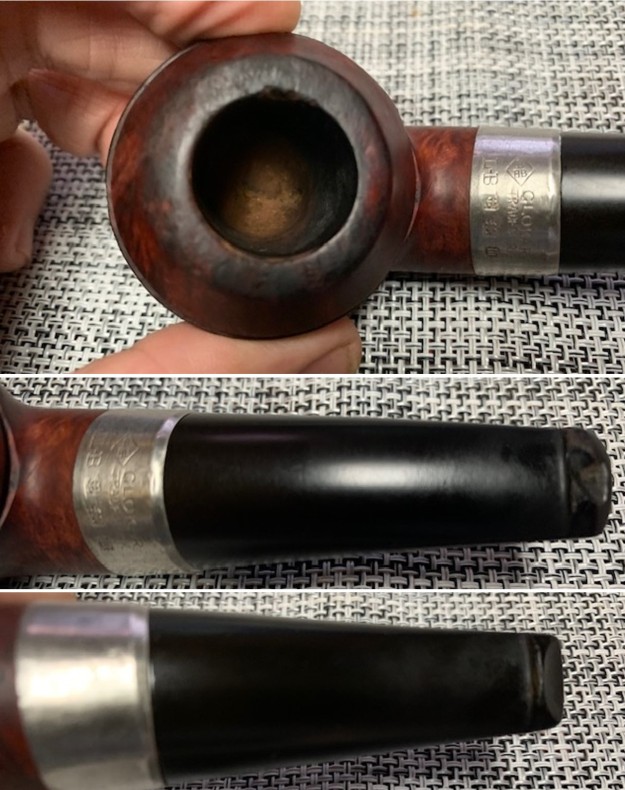
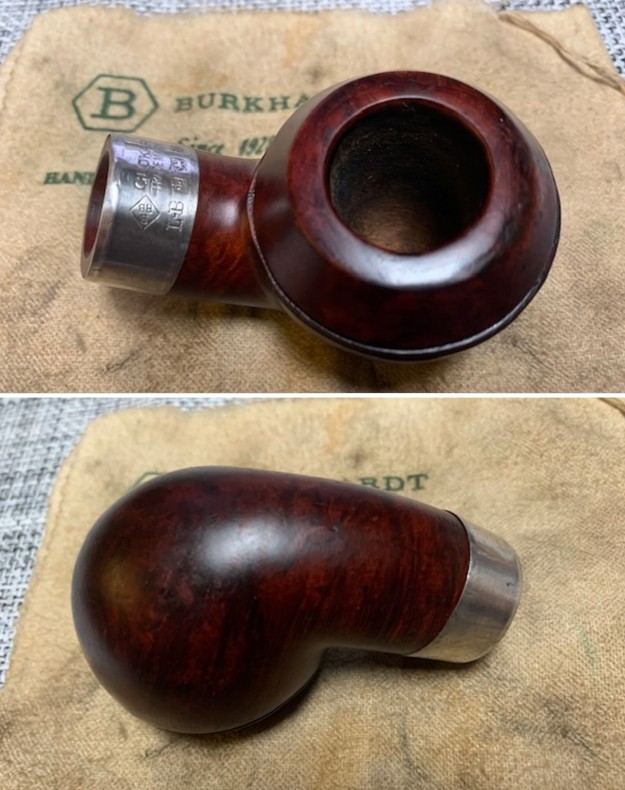
I decided I needed a change of pace in my restoration/clean up work. I went through my pipes waiting in the queue and chose pone from a group of four pipes that were given to us by a woman in Columbus, Ohio, USA. It had belonged to her Grandfather who lived from 1882 to 1977. There were four pipes that she sent us from his estate – the metal bowled apple, a cased meerschaum with a broken shank and an amber stem, a Whitehall rusticated apple and a BBB Glokar Fraternity Pipe.If you have followed rebornpipes for a while now you know that I really have a passion for BBB pipes. I have one BBB GLOKAR already that is a pleasure so when I saw this one I knew it would be one I would like to work on. Also, the fact that it is a taper stem Rhodesian also adds to its charm for me. I could see that it was an old timer but I would have to decode the silver hallmarks on the stem to pin down a date. It was well smoked, reamed with a knife. The stamp on the left side of the shank had BBB in a Diamond and on the underside of the shank it read ENGLAND next to the silver band. The oxidized and tarnished silver band was stamped with a BBB Diamond [over] L-B. That was followed by the word GLOKAR [over] Trademark. Underneath that were three silver hallmarks. The first mark was a cartouche with an anchor in it that was the mark for Birmingham, England. The second mark was a cartouche with a rampant lion – the symbol for Sterling Silver. The final mark was a cartouche with a lower case “m” in it that would give me the date for the pipe. The pipe was dirty and well used. The finish had deep grime ground into the smooth briar around the bowl. The bowl had tobacco debris in it and a very thick cake overflowing as lava onto the rim top. The rim top and edges were hard to assess because of the lava coat and the cake flowing out of the bowl onto the rim top. It was also hard to assess the outer edge of the rim. There were two Greek letters in Silver inlaid into the front of the bowl – a Sigma and a Delta which are attached to a Fraternity. The stem was hard rubber had a slight bend to it and fit the shank well. It had oxidation, calcification and light tooth marks and chatter on both sides ahead of the button. The button was the patented GLOKAR slot and airway through the stem. Jeff took photos of the pipe before he started his cleanup work. Jeff took photos of the rim top and bowl to show the condition. You can see the thick cake in the bowl and the lava coat on the top of the rim. The condition of the inner edge of the bowl is a hard to assess but the outer edge appears to have some damage on the front outer edge. It was obviously another of her grandfather’s favourite pipes. The hard rubber taper stem was oxidized, calcified and had tooth marks and chatter on both sides ahead of the button. It was nice but will take some work. Jeff took photos of the sides and heel of the bowl to show the grain and the bowl and shank and shape of the pipe. The twin rings around the bowl cap are in good condition and are very clean and undamaged. The shape of the bowl makes it quite nice looking. Jeff captured the inlaid Greek letters Sigma Delta on the front of the bowl. There were tarnished but looked very good. He took a photo of the stamping on the smooth panel on the left side of the shank. You can see that it is readable as noted above. The name of the brand is stamped on the top of the silver band. It reads as noted above. The stamp on the underside of the shank is ENGLAND and it is readable. Since the hallmarks were so clear, I turned to one of the numerous silver hallmark charts on line for the city of Birmingham, England to see what I could find out about the “m” date stamp and pin down and age for the pipe (https://www.silvermakersmarks.co.uk/Dates/Birmingham.html). I clicked on the section that applied to the date stamp on this pipe. The first chart below is the chart from 1773-2024.I am also including screen capture of the enlarged section on the Birmingham dates for the letter M. This chart covers pipes made in 1778-1986. I have drawn a read box around the hallmark pattern that matches the one on the BBB Silver ferrule. You can see that it dates the pipe to 1911. That means that this little pipe is roughly 112 years old.
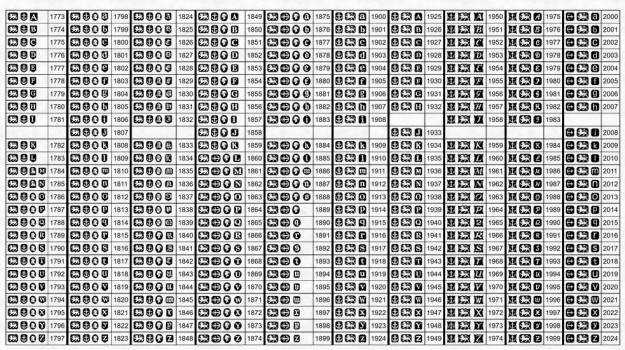
With the information from the hallmark site I had a clear date for the manufacture of the pipe. It was definitely an old timer and really was another stellar acquisition.

I wanted know more about the GLOKAR stamp and what it signified. I had an inkling that I was dealing with a BBB system pipe not unlike the Peterson’s System pipes but I wanted to see what I could find out about that. I have a facsimile of a 1912 BBB Catalogue No. 20 that has a section dedicated to the Glokar. On page 107-110 there is information about the pipe and the various versions available. Interestingly it does not include a picture/drawing of my Poker. I quote the description of the Trademarked Glokar below.

The “Glokar” Mouthpiece does away with the great drawback of all ordinary pipes, viz., the unpleasant and possibly injurious, effect of the smoke upon the tongue, as the end of the stem has a smooth, concave surface, which while forming a pleasant rest for the tongue, acts as a barrier between it and the smoke. Instead of pressing through an ordinary round bore, the smoke leaves the mouthpiece through a fan-shaped slot, which is drilled in and upward direction – thus preventing saliva from entering the bore of the pipe.

Advantages:

  1. The bore, being kept dry, requires less cleaning than that of an ordinary pipe.
  2. As no saliva can reach the bowl, the tobacco can be consumed to the last particle.
  3. The shape of the mouthpiece affords the perfection of comfort for the mouth, tongue ad lips.

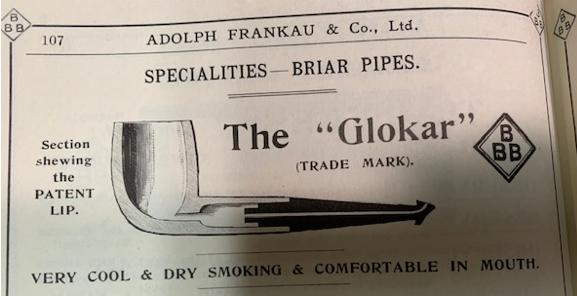
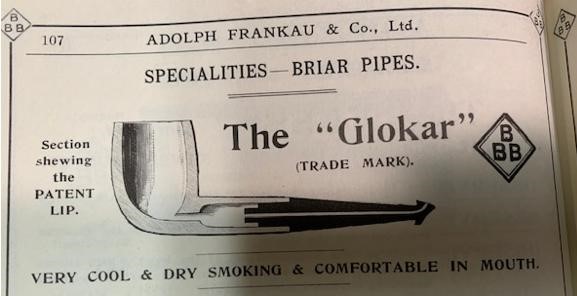
I took a photo of the picture that was included in the catalogue for the “GLOKAR” and have included it below. The cutaway diagram shows the system in the bowl and shank as well a the patented lip design. It is remarkably like a Peterson’s system pipe. One of the differences is the shape of the exit of the air way in the button. This one is a slot rather than a round hole.
Now it was time to work on the pipe. Jeff carefully cleaned the pipe from top to stern. He reamed it with a PipNet pipe reamer and then cleaned up the reaming with a Savinelli Fitsall Pipe Knife. He scrubbed out the internals of the shank, stem and shank extension with alcohol, pipe cleaners and cotton swabs until the pipe was clean. He scrubbed the exterior of the bowl with Murphy’s Oil Soap and a tooth brush to remove the grime and grit on the briar and stem. The finish looks much better and has a deep richness in the colour that highlights grain of the briar. The rim top looked good with some darkening and damage on the top and inner and outer edge of the bowl. Jeff worked it over with Soft Scrub All Purpose Cleaner to remove any remnants of oxidation. He then soaked the stem in bath of Briarville Pipe Stem Deoxidizer to remove the oxidation on the rubber. When the pipe arrived here in Vancouver I was amazed it looked so good. Here are some photos of what I saw.

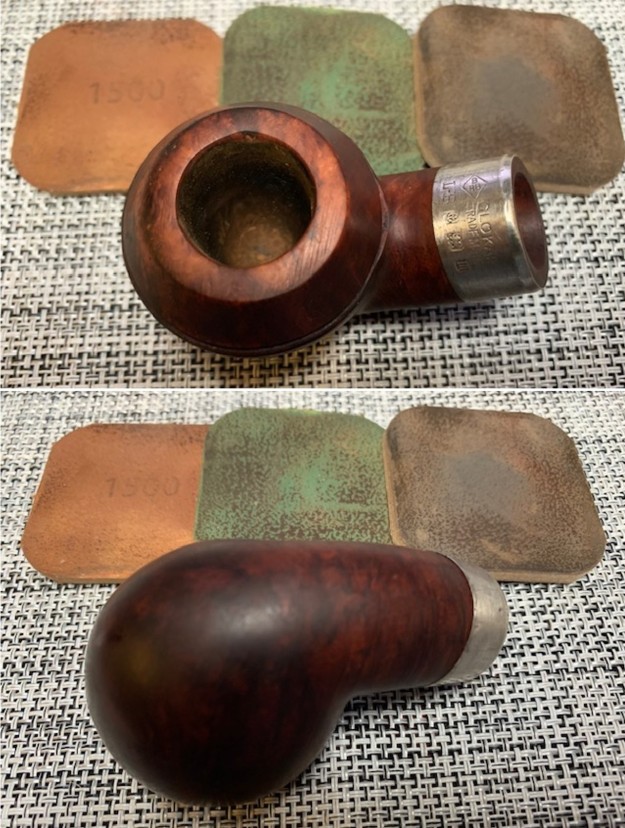
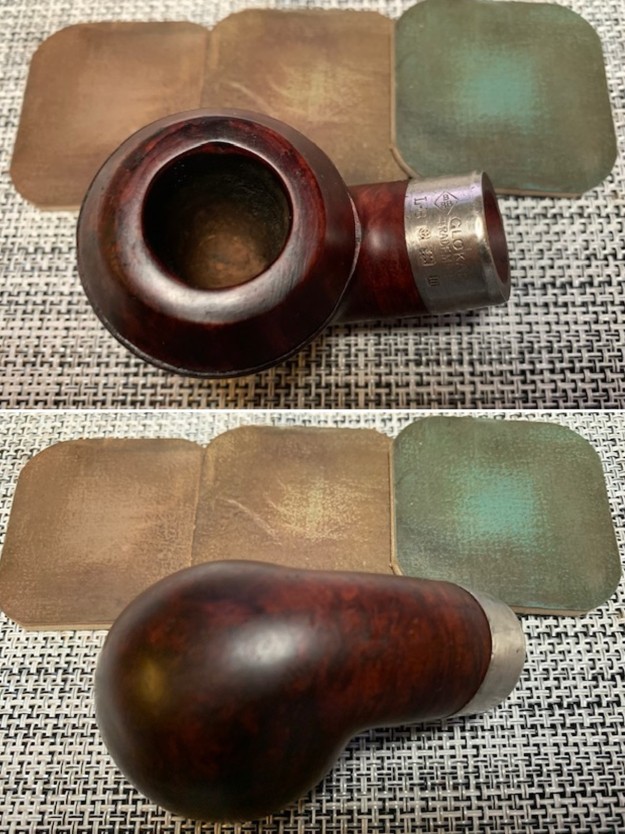
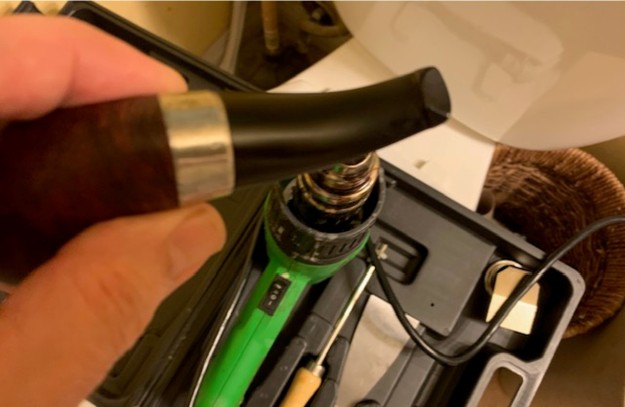
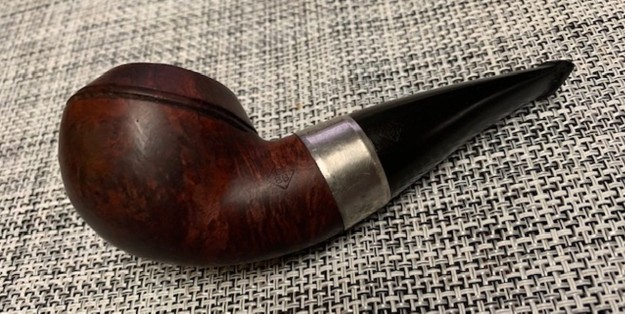
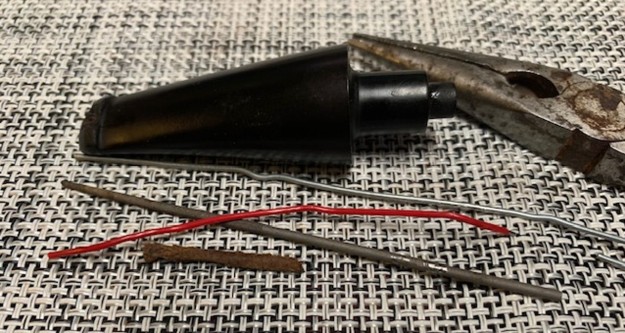
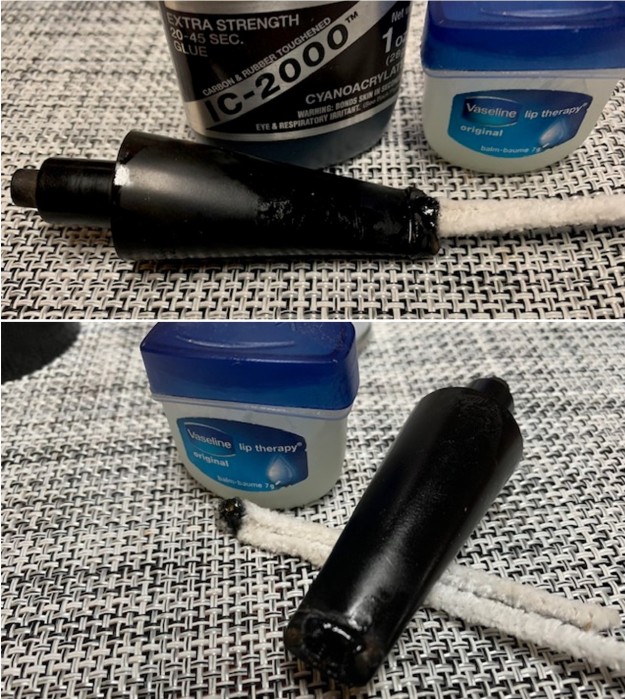
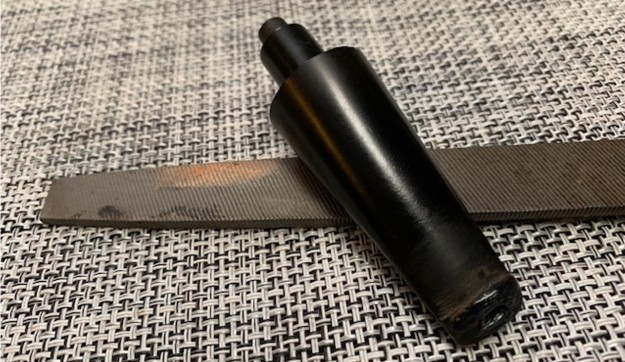
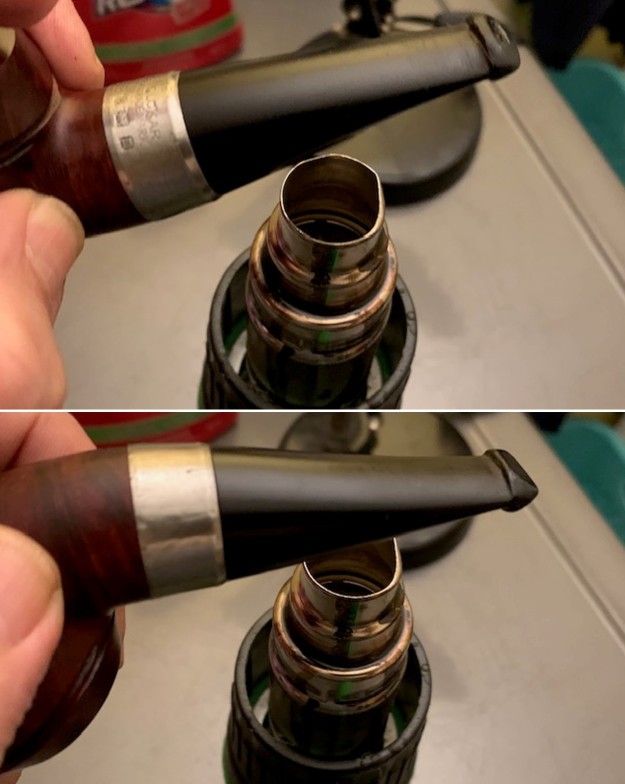
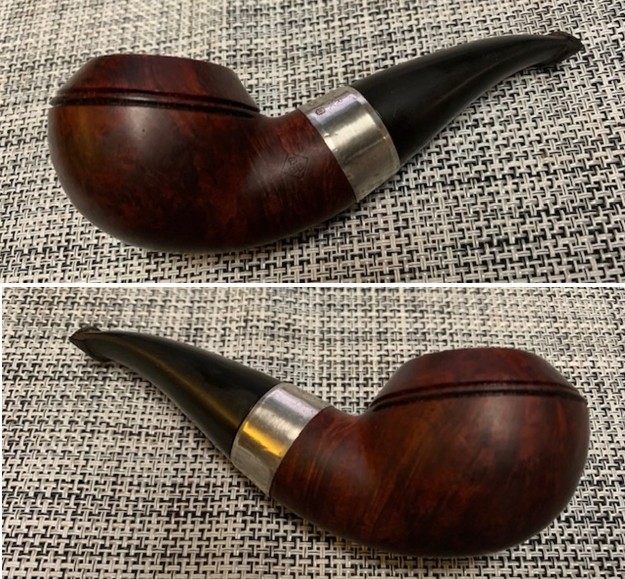
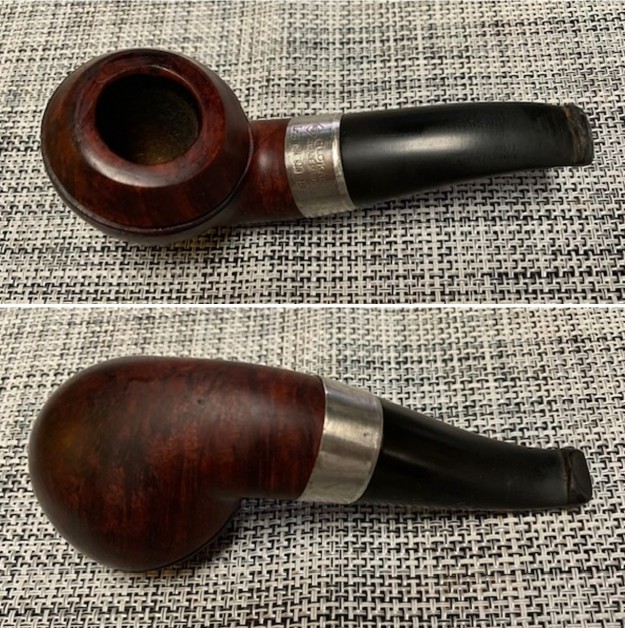
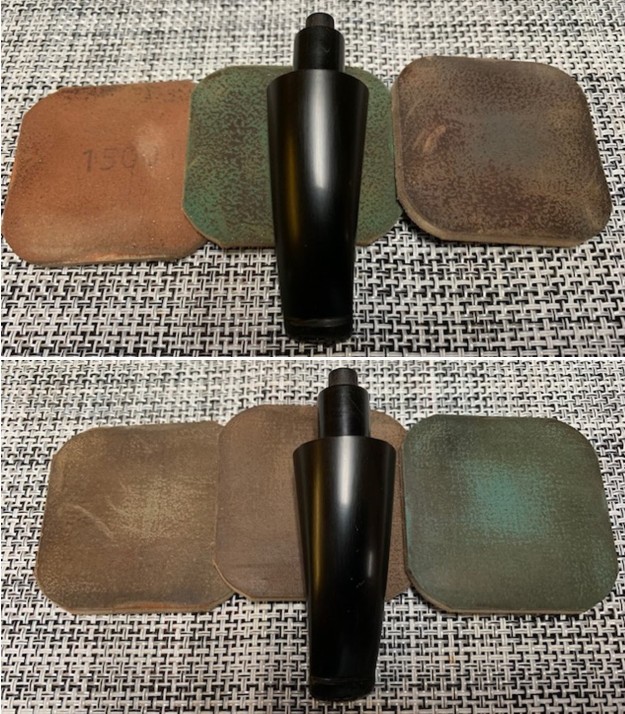
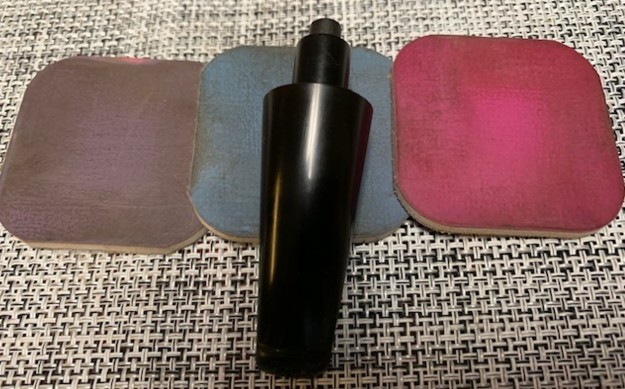
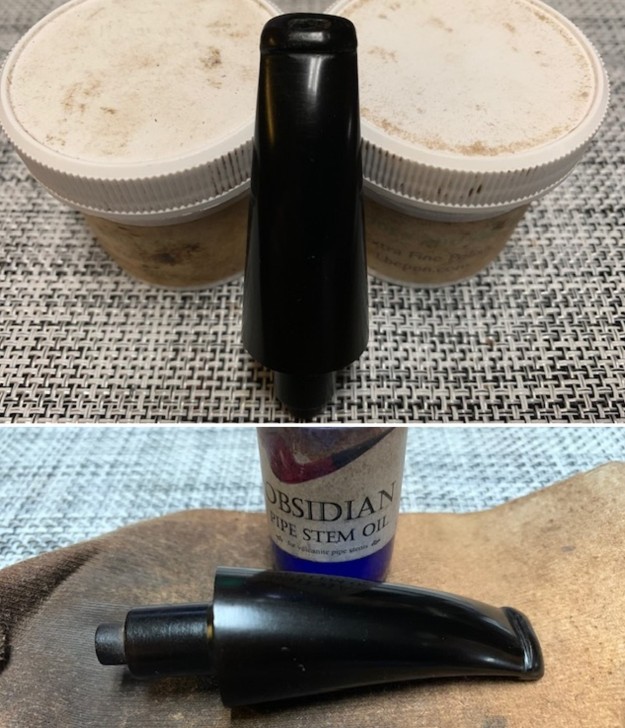
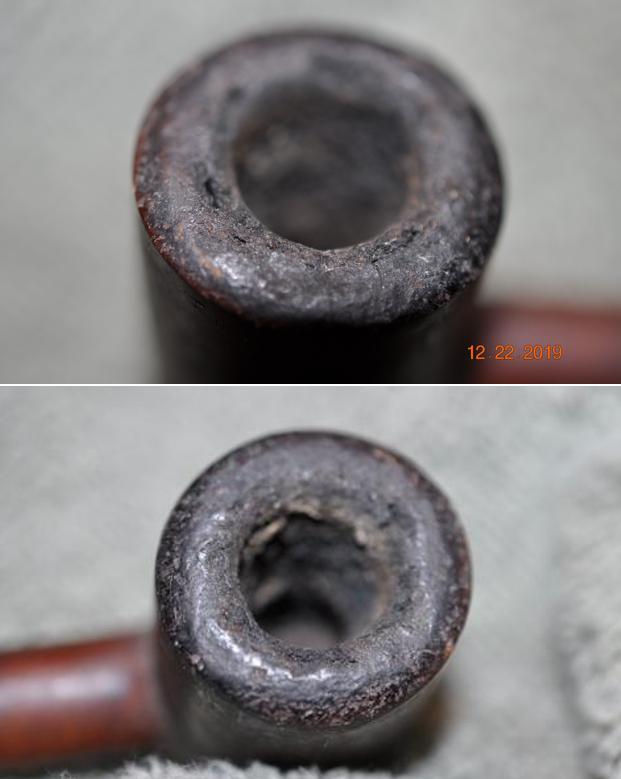
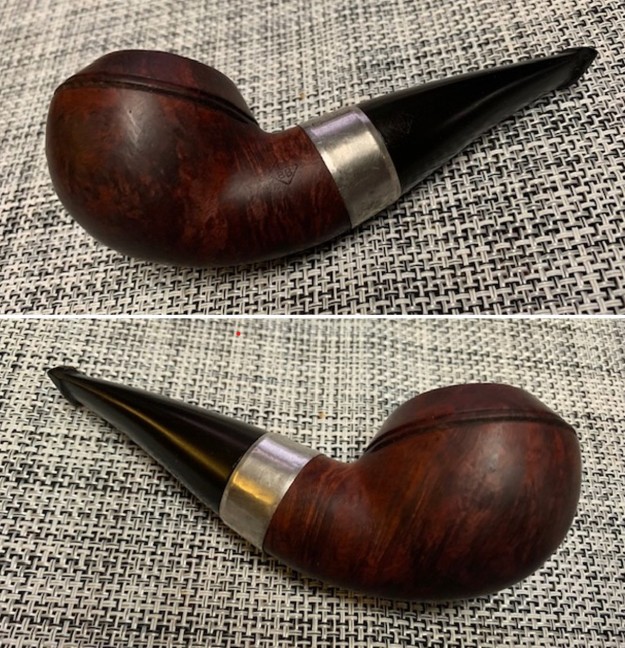
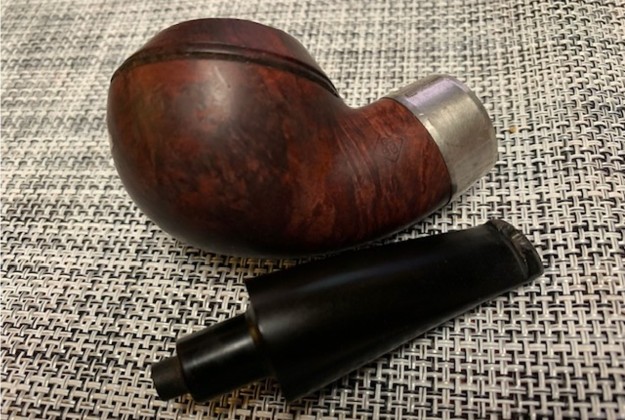
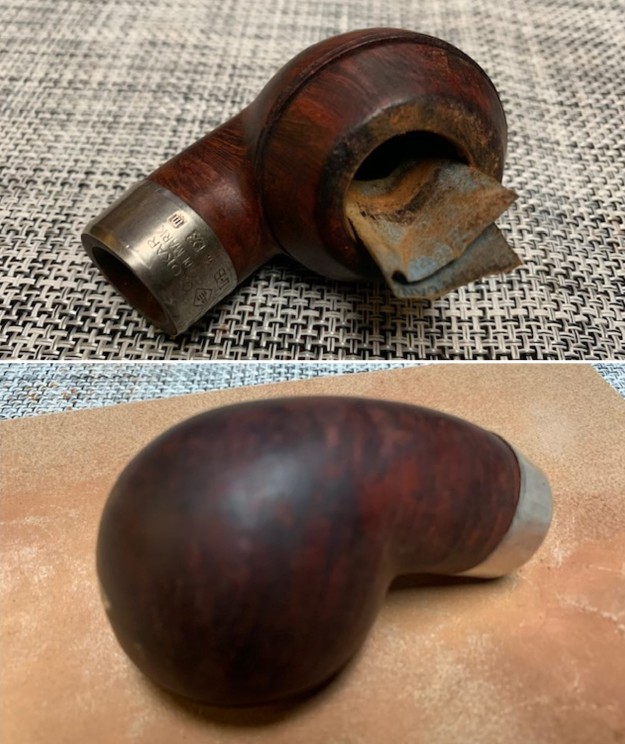
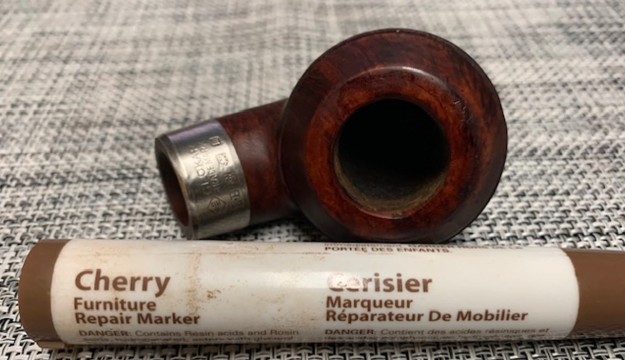
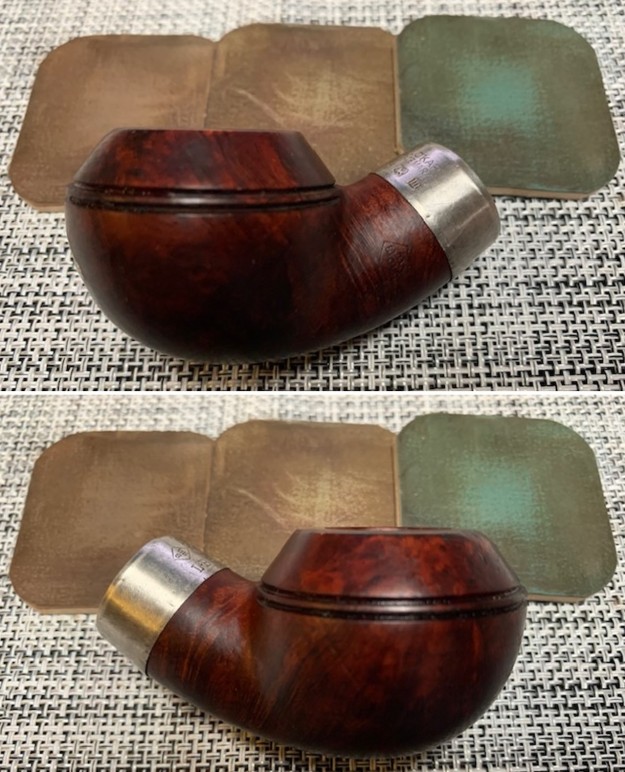
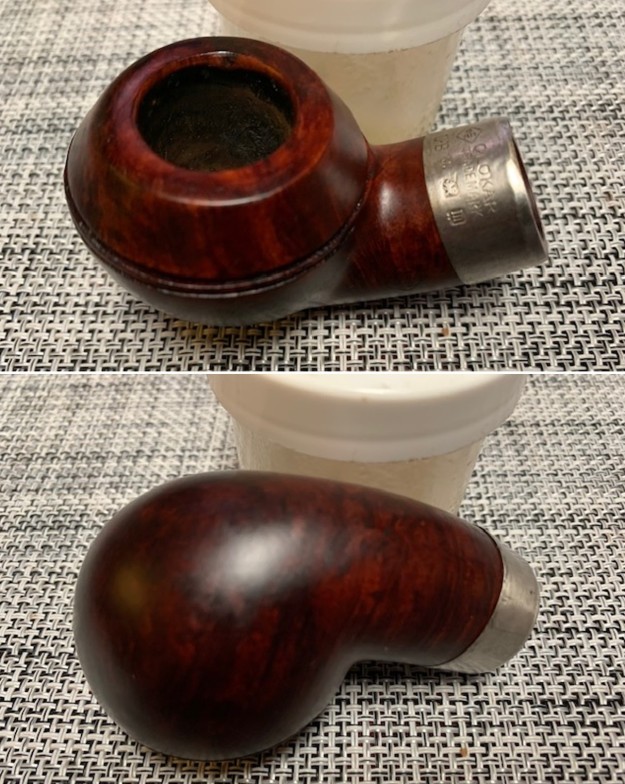
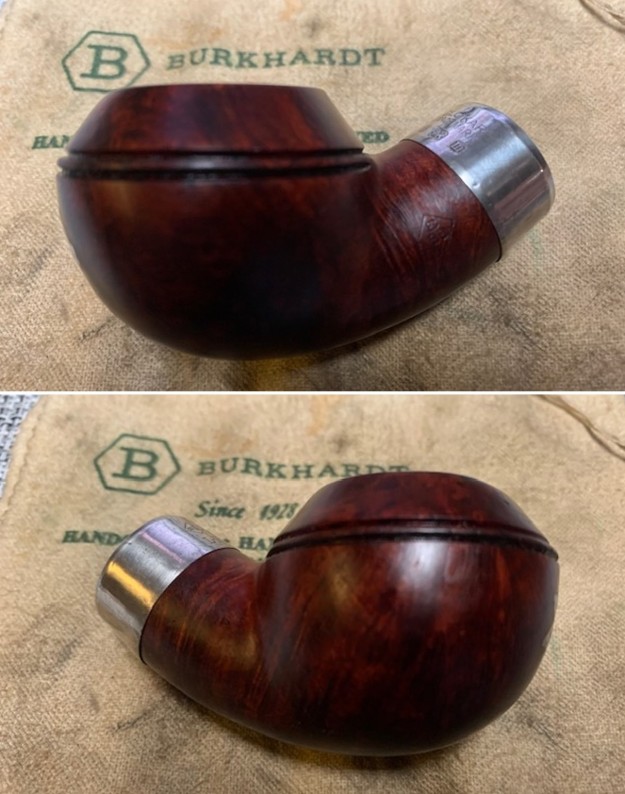
Now time for a confession… when Jeff was cleaning it a pipe cleaner broke off in the stem just inside the Glokar style slot. He had tried many ways to remove it but could not. It was up to me to remove the blockage. Last evening, I got in a hurry to work on it so I used a heat gun to straighten the stem so I could work the offending piece of wire out. It dawned on my once I finished straightening it that I had forgotten to take any photos of the pipe when it arrived. Once finished, I took the following photos… sorry for my haste! I took photos of the bowl and the rim top to show the condition. It is clean and the damage is very clear. The bowl is very clean and there were nicks, burn damage and cuts all around the inner edge and top. The bowl was out of round due to the damage. The vulcanite stem is clean and the damage on the Glokar slot is very visible. The rest stem surface ahead of the button is clean and undamaged.I took a photo of the top of the shank and the silver band to capture the stamping on the silver. I took a photo of the BBB diamond on the left side of the shank. It is faint but it is still readable. I took a photo of the bowl and shank separated to show the condition of the pipe. It really is a great looking pipe. I started my work on the rim top by addressing the issues with the rim top and edge. I started by smoothing out the damage on the edge and smoothed out the top of the rim with a folded piece of 220 grit sandpaper. I lightly topped the bowl on a topping board with 220 grit sandpaper to flatten on the damage on the rim top. It looked much better! Once I started polishing it with the micromesh sanding pads you can see the rim top.I polished the briar with micromesh sanding pads – 1500-12000 grit pads. I dry sanded the briar and then progressively brought a shine to the pipe. It looked really amazing – the combination of rustic and smooth portions of the briar. It is a beauty!  I set aside the sanding pads to stain the rim top to match the rest of the bowl and shank on the pipe. I looked pretty good but I think with the rest of the micromesh sanding pads it would look very good. I went back to the sanding pads. I rubbed the bowl down with Before & After Restoration Balm. I worked it into the finish with my fingertips and into the twin rings with a shoe brush. The product works to clean, preserve and protect the briar. I let it sit and absorb for 10 minutes. I buffed it off with a soft cloth and then gave it a rigorous buff to raise the shine. It looks good at this point. I polished the silver band and silver inlaid letters on the front of the bowl with a jeweler’s cloth to remove any residual tarnish and also to protect it from future tarnish (at least for a while). With that done the bowl was finished other than the final buffing. I set the bowl aside and turned my attention to unplugging the broken pipe cleaner in the stem. I started by heating the stem with a heat gun and straightening it out. I took a photo of it once I had it straightened. I carefully straightened a paper clip and used it to probe the plugged area. It took time and patience to carefully work around the clog. I continued to pull out bits of pipe cleaners as I worked on it. I used two different paper clips that I worked with. I used a fine round file to push the clog out. I worked on it from both end of the stem. Finally, I blew through the stem and the clog of pipe cleaner piece flew out. In the photo below, it is the brown piece at the bottom of the photo. There was a chip out of the top side of the button. It had chipped away when Jeff was working on removing the broken piece. It was not big but it needed to be repaired. I greased a pipe cleaner with Vaseline and inserted it in the airway below the chipped area. I filled in the chipped area with black KMS CA rubberized glue. I removed the pipe cleaner and set it aside to let the glue cure. Once the repair cured I flattened out the repair with a flat file to smooth out the excess and flatten the surface of the button. I sanded the stem surface and shaped the repair to blend the repairs into the surrounding rubber. It looked quite good at this point in the process. With the repairs and reshaping of the button finished it was time to rebend the stem. I heated it with a heat gun to soften the rubber and once it softened bent it back to what was there previously.I bent the heated stem once it was flexible to match the previous bend it had before I straightened it. I put it back on the pipe and took the following photos. I polished out the chatter and marks on the stem surface with micromesh sanding pads – dry sanding with 1500-12000 grit sanding pads. I wiped it down with Obsidian Oil on a cloth after the sanding pads. I finished the hand polishing of the stem with Before & After Pipe Polish – both the Fine and Extra Fine polishes. I gave it a final coat of Obsidian oil and set it aside to dry. With the bowl and the stem finished I put the pipe back together and buffed it on the wheel using Blue Diamond to give it a shine. I gave the bowl and stem multiple coats of carnauba wax on the wheel and then buffed it with a clean buffing pad to raise the shine. I hand buffed it with a microfiber cloth to deepen the shine. It really is an amazing little pipe. The dimensions of this part of the pipe are – Length: 5 inches, Height: 1 ½ inches, Outside diameter of the bowl: 1 ¾ inches, Chamber diameter: ¾ of an inch. The weight of this pipe is 2.15 ounces /62 grams. This unique find – a 1911 BBB Glokar Rhodesian System pipe with a silver band is joining the other pipes in my collection of BBB pipes and will hold a place of honour while it is in my trust. This is another pipe that one day soon I will enjoy a special bowl of tobacco in it and be transported to a slower paced time in history where I can enjoy a respite. Thanks for walking through the restoration with me.
As always, I encourage your questions and comments as you read the blog. Thanks to each of you who are reading this blog. Remember we are not pipe owners; we are pipe men and women who hold our pipes in trust until they pass on into the trust of those who follow us.

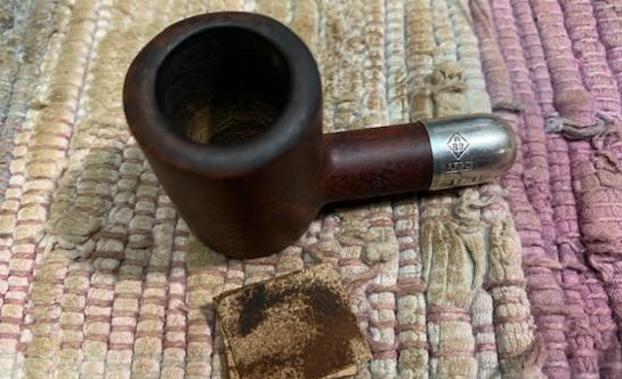
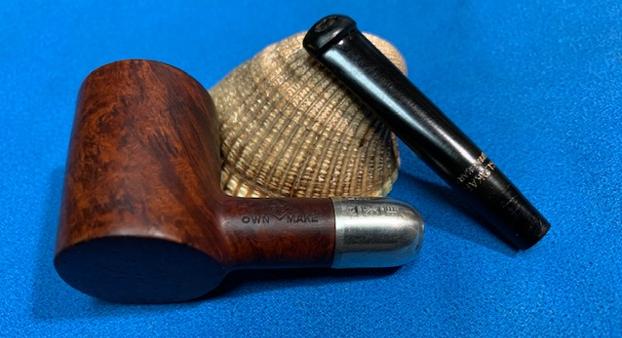
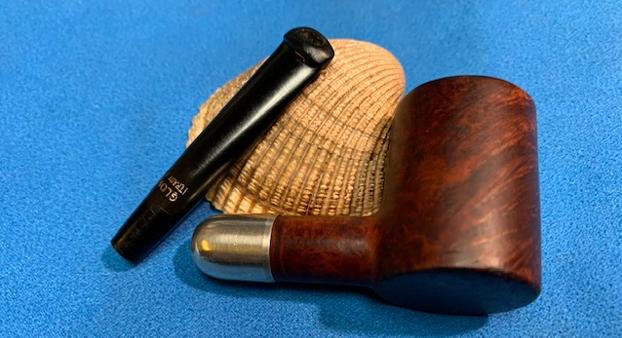
Yet Another Treasure – a 1911 BBB Own Make Glokar Poker


Blog by Steve Laug

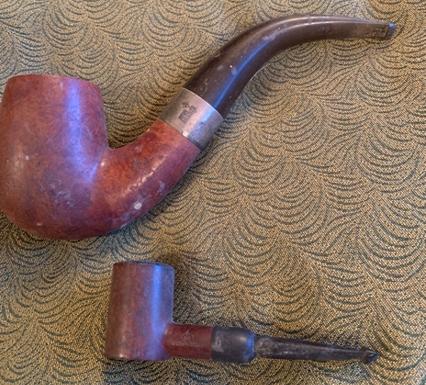
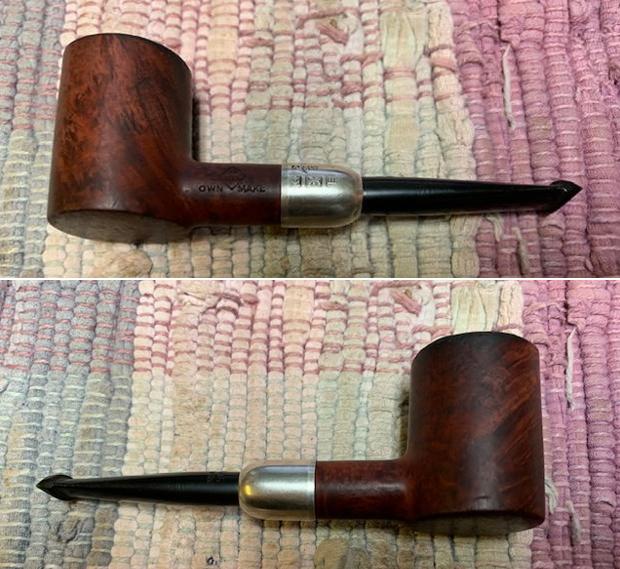
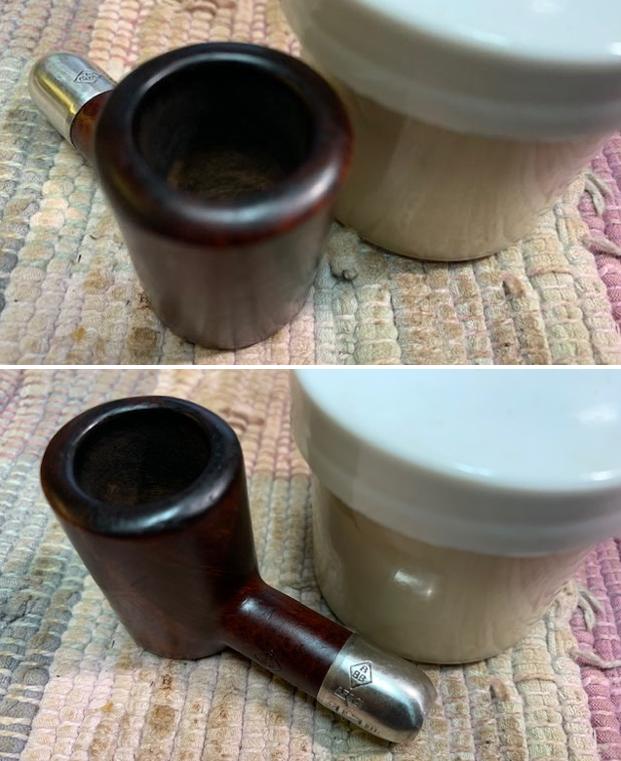
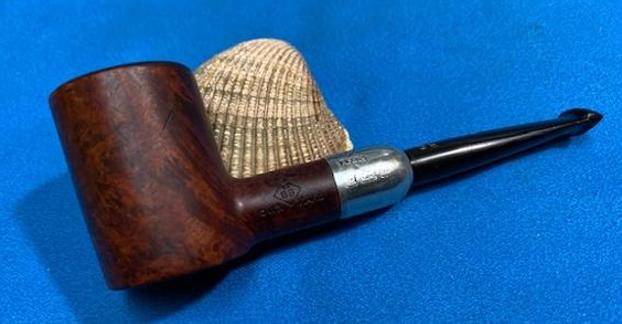
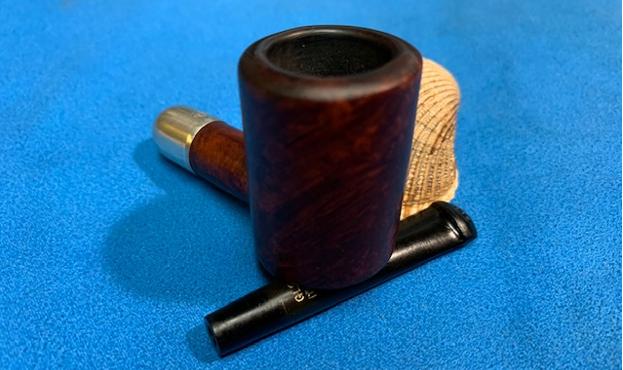
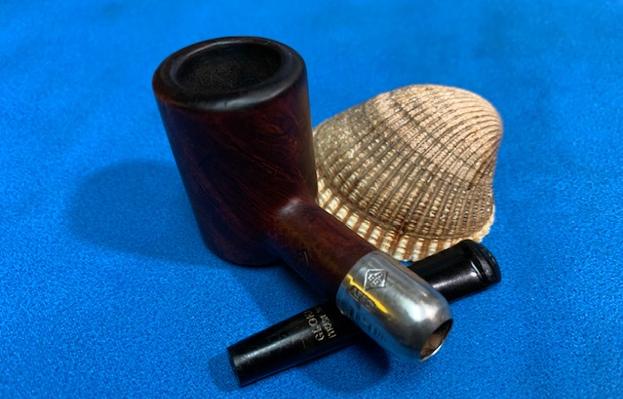
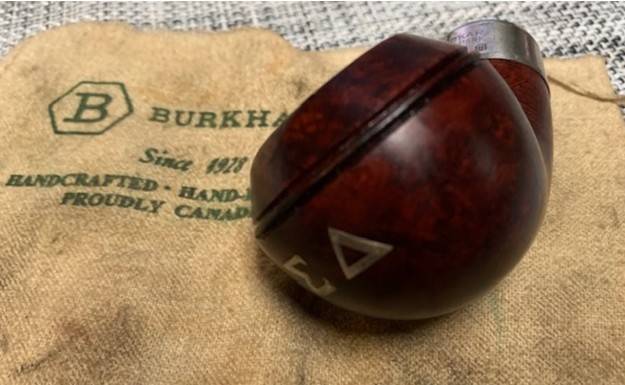
It seems like just a few weeks ago I was contacted by an older gentleman about purchasing his pipe collection. He sent me the photos and I was amazed at what I saw. It had Dunhill pipes, BBB pipes, Orlik pipes, Barclay Rex Pipes, a couple of Meerschaums and a whole lot of other pipes. All I could say as I looked at the pipes was what a collection it was. We negotiated a deal and I think we both walked away quite happy with the exchange. But I have to tell you there was another very interesting pipe caught my interest when I looked at pictures of it. It was a beautiful older BBB Poker/Cherrywood sitter. It was a mess but there was something charming about  it. It is shown in the photo to the left. The larger pipe in the photo is also a BBB and from what I can gather it is on the larger side but not to degree it looks in the photo with the poker. This poker is tiny. It is only 4 ¼ inches long and 1 ½ inches tall. The black band on the shank is oxidized/tarnished Sterling Silver. I could not wait to get it in hand and figure out the age of the pipe. From the looks of it I could tell it was older. The stem was also very unique looking so I was looking forward to checking that out.

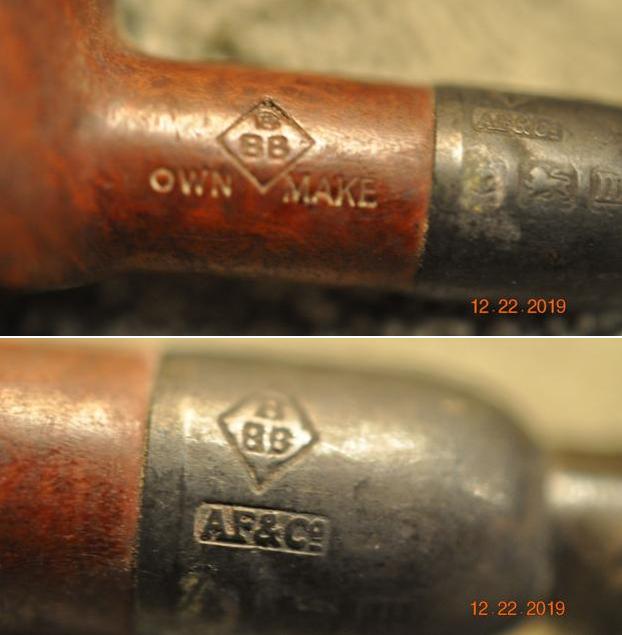
I have worked on a lot of BBB pipes over the years and never had the opportunity to work on one like this. It would be a great addition to my collection of older BBB pipes. From the photos the pipe appeared to be in good condition from the photo he sent me. He said that the pipe was stamped on the left side of the silver ferrule and read AF & Co over three hallmarks. The hallmarks are as follows: an anchor (Birmingham, England), a rampant lion (the symbol for quality of the silver) and the final one is a lower case “m” (the date stamp). I had him ship it to Jeff for cleanup so it would be a while before I held in hand.

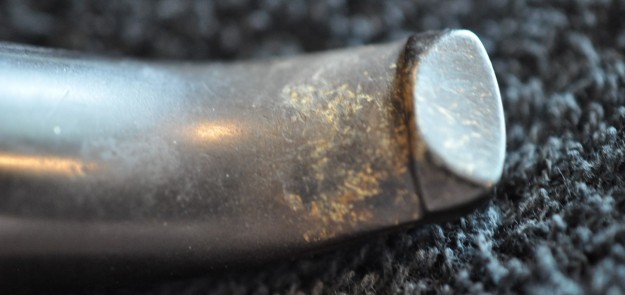
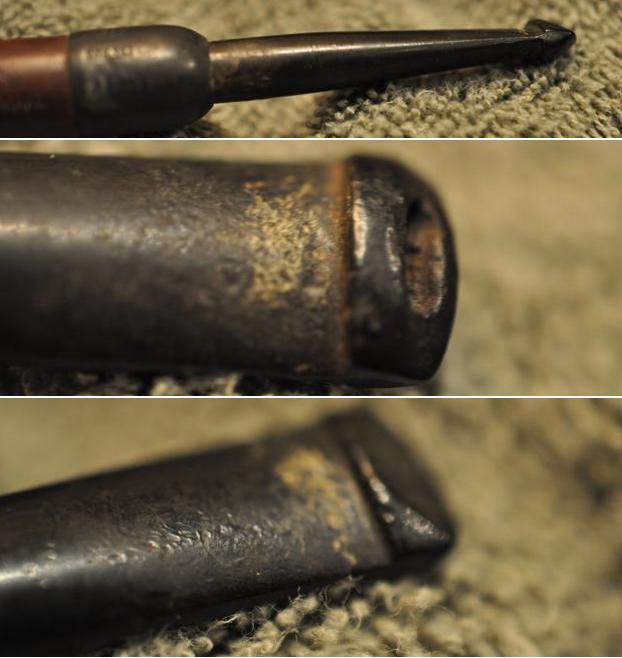
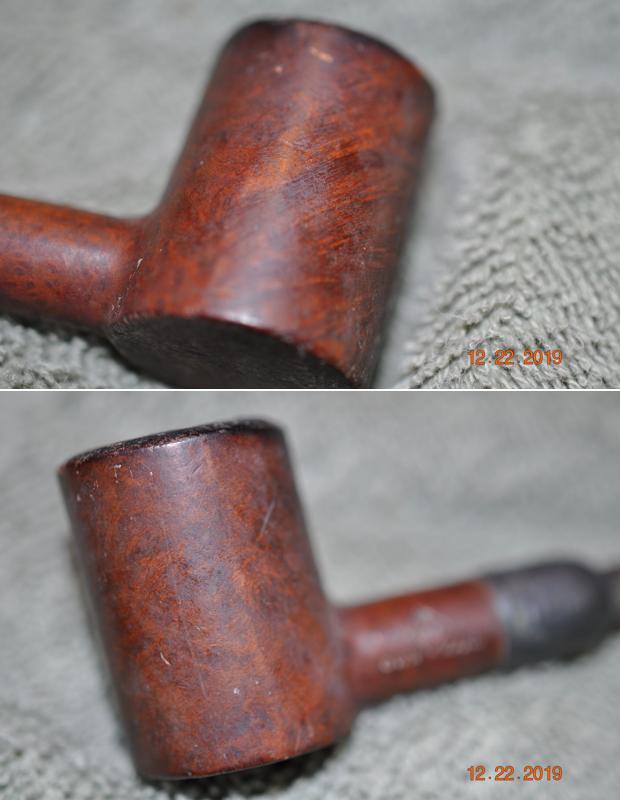
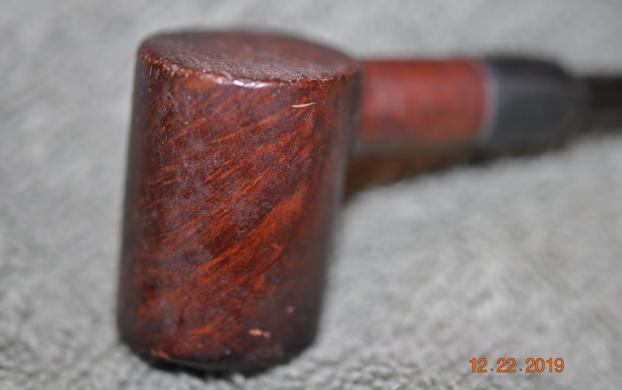
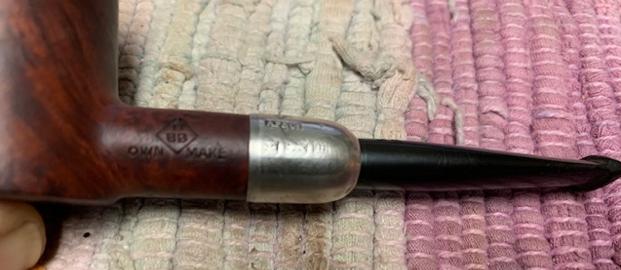
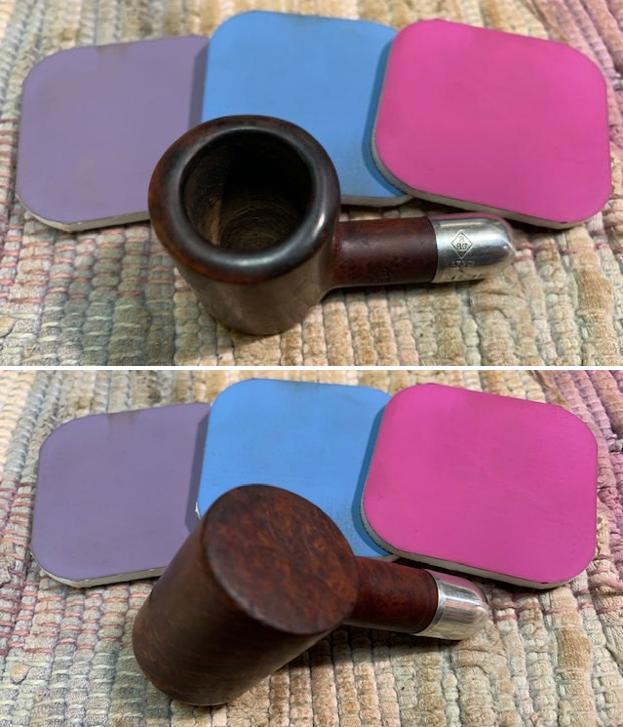
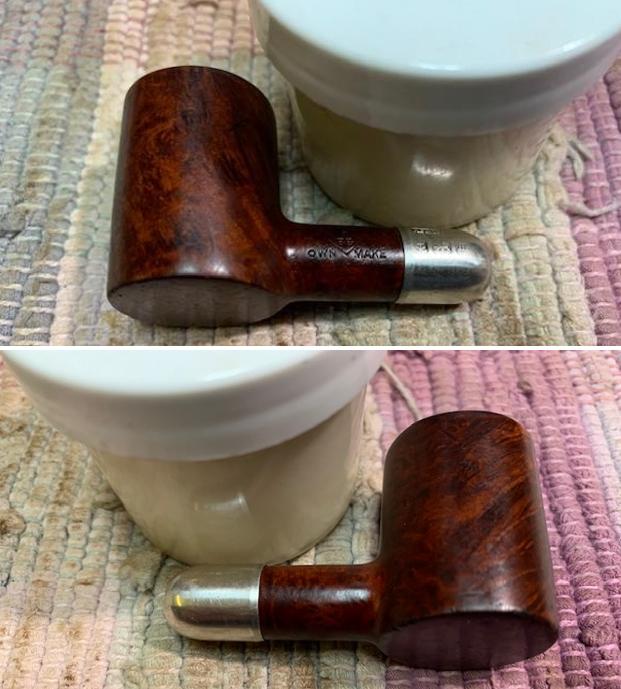
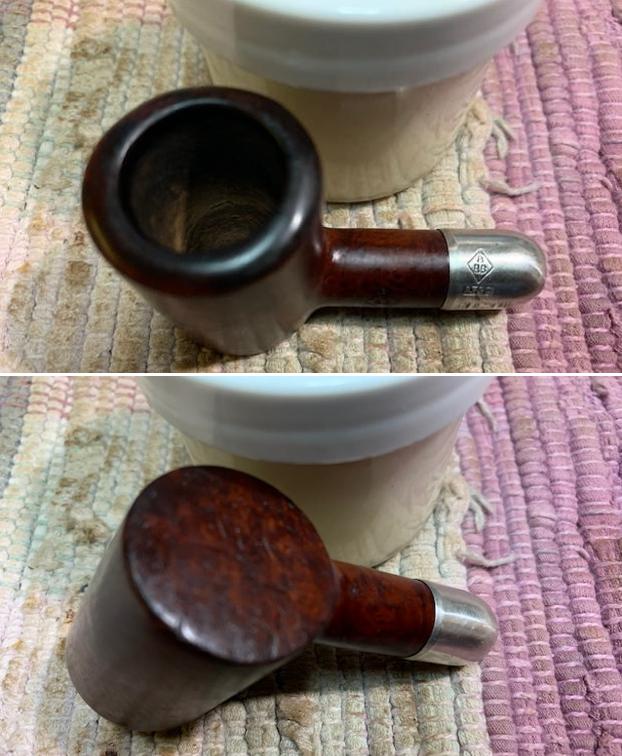
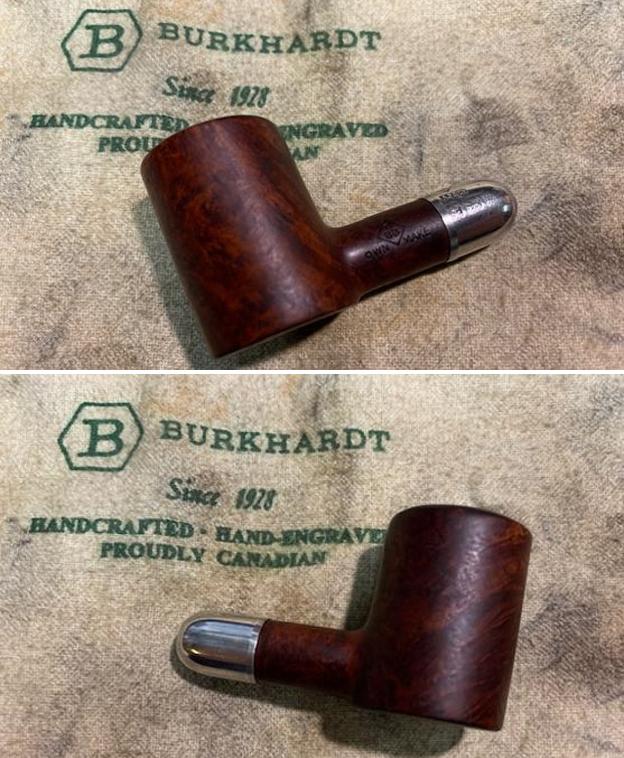
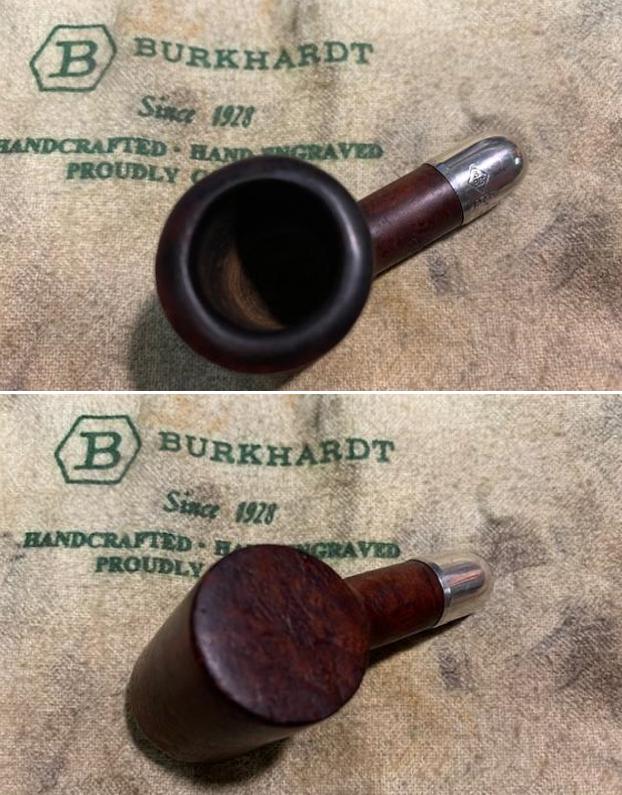
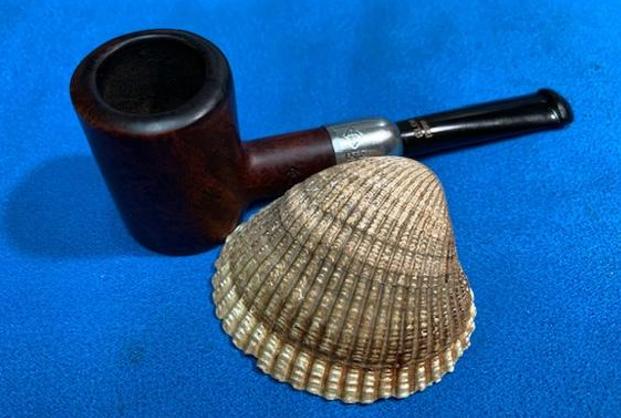
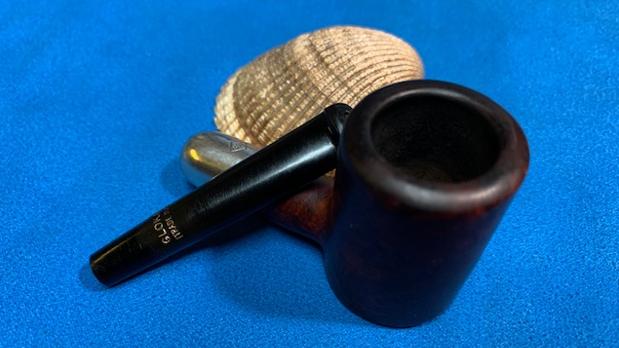
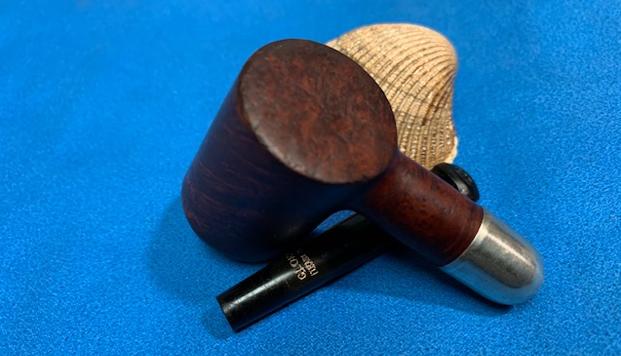
When the package arrived at Jeff’s place in Idaho he waited for me and opened the box with me on Facetime to look at the collection of pipes as he removed them from the box. It is an amazing collection and one that I am going to enjoy working on over the months ahead. Jeff took some photos of the BBB Tiny Poker with a Sterling Silver Ferrule and a Peterson like system stem and internals for me to look at while he worked his magic in cleaning up the pipe. It is a an interesting pipe with a lot of potential and what appears to be some great grain under the grime and debris of the years.  Jeff took photos of the bowl, rim top to show the thickness of the cake in the bowl and the lava on the rim top. It was obviously a great smoking pipe and a favourite. I am hoping that the thick lava coat on the crowned rim top protected things underneath it from damage to the edges and top. Cleaning it would make that clear! He took photos of the top and underside of the stem showing the tooth chatter, scratching and oxidation on the stem surface and wear on the edges of the button.  The photos of the stem also show the unique design and shape of the stem. I am looking forward to doing some research on the GLOKAR to figure out all I can about it.  Jeff took photos of the sides and heel of the bowl to show the condition of the briar. You can see the beautiful shape and the grain on the bowl even through the dirt and debris of 110 years. At this point in the process it certainly looks its age.  The stamping on the pipe was on the left side of the shank and read BBB in a diamond separating OWN MAKE on each side of the diamond. There was no other stamping on the shank sides. On the silver ferrule on the shank of the pipe it is stamped top and left side and it has the BBB diamond logo and underneath that is AF&Co (which is the Adolph Frankau & Company logo). After his death, the BBB gradually became known as Britain’s Best Briars. It is one of the oldest, if not the oldest, English trademark in current use and the first pipe ever to have a registered trade mark. Underneath the AF&Co it is stamped with three hallmarks – an anchor, a lion and a lower case “m”.  The anchor identifies the city of origin of the silversmith (Birmingham, England), the rampant lion (the symbol for quality of the silver) and the final one is a lower case “m” (the date stamp). The silver is badly oxidized but you can see the hallmarks in the first photo below. The stamping is clear and readable.The hard rubber stem is also stamped and reads GLOKAR over TRADE MARK. It is very readable as can be seen in the photo below. Since the hallmarks were so clear, I turned to one of the numerous silver hallmark charts on line for the city of Birmingham, England to see what I could find out about the “m” date stamp and pin down and age for the pipe (https://www.silvermakersmarks.co.uk/Dates/Birmingham.html). I clicked on the section that applied to the date stamp on this pipe. The first chart below is the chart from 1773-2024.I am also including screen capture of the enlarged section on the Birmingham dates for the letter M. This chart covers pipes made in 1778-1986. I have drawn a read box around the hallmark pattern that matches the one on the BBB Silver ferrule. You can see that it dates the pipe to 1911. That means that this little pipe is roughly 110 years old.

With the information from the hallmark site I had a clear date for the manufacture of the pipe. It was definitely an old timer and really was another stellar acquisition.

I wanted know more about the GLOKAR stamp and what it signified. I had an inkling that I was dealing with a BBB system pipe not unlike the Peterson’s System pipes but I wanted to see what I could find out about that. I have a facsimile of a 1912 BBB Catalogue No. 20 that has a section dedicated to the Glokar. On page 107-110 there is information about the pipe and the various versions available. Interestingly it does not include a picture/drawing of my Poker. I quote the description of the Trademarked Glokar below.

The “Glokar” Mouthpiece does away with the great drawback of all ordinary pipes, viz., the unpleasant and possibly injurious, effect of the smoke upon the tongue, as the end of the stem  has a smooth, concave surface, which while forming a pleasant rest for the tongue, acts as a barrier between it and the smoke. Instead of pressing through an ordinary round bore, the smoke leaves the mouthpiece through a fan-shaped slot, which is drilled in and upward direction – thus preventing saliva from entering the bore of the pipe.

Advantages:

  1. The bore, being kept dry, requires less cleaning than that of an ordinary pipe.
  2. As no saliva can reach the bowl, the tobacco can be consumed to the last particle.
  3. The shape of the mouthpiece affords the perfection of comfort for the mouth, tongue ad lips.

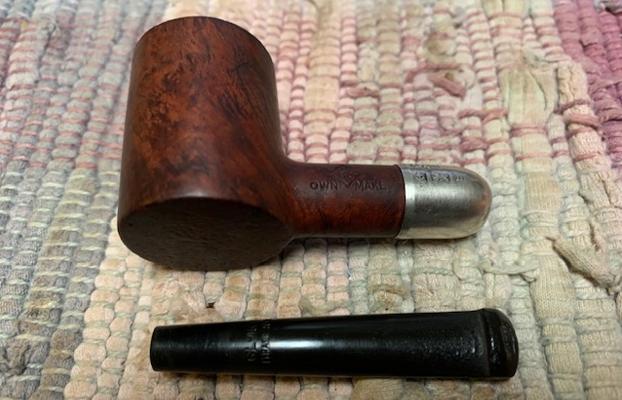
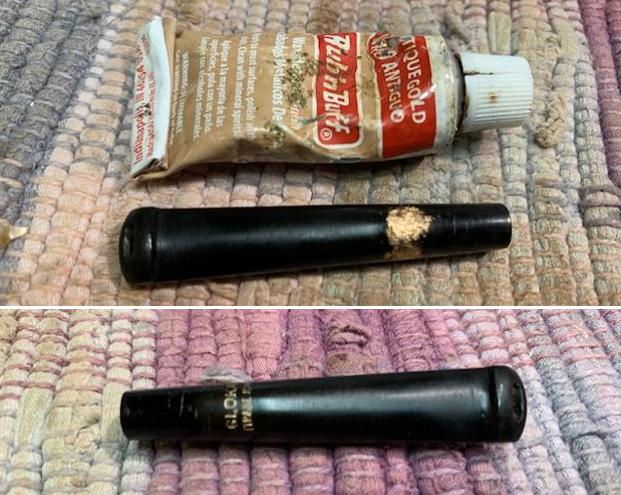
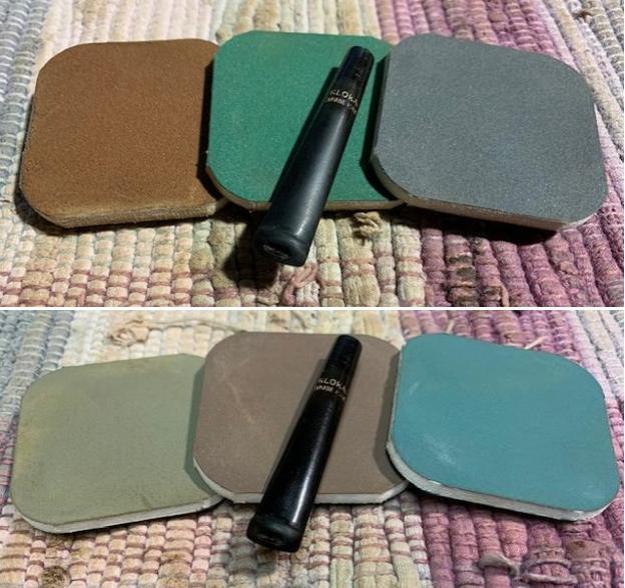
I took a photo of the picture that was included in the catalogue for the “GLOKAR” and have included it below. The cutaway diagram shows the system in the bowl and shank as well a the patented lip design. It is remarkably like a Peterson’s system pipe. One of the differences is the shape of the exit of the air way in the button. This one is a slot rather than a round hole.Now it was time to work on the pipe. Jeff carefully cleaned the pipe from top to stern. He reamed it with a PipNet pipe reamer and then cleaned up the reaming with a Savinelli Fitsall Pipe Knife. He scrubbed out the internals of the shank, stem and shank extension with alcohol, pipe cleaners and cotton swabs until the pipe was clean. He scrubbed the exterior of the bowl with Murphy’s Oil Soap and a tooth brush to remove the grime and grit on the calabash and the tarnish and lava on the rim top. The finish looks much better and has a deep richness in the colour that highlights grain of the briar. The rim top looked good with some darkening on the top and outer edge of the bowl. Jeff soaked the stem in bath of Before & After Deoxidizer to remove the oxidation on the rubber. He worked it over with Soft Scrub All Purpose Cleaner to remove any remnants of oxidation. When the pipe arrived here in Vancouver I was amazed it looked so good. Here are some photos of what I saw. I took some close up photos of the rim top and the stem surface. The rim top  was darkened but did not look otherwise damaged. There was also some darkening around the outer edge of the bowl that would need to be worked on. The silver ferrule was in great condition. I took close up photos of the stem to show the condition of the surface and button. I took a picture of the stamping on the shank. The reflection on the silver did not capture the stamping on the ferrule but it was all clear and readable as noted above.I took the pipe apart and took a photo of the pipe with the short stem. It is a good looking pipe and very unique. I started my work on the pipe by addressing the darkening on the edges and rim top. I used a folded piece of 220 grit sandpaper to work over the edges (inner and outer) and the crowned rim top to try to minimize the darkening. While not flawless I was happy with the results.I polished the rim top and the rest of the briar with micromesh sanding pads – dry sanding it with 1500-12000 grit pads. After each pad I wiped the briar down with a damp cloth.  I was able to give a shine to the bowl and remove some of the surface scratches in the process.  I worked some Before & After Restoration Balm into the surface of the bowl and shank with my fingertips to clean, enliven and protect the briar. I let the balm sit for 15 minutes and then buffed with a cotton cloth to raise the shine. The photos show the bowl at this point in the restoration process. I polished the silver ferrule with a jewelers cloth to remove any residual tarnish and also to protect it from future tarnish (at least for awhile). With that done the bowl was finished other than the final buffing. I set the bowl aside and turned my attention to the stem. I filled in the deep tooth marks against the button edge with clear super glue. Once it cured I sanded out the repairs and the tooth chatter on the stem with 220 grit sandpaper. I started the polishing with 400 grit wet dry sandpaper.    I filled in the Glokar Trademark stamping on the stem with Rub’n Buff Antique Gold to highlight the stamping. I rubbed it on and worked it into the stamp with a toothpick. I buffed it off with a cotton pad. The stamp looks really good at this point.I polished the stem with micromesh sanding pads – dry sanding with 1500-12000 grit sanding pads. I wiped it down after each sanding pad with Obsidian Oil. I polished it with Before & After Pipe Stem Polish – both Fine and Extra Fine.    With the bowl and the stem finished I put the pipe back together and buffed it on the wheel using Blue Diamond to give it a shine. I gave the bowl and stem multiple coats of carnauba wax on the wheel and then buffed it with a clean buffing pad to raise the shine. I hand buffed it with a microfiber cloth to deepen the shine. It really is an amazing little pipe. The dimensions of this part of the pipe are – Length: 4 ¼ inches, Height: 1 ½ inches, Outside diameter of the bowl: 1 inches, Chamber diameter: ¾ of an inch. The weight of this tiny pipe is .71 ounces /20 grams. This unique find – a 1911 BBB Glokar Poker with a silver ferrule is joining the other pipes in my collection of BBB pipes and will hold a place of honour while it is in my trust. This is another pipe that one day soon I will enjoy a special bowl of tobacco in it and be transported to a slower paced time in history where I can enjoy a respite. Thanks for walking through the restoration with me.
 

How Estate Pipes Changed the Collecting World  


Blog by Robert M. Boughton, P.I.

Copyright © Reborn Pipes and the Author except as cited
https://www.roadrunnerpipes2k.com/
https://www.facebook.com/roadrunnerpipes/
Member, North American Society of Pipe Collectors


O hell! what have we here?
A carrion Death, within whose empty eye
There is a written scroll!  I’ll read the writing.
‘All that glisters is not gold;
Often have you heard that told:
Many a man his life hath sold
But my outside to behold:
Gilded tombs do worms enfold.
Had you been as wise as bold,
Young in limbs, in judgment old,
Your answer had not been inscroll’d:
Fare you well; your suit is cold –

Cold indeed, and labor lost.’

— Shakespeare, The Merchant of Venice, Act 2, Scene 7, 1596 (original editions)

INTRODUCTION
An English historian of pipes in general and Alfred Dunhill  Ltd. of London in particular, the late John C. Loring, dated the beginning of estate pipe collecting to 1976.  That was the year Dunhill acquired Lane Ltd., which included Charatan pipes.  It also marked the first noticeable blip, on the pipe world radar, of avid collectors in the U.S. starting to seek older, used English pipes that were rarer and could be repaired for reborn enjoyment.  The birth of estate pipe collecting, with its attendant lust for uncommon and valuable specimens, created a market that was susceptible to fraud on a new, sophisticated level.

Thus arrived on the scene the simultaneous phenomena of collectors who recognized the potential value of estate pipes and the intrepid craft folks who filled the need for independent, skilled workers, or pipe restorers, as they came to call themselves, to repair and clean all of the old pipes being snatched up in more and more amazing numbers.  Of course there were also the scam artists and other opportunistic ne’er-do-wells, that ubiquitous element of every business enterprise, who found in the appetite for used but “collectible” pipes an abundance of buyers ignorant of the knowledge needed to distinguish the legitimate from the fakes.

Limited at first to pipes from England due to their perceived superiority to those from other countries, in time the used pipe craze spread to estates from around the world.  The trend saw its heyday in the first decade, continuing into the mid second, of the new millennium.

Aristotle is often cited as the first person to expound the notion that nature abhors a vacuum, when in fact he was a plenist, or a believer that there can be no occurrence of a vacuum in nature.  His basic reasoning was that space is filled with bodies, even if most of them are molecular, and therefore can have no empty area.  The great Greek philosopher and polymath was so contemptuous of the idea of a natural vacuum that he made a deliberate joke, in Physics, Book IV, Part 8: “But even if we consider it on its own merits the so-called vacuum will be found to be really vacuous.”  LOL!  Modern physics recognizes that nature indeed cannot tolerate a vacuum – but only so far as to force whatever happens to be nearby any such anomaly to be sucked in to fill it the same instant.  In that sense, old Aristotle was half right, considering that an empty space appearing in nature must be filled in less than a nanosecond.  At any rate, pipe restorers, qualified or otherwise, as well as forgers, filled the new figurative vacuum made by the Great Estate Pipe Rush.

THE BIRTH OF ESTATE PIPES
The blooming of the estate pipe collecting hobby mushroomed into a full-blown industry that epitomized certain aspects of capitalism as contemplated in An Inquiry into the Nature and Causes of the Wealth of Nations, published 200 years earlier just two months before the Declaration of Independence.  There was then and remains the principle of supply and demand with its buyers, sellers and middlemen.  The prices were set only by the depths of the pockets of the buyers and their much shallower knowledge of what constituted a rare Dunhill.

Loring, whose research into the darkest hour of estate pipe history identified the birth of used pipe collecting, died October 7, 2009 in Chicago.  In a memorial on PipesMagazine.com, Kevin Godbee wrote that Loring possessed “an encyclopedic knowledge of Dunhill Pipes and other tobacciana.”  In “The 1980s Fake Dunhill,” first published in the Winter-Spring 2005 issue of The Pipe Smoker’s Ephemeris, Loring wrote of how, while Dunhill acquired Lane and Charatan:

“…on the other side of the Atlantic a strange new hobby was developing, ‘used briar pipe collecting,’ with Dunhill pipes the crown jewels of those pioneer American collections.  Soon there were pipe shows, mail order lists, evenings on the telephone in ‘hot pursuit’ and even excursions to England to salvage previously smoked pipes from the dustbins.  Hundreds, even thousands of dollars were paid for used, quickly renamed ‘Estate’ Dunhills with premium prices being paid for the largest and oldest.”

Courtesy Loring’s Dunhill Collection, Pipedia

Note that Loring splits the popularity of estate pipes in two parts, large and old, but emphasizes the bigger ones by nature of the definite if understated order of the above reference, which lumps both together as rare.  Even if Loring were not a good enough writer for the placement of his modifiers to be significant, he goes on to explain the special nature of “oversized” pipes.  “Magnums were viewed as ‘one of a kind’ rarities that could be counted on one hand, maybe two at best,” Loring wrote.  The ODA shown here from Loring’s personal collection that sold at auction after his death, with its exquisite bird’s-eye, is a fine example of a magnum.

THE RISE OF COUNTERFEITS
With the Lane-Charatan takeover, some of the pipe makers from the two manufacturers consumed by Dunhill lost their jobs.  During the early 1980s, as the factories of the three companies were consolidated into one, many more layoffs were made.  The market for estate Dunhills in the U.S. continued to escalate.  A few unemployed and bitter pipe makers in England, able and willing to abscond with tools of all kinds – including those used for shaping, finishing and stamping nomenclature on the completed products, as well as stummels abandoned for flaws or left unfinished and  even raw briar blocks – did so.

“And at work’s-end,” Loring wrote, “employed and unemployed still met at the pub to dwell on the injustice of it all.”  These conditions – angry, jobless pipe carvers on one side of the Atlantic and wealthy collectors on the other – created what Loring called “our own perfect storm.”

Dunhills have never been easy to date much less make it through the rest of the Byzantine nomenclature.  Even Loring admits the task can be impossible for anyone, no matter how knowledgeable of Dunhill markings.  Then there’s the fact that back in the day, meaning the 1980s, early Dunhill catalogs were not as available as they later became, which was never on par with Sears or LL Bean.  And of course, the World Wide Web was not up and running until the following decade, although the ARPA net allowed computers to connect to each other with a virtual “handshake” and transmit batches of data using Transmission Control Protocol/Internet Protocol (TCP/IP) machine language.  In other words, identifying a fake pipe, in particular one made by a disgruntled former Dunhill carver using real Dunhill wood and tools but changing or fabricating certain nomenclature to make them appear almost priceless, was beyond the means of most serious collectors of the day.

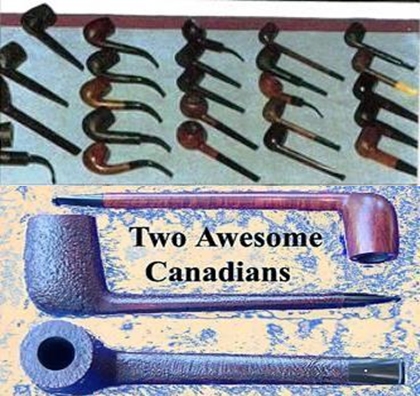
As it happened, one of those very leading collectors, an American whose name is remembered by some old-timers of our society who refuse to utter or record it in print, highlighted the top British pipe show of 1984 with his collection of 30 stunning examples.  Loring recorded that they included “four near magnum sized Shells bearing extremely rare or previously unknown shape numbers; three smooth finished “LC” shapes, two Roots and a Bruyere, one bearing a previously unknown shape number; three extremely rare un-smoked ODAs , a Bruyere and a Shell 844 and an 824 Shell; a number of sought after ODA shapes in a variety of finishes, many unsmoked; and two awesome supposedly pre-WWII Canadians both upwards of 9 inches long with 5¾ inch shanks, a Bruyere with a small, 1¾ inch tall bowl and a Shell with a magnum sized, 2¾ inch tall bowl.”

Most of the infamous 1984 “Dunhills,” courtesy J. Loring

To cut to the chase, most of these pipes, if not all of them, were bogus in that they were not made by Dunhill but rather were tweaked as far as the nomenclature was concerned or cobbled together using spare parts, as it were, however skillful or “authentic” the cobbling.

The suspicions of some collectors were piqued by the too good to be true aspects of the fabulous forgeries.  Consider Loring’s repeated references to “extremely rare or previously unknown shape numbers” and “unsmoked” pipes.  Had avarice not gotten the better of the collectors who fell victim to the scam, “Thousands upon thousands of dollars and pipes” would not have been exchanged during the infamous incident that took place over a period of only two or three days.

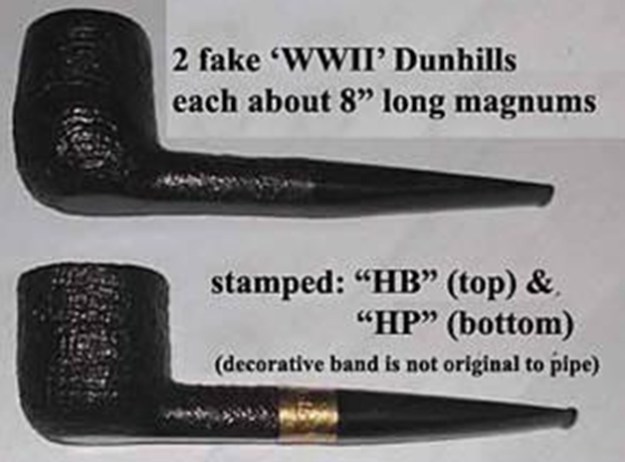
It is important to remember about the 1980s fake Dunhills that of the 50-75 total pipes involved in the overall debacle on both sides of the Pond in which, by Loring’s estimation, perhaps hundreds of thousands of dollars were paid for technically bogus pipes, “in almost all cases,” they were excellent in terms of craftsmanship and were “akin to top quality 1980s English Dunhill alternatives such as Ashton or Upshall.”  The photo below from Loring’s collection shows two supposed World War II-era pipes, both magnums about eight inches long and each a beautiful Dunhill pipe – if only each had been manufactured in the Dunhill factory and not stamped with outrageous nomenclature.  The shape codes HB and HP have come to be known as existing only on fakes.

“In short,” Loring cautions with classic, subdued British humor and style, “if on the way to writing a two thousand dollar check you find that the shape stamped on the pipe you are fondling doesn’t comport to catalog examples or is otherwise unknown, stay your pen for further examination.”

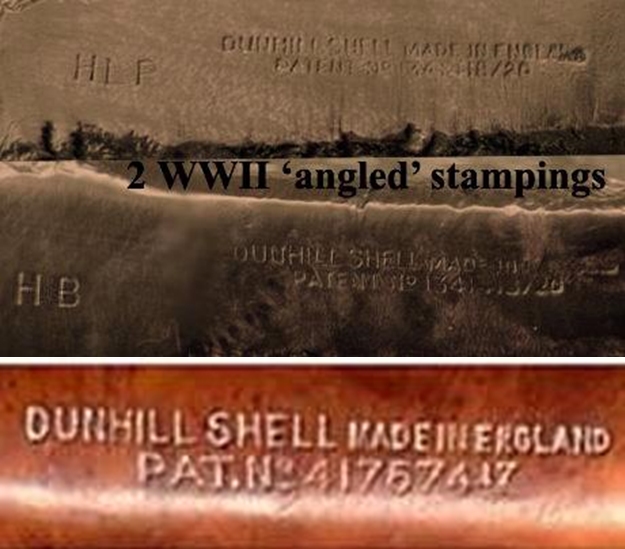
Another way to identify pipe forgeries is the nomenclature, no matter how subtle the discrepancy may seem.  Loring’s most basic rules of thumb in spotting a fake are to be discerning of every detail and to trust your instincts.  The following examples are brilliant.  The problem with the two pipes in the one photo is harder to spot, and I took the liberty of editing the very bluish original from the web page so that it appears closer to natural pipe brown.  The issue in this picture is not the HLP on the top and the HB on the bottom (well, those are no-nos, to be sure), but the uneven stamp marks, as the un-removable type suggests.  Otherwise the two lines of markings are perfect for WWII-era pipes and indicate that the stamp used may have been “lifted” from Dunhill.  The egregious error in the other pic should be apparent to anyone who is at all familiar with Dunhill.  Take a look and see if you can spot the sign of serious trouble that should set off bells and whistles in the shot of the lone stamp.All done?  Everything considered, the only glaring annoyance is the word SHELL on a smooth finish pipe.  Loring identified three examples including the one above that appear to have been marked with a real Dunhill pre-1937 stamp “in the hands of an illiterate.”  ROFL.

The absence of the World Wide Web at the time of the 1980s Dunhill fiasco explains in some small part how experts were misled by imitations.  So how has the Web made things worse for everyone else in the intervening 30-plus years?

THE SPINNING OF A WEB OF FRAUD
I will begin this section with the bottom line: Internet fraud, intentional or otherwise – and whether or not it will ever become a crime that can be prosecuted in a viable, systemic manner, much less eradicated – is here to stay for the foreseeable future.  The solution, therefore, would seem to fall in educating consumers as to the dangers that exist on a very real and frequent basis.

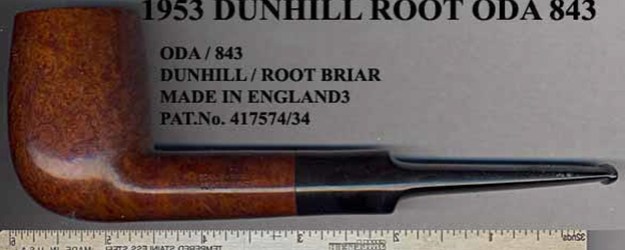
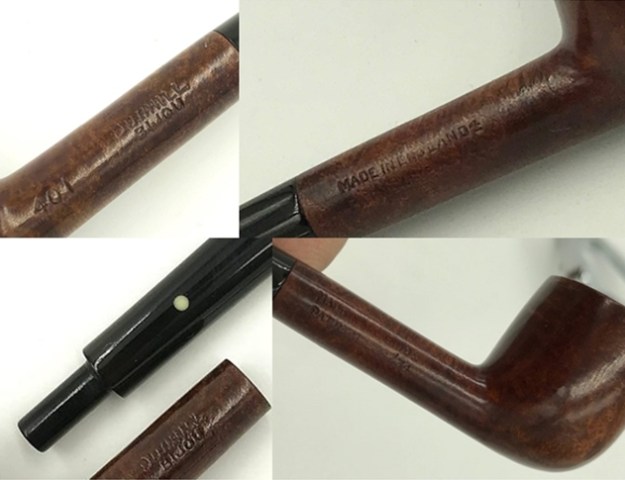
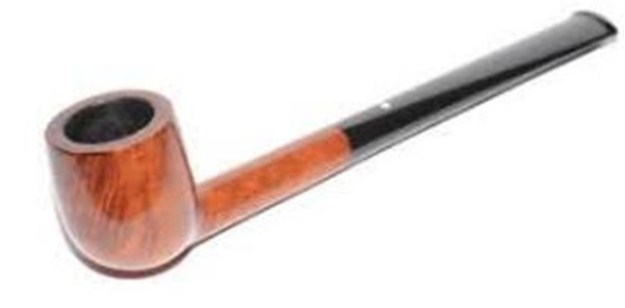
By way of an example of fake pipes that can be found on the internet, the cautionary tale of an alleged Dunhill “Bijou” 401 pot, Patent Number 417574/34, will illustrate how the Dunhill scandal still haunts us and also provide a smooth transition into the modern phase of pipe forgeries.  I came across this one, offered on consignment for just under $1,000, on a very respected and reputable online site a while back.  The seller alleged the pipe dated to the 1920s or ’30s, as I recall.  I’m sure if the gentleman reads this he won’t mind that I omitted his credit for the following photos.  From a distance, even without the White Spot that appears to be on the top of the stem in closer shots, the pipe looks OK, at least. But something struck me as – well – just plain off with the first look, and in particular the name, Bijou, which rang a bell, although not yet any whistles.  I had to save the pics provided to my computer to view them in large enough format for air raid sirens to go off.  Everything was wrong with this so-called little jewel, from downright cheesy and double stamping to the runny stain job and, as Loring warned, an off-round, somewhat fuzzy White Spot.Furthermore, although in some rare instances the given patent number could have traced as far back as the 1920s, without a DUNHILL over LONDON stamp, the raised 4 after ENGLAND signifies the pipe would have been made in 1964, had Dunhill been involved at all in the manufacture of this knockoff.  (See Pipephil in Sources below.)

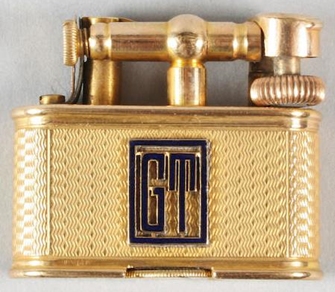
At last I remembered where I had heard of Bijou in relation to Dunhill.  It was Alfred Dunhill’s invention of the first handheld thumb-flick lighter in the late 1920s, which he called the Bijou.  I could find no strong evidence of any Dunhill Bijou pipe ever being made.  The letters GT in the photo below are the original owner’s monogram.

1928 Bijou-A 9-ct. gold lighter, courtesy Worthpoint

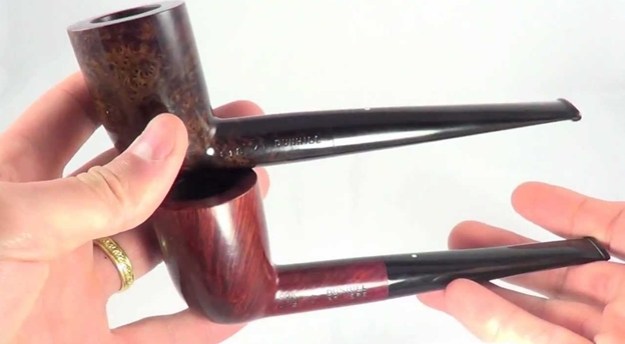
I emailed my concerns to the address listed for the site and to my surprise heard back immediately from the owner that he was looking into the matter.  Within 24 hours, experts confirmed that Dunhill never made a Bijou line, and the pipe indeed was a forgery.  It was removed from the website, and the pipe’s owner was notified of its true nature.The owner of the Bijou provided ample photos of the pipe for its proper identification, and there is no reason to suspect he intended to pass it off as a genuine Dunhill with any disingenuousness.  Here is another, lighter, shinier version of the same pipe, this one called a Dunhill 401 Root Briar Patent Number 417574/34 pot, found on eBay, with only the one picture and nothing but a distant angle on the White Spot to assume its authenticity.  This and the Bijou are the only 401 shapes I can find.Now, indulge me with a final Dunhill photo showing two pipes.  Both are supposed to be very rare #848 ODA magnums, but only one is the real thing.  The other appears to date back to the 1980s scandal, demonstrating how that scourge is not yet behind us.  Can you tell which is which?  Dunhill experts will have no trouble, but if you found the fake on eBay as the knowing buyer in this case did, would you?  The answer is here,* but I recommend the first Youtube video in the Sources for the full story.
Courtesy Pipehub, YoutubeBen Rapaport, a respected U.S. antiquities historian and columnist, wrote a comprehensive article about the history of pipe counterfeiting, called “The Age of Steal,” for Pipes and Tobaccos Magazine online.  Rapaport prefaced his detailed reporting of fraudulent activities in the pipe world with a note that they may not be “classified as theft in the literal sense [but] are, in my opinion, theft in the figurative sense.”

With the beginning of eBay’s real success as an online auction site in the mid-1990s, Rapaport claimed, “there suddenly appeared a pixel-and-byte tsunami, or maybe a torrent, of instant tobacco treasures for sale.”

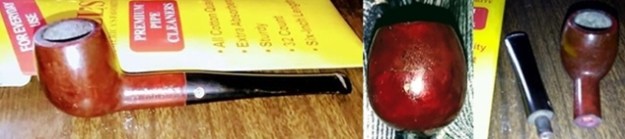
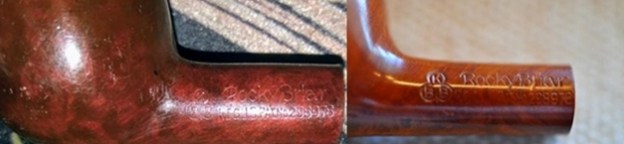
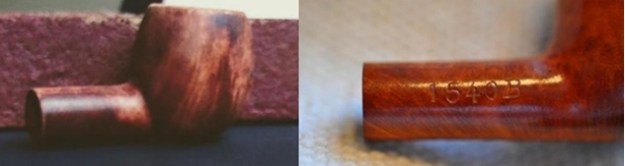
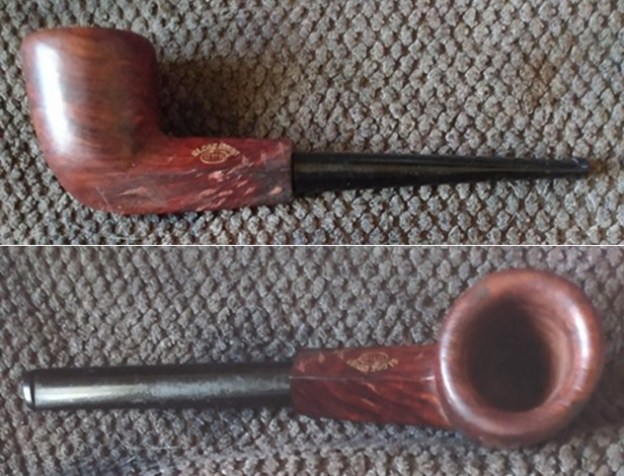
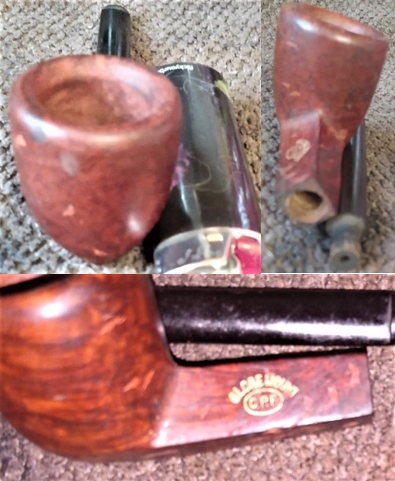
The fraudulent cyber pipe business is now out of control, running the gamut from established old name brands, antique or otherwise, to contemporary makers and even artisan carvers.  The vast majority of pipes I’ve bought on eBay over the years have been more or less just what they were represented to be, with only two exceptions, one of which was supposed to be a KB&B Rocky Briar salesman sample.  Salesman samples were miniature, scale versions of regular sized pipes carried by – you guessed it, salesmen – in the early 20th century to show prospective buyers an idea of what they would get.  By nature of the time period in which they were used, salesman samples are now antiques or near the mark.  When I opened the package that arrived in the mail and removed the pipe, even taking into consideration its tininess, I found a corruption of pipe making that seemed to be crafted of balsa.Examining the little monstrosity, I was at once alarmed by its color, which I call Chinese red, and the tacky (as in sticky and uneven) looking coat of stain, or whatever was used to cover the cheap, ultra-light wood I later concluded was something along the lines of paulawney.  A closer look revealed just plain sloppy nomenclature, regardless of age, in particular an uneven Reg. US Pat. No. 298978.  Since there were two each of the numbers 8 and 9, I examined them, and they didn’t match, as shown in the following photo which is compared to one of Steve Laug’s that shows a real, crisp Rocky Briar imprint.As if there were any doubt as to the pipe’s fraudulence, it lacks the shape number on the right side of the shank.The other fake pipe was a CPF Globe Mount, a recent eBay purchase.  The wood is also very light and soft, but more substantial than the KB&B Rocky Briar.  Based on the light color of the shank opening and scratches, and the reddish tinge of the sanded chamber, I suspect it’s Chinese red cedar.  The stem, an obvious mismatch, is plastic. Each of these pipes cost the same or less than return postage would be, and so I kept them.  But it’s important to be sure that returns of online estate pipe purchases are guaranteed by the seller, especially if it’s a substantial investment.  Both of the above pipes were so protected, if I wanted to punish the sellers at my expense!

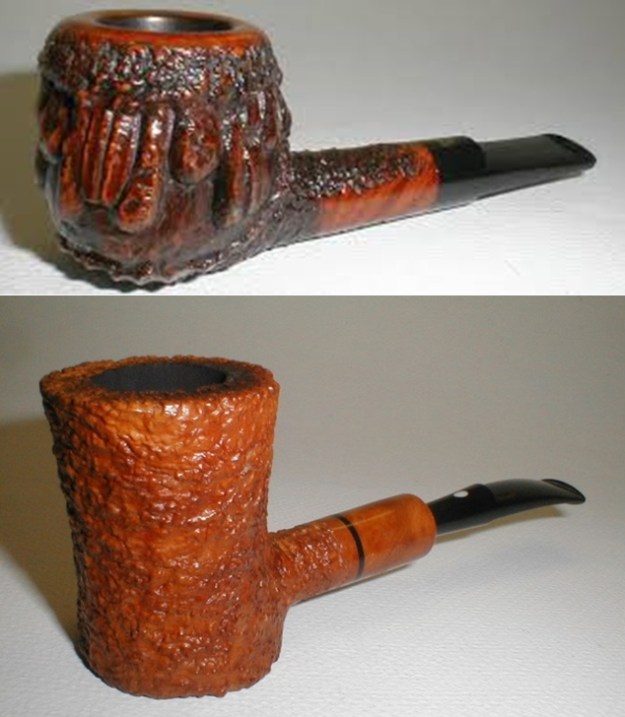
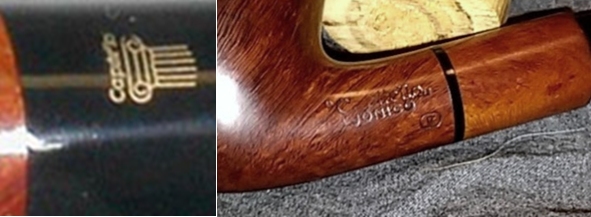
Capitello was founded in Italy by Enzo Galluzzo, the former official carver for Caminetto who had worked at Castello and Ascorti.  Although the business lasted only from c. 1982-1991, Galluzzo produced some of the most astounding, creative pipes in a short but brilliant run.  I have an interesting story about some shameful Capitello counterfeits I discovered on eBay and did my best to have removed.  To understand why the fakes were so preposterous, it is important to see a few real Capitello pipes.  Following are, in order, a wax drip Gotico from Pipephil, a rustic Gotico courtesy of a reputable eBay seller, an Airecchio from Haddock’s Pipes and a Jonico from my own collection.

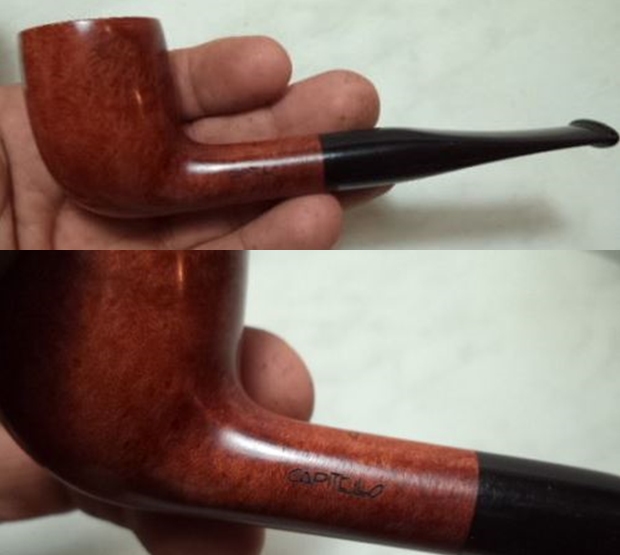
Now, have a gander at the best of the counterfeits.The very small, bland billiard is supposed to be new and unsmoked, a rarity, but note the absence of the genuine stem mark, and the use of all caps in the name Capitello, among other problems that a simple check of Pipephil would illuminate for anyone not familiar with the brand.There are more, hideous black “dress” style pipes that Capitello never made, with the same ridiculous nomenclature, but here is the worst offender, something that doesn’t even pretend to have Capitello nomenclature.  Capitello also never used metal bands, even good ones.In light of the brazen fraud, I gave the seller, who was registered in the UK, a friendly chance to retract the offers.  When he replied with a rude note, a friend and I reported him to eBay, and I went so far as to file an online criminal complaint with Scotland Yard.  I never heard how that turned out, but I hope they at least rattled his cage.  I learned that the seller has a terrible reputation and is named in the second Youtube video in my Sources.  I recommend it as an excellent guide to spotting big name forgeries.

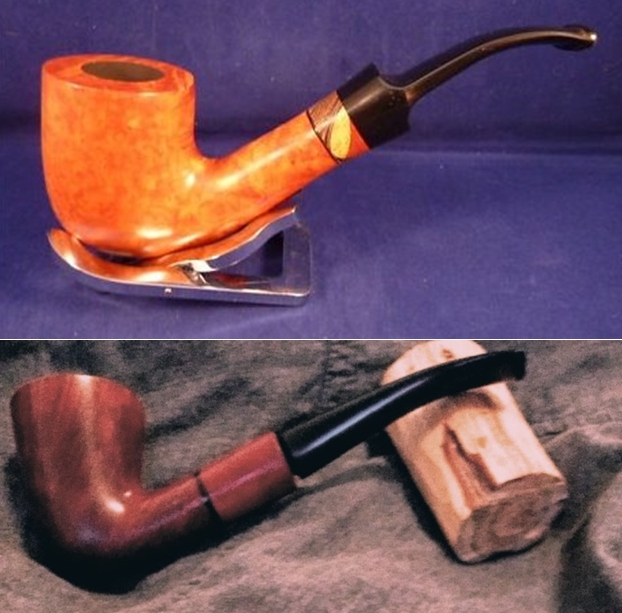
To end this section, I’ll show a couple of fake artisan pipes, both by Tom Eltang, the respected Danish carver.  I don’t have more than one photo each of the pipes or details of what is wrong with them, but they demonstrate how careful we need to be when buying anything online.* The top, chestnut-colored pipe is the fake.  Real Dunhill ODA pipes had lighter Root or Bruyere finishes.

CONCLUSION
To be sure, the great majority of online sellers, eBay or elsewhere, are not frauds.  The biggest abuse now is the outrageous over-pricing, mostly for Medicos and Dr. Grabows, which sellers seem to regard as the Holy Grail.  I remember the good old days when I had multiple lots of nine-12 pipes coming in the mail all the time, and all of them had good pipes as well as some little treasures in them.  While it was only natural that sellers would catch on, they seem to have over-reacted to the point where they are now paying their sources so much for garbage, more or less, that they are willing to go without selling their pipes at all unless they recoup their investments that were idiotic in the first place.  Not being collectors or restorers themselves, for the most part, they don’t understand what goes into repairing and sanitizing pipes for a business and being able to make a living, or even a reasonable extra income.

This blog is supposed to be more about the dangers of buying fake high-end pipes that are expensive as opposed to some lower-priced examples I showed by way of illustrating how far forgers will go to defraud collectors for a buck, so to speak.  The big names in pipe forgeries, other than Dunhill, include Radice, Sasieni, Peterson, Comoy’s and on and on.  Check out the second Youtube video in the Sources for an excellent guide on that subject.  For purposes of a summary, I’ve made some notes on how to avoid the snares these scoundrels will set.

  • Don’t be an easy mark. Take advantage of the wealth of information available online and at your local tobacconist!
  • Watch out for rare/unsmoked Not many collectors buy pipes to put them on the shelf and not enjoy them.
  • Scrutinize the nomenclature, and compare it to online sites like Pipephil.com. This means everything about the stampings on the pipe: the positioning, size, crispness and shape number.
  • Look at the finish. Is it the same style and color as examples of the real thing you find elsewhere online, e.g., smooth/rustic and light or dark brown?  Is the stain even and not tacky or runny?
  • Be sure the seller has an excellent history of top feedback.
  • Be sure there are plenty of pictures showing every angle and all of the nomenclature clearly. Don’t be afraid to ask the seller for more if you need them, and if he doesn’t provide them, don’t bid on the pipe!
  • Be absolutely sure returns are accepted.
  • Are there many bidders already? If not, why?
  • TRUST YOUR INSTINCTS! IF THE DEAL SEEMS TOO GOOD TO BE TRUE, IT PROBABLY IS!

Concerning newer estate pipes that are still in production and not rare, always check at sites such as Smokingpipes.com to see if you can find one that’s identical or similar but brand-new for the same price or less.

There is much resistance in the pipe world to the idea of counterfeits.  I believe I have presented, in this relatively outline form, enough evidence to dispel the notion that they don’t exist.  Books could be written on the subject.

In recent years, I have noticed a marked decrease in estate pipe sales by those who buy and restore them for resale, not just my own but those of friends.  The unfortunate fact is that the few crooks – or in some cases simple fools – who take advantage of buyers’ ignorance give the estate pipe business a bad name.  In most cases, great deals for used pipes that are hard to come by and have been restored to excellent condition – and sanitized for immediate use – can be found, if you only look for them.

SOURCES
http://loringpage.com/pipearticles/80s%20Fakes.htm
http://classics.mit.edu/Aristotle/physics.4.iv.html
https://pipesmagazine.com/blog/pipe-news/john-c-loring-legend-in-the-pipe-collecting-world-dies/
https://pipedia.org/wiki/John_C._Loring
https://pipedia.org/wiki/Loring%27s_Dunhill_Collection
http://www.pipephil.eu/logos/en/dunhill/cledat-en1a.html
https://www.youtube.com/watch?v=-M0-DlI6D3o
https://www.youtube.com/watch?v=0JNnjSS4x64
https://rebornpipes.com/2017/09/26/the-brief-shining-history-behind-an-italian-dublin-and-its-easier-than-usual-refurbish/
https://pipesandtobaccosmagazine.com/2011/06/the-age-of-steal/
https://www.archaeologicalconservancy.org/wpfb-file/8-3fall04singleslr-pdf/

Free PDF download available

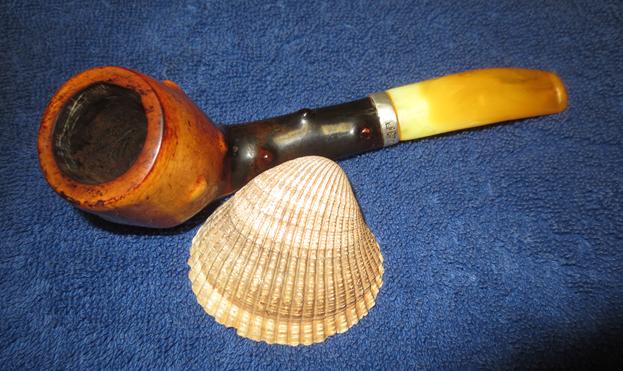
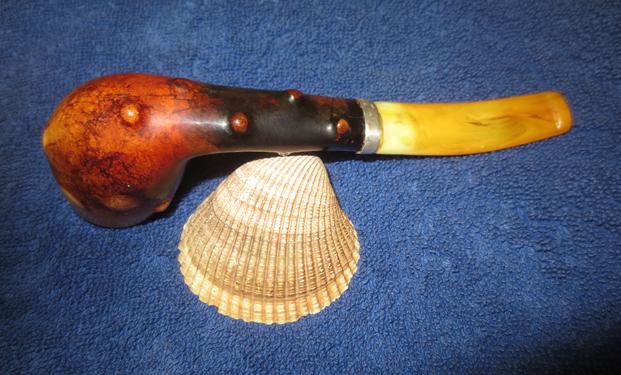
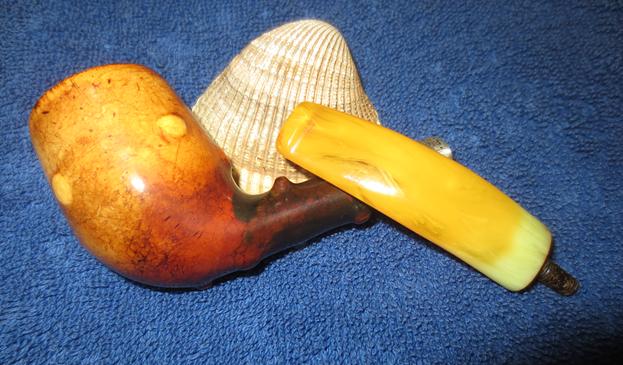
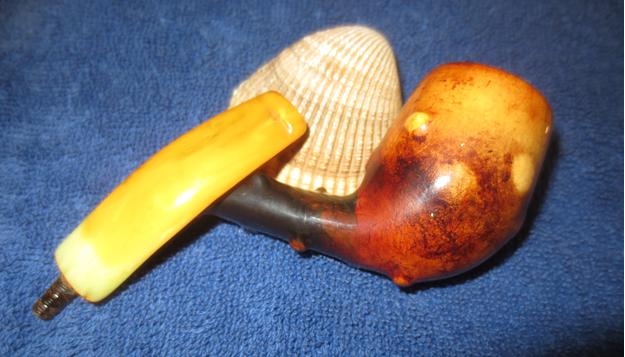
Enlivening a Mysterious Old Knobby, Oval Shank Meer Bowl


Blog by Steve Laug

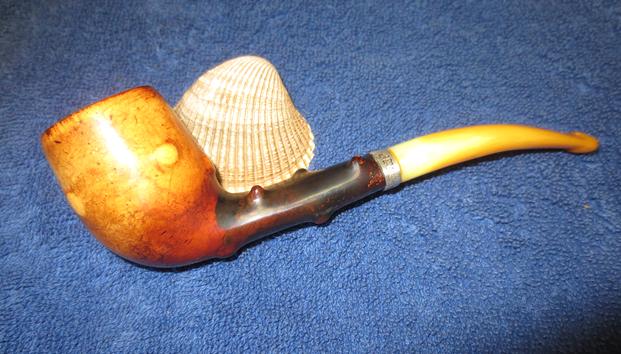
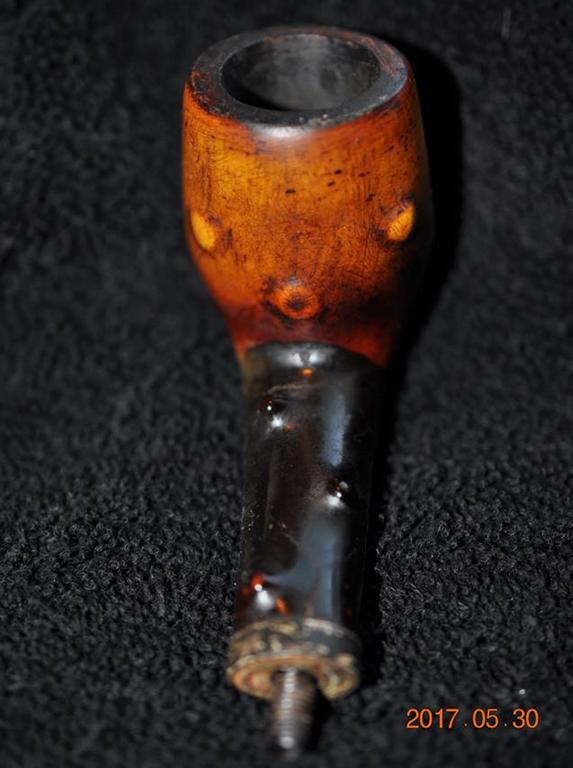
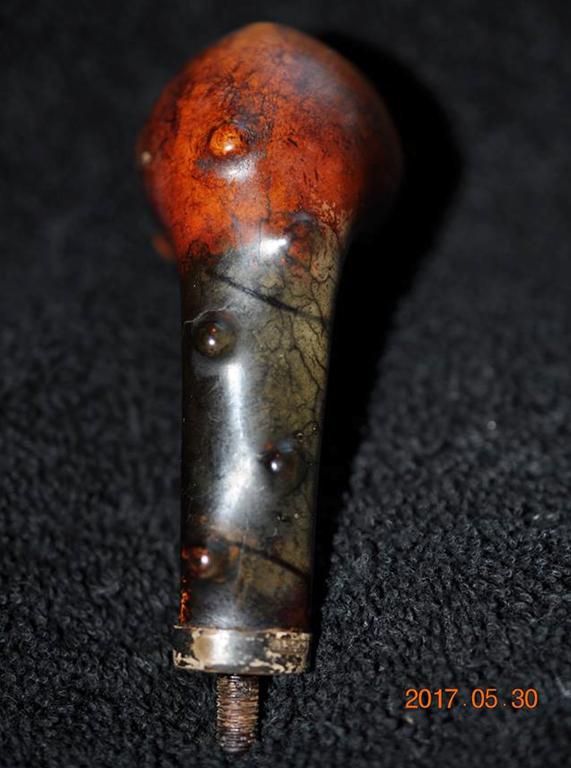
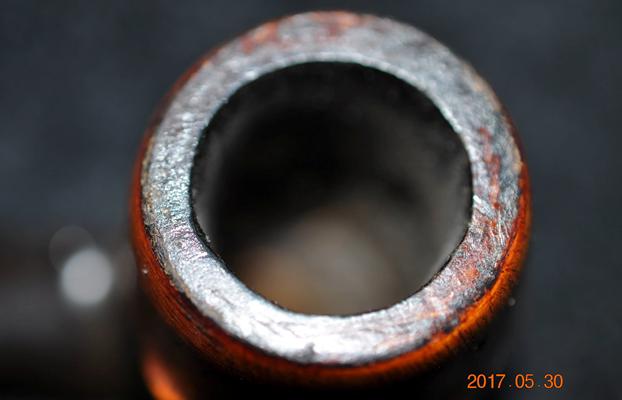
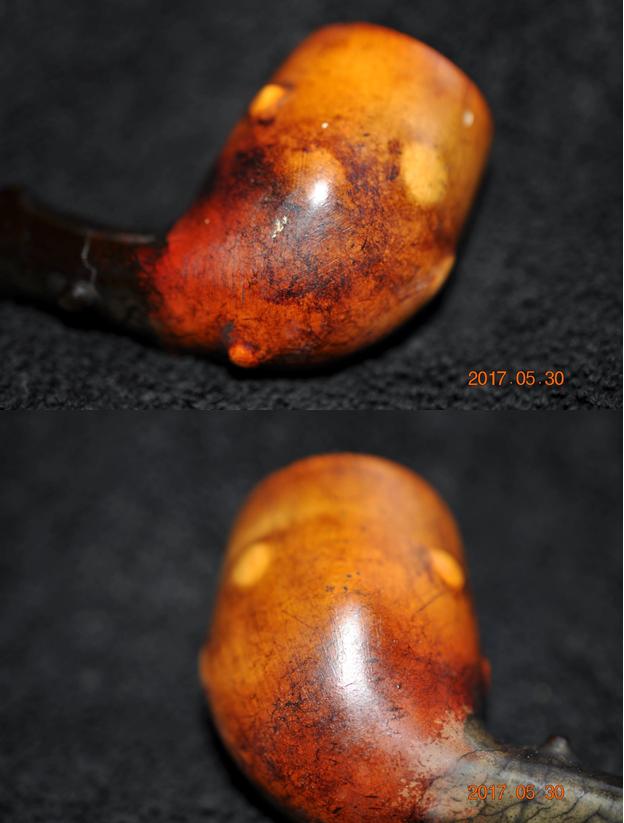
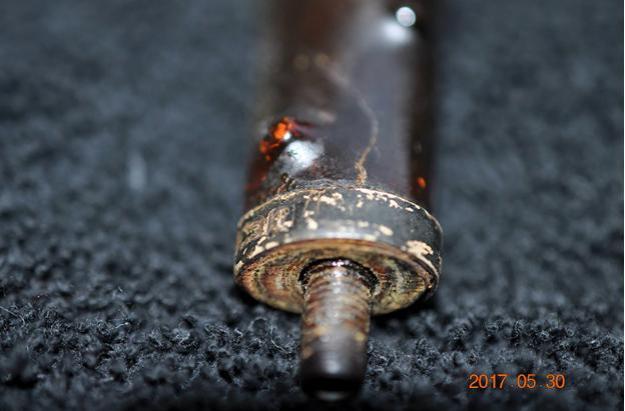
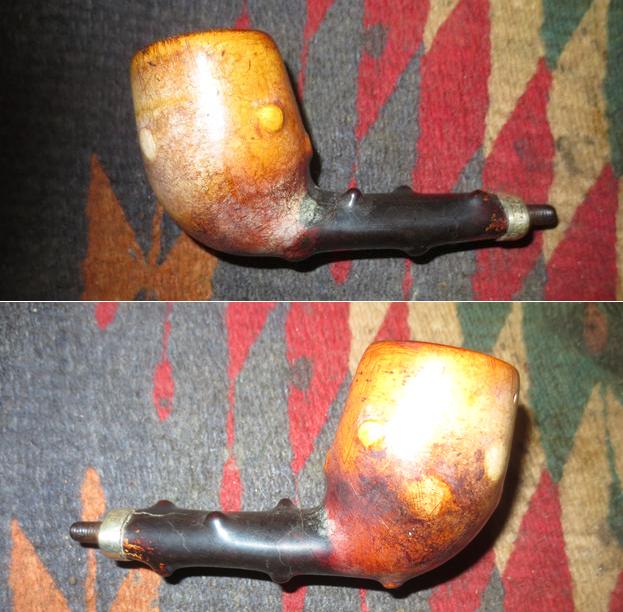
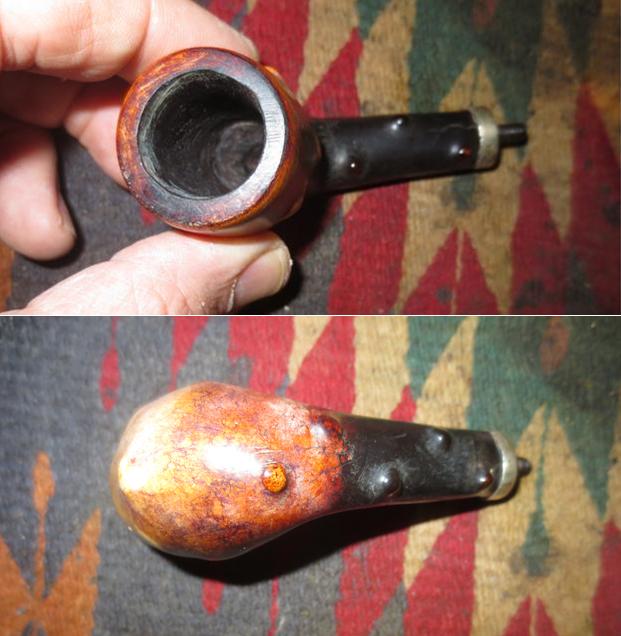
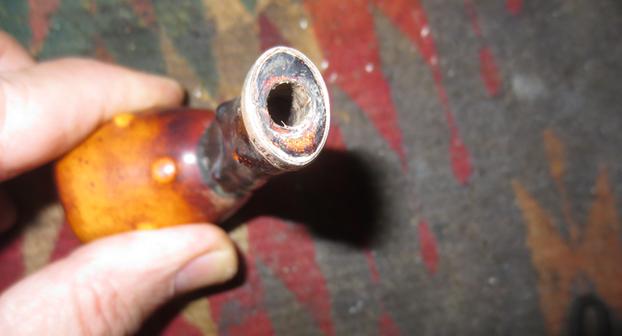
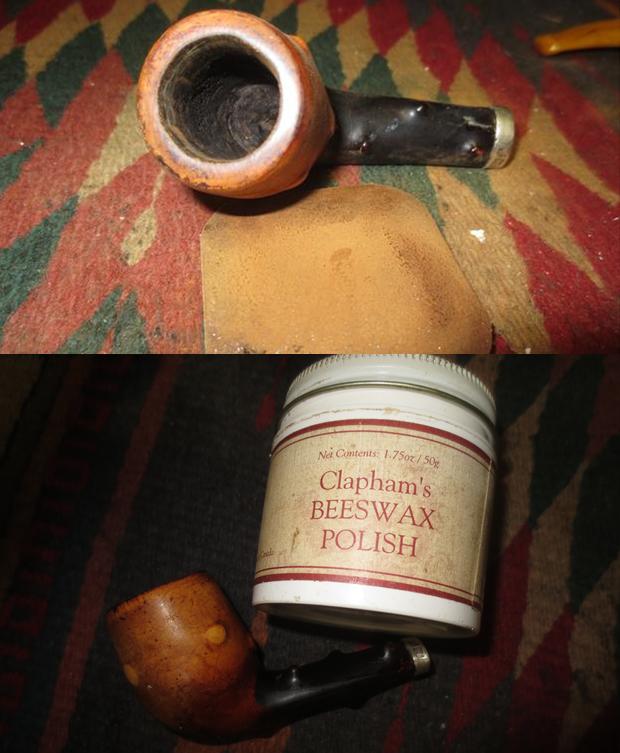
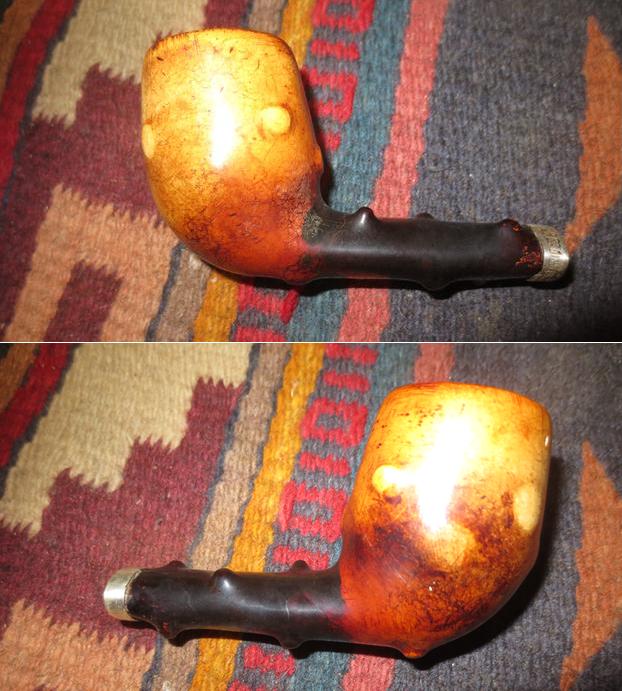
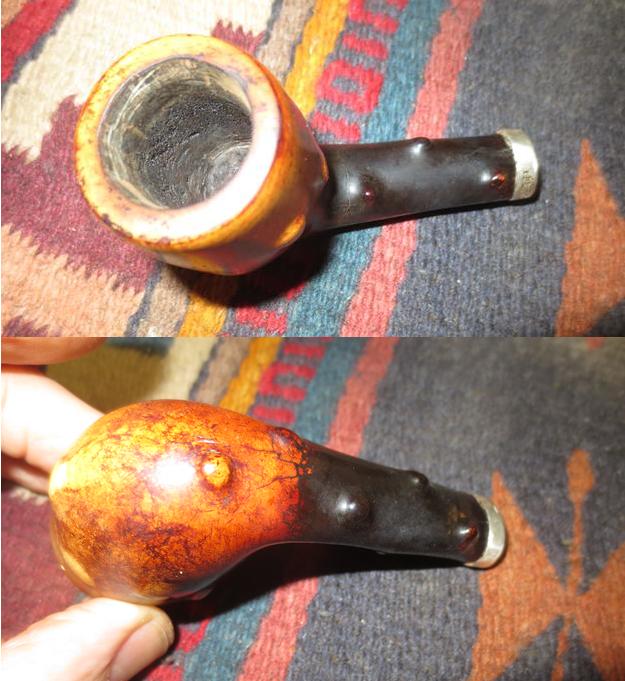
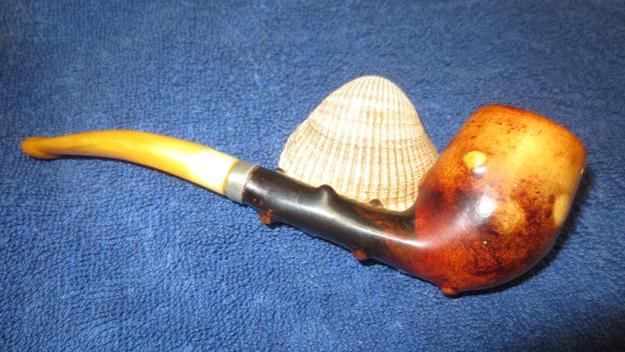
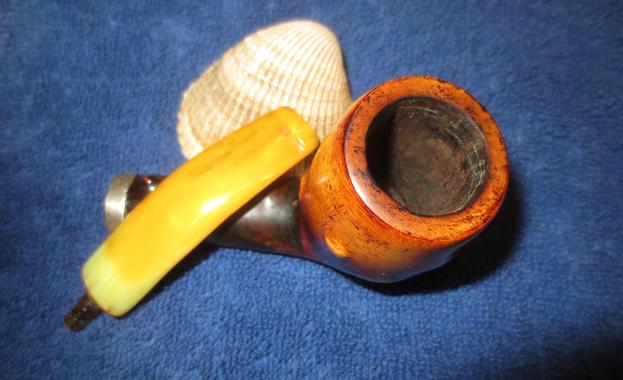
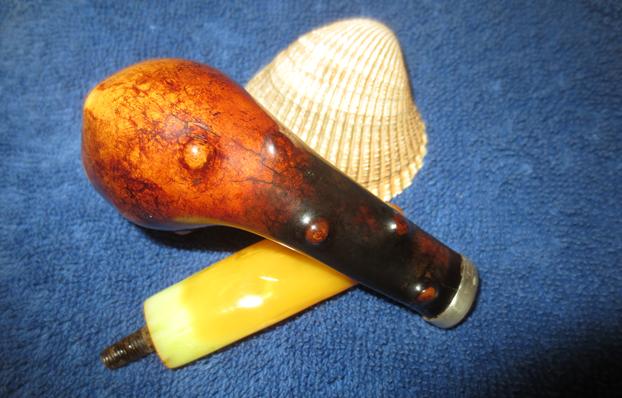
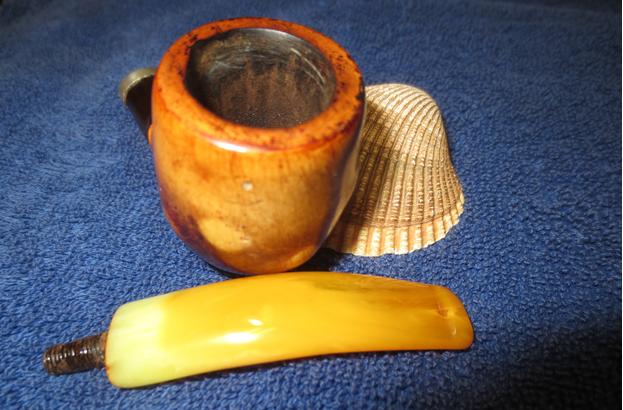
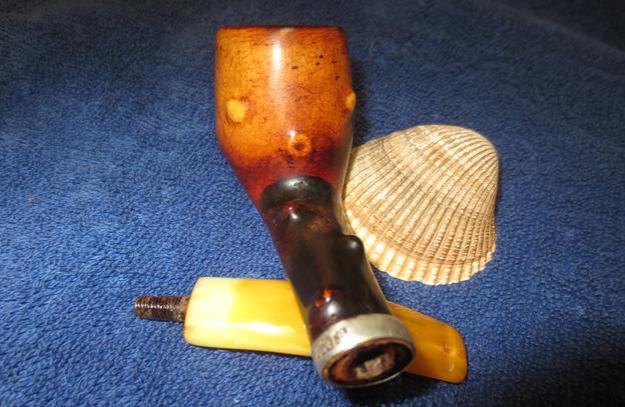
My brother Jeff, sent this old meerschaum to me from our virtual pipe hunt. It was certainly unique and would be an interesting pipe to fit with a new stem. It was meerschaum with no stamping or markings on the shank to help identify it properly. It had knobs all about the bowl and shank and there was a transition of colour from dark on the shank to lighter at the top of the bowl. The bowl was caked and there was an overflow of the cake to the rim top. It was dirty and worn looking. The threaded metal tenon was anchored tightly in the shank and would take some work to remove and possibly even then it would not come out. Jeff took photos of the bowl before he cleaned it up. The first three photos give an idea of the condition and the charm of the pipe to both of us. When he showed me the pipe in our Montana virtual pipe hunt I wanted to see if I could find a stem that would work with it. There was something about it that made me want to give it a new life. He took some close up photos of the rim top and the bowl that show the cake and the lava build up on the top. The bowl did not have too much cake but enough that it was hard see if the inner edge of the rim was still round and undamaged.Jeff also took photos of the sides of the bowl and the shank end to give an idea of the colouration of the bowl and show that variation of the colours up the shank and the bowl. The silver band was unreadable but it appeared that there were some hallmarks under the tarnish on the surface of the band. I could not wait to see what they told us. It really was a pretty interesting looking old pipe. Jeff cleaned up the pipe with his usual regimen of thoroughness. He reamed out the bowl carefully with a Savinelli Fitsall Pipe Knife and took it back as far as he dared. He scrubbed the exterior of the rim and bowl with Murphy’s Oil Soap and a tooth brush to remove as much of the grime and dirt of age from the surface. He scrubbed out the internals with pipe cleaners and alcohol until they came out clean. He polished the band with soft scrub and a cloth until the hallmarks were visible.
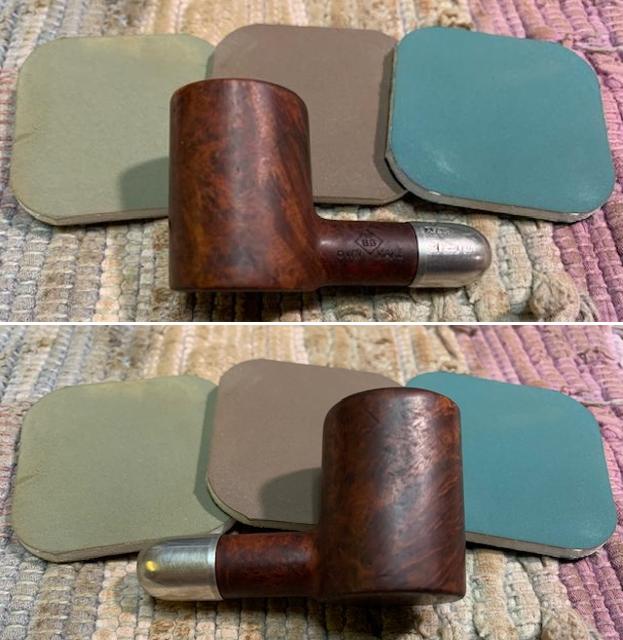
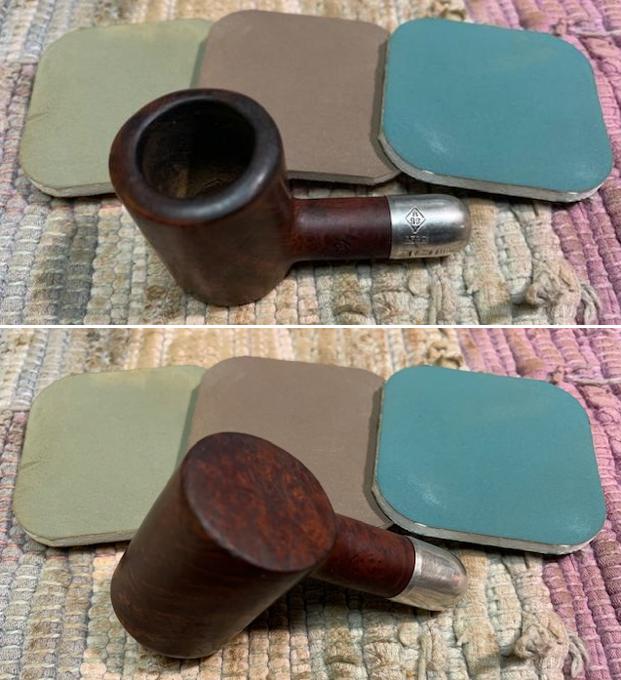
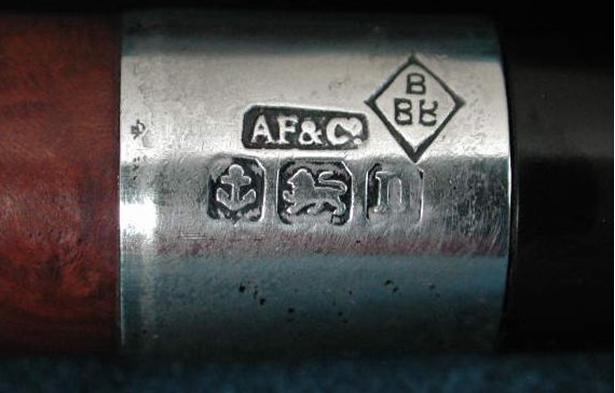
When it arrived I wanted to see if I could find out about the maker of the pipe and try to date it if possible. I had a feeling that the band on the shank may possibly give a clue as to its maker. On the left underside of the silver band it is stamped A.F. &Co. in an oval. Following that maker’s mark it is stamped with hallmarks – an anchor, a rampant lion and a cursive lower case “f”. The anchor hallmark tells me that the band was done in Birmingham, England. The rampant lion is the mark for .925 Sterling Silver. The “f” stamp had great promise in that it might well give me a date for the pipe (or at least the band).

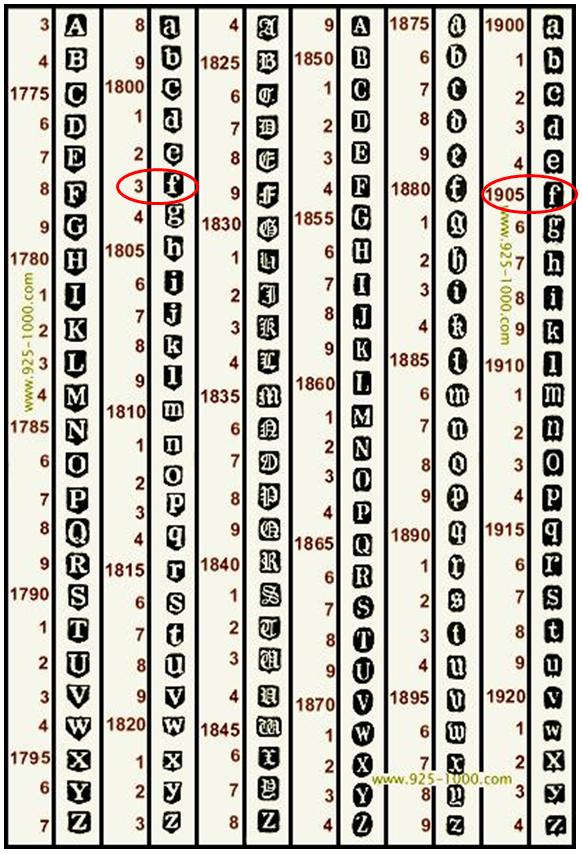
I looked up the date hallmarks for Birmingham and copied the chart in the photo below. There were two likely candidates for a date that had the lower case “f” stamp. The first was 1803 in a shield cartouche and the second was 1905 in a square cartouche with rounded corners (I circled both options in red in the photo below). Under a bright light with a jeweler’s loupe I could see that the cartouche was square with rounded corners. Now I knew that the pipe was banded with a Sterling Silver band in Birmingham, England in 1905.Now I wanted to see what the stamp A.F. & Co. in an oval referred to. I turned to the internet and searched for A.F. &Co. I was led to a Dictionary of Tobacconists, Pipe Makers, Pipe Mounters and Silver Hallmarks (http://www.silvercollection.it/dictionarytobacconistA.html). There I found the stamping that was on the band of my pipe. The difference of course was the BBB Diamond logo on the one below. The A.F. & Co. in the chamfered rectangle was the same. The site identified the maker as Adolph Frankau & Co. LTD – London and Birmingham, England. I have worked on BBB pipes that had the same stamping on the band so I am wondering if there is not some link to BBB even for this old meerschaum. There could very well be a connection. They were known for their gold and silver works and had been founded in 1902.Now I knew not only the date but the company who did the silver work on the bowl. Amazing the information you can find with just a little bit of work. To me it is these kinds of details that give a restoration of an estate pipe depth and add colour to their story. It is these details that drive me forward in my restoration of the pipes I work on.

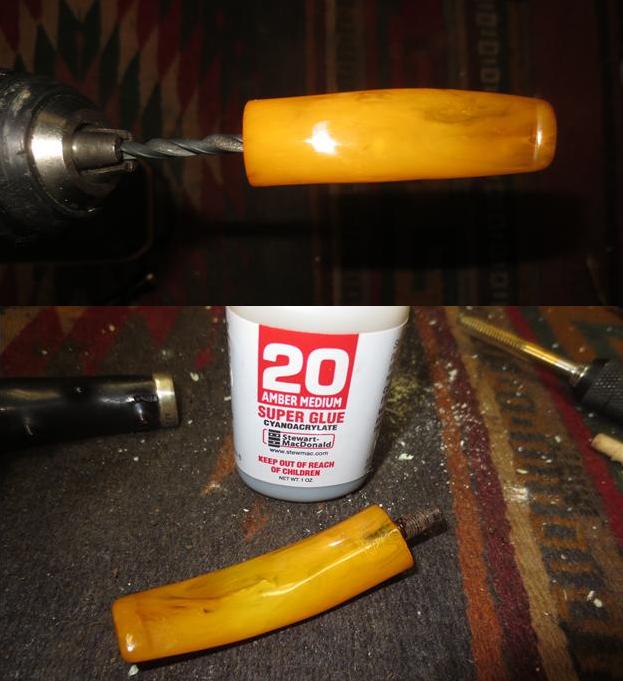
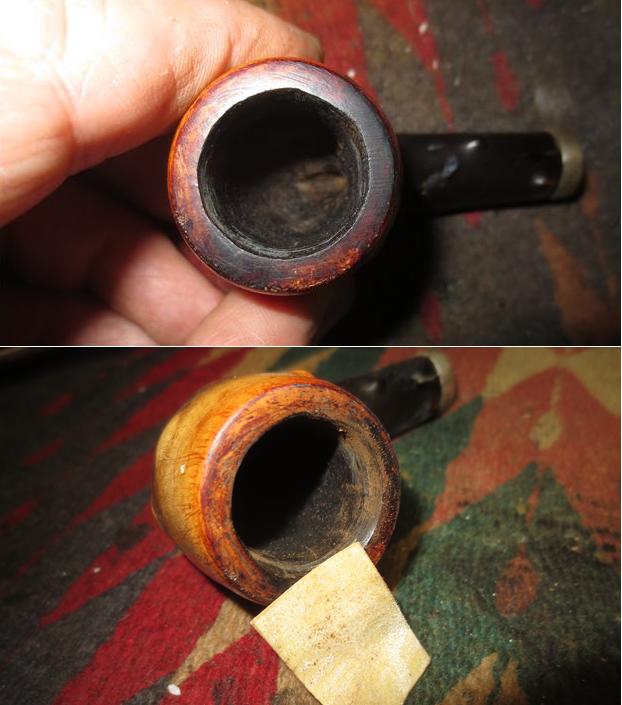
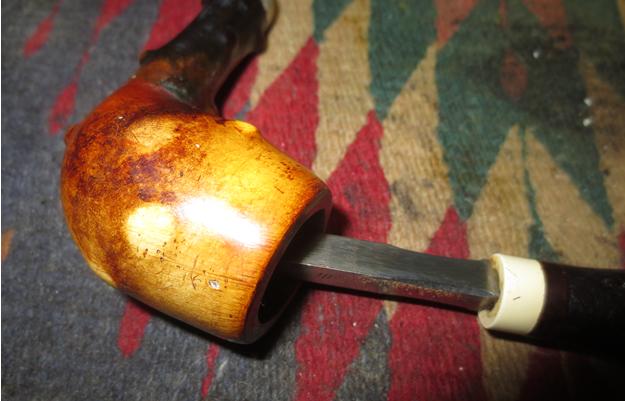
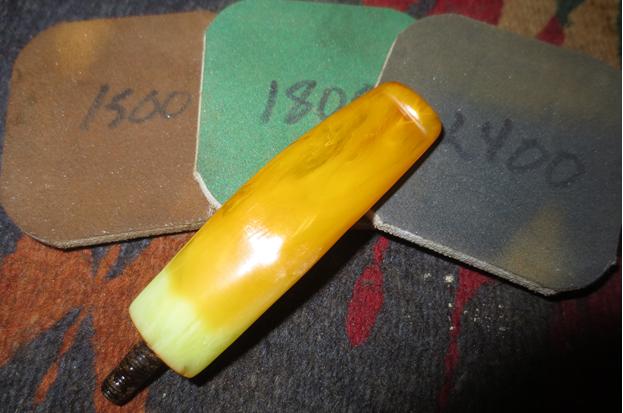
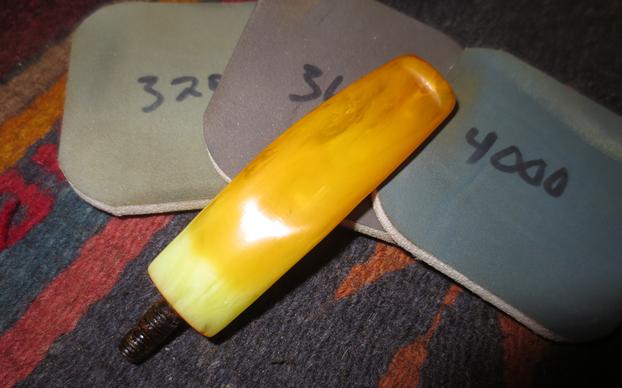
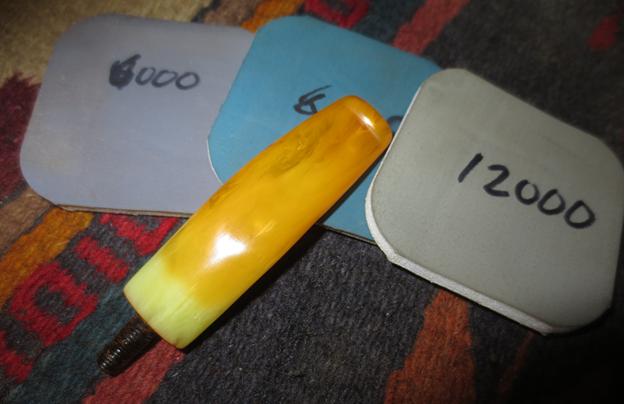
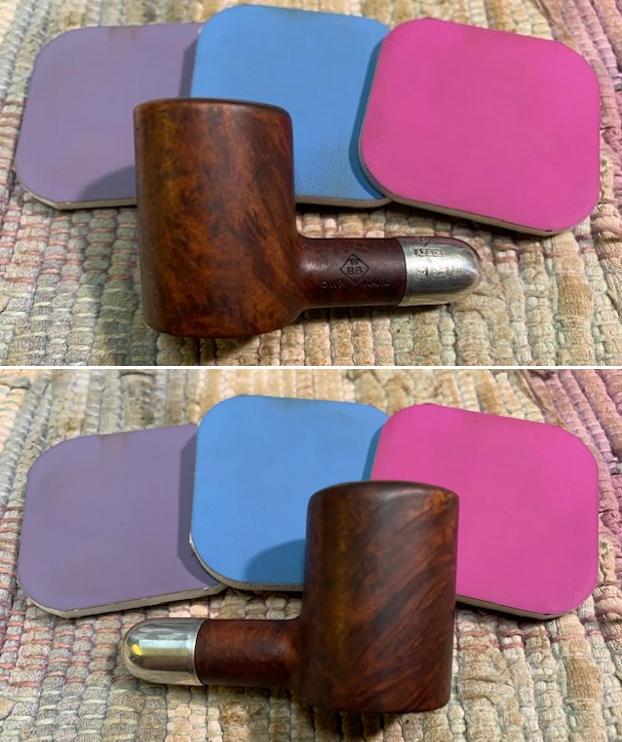
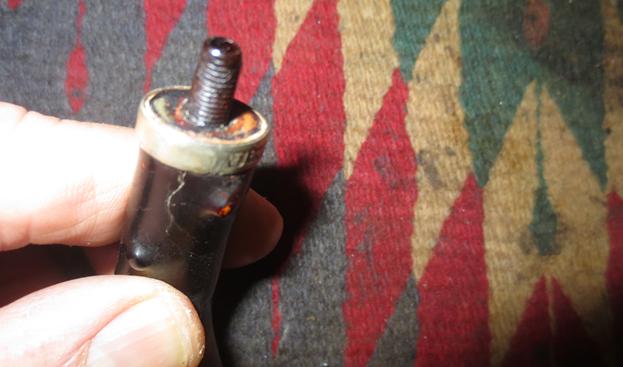
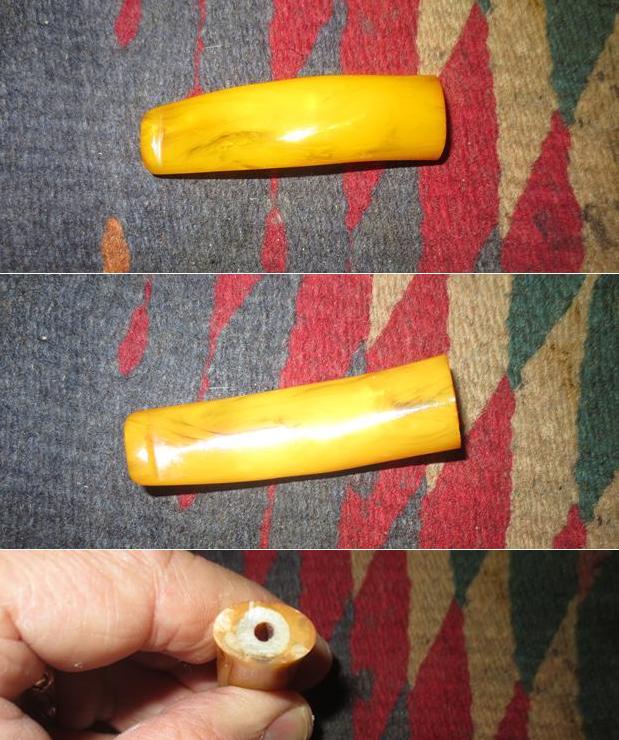
I took photos of the pipe when it arrived to give an idea of what it looked like before I started working on it further. Notice the small crack in the shank coming from under the band. I would need to repair that so it does not spread further.I had a stem in my can of stems that was Bakelite and had some age on it. It had a regular push tenon but had an orific button on the end. It was in excellent condition and it would work well with this old pipe. I sawed the tenon off with a hacksaw and used the Dremel and sanding drum to smooth out the remnants of the tenon.The airway was too small for the threaded tenon so I would need to drill it out and open it up. Before I did that I used a pair of pliers and carefully removed the tenon from the shank of the meerschaum bowl. I decided to repair the crack on the shank at the same time. I did it quickly and forgot to take photos. I cleaned the area and picked it clean with a dental pick. I used a black Sharpie Pen to colour in the crack so that it would not stick out through the repair. I filled in the crack with clear super glue and smoothed it out with a dental spatula. The clear glue let the colour underneath show through.I measured the diameter of the tenon and used a drill bit the same size to drill out the airway in the stem. I marked the depth of the tenon on the bit and hand turned it onto a stationary cordless drill. I drill the airways by hand with no power so as not to drill to deep or too quickly and damage the stem. I used a tap to thread the newly drilled airway and coated the tenon with amber super glue and twisted it in place in the stem. I checked the alignment to make sure that everything was straight and set the stem aside to let the glue cure.I turned my attention to the rim of the bowl. I used a folded piece of 220 grit sandpaper to smooth out the inner edge of the rim and bring the bowl back into round. I polished the top of the rim with micromesh sanding pads – wet sanding it with 1500-2400 grit pads. I wiped the rim down with a damp cotton pad. I gave the bowl and rim a thick coat of Clapham’s White Beeswax Polish and set the bowl aside until the wax dried. I hand buffed it with a microfiber cloth and took the following photos of the bowl at this point in the process. (Notice in the photo of the bowl rim and the top of the shank how well the repair blended in at the band.) I noticed in the photo of the rim top and bowl that there was still some light cake on the walls of the bowl. I used my Savinelli Fitsall Pipe Knife and cleaned up the remaining cake. The bowl was not smooth inside.With the bowl basically finished at this point I needed to work on the fit of the stem. I have learned in the past that sanding the older Bakelite often removes some of the patina and colour from the material. I decided to do so anyway to get a more flowing fit between the shank and the stem. I used a Dremel and sanding drum to remove the excess material from the top, bottom and sides of the stem and sanded the fresh areas with 220 grit sandpaper to smooth out the scratches. The colour did change slightly – it is funny in that the colour on the stem transitions much like the colour on the bowl. I am hoping that with use and time the sanded areas will darken and match the rest of the stem. I polished the stem with micromesh sanding pads – wet sanding with 1500-2400 grit pads and dry sanding with 3200-12000 grit pads. I rubbed the stem down after each pad with Obsidian Oil. I buffed the stem and bowl with Blue Diamond on the buffing wheel to get some shine in the meerschaum and the Bakelite. I gave the pipe multiple coats of carnauba wax to protect and help with colouration. I buffed the pipe with a clean buffing pad to raise the shine and hand buffed it with a microfiber cloth to deepen the shine. The finished pipe is shown in the photos below. I think it looks pretty good for its age. I am hoping that in my travels I will one day come across an oval amber stem to replace the Bakelite but until then this one will serve its purpose. Thanks for walking with me through the refurbishment of this 1905 pipe. I appreciate your reading my work. Cheers.