Monthly Archives: November 2015

Cleaning Up a Yello-Bole Hand Made, With a Bit of Learning Curve Thrown In


Good work on a cool looking old pipe. Those nylon stems are a pain. I am working on one now that is a bear!

Charles Lemon's avatar

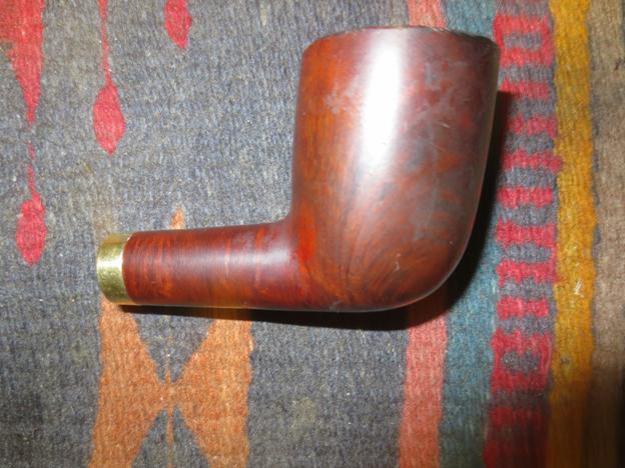
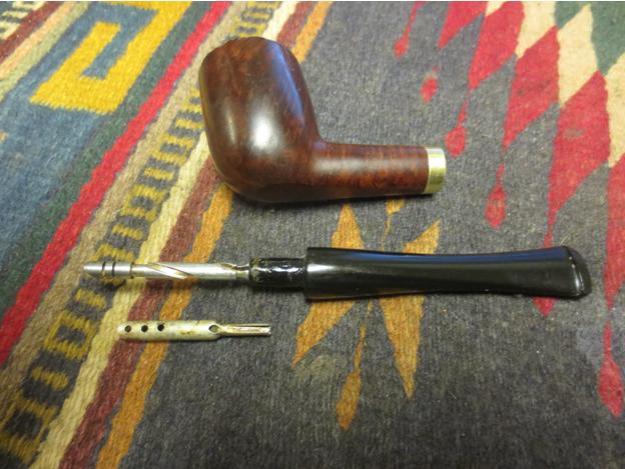
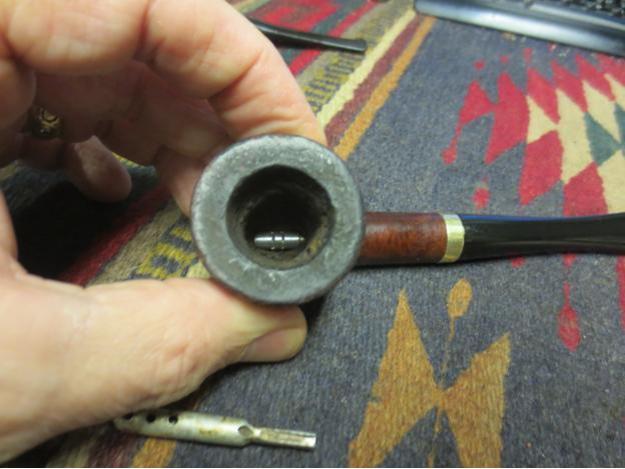
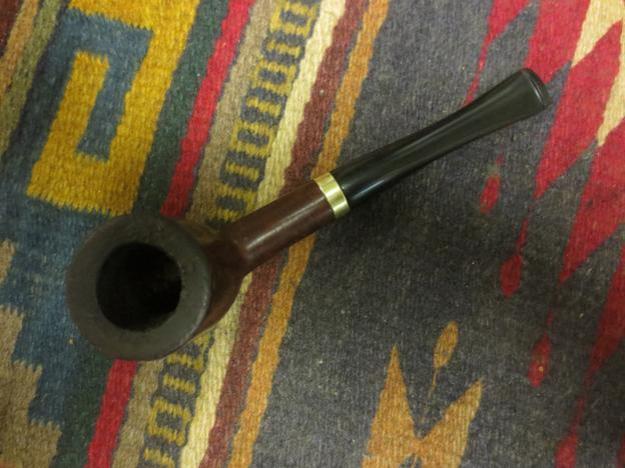
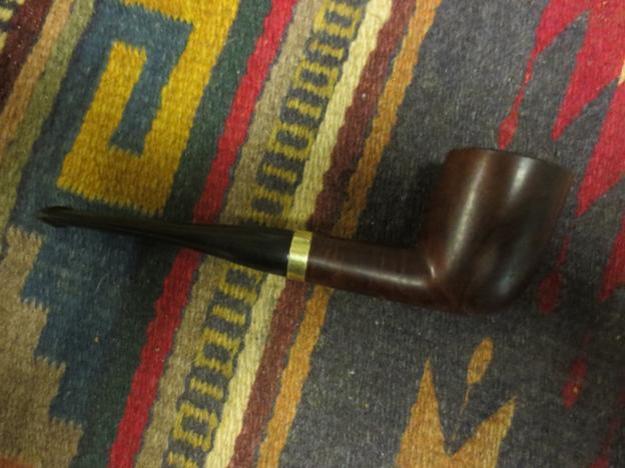
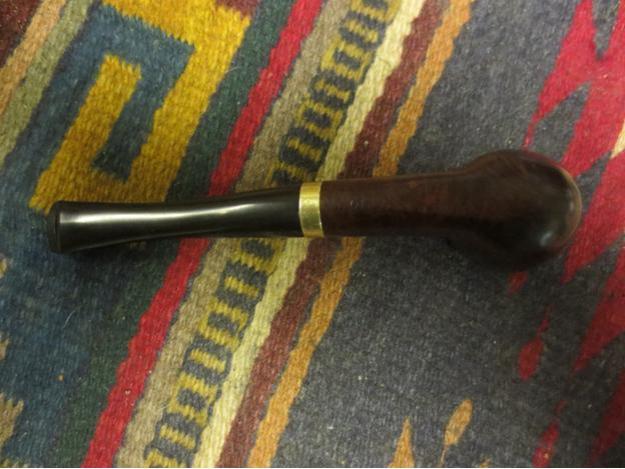
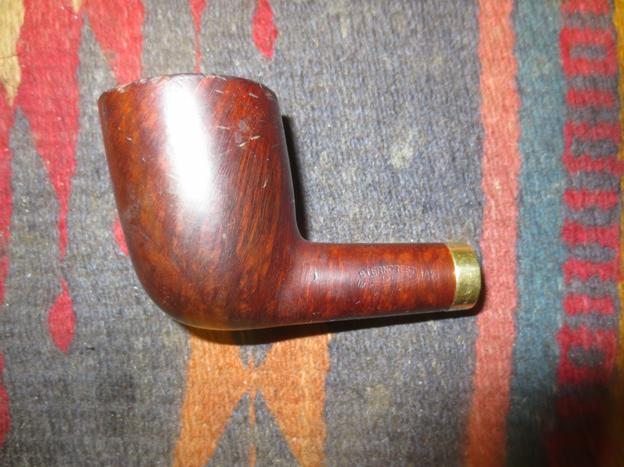
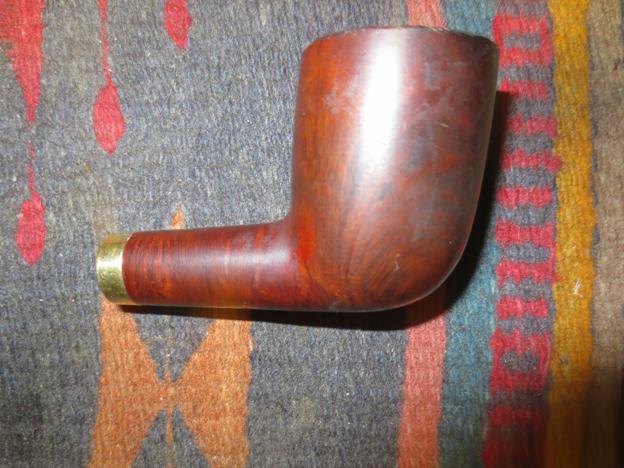
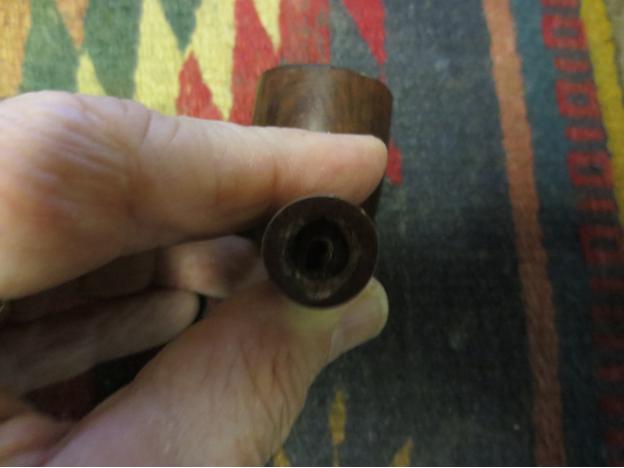
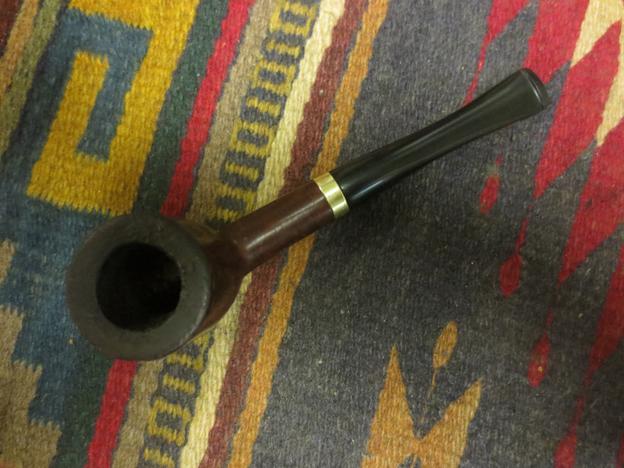
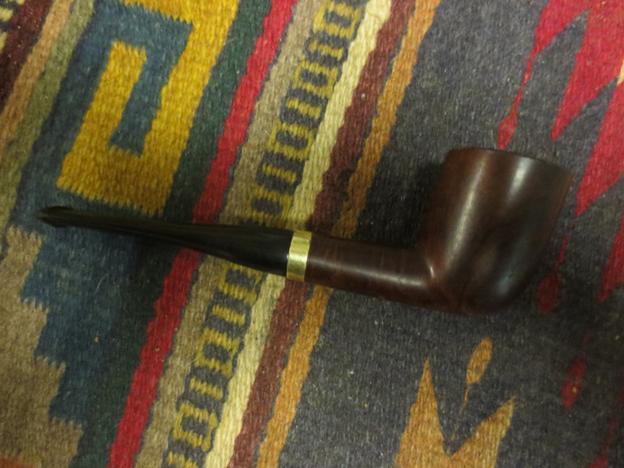
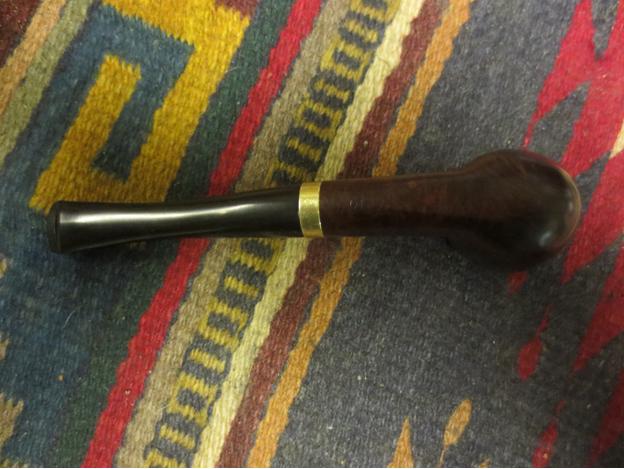
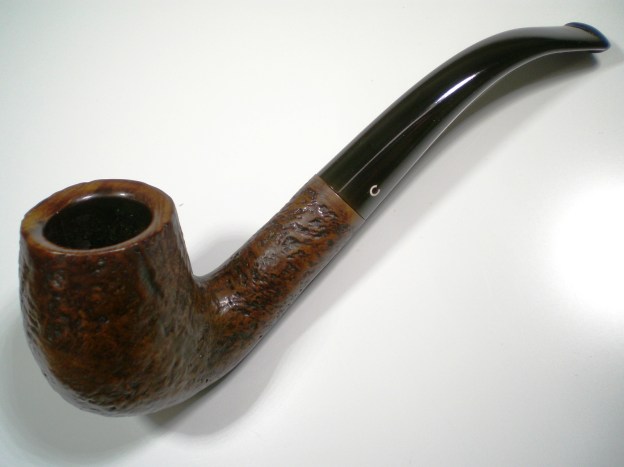
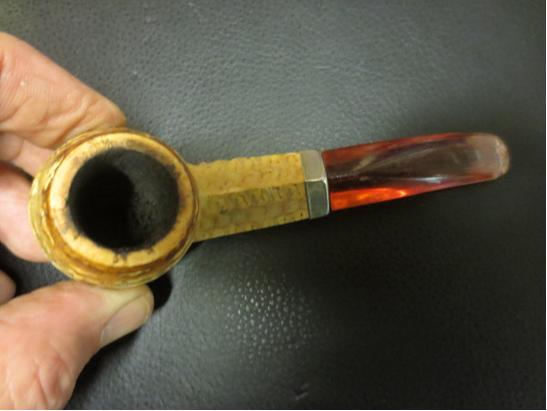
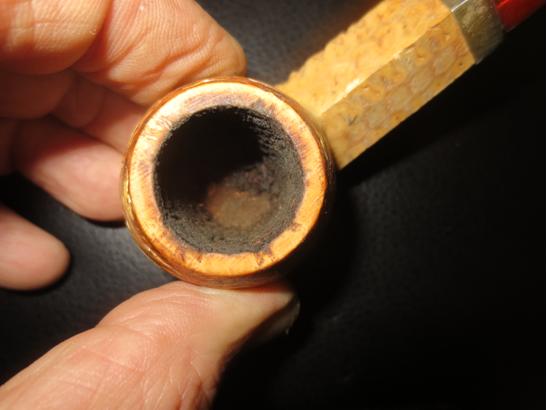
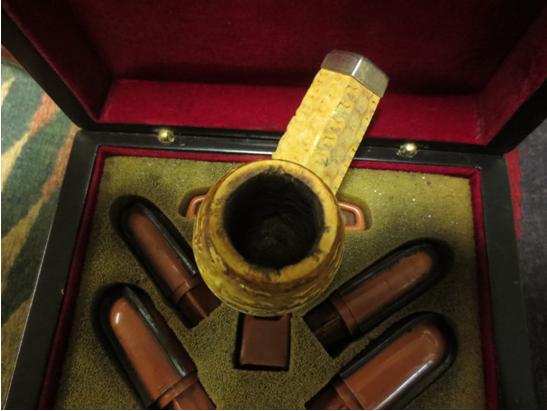
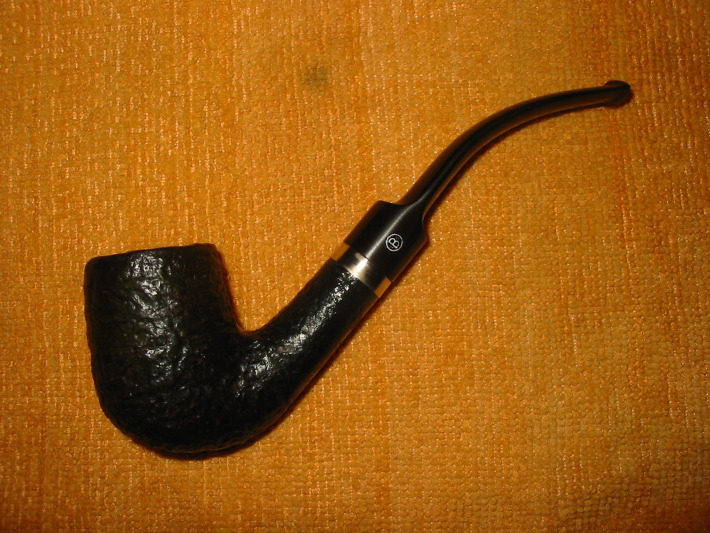
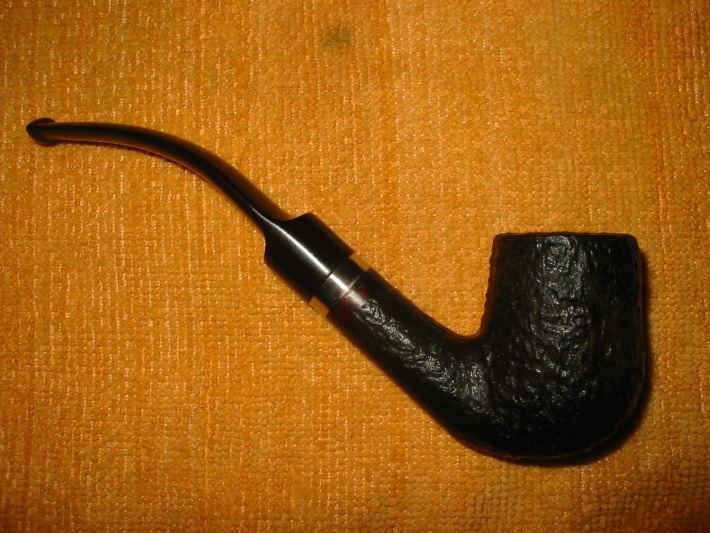
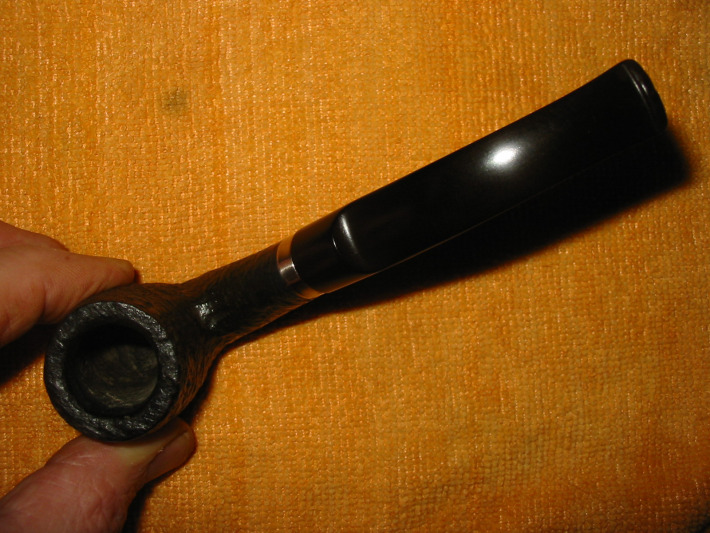
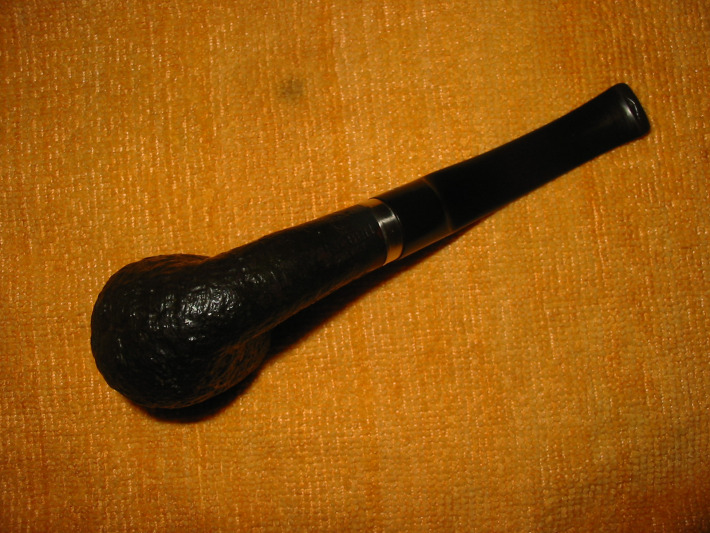
Several recent posts on RebornPipes and PipesRevival about CustomBilt pipes reminded me that I had a very similar pipe in my refurb box waiting for my attention. I found the pipe, but when I looked at the stampings, I discovered that it was not a CustomBilt at all; rather, it was stamped “Yello-Bole” over ‘“hand made”’ over “Imported Briar”. The stem was also stamped with “HM”. If the stampings weren’t enough to establish the pipe’s provenance, patches of the original yellow bowl lining were clearly visible in the tobacco chamber.

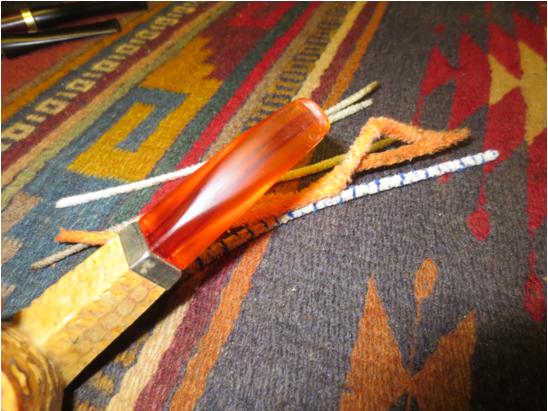
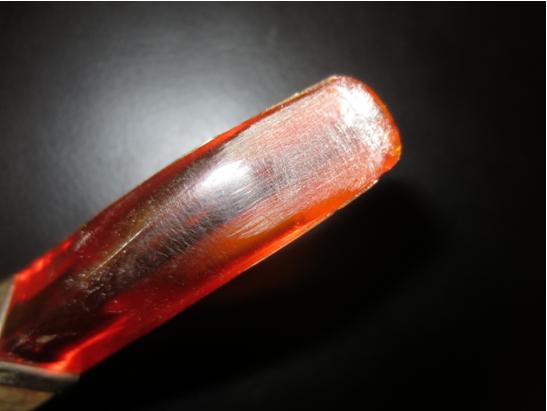
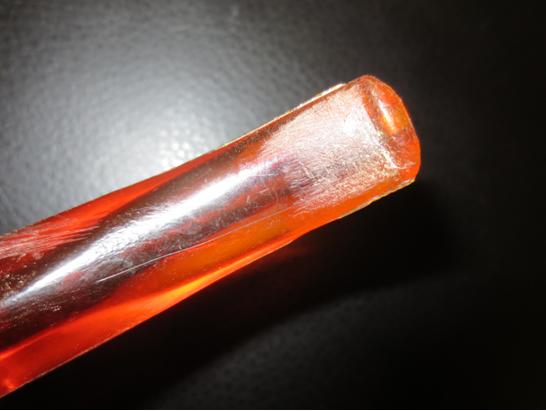
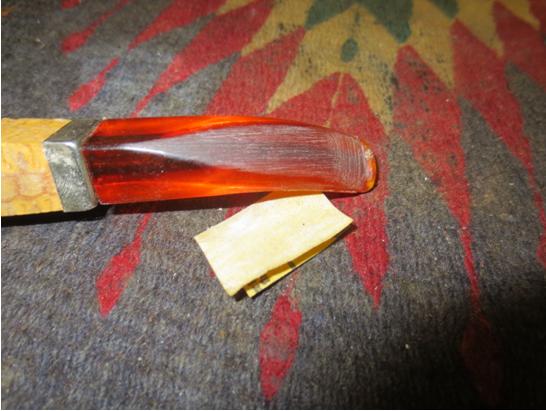
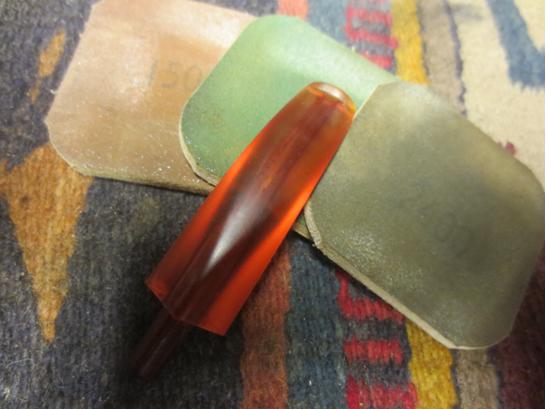
The pipe was in decent, if dirty, condition when it arrived. The stem had a fair amount of chatter in the bite area, but no oxidation. For those of you who have been following my blog for a bit now, you’ll recognize the lack of oxidation as a fair indicator of a nylon or nylon composite stem. Test an inconspicuous part…

View original post 912 more words

Removing a Broken Metal Tenon from a LHS Sterncrest 14K


Blog by Steve Laug

Not too long ago I received an email from Dave Gossett regarding another LHS Sterncrest that he had picked up. He asked if I had any hints on how to remove a broken metal mortise and broken off stinger from the shank of a pipe. He sent a picture of the issue and I wrote back regarding drilling the broken mortise insert out of the shank.broken1 He also posted on the Dr. Grabow Collectors Forum looking for help. “Does anyone have any ideas how to get this out of the shank without damaging the pipe (further)? I received this in an estate lot. Looks like somebody gave it hell already. I tried putting a screw in to remove it, but it has been gouged so badly that it won’t budge. I left it as is to keep from further damaging the shank. It has the stinger inside as well. I would have tried to file it or hot exacto knife the vulcanite but with the stinger, I don’t think this will work either. The mortise has been chewed up but I think if I can remove the debris, using a replacement stem with an extra-long tenon should make a good seal past the damaged area.”
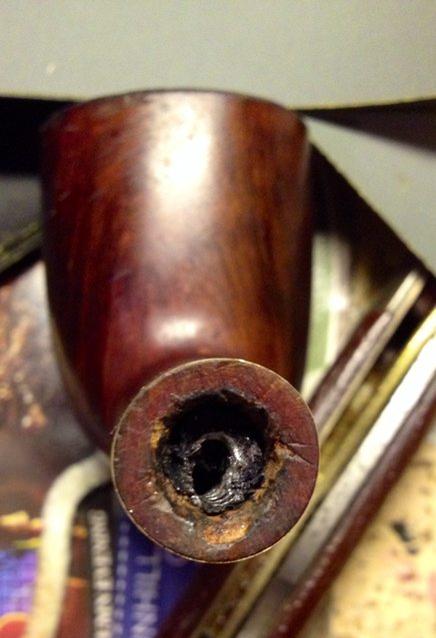
I wrote my suggestions along with those of others on the forum and looked forward to hearing from Dave and seeing some more of his craftsmanship on this old timer. A month or so passed without any follow-up post or emails regarding the pipe. I found myself wondering what he had done with the pipe and if he had been able to use the method I wrote about on the forum and in the email. Being a bit impatient and I suppose nosey as well, I wrote Dave to see if he had had any luck clearing the shank of the pipe. He wrote back:

“On another note, I bought a Sterncrest 14k with the tenon and stinger broke off in the shank. Do you do repair work for hire? I tried putting a screw in the broken tenon to remove it, but it won’t budge. The eBay genius I bought it from gouged the hell out of the mortise trying to remove it. I’d like to have it removed and get a stem replacement fitted for it. I’ll order the replacement stem and send both together if you’re interested.”

I wrote him back and said I would gladly remove the broken tenon and ruined mortise apparatus for him. I offered to do it for nothing as I like the challenge. I also have more than enough stems here that would probably work with the pipe so I suggested he just mail it to me and let me have a shot at clearing things up.

I was away this past week and when I returned there was a box waiting for me. I opened it and removed several pipe bowls and stem that he sent as gifts. I unwrapped the bowl that needed attention and had a look at it. I was pretty sure that the method I suggested would work very well and remove the ruined mortise. I was hoping that once I had removed that I would be able to push the broken tenon out of the bowl and shank.Broken2
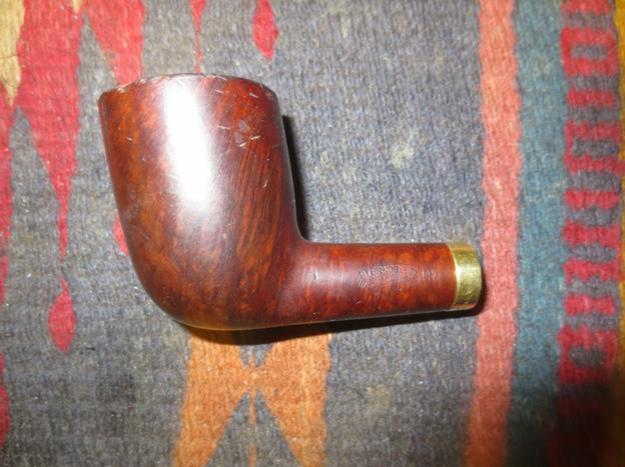
Broken3

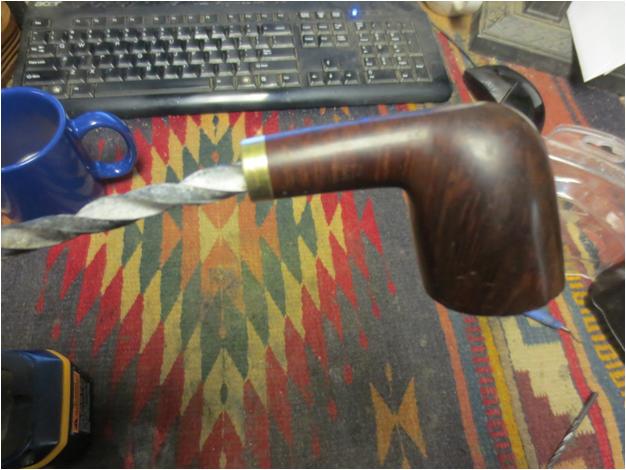
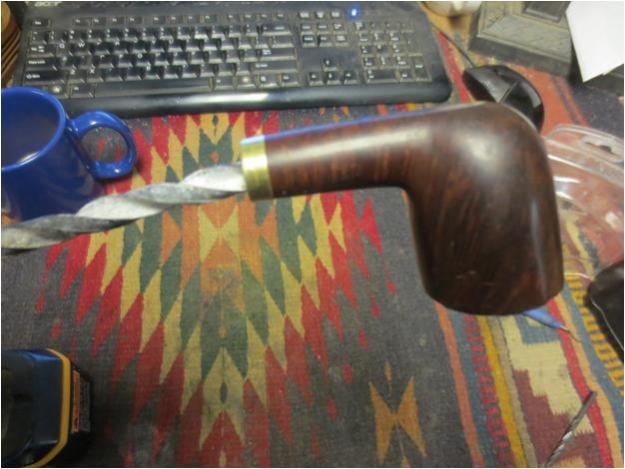
Broken4 I set up my cordless drill and put a drill bit the same size as the mortise in the shank of the pipe. I tightened it in place in the chuck and then hand twisted the bowl onto the drill bit. I never use a power tool to do this as it can create more problems that it cures. Because of the extensive damage to the shank and to the aluminum fitting I chose a bit the same size as the mortise rather than starting with a smaller one. My idea was to twist the bowl onto the bit until I had removed the mortise apparatus and opened up the shank so that the tenon piece could be removed.

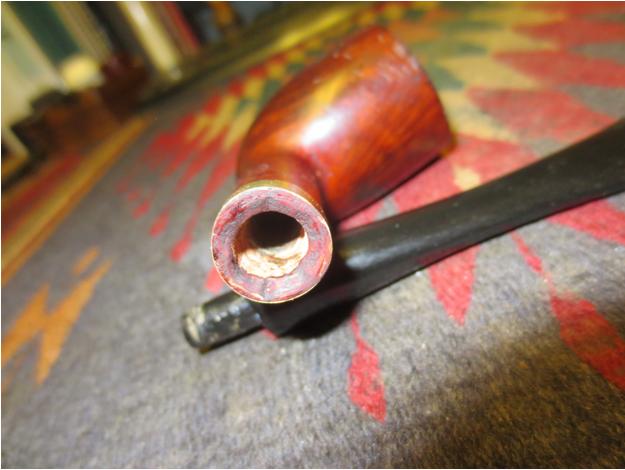
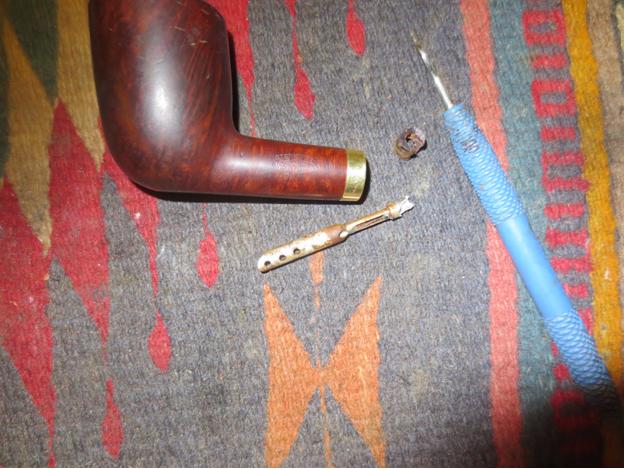
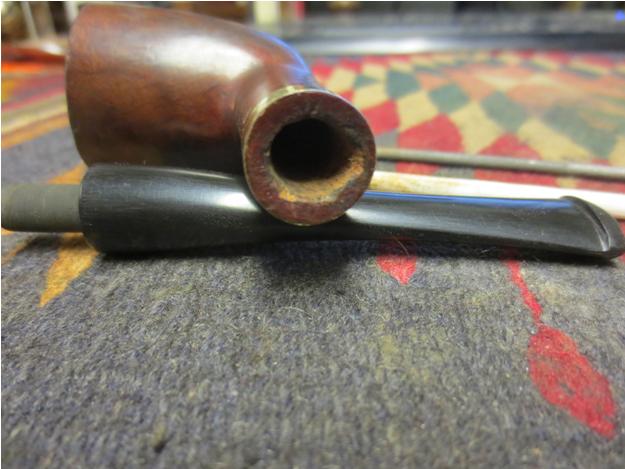
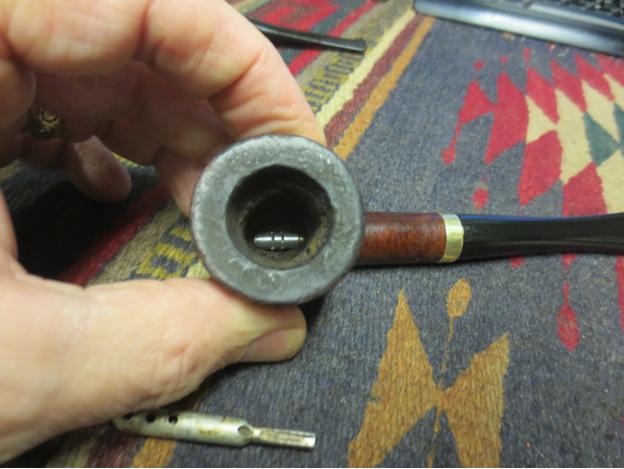
It did not take too long to carefully twist the bowl onto the shank enough that the broken part was removed. A side benefit was that in doing this I also smoothed out the inside of the shank and removed many of the gouges in the side walls of the mortise. I would need to use a needle file to further smooth out the spots in the shank where the marks were deeper than the drill bit could remedy.Broken5 When I had finished removing the mortise insert I used a dental pick to push the broken tenon piece out of the shank. The tenon/stinger extended into the bottom of the bowl so I put the end of the pick in one of the holes in the top of the stinger and pushed the apparatus back into the shank. It was not stuck so it moved easily into the shank and with a light tap of the end of the shank fell out on the work table.Broken6 With the airway cleared of impediment I used a small round needle file and a sanding stick to clean up the inside of the shank and to prepare it for a new push stem that I would fit to the shank. I removed a lot of the damage to the shank with the files though some of it was too deep into the briar to completely remove.Broken7 I gave the inner edge of the shank end a slight bevel with a sharp knife. It was not perfect as the hack job on the shank end was very rough. I was able to smooth it up quite a bit. The first picture below shows the shank end before the bevel. The second one shows the slight bevel. I am sure that Dave will clean it up even more in his refurb.Broken8
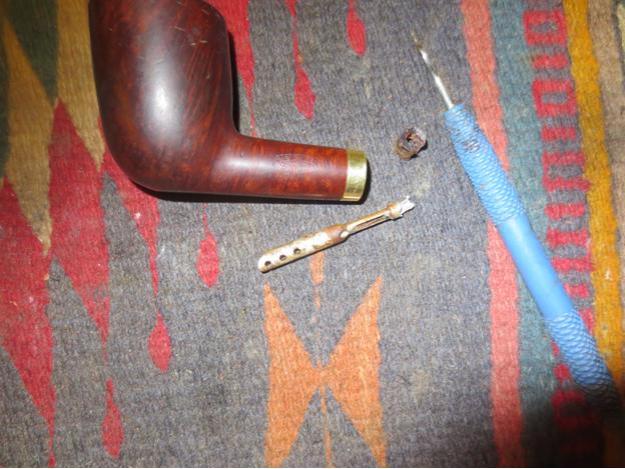
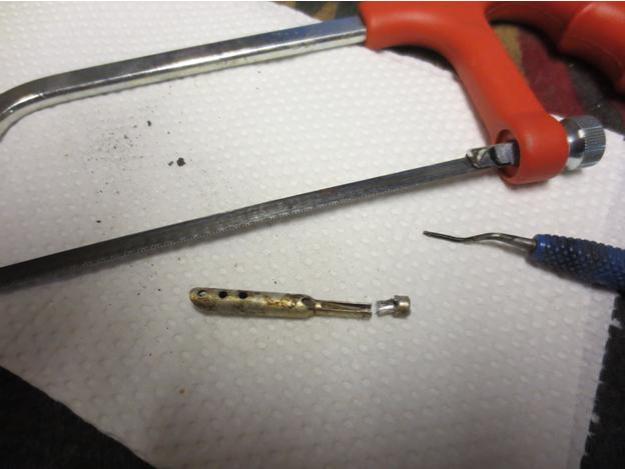
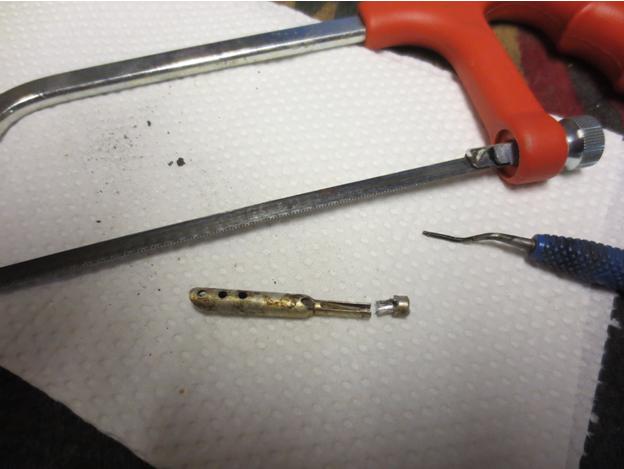
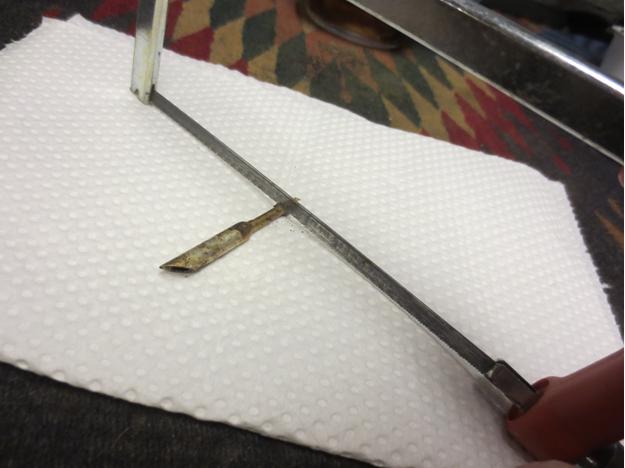
Broken9 For fun I salvaged the broken tenon and cut off the broken part with a hack saw. It will need a small tube extension to extend it fully into the bowl but it is going back to Dave so he can decide if he wants to use it.Broken10
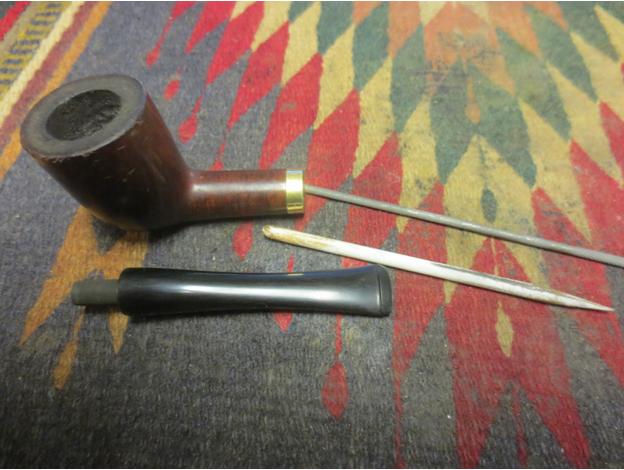
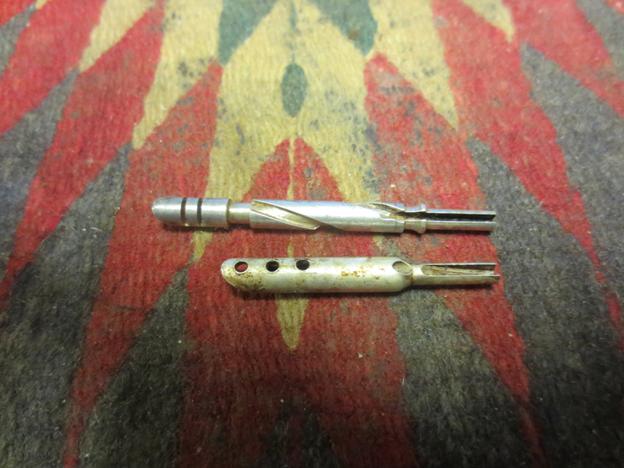
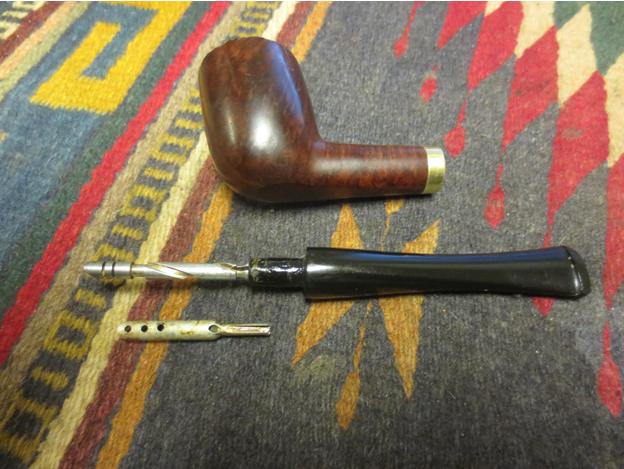
Broken11 The stinger was just over a half inch too short and I did not have a tube to extend it. I did have another stinger apparatus that was the right length. It fit perfectly in the tenon and extended the right distance into the shank. I am pretty sure it is another iteration of the LHS system but it is slightly different. I inserted it in the tenon and took the next photo. I put the stem in the shank and took a photo of the stinger end in the bowl.Broken12
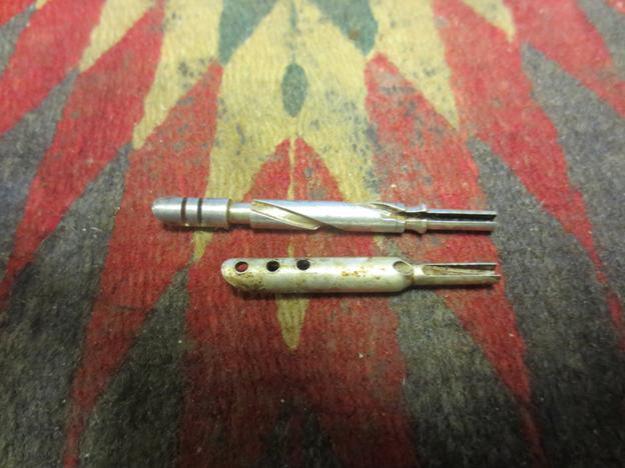
Broken13

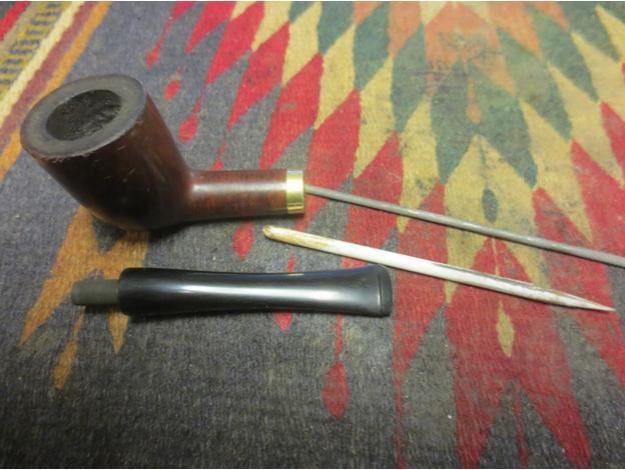
Broken14 I will send both stingers to Dave when I return the pipe. I did not ream or clean the bowl as Dave wanted to do the restoration work himself. I had a hard time not falling prey to the temptation to ream the bowl or clean up the pipe but somehow I succeeded. I kept myself to the task at hand. I went through my stem can and found a stem that would work well with the shank diameter. It has some scratches and will need a bit of fine tuning make the fit perfect but it is a good starting place.Broken15
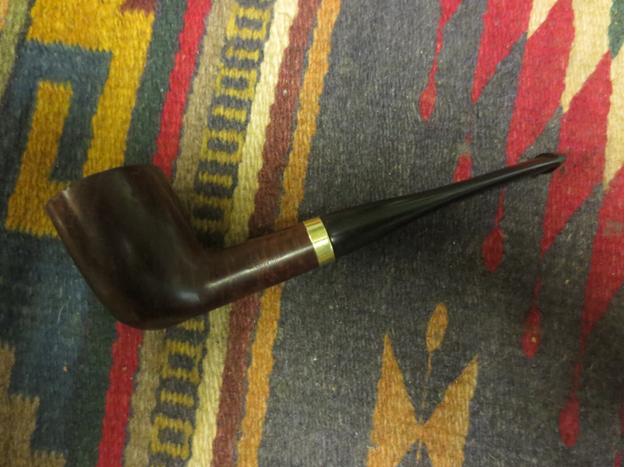
Broken16

Broken17

Broken18

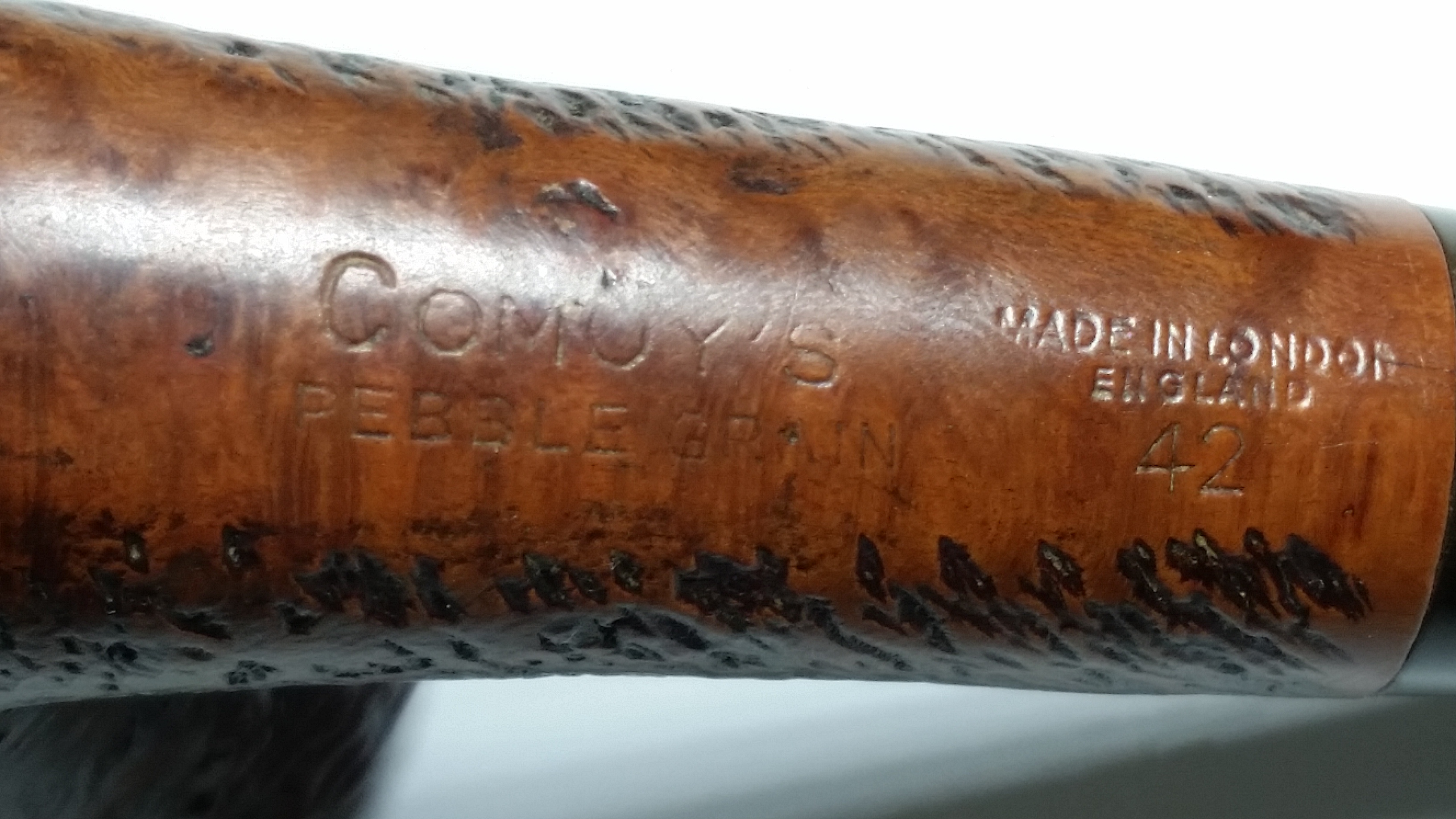
Comoys Pebble Grain Shape 42 Restoration


By Al Jones

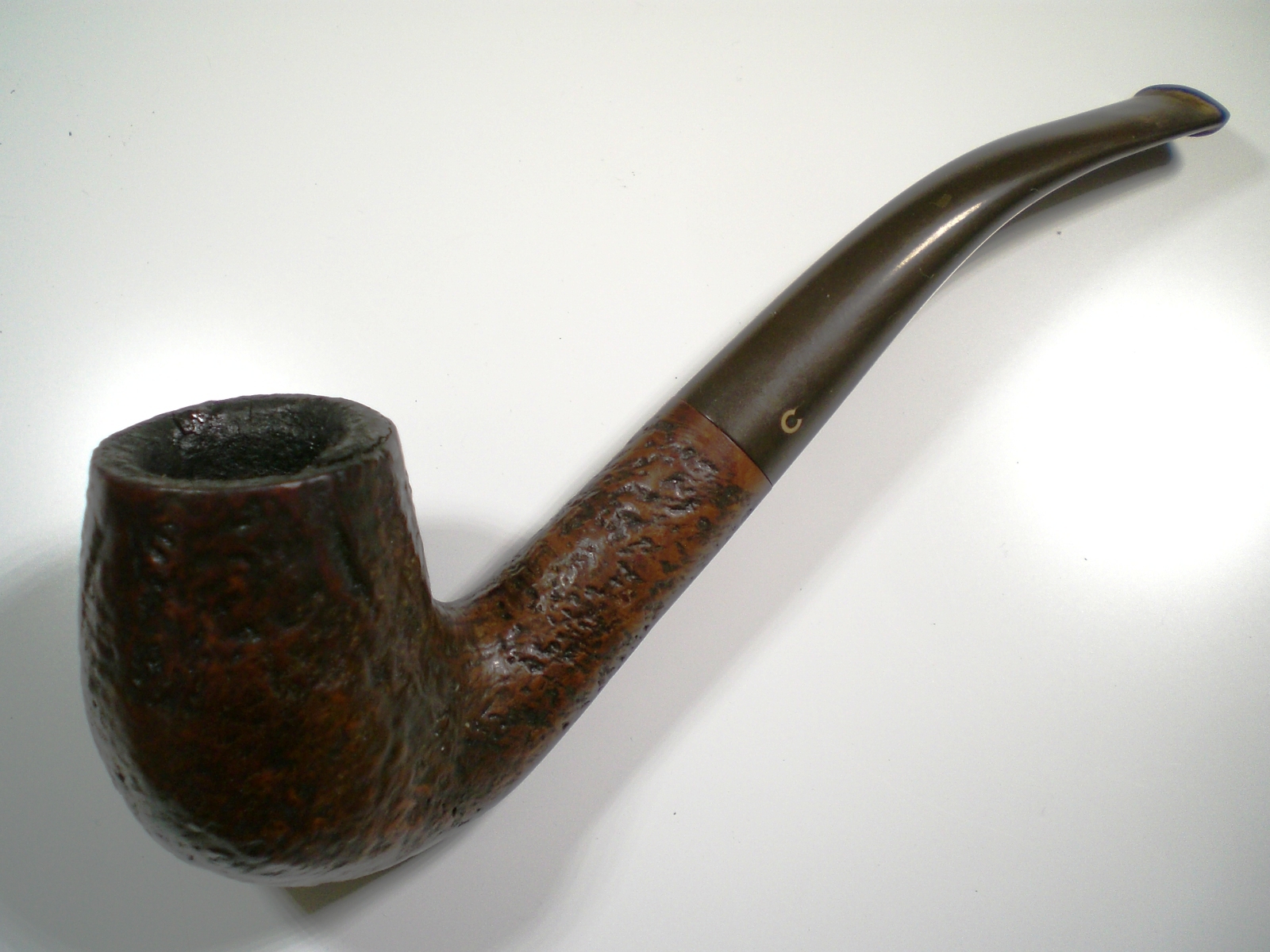
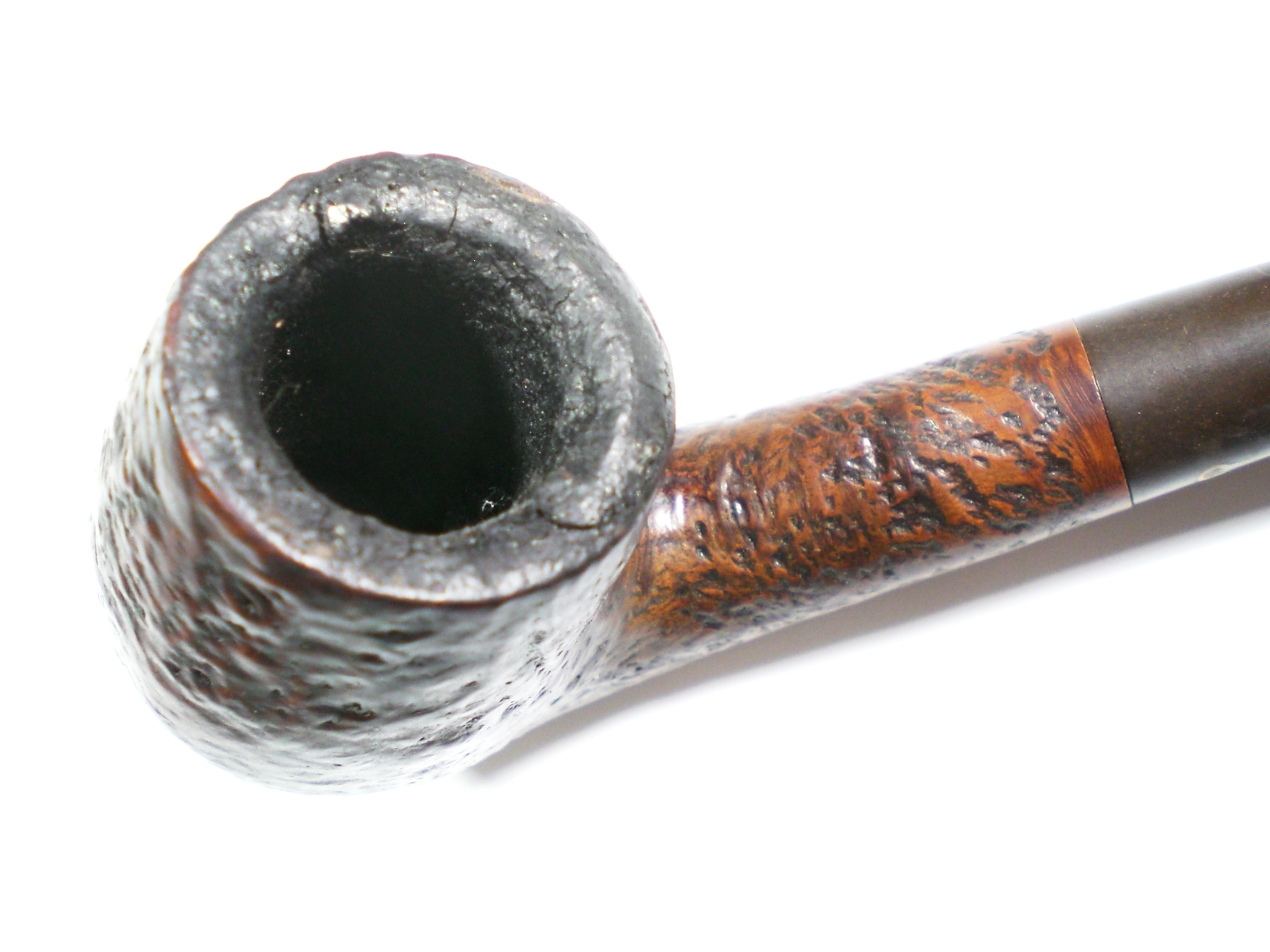
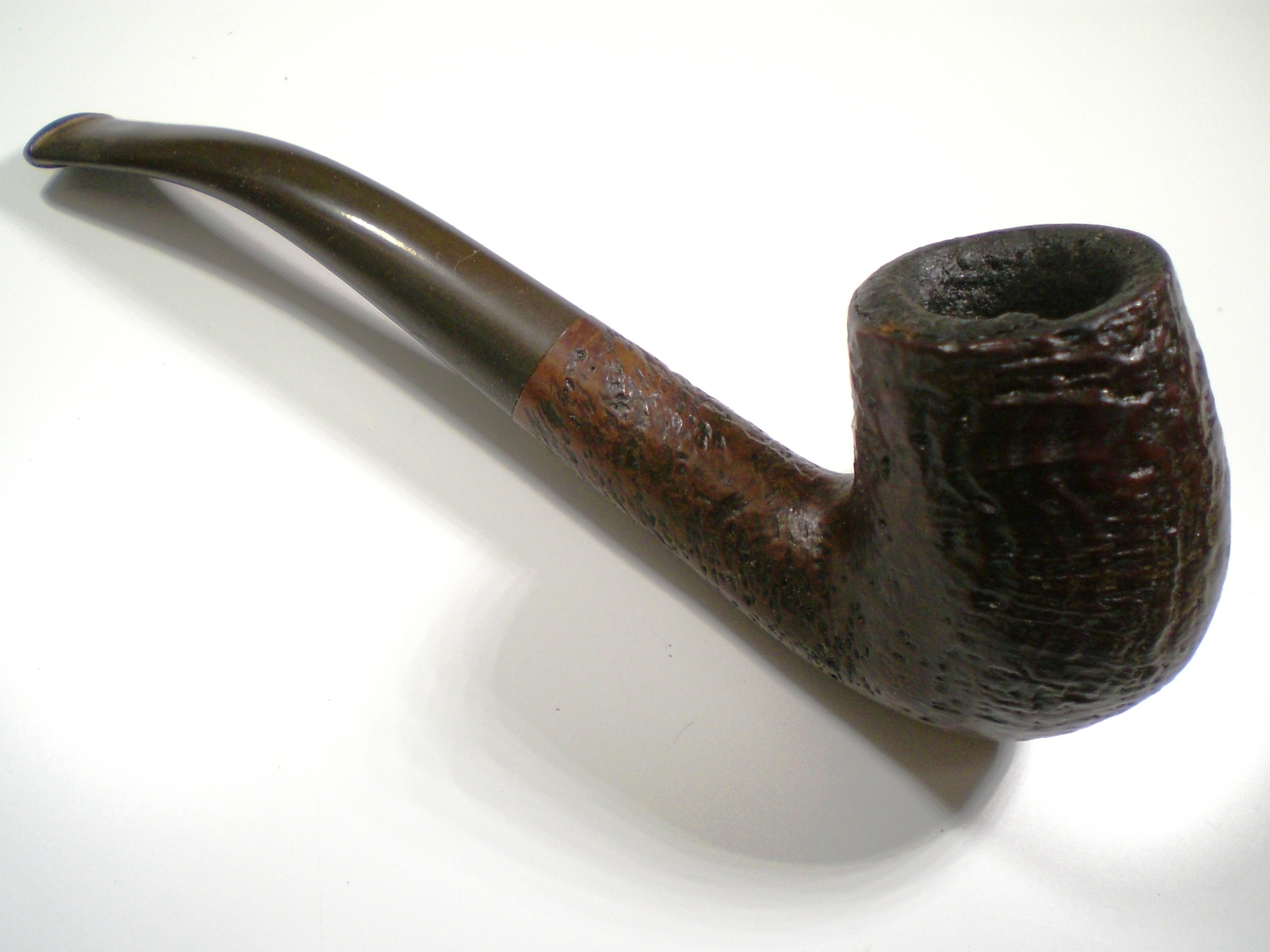
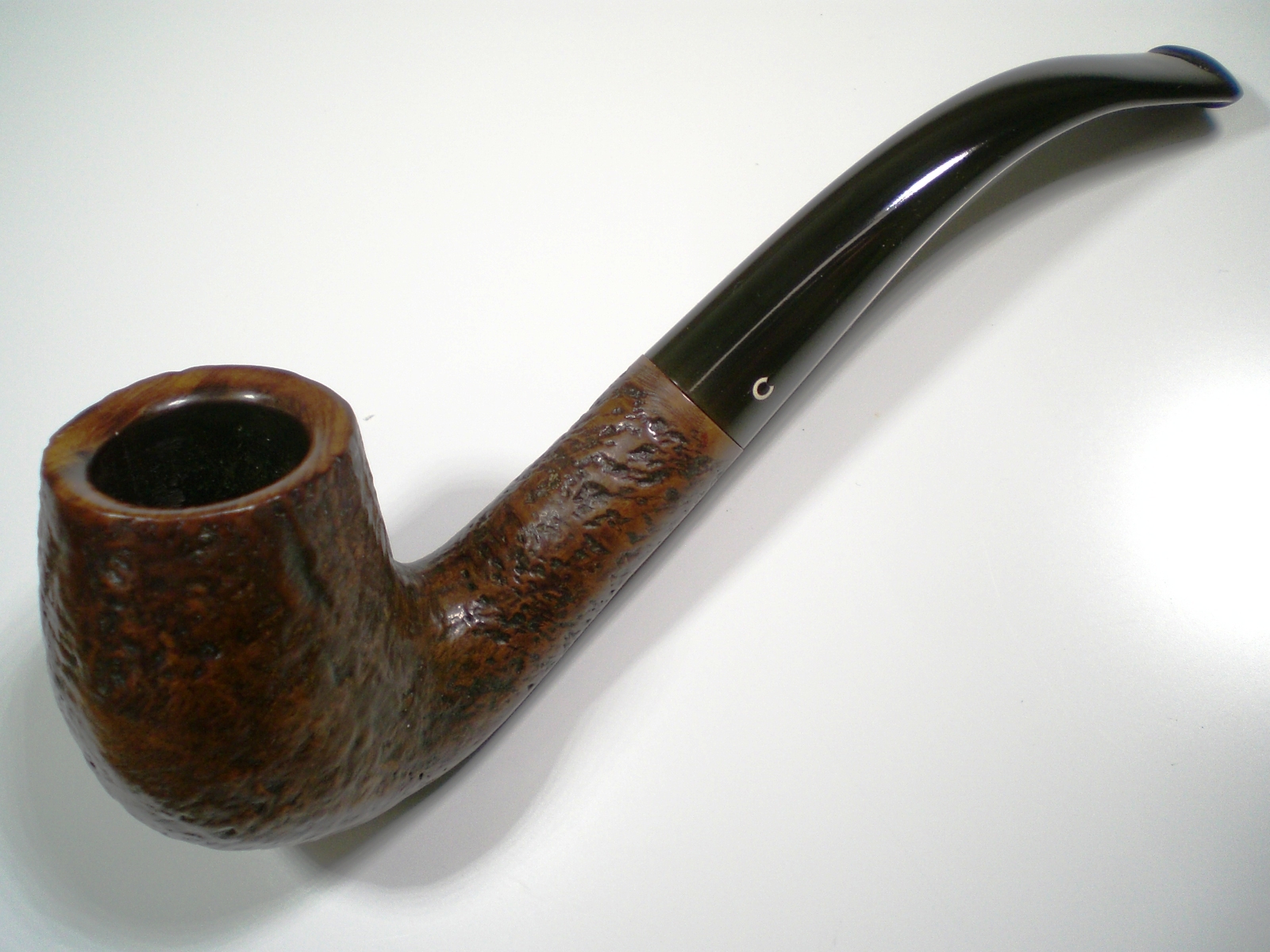
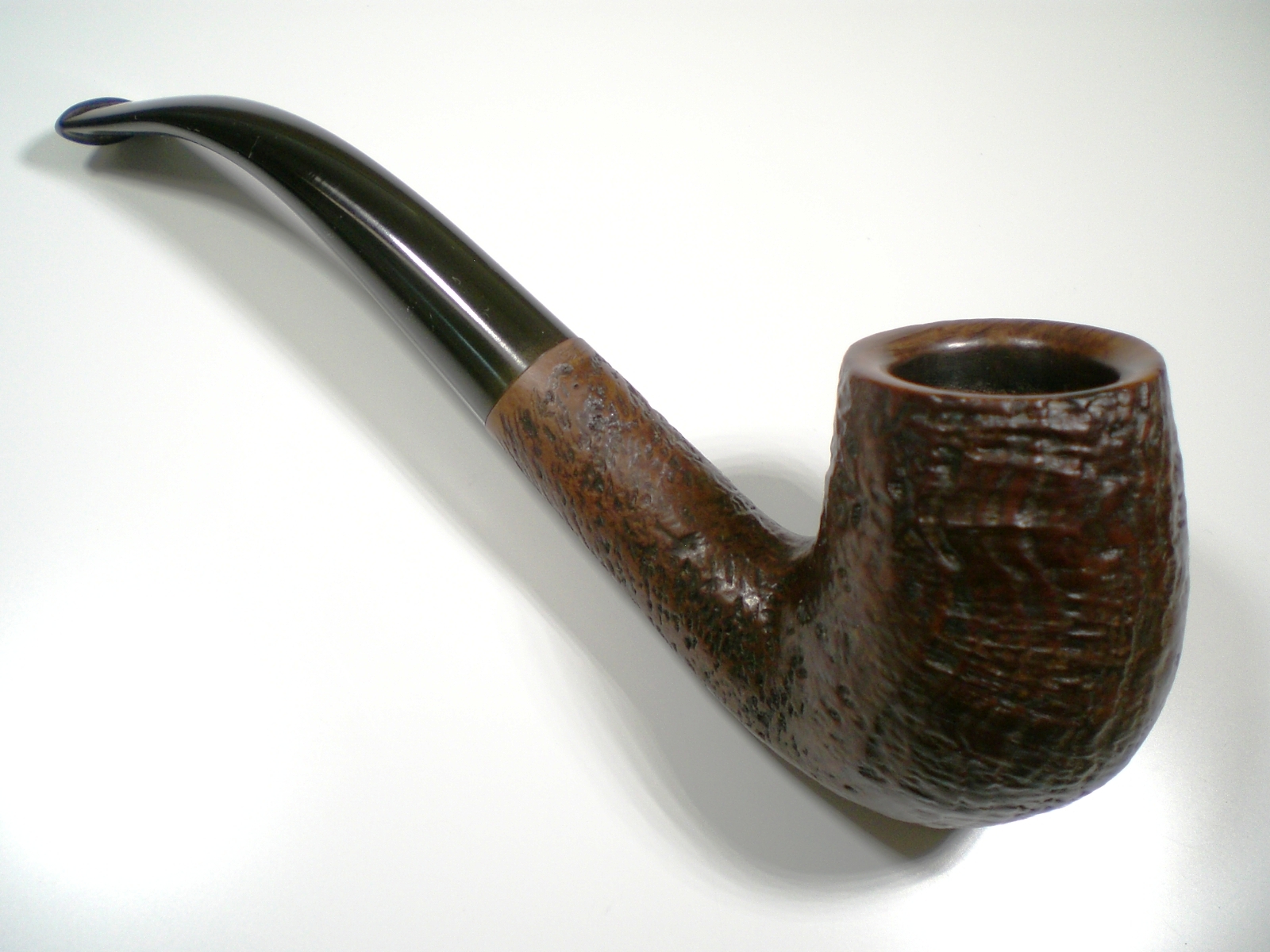
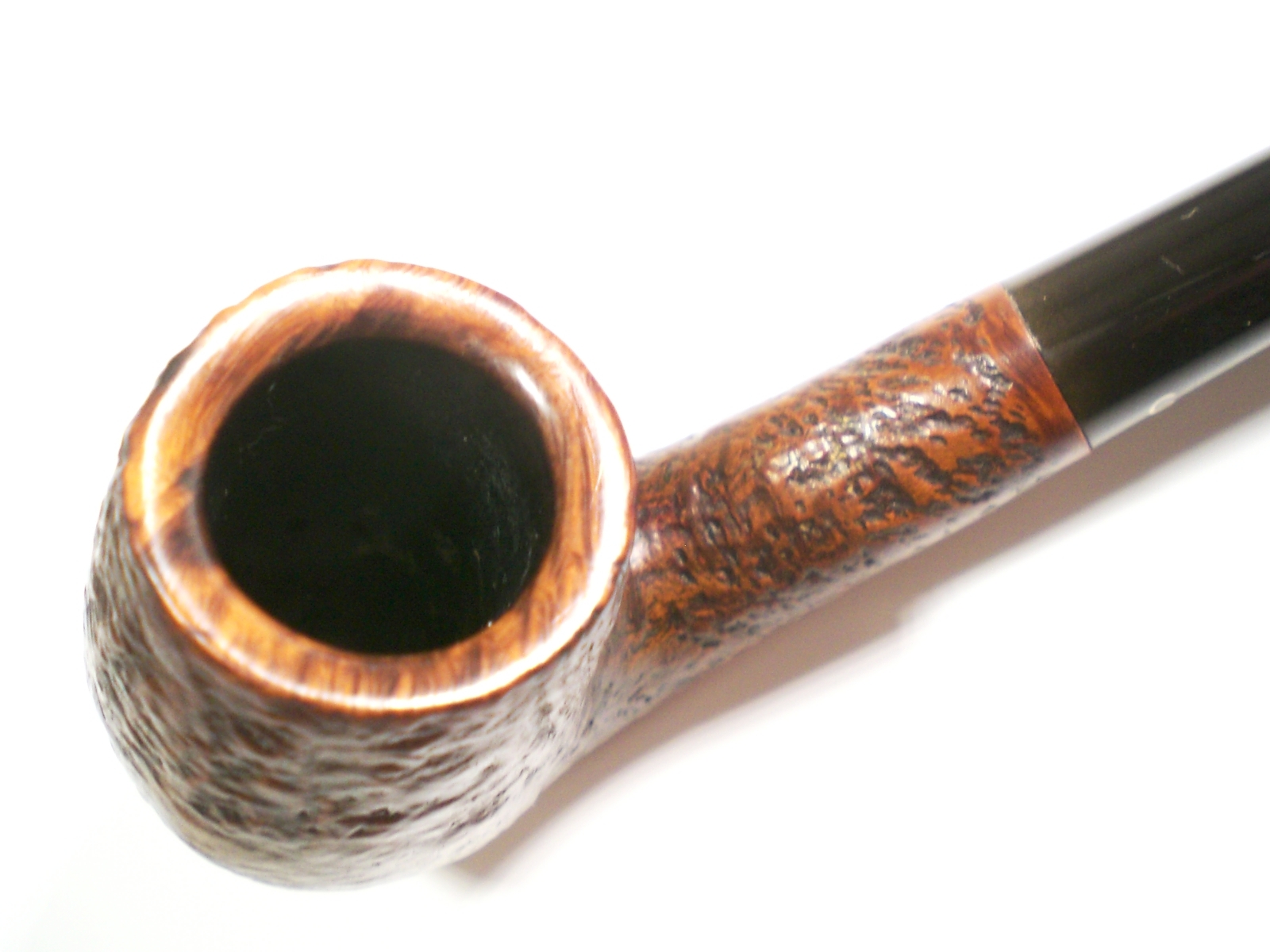
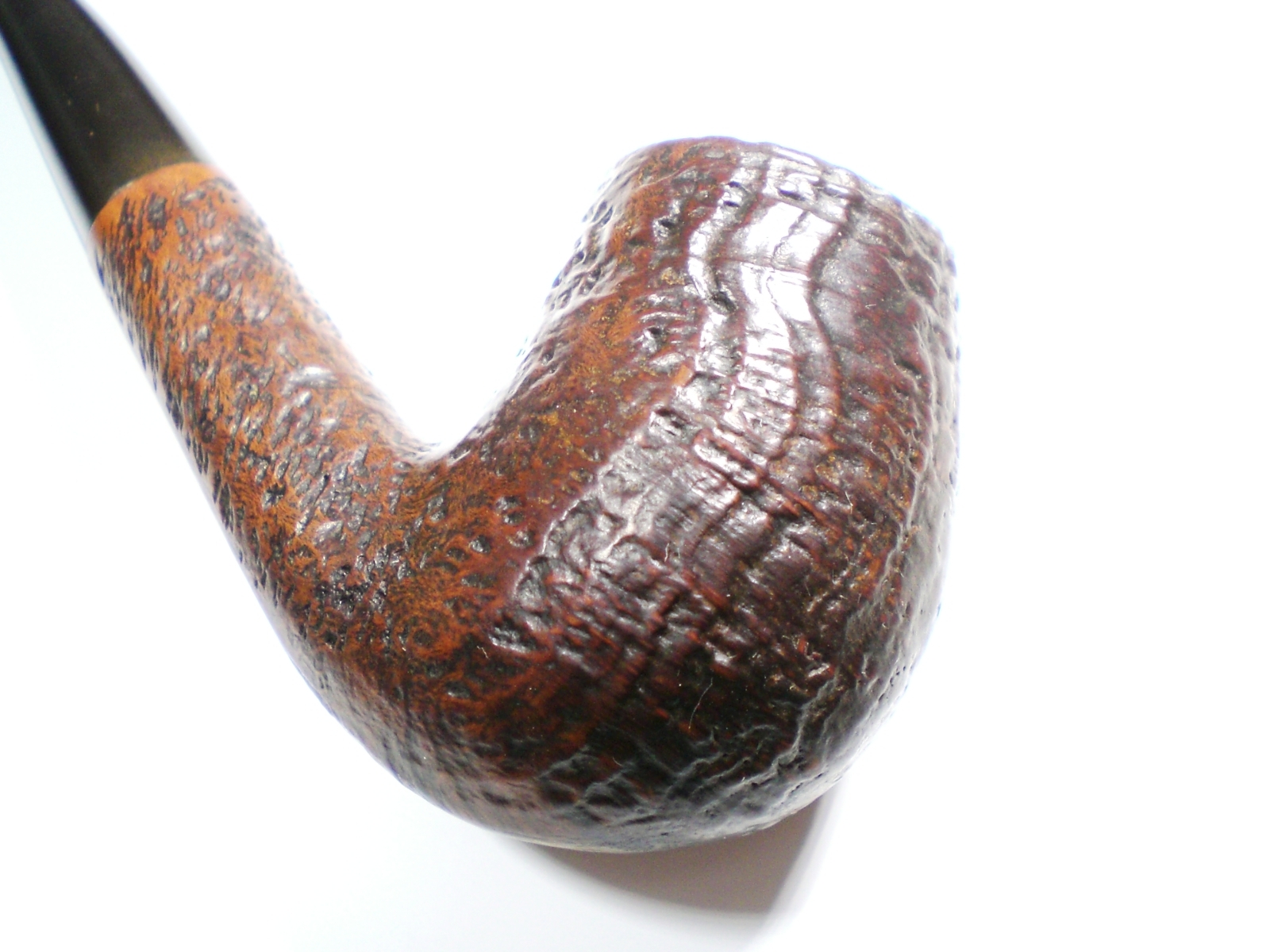
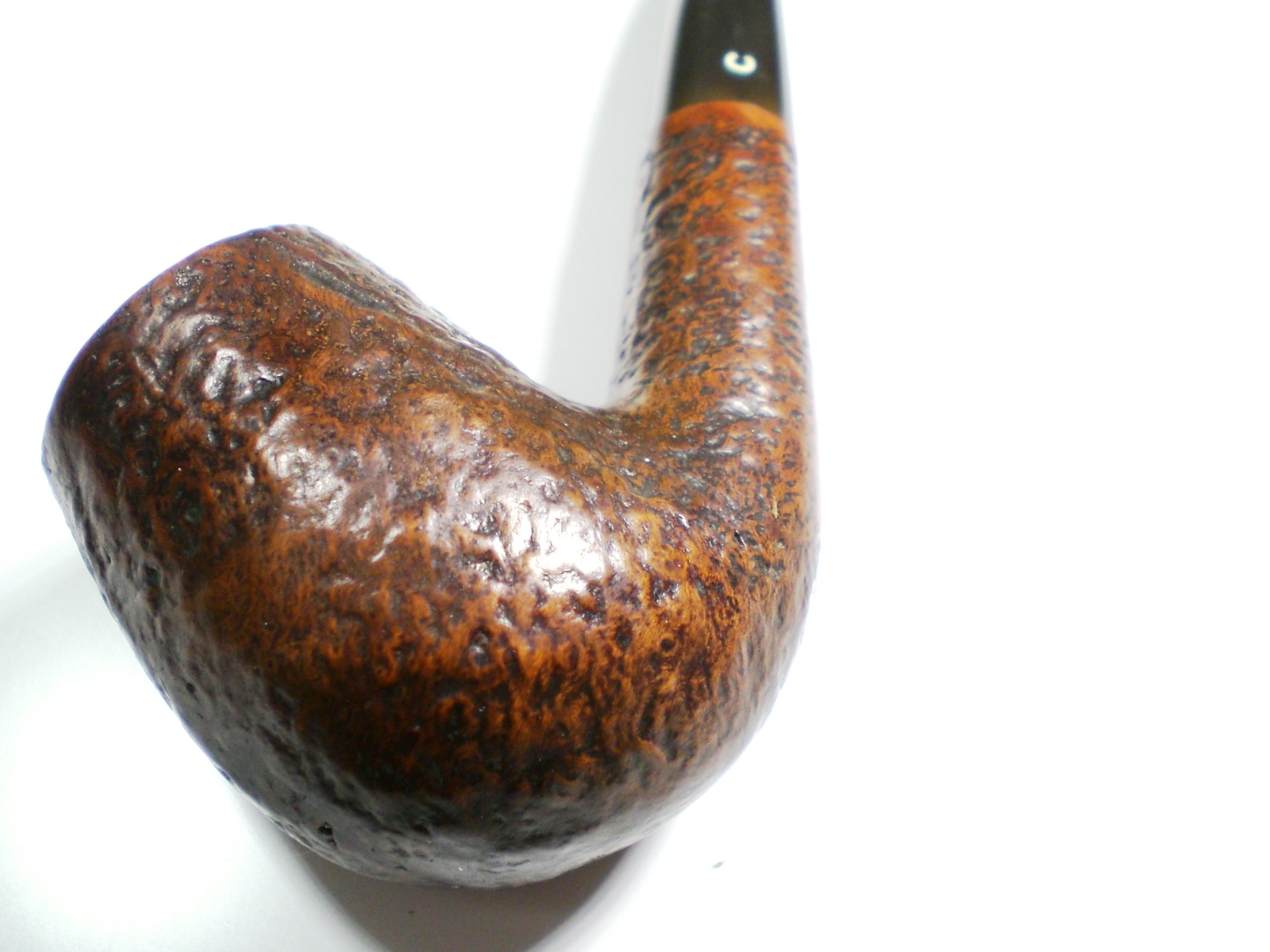
This is the second Comoy’s Pebble Grain pipe that has crossed my bench in the past two years. This one has a thick layer of carbon build-up on the bowl top, but I’ve learned that sometimes can hide a nice bowl and even possibly protect it from further damage. The stem appeared to be in great shape, with just a little oxidation.

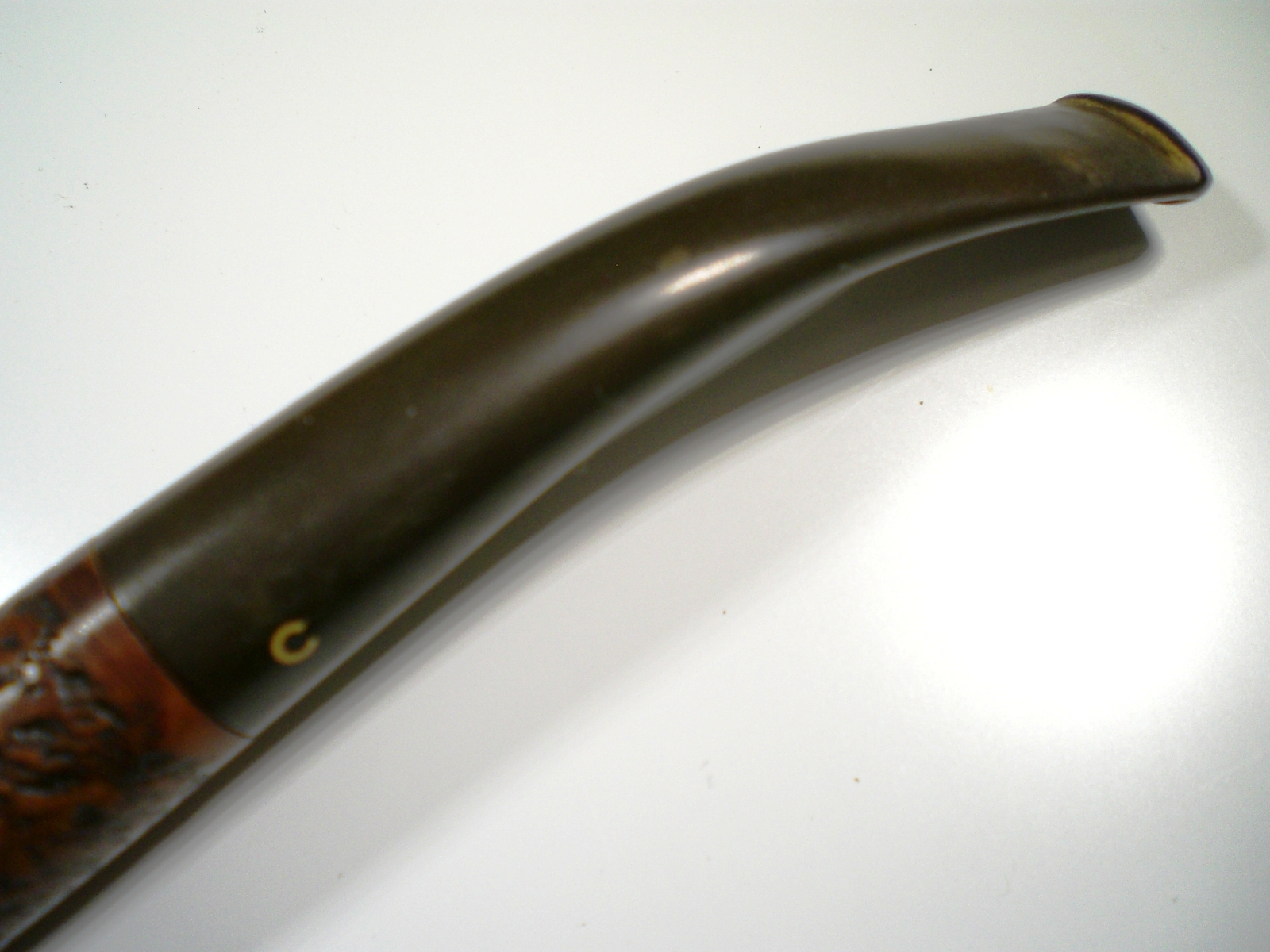
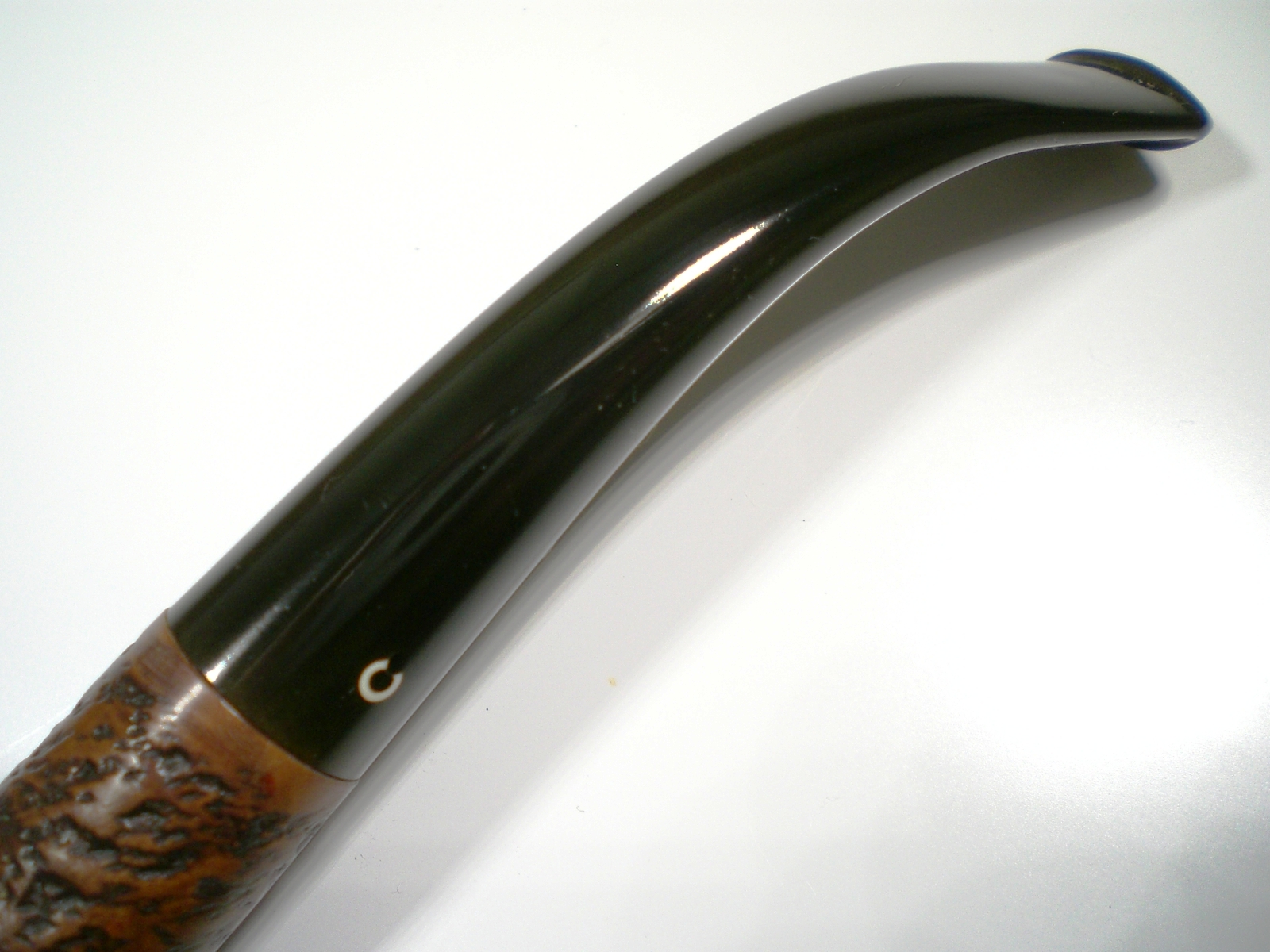
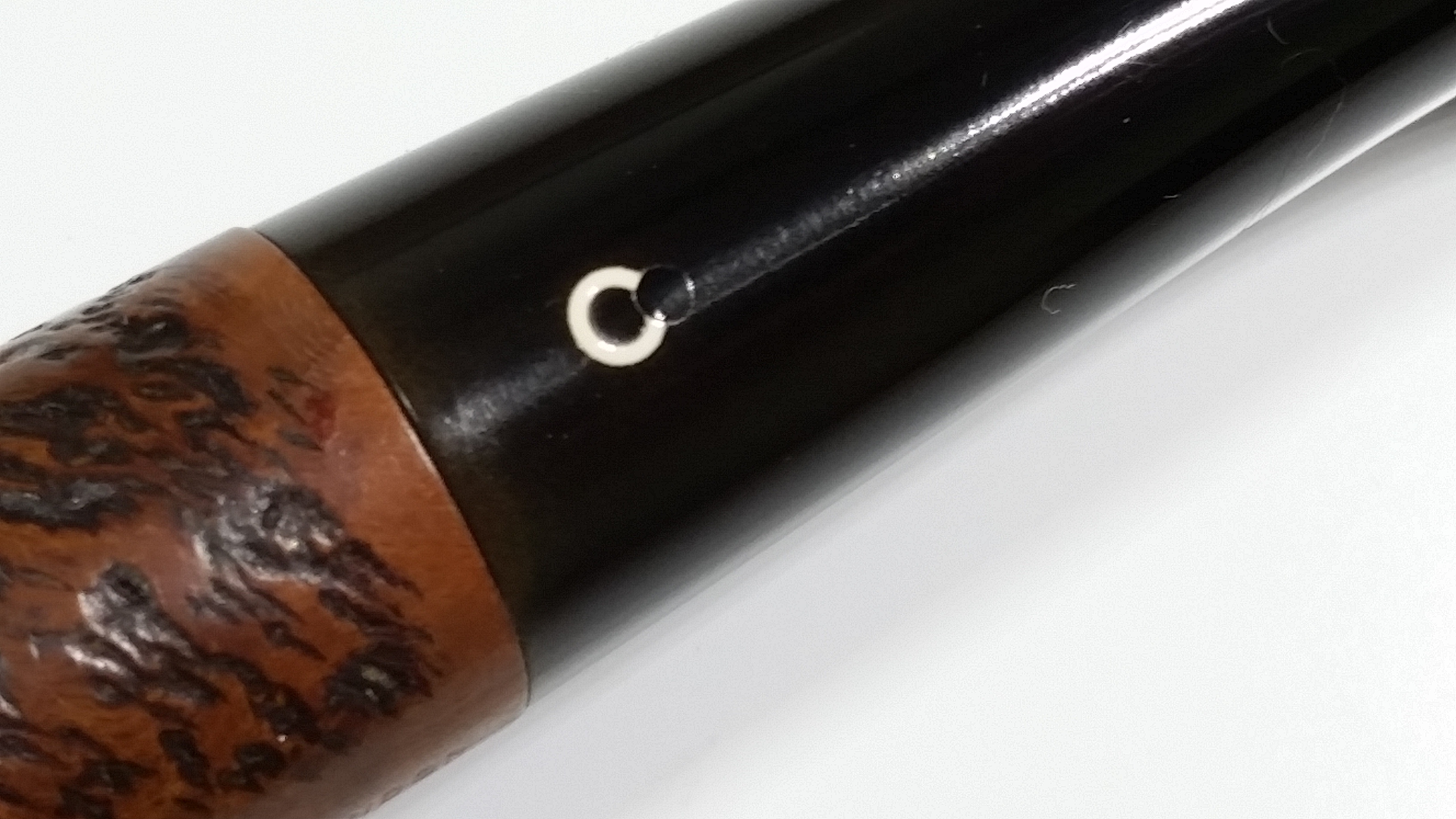
The 3 piece, drilled “C” stem logo indicates the pipe was made prior to 1981. Tony Soderman told me me that he believed Comoy’s introduced the Pebble Grain line in the 1970’s. Some while the straight line “Made In London, England” was used before WWII, this pipe was most likely made between he 1970’s to 1981.

Comoys_Pebble_Grain_42_Before (1)

Comoys_Pebble_Grain_42_Before (2)

Comoys_Pebble_Grain_42_Before (3)

Comoys_Pebble_Grain_42_Before (4)

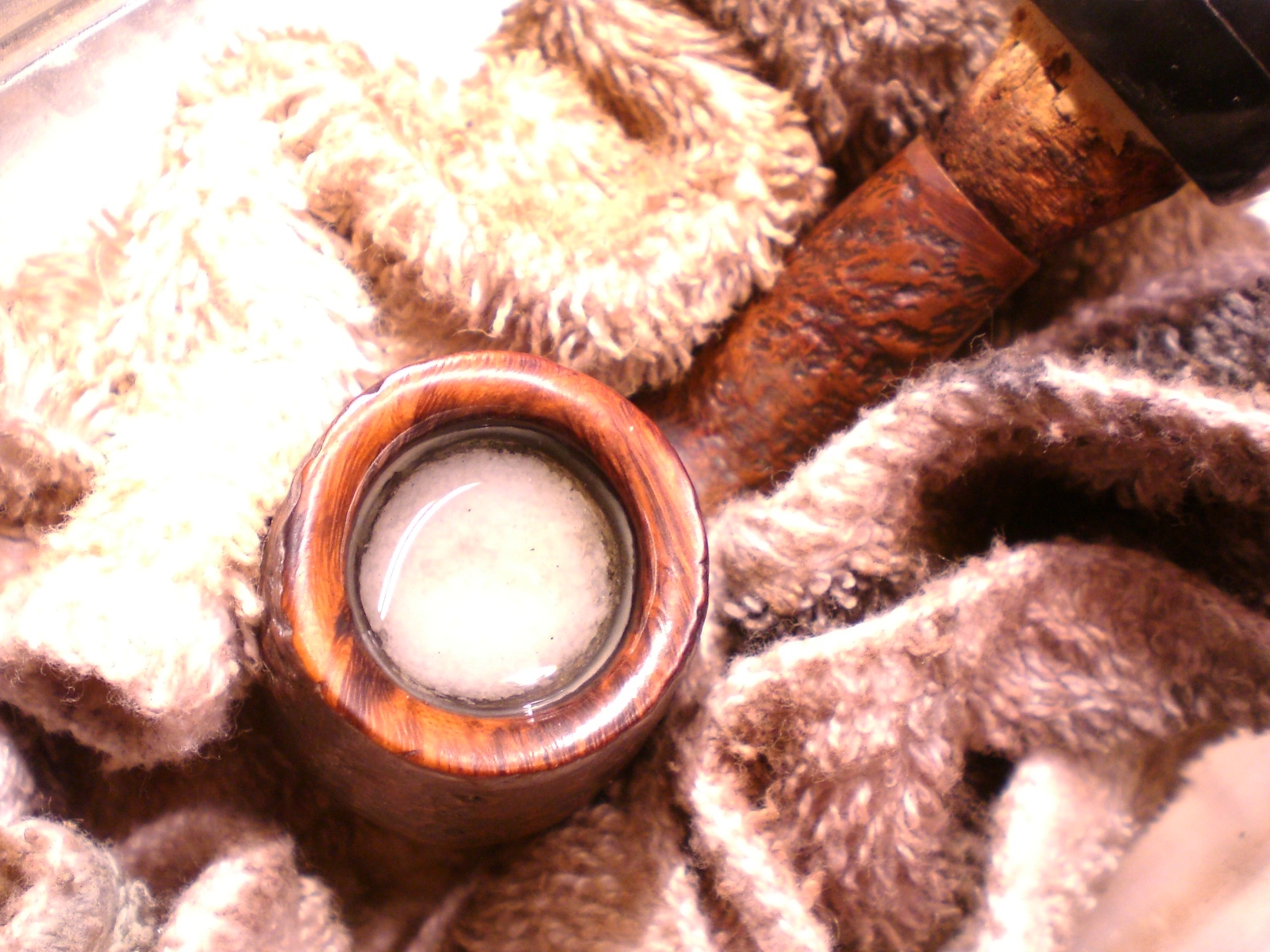
Comoy’s “Sandblast” pipes have a sandblasted bowl top but the Pebble Grains seem to all have polished, beveled bowl tops. I couldn’t resist seeing what was under that thick coating of build-up. A few minutes with a cloth dipped in a mild Oxy-Clean solution removed all of the build-up on the bowl top. A piece of worn 1500 grit wet paper restored the finish. I buffed the top with some White Diamond and it will be waxed in a final step. I then reamed the bowl and soaked it with 91% isopropyl alcohol and sea salt.

Comoys_Pebble_Grain_42_Before (6)

I put a dab of grease on the drilled, “C” stem logo and gave it a short soak in a mild Oxy-Clean solution. The oxidation was removed with 800 grade wet paper, followed by 1500, 2000 and then 8000 and 12000 grade micromesh sheets. I buffed the stem lightly with White Diamond and then Meguiars Plastic Polish.

I wiped the grime from the briar with some mild Oxy-Clean and a cloth and then hand waxed the bowl with Halycon wax.

Below is the finished pipe.

Comoys_Pebble_Grain_42_Finished (1)

Comoys_Pebble_Grain_42_Finished (3)

Comoys_Pebble_Grain_42_Finished (4)

Comoys_Pebble_Grain_42_Finished (5)

Comoys_Pebble_Grain_42_Finished (6)

Comoys_Pebble_Grain_42_Finished (2)

Comoys_Pebble_Grain_42_Finished (7)

Comoys_Pebble_Grain_42_Finished (9)

Comoys_Pebble_Grain_42_Finished (8)

Comoys_Pebble_Grain_42_Finished (1)

Bringing new life to an old corn cob


Blog by Steve Laug

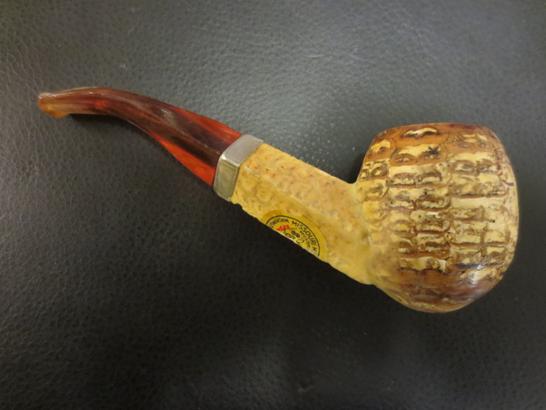
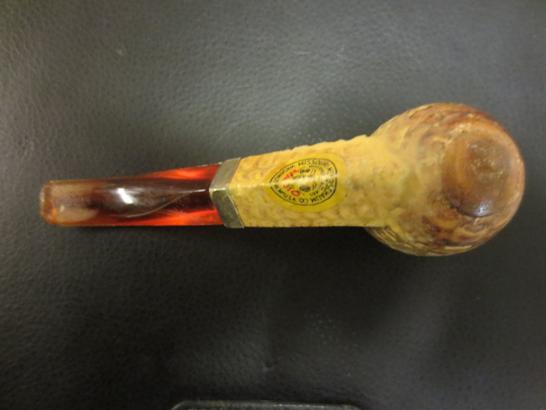
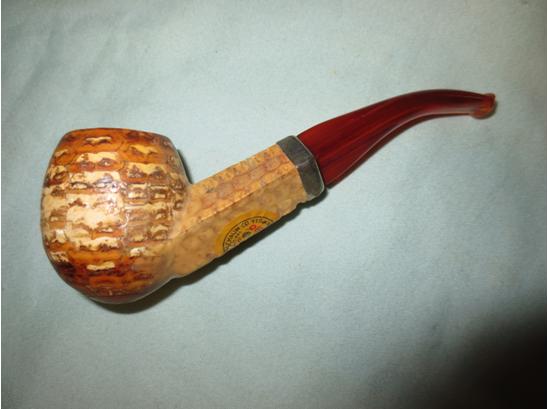
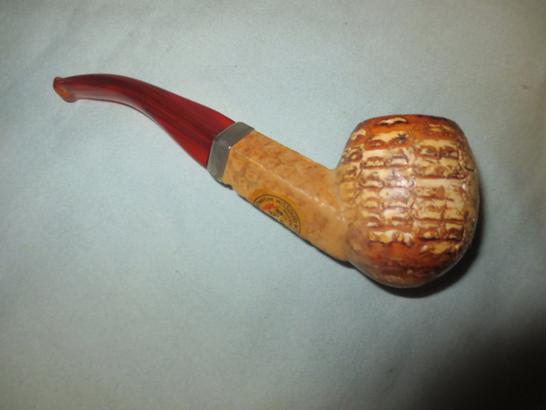
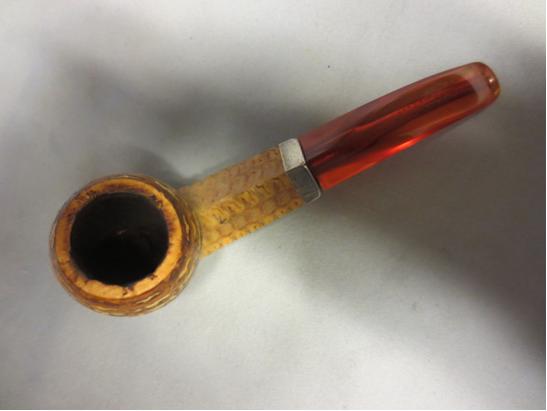
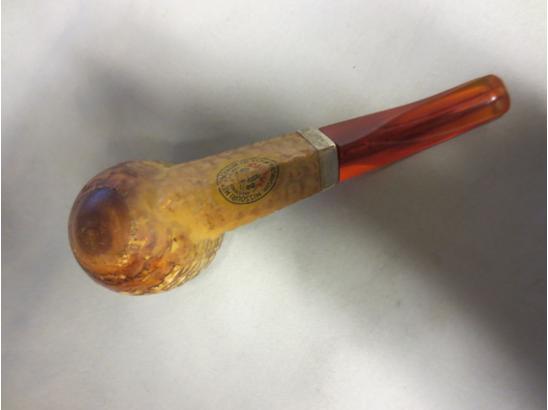
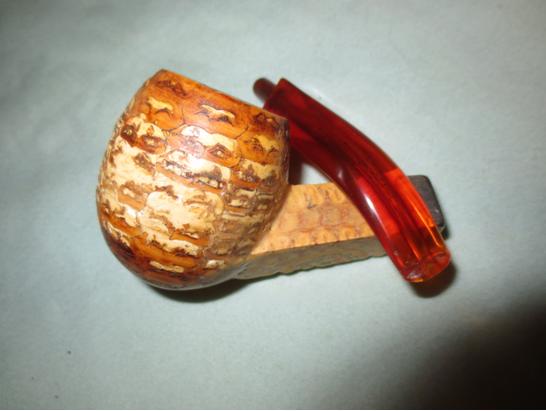
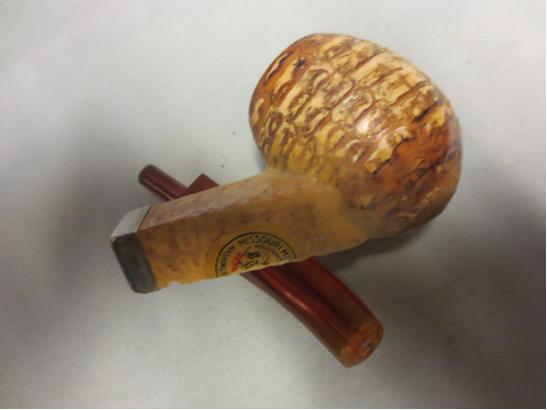
When I was in Idaho for the funeral of my mother in law my brother and I took the day after the funeral and went on a pipe hunt. He has been attending auctions and going to antique shops on his travels and he picked up some nice pipes that he passed on to me. I will be working on them for a few months. He also had visited several of the antique malls in Idaho Falls where we were. On that day we visited three of them. In one of them there were a few pipes that caught my fancy one of them was an old corn cob bent with a diamond shank. It was in rough shape in that the glue that usually seals the shank into the bowl was gone and it was pretty loose. The bowl was well smoked and had a cake that I would need to clean up. The rim was also blackened. The bowl has a hardwood plug in the bottom which adds to the durability of the pipe. One unique feature of this pipe was that the shank was made of cob. It had some dings and nicks on it. The bottom of the diamond shank bore the Missouri Meerschaum label. There was a brass band that protected the end of the shank. The stem was Redmanol or Bakelite – a nice rich red coloured plastic that had some tooth chatter but no deep tooth marks or cracks. The orifice button on the stem and the material it was made of made me pretty certain that this was an old timer – possibly from the 30s.

Typical of what happens when I find old pipes like this I can’t wait until I get home to start working on them. In this case I figured I wanted to stabilize the shank in the bowl so that it would not get damaged when I carried it home in my luggage. I bought some Elmer’s Wood Glue and used it to fill in the gap around the entrance of the shank to the bowl. I used it to also repair some of the nicks on the sides of the bowl and the shank. I gave it multiple coats to build it up so that shank bowl union was smooth and the dings and marks were also smooth. Of course being in a rush to work on it I forgot to take pictures of the pipe before or during the early stages of the repair. When I left for Vancouver the bowl and the shank transition were smooth and the nicks and dings were also smooth on the surface of the bowl. I need to sand them and feather them into the surface and take off some of the glue shine.Cob1

Cob2

Cob3 I lightly sanded the rim to remove the blackening and clean up that surface. I reamed the pipe with a PipNet reamer and took the cake back to a very thin coat. The bowl is still round so that will not take further work to fix it.Cob4
Cob5

Cob6

Cob7 I cleaned out the bowl and shank with cotton swabs, pipe cleaners and alcohol until they were clean. Due to the shank being cob I was careful how much alcohol I ran through it as I did not want to soften the shank any further by making it wet. I cleaned out the inside of the stem with pipe cleaners and alcohol again being careful to not damage the Redmanol material.Cob8 I sanded the stem with 220 grit sandpaper and then with a medium grit sanding sponge to remove the too chatter on the top and bottom sides of the stem.Cob9

Cob10

Cob11

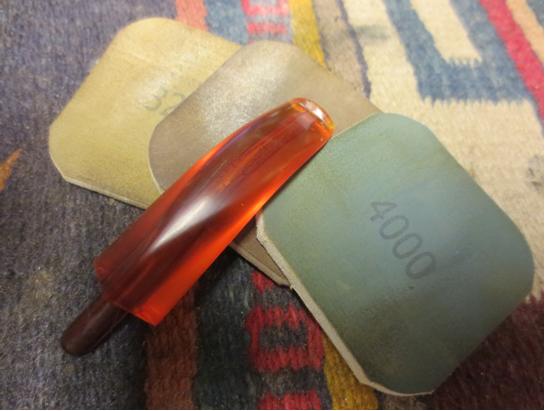
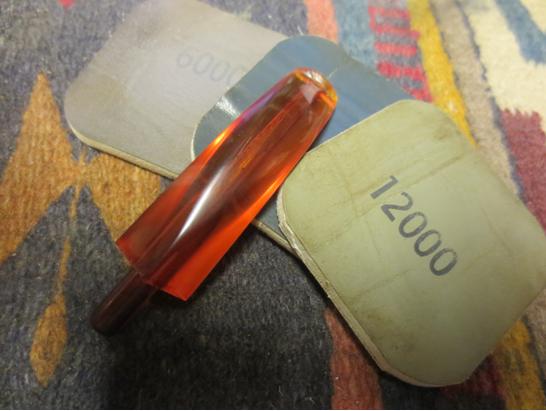
Cob12 I wet sanded the stem with 1500-2400 grit micromesh and rubbed it down with Obsidian Oil. I dry sanded it immediately with 3200-4000 grit pads so that the micromesh had some bite to it. The oil provided a surface that allowed the micromesh pads to polish the stem. I dry sanded further with 6000-12000 grit pads and then buffed it with Blue Diamond on the buffing wheel. I gave the stem several coats of carnauba wax and then buffed it with a clean flannel buff to give it a shine. I hand buffed it with a microfiber cloth to finish the polishing.Cob13

Cob14

Cob15 The finished pipe is shown in the photos below.Cob16

Cob17

Cob18

Cob19

Cob20

Cob21

Cob22

Medico’s Answer to the Falcon – The Double-Dri


This is one Medico I would like to add. I am on the lookout for things like this. Well done.

Charles Lemon's avatar

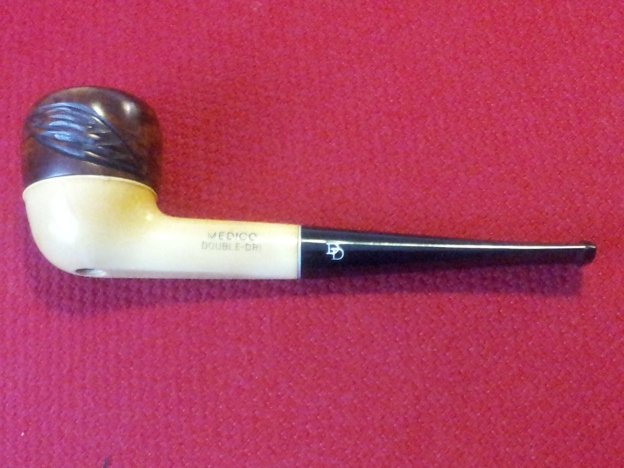
I pulled this Medico Double-Dri pipe out of my refurb box the other day. It had been rattling around in there for a while, and I decided it was time to do something about it.

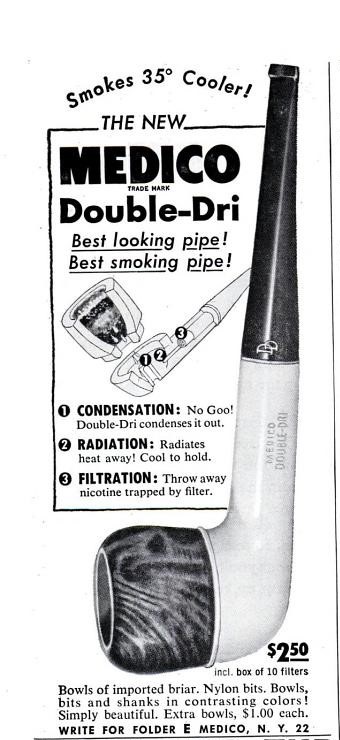
There are several well-known brands of pipes designed with removable and interchangeable bowls – the Falcon and Kirsten pipes jump to mind. The Double-Dri was Medico’s foray into the field, though where the Falcon pipe used aluminium for its shank, the Double-Dri used another 1950’s Space Age material, Nylon, for both shank and stem. Press-fit bowls were available in briar or the more expensive meerschaum. I couldn’t find much information online when I set about researching the Double-Dri pipes, though I did come across this Medico advertisement in the March 1955 edition of Popular Mechanics magazine.

Advert - March 1955 Popular Mechanics

This ad is clearly from the period before truth-in-advertising laws took effect. I wouldn’t bet the farm on the existence…

View original post 840 more words

A Quick DIY Pipe Display


Great idea Charles. I may have to adapt that to my collection… it sure is easier than the boxes and drawers I use now. Well done.

Charles Lemon's avatar

Hi everyone. Here’s a quick mid-week post to share a DIY solution to every piper’s perennial pipe storage shortage.

I made this 28-pipe storage/display rack in just a few hours. I was lucky enough to find a 24″ x 32″ piece of 5/8″ plywood in my garage, and a rummage through the fabric bin turned up a suitable remnant of black velvet fabric left over from another project. An old bath towel the Mrs had declared unfit for human use completed my scrounged materials.

I lay the velvet face down on my work table, then lay the towel on top of the velvet. The plywood was then laid on top of the towel. I trimmed excess fabric away, leaving just enough to wrap up over the edges of the plywood and about an inch more, where it was securely stapled to the back of the wood. This produced a nice…

View original post 269 more words

( EUGENE RICH ) Boxed Custombilt 1946-1952


Yet another beautiful Custombilt. Great restoration of a wonderful boxed pipe. Well done.

pipesrevival's avatarPipesRevival

20151030_223109~2

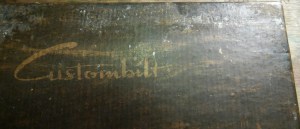
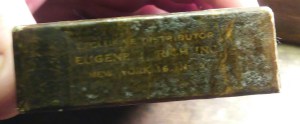
My wife and father through a joint effort picked this one up for me, it arrived today and I was blown away . I’ve been trying to get my hands on a boxed Custombilt for a few years but they were always just out of reach. This beautiful bulldog is a Eugene Rich era Custombilt very lightly smoked, amazing condition and it came with the original box, paperwork and guarantee. The box was a little rough around the edges not unlike the pipes themselves. This is my first Rich era Bilt and not an ounce of filler, I’m starting to think it’s time to broaden my horizons.

 This is more of a standard clean up then a restoration. I decided to share this clean up because every collector/pipe smoker has there white whale. Whether it be a priceless one of a kind or an inexpensive hard to find piece.

20151030_211521~220151030_211525~220151030_211515~220151030_211530~220151030_211535~2

Sometimes it’s the packaging that needs the work…

View original post 435 more words

A Pipe’s Journey – Big Ben Select Bent Billiard


Blog by Steve Laug

I personally enjoy knowing the history or journey of a pipe before it arrives in my trust. So when I am gifted a pipe I record where it came from and if I keep it I have an idea of the path it took to come to me. If I gift it forward I pass on that information to the next owner if they are interested in knowing. I don’t know what it is about the story of a pipe that intrigues me but I have some idea that it is because of the connection it gives with pipe men behind me and those who will live beyond me. I know that a briar pipe will live long after I am gone. Because I buy estate pipes I know that it has had a long history before it came to me. When I know that history it adds a dimension to my enjoyment of the pipe. When I don’t know the history I can learn a lot about it from the previous pipe man who smoked it before me.
This pipe came to me in a gift box of six pipes that were in need for refurbishment from a friend in California on Smokers Forums. I believe he picked them up from Ebay in a lot of pipes he purchased. As many do, he bought the lot for one of the pipes and then set aside the others to either work on or to pass on to others. This particular pipe was a sandblasted Big Ben Bent Billiard. Underneath the wear and tear I could see that a gem still resided. It had a silver band and a nice looking blast. I could see from the use and condition of the pipe that it was obviously someone’s favourite pipe. I must have been a great smoking pipe because it was smoked into the condition it arrived at my work table.

The finish was rough but shape was classic. The feel of the pipe in my hand was perfect. It fit in the cup of my hand and was light weight and comfortable. The thin stem would clean up nicely and feel great in the mouth. There was some work to do before it would be ready to be smoked by me or by someone I gifted it to that was for sure. The bowl was dirty and thickly caked. The shank and stem were filled with tars and grime. The bowl was stamped on the underside of the shank – Big Ben Select under a B in a circle. The rim edges were worn and rough but as it was a blast this would not be a problem to clean up. Over the stain coat was also a shiny varnish or lacquer coat that I always find to be a pain to remove and deal with in a pipe that is worn like this one. The outside of the stem was oxidized but the circle B logo was still deeply stamped. There was also a slight tooth mark on the underside of the stem near the button. The button was very tight and small – so much so that a thin pipe cleaner was work to get through the slot. I described the process of refurbishing this old timer in a previous blog that can be found at the link below. https://rebornpipes.com/2013/01/20/new-life-for-a-big-ben-select-bent-billiard/

I don’t know anything about the original owner of the pipe as the gifter had no information on where it had come from. However, that being said I could tell a lot about the pipe man who had smoked it to this point in its life. From the condition of the pipe I knew that it had belonged to an old timer who smoked his pipes until they were worn out, threw them away and picked up another one. In terms of that scenario this pipe had a lot of life left in it. I could see that the pipe had never met a pipe cleaner in its long existence. I could tell that it was smoked almost continuously without a break to let it rest. I think it could easily fit into the category of rode hard and put away wet that accompanies many an old horse. All that being said it must have been a great smoking pipe to have been so “loved” that it never left the hand of the pipe man. The wear on the finish around the bowl where his hands rested showed how he held it. The small tooth mark on the underside of the stem near the button showed the way he clenched it in his mouth. As for the tobacco he smoked – well it was pretty oily and dark smelling so there is part of me that thinks that it was something like Erinmore. The cake was hard and dense.

Here are some photos of the pipe when I finished restoring it. I knew that one day I would find the right person to pass this one on to.Ben1

Ben2

Ben3

Ben4 Not too long ago now I was talking to a good friend of mine, Dal who lives in Sofia, Bulgaria. He had recently taken up the pipe again. He had a few pipes that already had stories attached to them so we spoke of cleaning up and restoring his pipes. We talked about methods and tools used to clean them so that he could bring them back to a bit of their former glory. That got me thinking that I would like to pass a pipe from my collection on to him. Looking through my rack my eyes fell on the Big Ben Select bent billiard and I knew this was the one that I would gift to him. It had an interesting history and the idea of sending this Dutch pipe back to Europe just fit for me. I also knew that the thin stem, the tactile sandblast and the bend of the pipe would appeal to his liking.

The timing was perfect as one of his colleagues was here in Vancouver for training at our office so I could send it back to Bulgaria with her. It would be hand delivered in a timely way and much more likely to arrive in one piece than if I shipped it to him through the post from Canada. I took it from the rack and gave it a quick cleaning to remove any dust that had collected. I gave the pipe a light buff with carnauba wax and then with a clean buff to bring up a shine. I took it apart and wrapped the stem and the bowl separately in paper towels. I put a small bag of Stokkebye’s Balkan Supreme with the wrapped pipe and put the gift into a ziplock bag for easy delivery.

This past weekend she gave him the pipe. I was curious to find out what he thought of it so I fired him an email and asked him. Sometimes my curiosity cannot wait to just let things happen at their own pace I want to know sooner. I wanted to be able to finish my chapter of the life this pipe. I had after all delivered the trust to another pipe man and I wanted to discharge the trust for this old pipe to him. He wrote the following email in response:

Hey Steve,
Well, I named it ‘Vancouver’. It only seemed right. I really like it – the look, feel…very nice. Today I smoked my first bowl, recorded it for posterity with the photo attached. I’m not too practiced at doing selfies…. Very light weight and smoked well. I love the stem design too. Thanks. The tobacco was good too – starts with a sweet aroma and finishes with something really full – can’t quite put my finger on it. I look forward to hearing the back story on it.
Dal
Ben5 So my trust has been discharged. With one journey across the Atlantic under its belt and travel to the West Coast of the US from somewhere in the Eastern or Central US it now crossed the Atlantic once again. It had a stopover in Amsterdam and Budapest before it came to Sofia, Bulgaria. Its story can now continue in the rack of another pipe man a continent away from the original purchaser of the pipe. His first bowl was a Balkan Supreme on the balcony of his apartment in Sofia. I am sure that he will add his own unique elements to the story and will grow and expand over the years he enjoys this pipe. One day when he passes it on as a trust to another pipe man he can also pass on its history with his part of the tale added to the story.