Daily Archives: July 4, 2012

Peterson Mark Twain shank repair using a copper band


Blog by Bryan

Bryan, SenatorXMG, on Smokers Forums posted this photo essay on a repair he did on a cracked shank on a Peterson Mark Twain that he purchased. I asked for permission to post it here for information and passing on a great trick to others who would choose to use his method. He gladly granted that permission and I include it below for your use.

Well…today was the day to fix my Peterson Mark Twain with the cracked shank. I had previously posted on Smokers Forums regarding the problem and looking for advice on repairing it. I include the text and picture that I posted below.

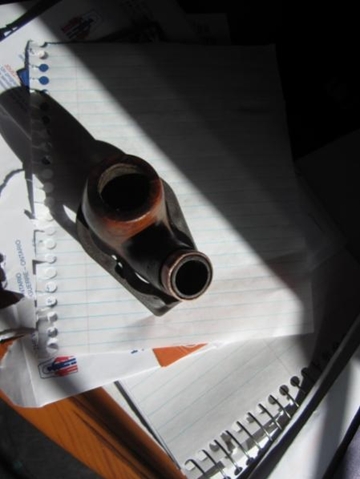
I bought a Peterson Mark Twain off of eBay and when it arrived I discovered there was a crack in the shank. With the silver cap on the shank it was not easy to see and I believe the seller that he was unaware. You can only see the crack from inside the shank…with stem in place, it’s evident that it expands a little as the stem sits more deeply in the shank and is not quite so secure. Other than this crack, the pipe is in pretty good condition. The seller offered either a full refund or a partial one of $55 (he increased from the original $40 he offered). If I could have this adequately fixed, I’d be interested in that.

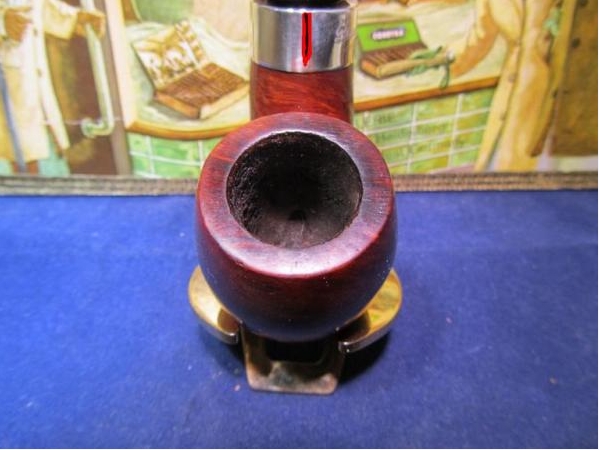
I’ve included a picture of where in the shank the crack is. It actually runs from the top of the shank down to the air hole.

I’m wondering if this is something I could repair myself. Any repairmen out there who could give me a basic step by step idea of how I would approach this fix? I was considering the following:
– remove cap (this is fairly straight forward. I’ve done this before)
– add appropriately-sized shank ring. Might have to sand down an area so that the ring is flush with the remaining shank? (I have no idea how this part is done and how I’d get a tight fit of the shank ring).
– re-install cap (easy to do)

While I’m pretty handy, this seems like it could be a job for someone with skills greater than mine. Would the $55 the seller has offered me back cover this type of repair from someone with experience?

Crack location marked in red/black indicated on silver cap (actual location is seen on the inside)
Image

I decided to repair the pipe myself and created a small photo essay on the work done in repairing the pipe. Here it is:

The silver cap was removed with use of heat. Once it is removed the crack is very visible. Copper piping will act as source of repair band.

Image

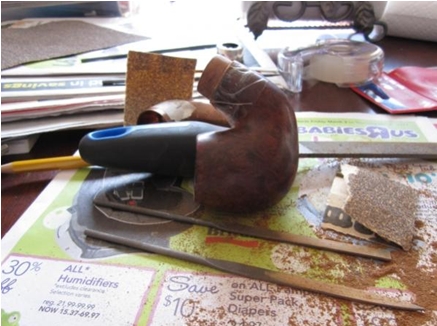
I sanded down repair area where copper band will be installed.
Image

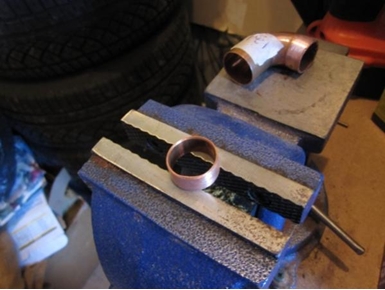
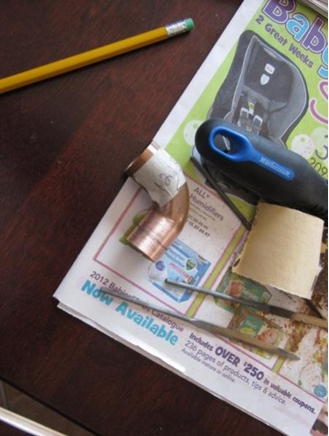
The copper piping is marked and ready to be cut.
Image

Copper band cut and filed smooth:

Image

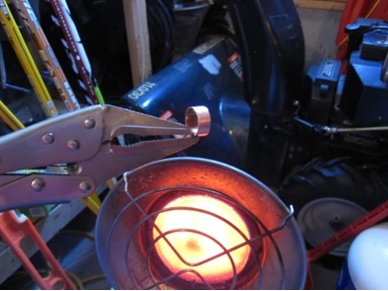
Heat for installation. No blow-torch to heat…had to use my propane space heater (it worked!):
Image

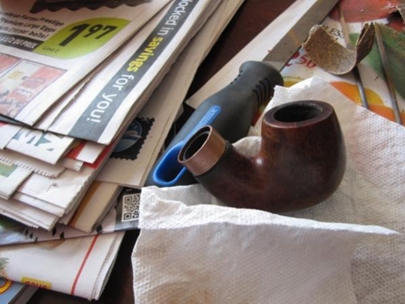
Cooper band installed…with a little bit of gentle force:
Image

To the grinder to clean it up a little:
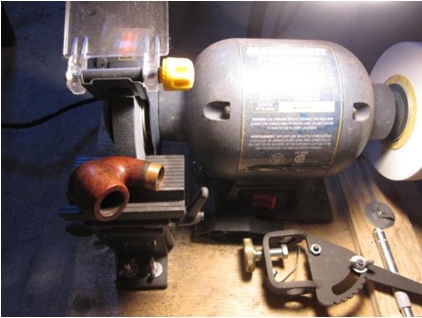
Image

Ahhhh…that’s a little better:

Image

Image

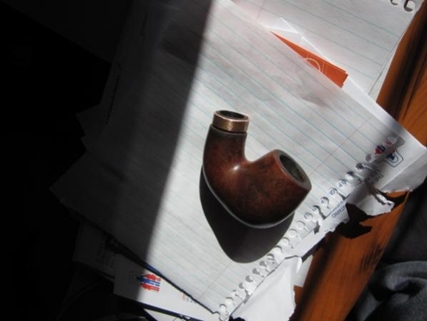
All finished!! Silver cap re-installed. With the installation of the repair band, the crack is much tighter and the stem now sits much more nicely!!
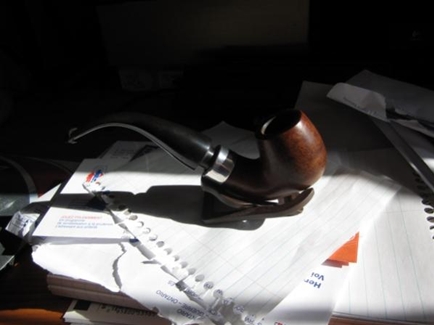
Image

All in all…wasn’t a terribly difficult repair. The hardest part was determining how much to sand down the area where the band would go. But, it all worked out fine!

Bryan

Refurb on an old WDC “Falcon” style pipe


Blog by Steve Laug

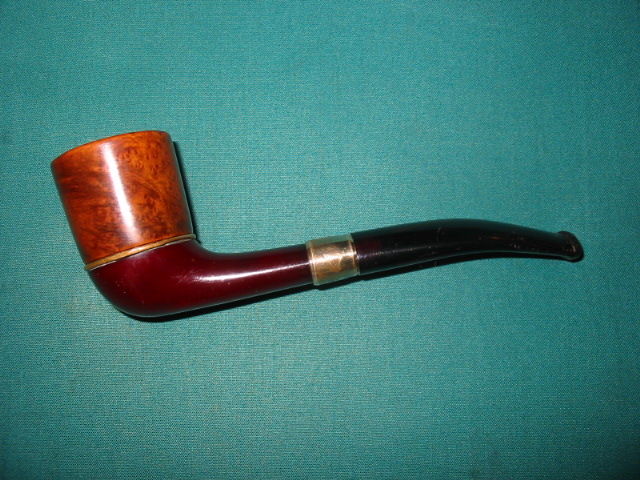
I refurbished this old WDC pipe a while ago now and thought I would post it for its historical value. I have called it a Falcon style pipe in that the bowl is removable and thus interchangeable with other WDC bowls. The stem and bowl bottom are Bakelite and the bowl itself is threaded briar bowl with an airway on the bottom. This one needed a bit of work as can be seen from the first two pictures below. The bowl was badly caked so I reamed it, sanded it and cleaned it. Then I had to top it as the rim seemed to have been used as a “hammer” and was seriously dented and chewed along the out edges of the bowl. Once the bowl was topped I decided to strip the finish from the bowl and restain and polish the bowl as a whole. I wanted to keep with the older style reddish brown stains that I had seen on other WDC pipes that I have so I used an oxblood understain and the overstained it with Medium Brown aniline. I buffed the finished bowl with Tripoli and White Diamond while holding it with a finger inserted in the bowl and holding on to the bowl with the other hand. I did not want the buffer to snatch it out of my hand while I was buffing it. I finished by giving the bowl a polish with carnauba wax and a soft cotton flannel buff.

The bowl seats in the Bakelite bottom on top of a brass ring that seems to act as both decoration and gasket to the bowl connection. It needed some cleaning and polishing as it too had dents and scratches in the surface.

The Bakelite receptacle bottom that the briar bowl screwed into was very dirty and I cleaned it out with cotton swabs and alcohol and then polished the inside with a soft cloth. The stem was rough with deep scratches and gouges in it. I sanded it with 400 and 600 wet dry sandpaper and a bit of water to give the grit a bite. Then I finished with micromesh pads in 1500, 1800, 2400, 3200, 4000 and 6000 grits. Upon completion of the sanding I buffed the stem with Tripoli and White Diamond.

Here are pictures of the pipe after I reamed it with a Pipnet Reamer (T-handle with interchangeable heads).

ImageImage

Here are pictures of the pipe after it has been finished:

ImageImageImage

I also thought some of you might be interested in seeing a picture of the pipe taken apart. I have included a picture of the cleaned version for you to get an idea of what the pipe looks like when taken apart.

Image

Correcting an overturn on a stem with a bone tenon


Blog by Steve Laug

I started this process of correction with tried and true information and experience gained from working on older stems with metal tenons. I had developed a process and perfected it for my use in correcting an overturned stem by heating the tenon in the stem to loosen the glue. Once the glue is softened with the heat then the stem can be screwed on to the shank and turned to the proper position and left to cool. Care should be taken in aligning the stem and shank to the correct position. If it cools before it is straight, it can be reheated to align it correctly. I have used this procedure for a long time and it works perfectly each time I have used it. I am sure I will refine it but it works!

With that background and a couple of older stems on meerschaum and briar pipes with bone screw tenons that were overturned I put the following question out on the various online pipe forums that I am a part of.

“Does anyone know how to correct over turned bone tenons? I have a couple old timers that are over turned I am looking for a corrective…Help!”

I did not receive any response to my query so I decided to try the method I had used with metal tenons and see what happened. I chose a pipe to experiment with that would no be a loss if it did not work. The stem was made of Bakelite and the tenon was a bone screw. I put a cup of water in the microwave and stood the stem in it tenon down and set the timer for two minutes (time to boil a cup of water in my microwave). I took it out at a minute and gave it a try and it was better. I put it back in the water and let the two minutes finish. I then dried it off with a towel and turned it into the shank and was able to turn it until it was aligned. There was no damage done to the tenon or the stem in the process. The alignment on the stem was perfect and once the pipe cooled it remained aligned.

My two concerns with the use of the boiling water were first, would there be any integral damage to the bone tenon from the heat moving from the inside out and second, would the heat cause any damage to the Bakelite. I did not want it to become brittle from the boiling water process. I have learned on the metal screw tenons that I could put the entirety (stem and tenon) into the microwave with the water and leave it there through the heating cycle on the microwave. I had done the same with a Bakelite stem and metal tenon and it worked well to insert the stem and tenon while the water heated in the microwave. I decided to do that as well with the screw bone tenon and Bakelite stem. There does not seem to be any increased brittleness or crackling of the stem or bone – all is well.

Repairing a cracked shank


Blog by Steve Laug

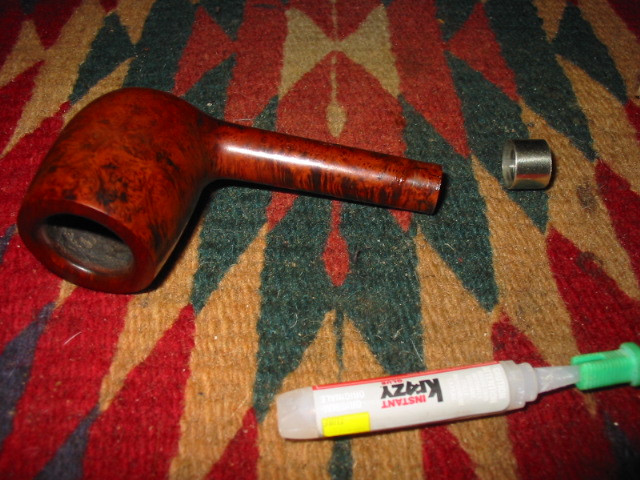
I received this older BBB Tortoise that was in pretty good shape. I did a topping on it and a restain that is posted in a separate blog posting. But in the cleaning process I also found that the shank had a crack in it. In the picture below you can see that the crack is quite long and is open. I know that others repair these with a shank insert and glue the crack together, but I have not ventured into that avenue as yet. On this kind of crack in the shank my normal process is to glue the crack with super glue and then band the pipe. In this essay I want to describe that process for you.

Image 

I removed the stem from the shank and cleaned out the shank with pipe cleaners and alcohol. I want the surface to be grime free. I also wiped down the crack with an alcohol wipe to make sure the outer surface was also grime free. I then pried the crack open by inserting my dental pick in the mortise and giving it a small bit of pressure to open the crack. The key at this point is not to apply to much pressure as it will continue to crack. Being gentle and taking your time is critical at this point or you will make the problem a bigger one. Once the crack is open I drip super glue into the crack and then hold it together with the stem removed in order for the glue to bind the crack. Once that is done I wipe off the outside of any excess glue that will extend beyond the width of the band and set it aside.

ImageImage

I heat the band with my heat gun and pressure fit it onto the shank of the pipe by pressing the band and shank into the piece of carpet pictured in the photos. It is important to keep the pipe absolutely vertical and straight as you press the band into place. You will want to press the band on the shank until the lower edge is flush with the end of the shank so that the stem fits properly. With the band heated this is not difficult to do. The band will pretty easily slide up the shank with the pressure you apply. Check for a good fit and then let it cool for a few moments.

Image 

Once it is cooled the stem can be fit to the shank. I find that with the band the tenon will need a slight bit of sanding to fit correctly. I use some 220 grit sandpaper to remove a little of the material. I make one pass with the paper and then try it for a fit. It should slide in snugly so you must be careful not to remove too much material. Often just one pass is enough and the stem should go in perfectly.

Image 

With the stem refit the pipe is ready for a buffing and polishing. Avoid buffing around the band on the buffer as it will cause the pad to go dark and leave a black/grey haze on the briar around the shank and band area. I buff the shank avoiding the band and then polish the entirety with a light touch on the carnauba wheel. Below is the banded and repaired pipe.

Image