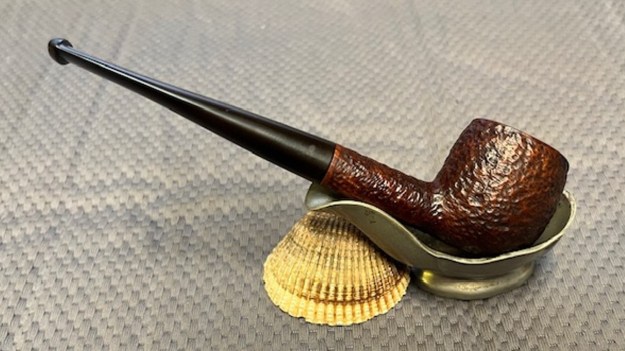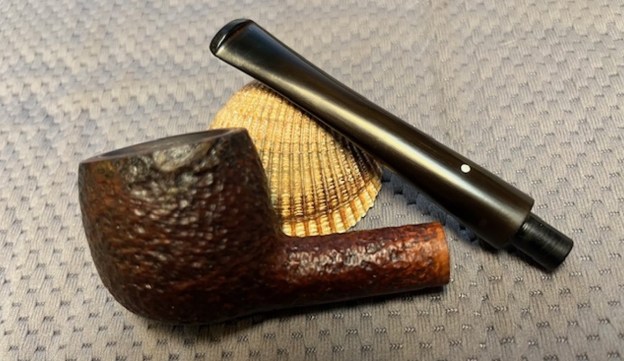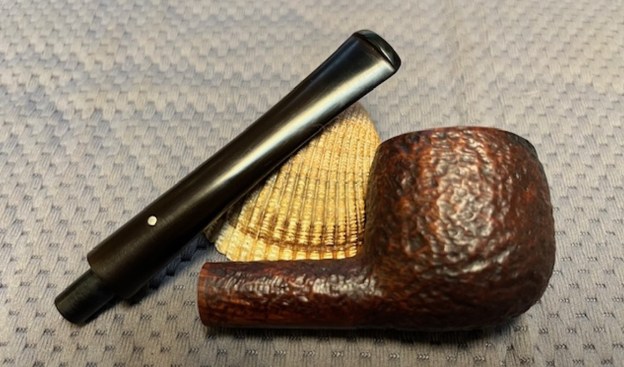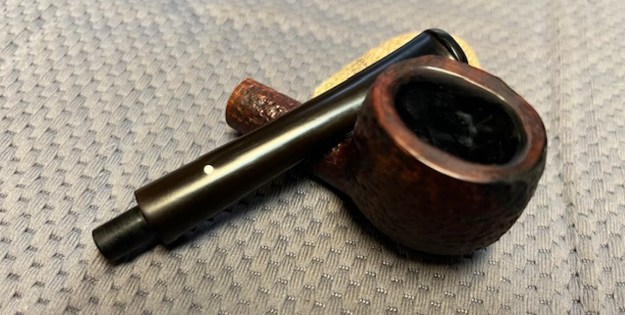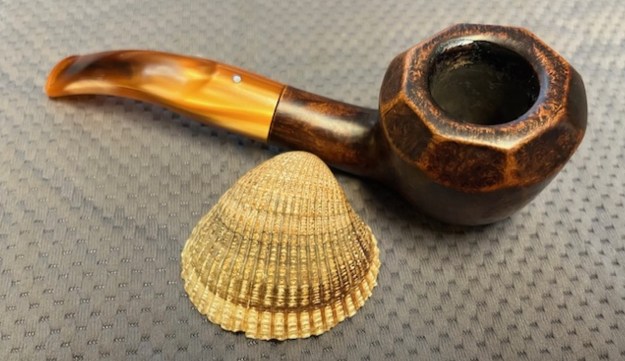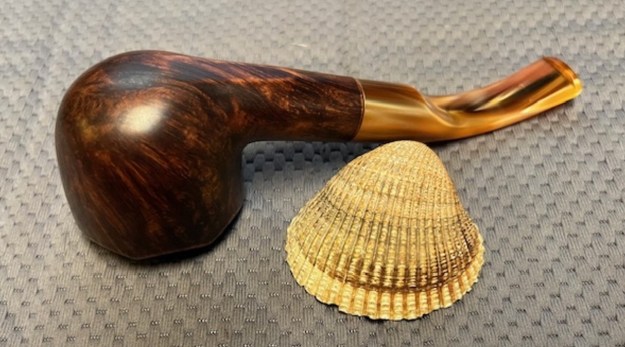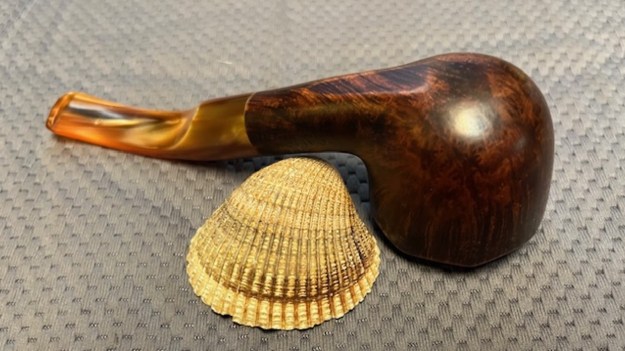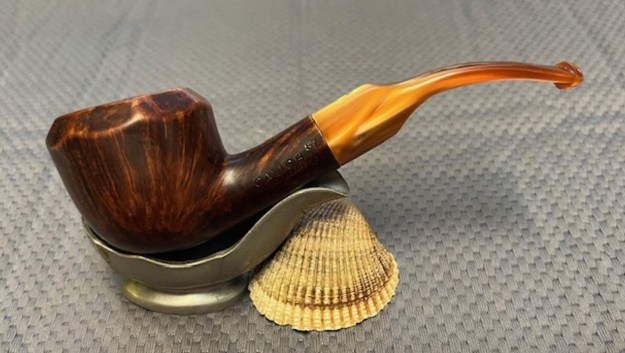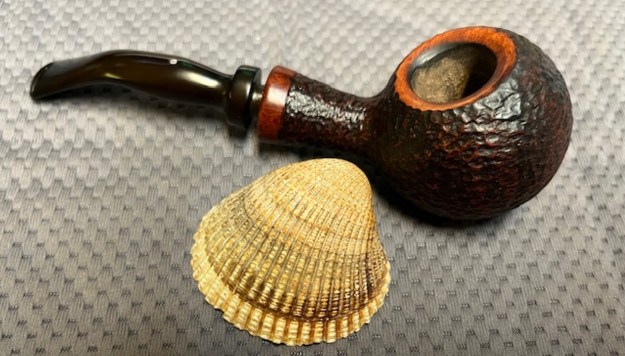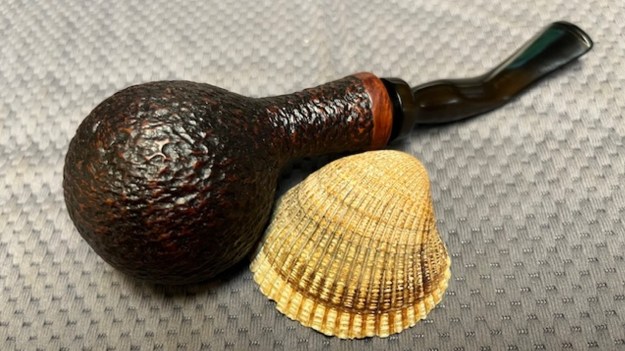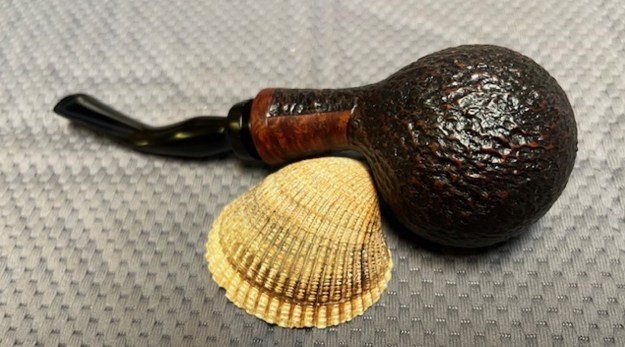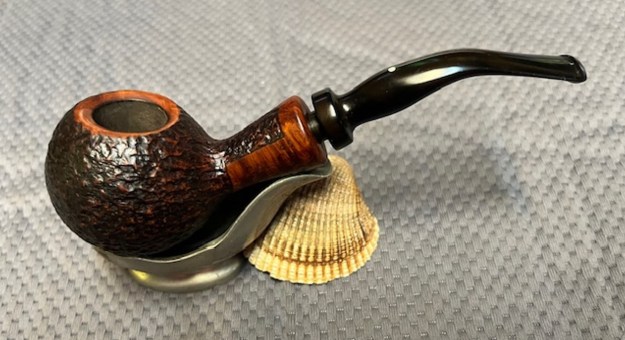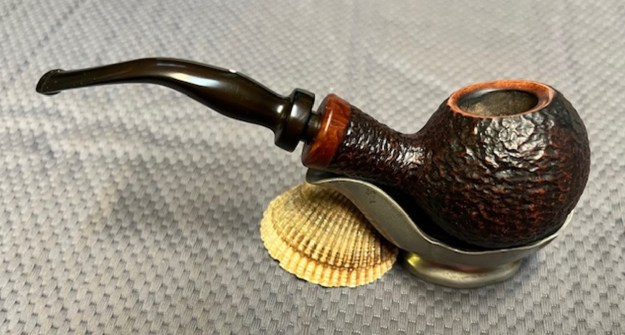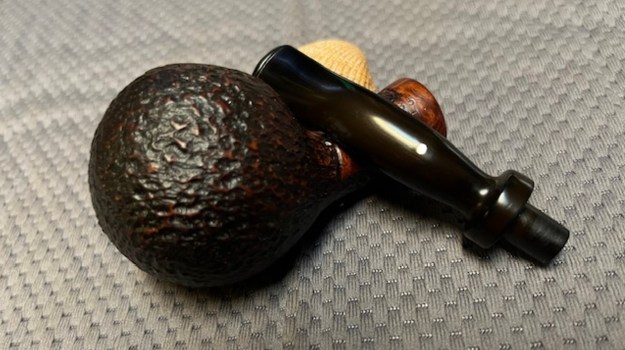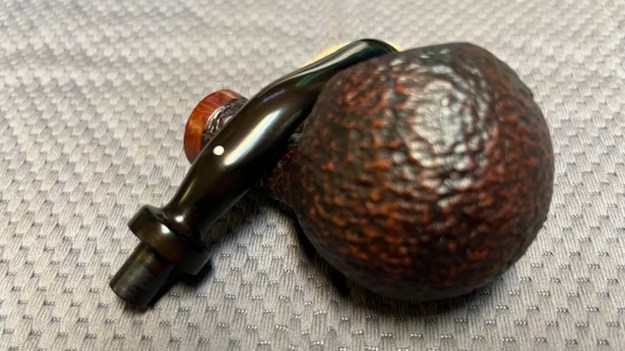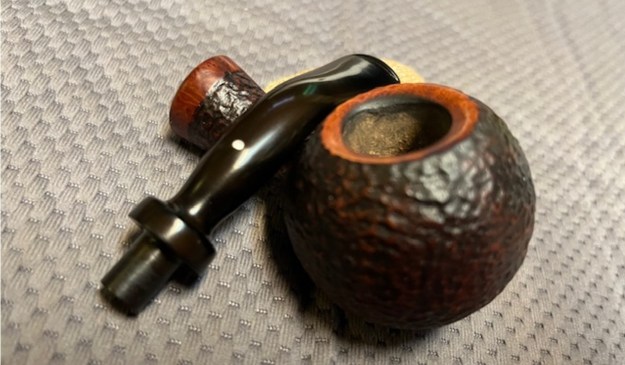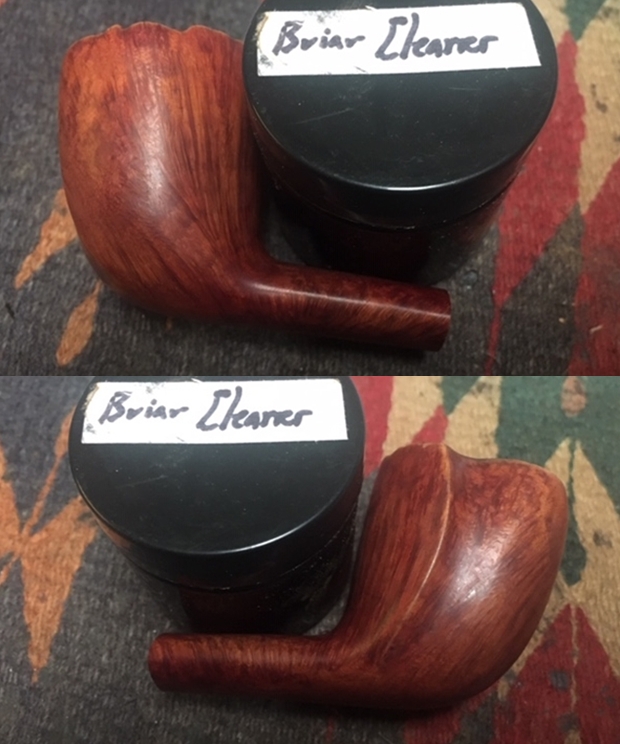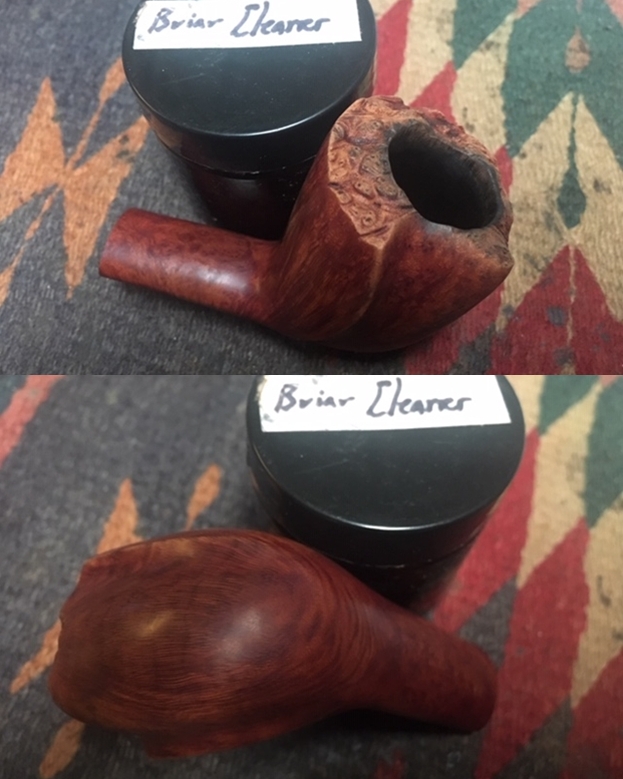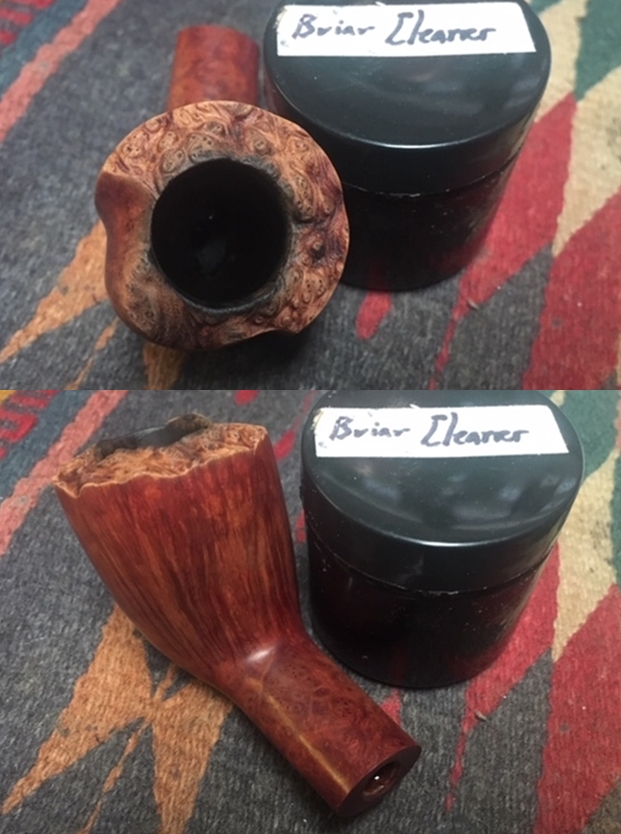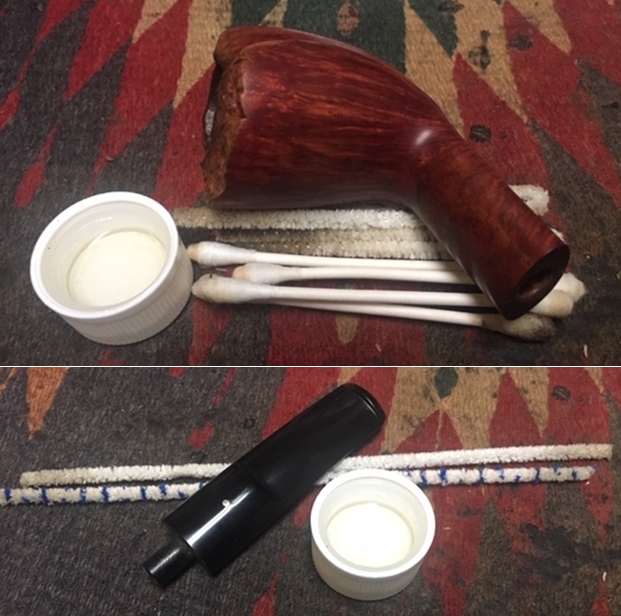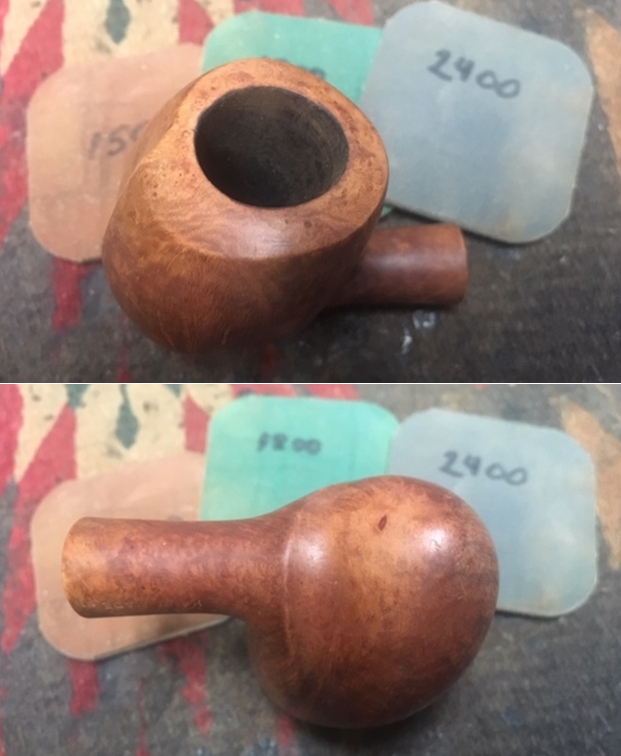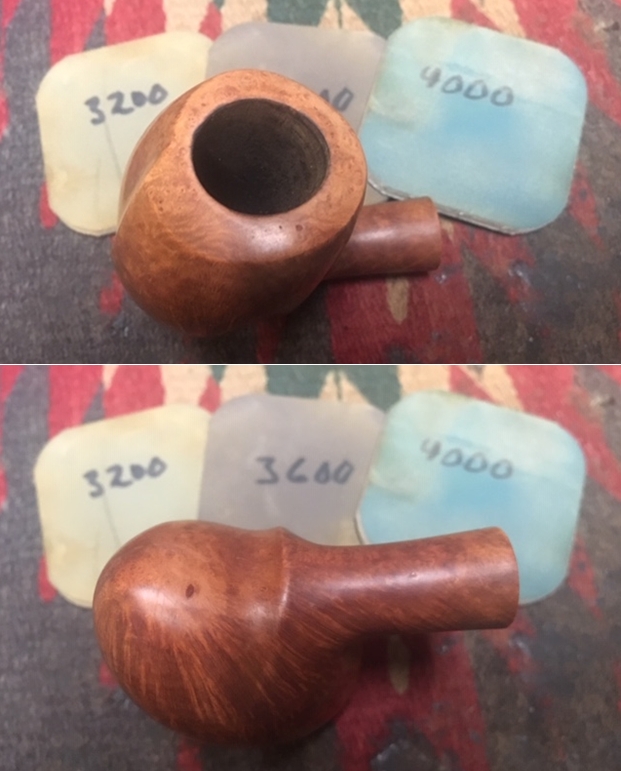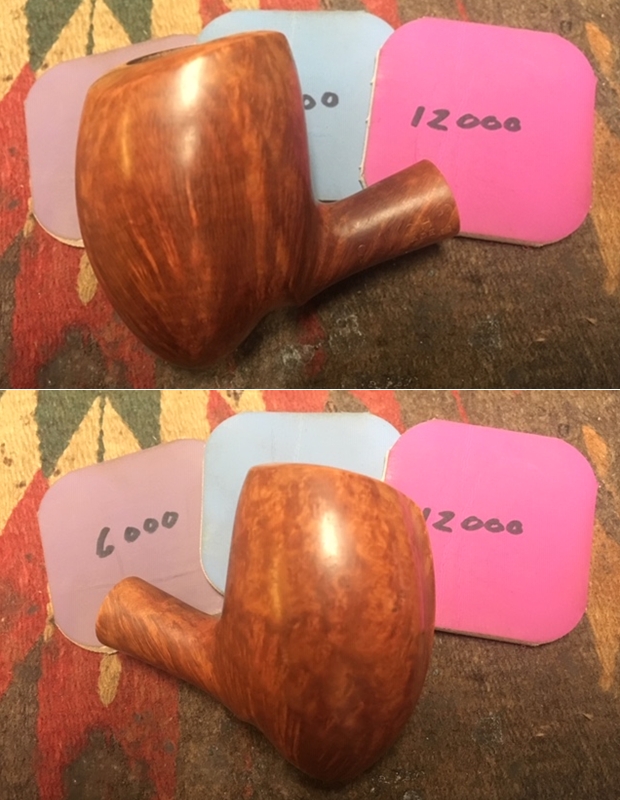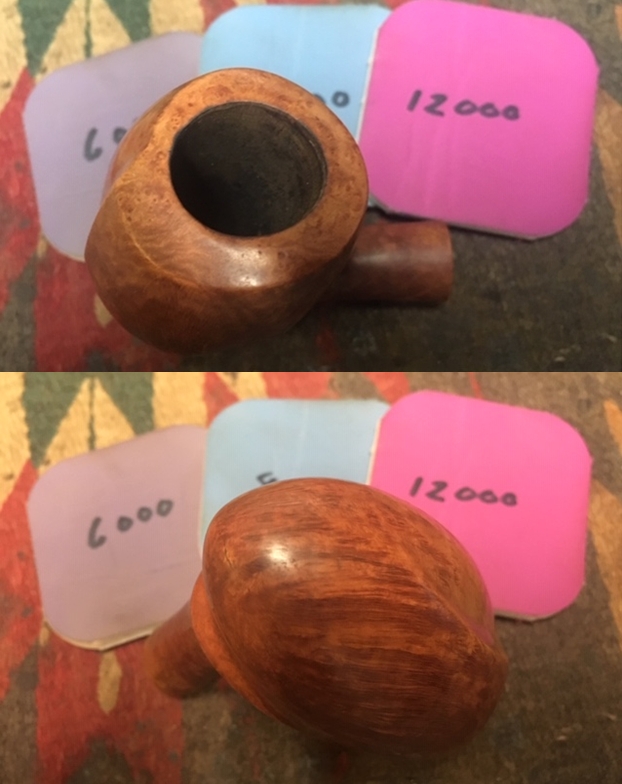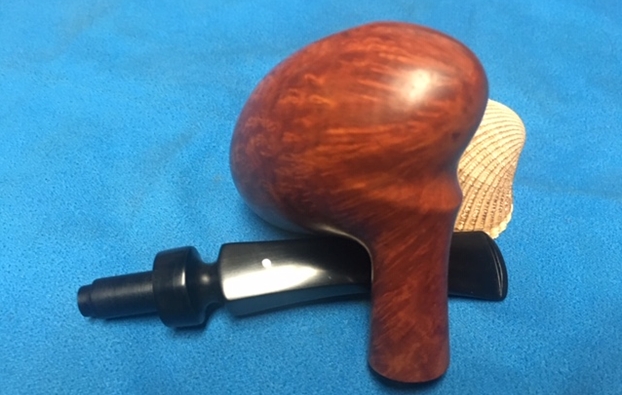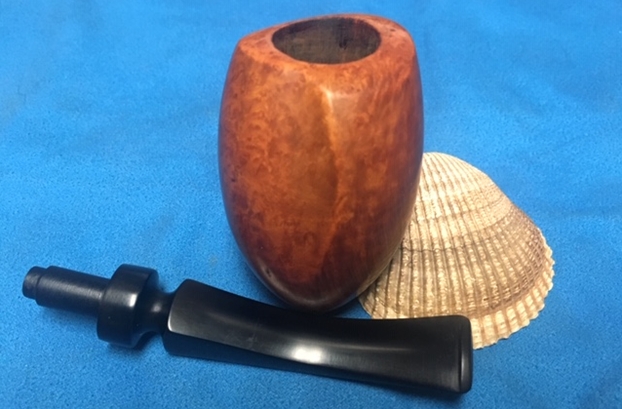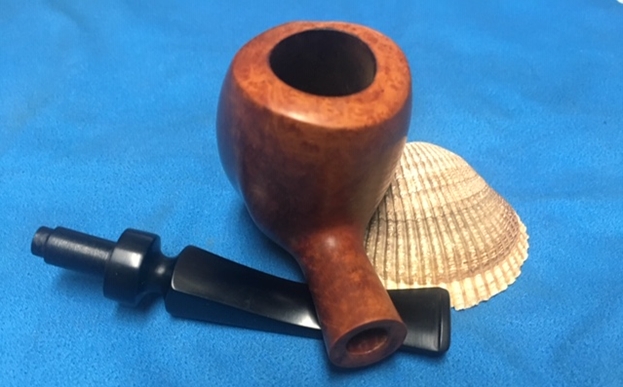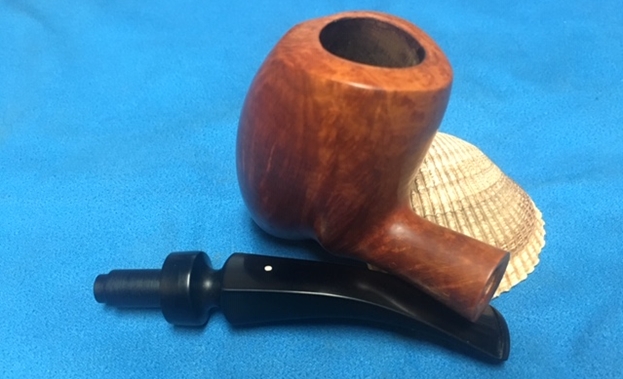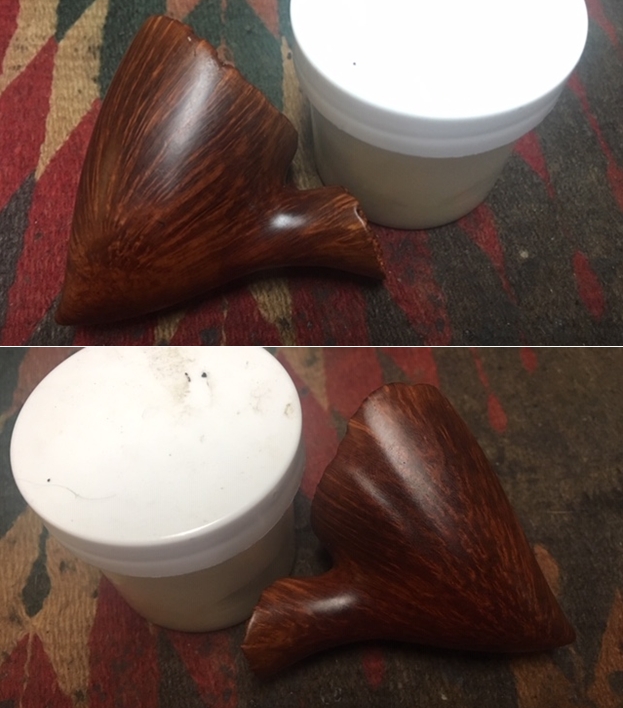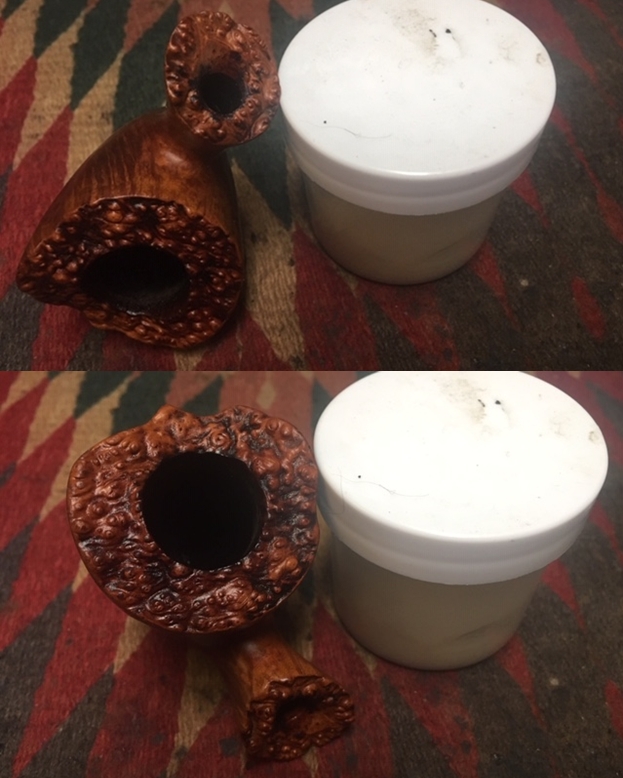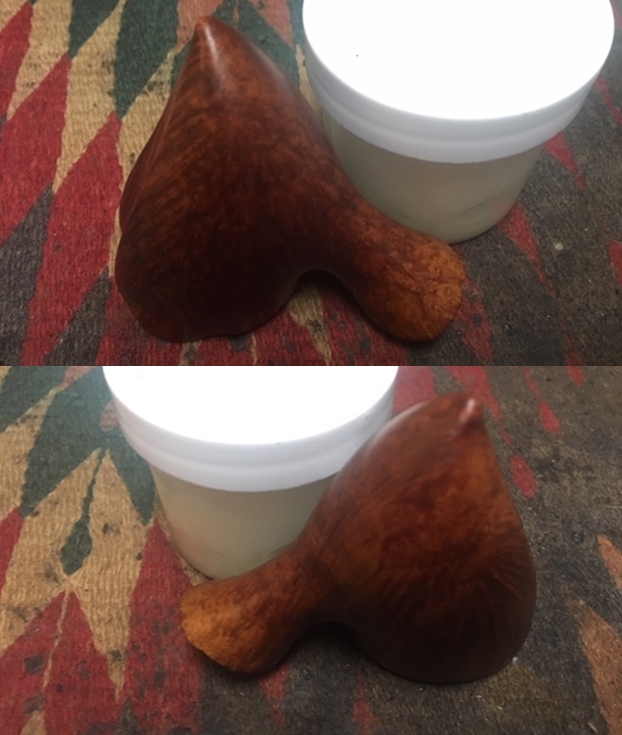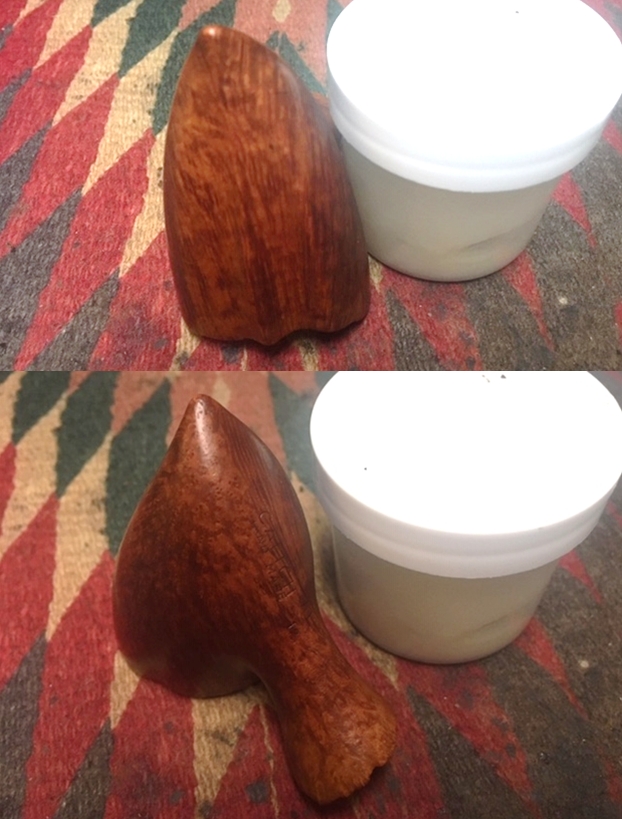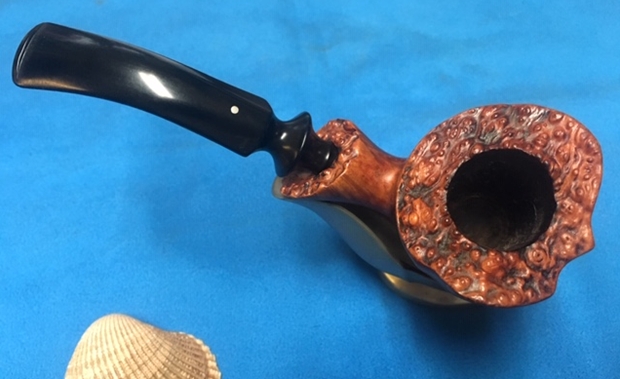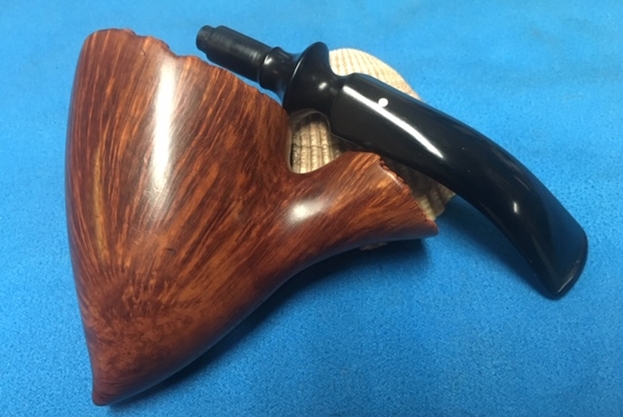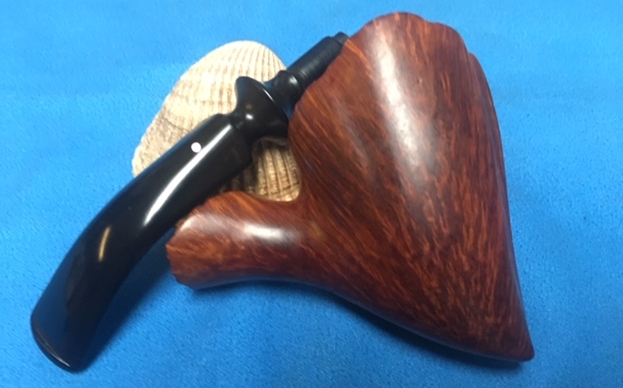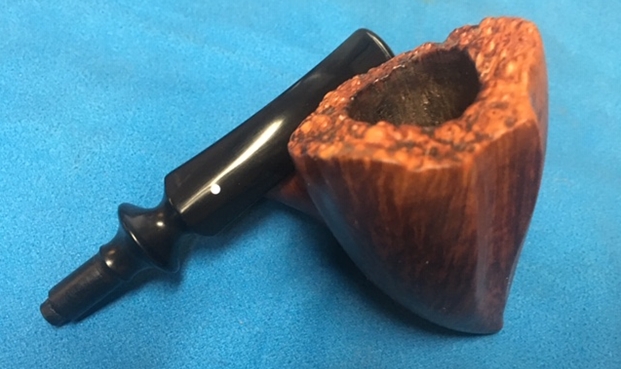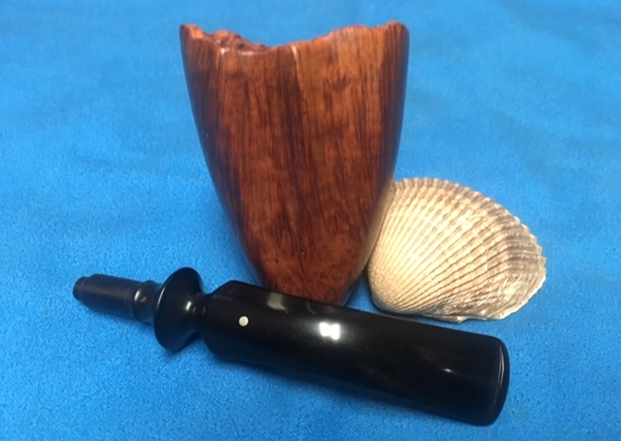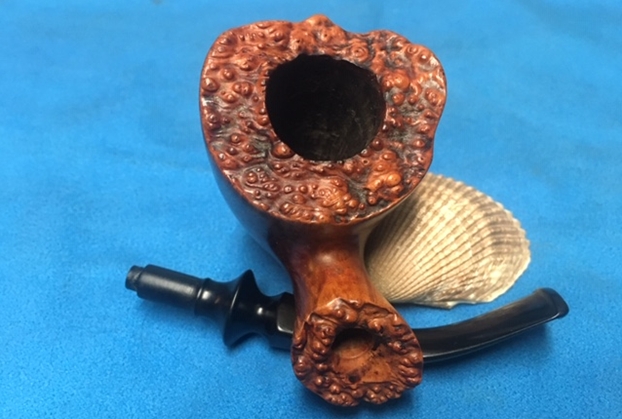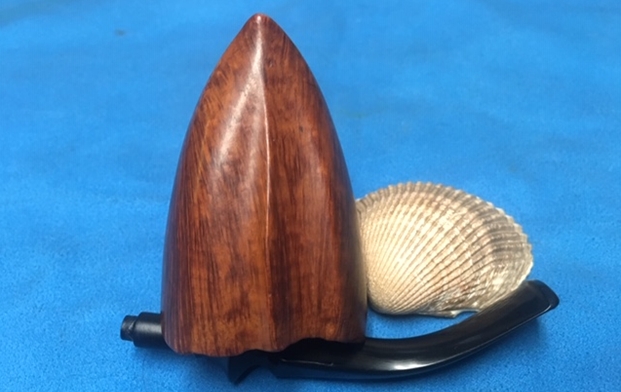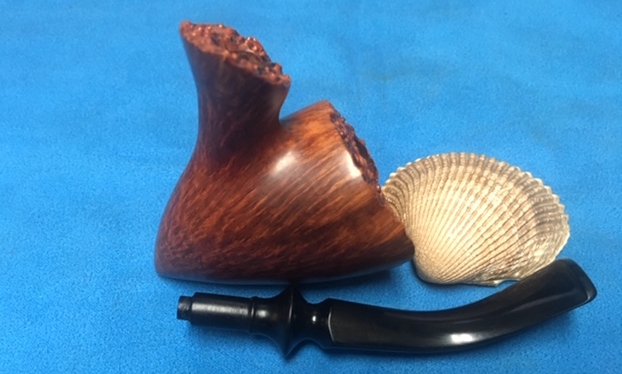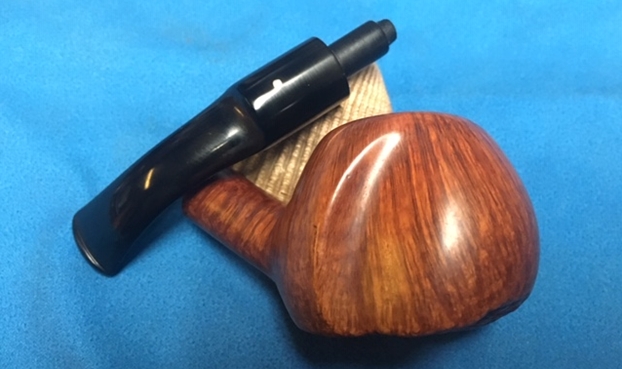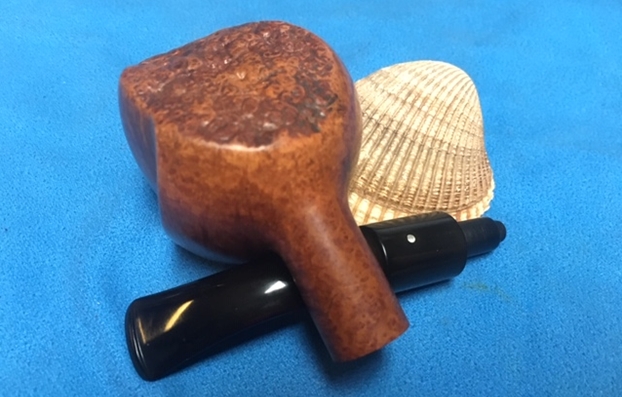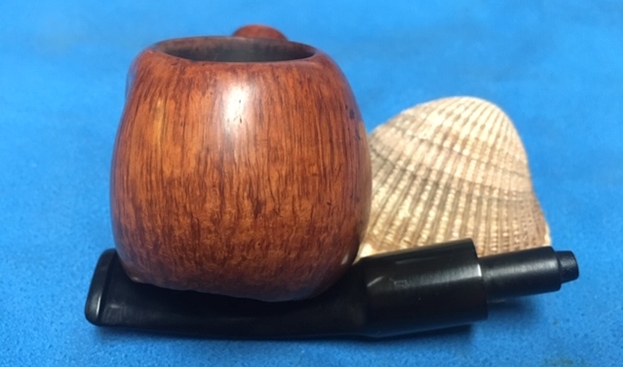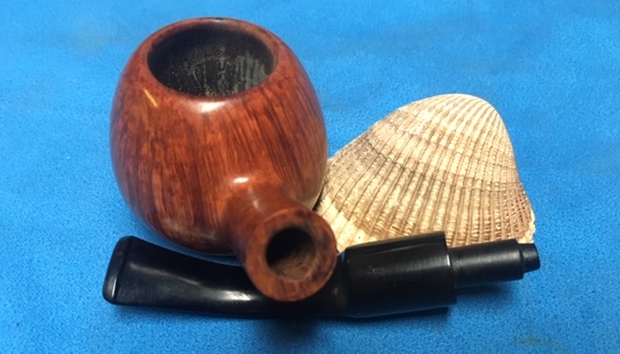
Tag Archives: John Calich Pipemaker

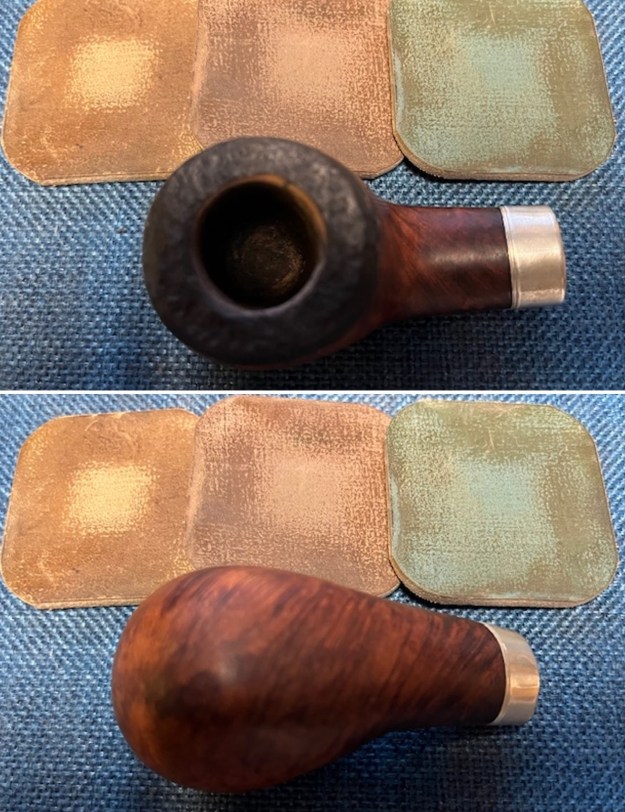
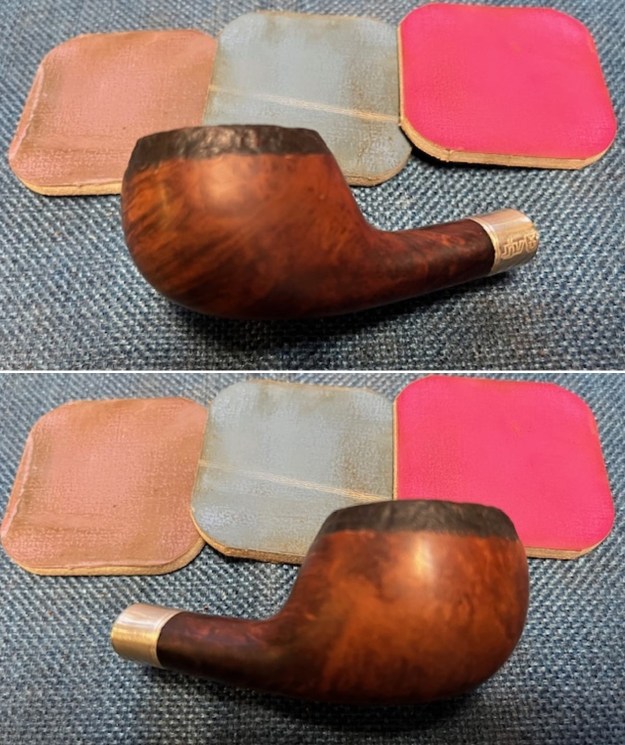
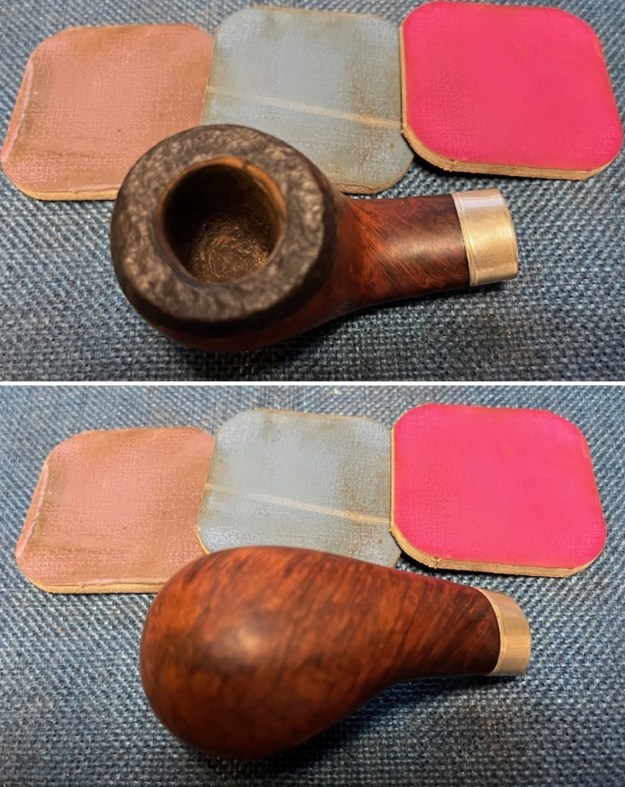
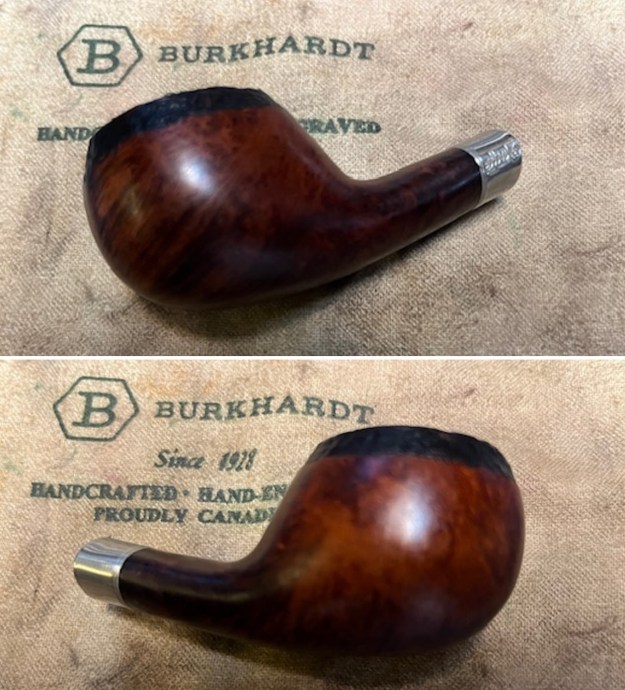
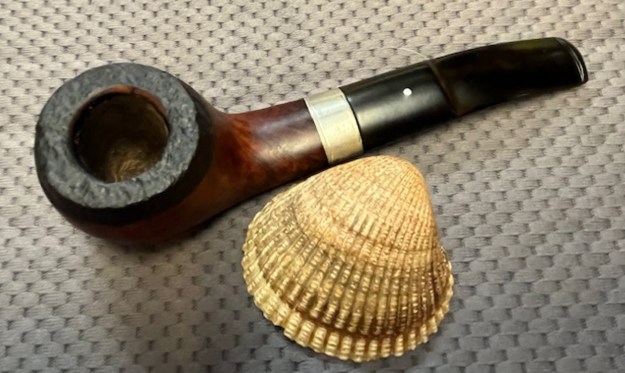
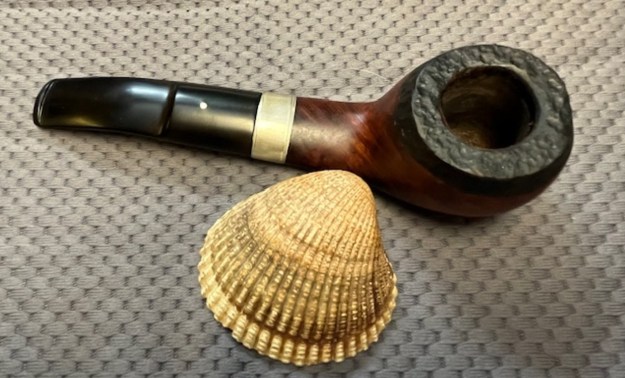
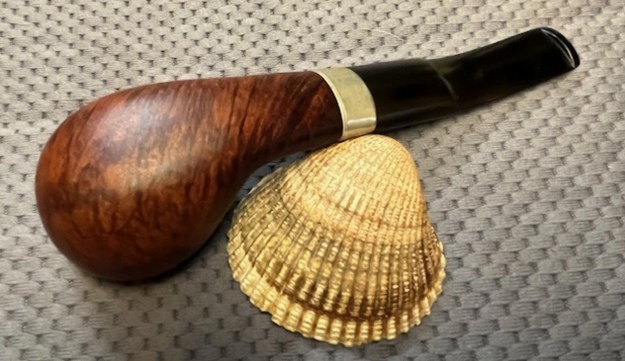
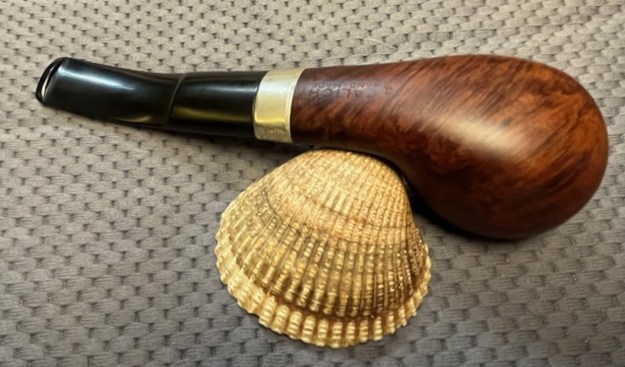
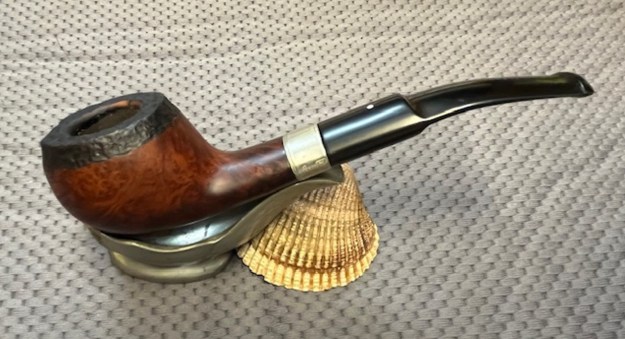
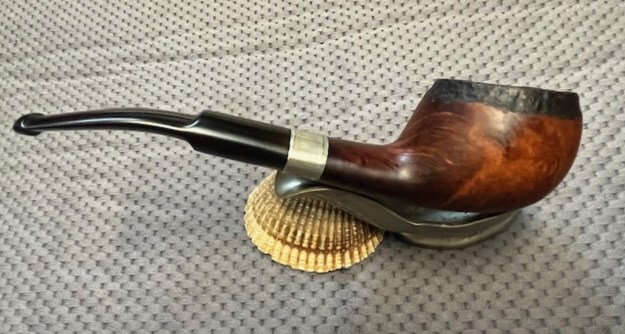
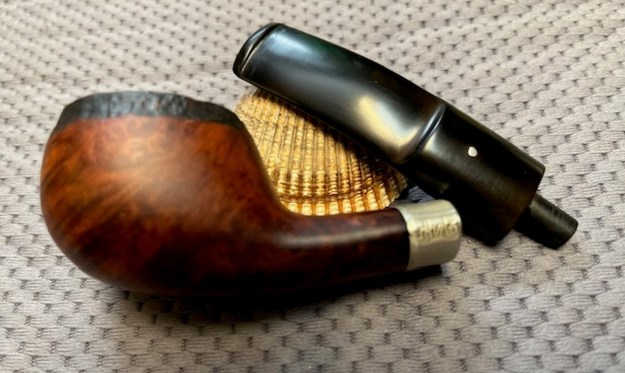
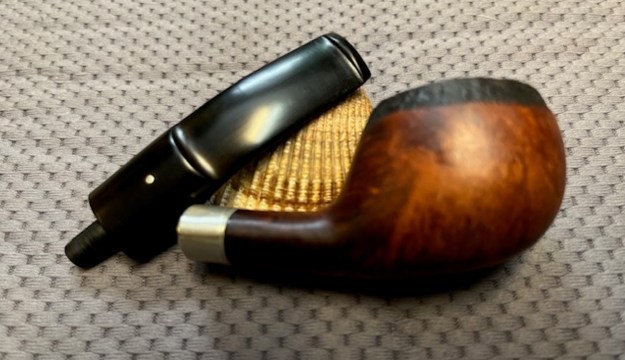
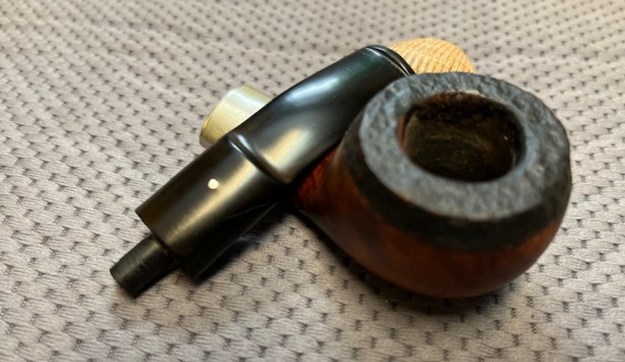
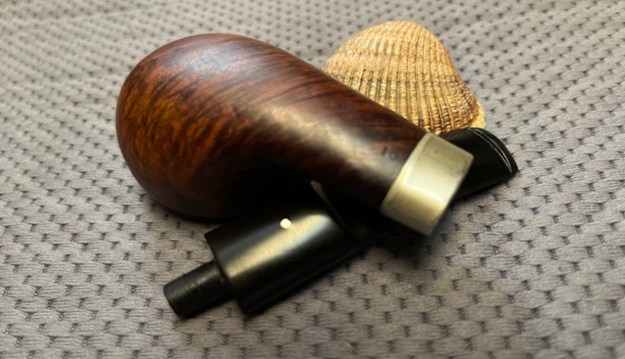
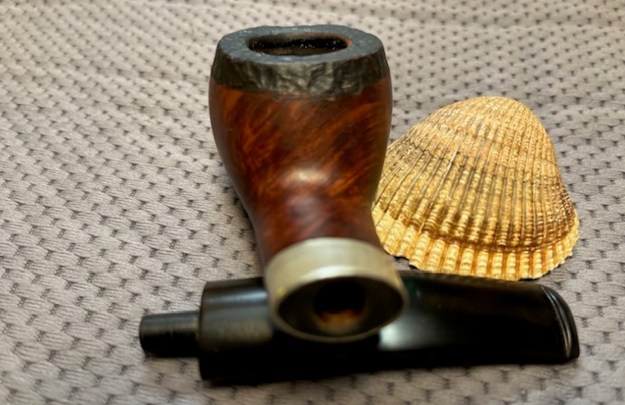
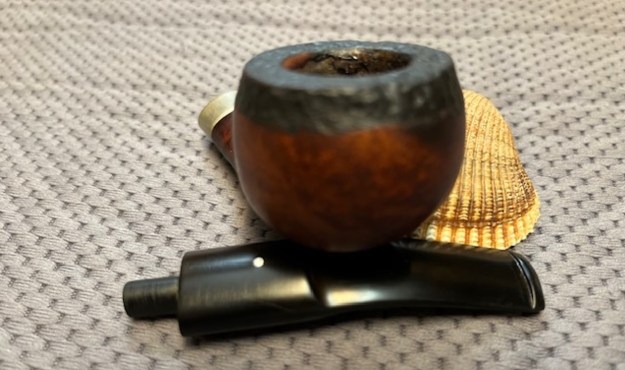
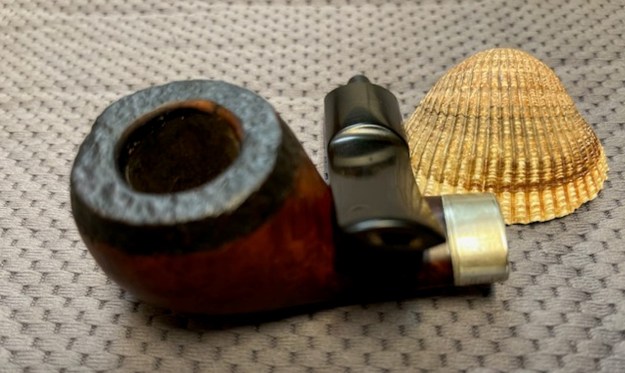
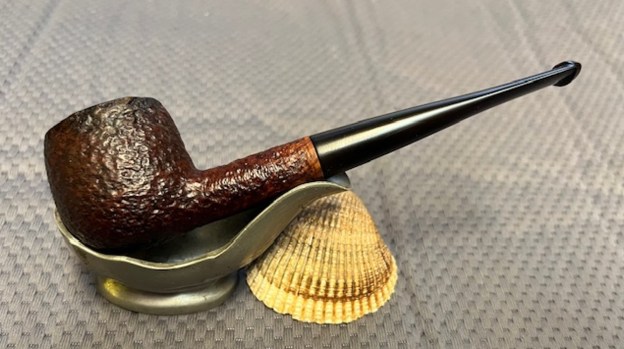
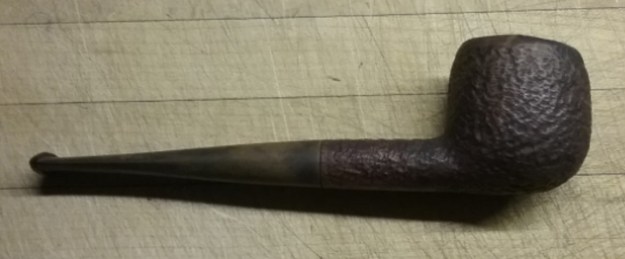
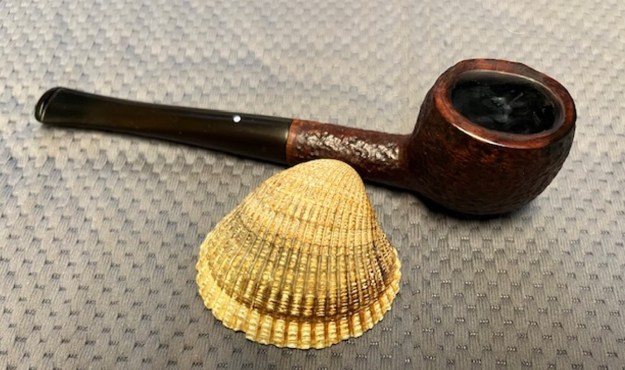
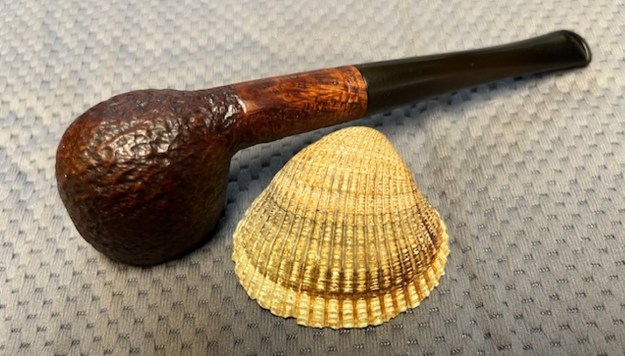
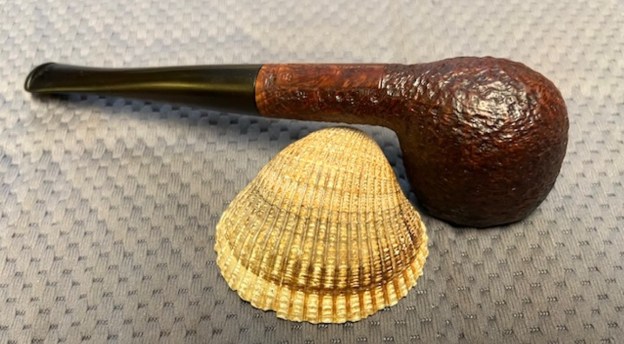
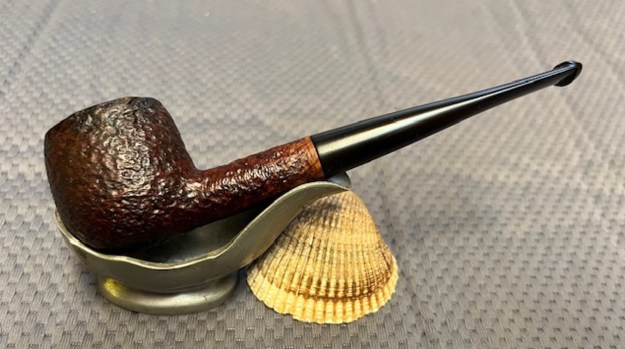
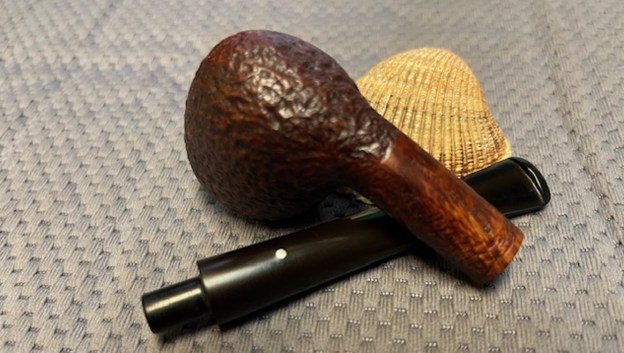
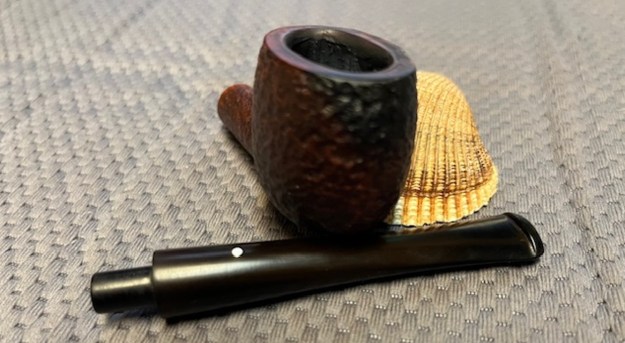
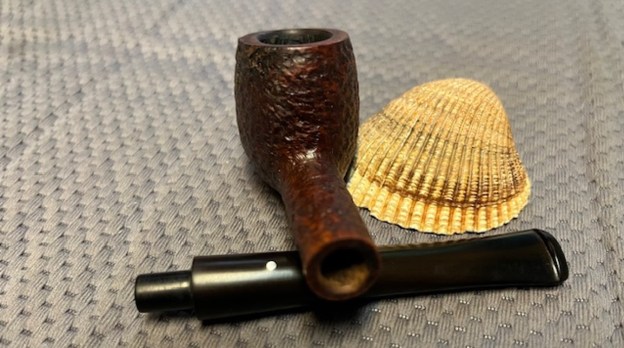
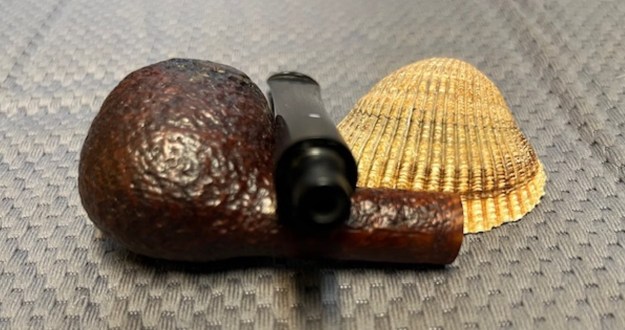
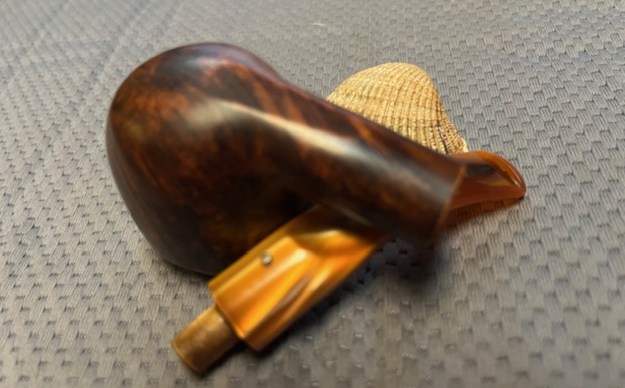
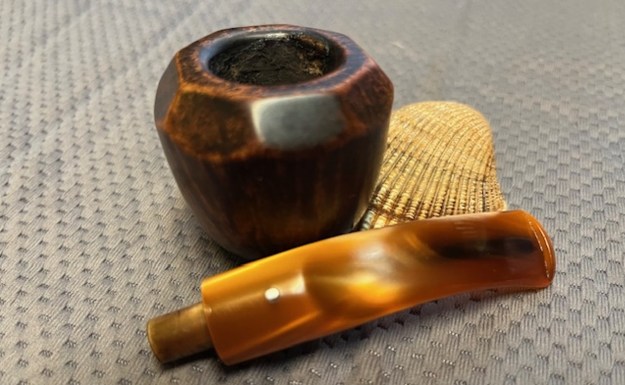
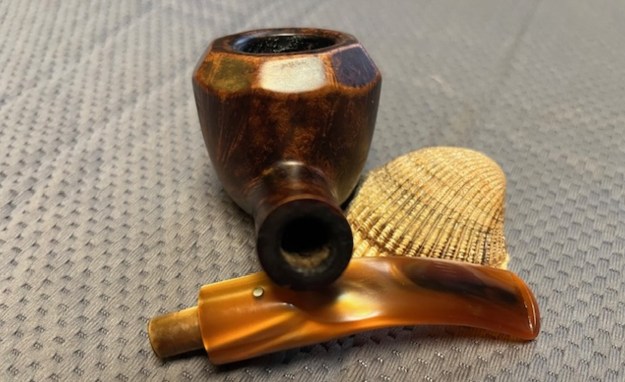
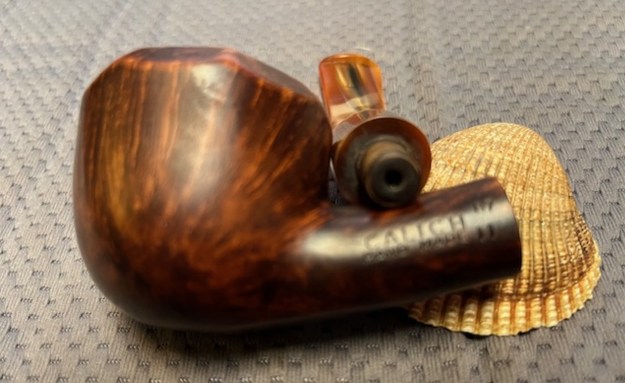
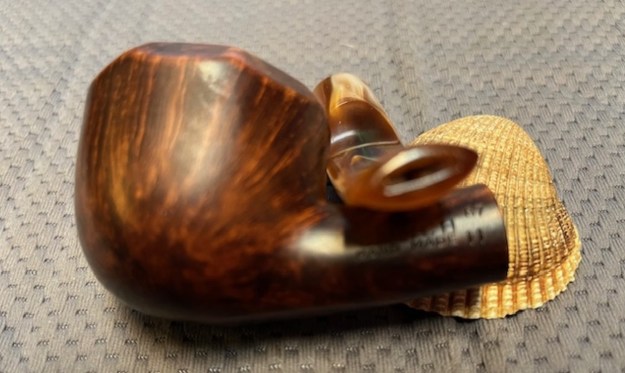
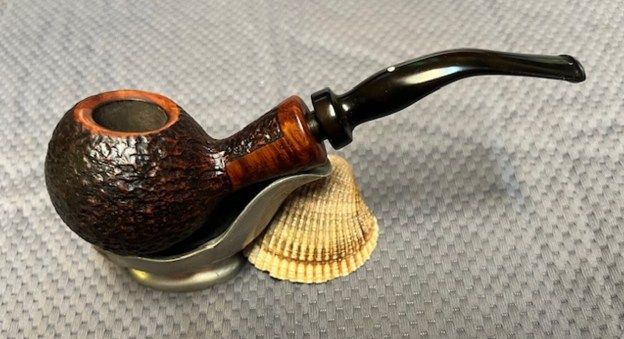
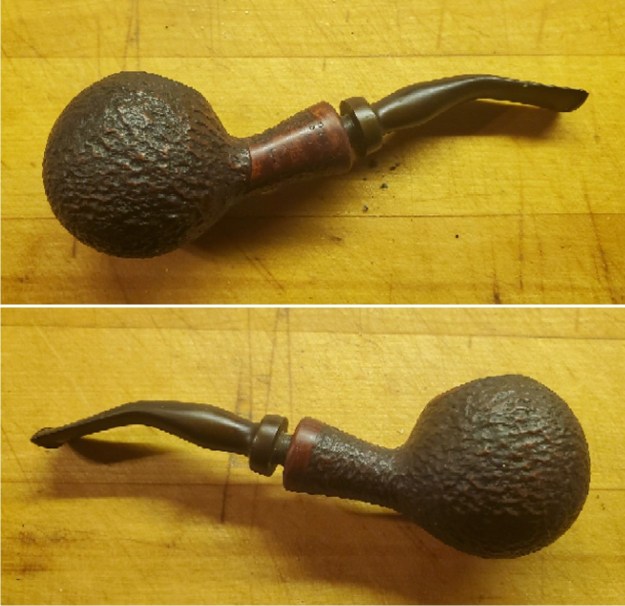
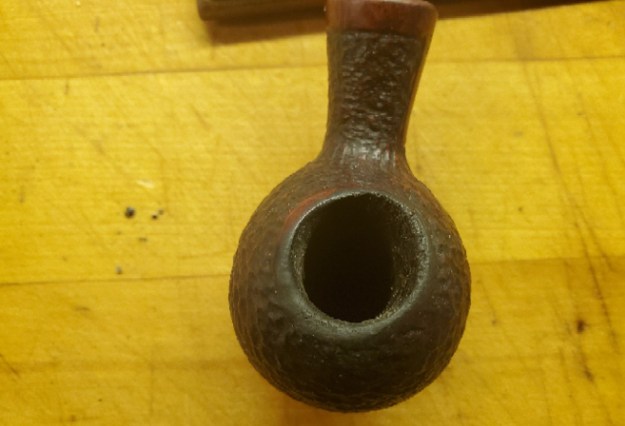
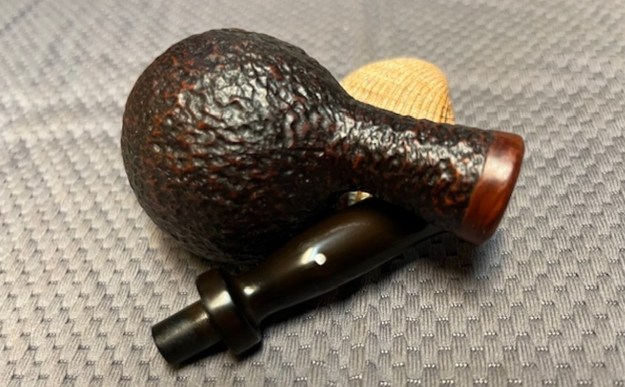
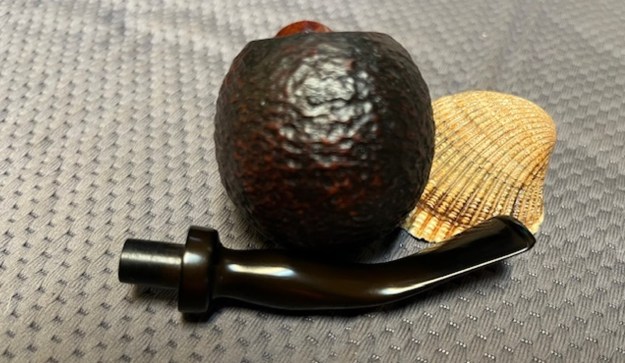
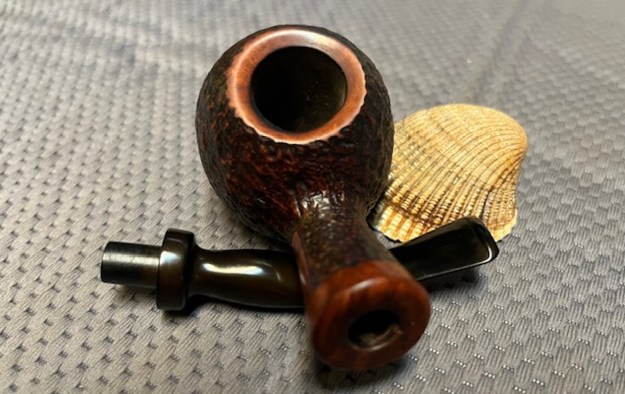
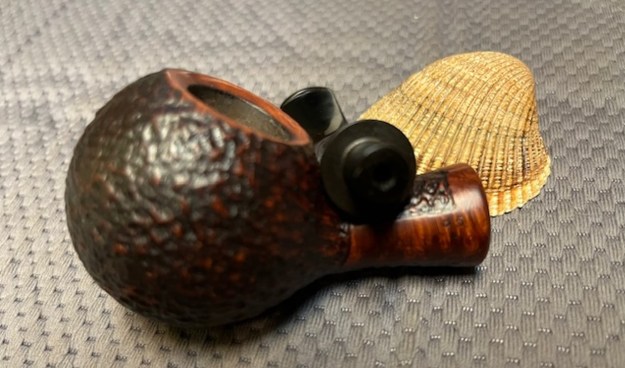
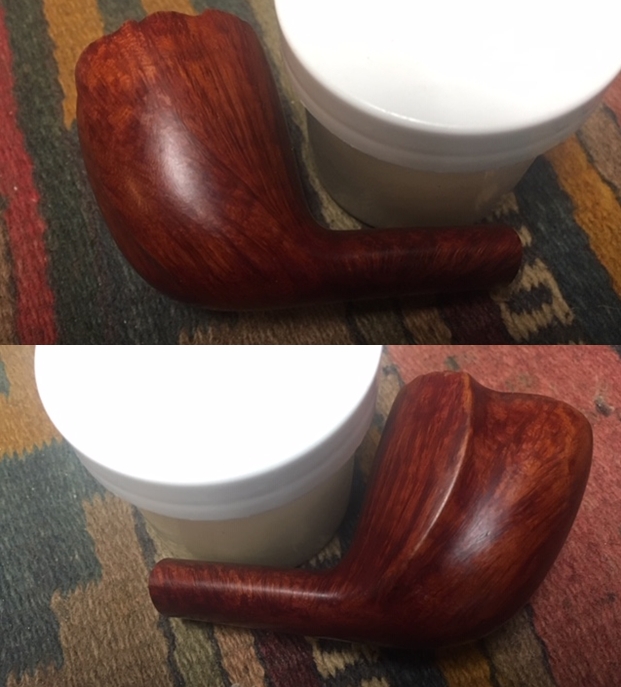
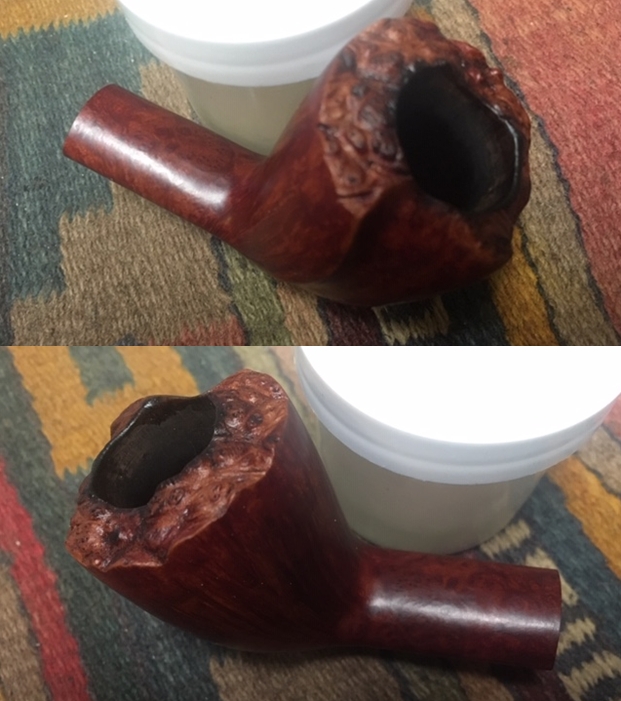
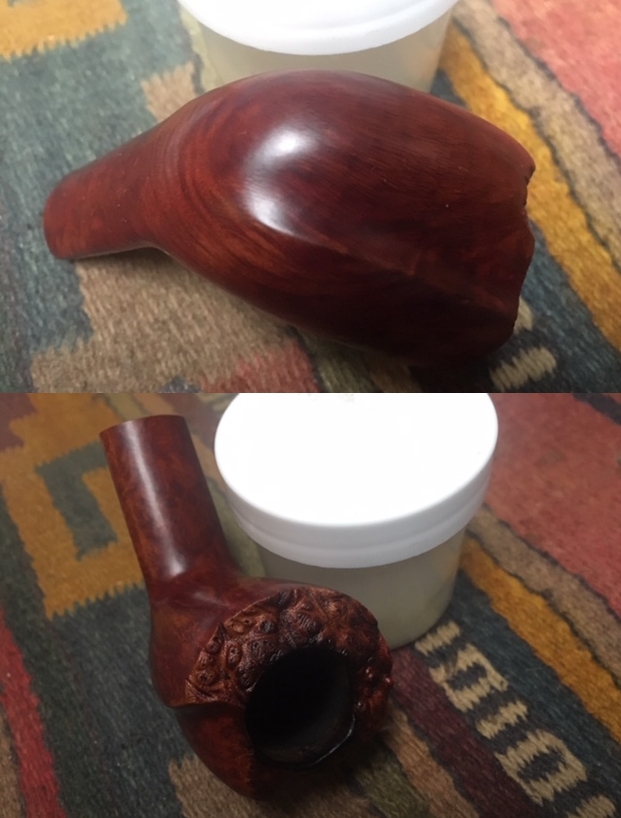
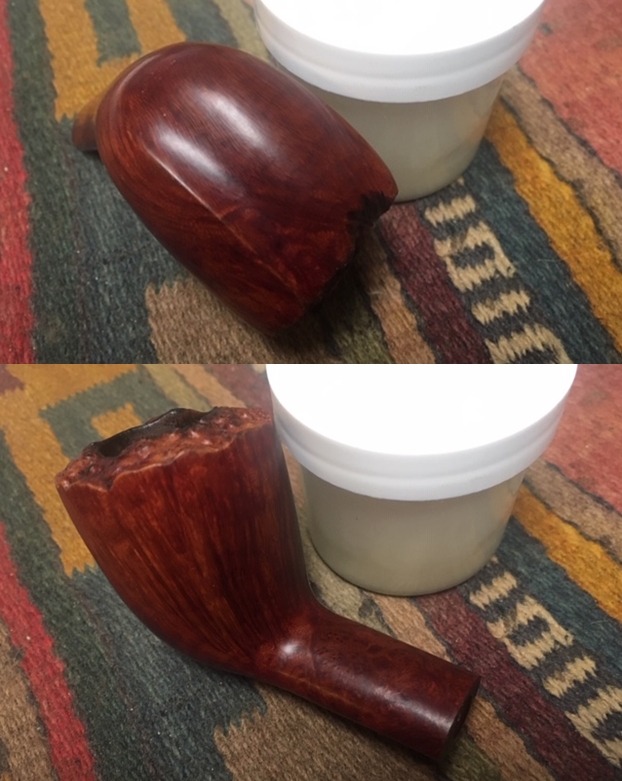
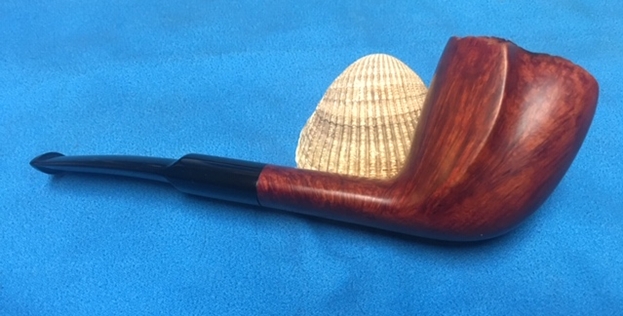
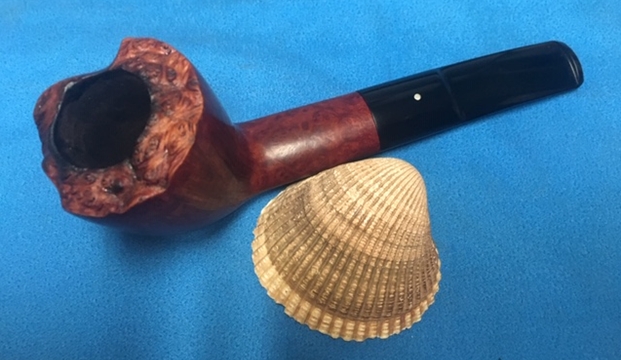
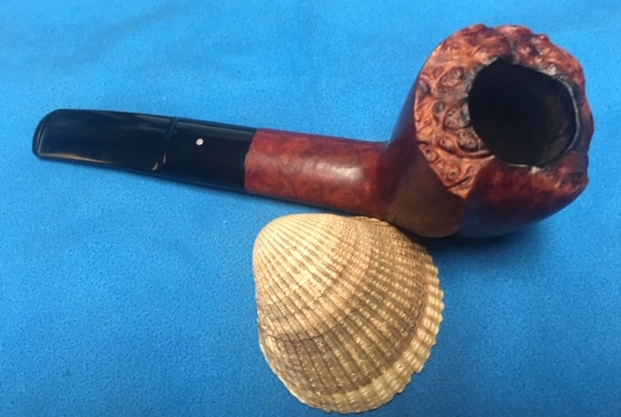
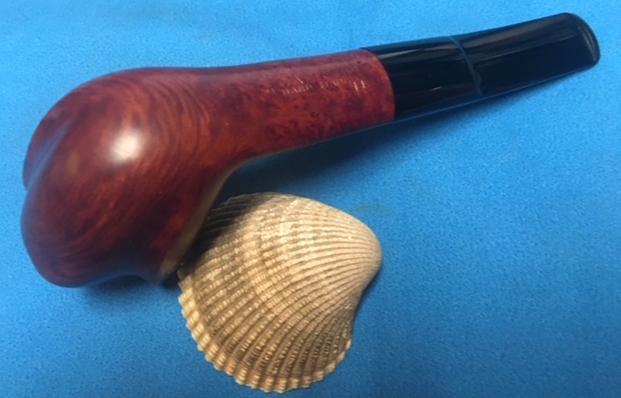
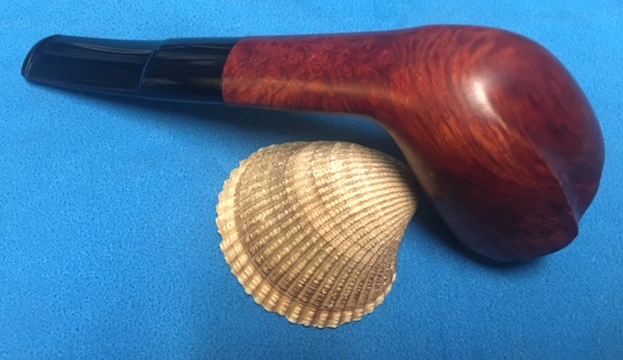
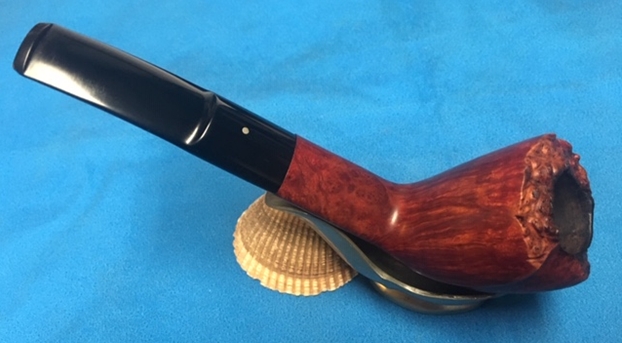
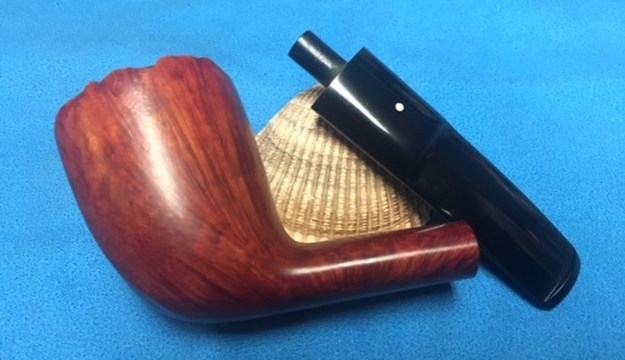
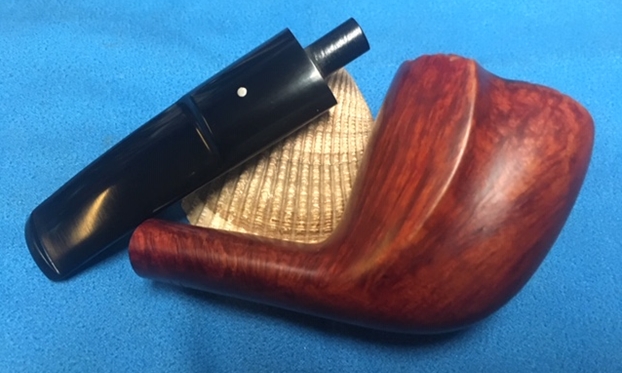
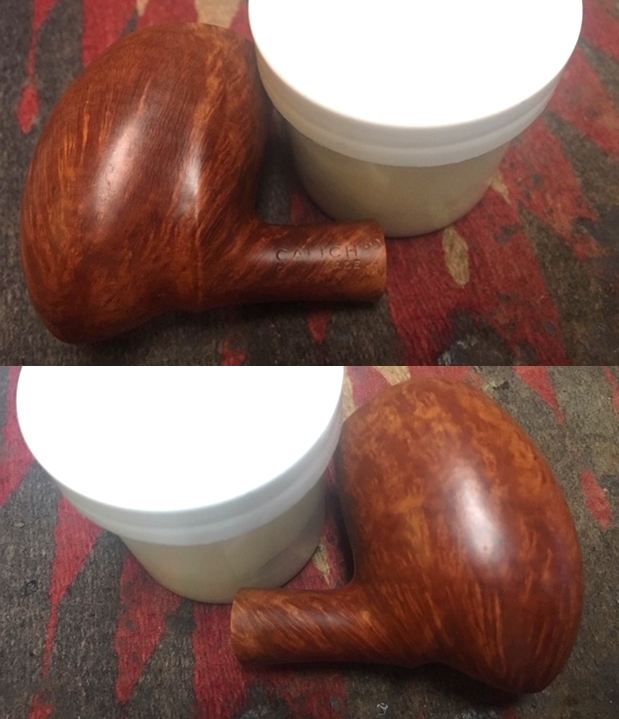
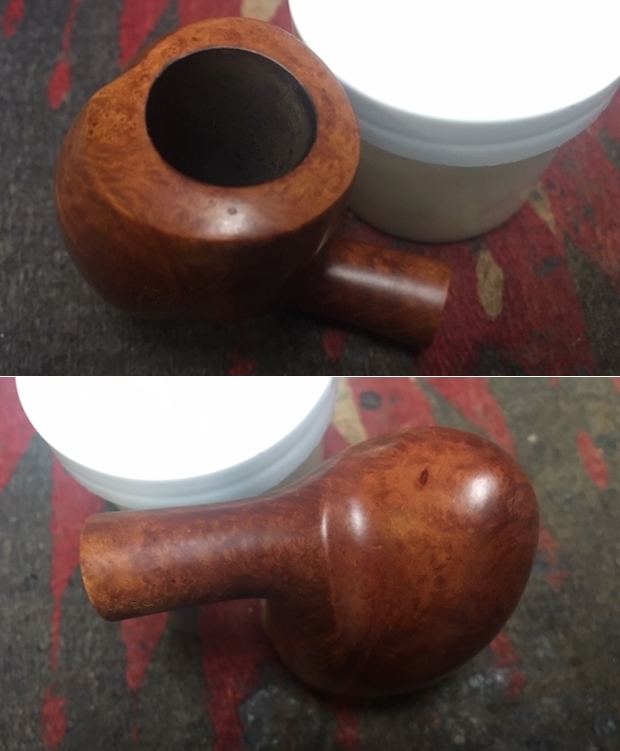
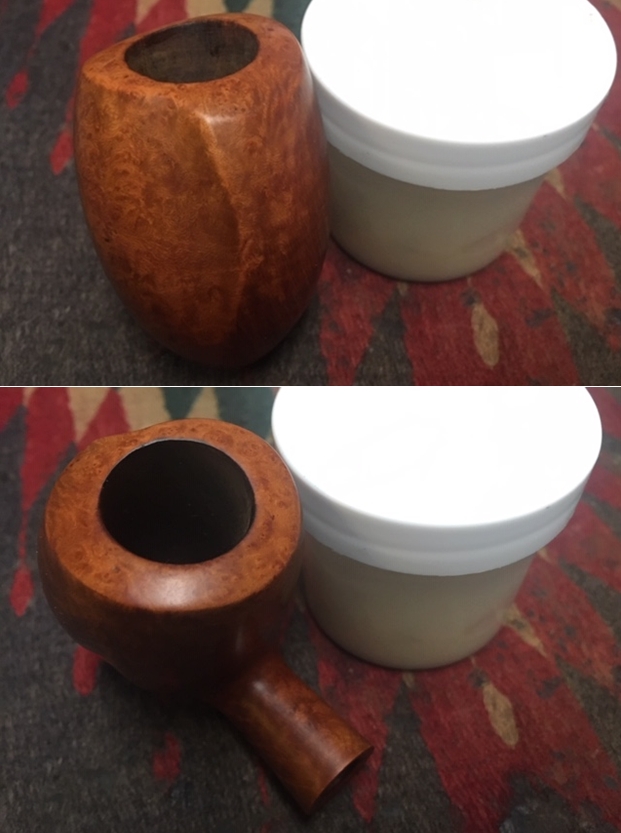
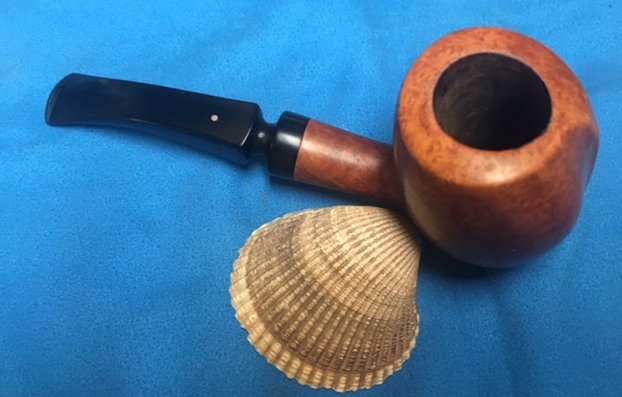
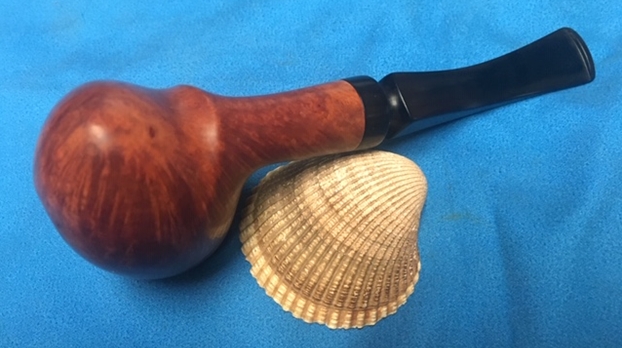
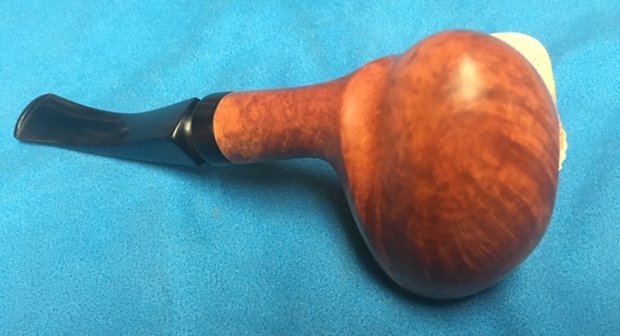
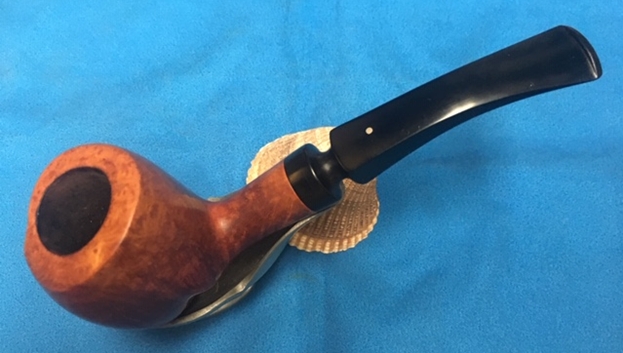
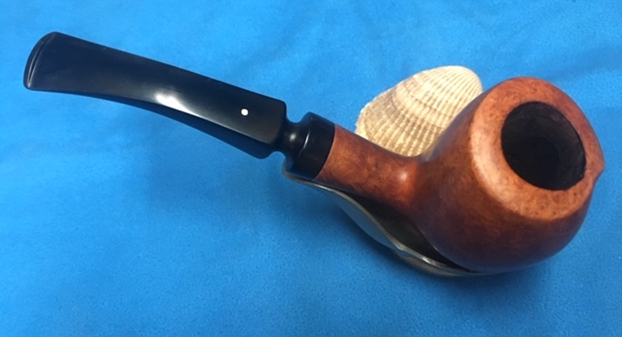
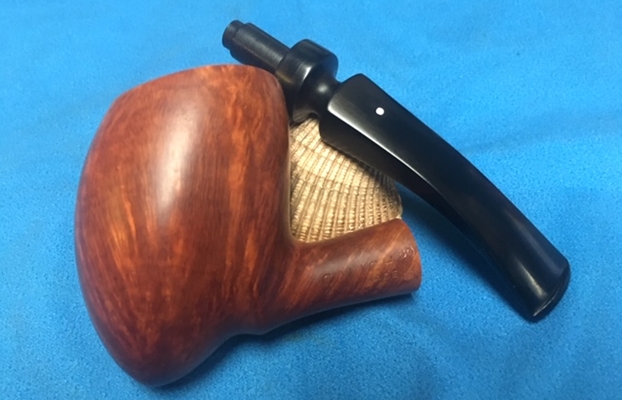
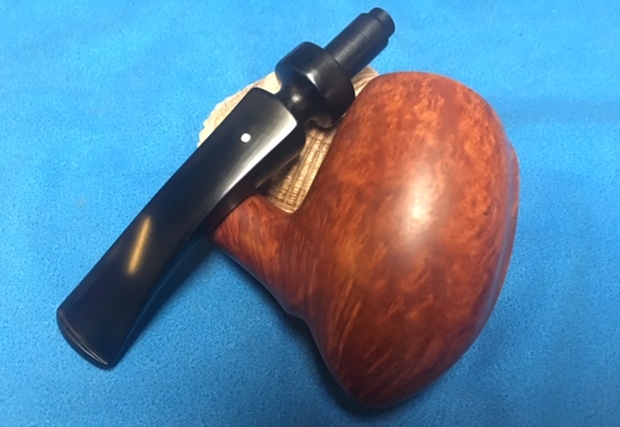
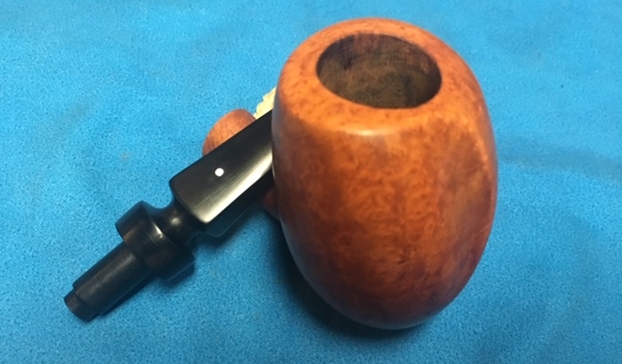
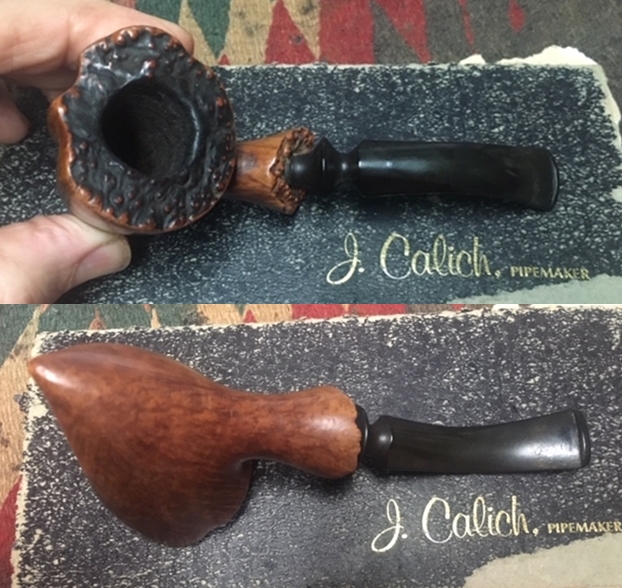
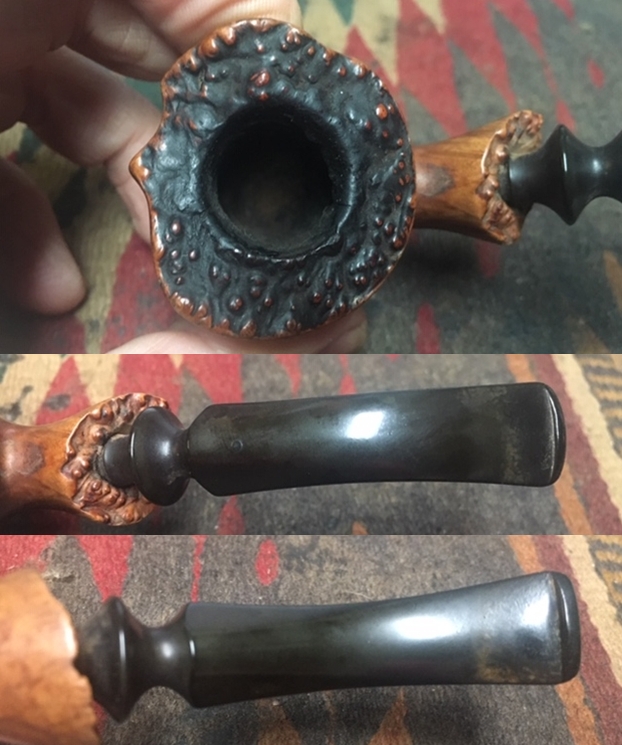
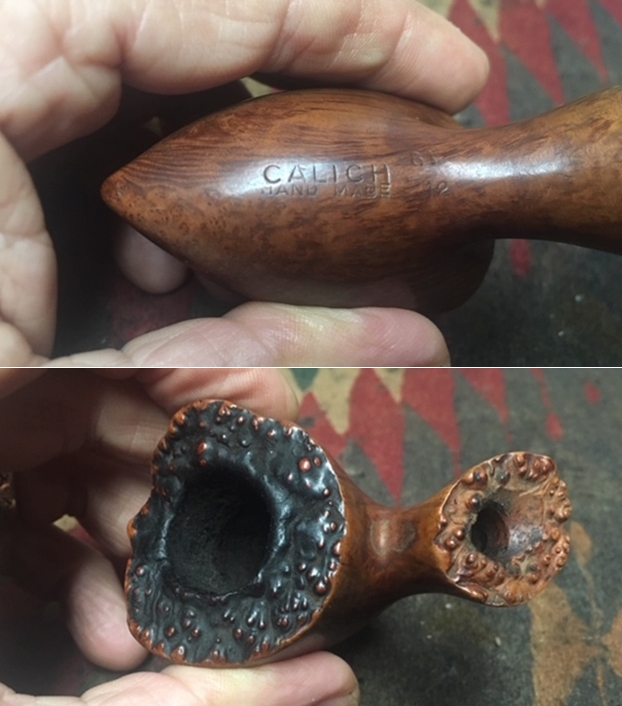
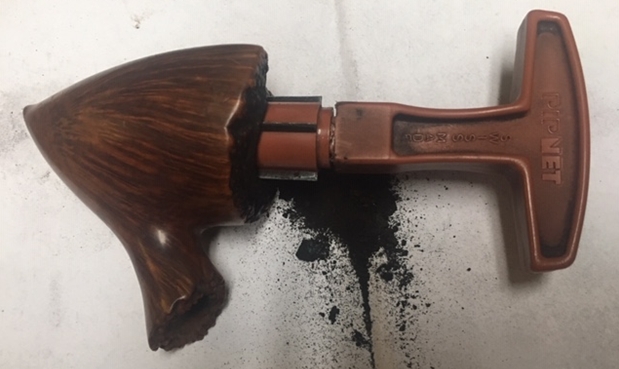
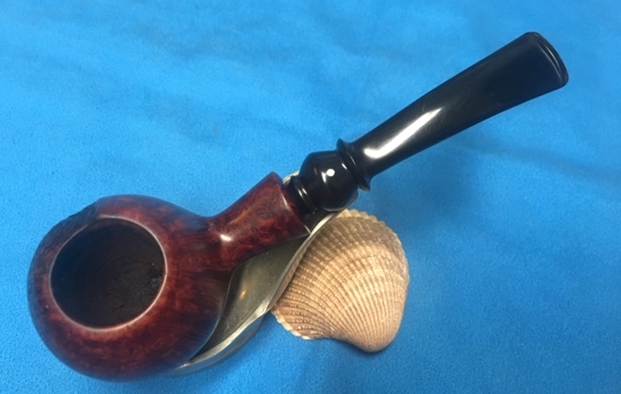
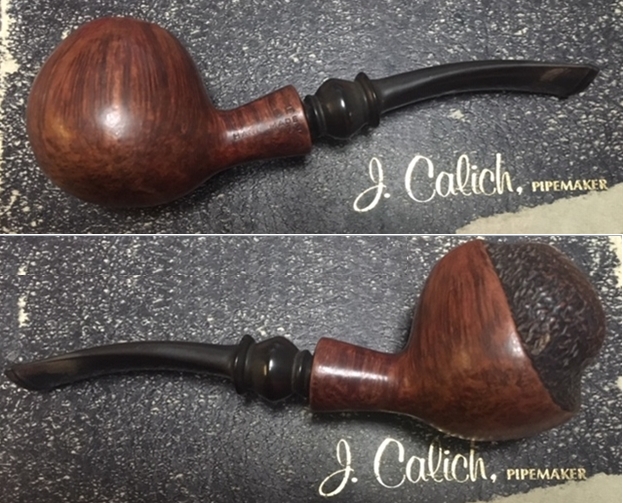
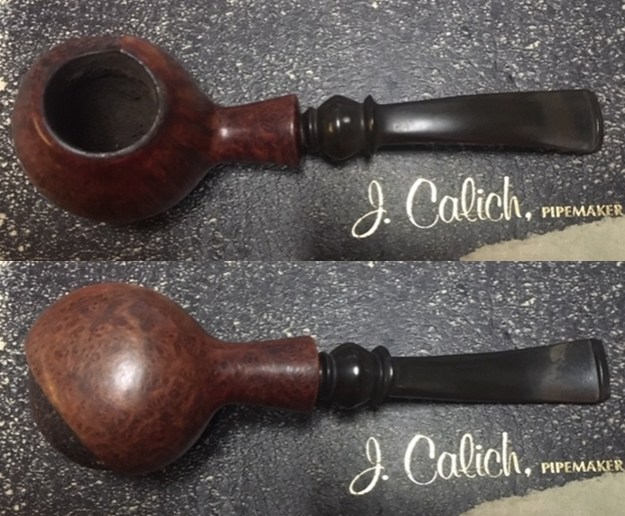
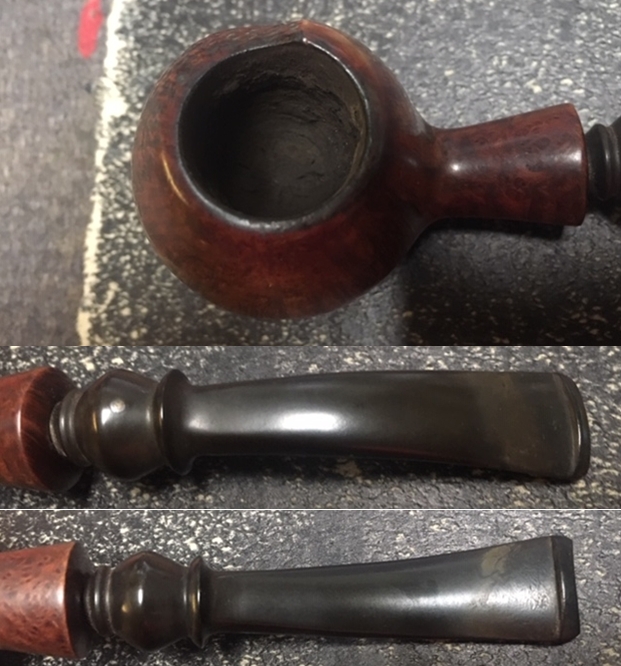
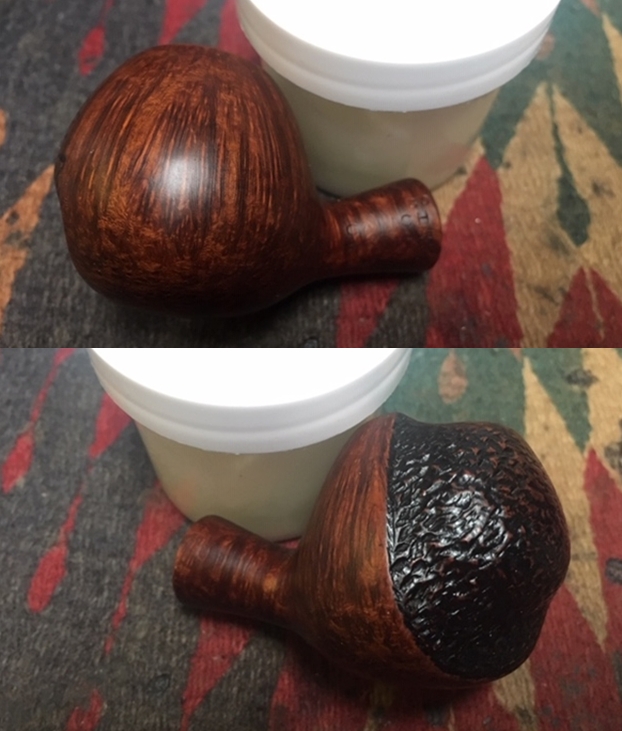
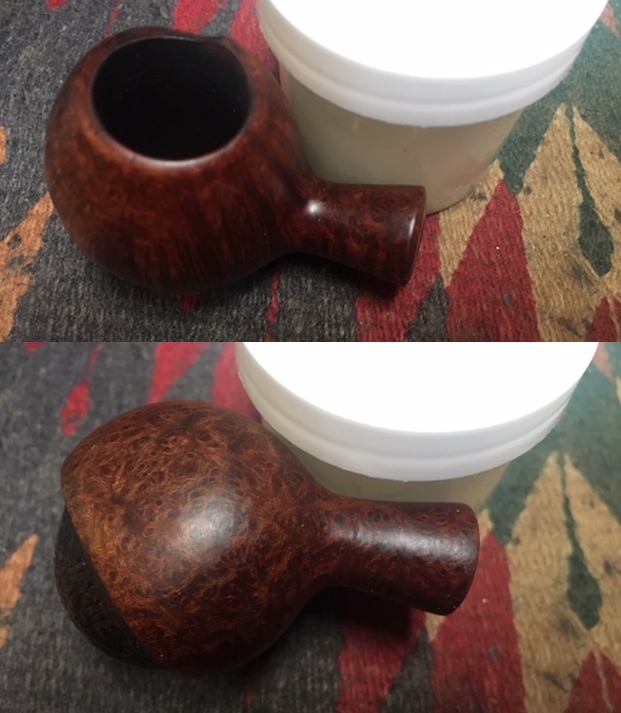
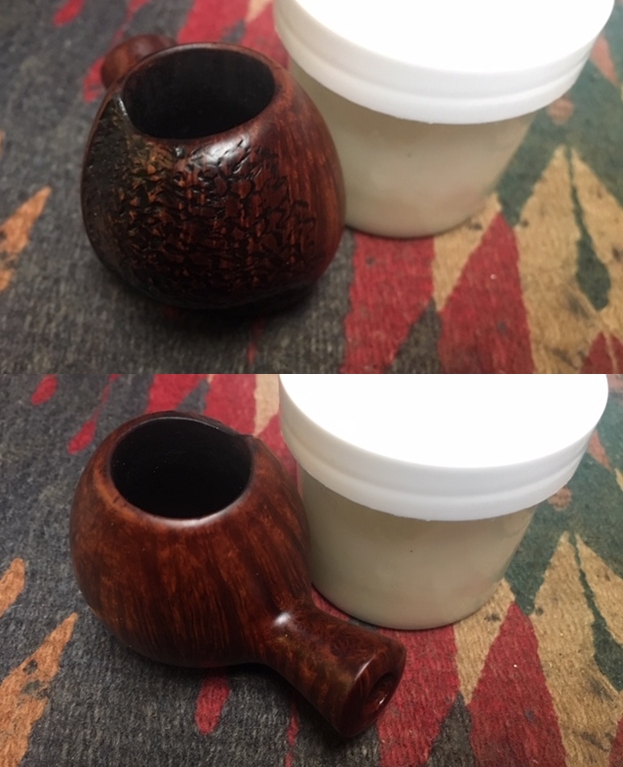
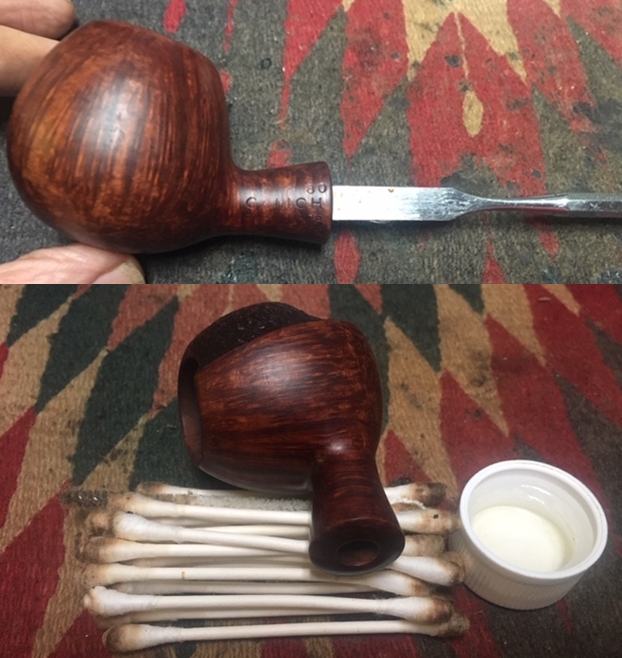
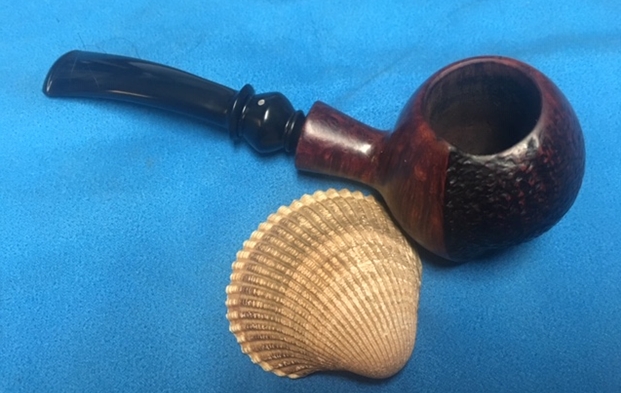
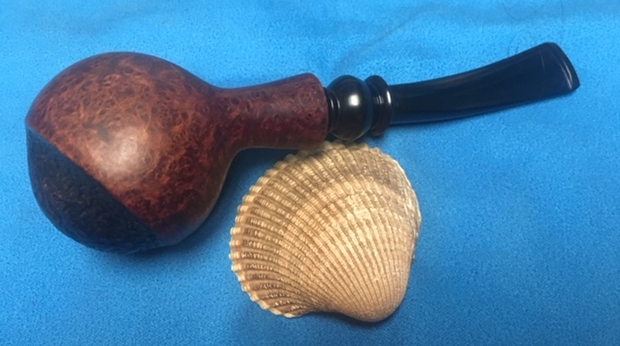
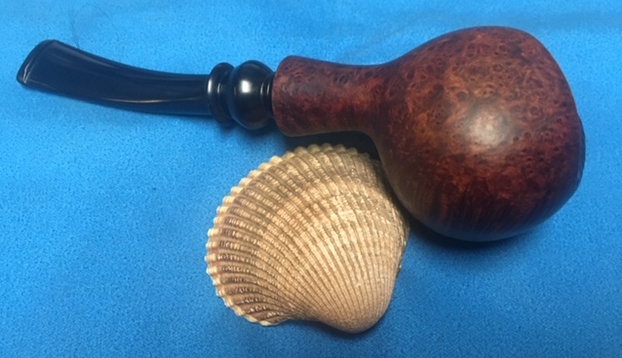
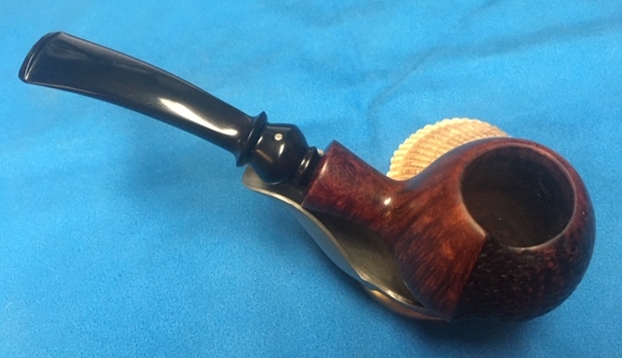
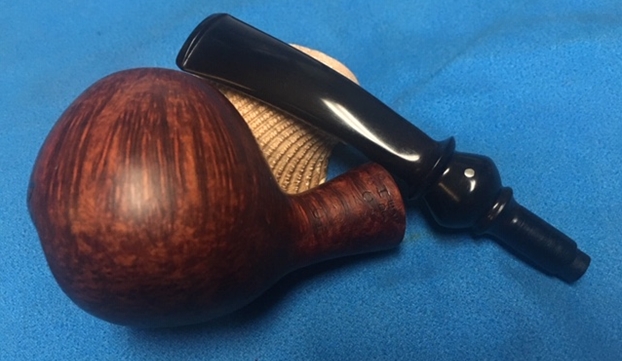
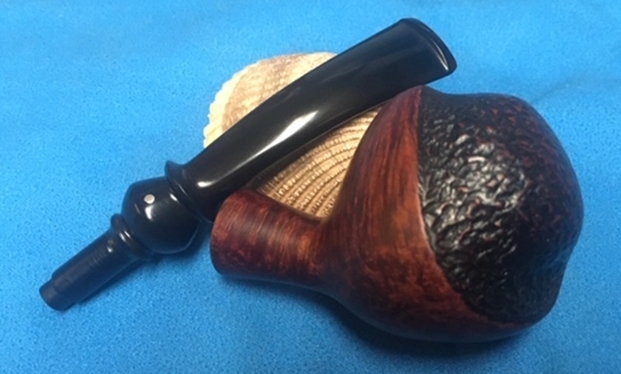
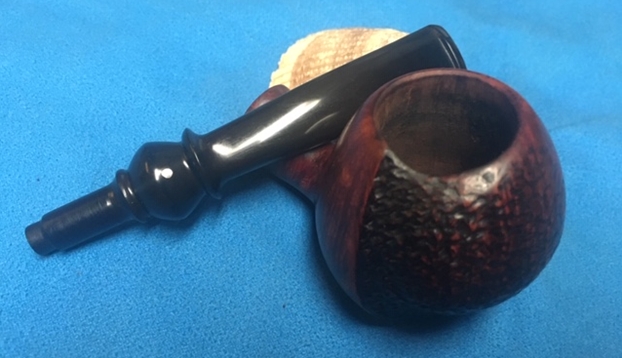
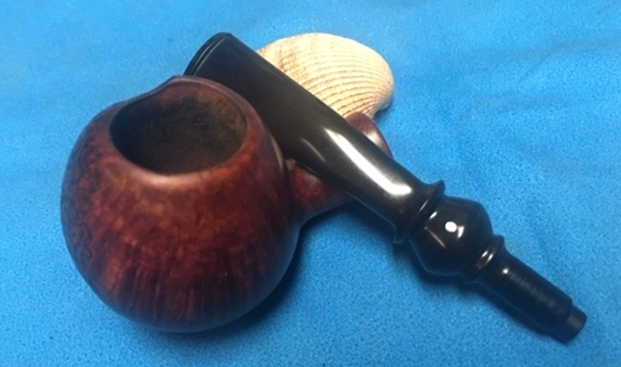
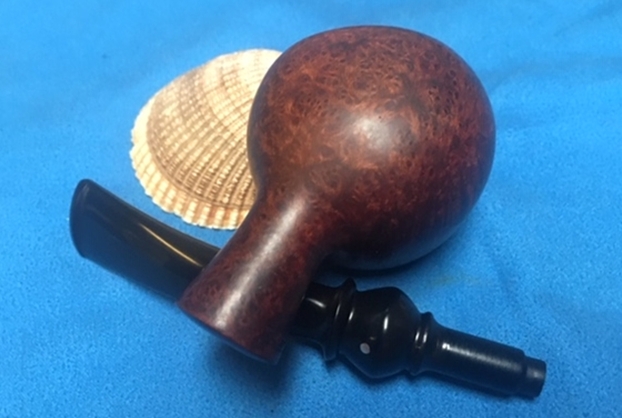
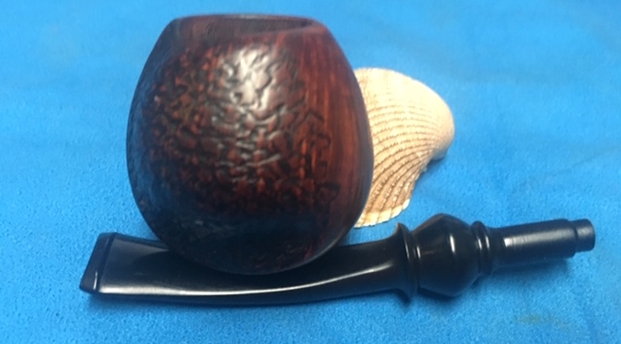
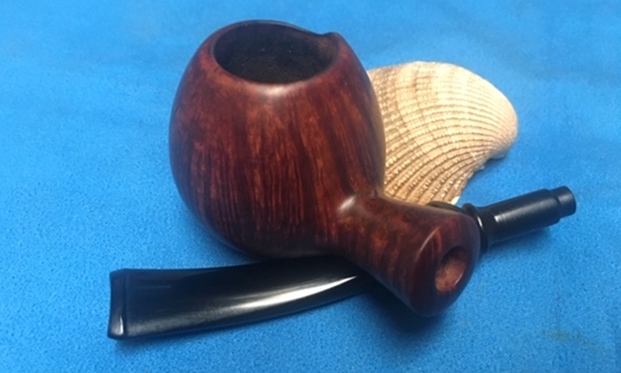
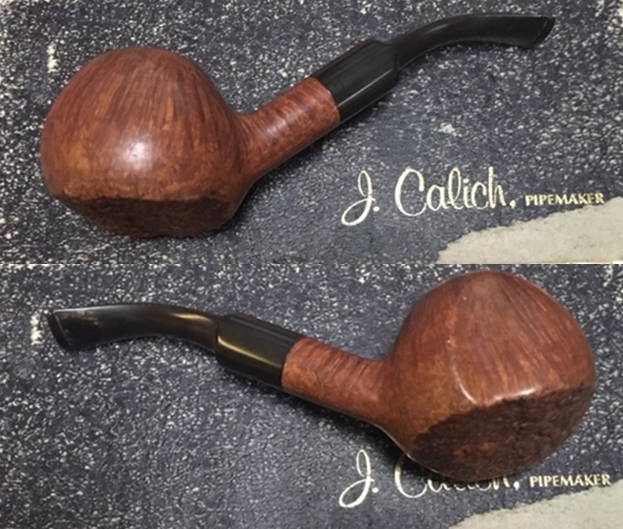
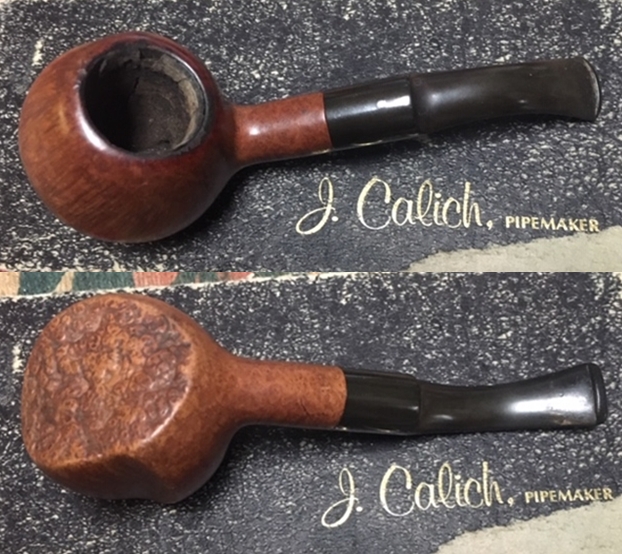
Restoring one more pipe for an old pipeman – a 1990 Calich Hand Made Grade 10 Apple


by Steve Laug

Earlier this month I received an email from Kathleen regarding one more Calich pipe for her husband. Here is here email.

… another abused Calich pipe that he had shamefully squirrelled away…

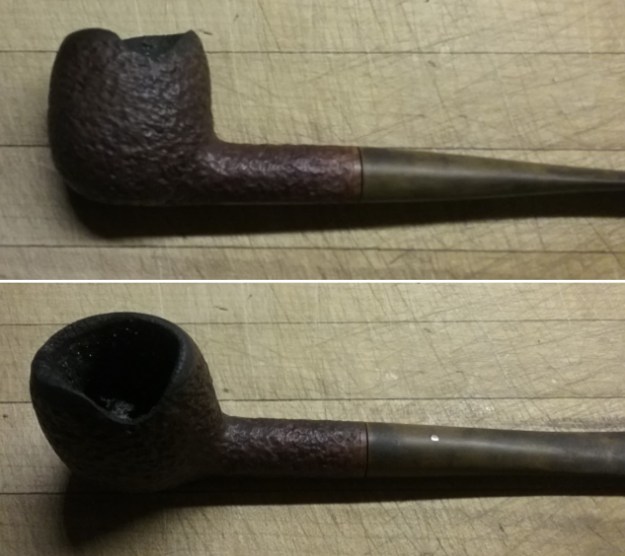
…About the poor abused Calich… a lovely pipe but he has two torch burned damage areas on a rusticated band around the top of the bowl… it might make more sense to cut it down below the rusticated band but I absolutely defer to your wisdom in the matter.

All Calich pipes deserve to be saved. — Kathleen

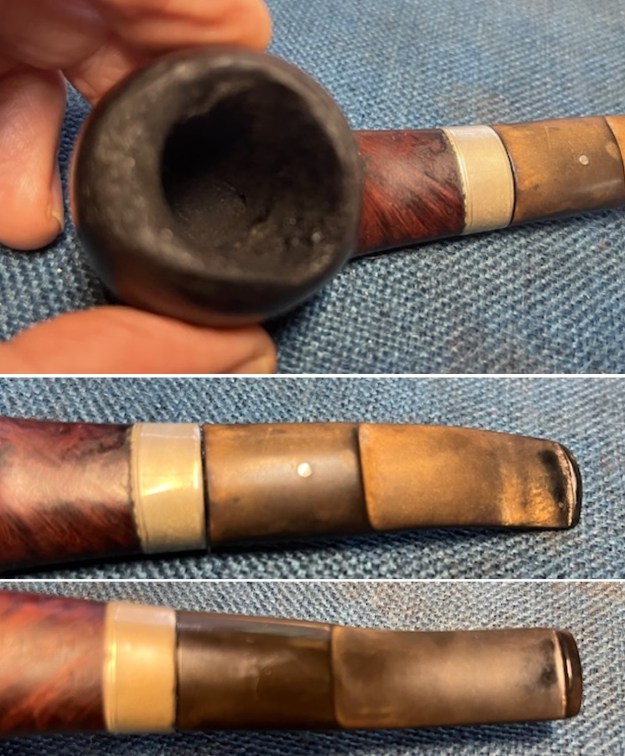
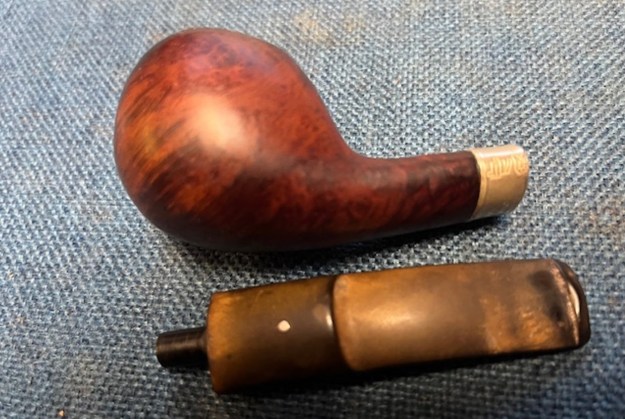
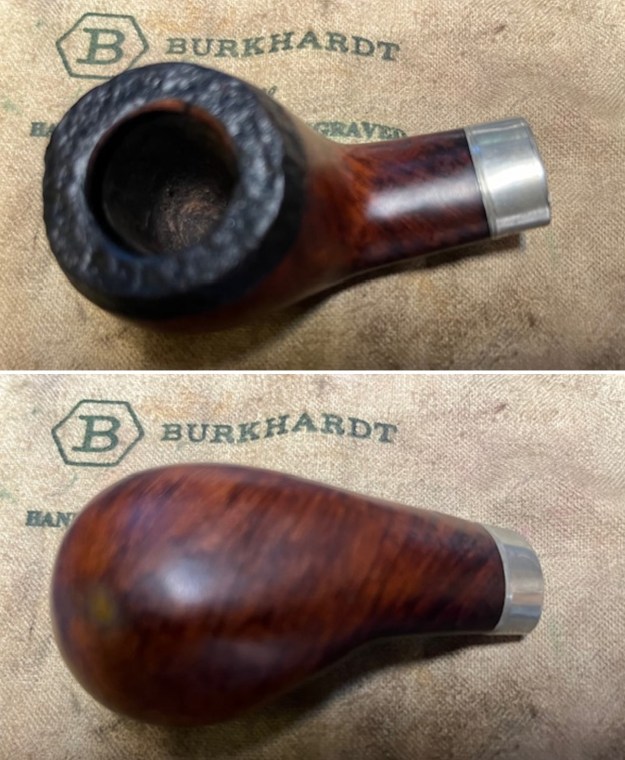
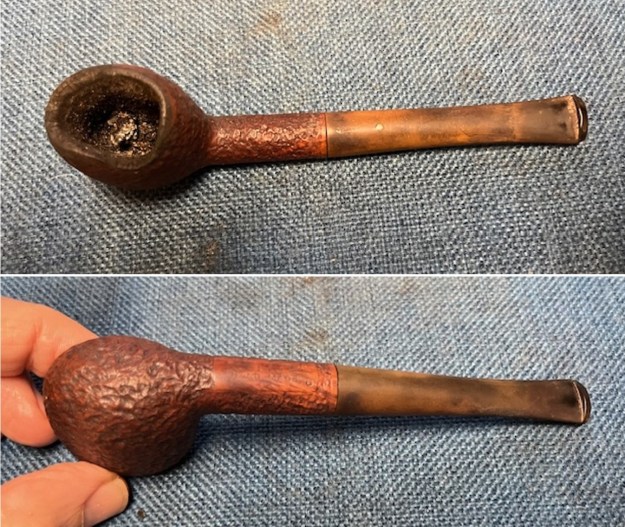
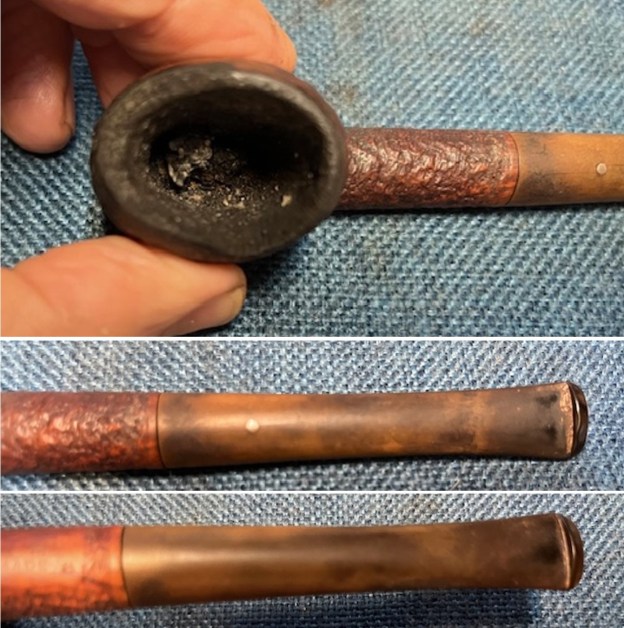
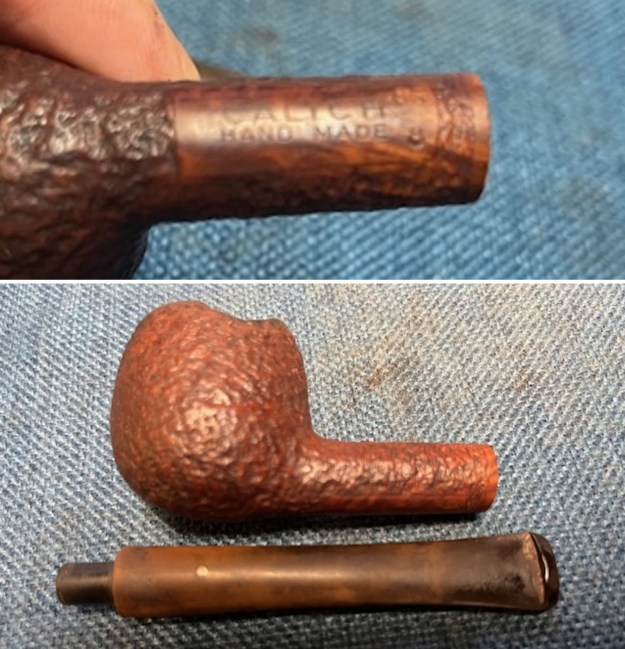
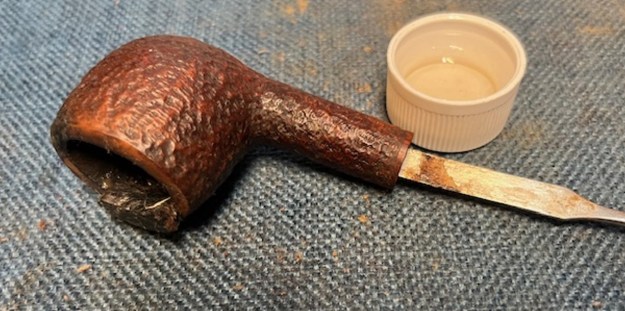
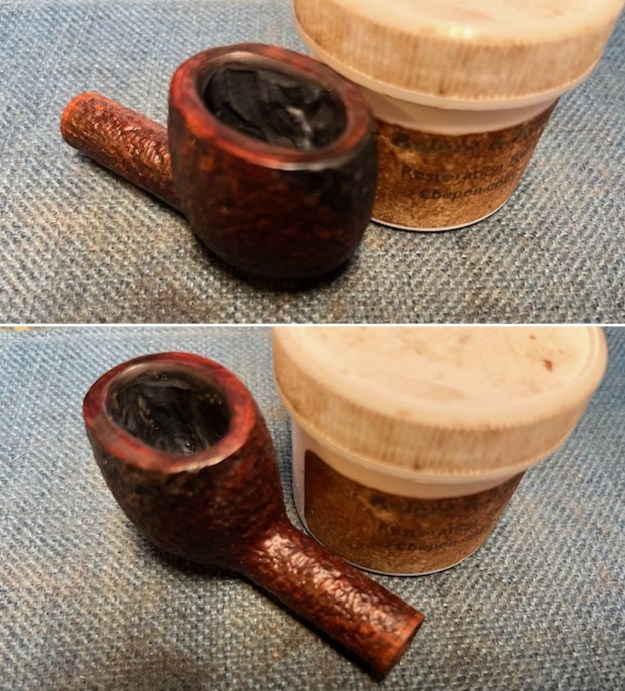
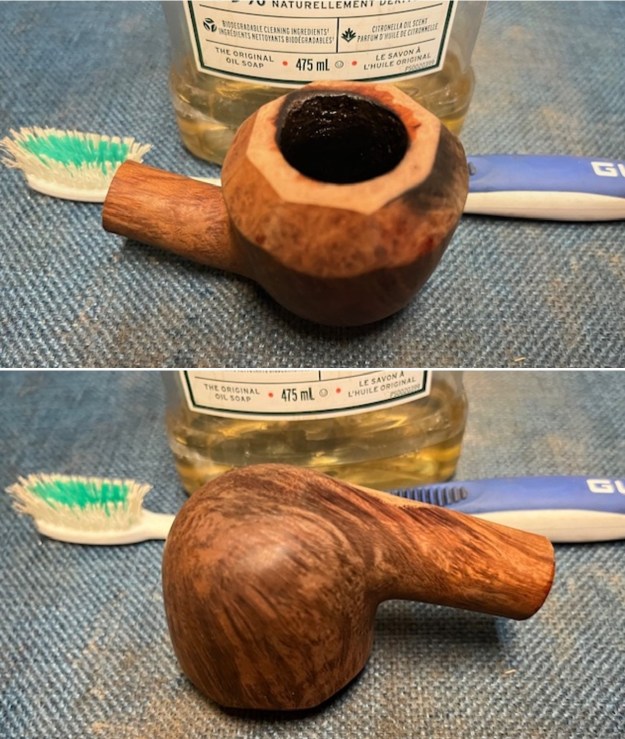
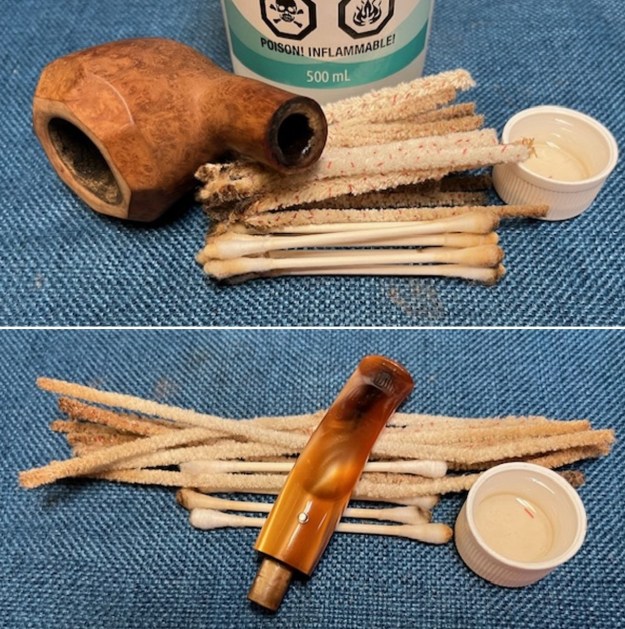
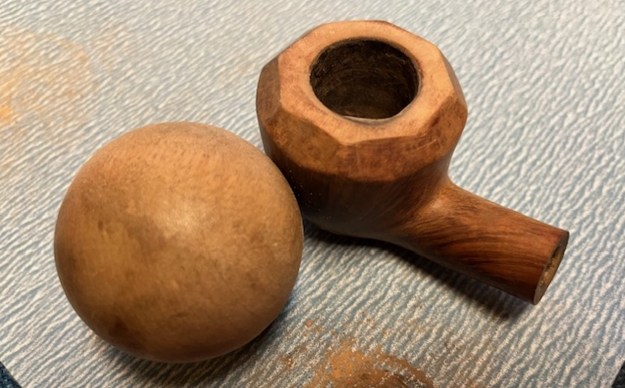
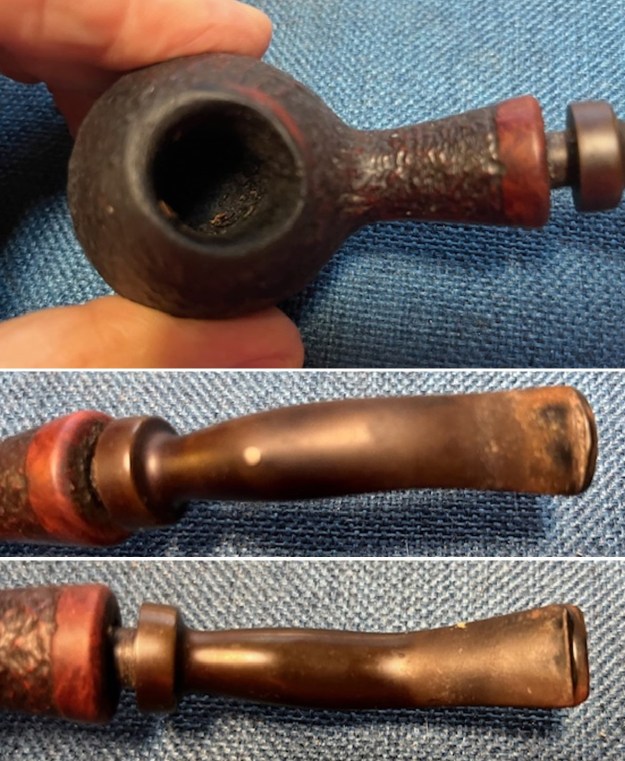
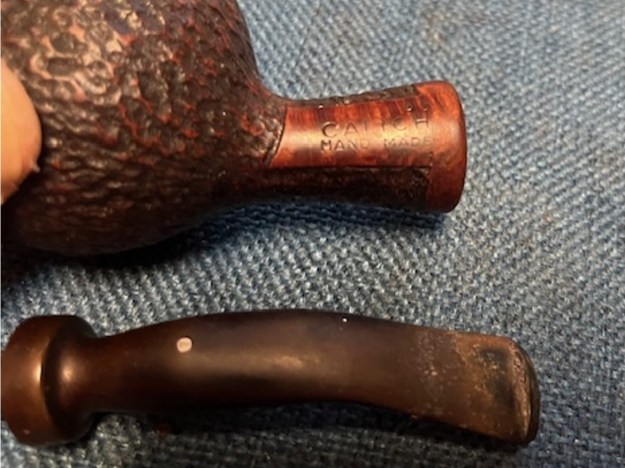
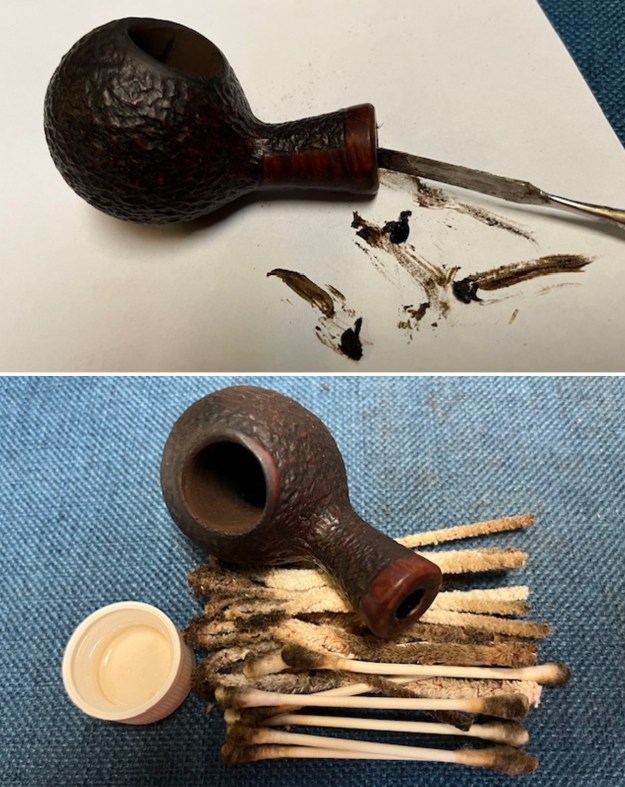
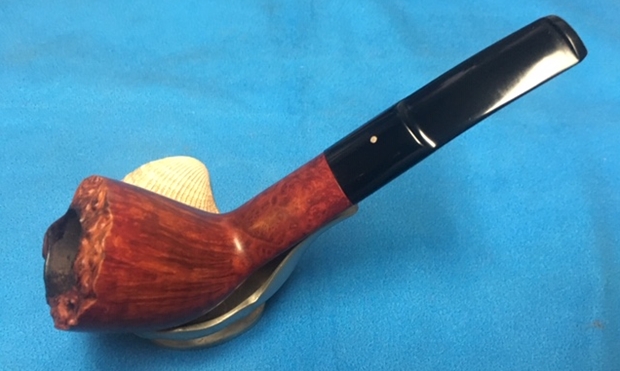
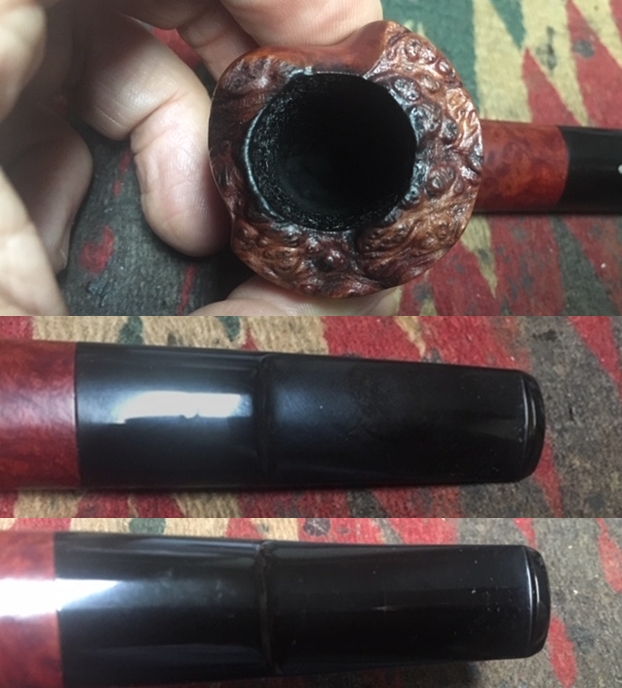
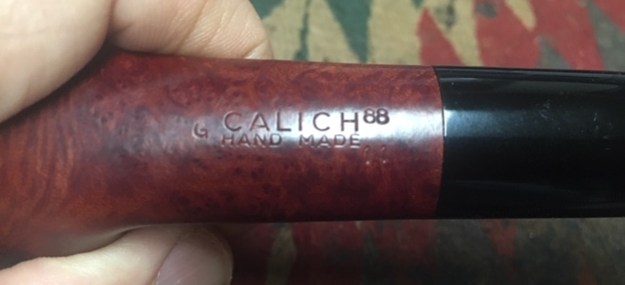
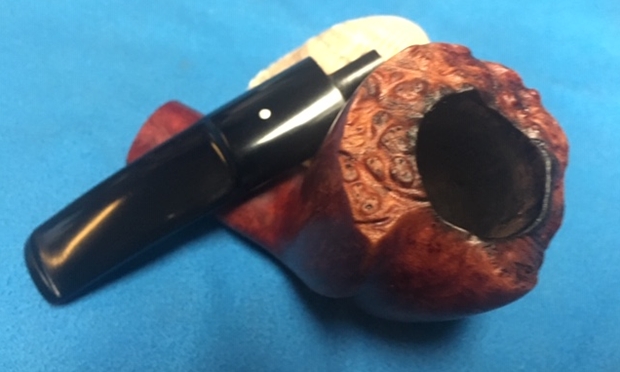
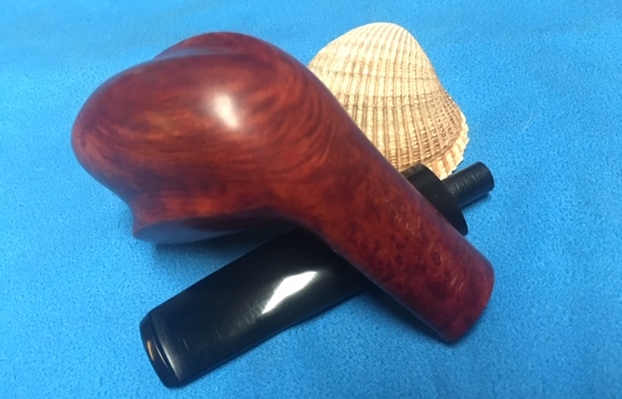
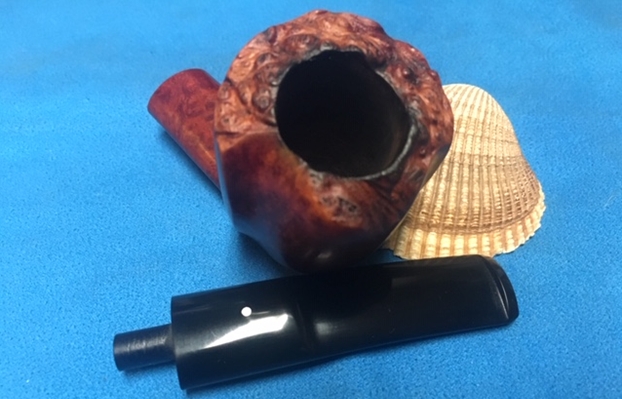
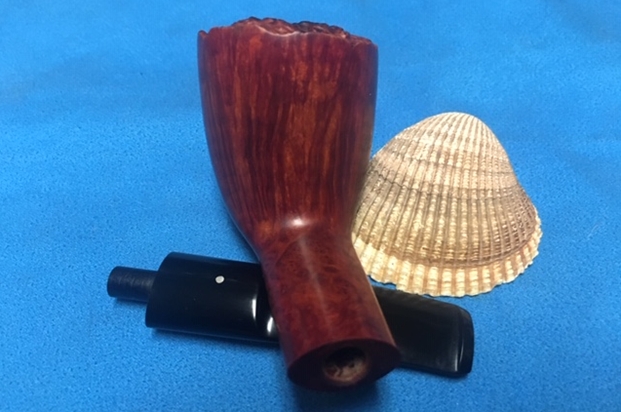
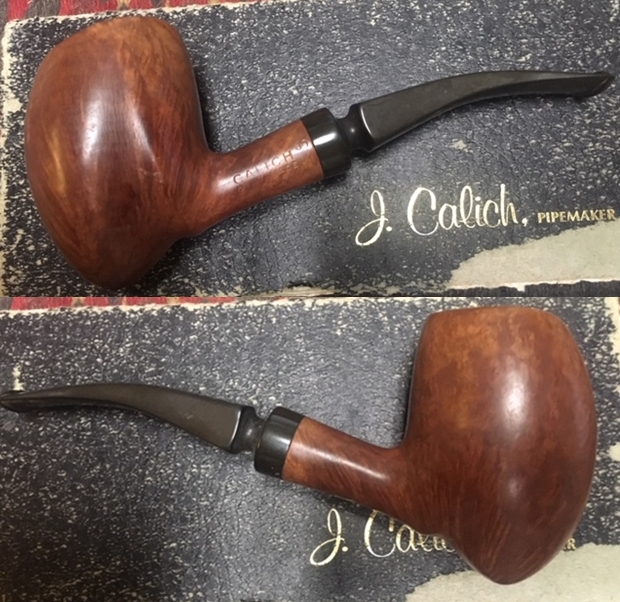
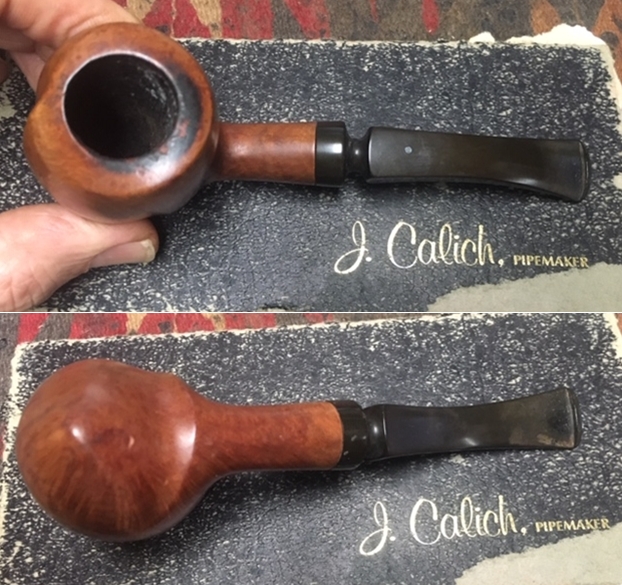
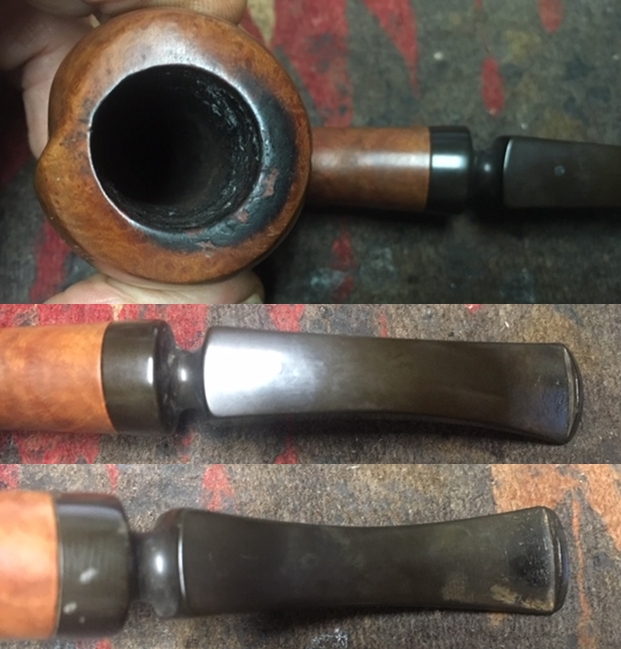
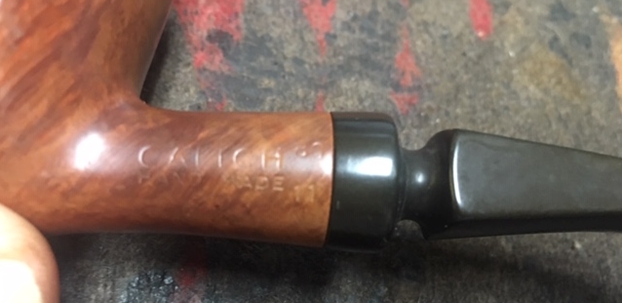
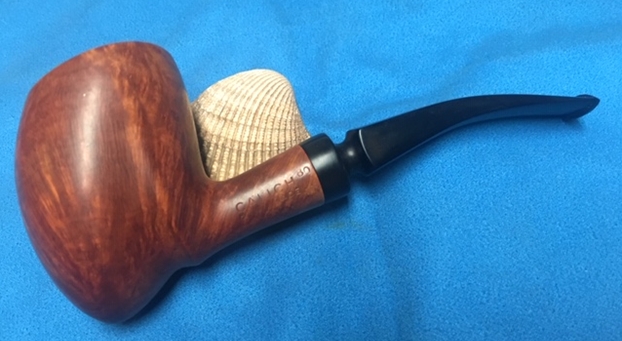
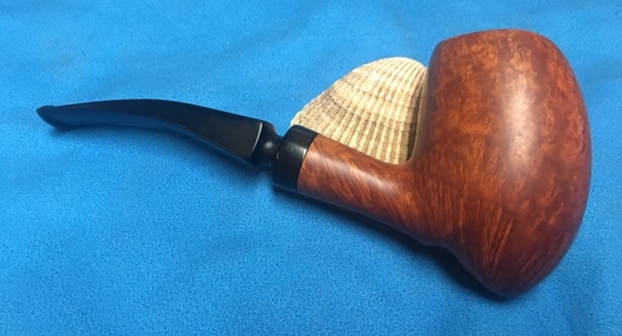
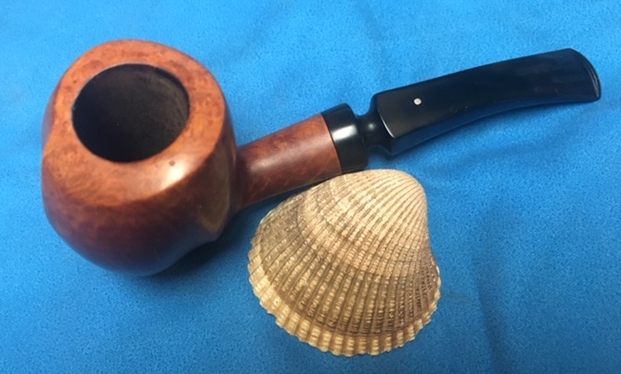
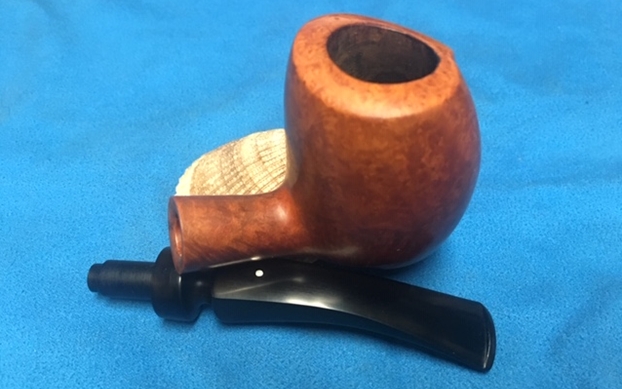
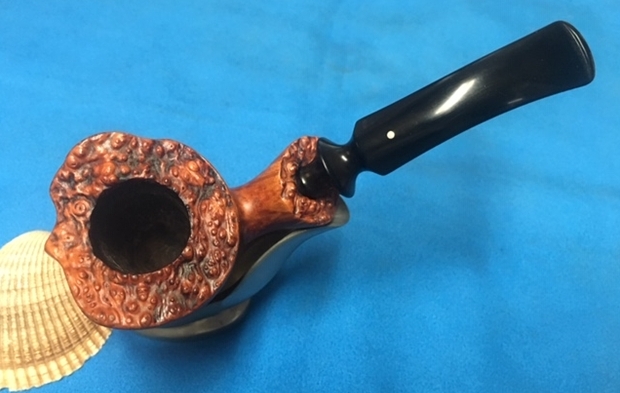
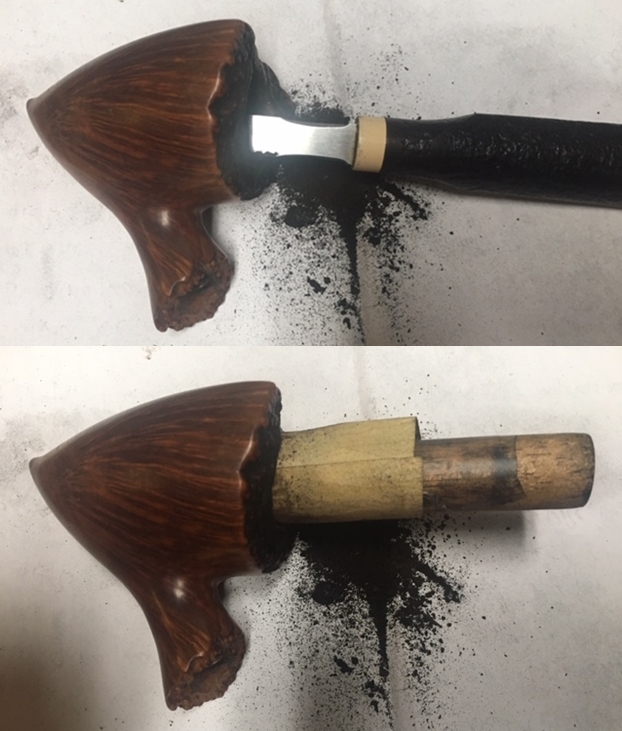
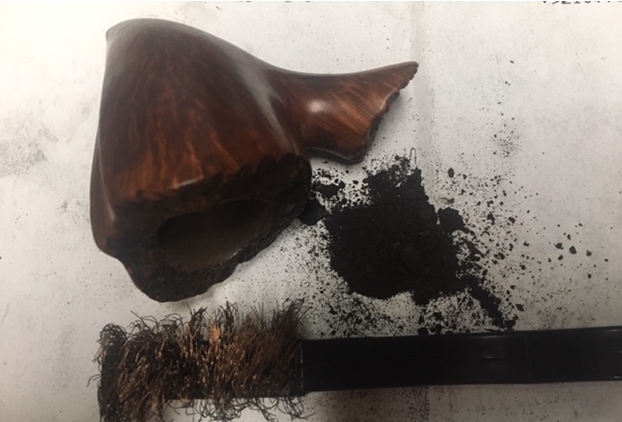
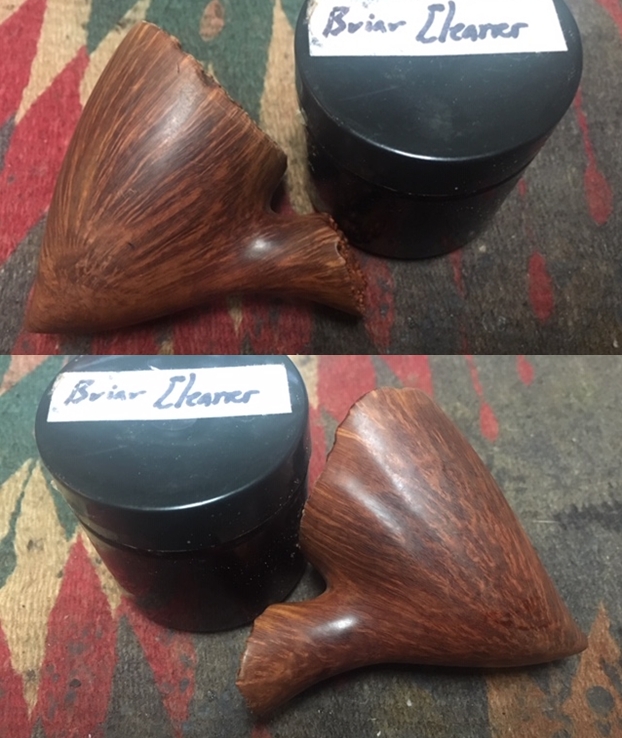
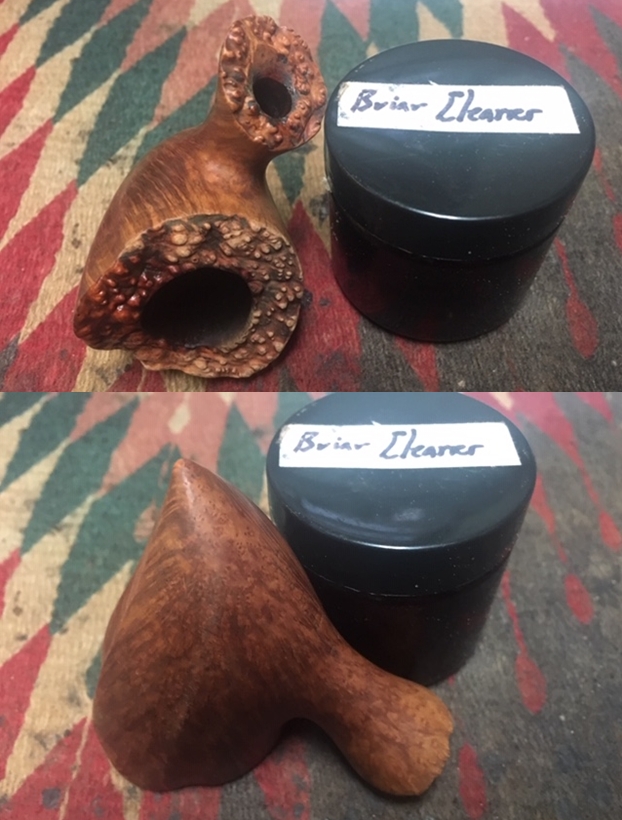
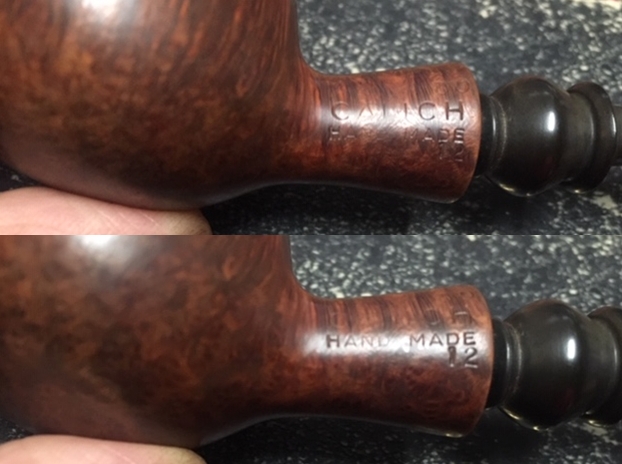
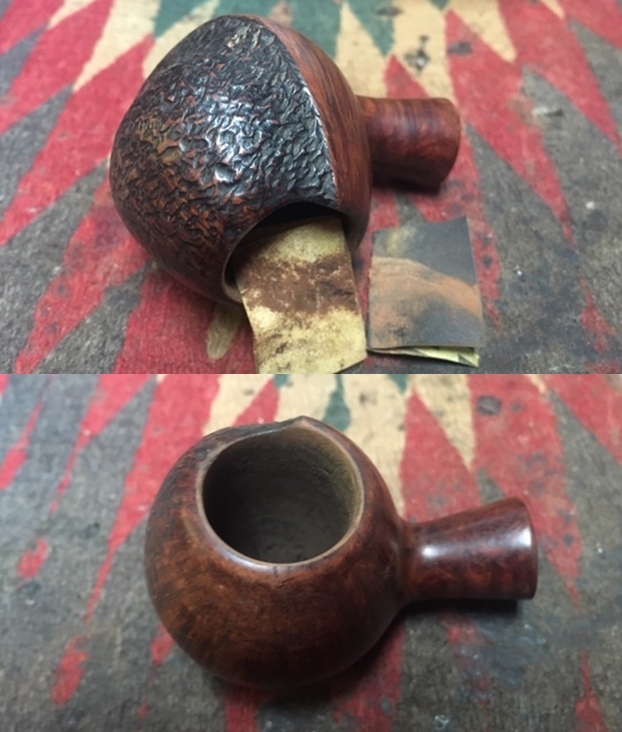
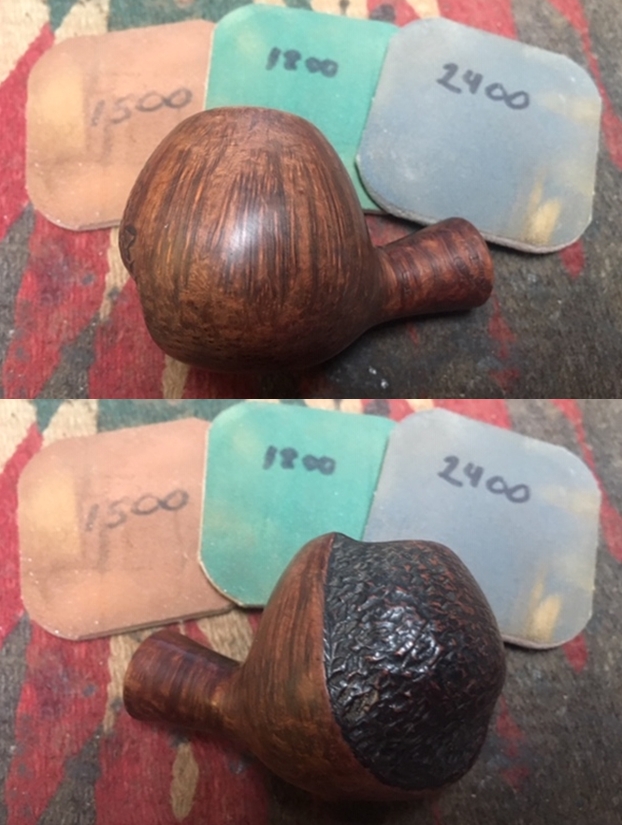
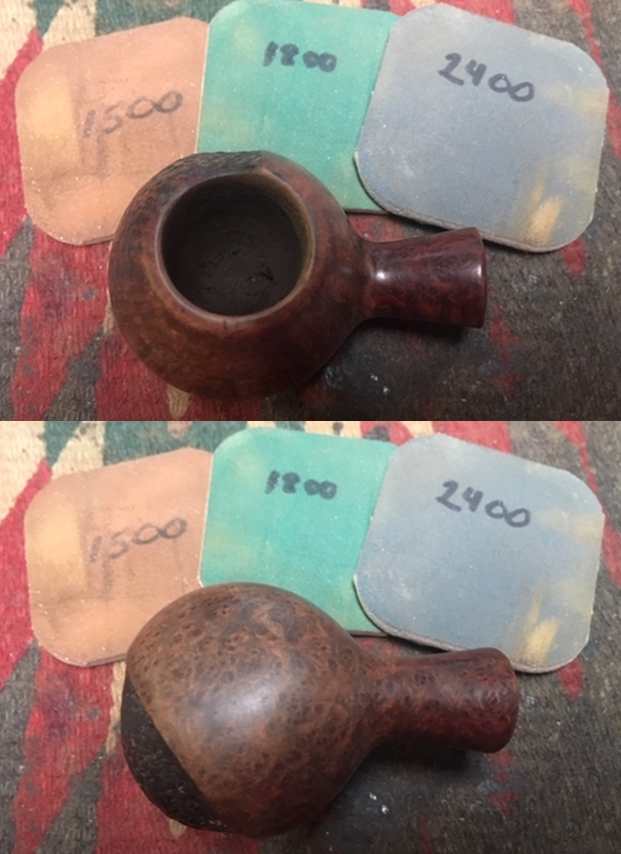
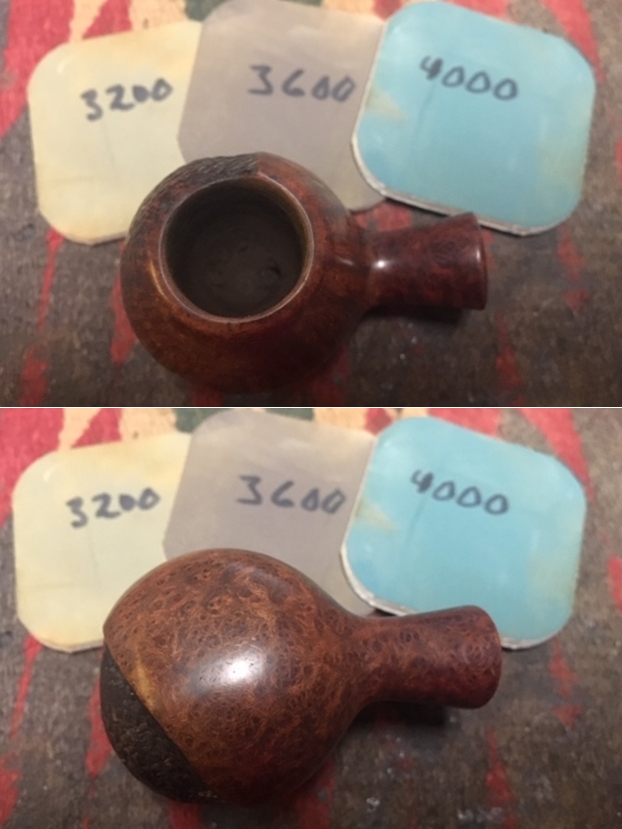
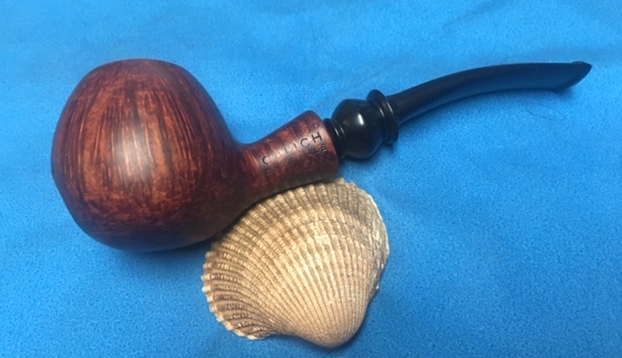
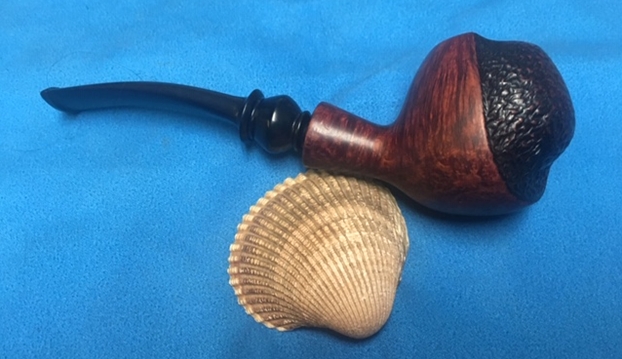
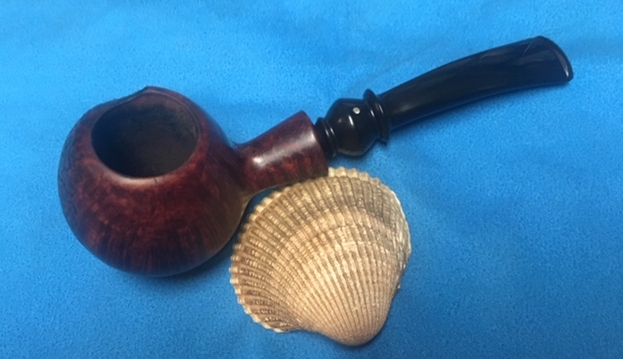
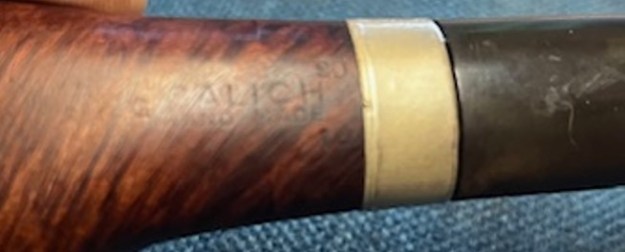
I agreed with her and I replied to Kathleen and invited her to send the pipes to me in Vancouver. They arrived just this week. I put on the Billie Holiday Disc and went through the package. Next to the four CDs there was a carefully bubble wrap bag with a pipe inside. It is by far the worst of the damaged pipes that I have worked on for this fellow. This one is an oval shanked apple shape pipe. It is stamped on the underside of the shank and read G followed by CALICH [over] Hand Made [over] 10 and above that 90. The rim top and the first ¼ down is rusticated in typical Calich style. The rest of the bowl was smooth as was the shank. The pipe had a very thick cake in the bowl and there was a lava overflow and burn damage on the top. There was some major burn damage under the lava on the mid-front edge of the bowl as well as a deep burned area on the left side toward the back of the left side. The burn marks on both were like a large bite out of the briar as can be seen in the photos. The shank had a thick coat of tars and oils and the stem had a thick tar build up as well so its fit in the shank was very sticky and dirty. The saddle stem itself is vulcanite with a single silver dot on the topside. It was heavily oxidized and had light tooth marks and chatter on both sides of the stem just ahead of the button. There were overflowing tars on the smooth shank end around the fit of the tenon in the mortise. There was a nickel repair band on the shank end that was oxidized and looking at the shank end there were some cracks in the shank. The finish was very dirty and oily but the grain I could see through the grime and tars appeared to be quite nice. A lot would be revealed once I had cleaned it. I took photos of the pipe before I started my cleanup work. I took a close-up photo of the bowl and rim top to show its condition. The inside of the bowl was heavily caked with a wet, oily tars up the sides and over the rim top. The rim top had damage on the front and on the back-left side. It is the worst as it is quite thin and is like a deep bite mark down the sides of the bowl. It left a mess for me to clean up. The stem was also is a mess. There was some light tooth marks and chatter on the top and underside ahead of the button. There was a thick coat of calcification and oxidation on the stem. The silver dot on the stem top was tarnished but very visible. I took a photo of the bowl with the stem removed to show the look of the pipe.I took a photo of the stamping on the underside of the shank. It is clear and readable as noted above. I am once again including information about John Calich the pipemaker as I have loved John Calich’s pipes for over 25 years now and have collected a few of them. I have restored quite a few of them and written blogs about them that can be read if you are interested in seeing the kind of pipes that John made. They are unique and beautiful. Each of his pipes are a work of art to me. I am including the links to the previous blogs that have written about his pipes.
https://rebornpipes.com/2015/03/03/one-of-my-john-calich-pipes-a-calich-ee-billiard/

https://rebornpipes.com/2019/01/23/i-am-the-happy-owner-of-an-unsmoked-pipe-by-the-late-john-calich/

https://rebornpipes.com/2015/03/03/one-of-my-john-calich-pipes-a-calich-ee-billiard/

https://rebornpipes.com/2014/03/21/reflecting-on-my-collection-of-john-calich-pipes/

Each of the blogs reflects on John’s pipes if you want to get a feel for them take a few minutes and read them.

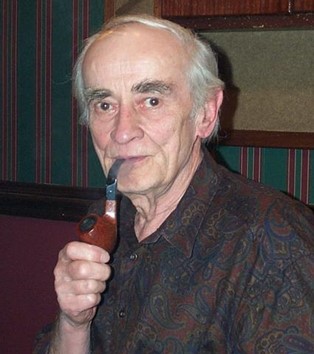
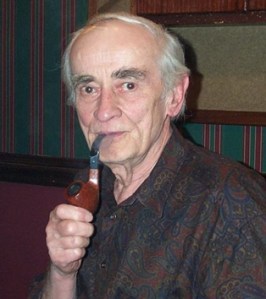
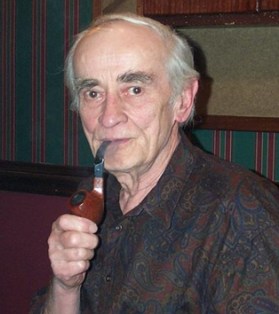
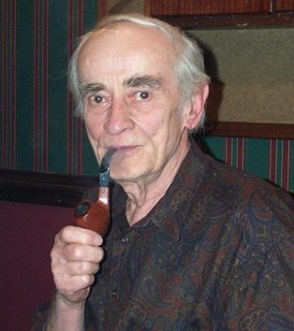
When John was living I spoke with him several times via phone and had him make some new stems for some of his pipes that I picked up off eBay. He was a very kind gentleman and was always helpful when I spoke with him. He was always ready with encouragement and when I needed to know how to do something when I was first learning to repair pipes he was willing to help. He was one of the old guard of Canadian Pipe makers. I miss him. I am including a short piece from Pipedia on John to give details on his work and the grading of his pipes. The second paragraph below is highlighted in blue as it gives some information on the Grade 10 Apple that I am working on with the single silver dot now. I am also including a photo of John Calich, courtesy Doug Valitchka

John Calich was one of Canada’s finest carvers. He died in July 2008. John was a full-time pipe maker for the last 40 years. Calich pipes were mostly traditional shapes. His signature style is rustication and smooth on the same pipe along with his unique skill to stain a pipe in contrasting colors. He used only top-quality Grecian and Calabrian briar. The mouthpieces are hand finished Vulcanite “A”. Each pipe was entirely made by hand. John Calich was featured in the summer 2005 issue of Pipes & Tobacco.

His pipes are graded 3E – 7E. Retail prices range from$ 145.00 to $ 500.00 Each pipe is stamped “CALICH” 3-8E, his earlier pipes were graded from 3-14, and a single, tiny silver dot is applied to the top of the stem (https://pipedia.org/wiki/Calich).

I summarize the dating information from those blogs now: From my research and conversations I learned that John’s later pipes were graded 3E – 8E. The retail prices for them ranged from $145.00 to $500.00. Each pipe was stamped “CALICH” and given an E grade. His earlier pipes were graded from 3-14 and had a single, tiny silver dot applied to the top of the stem. More information can be found at the Pipedia article above. All of this information told me as expected that the pipe I had was an earlier one.

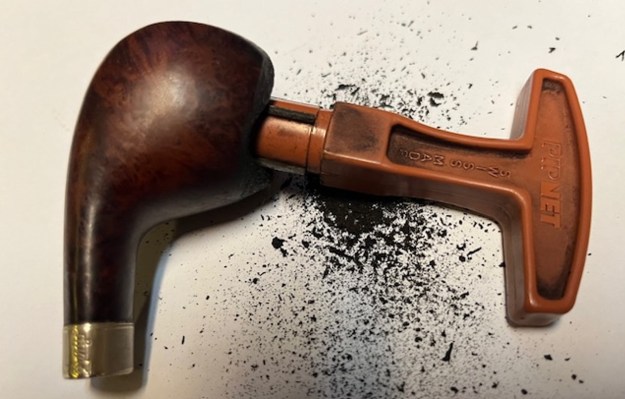
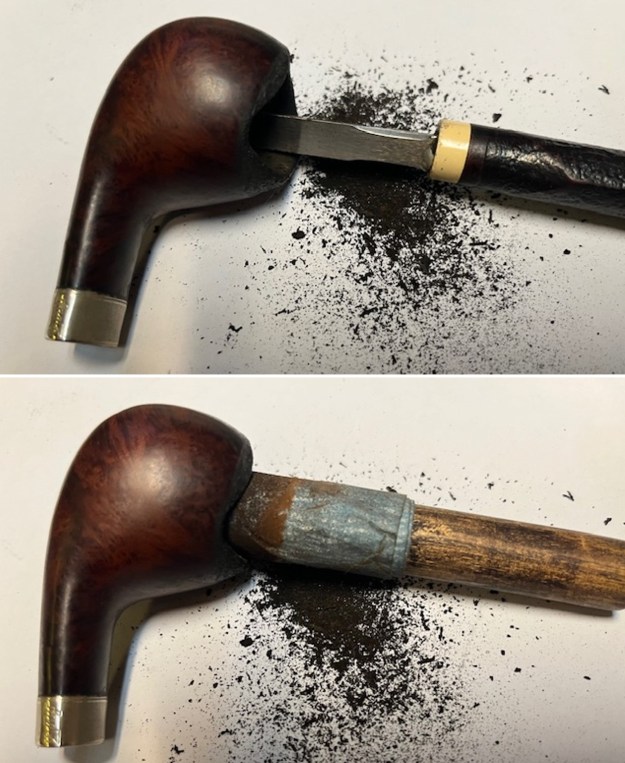
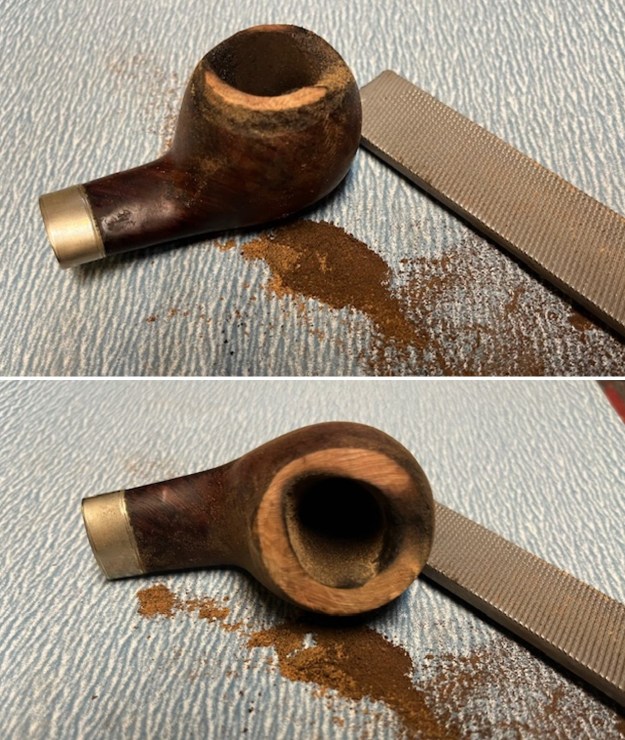
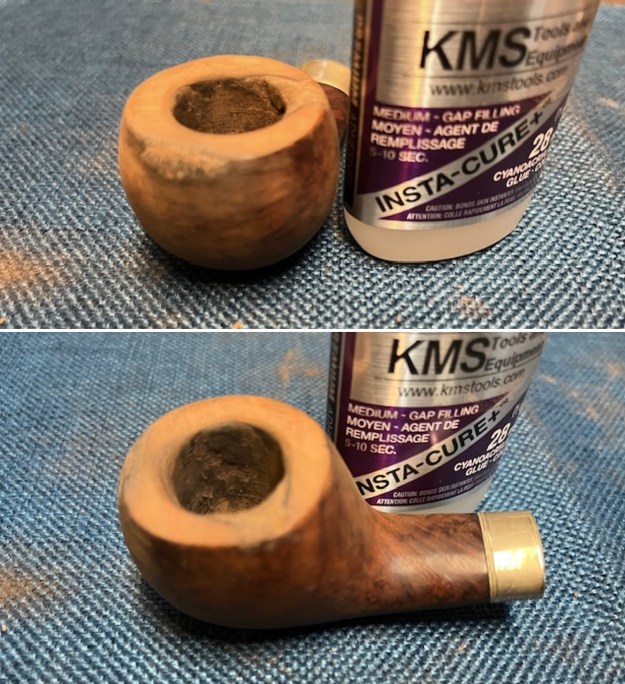
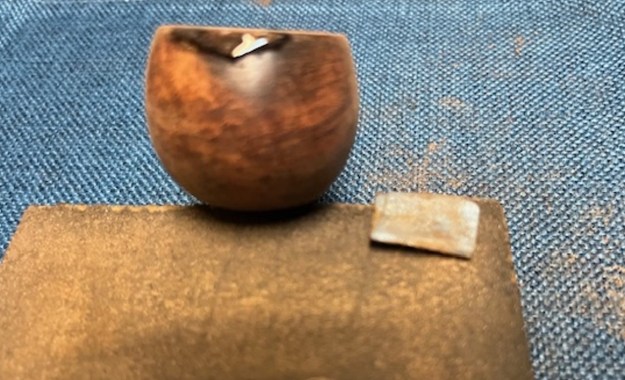
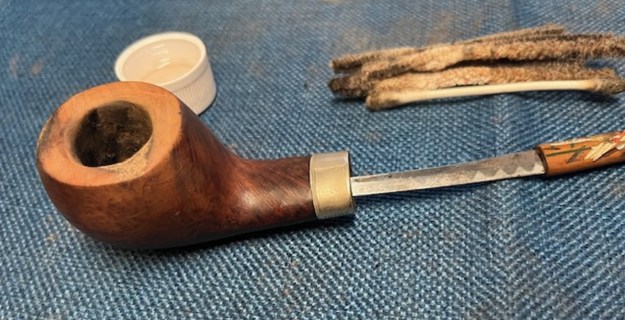
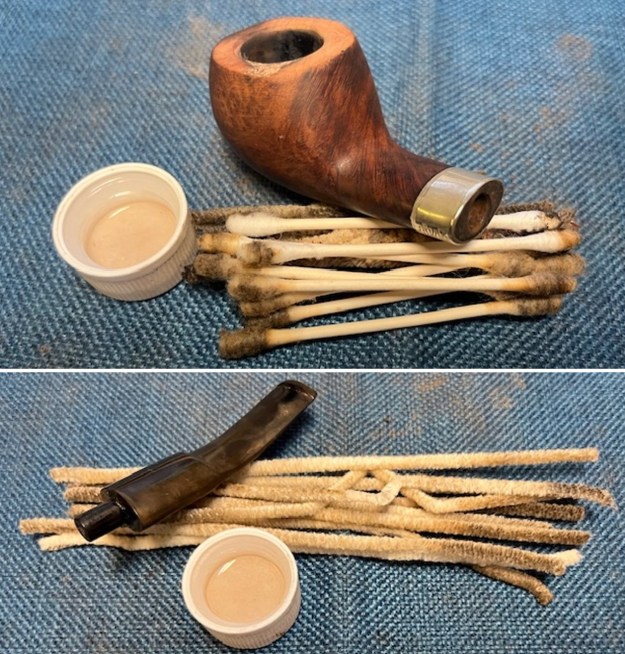
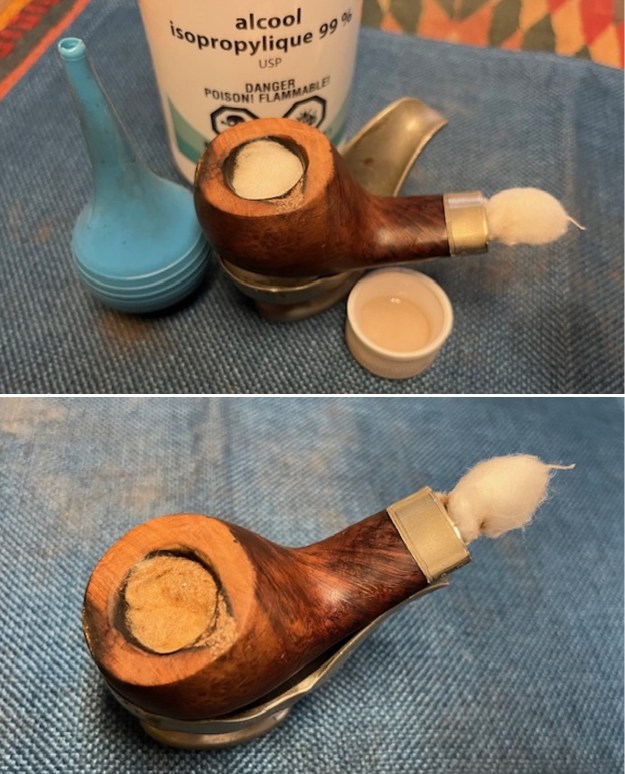
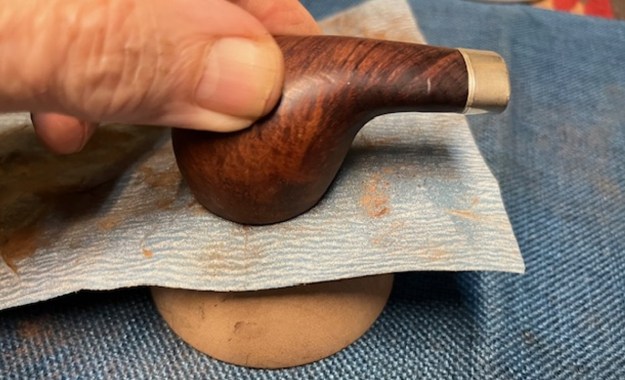
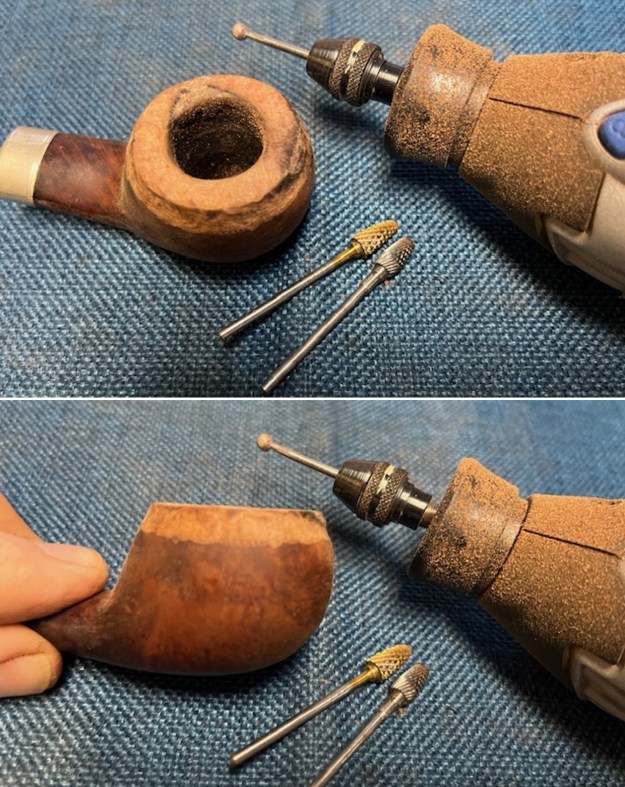
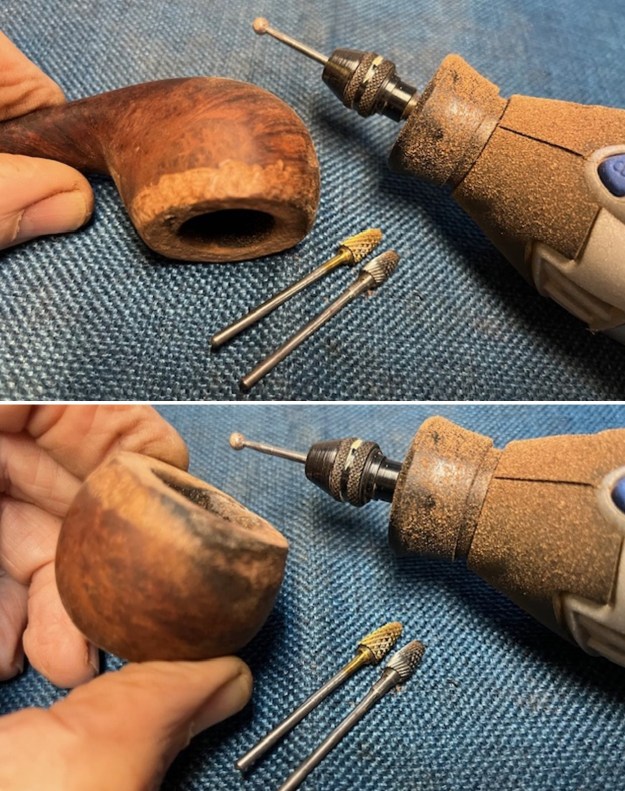
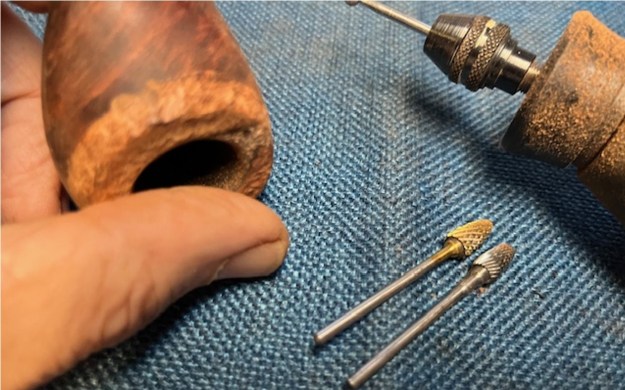
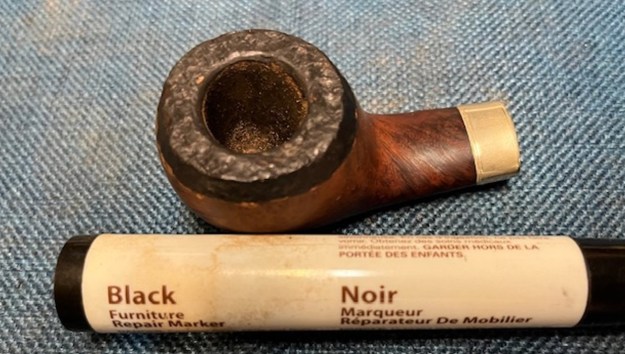
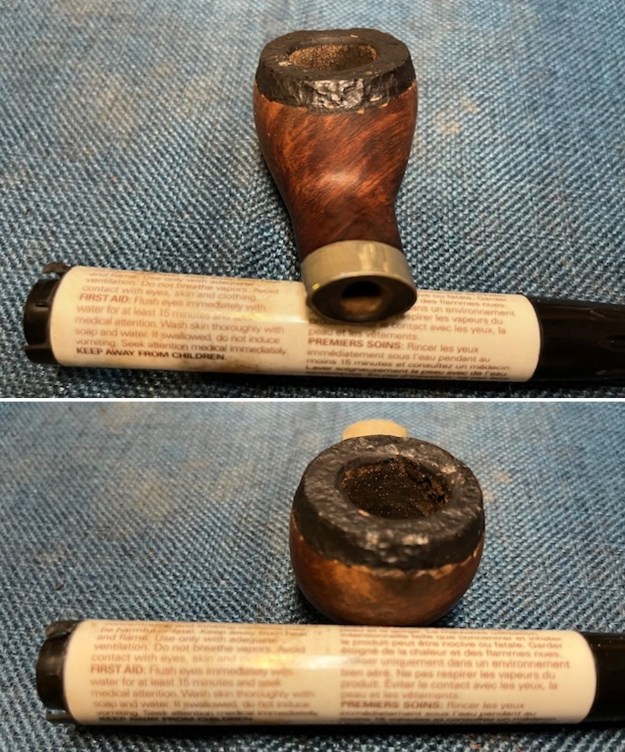
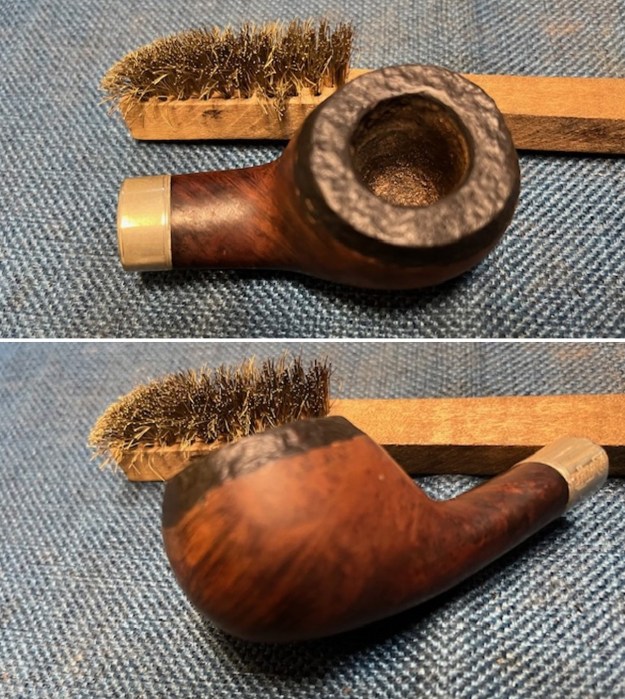
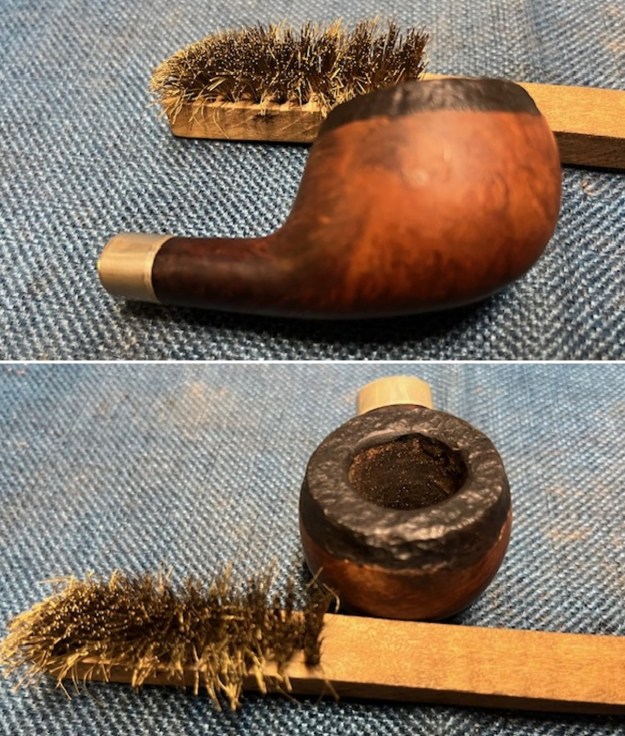
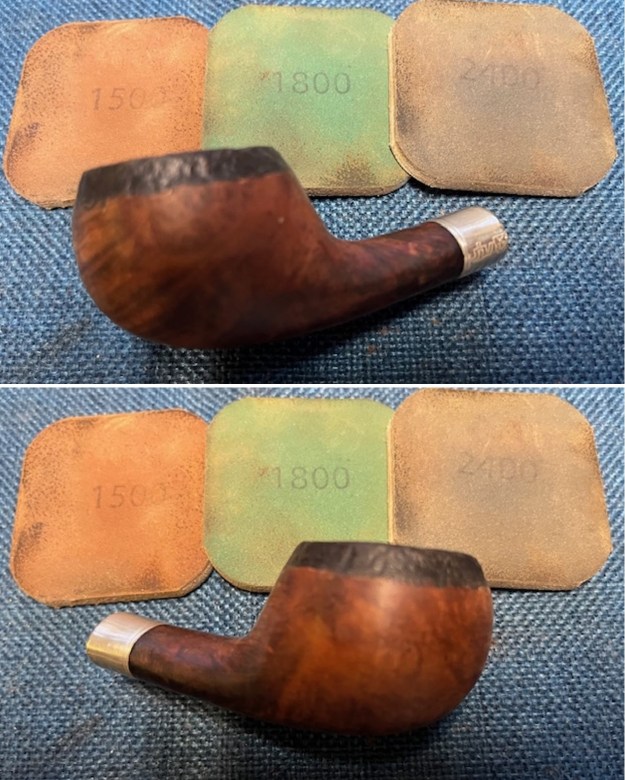
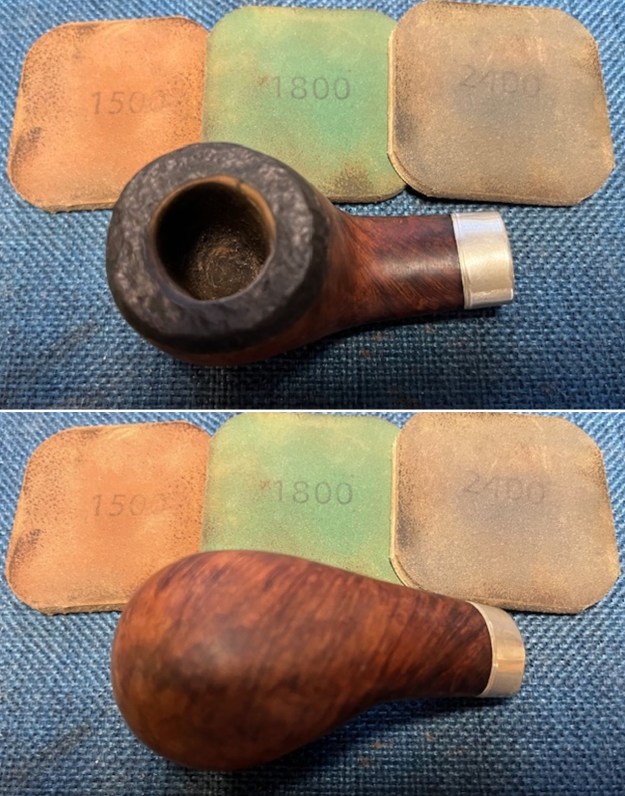
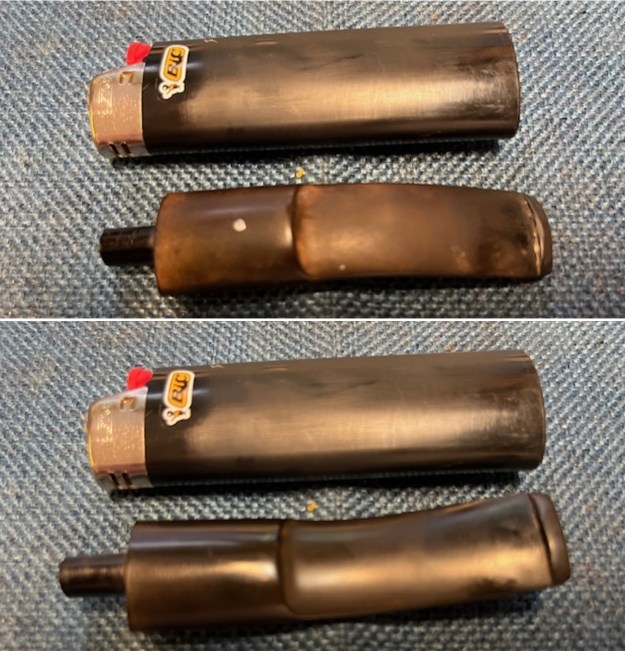
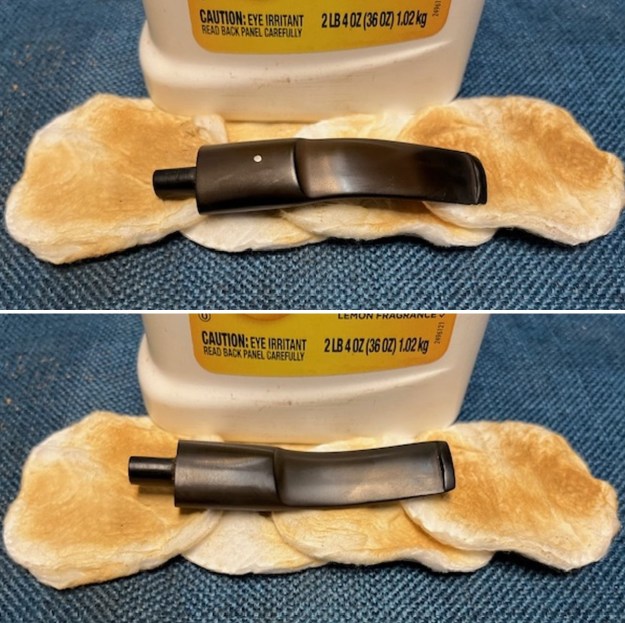
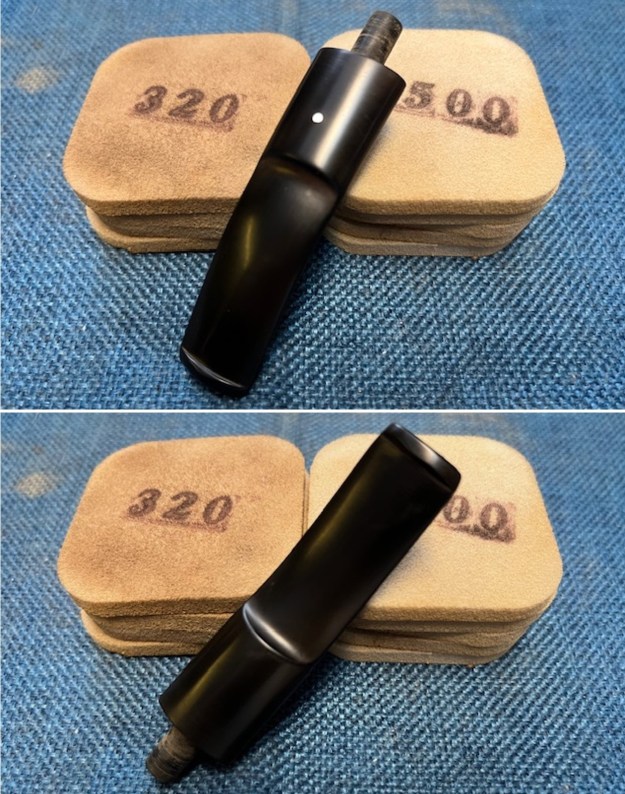
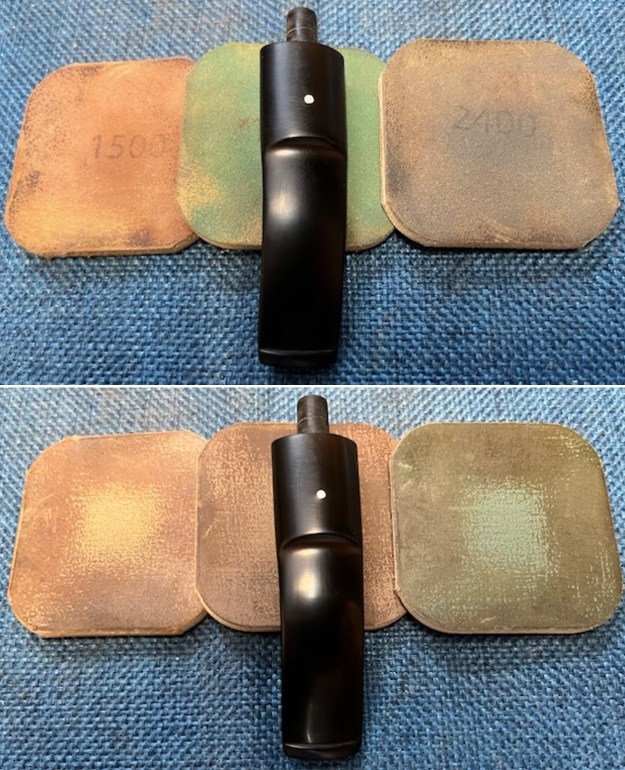
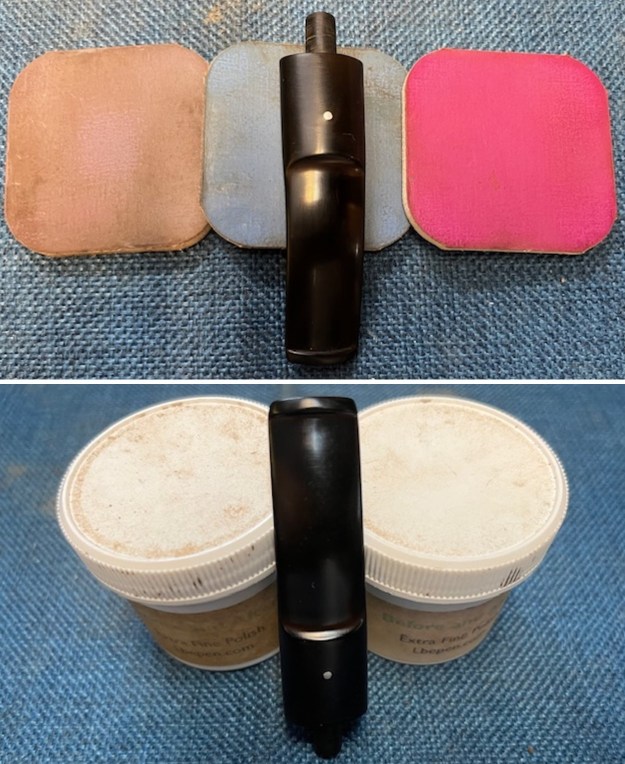
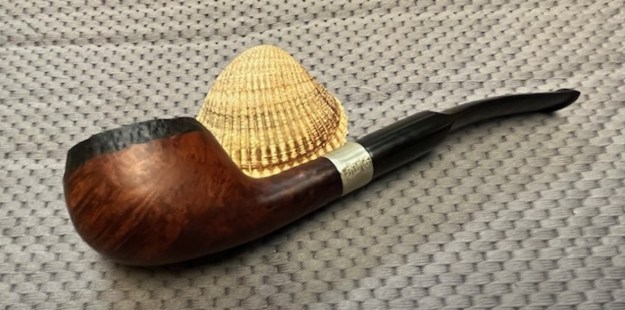
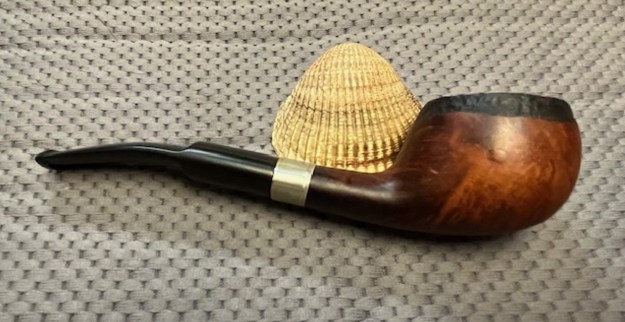
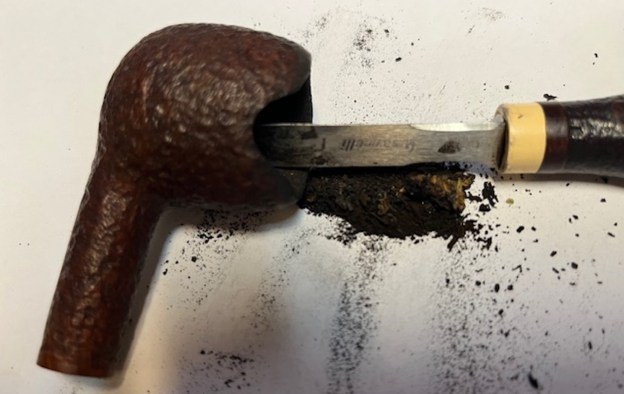
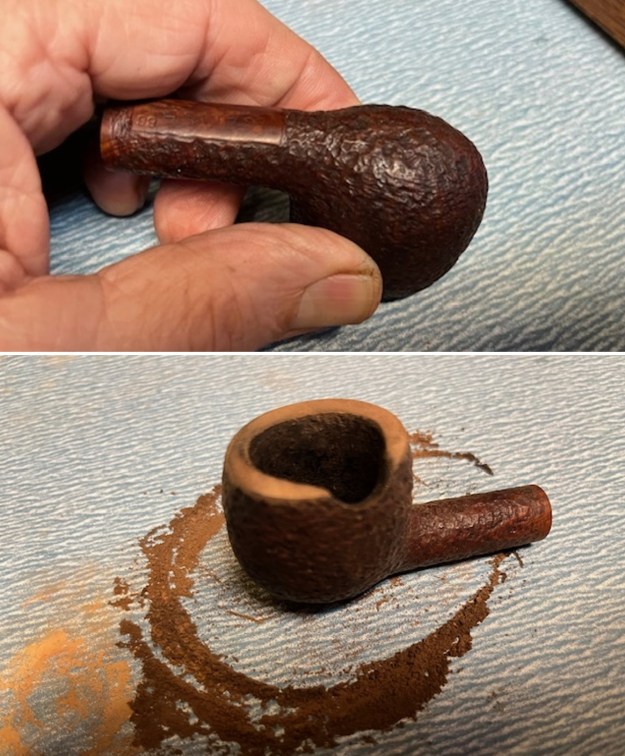
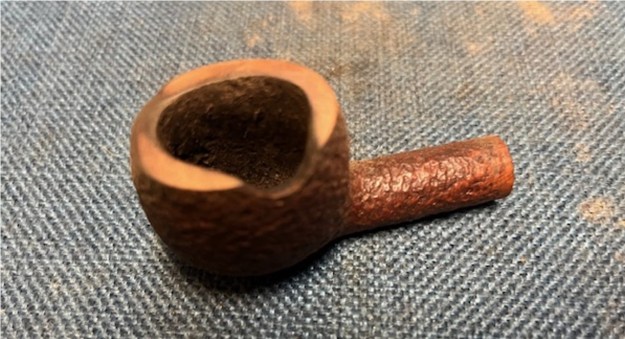
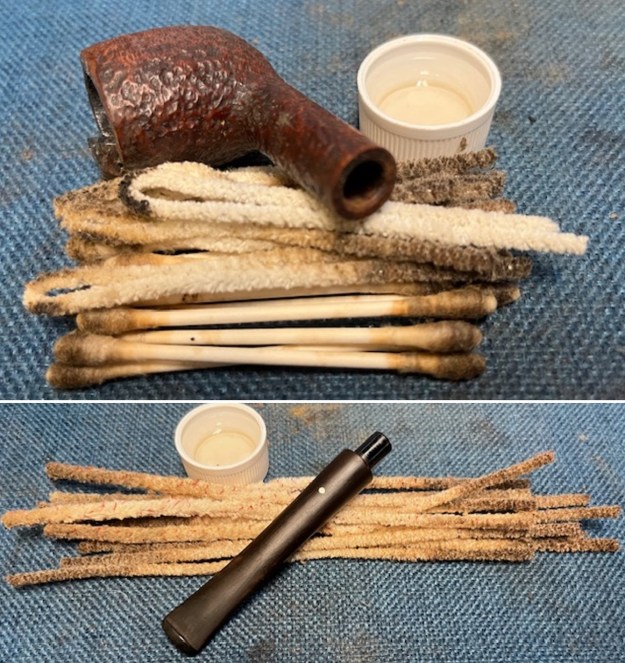
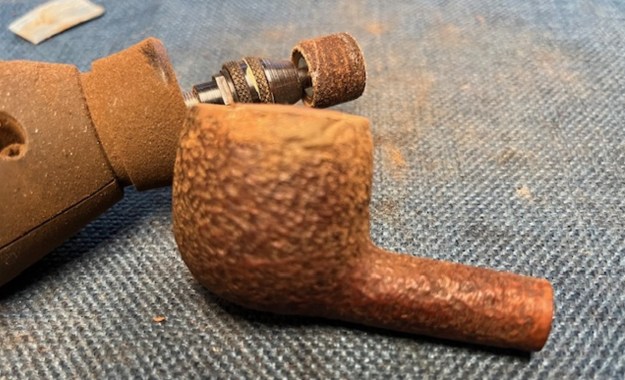
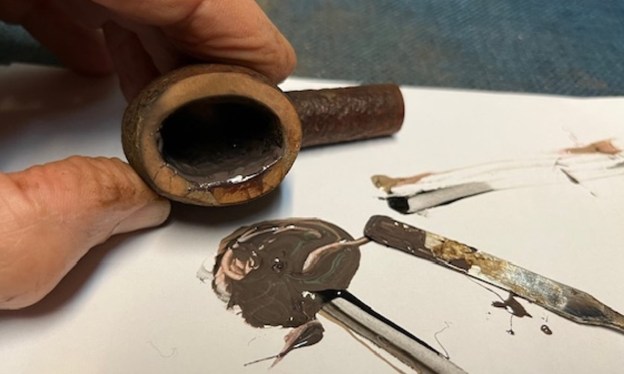
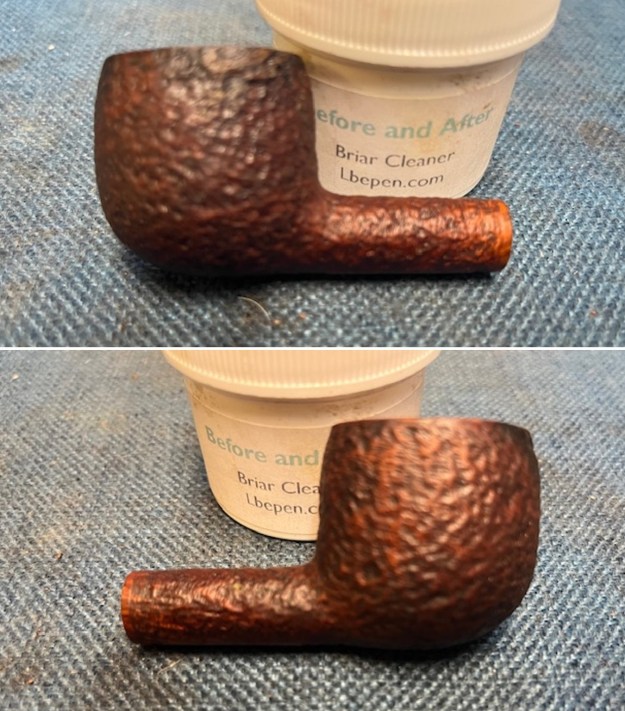
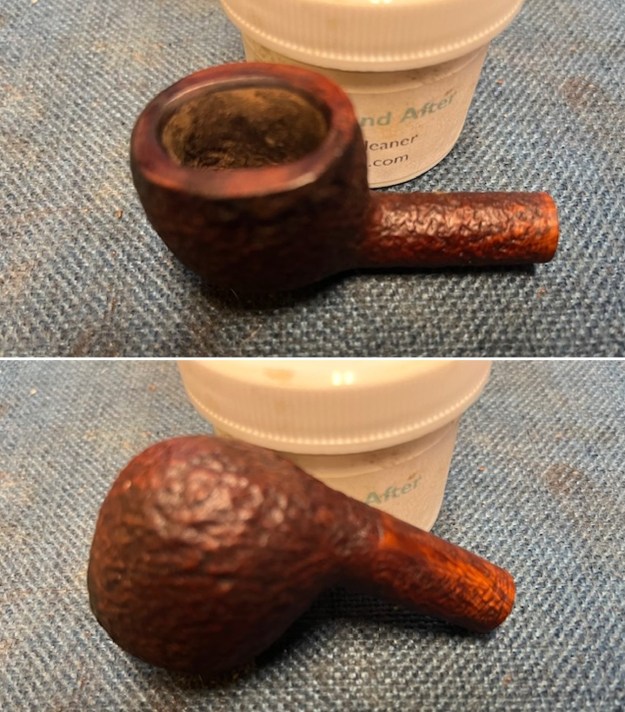
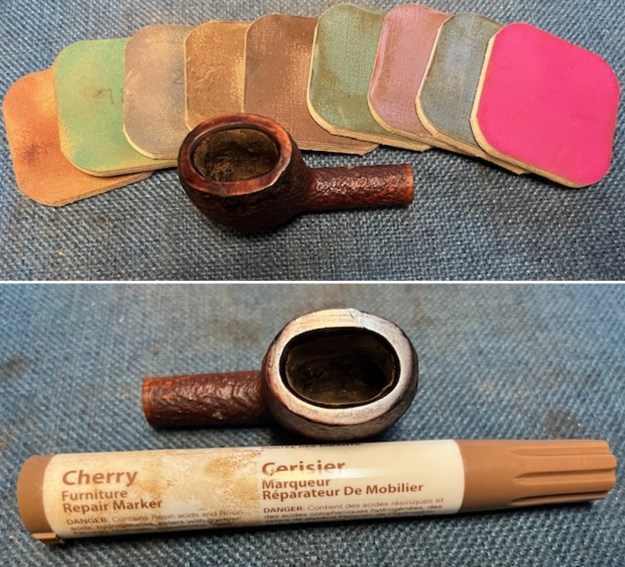
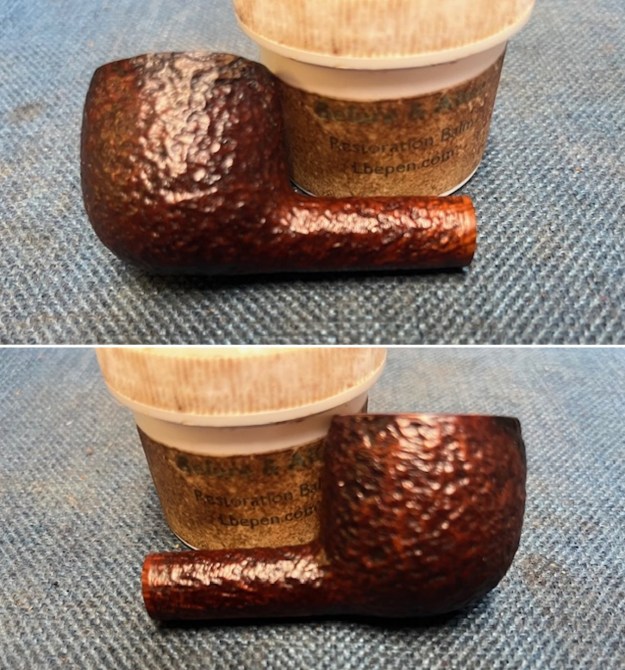
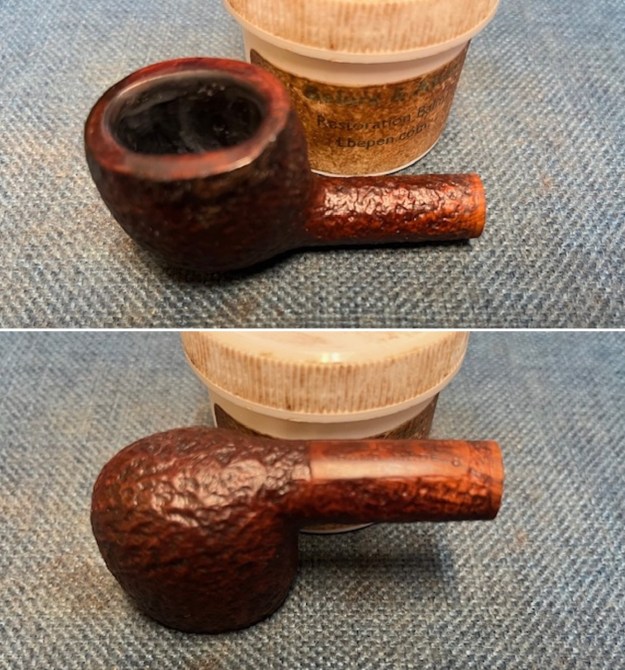
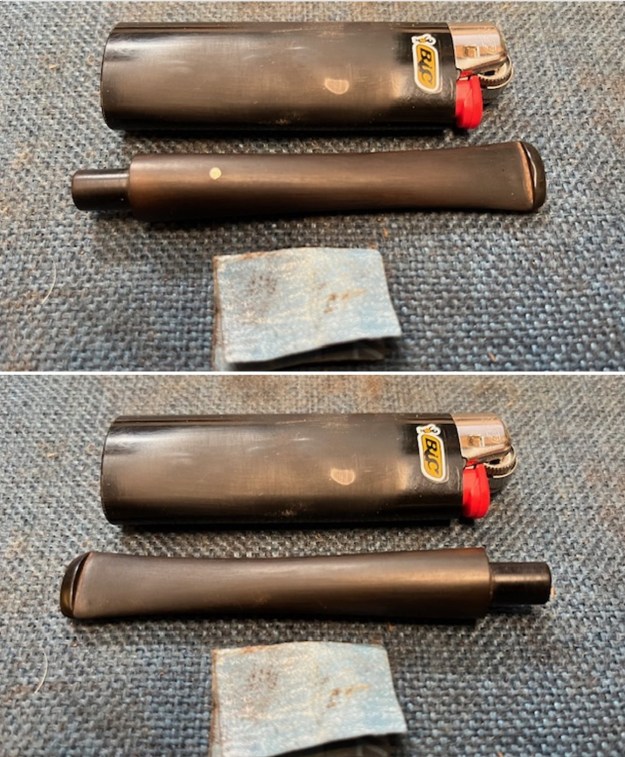
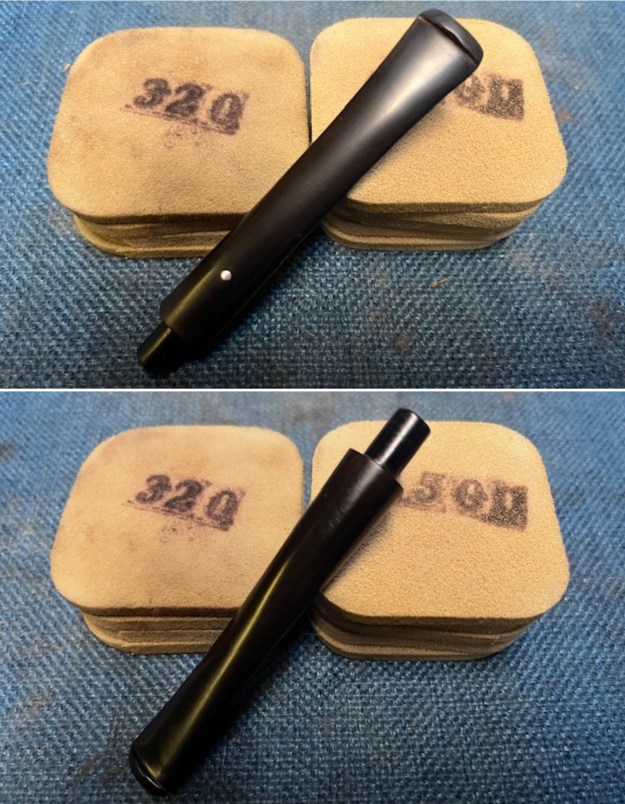
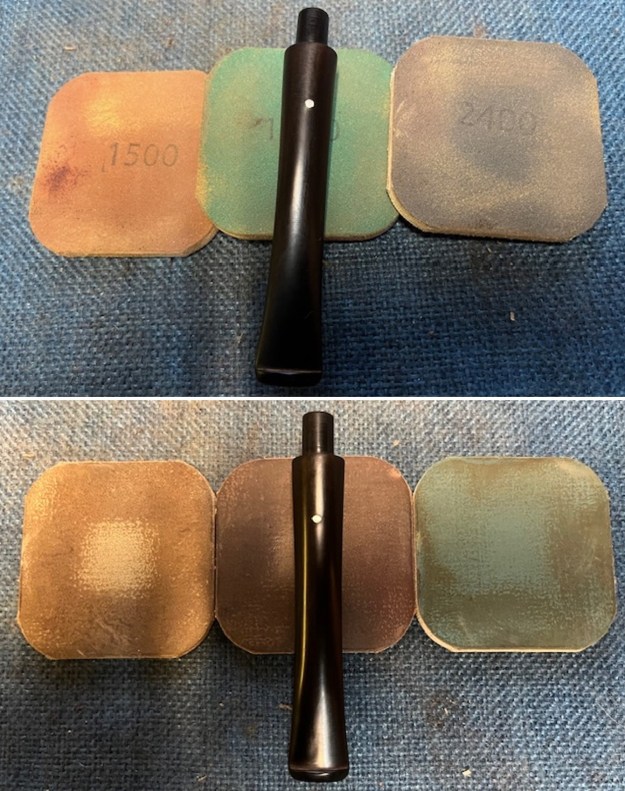
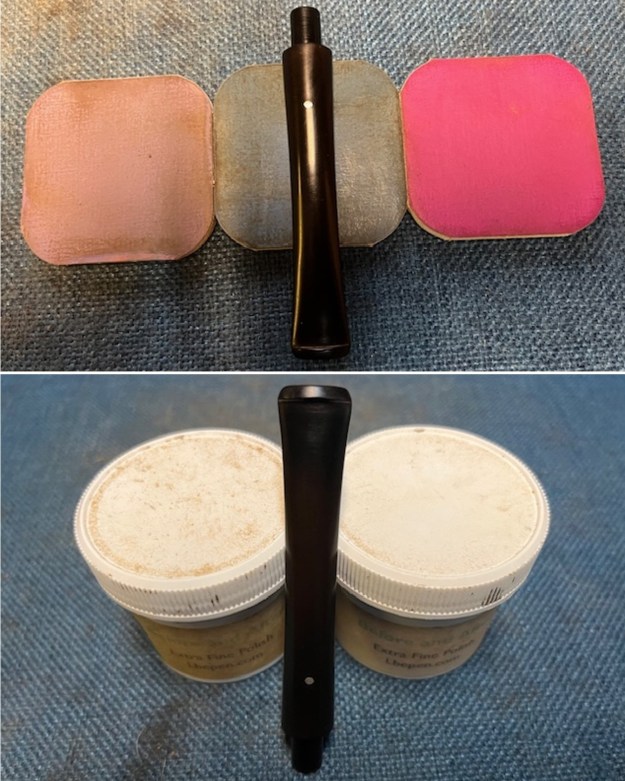
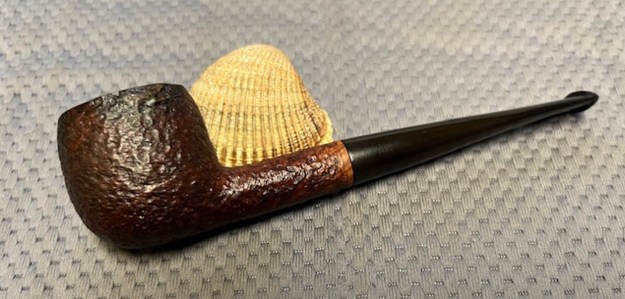
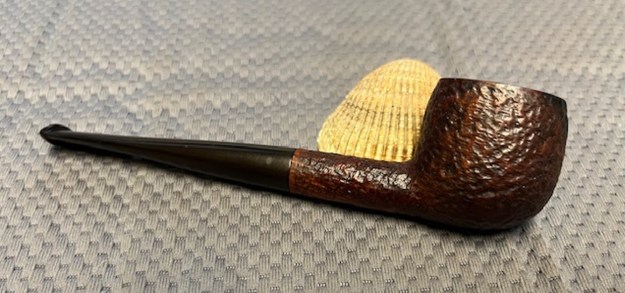
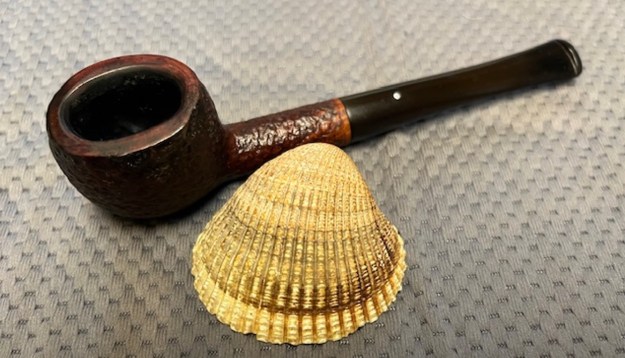
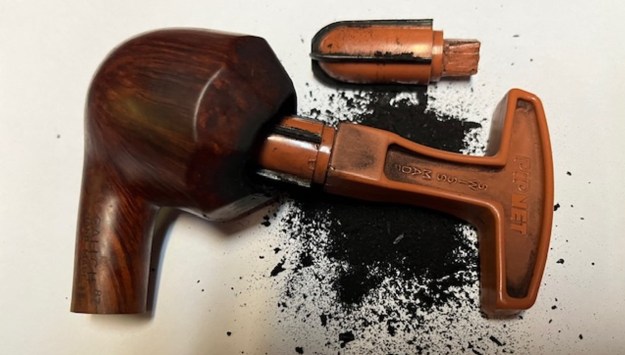
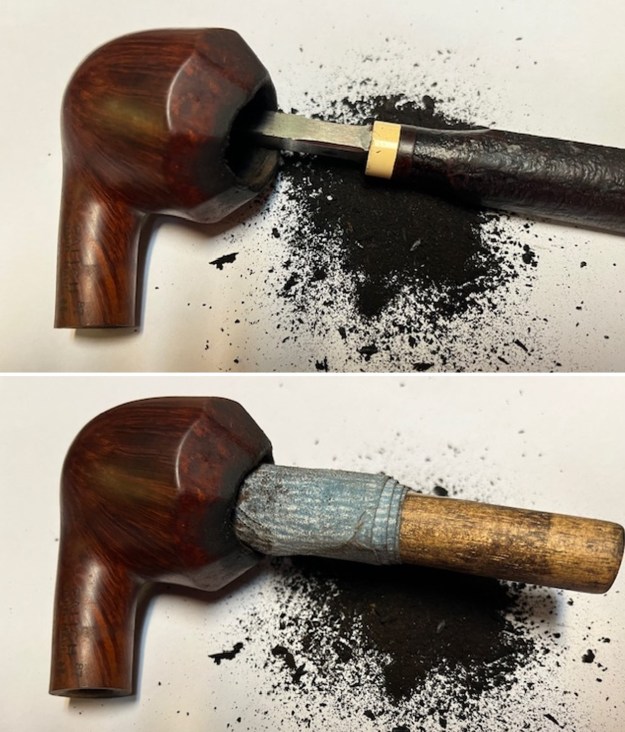
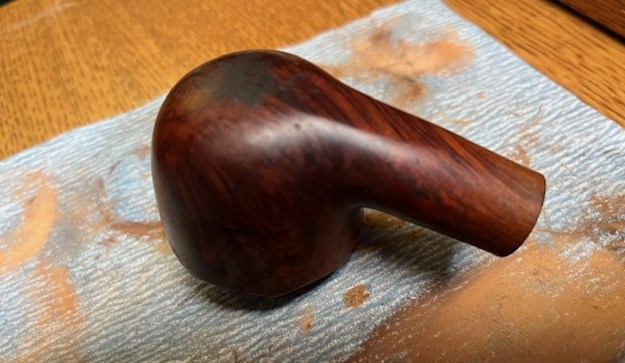
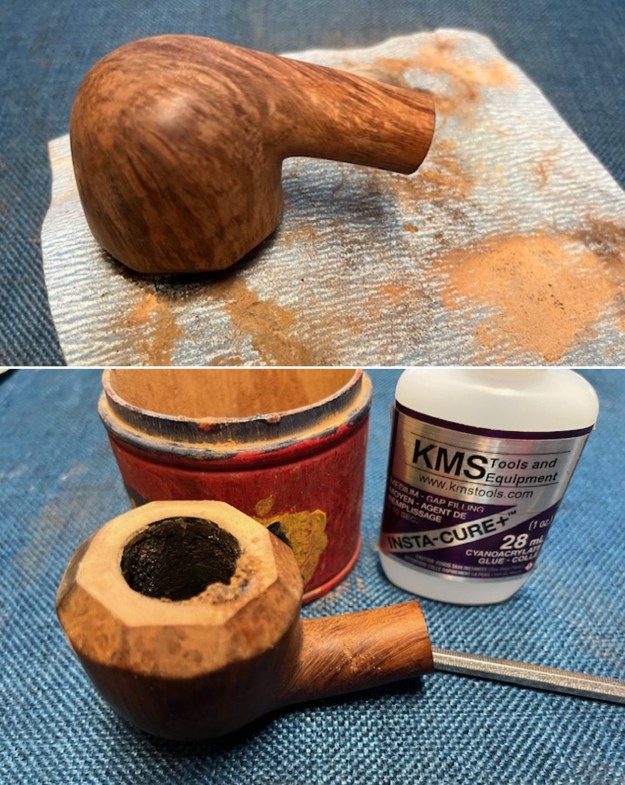
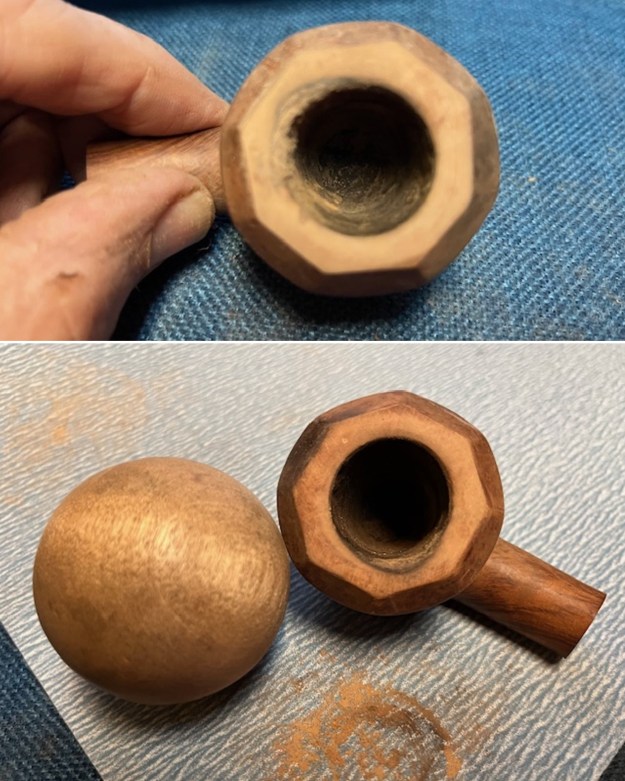
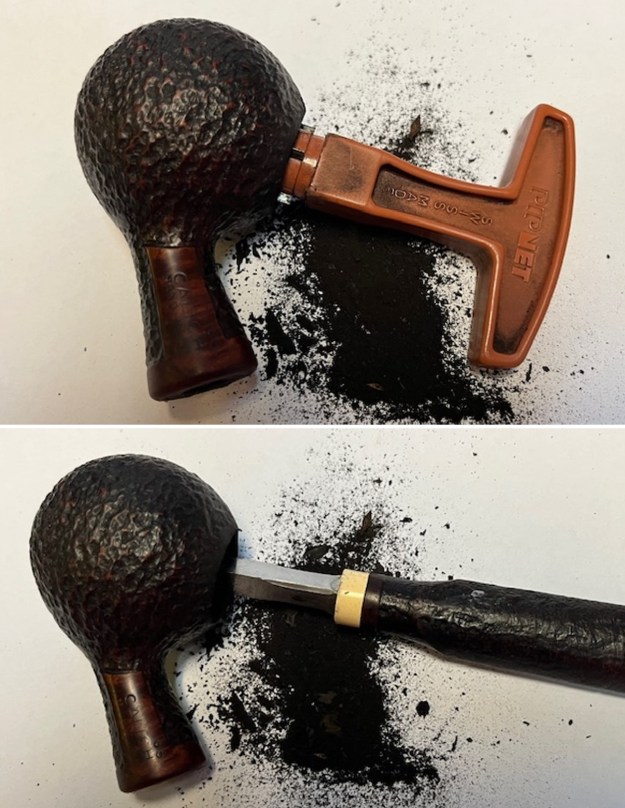
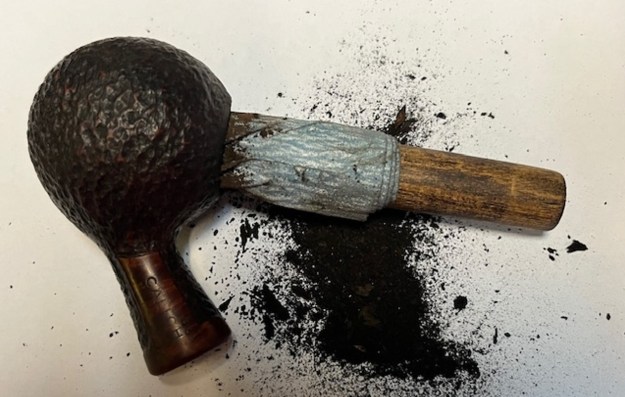
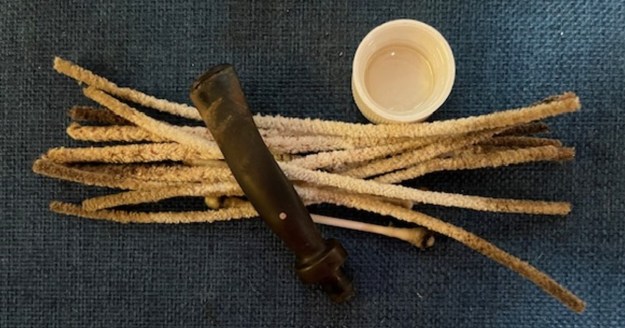
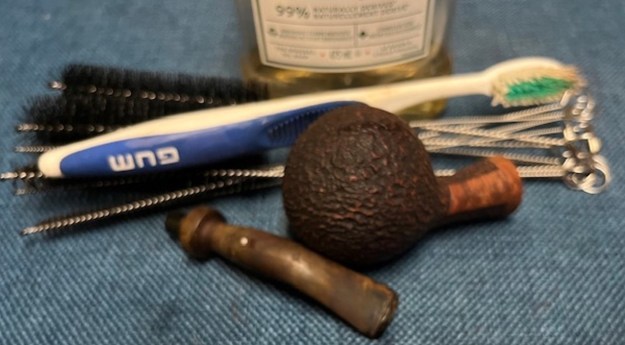
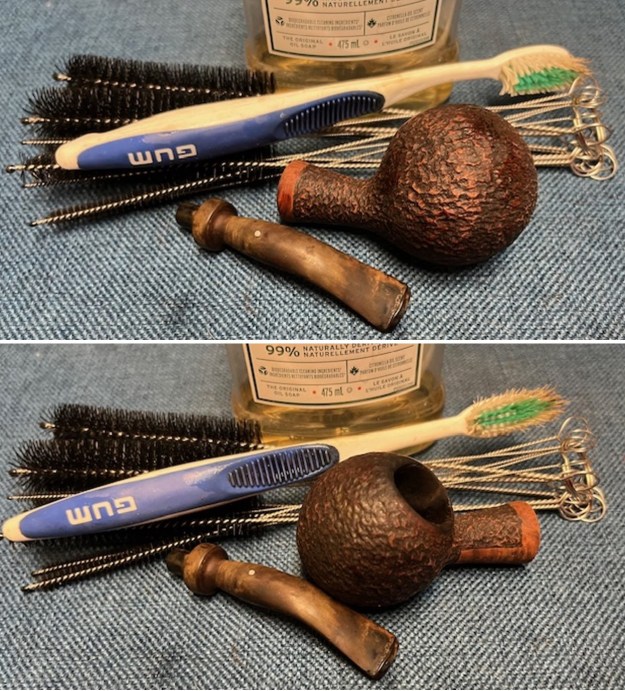
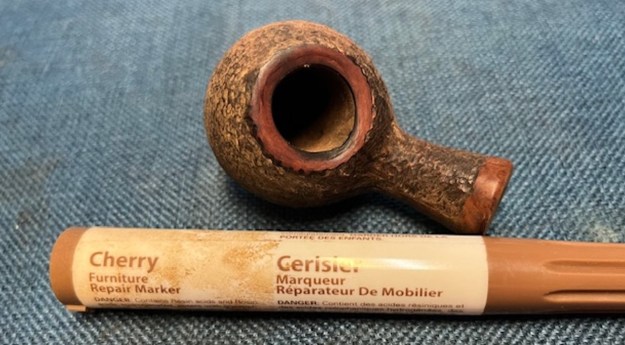
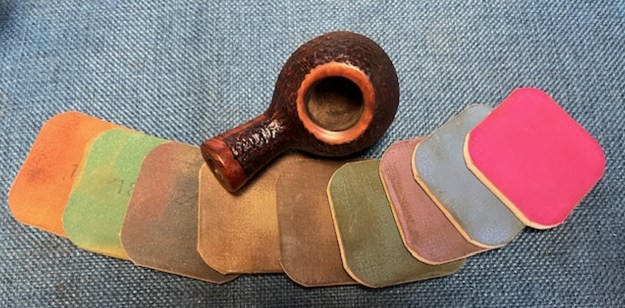
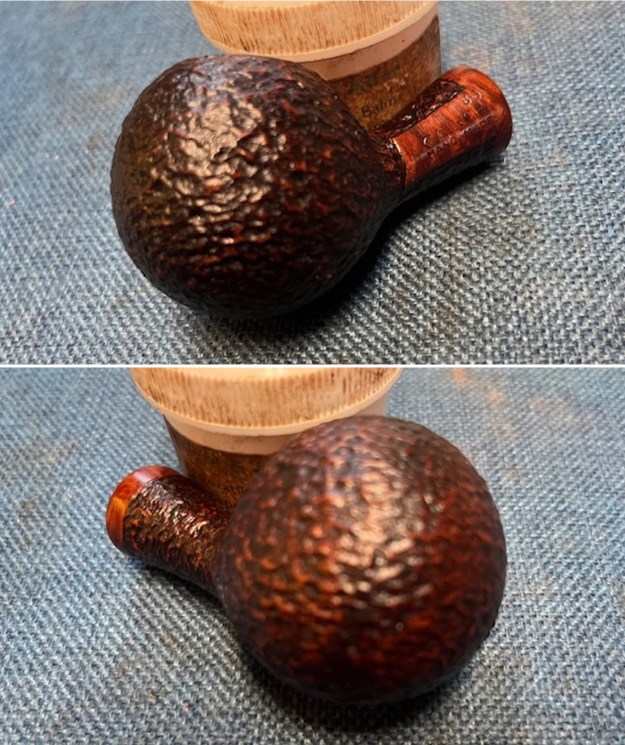
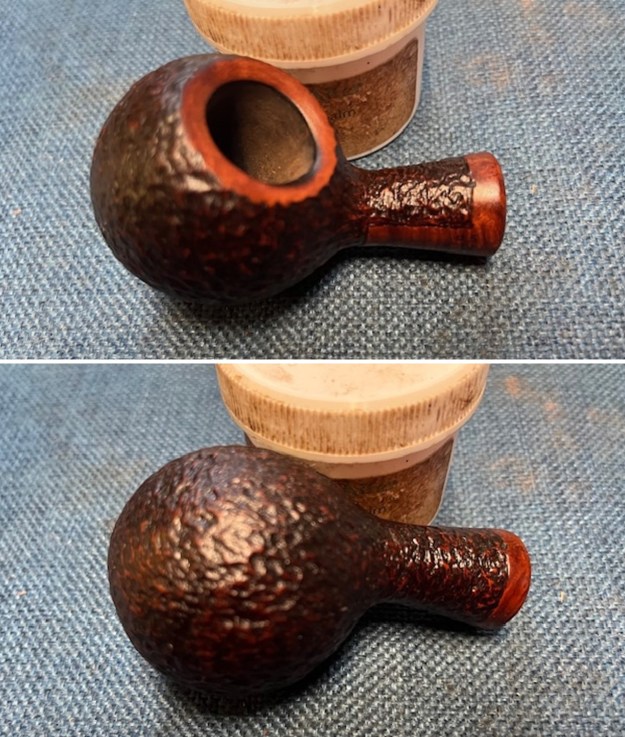
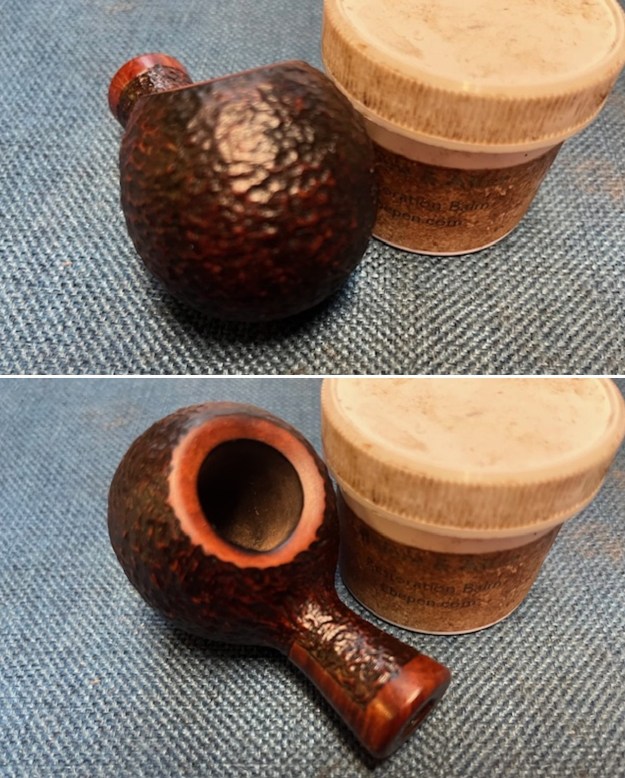
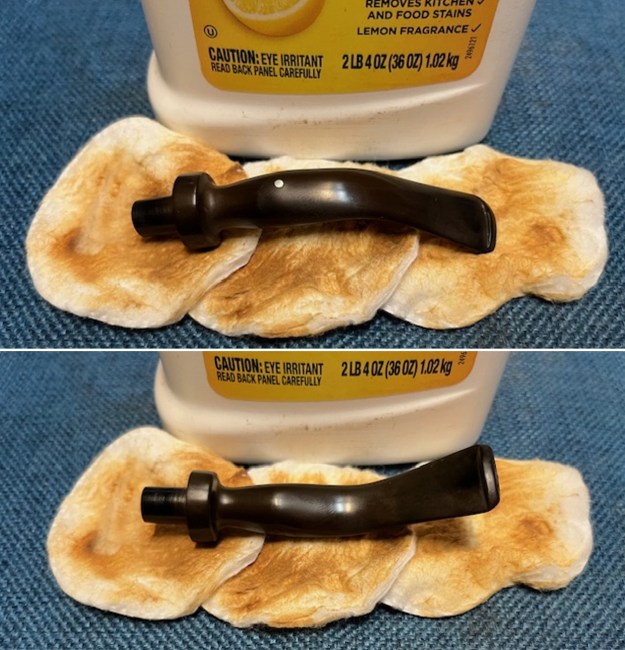
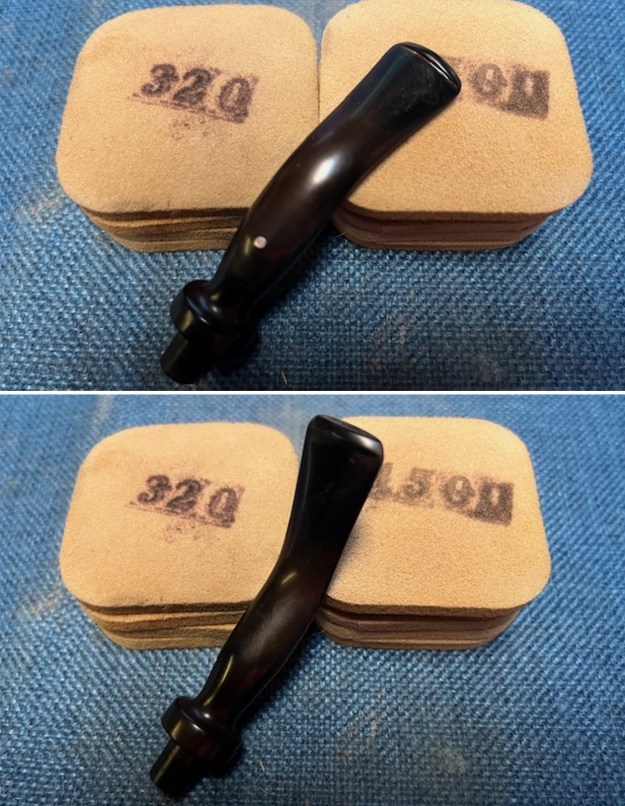
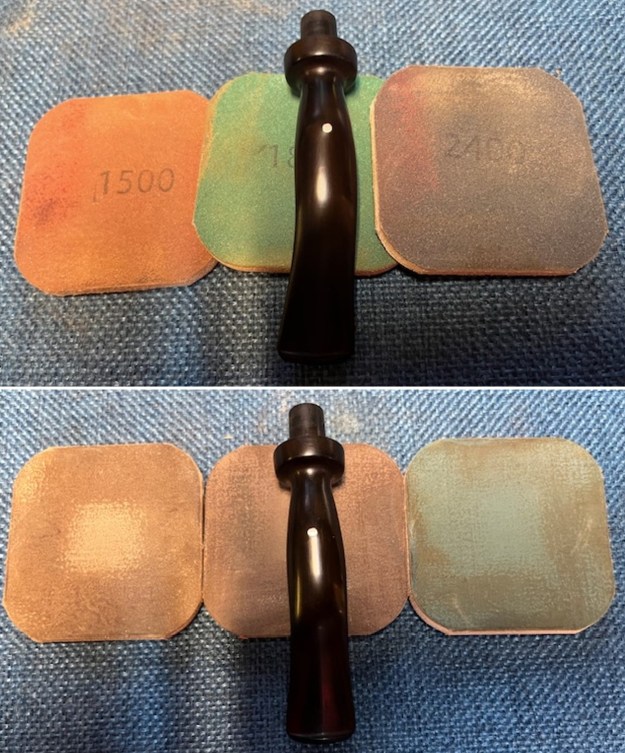
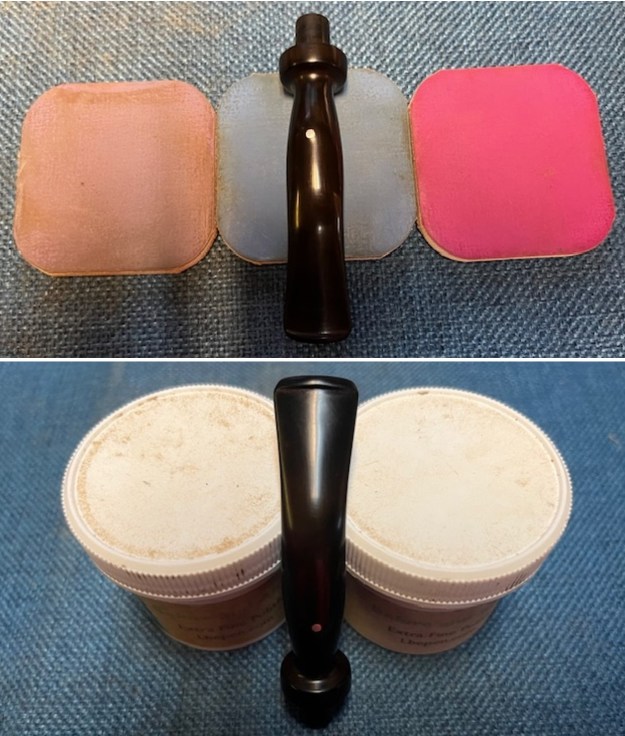
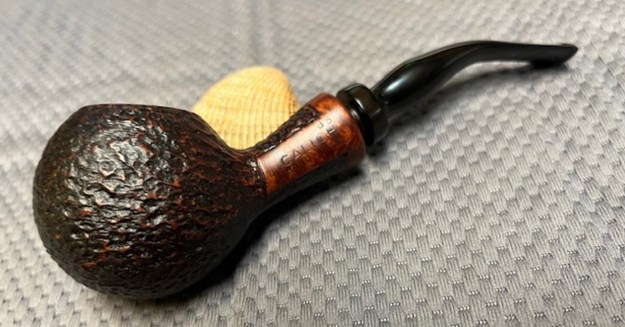
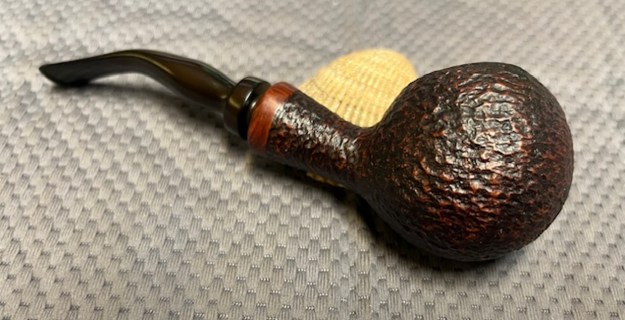
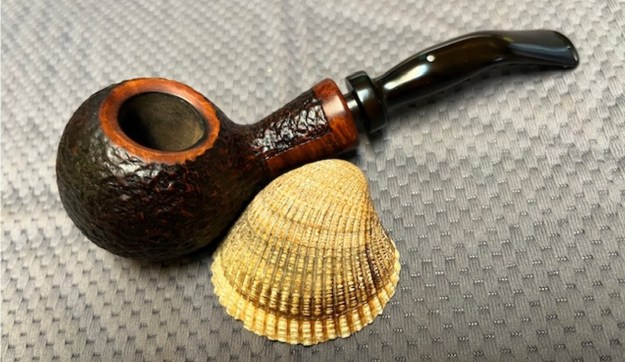
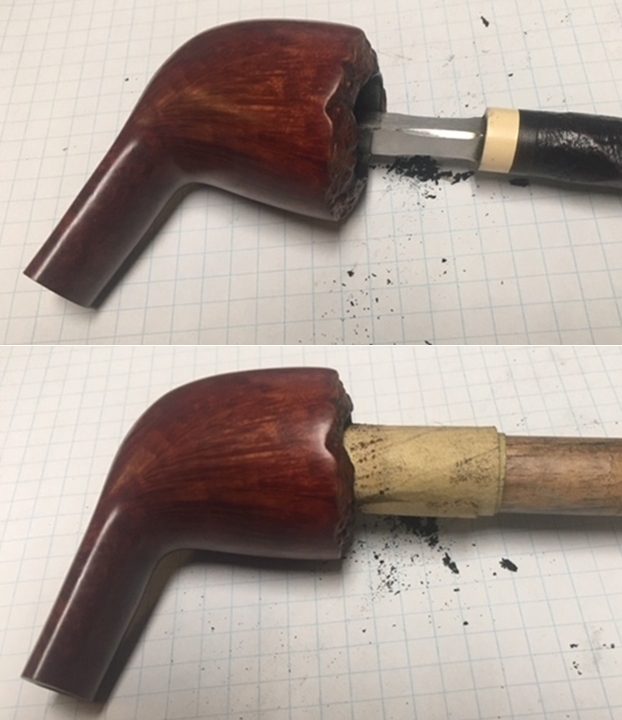
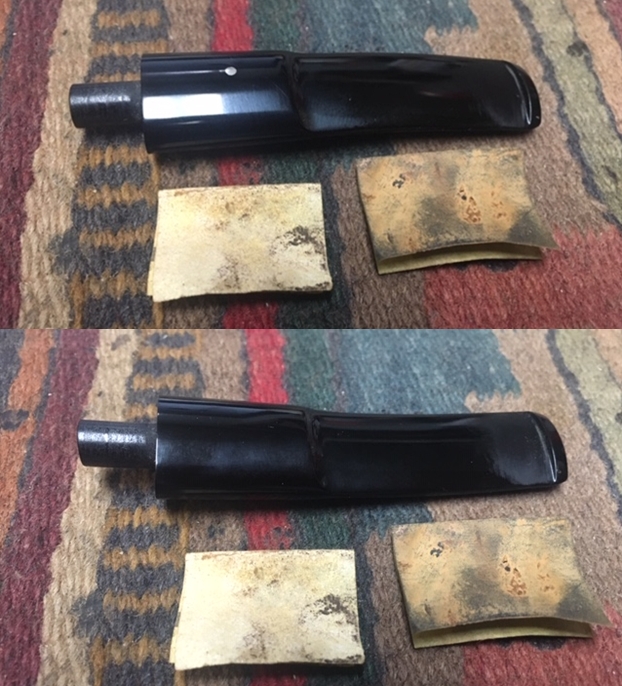
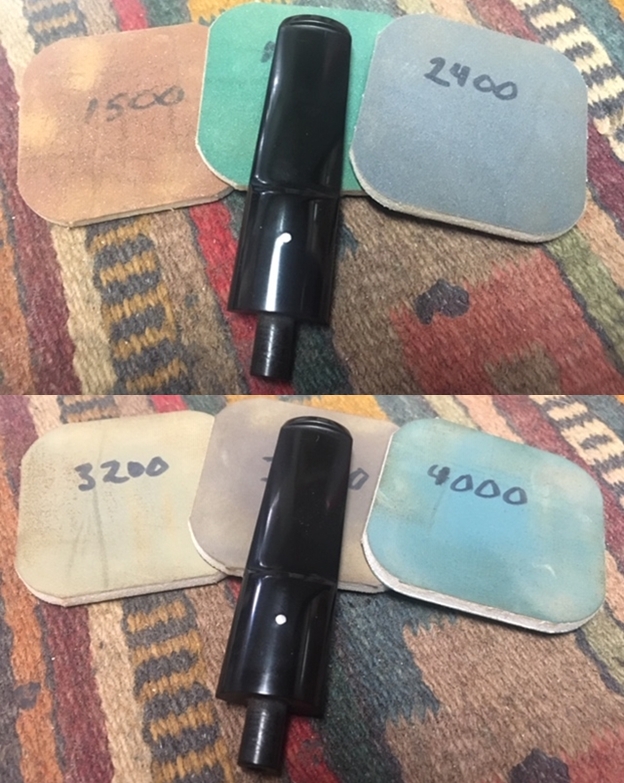
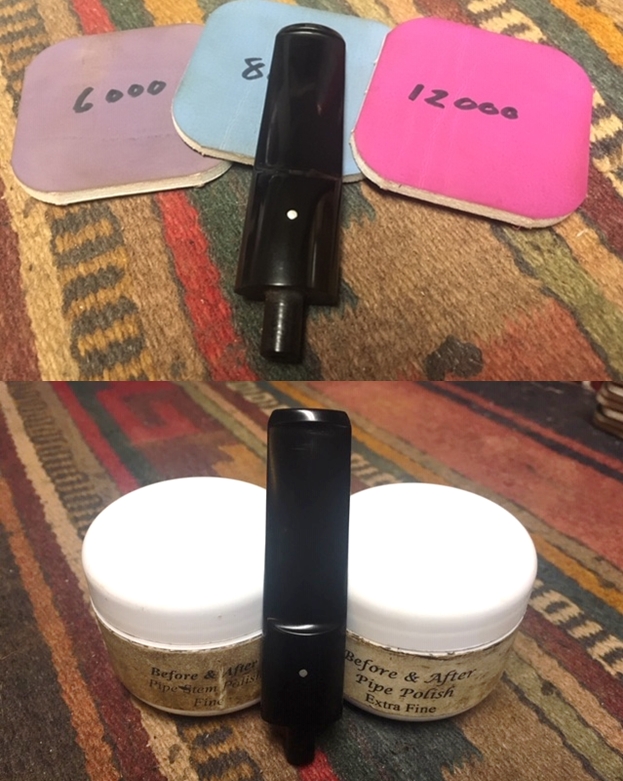
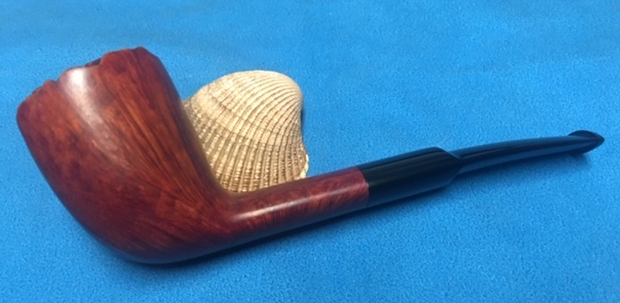
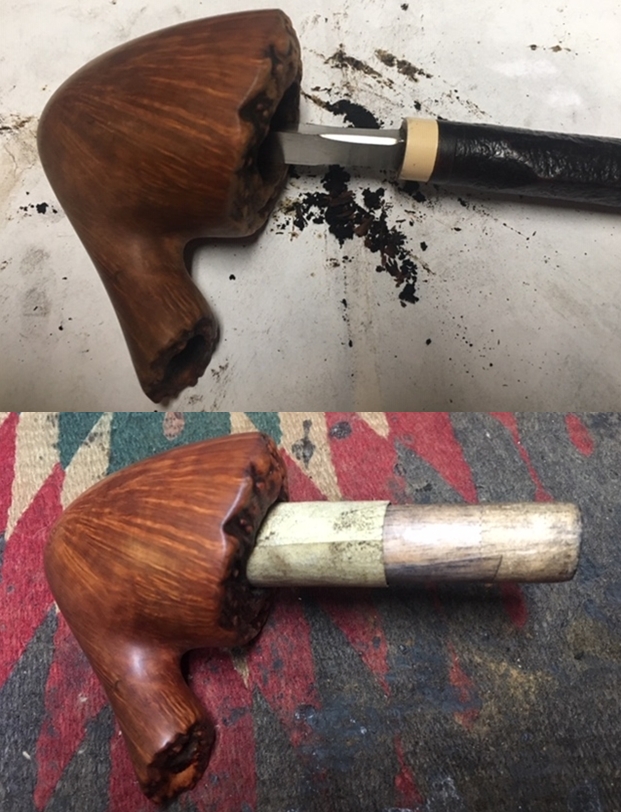
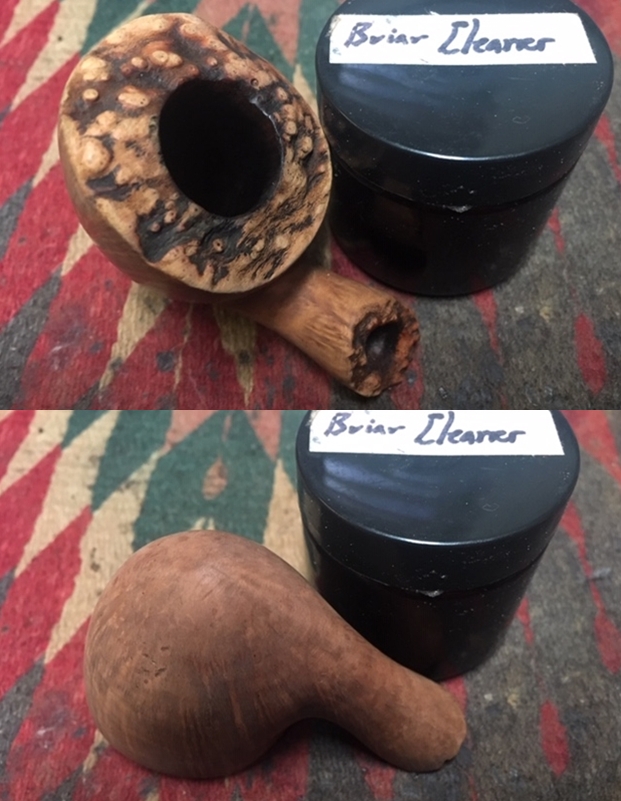
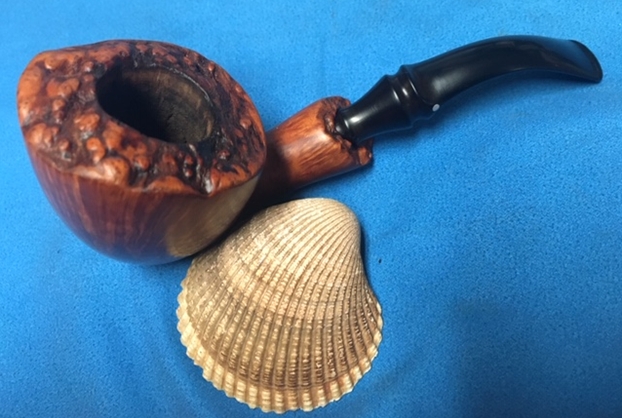
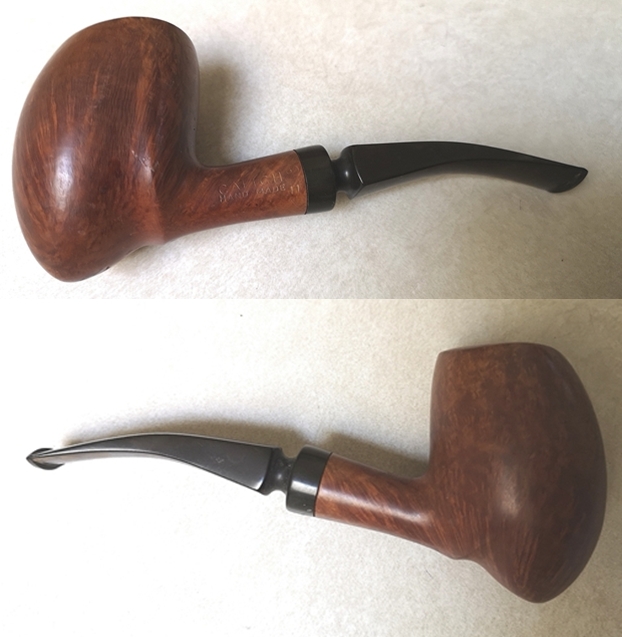
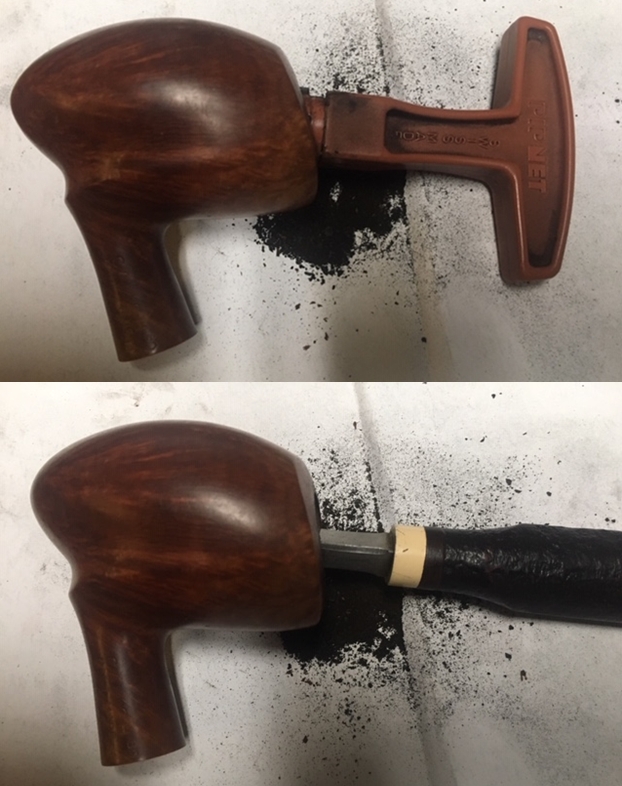
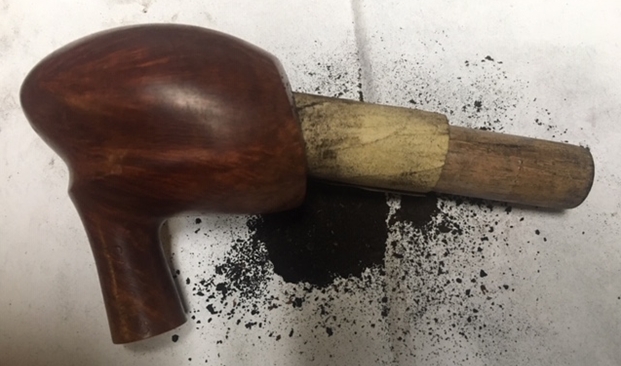
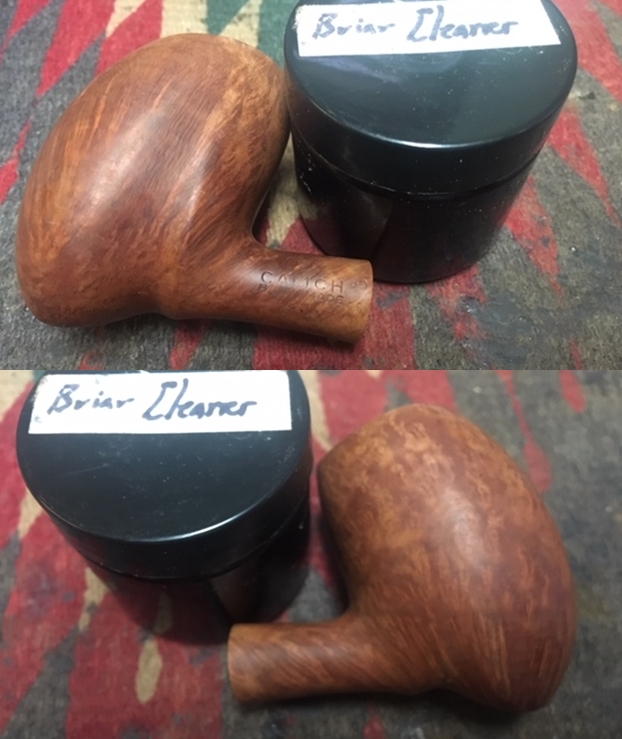
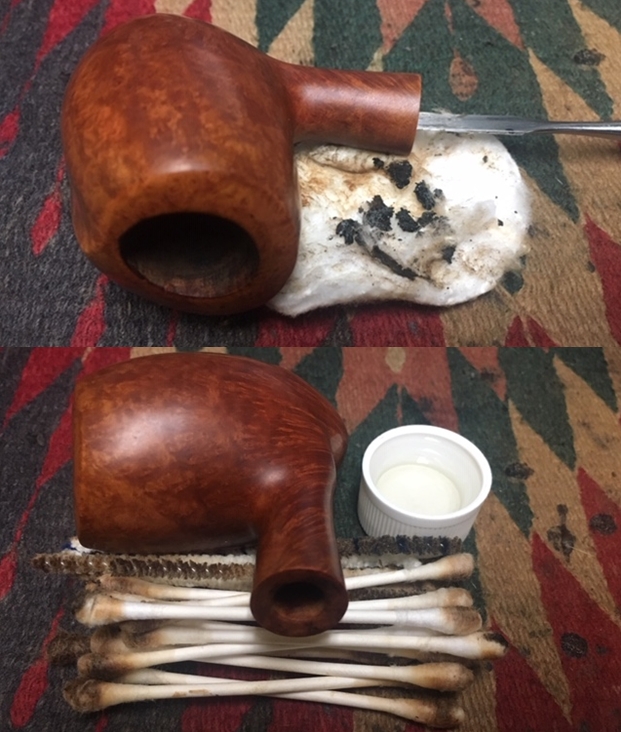
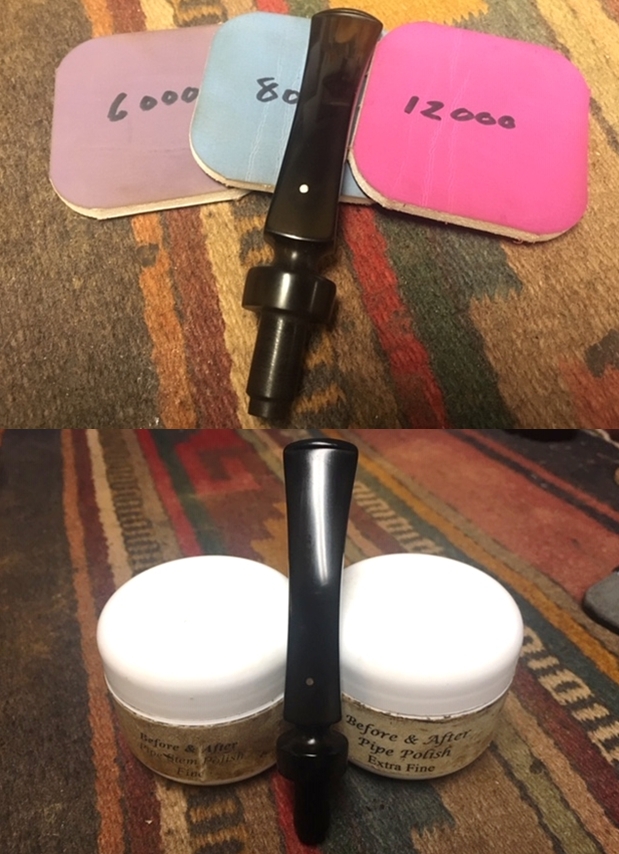
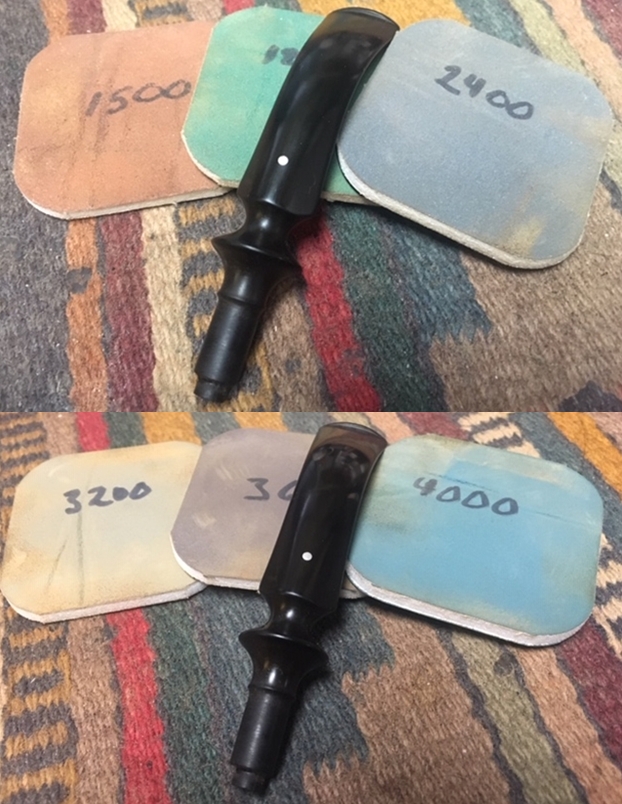
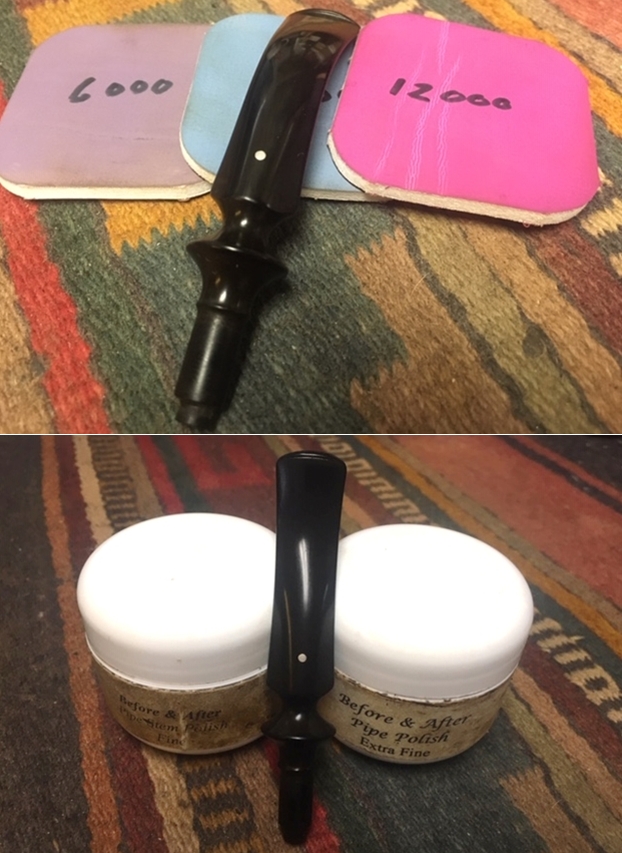
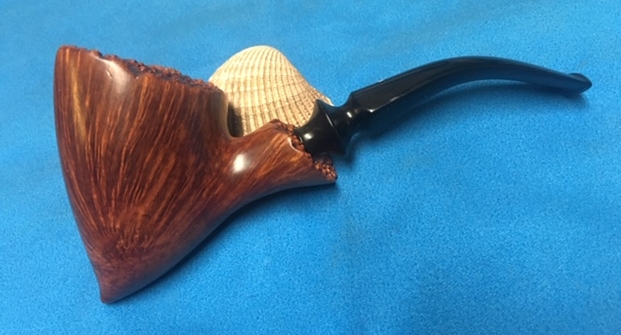
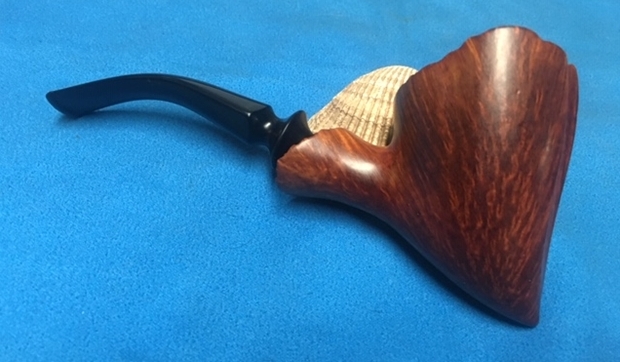
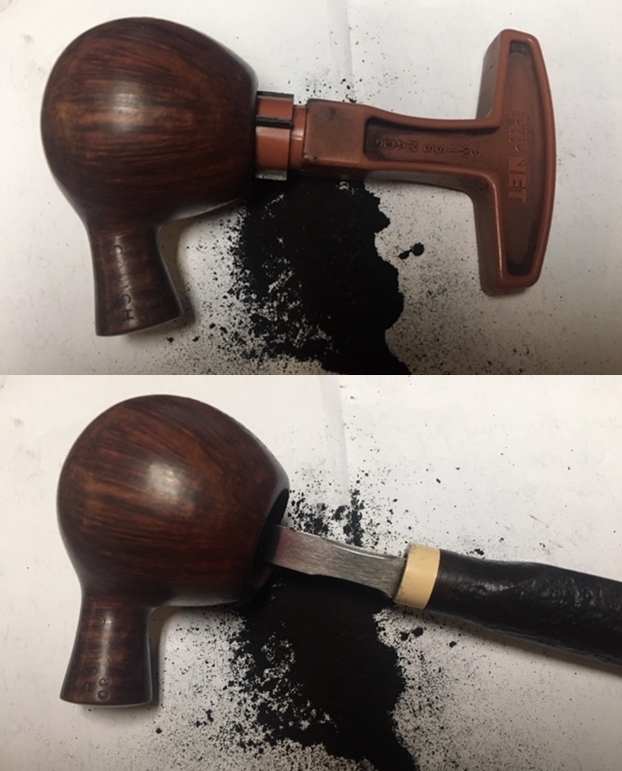
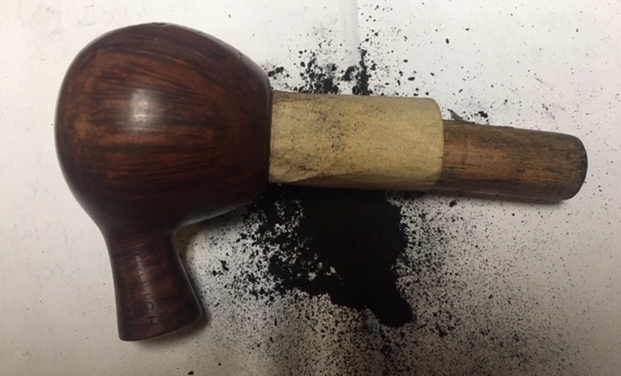
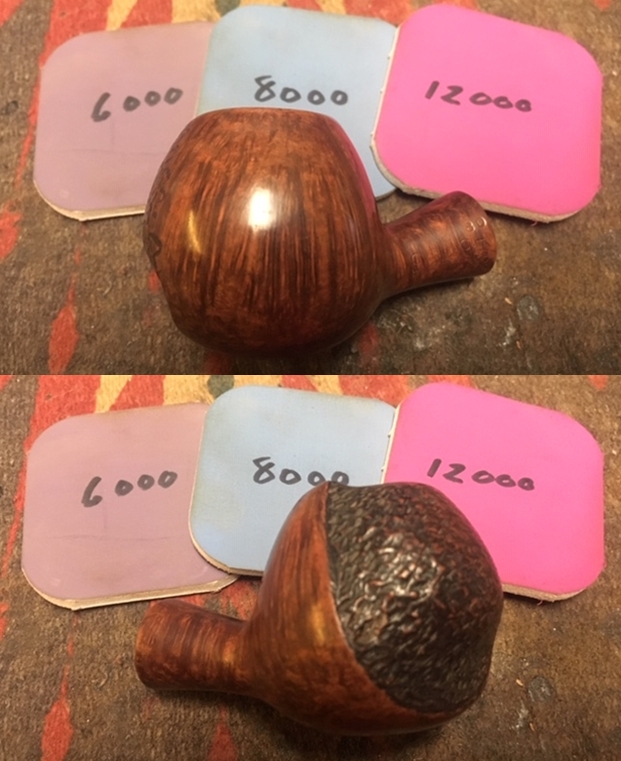
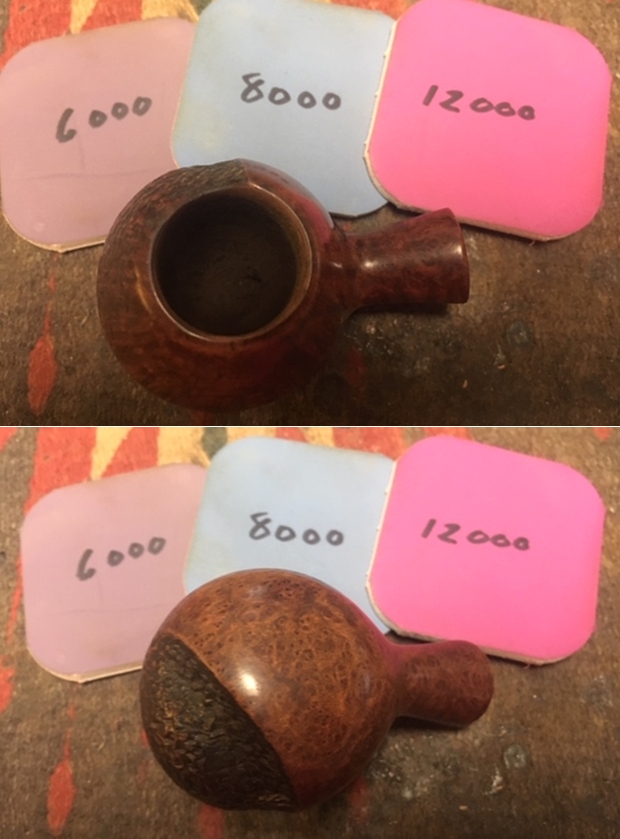
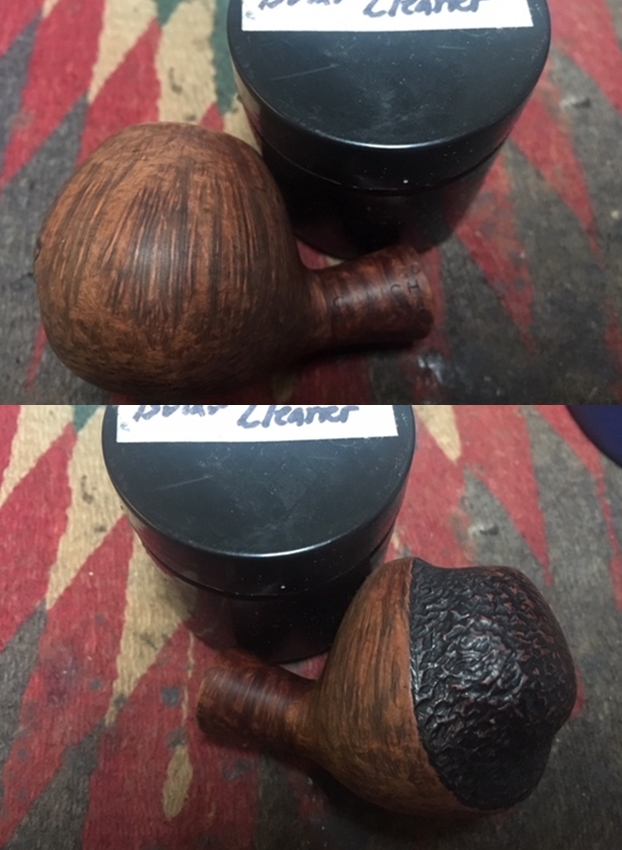
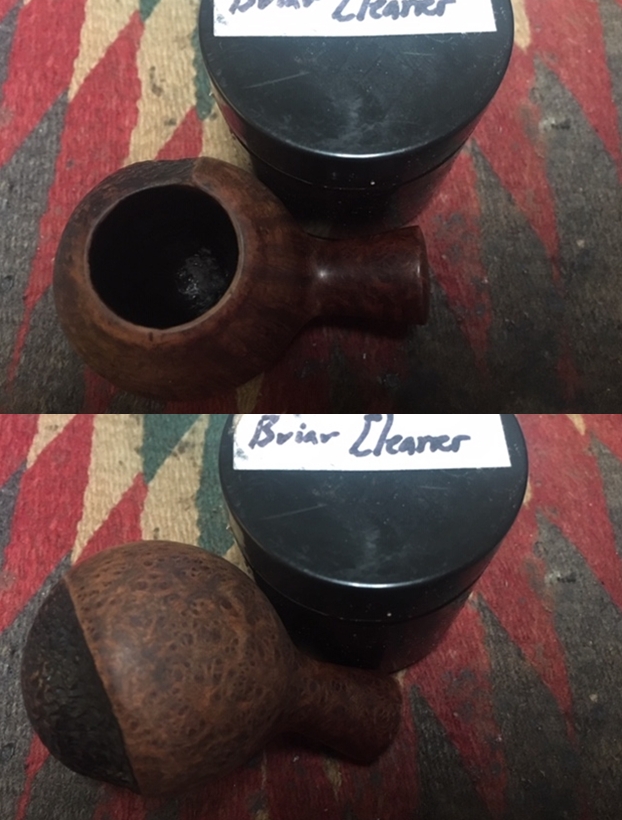
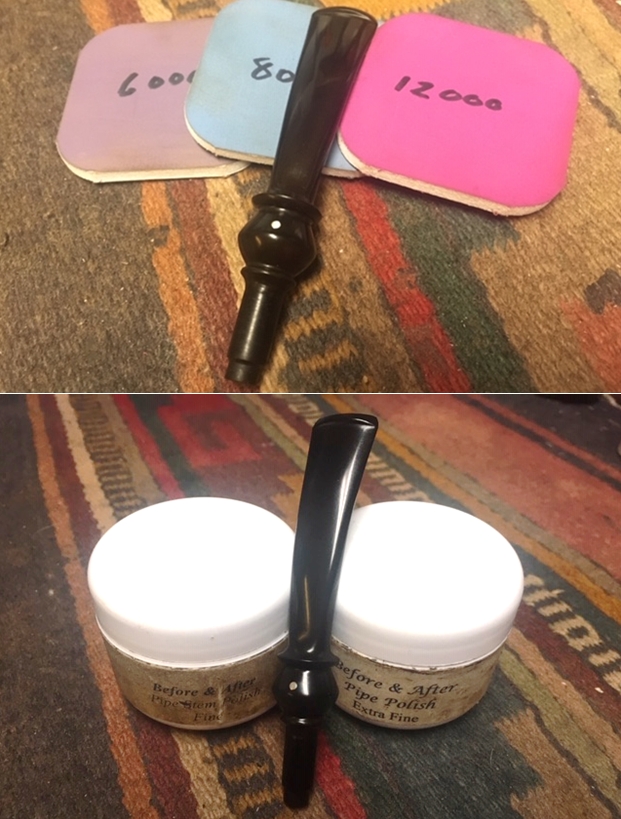
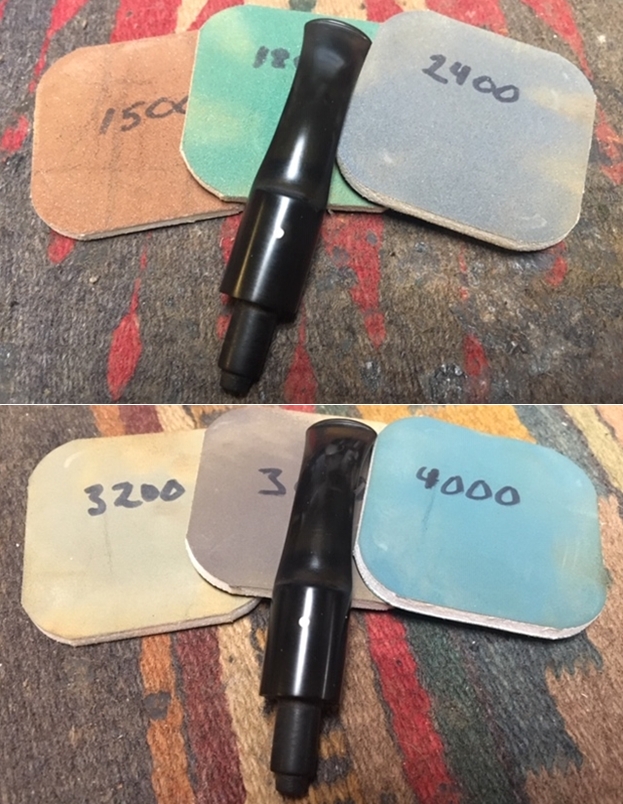
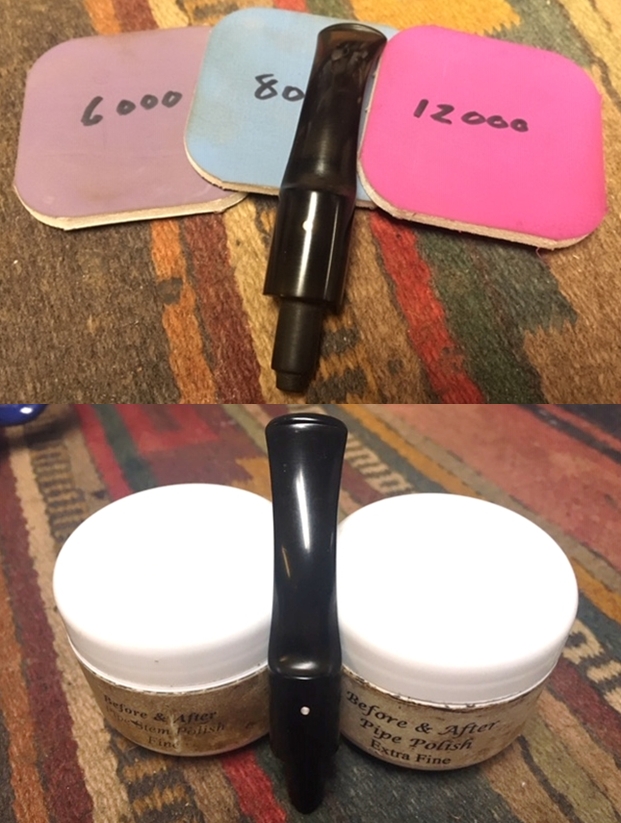
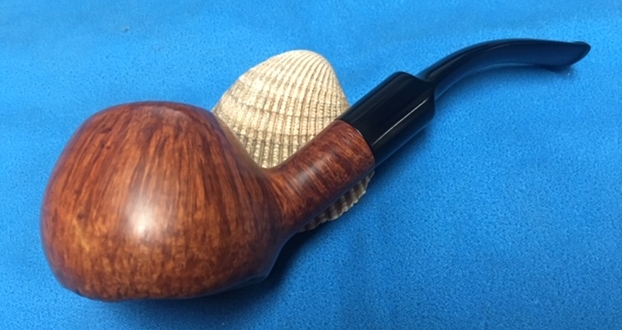
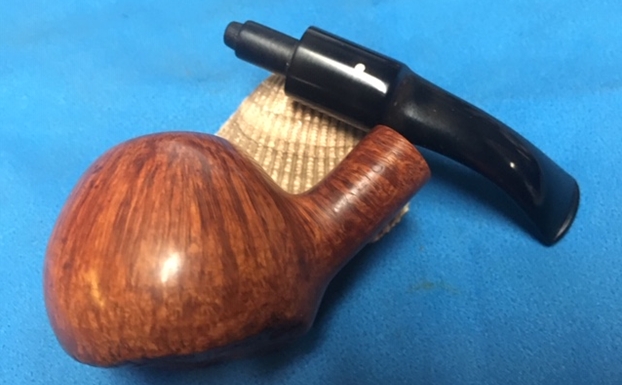
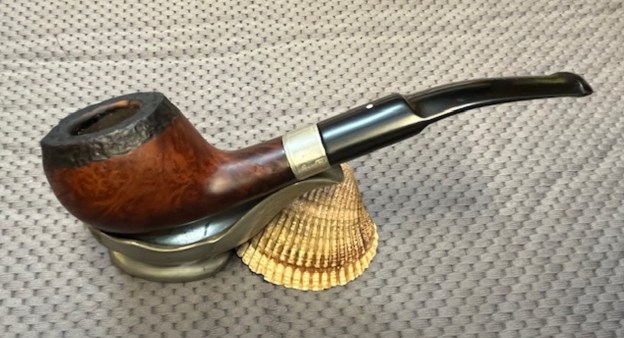
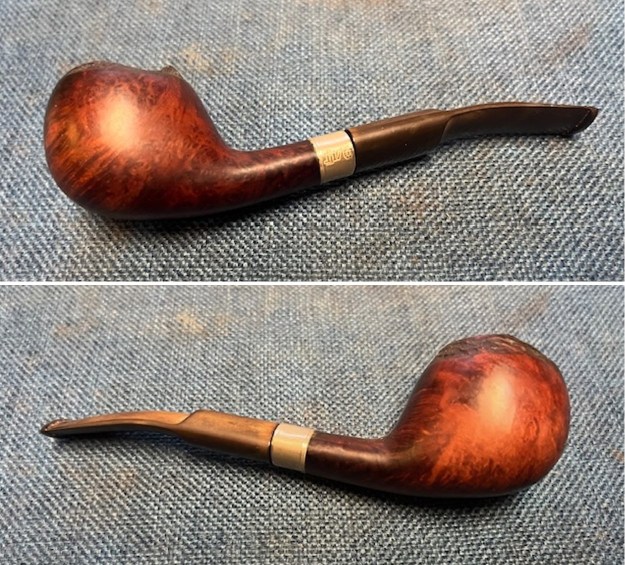
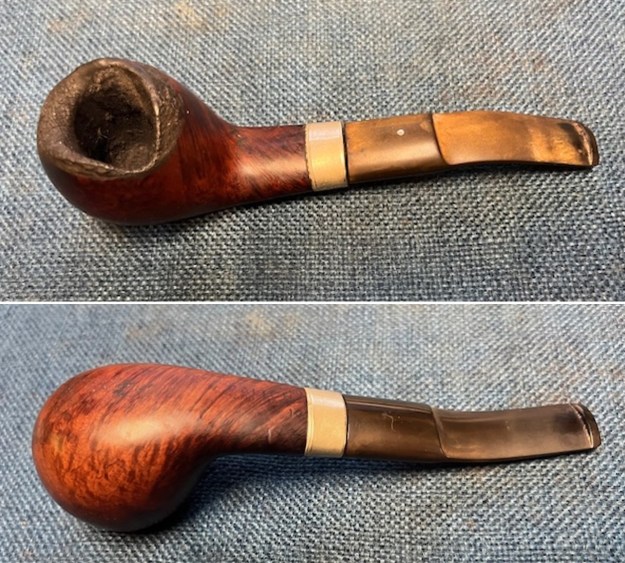
Armed with the information about John’s grading system I knew that the pipe in hand was an earlier Calich Hand Made Grade 10 Oval Shank Apple pipe and the 90 told me it was made in 1990. Now it was time to work on the pipe. I reamed the bowl with a PipNet reamer using the 2 and 3rd cutting heads to remove the cake back to bare briar. I cleaned up the reaming with a Savinelli Fitsall Pipe Knife to scrape back the remaining cake. I sanded the bowl with some 220 grit sandpaper wrapped around a piece of dowel to smooth out the walls of the bowl. Once it was clean I turned my attention to the rim top. There was so much damage to the rim top that I decided to use Kathleen’s suggestion and trim off the damaged areas. I flattened out the damaged areas with a wood rasp to take it down so the sides were even. I used a Dremel and sanding drum to even it out and then topped the bowl with 220 grit sandpaper on a topping board to give the rim top a smooth surface. It looked better but the inner edge is rough on the left side and the outer edge is bad on the front side.I built up the outer edge damaged area on the front of the bowl with clear CA glue and briar dust. I did the same on the left side inner edge and rim top. Once finished it really looked like a mess.I used a folded piece of 220 grit sandpaper and a medium grit sanding sponge to flatten the repaired areas on the exterior of the bowl. I also used the folded 220 sandpaper to smooth out the inner edge a bit. Later I would do a better job on that but I was just trying smooth it out for the next step.I scraped the shank with a penknife to remove the thick build up of tar and oil. The knife let me take it back to the briar without damaging the walls of the shank and mortise. I scrubbed the inside of the mortise, shank and airway in the shank and stem with alcohol, cotton swabs and pipe cleaners. Before I called it a day I stuffed the bowl with three cotton bolls until it was almost even with the rim top. I used a rolled cotton boll to plug the shank end. I used an ear syringe to fill the bowl with isopropyl alcohol. I set it aside in a pipe rest to let the alcohol leach out the oils into the cotton. I turned out the lights and let is sit overnight. In the morning I turned on the lights and this is what I found. The cotton was a dark brown both in the bowl and shank end. I removed it and took photos of the cotton with the tars. I used a piece of 220 grit sandpaper and a wooden sphere to give the inner edge of the bowl a bevel. Once it was finished it looked much better. Last evening I had come to a decision to rusticate the rim top and down the bowl side about ¼ inch around the sides. But to start I wanted it smooth.With the rim top smooth I used a series of burrs on my Dremel to rusticate the surface of the bowl and edge. It began to take on shape. I used a black stain pen to stain the rusticated portion of the bowl and rim top. The rustication was very similar to what I have seen on a lot of Calich pipes. The contrast was going to be nice once I finished working on the smooth portion of the bowl. I worked over the rustication with a brass bristle wire brush to clean off the burrs and debris on the rustication. Once I knocked it off I took photos of it to show the look of the bowl at this point. I polished the smooth bowl sides and shank with micromesh sanding pads – dry sanding with 1500-12000 grit sanding pads. I wiped it down with a damp cloth after each pad. It looked very good with the rusticated portions. I rubbed the bowl down with Before & After Restoration Balm. I worked it into the surface of the smooth and the rusticated briar with my fingertips and a shoe brush to clean, enliven and protect it. I let the balm sit for ten minutes then buffed with a cotton cloth to raise the shine. Mark Hoover’s Balm is a product that I have come to appreciate and one I use on every pipe I have been working on. I polished the nickel band on the shank end with a jeweller’s cloth to remove the oxidation and protect the metal from reoxidizing as quickly. It took on a good shine.  I set the bowl aside and turned my attention to the stem. I “painted” the stem surface of the stem with the flame of a Bic lighter to lift the tooth marks and chatter on the surface. I was able to remove them all.I scrubbed the oxidation on the stem surface with Soft Scrub and cotton pads and was able to remove the majority of it. The cleaning was progressing and it was looking better.I sanded the stem with 320-3500 grit sanding pads to break up the remaining oxidation. I wiped it down after each sanding pad with a soft cloth. It began to take on a shine. I polished the stem with micromesh sanding pads – dry sanding with 1500-12000 grit pads. I wiped the stem down after each sanding pad with Obsidian Oil. I polished it with Before & After Pipe Stem Polish – both Fine and Extra Fine. Once I had finished the polishing I gave it final coat of Obsidian Oil and set it aside to dry. This is another pipe from Kathleen that I am working on. It is another beautifully shaped 1990 John Calich Hand Made Grade 10 Apple Pipe. It has the kind of beauty I have come to expect from John’s pipes with a rusticated rim top and first ¼ inch of the bowl side. I put the bowl and stem back together. I polished the bowl and stem with Blue Diamond to polish out the scratches in the briar and the vulcanite. I gave the bowl and the stem multiple coats of carnauba wax. I buffed the pipe with a clean buffing pad to raise the shine. I hand buffed it with a microfiber cloth to deepen the shine. The pipe polished up pretty nicely. The rusticated finish is well done and the polished smooth finish on the shank end and rim top look really good with the black vulcanite stem. This Calich Hand Made Apple was a challenging pipe to bring back to life. It is a comfortable pipe to hold in the hand. The finished pipe is shown in the photos below. The dimensions of the pipe are Length: 5 ½ inches, Height: 1 ¼ inches, Outside diameter of the bowl: 1 ½ inches, Chamber diameter: ¾ of an inch. The weight of the pipe is 42 grams/1.48 ounces. Thanks for reading this blog and my reflections on the pipe while I worked on it. I will be sending it back to Kathleen later this week for her husband to enjoy.

Restoring the fourth of five pipes for an old pipeman – a 1986 Calich Hand Made Grade 8 Opera


Blog by Steve Laug

Earlier in June I received an email regarding restoring some pipes for her husband. Here is here email.

I have one Calich and one Dunhill pipe which my husband destroyed using a torch lighter on. I am wondering if it is possible to get them restored somehow. If you want to have a look I can send pics.

I wrote and asked for photos of the pipes. She wrote that there were actually 5 pipes not two and included photos of all five. I asked her if she was wanting to sell them or just repair them. Here is her response.

No… I don’t want to sell (yet) he’s 86 and has taken up smoking his pipes again. He was using a torch lighter until I discovered and replaced with proper pipe lighters. For now I’m wondering if it’s possible or even wise to restore them. – Kathleen.

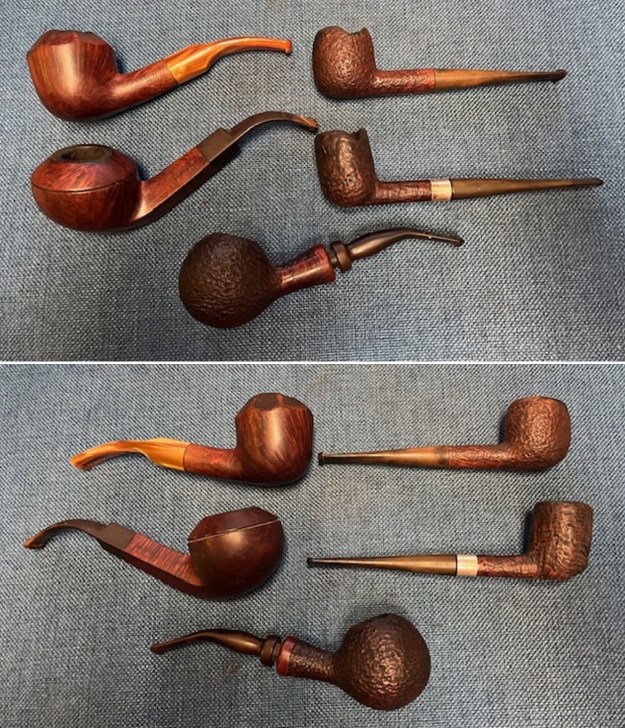
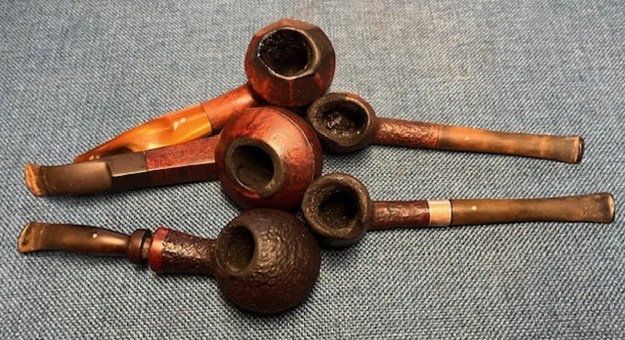
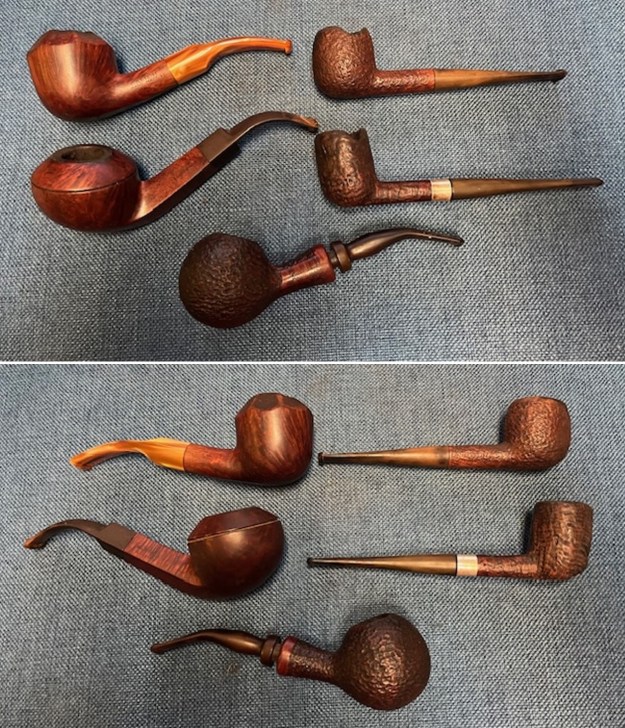
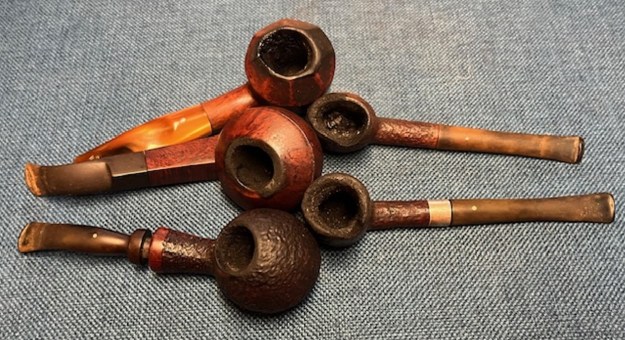
I replied to Kathleen and invited her to send the pipes to me in Vancouver. They arrived just before I left for my visit with my Dad in Idaho. Here is what I found when they arrived. There were three Caliches, a Dunhill, and an Ed Burak Connoisseur. The Calich Pipes included a rusticated straight Opera, a bent Rhodesian with an octagonal rim cap and an acrylic stem. The Dunhill was a sandblast Billiard with a repair band on the shank. The Ed Burak Connoisseur was a bent Bulldog. All had rim top damage from being lit with a torch lighter. Some were in worse condition than others. The worst were the Calich Opera and the Dunhill Billiard which had torch damage on the left side of the rim and down the bowl side. The others had varying degrees of burn damage. I set them aside until I returned home from my visit. She sent me photos of the next pipe, a Calich Opera Pipe. I took the pipes out of the box and laid the group out on my worktable. I took some photos of the group to show their condition. The photo of the left side of the shank shows the damage I mentioned in the earlier paragraphs. The right-side photo looks very good. The photos from the rim top show a lot of damage and the overall condition of the pipes very clear. After looking through the last two pipes I decided to work on the last of the Calich pipes and by far the one with the worst damage of the three. This one is a rusticated oval bowled pipe or Opera that is stamped CALICH [over] Hand Made [over] 8 and above that 86. It had a smooth rim top, shank end and a rectangle on the underside for the stamping. The pipe had a very thick cake in the bowl and there was a lava overflow on the top. There was also a ball of unburned tobacco in the bottom half of the bowl. There was some major burn damage under the lava on the front edge of the bowl toward the front right as well as a deep burned area on the left back side and edge. The burn was like a large bite out of the top and left side of the bowl as can be seen in the photos. The shank had a thick coat of tars and oils and the stem had a thick tar build up as well so its fit in the shank was very sticky and dirty. The stem itself is vulcanite with a single silver dot on the topside. It was oxidized and had light tooth marks and chatter on both sides of the stem just ahead of the button. There were overflowing tars on the smooth shank end around the fit of the tenon in the mortise. The finish was dusty and tired but had a nice rustication under the grime and appeared to be in good condition. A lot would be revealed once I had cleaned it. I took photos of the pipe before I started my cleanup work. I took a close-up photo of the bowl and rim top to show its condition. The inside of the bowl was heavily caked with a wet oily tobacco and a ball of tobacco in the bottom half. The rim top had damage on the front right in the photo below as well as on the back left. The back left side is the worst as it is quite thin and is like a deep bite mark down the side of the bowl. It left a mess for me to clean up. The stem was also is a mess. There was some light tooth marks and chatter on the top and underside ahead of the button. There was a thick coat of calcification and oxidation on the stem. The silver dot on the stem top was tarnished but very visible.I took a photo of the stamping on the underside of the shank. It is clear and readable as noted above. I removed the stem from the shank and took a photo of the silver dot on the stem top. I am once again including information about John Calich the pipemaker as I have loved John Calich’s pipes for over 25 years now and have collected a few of them. I have restored quite a few of them and written blogs about them that can be read if you are interested in seeing the kind of pipes that John made. They are unique and beautiful. Each of his pipes are a work of art to me. I am including the links to the previous blogs that have written about his pipes.
https://rebornpipes.com/2015/03/03/one-of-my-john-calich-pipes-a-calich-ee-billiard/

https://rebornpipes.com/2019/01/23/i-am-the-happy-owner-of-an-unsmoked-pipe-by-the-late-john-calich/

https://rebornpipes.com/2015/03/03/one-of-my-john-calich-pipes-a-calich-ee-billiard/

https://rebornpipes.com/2014/03/21/reflecting-on-my-collection-of-john-calich-pipes/

Each of the blogs reflects on John’s pipes if you want to get a feel for them take a few minutes and read them.

When John was living I spoke with him several times via phone and had him make some new stems for some of his pipes that I picked up off eBay. He was a very kind gentleman and was always helpful when I spoke with him. He was always ready with encouragement and when I needed to know how to do something when I was first learning to repair pipes he was willing to help. He was one of the old guard of Canadian Pipe makers. I miss him. I am including a short piece from Pipedia on John to give details on his work and the grading of his pipes. The second paragraph below is highlighted in blue as it gives some information on the Grade 12 Apple that I am working on with the single silver dot now. I am also including a photo of John Calich, courtesy Doug Valitchka
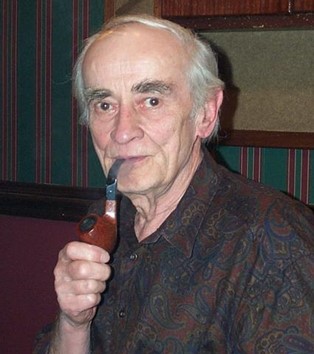
John Calich was one of Canada’s finest carvers. He died in July 2008. John was a full-time pipe maker for the last 40 years. Calich pipes were mostly traditional shapes. His signature style is rustication and smooth on the same pipe along with his unique skill to stain a pipe in contrasting colors. He used only top-quality Grecian and Calabrian briar. The mouthpieces are hand finished Vulcanite “A”. Each pipe was entirely made by hand. John Calich was featured in the summer 2005 issue of Pipes & Tobacco.

His pipes are graded 3E – 7E. Retail prices range from$ 145.00 to $ 500.00 Each pipe is stamped “CALICH” 3-8E, his earlier pipes were graded from 3-14, and a single, tiny silver dot is applied to the top of the stem (https://pipedia.org/wiki/Calich).

I summarize the dating information from those blogs now: From my research and conversations I learned that John’s later pipes were graded 3E – 8E. The retail prices for them ranged from $145.00 to $500.00. Each pipe was stamped “CALICH” and given an E grade. His earlier pipes were graded from 3-14 and had a single, tiny silver dot applied to the top of the stem. More information can be found at the Pipedia article above. All of this information told me as expected that the pipe I had was an earlier one.

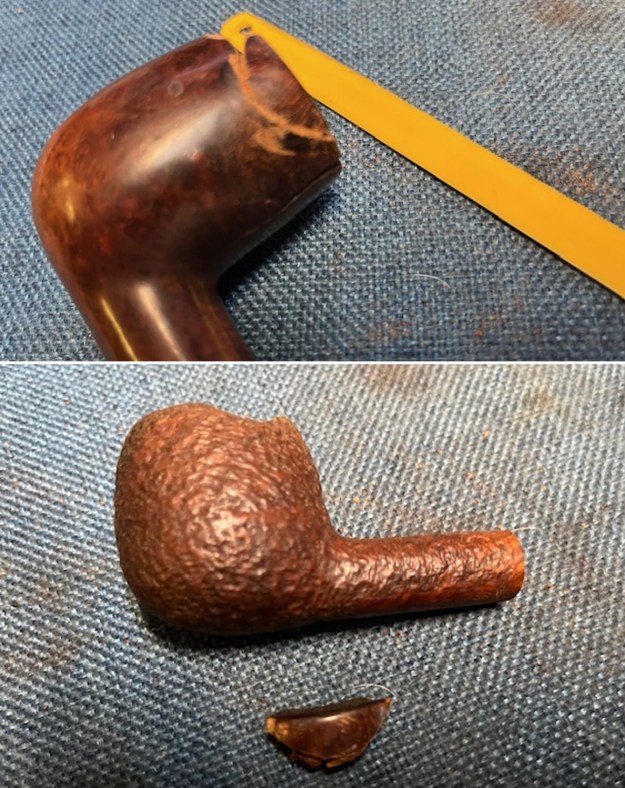
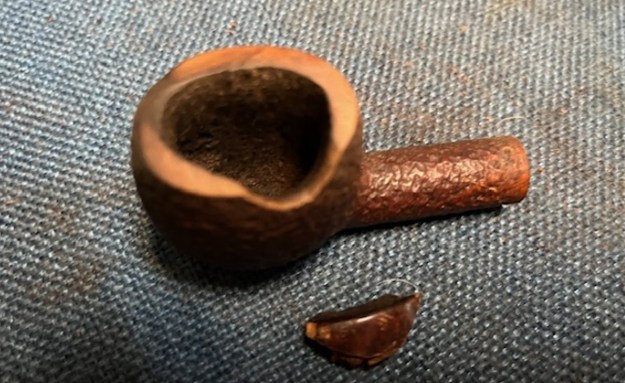
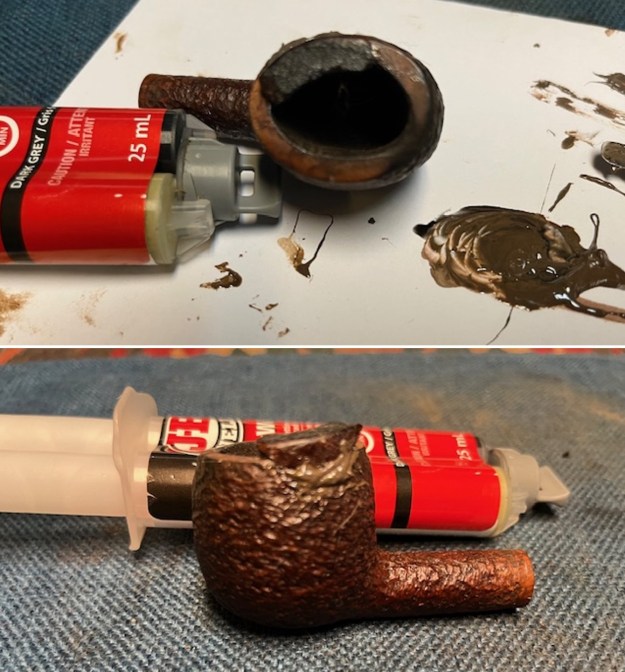
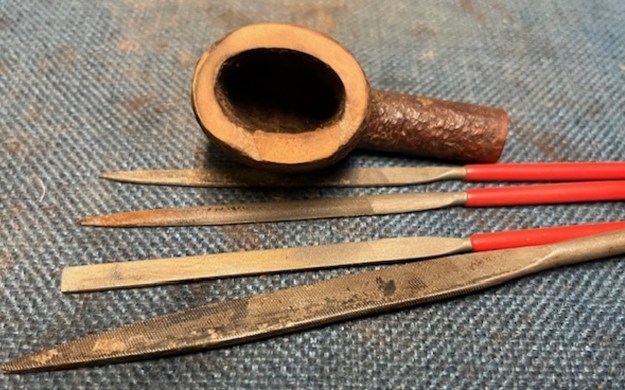
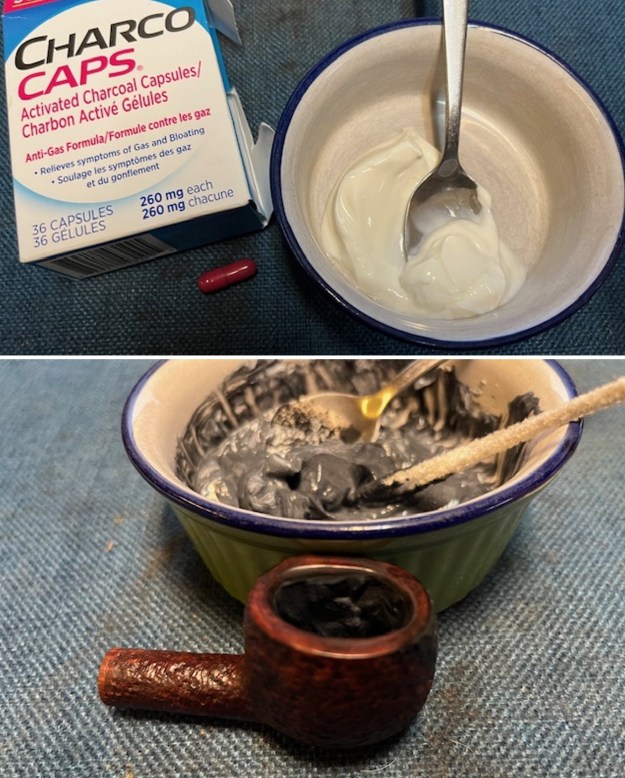
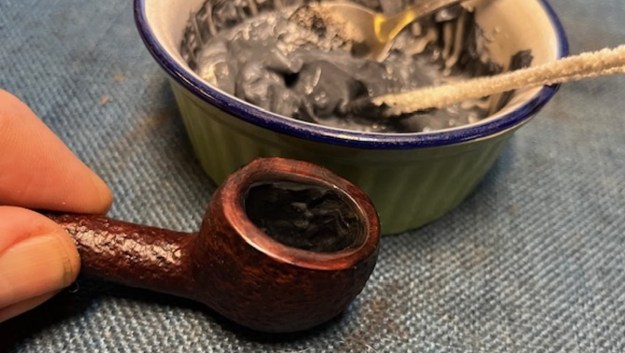
Armed with the information about John’s grading system I knew that the pipe in hand was an earlier Calich Hand Made Grade 8 Opera pipe and the 86 told me it was made in 1986. Now it was time to work on the pipe. The PipNet reamer would not fit in the bowl so I reamed the oval bowl with a Savinelli Fitsall Pipe Knife to scrape back the remaining cake. I would finish my cleaning of the bowl later by sanding it by hand. Once it was clean I turned my attention to the rim top. I cleaned up the inner edge of the bowl with a folded piece of 220 grit sandpaper. I flattened out the damaged area with the sandpaper to give a flat surface for my repair. I topped the bowl with 220 grit sandpaper on a topping board to give the rim top a smooth surface. I decided to work on the repair to the deep burned area on the left side of the bowl. I cut a piece of briar out of a cracked bowl I keep around for just this purpose. I eyeballed the shape of the divot and used a hacksaw blade and a carving knife to remove the chunk that I would use. I shaped the piece of briar more closely to the shape with a Dremel and a sanding drum. I mixed up a batch of JB Weld and applied the mixture with a dental spatula to the divot on the bowl side and on the underside of the cut piece of briar. I pressed the piece of briar into divot on the bowl side. I held it until it started to set and then set it aside to cure. I purposely used a little taller piece of briar than necessary as it gave me material to work with. I have found it simpler to work with the larger piece and then remove the excess. Once the JB Weld set enough for the repair not to move I set it aside to cure. Once the piece was solid in the repair I decided to work on the internals. I scraped the inside of the mortise with a dental spatula to remove the hardened tars and oils that lined the walls of the shank. Once I had that done I cleaned out the airway to the bowl, the mortise and the airway in the stem with pipe cleaners, cotton swabs and alcohol. When I finished the pipe smelled very clean. Once the repair had cured I used a Dremel and sanding drum to remove the excess briar and flatten out the rim top as much as possible with the tool. I then topped the bowl again on a topping board with 220 grit sandpaper to get a smooth rim top. With the top flattened, I used files to reduce the inner edge and reshape it to match the inner edge on the right side of the bowl. It took a bit of time and working through several needle files but it looked much better when I finished. I still had some work to do on the rim top and the inner edge but it was very close. I am still trying to decide if I will leave the rim top smooth or rusticate it to match the bowl rustication. Time will tell! I mixed up another batch of the JB Weld and spread it on to the inside wall of the bowl to protect the area where the bowl and inserted piece joined. This would keep the heat from following the repair joint out to the exterior and create potential burnout in the bowl. I set it aside to allow the JB Weld time to cure and harden before I sanded it smooth.I scrubbed the briar with some Before & After Briar Cleaner and a tooth brush and wiped it off with a clean paper towel. The Briar Cleaner removed a lot of built up grime and oils from the grooves of the rustication and the bowl looked much better. I polished the smooth rim top with micromesh sanding pads – wet sanding with 1500-12000 grit sanding pads. I wiped it down with a damp cloth after each pad. I was able to smooth it out nicely and it did not look too bad. The repaired area actually blended in very well. I would not need to rusticated it! I touched up the sanded and rebuilt rim top with a Cherry stain pen. The match on the rim with the rest of the pipe is perfect.Once the internal coating of JB Weld cured I sanded it with 220 grit sandpaper to smooth it out. I then mixed a batch of bowl coating with some sour cream and charcoal powder and coated the walls of the entire bowl. I used two teaspoons of sour cream and four of the Charco caps to mix a black/grey mixture that I use for the bowl coating. I applied it to the walls of the bowl with a folded pipe cleaner and covered the interior of the bowl with it so that it was smooth. I set it aside to cure. Once it hardens and dries it is odorless and leaves behind no lingering taste. I rubbed the bowl down with Before & After Restoration Balm. I worked it into the surface of the briar with my fingertips to clean, enliven and protect it. I let the balm sit for ten minutes then buffed with a cotton cloth to raise the shine. Mark Hoover’s Balm is a product that I have come to appreciate and one I use on every pipe I have been working on. I set the bowl aside and turned my attention to the stem. I “painted” the stem surface of the stem with the flame of a Bic lighter to lift the tooth marks and chatter on the surface. I was able to remove it all. I sanded the stem surface with 220 grit sandpaper to remove the remaining chatter marks. I wiped the stem down with an Obsidian Oil cloth and it looked much better at this point.I sanded the stem with 320-3500 grit sanding pads to break up the remaining oxidation. I wiped it down after each sanding pad with a soft cloth. It began to look good. I polished the stem with micromesh sanding pads – dry sanding with 1500-12000 grit pads. I wiped the stem down after each sanding pad with Obsidian Oil. I polished it with Before & After Pipe Stem Polish – both Fine and Extra Fine. Once I had finished the polishing I gave it final coat of Obsidian Oil and set it aside to dry. This is the fourth of five pipes from Kathleen that I am working on. It is another beautifully shaped 1986 John Calich Hand Made Grade 8 Opera Pipe. It has the kind of beauty I have come to expect from John’s pipes with a smooth rim top and shank end. I put the bowl and stem back together. I polished the bowl and stem with Blue Diamond to polish out the scratches in the briar and the vulcanite. I gave the bowl multiple coats of Conservator’s Wax and the stem multiple coats of carnauba wax. I buffed the pipe with a clean buffing pad to raise the shine. I hand buffed it with a microfiber cloth to deepen the shine. The pipe polished up pretty nicely. The rusticated finish is well done and the polished smooth finish on the shank end and rim top look really good with the black vulcanite stem. This Calich Hand Made Opera Pipe was a challenging pipe to bring back to life. It is a comfortable pipe to hold in the hand. The finished pipe is shown in the photos below. The dimensions of the pipe are Length: 5 ¾ inches, Height: 1 ½ inches, Outside diameter of the bowl: 1inch x 1 ¼ inches, Chamber diameter: 7/8 of an inch x ½ of an inch. The weight of the pipe is 27 grams/.95 ounces. Thanks for reading this blog and my reflections on the pipe while I worked on it. Once I finish the last pipe in the lot I will be sending them back to Kathleen for her husband to enjoy.
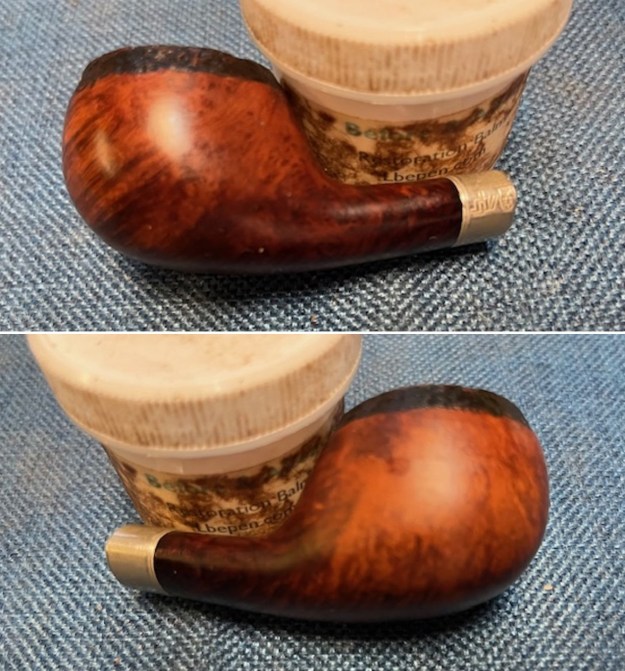
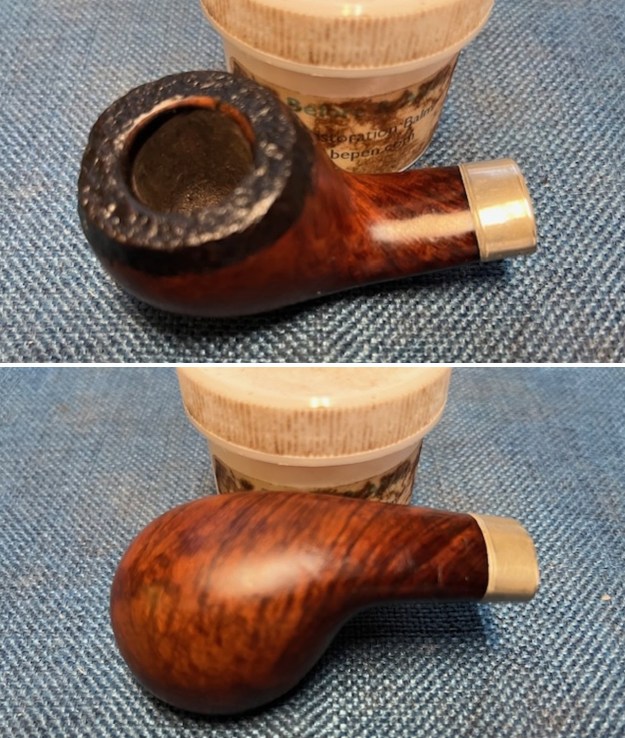
Restoring the second of 5 pipes for an old pipeman – a Calich Hand Made Grade 11 Rhodesian


Blog by Steve Laug

Earlier in June I received an email regarding restoring some pipes for her husband. Here is here email.

I have one Calich and one Dunhill pipe which my husband destroyed using a torch lighter on. I am wondering if it is possible to get them restored somehow. If you want to have a look I can send pics.

I wrote and asked for photos of the pipes. She wrote that there were actually 5 pipes not two and included photos of all five. I asked her if she was wanting to sell them or just repair them. Here is her response.

No… I don’t want to sell (yet) he’s 86 and has taken up smoking his pipes again. He was using a torch lighter until I discovered and replaced with proper pipe lighters. For now, I’m wondering if it’s possible or even wise to restore them. – Kathleen.

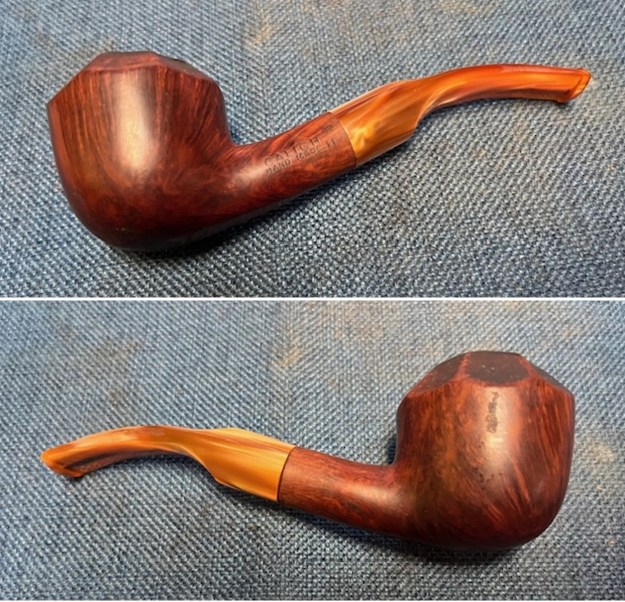
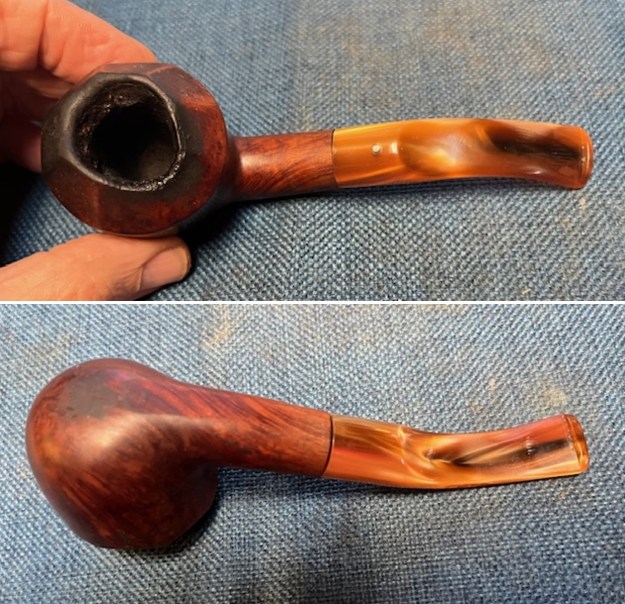
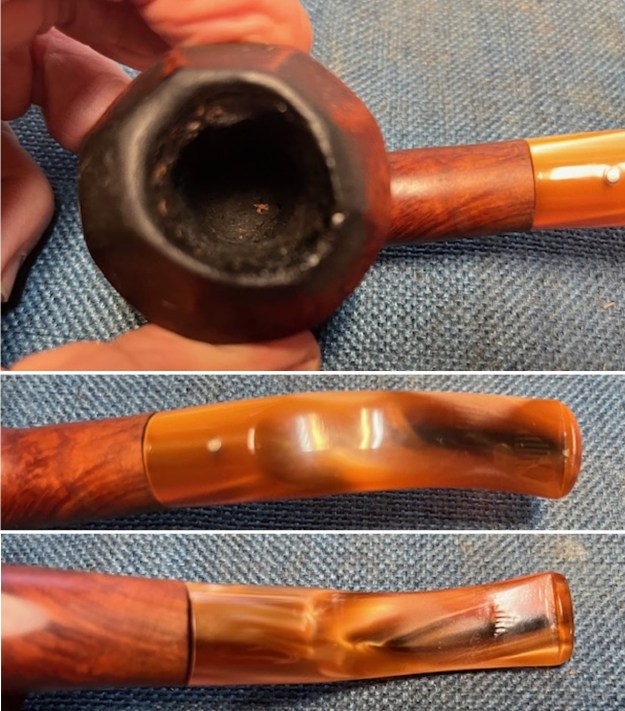
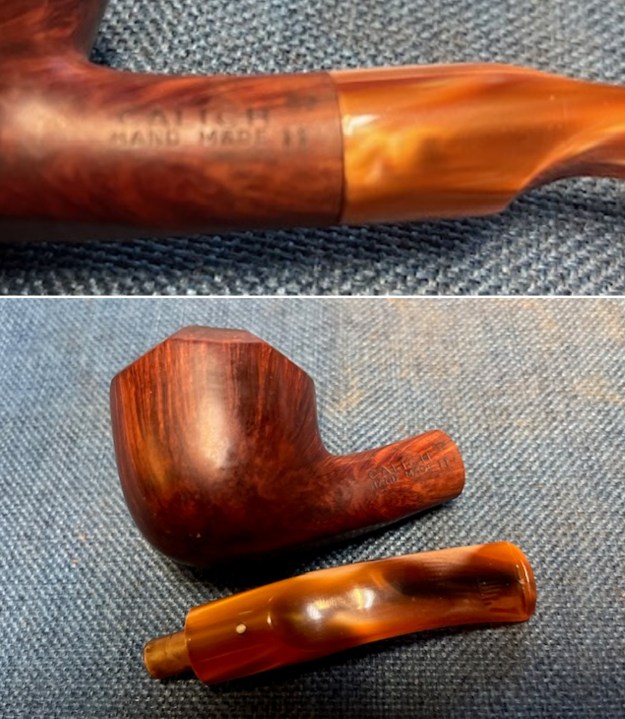
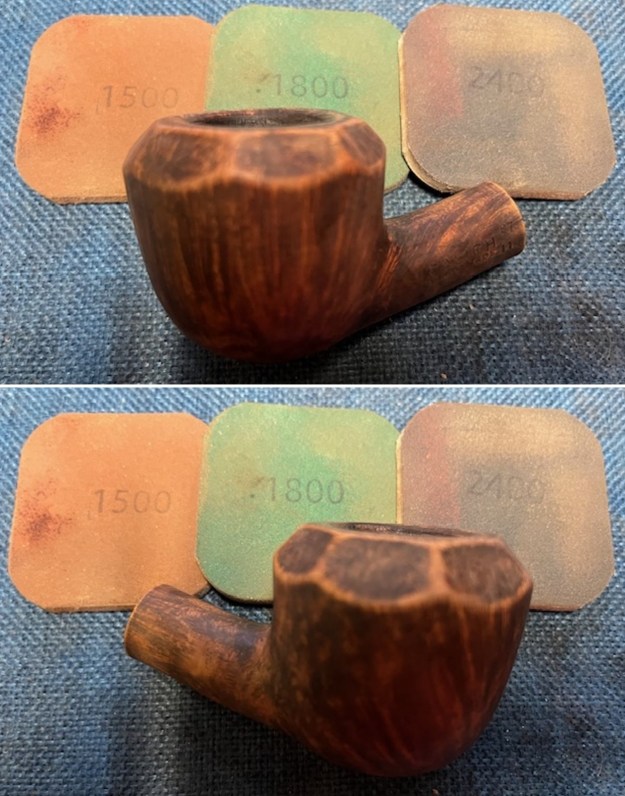
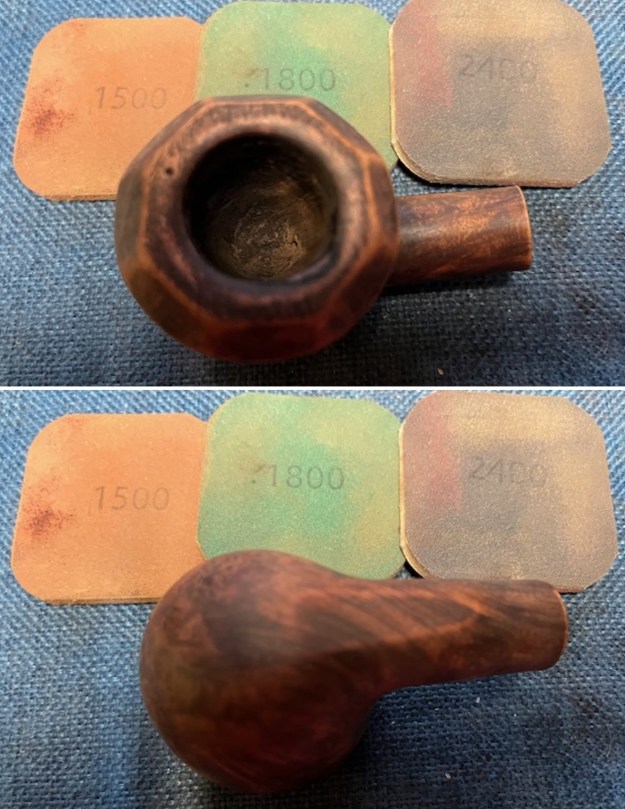
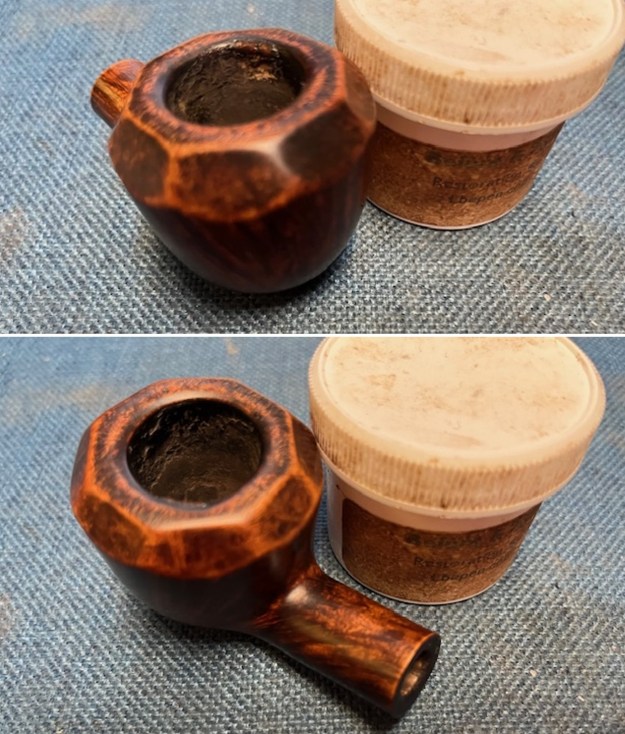
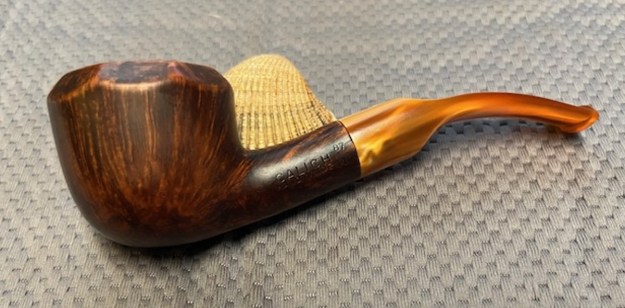
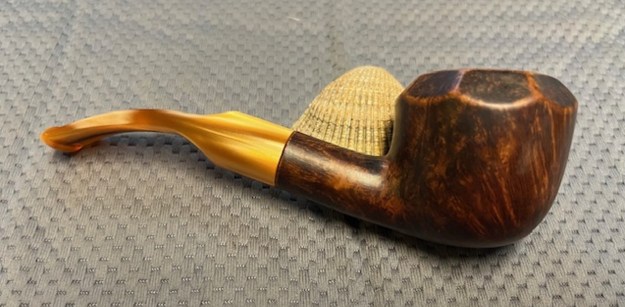
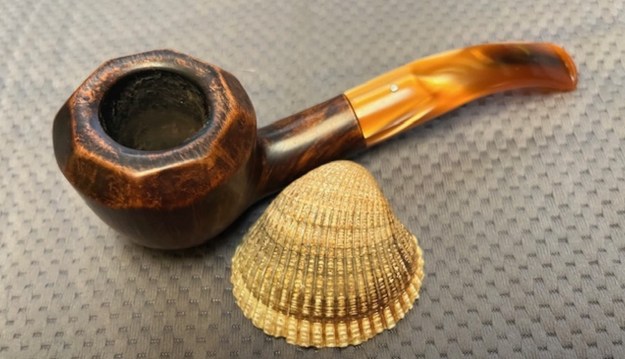
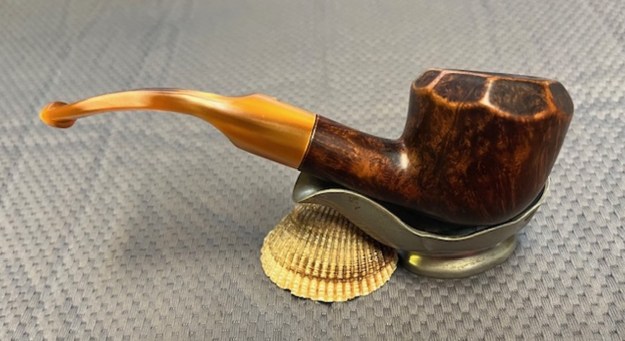
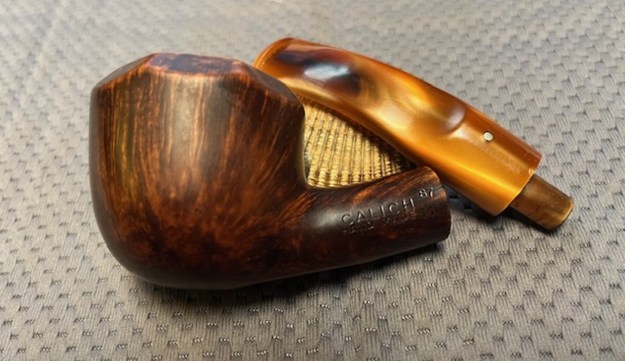
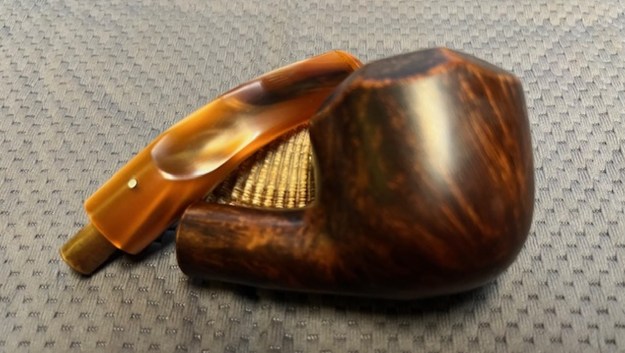
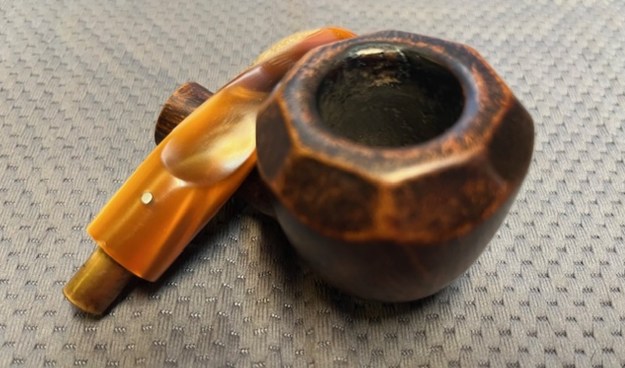
I replied to Kathleen and invited her to send the pipes to me in Vancouver. They arrived just before I left for my visit with my Dad in Idaho. Here is what I found when they arrived. There were three Caliches, a Dunhill, and an Ed Burak Connoisseur. The Calich Pipes included a rusticated straight Opera, a bent Rhodesian with an octagonal rim cap and an acrylic stem. The Dunhill was a sandblast Billiard with a repair band on the shank. The Ed Burak Connoisseur was a bent Bulldog. All had rim top damage from being lit with a torch lighter. Some were in worse condition than others. The worst were the Calich Opera and the Dunhill Billiard which had torch damage on the left side of the rim and down the bowl side. The others had varying degrees of burn damage. I set them aside until I returned home from my visit. Here are the photos that Kathleen sent me of the second Calich pipe – the Rhodesian with the octagonal rim cap. This morning I took the pipes out of the box and laid the group out on my worktable. I took some photos of the group to show their condition. The photo of the left side of the shank shows the damage I mentioned in the earlier paragraphs. The right-side photo looks very good. The photos from the rim top show a lot of damage and the overall condition of the pipes very clear. After looking through the remaining group of four pipes I decided to work on the second of the Calich pipes. This one is a smooth Rhodesian with an octagonal rim cap. It is stamped CALICH [over] Hand Made [over] 11 and just above that is the number 87. The smooth finish Rhodesian had a very thick cake in the bowl and there was a lava overflow on the top. There was heavy burn damage under the lava on the front edge of the bowl toward the front right as well as much heavier burn damage on the left back edge. The bowl was completely out of round. The finish had a lot of oils and tars built up on the sides and the cap. It was oily and sticky to the touch while I held it. There was some burn damage on the front of the bowl on one of the octagonal panels. The shank had a thick coat of tars and oils and the stem had a thick tar build up as well so its fit in the shank was very sticky and dirty. The stem itself is variegated gold acrylic with a single silver dot on the topside of the saddle. It was dirty and had some deep gouges on the surface of the stem ahead of the button. There were overflowing tars on the smooth shank end around the fit of the tenon in the mortise. A lot would be revealed once I had cleaned it. I took photos of the pipe before I started my cleanup work. I took a close-up photo of the bowl and rim top to show its condition. The inside of the bowl was heavily caked with a wet oily tobacco. The rim top had damage on the front right in the photo below as well as on the back left. The back left side is the worst as it is quite thin and the bowl is out of round. It left a mess for me to clean up. The stem was also is a mess. There was some tooth marks and dents on the top and underside ahead of the button. There was a thick coat of calcification and oxidation on the stem. The silver dot on the stem top was tarnished but very visible.I took a photo of the stamping on the left side of the shank. It is clear and readable as noted above. I removed the stem from the shank and took a photo of the pipe showing the silver dot on the top of the saddle. It is a nice looking pipe that shows a lot of damage from burning. Once again I am including a bit about John Calich the pipemaker as I have loved John Calich’s pipes for over 25 years now and have collected a few of them. I have restored quite a few of them and written blogs about them that can be read if you are interested in seeing the kind of pipes that John made. They are unique and beautiful. Each of his pipes are a work of art to me. I am including the links to the previous blogs that have written about his pipes.

https://rebornpipes.com/2015/03/03/one-of-my-john-calich-pipes-a-calich-ee-billiard/

https://rebornpipes.com/2019/01/23/i-am-the-happy-owner-of-an-unsmoked-pipe-by-the-late-john-calich/

https://rebornpipes.com/2015/03/03/one-of-my-john-calich-pipes-a-calich-ee-billiard/

https://rebornpipes.com/2014/03/21/reflecting-on-my-collection-of-john-calich-pipes/

Each of the blogs reflects on John’s pipes if you want to get a feel for them take a few minutes and read them.

When John was living I spoke with him several times via phone and had him make some new stems for some of his pipes that I picked up off eBay. He was a very kind gentleman and was always helpful when I spoke with him. He was always ready with encouragement and when I needed to know how to do something when I was first learning to repair pipes he was willing to help. He was one of the old guard of Canadian Pipe makers. I miss him. I am including a short piece from Pipedia on John to give details on his work and the grading of his pipes. The second paragraph below is highlighted in blue as it gives some information on the Grade 12 Apple that I am working on with the single silver dot now. I am also including a photo of John Calich, courtesy Doug Valitchka

John Calich was one of Canada’s finest carvers. He died in July 2008. John was a full-time pipe maker for the last 40 years. Calich pipes were mostly traditional shapes. His signature style is rustication and smooth on the same pipe along with his unique skill to stain a pipe in contrasting colors. He used only top-quality Grecian and Calabrian briar. The mouthpieces are hand finished Vulcanite “A”. Each pipe was entirely made by hand. John Calich was featured in the summer 2005 issue of Pipes & Tobacco.

His pipes are graded 3E – 7E. Retail prices range from$ 145.00 to $ 500.00 Each pipe is stamped “CALICH” 3-8E, his earlier pipes were graded from 3-14, and a single, tiny silver dot is applied to the top of the stem (https://pipedia.org/wiki/Calich).

I summarize the dating information from those blogs now: From my research and conversations I learned that John’s his later pipes were graded 3E – 8E. The retail prices for them ranged from $145.00 to $500.00. Each pipe was stamped “CALICH” and given an E grade. His earlier pipes were graded from 3-14 and had a single, tiny silver dot applied to the top of the stem. More information can be found at the Pipedia article above. All of this information told me as expected that the pipe I had was an earlier one.

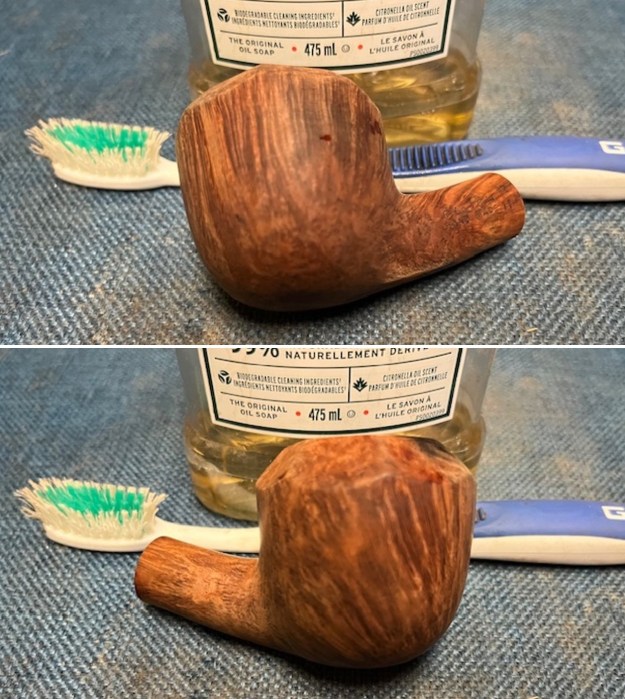
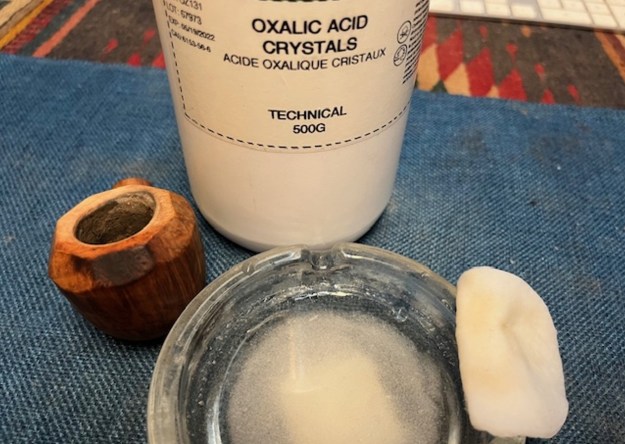
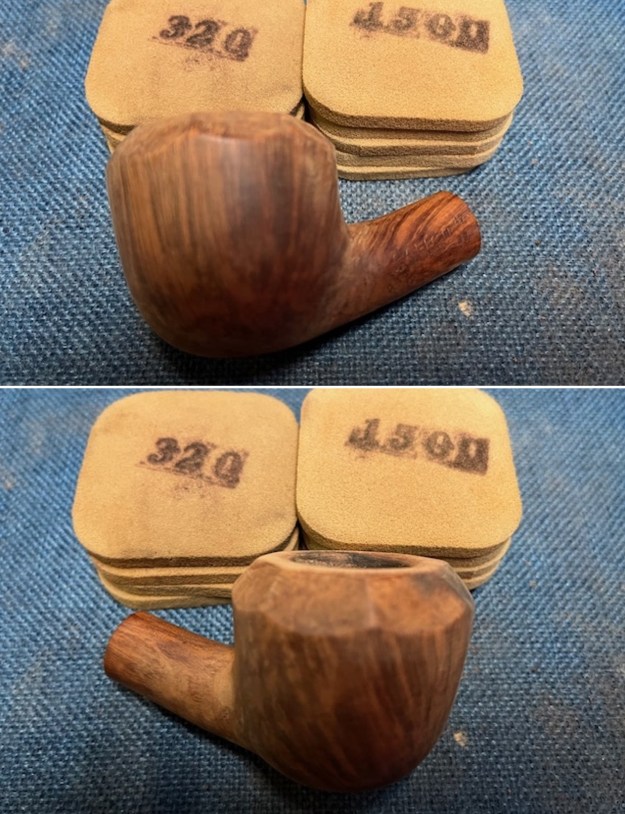
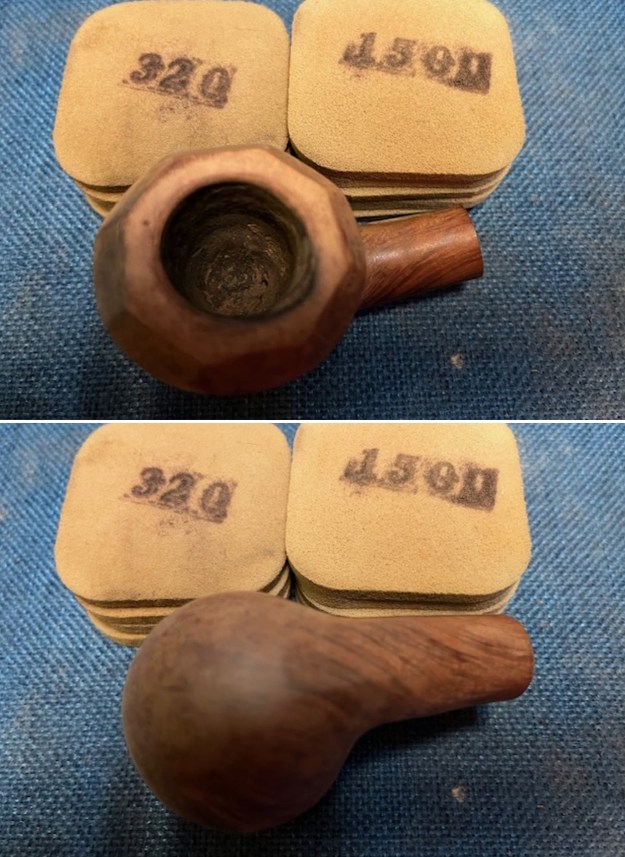
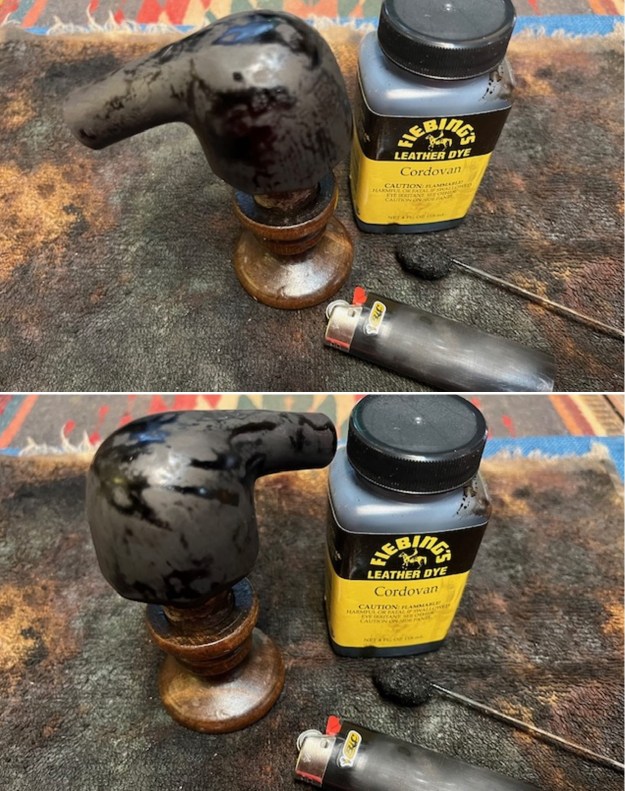
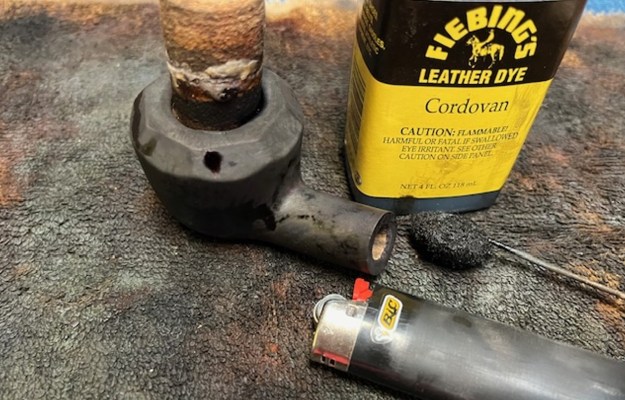
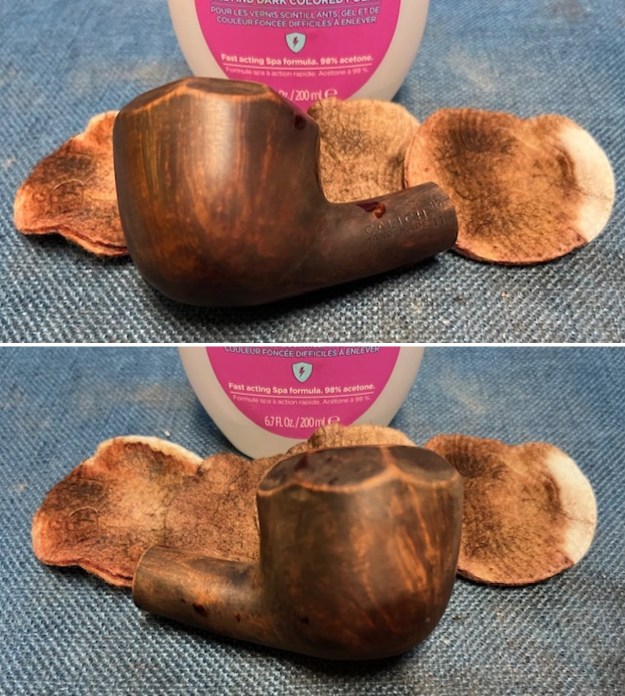
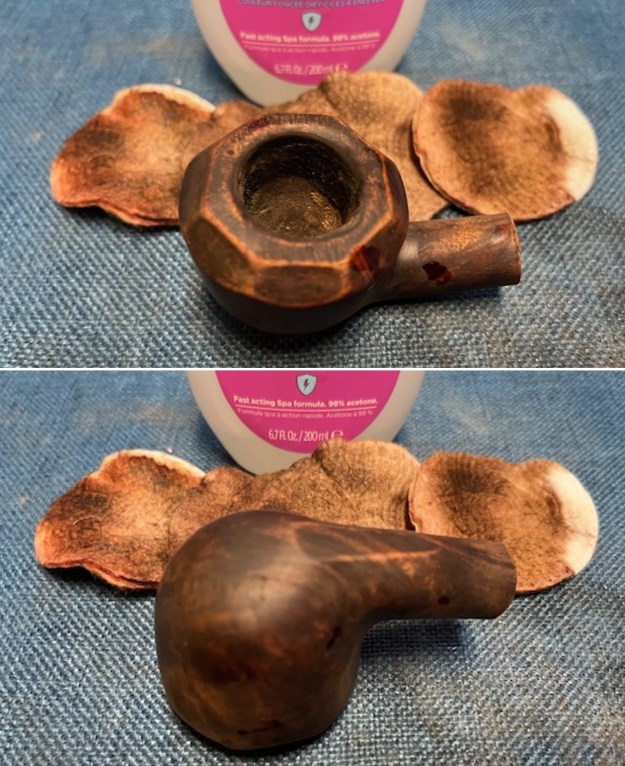
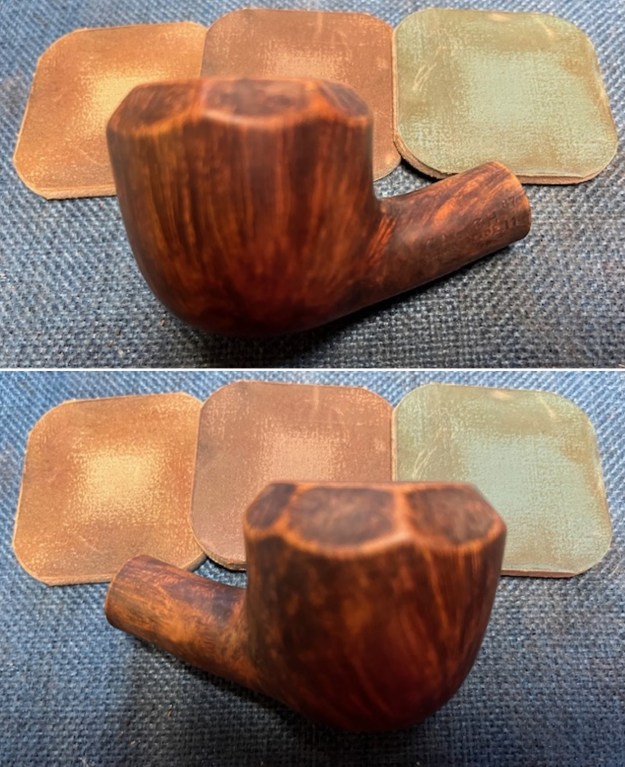
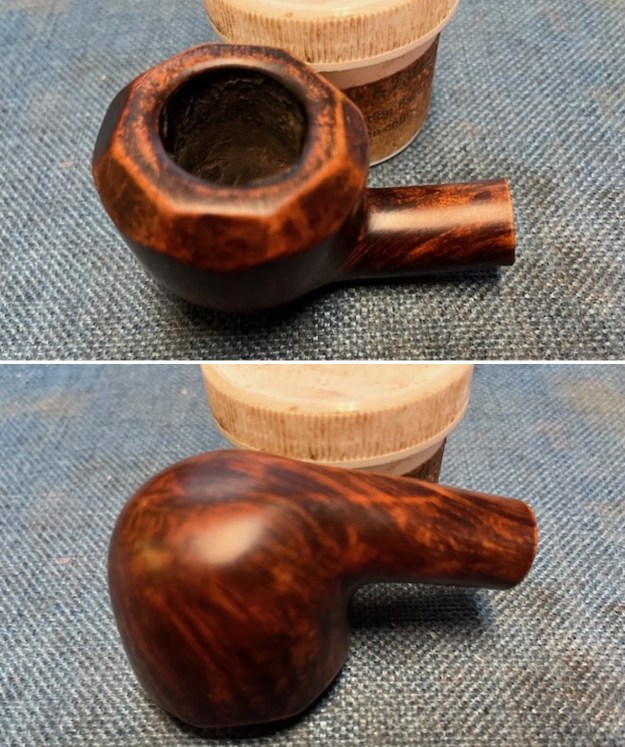
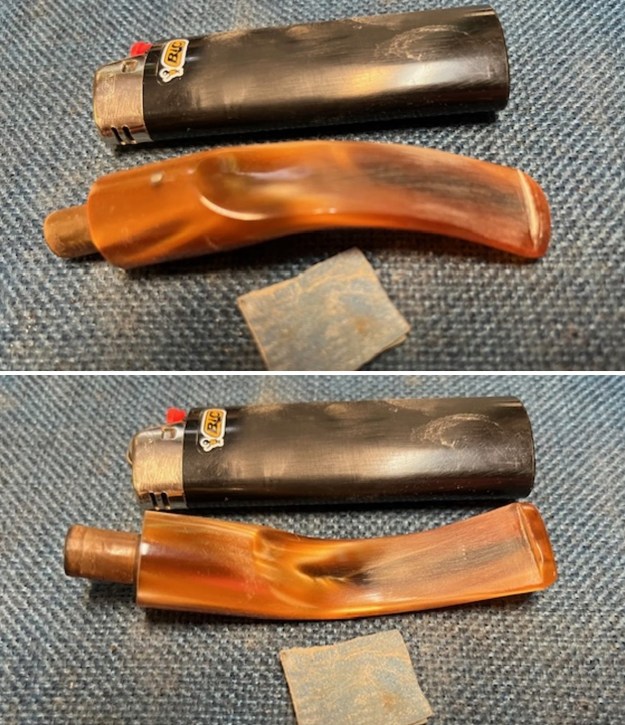
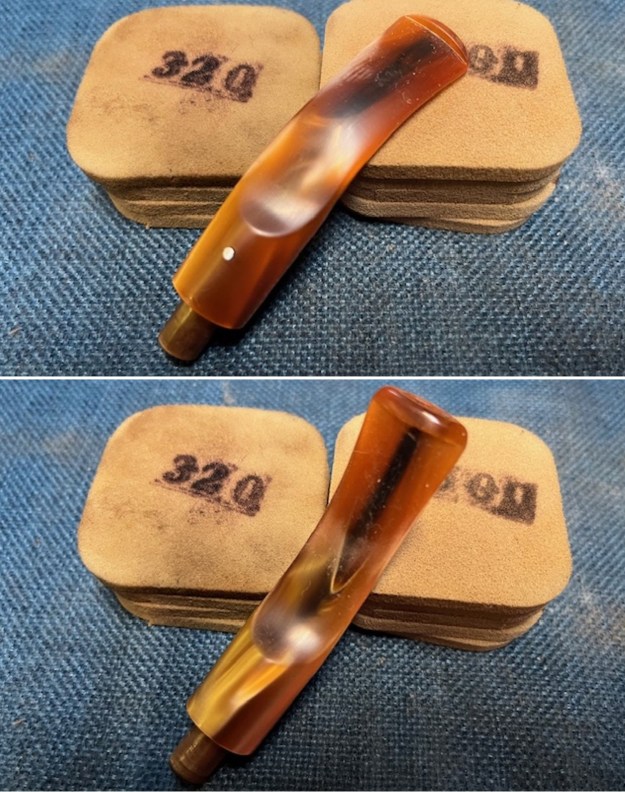
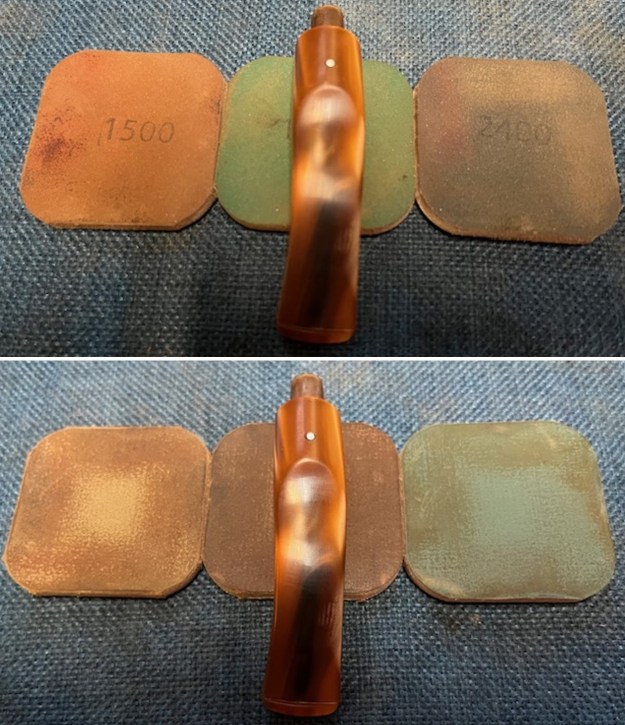
Armed with the information about John’s grading system I knew that the pipe in hand was an earlier Calich Hand Made Grade 11 made in 1987 and it was time to work on the pipe. I reamed the bowl with a PipNet Pipe reamer using the first cutting head. I took the cake back to bare briar so that I could check out the inside walls. I used a Savinelli Fitsall Pipe Knife to scrape back the remaining cake. I finished my cleanup of the walls by sanding it with 220 grit sandpaper wrapped around a piece of dowel. I decided to top the burned bowl. I used a topping board to flatten the rim top and remove the damage. I would still need to work on the rim more but I wanted it flat before I did my clean up and scrubbing.I scrubbed the briar with undiluted Murphy’s Oil Soap and a tooth brush and rinsed it off with warm running water. I scrubbed the rim top with a tooth brush and warm running water at the same time. I dried the bowl off with a soft microfiber cloth and gave it a light buffing. I also cleaned out the shank, mortise and airway in the stem and shank with Murphy’s Oil Soap and shank brushes to clean out the oils and tars on the inside. You can see the darkening or burn damage on the front panel of the rim cap in the third photo. I am hoping it is removable. I worked on the internals. I cleaned out the airway to the bowl, the mortise and the airway in the stem with pipe cleaners, cotton swabs and alcohol. When I finished the pipe smelled very clean. Once it was clean I turned my attention to the rim top. I cleaned up the inner edge of the bowl with a folded piece of 220 grit sandpaper. There was a damaged divot on the rear left inner edge of the bowl. I filled it in with briar dust and clear CA glue to built it up even with the rest of the edge and the rim top. I topped the bowl with 220 grit sandpaper to smooth out the top. I used a wooden ball and sanded the top edge and inner edge of the bowl with 220 grit sandpaper. I gave the top and inner edge a slight bevel. To remove some of the dark marks – both burn and tars/oils, I wiped the front edge of the cap with a mix of Oxalic Acid and water to try to lighten the surface of the briar. While it removed some, it did not work completely.I sanded the bowl and cap with 320-3500 grit sanding pads to smooth it out before I restained the bowl. I wiped the bowl down between each pad with a damp cloth. When I finished it wiped it down with a cotton pad and alcohol. I restained the bowl with a Cordovan Fiebing’s stain and flamed it with a lighter. I repeated the process until I was happy with the coverage on the bowl. I wanted to use a darker stain to hide the burn damage on the inner edge and top of the cap as well as those on the front of the cap. It would be darker but I thought it would work very well. I wiped the stain down with some acetone and cotton pads to remove the excess stain and make the grain stand out more on the surface of the briar. I polished the bowl with micromesh sanding pads – wet sanding with 1500-12000 grit sanding pads. I wiped it down with a damp alcohol cotton makeup pad after each sanding pad. I rubbed the bowl down with Before & After Restoration Balm. I worked it into the surface of the briar with my fingertips to clean, enliven and protect it. I let the balm sit for ten minutes then buffed with a cotton cloth to raise the shine. Mark Hoover’s Balm is a product that I have come to appreciate and one I use on every pipe I have been working on. I set the bowl aside and turned my attention to the stem. The stem had some deep marks from what looked like pliers’ marks on the top and underside just ahead of the button. These marks were rough and very visible. I painted them with the flame of a lighter to try to lift the marks then sanded them out with a folded piece of 220 grit sandpaper and they were removed. The surface was smooth.I sanded the stem with 320-3500 grit sanding pads to smooth out the remaining marks and begin polishing the stem. I wiped it down after each sanding pad with a soft cloth. It began to look good. I polished the stem with micromesh sanding pads – wet sanding with 1500-12000 grit pads. I wiped the stem down after each sanding pad with Obsidian Oil. I polished it with Before & After Pipe Stem Polish – both Fine and Extra Fine. Once I had finished the polishing I gave it final coat of oil and set it aside to dry. This is the second of five pipes from Kathleen that I am working on. It is a beautifully shaped John Calich Hand Made Grade 11 Smooth Bent Rhodesian. It has the kind of beauty I have come to expect from John’s pipes. I put the bowl and stem back together. I polished the bowl and stem with Blue Diamond to polish out the scratches in the briar and the vulcanite. I gave the bowl and the stem multiple coats of carnauba wax. I buffed the pipe with a clean buffing pad to raise the shine. I hand buffed it with a microfiber cloth to deepen the shine. The pipe polished up pretty nicely. The smooth finish is well done and the reshaped rim cap look really good with the variegated acrylic stem. This Calich Hand Made Bent Rhodesian was a fun pipe to bring back to life. It is a comfortable pipe to hold in the hand. The finished pipe is shown in the photos below. The dimensions of the pipe are Length: 6 inches, Height: 2 inches, Outside diameter of the bowl: 1 ¾ inches, Chamber diameter: 7/8 of an inch. The weight of the pipe is 61 grams/2.12 ounces. Thanks for reading this blog and my reflections on the pipe while I worked on it. Once I finish the other three pipes in the lot I will be sending them back to Kathleen for her husband to enjoy once again.
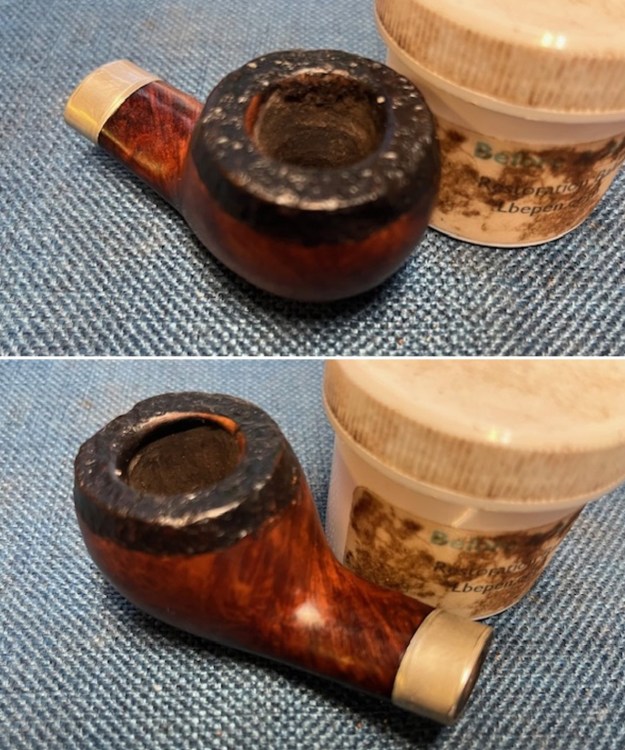
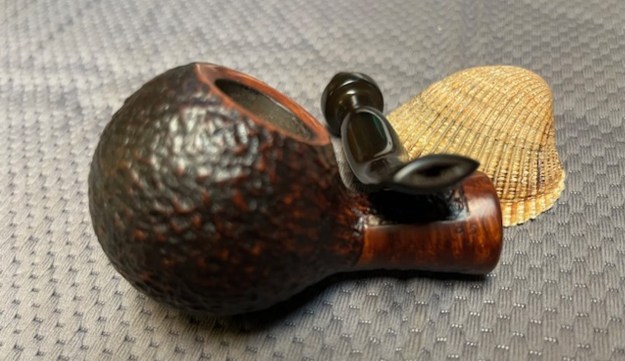
Restoring the first of five pipes for an old pipeman – a Calich Hand Made Grade 12 Bent Ball


Blog by Steve Laug

Earlier in June I received an email regarding restoring some pipes for her husband. Here is here email.

I have one Calich and one Dunhill pipe which my husband destroyed using a torch lighter on. I am wondering if it is possible to get them restored somehow. If you want to have a look I can send pics.

I wrote and asked for photos of the pipes. She wrote that there were actually 5 pipes not two and included photos of all five. I asked her if she was wanting to sell them or just repair them. Here is her response.

No… I don’t want to sell (yet) he’s 86 and has taken up smoking his pipes again. He was using a torch lighter until I discovered and replaced with proper pipe lighters. For now I’m wondering if it’s possible or even wise to restore them. – Kathleen.

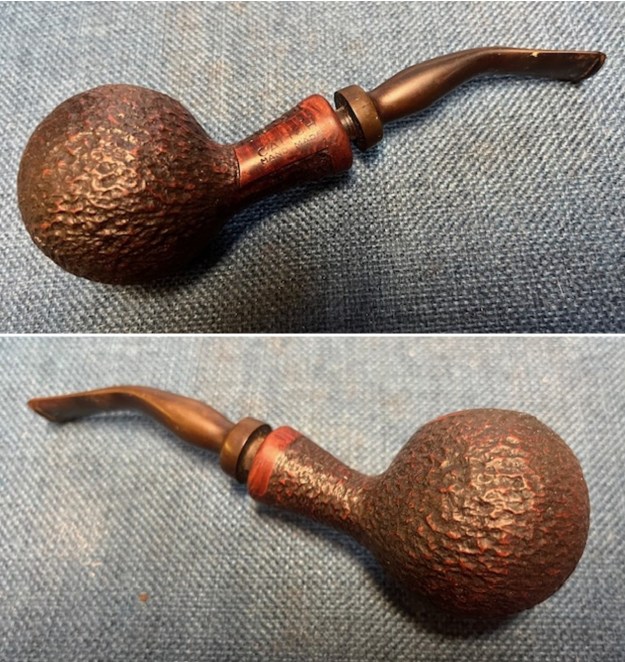
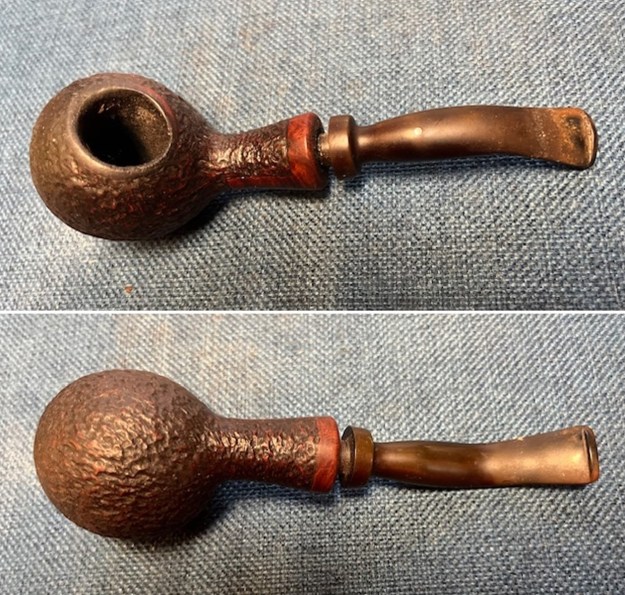
I replied to Kathleen and invited her to send the pipes to me in Vancouver. They arrived just before I left for my visit with my Dad in Idaho. Here is what I found when they arrived. There were three Caliches, a Dunhill, and an Ed Burak Connoisseur. The Calich Pipes included a rusticated straight Opera, a bent Rhodesian with an octagonal rim cap and an acrylic stem. The Dunhill was a sandblast Billiard with a repair band on the shank. The Ed Burak Connoisseur was a bent Bulldog. All had rim top damage from being lit with a torch lighter. Some were in worse condition than others. The worst were the Calich Opera and the Dunhill Billiard which had torch damage on the left side of the rim and down the bowl side. The others had varying degrees of burn damage. I set them aside until I returned home from my visit. Here are the photos that Kathleen sent me of the pipe. This morning I took the pipes out of the box and laid the group out on my worktable. I took some photos of the group to show their condition. The photo of the left side of the shank shows the damage I mentioned in the earlier paragraphs. The right-side photo looks very good. The photos from the rim top show a lot of damage and the overall condition of the pipes very clear. After looking through the entire group of five pipes I decided to work on the first of the Calich pipes. This one is a rusticated ball that is stamped CALICH [over] Hand Made [over] 12. It had a smooth rim top, shank end and a rectangle on the left shank side for the stamping. The pipe had a very thick cake in the bowl and there was a lava overflow on the top. There was some burn damage under the lava on the front edge of the bowl toward the front right as well as much heavier damage on the left back edge. The shank had a thick coat of tars and oils and the stem had a thick tar build up as well so its fit in the shank was very sticky and dirty. The stem itself is vulcanite with a single silver dot on the topside just ahead of the bend. It was oxidized and had tooth marks and chatter on both sides of the stem just ahead of the button. There were overflowing tars on the smooth shank end around the fit of the tenon in the mortise. The finish was dusty and tired but had some nice grain under the grime and the finish appeared to be in good condition. A lot would be revealed once I had cleaned it. I took photos of the pipe before I started my cleanup work. I took a close-up photo of the bowl and rim top to show its condition. The inside of the bowl was heavily caked with a wet oily tobacco. The rim top had damage on the front right in the photo below as well as on the back left. The back left side is the worst as it is quite thin and the bowl is out of round. It left a mess for me to clean up. The stem was also is a mess. There was some tooth marks and dents on the top and underside ahead of the button. There was a thick coat of calcification and oxidation on the stem. The silver dot on the stem top was tarnished but very visible.I took a photo of the stamping on the left side of the shank. It is clear and readable as noted above. I removed the stem from the shank and took a photo of the silver dot on the stem top.I decided to include a bit about John Calich the pipemaker as I have loved John Calich’s pipes for over 25 years now and have collected a few of them. I have restored quite a few of them and written blogs about them that can be read if you are interested in seeing the kind of pipes that John made. They are unique and beautiful. Each of his pipes are a work of art to me. I am including the links to the previous blogs that have written about his pipes.

https://rebornpipes.com/2015/03/03/one-of-my-john-calich-pipes-a-calich-ee-billiard/

https://rebornpipes.com/2019/01/23/i-am-the-happy-owner-of-an-unsmoked-pipe-by-the-late-john-calich/

https://rebornpipes.com/2015/03/03/one-of-my-john-calich-pipes-a-calich-ee-billiard/

https://rebornpipes.com/2014/03/21/reflecting-on-my-collection-of-john-calich-pipes/

Each of the blogs reflects on John’s pipes if you want to get a feel for them take a few minutes and read them.

When John was living I spoke with him several times via phone and had him make some new stems for some of his pipes that I picked up off eBay. He was a very kind gentleman and was always helpful when I spoke with him. He was always ready with encouragement and when I needed to know how to do something when I was first learning to repair pipes he was willing to help. He was one of the old guard of Canadian Pipe makers. I miss him. I am including a short piece from Pipedia on John to give details on his work and the grading of his pipes. The second paragraph below is highlighted in blue as it gives some information on the Grade 12 Apple that I am working on with the single silver dot now. I am also including a photo of John Calich, courtesy Doug Valitchka

John Calich was one of Canada’s finest carvers. He died in July 2008. John was a full-time pipe maker for the last 40 years. Calich pipes were mostly traditional shapes. His signature style is rustication and smooth on the same pipe along with his unique skill to stain a pipe in contrasting colors. He used only top-quality Grecian and Calabrian briar. The mouthpieces are hand finished Vulcanite “A”. Each pipe was entirely made by hand. John Calich was featured in the summer 2005 issue of Pipes & Tobacco.

His pipes are graded 3E – 7E. Retail prices range from$ 145.00 to $ 500.00 Each pipe is stamped “CALICH” 3-8E, his earlier pipes were graded from 3-14, and a single, tiny silver dot is applied to the top of the stem (https://pipedia.org/wiki/Calich).

I summarize the dating information from those blogs now: From my research and conversations I learned that John’s his later pipes were graded 3E – 8E. The retail prices for them ranged from $145.00 to $500.00. Each pipe was stamped “CALICH” and given an E grade. His earlier pipes were graded from 3-14 and had a single, tiny silver dot applied to the top of the stem. More information can be found at the Pipedia article above. All of this information told me as expected that the pipe I had was an earlier one.

Armed with the information about John’s grading system I knew that the pipe in hand was an earlier Calich Hand Made Grade 12 and it was time to work on the pipe. I reamed the bowl with a PipNet Pipe reamer using the first cutting head. I took the cake back to bare briar so that I could check out the inside walls. I used a Savinelli Fitsall Pipe Knife to scrape back the remaining cake. I finished my cleanup of the walls by sanding it with 220 grit sandpaper wrapped around a piece of dowel. I worked on the internals. I scraped the inside of the mortise with a dental spatula to remove the hardened tars and oils that lined the walls of the shank. Once I had that done I cleaned out the airway to the bowl, the mortise and the airway in the stem with pipe cleaners, cotton swabs and alcohol. When I finished the pipe smelled very clean. I scrubbed the briar with undiluted Murphy’s Oil Soap and a tooth brush and rinsed it off with warm running water. I scrubbed the rim top with a tooth brush and warm running water at the same time. I dried the bowl off with a soft microfiber cloth and gave it a light buffing. I also cleaned out the shank, mortise and airway in the stem and shank with Murphy’s Oil Soap and shank brushes to clean out the oils and tars on the inside. Once it was clean I turned my attention to the rim top. I cleaned up the inner edge of the bowl with a folded piece of 220 grit sandpaper. I topped the bowl with 220 grit sandpaper on a topping board to give a the rim top a smooth surface. I then used a wooden ball and sanded the top edge and inner edge of the bowl with 220 grit sandpaper. I gave the top and inner edge a slight bevel. I touched up the sanded rim top with a Cherry stain pen. The match on the rim with the shank end and shank end is perfect. Once it is polished it will be perfect. I polished the smooth rim top with micromesh sanding pads – wet sanding with 1500-12000 grit sanding pads. I wiped it down with a damp cloth after each pad.I rubbed the bowl down with Before & After Restoration Balm. I worked it into the surface of the briar with my fingertips to clean, enliven and protect it. I let the balm sit for ten minutes then buffed with a cotton cloth to raise the shine. Mark Hoover’s Balm is a product that I have come to appreciate and one I use on every pipe I have been working on. I set the bowl aside and turned my attention to the stem. I wiped down the stem surface with Soft Scrub and cotton pads to remove the oxidation and grime on the surface. Once I finished it looked significantly better.I sanded the stem with 320-3500 grit sanding pads to break up the remaining oxidation. I wiped it down after each sanding pad with a soft cloth. It began to look good. I polished the stem with micromesh sanding pads – wet sanding with 1500-12000 grit pads. I wiped the stem down after each sanding pad with Obsidian Oil. I polished it with Before & After Pipe Stem Polish – both Fine and Extra Fine. Once I had finished the polishing I gave it final coat of oil and set it aside to dry. This is the first of five pipes from Kathleen that I am working on. It is a beautifully shaped John Calich Hand Made Grade 12 Rusticated Ball. It has the kind of beauty I have come to expect from John’s pipes with a smooth rim top and shank end. I put the bowl and stem back together. I polished the bowl and stem with Blue Diamond to polish out the scratches in the briar and the vulcanite. I gave the bowl multiple coats of Conservator’s Wax and the stem multiple coats of carnauba wax. I buffed the pipe with a clean buffing pad to raise the shine. I hand buffed it with a microfiber cloth to deepen the shine. The pipe polished up pretty nicely. The rusticated finish is well done and the polished smooth finish on the shank end and rim top look really good with the black vulcanite stem. This Calich Hand Made Bent Ball was a fun pipe to bring back to life. It is a comfortable pipe to hold in the hand. The finished pipe is shown in the photos below. The dimensions of the pipe are Length: 5 ½ inches, Height: 1 ¾ inches, Outside diameter of the bowl: 1 ¼ inches, Chamber diameter: ¾ of an inch. The weight of the pipe is 54 grams/1.94 ounces. Thanks for reading this blog and my reflections on the pipe while I worked on it. Once I finish the other four pipes in the lot I will be sending them back to Kathleen for her husband to enjoy.
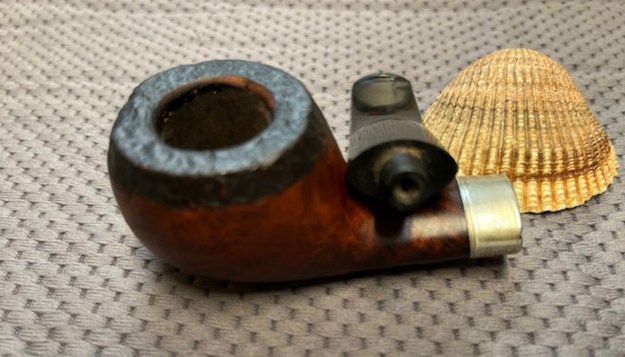
Another Calich on the Worktable – a Grade 11, 1988 Oval Shank Dublin


Blog by Steve Laug

After I had finished the last of Ken Bennett’s estate Calich pipes my friend Alex sent me an email about a Calich oval shank canted Dublin that he thought would be a good match to the Calich pipes from Ken’s estate. Last week we got together for a visit and so that he could drop off some pipes for me to work on and some pipes that he wanted to trade. The Calich was one of them. This pipe had a classic Calich look to it. There was a grooved channel on the front and on the right side of the bowl – kind of a fluted look. The finish was dull and would need to be buffed to polish it. The shape of the bowl followed the beautiful grain of the briar – flame and straight grain around the bowl and some swirls and birdseye as well. The rim top was plateau and canted toward the front. The smooth bowl seemed to have medium brown stain that made the grain pop. Over time John’s pipes take on a rich patina. The bowl had a light cake in it and there was some darkening on front and back side of the plateau rim top. Otherwise the rim top and edges of the bowl looked to be in excellent condition. The stamping on the underside of the shank read G followed by CALICH over Hand Made. After that stamping there was a superscript 88 stamped (year it was carved) with a subscript 11 which was the grade number. The stem has a single metal dot in the top of the saddle. There were some light tooth marks on both sides of the stem on both sides near the button. The shank and stem were dirty inside. I took a photo of the bowl and rim top to show the cake in the bowl and the darkening and light lava on the inner edge of the rim top. The cake was thin along the edges of the bowl but hopefully it had protected the rim and edges from damage. Otherwise it looks pretty good. I also took photos of the stem to show the oxidation on both sides and the light tooth chatter on both sides near the button.  I took a photo of the underside of the shank to show the condition of the stamping. You can see that just ahead of the Calich stamp over Hand Made is the letter G. After the “H” in Calich is a superscript 88 and a subscript 11.Once again I am including some information about John Calich the pipemaker as I have loved John Calich’s pipes for over 25 years now and have collected a few of them. I have restored quite a few of them and written blogs about them that can be read if you are interested in seeing the kind of pipes that John made. They are unique and beautiful. Each one of them is a work of art to me. I have written blogs on all of Ken Bennett’s Calich pipes and several others that I have in my own collection. Do a quick search on the blog if you are interested in reading about them.

John Calich, courtesy Doug Valitchka

When John was living I spoke with him several times via phone and had him make some new stems for some of his pipes that I picked up off eBay. He was a very kind gentleman and was always helpful when I spoke with him. He was always ready with encouragement and when I needed to know how to do something when I was first learning to repair pipes he was willing to help. He was one of the old guard of Canadian Pipe makers. I miss him. I am including a short piece from Pipedia on John to give details on his work and the grading of his pipes. The second paragraph below is highlighted in blue as it gives some information on the Grade 12 Apple that I am working on with the single silver dot now.

John Calich was one of Canada’s finest carvers. He died in July 2008. John was a full time pipe maker for the last 40 years. Calich pipes were mostly traditional shapes. His signature style is rustication and smooth on the same pipe along with his unique skill to stain a pipe in contrasting colors. He used only top quality Grecian and Calabrian briar. The mouthpieces are hand finished Vulcanite “A”. Each pipe was entirely made by hand. John Calich was featured in the summer 2005 issue of Pipes & Tobacco.

His pipes are graded 3E – 7E. Retail prices range from$ 145.00 to $ 500.00 Each pipe is stamped “CALICH” 3-8E, his earlier pipes were graded from 3-14, and a single, tiny silver dot is applied to the top of the stem (https://pipedia.org/wiki/Calich).

From my other blogs I was able to garner quite a bit of information on John’s grading system. As noted above the newer ones carried a 3E-7E stamp but the earlier ones were graded 3-14. The retail prices for them ranged from $145.00 to $500.00. Each of the earlier pipes was stamped “CALICH” and pipes were graded from 3-14 and had a single, tiny silver dot applied to the top of the stem. More information can be found at the Pipedia article above. All of this information told me as expected that the pipe I had was an earlier one.

Armed with the facts that I am dealing with a 1988 pipe made by one of my favourite Canadian pipe makers it was time to get back to work on the pipe. I reamed the bowl with a Savinelli Fitsall Pipe Knife to scrape back the cake to briar. I finished my cleanup of the walls by sanding it with 220 grit sandpaper wrapped around a piece of dowel.   I scrubbed the briar with Before & After Briar Cleaner and rinsed it off with warm running water. I scrubbed the rim top with a tooth brush and warm running water at the same time. I dried the bowl off with a soft microfiber cloth and gave it a light buffing. The photos show the cleaned briar and the grain is really beginning to pop. John once again really followed the grain on the shaping of this pipe.  I worked on the internals. I scraped the inside of the mortise with a dental spatula to remove the hardened tars and oils that lined the walls of the shank. Once I had that done I cleaned out the airway to the bowl, the mortise and the airway in the stem with pipe cleaners, cotton swabs and alcohol. When I finished the pipe smelled very clean. I rubbed the bowl down with Before & After Restoration Balm. I worked it into the surface of the briar with my fingertips to clean, enliven and protect it. I let the balm sit for a little while and then buffed with a cotton cloth to raise the shine. Mark Hoover’s Balm is a product that I have come to appreciate and one I use on every pipe I have been working on.   I set the bowl aside and turned my attention to the stem. I sanded the stem with 220 grit sandpaper to smooth out the tooth chatter and marks on both sides at the button. I started the polishing with 400 grit wet dry sandpaper to remove the scratching. It is starting to look good.  I polished the stem with micromesh sanding pads – wet sanding with 1500-12000 grit pads. I wiped the stem down after each sanding pad with Obsidian Oil. I polished it with Before & After Pipe Stem Polish – both Fine and Extra Fine. Once I had finished the polishing I gave it final coat of oil and set it aside to dry.     Alex’s Calich is a similar style to the pipes from Ken’s Estate that I worked on. It is a beautifully grained Canted Dublin Hand Made with an oval shank and saddle stem. It has the kind of beauty I have come to expect from John’s pipes with plateau on the rim top and the fluted front and right side of the bowl. I am excited to be on the homestretch with this. This is the part I look forward to when each pipe comes back together, polished and waxed. I put the bowl and stem back together. I polished the bowl and stem with Blue Diamond to polish out the scratches in the briar and the vulcanite. I gave the bowl and the stem multiple coats of carnauba wax. I buffed the pipe with a clean buffing pad to raise the shine. I hand buffed it with a microfiber cloth to deepen the shine. The pipe polished up pretty nicely. The straight and flame grain on the sides of the bowl and birdseye and swirled grain on the front and back side of the bowl is quite stunning. The plateau on the rim top was originally natural though had been darkened over time. The polished smooth finish look really good with the black vulcanite. This Calich Hand Made was another fun pipe to bring back to life. The medium brown finish and the plateau rim top makes this Canted Dublin pipe look attractive. It is another comfortable pipe to hold in the hand. The finished pipe is shown in the photos below. The dimensions of the pipe are Length: 5 ½ inches, Height: 2 inches, Outside diameter of the bowl: 1 ¾ inch, Chamber diameter: ¾ of an inch. Thanks for reading this blog and my reflections on the pipe while I worked on it. This is entire estate was interesting to bring back to life.

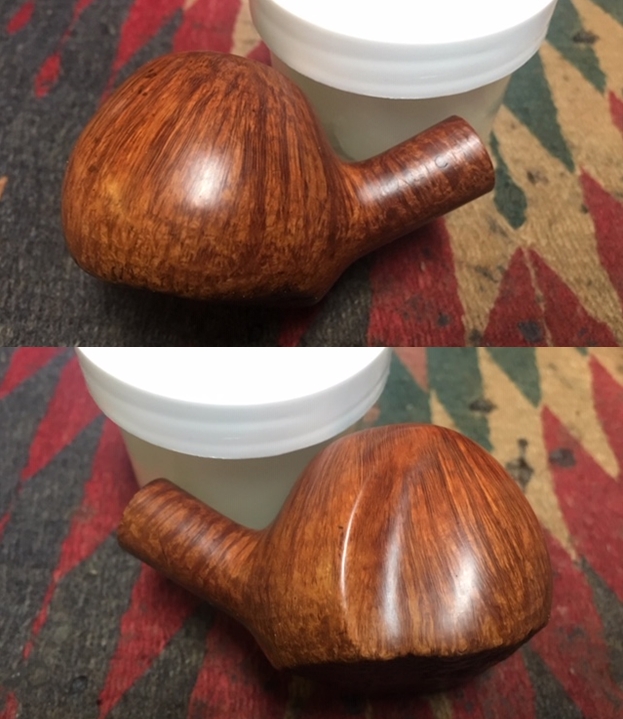
Restoring a Final Calich from Ken Bennett’s Estate – Grade 12 Freehand


Blog by Steve Laug

Early in August I received an email from an interesting woman on Vancouver Island regarding some pipes that she had for sale. She was looking to sell the pipes from her late husband Ken and one from her Great Grandfather. Here is her email:

I have 5 John Calich pipes that date from 1979 to 1981. One is graded 11 and the other four are graded 12. I had bought them as Christmas and birthday gifts for my late husband. He was a very light smoker for a 3 year period.

I am a wood sculptor and always admired the grain and shapes of John’s best pipes. John was a friend as well. We exhibited at many exhibitions together for over 25 years.

I am wondering if you can provide any information on how I might be able to sell them.

Thanks you for any help you might be able to provide

I wrote her back and told I was very interested in the pipes that she had for sale and asked her to send me some photos of the lot. She quickly did just that and we struck a deal. I paid her through an e-transfer and the pipes were on their way to me. They arrived quite quickly and when they did I opened the box and found she had added three more pipes – a Brigham, a Dr. Plumb and a WDC Milano. There was also a wooden cigar box in the package that housed the Calich pipes. They are all lovely looking freehand style shapes – even the two apple shaped pipes had a freehand twist to them. The package also had the BBB Gourd Calabash that I have written about earlier (https://rebornpipes.com/2019/08/27/breathing-new-life-into-a-bbb-gourd-calabash-with-an-amber-stem/). Pat sent me photos of each of the pipes before the deal was struck so I could see the pipes before I made a decision. I kept the photos that she sent me. I have included the two photos of this pipe that she sent me below.I wrote to Pat and asked her if she would be willing to write short remembrance of her late husband and her Great Grandfather. She wrote that she would be happy to write about them both. In her email she included a story about John Calich that I really enjoyed. I decided it was well worth including in this second blog about these Calich pipes.

My best John story is one you won’t likely be able to print.  We were set up beside each other in the late seventies at the Ottawa Tulip Festival in army tents. It was cold and wet. John always had a jar of good tobacco that he shared with past and prospective customers.  One morning a guy that looked like he was dirt poor started chatting with John. He pulled out his cheap pipe and stuffed it too full of the expensive tobacco and then asked John for a light. As he walked away John muttered under his breath to me “I’d like to give him a kick in his pants to get him puffing”

I had to laugh because in conversations I had with John we had some great laughs. He was a real character and this was truly a fitting reminder for me as I was preparing to work on the pipes.

I wrote to Pat again and told her I was thinking of restoring her husband, Ken’s pipes next. She is working on a piece for me but sent along a great story and a photo in case I “need some inspiration while you work”. I have also included that photo and the story below. It indeed was an inspiration and gave me an idea on what pipe to work on first. Here are Pat’s words:

I’d like you know that Ken was an incredibly talented and creative man with a smile and blue eyes that could light up a room. His laugh was pure magic. He could think outside the box and come up with an elegant solution to any problem…

Pat sent me this reflection on her husband Ken’s life. Thanks Pat for taking time to do this. I find that it gives another dimension to the pipes that I restore to know a bit about the previous pipeman. Pat and Ken were artists (Pat still is a Sculptural Weaver) and it was this that connected them to each other and to John Calich. Here are Pat’s words.

Here is the write up for Ken. We meet in University and it was love at first sight. I consider myself blessed to have shared a life together for 37 years.

Ken graduated from Ryerson University with Bachelor of Applied Arts in Design in 1975.

Ken lived his life with joy.  Each day was a leap of faith in the creative process. His smile would light up the room and the hearts of the people he loved.
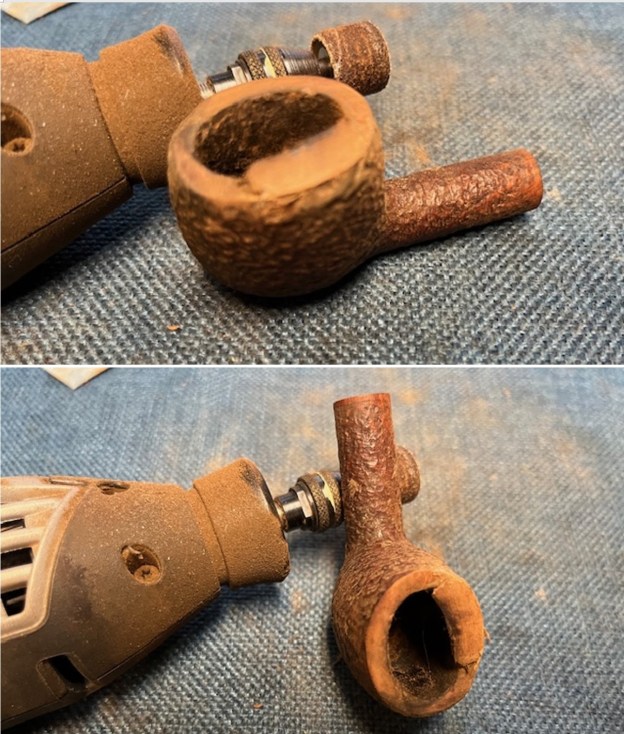
He combined the skilled hands of a master craftsman, with the problem solving mind of an engineer, and the heart and soul of an artist. He used his talents to create unique and innovative wood sculptures. Using precious hardwoods, he incorporated the techniques of multiple lamination and three dimensional contouring to create sculptural pieces that captivate the eye and entice the hand to explore.

His career was highlighted by numerous corporate commissions, awards and public recognition in Canada and abroad.

A quote from Frank Lloyd Wright sums up Ken’s approach to design.  “Form follows function – that has been misunderstood. Form and function should be joined as one in a spiritual union.” 

A friendship with John Calich developed over years of exhibiting their work at exhibitions. How could a wood sculptor resist some of John’s finest creations…

Pat had included the top of a box that Ken had kept from the pipes he had purchase from John. This fifth Calich pipe also had a very interesting Danish style shape. It is a freehand that I would call a Danish style Dublin Freehand with beautiful grain and a dull finish due to sitting unused in storage. There were some white paint flecks on the sides of the briar. The rim top and the shank end were both plateau. The smooth bowl seemed to have a natural finish almost like oil – I like the way John’s pipes take on a rich patina as they age. The bowl had a cake in it and there was a lava overflow onto the plateau rim top almost filling in the grooves of the plateau and darkening the natural finish. The rim top and edges of the bowl looked to be in excellent condition under the lava. The stamping on the left side of the shank was very faint but under a bright light read CALICH over Hand Made. After that stamping there was a superscript 80 stamped (year it was carved) with a subscript 12 which was the grade number. This was all confirmed by Pat as she had purchased the pipe for her husband Ken. The stem was lightly oxidized as was the single metal dot in the top of the saddle. There was oxidation and light tooth chatter on both sides of the stem on both sides near the button. The shank and stem were dirty inside. I took a photo of the bowl and rim top to show the cake in the bowl and the lava build up in the grooves of the plateau rim top and inner edge of the rim top. It is quite thick and darkens the natural finish of the rim top. The cake was thick and hard but hopefully it had protected the rim and edges from damage. Otherwise it looks pretty good. I also took photos of the stem to show the oxidation on both sides and the light tooth chatter on both sides near the button.    I took a photo of the left side of the shank to show the condition of the stamping. You can see the Calich stamp over Hand Made. Below that is the number 11 with the number 80 above that. The second photo shows the plateau finish on the rim top and shank end. The natural finish of the plateau on the shank end is what clued me to the fact that the rim top probably started that way as well. I decided to include a bit about John Calich the pipemaker as I have loved John Calich’s pipes for over 25 years now and have collected a few of them. I have restored quite a few of them and written blogs about them that can be read if you are interested in seeing the kind of pipes that John made. They are unique and beautiful. Each one of them is a work of art to me. I am including the links to the previous blogs that have written about his pipes.

https://rebornpipes.com/2015/03/03/one-of-my-john-calich-pipes-a-calich-ee-billiard/

https://rebornpipes.com/2019/01/23/i-am-the-happy-owner-of-an-unsmoked-pipe-by-the-late-john-calich/

https://rebornpipes.com/2015/03/03/one-of-my-john-calich-pipes-a-calich-ee-billiard/

https://rebornpipes.com/2014/03/21/reflecting-on-my-collection-of-john-calich-pipes/

Each of the blogs reflects on John’s pipes if you want to get a feel for them take a few minutes and read them.

When John was living I spoke with him several times via phone and had him make some new stems for some of his pipes that I picked up off eBay. He was a very kind gentleman and was always helpful when I spoke with him. He was always ready with encouragement and when I needed to know how to do something when I was first learning to repair pipes he was willing to help. He was one of the old guard of Canadian Pipe makers. I miss him. I am including a short piece from Pipedia on John to give details on his work and the grading of his pipes. The second paragraph below is highlighted in blue as it gives some information on the Grade 12 Apple that I am working on with the single silver dot now.

John Calich, courtesy Doug Valitchka

John Calich was one of Canada’s finest carvers. He died in July 2008. John was a full time pipe maker for the last 40 years. Calich pipes were mostly traditional shapes. His signature style is rustication and smooth on the same pipe along with his unique skill to stain a pipe in contrasting colors. He used only top quality Grecian and Calabrian briar. The mouthpieces are hand finished Vulcanite “A”. Each pipe was entirely made by hand. John Calich was featured in the summer 2005 issue of Pipes & Tobacco.

His pipes are graded 3E – 7E. Retail prices range from$ 145.00 to $ 500.00 Each pipe is stamped “CALICH” 3-8E, his earlier pipes were graded from 3-14, and a single, tiny silver dot is applied to the top of the stem (https://pipedia.org/wiki/Calich).

I summarize the dating information from those blogs now: From my research and conversations I learned that John’s his later pipes were graded 3E – 8E. The retail prices for them ranged from $145.00 to $500.00. Each pipe was stamped “CALICH” and given an E grade. His earlier pipes were graded from 3-14 and had a single, tiny silver dot applied to the top of the stem. More information can be found at the Pipedia article above. All of this information told me as expected that the pipe I had was an earlier one.

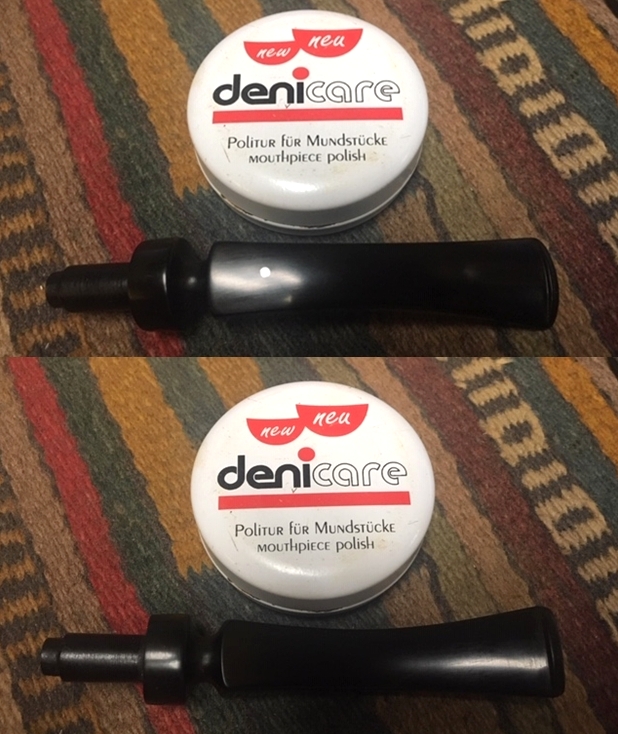
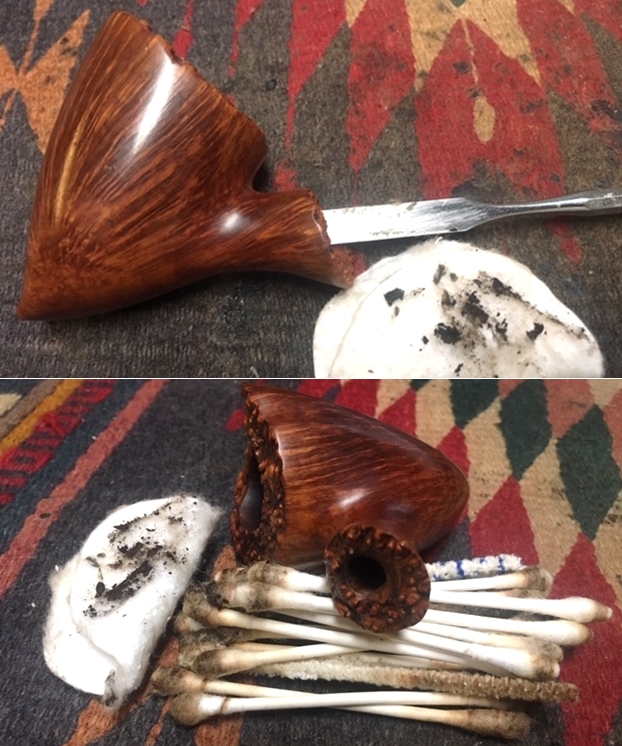
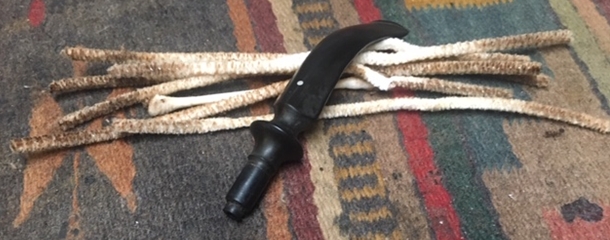
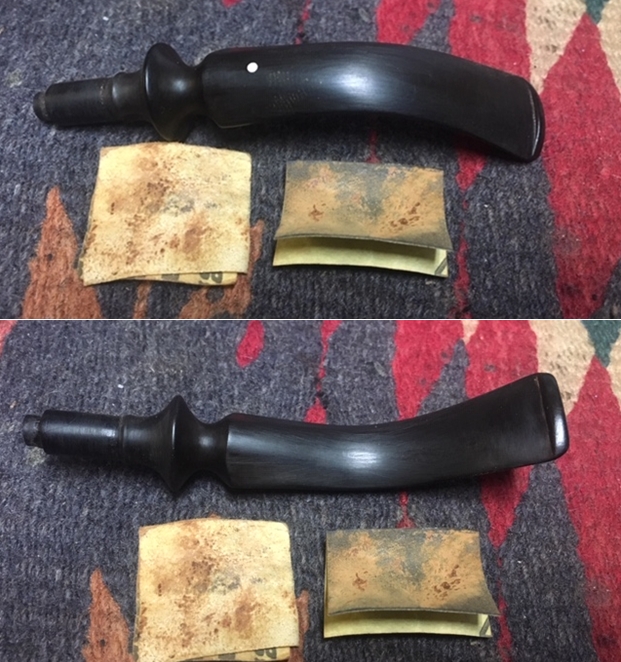
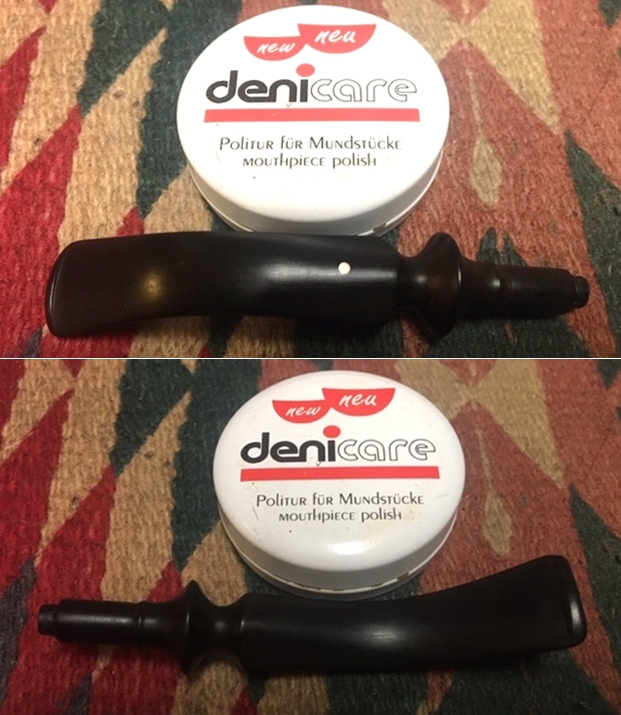
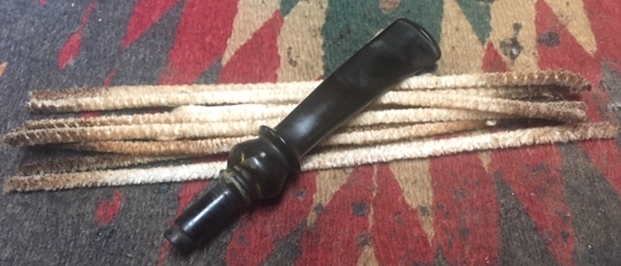
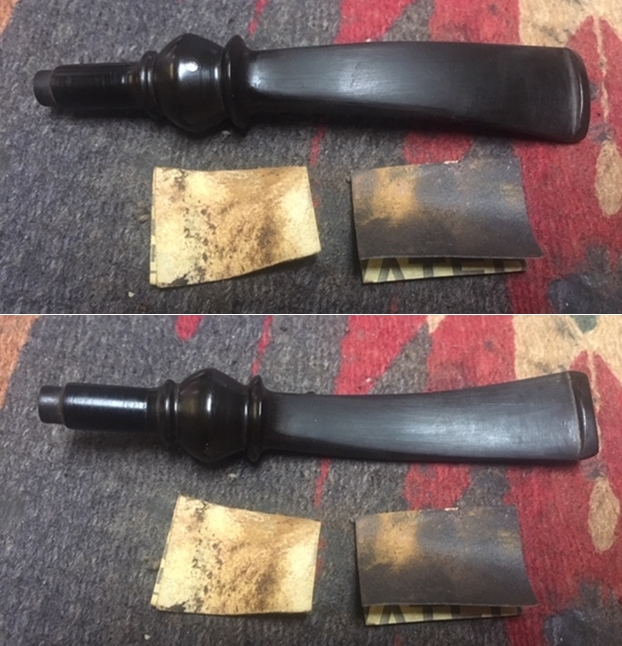
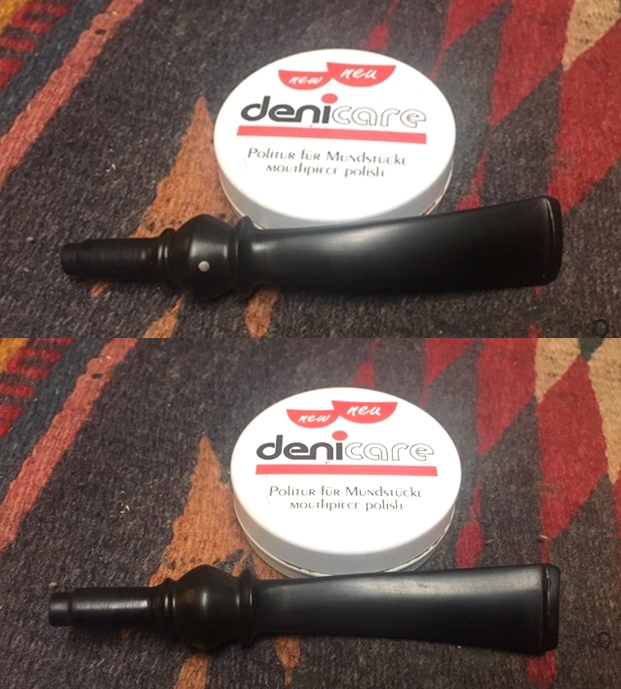
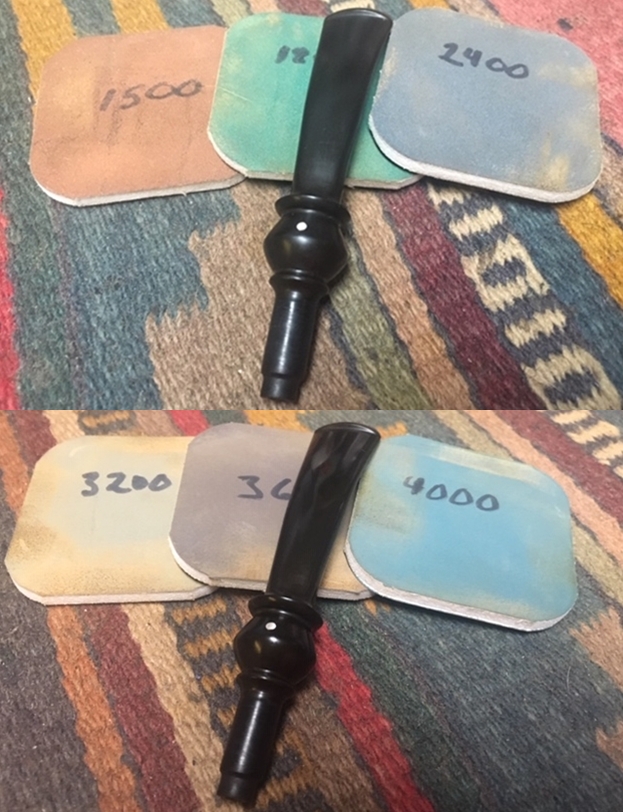
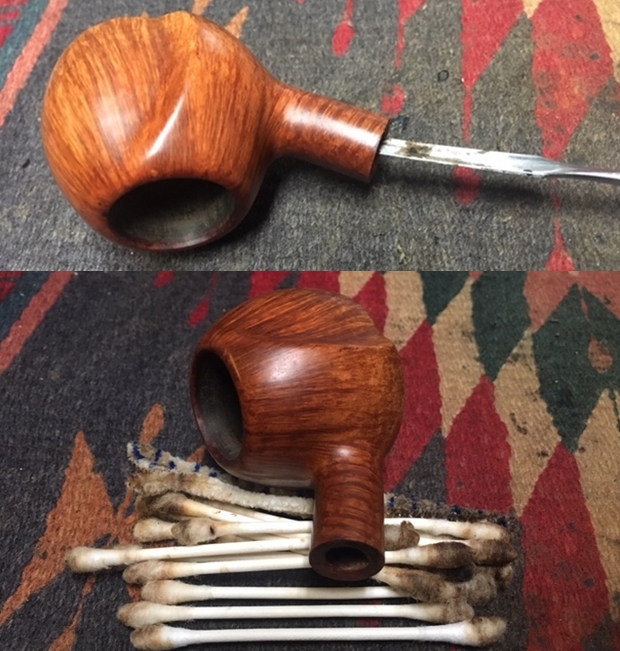
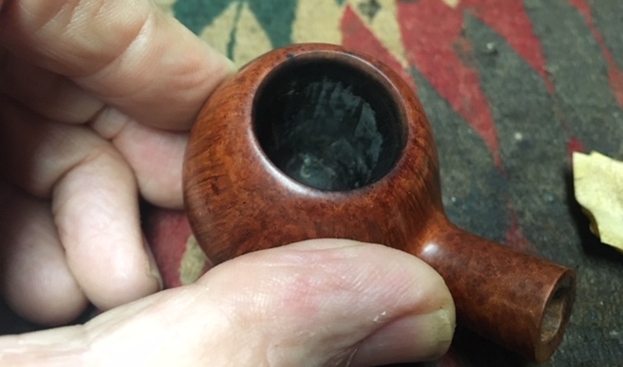
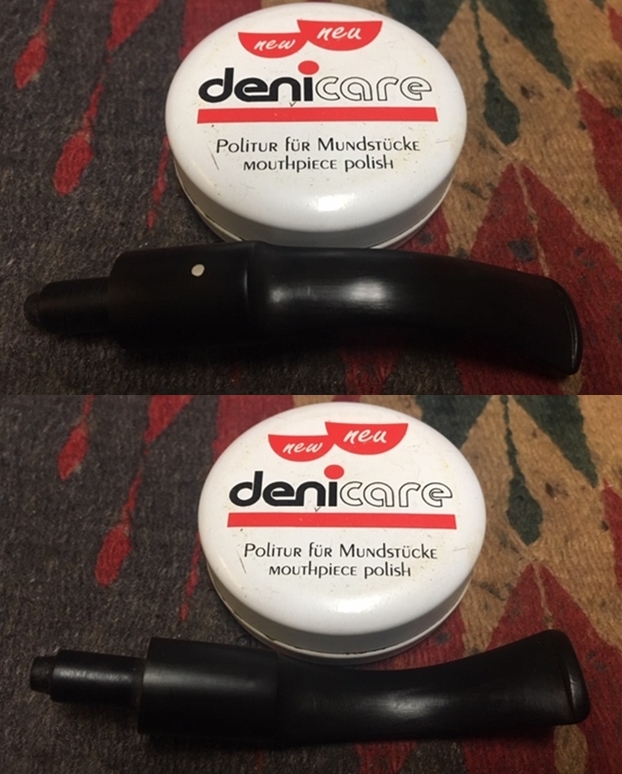
Armed with Pat’s stories of John and her husband Ken and the information about John’s grading system it was time to work on the pipe. I reamed the bowl with a PipNet Pipe reamer using the third cutting head. I took the cake back to bare briar so that I could check out the inside walls. I used a Savinelli Fitsall Pipe Knife to scrape back the remaining cake. I finished my cleanup of the walls by sanding it with 220 grit sandpaper wrapped around a piece of dowel.      I scrubbed the briar with Before & After Briar Cleaner and rinsed it off with warm running water. I scrubbed the rim top with a tooth brush and warm running water at the same time. I dried the bowl off with a soft microfiber cloth and gave it a light buffing. The photos show the cleaned briar and the grain is really beginning to pop. John once again really followed the grain on the shaping of this pipe.  I worked on the internals. I scraped the inside of the mortise with a dental spatula to remove the hardened tars and oils that lined the walls of the shank. Once I had that done I cleaned out the airway to the bowl, the mortise and the airway in the stem with pipe cleaners, cotton swabs and alcohol. When I finished the pipe smelled very clean. I polished the briar with micromesh sanding pads – wet sanding with 1500-12000 grit sanding pads. I wiped it down with a damp cloth after each pad. I rubbed the bowl down with Before & After Restoration Balm. I worked it into the surface of the briar with my fingertips to clean, enliven and protect it. I let the balm sit for a little while and then buffed with a cotton cloth to raise the shine. Mark Hoover’s Balm is a product that I have come to appreciate and one I use on every pipe I have been working on.   I set the bowl aside and turned my attention to the stem. I sanded the stem with 220 grit sandpaper to break up the oxidation. I started the polishing with 400 grit wet dry sandpaper to remove the scratching. It is starting to look good.   I have one more tin of Denicare Mouthpiece Polish left from a few that I have picked up over the years. It is a coarse red pasted that serves to help remove oxidation. I polished the stem with that to further smooth out the surface of the vulcanite (and to be honest – to use it up).    I polished the stem with micromesh sanding pads – wet sanding with 1500-12000 grit pads. I wiped the stem down after each sanding pad with Obsidian Oil. I polished it with Before & After Pipe Stem Polish – both Fine and Extra Fine. Once I had finished the polishing I gave it final coat of oil and set it aside to dry. This is the fifth and final Calich from Ken’s Estate that I am working on. It is another beautifully grained Danish style Freehand shaped Hand Made. It has the kind of beauty I have come to expect from John’s pipes with plateau on the rim top and shank end. I am excited to be on the homestretch with Ken’s estate. This is the part I look forward to when each pipe comes back together, polished and waxed. I put the bowl and stem back together. I polished the bowl and stem with Blue Diamond to polish out the scratches in the briar and the vulcanite. I gave the bowl and the stem multiple coats of carnauba wax. I buffed the pipe with a clean buffing pad to raise the shine. I hand buffed it with a microfiber cloth to deepen the shine. The pipe polished up pretty nicely. The straight and flame grain on the sides of the bowl and birdseye grain on the front and back side of the bowl. The grain is really quite stunning. The plateau on the rim top and shank end was also natural though had been darkened over time. The polished smooth finish look really good with the black vulcanite. This Calich Hand Made was another fun pipe to bring back to life because of the story that Pat shared with us. The connection between Ken and Pat and John Calich adds colour. The natural finish and the plateau rim top and shank end makes this Danish style pipe look attractive. It is another comfortable pipe to hold in the hand. The finished pipe is shown in the photos below. The dimensions of the pipe are Length: 5 ½ inches, Height: 2 ¼ inches, Outside diameter of the bowl: 1 ¾ inch, Chamber diameter: ¾ of an inch. Thanks for reading this blog and my reflections on the pipe while I worked on it. This is entire estate was interesting to bring back to life.   

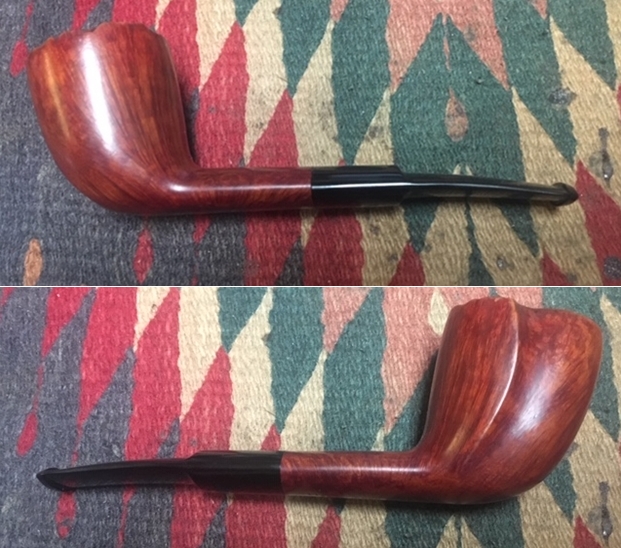
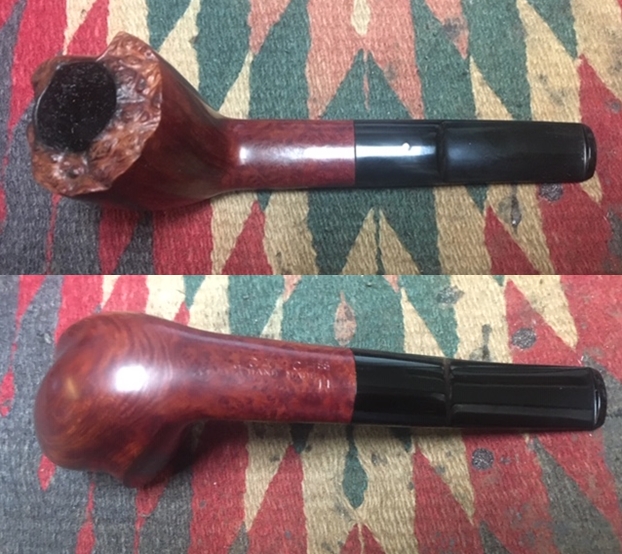
Restoring a Fourth Calich from Ken Bennett’s Estate – Grade 11 (80) Canted Egg


Blog by Steve Laug

Early in August I received an email from an interesting woman on Vancouver Island regarding some pipes that she had for sale. She was looking to sell the pipes from her late husband Ken and one from her Great Grandfather. Here is her email:

I have 5 John Calich pipes that date from 1979 to 1981. One is graded 11 and the other four are graded 12. I had bought them as Christmas and birthday gifts for my late husband. He was a very light smoker for a 3 year period.

I am a wood sculptor and always admired the grain and shapes of John’s best pipes. John was a friend as well. We exhibited at many exhibitions together for over 25 years.

I am wondering if you can provide any information on how I might be able to sell them.

Thanks you for any help you might be able to provide

I wrote her back and told I was very interested in the pipes that she had for sale and asked her to send me some photos of the lot. She quickly did just that and we struck a deal. I paid her through an e-transfer and the pipes were on their way to me. They arrived quite quickly and when they did I opened the box and found she had added three more pipes – a Brigham, a Dr. Plumb and a WDC Milano. There was also a wooden cigar box in the package that housed the Calich pipes. They are all lovely looking freehand style shapes – even the two apple shaped pipes had a freehand twist to them. The package also had the BBB Gourd Calabash that I have written about earlier (https://rebornpipes.com/2019/08/27/breathing-new-life-into-a-bbb-gourd-calabash-with-an-amber-stem/). Pat sent me photos of each of the pipes before the deal was struck so I could see the pipes before I made a decision. I kept the photos that she sent me. I have included the two photos of this pipe that she sent me below.    I wrote to Pat and asked her if she would be willing to write short remembrance of her late husband and her Great Grandfather. She wrote that she would be happy to write about them both. In her email she included a story about John Calich that I really enjoyed. I decided it was well worth including in this second blog about these Calich pipes.

My best John story is one you won’t likely be able to print.  We were set up beside each other in the late seventies at the Ottawa Tulip Festival in army tents. It was cold and wet. John always had a jar of good tobacco that he shared with past and prospective customers.  One morning a guy that looked like he was dirt poor started chatting with John. He pulled out his cheap pipe and stuffed it too full of the expensive tobacco and then asked John for a light. As he walked away John muttered under his breath to me “I’d like to give him a kick in his pants to get him puffing”

I had to laugh because in conversations I had with John we had some great laughs. He was a real character and this was truly a fitting reminder for me as I was preparing to work on the pipes.

I wrote to Pat again and told her I was thinking of restoring her husband, Ken’s pipes next. She is working on a piece for me but sent along a great story and a photo in case I “need some inspiration while you work”. I have also included that photo and the story below. It indeed was an inspiration and gave me an idea on what pipe to work on first. Here are Pat’s words:

I’d like you know that Ken was an incredibly talented and creative man with a smile and blue eyes that could light up a room. His laugh was pure magic. He could think outside the box and come up with an elegant solution to any problem…

Pat sent me this reflection on her husband Ken’s life. Thanks Pat for taking time to do this. I find that it gives another dimension to the pipes that I restore to know a bit about the previous pipeman. Pat and Ken were artists (Pat still is a Sculptural Weaver) and it was this that connected them to each other and to John Calich. Here are Pat’s words.

Here is the write up for Ken. We meet in University and it was love at first sight. I consider myself blessed to have shared a life together for 37 years.

Ken graduated from Ryerson University with Bachelor of Applied Arts in Design in 1975.

Ken lived his life with joy.  Each day was a leap of faith in the creative process. His smile would light up the room and the hearts of the people he loved.
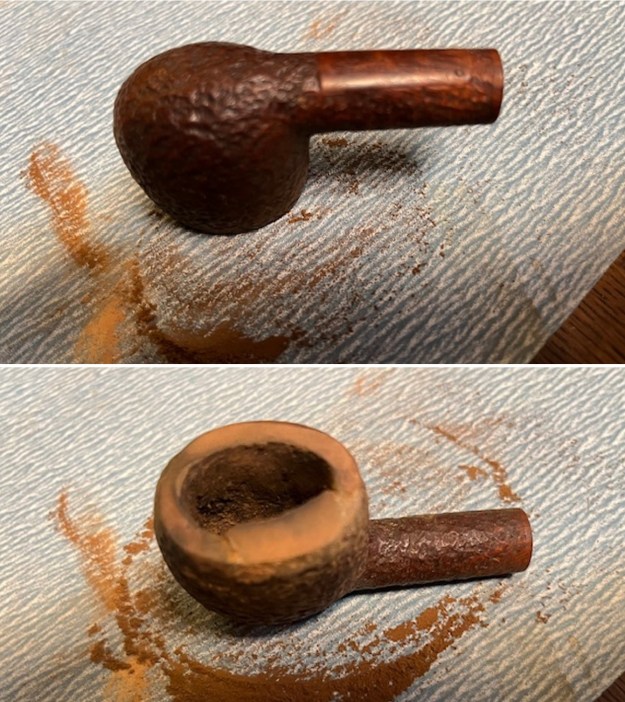
He combined the skilled hands of a master craftsman, with the problem solving mind of an engineer, and the heart and soul of an artist. He used his talents to create unique and innovative wood sculptures. Using precious hardwoods, he incorporated the techniques of multiple lamination and three dimensional contouring to create sculptural pieces that captivate the eye and entice the hand to explore.

His career was highlighted by numerous corporate commissions, awards and public recognition in Canada and abroad.

A quote from Frank Lloyd Wright sums up Ken’s approach to design.  “Form follows function – that has been misunderstood. Form and function should be joined as one in a spiritual union.” 

A friendship with John Calich developed over years of exhibiting their work at exhibitions. How could a wood sculptor resist some of John’s finest creations…

Pat had included the top of a box that Ken had kept from the pipes he had purchase from John. I used the box top as a back drop for the photos of the pipe. This fourth Calich pipe also had a very interesting shape. It is a freehand that I would call a stylized egg with beautiful grain and a dull finish due to sitting unused in storage. The left side and underside of the bowl were sculpted with a groove that ran down the back left and under the shank. There was also a groove sculpted on the front of the bowl. The rim top was smooth. The smooth bowl seemed to have a natural finish almost like oil – I like the way John’s pipes take on a rich patina as they age. The bowl had a cake in it and there was a lava overflow on the rim top on the back side and darkening the natural finish. The rim top and edges of the bowl were in excellent condition under the lava. The stamping on the left side of the shank read CALICH over Hand Made. After that stamping there was a superscript 80 stamped (year it was carved) with a subscript 11 which was the grade number. The stem was lightly oxidized as was the single metal dot in the top of the saddle. There was light tooth chatter on both sides of the stem on both sides near the button. The shank and stem were dirty inside.    I took a photo of the bowl and rim top to show the cake in the bowl and the lava build up on the surface and inner edge of the rim top. It is quite thick and darkens the natural finish of the rim top. The cake was thick and hard but hopefully it had protected the rim and edges from damage. Otherwise it looks pretty good. I also took photos of the stem to show the oxidation on both sides and the light tooth chatter on both sides near the button.      I took a photo of the left side of the shank to show the condition of the stamping. You can see the Calich stamp over Hand Made. Below that is the number 11 with the number 80 above that. The second photo shows the plateau finish on the rim top and shank end. The natural finish of the plateau on the shank end is what clued me to the fact that the rim top probably started that way as well.I decided to include a bit about John Calich the pipemaker as I have loved John Calich’s pipes for over 25 years now and have collected a few of them. I have restored quite a few of them and written blogs about them that can be read if you are interested in seeing the kind of pipes that John made. They are unique and beautiful. Each one of them is a work of art to me. I am including the links to the previous blogs that have written about his pipes.

https://rebornpipes.com/2015/03/03/one-of-my-john-calich-pipes-a-calich-ee-billiard/

https://rebornpipes.com/2019/01/23/i-am-the-happy-owner-of-an-unsmoked-pipe-by-the-late-john-calich/

https://rebornpipes.com/2015/03/03/one-of-my-john-calich-pipes-a-calich-ee-billiard/

https://rebornpipes.com/2014/03/21/reflecting-on-my-collection-of-john-calich-pipes/

Each of the blogs reflects on John’s pipes if you want to get a feel for them take a few minutes and read them.

When John was living I spoke with him several times via phone and had him make some new stems for some of his pipes that I picked up off eBay. He was a very kind gentleman and was always helpful when I spoke with him. He was always ready with encouragement and when I needed to know how to do something when I was first learning to repair pipes he was willing to help. He was one of the old guard of Canadian Pipe makers. I miss him. I am including a short piece from Pipedia on John to give details on his work and the grading of his pipes. The second paragraph below is highlighted in blue as it gives some information on the Grade 12 Apple that I am working on with the single silver dot now.
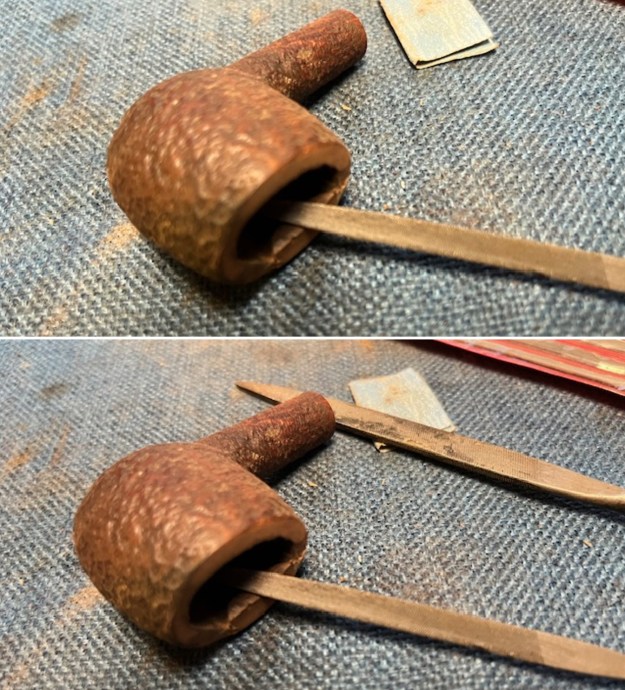
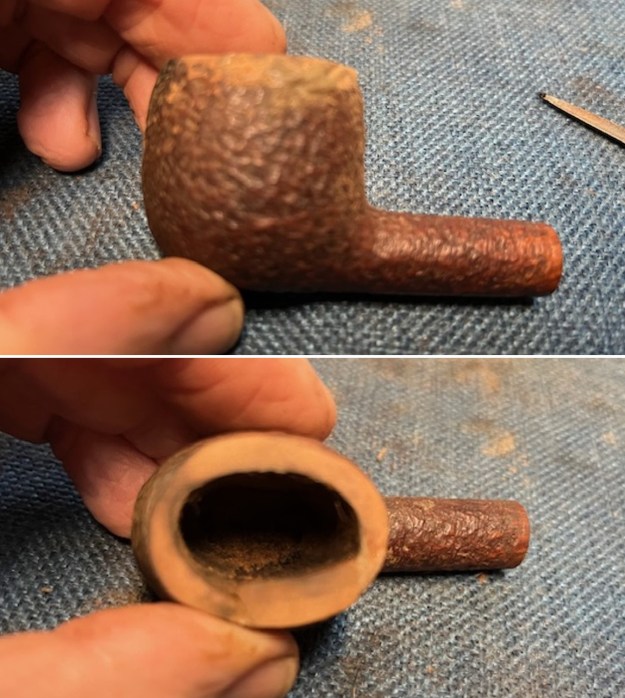
John Calich, courtesy Doug Valitchka

John Calich was one of Canada’s finest carvers. He died in July 2008. John was a full time pipe maker for the last 40 years. Calich pipes were mostly traditional shapes. His signature style is rustication and smooth on the same pipe along with his unique skill to stain a pipe in contrasting colors. He used only top quality Grecian and Calabrian briar. The mouthpieces are hand finished Vulcanite “A”. Each pipe was entirely made by hand. John Calich was featured in the summer 2005 issue of Pipes & Tobacco.

His pipes are graded 3E – 7E. Retail prices range from$ 145.00 to $ 500.00 Each pipe is stamped “CALICH” 3-8E, his earlier pipes were graded from 3-14, and a single, tiny silver dot is applied to the top of the stem (https://pipedia.org/wiki/Calich).

I summarize the dating information from those blogs now: From my research and conversations I learned that John’s his later pipes were graded 3E – 8E. The retail prices for them ranged from $145.00 to $500.00. Each pipe was stamped “CALICH” and given an E grade. His earlier pipes were graded from 3-14 and had a single, tiny silver dot applied to the top of the stem. More information can be found at the Pipedia article above. All of this information told me as expected that the pipe I had was an earlier one.

Armed with Pat’s stories of John and her husband Ken and the information about John’s grading system it was time to work on the pipe. I reamed the bowl with a PipNet Pipe reamer using the third cutting head. I took the cake back to bare briar so that I could check out the inside walls. I used a Savinelli Fitsall Pipe Knife to scrape back the remaining cake. I finished my cleanup of the walls by sanding it with 220 grit sandpaper wrapped around a piece of dowel.      I scrubbed the briar with Before & After Briar Cleaner and rinsed it off with warm running water. I scrubbed the rim top with a tooth brush and warm running water at the same time. I dried the bowl off with a soft microfiber cloth and gave it a light buffing. The photos show the cleaned briar and the grain is really beginning to pop. John really followed the grain on the shaping of this pipe. There was a deep gouge on the underside of the bowl, in the middle of the heel. It had sharp edges so it was not a gouge that could be raised with steam. I filled it in with a drop of clear super glue and let it cure. Once it had cured I sanded it smooth with 240 grit sandpaper and with 400 grit wet dry sandpaper. I polished it with 1500-2400 grit micromesh sanding pads. I polished the briar with micromesh sanding pads – wet sanding with 1500-12000 grit sanding pads. I wiped it down with a damp cloth after each pad. I rubbed the bowl down with Before & After Restoration Balm. I worked it into the surface of the briar with my fingertips to clean, enliven and protect it. I let the balm sit for a little while and then buffed with a cotton cloth to raise the shine. Mark Hoover’s Balm is a product that I have come to appreciate and one I use on every pipe I have been working on.    With the externals cleaned I worked on the internals. I scraped the inside of the mortise with a dental spatula to remove the hardened tars and oils that lined the walls of the shank. Once I had that done I cleaned out the airway to the bowl, the mortise and the airway in the stem with pipe cleaners, cotton swabs and alcohol. When I finished the pipe smelled very clean. I set the bowl aside and turned my attention to the stem. I sanded the stem with 220 grit sandpaper to break up the oxidation. I started the polishing with 400 grit wet dry sandpaper to remove the scratching. It is starting to look good.    I have one more tin of Denicare Mouthpiece Polish left from a few that I have picked up over the years. It is a coarse red pasted that serves to help remove oxidation. I polished the stem with that to further smooth out the surface of the vulcanite (and to be honest – to use it up).    I polished the stem with micromesh sanding pads – wet sanding with 1500-12000 grit pads. I wiped the stem down after each sanding pad with Obsidian Oil. I polished it with Before & After Pipe Stem Polish – both Fine and Extra Fine. Once I had finished the polishing I gave it final coat of oil and set it aside to dry.     This is the fourth Calich from Ken’s Estate that I am working on. It is another beautifully grained Egg shaped Hand Made freehand. It has the kind of beauty I have come to expect from John’s pipes with a sculpted groove on the front and down the left side of the bowl and under the shank. The rim top is smooth and angled forward. I am excited to be on the homestretch with another one of Ken’s pipes. This is the part I look forward to when it all comes back together, polished and waxed. I put the bowl and stem back together. I polished the bowl and stem with Blue Diamond to polish out the scratches in the briar and the vulcanite. I gave the bowl and the stem multiple coats of carnauba wax. I buffed the pipe with a clean buffing pad to raise the shine. I hand buffed it with a microfiber cloth to deepen the shine. The pipe polished up pretty nicely. The straight and flame grain on the sides of the bowl and birdseye grain on the front and back side of the bowl. The grain is really quite stunning. The smooth rim top also is covered with birdseye grain. The polished smooth finish look really good with the black vulcanite. This Calich Hand Made was another fun pipe to bring back to life because of the story that Pat shared with us. The connection between Ken and Pat and John Calich adds colour. The natural finish and the sculpted grooves on the front  and left side makes the pipe look attractive. It is another comfortable pipe to hold in the hand. The finished pipe is shown in the photos below. The dimensions of the pipe are Length: 6 inches, Height: 2 1/2 inches, Outside diameter of the bowl: 1 ½ inch, Chamber diameter: ¾ of an inch. Thanks for reading this blog and my reflections on the pipe while I worked on it. This is an interesting estate to bring back to life.   

Restoring a Third Calich from Ken Bennett’s Estate – Grade 12 (81) Pickaxe


Blog by Steve Laug

Early in August I received an email from an interesting woman on Vancouver Island regarding some pipes that she had for sale. She was looking to sell the pipes from her late husband Ken and one from her Great Grandfather. Here is her email:

I have 5 John Calich pipes that date from 1979 to 1981. One is graded 11 and the other four are graded 12. I had bought them as Christmas and birthday gifts for my late husband. He was a very light smoker for a 3 year period.

I am a wood sculptor and always admired the grain and shapes of John’s best pipes. John was a friend as well. We exhibited at many exhibitions together for over 25 years.

I am wondering if you can provide any information on how I might be able to sell them.

Thanks you for any help you might be able to provide

I wrote her back and told I was very interested in the pipes that she had for sale and asked her to send me some photos of the lot. She quickly did just that and we struck a deal. I paid her through an e-transfer and the pipes were on their way to me. They arrived quite quickly and when they did I opened the box and found she had added three more pipes – a Brigham, a Dr. Plumb and a WDC Milano. There was also a wooden cigar box in the package that housed the Calich pipes. They are all lovely looking freehand style shapes – even the two apple shaped pipes had a freehand twist to them. The package also had the BBB Gourd Calabash that I have written about earlier (https://rebornpipes.com/2019/08/27/breathing-new-life-into-a-bbb-gourd-calabash-with-an-amber-stem/).Pat sent me photos of each of the pipes before the deal was struck so I could see the pipes before I made a decision. I kept the photos that she sent me. I have included the two photos of this pipe that she sent me below.      I wrote to Pat and asked her if she would be willing to write short remembrance of her late husband and her Great Grandfather. She wrote that she would be happy to write about them both. In her email she included a story about John Calich that I really enjoyed. I decided it was well worth including in this second blog about these Calich pipes.

My best John story is one you won’t likely be able to print.  We were set up beside each other in the late seventies at the Ottawa Tulip Festival in army tents. It was cold and wet. John always had a jar of good tobacco that he shared with past and prospective customers.  One morning a guy that looked like he was dirt poor started chatting with John. He pulled out his cheap pipe and stuffed it too full of the expensive tobacco and then asked John for a light. As he walked away John muttered under his breath to me “I’d like to give him a kick in his pants to get him puffing”

I had to laugh because in conversations I had with John we had some great laughs. He was a real character and this was truly a fitting reminder for me as I was preparing to work on the pipes.

I wrote to Pat again and told her I was thinking of restoring her husband, Ken’s pipes next. She is working on a piece for me but sent along a great story and a photo in case I “need some inspiration while you work”. I have also included that photo and the story below. It indeed was an inspiration and gave me an idea on what pipe to work on first. Here are Pat’s words:

I’d like you know that Ken was an incredibly talented and creative man with a smile and blue eyes that could light up a room. His laugh was pure magic. He could think outside the box and come up with an elegant solution to any problem…

Pat sent me this reflection on her husband Ken’s life. Thanks Pat for taking time to do this. I find that it gives another dimension to the pipes that I restore to know a bit about the previous pipeman. Pat and Ken were artists (Pat still is a Sculptural Weaver) and it was this that connected them to each other and to John Calich. Here are Pat’s words.

Here is the write up for Ken. We meet in University and it was love at first sight. I consider myself blessed to have shared a life together for 37 years.

Ken graduated from Ryerson University with Bachelor of Applied Arts in Design in 1975.

Ken lived his life with joy.  Each day was a leap of faith in the creative process. His smile would light up the room and the hearts of the people he loved.
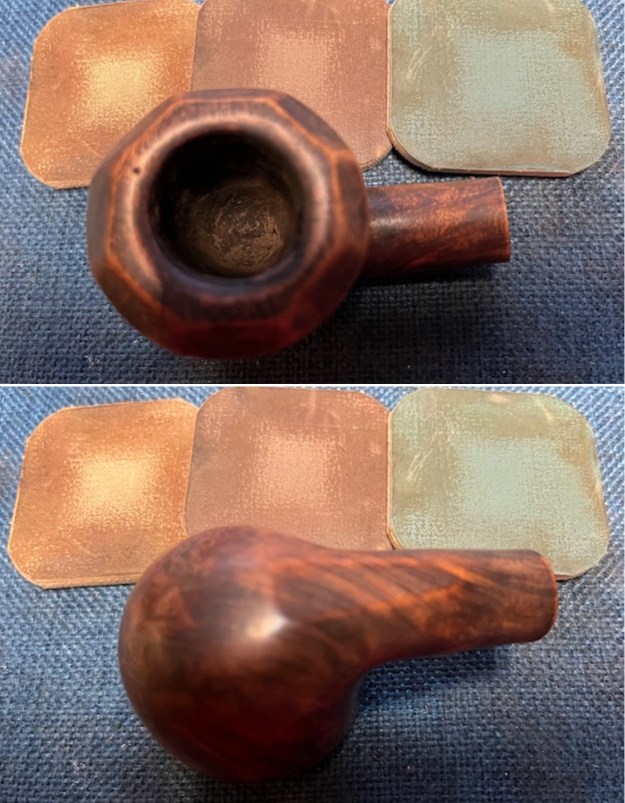
He combined the skilled hands of a master craftsman, with the problem solving mind of an engineer, and the heart and soul of an artist. He used his talents to create unique and innovative wood sculptures. Using precious hardwoods, he incorporated the techniques of multiple lamination and three dimensional contouring to create sculptural pieces that captivate the eye and entice the hand to explore.

His career was highlighted by numerous corporate commissions, awards and public recognition in Canada and abroad.

A quote from Frank Lloyd Wright sums up Ken’s approach to design.  “Form follows function – that has been misunderstood. Form and function should be joined as one in a spiritual union.” 

A friendship with John Calich developed over years of exhibiting their work at exhibitions. How could a wood sculptor resist some of John’s finest creations…

Pat had included the top of a box that Ken had kept from the pipes he had purchase from John. I used the box top as a back drop for the photos of the pipe. This third Calich pipe also had a very interesting shape. It is an a freehand that I would call a Pickaxe with beautiful grain and a dull finish due to sitting unused in storage. The front side of the bowl was sculpted with two grooves that ran from the top to the pointed heel. The rim top and shank end were plateau briar and were rugged. The smooth bowl seemed to have a natural finish almost like oil – I like the way John’s pipes take on a rich patina as they age. The bowl had a cake in it and there was a lava overflow on the plateau rim top filling in the grooves and darkening the natural finish. The rim top and edges of the bowl were in excellent condition. The stamping on the underside of the shank read CALICH over Hand Made. After that stamping there was a superscript 81 stamped (year it was carved) with a subscript 12 which was the grade number. The stem was lightly oxidized as was the single metal dot in the top of the saddle. There was light tooth chatter on both sides of the stem on both sides near the button. The shank and stem were dirty inside.   I took a photo of the bowl and rim top to show the cake in the bowl and the lava build up in the plateau surface of the rim top. It is quite thick and fills in the grooves and darkens the natural finish of the plateau top. The cake was thick and hard but hopefully it had protected the rim and edges from damage. Otherwise it looks pretty good. I also took photos of the stem to show the oxidation on both sides and the light tooth chatter on both sides near the button. I took a photo of the underside of the shank to show the condition of the stamping. You can see the Calich stamp over Hand Made. Below that is the number 12 with the number 81 above that. The second photo shows the plateau finish on the rim top and shank end. The natural finish of the plateau on the shank end is what clued me to the fact that the rim top probably started that way as well.      I decided to include a bit about John Calich the pipemaker as I have loved John Calich’s pipes for over 25 years now and have collected a few of them. I have restored quite a few of them and written blogs about them that can be read if you are interested in seeing the kind of pipes that John made. They are unique and beautiful. Each one of them is a work of art to me. I am including the links to the previous blogs that have written about his pipes.

https://rebornpipes.com/2015/03/03/one-of-my-john-calich-pipes-a-calich-ee-billiard/

https://rebornpipes.com/2019/01/23/i-am-the-happy-owner-of-an-unsmoked-pipe-by-the-late-john-calich/

https://rebornpipes.com/2015/03/03/one-of-my-john-calich-pipes-a-calich-ee-billiard/

https://rebornpipes.com/2014/03/21/reflecting-on-my-collection-of-john-calich-pipes/

Each of the blogs reflects on John’s pipes if you want to get a feel for them take a few minutes and read them.

When John was living I spoke with him several times via phone and had him make some new stems for some of his pipes that I picked up off eBay. He was a very kind gentleman and was always helpful when I spoke with him. He was always ready with encouragement and when I needed to know how to do something when I was first learning to repair pipes he was willing to help. He was one of the old guard of Canadian Pipe makers. I miss him. I am including a short piece from Pipedia on John to give details on his work and the grading of his pipes. The second paragraph below is highlighted in blue as it gives some information on the Grade 12 Apple that I am working on with the single silver dot now.

John Calich, courtesy Doug Valitchka

John Calich was one of Canada’s finest carvers. He died in July 2008. John was a full time pipe maker for the last 40 years. Calich pipes were mostly traditional shapes. His signature style is rustication and smooth on the same pipe along with his unique skill to stain a pipe in contrasting colors. He used only top quality Grecian and Calabrian briar. The mouthpieces are hand finished Vulcanite “A”. Each pipe was entirely made by hand. John Calich was featured in the summer 2005 issue of Pipes & Tobacco.

His pipes are graded 3E – 7E. Retail prices range from$ 145.00 to $ 500.00 Each pipe is stamped “CALICH” 3-8E, his earlier pipes were graded from 3-14, and a single, tiny silver dot is applied to the top of the stem (https://pipedia.org/wiki/Calich).

I summarize the dating information from those blogs now: From my research and conversations I learned that John’s his later pipes were graded 3E – 8E. The retail prices for them ranged from $145.00 to $500.00. Each pipe was stamped “CALICH” and given an E grade. His earlier pipes were graded from 3-14 and had a single, tiny silver dot applied to the top of the stem. More information can be found at the Pipedia article above. All of this information told me as expected that the pipe I had was an earlier one.

Armed with Pat’s stories of John and her husband Ken and the information about John’s grading system it was time to work on the pipe. I reamed the bowl with a PipNet Pipe reamer using the third cutting head. I took the cake back to bare briar so that I could check out the inside walls. I used a Savinelli Fitsall Pipe Knife to scrape back the remaining cake. I finished my cleanup of the walls by sanding it with 220 grit sandpaper wrapped around a piece of dowel.  I decided to address the heavy lava overflow on the rim top with a brass bristle wire brush to start with. I would follow that up with scrubbing it under running water with the brush afterward.  I scrubbed the briar with Before & After Briar Cleaner and rinsed it off with warm running water. I scrubbed the plateau rim top with the wire brush and warm running water at the same time. I dried the bowl off with a soft microfiber cloth and gave it a light buffing. The photos show the cleaned briar and the grain is really beginning to pop. John really followed the grain on the shaping of this pipe. I rubbed the bowl down with Before & After Restoration Balm. I worked it into the surface of the briar with my fingertips to clean, enliven and protect it. I let the balm sit for a little while and then buffed with a cotton cloth to raise the shine. Mark Hoover’s Balm is a product that I have come to appreciate and one I use on every pipe I have been working on.   With the externals cleaned I worked on the internals. I scraped the inside of the mortise with a dental spatula to remove the hardened tars and oils that lined the walls of the shank. Once I had that done I cleaned out the airway to the bowl, the mortise and the airway in the stem with pipe cleaners, cotton swabs and alcohol. When I finished the pipe smelled very clean.  I set the bowl aside and turned my attention to the stem. I sanded the stem with 220 grit sandpaper to break up the oxidation. I started the polishing with 400 grit wet dry sandpaper to remove the scratching. It is starting to look good.  I have one more tin of Denicare Mouthpiece Polish left from a few that I have picked up over the years. It is a coarse red pasted that serves to help remove oxidation. I polished the stem with that to further smooth out the surface of the vulcanite (and to be honest – to use it up). I polished the stem with micromesh sanding pads – wet sanding with 1500-12000 grit pads. I wiped the stem down after each sanding pad with Obsidian Oil. I polished it with Before & After Pipe Stem Polish – both Fine and Extra Fine. Once I had finished the polishing I gave it final coat of oil and set it aside to dry.   This is the third Calich from Ken’s Estate that I am working on. It is another beautifully grained Pickaxe shaped Hand Made freehand. It has the kind of beauty I have come to expect from John’s pipes with a sculpted groove on the front and the plateau on the rim top and shank end. I am excited to be on the homestretch with another one of Ken’s pipes. This is the part I look forward to when it all comes back together, polished and waxed. I put the bowl and stem back together. I polished the bowl and stem with Blue Diamond to polish out the scratches in the briar and the vulcanite. I gave the bowl and the stem multiple coats of carnauba wax. I buffed the pipe with a clean buffing pad to raise the shine. I hand buffed it with a microfiber cloth to deepen the shine. The pipe polished up pretty nicely. The straight and flame grain around the sides of the bowl and shank is quite stunning. There is plateau on the rim top and shank end. The polished smooth finish look really good with the black vulcanite. This Calich Hand Made was fun to bring back to life because of the story that Pat shared with us. The connection between Ken and Pat and John Calich adds colour. The natural finish and the twin sculpted grooves on the front makes the pipe look attractive. It is another comfortable pipe to hold in the hand. The finished pipe is shown in the photos below. The dimensions of the pipe are Length: 5 ½ inches, Height: 2 1/2 inches, Outside diameter of the bowl: 1 ¾ inch, Chamber diameter: ¾ of an inch. Thanks for reading this blog and my reflections on the pipe while I worked on it. This is an interesting estate to bring back to life.


Restoring a Second Beautiful Grade 12 Apple by John Calich from Ken Bennett’s Estate


Blog by Steve Laug

Early in August I received an email from an interesting woman on Vancouver Island regarding some pipes that she had for sale. She was looking to sell the pipes from her late husband Ken and one from her Great Grandfather. Here is her email:

I have 5 John Calich pipes that date from 1979 to 1981. One is graded 11 and the other four are graded 12. I had bought them as Christmas and birthday gifts for my late husband. He was a very light smoker for a 3 year period.

I am a wood sculptor and always admired the grain and shapes of John’s best pipes. John was a friend as well. We exhibited at many exhibitions together for over 25 years.

I am wondering if you can provide any information on how I might be able to sell them.

Thanks you for any help you might be able to provide

I wrote her back and told I was very interested in the pipes that she had for sale and asked her to send me some photos of the lot. She quickly did just that and we struck a deal. I paid her through an e-transfer and the pipes were on their way to me. They arrived quite quickly and when they did I opened the box and found she had added three more pipes – a Brigham, a Dr. Plumb and a WDC Milano. There was also a wooden cigar box in the package that housed the Calich pipes. They are all lovely looking freehand style shapes – even the two apple shaped pipes had a freehand twist to them. The package also had the BBB Gourd Calabash that I have written about earlier (https://rebornpipes.com/2019/08/27/breathing-new-life-into-a-bbb-gourd-calabash-with-an-amber-stem/). Pat sent me photos of each of the pipes before the deal was struck so I could see the pipes before I made a decision. I kept the photos that she sent me. I have included the two photos of this pipe that she sent me below.  I wrote to Pat and asked her if she would be willing to write short remembrance of her late husband and her Great Grandfather. She wrote that she would be happy to write about them both. In her email she included a story about John Calich that I really enjoyed. I decided it was well worth including in this second blog about these Calich pipes.

My best John story is one you won’t likely be able to print.  We were set up beside each other in the late seventies at the Ottawa Tulip Festival in army tents. It was cold and wet. John always had a jar of good tobacco that he shared with past and prospective customers.  One morning a guy that looked like he was dirt poor started chatting with John. He pulled out his cheap pipe and stuffed it too full of the expensive tobacco and then asked John for a light. As he walked away John muttered under his breath to me “I’d like to give him a kick in his pants to get him puffing”

I had to laugh because in conversations I had with John we had some great laughs. He was a real character and this was truly a fitting reminder for me as I was preparing to work on the pipes.

I wrote to Pat again and told her I was thinking of restoring her husband, Ken’s pipes next. She is working on a piece for me but sent along a great story and a photo in case I “need some inspiration while you work”. I have also included that photo and the story below. It indeed was an inspiration and gave me an idea on what pipe to work on first. Here are Pat’s words:

I’d like you know that Ken was an incredibly talented and creative man with a smile and blue eyes that could light up a room. His laugh was pure magic. He could think outside the box and come up with an elegant solution to any problem…

Pat sent me this reflection on her husband Ken’s life. Thanks Pat for taking time to do this. I find that it gives another dimension to the pipes that I restore to know a bit about the previous pipeman. Pat and Ken were artists (Pat still is a Sculptural Weaver) and it was this that connected them to each other and to John Calich. Here are Pat’s words.

Here is the write up for Ken. We meet in University and it was love at first sight. I consider myself blessed to have shared a life together for 37 years.

Ken graduated from Ryerson University with Bachelor of Applied Arts in Design in 1975.

Ken lived his life with joy.  Each day was a leap of faith in the creative process. His smile would light up the room and the hearts of the people he loved.
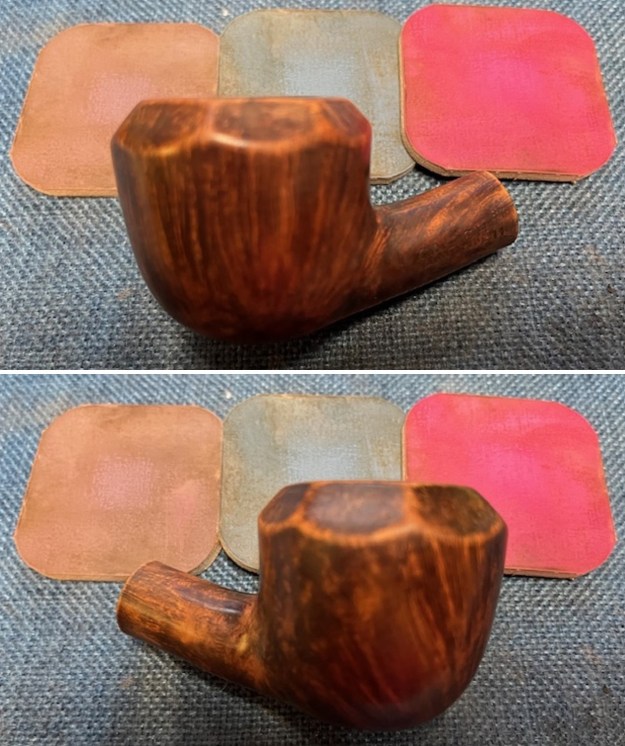
He combined the skilled hands of a master craftsman, with the problem solving mind of an engineer, and the heart and soul of an artist. He used his talents to create unique and innovative wood sculptures. Using precious hardwoods, he incorporated the techniques of multiple lamination and three dimensional contouring to create sculptural pieces that captivate the eye and entice the hand to explore.

His career was highlighted by numerous corporate commissions, awards and public recognition in Canada and abroad.

A quote from Frank Lloyd Wright sums up Ken’s approach to design.  “Form follows function – that has been misunderstood. Form and function should be joined as one in a spiritual union.” 

A friendship with John Calich developed over years of exhibiting their work at exhibitions. How could a wood sculptor resist some of John’s finest creations…

Pat had included the top of a box that Ken had kept from the pipes he had purchase from John. I used the box top as a back drop for the photos of the pipe. This second Calich pipe also had a very interesting shape. It is an apple with beautiful grain and a dull finish due to sitting unused in storage. The right side of the bowl was sculpted and rusticated. It was stained a darker shade of brown and black that made the rustication look almost like a sandblast. The smooth portions of the bowl had been stained with a medium brown stain – I like the way John’s pipes take on a rich patina as they age. The bowl had a cake in it and there was slight lava overflow on the rim top. There were some small nicks in the rim top and inner edge of the bowl on the front side. The stamping on the left side of the shank read CALICH over Hand Made. Below the stamping was the number 12 which was the grade number. The stem was lightly oxidized as was the single metal dot in the top of the saddle. There was light tooth chatter on both sides of the stem on both sides near the button. The shank and stem were dirty inside. I took a photo of the bowl and rim top to show the cake in the bowl and the lava build up on the edges of the bowl. It was thick and hard but hopefully it had protected the rim and edges from damage. There appears to be a little damage on the front and back inner edge and rim top of the bowl. There was some darkening on the back edge and top of the rim top. Otherwise it looks pretty good. I also took photos of the stem to show the oxidation on both sides and the light tooth chatter on both sides near the button.     I took a photo of the left side of the shank to show the condition of the stamping. You can see the faint Calich stamp over Hand Made. Below that is the number 12. The first photo shows the Calich stamp and a little bit of the Hand Made stamp. The second photo shows the Hand Made stamp and the Grade 12 number below that.    I decided to include a bit about John Calich the pipemaker as I have loved John Calich’s pipes for over 25 years now and have collected a few of them. I have restored quite a few of them and written blogs about them that can be read if you are interested in seeing the kind of pipes that John made. They are unique and beautiful. Each one of them is a work of art to me. I am including the links to the previous blogs that have written about his pipes.

https://rebornpipes.com/2015/03/03/one-of-my-john-calich-pipes-a-calich-ee-billiard/

https://rebornpipes.com/2019/01/23/i-am-the-happy-owner-of-an-unsmoked-pipe-by-the-late-john-calich/

https://rebornpipes.com/2015/03/03/one-of-my-john-calich-pipes-a-calich-ee-billiard/

https://rebornpipes.com/2014/03/21/reflecting-on-my-collection-of-john-calich-pipes/

Each of the blogs reflects on John’s pipes if you want to get a feel for them take a few minutes and read them.

When John was living I spoke with him several times via phone and had him make some new stems for some of his pipes that I picked up off eBay. He was a very kind gentleman and was always helpful when I spoke with him. He was always ready with encouragement and when I needed to know how to do something when I was first learning to repair pipes he was willing to help. He was one of the old guard of Canadian Pipe makers. I miss him. I am including a short piece from Pipedia on John to give details on his work and the grading of his pipes. The second paragraph below is highlighted in blue as it gives some information on the Grade 12 Apple that I am working on with the single silver dot now.
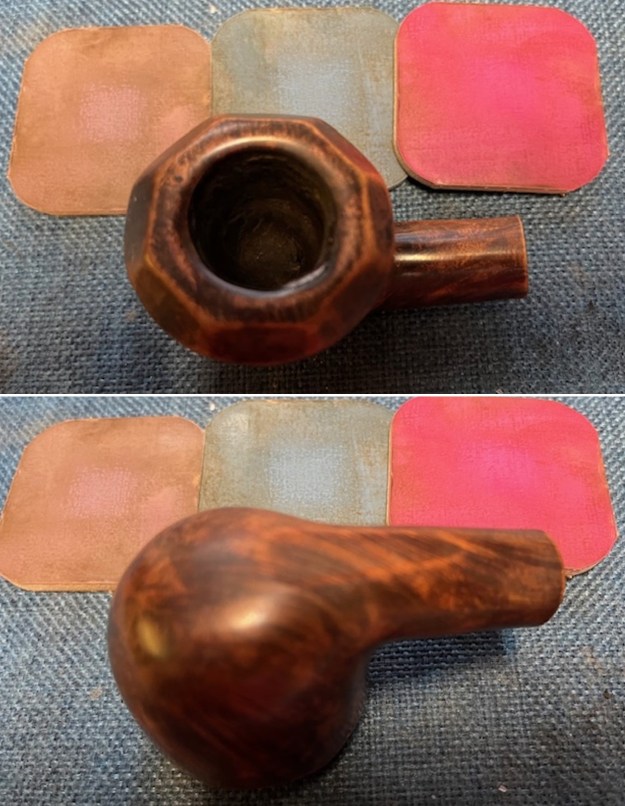
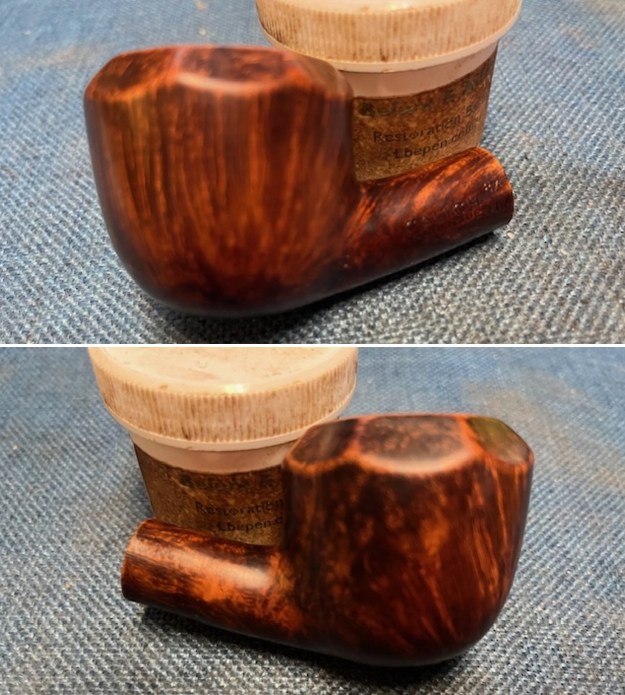
John Calich, courtesy Doug Valitchka

John Calich was one of Canada’s finest carvers. He died in July 2008. John was a full time pipe maker for the last 40 years. Calich pipes were mostly traditional shapes. His signature style is rustication and smooth on the same pipe along with his unique skill to stain a pipe in contrasting colors. He used only top quality Grecian and Calabrian briar. The mouthpieces are hand finished Vulcanite “A”. Each pipe was entirely made by hand. John Calich was featured in the summer 2005 issue of Pipes & Tobacco.

His pipes are graded 3E – 7E. Retail prices range from$ 145.00 to $ 500.00 Each pipe is stamped “CALICH” 3-8E, his earlier pipes were graded from 3-14, and a single, tiny silver dot is applied to the top of the stem (https://pipedia.org/wiki/Calich).

I summarize the dating information from those blogs now: From my research and conversations I learned that John’s his later pipes were graded 3E – 8E. The retail prices for them ranged from $145.00 to $500.00. Each pipe was stamped “CALICH” and given an E grade. His earlier pipes were graded from 3-14 and had a single, tiny silver dot applied to the top of the stem. More information can be found at the Pipedia article above. All of this information told me as expected that the pipe I had was an earlier one.

Armed with Pat’s stories of John and her husband Ken and the information about John’s grading system it was time to work on the pipe. I reamed the bowl with a PipNet Pipe reamer using the third cutting head. I took the cake back to bare briar so that I could check out the inside walls. I used a Savinelli Fitsall Pipe Knife to scrape back the remaining cake. I finished my cleanup of the walls by sanding it with 220 grit sandpaper wrapped around a piece of dowel.      There was some darkening and damage on the inner edge of the rim that needed to be addressed. I sanded it with a folded piece of 220 grit sandpaper to remove and minimize the damage to the edge. I polished it with 400 grit wet dry sandpaper. I wiped the rim edge down with a damp cloth to remove the sanding dust on the briar. The finished rim top looked much better than when I started. I took a photo of the sanded rim top and also the inside of the bowl. The rim looks very good.     I polished the bowl with micromesh sanding pads – wet sanding with 1500-12000 grit sanding pads. I wiped the bowl down after each sanding pad with a damp cloth.  I scrubbed the briar with Before & After Briar Cleaner and rinsed it off with warm running water. I dried the bowl off with a soft microfiber cloth and gave it a light buffing. The photos show the cleaned briar and the grain is really beginning to pop. John really followed the grain on the shaping of this pipe. I rubbed the bowl down with Before & After Restoration Balm. I worked it into the surface of the briar with my fingertips to clean, enliven and protect it. I let the balm sit for a little while and then buffed with a cotton cloth to raise the shine. Mark Hoover’s Balm is a product that I have come to appreciate and one I use on every pipe I have been working on.  With the externals cleaned I worked on the internals. I scraped the inside of the mortise with a dental spatula to remove the hardened tars and oils that lined the walls of the shank. Once I had that done I cleaned out the airway to the bowl, the mortise and the airway in the stem with pipe cleaners, cotton swabs and alcohol. When I finished the pipe smelled very clean. I set the bowl aside and turned my attention to the stem. I sanded the stem with 220 grit sandpaper to break up the oxidation. I started the polishing with 400 grit wet dry sandpaper to remove the scratching. It is starting to look good. I have one more tin of Denicare Mouthpiece Polish left from a few that I have picked up over the years. It is a coarse red pasted that serves to help remove oxidation. I polished the stem with that to further smooth out the surface of the vulcanite (and to be honest – to use it up).   I polished the stem with micromesh sanding pads – wet sanding with 1500-12000 grit pads. I wiped the stem down after each sanding pad with Obsidian Oil. I polished it with Before & After Pipe Stem Polish – both Fine and Extra Fine. Once I had finished the polishing I gave it final coat of oil and set it aside to dry. This is the second Calich from Ken’s Estate that I am working on. It is another beautifully grained apple shaped Hand Made. It has the kind of beauty I have come to expect from John’s pipes with a sculpted groove and rusticated patch on the right side of the bowl. I am excited to be on the homestretch with another one of Ken’s pipes. This is the part I look forward to when it all comes back together, polished and waxed. I put the bowl and stem back together. I polished the bowl and stem with Blue Diamond to polish out the scratches in the briar and the vulcanite. I gave the bowl and the stem multiple coats of carnauba wax. I buffed the pipe with a clean buffing pad to raise the shine. I hand buffed it with a microfiber cloth to deepen the shine. The pipe polished up pretty nicely. The straight and flame grain around the sides of the bowl and shank is quite stunning. There is birdseye on the top and underside of the bowl and shank. The polished smooth finish look really good with the black vulcanite. This Calich Hand Made was fun to bring back to life because of the story that Pat shared with us. The connection between Ken and Pat and John Calich adds colour. The darker finish and the rusticated sculpted side really makes the pipe look attractive. It is another comfortable pipe to hold in the hand. The finished pipe is shown in the photos below. The dimensions of the pipe are Length: 5 ½ inches, Height: 1 ¾ inches, Outside diameter of the bowl: 1 ¼ inch, Chamber diameter: ¾ of an inch. Thanks for reading this blog and my reflections on the pipe while I worked on it. This is an interesting estate to bring back to life. 

Restoring a Beautiful Grade 12 Apple by John Calich that has a Great Story


Blog by Steve Laug

Early in August I received an email from an interesting woman on Vancouver Island regarding some pipes that she had for sale. She was looking to sell the pipes from her late husband Ken and one from her Great Grandfather. Here is her email:

I have 5 John Calich pipes that date from 1979 to 1981. One is graded 11 and the other four are graded 12. I had bought them as Christmas and birthday gifts for my late husband. He was a very light smoker for a 3 year period.

I am a wood sculptor and always admired the grain and shapes of John’s best pipes. John was a friend as well. We exhibited at many exhibitions together for over 25 years.

I am wondering if you can provide any information on how I might be able to sell them.

Thanks you for any help you might be able to provide

I wrote her back and told I was very interested in the pipes that she had for sale and asked her to send me some photos of the lot. She quickly did just that and we struck a deal. I paid her through an e-transfer and the pipes were on their way to me. They arrived quite quickly and when they did I opened the box and found she had added three more pipes – a Brigham, a Dr. Plumb and a WDC Milano. There was also a wooden cigar box in the package that housed the Calich pipes. They are all lovely looking freehand style shapes – even the two apple shaped pipes had a freehand twist to them. The package also had the BBB Gourd Calabash that I have written about earlier (https://rebornpipes.com/2019/08/27/breathing-new-life-into-a-bbb-gourd-calabash-with-an-amber-stem/).I wrote to Pat and asked her if she would be willing to write short remembrance of her late husband and her Great Grandfather. She wrote that she would be happy to write about them both. In her email she included a story about John Calich that I really enjoyed. I decided it was well worth including in this first blog about these Calich pipes.

My best John story is one you won’t likely be able to print.  We were set up beside each other in the late seventies at the Ottawa Tulip Festival in army tents. It was cold and wet. John always had a jar of good tobacco that he shared with past and prospective customers.  One morning a guy that looked like he was dirt poor started chatting with John. He pulled out his cheap pipe and stuffed it too full of the expensive tobacco and then asked John for a light. As he walked away John muttered under his breath to me “I’d like to give him a kick in his pants to get him puffing”

I had to laugh because in conversations I had with John we had some great laughs. He was a real character and this was truly a fitting reminder for me as I was preparing to work on the pipes.

I wrote to Pat again and told her I was thinking of restoring her husband, Ken’s pipes next. She is working on a piece for me but sent along a great story and a photo in case I “need some inspiration while you work”. I have also included that photo and the story below. It indeed was an inspiration and gave me an idea on what pipe to work on first. Here are Pat’s words:

I’d like you know that Ken was an incredibly talented and creative man with a smile and blue eyes that could light up a room. His laugh was pure magic. He could think outside the box and come up with an elegant solution to any problem.

I remember the day he had to “fess up” about burning a hole through the pocket in his new sports jacket that was bought for an upcoming gallery opening of our work…….of course the “real culprit” was that damn small John Calich pipe that he favoured above all others, because it felt so good in the palm of his hand and tucked neatly into a pocket.

Once again I had to laugh because I have also burned a hole in a pocket and more than few shirts from sparks from a lit pipe. I went through Ken’s pipes and found the pipe I think that she was referring to in the above story. I sent her a picture of the pipe and she confirmed that it was indeed the one she was talking about. Now I knew which one I was going to work on first. I brought the nice little bent apple pipe to my work table and took some photos before I started the clean up on the pipe.

Pat sent me this reflection on her husband Ken’s life. Thanks Pat for taking time to do this. I find that it gives another dimension to the pipes that I restore to know a bit about the previous pipeman. Pat and Ken were artists (Pat still is a Sculptural Weaver) and it was this that connected them to each other and to John Calich. Here are Pat’s words.

Here is the write up for Ken. We meet in University and it was love at first sight. I consider myself blessed to have shared a life together for 37 years.

Ken graduated from Ryerson University with Bachelor of Applied Arts in Design in 1975.

Ken lived his life with joy.  Each day was a leap of faith in the creative process. His smile would light up the room and the hearts of the people he loved.

He combined the skilled hands of a master craftsman, with the problem solving mind of an engineer, and the heart and soul of an artist. He used his talents to create unique and innovative wood sculptures. Using precious hardwoods, he incorporated the techniques of multiple lamination and three dimensional contouring to create sculptural pieces that captivate the eye and entice the hand to explore.

His career was highlighted by numerous corporate commissions,  awards and public recognition in Canada and abroad.

A quote from Frank Lloyd Wright sums up Ken’s approach to design.  “Form follows function – that has been misunderstood. Form and function should be joined as one in a spiritual union.” 

A friendship with John Calich developed over years of exhibiting their work at exhibitions. How could a wood sculptor resist some of John’s finest creations…

Pat had included the top of a box that Ken had kept from the pipes he had purchase from John. I used the box top as a back drop for the photos of the pipe. The pipe had a very interesting shape. It is an apple with beautiful grain and a dull finish due to sitting unused in storage. The bottom of the bowl was plateau that had been sanded down to knock off the high points. It appeared that the finish was oil cured and unstained – I like that about John’s pipes as with age and use they take on colour. The bowl had a cake in it and there was slight lava overflow on the rim top. There were some small nicks in the rim top and inner edge of the bowl on the right front side. The stamping on the left side of the shank read CALICH over Hand Made. Below the stamping was the number 12 which was the grade number. The stem was lightly oxidized as was the single metal dot in the top of the saddle. There was light tooth chatter on both sides of the stem on both sides near the button. The shank and stem were dirty inside.  I took a photo of the bowl and rim top to show the cake in the bowl and the lava build up on the edges of the bowl. It was thick and hard but hopefully it had protected the rim and edges from damage. There appears to be a little damage on the right front inner and rim top of the bowl. There was some darkening on the back edge and top of the rim top. Otherwise it looks pretty good. I also took photos of the stem to show the oxidation on both sides and the light tooth chatter on both sides near the button.   I took a photo of the left side of the shank to show the condition of the stamping. You can see the faint Calich stamp over Hand Made. Below that is the number 12.I decided to include a bit about John Calich the pipemaker as I have loved John Calich’s pipes for over 25 years now and have collected a few of them. I have restored quite a few of them and written blogs about them that can be read if you are interested in seeing the kind of pipes that John made. They are unique and beautiful. Each one of them is a work of art to me. I am including the links to the previous blogs that have written about his pipes.

https://rebornpipes.com/2015/03/03/one-of-my-john-calich-pipes-a-calich-ee-billiard/

https://rebornpipes.com/2019/01/23/i-am-the-happy-owner-of-an-unsmoked-pipe-by-the-late-john-calich/

https://rebornpipes.com/2015/03/03/one-of-my-john-calich-pipes-a-calich-ee-billiard/

https://rebornpipes.com/2014/03/21/reflecting-on-my-collection-of-john-calich-pipes/

Each of the blogs reflect on John’s pipes if you want to get a feel for them take a few minutes and read them.

When John was living I spoke with him several times via phone and had him make some new stems for some of his pipes that I picked up off eBay. He was a very kind gentleman and was always helpful when I spoke with him. He was always ready with encouragement and when I needed to know how to do something when I was first learning to repair pipes he was willing to help. He was one of the old guard of Canadian Pipe makers. I miss him. I am including a short piece from Pipedia on John to give details on his work and the grading of his pipes. The second paragraph below is highlighted in blue as it gives some information on the Grade 12 Apple that I am working on with the single silver dot now.

John Calich, courtesy Doug Valitchka

John Calich was one of Canada’s finest carvers. He died in July 2008. John was a full time pipe maker for the last 40 years. Calich pipes were mostly traditional shapes. His signature style is rustication and smooth on the same pipe along with his unique skill to stain a pipe in contrasting colors. He used only top quality Grecian and Calabrian briar. The mouthpieces are hand finished Vulcanite “A”. Each pipe was entirely made by hand. John Calich was featured in the summer 2005 issue of Pipes & Tobacco.

His pipes are graded 3E – 7E. Retail prices range from$ 145.00 to $ 500.00 Each pipe is stamped “CALICH” 3-8E, his earlier pipes were graded from 3-14, and a single, tiny silver dot is applied to the top of the stem (https://pipedia.org/wiki/Calich).

I summarize the dating information from those blogs now: From my research and conversations I learned that John’s his later pipes were graded 3E – 8E. The retail prices for them ranged from $145.00 to $500.00. Each pipe was stamped “CALICH” and given an E grade. His earlier pipes were graded from 3-14 and had a single, tiny silver dot applied to the top of the stem. More information can be found at the Pipedia article above. All of this information told me as expected that the pipe I had was an earlier one.

Armed with Pat’s story of the pipe and Ken’s coat and information about John’s grading system it was time to work on the pipe. I reamed the bowl with a PipNet Pipe reamer using the third cutting head. I took the cake back to bare briar so that I could check out the inside walls. I used a Savinelli Fitsall Pipe Knife to scrape back the remaining cake. I finished my cleanup of the walls by sanding it with 220 grit sandpaper wrapped around a piece of dowel.  There was some darkening and damage on the inner edge of the rim that needed to be addressed. I sanded it with a folded piece of 220 grit sandpaper to remove and minimize the damage to the edge. I continued by starting to polish it with 400 grit wet dry sandpaper. I wiped the rim edge down with a damp cloth to remove the sanding dust on the briar. The finished rim top looked much better than when I started. I was able to minimize the damage on the front inner edge of the rim. It is still damaged but it looks considerably better. I took a photo of the sanded rim top and also the inside of the bowl. The rim looks very good but there is also a large flaw/split in the right side of the bowl.     I decided to repair that flaw with some JB Weld (steel weld that dries hard and impervious and is heat resistant). I mixed the two parts on an old envelope with a tooth pick and press it into the flaw on the wall of the bowl. I used a dental spatula to spread out the mix across the surface around the flaw. Once it had cured I would need to sanded it smooth and minimize the footprint on the wall of the bowl. I scrubbed the briar with Before & After Briar Cleaner and rinsed it off with warm running water. I dried the bowl off with a soft microfiber cloth and gave it a light buffing. The photos show the cleaned briar and the grain is really beginning to pop. John really followed the grain on the shaping of this pipe.      I polished the bowl with micromesh sanding pads – wet sanding with 1500-12000 grit sanding pads. I wiped the bowl down after each sanding pad with a damp cloth.     I rubbed the bowl down with Before & After Restoration Balm. I worked it into the surface of the briar with my fingertips to clean, enliven and protect it. I let the balm sit for a little while and then buffed with a cotton cloth to raise the shine. Mark Hoover’s Balm is a product that I have come to appreciate and one I use on every pipe I have been working on.   With the externals cleaned I worked on the internals. I scraped the inside of the mortise with a dental spatula to remove the hardened tars and oils that lined the walls of the shank. Once I had that done I cleaned out the airway to the bowl, the mortise and the airway in the stem with pipe cleaners, cotton swabs and alcohol. When I finished the pipe smelled very clean.  I called it a night and set the repaired bowl aside to cure. I turned the lights out and went upstairs. In the morning I sanded the repaired bowl wall with 220 grit sandpaper to remove the excess repair. I wanted to leave only the repair in the crevice in the wall and not on the rest of the wall.I set the bowl aside and turned my attention to the stem. I sanded the stem with 220 grit sandpaper to break up the oxidation. I started the polishing with 400 grit wet dry sandpaper to remove the scratching. It is starting to look good.         I have one more tin of Denicare Mouthpiece Polish left from a few that I have picked up over the years. It is a coarse red pasted that serves to help remove oxidation. I polished the stem with that to further smooth out the surface of the vulcanite (and to be honest – to use it up).       I polished the stem with micromesh sanding pads – wet sanding with 1500-12000 grit pads. I wiped the stem down after each sanding pad with Obsidian Oil. I polished it with Before & After Pipe Stem Polish – both Fine and Extra Fine. Once I had finished the polishing I gave it final coat of oil and set it aside to dry. This is the first Calich from Ken’s Estate that I am working on. It is a beautifully grained apple shaped Hand Made. It has the kind of beauty I have come to expect from John’s pipes with the carved groove on the right side of the bowl and the plateau on the underside of the bowl. I am excited to be on the homestretch with this beauty from Ken’s pipes. This is the part I look forward to when it all comes back together, polished and waxed. I put the bowl and stem back together. I polished the bowl and stem with Blue Diamond to polish out the scratches in the briar and the vulcanite. I gave the bowl and the stem multiple coats of carnauba wax. I buffed the pipe with a clean buffing pad to raise the shine. I hand buffed it with a microfiber cloth to deepen the shine. The pipe polished up pretty nicely. There is straight and flame grain around the sides of the bowl is quite stunning. There is birdseye on the top and underside of the shank and on the rim top. The polished smooth finish look really good with the black vulcanite. This Calich Hand Made was fun to bring back to life because of the story that Pat shared with us. The connection between Ken and Pat and John Calich adds colour. The natural finish really makes the pipe look attractive. It is another comfortable pipe to hold in the hand. The finished pipe is shown in the photos below. The dimensions of the pipe are Length: 5 ½ inches, Height: 1 ½ inches, Outside diameter of the bowl: 1 inch, Chamber diameter: 7/8 of an inch. Thanks for reading this blog and my reflections on the pipe while I worked on it. This is an interesting estate to bring back to life.