Daily Archives: January 4, 2025

A New Home for a Brebbia Bent Pocket Pipe


by Kenneth Lieblich

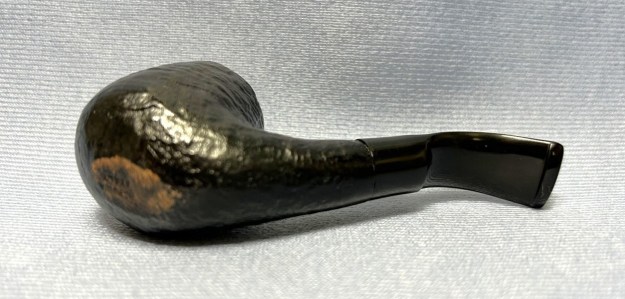
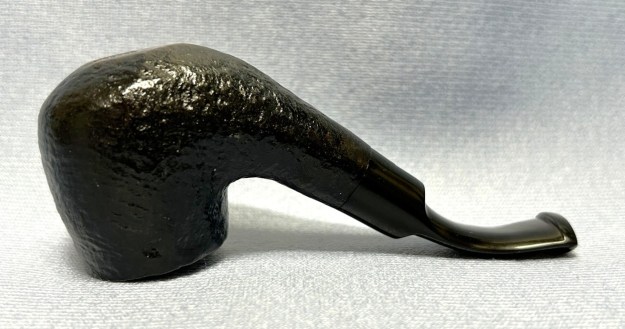
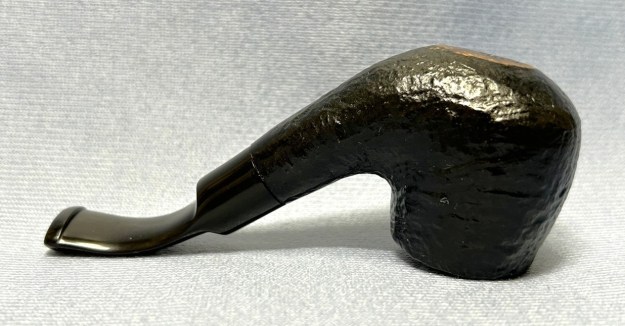
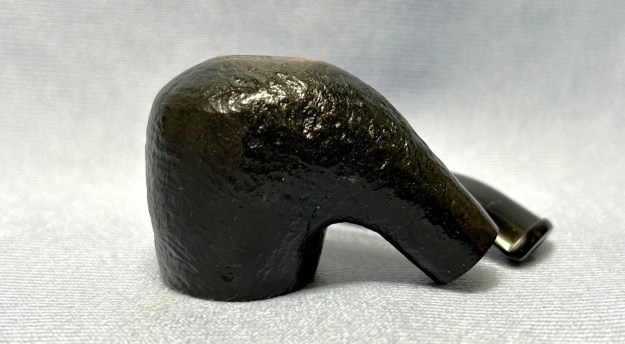
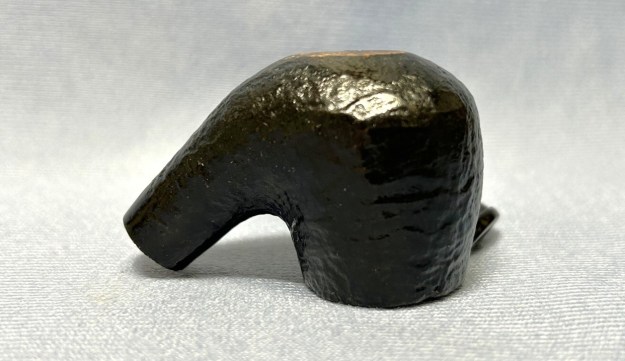
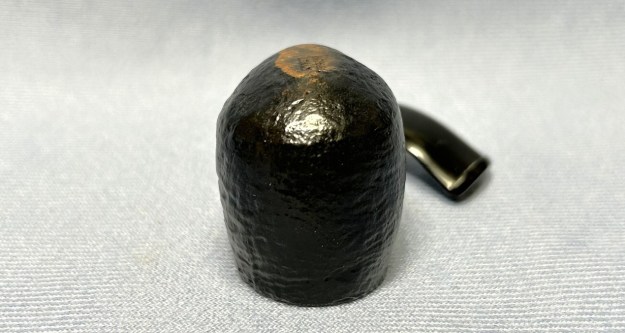
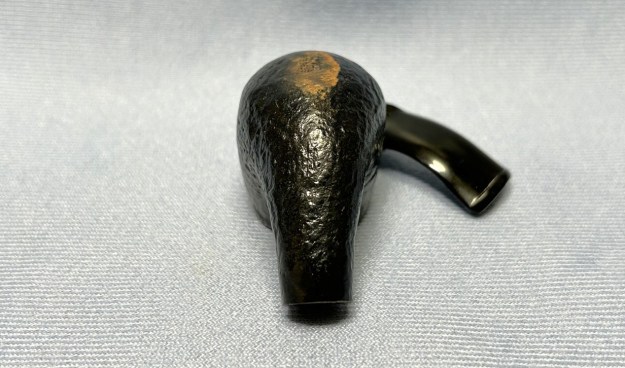
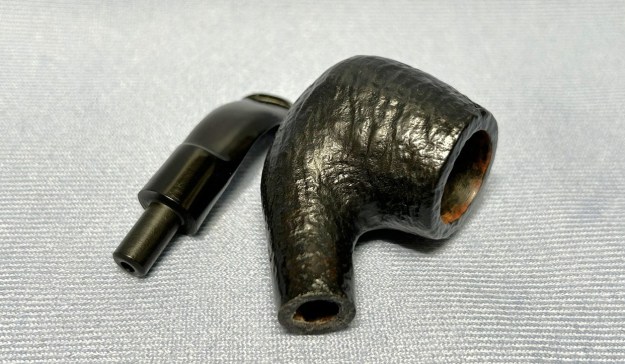
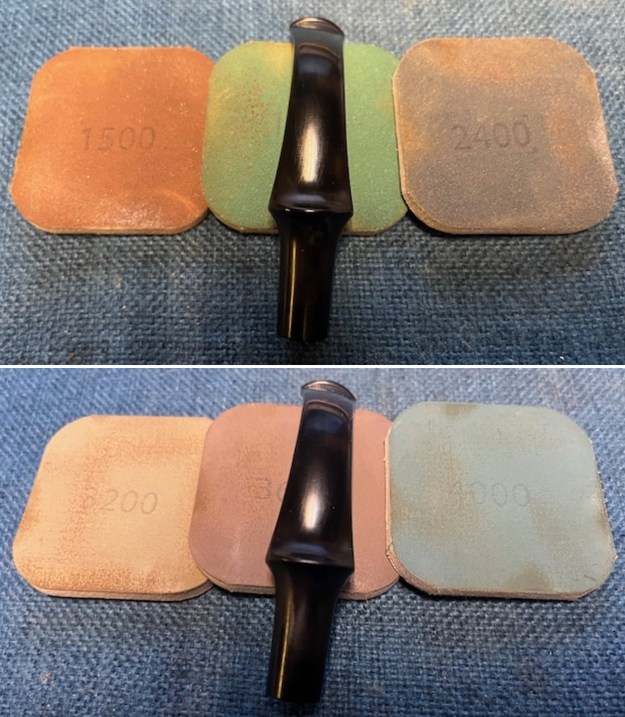
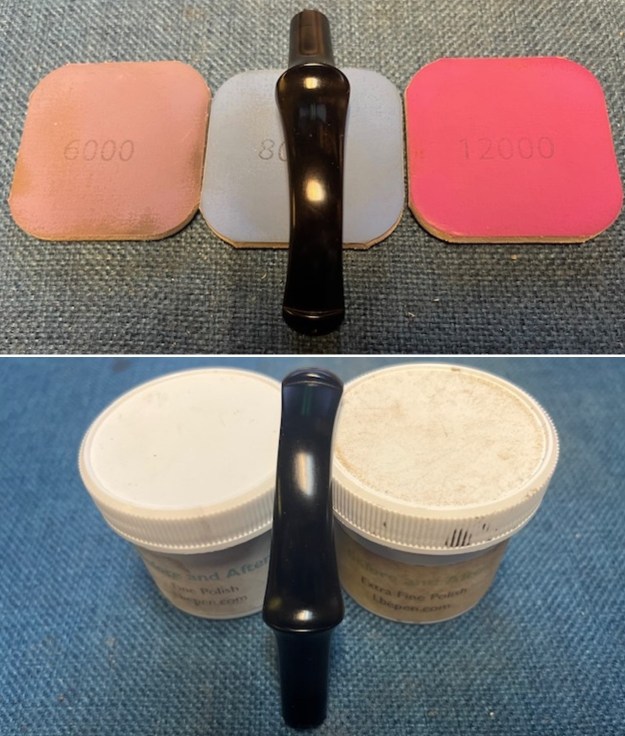
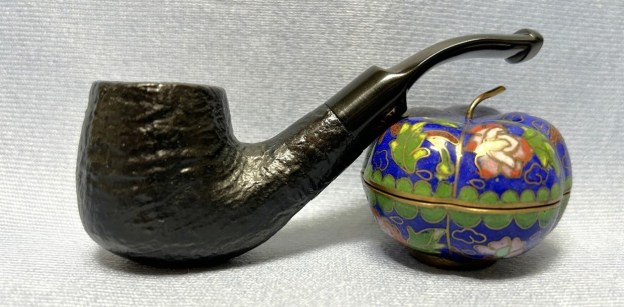
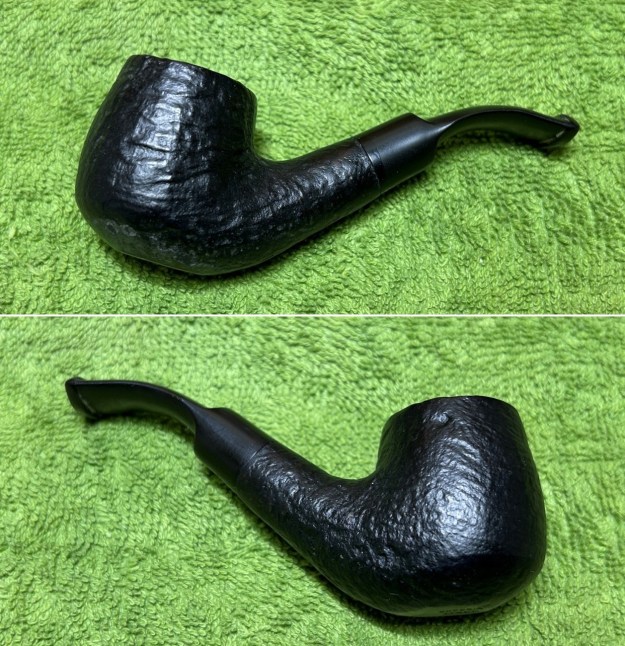
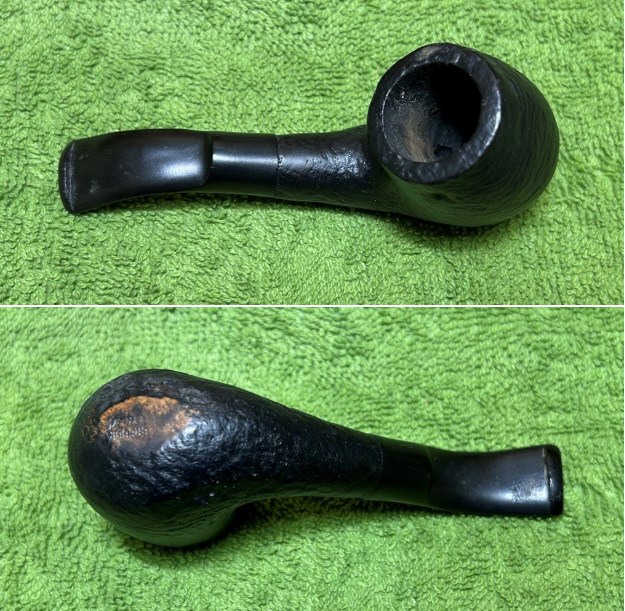
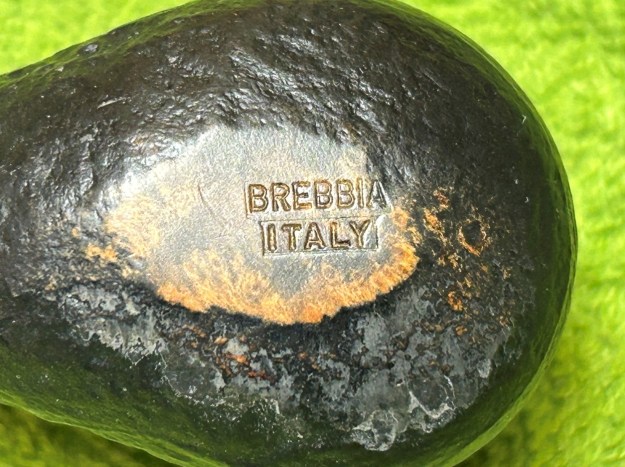
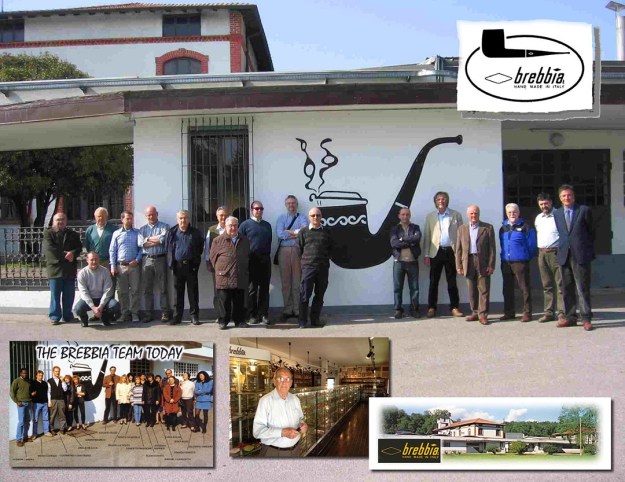
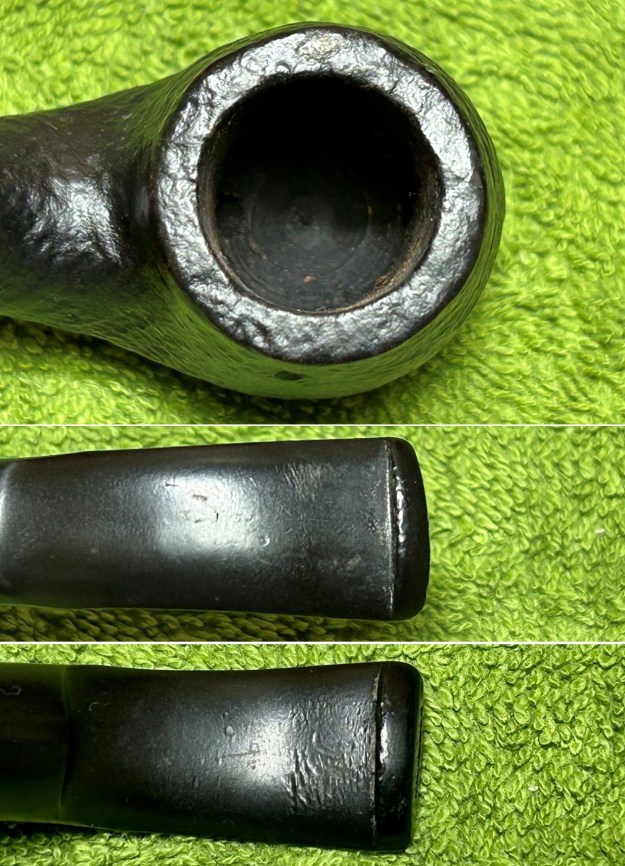
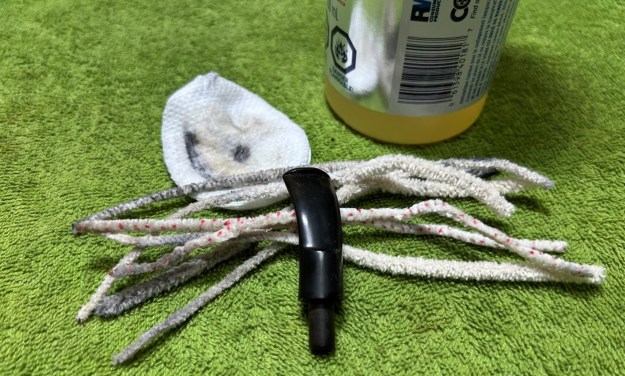
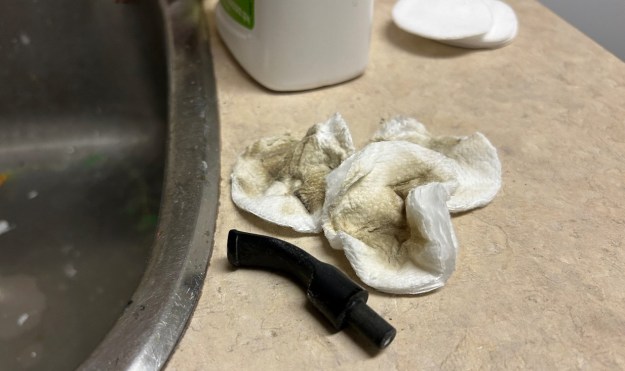
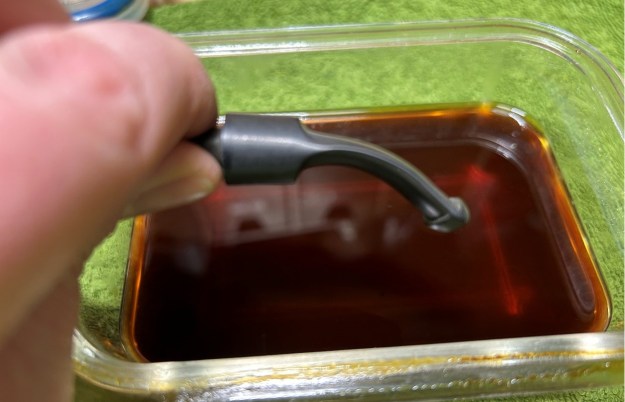
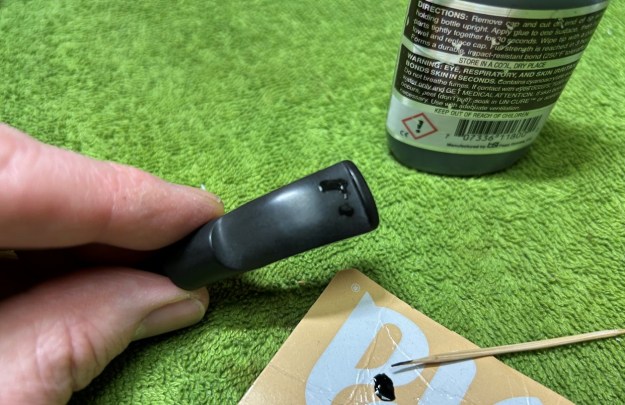
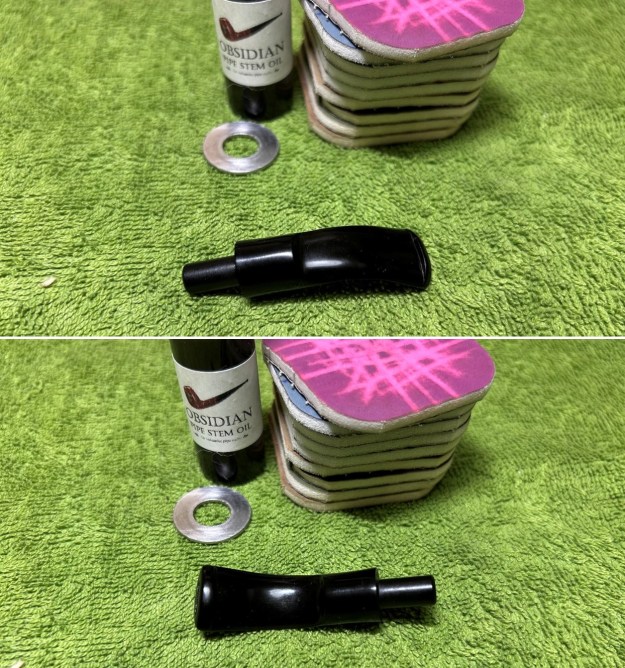
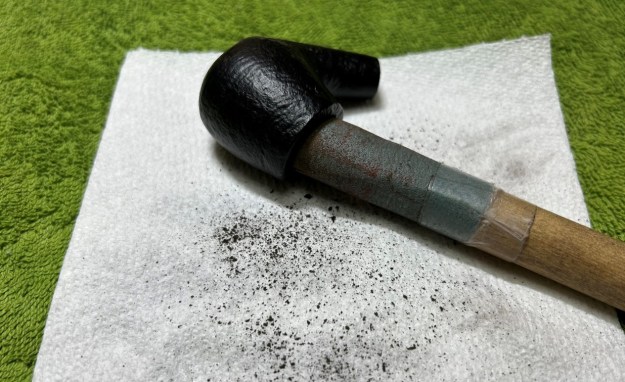
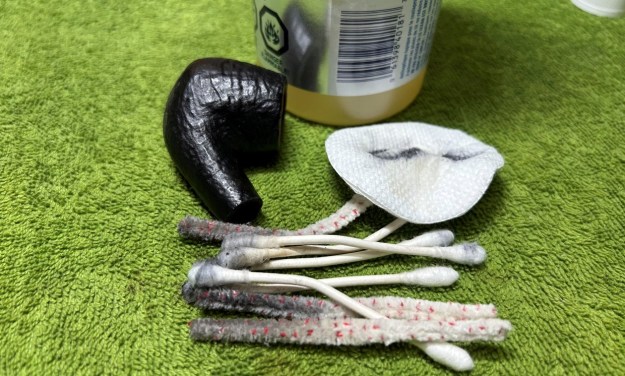
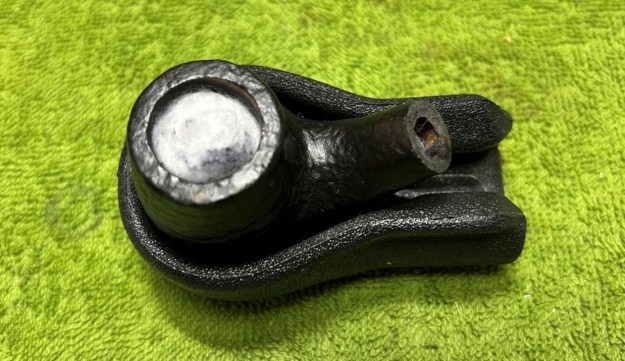
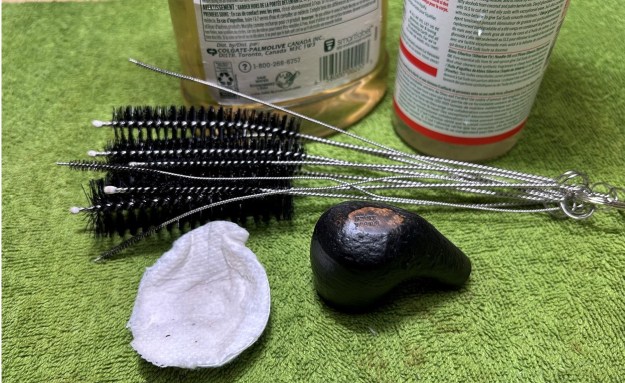
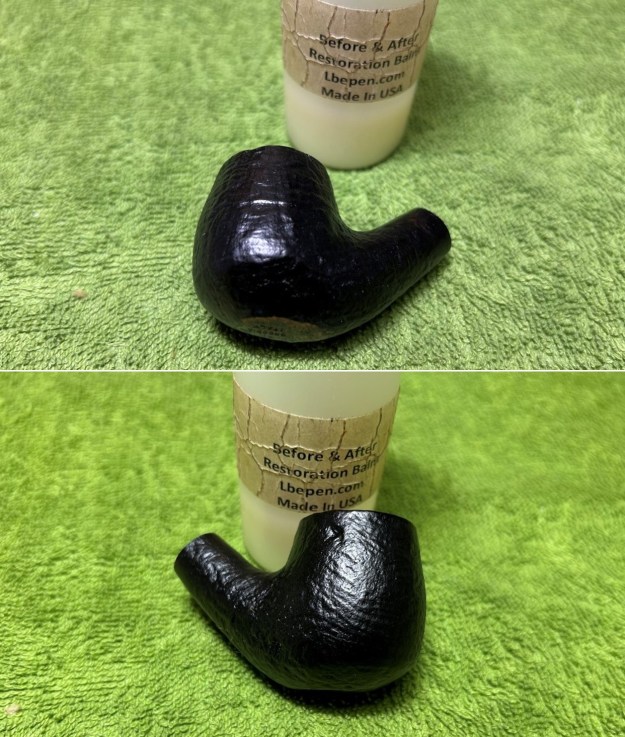
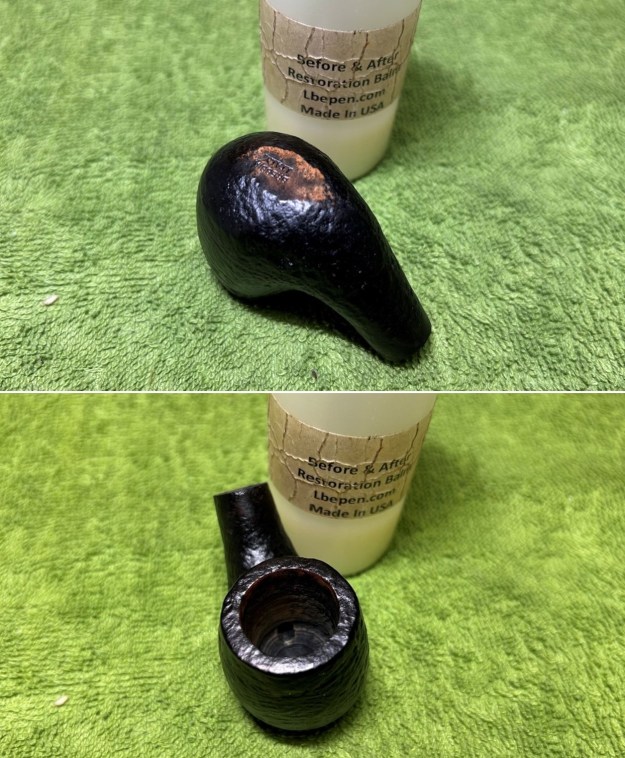
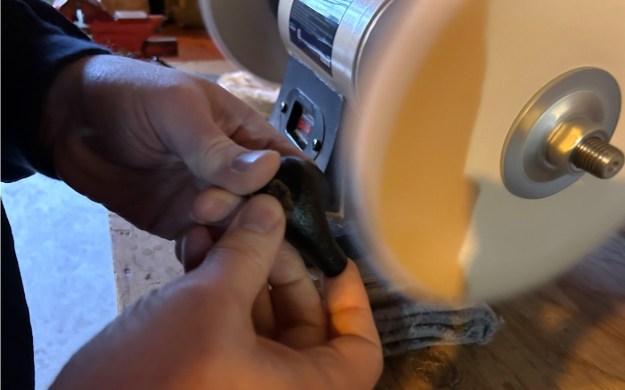
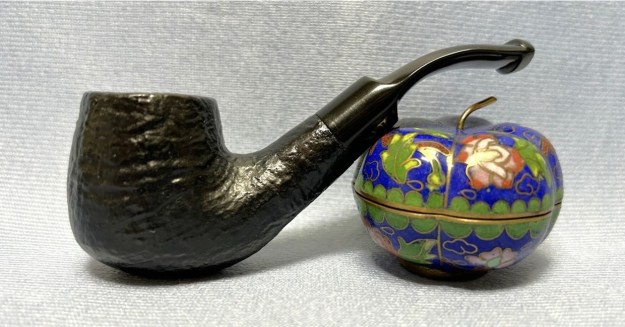
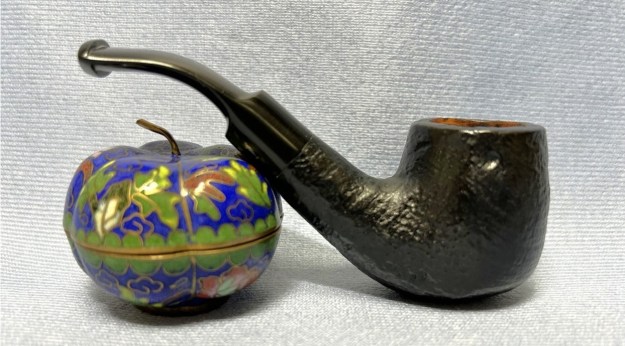
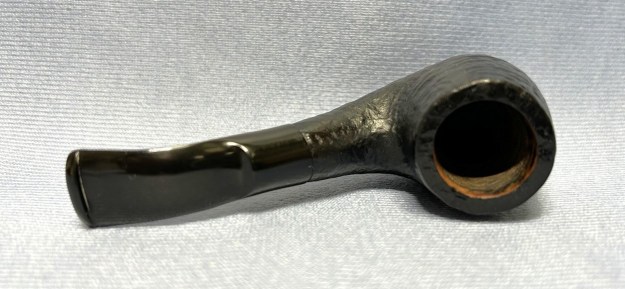
A young gentleman came to me with the desire for a small pipe he could use on the go. We ultimately settled on a charming little pipe made by Brebbia. It’s a black, sandblasted bent billiard pocket pipe. Despite its diminutive size, it’s a very handsome pipe and promises to be a good smoker. It will serve this fellow very well for a long time to come. Only two words constitute the entirety of this pipe’s markings. On the underside of the stummel are the words Brebbia [over] Italy. I’ve worked on some Brebbia pipes before, so I went and looked up my previous articles. I learned from Pipedia and Pipephil that the Brebbia pipe company was named after the locality of Bosco Grosso di Brebbia in Lombardy, Italy. The company was founded by Enea Buzzi and Achille Savinelli in 1947, but they parted ways in 1953. Mr Savinelli went on to form his eponymous company, while Mr Buzzi kept the factory and created Maniffatura Pipe Brebbia – they produce MPB and Brebbia pipes. Mr Buzzi’s family still run the company today. Let’s this pipe cleaned up! On the whole, the pipe is in good shape. Nothing major is wrong with either the stem or the stummel. Great news!First, I used oil soap on a few cotton rounds and wiped the stem down to provide an initial cleaning of filth before moving on to the next steps. The primary cleaning comes next. I cleaned the inside of the stem with both pipe cleaners and cotton swabs dipped in 99% lemon-infused isopropyl alcohol. I scrubbed thoroughly to make sure the interior was clean.The goal of the next step is the removal (or minimization) of oxidation. Going to my sink, I used cream cleanser, cotton rounds, and a toothbrush, and scoured the stem to remove as much surface oxidation as possible. As the photos show, the result is a hideous brownish mess – but better off the stem than on it.Once the stem was reasonably clean, I soaked it overnight in some de-oxidation fluid. This solution works to draw oxidation in the stem to the surface. This is a major aid and important step in ensuring a clean stem. The following day, I drew the stem out from its bath and scrubbed the lingering fluid with a toothbrush.Once clean and dry, I set about fixing the marks and dents in the vulcanite. This is done by filling those divots with black cyanoacrylate adhesive, impregnated with carbon and rubber. I left this to cure and moved on.The penultimate step for the stem is sanding. First, with my set of needle files, I reduce the bulk of the cyanoacrylate repairs. I want to remove the excess adhesive as near to the surface as possible, without cutting into the vulcanite. Following that, I use all nine of the micromesh sanding pads (1,500 through 12,000 grit) to sand out flaws, even out the vulcanite, and provide gentle polishing of the finished surface. I also apply pipe-stem oil while using the last five micromesh pads. There was a wonderful, deep black shine to the stem when I was done.Now that the stem is (nearly) complete, I can move on to the stummel. The first step for me is to ream out the bowl – that is to say, remove all the cake inside the bowl. This accomplishes a couple of things. First (and most obviously), it cleans the bowl and provides a refurbished chamber for future smoking. Second, when the old cake is removed, I can inspect the interior walls of the bowl and determine if there is damage or not. In this case, there was none. I used a reamer and a piece of sandpaper taped to a wooden dowel. Collectively, these ensure that all the debris is removed.The inside of the stummel needs to be cleaned thoroughly. Similar to the stem, I then cleaned it with both pipe cleaners and cotton swabs dipped in 99% lemon-infused isopropyl alcohol. Fortunately, it wasn’t too dirty.I then decided to ‘de-ghost’ the pipe – that is to say, exorcize the remaining filth from the briar. I filled the bowl and the shank with cotton balls, then saturated them with 99% isopropyl alcohol. I let the stummel sit overnight. This caused any remaining oils, tars and smells to leach out into the cotton.To tidy up the briar, I also wiped down the outside with some oil soap on cotton rounds (and a toothbrush). This does a good job of cleaning any latent dirt on the surface of the briar. The last step of the cleaning process is to scour the inside of the stummel with some soap and tube brushes. This is the culmination of the work in getting the pipe clean.No sanding needed for a sandblast. So, I rubbed some Before & After Restoration Balm into the briar and let it sit for 20 minutes or so. The balm moisturizes the wood and gives a beautiful depth to the briar. I then buffed it with a microfibre cloth. For the final step, I took the pipe to my bench buffer and carefully polished it – first with a white diamond compound, then with three coats of conservator’s wax. This procedure makes the pipe look its best – the stummel sings and stem glows.This Brebbia bent billiard pocket pipe is very handsome and will provide many years of smoking pleasure. I hope you enjoyed reading the story of this pipe as much I as I did restoring it. If you are interested in more of my work, please follow me here on Steve’s website or email me directly at kenneth@knightsofthepipe.com. The approximate dimensions of the pipe are as follows: length 3⅔ in. (93 mm); height 1⅜ in. (36 mm); bowl diameter 1⅛ in. (30 mm); chamber diameter ⅔ in. (17 mm). The weight of the pipe is ⅞ oz. (25 g). I hope you enjoyed reading the story of this pipe’s restoration as much as I did restoring it. If you are interested in more of my work, please follow me here on Steve’s website or send me an email. Thank you very much for reading and, as always, I welcome and encourage your comments.
New Life for a Peterson’s System Standard 303 Smooth Apple with a 9mm Filter P-lip Stem


by Steve Laug

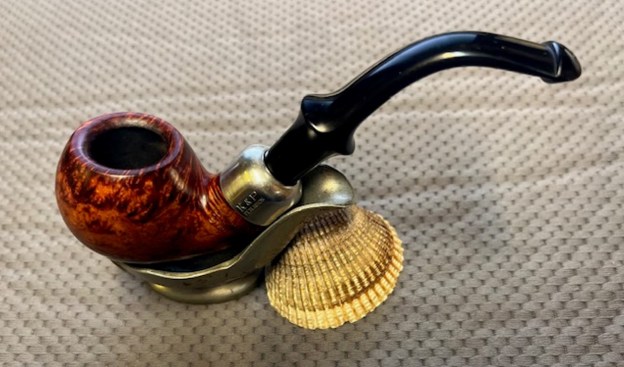
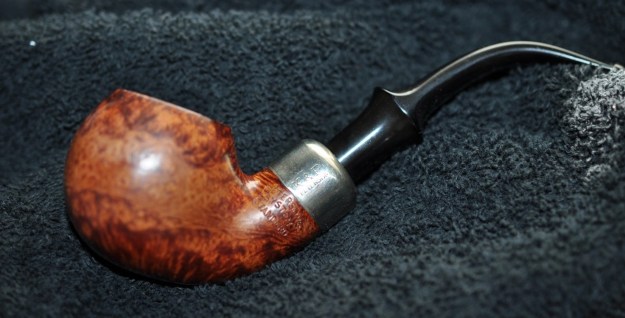
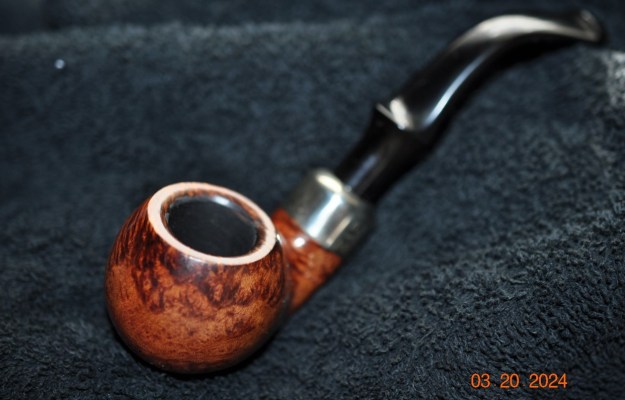
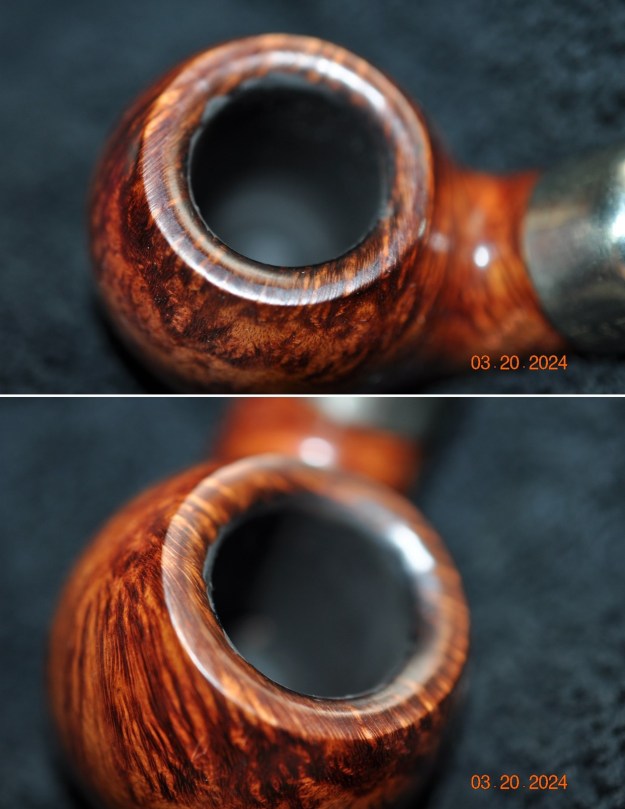
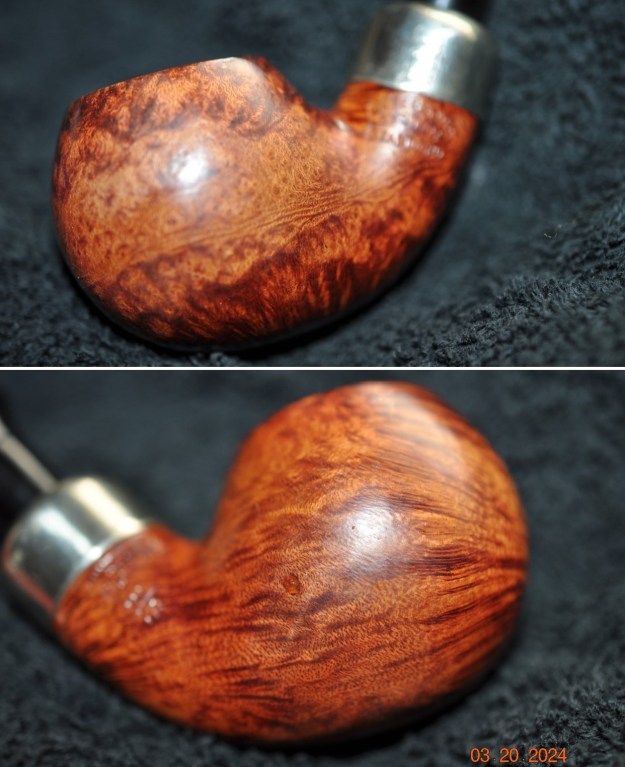
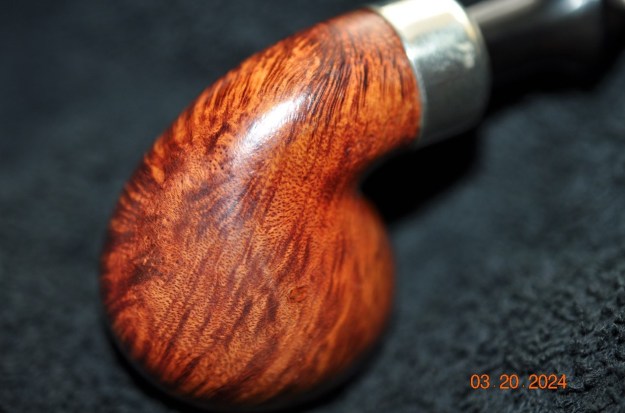
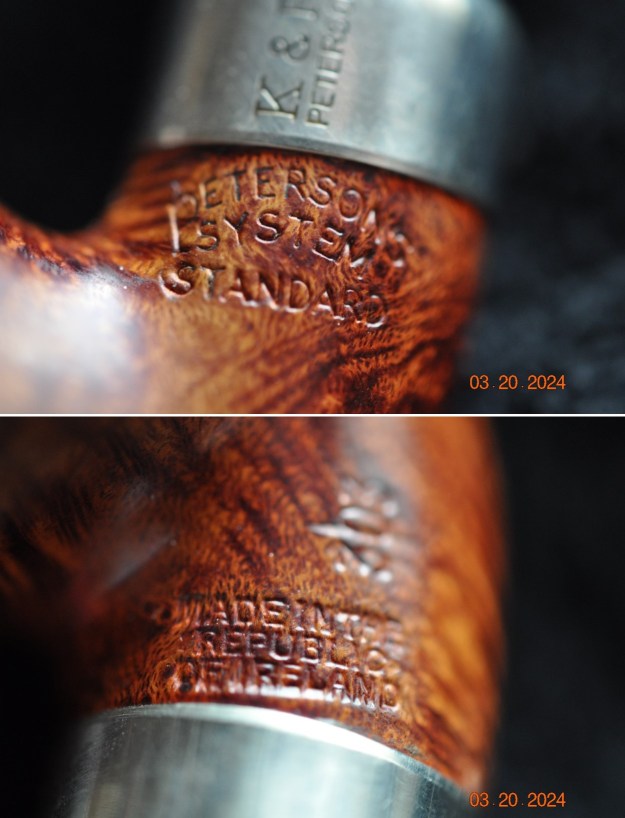
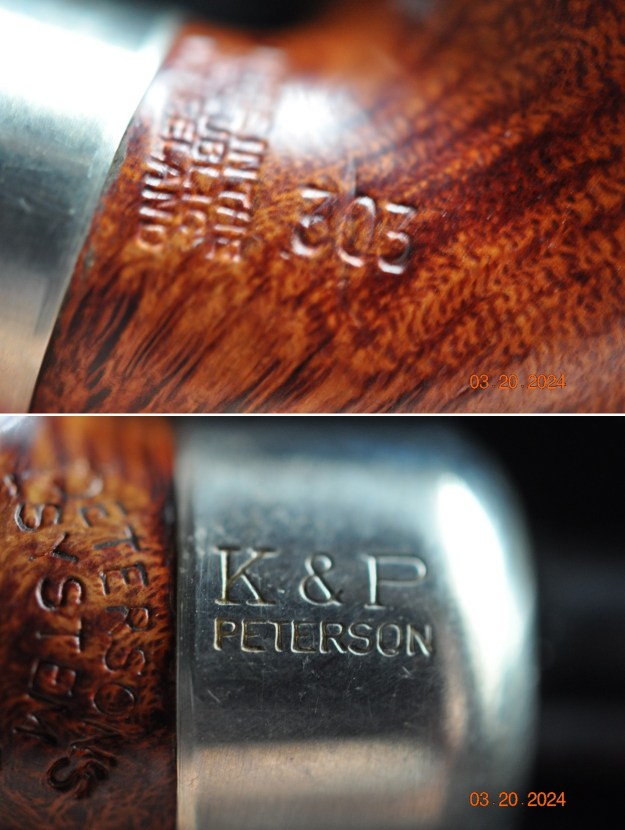
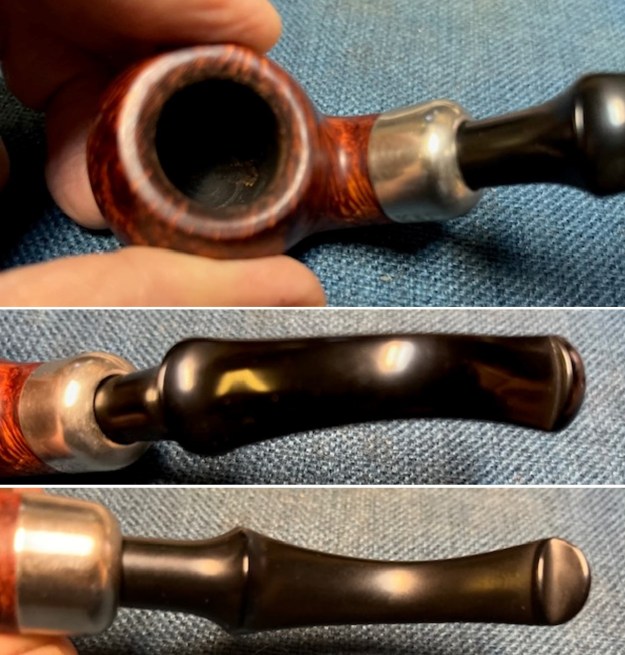
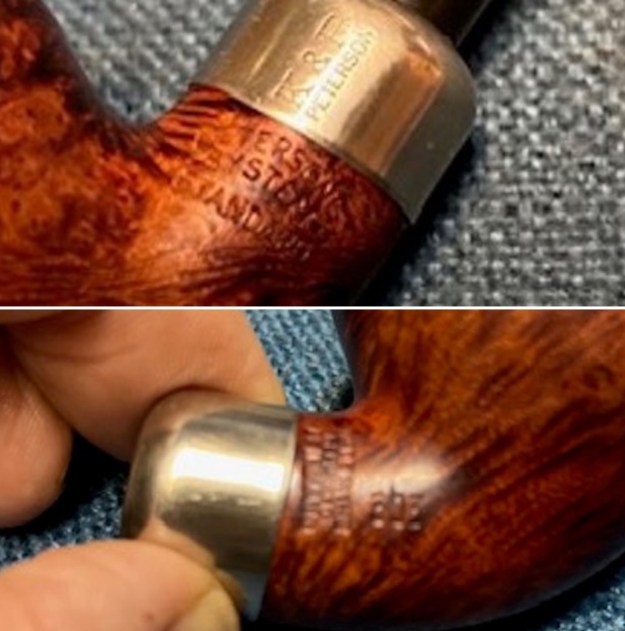
The next pipe I have chosen is another smooth finished Peterson’s System – this time a System Standard shape 303. It came to us from our source in Copenhagen, Denmark on 01/29/24. It had a P-lip stem. The finish was smooth with some nice grain around the sides and shank. It was stamped on the left side of the shank and read Peterson’s [arched over] System [over] Standard. On the right side of the shank it was stamped Made in the Republic of Ireland (three lines) over the shape number 303. It was dirty with grime ground into the finish around the bowl and shank. There was a moderate cake in the bowl and some light lava spots on the inner bevelled rim edge. The nickel ferrule was in good shape but had some scratches that would need to be polished. It is stamped as well and reads K & P [over] Peterson on the left. The vulcanite P-lip stem was unstamped and there was some light oxidation and light chatter near the button that would polish out. Jeff took photos of the pipe before he started my work. He took photos of the rim top and stem to show the general condition of the pipe. The bowl is moderately caked and the rim top looks good. The bevelled edges have a spotty lava overflow. The stem looks good but it has light tooth marks on the top and underside near the button. He took photos of the sides and heel of the bowl to show the grain that was very visible around the bowl and shank. He took photos of the stamping on the shank sides and the ferrule. It read as noted above and was clear and readable. I am including the information from Pipedia’s article on Peterson pipes. It is a great read in terms of the history of the brand (https://pipedia.org/wiki/Peterson). I have included a bit of the pertinent history here.
1950 – 1989 The Republic Era – From 1950 to the present time, the stamp for this era is “Made in the Republic of Ireland” in a block format generally in three lines but two lines have been used with or without Republic being abbreviated.

During the 1950’s and 60’s the Kapp & Peterson company was still in the ownership of the Kapp family. However 1964 saw the retiral of the company Managing Director Frederick Henry(Harry) Kapp.

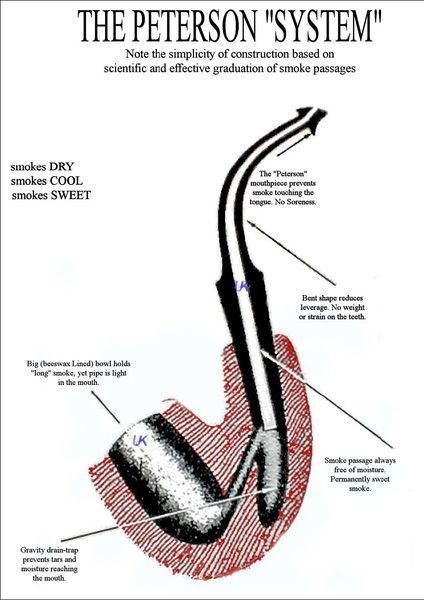
Pipedia also included a section of information on the System pipes including a diagram of the systems look (https://pipedia.org/wiki/Peterson#Republic_Era_Pipes). I quote a section of the article in part and include a link to another article on Pipedia on the System pipe.

The Peterson System pipes are the standard bearers of the Peterson pipe family, famous for the excellent smoking pleasure they provide. Often imitated but never equalled, the Peterson System smokes dry, cool and sweet, thanks to the scientific effectiveness of the original design. The heart of the System is the unique graduated bore in the mouthpiece. This makes the suction applied by the smoker 15 times weaker by the time it reaches the tobacco chamber. The result is that all the moisture flows into the reservoir and, thus cannot reach the smoker’s mouth. The Peterson Lip further enhances the effectiveness of the graduated bore by directing the flow of smoke upwards and away from the tongue. This achieves a uniquely even distribution of smoke and virtually eliminates any chance of tonguebite or bitterness. Furthermore, the shape is contoured so that the tongue rests comfortably in the depression under the opening. Each “PLip” mouthpiece is made from Vulcanite. For the Peterson System pipes to work properly, the stem/tenon has to have an extension, the tip of which will pass by the draft hole from the bowl and into the sump. Upon the smoker drawing in smoke, this extension then directs the smoke down and around the sump to dispense a lot of the moisture before the smoke enters the extension and stem. On the System Standards and other less expensive systems, this extension with be made of Vulcanite turned integrally with the stem. On the more expensive System pipes this extension will be made of metal which screws into the Vulcanite stem. This extension on the earlier pipes will be of brass and the newer pipes will be of aluminium. Most smokers not knowing this function of the metal extension, assumes that it is a condenser/stinger and will remove it as they do with the metal condensers of Kaywoodie, etc. Should you have a System pipe with this metal extension, do not remove it for it will make the System function properly and give you a dryer smoke (https://pipedia.org/wiki/A_closer_look_at_the_famous_Peterson_Standard_System_Pipe).
With that information in hand I knew what I was dealing with in terms of the stamping and the age of this pipe. I knew from the information that the pipe was made during the Late Republic Era between 1950 and the present day. Personally, I think this is probably a 60s-70s pipe. Now it was time to work on the pipe.

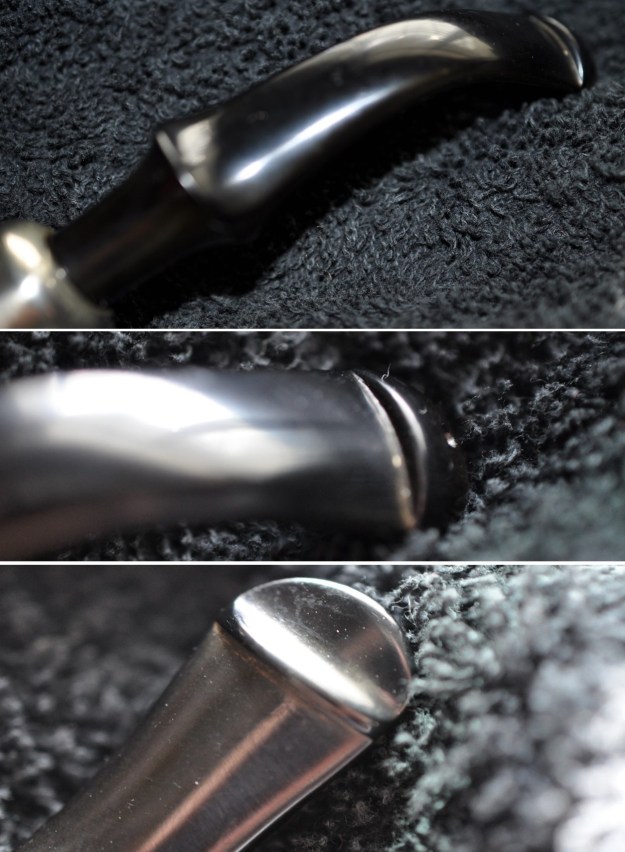
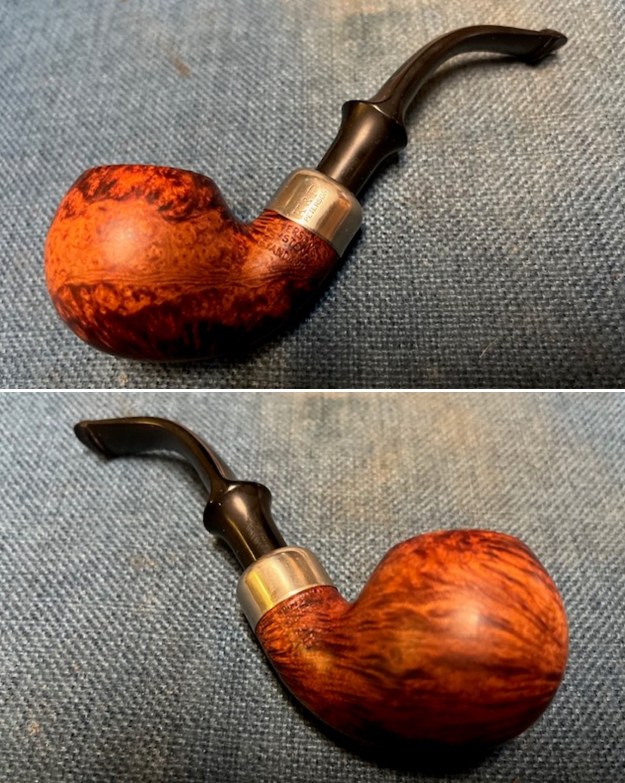
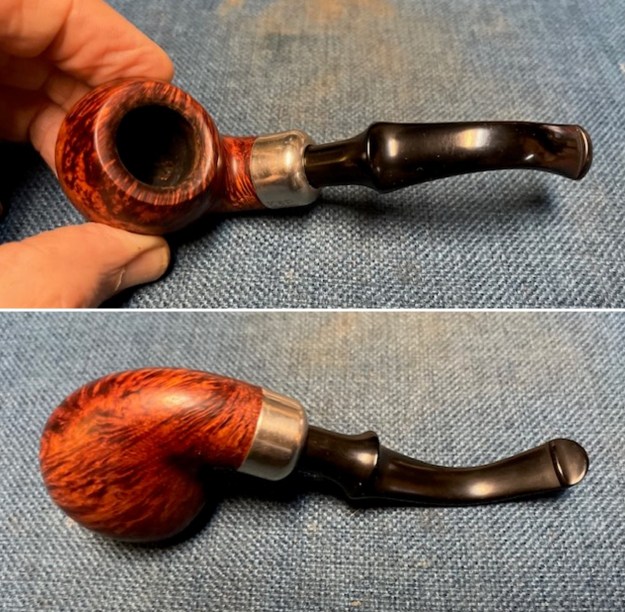
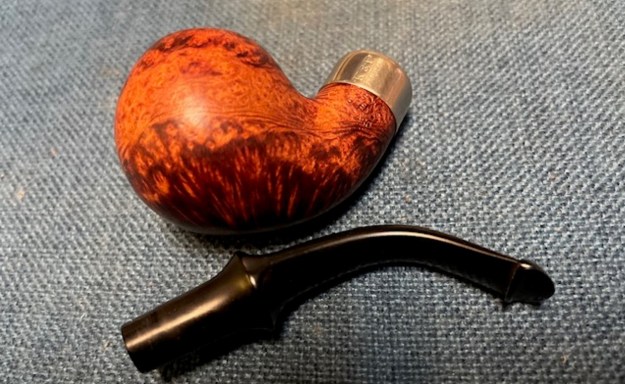
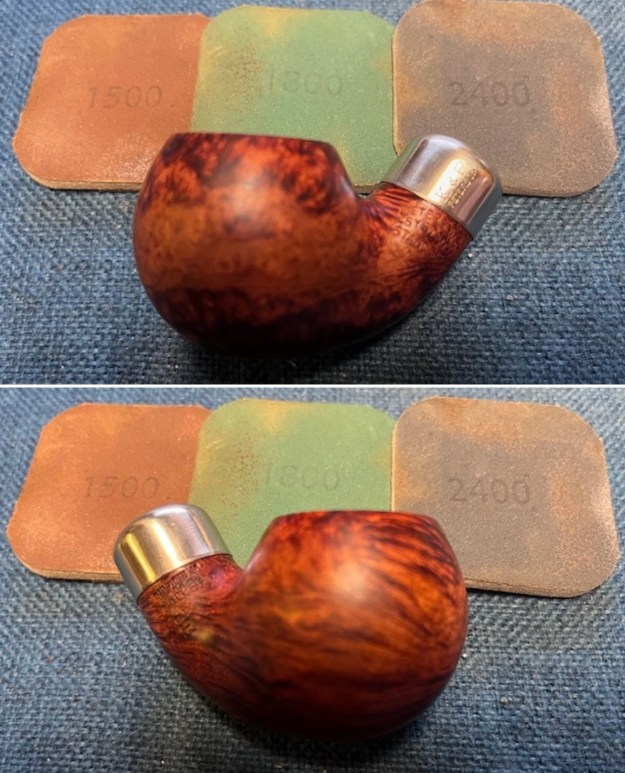
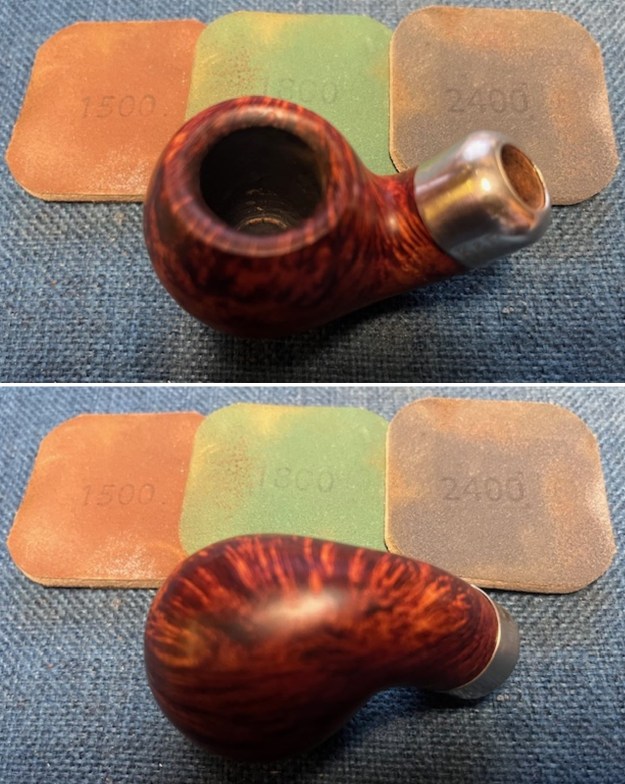
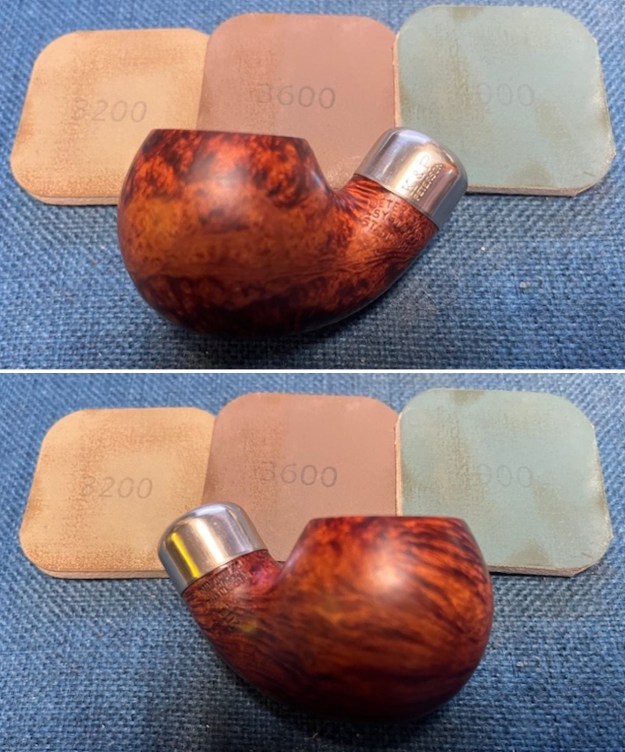
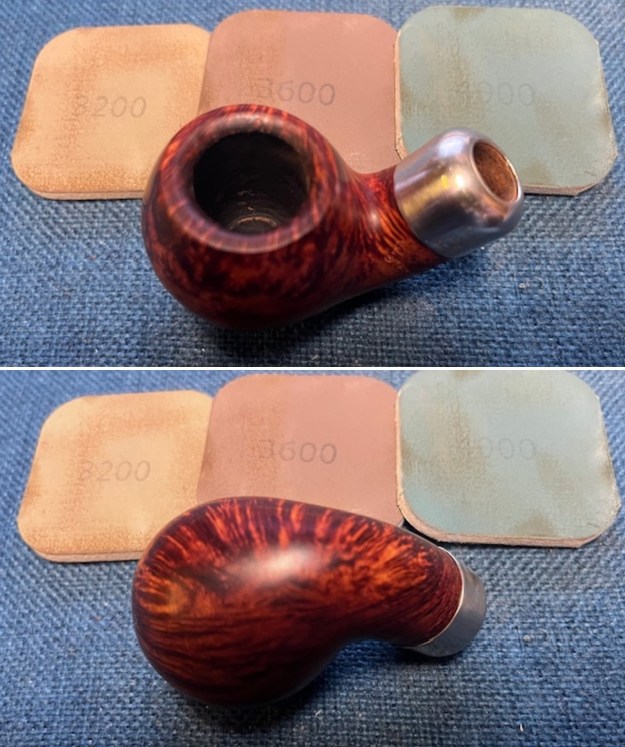
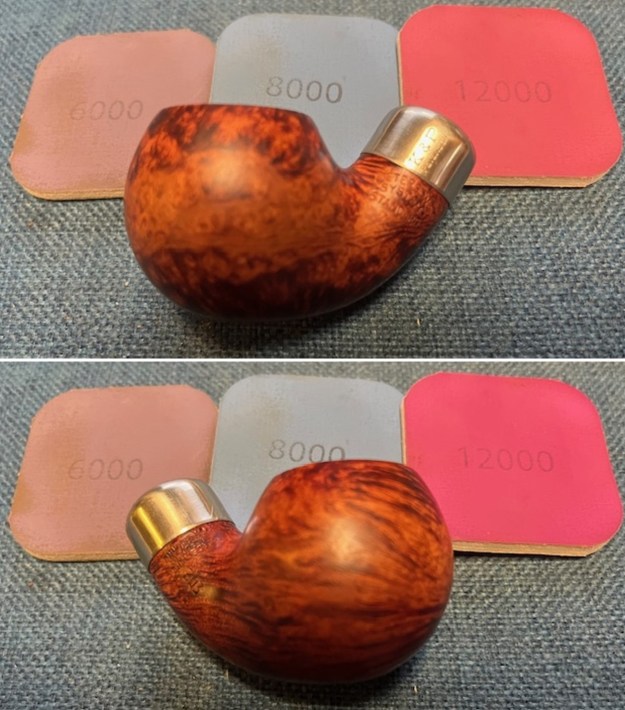
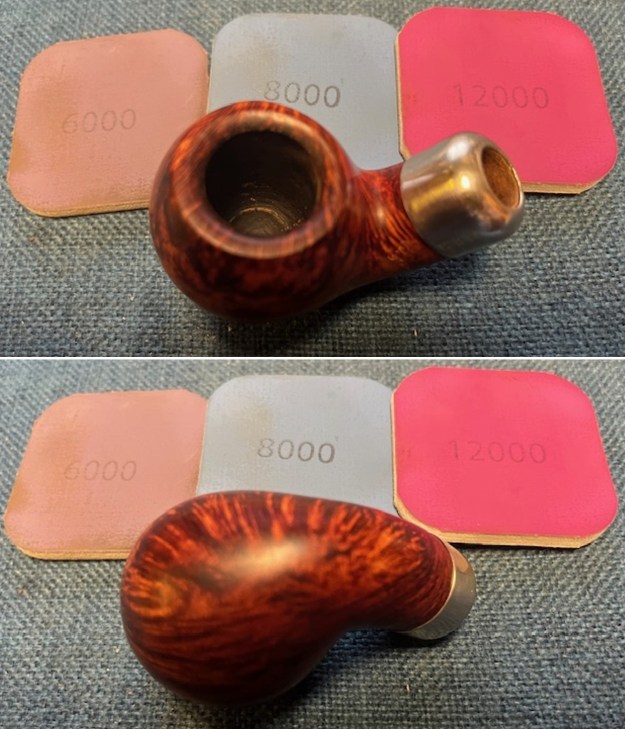
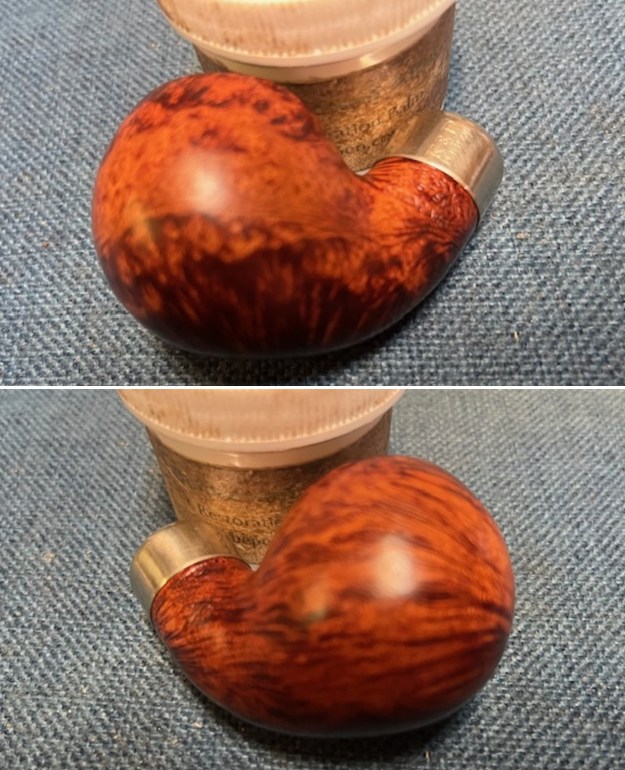
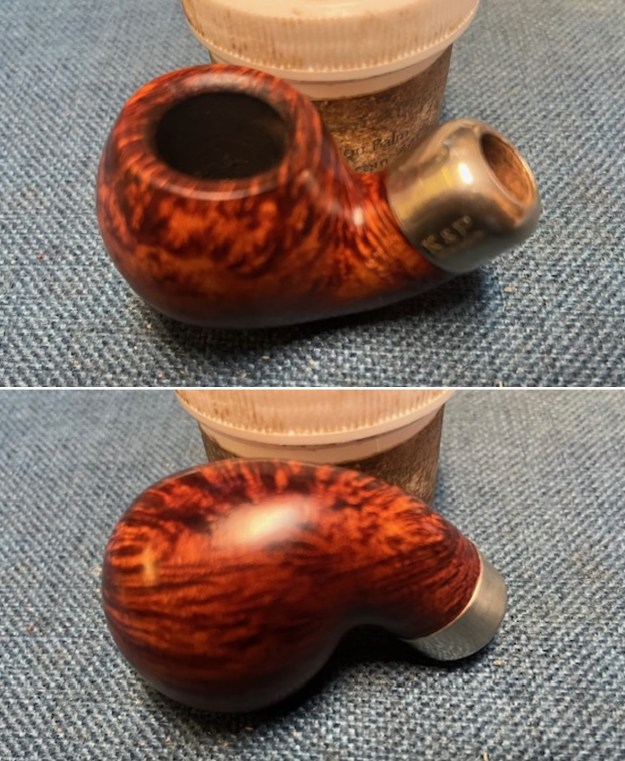
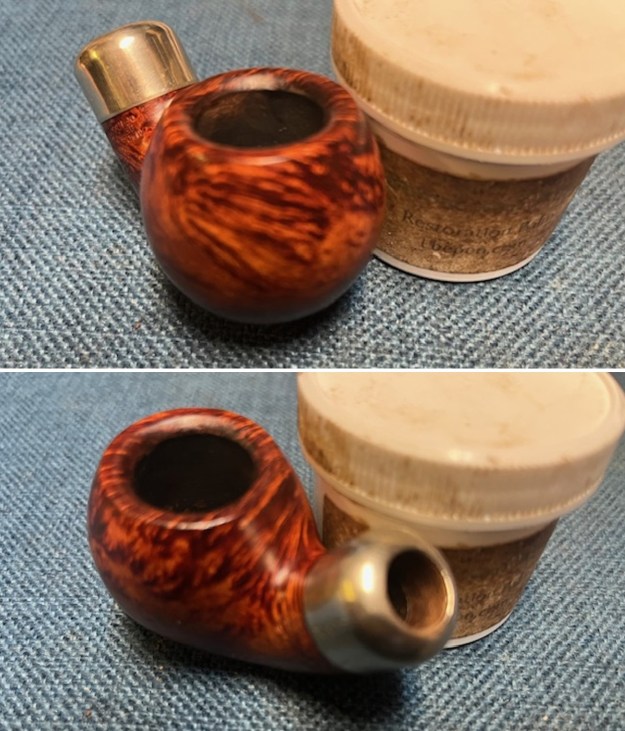
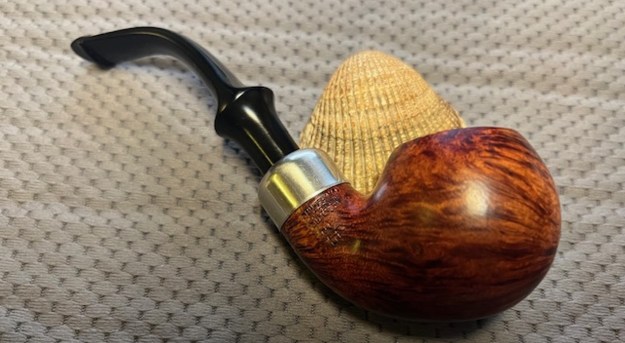
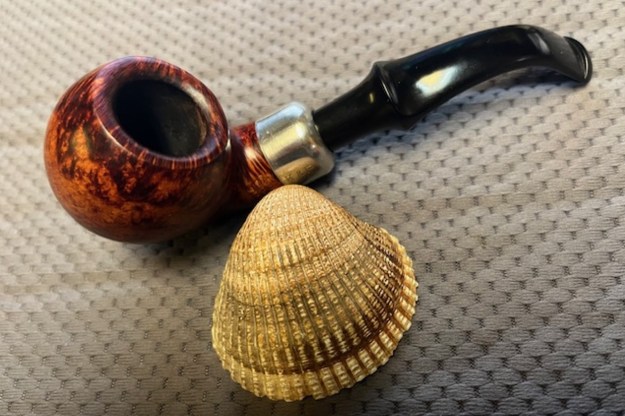
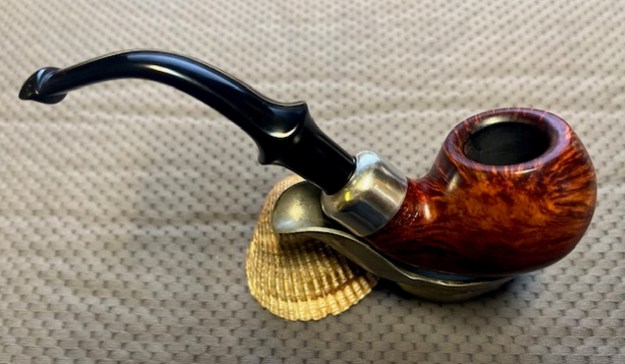
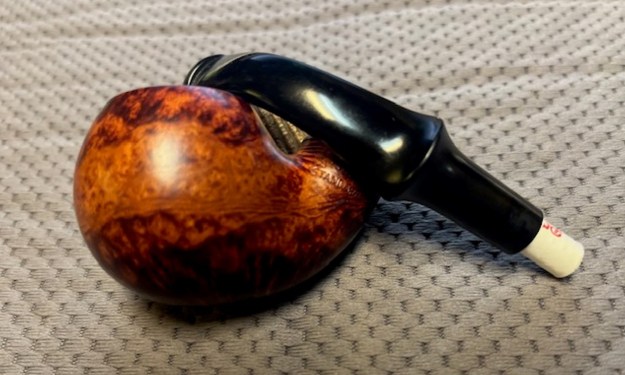
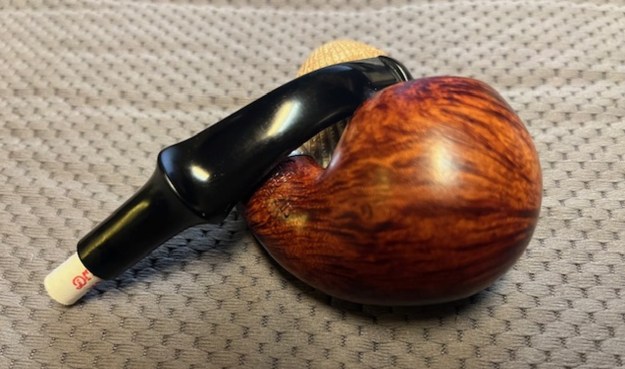
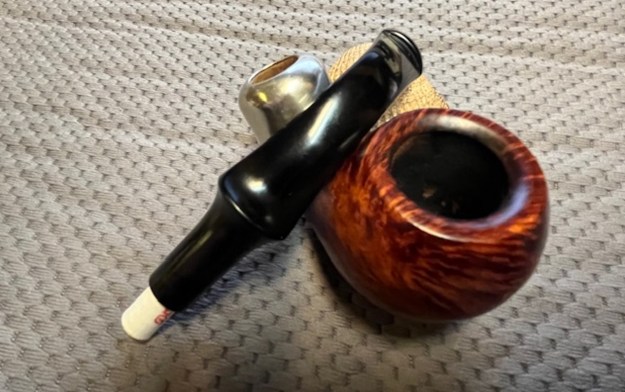
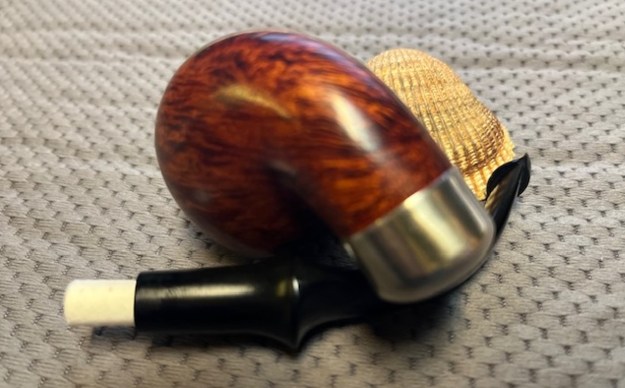
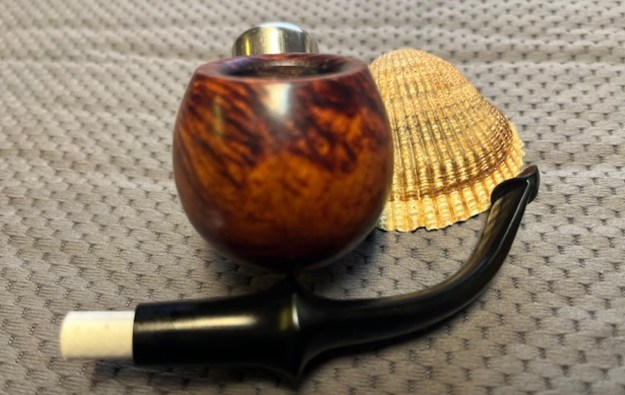
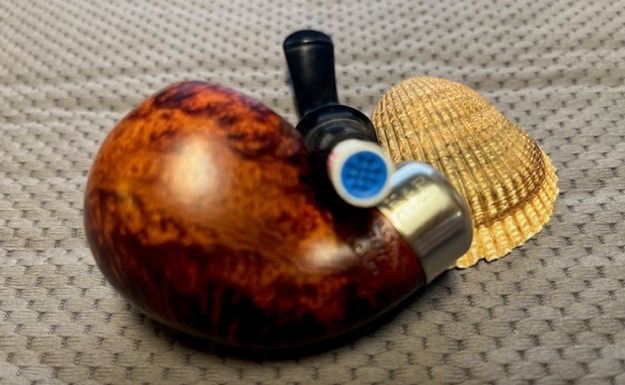
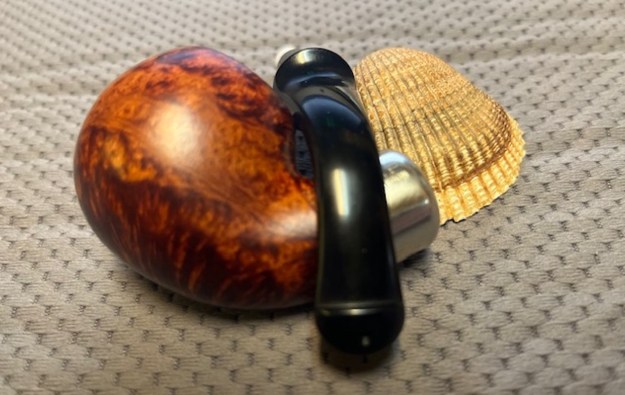
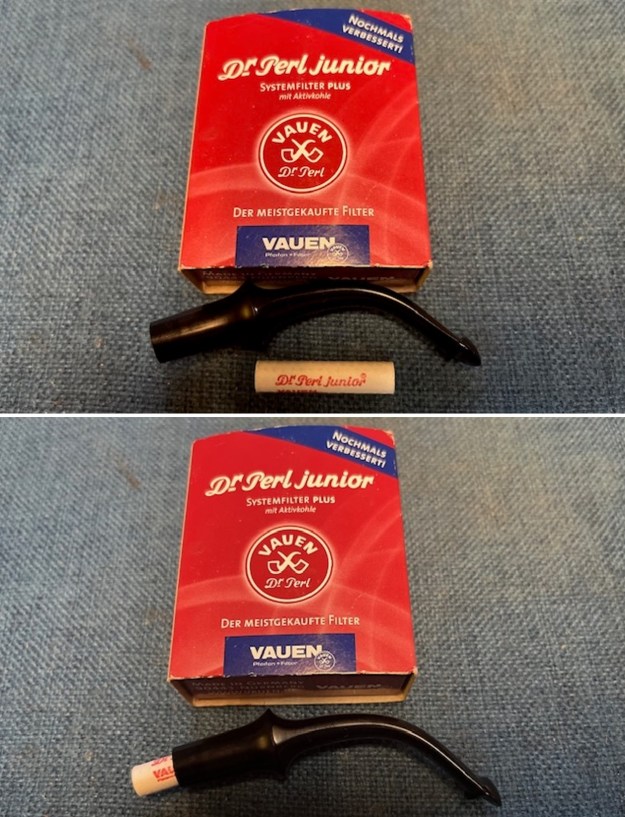
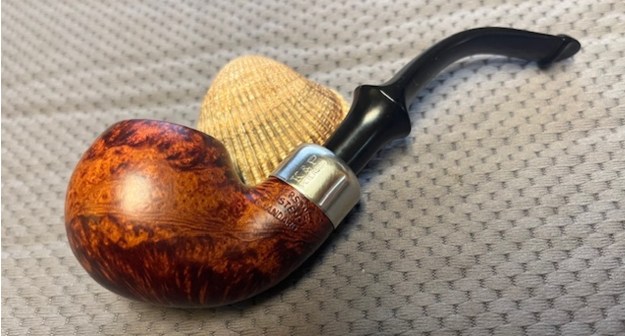
Jeff had cleaned up the pipe with his usual thoroughness. He reamed the pipe with a PipNet Pipe Reamer and cleaned up the remnants with a Savinelli Fitsall Pipe Knife.  He scrubbed the bowl with undiluted Murphy’s Oil Soap with a tooth brush. He rinsed it under running warm water to remove the soap and grime. He cleaned out the inside of the shank and the airway in the stem with alcohol, cotton swabs and pipe cleaners. He soaked the stem in Before & After Deoxidizer and rinsed it off with warm water. Somewhere along the way as it sat here it picked up some stickiness on the top of the stem that looks a lot like what is left behind by a gummed label. I took photos of the pipe 3 years later when I finally got around to working on it. As you can see it is another beautiful looking pipe. I took photos of the rim top and bowl as well as the stem to give a sense of the condition of both. The rim top and the inner edge looked very good and the bevelled edge showed no damage. The stem was clean but had light tooth marks and chatter on the top and underside ahead of the button.I took photos of the stamping on the sides of the shank. They are clear and readable as noted above. I took the stem out of the shank and took a photo of the overall look of the pipe. It is another beauty. There are a few small dings from the journey of the pipe that will remain as a part of its story. I polished the briar with micromesh sanding pads – wet sanding with 1500-12000 grit pads. I wiped the bowl down after each pad with a damp cloth. I rubbed the bowl down with Before & After Restoration Balm. I worked it into the surface of the bowl sides and shank with my fingertips. The product works to clean, enliven and protect the briar. I let the balm sit for a little while and then buffed with a cotton cloth to raise the shine. I set the bowl aside and turned to work on the stem. I polished the stem with micromesh sanding pads – 1500-12000 grit pads. I wiped it down with Obsidian Oil after each sanding pad. I used Before & After Pipe Polish – both Fine and Extra Fine to further polish the stem. I gave it a final coat of Obsidian Oil and set it aside to dry. I fit the stem with a Vauen 9mm filter and took photos of it in place. This was a first for me – I have not ever seen a 9mm filter P-lip stem until this one.This Republic Era Peterson’s System Standard 303 Bent Apple with a vulcanite, P-lip saddle stem is a great looking pipe now that it has been restored. The stem is a 9mm filter stem. The beautiful grain that shines through the polished finish is stunning. I put the stem back on the bowl and carefully buffed the pipe with Blue Diamond on the buffing wheel. I gave the bowl and the stem multiple coats of carnauba wax on the buffing wheel and followed that by buffing the entire pipe with a clean buffing pad. I hand buffed the pipe with a microfiber cloth to deepen the shine. I polished the nickel ferrule with a jeweller’s cloth to protect it and raise the shine. The finished Peterson’s System Standard 303 fits nicely in the hand and feels great. Give the finished pipe a look in the photos below. The dimensions of the pipe are Length: 5 ½ inches, Height: 1 ½ inches, Outside diameter of the bowl: 1 ¼ inches, Chamber diameter: ¾ of an inch. The weight of the pipe is 44 grams/1.55 ounces. I will be putting this pipe on the rebornpipes store in the Irish Pipemakers Section soon. If you are interested in adding it to your collection let me know. Thanks for reading this blog and my reflections on the pipe while I worked on it.

Restoring a Thompson 530 Italy Freehand


by Steve Laug

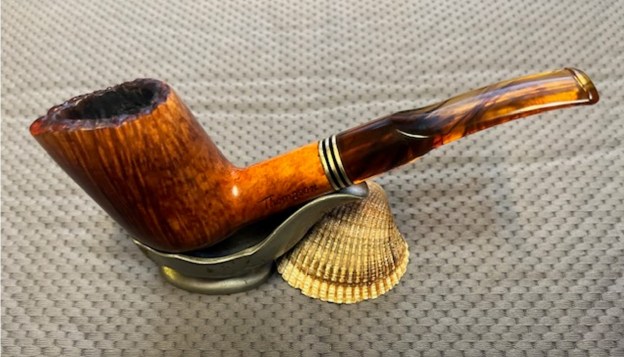
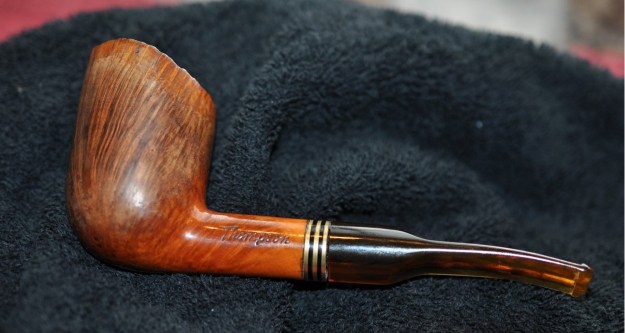
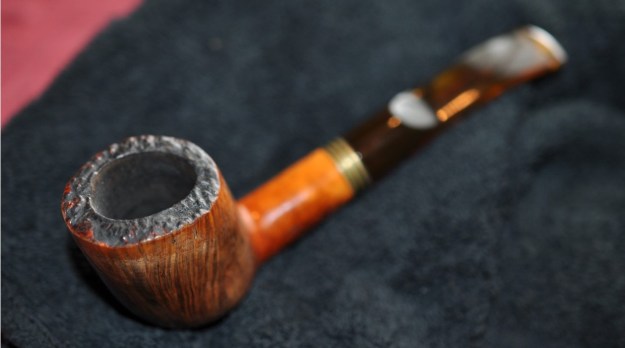
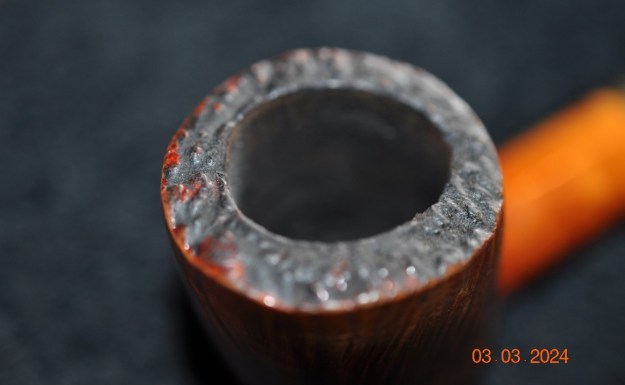
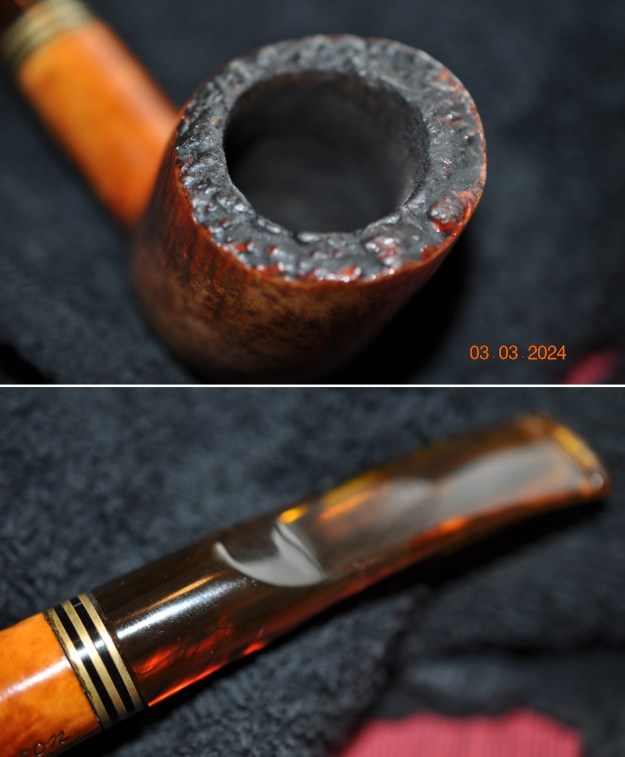
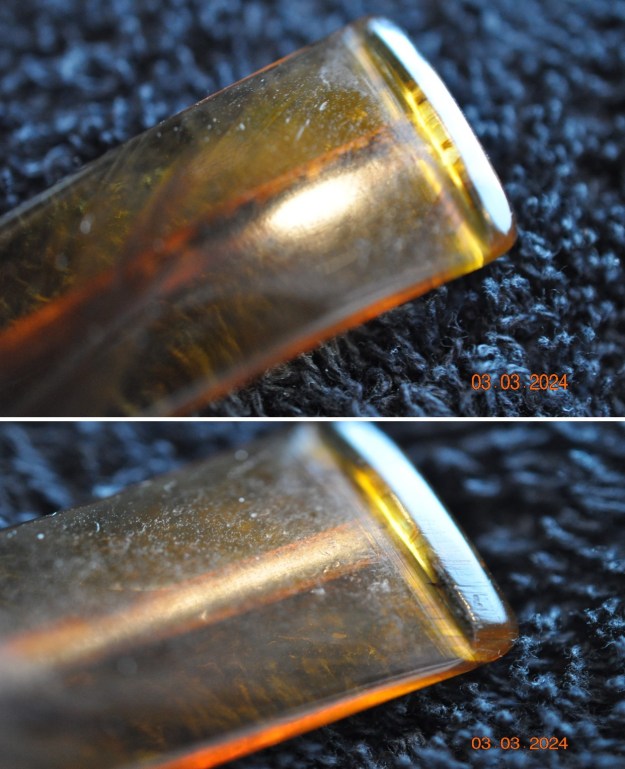
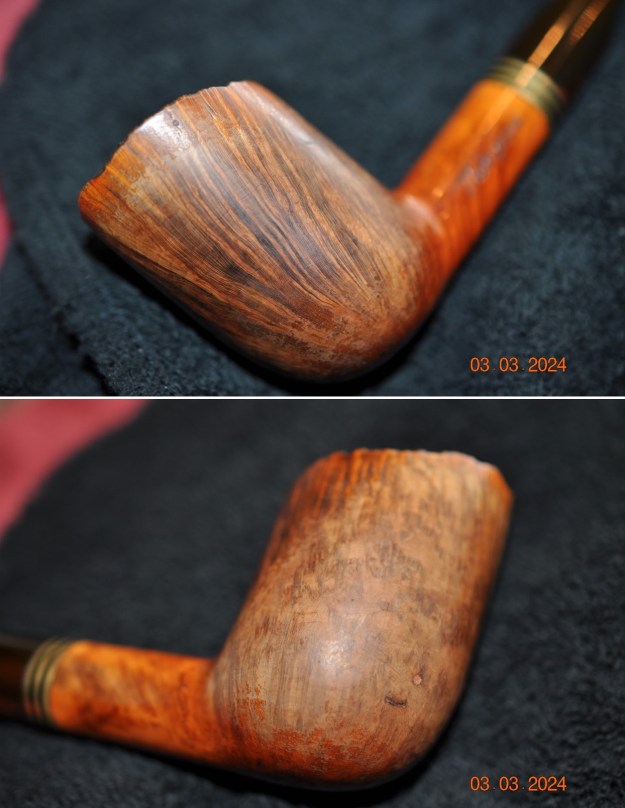
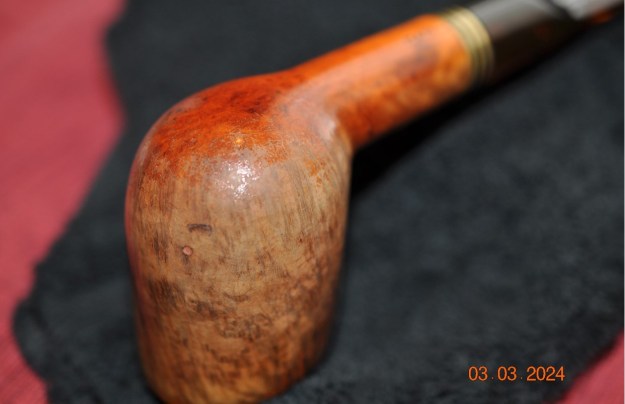
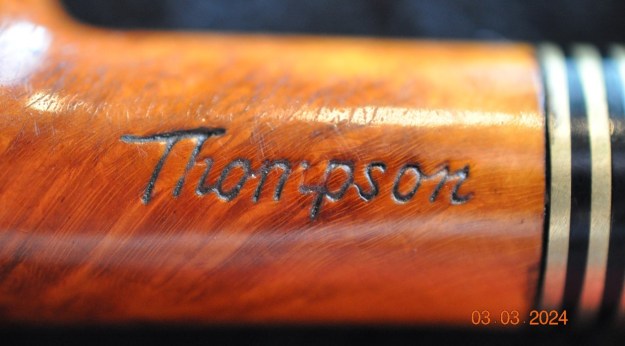
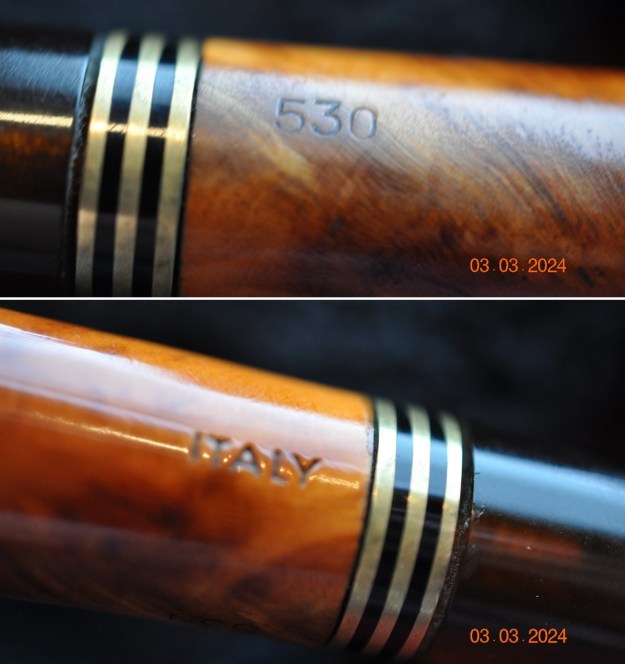
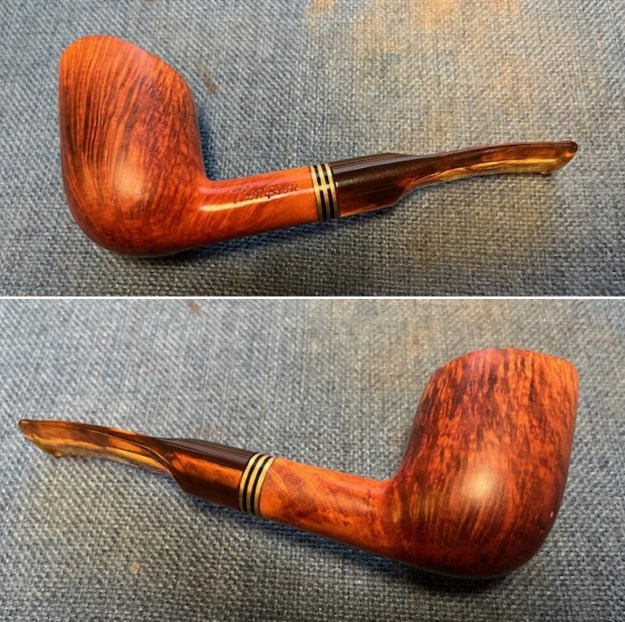
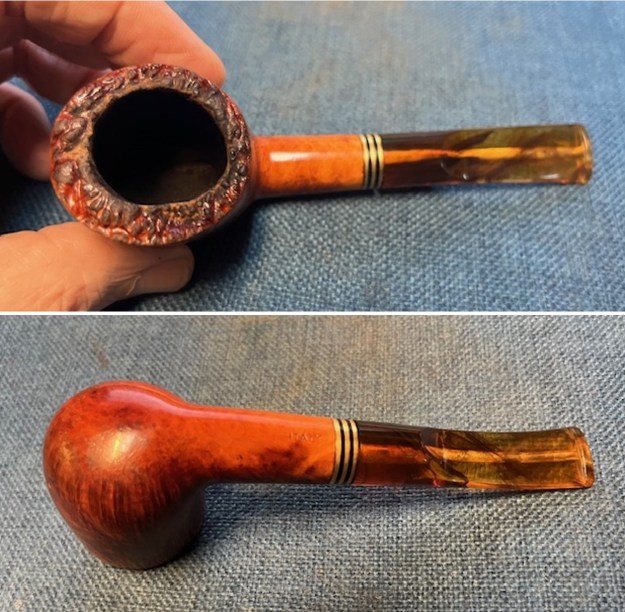
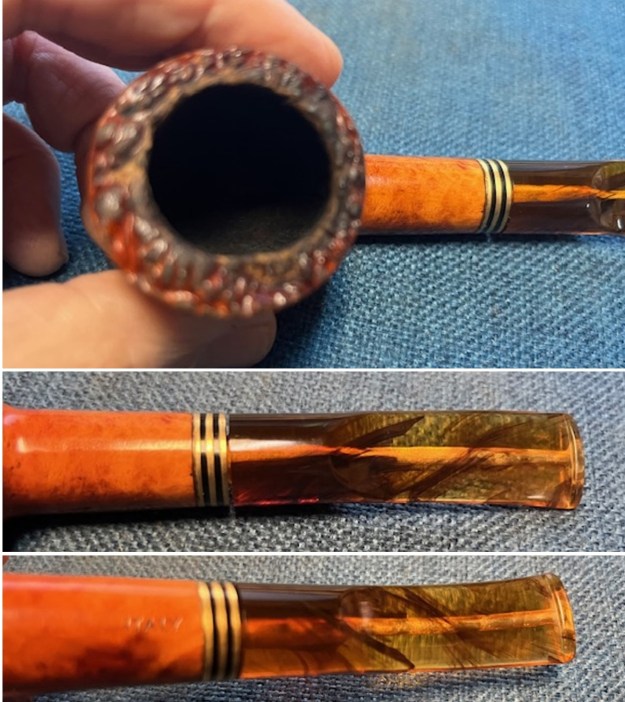
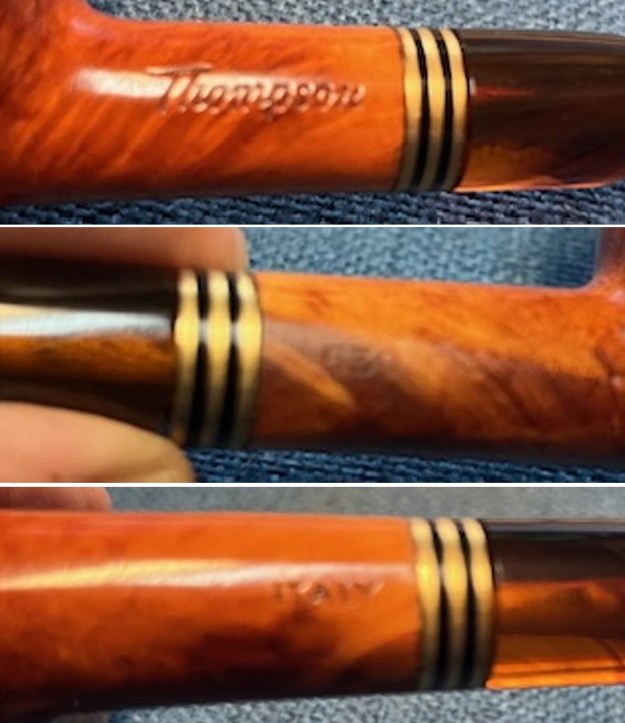
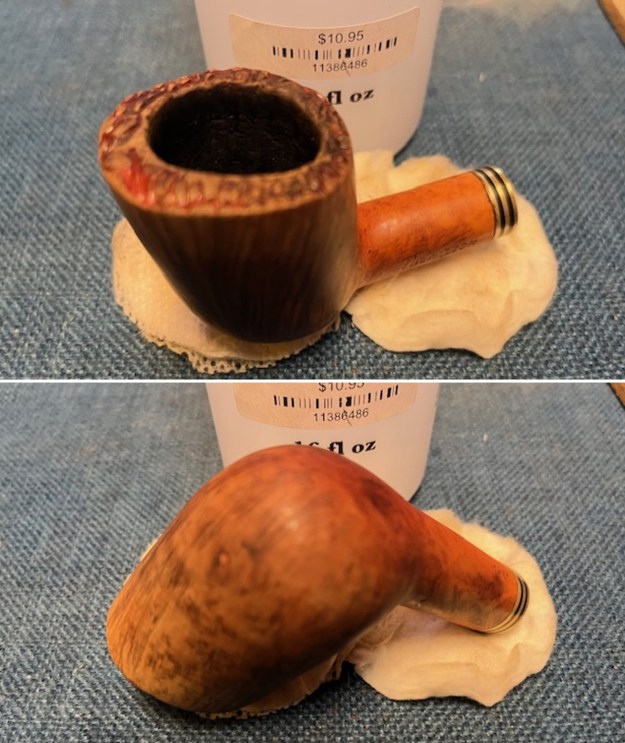
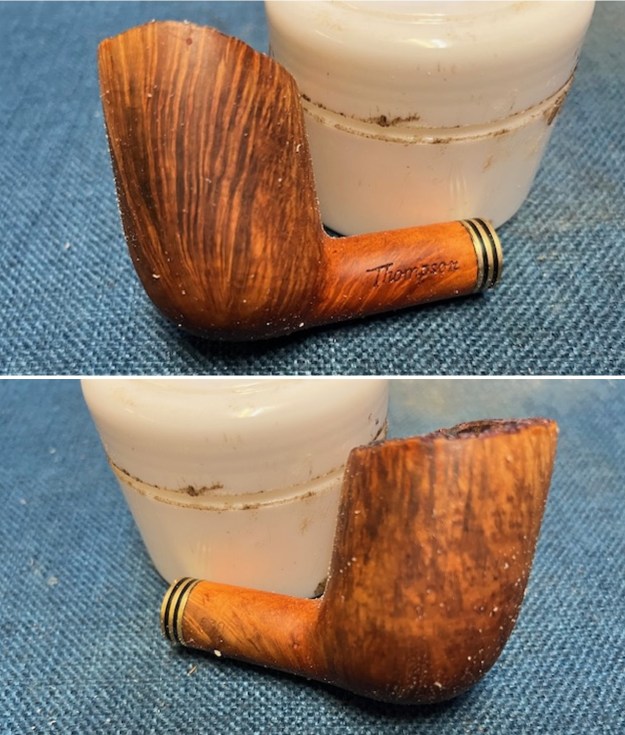
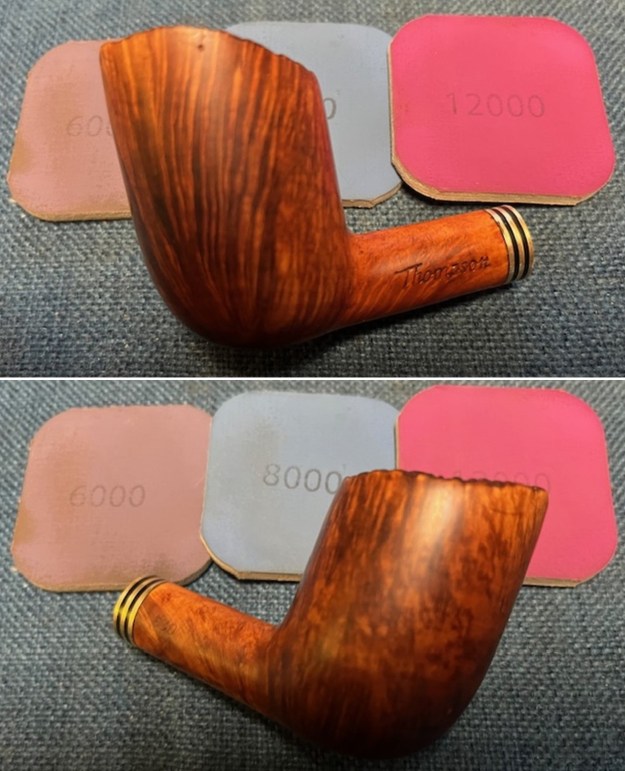
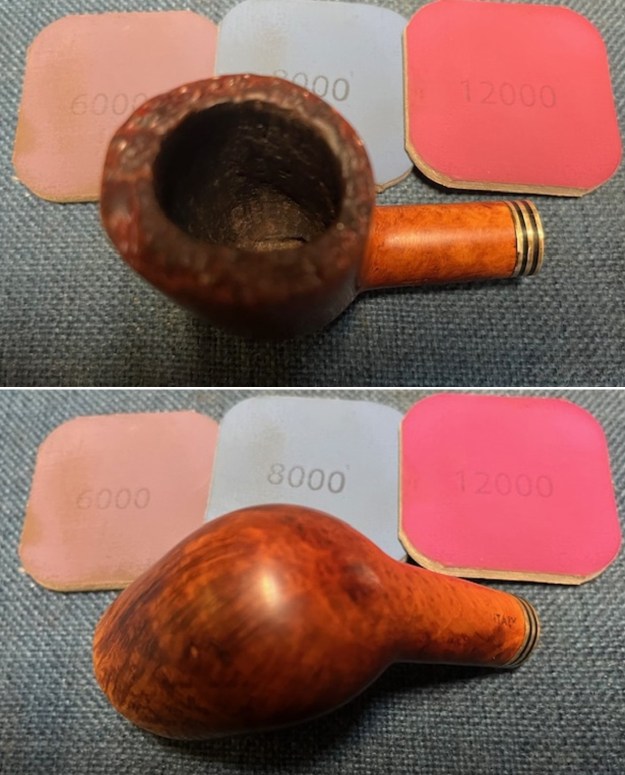
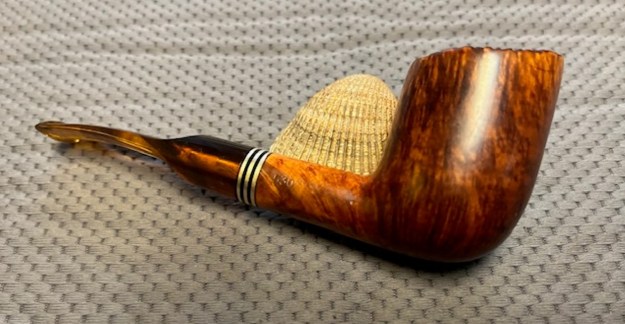
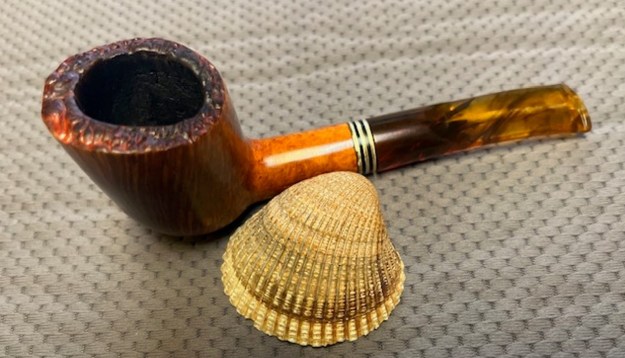
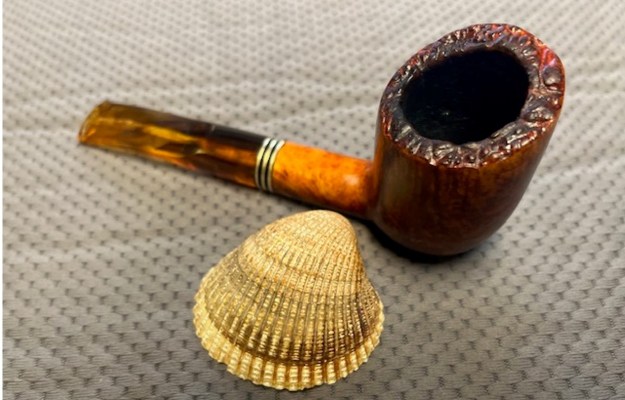
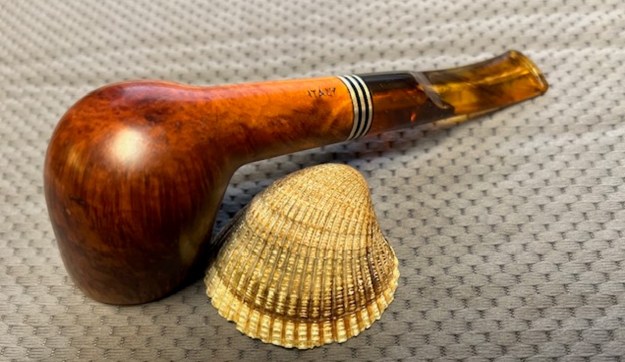
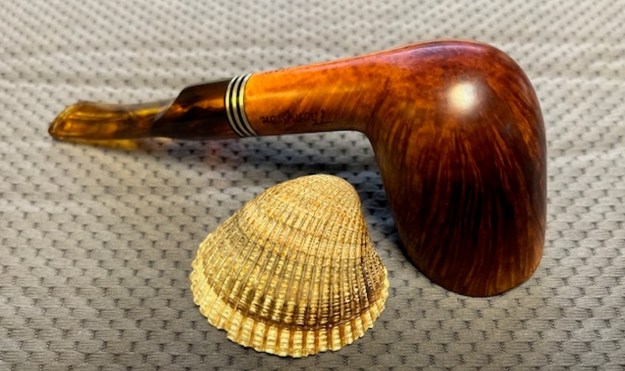
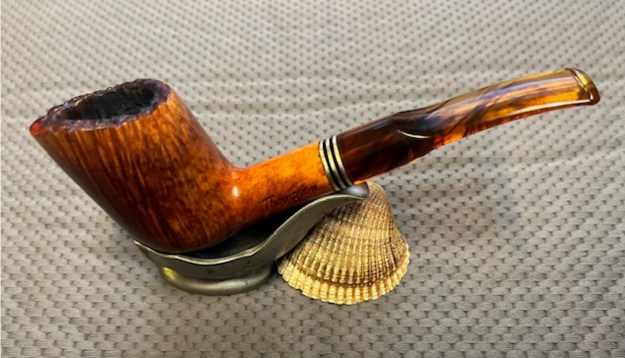
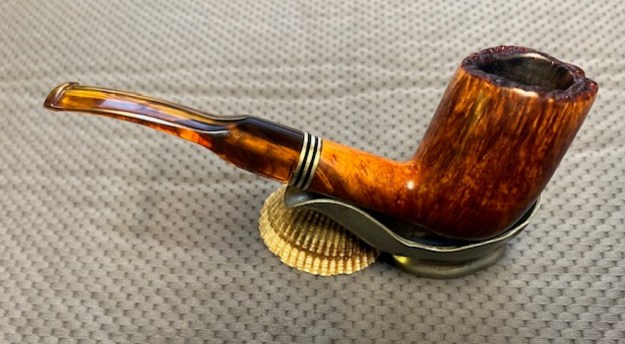
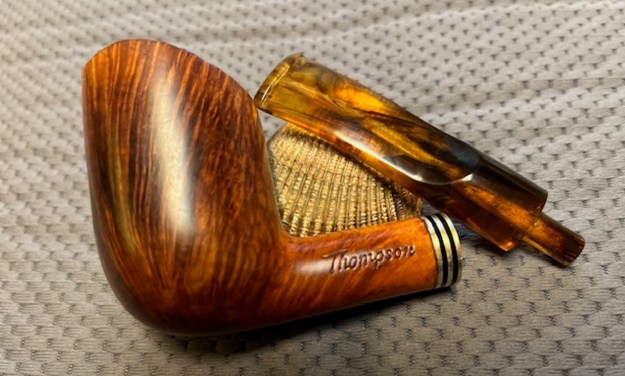
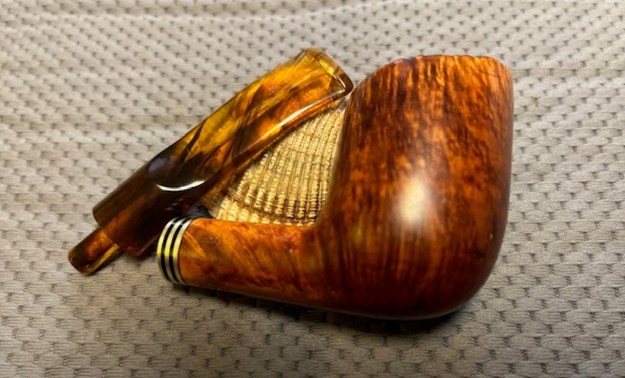
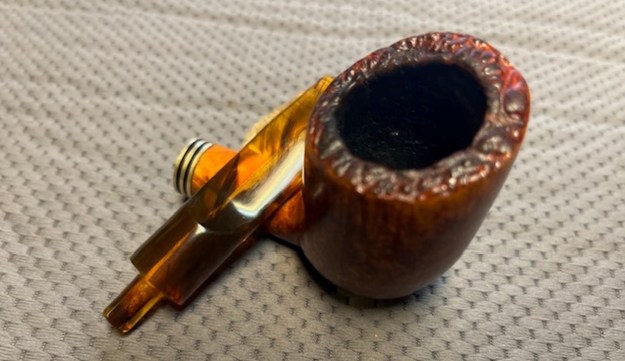
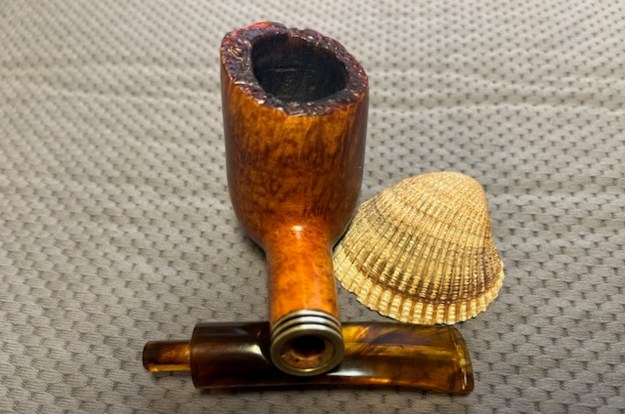
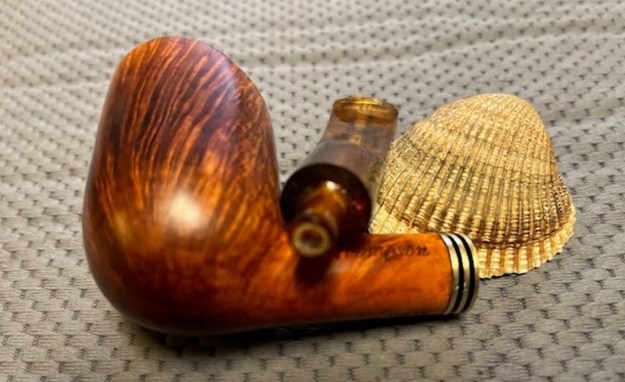
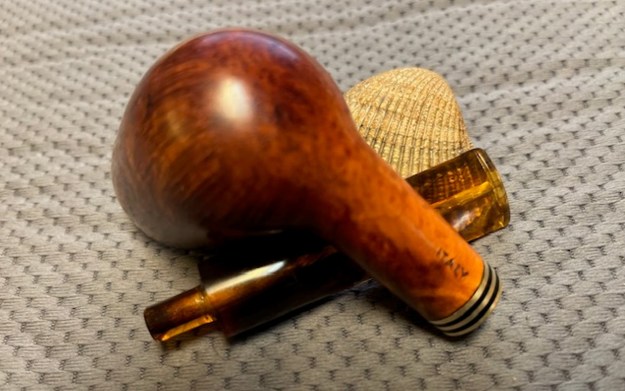
This pipe has been in my to-do box for almost a year now and some how I continue to pass over it and go on to something else. It came to us from an eBay seller in Jordan, Minnesota, USA on 01/22/2024. This afternoon I picked it up to fit in between my restoration of Peterson’s Pipes that I am working. This one is stamped Thompson in script on the left side of the shank. On the right side of the shank it reads 530 the shape number. On the underside of the shank it is stamped ITALY. It is well grained freehand shape with a faux plateau rim top that has been stained with a mix of black and brown stains. The shank is banded with three brass bands. The stem is amber acrylic and looks quite nice. The pipe is dirty and the stain and finish has come off the sides of the bowl and there is a lot of oils and hand grime ground into the finish on both sides.  The shank still has some heavy varnish on it that leaves it shiny. The bowl has a thick cake and there is a lave overflow into the rusticated/faux rim top. The stem is also dirty and has some tooth chatter on both sides ahead of the button. Otherwise the stem is in better condition than the bowl. Jeff took photos of the pipe before he started his clean up work. He took photos of the rim top and stem to show the general condition of the pipe. The bowl is heavily caked and the rim top and edges have a significant lava overflow. The stem looks good but it has light tooth marks on the top and underside near the button. He took photos of the sides and heel of the bowl to show the grain and the damaged finish that was very visible around the bowl and shank. He took photos of the stamping on the shank sides and read as noted above and was clear and readable. Before I started working on the pipe itself, I turned to Pipedia and looked up Thompson and in this case Norm Thompson. I found a bit of information that gave me the background I was interested in finding. Here is the link (https://pipedia.org/wiki/Thompson,_Norm).

Norman Anchor Thompson, Sr. (known as “Norm Thompson”) was an immigrant from Britain. He had settled in Salt Lake City before fighting for Canada in World War I. After the war he lived briefly in Los Angeles before settling in Portland, Oregon. Norm Thompson started a mail order only business in 1949 as a way to sell his homemade flies for fly-fishing by placing an advertisement in Field & Stream. I understand tobacco products were sold via the mail order business, as well, to a limited degree. Around 1951 he handed over the mail order business to Peter Alport, his son-in-law. Alport worked to expand the company’s product offerings beyond fly-fishing items and into clothing and other outdoor merchandise, plus he developed the company’s slogan of “Escape from the ordinary”.

Norm Thompson would go on to own seven pipe shops, the first one in 1959, and later two nightclubs, all in the Portland area. Norm Thompson Pipe Shops sold higher end pipes, from the likes of Dunhill, Charatan, and Savinelli. Norm Thompson died in 1968 from complications related to his exposure to mustard gas during his World War I military service in Europe.

The First Edition Norm Thompson Pipe Catalogue (right column of this article) was likely a publication that was a product of Peter Alport, as the slogan “Escape from the ordinary” (a slogan credited to Alport) is clearly seen in the publication. No date can be seen on the publication, but we conclude it is late 1960s to early 1970s. Of interest, is the evidence of collaboration between Norm Thompson and Charatan, with Charatan credited with making the Norm Thompson “Regent”. This would have been during the Lane Era. It is also likely that Norm Thompson pipes stamped “Made in Italy” were a Norm Thompson – Savinelli collaboration.

I did some more searching and found an interesting thread on the brand on Pipesmagazine.com (https://pipesmagazine.com/forums/threads/thompson-pipes.72989/). There was a comparison between pipes made for the Thompson Cigar Company and those made for Norm Thompson.

I stumbled on to a pipe that has impressed me. Thompson. Initially, I found a Thompson pipe commissioned by an American company known as, Thompson Cigar Company. They have a following and a fine reputation. I assumed the Thompson pipe I had acquired was a Thompson Cigar Company pipe. I was wrong. In fact, I had purchased a “Norm Thompson” (only designated as “Thompson”) : out of England. Norm Thompson (a B&M tobacco shop in England) had pipes commissioned as well. Both Thompsons were old school B&Ms that had pipes manufactured by reputable pipe makers. From what I have ascertained, Thompson Cigar Company had a lot of free-hands made. Norm Thompson (England) had more traditional English pipe-shapes made (makes sense). Thompson-USA display the name “Thompson” in cursive. Thompson-England display Thompson in block letters. Both Thompsons get rave views from those who own them. You can still find them for reasonable prices on EBeast.

The thread went on with more information as well as folks expounding on the qualities of the pipes. They also confirmed that the Thompson Italy pipes were more than likely collaborations with Savinelli. Now it was time to work on the pipe.

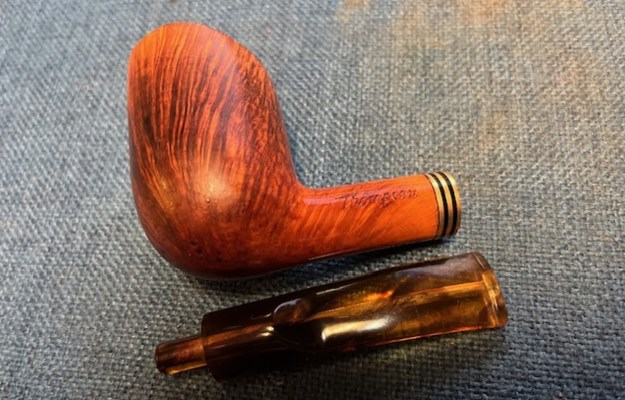
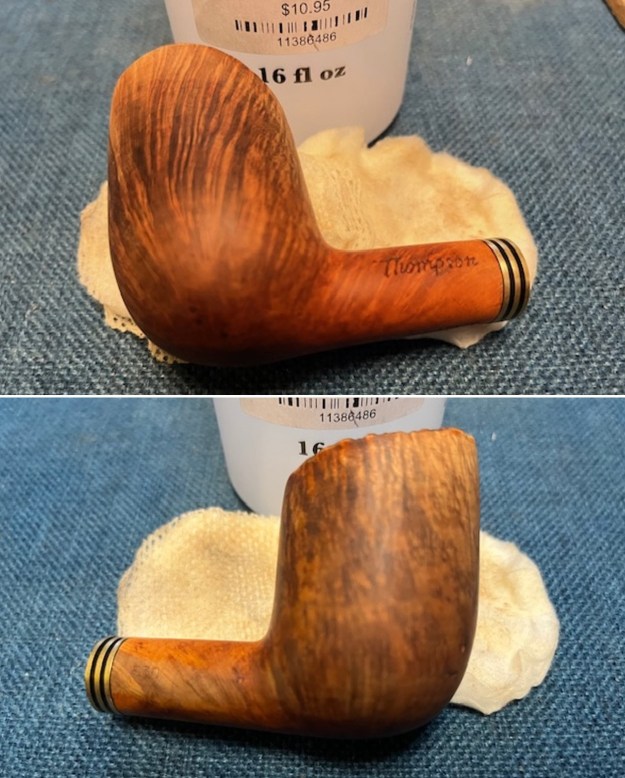
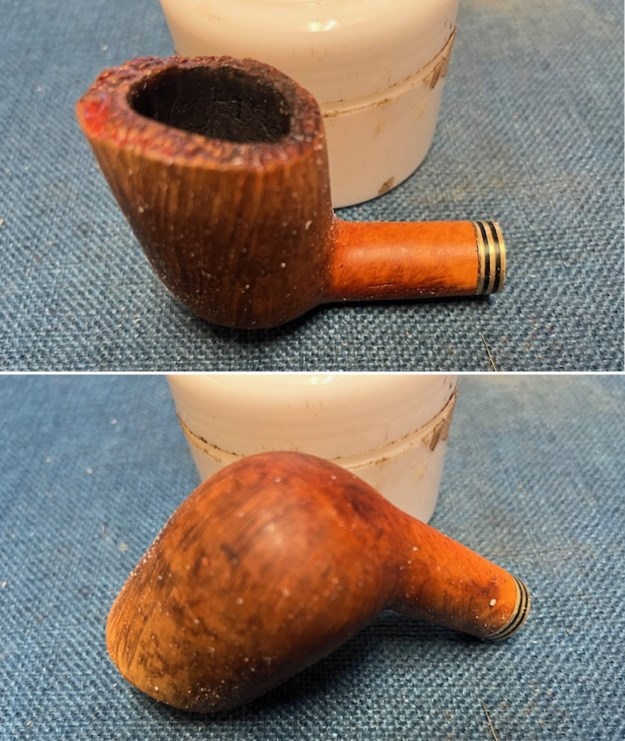
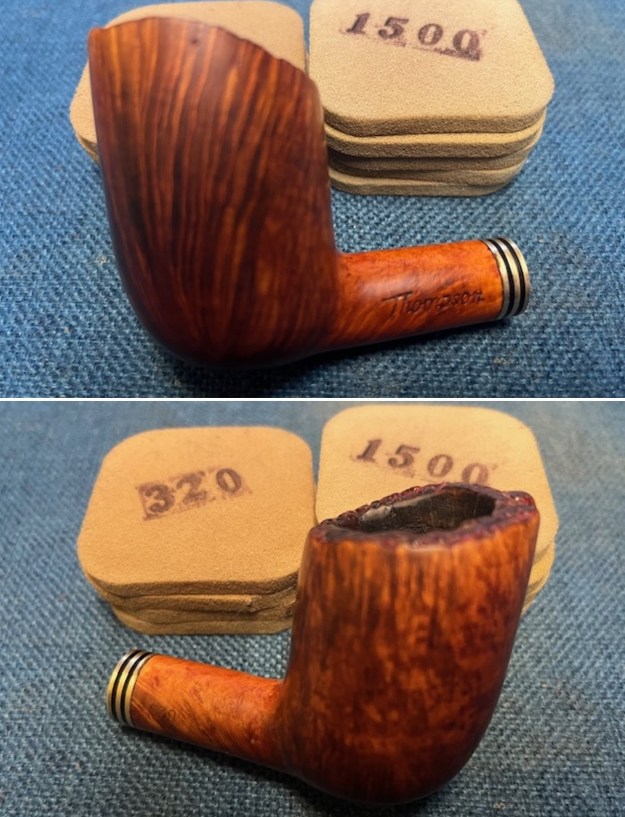
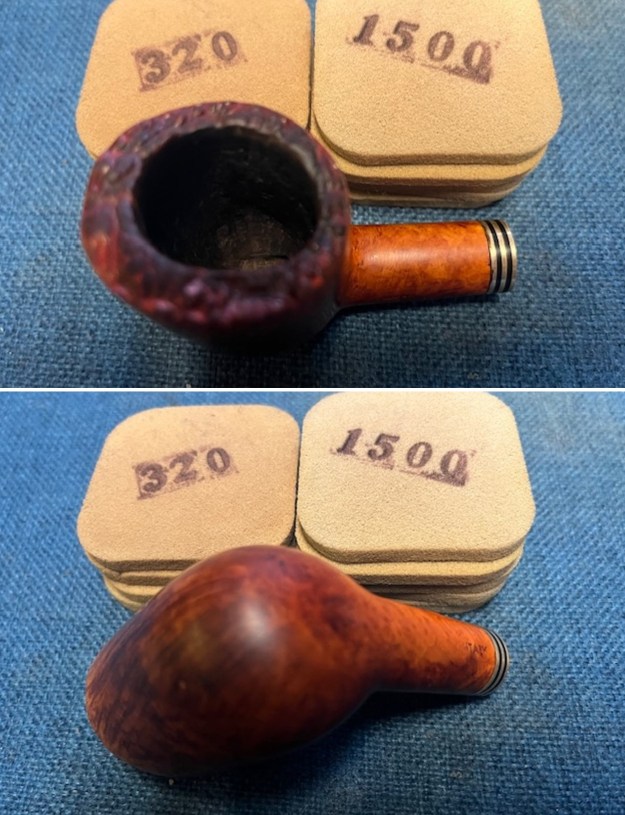
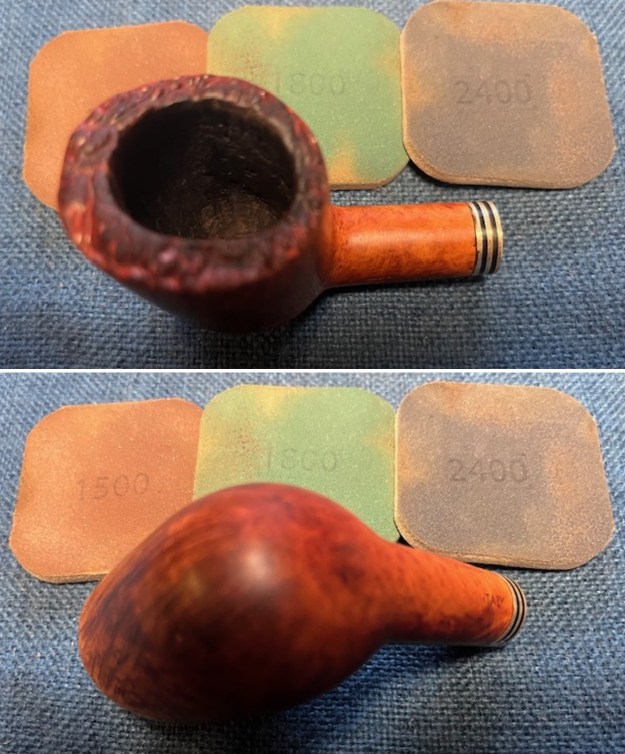
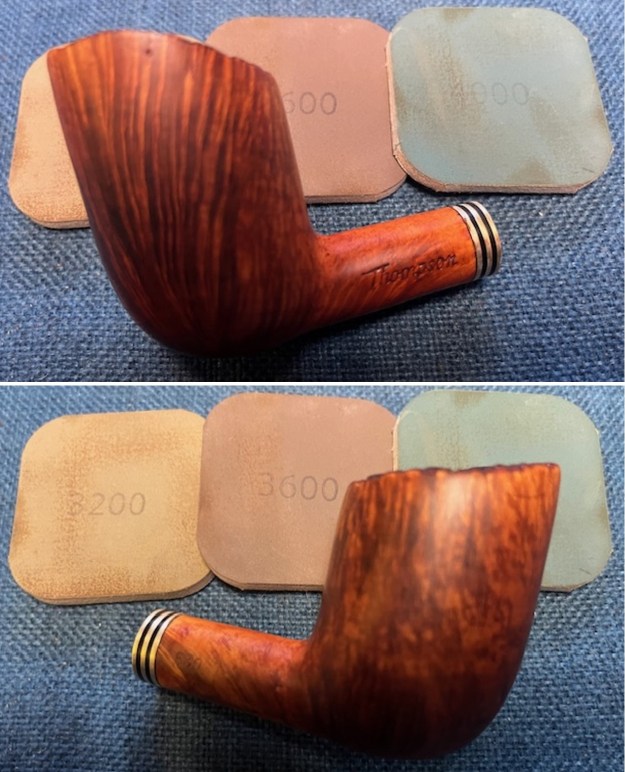
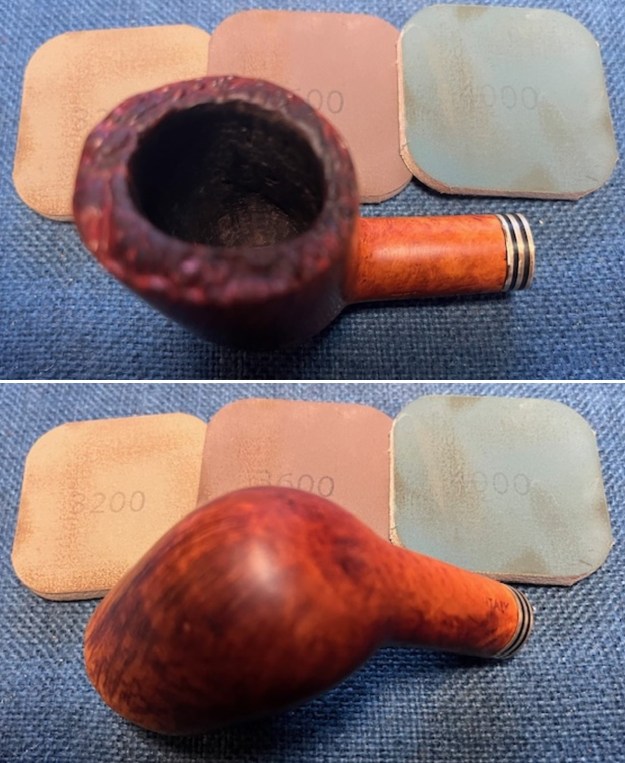
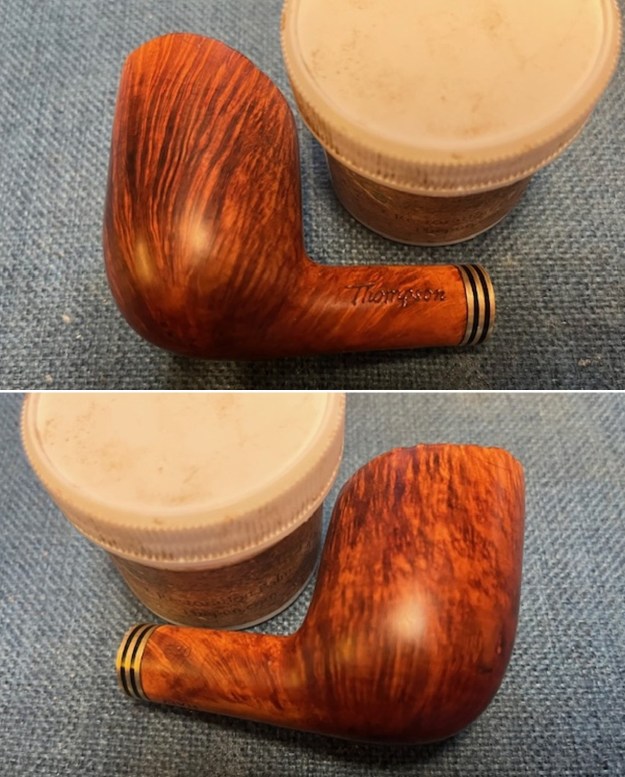
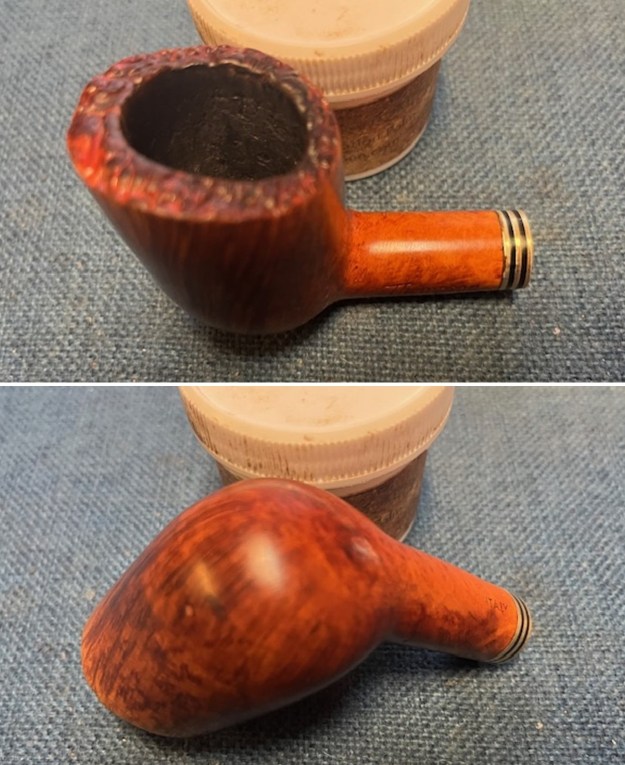
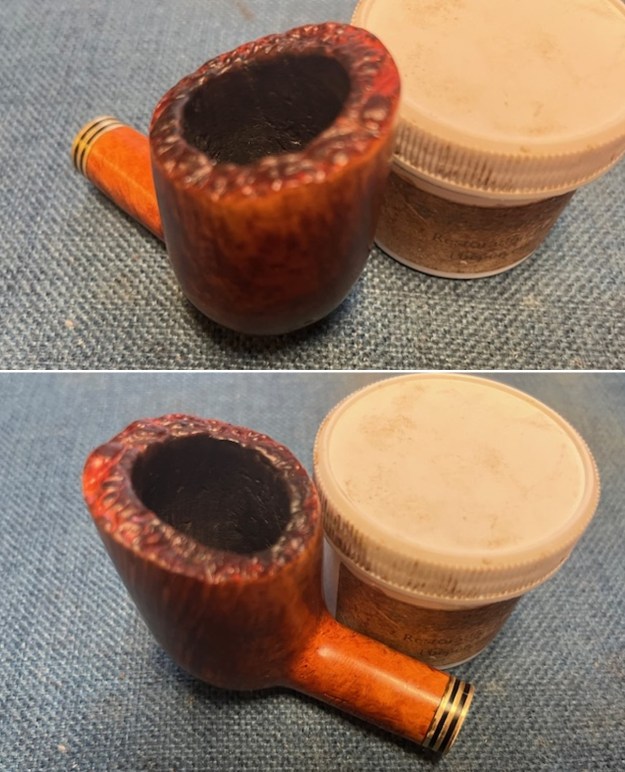
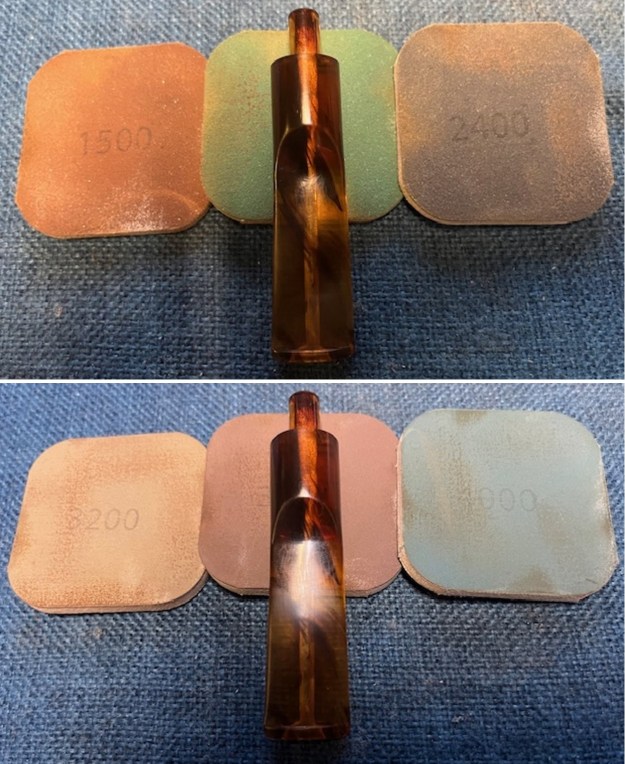
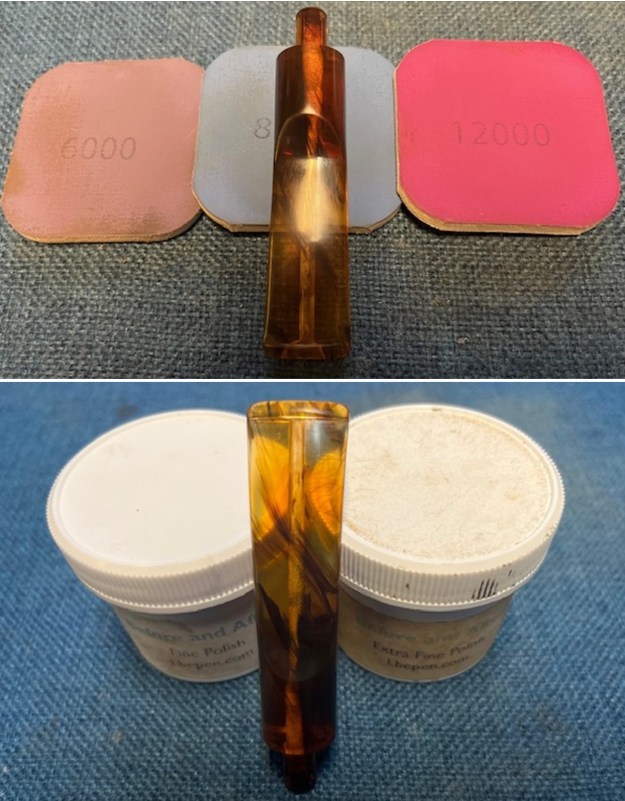
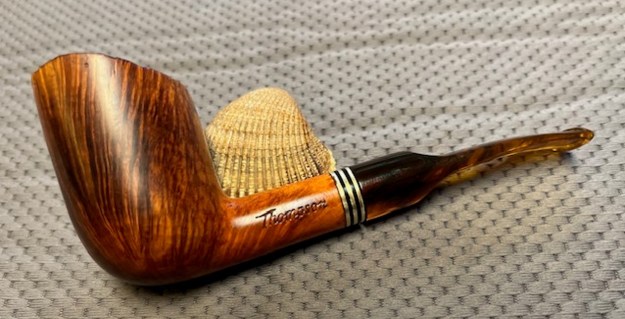
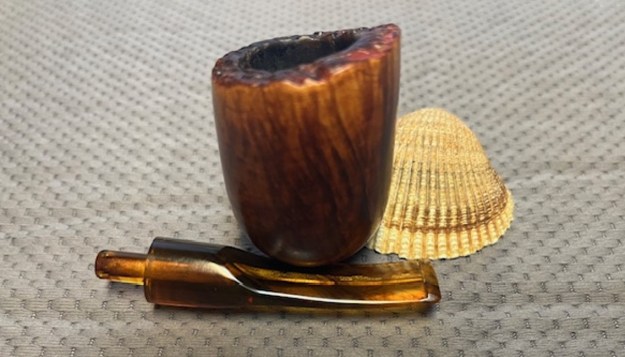
Jeff had cleaned up the pipe with his usual thoroughness. He reamed the pipe with a PipNet Pipe Reamer and cleaned up the remnants with a Savinelli Fitsall Pipe Knife.  He scrubbed the bowl with undiluted Murphy’s Oil Soap with a tooth brush. He rinsed it under running warm water to remove the soap and grime. He cleaned out the inside of the shank and the airway in the stem with alcohol, cotton swabs and pipe cleaners. He soaked the stem in Before & After Deoxidizer and rinsed it off with warm water. Somewhere along the way as it sat here it picked up some stickiness on the top of the stem that looks a lot like what is left behind by a gummed label. I took photos of the pipe 3 years later when I finally got around to working on it. As you can see it is another beautiful looking pipe. I took photos of the rim top and bowl as well as the stem to give a sense of the condition of both. The faux plateau rim top and the inner edge had some darkening and burn damage on the inner edge on the back of the bowl. The bowl is slightly oval and out of round. The stem was clean but had light tooth marks and chatter on the top and underside ahead of the button.I took photos of the stamping on the sides of the shank. They are clear and readable as noted above. I took the stem out of the shank and took a photo of the overall look of the pipe. It is another beauty. There are a few small dings from the journey of the pipe that will remain as a part of its story. The sides of the bowl had some darkening on the sides of the bowl caused by the oils from the hands. I scrubbed the walls down with acetone on cotton pads to remove the oils. It looked better but still showed some darkening. I was still not happy with the situation on the sides and rim top of the bowl. I scrubbed the briar with a tooth brush and some Before & After Briar Cleaner to remove more of the oils. I wiped off the cleaner with a paper towel and took some photos of the pipe at this point. I sanded the bowl with 320-3500 grit sanding pads to smooth out the finish and remove the scratches and small nicks in the finish. It looked much better once I had finished. I polished the briar with micromesh sanding pads – wet sanding with 1500-12000 grit pads. I wiped the bowl down after each pad with a damp cloth. I rubbed the bowl down with Before & After Restoration Balm. I worked it into the surface of the bowl sides and shank with my fingertips. The product works to clean, enliven and protect the briar. I let the balm sit for a little while and then buffed with a cotton cloth to raise the shine. I set the bowl aside and turned to work on the stem. I polished the stem with micromesh sanding pads – 1500-12000 grit pads. I wiped it down with Obsidian Oil after each sanding pad. I used Before & After Pipe Polish – both Fine and Extra Fine to further polish the stem. I gave it a final coat of Obsidian Oil and set it aside to dry. This Thompson 530 Italian Made Freehand is a nice looking pipe. The Medium Brown stain highlights some excellent grain around the bowl sides and the heel. The faux plateau on the rim top looked very good. The finish on the pipe is in excellent condition and the contrasting stains work well to highlight the grain on the pipe. The polished amber acrylic saddle stem adds to the mix. With the grime and debris gone from the finish and the bowl it is eye-catching. I put the stem back on the bowl and buffed the pipe with Blue Diamond on the buffing wheel. I gave the bowl and the stem multiple coats of carnauba wax on the buffing wheel and followed that by buffing it with a clean buffing pad. I hand buffed the pipe with a microfiber cloth to deepen the shine. The finished Thompson 530 Freehand is quite nice and feels great in the hand. Give the finished pipe a look in the photos below. The dimensions of the pipe are Length: 5 ¾ inches, Height: 2 inches, Outside diameter of the bowl: 1 ½ inches, Chamber diameter: 7/8 of an inch. The weight of the pipe is 1.76 ounces/50 grams. Thanks for walking through the restoration with me as I worked over another beautiful pipe. This pipe will be added to the Italian Pipe Makers Section of the rebornpipes store soon. If you want to add it to your collection send me an email or a message! Thanks for your time.