Tag Archives: Meerschaum pipes

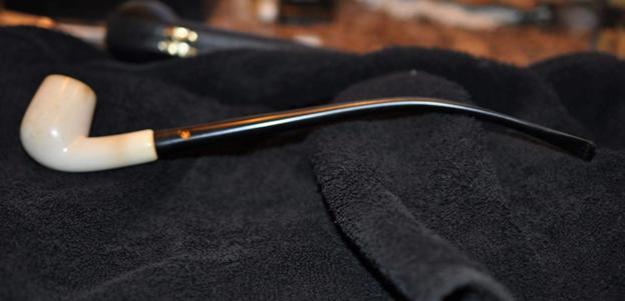
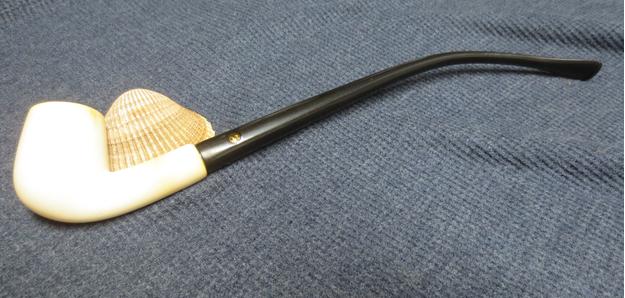
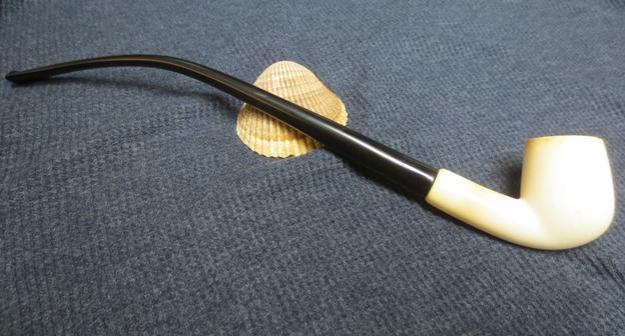
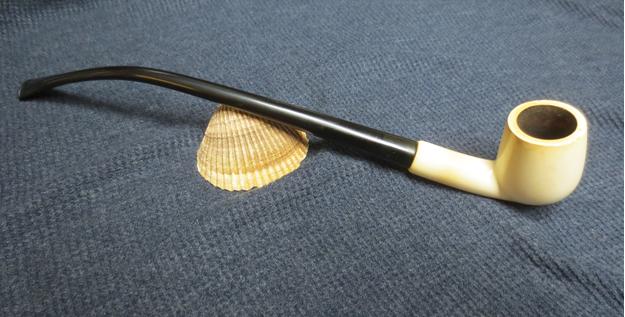
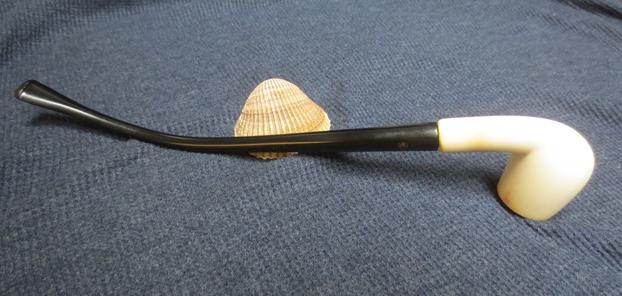
Cleaning a Turkish SMS Meerschaum Churchwarden


Blog by Steve Laug

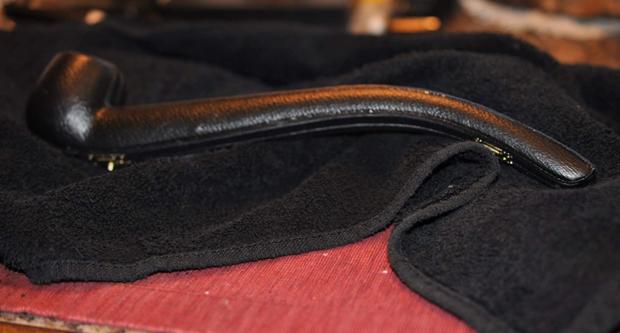
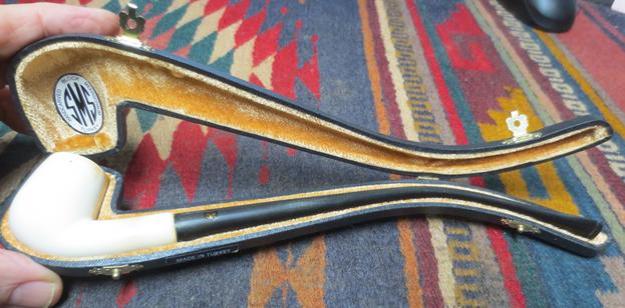
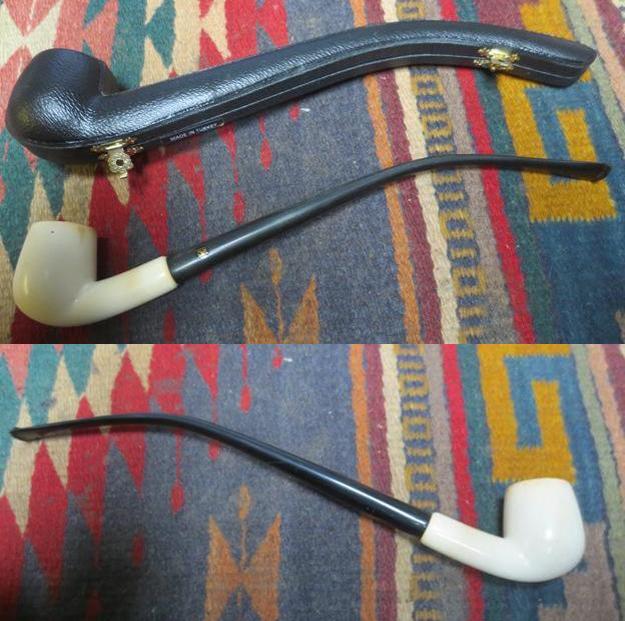
This long stemmed Meerschaum Churchwarden is another one of my brother’s finds at the estate sale in the Boise, Idaho area. He found the case sitting on the table of pipes and pipe racks and has been hunting long enough that I think he must have expected it to be empty when he picked it up to have a look.chu1Those of you who have gone pipe hunting enough know the rush that goes with opening an old leather covered pipe case like this and finding the Churchwarden that the case was made for still resident inside. There are a lot of empty pipe cases selling on eBay daily that give witness to the fact that the case and the pipe that should be inside often have parted company. In this case though when he opened the case I think he was surprised. I certainly was when he sent me a text with the photo. Inside was a smooth block meerschaum pipe with a long stem that was in relatively decent shape. The stem was intact and there were no large nicks or bumps on the bowl sides or shank. The stem aligned correctly with the shank and the whole thing appeared to be functional. These are the kinds of finds right up there with finding that illusive $10 Dunhill that keep me always looking inside cans, boxes and even pipe cases to see if something has been overlooked. You never know what kind of treasure might be hidden awaiting your discovery.

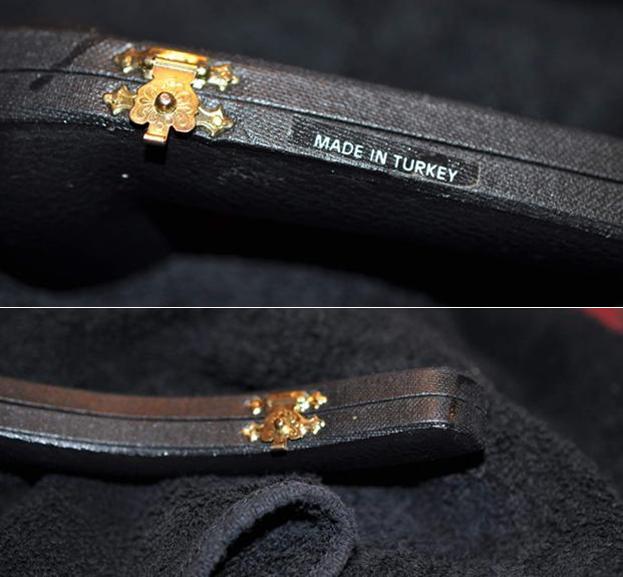
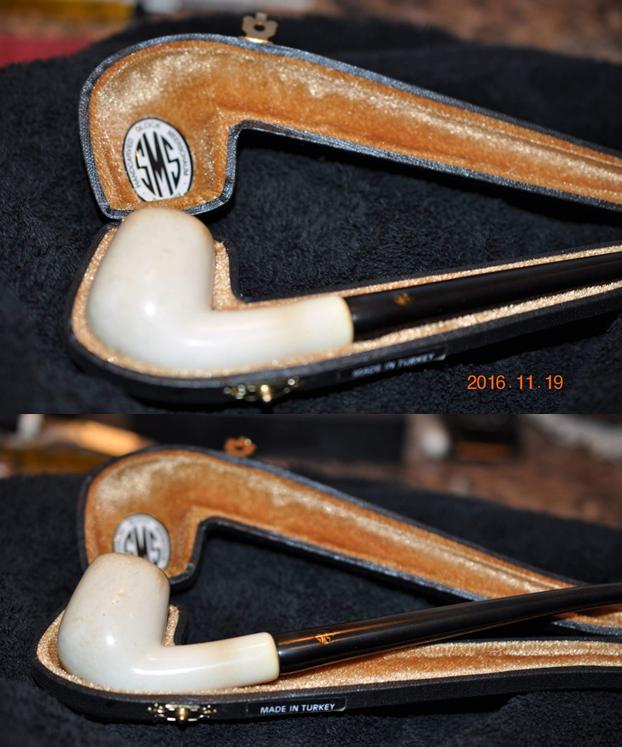
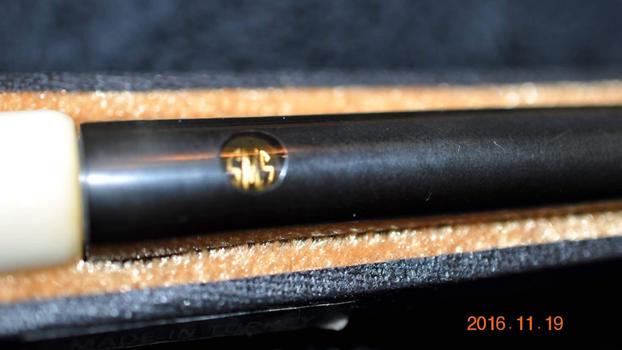
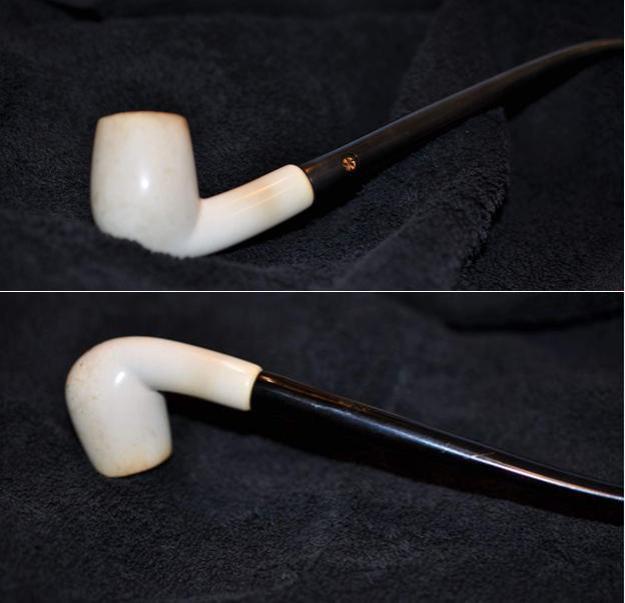
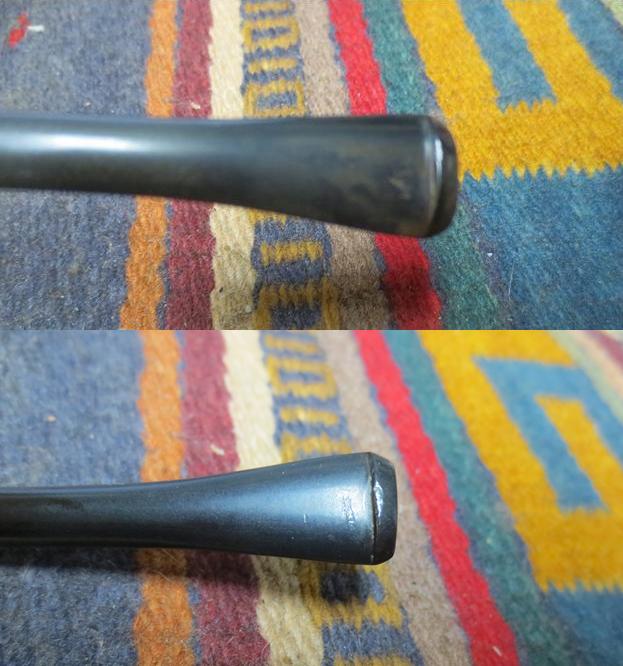
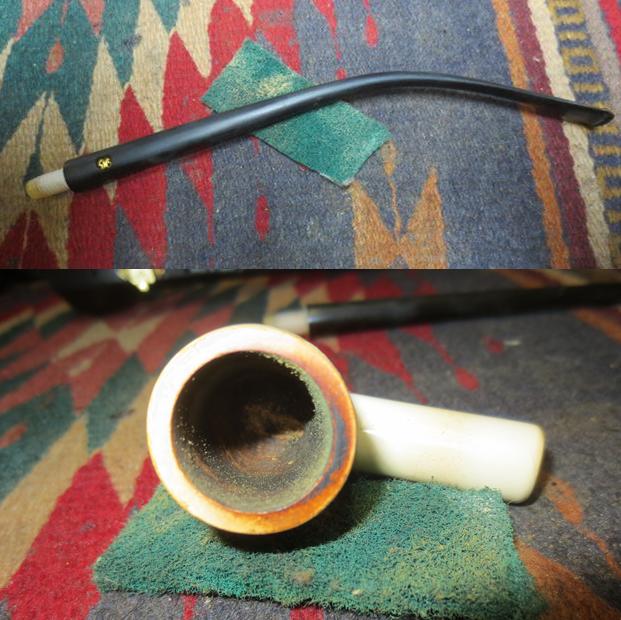
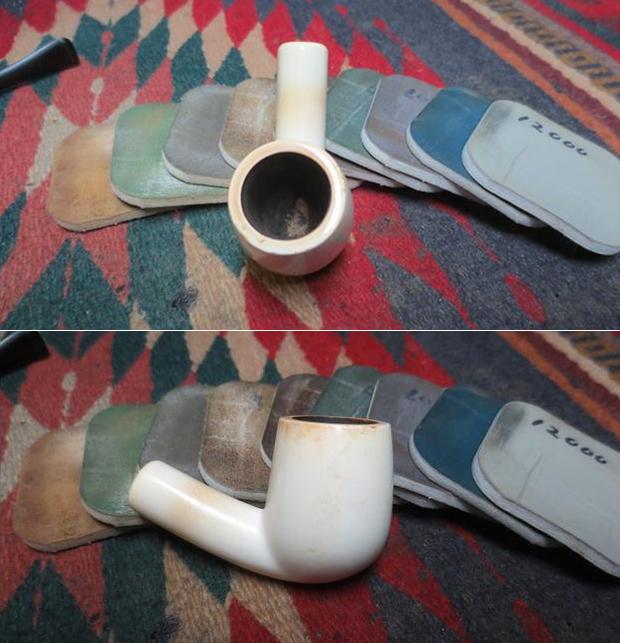
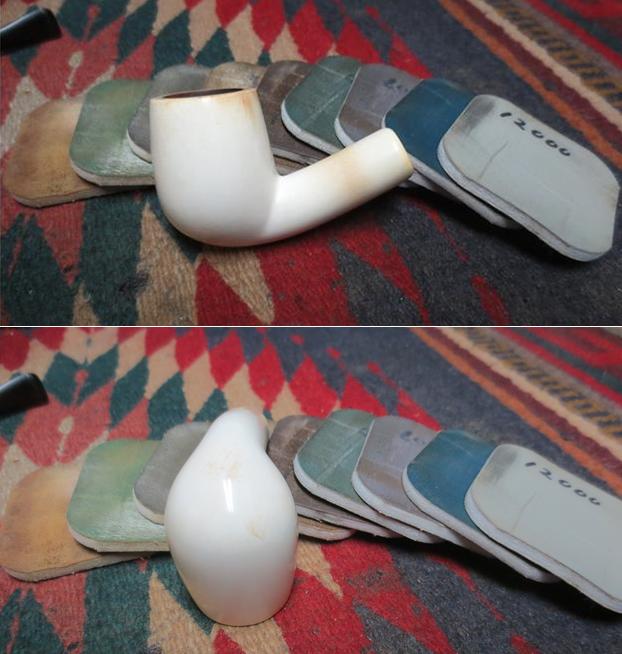
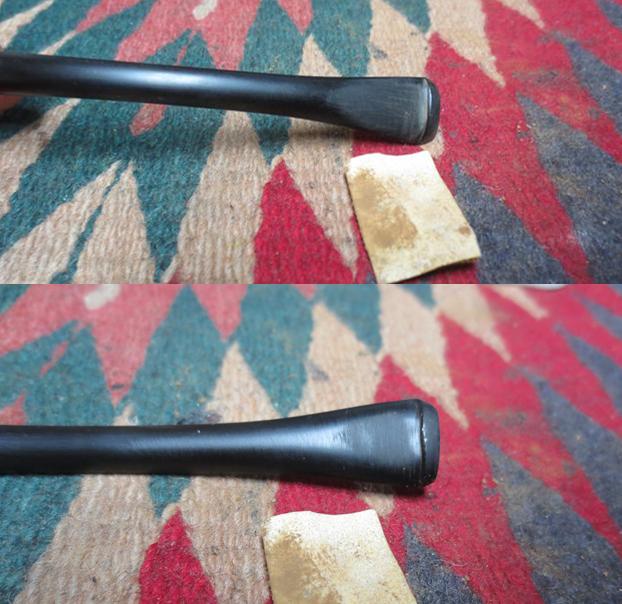
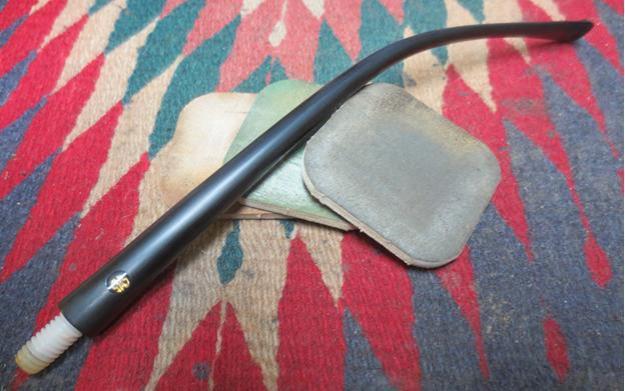
The next photos show what the pipe looked like when he found it and before he cleaned it up a bit to send my way. It is an elegant looking pipe in the photos and even more so in hand.chu2The leather (probably a leather like vinyl) covered case was in great shape. The exterior was not even worn. The polished brass hinges and clasps looked good with the shiny leather. The front of the case had two clasps and next to the left one is the tag reading Made in Turkey. On the back side there are two hinges that are hidden beneath the leather. Four small brass brads hold each hinge in place. The hinges are not sprung or damaged in any way.chu3My brother took a few photos of the pipe in the case to give an idea of what he saw when he opened the lid. The inside was lined with a rich golden coloured soft fabric that protected the meerschaum and held the pipe firmly in place. In the inside top cover there was the SMS logo that reads Handcarved Block Meerschaum Turkey around the stylised SMS. On the left side of the stem is the same logo inset in clear acrylic in the vulcanite.chu4 chu5He removed the pipe from the case and you can see the beauty and simplicity of the shape. The shank and the rim edge are starting show some colour with a faint brown hue.chu6He took some close up photos to show the condition of the rim. The bowl had a cake developing in it that went about half way down the bowl sides. The tars had darkened the rim on the back side and the outer edges of the rim had a few nicks and scratches. It would be interesting to see how much of this was surface damage once I had the pipe in hand in Vancouver.chu7He took photos of the underside of the bowl and the sides as well to show some of the spotty dirt and debris that were there. It was hard to tell from the photos if these were merely on the surface or had penetrated the surface and left scratches on the bowl sides and bottom. I would see once I had it in hand.chu8 chu9The stem appeared to be in pretty decent shape but the first inch on both sides of the stem at the button had some tooth marks, chatter and calcification. It appeared that the previous owner had smoked the pipe with a Softee Bit to protect the stem from his bite but even that had not kept all the tooth marks off the stem. Perhaps he or she had smoked it, seen the damage and put the rubber Softee on to protect it from further damage.chu10My brother did a great clean up on the stem and shank internals and cleaned out the cake in the bowl with his Savinelli Fitsall Knife. He had removed some of the tars and oils on the top of the bowl and scrubbed the exterior with a soft cloth and Murphy’s Oil Soap. When it arrived in Vancouver it looked far better than it had in the earlier photos. I took the next five photos to record my first look at the pipe as I opened the case and removed it from its nest.chu11 chu12 chu13I took some close up photos of the bowl, rim and stem to show what it looked like after my brother’s work on it. He had been able to get a lot of the tars and oils off the rim top and had cleaned the sides of the bowl. The second photo shows the SMS logo in acrylic on the left side. The stem showed some oxidation spots and a spot where obviously a label had been glued. He had been able to get the calcification off the stem at the button and also had managed to lift out some of the tooth chatter. The top edge of the button on both sides showed some wear.chu14 chu15I started cleaning the exterior of bowl and stem with a green nylon scrubber. It is a great tool that I learned the use of through Troy (one of the contributors to the blog). I scrubbed the exterior of the stem and was able to remove much of the oxidation. I also used it to scrub the rim. I wet the scrubber with tap water to help with the scrubbing and it did a great job on the rim and stem.chu16I continued to scrub the rim with the pad and then shifted to polishing the bowl and rim with micromesh sanding pads. I wet sanded the entirety of the pipe with 1500-2400 grit sanding pads and dry sanded it with 3200-12000 grit pads. The finished bowl and rim are shown in the next four photos. I was able to remove the tars and the scratches from the bowl and rim and leave behind a polished bowl that still maintained the patina that had begun to develop.chu17 chu18I ran a pipe cleaner with alcohol through the stem and the shank of the pipe and as usual my brother had done a thorough job removing the oils and tars from those places.chu19I sanded the tooth marks and chatter on both sides of the stem at the button with 220 grit sandpaper to remove the damaged areas. I was fortunate that none of the tooth marks were deep enough to warrant repairs. I removed all of them by sanding the stem.chu20I wet sanded the stem with 1500-2400 grit micromesh sanding pads and dry sanded it with 3200-12000 grit pads. I rubbed the stem down with Obsidian Oil after each set of three pads. After the final rub down I set the stem aside to dry.chu21 chu22 chu23I buffed the bowl and stem with Blue Diamond on the buffing wheel and gave the stem several coats of carnauba wax. I gave the bowl a few coats of Clapham’s Beeswax Polish (a white beeswax polish) and buffed bowl and stem with a clean buffing pad. I hand buffed the pipe with a microfibre cloth to put the final touches on it. The finished pipe is shown in the photos below. It really is a nicely made meerschaum and the fact that it is a Churchwarden is bonus. The weight of the pipe and the feel of it in the hand will make this pipe a winner. Thanks for looking.chu24 chu25 chu26 chu27 chu28 chu29 chu30 chu31 chu32

Replacing a push-tenon and mortise in a Meerschaum pipe


Blog by Steve Laug

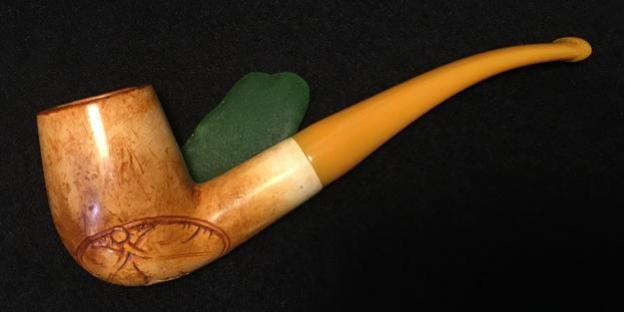
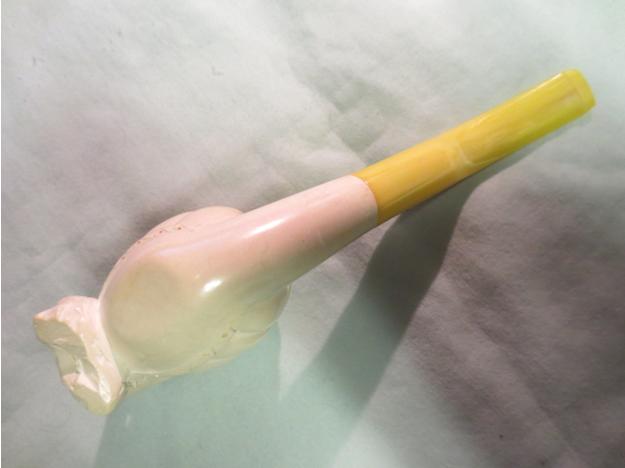
My brother, Jeff has been on a roll picking up some nice pipes that he gifted me. The first was the CAO meer that I reworked the stem and wrote about. The second was the Peterson Kildare 999 (one of my favourite shapes). The third one that I worked on was a no name meerschaum. It is a bent barrel shaped pipe with a stag running through the trees carved on the front of the bowl. The meerschaum is very heavy and dense in appearance so I am pretty certain it is a pressed meerschaum pipe. The stem is a bright yellow Lucite that actually shows better craftsmanship than the Lucite stem on the CAO meerschaum. The pipe came in a decent brown leather cover case with smooth fabric in the lid and a soft faux fur in the base. The hinge and the clasp were brass. The pipe fit well in the case. The photo below comes from the auction and gives a clear picture of the pipe as it was advertised.hunt1 The issue that I had to address with this one was that the mortise insert for the push stem connector was shattered in the shank. When I twisted the stem out of the shank a portion of the insert came with it. I looked into the mortise and I could see the cracks and breaks in the insert. It would need to be pulled.hunt2 The bowl of the pipe was pretty clean. The inside of the bowl was slightly darkened but looked like it had been smoked only a few times (if that). There was also some rim darkening that probably would clean up easily enough. Under a bright light it appeared that there was either a small crack or a scratch on the outer rim just above the ring on the barrel on the right side of the bowl. I checked the mark with a jeweler’s loupe and it appears to be a small hairline crack. I cannot feel it with my finger when I run it over the surface. There is a scratch below the band on the barrel as well, just below this. That particular line is not a crack but a scratch. That is the bad news and the good news regarding the crack. The shank was clean past the insert.

The stem had some oils and stain in the airway. There were light tooth marks and chatter on the underside of the stem next to the button. The slot was well cut in the end of the button and the interior of the Y was smoothly sanded. The button itself was well shaped. The stem did not align with the shank. Though they were both the same diameter, the airway in the shank was slightly off centre which made the right side of the stem extend past the edge of the shank while the left side was slightly smaller than the shank diameter at that point. I may need to do a bit of work on the right side to make it match the right side.

I removed the stem from the shank and wiggled the broken portion of the mortise insert that was stuck at the top of the push tenon in the stem free from the stem. I used a knife blade inserted in the shank to bite into the broken insert and twisted it free of the shank. It came out in three pieces that fell apart when they hit the table top.hunt3

hunt4 I have a few Delrin push tenons and inserts that I ordered for just such an occasion and took one out of the box where I have them. I cleaned up the edges and casting overage on the top cap. I sanded it to smooth out the Delrin fitting. I aligned the thread in the shank with those on the insert and screwed it into place in the shank. When I replace these I do not glue them in place in case they again disintegrate or crack. It will make a replacement much simpler for whoever has to work on the pipe next.hunt5

hunt6

hunt7 I unscrewed the push tenon from the stem so that I could clean out the area behind it. It was a cheap clear nylon that was discoloured and had some grooves cut in the surface from the fractured mortise insert pieces. I would replace it with the Delrin tenon counterpart once I cleaned out threads in the end of the shank and the airway in the stem. I used cotton swabs, pipe cleaners and alcohol to remove the staining and oils in the airway. The new Delrin tenon had a larger airway and gave a more open draw on the pipe. It will be a significant improvement to the smokability of the pipe. A small bonus was that once I replaced the tenon and put the pipe back together the stem aligned better with the shank. I lined up well enough that the only small overage in diameter of the stem is on the underside. Also a quick draw on the pipe once it was together confirmed the new more open draw. It looked like this quick repair gave some unexpected bonuses that were worth the little effort.hunt8

hunt9

hunt10

hunt11 I sanded the tooth chatter on the stem with 220 grit sandpaper and with a medium and fine grit sanding sponge. I wet sanded this area with 1500-2400 grit micromesh pads. I was able to remove all of the tooth chatter and polish the stem. The stem is clean and the finish has a shine. I scrubbed the top of the bowl with cotton pads and saliva to remove the tars and oils on the rim. A little elbow grease and the majority of the darkening came off.hunt12 I left the scratch on the side of the meer as I did not want to chance removing the top coat if the bowl was pressed meer.hunt13 I rubbed down the surface of the bowl and the rim with some white beeswax to protect the finish and to encourage colouration of the bowl. I let the wax dry and then hand buffed the pipe with a microfibre cloth. The finished pipe is shown in the photos below. It is polished, repaired and ready to be used.hunt14

hunt15

hunt16

hunt17

hunt18

hunt19

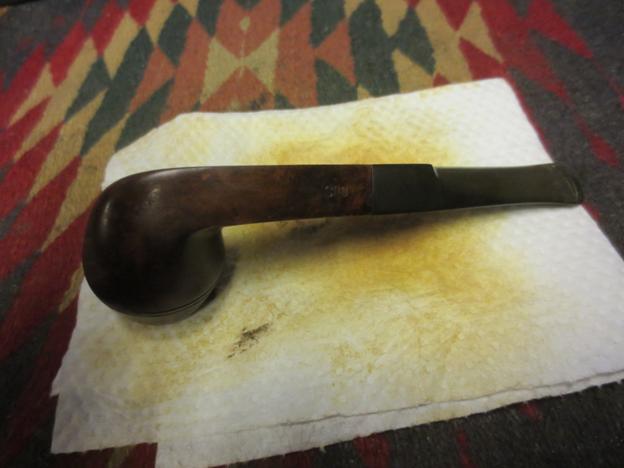
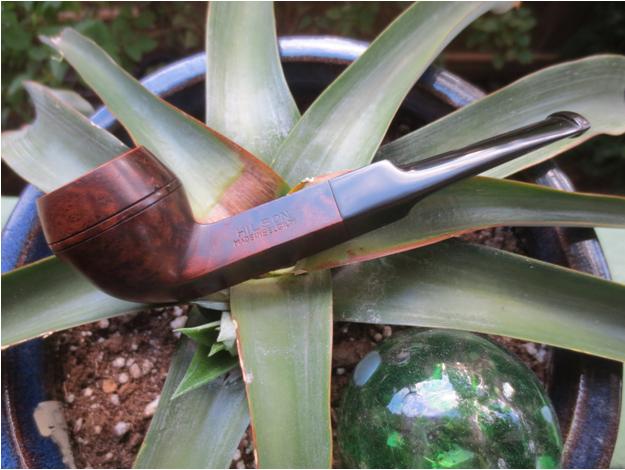
Cleaning up a Hilson Made in Belgium Meerlined Bulldog, Shape S60


Blog by Steve Laug

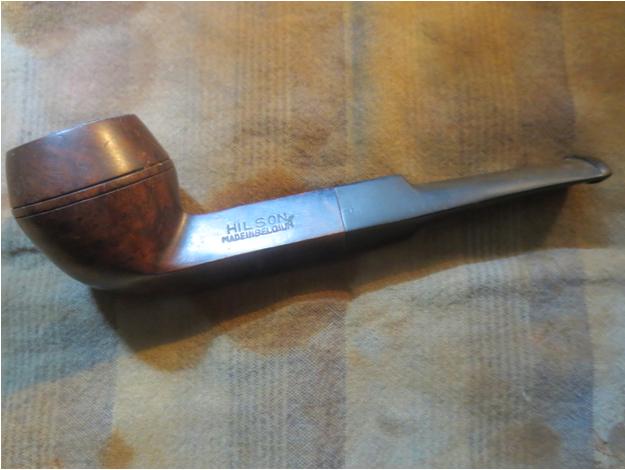
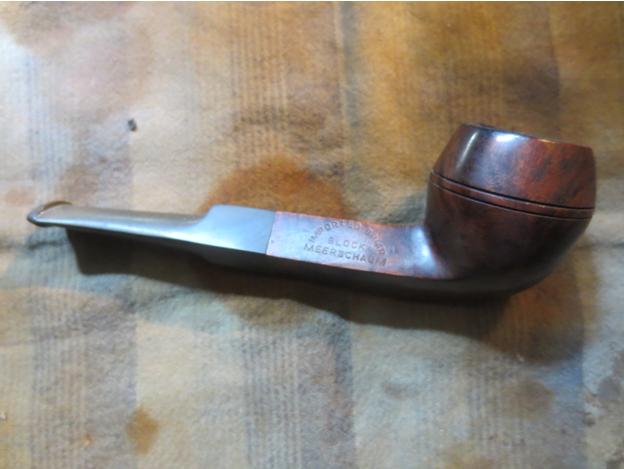
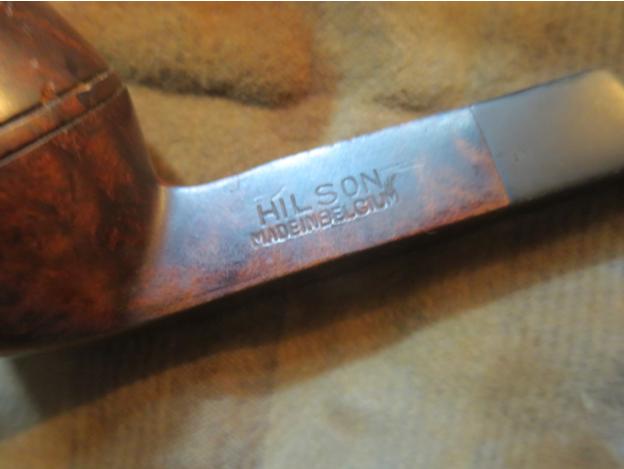
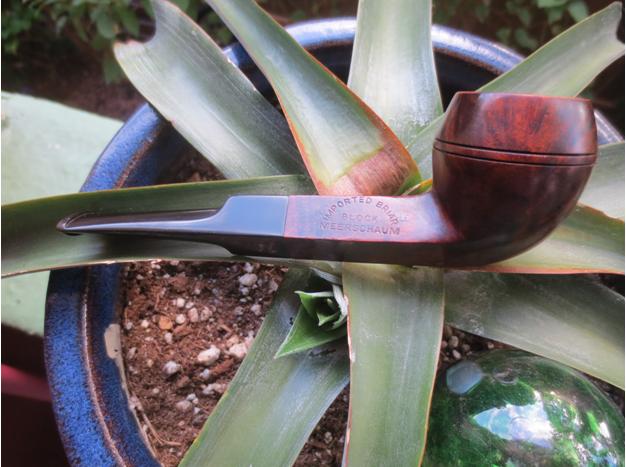
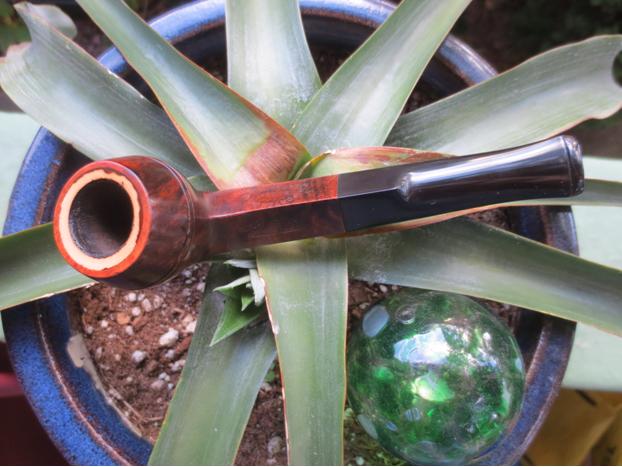
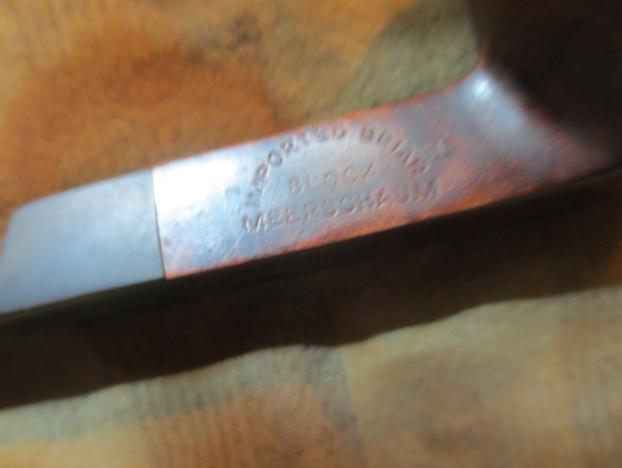
This is another pipe from the Idaho Falls antique mall. The funny thing is I went back another day to show my daughters some of the antique jewelry and did not think much of looking for more pipes as I had already cleaned out the ones I had an interest in. One of my daughters called me over to a display case where there was a pipe rest with a golden Cocker Spaniel on it. She thought it would be a great memory piece for me. I looked in the case and there on the bottom shelf was a pipe that I had not seen on the previous day. It was a nice straight Bulldog pipe. The bowl looked like it was a mess but the briar and stem looked to be in pretty good shape. I had the clerk pull it out and was surprised by the stamping on it. It read Hilson over Made in Belgium on the upper left side of the shank and Imported Briar in an arch over Block Meerschaum on the upper right side of the shank. There were some other letters underneath the arch that ran in a straight line but I could not read them without a lens. Of course I had to have the old pipe. I knew that it at least was made before Gubbels Pipe Factory in Holland bought out the Hilson brand in 1980 because of the Belgium stamping.Hilson1

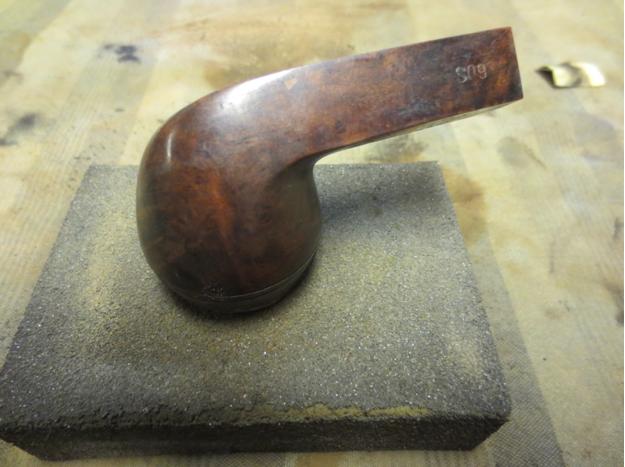
Hilson2 When I got home I looked at the shank under a bright light using a lens and could see more clearly some of the marks under the arch. The arch appeared to be over stamped and underneath on the left of arch it read S and the other letters faded out. On the right side of the arch it read TYLE. I am wondering if it originally read S60 (which is the shape number that has been more recently stamped on the underside of the right side of the shank) BLOCK STYLE in a straight line over MEERSCHAUM (the center and bottom words in and under the arch). If so then when it left Belgium and headed to the USA it must have been over stamped with the arched IMPORTED BRIAR which is stamped with a slightly smaller font. I also examined the stem and found that on the underside of the right side it had a small stamped M and what looked like part of an E. All of that will remain a bit of a mystery but it makes this old pipe interesting.

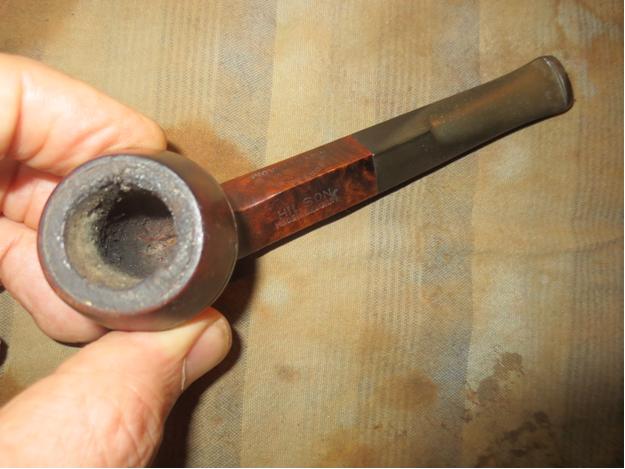
The briar portion of the pipe was in pretty decent shape. I was not sure about the briar on the rim as it was pretty covered with an overflow of tars that had come up out of the bowl and over the rim. The meerschaum bowl was invisible at this point in the process. It was somewhere inside the mess but how far down I was not sure. I had no idea of the thickness of the Hilson bowls in comparison with others. The other Hilson Meerlined pipe I had did not have the lining and the briar was very thin so I was thinking that this one would be like that. The finish was dirty on the rest of the bowl but did not have any damage. The briar looked pretty decent other than a few small fills on the underside of the shank. The stem was dirty and lightly oxidized. The pipe and the stem smelled awful! The bowl smelled like old cigarettes left in an ashtray in the rain. The stem smelled like old tires with a hint of sulfur. It would take a bit of work to clean up this one without damaging the meerlined bowl.Hilson3

Hilson4From a bit of research on the web I found that the company was originally started in 1846 by a German named Jean Knödgen who produced clay pipes in Belgium. According to a note on the Pipephil website it seems that in the late 19th century Jean Hillen married into the Knödgen family and later took over the company. He changed the company from a clay pipe producer to a factory able to manufacture briar pipes. Jean Hillen had 2 sons: Jos Hillen was responsible for sales and Albert Hillen was responsible for the production. After WWII his son Albert founded the HILSON brand which was a combination of Hillen and Son and exported his pipes all over the world. The brand did very well in the 1960s and 1970s and the brand was sold throughout Germany and Europe. In 1980 the company ran into financial difficulties and was bought by the Royal Dutch Pipe Factory owned and operated by Gubbels who still makes the Big Ben pipe.

Hilson meerschaum-lined briar pipes were manufactured in Belgium at the original Hilson factory in the 1970’s and used Block Meerschaum to make the inserts for their pipes. This was much better quality than most meerschaum lined pipes. Usually the lining was made of pressed meerschaum which was made from ground up meerschaum. Block Meerschaum is carved from the meerschaum as it is mined. High quality meerschaum pipes are always made from block meerschaum.

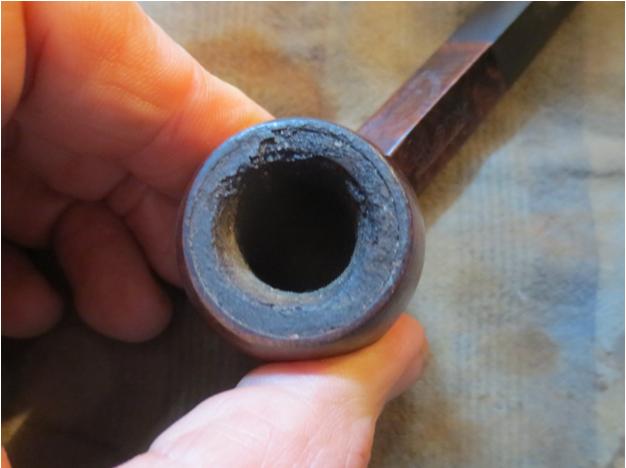
I took the next three close-up shots to give an idea of the state of the bowl when I started. There is a hint that it is a meerschaum lined bowl when you see the line on the edge of the bowl just inside of the briar. The thick coat of carbon built up on the rim and down into the bowl made it hard to see. I was glad that this was a block meerschaum insert rather than a compressed one because there was some hope that the bottom of the bowl had not begun to disintegrate of break up. The second and third photos below give an idea of the stamping on the shank of the pipe.Hilson5

Hilson6

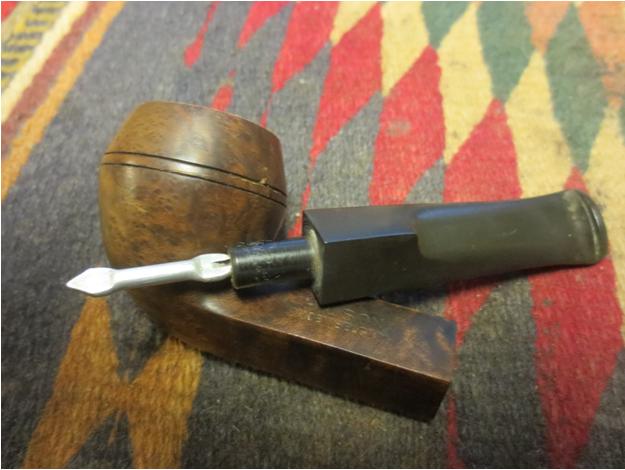
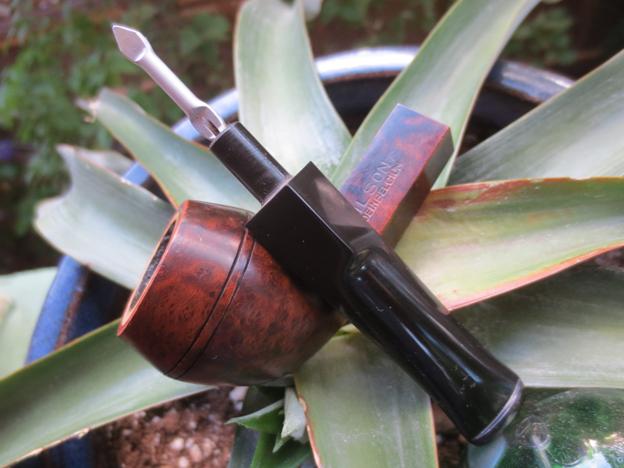
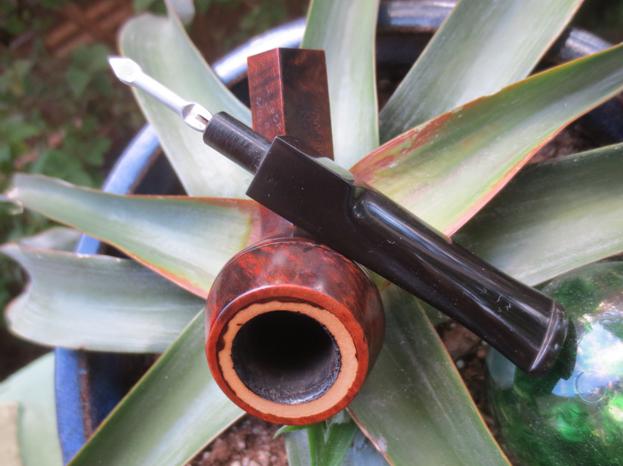
Hilson7 The next photo shows the stinger apparatus in the tenon of the pipe. Most of the other Hilson pipes that I have worked on have an inner tube extension rather than a tenon so this was a new one to me. It is also unique among the stingers that I have seen.Hilson8 I decided to top the bowl to remove all of the carbon build-up and see what was happening with the top of the meerschaum insert and the briar rim. I knew that the cake in this one was out of control but I wanted to see if I could see the original inner line before I dealt with the cake.Hilson9 The next photo shows the topped bowl. Once I had it topped I folded a piece of sandpaper and worked at the inner edge to remove the cake. I wrapped the sandpaper around my finger after the initial sanding and went as deeply into the bowl as I could reach. There was some staining around the back and right side of the meerschaum lining where it came in contact with the briar. I think some of the tars and oils wicked into the meerlining and stained it.Hilson10 The surface of the rim was scratched from the 220 grit sandpaper so I used a medium and a fit grit sanding block and cleaned up the rim.Hilson11 The next two photos show the rim and the bowl after reaming. I reamed what I could not reach with a sharp pen knife and removed all of the cake in the bowl.Hilson12

Hilson13 I removed the stinger from the tenon. I always twist the tenon rather than just pull it in case it is threaded. In this case it came out easily enough.Hilson14 I was going to use the retort to clean this pipe but thought better of it as I did not want to soften or damage the meer liner with the alcohol. So, I resorted to the old tried and true method of cotton swabs and alcohol to clean out the shank and wipe down the inside of the bowl. It took a lot of swabs to get the shank clean. The mortise ran the length of the shank to accommodate the long stinger.HIlson15 The stem took a lot less work. After just a few pipe cleaners and alcohol the pipe cleaners came out clear.Hilson16 I scrubbed the stinger with alcohol and 0000 steel wool to remove the tars that had stained the aluminum.Hilson17 I wiped down the bowl with alcohol on cotton pads and then took the following picture to show the state of the pipe thus far. It is going to be a beautiful pipe.Hilson18 I wiped the bowl and shank down with a light coat of olive oil to enliven the briar and bring out the grain. The birdseye grain on the sides of the bowl were stunning. It is hard to see with the freshly oiled bowl but in later photos it will stand out.Hilson19

Hilson20

Hilson21

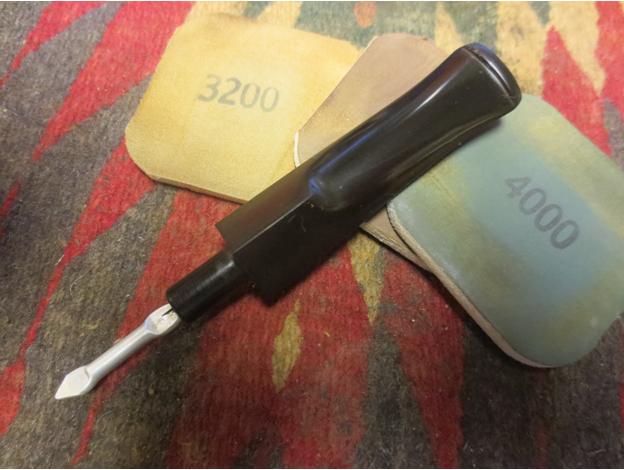
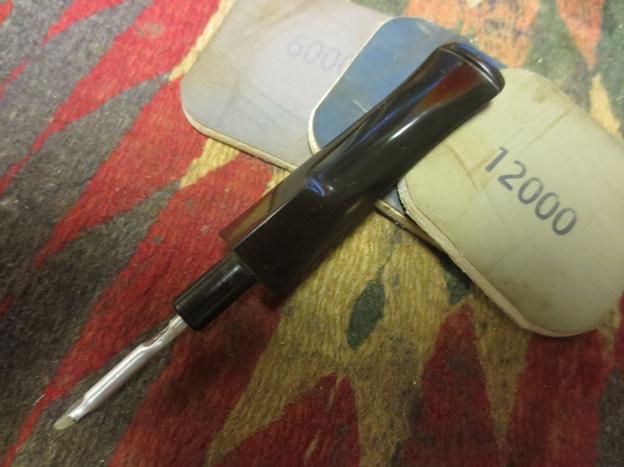
Hilson22 The stem was cleaned and ready to polish. I wet sanded it with 1500-2400 micromesh sanding pads and then gave it a coat of Obsidian Oil. Before the oil dried I dry sanded it with 3200-4000 grit pads and gave it another coat of oil and then sanded it with 6000-12000 grit pads to finish the shine. I gave it a final coat of Obsidian Oil and let it dry. Once dry I buffed it with White Diamond on the wheel.Hilson23

Hilson24

Hilson25 I buffed the finished pipe with Blue Diamond Polish on the wheel and then gave it multiple coats of carnauba wax. I buffed it with a clean flannel buff and then again by hand with a microfibre cloth to bring depth to the shine. The finished pipe is shown in the photos below. Other than the stain around the back and right side edge s of the meerschaum lining the pipe looks like new. It should offer many more years of service.Hilson26

Hilson27

Hilson28

Hilson29

Hilson30

Hilson31

Restoring an 1810 German Meerschaum Folk Art Pipe with a Story


Blog by Steve Laug

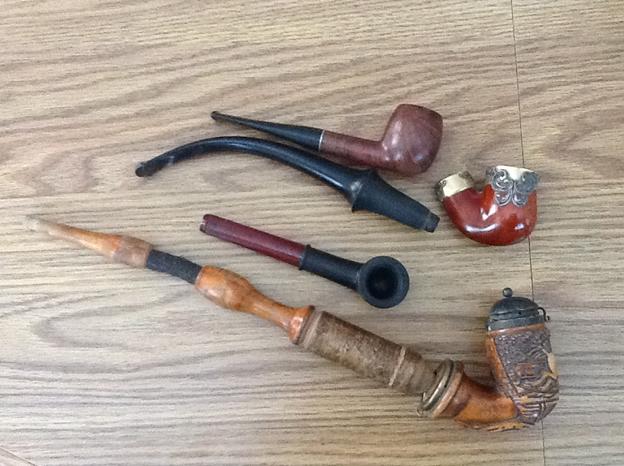
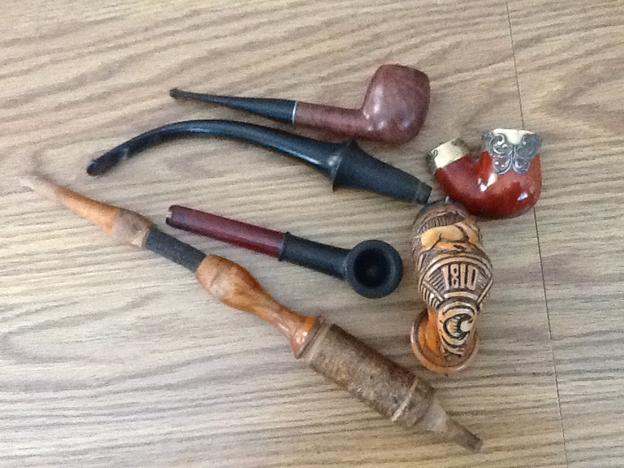
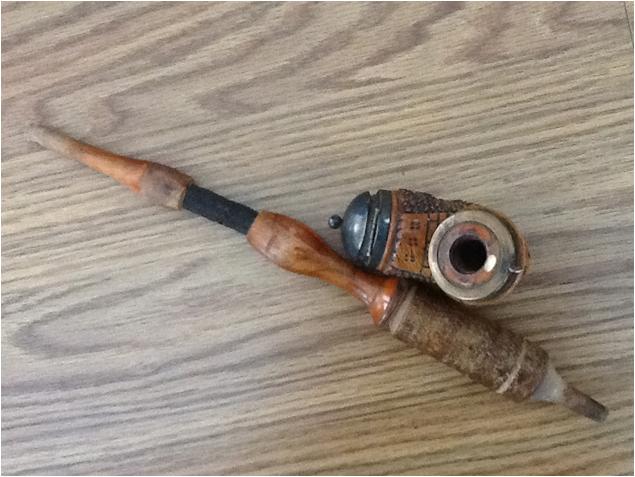
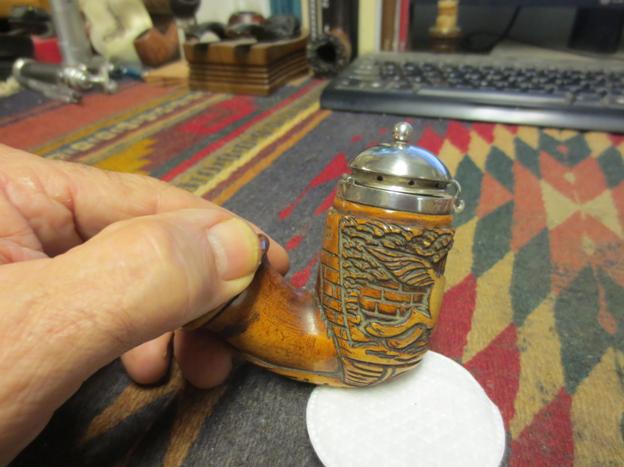
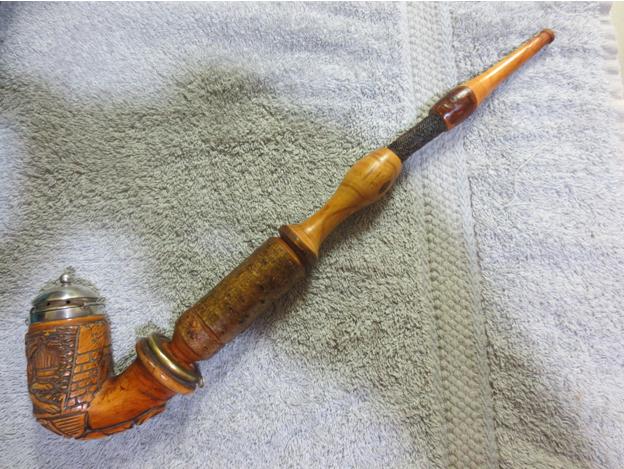
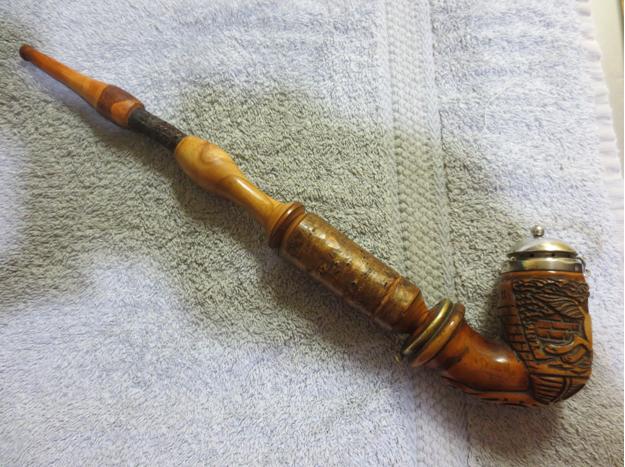
On Monday, June 29, 2015 after a weekend of celebrating with my parents and brothers in Idaho Falls, I went to visit one of my favourite pipe hunting haunts when I come to town. There weren’t any pipes on the three floors of the antique mall but before I left I asked the sales clerk if he had any pipes that somehow I had neglected to see. He said that there were not any on the floor but he had a few in a bag at home and if I would come back on Wednesday he would bring them with him and we could make a deal. Wednesday when I went back he had a bag of old pipes that are shown in the photo below. The top pipe is a Kaywoodie Apple with a three hole stinger. Tthe stem below it comes from a WDC Wellington but the pipe itself was missing. Next to it was an oval shank meerschaum with lots of bling on the shank and the bowl top. It had a broken tenon in the shank and would be an easy one to make a stem for. The third pipe down was a Bakelite stem and base but was missing the bowl. The bottom one was quite interesting to me. I had not seen one of these before intact. It was a meerschaum bowl with a wind cap and brass shank end. The stem itself was long with bark on the bottom portion and then hard wood ending with a woven hose and stem that was also wooden with bark on the portion next to the hose.Ger1

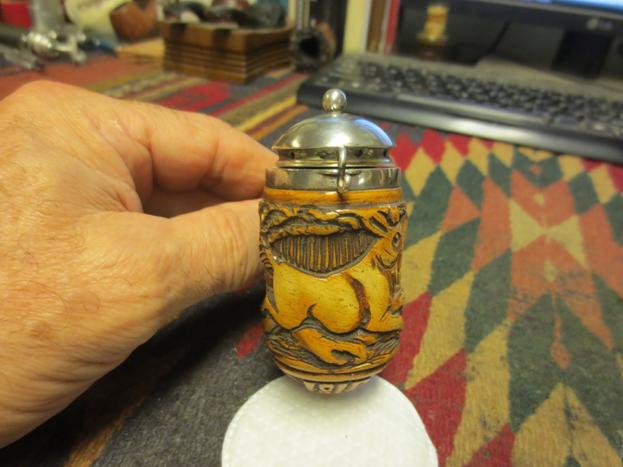
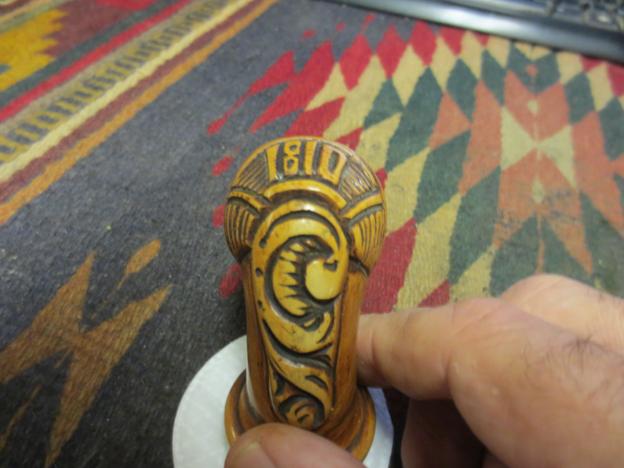
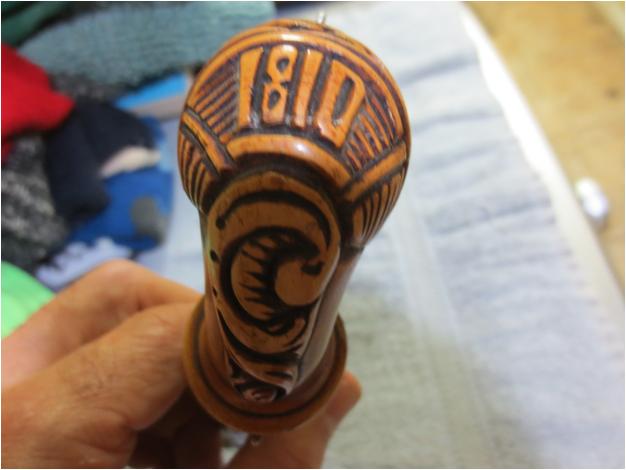
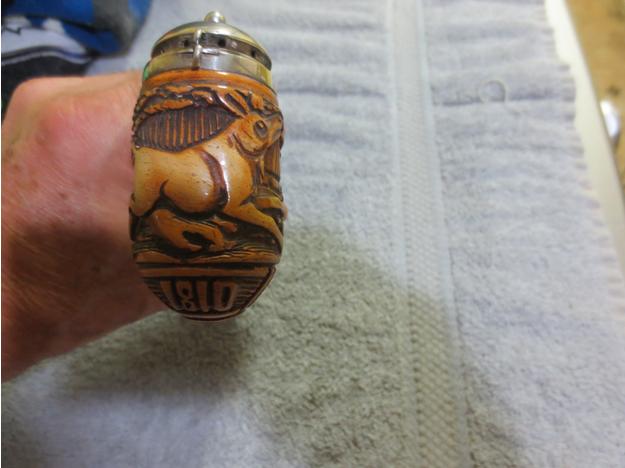
Ger2 I asked the sales clerk where the pipe had come from hoping that he would know the story behind this old meerschaum. It turned out that he knew a lot about the old pipe. I had belonged to his grandfather who was a German immigrant to Idaho Falls. The two meerschaum pipes were his. He had brought them with him when he came from Germany. He was brought over to be the beermeister for the Eagle Rock Brewery which only had a short life – 1896-1898. His own father (the sales clerk’s great grandfather) had purchased the pipes new in Germany and smoked them throughout his life. He had passed it on to his son, the brewmeister who smoked the pipe throughout his life even after the brewery closed. The sales clerk’s father had passed it on to him with the story of the pipe. The carved date on the pipe fits well with the four generations – 1810. I love these old stories behind the pipes I refurbish.Ger3

Ger4

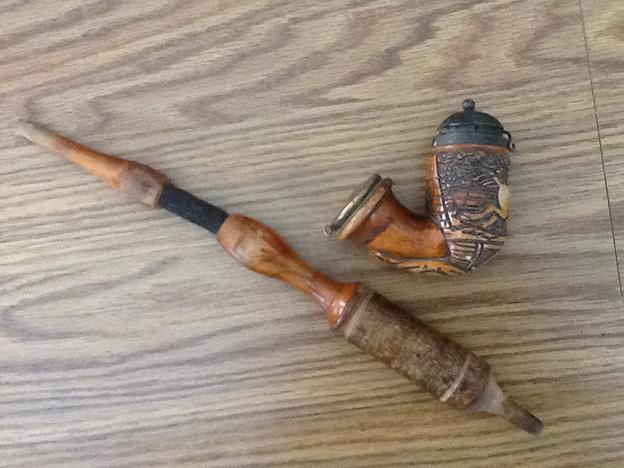
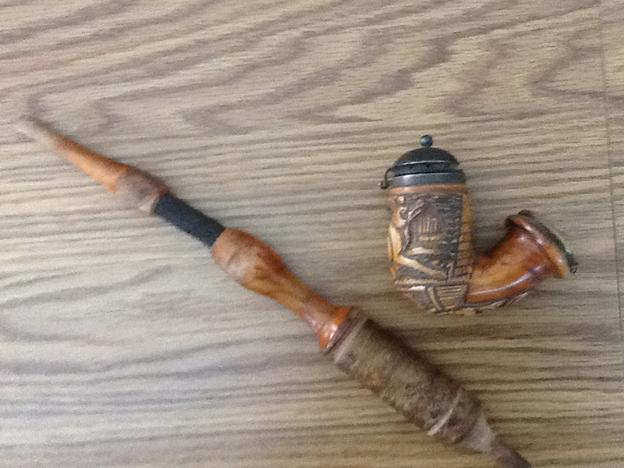
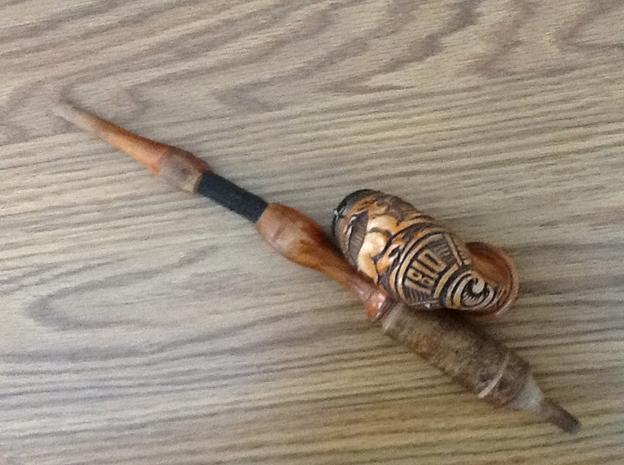
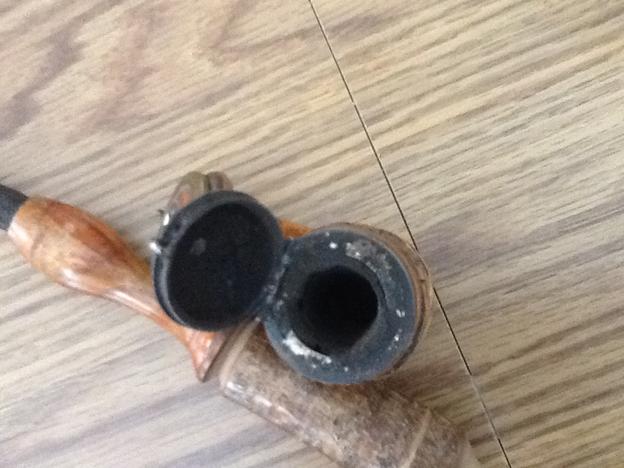
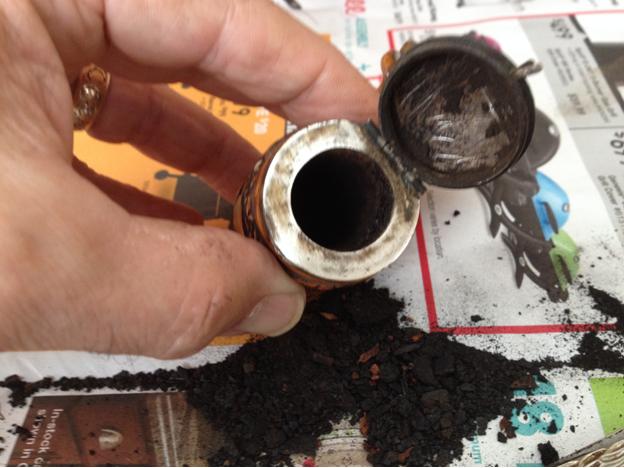
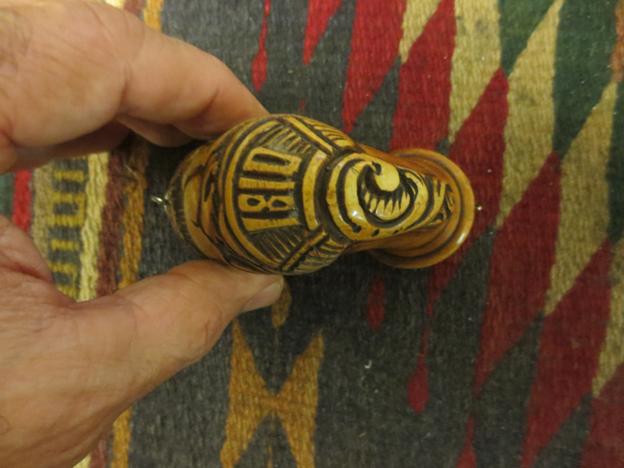
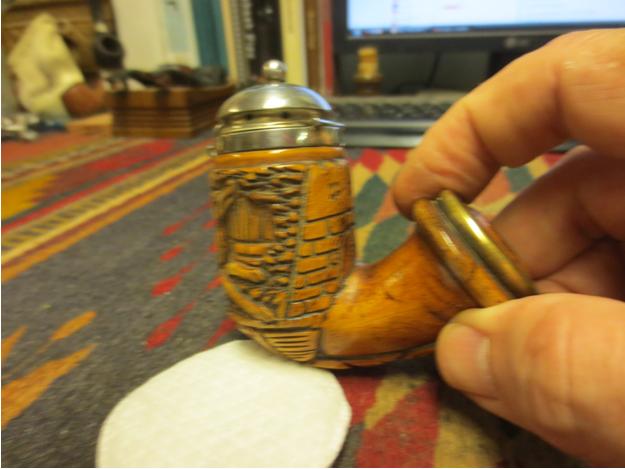
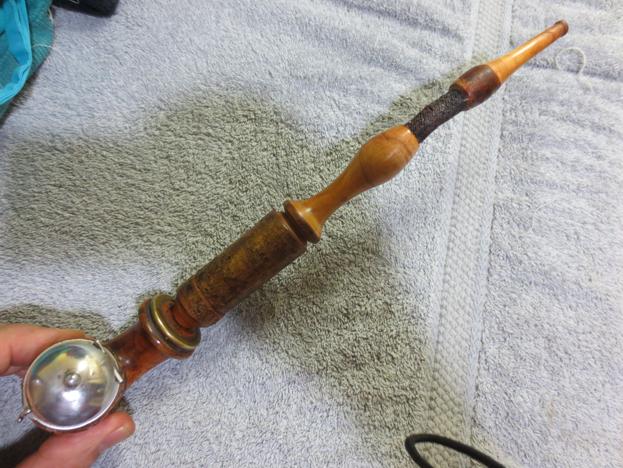
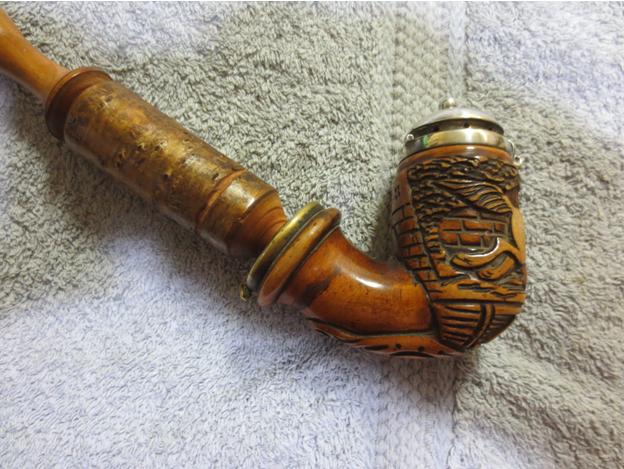
Ger5 The bowl had a few little nicks in the meerschaum but none were detracting. The meer had a nice patina that was all over the bowl and shank. The carving on the bowl was a dog set in a background of carved bricks and wood making up a wall. On the front underside of the bowl was carved the year 1810. Someone had rigged some brass wire around the stem and the ring on the shank to keep the stem inserted in the bowl but it was very loose. The stem portion was in great shape on the bottom part up through the hose. The hose itself was dried out and had some cracking in the surface. The top portion, the stem was dry but had been chewed and there were tooth marks in the surface.Ger6 The wind cap was badly oxidized and the top of the rim was oxidized and covered in thick tar. I was not sure if it was silver or brass under the black of the oxidation. The inside of the cap had a heavy tar buildup that was like rock. There was a very thick cake that went to the bottom of the bowl and there was some unburned tobacco in the bottom 1/3 of the bowl. It was a bit of a mess and would take some work to bring it back to life and usability.Ger7

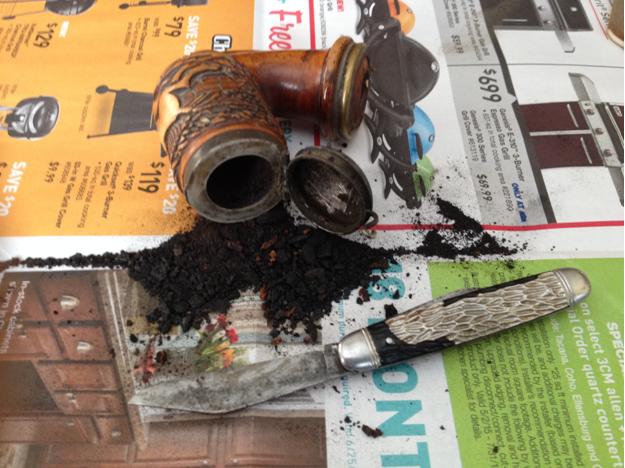
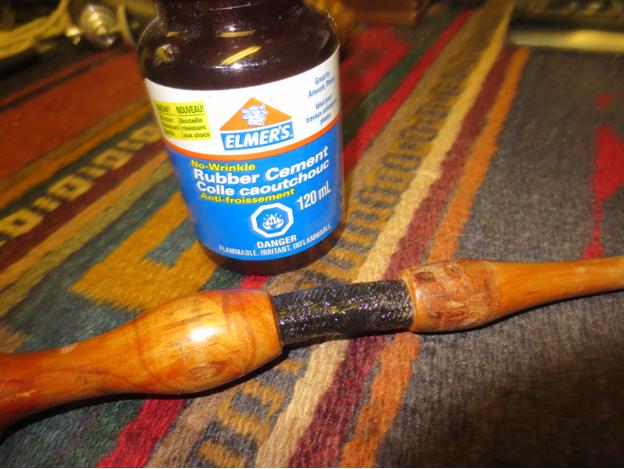
Ger8 I paid the clerk $40 for the lot and headed home to my parents. I put newspaper on the kitchen table and went to work cleaning up the bowl. I did not have a reamer with me so I used a sharp knife with a short rounded blade to ream out the carbon/cake in the bowl. I took it back to the meerschaum walls so that there was no cake left.Ger9 I scraped as much of the buildup on the inside of the wind cap and the rim as was possible with the tools that I had with me.Ger10 I put the pipe away carefully in my bag to be carried back to Vancouver. When I got home I worked some more on the pipe. I started by working on the hose portion of the stem. I gave it a thick coat of rubber cement to fill in the cracks and to provided the flexibility that was originally present when the pipe was made.Ger11

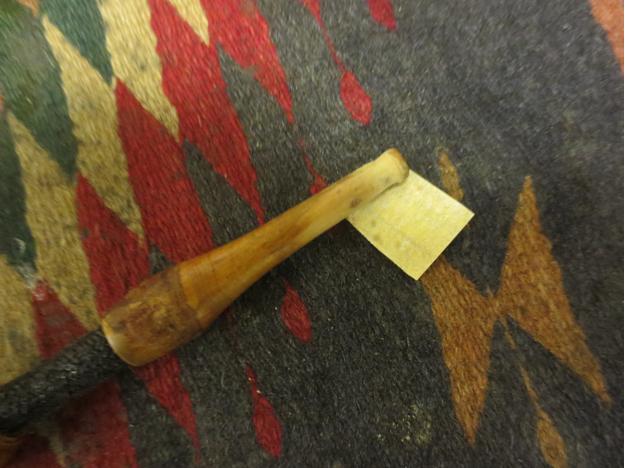
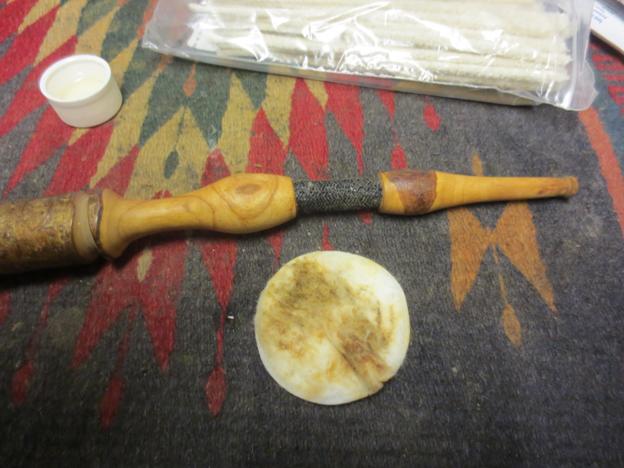
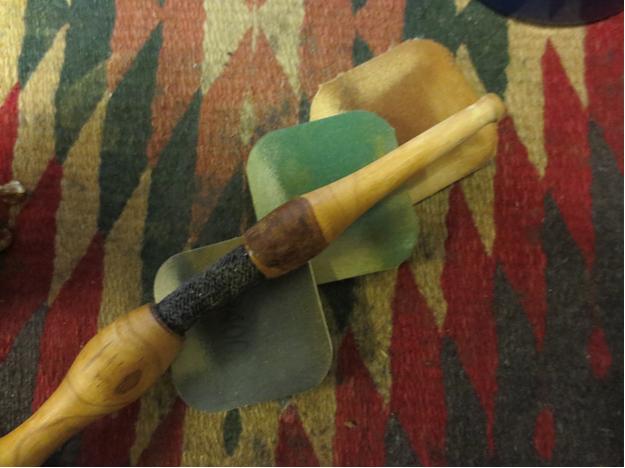
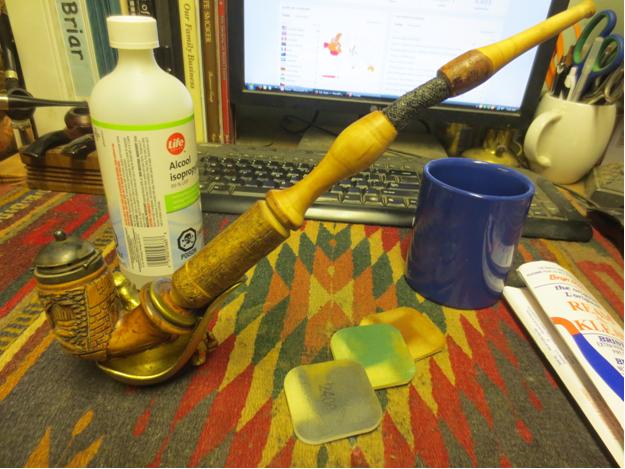
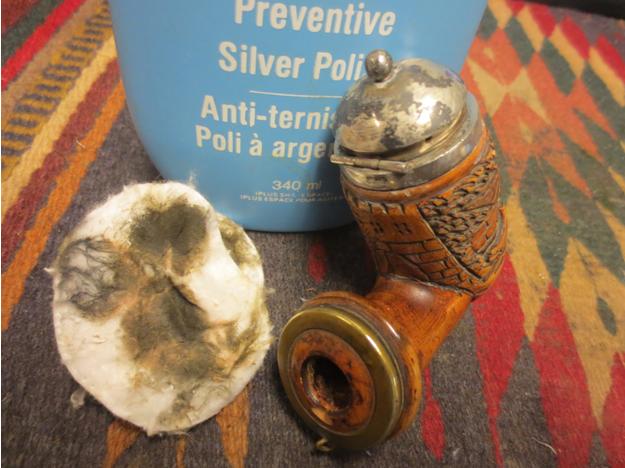
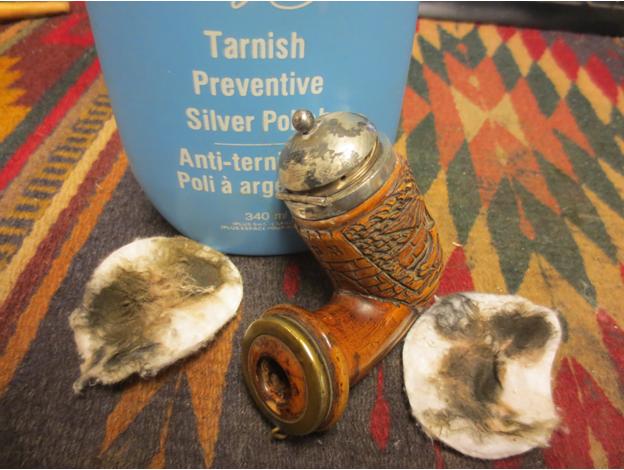
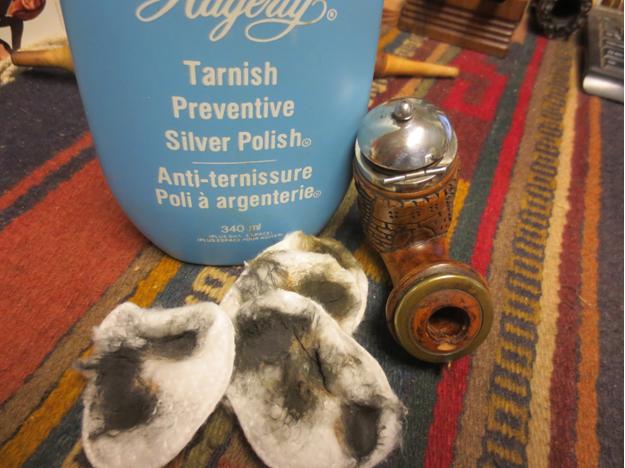
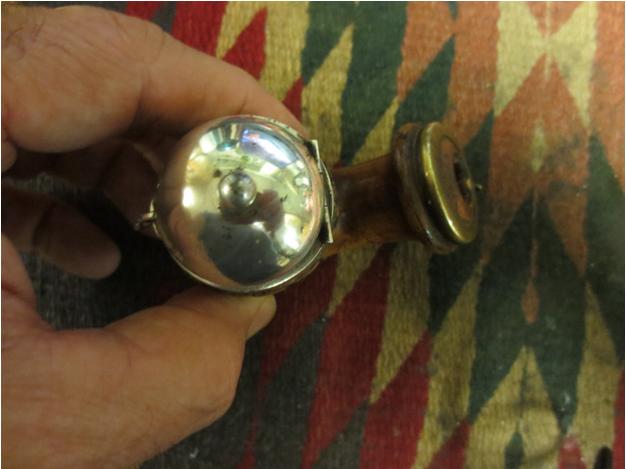
Ger12 I sanded the bit portion of the stem with 220 grit sandpaper to remove the tooth damage and reshape the button.Ger13 I cleaned out the inside of the shank and stem with pipe cleaners, cotton swabs and isopropyl alcohol until they came out clean. I used the brown tarred pipe cleaners to touch up the nicks on the bowl and shank.Ger14 The entire stem had a coat of varnish on it that was peeling on the centre portion. I wiped down the entirety with acetone on a cotton swab to remove the varnish coat.Ger15 I sanded the stem with 1500-2400 grit micromesh pads to smooth out the wood and minimize the tooth damage.Ger16 I removed the brass wire that held the stem to the shank and cleaned out the groove that had been carved in the bark of the lower portion. I put it in a pipe rest and took the next photo to show the look of the pipe at this point in the clean up process.Ger17 I scrubbed the wind cap with silver polish tarnish remover until the silver below all the black began to shine. The next photos show the silver beginning to shine through with each successive cotton pad.Ger18

Ger19

Ger20 I took the next set of photos to show the look of the bowl and cap after polishing the silver.Ger21

Ger22

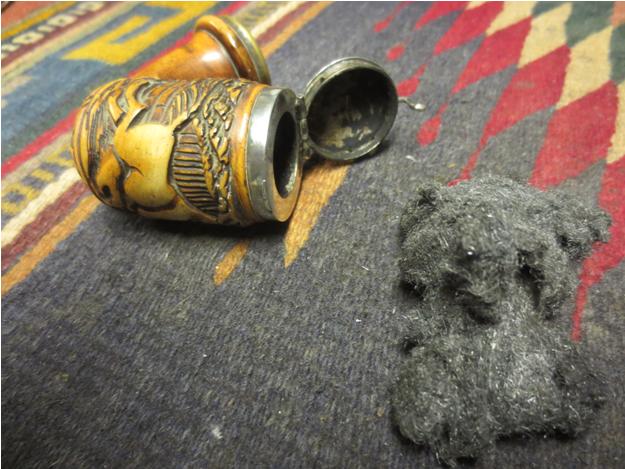
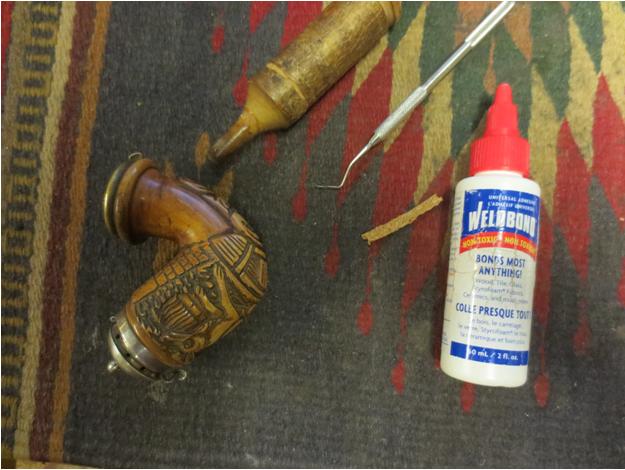
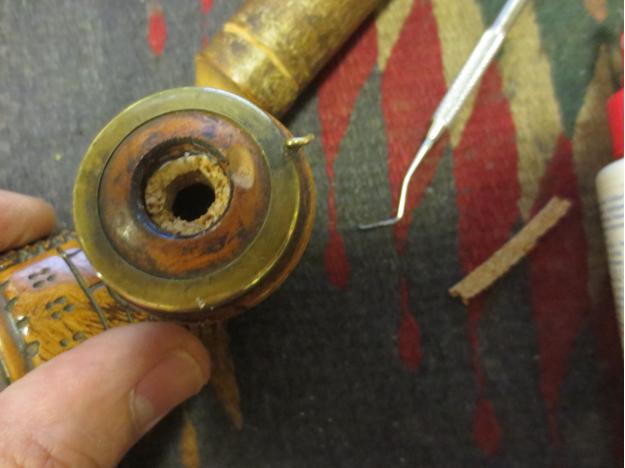
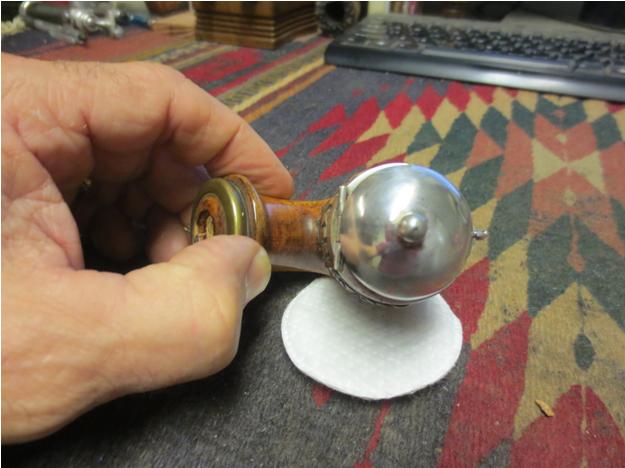
Ger23 I used 0000 steel wool to clean up the inside of the wind cap. The tar was thick and some of the silver had deteriorated. I was able to smooth out the surface of the inside of the cap but it left some dark areas on the cap.Ger24 The tenon end of the stem was very loose in the shank and needed a little creativity to make a snug fit. As I looked at the inside of the shank it appeared that it had originally had some sort of gasket that was glued to the inside of the mortise. I cut a small strip of cork to fit in this area of the shank. I cleaned out the shank with alcohol and then coated the outside of the cork piece with white glue. I used a dental pipe with a flat spatula end to press it into the shank. When the glue on the cork dried I inserted the stem to have a look at the finished fit. It was perfect.Ger25

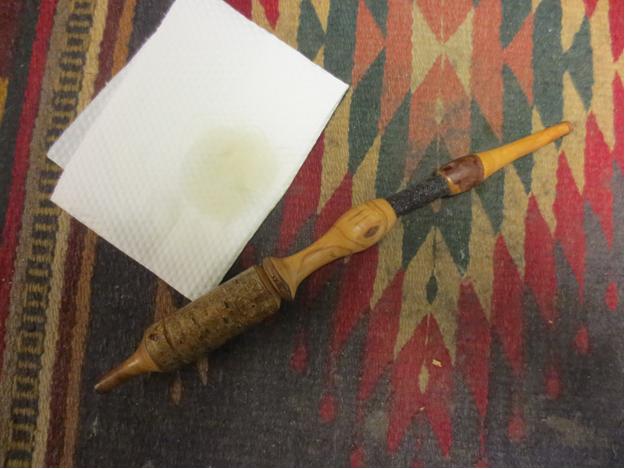
Ger26 I rubbed down the long stem with a light coat of olive oil to bring more life to it. I stained the long stem with some Danish Oil and cherry stain to protect the wood.Ger27

Ger28 I rubbed the silver cap and rim with a silver polishing cloth to give it a final polish. It really combines nicely with the brass ring around the end of the shank and sets off the darkening meerschaum bowl.Ger29

Ger30

Ger31

Ger32

Ger33 I hand buffed the stem and bowl with a microfibre cloth to raise a shine and polish it a final time. The finished pipe is shown in the photos below. It turned out far better than I had expected when I picked it up at the antique mall.Ger34

Ger35

Ger36

Ger37

Ger38

Ger39

Ger40

Ger41

Ger42Addendum

One of the readers of the blog just sent me this information regarding this pipe. It is much appreciated and answer questions that remained for me when I finished the restoration. Thanks Brad.

Regarding your post on the 1810 German Meerschaum pipe…

I’ve got a similar pipe and have been doing research on it. Mine has “1815” and has a portrait of the Duke of Wellington on it, likely commemorating the Battle of Waterloo. It has a horn mouthpiece with copper and mother of pearl inlay on the stem. While mine is missing a wind cap which would have the makers mark, it is very similar in look.

I’ve found through endless searching that these pipes are likely related to Josef Klinkosch, an Austrian metalsmith that worked from 1822-1888. If you google his name you will see similar work. There are similar pipes that have been sold through Gros & Delettrez online.

Since I finally found my answer, I figured I’d share it with you.

Refurbishing a Barely Smoked Smooth White Turkish Meerschaum Dublin – Robert M. Boughton


Guest Blog by Robert M. Boughton
Member, North American Society of Pipe Collectors
http://www.naspc.org
http://www.roadrunnerpipes.com
http://about.me/boughtonrobert
Photos © the Author

“If it ain’tbroke, don’t fix it.”
—Thomas Bertram Lance (1931-2013), Director of the Office of Management and Budget during the Jimmy Carter Administration

INTRODUCTION
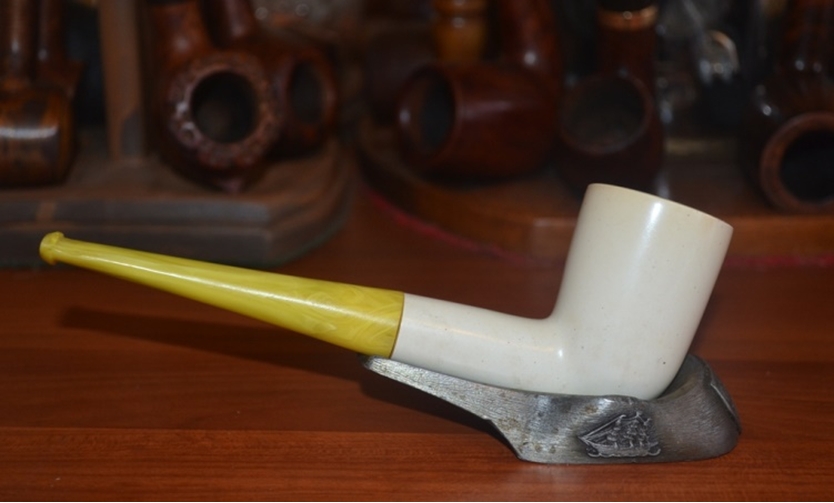
Every now and then, a pipe comes my way that is in such good condition that I can only call what I have to do to clean it up a refurbish job as opposed to a real restoration, and for the most part I do not even bother with a blog. This is one of those rare but pleasant occasions with the exception that the smooth white hand-carved Turkish meerschaum in question is so elegant I just have to share it.

REFURBISH
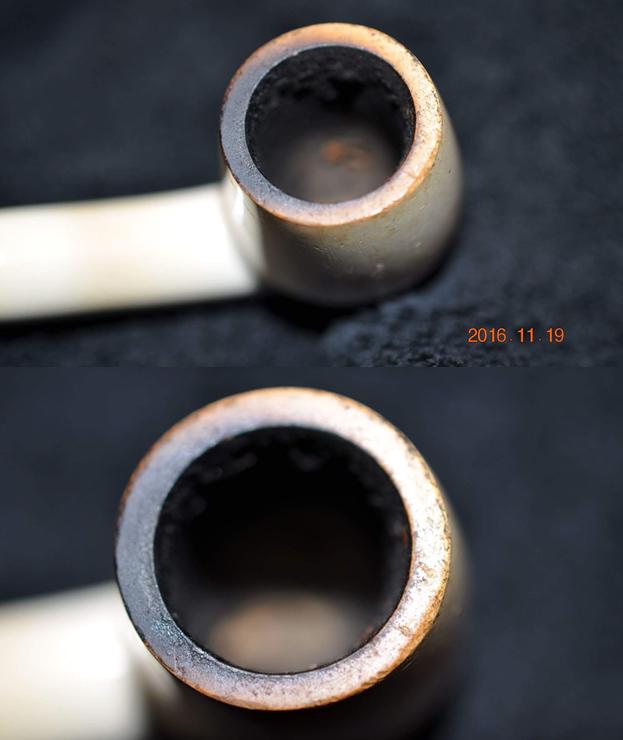
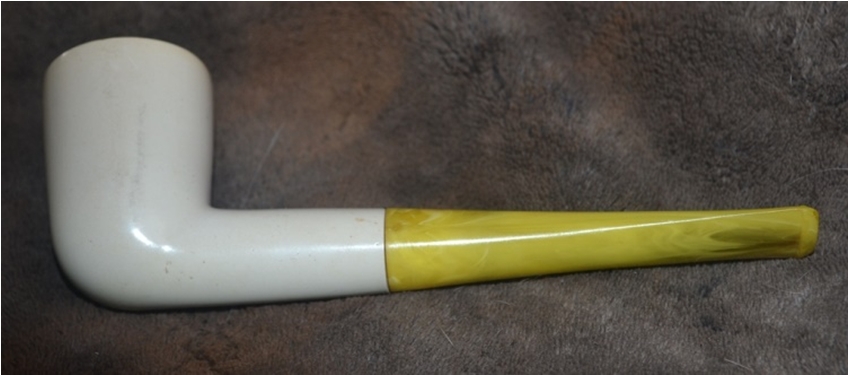
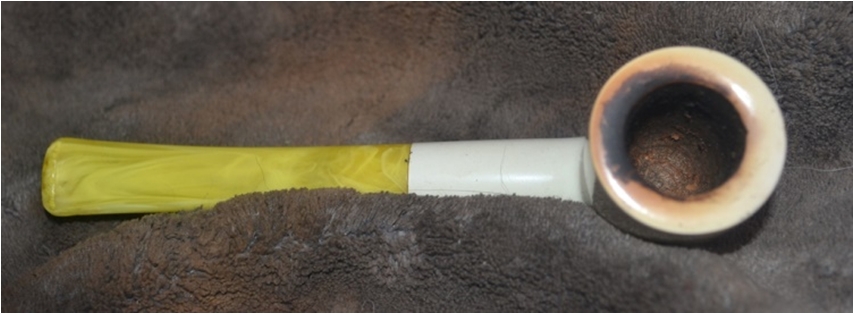
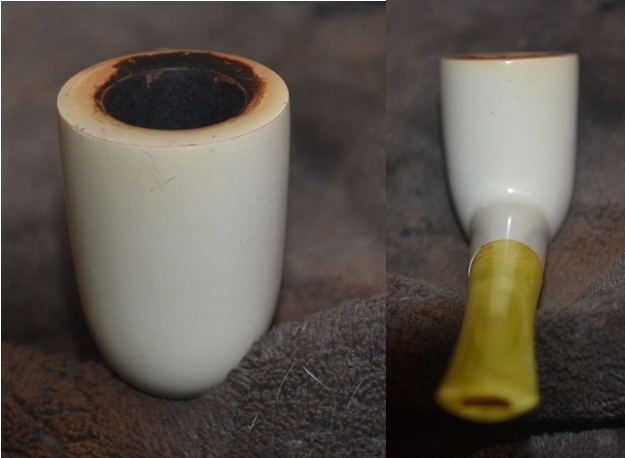
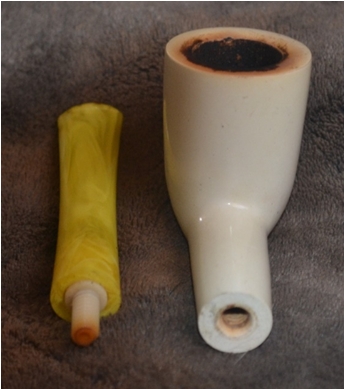
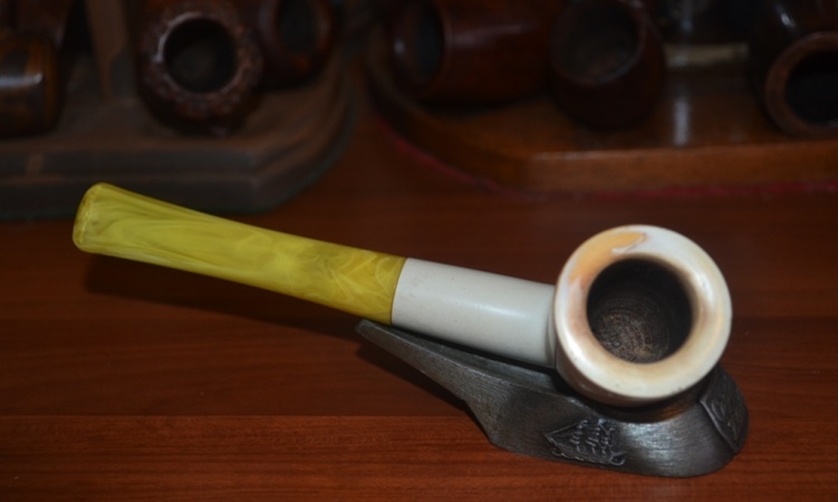
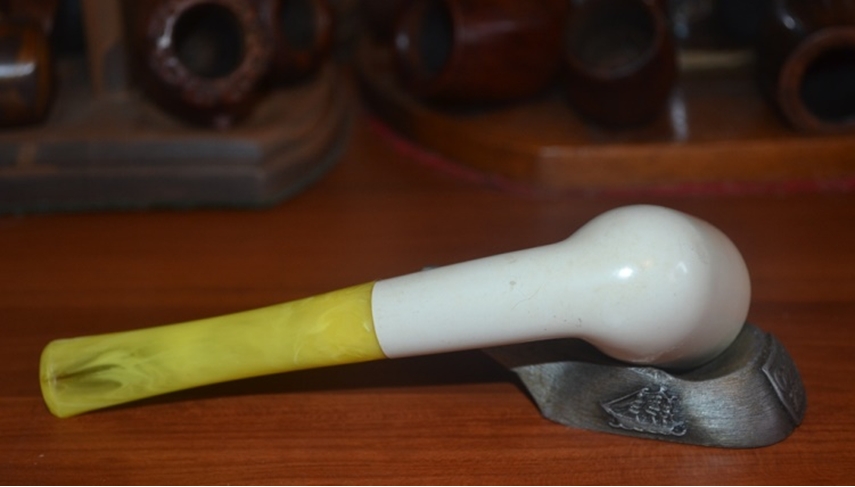
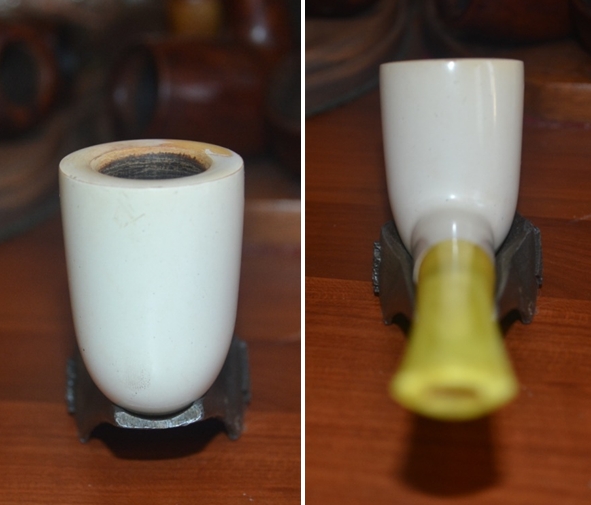
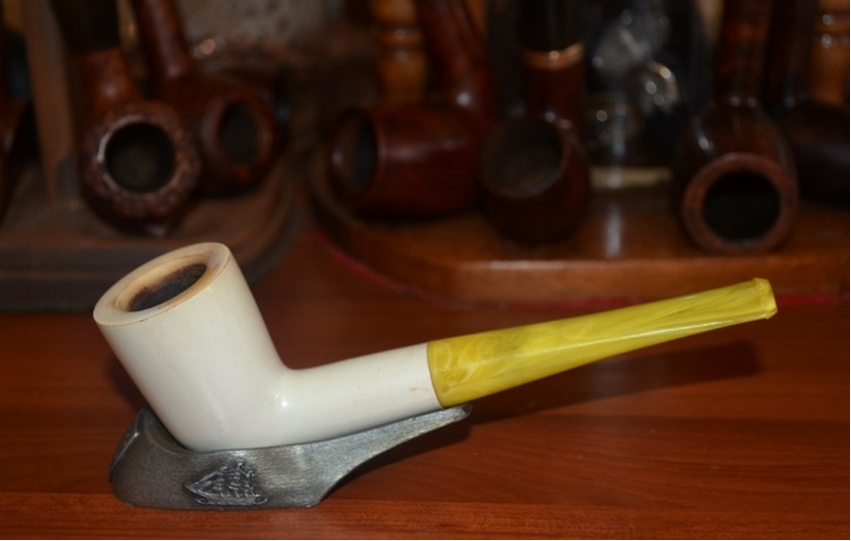
Almost all this simple looking Dublin needed was a simple bath with purified water and a little work on the rim and chamber.Rob1

Rob2

Rob3

Rob4

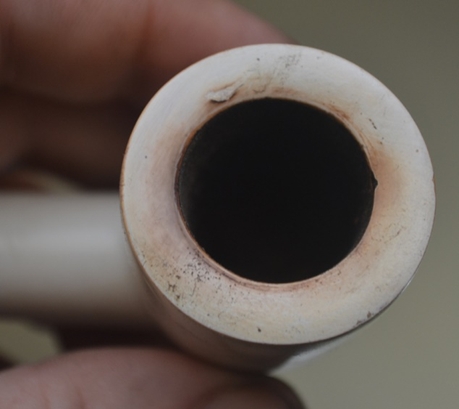
Rob5 Starting with super fine steel wool on the rim, I encountered more difficulty than usual removing the thick char that seemed to have something else mixed in with it, but nothing worth griping about. As I worked through the char-grime, I saw more coloration emerge – along with a chip.Rob6 I even considered letting it be, but thinking better, added some elbow grease and focus to the steel wool. I removed enough of the chip and crack to be satisfied.Rob7 Then I buffed the rim with 1500 micromesh followed by 3200 and moved on to the chamber. Not about to assault it with the reamer that has been necessary for every meerschaum I have fully restored, I used 150-grit paper first and then 500 to smooth it out.

With all of the dirty work finished, I gave it the light bath it needed.Rob8

Rob9

Rob10

Rob11

Rob12 CONCLUSION
Of course, I ran a couple of bristly cleaners soaked in pipe freshener through the shank and around the chamber and one more through the stem, but that was all it took to clean this near-pristine pipe. Even the stem didn’t need any sanding or work of any kind.

And so, for once I cannot complain of a pipe abused. God bless the merry gentleman who owned and enjoyed this beauty, albeit for a short time.

Waiting for Paradise – Fred Bass


The overwhelming majority of meerschaum pipes perform well, regardless of whatever blend you choose to smoke in them. Indeed, this has been one of the big attractions of these white pipes for me. I can avoid having to dedicate pipes to blends, except for some blends like St Bruno Flake, which will ghost any pipe.  Keeping the pipe clean is all that needs to be done to enjoy the clarity of smoking experience they provide and be able to smoke nearly any blend, without a concern for ghosting. This is the general experience for the greater number of meerschaums that you will encounter over a lifetime. This essay is about the rare, finicky pipe that calls to you, like the sirens did to Odysseus. These are the ones that smoke all but the one paradise blend with underwhelming results. Whether it is the result of an association the block used to carve the pipe formed with the clay it was mined from, or the curse of some pipe muse, this will be the most demanding pipe you will encounter. The odds are that you may never encounter one of these pipes, but if you do, then this article will serve you with good counsel. It is a quest that demands patience and firm resolve, beyond that of most Pipemen. The rewards of the successful quest are a smoke of such character and pleasures that words to describe it simply do not exist. 

ImageThe first time I saw this pipe in auction, there was no amount of will power that I could summon to resist the desire to acquire it. The Koncak Meerschaum trademark logo has been an indication of quality in materials and craftsmanship that is found only and infrequently in the vintage and estate pipe market these days. The Koncak dynasty of carvers, which also employed some of the better carvers of the day in their workshop, made and sold pipes to target populations from the frugal to the extravagant. It is wise to elicit any information that the seller can provide, but typically little is known by sellers today about the pipe and its provenance. This Smooth Pot with 925 Silver Faux Spigot is one of the better pipes that I’ve seen that the Koncaks produced. Ephraim and Sedat Koncak infrequently signed their work, while Battal and others who carved for the Koncaks frequently did sign their work. This pipe isn’t signed. Fortunately, I was able to win this pipe, as the sole bidder, which surprised me, as I thought it would attract a lot of attention. Later, others who complimented me on this acquisition admitted that they saw the auction but did not bid because they thought the bidding would go too high for them. Sometimes you just get lucky.   

In a few days, when the postman delivered it, I began to clean it up. It had not been smoked a great deal, which surprised me, considering that it is a quality pipe and meant to provide decades of service. I wasn’t going to complain. The pipe has been carved from heavy, dense block, which is typically what intricately carved pipes are made from. Likely, this choice was made by the carver to give firm foundation to the silver collar on the shank and provide durability for the wet smoker. The patina that age brings meerschaum is something that I find attractive in a pipe, so just a light wipe down with Everclear easily removed the surface grime. Polishing up the bit and the silver collars on the bit and shank was easy work as well.  There was a moderate bit of cake in the chamber and it looked like the pipe had never been smoked to the bottom of the chamber. Again, I wasn’t going to complain. There was no indication that any cheap aromatic had been smoked in it, which gave me reason to be grateful. After replacing the delrin push/pull connector, and giving it a good scrubbing with Everclear, I let the pipe rest overnight to dry from the cleaning. The next day, after smoking the first pipe of the day, to get started, I loaded this pipe with 1776 Tavern blend. My habit is to smoke estate pipes with heavy English blends, until they start smoking with clarity, mostly because they will mask most ghosts and residuals of past fires, while I flush the pipe.  Curiously, this pipe lent a musky aftertaste to the smoke, which I reasoned was because the pipe had never been smoked to the bottom of the bowl. By the tenth or twelfth bowl, I found that this musky taste was still in the smoke, when I would have expected it to be smoking with clarity. My theory about this taste being easily purged from this pipe had been overly optimistic. What did I know anyway? I smoked another half dozen bowls, using Hal O’ the Wynd this time, reasoning that the hotter burning blend would exorcise this musky character in the smoke.  Then I tried a succession of blends from Burley, Orientals, Balkans and Scottish mixtures, with no success of purging the pipe of this ghost. By this time, I began to understand why the pipe had not been smoked to the bottom of the bowl before. It had to be the musky flavor. The experience had become frustrating and my determination began to falter.

The pipe sat in its case for a couple of weeks before I became interested enough to resume my purge of the pipe. Frankly, I was a bit put off with my lack of success in exorcising the musky quality of the smoke delivered by the pipe. At least there was no remnant of any past fires with a nasty aromatic, like some of the pipes I had cleaned up in the past. I began to consider that maybe the block itself was the culprit. Had the sepiolite leached minerals from the surrounding clay that it had been dug out of? Had the pipe been mistreated or neglected in some way by a previous owner? Could the pipe be capable of providing the smoking pleasures I wanted from it? I found fresh conviction from these questions and became recommitted to my mission of getting this beauty to smoke well, even if it had never done so, which I suspected might be the case. I became convinced that the previous owner must have been lacking in strength of conviction. I was determined to succeed where he had failed. My politically incorrect assumption that the former owner was a man is a logical assumption from knowing that the majority of pipe smokers are men and the fact that I’m an old guy. The adage is that if you want to make a pipe smoke well, then smoke the blazes out of it. I would burn the defiance out of this rogue pipe and bring it into submission. After a week of smoking this pipe almost exclusively, while allowing myself the exemption of smoking another pipe as the first smoke of the day, I no longer suspected that it had been found at the crossroads after midnight, left behind by Robert Johnson while running from the hounds of hell. It was smoking wet by this time, which I reasoned was because of the high density of the block that it was carved from. At this point, I set the pipe down, with the intention of letting it dry out for a week or two, which is what I did after a good scrub, just as I had been doing during the time of purging I put it through.  Again, it sat in the handmade case that had been provided for it after the carver was finished. I had been successful in my work to get it to provide a smoke that no longer had the musky character to it. Whether the musky taste had happened because the pipe had never been smoked to the bottom of the chamber or it had been in the block before it was carved was no longer important. The pipe was smoking with clarity now.   

Another week went by before I loaded the pipe with Our Best Blend, from Smoker’s Haven, which is a full and rich blend of good character, similar to an early incarnation of Balkan Sobranie. This blend has always been a stellar performer for me, but this time, even though the pipe smoked with clarity, it was a lackluster performance, at best. Past experience had taught me that the majority of meerschaum pipes smoke well with just about anything you choose to burn, but a few pipes had been temperamental, performing well with certain blend types, like English, Balkan, Burley or Virginia blends. This pipe had served notice that I would need to continue my quest to find out what it was destined to incinerate.

ImageThe search was started for blends that would perform best in this pipe. I keep a fairly large open rotation of blends, so I put the pipe into my lineup of frequently smoked meerschaum pipes, hoping to solve the mystery through the process of elimination. The low key aspect of this quest became somewhat mythical in character, as I was only smoking the pipe about once every seven to ten days, while I worked through my open tobacco blend rotation, that is somewhere between twenty to thirty different mixtures. After a couple of months, I was no closer to solving this mystery than when I started. Then I opened a tin of Reiner Long Golden Flake, a favorite of mine that I usually kept an open tin of in the rotation, but had simply overlooked, while trying out some new-to-me blends. Throwing caution to the wind, I loaded a bowl in the Koncak meerschaum and fired it up. It was a stellar experience of mystical proportions. Everything came together as only a peak experience can and I hoped that this wasn’t a fluke. I loaded a second bowl and picked up where I had left off with the first bowl. This was it – the big payoff for my work!  I can only speculate as to why a small number of meerschaum pipes are this particular in their smoking demands. I suspect that there are a good many of them sitting in a drawer for the lack of a determined pipe smoker who will discover what will be the pipe’s choice for paradise for the lucky man who finds the right blend to smoke. The important thing is to make the commitment to discover what the pipe performs best with by smoking it, and not be one of the guys who put it in a drawer. Just be prepared to wait for paradise. 


Cleaning Up Estate Meerschaums – Fred Bass


Blog by Fred Bass

Fred Bass, who is the moderator of the All Things Meerschaum Group on Smokers Forums, wrote this article and has given permission to have it posted on rebornpipes. Thanks to Fred for his continued work in educating many of us to the joy and delight of the meerschaum pipe.

There are an abundance of ideas about how to clean up used meerschaum pipes and return them to active service.  Some of these ideas are good while others can generate problems of greater magnitude than those you sought to remedy. I don’t have all the answers and my repair skills are limited by spartan equipment and my lack of finesse with the tools that I do have. Just the same, many of the meerschaums in my collection were smoked by others before I acquired them and cleaned them up, using simple methods to get years of further use from these old soldiers. I’ve written essays and articles on the pleasures of smoking the seasoned meerschaums I’ve acquired, and which I continue to enjoy smoking. This can be done by anyone who cares to invest a bit of time and patience in acquiring vintage meerschaums to resurrect, and cleaning them up so that they can provide you with years of smoking pleasures as well. I don’t claim to be an expert or an artisan, but using the scraps of knowledge I’ve acquired over the years, as a student and devotee of these pipes and their cultures, has been a benefit to me and it is my pleasure to share what I’ve learned. These are things that I would like to pass along, not as the perfect example that should be followed, since there’s already plenty of that from all of the persona in the pipe community, but as something that I can contribute to the body of available knowledge, while not perpetuating myths and hearsay that are commonly held to be fact. The opinions and preferences of meerschaum pipe smoker are as numerous and diverse as the people who smoke them, and I have no intention to slight or refute them. If you read something in this essay that you think might be useful to you, then I will have achieved my intent to provide you with viable information.
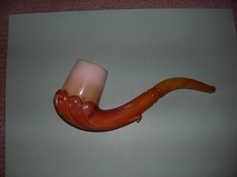
ImageLarge Bent with scalloped underside, Amber mouthpiece, 7″ overall length

I will discuss things to consider prior to purchase of a vintage pipe, which means a pipe that is less than 100 years old, assuming that you don’t already have a pipe that you want to clean up; the basics of removing the debris of past use; routine cleaning to maintain a pipe that will smoke with clarity; and the choices you will need to make about the general appearance of the pipe. I have my own opinions, like everyone else, which you will find throughout this essay, but I will not tell you something that is outside of my experience without giving notice that it either speculation or something someone else has discovered by trial and error. If this sounds like it is something that is worth your time to read, then this is for you. Hopefully, you will find these old veterans of past fires to be as worthwhile as they are to me.

When considering the purchase of a used estate pipe or fixing up a meerschaum that you already have, it is important to get an idea of how much it will cost to fix the pipe, prior to a purchase and/or investing the cash, time and materials that will be required before it can be smoked again. Any good discussion about cleaning up estate pipes should take the value of the pipe and the cost of getting it back in service into consideration, as the two issues are linked to each other, unless you plan to use it for display in its’ current condition. It is best to be able to examine the pipe yourself, which is not always possible since many estate pipes are sold in online auctions.
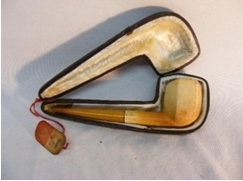
ImageKoncak Andreas Bauer Paneled Billiard

First, determine if there are any cracks, dings or break lines in the block, because if the block isn’t sound, then there is no reason to consider the pipe as being a candidate for future use. Online sellers should be able to provide this information, even if they don’t know a whit about pipes and have poor skills at photography. Reputable sellers are happy to answer your questions. Repairs to damaged block meerschaum are difficult, costly and generally not worth the investment. The presence of a metal band on the distal portion of the shank, where it meets the bit, may be there because of a repair, which is not a good sign for continued block integrity if you intend to smoke the pipe. Metal bands that adorn the pipe for effect don’t present this problem, but it is wise to consider how easy it will be to maintain a bright finish on them without creating problems for the block. Personally, I prefer to avoid having to clean metal on a pipe, especially around the bowl’s plateau, or to have to deal with the metal getting hot while discoloring the block during the smoke.  Another aspect of the condition of the block is how much it has been smoked. Yes, well developed coloration is attractive but the more use a meerschaum has provided, the greater the possibility of diminished strength in the block’s integrity, especially in the older pipes, which are prone to being brittle. This is more of a consideration for Turkish block than it is for African block, because Turkish block is softer and hasn’t been strengthened by a calcification process, commonly used by factories that produced African block meerschaum pipes. That rich patina might also be there because the previous owner smoked a cheap aromatic blend and never spent a cent on a pipe cleaner, so you could be spending years trying to exorcise the ghosts from the pipe. I’ve been fortunate in that most of the estate pipes I’ve purchased were smoked by someone who enjoyed virginia blends, but the few that I discovered had been used to burn cheap aromatics were a real trial to clean up. Remember, you can’t use a retort or the salt-alcohol treatment on a meerschaum pipe. I know a few meerschaum pipe smokers that have drilled out the chamber and shank on pipes that have seen decades of abuse and neglect, but I don’t have the skills to do this. Others have used denatured alcohol as a cleaner but I prefer to rely on the FDA standards that Everclear must meet as a food grade solvent. The alcohol concentration is 95% with Everclear and I don’ need to be concerned about what the remaining 5% has in it, which is likely water. You should scrape the cake down to the block and clean the shank with Everclear, a shank brush and plenty of pipe cleaners before the first smoke, but you will need to repeat the cleaning between every smoke until the pipe starts smoking with clarity. Once the block has flushed the debris left by the last guy from burning his blends in it, the pipe will smoke well and it is up to you to keep it clean if you want it to remain smoking with clarity. After you scrape the cake out of the bowl’s chamber, then use a doubled over pipe cleaner with Everclear on it to get more of it out, and a paper towel to ream it. I don’t recommend using a pipe reamer because the force that is required to use one might crack the block. The shank brush with Everclear will help you clean the pipe’s draft, and it might take more than one to do so because a fouled draft can destroy a good number of them before the job is done. When the pipe cleaners start coming back white, then you will know that the pipe is clean. Smoking the pipe will cause more of the trash to migrate out of the block, so be prepared to use a lot more pipe cleaners, shank brushes and Everclear. Some of the abused estate pipes I’ve cleaned up have made a pint of Everclear look like engine sludge with the first cleaning. This isn’t the fun part of cleaning these old pipes up, so it deserves your consideration prior to a purchase or a decision to clean up that old meerschaum that’s been in the family for generations.

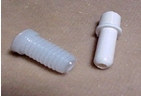
The next thing to consider is the bit and the bit-to-shank connector. I prefer derlin push/pull connectors and bone screws.
Image

The Delrin connectors are easily replaced, providing that the threads in the bit and the shank are intact. The bone screw connectors in some of my pipes have lasted for 35 years or more. The downside to them is that they must be kept clean or they can foul the smoke and they can require advance skills in the use of a pipe cleaner. I’ve never been able to appreciate the taste that metal connectors impart to the smoke, so I avoid them. If the bit and the connector need replacing, then either I’ll do it or send it to a pipe repairman if it requires more skills than I have in order to fix them.  In the past, I have sanded and refinished bit that were badly oxidized. These days, after discovering that it involved a lot of work, I prefer to just have them replaced if they are in poor condition. There are guys that are happy to work for days on restoring a bit. I’m not one of them. If I can’t clean the bit up using Everclear, a shank brush, pipe cleaners and bit polish, then I send it to Floyd Norwood. If the bit is light colored so that the lumen of the draft is visible, then I’ll use hydrogen peroxide to help remove old stains in the plastic, which is a timely process because I use a shank brush to scrub them in my routine cleaning and do not let the bits soak in the hydrogen peroxide. Get used to the fact that everything about meerschaum pipes is a slow process. If the pipe has an amber bit with chunks missing, I will have it replaced with and a new acrylic bit. Amber is expensive and many artisans will not work with it.  Amber is fragile and the ‘cultured amber’, which is made from the dust and chips left over from cutting and polishing the raw material, is the most fragile. I use regular pipe cleaners, Everclear and bit polish on them. Shank brushes and bristled pipe cleaners should never be used to clean amber bits, as they are brittle and break easily.

The general appearance and condition of the block’s exterior must be taken into account. Dirt and grime on the block can be removed by using a clean, white cotton cloth, moistened with Everclear. In a recent reply to my e-mail inquiry to S.M.S. Meerschaums about re-waxing meerschaums, Beth Sermet replied as follows:

Rewaxing a Block Meerschaum
Preparation: 100% beeswax cakes — confectionery quality
Old towel or cloth — to prevent hot wax from dripping or spattering onto other surfaces
Hair dryer — multiple temperature and fan settings
Cotton swabs — for brushing the melted beeswax
Polishing cloth — soft white terry cloth towel or white flannel

STEP 1: Use a hair dryer set to hot temperature setting, but low air speed. Heat the beeswax cake to consistency of lip balm. Hold the pipe by the stem. Smear onto the bowl directly from the beeswax cake like lipstick. Do not touch the bowl with your fingers during any of the steps.

STEP 2: Continue to heat the section of the surface of the bowl until the wax becomes liquid. Use the cotton swab like a brush to paint the area with a coating of wax. Push (the) molten wax into crevices and hard to access areas. The swab may unravel as it absorbs excess wax. Coat the entire bowl surface evenly. CAUTION: Try to prevent wax from dripping into the tobacco hole since it will leave a bitter taste.

STEP 3: Heat the bowl again to allow complete absorption of the wax. Set the pipe down on the towel to cool.

STEP 4: After the bowl cools to room temperature. Buff the surface to a high gloss using a towel first then the flannel cloth for the final buffing. If the surface is tacky, too much wax is on the surface. Heat this area again and remove excess wax with a cotton swab and buff again.

STEP 5: Repeat when the surface becomes soiled or dull. Excessive waxing may cause too much wax accumulation (tacky surface and dripping).
ImagePeterson African Block Meerschaum Prince Estate Pipe Made in Great Britain

In the past, I’ve used aggressive methods to clean up the exterior of the pipe. These days, I try to preserve as much patina as I can, which means that I wax the meerschaum while smoking it, using white beeswax, instead of resorting to the heroic measures of the artisan. Sanding the block to remove scratches and stains will change the shape of the pipe and it could be years before the patina returns, anytime you disturb the color progression. If there is a buildup of cake on the scorched plateau of the bowl, then scrape the carbon off as best you can without scoring or exposing the surface of the block. The beeswax will serve to make the black color soften and become more diffuse in time with continued waxing and smoking of the pipe. This is a more conservative approach but I’ve found it to be preferable to waiting years for the coloration to return to the pipe. These pipes will often take a lot of beeswax because they likely have not been waxed since they received it from the carver, which will produce rapid onset of coloration in pipes that have been heavily smoked by others. It is like having the benefits of a professional smoker- a service that the wealthy and nobles have paid for in the past. Here is a bit of history that Ben Rapaport ran across while digging thru the stacks of resources.
There is no doubt that the industry of colouring meerschaum pipes was, and probably is still, thriving in Paris. I remember, when living in one of the streets surrounding the Palais-Royal, to have seen opposite the house in which I lived a man, with his window open, smoking all day long and all the year round curiously elaborated meerschaum pipes. I met him one day, and could not help asking him how he could resist such inhalation of nicotine. He told me he was a professional ‘meerschaum colourer’ for the account of Madame Hubert, an extensive pipe-dealer in the neighborhood. He was paid a yearly salary of 1500 francs, and supplied gratis with tobacco. (“Very Like ‘Smoke,” Notes and Queries: A Medium of Inter-Communication for Literary Men, Readers, Etc., Fourth Series.–Volume Third, June 12, 1869, 567)   

These days, I’m more selective about the pipes I take in to clean up. If they look like they are going to be a real trial, then I pass on them. There are guys that enjoy working long hours to salvage the pipes that have been abused for decades.  I’ve discovered that I’m simply not one of them. The additional cash that I might spend on another pipe that is in better condition is worth it to me. I know my limitations. Some of you already know that dwelling in the realms of the White Goddess can be devastating to your bank account. In many ways, the estate meerschaum pipe market offers some degree of respite as long as you think about the hidden costs, such as what it takes to clean these survivors up, and/or repair them. In The Thrill of the Hunt (PipesMagazine.com, 10/19 2010): http://pipesmagazine.com/blog/put-that-in-your-pipe/the-thrill-of-the-hunt-a-guide-to-estate-meerschaums/, I wrote about some of the realities of this market and expanded on it in Time Travelers (PipesMagazine.com, 6/2012). It pays to do the homework before playing with the past glories of this seductive mistress because the rewards can be great.  Whether you have found grandfather’s old meerschaum, while rummaging thru the attic, or have acquired the vintage pipe of your dreams from an auction, knowing that returning these old veterans of past fires to active duty will take time is just another of the many lessons in delayed gratification that the White Goddess teaches. Come with me and discover for yourself why these pipes have been so highly prized for the past 300+ years. Care to join me in a smoke?

Fred Bass founded the All Things Meerschaum Group on October 14, 2008 for anyone interested in meerschaum pipes, carvers, culture & history, and the care & maintenance of meerschaums. If you have an interest in, or are curious about the meerschaum experience, you can contact Fred at FBass16117@aol.com or on Smoker’s Forums, http://www.smokersforums.co.uk/