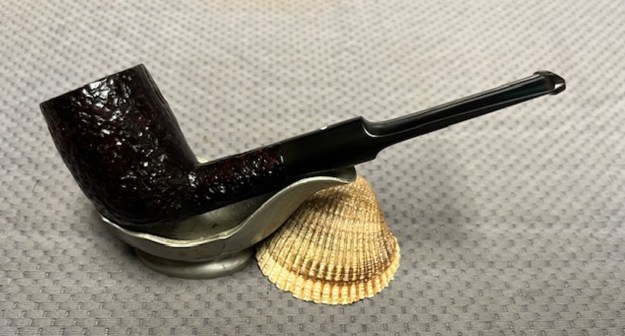
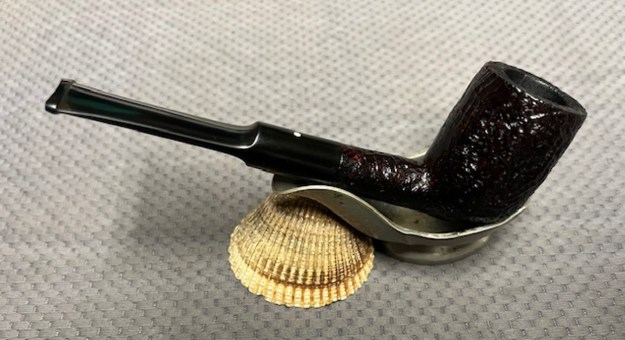
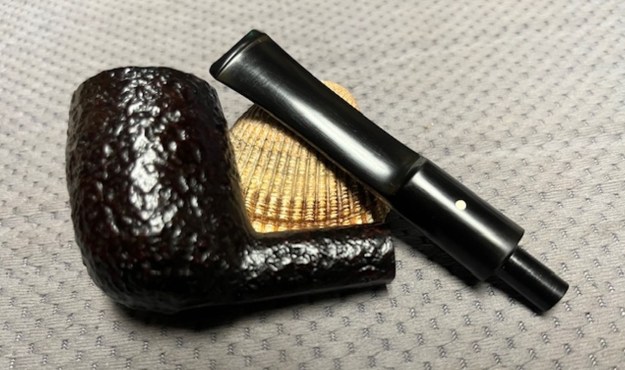
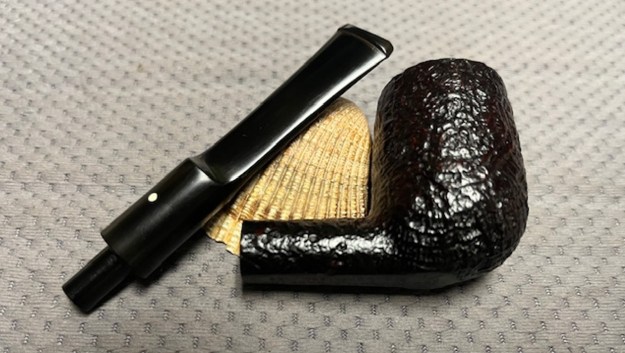
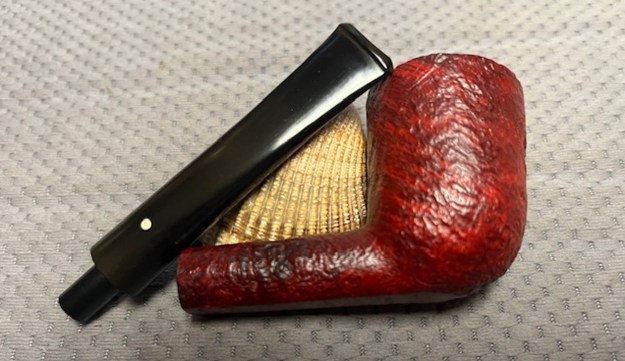
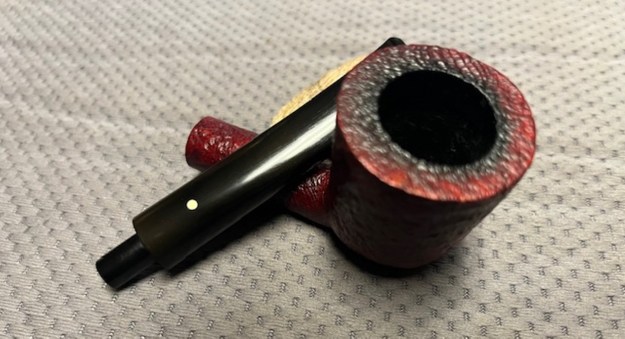
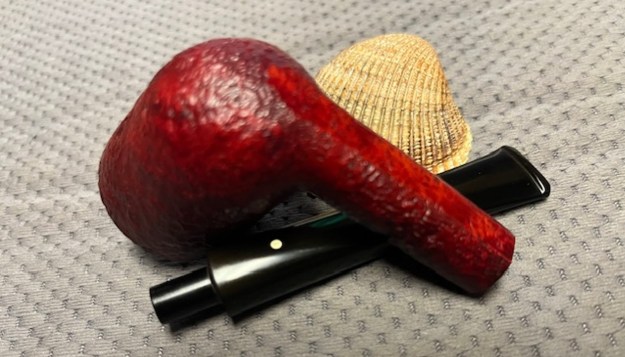
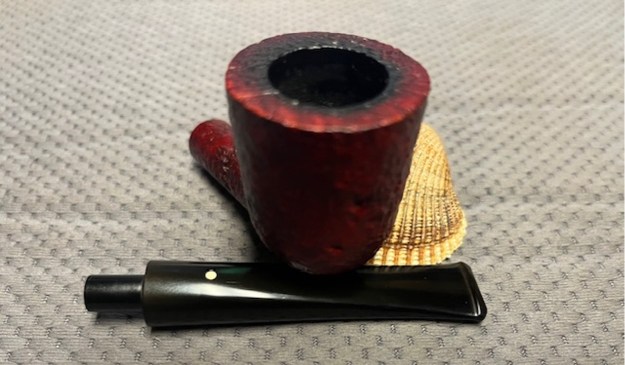
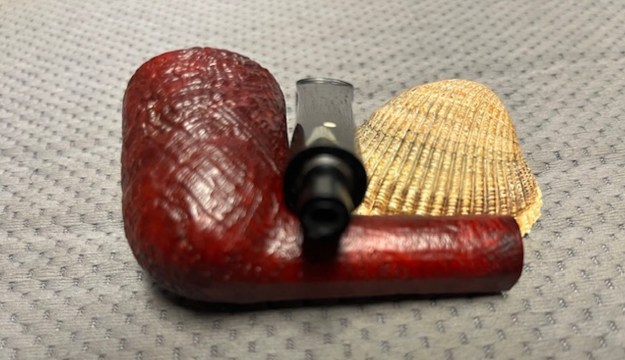
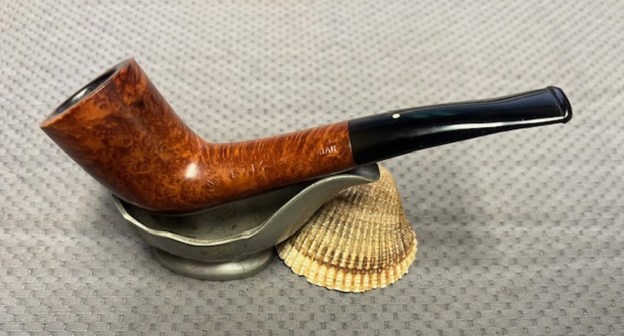
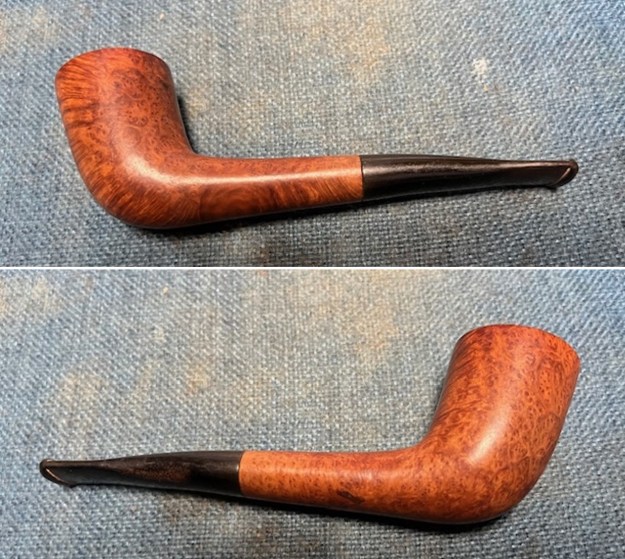
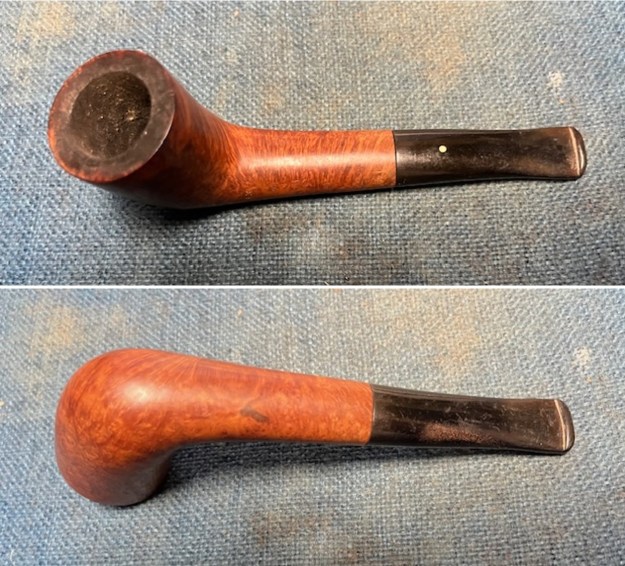
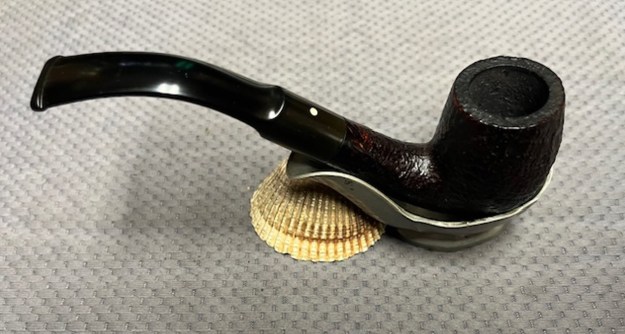
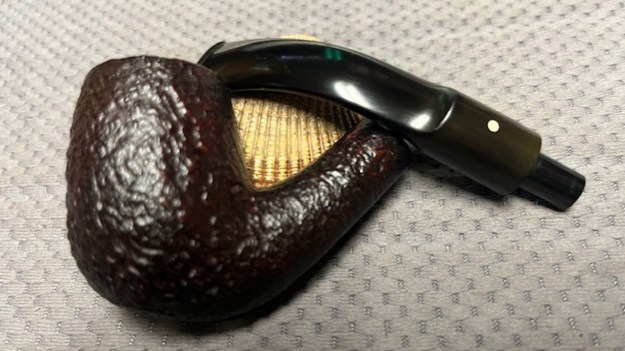
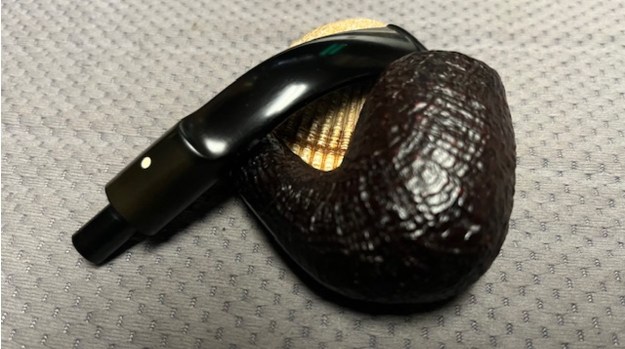
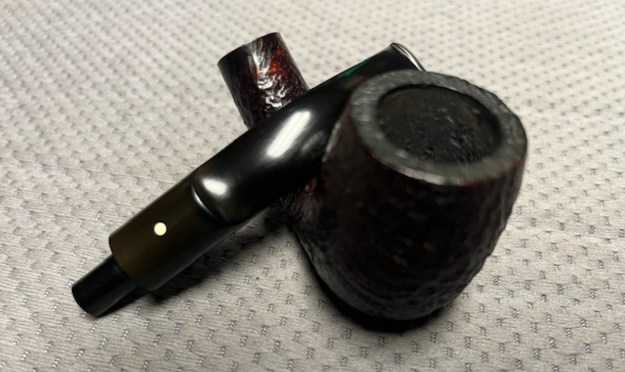
Tag Archives: Dunhill Pipes

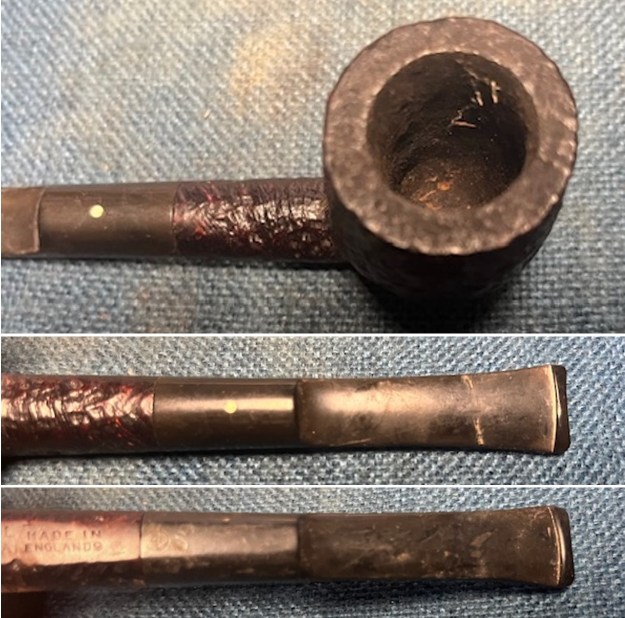
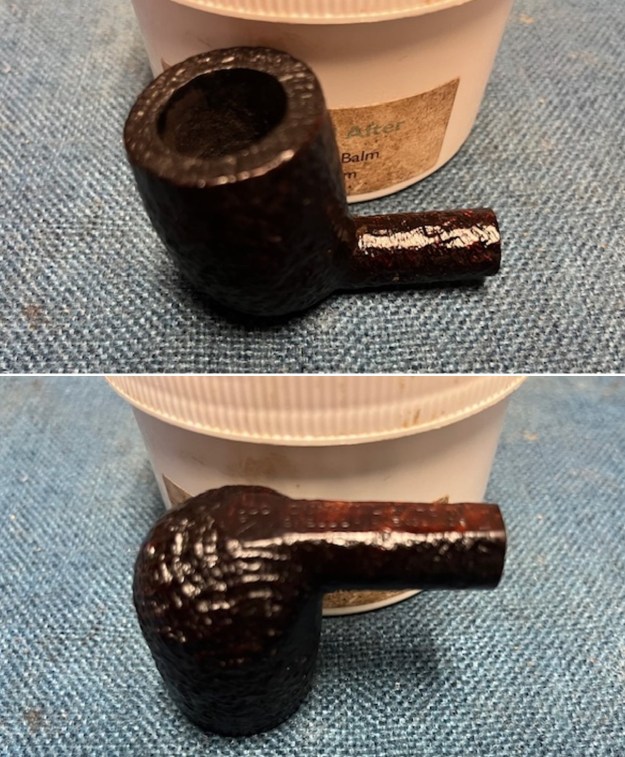
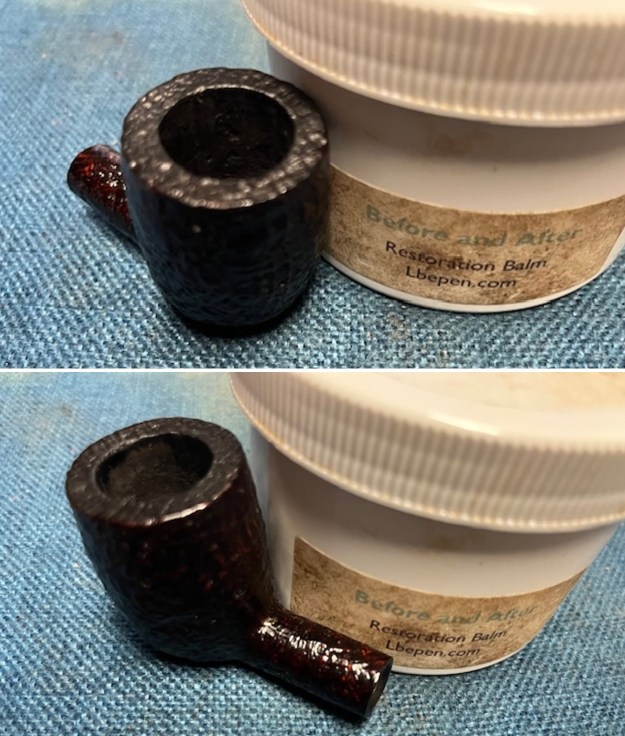
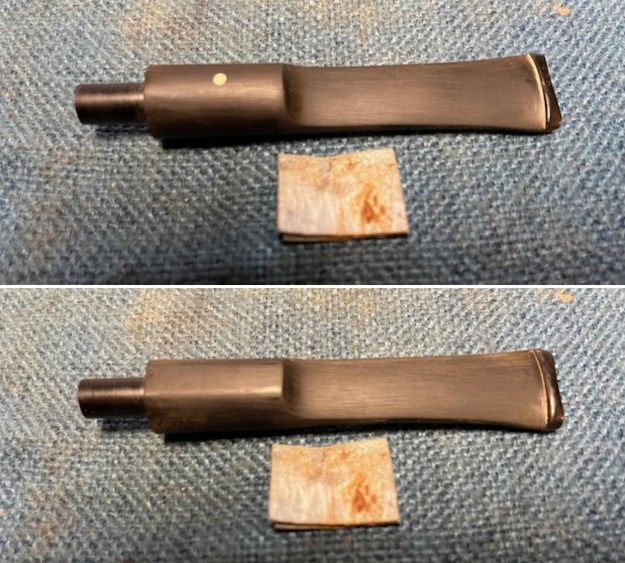
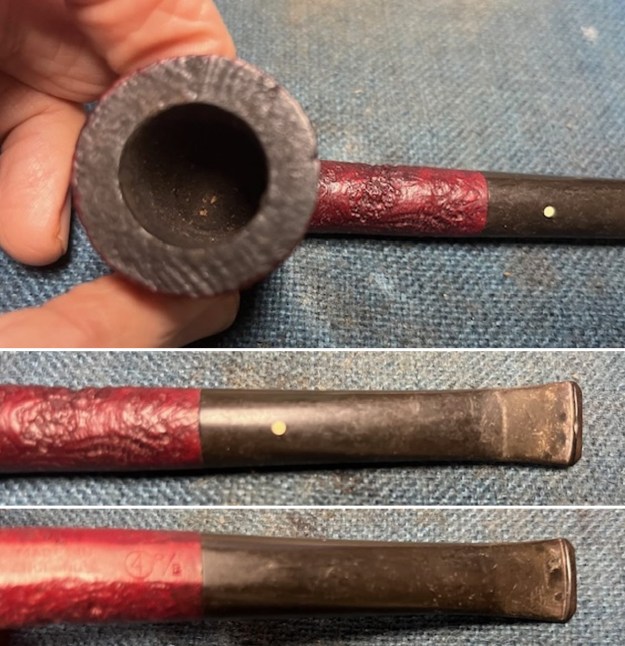
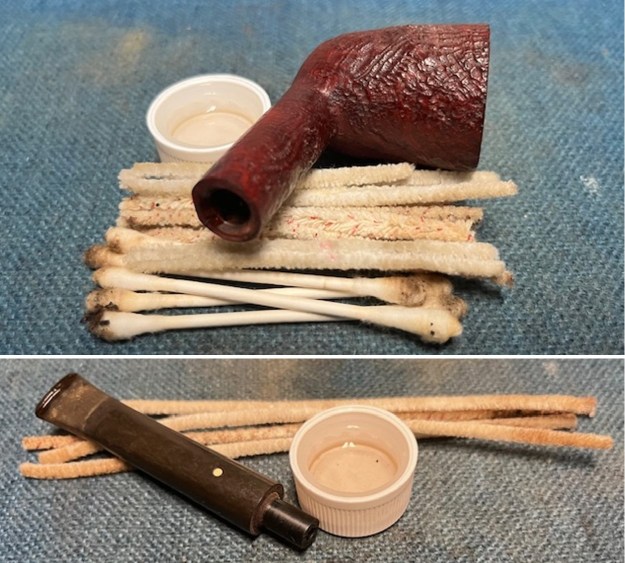
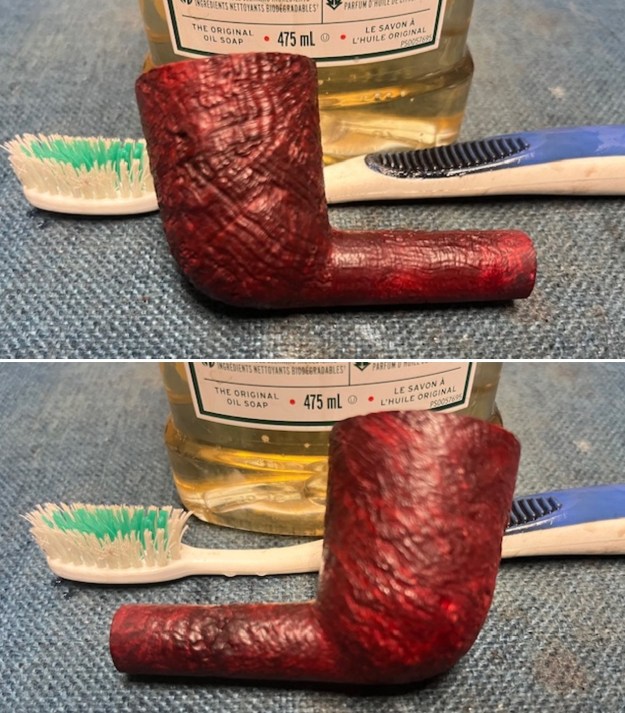
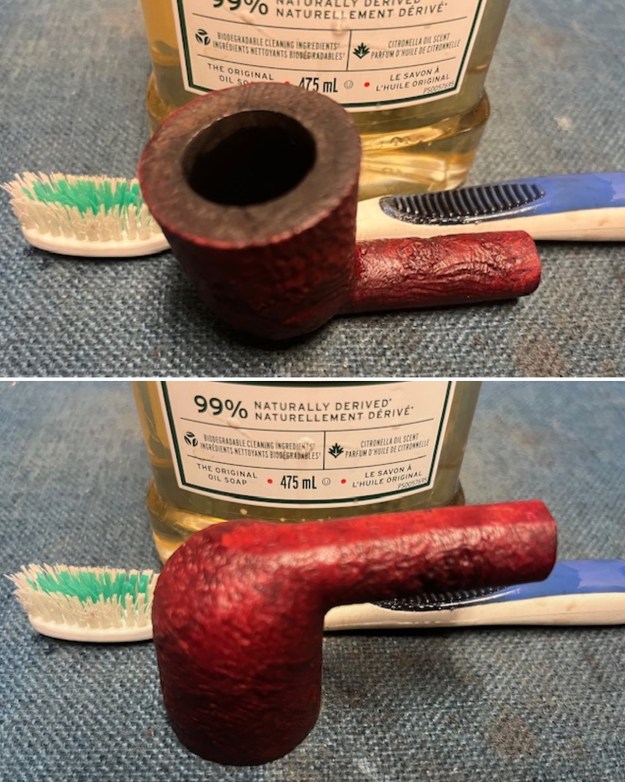
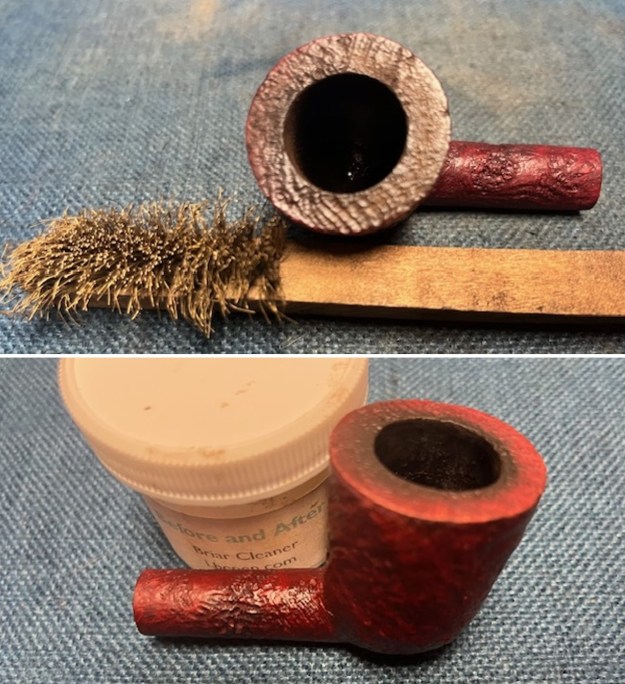
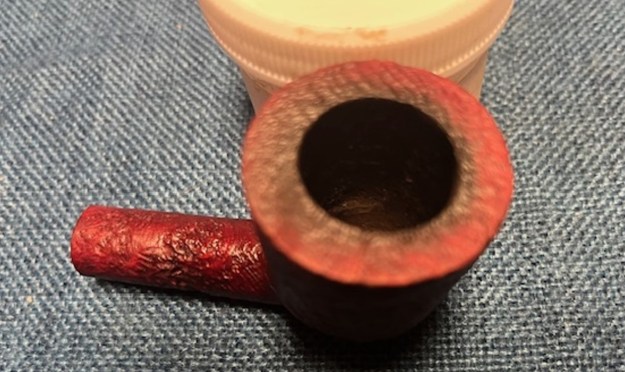
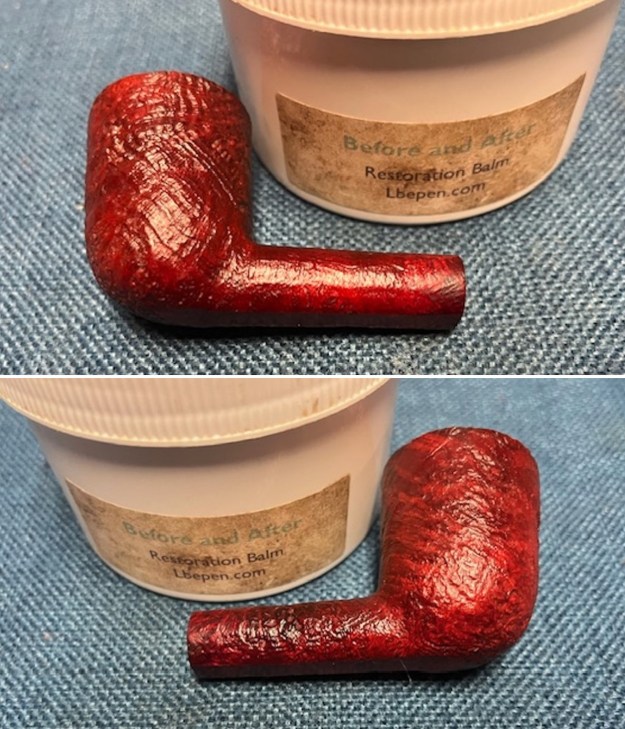
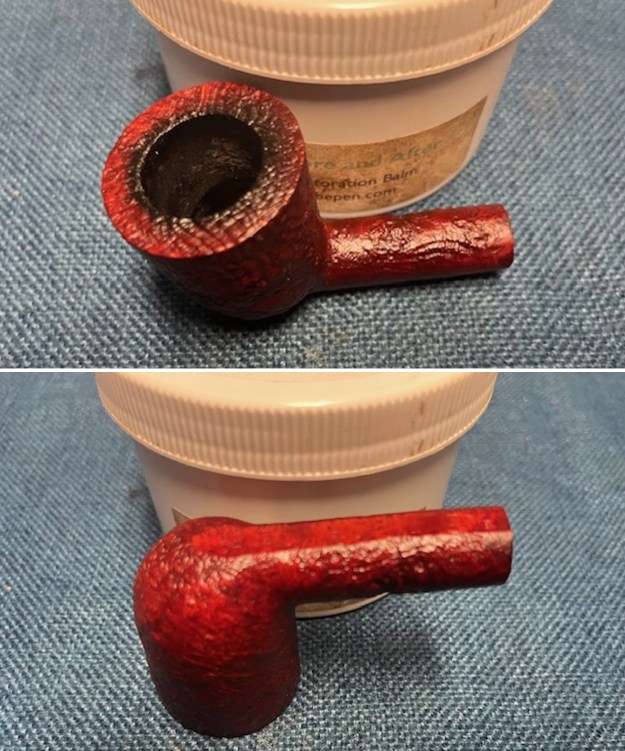
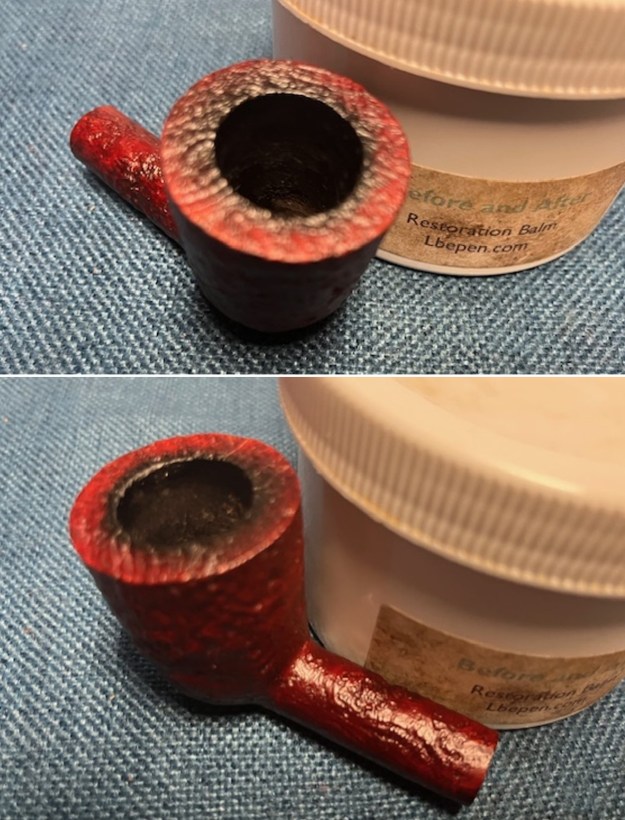
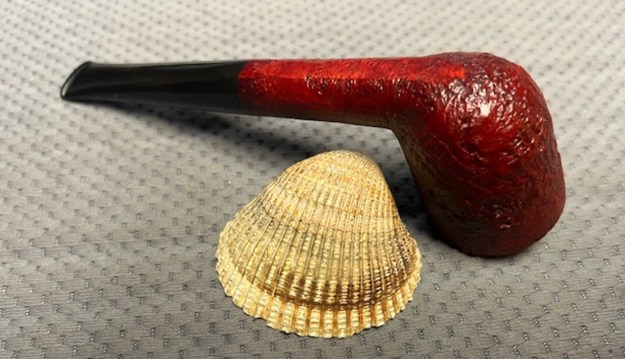
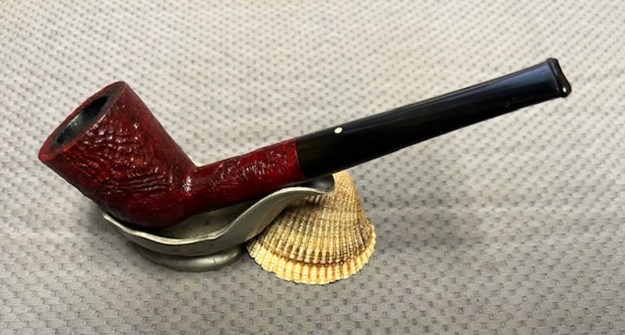
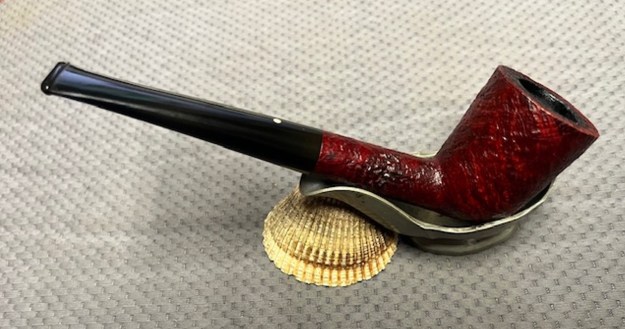
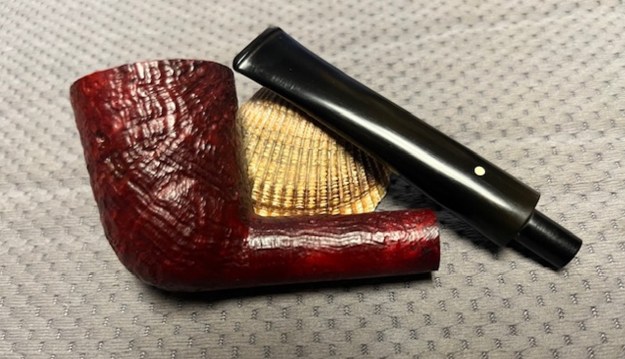
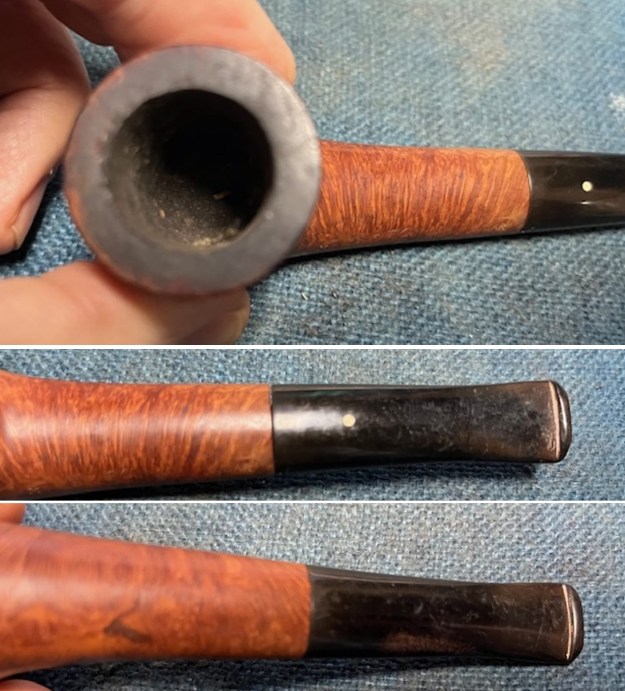
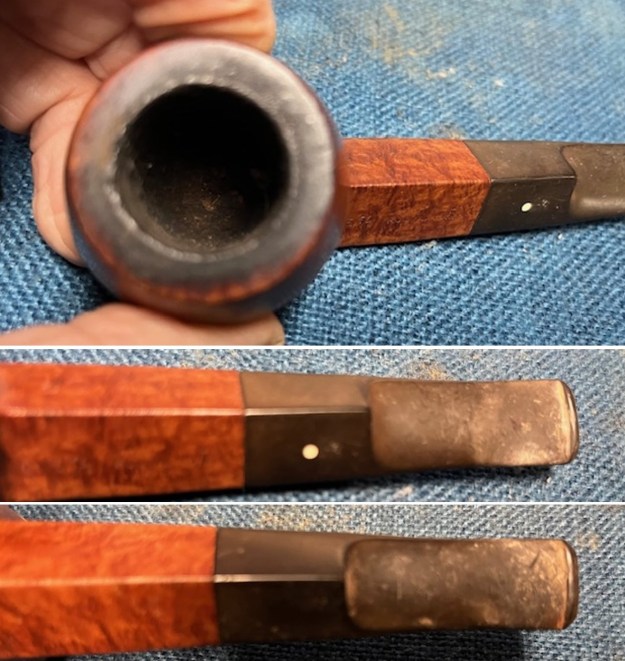
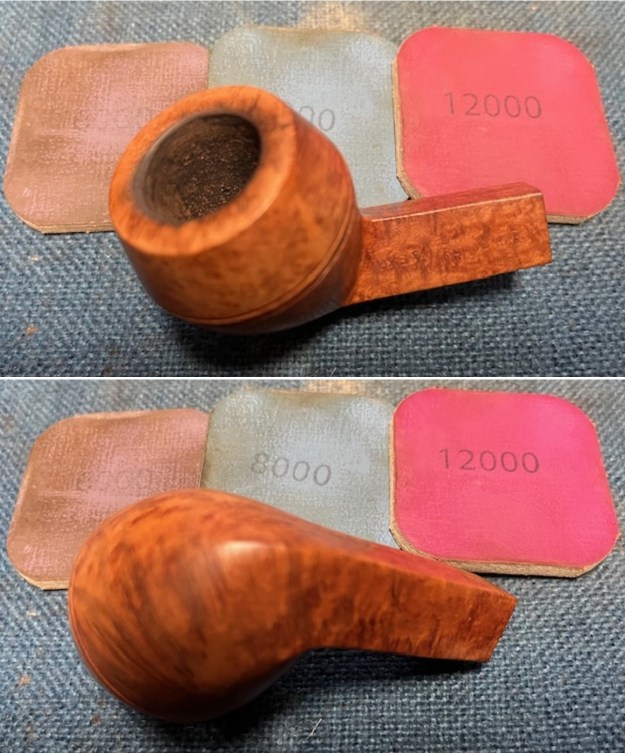
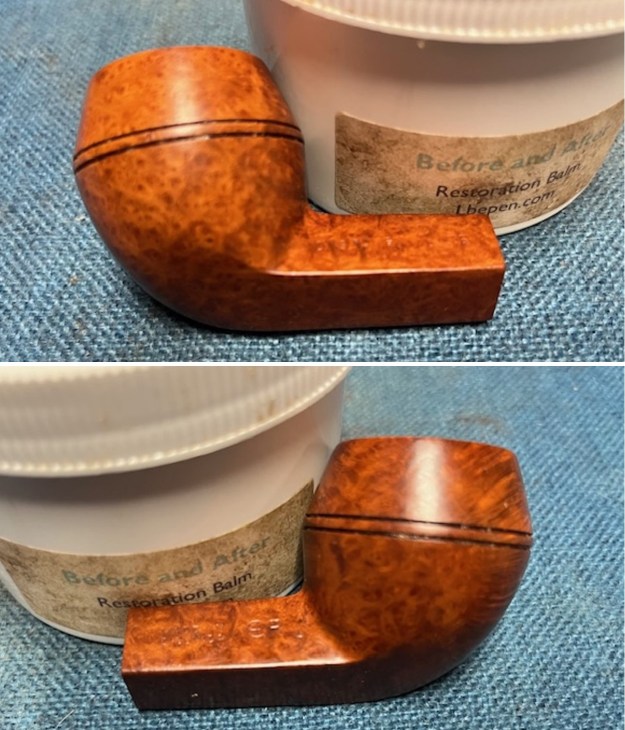
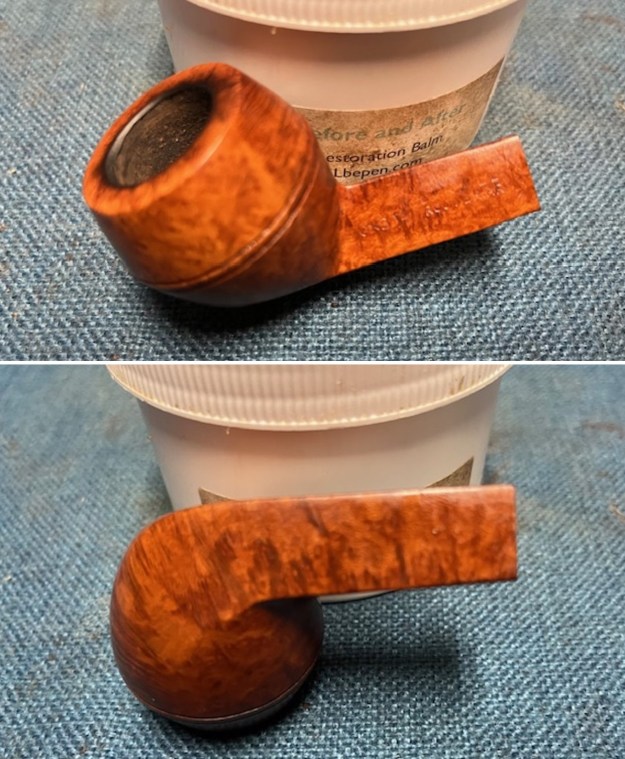
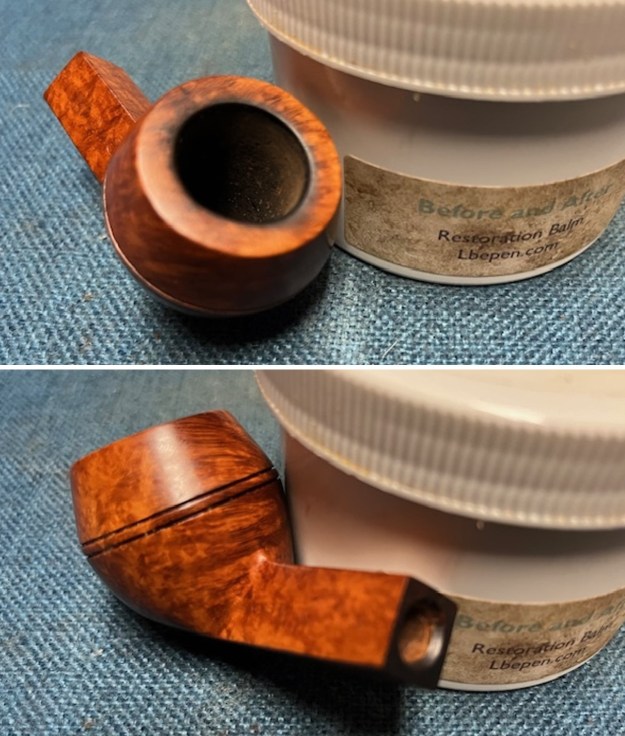
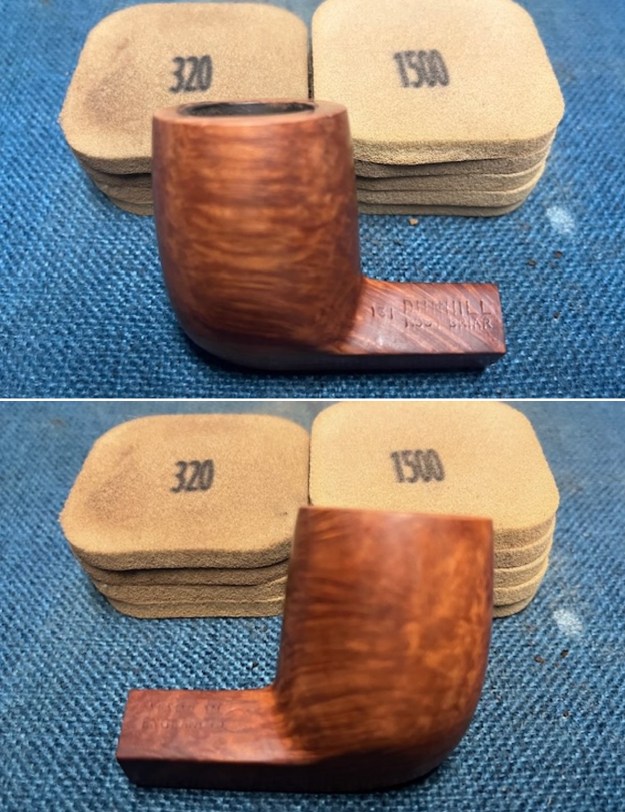
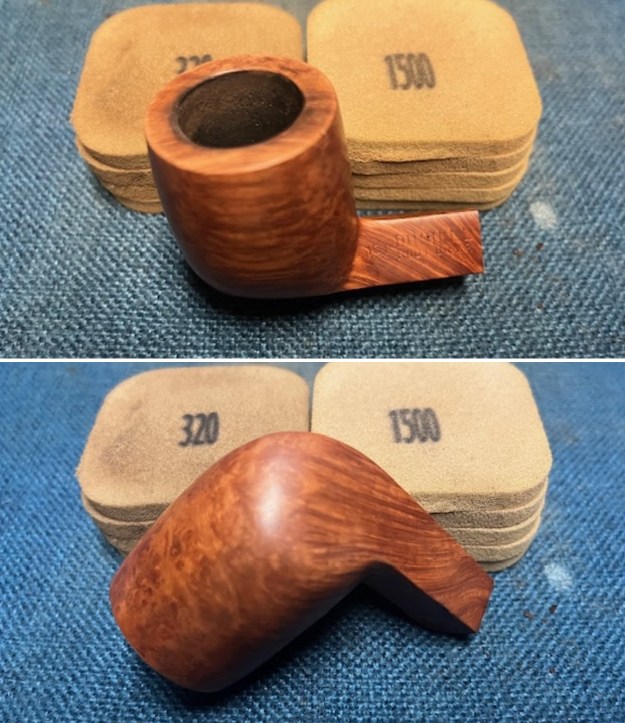
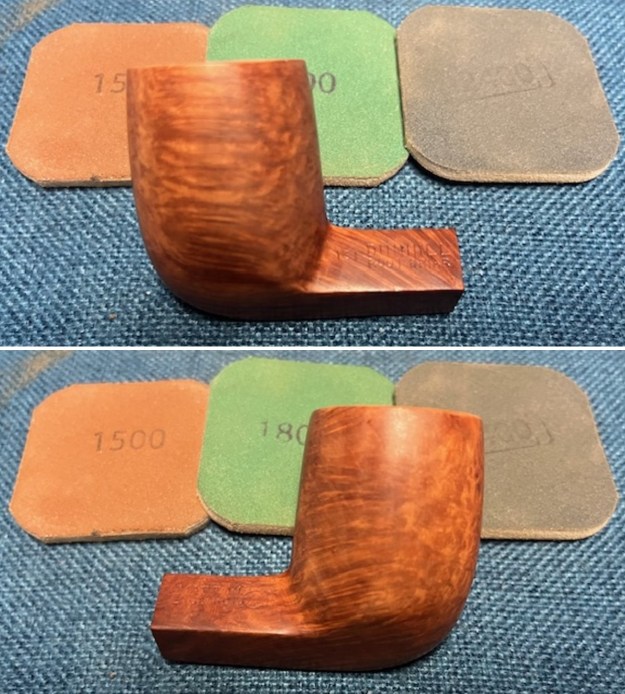
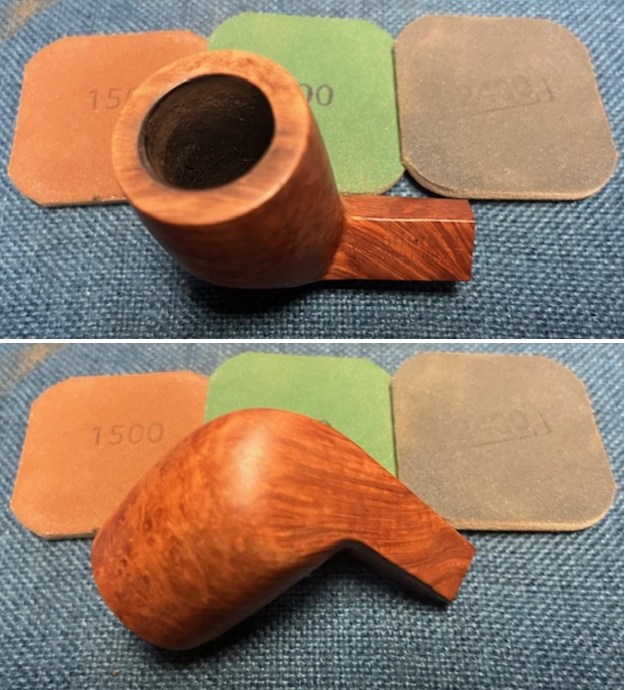
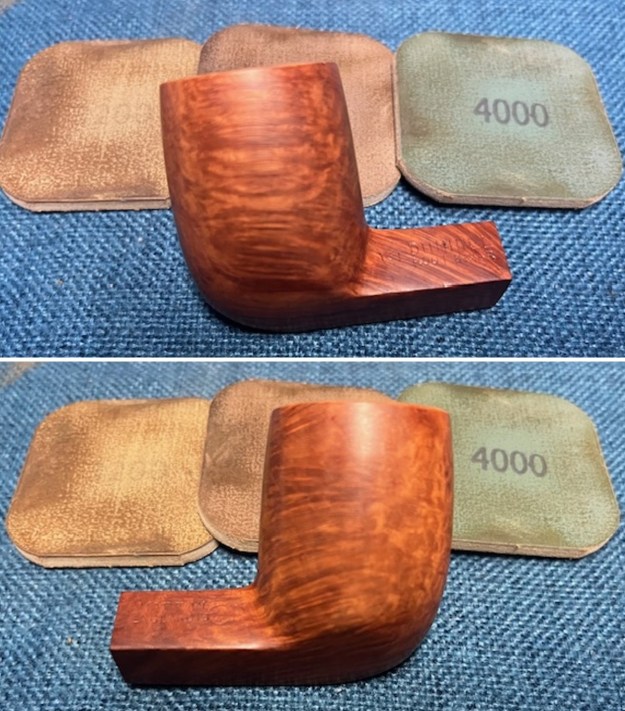
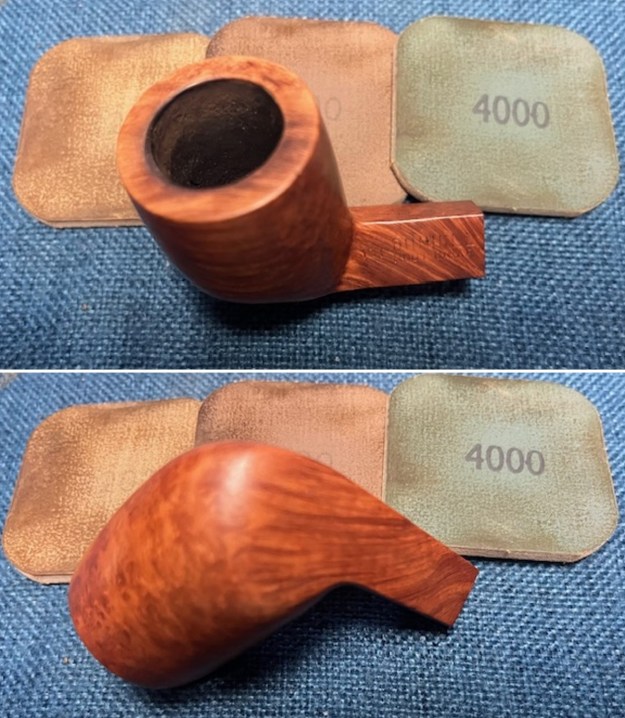
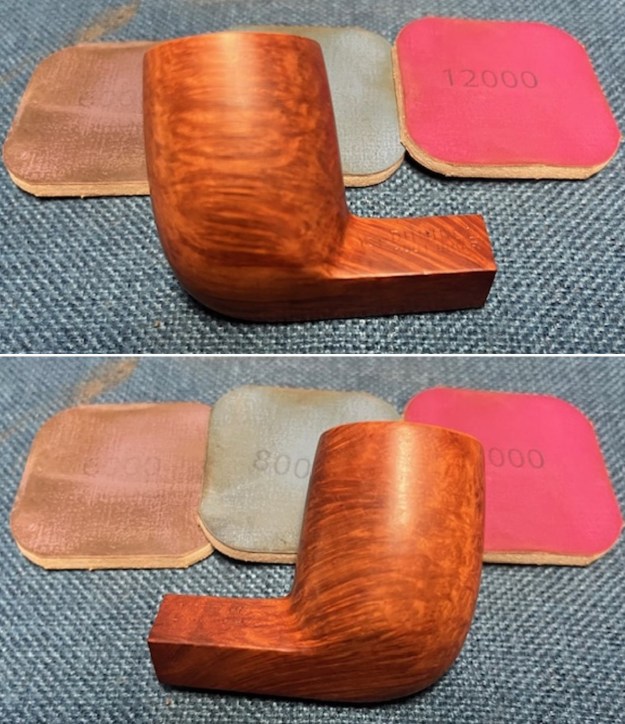
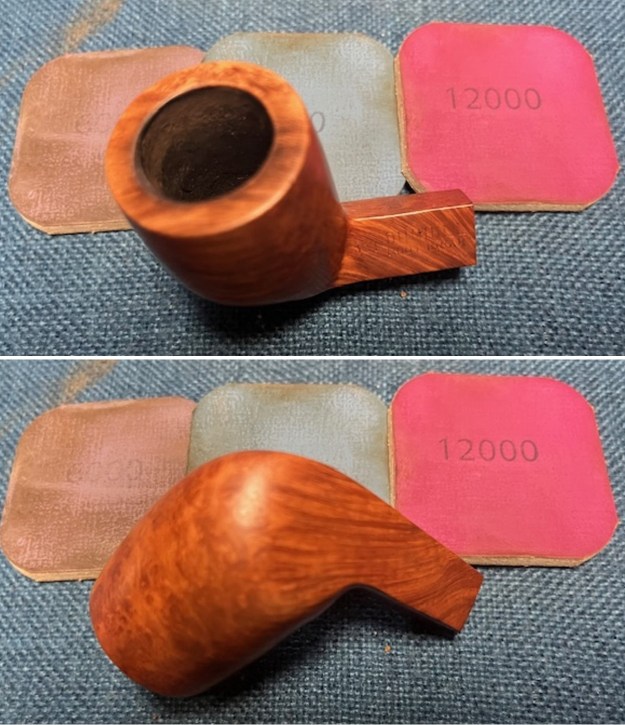
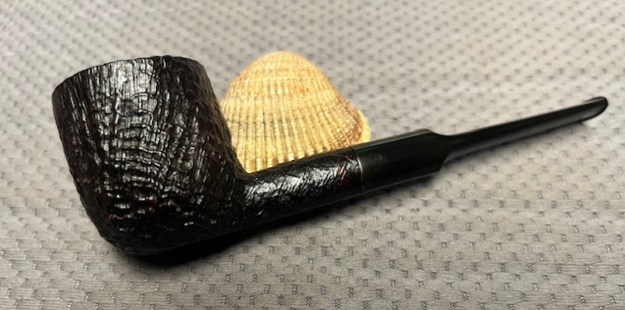
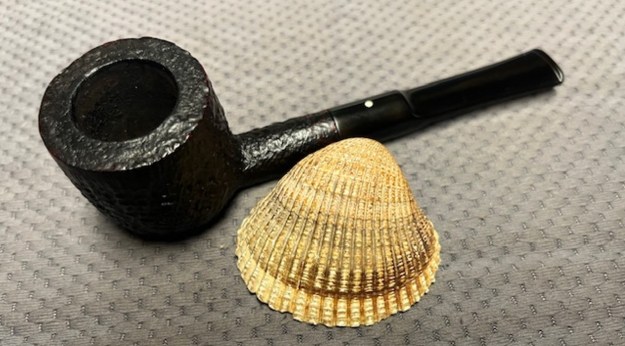
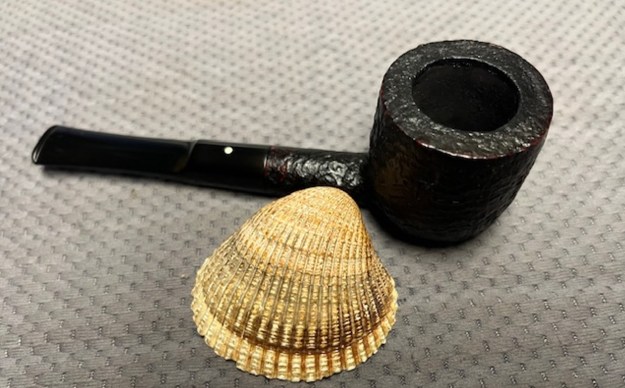
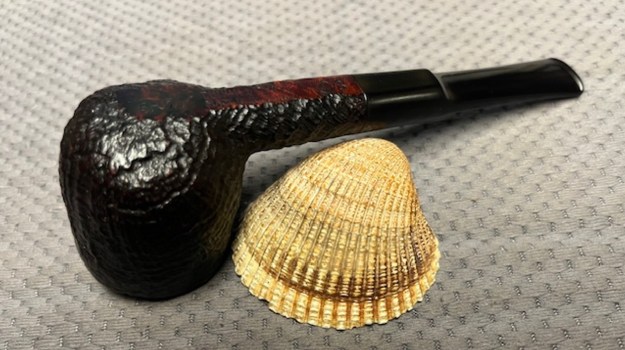
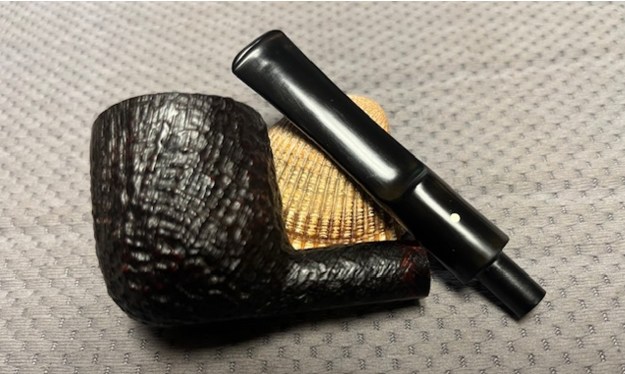
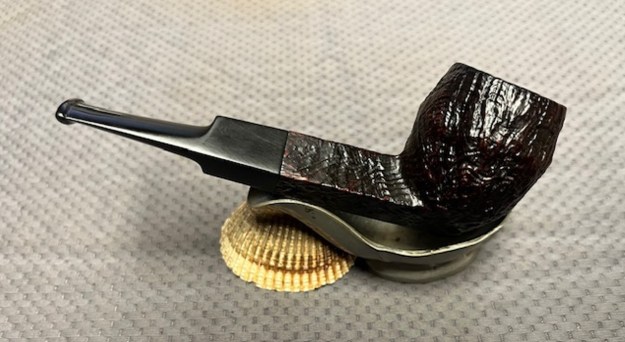
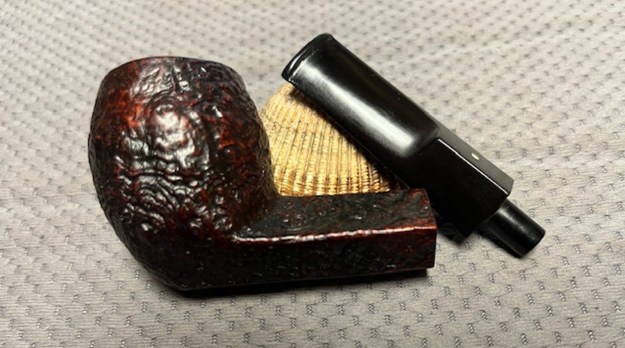
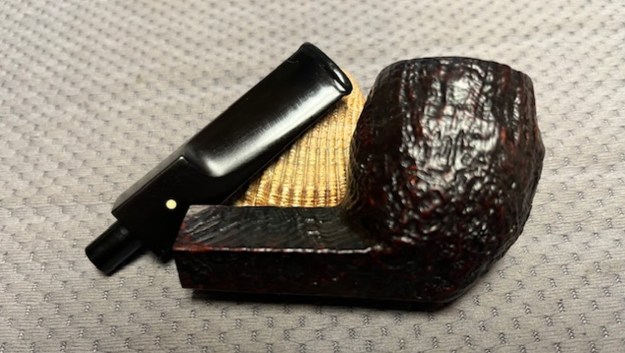
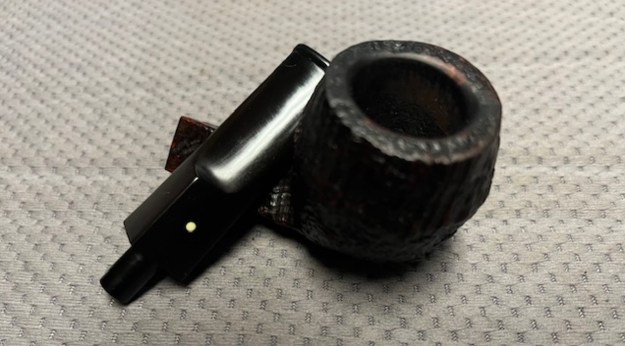
Breathing Life into a 56 F/T Dunhill Tanshell Made in England 0 4T Bent Billiard


by Steve Laug

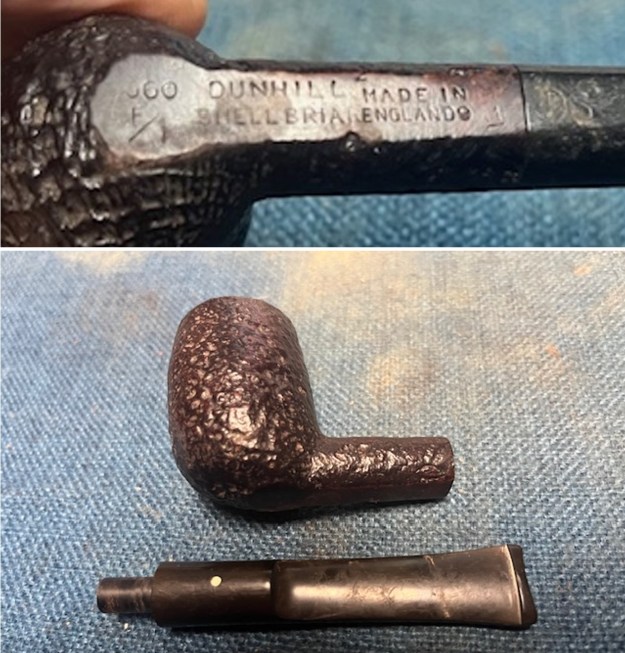
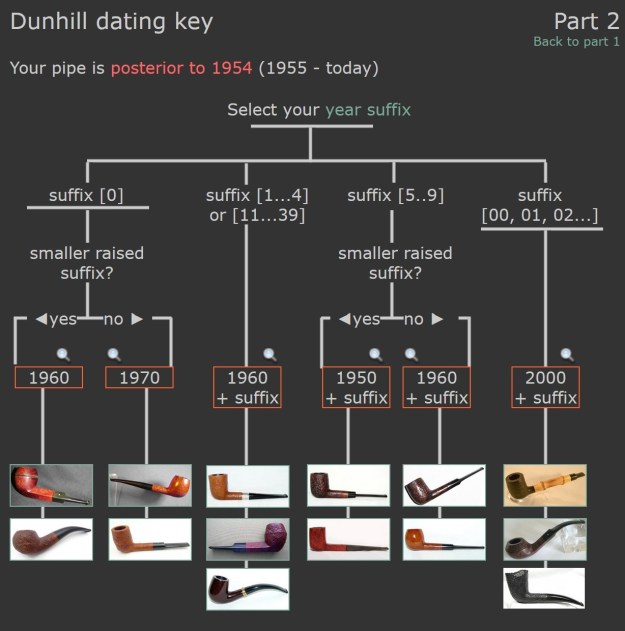
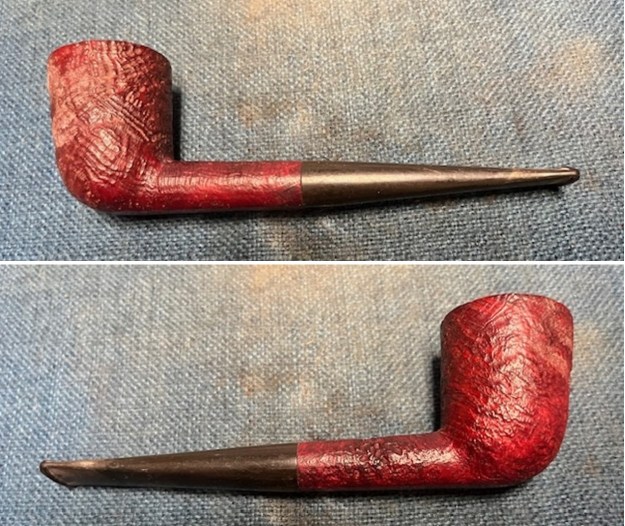
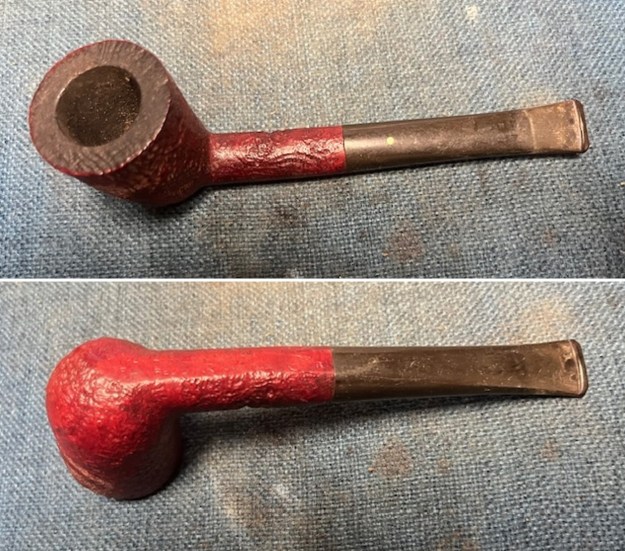
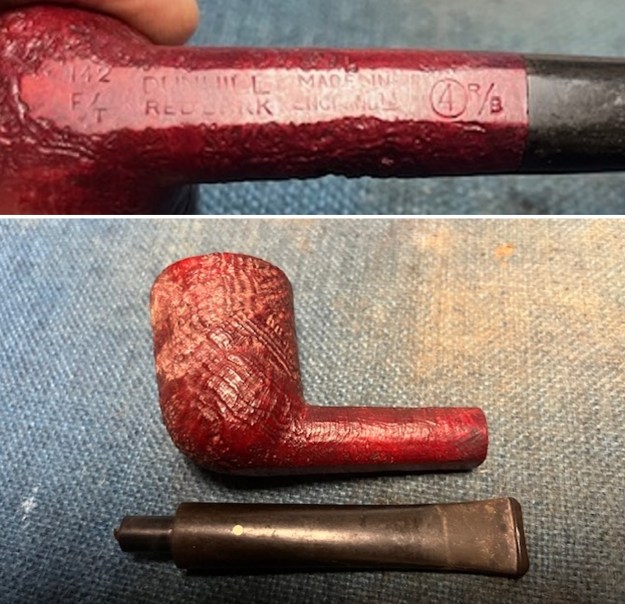
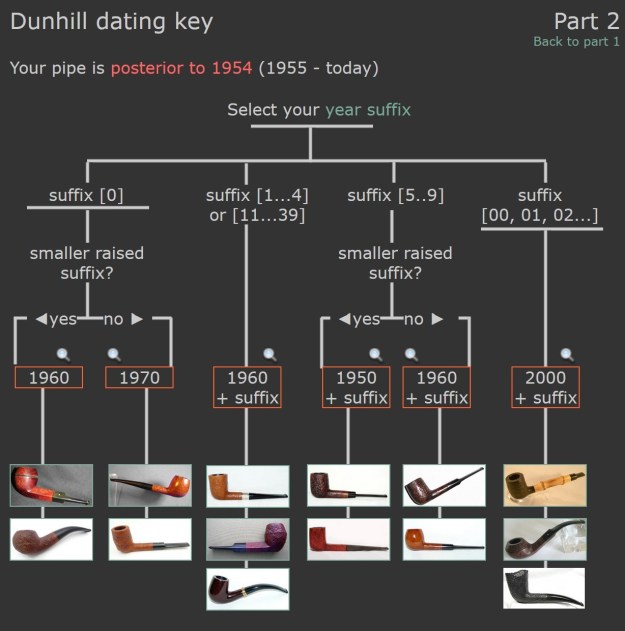
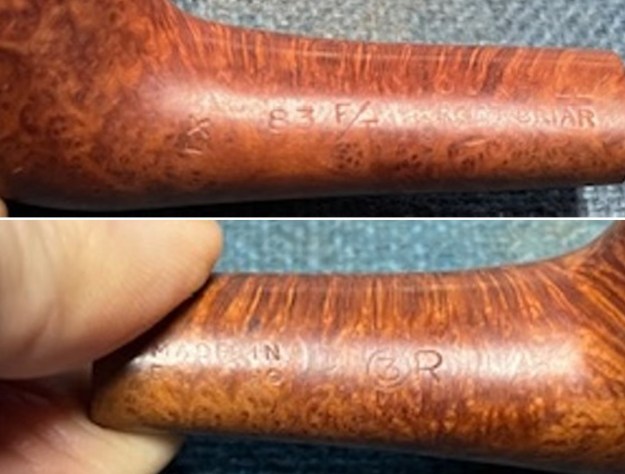
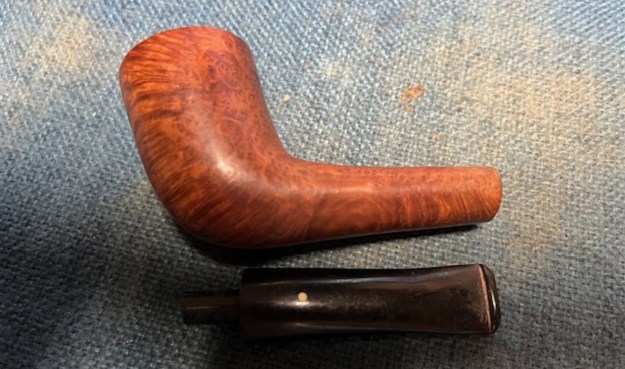
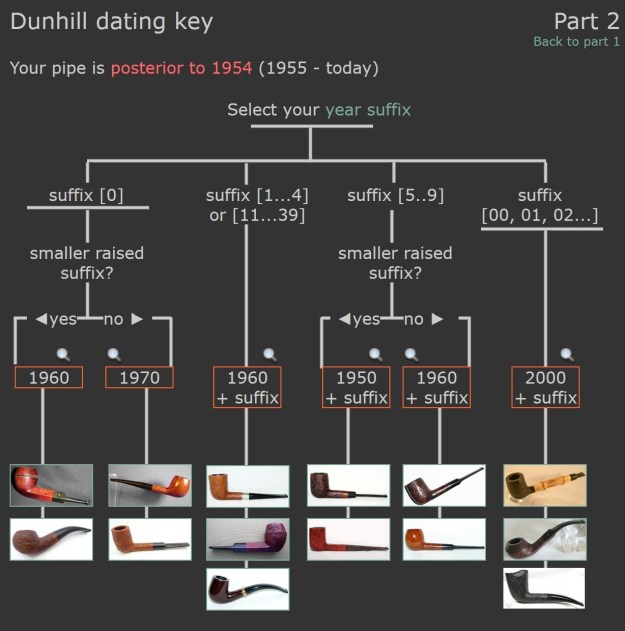
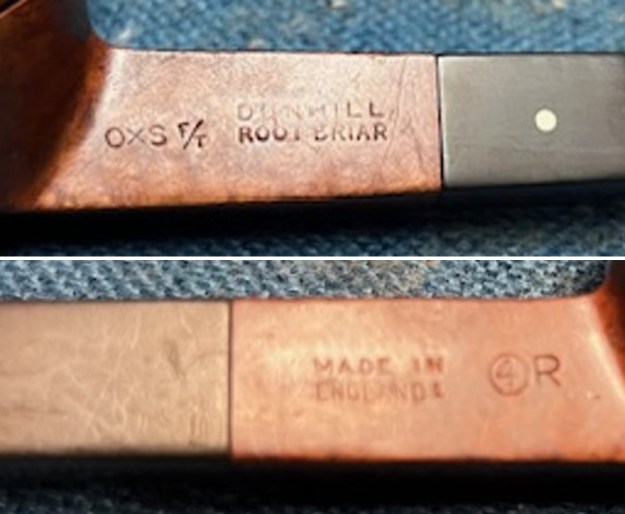
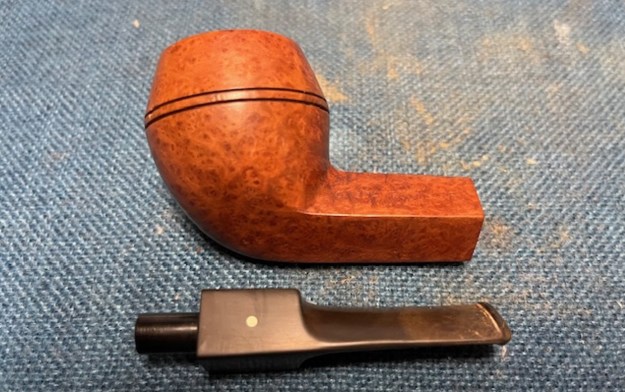
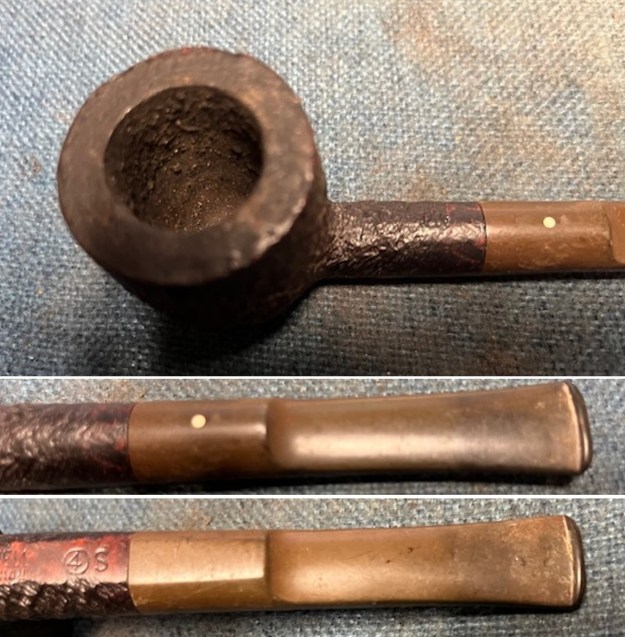
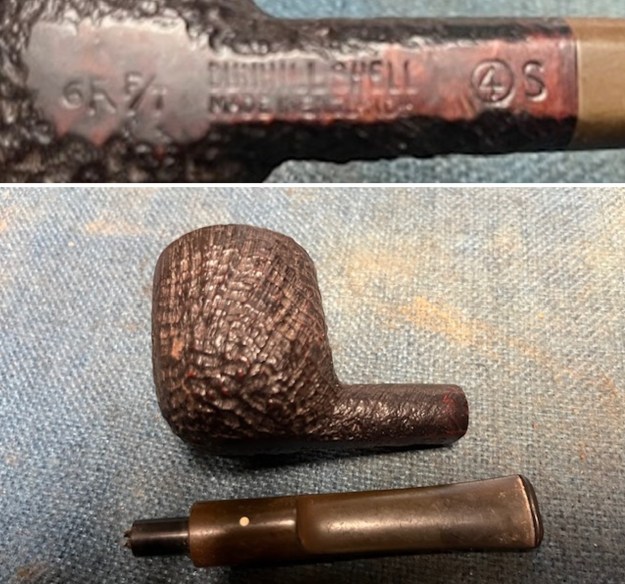
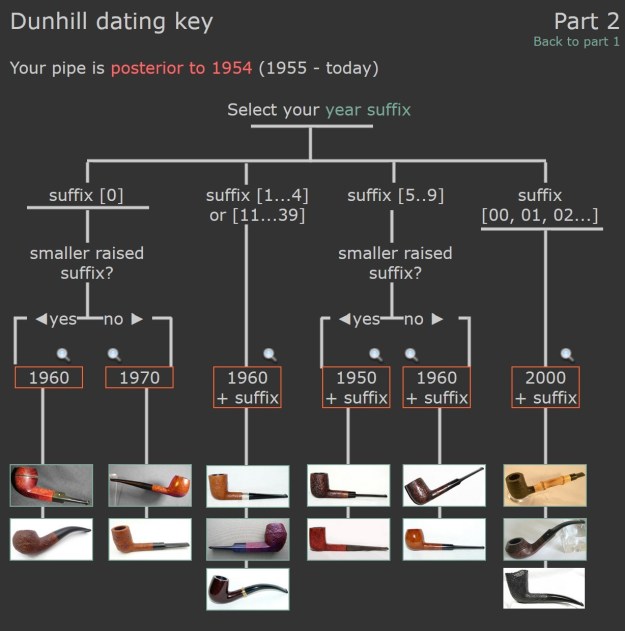
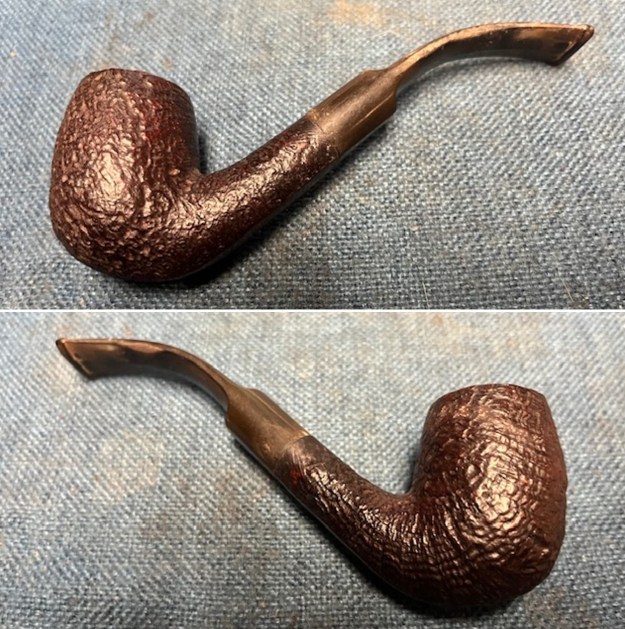
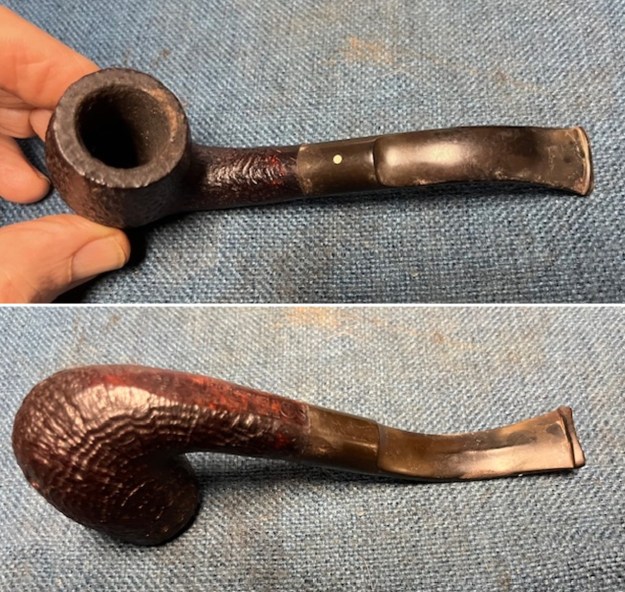
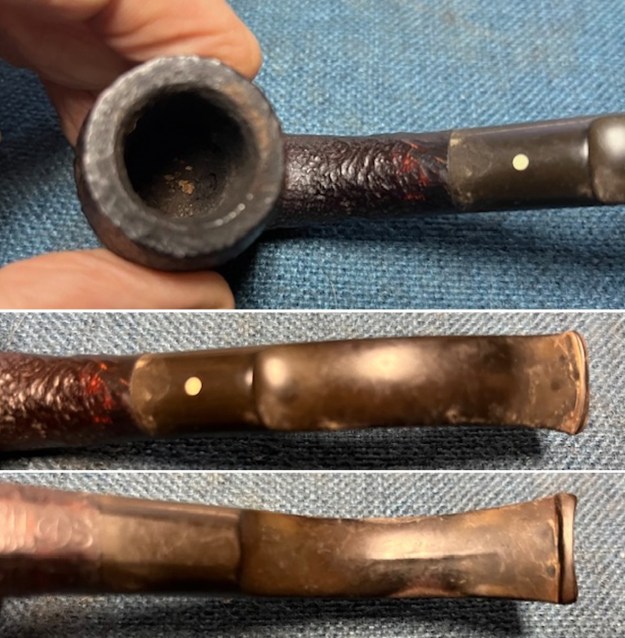
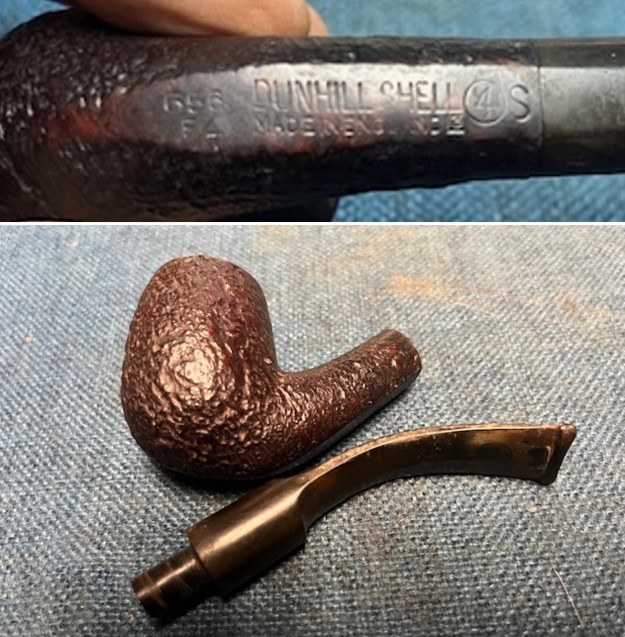
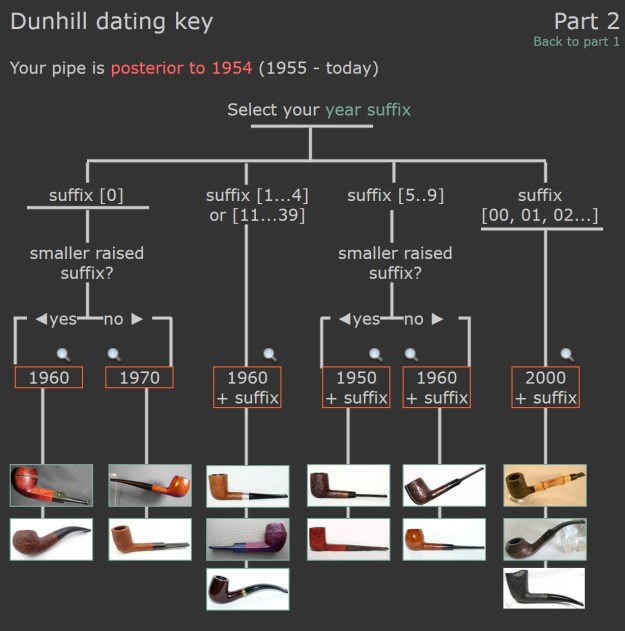
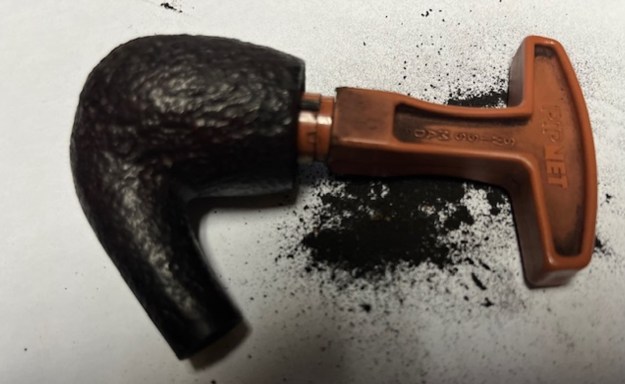
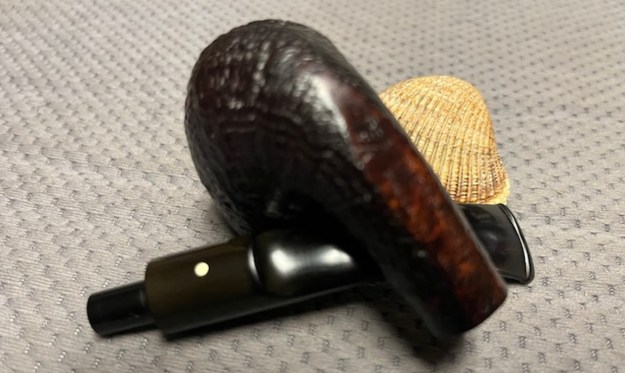
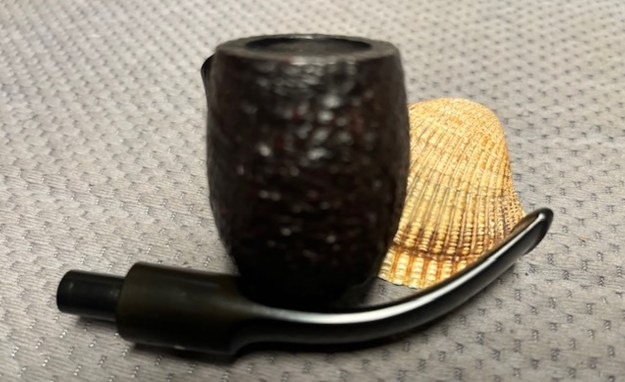
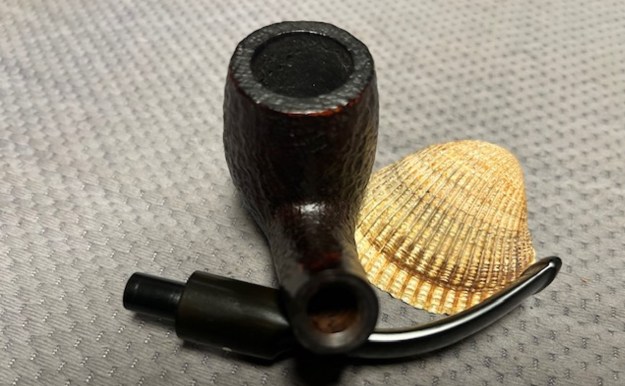
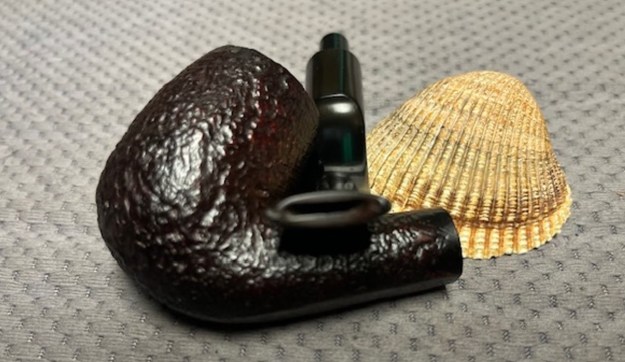
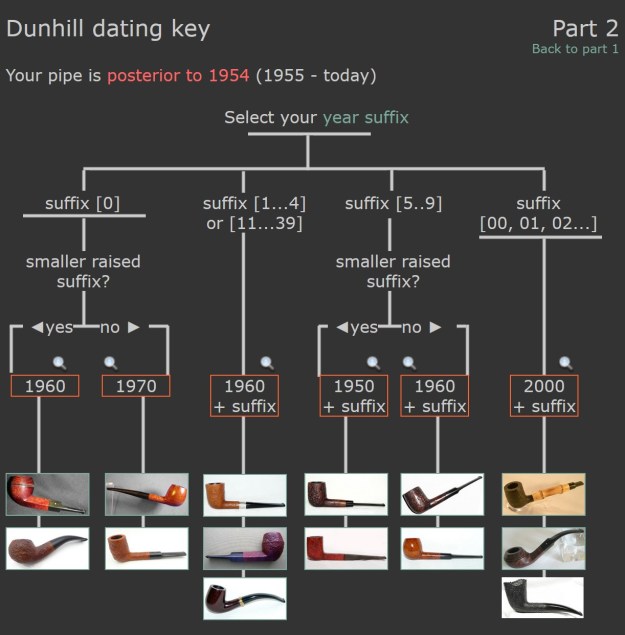
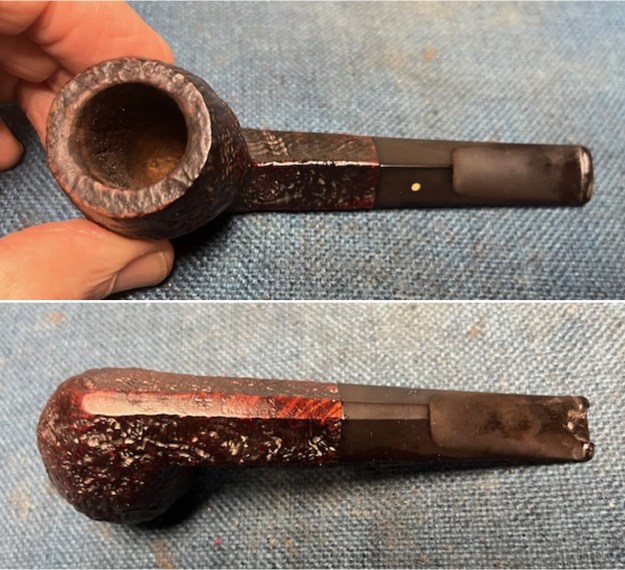
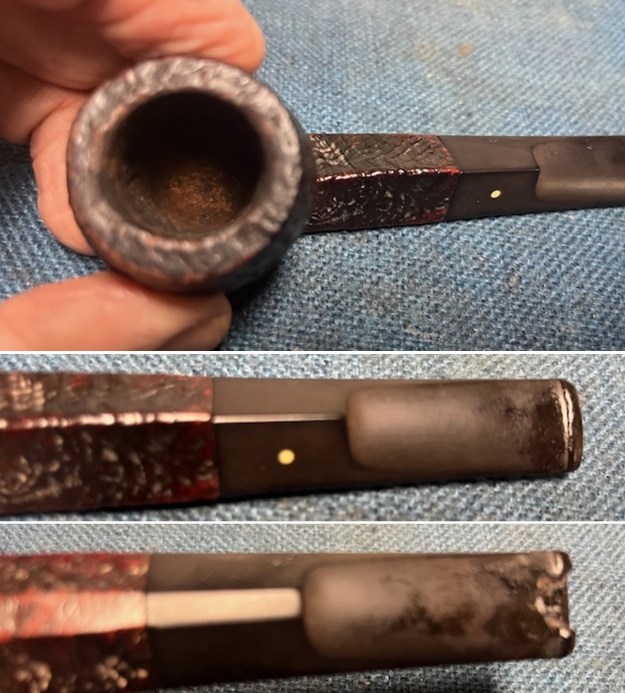
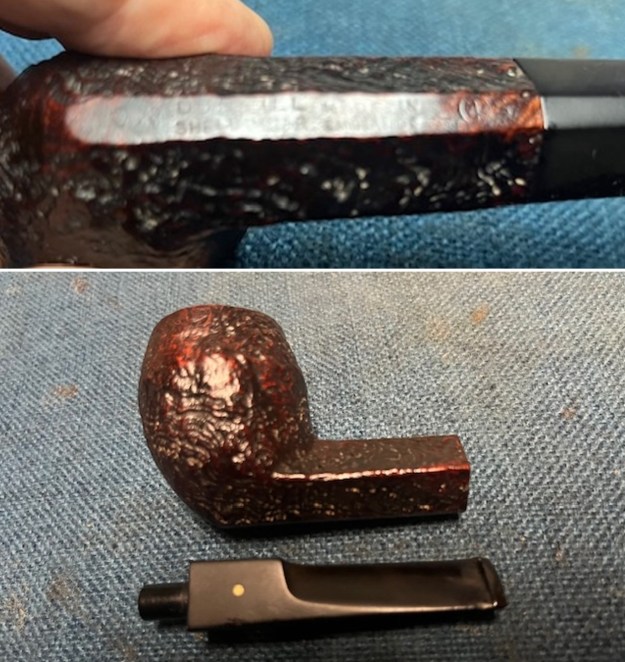
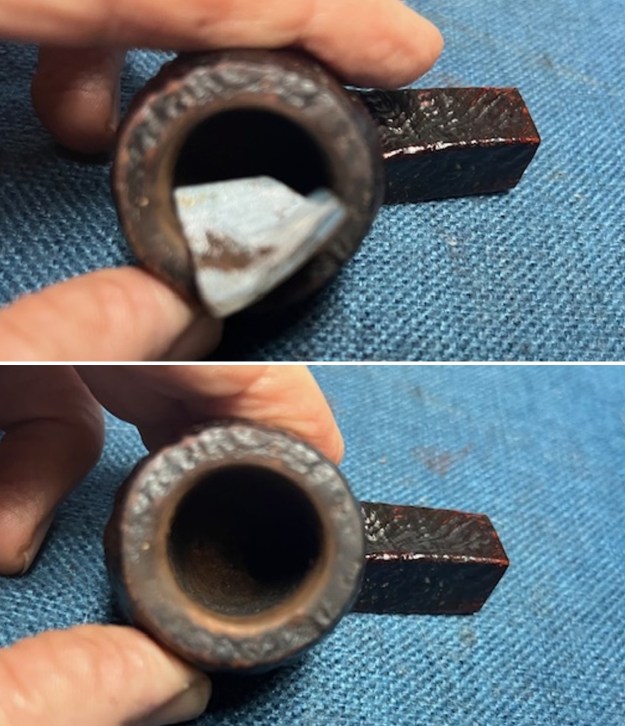
The next pipe on the table is one that came to us from our contact in Copenhagen, Denmark on 08/09/2024. It is another Dunhill sandblast that is shallow really shows the grain underneath. It is stamped on a smooth panel on the underside of the shank with the shape number 56F/T followed by Dunhill [over] Tanshell. Next to that it is stamped Made in [over] England with the date number 0 after the D in England. After that it is stamped with a 4 in a circle [followed by] T for Tanshell. The stamping is faint in spots but is otherwise clear and readable as noted above. The pipe has some darkening on the rim top and edges of the bowl. There is some amazing grain under the blast that the shape follows well. The finish was dusty and oily around the nooks and crannies of the sandblast but otherwise looked good. The bowl had a moderate cake and there was light lava on what appeared to be a smooth rim top or edges. The edges looked to be undamaged and possibly protected by the lava. Cleaning would make that clear. The taper stem was oxidized, calcified, dirty and had scratches, light tooth marks and chatter ahead of the button. Jeff took photos of the pipe to show what it looked like before he started working on it. Jeff took photos of the bowl and rim top to show the cake in the bowl and the wear and lava in the smooth rim top to show the general condition of the pipe. The photos of the stem to show the condition of both sides of the stem as noted above. He took photos of the sides of the bowl and the heel to show the beautiful grain in the sandblast around the bowl. It really is a beautiful piece of briar that has a shape that follows the grain. The finish is nice but it also dirty with dust ground into the finish. Jeff took photos of the stamping on the heel of the bowl and underside of the shank. It is clear and readable as noted above.One of the first things I like to do is to unpack the stamping and understand each element in it. I turned to Pipephil helpful site (http://pipephil.eu/logos/en/dunhill/tanshell1.html). The stamping is interpreted as follows: The number 56 is the shape number for a Bent Billiard. The F/T signifies a Fish Tail stem. The Tanshell stamp refers to the finish which is corroborated the T at the end of the stamping. The size of the pipe is shown in a circle is a Group 4. The 0 following the D of England gives the date the pipe. Pipephil also has some helpful dating keys on the site that are basically flow charts that you can walk through to date your pipe (http://pipephil.eu/logos/en/dunhill/cledat-en1.html). I turned to Part 1 of the Dating Key and followed the chart. This pipe has a 0 following the D in England. It is the same size as the D so that took me to the section on the chart below (column one) which instructed me that the pipe could be dated as being made posterior to 1954. I followed the link following the “Your pipe is posterior to 1954. Narrow down your dating”. That took me to Page 2 of the dating key (http://pipephil.eu/logos/en/dunhill/cledat-en1a.html).   The first column (suffix 0) led me to the section with a 0 after the D in England that is the same size as the D. There was a directive for dating the pipe spelled out as follows: 0 the same size as the D in England gives the pipe a date of 1970. I then turned to Pipedia’s section on Dunhill Root Briar to get a bit of background on the Dunhill finishes (https://pipedia.org/wiki/Dunhill#Root_Briar). I quote:

Tanshell

The first lot was distributed in 1952 (usually made using Sardinian briar). The prototype was called “Root Shell “, produced in 1951. The Tanshell is a light tan sandblast. Sardinian briar was used for this sandblast. There is a distinct contrast in the sandblasts using Sardinian as opposed to Algerian briar. The Sardinian is much denser and much harder. The resulting pattern, when blasted, is far more even and regular both in terms of the surface texture and the finish.

The Tanshell was Dunhill’s fourth finish and its first major post-war line addition. Introduced in 1951/1952 the Tanshell was a naturally stained sandblasted pipe made exclusively from Sardinian briar through the 1960s. The Tanshell apparently was not simply a light stained Shell but rather was also the product of “certain processes [unrevealed] not previously employed.” Initially, it appears that the pipe was to be named the Root Shell and a stamp to that effect was ordered and received by Dunhill in May 1951. Ultimately, however, the name Tanshell was settled upon but the stamp for the Tanshell name was not received by Dunhill until the beginning of December. Thus, while the Tanshell was in production in 1951 it appears that most if not all Tanshells made in that year did not enter into retail distribution until 1952 and were given a 1952 date code. Loring, J. C., The Dunhill Briar Pipe, The Patent Years and After (self-published, Chicago, 1998).

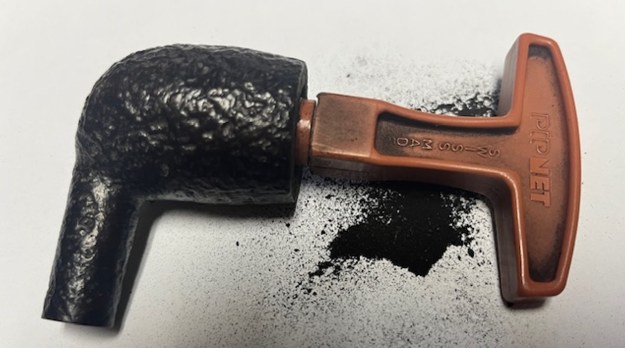
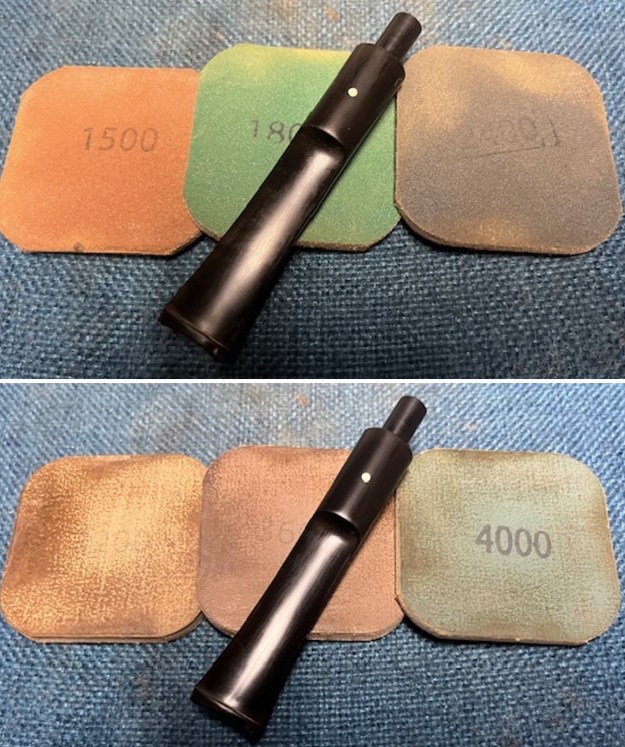
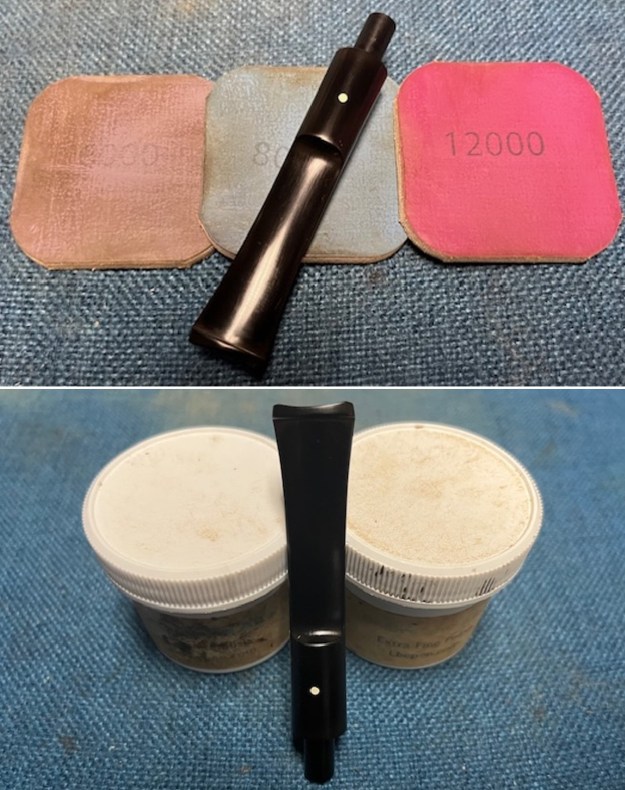
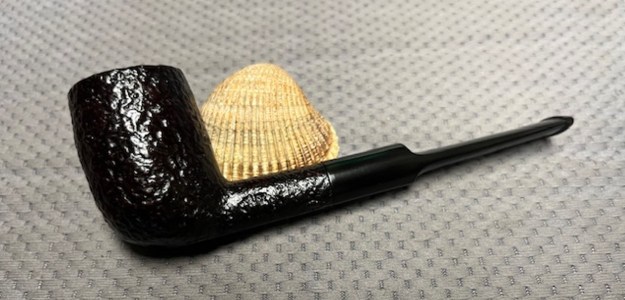
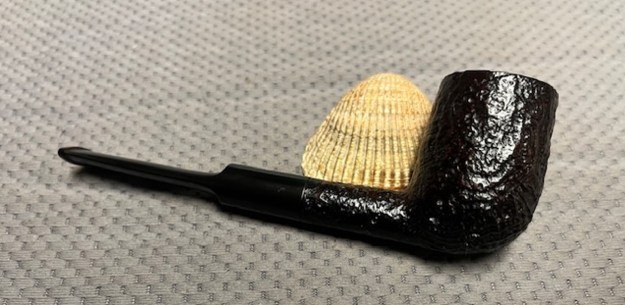
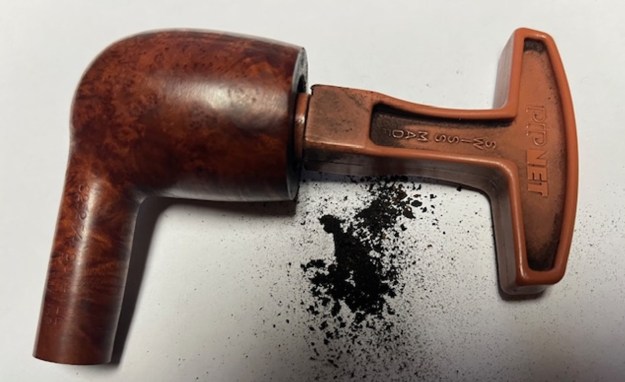
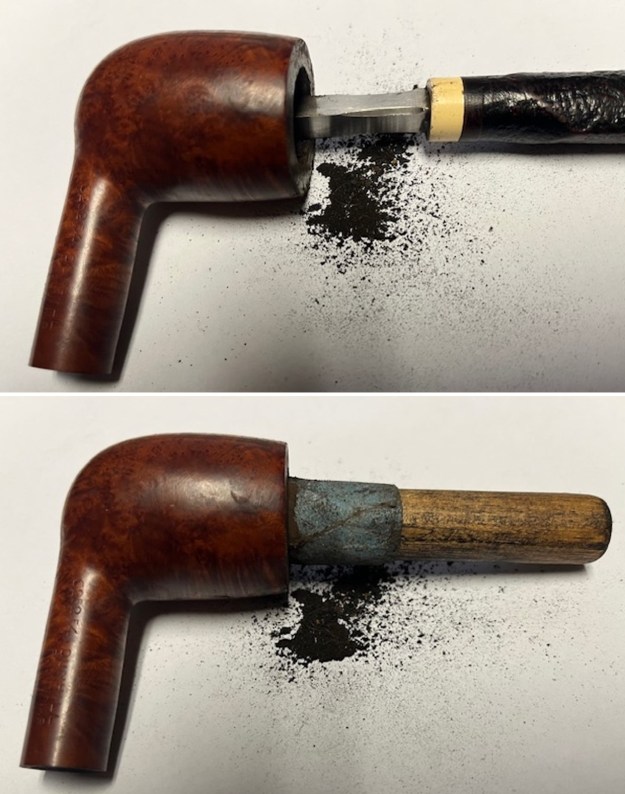
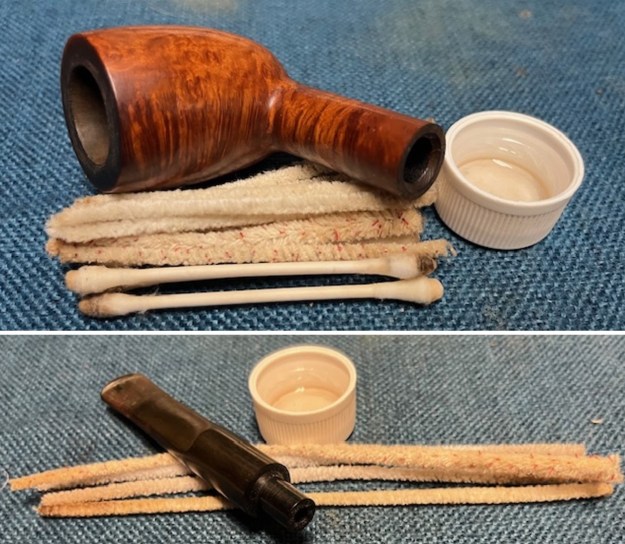
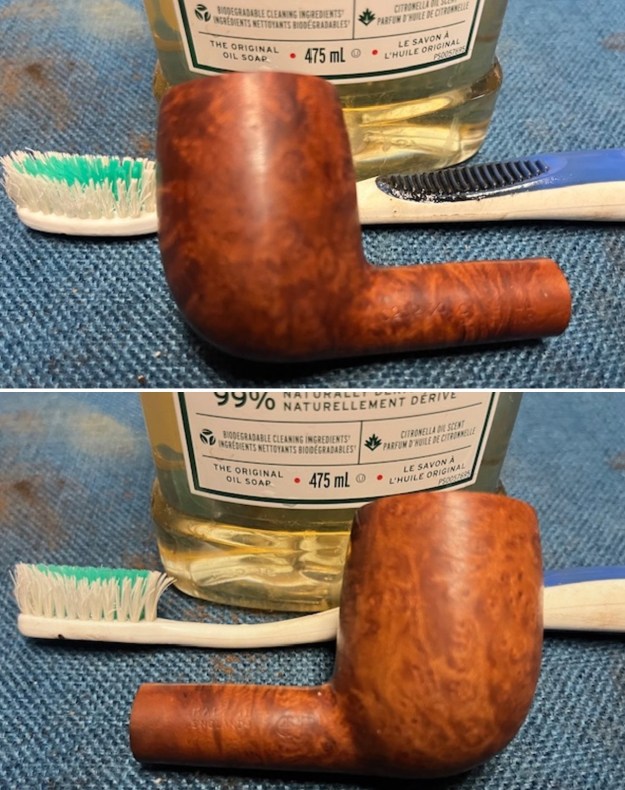
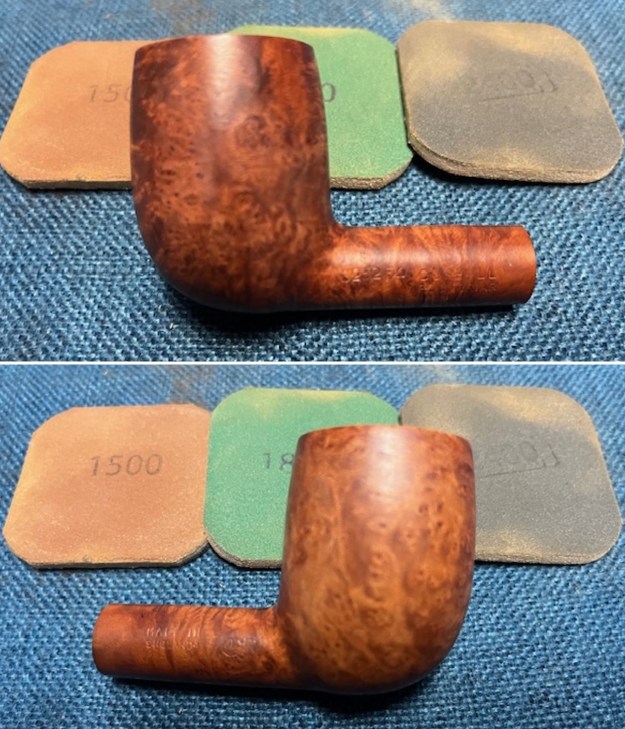
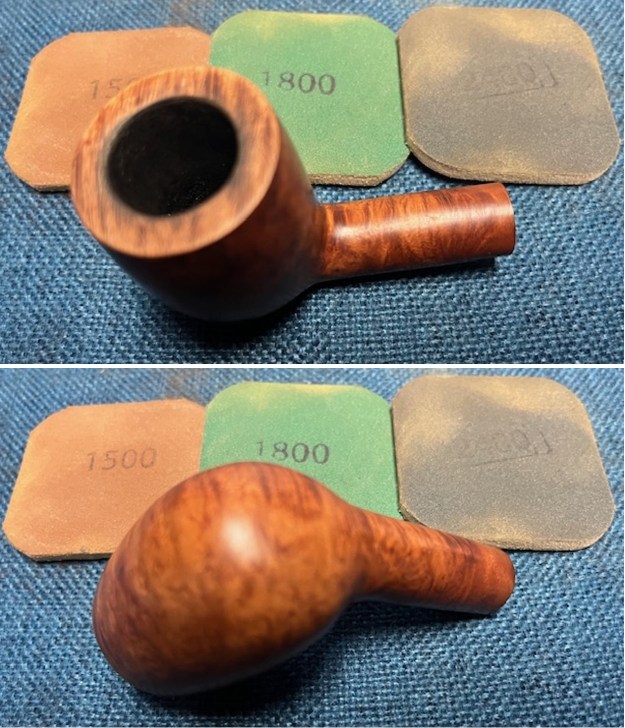
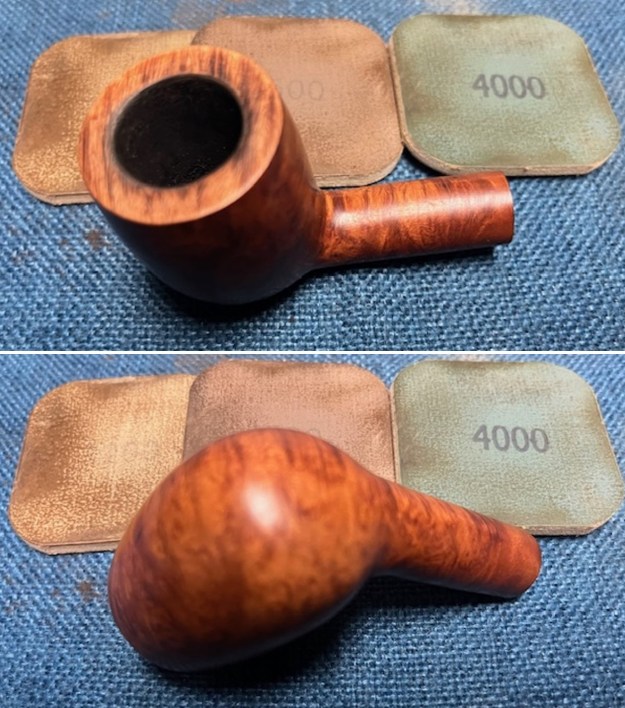
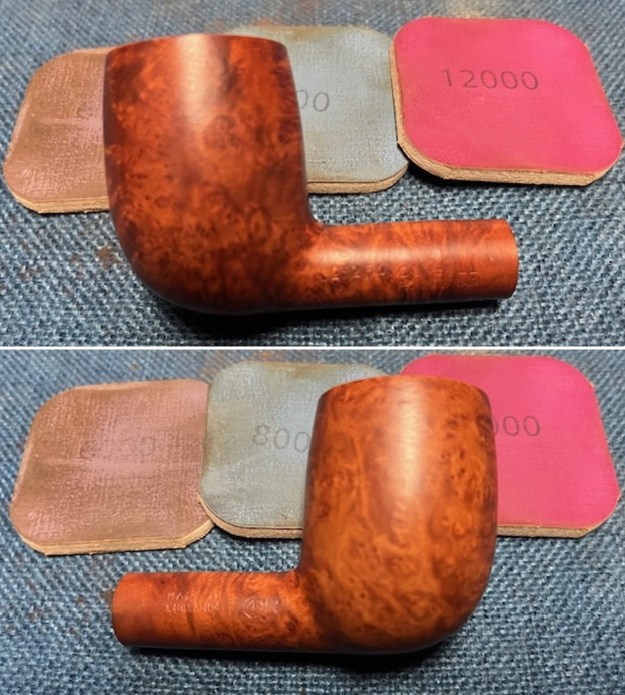
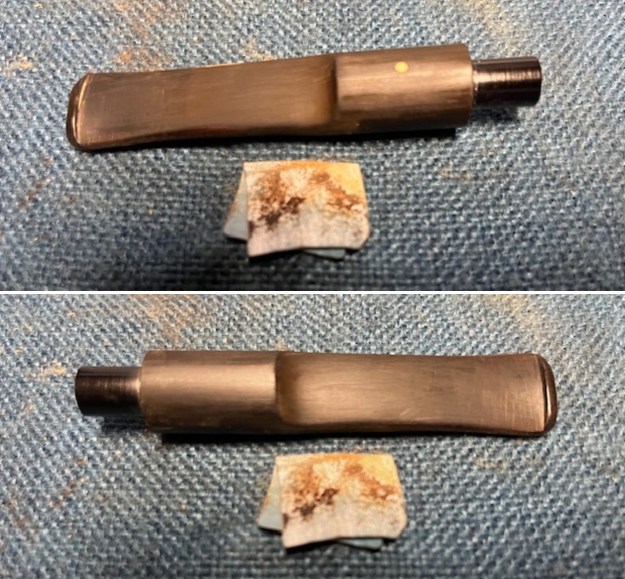
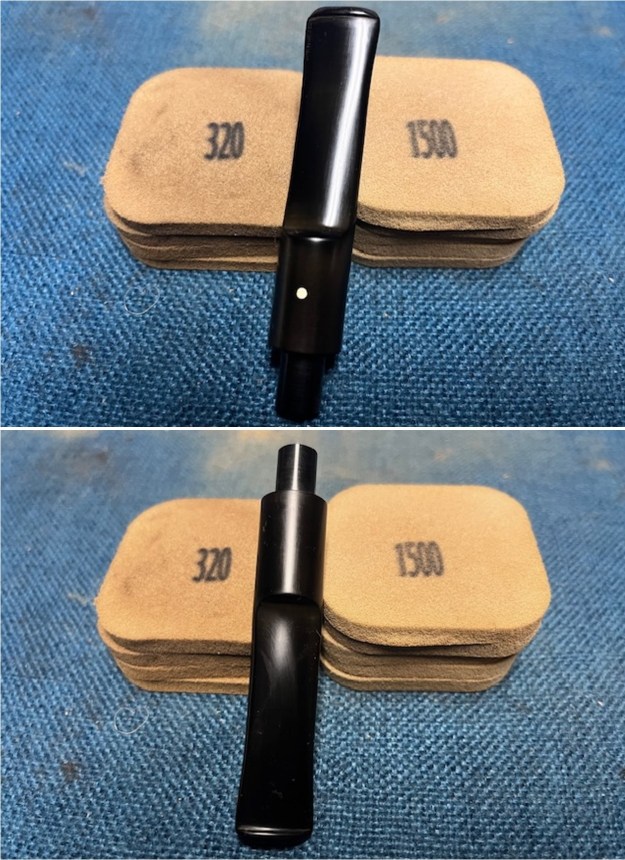
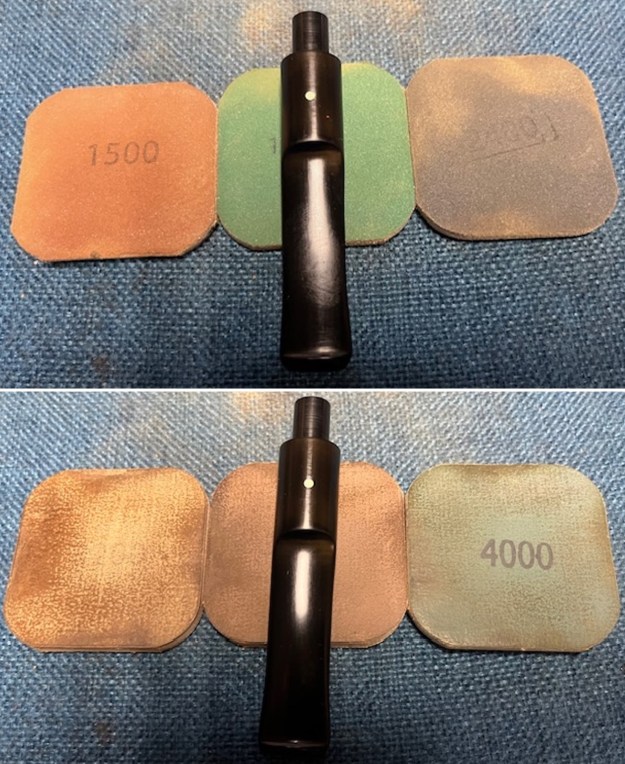
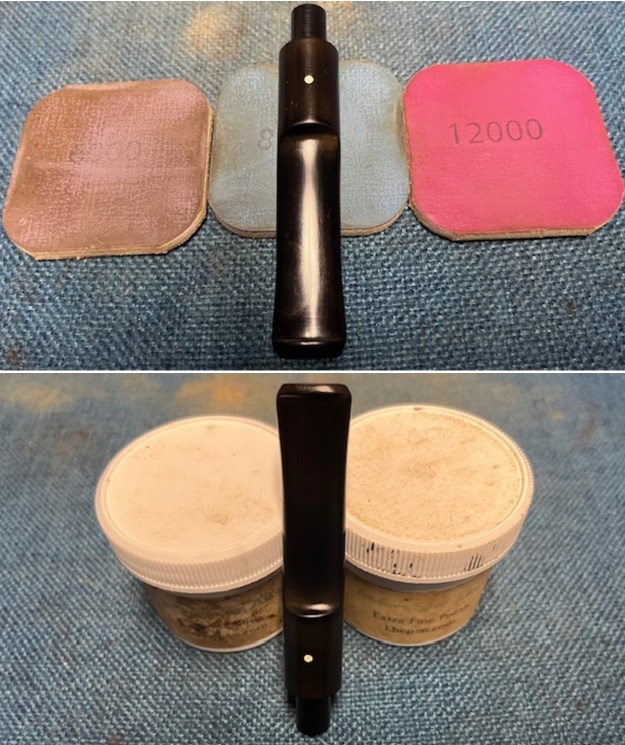
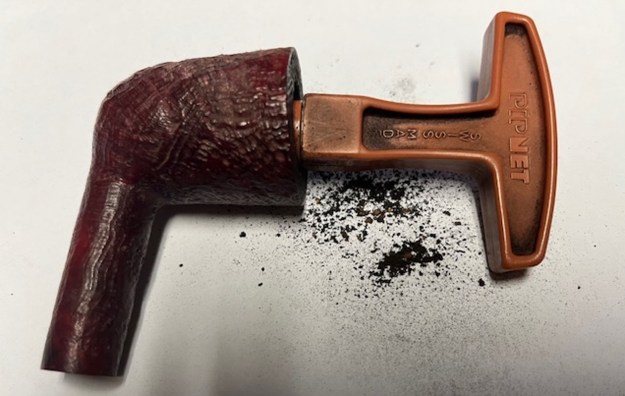
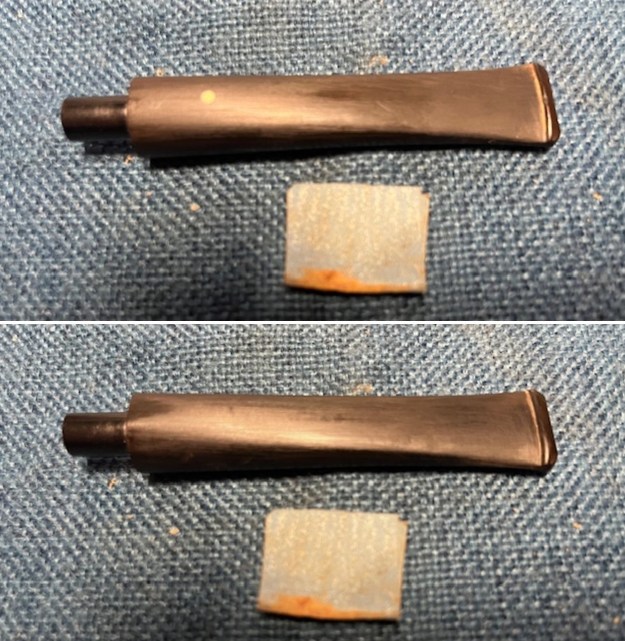
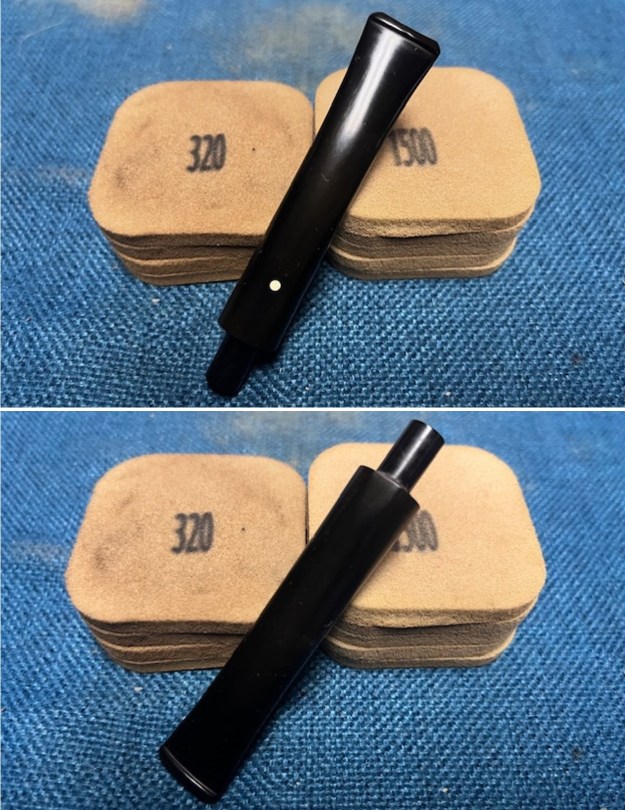
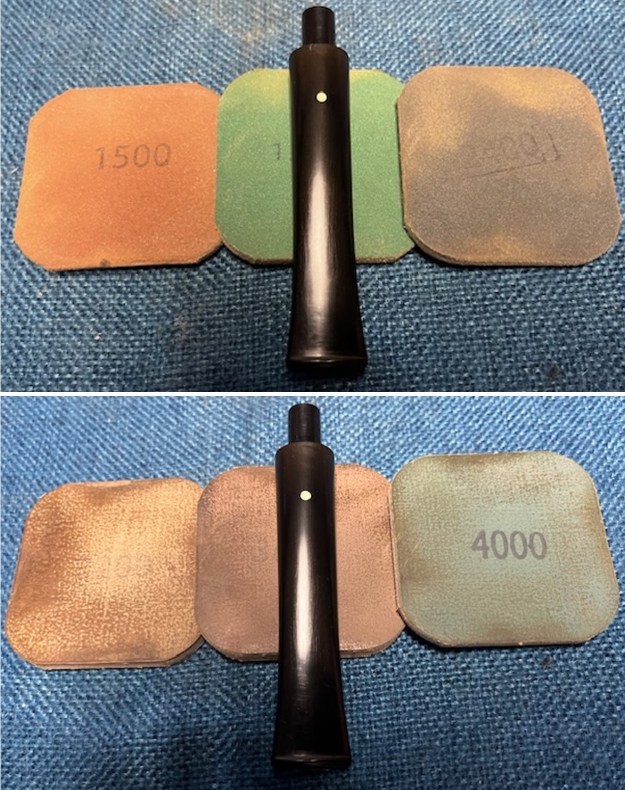
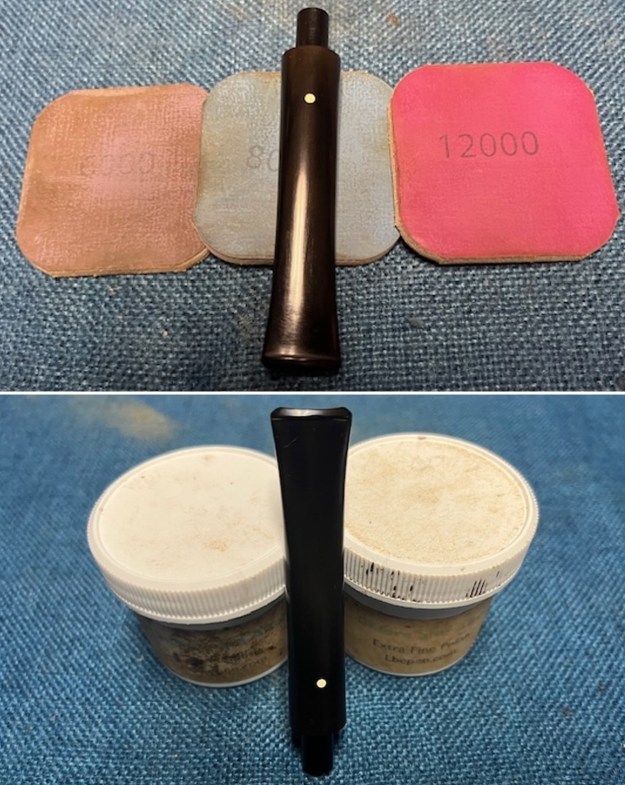
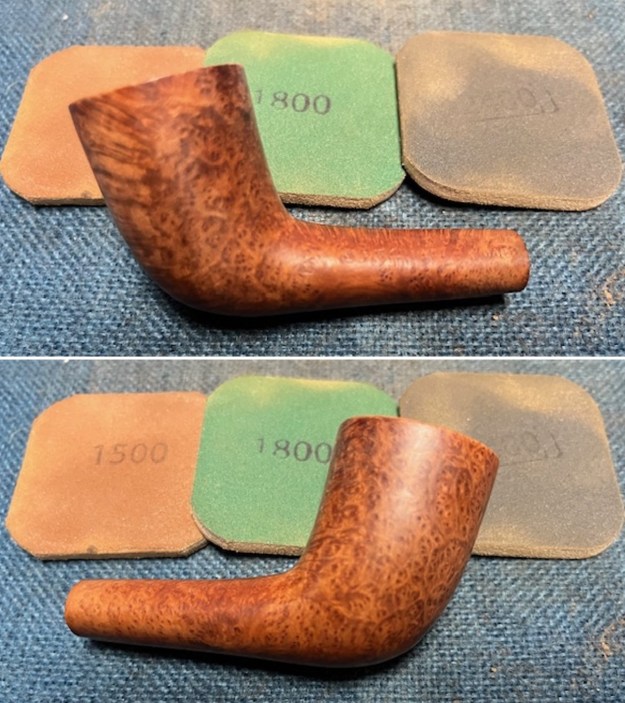
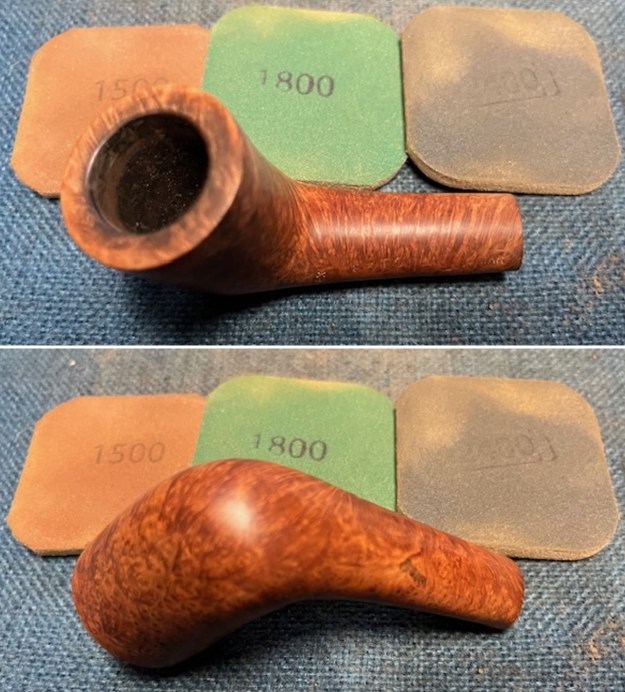
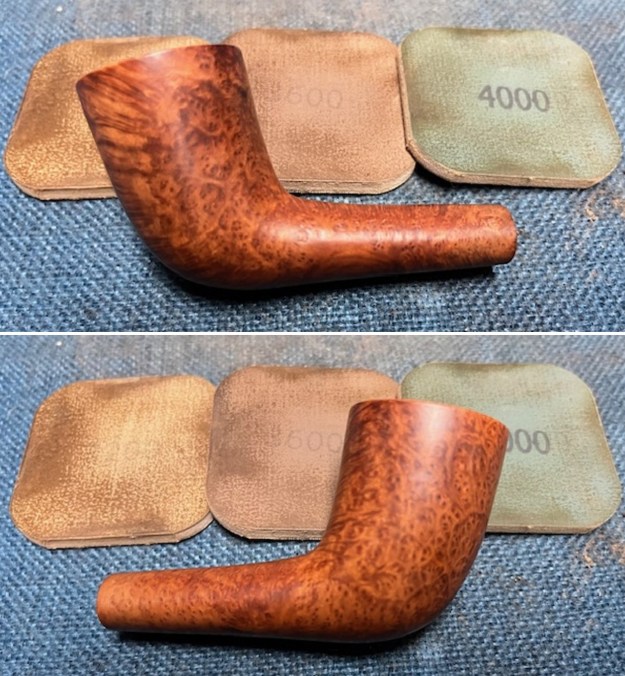
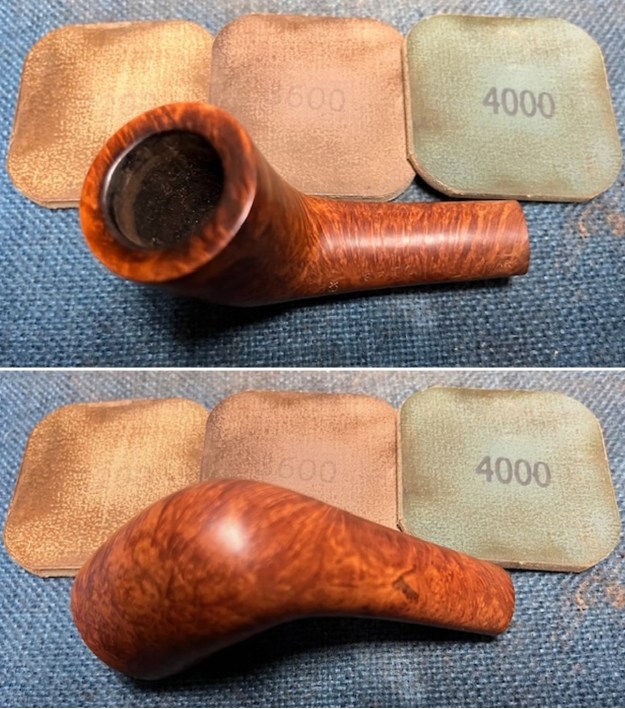
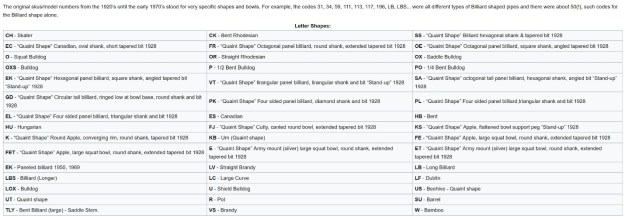
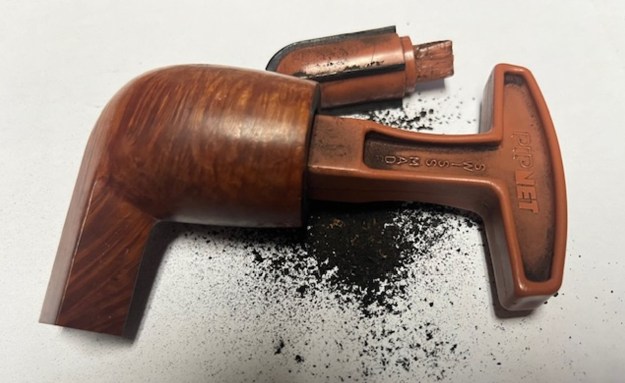
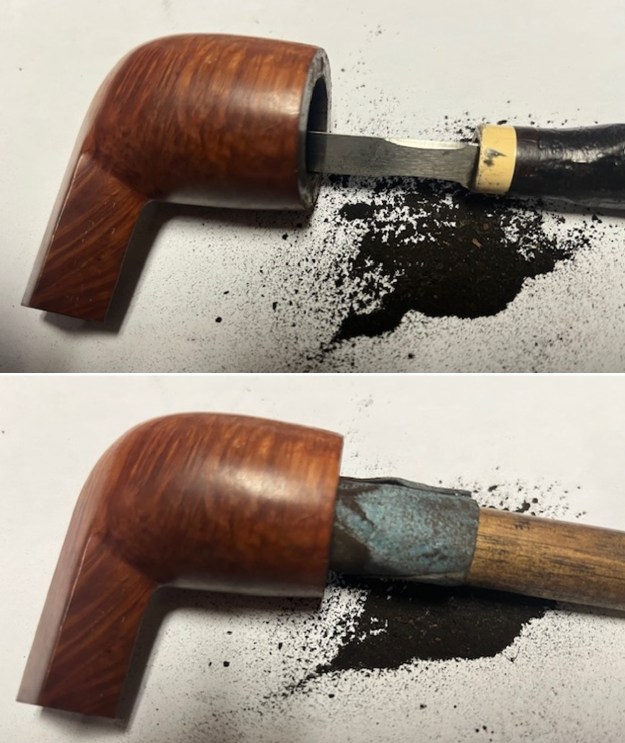
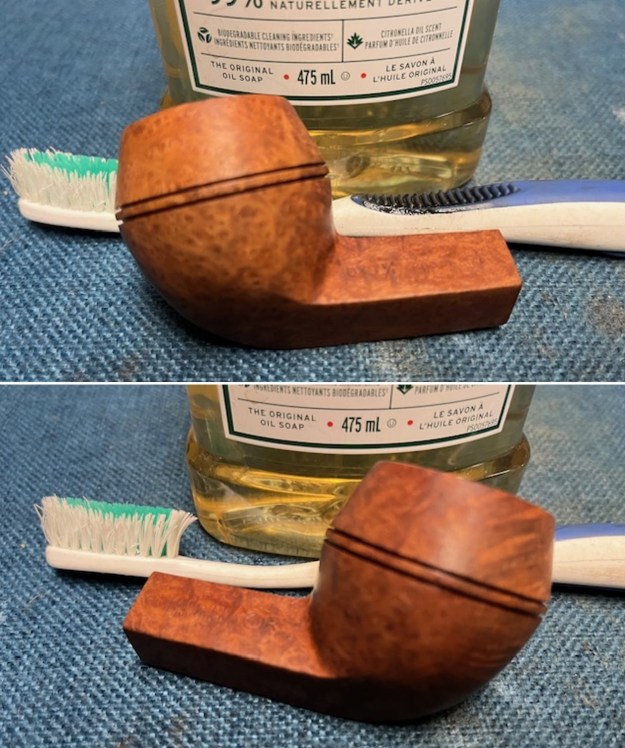
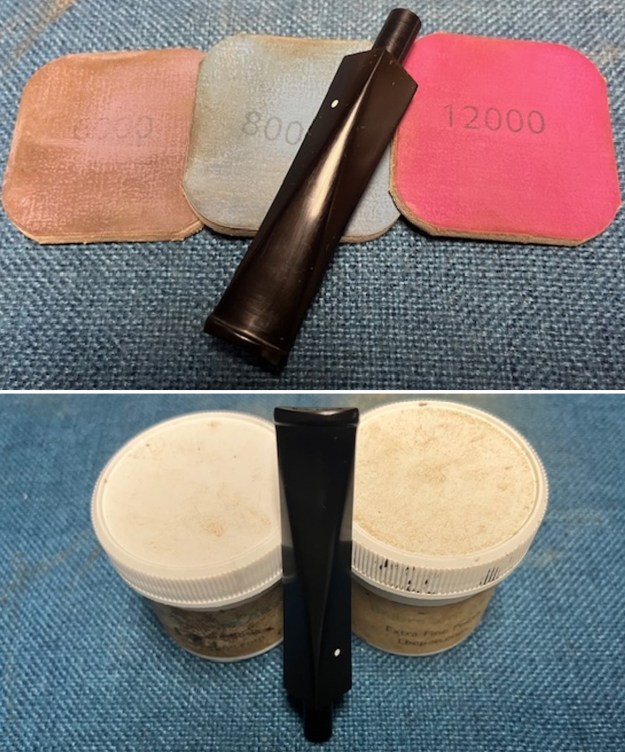
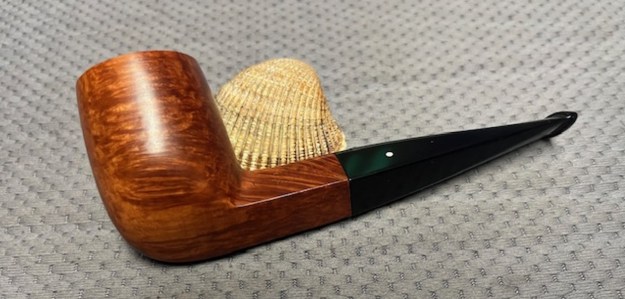
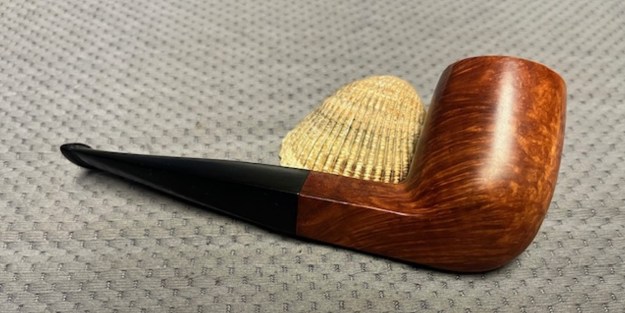
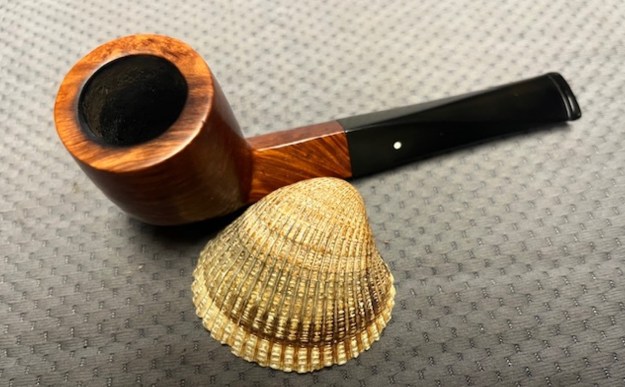
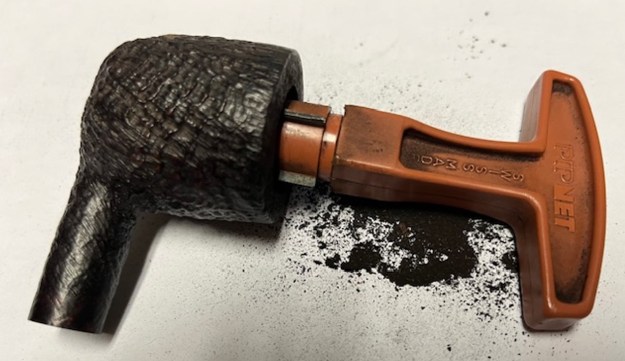
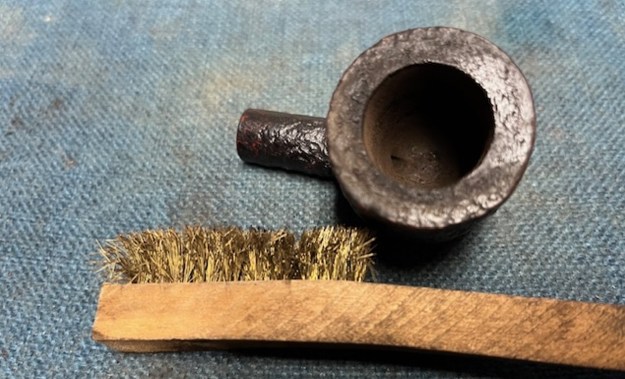
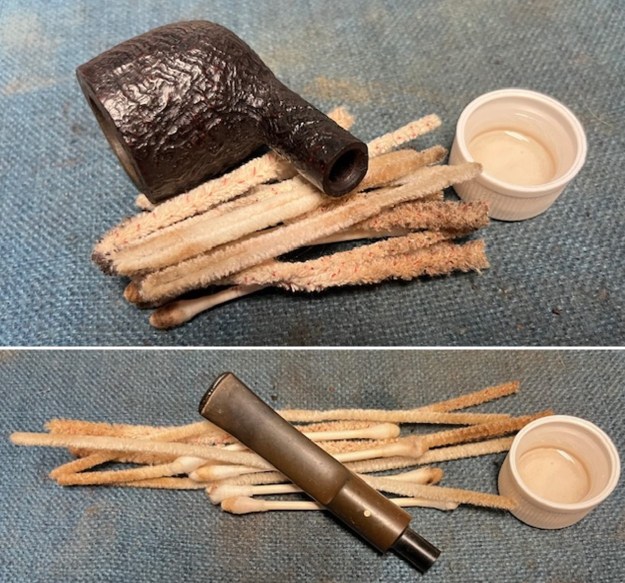
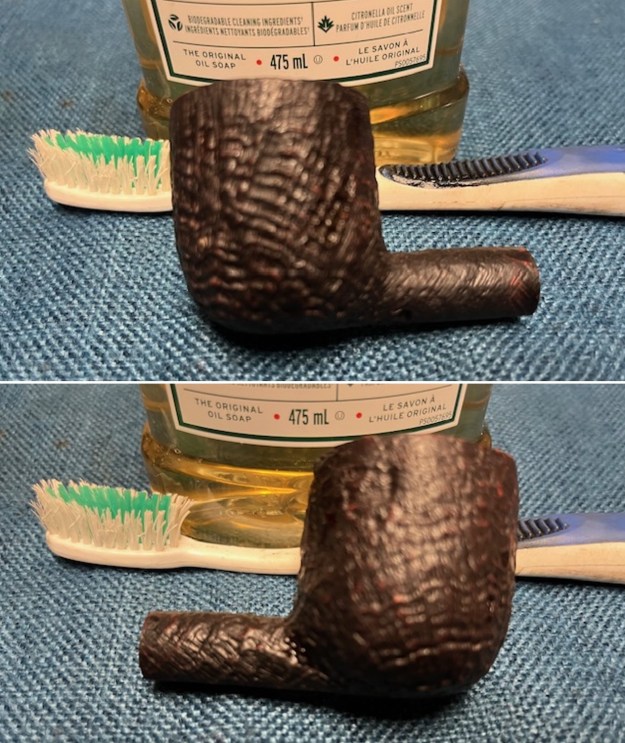
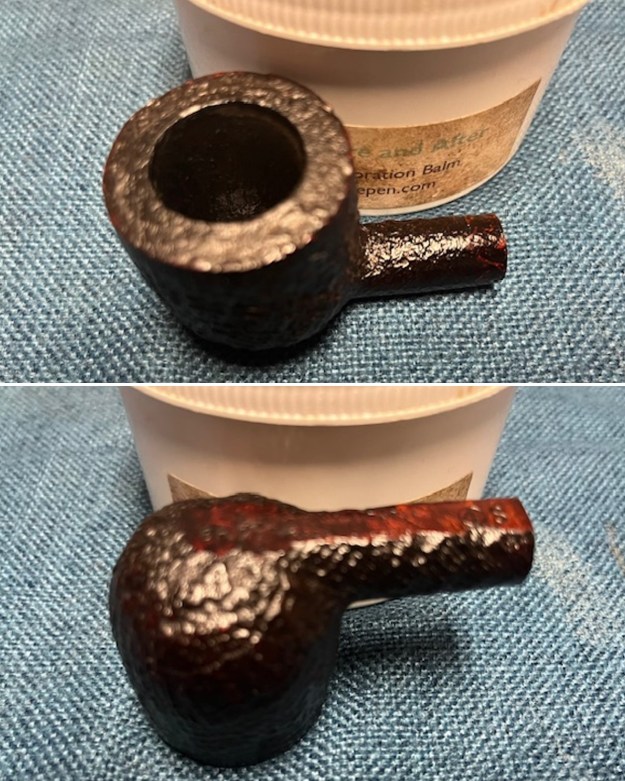
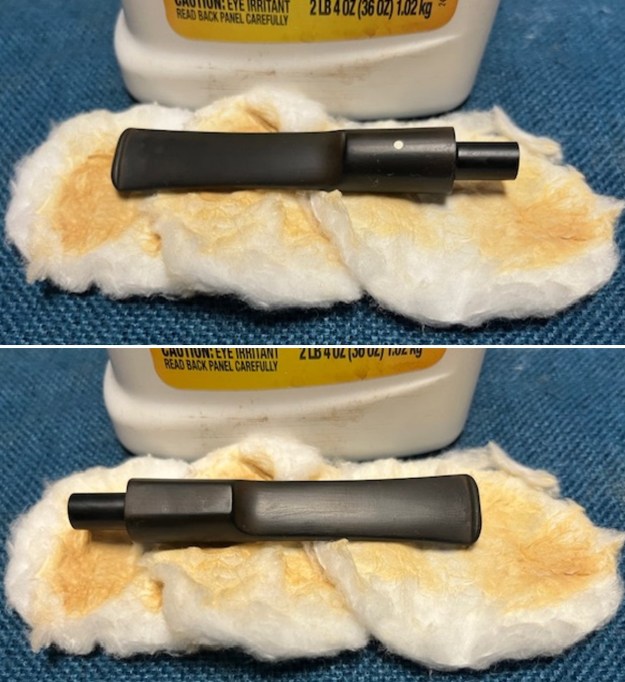
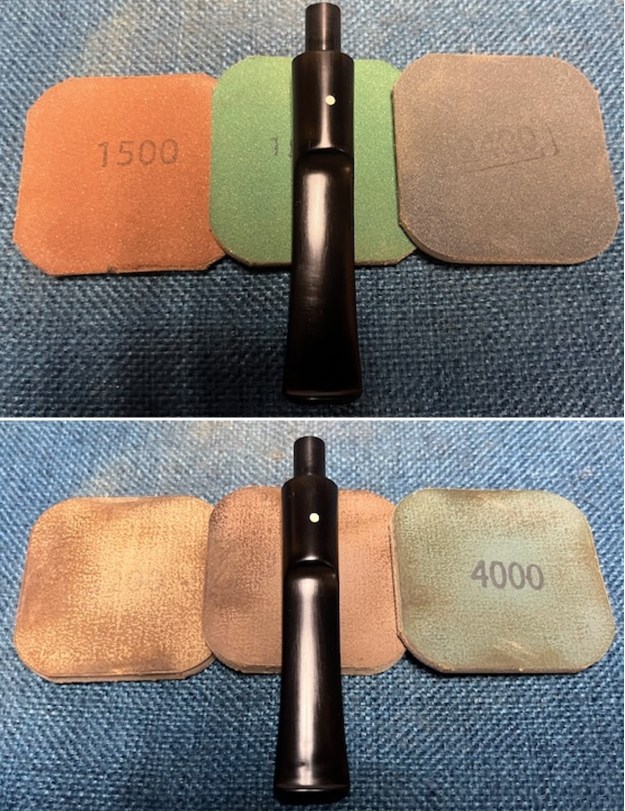
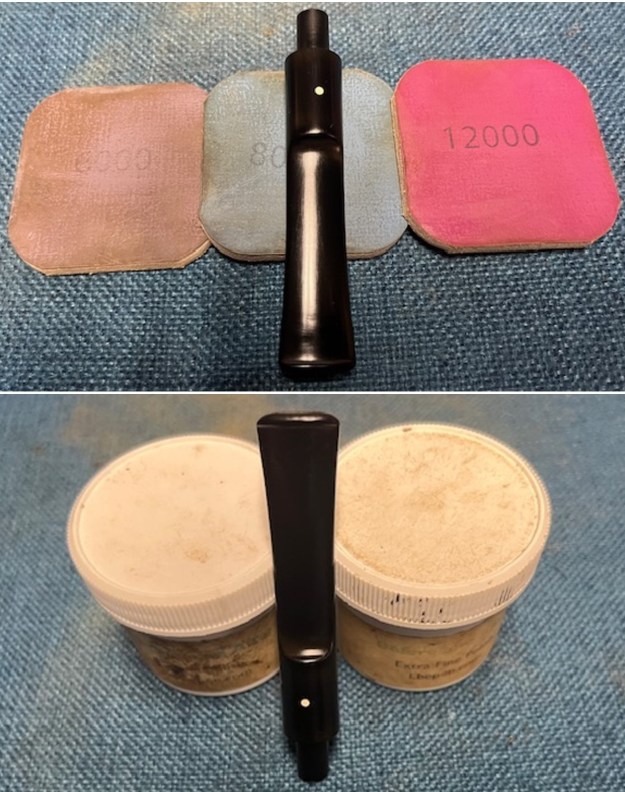
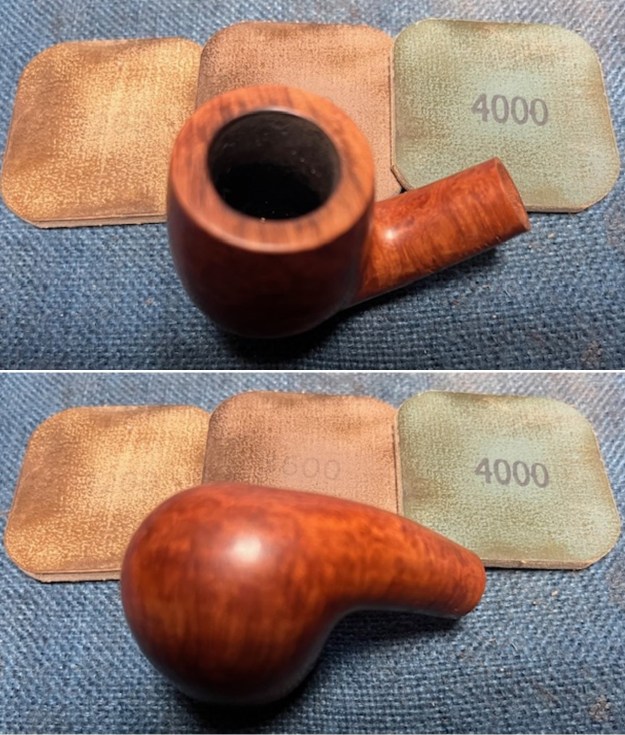
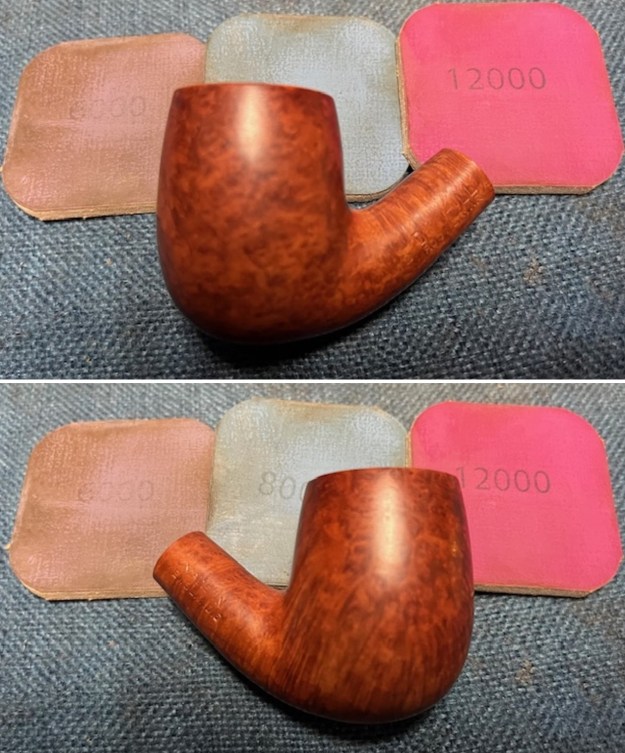
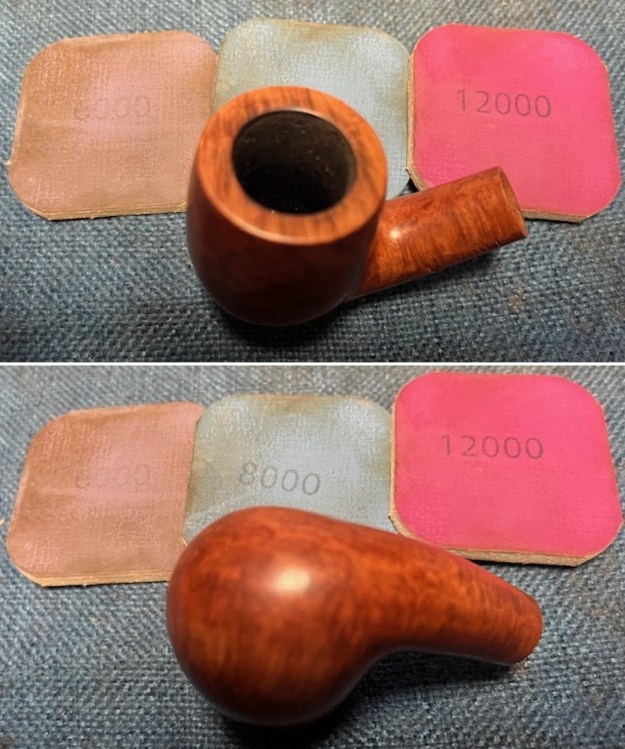
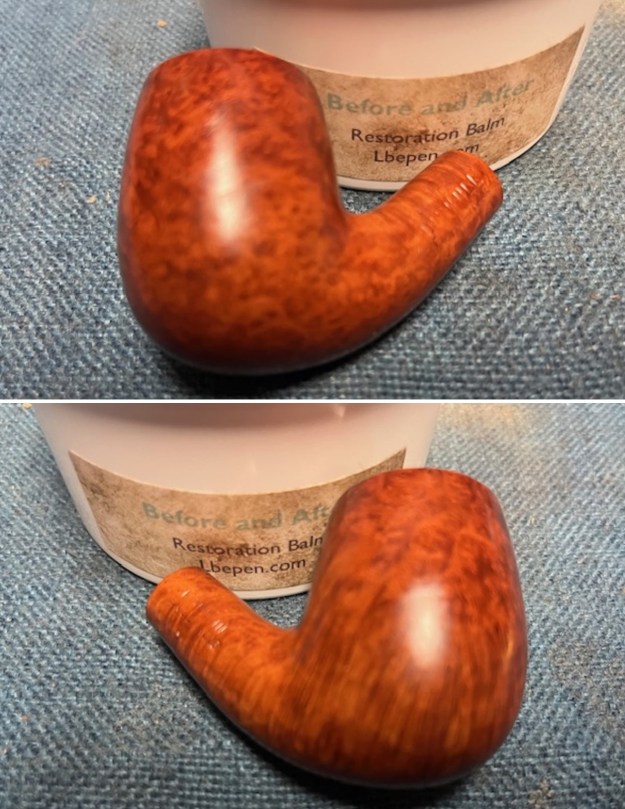
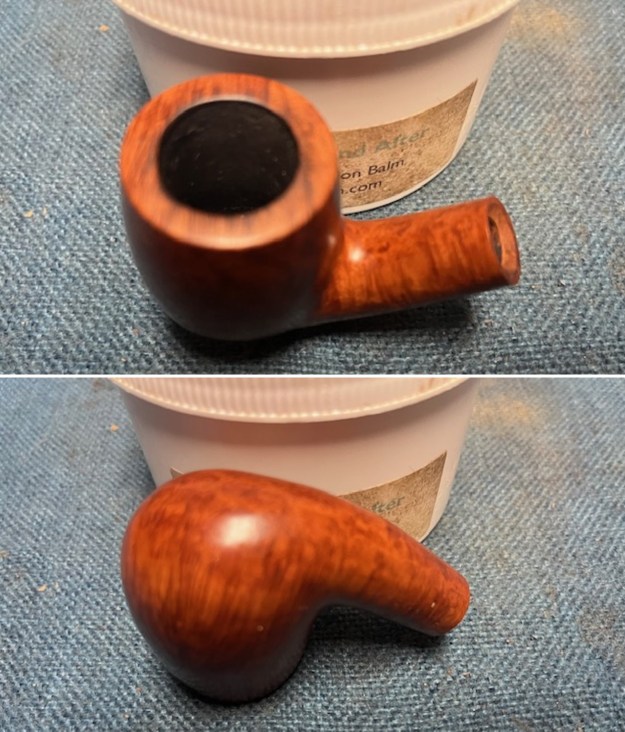
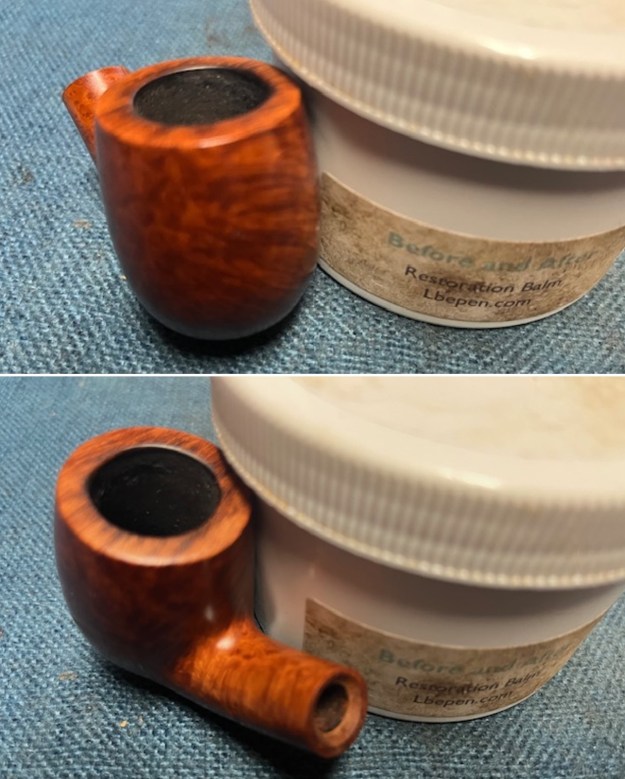
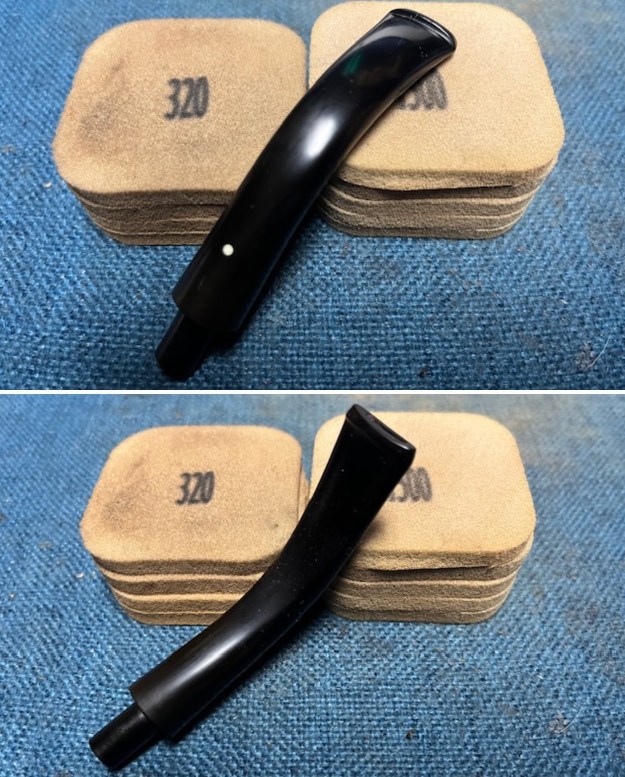
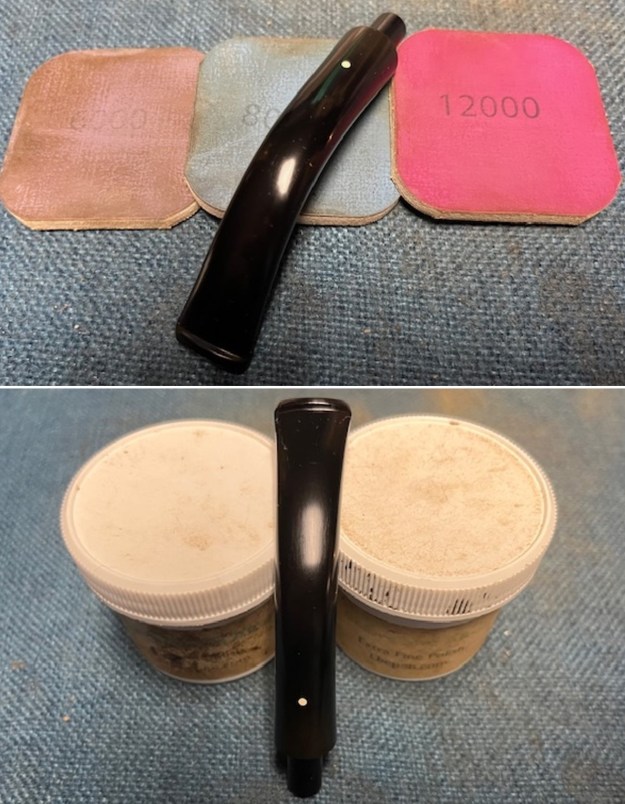
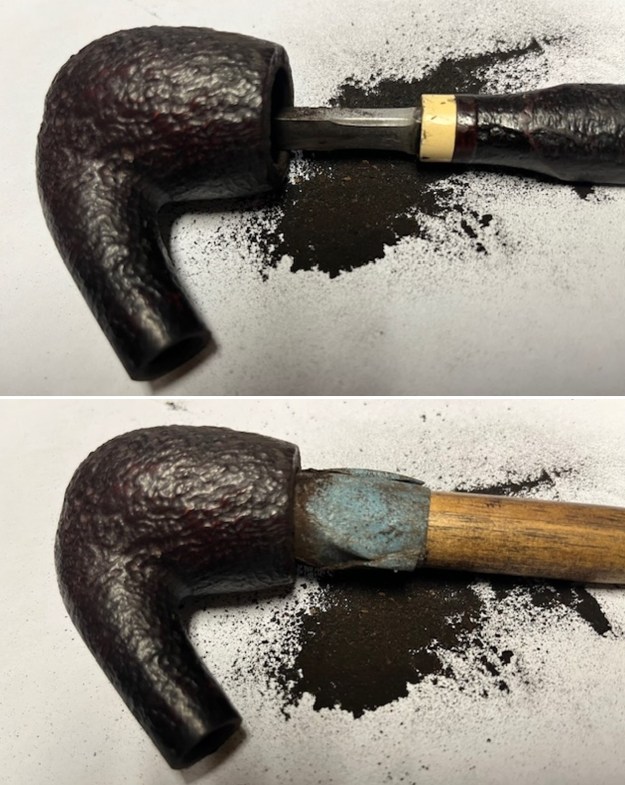
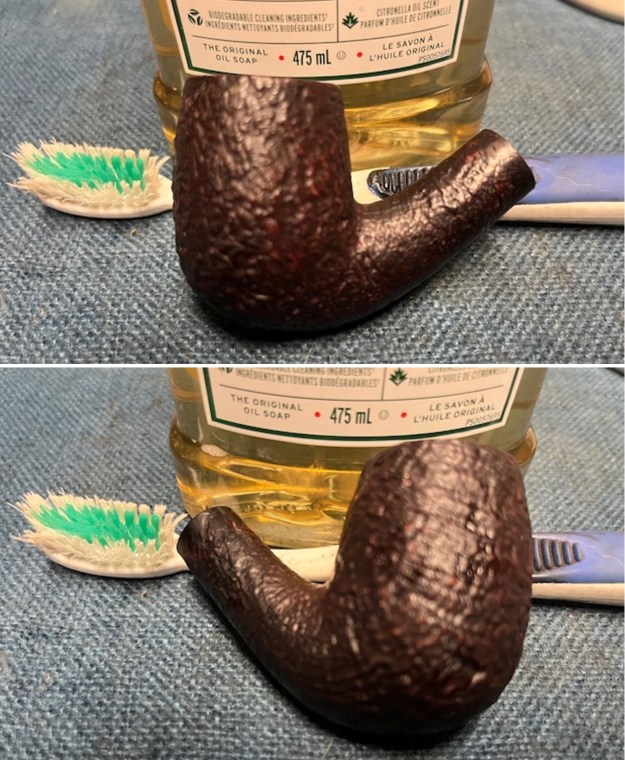
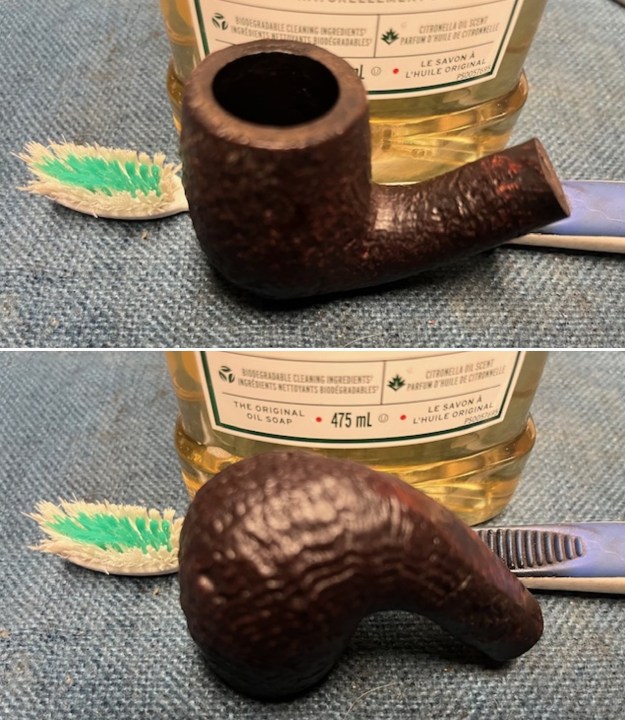
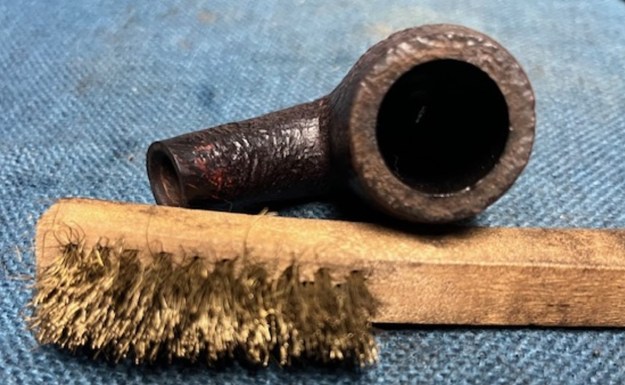
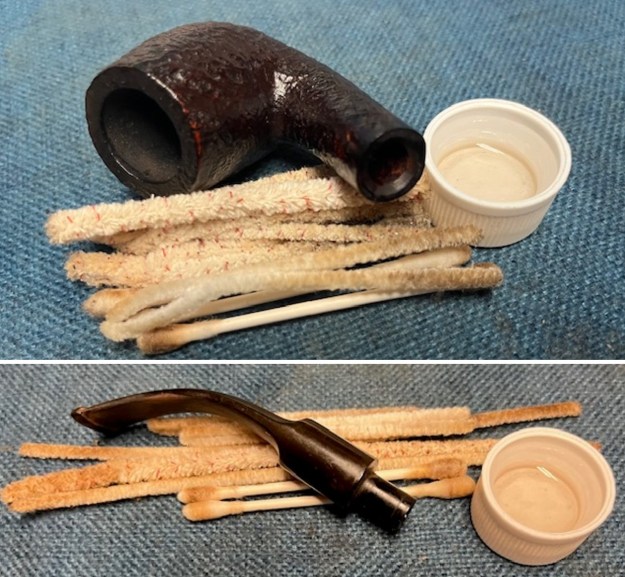
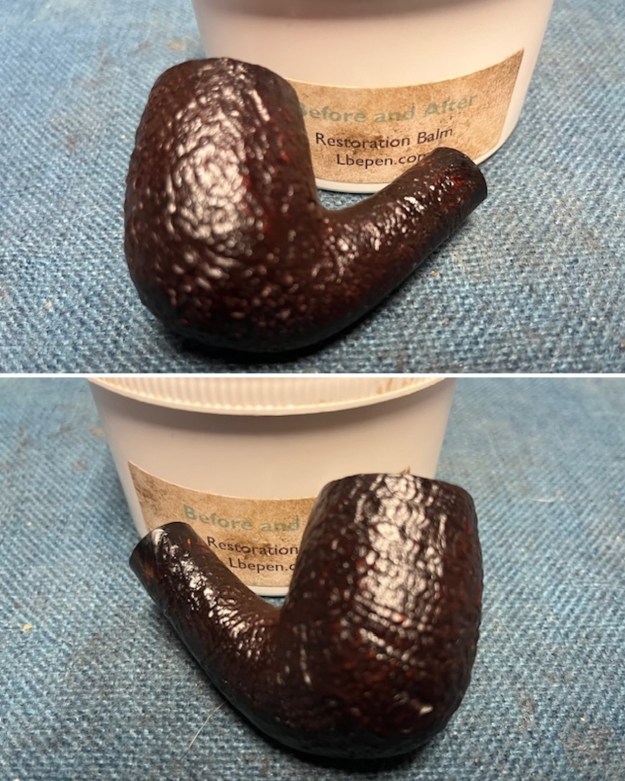
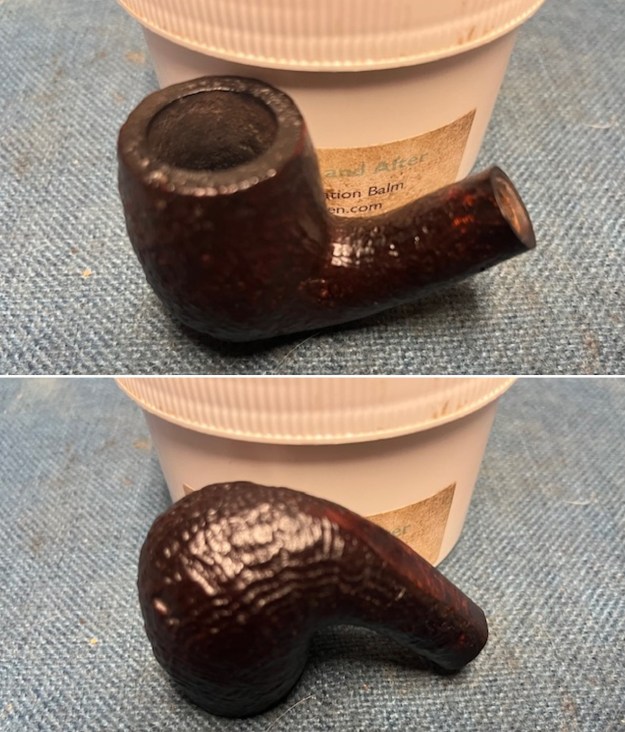
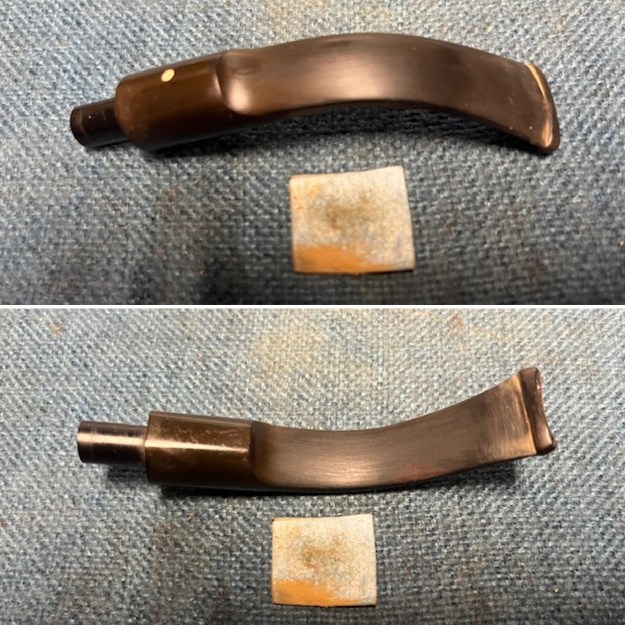
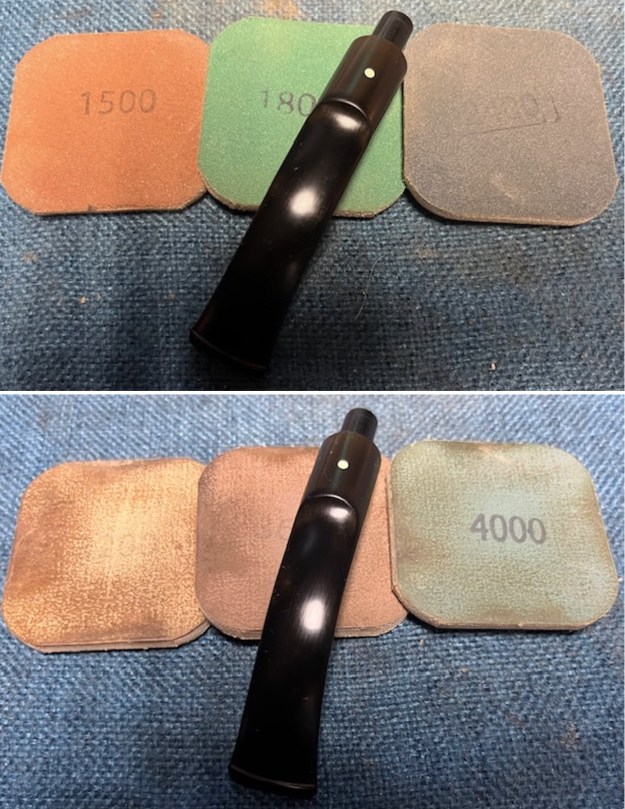
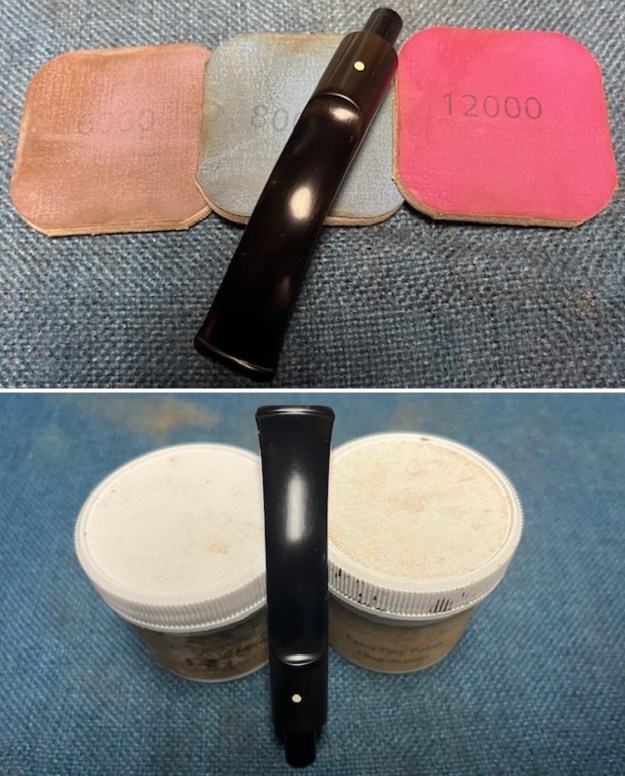
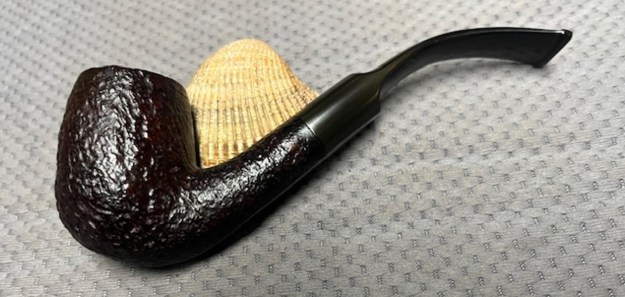
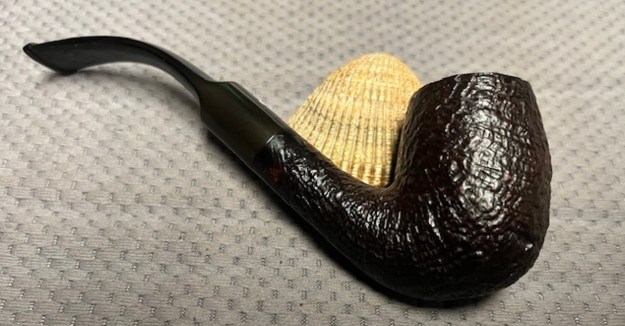
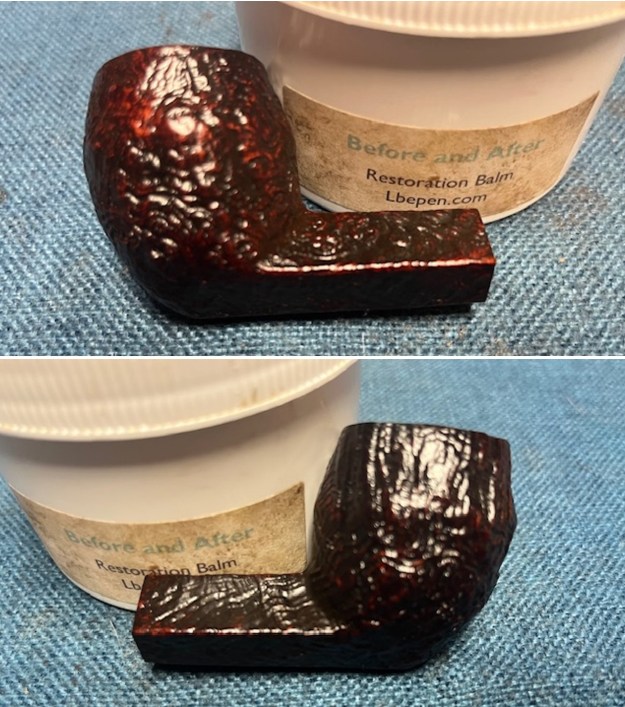
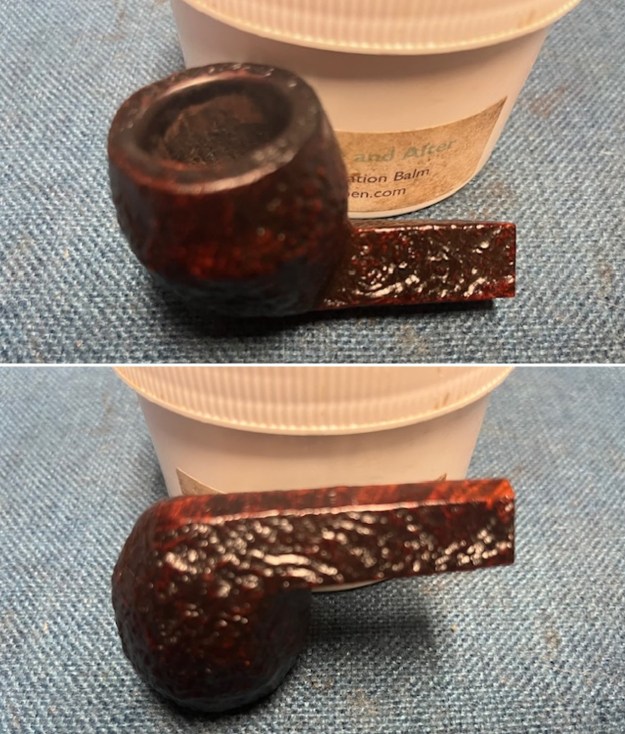
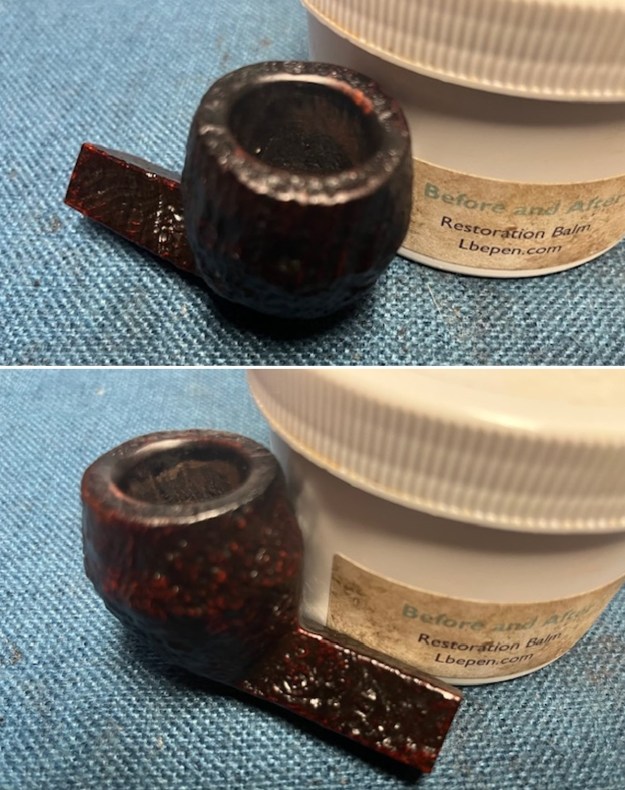
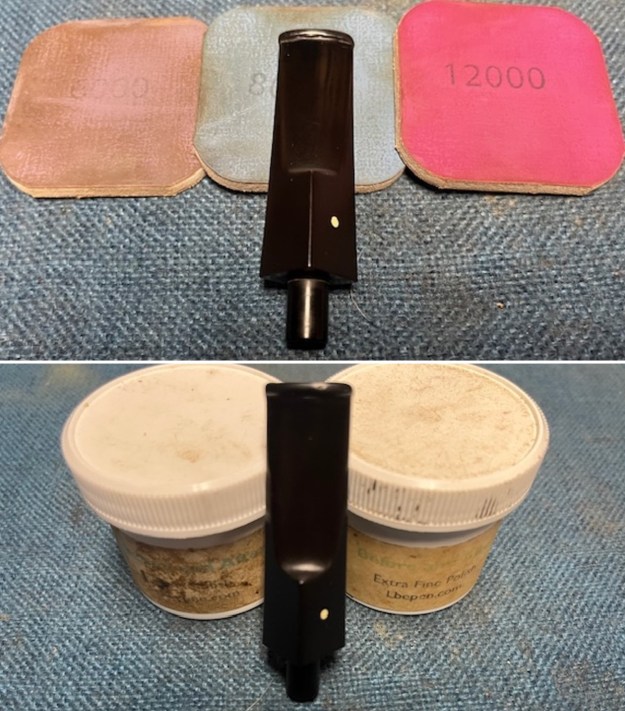
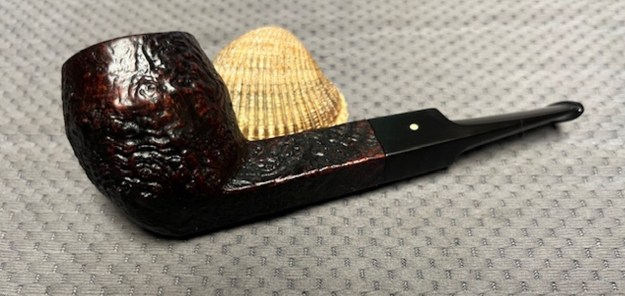
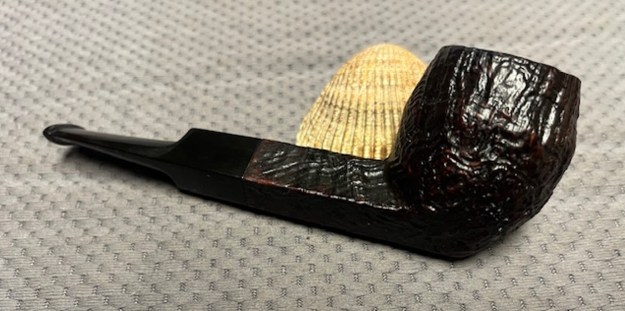
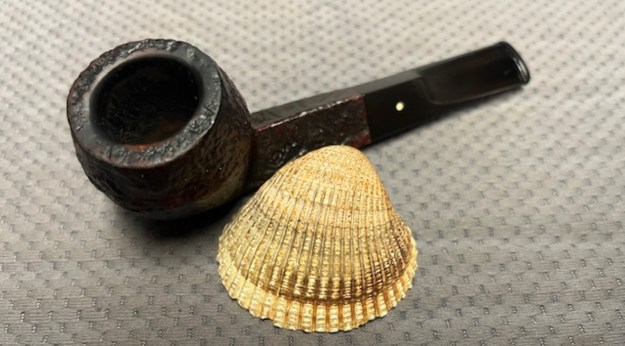
I have also included a chart from the site from Dunhill spelling out the Standard Pipe Finishes and giving short information and a timeline.Armed with that information I turned to work on the pipe itself. Jeff had done a great job cleaning up the pipe as usual. He cleaned up the inside of the bowl with a PipNet reamer and a Savinelli Fitsall Pipe Knife. The bowl walls looked very good. He scrubbed the interior of the bowl and shank with pipe cleaners, shank brushes, cotton swabs and alcohol to remove the tars and oils. He scrubbed the exterior of the pipe with undiluted Murphy’s Oil Soap and a tooth brush to remove the grime from the finish. He worked on the rim top lava and darkening with the soap and tooth brush. He scrubbed the inside of the stem with alcohol and pipe cleaners. He scrubbed the exterior with Soft Scrub and then soaked it in Briarville’s Pipe Stem Deoxidizer. He washed it off with warm water to remove the deoxidizer. The pipe looked far better. I took photos of the pipe when I received it before I started working on it. I took photos of the bowl and rim top to show how clean it was. The smooth rim top and the inner edge of the rim look good. There is a darkening on the top and edges that I will address and see if I can lessen. The stem looks clean of debris and grime. There is light tooth chatter on the stem surface on both sides but otherwise it looks good.I took a photo of the stamping on the underside of the shank. The stamping is faint in spot but otherwise it is clear and readable. I took a photo of the pipe with the stem removed to show the overall look of stem, tenon and profile of the pipe.The pipe was in excellent condition with a light blast around the bowl. It was clean and free of debris. I decided to see if I could lighten the darkening on the smooth rim top before using the Balm. I went over the top lightly with a brass bristle wire brush to see if the finish was sandblast. I examined the rim with a lens to see if I could see the finish. Surprisingly, it was a smooth rim top that should clean up well and lighten the darkening. I used a folded piece of 220 grit sandpaper to smooth out the inner edge of the bowl and smooth out the damage to the smooth crown rim. In the third photo you can see the grain in the rim top. It is going to be a great looking pipe when I am finished. I sanded the darkened top with 320-3500 grit pads. I wiped it down after each sanding pad with a damp cloth. The grain really stands out and it looks much better at this point.I polished the rim top with micromesh sanding pads – dry sanding with 1500-12000 grit sanding pads. I wiped it down after each pad with a damp cloth to remove the debris. It is looking much better after polishing. I rubbed the bowl down with Before & After Restoration Balm. It is a paste/balm that works to deep clean the finish, enliven and protect the briar. I worked it into the briar with my finger tips and a horsehair shoe brush to make sure that it covered every square inch of the pipe. I set it aside for 10 minutes to let it do its work. I buffed it with a cotton cloth. The briar really began to have a deep shine. The photos I took of the bowl at this point mark the progress in the restoration. There was some residual oxidation on the stem surface particularly around the button on both sides. I worked over the oxidation with cotton pads and Soft Scrub cleanser. It took some scrubbing but I was able to remove remnants of oxidation. I worked over the tooth marks on the button on both sides and on the stem surface ahead of the button with 220 grit sandpaper. I reshaped the button at the same time. I sanded the stem with 320-3500 grit sanding pads to break up the remaining oxidation. I wiped it down after each sanding pad with an Obsidian Oil impregnated cloth. It began to look good.I polished the stem with micromesh sanding pads – dry sanding with 1500-12000 grit pads. I wiped the stem down after each sanding pad with Obsidian Oil. I polished it with Before & After Pipe Stem Polish – both Fine and Extra Fine. Once I had finished the polishing I gave it final coat of Obsidian Oil and set it aside to dry. This 1970 Dunhill Tanshell 56 F/T Group 4 Bent Billiard with a Taper Stem has a beautiful, unique Dunhill Sandblast finish that was shallow and distinctive. The Tanshell finish highlights a classic Dunhill sandblast around the bowl and shank. The polished black vulcanite fish tail taper stem adds to the mix. I put the stem back on the bowl and buffed the pipe with Blue Diamond on the buffing wheel being careful to not buff the stamping. I gave the bowl multiple coats of Conservator’s Wax and the stem multiple coats of carnauba wax on the buffing wheel and followed that by buffing it with a clean buffing pad. I hand buffed the pipe with a microfiber cloth to deepen the shine. The finished lightweight Dunhill Tanshell 56 F/T Bent Billiard is quite nice and feels great in the hand. Give the finished pipe a look in the photos below. The dimensions of the pipe are Length: 5 ½ inches, Height: 1 ¾ inches, Outside diameter of the bowl: 1 ¼ inches, Chamber diameter: ¾ of an inch. The weight of the pipe is 1.45 ounces/41 grams. I will be adding it to the British Pipemakers Section on the rebornpipes store. Thanks for walking through the restoration with me as I worked over another beautiful pipe. I appreciate you taking time to read the writeup.

As always, I encourage your questions and comments as you read the blog. Remember we are not pipe owners; we are pipe men and women who hold our pipes in trust until they pass on into the trust of those who follow us.

New Life for a Dunhill Bruyere 251 F/T Made in England9 Fish Tail Stem Billiard


by Steve Laug

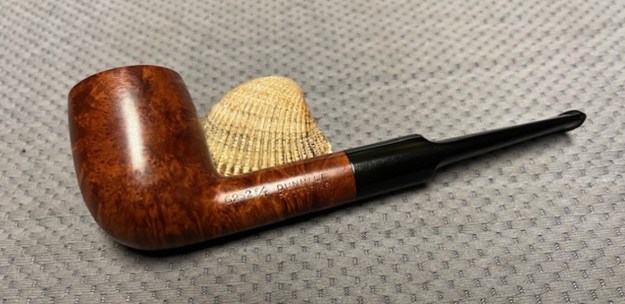
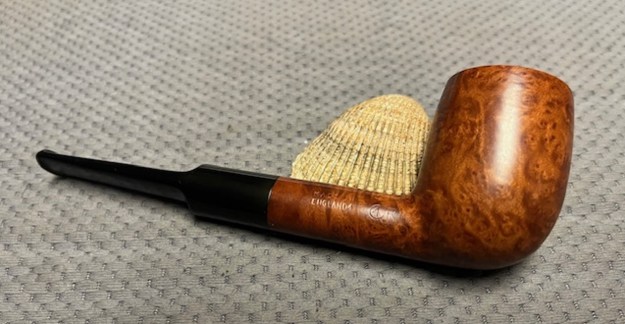
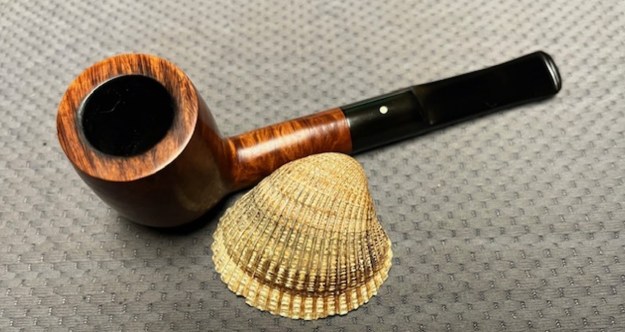
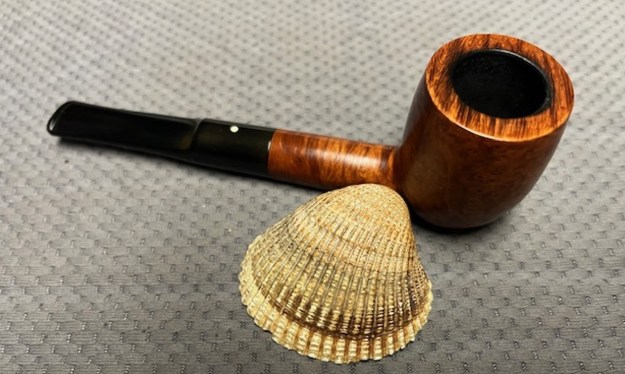
The next pipe on the table is one that we picked up in the lot from a seller in Ogden, Utah, USA on 12/12/2024. The Bruyere finish and the Dunhill stamping is what caught our eye. It is stamped on the left side of the shank and reads 251F/T next to the bowl/shank union followed by Dunhill [over] Bruyere. On the right side it is stamped Made in [over] England9. That is followed by a circled 3A. It has a classic Bruyere smooth finish that is a stark contrast to vulcanite taper stem. The bowl appears to be moderately caked at first glance but could be thicker deeper in the bowl. The inner edge and the top show some lava overflow. The stem is oxidized and calcified which is quite normal for what I see. It also seems to have marks from a Softee Bit and some tooth marks and chatter on the top and underside ahead of the button. The classic white spot is on the top of the stem and looks to be in good condition. Jeff took some photos of the pipe to show the general condition of the pipe before he started his clean up. He took some photos of the rim top and bowl from various angles to give me a clear picture of the condition of the rim top and bowl. You can see the lava on the rim top and edges as well as part of the cake in the bowl. He included photos that show the top and underside of the stem. It is as described above. There was also an aluminum inner tube in the tenon. Jeff took some photos of the sides and heel of the bowl to show the condition of the finish on the pipe. The photos showed some great grain around the bowl and shank. It is a great looking piece of briar.He took some photos of the stamping on the sides of the bowl and shank. The stamping was clear and readable as noted above. I turned to Pipedia’s section on Dunhill Root Briar Pipes to get a bit of background on the Dunhill finishes (https://pipedia.org/wiki/Dunhill#Root_Briar). I quote:

Bruyere

The original finish produced (usually made using Calabrian briar), and a big part of developing and marketing the brand. It was the only finish from 1910 until 1917. A dark reddish-brown stain. Before the 1950s, there were three possible finishes for Dunhill pipes. The Bruyere was a smooth finish with a deep red stain, obtained through two coats, a brown understain followed by a deep red.

There was a link on the above site to a section specifically written regarding the Bruyere finish (https://pipedia.org/wiki/Dunhill_Bruyere). I turned there and have included the information from that short article below.

Initially, made from over century-old briar burls, classified by a “B” (denoted highest quality pipe); “DR” (denoted straight-grained) and an “A” (denoted first quality), until early 1915. After that, they became a high-end subset to the Dunhill ‘Bruyere’. The DR and B pipes, a limited production, they should be distinguished as hand-cut in London from burls as opposed to the Bruyere line which was generally finished from French turned bowls until 1917, when the Calabrian briar started to be used, but not completely. Only in 1920 Dunhill took the final step in its pipe making operation and began sourcing and cutting all of its own bowls, proudly announcing thereafter that “no French briar was employed”.

Bruyere pipes were usually made using Calabrian briar, a very dense and hardy briar that has a modest grain but does very well with the deep red stain.

“Before the 1950s, there were three possible finishes for Dunhill pipes. The Bruyere was a smooth finish with a deep red stain, obtained through two coats, a brown understain followed by a deep red. The Shell finish was the original sandblast with a near-black stain (though the degree to which it is truly black has varied over the years). Lastly, the Root finish was smooth also but with a light brown finish. Early Dunhill used different briars with different stains, resulting in more distinct and identifiable creations… Over the years, to these traditional styles were added four new finishes: Cumberland, Dress, Chestnut and Amber Root, plus some now-defunct finishes, such as County, Russet and Red Bark.”

There was also a link to a catalogue page that gave examples and dates that the various finishes were introduced (https://pipedia.org/wiki/File:Dunnypipescatalog-1.png). I turned to Pipephil’s dating guide to show how I arrived at the date of manufacture for this pipe (http://www.pipephil.eu/logos/en/dunhill/cledat-en1a.html). I am including the chart that is provided there for the dating a pipe. I have drawn a red box around the section. Since the pipe I am working on has a suffix9 that is raised. It to the 1950 line on the chart below. It also gave me the formula for dating the pipe – 1950 + suffix 9 = 1959.I now knew that I was working on a Bruyere that came out in 1959. The shape of the pipe was one of many Billiards that Dunhill put out and that the #251 was a normal billiard shape. The F/T marking told me it was a fish tail taper stem.

Armed with that information I turned to work on the pipe itself. Jeff had done a great job cleaning up the pipe as usual. He cleaned up the inside of the bowl with a PipNet reamer and a Savinelli Fitsall Pipe Knife. The rim top and the inner edge of the bowl look good. The bowl walls look very good. There was an inner tube in the airway into the bowl. It extended in the shank into the bottom of the bowl. He scrubbed the interior of the bowl and shank with pipe cleaners, cotton swabs and alcohol to remove the tars and oils. He scrubbed the exterior of the pipe with undiluted Murphy’s Oil Soap and a tooth brush to remove the grime from the finish. He worked on the rim top lava and darkening with the soap and tooth brush. He scrubbed the inside of the stem with alcohol and pipe cleaners. He scrubbed the exterior with Soft Scrub and then soaked it in Briarville’s Pipe Stem Deoxidizer. He washed it off with warm water to remove the deoxidizer. The stem was very clean and the tooth chatter and marks are very faint. Overall, the pipe looked far better. I took photos of the pipe when I received it before I started working on it. I took close up photos of the bowl, rim top and stem to show how clean the pipe was. The bowl was clean and the damage to the rim top and the inner edge is very visible in the photo below. The stem was clean and the light tooth marks and chatter can be seen in the photos.I took a photo of the stamping on the sides of the shank. It is very clear and readable and read as noted above. I also removed the stem from the shank and took photos of the pipe to show the look of the parts.I polished the Bruyere bowl and shank with 1500-12000 grit micromesh sanding pad – dry sanding it with the pads. I wiped the bowl down with a damp cloth after each pad. It began to take on a deep shine. The exterior of the bowl look better after sanding. I worked some Before & After Restoration Balm into the briar with my finger tips. I let it sit on the bowl for 10 minutes and then buffed it off with a paper towel and soft cloth. The product is a great addition to the restoration work. It enlivens, enriches and protects the briar while giving it a deep glow. It is a product I use on every pipe I restore. I was ready for the next step. I polished the stem with micromesh sanding pads – dry sanding with 1500-12000 grit pads and wiping the surface down with Obsidian Oil after each sanding pad. It is really shining. I polished it further with Before & After Stem Polish – both Fine and Extra Fine. I gave it another coat of Obsidian Oil to finish this step. I reinserted the inner tube in the tenon. This Dunhill Bruyere 251 F/T Group 3 Billiard from 1959 is a beautiful looking piece of briar that has a shape that follows grain. It is a great looking pipe that came out looking even better after the cleanup. The Bruyere is an early finish that Dunhill specialized in making. The finish on the pipe is in excellent condition. The red and brown stain on the bowl works well to highlight the grain. The polished black vulcanite taper stem adds to the mix. With the grime gone from the finish and the bowl it was a beauty and is eye-catching. I put the stem back on the bowl and buffed the pipe with Blue Diamond on the buffing wheel being careful to not buff the stamping. I gave the bowl and the stem multiple coats of carnauba wax on the buffing wheel and followed that by buffing it with a clean buffing pad. I hand buffed the pipe with a microfiber cloth to deepen the shine. The finished 1959 Dunhill Bruyere 251 F/T Billiard is quite nice and feels great in the hand. Give the finished pipe a look in the photos below. I can only tell you that like the other pipes I am working that it is much prettier in person than the photos capture. The dimensions of the pipe are Length: 5 ½ inches, Height: 1 ¾ inches, Outside diameter of the bowl: 1 ¼ inches, Chamber diameter: ¾ of an inch. The weight of the pipe is 34 grams/1.20 ounces. It will soon be added to the British Pipe Makers Section on the rebornpipes store.

As always, I encourage your questions and comments as you read the blog. Thanks to each of you who are reading this blog. Remember we are not pipe owners; we are pipe men and women who hold our pipes in trust until they pass on into the trust of those who follow us.

Breathing new life into a 1965 Dunhill Tanshell 250 F/T Group 2 size Billiard


by Steve Laug

The next pipe on the table is one that came to us from a seller on eBay from Harrison Township, Michigan, USA on 08/22/2024. It is another Dunhill sandblast that is in decent. It is stamped on a smooth panel on the underside of the shank with the shape number 250F/T followed by Dunhill [over] Tanshell. Next to that it is stamped Made in [over] England with the date number 5 after the D in England. After that it is stamped with a 2 in a circle [followed by] T for Tanshell. The stamping is clear and readable as noted above. The pipe has some darkening on the deep sandblast finish and some amazing grain that the shape follows well. The finish was dusty and oily around the nooks and crannies of the sandblast but otherwise looked good. The bowl had a thick cake and there was lava on the sandblasted rim top or edges. The edges looked to be undamaged and possibly protected by the lava. Cleaning would make that clear. The taper stem was lightly oxidized, calcified, dirty and had scratches, tooth marks and chatter ahead of the button. Jeff took photos of the pipe to show what it looked like before he started working on it. Jeff took photos of the bowl and rim top to show the cake in the bowl, lava overflow and the general condition of the pipe. The photos of the stem to show the condition of both sides of the stem as noted above. He took photos of the sides of the bowl and the heel to show the beautiful grain in the sandblast around the bowl. It really is a beautiful piece of briar that has a shape that follows the grain. The finish is nice but it also dirty with dust ground into the finish.  Jeff took photos of the stamping on the heel of the bowl and underside of the shank. It is clear and readable as noted above. One of the first things I like to do is to unpack the stamping and understand each element in it. I turned to Pipephil helpful site (http://pipephil.eu/logos/en/dunhill/tanshell1.html). The stamping is interpreted as follows: The number 250 is the shape number for a Billiard. The F/T signifies a Fish Tail stem. The Tanshell stamp refers to the finish which is corroborated the T at the end of the stamping. The size of the pipe 2 in a circle is a Group 2. The 5 following the D of England gives the date the pipe. Pipephil also has some helpful dating keys on the site that are basically flow charts that you can walk through to date your pipe (http://pipephil.eu/logos/en/dunhill/cledat-en1.html). I turned to Part 1 of the Dating Key and followed the chart. This pipe has a 5 following the D in England. It is the same size as the D so that took me to the section on the chart below (column one) which instructed me that the pipe could be dated as being made posterior to 1954. I followed the link following the “Your pipe is posterior to 1954. Narrow down your dating”. That took me to Page 2 of the dating key (http://pipephil.eu/logos/en/dunhill/cledat-en1a.html).   The third column (suffix 5…9) led me to the section with a 5 after the D in England that is the same size as the D. There was a directive for dating the pipe spelled out as follows: 1960 + suffix which gives the pipe a date of 1965. I then turned to Pipedia’s section on Dunhill Root Briar to get a bit of background on the Dunhill finishes (https://pipedia.org/wiki/Dunhill#Root_Briar). I quote:

Tanshell

The first lot was distributed in 1952 (usually made using Sardinian briar). The prototype was called “Root Shell “, produced in 1951. The Tanshell is a light tan sandblast. Sardinian briar was used for this sandblast. There is a distinct contrast in the sandblasts using Sardinian as opposed to Algerian briar. The Sardinian is much denser and much harder. The resulting pattern, when blasted, is far more even and regular both in terms of the surface texture and the finish.

The Tanshell was Dunhill’s fourth finish and its first major post-war line addition. Introduced in 1951/1952 the Tanshell was a naturally stained sandblasted pipe made exclusively from Sardinian briar through the 1960s. The Tanshell apparently was not simply a light stained Shell but rather was also the product of “certain processes [unrevealed] not previously employed.” Initially, it appears that the pipe was to be named the Root Shell and a stamp to that effect was ordered and received by Dunhill in May 1951. Ultimately, however, the name Tanshell was settled upon but the stamp for the Tanshell name was not received by Dunhill until the beginning of December. Thus, while the Tanshell was in production in 1951 it appears that most if not all Tanshells made in that year did not enter into retail distribution until 1952 and were given a 1952 date code. Loring, J. C., The Dunhill Briar Pipe, The Patent Years and After (self-published, Chicago, 1998).

I have also included a chart from the site from Dunhill spelling out the Standard Pipe Finishes and giving short information and a timeline.Armed with that information I turned to work on the pipe itself. Jeff had done a great job cleaning up the pipe as usual. He cleaned up the inside of the bowl with a PipNet reamer and a Savinelli Fitsall Pipe Knife. The bowl walls looked very good. He scrubbed the interior of the bowl and shank with pipe cleaners, shank brushes, cotton swabs and alcohol to remove the tars and oils. He scrubbed the exterior of the pipe with undiluted Murphy’s Oil Soap and a tooth brush to remove the grime from the finish. He worked on the rim top lava and darkening with the soap and tooth brush. He scrubbed the inside of the stem with alcohol and pipe cleaners. He scrubbed the exterior with Soft Scrub and then soaked it in Briarville’s Pipe Stem Deoxidizer. He washed it off with warm water to remove the deoxidizer. The pipe looked far better. I took photos of the pipe when I received it before I started working on it. I took photos of the bowl and rim top to show how clean it was. The top and the inner edge of the rim look very good. There is a little darkening on the top that I will address and see if I can lessen. The stem looks clean of debris and grime. There is light tooth chatter on the stem surface on both sides but otherwise it looks good.I took a photo of the stamping on the heel of the bowl. The stamping is clear and readable. I took a photo of the pipe with the stem removed to show the overall look of stem, tenon and profile of the pipe. I also took a photo of the tenon end as the inner tube had snapped off in the tenon and seemed to cause no issues. The pipe was in excellent condition with a deep blast around the bowl. It was clean and free of debris. I decided to see if I could lighten the darkening on the rim top before using the Balm. I used a brass bristle wire brush and a tooth brush and Before & After Briar cleaner to see if I could reduce the darkening. I rinsed it with warm water. It looked better and the blast was very clear.I rubbed the bowl down with Before & After Restoration Balm. It is a paste/balm that works to deep clean the finish, enliven and protect the briar. I worked it into the briar with my finger tips and a horsehair shoebrush to make sure that it covered every square inch of the pipe. I set it aside for 10 minutes to let it do its work. I buffed it with a cotton cloth. The briar really began to have a deep shine. The photos I took of the bowl at this point mark the progress in the restoration. I sanded the stem with 320-3500 grit sanding pads to break up the remaining oxidation. I wiped it down after each sanding pad with an Obsidian Oil impregnated cloth. It began to look good.I polished the stem with micromesh sanding pads – dry sanding with 1500-12000 grit pads. I wiped the stem down after each sanding pad with Obsidian Oil. I polished it with Before & After Pipe Stem Polish – both Fine and Extra Fine. Once I had finished the polishing I gave it final coat of Obsidian Oil and set it aside to dry. This 1965 Dunhill Tanshell 250 F/T Group 2 Billiard with a Taper Stem has a beautiful, unique Dunhill Sandblast finish that was deep and craggy and crisp. The Tanshell finish highlights a classic Dunhill rugged sandblast around the bowl and shank. The polished black vulcanite fish tail taper stem adds to the mix. I put the stem back on the bowl and buffed the pipe with Blue Diamond on the buffing wheel being careful to not buff the stamping. I gave the bowl multiple coats of Conservator’s Wax and the stem multiple coats of carnauba wax on the buffing wheel and followed that by buffing it with a clean buffing pad. I hand buffed the pipe with a microfiber cloth to deepen the shine. The finished lightweight Dunhill Tanshell 250 F/T Billiard is quite nice and feels great in the hand. Give the finished pipe a look in the photos below. The dimensions of the pipe are Length: 5 ½ inches, Height: 1 ¾ inches, Outside diameter of the bowl: 1 ¼ inches, Chamber diameter: ¾ of an inch. The weight of the pipe is .85 ounces/24 grams. Thanks for walking through the restoration with me as I worked over another beautiful pipe. I appreciate you taking time to read the writeup.

As always, I encourage your questions and comments as you read the blog. Remember we are not pipe owners; we are pipe men and women who hold our pipes in trust until they pass on into the trust of those who follow us.

Breathing New Life into Dunhill Shell Briar RF F/T Pot


by Steve Laug

The next pipe on the table is one that we picked up from our contact in Copenhagen, Denmark on 08/09/2024. The Shell Briar Sandblast finish on this English made Pot shaped pipe and the white spot on the topside of the taper vulcanite stem are what caught our eye. It is stamped on the heel of the bowl and shank and reads RF followed by F/T followed by Dunhill [over] Shell Briar. That is followed by Made in [over] England with an underlined superscript 11 after the D. A circle 4 S is at the end of the stamping. It has a classic Shell Briar mixed brown/oxblood/black stain on the sandblast finish that is a stark contrast to the black vulcanite taper stem. It has a lot of grime and dirt in the sandblast finish on the bowl and straight shank Pot. The bowl was heavily caked around the top third of the bowl and the inner edge and the top were covered with a light lava coat in the sandblast. The vulcanite stem was heavily oxidized and had tooth marks and chatter on both sides ahead of the button. The white spot logo on the topside of the taper stem looks to be in good condition. Jeff took some photos of the pipe to show the general condition of the pipe before he started his clean up. He took some photos of the rim top and bowl from various angles to give me a clear picture of the condition of the rim top and bowl. The inside of the bowl is heavily caked around the top 1/3 of the bowl and there was lava on the inner edge and in the sandblast on the rim top. He included photos that show the top and underside of the stem. It is as described above. Jeff took some photos of the sides and heel of the bowl to show the condition of the rusticated finish on the pipe. The photos showed some great grain around the bowl and shank even with the grime in the finish. It is a great looking piece of briar. He took a photo of the stamping on the heel of the bowl and the underside of the shank. It was clear and readable as noted above. I wanted to unpack the Dunhill stamping on the shank and work to understand each element of the stamp. I generally use the Pipephil site to gather as much initial information as possible (http://pipephil.eu/logos/en/dunhill/shell-briar1.html). The stamping is interpreted as follows: The shape is defined as RF is the shape reference for a taper stem Pot. The F/T is the designation for a Fish Tail stem. The Shell Briar stamp refers to the finish. The underlined, superscript number 11 following the D of England would give the date the pipe. The circle 4S tells me that the pipe is a group 4 sized pipe and the S is for the Shell finish. The photo below shows a pipe with similar stamping to the one I am working on. It is the same date stamp so I think the one I have is also a 1971 pipe. I will verity that.Pipephil also has some helpful dating keys on the site that are basically flow charts that you can walk through to date your pipe (http://pipephil.eu/logos/en/dunhill/cledat-en1.html). I turned to Part 1 of the Dating Key and followed the chart. This pipe has 16 following the D in England. There was no patent number so that took me to the section on the chart below (column one) which instructed me that the pipe could be dated as being made “posterior to 1954”.I followed the link under “Your pipe is posterior to 1954. Narrow down your dating”. That took me to Page 2 of the dating key (http://pipephil.eu/logos/en/dunhill/cledat-en1a.html). The second column – suffix [1…4] or [11…39] led me to the next section. Since the 11 after the D in England the date of the pipe spelled as 1960 + 11 making the date 1971.I then turned to Pipedia’s section on Dunhill Shell Briar to get a bit of background on the Dunhill finishes (https://pipedia.org/wiki/Dunhill#Root_Briar). I quote:

Shell

A deep craggy sandblast with a black stain finish (usually made using Algerian briar) – the color of the stain used has varied over the years. Although there is some doubt as to them being the first to sandblast pipes, Dunhill’s Shell pipes, and the sandblasting techniques developed to create them are considered one of Dunhill’s greatest and most lasting contributions to the art of pipe making.

The documented history of Dunhill’s inception of the Shell is largely limited to patent applications — there are no catalog pages or advertisements promoting blasted pipes at the time. The preliminary work on the English patent (No. 1484/17) was submitted on October 13, 1917. The patent submission was completed half a year later, on April 12, 1918, followed by the granting of the English patent on October 14, 1918. This was less than a month before the end of The Great War on November 11th.

In 1986 Dunhill released a line of premium Shell finish pipes – “RING GRAIN”. These are high-quality straight grain pipes which are sandblasted. Initially only Ring Grain, but now in two different finishes. In 1995 the “Shilling” was introduced with Cumberland finish – it is an extremely rare series. These pipes exhibit a deeper blast characteristic of that of the 1930’s – mid-1960’s (and the limited ‘deep blast’ pipes of the early 1980s) and show a fine graining pattern. These are considered the best new Dunhills by many enthusiasts today and are very rare. The finish is sometimes described as tasting like vanilla at first, with the taste becoming more normal or good as the pipe breaks in.

I turned to work on the pipe itself. Jeff had done an amazing cleanup of the pipe. He reamed the cake with a PipNet reamer and cleaned up that with a Savinelli Fitsall Pipe Knife. He scrubbed the internals of the bowl and stem with alcohol, cotton swabs, pipe cleaners and shank brushes. He scrubbed the externals with undiluted Murphy’s Oil Soap and rinsed the bowl off with running water. His scrubbing removed the varnish on the bowl with just a few spots remaining. He soaked the stem in Briarville’s Pipe stem Deoxidizer and once it had soaked rinsed it off with warm water to remove the residual solution. He dried it off and rubbed it down to remove any oxidation that was still on the stem. The soak did not penetrate the varnish on the stem at all but it certainly looked better. Other than the shiny spots in the finish where the varnish remained, the pipe looked very good when I received it. You can also see the sunken state of the white spot on the stem surface. I took close up photos of the bowl, rim top and stem to show how clean the pipe was. The bowl was clean and the rim top and the inner edge look good. The stem was clean and the tooth marks and chatter though not visible in the photos are still present.I took a photo of the stamping on the underside of the shank. It is very clear and readable and read as noted above. I also removed the stem from the shank and took photos of the pipe to show the look of the parts.The exterior of the bowl was beautiful. I worked some Before & After Restoration Balm into the briar with my finger tips and a shoe brush. I let it sit on the bowl for 10 minutes and then buffed it off with a paper towel and soft cloth. The product is a great addition to the restoration work. It enlivens, enriches and protects the briar while giving it a deep glow. It is a product I use on every pipe I restore. I set the bowl aside and turned to the stem. I sanded the it with 320-3500 grit sanding pads and wiped the stem down after each pad with some Obsidian Oil on a cloth. The shine is coming back beautifully.I polished it with micromesh sanding pads – dry sanding with 1500-12000 grit pads and wiping the surface down with Obsidian Oil after each sanding pad. It is really shining. I polished it further with Before & After Stem Polish – both Fine and Extra Fine. I gave it another coat of Obsidian Oil to finish this step. This 1971 Dunhill Shell Briar RF F/T Pot with a vulcanite taper stem has a beautiful, unique Dunhill Sandblast finish that highlights the grain. The Shell Briar mixed brown finish highlights some great grain around the bowl and shank. The polished vulcanite taper stem adds to the mix. I put the stem back on the bowl and buffed the pipe with Blue Diamond on the buffing wheel being careful to not buff the stamping. I gave the bowl and the stem multiple coats of carnauba wax on the buffing wheel and followed that by buffing it with a clean buffing pad. I hand buffed the pipe with a microfiber cloth to deepen the shine. The finished Dunhill Shell Briar RF F/T Pot is quite nice and feels great in the hand. Give the finished pipe a look in the photos below. The dimensions of the pipe are Length: 5 inches, Height: 1 ½ inches, Outside diameter of the bowl: 1 ½ inches, Chamber diameter: 7/8 of an inch. The weight of the pipe is 1.31ounces/37 grams. Thanks for walking through the restoration with me as I worked over another beautiful pipe. This one will be going on the rebornpipes store in the British Pipe Makers Section. Thanks for your time.

Cleaning up a Dunhill Tanshell Quaint Tomato


by Steve Laug

The next pipe on the table is one that came to us from the group of pipes that Jeff and I purchased from a seller of an estate collection in Superior, Montana, USA on 12/28/2024. It is another Dunhill sandblast that is in good condition. It is stamped on a smooth panel on the heel of the bowl with the Group size of the pipe 4 in a circle. Underneath is a Dunhill in an oval [over] Tanshell. Under that it is stamped Made in England with the date number 05 after the D in England. The stamping is clear and readable as noted above. The original box bears the label Tanshell 4 QNT. The pipe has a mix of tan and brown stains on a sandblast finish and some amazing grain that the shape follows well. The finish was dusty around the nooks and crannies of the sandblast but otherwise fairly clean. The rim top was in excellent condition with a little darkening around the inner edge. The bowl had a moderate cake and there was lava on the sandblasted rim top or edges. The taper stem was lightly oxidized, dirty and had light chatter ahead of the button. It came with the original double box, a pipe sock and original paperwork that came in the box. Jeff took photos of the pipe to show what it looked like before he started working on it. Jeff took photos of the bowl and rim top to show the condition. There is a moderate cake in the bowl and darkening around the inner edge of the bowl. He also captured the condition of the stem when it arrived. There is a tooth mark on each side ahead of the button. He took photos of the sides of the bowl and the heel to show the beautiful grain in the sandblast around the bowl. It really is a beautiful piece of briar that has a shape that follows the grain. The finish is nice but it also dirty with dust ground into the finish.Jeff took photos of the stamping on the heel of the bowl. It is clear and readable and reads as noted above.One of the first things I like to do is to unpack the stamping and understand each element in it. I turned to Pipephil helpful site (http://pipephil.eu/logos/en/dunhill/tanshell1.html). The stamping is interpreted as follows: The pipe has no shape number on it but the box is stamped with QNT which means QUAINT. The Tanshell stamp refers to the finish. The size of the pipe is given by the 4 in a circle making it a Group 4. The 05 following the D of England gives the date the pipe. Pipephil also has some helpful dating keys on the site that are basically flow charts that you can walk through to date your pipe (http://pipephil.eu/logos/en/dunhill/cledat-en1.html). I turned to Part 1 of the Dating Key and followed the chart. This pipe has a superscript 05 following the D in England. The chart below (column one) instructed me that the pipe could be dated as being made posterior to 1954. I followed the link following the “Your pipe is posterior to 1954. Narrow down your dating”. That took me to Page 2 of the dating key (http://pipephil.eu/logos/en/dunhill/cledat-en1a.html).   The fourth column (suffix 00, 01, 02…) led me to the section with a 0 followed by a number after the D in England that is the raised above the D. It is a 05. There was a directive for dating the pipe spelled out as follows: 2000 + suffix which gives the pipe a date of 2005.I then turned to Pipedia’s section on Dunhill Root Briar to get a bit of background on the Dunhill finishes (https://pipedia.org/wiki/Dunhill#Root_Briar). I quote:

Tanshell

The first lot was distributed in 1952 (usually made using Sardinian briar). The prototype was called “Root Shell “, produced in 1951. The Tanshell is a light tan sandblast. Sardinian briar was used for this sandblast. There is a distinct contrast in the sandblasts using Sardinian as opposed to Algerian briar. The Sardinian is much denser and much harder. The resulting pattern, when blasted, is far more even and regular both in terms of the surface texture and the finish.

The TanShell was Dunhill’s fourth finish and its first major post-war line addition. Introduced in 1951/1952 the TanShell was a naturally stained sandblasted pipe made exclusively from Sardinian briar through the 1960s. The TanShell apparently was not simply a light stained Shell but rather was also the product of “certain processes [unrevealed] not previously employed.” Initially, it appears that the pipe was to be named the Root Shell and a stamp to that effect was ordered and received by Dunhill in May 1951. Ultimately, however, the name TanShell was settled upon but the stamp for the TanShell name was not received by Dunhill until the beginning of December. Thus while the Tanshell was in production in 1951 it appears that most if not all TanShells made in that year did not enter into retail distribution until 1952 and were given a 1952 date code. Loring, J. C., The Dunhill Briar Pipe, The Patent Years and After (self-published, Chicago, 1998).

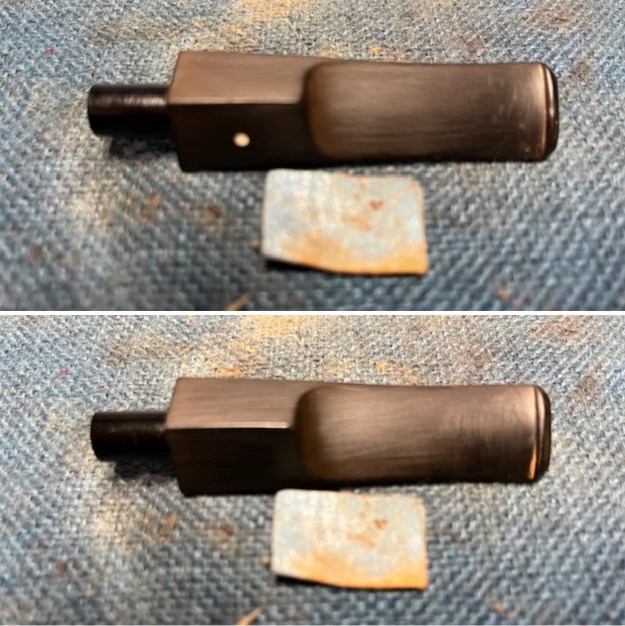
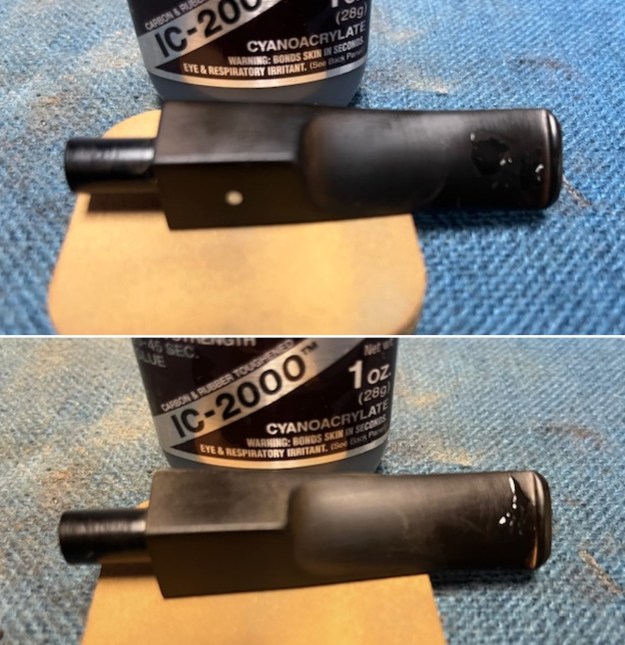
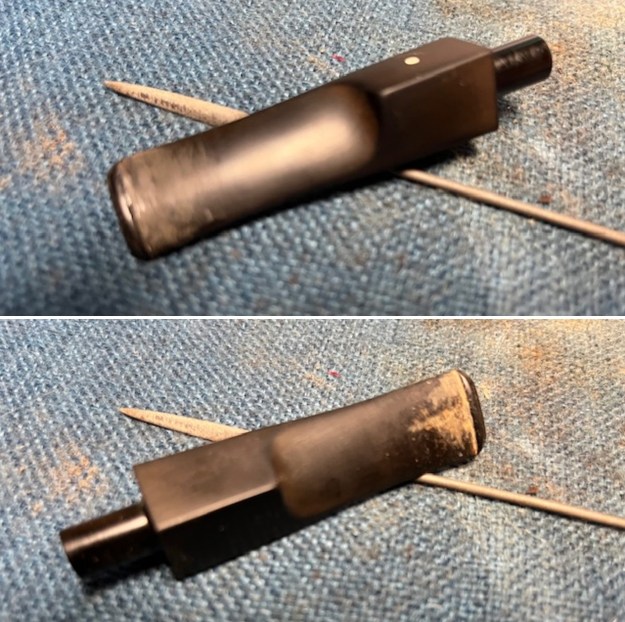
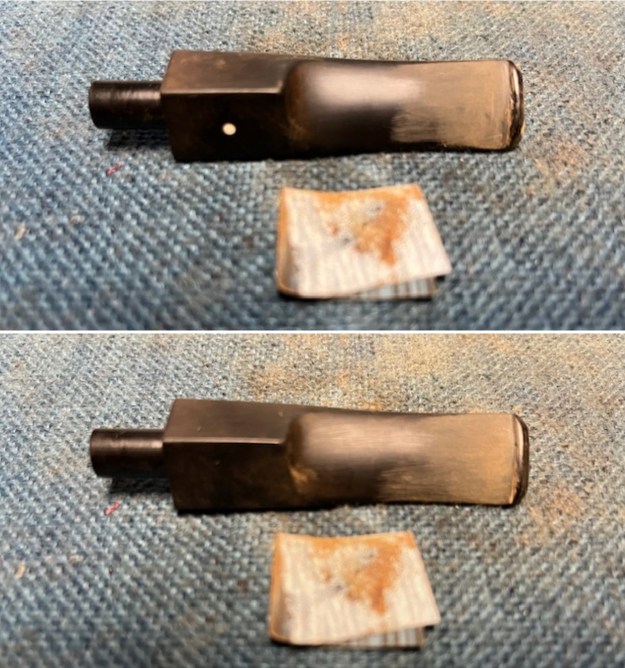
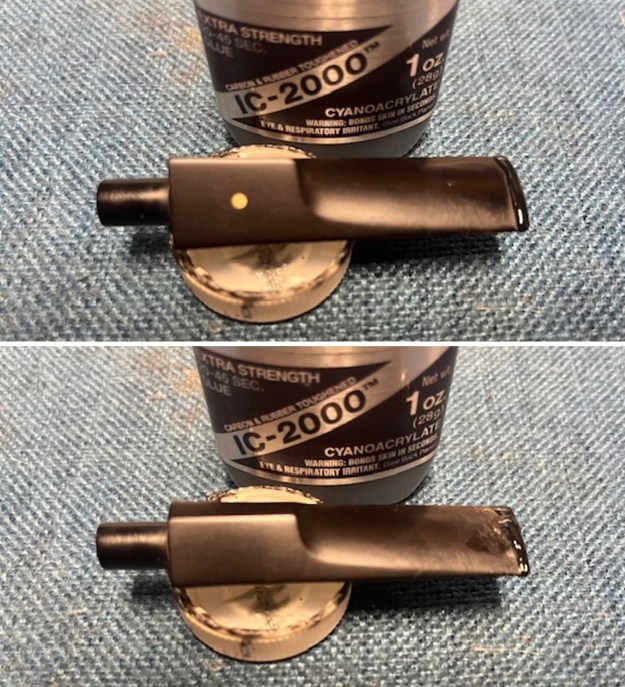
I have also included a chart from the site from Dunhill spelling out the Standard Pipe Finishes and giving short information and a timeline. Armed with that information I turned to work on the pipe itself. Jeff had done a great job cleaning up the pipe as usual. He cleaned up the inside of the bowl with a PipNet reamer and a Savinelli Fitsall Pipe Knife. The bowl walls looked very good. He scrubbed the interior of the bowl and shank with pipe cleaners, cotton swabs and alcohol to remove the tars and oils. He scrubbed the exterior of the pipe with Murphy’s Oil Soap and a tooth brush to remove the grime from the finish. He worked on the rim top lava and darkening with the soap and tooth brush. He scrubbed the inside of the stem with alcohol and pipe cleaners. He scrubbed the exterior with Soft Scrub and then soaked it in Briarville’s Pipe Stem Deoxidizer. He washed it off with warm water to remove the deoxidizer. The pipe looked far better. I took photos of the pipe when I received it before I started working on it. The photos show the box within the box and the pouch and pipe itself it is a beauty. I took photos of the bowl and rim top to show how clean it was. The top and the inner edge of the rim look very good. The stem looks clean of debris and grime. There are two tooth marks – one on each side of the stem ahead of the button.I took a photo of the stamping on the heel of the bowl. The stamping is clear and readable. I took a photo of the pipe with the stem removed to show the overall look of stem, tenon and profile of the pipe. The pipe was in excellent condition with a deep blast around the bowl. It was clean and free of debris. I rubbed the bowl down with Before & After Restoration Balm. It is a paste/balm that works to deep clean the finish, enliven and protect the briar. I worked it into the briar with my finger tips and a horsehair shoebrush to make sure that it covered every square inch of the pipe. I set it aside for 10 minutes to let it do its work. I buffed it with a cotton cloth. The briar really began to have a deep shine. The photos I took of the bowl at this point mark the progress in the restoration. I set the bowl aside and turned my attention to the stem. I filled in the two deep marks on the stem surface with black CA glue. I set it aside to cure. Once cured I smoothed out the repairs with a small file. I sanded it further with a folded piece of 220 grit sandpaper. I sanded the stem with 320-3500 grit sanding pads to break up the remaining oxidation. I wiped it down after each sanding pad with an Obsidian Oil impregnated cloth. It began to look good.I polished the stem with micromesh sanding pads – dry sanding with 1500-12000 grit pads. I wiped the stem down after each sanding pad with Obsidian Oil. I polished it with Before & After Pipe Stem Polish – both Fine and Extra Fine. Once I had finished the polishing I gave it final coat of Obsidian Oil and set it aside to dry. This 2005 Dunhill Tanshell QNT Group 4 Tomato with a Taper Stem has a beautiful, unique Dunhill Sandblast finish that was deep and craggy and crisp. The Tanshell finish highlights some great grain around the bowl and shank through the depths of the blast. It has some great rugged sandblast that Dunhill specialized in making. The polished black vulcanite taper stem adds to the mix. I put the stem back on the bowl and buffed the pipe with Blue Diamond on the buffing wheel being careful to not buff the stamping. I gave the bowl multiple coats of Conservator’s Wax and the stem multiple coats of carnauba wax on the buffing wheel and followed that by buffing it with a clean buffing pad. I hand buffed the pipe with a microfiber cloth to deepen the shine. The finished Dunhill Tanshell QNT Tomato is quite nice and feels great in the hand. Give the finished pipe a look in the photos below. The dimensions of the pipe are Length: 6 inches, Height: 1 ¼ inches, Outside diameter of the bowl: 2 inches, Chamber diameter: ¾ of an inch. The weight of the pipe is 1.34 ounces/38 grams. Thanks for walking through the restoration with me as I worked over another beautiful pipe. I have a friend who has the right of first refusal for this pipe. It is totally in his wheelhouse.

As always, I encourage your questions and comments as you read the blog. Thanks to each of you who are reading this blog. Remember we are not pipe owners; we are pipe men and women who hold our pipes in trust until they pass on into the trust of those who follow us.

Cleaning up a Beautiful Dunhill DR ***** Straight Billiard


by Steve Laug

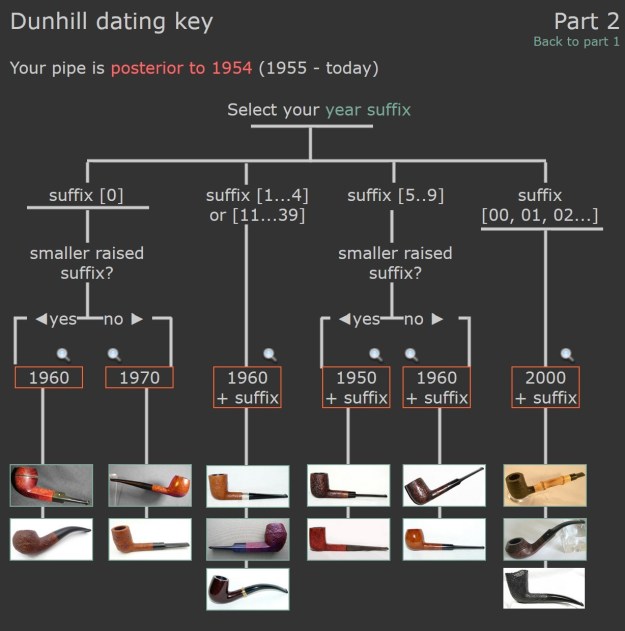
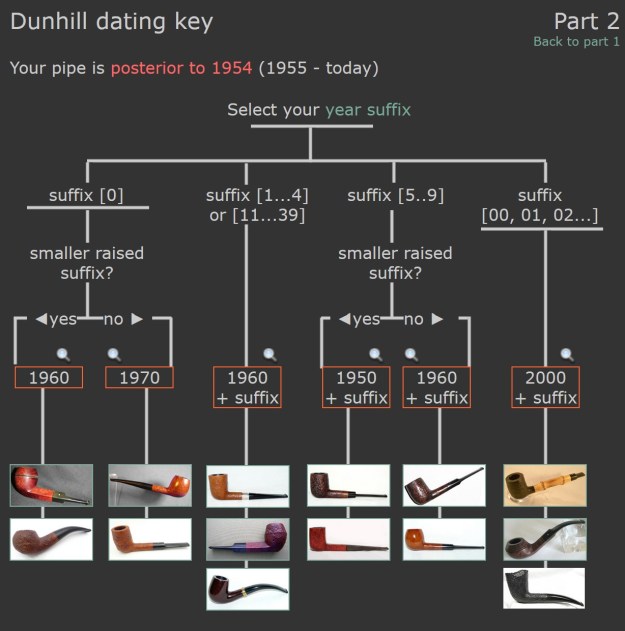
I was recently contacted by a fellow here in Vancouver about some pipes he had. He was referred to me by a local pipe shop. I was unclear if he wanted them cleaned or exactly what. When he came on the weekend he brought six pipes in two pipe boxes for me to have a look at. I spoke with him about the cost of restoring them. It finally became clear to me (I guess I am slow) that he wanted to sell the pipes. He was tasked with the job by his sister in law as the pipes were from her late husband’s collection. As I unpacked them it was clear that they were some nice pipes and some were higher grade. All but one was smoked and had the heavy smell of fruity aromatics to them. Some had cake in the bowl and lava on the rim. Of the six, four of them had significant rim damage – bowls out of round, burn marks, cut marks. The saddest part is that the damage was most significant on the higher end pipes. Most of them had tooth marks in the stems. Obviously, they had been his late brother in laws favourites and he had enjoyed them. He left them with me and I went over them, researched the brands and wrote up an offer for him to present to his sister in law. By the end of the day we had a deal. The six pipes now have a new home and the fruity smell needs to be exorcised!I set aside the long queue of pipes I am working on here to work on the first of these pipes. I bumped it ahead of the queue as it would probably be one that I held onto to smoke. It is a beautiful looking Dunhill Straight Billiard. It is stamped on the left side of the shank and reads DR next to the bowl/shank junction followed by DUNHILL [over] ***** (five stars). On the right side it is stamped Made In [over] London England with the superscript number 22 which will give me the date of the pipe. The DR stamp and the stars were new to me. I would need to do some digging on the details. The bowl and shank had beautiful straight grain around sides. The finish was shiny but there were a lot of dents, scratches and wavy portions on the shank top and underside. It was going to take some work. The bowl and rim top were clean or cake and lava but a very prevalent smell of aromatic, fruity tobacco surround he bowl.  The stem was clean but also had the same wavy spots on both sides of the stem. I wonder if the marks were caused by over zealous buffing somewhere along the way. They were just too consistent from the bowl shank junction to the button on both sides. Other than that, there were no tooth marks or chatter on the stem surface and it was very shiny. The slot in the button and internals were dirty. I took photos of the bowl and rim top to give you and idea of what I see. It is too bad that Word does now allow for the inclusion of smells because this is filling my work area. I have a candle going to mask the smell a bit. I also tried to capture the waviness in the stem surface and shank but was not all that successful in the photos. It is very present to the touch – a ripple from button to bowl…I took photos of the stamping on the sides of the shank. It is clear and readable as noted above. Unique stamping for sure that I will need to unpack later.I took photos of the bowl with the stem removed to give a sense of the proportion and appearance of the pipe.I decided to take a few moments to date the pipe with the superscript date number 22 following the D in England. I turned to the date key on Pipephil’s site to clarify the date on this particular pipe (http://www.pipephil.eu/logos/en/dunhill/cledat-en1a.html). There were no patent numbers so that took me to the Part 2 of the Dunhill Dating Key. I selected the 22 suffix that took me to the second column which I have marked with a red box. It gives the simple formula of adding the 22 to the year 1960 for the year of manufacture. That gave me the date of 1982. The pipe I was working on was made in 1982 so I had a start in identifying the stamping on the pipe.

Now it was time to work on the rest of the stamping and pin down the parts of that unusual to me stamping. I searched Google for the Dunhill DR stamp and found info on Pipephil’s site that gave information on the DR line(http://www.pipephil.eu/logos/en/infos/dunhill2.html). I quote the information in part from that section.

The “DR” (Dead Root) stamping on the left side of a Dunhill pipe corresponds to a straight grain.

“Dead Root” is a commercial label and doesn’t mean the root was extracted when the tree was already dead…The first stars appeared mid 1970’s and were a brief attempt to grade the pipe both as to grain (the letter) and to size (the stars). 1979: the DR are graded with 1 to 6 (or 7?) stars. The shape of the stars has been modified.

Stars grading may coexist on the same pipe with letter grading.

Stars and letter grading equivalency after 1979:

A B C D E F G H I J
* ** *** **** ***** ****** (7*)

This information tells me that the DR I was working on would have been stamped as a DRE. After 1979 the E was replaced with five stars *****. That dating works along with the 1982 date that I have worked out on the number stamp following the D in England.

From there I turned to Pipedia where there was also an article on the DR line stamping (https://pipedia.org/wiki/About_Dunhill_Dead_Root). I have included a screen capture of an advertisement for the DR line from the article and then I quote pertinent sections below.

Dunhill’s most prestigious line, the “Dead-Root”, is filled with many controversies, but certainly has its place in the sun. Among the connoisseurs of the brand, this is a very desired series. In addition to the pieces that were made under the management of Alfred Dunhill (until mid-1928) and limited in number, the D.R. has a special place in the heart and collections of nearly all Dunhill collectors.

“Beginning by at least 1915 if not earlier (perhaps as early as 1910) Dunhill stamped straight-grained Bruyeres, and later straight-grained Roots, “DR” on brand side of the bowl at the place where one would normally find an “A” or “R”. “DR” stood for dead root a term used to refer both to that part of the briar from which most quality pipes, including Dunhills, are made and to a briar burl that was dead before it was harvested. Initially, however, there was an additional distinction conveyed in the “DR” stamping beyond graining since prior to 1920 DR’s were hand-cut in London from burls while most Bruyere’s were only finished in London from French turned bowls.

While to some extent the straight-grained DRs may be the result of spotting the grain in the course of the early production process, the common statement that ‘DR’s are rare because they supposedly occur by accident in the course of standard shape production is incorrect. In fact, most “DR”s are derived from inspecting raw briar for straight grain prior to production or specifically purchasing the same and when so found or purchased selecting or specially designing a pipe shape to best fit the grain.

As the Bruyere was Dunhill’s only smooth finish prior to 1931 all early DR’s are necessarily Bruyeres,” The Root finish was put in production in 1931 specifically because the company desired to have a better grained naturally finished pipe in the line and in 1932 DRs became associated with that finish. Prior to 1932 DRs were stamped simply “DR” but with their introduction, Root DRs were stamped “DRR”. Presumably, the second “R” signifies the Root finish. Since I have seen no examples I do not know if Bruyere DRs after 1931, if any, were stamped “DRA” but I suspect that at least for a brief time there may have been such and if so, were so stamped since otherwise the second “R” in the Root DR stamping would have been unnecessary.

As discussed in connection with the “A” stamping, prior to the war, if not after, up ticking in DR pricing was apparently signified by square subscript stops. In addition, it appears that early DRs dating from the 1910s to the early 1920s were stamped with a one or low two-digit number on the shank next to the bowl (where the shape number normally appears) which appears to be some sort of category (as opposed to shape) number, either price or shape related. (I suspect it was the latter, perhaps the forerunner of the initial Shell stampings in that regard.) The Dunhill catalogs of the 1920s through 1931 consistently show four DR price categories but the precise stamping code to indicate the different price levels is presently unknown. Presumably, there were differing price groupings of the Root DRs in the 1930s but number of such and stampings indicative of the same is presently unknown. In the 1950s Dunhill began grading DR’s “A” through “J”, “J” being the finest. I have seen a 1957 DR stamped “DRR” followed by a horizontal “H” presumably signifying the “H” grade but I do not know the significance, if any, of the horizontal manner of the stamping. In 1979 Dunhill changed it’s DR letter grading system to stars running from one to seven stars underneath the “DRR” stamping with seven being the highest grade and also introduced a DR over XL stamp, presumably to denote larger pipes.” Loring, J. C., The Dunhill Briar Pipe, The Patent Years and After (self-published, Chicago, 1998).

“Straight Grain pipes are stamped with DR (“Dead Root”) followed by additional markings, shown below and listed in rising order. They can today be distinguished between Root Briar Straight Grain pipes (now 8 categories in use DR – DRH) and Amber Flame Straight Grain pipes (3 categories).” Hener, K. S., Product Line Director – The White Spot Smoker’s Accessory Division and Walthamstow site.

I have also included a chart of the stamping currently on the DR pipes today versus the stamping on DR pipes between 1950 until June 10, 1974. I have drawn a red box around the stamping on the pipe I am working on.With that information I started working on the pipe. I cleaned out the stinky, fruity smelling tobacco oils and tars in the shank and the airway in the stem. I used 99% isopropyl alcohol, cotton swabs and pipe cleaners and was able to remove the debris and the stench. The pipe actually smelled clean. I may need to deghost it but I will let it dry first and see what remains. I set the bowl aside and worked on the ripples in the vulcanite on the top and underside from the button edge up to the white spot. I needed to smooth out the heights in the ripples and make the stem surface smooth once again. I sanded the rippled areas on the stem with 320-3500 grit sanding pads. I wiped the stem down after each sanding pad with an Obsidian Oil impregnated cloth to remove the debris and dust. The sanding did the trick and the stem was smooth once more. I still needed to polish it but the bumps and ripples were gone.I polished the stem with micromesh sanding pads – dry sanding with 1500-12000 grit sanding pads. I wiped the stem down after each pad with Obsidian Oil. I used some Before & After Pipe Stem Polish, both Fine and Extra Fine to further polish the stem surface. I gave it a final coat of Obsidian Oil and set it aside to dry. With the ripples on the stem smoothed out and now smooth to touch it was time to work on the ripples on the top and underside of the shank. The first photo of each pair of photos (the top side and the underside) shows the ripples in the surface of the briar. The second photo of each pair shows the shank after I ran a 320 grit sanding pad over the surface to make the ripples very visible. I sanded the ripples on the top and underside smooth with a 320 grit sanding pad. They smoothed out very well and to touch there were no ridges. Even to look at it there were no more ripples and I was happy with the look of it.There were also ripples in the finish on the sides and heel of the bowl. To me these were different ripples than on the shank. These were actually in the varnish/shellac coat on the bowl giving it a shine. I wiped the bowl and shank down with acetone to remove the rippling varnish coat on the bowl. It was dull now but it was smooth to touch. I used 320-3500 grit sanding pads to smooth out the scratches and nicks in the surface of the briar. There we many small scratches most of them in the varnish coat and lightly in the briar. I wiped the bowl down after each sanding pad with a damp cloth to remove the sanding dust and debris. I polished the briar with micromesh sanding pads – dry sanding with 1500-12000 grit pads and wiping down the bowl after each sanding pad. Before giving the bowl a coat of Before & After Restoration Balm I decided to “deghost” the bowl with cotton bolls and alcohol. I stuff the bowl with cotton bolls and rolled one to fit the shank end. I used an ear syringe to fill the bowl with alcohol. I let it stand overnight to wick out the horrid smell of the previous tobacco. This morning I removed the pads and the ghost was significantly less.I rubbed the bowl and shank down with Before & After Restoration Balm. I worked it into the surface of the bowl sides and shank with my fingertips to clean, enliven and protect the briar. I let the balm sit for a little while and then buffed with a cotton cloth to raise the shine. The Balm did its magic and the grain stood out. With the repairs finished and the pipe cleaned I was ready to put the 1982 Dunhill DR***** Billiard back together again. The combination of straight grain briar with a vulcanite taper stem makes for a classically beautiful pipe. The briar around the bowl is clean and really came alive. The rich brown stains of the finish brought the grain to the surface after buffing and gave it depth. I buffed the pipe with Blue Diamond on the buffing wheel using a light touch on the briar. I gave the bowl and the stem multiple coats of carnauba wax on the buffing wheel. I buffed the pipe with a clean buffing pad to raise the shine. I hand buffed the pipe with a microfiber cloth to deepen the shine. The finished 1982 Dunhill DR***** Billiard is a lightweight beauty and feels great in the hand. Give the finished pipe a look in the photos below. The dimensions of the pipe are Length: 5 ½ inches, Height: 1 ½ inches, Outside diameter of the bowl: 1 ¼ inches, Chamber diameter: ¾ of an inch. The weight of the pipe is .99 ounces/28 grams. I will be adding this one to my own collection as it is a rare one that I have not seen and probably will not see again any time soon. I am looking forward to enjoying a great smoke in it very soon. Thanks for reading this blog and my reflections on the pipe while I worked on it.

Refreshing a Beautiful 1995 Dunhill Bruyere 932 Bent Billiard


by Steve Laug

I have been working lately replacing tenons on bowls in my own work box. After 6 of them I am ready for something different. While I was in Florence, Italy I had received and email from Jack regarding some pipes that he had that needed some work. Here is his email.

I have a Dunhill from unknown era, a Hardcastle, and possibly a third pipe that could use your workmanship. If you’d like, I can send you pictures of the pipes so you know what condition they’re in. Please let me know the necessary details! — Jack

We chatted about that and I suggested he email me when I returned to Canada. He wrote back and asked me to work on not three but four pipes. He listed what he had and I thought these would be an interesting diversion from tenon replacement work.

Are you still willing to entertain restoring/refurbishing a few pipes? I have four in various stages of need, and I’ve attached pictures of each for your evaluation. I would be very grateful for anything that you could and would be willing to do.

  • 1992 (?) Dunhill
  • Bertram 80
  • Hardcastle – This pipe looks very clean except for some pitting? fissures? in the chamber.
  • Dr. Grabow Supreme – This poor pipe… well, it’s a doozy.

Thank you very much! – Jack

I agreed and asked that he send them to me. Interestingly they arrived the day I finished the last of the tenon replacements. I unpacked them and they were indeed as interesting as his email had led me to believe. I decided to work on the third pipe listed in the foursome next – the Dunhill that he lists as a possible 1992. Here are the photos he sent to me of that pipe. I will give my evaluation of the work that will need to be done on the pipe as I walk through the photos with you.

The first two photos that Jack sent show the overall condition of the pipe. You can see from these photos that the bowl and rim top look very good. There is not a cake in the bowl and it makes me wonder if it is smoked much at all. The finish is dull but not terribly dirty. The stamping on the left side of the shank has a shape number 932 next to the bowl shank union. That is followed by dunhill in an oval. On the right side of the shank it is stamped Bruyere [over] Made in England with the date stamp – a superscript 35 after the D of England. Next to the bowl shank junction there is a circle with perhaps a 4 in the center [over] 9MM. The stem is a 9MM filter stem with an adapter making it a regular tenon. It has the Dunhill White Spot on the topside. I turned to a silver hallmark chart for Birmingham to unpack the stamping on the band (https://www.silvermakersmarks.co.uk/Dates/Birmingham/Cycle%201975-1999.html).

The silver band is stamped AD in a Diamond [over] three hallmarks – an Anchor meaning Birmingham, a rampant Lion meaning it is Sterling Silver and a date stamp of an italic V dating it to 1995. Underneath that is an assay beam followed by .925 for the quality of Sterling Silver.

Jack included these photos of the pipe for me to have a look at. You can see what I noted in the paragraphs above. It is a nice looking pipe to be sure. The next two photos affirm my evaluation of the lack of cake in the bowl and the clean rim top. The bowl looks to be lightly smoked. I unpacked the pipes when they arrived on Thursday and went over each one. As I examined this one my observations based on the photos were confirmed. The one thing that was better was that the finish actually looked better in person than in the photos. There was some nice grain around the bowl that was a bit dull looking. The bowl was very clean as I had expected. The stamping on the shank was faint but readable. The stem looked as noted above. It had a few small scratched in the surface but was very clean. The classic white spot on the top of the stem was in excellent condition. Have a look at the photos below. I took close up photos of the bowl and rim top to show the condition of both. The bowl and rim top look very good. There is no damage to the edges – either inner or outer. The stem is in great condition with just a few scratches on the underside. It does not have any tooth marks or chatter on either side. I tried to capture the stamping on the shank to show their condition before my work. They are but readable as noted above. I also took a photo of the band to capture the stamping on the silver. It reads as noted above. I removed the stem from the bowl and took a photo of the parts to give a sense of the symmetry of the pipe. It is a beauty. I turned to Pipedia’s section on Dunhill Root Briar Pipes to get a bit of background on the Dunhill finishes (https://pipedia.org/wiki/Dunhill#Root_Briar). I quote:

Bruyere

The original finish produced (usually made using Calabrian briar), and a big part of developing and marketing the brand. It was the only finish from 1910 until 1917. A dark reddish-brown stain. Before the 1950s, there were three possible finishes for Dunhill pipes. The Bruyere was a smooth finish with a deep red stain, obtained through two coats, a brown understain followed by a deep red.

There was a link on the above site to a section specifically written regarding the Bruyere finish (https://pipedia.org/wiki/Dunhill_Bruyere). I turned there and have included the information from that short article below.

Initially, made from over century-old briar burls, classified by a “B” (denoted highest quality pipe); “DR” (denoted straight-grained) and an “A” (denoted first quality), until early 1915. After that, they became a high-end subset to the Dunhill ‘Bruyere’. The DR and B pipes, a limited production, they should be distinguished as hand-cut in London from burls as opposed to the Bruyere line which was generally finished from French turned bowls until 1917, when the Calabrian briar started to be used, but not completely. Only in 1920 Dunhill took the final step in its pipe making operation and began sourcing and cutting all of its own bowls, proudly announcing thereafter that “no French briar was employed”.

Bruyere pipes were usually made using Calabrian briar, a very dense and hardy briar that has a modest grain but does very well with the deep red stain.

“Before the 1950s, there were three possible finishes for Dunhill pipes. The Bruyere was a smooth finish with a deep red stain, obtained through two coats, a brown understain followed by a deep red. The Shell finish was the original sandblast with a near-black stain (though the degree to which it is truly black has varied over the years). Lastly, the Root finish was smooth also but with a light brown finish. Early Dunhill used different briars with different stains, resulting in more distinct and identifiable creations… Over the years, to these traditional styles were added four new finishes: Cumberland, Dress, Chestnut and Amber Root, plus some now-defunct finishes, such as County, Russet and Red Bark.”

There was also a link to a catalogue page that gave examples and dates that the various finishes were introduced (https://pipedia.org/wiki/File:Dunnypipescatalog-1.png). I turned to Pipephil’s dating guide to show how I arrived at the date of manufacture for this pipe (http://www.pipephil.eu/logos/en/dunhill/cledat-en1a.html). I am including the chart that is provided there for the dating a pipe. I have drawn a red box around the section. Since the pipe I am working on has a suffix 35 I followed it to the 1960 line on the chart below. I chose the column suffic [1…4] or [11…39]. It also gave me the formula for dating the pipe – 1960 + suffix 35 = 1995.I now knew that I was working on a Bruyere that came out in 1995. The shape of the pipe was one of many Bent Billiards that Dunhill put out and that the shape #932 was a bit of an oddity. It seems that there are several different shapes that bear that number.

I scrubbed out the internals with pipe cleaners (normal & bristle), cotton swabs and alcohol to remove the tars and oils in the shank between the mortise and the entrance of the airway into the bowl. I removed the adapter from the 9MM tenon and cleaned inside of it and underneath it.I polished the rim top and bowl with micromesh sanding pads – dry sanding with 1500-12000 grit sanding pads. I wiped it down with a damp cloth after each sanding pad to remove the dust and debris. The grain stood out more with each set of pads. Once I finshed the polishing I examined the briar with a light and a lens. I was shocked to see the many fine scratches an marks in the briar. It looked like the bowl had been carried in a pocket and bumped against coins and such. I could not leave it that way. I used an iron and a damp cloth to steam the dents out on the briar. I put a damp cloth on each side of the bowl and applied the hot iron to the surface. I was able to lift the majority of them. Only a few of them remained but it looked much better when I was finished. I would need to buff it to raise a shine once again. I would also need to rub it down with Before & After Balm to lift and protect the grain.I worked some Before & After Restoration Balm into the finish of the bowl, rim top and shank with my fingertips to clean, enliven and protect it. I find that the balm really makes the briar come alive again. I let the balm sit for 15 minutes and then buffed with a cotton cloth to raise the shine. The bowl really looks good at this point. I polished the silver band with a jeweller’s cloth to remove the tarnish and polish and protect the silver. It looks very good at this point in the process. I polished the stem with micromesh sanding pads – dry sanding it with 1500-12000 grit pads. I polished it further with Before & After Pipe Stem Polish – both fine and extra fine. This Dunhill Bruyere 932 Group 4 Bent Billiard from 1995 is a beautiful looking piece of briar that has a shape that follows grain. It is a great looking pipe that came out looking even better after the cleanup. The Bruyere is an early finish that Dunhill specialized in making. The finish on the pipe is in excellent condition. The red and brown stain on the bowl works well to highlight the grain. The polished silver band and the black vulcanite taper stem adds to the mix. With the scratches and dust gone from the finish of the bowl it is an eye catching beauty. I put the stem back on the bowl and buffed the pipe with Blue Diamond on the buffing wheel being careful to not buff the stamping. I gave the bowl and the stem multiple coats of carnauba wax on the buffing wheel and followed that by buffing it with a clean buffing pad. I hand buffed the pipe with a microfiber cloth to deepen the shine. The finished Dunhill Bruyere 932 Bent Billiard with a 9MM filter stem is quite nice and feels great in the hand. Give the finished pipe a look in the photos below. I can only tell you that like the other pipes I am working that it is much prettier in person than the photos capture. The dimensions of the pipe are Length: 6 inches, Height: 2 inches, Outside diameter of the bowl: 1 ¼ inches, Chamber diameter: ¾ of an inch. The weight of the pipe is 54 grams/1.90 ounces. It is the third pipe from the lot that Jack sent me to work on. I have one left to finish and then I will pack the up and send them back to him. Thanks for walking through the restoration with me as I worked over another beautiful pipe. Remember we are not pipe owners; we are pipemen and women who hold our pipes in trust until they pass on into the trust of the next generation.

New Life for an old Estate 1966 Dunhill Tanshell 35 FT Billiard


by Steve Laug

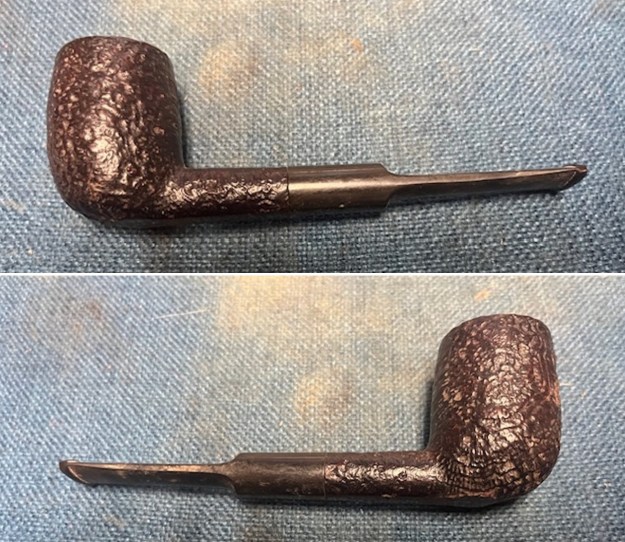
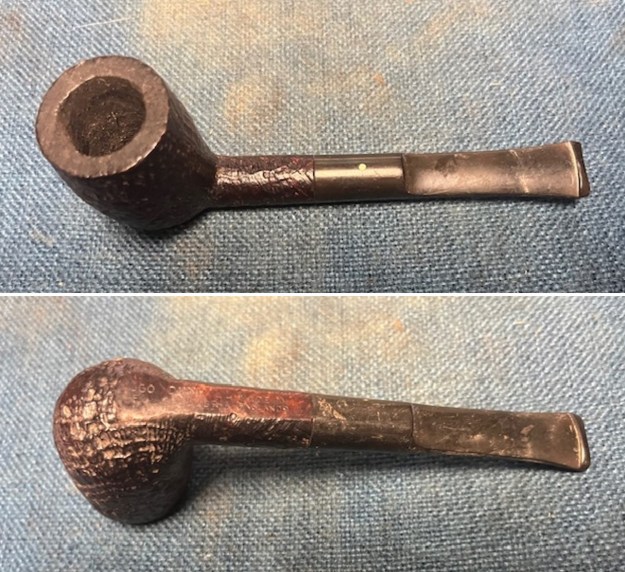
The next pipe on the table is one that came to us from the group of pipes that Jeff and I purchased from a fellow selling an estate collection in Long Island, New York, USA on 04/16/2024. It is another Dunhill sandblast that is in good condition. It is stamped on a smooth panel on the underside of the shank with the shape number 35F/T followed by Dunhill [over] Tanshell. Next to that it is stamped Made in [over] England by the date number 6. After that it is stamped with a  3 in a circle [followed by] T for Tanshell. The stamping is clear and readable as noted above. The pipe has a mix of brown stains on a sandblast finish and some amazing grain that the shape follows well. The finish was dusty and oily around the nooks and crannies of the sandblast but otherwise fairly clean. There was some wear on the rim top and the front outer edge of the bowl where it had been knocked. The bowl had a thick cake and there was lava on the sandblasted rim top or edges. The taper stem was oxidized, calcified, dirty and had scratches, tooth marks and chatter ahead of the button. I took photos of the pipe to show what it looked like before I started working on it. I took photos of the bowl and rim top to show their condition and of the stem to show the condition of both sides of the stem.The stamping on the underside of the shank is shown in the photo below. It looks very good and faint but readable. It reads as noted and explained above. I captured the detail in the photos below. I removed the stem and took a photo to give a sense of what the pipe looked like.One of the first things I like to do is to unpack the stamping and understand each element in it. I turned to Pipephil helpful site (http://pipephil.eu/logos/en/dunhill/tanshell1.html). The stamping is interpreted as follows: The number 35 is the shape number for a Billiard. The F/T signifies a Fish Tail stem. The Tanshell stamp refers to the finish which is corroborated the T at the end of the stamping. The size of the pipe 3 in a circle is a Group 3. The 6 following the D of England gives the date the pipe. Pipephil also has some helpful dating keys on the site that are basically flow charts that you can walk through to date your pipe (http://pipephil.eu/logos/en/dunhill/cledat-en1.html). I turned to Part 1 of the Dating Key and followed the chart. This pipe has a 6 following the D in England. It is the same size as the D so that took me to the section on the chart below (column one) which instructed me that the pipe could be dated as being made posterior to 1954. I followed the link following the “Your pipe is posterior to 1954. Narrow down your dating”. That took me to Page 2 of the dating key (http://pipephil.eu/logos/en/dunhill/cledat-en1a.html).   The third column (suffix 5…9) led me to the section with a 6 after the D in England that is the same size as the D. There was a directive for dating the pipe spelled out as follows: 1960 + suffix which gives the pipe a date of 1966.I then turned to Pipedia’s section on Dunhill Root Briar to get a bit of background on the Dunhill finishes (https://pipedia.org/wiki/Dunhill#Root_Briar). I quote:
Tanshell

The first lot was distributed in 1952 (usually made using Sardinian briar). The prototype was called “Root Shell “, produced in 1951. The Tanshell is a light tan sandblast. Sardinian briar was used for this sandblast. There is a distinct contrast in the sandblasts using Sardinian as opposed to Algerian briar. The Sardinian is much denser and much harder. The resulting pattern, when blasted, is far more even and regular both in terms of the surface texture and the finish.

The TanShell was Dunhill’s fourth finish and its first major post-war line addition. Introduced in 1951/1952 the TanShell was a naturally stained sandblasted pipe made exclusively from Sardinian briar through the 1960s. The TanShell apparently was not simply a light stained Shell but rather was also the product of “certain processes [unrevealed] not previously employed.” Initially, it appears that the pipe was to be named the Root Shell and a stamp to that effect was ordered and received by Dunhill in May 1951. Ultimately, however, the name TanShell was settled upon but the stamp for the TanShell name was not received by Dunhill until the beginning of December. Thus while the Tanshell was in production in 1951 it appears that most if not all TanShells made in that year did not enter into retail distribution until 1952 and were given a 1952 date code. Loring, J. C., The Dunhill Briar Pipe, The Patent Years and After (self-published, Chicago, 1998).

I have also included a chart from the site from Dunhill spelling out the Standard Pipe Finishes and giving short information and a timeline. I turned to work on the pipe itself. I reamed the bowl with a PipNet reamer using the second cutting head. I took the cake back to bare briar. I cleaned up the reaming with a Savinelli Fitsall Pipe Knife and then sanded the bowl walls with a piece of dowel wrapped with 220 grit sandpaper. The bowl looked very good at this point there were no burn marks and only light checking on the walls. I cleaned out the inside of the shank, mortise and airway in the shank and the stem with alcohol, cotton swabs and pipe cleaners to remove the tars and oils in them both. I used a lot of both pipe cleaners and cotton swabs to clean them as they were both very dirty.Before I scrubbed the externals of the bowl I decided to smooth out some of the roughness on the front and the back side of the outer edge. I cleaned up the outer edge with a brass bristle wire brush. I put a few drops of clear CA glue in the roughest areas of the damaged edges on the front and the back and added some briar dust to the finish. My goal was not to rebuild the edges but to rather smooth out the damage and remove the torn and rough edges. I worked it over again with a wire brush to knock of the excess. I would do some more of that after I cleaned the exterior. I scrubbed the surface of the briar with undiluted Murphy’s Oil Soap and a tooth brush. I worked over the rim top and the damaged areas on the front and back of the bowl. I rinsed off the bowl with warm running water to remove the grime. Once it was finished it looked much better. I worked over the surface of the bowl and the rim top with the brass bristle wire brush once again. That included the rim top and the sides of the bowl and shank. It looked much better at this point. At this point I rubbed the briar down with Before & After Restoration Balm. I worked it into the briar with my fingertips and a horsehair shoe brush to work it into the nooks and crannies of the sandblast finish. The product works to clean, enliven and preserve the briar. I let it sit for 10 minutes then I buffed it with a cotton cloth to deepen the shine. The briar really comes alive with the balm. I set the bowl aside and turned my attention to the stem. I scrubbed the oxidation, calcification and debris off the surface of the vulcanite with Soft Scrub on cotton pads. It looked much better once it was finished. I sanded out the majority of the tooth marks with 220 grit sandpaper. I filled in the light tooth marks that remained with black CA glue. I set the stem aside to let the repairs cure. Once they cured I sanded them smooth with 220 grit sandpaper. I started the polishing process with 320-3500 grit sanding pads. I wiped it down after each sanding pad with a cloth impregnated with Obsidian Oil. I let it soak in.I polished the stem with micromesh sanding pads – dry sanding with 1500-12000 grit pads. Once again I wiped it down between each pad with Obsidian Oil. I further polished it with Before and After Stem Polish – both Fine and Extra Fine. It looked very good. This 1966 Dunhill Tanshell 35F/T Group 3 Billiard with a Taper Stem has a beautiful, unique Dunhill Sandblast finish that was deep and craggy but now slightly worn. The reddish brown finish highlights some great grain around the bowl and shank. It has some great rugged sandblast that Dunhill specialized in making. The outer edges are a bit worn but I have chosen to leave them as part of the pipe’s story. The polished black vulcanite taper stem adds to the mix. I put the stem back on the bowl and buffed the pipe with Blue Diamond on the buffing wheel being careful to not buff the stamping. I gave the bowl multiple coats of Conservator’s Wax and the stem multiple coats of carnauba wax on the buffing wheel and followed that by buffing it with a clean buffing pad. I hand buffed the pipe with a microfiber cloth to deepen the shine. The finished Dunhill Tanshell 35F/T Billiard is quite nice and feels great in the hand. Give the finished pipe a look in the photos below. The dimensions of the pipe are Length: 5 inches, Height: 1 ½ inches, Outside diameter of the bowl: 1 1/8 inch, Chamber diameter: ¾ of an inch. The weight of the pipe is .95 ounces/27 grams. Thanks for walking through the restoration with me as I worked over another beautiful pipe. If you are interested in adding it to your collection I will be adding it to the British Pipe Makers Section of the rebornpipes store. Thanks for your time.
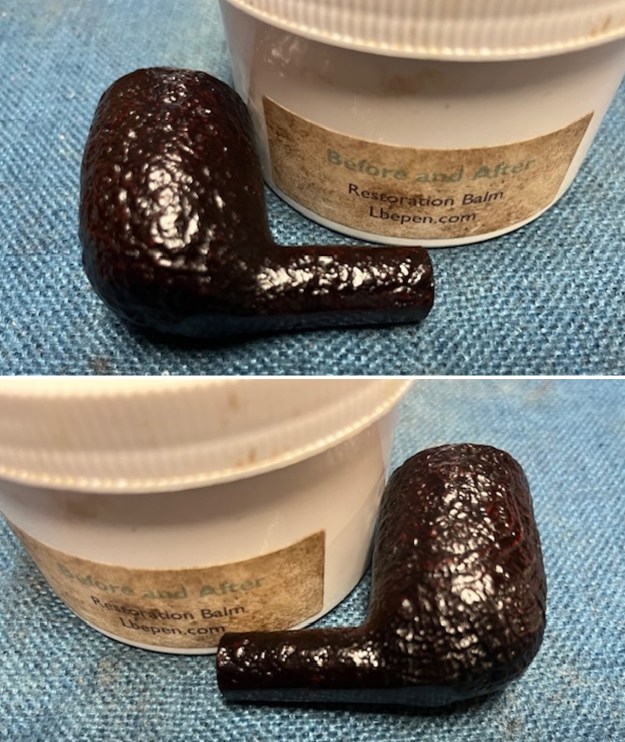
Bringing a Dunhill Tanshell 59 Billiard Back to Its Best


By Kenneth Lieblich

Dunhill is a name that inspires awe and warms the cockles of the hearts of many pipe smokers worldwide. Today, I am pleased to show the restoration of a wonderful tanshell briar. I acquired it in an auction last year. Other than that, I don’t know much of its provenance. Its colour and cragginess are very handsome, and I have no doubt that it was a much-loved pipe. I instinctively have a certain reverence for Dunhill pipes, and I am especially keen to restore this one so that the next pipe smoker can enjoy it. As I mentioned, this is a Dunhill Tanshell and the markings confirm this. It is a beautiful, classic billiard shape. Pleasingly, those markings are very clear and well-cut on the bottom of the shank. On the left-hand side is the model number, 59. Immediately to the right of this is Dunhill [over] Tanshell. Then, to the right of that, is Made in [over] England12. To the right of that is an encircled 4, followed by a T. Finally, the stem, of course, has the iconic white spot of Alfred Dunhill’s company. Here is a photo of Alfred, followed by the markings. Let’s have a closer look at what all of these markings mean. The model number 59 is one of the classic Dunhill shapes – that number first appeared all the way back in 1928. The page on Pipedia about Dunhill shapes says this:

The original skus/model numbers from the 1920’s until the early 1970’s stood for very specific shapes and bowls. For example, the codes 31, 34, 59, 111, 113, 117, 196, LB, LBS… were all different types of Billiard shaped pipes and there were about 50(!), such codes for the Billiard shape alone.Let’s have a closer look at what all of these markings mean. The model number 59 is one of the classic Dunhill shapes – that number first appeared all the way back in 1928. The page on Pipedia about Dunhill shapes says this:

The original skus/model numbers from the 1920’s until the early 1970’s stood for very specific shapes and bowls. For example, the codes 31, 34, 59, 111, 113, 117, 196, LB, LBS… were all different types of Billiard shaped pipes and there were about 50(!), such codes for the Billiard shape alone.Furthermore, John Loring’s fine book, The Dunhill Briar Pipe: The Patent Years and After, says this about the Tanshell:

The TanShell was Dunhill’s fourth finish and its first major post-war line addition. Introduced in 1951/1952 the TanShell was a naturally stained sandblasted pipe made exclusively from Sardinian briar through the 1960s. The TanShell apparently was not simply a light stained Shell but rather was also the product of “certain processes [unrevealed] not previously employed.” Initially, it appears that the pipe was to be named the Root Shell and a stamp to that effect was ordered and received by Dunhill in May 1951. Ultimately, however, the name TanShell was settled upon but the stamp for the TanShell name was not received by Dunhill until the beginning of December. Thus while the Tanshell was in production in 1951 it appears that most if not all TanShells made in that year did not enter into retail distribution until 1952 and were given a 1952 date code.The markings Made in [over] England12 give us an indication of when this pipe was manufactured. The number is the date suffix and provides us the information we need to figure out the date. I already knew the answer, but allow me to walk you through the process. I went to Pipephil’s Dunhill Dating Key (which you can find here) and I have reproduced (below) the two charts they use to date Dunhills. In the first image below, we are asked if our pipe has a date suffix. It does, so we follow the arrow and the chart asks if our pipe has a patent number. It does not, so we proceed. Then we are asked if our pipe reads Dunhill [over] London – again, it does not. As a result, we know that our pipe dates from after 1954.On to the second chart – and it is much more straightforward. The chart asks for the digits in our date suffix. In our case, it is 1 and an offset 2, so we know that the date of our pipe is the result of simple addition: 1960 + 1 = 1961 and the 2 identifies the date of sale for the Dunhill guarantee. Now we know that the year of manufacture is 1961! (thanks for the help Al). Is this your birth year? If so, have I got a pipe for you!Next, the encircled 4 and the capital T. This tells us about the size and finish of the pipe. Pipedia says:

The encircled group number indicates the size of the bowl (1, for example, is the smaller bowl). It is usually followed by a letter corresponding to the pipe finish. This number/letter code has been introduced about 1950 and was discontinued about 1976 replaced by a 4 or 5 digits code. They were reintroduced in March 2012, but only for commemorative versions.

In this case, the 4 indicates a medium/large size bowl and the T naturally refers to Tanshell.Finally, the white spot. Have you ever wondered about it? Well, very briefly, here is the origin of the famous white spot (from Pipedia):

In 1912, the famous white spot was introduced for very practical concerns. With straight pipes, customers had trouble knowing which way to insert the handmade vulcanite mouthpieces. So Alfred Dunhill ordered white spots to be placed on the upper side of the stem. This very practical solution would become a definitive trademark of Dunhill pipes. The “white spot” soon became known as a symbol of quality.

Now let’s get on with restoring this beautiful pipe!

This pipe was in generally good condition – nothing outstanding and no significant damage. As you can see, the stem had the usual wear-and-tear – some scratches, tooth dents, etc. There was some calcification, but not much oxidation. Meanwhile, the stummel was in lovely condition, but a bit dirty. The shank was dark and the bowl had lots of cake and lava. The sandblast looked rich and beautiful. I began by making an attempt at lifting some of those tooth marks. I “painted” the stem with the flame of a lighter – this can sometimes raise the vulcanite back into place. There was definitely progress, but I would need to repair the more significant dents.I wiped the stem with oil soap on some cotton pads. There was calcification there and I needed to remove it. Meanwhile, the stem was pretty dirty inside. I cleaned out the inside with various pipe cleaners and 99% isopropyl alcohol. There was quite a pile afterwards. I then wiped down the stem with cleanser to remove some surface oxidation. Once this process was done, the stem went for an overnight soak in the oxidation remover. As the name suggests, this liquid removes oxidation, but, more than anything, it helps draw oxidation to the surface of the vulcanite. This allows me to clean the oxidation off in a couple of ways: both by applying a mild abrasive cleaner to the surface, then by sanding the stem. The following day, I cleaned all of the de-oxidizing mess off with alcohol, pipe cleaners, et cetera. The oxidation had migrated to the surface and would be fairly straightforward to remove. I scrubbed with the cleanser again on some cotton pads to remove the leftover oxidation.Next step was to address the remaining tooth marks. I filled those dents with some black cyanoacrylate adhesive that is infused with carbon and rubber. This makes a better repair than regular CA glue, as it more closely mimics the original material. When the adhesive was cured, I used my needle files to remove the excess and bring it down to the level of the vulcanite.Then I used a set of nine Micromesh pads (1,500 through 12,000 grit) which gradually erased the ravages of time and brought out the stem’s lovely black lustre. For the last five pads, I also lightly coated the stem with Obsidian Pipe Stem Oil in between each scrubbing. At last, I set the finished stem aside. Off to work on the stummel! The outside looked very well cared-for. No notable damage and the blast maintained its great appeal. Alas, the rim had plenty of lava, but first things first. The bowl needed a thorough reaming, so I used the KleenReem to scrape off the built-up cake and I followed that with 220-grit sandpaper taped to a dowel to eliminate as much as possible. Generally, I prefer to sand the chamber down to bare briar. When restoring, it is important to ensure that there is no damage to the briar in the bowl, under the cake. I was pleased to see that the walls were sound.Next up, I needed to clean the shank and bowl thoroughly. I proceeded to use Q-tips, pipe cleaners, and 99% isopropyl alcohol. Holy moly – this was a dirtier pipe than I had initially anticipated. There was quite a pile of Q-tips and pipe cleaners left behind.Then, to further clean the inside of the pipe, I opted to “de-ghost” the pipe. I put some cotton balls in the bowl and in the shank, and then saturated them with 99% isopropyl alcohol. I let that sit overnight to exorcize any evil spirits (i.e. bad smells and oils) from the old pipe.Time to deal with that rim. I gently scraped as much debris as I could with a piece of machine metal. However, given the craggy blast, that only worked so well. I moved on to cotton rounds and some oil soap to clean the outside of the stummel and a toothbrush with oil soap for the lava on the rim of the pipe. This worked a treat. I followed that up by cleaning the insides with some Castile soap and tube brushes. At this point, I rubbed some Before & After Restoration Balm into the briar and left it to sit for 15 minutes or so. I brushed it with a horsehair brush and buffed it with a microfibre cloth. The balm does wonderful things to the wood, and I really like the sheen on the sandblast. Then it was off for a trip to the bench polisher. A few coats of conservator’s wax (from Lee Valley) were just what this pipe needed. Boy – that wax really makes this pipe pop! The lovely shine made the wood look absolutely beautiful. The sandblast looks fantastic and is ready to be enjoyed again by the next owner.

I thoroughly enjoyed bringing this Dunhill Tanshell 59 Billiard back to life and I am pleased to announce that this pipe is for sale! If you are interested in acquiring it for your collection, please have a look in the “British” pipe section of the store here on Steve’s website. You can also email me directly at kenneth@knightsofthepipe.com. The approximate dimensions of the Dunhill are as follows: length 5⅜ in. (137 mm); height 1⅞ in. (46 mm); bowl diameter 1¼ in. (33 mm); chamber diameter ⅔ in. (18 mm). The weight of the pipe is 1¼ oz. (36 g). I hope you enjoyed reading the story of this restoration as much as I enjoyed restoring it. If you are interested in more of my work, please follow me here on Steve’s website or send me an email. Thank you very much for reading and, as always, I welcome and encourage your comments.

Fresh Life for a 1976 Dunhill Shell Briar 126 3S Billiard


By Steve Laug

The next pipe on the work table is a lovely Dunhill small sandblast Billiard shaped briar pipe. We purchased it from our contact in Copenhagen, Denmark on 01/22/2024. It is a classic Dunhill Sandblast Billiard shaped bowl. It has a sandblast, rich brown stained bowl that really highlights the grain in the briar. The bowl is dirty with grime in the finish. There also appears to be a shiny varnish coat over the grime in the sandblast. There appears to be a varnish coat on the stem as well. The bowl has a moderated cake and a light lava overflow on the sandblast rim top and edges. The stamping on the pipe is clear and readable and on the under side it reads 126 the shape number [followed by] Dunhill [over Shell Briar. That is followed by Made in England the superscript date number 16 is stamped after the D in England. There is a circle 3S following the date stamp that identifies the pipe as a group 3 sized pipe in a Shell finish. The stem had a white spot that is damaged and shrunken on the top side of the taper. It is lightly oxidized and has tooth chatter and deep tooth marks on both sides ahead of the button. The sad thing is that once again the stem is covered with a varnish coat. Jeff took photos of the pipe before he started his cleanup. He took photos of the pipe’s bowl and rim top to show the cake in the bowl and the lava coat overflowing onto the top. It is another dirty pipe. You can see the shiny coat on top of the finish and the grime in the photos. He also took photos of the stem to capture the tooth marks on the top and underside near the button. He took photos of the sides and the heel of the bowl to give a sense of the sandblast finish on this one. Even under the grime and shiny varnish coat in the grooves the blast is quite beautiful. Jeff took photos of the stamping on the underside of the shank. It is clear and readable though it is faint in some spots. I wanted to unpack the Dunhill stamping on the shank and work to understand each element of the stamp. I generally use the Pipephil site to gather as much initial information as possible (http://pipephil.eu/logos/en/dunhill/shell-briar1.html). The stamping is interpreted as follows: The number 126 is the shape number for a taper stem Billiard. The Shell Briar stamp refers to the finish. The underlined, superscript number 16 following the D of England would give the date the pipe. The circle 3S tells me that the pipe is a group 3 sized pipe and the S is for the Shell finish. The photo below is of the stamping on a Don shape but the stamping is similar on this one.Pipephil also has some helpful dating keys on the site that are basically flow charts that you can walk through to date your pipe (http://pipephil.eu/logos/en/dunhill/cledat-en1.html). I turned to Part 1 of the Dating Key and followed the chart. This pipe has 16 following the D in England. There was no patent number so that took me to the section on the chart below (column one) which instructed me that the pipe could be dated as being made “posterior to 1954”.I followed the link under “Your pipe is posterior to 1954. Narrow down your dating”. That took me to Page 2 of the dating key (http://pipephil.eu/logos/en/dunhill/cledat-en1a.html). The second column – suffic [1…4] or [11…39] led me to the next section. Since the 16 after the D in England the date of the pipe spelled as 1960 + 16 making the date 1976.I then turned to Pipedia’s section on Dunhill Shell Briar to get a bit of background on the Dunhill finishes (https://pipedia.org/wiki/Dunhill#Root_Briar). I quote:

Shell

A deep craggy sandblast with a black stain finish (usually made using Algerian briar) – the color of the stain used has varied over the years. Although there is some doubt as to them being the first to sandblast pipes, Dunhill’s Shell pipes, and the sandblasting techniques developed to create them are considered one of Dunhill’s greatest and most lasting contributions to the art of pipe making.

The documented history of Dunhill’s inception of the Shell is largely limited to patent applications — there are no catalog pages or advertisements promoting blasted pipes at the time. The preliminary work on the English patent (No. 1484/17) was submitted on October 13, 1917. The patent submission was completed half a year later, on April 12, 1918, followed by the granting of the English patent on October 14, 1918. This was less than a month before the end of The Great War on November 11th.

In 1986 Dunhill released a line of premium Shell finish pipes – “RING GRAIN”. These are high-quality straight grain pipes which are sandblasted. Initially only Ring Grain, but now in two different finishes. In 1995 the “Shilling” was introduced with Cumberland finish – it is an extremely rare series. These pipes exhibit a deeper blast characteristic of that of the 1930’s – mid-1960’s (and the limited ‘deep blast’ pipes of the early 1980s) and show a fine graining pattern. These are considered the best new Dunhills by many enthusiasts today and are very rare. The finish is sometimes described as tasting like vanilla at first, with the taste becoming more normal or good as the pipe breaks in.

I turned to work on the pipe itself. Jeff had done an amazing cleanup of the pipe. He reamed the cake with a PipNet reamer and cleaned up that with a Savinelli Fitsall Pipe Knife. He scrubbed the internals of the bowl and stem with alcohol, cotton swabs, pipe cleaners and shank brushes. He scrubbed the externals with undiluted Murphy’s Oil Soap and rinsed the bowl off with running water. His scrubbing removed the varnish on the bowl with just a few spots remaining. He soaked the stem in Briarville’s Pipe stem Deoxidizer and once it had soaked rinsed it off with warm water to remove the residual solution. He dried it off and rubbed it down to remove any oxidation that was still on the stem. The soak did not penetrate the varnish on the stem at all but it certainly looked better. Other than the shiny spots in the finish where the varnish remained, the pipe looked very good when I received it. You can also see the sunken state of the white spot on the stem surface. I took a photo of the rim top to show the condition. It looks good with the tars and oils removed from the rim top. The inner edge of the bowl was in excellent condition. The bowl itself was very clean. The stem came out clean but the varnish coat remained and discoloured the white spot. The photos clearly pick up the shrunken white spot on the stem top. The varnish coat gave the whole stem an artificial shine that hid the tooth marks and chatter underneath.I took a photo of the underside of the shank to show the stamping. The photo shows the stamping and it is very readable other than the date stamp which is visible in person. I removed the stem from the shank and took a photo of the pipe parts to show what I was working with. I think once the varnish is removed the pipe will be a nicer looking piece.The briar was actually very clean and the varnish coat had been eliminated on the bowl so I had a bit of an easier job than on the previous 126 that had a heavy varnish coat. I rubbed the bowl down with Before & After Restoration Balm. I worked it into the surface with my fingertips and a horsehair shoe brush to work it into the nooks and crannies of the sandblast finish. The product works to clean, enliven and preserve the briar. I let it sit for 10 minutes (it varies how long I leave it not for any specific reason but because I get preoccupied with other things). Once it has done its magic I buff it with a cotton cloth to deepen the shine. The pipe really comes alive with the balm. I sanded the stem with 320-3500 grit sanding pads to remove the varnish coat that covered it. I wiped it down after each sanding pad with a damp cloth. By the final 3500 grit sanding pad the stem had a more normal shine and the varnish, tooth marks and chatter were gone. With that done I was ready to address the shrunken and discoloured white spot.Once I hard removed the varnish coat I cleaned up the sunken white spot with a cotton swab and isopropyl alcohol. I was able to remove the staining on the spot and the grime that had built up in the hole. It was now ready for the patch. Mark Hoover has some small white acrylic dots that can be used to fill in the hole in the stem top.  I followed Mark’s direction and put one acrylic dot into a small amount of acetone for a couple of seconds. I then pushed it into the hole with some tweezers. Mark had said that if the drilled hole goes a bit deeper and is not to the level with the surface of the stem then wait a minute or two and put another on top. I let it harden and then I sanded it smooth with 220 grit sandpaper. I polished the vulcanite with micromesh sanding pads – 1500-12000 grit pads. I wiped it down with Obsidian Oil after each sanding pad. I used Before & After Pipe Polish – both Fine and Extra Fine to further polish the stem. This 1976 Dunhill Shell Briar 126 Billiard with a vulcanite taper stem has a beautiful, unique Dunhill Sandblast finish that is very deep and craggy. The Shell Briar mixed brown finish highlights some great grain around the bowl and shank. It has a unique sandblast that Dunhill specialized in making. The removal of the varnish gave a clearness to the stem surface. The polished vulcanite taper stem adds to the mix. I put the stem back on the bowl and buffed the pipe with Blue Diamond on the buffing wheel being careful to not buff the stamping. I gave the bowl multiple coats of Conservator’s Wax and the stem multiple coats of carnauba wax on the buffing wheel and followed that by buffing it with a clean buffing pad. I hand buffed the pipe with a microfiber cloth to deepen the shine. The finished Dunhill Shell Briar 126 Billiard is quite nice and feels great in the hand. Give the finished pipe a look in the photos below. The dimensions of the pipe are Length: 5 ¼ inches, Height: 1 ½ inches, Outside diameter of the bowl: 1 ¼ inches, Chamber diameter: ¾ of an inch. The weight of the pipe is 1.13 ounces/32 grams. Thanks for walking through the restoration with me as I worked over another beautiful pipe. This one will be going on the rebornpipes store in the English Pipe Makers Section. Thanks for your time.