A Few Pipe Rests – More Pieces of Tobacciana


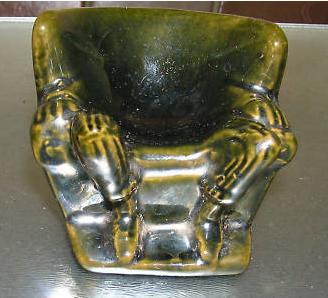
The first of them is a great old piece that is ceramic. It has a green and yellow glaze and is the shape of an easy chair with arms and legs. It holds several sizes of pipes very comfortably. It is hollow on the inside and has a felt pad on the bottom.
rest1

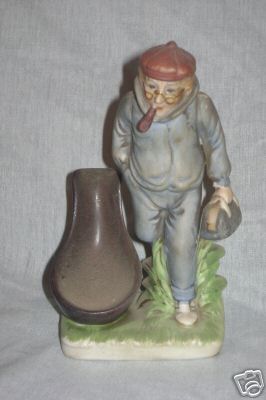
The second rest is a great ceramic piece. It is an old pipe man in a track suit and runners. He is carrying a sports bag. The glaze on it is a soft pastel colour. It holds a pipe very easily and is a great rest on a desk top or in a pipe cupboard.
rest2

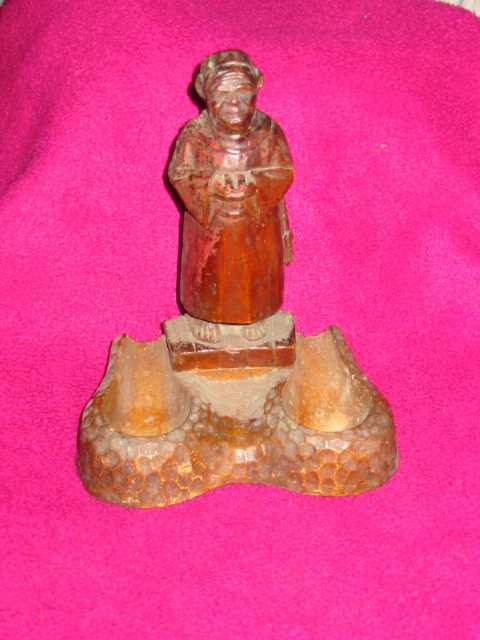
The third pipe rest is a resin piece. It is cast in the shape of a monk or friar. He is hold a book in his hands and is either reading or singing. I can picture him doing a Gregorian chant. The resin is a brown wood colour and has the appearance of a carving. This is one that sits on the shelf in my office/shop. From the picture I can see that I need to dust it off and clean it up.
rest3

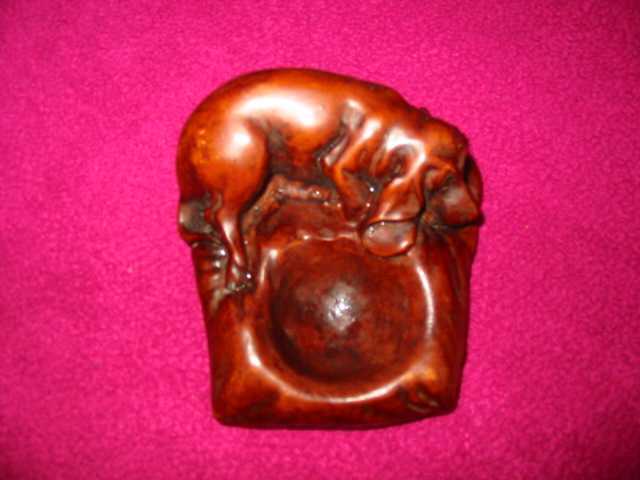
The fourth pipe rest is a sleeping hound dog. It is also a cast resin that looks like a brown wooden carving. It also sits on the desk top and is a great place to lay a pipe when I am smoking it while I work on things. I also use it to hold pipes that I am in the process of restoring.
rest4

I have a few others but these give you a feel for some of the interesting pipe rests that are available.

Hot Rods – next round please, Basket briar massacre. (October 2012) Part 2 – Piet Binsbergen


Ok, so here is the silly bit.

These 2 pipes I did not photograph before I started. Once again apologies!

Die Braaivleis pyp (Afrikaans for the BBQ pipe)

This is my opinion. I guess that basket briars are not that bad. What makes them unattractive is that they are drilled skew and full of putty. Now skew drilling sucks and these pipes are laid to rest. When I do find pipes that look like the drilling is solid enough I often find the bowls to be full of putty fills hence they become basket briars. So why do they do it then? Well, time is money and to fill a pipe and sand it, covering it with a dark stain seems to be fast and cost effective.

I have found that if one spends time and uses the right tools, with some practise you can rusticate the bowl and the fills become part of the character of the pipe. So why do the pipe manufacturers not do it then? The answer again is a simple one! Time versus money. A solid rustication job may take me some hours. Now hours I have, low end pipe manufacturers do not!

In time I will put together a photo essay of my rustication process.

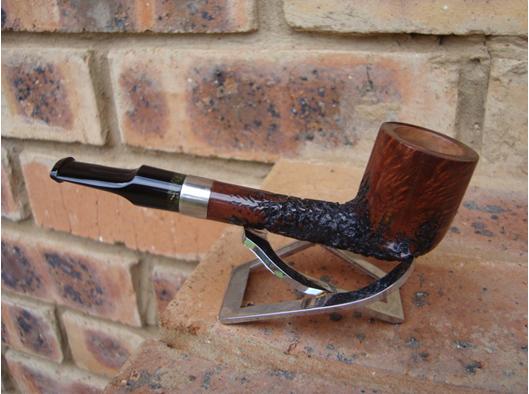
With this pipe, the bowl was semi rusticated. I added a silver shank ring and fitted a green Lucite shank ring for contrast. The stem was replaced.
Piet1
The Bushveld Poker

Before you all have a stroke, this is NOT a CASTELLO but a Purex basket briar.

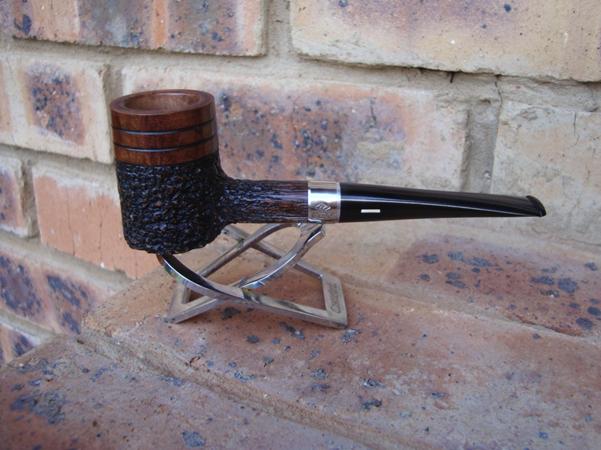
This was fun as I could get the stummel into the lathe chuck and work it back into true. The drilling was good but the tobacco chamber was off set to the outside of the bowl (Welcome to the wonderful world of basket briars). I was able to turn the bowl down just a bit to bring it back into true. I also added some rings. As the bowl was full of fills lower down on the stummel I used the same rustication process as above. I added a silver shank ring for contrast. The stem is a screw in type fit with one of those nasty stingers fixed to the tenon of the stem. Here I removed the stinger and saved the stem. This is one of the few pipes that had a stem which was saveable so I went through the motions of bleaching soaking and polishing. All the pipes have draft holes open to 4mm.
Piet2

Hot Rods – next round please, Basket briar massacre. (October 2012) – Piet Binsbergen


Hi guys, you know some times I am really dumb. I am so excited to get going that I fail to take some before pictures. I have come to realise that posting the end product only does not do the process or the hobby any justice. I have done 2 more pipes for which I do not have any before pictures, my apologies.

Well I got a batch of basket briars sent to me by my good friend and tobacconist Alan from Sturks in Cape Town. These pipes are really low enders with nothing much going for them. I like this, here I can go mad and be myself as there is nothing to lose and much to gain. I am under the impression that these putty filled beauties may hold some magic, and after all, they do seem to look like some old briars. Most of them are just nameless, others are Medico ‘Frank’ pipes and the odd one marked Purex, (Sounds like a contraceptive, juck, LOL)

I have been on the quiet side for a bit as my PhD title defence was looming and I needed to get that done and dusted. When I needed a solid break from my studies I took time out to do up some pipes. Hope you like them.

The DAMASCUS PIPE (LA Mort)

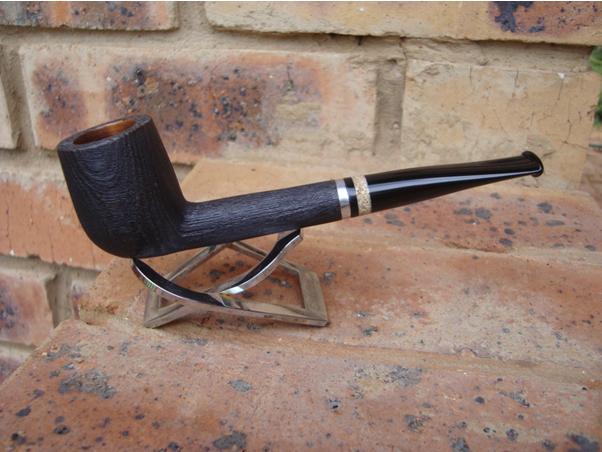
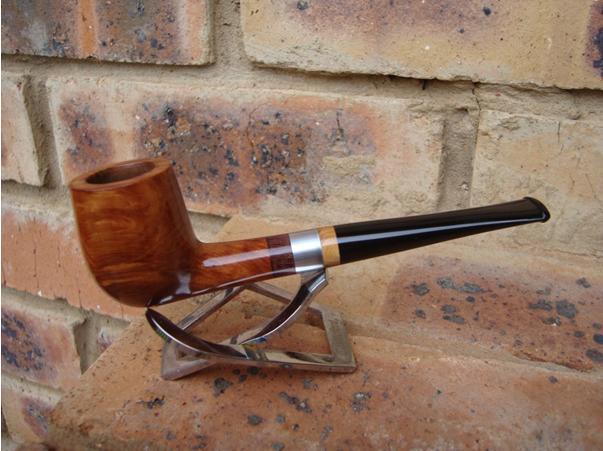
This is a Medico Frank, Maple I suspect or maybe some of you can help me out here? Either way I wondered what it would look like in its blasted form. It came out fantastic. The blast is fine and delicate so I decided to stain the pipe black and laid off heavy carnauba waxing. I added a Hippo bone shank ring for contrast and replaced the stem.

Before:
rod1

After:
rod2

rod3

The S.A.Y. 15 Plumbing Pipe

Well my father-in-law is a plumber by trade. I spent some time with him last weekend. He lives far away so I do not get much time to spend with him. I decided that if I was going to do crazy things to old pipes they might as well tell a story. This is another Medico ‘Frank’ with a cracked shank. The pipe is briar with plenty of ‘meat’ for me to go mad with. The crack in the shank caused the stem (screw fit) not to align. I cut off the shank, and had some fun.

The shank extension is stained cherry wood, the shank ring is a S.A.Y. 15 Copper plumbing pipe coupling. I rusticated the pipe and fitted a shorter ‘Lovat’ style saddle stem. The cool part is I managed to get a matt finish on top of the stem and polished the sides. The black ring next to the copper ring was burnt with a fine soldering iron.

Before:
rod4

After:
rod5

The Jockey

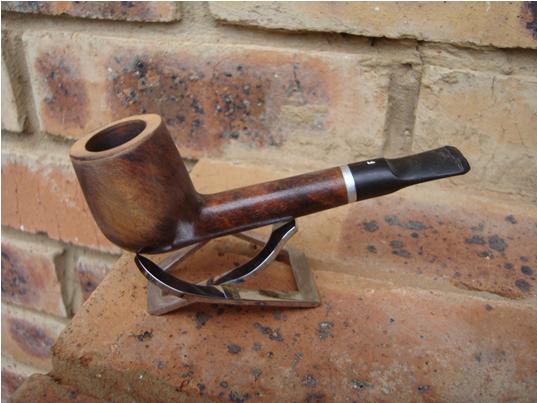
This is a no name briar. It is in a nasty state but under all that dirt and grime I found some really good wood. Here I did a full refurb as I always do and sanded the bowl starting at 150 grit and working it up to 2000. If you are after a good finish on smooth pipes you have to be prepared to put in the hours. My rule of thumb is that the pipe should shine before you add the final buffing and polishing wax. Carnauba wax will never hide your short cuts.

Stain is applied at the 600 grit sanding stage and a fresh layer of stain is added as the grit number climbs. In this way I get a deep stain, rich in colour. Steve has recently published his staining and sanding method in detail. It is published here on the blog and in the latest issue of the NASPC Pipe Collector. It is well worth checking out.

3 Shank extensions (rings) were added, Red ivory wood, Aluminium and African olive wood.  The stem was replaced.

Before:
rod6

After:
rod7

Kleen Reem Pipe Reamer Instruction Booklet


Blog by Steve Laug

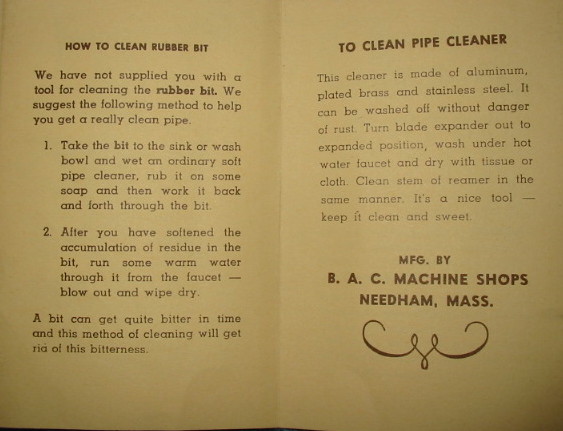
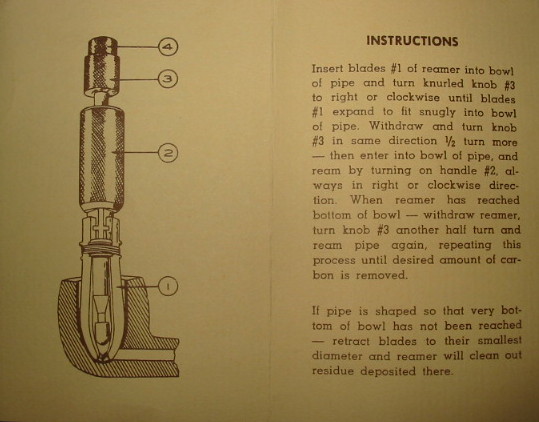
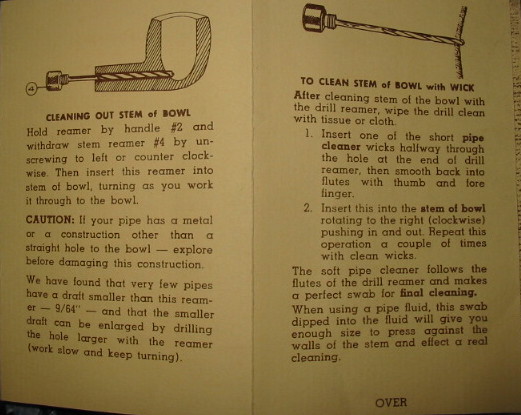
I had this instruction booklet for the Kleen Reem pipe reamer in my files and thought I would post it here. It is the best explanation in words and pictures that I have seen for the use of the reamer – regardless of whether it is marketed as a Kleen Reem Reamer or a Senior Reamer. The diagrams are applicable to both.
IMG_2872

IMG_2873

IMG_2874

IMG_2875

Stem Repair Just for the Practice


Blog by Steve Laug

Sometimes I just repair a stem because it is there and I can get the practice working with it. Such was the case with the pipe below. It is a very low end pipe with a nylon stem and a metal tenon that holds a paper filter. The bowl of the pipe was rusticated and definitely not a favourite shape or style of mine. This one would not be a pipe I kept or would be tempted to add to the collection. It was solely a pipe that would provide me an opportunity to work on the tooth dents, the bite through holes on the top and the bottom of the stem near the button as pictured in the two photos below. A decision had to be made whether to fill the hole with super glue or to cut of the bitten through end of the stem and reshape a new button. The dents and holes were very big and the stem was truly a mess.
I used heat from a heat gun and boiling water to raise the tooth dents in the stem and then sanded it to provide a smooth surface in front of the button. I wanted to minimize the amount of the stem that I would have to cut off should I choose that method.
stem1

stem2

I used heat from a heat gun and boiling water to raise the tooth dents in the stem and then sanded it to provide a smooth surface in front of the button. I wanted to minimize the amount of the stem that I would have to cut off should I choose that method.
stem3

stem4

Once I had leveled the stem out, I again studied the bite through areas. It was clear to me that I was going to cut off the stem and reshape the button. I used a Dremel to cut back the button and the damaged area of the stem. The next three photos show the result of the cut back. I did not have to remove nearly as much as I originally thought I would as the heat had raise many of the tooth marks in the stem. I sanded the stem to smooth out the flow and slope of the stem and remove the remaining tooth damage. Even though the photos are a bit out of focus you can see the work that was done on the stems. If I had doubted that the stem was made of nylon it became very clear as I sanded it. The grey hue of the material can be seen in the photos below.
stem5

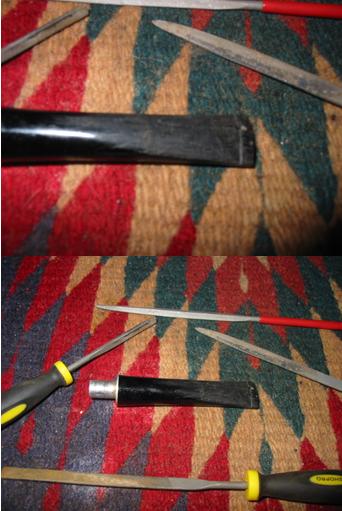
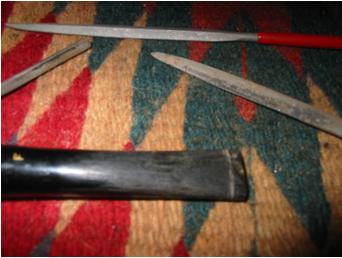
Once the stem surface was smooth and the remaining dents were minimized it was time to take out the needle files and begin to cut the new button on the stem. I used a square bladed needle file to do the initial cuts in the button. I am always concerned to make a clean straight edge on the button so I find that a square blade with no taper or tip makes that task simple. I then clean it up with a flat bladed file and smooth out the transition between the button and the slope of the stem. The other files in the pictures below are used to shape the button and to define its final form. The three photos below show the files and the progress in cutting the new button. You can also see that the small dents that remained are disappearing in the shaping of the button. Care must be taken not to cut the edge too deeply and recreate the hole in the stem again. In this case I had enough meat on the stem to allow me to cut a well defined button.
stem6
stem7

Once I had the button cut and defined I put the stem on the pipe to continue the process of refining the line of the stem and smoothing out the transition to the button. I wanted to taper the button toward the lip rather than leave it flat so you can see that in the profile picture below. The stem is just about finished by the time these photos were taken and only needed the final sanding to bring the stem to completion.
stem8

The stem was then sanded with 400 and 600 grit wet dry sandpaper to remove the deep scratches and then followed that with micromesh sanding pads from 1500-12000 grit. The finished stem is picture below both in profile and from a top view. The new button is comfortable and the slot is open and passes a pipe cleaner easily.

The pipe provided a great opportunity to work on a stem restoration and the recreation of a button and it has since found a new home in the rack of a happy pipe smoker who needed some pipes for working outside and in the yard. This is a perfect yard pipe and should continue to deliver a great smoke to him as long as he chooses to keep it.
stem9

Another Piece of Tobacciana – A Hammered Metal Pipe Tobacco Humidor


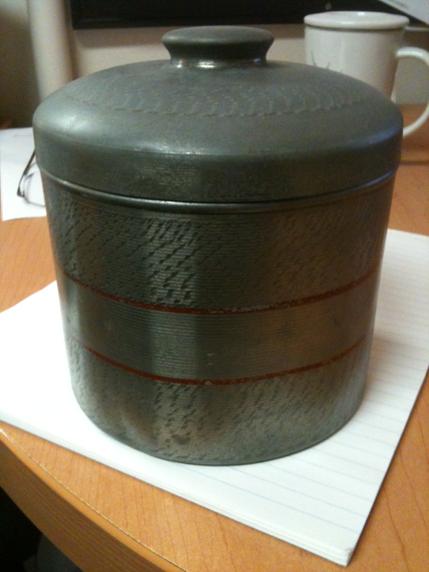
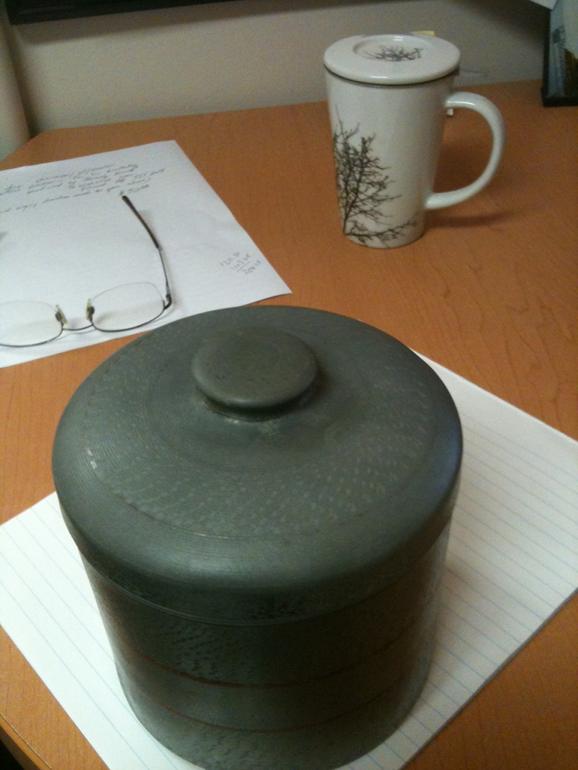
I finally took some pictures of this piece of pipe history – or pipe accessories that I have in my collection. I love the look and feel of this jar. It is relatively useless in keeping tobacco humidified as it is not even close to air tight. Over the years that I have had the humidor I have tried various tobaccos in it. I have even put humidifying disks in the lid and in the tobacco itself with no success. I even tried some aromatic that seemed to never dry out on its own and in the jar it dried within a week to a nice crisp dry corn flake like consistency! So it is no good for tobacco. The look and feel of the piece is nice though. I have no idea of the age of the piece. I call it metal in the title as I do not know what metal it is made of. It does not feel like aluminum so I am guessing steel.
humidor1

humidor2

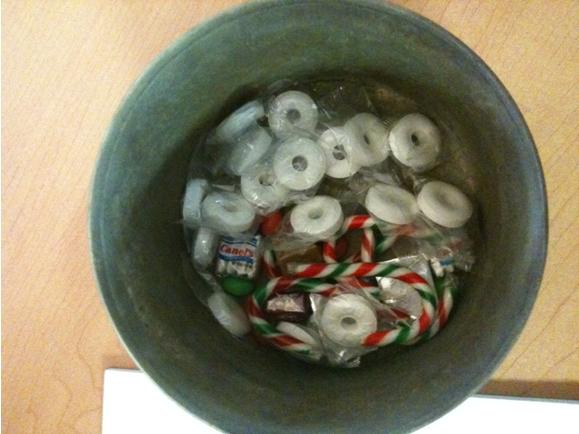
In the past I also used it to hold pipe tools and baggies of tobacco but I decided to jar them instead as the humidor did not keep them from drying out even that way. So it has been retired from that activity and currently resides on my desk in the office at the Foundation. It holds some of the candy that I keep on hand for myself and the folks we work with. It works well for that!
humidor3

Refurbished Peterson Sherlock Holmes 1994


I worked on this Peterson Sherlock Holmes pipe with hallmarks on the silver band that date it to 1994. It has since found a new home and is being smoked and enjoyed by the new owner. The stamping on it was very light but still visible. The finish is in decent shape but very dirty. All of the crevices on the pipe were filled with grime and grit. The stem had oxidation and a light brown undercoating of brown throughout. The band was in great shape and just needed polishing. The bowl was a real question mark for me. It appears to have been drilled significantly larger. The bowl sides are smooth and they are still straight and clean. There was some blackening at the bottom of the bowl. I am thinking that the previous owner decided to open the bowl up and make it larger in order to hold more tobacco. The new owner says that it still smokes well so the drilling did not ruin the pipe.
Pete1

I scrubbed the bowl surface with some undiluted Murphy’s Oil Soap and a soft bristle tooth brush to get the grime out of the crevices. I repeated it until it was clean the grime was gone. I know many people do not like oil soap as it removes some of the stain on a pipe. But in this case it worked wonders. Once I had finished scrubbing it I washed it off with warm water and dried it with a soft cotton cloth. When it was dry I polished it with Halcyon wax and buffed it on my buffer with a soft clean flannel buffing pad. The oxidation on the stem came off easily with my buffer and Tripoli and White Diamond. I finished the stem by buffing it with carnauba wax.
Pete2

Pete3

Restemmed Petersons 69 – Second Try was a Charm


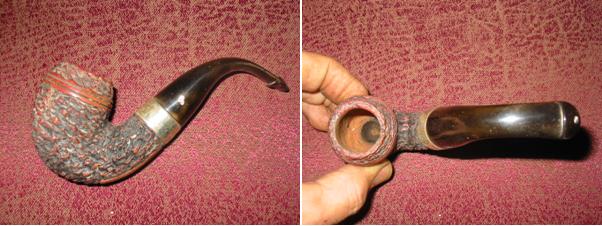
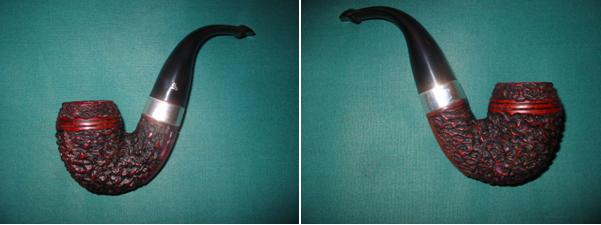
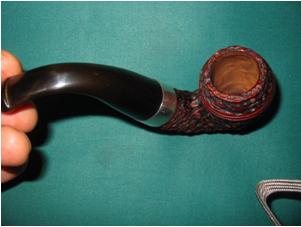
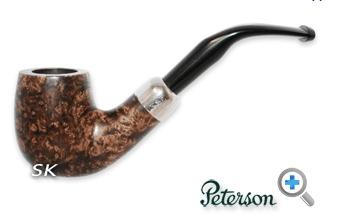
I had this old Peterson 69 bowl in my refurb bin for quite awhile. It is stamped also on the other side K&P Dublin, Made in the Republic of Ireland. I cleaned and reamed the bowl and cleaned out the mortise area with cotton swabs. I wiped the bowl down with acetone to remove the surface grime. I topped the bowl as it had major dents and roughening on the top from abuse. It needed a stem so I researched the kind of stem it needed and called a Peterson repair person in the states to have one sent to me.

Here is where the story gets a bit dicey. All I really wanted was to have the stem sent and I would fit it to the pipe but I let myself be talked into sending it south. It came back with the wrong stem on it and also had some serious cut marks on the tenon end. It also was a stem for a p-lip system pipe and the 69 is not a system pipe as far as I can tell. I was a bit frustrated to say the least so I set it aside for a week or two before calling the repairman and letting him know what I was feeling. I have to say that it is frustrating to expect one thing and get another. It is also frustrating to know that I could have done the work myself in less time if only I had a stem blank that I could have used.

I sent it back to him for a redo and included this internet photo of the pipe with the stem.
peter1

When it finally came back it was better – see the photos below. It was much better so I decided I was done with sending it back. Two times is enough. Once it was back I finished working on the rim and the rest of the bowl. I stained it with a medium brown aniline stain. It took the stain well and came out a reddish brown colour. I buffed it with Tripoli and White Diamond to polish the stem so the grain would show through. I finished it with several coats of carnauba wax and buffed with a soft flannel buff. The silver ferrule was polished with silver polish. It is a good smoker and is comfortable in the mouth.
Peter2

peter3

peter4

peter5

My Favourite Pipe Spot – A Small Piece of Solitude


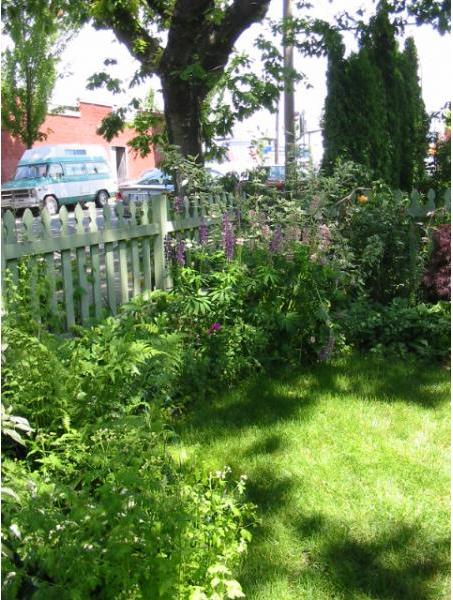
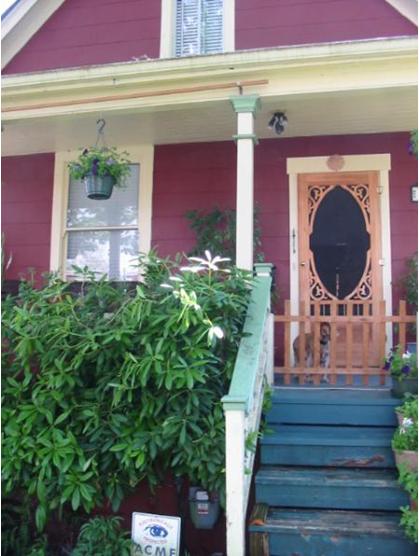
When I think of my favourite spot to smoke a pipe I cannot think of a better place than on my front porch. I live in an old Victorian cottage on a side street in East Vancouver. The house is about 112 + years old and has had many face lifts in its long life. Since the photos were taken I have replaced the stairway with more solid new one. Other than that it looks much the same throughout the warm parts of the year. The porch sits about five feet above the street and the rhododendrons along the front of the porch give some privacy while you are sitting and enjoying the spot.

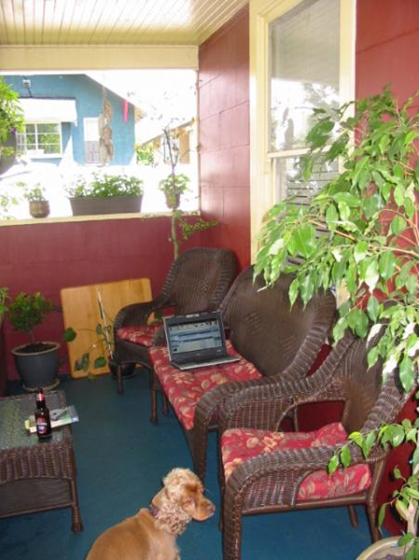
It is a comfortable place in terms of situation but I always like to make it a bit homier by adding to the natural setting. I put a reed mat rug (made of recycled plastic) on the floor of the porch. It is more decorative than necessary, but it adds some ambience to the space. I set up my two wicker chairs and love seat with a wicker and glass table for the accessories and tobacco. The table also serves as a resting place for a cold drink and also the laptop should I want to scroll through a forum while sitting there. There are hanging baskets along the front and side beams of the porch and fichus trees and other trees and plants on the railings and the floor. These also add to the setting. My cocker spaniel Bailey generally joins me on the porch as he enjoys the setting and the scenery. He commandeers one of the chairs as is his spot. And together we sit and observe life on the street out front and walking down the sidewalk outside the fence. Many a time it also serves as a spot to do a bit of quiet reading and writing when the muse moves.
house1

house2

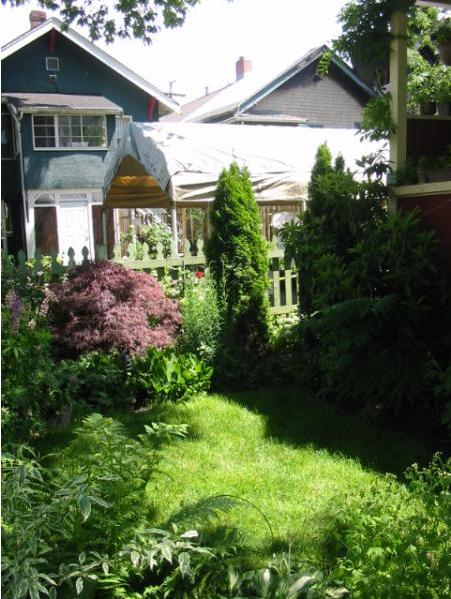
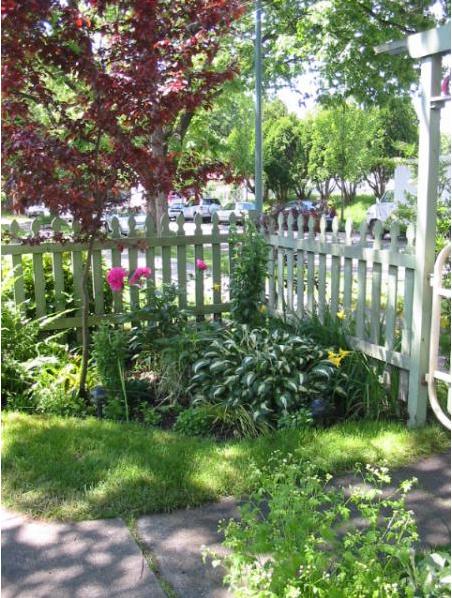
From the porch my small yard is a garden that I enjoy filling with perennials and some annuals to give colour and depth to the foreground. The light green picket fence and gate surround the yard and give a bit of privacy setting it back from the sidewalk.
house3

house4

house5

house6

This spot has become a favourite and comfortable place for me. I find it a spot to relax and unwind throughout the late spring days and on into the late fall. For us here in Vancouver it means that I can set things out about the end of April and use the porch until mid to late October. I can also use it a bit later but it gets cold with the damp winds and rain so it is relegated to the months I have mentioned above. I thought I would share the favourite spot with all of you. Won’t you join me on the porch for a bowl and a visit?

Cheers!

ImageImageImageImage

Setting up a Pipe and Tobacco Box Pass


Over the years I have set up several box passes of tobacco to facilitate sampling of different blends and a way of trading pipes. The concept is quite simple and generally works best when kept within a geographic area. For instance – Canadians start a Canadian pass, Americans and American pass, etc. I have found over the years that fighting the Customs people at the borders is not worth the lot of problems that cross border or ocean shipping can cause. The one who starts the pass packs a box with tins or samples of tobacco and a few pipes that are available to each person on the list of those participating. The basic idea can be adapted to fit a particular region or even type of blend. I have also seen it used with cigars and it also works very well.

I am including two documents in this post that I include with each box pass. The first is a document called How It Works. The second is called Contents of the Box – Puts and Takes. The idea of the box pass is explained and a few simple “rules” are included in the How It Works document. I have found it important to include these in the box pass as they give a framework for recruiting of participants in the box pass as well as guidelines for the recipients of the box when they look at the contents and swap tobaccos or pipes.

I have participated in box passes where there were no rules and generally there have been problems with things being lost or kept too long or with items being swapped that had lesser value than the ones that were taken. The Contents document works to keep people honest. It lists what was sent when the box went out and what was taken and added. The Puts and Takes list is updated by each participant. In my passes I have asked that other participants put their name or initials by what they added and/or took.

Box passes are great fun and are a way to connect people who otherwise may not ever connect. I would invite and encourage you to give a box pass a try in your location. Gather about 6 to 12 individuals and collect names and addresses. Make a sheet with these names and addresses in the order of the pass. Send it out to the first name on the list, they will send it to the second and so forth. The last person on the list returns it to the original sender and they can either take and put and start it over or lay it aside until a later date.

HOW IT WORKS: (This is the sheet that I send out with my box pass)

— This pass is open to Canadian Residents ONLY! We have many friends across the borders that we’d love to have participate with us in this pass, but issues with Canada Customs makes this impractical, at best. Our apologies are extended to those Brethren of the Briar outside Canada.

— Each participant can keep the Box till the following Monday before shipping it out to the next person on the list. This means if you get the Box on a Wednesday you can keep the Box till the next Monday (yep, that is 4 days), if you want to ship it sooner you can.
Hopefully this will give you longer to sample the goodies. Feel free to sample from the open tins and from the bulk tobaccos (but, please be sure to reseal the baggies that contain them once you are done thanks!). All that is asked in exchange for this is that you leave something in the box for others to sample. While this is fun, please remember that those further down the list from you are anxiously awaiting the box’s arrival. Uncalled for delays spoil the fun!

— When shipping the box to the next participant the use of Priority Mail service with Delivery Confirmation is required. Shipping via UPS is also acceptable.

— If the box is beginning to show some wear and tear, or needs a bigger box (last time we changed the box several times), please replace it with a new box. “It can make it one more time” thinking in the past has resulted in items being lost due to the box failing while in the shipping company’s hands.

— Puts and Takes should be of like kind of items in the box. If you take a sealed tin, replace it with a sealed tin. If you take a partial tin, replace it with a partial tin. The only caveat is that sealed tins can be used to replace any tobacco in the box. Partial tins in this box will be individually placed in Ziploc bags, so please be courteous and place your partial tins going into the box in Ziplocs as well (this is to insure that they do not dry out).

— Tobacco used for Puts into the box should be of good quality and should be blends that you would like others to try. This is not a disposal service; it is an opportunity to sample and trade for some tobaccos you may not have had the chance to smoke and to give your
fellow Brethren of the Briar a chance to try some tobaccos they may not have tried before.

–Please, no glass containers. One word breakage! `Nuff said!

–Puts and Takes should be notated on the list enclosed in the box. Additionally, all puts and takes should be posted to this thread of the Web forum (if you are a web forum member. Web forums are great places to recruit a list). Remember: That part of the fun of participating in a box pass is watching the thing play out on the board!

CONTENTS OF THE BOX – PUTS AND TAKES (this is a copy of the initial list I sent out in the last box pass I sent out. I include it to give you an idea of how it works for the one starting the pass.)

(Note: Alongside the item you take from the list of contents add your name. Add your puts at the end of the list and also add your name. It is always interesting to follow the box and see what others have taken and put in. Thanks!)

Tobacco

1          unopened tin of GLP Haddo’s Delight

1          unopened tin of Bjarne’s Flake DeLuxe

1          unopened pouch of Three Star China Black Whiskey

1          unopened pouch of Three Star China Black Fire Cured

1          unopened pouch of Three Star China Black Vanilla Burley

1          opened tin of F&T Blackjack (VA Flake)

1          opened tin of Dunhill Royal Yacht (older and a bit dry but smokes well)

1          50 gram +/- of GLP Tribute (this is the first edition of this tobacco. It came out after 9/11.)

Accessories

2          Drift wood tampers from the Pacific Ocean

3          briar tampers

Pipes

1          Edwards Algerian Briar Canadian (refurbished, new stem and ready to smoke – older probably 50’s)

1          Edwards Algerian Briar Canadian 721 (refurbished, original stem, ready to smoke –older probably 50’s)

1          Weber Blackthorn 245 (shank was repaired by Mel Cates, YPSC, barely smoked, very good condition, ready to smoke)

1          Milano (a Savinelli second, there is a new stem with it and the original as well. Ready to smoke.)
1          Middleton Silvay, a saddle stemmed lumberman. (refinished, stained and waxed, ready to smoke)